









The Income Tax Act 2025 was enacted following demands to modernize and simplify the bulky 1961 Act. Despite high expectations for structural change, the New Act is considered a disappointment because it makes very little change in substance. The stated objective was merely language simplification, which involved converting hundreds of explanations and provisos into sub-sections, and changing established terms like “notwithstanding” to “irrespective”. This linguistic revision creates an apprehension of increased litigation by disrupting settled judicial interpretation.
Procedurally, the New Act replaces the concept of “assessment year” with “tax year”. A critical transitional issue is that the Old Act (1961) will continue to apply to proceedings pending as of April 1, 2026, for previous tax years. This means taxpayers and practitioners must remain proficient in the provisions of both the 1961 and 2025 Acts for at least the next decade. Ultimately, stakeholders question whether the substantial effort was worthwhile given the minimal changes and the risk of new legal controversies.
BACKGROUND
The Income Tax Act 1961 has been around for more than six decades. The said Act had undergone innumerable changes, some on account of changes in the economic environment, some due to judicial interpretation being not in consonance with legislative intent, and some for other reasons. Consequently, the Act had indeed become bulky, and many new users found it to be cumbersome. The need for a new Income Tax legislation had been doing the rounds for more than a decade and a half. A direct tax code was put in the public domain in around 2010. Professionals spent huge amounts of time trying to analyse and dissect the provisions thereof and make representations to the government. For reasons best known to the lawmakers the direct tax code got a quick burial and is now lying only in the archives.
When a New Act was mooted, the profession and probably the taxpayer had great expectations. This was an era of massive technological development, all-round economic growth and the liberalisation of 1991, had resulted in a sea change in business environment. The government always mentioned its object of ushering in “ease of doing business.” It was hoped that the new legislation would make structural changes, conduct a complete overhaul of the cumbersome procedural issues and the New Income Tax Act, would be a forward-looking model legislation. Sadly, these expectations have not been met and to that extent the new legislation is a disappointment. The feeling is that a great opportunity has been lost.
The announcement of the new legislation was made in July 2024; the bill was tabled on 13th February 2025. referred to the Select Committee immediately thereafter. After the report of the Select Committee, which suggested a large number of changes, many of which were accepted by the Finance Ministry, the old bill was withdrawn on 8th August 2025. The redrafted legislation was placed before Parliament on 11th August 2025, passed by both houses on 11/12th August 2025 and received presidential assent on 21st August 2025. The Income Tax Act 2025 (hereafter referred to as the New Act), does not make any change in substance in the Income Tax Act 1961 (hereafter referred to as the Old Act). In its responses to the Select Committee, the Finance Ministry has made it abundantly clear that it does not intend to make any policy change and the objective was merely to ensure that the new law had language which the stakeholders could easily comprehend, was dynamic and forward-looking. Unfortunately, the objects do not seem to have been achieved. There is apprehension that, on account of the changes in language, there may be increase in litigation, unless the lawmakers take appropriate steps.
SCOPE OF THIS ARTICLE
As has been narrated in the earlier paragraphs, there is very little change in substance between the Old Act and the New Act. The tabulations comparing/ matching old sections with the new sections are already in the public domain, and in this era of complete information access, bear no repetition. Therefore the object is to point out the limited changes that have been made in the provisions relating to assessment and appeals, analyse the thought process of the Finance Ministry which has been recorded by way of responses to the suggestions of the Select Committee and put forth some suggestions wherever appropriate.
IMPACT OF CHANGE IN LANGUAGE
As an endeavour towards simplifying language, all the explanations in the Old Act {900 in number) and provisos (1200 in number) have been given a go by, and the text of the said explanations and provisos find place in the New Act by way of sub-sections. The role and ambit of explanations and provisos had been judicially interpreted for more than six decades and the law on that aspect was now well settled. Judicial fora were clear, that an explanation could not exceed the ambit of the main provision and a proviso was only an exception or carve out.
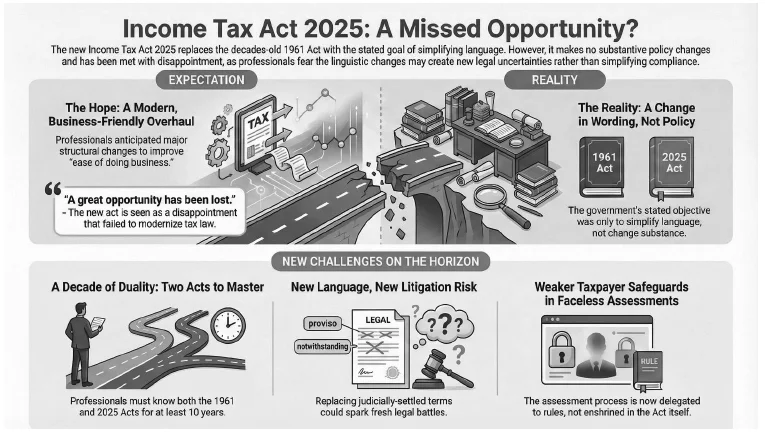
When an explanation or a proviso is enacted as an independent provision by way of a sub-section, it would stand on the same footing as the other sub-sections in the section. As a consequence, if the two sub-sections are in conflict with each other or there is an element of difference in interpretation, it would require judicial intervention to make a rational interpretation. The most significant difference in language is the use of the word “irrespective of” instead of the word “notwithstanding”. In my humble understanding, these two words do not mean the same thing. It is also important to note that the word “notwithstanding” was a non-obstantate clause, and if it appeared at two places, the impact was judicially interpreted. Using the word “irrespective of”, may result in interpretation issues. The Finance Ministry has clarified that the change in language is only to make it simple and not to disagree with established propositions. It may be appropriate for the Finance Ministry to clearly mention that despite the use of a different word, the intent is to accept the interpretation that was placed on the word “notwithstanding”.
REPEAL AND SAVINGS – SECTION 536
While section 536(2) of the New Act has clauses (a) to (s), clauses (c), (d), (e) and (g) are of importance for the scope of this article. Clauses (c), (d) and (e) provide that in respect of any proceeding pending as at the date of the commencement of the New Act, pertaining to tax year beginning before 1st April 2026, the provisions of the Old Act would continue to apply. This will mean that in regard to any proceeding which is pending as on 1st April 2026, in regard to assessment year 2026-27(previous year 2025-26), or any year prior thereto, the Old Act will apply. Further if any proceeding is initiated after 1st April 2026 pertaining to these years, the Old Act will continue to apply. This will mean that at least for the next decade or so, tax practitioners will have to keep abreast of the provisions of the Income Tax Act 1961, as well as the Income Tax Act 2025. Of course, this was the position also at the time that the Income Tax Act 1922, gave way to the Income Tax Act 1961. The difference is that the tax compliance landscape at that point of time was far simpler than it is today. Considering the current complexities, taxpayers, tax practitioners as well as tax administrators have a daunting task ahead.
The procedures, obligations limitations provided for/prescribed under the Old Act would continue for all years commencing on before 1st April 2026. Clause (g), provides that in regard to any refund pertaining to an year prior to the commencement of the New Act or any sum due by the assessee pertaining to that year, the provisions relating to interest either payable by the Central Government or by the assessee, the provisions of the New Act will apply for the period after the commencement of the act.
DEFINITIONS / CONCEPTS PRIOR TO ASSESSMENT
The definitions pertaining to assessment, person, regular assessment, tax in the New Act are virtually identical to that of the Old Act. In the term “assessment”, the term recomputation has been included. This is only a semantic change as computation of tax was always a part of the assessment process.
In keeping with the change of replacing the concept of assessment year by a tax year, the New Act does not have a definition of assessment year, but a tax year is defined in section 3, in place of a previous year. Therefore 2026-27 will be the assessment year for previous year 2025-26 and tax year for financial year 2026-27.
The provisions of section 263 in regard to furnishing of a return of income, and section 267 pertaining to an updated return are similar to the corresponding provisions in the Old Act.
ASSESSMENT
The provisions in regard to inquiry before assessment are similar to that under the Old Act. Section 270(1) which deals with processing of a return of income corresponds to section 143(1) of the Old Act. Before the Select Committee, the stake holders had represented that after processing the return by the Centralized Processing Centre (CPC), which is a mechanical process now facilitated by artificial intelligence, the responsibility of grant of refund, rectification etc should vest with the jurisdictional assessing officer (JAO). This would solve a large number of problems, which arise on account of the absence of a human interface. To illustrate, in the case of a developer following the percentage completion method, the withholding of tax by the flat purchaser, the determination of income results in a mismatch, requiring reconciliation. In situations like this, a human interface becomes inevitable.
The Finance Ministry response to the stakeholders suggestion was that the duties of the CPC and the JAO are properly delineated. According to the Ministry, the CPC processes returns according to Taxpayer’s Charter. It also transfers the rectification rights on request. The speed of such actions and the actual situation in the field is well known to taxpayers and tax practitioners.
Section 273 of the New Act corresponds to section 144B of the Old Act. However, there is a significant difference between the New Act and Old Act. Section 144B provided for the entire process of a faceless assessment. Despite the deletion of section 144B (9), which expressly provided that the non-adherence to the procedure would result in the assessment as non-est, statutory recognition of the process resulted in protection of the assesee’s rights. Section 273 delegates the duty of prescription to the CBDT. Before the Select Committee, the stakeholders urged that the assessment process should have statutory recognition. The Finance Ministry response was that even delegated legislation has parliamentary oversight, as the rules framed have to be placed before the Parliament. One wonders whether such oversight is sufficient protection for the taxpayer. The infringement of a statute would give different rights to an assessee. The same may not be true of a violation of a rule. While delegated legislation gives the administrators flexibility, one wonders whether the powers of prescription would be fairly used.
REASSESSMENT
Section 280 corresponds to section 148 of the Old Act by virtue of which a person is called upon to file a return, if, in the opinion of the department, income has escaped assessment. Sub section (5) of the section dispenses with the requirement of an opportunity in terms of section 281 in certain circumstances. The circumstances have been expanded to include , in terms of Section 280(6)(g) and (h) two situations, namely the issue of any direction by an approving panel in respect of an impermissible avoidance agreement, and any finding or direction contained in an order passed by any authority tribunal or court in any proceeding under this Act by way of appeal, reference revision, or by a court in any proceeding under any other the law. If these circumstances exist, no opportunity mandated by section 281, is necessary before issue of notice under section 280.
Before the Select Committee, the stake holders had requested that an opportunity be provided to an assessee, in terms of section 281 even if such circumstances exist. The Finance Ministry response was that, since the finding or direction was by a higher authority, it was bound to follow it and in any event an opportunity was already afforded by the authority before it recorded a finding or issued a direction. This could have significant repercussions for two reasons. Firstly, the term “authority” has not been defined in the New Act, though an income tax authority has been defined. So, the scope of the exclusion from a prior enquiry would stand substantially expanded, Secondly the finding or direction by a court under any other law, could put an assessee to substantial inconvenience. This is because each law has a different and distinct ambit. To illustrate, in a proceeding under say the PMLA or Prevention of Corruption Act, the court may record a finding. If the reopening is based on such a finding, it could have repercussions. Another example would be the statement of parties in matrimonial dispute before a family court. In such cases, statements are made in a particular context. If the court records a finding in regard to such statements, it could cause problem to assessees.
Section 282 sets out the time limit within which notice under section 280 can be issued. At first blush, one feels that the time limit has been increased from three years to four years and from five years to six years in certain circumstances, This is however not so. Section 149 of the Old Act prescribed limits with reference to an assessment year while the New Act prescribes time limits with reference to a tax year. The actual timelines therefore remain unchanged.
Section 286, corresponding to section 153 of the Old Act, sets out the time limits within which assessments, reassessments and recomputations are to be completed. Unlike section 153, which uses the term “month”, section 286 uses the word “year”. The reason for such change is not understood. Since both these terms are not defined in either the Old Act or the New Act the definition under the General Clauses Act will apply
APPEALS AND REVISION
The appeal and revision provisions remain substantially unchanged, though there are minor differences in language. Interestingly in regard to the revisionary powers of the Commissioner under section 378, the stakeholders had requested that the intimation under section 270(1) be treated as an order for the purpose of revision. This was earlier provided in section 264 in the Old Act, but after the deletion of the explanation, conflicting views had arisen. While declining to make a change in regard to the revisionary powers of the Commissioner, the Finance Ministry has explicitly stated that there is “no bar to a Commissioner exercising his jurisdiction in regard to an intimation under section 270(1). This would be clarified by way of administrative instructions.“ Thus, at least one controversy as to whether an assessee can invoke a Commissioner’s revisionary jurisdiction in regard to an intimation appears to have been settled.
CONCLUSION
If, simplification of language and reduction in volume were the only objects of the New Act, and the government was not desirous of making any structural or policy change, one wonders whether the huge effort and cost was worth it, A major part of the objects could have been achieved by a Taxation Laws Amendment Act. It will be only in mid-2027 that the provisions which are the subject matter of this article will be put to use. Even with the restriction that no policy change is to be made, it would be appropriate to make some changes in the Income Tax Act 2025. Probably the Government is conscious of this. It is borne out by the answer by the Minister of State for Finance in reply to a question in Parliament, which mentions that the forms to be used with effect from 1st April 2026, will be notified only after the Finance Bill 2026 is passed as the said bill may make certain changes to the New Act. One hopes that the lacunae which have already come to the fore are taken care of, so that litigation pertaining to the New Act can be avoided to the extent it can!
