Subscribe to the Bombay Chartered Accountant Journal Subscribe Now!

V Sundar v. Registrar of Companies: Striking off a company’s name for non-compliance is unjustifi ed if material evidence establishes its active operational status.

6. V Sundar vs. Registrar of Companies, Chennai

185 taxmann.com 222, NCLAT, Chennai

Where company’s name was struck off by Registrar of Companies (RoC) for non-compliance, but NCLT misinterpreted material on record regarding its operational status at the time of strike-off, such striking off could not be justified and matter was to be remitted for reconsideration of restoration application.

FACTS

  • The appellant, a shareholder of a Private Limited company, sought restoration of the company’s name under section 252 after it was struck off by RoC. It was stated that notice for strike-off was issued in 2011 and the company’s name was removed in 2012. The company had availed bank credit of about ₹45 lakhs against hypothecation. However, it later defaulted, and since it owned immovable assets; a settlement proposal was offered by the financial creditor to be met through sale of such assets. The appellant contended that restoration would enable discharge of liabilities in the interest of creditors and stakeholders.
  • The Registrar submitted that the company had failed to comply with statutory requirements under sections 159 and 220 of the Companies Act, 1956, that no statutory records were available on the MCA portal, and therefore it was presumed to be non-operational. Proceedings were initiated under section 560(1), notice under section 560(3) was issued in 2012, and the company’s name was struck off thereafter. It was also contended that material to establish continued operations was not properly substantiated.
  • The NCLT rejected the application under section 252(3), holding that the appellant failed to establish that the company was carrying on business or in operation at the time of strike-off and that restoration was justified; it also noted delay and lack of sufficient cause.

Observations and Reasoning by NCLAT

  • The appeal engages consideration of a very short question – the parameters which are required to be followed for the purposes of conducting the proceedings under Section 252 of the Companies Act, 2013 ( CA 2013) and the purposes of the modalities, which are required to be adopted for de-listing the company and its consequential restoration?
  • Another question which required consideration is the implications over the controversy in questions pertaining to Section 252(3) when the Appellate Tribunal exercises its powers under Section 252 of CA 2013. Particularly in the context of powers contained under Section 248 of CA2013, vested with RoC, to remove the name of the company from the Register of Companies.
  • Appellant contended that the company was facing an acute financial crunch due to the downward trend of the business and they did not have enough funds available to meet day-to-day expenses and business operation. The financial creditor offered a proposal for the purpose of the settlement of the dues qua the advance payments, which was offered to be made for by the sale of assets. The bank’s proposal for the settlement of the dues for full and final settlement was filed by the Appellant before NCLT. The contention was that in the event of the company getting restored in the records of the ROC, the company would be able to meet all its allied contractual obligations by entering into the sale of immovable assets, which would be in the interest of the creditors and the other stakeholders of the company. However, the Respondents initiated the proceedings under Section 560 of CA 1956, against which an objection was preferred on 10th January, 2023. The position was that as per the balance sheet of the Appellant for the financial year 2010-11 to 2019-20, the fact that the company was functional during the said period, was not brought on record, or proved otherwise.
  • While on the other hand, the Respondent was seeking the dismissal of the company’s petition praying for the revival of the company into ROC records. The same was not considered, and NCLT, while considering the implications contained under Section 252(3) of CA 2013, had proceeded to pass an order whereby the application for the revival / restoration of the company was rejected. The ground taken for the purposes of rejecting the application by NCLT was that the conditions given under Section 252(3) of CA 2013 were not satisfied. It was observed that the Appellant had not been able to satisfy the twin ingredients to be satisfied i.e. the company at the time of its name being struck off, was actually carrying on the business, and was in operation.
  • The NCLT took a view that since the Appellant has not been able to satisfy the conditions and coupled with the fact that the application was preferred with the delay and did not give any justifiable reason, the same was required to be rejected.
  • The RoC filed a response that the company failed to follow the statutory compliance of section 159 and section 220 of the Companies Act, 1956, and also that there were no statutory details pertaining to the subject company available on the MCA portal. Therefore, it was presumed that the appellant company was not carrying out the business operations. As per the directions issued by the Ministry vide its correspondence of 15th September, 2011 under Section 560 (1) of the Companies Act, 1956, the name was struck off of the company by the notice issued on 10th January 2012.
  • The key issue is whether restoration of the company’s name can be denied solely due to delay, especially when the Respondent’s objection was limited to alleging lack of proof of the company’s active status.
  • The Appellant argued that the balance sheets showed the company was operational and possessed assets at the time of strike-off, but the NCLT rejected these documents only because they were not certified by a Chartered Accountant.
  • The Tribunal observed that the NCLT misinterpreted the company’s operational status and gave vague, contradictory reasons for refusing restoration, despite the Respondent’s objections and the documents supporting the company’s active business operations.

HELD:

Thus, the striking of the company from the register maintained by RoC by its order cannot be aptly said to be justified, in view of a catena of judgments where it has been held that it should be the Hon’ble Court’s endeavour to support the revival of the Company rather than otherwise. Thus, the ‘Impugned Order’ would hereby stand ‘quashed’, and the matter is ‘remitted back’ to NCLT, to reconsider the application for restoring the company, the name of which was struck off from the register, and it would pass an appropriate order in accordance with law:

  • after considering the application for revival of its registration in Register of Companies

and

  • further considering the documents which have been placed on record, in support of its contention that the company was still in operation as on the date when the company was directed to be struck off from the register of the RoC.

Satinder Singh Bhasin v. Government of NCT of Delhi: Utilizing company funds for a director’s personal bail deposit violates Section 185, leading to forfeiture and bail cancellation

Satinder Singh Bhasin vs. Government of NCT of Delhi & Ors.

Before Supreme Court of India

Criminal Original Jurisdiction Writ Petition (Crl.) No. 242 Of 2019.

Date of Order: 2nd April,2026

The Utilization of Company Funds by a Director for personal purposes (deposit for bail) is in violation of Section 185 of the Companies Act, 2013.

FACTS

Insolvency proceedings were invoked against M/s BIIPL under the Insolvency and Bankruptcy Code, 2016 and Mr. MG was appointed as the IRP. Thereafter, the IRP contended that  Mr. SB, director of M/s BIIPL, acted in violation of the law as he had not handed over the affairs of M/s BIIPL. Further, Mr. SB had siphoned and mismanaged funds of the Company and for which FIRs were registered.

Thereafter, against the FIRs, Mr. SB had filed Writ Petition under Article 32 before Supreme Court, where the Court granted interim bail on the condition that he shall deposit Rs.50 crore before the Registry of the Court as a precondition for grant of bail. Mr. SB deposited Rs.50 crore. However, upon investigation, it was discovered that the source of funds was the funds of Private Limited Companies i.e. M/s BIIPL and other related corporate entities instead of his individual capacity.

Therefore, it was observed by Court that on plain reading of the Section 185(1) of the Companies Act, 2013, a company is prohibited from directly or indirectly advancing loans to its directors. While Section 185(2) permits such transactions subject to the passing of a special resolution and utilisation of funds for the company’s business purposes, no such resolution had been passed in the present case. Further, the funds were utilised for a purely personal purpose, namely, securing bail.

The Court noted that the petitioner had effectively utilised interest-free corporate funds for personal benefit without providing any security and in complete non-compliance with statutory requirements.

ORDER

The Court held that the conduct of Mr. SB was in direct contravention of Section 185 of the Companies Act, 2013, which expressly stipulates that a loan to a director of a company could be advanced only after approval by way of a Special Resolution.

It further described the unauthorized disbursal of funds as an “alarming aspect”.

Accordingly, the Court:

  • forfeited the entire deposit of ₹50 crore along with accrued interest; and
  • cancelled the interim bail granted to the director.

The judgment reiterates that directors cannot use company funds for personal liabilities or obligations, directly or indirectly, in contravention of Section 185 of the Companies Act, 2013.

Corporate Governance: Overview and Challenges

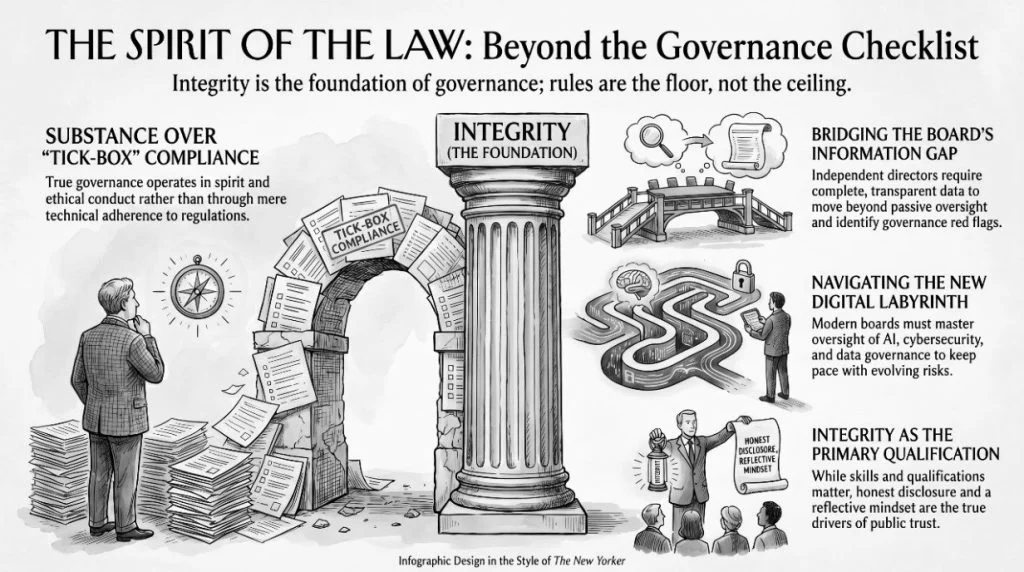
Corporate governance in India has evolved from promoter-driven roots to a robust framework under the Companies Act 2013 and SEBI LODR 2015. This system mandates diverse board committees to oversee financial integrity and risks. However, a core challenge remains achieving “governance in substance” over mere procedural compliance. Boards currently grapple with information asymmetry, complex related party transactions, and emerging technological risks like AI. Ultimately, effective governance transcends checklists; it requires a culture of integrity, ethical accountability, and a reflective mindset to protect all stakeholders.

Introduction

Way back in the 17th century, with the emergence of joint-stock companies such as the Dutch East India Company, the foundations of modern corporate governance began to take shape. The concept of separating ownership from management introduced a need for accountability in business operations. Corporations grew in size and influence over the centuries, particularly after the industrial and economic expansion of the 20th century. This raised concerns regarding misuse of managerial powers, shareholder protection and ethical conduct, which led to the evolution of structured governance mechanisms across jurisdictions. Corporate scandals involving Enron, Lehman Brothers and Satyam Computer Services further highlighted the importance of strong governance practices and became major triggers for regulatory reforms.

The concept of corporate governance covers a set of rules, procedures and operational structures that guide the short-term and long-term action of companies. While safeguarding the interests of shareholders as well as all other stakeholders connected with the organization. Effective corporate governance not only strengthens investor confidence but also promotes sustainable growth and responsible corporate conduct.

This article gives an insight into various dynamics and challenges faced during the process of effective integration and implementation of corporate governance in an organization

The-Spirit-of-the-law

Evolution of Corporate Governance in India

The evolution of corporate governance in India has been shaped by economic reforms, regulatory developments and corporate frauds. Traditionally, Indian businesses were promoter-driven and family-controlled, except few large group’s others were not fully equipped to focus on minority shareholder protection, transparency and accountability. However, economic liberalization in 1991 and integration with global markets increased the need for stronger standards of governance.

Corporate governance reforms in India began with the introduction of the Desirable Code of Corporate Governance by the Confederation of Indian Industry (CII) in 1998. Thereafter, corporate scandals highlighted serious governance failures and led to major regulatory reforms. The Kumar Mangalam Birla Committee (1999), The Naresh Chandra Committee (2002) and Narayana Murthy Committee (2003) strengthened governance standards relating to auditor independence, financial disclosures, audit committees and shareholder rights.

A significant shift took place with the enactment of the Companies Act, 2013 coupled with changes in listing requirements. The introduction of the Securities and Exchange Board of India (Listing Obligations and Disclosure Requirements) Regulations, 2015 (“SEBI LODR Regulations”), further strengthened governance standards for listed entities.

Legal Framework of Corporate Governance in India

The SEBI (Listing Obligations and Disclosure Requirements) Regulations, 2015 prescribe corporate governance requirements for listed entities relating to shareholder rights, protection of minority shareholders, timely disclosures, dissemination of material information and grievance redressal mechanisms. The Regulations further prescribe requirements relating to board composition, including appointment of independent directors and woman directors, maximum limits on number of directorship’s, board meetings and performance evaluation of directors.

The Regulations also mandate constitution of various board committees and prescribe their functions and responsibilities. The Audit Committee is required to oversee financial statements, internal financial controls, statutory and internal audits, related party transactions, vigil mechanism and utilization of funds. The Nomination and Remuneration Committee is responsible for appointment and evaluation of directors and senior management, remuneration policy and board diversity. The Stakeholders Relationship Committee is responsible for resolution of shareholder and investor grievances. The Risk Management Committee is required to establish the risk management framework, identify, monitor and mitigate various risks including operational, financial, cybersecurity, business, regulatory, compliance etc. The role of risk management committee is becoming more onerous in today’s times where business environment is becoming more dynamic and getting complex.

The SEBI LODR Regulations further prescribe approval and disclosure requirements relating to related party transactions, oversight obligations relating to material subsidiaries and duties and obligations of independent directors, including separate meetings and familiarization programmes. Listed entities are also required to submit periodic corporate governance compliance reports to stock exchanges and make disclosures relating to Business Responsibility and Sustainability Reporting (BRSR), ESG risks and sustainability-related matters in annual reports.

Related party transactions remain as one of the most closely scrutinized areas under the corporate governance framework. This framework prescribes approval, disclosure and oversight requirements for related party transactions and has significantly expanded the scope of “related party” and “related party transaction” to include direct and indirect benefit arrangements involving listed entities and their subsidiaries. The framework also requires approval mechanisms through the Audit Committee and shareholders, enhanced disclosure obligations and monitoring of material related party transactions.

The regulatory framework further requires Audit Committees and Boards to monitor conflicts of interest, misuse of corporate assets and approval of related party transaction. However, practical challenges continue to arise in identifying beneficial interests, tracing indirect relationships and determining whether transactions are undertaken for the benefit of related parties through layered structures, subsidiaries or connected entities. Operational challenges also arise in determining arm’s length pricing, assessing ordinary course of business criteria, maintaining adequate documentation and ensuring timely disclosures across large corporate groups with complex structures and multiple subsidiaries. The committee members and the Board of Directors have to play a very critical role in identifying related parties, justification of transactions, deciding arm’s length pricing, approval and review process and relevant disclosures.

Corporate Governance – Not mere Compliances

“Governance is an act, which should be voluntary adopted, once codified takes the character of Compliances”

A) Governance beyond checklist-based approach

Corporate governance has gradually evolved beyond a disclosure and compliance-driven framework towards a broader system focused on accountability, ethical conduct and stakeholder protection. Merely constituting committees or complying with procedural requirements does not necessarily ensure effective governance. Recent governance discourse has increasingly distinguished between “compliance in form” and “governance in substance”, emphasizing that governance must operate in spirit and not merely through technical adherence to regulations. Governance must actually be done in addition to merely appearing to have been done. Concerns have also been raised that excessive procedural compliance may at times lead to a tick box approach rather than meaningful oversight and responsible decision-making. The purpose of these regulations gets defeated when rules are followed and principles are compromised.

B) Effectiveness and Oversight Challenges

Board effectiveness and quality of oversight have emerged as central governance concerns in recent years. Governance studies and boardroom discussions have highlighted issues such as passive boards, information asymmetry between management and directors and overdependence on promoter-driven decision-making. The role of the board is moving from the oversight function to the executory functions and line of demarcation is getting blurred. The increasing expansion of board responsibilities relating to ESG, cybersecurity, risk management, related party transactions and technology oversight has significantly increased governance and oversight expectations from directors.

C) Independent Directors and Board Challenges

Recent institutional governance surveys and boardroom discussions have reflected increasing challenges relating to the role of Directors in India. The “Survey on Corporate Governance – 6th Edition” (by excellence enablers) observed concerns relating to concentration of committee memberships, long tenures of directors and increasing governance responsibilities placed upon boards and audit committees. The Survey further noted that the average age of independent directors in India remained above 63 years during FY 2025, while boards are increasingly expected to oversee evolving areas such as artificial intelligence, cybersecurity, ESG, data governance and technology-driven risks. Recent reports have also indicated that resignations of independent directors from listed companies rose significantly during FY 2026, reflecting increasing governance pressures and board-level accountability concerns.

The effectiveness of independent directors is often impacted by limited access to complete information, insufficient time for detailed review of board agendas and increasing complexity of business operations. The key is whether the right question was being asked in the meeting, whether everyone participated in the discussion or not, whether accurate and complete data were available for taking decision and whether they were recorded properly.

Governance discussions have also highlighted concerns regarding concentration of board positions within limited professional and promoter networks and limited availability of directors possessing specialized expertise in areas such as finance, technology, law, sustainability and risk management. These challenges have increasingly raised concerns regarding board diversity, technological understanding and timely identification of governance red flags in complex and technology-driven corporate environments.

Emerging Governance Risks – Technology

Companies are increasingly dependent on technology-driven operations, data analytics and AI-based systems for business decisions, customer interaction, financial processes and compliance functions. Governance discussions have also highlighted concerns regarding inadequate board-level oversight of technology risks. In several instances globally, governance failures have arisen due to weak cybersecurity controls, inaccurate technology disclosures, overreliance on automated systems and lack of understanding of digital and AI-related risks at the board level. The increasing use of fintech platforms, digital payment systems, cross-border data transfers and third-party technology vendors has further expanded operational and regulatory risks for companies. These risks are further aggravated where members of the board lack adequate technological understanding and are unable to effectively keep pace with rapidly evolving digital and AI-driven business environments.

Conclusion

The true foundation of corporate governance lies in the integrity, ethical conduct and accountability on the part of management. Integrity, though a personal attribute, is a foremost quality that one has to possess, qualification, commitment, skill and capabilities come later. Honest disclosures, transparent decision-making, protection of shareholder interests and compliance with legal and regulatory obligations require a governance culture that operates not merely in form, but in spirit. Corporate governance also carries a broader responsibility towards investors, regulators, employees and society, as a whole, as companies operate not only for profitability but also as responsible contributors to economic growth and public trust. Corporate governance, therefore, cannot be measured merely through compliance frameworks and disclosures, but through the value systems and culture that drives each individual working for the organization. Good Governance comes from reflective mindset rather than reactive skill set.

Transmission of Flats: Post-Probate Scenario

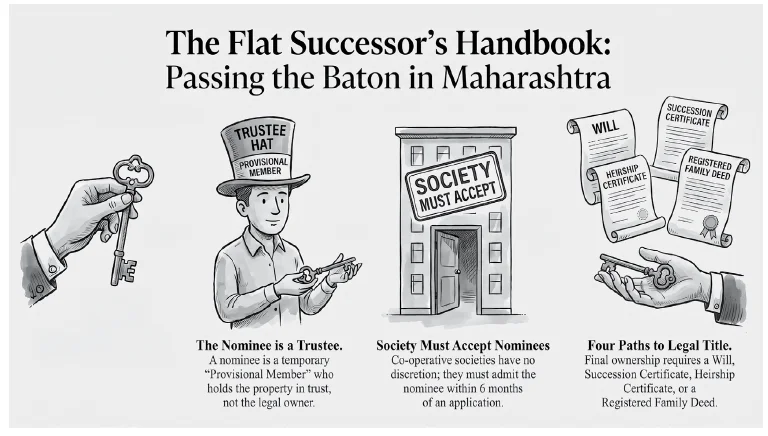
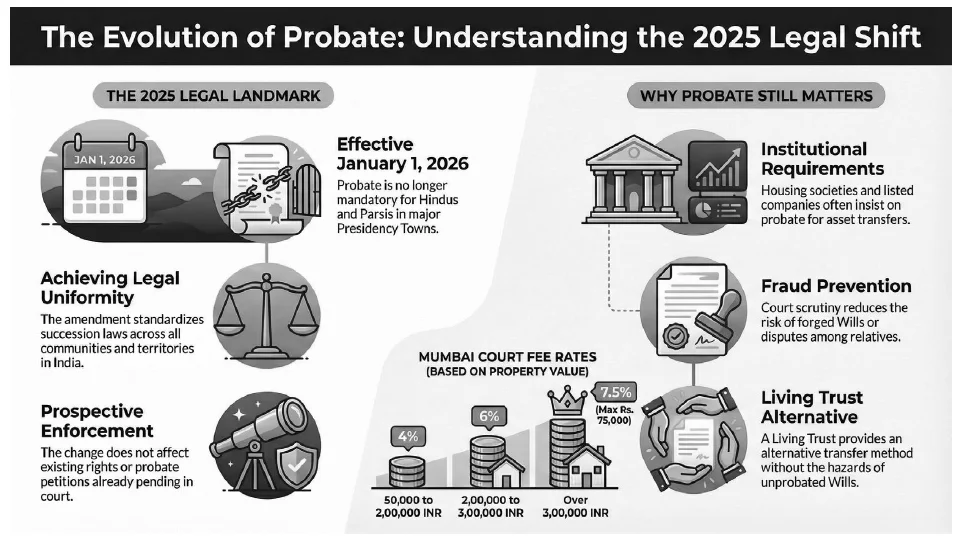
The Repealing and Amending Act, 2025, removed mandatory probate requirements for property transmission in Mumbai with effect from January 2026. In the case of Co-operative Housing Societies, the Maharashtra Co-operative Societies Act, 1960 (“MCS Act”) mandates the immediate admission of nominees as provisional members until legal heirs are identified through a Will, succession certificates, or other appropriate legal process Conversely, condominiums governed by the Maharashtra Apartment Ownership Act, 1970 (“MAOA”) treat apartments as heritable immovable property and do not provide for a comparable statutory nomination mechanism. While probate is no longer legally compulsory for most communities, it nevertheless continues to remain a valuable mechanism for authenticating Wills and resolving disputes during the transmission process.

INTRODUCTION

The Repealing and Amending Act, 2025 effected a significant modification to the framework of testamentary succession in India. By omitting Section 213 of the Indian Succession Act, 1925, Parliament dismantled a colonial-era procedural requirement which, for nearly a century, had distinguished testamentary succession in the three erstwhile Presidency Towns of Bombay, Calcutta and Madras (now Mumbai, Kolkata and Chennai) from the rest of the country. This Feature in the February 2026 issue of the BCAJ examined this amendment.

Probate is now no longer mandatory even for Hindus and Parsis residing in Mumbai, Chennai, or Kolkata, or for persons holding immovable properties in these locations. The amendment seeks to bring about uniformity in the provisions of the Act for across communities. However, the amendment does not alter the position in respect of Wills for which probate petitions are pending before any Court. The repeal does not affect existing rights, acts, obligations, liabilities or pending proceedings. According, the amendment operates prospectively from 1st January 2026 and not retrospectively. Existing probates remain valid, and pending probate proceedings do not automatically abate or terminate.

It is in this altered legal landscape that the questions forming the subject matter of this article assume significance: how should a co-operative housing society in Mumbai deal with the demise of a member, both where a valid nomination exists and where no nomination has been made? Further, how should a condominium formed under the Maharashtra Apartment Ownership Act, 1970, deal with an analogous situation?

TRANSMISSION IN A CO-OPERATIVE HOUSING SOCIETY

In the State of Maharashtra, the transmission of the share, right, title and interest of a deceased member of a co-operative housing society is governed primarily by the Maharashtra Co-operative Societies Act, 1960 (the “MCS Act”), the Maharashtra Co-operative Societies Rules, 1961 (the “MCS Rules”), and the bye-laws of the concerned society. The MCS Act specifically contains Section 154B-13, which deals with the transfer of interest upon the death of a member.

In addition, Section 30 of the MCS Act, which generally governs the transfer of interest upon the death of a member in co-operative societies, Sections 22 to 25A relating to membership, eligibility and disqualification, and Section 154B-9 concerning removal of a member by the Registrar in cases of admission contrary to the Act, the Rules, or the bye-laws, continue to apply except to the extent modified by Chapter XIII-B in respect of co-operative housing societies.

Section 154B-13 of the MCS Act provides for the transfer of interest upon the death of a Member. Upon the death of a Member of a society, the society is required to transfer the share, right, title and interest in the property of the deceased member to a person or persons on the basis of testamentary documents, a succession certificate, a legal heirship certificate, or a family arrangement executed by the persons entitled to inherit the property of the deceased member, or to a person duly nominated in accordance with the Rules.

The provision further stipulates  that the society shall admit the nominee as a provisional Member upon the death of the Member until the legal heir or heirs, or the person  entitled to the flat and shares in accordance with the applicable law of succession or under a Will or other testamentary document, is admitted as a Member in place of the deceased Member.

Lastly, the provision states that where no nomination has been made, the society shall admit as a provisional Member such member as may appear to the Committee to be the heir or legal representative of the deceased Member in the prescribed manner.

WHERE THE DECEASED MEMBER HAS MADE A VALID NOMINATION

The MCS Act permits a member of a co-operative society to nominate, in writing, any person to whom his share or interest in the society shall be transferred upon his death.  A nomination is not a mode of testamentary disposition. It does not confer beneficial ownership upon the nominee. Upon the death of the member, the nominee is merely a person designated to receive the share or interest of the deceased member from the society and holds the same in trust until the legal heirs or legatees, as the case may be, are ascertained.

This proposition has been repeatedly affirmed by the Hon’ble Supreme Court of India over several decades, most recently and emphatically in Shakti Yezdani v. Jayanand Jayant Salgaonkar, (2024) 1 SCC 706. In that case, the Supreme Court, while considering nominations under the Companies Act, 1956, held that the legislative object of nomination is not to provide a third mode of succession, but merely to provide a discharge mechanism for the company in respect of the shares held by the deceased shareholder. The Court further held that a nominee does not acquire absolute beneficial ownership in derogation of the rights of the legal heirs or legatees of the deceased.

The same principle had earlier been expounded by the Supreme Court in Smt. Sarbati Devi v. Smt. Usha Devi, (1984) 1 SCC 424, in the context of nominations under Section 39 of the Insurance Act, 1938. Both these decisions constitute important pillars of the law of relating to nomination in India and form the necessary backdrop against which the decision of the Supreme Court in Indrani Wahi v. Registrar of Co-operative Societies & Ors., (2016) 6 SCC 440, must be understood.

THE DECISION OF THE SUPREME COURT IN INDRANI WAHI

The decision in Indrani Wahi was rendered by a Division Bench of the Supreme Court in a case arising under the West Bengal Co-operative Societies Act, 1983, and the West Bengal Co-operative Societies Rules, 1987. However, the principles laid down therein have pan-Indian relevance to nominations under co-operative societies legislation.

The principal issue before the Supreme Court was whether, upon the death of a member of a co-operative society who had made a valid nomination, the society was bound to transfer the share or interest of the deceased member in favour of the nominee — and, conversely, whether such transfer determined the question of title as between the nominee and the other heirs of the deceased member.

The Court held that the transfer of shares or interest in favour of the nominee is binding upon the concerned Cooperative Society. The Cooperative Society has no option whatsoever except to transfer the membership in the name of the nominee. However, such transfer has no bearing upon the issue of title between the heirs, inheritors or successors to the deceased member. Accordingly, where a deceased member who has made a valid nomination, the co-operative society has “no option whatsoever” but to transfer the share and interest of the deceased member in favour of the nominee. The society neither adjudicates competing claims of succession, nor is it entitled to delay or refuse such transfer on the ground that another heir may possess a superior claim under the applicable law of  succession.

The transfer of shares and interest in favour of the nominee, insofar as the society is concerned, does not amount to an adjudication of title. The legal heirs and representatives of the deceased member continue to retain the right to pursue their claims  of succession or inheritance before a competent civil forum in accordance with the applicable personal law. The nominee, qua the property held in the society, occupies the position of a trustee for the true owners as may ultimately be determined inter se among the heirs.

The principles laid down in Indrani Wahi apply with equal force to a co-operative housing societies in Maharashtra. This position has been authoritatively reinforced and amplified by the Hon’ble Bombay High Court in Foreshore Co-operative Housing Society Limited  v. Divisional Joint Registrar of Co-operative Societies & Ors., WP No. 7834 of 2025, decided on 9 December 2025 (“the Foreshore decision”), which presently constitutes the most recent judicial pronouncement on the interpretation and operation of Section 154B-13 of the MCS Act.

In the  Foreshore decision, after undertaking a careful textual analysis of Section 154B-12 and Section 154B-13 of the MCS Act, the Bombay High Court laid down certain principles  of general application to all co-operative housing societies in Maharashtra.

The Court emphasised that a clear distinction must be drawn between a transfer of interest by a living member under Section 154B-12  and a transfer upon the death of a member under Section 154B-13. Section 154B-12 employs the expression “may transfer” and preserves the discretion of the society to scrutinise the eligibility of the proposed transferee. In contrast, under Section 154B-13, the role of the society is confined to giving effect to the statutory scheme of succession.

Upon the death of a member, “the society’s discretion is significantly reduced. The society cannot choose among claimants or impose additional eligibility norms not found in the statute.” The role of the society is limited to verifying the legal status of the nominee or heir.

The Court further observed that Section 154B-13 operates with reference to two distinct sources of entitlement, namely:

  • testamentary or succession-based documents, such as a Will, succession certificate, legal heirship certificate, or family arrangement executed by or in favour of the persons entitled to inherit the property of the deceased member; and
  • a nomination duly made in accordance with the Rules.

The provisos to Section 154B-13 contemplate the admission of:

  • the nominee; or
  • in the absence of a nomination, the apparent heir or legal representative,

as a provisional member pending ascertainment of the legal heir or legatee in accordance with succession law or under a Will. The proviso to Section 154B-13 introduces, in the context of housing societies, a relatively novel concept which merits careful attention. Upon the death of a member who has made a valid nomination, the nominee is to be admitted as a provisional member — and not as a regular member — “till legal heir or heirs or a person who is entitled to the flat and shares in accordance with succession law or under Will or testamentary document are admitted as Member in place of such deceased Member”.

Thus, immediately upon the death of the member, the nominee is admitted as a provisional member. Such provisional membership continues until the heirs or legatees, as the case may be, are identified and admitted in accordance with the applicable testamentary document, succession certificate, legal heirship certificate, or family arrangement. Upon such admission, the provisional membership comes to an end and is replaced by regular membership in favour of the rightful heir or legatee. The Bombay High Court in Pravinkumar Jethalal Dave, vs The State of Maharashtra, WP No. 2317/2011 Order Dated 9th February 2026, adopted a similar approach. The Court held that nomination merely enables the Society to deal with an identified person after the death of a member.

WHERE THE DECEASED MEMBER HAS MADE NO NOMINATION

Where the deceased member has not made any nomination, where the nominee has predeceased the member, or where the existence or address of the nominee cannot be ascertained, recourse must be had to the second proviso to Section 154B-13, which reads:

“Provided further that, if no person has been so nominated, society shall admit such person as provisional Member as may appear to the Committee to be the heir or legal representative of the deceased Member in the manner as may be prescribed.”

The principal provision of Section 154B-13 itself contemplates transmission to a person entitled on the basis of “testamentary documents or succession certificate or legal heirship certificate or document of family arrangement executed by the persons, who are entitled to inherit the property of the deceased Member”.

THE EFFECT OF THE 2025 AMENDMENT ON THIS PROCEDURE

The 2025 Amendment has a direct and significant impact upon the foregoing procedure. Following the omission of Section 213 of the Indian Succession Act, 1925, a society in Mumbai is no longer entitled, as a matter of law, to insist upon the production of probate or letters of administration as a precondition to admitting a legatee under a Hindu, Buddhist, Sikh, Jain or Parsi Will as a regular member.

That said, the change introduced by the 2025 Amendment requires careful navigation in practice. It remains open to a society — through its bye-laws or by resolution — to require appropriate authentication of the Will, including:

  • an affidavit of execution from one or more of the attesting witnesses;
  • an affidavit-cum-indemnity bond from the legatee;
  • and a No-Objection Certificate from the heirs who would have inherited in the absence of a Will.

Certain societies may even continue to insist upon a probated Will.

While the Repealing and Amending Act 2025, removes the mandatory requirement of probate, probate may nevertheless continue to assume practical significance in many situations. In the absence of probate, the executor may proceed to distribute the estate immediately amongst the beneficiaries under the Will. However, questions may subsequently arise if the Will is challenged at a later stage, including after several years.  Further, in cases involving disputes among family members, probate may still be insisted upon by the sub-registrar / company. As noted earlier, even in jurisdictions where probate has historically  not been mandatory under the Indian Succession Act, many institutions have continued, in practice, to insist upon probate as a matter of procedural certainty and risk mitigation.

TRANSMISSION IN A CONDOMINIUM

A condominium formed under the Maharashtra Apartment Ownership Act, 1970 (the “MAOA”) does not fall within the regulatory framework of the Maharashtra Co-operative Societies Act, 1960. Consequently, the provisions of the MCS Act, including Chapter XIII-B and Section 154B-13 thereof, have no application to a condominium.

The decisions in Indrani Wahi and Foreshore — both rendered  in the context of co-operative societies legislation — are therefore not directly applicable to condominiums. Nevertheless, they continue to possess persuasive value, particularly in relation to the broader principles governing nomination.

The principal provision governing transmission under the MAOA is Section 4. The provision states that every apartment, together with the percentage of undivided interest in the common areas and facilities appurtenant thereto, shall constitute a heritable and transferable immovable property for all purposes under the law for the time being in force.

Accordingly, the owner of an apartment is entitled to transfer the apartment, together with the corresponding undivided interest in the common areas and facilities, by way of sale, mortgage, lease, gift, exchange or in any other manner whatsoever, including by bequest.

The statutory architecture of the MAOA is therefore fundamentally different from that of the MCS Act:

  • Whereas, in a co-operative housing society, the immediate subject-matter of transfer is the share of the member in the society with the right to occupy the flat being merely incidental to membership, in a condominium, the immediate subject-matter of transfer is the apartment itself as heritable and transferable immovable property.
  • Consequently, the elaborate statutory concept of nomination contained in Section 30 and Section 154B-13 of the MCS Act has no counterpart under the MAOA. The MAOA contains no provision permitting nomination in respect of an apartment in a condominium.
  • Accordingly, upon the death of an apartment owner, the apartment devolves in accordance with the ordinary law of testamentary or intestate succession applicable to the deceased owner.

The Maharashtra Apartment Ownership Rules, 1972, framed under the MAOA, prescribe Model Bye-Laws in Exhibit B, which are commonly adopted by condominiums in Maharashtra, subject to such modifications as the apartment owners may approve.

Clause 3 of Model Bye-Law 5 specifically addresses the situation arising upon the death of an apartment owner. The clause recognises only two modes of devolution:

  • devolution by testamentary succession under a Will; and
  • devolution upon the legal representatives of the deceased owner in cases of intestate succession.

There is no concept of nomination under the MAOA, and an apartment in a condominium cannot be “nominated” in favour of any person in a manner analogous to the position prevailing under co-operative housing society legislation.

The legislative scheme of the MAOA, read together with Model Bye-Law 5, may therefore be summarised in the following propositions:

i) an apartment constitutes heritable and transferable property in the same manner as any other immovable property;

ii) the apartment owner may dispose of the apartment by way of a Will, or the apartment may devolve through intestate succession;

iii) the role of the Association of Apartment Owners upon the death of an apartment owner is essentially administrative — namely, to give effect to the testamentary or successional documents and to update the register of apartment owners — and is not adjudicatory; and

iv) the Association does not derive, from the MAOA, any independent power to admit or refuse “membership” analogous to the powers exercised by a co-operative housing society.

However, the Association may, where it considers it appropriate, require the legatee to obtain probate of the Will on a voluntary basis. Probate, where granted, continues under Section 273 of the Indian Succession Act, 1925, to constitute conclusive proof of the representative title of the executor, and obviates many of the practical concerns associated with an unprobated Will.

CONCLUSION

The legal framework governing the transmission of flats upon the demise of a member or apartment owner in Mumbai presently stands at a moment of significant change. The Repealing and Amending Act, 2025, by removing the requirement of mandatory probate, has eliminated one of the most enduring procedural distinctions between Mumbai, Kolkata and Chennai on the one hand and the rest of the country on the other.

The omission of Section 213 of the Indian Succession Act, 1925 means that probate is no longer a mandatory precondition for transmission in respect of Wills executed by Hindus, Buddhists, Sikhs, Jains and Parsis with a Mumbai nexus.

Probate nevertheless continues to remain a valuable and significant legal instrument, particularly in cases involving high value estates, contested family situations, complex testamentary arrangements, or anticipated future dealings with the apartment.

The institutional response of co-operative housing societies and condominiums in Mumbai must therefore, in the post-2025 legal landscape, strike a careful balance between:

  • the legal imperative of giving expeditious effect to transmission; and
  • the prudential necessity of satisfying themselves regarding the genuineness of the Will and the entitlement of the legatee.

Mediclaim reimbursements are independent contractual entitlements and cannot be deducted from compensation awarded under the Motor Vehicles Act.

14. New India Assurance Company Ltd. v. Dolly Satish Gandhi & Anr.

2026 INSC 498

Mediclaim reimbursements are independent contractual entitlements and cannot be deducted from compensation awarded under the Motor Vehicles Act.

FACTS

Conflicting views existed amongst various High Courts regarding whether amounts received by a claimant under a Mediclaim insurance policy were liable to be deducted while computing compensation payable under the Motor Vehicles  Act.

One line of decisions held that Mediclaim reimbursement is independent of compensation under the Motor Vehicles Act and therefore not deductible. Another line of authorities held that permitting both would amount to double recovery and that Mediclaim amounts ought to be deducted.

A Full Bench of the Bombay High Court resolved the conflict by holding that Mediclaim reimbursement is not deductible from compensation awarded by the Motor Accidents Claims Tribunal.

The correctness of the Full Bench decision was challenged before the Supreme Court.

HELD

The Supreme Court held that compensation under the Motor Vehicles Act and reimbursement under a Mediclaim policy operate in distinct fields. A Mediclaim policy is founded on a contractual relationship supported by payment of premiums by the insured, whereas compensation under the Motor Vehicles  Act arises from statutory liability flowing from a wrongful act.

Amounts received under Mediclaim policies cannot, therefore, be deducted from compensation payable by the tortfeasor or insurer under the Motor Vehicles Act. Deduction of such amounts would unjustly benefit the wrongdoer and defeat the beneficial object of the legislation. The Court approved the view that Mediclaim reimbursement  is not liable to deduction from motor accident compensation.

The Court noted that certain High Courts had treated Mediclaim benefits as independent contractual entitlements not liable for deduction, whereas other courts had viewed such reimbursement as overlapping compensation leading to duplication of benefits. The Court pointed  out that it is the duty of the lawyers to point out conflicting decisions to the Court. The Court analysed the conflicting authorities and  proceeded to settle the legal position governing the issue.

The Appeal was dismissed.

Insolvency – Real estate projects – Project-wise resolution – Homebuyers’ interests – CIRP can proceed project-wise. [Insolvency and Bankruptcy Code, 2016]

13. Alpha Corp Development Pvt. Ltd. v. Greater Noida Industrial Development Authority & Ors.

2026 INSC 449

Insolvency – Real estate projects – Project-wise resolution – Homebuyers’ interests – CIRP can proceed project-wise. [Insolvency and Bankruptcy Code, 2016] 

FACTS

Corporate insolvency resolution proceedings were initiated against a real estate developer engaged in the development of multiple housing and commercial projects. Certain projects were developed on lands leased from the Greater Noida Industrial Development Authority (GNIDA), while one project was situated on freehold land unconnected with GNIDA.

Separate resolution plans were approved by the NCLT in respect of different projects. GNIDA challenged the approvals before the NCLAT which set aside the orders passed by the NCLT.

Various stakeholders, including developers, homebuyers’ associations and project entities, approached the Supreme Court.

HELD

The Supreme Court recognised the principle that insolvency resolution in real estate matters may proceed on a project-wise basis rather than necessarily against the corporate debtor as a whole.

The Court observed that project-specific resolution protects viable projects and safeguards the interests of homebuyers in projects unaffected by default.

Reference was made to earlier decisions affirming that project-wise CIRP is permissible in appropriate cases.

The Court also observed that projects unconnected with GNIDA could not be subjected to objections raised by GNIDA in relation to separate properties.

The impugned judgment of the NCLAT was interfered with to the extent warranted in law.

The Appeals were partly allowed.

Forgery of Will – Purchaser under registered sale deed – Absence of material showing conspiracy – Criminal proceedings quashed against bona fide purchaser. [Indian Penal Code, 1860, S.420, 467, 468, 471, 120B; Code of Criminal Procedure, 1973, S.482]

12. S. Anand v. State of Tamil Nadu & Anr.

2026 INSC 418

Forgery of Will – Purchaser under registered sale deed – Absence of material showing conspiracy – Criminal proceedings quashed against bona fide purchaser. [Indian Penal Code, 1860, S.420, 467, 468, 471, 120B; Code of Criminal Procedure, 1973, S.482] 

FACTS

The complainant alleged that a forged will had been fabricated by the accused persons after the death of his father and that properties were sold based on such forged document.

An FIR was registered for offences relating to forgery, cheating and conspiracy. The investigating agency filed a charge sheet alleging that several accused persons had conspired to fabricate the will and utilise the same for the execution of sale deeds.

The appellant was one of the purchasers under the sale deed. He contended that he was a bona fide purchaser for value, had no role in the alleged fabrication of the will and had merely purchased the property after verifying title and possession.

The High Court refused to quash the proceedings under section 482 Cr.P.C. The appellant approached the Supreme Court.

HELD

The Supreme Court held that criminal prosecution cannot be permitted to continue in the absence of specific material establishing participation in the alleged conspiracy.

The materials on record did not disclose any role played by the appellant in the fabrication of the disputed will or in the creation of forged documents.

The appellant was merely a purchaser under a registered sale deed, and there was no evidence to demonstrate knowledge of the alleged forgery. The Court observed that continuation of criminal proceedings against a bona fide purchaser in such circumstances would amount to abuse of the process of law.

The criminal proceedings against the appellant were quashed. The Appeal was allowed.

Financial establishments – Deposit – loan transaction – Applicability of MPID Act – Investment carrying assured return held to constitute “deposit”. [Maharashtra Protection of Interest of Depositors (in Financial Establishments) Act, 1999, S.2(c), 2(d), 3]

11. Alka Agrawal & Ors. v. State of Maharashtra & Ors.

2026 INSC 489

Financial establishments – Deposit – loan transaction – Applicability of MPID Act – Investment carrying assured return held to constitute “deposit”. [Maharashtra Protection of Interest of Depositors (in Financial Establishments) Act, 1999, S.2(c), 2(d), 3]

FACTS

The appellants invested an aggregate amount of Rs.2.51 crore with the respondents for the development of a resort project at Tadoba, Maharashtra. The respondents allegedly assured repayment with interest at the rate of 24% per annum, payable quarterly.

The amounts were paid through banking channels between 2016 and 2019. The respondents failed to repay either the principal amount or the assured returns.

The appellants initiated various civil and criminal proceedings, including summary suits, proceedings under section 138 of the Negotiable Instruments Act and applications under section 156(3) of the Cr.P.C. The High Court held that the transaction was merely a loan transaction of a civil nature.

Thereafter, proceedings were initiated under the Maharashtra Protection of Interest of Depositors Act, alleging fraudulent default by a financial establishment. The Sessions Court rejected the application seeking registration of FIR under the MPID Act. The High Court affirmed the order.

The appellants approached the Supreme Court.

HELD

The Supreme Court held that the definition of “deposit” under section 2(c) of the MPID Act is wide and comprehensive and includes amounts received pursuant to promises of financial returns.

Merely because the transaction carried a stipulation regarding payment of interest would not by itself exclude the transaction from the ambit of “deposit”.

The Court observed that the object of the MPID Act is to protect investors from fraudulent financial schemes and therefore the provisions require purposive interpretation.

The earlier proceedings under IPC and the finding that the dispute was civil in nature could not preclude examination of the applicability of the MPID Act. The impugned judgment of the High Court was set aside, and the matter was remanded for reconsideration in accordance with the law.

The Appeal was allowed.

Company Law

3. Uma Polymers Ltd vs. Union of India

185 taxmann.com 176, High Court of Rajasthan

Where company failed to constitute Nomination and Remuneration Committee for financial year 2022-23 in conformity with the statutory provisions due to the absence of a non-executive director, subsequent rectification by appointment of a non-executive director and reconstitution of the committee did not cure the earlier violation, Thus, the penalty imposed under section 454(3) of the Companies Act 2013 (CA 2013) was legal and justified.

FACTS

The company and its Whole-Time Director were issued a show cause notice for violation of Section 178(1) of the CA 2013 read with Rule 6 of the Companies (Meetings of Board and its Powers) Rules, 2014, on the ground that the Nomination and Remuneration Committee for the financial year 2022-23 was not constituted in conformity with the statutory provisions due to absence of a non-executive director on the Board.

In response, the company admitted the non-conformity and stated that a non-executive director had subsequently been appointed, and the Committee reconstituted in compliance. At the hearing, it prayed for imposition of minimum penalty on this basis. The Adjudicating Authority (Registrar of Companies-cum-Official Liquidator) imposed a total penalty of Rs. 7 lakhs under Section 454(3) of the CA 2013 on the company and its Whole-Time Director. The Company filed the present writ petition.

Relevant Extract from the provisions of CA 2013:

Section 178 (1) The Board of Directors of every listed public company and such other class or classes of companies, as may be prescribed, shall constitute the Nomination and Remuneration Committee consisting of three or more non-executive directors out of which not less than one-half shall be independent director.

Rule 6: The Board of directors of every listed public company and a company covered under rule 4 of the Companies (Appointment and Qualification of Directors) Rules, 2014 shall constitute an ‘Audit Committee’ and a ‘Nomination and Remuneration Committee of the Board.

HELD

  •  Upon perusal of the order passed by the Registrar of Companies-cum-Official Liquidator, Jaipur, as well as the order passed by the Regional Director, North-Western Region, Ministry of Corporate Affairs, Ahmedabad, the Court came to a prima facie finding that the constitution of the Nomination and Remuneration Committee of the company for the financial year 2022-23 was not in conformity with the aforesaid provisions due to the absence of a non-executive director on the Board.
  •  However, at the time of hearing before the Adjudicating Authority as well as the Appellate Authority, the authorized representative of the company prayed for imposition of a minimum penalty, submitting that SP had been appointed as a non-executive director with effect from 14.05.2024 and that the Nomination and Remuneration Committee had thereafter been reconstituted in conformity with the provisions of the Act and the aforesaid Rules.
  •  The Adjudicating Authority, however, for the said violation, imposed a total penalty of Rs. 7.00 lakh upon the company and its Whole-Time Director, SL.
  •  In the opinion of the Court, merely because SP was subsequently appointed as a non-executive director and the Nomination and Remuneration Committee was reconstituted in conformity with the provisions of the Act and the Rules, the same would not cure the earlier violation pertaining to the non-constitution of the Committee for the financial year 2022-23, as the composition of the said Committee remained in contravention of the statutory provisions due to the absence of a non-executive director on the Board.
  •  Hence, the penalty imposed upon the company by the Adjudicating Authority in exercise of powers under Section 454(3) of CA 2013 was found to be legal and justified. As regards the quantum of penalty, it was observed that imposition thereof, being based on the subjective satisfaction of the Adjudicating Authority, is not ordinarily liable to be interfered with unless it is demonstrated that the same is based on irrelevant considerations or extraneous material. In the present case, no material has been placed on record to show that the impugned decision suffers from such infirmities or that the penalty imposed is grossly disproportionate to the violation alleged.
  •  In view of the aforesaid discussion, the writ petition was dismissed.

4. Daksha Atul Desai vs. Registrar of Companies, Mumbai

Company Appeal (AT) No. 370 of 2024

National Company Law Appellate Tribunal

Principal Bench, New Delhi

Date of order: 10th July,2025

NCLAT held that provision of Section 252(3) of the Companies Act,2013 provides a mechanism for an appeal to restore the name of a company, struck off pursuant to Section 248, granting locus standi to the company, any member, creditor, or workman, irrespective of whether the striking off was effected under Section 248(1) or Section 248(2) of the Companies Act,2013.

FACTS

Mr. DD (a Director and Shareholder) filed petition before The National Company Law Tribunal (NCLT) under Section 252(3) of the Companies Act, 2013 seeking restoration of the company’s name which was struck off by the Registrar of Companies, Mumbai, Maharashtra (ROC), on 19th July, 2017 under Section 248(1) of the Companies Act, 2013 for non-compliance with statutory requirements.

“NCLT held that since the strike-off was under Section 248(1), the petition should have been filed under Section 252(1) (3-year limit) and hence the application under Section 252(1) was time-barred.”

NCLT, in its order, differentiated between the mode of strike-off and the maintainability of a petition for restoration of name as follows:

1) Under Section 248(1): Where the name of the company is struck off by the Registrar of Companies, a petition for restoration shall be maintainable under Section 252(1), subject to a limitation period of three years.

2) Under Section 248(2): Where the strike-off is voluntary by the company, a petition for restoration shall be maintainable under Section 252(3), subject to a limitation period of twenty years

Aggrieved by the said order, Mr. DD preferred an appeal before the National Company Law Appellate Tribunal (NCLAT) against the impugned order of the NCLT.

NCLAT observed that Section 252 of the Companies Act, 2013 does not differentiate between strike-off under Section 248(1) initiated by the ROC and strike-off under Section 248(2) undertaken voluntarily by the company and held that the interpretation adopted by the NCLT was unduly narrow.

ORDER:

NCLAT held that interpretation of Section 252 establishes that the applicable limitation period under Section 252 is determined by who files the appeal/application, not how the company was struck off, and stated that:

1) Section 252(1) – 3-Year Limitation: Applies to an appeal filed by any aggrieved person against the RoC’s order of dissolution, typically within three years from the date of the order.

2) Section 252(3) – 20-Year Limitation: Applies to an application filed by the company, any member (shareholder), creditor, or workman before the expiry of twenty years from the publication of the notice of striking off.

Further, it was held that opinion taken by the Ld. NCLT is not correct, since the appeal in the present case was filed by shareholder viz. a member, the limitation as provided under Section 252(3) of the Companies Act, 2013 shall apply. The NCLAT directed the Ld. NCLT to hear the appeal on merits.

Decoding Conflict Of Interest Situations In Securities Market – Regulated Intermediaries

Conflicts of interest in securities markets arise when professional positions are exploited for gain, manifesting as actual, potential, or perceived situations. SEBI regulations require intermediaries to establish systematic frameworks for identification, avoidance, and prevention. Identification involves recognizing misaligned incentives, while avoidance relies on Board oversight and disclosure. Prevention depends on structural safeguards such as “Chinese Walls,” role segregation, and ethical codes. Ultimately, maintaining market integrity requires a shift towards a principle-driven governance culture, where client interests are consistently prioritized over revenue-driven considerations to ensure long-term investor confidence.

DEFINING CONFLICT OF INTEREST

Conflicts of Interest may be defined in several ways, including any situation in which an individual or entity is in a position to exploit a professional or official role for personal or corporate benefit. This is a manifestation of the moral hazard problem, particularly in institutions operating in the financial sector (or related areas), that provide multiple services, where potentially competing interests may lead to concealment of information or dissemination of misleading information. A conflict of interest exists when a party to a transaction could potentially makes gain by taking actions that are detrimental to another party in the transaction.

It is important to recognise that any situation inherently presenting the possibility of a conflict can become problematic, if not effectively addressed. Conflicts may be classified as actual, potential, or perceived. An actual conflict exists when there is a direct and present clash of interest. A potential conflict may arise in the future based on existing circumstances. A perceived conflict exists when a situation appears to compromise fairness or independence, even if no actual conflict exists. In financial markets, perception materially impact trust and market integrity.

Managing Market integrity

REGULATORY CONTEXT

From a regulatory perspective, the relevance of a conflict lies not merely its existence, but whether it creates a material risk of adverse impact on client interests. Further, conflicts may arise both at an organizational level due to the design of business structures and at an individual level, owing to the nature of revenue models. These conflicts are often driven by personal incentives, relationships or access to information. This dual dimension makes conflict identification and management inherently complex.

The SEBI (Intermediaries) Regulations, 2008 lay down the overarching obligation on intermediaries to avoid conflicts of interest, make appropriate disclosures, and establish mechanisms to address such situations. These principles are further supplemented by specific regulations applicable to various intermediaries, which provide more detailed procedural guidelines.

Further, SEBI Circular CIR/MIRSD/5/2013 mandates intermediaries to formulate and implement a Conflict of Interest policy, requiring a structured approach to identification, management and disclosure of conflicts. In effect, this shifts the focus from ad-hoc disclosures to a more system driven framework embedded within organizational processes.

As noted above, based on the nature of activities, specific regulatory frameworks for each category of entity prescribe mechanisms to identify potential conflict of interest. These frameworks require entities to identify, avoid and mitigate such l conflicts, and to establish a code of conduct for both the regulated intermediary and its personnel.

FOR EXAMPLE,

  • SEBI (Prohibition of Insider Trading) Regulations, 2015 mandate the formulation of a Code of Conduct and a Code of Fair Disclosure, governing information handling and trading restrictions to prevent conflicts arising from Unpublished Price Sensitive Information (UPSI).
  • SEBI (LODR) Regulations, 2015 address conflicts of interest through governance frameworks and disclosure mechanisms applicable to listed entities.
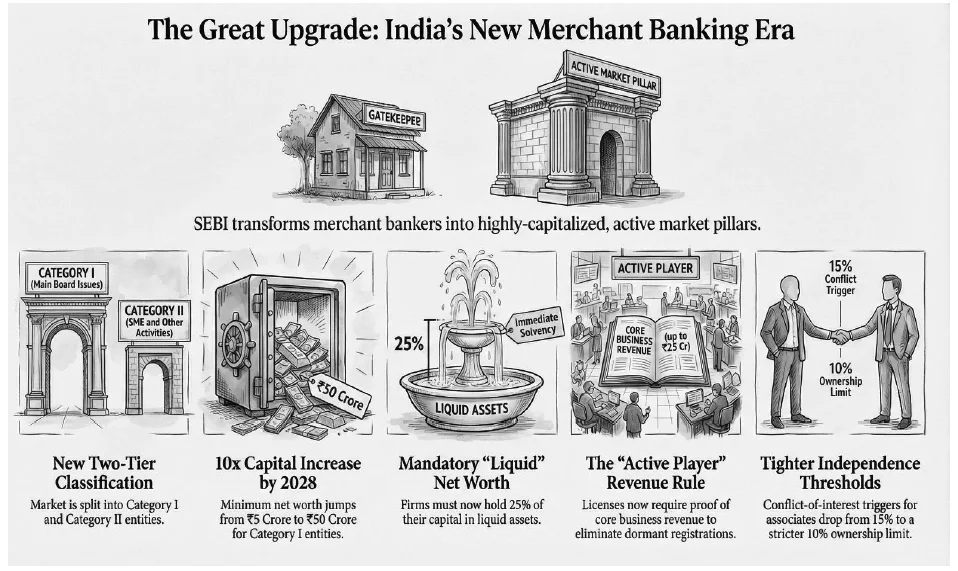
  • SEBI (Merchant Bankers) Regulations, 1992 manage conflicts through requirements relating to independence in issue management and rigorous due diligence obligations.
  • SEBI (AIF) Regulations, 2012 require disclosure of conflicts in the placement memorandum and mandate fair treatment of all investors.
  • SEBI (Investment Advisers) Regulations, 2013 require advisers to identify and disclose conflicts while acting in a fiduciary capacity.
  • SEBI (Portfolio Managers) Regulations, 2020 mandate fair and equitable treatment across clients in investment decisions and trade allocation.
  • SEBI (Mutual Funds) Regulations, 2026 impose a fiduciary duty on asset management companies and trustees to act in the best interests of unitholders.
  • SEBI (Research Analysts) Regulations, 2014 address conflicts of interest through detailed disclosure requirements and restrictions on analyst conduct.
  • SEBI (Stock Brokers) Regulations, 2026 require segregation between proprietary and client trades to prevent misuse of client orders.

Collectively, this regulatory framework emphasises the need for intermediaries to adopt robust internal policies and systems for the identification, management and disclosure of conflicts of interest.

IDENTIFICATION, AVOIDANCE & PREVENTION

Conflicts can arise due to organizational structures as well as individual conduct. A conflict-of-interest policy provides a framework for managing such situations, with the objective of ensuring fair outcomes for clients and maintaining market integrity.

In practice, conflict management operates across three pillars—

(i) Identification of conflicts,

(ii)  Avoidance of conflicts, and

(iii) Prevention of conflicts.

IDENTIFICATION OF CONFLICTS

Effective conflict management begins with systematic identification. Intermediaries must recognize situations where their interests, or those of their employees, diverge from client interests, or where incentives may influence objectivity.

During the process of identifying conflict of interest situation, an entity should take into account the following indicative scenarios where the entity, an employee, or a relevant person:

  • Is likely to make financial gain, or avoid a financial loss, at the expense of the client
  • Has an interest in the outcome of a service provided to the client, or of a transaction carried out on behalf of the client, which is distinct from the client’s interest in that outcome;
  • Has a financial or other incentive to favour the interest of one client over another
  • Receives from a person other than the client an inducement in relation to a service provided to client, in the form of money, gifts, goods or services, other than the standard commission or fee for that service;
  • Has Access to confidential information and/or derives third-party benefits;
  • Has professional or personal associations or relationships with other organizations;

Adequate records should be maintained of services and activities where a conflict of interest has been identified.

AVOIDANCE OF CONFLICTS

Avoidance represents the first line of defence in conflict management. It involves structuring activities and decision-making processes in a manner that prevents conflicts from arising or reduces their likelihood.

In operational terms, this requires a clearly defined governance and escalation framework. Identified conflicts must be promptly reported to the compliance function and, depending on their materiality, escalated to senior management or the Board of Directors for review. This ensures that conflict resolution is not left to individual discretion but is subject to institutional oversight.

However, avoiding a conflict of interest may not always be possible or practical. In such cases, the following measures may be adopted:

  • The conflict of interest should be disclosed to the Board of Directors;
  • All Conflicted Transaction must be reviewed and approved by Board of Directors;
  • The Interested Party should not participate in any decision relating to such Conflicted Transaction;
  •  The Interested Party should not participate in any decision relating to such Conflicted Transaction;
  • Disclosure should be made to clients regarding possible source or areas of conflict of interest (e.g., disclosures in the Private Placement Memorandum for AIFs or Disclosure Document for Portfolio Manager Services);
  • Appropriate measures should be taken to avoid or mitigate the conflicts;
  • Any actual or potential conflict should be reported to a responsible authority, such as the relevant management team, department head, or key managerial personnel;
  • Where conflicts cannot be adequately managed, or where existing measures do not sufficiently protect Client interests, the conflict should be disclosed to enable the client to make a informed decision on whether to continue the relationship.

PREVENTION OF CONFLICTS

Prevention focuses on reducing the structural likelihood of conflicts. Unlike avoidance, which deals with identified situations, prevention is forward looking and embedded within organizational design.

A principles based approach is central to effective prevention. This includes maintaining high standards of integrity, ensuring fair treatment to clients, and aligning business practices with client suitability. Equally important are structural safeguards such as information barriers between functions, neutrality in incentive structures, and clear segregation of roles.’

The objective is not to eliminate conflicts which is neither practical nor necessary but to minimize situations where conflicting incentives arise in the first place.

INTERNAL CONTROLS FOR MANAGING AND MITIGATING CONFLICTS

Once identified, conflicts should be managed through appropriate controls, with transparency and timely disclosure forming the foundation. Clients must be adequately informed to enable informed decision making. Structural safeguards such as Chinese Walls and segregation of roles should be implemented to restrict the flow of sensitive information across functions. These information barriers may extend to separation of personnel, reporting lines, systems and documentation to ensure that confidential information is accessed only on a need to know basis.

A robust compliance framework plays a central role in monitoring and managing conflicts. This includes periodic review of conflict situations, enforcement of confidentiality obligations, and maintenance of secure records for effective oversight. Employees should be governed by a strong code of conduct covering personal trading, handling of inside information and disclosure requirements, supported by regular training and surveillance systems to detect unusual activities. Incentive structures should also be aligned to ensure that client interests are not compromised by revenue driven considerations.

In practice, conflicts manifest in various forms such as biased research, front running, mis-selling or preferential allocation. These risks can be mitigated through targeted controls including functional independence, pre-approval mechanisms, suitability assessments and transparent allocation policies. Ultimately, continuous review of systems and controls is essential to ensure that conflict management frameworks remain effective and responsive to evolving risks.

A FUTURE INSIGHT IN ADDRESSING CONFLICT OF INTEREST

As discussed above, management of conflict of interest also requires strong governance and clear accountability. Senior management must take responsibility for establishing a culture of transparency and ethical conduct. They must ensure that policies are not merely documented but are effectively implemented.

With increasing digitalization, one can expect the development of centralised oversight systems that go beyond traditional monitoring and actively manage conflicts of interest. Such frameworks could create a structured environment where roles, responsibilities and transactions across intermediaries are mapped and aligned within a unified system.

This would assist in identifying overlaps in duties—for instance, where the same entity or individual is involved in multiple functions like advisory, execution, or research, which may give rise to conflicts. The system could automatically flag such overlaps and enforce controls, such as restricting certain actions, requiring approvals or triggering disclosures. Instead of merely flagging suspicious transactions, such systems would focus on preventing conflicts at a structural level by ensuring that incompatible roles are identified and managed in advance.

In conclusion, conflicts of interest are an inherent part of business activities; however, the manner in which they are managed is critical. Poor handling of conflicts can undermine market fairness, distort price discovery, and erode investor confidence. Intermediaries must consistently priorities clients and investors interests and uphold trust.

This approach not only ensures compliance with SEBI regulations but also supports long term stability and confidence in the securities market. The time has come for organizations to transition from a rule-based compliance mindset to a principle-driven governance culture. Companies must ensure, both in letter and spirit, that conflicts of interest are addressed not merely through policies, but through ethical conduct embedded across all levels of the organization.

Classification Of A Borrower’s Account As Fraudulent

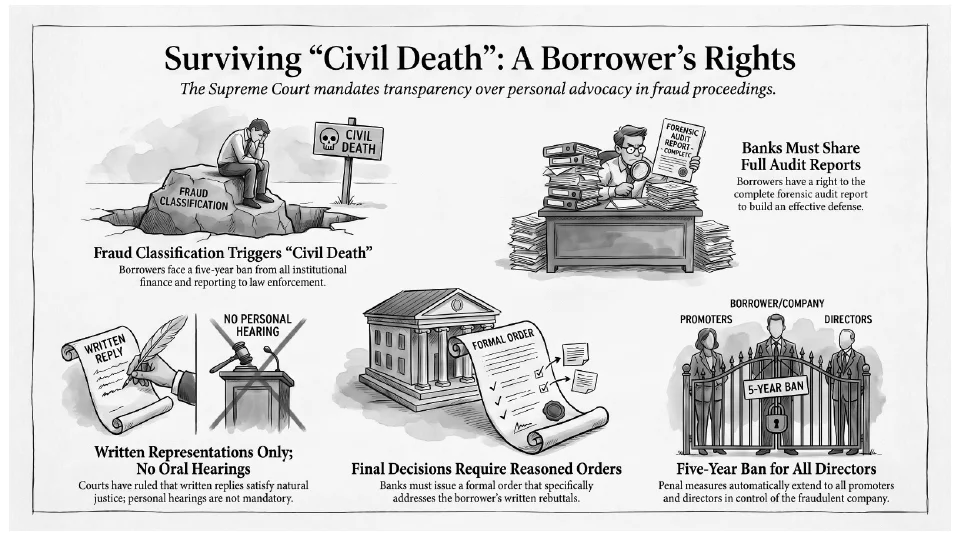
Classification as “fraud” under RBI regulations causes “civil death” for borrowers, debarring them from institutional finance for five years. In Rajesh Agarwal, the Supreme Court ruled that natural justice must apply, leading to the 2024 Master Directions. Banks must now issue a show-cause notice, disclose the forensic audit report, and pass a reasoned order. Crucially, while a written representation is mandatory, a personal hearing is not required. These procedures balance fairness with administrative efficiency but do not preclude separate criminal proceedings via FIRs.

INTRODUCTION

The classification of a borrower’s account as “fraud” under the Reserve Bank of India’s regulatory framework has serious implications. The borrower and its promoters and directors are debarred from accessing institutional finance for five years, reported to law enforcement agencies, and effectively branded as untrustworthy by the entire banking system. The Supreme Court, in Gorkha Security Services v. State (NCT of Delhi), (2014) 9 SCC 105, has succinctly termed this as the “civil death” of the concerned borrower.

Under such a dire scenario, a fundamental question arose: Whether the borrower is entitled to be heard before being classified as a fraudster? And if so, what does that hearing entail — a mere opportunity to submit a written representation, or a full-fledged personal hearing? Must the forensic audit report that forms the very foundation of the fraud classification be disclosed to the borrower?

JURISPRUDENCE ON THIS SUBJECT

These questions have seen conflicting decisions from various High Courts and the Supreme Court. The jurisprudence began with the decision of the Telangana High Court in the case of Rajesh Agarwal, WP No. 19102 of 2019 Order dated 10th December 2020, followed by the Supreme Court’s decision in State Bank of India v. Rajesh Agarwal & Ors., (2023) 6 SCC 1.

This was followed by the Calcutta High Court’s decision in Amit Iron P Ltd v. State Bank of India; the Division Bench of the Bombay High Court in Anil D. Ambani v. State Bank of India, WP No. 3037 of 2025, and ultimately culminated in the Supreme Court’s judgment in State Bank of India v. Amit Iron Private Limited & Ors., Order dated 7th April 2026. Taken together, these decisions present a comprehensive jurisprudential framework governing the rights of borrowers in fraud classification proceedings.

RBI’S REGULATORY FRAMEWORK

The RBI, exercising its powers under Section 35A of the Banking Regulation Act, 1949, issued the Master Directions on Fraud – Classification and Reporting by Commercial Banks and Select Financial Institutions, dated 1st July 2016 (“Master Directions 2016”). These Directions established a structured mechanism for the detection, classification, and reporting of frauds in loan accounts of banks. Banks were required to identify Early Warning Signals, red-flag suspicious accounts, commission forensic audits, and classify accounts as fraud through a Joint Lenders’ Forum (JLF) or a Fraud Identification Committee (FIC”).

Clause 8.12 of the Master Directions 2016 prescribed penal measures. Borrowers classified as fraudulent — including promoters, directors, and whole-time directors — were debarred from availing bank finance from scheduled commercial banks, development financial institutions, and government-owned NBFCs for a period of five years from the date of full repayment. Critically, neither restructuring nor compromise settlements were permitted for fraud-classified accounts.

However, the Master Directions 2016, were silent on one crucial aspect: they did not provide for any opportunity of hearing to the borrower before classifying the account as fraud. It was this gap that led to the constitutional challenge in Rajesh Agarwal (supra).

Pursuant to the Supreme Court’s directions in Rajesh Agarwal (supra), the RBI issued the revised Master Directions on Fraud Risk Management, dated 15th July 2024 (“Master Directions 2024”). These revised Directions expressly incorporated the requirement of issuing a detailed show cause notice to the borrower, furnishing the forensic audit report, inviting representations, and passing a reasoned order. All of these requirements were as laid down by the Supreme Court’s Order.

Surviving Civil Death

SC’S MILESTONE DECISION IN RAJESH AGARWAL

The Supreme Court’s decision in State Bank of India v. Rajesh Agarwal, (2023) 6 SCC 1 is the cornerstone of this entire issue. The Apex Court examined whether the principles of natural justice should be read into the Master Directions 2016, which were silent on any hearing opportunity for borrowers. The Court held that the classification of an account as fraud is not merely a trigger for criminal proceedings, but also carries independent and severe civil consequences. Relying on its earlier decision in State Bank of India v. Jah Developers, (2019) 6 SCC 787, the Court observed that the debarment of borrowers from accessing institutional finance is akin to blacklisting — an action that must be preceded by an opportunity of hearing.

Further, relying on earlier Constitution Bench decisions, the Court held that since the Master Directions did not expressly exclude the application of audi alteram partem, the principle must be read into the Directions to save them from the vice of arbitrariness.

The conclusions of the Supreme Court, as summarised in the judgment, established that: the borrower must be served with a notice; be given an opportunity to explain the findings of the forensic audit report; allowed to make representations before the banks or the JLF; and that the decision classifying the account as fraud must be supported by a reasoned order.

The Supreme Court in Rajesh Agarwal (supra) upheld the Telangana High Court’s judgment, which had directed the grant of a personal hearing to the borrower. Conversely, the Court set aside the judgment of the Gujarat High Court in Mona Jignesh Acharya v. Bank of India, 2021 SCC OnLine Guj 2811, wherein it had been held that a personal hearing was not mandatory and that only a post-decisional opportunity to make a representation was sufficient. However, it is important to note that the Supreme Court did not expressly mandate a personal hearing.

BOMBAY HIGH COURT’S DECISION

The Division Bench of the Bombay High Court, in the case of Anil D. Ambani v. State Bank of India, WP No. 3037 of 2025, examined SBI’s order classifying the account of Reliance Communications Ltd. (“RCOM”) as fraud and reporting the petitioner’s name to the RBI.

The petitioner, who was the Chairman, Promoter, and Non-Executive Director of RCOM, challenged the order on four principal grounds: firstly, that the show cause notice issued under the erstwhile Master Directions 2016 was rendered non est by the subsequent Master Directions 2024; secondly, that the impugned order violated natural justice for want of a personal hearing; thirdly, that no specific allegations were made against the petitioner individually; and fourthly, that a non-executive director could not be held vicariously liable.

The Court held that the Master Directions 2024 were clarificatory in nature, having been issued to bring the framework in conformity with the decision in Rajesh Agarwal (supra). Since a show cause notice had already been issued, the process initiated under the 2016 Directions continued to remain valid and stood merged with the subsequent framework. The doctrine of supersession did not invalidate a validly issued notice.

On the vital issue of a personal hearing, the Court held that the right contemplated by the Supreme Court is one of representation—not necessarily of a personal hearing. The Court noted that subsequent to the decision in Rajesh Agarwal (supra), SBI had itself represented before the Supreme Court expressing its apprehension that the judgment might be construed as mandating a personal hearing in every case. The Supreme Court, by its order dated 12th May 2023, had clarified that the operative directions are confined to those summarised in its judgment — which speak of representation, not of a personal hearing.

On the question of individual allegations, the Court held that once a company’s account is classified as fraud, promoters and directors who were in control of the company are automatically liable to penal measures. Specific individual allegations in the show cause notice are not a prerequisite. Notably, the Court distinguished the Delhi High Court’s decision in IDBI Bank v. Gaurav Goel & Ors., 2025 SCC OnLine Del 935, which had held that personal hearing forms part of the audi alteram partem safeguard, holding that the said decision had no application in the facts and circumstances of the present case. The Court dismissed the petition, finding no infirmity in the impugned order.

A related issue examined by the Bombay High Court in the same matter in Bank of Baroda v. Anil D Ambani, Appeal (L) NO.43022 of 2025 concerned the validity of an interim injunction restraining banks from acting upon a forensic audit report. A Single Judge had granted relief on the prima facie view that the report was invalid, as it was not prepared by a qualified auditor under ICAI Act.

The controversy before the Division Bench centred on whether forensic audits must necessarily be conducted by Chartered Accountants only? The Division Bench held that the Single Judge had transgressed the settled limits of interlocutory jurisdiction by returning conclusive findings on the legality of the forensic report and regulatory interpretation. Accordingly, the injunction was set aside/modified, permitting the banks to proceed in accordance with law.

This issue was appealed before the Supreme Court in SLP(C) No. 012943 – 012944 / 2026. It was argued that only a qualified auditor/chartered accountant can determine siphoning or fraud and conduct a financial audit, and since the report relied upon was not an audit and records finding of fraud, the classification was unsustainable. It was further contended that siphoning can only be determined by a qualified chartered accountant, and not by a forensic service provider who himself admitted that he was not an auditor and was not following accounting standards. It was also argued that under the RBI framework, even where forensic inputs are used, the ultimate determination must be made by an auditor, and banks cannot classify an account as fraud on such a report. By its Order dated 16th April 2026 in Anil D Ambani v. Bank of Baroda, the Supreme Court disposed of the appeal and declined to interfere with the order of the division bench of the Bombay High Court .

AMIT IRON: SUBSEQUENT SC VERDICT

The most recent comprehensive pronouncement on this issue has come from the Supreme Court in State Bank of India v. Amit Iron Private Limited & Ors, CA 4243/2026, Order dated 7th April 2026. The Court examined three issues ~ whether the decision in Rajesh Agarwal (supra) mandated a right to a personal hearing; whether written representation and a reasoned order would suffice; and lastly whether the entire forensic audit report must be furnished to the borrower. The appeals arose from the Calcutta High Court’s decision in Amit Iron P Ltd v. State Bank of India, W.P.A. No. 10195/2024, Order dated 7th August 2024. The Delhi High Court’s decision in the case of Bank of India v. Sanjeev Narula, LPA 472/205, Order dated 29th July 2025 was also considered. Both of these decisions had directed personal hearings to be granted to borrowers, relying on Rajesh Agarwal (supra). The issue had also divided other High Courts: the Delhi High Court in IDBI Bank v. Gaurav Goel, 2025 SCC OnLine Del 935, and in a series of decisions of the Delhi High Court in the cases of TV Vision Limited v. Punjab National Bank W.P.(C) 9302/2022 Order dated 1st December 2023, Manish Jain v. Reserve Bank of India W.P.(C) 9536/2025, Order dated 1st July 2025, Ashish Gupta v. State Bank of India W.P.(C) 4340/2024, Order dated 21st March 2024, and Chandra Kant Khemka v. Reserve Bank of India, W.P.(C) 1354/2023 Order dated 6th April 2023, had consistently held that a personal hearing was a necessary component of the Rajesh Agarwal framework. In contrast, the Bombay High Court in Anil Ambani (discussed above) had taken the view that a written representation would suffice.

The Supreme Court held that Rajesh Agarwal’s decision did not recognise any inherent right vested in the borrower to a personal or oral hearing before the borrower’s account was classified as fraud. The Court analysed the conclusions in Rajesh Agarwal’s case and held that the procedure envisaged (one of issuing of a show cause notice, consideration of the borrower’s reply, and passing of a reasoned order) satisfies the requirements of natural justice. The RBI’s Master Directions 2024, which incorporated this procedure, were held to correctly reflect the scope of the earlier decision in Rajesh Agarwal, thereby ensuring a fair balance between promptitude and fairness.

Relying on its earlier decisions in T. Takano v. SEBI, (2022) 15 SCC 401 and Madhyamam Broadcasting Limited v. Union of India, (2023) 13 SCC 401, the Supreme Court held that the borrower has a right to disclosure of the forensic audit report obtained by the lender bank. It observed that the furnishing only the findings and conclusions alone would not constitute compliance with natural justice; the reasons underlying those conclusions, as contained in the body of the report were essential for the borrower to mount an effective response. Accordingly, the borrower must be supplied with the audit report.

The Court clarified that disclosure of the forensic audit report is the rule. The only exception would arise where the disclosure of any part would impinge upon third-party rights, In such cases, the bank must record reasons and communicate the same to the borrower, who may then respond as to why the information was necessary. However, the Court observed that such situations would be rare in the context of bank fraud proceedings, where the borrower was typically associated at the stage of preparation of the report. All High Court judgments taking a contrary view by mandating personal hearings were overruled by the Supreme Court.

PRACTICAL IMPLICATIONS FOR BORROWERS AND BANKS

The combined effect of these decisions establishes a clear procedural roadmap. Banks must: issue a detailed show cause notice setting out the specific allegations; furnish the complete forensic audit report (subject to the narrow exception of third-party privacy); grant the borrower adequate time to submit a written representation; and pass a reasoned order dealing with the borrower’s submissions. What banks are not required to provide is a personal or oral hearing. Once this matrix has been followed, the principles of natural justice are automatically obtained by the borrower.

For borrowers, the practical consequence is equally clear. The written representation assumes paramount importance. Every contention, rebuttal, and factual and legal defence must be articulated in writing with meticulous precision. There is no fallback of a personal hearing where persuasion or oral advocacy might supplement an inadequately drafted response. A borrower who fails to respond to the show cause notice does so at his own risk and peril.

For professionals (such as readers of this journal) advising clients in fraud classification proceedings, the importance of forensic audit literacy is paramount. The right to receive the forensic audit report has now been elevated to a mandatory disclosure obligation. This report provides the borrower with a meaningful opportunity to rebut the bank’s case. Advisors must ensure that the borrower’s representation addresses each finding in the forensic audit report with fact-based rebuttals supported by documentary evidence.

NO BAR TO AN FIR

The Supreme Court in an ancillary but not directly related judgment in the case of CBI v. Surendra Patwa, SLP (Crl) 00735/2024, Order dated 25th April 2025, examined whether criminal proceedings and FIRs can subsist against borrowers whose fraud classification was set aside by the High Courts by relying on the decision of Rajesh Agarwal (supra).

The Supreme Court upheld the criminal proceedings. It held that an FIR, by taking cognizance of an offence, merely sets the criminal law into motion and operates independently of civil or administrative determinations. The mere similarity of facts does not imply that, in the absence of valid administrative action, a cognizable offence cannot be registered. At that stage, the only consideration is the existence of a cognizable offence as disclosed in the FIR. .

Accordingly, even if no action is sustained on the civil side, an FIR may still be maintainable. The scope and role of both the actions were totally different and distinct, more so when undertaken by different statutory/public authorities. It held that the quashing of FIRs by the High Courts by relying on Rajesh Agarwal’s case was patently erroneous. The principles of natural justice provided in that decision were not applicable at the stage of reporting a criminal offence. Even the setting aside of an administrative action on the grounds of violation of the principles of natural justice did not bar the administrative authorities from proceeding afresh. It was not a decision on the merits of the case. It clarified that there was no bar on the RBI or the Banks to proceed afresh, by adhering to the principles of natural justice. Ultimately, the Court restored the set aside FIRs.

CONCLUSIONS

It appears that, for the moment, the law governing the right to be heard in fraud classification proceedings under the RBI Master Directions has, achieved a degree of finality. The key principles emanating from the various decisions analysed above may be distilled as follows:

a) The principle of natural justice must be read into the RBI Master Directions on Fraud to save them from the vice of arbitrariness, given that fraud classification entails severe civil consequences amounting to the “civil death” of the borrower.

b) The borrower must be served with a show cause notice containing the specific allegations, furnished with the forensic audit report, and given an adequate opportunity to submit a written representation before the account is classified as fraud.

c) The decision classifying the account as fraud must be made by a reasoned order, dealing with the borrower’s submissions.

d) There is no right to a personal or oral hearing. The principles of natural justice are satisfied by the issuance of a show cause notice, consideration of the written representation, and a reasoned order.

e) The forensic audit report must be furnished to the borrower as a matter of rule. The only exception is where specific portions impinge upon third-party privacy rights, in which case redaction with recorded reasons is permissible.

f) The supersession of the Master Directions 2016 by the Master Directions 2024 does not invalidate show cause notices issued under the earlier Directions, provided the principles of natural justice are complied with.

g) Once a company’s account is classified as fraud, promoters and directors in control of the company are liable to penal measures. Individual-specific allegations in the show cause notice are not a prerequisite.

h) The Master Directions 2024 correctly incorporate the procedure mandated by Rajesh Agarwal and strike a fair balance between the competing demands of promptitude and fairness.

While banks, on the one hand, retain the agility to act swiftly against fraud, borrowers on the other hand, are assured of a meaningful opportunity to defend themselves. A written representation but not an oral personal hearing is guaranteed. Hence, a borrower who fails to represent himself does so at his own peril.

Allied Laws

6. Nawang & Anr. vs. Bahadur & Ors.

2025 LiveLaw (SC) 1025

October 8, 2025

Hindu Succession – Does not apply to members of Scheduled Tribes – High Court’s direction that daughters in Tribal areas of Himachal Pradesh shall inherit property under the HSA set aside. [Hindu Succession Act, 1956, S.2(2)]

FACTS

This Civil Appeal arose from a judgment passed by the High Court of Himachal Pradesh. The challenge was limited to a specific direction issued in paragraph 63 of the impugned judgment, wherein the High Court directed that daughters in tribal areas of the State of Himachal Pradesh shall inherit property in accordance with the Hindu Succession Act, 1956 (HSA), and not as per customs and usages, in order to prevent social injustice and exploitation of women. The appellants challenged this direction before the Supreme Court, with assistance from an amicus curiae.

HELD

The Supreme Court held that Section 2(2) of the Hindu Succession Act, 1956, explicitly provides that nothing contained in the Act shall apply to members of any Scheduled Tribe within the meaning of clause (25) of Article 366 of the Constitution, unless the Central Government, by notification in the Official Gazette, otherwise directs. The language of the provision is clear and unambiguous; therefore, the HSA does not apply to Scheduled Tribes.

This legal position is well settled, and has been consistently affirmed by the Supreme Court in Madhu Kishwar vs. State of Bihar and Ahmedabad Women Action Group (AWAG) vs. Union of India, and Tirith Kumar & Ors. vs. Daduram & Ors., (2024) SCC OnLine SC 3810.

The Court further held that the direction issued by the High Court was beyond the scope of the appeal, as the issue of applicability of the HSA to Scheduled Tribes was neither directly nor substantially involved in the intra-party appeal arising from the civil proceeding. The directions also did not emanate from any of the issues framed by the Court or from pleas raised or argued by the parties. Accordingly, paragraph 63 of the impugned judgment was set aside and expunged from the record.

The Civil Appeal was allowed.

7. Yusufbhai W. Patel & Ors. vs. Zubedaben Abbasbhai Patel & Ors.

2026:GUJHC:10564

February 10, 2026

Mohammedan Law – Partition and joint family – Concept of ancestral property inapplicable – Perverse interim injunction set aside. [CPC, O.7 R.11; O.39 Rr.1 & 2; Mohammedan Law]

FACTS

A Muslim woman instituted a suit against her four brothers seeking administration of the estate of their deceased parents, claiming shares in several properties alleged to be “ancestral” or “joint family” assets under the Shariat law. In the alternative, the plaintiff claimed compensation of Rs.50 Crores along with interest. The trial court rejected the defendants’ plea under Order VII Rule 11 on the ground of limitation and granted a partial injunction restraining the development of certain lands.

HELD

The Gujarat High Court dismissed the revision application challenging the refusal to reject the plaint but allowed the appeals against the injunction. The Court took note of a family arrangement executed on April 25, 1983, which distributed the lands among the sons and, at the same time provided that each daughter would be paid Rs.30,000/-, upon the sale of any of the lands. It held that the concepts of joint family and ancestral property are alien to Mohammedan Law, which recognises only individual succession and tenancy-in-common upon death. The trial court erred in applying such concepts and in ignoring the unchallenged family settlement and the long acquiescence of the parties. The grant of an injunction based on an affidavit not forming part of the pleadings was termed perverse. Accordingly, the injunction order was quashed.

The civil revision applications was dismissed, and the appeals were allowed.

8. Arun Suri vs. Directorate of Enforcement

2026:DHC:1391-DB

February 16, 2026

Money Laundering – Attachment of ancestral property – “Proceeds of crime” – Property equivalent in value can be attached even if itself untainted. [Prevention of Money Laundering Act, 2002, Ss. 2(1)(u), 5, 42]

FACTS

The Directorate of Enforcement attached a house in Delhi, alleging that it represented value equivalent to the proceeds of crime generated through foreign exchange violations. The appellant contended that the property had been purchased by his father in 1991 from legitimate income and that his interest in the property arose through inheritance, not from any tainted transaction.

HELD

The High Court dismissed the appeal, holding that attachment under Section 5 read with Section 2(1)(u) of the Prevention of Money Laundering Act, 2002 (“PMLA”), extends to property of equivalent value if the actual tainted property is unavailable. The Court noted that under Section 2(1)(u), “proceeds of crime” is not limited to property directly derived from criminal activity, but also includes the “value of any such property” or property of “equivalent value” held within the country or abroad, particularly where the original tainted property is located outside India.

The Court further observed that properties acquired prior to the enforcement of the PMLA are not completely immune from action if they are being proceeded against as property equivalent in value to the proceeds of crime. Importantly, the statute does not exempt ancestral or inherited properties when they represent the equivalent value of illicit gains held elsewhere. The Adjudicating Authority had rightly concluded that the property was equivalent to the proceeds of crime, and such a finding was neither perverse nor illegal.

The Appeal was dismissed.

9. Sushila & Ors. vs. Sudhakar & Anr.

SLP (C) No.21717 of 2025

March 10, 2026

Motor accident – Computation of compensation – No deduction for nearing retirement. [Motor Vehicles Act, 1988]

FACTS

A 59-year-old railway employee died in a road accident. The Tribunal deducted 50 per cent of his income on the ground that only six months of service remained. The High Court slightly enhanced compensation but upheld the 50 per cent deduction.

HELD

The Supreme Court held that compensation must be computed on the basis of annual income at the time of death without any deduction on account of the residual service period. Relying on Pranay Sethi (2017), 16 SCC 680, the Court reiterated that a 15 percent addition towards future prospects is applicable for permanent government employees in the age group of 50-60 years..

The Court further clarified that it is not precluded from awarding a higher amount of “just and reasonable” compensation,, even where the claimants have originally sought a lower amount, provided the law justifies such enhancement.

The deduction of 1/3rd towards personal expenses and the application of a multiplier of 9 were affirmed. The total compensation was enhanced to Rs.23,51,362 along with at 6 percent interest p.a. from the date of the claim petition.

The Appeal was allowed.

10. Vinayak Vasudev Tilak (Decd.) vs. State of Maharashtra & Ors.

2026 LiveLaw (Bom) 186

April 2, 2026

Tenancy – Section 88C landlord – termination for personal cultivation – Survival of right after death – extinguishment upon sale of land – absence of bona fide requirement. [Bombay Tenancy and Agricultural Lands Act, 1948, S.88C, 33B]

FACTS

The original landlord was granted a certificate under section 88C of the Bombay Tenancy and Agricultural Lands Act, recognising him as a landlord holding land below the economic holding limit. The validity of the certificate was ultimately upheld by the Supreme Court.

Pursuant thereto, the landlord initiated proceedings under section 33B of the Act in 1990 seeking termination of tenancy on the ground of bona fide requirement for personal cultivation. The landlord died in 1991 without immediate heirs, leaving behind two sisters, whose descendants are the present petitioners.

The petitioners sought to continue the proceedings initiated by the landlord and also independently initiated proceedings under section 33B in 2017. The authorities rejected their claim on the ground that the right to seek termination based on personal cultivation did not survive the death of the landlord.

In appeal, the Collector granted relief to the petitioners. However, in revision, the Maharashtra Revenue Tribunal set aside the Collector’s order, holding against the petitioners.

The petitioners challenged the Tribunal’s order before the High Court.

HELD

The Court observed that section 33B confers a right upon a landlord holding an 88C certificate to terminate tenancy based on his bona fide requirement for personal cultivation. Such a requirement is inherently personal to the landlord. Upon the landlord’s death, the issue arises whether such a right survives or can be continued by heirs.

In the present case, the Court held that even assuming such a right could be inherited, the petitioners were required to establish their own bona fide requirement for personal cultivation. The record revealed that, in 2013, the petitioners had sold all their right, title and interest in the subject land to third parties on an “as is where is” basis. Thereafter, further transfers had taken place, and the proceedings were, in fact, being pursued by transferees through powers of attorney.

By virtue of such sale, the foundational requirement of section 33B, namely the need for personal cultivation, stood extinguished. A party that has divested itself of ownership cannot claim a bona fide requirement for cultivation. Further, the petitioners had neither diligently pursued earlier proceedings nor established any subsisting legal entitlement.

In such circumstances, no interference was warranted with the order of the Maharashtra Revenue Tribunal.

The Petitions were dismissed.

Company Law

1. Jayaben Shantilal Doshi vs. Ronak Dyeing Ltd.

183 taxmann.com 186 (NCLT – Mumbai Bench)

CP No. 200(MB) of 2023 | Decided: 4th February, 2026

Non-service of notices of general meetings to shareholders and sale of company property at an undervalued price both independently constitute acts of oppression and mismanagement under Section 241 of the Companies Act, 2013. Further, offer letters for a rights issue must be served on each shareholder individually, a director’s deemed knowledge cannot substitute personal service on other shareholders.

Background: RDL was originally promoted by SDD, Kirti Kumar Vasa (KV), and the Sharma Group, each holding equal stakes. SDD died on 30.03.2013 and his shareholding was transmitted to the Petitioner in FY 2018–19. KV’s group subsequently exited by transferring their shares to the Sharma Group, leaving the Petitioners as the only minority shareholders with 10.79% of the capital.

FACTS

The Petitioners filed a petition under Sections 241–242 of the Companies Act, 2013 alleging four distinct acts of oppression and mismanagement:

  1. Undervalued Sale of Bhuleshwar Property: RDL sold an immovable property at Bhuleshwar, Mumbai vide Deed of Conveyance to M/s Asteya Properties for ₹64.80 lakhs. The Petitioners’ IBBI-registered valuer determined the ready reckoner value at ₹1.25 crore and the fair market value at ₹3.41 crore. The conveyance deed described the property as “open vacant land” with a demolished structure, which contradicted even the photograph filed by the Company itself, showing a two-storeyed structure.
  2. Dilution of Shareholding via 2011 Rights Issue: In March 2011, RDL issued 5,00,000 new equity shares on a rights basis. These shares were allotted exclusively to the Sharma Group and 11 of their relatives (including non-shareholders), with no offer letter served on the Petitioners, SDD, or KV. As a result, the combined shareholding of the SDD group was diluted from 21.56% to 10.79%.
  3. Excessive Director Remuneration: The Respondents and their family members (including daughters of Respondent No. 2 and newly inducted directors Respondents No. 4 & 5) were alleged to be drawing disproportionate remuneration without the requisite qualifications or participation in business activities.
  4. Non-Service of Notices of General Meetings: The Petitioners alleged that they were never served notices of General Meetings or Annual Audited Financial Statements, except for the AGM pertaining to FY 2022–23. This excluded them from any participation in the Company’s affairs after SDD’s demise.

Arguments by the Petitioners

  •  The Bhuleshwar property was sold without a special resolution, as required under Section 180(1)(a) of the Companies Act, 2013, and at a grossly undervalued price — just ₹64.80 lakhs against a fair market value of ₹3.41 crore.
  •  The 2011 rights issue was an oppressive act, as no offer letter was ever served on the Petitioners or SDD; the allotment of a large portion to non-shareholders was illegal under Section 81 of the Companies Act, 1956. The petition was not time-barred because limitation should run from the discovery of fraud in 2023 and the wrong was a “continuing wrong.”
  • Remuneration paid to family members of the Respondents was excessive and unjustified, particularly to those without qualifications or business involvement, and possibly in excess of limits under Section 197 read with Schedule V.
  •  Non-service of meeting notices to shareholders constitutes a continuing act of oppression, depriving them of their statutory rights.
  •  Relief sought included cancellation of the conveyance deed, restoration of shareholding to 21.56%, removal of respondents from the board, forensic audit, appointment of an independent administrator, and, alternatively, winding up.

Arguments by the Respondents

  •  The petition was barred by limitation and delay & laches, particularly the challenge to the 2011 rights issue, which was over 12 years old. SDD had signed Annual Returns for FY 2010–11 and FY 2011–12 showing the changed shareholding, constituting his implied acquiescence.
  • The Bhuleshwar property’s conveyance deed described it as vacant land after demolition of the shed, and a photograph taken in May 2023 could not be used to impute the property’s condition in July 2022. No special resolution was required since the property did not qualify as an “undertaking” under the Explanation to Section 180(1)(a).
  • The Sharma Group submitted that since SDD himself served as a director, the Petitioners cannot solely blame the Respondents for non-service of notices; the Petitioners’ long silence belied their claims.
  • The remuneration to Respondents No. 2 & 3 was commensurate with the company’s growth. Revenue grew 228%, and Plant & Machinery investment grew 260% over 10 years. Remuneration to the daughters (approx. ₹60,000/month) was not excessive. No Income Tax disallowance had been reported in the tax audit report.
  • Respondents were willing to buy out the Petitioners, and a court-appointed valuer determined the share value at ₹178.46 per share.

Decision

The NCLT allowed the petition and made the following key findings and directions:

Sale of Bhuleshwar Property

  • The property did not require a special resolution since its book value was zero and it generated no income — it did not qualify as an “undertaking” under the Section 180(1)(a) explanation. This ground of challenge was rejected.
  • However, the sale was held to be at an undervalued price. The conveyance deed’s description of it as vacant land contradicted both the company’s own photograph and the IBBI valuer’s report. The Respondents filed no counter-valuation report. The sale was declared an act of oppression and mismanagement prejudicial to the members’ interests.

2011 Rights Issue

  •  The challenge qua SDD’s shares was held barred by limitation, as SDD had signed Annual Returns reflecting the changed shareholding and was actively involved in the company — he was expected to have noticed the dilution with reasonable diligence.
  • However, the challenge qua the Petitioners’ direct shareholding was not barred, as the Respondents could not prove service of offer letters to the Petitioners specifically. Notices and offer letters must be served on each shareholder individually, and SDD’s knowledge cannot be imputed to the Petitioners without evidence of authorisation. The allotment to the exclusion of the Petitioners was held to be a continuing wrong and bad in law under Section 81 of the Companies Act, 1956.

Director Remuneration

  • The remuneration to Respondents No. 2 & 3 was found reasonable given the Company’s growth trajectory and no Income Tax disallowance.
  • However, the Tribunal directed the Registrar of Companies to examine whether the total managerial remuneration exceeded the limits prescribed under Section 197 read with Schedule V, and any excess amount is to be factored into the share buyout price.

Non-Service of Notices

  •  Non-service of meeting notices was squarely held to be an act of oppression. The Respondents offered no evidence of dispatch; a bare assertion was insufficient.

Directions

  • Respondents directed to buy out the Petitioners’ shares at the value determined by Valuer, (adjusted upward for items below) within 60 days, failing which interest at 10% p.a.
  • The difference between fair market value (₹3.41 crore) and actual sale consideration (₹64.80 lakhs) of the Bhuleshwar Property, along with interest @ 12% p.a., to be added to the share value.
  • Remuneration in excess of Section 197 limits, if determined by RoC, is to be added to the share buyout value.
  • Petitioners’ shareholding to be adjusted to include the rights shares they were individually entitled to in the 2011 issue.
  • An independent IBBI valuer (Ms. Manisha Satej Dharia) appointed to re-value the Kalyan industrial property, with the revised value to be substituted in the valuer’s report.
  • Alternatively, the company may buy back the Petitioners’ shares.

2. Yerram Vijay Kumar vs. The State of Telangana

Before Supreme Court (SLP (Crl.) No. 11530 OF 2024)

Date of Order: 09th January, 2026

The Supreme Court held that for offences relating to fraud under Section 447 of the Companies Act, 2013, for which prosecution can be initiated only on a complaint filed by Serious Fraud Investigation Office (SFIO) or with its authorization, and a private complaint is not maintainable under Section 212 of the Companies Act, 2013.

FACT

The Special Court for Economic Offences had taken cognizance of “fraud-related” offences under Section 448 Companies Act, 2013 based on a private complaint and the appellant had raised a jurisdictional objection that the Special Court could not take cognizance of “fraud” under the provisions of the Companies Act because Section 212 (6) requires that such complaints to be filed by the Serious Fraud Investigation Office (SFIO) or the Central Government, not by a private individual.

The Charges on the appellant based on a private compliant taken by the Special Court, were under following provisions:

i) Offences under the Companies Act, 2013

  • Section 448 (False Statement): Relates to intentionally making false statements in any return, report, certificate, or document required under the Act.
  • Section 451 (Punishment for Repeated Default): Relates to enhanced penalties for those who commit the same offence twice within three years.

ii) Offences under the Indian Penal Code (IPC)

The complaint also alleges traditional criminal acts:

  • Section 420: Cheating and dishonestly inducing delivery of property.
  • Section 406: Punishment for criminal breach of trust.
  • Section 468 & 471: Forgery for the purpose of cheating and using forged documents as genuine.
  • Section 120B: Criminal conspiracy.

The Core Legal Interpretation/Question before Supreme Court was:

Whether a Special Court could take cognizance of offences under Section 448 (punishment for false statements) and Section 451 (punishment for repeated defaults) based on a private complaint?

ORDER

The Supreme Court observed that Section 448 does not prescribe an independent punishment. Instead, it mandates that a person found guilty “shall be liable under Section 447.” Consequently, any proceeding under Section 448 is functionally an “offence covered under Section 447”.

Supreme Court held that the mandatory safeguard in the second proviso of Section 212(6) applies and a Special Court cannot take cognizance of these offences except upon a written complaint by the Director of the Serious Fraud Investigation Office (SFIO) or an authorized Central Government officer. Accordingly, the Court quashed the proceedings before Special Court specifically to the extent of Sections 448 and 451 of the Companies Act, as they were initiated via a private complaint without SFIO/Government authorisation.

The Court further stated that a person alleging corporate fraud is not remediless but should follow the statutory route, by filing an application under Section 213 before the National Company Law Tribunal (NCLT) to trigger an investigation.

Structural Shift In Merchant Banking Regulations – Aligning With Maturing Capital Markets

The SEBI (Merchant Bankers) (Amendment) Regulations, 2025, modernize India’s capital markets by replacing the 1992 framework. Key reforms include a tiered categorization (Category I and II) with significantly higher net worth requirements, reaching ₹50 crore for Category I by 2028. A new liquid net worth mandate and a cap on underwriting commitments (20x liquid net worth) mitigate systemic risk. To ensure active participation, minimum revenue thresholds are introduced. Furthermore, non-core activities must be managed through Separate Business Units (SBUs), shifting oversight toward substance-based supervision.

I. INTRODUCTION

Merchant bankers occupy a pivotal and institutionally sensitive position within the architecture of the modern capital market and function as the principal intermediaries and gatekeepers between issuers seeking access to capital and investors deploying risk capital.

In the Indian context, merchant bankers have historically played a foundational role in the development and expansion of the country’s primary securities market. The Securities and Exchange Board of India (Merchant Bankers) Regulations, 1992 (“erstwhile Regulations”), were formulated at a time when India’s equity markets were still in their formative phase. Issue sizes were relatively small, institutional participation was limited, and regulatory priorities were centred on market creation rather than systemic risk containment.

As we deep dive into the Indian Market Scenario in the last few decades, the scale, pace, and complexity of India’s capital markets today bear little resemblance to the conditions that prevailed when the 1992 regulatory framework was introduced.

There are more than 230 registered merchant bankers; however, only a smaller set of Book Running Lead Managers are actively managing Initial Public Offerings (IPOs). The companies planning IPOs in the upcoming Year 2026 number more than 190, of which 84 have received SEBI approval and 108 are awaiting approval. This shall set a new fundraising potential to more than ₹2.5 Lakh Crore from more than 190 issuers1.

Further, there has been a steep rise in the Draft Red Herring Prospectus (DRHP) Filings, with 19 startups and more than 24 companies preparing IPO documentation. In the month of February 2026 alone;

DRHP’s filed on SME Exchanges – 6 companies

DRHP filed on Mainboard – 2 Companies

SME IPO Listings – 14 Companies

Mainboard IPO Listings -3 Companies2.

The sharp increase in public issue sizes, the rapid expansion of the SME IPO segment and heightened retail investor participation have explicitly highlighted the limitations of the erstwhile Regulations. Acknowledging this structural disconnect, the Securities and Exchange Board of India, through the Securities and Exchange Board of India (Merchant Bankers) (Amendment) Regulations, 2025 (‘’Amended Regulations’’), has undertaken the first comprehensive amendment of the merchant banking framework in over three decades.


1 https://timesofindia.indiatimes.com/business/india-business/ipo-market-2026-

over-190-companies-line-up-for-debut-over-rs-2-5-lakh-crore-fundraisingtargetted/

articleshow/126172612.cms

2 https://www.ipoplatform.com

II. REGULATORY RATIONALE FOR REFORM:

The capital adequacy framework under the Securities and Exchange Board of India (Merchant Bankers) Regulations, 1992, anchored to a uniform net worth requirement for merchant bankers of ₹five crore, had ceased to be proportionate to the scale and complexity of contemporary capital market transactions, thereby requiring increasing minimum net worth requirements in a phased manner from ₹25 Crores in 2027 to ₹50 Crores in 2028 for existing Category I regulated intermediaries, i.e. merchant bankers.

Effective from January 1, 2026, these amendments reflect a clear shift towards a prudential, risk-focused, and activity-based regulatory approach, aimed at strengthening market integrity while aligning Indian standards with evolving international regulatory benchmarks.

This regulatory transition was preceded by a structured consultative process initiated through SEBI’s consultation paper issued in August 2024, which systematically identified key gaps in the existing regime, including inadequate capital thresholds, an open-ended scope of activities, underwriting risk concentration, and the persistence of dormant registrations. This process underscores SEBI’s move towards evidence-based and participatory rulemaking in the regulation of market intermediaries.

III. KEY AMENDMENTS:

a) Capital Re Architecture: Tiered Categorisation and the advent of Liquid Net Worth

The Securities and Exchange Board of India (Merchant Bankers) (Amendment) Regulations, 2025, introduce a tiered classification of merchant bankers, creating Category I and Category II intermediaries. Category I merchant bankers are authorised to undertake all permitted activities under Regulation 13A of the Amended Regulations, including lead management of main board public issues, whereas Category II merchant bankers may undertake all other permitted activities except main board public issues. This bifurcation aligns regulatory obligations with market scale, ensuring that high-risk main board mandates are undertaken by well-capitalised entities. The revised norms shall apply to existing MBs in a phased manner as under:

Category Current Requirement (As per 1992 Regulations) Phase 1 (on or before January 2, 2027) Phase 2 (on or before January 2, 2028)
Category I ₹5 crore ₹25 crore & Liquid Net worth – 6.25 Cr. ₹50 crore & Liquid Net worth – 12.5 Cr.
Category II ₹5 crore ₹7.5 crore & Liquid Net worth – 1.875 Cr. ₹10 crore & Liquid Net worth – 2.5 Cr.

*Please note all new applicants shall adhere to the revised Net worth Requirements.

b) Compliances of minimum revenue from permitted activities

It has been observed that several Merchant Bankers are engaged only in activities other than core issue management and its related activities, utilising SEBI registration primarily as a reputational asset rather than as an operational mandate. Accordingly, Merchant Bankers shall now be required to generate minimum revenue on a cumulative basis over the three immediately preceding financial years as ₹Twenty-Five Crores for Category I & ₹Five Crore for Category II. The first assessment with respect to minimum revenue from permitted activities will be carried out w.e.f. 1st April 2029. This will allow only serious and credible market players to sustain in the merchant banking business. However, professionals auditing merchant banking companies, as a matter of practice, reconcile revenue reported in Half-yearly reports to SEBI with minimum revenue from permitted activities reflected in the statement of Profit & Loss to ensure ongoing compliances.

c) Compliances in respect of underwriting obligations

The rapid growth of the SME IPO segment further exposed deficiencies in due diligence standards, underwriting discipline, and conflict management, especially among smaller and thinly capitalised intermediaries. Regulation 22B(2) of the amended regulations caps total underwriting commitments at twenty times a merchant banker’s liquid net worth, replacing the earlier regime that permitted disproportionate exposure based on notional net worth. This reform materially mitigates systemic risk and ensures that underwriting obligations are backed by financial strengths.

d) Threshold for Determining Merchant Banker Association with Issue of Securities

A merchant banker, being a promoter or an associate of either the issuer of the securities or of a person making an offer to sell or purchase securities in terms of any of the regulations made by the Board, shall not lead manage any issue or be associated with any activity undertaken under any of the regulations made by the Board by such issuer or person. The threshold for determining the association of a merchant banker, either by control directly or indirectly through its subsidiary or holding company, has been reduced from fifteen percent to ten percent.

Merchant bankers are prohibited from lead-managing public issues where their key managerial personnel or relatives hold, in aggregate, more than 0.1% of the paid-up share capital or shares whose nominal value is more than Ten Lakh rupees, whichever is lower. These measures reinforce independence, objectivity, and fiduciary accountability across merchant banking operations.

e) Professional Accountability and Institutional Governance

The amended framework also elevates professional standards within merchant banking entities. Principal officers must possess a minimum of five years’ experience in financial markets. Compliance oversight has been strengthened under Regulation 28A through mandatory NISM Series-IX and Series-IIIA certifications, reinforcing regulatory adherence and investor protection. Transitional provisions allow existing compliance officers to continue subject to experience thresholds and timely certification, balancing continuity with enhanced competence.

The Great Upgrade India New Merchant Banking ERA

f) Redefining the Scope of Merchant Banking and the Separate Business Unit (SBU) Framework

The Amendment Regulations explicitly recognise that SBUs are not separate legal entities; the focus is on in substance segregation, operational independence, independent reporting lines, and the maintenance of robust Chinese walls to prevent risk contagion. Under the amended Regulation 13, merchant bankers are expressly permitted to undertake activities directly connected to the securities market lifecycle, including;

(i) managing of public issues, qualified institutions placements, rights issues of securities and advisory or consulting services incidental to such issues;

(ii) managing of:

a. acquisitions and takeovers under the Securities and Exchange Board of India (Substantial Acquisition of Shares and Takeovers) Regulations, 2011;

b. buy-back under the Securities and Exchange Board of India (Buy Back of Securities) Regulations, 2018;

c. delisting under the Securities and Exchange Board of India (Delisting of Equity Shares) Regulations, 2021;

d. compliances as may be required under the Securities and Exchange Board of India (Listing Obligations and Disclosure Requirements) Regulations, 2015 in respect of any scheme of arrangement;

e. implementation of a scheme under the Securities and Exchange Board of India (Share Based Employee Benefits and Sweat Equity) Regulations, 2021; and

f. advisory or consulting services incidental to the activities specified in clauses (a) to (e);

(iii) underwriting activities as specified by the Board from time to time; private placement of listed or proposed to be listed securities on a stock exchange recognised by the Board and activities incidental thereto.

(iv) advisory or consulting services incidental to the activities specified in clauses (a) to (e);

For the purpose of this clause, ‘securities’ shall be treated as ‘proposed to be listed’ from the date of approval of the board resolution of the issuer, for the issuance of such securities to be listed on a stock exchange recognised by the Board;

(v) managing the international offering of securities and advisory or consulting services incidental to such offering;

(vi) filing of placement memorandum of an alternative investment fund;

(vii) issuance of a fairness opinion;

(viii) managing of secondary market transactions of securities listed on a stock exchange recognized by the Board and activities incidental thereto;

(ix) market making in accordance with the Securities and Exchange Board of India (Issue of Capital and Disclosure Requirements) Regulations, 2018;

(x) and any other activity as may be specified by the Board from time to time.

Activities outside the core list are no longer permissible as part of merchant banking and must, if undertaken, be conducted through Separate Business Units (SBUs), thereby ensuring a clear distinction between core merchant banking and other financial services activities. To ensure a smooth transition, existing merchant bankers are required to restructure non-core activities into SBUs within six months from the effective date of January 1, 2026.

Key Differences in Erstwhile Regulations and Amended Regulations

Feature 1992 Regulations (Erstwhile Regulations) 2025 Amendments (Amended Regulations) Strategic Shift
Categorization Unitary framework (Category I dominant) Two-tier framework (Category I and Category II) Recognition of market bifurcation between Main Board and SME platforms
Minimum Net Worth ₹5 Crores ₹50 Crores (Category I) / ₹10 Crores (Category II) Increase to ensure financial resilience and institutional strength
Liquidity Requirement No specific liquidity requirement Mandatory Liquid Net Worth (minimum 25%) Shift from book solvency to immediate solvency
Underwriting Exposure No explicit cap on underwriting Underwriting capped at 20× Liquid Net Worth Risk-taking capacity strictly linked to liquid capital
Valuation Activity In-house valuation permitted Valuation prohibited; mandatory use of Registered Valuer Removal of conflict of interest between deal execution and valuation
Data Localization No data localization requirement Mandatory data storage within India Data sovereignty and assured regulatory access
Record Retention Period 5 years 8 years Alignment with tax, enforcement, and other investigation statutes
Activity / Revenue Requirement No minimum revenue requirement Minimum revenue thresholds: ₹25 Cr (Category I) / ₹5 Cr (Category II) “Active player” doctrine to eliminate dormant registrations

VI. Way Forward: Towards a Resilient, Credible and Globally Aligned Merchant Banking Ecosystem

The regulatory overhaul of the merchant banking framework marks a transformative step in the evolution of India’s merchant banking landscape, establishing a regulatory directive that carefully balances prudential discipline with operational flexibility. The Amended Regulations enable market participants to adapt to heightened standards without disrupting market continuity or capital formation.

Some of the key takeaways are:

  •  Merchant banking regulation in India has decisively moved from form-based registration to substance-based supervision, commensurate with the evolving and growing capital market activities.
  • Capital adequacy is operationally enforced through tiered net worth thresholds, liquid asset requirements, and underwriting exposure limits.
  • The positive list framework defines the boundaries and permissible merchant banking activities.
  • Licence continuity is now tied to demonstrable market participation, reinforcing the principle that merchant banking is an active institutional responsibility rather than a passive regulatory entitlement.

Collectively, these measures position India’s merchant banking industry to operate with greater credibility, resilience, and strategic alignment with international standards, ensuring that the primary markets function efficiently and securely while supporting long-term capital formation objectives.

Personal Guarantors under the Insolvency and Bankruptcy Code, 2016

The IBC treats personal guarantors as a distinct class closely linked to corporate debtors. Their liability is co-extensive, meaning creditors can proceed against them directly without first exhausting remedies against the principal borrower. Supreme Court rulings clarify that a corporate resolution plan does not discharge guarantor obligations, nor does the Section 14 moratorium protect them. To ensure efficiency, insolvency proceedings for both debtors and guarantors are typically consolidated under the NCLT. Ultimately, guarantor liability remains independent, allowing creditors to pursue parallel remedies under statutes like SARFAESI

INTRODUCTION

Personal guarantees have historically been a central feature of commercial lending in India. Promoters and directors frequently provide personal guarantees to secure corporate borrowings. The Insolvency and Bankruptcy Code, 2016 introduced a comprehensive framework governing the insolvency of corporate persons as well as individuals, including personal guarantors to corporate debtors.

The evolution of jurisprudence relating to personal guarantors under the IBC reflects an attempt by courts to reconcile traditional contract law principles with the modern insolvency framework. The central issues addressed by courts include the co-extensive liability of guarantors, the independence of guarantor obligations, the jurisdictional forum for insolvency proceedings, and the relationship between proceedings against corporate debtors and guarantors.

A series of landmark judicial pronouncements have clarified these questions and collectively established a coherent legal framework governing the treatment of personal guarantors under the IBC.

CONTRACTUAL FOUNDATIONS: CO-EXTENSIVE LIABILITY OF GUARANTORS

The legal foundation of guarantor liability lies in Section 128 of the Indian Contract Act, 1872, which provides that the liability of the surety is co-extensive with that of the principal debtor unless otherwise agreed.

The Supreme Court has consistently interpreted this provision to mean that a creditor may proceed against the guarantor without first exhausting remedies against the principal borrower.

In K. Paramasivam vs. Karur Vysya Bank Ltd., 2023 SCC OnLine SC 1653, the Court reaffirmed that a financial creditor is entitled to proceed directly against the guarantor even if proceedings have not been initiated against the principal borrower. The Court reiterated that the liability of the guarantor arises immediately upon default and is not contingent upon prior action against the borrower.

Earlier Supreme Court decisions have also recognised this principle. In Bank of Bihar Ltd. vs. Damodar Prasad, AIR 1969 SC 297 : (1969) 1 SCR 620, the Court held that a creditor is not bound to exhaust remedies against the principal debtor before enforcing the guarantee. Similarly, in Industrial Investment Bank of India Ltd. vs. Biswanath Jhunjhunwala, (2009) 9 SCC 478 : AIR 2009 SC 2420, the Court held that the guarantor’s liability arises simultaneously with that of the principal debtor.

These foundational principles continue to inform the interpretation of guarantor liability within the IBC framework.

PERSONAL GUARANTORS UNDER THE INSOLVENCY AND BANKRUPTCY CODE

The legal framework governing personal guarantors under the IBC was clarified by the Supreme Court in Lalit Kumar Jain vs. Union of India, (2021) 9 SCC 321 : AIR 2021 SC 2367.

In this case, the Supreme Court upheld the constitutional validity of the notification dated 15 November 2019, which brought personal guarantors to corporate debtors within the insolvency framework of the IBC.

The Court held that personal guarantors constitute a distinct class of individuals intrinsically connected with corporate debtors, particularly because such guarantors are usually promoters, directors, or individuals closely associated with the corporate debtor’s management and finances.

The Court further held that Parliament was justified in creating a specialised insolvency framework for personal guarantors and placing their insolvency proceedings under the jurisdiction of the National Company Law Tribunal (“NCLT”) where proceedings against the corporate debtor are pending.

Neither a Borrower nor Guarantor Be

RECOGNITION OF PERSONAL GUARANTORS AS A DISTINCT CATEGORY

The Supreme Court further clarified the unique status of personal guarantors in PNB Housing Finance Ltd. vs. Mohit Arora, 2022 SCC OnLine SC 150 and Axis Trustee Services Ltd. vs. Brij Bhushan Singal, 2022 SCC OnLine SC 1440.

In these decisions, the Court recognised that personal guarantors represent a separate category of individuals intrinsically linked to corporate debtors. The Court emphasised that insolvency proceedings against corporate debtors and personal guarantors should ideally be adjudicated by the same forum to prevent conflicting outcomes and ensure procedural efficiency.

This principle is reflected in Section 60(2) of the Insolvency and Bankruptcy Code, 2016, which provides that where insolvency proceedings against a corporate debtor are pending before the NCLT, proceedings relating to the insolvency of its personal guarantor must also be filed before the same tribunal.

INDEPENDENCE OF GUARANTOR LIABILITY AFTER RESOLUTION

Another important dimension of guarantor liability under the IBC concerns the effect of a resolution plan on the guarantor’s obligations.

In BRS Ventures Investments Ltd. vs. SREI Infrastructure Finance Ltd., 2024 SCC OnLine SC 330, the Supreme Court held that the approval of a resolution plan for a corporate debtor does not automatically discharge the liability of personal guarantors.

The Court held that the liability of a guarantor arises from an independent contract of guarantee and therefore survives even after the corporate debtor undergoes resolution.

The Court further reaffirmed the well-established principle that a creditor is entitled to recover its dues from guarantors even where the principal debtor has been discharged or has become insolvent.

MORATORIUM AND PROCEEDINGS AGAINST PERSONAL GUARANTORS

The relationship between the moratorium provisions of the IBC and guarantor liability was clarified by the Supreme Court in State Bank of India vs. V. Ramakrishnan, (2018) 17 SCC 394 : AIR 2018 SC 3876.

The Court held that the moratorium imposed under Section 14 of the IBC applies only to the corporate debtor and not to guarantors.

Personal guarantors may avail a separate moratorium under Sections 96 and 101 of the IBC, but this protection arises only when insolvency proceedings are initiated against them under Part III of the Code.

The Court further held that the 2018 amendment to Section 14(3), excluding sureties from the corporate debtor moratorium, is retrospective in nature.

INDEPENDENT INSOLVENCY PROCEEDINGS AGAINST PERSONAL GUARANTORS

The independence of insolvency proceedings against personal guarantors was further affirmed in Mahendra Kumar Jajodia vs. State Bank of India, (2022) 9 SCC 47.

In that case, the Supreme Court dismissed appeals challenging insolvency proceedings initiated under Section 95 of the IBC against personal guarantors even though no insolvency proceedings were pending against the corporate debtor.

The Court thereby affirmed that the insolvency framework applicable to personal guarantors under Part III of the IBC operates independently and does not necessarily depend upon the initiation of insolvency proceedings against the corporate debtor.

JURISDICTIONAL ISSUES: NCLT VERSUS DRT

The jurisdictional framework governing insolvency proceedings against personal guarantors has also been the subject of important judicial clarification.

In Kotak Mahindra Bank Ltd. vs. State of Maharashtra, 2023 SCC OnLine Bom 1294, the Bombay High Court held that applications under Section 95 of the IBC against personal guarantors of corporate debtors are not maintainable before the Debt Recovery Tribunal where proceedings against the corporate debtor are pending before the NCLT.

The Court held that the DRT lacks jurisdiction in such circumstances and must either dismiss the application for want of jurisdiction or transfer the proceedings to the NCLT.

PARALLEL REMEDIES UNDER SARFAESI AND IBC

The question whether creditors may pursue remedies under the SARFAESI Act against guarantors while insolvency proceedings against the borrower are pending under the IBC was examined by the Delhi High Court in Kiran Gupta vs. State Bank of India, 2021 SCC OnLine Del 4041.

The Court held that proceedings under the SARFAESI Act against guarantors are not barred merely because insolvency proceedings against the principal borrower are pending under the IBC.

The Court reiterated that the liability of the guarantor is independent and co-extensive, and therefore creditors may pursue remedies against guarantors under other statutory frameworks unless specifically prohibited by law.

ADDITIONAL CLARIFICATION IN RAKESH BHANOT VS. GURDAS AGRO PVT. LTD.

The Supreme Court’s decision in Rakesh Bhanot vs. Gurdas Agro Pvt. Ltd., 2025 SCC OnLine SC 359, further contributed to the jurisprudence concerning insolvency proceedings involving guarantors and related parties.

The Court emphasised that the provisions of the IBC must be interpreted in a manner that preserves the effectiveness of creditor remedies while maintaining the integrity of the insolvency process.

CONCLUSION

The Law relating to personal guarantors under the Insolvency and Bankruptcy Code has evolved significantly through judicial interpretation. The important principles emanating from various decisions are as follows:

a) The liability of guarantors is co-extensive and independent of that of the principal debtor.

b) A creditor may proceed against a guarantor without first suing the principal borrower.

c) Personal guarantors constitute a distinct category under the IBC, closely linked to corporate debtors.

d) Approval of a resolution plan for the corporate debtor does not automatically discharge guarantor liability.

e) The moratorium under the IBC does not extend to personal guarantors.

f) Insolvency proceedings against personal guarantors may proceed independently under Part III of the IBC.

g) Proceedings involving corporate debtors and their guarantors should ordinarily be adjudicated by the same forum to avoid conflicting outcomes.

h) Creditors may pursue parallel remedies under SARFAESI and other statutes against guarantors unless expressly barred.

A personal guarantor’s liability is like the proverbial ‘Sword of Damocles’ which is hanging by a very slender thread and can come down at any time. One may even rephrase Shakespeare’s famous piece of advice appearing in Hamlet (Act I, Scene III) to say, “Neither a Borrower nor a Guarantor be”.

Allied Laws

1. Quantum Park Cooperative Housing Society Ltd vs. AHCL-PEL & Ors.

2026 LiveLaw (Bom) 84

February 24, 2026

Deemed conveyance – Application by housing society – Pendency of civil suits regarding alleged illegal construction – Not a bar to consideration of deemed conveyance. [Maharashtra Ownership Flats Act, 1963, S.11]

FACTS

The petitioner’s Society consisted of purchasers of flats in buildings known as “Quantum Park”, constructed on leasehold land at Bandra, Mumbai. The developers had undertaken development of the property under a Slum Rehabilitation Scheme and constructed residential buildings, thereafter executing agreements for sale with individual flat purchasers.

Upon completion of construction and possession being handed over, the petitioner society was registered under the Maharashtra Co-operative Societies Act. Despite repeated demands, the developers failed to execute conveyance of the land and building in favour of the society.

Consequently, the Society filed an application for deemed conveyance under section 11 of the Maharashtra Ownership Flats Act before the Competent Authority. The application was rejected on the grounds that the area sought to be conveyed exceeded the area allegedly admissible to the society and that certain civil suits were pending regarding the legality of the upper floors in the building.

The society challenged the rejection order before the High Court.

HELD

The Court observed that the pendency of civil suits concerning the legality of certain floors in the building had no direct bearing on the statutory right of the society to obtain conveyance under section 11 of the Act.

The Competent Authority was required to examine the entitlement of the Society to conveyance of the land and building on the basis of the material placed before it. The existence of disputes relating to the construction of certain floors could not be treated as a legal bar to the grant of a deemed conveyance.

By rejecting the application solely on such grounds, the Competent Authority had failed to exercise jurisdiction in accordance with the law.

The impugned order was set aside, and the matter was directed to be reconsidered in accordance with the law.

The Petition was allowed.

2. S. Rajendran vs. DCIT (Benami Prohibition)

2026 INSC 187

February 24, 2026

Insolvency – attachment of property under Benami Transactions Act – challenge before NCLT – Not maintainable – Remedy lies under Benami Act. [Prohibition of Benami Property Transactions Act, 1988; Insolvency and Bankruptcy Code, 2016, S.14, 60(5)]

FACTS

Investigations conducted under the Benami Act revealed that the promoters of a company had transferred their shareholding in the company to a beneficial owner through an intermediary in exchange for consideration paid in demonetised currency.

Meanwhile, insolvency proceedings were initiated against the company (corporate debtor) under the Insolvency and Bankruptcy Code (IBC), and the company eventually went into liquidation. Proceedings were initiated under the Benami Act, and a provisional attachment order was passed attaching the immovable properties of the corporate debtor.

The liquidator challenged the attachment order before the National Company Law Tribunal, contending that the attachment violated the moratorium under section 14 of the IBC and that the attached assets formed part of the liquidation estate.

The NCLT rejected the challenge, holding that it lacked jurisdiction to adjudicate the validity of attachment orders passed under the Benami Act. The decision was affirmed by the NCLAT.

The matter was carried to the Supreme Court.

HELD

The Supreme Court held that the Benami Act constitutes a self-contained statutory framework providing its own mechanism for adjudication and appeal regarding attachment and confiscation of benami property.

The jurisdiction of the NCLT under section 60(5) of the IBC is not all-pervasive and does not extend to reviewing administrative or quasi-judicial orders passed under independent statutory regimes.

Proceedings under the Benami Act are sovereign actions intended to identify and confiscate property held through illegal transactions. Such proceedings are distinct from recovery actions by creditors and, therefore, are not barred by the moratorium under section 14 of the IBC.

Consequently, the validity of attachment orders passed under the Benami Act must be challenged only before the authorities constituted under that Act and not before insolvency tribunals.

The appeals were dismissed.

3. Om Sakthi Sekar vs. V. Sukumar & Ors.

2026 LiveLaw (SC) 240

March 13, 2026

Auction sale – Challenge after confirmation – Protection of bona fide auction purchaser – Revaluation after several years impermissible. [Recovery of Debts and Bankruptcy Act, 1993]

FACTS

Respondent borrowers had obtained financial facilities from a bank and created equitable mortgages over several immovable properties. Upon default, the bank initiated recovery proceedings before the Debt Recovery Tribunal.

The DRT issued a recovery certificate and ordered the sale of the mortgaged properties. In the auction conducted in 2010, the appellant emerged as the highest bidder and paid the full consideration. The sale was confirmed, and a sale certificate was issued and registered.

Subsequently, the guarantors challenged the recovery proceedings before the DRAT and thereafter before the High Court. While upholding the validity of the recovery proceedings and auction sale, the High Court remanded the matter to the DRT for reconsideration of the valuation of the properties and directed that, if the sale price was found to be lower than the actual value, the appellant purchaser may be required to pay the difference.

The auction purchaser challenged this direction before the Supreme Court.

HELD

The Supreme Court held that once an auction sale conducted pursuant to recovery proceedings has been confirmed and a sale certificate issued, valuable rights accrue in favour of the auction purchaser.

A bona fide third-party purchaser who participates in a public auction conducted by a statutory authority is entitled to protection of his title unless the sale is vitiated by fraud or material irregularity.

In the present case, both the DRT and DRAT had upheld the validity of the auction, and there was no finding of fraud or illegality. The High Court itself had affirmed the validity of the auction but nevertheless remitted the matter for revaluation nearly ten years later.

Such a direction was contrary to settled principles governing court auctions and would undermine certainty in judicial sales.

The appeal was allowed.

4. P. Anjanappa (D) vs. A.P. Nanjundappa & Ors.

(2025) LiveLaw (SC) 1074

November 6, 2025

Partition – Registered relinquishment deed – Effect – Unregistered family settlement admissible for collateral purposes. [Hindu Succession Act, 1956; Registration Act, 1908]

FACTS

The dispute concerned the partition of properties belonging to a joint Hindu family. The plaintiffs claimed that the suit properties were joint family properties liable to partition.

The contesting defendant relied upon registered release deeds executed by his brothers relinquishing their shares in the family property in his favour. He also relied upon a family arrangement recorded in a document known as “palupatti” which purported to record a partition between certain members of the family.

The Trial Court and the High Court refused to recognise the exclusive share claimed by the defendant and held that the unregistered palupatti could not be relied upon to prove partition.

Aggrieved, the defendant’s legal representatives approached the Supreme Court.

HELD

The Supreme Court held that a registered relinquishment deed executed by a coparcener releasing his share in joint family property operates immediately upon execution and effectively transfers the releasor’s interest.

The courts below erred in ignoring the effect of the registered release deeds while determining the shares of the parties.

Further, a family arrangement recorded in writing does not necessarily require registration when it is relied upon only for a limited purpose, namely to explain the manner in which parties subsequently held and enjoyed the property.

Such a document may be admitted for collateral purposes even if it is unregistered.

Accordingly, the judgments of the courts below were set aside.

The Appeal was allowed.

5. Pravinkumar Jethalal Dave vs. State of Maharashtra & Ors.

W.P. No.2317 of 2011 (Bom)(HC)

February 9, 2026

Co-operative societies – Nomination – Nominee does not become owner – Membership dispute among heirs – Authority cannot decide title. [Maharashtra Cooperative Societies Act, 1960, S.23]

FACTS

The petitioner claimed membership in a co-operative housing society in respect of a flat owned by his deceased father. The father had executed a nomination in favour of the petitioner.

After the father’s death, the competent authority granted membership to the petitioner. The order was challenged by the society and by a person claiming tenancy rights through revision proceedings.

The revisional authority set aside the order granting membership on the ground that the nomination form contained overwriting and, therefore, could not be relied upon.

The petitioner challenged the revisional order before the High Court.

HELD

The Court reiterated that a nomination in favour of a person does not confer ownership of the property upon the nominee. A nominee merely represents the legal heirs and holds the property on their behalf.

In the present case, the deceased member had left behind several legal heirs, most of whom had either supported or not opposed the petitioner’s claim for membership. The dispute, if any, was essentially among the legal heirs regarding succession. The tenant had no locus to question the internal arrangement among heirs, and the society had not disputed the petitioner’s eligibility under the Act or bye-laws.

Authorities exercising powers under the Maharashtra Co-operative Societies Act are concerned only with the regulation of membership and are not competent to decide disputes relating to title or succession.

The revisional authority, therefore, exceeded its jurisdiction in interfering with the order granting membership to the petitioner.

The Writ Petition(s) were allowed.

Company Law

24. Abhishek Maheshchand Khandelwal vs. Khandelwal Finstock (P.) Ltd.

Before, National Company Law Tribunal,

Ahmedabad Bench

Date of Order: 19th January, 2026

Where legal heirs of the deceased had produced death certificate of their late father and other required documents, the requirements under Section 56 of the Companies Act 2013 (CA 2013) were substantially complied with and, thus, the company was to be directed to transmit shares to the legal heirs of the deceased shareholder without insisting on probate.

FACTS:

  • The appellants were the legal heirs of late M who originally held 25 per cent shares in KFPL. The appellants and R were family members of the Khandelwal Family. Disputes arose among the family members. An arbitrator was appointed to resolve the disputes among four factions of the Khandelwal Family. The arbitrator passed an award which revised the shareholding of the family in KFPL and reduced the shareholding of M to 21 per cent.
  • M died on 13th October, 2020. After the death of M, there was no representation from his faction in the company. Only R was managing the affairs of the company. The appellants sent representation requesting transmission. The daughter gave no objection for transmission of shares in equal proportion to the appellants.
  • The company replied and acknowledged the 25 per cent holding but stated that no probate or legal document was received. In Gujarat, no probate was required for transmission of shares in a private company. The appellants stated that the company had not transmitted the shares despite intimation under section 56 and the company acted in breach of section 56 of CA 2013.
  • The appellants filed present appeal under section 59 seeking direction to the company to transmit the shares held by their late father in favour of the appellants and for rectification of its Register of Members.

HELD:

  • The Appellants produced the death certificate of their late father, no-objection affidavit of the daughter, and indemnity/affidavits as directed by the Tribunal. KFPL acknowledged the Appellants and their sister as legal heirs in proceedings arising out of the arbitral award. The identity of the legal heirs was not disputed before the Tribunal.
  • The objections regarding absence of Form SH-4 or allegations of fraud do not pertain to transmission by operation of law. Transmission on death does not require execution of a transfer deed. KFPL has failed to show any legal impediment which could justify refusal or delay in transmission of shares after receipt of complete documents.
  • Once it is established that late Maheshchand Khandelwal had shareholding in the company, and he died intestate, the legal heirs are entitled to transmission of the said shares, and their names are required to be entered in the register of members. There is no dispute on facts. As transmission occurs by operation of law under section 56(2) of CA 2013, no instrument of transfer (Form SH-4) is required, distinguishing it from voluntary transfers under section 56(1) of CA 2013.
  • It is also noted that the audited balance sheet of the Respondent Company reflects the shareholding of the deceased shareholder. Allegations regarding irregularities in filings are pending before statutory authorities and do not bar lawful transmission of shares. Such issues cannot be used to deny statutory rights of legal heirs under the CA 2013.
  • In view of the above discussion, it was found that the Appellants have established unnecessary delay and default on the part of KFPL in registering the transmission of shares. The requirements under section 56 were substantially complied with by the Appellants. The jurisdiction of the Tribunal under section 59 is clearly attracted and appeal filed by the aggrieved persons, the legal heir of the deceased, is maintainable.
  • Accordingly, Tribunal held that the Appellants were entitled to transmission of 21 percent shares standing in the name of Late Shri Maheshchand Radhakishan Khandelwal, as per the arbitral award dated 6th November 2018, and to rectification of the Register of Members of KFPL. This realignment as per the arbitral award overrides the original 25% holding reflected in the balance sheet, as the award, being enforceable, must be given effect under section 59 of CA 2013.

Therefore, in the light of above observations and findings, this Tribunal ordered as under: –

  • KFPL was directed to register the transmission of the said 21 percent shares to the Appellants, namely Abhishek Maheshchand Khandelwal and Apoorva Maheshchand Khandelwal, in equal proportion of 10.5 percent each, within 30 days from the date of receipt of a certified copy of the order, after verification of the documents already submitted, without requiring probate or original share certificates (as none were issued).
  • KFPL was further directed to rectify its Register of Members accordingly within the said period.

25. Shree Radhe Tea Plantation Private Limited & Anr. vs. Registrar of Companies, West Bengal & Ors. WPA 23115 of 2022

IN THE HIGH COURT AT CALCUTTA

Date of Order: 18th November 2022

The Calcutta High Court, upheld the powers of the Registrar of Companies (ROC) to conduct multiple inquiries under Section 206 to 210 of the Companies Act, 2013, specifically relating to the inspection, inquiry, and investigation provisions.

The Court implicitly upheld the ROC’s ability to initiate subsequent inquiries as part of its statutory duties.
The Key Upholding in the Case by Calcutta High Court are as follows:

  • The Court ruled that Sections 206-210 of the Companies Act, 2013, do not impose any bar on the Registrar to initiate subsequent proceedings under Section 206 as this is permissible if the Registrar comes across additional material warranting a second inquiry.
  • The High Court dismissed the petition, emphasizing that the petitioners had an Alternate Forum (NCLT, Kolkata) to contest the ROC’s inquiry report. The report was already part of the evidence in the ongoing winding-up proceedings under Section 271 of the Companies Act, 2013.
  • The Court noted that the Tribunal (NCLT) has wide powers under Section 273 of the Companies Act, 2013 to pass any orders as it may deem fit. This power is sufficient to ensure that the petitioners get an opportunity to seek appropriate relief regarding the impugned inquiry report in the winding-up proceedings.

In conclusion, the High Court ultimately decided not to stop the Registrar of Companies (ROC) from continuing its investigation and clarified that Section 206 of the Companies Act, 2013 is an ongoing supervisory power with ROC. If the ROC discovers further irregularities or additional documents, it is legally obligated to initiate a subsequent proceeding.

The Rise of Algorithmic Trading In Securities Market: Retail Participation and Regulatory Shifts

The Indian securities market is experiencing a structural shift as algorithmic trading expands from institutional dominance to robust retail participation via API-driven platforms. To mitigate risks and protect investors, SEBI has tightened regulations, positioning brokers as principal gatekeepers for third-party algorithms. Algos are now categorized into White Box and Black Box, with Black Box providers required to register as Research Analysts. Unlike the U.S., India enforces stricter rules, including prior exchange approval and mandatory order tagging. This rigorous framework generates significant opportunities for professionals in compliance, system audits, cybersecurity, and risk management.

The Indian securities market has witnessed a steady shift in the share of algorithmic and non-algorithmic trading across segments. While institutional participation continues to account for a significant proportion of algorithmic volumes, the gradual penetration of automation into retail trading marks a structural evolution in market conduct.

Algorithmic trading refers to the use of computer programs to automatically generate and/or execute trades based on pre-defined rules, parameters, or quantitative models, with limited or no real-time human intervention.

Long before the advent of algorithmic trading in India, dealers manually monitored market indicators, price movements, and technical parameters to execute trades in securities on stock exchanges on real time basis. As trading strategies became increasingly rule-based and repetitive—often driven by fixed indicators and predefined conditions—the limitations of manual execution became evident. This operational monotony, coupled with the growing need for speed, consistency, and discipline, catalyzed the adoption of algorithmic trading systems to automate decision-making and execution processes.

Cash Markets

Derivative Market

Equity Futures

Equity Options

Index Futures

Stock Futures

Traditionally, algorithmic trading in India was dominated by institutional players leveraging Direct Market Access (DMA) and co-location facilities to achieve ultra-low latency and efficient execution. Retail traders, in contrast, have largely accessed automation through broker-provided APIs and third-party platforms. Over time, all stakeholders in the algo trading ecosystem i.e. stock brokers, technology and API providers, strategy vendors, and trader have evolved as integrated functions, thereby leading to a more complex and interdependent market structure that raises new regulatory, compliance, and accountability considerations.

A key inflection point in this transition has been the rise of discount brokers and fintech platforms that lowered entry barriers for technologically inclined retail traders. The availability of APIs, developer-friendly documentation, and plug-and-play models have enabled a new layer of participants to either build or to deploy automated strategies without actually incurring any huge capital expenditure. This shift has created a parallel ecosystem of strategy developers, platform providers, and retail users, blurring the lines between trading, technology, and advisory services.

REGULATORY EVOLUTION OF ALGORITHMIC TRADING IN INDIA

With increased volume of algo trading including that of retail participation, SEBI’s regulatory focus expanded from institutional algos to the algos used by retail trades. While the core algo framework continued to apply formally at the broker level, SEBI incrementally tightened risk management norms such as order-to-trade ratio penalties, system audit requirements, and broker responsibility for surveillance of algorithmic activity routed through their infrastructure.

This period marked a regulatory transition from “who runs the algo” to “who enables the algo.” Brokers were positioned as the principal gatekeepers, even where trading logic originated from third-party platforms or client-side automation. With increase of retail algo trading, the occurrences of market mis- selling’s, bogus performance claims, could not be ruled out.

RECENT REGULATORY PUSH

SEBI’s recent regulatory push marks a structural shift from ensuring “Safer participation of retail investors in Algorithmic trading”, vide SEBI circular dared 4th February 2025. SEBI explicitly recognized retail algos as a distinct regulatory category and mandated exchanges to frame comprehensive operational standards governing APIs, algo registration, tagging, and risk controls. This reflects SEBI’s policy intent to balance technological adoption with systemic stability and investor protection, especially in light of the rapid growth of API-based retail trading.

Algos shall be categorized into two categories i.e. White Box Algos and Black Box Algos. White Box algos are algos where logic is disclosed and replicable and Black box algos are algos where logic is not known to user and is not replicable. For Black Box algos the algo provider shall register as a Research Analyst and maintain a detailed research report for each such algo and confirm to the exchanges that such report has been maintained. In case of any change in the logic governing the algo, register such algo as a fresh algo and maintain a detailed research report for the new algo, and confirm to the exchanges that such report has been maintained.

Pursuant to SEBI’s directions, National Stock Exchange (NSE) issued implementation standards and detailed operational modalities in May–July 2025. This framework also formalizes the role of third-party algo platforms as “Algo Providers” who must be empanelled with exchanges, with brokers acting as principals and bearing ultimate responsibility for orders routed through APIs. It also defines the standard operations related to API Access for Clients, APIs without registering algo, client generated algos, broker generated algos, threshold orders per second, Algo ID tagging and risk management.

International Financial Services Centre Authority (IFSCA) has recognized the growing importance of algorithmic trading for the growth and development of securities market in IFSC and therefore released consultation paper on Guidelines for Algorithmic Trading on the Stock Exchanges in IFSC. It provides for responsibilities of Stock Exchange which includes load management, performance study of its systems, Periodic Testing of Algorithms and audit trail.

WAY FORWARD

The expanding regulatory framework around algorithmic trading is materially increasing the compliance and operational functions across all market participants—including stock exchanges, brokers, algo and strategy providers, technology vendors etc.

The USA markets are generally considered to have the highest proportion of trades executed algorithmically, whereas in India the percentage of algo trading as a share of total trades is relatively lower; however, India’s regulatory framework is far more stringent, with active involvement of brokers and exchanges in compliance and risk supervision.

Key differentiators in India include the requirement of prior approval and mandatory order tagging of each algorithmic strategy, empanelment of brokers acting as regulatory gatekeepers and exchange-level approval required prior to deployment, algo registration and tagging, etc.

On the contrary, the U.S. algorithmic trading is primarily supervised through firm-level risk management systems, internal controls, and ongoing compliance and surveillance mechanisms which is adhered in India through API security, simulation testing, audit trails, surveillance, and incident reporting.

In view of the above, meaningful opportunities for professionals across legal, compliance, risk, audit, cyber security, and technology domains shall be available which include:

  • Designing governance frameworks,
  • implementing compliant trading architectures.
  • conduct system and model audits,
  • manage regulatory change, and
  • bridge the gap between complex trading technology and evolving SEBI/NSE requirements

These opportunities will position regulatory and tech-fluent professionals as key enablers of compliant innovation in the algorithmic trading ecosystem.

Redeemable Preference Shares – Debt or Equity?

In EPC Constructions vs. Matix Fertilizers, the Supreme Court ruled that redeemable preference shares (RPS) constitute equity, not “debt”. Consequently, RPS holders cannot initiate insolvency as financial creditors under the IBC. The Court emphasized that non-redemption is not a legal default, since the Companies Act strictly restricts redemption to distributable profits or fresh share issues. Although Ind AS 32 classifies mandatory RPS as financial liabilities, the Court held that this accounting treatment cannot override statutory legal character,. Ultimately, RPS classification depends on the specific statute: while Income Tax and Stamp Duty treat RPS as equity, FEMA regulations explicitly classify them as debt.

INTRODUCTION

In EPC Constructions India Ltd. vs. Matix Fertilizers and Chemicals Ltd. [2025] 260 Comp Case 766 (SC), the Supreme Court has delivered a significant judgment clarifying the legal character of cumulative redeemable preference shares and their treatment under the Insolvency and Bankruptcy Code, 2016 (IBC). The Court unequivocally held that preference shares, being part of a company’s share capital, do not constitute “debt” and that a preference shareholder cannot assume the status of a financial creditor for the purposes of initiating a Corporate Insolvency Resolution Process (CIRP) under Section 7 of the IBC.

The ruling settles an important and frequently litigated question at the intersection of company law, Ind AS and the IBC — whether equity instruments structured with redemption features and fixed returns can be recharacterised as financial debt on the basis of their “commercial effect of borrowing”.

FACTS

The dispute arose from an engineering, procurement and construction (EPC) relationship between EPC Constructions India Limited and Matix Fertilizers and Chemicals Limited. EPC Constructions had undertaken substantial construction work for Matix’s fertilizer complex. Over time, significant sums became payable to EPC Constructions. Faced with a liquidity crunch, Matix converted a portion of EPC Constructions’ outstanding receivables into redeemable preference share capital. The terms provided for redemption at par after three years, subject to statutory conditions, and for cumulative dividends at a fixed rate of 8%. Subsequently, EPC Constructions issued a demand notice to Matix, asserting that non-redemption of CRPS constituted a default in payment of a financial debt and, hence, invoked the corporate insolvency of Matix under s.7 of the IBC.

The NCLT dismissed the Section 7 application, holding that:

  • preference shares were a part of share capital and not debt;
  • redemption of preference shares was statutorily restricted under Section 55 of the Companies Act, 2013;
  • non-redemption did not result in the preference shareholder becoming a creditor; and
  • in the absence of profits or proceeds from a fresh issue of shares, no redemption obligation could legally arise. Hence, it was not possible for a default in redemption to become a debt.

The NCLAT affirmed these findings, observing that the original contractual receivables stood extinguished upon conversion into preference share capital and that the appellant’s rights thereafter were confined to those of a shareholder.

ISSUE BEFORE THE SUPREME COURT

The issue before the Court was whether a holder of cumulative redeemable preference shares could be regarded as a financial creditor, and whether non-redemption of such shares could constitute a default under Sections 3(12) and 7 of the IBC.

PREFERENCE SHARES ARE SHARE CAPITAL, NOT DEBT

The Supreme Court held that it was a settled principle of company law that preference shares formed a part of a company’s share capital, and amounts paid on such shares were not loans. Dividends on preference shares were payable only out of distributable profits, and redemption is similarly constrained. The Court noted that the appellant had consciously agreed to convert its receivables into preference shares and had approved the transaction as an “investment”. Once such conversion took place, the original debt stood extinguished.

Relying on precedents, the Court held that a preference shareholder “does not and cannot become a creditor merely because redemption has not taken place”. It relied on the decision of the AP High Court in Lalchand Surana vs. Hyderabad Vanaspathy Ltd [1990] 68 COMP CASE 415 (Andhra Pradesh) which had held as follows:

“…………whether, in case of failure of the company to repay the amount due thereunder, such shareholders become “creditors”. ……….no such shares shall be redeemed except out of the profits of the company, which would otherwise be available for dividend, or out of the proceeds of a fresh issue of shares made for the purposes of the redemption. This aspect, in my opinion, shows that where redeemable preference shares are issued but not honoured when they are ripe for redemption, the holder of those shares does not automatically assume the character of a “creditor”. The reason is that his shares can be redeemed only out of the profits of the company which would otherwise be available for dividend, or by a fresh issue of shares. This is a limitation which is not applicable to the case of an ordinary creditor. In the face of this position in law, and in the absence of any authority on the subject, I hold that the holders of redeemable preference shares do not and cannot become creditors of the company in case their shares are not redeemed by the company at the appropriate time. They continue to be shareholders, no doubt subject to certain preferential rights mentioned in section 85. If they do not become the creditors of the company, they cannot apply for winding up of the company under section 433(e).”

The Court also referred to an English Commentary, “Principles of Modern Company Law” (Tenth Edition) by Gower, page 1071 which had stated:

The line between the holder of a debt instrument and a share is particularly narrow if the contrast is made with a preference shareholder, who is a member of the company, but a member whose share rights may limit the shareholder’s dividend to a fixed percentage of the nominal value of the share and give that shareholder no right to participate in surplus assets in a winding-up, and perhaps only limited voting rights. The main difference between the two in such a case may then be that the dividend on a preference share is not payable unless profits are available for distribution, whereas the debt holder’s interest entitlement is not subject to this.

The Court highlighted that redemption of preference shares under s.55 of the Companies Act, 2013 could occur only:

a) out of profits available for distribution as dividends; or
b) out of the proceeds of a fresh issue of shares made for the purpose of redemption.

The Court observed that in the present case, it was undisputed that Matix had incurred losses and had not made any fresh equity issue for redemption. Consequently, the CRPS had not become legally due and payable.

The Court rejected the argument that mere expiry of the contractual redemption period could override statutory restrictions, holding that redemption contrary to Section 55 would amount to an impermissible return of capital.

No “Debt” and No “Default” under the IBC

Turning to the IBC, the Court examined the definitions of “debt”, “financial debt” and “default”. It emphasised that a default could occur only when a debt has become due and payable in law and remains unpaid.

The Court held that since preference shares do not constitute debt, and since no redemption obligation had arisen in law, there could be no default under Section 3(12) of the IBC. Consequently, the threshold requirement for admission of a Section 7 application was not met.

The Court reiterated that the IBC is not a recovery statute and that its triggering mechanism is strictly circumscribed by statutory prerequisites.

COMMERCIAL EFFECT OF BORROWING

The Court drew an important distinction. It observed that while the phrase “commercial effect of borrowing” allows courts to look beyond form in appropriate cases, it cannot be used to recharacterise equity as debt where the legal nature of the instrument is clear and statutorily defined.

The Court noted that Section 5(8) expressly refers to instruments such as bonds, debentures and notes, but makes no reference to preference shares. The omission, the Court held, was significant.

The Court placed reliance on Radha Exports (India) Pvt. Ltd. vs. K.P. Jayaram, (2020) 10 SCC 538 which had held that the payment received for shares, duly issued to a third party at the request of the payee as evident from official records, cannot be a debt, not to speak of financial debt.

ACCOUNTING ENTRIES NOT CONCLUSIVE

Reliance was sought to be placed on the fact that the issuer company had shown the preference shares as a financial liability in its books of accounts under Ind AS. However, the Court negated this ground and held that the treatment in the accounts, due to the prescription of accounting standards, would not be determinative of the nature of the relationship between the parties as reflected in the documents executed by them.

Further it held that the IBC has its own prerequisites which a party needs to fulfil, and unless those parameters are met, an application under Section 7 will not pass the initial threshold. Hence, by resorting to the treatment in the accounts, this case could not be decided. It relied upon an earlier decision in Sutlej Cotton Mills Ltd. vs. CIT, (1979) 116 ITR 1 (SC) which had held that it was well settled that the way in which entries are made by an entity in its books of account is not determinative of the question whether it has earned any profit or suffered any loss.

It also relied upon another decision in Union of India vs. Association of Unified Telecom Service Providers of India and Others, (2020) 3 SCC 525, which dealt with the definition of gross revenue as appearing in AS-9, which was contrary to the definition as understood under earlier decisions. The Court held that the accounting standard is not comprehensive and does not supersede the practice of accounting. It only lays down a system in which accounts have to be maintained. Accounting standards make it clear that these do not provide for a straitjacket formula for accounting but merely provide for guidelines to maintain the account books in a systematic manner. The AS-9 definition could not supersede the generally accepted definition.

FINAL RULING OF THE COURT

The Supreme Court dismissed the appeal, holding that:

a) preference shares were equity, not debt;

b) a preference shareholder was not a financial creditor under the IBC;

c) non-redemption of preference shares did not constitute default;

d) accounting treatment could not override statutory and contractual character; and

e) the s.7 application was rightly rejected by the NCLT and NCLAT.

TREATMENT OF PREFERENCE SHARES UNDER OTHER LAWS

While the Supreme Court has given a good exposition of the treatment of preference shares under the IBC, it would be worthwhile to examine their classification under other laws also.

COMPANIES ACT

Under the Companies Act, 2013, redeemable preference shares are expressly classified as share capital and not as debt instruments. Section 43 recognises preference share capital as a distinct category of share capital, conferring preferential rights with respect to dividends and repayment of capital in winding up.

In this respect, an old decision of the Madras High Court in the case of Kothari Textiles Ltd. vs. Commissioner of Wealth-tax [1963] 48 ITR 816 (Madras) is quite relevant:

“We are unable to find any authority in support of this proposition. The real position seems to be to the contrary. In Palmer’s Company Law, it is stated at page 295 :

“Preference shares carry invariably a preferential right as to dividend which is expressed in a percentage of the nominal amount of the share, e.g., ‘6 per cent, preference shares’.

This does not mean that the preference shareholder is invariably entitled to six per cent, per annum. Unlike the debenture-holder, the preference shareholder who, after all, is a shareholder, is only entitled to income from his investment if a distributable profit within the meaning of the law is available. His right is not to dividend but to preferential treatment if and when dividend is distributed.

Moreover, this right will, in the normal cases, not automatically become effective when distributable profit is available; normally, according to the terms defining the rights of the preference shares, the preference shareholders are only entitled to claim preferential treatment when a dividend is declared. …………. The result accordingly is that the contention that the proposed dividends are classifiable as debts as on the valuation dates though there had been no declaration of the dividend by the general body fails. “

FEMA (NON-DEBT INSTRUMENTS) RULES, 2019

The Foreign Exchange Management (Non-Debt Instruments) Rules, 2019 (FEMA NDI Rules) classify fully and mandatorily convertible preference shares as equity instruments, while optionally convertible or non-convertible preference shares are treated as debt instruments for FEMA purposes. Redeemable preference shares, which do not convert into equity but are repayable at par or otherwise, therefore fall outside the definition of “equity instruments” under Rule 2(k) of the NDI Rules. Thus, the FEMA approach is contrary to the one expressed by the Supreme Court in the context of IBC and Companies Act.

FEMA OVERSEAS INVESTMENT RULES, 2022

Under the FEMA Overseas Investment Rules and Regulations, 2022, redeemable preference shares issued by foreign entities are generally classified as debt instruments for outbound investment purposes, unless they are fully and compulsorily convertible into equity within a specified timeframe. Redeemable preference shares typically fall under the debt category, attracting restrictions on maturity, return, and leverage, and are subject to the overall financial commitment limits prescribed for overseas investments.

ACCOUNTING CLASSIFICATION UNDER IND AS 32

Ind AS 32 adopts a substance-over-form approach in distinguishing between financial liabilities and equity instruments. Under this standard, a preference share that contains a contractual obligation to deliver cash or another financial asset, such as mandatory redemption at a fixed or determinable date, is classified as a financial liability, notwithstanding its legal form as share capital. Consequently, mandatorily redeemable preference shares are typically presented as borrowings or other financial liabilities in the issuer’s balance sheet, with dividends treated as finance costs rather than distributions. Compulsorily convertible preference shares would continue to be shown as equity capital.

However, as the Supreme Court emphasised, this accounting classification is not determinative of legal rights and remedies under the Insolvency and Bankruptcy Code or the Companies Act. Ind AS 32 serves financial reporting objectives and cannot alter the statutory character of an instrument or elevate a shareholder to the status of a creditor for insolvency purposes.

INCOME TAX

Preference Shares are treated as capital under the Income Tax Act and dividend paid on them is treated as dividend both in the hands of the payer company and the investor. Thus, preference dividend is not allowed as a deduction for the payer company even if the shares are classified as debt under Ind AS.

STAMP DUTY

An issue of preference shares attracts duty as on an issue of capital. RPS are treated as securities under the Securities Contract (Regulation) Act, 1957 and hence, would be treated as capital for the purposes of levy of stamp duty. The Indian Stamp Act, 1899 levies duty at 0.005% on the value of the shares.

CONCLUSION

The Supreme Court’s decision in EPC Constructions vs. Matix Fertilizers marks a critical clarification in insolvency law. By holding that preference shares do not constitute debt and that preference shareholders cannot invoke the IBC as financial creditors, the Court has drawn a clear and principled boundary around the insolvency regime.

The ruling promotes certainty, preserves the integrity of corporate capital structures, and prevents misuse of the insolvency process. For practitioners, investors and corporate advisors, the judgment serves as a reminder that commercial substance cannot override statutory form where the law draws an explicit line — and that equity, however structured, remains equity unless Parliament decides otherwise.

However, when the statutes expressly provide otherwise, such as in the case of FEMA and Ind AS, the preference shares would be classified as debt. Hence, one needs to first determine the statute being dealt with and then adopt a “horses for courses approach”. Clearly, a “one-size-fits-all attitude” would not work in this case!!

Allied Laws

53. Rajia Begum vs. Barnali Mukherjee

2026 INSC 106

February 02, 2026

Arbitration Agreement – Partnership firm – Serious Allegations of Forgery – Non-arbitrability of Dispute – High Court’s order referring the dispute to arbitration was set aside. [S. 8, 9 & 11, Arbitration and Conciliation Act, 1996; Article 227, Constitution of India]

FACTS

A partnership firm was constituted between Barnali Mukherjee (Respondent) and two others. Rajia Begum (Appellant) claimed that by virtue of a Power of Attorney she executed a Deed of Admission and Retirement whereby she was inducted as a partner and the original partners retired. The Admission Deed contained an arbitration clause and formed the sole basis of her claim. Respondent categorically denied the execution and existence of the Admission Deed and alleged that it was a forged and fabricated document. It was further contented that Appellant never acted as a partner and was reflected only as a guarantor in all contemporaneous records. The partnership business was later absorbed into a company. Appellant initiated proceedings under Section 9 of the Arbitration and Conciliation Act, 1996, which were rejected by the High Court on ground that the arbitration agreement was doubtful. The said finding attained finality after dismissal of the Special Leave Petition. Subsequently, Respondent filed a civil suit seeking a declaration that the Admission Deed was forged. Appellant applied under Section 8 of the Act to refer the dispute to arbitration, which was rejected by the Trial Court and the First Appellate Court, However, the High Court, exercising jurisdiction under Article 227 of the Constitution, set aside these orders and referred the dispute to arbitration. Parallelly, Appellant also sought to appoint an arbitrator under Section 11 of the Act, which was rejected by the High Court on the ground that the existence of the arbitration agreement itself was in serious dispute. Both orders were challenged before the Supreme Court.

HELD

The Supreme Court held that, where serious allegations of fraud are made which go to the very root of the arbitration agreement itself, such disputes are non-arbitrable. Arbitration is founded on consent, and a party can be compelled to arbitrate only if the existence of a valid arbitration agreement is established even at a prima facie level. The Court found substantial and cogent material casting grave doubt on the genuineness of the Admission Deed, including its unexplained absence from records for nearly nine years, inconsistencies with admitted facts, and contemporaneous documents showing that Appellant acted only as a guarantor and not as a partner. The arbitration clause being embedded in a document whose existence was seriously disputed could not be enforced independently. It was further held that although findings under Section 9 proceedings are prima facie, once they attain finality, they cannot be ignored in the subsequent proceedings arising from the same factual foundation. The High Court, therefore, erred in exercising supervisory jurisdiction under Article 227 to upset concurrent findings of the Trial Court and First Appellate Court while referring the matter to arbitration under Section 8. The Supreme Court affirmed the High Court’s refusal to appoint arbitrator under Section 11, holding that appointment would premature and legally impermissible when the existence of the arbitration agreement itself under serious cloud.

Accordingly, the appeal challenging the Section 8 reference was allowed, the High Court’s order referring the dispute to arbitration was set aside, and the appeal challenging the rejection under Section 11 was dismissed.

54. Rampyare & Anr. vs. Ramkishun & Anr.

2026:CGHC:5238

January 29, 2026

Will – Presumption under Evidence Act not applicable to Will – Mere registration of a Will does not dispense with the mandatory requirement of proof of execution and attestation. [S 63(c), Indian Succession Act, 1925; S 68, S. 69 of the Indian Evidence Act, 1872]

FACTS

The Plaintiffs/Appellants instituted a civil suit seeking declaration of title, possession and permanent injunction in respect of agricultural land situated in Chhattisgarh. Their claim was founded on a registered Will, allegedly executed by their grandfather (Mahadev), bequeathing the suit property in favour of their father (Ramavatar). It was pleaded that after grandfather’s death, the Will came into effect and father’s name was mutated in the revenue records. Upon father’s death, the Plaintiffs claimed to have inherited the suit land and continued in possession for several decades. The Defendant No. 1, the brother of the father allegedly got his name wrongly recorded in the revenue records and forcibly took possession of the land. The Defendants contested the Suit contending that the property was ancestral in nature, that grandfather had no male issue, and that after his death the property was equally partitioned between the Plaintiffs and Defendants. The Defendants denied execution of any Will and alleged that the Will relied upon by the Plaintiffs was forged and fabricated. The Trial Court dismissed the Suit holding that the Will was not proved in accordance with law.

HELD

The High Court dismissed the Second Appeal and upheld the concurrent findings of the courts below. It was held that mere production of a Will which is more than 30 years old does not attract the presumption under Section 90 of the Indian Evidence Act, 1872. A Will stands on a distinct footing and must be strictly proved in accordance with Section 63(c) of the Indian Succession Act, 1925 read with Section 68 and 69 of the Indian Evidence Act, 1872. The observed that none of the attesting witnesses to the Will were examined, nor was the Will proved through permissible secondary evidence as required by law. The testimonies of the Plaintiffs merely asserted execution of the Will without satisfying statutory requirements. Mere registration of a Will does not dispense with the mandatory requirement of proof of execution and attestation. The High Court further held that the scope of interference in a Second Appeal is extremely limited and no substantial question of law arose in the present case. The concurrent findings of fact recorded by the Trial Court and the First Appellate Court were neither perverse nor contrary to law.

Accordingly, the Second Appeal was dismissed.

55. Rampyare & Anr. vs. Ramkishun & Anr.

2026:BHC-AS:4235

January 28, 2026

Stamp Duty – DRT Auction – Stamp Duty Payable on Auction Sale Consideration and not on Independently Determined Market Value – The Collector of Stamps was directed to adjudicate stamp duty on the basis of the auction sale consideration. [S. 25(b), S. 34(a)(ii) and S. 31 of the Maharashtra Stamp Act, 1958]

FACTS

The property was a secured asset in recovery proceedings initiated by the Central Bank of India before the Debt Recovery Tribunal-I. Pursuant to a recovery certificate issued, the Recovery Officer ordered the sale of the property by public e-auction. A sale proclamation was issued, and the auction was conducted. The Petitioner was declared the successful bidder and purchased the property. A sale certificate was issued. After rectification, the Petitioner applied to the Collector of Stamps for adjudication of stamp duty under Section 31 of the Maharashtra Stamp Act, 1958, contending that stamp duty ought to be calculated on the auction sale consideration. By an interim order and a final order, the Collector of Stamps determined stamp duty on the market value of the property instead of the auction price, levying stamp duty along with a penalty. Aggrieved thereby, the Petitioner approached the Bombay High Court. The Respondent objected to the maintainability of the Writ Petition on ground of the availability of an alternate statutory remedy and contented that, stamp duty was rightly levied on market value as per ASR rates.

HELD

The Bombay High Court held that availability of an alternate statutory remedy does not bar exercise of writ jurisdiction where the controversy involves a pure question of law. The Court observed that the core issue was whether stamp duty on a scale certificate issued pursuant to a DRT conducted auction should be levied on the auction sale price or on an independently assessed market value. The Court further held that the Circulars cannot be applied to override the legal sanctity of a transparent tribunal conducted auction. Determination of stamp duty on a higher market value, ignoring the auction consideration, was held to be legally unsustainable.

Accordingly, the writ petition was allowed, the impugned orders were quashed and set aside, and the Collector of Stamps was directed to adjudicate stamp duty based on the auction sale consideration.

56. Hemalatha (D) By Lrs. vs. Tukaram (D) By Lrs. & Ors.

2026: INSC: 82

January 22, 2026

Registered Sale Deed – Presumption of Validity – Sham Transaction – Scope of Oral Evidence – Allegations of inadequacy of consideration and continued possession were held insufficient to invalidate the sale. [S. 91 & 92, Indian Evidence Act, 1872; Order VI Rule 4, Civil Procedure Code, 1963; S. 58(C) of the Transfer of Property Act]

FACTS

The Respondent-Plaintiff, Tukaram was the owner of a residential house, he mortgaged the property to one Sadanand Garje. A registered sale Deed was executed in favour of Smt. Hemalatha (Defendant No. 1) for a consideration out of which some amount was paid directly to redeem the mortgage and the balance was paid in cash. On the same date, a registered Rental Agreement was executed whereby Respondent and his family became tenants in the Suit property at a monthly rent. The Respondents paid rent for about fourteen months and thereafter defaulted. The Appellants initiated eviction proceedings. As a counter, Respondent filed a Civil Suit seeking declaration that the Sale Deed and Rental Agreement were nominal, Sham, and not intended to be acted upon, contending that the transaction was in substance a loan or mortgage and that he continued to be the real owner. The Trial Court decreed the suit in favour of the Plaintiff holding the Sale Deed to be sham. The First Appellant Court reversed the decree and upheld the sale as genuine. The High Court, in second Appeal, restored the Trial Court’s Judgment. Aggrieved, the Defendants approached the Supreme Court.

HELD

The Supreme Court allowed the appeal, set aside the judgement of the High Court, and restored the decision of the First Appellate Court. The Court held that a registered Sale Deed carries a strong presumption of validity and genuineness, and courts must not lightly declare such documents as sham. The burden to rebut this presumption lies heavily on the party alleging sham or nominality and requires clear pleadings with material particulars. It was held that Sections 91 and 92 of the Evidence Act bar oral evidence to contradict the terms of a clear and unambiguous registered document. While oral evidence may be admissible where a document is alleged to be a sham, such plea must be supported by cogent pleadings and proof. Mere use of expressions like “nominal” or “sham” without particulars, amounts to clever drafting creating an illusion of cause of action. The Court found that the Sale Deed did not contain any conditions required under Section 58(C) of the Transfer of Property Act, 1882 to constitute a mortgage by conditional sale. There was no clause for reconveyance, no debtor-creditor relationship, and no evidence of security for a loan. The Plaintiff’s conduct – execution of a registered rent agreement, payment of rent, admission of tenancy in reply to legal notice, delay in challenging the sale, and collusion with co-defendants-clearly established that the transaction was an outright sale. Allegations of inadequacy of consideration and continued possession were held insufficient to invalidate the sale.

Accordingly, the appeal was allowed, the judgment of the High Court was set aside and restored the decision of the First Appellant Court.

57. Bhaskar Yadav vs. Directorate of Enforcement

2026 LiveLaw (Del) 127

February 02, 2026

PMLA – Anticipatory Bail under PMLA – Applicability of Twin Conditions – Necessity of Custodial Interrogation in Large-Scale Cyber fraud and Cryptocurrency-Based Money Laundering – The Applicants failed to satisfy the mandatory twin conditions under Section 45 PMLA and dismissed both Anticipatory Bail Applications.[S. 3, 4, 17, 44, 50 & 70, Prevention of Money Laundering Act, 2002; S. 420, 120B IPC; S. 66C & 66D, Information Technology Act, 2000]

FACTS

The present anticipatory bail applications arose from a large-scale investigation into cyber fraud and money laundering initiated by the Directorate of Enforcement (ED) on the basis of two FIRs registered by the CBI for offences of cheating, criminal conspiracy, and IT-related frauds. These offences constituted Scheduled offences under the Prevention of Money Laundering Act, 2002 (PMLA). The prosecution alleged the existence of an organised transitional cyber fraud syndicate operated by foreign actors through platforms such as Telegram, WhatsApp, and fraudulent websites. Victims were induced to part with money on the pretext of part-time jobs and investment schemes. The proceeds of crime were routed through numerous mule bank accounts in India and layered across multiple accounts before being siphoned abroad, primarily through UAE-based fintech platform PYYPL or by conversion into cryptocurrency. The Applicants, both Chartered Accountants, were alleged to be key members of the so-called “Bijwasan Group”, which controlled and operated multiple shell entities and mule bank accounts. Though initially not arrested, the Applicants were granted interim protection from arrest by the predecessor bench, subject to joining investigation. The ED opposed anticipatory bail, citing the need for custodial interrogation and failure of Applicants to satisfy the twin conditions under Section 45 PMLA.

HELD

The Delhi High Court dismissed both the anticipatory bail applications, holding that the rigours of Section 45 PMLA constitute a distinct and grave class of economic offences with serious transnational ramifications, warranting a stricter approach to bail. Rejecting the contention that the case involved mere cryptocurrency trading, the Court observed that cryptocurrency was only a tool used for laundering proceeds of crime generated through cyber frauds. The Courts found that the investigation revealed a complex vertical and horizontal layering of proceeds of crime, with the Applicants playing a significant role at multiple levels. The Courts held that there were no reasonable grounds to believe that the Applicants were not guilty of the offences alleged, nor could it be said that they were unlikely to commit offences while on bail. The plea of parity with co-accused was rejected on the ground that those accused were granted regular bail and custodial interrogation was not sought in their cases. The Court further held that dilution of the twin conditions under Section 45 PMLA on the grounds of Article 21 applies primarily in cases of prolonged incarceration and cannot be extended to anticipatory bail where custodial interrogation is required. In view of allegations of destruction of evidence, assault on officials, bribery, and continuing investigation with fresh complaints still emerging, the Court found custodial interrogation to be necessary.

Accordingly, the Court held that the Applicants failed to satisfy the mandatory twin conditions under Section 45 PMLA and dismissed both anticipatory bail applications.

Intent vs. Action – When Does Investment Education End and Investment Advice Begin?

The distinction between Investment Education and regulated Investment Advice lies in the activity’s impact rather than its label: education imparts conceptual understanding, while advice influences specific execution. SEBI regulations mandate registration for anyone providing advice or research for consideration, whereas “pure education” must exclude specific recommendations, performance claims, and the use of live market data to predict prices. To remain compliant, educators generally must utilize data with a three-month lag, ensuring they do not analyze current market trends to prompt trades. Recent SEBI orders against entities like Avadhut Sathe Trading Academy highlight that substance prevails over form; using “educational purpose” disclaimers offers no protection if the content involves live chart analysis, specific stock discussions, or misleading profit testimonials. Ultimately, if communication uses live data to direct investment decisions on identifiable securities, it crosses into regulated territory.

INTRODUCTION

The Indian securities market has witnessed a rapid expansion of stock market educators, trading academies and financial influencers offering structured learning programmes to retail participants. With increased access to technology, live trading platforms and social media reach, market education has transformed into a full fledged commercial ecosystem. While such initiatives contribute positively to financial literacy, they also raise significant regulatory concerns when educational content begins influencing real time investment decisions.

Advisory begins when education is applied to identifiable securities in a manner capable of influencing investment behaviour. Explaining that a particular stock is showing “bullish technical indicators” or that a “breakout appears” moves beyond the educational intent. Even without the usage of explicit words such as “buy” or “sell”, such communication starts influencing investor decision making.

Education intends to disseminate conceptual knowledge, and investment advice cannot come under the garb of educational activities.

RELEVANT REGULATORY FRAMEWORK

The SEBI (Investment Advisers) Regulations, 2013 defines “Investment Advice” as an advice relating to investing in, purchasing, selling or otherwise dealing in securities and advice on investment portfolio containing securities whether written, oral or through any other means of communication for the benefit of the client and shall include financial planning however, investment advice given through newspaper, magazines, any electronic or broadcasting or telecommunications medium, which is widely available to the public shall not be considered as investment advice for the purpose of these regulations.

The regulation further defines “Investment Adviser” as any person who, for consideration, is engaged in the business of providing investment advice to clients or other persons or group of persons and includes a part-time investment adviser or any person who holds out himself as an investment adviser, by whatever name called;

Any person acting as an investment adviser or holding itself out as an investment adviser shall obtain a certificate of registration from the Board (SEBI) under these regulations.

Further, Regulation 2(1)(q) of SEBI (Research Analyst) Regulations, 2014 defines “Research Analyst” as a person who, for consideration, is engaged in the business of providing research services and includes a part-time research analyst.

Services such as preparation or publication of the research report or content of the research report, providing or issuing research report or research analysis, making ‘buy/sell/hold’ recommendation, giving price target or stop loss target; offering an opinion concerning public offer, recommending model portfolio; or providing trading calls; or any other service of similar nature or character are defined as research service in the regulations.

“No person shall act as a research analyst or research entity or hold itself out as a research analyst unless he has obtained a certificate of registration from the Board (SEBI) under these regulations.”


The Thin line Investment Education vs Investment Advice

A person engaged solely in education shall mean that such person is not engaged in any of the two prohibited activities, i.e.

(i) providing advice or any recommendation, directly or indirectly, in respect of or related to a security or securities, without being registered with or otherwise permitted by the Board to provide such advice or recommendation; and

(ii) making any claim, of returns or performance, expressly or impliedly, in respect of or related to a security or securities, without being permitted by the Board to make such a claim.

One of the essential elements distinguishing investor education from advice/recommendation is the market data based on which educational contents are being developed. Using live data for educational purposes is clearly outside the scope of pure educational activity as it involves analysing current data to predict future prices, which falls under the definition of Investment Advisory (IA)/ Research Analyst (RA) activity. Such a person should not be using the market price data of the preceding three months to speak/talk/display the name of any security, including using any code name of the security, in his/her talk/speech, video, ticker, screen share, etc., indicating the future price, advice or recommendation related to security or securities.

Under the extant regulatory framework, a pure educational institute can have data with a one-day lag so that it can use this for preparing educational content. However, it can only use three-month-old data for educational purposes in the class or through any media, without falling within the scope of IA/RA activities.

The one-day lag for providing price data for educational purposes is the minimum technical delay to be adhered to by MIIs and market intermediaries, while the three-month lag criteria is a content-based condition to be adhered to by educators for their content to be regarded as purely educational.

Further, it is proposed vide SEBI Consultation Paper dated 06th Jan 2026, that a uniform lag of 30 days for both sharing and usage of price data may be made applicable for educational and awareness activities.

UNDERSTANDING FROM THE REGULATOR’S LENS

Recently, the Securities and Exchange Board of India (SEBI), through its interim ex parte order issued in December 2025 in the matter of Avadhut Sathe Trading Academy Private Limited*, has delivered one of the most detailed regulatory examinations distinguishing Securities Market Education & Investment Advice. The order does not merely penalise a single entity; it clarifies fundamental principles governing the boundary between market education and regulated investment advisory and research activity.

SEBI initiated an examination into the activities of Avadhut Sathe Trading Academy Private Limited and its promoters following multiple complaints received from course participants and also on account of any serious action taken by the company based on the administrative warning given by SEBI in the Financial Year 2023-24. The academy offered various stock market training programmes, ranging from introductory webinars to advanced mentorship courses, for which substantial fees were charged. These programmes were marketed as educational in nature and were promoted across digital platforms.

At the outset, it was observed that neither the academy nor its promoters were registered with SEBI as investment advisers or research analysts. Despite operating within the securities market ecosystem and charging consideration for market related instruction, no regulatory registration had been obtained.

*Source: SEBI Interim Order cum Show Cause Notice in the matter of Avadhut Sathe Trading Academy Private Limited, Order No. QJA/KV/MIRSD/MIRSD-SEC-1/31823/2025–26

Key Findings of SEBI
Upon examination of the session recordings, SEBI noted repeated instances where identifiable securities were discussed using live market data. Trainers were found predicting future price movements, suggesting directional bias and explaining trading setups with precise stop loss and target levels.

In several sessions, participants confirmed during live interaction that trades were executed based on the guidance provided. These statements were treated as corroborative evidence of inducement for carrying out trading activities. The complaints indicated that live market sessions were conducted during paid courses, wherein specific stocks and derivative instruments were discussed. Participants alleged that trainers frequently referred to entry prices, target levels, and stop loss points while analysing live price charts. In several instances, the trainers displayed their own trading terminals, open positions and mark to market profits during sessions.

It was further alleged that trade related discussions were continued through closed WhatsApp groups accessible only to paid participants. Promotional videos and testimonials selectively showcased profitable trades, creating an impression of assured or consistent returns.

In view of the above, SEBI concluded on a prima facie basis that the activities went beyond academic insights and amounted to investment advisory services under the Investment Adviser Regulations, 2013. The regulator observed that disclaimers stating the sessions were “only for educational purposes” could not negate the actual substance of the conduct.

Accordingly, SEBI issued an interim ex parte order restraining the entities from providing investment advice, restricting access to the securities market and directing cessation of unregistered advisory activities pending final adjudication.

The interim order also invokes the SEBI (Prohibition of Fraudulent and Unfair Trade Practices) Regulations, 2003 (PFUTP Regulations), which apply to all persons influencing the securities market.

Apart from carrying out unregistered Investment Advisory/Research Analyst activities, the entities have also disseminated false and misleading information through social media in a reckless or careless manner to influence the decision of investors dealing in securities. The entity circulated testimonials of participants through its social media channels; it falsely advertised that participants were able to generate supernormal profits. SEBI investigation found that the participants had actually suffered net losses and such testimonial videos have been recklessly circulated on social media to induce unsuspecting and gullible investors to enroll for the entity’s programs/advisory/analyst services, thus SEBI found such acts to be, prima facie, in violation of Regulation 4(2)(k) of the PFUTP Regulations.

Similar orders have also been passed by SEBI in December 2024 in the matter of “Baap of charts” for selling educational courses where direct buy/sell recommendation were provided in the disguise of investment advisory activities and in the matter of Asmita Patel Global School of Trading (APGSOT) in February 2025 wherein they offered unauthorised, high-fee investment advice disguised as education, leading to significant financial penalties and market restrictions.

THE THIN LINE BETWEEN INVESTMENT EDUCATION AND INVESTMENT ADVICE

The distinction between them is not based on terminology but on impact. Education imparts understanding, and investment advisory influences thinking that directs execution. The regulatory framework is not decided by the tools used—charts, indicators or data—but by the manner in which they are applied. Use of live market data, identifiable securities, predictive commentary, specific price levels, collective language and real-time demonstrations progressively converts education ultimately into investment advice.

Disclaimers cannot neutralise this transformation. As consistently observed by SEBI, substance prevails over caption, and labelling content as “educational” cannot override conduct that effectively instructs investors on what trades to execute. Live market sessions further intensify this risk due to immediacy and replicability, particularly when combined with paid mentorship or performance-oriented models, where investor expectation naturally shifts from learning outcomes to trading results.

This requires revisiting the role of many people involved in this ecosystem, one of them being professionals who have an edge over others in understanding the implications of the regulatory framework governing financial market activities.

ROLES OF PROFESSIONALS

The role of professionals guiding, advising and auditing the companies should act as the first line of proactive compliance for individuals/companies engaged in securities market education and digital content creation.

In advising such clients, the evaluation must focus on substance rather than labels and examine whether identifiable securities are discussed, consideration in any form is received, future price movement is predicted, live market data other than what is allowed is used, or promotional content creates inducement through selective profitability or testimonials.

Where these elements exist cumulatively, the activity may cross the fine line of difference from education into regulated advisory requiring registration under SEBI regulations, while misleading representations may independently attract scrutiny under the PFUTP framework.

By identifying these trigger points at an early stage, professionals can help prevent inadvertent regulatory violations that commonly arise from misunderstanding the narrow boundary between permissible education and the regulated advisory framework on the securities market.

In case of a professional, say a Chartered Accountant (CA) provides advice/recommendation on securities as an asset class for the purpose of tax planning/tax filing, he is not required to get registered as a part-time IA/RA. However, if a CA is providing security-specific advice/recommendation to its client, even though as part of tax planning/tax filing, he is required to seek registration as part-time IA/RA.

If a person is engaged in, an educational activity or is employed as a professor and as part of employment/business, is providing security-specific information/recommendation, he is required to seek registration as IA/RA.

CONCLUDING REMARKS

As market innovation continues to reshape how knowledge is delivered, regulatory interpretation cannot be misconstrued to operate in an unregulated manner. The challenge lies not in restricting educational activities, but in ensuring it operates within the true spirit of the law, with a transparent and accountable framework. In this evolving balance, clarity of intent, structure and compliance will decide whether it is investment education or investment advice.

Probate – No Longer Required, Or Is It?

A probate is a court-certified copy of a Will that establishes its authenticity and validates the executor’s authority. Historically, the Indian Succession Act mandated probate for specific communities (e.g., Hindus, Parsis) residing in or holding assets in Mumbai, Chennai, or Kolkata. Significantly, the Repealing and Amending Act 2025 removes this mandatory requirement effective January 1, 2026, aiming to unify legal provisions across communities. While this amendment is prospective and does not affect pending proceedings, practical challenges likely persist. Institutions like housing societies may still insist on probate or indemnity bonds to avoid liability in family disputes. Furthermore, while the right to apply for probate is viewed as “continuous” courts generally apply a three-year limitation period from when the right accrues. Consequently, Living Trusts are recommended as a safer alternative to unprobated Wills.

INTRODUCTION

“Where there is a Will, there is a Relative,

Where there is a Relative, there is a Dispute,

And where there is a Dispute, there is a Probate.”

The above quote is the reality of several succession/inheritance cases. A probate is a copy of the Will certified by the seal of a Court. The probate of a Will establishes the authenticity and finality of a Will and validates all the acts of the executors. It conclusively proves the validity of the Will, and after a probate has been granted, no claim can be raised about the genuineness of the Will. A probate is different from a succession certificate. A succession certificate is issued by a Court when a person dies intestate, i.e., without making a valid Will. Thus, a probate is granted by a Court only when a valid Will is in place, while a succession certificate is granted only if a Will has not been made.

PROBATE WAS MANDATORILY REQUIRED

According to the Indian Succession Act, 1925 (‘the Act”), no right as an executor or a legatee can be established in any Court unless a Court has granted a probate of the Will under which the right is claimed. This provision applied only to certain communities:

(a) To those Hindus, Sikhs, Jains and Buddhists who were residing within the territory which on September 1870, was subject to the Lieutenant Governor of Bengal (Kolkata) or within the local limits of the ordinary original civil jurisdiction of the High Courts of Madras and Bombay.

(b) To those Hindus, Sikhs, Jains and Buddhists who were residing elsewhere, but who had immovable properties situated within the above territories. Thus, for Hindus, Sikhs, Jains and Buddhists who were residing or whose immovable properties were situated outside the territories of West Bengal or the Presidency Towns of Madras and Bombay, a probate was not mandatorily required. The requirement of probate also applied to Parsis who were residing or whose immovable properties were situated within the limits of the High Courts of Calcutta, Madras and Bombay.

Thus, the Act had a unique situation where a combination of certain communities and locations mandatorily required probate.

PROCEDURE

To obtain a probate, an application needs to be made to the relevant court along with the Will. The executor has to disclose the names and addresses of the heirs of the deceased. Once the Court receives the application for a probate, it invites objections, if any, from the relatives of the deceased.

The Court also places public notice for public comments. The petitioner must satisfy the Court about the proof of death of the testator and the proof of the Will. Proof of death could be in the form of a death certificate. However, in the case of a person who is missing or has disappeared, it may become difficult to prove the death. Under Section 108 of the Indian Evidence Act, 1872, any person who is unheard of or missing for a period of seven years by those who would have naturally heard of him if he had been alive, is presumed to be dead unless otherwise proved to be alive.

On being satisfied that the Will is indeed genuine, the Court grants a probate (a specimen of the probate is given in the Act) under its seal. The probate is granted in favour of the Executor/s named under the Will. The Supreme Court has held in the cases of Lalitaben Jayantilal Popat vs. Pragnaben J Kataria (2008) 15 SCC 365 and Syed Askari Hadi Ali vs. State (2009) 5 SCC 528, that while granting a probate, the Court must not only consider the genuineness of the Will but also the explanation given by the parties to all suspicious circumstances surrounding thereto along with proof in support of the same. The onus of proving the Will is on the propounder. The propounder has to prove the legality of the execution and genuineness of the Will by proving the absence of suspicious circumstances and surrounding the said Will and also by proving the testamentary capacity and the signature of the testator. When there are suspicious circumstances, the onus is also on the propounder to explain them to the court’s satisfaction and only when such onus is discharged would the court accept the Will – K. Laxmanan vs. T. Padmini (2009) 1 SCC 354.

It may be noted that the mere fact that a nomination has been made would have no impact on the Probate since the nominee is only a stop-gap arrangement till the actual legal heir is given the estate of the deceased.

The Evolutiom of Probate understanding the 2025 legal shift

OPPOSITION

If any relative, heir of the deceased, or other person feels aggrieved by the grant of a probate, then he must file a caveat before the Court opposing the granting of the probate for the Will. Once a caveat has been filed, the Court hears the aggrieved party. The aggrieved party has to prove that he would have a share in the estate of the testator if he (testator) had died intestate, i.e., without leaving a Will.

WHY DOES ONE NEED A PROBATE?

One of the questions that almost always arises in the case of a Will, is “why is the probate required?” A probate is a certificate from the High Court certifying the genuineness and finality of the Will.

Some of the reasons why a probate is obtained (even in cases/cities where not mandatorily required) are as follows:

(a) It is necessary to prove the legal right of a legatee under a Will in a court.

(b) Some listed / limited companies insist on a probate for the transmission of shares.

(c) Similarly, some co-operating housing societies insist on a probate for the transmission of a flat.

(d) The Registrar of Sub-Assurances usually insists on a probate for the registration of immovable properties/lands.

However, it would not be correct to say that no transfer can take place without a probate. There are several companies, societies, etc., which do transfer shares, flats, etc., even in the absence of a probate. They may, as a precaution, insist upon a release deed from the other heirs in favour of the legatee who is the transferee. Sometimes, the company/ society also asks for an indemnity from the legatee in its favour against any possible claims/lawsuits from the other heirs of the deceased.

SPECIAL FACTORS

Some of the rules in respect of obtaining a probate are as follows:

a) For obtaining a probate, the applicable court fee stamp is payable as per the rates prescribed in different States. For instance, to obtain a probate in the city of Mumbai, the application has to be made to the Bombay High Court and the court fee rates prescribed under the Bombay Court-Fees Act, 1959 would apply which are as follows:

Situation                                                     Court fees

(a) If the Property value               2% of the property value
exceeds ₹1,000 but is
lower than ₹50,000
(b) If the Property value              4% of the property value
exceeds ₹50,000 but is
lower than ₹2,00,000
(c) If the Property value              6% of the property value
exceeds ₹200,000 but
is lower than ₹300,000
(d) If the Property value            7.5% of the property
exceeds ₹300,000                      value, subject to a maximum of ₹75,000


(b) A probate cannot be granted to a minor or a person of an unsound mind.

(c) If there is more than one executor, then the probate can be granted to all of them simultaneously or at different times.

(d) If a Will is lost since the testator’s death or it has been destroyed by accident and not due to any act of the testator and a copy of the Will has been preserved, then a probate may be granted on the basis of such a copy until the original or an authenticated copy has been produced. If a copy of the Will has not been made or a draft has not been preserved, then a probate can be granted of its contents or of its substance, if the same can be proved by evidence.

(e) A probate petition requires the following contents:

        (i) A copy of the Will or the contents of the Will in case the Will has been lost, mislaid, destroyed, etc.

        (ii) The time of the testator’s death – a proof of death would be helpful.

       (iii) A statement that the Will is the last Will and testament of the deceased and that it was duly executed.

       (iv) The details of assets which may come to the petitioner and the value for the purposes of computing the Court Fees.

       (v) A statement that the petitioner is the executor of the Will.

       (vi) That the deceased had a fixed place of residence or some immovable property within the jurisdiction of the Judge where the application is made.

      (vii) It must be verified by at least one of the witnesses to the Will in the manner prescribed. It must be signed and verified by the petitioner and his lawyer.

2025 AMENDMENT

In light of the above position, the Repealing and Amending Act 2025 has removed the mandatory requirement of obtaining a probate in case of certain communities. As of 1st January 2026, a probate would not be mandatory even for Hindus and Parsis residing in Mumbai, Chennai, or Kolkata, or for those having immovable properties in these locations. The amendment aims to bring about uniformity in the provisions of the Act for all communities. However, this amendment does not alter the position in respect of a Will for which a probate petition is pending before any Court. The repeal will not affect existing rights, acts, obligations, liabilities, or proceedings. Thus, the amendment is not retrospective but is prospective from 1st January 2026. The amendment does not invalidate existing probates or automatically terminate pending existing probate proceedings. In the author’s view, even if a person resident in Mumbai, Chennai or Kolkata has died before 1st January 2026, but his Will is executed after this date, then a Probate would not be required.

IS NO PROBATE PRACTICALLY POSSIBLE?

While the Amending Act 2025 removes the mandatory requirement of a probate, in practice it may still be required. Without a probate the executor would immediately divide the estate among the beneficiaries under the Will. What happens in case of a subsequent challenge to the Will? What if the Will is challenged after many years? In case of disputes among family members, a probate may yet be insisted upon by the sub-registrar / company. As explained above, even today in places where a probate is not mandatory under the Act, many agencies insist upon the same. A similar scenario is likely to unfold even in Mumbai, Chennai and Kolkata. Some co-operative housing societies have taken a stand that even after the above Repealing Act, they would insist on a probate since the Managing Committee does not want to be caught up in the cross -fire of an unprobated Will.

WHEN CAN AN UNPROBATED WILL BE CHALLENGED?

One of the important questions which often arises in relation to a probate is, until when can the probate petition be lodged? Thus, is there a maximum time limit after the death of the testator within which the executors must lodge the petition before the Courts? In Vasudev Daulatram Sadarangani vs. Sajni Prem Lalwani, AIR 1983 Bom 268, the Court dealt with the issue of whether Article 137 was applicable to applications for probate, letters of administration or succession certificate? The Court held that there was no warrant for the assumption that this right to apply accrued on the date of death of the deceased. It held that the right to apply may therefore accrue not necessarily within 3 years from the date of the deceased’s death but when it becomes necessary to apply, which may be any time after the death of the deceased, be it after several years. However, reasons for delay must be satisfactorily explained to the Court. Further, such an application was for the Court’s permission to perform a legal duty created by a Will or for recognition as a testamentary trustee and was a continuous right which could be exercised any time after the death of the deceased, as long as the right to do so survived. This view of the High Court was approved by the Supreme Court in Kunvarjeet Singh Khandpur vs. Kirandeep Kaur &Ors(2008) 8 SCC 463. However, the Supreme Court also held that the application for the grant of a probate or letters of Administration was covered by Article 137 of the Limitation Act.

In Krishna Kumar Sharma vs. Rajesh Kumar Sharma (2009) 11 SCC 537 the Supreme Court once again reiterated this view and also held that the right to apply for a probate was a continuous right.

The Bombay High Court had an occasion to consider this question in the case of Suresh Manilal Mehta vs. Varsha Bhadresh Joshi, 2017 (1) AIR Bom R 487. The Court held that the only consistent view was that the right to apply for a probate was a continuing right and the application must be made within three years of the time when the right to apply accrued. An executor named in the Will could apply for probate at any time so long as the right to do so survived.

The next issue that arises is whether there is a time limit within which the unprobated Will can now be challenged? The Law of Limitation provides for a three years for filing a suit. However, it is important to note that the three-year period would commence from the time of the petitioner coming to know of the Will and not from the date of the death of the testator.

EPILOGUE

Removing the mandatory filter of a probate for certain communities and cities is a good move. However, one needs to tread with a great deal of care and caution in case of an unprobated Will. The risk of passing off a fraudulent /forged Will without the scrutiny of a Court will now be higher and could lead to higher hazards for families. A living Trust could be a better solution in such cases since it constitutes a transfer inter vivos rather than one that takes place on death.

Corporate Law Corner

22. Tictok Skill Games Private Limited

Petition No: CP -83 / ND/2021

Before, National Company Law Tribunal,

New Delhi Bench

Date of Order: 18th December, 2025

Capital Reduction must fall under four corners of Section 66(1) of the Companies Act, 2013

Facts

1. Parties and proposal

  •  Petitioner: Tictok Skill Games Pvt Ltd (now WinZO Games Pvt Ltd), an e-sports gaming platform company, incorporated in 2016, later renamed in 2022.
  • Relief sought: Confirmation under section 66 of the reduction of issued, subscribed and paid-up equity capital from 3,00,000 equity shares of ₹100 each (₹3 crore) to 3,00,000 equity shares of ₹10 each (₹30 lakh) by paying ₹90 per share (total ₹2.7 crore) to certain equity shareholders.
  • Basis stated: The company wanted to bring the face value of all equity shares at par and claimed to have sufficient funds, invoking section 66(1)(b)(ii) (payment of paid-up capital in excess of the wants of the company).

2. Key facts and procedural history

  • Board resolution dated 28.01.2021 and special resolution in EGM on 19.02.2021 approved the capital reduction and authorised necessary steps, including NCLT petition and deposit of payout amounts.
  • Auditor’s certificate dated 17.03.2021 filed, stating that accounting treatment for the reduction conforms with the Companies Act and Ind AS.
  • Petition originally proceeded on a particular capital structure. However, during pendency, the supplementary affidavit (July 2021) disclosed significant changes, namely additional funding, entry of a new shareholder, altered authorised and paid-up share capital and multiple series of CCPS.
  • NCLT issued notices to ROC, Regional Director (RD), and Income Tax Department. The IT Department reported nil outstanding demand and no objection.
  • NCLT directed notice to all creditors in Form RSC 3 and publication in English and vernacular newspapers (Financial Express and Jansatta), which was done.

3. Objections of ROC/RD and the company’s response

ROC/RD filed reports pointing out, inter alia:

  •  Mismatch between authorised/paid-up capital figures in the petition and MCA master data. Petitioner explained that subsequent allotments (including CCPS and ESOP equity) after the supplementary affidavit caused differences and termed the mismatch as inadvertent oversight.
  • Existence of active/open charges created on 23.03.2022 despite the petition stating nil secured creditors. The company stated these were bank guarantees backed by fixed deposits, treated by the bank as charges and later satisfied, with CHG‑4 filed.

  •  Auditor’s “Emphasis of Matter” on Covid 19 and minor delays in statutory dues. These were flagged but not treated as determinative by NCLT.

  • FEMA compliance in relation to payout to foreign shareholder, The Stuart Partners LLC. Company undertook that it has been and will remain FEMA-compliant for any outflow under the scheme
  • Creditor protection: RD noted substantial current and non-current liabilities and the absence of “no objection” letters from creditors. The company argued that the statutory regime only requires notice and opportunity to object (RSC 3/RSC 4 and RSC 5 affidavit), not individual NOCs, and claimed full procedural compliance.

Critically, RD also objected on a substantive ground, stating that financials for FY 2019 20 did not indicate excess capital/free reserves, and the proposed reduction did not fall within section 66(1)(b)(ii). RD thus sought rejection of the scheme.

Conclusion of the Tribunal and reasoning

1. No proof of “excess capital” at the relevant time

  •  The reduction was anchored in the February 2021 special resolution, so the relevant time to test the availability of surplus/excess capital was when the scheme was conceived and approved.
  •  Although later balance sheets for FY 2021 22 and 2022 23 were filed, NCLT held that subsequent financials cannot cure a foundational defect regarding the absence of demonstrable excess capital or free reserves at the time of the resolution.
  • NCLT accepted RD’s objection that the financial statements did not show surplus capital/free reserves sufficient to justify a pay off to shareholders under section 66(1)(b)(ii), holding that in the absence of “clear and cogent material” of such surplus, the proposal was not in conformity with that provision.

2. Defective creditor notice compliance

  •  The company had 66 unsecured creditors and claimed to have served RSC 3 notices and published RSC 4 notices. Affidavit in Form RSC 5 was filed.
  • On examining dispatch proofs, NCLT noted a discrepancy (65 names vs 66 creditors) and the absence of tracking/delivery reports for all creditors.
  • NCLT held that compliance with section 66(2) and the 2016 Rules is mandatory. The notice mechanism is to ensure creditors have a real opportunity to object.
  • Without conclusive proof of service, the Tribunal refused to presume compliance or accept that creditors’ interests were adequately safeguarded, particularly in the light of sizeable current and non‑current liabilities.

3. Unstable capital and shareholding structure

  •  During pendency, the company undertook multiple capital actions, i.e. issue of new preference shares, ESOP equity, induction of new shareholders and changes to capital structure versus the position at the time of the original resolution.
  •  NCLT held that such changes “materially alter” the factual matrix on which the scheme was premised, emphasising that a capital reduction scheme must be evaluated against a clear and stable capital structure.
  •  Repeated changes were seen as undermining the transparency and certainty required for confirmation under section 66.

Decision :

• NCLT concluded that the petitioner had failed to:

  • Show that the reduction falls squarely under section 66(1)(b)(ii) of CA 2013
  • Satisfactorily demonstrate financial capacity at the relevant time to effect the payout.
  • Prove mandatory procedural compliance regarding notice to all creditors; and
  •  Adequately safeguard creditors’ interests.

• Accepting the RD’s objections, NCLT rejected confirmation of the proposed reduction and dismissed the company petition with no order as to costs.

23. Biju Scaria & Tessy Scaria vs.

Media Team Solutions (I) Pvt. Ltd. and others

Company Appeal (AT) (CH) No.123/2025

(IA Nos. 1365 & 1366/2025)

National Company Law Appellate Tribunal (Chennai)

Date of Order: 13th October, 2025

NCLAT upheld the exercise of power/ decision taken by Majority Shareholders, which reflects Corporate Democracy with regard to the right to remove a Director under Section 169 of the Companies Act, 2013, which is absolute and cannot be diluted by judicial interference, unless there is illegality or malicious intent.

FACTS

Mr. BJ and Ms. TS, had filed Petition before National Company Law Tribunal (NCLT) Kochi under Sections 241–242 alleging oppression and mismanagement in M/s MTSPL and also sought various interim reliefs, including to stay an Extraordinary General Meeting (EGM) scheduled on 01st July, 2025 which proposed removal of Whole Time Director by resolution under Section 169 of the Companies Act, 2013 and to restrain M/s MTSPL from taking corporate actions in the matter and also status quo be maintained with respect to the management and operations of the Company.

After hearing, NCLT in its order had declined to stay the EGM, observing there was no procedural anomaly or legal lapse in calling the EGM and also held that staying the EGM would interfere in the company’s day-to-day functioning as the motion carried under Section 169 of the Companies Act, 2013 Shareholders holding more than 66.64% voting power had floated the special notice with regards to removal of director.

Further, NCLT observed that the shareholders’ right to remove a director under Section 169 of the Companies Act, 2013, is absolute and cannot be diluted by judicial interference on equity, unless there is illegality or mala fide intent.

Thereafter, EGM was held on 01st July, 2025, where Ms. TS was removed as Whole-Time Director under Section 169 of the Companies Act, 2013. An appeal against the order of NCLT was filed before the National Company Law Appellate Tribunal (Chennai), NCLAT.

ORDER

The NCLAT upheld the NCLT order and affirmed that the Right to remove a Director under Section 169 of the Companies Act, 2013 is absolute and cannot be diluted by judicial interference, unless there is illegality or mala fide intent and as the action taken was within the statutory framework of the Companies Act, 2013.

Further, the nature of the interim relief sought in the IA has been rendered redundant because the EGM has already been held.

Then NCLAT dismissed the appeal, holdingthat the NCLT’s refusal to grant interimrelief was correct, and no interference waswarranted.

Allied Laws

48. Rajani Manohar Kuntha & Ors vs. Parshuram Chunilal Kanojia & Ors

2025 LiveLaw (SC) 1253

December 02, 2025

Tenancy – Eviction – Tenant cannot dictate – Bona fide Requirement – Scope of Revisional Jurisdiction is narrow – The bona fide requirement has to be assessed from the landlord’s perspective and not from the tenant’s convenience.

FACTS

The Appellants (Landlords) instituted a suit seeking eviction of the Respondents (Tenants) from a commercial Premises. The eviction was sought on the grounds of bona fide requirement for commercial use. The Trial Court, upon appreciation of the pleadings and evidence, decreed the suit for eviction, holding that the requirement was genuine and bona fide. The First Appellate Court confirmed the findings and decree of the Trial Court. In revision, the Bombay High Court set aside the concurrent findings of the Trial Court and the First Appellate Court. The High Court undertook a detailed scrutiny of the pleadings and evidence and held that the landlord’s bona fide requirement was not established, inter alia, relying on the existence of other premises and the obtaining of a commercial electricity connection during the pendency of proceedings.

On an appeal to the Supreme Court:

HELD

The High Court exceeded its revisional jurisdiction by re-appreciating evidence and conducting a microscopic scrutiny of facts, despite the concurrent findings of fact recorded by the Trial Court and the First Appellate Court. Revisional jurisdiction can be exercised only when the findings of the courts below are ex facie perverse or without jurisdiction. Further, the Supreme Court observed that a tenant cannot dictate to the landlord as to the suitability of alternative accommodation or how the landlord should conduct his business. The bona fide requirement has to be assessed from the landlord’s perspective and not from the tenant’s convenience. Relying upon settled principles of law, the Court reaffirmed that the concurrent findings of fact should not be interfered with in revision, and the High Court’s interference was held to be without jurisdiction.

Accordingly, the judgement of the High Court was set aside, and the Trial Court and First Appellate Court decrees of eviction were restored.

49. Cement Corporation of India vs. ICICI Lombard General Insurance Company Limited

2025 INSC 1444

December 15, 2025

Insurance Law – Fire Insurance – Proximate Cause – Exclusion Clause – Theft preceding Fire – Interpretation of Fire and Special Perils Policy [Indian Contract Act, 1872]

FACTS

The Appellant, Cement Corporation of India, a Government company, obtained a Standard Fire and Special Perlis (Material Damage) Insurance Policy from the Respondent insurer covering its Cement Factory. An unknown miscreant entered the factory premises during the night and attempted theft of copper windings and transformer oil using blow torches and gas cutters. During the course of such attempted theft, a transformer caught fire, resulting in extensive damage to the insured property. An FIR was registered, and the Appellant lodged an insurance claim. The Surveyor appointed by the insurer opined that the fire resulted from the attempted theft and recommended repudiation of the claim by invoking the Riot, Strike, Malicious Damage (RSMD) exclusion clause, treating burglary as the proximate cause. Relying on the survey report, the Respondent repudiated the cause and the claim. Aggrieved, the Appellant filed a consumer complaint before the National Consumer Disputes Redressal Commission (NCDRC). The NCDRC dismissed the complaint, holding that burglary/theft was the proximate cause of loss and that theft was not a covered peril under the policy.

HELD

The Supreme Court held that a fire insurance policy is a contract of indemnity against the loss caused by fire, and once it is established that the damage occurred due to fire, the cause that ignited the fire becomes immaterial unless it is specifically excluded under the policy or is attributable to fraud or wilful misconduct of the insured. The Court observed that burglary/theft was not an exclusion under the specific peril of “Fire” in the policy. The RSMD exclusion could not be invoked to defeat a claim where the loss was directly attributable to fire, an insured peril with its own distinct exclusions. The Court further held that the doctrine of proximate cause had been wrongly applied by the NCDRC, as the immediate and effective cause of loss was fire, while theft merely preceded the incident.

Accordingly, the Supreme Court allowed the appeal and set aside the repudiation of the claim as well as the order passed by the NCDRC.

50. Apsara Co-operative Housing Society Ltd. vs. Vijay Shankar Singh

WP 3908 of 2025 (Bom)(HC)

January 05, 2026

Cooperative Housing Society – Housing Society formed for collective management is neither “industry” nor “establishment” – Proceedings not maintainable – Gratuity Act, 1971 is inapplicable – irrespective of earning income through installation of telecommunication towers/antennas. [S. 2(j), Industrial Disputes Act, 1947; S. 1(3)(b), S. 2(4) Maharashtra Shops and Establishments (Regulation of Employment and Conditions of Service) Act, 2017]

FACTS

The Petitioner is a Co-operative Housing Society registered under the Maharashtra Co-operative Societies Act, 1960. The Respondent was appointed as Building Manager in 2013, and his services were terminated in 2022.

The Respondent filed claim before the labour court for bonus, leave wages and gratuity before the Controlling Authority. The Petitioner opposed the maintainability by filing applications seeking dismissal of both proceedings, contending that it is neither an “industry” within Section 2(j) of the Industrial Disputes Act, 1947 (ID Act) nor an “establishment” within Section 2(4) of the Maharashtra Shops and Establishments (Regulation of Employment and Conditions of Service) Act, 2017. (MSE Act)

The Labour Court/Controlling Authority dismissed applications, holding that the Respondent should be permitted to lead evidence. Aggrieved, the Petitioner filed writ petitions challenging the said orders.

HELD

The Bombay High Court held that for invoking provisions of the ID Act, the Respondent (Original Applicant) must establish that the employer is an “industry” within Section 2(j) of the ID Act. A co-operative housing society formed by flat owners only for collective management of the building does not carry on any systematic trade, business or commercial activity and therefore cannot be treated as an “industry”. The Court further held that the mere existence of facilities such as a clubhouse or earning income through the installation of telecommunication towers/antennas does not, by itself, convert the society’s activities into a systematic commercial activity. Such incidental income is aimed at reducing maintenance contributions and does not constitute trade/business. Thus, the Labour Court erred in rejecting the dismissal application and in posting the issue for evidence, since the Respondent would not be able to demonstrate any industrial activity even upon leading evidence.

On the gratuity claim, the Court held that the applicability of the Payment of Gratuity Act (Section 1(3)(b) depends upon whether the entity is a shop/establishment within the meaning of the MSE Act. Under Section 2(4) of the Maharashtra Shops Act, an “establishment” contemplates an entity carrying on business/trade/profession or incidental or ancillary activities thereto. A cooperative housing society, managing residential premises for members’ personal use, does not carry on business/trade/profession and therefore is not an “establishment”.

Accordingly, the Court concluded that the Petitioner Society is neither an “industry” under the ID Act nor an “establishment” under the Maharashtra Shops Act and therefore both the proceedings were not maintainable.

51. Kanchana Rai vs. Geeta Sharma & Ors.

2026 LiveLaw (SC) 41

January 13, 2026

Hindu Law – Maintenance – Dependents –“Any widow of his son” – Widowhood after father-in-law’s death – Right to claim maintenance from estate of father-in-law. [S. 21(vii), Hindu Adoptions and Maintenance Act, 1956]

FACTS

The dispute arose inter se among heirs/family members of the late Dr. Mahendra Prasad, who died on December 27, 2021. He had three sons: (i) Ranjit Sharma (who later died on March 02, 2023), (ii) Devinder Rai (husband of Appellant Kanchana Rai, predeceased), and (iii) Rajeev Sharma.

Respondent No.1 Geeta Sharma, wife of Ranjit Sharma, filed proceedings before the Family Court seeking maintenance from the estate of her father-in-law under the Hindu Adoptions and Maintenance Act, 1956.

The Family Court dismissed the petition as not maintainable, holding that Respondent No.1 was not a widow on the date of death of the father-in-law, since her husband was alive at that time.

In appeal, the High Court set aside the Family Court order and held that the petition was maintainable as Respondent No.1 was the widow of the son of the deceased and thus a dependant, and directed the Family Court to decide the matter on merits and quantum. On appeal to the Supreme Court.

HELD

The Court analysed Chapter III (Sections 18–28) of the Act and especially Section 21(vii), which defines “dependants” to include “any widow of his son” so long as she does not remarry, subject to inability to obtain maintenance from husband’s estate/children, etc. The Court held that the language is clear and unambiguous and does not permit reading the words as “widow of his predeceased son”. The legislature consciously used “any widow of his son”, and the time of becoming a widow is immaterial.

The Court reiterated the literal rule of interpretation, holding that courts cannot add or subtract words from statutes. The Court further observed that restricting maintenance only to widows whose husbands died during the lifetime of the father-in-law would create an arbitrary classification violating Article 14 and would also offend Article 21 by exposing widowed daughters-in-law to destitution.

The Appeal was dismissed.

52. UOI . vs. Paresh Chandra Mondal

2026 LiveLaw (SC) 42

January 07, 2026

Nomination – Provident Fund – Succession Certificate/Probate – Nominee’s primacy – Harmonious construction – Government should not insist on succession certificate where valid nomination exists – Nominee as trustee (not beneficial owner). [S. 4(1)(c)(i), S. 5(1), Provident Funds Act, 1925; R. 33(ii), GPF (Central Services) Rules, 1960]

FACTS

The Petitioners filed a Special Leave Petition challenging the judgment passed by the Calcutta High Court whereby the High Court dismissed the writ petition filed by the Union of India against an order of the Central Administrative Tribunal,

The Tribunal had allowed the application filed by the Respondent seeking release of amounts lying in the General Provident Fund (GPF) of his deceased brother, holding that the Respondent was the only valid nominee and entitled to receive the amount under Rule 33(ii) of the General Provident Fund (Central Services) Rules, 1960.

The Union of India contended that since objections were raised by nephews of the deceased, and as the amount exceeded Rs.5,000/-, Section 4(1)(c)(i) of the Provident Funds Act, 1925 required production of succession certificate/probate/letters of administration for release of such amount, and that Rule 33(ii) could not override the statutory mandate. It was also argued that, though the Respondent produced a succession certificate, the GPF amount was not mentioned in its schedule.

HELD

The Supreme Court declined to entertain the SLP and upheld the approach of the Tribunal and the High Court, holding that Rule 33(ii) of the GPF (Central Services) Rules, 1960 provides that where the subscriber leaves no family and a valid nomination subsists, the amount standing to his credit shall become payable to the nominee.

Further, if succession certificates/probates were insisted upon even in valid nomination cases, it would render nominations otiose and defeat their object. The Court relied upon Section 5(1) of the Provident Funds Act, 1925, which begins with a non-obstante clause and confers entitlement upon the nominee to the exclusion of all other persons, thereby giving primacy to a valid nomination. The Court further observed that the Government should avoid becoming party to private inheritance disputes, which would inevitably occur if succession certificates were insisted upon even in nomination cases.

SLP of the Petitioner was dismissed.

Real Estate Investment Trusts (REITs): Decoding the Structure, Purpose, and Investment Merits

REITs, introduced to India via SEBI Regulations 2014, democratize access to high-quality commercial real estate by enabling fractional ownership. These trusts, overseen by a Sponsor, Trustee, and Manager, must distribute 90% of net cash flows to unit holders, offering stable yields and liquidity through stock exchange listings. Currently, seven Indian REITs manage assets worth approximately ₹2.3–2.5 lakh crore. While adoption is hindered by limited awareness and interest rate sensitivity, recent SEBI reforms—including SM REITs—aim to mainstream the asset class as it expands into data centers and logistics.

I. INTRODUCTION

Real Estate Investment Trusts (REITs) are among the most significant innovations in global real estate and financial markets, offering a transparent and accessible avenue for investors to participate in income generating commercial assets. Originating in the United States in the 1960s, to provide retail investors access to large scale real-estate which was previously available only to institutions, REITs have since evolved into a widely adopted global investment structure. Today, jurisdictions such as the US, Singapore, Japan and Australia operate mature REIT markets known for strong governance, liquidity and stable yields, effectively integrating real estate with capital markets.

In India, the REIT framework was formally introduced through the Securities and Exchange Board of India (Real Estate Investment Trusts) Regulations 2014, marking a major step toward transparency and institutionalisation in the real estate sector. These regulations established standardised valuation practices, stringent disclosure norms and investor protection mechanisms aligned with international standards. Structurally, a REIT is a securitised trust that owns, operates or finances income generating assets. Investors purchase units of the REIT, which are mandatorily listed on recognised stock exchanges, thereby obtaining equity like liquidity supported by stable real estate backed cash flows. REITs must invest a significant majority of their assets in completed revenue generating properties and are required to distribute at least 90 percent of Net Distributable Cash Flows to unit holders, ensuring steady income. Through professional management, portfolio diversification and mandatory disclosures, REITs provide an efficient and investor friendly mechanism for participating in long term real estate performance across global and Indian markets.

The Indian REIT market currently comprises of seven SEBI-registered REITs, as per SEBI website with data uploaded up to 18th December 2025. Collectively, these REITs manage aggregate assets under management (AUM) of approximately ₹2.3–2.5 lakh crore (As per IRA), representing a substantial institutional real estate footprint in India. The underlying asset base is predominantly Grade-A commercial office real estate, with a portfolio comprising large, consumption-oriented retail malls and urban shopping destinations. Together, these seven REITs reflect the growing depth, diversification, and institutionalization of India’s commercial and retail real estate ecosystem under the SEBI (REITs) Regulations, 2014.

II. THE REIT STRUCTURE

The operational structure of a REIT is carefully designed to achieve transparency, accountability, and operational efficiency. The framework rests on three primary pillars, the Sponsor, the Trustee, and the REIT Manager, each of whom plays a critical and independent role in ensuring the success of the REIT. Additionally, much of the asset ownership is maintained through Special Purpose Vehicles (SPVs), which hold the individual properties under the REIT umbrella.

The Sponsor is the promoter entity or group responsible for establishing the REIT and transferring eligible real estate assets or SPV shareholding to the trust. Sponsors typically consist of experienced real estate developers or investment entities with extensive track records.

The Trustee functions as an independent fiduciary responsible for safeguarding unit holders’ interests. The Trustee ensures regulatory compliance, monitors the performance and actions of the REIT Manager, and oversees the custody of the assets held by the trust.

The REIT Manager acts as the operational driver of the REIT. It is entrusted with property management, leasing strategies, financing decisions, investor communication, risk management, and overall commercial performance. The Manager’s responsibilities have a direct bearing on asset occupancy, yield generation, and long-term value creation.

The structural relationship between these entities, including the SPVs, enables REITs to maintain governance, operational flexibility, and scalability.

structural relationship between these entities, including the SPVs, enables REITs to maintain governance, operational flexibility, and scalability.

REITs

III. NEED FOR REITs AS AN INVESTMENT PRODUCT

Real Estate Investment Trusts emerged globally as a structural reform to address opacity, inconsistent valuations, and fragmented ownership that historically characterised real estate markets. By placing income generating assets within a regulated trust framework, REITs introduced standardised valuation practices, periodic disclosures, governance oversight, and compliance-based transparency. This transformed real estate into a securitised and publicly monitored investment class comparable to mainstream financial instruments. Mature markets such as the United States, Singapore, Japan and Australia illustrate how REITs enhance market integrity, attract long term institutional capital, and broaden investor participation. India adopted this global model through the Securities and Exchange Board of India Real Estate Investment Trusts Regulations 2014, aligning domestic real estate investing with international best practices and creating an institutional mechanism for transparency and financial discipline.

The central rationale behind REITs both globally and in India has been the democratization of real estate ownership and the mobilisation of patient capital into high quality commercial assets. Traditional real estate investment required significant capital, involved high transaction costs, and offered limited liquidity, restricting participation largely to wealthy individuals and institutions. REITs resolve these barriers by enabling fractional ownership through exchange listed units, combining the liquidity of public markets with the stability of asset backed cash flows from completed real estate. In the Indian context, this structure has enabled capital inflows into Grade A offices, retail centres, logistics parks and industrial facilities, allowing developers to deleverage and reinvest while converting illiquid property holdings into monetizable financial assets.

Finally, the introduction of REITs was intended to deepen and diversify the products & capital markets themselves. Prior to REITs, Indian capital markets were largely dominated by equity and debt instruments, offering limited avenues for investors seeking steady, asset-backed, yield-oriented products. REITs fill this structural gap by offering predictable income distributions, relatively lower volatility, and a strong linkage to economic productivity through commercial real estate performance. Their regulated nature, mandatory distribution of 90% of Net Distributable Cash Flows (NDCF), and governance standards elevate them far above conventional property transactions. In essence, REITs represent a hybrid investment class, combining the liquidity of public markets with the stability and cash-flow resilience of high-quality real estate, thereby strengthening financialization, market depth, and investor choice within the broader investment ecosystem.

IV. REITs AND KEY MERITS OF INVESTING IN REITs

1. Income Stability, Liquidity and Professional Management

REITs are preferred for their predictable income, supported by the mandatory distribution of at least ninety percent of net distributable cash flows. Their listing on recognised stock exchanges provides liquidity and enables convenient entry and exit, unlike traditional real estate which is costly and slow to transact. Professional management ensures efficient leasing, tenant retention and asset maintenance, leading to sustained occupancy and stable long term cash flows.

2. Dual Benefit of Yield and Capital Appreciation with Diversification Advantages

REITs deliver a combination of steady rental yields and potential capital appreciation as high quality commercial properties typically gain value over time. Their diversified portfolios across cities and tenant categories reduce concentration risk and protect against localized market disruptions. Periodic rent escalations in commercial leases also offer inflation aligned income growth, enhancing overall financial returns.

3.SEBI Regulatory Framework and Superior Investor Protection

a) Transparency and Standardised Valuation

SEBI’s regulatory framework ensures transparency through quarterly financials, annual audited accounts and compulsory independent valuations based on uniform methodologies. Public disclosure of valuation assumptions eliminates the opacity historically associated with real estate.

b) Prudent Asset Composition and Leverage Controls

Regulations require at least eighty percent of REIT assets to be completed and income generating, significantly reducing development risk. Borrowings cannot exceed forty nine percent of asset value without credit rating and approval from seventy five percent of unit holders, ensuring financial discipline.

c) Governance Safeguards

A clear separation between the sponsor, trustee and manager, along with mandatory arm’s length related party transactions and independent unit holder approval, reduces conflicts of interest and enhances institutional credibility.

V. REITs NOT AS FIRST CHOICE PRODUCTS, WHY?

Despite a supportive regulatory framework, REITs have not yet emerged as a first-choice investment product for Indian investors primarily due to a combination of limited awareness, yield sensitivity, and market perception issues. REITs compete directly with traditional fixed-income products and direct real estate, yet their distribution yields fluctuate with interest rate cycles, making them less attractive during high-rate environments. The relatively small size of the Indian REIT market, limited trading liquidity, and concentration in office and retail assets further restrict broad investor appeal. Also alternative products like Real Estate Mutual Funds, which offer a more efficient alternative to REITs for long-term investors, are better positioned to navigate the structural challenges of India’s predominantly unorganised real estate market by providing diversified, professionally managed exposure without the operational, legal, and liquidity risks associated with direct property ownership. As a result, while REITs are institutionally credible and regulated, they are still viewed as a niche, yield-oriented product rather than a core allocation, delaying their adoption as a mainstream first-choice investment.

To further increase participation, the REIT structure can be strengthened by rebalancing sponsor influence, internalising management functions, simplifying SPV layers, expanding asset eligibility, and enhancing investor control, thereby improving alignment, transparency, and long-term scalability in India’s unorganised real estate market.

VI. SEBI MEASURE TO GIVE EXPOSURE TO REITs

SEBI has recently undertaken a series of targeted regulatory initiatives to deepen investor participation in REITs and strengthen their role within India’s capital markets. Key measures include rationalisation of minimum investment and trading lot sizes, enhanced disclosure, valuation and governance standards, and greater capital-raising flexibility through follow-on offerings and debt issuances. A significant recent development is the reclassification of Real Estate Investment Trusts (REITs) as equity-related instruments, which facilitates enhanced participation by Mutual Funds and Specialized Investment Funds (SIFs) and supports greater institutional capital inflows (28 November 2025 Circular). In parallel, SEBI has introduced Small and Medium REITs (SM REITs) to enable fractional ownership of real estate assets under a regulated framework, thereby broadening access for retail and high-net-worth investors. Collectively, these measures reinforce SEBI’s intent to position REITs as a mainstream, liquid and yield-oriented asset class in the Indian investment ecosystem.

VII. FUTURE OUTLOOK

Real Estate Investment Trusts represent a structural transformation in how economies financialise and institutionalise real estate. Globally, REITs have bridged the gap between physical property ownership and modern capital markets by introducing transparency, standardised valuation, and regulatory discipline. India’s adoption of this framework places it within a mature international ecosystem where REITs already serve as essential vehicles for deepening markets, democratising ownership, and converting real estate activity into stable, tradable financial returns.

The strength of REITs lies in their ability to translate commercial real estate productivity into predictable income supported by institutional governance. In India, where real estate has long been marked by opacity and fragmentation, REITs have set new benchmarks of credibility and professionalism. They have opened access to high quality commercial assets for domestic investors while attracting global pension funds, sovereign wealth funds, and long horizon allocators seeking stability in a high growth market.

As India’s economic landscape expands, REITs are poised to diversify into next generation asset classes including data centres, digital infrastructure, industrial warehousing, last mile logistics, and technology enabled office ecosystems. This trajectory mirrors the evolution seen in mature global markets where REITs have successfully expanded into specialised segments such as healthcare, cold storage, hospitality and renewable infrastructure. With regulatory clarity improving and taxation frameworks stabilising, India is positioned to attract deeper pools of long-term international capital, strengthening its role as a compelling yield driven investment destination.

The future relevance of REITs in India therefore extends beyond real estate alone. They stand at the intersection of financial market development, urban growth, investment democratisation, and economic formalisation. If supported through progressive policies and continued institutional participation, REITs have the potential to become one of India’s most influential financial instruments over the coming decade, aligning the country more closely with global REIT markets while shaping a sophisticated, transparent and yield oriented investment environment.

Transmission Of Securities

Transmission of securities occurs by operation of law upon a shareholder’s death, distinct from voluntary inter vivos transfers,. While nominees provide immediate administrative continuity, they act only as trustees; beneficial ownership remains governed by succession laws or Wills,. For transmission, companies require death certificates and legal evidence like probates or succession certificates, especially during disputes,. SEBI’s new “TLH” code (effective 2026) streamlines tax reporting for transfers from nominees to heirs,. To bypass complex probate processes, many individuals utilize private family trusts, removing assets from their personal estate during their lifetime.

INTRODUCTION

Securities have become the most valuable asset for many individuals. This is all the more true for promoters of listed companies. In such a scenario, when a shareholder dies, the transmission of the securities held by him in an effective and efficient manner becomes very vital. While the law in this respect is a mix of Legislation and Decisions, the practical aspects have issues at times. Let us examine the position with respect to the transmission of securities when a shareholder dies.

TESTATE OR INTESTATE SUCCESSION?

Depending upon whether the individual shareholder who dies left behind a valid Will, or not, the transmission would be testamentary (under a Will) or intestate (under the relevant succession law). In case of intestate succession, the law applicable would be the Hindu Succession Act, 1956 or the Indian Succession Act, 1925 of Portuguese Civil Code or the Uniform Civil Code (only where applicable) or the Shariah Law, depending upon the faith professed by the deceased.

LAW ON TRANSMISSION OF SHARES

A decision of the Gauhati High Court in Hemendra Prasad Barooah vs. Bahadur Tea Co. (P.) Ltd. [1991] 70 Comp Case 792 (Gauhati) has explained the meaning of transmission of shares. The word ‘transfer’ was an act of the parties or of the law, by which title to property was conveyed from one person to another. Inter vivos transfer was a transfer from one living person to another. It was a transfer of property during the lifetime of the owner and it was to be distinguished from succession where the property passed on death. Under section 211 of the Indian Succession Act, 1925, the executor of a deceased person was the legal representative for all purposes, and all the property of the deceased person vested in him as such. The word ‘transmission’ had been used in the Companies Act in contradistinction to the word ‘transfer’. ‘Transmission’ was referable to devolution of title by operation of law. It may be by succession or by testamentary transfer. As regards ‘transfer’, it had been used to mean inter vivos transfer. The executor of a deceased person was his legal representative for all purposes, and all the property of the deceased vested in him as such. Therefore, the right to the shares or other interest of the deceased member in the company devolved on the executor of the deceased by operation of law as distinguished from inter vivos transfer. But the executors did not become members of the company unless their names were registered. In such a situation, on death, the right of deceased to the shares or other interest as a member in the company devolved on executors as they are the legal representatives of the deceased. The right to the shares or other interest in the company, of the deceased member, passed or transmitted to the executors.

S.44 of the Companies Act, 2013 states that the shares or debentures or other interest of any member in a company shall be movable property transferable in the manner provided by the Articles of the company. The NCLAT Chennai Bench has explained the procedure for transmission of shares in its decision in the case of Emaar Hills Township Pvt. Ltd. vs. Telangana State Industrial Infrastructure Corporation, (2022) ibclaw.in 992 NCLAT.

In respect of `Transfer of Securities’, there are two parties to the `Contract’, i.e., Transferor and Transferee. Such a transfer is like any other `commercial transaction’. However, in the case of `Transmission of Shares’, there is no `Transferor’ or `Transferee’, as `Shares’ vests in favour of a `Person’, by an `Operation of Law’, like that of an `inheritance’ of `property’. Where `Transmission of Shares’ takes place, by an `operation of law’, there is no further requirement, to be carried out, like executing an `instrument of Transfer’ and `Company Law Register’; the `Securities’ on receipt of intimation of `Transmission’, in favour of a `Person’, to whom the `Shares’ are `transmitted’. Moreover, when `Title’ to the `Shares’, came to `Vest’ in another `Person’, by an `Operation of Law’, it was not essential to submit a Transfer Form.

A decision of the NCLAT, Chennai Bench in Avanti Metals Pvt. Ltd. vs. Alkesh Gupta, [2024] 158 taxmann.com 650 (NCLAT – Chennai) has succinctly summarised the law with respect to transmission of securities. The NLCAT analysed s.44 of the Companies Act and held that when s.44 of the Act provided that shares of any member in a Company were required to be transferred in the mode and manner provided for under the Articles of Association of the Company, the prescribed requirements were bound to be followed. In this case, the Articles required the production of a valid succession certificate. The NCLAT held that production of a succession certificate was a necessary requirement for transmission and since there was a dispute as to heirship of the deceased shareholder, the Company was within its right to refuse transfer of shares, until such succession dispute was resolved by a Competent Court of Law. It held that a Company cannot refuse `Transmission of Shares’, once the `legal heirs’ proved his/her entitlement to them, through a `Probate’, a `Succession Certificate’. It was pointed out that `transfer’ was an act of parties or law by which the title to the party was conveyed from one person to another. This would lapse by `Operation of Law’ or `Succession’. `Transmission of Shares’ on the basis of `Will’ could raise complicated issues which required an `evidence’, to be read by the parties and need to be determined by a Court of Law. It further held that a Will probated by a `Competent Court’ was binding on the parties, unless it is set aside by a `Competent Forum’. If the `Probate Proceedings’ were pending in a `Civil Court’, then the `Petition’ under the `Companies Act’ for `rectification of register’ would not be maintainable. Where there was a dispute as to the heirship of a `deceased shareholder’, the Company could refuse `transfer of shares’, until such dispute was resolved by a `Competent Court of Law’.

It relied upon the decision in the case of Thenappa Chettiar vs. Indian Overseas Bank Ltd. [1943] 13 Comp Case 202 (Madras) which held that a succession certificate can be granted, not merely in respect of a debt but also in respect of a security, which was defined in the Indian Succession Act to include a share in a company. The application for a certificate had to set out the right which the petitioner claimed and also the debts and securities in respect of which it was applied for. The grant of the certificate, specifying the debts and the securities, empowered the person to whom it was granted, not merely to receive the interest or the dividends on the securities, but also to negotiate or transfer them. The grant of a certificate gives to the grantee a good title to recover the debt or the security and affords full indemnity to all persons dealing with him. The High Court also held that transfer and transmission were quite distinct from each other. The former was based upon an act of parties; the latter was the result of the operation of law. In the case of a transmission of shares, they continued to be subject to the original liabilities, and if there was any lien on the shares for any sums due, the lien would subsist, notwithstanding the devolution of the shares.

The Supreme Court in Aruna Oswal vs. Pankaj Oswal [2020] 221 Comp Case 374 (SC) has held that a dispute as to inheritance of shares was eminently a civil dispute which could not be decided in proceedings of oppression and mismanagement.

ARTICLES OF ASSOCIATION

The Articles of Association of a Company generally provides for the procedure that a company will adopt in respect of an application made for transmission of shares. The Companies Act, 2013 Table F provides for the model form of the Articles. Regulation 23 states that on the death of a member, the survivor or survivors where the member was a joint holder, and his nominee or nominees or legal representatives where he was a sole holder, shall be the only persons recognised by the company as having any title to his interest in the shares.

It further states that any person becoming entitled to shares in consequence of the death of a member may, upon such evidence being produced as may from time to time properly be required by the Board of Directors and subject as hereinafter provided, elect, either
(a) to be registered himself as holder of the share; or
(b) to make such transfer of the share as the deceased member could have made

Moreover, the Board of Directors shall have the same right to decline or suspend registration as it would have had, if the deceased member had transferred the share before his death.

JOINT OR SINGLE HOLDING?

Since most shares and securities are held in a dematerialised form, the transmission needs to be seen with the Demat Account. The hierarchy in a demat account is that on demise of a joint holder the 2nd holder would become the account holder and on the demise of both the holders, the nominee, if any, would become the account holder.

In case of a single holder in a demat account, the nominee, if any, would become the account holder.

However, it should be remembered that the joint holder and the nominee would only be the legal owner and not the beneficial owner of the account. In this respect the decision of the Supreme Court in Shakti Yezdani vs. Jayanand Jayant Salgaonkar, 2024 (4) SCC 642 has settled the issue once and for all. The issue of whether a nomination overrides a Will in respect of securities and demat accounts had been a contentious issue for long. The Supreme Court analysed various Supreme Court decisions in case of bank accounts, insurance policies, PPF, etc., which had held that a Will overrides a nomination. It then analysed the provisions of the Companies Act and the Depositories Act, 1996 and held that the same legal principle even applies in the case of securities and a demat account. The vesting of the shares/securities in the nominee under the Companies Act, 1956 and the Depositories Act, 1996 was only for a limited purpose, i.e., to enable the Company to deal with the securities thereof, in the immediate aftermath of the shareholder’s death and to avoid uncertainty as to the holder of the securities, which could hamper the smooth functioning of the affairs of the company. The Court rejected the argument that the intention of the shareholder was to bequeath the shares/securities absolutely to the nominee, to the exclusion of any other persons (including legal representatives) and hence, constituted a ‘statutory testament. The Court held that this was because the Companies Act did not deal with succession, nor did it override the laws of succession. It was beyond the scope of the company’s affairs to facilitate the succession planning of the shareholder. In case of a Will, it was upon the administrator or executor under the Indian Succession Act, 1925, or in case of intestate succession, the laws of succession to determine the line of succession. Ultimately, it concluded that the nomination process did not override the succession laws. Simply said, there was no third mode of succession that the scheme of the Companies Act, 1956 (pari materia provisions in Companies Act, 2013) and the Depositories Act, 1996 aimed or intended to provide!

SEBI LODR PROVISIONS

The SEBI (LODR) Regulations, 2015 also provide for the procedure of transmission of shares in the case of a listed company. R.40 provides that the listed entity shall comply with all procedural requirements as specified in Schedule VII to the Regulations with respect to transmission of securities. Further, transmission of securities held in physical or dematerialised form shall be effected only in dematerialised form. The key requirements specified in the Regulations are as follows:

(1) In case of transmission of securities, where the securities are held in single name with nomination, the following documents shall be submitted:

(a) duly signed transmission request form by the nominee;
(b) death certificate;
(c) PAN of the nominee

(2) In case of transmission of securities, where the securities are held in single name without nomination, the following documents shall be submitted:

(a) a notarized affidavit from all legal heir(s) to the effect of identification and claim of legal ownership to the securities. In case the legal heir(s) are named in a Succession Certificate or Probate of Will or Will or Letter of Administration an affidavit from these legal heir(s)/claimant(s) alone shall be sufficient;

(b) duly signed transmission request form by the legal heir(s)/claimant(s);

(c) death certificate

(d) PAN of the legal heir(s)/claimant(s)
(e) a copy of Succession Certificate or Probate of Will or Will or Letter of Administration or Court Decree; Where a copy of Legal Heirship Certificate is submitted, a No Objection Certificate from all non-claimants must also be given

(f) for cases where the value of securities is up to ₹5 lakhs per listed entity in case of securities held in physical mode, and up to ₹15 lakhs per beneficial owner in case of securities held in dematerialized mode, as on date of application, and where the documents mentioned in para (e) are not available, the legal heir(s) /claimant(s) may submit the following documents:

(i) no objection certificate from all legal heir(s) stating that they do not object to such transmission or copy of family settlement deed executed by all the legal heirs; and

(ii) a notarized indemnity bond indemnifying the Share Transfer Agent/ listed entity,

The listed entity may, at its discretion, enhance the value of securities from the threshold limit of ₹5 lakhs, in case of securities held in physical mode.

SEBI’S NEW TLH CODE

In September 2025, SEBI introduced a new reporting code ‘TLH’ to simplify transmission of securities from nominees to legal heirs. It recognises that the nominee acts as a Trustee of the securities of the original security holder and transfers the securities to the legal heir as per succession plan.

As per earlier procedure for effecting such transfers, the nominee, while transferring the securities to legal heir had to effectuate an off-market transfer. This unfortunately in some cases led to the nominee being assessed for capital gains tax as on a transfer. SEBI recognised that while clause (iii) of Section 47 of the Income-tax Act, 1961, exempted such transmission from being considered as a “transfer”, this process caused inconvenience to the nominee.

In order to alleviate this inconvenience, a Working Group (“WG”) was formed. The WG, based on engagement with the CBDT, recommended that to address the issue, reporting entities should use the reason code “TLH” (i.e. Transmission to Legal Heirs), while reporting such transactions to the CBDT.

Accordingly, as a part of ease of doing investment and in order to streamline the process of transmission of securities from nominee to legal heir and resolve the above-mentioned issues related to taxation, SEBI has now specified that a standard reason code viz. “TLH” shall be used by the reporting entities while reporting the transmission of securities from nominee to legal heir, to the CBDT so as to enable proper application of the provisions of the Income Tax Act, 1961. This should be used in Demat Slips executed by the nominee who is transferring shares to the legal heir. SEBI has directed RTAs, Listed Issuers, Depositories and Depository Participants to make necessary system changes and implement this proposal with effect from 1st January 2026.

TRUSTS AS AN ALTERNATIVE SOLUTION

The entire judicial debate explained above over nominee vs beneficial owner, transmission, succession certificates/probates is relevant only in the case of securities held by the deceased in his individual name. Thus, these issues come to the fore when the shares where held by an individual and he/she passes away. However, in case the same are settled on a private family trust then all these problems cease to exist. A transfer to a trust is made during one’s lifetime and the shares then cease to be a part of the settlor’s estate. Accordingly, transmission and succession to these shares is not relevant even after the settlor passes away since they would constitute assets of the trust and not of the estate. In countries levying Estate Duty/Inheritance Tax, gifting assets to a trust could sometimes also help reduce this tax incidence. However, the trusts need to be structured properly after paying due heed to income tax/gift tax and other relevant issues. This has led to promoters of several listed companies parking their promoter holdings in private irrevocable trusts. Some press reports indicate that nearly one-third of all companies listed on the NSE have promoter holding parked in trusts and this number is rapidly increasing.

CONCLUSION

Promoter shares and for that matter shares, in general, form a large component of the estate of many families. If due care and caution is not paid to their succession/inheritance, then these could get locked up in legal tangles and controversies.

Company Law

20. *S M & Co (Chartered Accountants) vs. Track Infoline Pvt Ltd & Ors

COMPANY APPEAL (AT) NO.214/2025

Before NCLAT, Principal Bench, New Delhi

Date of Order: 2nd December, 2025

Auditor not to render prohibited services.

Facts

  •  RT Global Infosolutions Pvt. Ltd. (the “Company”) was the subject of a petition under sections 241 and 242 of the Companies Act, 2013 (CA 2013) filed by Track Infoline Pvt. Ltd., one of its shareholders, alleging fraud, mismanagement, and oppression by the management. S M & Co., a partnership firm of chartered accountants, was the statutory auditor of the Company and was implicated as a respondent in the NCLT proceedings.
  •  A significant factual allegation was that the Company’s registered office was located at New Delhi, which was the residential premises of members of the M family, who were also partners in S M & Co. This was relied upon to suggest that the auditors were not independent and were acting in concert with the management (RG Group) in the alleged mismanagement. After this issue was specifically raised in the petition, the Company passed a board resolution, shortly after an earlier NCLT order, shifting its registered office from the M family residence to a commercial premises adjacent to the registered office of another related company.
  •  The NCLT noted that the Company’s management had made inconsistent and false statements, including in board resolution extracts issued on the Company’s letterhead, which mentioned a different registered office address for a board meeting that did not match the earlier factual position. More crucially, the NCLT examined the audited financial statements and filings (AOC 4) for FYs 2016–17 and 2017–18, which were signed by S M & Co. and formed part of the proceedings. These balance sheets disclosed that the auditor had charged “management fees” and other amounts beyond the statutory audit fee, indicating that services other than audit were being rendered to the Company.
  •  Section 144 of the Companies Act, 2013, which was quoted in the NCLT order, prohibits auditors from rendering certain services, including management services, whether directly or indirectly, to the company, its holding or subsidiary. The petitioner contended that not only had the auditor charged management fees in violation of section 144(h) of CA 2013, but that later balance sheets for FY 2018–19, 2019–20 and subsequent years had been tampered with to show a flat audit fee of ₹2,00,000, thereby removing or altering earlier disclosures of management fees. To support this, reliance was placed on a certificate, issued after arguments had progressed, which purported to explain that certain payments were for ROC filing, tax audit, ITR filing, GST and TDS returns, while omitting any reference to management services.
  •  The NCLT concluded that the certificate referred to above demonstrated that the auditor was acting under specific instructions from the Company and was attempting to regularise or cover up prohibited payments that were earlier reflected in management fees. On these facts, the NCLT held that the auditor was guilty of tampering with records, accepting remuneration for prohibited services, and issuing a certificate contrary to the audited financial statements, and accordingly removed S M & Co. as auditor of the Company.
  •  S M & Co. filed an appeal before the NCLAT challenging the NCLT’s order removing them as auditor. Alongside the appeal, several applications were filed including for condonation of delay in filing the appeal due to the illness (cancer) of the appellant’s father; these interlocutory applications were allowed, and the delay was condoned.

Arguments

  •  Before the NCLT, petitioner therein argued that the auditor’s close connection with the Company’s management, evidenced by the common address and family relationship, showed a lack of independence and collusion in mismanagement. It was contended that the auditors not only failed in their duty to report wrongdoing but actively participated in it by receiving management fees and rendering prohibited services, contrary to section 144 of CA 2013. The petitioner highlighted that the audited balance sheets for FY 2016–17 and 2017–18 clearly reflected payments for “management services” to the auditor, attracting the bar under section 144(h), and giving rise to penal consequences under sections 141 and 147.
  •  The petitioner further submitted that there was a deliberate attempt to cover up the violation and fraud by subsequently altering the financial statements for FY 2018–19, 2019–20 and later years. According to them, the later financials were modified to show a uniform audit fee of ₹2,00,000 without separately disclosing management fees, thereby removing evidence of prohibited services. The certificate issued on behalf of the Company and relied upon by the auditor, was argued to be an afterthought, issued during the pendency of proceedings to recast the nature of payments as being for ROC filings, tax audit, ITR, GST and TDS returns, and not for management services. This, the petitioner contended, demonstrated that the auditor was acting at the behest of the management and tampering with records.
  •  On this basis, the petitioner urged that the auditor had breached statutory duties, independence, and ethical obligations, and therefore should be removed and held guilty of serious professional misconduct and contravention of the CA 2013. It was also argued that the auditor’s conduct facilitated or aided the alleged fraud and oppression, making their removal a necessary step in the reliefs under sections 241–242.
  •  In the appeal before NCLAT, S M & Co. challenged the NCLT’s findings and the direction of removing them as auditors of the Company. The essence of the appeal was that the NCLT had erred in concluding that they had rendered prohibited services and tampered with records, and that there was no basis to hold that section 144 had been violated. The appellant sought to rely on the records and certificates to contend that the services and fees were properly accounted for and that they had not breached their statutory obligations. They also implicitly questioned whether the NCLT could, in a 241/242 petition, remove an auditor based on such findings.
  •  The respondent (Track Infoline) opposed the appeal, supporting the NCLT’s factual findings and emphasising that the audited balance sheets themselves, as placed on record, clearly showed the charging of management fees by the auditor in earlier years, and that the later attempt to generalize the audit fee and issue a clarificatory certificate only strengthened the inference of tampering and collusion.

Conclusion of the Tribunal and the basis

  •  The NCLAT first dealt with the interlocutory applications and allowed those, and condoned the delay in filing the appeal.
  •  The NCLAT noted that there were audited balance sheets for FY 2016–17 and 2017–18, at specified pages of the appeal paper book, duly audited and signed by S M & Co., which showed that the appellant had charged management fees in those years. The appellate order further recorded that even in later years, the appellant continued to charge such fees, thereby contravening section 144(h) of the CA 2013, which prohibits auditors from rendering management services. Having examined the records annexed, the NCLAT agreed with the NCLT’s conclusion that the auditor had provided services other than auditing in violation of section 144 and that the findings in the NCLT’s order did not suffer from any error.
  •  On this basis, the NCLAT held that it found no error in the impugned order. The appeal was accordingly dismissed at the admission stage, thereby affirming the removal of S M & Co. as auditors of the Company and implicitly endorsing the NCLT’s observations on tampering of records, receipt of remuneration for prohibited services, and issuance of contradictory certificates.

Principle Emanating from the Judgement

  •  Auditor’s independence and prohibited services under section 144

The judgement reinforces that a statutory auditor must maintain strict independence and cannot render services that fall within the prohibited categories under section 144, particularly “management services” under clause (h), whether directly or indirectly to the company, its holding or subsidiary. Charging management fees or undertaking management type engagements while simultaneously acting as statutory auditor is a clear violation that can attract both regulatory and judicial consequences, including removal in proceedings under sections 241–242.

  •  Scope of relief in oppression–mismanagement proceedings:

The case illustrates that in an oppression–mismanagement petition under sections 241–242, the NCLT’s remedial jurisdiction extends to examining the role of the statutory auditor and directing removal where the auditor’s conduct is intertwined with the alleged fraud or mismanagement. An auditor found to be non independent can thus be removed as part of the broader relief necessary to bring an end to the matters complained about.

* (Name changed)

21. The Kolhapur Steel Ltd. vs. Karad Projects and Motors Ltd.

C.P.(CAA)/76(MB)2025

NCLT – Mumbai Bench (Court IV)

Date of Order: 3rd November, 2025

The National Company Law Tribunal, Mumbai Bench (NCLT), approved the Scheme of Amalgamation between the Holding and Subsidiary companies, highlighting a bona fide business purpose—such as strategic business and financial planning, including reviving a company, preventing production losses, preserving employment, and safeguarding capital—cannot be invalidated merely because it results in a tax benefit under Section 72A of the Income-tax Act, 1961. Accordingly, the Tribunal rejected the objections raised by the Income Tax Department against the amalgamation scheme.

The key findings and upholding by the Tribunal are as follows:

The NCLT held that the Scheme complies with Sections 230–232, does not violate any law, and does not contradict the public policy. No objections from shareholders or creditors remained unresolved, and regulatory directions were complied with.

However, the Income Tax Department objected to the Scheme on the ground that it was structured to obtain a tax benefit under Section 72A of the Income-tax Act, 1961, and therefore constituted a tax avoidance arrangement.

The Tribunal held that strategic business restructuring resulting in lawful tax benefits does not amount to a colourable device.

Section 72A permits carry-forward of losses subject to stringent conditions.

NCLT accepted the applicants’ clarification that revival of the Transferor’s business, protection of employment, and operational efficiency were the objectives of the merger and not tax evasion.

NCLT also recorded that Income Tax authorities are free to examine tax liability and to take necessary action as possible under the Income-Tax Act, 1961.

The NCLT held that GAAR can be invoked only through statutory procedure under Section 144BA and cannot be used to block sanction of a merger scheme. Therefore, allegations of “impermissible avoidance arrangement” were not sustained.

Conclusion

The NCLT rejected the objections, holding that it is a well-settled principle that any benefit legitimately available to an assessee within the framework of law cannot be denied merely because it may result in a loss of revenue to the Department. The Bench further observed that strategic business and financial restructuring through mergers among group entities—undertaken to revive the business of the transferor company and to safeguard production, employment, and capital—cannot be presumed to be a colourable device merely because
such restructuring results in a tax benefit to the transferee company in accordance with statutory provisions.

Accordingly, the NCLT dismissed the objections of the Income Tax Department and approved the Scheme.

Allied Laws

43. K. S. Shivappa vs. K. Neelamma

AIR 2025 SC 4792

October 07, 2025

Minor’s Property – Repudiation of Voidable Transfer – Transfers held to be void ab initio. [S. 8 of the Hindu Minority and Guardianship Act, 1956; Article 60 of the Limitation Act, 1963]

FACTS

Mahadevappa owned plots in Davanagere, which were purchased in the names of the three minor sons of Rudrappa. Without obtaining the mandatory permission of the District Court under Section 8(2) of the Hindu Minority and Guardianship Act, 1956, Rudrappa, the natural guardian, sold plot no. 56 and plot no. 57 to third parties in 1971. The purchasers further transferred the plots, including a transfer of plot no. 57 in 1993 to Smt. Neelamma (Respondent). After attaining majority, the surviving minors, along with their mother, repudiated the guardian’s unauthorised sales by executing fresh sale deeds in favour of K.S. Shivappa (Appellant). Appellant thereafter combined both plots and constructed a house. The Respondent filed a suit for declaration and possession, claiming that her vendor had a good title. The Trial Court dismissed the suit, holding that the minors had validly repudiated the earlier sale through their later conveyance to Appellant. The First Appellate Court reversed the decision, holding that in the absence of a suit for cancellation, the guardian’s sale had attained finality. The High Court affirmed this view, leading to the appeal before the Supreme Court.

HELD

The Supreme Court held that a sale of a minor’s property made by a natural guardian without obtaining prior court permission under Section 8(2) of the Hindu Minority and Guardianship Act, 1956, is voidable, and it is not mandatory for the minor, upon attaining majority, to file a suit to set aside such a sale. The Court clarified that a voidable transaction may be avoided either through a formal suit or by unequivocal conduct, such as the minor subsequently selling the same property within the period of limitation. In this case, the surviving minors, after attaining majority, had validly repudiated their father’s unauthorised sale by executing a fresh sale deed in favour of the appellant, K.S. Shivappa. Consequently, the earlier sale to the respondent’s predecessor became void ab initio, and no valid title ever passed to the Respondent. Additionally, the Court held that Respondent failed to prove her title since she did not enter the witness box, and her power-of-attorney holder could not testify on matters within her personal knowledge.

Accordingly, the decrees of the First Appellate Court and High Court were set aside, and the Trial Court’s dismissal of Respondents suit was restored.

44. Dharmrao Sharanappa Shabadi & Ors vs. Syeda Arifa Parveen

2025 SCC Online SC 2155

October 07, 2025

Mohammedan Law – Oral Gift (Hiba) – Proof of Relationship – Limitation Act. [S. 50 & 73 of the Hindu Minority and Guardianship Act, 1956; Article 60 of the Limitation Act, 1963]

FACTS

The dispute pertained to agricultural land situated at Village Kusnoor, Karnataka. The original owner of the land, Khadijabee, obtained a decree of title in 1971. The Plaintiff, Syeda Arifa Parveen, claimed that she was the only daughter and legal heir of Khadijabee and that her mother had orally gifted 10 acres of the land to her, which was later recorded in a Memorandum of Gift. Upon the death of Khadijabee and her husband Abdul Basit, the Plaintiff alleged that she had become the absolute owner of the entire suit property. The Defendants, however, contended that they had validly purchased the entire land through five registered sale deeds executed by Abdul Bas (claimed to be Abdul Basit), and their names had been consistently recorded in the revenue records since then. When the Defendants allegedly interfered with her possession, the Plaintiff filed a suit seeking declaration of ownership, cancellation of sale deeds, and a permanent injunction.

HELD

The Supreme Court held that the Plaintiff failed to prove her status as the daughter of Khadijabee, as the oral testimony relied upon lacked credibility and was unsupported by any documentary evidence such as birth records, school certificates, or family documents. The Court further held that the alleged oral gift (Hiba) was not proved in accordance with Mohammedan Law, as there was no proof of actual or constructive delivery of possession to the Plaintiff at the time of the gift, and the consistent mutation entries in favour of Abdul Basit and thereafter the Defendants negated the claim of transfer of possession. Additionally, the Court ruled that the High Court had exceeded its appellate jurisdiction by enhancing the relief in favour of the Plaintiff without there being a cross-appeal. It also observed that the suit filed in 2013 challenging the sale deeds of 1995 was clearly barred by limitation. Consequently, the Defendants were held to be the lawful owners under their registered sale deeds.

Accordingly, the judgments of Trial Court and the High Court were set aside and Civil Appeal was allowed.

45. Sangita Sandip Jadhav & Ans vs. State of Maharashtra & Ors.

2025 SCC Online Bom 880

April 2, 2025

Stamp Duty – Refund – Agreement for Sale Cancelled – No Possession Handed Over – Limitation within Section 48. [S.47(c)(5) & S. 48(1) of Maharashtra Stamp Act, 1958 (MSA)]

FACTS

Petitioners entered into a registered Agreement for Sale to purchase a Flat in “Rukmini Heights”, Satara. They paid part consideration and stamp duty along with registration fees. Since loan applications were not sanctioned and they could not proceed with the transaction, the parties executed a registered Deed of Cancellation, wherein it was clearly stated that possession of the flat was never handed over. Petitioners applied for a refund of stamp duty under Section 47(c)(5) of MSA. The Collector of Stamps rejected the application, holding that possession was handed over based on a clause in the Agreement for Sale and invoked the Proviso to Section 48(1) of MSA, which bars refund where possession has passed. Appeal before the Chief Controlling Revenue Authority was also dismissed, leading to the present petition.

HELD

The Bombay High Court held that there was no conclusive evidence of possession having been delivered on execution of the Agreement for Sale, especially when only 15% of the total consideration was paid. The covenant relied upon by authorities was contradictory to the clause requiring execution of a Sale Deed only after payment of full consideration. The Cancellation Deed explicitly recorded non-delivery of possession, which further negated the conclusion of conveyance-like transfer. Even assuming possession was deemed to have been handed over, the Court held that the refund application was filed within six months from execution of the Agreement for Sale, thus satisfying Section 48(1) of MSA. Since the intended transaction had completely failed, the case squarely fell under Section 47(c)(5) of MSA. Retaining stamp duty in such circumstances would amount to unjust enrichment by the State. Therefore, the impugned orders were quashed, and the Respondents were directed to refund to the Petitioner.

Accordingly, rejection orders of the Collector and Chief Controlling were set aside and a refund was directed.

46. Varinder Kaur vs. Daljit Kaur & Ors.

2025 SCC Online Del 6212

September 26, 2025

Cancellation of Gift Deed – Neglect of Senior citizen – Maintenance is an Implied Condition. [S.23, Maintenance and Welfare of Parents and Senior Citizens Act, 2007]

FACTS

Respondent No. 1, Smt. Daljit Kaur executed a gift deed dated 05.05.2015 in favour of her daughter-in-law, the Appellant, transferring her residential property. Later, alleging neglect and maltreatment, she invoked Section 23 of the Senior Citizens Act, seeking cancellation of the gift deed on the ground that the Appellant had refused to provide basic amenities, care, medicines, and had even threatened her with confinement and harm. The Maintenance Tribunal refused cancellation on the basis that the gift was not shown to be conditional. However, on appeal under Section 16, the District Magistrate set aside the Tribunal’s decision and directed cancellation of the gift deed. The Appellant challenged said order before the High Court in a writ petition, which was dismissed by the learned Single Judge. The Appellant then filed the present Letters Patent Appeal under Clause X of the Letters Patent before the Division Bench.

HELD

The Delhi High Court held that for senior citizens gifting property to children or close relatives, “love and affection” inherently implies the condition of receiving care in return. Thus, an express condition in the deed is not mandatory for invoking Section 23. The Court further noted ample material in the form of letters and complaints showing that the Appellant had denied Respondent No. 1 basic necessities, medicines, and personal belongings, and had subjected her to threats and ill-treatment soon after obtaining the transfer. In such circumstances, the deeming fiction under Section 23(1) becomes operative, rendering the transfer voidable, and justifying cancellation of the gift deed. The Court endorsed the beneficial and purposive interpretation adopted by the District Magistrate and Single Judge, consistent with the statutory objective of protecting the dignity, security, and welfare of senior citizens.

Accordingly, the appeal was dismissed and cancellation of gift deed was upheld.

Editor’s Note: Readers may note that the subject matter of this dispute was covered in detail in the feature “Laws and Business” in the September 2025 Edition of BCAJ. Those who are interested may read the said feature for a more comprehensive view covering multiple cases.

47. Rama Bai vs. Amit Minerals through Incharge Officer & Anr.

2025 SCC Online SC 2067

September 24, 2025

Motor Accident Compensation – Driver without Valid License – Insurer Liable on ‘Pay and Recover’ Principle. [S.149(2)(a)(ii), Motor Vehicles Act, 1988]

FACTS

The Appellant is the mother of the deceased Nand Kumar, who was working as a conductor in a truck. The truck collided with a tractor-trolley, causing his death. The Motor Accident Claims Tribunal awarded ₹3,00,000/- as compensation and fastened liability on the driver and owner, as the driver’s driving licence had expired on 20.06.2010 and was only renewed from 03.11.2011 to 02.11.2014 — thus the driver did not hold valid licence on the date of the accident. In appeal, the High Court enhanced the compensation to ₹5,33,600/- with 7% interest, but absolved the Insurance Company from the liability due to breach of policy conditions. The Appellant approached the Supreme Court seeking application of the ‘pay and recover’ principle so that immediate compensation is not delayed.

HELD

The Supreme Court held that although the driver did not possess a valid driving licence on the date of accident giving the Insurance Company a valid defence under Section 149(2)(a)(ii) and justifying avoidance of liability, the beneficial object of the Motor Vehicles Act requires that victims are first compensated promptly. The Court applied the doctrine of “Pay and Recover”. The Insurance Company must first satisfy the award and thereafter recover the amount from the vehicle owner through appropriate legal proceedings.

Accordingly, the appeal was allowed and insurer was directed to ‘Pay and Recover’.

Company Law

18. Satyanarayan Gupta vs. Shivangan Real Estate Pvt Ltd & Ors

Before NCLAT, Principal Bench, New Delhi

Date of Order: 9th October 2025

Failure to declare beneficial ownership, not oppression / mismanagement.

FACTS

  •  Appellant claimed to be beneficial owner of 5,000 equity shares in Shivangan Real Estate Pvt. Ltd.
  •  Respondents: Shivangan Real Estate Pvt. Ltd. (company), and two other individuals (Respondent Nos. 2 & 3). The main dispute relates to the ownership and control of equity shares and a valuable company property in Jaipur.
  •  In 2017, the appellant transferred his shares to Respondent No. 3, and this transfer was reflected in company records.
  •  A Memorandum of Understanding (MoU) dated 01.01.2022 confirmed loans provided by Respondent Nos. 2 & 3 to the appellant, with properties jointly invested and registered with the company as a security. The MoU provided that, after repayment of dues, shares/directorships would revert to the appellant, and the sale proceeds of land at Jaipur would be shared equally.

Procedural History

  • The appellant filed a company petition before the NCLT, seeking a declaration of beneficial ownership, rectification of the register of members, and various other orders under Section 89 of the Companies Act, 2013.
  •  The NCLT, Jaipur, dismissed the petition at the threshold, stating that the appellant is not a shareholder/member, and non-compliance with Section 89 does not amount to oppression and mismanagement.
  •  The appellant then challenged this decision before the NCLAT under Section 421 of the Companies Act, 2013.

Appellants’ Arguments

  •  Claimed to be a beneficial owner of shares, alleging wrongful acquisition and oppression by Respondent Nos. 2 & 3.
  •  Sought declaration and rectification of shareholding, relying on MoU and Section 89.
  •  Argued that the respondents, as beneficial owners, failed to declare their interest as required by Section 89, and this should be treated as oppression/mismanagement.

Respondents’ Arguments

  •  Asserted appellant was neither a member nor a shareholder at the time of petition and he had voluntarily transferred shares.
  •  The company was not a party to the MoU, and the petition was intended to execute a private contract and not a corporate dispute.
  •  Noted that the appellant had failed to pay dues under the MoU, and that the relevant civil suit (No. 93/2025) had already been dismissed. Appellant’s claims relating to property rights must await settlement of liabilities.

Findings and Reasoning:

  •  The NCLAT recorded that all parties acknowledged the share transfer, and that the appellant’s rights are conditional upon repayment of loans as agreed in the MoU.
  • The tribunal found that the company petition was not maintainable, as the appellant was not on the register as a shareholder at the relevant time, nor was the company party to the MoU.
  •  Payment and other obligations under the MoU remained unfulfilled by the appellant.
  •  Since property at Jaipur is owned by the company (not individuals), the petition was unrelated to company affairs and was more in the nature of an MoU execution.
  •  The NCLAT agreed with NCLT that Section 89 requires declaration of beneficial interests in shares, imposing only financial penalty for default, not a cause of oppression / mismanagement actionable under Section 241/242 of the Act.

Judgement and Orders

The appeal was dismissed, upholding the NCLT order. The court specifically held:

  •  Non-compliance with Section 89 leads to penalties, not a finding of oppression or mismanagement.
  •  The transfer of shares and dismissal of the related civil suit further nullified appellant’s claims to shareholder rights.
  •  The appellant’s share in sale proceeds from company property must be settled only after the deduction of his outstanding dues and interest as acknowledged in the MoU.
  •  No interim relief or status quo order was granted and all other pending applications were also closed.

Conclusion:

  •  The decision reinforces that Section 89 of the Companies Act, 2013 is a compliance provision with penal consequences for nondisclosure, but not a civil / corporate governance claim for minority oppression or mismanagement.
  •  Petitions for corporate relief must establish shareholder / member status and focus on governance, not private contractual issues.

19. Union of India and Another vs. Deloitte Haskins and Sells LLP & Anr.

CRIMINAL APPEAL NOS. 2305-2307 OF 2022

SUPREME COURT OF INDIA

Date of Order: 03rd May, 2023

Supreme Court upheld the constitutional validity and scope of Section 140(5) of the Companies Act, 2013 which is not discriminatory, arbitrary, or violative of Articles 14 and 19(1)(g) of the Constitution of India.

The key upholding in the case by Supreme Court are as follows:

  •  The Court held that allowing resignation to end proceedings would defeat the legislative intent, as auditors could simply resign to evade scrutiny for alleged fraudulent acts. Hence the resignation of an auditor does not terminate or end proceedings initiated against them under Section 140(5) which are maintainable even after the resignation of the concerned auditors.
  •  Restore the NCLT and Criminal Proceedings by setting aside the Bombay High Court’s order that had quashed the maintainability of the Section 140(5) petition against former auditors M/s Deloitte and M/s BSR on the ground of their resignation.
  •  Held that the application/proceedings under Section 140(5) have directed the NCLT to pass a final order after holding an inquiry, as proceedings initiated under Section 140(5) must be taken to their “logical end” for the Tribunal (NCLT) to pass a final order on whether the auditor acted fraudulently or colluded in any fraud.
  • Quashed the Bombay High Court’s decision to set aside the SFIO’s Criminal Complaint (CC No. 20/2019), directing the concerned Trial Court to proceed with the criminal case in accordance with law and on its own merits.

In conclusion, the Supreme Court ruled that the legislative intent behind Section 140(5) is to allow the NCLT to determine allegations of fraud and collusion against auditors, and this quasi-judicial power can’t be curtailed by the auditor’s subsequent resignation.

Governance Framework Of Alternative Investment Funds (AIFs) In Gift City

1. INTRODUCTION

The establishment of the International Financial Services Centre (IFSC) at Gujarat International Finance Tec-City (GIFT City) is conceived as a globally benchmarked financial jurisdiction within India’s sovereign territory. The IFSC provides an operational, regulatory, and tax framework in line with other leading financial centres. It represents India’s effort to bring offshore financial activities onshore, thereby reversing decades of capital outflow through fund domiciliation in foreign jurisdictions.

Within this rapidly evolving ecosystem, the Alternative Investment Fund (AIF) segment has emerged as one of the most dynamic pillars of the IFSC’s growth trajectory. Globally, AIFs comprising private equity, venture capital, hedge, infrastructure, and debt funds have become key channels of long-term, risk-capital deployment across sectors and geographies. India’s onshore AIF industry, regulated by SEBI, has already demonstrated exponential growth, crossing significant milestones as a privately placed investment vehicle. The establishment of AIFs within GIFT City’s IFSC builds upon this domestic success, extending it into the international domain. These funds provide a platform for global investors, sovereign wealth funds, pension funds, family offices, and high-net-worth individuals to access India-focused and global investment opportunities through a jurisdiction that combines regulatory credibility with tax efficiency and cross-border flexibility.

The introduction of the IFSCA (Fund Management) Regulations, 2022 & amended as IFSCA (Fund Management) Regulations, 2025 (Referred as ‘the FME Regulations’) marked an evolution in India’s international fund management regime. Prior to their enactment, fund activities within the IFSC were governed by adapted versions of domestic SEBI regulations, which proved restrictive for global fund management objectives. The FME Regulations consolidated these fragmented norms into a single, comprehensive, and principle-based framework, providing clarity, uniformity, and global parity. The Regulations introduced the concept of a Fund Management Entity (FME), a registered and regulated manager responsible for establishing and operating AIFs, Mutual Funds, and Portfolio Management Services in the IFSC. This framework aligns India’s fund governance standards with international best practices while facilitating cross-border investments, foreign currency operations, and global investor participation.

2. DISTINCTIVENESS OF AIFs IN GIFT CITY VIS-À-VIS DOMESTIC AIFs

A. Regulatory Philosophy and Orientation

The domestic AIF framework under SEBI primarily caters to Indian markets, while it can accept investments from NRIs or foreign investors, its underlying assets are predominantly Indian securities. In contrast, the IFSC AIF regime under IFSCA follows a globally aligned, principle-based framework that allows both domestic and foreign investors to participate and facilitates investment in securities across multiple jurisdictions, promoting true cross-border fund management.

B. Unified Oversight and Entity Structure

SEBI primarily regulates the fund with an active oversight on sponsor and manager, creating distinct compliance norms. The IFSC framework simplifies this by introducing the Fund Management Entity (FME) as a single regulated entity performing all managerial and fiduciary roles.

C. Currency Flexibility and Investment Scope

While domestic AIFs operate in Indian rupees and invest primarily in Indian securities, IFSC regulated AIFs may raise capital in freely convertible foreign currencies and invest globally, facilitating diversified cross-border portfolio strategies.

D. Taxation and Fiscal Incentives

IFSC AIFs enjoy a favourable tax regime including a ten-year tax holiday for FMEs, capital gains exemptions, GST relief, and no withholding tax on certain foreign distributions, enhancing post-tax investor returns.

E. Regulatory Flexibility and Global Alignment

IFSCA’s principle-based approach allows flexible fund structuring, valuation, and leverage subject to disclosure and investor consent, promoting innovation and global competitiveness.

F. Institutional Infrastructure and Operational Ecosystem

GIFT City provides an integrated ecosystem with offshore banking units, foreign currency settlement, professional custodians, and specialized dispute resolution enabling seamless international fund operations within India.

G. Strategic Positioning of IFSC AIFs

The IFSC regime elevates India from being a capital destination to a global capital management hub, competing with international jurisdictions by offering globally compliant, tax-efficient, and operationally agile fund structures.

3. KEY AMENDMENTS INTRODUCED UNDER THE IFSCA (FUND MANAGEMENT) REGULATIONS, 2025

The IFSCA (Fund Management) Regulations, 2025 (“FME Regulations”) introduces a series of substantive and clarificatory reforms aimed at enhancing managerial flexibility, refining qualification norms, streamlining governance, and deepening the international competitiveness of GIFT City’s fund ecosystem. The following sections outline the principal changes introduced by the 2025 framework:

Category II AIFs maintained their dominance in the market, attracting the highest commitments and deploying the largest share of capital. Within Category I, Venture Capital Funds (VCFs) remained the most active, while Special Situation Funds and SME Funds recorded steady gains in both fundraising and capital deployment. The cumulative net investments made by AIFs, reflected in Assets Under Management (AUM), stood at ₹5,38,161 crore at the end of FY 2024–25.

Overall, gross cumulative funds raised by AIFs reached ₹7,95,143 crore as of March 31, 2025, while cumulative capital distributions to investors stood at ₹2,31,713 crore. These figures not only highlight the continued growth and resilience of the AIF ecosystem but also emphasize its increasing role in supporting India’s alternative financing landscape and driving capital towards emerging and other segments of the economy. (Source: SEBI Annual Report 2024-25)

I. Flexibility and Enhancement in Appointment of Principal Officer and Other Key Managerial Personnel

The 2025 framework revises qualification and experience norms for Principal Officers, Compliance Officers, and other KMPs by recognizing globally accepted certifications like CFA and FRM and relaxing the minimum education requirement to a graduate degree for professionals with over 15 years of experience. It broadens experience criteria to include up to two years of consultancy work, mandates at least three years of compliance or risk management experience for Compliance Officers, and requires FMEs with AUM above USD 1 billion to appoint an additional fund-management KMP within six months of the financial year-end. The prior approval requirement for KMP appointments is replaced with a simple intimation process, with vacancies to be filled within six months. Overall, these reforms enhance flexibility, strengthen governance, align with global standards, and promote standardized competence across FMEs.

II. Revised Eligibility Norms for Registered FME (Retail)

The eligibility framework for Registered FMEs (Retail) has been clarified and expanded. Applicants must demonstrate either:

(i) five years of collective experience in managing AUM of at least USD 200 million with over 25,000 investors, or

(ii) that their controlling shareholders (holding at least 25%) have operated in fund management-related businesses such as portfolio management, investment advisory, or distribution for a period of not less than five years, managing assets of at least USD 50 million for 1,000 or more investors.

A minimum net worth of USD 2 million continues to apply. Additionally, the third key managerial person may now be appointed prior to filing the first retail scheme’s offer document, providing operational flexibility during establishment.

III. Stringent assessment for Fit and Proper Person Credentials

The Amended Regulations have introduced stricter fitness and integrity checks for applicants and persons associated with FMEs. Disqualifications now include cases where charge sheets have been filed or charges framed in economic offences, or where a person has been restrained by any regulator or court in matters relating to financial misconduct.

A materiality threshold has been introduced for prior regulatory orders, allowing IFSCA to assess their impact on eligibility based on discretion and context. Moreover, any person declared as “not fit and proper” by any regulatory authority is ineligible to apply until the criteria are fully satisfied.

IV. Key Amendments to Schemes: Venture Capital, Restricted, and Retail

(a) Placement Memorandum and Minimum Corpus

For Venture Capital (VCF) and Restricted Schemes, investments may now commence only after IFSCA confirms that the Private Placement Memorandum (PPM) has been taken on record.

The validity of the PPM has been extended from six months to twelve months, with a one-time six-month extension available upon payment of 50% of the new scheme filing fee.

The minimum corpus requirement has been reduced from USD 5 million to USD 3 million, with open-ended schemes permitted to commence operations upon raising USD 1 million, achieving the minimum within twelve months.

(b) Joint Investor Provisions

The threshold for joint investors (spouse, parents, and children) has been relaxed to USD 250,000 for VCFs and USD 150,000 for Restricted Schemes, broadening accessibility for family-based participation.

(c) Investment and Diversification Norms

The 2025 regime introduces enhanced flexibility:

  •  Open-ended fund-of-funds and retail schemes may now invest in unlisted securities issued by appropriately regulated funds in their home jurisdiction.
  •  Concentration limits for sectoral, thematic, and index-linked funds are relaxed in line with benchmark weights, and listing of close-ended retail schemes is optional for investments above USD 10,000.

(d) Related Party Transactions and Contributions

Funds are prohibited from transacting with associates or investors contributing 50% or more of the corpus without 75% investor approval by value, though this does not apply to fund-of-funds with pre-disclosed investments. The restriction on FME and associate contribution exceeding 10% has been waived where such entities are non-residents with no Indian ultimate beneficial ownership (UBO) and where diversification criteria are met.

V. Reforms Relating to Family Investment Funds (FIFs)

The definition of Family Investment Fund (FIF) has been broadened to remove restrictive references to “self-managed funds,” allowing greater structural flexibility. The concept of a “single-family office” has been expanded to include various legal forms, companies, LLPs, trusts, partnerships, and other body corporates where individuals of a single family hold substantial economic interest. FIFs may be classified under Category I, II, or III AIFs, depending on their investment strategy.

4. STRATEGIC DIFFERENTIATORS OF THE IFSC FRAMEWORK FOR FMES

One of the most compelling yet less-discussed advantages for FMEs in the IFSC is the regulatory architecture deliberately designed to remove “jurisdictional friction” that typically constrains cross-border fund management. Unlike domestic regimes where taxation, currency rules, investment restrictions, and securities oversight stem from multiple independent regulators, the IFSC uniquely consolidates all financial lawmaking, across banking, securities, insurance, derivatives, investment funds, and fintech, under a single unified authority (IFSCA). This allows FMEs to structure products that combine elements of AIFs, PMS, ETFs, private credit, and digital asset strategies without navigating the fragmented approvals required onshore.

The IFSC also permits FMEs to design umbrella fund platforms, set up multi-strategy master–feeder structures, and operate multi-currency share classes with segregated books. This structural coherence where fund management, banking channels, settlement infrastructure, and capital flows are engineered to operate in a single harmonized loop gives FMEs in GIFT City a level of operational agility that meaningfully differentiates it from both domestic India and competing offshore domiciles.

5. WAY FORWARD- TOWARDS A GLOBALLY ALIGNED AND FUTURE-READY FUND ECOSYSTEM

With the introduction of the Fund Management Entity model, cross-border investment flexibility, and an internationally competitive tax and compliance environment, IFSCA has established a foundation that is distinct in its approach and purpose, one that harmonizes India’s regulatory prudence with global best practices. The underlying objective has been to create an enabling environment that attracts international fund sponsors, institutional investors, and professional intermediaries while maintaining strong governance standards and market discipline.

The 2025 amendments signal a transition from procedural oversight to outcome-based supervision, one that prioritizes competence, accountability, and investor protection without impeding operational innovation. The redefinition of the Family Investment Fund, relaxation of portfolio management thresholds in IFSC collectively enhance the jurisdiction’s credibility and alignment with global fund domiciles.

For fund managers, institutional investors, and allied professionals, the regulatory trajectory offers both opportunity and responsibility: opportunity in the form of greater operational latitude and market access, and responsibility through heightened standards of governance and transparency. As the IFSC framework continues to evolve, it is poised to serve as a bridge between India’s domestic financial depth and the international capital ecosystem, positioning GIFT City as a jurisdiction of choice in the global fund management landscape.

Can You Be A Coparcener In Your Maternal Grandfather’s HUF?

INTRODUCTION

The Indian HUF is like the mythical ‘10-headed hydra’, cut off one head of controversy and two new controversies will spring up in its place! The storm over daughters being coparceners in their father’s HUF raged on for a very long time and finally, a three-judge decision of the Supreme Court in Vineeta Sharma’s case settled the issue. Just when one thought that this matter had been resolved, a new, related issue has cropped up – can one be a coparcener in his/her maternal grandfather’s HUF?

To discuss and deliberate on this issue, one would first need to understand the checkered background in relation to this aspect and then move on to the problem at hand.

HINDU SUCCESSION ACT – 2005 AMENDMENT

The Hindu Succession (Amendment) Act, 2005, amended the Hindu Succession Act, 1956 with effect from 9th September 2005. The Hindu Succession Act, 1956, is one of the few codified statutes under the Hindu Law. It applies to all cases of intestate succession by Hindus. The Act applies to Hindus, Jains, Sikhs, Buddhists and to any person who is not a Muslim, Christian, Parsi or a Jew. Any person who becomes a Hindu by conversion is also covered by the Act. The Act overrides all Hindu customs, traditions and usages and specifies the heirs entitled to property in case of intestate succession and the order or preference among them. The Act also deals with some important aspects pertaining to HUFs.

The 2005 Amendment provides that a daughter of a coparcener shall become, by birth, a coparcener in her own right in the same manner as the son, and further, she shall have the same rights in the co¬parcenary property as she would have had if she had been a son. It also provides that she shall be subject to the same liabilities in respect of the coparcenary property as a son. Accordingly, the amendment equated all daughters with sons, and they would now become a coparcener in their father’s HUF by virtue of being born in that family. She has all the rights and obligations in respect of the coparcenary property, including testamentary disposition. Not only would she become a coparcener in her father’s HUF but she could also make a will for er share in the same.

S.1(2) of the Hindu Succession (Amendment) Act, 2005, stated that it came into force from the date it was notified by the Government in the Gazette, i.e., 9th September 2005. Thus, the amended s.6 was operative from this date. However, did this mean that the amended section applied to:

(a) daughters born after this date;

(b) daughters married after this date; or

(c) all daughters, married or unmarried, but living as of this date.

There was no clarity under the Act on this point.

JUDICIAL MATRIX

Various Supreme Court decisions dealt with these issues. Prominent amongst them were G. Sekar vs. Geetha (2009) 6 SCC 99; Sheela Devi vs. Lal Chand, (2007) 1 MLJ 797 (SC); Prakash vs. Phulavati, (2016) 2 SCC 36; Danamma @ Suman Surpur & Anr. vs. Amar & Ors., (2018) 3 SCC 343, etc. Some of the principles emanating from these decisions were as follows:

(a) The 2005 amendment is not retrospective and its application is prospective;

(b) If the HUF’s partition has taken place before 9th September 2005, then the amendment has no impact;

(c) The rights under the Hindu Succession Act Amendment applied to living daughters of living coparceners (fathers) as on 9th September, 2005, irrespective of when such daughters were born;

(d) The amendment applied to living daughters of living coparceners as of 9th September 2005. It did not matter whether the daughters were married or unmarried. It did not matter when the daughters were born.

VINEETA SHARMA’S DECISION

A three Judge Bench of the Supreme Court in the case of Vineeta Sharma vs. Rakesh Sharma, 2020 (9) SCC 1, considered a bunch of SLPs before it on the issue of the Amendment Act, 2005. The Court, by a very detailed verdict, considered the entire genesis of HUF Law. It held that in the Mitakshara School of Hindu law (applicable in most parts of India), in a coparcenary, there is unobstructed heritage, i.e., right is created by birth. When right is created by birth is called unobstructed heritage. At the same time, the birthright is acquired in the property of the father, grandfather, or great-grandfather. In case a coparcener dies without leaving a son, the right is acquired not by birth, but by virtue of there being no male issue is called obstructed heritage. It is called obstructed because the accrual of the right to it is obstructed by the owner’s existence. It is only on his death that the obstructed heritage takes place. It held that property inherited by a Hindu from his father, father’s father, or father’s grandfather (but not from his maternal grandfather) is unobstructed heritage as regards his own male issues, i.e., his son, grandson, and great-grandson. His male issues acquire an interest in it from the moment of their birth. Their right to it arises from the mere fact of their birth in the family, and they become coparceners with their paternal ancestor in such property immediately on their birth, and in such cases, ancestral property unobstructed heritage. Further, any property, the right to which accrues not by birth but on the death of the last owner without leaving a male issue, is called obstructed heritage. It is called obstructed, because the accrual right to it is obstructed by the existence of the owner. Consequently, property which devolves on parents, brothers, nephews, uncles, etc., upon the death of the last owner, is obstructed heritage. These relations do not take a vested interest in the property by birth. Their right to it arises for the first time on the death of the owner. Until then, they have a mere spes successionis, or a bare chance of succession to the property, contingent upon their surviving the owner. Accordingly, the Apex Court held that unobstructed heritage took place by birth, and the obstructed heritage took place after the death of the owner.

The Apex Court laid down a very vital principle that the coparcenary right, under s.6 (including after Amendment), is given by birth, which is called unobstructed heritage. It is not a case of obstructed heritage depending upon the owner’s death. Thus, the Supreme Court concluded that a coparcener’s father need not be alive on 9th September 2005, i.e., the date of the Amendment.

It held that though the rights could be claimed, w.e.f. 9th September 2005, the provisions were of a retroactive application, i.e., they conferred benefits based on the antecedent event, and the Mitakshara coparcenary law should be deemed to include a reference to a daughter as a coparcener. Under the amended section 6, since the right was given by birth, i.e., an antecedent event, the provisions concerning claiming rights operated on and from the date of the Amendment Act. Thus, it is not at all necessary that the father of the daughter should be living as on the date of the Amendment, as she has not been conferred the rights of a coparcener by the obstructed heritage. The effect of the amendment is that a daughter is made a coparcener, with effect from the date of the amendment, and she can also claim partition, which is a necessary concomitant of the coparcenary. Section 6(1) recognises a joint Hindu family governed by Mitakshara Law. The coparcenary must exist on 9th September 2005 to enable the daughter of a coparcener to enjoy the rights conferred on her. As the right is by birth and not by dint of inheritance, it is irrelevant that a coparcener whose daughter is conferred with the rights is alive or not. Conferral is not based on the death of a father or other coparcener.

The Court also held that the daughter should be living on 9th September 2005. It held that the expression ‘daughter of a living coparcener’ has not been used by Parliament. One corollary to this explanation would mean that if the daughter had died before this date, then her children cannot become coparceners in their maternal grandfather’s HUF. However, if she dies on or after this date, then her children can become coparceners in their maternal grandfather’s HUF.

POSITION OF DAUGHTER’S CHILDREN?

A son’s children automatically become coparceners in their paternal grandfather’s HUF. This is a right that is enjoyed by them by virtue of being born in that family. However, what would be the position of a daughter’s children? Could they also automatically now claim to be coparceners in their maternal grandfather’s HUF? Their mother is a coparcener at par with her brother, their mother can now be the karta of her father’s HUF (see Sujata Sharma vs. Manu Gupta, 2016 (222) DLT 647), then should they not necessarily become coparceners in such an HUF?

A Single Judge of the Aurangabad Bench of the Bombay High Court had an occasion to consider this issue in the case of Vishambhar s/o Namdev Nikam vs. Sunanda w/o Maheshankar Suryawanshi, Civil Revision Application No. 119/2025, Order dated 3rd September 2025.

In this case, a person (Namdev) had 4 daughters and 4 sons. His HUF owned land. One of his daughter’s daughters, Sunanda, filed a suit claiming to be recognised as a coparcener in her maternal grandfather’s HUF. Sunanda claimed that since her mother had a 1/8th share in the HUF of her father, Namdev (by virtue of the 2005 Amendment), she (Sunanda) in turn, had a ½ share (since her mother had 2 children) in this 1/8th share of her mother. She filed this claim when her mother was alive.

The Single Judge negated the claim of the granddaughter. The Court relied heavily on Vineeta Sharma’s decision (supra) to explain the concept of unobstructed and obstructed heritage. It held that the plaintiff has not acquired any right by birth. Thus, there she did not have any unobstructed heritage. She was not the lineal descendant of a paternal ancestor. She had a right of obstructed heritage in her maternal grandfather’s HUF. The Court also relied upon a decision of the Privy Council in the case of Muhammad Husain Khan vs. Kishva Nandan Sahai, AIR 1937 PC 233. In that case, the Privy Council held that an estate inherited by a person from his maternal grandfather cannot be held to be ancestral property. Only property which a man inherits from any of his 3 paternal ancestors, namely, his father, his grandfather and his great-grandfather would be called ancestral property.

Following this decision of the Privy Council, the High Court held that the mother of the plaintiff did not inherit an ancestral property. Further, as long as her mother was alive, she could not claim any interest in her grandfather’s HUF. The Court held that the plaintiff had no locus standi/cause of action till her mother was alive.

By virtue of the Hindu Succession Act, 1956, the plaintiff’s mother would become the absolute owner of the joint property when she is allotted a share in it. After that, she would be at liberty to dispose of this share. In the event that she died without making a valid Will, then the plaintiff could say that she had a ½ share in her estate.

IMPLICATIONS OF THIS JUDGEMENT

This judgment has far-reaching consequences till such time as it is reversed by a Higher Court.

(a) While a daughter and son are at par in their father’s HUF, their children are not.

(b) The son’s children will become coparceners in their paternal grandfather’s HUF, the daughter’s children will not become coparceners in their maternal grandfather’s HUF.

(c) These grandchildren will not be able to claim a partition of their maternal grandfather’s HUF.

(d) Such grandchildren could become entitled to their mother’s share only after her demise, either by her Will or by virtue of intestate succession.

(e) Property inherited from one’s paternal grandfather is ancestral but not if it is inherited from the maternal grandfather.

One other (though not so held) implication, could be that the son-in-law would not become a member in his father-in-law’s HUF. A daughter-in-law on the other hand, would become a member in her father-in-law’s HUF!

EPILOGUE

The Supreme Court in Vineeta Sharma held that “The goal of gender justice as constitutionally envisaged is achieved though belatedly, and the discrimination made is taken care of by substituting the provisions of section 6 by Amendment Act, 2005”. So much for gender parity!!

Allied Laws

39. Rhutikumari vs. Zanmai Labs Pvt. Ltd. & Ors.

2025 LiveLaw (Mad) 373

October 21, 2025

Cryptocurrency – Property – Not a currency nor a tangible property – Virtual Digital Asset. [S. 9 Arbitration and Conciliation Act, 1996, S. 2(47A) Income-tax Act, 1961]

FACTS

The Applicant invested in XRP coins. Following a cyberattack, the platform froze user accounts, preventing the Applicant from accessing or trading her holdings. The Applicant filed an application under Section 9 of the Arbitration and Conciliation Act, 1996, seeking an injunction restraining the Respondents from interfering with her portfolio.

HELD

Allowing the Application, the Court inter alia, relying on the decisions of the Hon’ble Supreme Court in the case of Ahmed G.H. Ariff vs. CWT 1969 (2) SCC 471 and Jilubhai Nanbhai Khachar vs. State of Gujarat 1995 Supp (1) SCC 596 held that “cryptocurrency” is a property. It is not a tangible property, nor is it a currency. However, it is a property which is capable of being enjoyed and possessed (in a beneficial form). Further it observed that cryptocurrency is treated as a virtual digital asset and transacting in it is not treated as a speculative transaction, and governed under Section 2(47A) of the Income-Tax Act, 1961.

40. Zoharbee & Anr vs. Imam Khan (D) Thr. Lrs. & Ors.

2025 LiveLaw (SC) 1014

October 16, 2025

Muslim Law – Inheritance – Matruka Property – Agreement to Sell. [S. 54 & 55 of Transfer of Property Act , 1882]

FACTS

The dispute was between the widow of the deceased Chand Khan and brother of the deceased concerning the inheritance of properties left behind by the deceased. The Respondent, brother contented that a plot was already transferred to third parties through an agreement to sell executed during the lifetime of the deceased and with part consideration received before the death and the rest afterward. The Trial Court accepted the brother’s contention, holding that the agreement to sell stood proved and nothing remained for partition. The First Appellate Court, however, reversed the decision, holding that an agreement to sell does not transfer the ownership and that the properties continued to vest in the name of the deceased at the time of his death. Therefore, the widow’s claim to 3/4th of the estate was maintainable. The High Court dismissed the second appeal, finding no substantial question of law.

HELD

On appeal, the Supreme Court, affirming the orders of the First Appellate Court and High Court, held that an agreement to sell does not convey the title or create any proprietary interest. Consequently, all the property left in the deceased’s name at the time of his death formed part of his matruka estate. The Court clarified that matruka includes all movable and immovable property left by a deceased Muslim, to be distributed after satisfaction of debts and legacies. The Court further held that under Sunni law, where a man dies leaving a wife but no child, the wife
is entitled to one-fourth share, and the remainder devolves upon the brother as the residuary heir. The Court also observed that the widow could have sold only her one-fourth share and not the entire property.

Accordingly, the Appeals were dismissed. The orders of the First Appellate Court and High Court were affirmed.

41. B S Enviro N Infracon Pvt. Ltd. vs. Vij Contracts Pvt. Ltd.

2025:DHC:9230-DB

October 17, 2025

Contract – Full and Final Settlement – Effect of Acceptance of Payment – Bar to Subsequent Claims. [S. 62 & 63, Indian Contract Act, 1872; S. 96, Civil Procedure Code, 1963; S. 13, Commercial Court Act, 2015]

FACTS

The Appellant, BS Enviro N Infracon Pvt. Ltd., was engaged by the Respondent, Vij Contracts Pvt. Ltd., as a sub-contractor for supply, installation, testing, and commissioning of an 800 KLD Sewage Treatment Plant (STP) at Haryana. The principal contract was between the Respondent and IRCON Infrastructure & Services Ltd. A Letter of intent was issued to the Appellant. The Appellant supplied materials through three invoices and claimed balance payment. A meeting was held between both parties and IRCON officials, during which a written settlement statement was prepared, recording a total reconciliation and settlement of accounts subject to withdrawal of the MSME complaint. Two cheques were issued and encashed by the Appellant. The Appellant did not withdraw the MSME complaint and subsequently filed a civil suit, which was dismissed by the Commercial Court. The present Appeal was filed under Section 96 of the Civil Procedure Code, 1963 (CPC).

HELD

The Delhi High Court upheld the findings of the Trial Court and dismissed the appeal. It was observed that the document bore the signatures of both the parties and clearly recorded the mutual settlement of dues. Having accepted and endorsed the cheques in full satisfaction, the Appellant could not subsequently reopen settled accounts. The Court held that under Sections 62 and 63 of the Indian Contract Act, 1872, a contract can be novated or discharged by mutual consent, and once a creditor voluntarily accepts a lesser amount in satisfaction of the total claim, he is barred from raising further demands. The Appellant’s contention that the payment was made to “keep the contract alive” was found inconsistent with the contemporaneous written record. No independent evidence was led by the Appellant to prove any additional or unbilled contract value, retention, or damages. Once the accounts were settled and payment accepted, the Applicant was estopped from re-agitating the claim.

Accordingly, the Appeal was dismissed. The decree of the Commercial Court was affirmed.

42. Giri Chhaya Cooperative Hsg. Society Limited vs. Sushila Laliwala (since deceased) through heirs and legal representatives.

2025:BHC-AS:45381

October 16, 2025

Cooperative Housing Society – Recovery of Maintenance Charges – Limitation – Continuous Cause of Action. [S. 91, 92(1)(b) Maharashtra Cooperative Societies Act, 1960]

FACTS

The Petitioner, a Cooperative Housing Society, filed a dispute before the Cooperative Court seeking recovery of maintenance arrears from the Respondent, occupant. The flat was originally owned by Smt. Sushila Laliwala, a member of the society, and her legal heirs continued to occupy the flat and enjoy common amenities but failed to pay maintenance charges. Despite repeated demands and a demand notice, the Respondents did not clear the dues. Consequently, the society initiated a dispute under Section 91 of the Maharashtra Cooperative Societies Act, 1960 (MCS). The Respondent contested the claim on the grounds that (a) the dispute was barred by limitation, (b) the interest charged was excessive, and (c) the claim lacked particulars. The Cooperative Court dismissed the claim as time-barred under Section 92(1)(b), and the Cooperative Appellate Court affirmed the dismissal in an Appeal. Aggrieved, the society filed a writ petition before the Hon’ble Bombay High Court. .

HELD

The Bombay High Court held that both the Cooperative and Appellate Courts misinterpreted Section 92(1)(b) of MCS, 1960. The Court observed that the liability to pay maintenance charges is a recurring and continuous obligation, arising each billing period, so long as the occupant continues to occupy the premises and enjoys common facilities. The cause of action, therefore, is continuous and recurring, and limitation runs afresh for every billing cycle. The society had restricted its claim to arrears from January 1 2009, to 31 December 2015 and filed the dispute in 2015, which was within the six-year limitation period prescribed under Section 92(1)(b). The Court emphasised that Section 92 is a special provision of limitation intended to protect the legitimate dues of cooperative societies, overriding the general limitation Act. The court observed that the Respondent had not disputed receiving maintenance bills or produced any proof of payment. The objection regarding excessive interest could not defeat the principal claim, though the Court reduced the rate of interest at 9% per annum as reasonable.

Accordingly, the writ petition was allowed. The orders of the Cooperative and Appellate Courts were set aside.

Alternative Investment Framework for Mobilising Private Capital

THE RISE OF ALTERNATIVE ASSET CLASS

The Alternative Investment Fund (AIF) industry in India has emerged as a dynamic and fast-evolving segment of the financial market, playing an increasingly critical role in channelling long-term capital into high-growth sectors and alternative asset classes. Over the past few years, this segment has gained prominence as a preferred investment vehicle for institutional and high-net-worth investors seeking diversification beyond traditional avenues. Backed by regulatory support, rising investor appetite, and growing sophistication in fund management practices, it has witnessed consistent growth in both participation and capital deployment.

In line with this trend, the AIF industry continued its strong upward trajectory with number of AIF’s sharply rising to 1,526 by March 31, 2025, from 1,283 in the previous year, reflecting a notable expansion in fund registration across all categories. Category III AIFs led this growth with a 33% rise, followed by Category II at 17% and Category I at 11%. On the capital front, the total commitments raised across all categories increased by 18.9% to r13,49,051 crore, up from r11,34,900 crore a year earlier. This was accompanied by a 24.7% increase in funds raised and a substantial 32.2% rise in investments made during the year, highlighting the growing deployment capacity of AIFs.

Category II AIFs maintained their dominance in the market, attracting the highest commitments and deploying the largest share of capital. Within Category I, Venture Capital Funds (VCFs) remained the most active, while Special Situation Funds and SME Funds recorded steady gains in both fundraising and capital deployment. The cumulative net investments made by AIFs, reflected in Assets Under Management (AUM), stood at ₹5,38,161 crore at the end of FY 2024–25.

Overall, gross cumulative funds raised by AIFs reached r7,95,143 crore as of March 31, 2025, while cumulative capital distributions to investors stood at r2,31,713 crore. These figures not only highlight the continued growth and resilience of the AIF ecosystem but also emphasize its increasing role in supporting India’s alternative financing landscape and driving capital towards emerging and other segments of the economy. (Source: SEBI Annual Report 2024-25)

UNDERSTANDING AIFs: THE REGULATORY FRAMEWORK

AIFs in India are governed by the SEBI (Alternative Investment Funds) Regulations, 2012. These funds are private pooled investment vehicles that collect money from investors to invest in line with defined strategies. SEBI classifies AIFs into three distinct categories:

  •  Category I AIFs – Promote early-stage ventures, social ventures, SMEs, infrastructure, and distressed asset strategies.
  • Category II AIFs – Invest in unlisted entities and private capital strategies without leveraging (except for operational needs).
  •  Category III AIFs – Employ complex or leveraged trading strategies to generate short-term, market-linked returns.

i. Category I AIFs: Capital for Innovation, Inclusion, and Impact

Category I AIFs are development-focused vehicles aimed at investing in sectors that are socially or economically beneficial. These include start-ups, SMEs, infrastructure, social ventures, and stressed assets. Due to their role in nation-building, these funds may receive government incentives or regulatory relaxations.

Venture Capital Funds (VCFs) are designed to invest in early-stage startups that exhibit high growth potential, particularly in innovative and disruptive sectors such as technology, healthcare, and consumer services. These funds typically take equity positions in emerging businesses, providing not just capital but also strategic guidance, mentorship, and access to networks. The aim is to nurture these startups through their formative stages and benefit from substantial value creation as they scale.

Angel Funds are a specific sub-class of VCFs that pool capital from accredited individual investors commonly known as angel investors to support seed-stage startups. These funds are geared towards very early-stage companies, often pre-revenue, and typically require a minimum investment commitment of r25 lakh per investor. Angel Funds allow for direct investment into specific portfolio companies, offering greater flexibility and alignment with investor preferences.

Special Situation Funds (SSFs) focus on distressed and non-performing assets, investing in opportunities such as security receipts issued by asset reconstruction companies, stressed loans, or companies undergoing insolvency proceedings under the Insolvency and Bankruptcy Code (IBC). These funds aim to unlock value through asset recovery, financial restructuring, and operational turnaround strategies, often operating in high-risk, high-reward scenarios.

SME and Social Venture Funds are structured to support small and medium enterprises (SMEs) as well as ventures that generate measurable social impact. These funds channel capital into underserved sectors and communities, facilitating inclusive growth through impact-oriented financing. Investments often target businesses involved in education, healthcare, financial inclusion, sustainable agriculture, or clean energy—where both financial returns and positive social outcomes are prioritised.

ii. Category II AIFs: Private Market Debt and Long-Term Capital

Category II AIFs represent the most active segment of the AIF space, comprising private equity funds, debt funds, and real estate or infrastructure-focused vehicles. These funds invest in unlisted companies and private instruments without employing leverage, except for operational requirements. Their close-ended structure and long holding periods make them suitable for medium to long-term growth strategies.

Private Equity Funds (PEFs) focus on investing in unlisted companies that are either in their growth phase or are mature businesses requiring capital for expansion, operational improvements, or restructuring. These funds often take significant or controlling stakes in the investee companies, enabling them to influence strategic decisions, drive value creation, and ultimately exit through IPOs, mergers, or secondary sales.

Debt Funds operate by extending structured debt or mezzanine financing to companies, particularly those seeking capital without diluting ownership. These funds play a crucial role in meeting the financing needs of businesses that may not have ready access to traditional bank loans or equity markets. By focusing on credit risk and collateral structures, debt funds generate returns primarily through interest income and fees, often with lower volatility compared to equity investments.

Fund of Funds (FoFs) take a multi-manager approach by investing in a portfolio of other Alternative Investment Funds (AIFs) rather than directly into individual companies or securities. This structure offers investors broad diversification across strategies, sectors, and asset managers through a single investment vehicle. FoFs are particularly attractive for those looking to access a wide range of AIF exposure while mitigating risk through professional manager selection and portfolio construction.

In FY 2024–25, Category II AIFs accounted for the largest capital base and continued to dominate overall industry deployment, particularly in sectors like real estate, NBFCs, and private credit.

iii. Category III AIFs: Complex Strategies and Long-Term Equity

Category III AIFs are designed for professional investors seeking short-term alpha through trading strategies, derivatives, leveraged positions at the same time favourable for long only equity strategies. These funds can be open-ended or close-ended, offering greater flexibility and liquidity, and are the only category permitted to use leverage extensively.

Within the Category III space, several distinct sub-categories of funds have emerged, each employing specialised strategies to generate returns irrespective of broader market conditions.

Hedge Funds are known for their pursuit of absolute returns using a variety of complex strategies. These may include long-short equity positions, arbitrage opportunities, global macroeconomic plays, and market-neutral techniques. By taking both bullish and bearish positions and actively managing risk, hedge funds aim to outperform traditional benchmarks, especially during periods of market volatility.

Quantitative or Algorithmic Funds (Quant/Algo Funds) rely on sophisticated, data-driven models to identify trading opportunities. These funds use algorithms, artificial intelligence, and statistical techniques to execute high-frequency trades or capitalize on market inefficiencies. Their decisions are often devoid of human emotion, focusing instead on real-time data patterns and predictive analytics.

Tactical Allocation Funds take a dynamic approach to portfolio management by actively shifting capital across different asset classes such as equities, bonds, commodities, or currencies based on evolving macroeconomic trends, geopolitical events, or market momentum. These funds aim to optimize returns by anticipating market cycles and adjusting exposure accordingly, rather than adhering to a fixed asset allocation strategy.

Category III funds saw a 33% increase in registrations in FY 2024–25, the highest among all categories, with the top 10 funds accounting for 61% of total investments—highlighting growing institutional interest in these high-risk, high-reward strategies.

SEBI’S 2025 REFORMS: A NEW ERA FOR ANGEL FUNDS IN INDIA

In a landmark move to bolster India’s early-stage investment landscape, the Securities and Exchange Board of India (SEBI) introduced a revised regulatory framework for Angel Funds in 2025 under the AIF Regulations, 2012. These reforms aim to enhance transparency, improve governance, and encourage broader investor participation, all while simplifying the operational structure of angel investing.

Under SEBI’s revised regulations effective September 10, 2025, Angel Funds can raise capital only from Accredited Investors, tightening eligibility norms. Existing funds may continue onboarding up to 200 non-accredited investors until September 8, 2026. A minimum of five Accredited Investors is required before the first close, to be achieved within 12 months of Private Placement Memorandum (PPM) acknowledgment. The framework allows direct investments into startups without launching separate schemes and removes the obligation to file term sheets with SEBI, though internal records must be maintained. Follow-on investments are permitted post-startup stage, capped at ₹25 crore, with no increase in original shareholding and only on a pro-rata basis by existing investors. The lock-in remains one year, reduced to six months for third-party exits. Angel Funds may also invest up to 25% of their corpus overseas, subject to SEBI’s NOC. Investment allocation must be transparently disclosed in the PPM, with rights and distributions aligned pro-rata. Sponsor and manager commitments have been reduced to 0.5% of each investment or ₹50,000, whichever is lower, replacing the earlier 2.5% of corpus or ₹50 lakh requirement.

By limiting participation to Accredited Investors, who meet SEBI’s defined financial thresholds, the framework ensures that Angel Funds engage with experienced and capable investors. This allows for greater operational flexibility and innovation while providing these investors exclusive access to early-stage, high-potential startup opportunities under a regulatory environment suited to their expertise.

SEBI’S 2025 OVERHAUL OF CO-INVESTMENT FRAMEWORK FOR AIFs

i. In a progressive move aimed at enhancing operational flexibility and broadening investor participation, the Securities and Exchange Board of India (SEBI) has introduced the SEBI (Alternative Investment Funds) (Second Amendment) Regulations, 2025, along with a circular permitting co-investment through Co-Investment Vehicles (CIVs). This amendment significantly expands the co-investment framework for Category I and II Alternative Investment Funds (AIFs), enabling them to offer co-investment opportunities through dedicated CIV schemes established under the AIF Regulations. This is in addition to the existing Co-Investment Portfolio Manager (CPMS) route governed by the SEBI Portfolio Managers Regulations, 2020. The initiative aims to simplify fund structuring, reduce regulatory redundancies, and facilitate streamlined investor participation, particularly in transactions involving unlisted securities of investee companies already backed by the AIF.

ii. A CIV scheme refers to a new scheme launched under a Category I or II AIF, exclusively designed for accredited investors of a particular AIF scheme to co-invest in unlisted securities of the same investee company. Unlike the CPMS route, which involves separate registration and individual-level documentation, CIV schemes consolidate co-investments under a unified structure, reducing complexity for both investors and investee companies. Each CIV scheme must be separately filed with SEBI through a SEBI-registered merchant banker using a shelf placement memorandum and must remain ring-fenced from other AIF and CIV assets. Co-investments via the CIV route are restricted to accredited investors and are capped at three times the investor’s commitment to the main AIF scheme, subject to certain exemptions. Importantly, excused or defaulting investors from the main AIF are prohibited from participating in the related CIV scheme.

iii. To ensure regulatory consistency, SEBI has mandated that co-investments through CIVs must be made on terms no more favourable than those offered to the main AIF, with exits occurring simultaneously. Rights, obligations, and distributions are to be executed on a pro-rata basis, and CIV schemes are strictly prohibited from employing leverage. All co-investment-related expenses must be proportionately shared between the AIF and the CIV scheme. Despite the operational flexibility introduced, CIVs are accessible only to accredited investors, limiting broader
market participation. Fund managers are also subject to additional compliance requirements, including the need to file a separate placement memorandum and maintain distinct accounts for each CIV.

iv. To participate in a CIV scheme, an investor must qualify as an accredited investor, as defined under SEBI regulations. Accreditation is granted by a SEBI-recognised agency based on financial thresholds. For individuals, HUFs, family trusts, or sole proprietorships, eligibility is based on either a minimum annual income of r2 crore, a net worth of r7.5 crore (with at least r3.75 crore in financial assets), or a combination of r1 crore income and r5 crore net worth (with r2.5 crore in financial assets). For body corporates and non-family trusts, a net worth of at least r50 crore is required. In the
case of partnership firms, each partner must individually meet the accreditation criteria. These thresholds ensure that only financially sophisticated and capable investors gain access to the streamlined co-investment framework offered through CIVs.

v. In recent years, SEBI has adopted a more facilitative and differentiated regulatory approach towards accredited investors, acknowledging their financial sophistication, risk-bearing capacity, and ability to make informed investment decisions. This category of investors has been increasingly viewed as capable of participating in complex or higher-risk investment structures without requiring the same level of regulatory protection afforded to retail investors. Consequently, SEBI has introduced several relaxations and privileges specifically for accredited investors across various regulatory frameworks.

vi. For instance, accredited investors are permitted to invest in products that are otherwise restricted to retail participants, such as certain complex Alternative Investment Funds (AIFs), segregated portfolios under Portfolio Management Services (PMS), and now, the Co-Investment Vehicle (CIV) framework. They are exempted from minimum investment ticket sizes applicable to standard AIF and PMS investments, allowing greater flexibility in portfolio allocation. SEBI has also relaxed disclosure requirements and compliance timelines for investment vehicles dealing exclusively with accredited investors. For example, fund managers catering solely to accredited investors may be exempt from detailed client-level reporting or from maintaining standard fund tenure and corpus norms.

vii. Moreover, accredited investors can enter into customised investment agreements, benefit from reduced scrutiny in private placements, and gain access to faster onboarding processes under simplified KYC norms through accreditation. By offering these benefits, SEBI aims to promote new investor class without compromising on the core foundation of AIFs. The CIV regime is a further embodiment of this “lighter-touch” regulatory model, designed to facilitate efficient co-investment structures tailored to the needs and capabilities of accredited investors.

CONCLUSION AND WAY FORWARD

India’s AIF landscape has evolved into a pivotal pillar of the country’s capital markets, mobilising substantial private capital toward sectors that drive economic transformation, financial innovation, and inclusive growth. With continued investor interest, regulatory stewardship, and a deepening pool of fund management expertise, AIFs are increasingly positioned as strategic vehicles for channelling long-term, patient capital into critical and underserved segments of the economy.

The robust performance in FY 2024–25, marked by record growth in fund registrations, capital commitments, and deployment signals not only brings confidence in alternative investment strategies but also the maturing sophistication of the ecosystem. Category II AIFs continue to anchor the market with long-horizon investments in private equity, debt, and infrastructure, while Category I funds are reinforcing innovation, entrepreneurship, and impact-led development. The surge in Category III funds reflects growing institutional appetite for agile, market-linked strategies.

SEBI’s 2025 reforms underscore a decisive regulatory pivot enhancing transparency, aligning investor interests, and expanding participation pathways. The revised angel fund framework strikes a balance between governance and agility, while the introduction of Co-Investment Vehicles (CIVs) represents a calibrated response to the demand for greater structuring flexibility and investor alignment, particularly in high-conviction deals.

With the foundations now firmly in place, India’s AIF industry is well-equipped to serve both roles as a catalyst as well as a conduit for strategic, long-term capital supporting innovation, resilience, and inclusive prosperity in the evolving financial architecture.

Fast Tracking Mergers

INTRODUCTION

Mergers are governed by the provisions of the Companies Act, 2013 (“the Act”). A traditional merger of two or more companies involves obtaining permission from the National Company Law Tribunal (“the NCLT”). However, the Companies Act also contains a provision for fast-track mergers that shortens the approval process for mergers. This Article examines these provisions and the recent developments that have taken place in this respect.

PROVISION FOR MERGERS

Sections 230 to 232 of the Act deal with compromises, arrangements and amalgamations between a company and its members/creditors. These constitute the provisions governing traditional mergers and require the companies to obtain permission of the NCLT for the merger. The Companies (Compromises, Arrangements and Amalgamations) Rules  2016 (“the Rules”) have prescribed the procedure under the Act. The Finance Minister in her Budget Speech for 2025–2026 stated that “Requirements and  procedures for speedy approval of company mergers will be rationalised. The scope for fast-track  mergers will also be widened and the process made simpler”.

However, consider a case where a Hindu male/female dies intestate and leaves behind no heirs at all to succeed to his property. In such a case, s.29 of this Act provides that such property shall devolve upon the Government and the Government would take such property subject to all obligations and liabilities to which an heir would have been subject.

FAST-TRACK MERGERS

Section 233 of the Act prescribes an alternative route to the traditional merger for certain eligible companies. Instead of obtaining permission of the NCLT, this class of eligible companies can opt for a fast-track merger. Such a merger shall comply with the following conditions:

(a) A notice of the proposed scheme inviting objections or suggestions, if any, from the RoC and Official Liquidators or persons affected by the scheme within 30 days is issued by the transferor and transferee company.

(b) The objections and suggestions received are considered by the companies in their respective general meetings and the scheme is approved by at least 90% of their respective members.

(c) Each of the companies involved in the merger files a declaration of solvency with the RoC.

(d) The scheme is approved by majority representing 90% in value of the creditors or class of creditors of respective companies indicated in a meeting convened by the company by giving a notice of 21 days along with the scheme to its creditors.

(e) The Transferee shall file a copy of the scheme so approved with the Regional Director (RD), the RoC and the Official Liquidator.

(f) If the RoC or the Official Liquidator has no objections, the RD shall register the same. The RoC or the Official Liquidator may communicate the objections within 30 days to the RD.

(g) If the RD after receiving the objections or suggestions or for any reason is of the opinion that such a scheme is not in public interest or not in the interest of the creditors, he may file an application before the NCLT within a period of 60 days of the receipt of the scheme stating his objections and requesting that the Tribunal may consider the scheme under section 232. The section also provides that if the RD does not have any objection to the scheme or he does not file any application under this section before the Tribunal, it shall be deemed that he has no objection to the scheme, and the scheme will be considered as approved.

(h) On receipt of an application from the RD, if the NCLT is of the opinion that the scheme should be considered as per the merger procedure laid down in section 232, the NCLT may direct accordingly or it may confirm the scheme by passing such order as it deems fit.

(i) A copy of the order confirming the scheme shall be communicated to the RoC and the RoC shall register the scheme.

Once the scheme is registered, it would mean that the Transferor Company has been wound-up without liquidation and all its assets and liabilities have become those of the Transferee Company. Thus, this route prescribes a highway to mergers compared to the traditional route that requires a substantial amount of time for approval of merger by the NCLT.

Another significant difference between a regular NCLT process and the fast-track route is that the former requires approval of  75% of shareholders and value of creditors whereas the fast-track merger route requires approval  of 90% of the total shareholders and value of creditors. Thus, a significantly higher approval threshold has been prescribed under the fast-track route.

ELIGIBLE COMPANIES 

Rule 25 of the Rules prescribes a list of companies that are eligible for the fast-track merger route. Vide Notification NO. G.S.R. 603(E) [F. NO. 2/31/CAA/2013-CL.V PART] dated 04-09-2025, the Government has widened the class of companies eligible for fast-track mergers under section 233. The revised list of eligible companies prescribed under Rule 25 reads as follows:

(i) Two or more start-up companies – a “start-up company” means a private company incorporated under the Companies Act, 2013 or Companies Act, 1956 and recognised as such in accordance with notification number G.S.R. 127 (E), dated the 19th February, 2019 issued by the Department for Promotion of Industry and Internal Trade.

(ii) One or more start-up company with one or more small company.

(iii) One or more unlisted company, (not being a section 8 Company) with one or more unlisted company, (not being a section 8 company), where every company involved in the merger, –

(a) has, in aggregate, outstanding loans, debentures or deposits not exceeding ` 200 crores, and

(b) has no default in repayment of loans, debentures or deposits referred to above.

These conditions must be satisfied within 30 days prior to the date of inviting objections from regulatory authorities as well as on the date of filing the scheme. Further, a certificate from the auditor of the company that the company meets the conditions referred to in this clause must also be filed in Form No. CAA-10A along with a copy of the approved scheme.

(iv) A holding company (whether listed or unlisted) and a subsidiary company (whether listed or unlisted). However, the transferor cannot be a listed company. Thus, a listed holding or subsidiary can be a transferee company. A major amendment is that earlier only merger with or into a wholly-owned subsidiary was permissible. Now, any subsidiary is permissible. Here it should be noted that even if a listed transferee company is involved, the voting threshold required is 90% of its members. This could become a difficult requirement for a listed company.

(v) Merger of fellow subsidiary companies of the same holding company, provided the transferor company is not listed. Thus, again the transferee can be listed.

(vi) Merger of a foreign holding company into a transferee Indian company which is its wholly owned subsidiary company incorporated in India. While cross-border mergers were always permissible under Rule 25A of the Rules and also permissible under FEMA vide the Foreign Exchange Management (Cross Border Merger) Regulations, 2018, this is the first time that such a merger has been made possible under the fast-track route.

(vii) The amendment also now specifies that the above provisions will also apply to a demerger of an undertaking. Thus, fast-track demergers are now expressly permissible.

TAX NEUTRALITY

S.2(1B) of the Income-tax Act, 1961 defines an amalgamation. This definition does not prescribe that the amalgamation must be one under sections 230-232 of the Act. Hence, even fast-track mergers would be treated as an amalgamation under the Act. S.47 prescribes additional conditions for an amalgamation when a transfer of capital asset, issue of shares would not be treated as a taxable transfer for computing capital gains. Even these do not prescribe that the merger must be one approved by the NCLT.  S.2(6) of the Income tax Act, 2025 is also on similar lines as the aforesaid s.2(1B).

However, in the case of a demerger, s.2(19AA) of the 1961 Act states that it must be a demerger pursuant to a scheme of arrangement under ss.391-394 of the Companies Act, 1956 (now ss. 230-232 of the Companies Act 2013). Hence, the 1961 Act specifically requires that the demerger must be NCLT approved. Similarly, s.2(35) of the Income tax Act 2025 also specifically refers to a demerger under ss.2302-232 of the Companies Act 2013. Hence, both the Acts require that a demerger must be a traditional NCLT approved one. With the recent amendment to the Rules expressly permitting a fast-track demerger, it would be desirable that this restriction in the Income tax Act is removed. However, the Ministry of Finance Response to the Select Committee stated that fast-track mergers are non-court monitored and therefore the valuations thereof can result in tax implications or avoidance. Hence, tax neutrality was never provided to such demergers both under the 1961 Act as well as under the 2025 Act.

STAMP DUTY

The Maharashtra Stamp Act, 1958 levies duty on an instrument executed in the State of Maharashtra. Article 25(da) of Schedule I to this Act prescribes the stamp duty in case of an order of the NCLT in respect of a merger or demerger. However, this Article specifically refers to Sections 230 to 234 of the Companies Act, 2013. Hence, the concessional duty allowed for NCLT approved mergers/demergers would be applicable even to fast-track mergers and demergers.

SEBI TAKEOVER CODE EXEMPTION

The SEBI (Substantial Acquisition of Shares & Takeover Regulations) 2011 provides a general exemption from making an open offer for any acquisition of shares/voting rights pursuant to a Scheme of amalgamation /merger /demerger pursuant to an order of a Tribunal under any law. Even in case of a fast-track scheme, the ultimate order is passed by the NCLT. Thus, it is possible to contend that the exemption is wide enough to cover fast-track schemes also.

SEBI LODR REGULATIONS

Regulation 37 of the SEBI (Listing Obligations and Disclosure Requirements) Regulations, 2015 prescribes that every listed company that is undergoing a scheme of arrangement must file its scheme with BSE/NSE for their approval once it is approved by the shareholders and before submitting the same to the NCLT. Thus, if the transferee company is a listed company and is a party to the fast-track merger/demerger, then it must comply with these provisions once the scheme is approved by its shareholders.

FEMA REGULATIONS

The Foreign Exchange Management (Cross Border Merger) Regulations, 2018 deal with both inbound and outbound cross border mergers. These Regulations are wide enough to cover the fast-track merger of a foreign holding company into a transferee Indian company which is its wholly owned subsidiary company incorporated in India.

ACCOUNTING

Ind AS 103 lays down the accounting treatment for Business Combinations. The phrase business combinations has been defined to mean a transaction or other event in which an acquirer obtains control of one or more businesses. Thus, it is wide enough to cover accounting for fast-track schemes.

AS 14 on Accounting for Amalgamations is also wide enough to cover such schemes. It defines an Amalgamation to mean an amalgamation pursuant to the provisions of the Companies Act, 2013 or any other statute which may be applicable to companies and includes ‘merger’. Thus, fast-track mergers would be covered under AS 14.

GST IMPLICATIONS

Section 87 of the Central GST Act, 2017 deals with the GST applicability on supplies between the Appointed Date and the Date of the Order of the NCLT. Section 22 deals with the requirement of GST registration of the transferee. Section 18(4) deals with transfer of unutilised input tax credit of the transferor involved in a scheme of merger/demerger. All these provisions are wide enough to apply even to a fast-track merger / demerger.

TO SUM UP

Expanding the scope of fast-track mergers is a step in the right direction. NCLTs across are burdened with insolvency cases under the IBC 2016. This has led to limited time being available for schemes of mergers. Fast-tracking this to RDs might be a good move. However, one needs to consider whether the RDs would have the bandwidth to adjudicate such schemes. Nevertheless, this is a good move to unclog the judicial system!

Company Law

16. In the matter of:

Naman Gurumurthi Joshi

Before NCLAT PRINCIPAL BENCH,

NEW DELHI

Company Appeal No. 155 of 2025

Date of Order: 26th September 2025

Selective Reduction of Capital is valid if fair value is paid: NCLAT reiterates that the list given in Section 66 (1) (a) and (b) are merely examples and not the only ways share capital may be decreased.

FACTS 

  • This appeal is filed against an impugned order dated 5th January 2024 passed by NCLT under Section 66 of the Companies Act, 2013.
  • The appellant is a shareholder of RR Ltd: The Respondent and held 129 shares, constituting 0.0000014% of the issued paid up capital of the Company. He as an intervenor had objected to the reduction of share capital alleging inter alia such reduction is against the minority interest and is not permitted under Section 66 of the Companies Act, 2013 since the Respondent company is forcefully removing its shareholders and that the promoters are increasing their stakes by using this process.
  • It is argued that on 4th July 2023 the Board of Directors of RRL, by a special resolution had approved the proposal to reduce and cancel 78,65,423 equity shares of Respondent company, being the shares held by the shareholders, other than the promoters/holding company of the Respondent company.
  • The special resolution for reduction of the share capital was passed with 99.99% approval. The summary of the voting as set out says that the percentage of identified shareholders voting in favour of the reduction was to an extent of 84.65%.
  • Admittedly under the Scheme, the Respondent is paying a consideration of r1,380/- per share, which is at a premium of 56% to its fair value as is determined by two independent valuers. Admittedly, NCLT while approving the scheme categorically held the scheme to be fair and reasonable and in the interest of minority shareholders.
  • The impugned order notes the rational for capital reduction as under:

Rationale for Capital Reduction: (a) The equity shares of the Petitioner Company are not listed on any stock exchanges and there is no recognised market available to the shareholders of the Petitioner Company to buy and sell the shares held by them in the Petitioner Company. The Petitioner Company submits that its equity shares are being traded privately at random prices quoted by some brokers/ intermediaries on their websites without any fair price discovery and that, the number of equity shares traded are increasing month-on month viz. 2,45,229 equity shares in June 2023 as against 43,740 equity shares traded in January 2023 , with new investors becoming shareholders of the Applicant Company month-on-month by purchasing equity shares of the Applicant Company. The Petitioner Company therefore contends that such trading, without fair price discovery, is not in the interest of the investors in securities market and is thus detrimental to their interests. (b) The Petitioner Company does not have any plan to list its equity shares on the stock exchanges. The Petitioner Company thereby contends that, at a certain stage the said equity shares will lose their marketability and liquidity pursuant to which the Identified Shareholders, majority of whom are small shareholders holding less than 100 equity shares, will not be able to monetise their investment(s) effectively. (c) Further the Petitioner company contends that the proposed capital reduction will help structure the Petitioner Company’s business in compliance with the requirements under the Act, it becomes a 100% subsidiary of RRVL.

  • Admittedly the Regional Director and ROC have not objected to the reduction of share capital, though the Regional Director remarked, that the proposed reduction is a selective reduction. The NCLT found that selective capital reduction allowable under Section 66 of the Act and held that the shareholders are getting consideration of ₹1,380/- per share i.e. at a premium of 56% of the fair value, hence determined the reduction appears to be fair and reasonable and in the interest of minority shareholders.
  • In appeal too, the appellant had raised an objection that the reduction is not in the manner as suggested in Section 66(1) of the Companies Act, 2013 and it has not been proved by the Respondent company that it had the paid up share capital in excess of wants of the company.

EXTRACT FROM THE RELATED PROVISIONS OF THE ACT IN BRIEF:

Section 66(1) of the Companies Act, 2013 read as under: –

(1) Subject to confirmation by the Tribunal on an application by the company, a company limited by shares or limited by guarantee and having a share capital may, by a special resolution, reduce the share capital in any manner and in particular, may— (a) extinguish or reduce the liability on any of its shares in respect of the share capital not paid-up; or (b) either with or without extinguishing or reducing liability on any of its shares,— (i) cancel any paid-up share capital which is lost or is unrepresented by available assets; or (ii)pay off any paid-up share capital which is in excess of the wants of the company, alter its memorandum by reducing the amount of its share capital and of its shares accordingly:

Provided that no such reduction shall be made if the company is in arrears in the repayment of any deposits accepted by it, either before or after the commencement of this Act, or the interest payable thereon.

FINDINGS:

  •  The crux of the argument of the appellant is that since there is no proof on record that the paid-up capital is in excess of the want of the company, there cannot be a selective reduction. However, a bare reading of clauses (a) and (b) of sub-section (1) of Section 66, it was noted that these are merely few instances of reduction of shares. The section itself suggests the company may reduce its share capital in any manner though in particular, as suggested by Clauses (a) and (b) of sub-section (1) of Section 66 (Supra).
  • Moreso, admittedly the appellant held mere 129 shares, constituting 0.0000014% of the shareholding of the Respondent company. Admittedly no other shareholder has filed any appeal against the impugned order. Admittedly the argument that reduction is against the minority interest, has since been rejected by the NCLT, in its impugned order. Further, admittedly the appellant has raised no grievance to the value given viz an amount of ₹1,380/- per share, being offered is either unfair or unreasonable. The only ground alleged by him is that the reduction is against the purpose envisaged under Section 66 of the Companies Act. This argument has been dealt with above by mentioning that the list given in clauses (a) and (b) of sub-section 1 of section 66 of the Companies Act, 2013 is not exhaustive.
  •  Further, it is settled law that the question of reduction of share capital is treated as a matter of domestic concern, i.e., it is the decision of the majority which prevails. In considering a petition for reduction of share capital, the Tribunal has to be satisfied the transaction is fair and reasonable. In any case the selective reduction is permissible if objecting shareholders are paid a fair value of their shares, as held in Reckitt Benckiser (India) Ltd, (2005) 122 DLT 612, Brillio Technologies P Ltd Registrar of Companies and Anr, 2021 SCC Online NCLAT 508 and Elpro International Ltd. In Re: 2007 SCC Online Bom 1268.
  •  Thus, once it is established that non-promoter shareholders are being paid a fair value of their shares and at no point of time it was suggested that the amount paid was less and where an overwhelming majority voted in favour of resolution, there is no reason to upset a reasoned order passed by the NCLT.

CONCLUSION:

In view of the above there was no ground to accept the appeal and accordingly it was dismissed.

17. Mr. Dilipraj Pukkella & Mr. Muhammed Imthiyaz vs. Union of India &

Regional Director (South East Region) & Registrar of Companies

High Court of Karnataka at Bengaluru

Writ Petition No. 3465 of 2021 (under Article 226 & 227 of Constitution of India)

Date of Order: 25th July,2025

The High Court upheld provisions of Sections 164 and 167 of the Companies Act, 2013 with regards to Disqualification as Directors and also stated that provisions do not violate the “fundamental right to practice any profession or carry on any occupation, trade or business” guaranteed by Article 19(1)(g) of the Constitution of India.

The court’s decision was revolved around interpretation of Sections 164 read with Section 167 of the Companies Act, 2013 on a question:

“Whether a director, disqualified under Section 164 of the Companies Act, 2013, can be disqualified from the defaulting company and any other company in which they are a director”?

The High Court had responded to the question raised via Writ Petition and states the followings in its order:

  •  The court held that the Disqualification under Section 164(2) (for failures like not filing financial statements or annual return for three continuous years or failing to repay deposits) are depended on the Director’s actions or inactions and not just the company.
  •  Section 167(1)(a), read with its proviso, clarifies that if a director incurs a disqualification under Section 164(2), their office becomes vacant in all other companies except on the Company or Companies in which default occurred i.e. Director office does not become vacant in the defaulting company. This is with intent that the director who remains in the Company are liable for the violation and to prevent the Company from easily appointing a new director in place of defaulting directors, while the default continues.
  • The court found that Sections 164 and 167 are reasonable restrictions on the fundamental right under Article 19(1)(g) and are therefore within the constitutional framework.

Allied Laws

34. Sanjabij Tari vs. Kishore S. Borcar & Anr.

2025 INSC 1158

September 25, 2025

Dishonour of Cheque – Presumptions of Financial Capacity – Probation allowed for offenders – There is no legal bar to granting probation in Section 138 cases – Not a serious criminal offence. [S. 118 and 139 Negotiable Instruments Act, 1881 (NI Act) S. 269SS of the Income Tax Act, 1961]

FACTS

The Appellant – Complainant, Sanjabij Tari, alleged that he had advanced a friendly loan to Respondent No. 1 – Accused and towards the repayment of the said loan, Respondent No. 1 issued a cheque which, on presentation, was dishonoured due to insufficiency of funds. The Trial Court held that Respondent No. 1 had admitted his signature on the cheque, and the statutory presumption under Sections 118 and 139 of the NI Act stood unrebutted and accordingly found Respondent No.1 guilty under Section 138 of the NI Act. On Appeal, the Appellate Court rejected the contention of Respondent No. 1 that the Appellant had no means to advance such a loan and accordingly dismissed the Appeal and upheld the conviction. In a Revision Petition, the High Court acquitted Respondent No. 1 ex parte, holding that the Appellant lacked financial capacity to advance such a large sum. The Appellant’s subsequent application for recall was further dismissed on the ground that the court had become functus officio. Hence, an Appeal was filed before the Hon’ble Supreme Court.

HELD

The Hon’ble Supreme Court held that it is essential to first outline the scope and intent of Sections 138 to 148 of the NI Act. It was held that if the accused admits signing the cheque, a presumption under Sections 118 and 139 of the NI Act arises. Respondent No. 1 led no independent evidence to show that the Appellant couldn’t have lent the money. Non-reply to the statutory notice under Section 138 allows an adverse inference against Respondent No. 1. The Supreme Court held that there is no legal bar to granting probation in Section 138 cases, it ruled that a convict for cheque bounce under Section 138 of NI Act can be released on probation instead of being jailed, as these are not serious criminal offences.

The Court further held that Section 269SS of the Income Tax Act merely restricts large cash transactions; it does not make such transactions illegal, invalid or statutorily invalid and provides only for a penalty under Section 271D.

Accordingly, the High Court’s acquittal was set aside, and the Trial and Sessions Courts’ convictions were restored.

35. Delhi Development Authority vs. Corporation Bank & Ors.

Civil Appeal No. 11269 of 2016 / 2025 INSC

1161 September 25, 2025

Mortgage of Leasehold Property – Without Consent – Invalidity of Action – Restitution to Innocent Auction Purchaser – Strict procedural compliance is mandatory in public auctions to safeguard fairness and public trust in the debt recovery process. [S. 29, Recovery of Debts Due to Banks Act, 1993]

FACTS

The Delhi Development Authority (DDA) allotted land to one Sarita Vihar Club on leasehold basis. The lease deed expressly required prior written consent of the Lieutenant Governor for any mortgage. The Club obtained a loan of from the Corporation Bank, deposited the original lease deed, and mortgaged the plot without express consent from the Lieutenant Governor. On default, the Bank approached the Debt Recovery Tribunal and the Recovery Officer ordered an auction despite Delhi Development Authority’s objections that the mortgage was illegal and it had rights of unearned increase and pre-emptive purchase. The property was e-auctioned and sold to Jay Bharat Commercial Enterprise Pvt. Ltd. (JBCEPL), the Auction Purchaser.

The Delhi Development Authority filed a Writ Petition in the High Court and the petition was dismissed. Hence, leading to an appeal before the Hon’ble Supreme Court.

HELD

The Hon’ble Supreme Court held that the e-auction conducted by the Bank was invalid and void because the Bank failed to disclose material encumbrances and liabilities attached to the auction property, specifically the DDA’s claim for unearned increase and the lease conditions. The Court further held that this non-disclosure is not permissible and requires full and honest disclosure of all encumbrances in any sale proclamation. The Court emphasised that strict procedural compliance is mandatory in public auctions to safeguard fairness and public trust in the debt recovery process.

Accordingly, the Appeal was allowed and the High Court’s order was set aside, and the Auction proceedings were quashed.

36. Kamlakant Mishra vs. Additional Collector & Ors

Special (Civil) D. No. 42786 of 2025

September 12, 2025

Maintenance of Senior Citizens – Eviction of Parents – Jurisdiction of Tribunal – Maintenance Tribunal had no jurisdiction to direct eviction – Order of High Court set aside. [S. 22, 23 and 24, Maintenance and Welfare of Parents and Senior Citizens Act, 2007 (Act)].

FACTS

The Appellant is an 80-year-old Senior Citizen living with his wife and owns two properties in Mumbai. Respondent No. 3 is the eldest son, financially secure and well-established and capable of supporting his aged parents. Due to old age and health concerns, the Appellant and his wife shifted to Uttar Pradesh, leaving properties in Mumbai. During this time, the Respondent No. 3 took possession of both the properties instead of safeguarding them for his parents. Effectively, the Appellant and his wife were rendered homeless and dependent, while Respondent No. 3 enjoyed the benefits of the properties. The Appellant filed an application before the Maintenance Tribunal under Sections 22, 23, and 24 of the Act seeking eviction of Respondent No. 3. The Tribunal ordered eviction of Respondent No. 3 and maintenance. The Respondent no. 3 filed an appeal before the High Court, where the Court ruled in favour of the Respondent No. 3, stating that the Maintenance Tribunal had no jurisdiction to direct eviction, since Respondent No. 3 himself was a senior citizen, and the order for maintenance and eviction was set aside. Hence, the Appellant approached the Supreme Court.

HELD

The Supreme Court held that the High Court erred in holding that the Respondent No. 3 was a senior citizen merely because he had crossed 60 years of age by the time the writ petition was decided. The Supreme Court clarified that the relevant date is the date of filing of the application before the Tribunal; therefore, Respondent No. 3 could not claim the statutory protections available under Section 2(h) of the Act. The Supreme Court emphasised that the Maintenance Tribunal has wide jurisdiction under Section 22 – 24 of the Act to pass necessary and appropriate orders not only for maintenance, but also for the protection of the life and property of senior citizens. The High Court wrongly concluded that the Tribunal lacked jurisdiction to pass an eviction order and held that such reasoning turned the object of the Act upside down, as the statute is designed primarily for the welfare of aged parents and senior citizens, not to shield defaulting children. The Supreme Court set aside the order of the High Court and restored the orders of the Maintenance Tribunal.

37. Shivranjan Towers Sahakari Griha Rachana Sanstha Maryadit vs. Bhujbal Constructions & Ors

2025:BHC-AS:37175 September 04, 2025

Arbitration – Arbitrability of Disputes – Co-operative Society bound by Arbitration Clause in Members Agreement. (S. 16 – Arbitration and Conciliation Act, 1996 (Act); S. 36 – Maharashtra Co-operative Societies Act, 1960; S.11 – Maharashtra Ownership Flats Act, 1963)

FACTS

The disputes arose out of a development project, where Respondent No. 2 to 8 were the owners of the land at Pune, and granted development rights to Respondent No. 1, the builder. The builder constructed five buildings and sold flats to individual purchasers through an Agreement for Sale governed by the Maharashtra Ownership Flats Act, 1963 (MOFA). The builder failed to form a society and execute a conveyance in favour of flat purchasers as required under MOFA. The purchasers subsequently formed a society and sought a deemed conveyance before the competent authority under Section 11 of MOFA. The builder invoked Clause 38 of the Agreement for Sale and filed an Arbitration Petition under Section 11 of the Act. The Arbitrator was appointed, granting liberty to the society to raise objections under Section 16 of the Act. The Petitioner Society filed an application under Section 16 of the Act that no arbitration agreement existed between the society and the builder. The arbitrator rejected the application, holding that society’s title flowed through the same sale agreement and it was therefore bound by its terms, including the arbitration clause.

HELD

The Bombay High Court held that the orders under Section 16 of the Act can only be challenged under Section 34 of the Act after the final award. Writ jurisdiction under Articles 226/227 lies only in cases of patent lack of inherent jurisdiction or exceptional rarity. The Court relied on Section 36 of the Maharashtra Co-operative Societies Act, 1960, which grants a society independent juristic personality but also recognises that members act collectively through the society. The deemed conveyance, being unilateral, could not contain an arbitration clause, but did not preclude arbitration since the underlying rights and obligations stemmed from the earlier Agreements for Sale. The society was not a third party to the arbitration, and having derived rights from the individual purchasers, it stepped into their shoes for all purposes, including dispute resolution through arbitration.

Accordingly, the Bombay High Court found no patent lack of jurisdiction or perversity in the arbitrator’s order and upheld the decision of the arbitrator.

38. Sangeeta Gera vs. Sanjeev Gera

2025:DHC:8356-DB

September 22, 2025

Matrimonial Law – Cruelty and Desertion – Joint Ownership and Benami Transaction Prohibition – Maintenance pendente lite – The title was in both names, the wife was entitled to a 50 per cent share in the sale proceeds of the property – The order of the family court was upheld. (S.13(1) (ia) & (ib), 23(1)(a), 24 and 27, Hindu Marriage Act, 1955; S. 4 Prohibition of Benami Property Transactions Act, 1988)

FACTS

The marriage between the parties was solemnized according to Hindu rites and registered in Noida and they lived together in Mumbai until they began to live separately. The husband filed a petition in the Bandra Family Court seeking divorce on the grounds of cruelty. The wife moved a transfer petition before the Supreme Court, which transferred the case to the District Judge, Tis Hazari Courts Delhi. Meanwhile the wife filed application for maintenance Pendente lite and litigation expenses. In a separate proceeding under the Protection of Women from Domestic Violence Act, 2005, she had already been granted interim maintenance, and later the Mahila Court, Delhi, awarded her interim maintenance. During the marriage, the parties purchased a Flat in their joint names. The entire purchase consideration and EMIs were admittedly paid by the Husband. Subsequently, due to default in repayment, the bank auctioned the flat, adjusted the dues, and deposited the surplus amount in a joint account with HSBC Bank. The Family Court dismissed the husband’s petition, holding that cruelty and desertion were not proved. Hence, an appeal was filed in the Delhi High Court.

HELD

The Delhi High Court held that a husband cannot claim exclusive ownership of a property jointly held with his wife, even if he alone paid the entire purchase price or EMIs (Equated Monthly Instalments). Once a property is registered in the joint names of both spouses, any claim by the husband that it solely belongs to him would violate Section 4 of the Benami Transactions (Prohibition) Act, 1988, which bars enforcement of rights over property held benami. The court also held that a jointly acquired owned property cannot be treated as the wife’s Stridhana, as Stridhana only includes property gifted to her, before or after marriage, for her exclusive ownership. However, since the title was in both names, the wife was entitled to a 50 per cent share in the sale proceeds of the property.

Accordingly, the order of the Family Court was upheld, and the appeal was dismissed.

Guarding Market Integrity: The Evolving Contours of SEBI’S PFUTP Framework

A. INTRODUCTION

The SEBI Prohibition of Fraudulent and Unfair Trade Practices relating to Securities Market Regulations 2003, commonly referred to as PFUTP Regulations, were introduced as a direct response to systemic weaknesses observed during the late 1990s and early 2000s pertaining to market manipulation, to meet its objective of preserving market integrity, ensuring investor protection, and promoting transparency in India’s securities markets.

These regulations are broad in scope having mix of principle and rule-based approach. It applies to all market participants whether individuals, entities, or intermediaries, and are designed to curb manipulative, deceptive, or unethical conduct in connection with securities trading, public offerings, and disclosures. It prohibits person from buying, selling or otherwise dealing in securities in fraudulent manner by using any manipulative or deceptive device.

The term “fraud” under PFUTP is defined expansively to “include any act, expression, omission or concealment committed whether in a deceitful manner or not by a person or by any other person with his connivance or by his agent while dealing in securities in order to induce another person or his agent to deal in securities, whether or not there is any wrongful gain or avoidance of any loss, and shall also include—

(1) a knowing misrepresentation of the truth or concealment of material fact in order that another person may act to his detriment;

(2)a suggestion as to a fact which is not true by one who does not believe it to be true;

(3)an active concealment of a fact by a person having knowledge or belief of the fact;

(4)a promise made without any intention of performing it;

(5)a representation made in a reckless and careless manner whether it be true or false;

(6)any such act or omission as any other law specifically declares to be fraudulent,

(7)deceptive behaviour by a person depriving another of informed consent or full participation,

(8)a false statement made without reasonable ground for believing it to be true.

(9) the act of an issuer of securities giving out misinformation that affects the market price of the security, resulting in investors being effectively misled even though they did not rely on the statement itself or anything derived from it other than the market price.

And “fraudulent” shall be construed accordingly.”

The PFUTP Regulations apply to all persons, regardless of whether they are registered intermediaries, institutional investors, listed companies, or individual market participants.

The wide scope is intentional, reflecting SEBI’s philosophy that market integrity depends not just on the conduct of regulated entities but also on all participants operating within the ecosystem. SEBI, through its investigative and adjudicatory mechanisms, is empowered to detect and act against such misconduct by leveraging surveillance data, trading patterns, and documentary evidence.

B. APPLICABILITY

These regulations apply to act occurring in connection with the buying, selling, or otherwise dealing in securities, whether on-exchange, off-market, or in public offerings. The regulations are also designed to capture both actual misconduct and attempted or intended wrongdoing, even if no loss or damage occurs. The expansive language ensures that enforcement is not limited to technical breaches but encompasses conduct that undermines fair play and transparency.

A landmark case that highlights the application of this definition is SEBI vs. Kanaiyalal Baldevbhai Patel (SAT Appeal No. 44 of 2006). In this case, the Hon. Securities Appellate Tribunal upheld SEBI’s action against a market participant involved in circular trading to create artificial volumes in the shares of a company. The Tribunal observed that the intent behind the transactions was not genuine investment or trading interest, but rather to give a misleading appearance of market activity. The ruling reinforced that intent to manipulate or mislead, even in the absence of direct monetary gain, falls squarely within the definition of fraud under PFUTP.

This interpretation underscores the principle that SEBI focuses not only on outcomes but also on intent and conduct. In an emphatic demonstration of regulatory resolve, SEBI, between April 2024 and June 2025, initiated proceedings against large number of entities wherein the alleged contraventions spanned a wide spectrum of malfeasance ranging from price and volume manipulation, to front-running, dissemination of deceptive information, and fraudulent misstatements in financial disclosures. This scale of enforcement is emblematic of the regulator’s sharpened surveillance system.

The PFUTP framework is thus preventive as well as disciplinary, aimed at deterring unethical behaviour, penalizing the contraventions and ensuring fair, transparent, and trustworthy market operations.

C. KEY AMENDMENTS INTRODUCED UNDER THE 2024 REGIME

The SEBI (Prohibition of Fraudulent and Unfair Trade Practices relating to Securities Market) (Amendment) Regulations, 2024 (‘2024 Amendments’) brought important changes aimed at making the existing framework more effective in preventing and penalizing market abuses. These amendments broaden the definition of fraudulent activities, clarify what counts as manipulative behaviour, and address new types of misconduct seen in today’s markets. The main changes include:

I. INCLUSION OF MULE ACCOUNTS FOR INDIVIDUAL TRADING

One of the major updates in the 2024 amendments is the clear recognition of “mule accounts.” These are trading or bank accounts that, while registered in one person’s name, are actually controlled or operated by someone else. Such accounts have been used to hide the original identity of person behind securities transactions, reducing transparency and enabling market manipulation. By explicitly including mule accounts in the regulations, SEBI can now hold the actual controllers/beneficiaries accountable. Any transactions done through these accounts are considered manipulative, fraudulent, and unfair, and are therefore prohibited under the law.

II. INCLUSION OF MULE ACCOUNTS IN MANIPULATION OF CORPORATE ASSETS AND FINANCIAL STATEMENTS

While SEBI has previously dealt with these issues on misuse of company assets and the manipulation of financial reports by listed companies, this amendment specifically includes bringing Mule Accounts directly under the PFUTP regulations, wherein the diversion of assets or manipulation of earnings impacts the market price of a company’s securities, such actions are now clearly classified as fraudulent and unfair trade practices.

This change emphasizes that misconduct is construed as a serious abuse of the securities market. The amendment clearly states that these acts will always be considered violations under the regulations, removing any doubt about their legal status. This move also supports SEBI’s long-held view that corporate wrongdoing affecting market prices must be treated as market fraud.

D. DEALING IN SECURITIES CONSIDERED DEEMED TO BE FRAUDULENT PRACTICE

Regulation 4(2) of SEBI (PFUTP) Regulations provides an illustrative list of activities that constitute fraudulent, manipulative, or unfair trade practices. These include:

  •  Creating False or Misleading Market Appearances: Deliberate actions that give the illusion of active or genuine trading, misleading market participants about demand or supply.
  •  Dealing in Securities Without Intent to Transfer Beneficial Ownership: Transactions conducted merely to inflate, depress, or cause fluctuations in security prices, without any intention of actual ownership transfer, aimed at wrongful gain or loss avoidance.
  •  Artificially Securing Minimum Subscription: Fraudulently inducing subscriptions in securities issues, including advancing money to others to meet minimum subscription requirements.
  •  Inducing Price Manipulation Through Payments: Offering or agreeing to pay money or other benefits to any person, directly or indirectly, to cause artificial price movements.
  •  Manipulating Security Prices or Reference Benchmarks: Any act or omission that influences or manipulates the price of a security or its benchmark price.
  •  Publishing Misleading or False Information: Knowingly disseminating false or misleading statements about securities or the market to influence prices or investor decisions.
  •  Market Participants Trading Without Client Knowledge or Misusing Client Funds: Executing transactions on behalf of clients without their knowledge or consent, or misappropriating client funds or securities held in fiduciary capacity.
  •  Circular Trading: Engaging in a series of transactions between parties, including intermediaries, to create a false impression of market activity or to manipulate prices.
  • Fraudulent Inducement for Enhanced Brokerage: Persuading others to trade securities with the primary intent of increasing brokerage or commission income fraudulently.
  •  Falsifying Records by Intermediaries: Altering or backdating contract notes, client instructions, or account statements to misrepresent transactions or holdings.
  •  Insider Trading with Unpublished Price-Sensitive Information: Placing orders while in possession of material non-public information affecting security prices.
  •  Planting False News: To induce Sale or Purchase of securities
  •  Mis-selling of Securities: Knowingly making false/misleading statements, concealing/omitting material facts, etc.
  • Illegal mobilization of Funds by sponsoring or causing to be sponsored or carrying on or causing to be carried on any collective investment scheme by any person.

E. FRONT-RUNNING AND ITS DISTINCTION FROM INSIDER TRADING WITHIN THE PFUTP FRAMEWORK

Front-running is a critical aspect of SEBI’s PFUTP Regulations, designed to uphold fairness and transparency in securities markets.

Front-running arises where an intermediary or market participant leverages advance knowledge of a substantial impending order. The compliance concern here is the breach of fiduciary responsibility, particularly were brokers or dealers trade in advance of client instructions.

It differs from Insider trading, which pertains to trading while in possession of unpublished price sensitive information (UPSI) relating to the company itself. The compliance obligation here centres on safeguarding confidential corporate information from misuse by insiders or connected persons.

Both practices are prohibited under SEBI regulations but rest on different sources of confidential information. The case pertaining to SEBI vs. Kanaiyalal Baldevbhai Patel, (2018) 207 Comp Cas 416 (SC), covers front-running as a fraudulent and unfair trade practice, allowing enforcement actions based on circumstantial evidence such as suspicious trading patterns and communication records.

In the above-mentioned order, the factors like market liquidity and order size relative to average volumes were considered to contextually assessed the case. Moreover, SEBI has expanded its vigilance to cover emerging market manipulation techniques, including coordinated digital campaigns designed to artificially influence security prices. While insider trading and front-running are distinct in theory, in practice, they often intertwine in market abuse investigations. For compliance professionals, this means implementing robust surveillance systems, strict internal controls, and information barriers to detect, prevent, and address both forms of misconduct effectively.

F. CONCLUDING REMARKS

The SEBI PFUTP Regulations serve as a cornerstone for maintaining the integrity, transparency, and fairness of India’s securities markets. Through continuous evolution, most notably the recent 2024 amendments, SEBI has strengthened its regulatory framework to effectively tackle a broad spectrum of manipulative and deceptive practices, including mule accounts, financial statement manipulations, front-running, and coordinated digital misinformation campaigns. These regulations not only emphasize the prevention of outright fraud but also target conduct that disrupts market functioning and investor perceptions.

Following measure may further strengthen the PFUTP Framework:

a) Regulatory Refinement: SEBI must continue to refine the PFUTP framework, particularly by codifying guidance on emerging trading practices, ensuring that the law remains both technologically neutral and forward-looking.

b) Surveillance and Forensics: Leveraging artificial intelligence, machine learning, and data analytics in trade surveillance will be indispensable to detect patterns of collusion, layering, spoofing, and other technologically sophisticated manipulations.

c) Institutional Safeguards: Strengthening the role of intermediary’s stockbrokers, asset managers, and depositories in embedding surveillance, information barriers, and fiduciary accountability will serve as the first line of defence against front-running, insider trading, and misuse of mule accounts.

d) Global Convergence: Given the transnational nature of financial flows and digital trading, enhanced cooperation with international regulators will be necessary to combat misconduct that transcends jurisdictions. This can further be combined with global measures undertaken for prevention of money laundering.

e) Investor Awareness and Deterrence: A culture of deterrence must be reinforced not merely through penalties but also through systemic awareness campaigns, enabling investors to identify and avoid manipulative schemes, particularly those propagated via digital platforms.

Ultimately, preserving market integrity demands collective vigilance, timely enforcement, and adaptive regulatory frameworks that respond swiftly to emerging threats. By aligning regulatory rigor with market realities, SEBI and stakeholders can ensure a fair and resilient securities ecosystem that safeguards investors and supports sustainable capital market growth.

Law Of Escheat

INTRODUCTION

How many of us have heard the term “Escheat”? While at first blush it sounds like it is a new form of cheating, the reality is far from this. Escheat is a legal phrase of French origin which means that the property of a deceased, to which there are no legal claimants, falls to the State, i.e., reverts to the Government. This law is useful in cases of intestate succession since the Laws of India provide that in cases where there is no legal heir of the deceased, the State becomes the entity entitled to succeed to his estate. The Supreme Court in Bombay Dyeing & Manufacturing Co., Ltd vs. the State of Bombay, 1958 AIR 328 has held that the expression “abandoned property” or to use the more familiar term “bona vacantia ” comprises properties of two different kinds, those which come in by escheat and those over which no one has a claim. In Halsbury’s Laws of England, Third Edition, Vol. 7, page 536, para. 1152, it is stated that ” the term bona vacantia is applied to things in which no one can claim a property and includes the residuary estate of persons dying intestate “.

The earliest exposition on this issue was by the Privy Council in the case of Collector of Masulipatnam v. Cavaly Vencata Narainapah (1859-1961) 8 M.I.A. 529. The Court held that the estate of a Hindu Brahmin, dying without heirs, escheats to the Crown, as the Sovereign power in British India. An estate taken by escheat is subject to the trusts and charges, if any, previously affecting the estate.

Article 296 of the Constitution of India is the constitutional provision enabling vesting of the property with the State Government if a person dies intestate and without any heir qualified to succeed to his or her property. It provides that any property in the territory of India which, if this Constitution had not come into operation, would have accrued to His Majesty or, as the case may be, to the Ruler of an Indian State by escheat or lapse, or as bona vacantia for want of a rightful owner, shall, if it is property situate in a State, vest in such State, and shall, in any other case, vest in the Union.

HINDU SUCCESSION ACT, 1956

This Act applies in case of a Hindu, Jain, Sikh or Buddhist dying intestate, i.e., without a valid Will. In such an event, in case of a Hindu male dying intestate, his estate devolves on his Class I legal heirs; else, his Class II heirs; else his agnates and if none, then his cognates. Similarly, in the case of a Hindu female dying intestate, her estate first devolves on her husband and children; if none, then on the heirs of her husband; if none, then on her parents; if none, then on the heirs of her father and lastly on the heirs of her mother.

However, consider a case where a Hindu male/female dies intestate and leaves behind no heirs at all to succeed to his property. In such a case, s.29 of this Act provides that such property shall devolve upon the Government and the Government would take such property subject to all obligations and liabilities to which an heir would have been subject.

Based on this enabling law, certain States have enacted specific Escheat Legislation. For instance, the Rajasthan Escheats Act, 1956 regulates the procedure for initiation of proceedings and making of enquiries in the matter of lawaris properties vesting in the State of Rajasthan under Article 296 of the Constitution of India. Maharashtra does not have such a specific Law.

The Supreme Court in State of Punjab v Balwant Singh, (1992) Suppl (3) SCC 108, has held that this section shall not operate in favour of the State if there is any other heir of the intestate. The section itself indicated that there must be failure of heirs. Failure of heirs meant the total absence of heirs to the intestate. It was important to remember that female Hindu being the full owner of the property became a fresh stock of descent. The phrase fresh stock of descent refers to an heir’s ability to inherit property, and pass it on to their own direct heirs, thereby creating a new line of succession separate from the original owner’s lineage. This would thus create a new line of succession. If she left behind any heir , her property could not be escheated. It is only in the event of the deceased leaving behind no heir to succeed, that the State steps in to take the property. The Court held that the State did not take the property as a rival or preferential heir of the deceased but as the Lord paramount of the whole soil of the country. It cited Halsburys’ Laws of England, 4th ed. Vol. 17 para 1439 wherein it was stated as follows:

“To whom land escheated – Escheat in the case of death intestate before 1926 was to the mesne lord is he could be found but, as since 1290 sub-infeudation has been forbidden, in the great majority of cases there was no record of the mesne tenure, and the escheat was to the Crown as the Lord paramount of the whole soil of the country.”

Again, in Kutchi Lal Rameshwar Ashram Trust Evam Anna Kshetra Trust through Velji Devshi Patel vs. Collector, Haridwar, 2017 (16) SCC 418, the Court explained the doctrine of escheat. It held that the postulated that where an individual died intestate and did not leave behind an heir who is qualified to succeed to the property, the property devolved on the government. Though the property devolved on the government in such an eventuality, yet the government took it subject to all its obligations and liabilities. Failure meant a total absence of any heir to the person dying intestate. When a question of escheat arose, the onus rested heavily on the person who asserted the absence of an heir qualified to succeed to the estate of the individual who had died intestate to establish the case. The law did not readily accept such a consequence. Where the Crown or Government claimed by escheat, the onus lay on it to show that the owner of the estate died without heirs. An estate taken by escheat was subject to the trusts, charges and legal obligations (if any) previously affecting the estate, e.g., mortgages and other encumbrances. It concluded that Escheat was a doctrine which recognised the state as a paramount sovereign in whom property would vest only upon a clear and established case of a failure of heirs. This principle was based on the norm that in a society governed by the rule of law, the court will not presume that private titles were overridden in favour of the state, in the absence of a clear case being made out on the basis of a governing statutory provision.

In State of Bihar vs. Radha Krishna Singh, (1983) 3 SCC 118, a Bench of three Judges of the Supreme Court formulated the principle that it was well settled that when a claim of escheat was put forward by the Government the onus lay heavily on the appellant (that is the Government) to prove the absence of any heir anywhere in the world. Normally, the court frowned on the estate being taken by escheat unless the essential conditions for escheat were fully and completely satisfied. Further, before the plea of escheat could be entertained, there must be a public notice given by the Government so that if there is any claimant anywhere in the country or for that matter in the world, he may come forward to contest the claim of the State.

The Calcutta High Court in Debabrata Mondal vs. State of West Bengal, 2008 AIR Cal 13, was faced with an interesting case. A lady died, leaving behind her step-sons from her husband’s previous marriage. The State of West Bengal invoked the law of escheat on grounds that the stepchildren were not entitled to her property for inheritance. The High Court negated the attachment by the State and held that the Hindu Succession Act was very clear that the property of a female Hindu dying intestate shall devolve upon the heirs of her husband, i.e., upon her husband’s children. Hence, there could not be any doubt that they were entitled to claim that the property left by the deceased and the same would devolve on them. Since they succeeded to their step-mother’s property, the Law of Escheat would fail.

INDIAN SUCCESSION ACT, 1925

This Act deals with intestate succession in case of persons other than that of a Hindu, Jain, Sikh, Buddhist or a Muslim. Thus, it would cover cases of Indian Christians, Parsis, etc. This Act provides that where the intestate dies without a widow and without leaving people who are kindred (i.e., persons descended from the same stock or common ancestor as his) to him, then his property shall go to the Government.

In his Commentary on “The Indian Succession Act”, 11th edition, 2015, LexisNexis, P. L. Paruck states that the reason of this law seems to be that the state as the protector of every citizen during his life is entitled to take his property as a reward for its services where there are no heirs to the deceased. In such cases, the Collector has powers to issue notices to the claimants of the property – Indian Timber and Plywood Corp Ltd, v Collector of Kozlikode, 1996 KLJ 564.

Thus, both the Hindu Succession Act and the Indian Succession Act have codified the Law of Escheat!

State of Rajasthan v. Ajit Singh & Others, SLP (C) NO(S).14721-14723/2024, Order dated 1st September 2025

This decision of the Apex Court dealt with an interesting issue of what happens when a Will of a Hindu deceased is held to be invalid? Can the law of escheat automatically apply in such a case? The Court analysed the provisions of the Hindu Succession Act and that of the Indian Succession Act inasmuch as it pertained to a Will. It laid down the following waterfall mechanism:

(a) If a Hindu male had prepared a valid Will for his property then the Will would override the provisions of the Hindu Succession Act;

(b) If the Will is probated or proved before a competent court of law, then the legatees under the Will would succeed to the demised testator’s properties.

(c) If the Will was held to be invalid by a Court, then firstly as per the Hindu Succession Act, his estate would devolve upon his Class I heirs;

(d) If there is no heir of class I, then upon the Class II heirs;

(e) If there was no Class II heir, then upon his agnate (one person is said to be an “agnate” of another if the two are related by blood or adoption wholly through males);

(f) If there was no agnate then upon his cognate (one person is said to be a “cognate” of another if the two are related by blood or adoption but not wholly through males);

(g) It was only when the Will was declared invalid and also when all of the above legal heirs failed, that the principle of escheat would come into play.

(h) In other words, if a Will of a Hindu has been declared to be invalid and probate is not granted, then the provisions of the Hindu Succession Act would automatically apply as the deceased would have died intestate. It has to be then ascertained as to whether there are any Class I or Class II heirs, agnates or cognates. Only on the failure of any qualified heir being present to succeed to the properties, under the aforesaid Act.

(i) It is only when there is failure of heirs that the estate of an intestate Hindu would devolve on the Government under the Act. This means that till that stage arrives, the Government is a stranger to the probate proceedings as well as any proceeding regarding succession under the personal law.

(j) Merely because the State has invoked the escheat provisions, would not give locus standi to assail the grant of probate of the Will of the testator.

(k) Even in the event the probate has been granted illegally to the legatees of a Will inasmuch as the Will itself is not a valid Will, then under section 263 of the Indian Succession Act, only the persons who could have succeeded, by the Will could have filed an application for revocation of the grant of probate and none else.

Ultimately, the Court concluded that it was only in the event of intestate succession, that section 29 of the Act would apply and there would be a devolution of the estate of a deceased Hindu on the Government and not otherwise.

Strangers cannot be parties to intestate succession

One important fundamental difference between an intestate succession and a succession by a Will is that in the case of an intestate succession only heirs of the deceased can succeed to his property. These could be closer heirs or distant heirs. However, strangers cannot be a party to his estate. In the case of a valid Will, a testator is free to leave everything to strangers. India does not have forced heirship rules and hence, an Indian has full freedom to prepare his Will as per his wishes and bequeath to whomsoever he wishes. This issue has been elaborated eloquently by the Supreme Court in its decision in Krishna Kumar Birla vs. RS Lodha, (2008) 4 SCC 300 where it has held:

“Why an owner of the property executes a Will in favour of another is a matter of his/her choice. One may by a Will deprive his close family members including his sons and daughters. She had a right to do so. The court is concerned with the genuineness of the Will. If it is found to be valid, no further question as to why did she do so would be completely out of its domain. A Will may be executed even for the benefit of others including animals.”

CONCLUSION

The Law of Escheat is one more reason why it makes sense for every adult to make a valid Will. This would give one the discretion to decide who gets his estate after his lifetime. Otherwise, rest assured that the Government would always be there for those who have no one!

Company Law

14. In the matter of:

Modern Hi-Rise Private Limited 

Before Nclt Kolkata Bench, Court-Ii, Kolkata    

C.P. No. 238/KB/2024 

Date of Order: 9.9.2025

Reduction of Capital in any manner for the time being authorised by law: Does it allow transfer of amounts standing to the credit of Securities Premium to the Retained Earnings of the Company?

Held: No 

FACTS

  • Capital Reduction Petition was filed by the Petitioner Company pursuant to the NCLT Order dated 1.03.2019. NCLT had approved the Composite Scheme of Arrangement in the case of Himadri Dyes & Intermediates Limited (‘Transferor Company 1’), Himadri Industries Limited (‘Transferor Company 2’) and Himadri Coke & Petrol Limited (‘Transferor Company 3°) with Modern Hi – Rise Private Limited rans ‘MHPL’) i.e. the Petitioner Company (Company). As per the terms of the Scheme, the Company had issued 1,41,34,192 1% Non-Cumulative Redeemable Preference Shares (“PS”) of ₹10 each, allotted on 28.03.2019 and outstanding as on 31.03.2024.
  •  PS are redeemable at par anytime within 20 years from the date of allotment. However, considering the fact that Company has performed exceedingly well, the management in consultation of PS has revised the redemption value to ₹120 i.e., the fair value at the time of issuance of such PS. The above-mentioned variation in terms of the PS of the Company is being carried out in accordance with the provisions of Section 48 of the Companies Act, 2013 (CA 2013) A Board Resolution was passed by the Company on 1.08.2024. The Company has obtained the consent of the PS holders for the proposed variation in terms as per Section 48 and 66 of the Act.
  • According to the provisions of Section 55 read with Section 52 of the Act, whenever the redemption of PS is made at a premium, the Company shall provide for such Premium on Redemption of PS (i.e., the amount paid over and above the face value of the PS at the time of redemption) out of profits available for dividend distribution, i.e., Retained Earnings of the Company.
  • As per the latest audited financial statements of the Company as on 31.03.2024, the Company has substantial amount of Securities Premium but there is not enough credit balance in the Retained Earnings to meet the Premium on Redemption of PS.
  • The Company was of the view that the funds represented by the Securities Premium are in excess of the Company’s anticipated operational and business needs in the foreseeable future. Thus, these reserves could be utilised to create future shareholder’s value in such a manner and to such extent, as the Board of Directors of the Company in its sole discretion, may decide from time to time and in accordance with the provisions of the Act and other Applicable Laws.
  • The Company wanted to transfer amounts standing to the credit of Securities Premium Reserves to the Retained Earnings of the Company.
  • The Regional Director (RD) report dated 22.11.2024 was filed with the NCLT Kolkata, Bench. RD made some observations, which inter alia, stated that the proposed reduction of share capital is not in consonance with the provisions of section 66 of the CA and not permit reclassification of Share Premium Account and transfer the same to Retained Earnings.
  • ROC further observed that Section 55(2)(a) reads as “No such shares shall be redeemed except out of the profits of the company which would otherwise be available for dividends or out of the proceeds of a fresh issue of shares made for the purposes of such redemption.” In the present case, the company is proposing to utilize its Securities Premium instead of Retained Earnings. Further, it is proposing to reclassify its Securities Premium into Retained Earnings. Both the aforesaid proposals cannot be allowed as they are not permissible under the provision of section 55 read with Section 48, 52 of the CA 2013.

EXTRACT FROM THE RELATED PROVISIONS OF THE ACT IN BRIEF:

(2) Notwithstanding anything contained in sub-section (1), the securities premium account may be applied by the company—

(a) towards the issue of unissued shares of the company to the members of the company as fully paid bonus shares;

(b) in writing off the preliminary expenses of the company;

(c) in writing off the expenses of, or the commission paid or discount allowed on, any issue of shares or debenture of the company;

(d) in providing for the premium payable on the redemption of any redeemable preference shares or of any debentures of the company; or

(e) for the purchase of its own shares or other securities under section 68.

FINDINGS: 

  • The Doctrine of Ejusdem Generis and its Application to Section 52: The doctrine of ejusdem generis (Latin for “of the same kind”) is a fundamental rule of statutory interpretation. It dictates that when general words in a statute follow a list of specific words, the meaning of those general words is confined to the same class or category established by the specific words. The purpose is to ensure that legislative intent is upheld by giving effect to every word in a statute, preventing general terms from being interpreted in a way that is overly broad or inconsistent with the specific terms. For the doctrine to be applicable, several conditions must be met:


  • The statute must contain an enumeration of specific words.
  • The enumerated words must constitute a distinct class or genus.
  • General words must follow the specific enumeration.
  • There must be no contrary legislative intent.


  • Applying the Doctrine to Section 52: Section 52(2) and 52(3) provide a closed and specific list of the purposes for which a company’s securities premium account may be used. These purposes form a distinct “class” of capital-related adjustments, such as:


  • Issuing fully paid bonus shares.
  • Writing off preliminary expenses.
  • Writing off share or debenture issue expenses.
  • Funding the premium on the redemption of preference shares or debentures.
  • Financing the buy-back of a company’s own shares.

The phrase “may be applied by the company” is therefore not an open-ended permission; it is limited by the specific list that immediately follows. The doctrine of ejusdem generis restricts the application of the securities premium account solely to the enumerated purposes, which are all capital in nature.

  • Securities Premium vs. Retained Earnings: they are not of a similar kind. Securities premium and retained earnings are fundamentally different, and their accounting treatment confirms this.
  • Distinct Nature: A securities premium is contributed capital— a capital receipt arising from shareholders paying more than the par value for shares. Retained earnings are earned profits, representing accumulated operational profits not yet distributed as dividends and it is revenue in nature. The specific list in Section 52 cannot be stretched to allow the securities premium to be used as retained earnings. Since, security premium is of capital nature, the legal principle of ejusdem generis and the distinct accounting classifications both confirm that they belong to different categories.
  •  The Article of Association (AOA) itself must be consistent with the Companies Act. Therefore, even if the AOA contains a specific clause, its legality is subject to the higher laws, and it cannot contradict them.
  • The moot point here is that whether such an Accounting Treatment can be allowed under the Proviso to Section 66(3) of the CA  2013. For ready reference the Proviso of Section 66(3) is reproduced hereunder:
    “Provided that no application for reduction of share capital shall be sanctioned by the Tribunal unless the accounting treatment, proposed by the company for such reduction is in conformity with the accounting standard specified in section 133 or any other provision of this Act and a certificate to that effect by the company’s auditor has been filed with the Tribunal.”
  • The ROC vide its letter dated 22.11.2024 has pointed out to Regional Director (ER), MCA that Auditor has given a certificate where he has not pointed out that the transfer of amount from ‘Security Premium Account’ to ‘Retained Earning’ is not in consonance with the provision of section 52 of Companies Act, 2013. Hence this matter may be referred to ICAI for professional misconduct.
  • Deviating from standard accounting principles by using non-GAAP (Generally Accepted Accounting Principles) financial measures carries the risk of presenting a misleading picture of an entity’s financial health. The CA 2013 and its predecessors have consistently required companies to prepare financial statements that provide a true and fair view of their financial position.
  • Consequently, the transfer of funds from the securities premium account to retained earnings is impermissible under the CA 2013, and is a clear violation of the Generally Accepted Accounting Principles (GAAP) in India as this may lead to misrepresentation of the financial statement.

CONCLUSION: 

On perusal of the records and, upon consideration of all relevant factors the Tribunal was of the opinion that the transaction recorded by the Company were not in conformity with the provisions of CA 2013 and Generally Accepted Accounting Principles. Accordingly, the Tribunal concluded that the Application filed under Section 66 seeking for reduction of the capital along with variation of terms of PS under section 48, 52 and 55 of the CA 2013 cannot be allowed in view of the Regional Director’s observation and non-fulfilment of the condition given under the Proviso to Section 66(3) of the CA 2013. Therefore, this application for Capital Reduction was rejected.

15. In the Matter of 

MILCENT APPLIANCES PRIVATE LIMITED

Registrar of Companies, Ahmedabad

Adjudication Order No. PO/ADJ/08-2025/AD/00583

Date of Order: 12.08.2025

Adjudication Order for violation regarding failure to inform ROC regarding vacation of Director amounting to violation of Section 167 of the Companies Act, 2013 for which penalty under Section 172 of the Companies Act, 2013 was imposed.

FACTS

Milcent Appliances Private Limited (MAPL) had filed a compounding application in e-Form GNL-1 vide SRN H644673635 dated 13.06.2019 for default committed under Section 167 of the Companies Act, 2013. In its application, MAPL submitted that Mr. PJP had vacated the office of Director under Section 167(1)(b) of the Company Act,2013 as he remained absent from all (5) five Board Meetings held during the financial year 2015–16, specifically on respective Board Meeting dates 1.04.2015, 22.06.2015, 3.09.2015, 31.12.2015, and 31.03.2016, despite notices being served to him through hand delivery.

Hence, as per the provisions of Section 167, MAPL was required to file e-Form DIR-12 within 30 days from the date of the Board Resolution (20.04.2016) passed for vacation of office by Mr. PJP i.e., by 19.05.2016. However, MAPL filed the said form DIR-12 on 12.03.2019, as there was a delay of 1027 days in reporting vacation of office by Director.

Accordingly, the Registrar of Companies (ROC) had submitted a report to the Directorate General of Corporate Affairs (DGCoA) on 21.06.2024, forwarding the matter for consideration. The DGCoA scheduled personal hearings on 8.10.2024 and 8.11.2024 to allow the applicants to present their case. However, no representative appeared, nor was any adjournment sought in response to emails sent by the DGCoA on 1.10.2024 and 24.10.2024.

The DGCoA vide email dated 11.05.2022, and subsequent instructions from the Ministry of Corporate Affairs (MCA), had directed to ROC that all cases filed under the Companies Act, 1956 and Companies Act, 2013, which now stand decriminalized pursuant to the Companies Amendment Acts of 2019 and 2020, shall be considered under the “In-House Adjudication Mechanism” (IAM). These amendments, effective from 2.11.2018 and 28.09.2020, were aimed at promoting Ease of Doing Business and streamlining enforcement.

In line with these directions and in view of the default committed during the period 2016–17 to 2018–19, the matter falls within the purview of IAM. Accordingly, Adjudication proceedings were initiated under Section 454 of the Companies Act, 2013, against MAPL and the officers in default for violation of Section 167 of the Companies Act, 2013.

None of the representatives of MAPL / officers appeared during the adjudication proceedings.

PROVISIONS:

Section 167:  (1) The office of a director shall become vacant in case—

(b) he absents himself from all the meetings of the Board of Directors held during a period of twelve months with or without seeking leave of absence of the Board;

Penalty section for non-compliance / default if any

Section 172: “If a company is in default in complying with any of the provisions of this Chapter and for which no specific penalty or punishment is provided therein, the company and every officer of the company who is in default shall be liable to a penalty of fifty thousand rupees, and in case of continuing failure, with a further penalty of five hundred rupees for each day during which such failure continues, subject to a maximum of three lakh rupees in case of a company and one lakh rupees in case of an officer who is in default.”

ORDER:

The AO, after having considered the facts and circumstances of the case concluded that MAPL and its directors were liable for penalty as prescribed under section 172 of the Companies Act 2013. However, MAPL was categorised under the ambit of Small Company.

Therefore, total penalty imposed was ₹2, 00,000/- (Two Lakhs only) i.e. ₹1,50,000/- (One lakh fifty Thousand only) on MAPL and ₹50,000/- (Fifty Thousand only) on its Director Mrs. JRP.

Allied Laws

29. Brij Bihari Gupta vs. Manmet and Ors.

Civil Appeal No. 6338 – 6339 of 2024/

2025 INSC 948

August 8, 2025

Motor Vehicle – Compensation – Liability – Transfer of vehicle from owner to driver – Not a legal transfer in the eyes of the law – Owner liable to compensate – Insurance company liable to indemnify owner – Insurance company cannot seek extinguishment of insurance policy on the basis of unrecognised transfer of vehicle. [S. 50, Motor Vehicle Act, 1988].

FACTS

The case arose out of a motor accident involving a goods vehicle in Chhattisgarh. Several petitions were made before the Hon’ble Motor Accident Claims Tribunal. The Hon’ble Tribunal awarded compensation and held that (i) the registered owner, (ii) the driver (Appellant/ostensible owner of the vehicle), and (iii) the insurance company (Respondent) were jointly liable. Aggrieved, an appeal was filed before the Hon’ble Chhattisgarh High Court by the Insurance company – Respondent. The Hon’ble High Court observed that the car was not yet legally transferred in the name of the driver (i.e. the Appellant/ostensible owner), and the insurance policy was in the name of the registered owner and not the driver. Therefore, it was held that the liability of the insurance company to compensate extinguishes and falls entirely on the driver (Appellant). Aggrieved, an appeal was filed before the Hon’ble Supreme Court.

HELD

The Hon’ble Supreme Court held that the legal ownership of a vehicle, along with the corresponding liability, remains with the registered owner until a formal transfer of registration is effected in accordance with Section 50 of the Motor Vehicles Act, 1988. In the present case, the Hon’ble Court held that the registered owner continues to be liable for third-party claims irrespective of any informal transfer of possession or private agreement of sale. Reliance was placed on the earlier decision in the case of Naveen Kumar v. Vijay Kumar & Ors. (2018) 3 SCC 1, which categorically held that the registered owner alone is responsible for third-party claims, even if the vehicle has been sold but the statutory transfer of registration is incomplete. Applying this principle, the Court rejected the insurance company – Respondent’s contention that liability had shifted due to a private sale agreement. It observed that contractual arrangements between the parties cannot override the statutory scheme designed to protect innocent third-party victims. Consequently, the insurance company – Respondent, being statutorily bound to indemnify the registered owner, was directed to compensate the deceased/injured, and the Hon’ble High Court’s order absolving the insurance company/Respondent was set aside.

30. Sanjit Singh Salwan and Ors. vs. Sardar Inderjit Singh Salwan and Ors.

Special Leave Petition (Civil) No. 29398 of 2024/2025 INSC 988

August 14, 2025

Arbitration – Trust – Dispute –– Arbitral award – Accepted by both parties – Interim Relief – Challenge of arbitral award – Estoppel by conduct. [S. 92, Code for Civil Procedure, 1908; S. 9, 37 Arbitration and Conciliation Act, 1996].

FACTS

The Appellants and Respondents are the trustees of a school, namely Guru Tegh Bahadur Trust. After certain disputes, the Respondents removed the Appellant as a trustee. Thereafter, the Respondents instituted a suit for perpetual injunction restraining the Appellants from interfering with the school’s management. The learned Civil Court, however, dismissed the suit as barred by section 92 of the Code of Civil Procedure, 1908 (CPC), which restricts litigation involving public trusts. Thereafter, an appeal was filed before the learned Sessions Court. During the pendency of the appeal, both parties agreed to refer the dispute to arbitration, appointing a sole arbitrator. The arbitrator passed an award detailing management arrangement for the Trust, which the parties jointly accepted and incorporated into a court decree (consent decree). The Session Court dismissed the appeal accordingly based on the consent decree. Thereafter, the Appellants took steps to carry out their part of the obligations; however, it was contended that the Respondents failed to carry out their side of the obligations. Accordingly, an application was filed under section 9 of the Arbitration and Conciliation Act, 1996 (Act) seeking interim reliefs. The Respondents, however, challenged the validity of the arbitral award and contended that the award was passed with respect to the affairs of the management of the Trust. It was, therefore, barred under section 92 of the CPC. The Commercial Court accepted the contention of the Respondents and quashed the arbitral award. Aggrieved, an appeal was filed under section 37 of the Act. The order of the Commercial Court was affirmed by the Hon’ble High Court.

Aggrieved, an appeal was preferred before the Hon’ble Supreme Court.

HELD

The Hon’ble Supreme Court held that the Respondent, having consciously submitted to arbitration during the pendency of the appeal, were estopped from later questioning its validity on grounds of non-arbitrability. The Hon’ble Court observed that the arbitral award was voluntarily accepted by both parties and had, on their joint request, been merged into a consent decree passed. Once such a decree had been passed, its binding force could not be nullified by subsequently raising technical objections under Section 92 of the Act. It was noted that the Respondents had not only acquiesced in the arbitration process but also derived benefits from the award, thereby precluding them from adopting an inconsistent stance. Reaffirming the principle that no party can blow hot and cold at the same time, the Court held that the Respondents’ conduct amounted to approbation and reprobation. Thus, the appeal was allowed and the orders of the High Court and Commercial Court were set aside.

31. Ramesh Chand (D) THR. LRS. vs. Suresh Chand and Anr.

2025 INSC 1059

September 01, 2025

Ownership through GPA/Will/Agreement to Sell – Not Valid Transfer of Title. [S.54, 53A, Transfer of Property Act, 1882; S. 63 Indian Succession Act, 1925; S. 68 Evidence Act, 1872]

FACTS

The Property in dispute was originally owned by Kundan Lal, the father of Appellant and Respondent No. 1. Respondent No. 1 asserted ownership on the strength of documents executed, namely an agreement to sell, a general power of attorney, an affidavit, a receipt of consideration, and a registered will. According to Respondent No. 1, Appellant was residing as a licensee and later became a trespasser. It was further alleged that Appellant wrongfully alienated half the property to the Respondent No. 2, a purchaser, and accordingly sought possession, mesne profits, declaration of title, and a mandatory injunction. Appellant contested the claim and filed a counterclaim stating that the property had been orally transferred to him in 1973 and that he had been in continuous possession ever since, and alleged that the documents relied upon by Respondent No. 1 were forged or otherwise invalid and emphasised that in an earlier suit, the Respondent No. 1 had admitted Kundan Lal’s ownership. Upon remand, the High Court again dismissed the appellant’s appeal, leading to the appeal before the Supreme Court.

HELD
The Supreme Court examined whether the documents relied upon by the Respondent No. 1 conferred any valid title. It was held that an Agreement to sell does not by itself transfer ownership but merely gives a right to seek specific performance. A General Power of Attorney only creates an agency and cannot confer ownership rights. The registered will was not proved in accordance with Section 63 of the Succession Act and Section 68 of the Evidence Act. Moreover, the will was surrounded by suspicious circumstances since the testator had four children, and no reasons were assigned for excluding three of them. The Court observed that mere registration of a will does not grant validity if legal proof is lacking. The Affidavit and receipt of consideration also did not confer ownership since title to immovable property worth more than one hundred rupees can only be transferred by a registered deed of conveyance. The Court further held that Respondent No. 1 cannot take the benefit of Section 53A of the Transfer of Property Act because he was not in possession of the property; indeed, the very filing of suit for possession showed that the possession remained with the Appellant. Consequently, the Respondent No. 1 failed to establish ownership or entitlement to possession. Upon Kundan Lal’s demise, succession opened to all his Class I heirs, and the Property must devolve accordingly. As regards Respondent No. 2, who had purchased half of the property from Respondent No. 1, the Court reiterated its earlier interim order that his rights would be protected to the extent of the share validly conveyed by Respondent No. 1. Beyond that, no independent rights could be claimed.

The Supreme Court accordingly allowed the appeal, set aside the judgments of the Trial Court and the High Court.

32. Gian Chand Garg vs. Harpal Singh & Anr.

Special Leave Petition (Criminal) No. 8050 of 2025

August 11, 2025

Settlement – between parties after conviction – Section 138 offence is compoundable at any stage. [S. 138 & 147, Negotiable Instrument Act, 1881]

FACTS

The complainant alleged that the Appellant had borrowed a sum and issued a cheque towards repayment, which was dishonoured for insufficiency of funds. After service of notice, a complaint under Section 138 of the Negotiable Instruments Act, 1881 (NI Act) was filed. The Judicial Magistrate convicted the Appellant and sentenced him to six months’ simple imprisonment and a fine of Rs. 1,000/-. The conviction was affirmed by the Sessions Court and later by the Punjab & Haryana High Court in revision. Subsequently, the parties entered into a compromise, where the complainant accepted settlement through demand draft and post-dated cheques. The Appellant sought modification of the High Court’s revisional order, which was dismissed as non-maintainable. Aggrieved, the Appellant approached the Supreme Court.

HELD

The Hon’ble Supreme Court reiterated that though dishonour of a cheque under Section 138 of the NI Act entails criminal liability, the offence is essentially civil in nature and has been made compoundable by Section 147 of the NI Act. Referring to earlier rulings, the Court proceedings cannot be allowed to continue. The Court observed that the complainant had accepted the compromise voluntarily and received payment in full settlement of the default sum. Accordingly, the conviction and sentence imposed on the Appellant could not stand.

The appeal was allowed, the High Court’s order was set aside, and the conviction and sentence of the Appellant were quashed.

33. Shanti Devi vs. Jagan Devi & Ors.

[2025] INSC 1105 (SC)

September 12, 2025

Limitation – Sale deed – Fraudulent and void ab initio – No cancellation required – Limitation governed by Article 65 (12 years) and not Article 59 (3 years) – Suit for possession filed within 12 years held maintainable. [S. 59, 65, Limitation Act, 1963; S. 54, Transfer of Property Act, 1882]

FACTS

The plaintiffs claimed one-third share in agricultural land and challenged a sale deed dated 14-06-1973 executed in favour of the defendant, alleging fraud, impersonation and absence of consideration. The Trial Court dismissed the suit as time-barred. The First Appellate Court decreed the suit, holding the deed void and the suit within limitation under Article 65. The High Court confirmed the decree but applied Article 59.

HELD

The Supreme Court held that where an instrument is void ab initio, no cancellation is required, and a simpliciter suit for possession based on title is governed by Article 65 (12 years). Since the plaintiff never executed the deed and no consideration was paid, the transaction was a nullity. The suit filed in 1984, being within 12 years from the 1973 deed, was held within the limitation. Appeal dismissed.

Cartoon Tax

Bond Market – Online Bond Platform Provider (OBPP)

1. STRATEGIC CONTEXT: BRIDGING THE GAPS

The Indian corporate debt market, though sizeable in terms of outstanding issuances, has for decades suffered from structural and behavioural constraints that have hindered its growth potential. Retail investor participation has remained persistently low, with the secondary market dominated by institutional investors such as banks, mutual funds, and insurance companies. Trading activity has largely been concentrated in a limited set of highly rated issuances, while vast sections of the bond universe have remained illiquid. Moreover, price discovery has historically been opaque, with real-time transactional information accessible primarily to wholesale participants. This combination of limited transparency, inadequate retail access, and liquidity fragmentation created a market that, while functionally viable for institutions, was effectively exclusionary for smaller investors and lacked depth in the broader sense.

Historically, the Indian bond market evolved in two distinct phases.

THE WHOLESALE DEBT MARKET

The Wholesale Debt Market (WDM) segment of the NSE and BSE is the institutional nucleus of India’s debt market, created in the mid-1990s to provide a transparent, regulated platform for large-value transactions in fixed-income securities such as government bonds, treasury bills, state loans, corporate bonds, and debentures, where participation was largely dominated by institutional investors with retail involvement remaining negligible. According to official data released by the Securities and Exchange Board of India (SEBI), during the period FY 2015 to FY 2019, the transaction count typically was in the range of 5 lacs to 7 lacs transactions per year1. This trend reflected a largely institutional market with limited depth and lower retail penetration.


1 https://www.sebi.gov.in/statistics/corporate-bonds/trades-corporate-bonds/Data-For-FY-2015-2022.html

SHIFT TOWARDS RETAIL PARTICIPATION

Post FY 2020, SEBI’s calibrated interventions, such as the introduction of the Electronic Bidding Platform, the Retail Direct Scheme for G-Secs, and enhanced disclosure norms significantly bolstered market activity.

The latest data indicates that for FY 2023–24, corporate bond trades settled at approximately ₹ 13.73 lakh crore across nearly 1.29 million transactions, and in FY 2024–25 (up to the latest reporting period), around ₹ 17.09 lakh crore across 1.2 million trades have already been executed. The trajectory underscores not only the scale of market formalisation but also signifies the pivotal role of regulatory oversight in shaping transparency and participation.

While these reforms strengthened institutional trading and improved compliance discipline among issuers, they did not directly address the retail investor’s ability to discover, assess, and participate in fixed-income opportunities in a safe and transparent environment.

THE BEGINNING OF ONLINE BOND PLATFORMS

During the intervening period between 2018 & 2022, India witnessed the mushrooming of online bond platforms distributing fixed income securities to the retail public at large albeit outside the regulatory framework.

An Online Bond Platform Provider in common parlance, operates like a digital e-commerce platform for fixed income securities accessible to the retail investors.

Recognising this gap and to prevent market abuse, SEBI introduced a formalised framework for Online Bond Platform Providers (OBPPs) through its circular dated 14 November 2022, to create a new category of regulated segments to be registered with the exchange. The framework was conceived with dual objectives: to widen investor access by leveraging technology-driven distribution and to embed robust investor protection.

As of early 2025, there are approximately 27 Active Online Bond Platforms which are registered with SEBI2, however, the retail participation through the online bond platforms saw a marked increase: volumes rose from approximately ₹ 1,644.16 crore on April 1, 2023, to about ₹ 2,459.45 crore by February 19, 2024 reflecting early fiscal-year growth dynamics.


2 BSE & NSE Website

With the operationalisation of Online Bond Platform Providers (OBPPs) and the launch of “Bond Central” in December 2023, the trading ecosystem is expected to move toward a more retail-inclusive and data-driven framework, which may progressively bridge the gap between historical institutional concentration and future broad-based participation.

2. REGULATORY FRAMEWORK FOR OBPPs

The regulatory architecture for OBPPs is the culmination of a decade-long reform trajectory in India’s debt market, shaped by SEBI’s sustained efforts to address structural inefficiencies and to democratise fixed-income investing. The underlying policy rationale was to bridge the asymmetry between wholesale and retail bond market participation, leveraging digital platforms to enable transparent price discovery, centralised settlement, and standardised disclosures—without diluting prudential safeguards.

2.1 Foundation

The 2022 framework mandates that OBPPs:

  •  Be incorporated in India and registered as stockbrokers in the debt segment;
  • Obtain explicit authorisation from a recognised stock exchange;
  •  Appoint a Compliance Officer (minimum qualification: Company Secretary) and at least two Key Managerial Personnel with a minimum of three years’ securities market experience.
  •  Obtain a SEBI Complaints Redress System (SCORES) authentication and put in place a well-defined mechanism to address grievances that may arise or likely arise while carrying out OBPP operations.

This authorisation is continuously contingent on adherence to SEBI’s conduct, disclosure, and operational norms. Breaches attract enforcement action under the SEBI Act, including suspension of platform activity and monetary penalties.

2.2 Product Eligibility and Expansion

Originally confined to listed corporate bonds, the permissible universe was expanded in June 2023 to include:

  •  Listed municipal debt securities,
  •  Securitised debt instruments,
  •  Government Securities (G-Secs), State Development Loans (SDLs),
  • Treasury Bills, and
  •  Sovereign Gold Bonds.

3. KEY OPERATIONAL GUIDELINES

3.1 Transaction Architecture

All OBPP transactions must be routed through the Request for Quote (RFQ) mechanism of a recognised stock exchange, enabling competitive price discovery within a regulated and auditable framework. Settlement is executed via a recognised clearing corporation acting as a central counterparty, eliminating bilateral settlement risk. This operational integration not only mitigates counterparty risk but also ensures that price discovery happens within a transparent, regulated environment.

3.2 Investor Disclosures

Mandatory measures include KYC verification via SEBI-recognised KRAs, risk profiling, and product suitability assessment before onboarding. Product displays must feature credit ratings, maturity, coupon structure, liquidity indicators, and issuer disclosures, accompanied by prescribed, non-waivable risk statements.

3.3 Technology and Governance Standards

OBPPs must:

  •  Maintain high-availability systems with disaster recovery capabilities;
  •  Ensure secure, real-time API connectivity with market infrastructure institutions;
  •  Preserve all investor interactions and trade data for at least eight years;
  •  Deploy real-time monitoring for trade reconciliation and system performance.

4. OTHER INVESTOR PROTECTION MEASURES

OBPPs are prohibited from marketing unregulated products alongside regulated offerings. All communications must conform to the SEBI Advertisement Code, ensuring fairness, accuracy, and prominent disclosure of risks and eligibility criteria. Written conflict-of-interest policies must explicitly address instances where the platform operator or affiliates act as issuers, arrangers, or significant holders in the securities on offer.

  •  Price Transparency and Discoverability

One of the most significant advantages for the public is the elimination of information asymmetry. OBPPs operate through the RFQ mechanism integrated with recognised stock exchanges, ensuring that all bids and offers are visible in real time. Investors can benchmark prices against market-wide quotes, reducing reliance on opaque dealer negotiations. This enhances trust and enables more informed decision-making, particularly for retail investors who lack institutional bargaining power.

  •  Settlement Security and Reduced Counterparty Risk

Trades routed through OBPPs are mandatorily cleared via recognised clearing corporations, providing central counterparty protection. For retail participants, centralised settlement ensures that funds and securities are exchanged on a guaranteed basis, bolstering confidence in the integrity of the transaction process.

  •  Portfolio Diversification and Yield Optimisation

Access to corporate bonds through OBPPs enables retail investors to diversify beyond equity-linked products and low-yield bank deposits. Over time, this can contribute to a more balanced household investment portfolio, with fixed-income allocations aligned to long-term financial objectives.

  •  Accessibility and Inclusion

OBPPs provide retail investors with a digital entry point into a market previously dominated by institutional desks. By lowering the minimum investment size, from ₹ 10 Lakhs to ₹ 1 Lakh and option to issue plain vanilla instruments at ₹ 10,000 through private placement mode, standardising digital interfaces, these platforms allow individuals including first-time savers, small investors, and high-net-worth individuals to diversify beyond traditional instruments such as fixed deposits and small savings schemes.

PAVING THE ROADMAP FOR UNTAPPED RETAIL SEGMENT

SEBI has ensured that OBPPs cannot operate as opaque distribution channels. As technological penetration expands and investor education improves, India’s corporate bond market stands at the cusp of a structural transformation, aligning more closely with global best practices while addressing its own historical constraints.

The OBPP landscape presents a great-opportunity of India’s fixed-income markets, combining the scale of digital distribution with the rigour of securities market regulation. Success in this space will depend on sustaining operational discipline through scalable compliance ecosystems, robust data governance, and proactive market conduct oversight. This has opened the investment avenues for retail investors, thereby promoting and aligning to the objectives of SEBI to deepen the corporate bond market and investor protection.

Concert Camera Cartoon

Wills – Recent Judicial Developments

INTRODUCTION

This feature has over the last 23 years covered the subject of Wills and its myriad issues many times. However, this is a topic which is always subject to interesting developments and many controversies and hence, we keep revisiting it time and again. Recently, the Supreme Court has had occasions to examine important facets pertaining to a Will. Let us examine these vital decisions and the propositions laid down by them.

EXCLUDING NEAR AND DEAR RELATIVES

Quite often we hear that a person has excluded his nearest relatives from his Will in favour of a stranger. This is absolutely possible in India and the answer to this lies in the legal system followed by India. There are two basic legal systems in International Law ~ Civil Law and Common Law. Certain Civil Law jurisdiction countries, such as, France, Italy, Germany, Switzerland, Spain, Japan, etc., have forced heirship rules. Forced Heirship means that a person does not have full freedom in selecting his beneficiaries under his Will. Certain close relatives must get a fixed share. Sharia Law is also an example of forced heirship rules. This is a feature which is not found in Common Law countries, such as, the UK and India. Thus, an Indian has full freedom to prepare his Will as per his wishes and bequeath to whomsoever he wishes. This issue has been elaborated eloquently by the Supreme Court in its decision in Krishna Kumar Birla vs. RS Lodha, (2008) 4 SCC 300 where it has held:

“Why an owner of the property executes a Will in favour of another is a matter of his/her choice. One may by a Will deprive his close family members including his sons and daughters. She had a right to do so. The court is concerned with the genuineness of the Will. If it is found to be valid, no further question as to why did she do so would be completely out of its domain. A Will may be executed even for the benefit of others including animals.”

Inspite of the above clear position, the question that often arises is whether any specific wordings are needed by a testator (i.e., the person who prepares the Will) to exclude his near and dear relationships and bequeath his estate to a stranger? On a lighter vein, once excluded the near would not remain so dear.

The Supreme Court considered this issue in the case of Gurdial Singh (Dead) vs. Jagir Kaur (Dead), CA (Nos.) 3509-3510/2010, Order dated 17th July 2025. A person while executing a Will did not make any bequest to his wife and instead preferred his nephew. The question before the Apex Court was faced with the question of whether, in the facts and circumstances of the case, the non-mention of the status wife of the testator in the Will was valid? Further, was the failure to give reasons for her disinheritance in the Will a suspicious circumstance which exposed a lack of a free disposing mind of the testator, thereby rendering the Will invalid? This question arose inspite of the Will being a registered one.

The Court laid down the basic legal framework in this aspect. A Will has to be proved like any other document subject to the requirements of Section 63 of the Indian Succession Act, 1925 and Section 68 of the Indian Evidence Act, 1872, that is examination of at least of one of the attesting witnesses. However, unlike other documents, when a Will is propounded, its maker is no longer in the land of living. This casts a solemn duty on the Court to ascertain whether the Will propounded had been duly proved. The onus was on the propounder (i.e., the person claiming that the Will was genuine) not only to prove due execution but dispel from the mind of the court, all suspicious circumstances which cast doubt on the free disposing mind of the testator. Only when the propounder dispelled the suspicious circumstances and satisfied the conscience of the court that the testator had duly executed the Will out of his free volition, without coercion or undue influence, would the Will be accepted as genuine. It relied on an earlier decision in Rani Purnima Devi vs. Kumar Khagendra Narayan Dev, AIR 1962 SC 567, which held that merely because the Will was registered and signatures were proved, the Will would not be treated as genuine if suspicious circumstances existed.

This led to the next relevant question as to what circumstances could be considered suspicious? In Indu Bala Bose vs. Manindra Chandra Bose, (1982) 1 SCC 20, the Court held that a circumstance would be “suspicious” when it is not normal , or it is not normally expected in a normal situation, or is not expected of a normal person. However, as held in PPK Gopalan Nambier vs. PPK Balakrishnan Nambiar, 1995 Supp (2) SCC 664, the suspicions must be real, germane and valid suspicious features and not a fantasy of the doubting mind.

The Apex Court then held that mere deprivation of a natural heir, by itself, may not amount to a suspicious circumstance because the whole idea behind the execution of the Will is to interfere with the normal line of succession. However, in Ram Piari vs. Bhagwant, (1993) 3 SCC 364, the Court held prudence requires reason for denying the benefit of inheritance to natural heirs and an absence of it, though not invalidating the Will in all cases, shrouds the disposition with suspicion as it does not give inkling to the mind of the testator to enable the court to judge that the disposition was a voluntary act.

Again, in Leela Rajagopal vs. Kamala Menon Cocharan, (2014) 15 SCC 570 the Court held that a Will may have certain features and may have been executed in certain circumstances which may appear to be somewhat unnatural. Such unusual features appearing in a Will or the unnatural circumstances surrounding its execution will definitely justify a close scrutiny before the same can be accepted. It is the overall assessment of the court on the basis of such scrutiny; the cumulative effect of the unusual features and circumstances which would weigh with the court in the determination required to be made by it. The judicial verdict, in the last resort, will be on the basis of a consideration of all the unusual features and suspicious circumstances put together and not on the impact of any single feature that may be found in a Will or a singular circumstance that may appear from the process leading to its execution or registration.

Thus, it held that a suspicious circumstance, i.e. non-mention of the status of wife or the reason for her disinheritance in the Will ought not to be examined in insolation but in the light of all attending circumstances of the case. The Court examined crucial facts and held that when one read the contents of the Will, the nephew’s stand was stark and palpable in its tenor and purport. The Will was a cryptic one where the testator bequeathed his properties to his nephew as the latter was taking care of him. However, the Will was completely silent with regard to the existence of his own wife and natural heir or the reason for her disinheritance. Evidence on record showed that she was residing with the testator till the latter’s death. Nothing had come on record to show the relation between the couple was bitter. As per the widow, she was the nominee entitled to receive his pension. This showed his conduct in accepting her to be his lawfully wedded wife. The Lower Courts had erroneously held that she did not perform the last rites of her husband and hence, their relationship had soured. The Supreme Court held that normally in case of Hindus/Sikhs, male relations perform the last rites and thus, this observation of the Lower Courts was wrong.

In this backdrop, it could not be said that the testator had during his lifetime, denied his marriage with his wife or admitted that their relation was strained, so as to prompt him to erase her very existence in the Will. Such erasure of marital status was the tell-tale insignia of the propounder and not the testator himself. A cumulative assessment of the attending circumstances including this unusual omission to mention the very existence of his wife in the Will, gave rise to serious doubt that the Will was executed as per the dictates of the nephew and was not the free will of the testator. Accordingly, the Court held that the Will was not duly proved.

This judgment once again lays down a very vital principle, i.e., in cases where close relatives are excluded from the Will, the testator must give reasons for the same. Giving a background of the soured relationship or fact of having helped the relative earlier could be some explanations. Ultimately, the Will speaks from the grave of the testator when he is not alive so it should be self-explanatory and leave no doubts!

REGISTERED WILLS

The controversy over whether registered Wills are superior to unregistered ones continues. In Metpalli Lasum Bai vs. Metapalli Muthaih(D) by Lrs., CA(Nos.)5291,52922 of 2015, Order dated 21st July 2025, the testator executed a registered Will in favour of a relative of his based on which the beneficiary became entitled to a land parcel. The issue before the Court was whether this Will was valid. The Court held that the Will, was a registered document and thus there was a presumption regarding genuineness thereof. A trial Court accepted the execution of the Will based on the evidence led before it. As the Will was a registered document, the burden would lie on the party who disputed its existence thereof, who in this case would be defendant, to establish that it was not executed in the manner as alleged or that there were suspicious circumstances which made the same doubtful. However, the defendant himself in his evidence, admitted the signatures as appearing on the registered Will to be those of the testator. Accordingly, the Supreme Court upheld the genuineness of the Will.

However, it should be noted that a registered Will does not automatically become a valid Will. In case suspicious circumstances exist then even a registered Will can be disregarded. Another recent decision of the Supreme Court in the case of Leela and Ors vs. Muruganantham & Ors., 2025 AIR SC 230, has held that the legal position is well settled that mere registration of a Will would not attach to it a stamp of validity and it must still be proved in terms of the legal mandates under the provisions of Section 63 of the Indian Succession Act and Section 68 of the Evidence Act. It relied on an earlier decision in the case of Moturu Nalini Kanth vs. Gainedi Kaliprasad (Dead), through Lrs., 2023 SCC OnLine SC 1488, which held:

“Trite to state, mere registration of a Will does not attach to it a stamp of validity and it must still be proved in terms of the above legal mandate.”

A very old 3-Judge Supreme Court decision in the case of H. Venkatachala Iyengar vs. B. N. Thimmajamma & Others, 1959 AIR SC 443, has summed up the requirements of the validity of a Will very succinctly. It held that there was an important feature which distinguished Wills from other documents as, unlike other documents, a Will spoke from the grave of the testator and, therefore, when it was propounded or produced before a Court, the testator who had already departed from the world could not say whether it was his Will or not. It held that the onus on the propounder to prove the Will could be taken to be discharged on proof of the essential facts, such as, that the Will was signed by the testator; that the testator at the relevant time was in a sound and disposing state of mind; that he understood the nature and effect of the dispositions; and that he put his signature to the document of his own free will. It was, however, noted by the Bench that there might be cases in which the execution of the Will was surrounded by suspicious circumstances and the same would naturally tend to make the initial onus very heavy and unless it was satisfactorily discharged, Courts would be reluctant to treat the document as the last Will of the testator.

VALIDLY EXECUTED WILL NOT SAME AS GENUINE WILL

The Supreme Court in Lilian Coelho & Ors. vs. Myra Philomena Coalho, 2025 (2) SCC 633 laid down a very crucial principle, that a ‘Will is validly executed’ and a ‘Will is genuine’ cannot be said to be the same. If a Will was found not validly executed, in other words invalid owing to the failure to follow the prescribed procedures, then there would be no need to look into the question whether it is shrouded with suspicious circumstances. Therefore, it can be said that even after the propounder was able to establish that the Will was executed in accordance with the law, that will only lead to the presumption that it was validly executed but that by itself was no reason to canvass the position that it would amount to a finding with respect to the genuineness of the same. In other words, even after holding that a Will was genuine, it was within the jurisdiction of the Court to hold that it was not worthy to act upon as being shrouded with suspicious circumstances when the propounder failed to remove such suspicious circumstances to the satisfaction of the Court.

CAN’T APPROBATE AND REPROBATE

An interesting decision was rendered in the case of Bhagwat Sharan (Dead Thr.LRs) vs. Purushottam and Ors, 2020(6) SCC 387. In this case, a person who was a beneficiary under a Will accepted the bequest but contested that the description of the properties as given by the testator was incorrect. The Court held that it was trite law that a party cannot be permitted to approbate and reprobate at the same time. This principle was based on the principle of doctrine of election. In respect of Wills, this doctrine was held to mean that a person who took benefit of a portion of the Will could not challenge the remaining portion of the Will. The doctrine of election was a facet of law of estoppel. A party could not blow hot and blow cold at the same time. Any party which took advantage of any instrument must accept all that was mentioned in the said document.

EPILOGUE

The above decisions demonstrate that when it comes to Wills, there is no one-size-fits-all approach! Each decision is based on the way the Will is drafted, the peculiar facts and circumstances surrounding the testator and his estate, and an examination of evidence in relation to the Will. However, one common thread emanating from these and various other judgments is that when it comes to matters of drafting of Wills or for that matter any succession planning, due care and caution is the norm. It is always safer to err on the safer side since the person making the Will would not be around to explain his side of the story!

Company Law

12. In the Matter of

STANLEY LIFESTYLES LIMITED

Before the Regional Director, South East Region

Appeal Order No. F. No:9/28/ADJ/SEC.118(10) of 2013/ROC(B)/RD(SER)/2025

Date of Order: 1st August 2025

Appeal under Section 454(5) of the Companies Act 2013 (CA 2013) against order passed for offences committed under Section 118(10) of CA 2013

FACTS

This is an appeal filed under section 454(5) of the Companies Act, 2013 by the above appellants against the adjudication order dated 25th March 2025 under section 454 read with section 118(10) of the Companies Act, 2013 passed by the Registrar of Companies, Bangalore for defaults in compliance with the requirements of Section 118(10) of CA 2013.

Registrar of Companies (ROC) in his order of adjudication had stated that the company and its directors are liable to penalty as prescribed u/s 118(11) of CA 2013 for violation of Section 118(10) of CA 2013. ROC had alleged that company had not disclosed the date of Board Meetings in the Directors’ Report relating to 2018-19, 2019-20 and 2020-21 as required under SS-1.

ROC, Bangalore had issued an e-adjudication notice and imposed a penalty vide his adjudication order dated 25th March 2025 levying a penalty of  ₹75,000 on the Company and ₹15.000 each on its defaulting 3 directors (total aggregating to ₹1,20,000).

EXTRACT FROM THE RELATED PROVISIONS OF THE ACT IN BRIEF:

Section 118:

(10) Every company shall observe secretarial standards with respect to general and Board meetings specified by the Institute of Company Secretaries of India constituted under section 3 of the Company Secretaries Act, 1980 (56 of 1980), and approved as such by the Central Government.

(11) If any default is made in complying with the provisions of this section in respect of any meeting, the company shall be liable to a penalty of twenty-five thousand rupees and every officer of the company who is in default shall be liable to a penalty of five thousand rupees.

FINDINGS AND ORDER:

The Authorised Representative of the appellant stated that in the year 2017 the Secretarial Standards were amended deleting the requirement of disclosing the number and dates of the meeting of the Board and committees held during financial year indicating the number of meetings attended by each director. The company followed the latest SS and accordingly did not disclose the date of the Board Meetings.

Since SS-1 had been amended and there was no requirement to disclose the dates of the meetings, there is no violation. Hence the order of the Adjudication Officer dated 25th March 2025 was set aside.

Note: We have been covering the orders of the Adjudicating Officers in the past. We thought it appropriate to cover the Appellate orders too. Sections 454(5) and 454(6) of CA 2013, provide that appeal against the order may be filed with Regional Director within a period of 60 days from the date of the receipt of the order setting forth the grounds of appeal and shall be accompanied by a certified copy of the order.

The purpose of such coverage is to have a 360-degree view of the approach of the MCA in handling defaults which are occasionally very trivial in nature too.

13. In the Matter of

BI MINING PRIVATE LIMITED

Registrar of Companies, Telangana Hyderabad.

Adjudication Order No – ROC HYD/BIMINING/ADJ/S134(3)(g)/2025/228 TO 233

Date of Order – 6th May, 2025

Adjudication order issued against the Company and its Director for contravention of provisions of Section 134(3)(g) of the Companies Act, 2013 with respect to not disclosing / mentioning particulars of loans guarantees or investments under Section 186 in the Board Report of the Financial Year 2016-17.

FACTS

An Inquiry into books and accounts of BMPL was issued by the Office of Registrar of Companies (ROC) authorised by the Central Government under Section 206(4) of the Companies Act, 2013.

Inquiry Officer (IO) observed from the Board Report of the Financial Year (FY) 2016-17 that under the head Particulars of Loans, Guarantees or Investments, BMPL had disclosed/mentioned that it had not granted any loans or given any guarantees or made any investments covered under the provisions of Section 186 of the Companies Act 2013. However, during the FY 2016-17, BMPL had made investments for purchase of equity shares of its Associate Company, BGRMIL.

The Inquiry Report (IR) found reasonable cause to believe that BMPL and its officers had violated the provisions of section 134(3)(g) of the Companies Act, 2013 and liable for penal action under section 134(8) of the Companies Act 2013.

Thereafter, Adjudication officer (AO) issued Show cause notice (SCN) to BMPL and its directors dated 18th September, 2023. BMPL filed an adjudication application dated 22nd May, 2024.
Therefore, BMPL made submission in its application that the disclosure was missed out inadvertently and that BMPL had no mala-fide or fraudulent intention in not disclosing the particulars of loans, guarantees or investments.

Thereafter, a hearing was fixed by AO, where Mr. KCH, Practising Company Secretary (PCS) being authorised representative appeared and pleaded before AO for imposition of lesser penalty on BMPL and its directors.

PROVISION

Section 134 (Financial Statement, Board’s Report, etc)

“(3) There shall be attached to statements laid before a company in general meeting, a report by its Board of Directors, which shall include –

(g) particulars of loans, guarantees or investments under Section 186;

(8) If a company is in default in complying with the provisions of this section, the company shall be liable to a penalty of three lakh rupees and every officer of the company who is in default shall be liable to a penalty of fifty thousand rupees.”

ORDER

The Adjudicating Officer (AO) after considering the facts and circumstances of the case concluded that BMPL and its directors had failed to comply with the provisions of Section 134(3)(g) of the Companies Act, 2013 thereby attracting the penal provisions mentioned under Section 134(8) of the Companies Act, 2013.

AO therefore imposed the penalty of ₹3,00,000 on BMPL and₹50,000 on each of its officers in default.

Thus, a total penalty of ₹4,00,000 was imposed on BMPL and its Directors in default.

Allied Laws

24. Indian Oil Corporation Limited and Ors. vs. Shree Niwas Ramgopal and Ors.

(SC) 2025 INSC 832 (SC)

July 14, 2025

Partnership Firm – Dealership agreement with oil company – Death of a partner – Continuation of the firm – Requirement of inclusion of all partners or NOC of partners not being included in the firm – Excessive and arbitrary demand by the oil company – Principle of fairness-Termination of agreement was held to be not valid. [S. 42, Partnership Act, 1932].

FACTS

The Respondent (partnership firm) was initially a sole proprietorship concern owned by one Mr. Kanhaiyalal Sonthalia, which was reconstituted as a partnership firm on November 24, 1989, by inducting two of his sons as partners. Thereafter, on May 11, 1990, the Respondent firm entered into a dealership agreement with the Petitioner oil company for retail distribution of kerosene. The dealership agreement contained a clause wherein, upon the death of any partner, the Respondent firm shall notify the Petitioner oil company about the particulars of the deceased’s legal heirs and that the Petitioner oil company shall have the right to continue, reconstitute, or terminate the dealership agreement. Mr. Kanhaiyala expired on November 29, 2011, leaving behind multiple legal heirs, amongst whom disputes arose regarding their rights in the partnership firm. Certain heirs sought induction into the partnership, while others claimed rights under an alleged testamentary disposition, leading to an unresolved internal dispute. Thereafter, as a via media, the surviving partners proposed a reconstitution of the firm by inducting one heir, namely Mr. Bijoy Sonthalia, in place of the deceased partner. The Petitioner oil company, however, relying on its internal guidelines, insisted that all legal heirs of the deceased partner either be inducted into the partnership or furnish individual no-objection certificates, failing which it would discontinue supply. The Respondent firm, however, failed to comply with the same and insisted that the proposed partnership may be considered. The Petitioner oil company, however, refused and stopped the supply of kerosene.

Aggrieved, a writ was filed by the Respondent firm before the Hon’ble Calcutta High Court (Single Bench), which held that the Petitioner oil company must continue supplies to the respondent firm until the dealership was lawfully reconstituted or validly terminated. Aggrieved, an appeal was preferred before the Division Bench of the High Court, which confirmed the decision of the Hon’ble Single Judge Bench. Thereafter, a Special Leave Petition was filed before the Hon’ble Supreme Court by the Petitioner oil company.

HELD

The Hon’ble Supreme Court observed that the partnership deed expressly provided for continuity of the firm notwithstanding the death of a partner, particularly as the firm consisted of more than two partners. Further, the Hon’ble Court held that the dealership agreement and the partnership deed, being binding contractual instruments, did not mandate the induction of all legal heirs of a deceased partner as a condition precedent for the continuation of the dealership. The Hon’ble Court further held that the insistence upon the inclusion of no-objection certificates from all legal heirs was an arbitrary and unreasonable requirement, having no foundation in the dealership agreement. The conduct of the Petitioner oil company in threatening discontinuance of supply without issuance of a formal termination order was found to be contrary to the principles of fairness. Before parting, the Hon’ble Court reiterated that the Petitioner oil company, being a state-owned authority, ought to have acted in the interest of consumers and the common people. Thus, the decision of the Hon’ble Calcutta High Court was upheld, and the SLP was dismissed.

25. Deep Shikha and Anr vs. National Insurance Company Ltd and Ors.

2025 INSC 675 (SC)

May 13, 2025

Compensation – Motor Accident – Death – Claim of compensation by daughter and mother of the deceased – Married daughter – Dependence on the deceased not proved – Substantial reduction of compensation – Mother, 70 years old – No other source of income – Dependence on the deceased proved – Compensation enhanced. [S. 140, 166, 168 Motor Vehicle Act, 1988].

FACTS

A claim Petition was filed before the Motor Accident Claims Tribunal (Tribunal) by Appellant No. 1 (daughter of the deceased) and Appellant No. 2 (mother of the deceased). On January 26, 2001, the deceased, one Mrs. Paras Sharma, was on her two-wheeler when she was hit by a moving truck that was being driven negligently. Mrs Sharma succumbed to her injuries, which led to a claim petition by the daughter and mother of the deceased before the Hon’ble Tribunal. It was urged by the Appellants that they were dependent on the deceased and, therefore, liable to compensation. The Hon’ble Tribunal awarded inter alia, ₹ 15 lakhs to the daughter of the deceased and ₹ 5,000/- to the mother of the deceased. Aggrieved by the order, cross appeals were filed by both parties before the Hon’ble Rajasthan High Court. The Hon’ble Court held that i.e. mother of the deceased was not liable to any compensation as she could not be considered as a legal heir as per section 140 of the Motor Vehicle Act, 1988 (Act). Further, the compensation granted to the daughter of the deceased was significantly reduced as she did not prove dependence on the deceased. Further, it was held that the daughter of the deceased was married, thereby justifying the reduction in compensation.

Aggrieved, an appeal was preferred before the Hon’ble Supreme Court.

HELD

The Hon’ble Supreme Court observed that the death of the deceased occurred due to negligence. The Hon’ble Supreme Court, relying on its earlier decision in the case of Manjuri Bera & Anr. vs. Oriental Insurance Co. Ltd. & Anr, (2007) 10 SCC 634, held that so far as the daughter of the deceased is concerned, the Hon’ble Rajasthan High Court was correct in reducing the compensation since she did not prove dependency on the deceased. However, as far as the mother of the deceased is concerned, the Hon’ble Court held that she was 70 years old with no independent source of income. Further, as per sections 166 and 168 of the Act, the mother was dependent on the deceased. Thus, on that basis, the Hon’ble Court directed the Respondents to pay to the mother of the deceased.

Thus, the appeal was partly allowed.

26. Satender Kumar Antil vs. Central Bureau of Investigation & Anr.

2025 INSC 909 (SC)

July 16, 2025

Service of Police Notices – Electronic Communication Not Permissible – Safeguarding Liberty – Distinction Between Investigation and Judicial Proceedings. [S. 35, BNSS, 2023 (formerly S. 41A CrPC, 1973)]

FACTS

The State of Haryana sought modification of the Supreme Court’s earlier order of January 21, 2025, which directed states/UTs to ensure that notices under Section 41A CrPC / Section 35 BNSS, 2023, be served only in the manner prescribed under the statutes, not through electronic means such as WhatsApp. The Applicant argued that electronic service should be allowed for efficiency, citing Sections 64, 71 and 530 BNSS, which permit electronic service for certain court summons and witness summons.

HELD

The Hon’ble Supreme Court held that legislative intent in BNSS, 2023, consciously excludes investigations (including notice under Section 35) from procedures permitted through electronic means, unlike court summons. Notices under Section 35 (police notice to appear) have an immediate bearing on personal liberty, and non-compliance can lead to arrest under Section 35(6). Hence, the service must protect rights laid down in Article 21 of the Constitution of India. Court summons (Sections 63,64,71) are judicial acts, where electronic service is explicitly allowed; Section 35 notices are executive acts, and the judicial procedure cannot be imported into them. BNSS permits electronic communication by investigating agencies only in limited contexts (e.g. Section 94 summons to produce documents, Section 193 forwarding Investigation reports), none affecting personal liberty. The omission of electronic service for Section 35 notices is deliberate and mandatory; introducing it would violate legislative intent.

Accordingly, the Application was dismissed; the prior order of January 21, 2025, stating police summons under Section 35 BNSS cannot be served via electronic communication was upheld.

27. Manohar & Ors. vs. State of Maharashtra & Ors.

2025 INSC 900 (SC)

July 28, 2025

Land Acquisition – Determination of Market Value – Use of Highest Bona Fide Sale Exemplar [S.18, 23(1A), 23(2), 28, 51A, Land Acquisition Act, 1984; Maharashtra Industrial Development Act, 1961]

FACTS

The Appellants, farmers from Village Pungala, Parbhani, owned land acquired in the early 1990s under the Maharashtra Industrial Development Act, 1961, for establishing Jintur Industrial Area. Land Acquisition Officer awarded ₹ 10,800/- per acre for acquiring their land. Appellants accepted under protest and filed a reference under Section 18 of the Land Acquisition Act, 1984, relying on 10 sale exemplars, the highest being the 31.03.1990 sale from Jintur at ₹ 72,900/- per acre. Reference Court ignored the highest exemplar without reasons, averaged lower-valued exemplars ₹ 40,000/- per acre, deducted 20 per cent, and fixed ₹ 32,000/- per acre for dry crop land. The High Court upheld this reward, giving contradictory findings on whether the highest exemplar was considered. Appellants approached the Supreme Court.

HELD

The Hon’ble Supreme Court observed that when multiple bona fide exemplars exist for similar lands, the highest exemplar should be adopted; averaging permission only when values are within a “narrow bandwidth” or have marginal variation. The Reference Court wrongly omitted the highest exemplar without reasons. The High Court compounded the error with contradictory observations. The 31.03.1990 exemplar was proximate to the notification date, from prime location land (near Jintur, Nashik-Nirmal Highway, with water facility) and bona fide under Section 51A of the Land Acquisition Act 1984. Large area acquisition warranted a 20% deduction from ₹ 72,900/- per acre = ₹ 58,320/- per acre. Appellants are entitled to enhanced compensation plus all statutory benefits under Section 23(1A), 23(2), and 28 of the Land Acquisition Act 1984.

Accordingly, Appeals were allowed, High Court and Reference Court orders were set aside; compensation was enhanced to ₹ 58,320/- per acre with solatium and interest.

28. Dimple Gupta vs. State of NCT & Ors.

FAO 359/2024 (Del)(HC)

April 29, 2025

Hindu Minor’s property – Sale of Minor’s Property – “Necessity” or “Evident Advantage” – Trial Court’s Refusal Set Aside. [S. 8, Hindu Minority and Guardianship Act, 1956]

FACTS

Appellant, widow of late Pankaj Gupta, is the mother and natural guardian of two minor children (aged 15 & 14). Property in dispute (No. 89, Jagriti Enclave, Delhi) belonged to her mother-in-law, Smt. Shakuntla Devi, who bequeathed it via Will to her son Pankaj Gupta and daughter Chhavi Gupta (Respondent No. 2). After Shakuntla Devi’s death, both her sons died within days; Appellant and her children inherited her late husband Pankaj Gupta’s share. Appellant sought the Court’s permission under Section 8 of the Hindu Minority and Guardianship Act, 1956, to sell her and her children’s share, citing financial necessity and intent to reinvest for the benefit of her minor children. The Trial Court, after interacting with minors and reviewing affidavits of assets, found that the petitioner is financially sound (with mutual funds, jewellery, waived school fees) and held no “necessity” or “evident advantage” proven and dismissed her petition. The Appellant filed an Appeal challenging the above Order of the Trial Court.

HELD

The Appellant has been caring for her children since her husband’s death; no evidence of mistrust from the minors. Sale of the current property and purchase of another in the joint names of Appellant and minors is legally permissible if for their benefit. Trial Court’s finding that no necessity existed was unsustainable; the law permits sale if in “evident advantage” to minors, even if dire necessity is absent. Respondent No. 2 (co-owner) is also willing to sell; the transaction is in the family’s interest.

Accordingly, the Appeal was allowed, Trial Court order was set aside.

Mutual Fund “Lite” – Rewriting The Grammar Of Passive Investing

EVOLVING MARKET LANDSCAPE

The Indian mutual fund industry, governed by the SEBI (Mutual Funds) Regulations, 1996, has witnessed an unprecedented evolution over the last two decades driven by a sustained policy focus on financial inclusion, digital infrastructure expansion, and increased investor awareness. The growth trajectory has been further accelerated by the entry of retail investors from Tier 2 and Tier 3 cities, facilitated by low-cost digital platforms, simplified customer norms, and systematic investment planning becoming culturally entrenched.

However, this expansion has also revealed a structural rigidity in the regulatory ecosystem, wherein all mutual fund Sponsors and Asset Management Companies (AMCs), irrespective of investment strategy or complexity, are subject to a uniform and comprehensive set of compliance obligations. This includes stringent capitalisation norms, expansive governance frameworks, granular disclosure requirements, and exhaustive reporting and audit cycles, originally designed to mitigate risks associated with actively managed, high-discretion investment vehicles.

THE IMPERATIVE FOR REGULATORY DIFFERENTIATION

As per the AMFI Database1, the mutual fund industry’s Assets Under Management (AUM) reached ₹65.74 lakh crore in March 2025, which is a 23.11% increase year on year from ₹53.40 lakh crore as on March 2024. Out of which, the AUM of passive mutual funds in India reached ₹11.47 lakh crore in March 2025. This marks a notable increase of 22.7% compared to ₹9.34 lakh crore in March 2024. What is remarkable, is that the passive mutual fund industry at large has witnessed an exponential increase of 119.8% in a 3-year span.


1 https://www.amfiindia.com/Themes/Theme1/downloads/AMFIMonthlyNote_March2025.pdf

This number demonstrates the convergence of several critical factors such as rising investor demand for low-cost products, increased indexation of capital markets, global regulatory trends toward passive investing, and the operational simplicity of rule-based investment models. In particular, passive investment strategies such as Index funds and Exchange Traded Funds (ETFs), which are inherently transparent, rules-driven, and involve limited portfolio churn, have emerged as viable vehicles for delivering low-cost, scalable investment access to first-time investors. Notwithstanding their risk-mitigated structure, these schemes have, until now, been subject to the same compliance and capital thresholds as actively managed products.

Recognising the inefficiencies and entry barriers created by this undifferentiated framework, the Securities and Exchange Board of India (SEBI) undertook a significant policy recalibration. In furtherance of its mandate to promote capital formation, investor protection, and orderly market development, SEBI introduced a tailored regulatory carve-out under the Mutual Fund Regulations.

Vide circular dated 16 December 2024, SEBI formally launched the “Mutual Fund Lite” framework—a streamlined, compliance-light regime designed exclusively for mutual funds proposing to offer only passive investment schemes. A passive mutual fund scheme is a mutual fund that replicates or tracks a specified market index where the underlying securities shall be equity, plain vanilla debt securities, physical commodities and exchange trade derivatives. Investment in Equity Derivatives of underlying securities forming part of the Index shall be available as an investment option in case the underlying security is not available for purchase.

The Mutual Fund Lite regime is a distinct regulatory channel that allows new entrants to establish and operate passive-only mutual fund structures with an intent to promote ease of entry, encourage new players, reduce compliance requirements, increase penetration, facilitate investment diversification, increase market liquidity and foster innovation. It embodies the principle of proportionality in regulation—where the regulatory burden is commensurate with the risk posed by the investment strategy.

ESTABLISHMENT OF MUTUAL FUND LITE UNDER SEBI (MUTUAL FUNDS) REGULATIONS, 1996 LEGAL CODIFICATION AND STRUCTURAL CARVE-OUTS

The Mutual Fund Lite regime is now firmly embedded within the SEBI (Mutual Funds) Regulations, 1996, through the introduction of Chapter IX (Regulations 79–89). This provides a standalone legal structure tailored for entities intending to offer exclusively passive investment schemes, alongside a streamlined governance and compliance regimen.

The framework introduces several key pillars:

  •  Sponsors must demonstrate both financial capacity and commitment to operate solely within the passive-investment paradigm.
  •  Parameters for determining eligibility for application of sponsor of a mutual fund under the main route warrants the sponsor to have a sound track record, maintenance of net worth, profit track record in 3 years out of 5 years (including 5th year), average profitability, capital contribution, minimum deployment of net worth in AMC, etc.

In case of an alternate route, some of the key points include sponsor capitalisation is expected at a higher amount along with a combined management experience of 20 years.

STATUTORY BOUNDARIES UNDER THE MUTUAL FUND LITE REGIME

Permitted Passive Schemes

The permissibility of schemes is tightly circumscribed and deliberately restricted to eliminate portfolio discretion, lower operational risks, and ensure transparency.

A Mutual Fund Lite entity may only offer the following categories of passive investment schemes and any other schemes as SEBI may define from time to time:

1. Index Funds, which replicate a specific index whether equity or debt approved by SEBI or constructed in accordance with SEBI recognised methodology, and follow a non-discretionary, rules-based investment pattern;

2. Exchange Traded Funds (ETFs), which are required to passively track such recognised indices and be listed and traded on recognised stock exchanges, thereby offering liquidity and real-time price discovery.

3. Fund of Funds (FoFs), which are permitted solely where the underlying investments are limited to the aforementioned index funds and/or ETFs, whether domiciled domestically or in foreign jurisdictions, provided they adhere to the passive investment mandate.

4. Hybrid ETFs / Index Funds are a new class of passive funds where AMCs can launch a new class of Hybrid passive Funds which shall replicate a composite index comprising of equity and debt and enable investors to invest in a single product having exposure to equity & debt instruments.

Investment Restriction

Passive scheme shall not be allowed to invest in the following:

  •  Unlisted Debt Instrument
  •  Bespoke or Complex Debt Products
  •  Securities with special features
  •  Inter scheme transactions
  •  Short Selling
  •  Unrated Debt and Money Market Instruments (except G-secs, T-Bills and other money market instruments)

It is of critical legal significance that no active management, sectoral themes, or discretion-based portfolio construction is permitted under this regulatory carve-out. The Lite framework is, by express design and regulation, constructed to avoid fund manager discretion, reduce tracking errors, and ensure faithful replication of the prescribed index, that inherently limit systemic and investor level risks.

DISTINCTION BETWEEN MUTUAL FUND LITE AND CONVENTIONAL MUTUAL FUNDS: A REGULATORY AND OPERATIONAL DICHOTOMY

The Mutual Fund Lite regime institutionalises a deliberate divergence from the conventional mutual fund regulatory framework. It is not merely a variation in product type but a shift in regulatory theory—rooted in the doctrine of proportional regulation and calibrated supervision.

The following key distinctions underscore the bifurcated architecture between the two regulatory tracks:

1. Capital Adequacy Norms

Under the Mutual Fund Lite framework, Asset Management Companies (AMCs) are required to maintain a minimum net worth of ₹35 crore (₹50 Crore In case of entering through Alternate Route), a significant reduction from the ₹50 crore mandated (₹100 Crore In case of entering through Alternate Route), for conventional AMCs as per Regulation 21 of the SEBI (Mutual Funds) Regulations, 1996.

This reflects the reduced operational complexity and limited risk exposure associated with passive investment strategies, justifying a lower entry threshold for new or niche participants.

2. Scope of Permissible Schemes

Entities operating under the Mutual Fund Lite regime are restricted to passive investment schemes—including index funds, exchange-traded funds (ETFs), and funds of funds (FoFs) investing exclusively in such passive strategies.

Unlike full-scope AMCs that may launch a wide array of actively managed, thematic, or tactical schemes, the Lite framework enforces product discipline and predictability, aligning offerings with the regime’s simplified risk profile and investor expectations.

3. Governance and Organizational Requirements

The governance architecture for Mutual Fund Lite AMCs is streamlined. Key exemptions include:

  •  No mandatory constitution of Risk Management Committees (RMC) or Valuation Committees. Further the requirement of an RMC shall be optional and the audit committee of AMC may undertake the additional role of RMC.
  •  Relaxation in the appointment of certain Key Managerial Personnel (KMPs). However, core fiduciary obligations remain intact. Trustees continue to be bound by statutory duties, and SEBI retains its full supervisory and enforcement authority under the SEBI Act, 1992 and applicable mutual fund regulations. This ensures that while operational governance is simplified, regulatory accountability remains uncompromised.

4. Compliance and Disclosure Requirements

The compliance framework is recalibrated to reflect the inherently lower-risk profile of passive funds. Key relaxations include:

  •  Reduced frequency of audits
  •  Simplified disclosure formats in offering documents and periodic reports.

Nevertheless, transparency and disclosure obligations remain essential, preserving investor confidence and market discipline.

Entities are expected to maintain high standards of data integrity and reporting accuracy, in line with SEBI’s disclosure principles.

5. Hiving of Existing Active & Passive Funds

Existing MFs having both active and passive schemes may hive off respective passive schemes covered under MF Lite Framework, if they so desire, to a different group entity, thereby resulting in management of active and passive schemes by separate AMCs but under a common sponsor. However, each sponsor shall be permitted to obtain up to two registrations i.e. one each for MF- active and MF- Lite,

Further, they shall completely segregate and ring-fence its resources including infrastructure, technology and staff etc. for passive MF management from the active MF management.

However, MF Lite shall only offer schemes of passive investment and any other scheme as defined by SEBI from time to time.

Also, the existing AMCs shall now have the liberty at its disposal to operate two different set ups, each resonating to the investment strategy, thereby delivering better investor performance aligning to the risk appetite.

6. Fast Track Registration of MF Lite Schemes

Fast tracking of Scheme Information Document shall be mandatory for schemes under the framework; however, Key Information Memorandum shall not be required for a respective scheme in case of MF Lite, easing out additional operationalities at the time of launching a scheme.

IMPLICIT COMPLIANCE RECALIBRATIONS AND THE STRATEGIC WAY FORWARD

For institutions evaluating entry or expansion within the asset management space, the Mutual Fund Lite regime offers a platform of legal clarity and procedural economy—while simultaneously demanding strategic precision in scheme structuring and investor communication.

In its regulatory design, Mutual Fund Lite envisions an ecosystem where market entrants are not handicapped by existing capital thresholds or intricate organizational structures, but are instead empowered by clarity of scope and precision of responsibility. This opens avenues for bespoke, low-cost structures that can serve niche investor cohorts with differentiated financial access goals—without triggering compliance machinery disproportionate to underlying risks.

The strategic implications of this model are manifold: it incentivises lean governance without weakening oversight, facilitates product innovation within statutory bounds, and enables ecosystem participants to calibrate their operational and advisory models to a lighter, yet equally robust, regulatory regime.

For stakeholders involved in the architecture of collective investment—be it through structuring, operationalisation, audit, risk oversight, or regulatory interpretation—this regime rewrites what preparedness must look like. The way forward lies in:

  •  Streamlining audit and internal control frameworks around leaner fiduciary structures;
  •  Crafting legally rigorous scheme documents that conform to tight regulatory boundaries while enabling product flexibility;
  •  Building digital compliance infrastructure that supports direct-to-investor ecosystems and automated disclosures;
  •  And perhaps most crucially, adapting professional mindsets to a regime where governance is not defined by scale, but by discipline, clarity, and proportionality.

Professionals have a new opportunity at their doorstep to expand their horizons and assess how mutual funds are structured, advised and monitored.

The Mutual Fund Lite pathway aligns with SEBI’s long-standing vision of fostering growth in the passive fund management segment, expanding investor choice, and promoting digital innovation within the asset management industry.

Conditional Gifts v/s Senior Citizens Act – Beneficial Legislation Rules

INTRODUCTION

A gift is a transfer of property, movable or immovable, made voluntarily and without consideration from a donor to a donee. This Feature in the past has examined whether a gift to children can be taken back by parents if relationships sour between the parents and the child. It has also examined certain provisions of the Maintenance and Welfare of Parents and Senior Citizens Act, 2007 (“Senior Citizens Act”). In other words, can a gift be revoked? The Supreme Court in Urmila Dixit vs. Sunil Sharan Dixit, 2025 SCC OnLine SC 2 has given an interesting judgment by invoking the concept of beneficial legislation in the case of a gift made by a senior citizen, being revoked by having resort to the Senior Citizens Act.

LAW ON GIFTS

The Transfer of Property Act, 1882 deals with gifts of property, both immovable and movable. S.122 of the Act defines a gift as the transfer of certain existing moveable or immoveable property made voluntarily and without consideration, by a donor, to a donee. The gift must be accepted by or on behalf of the donee during the lifetime of the donor and while he is still capable of giving. If the donee dies before acceptance, then the gift is void. In Asokan vs. Lakshmikutty, CA 5942/2007 (SC), the Supreme Court held that in order to constitute a valid gift, acceptance thereof, is essential. The Act does not prescribe any particular mode of acceptance. It is the circumstances of the transaction which would be relevant for determining the question. There may be various means to prove acceptance of a gift. The gift deed may be handed over to a donee, which in a given situation, may also amount to a valid acceptance. The fact that possession had been given to the donee also raises a presumption of acceptance.

CONDITIONAL GIFTS

The Larger Bench of the Supreme Court in its decision in the case of Renikuntla Rajamma vs. K. Sarwanamma, (2014) 9 SCC 445 dealt with the issue of conditional gifts. In this case, the donor made a gift of an immovable property by way of a registered gift deed which was duly attested. However, the donor retained the possession of the gifted property for enjoyment during her life time and she also retained the right to receive the rents of the property. The question before the Court was that since the donor had retained to herself the right to use the property and to receive rents during her life time, whether such a reservation or retention or absence of possession rendered the gift invalid?

The Supreme Court upheld the validity of the gift. It held that a conjoint reading of sections 122 and 123 of the Transfer of Property, 1882 Act made it abundantly clear that “transfer of possession” of the property covered by the registered instrument of the gift, duly signed by the donor and attested as required, was not a sine qua non for the making of a valid gift under the provisions of the Transfer of Property Act, 1882. The Supreme Court established an important principle of law that a donor can retain possession and enjoyment of a gifted property during his lifetime and provide that the donee would be in a position to enjoy the same after the donor’s lifetime.

REVOCATION OF GIFTS

S.126 of the Transfer of Property Act provides that a gift may be revoked in certain circumstances. The donor and the donee may agree that on the happening of certain specified event that does not depend on the will of the donor, the gift shall be revoked. Further, it is necessary that the condition should be express and also specified at the time of making the gift. A condition cannot be imposed subsequent to giving the gift. In Asokan vs. Lakshmikutty, 2007 (13) SCC 210, the Supreme Court has held that once a gift is complete, the same cannot be rescinded. For any reason whatsoever, the subsequent conduct of a donee cannot be a ground for rescission of a valid gift.

CANCELLATION VS. SENIOR CITIZENS ACT

The Maintenance and Welfare of the Parents and Senior Citizens Act 2007 is an Act enacted for the welfare and protection of the elderly. S.23 of this Act introduces an interesting provision. If any senior citizen who, after the commencement of this Act, has transferred by way of gift or otherwise, his property, on the condition that the transferee shall provide the basic amenities and basic physical needs to the transferor and such transferee refuses or fails to provide such amenities and physical needs, then the transfer of property shall be deemed to have been made by fraud or coercion or under undue influence and shall at the option of the transferor be declared void by the Tribunal.

The Supreme Court in the case of Sudesh Chhikara vs. Ramti Devi, 2022 SCCOnline SC 1684 was faced with a very interesting issue as to whether a senior citizen can cancel a gift of lands made to her children on grounds that their relationship was strained. Accordingly, she filed a petition under s.23 of the Senior Citizens Act for cancellation of the gift. The Maintenance Tribunal constituted under the Act (which adjudicates all matters for maintenance, including provision for food, clothing, residence and medical attendance and treatment) upheld the cancellation on the grounds that her children were not taking care of her.

S.23 of this Act contains an interesting provision. If any senior citizen has transferred by way of gift or otherwise, his property, on the condition that the transferee shall provide the basic amenities and basic physical needs to the transferor and such transferee refuses or fails to provide such amenities and physical needs, then the transfer of property shall be deemed to have been made by fraud or coercion or under undue influence and shall at the option of the transferor be declared void by the Tribunal. This negates every conditional transfer if the conditions subsequent are not fulfilled by the transferee. Property has been defined under the Act to include any right or interest in any property, whether movable/immovable, ancestral/self-acquired, tangible/intangible.

The Supreme Court in Sudesh Chhikara (supra) held that the Senior Citizens Act was enacted for the purposes of making effective provisions for the maintenance and welfare of parents and senior citizens guaranteed and recognized under the Constitution of India. The Maintenance Tribunal had been established to exercise various powers under the Act. It provided that the Maintenance Tribunal, had to adopt such summary procedure while holding inquiry, as it deemed fit. The Court held that the Tribunal exercised important jurisdiction under s.23 of the Senior Citizens Act and for attracting s.23, the following two conditions must be fulfilled:

a) The transfer must have been made subject to the condition that the donee / transferee shall provide the basic amenities and basic physical needs to the senior citizen transferor; and

b) the transferee refuses or fails to provide such amenities and physical needs to the transferor.

The Apex Court concluded that if both the aforesaid conditions are satisfied, the transfer shall be deemed to have been made by fraud or coercion or undue influence. Such a transfer then became voidable at the instance of the transferor and the Maintenance Tribunal has the jurisdiction to declare the transfer as void.

The Court held that when a senior citizen parted with his property by executing a gift deed / release deed in favour of his relatives, the senior citizen does not make it conditional to taking care of him. On the contrary, very often, such transfers were made out of natural love and affection without any expectations in return. Therefore, the Court laid down an important proposition that when it was alleged that the conditions mentioned in s.23 were attached to a transfer, existence of a conditional gift deed must be clearly brought out before the Maintenance Tribunal. If a gift was to be set aside under s.23, it was essential that a conditional gift deed / release deed was executed, and in the absence of any such conditions, s.23 could not be attracted. A transfer subject to a condition of providing the basic amenities and basic physical needs of the senior citizen transferor was a sine qua non (essential condition) for applicability of s.23. Since in this case, there was no such conditional deed, the Apex Court did not set aside the release deed executed by the senior citizen.

SC INVOKES BENEFICIAL LEGISLATION

In the case of Urmila Dixit (Supra), a mother had executed a gift deed in favour of her son wherein it was stated that he was maintaining her. A separate Promissory Note was executed by the son on the same date wherein it was stated that he will take care of his mother till the end of her life and if he does not do so, she would be at liberty to take back the gift. Things soured between the two and the mother wanted to cancel the gift by invoking s.23 of the Senior Citizens Act. The Division Bench of the Madhya Pradesh High Court did not allow the cancellation on the grounds that no condition for maintenance of the mother was expressly stated in the gift deed. If that was the intent then a clause to that effect was necessary in the deed itself. The Senior Citizens Act does not empower the Tribunal to order repossession of the property of the Senior. It can only examine whether the condition in the gift deed or otherwise contains a clause providing for basic amenities and whether the transferee has refused or failed to provide them.

The Supreme Court set aside the Order of the High Court’s Division Bench and allowed the cancellation. It proceeded with the rules of interpretation to be applied when interpreting a beneficial legislation akin to the Senior Citizens Act. It held that a beneficial legislation must receive a liberal construction in consonance with the objectives that the concerned Act seeks to serve. Also, interpretation of the provisions of a beneficial legislation must be in line with a purposive construction, keeping in mind the legislative purpose and beneficial legislation must be interpreted in favour of the beneficiaries when it is possible to take two views.

It was in this background that the Apex Court proceeded to analyse the Statement of Object and Reasons of the Senior Citizens Act as decoded by an earlier decision of S. Vanitha vs. Deputy Commissioner, Bengaluru Urban District and Ors., (2021) 15 SCC 730 – the Act is intended towards more effective provisions for maintenance and welfare of parents and senior citizens, guaranteed and recognised under the Constitution. Therefore, the Court held that it was apparent, that the Act was a beneficial piece of legislation, aimed at securing the rights of senior citizens, in view of the challenges faced by them. It was in this backdrop that the Act must be interpreted and a construction that advanced the remedies of the Act must be adopted. It relied upon an earlier decision in the case of Vijaya Manohar Arbat vs. Kashirao Rajaram Sawai, (1987) 2 SCC 278 which had highlighted that it was a social obligation for both sons and daughters to maintain their parents when they were unable to do so. In Badshah vs. Urmila Badshah Godse, (2014) 1 SCC 188 the Court had observed that when a case pertaining to maintenance of parents or wife was being considered, the Court was bound to advance the cause of social justice of such marginalised groups. Again in Ashwani Kumar vs. UOI, (2019) 2 SCC 636, the Court had reiterated the rights of elderly persons that were also recognised by Article 21 of the Constitution as understood and interpreted by the Supreme Court in a series of decisions over a period of several decades, and rights that have gained recognition over the years due to emerging situations.

SUDESH’S DECISION APPLIED

The Apex Court in Urmila Dixit’s case, then discussed the ratio of Sudesh’s case (supra). It observed that there were two documents in the case on hand – a Gift Deed and a Promissory Note. Both documents were signed simultaneously by the donor. It held that the mother has alleged a break-down in relationships. In such a situation, the Supreme Court held that the two conditions mentioned in Sudesh (supra) must be appropriately interpreted to further the beneficial nature of the legislation and not strictly which would render otiose the intent of the legislature. Accordingly, the Tribunals below had rightly held the gift deed ought to be cancelled since the conditions for the well-being of the senior citizens were not complied with. It was unable to agree with the view taken by the Division Bench, because it took a strict view of a beneficial legislation.

It also held that the Tribunals under the Act may order eviction if it is necessary and expedient to ensure the protection of the senior citizen. Therefore, Tribunals constituted under the Act, while exercising jurisdiction under s.23, could order possession to be transferred. Failure to so hold would defeat the purpose and object of the Act, which was to provide speedy, simple and inexpensive remedies for the elderly.

It also held that the relief available to senior citizens under s.23 was intrinsically linked with the statement of objects and reasons of the Act, that elderly citizens of India, in some cases, were not being looked after. It was directly in furtherance of the objectives of the Act and empowered senior citizens to secure their rights promptly when they transferred a property subject to the condition of being maintained by the transferee.

Accordingly, it concluded that the gift deed should be quashed and possession of the premises should be restored to the mother by the son.

CONCLUSION

This is an interesting social welfare statute designed to provide speedy redressal to parents and seniors. While there were many judicial debates on whether eviction is possible, this decision has come as a shot-in-the arm for all such cases. However, it should be noted that this decision did have its share of peculiarities in as much as the son had, simultaneously with the gift deed, executed a Note promising to take care of his mother. In the absence of such an express Note whether in the gift deed or otherwise, it may be a challenge for the Courts to cancel the gift deed.

Company Law

10. In the Matter of

CHALASANI HOSPITALS PRIVATE LIMITED Before the Regional Director, South East Region Appeal Order No. F. No:9/03/ADJ/SEC.42(9) of 2013/ROC(AP)/RD(SER)/2025

Date of Order: 4th June, 2025

Appeal under Section 454(5) of the Companies Act 2013 (CA 2013) against order passed for offences committed under Section 42(9) of CA 2013

FACTS

This was an appeal filed under section 454(5) of the Companies Act, 2013 by the above appellants against the adjudication order dated 24.02.2025 under section 454 read with section 42(9) of the Companies Act, 2013 passed by the Registrar of Companies, Andhra Pradesh for default in compliance with the requirements of Section 42(9) of CA 2013.

Registrar of Companies in his order of adjudication has stated that there is a delay in filing the return of allotment within prescribed period from the date of allotment. Hence, the penalty is imposed as per Section 42(9) of the Companies Act, 2013.

ROC, Andhra Pradesh had issued an e-adjudication notice and imposed a penalty vide their adjudication order dated 24.02.2025 levying a penalty of ₹1,80,000/- on Company and ₹1,80,000/- each on its defaulting officers, namely 3 directors (total aggregating to ₹5,40,000).

EXTRACT FROM THE RELATED PROVISIONS OF THE ACT IN BRIEF:

Section 42:
(9) If a company defaults in filing the return of allotment within the period prescribed under sub-section (8), the company, its promoters and directors shall be liable to a penalty for each default of one thousand rupees for each day during which such default continues but not exceeding twenty-five lakh rupees.

FINDINGS AND ORDER

The Authorised Representative of the appellant stated that the company was required to file the form in January, 2023 but could file it only in July, 2023 due to issues in the portal. Appellant has provided copy of General Circular No.4/2023 dated 21.02.2023 issued by Ministry of Corporate of Affairs extending the time for filing PAS-03 e-form till 31.03.2023.

In view of the circular produced during the hearing, the delay caused in filing the forms during the period of January to March 2023, is not to be considered for the purpose of delay. The period of delay is thus to be counted from 1st April, 2023 to 4th July, 2023 i.e., 95 days. The order of the Adjudicating Officer was modified reducing the penalty in accordance of the period of delay at ₹1,000/- for each day of default.

The penalty was modified to an amount of ₹95,000/- for the company and ₹95,000/- for each director who were directors/promotors in default (total aggregating to ₹2,85,000/-, reduced from ₹5,40,000/-)

11. In the Matter of M/s TILAK PROFICIENT NIDHI LIMITED

Before the Registrar of Companies, Patna

Adjudication Order No. ROC/PAT/Sec. l58/140806/218 to 225

Date of Order: 30th May, 2025

Adjudication Order for violation with regards to non-mentioning of Director Identification Number (DIN) on the signed financial statements filed in e-form with ROC amounting to violation of provisions of the Section 158 of the Companies Act, 2013 and for which penalty under Section 172 of the Companies Act, 2013 was imposed.

FACTS

The Registrar of Companies (RoC), acting as the Adjudicating Officer (AO), observed that M/s TPNL filed e-forms containing financial statements for the fiscal years ending from 31st March 2015 to 31st March 2019 without including the Director Identification Numbers (DINs) under the respective signatures of the directors. This omission constitutes a violation of Section 158 of the Companies Act, 2013, which mandates the inclusion of DINs in all returns, information, or particulars related to directors.

Subsequently, the RoC / AO issued a Show Cause Notice (SCN) to M/s TPNL and its directors. One of the ex directors, Mr. C.K. submitted a reply and requested that the hearing be scheduled. Accordingly, a hearing was convened. On the date of the hearing, two directors of M/s TPNL, Mr. P.P. and Mr. S.B. appeared before the Adjudicating Officer. However, they made no submissions regarding the alleged non compliance with Section 158 of the Companies Act, 2013.

PROVISIONS

Section 158: “Every person or company, while furnishing any return, information or particulars as are required to be furnished under this Act, shall mention the Director Identification Number in such return, information or particulars in case such return, information or particulars relate to the director or contain any reference of any director.”

Penalty section for non-compliance / default if any

Section 172: “If a company is in default in complying with any of the provisions of this Chapter and for which no specific penalty or punishment is provided therein, the company and every officer of the company who is in default shall be liable to a penalty of fifty thousand rupees, and in case of continuing failure, with a further penalty of five hundred rupees for each day during which such failure continues, subject to a maximum of three lakh rupees in case of a company and one lakh rupees in case of an officer who is in default.”

ORDER

The AO, after having considered the facts and circumstances of the case concluded that the M/s TPNL and its directors were liable for penalty as prescribed under section 172 of the Companies Act 2013 for default made in complying with the requirements of Section 158 of the Companies Act, 2013. Hence, the AO imposed an aggregated penalty of ₹10,00,000/- (Rupees Ten Lakhs Only) the breakup of which was ₹2,50,000/- on M/s TPNL and total of ₹7,50,000/- on the respective 6 (Six) directors in default for the respective financial years in which they had signed the Financial Statements of M/s TPNL

Allied Laws

19. Kingswood Hotel Private Limited and Anr. vs. State of U.P. and Ors. Writ – C No. 28403 of 2024 (Allahabad High Court) December 9, 2024

Registration – Stamp duty – Corrected deed – Does not alter rights and liability of the original deed – Merely corrects the name of the lessee – Clerical error – No fresh conveyance – Only nominal stamp duty payable. [S. 4, Art. 34A of Schedule 1 – B, Indian Stamps Act, 1899; Art. 226, Constitution of India].

FACTS

A scheme was introduced by New Okhla Industrial Development Authority (Noida) for leasing out of commercial plots to builders and developers for a fixed term. As per the said scheme, it was mandatory for the developers to incorporate a Special Purpose Company (SPC), and only upon such incorporation would the allotment and execution of the lease deed be effected in favour of the SPC. In compliance with this requirement, Petitioner No. 1 (a Consortium) incorporated Petitioner No. 2 (the SPC) to avail the scheme. However, at the time of execution and registration of the lease deed, the commercial plots were inadvertently leased in favour of Petitioner No. 1, i.e. the Consortium, instead of Petitioner No. 2 – the SPC. Upon realising the mistake, Petitioner No. 1 approached the Registrar of Stamp (Respondent) along with a corrected lease deed reflecting the true and intended lessee. It was specifically submitted that the corrected lease deed merely rectified the earlier clerical error and did not constitute a fresh conveyance, and therefore, the same was liable for nominal stamp duty of R5/- as per Article 34A of Schedule 1-B of the Indian Stamp Act, 1899 (Act). However, the Respondent refused to register the corrected lease deed and instead treated the same as a fresh conveyance, thereby demanding full stamp duty as applicable to a new lease deed.

Aggrieved, a writ petition was filed under Article 226 of the Constitution before the Hon’ble Allahabad High court.

HELD

The Hon’ble Allahabad High Court observed that the correction deed did not alter the terms, area, or consideration payable of the original lease. Thus, it did not create any new right or liability. Further, the correction deed was not a fresh conveyance, but a rectification of a clerical error committed by NOIDA. Furthermore, it was observed that the original allotment was always intended in favour of the Special Purpose Company (SPC), and the mistake in the name was also acknowledged by NOIDA. The Hon’ble Court also emphasized that as per Section 4 of the Act, only the principal instrument attracts full stamp duty, and any ancillary or corrective instrument is liable for a nominal duty only. Therefore, the Petition was allowed, and the Respondent was directed to register the corrected deed after payment of R5/-.

20. Cadila Healthcare Limited vs. Roche Products (India) Private Limited and Ors.Commercial Suit No. 272 of 2016 (Bombay High Court) June 9, 2025

Commercial suit – Cause of action – Mere apprehension of a lawsuit by opposite party – Illusion and clever drafting – No cause of action on mere apprehension – Suit dismissed. [S. 41(b), Specific Relief Act; O. VII R. 11, Code of Civil Procedure, 1908].

FACTS

A commercial suit was instituted by Cadila Healthcare (Plaintiff) against Roche Products (India) Private Limited (Respondent/Applicant) seeking, inter alia, permanent injunction to restrain the Respondent from initiating any legal action against the Plaintiff, and in any manner interfering with the Plaintiff’s marketing of the drug named ‘Vivitra’. Succinctly, the Respondent had developed a drug named ‘Trastuzumab’ in 1990s which was patented and approved for curing certain kinds of cancer. However, the Respondent did not have the patent per se registered in India. Thereafter, sometime in 2014-15, certain manufacturers had obtained approval from the Drugs Controller General of India (DCGI) and launched their biosimilar version of the ‘Trastuzumab’ drug. Aggrieved by such approvals, the Respondent had filed a suit against the manufacturers and the DCGI before the Hon’ble Delhi High Court. It was the case of the Plaintiff that it also intended to sell a biosimilar version of the drug ‘Trastuzumab’ under the name ‘Vivitra’. However, anticipating legal actions by the Respondent, the Plaintiff filed a suit before the Hon’ble Bombay High Court in 2015.

Aggrieved, the Respondent filed a motion to dismiss the suit under Order VII, Rule 11 of the Code of Civil Procedure, 1908 before the Hon’ble Bombay High Court.

HELD

The Hon’ble Bombay High Court observed that the Plaintiff had merely speculated that the Respondent might initiate legal proceedings against it for selling/marketing the drug ‘Vivitra’. However, the Hon’ble Court held that a mere apprehension of litigation does not constitute a valid cause of action. Further, the Respondent had neither issued any legal notice nor taken any coercive steps against the Plaintiff, even though the Plaintiff had been marketing ‘Vivitra’ since the year 2015. Furthermore, the Hon’ble Court referred to section 41(b) of the Specific Relief Act, 1963 which prohibits the courts from granting injunctions to prevent someone from pursuing legal remedies. It was held that granting an injunction in such circumstances would amount to restraining a party from seeking legal remedies available under law, which was impermissible. The Court further observed that the plaint was cleverly drafted to camouflage the absence of a real dispute and to create an illusion of an existing cause of action, when in fact the Plaintiff merely anticipated litigation. Thus, the Hon’ble Court dismissed the suit of the Plaintiff and the motion to dismiss the suit filed by the Respondent was allowed.

21. Ramesh Mishrimal Jain vs. Avinash Vishwanath Patne & Anr. Civil Appeal No. 2549 of 2025 / 2025 INSC 213 (Supreme Court) February 14, 2025

Stamp duty – Agreement to sell – Agreement discusses possession details – To be treated as deemed conveyance – Stamp duty is levied on the instrument and not on the transaction. [S. 34, Art. 25, Explanation 1, Bombay Stamps Act 1958].

FACTS

The Appellant filed a suit for specific performance based on an agreement to sell dated 3rd September, 2003 relating to a property in Khed, Ratnagiri. The Appellant was in possession of the property as a tenant, and the agreement stated that ownership possession would be given only upon execution of the sale deed. The agreement was executed on a stamp paper worth ₹50. During the pendency of the suit, the Respondents filed an Application under Section 34 of the Bombay Stamp Act,1958 (Act) seeking to impound the agreement and recover deficit stamp duty of ₹44,000/- and penalty of ₹1,31,850/- was payable under Article 25, Explanation I of the Bombay Stamp Act, 1958. The learned Trial Court allowed the application and impounded the document. The Hon’ble High Bombay Court dismissed the Writ Petition filed against the trial court’s order. Aggrieved, an appeal was filed before the Hon’ble Supreme Court. It was argued that Explanation I did not apply since possession remained that of a tenant and no transfer of ownership possession occurred or was agreed until a sale deed was executed.

HELD

The Supreme Court held that stamp duty is levied on the instrument, not merely on the transaction. Under Explanation I to Article 25 of the Act, an agreement to sell shall be deemed a conveyance if possession is transferred or agreed to be transferred before, at, or after execution of such agreement without executing a formal conveyance. The Court found that even though the Appellant claimed to be in possession as a tenant, the agreement contemplated future transfer of ownership possession, which is sufficient to invoke Explanation I. Hence, the agreement was rightly treated as a deemed conveyance, and full stamp duty and penalty were rightly imposed.

Accordingly, the Orders of the Trial Court and High Court were upheld, and the Appeal was dismissed.

22. Cordial Foundation Private Limited and Ors. vs. Dr. Purushothama Bharathi MSA No. 10 of 2024 / 2025:KER:12630 (Kerala High Court) February 13, 2025

Real estate – Non-delivery of possession – Complaint – Compensation to be paid – Appeal – Application for waiver of pre-deposit during pendency of appeal – Mandatory provision for pre-deposit – Cannot be substituted by bank guarantee – Compensation is to be compulsorily paid. [S. 43(5), Real Estate (Regulation and Development) Act, 2016].

FACTS

The Respondent (Allottee) filed a complaint before the Adjudicating Officer under the Real Estate (Regulation and Development) Act, 2016 (Act), seeking compensation for non-delivery of possession. The Adjudicating Officer allowed the complaint and directed the Appellants (Promoters) to pay ₹1,69,80,000/- with 14.85% interest along with ₹25,000/- in costs. Aggrieved, the Appellant – Promoters filed an appeal before the Kerala Real Estate Appellate Tribunal and moved an Interim Application (I.A. No. 2 of 2024) seeking exemption from the mandatory pre-deposit required under the proviso to Section 43(5) of the Act. The Tribunal rejected their application and ordered to deposit the entire amount as fixed deposit in a nationalised bank. The Promoters challenged this order before the Hon’ble Kerala High Court.

HELD

The Hon’ble Kerala High Court relied on its earlier decision in the case of Artech Realtors Pvt. Ltd. vs. Savithri K. [2025 KHC Online 88], and held that the pre-deposit mandated by the proviso to Section 43(5) of Act is mandatory and cannot be waived or substituted by a bank guarantee or other form of security. The Court observed that the amount awarded by the Adjudicating Officer was explicitly termed as ‘compensation’, and therefore clearly falls within the purview of Section 71 and the proviso to Section 43(5) of the Act. Further, referring to the decision of the Hon’ble Supreme Court in the case of Newtech Promoters and Developers Pvt. Ltd. vs. State of U. P. [2021 (13) SCALE 466], the Hon’ble High Court emphasised that onerous obligations imposed on promoters by the Act cannot be diluted and that the statute mandates actual deposit and not a mere security. The Tribunal’s direction to make the deposit in a specific mode (i.e., fixed deposit in a nationalised bank) was deemed a matter of convenience in the interest of the Appellant Promoter and not a ground for exemption. Thus, the appeal was dismissed.

23. Krishna Kumar Gupta vs. Priti Gupta First Appeal No. 1116 of 2024 (Allahabad High Court) May 27, 2025

Stridhan – Independent application for return of stridhan – Application cannot be entertained. [S. 27, Hindu Marriage Act, 1955].

FACTS

The Respondent – wife had filed an application under Section 27 of the Hindu Marriage Act, 1955 (Act), seeking the return of stridhan given to her at the time of marriage. Upon considering the documentary evidence, including bills of jewellery and other items, the learned Trial Court directed the Appellant – husband to return the stridhan to the Respondent – wife. Aggrieved, an appeal was filed before the Hon’ble Allahabad High Court.

HELD

The Hon’ble High Court observed that the Respondent – wife had filed an independent application under Section 27 of the Act. It was noted that there was no ongoing matrimonial dispute between the parties at the time of filing the said application. Thus, as per the provisions of Section 27 of the Act, an application for the return of stridhan can be entertained only when matrimonial proceedings are pending under Sections 9 to 13, 13A, or 13B of the Act, or before the court that is passing a decree in such proceedings. In the absence of any pending matrimonial dispute under the Act, Section 27 does not vest the Court with the jurisdiction to entertain an independent application for the return of stridhan. Section 27 of the Act is intended to avoid multiplicity of litigation and to enable the wife to seek return of her stridhan within the existing matrimonial proceedings already brought before the Court for adjudication. The appeal of the husband was accordingly allowed.

Redefining IPO Frameworks: A Detailed Exploration of SEBI’S March 2025 ICDR Amendment

THE EVOLUTION OF THE ICDR FRAMEWORK

Over the past two decades, India’s equity capital markets have undergone a dramatic transformation, characterised by a progressive shift to a sophisticated, disclosure-based regulatory framework. At the core of this journey lies the SEBI (Issue of Capital and Disclosure Requirements) Regulations, 2018 (‘Regulations’) first introduced in 2009 and later revamped in 2018 to consolidate and modernisze multiple prior issuances.

The ICDR framework has since served as the statutory compass for every issuer seeking to access public capital, dictating the eligibility, disclosure, and procedural architecture for initial public offerings (IPOs), follow-on public offerings (FPOs), rights issues, and preferential allotments. With the deepening of capital markets and diversification of issuer profiles spanning traditional industrial giants, digital-first startups, and MSMEs, SEBI has regularly amended these regulations to balance investor protection with ease of capital formation.

The latest amendment, notified in March 2025, builds on this philosophy, it opts for precision over a sweeping overhaul: nuanced modifications intended to simplify compliance, improve disclosure symmetry, enhance inclusivity for smaller issuers, and rationalize expectations around employee incentives and post-issue governance. Its significance lies not in revolutionising the IPO framework, but in refining it to reflect the practical realities of an evolved and maturing market. The key changes have been explained as under:

• Subtle Codification of Evolving Corporate Practices: SARs and Promoter Contributions

One of the most quietly consequential developments has been the formal incorporation of Stock Appreciation Rights (SARs) into the recognised universe of employee incentive instruments for unlisted companies approaching IPOs. While SARs have long been favoured by unlisted, innovation-driven enterprises for their performance-linked structure and non-dilutive character, their treatment under the Regulations, was hitherto undefined particularly in relation to promoter contribution and pre-issue lock-in.

The amendment resolves this uncertainty by expressly recognizing equity shares allotted pursuant to SARs under a scheme compliant with the SEBI (Share Based Employee Benefits and Sweat Equity) Regulations, 2021. A new proviso to Regulation 14(1) provides that such shares, if allotted prior to the filing of the draft offer document, shall be eligible to be included in the minimum promoter contribution. Simultaneously, the proviso to Regulation 16(1)(a) exempts these shares from the customary one-year lock-in applicable to other pre-issue capital, provided the allotment is made under a compliant SAR scheme.

These clarifications enhance regulatory predictability and align SEBI’s norms with global IPO practices involving employee incentives and promoter structuring.

  •  Expanding the Boundaries of Financial Transparency: Optional Disclosure of Sub-Material Transactions

The amended regulatory framework allows voluntary disclosure of financial information including audited or Chartered Accountant-certified pro forma financials pertaining to acquisitions, divestitures, or business combinations that do not meet the prescribed materiality thresholds under Regulation 2(1)(r) and associated guidance.

Additionally, disclosures related to working capital utilization must now give reference to the audited standalone financials, if restated consolidated figures significantly impact them. This move bridges disclosure asymmetry, ensuring investors access a coherent financial picture even when standalone restatements are not legally mandated.

This calibrated flexibility reflects an evolved understanding of contemporary business strategy, particularly within sectors such as technology, digital services, and life sciences, where smaller acquisitions though quantitatively immaterial may yield significant qualitative transformation in capabilities, market reach, or intellectual capital.

By enabling such disclosures at the issuer’s discretion, the amendment supports greater narrative continuity in the offer document, especially for entities pursuing inorganic expansion. It mitigates information asymmetries without imposing blanket disclosure burdens, thereby preserving proportionality in regulatory compliance.

The revised framework also inherently enhances the role of statutory auditors and professional certifiers, embedding their opinion into a broader context of strategic disclosures. It signifies a regulatory shift from minimum compliance toward facilitated transparency, empowering issuers to shape more nuanced and investor-informative public offer documents.

  •  Reintroducing Agility into Shareholder-Centric Capital Raising

Rights issues, historically a dominant mechanism for equity capital raising in India, had witnessed declining adoption in recent years due to procedural rigidity and cost-intensive regulatory intermediation. A significant shift in this landscape is witnessed by rationalising the compliance requirements and re-establishing rights issues as a viable, efficient, and shareholder-centric fundraising route.

Key regulatory relaxations are embedded in Regulation 3 and Regulation 60 of the Regulations. Under the amended Regulation 60(1)(c), issuers making a rights issue not exceeding ₹50 crore are no longer required to appoint a lead manager, thus reducing intermediary costs. Additionally, Regulation 3 proviso now exempts specified categories of rights issues from the requirement of submitting the draft letter of offer to SEBI for prior review, subject to compliance with prescribed eligibility conditions.
Meanwhile, Regulation 8A introduces caps on Offer-for-Sale (OFS) quantities based on pre-issue shareholding. Shareholders holding ≥20% can now only offer up to 50% of that holding in an IPO, while those below 20% are limited to 10%. These percentages are to be calculated as of the draft offer document filing date and include any pre-IPO secondary transfers, ensuring alignment with updated ownership structures and preventing excessive secondary dilution.

Complementing these changes is the introduction of a simplified disclosure framework under Schedule VI, which mandates a standardized, template-based disclosure regime. This significantly enhances clarity and reduces documentation complexity for mid-cap and promoter-driven companies, while ensuring consistency in investor communication.

Collectively, these reforms democratize access to the capital markets by lowering entry barriers and facilitating faster execution. The amendments are calibrated to maintain regulatory oversight without compromising procedural efficiency, thereby enabling a broader base of listed entities to pursue rights issues as a credible capital augmentation strategy.

  •  Institutionalising Governance in SME Listings: Raising the Bar Without Raising Barriers

These amendments, notified in March 2025, are aimed at strengthening investor protection and elevating the credibility of SME listings, while preserving access for genuine capital seekers.

Under the revised Regulation 229, issuers seeking to list on SME platforms must now satisfy specified quantitative eligibility criteria, including profitability thresholds and a defined operational track record post-conversion from partnership or proprietorship entities. This enhancement reflects a refined risk-based regulatory posture that seeks to elevate the qualitative profile of listed SMEs and attract long-term institutional participation.

Further, the threshold for mandatory monitoring of issue proceeds has been lowered from ₹100 crore to ₹50 crore. Issues above this threshold are now subject to monitoring by a credit rating agency, while issues below must comply with a statutory auditor certification requirement through quarterly financial disclosures. These provisions enhance transparency in fund deployment without disproportionately burdening smaller issuers.

Further, Regulation 281A introduces an exit mechanism for dissenting shareholders if post-IPO changes are made to the use of proceeds or core business terms. This provision elevates issuer accountability and reinforces investor protection without imposing disproportionate compliance costs on small-cap issuers.

Collectively, these reforms embed greater discipline, integrity, and investor confidence into the SME listing framework. The emphasis on governance-led eligibility, deployment oversight, and post-listing accountability strengthens the structural foundation of India’s SME capital market architecture, fostering a more predictable and responsible market environment.

  •  Convergence and Coherence: Harmonizing Disparate Regulatory Standards

Perhaps the most quietly impactful facet of the amendment lies in its harmonization of definitions, interpretations, and compliance expectations across SEBI’s broader regulatory universe. In recent years, inconsistencies between the ICDR Regulations, LODR norms, and other SEBI codes have bred interpretive uncertainty—especially in transitional situations like promoter reclassification, subsidiary disclosures, and related party governance.

By reconciling these definitions and aligning procedural interpretations across its regulatory framework, SEBI has reduced friction not just for issuers, but also for advisors, auditors, and regulators themselves. The legal and compliance machinery surrounding an IPO is now better equipped to deliver consistent, defensible interpretations—minimising last-minute escalations and interpretive disputes.

  •  Refining Post-Listing Governance: Calibrated Expectations from Anchor Investors and Monitoring Agencies

The IPO lifecycle does not conclude at listing. Increasingly, regulatory attention has turned toward the post-offer environment, particularly the stabilisation of shareholding structures and the integrity of fund utilisation. Within this context, two quiet but meaningful refinements have emerged.

First, the revised framework grants issuers greater discretion in capping the number of Anchor Investors, eliminating the erstwhile ceiling of 15 per category. This minor change, on the surface, unlocks deeper flexibility in constructing the pre-listing institutional book — especially in sectors where investor specialisation matters more than scale. For instance, new-age tech companies may prefer sector-focused funds with domain knowledge over larger, generalized institutional investors. The ability to curate a more tailored anchor cohort enhances both signaling and stability.

Second, with the reduction of the threshold for mandatory appointment of Monitoring Agencies (from ₹100 crore to ₹50 crore of fresh issue proceeds), SEBI signals a renewed commitment to post-issue fund discipline. While the mechanics of monitoring are not novel, the expansion of its application reflects regulatory concern over potential misalignments between disclosed intentions and actual deployment — a theme particularly relevant in IPOs driven by aggressive valuation narratives. From a compliance standpoint, it places renewed responsibility on merchant bankers and independent auditors to enforce a continuous feedback loop post-listing.

CONCLUDING INSIGHT: A REGULATORY ARCHITECTURE IN QUIET MATURITY

The 2025 amendments to the Regulations represent not disruption, but distillation. Rather than reinventing the playbook, they refine it harmonizing legacy provisions with contemporary issuer behavior, clarifying interpretive uncertainties, and enabling capital market access to evolve without compromising integrity. Navigating India’s capital markets in 2025 and beyond will demand not just knowledge of the law, but an ability to engage with its spirit. These reforms are a reminder that regulation, at its best, is not a constraint but a combination of trust and accountability.

Beyond the issuers and investors, this round of reforms recalibrates the professional ecosystem supporting IPOs and other public issues. The optional financial disclosures for non-material transactions place greater emphasis on judgment and credibility, especially where Chartered Accountants are called upon to certify supplemental data. Similarly, relaxed rights issue requirements reduce the procedural load on lead managers, instead reorienting their role towards strategic guidance and investor alignment.

In its true sense, professionals are no longer just process facilitators; they are becoming capital market interpreters, navigating clients through a disclosure and eligibility regime increasingly focused on maturity over mere legality.

Guardianship of Persons with Intellectual Disabilities

INTRODUCTION

Guardianship of Persons with intellectual disabilities or mentally challenged persons and their estate is a specialised subject. However, while India has multiple legislations dealing with this sensitive issue, it does not have a holistic Law that addresses all concerns. Unlike a person suffering from a physical disability, a person with an intellectual disability cannot easily take care of his own property/estate and hence, it becomes very essential to understand who can be the guardian and what such a guardian can do.

MULTIPLE LEGISLATIONS

In India, this subject is specifically addressed by three main Laws:

(a) The National Trust for Welfare of Persons with Autism, Cerebral Palsy, Mental Retardation and Multiple Disabilities Act, 1999 (“National Trust Act”) – an Act to provide for the constitution of a body at the National level for the Welfare of Persons with Autism, Cerebral Palsy, Mental Retardation and Multiple Disabilities and for matters connected therewith or incidental thereto;

(b) The Rights of Persons with Disabilities Act, 2016 (“Disabilities Act”) – an Act to empower persons with disabilities; and

(c) The Mental Healthcare Act, 2017 (“MHCA”) – an Act to provide for mental healthcare and services for persons with mental illness and to protect, promote and fulfil the rights of such persons during the delivery of mental healthcare and services.

In addition, guardianship of minors is generally regulated by the following Acts:

(a) Guardians and Wards Act, 1890

(b) Hindu Minority and Guardianship Act, 1956

Let us examine these different Legislations in more detail.

NATIONAL TRUST ACT

Under this Act, the Central Government has constituted an authority known as the National Trust for the welfare of Persons with Autism, Cerebral Palsy, Mental Retardation and Multiple Disabilities. The National Trust functions through various Local Committees. One of its objectives is to evolve the procedure for the appointment of guardians and trustees for persons with disability requiring such protection.

The phrase “persons with disability” has been defined to mean a person suffering from any of the conditions relating to autism, cerebral palsy, mental retardation or a combination of any two or more of such conditions and includes a person suffering from severe multiple disabilities. The Act also defines these intellectual disabilities as follows:

(a) “Autism” means a condition of uneven skill development primarily affecting the communication and social abilities of a person, marked by repetitive and ritualistic behaviour;

(b) “Cerebral palsy means a group of non-progressive conditions of a person characterised by abnormal motor control and posture resulting from brain insult or injuries occurring in the pre-natal, perinatal or infant period of development;

(c) “Mental retardation” means a condition of arrested or incomplete development of mind of a person which is specially characterised by sub-normality of intelligence;

(d) “Multiple disabilities” means a combination of two or more disabilities as defined in the Persons with Disabilities (Equal Opportunities, Protection of Rights and Full Participation) Act, 1995. This Act has been since repealed by the Disabilities Act.

The Act provides that the parent of a person with disability or his relative may make an application to the local level committee for the appointment of any person of his choice to act as a guardian of the person with disability. The Act gives a very expansive meaning to the term relative as including any person related to the person with disability by blood, marriage or adoption. Thus, all possible types of relatives are included within this phrase. Any registered organisation (i.e., an association of persons with disability or an association of parents of persons with disability or a voluntary organisation) may also make an application in the prescribed form to the local level committee for the appointment of a guardian for a person with disability. The local committee would then consider whether or not such a person should be appointed as a guardian. While taking a decision on the appointment of a guardian, the local level committee shall ensure that the person whose name has been suggested for appointment as guardian is:

(a) a citizen of India – the Delhi High Court in Sunil Podar vs. the National Trust for Welfare of Persons with Autism, Cerebral Palsy, Mental Retardation and Multiple Disabilities, 2023/DHC/000987 has upheld the provision requiring only Indian citizens to be appointed as guardians.

(b) is not of unsound mind or is currently undergoing treatment for mental illness;

(c) does not have a history of criminal conviction;

(d) is not a destitute and dependent on others for his own living; and

(e) has not been declared insolvent or bankrupt.

Every person appointed as a guardian under the Act shall, wherever required, either have the care of such person of disability and his property or be responsible for the maintenance of the person with disability. The guardian shall, within 6 months from the date of his appointment, deliver to the authority which appointed him, an inventory of immovable property belonging to the person with disability and all assets and other movable property received on behalf of the person with disability, together with a statement of all claims due to and all debts and liabilities due by such person with disability.

The Act also provides for the removal of the guardian. If a parent or a relative of a person with disability or a registered organisation finds that the guardian is (a) abusing or neglecting a person with disability; or (b) misappropriating or neglecting the property, it may in accordance with the prescribed procedure apply to the committee for the removal of such guardian. The National Trust Rules, 2000 define what constitutes an act of neglect or abuse on the part of the guardian.

DISABILITIES ACT

This Act seeks to empower persons with disabilities. It deals with all sorts of disabilities and defines a person with disability to mean a person with long term physical, mental, intellectual or sensory impairment which, in interaction with barriers, hinders his full and effective participation in society equally with others. The Act defines certain disabilities as follows:

(a) Intellectual disability is defined as a condition characterised by significant limitation both in intellectual functioning (reasoning, learning, problem solving) and in adaptive behaviour which covers a range of everyday, social and practical skills, including —

(i) “Specific learning disabilities” which means a heterogeneous group of conditions wherein there is a deficit in processing language, spoken or written, that may manifest itself as a difficulty to comprehend, speak, read, write, spell, or to do mathematical calculations and includes such conditions as perceptual disabilities, dyslexia, dysgraphia, dyscalculia, dyspraxia and developmental aphasia;

(ii) “Autism spectrum disorder” means a neuro-developmental condition typically appearing in the first 3 years of life that significantly affects a person’s ability to communicate, understand relationships and relate to others, and is frequently associated with unusual or stereotypical rituals or behaviours.

(b) “Mental Illness” means a substantial disorder of thinking, mood, perception, orientation or memory that grossly impairs judgment, behaviour, capacity to recognise reality or ability to meet the ordinary demands of life, but does not include retardation which is a condition of arrested or incomplete development of mind of a person, specially characterised by subnormality of intelligence.

The Act overrides anything contained in any other law for the time being in force. If a District Court or any Designated State Authority, finds that a person with disability, who had been provided adequate and appropriate support but is unable to take legally binding decisions, then he may be provided further support of a limited guardian to take legally binding decisions on his behalf in consultation with such person.

The Act introduces the concept of limited guardianship. This means a system of joint decision which operates on mutual understanding and trust between the guardian and the person with disability, which shall be limited to a specific period and for specific decision and situation and shall operate in accordance with the will of the person with disability. Every guardian appointed under any provision of any other law for the time being in force, for a person with disability shall be deemed to function as a limited guardian.

MHC ACT

The Mental Healthcare Act is the most recent Law on this subject and repeals the erstwhile Indian Lunacy Act, 1912. The Act provides that Mental illness shall be determined in accordance with such nationally or internationally accepted medical standards (including the latest edition of the International Classification of Disease of the World Health Organisation) as may be notified by the Central Government. It defines “mental illness” to mean a substantial disorder of thinking, mood, perception, orientation or memory that grossly impairs judgment, behaviour, capacity to recognise reality or ability to meet the ordinary demands of life, mental conditions associated with the abuse of alcohol and drugs, but does not include mental retardation which is a condition of arrested or incomplete development of mind of a person, specially characterised by subnormality of intelligence.

Every person, including a person with mental illness shall be deemed to have capacity to make decisions regarding his mental healthcare or treatment if such person has ability to—

(a) understand the information that is relevant to take a decision on the treatment or admission or personal assistance; or

(b) appreciate any reasonably foreseeable consequence of a decision or lack of decision on the treatment or admission or personal assistance; or

(c) communicate decisions by means of speech, expression, gesture or any other means.

The Act also introduces the concept of an advance directive. Every major individual has a right to make an advance directive in writing, specifying (a) the way he wishes to be cared for and treated for a mental illness; (b) the way he wishes not to be cared for and treated for a mental illness; (c) the individuals, he wants to appoint as his nominated representative.

The Act introduces an important concept of a nominated representative. Every major individual has a right to appoint a nominated representative. The person appointed as the nominated representative must be competent to discharge the duties or perform the functions assigned to him under this Act and give his consent in writing to the mental health professional to discharge his duties and perform the functions assigned to him under this Act.

Where a nominated representative is not appointed, the following persons for the purposes of this Act in the order of precedence shall be deemed to be the nominated representative of a person with mental illness, namely:

(a) The individual appointed as the nominated representative in the advance directive; or

(b) a relative (i.e., any person related to the person with mental illness by blood, marriage or adoption), or

(c) a care-giver (i.e., a person who resides with a person with mental illness and is responsible for providing care to that person and includes a relative or any other person who performs this function, either free or with remuneration), or if not available or not willing to be the nominated representative of such person; or

(d) a suitable person appointed as such by the Mental Health Review Board appointed under the Act; or

(e) if no such person is available to be appointed as a nominated representative, the Board shall appoint the Director, Department of Social Welfare, or his designated representative, as the nominated representative of the person with mental illness:

However, in case of minors, the legal guardian shall be their nominated representative.

The nominated representative has various duties, including, providing support to the person with mental illness in making treatment decisions.

The Act also lays down various rights of persons with mental illness, such as right to equality and non-discrimination, right to access mental healthcare, etc.

GUARDIANS AND WARDS ACT, 1890 (“G&W ACT”)

In addition to the above specific legislations, there is the generic Guardians and Wards Act, 1890 that deals with guardians in respect of all minors. This Act applies to all minors. A guardian under this Act means a person having the care of the person of a minor or of his property, or of both and a ward means a minor for whose person or property, or both, there is a guardian.

A Court on being satisfied that it is for the welfare of a minor may make an order — (a) appointing a guardian of his person or property, or both, or (b) declaring a person to be such a guardian.

An application for being appointed as a guardian may be made by (a) the person desirous of being, or claiming to be, the guardian of the minor, or (b) any relative or friend of the minor, or (c) the Collector of the district or other local area within which the minor ordinarily resides or in which he has property, or (d) the Collector having authority with respect to the class to which the minor belongs.

A guardian stands in a fiduciary relation to his ward, and, save as provided by the will or other instrument, if any, by which he was appointed, or by this Act, he must not make any profit out of his office. A guardian of the person of a ward is charged with the custody of the ward and must look to his support, health and education, and such other matters as the law to which the ward as subject requires. A guardian of the property of a ward is bound to deal therewith as carefully as a man of ordinary prudence would deal with it if it were his own, and he may do all acts which are reasonable and proper for the realisation, protection or benefit of the property. However, one of the important restrictions on the power of the guardian is that he shall not, without the previous permission of the Court

(a) mortgage or charge, or transfer by sale, gift, exchange or otherwise, any part of the immovable property of his ward, or

(b) lease any part of that property for a term exceeding 5 years or for any term extending more than one year beyond the date on which the ward will cease to be a minor.

HINDU MINORITY AND GUARDIANSHIP ACT, 1956 (“HMG ACT”)

In addition, the Hindu Minority and Guardianship Act, 1956 applies to Hindu minors. This Act is in addition to, and not, save as expressly provided, in derogation of, the Guardians and Wards Act, 1890. It provides that in case of a Hindu minor, the natural guardians in respect of the minor’s person as well as in respect of the minor’s property are:

(a) in the case of a boy or an unmarried girl—the father, and after him, the mother. However, that the custody of a minor who has not completed the age of 5 years shall ordinarily be with the mother. In Surinder Kaur Sandhu vs. Harbax Singh Sandhu, (1984) 3 SCC 698 the Court held that the Act constitutes father as a natural guardian of a minor son but that provision cannot supersede the paramount consideration as to what is conducive to the welfare of the minor.

(b) in the case of an illegitimate boy or an illegitimate unmarried girl – the mother, and after her, the father;

(c) in the case of a married girl – the husband:

The natural guardianship of an adopted son who is a minor, passes on adoption, to the adoptive father and after him to the adoptive mother.

A Hindu father who is entitled to act as the natural guardian of his minor legitimate children may, by his Will appoint a guardian for any of them in respect of the minor’s person or in respect of the minor’s property or in respect of both. A Hindu mother entitled to act as the natural guardian of her minor illegitimate children may, by her Will, appoint a guardian for any of them in respect of the minor’s person or in respect of the minor’s property or in respect of both.

The Act also provides that where a minor has an undivided interest in HUF property and the property is under the management of an adult member of the family, no guardian shall be appointed for the minor in respect of such undivided interest. However, the High Court has powers to appoint a guardian even in respect of such undivided interest.

In Gaurav Nagpal vs. Sumedha Nagpal, AIR 2009 SC 557, the Court held that it is not the welfare of the father, nor the welfare of the mother that is the paramount consideration for the Court. It is the welfare of the minor and the minor alone which is the paramount consideration.

GUARDIANSHIP UNDER

DIFFERENT LAWS

While the different laws explained above do not specifically refer to each other and many of them appear contradictory, one may adopt the following approach while making an application for being appointed as a guardian of a person with intellectual disability / who is mentally challenged:

(a) If the person with disabilities is a minor – for Hindus the HMG Act will be the main law while for other communities the G&W Act will be the main law. The National Trust Act also provides for the appointment of a guardian but only for those minors who have specified mental disabilities. The Disabilities Act only permits a limited guardian to be appointed whereas the MHC Act only allows a nominated representative.

(b) If the person with disabilities is a major – The National Trust Act would be the main statute as it provides for appointment of a guardian but only for those minors who have specified mental disabilities. The Disabilities Act only permits a limited guardian to be appointed whereas the MHC Act only allows a nominated representative.

SUCCESSION TO PROPERTY

It may be noted that a person suffering from mental disabilities may not be able to make a Will for his property/estate. This is because one of the main conditions under the Indian Succession Act, 1925 for making a Will is that the testator must be of sound mind. A person who is ordinarily insane may make a Will during the interval in which he is of sound mind. The Indian Contract Act, 1872 defines a person to be of sound mind if at the time of making a contract he is capable of understanding it and of forming a rational judgment as to its effects. The Kerala High Court in Natarajan vs. Sree Narayana Dharma Sanghom Trust, A.S.No.203 of 1988, Order dated 27-10-1995 has held that the question of sound disposing mind is a question of fact and degree of mental capacity in each case. Mental weakness to constitute testamentary incapacity must be qua the Will itself. A testator ought to be capable of making his Will with an understanding of the nature of the document he is purporting to create, a recollection of the property he means to dispose of, of the persons who are the objects of his bounty, and the manner in which it is to be distributed between them. The testator’s age, disease and mental weakness are all important considerations in determining the soundness of the mind of the testator at the time of the execution of the Will.

In case a person with mental disability is not treated as being of sound mind and hence, not capable of making a Will, then such a person would die an intestate and the succession to his property would be as provided under the personal law applicable to him. Thus, in the case of a Hindu/Jain/Buddhist/Sikh intestate, the Hindu Succession Act, 1956 would apply; in the case of a Muslim intestate the Shariyat Law would apply, and in the case of a Parsi/Christian/Jewish intestate, the Indian Succession Act, 1925 would apply.

TAX DEDUCTION

S. 80DD of the Income-tax Act, 1961 allows a deduction of ₹75,000 per year to an Individual / HUF assessee who incurs expenditure on medical treatment / nursing / training / rehabilitation of a dependent who has a specified disability. The deduction is also available for paying any sum to an approved Scheme framed by any insurance company for the maintenance of such a dependent. Dependent in the case of an individual means his spouse, children, parents, siblings and in the case of an HUF means any of its members. The specified disabilities include the intellectual disability mentioned in the Disabilities Act, 2016 as well as autism and cerebral palsy referred to in the National Trust Act.

CONCLUSION

It is quite unfortunate that we have multiple laws dealing with the same subject, but no single unified law that weaves all these diverse provisions together. Guardianship is a very sensitive subject and more so in the case of persons with intellectual disability. It is high time that we deal with this issue in a more comprehensive and holistic manner!

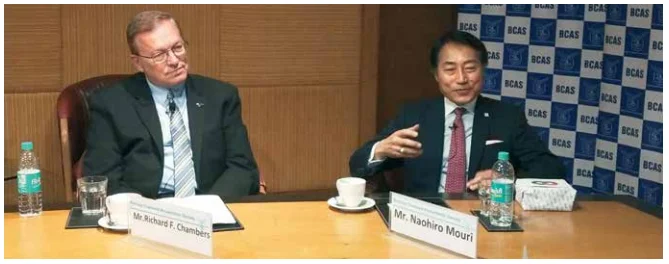
Part A | Company Law

8. In the Matter of Vaishali Proficient Nidhi Limited

Registrar of Companies, Bihar

Adjudication Order: ROC/PAT/ Sec 158 / 013895/ 200 to 208

Date of Order: 30th May, 2025

Adjudication order for violation of section 158 of the Companies Act 2013 (CA 2013):

FACTS

  •  It was observed from the financial statements (filed for financial year ended 31st March, 2015 to 31st March, 2019) that they did not consist of Director’s Identification Number (DIN) in the annexure attached to the e- forms thereby leading to the violation of Section 158 of CA 2013.
  •  Notices were issued to the company seeking details as well explanation.
  •  In response, directors appeared in person but did not make any submissions.
  •  Hence, it was concluded that provisions of Section 158 of CA 2013 have been contravened by the company and its directors and therefore they are liable for penalty under section 172 of CA 2013.

THE PROVISIONS OF THE ACT IN BRIEF

Section 158: Every person or company, while furnishing any return, information or particulars as are required to be furnished under this Act, shall mention the Director Identification Number in such return, information or particulars in case such return, information or particulars relate to the director or contain any reference of any director.

Section 172: If a company is in default in complying with any of the provisions of this Chapter and for which no specific penalty or punishment is provided therein, the company and every officer of the company who is in default shall be liable to a penalty of fifty thousand rupees, and in case of continuing failure, with a further penalty of five hundred rupees for each day during which such failure continues, subject to a maximum of three lakh rupees in case of a company and one lakh rupees in case of an officer who is in default.

FINDINGS AND ORDER

  •  The company being a Nidhi Company, does not fall in the definition of a small company u/s 2(85) of CA 2013 and as such the provisions of Section 446B of CA 2013 imposing lesser penalty shall not be applicable.
  •  After taking into account all the factors, and having considered all the facts and circumstances of the case, penalty was imposed on the company and directors as per details given below:
  •  On company for each of 5 years @ ₹50,000 per year = ₹2,50,000.
  •  On 6 directors who were directors at the time of respective defaults ranging from ₹50,000 to ₹2,00,000. Aggregate penalty on all the directors subject to Rs ₹50,000 per year = ₹7,50,000.

9 In the Matter of M/s ORIENTAL INDIA KISANSHAKTI NIDHI LIMITED

Registrar of Companies, Uttar Pradesh

Adjudication Order No – 07/23/ADJ/2024/ORIENTAL INDIA/1525

Date of Order – 04th September, 2024

Adjudication order issued against the Company and its Director for not regularising the Additional Director in the subsequent Annual General Meeting which was contravention of provisions of Section 161 of the Companies Act, 2013.

FACTS

During the inquiry, it was observed that Mr. KB was appointed as an additional director of the company w.e.f. 25th February, 2017. However, he was not regularised in the subsequent Annual General Meeting of the M/s OIKNL.

As per Section 161(1) of the Companies Act, 2013, an additional director shall hold office up to the next annual general meeting. Thus, accordingly, it was evident that the company and its Directors had failed to comply with the provisions of Section 161(1) of the Companies Act, 2013 and are liable for penal action under Section 172 of the Companies Act, 2013.

Thereafter, a Show Cause Notice (SCN) was issued to M/s OIKNL and its directors on 11th June, 2024 under section 161 of the Companies Act, 2013. M/s OIKNL and its directors had not furnished any reply to the said SCN, hence no hearing was fixed for this matter.

PROVISIONS

Section 161 (Appointment of Additional Director, Alternate Director and Nominee Director)

“(1) The articles of a company may confer on its Board of Directors the power to appoint any person, other than a person who fails to get appointed as a director in a general meeting, as an Additional Director at any time who shall hold office up to the date of the next annual general meeting or the last date on which the annual general meeting should have been held, whichever is earlier.”

Section 172 (Penalty)

“If a company is in default in complying with any of the provisions of this Chapter and for which no specific penalty or punishment is provided therein, the company and every officer of the company who is in default shall be liable to a penalty of fifty thousand rupees, and in case of continuing failure, with a further penalty of five hundred rupees for each day during which such failure continues, subject to a maximum of three lakh rupees in case of a company and one lakh rupees in case of an officer who is in default.””

ORDER:

Adjudicating Officer (AO) after consideration of the facts and circumstances of the case concluded that M/s OIKNL and its directors have failed to comply with the provisions of section 161 of the Companies Act, 2013 thereby attracting the penal provisions mentioned under Section 172 of the Act.

AO, therefore imposed the total penalty of ₹6,00,000/- i.e. maximum ₹3,00,000/- on M/s OIKNL and maximum ₹1,00,000/- each on each of its directors.

Allied Laws

16 Union of India vs. M/s. GR – Gawa R (JV)
2025 Live Law (Del) 565
April 24, 2025

Arbitration – Condonation of delay – Basic documents like impugned order not attached – Application filed only to circumvent limitation period without filing all the enclosures / documents – Application non-est in the eyes of the law. [S. 34(3), Arbitration and Conciliation Act, 1996].

FACTS

An arbitral award was passed in favour of the Respondent on January 3, 2024, and was subsequently modified through a corrigendum dated March 2, 2024. The Applicant challenged the said award on June 20, 2024, with a delay of 18 days beyond the prescribed limitation period. The Respondent, however, contended that although the delay appeared to be of only 18 days, the initial filing by the Applicant was deliberately made without attaching essential documents such as the impugned arbitral award, e-court fee receipt, one-time process fee, affidavit of service, and other requisite enclosures. It was argued that such a filing was not merely defective but was a strategic attempt to circumvent the limitation period, and therefore, the application should be treated as non-est in the eyes of law. The Respondent also highlighted that the initial filing comprised only 146 pages, whereas the final filing contained 6,677 pages, further indicating that the earlier filing was not a bona fide attempt to institute proceedings. The Applicant, on the other hand, submitted that the delay was only of 18 days and deserved to be condoned, especially since the defects pointed out by the Registry were subsequently rectified.

HELD

The Hon’ble Delhi High Court after relying on its earlier decision in the case of Oil and Natural Gas Corporation Ltd. vs. Joint Venture of Sai Rama Engineering Enterprises & Megha Engineering and Infrastructures Ltd (2023 SCC OnLine Del 6088) held that the initial filing of application without attaching the basic documents like the impugned arbitral award was only an attempt to circumvent the provision of the limitation period. Therefore, the application deserved to be treated as non-est. The delay was therefore not condoned and the application was rejected.

17 Saurabh Mishra vs. State of U.P. through Principal Secretary of Medical and Family Welfare U.P. and Ors.
Writ Civil No. 10898 of 2024 / 2025 Live Law (AB) 211 May 27, 2025

Wills and Preferences – Appointment of Representative – Intellectual Disability of the patient – Presumption of capacity to appoint – Lacuna in the Act – Courts exercise jurisdiction of parens patria. [S. 4 , 5, 14, Mental Healthcare Act, 2017].

FACTS

An application was filed by the Petitioner under section 14 of the Mental Healthcare Act, 2017 (Act) before the Mansik Swasthya Punarvilokan Board, (Board / Respondent No. 2) seeking to be nominated as the representative of his aunt, who was suffering from a moderate intellectual disability assessed at approximately 75 per cent. It was contended by the Petitioner that he was residing with his aunt and was actively involved in her day-to-day care and welfare. In support of his application, a no-objection certificate was also issued by a close relative/sibling of the aunt, expressing consent to the Petitioner being appointed as her nominated representative under the Act. However, the Board rejected the application on the sole ground that the Petitioner was facing two criminal cases registered against him.

Aggrieved a writ petition was filed before the Hon’ble Allahabad High Court.

HELD

The Hon’ble Allahabad High Court held that the two criminal cases filed against the Petitioner were still at the admission stage, and the Petitioner must be treated as innocent until proven guilty. With respect to the Petitioner’s plea to be nominated as the representative of his aunt, the Court observed that, under Section 14 read with Sections 4 and 5 of the Act, there exists a presumption that persons suffering from mental illness have the decision-making capacity to appoint a nominated representative. Thus, the Act envisages a deemed capability. However, in cases involving significant intellectual disability, such as in the present matter, the wills and preferences of the individual cannot be ascertained. The Hon’ble Court noted that the Act does not provide any mechanism for appointing a representative where the person concerned is incapable of making such a decision due to their mental condition. Thus, there existed a legislative vacuum in the Act. Accordingly, the Court exercised its parens patriae jurisdiction and nominated the Petitioner as the representative of his
mentally ill aunt under the Act. The petition was, therefore, allowed.

Editor’s Note: This issue of the BCAJ carries an article under feature `Laws and Business’ on ‘Guardianship of Persons with Intellectual Disabilities’ which also covers the Mental Healthcare Act, 2017.

18 Madhu Gupta vs. Municipal Corporation of Delhi and Ors.
Writ Petition Civil 8214 of 2025 (Delhi) (HC)
May 30, 2025

Writ Petition – Not signed by the litigant – Signed only by the counsel of the litigant – Abuse of process of law – Cost – Petition dismissed. [A. 226, Constitution of India].

FACTS

A Petition was filed before the Hon’ble Delhi High Court with respect to illegal construction carried out by the Municipal Corporation of Delhi (Respondent). It was contended by the Respondent that the illegal construction in question was already being taken care by the Corporation and steps have already been taken to remove the same. Further, with respect to the Petition, it was contended by the Respondent that Petition was not signed by the litigant and only the counsel for the Petitioner had signed the Petition.

HELD

The Hon’ble Delhi High Court took serious note of the fact that the petition had not been signed by the Petitioner himself and bore only the signature of the counsel appearing on his behalf. The Court held that such a practice amounted to a clear abuse of the process of law and could not be permitted. Consequently, the Petition was dismissed and a cost of ₹50,000/- was imposed on the counsel of the Petitioner.

Shift In US Trade Policy on Tariffs – Impact on the Indian Economy and the World

The Trump Administration 2.0 began with an ‘America First Trade Policy’. Mr. Trump has issued several Executive Orders and Proclamations since assuming his office on January 20, 2025. The significant among them is an increase in tariffs across the board by 10 per cent which is slated to increase to higher tariffs on some select 57 countries with which the US has major trade deficit in goods. Although the latter hike in tariffs is put on hold till July 8 2025, the actions by the US have created enough turmoil in international trade, with some countries imposing retaliatory tariffs, while other countries, including India, having chosen to negotiate a trade deal with the US. This article covers various aspects of tariffs by the US, the background and the impact of these measures on the Indian economy and the World.

INTRODUCTION

The recent tariff measures by the United States of America (“US”) have thrown much of the global trade in goods into disarray. The frequent changes to the policy, particularly the ‘tariff-on’ and ‘tariff-off’ policy, have made business planning difficult for companies, particularly those having exposure to the US. The threat of tariffs has made many countries rush to the US to secure trade deals to avoid punitive tariffs for their export goods. Businesses thrive when there is certainty in policy measures, but in the face of these frequent threats and policy changes, is it possible for a country or business to avoid the US market? The answer lies in some numbers. The US is the largest economy in the World, with a GDP of $29.18 trillion, i.e. about 26% of the World’s GDP.1 According to the World Bank, the US is the largest consumer in the World with an annual consumption expenditure of $22.54 trillion, which represents about 30% of the World’s annual consumption expenditure2 despite having only 4.22% of the World’s population3, giving it a high annual GDP per capita of $85,810. The American consumers spent about $6.1 trillion on goods alone in 2024.4 Hence, in today’s globalised economy, it may not be possible for a business to simply ignore the US consumer. This brings us to the issues which this Article wishes to address, namely, to understand the recent measures by the US and their rationale, their basis in law – both the local US law and the World Trade Organization (“WTO”) law and analyzing its impact on the economy and business.


1 GDP of 2024 at current prices as per International Monetary Fund (IMF)
https://www.imf.org/external/datamapper/profile/USA
2 Source: World Bank, 2023 estimates, https://data.worldbank.org/ [both goods and services, household final consumption expenditure (private consumption) and general government final consumption expenditure]
3 https://www.worldometers.info/world-population/us-population/
4 https://www.visualcapitalist.com/americas-19-trillion-consumer-economy-in-one-chart/#:~:text=Where%20Americans%20Spend%20Their%20Money,as%20well%20(%2417.8T).

Section I of the Article provides the foundational basis for the current US policy, particularly the shift in policy to tariffs. Section II gives a brief of the US legislation and the actions taken by the US President till date with insights on ongoing litigation in the US courts. Section III discusses the legality of US actions under the GATT/WTO. Section IV discusses the impact of the US tariffs on the global economy with changing supply chain dynamics as well as opportunities and threats for Indian businesses. The Article closes with the concluding remarks on US tariffs and their impact.

I. SHIFT IN US TRADE POLICY TO TARIFFS

On 20th January, 2025, the first day of taking charge as the US President, Mr. Donald J. Trump (“Trump”) issued a series of Executive Orders (“EO”) and proclamations. Among them was the EO titled ‘America First Trade Policy’ (“AFTP EO”) which gave insights into the policy which the President would be following in days to come. The AFTP EO stated that the American economy, the American worker, and the National security of America will be at the forefront of US policy decisions. It also stated that the aim of the new US administration is to promote investment and manufacturing in the US. One of the ‘National Security’ risks highlighted in the AFTP EO was the ‘unfair and unbalanced trade’ with its major trading partners. To put a perspective, the table below provides the trade balance of the US with its major trading partners.

The table shows that in 2024, the US had an overall trade deficit in goods of $1.29 trillion, which means that the US imported more goods than it exported to other nations. The highest trade deficit was with China, at $319 billion, followed by the EU at $203.5 billion, Mexico at $176 billion and Vietnam at $129.37. There was a trade deficit even with Canada, India and other nations. On the services front, in 2024, the US’s exports were $1107.8 billion, and imports were $814.4 billion, giving a surplus of ~ $293.4 billion.5 Even if one offsets this surplus, the overall trade deficit in goods and services for the US in 2024 was close to $1 trillion.


5 https://www.bea.gov/news/2025/us-international-trade-goods-and-services-december-and-annual-2024

The ever-increasing trade deficit in goods has been a subject matter of debate between economists in the US for several decades. The trade deficit in goods has continuously increased from $690.16 billion in 2010 to $1.29 trillion in 2024, as shown in the graph below.

The burgeoning US trade deficit can be explained with the textbook theory of macro-economic factors of disbalance between savings and investment rates. In simple terms, this implies that Americans have been spending more money on consumption expenditure (i.e., buying more goods than they produce) with low savings and investment spending rates. This additional spending goes to foreign goods, which is then financed through borrowing from foreign lenders (US treasury bonds) or foreigners purchasing US assets.

Some policymakers argue that macro factors of the stronger dollar (which encourages imports and discourages exports), more buying power of consumers in the US, and manufacturing shift to lower labour cost jurisdictions would naturally lead to higher trade deficits. While others argue that shifting manufacturing to low-cost jurisdictions like the ASEAN (Thailand, Vietnam, Malaysia, Indonesia, etc.) and other parts of the World like China has been a result of unfair foreign government policies and incentivisation. It is argued that the rise of China during the last three decades as a World’s powerhouse of manufacturing, resulting from unfair trade practices of the Communist regime in Beijing, is a major cause of the situation. In particular, it is argued that Beijing’s State control and subsidisation of manufacturing led to the establishment of huge capacities in China far exceeding the domestic demand, boosting of exports through unfair incentives, tax enforcement of the IPR regime, manipulation of currency through devaluation to boost exports, unfair labour and environmental practices of China has led to the situation.

One set of policymakers focused their efforts on tackling this situation by addressing the inherent deficiencies like boosting investments in infrastructure and targeted incentives to increase the domestic manufacturing base. The previous US President Biden’s policy initiatives were efforts in that direction, such as the Bipartisan Infrastructure Law (BIL), formally known as the Infrastructure Investment and Jobs Act (IIJA) which focused on funding a wide range of infrastructure projects, the Build America, Buy America Act (BABA) which mandated that iron, steel, manufactured goods, and construction materials used in US federal funded infrastructure projects must be produced in the US, the CHIPS and Science Act which focused on boosting US semiconductor manufacturing. A similar set of policy initiatives may also be seen in the Indian context, like the ‘Make in India’ policy and infrastructure parks (Electronics Parks, Plastic Parks, PM MITRA Textile Parks, Mega Food Parks, etc.).

The other set of policymakers believe that directly disincentivizing or curtailing imports, inter alia through Tariff measures, is an immediate solution to the situation. The current US President Trump’s policy measures by imposing punitive import tariffs are efforts in that direction, even if it involves disrupting the rule based international trade and the principles established by the WTO.

Hence, there is a clear shift in the US policy under the new administration with tariffs as one of the main policy instruments. Tariffs have also been used by the US as a threat to negotiate better trade deals with its trading partners. With this background in mind, the next section looks at the relevant legislation used by the US in its renewed policy.

II. LEGISLATION USED BY THE US FOR IMPOSING TARIFFS AND ACTIONS TAKEN THEREUNDER

In his first term (2017-2021), Trump had used Section 232 of the Trade Expansion Act, 1962 (“TEA”) in 2018 to impose import tariffs of 25% and 10% on Steel and Aluminium, respectively, subject to some product / country-specific exemptions. These tariffs were expanded to include specified derivatives of Steel and Aluminium in 2020. In 2018, Trump also used Section 301 of the Trade Act, 1974 (“TA”) to impose tariffs ranging from 7.5% to 25% on several goods of China (covered in four lists ranging from $34 billion in list 1 to $300 billion in list 4). These tariffs continue to exist today and have been further expanded in Trump’s second term.

In his second term (2025-), effective March 12, 2025, Trump used Section 232 of the TEA to expand the scope of import tariffs on Steel and Aluminium by bringing both on par at 25% each, withdrawing all previous exemptions, and significantly increasing the scope of coverage of derivatives products. The President has also used the same section to impose tariffs of 25% on specified Automobiles (“Auto”) and Auto parts from all countries, subject to quota-based exemptions.6 Due to the close integration of Auto supply chains between the US, Canada and Mexico, the Tariffs on Autos, which qualify the USMCA rules of origin,7 have been exempted to the extent of US content of such vehicles. Further, the USMCA qualified Auto parts imported into the US from Canada and Mexico have also been exempted.


6 Auto Tariffs apply only to passenger vehicles (sedans, sport utility vehicles, 
crossover utility vehicles, minivans, and cargo vans) and light trucks. 
Auto parts cover Engines and engine parts, Transmissions and powertrain parts, 
and Electrical components of passenger vehicles and light trucks. 
Auto tariffs were effective April 3, 2025, and Auto parts Tariffs were effective May 3, 2025.

7 USMCA is the United States-Mexico-Canada Free Trade Agreement which 
replaced the North American Free Trade Agreement (NAFTA) and become 
effective July 1, 2020, in Trump’s first term.

In addition, Trump has extensively used another US Act, called as International Emergency Economic Powers Act, 1977 (“IEEPA”), to impose import tariffs on Canada, Mexico and China (including Hong Kong) by taking the cue of fentanyl trade8, which has claimed to cause a situation of ‘National Emergency’ and public health crisis in the US. A tariff of 10% was imposed on goods from China and Hong Kong with effect from 4th February, 2025, which was increased to 20% effective 12th March, 2025. Similarly, effective 4th March, 2025, the goods from Mexico and Canada have imposed a tariff of 25% (except potash/specified energy products having a tariff rate of 10%). This tariff measure was later amended to exempt USMCA-qualified goods.

The US President has also used IEEPA to impose a baseline tariff of 10% with effect from April 5, 2025, on all countries (including India)and a higher-country specific reciprocal tariff on 57 listed countries varying from 11% to 50%9 with effect from April 9, 2025 (currently on pause for 90 days, till 8th July, 2025). For China10, the reciprocal tariffs were increased to 125% from April 10, 2025, due to retaliation by China with similar tariffs on US goods (the 125% tariff has been suspended for 90 days and rolled back to 10% with effect from 14th May, 2025, pending negotiations between US and China).


8 Fentanyl is a synthetic opioid drug used for pain relief and anesthetic. 

The US has argued that Canada and Mexico have permitted the Fentanyl 

drug to flow into the US through its porous borders creating a 

situation of National Emergency and public health crisis in the US.

9 India is amongst the 57 countries and India’s tariff rate is specified to be 26%.

10 Includes Hong Kong and Macau

Further, under the IEEPA, the US has withdrawn the de-minimis exemption11 for goods, including international parcels from China and Hong Kong (effective 2nd May, 2025).


11 A de-minimis exemption is exemption given under US law to goods of value less 
than $800 from duties and certain procedural requirements at the time of imports into the US.

The above tariffs imposed by the US are in addition to normal customs duties (called MFN rates), fees, taxes, exactions, or charges applicable to imported articles. Further, the above tariffs stack on each other, i.e., becomes cumulative unless otherwise specified.12

Legislations Conditions and Actions Previous illustrative uses and the current usage
Sec 232 of TEA » If certain imports threaten the ‘National Security’ of the US.

» Authorises the President to bypass Congress and modify /adjust the imports by tariffs/quotas.

» Investigation by the Department of Commerce (“DOC”) and a report by the Secretary of Commerce to the President is a pre-condition to take action.

» Last imposed tariffs or other trade restrictions three decades before in 1986.

Shift in policy under Trump’s first term.

» The President opened 8 investigations, and Tariffs were imposed under 2 such cases on Steel and Aluminium.

» Other investigations were on Auto and Auto parts, etc. but no actions were taken, or agreements were reached with countries.

Continued actions under Trump’s second term

»  Expanded the tariffs on Aluminium and Aluminium derivatives to 25%.

» Expanded the coverage of derivatives of Steel and Aluminium.

» Imposed Auto and Auto parts tariffs of 25% from all countries, subject to some quota-based exemptions for Auto parts (acting on the 2019 report of the Secretary of Commerce).

Sec 301 of TA » United States Trade Representative (“USTR”) does an investigation and recommends action to enforce US rights under a trade agreement or to respond to certain foreign unfair trade practices.

» Consultations by USTR with targeted Government.

» If the determination is affirmative, it decides actions to be taken.

» Authorises the President to impose duties or other import restrictions and actions.


» Since the formation of WTO in 1995, the US used this measure to build cases and pursue dispute settlement at the WTO.

Shift in policy under Trump’s first term.

» 2018 – China was acted against due to its IPR violations.

» 2019 – The EU (including the UK) were acted against due to their subsidies on large civil aircraft (Tariffs later suspended in July 2021)

» 2019 – Investigation on France against its ‘discriminatory’ Digital Services Taxes (DST) (Tariffs later suspended due to larger investigation on countries adopting similar taxes).

» 2020 – Several countries, including India, were investigated for their ‘discriminatory’ foreign DST laws (No tariffs currently, pending negotiations).

» 2020 – Vietnam was investigated for their ‘unfair currency valuation’ and use of ‘illegally harvested timber’ (Tariffs not imposed based on an agreement with Vietnam to improve its currency valuation and timber trade practices)

IEEPA » Unusual and extraordinary threat, which has its source in substantial part outside the US, to the National Security, foreign policy, and economy of the US.

» Power given to the President with some exceptions and checks

»Report to be submitted later to Congress on actions taken.

»Trump, in his second term, has used this legislation extensively to impose tariffs on China / Mexico /Canada for failure to check the Fentanyl trade.

» Imposed baseline tariff of 10% on all countries due to ‘unfair and unbalanced trade” position with trading partners.

» Higher country specific reciprocal tariff on 57 countries (currently on pause for 90 days, till 8th July, 2025).

»Tariffs on de-minimis shipments from China and Hong Kong.


12 As per another executive order issued on April 29, 2025, 
the goods which are subject to Auto/Auto parts tariffs under
 Sec 232 of TEA will not be subject to Tariffs imposed on Canada/Mexico
 under IEEPA or Tariffs on Steel/Aluminium under Sec 232 of TEA. Further, 
the goods which are subject to IEEPA tariffs on Canada/Mexico will not be 
subject to Tariffs on Steel / Aluminium under Sec 232 of TEA.

The tariffs imposed by the US have been challenged in several lawsuits filed across the US, particularly by the Democratic States, including the States of Arizona, Colorado, Connecticut, Delaware, Illinois, New York and Oregon. In particular, the reciprocal tariffs have been challenged in the US courts on the grounds that the IEEPA does not specifically authorise the President to impose tariffs and that the US trade deficit cannot be equated to a “National Emergency” as contemplated under the IEEPA. In addition, the State of California has also filed a lawsuit to halt the tariffs imposed by the Trump administration, which the State believes was not taken with Congressional approval and will negatively impact its economy. In a recent decision of the Court of International Trade (CIT) in V.O.S. Vs. The USA, the CIT at Manhattan, New York has set aside all Trump’s actions under IEEPA and accordingly invalidated the reciprocal tariffs (10% baseline and higher country specific tariffs) and tariffs imposed on China/Canada/Mexico for failure to curb the fentanyl trade. The CIT held that Trump exceeded his authority granted by the Congress under the IEEPA to impose tariffs. The US government has appealed this decision before the Court of Appeals for Federal Circuit which has temporarily granted a stay on the CIT’s decision until the court hears both parties.

III. WTO/ GATT PERSPECTIVE OF US TARIFFS

“In the pre-World War II era, the market access for trade in goods was based on trading partners’ economic or political clout. With uncertainty and protectionist measures by different countries to further their economic objectives, several countries got together and entered into an agreement called the General Agreement on Tariffs and Trade (GATT, 1947), which formed the basis for rule-based international trade. This agreement was signed in Geneva in 1947 by 23 countries. Both India and the US were parties to the GATT. The GATT was a crucial step towards rebuilding the global economy after World War II with an aim to reduce trade barriers and promote free and fair trade among partner nations. The GATT aimed to reduce tariffs and eliminate other trade barriers to promote free trade. Importantly, it was the US which played a leading role in the creation of GATT because it wanted liberalisation of protectionist policies to help the US export more goods to other countries. It was the GATT, 1947, which, after several rounds of multilateral negotiations, led to the formation of WTO in 1995 by the Marrakesh Agreement, signed in Marrakesh, Morocco. While the WTO replaced GATT, the principles of GATT are still incorporated into the WTO agreement.

One of the basic principles enshrined in GATT/WTO is the Most Favored Nation (MFN) principle under Article I. The MFN principle essentially states that if a country grants a trade advantage (like lower tariffs) to one trading partner, it must unconditionally and immediately extend the same advantage to all other WTO members. Another important Article II of GATT is the schedule of concessions of each member nation, which binds the member not to increase the customs duty rates beyond the bound rate given in its schedule.

Article XXI(b)(iii) of GATT covers the national security exception, which allows the members to violate the GATT principles if such actions are “taken in time of war or other emergency in international relations”. The US has lost several cases at the WTO wherein it violated the GATT principles by invoking the national security exception under Article XXI(b)(iii). The argument of the US before the WTO’s judicial Panels, that this exception is ‘self-judging’ and cannot be subject matter of judicial review, has been rejected by the WTO panels. In the US-Origin Marking (Hong Kong, China) case,13 the argument raised by the US that human rights violations in Hong Kong can be used as a basis to violate the GATT disciplines was rejected by the WTO panel. It was held that such human rights violations in HK, even if evidenced, cannot be escalated to the threshold of requisite gravity to constitute an “emergency in international relations”. This phrase was held to refer to a state of affairs of the utmost gravity – a breakdown or near-breakdown in the relations between states.


13 WT/DS597/R (WTO Panel Report dated 21 December 2022)

More importantly, the US also lost WTO cases relating to the imposition of tariffs under Sec 301 of the TA against China14 and under Sec 232 of the TEA on Steel and Aluminium.15


14 The US defense built under Article XX(a) which deals with general exception of 
“necessary to protect public morals” was rejected on the ground that there was 
no genuine relationship of “ends and means” and hence it was held that the US had 
violated GATT disciplines relating to MFN and bound rates (WT/DS543/R WTO Panel 
Report dated 15 Sep 2020)
15 US’s defense under Article XXI(b)(iii) was rejected – measures not 
“taken in time of war or other emergency in international relations” and hence it
 was held that the US had violated MFN, bound rates and Quantitative Restrictions 
under GATT (WT/DS544/R WTO Panel Report dated 9 Dec 2022)

It may be worthwhile to note that since 2017 the US has blocked the appointment of new judges to the WTO’s Appellate Body (AB) due to complaints over judicial activism at the WTO and concerns over US sovereignty.16 This has brought the WTO’s dispute settlement system to a standstill making it effectively non-functional. There are currently no members in the seven member AB with the term of the last sitting member expired on 30th November, 2020.17 Hence, today, all appeals filed by the WTO members including the US against the Panel rulings are pending adjudication at WTO’s AB with no judges in place. It would not be out of place to say that the country which argued for liberalisation leading to the creation of GATT / WTO has itself turned back full circle to bring in an era of protectionism in trade.


16 The World Trade Organization: The Appellate Body Crisis | Economics Program and Scholl Chair in International Business | CSIS
17 https://www.wto.org/english/tratop_e/dispu_e/ab_members_descrp_e.htm

IV. IMPACT OF THE US TARIFFS ON THE INDIAN ECONOMY AND THE WORLD

In today’s globalised World, supply chains are integrated across nations, and most products pass through manufacturing stages in several countries before landing in the hands of the consumer in the country of consumption. If the country of consumption is the US, the moot question which arises is what will be the tariff rate applicable to such product at the time of import into the US? Whether it is the country where the principal raw material was manufactured (say, China) or where further processing on it was undertaken (say, India). This question assumes importance because US tariffs are now based on the country to which the product belongs. Complicating the situation is the test of the last ‘substantial transformation’ applied by the US in judging this criterion with a plethora of complex judicial rulings in the US courts. This has led to several supply chain shifts by companies away from China to avoid punitive US Tariffs.

In addition, reciprocal tariffs under IEEPA provide an exemption to the US content of the product if such US content is at least 20% of the total value of the product. Further, tariffs under Sec 232 on Steel and Aluminium derivatives are exempt if the Aluminum is smelted and cast in the US or Steel is melted and poured in the US. These issues are leading the companies to rethink their supply chain modelling to reduce the impact of US tariffs and stay export competitive.

While the threat of US tariffs remains, there are certain opportunities for Indian businesses looking to export more to the US. A look at the table below shows that India is exporting products to the US under Chapters overlapping with China, which gives an opportunity to the Indian business to increase their exports on account of the present 30% tariffs on China vs. 10% tariffs on Indian goods under the IEEPA.

With the India-US currently engaged in intense negotiations for the Bilateral Trade Agreement (BTA), it still needs to be seen whether the Indian Government can negotiate a deal with the US which can lead to enhanced export competitiveness of Indian goods to the US, particularly in labour-intensive sectors like plastics, textiles, gems and jewellery, electronics, pharma and chemicals.

V. CONCLUSION

The US concern stems from an ever-increasing trade deficit in goods with most of its major trading partners. This has led to a discernible shift in the US trade policy to tariff measures. With the WTO in a state of limbo particularly due to the non-functional Appellate Body (AB) mechanism, the US seems to be not concerned with the legality of its measures with the GATT / WTO disciplines. As a result of US tariffs, the businesses World over, including in India, are forced to rethink the supply chains of their goods. The present situation is both a threat and an opportunity for Indian businesses and the success will depend upon how the businesses can rekindle their decision-making and whether the Indian government is able to negotiate a good deal with the US helping the Indian exporter community.

Specialised Investment Funds (SIFs) – Way To New Investment Opportunities

1 . THE EVOLVING INVESTMENT LANDSCAPE

India’s capital markets have long been characterized by a dichotomy in investor behaviour: retail investors gravitate towards mutual funds for their risk-diversified portfolios and ease of access, while High Net-Worth Individuals (HNIs) and institutional investors often prefer PMS for its personalized portfolio construction and active management. However, the absence of an intermediary vehicle that caters to investors seeking more flexibility than mutual funds, but without the significant capital commitment demanded by PMS, has left a regulatory void. This gap had led to the emergence of unregulated schemes that, while attractive to investors, carry substantial operational and financial risks due to their lack of oversight.

The introduction of Specialized Investment Funds (SIFs) under the SEBI (Mutual Funds) Regulations, 1996 vide circular dated 16th December, 2024, directly addresses this regulatory vacuum. This initiative also reinforces the stability of the broader asset management ecosystem by channelling investor interest into a regulated space, thereby reducing systemic risk.

2. RATIONALE BEHIND THE INTRODUCTION OF SIFs

The decision to introduce SIFs is driven by several strategic considerations that reflect both current market needs and long-term objectives for the development of India’s capital markets.

  •  Bridging the Investment Gap: SIFs are designed for investors who require a degree of customization beyond what traditional mutual funds provide but do not wish to engage in the bespoke, high-commitment strategies associated with PMS. By incorporating elements of both approaches, SIFs provide a unique solution that blends the accessibility and diversification of mutual funds with a level of portfolio flexibility and customisation that traditionally resided within the realm of PMS.
  •  Mitigating Regulatory Arbitrage: Historically, the lack of a formal product designed for these sophisticated investors led to regulatory arbitrage, where investors sought alternative, often unregulated, investment avenues. By establishing SIFs within the existing mutual fund regulatory framework, SEBI curtails the proliferation of such unregulated schemes and ensures that the capital raised through SIFs is subject to the same transparency, governance, and oversight as traditional mutual funds.
  •  Enhancing Investor Protection: The regulatory framework governing SIFs includes stringent disclosure requirements and risk management protocols, which help safeguard investor interests. These regulations reduce the risk of operational and counterparty risks, ensuring that investors are more likely to receive fair treatment and that their investments are protected by the same regulatory safeguards afforded to other mutual fund products.
  •  Market Deepening and Liquidity Enhancement: By introducing a new investment product category, SEBI aims to deepen India’s capital markets, fostering greater liquidity. With a larger, more diverse range of investment products, the Indian market is better positioned to attract both domestic and foreign capital, thus improving overall market efficiency.
  •  Global Alignment: SEBI’s introduction of SIFs also aligns with international best practices. Similar structures, such as the European Union’s Alternative Investment Fund Managers Directive (AIFMD), have successfully implemented regulatory frameworks for specialized investment vehicles. The adoption of a similar model in India enhances its attractiveness as a destination for foreign investors, while also ensuring that the domestic products are consistent with global standards.

3. KEY FEATURES OF SIFs

The introduction of SIFs is characterised by several distinct features designed to cater to sophisticated investors, while maintaining robust regulatory oversight.

  •  Sound Track Record, Registration and Approval Process: SEBI has allowed existing mutual funds to launch SIFs with prior approval from SEBI under their current trust structures without the need for creating a new trust, provided they comply with no disciplinary action criteria along with sound track record under Route 1 and in case of MF registered under alternate route, appointment of separate CIO and Fund Manager of SIF with defined experience requirement.

This streamlined process enhances operational continuity and minimises regulatory overhead for fund houses, thus simplifying market entry for investors.

  •  Minimum Investment Threshold: To ensure that SIFs are accessible only to qualified investors, SEBI mandates a minimum investment of ₹10 lakh at the PAN level for all investors exclusively for participating in SIFs. This threshold acts as a filter to ensure that only those with sufficient financial capacity and risk tolerance are eligible to invest. However, accredited investors, as defined by SEBI’s criteria, are exempt from this threshold, which ensures that high-net-worth individuals and institutional investors can access these products without being constrained by the minimum investment requirement. The AMCs shall be required to monitor Investment threshold and ensure that there are no active breaches.
  •  Investment Strategy and Launch Framework: The framework for launching SIF strategies follows the established process for mutual fund schemes. AMCs must submit an offer document to SEBI, along with the requisite fees and approvals from their trustees. A standardized application format ensures consistency across SIF strategies, contributing to operational transparency and efficiency. Additionally, AMCs are required to submit an Investment Strategy Information Document (ISID) that outlines the fund’s specific investment objectives, strategy, and risk management practices, rationale for compliance ensuring that investors are well-informed before making their investment decisions.
  •  Investment Permissibility and Restrictions: SIFs are permitted to invest across a wide array of asset classes authorised under the Mutual Fund Regulations, with specific investment caps and restrictions designed to manage risk effectively. For instance, exposure to debt instruments from a single issuer is limited to 20% of the fund’s NAV, SIFs can also invest in derivatives, with a cap of 25% of the fund’s NAV, thus offering enhanced flexibility in terms of market positioning. These caps reflect SEBI’s balanced approach to enabling flexibility while safeguarding against undue concentration risk.
  •  Expense Ratio and Fee Structure: The expense ratios for SIFs are governed by the same regulations as other mutual fund schemes, ensuring uniformity in cost structures across the industry.
  •  Distribution of SIF
    Distribution of SIF products shall be subject to such entity having passed National Institute of Securities Markets (‘NISM’) Series-XIII: Common Derivatives Certification Examination
  •  Branding
    To maintain clear differentiation between SIFs and traditional mutual funds, SEBI mandates that AMCs employ distinct branding and marketing strategies for their SIF products as per SEBI guidelines, including separate branding, advertising, standard disclaimers, guidelines on usage of sponsor or asset management company or mutual fund’s brand name, and maintenance of a separate website/webpage to differentiate SIF offerings, etc.

This ensures that investors are aware of the differences in risk profile, investment strategy, and expected returns between SIFs and conventional mutual funds.

  •  Benchmarking
    Investment Strategies of SIF shall follow a single-tier benchmark structure. The AMC at its discretion may also provide second tier benchmark for investment strategies as applicable for specific schemes. The AMC shall appropriately select any broad market indices available, as a benchmark index depending on the investment objective and portfolio of investment strategy.
  •  Governance, and Risk Management
    In terms of governance, AMCs and trustees must ensure robust risk management frameworks, including comprehensive stress-testing and scenario analysis, to ensure the protection of investor interests. These governance measures are designed to prevent any reputational risk spillover from the SIF to the broader mutual fund industry, preserving the integrity and trust of the Indian asset management ecosystem.

4. RECENT CLARIFICATIONS AND DEVELOPMENTS

In line with SEBI’s commitment to refining its regulatory framework, recent clarifications have been issued to further streamline the operation of SIFs:

  •  Clarification on Investment Threshold: SEBI clarified that the ₹10 lakh minimum investment requirement applies at the PAN level, covering all SIF strategies under a single AMC. This removes potential confusion for investors allocating capital across multiple SIF offerings from the same fund house.
  • Flexibility for Interval Strategies: SIFs adopting interval strategies have been granted greater flexibility in the selection of instruments with longer tenures or lower liquidity, providing fund managers with more freedom to optimise returns over extended periods.
  •  Standardised Application Format: SEBI introduced a standardised format for mutual funds intending to establish SIFs, ensuring greater operational efficiency and consistency in the application process.

FUTURE OUTLOOK FOR SIF

SIFs thus represent more than just a new category of investment vehicles—they signal SEBI’s commitment to fostering a robust, transparent, and inclusive asset management ecosystem. As these funds mature, they are poised to attract capital from domestic and global investors alike, serving as a critical bridge to deeper market penetration and sophistication.

With their introduction, the focus shifts to the meticulous crafting of asset allocation strategies, portfolio innovation, and investor engagement, all under the vigilant oversight of SEBI’s regulatory framework. The long-term trajectory of SIFs will ultimately depend on how well they balance these dual imperatives—flexibility and control—ensuring that the evolution of India’s capital markets is both dynamic and resilient.

The strategic deployment of SIFs will invariably drive market efficiency and liquidity, supporting India’s ambition to become a competitive global investment hub.

Trust Under A Will

INTRODUCTION

Several readers would be aware of the concept of a Will. It is the last wish / desire of a person and takes effect once the person making the Will dies. Many readers would also be familiar with the concept of a Trust.

A trust is defined under the Indian Trusts Act, 1882 as an obligation annexed to the ownership of property and arising out of a confidence reposed in and accepted by the owner, or declared and accepted by him, for the benefit of another, or of another and the owner. A Trust Deed is the deed executed between the settlor and the trustees which lays down the constitution of the trust. It is the charter of incorporation of the trust which defines the beneficiaries and the settlor. It also lays down the rights and duties of the trustees in relation to the beneficiaries. In Superintendent of Stamps and Chief Controlling Revenue Authority vs. Govind Farmeshwar Nair, AIR 1967 Bom 369, a Full Bench of the Bombay High Court ruled:

“When a man creates a trust and constitutes himself a trustee,

he undoubtedly disposes of his property though he is not transferring it.”

However, what if the Trust is a Trust under a Will? This combines the salient features of both a Will and a Trust. The Trust is created by virtue of a Will and hence, is called a Trust under a Will.

Let us examine the important facets of this document.

KEY CONCEPTS

A Trust has 3 parties – a Settlor, Trustees and one or more Beneficiaries.

(a) Settlor: He is the person who settles the trust or forms the trust by appointing the trustees. His role is only limited to forming the trust. Once the trust deed is executed and the trust is set- up he is no longer associated with the trust in any manner whatsoever. However, if the settlor, under the trust deed, retains any powers to enjoy the property settled in the trust, then it would become a revocable trust. The settlor can be any person, individual, company, etc.

(b) Trustee: Just as Directors are the organs by which a company functions, trustees are the organs by which a trust functions. In fact, the relation between the trustees and the trust is stronger than that between directors and the company. In several instances, the trust entity is not recognised but only the trustees are recognised. The trustees could be individuals or even a company. For instance, in most mutual funds, the trustee is a Trustee Company. In case of a trustee company, the board of directors of the trustee company would administer the trust. The number of trustees could be 1, 2, 3, etc. The initial trustees are appointed in the Deed by the Settlor. A person appointed as a trustee is not bound to accept the trusteeship and he may refuse the obligation. A settlor may also become a trustee. The trustees are subjected to several obligations and duties under the Act and also have several rights and powers. In addition, they also derive their powers under the Deed.

(c) Beneficiaries: The beneficiary is the person for whose benefit the trust was created in the first place. He is the raison-d’etre behind a trust. If it were not for the beneficiaries, there would be no trustees and there would be no trust. The beneficiaries could be individuals, companies, etc. The settlor / trustee can also be a beneficiary. However, certain precautions should be taken depending upon the facts of the case. Any person capable of holding property may be a beneficiary. Even a minor or a lunatic or an insane person may be a beneficiary.

A Trust under a Will also has the same 3 parties but the Settlor in this case is the testator, i.e., the person drafting the Will. Hence, such a Trust is not a transfer inter vivos (transfer between living persons) but it is a testamentary document. A trust created in the lifetime of the settlor is a living trust while a trust under a Will is created only once the settlor dies.

The trust may be created for any lawful purpose. Thus, in case the purpose of the trust is forbidden by law, or it defeats the provisions of the law or it is fraudulent or it involves injury to the person or property of another or it is such that the Court regards as immoral or opposed to public policy, then it would be treated as if it is not for a lawful purpose. In case the purpose is unlawful then the trust is void ab intio. For instance, if a trust under a Will is set up to facilitate illegal gambling business in India, the object of the trust being unlawful, it is void ab initio.

Just like all Wills, this Will too needs to comply with the requirements of being a valid Will. If the Will is held to be invalid or forged or obtained by fraud, then both the Trust and the Will will fail. The Will needs to be dated, attested by two witnesses and the testamentary capacity of the testator must be sound. Elsewhere in this publication, these concepts are examined in greater detail. Those principles would equally apply to such a Will that also creates a Trust.

Thus, this document would be jointly governed by the provisions of the Indian Succession Act, 1925 (in as much as they pertain to Wills) and the Indian Trusts Act, 1882 (in respect of the trust portion).

The Madras High Court in Athmaram Rao vs. Shanthan Phawar, A.S.(MD) No.111 of 2015, Order dated 28.03.2018, has held that a trust is called a Private Trust when it is constituted for the benefit of one or more individuals who are, or within a given time may be, definitely ascertained. Private Trusts are governed by the Indian Trusts Act, 1882. A Private Trust may be created inter vivos or by Will. If a trust is created by Will, it shall be subject to the provisions of Indian Succession Act, 1925.

MODE OF INCORPORATION

The first step towards the formation of such a trust is the execution of a Will by the testator. The draft Trust Deed would be annexed to the Will and would come into effect once the Will is executed. Alternatively, instructions could be given to the Executors for setting up a Trust and laying down key features of the Trust.

The Will would specify the Trustees of this Trust. It is essential that at the time when the Will is executed, the Trustees named under the Will should be capable of and willing to act as Trustees of this Trust.

A Trust under a Will does not need registration with the Sub-registrar of Assurances even if it is in relation to an immovable property. This is because the document creating the Trust is a testamentary instrument.

BENEFITS

There is no income-tax incidence on the testator / his estate in case of a trust created under a Will. India does not levy estate duty / inheritance tax and hence, this too would not be an issue. The Trust created under the Will is akin to a legatee / beneficiary of the Will.

The receipt of any assets by the trust would be under the Will and hence, there would not be any incidence of income-tax under s.56(2)(x) of the Income-tax Act, 1961. It may be noted that this not a transfer by a settlor to a trust but one of a testator to a trust and hence, the condition of all beneficiaries being the relative of the settlor would not be applicable for the trust to claim a tax exemption. This is a big advantage that a trust under a Will enjoys compared to a living trust.

The Income-tax Act, 1961 has beneficial tax provisions for trust created under a Will:

(a) Business income received by a trust is taxable at the maximum marginal rate. However, business income received by a trust, created under the Will of a person that is created exclusively for the benefit of any relative dependent upon the testator for support and maintenance, is taxable on a slab rate basis. The condition is that such a trust must be the only one so created by the testator.

(b) The income of a discretionary trust is generally taxable at the maximum marginal rate. However, the income of a trust under a Will is not taxable at the maximum marginal rate. The condition is that such a trust must be the only one so created by the testator. Here there is no condition that the beneficiary must be a relative dependent upon the testator for support and maintenance. Thus, a trust under a Will created for any beneficiary would enjoy this tax treatment.

The Ahmedabad ITAT in Nathiben Kalidas Patel Family Trust vs. ITO, [2025] 173 taxmann.com 992 (Ahmd. ITAT) has held that a trust created by a Will are not be subjected to be taxed at maximum marginal rate (MMR), but are to be taxed at rates applicable to AOPs and they are not to be taxed at MMR as specified in Section 167B of the Income-tax Act 1961, since the applicability of MMR has been specifically excluded by Section 164(1) First Proviso itself. This specific exclusion would override the general provision of Section 167B of the Act. Again, the Ahmedabad ITAT in the case of ITO vs. Rajnikant Gulabdas Sheth Family Trust [1987] 20 ITD 668 (Ahmd. ITAT) held that a discretionary trust created under a Will was to be taxed at normal rate and not at MMR.

The CBDT also vide its Circular has discussed the question of whether the provisions of section 167B, which generally provide for charging of tax at MMR on the total income of an AOP where the individual shares of members are unknown, would also apply to income under a trust declared by any person by Will where such trust is the only trust declared by him. It has held that there was never an intention to subject the income of such trusts to tax at MMR. Where a specific provision had been made in the law in relation to any matter and where that provision was beneficial to the taxpayer, that matter was to be governed by that special provision and not by any other general provision. Accordingly, tax will be payable in such cases at the rate ordinarily applicable to the total income of an AOP and not at MMR.

STAMP DUTY

The Maharashtra Stamp Act, 1958 does not define an instrument of trust. Art. 61 of Schedule I to the Maharashtra Stamp Act lays down the duty applicable on a Trust Deed executed in the State of Maharashtra. This Act levies duty on a trust that is not created under a Will. Thus, a trust under a Will does not attract any stamp duty. Similarly, Art. 64 of Schedule I to the Indian Stamp Act, 1899, that levies duty on a trust does not apply to a trust created under a Will. Hence, even if immovable property is bequeathed under a Will to a trust or bequeathed to a trust that is created under a Will, there would not be any stamp duty. This is one of the biggest advantages of a trust under a Will.

Similarly, registration is not needed for a trust under a Will that includes immovable property. This is because the Registration Act, 1908 expressly exempts any testamentary instrument.

PRECAUTIONS

While a trust under a Will enjoys marked tax benefits compared to a living trust, it also comes with its shares of concerns.

If the Will is held to be invalid, improperly attested, lacking in testamentary capacity, one obtained by fraud / forgery, etc., then the trust also fails. If the Will requires a probate, then the trust cannot be functional until the Will is probated. Thus, the trust is intricately linked with the Will and failure of the Will leads to a failure of the trust. However, the converse may not always be true. If the trust fails owing to some reasons, the Will need not necessarily fail. In such a case, the bequest to the trust would fail and the assets would then be bequeathed to the alternative beneficiary/universal beneficiary, if any, named under the Will.

CONCLUSION

A trust created by a Will is an interesting document and one that needs to be carefully considered before using. It is very useful when a person wants to place assets in trust for the benefit of his relatives but he does not want to cede control over those assets during his lifetime.

Part A | Company Law

6. M/s Hankook Latex Private Limited

Registrar of Companies, Kerala & Lakshadweep

Adjudication Order: ROCK/Adj/S.90/Hankook Latex/ 752/2025

Date of Order: 21st April, 2025

Adjudication order for violation of section 90 of the Companies Act 2013 (CA 2013):

FACTS

  •  Notices were issued to the company seeking details of action taken by the company to identify significant beneficial owner in terms of Section 90 of CA 2013. The company in response, admitted to the default.
  •  Subsequently, company filed Form BEN 2 on 14th March, 2024 enclosing BEN 1 dated 8th March, 2024.
  •  It was observed that Mr. K and Mr. D were holding Significant Beneficial Ownership w.e.f. 10th June, 1997.
  •  Thus, ROC noticed delays in submission of BEN 1 as tabulated below:

Note: As per Rule 3 of the Companies (Significant Beneficial Owners) Rules, 2018, every individual who is a significant owner in a reporting company, was required to file a declaration within 90 days from the commencement of Companies (Significant Beneficial Owners) Amendment Rules, 2019. As the date of commencement of the said rules was 8th February, 2019, the declaration should have been filed on or before 8th May, 2019.

  •  An Adjudication Notice was issued to the company and in response company admitted the delay in filing BEN-1 by SBOs.
  •  Notice of hearing was issued and the adjudicating officer informed that the penalty will be imposed as per the relevant provisions of CA 2013.

FINDINGS AND ORDER:

  •  The company has not filed GNL-3 designating an officer for compliance of the provisions of CA 2013 and as such all the directors of the company during the period of default were considered as “officers in default”.
  •  Having considered the facts, the penalty was imposed as detailed below u/s 90(1) read with Section 90(10) of CA 2013:

7. M/s BE BOLD & CONFIDENT CAREERS PRIVATE LIMITED

Registrar of Companies, Punjab and Chandigarh

Adjudication Order No –ROC CHD/Adj/1019 to 1023 Date of Order – 13th January, 2025

Adjudication order issued against the Company and its Director for contravention of provisions of Section 134 of the Companies Act, 2013 with respect to not mentioning the correct number of Board Meetings of Board of Directors held in a Financial Year.

FACTS

An Inquiry order was issued by the Ministry of Corporate Affairs (MCA) vide letter no. CL-II-07/442/2021-O/o DGCoA-MCA dated 5th April, 2022 to conduct an inquiry under Section 206(4) of the Companies Act, 2013 based on complaint of Mr. AA. Mr. AA in his complaint dated 9th October, 2022 alleged that the company M/s BBCCPL and its directors indulged in financial malpractices.

As per the MGT-7A filed in MCA for FY 2021-22, there were six Board Meetings of the board of directors, however, in the board report only five Board Meetings were mentioned for the FY 2021-22. This is a violation of section 134 of The Companies Act, 2013 as wrong information was furnished in the Board Report.

MCA issued a Show Cause Notice (SCN) dated 30th October, 2024 to M/s BBCCPL and its officers in default for the violation of section 134 of The Companies Act, 2013. M/s BBCCPL replied on 5th December, 2024 that there was an unintentional oversight in filing the Board Report. MCA found this reply unsatisfactory as M/s BBCCPL had violated the provisions of Section 134 of the Companies Act, 2013 that cannot be disregarded and that the reply was not acceptable.

PROVISION: –

Section 134 (Financial Statement, Board’s Report, etc)

“(1) The financial statement, including consolidated financial statement, if any, shall be approved by the Board of Directors before they are signed on behalf of the Board by the chairperson of the company where he is authorised by the Board or by two Directors out of which one shall be managing director, if any, and the Chief Executive Officer, the Chief Financial Officer and the company secretary of the company, wherever they are appointed, or in the case of One Person Company, only by one director, for submission to the auditor for his report thereon.

(2) The auditors’ report shall be attached to every financial statement.

(3) There shall be attached to statements laid before a company in general meeting, a report by its Board of Directors, which shall include—

(a) the web address, if any, where annual return referred to in sub-section (3) of section 92 has been placed

(b) number of meetings of the Board;

(c) Directors’ Responsibility Statement;

(ca) details in respect of frauds reported by auditors under sub-section (12) of section 143 other than those which are reportable to the Central Government;

(d) a statement on declaration given by independent Directors under sub-section (6) of section 149;

(e) in case of a company covered under sub-section (1) of section 178, company’s policy on Directors’ appointment and remuneration including criteria for determining qualifications, positive attributes, independence of a Director and other matters provided under sub-section (3) of section 178];

(f) explanations or comments by the Board on every qualification, reservation or adverse remark or disclaimer made—

(i) by the auditor in his report; and

(ii) by the company secretary in practice in his secretarial audit report;

(g) particulars of loans, guarantees or investments under section 186;

(h) particulars of contracts or arrangements with related parties referred to in sub-section (1) of section 188 in the prescribed form;

(i) the state of the company’s affairs;

(j) the amounts, if any, which it proposes to carry to any reserves;

(k) the amount, if any, which it recommends should be paid by way of dividend;

(l) material changes and commitments, if any, affecting the financial position of the company which have occurred between the end of the financial year of the company to which the financial statements relate and the date of the report;

(m) the conservation of energy, technology absorption, foreign exchange earnings and outgo, in such manner as may be prescribed;

(n) a statement indicating development and implementation of a risk management policy for the company including identification therein of elements of risk, if any, which in the opinion of the Board may threaten the existence of the company;

(o) the details about the policy developed and implemented by the company on corporate social responsibility initiatives taken during the year;

(p) in case of a listed company and every other public company having such paid-up share capital as may be prescribed, a statement indicating the manner in which form 8 [annual evaluation of the performance of the Board, its Committees and of individual Directors has been made;

(q) such other matters as may be prescribed.

Provided that where disclosures referred to in this sub-section have been included in the financial statements, such disclosures shall be referred to instead of being repeated in the Board’s report.

Provided further that where the policy referred to in clause (e) or clause (o) is made available on company’s website, if any, it shall be sufficient compliance of the requirements under such clauses if the salient features of the policy and any change therein are specified in brief in the Board’s report and the web-address is indicated therein at which the complete policy is available]

(3A) The Central Government may prescribe an abridged Board’s report, for the purpose of compliance with this section by One Person Company or Small Company

(4) The report of the Board of Directors to be attached to the financial statement under this section shall, in case of a One Person Company, mean a report containing explanations or comments by the Board on every qualification, reservation or adverse remark or disclaimer made by the auditor in his report.

(5) The Directors’ Responsibility Statement referred to in clause (c) of sub-section (3) shall state that—
(a) in the preparation of the annual accounts, the applicable accounting standards had been followed along with proper explanation relating to material departures;

(b) the Directors had selected such accounting policies and applied them consistently and made judgments and estimates that are reasonable and prudent so as to give a true and fair view of the state of affairs of the company at the end of the financial year and of the profit and loss of the company for that period;

(c) the Directors had taken proper and sufficient care for the maintenance of adequate accounting records in accordance with the provisions of this Act for safeguarding the assets of the company and for preventing and detecting fraud and other irregularities;

(d) the Directors had prepared the annual accounts on a going concern basis; and

(e) the Directors, in the case of a listed company, had laid down internal financial controls to be followed by the company and that such internal financial controls are adequate and were operating effectively.

Explanation. —For the purposes of this clause, the term “internal financial controls” means the policies and procedures adopted by the company for ensuring the orderly and efficient conduct of its business, including adherence to company’s policies, the safeguarding of its assets, the prevention and detection of frauds and errors, the accuracy and completeness of the accounting records, and the timely preparation of reliable financial information;

(f) the Directors had devised proper systems to ensure compliance with the provisions of all applicable laws and that such systems were adequate and operating effectively.

(6) The Board’s report and any annexures thereto under sub-section (3) shall be signed by its chairperson of the company if he is authorised by the Board and where he is not so authorised, shall be signed by at least two Directors, one of whom shall be a managing director, or by the director where there is one director.

(7) A signed copy of every financial statement, including consolidated financial statement, if any, shall be issued, circulated or published along with a copy each of —

(a) any notes annexed to or forming part of such financial statement;

(b) the auditor’s report; and

(c) the Board’s report referred to in sub-section (3).

(8) If a company is in default in complying with the provisions of this section, the company shall be liable to a penalty of three lakh rupees and every officer of the company who is in default shall be liable to a penalty of fifty thousand rupees.”

SECTION 446B.

“Notwithstanding anything contained in this Act, if penalty is payable for non-compliance of any of the provisions of this Act by a One Person Company, small company, start-up company or Producer Company, or by any of its officer in default, or any other person in respect of such company, then such company, its officer in default or any other person, as the case may be, shall be liable to a penalty which shall not be more than one-half of the penalty specified in such provisions subject to a maximum of two lakh rupees in case of a company and one lakh rupees in case of an officer who is in default or any other person, as the case may be.
Explanation.—For the purposes of this section-

(a) “Producer Company” means a company as defined in clause (l) of section 378A;

(b) “start-up company” means a private company incorporated under this Act or under the Companies Act, 1956 and recognised as start-up in accordance with the notification issued by the Central Government in the Department for Promotion of Industry and Internal Trade.”

ORDER:

Adjudicating Officer (AO), after considering the facts and circumstances of the case, concluded that M/s BBCCPL and its directors had failed to comply with the provisions of Section 134 of the Companies Act, 2013, thereby attracting the penal provisions mentioned under Section 134(8) of the Act.

AO therefore imposed a penalty of ₹1,50,000/- on M/s BBCCPL and ₹25,000/- on each of its officers in default.

Thus, a total penalty of ₹2,25,000/- was imposed on M/s BBCCPL and its Directors in default

Allied Laws

11. The Correspondence, RBANMS Educational Institution vs. B. Gunashekar and Anr.

Special Leave Petition (Civil) No. 13679 of 2022 / 2025 INSC 490 16th April, 2025

Suit for Injunction – To restrain the owner from disposing of the property – Agreement to sell – Does not confer right, title, or interest in the property – Suit without cause of action – Suit dismissed.

Directions were also issued to registration authorities to report any cash transactions in the purchase of properties which was in upwards of ₹2,00,000/-. [Order VII, Rule 11(a) and (d), Code for Civil Procedure, 1908; S. 269ST, Income-tax Act, 1961].

FACTS

The Respondents (original Plaintiff) had filed a suit seeking a permanent injunction restraining the Appellant (Original Defendant) from creating any third-party interest over the suit property. The Appellant is an educational institution, established in 1873. Thereafter, in 1929, the Appellant purchased the suit property and has been in continuous possession since. The Respondents had alleged that they had entered into an agreement to sell with one third party (vendor) for the purchase of the suit property. Further, as per the agreement to sell, the Respondents had already paid ₹75,00,000/- to the vendor in cash. Therefore, the Appellant must refrain from manipulating the title deeds of the suit property and further restrained from disposing of the said suit property to any other person. The Appellant filed an application under Order VII, Rule 11(a) and (d) of the Code for Civil Procedure, 1908 (CPC) for seeking rejection of the suit filed by the Respondent on the ground that the Respondents are merely agreement holders and not the owners of the suit property and as such, an agreement to sell does not confer any right, title, interest on the prospective buyer. It was further contended by the Respondent that if the alleged agreement to sell exists, then the remedy would lie against the vendor with whom the agreement has been entered into. The Appellant also contended that the Respondent had a pattern of filing such suits in respect of valuable properties by producing alleged agreement to sell. The learned Trial Court, however, dismissed the application filed by the Appellant for dismissing the suit under Order VII, Rule 11(a) and (d) of the CPC. The learned Trial Court had opined that under Order VII, Rule 11(a) and (d) of the CPC, it must confine only to the averments made in the plaint without examining the defence of the Appellant. Further, the Respondent had cause of action against the Appellant. Aggrieved, a revision application was filed before the Hon’ble Karnataka High Court. The Hon’ble High Court concurred with the views of the learned Trial Court and rejected to dismiss the suit under Order VII of the CPC.

Aggrieved, a special leave petition was filed by the Appellant before the Hon’ble Supreme Court.

HELD

The Hon’ble Supreme Court, at the outset, observed the consistent pattern of filing suits by the Respondent in high-value properties. Further, it also noted that the vendors had not been made parties to the suit and the addresses were absent from the plaint. The Hon’ble Supreme Court held that as per section 54 of the Transfer of Property Act, 1882, an agreement to sell, cannot by itself create any right, title interest in the suit property. Thus, the Respondent did not have any cause of action against the Appellant. Therefore, the Hon’ble Court held that the suit ought to have been rejected for want of a cause of action.

Before parting, the Hon’ble Court raised doubts as to how the Respondent allegedly pay ₹75,00,000/- to the vendor in cash despite provisions of Section 269ST in the Income-tax Act, 1961 which debars any person from paying in cash above ₹2,00,000/-. Accordingly, the Hon’ble Court directed the Income-tax Department to take cognisance of the said matter. Further, directions were also issued to registration authorities to report any cash transactions in the purchase of properties which was in upwards of ₹2,00,000/-.

The appeal was accordingly allowed.

12. Angadi Chandranna vs. Shankar and Ors.

Civil Appeal No. 5401 of 2025 (SC) / 2025 INSC 532 22nd April, 2025

Joint Hindu Family – Suit Property – Self-acquired or Joint property – Partition of Joint Hindu Family – Partitioned suit property becomes the self-acquired property of that person. [S. 100, Code for Civil Procedure, 1908].

FACTS

A suit was instituted by Respondents No. 1 to 4 (Original Plaintiff/children of Defendant No. 2) for seeking partition and separate possession in the suit property. Briefly, Defendant No. 2 (along with his two brothers) had divided the joint family properties vide a registered partition deed after the death of their father. The suit property was partitioned in favour of one of the brothers. Thereafter, Defendant No. 2 acquired the said suit property (from his brother) via a purchase agreement deed and thereafter, sold it to one Angadi Chandrana (Defendant No. 1 / Appellant). It was contended by the Respondent No. 1 to 4 that the said suit property belonged to the Joint Hindu Family and was not an independent / self-acquired property of the Defendant No. 2. The learned Trial Court allowed the suit and held that the property was in fact belonging to the Joint Hindu Family and thus the property must be divided. An appeal was preferred by Defendant No. 1, wherein the first Appellate Authority allowed the appeal and reversed the finding of the learned Trial Court. Challenging the order, a second appeal was preferred by the Respondent No. 1 to 4 before the Hon’ble Karnataka High Court. The Hon’ble allowed the appeal and restored the order was of the learned Trial Court.

Aggrieved, an appeal was preferred before the Hon’ble Supreme Court.

HELD

The Hon’ble Supreme Court observed that all the properties of the Joint Hindu family were partitioned via a registered partition deed. Therefore, after partition, the properties which were so divided become the self-acquired property of that person. Further, the suit property was purchased by Defendant No. 2 (from his brother) by using his own funds and loans. The Hon’ble Court also noted that the mere existence of children in a Joint Hindu family cannot by itself make the father’s (Defendant No. 2) self-acquired property as joint property. The character of the property must be taken into consideration before determining the nature of the property. Thus, the appeal was allowed, and the original order of the learned Trial Court was set aside.

13. Logabai vs. Nil

AIR 2025 (NOC) 198 (MAD)

17th December, 2024

Guardian ship – Mentally retarded child – Father died in car accident – Mother also dead – Only Grandmother alive – Mentally fit to take care of the child – Grandmother appointed as the guardian and manager of the property. [A. 226, Constitution of India; S. 7, Guardian and Wards Act, 1890].

FACTS

A petition was filed for the appointment of the Petitioner as the legal guardian and manager of the properties of her granddaughter, Ms. Amudha Narmada. It was contended by the Petitioner that her granddaughter was a duly certified mentally retarded child by the Institute of Mental Health. As per the certificate, Ms. Amudha Narmada suffers from 70 per cent mental disability. It was the claim of the Petitioner that her granddaughter is under her care and custody. Further, the Petitioner is a 70-year-old woman who is unable to meet the expenses to maintain herself. Further, it was submitted that the father of the child had died in a car accident, and the learned Trial Court had allowed compensation to the child. However, the same cannot be withdrawn unless the court has appointed a legal guardian. It was further submitted that the mother of the child had also passed away and that there was no family member other than the Petitioner.

HELD

The Hon’ble Madras High Court, after going through all the claims, was satisfied that the child was indeed suffering from mental disability. Further, the child had no family member other than her grandmother (Petitioner), who is a mentally fit person to take care of the child. Therefore, the Hon’ble accepted the plea and appointed the Petitioner as the legal guardian and manager of the properties of the child.

The Petition was thus allowed.

14. Muhammed Kutty vs. Sub Registrar, Office of the Sub Registrar, Palakkad and Anr.

AIR 2025 Kerala 44 / W.P. (C) No. 35494 of 2024 27th November, 2024

Registration – Property – Settlement Deed – Registrar cannot make enquiry into the prior title deeds – Bound to register the deed [S. 34, 69(2), Registration Act, 1908; R. 67, Registration Rules (Kerala)].

FACTS

The Petitioner is one of the sons and legal heirs of one Mr. Abubacker Haji. After the death of the Petitioner’s father, the Petitioner and the remaining legal heirs decided to settle the property in favour of the wife of Mr. Haji (i.e. mother of the Petitioner). Accordingly, the legal heirs prepared a settlement deed and submitted the same for registration before the office of the registrar (Respondents). However, the Respondent refused to register the settlement deed and insisted that the Petitioner to provide a copy of the prior deed of the property i.e. to prove that the father of the Petitioner was in fact the owner of the property before he died.

Aggrieved, a petition was filed before the Hon’ble Kerala High Court (Ernakulam).

HELD

The Hon’ble Kerala High Court observed that as per S. 34 of the Registration Act, 1908 (Act), the powers of the Respondent are limited only to make an enquiry as to whether the document was in fact executed by the persons who purport to have executed the document. Further, the Hon’ble Court observed that as per Rule 67 of the Registration Rules, Kerala, the Respondent have no right to enquire into the validity of a document or to question the right of executant to execute a document or insist on the production of title deeds or prior document of the property except in the case of marriage document. Thus, the Respondent was directed to register the settlement deed.

The petition was therefore allowed.

15. Muruganandam vs. Muniyandi (died) through legal heirs.

2025 Live Law (SC) 549 / Civil Appeal No. 6543 of 2025 8th May, 2025

Suit for specific Performance – Sale Deed – Unregistered and unstamped – Admission of the sale deed – An Unregistered document can be taken into evidence in cases of specific performance or any other collateral proceedings. [S. 17, 49, Registration Act, 1908; S. 35, Indian Stamps Act, 1989].

FACTS

The Appellant (Original Plaintiff/buyer) and the Respondent (Original Defendant/seller) had entered into a sale agreement. As per the sale deed, certain payments were made by the buyer and in exchange, the seller had put the buyer in possession of the property. Thereafter, the entire payment consideration was paid by the buyer. It was the contention of the Appellant (buyer) that the Respondent (seller) was not taking any steps for the execution of the sale deed despite multiple requests. Thus, a suit for specific performance was instituted by the Appellant (buyer) for the execution of the sale deed. During the pendency of the suit, an interim application was filed by the buyer for admission of the original copy of the agreement for sale. It was contended by the buyer that the photocopy of the document was already attached along with the plaint; however, for genuine reasons, the original copy remained to be submitted before the Court. The learned Trial Court, however, rejected the said application on the ground that the document was unregistered and unstamped, and therefore the admission of the same was barred by section 17 of the Registration Act, 1908 (Act) and section 35 of the Indian Stamps Act 1989. Thereafter, a revision petition was filed by the buyer (Original Plaintiff/buyer) before the Hon’ble Madras High Court. However, the Hon’ble High Court held that the decision of the learned Trial Court does not need any interference.

Aggrieved, an appeal was preferred before the Hon’ble Supreme Court.

HELD

The Hon’ble Supreme Court held that although an unregistered document cannot be taken into admission as evidence, the provision to section 49 of the Act specifically allows the Courts to take into account an unregistered document in a suit for specific performance or any other collateral proceedings. Therefore, the decision of the Hon’ble High Court was set aside, and the learned Trial Court was directed to admit the unregistered document into evidence in the suit for specific performance.

The appeal was therefore allowed.

Rights of the Accused under PMLA for Obtaining Copies of the Records / Documents

This article deals with the Judgement of the Supreme Court in Sarla Gupta & Onr. vs. Directorate of Enforcement and the right of an accused to obtain copies of the Records / Documents collected by the Investigative Agencies under the PMLA.

INTRODUCTION

The saying that “Information is power” is age-old. Investigating agencies, while investigating a certain offence, tend to collect a large amount of data and information in the quest for justice. An investigation, as well as the resulting prosecution (if any), is supposed to be fair and unbiased. An officer administering certain provisions of an act also conducts inquiries from time to time. This also leads to the collection and compilation of a large amount of data. This data is relevant not only because it could be used to establish that a certain accused is involved in the offence of money laundering but also to give rise to reasonable doubt as to his complicity. The burden of proof to convict an accused in a criminal trial is “beyond reasonable doubt”. If the prosecution cannot prove its case beyond a reasonable doubt, the accused has to be acquitted. Just as the information conducted during an inquiry or an investigation forms the basis of the prosecution case, the same can also be pressed into service for defence. For a criminal trial to be fair to the accused, it is essential that the defence has access to all the material that is at the command of the prosecution. This is particularly relevant for the material that is relied on by the prosecution. The fundamental principle of criminal law is that an accused has the right to confront their accuser and also confront the evidence produced against them.

SECTION 207 & 208 OF CRPC AND PMLA PROCEEDINGS AND SUPPLY OF ‘RELIED UPON DOCUMENTS’

The three-Judge division bench judgement of the Supreme Court in Sarla Gupta & onr. vs. Directorate of Enforcement 2025 SCC OnLine SC 1063 strikes a win for fairness in prosecutions under the Prevention of Money Laundering Act, 2002 (better known as the PMLA).

In modern-day criminal law jurisprudence, due weightage needs to be given to fairness. After all, justice must not only be done but must also be seen to be done. Just like it would not be fair for a person to be made to participate in a fist-fight with one of his hands tied behind him, it would hardly be fair if an accused was not granted copies of the material relied on against him. There are two important provisions under the Code of Criminal Procedure (CrPC) which deal with the supply of documents – Sections 207 and 208. The corresponding Sections of the Bharatiya Nagrik Suraksha Sanhita (BNSS) are Sections 230 and 231 respectively. Section 207 of the CrPC applies when the proceedings have been instituted on a police report and are triable by the magistrate. Section 208 applies to a case that is instituted otherwise than on a police report, and the Magistrate is of the view that the case is exclusively triable by the Court of Session.

The complaint based on which the Special Court for the PMLA takes cognisance of an offence has documents annexed to it in order to support its contents. These are the documents ‘relied upon’ in this context to make its case. In Criminal Appeal No. 730 of 2024, which is a part of the common judgement reported in Sarla Gupta, the Supreme Court held that “Both Sections 207 and 208, on the face of it, do not specifically apply to a complaint under Section 44(1)(b) of the PMLA. But, there is no reason why the principles laid down under Sections 207 and 208 should not be applied to a complaint under Section 44(1)(b) of the PMLA”. Relying upon the concept of fair play and Article 21 of the Constitution of India, the Supreme Court made sections 207 & 208 of CrPC applicable to cases under the PMLA. The Court went on to read in the protections that are afforded by sections 207 & 208 of the CrPC into the PMLA in the form of these Directions:

“Therefore, once cognizance is taken on the basis of a complaint under Section 44(1)(b) of the PMLA, the learned Special Judge must direct that along with the process, a copy of the complaint and the following documents must be provided to the accused:

a. Statements recorded by the learned Special Judge of the complainant and the witnesses, if any, before taking cognizance;

b. The documents, including the copies of the Statements under Section 50 of the PMLA produced before the Special Court, along with the complaint, and the documents produced subsequently by the ED till the date of taking cognizance; and

c. Copies of the supplementary complaints and the documents, if any, produced with supplementary complaints.

After cognizance is taken on the basis of the complaint, the ED cannot be heard to say that a document has been produced with the complaint or in the proceedings of the complaint, but it is not a relied-upon document. The copies of documents must be supplied along with a copy of the complaint as required by subsection (3) of Section 204 of the CrPC (sub-section (3) of Section 227 of the BNSS).”

Thus, the directions of the Supreme Court to the Special Court for the trial of PMLA offences is quite clear – documents, as mentioned in the directions reproduced above, must be made available to the Accused once the Special Court take cognizance of an offence under the PMLA. This would equip the accused to take an informed decision on the defence that they wish to take up during trial. But this by itself is not enough. The Judgement of the Court also makes it mandatory that copies of the document produced with the complaint or the proceedings of the complaint must be supplied to the Accused and that the Directorate of Enforcement cannot refuse to furnish any such document by stating that it is not a ‘relied upon document’ in the complaint. This act of the Supreme Court in bringing in these safeguards based on sections 207 & 208 of CrPC is a significant development in PMLA jurisprudence.

SUPPLY OF DOCUMENTS IN THE POSSESSION OF THE DIRECTORATE, NOT RELIED UPON

The ED does not need to rely upon all the documents that it collects during its investigation. There is no obligation on the investigating agency to rely upon all the data that it so collects. However, some of this data could be beneficial to the Accused in preparing their defence. Just like statutes, the interpretation or inferences drawn from data can be different by a different set of eyes. Our system of law administration is fundamentally adversarial in nature unlike in some of the countries that follow ‘civil law’ or the ‘continental system of law’. This gives rise to the danger of the prosecution withholding exculpatory documents from the accused while only relying upon the incriminating documents. The danger of this situation actually arising cannot be ruled out, and the consequences can be severe.

In the year 2021, another three-judge Division bench of the Supreme Court in Criminal Trials Guidelines Regarding Inadequacies and Deficiencies, In re, (2021) 10 SCC 598 observed, “The Amici Curiae pointed out that at the commencement of trial, accused are only furnished with list of documents and statements which the prosecution relies on and are kept in the dark about other material, which the police or the prosecution may have in their possession, which may be exculpatory in nature, or absolve or help the accused. This Court is of the opinion that while furnishing the list of statements, documents and material objects under sections 207/208 CrPC, the Magistrate should also ensure that a list of other materials (such as statements or objects/documents seized, but not relied on) should be furnished to the accused. This is to ensure that in case the accused is of the view that such materials are necessary to be produced for a proper and just trial, she or he may seek appropriate orders under CrPC”. This right was also reiterated in the case of Manoj vs. State of M.P., (2023) 2 SCC 353 where the Supreme Court reiterated its stand that “this Court holds that the prosecution, in the interests of fairness, should as a matter of rule, in all criminal trials, comply with the above rule, and furnish the list of statements, documents, material objects and exhibits which are not relied upon by the investigating officer. The presiding officers of courts in criminal trials shall ensure compliance with such rules”.

In Criminal Appeal No. 730 of 2024, which is a part of the common judgement reported in Sarla Gupta, the Supreme Court observed these prior Judgements and agreed that these documents had to be furnished to the Accused. However, the Court proceeded to analyse at what stage the Accused is entitled to seek copies of the Documents not relied on by the prosecution. The Supreme Court observed that “at the time of hearing for framing of charge, reliance can be placed only on the documents forming part of the charge sheet. In case of the PMLA, at the time of framing charge, reliance can be placed only on those documents which are produced along with the complaint or supplementary complaint. Though the accused will be entitled to the list of documents, objects, exhibits etc. that are not relied upon by the ED at the stage of framing of charge, in ordinary course, the accused is not entitled to seek copies of the said documents at the stage of framing of charge.”

It is, therefore, rare that copies of all the documents are given to the Accused before the framing of the charge. To give or not to give would still be the discretion of the court. However, after the charge is framed, under Section 233 of the CrPC (Section 256 of the BNSS), there is less latitude given to the Courts to refuse the production of documents.

In Criminal Appeal No. 730 of 2024, which is a part of the common judgement reported in Sarla Gupta, the Supreme Court observed, “On plain reading of sub-section (1) of Section 91, the power of the court is discretionary. The word ‘may’ appears in sub-section (1) of Section 91. However, if we peruse sub-section (3) of Section 233 and sub-section (2) of Section 243, the word ‘shall’ has been used. The reason is that these two provisions apply at the stage of the accused leading defence evidence. Therefore, it is provided that if the accused applies for the issue of any process for compelling the attendance of any witness or the production of any document or thing, the court must issue such process. The prayer for issue of such process cannot be denied unless the court, for reasons to be recorded, holds that the application is made for the purposes of vexation or delay or for defeating the ends of justice.”

The Court, therefore, went on to hold that “After carefully perusing the provisions of the PMLA, we did not find any provision of the PMLA which is inconsistent with Section 91 of the CrPC. The power under sub-section (1) of Section 91 can be exercised by a Court when the production of any document or any other thing is necessary or desirable for the purposes of any investigation, inquiry, trial or other proceedings under the CrPC. The consistent line of judgments of this Court hold that at the stage of framing of charge, the accused is ordinarily not entitled to apply under Section 91 of the CrPC for producing the documents which are not relied upon by the complainant. For the purposes of his defence, the accused has a right to seek production of a document or a thing at the stage of leading defence evidence as Section 233 of CrPC will apply to the trial of an offence under the PMLA, due to the fact that Chapter XVIII of the CrPC is made applicable to such trial in view of clause (d) of Section 44(1) of the PMLA.” It also observed that in the light of the negative burden of proof that is placed by Section 24 of the PMLA on the accused, Section 233(3) of the CrPC should be liberally construed in favour of the Accused. This is also because the constitutional validity of Section 24 of the PMLA has been upheld on the ground that the accused has full opportunity to show that he has not violated the provisions of the PMLA and rebut the presumption. If the Special Court refuses the prayer for documents u/s 233 of the CrPC, the accused will not be able to discharge the burden, and the Supreme Court, therefore, held that this right of the Accused must be protected.

CAN DOCUMENTS BE SOUGHT BY THE ACCUSED DURING BAIL PROCEEDINGS UNDER THE PMLA?

The primary reason why PMLA is so feared is the difficulty that an arrested accused faces in order to obtain bail. Getting bail under the PMLA is infamously difficult and is the primary reason that the PMLA is considered draconian. The offence of money laundering is non-bailable, i.e. bail cannot be obtained as a matter of right but is subject to judicial discretion. There are various factors that weigh in with a Court while deciding whether or not to release an accused on bail. The PMLA, through Section 45(1)(ii), adds the ‘twin conditions’ that must be fulfilled over and above this in order for the accused to secure bail. Therefore, if an accused makes an application for bail u/s 45 of the PMLA and the prosecutor opposes the grant of bail, the Court cannot grant bail to the Accused unless “the court is satisfied that there are reasonable grounds for believing that he is not guilty of such offence and that he is not likely to commit any offence while on bail”.

The first of the twin conditions requires that the accused demonstrate to the court that there are ‘reasonable grounds’ for believing that he is not guilty of such offence. This can be very difficult to do if the Accused does not have access to the documents and data that can help him discharge the burden. The Supreme Court in Criminal Appeal No. 730 of 2024, which is a part of the common judgement reported in Sarla Gupta, held that “If a narrow view is taken, by denying this opportunity to the accused, he will not be in a position to discharge the burden on him, and therefore, it will affect his right to liberty as he may be denied bail. This denial will amount to a violation of his rights guaranteed under Article 21. Therefore, at the stage of hearing of a bail application to which stringent provisions of Section 45(1)(ii) of the PMLA are applicable, the accused must be allowed to invoke the provision of Section 91 of the CrPC for seeking production of the documents not relied upon by the ED. But, when the investigation is pending while permitting the accused to seek production of documents that are not relied upon by invoking Section 91 of the CrPC, care has to be taken to ensure that the investigation is not prejudiced. Therefore, when such an application is made, the ED is entitled to resist the production of documents that are not relied upon on the ground that if the said documents are disclosed at that stage to the accused, it may prejudice the investigation. Though the ED is entitled to raise the said plea, it will have to show the documents to the Court. The Court can, for reasons recorded, deny production of documents only if it is satisfied that the disclosure of the documents may prejudice the ongoing investigation. Needless to add that the ED cannot raise such an objection after the investigation is complete.” It is important to note that the Court considered Article 21 of the Constitution of India as the fountain from which the right to receive the documents springs. This Judgement, therefore, is a big step in defending the fundamental rights that have been guaranteed under the Constitution of India. The Court specifically observed that “ When the Legislature has felt a need to bring out a legislation like the PMLA, it is the duty of the Court to interpret Article 21 in such a way that the right of a fair trial available to the accused is not affected. The object of the provisions of Section 24 or 45(1)(ii) is not to take away the fundamental right of fair trial conferred on the accused. These provisions are different in the sense that they put a burden on the accused. When such a burden is put on the accused, it is all the more necessary that the right of fair trial guaranteed under Article 21 to the accused is protected by permitting the accused to lead defence evidence by seeking the production of witnesses and documents not relied upon by the prosecution. Similarly, for discharging the burden under Section 45(1)(ii), the accused has the right to invoke Section 91 of CrPC (Section 94 of the BNSS) for seeking production of documents at the stage of hearing of bail application.”

THE RIGHTS OF THE ACCUSED TO GET COPIES OF RECORDS / DOCUMENTS SEIZED AS PER SECTION 17 & 18 OF THE PMLA

The Supreme Court in Sarla Gupta was also concerned with the rights of the Accused under the PMLA to get copies of Records and Documents that have been seized u/s 17 (Search & Seizure) or Section 18 (Search of Persons). Section 21(2) of the PMLA, that deals with the retention of records, specifically mentions that the person from whom the records are seized or frozen shall be entitled to obtain a copy of the records. Section 2(b) of the PMLA includes deeds and instruments evidencing title or interest in property or asset.

The Supreme Court held that the order of retention under section 20 of the PMLA does not refer to the forfeiture of the property and that the seized property does not vest with the ED. The Supreme Court went on to hold that “There is no prohibition on providing copies of the deeds or instruments evidencing title to the person from whom or from whose premises the deeds or instruments are seized. If the provision is interpreted to mean that the person from whom such deeds or instruments are seized is not entitled to receive even copies of the same, the provision will be rendered arbitrary and violative of Article 14 of the Constitution. Therefore, as far as the seized documents and records are concerned, the person from whom or from whose premises the seizure has been made is entitled to get the true copies thereof. As far as the other property seized is concerned, the person from whom the property is seized is entitled to a copy of the seizure memo and the list of the properties seized.” It held that if the documents are bulky, then soft copies can be furnished and that even if seized records or documents are not relied upon in the Complaint, copies must be supplied, though the accused will not be entitled to rely upon them at the time of framing of charge.

CONCLUSION

In an adversarial system like ours, the ED has often resisted the furnishing of certain documents to the Accused, an example being the non-furnishing of grounds of arrest to the accused in writing, as remedied by the Supreme Court in the case of Pankaj Bansal vs Union of India, (2024) 7 SCC 576 where the Court held that There is no valid reason as to why a copy of such written grounds of arrest should not be furnished to the arrested person as a matter of course and without exception. There are two primary reasons as to why this would be the advisable course of action to be followed as a matter of principle. Firstly, in the event such grounds of arrest are orally read out to the arrested person or read by such person with nothing further and this fact is disputed in a given case, it may boil down to the word of the arrested person against the word of the authorised officer as to whether or not there is due and proper compliance in this regard. In the case on hand, that is the situation in so far as Basant Bansal is concerned. Though ED claims that witnesses were present and certified that the grounds of arrest were read out and explained to him in Hindi, that is neither here nor there as he did not sign the document. Non-compliance in this regard would entail the release of the arrested person straightaway, as held in V. Senthil Balaji vs. State, (2024) 3 SCC 51. Such a precarious situation is easily avoided, and the consequence thereof can be obviated very simply by furnishing the written grounds of arrest, as recorded by the authorised officer in terms of Section 19(1) PMLA, to the arrested person under due acknowledgement, instead of leaving it to the debatable ipse dixit of the authorised officer.”

In fact, in the case of Arvind Kejriwal vs. Enforcement Directorate, (2025) 2 SCC 248, the Supreme Court specifically held that it is not only the grounds of arrest that need to be given to the Accused but also the ‘reasons to believe’ that have been recorded. The Court held that this is because “it would be incongruous, if not wrong, to hold that the accused can be denied and not furnished a copy of the reasons to believe. In reality, this would effectively prevent the accused from challenging their arrest, questioning the “reasons to believe”.. .. “It follows that the “reasons to believe” should be furnished to the arrestee to enable him to exercise his right to challenge the validity of arrest.”

The phrase ‘Information is power’ is especially relevant in the realm of criminal defence law in general and in special laws like the PMLA in particular. While economic offences are to be considered a class apart, it cannot be denied that the process of prosecution of one accused of a crime must be fair. Jurisprudence with regard to the PMLA has grown by leaps and bounds over the last few years. The Supreme Court has, from time to time, sought to balance the fairness of proceedings under the PMLA, which otherwise can be considered quite draconian. The Judgement in the case of Sarla Gupta shall undoubtedly be useful for those caught in the clutches of this law to get a fair trial.

High Value Debt Listed Entities – Corporate Governance Reforms

BACKGROUND

The Securities and Exchange Board of India (“SEBI”), in exercise of its powers under the SEBI Act, 1992 has introduced the SEBI (Listing Obligations and Disclosure Requirements) (Amendment) Regulations, 2025 (“LODR Amendments, 2025”) which has made a pivotal reform in corporate governance norms applicable to High Value Debt Listed Entities (“HVDLEs”)

SEBI has introduced a new governance regime under Chapter VA of the SEBI (LODR) Regulations, effective from 1st April, 2025, exclusively applicable to High Value Debt Listed Entities (HVDLEs)—defined as listed entities having outstanding listed non-convertible debt securities of ₹1,000 crore or more and does not have any listed specified securities. Notably, this chapter ceases to apply automatically if the outstanding listed debt falls below the ₹1,000 crore threshold for three consecutive financial years. In case outstanding debt equals or exceeds ₹1,000 crore during the financial year, the company shall ensure compliance with such provisions within six months from the date of such trigger.

This sunset clause introduces a dynamic compliance parameter, requiring ongoing monitoring of eligibility thresholds and continuity of governance obligations based on capital structure and market presence. This implies that secretarial, legal, and compliance teams must periodically reassess regulatory status and plan transition frameworks accordingly.

These reforms institutionalise greater transparency, board and committee efficacy, and stakeholder accountability, while introducing uniform compliance timelines and enhanced audit oversight. SEBI has reaffirmed its commitment to a resilient and investor-centric capital market framework that upholds market integrity and governance discipline.

BOARD COMPOSITION REQUIREMENTS

Chapter V-A mandates that the board of HVDLEs comprise of at least 50% non-executive directors and include at least one-woman director. Furthermore, directorship ceilings have been formalised—capping overall listed entity directorships at seven, and for whole-time directors acting as independent directors, the limit is set at three.

Where the Chairperson of Board of Directors is Non-Executive Director, at least one third of Board of Directors shall comprise of Independent Directors and where the listed entity does not have regular non-executive chairperson, at least half of Board of Directors shall comprise of Independent Directors. This structural alignment with entities having listed equity, promotes governance diversity, and encourages focused board participation.

For professionals advising on board constitution or holding multiple governance roles, this entails an essential review of existing mandates and directorship portfolios to ensure continued eligibility. Company Secretaries and Nomination and Remuneration Committees (‘NRC’) will be expected to institutionalise these checks through robust board database management and real-time compliance tracking tools.

MANDATORY CONSTITUTION OF BOARD COMMITTEES

The amended framework further strengthens mechanism by oversight by mandating the constitution of four key committees—Audit Committee, NRC, Stakeholders Relationship Committee, and Risk Management Committee.

The Audit committee shall have minimum of three directors as members out of which at least two-thirds of the members shall be independent directors. This brings HVDLEs in closer alignment with governance practices as applicable to entities having listed equity, but more importantly, it necessitates substantive engagement at the committee level.

Committee charters must be carefully formulated to reflect both statutory responsibilities and entity-specific risk environments. Professionals involved in board advisory, internal audit, and governance roles must support the formalisation of these committees through functional delineation, performance evaluation mechanisms, and governance reporting metrics.

RELATED PARTY TRANSACTION (RPT) POLICY AND APPROVALS

In a significant enhancement, the amendment mandates that HVDLEs formulate a policy on materiality of RPTs, to be reviewed at least once every three years. Notably, royalty or brand usage payments exceeding 5% of annual turnover are deemed material. All material RPTs as defined by the audit committee under sub-regulation (3) of regulation 62K, shall require prior approval from the audit committee and a No Objection Certificate from the debenture trustee.

Transactions entered with a related party individually or together with previous transactions during a financial year exceeding Rupees one thousand crore or ten percent of the annual consolidated turnover shall be considered material. While omnibus approvals are permitted, they are capped at a validity of one year.

This layered approval structure significantly strengthens the governance lens applied to inter-group or related party dealings. Professionals engaged in transaction advisory or guiding on setting up group governance frameworks must be mindful of procedural rigour, especially where prior approvals are required across stakeholders with differing interests. The compliance function must also be equipped to track omnibus approvals with adequate audit trails and expiry thresholds.

PERIODIC RPT DISCLOSURES

Entities are now required to submit half-yearly disclosures of all RPTs in a prescribed format alongside standalone financial statements to the stock exchanges. This increased disclosure frequency enhances transparency and reinforces market discipline around related party dealings.
It necessitates the integration of finance and secretarial functions to align reporting cycles, automate data extraction from accounting systems and ensure that all disclosures are reconciled with board approvals and audit committee records.

GOVERNANCE OF MATERIAL UNLISTED SUBSIDIARIES

To prevent governance arbitrage via unlisted arms, the amendment prescribes that material unlisted subsidiaries incorporated in India must have at least one independent director from the HVDLE on their board. Additionally, financials of such subsidiaries must be reviewed by the audit committee, and significant transactions must be disclosed by the holding company at the board level.

The Minutes of the meeting of the Board of Directors of the unlisted material subsidiary shall be placed at the meeting of Board of Directors of the HVDLE. Any disposal of shares or relinquishment of control in these subsidiaries requires a special resolution from shareholders.

This aligns group-wide governance structures and ensures that key strategic actions in subsidiaries receive full parent board visibility and shareholder scrutiny. From a legal perspective, this underscores the need for pre-transaction governance checks and documentation alignment between subsidiary and parent company.

OBLIGATIONS WITH RESPECT TO EMPLOYEES INCLUDING SENIOR MANAGEMENT, KEY MANAGERIAL PERSONNEL, DIRECTORS AND PROMOTER

A director cannot serve on board of more than ten committees or act as a chairperson on more than five committees across all listed entities which shall be determined as follows: –

a) For calculating the limit of the committees on which a director may serve, all public limited companies, whether listed or not, including HVDLEs and all other companies including private limited companies, foreign companies and companies under Section 8 of the Companies Act, 2013 shall be excluded

b) For the purpose of determination of limit, chairpersonship and membership of the audit committee and the stakeholders’ relationship committee alone shall be considered.

Directors must inform HVDLEs about their committee roles and updates. All board members and senior management must annually affirm adherence to the code of conduct. Senior management must disclose any financial or commercial transactions with potential conflicts of interest. Additionally, no employee, director, or promoter can enter into compensation or profit-sharing agreements related to securities dealings without prior board and shareholder approval. Such agreements, including those from the past three years, must be disclosed to stock exchanges and approved in upcoming board and general meetings, with all interested parties abstaining from voting.

SECRETARIAL AUDIT AND COMPLIANCE REPORTING

This regulatory amendment mandates secretarial audit not only for the HVDLEs but also for their Indian-incorporated material unlisted subsidiaries. Additionally, a secretarial compliance report must be submitted to the stock exchanges within 60 days from the end of each financial year. For practicing professionals in this space, this introduces an expanded scope of responsibility across the group and demands elevated diligence in maintaining verifiable documentation and audit evidence. Advisory teams must ensure that the governance processes implemented at the subsidiary level are harmonised with the parent’s frameworks and withstand regulatory scrutiny.

OTHER CORPORATE GOVERNANCE REQUIREMENTS

HVDLE must submit a periodic corporate governance compliance report, in a format prescribed by the SEBI, to recognized stock exchanges within 21 days of the end of the reporting period. This report should include disclosures of material related party transactions, any cyber security incidents or data breaches, and must be signed by either the compliance officer or the CEO.

Additionally, HVDLEs may include a Business Responsibility and Sustainability Report in their annual report, covering environmental, social, and governance (ESG) disclosures, as specified.

WAY FORWARD

These amendments, demand deeper engagement in board and committee processes, necessitate refined documentation and disclosure systems, and requires cross-functional alignment amongst legal, secretarial, finance, and strategy teams.

Implicitly, it raises the expectation of professionals, to act not just as compliance certifiers, but as enablers of robust governance architecture, particularly in a high-value debt context where stakeholder expectation and responsibilities are distinct from equity markets.

The following changes may be required way forward for effective implementation of the amendments:

  •  Shift From Reactive to Proactive Compliance

Listed entities must transition from reactive compliance to a proactive, technology-enabled governance framework, incorporating real-time dashboards and cross-functional coordination to ensure continuous regulatory alignment.

  •  Empowered and Data-Driven Board Committees

Board committees must be empowered with data-driven insights, independent expert access, and enhanced oversight capabilities to fulfil their fiduciary and statutory responsibilities with greater diligence and accountability.

  •  Elevating the Compliance Function

The compliance function must be redefined as a strategic pillar, with compliance officers, legal counsels, and corporate secretaries acting as proactive advisors on governance, ethics, and reputational risk.

  •  Reinforcing Transparency in KPIs and RPTs

Entities must implement robust protocols for KPI disclosures and related party transactions,  ensuring materiality, auditability, and arm’s-length standards in line with both domestic and global benchmarks.

Gift Or Will Or Settlement – What’s The Difference?

INTRODUCTION

Is a Gift Deed the same as an Instrument of Settlement, and are both of them the same as a Will? The answer is a resounding No!! However, what are the metrics used to distinguish one instrument from another? What tests would the Courts apply to decipher this question? The answers to all these questions and many others were given by the Supreme Court in its decision in the case of N. P. Saseendran vs.N. P. Ponnamma, CA No.4312/2025 Order dated 24th March, 2025. This decision can be considered somewhat a landmark decision since it has laid down various tests and has threadbare analysed 21 other landmark Supreme Court judgements on this point. This Article seeks to analyse the salient points of this judgement.
FACTS OF THE CASE

In Saseendran’s case (Supra), a father executed an instrument of settlement transferring his immovable property in favour of his daughter but at the same time reserving life interest for himself. He reserved the right to income generated from the property and also during his wife’s lifetime. He also had the right to mortgage the property up to a certain amount. Possession was transferred to his daughter. The daughter donee got the registration of the instrument done. After a period of 7 years, the father unilaterally executed a Deed of Cancellation and claimed that this was only a Will and not a Gift / Settlement and hence, he reserved the right to deal with the property as he pleased. Thus, the legal issue before the Supreme Court was whether the document was a gift or a settlement or a Will? The Court proceeded to examine the requirements of each of these documents and then gave its verdict on the nature of the document.

GIFT DEED

The Court examined the requirements of a valid gift under the Transfer of Property Act, 1882.

A valid Gift refers to an instrument by which there is voluntary disposition of one’s existing property (movable or immovable) without consideration to another and the donee should accept the same during the lifetime of the donor, implying imminent vesting of the right upon acceptance. Insofar as an immovable property is concerned, registration is mandatory, whereas, it is not mandatory to register a gift of a movable property, it can be effected by delivery also. Unilateral revocation is not possible. The donor may impose any condition in the deed, which has to be accepted for the gift to take effect.

SETTLEMENT DEED

The Specific Relief Act, 1963, defines the same to be a non-testamentary instrument whereby, there is a disposition or an agreement to dispose of any movable or immovable property to a destination or devolution of successive interest. “Settlement” under the Indian Stamp Act, 1899 refers to a non-testamentary disposition of any movable or immovable property in writing, in consideration of marriage or for the purpose of distributing the property of the settlor among his family or to those to whom he desires to provide or for the purpose of providing for some person dependent on him or for any religious or charitable purpose and includes an agreement in writing to make such a disposition. For immovable properties, the registration of the deed is mandatory. A settlement means a disposition of one’s property to another directly or to vest in any such person after successive devolution of rights on other(s). Further, the circumstances and reasons that led to the execution of such a settlement deed are described as its consideration, which need not necessarily be of any monetary value. More often than not, it consists of love, care, affection, duty, moral obligation, or satisfaction, as such deed are typically executed in favour of a family member. Also, a settlor is entitled to reserve a life interest either upon himself or upon others and impose any condition.

WILL

A will is a testamentary document dealt under the Indian Succession Act, 1925 and is defined as a legal declaration of the intention of the testator to be given effect after his death. Such a declaration is with respect to his property and must be certain. A person may revoke or alter a will at any time while he is competent to dispose of his property by will. The will comes into effect only after the person’s lifetime and he is at full liberty to revoke or alter his earlier will any number of times as long as he is in sound state of mind. Chapter VI of Part VI of this Act deals with construction of wills. The provisions consider the various rules regarding the construction of wills to determine the true intention of the testator and to ensure that the object of such testament is achieved. The rules prescribe the remedy to deal with certain errors and circumstances like misdescription, misnomer and the need for casus omissus – if the law does not provide for a situation, then the caselaw will provide for the same. They also lay down that the meaning is to be discerned from the contents of the entire will and every attempt must be made to give effect to every clause. Later clauses would prevail in case of the two conflicting clauses of gifts in the will, if they are irreconcilable.

INTERPLAY BETWEEN AN INSTRUMENT OF GIFT AND SETTLEMENT

The primary difference between the Gift and the Settlement is the existence of consideration in the settlement. A gift is always without any element of consideration whereas in the case of a settlement, consideration is a must. The Court relied upon its earlier decision in Ramachandra Reddy vs.Ramulu Ammal, 2024 SCC Online SC 3304 and held that consideration need not always be in monetary terms. It can be in other forms also.

The Court observed that there were similarities also between a gift and a settlement. Both could not be unilaterally revoked. Creation of a life interest did not affect the nature of the document. Delivery of possession of immovable property was not mandatory, but registration was. It was sufficient if the donee had accepted the same during the lifetime of the executor. The Court analysed various earlier decisions on this point. In K. Balakrishnan vs. K. Kamalam, (2004) 1 SCC 581, the Court held that there was no prohibition in law that ownership in property cannot gifted without its possession and right of enjoyment. Once a gift has been duly accepted it becomes irrevocable in law. A donor cannot unilaterally cancel a completed gift. In Renikntal Rajamma vs. K. Sarwanamma (2014) 9 SCC 445, it was held that in order to constitute a valid gift, acceptance must be made during the donor’s lifetime and whilst he is still capable of giving. If the donee dies before acceptance, the gift is void. Gift of immovable property must be made by a registered instrument, but delivery of possession is not mandatory. In Daulat Singh vs. State of Rajasthan (2021) 3 SCC 459 / Asokan vs. Lakshmikutty (2007) 12 SCC 210, it was held that acceptance of a gift must be ascertained from the surrounding circumstances in each case. It can be inferred by the implied conduct of the donee. In Satya Pal Anand vs. State of MP, (2016) 10 SCC 767 it was held that even if fraud is pleaded, the Registrar cannot unilaterally cancel a document; that right is only with the jurisdictional Court.

INTERPLAY BETWEEN AN INSTRUMENT OF GIFT AND WILL

Every will has an element of gift since there is a bequest, but the bequest takes effect only once the testator dies. Till he is alive, he can revoke and revise his will an unlimited number of times.

INTERPLAY BETWEEN AN INSTRUMENT OF GIFT, SETTLEMENT AND WILL

The element of voluntary disposition is common to all the three deeds. The element of gift is traceable to both “settlement” and “will”. The nomenclature of an instrument is immaterial, and the nature of the document is to be derived from its contents. Reservation of life interest or any condition in the instrument, even if it postpones the physical delivery of possession to the donee/settlee, cannot be treated as a will, as the property had already been vested with the donee/settlee. The Court referred to Navneet Lal vs. Gokul, (1976) 1 SCC 630 wherein it was held that the Court while interpreting a will is entitled to put itself into the armchair of the testator. The true intention of the testator has to be gathered not by attaching importance to isolated expression but by reading the Will as a whole, with all its provisions and ignoring none of them. When apparently conflicting dispositions can be reconciled by giving full effect to every word used in a document, such a construction should be accepted instead of a construction which would have the effect of cutting down the clear meaning of the words used by the testator. The cardinal principle of construction of wills was that to the extent that it was legally possible effect should be given to every disposition contained in the will. In P.K. Mohan Ram vs. B.N. Ananthachary (2010) 4 SCC 161, the court referred to the broad tests or characteristics as to what constitutes a will and what constitutes a settlement? It held that the consistent view was that while interpreting an instrument to find out whether it was of a testamentary character, which took effect after the lifetime of the executant or was it an instrument creating a vested interest in præsenti in favour of a person, the Court had to very carefully examine the document as a whole, look into the substance thereof, the treatment of the subject by the settlor / executant, the intention appearing both by the expressed language employed in the instrument and by necessary implication. It held that a document which was not a will in form, may yet be a will in substance and effect. The line between a will and a conveyance reserving a life estate was a fine one. The main test to find out whether the document constituted a will, or a gift was to see whether the disposition of the interest in the property was in praesenti in favour of the settlees or whether the disposition was to take effect on the death of the executant.

If the disposition took effect on the death of the executant, it would be a will. But if the executant divested his interest in the property and vested his interest in praesenti in the settlee, the document would be a settlement. The general principle was that the document should be read as a whole, and it was the substance of the document that mattered and not the form or the nomenclature the parties had adopted. The various clauses in the document were only a guide to find out whether there was an immediate divestiture of the interest of the executant or whether the disposition was to take effect on the death of the executant. If the clause relating to the disposition was clear and unambiguous, most of the other clauses were ineffective and explainable and could not change the character of the disposition itself. The Court referred to an old English decision and held that “if I make my testament and last will irrevocable, yet I may revoke it, for my act or my words cannot alter the judgement of the law to make that irrevocable which is of its own nature revocable.” Thus, if an instrument is on the face of it a will, the mere fact that the testator called it irrevocable did not alter its quality. The principal test to be applied was, whether the disposition made took effect during the lifetime of the executant of the deed or whether it took effect after his death. If disposition was of the latter nature, then it was ambulatory and revocable during his life.

In Mathai Samuel vs. Eapen Eapen, (2012) 13 SCC 80, while examining a composite document, the Apex Court outlined the requirements for both a will and a gift. A will is, revocable because no interest is intended to pass during the lifetime of the owner of the property. In the case of gift, it comes into operation immediately. The nomenclature given by the parties to the transaction in question, is not decisive. The mere registration of “will” will not render the document a settlement. In other words, the real and the only reliable test for the purpose of finding out whether the document constitutes a will, or a gift is to find out as to what exactly is the disposition which the document has made. A composite document is severable and in part clearly testamentary, such part may take effect as a will and other part if it has the characteristics of a settlement, and that part takes effect in that way. A document which operates to dispose of property in praesenti in respect of few items of the properties is a settlement and in future in respect of few other items after the deaths of the executants, it is a will. In a composite document, which has the characteristics of a will as well as a gift, it may be necessary to have that document registered otherwise that part of the document which has the effect of a gift cannot be given effect to. Therefore, it is not unusual to register a composite document which has the characteristics of a gift as well as a will. Consequently, the mere registration of document cannot have any determining effect in arriving at a conclusion that it is not a will. A will need not necessarily be registered. But the fact of registration of a will would not render the document a settlement.

The Court held that the act and effect of registration depend upon the nature of the document, which was to be ascertained from a wholesome reading of the recitals. The nomenclature given to the document was irrelevant. In case of a gift, it is a gratuitous grant by the owner to another person; in case of a settlement, the consideration is the mutual love, care, affection and satisfaction. The document must be harmoniously read to not only understand the true intent and purport, but also to give effect to each and every word and direction.

INCONSISTENCIES IN DOCUMENTS

The Court laid down various principles to deal with inconsistencies in the same document. In Mauleshwar Mani vs. Jagdish Prasad (2002) 2 SCC 468, it was held that if there is a clear conflict between what is said in one part of the document and in another where in an earlier part of the document some property is given absolutely to one person but later on, other directions are given which are in conflict with and take away from the absolute title given in the earlier portion, then the earlier disposition of absolute title should prevail and the later directions of disposition should be disregarded. When it is not possible to give effect to all of them, then the rule of construction is well established that it is the earlier clause that must override the later clauses and not vice versa. Where under a will, a testator has bequeathed his absolute interest in the property in favour of his wife, any subsequent bequest which is repugnant to the first bequeath would be invalid. The object behind this principle is that once an absolute right is vested in the first beneficiary, the testator cannot change this line of succession. Where a testator confers an absolute right on anyone, the subsequent bequest for the same property in favour of other persons would be repugnant to the first bequest in the will and has to be held invalid.

In Sadaram Suryanarayana vs. Kalla Surya Kantham (2010) 12 SCC 147, it was held that if a clause was susceptible of two meanings, according to one of which it had some effect and according to the other it had none, the former was to be preferred. While interpreting a will, the courts would, as far as possible, place an interpretation that would avoid any part of a testament becoming redundant. Courts will interpret a will to give effect to the intention of the testator as far as the same is possible. The meaning of any clause in a will must be collected from the entire instrument and all parts shall be construed with reference to each other.

In Madhuri Ghosh vs. Debobroto Dutta (2016) 10 SCC 805 it was held that if a will contains one portion which is illegal and another which is legal, and the illegal portion can be severed, then the entire will need not be rejected, and the legal portion can be enforced. The golden rule of construction, it has been said, is to ascertain the intention of the parties to the instrument after considering all the words, in their ordinary, natural sense. The status and the training of the parties using the words have to be taken into consideration. It is well settled that in case of such a conflict the earlier disposition of absolute title should prevail and the later directions of disposition should be disregarded as unsuccessful attempts to restrict the title already given. An attempt should always be made to read the two parts of the document harmoniously, if possible. It is only when this is not possible e.g. where an absolute title is given is in clear and unambiguous terms and the later provisions trench on the same, that the later provisions have to be held to be void.

In Bharat Sher Singh Kalsia vs. State of Bihar (2024) 4 SCC 318, the Court observed that three Clauses of a will – 3, 11 and 15 were in apparent conflict. It perceived a conflict between Clauses 3 and 11, on the one hand, and Clause 15 on the other, and concluded that Clauses 3 and 11 would prevail over Clause 15 as when the same could not be reconciled, the earlier clause(s) would prevail over the latter clause(s), when construing a deed or a contract. It followed the settled principle:

“The principle of law to be applied may be stated in few words. If in a deed an earlier clause is followed by a later clause which destroys altogether the obligation created by the earlier clause, the later clause is to be rejected as repugnant and the earlier clause prevails. In this case the two clauses cannot be reconciled and the earlier provision in the deed prevails over the later……….But if the later clause does not destroy but only qualifies the earlier, then the two are to be read together and effect is to be given to the intention of the parties as disclosed by the deed as a whole”

VERDICT IN SASEENDRAN’S CASE (SUPRA)

In light of the above legal principles, the Court examined the instrument executed by the father in favour of his daughter. The opening phrase stated that the instrument was executed “In consideration of my love and affection towards you, the schedule below properties are herein conveyed to you ….. Till my lifetime, I shall be in possession of the schedule properties and shall take the yields from it and if necessary I shall have the right to pledge the schedule properties for a sum not exceeding `2000/- and to avail loan on that basis. After my lifetime, Janaki Amma, who is my wife and your mother, shall have the right to possess the property and take income from the property and utilize the same according to the will and wishes of the said Janaki Amma till the end of her lifetime and you have no right to restrain the said rights of Janaki Amma for any reasons. ”

The Court held that this demonstrated that there was consideration, conveyance, imposition of conditions and reservation of life interest by the father satisfying the requirements to classify the document as a “settlement”. The Court laid down that the postponement of delivery by creation of life interest was not an anathema to absolute conveyance in praesenti. Since life interest was reserved by the father and mother, he was holding only an ostensible possession while the true owner was the daughter. Reservation of life interest was permissible in a settlement but that did not affect the already vested rights. Hence, it concluded that the instrument was a settlement. It further held that delivery of possession is not mandatory to validate a gift or a settlement. All that is required to be proved is whether the gift has been acted upon during the lifetime of the donor. In the present case, the Apex Court found that the donee had unilaterally presented the deed for registration and this fact showed that the document was handed over by the father / donor to his daughter. Thus, the fact of acceptance could be derived from the conduct of the parties. The donee was in possession of the original title deed and had hence, accepted and acted upon the gift. Delivery of possession of the property was only one of the methods to prove acceptance but not the sole method. Receipt of original title deeds and registration of the instrument of settlement would amount to an acceptance of the gift and would satisfy all the requirements of the Transfer of Property Act. Once a gift has been completed, then the donor has no right to cancel the same in the absence of any reservation clauses in the deed. The Court thus held that the donor father had no rights to unilaterally cancel the transfer.

EPILOGUE

This is a very good decision which has examined three vital documents ~ gift, settlement and will. The decision has also brought out the interplay and differences amongst these. It also explains how to construct various documents and how to resolve inconsistencies. Anyone interested in a masterclass on construing documents would be advised to study this decision along with the various decisions that it has followed!!

Part A | Company Law

4. Caparo India Limited

Registrar of Companies, NCT of Delhi & Haryana

Adjudication Order: ROC/D/Adj/2022/Section 149(1)/6647

Date of Order: 24th November, 2022

Adjudication order for violation of section 149 of the Companies Act 2013 (CA 2013): Failure to appoint woman director

FACTS

  •  As per the financial statements filed by the company for the financial year ended 31st March, 2021, the paid-up share capital of the company was R195.80 Crores.
  •  The company is clearly required to appoint a woman director based on Rule 3(ii) of Companies (Appointment and qualification of Directors) Rules, 2014 as the paid-up share capital of the company was more than R100 Crores.
  •  A Show Cause Notice was issued to the company and its officers in default on 27th July, 2022 in this regard. The company vide letter dated 9th August, 2022 submitted its reply and as per request of company an opportunity of personal hearing was also given. The authorised representative of the company appeared and made submissions on behalf of the company.
  •  It was submitted that there was a woman director who had resigned from the company w.e.f. 19R March, 2020 due to some reasons. The date of the Board Meeting held immediately subsequent to the resignation of the previous woman director was 23rd March, 2020. The company made its efforts to appoint an appropriate person, but those efforts were not fruitful. However, subsequent to the issue of show cause notice, a woman director was appointed. It was submitted that in any case non-executive directors should not be liable to any penalty on this account.

EXTRACT OF THE RELEVANT PROVISIONS OF THE ACT:

Section 454(6):

(1) …………………………

Second Proviso:

Provided further that such class or classes of companies as may be prescribed, shall have at least one woman director.

Rule 3 of the Companies (Appointment and qualification of Directors) Rules, 2014: The following class of companies shall appoint at least one-woman director-

(ii)Every other public company having- (a) Paid-up share capital of one hundred crore rupees or more; or (b) Turnover of three hundred crore rupees or more:
…………………………………..

Provided further that any intermittent vacancy of a women director shall be filled-up by the Board at the earliest but no later than immediate next Board meeting or three months from the date of such vacancy whichever is later.

Explanation- For the purposes of this rule, it is hereby clarified that the paid-up share capital or turnover, as the case may be, as on the last date of latest audited financial statements shall be taken into account.

Non compliance of section 149 r/w Rule 3 of Companies (Appointment and qualification of Directors) Rules, 2014 would give rise to liability under section 172 which read as under:

Section 172: If a company is in default in complying with any of the provisions of this Chapter and for which no specific penalty or punishment is provided therein, the company and every officer of the company who is in default shall be liable to a penalty of fifty thousand rupees , and in case of continuing failure, with a further penalty of five hundred rupees for each day during which such failure continues, subject to a maximum of three lakh rupees in case of a company and one lakh rupees in case of an officer who is in default.

FINDINGS AND ORDER

  •  As per second proviso to Rule 3 of Companies (Appointment and Qualification of Directors) Rules, 2014, the company had a period of three months from the date of resignation to appoint a woman director, however, the company failed to do so.
  •  Further, as per explanation to Rule 3 of Companies (Appointment and Qualification of Directors) Rules, 2014, the paid-up capital is being reckoned from the next date of latest audited financial statement i.e. one day after 26th November, 2021 (date of auditor report) and the period of default would continue till the issue of Show Cause Notice on 27th July, 2022 (this period is referred as default period).
  •  For the purpose of determination of penalty, the following data is to be considered :
  •  Duration of the default is from 27th November, 2021 to 27th July, 2022 i.e. period of 243 days
  •  Initial Penalty of ₹50,000 and ₹1,21,500 being Penalty for continuing default aggregating to ₹1,71,500 was levied.
  •  No penalty was levied for officers in default since the company had only non-executive directors.

5. M/s APTIA GROUP INDIA PRIVATE LIMITED

Registrar of Companies, NCT of Delhi & Haryana

Adjudication Order No – ROC/D/Adj/Order/Section 56(4)(a)/APTIA/4831-4833

Date of Order: 30th December, 2024

Adjudication order issued against the Company and its Director for contravention of provisions of Section 56 of the Companies Act, 2013 with respect to delay in issue of share certificate to shareholders post incorporation of the Company.

FACTS

M/s AGIPL suo-moto filed an application with regard to violation of provisions of the Section 56(4)(a) of the Companies Act, 2013 stating that the company was required to issue the share certificate to both the Subscribers of Memorandum within 2 months of its incorporation i.e. till 7th September, 2023 but failed to do so due to delay in receipt of the subscription money in company’s bank account. Hence, there was a delay in issuance of share certificate to subscribers of 105 days.

Thereafter, office of Registrar of Companies, NCT of Delhi & Haryana i.e. Adjudication Officer (AO) issued Show Cause Notice for the said default to M/s AGIPL and its officer. A response against the notice was received wherein M/s AGIPL re-iterated the facts and also submitted that the delay in issuance of share certificates was unintentional and due to external factors beyond its control and the company had also taken steps to rectify the error.

Further Ms. C J, Company Secretary being the authorized representative of M/s AGIPL appeared for oral submission in the matter and requested to take a lenient view while levying penalty on the company and its officers as the company is newly incorporated.

PROVISIONS

Section 56 – Transfer and Transmission of Securities

(4) Every company shall, unless prohibited by any provision of law or any order of Court, Tribunal or other authority, deliver the certificates of all securities allotted, transferred or transmitted
(a) within a period of two months from the date of incorporation, in the case of subscribers to the memorandum.
….
(6) Where any default is made in complying with the provisions of sub-sections (1) to (5), the company and every officer of the company who is in default shall be liable to a penalty of fifty thousand rupees.

ORDER

AO after consideration of the reply submitted by M/s AGIPL concluded that M/s AGIPL had failed to issue the share certificate to both subscribers of memorandum within 2 months of its incorporation which was not in compliance with the provisions of Section 56(4)(a) of the Companies act 2013. Hence, penalty of ₹50,000/- was imposed on M/s AGIPL and penalty of ₹50,000/- was imposed on each of its officers in default.

Thus, a total penalty of ₹1,50,000/- was imposed on M/s AGIPL and its Directors.

Allied Laws

6. Inder Singh vs. The State of Madhya Pradesh

Special Leave Petition (Civil) No. 6142 of 2024 (SC)

21st March, 2025

Condonation of delay – Mere technicalities –Substantial justice – Merits to be examined – Liberal approach – Delay of 1537 days is condoned. [S. 5, Limitation Act, 1963].

FACTS

The Appellant had instituted a suit for declaration of title of the suit property/land. The suit property consisted of 1.060 hectares of land situated in Madhya Pradesh. According to the Appellant, the said land was allotted to him in 1978. The Respondent refuted the claim of the Appellants and contended that inter alia, the said property was part of government land. The learned Trial Court, after going into the merits of the claims made by both parties, dismissed the suit. Aggrieved, an appeal was filed before the First Appellate Authority. The First Appellate Authority allowed the appeal and directed the State (Respondent) to hand over the suit property to the Appellant. The Respondent, thereafter, filed a review petition which was dismissed on the grounds of inordinate delay in filing the review petition. Thereafter, the State filed a regular appeal before the Hon’ble Madhya Pradesh High Court with a delay of 1537 days. The State attributed the delay towards review applications pending before the Appellate Authority and corona virus pandemic. The delay was accordingly, condoned.

Aggrieved, a special leave petition was filed by the Appellant before the Hon’ble Supreme Court.

HELD

The Hon’ble Supreme Court observed that the suit property, according to the State, was a government property allocated for public purposes. Further, the Hon’ble Court observed that the claims made by both parties required thorough examination. Therefore, the Hon’ble Court opined that the appeal preferred by the State should not be dismissed only on the grounds of delay when its merits needed examination. Further, the Hon’ble Court noted that though delay should normally not be excused without sufficient cause, mere technical grounds of delay should also not be used to undermine the merits of a case. Thus, a liberal approach must be adopted while condoning the delay. The Hon’ble Court also relied on its earlier decision in the case of Ramchandra Shankar Deodhar vs. State of Maharashtra (1 SCC 317). Thus, the decision of the High Court was upheld, and the appeal was dismissed.

7. Arun Rameshchand Arya vs. Parul Singh

Transfer Petition (Civil) No. 875 of 2024 (SC)

2nd February, 2025

Registration – Stamp duty – Suit Property – Compromise between parties – No stamp duty payable. [Art. 142, Constitution of India; S. 17, Registration Act, 1908].

FACTS

Two separate applications were filed by both, Petitioner – husband and Respondent – wife under Article 142 of the Constitution of India for dissolving their marriage by mutual consent. The only contention was with respect to the source of funds utilised by the parties for acquiring the suit property. However, post counselling sessions as mandated by the Hon’ble Court, the Petitioner–husband consented to relinquish his entire rights in the suit property in favour of the Respondent–wife. Therefore, the only question of law that remained to be answered by the Hon’ble Court was whether the Respondent–wife had to pay any stamp duty for the transfer of the said suit property in her name.

HELD

The Hon’ble Supreme Court observed that as per Section 17(2)(vi) of the Registration Act, 1908, no stamp duty is payable if any compromise relates to any immovable property for which the decree is prayed for. The Hon’ble Supreme Court noted that indeed the suit property was the subject matter before it. Thus, the Hon’ble Court, after relying on its earlier decision in the case of Mukesh vs. The State of Madhya Pradesh and Anr.(2024 SCC Online 3832) held that the Respondent–wife is not entitled to pay any stamp duty on the transfer of the property. The applications were accordingly disposed of.

8. Mohammad Salim and Ors. vs. Abdul Kayyum and Ors.

S.B. Civil Writ Petition No. 4561 of 2025 (Raj) (HC)

26th March, 2025

Registration – Unregistered document –Admissible as evidence – Collateral purpose – To be taken as evidence subject to payment of requisite stamp duty and penalty. [O. VIII, R. 1A (3), S. 151, Code for Civil Procedure, 1908; S. 17, Registration Act, 1908].

FACTS

A suit was instituted by the Respondent (original Plaintiff) for the declaration of title of the suit property. During the Trial Court proceedings, the Petitioners (Original Defendants) filed an application under Order VIII, Rule 1A (3) r.w.s. 151 of the Code for Civil Procedure, 1908 for admission of certain documents including one partition deed allegedly entered between the parties. The admission of the said partition deed was objected by the Respondent on the ground that the same is an unregistered document and thus, cannot be accepted as evidence. The Petitioner (Original Defendant) contended that the said document, though unregistered, can be accepted as evidence for collateral purposes. The Trial Court, however, rejected to take the partition deed on record.

Aggrieved, a writ was filed under Articles 226 and 227 of the Constitution before the Hon’ble Rajasthan High Court (Jodhpur Bench)

HELD

The Hon’ble Rajasthan High Court observed that the partition deed, indeed required proper registration as mandated by Section 17 of the Registration Act, 1908. However, the said unregistered document could be used as evidence for any collateral purpose.

Relying on the decision of the Hon’ble Supreme Court in the case of Yellapu Uma Maheswari and another vs. Buddha Jagadheeswararao and others, (16 SCC 787), the Hon’ble Rajasthan High Court held that the said partition deed shall be taken into evidence subject to payment of stamp duty, penalty, its proof thereof and relevancy. Thus, the Petition was allowed.

9. Amritpal Jagmohan Sethi vs. Haribhau Pundlik Ingole

Civil Appeal No. 4595-4596 of 2025 (SC)

1stApril, 2025

Mesne Profits – Eviction of tenant – Calculation of mesne profits – Date of decree till handover of possession of the property [O. XX, R. 12, S. 2 (12) Code for Civil Procedure Code, 1908; Maharashtra Rent Control Act, 1999].

FACTS

The Respondent (landlord) had filed a suit for eviction of the Appellant (tenant) under various provisions of the Maharashtra Rent Control Act, 1999. Accordingly, the learned Trial court had granted for eviction of the tenant. Thereafter, a decree was passed for the possession of the property. In the said decree, the learned Trial Court had inquired into the ‘mesne profit’ to be received by the landlord. According to the directions given by the Trial Court, the mesne profits were to be calculated from the institution of the eviction suit till the date of handover of the possession of the property.

The tenant challenged the said calculation before the Hon’ble Supreme Court. According to the tenant, the calculation of mesne profits ought to have been calculated from the date of the decree being passed till the date of handover of the possession of the property.

HELD

The Hon’ble Supreme Court observed that mesne profits, as per Section 2(12) of the Code for Civil Procedure, 1908, refers to profits earned by a person who is in wrongful possession of the property. In the present facts of the case, unless and until the final decree was passed, there existed a legal relationship of landlord-tenant between the parties.

It is only after the decree is passed that the landlord can be said to be in wrongful possession of a property. Thus, the calculation of mesne profits was modified from the date of the decree till the date of handover of possession of the property.

The appeal was, therefore, allowed.

10. Union of India vs. J.P. Singh

Criminal Appeal No. 1102 of 2025 (SC)

3rd March, 2025

Money Laundering — Retention of records and Electronic documents — Even if the person is not an accused in the complaint — Seizure of property to continue till disposal of the complaint. [S. 8, 17, 44 Prevention of Money Laundering, 2002 (PMLA)].

FACTS

Based on an Enforcement Case Information Report (ECIR) against the respondent, a search and seizure took place wherein electronic records, cash and other documents were seized. Subsequently, a complaint was filed by the Enforcement Department on which cognizance was taken by the special court.

On appeal by the respondent, the appellate authority and High Court took a view that the order dealing with seized property would cease to exist after 90 days. The Department filed an appeal before the Supreme Court.

HELD

On the contention of the Respondent that he was not named in the complaint, it was held that for the purpose of section 8(3) of PMLA, he was named in the ECIR based on which the complaint was made. Therefore, he was not required to be named as an accused in the complaint. Further, it was held that even after the competition of 90 days, the order under the amended section 8(3) of PMLA was to continue till the disposal of the complaint.

The Appeal was allowed.

Rights Issue Simplified (SEBI ICDR Amendments, 2025)

CONCEPTUAL FRAMEWORK FOR RIGHTS ISSUE

A Rights Issue is a well-established capital-raising mechanism that enables companies to generate additional funds while preserving the pre-emptive rights of existing shareholders. The legal foundation for Rights Issue in India is enshrined in section 62(1)(a) of the Companies Act, 2013 (“Companies Act”), which mandates that any further issuance of capital must initially be offered to existing shareholders.

Unlike preferential allotments or public offerings, Rights Issue confer a distinct advantage by allowing companies to raise capital swiftly without requiring shareholder approval in a general meeting. Instead, the Board of directors is vested with the authority to approve and execute the Rights Issue under Section 179(3) of the Companies Act, subject to compliance with the statutory offer period, which must range between 15 to 30 days as stated in Rule 13 of the Companies (Share Capital and Debentures) Rules, 2014.

For listed companies, the regulatory landscape extends beyond the Companies Act, with additional oversight by the Securities and Exchange Board of India (SEBI) under the SEBI (Issue of Capital and Disclosure Requirements) Regulations, 2018 (“ICDR Regulations”). In view of cumbersome procedure, companies usually do not consider Rights Issue as preferred mode. Following chart below depicts that in past Issuers have preferred QIP and Preferential Allotment over Rights Issue.

The other major factor was that of involvement of the timelines to complete the process of Rights Issue. The chart below shows the time taken for Rights Issue process for listed companies:

As shown above, issuers have preferred fund raising mode like preferential issues or QIP which usually takes lesser time vis-à-vis Rights Issue. It was also observed that even though the existing shareholders have the first right to participate in fund raising activity of the issuer, the listed entities have preferred to raise fund though preferential issue by offering it to select few investors including promoters’ reason being swift fundraising, attracting strategic investors and increase in promoter’s stake.

SEBI CONSULTATION PAPER DATED 20th AUGUST 2024

To enable faster Rights Issue and to simplify procedures, SEBI initiated a comprehensive review of the Rights Issue framework and released the consultation paper on 20th August, 2024. This consultation paper aimed to address key inefficiencies, including extended timelines, disproportionate compliance costs, and structural constraints, which made Rights issues less attractive compared to alternative fundraising methods.

Some of the key Issues which were needed attention were-

  •  Rights Issue below ₹50 crore were exempt from the ICDR Regulations, creating an uneven compliance burden across different categories of issuers.
  •  high cost associated with mandatory merchant banker engagement, which was often disproportionate to the size of the issue.
  •  inefficiencies stemmed from challenges in handling unsubscribed shares, which restricted issuers from effectively managing excess demand or reallocating unclaimed shares.

In addition to above, the proposed Rights Issue guidelines also addressed the other shortcoming associated with the prevalent Rights Issue process such as lengthy time-period, requirements of filing detailed Draft offer letter, appointment of intermediaries, etc.

Following extensive industry feedback on this consultation paper, SEBI made significant amendments to ICDR Regulations on 3rd March, 2025, effective from 4th April, 2025 designed to streamline processes, enhance transparency, and improve overall market efficiency. These changes aim to ensure that Rights Issue remain a viable and competitive method of capital raising while fostering greater investor participation.

KEY AMENDMENTS RESHAPING THE RIGHTS ISSUE FRAMEWORK & THEIR LIKELY IMPACT

  •  Application of ICDR Regulations to Rights Issue Below ₹50 Crore

Prior to the amendments, Rights Issue below R50 crore were exempt from ICDR Regulations, creating regulatory disparities between small and large issuers. SEBI has now mandated uniform compliance with ICDR Regulations for all Rights Issue, irrespective of size, ensuring transparency, investor protection, and a level playing field across the market.

This amendment brings additional compliance requirements, particularly in terms of enhanced disclosures, financial reporting, and regulatory approvals. While this may increase regulatory costs for smaller issues, it also enhances investor confidence and credibility, potentially improving subscription rates.

  •  Reduction of Rights Issue Timeline from 317 Days to 23 Working Days

Prior to the Recent ICDR Amendments, while a fast-track Rights Issue typically took 12-14 weeks, a non-fast-track Rights Issue used to take approximately 6-7 months from the date of the board meeting approving the Rights Issue until the date of closure of the Rights Issue leading to valuation mismatches, investor resistance, and a lack of responsiveness to market conditions. The Recent ICDR Amendments provide that the Rights Issue may be completed within 23 working days from the date of the board of directors of the issuer approving the Rights Issue (except in case of Rights Issue of convertible debt instruments which require prior shareholders’ approval).

Reduction in timeline for completing a Right Issue from 317 days to just 23 working days will enhance efficiency, predictability, and responsiveness to market conditions, allowing companies to raise capital in a shorter timeframe and minimizing exposure to price fluctuations and the Investor will also get benefit that it will counter the volatility and enhance liquidity in the secondary market.

  •  Elimination of Mandatory Merchant Banker Requirement

SEBI has done away with the requirement of compulsory merchant banker involvement in Rights Issue, allowing issuers to self-manage the process or engage advisors selectively.

This will result in reduction in compliance costs and timelines, particularly for mid-sized and smaller companies, which previously incurred substantial fees for engaging merchant bankers and taking time for completing the process. This amendment will grant companies with greater control over the Rights Issue process, enabling them to structure offerings in a cost-effective and efficient manner.

  •  Improved Treatment of Unsubscribed Shares

Historically, the inability to effectively manage unsubscribed shares has been a significant challenge for issuers. SEBI’s amendment now permits issuers to reallocate unsubscribed portions to specified investors, thereby increasing the likelihood of full subscription and reducing the risk of undercapitalization. This change introduces greater flexibility for companies, allowing them to strategically distribute shares based on market demand. This amendment enhances the overall attractiveness of Rights Issue, as companies are now better equipped to manage excess demand and prevent subscription shortfalls. The companies need to ensure efficient allocation of unsubscribed shares while complying with SEBI’s revised guidelines, its legal enforceability. Also, companies must exercise due diligence to ensure compliance with the evolving framework, failing which it can lead to regulatory scrutiny and potential legal ramifications.

For professionals, this regulatory shift present both Challenges and Opportunities. The opportunity for compliance and advisory services shall witness a rise, as the role of Merchant Banker has substantially reduced at one hand and on the other hand regulatory environment has become more complex. This change opens opportunities for legal, accounting, and regulatory advisory services which includes preparation of comprehensive offer documents, ensure regulatory compliance, and reviewing disclosures. The compressed timeline necessitates faster regulatory filings, due diligence, disclosures, etc. which will open new opportunities for Chartered accountants (CAs) and Auditors.

FUTURE OF RIGHTS ISSUE IN THE CONTEXT OF INDIA’S CAPITAL MARKET

SEBI has effectively streamlined the Rights Issue process, contributing to a more predictable and efficient capital-raising environment, making Rights Issue a more attractive option for corporate Issuers.

To further strengthen the Rights Issue framework, adopting of digital platforms to streamline the application process, reducing the paperwork, and integrating blockchain technology for real-time subscription tracking, can improve transparency and allow for more effective monitoring of fund utilization.

For companies which are fully compliant having strong financials and credibility, expedited regulatory approvals may be granted under the concept of Green Route Channel, which could further enhance market efficiency. This would encourage greater participation from a diverse range of companies, making the Rights Issue process more accessible and attractive. Further relaxation of disclosure requirements for smaller issues may be provided in case companies adhere to stringent investor protection policies.

As capital markets evolve, various developments will also unfold but continued vigilance and proactive adaptation will be crucial for maintaining a competitive and investor-friendly capital-raising mechanism and retaining the trust in the integrity of the capital market ecosystem. These amendments reinforce SEBI’s emphasis on transparency, particularly through stricter fund utilisation monitoring mechanisms and enhanced investor protection measures.

Determination of ALP for Related Party Transactions

INTRODUCTION

“Everything is worth what its purchaser will pay for it”
– Publilus Syrus’ Maxim No. 847

One of the most important roles of the Board of Directors of a listed company and its Audit Committee is the review and approval of Related Party Transactions (RPTs). Related Party Transactions are prescribed under s.188 of the Companies Act, 2013 (“Act”) as well as the SEBI (Listing Obligations and Disclosure Requirements)Regulations, 2015 (“SEBI LODR”). The most crucial element in approving an RPT is determining whether the transaction is on an arms’ length pricing (ALP)? Let us examine some key facets in this respect.

STATUTORY FRAMEWORK

Regulation 2(zc) of the SEBI LODR defines a related party transaction to mean a transaction involving a transfer of resources, services or obligations between a listed entity on one hand and a related party of the listed entity on the other hand, regardless of whether a price is charged and a “transaction” with a related party shall be construed to include a single transaction or a group of transactions in a contract.

Under Regulation 23(2) of the SEBI LODR, all related party transactions and subsequent material modifications, shall require prior approval of the Audit Committee of the listed entity.

S.188 of the Companies Act, 2013 provides that all related party transactions require the approval of the Board of Directors if they are not on an arms’ length basis. The expression “arm’s length transaction” has been defined to mean a transaction between two related parties that is conducted as if they were unrelated, so that there is no conflict of interest.

The Act / SEBI LODR does not provide any further guidance on this expression. Hence, one may refer to other statutes.

DICTIONARY DEFINITIONS

Various Dictionaries have defined the term arm’s length transaction as follows:

(a) The Black’s Law Dictionary, 6th Edition, defines it to mean a transaction negotiated by unrelated parties, each acting in its own self-interest; the basis for a fair market value determination.

(b) The Shorter Oxford English Dictionary, 5th Edition defines it as dealings between two parties where neither party is controlled by the other.

(c) Merriam-Webster’s 11th Collegiate Dictionary states that arm’s length is the condition or fact that the parties to a transaction are independent and on an equal footing.

(d) The Judicial Dictionary by KJ Aiyar, 13th Edition, states that arm’s length transaction is a transaction between unrelated persons in which there is no improper influence exercisable by one party over another and no conflict of interests.

ALP UNDER INCOME-TAX ACT, 1961

The expression “arm’s length price” features prominently in sections 92-92F of the Income-tax Act, 1961 in relation to transfer pricing provisions.

S.92C of this Act deals with the computation of an arm’s length price. It states that the arm’s length price in relation to a transaction shall be determined by any of the following methods, being the most appropriate method, having regard to the nature of transaction or class of transaction or class of associated persons or functions performed by such persons or such other relevant factors.

The methods prescribed under this section to determine ALP are: —
(a) comparable uncontrolled price method;
(b) resale price method;
(c) cost plus method;
(d) profit split method;
(e) transactional net margin method;

The Chennai ITAT in the case of Iljin Automotive Private Ltd vs. ACIT, (2011) 16 taxmann.com 225 has defined ALP as “What would have been the price if the transactions were between two unrelated parties, similarly placed as the related parties in so far as nature of product, conditions and terms and conditions of the transactions are concerned?”

In Arvind Mills Ltd. vs. ACIT [2011] 11 taxmann.com 67 (Ahd. – ITAT), it was held that the arm’s length principle is based on:

(i) a comparison of the conditions in a controlled transaction with the conditions in transaction between two independent enterprises i.e. uncontrolled transaction,

(ii) subject to adjustments to the price of uncontrolled transaction to carve out differences between these two type of transactions.

Hence, locating proper comparables i.e. comparable uncontrolled transactions is at the heart of an ALP.

Paragraph 1 of Article 9 of the OECD’s Model Tax Convention (which is the basis of bilateral tax treaties) provides as follows:

“(where) conditions are made or imposed between the two enterprises in their commercial or financial relations which differ from those which would be made between independent enterprises, then any profits which would, but for those conditions, have accrued to one of the enterprises, but, by reason of those conditions, have not so accrued, may be included in the profits of that enterprise and taxed accordingly”

In Dy. CIT vs. Smt. Baljinder Kaur [2009] 29 SOT 9 (URO), the Chandigarh ITAT held that it was a well settled proposition that the concept of ‘fair market value’ envisaged under the Income-tax Act existence of a hypothetical seller and a hypothetical buyer, in a hypothetical market.

CUP METHOD

The Comparable Uncontrolled Price Method (“CUP method”) is the most direct assessment of whether the arm’s length principle is complied with as it compares the price or value of the transactions. As it is the most direct method, it should, be preferred to the other methods. Under the CUP method, the arm’s length price of an RPT is equal to the price paid in comparable uncontrolled sales including adjustments, if any.

In the case of M/s. Schutz Dishman Biotech Pvt. Ltd., Ahmedabad, ITA 554 / AHD / 2006, the Ahmedabad ITAT held that the CUP method is the most suitable method for determining ALP if market conditions in the territory of sale are the same.

Rule 10B of the Income-tax Rules, 1962 states that in determining the ALP, the comparable uncontrolled price method is a method, by which the price charged or paid for property transferred or services provided in a comparable uncontrolled transaction, or a number of such transactions, is identified. Thus, the steps for determining ALP are as follows:

(i) Identify the price charged or paid for property transferred or services provided in a comparable uncontrolled transaction or a number of such transactions.

(ii) Adjust such price for differences, if any, between the RPT and the comparable uncontrollable transactions. Adjustments required only if these could materially affect the price in open market.

The adjusted price arrived at in (ii) above is to be taken as the arm’s length price.

According to Rule 10A(ab), “uncontrolled transaction” means a transaction between enterprises other than associated enterprises or related parties. For instance, A and B are related parties. C and D are independent parties (non-related). A transaction between C and D is an uncontrolled transaction as both A and B are concerned. A transaction between A and C/A and D is an uncontrolled transaction as far as B is concerned. A transaction between B and C/B and D is an uncontrolled transaction as far as A is concerned.

The Rule further states that the comparability of a transaction with an uncontrolled transaction shall be judged with reference to the following, namely:-

(a) the specific characteristics of the property transferred or services provided in either transaction;

(b) the functions performed, taking into account assets employed or to be employed and the risks assumed, by the respective parties to the transactions;

(c) the contractual terms (whether or not such terms are formal or in writing) of the transactions which lay down explicitly or implicitly how the responsibilities, risks and benefits are to be divided between the respective parties to the transactions;

(d) conditions prevailing in the markets in which the respective parties to the transactions operate, including the geographical location and size of the markets, the laws and Government orders in force, costs of labour and capital in the markets, overall economic development and level of competition and whether the markets are wholesale or retail.

An uncontrolled transaction shall be comparable to an RPT if —

(i) none of the differences, if any, between the transactions being compared are likely to materially affect the price or cost charged or paid in, or the profit arising from, such transactions in the open market; or

(ii) reasonably accurate adjustments can be made to eliminate the material effects of such differences.

In this respect, the United Nations Transfer Pricing Manual defines ‘comparable’ as under:

  •  To be comparable does not mean that the two transactions are necessarily identical.
  •  Instead it means that either none of the differences between them could materially affect the arm’s length price or profit or, where such material differences exist, that reasonably accurate adjustments can be made to eliminate their effect.
  •  Thus, in determining a reasonable degree of comparability, adjustments may need to be made to account for certain material differences between the controlled and uncontrolled transactions.
  •  These adjustments (which are referred to as “comparability adjustments”) are to be made only if the effect of the material differences on price or profits can be ascertained with sufficient accuracy to improve the reliability of the results.

The UN TP Manual also recognises that perfect comparables are often not available in an imperfect world. It is therefore necessary to use a practical approach to establish the degree of comparability between controlled and uncontrolled transactions.

Comparable uncontrollable transactions are of two types:

♦ Internalcomparables – transactions entered into by related parties with unrelated parties. To be considered as an internal CUP also, a transaction has to be an independent transaction, i.e., between two entities, which are independent of each other – Skoda Auto India (P.) Ltd. vs. Asst. CIT [2009] 30 SOT 319 (Pune – Trib.)

♦ External comparables – transactions between third parties (i.e. transactions not involving any related party).

According to the OECD Guidelines, internal comparables would provide more reliable and accurate data than external comparables. This is because external comparables are difficult to obtain, incomplete and difficult to interpret. Hence, internal comparables are to be preferred over external comparables.

VALUATION UNDER THE CENTRAL EXCISE LAW

The concept of valuation in case of a related person also finds mention under the Central Excise Act. In this respect, the decision of the Supreme Court in the case of CCE vs. Detergents India P Ltd, (2015) AIR SCW 3304 is relevant:

“……transactions at arm’s length between manufacturer and wholesale purchaser which yield the price which is the sole consideration for the sale alone is contemplated. Any concessional or manipulative considerations which depress price below the normal price are, therefore, not to be taken into consideration. Judged at from this premise, it is clear that arrangements with related persons which yield a price below the normal price because of concessional or manipulative considerations cannot ever be equated to normal price. But at the same time, it must be remembered that absent concessional or manipulative considerations, where a sale is between a manufacturer and a related person in the course of wholesale trade, the transaction being a transaction where it is proved by evidence that price is the sole consideration for the sale, then such price must form the basis for valuation as the “normal price” of the goods………………”

Thus, as long as an unrelated price is comparable to a related party price, the related party price has been treated as a normal sale price.

VALUATION UNDER GST LAWS

The GST Laws also provide for determination of open market value in certain cases. For levying GST only that value should be used which is that of an unrelated buyer and supplier. The Central Goods and Services Tax (CGST) Rules, 2017 specify that the value of the supply of goods or services or both between related parties shall be the open market value of such supply.

The term “open market value” of a supply of goods or services or both has been defined to mean the full value in money, excluding GST payable by a person in a transaction, where the supplier and the recipient of the supply are not related and the price is the sole consideration, to obtain such supply at the same time when the supply being valued is made.

ICSI’S GUIDANCE NOTE

In this respect, the Guidance Note on Related Party Transactions issued by the Institute of Company Secretaries of India (ICSI) in March 2019 is relevant.

One of the Issues raised by the Guidance Note is “How do you satisfy the criteria of arm’s length pricing?” The Guidance Note replies as follows:

“One may check if there are comparable products in the market. If yes, check the terms of sale/purchase, etc. of similar transactions and try obtaining quotes from other sources. Price in isolation cannot be the only criteria. Terms of sale such as credit terms should also be considered”

The RPT as a whole and the entire bundle of the terms and conditions needs to be considered for determining whether the transaction is on an arm’s length basis. It further states that a simple way to prove that there is no conflict of interest in the RPT is to prove that existence of special relationship between contracting parties has not affected the transaction and its critical terms, including price, quantity, quality and other terms and conditions governing the transaction, by following industry benchmarks, past transactions entered by the company, etc.

Another issue raised by the Guidance Note is “What are the parameters to be considered by the Audit Committee while considering whether a transaction is on arm’s length basis? How should the Audit Committee decide such an issue?” The Guidance Note replies as follows:

“The Act does not prescribe methodologies and approaches which may be used to determine whether a transaction has been entered into on an arm’s length basis. Audit Committee may consider the parameters given in the company’s policy on transactions with related parties. Transfer pricing guidelines given under the Income-tax Act, 1961 may also be used. Depending on the nature of individual transaction, any appropriate method may be used by the Audit Committee”

Thus, the ICSI recommends obtaining quotations from unrelated parties as a basis for ascertaining the ALP and also using the methods under the Income-tax Act for determining the ALP.

SA 550 ON RELATED PARTIES

SA 550 is a Standard on Auditing issued by the ICAI on Related Parties. This Standard also provides guidance to the Auditor on how to verify whether the pricing for an RPT is indeed at an arm’s length:

  •  Comparing the terms of the related party transaction to those of an identical or similar transaction with one or more unrelated parties.
  •  Engaging an external expert to determine a market value and to confirm market terms and conditions for the transaction.
  •  Comparing the terms of the transaction to known market terms for broadly similar transactions on an open market.

RELIANCE ON QUOTATIONS – VALID

In Toll Global Forwarding India (P.) Ltd. vs. Dy. CIT [2014] 51 taxmann.com 342 (Delhi – Trib.) the validity of bona fide quotations as a means of ascertaining ALP was upheld:

“As long as one can come to the conclusion, under any method of determining the arm’s length price, that price paid for the controlled transactions is the same as it would have been, under similar circumstances and considering all the relevant factors, for an uncontrolled transaction, the price so paid can be said to be arm’s length price. The price need not be in terms of an amount but can also be in terms of a formulae, including interest rate, for computing the amount. In any case, when the expression “price which….would have been charged or paid” is used in rule 10AB, dealing with this method, in this method the place of “price charged or paid”, as is used in rule 10B(1)(a), dealing with CUP method, such an expression not only covers the actual price but also the price as would have been, hypothetically speaking, paid if the same transaction was entered into with an independent enterprise. This hypothetical price may not only cover bona fide quotations, but it also takes it beyond any doubt or controversy that where pricing mechanism for associated enterprise and independent enterprise is the same, the price charged to the associated enterprises will be treated as an arm’s length price”

Accordingly, quotations from unrelated parties could serve as a valid basis for determining the arm’s length pricing. However, the terms of the quotes should be similar. For instance, the wife of the company’s Managing Director is selling a key raw material to the company. She runs her own business. The rate charged to the company is on the same basis as that charged by her to other unrelated customers. However, in the case of the company, the entire payment is received by her upfront whereas she provides a 6 months’ credit period to all other buyers. This would not be an arm’s length price.

SEBI’S NEW MINIMUM STANDARDS

Regulation 23(2), (3)and (4) of SEBI LODR requires RPTs to be approved by the audit committee and by the shareholders, if material. Part A and Part B of Section III-B of SEBI Master Circular dated November 11, 20241 (“Master Circular”) specify the minimum information to be placed before the audit committee and shareholders, respectively,for consideration of RPTs. In order to facilitate a uniform approach and assist listed entities in complying with the above mentioned requirements, the IndustryStandardsForum (“ISF”) comprising of the representatives from three industry associations, viz. ASSOCHAM, CII and FICCI, under the aegis of the Stock Exchanges, has formulated industry standards, in consultation with SEBI,for minimum information to be provided for review of the Audit Committee and shareholders for approval of RPTs. This has been mandated by SEBI’s Circular dated 14th February, 2025.

This SEBI Circular requires that if a valuation or other report of external party has been obtained for an RPT then the same shall be placed before the Audit Committee. If any such report has been considered, it shall also be stated whether the Audit Committee has reviewed the basis for valuation contained in the report and found it to be satisfactory based on their independent evaluation.

Further, in the case of the payment of royalty, information on Industry Peers shall be given as follows:

(i) The Listed Entity will strive to compare the royalty payment with a minimum of three Industry Peers, where feasible. The selection shall follow the following hierarchy:

A. Preference will be given to Indian listed Industry Peers.

B. If Indian listed Industry Peers are not available, a comparison may be made with listed global Industry Peers, if available.

(ii) If no suitable Indian listed/ global Industry Peers are available, the Listed Entity may refer to the peer group considered by SEBI-registered research analysts in their publicly available research reports (“Research Analyst Peer Set”). If theListed Entity’s business model differs from such Research Analyst Peer Set, it may provide an explanation to clarify the distinction.

(iii) In cases where fewer than three Industry Peers are available, the listed entity will disclose, that only one or two peers are available for comparison.

Additional details need to be provided for RPTs relating to sale, purchase or supply of goods or services or any other similar business transaction:

(a) Number of bidders / suppliers / vendors / traders / distributors / service providers from whom bids / quotations were received with respect to the proposed transactionalong with details of process followed to obtain bids – the Circular states that if the number of bids / quotations is less than 3, Audit Committee must comment upon whether the number of bids / quotations received are sufficient.

(b) Best bid / quotation received. If comparable bids are available, disclose the price and terms offered -the Circular states that Audit committee must provide a justification for rejecting the best bid /quotation and for selecting the related party for the transaction.

(c) Additional cost / potential loss to the listed entity or the subsidiary in transacting with the related party compared to the best bid / quotation received – the Audit Committee must justify the additional cost to the listed entity or the subsidiary.

(d) Where bids were not invited, the fact shall be disclosed along with the justification for the same.

(e) Wherever comparable bids are not available, the Company must state what is the basis to recommend to the Audit Committee that the terms of proposed RPT are beneficial to the shareholders.

Similar details are also required for proposed RPTs relating to sale, lease or disposal of assets of the subsidiary or of a unit, division or undertaking of the listed entity, or disposal of shares of the subsidiary or associate.

For proposed RPTs relating to any loans, inter-corporate deposits or advances given by the listed entity or its subsidiary – Comparable interest rates shall be provided for similar nature of transactions. If the interest rate charged to the related party is less than the average rate paid by the related party, then the Audit Committee must provide a justification for the low interest rate charged.

WHAT MUST THE AUDIT COMMITTEE DO?

Considering the above, Audit Committee of a listed entity must carry out the following process when concluding whether or not an RPT is on an arm’s length basis:

(a) Follow the SEBI prescribed industry standards on minimum information to be placed before the Audit Committee.

(b) Ask for independent quotes / bids / tender from non-related parties for the same transaction. The terms and conditions of the transaction must be the same for the related and the non-related parties.

(c) In some cases, such as, rental RPTs, a broker’s opinion on comparable rent instances could also be relied upon.

(d) Sometimes, it may not be feasible or practical to obtain independent quotes / bids either due to the specialised nature of the transaction or limited number of entities offering that service/ goods. In such cases, the Audit Committee could rely upon an expert’s opinion as to the ALP determination. While relying on this opinion, it should verify that the expert has considered relevant factors and has given a speaking, well-reasoned opinion. For instance, in one case, a listed company acquired a very large piece of land from a promoter company. The management furnished two expert opinions, one from an international property consultant and the other from a chartered valuer. Based on various market studies, sale instances, registration details, etc., both of them concluded that the price paid by the listed company was on an arm’s length basis.

(e) If appropriate, reliance may also be placed on statutory valuations, such as, stamp duty ready reckoner rates, customs’ valuation assessment, etc.

(f) In case of acquisition of shares, an expert’s valuation report may be relied upon.

(g) Ask the Internal Auditor to verify RPTs and give a certification that they are on an arm’s length basis. The Auditor should examine the process for determining ALP in the RPTs.

EXAMPLES FROM LISTED COMPANIES

The RPT Policies of listed companies throw some light on how the Boards should determine ALP. A few such policies are discussed below:

(a) Infosys Technologies Ltd – the Board will inter alia consider factors such as, nature of the transaction, material terms, the manner of determining the pricing and the business rationale for entering into such transaction and any other information the Board may deem fit.

(b) Wipro Ltd – All RPTs are at arm’s length and are undertaken in the ordinary course of business, i.e., the relationship with the transacting party should not confer on the Company or the transacting party any undue benefit / advantage or undue disadvantage / onerous obligations, that will be unacceptable if such transacting party was not a related party and / or the Company will not enter into a transaction which it will ordinarily not undertake. It also states that there must be no “conflict of interest” while negotiating and arriving at terms of such Related Party Transactions. For this purpose, “Terms” will not be merely confined to ‘price’ or ‘consideration’ but also other terms such as payment terms, credit period, sale whether ex-factory, FOB, CIF etc.

If in doubt, management shall seek advice on “arm’s length” from the Chief Financial Officer, General Counsel, of the Company and / or the Audit Committee, as appropriate. The Audit Committee’s decision on these aspects shall be final. Audit Committee could seek external advice to assist in decision making on these aspects or for that matter in dealing with any issues connected with RPTs.

(c) Grasim Industries Ltd – Terms will be treated as on ‘Arm’s Length Basis’ if the commercial and key terms are comparable and are not materially different with similar transactions with non-related parties considering all the aspects of the transactions such as quality, realizations, other terms of the contract, etc. In case of contracts with related parties for specified period / quantity / services, it is possible that the terms of one-off comparable transaction with an unrelated party are at variance, during the validity of contract with related party. In case the Company is not doing similar transactions with any other non-related party, terms for similar transactions between other non-related parties of similar standing can be considered to establish ‘arm’s length basis’. Other methods prescribed for this purpose under any law can also be considered for establishing this principle.

(d) Tata Steel Ltd – While assessing a proposal put up before the Audit Committee / Board for approval, the Audit Committee / Board may review the following documents / seek the following information from the management in order to determine if the transaction is at an arm’s length or not:

  •  Nature/type of the transaction i.e. details of goods or property to be acquired / transferred or services to be rendered / availed (including transfer of resources) – including description of functions to be performed, risks to be assumed and assets to be employed under the proposed transaction;
  •  Material terms (such as price and other commercial terms contemplated under the arrangement) of the proposed transaction, including value and quantum;
  •  Benchmarking information that may have a bearing on the arm’s length basis analysis, such as:
  •  market analysis, research report, industry trends, business strategies, financial forecasts, etc.;
  •  third party comparable, valuation reports, price publications including stock exchange and commodity market quotations;
  •  management assessment of pricing terms and business justification for the proposed transaction as to why the RPT is in the interest of the Company;
  •  comparative analysis, if any, of other such transaction entered into by the Company.

It also states that for this purpose, the Company will seek external expert opinion, if necessary.

CONCLUSION

Valuation is a very subjective exercise based on highly objective data! Hence, it is often remarked that “value lies in the eyes of the beholder!” This subjectivity takes a more dramatic turn when faced with a transaction which is between parties who are associated or related. In the famous English case of R vs. Sussex Justices, ex parte McCarthy, [1923] All ER Rep 233, Lord Hewart CJ laid down the principle ~ “Not only must Justice be done; it must also be seen to be done”. Similarly, when determining the ALP in case of related transactions,

“Not only must the value be fair; it must also be seen to be fair!”

This is where the Board’s expertise and experience would come in handy. They would need to examine the facts of the RPT and remember Grabel’s Law in each ALP determination:

“Two is Not Equal To Three, Even for Very Large Values of Two!”

Part A | Company Law

1. SMD STRATEGIC REAL ESTATE LIMITED & ORS.

Before the Regional Director, Western Region

Appeal Order No 454(5)/SMD Strategic/92/AB2222617/2024-25/962

Date of Order: 20th February, 2025

Appeal under Section 454(5) of the Companies Act 2013 (CA 2013) against order passed for offences committed under Section 92 of CA 2013

FACTS

The Registrar of Companies, Mumbai (ROC Mumbai) vide adjudication order dated 26th December, 2023 held the Company and its Officers / Directors, have defaulted and liable for penalty under Section 92(5) of the Act. The said default pertained to the period from 30th November, 2019 to 29th December, 2019 for not filing Annual Return for the Financial Year 2018-19 within sixty days from the date of Annual General Meeting. Adjudicating officer accordingly imposed a penalty of ₹53,000/- each on company and defaulting officer aggregating to ₹1,06,000/.

The Appellants filed appeal against the said order on 20th December, 2024. As per the provisions of Section 454(6) of CA 2013, every appeal u/s 454(5) is required to be filed within 60 days from the date of the receipt of the order. Thus, it was noticed that appeal was not filed within 60 days from the date of receipt of the order.

EXTRACT FROM THE RELATED PROVISIONS OF THE ACT IN BRIEF

Section 454(6):

Every appeal under sub section (5) shall be fled to within sixty days from the date on which the copy of the order made by the adjudicating officer is received by the aggrieved person and shall be in such form, manner and be accompanied by such fees as may be prescribed.

Rule 4(1) of the Companies (Adjudication of Penalties) Rules, 2014:

Every appeal against the order of the adjudicating officer shall be filed in writing with the Regional Director having jurisdiction in the matter within a period of sixty days from the date of receipt of the order of adjudicating officer by the aggrieved party, in Form ADJ setting forth the grounds of appeal and shall be accompanied by a certified copy of the order against which the appeal is sought:

FINDINGS AND ORDER

At the time of personal hearing, with regard to the delay in filing appeal, authorised representative stated that the said Adjudication Order was not received by the appellant.

Taking into consideration, submissions made by the Appellants in their application as well as oral submissions of authorized representative during the hearing, the Regional Director held as under;

“I am of the considered view that the appeal is barred by limitation and hence, is rejected without going in the merit of the matter as the appeal was filed beyond 60 days after the receipt of Adjudication Order dated 26th December, 2023. Accordingly, the Adjudication Order dated 26th December, 2023 passed by ROC, Mumbai is ‘CONFIRMED’ under Section 454(7) of the Act.

Note:We have been covering the orders of the Adjudicating Officers in the past. We thought it appropriate to cover the Appellate orders too. Sections 454(5) and 454(6) of CA 2013, provide that appeal against the order may be filed with Regional Director within a period of 60 days from the date of the receipt of the order setting forth the grounds of appeal and shall be accompanied by a certified copy of the order.

The purpose of such coverage is to have a 360-degree view of the approach of the MCA in handling defaults which are occasionally very trivial in nature too.

2. Tejas Cargo India Limited

Registrar of Companies, Delhi

Adjudication Order ID PO/ADJ/01-2025/DL/00052

Date of Order: 15th January, 2025

Adjudication order for violation of section 56(4) of the Companies Act 2013 (CA 2013): Failure to issue share certificates to subscribers to the memorandum within 2 months of incorporation

FACTS

  •  The company had submitted an application in Form GNL – 1 for adjudication of violation of the provisions of section 56(4)(a) of CA 2013.
  •  As per the said application, company was incorporated on 26th March, 2021 and as per the provisions of Section 56(4)(a) of CA 2013, the company was required to issue share certificates to the subscribers of memorandum within 2 months from the date of incorporation i.e. on or before 25th May, 2021.

The company in its application had further stated that the share certificates were issued on 7th August, 2021 and hence there was a delay of 74 days in issuance of share certificates to the subscribers of the memorandum of association (MoA). The company had further stated that delay occurred since there was a delay in receipt of share application money.

  •  A show cause was issued to the company and company in reply prayed adjudication of the matter on compassionate ground as the default occurred due to an oversight in procedural compliance.

EXTRACT OF THE RELATED PROVISIONS OF THE ACT IN BRIEF

(4) Every company shall, unless prohibited by any provision of law or any order of Court, Tribunal or other authority, deliver the certificates of all securities allotted, transferred or transmitted—
(a) within a period of two months from the date of incorporation, in the case of subscribers to the memorandum;
….
(6) Where any default is made in complying with the provisions of sub-sections (1) to (5), the company and every officer of the company who is in default shall be liable to a penalty of fifty thousand rupees.

FINDINGS AND ORDER

Considering the default and further considering the fact that the company failed to issue share certificate/s to both the subscribers to the MoA within 2 months of incorporation which was not in compliance with the provisions of section 56(4)(a) of CA 2013. The submission of the company for remission in the penalty cannot be considered as the relevant provisions of the act provides for a fixed penalty. The subject company is not a small company as defined u/s 2(85) of CA 2013.

Hence, adjudication officer imposed a penalty of ₹50,000 each on the defaulting company and subscribers to the MoA.

3. In the Matter of ANHEUSER BUSCH INVBEV INDIA LIMITED

Registrar of Companies, Mumbai

Adjudication Order No: ROC (M)/Sec 118/Anneuser/ADJ-ORDER2023-24/2965 to 2974.

Date of Order: 24th December, 2024

Adjudication Order passed imposing penalty under Section 454(3) for not complying with all the provisions of “Secretarial Standards” specified by the Institute of Company Secretaries of India with respect to General and Board Meetings which amount to violation of provisions of Section 118(10) of the Companies Act, 2013

FACTS

M/s ABNIIL filed suo-moto application dated 24.08.2024 for adjudication of offence before the Office of Registrar of Companies, Mumbai i.e. Adjudication officer (AO) under section 454 of the Companies Act, 2013 towards violation of Section 118(10) of the Companies Act, 2013.

M/s ABNIIL in its application stated that the provision of Sec 118(10) of the Companies Act,2013 which states that ” Every company shall observe secretarial standards with respect to general and Board meetings specified by the Institute of Company Secretaries of India constituted under section 3 of the Company Secretaries Act, 1980 (56 of 1980), and approved as such by the Central Government.”

However, M/s ABNIIL could not comply with all the provisions of Secretarial Standards with respect to General and Board Meetings specified by the Institute of Company Secretaries of India (ICSI) with respect to Board meetings for financial years 2020-21, 2021-22 and 2022-23.

Further, it was stated that non-compliance with respect to the Secretarial Standards mainly pertains to failure to furnish the following:-

i. Proof of sending of Notice and Agenda for the Board Meetings.

ii. Proof of sending of Draft Minutes and Copy of signed and certified minutes.

iii. Proof of circulation of some Board Resolutions passed by circulation along with their approval.

iv. Proof of sending Notice of General Meeting to the Directors and Auditors of the Company.

Thus, M/s ABNIIL had admitted that it was not in proper compliance with provisions of Section 118(10) of the Act and Secretarial Standards specified by (ICSI) and therefore, M/s ABNIIL and its officers in default are liable for penal action under Section 118 (11) of the Companies Act, 2013.

PROVISIONS

Section 118

Minutes of Proceedings of General Meeting, Meeting of Board of Directors and Other Meeting and Resolutions Passed by Postal Ballot

(1) Every company shall cause minutes of the proceedings of every general meeting of any class of shareholders or creditors, and every resolution passed by postal ballot and every meeting of its Board of Directors or of every committee of the Board, to be prepared and signed in such manner as may be prescribed and kept within thirty days of the conclusion of every such meeting concerned, or passing of resolution by postal ballot in books kept for that purpose with their pages consecutively numbered.

(11) if any default is made in complying total the provisions of this section in respect of any meeting, the company shall be liable to a penalty of twenty-five thousand rupees and every officer of the company who is in default shall be liable to a penalty of five thousand rupees.

ORDER

AO, after considering the facts and circumstances of the case and after taking into account the factors above, and submissions made by M/s ABNIIL in its application, imposed a penalty of ₹25,000/- (Rupees Twenty-Five Thousand only) on the Company for each financial year and a penalty of ₹5,000/- (Rupees Five Thousand only) each on officer in default for respective financial year for failure towards compliance with the provisions of Sec. 118(10) and Secretarial standards specified by the (ICSI) with respect to Board meetings for FY2020-21, 2021-22, 2022-23.

Thus, a total penalty of ₹1,50,000/- was imposed on M/s ABNIIL and its officers in default.

Allied Laws

1. Sachin Jaiswal v. Hotel Alka Raje and Ors.

Special Leave Petition (Civil) No. 18717 of 2022

27 February, 2025

Partnership Firm — Contribution – Introduction of property into the firm – Stock/Asset of the firm – Perpetual Property of the firm – Transfer of property in the name of the Partnership Firm by way of a relinquishment deed is valid transfer. [S. 14, Partnership Act, 1932; Transfer of Property Act, 1882].

FACTS

One Mr. Bhairo Jaiswal (deceased) had purchased one plot in 1965. Thereafter, in 1971, the deceased entered into an oral partnership agreement with his brother Hanuman Jaiswal. The same was reduced to writing and ‘M/s. Hotel Alka Raje’ (Respondent No. 1/Partnership Firm) was formed in 1972 wherein, the deceased introduced the plot as part of the firm’s assets. The Partnership Firm subsequently constructed a building on the plot and began operating a hotel business. Due to old age, Mr. Bhairo Jaiswal decided to retire from the firm and, on 9th March, 1983, executed a relinquishment deed stating that the said plot was relinquished in favour of Respondent No. 1 (Partnership Firm) and that his legal heirs shall have no right, title and interest in the said plot. Mr Bhairo Jaiswal died on May 30, 2005. Thereafter, the Appellant (legal heir of Mr. Bhairo Jaiswal) filed a suit for declaration of title over the said plot. It was contended by the Appellant that the plot was purchased in the name of Bhairo Jaiswal. Further, a property cannot be transferred in the name of the Partnership Firm by way of a relinquishment deed. This was for the reason that as per the Transfer of Property Act, 1882, sale, mortgage, gift, and exchange are the only recognised modes of transfer. However, both the learned Trial Court and Hon’ble Allahabad High Court dismissed the suit of the Appellant.

Aggrieved, a special leave petition was filed before the Hon’ble Supreme Court.

HELD

The Hon’ble Supreme Court observed that the plot was introduced as the property of the Partnership Firm by Mr. Bhairo Jaiswal as his contribution to the Partnership Firm. Consequently, the plot became the property of the Partnership Firm and ceased to be the exclusive asset of Mr. Bhairo Jaiswal. Relying on its earlier order in the case of Addanki Narayanappa v. Bhaskara Krishnappa (1966 SCC OnLine SC 6) and Section 14 of the Partnership Act, 1932, the Hon’ble Court reiterated that any property introduced into the Partnership Firm as an asset or stock shall become a perpetual property of the Firm.

The petition was therefore, disallowed and the Order of the Hon’ble High Court was upheld.

2. S. Sasikala vs. The State of Tamil Nadu and Ors.

AIR 2025 (NOC) 154 (Mad)

23 May, 2024

Guardianship – Appointment – Unwell husband – Family unable to sustain – Only option to relive properties of the husband – Wife appointed legal guardian of the husband. [Art. 226, Constitution of India; S. 7, Guardian and Wards Act, 1890].

FACTS

A Writ Petition was filed before the Hon’ble Madras High Court (Single Judge Bench) by one Mrs. S. Sasikala seeking appointment as the guardian of her husband who was unwell and in a vegetative / comatose state. The Petitioner argued that the family was facing financial problems as hospital bills had escalated to several lakhs of rupees, leaving them with no option but to liquidate properties registered in her husband’s name. Therefore, she sought guardianship to facilitate the necessary sale and manage his assets in his best interest. The Hon’ble Court, however, dismissed the said appeal and asked the Petitioner to approach the civil court.

Aggrieved, an appeal was filed before the Division Bench of the Hon’ble Madras High Court.

HELD

The Hon’ble Division Bench, relying on the decision of the Hon’ble Kerala High Court in Shobha Balakrishnan & Anr. vs. State of Kerala [W.P. (C) No. 37278 of 2018], held that although Section 7 of the Guardian and Wards Act, 1890, only allows for the appointment of a legal guardian for minors, the High Court, under its powers conferred by Article 226 of the Constitution, can appoint a guardian in exceptional cases for an unwell person or someone in a comatose state.

The Petition was therefore allowed.

3. Trident Estate Private Limited v. The Office of Joint District Register and Ors.

AIR 2025 Bombay 59

23 October, 2024

Auction – Property – Sold to the highest bidder – Fair Market Value for determination stamp duty payable – Auction conducted and approved by the Hon’ble Supreme Court – Stamp duty authority cannot determine the value of the property – Bound to accept FMV at the price sold to the highest bidder by the Hon’ble Supreme Court. [S. 32A, 33, Maharashtra Stamps Act, 1958; Registration Act, 1908].

FACTS

The Petitioner had purchased a property through auction under the sale-cum-Monitoring Committee constituted by the Hon’ble Supreme Court for liquidation of assets of one Citrus Check Inn Limited and Royal Twinkle Star Club Limited. The Petitioner had emerged as the highest bidder for the said property at ₹ 2,51,00,000/-Accordingly, a sale certificate was issued to the Petitioner. Thereafter, the Petitioner approached the office of Joint District Registrar (Respondent No.1) for registration of the said property under the provisions of the Registration Act, 1908. The Petitioner paid five per cent stamp duty on the consideration price. Respondent No. 1, however, refused to register the property on the ground that the fair market value of the property was at Rs. 16,72,11,000/- and therefore, stamp duty was payable at the rate of five per cent on the fair market value and not consideration price. Accordingly, a demand of ₹83,60,550/- (on account of stamp duty deficit) and ₹23,41,000/- (towards penalty) was raised on the Petitioner.

Aggrieved, a Writ Petition was filed before the Hon’ble Bombay High Court.

HELD

The Hon’ble Bombay High Court observed that the auction was carried out by the Hon’ble Supreme Court (or at least under the aegis of the Hon’ble Court). Further, it was observed that the method followed by the Hon’ble Supreme Court is one of the most open and transparent forms of sale. Further, the auction-based sale involves careful deliberation and multiple steps, including the fixation of a minimum price, assessment of the property’s present value, and ensuring a transparent bidding process. Even then, the Hon’ble Supreme Court also have a right to cancel the entire bid if it is in their opinion, the process was tainted or the property was sold at a very low price. In the present case, the sale was approved by the Hon’ble Supreme Court. Therefore, when a sale is conducted by the Hon’ble Supreme Court, the stamp authority cannot sit on an appeal and proceed to determine the true market value of the property. Therefore, the demand and penalty were deleted.

The Petition was allowed.

4. Balakrishna G. and Ors v. Sub Registrar Jayanagar District (Kengeri), Bangalore and Ors.

AIR 2025 Karnataka 43

19 July, 2024

Auction of property – Sold to the highest bidder – Registration denied by Stamp Authority – Reason – ED directed Stamp Office not to register any sale without its permission – No authority with the ED to give direction to the Stamp authority office [S. 89(4), Registration Act, 1908; Prevention of Money Laundering Act, 2002; Securitisation and Reconstruction of Financial Assets and Enforcement of Security Interest Act, 2002].

FACTS

The Petitioner had purchased a property through a public auction conducted by the Bank (Respondent No. 3) under the provisions of the Securitisation and Reconstruction of Financial Assets and Enforcement of Security Interest Act, 2002 (SARFAESI) for liquidation of debt owed by one Acropetal Technologies Limited. Thereafter, the Petitioner approached the office of the Sub-Registrar (Respondent No. 1) for registration of the property on the strength of the sale certificate issued by the Bank (Respondent No. 3). However, Respondent No. 1 refused to register the said property on the ground that they had received one letter by the Enforcement Directorate (ED) (Respondent No. 2) directing the Sub-Registrar office not to register the said property without their permission.

Aggrieved, a Petition was filed before the Hon’ble Karnataka High Court (Bengaluru).

HELD

The Hon’ble Karnataka High Court after relying on a series of decisions held that the ED have no power under the provision of the Prevention of Money Laundering Act, 2002 (PMLA) to direct Respondent No. 1 to stop the registration of any property. Further, the Hon’ble Court also noted that the rights of a secured creditor under SARFAESI shall always prevail over the claim of ED under the PMLA Act. Further, the Hon’ble Court also observed that as per Section 89(4) of the Registration Act, 1908, it was incumbent upon Respondent No. 1 to register the property upon receipt of the sale certificate. Therefore, the Hon’ble Court directed Respondent No. 1 to register the said property in the name of the Petitioner.
The Petition was therefore allowed.

5. Palaniammal v. Thasi alias Sukkadan

AIR 2025 MADRAS 44

22 November, 2024

Settlement deed – Transfer of title and possession – Unilateral Cancellation deed executed – Challenged validity of Cancellation deed – Maintainability of suit – Suit did not seek declaration of title based on Settlement deed – Not required – Suit maintainable. [S. 31, 34, Specific Relief Act, 1963].

FACTS

A suit was filed for declaration of a ‘cancellation deed’ as null and void. A settlement deed was executed between the Plaintiffs (Appellants) and Defendants (Respondents) wherein, the title of the suit property was transferred over to the Plaintiff along with possession of the land. Thereafter, the Defendants cancelled the ‘settlement deed’ and unilaterally executed a ‘cancellation deed’ on various grounds. Therefore, a suit was filed for declaration of the ‘cancellation deed’ as null and void. However, it was contested by the Respondents, inter alia, that the suit was not maintainable since the Plaintiff had challenged only for declaration of the ‘cancellation deed’ as invalid without seeking any relief for declaration title based on the ‘settlement deed’..

HELD

The Hon’ble Madras High Court observed that the ‘settlement deed’ was mutually executed between the parties. Further, possession and title were given to the Plaintiff. The Hon’ble Court further noted that even after the execution of the unilateral ‘cancellation deed’, the Plaintiff were still in possession of the property. Therefore, the Hon’ble Court held that there was no need for the Plaintiff to seek relief for declaration of title based on the ‘settlement deed’. Therefore, the suit was maintainable.

The suit was therefore allowed.

Research Analyst Regulations – Re-Birth

INTRODUCTION

Research Analysts play a very important role as they analyse information on securities and provide recommendations, and investors normally rely on their advice. However, such advice is many times prone to conflicts of interest arising from preparation and dissemination of research reports with vested interest. Such research analysts include independent research analyst, an intermediary that employs any research analyst or research entity that issues any research report.

This led to the need for Research Analyst Regulations way back in 2013 to establish a regulatory framework to ensure impartial reporting, address conflict of interest, improve governance standards, minimise market malpractices, etc. In order to regulate and streamline the activities of individuals and entities offering research analyst (RA) services, The Securities and Exchange Board of India (Research Analysts) Regulations, 2014, were notified on 1st September, 2014. However, every regulation stands the test of time and must be revisited from time to time.

One such instance that required to re-consider the relevance of existing regulatory framework, has been the mismatch in the large investor base vis-à-vis the number of investment advisors (IA) which led to the proliferation of unregistered entities acting as IA’s & RA’s.

It was extremely crucial to place a conducive regulatory framework by simplifying, easing and reducing the registration requirements and cost of compliance for RA’s and bringing in regulatory changes commensurate with the continually evolving nature of their business and the large investor base.

With this backdrop, The Securities and Exchange Board of India (SEBI) has issued amendments to Research Analyst Regulations on 16th December, 2024 and issued operating guidelines vide circular dated January 8, 2025. The recent changes include:

i. registration of part-time research analyst,

ii. appointment of independent compliance officer,

iii. compliance audit requirements,

iv. segregation of research & distribution activities,

v. capping on fees,

vi. qualifications & certification requirements,

vii. deposit requirements,

viii. dual registration requirements, etc.

One of the eye openers has been, who shall be a classified as Research Analyst? Persons providing ‘research services’ for consideration shall only fall within the definition of research analyst.

This implies that research services rendered without any consideration shall be outside the ambit of these regulations.

The key changes outlining the changes in the RA industry are discussed below, most of which are to be implemented by 30th June, 2025, unless specified otherwise:

PART-TIME RESEARCH ANALYSTS

There are many persons who provides research services however their main activity is not that of providing research services. SEBI has now introduced specific provisions for part-time research analysts, acknowledging the diverse professional backgrounds of individuals and not engaged in business / employment related to securities market and does not involve handling/ managing of money / funds of client / person or providing advice / recommendation to any client /person in respect of any products / assets for investment purposes. Further, applicant engaged in in any activity or business or employment permitted by any financial sector regulator or an activity under the purview of statutory self- regulatory organisations such as Institute of Chartered Accountants of India (‘ICAI’), Institute of Company Secretaries of India (ICSI), Institute of Cost Accountants of India (ICMAI) etc. shall be considered eligible for registration as part-time RA.

This shall create more avenues for CA’s providing their statutory services. For example, a CA who shall be engaged in providing security specific recommendations to the client, which is not investor specific, even though as a part of tax planning/tax filing is required to seek registration as a Part time RA. This provision allows for flexibility in the industry, opening opportunities for professionals in other domains to engage in research analysis while adhering to regulatory frameworks. However, one must keep in mind the provisions of Code of Ethics of ICAI before engaging in such assignment.

Part-time RA shall be required to have similar qualification and certification requirements prescribed under RA regulations for full-time RAs. They shall provide an undertaking stating that it shall maintain arms-length relationship between its activity as RA and other activities and shall ensure that its services are clearly segregated from all its other activities at all stages of client engagement and a specific disclaimer may be given to that extent.

The investor should at all times keep in mind that no complaints can be raised to SEBI for the other services provided by a part-time RA.

APPOINTMENT OF COMPLIANCE OFFICER

With the objective of reducing the cost of compliance by having a fulltime compliance officer, Regulation 26 of the RA Regulations allows non-individual research analysts to appoint an independent professional who is a member of professional bodies like ICAI, ICSI, ICMAI, or other bodies specified by SEBI, provided the professional holds the relevant certification from NISM as required by SEBI. However, the principal officer of the firm must submit an undertaking to the SEBI’s Research Analyst Administration and Supervisory Body (RAASB)/SEBI affirming that they will be responsible for ensuring compliance with the Act, regulations, notifications, guidelines, and instructions issued by SEBI or RAASB.

In this case, Practising Chartered Accountants will have better opportunities to be appointed as independent professionals in regulated entities, however, there lacks clarity whether one independent professional CA can be appointed as compliance officer in various RA entities or whether any statutory restrictions as applicable to number of audits permissible by a practising CA shall apply.

COMPLIANCE AUDIT REQUIREMENTS

Regulation 25(3) of the RA Regulations requires RAs or research entities to conduct an annual audit to ensure compliance with the RA Regulations. Practising CAs shall ensure that the audit is completed within six months from the end of financial year and the compliance audit report. Such compliance report along with adverse findings, if any and action taken thereof, duly approved by RA shall be submitted within 1 month from the date of audit report but not later than 31st October.

SEGREGATION OF RESEARCH AND DISTRIBUTION ACTIVITIES

Regulation 26C (5) of the RA Regulations mandates client-level segregation between research and distribution services within the same group or family of a RA or research entity. Furthermore, new clients must choose between receiving research services or distribution services at the time of onboarding. One of the key changes is that Stock broking activities shall not be considered as distribution services for the purposes of this regulation.

Clients are allowed to retain their existing assets under their current research or distribution arrangements without being forced to liquidate or switch them. However, they must comply with the new segregation requirements for any future services provided. The PAN of the client serves as the key control record for identifying and segregating clients at the individual or family level.

A member of ICAI/ICSI/ICMAI or auditor have to confirm compliance with client level segregation requirements within six months from the end of financial year.

While giving such certification, the practising CA shall ensure that for individual clients, the “family” is considered a single entity, and the PANs of all family members are grouped together for segregation purposes. Further verification should be done, whether the client has provided an annual declaration or periodic updation in respect of dependent family members. Further, RAs providing research services exclusively to institutional clients and accredited investors may be exempt from these segregation rules, provided the client signs a waiver acknowledging this.

FEE STRUCTURE AND CLIENT CHARGES

The new regulations outline the maximum fees that research analysts can charge their clients, ensuring transparency in the fee structure and a level playing field for both IA’s & RA’s.

RAs can charge maximum fee of ₹1,51,000 annually per individual or Hindu Undivided Family (HUF) client and exclude non-individual clients, accredited investors, and institutional clients seeking proxy advisory services. For these clients, fees will be negotiated bilaterally and are not subject to the specified caps. RAs may charge fees in advance with the client’s consent, but the advance should not exceed one-quarter of the annual fee. However, statutory charges are not included in this fee cap. The statutory auditor and the compliance auditor shall ensure adherence to these limits during the course of the audits of such research analysts.

i. Changes in Qualification and Certification Requirements

No person can act as an RA without possessing a requisite qualification. SEBI has prescribed minimum qualifications for Research Analysts as under: –

A professional qualification or graduate degree or post-graduate degree or post graduate diploma in finance, accountancy, business management, commerce, economics, capital market, banking, insurance, actuarial science or other financial services from a university or institution recognized by the Central Government or any State Government or a recognised foreign university or institution or association.

Or

A professional qualification by completing a Post Graduate Program in the Securities Market (Research Analysis) from NISM of a duration not less than one year or a professional qualification by obtaining a CFA Charter from the CFA Institute.

One of the major changes as compared to the erstwhile regulations is eliminating the need of having in place a graduate in any discipline with an experience of atleast 5 years in activities relating to financial products or markets or securities or fund or asset or portfolio management.

This change has led to a level playing field for new entrants as well as veterans in this field.

ii. Persons associated with research services shall, at all times, have minimum qualification of a graduate degree in any discipline from a university or institution recognized by the Central Government or any State Government or a recognized foreign university or institution.

iii. An individual registered as research analyst under these regulations, a principal officer of a non-individual research analyst, individuals employed as research analyst, person associated with research services and in case of the research analyst being a partnership firm, the partners thereof if any, who are engaged in providing research services, shall have, at all times, a NISM certification.

This has expanded its scope of bringing within its ambit “Persons Associated with Research Services” to have at all times minimum qualification as well as certification requirements, which shall also include all sales staff, service relationship & client relationship managers, who may not be involved in any research function but by virtue of being associated have to be qualified and certified.

DEPOSIT REQUIREMENTS FOR RESEARCH ANALYSTS

The new regulation has done away with the requirement of having a minimum net worth as it was identified that the RA’s provide research services broadly owing to their understanding and knowledge of the subject and their skills to arrive at a suitable advice/recommendation under a particular circumstance.

Further, the services provided are fee based and not related to management of client fund and securities and no significant infrastructure requirements, hence the concept of maintaining networth may not be aligned with the activities of RA.

To safeguard the interests of investors and enhance the financial credibility of research analysts, SEBI has introduced mandatory deposit requirements with immediate effect and for existing clients by 30 April 2025, based on the number of clients which is detailed as under:

  •  Deposit Structure Based on Numbers of Clients:
  •  0 to 150 clients: ₹1 lakh
  •  151 to 300 clients: ₹2 lakh
  •  301 to 1,000 clients: ₹5 lakh
  •  Over 1,000 clients: ₹10 lakh

This deposit must be maintained in a scheduled bank with a lien in favour of SEBI’s Research Analyst Administration and Supervisory Body (RAASB). This deposit shall be utilized for dues emanating out of arbitration and reconciliation proceedings, if RA fails to pay such dues.

DUAL REGISTRATION: INVESTMENT ADVISER AND RESEARCH ANALYST

SEBI has introduced provisions allowing individuals or firms already registered as Investment Advisers (IAs) to apply for dual registration as RAs subject to maintaining arms-length relationship between its activity as IA and RA and shall ensure that its investment advisory services and research services are clearly segregated from each other.

This provision was introduced considering the overlapping nature of activities under IA & RA services.

PRINCIPAL OFFICER DESIGNATION

The erstwhile Regulations did not mandate the requirement of designation of Principal Officer; however, the need was felt that the overall function of business and operations of non-individual RAs should be looked into by a responsible person.

Also, Regulation 2(1)(oa) of the RA Regulations mandates that if a partnership firm is registered as a research analyst, one of its partners must be designated as the principal officer and where no partner meets the necessary qualification and certification criteria, it must apply for registration as a research analyst in the form of an LLP or a body corporate.

This change must be made by 30th September, 2025, as per the SEBI directive.

USE OF ARTIFICIAL INTELLIGENCE (AI) IN RESEARCH

Any research analyst or research entity using artificial intelligence (AI) tools to provide services to clients is solely responsible for ensuring the security, confidentiality, and integrity of client data and also responsible to disclose the extent of AI tool
usage in their research services to clients and additional disclosures as may be necessary to enable informed decision of continuance or otherwise with the RA.

For existing clients, compliance with this requirement must be met by 30th April, 2025.

Research services provided by research analyst or research entity

Regulation 20(4) of the RA Regulations requires that research services provided by a RA or research entity must be supported by a research report that includes the relevant data and analysis forming the basis of the research. The RA or research entity must maintain a record of such research reports to ensure transparency and accountability.

Research services being provided by research analyst or research entity to any of its clients availing its other services as registered intermediary in another
capacity shall be considered as research services provided ‘for consideration’ even though no fee is charged by such research analyst or research entity directly from the client.

This implies that Research services provided by the research entity, who is also registered with SEBI as stock broker, to the clients availing its stock broking services are considered as research services ‘for consideration.

MODEL PORTFOLIO GUIDELINES

Regulation 2(1)(u) and 2(1)(wa) of the RA Regulations now define research services provided by research analysts to include the recommendation of model portfolios. In order to provide clarity on recommendation in respect of model portfolio by RA’s and to provide for safeguard of model portfolio, the guidelines issued shall ensure recommendations of model portfolio such as minimum disclosures, rationale for recommendations, nomenclature and performance of such recommendations.

The compliance auditor shall ensure as a part of its audit procedures check compliance with obligations set out under the model portfolio guidelines.

DISCLOSURE OF TERMS AND CONDITIONS TO THE CLIENT

Regulation 24(6) of the RA Regulations mandates that RAs or research entities must disclose the terms and conditions of their research services to clients and obtain their consent before providing any services or charging any fees. They should also include the Most Important Terms and Conditions (MITC), notified vide SEBI circular dated 17th February, 2025.

KYC REQUIREMENTS AND RECORD MAINTENANCE

Under Regulation 25(1) of the RA Regulations, RAs or research entities are required to follow Know Your Client (KYC) procedures for fee-paying clients and maintain KYC records as specified by SEBI.

WEBSITE REQUIREMENTS

RA Regulations mandates that RAs or research entities must maintain a functional website that includes specific details as outlined by SEBI.

CONCLUDING REMARKS

The new SEBI guidelines represent a significant step towards improving the transparency and accountability of the research analyst industry in India and also easing regulations to bridge the gap between number of investors vis-à-vis the number Registered RAs.

The change in the business model of research as a function also requires corresponding changes to the regulations to be at pace with the RAs, which include recognition of model portfolios within the definition of research services, introducing the concept of Part-time RAs, eliminating the need for experience, to allow ease of entry and participation of exuberant young minds in the securities market, etc.

Such changes demonstrate that the regulator has been watchful, supportive and in sync with the industry that it regulates while ensuring the investor trust and confidence is retained in the securities market.

Nomination and Remuneration Committee

INTRODUCTION

One of the important committees of the Board of Directors of a listed company is the Nomination and Remuneration Committee (“NRC”). The NRC plays a very important role in the corporate governance of a listed company. Recognising its importance,  the SEBI (Listing Obligations and Disclosure Requirements) Regulations, 2015 (“LODR”) has prescribed various roles and responsibilities for the NRC. Let us analyse its relevance in the context of a listed entity.

MANDATORY REQUIREMENT UNDER THE ACT’

Under the Act and the LODR, the NRC is a mandatory committee that all listed entities have to constitute. The Companies Act also requires that the following unlisted public companies constitute an NRC:

(i) Public Companies having a paid-up share capital of ₹10 crore or more; or

(ii)Public Companies having a turnover of ₹100 crore or more; or

(iii)Public Companies which have, in aggregate, outstanding loans, debentures and deposits, exceeding ₹50 crore.

The paid-up share capital or turnover or outstanding loans, debentures and deposits, as the case may be, as existing on the last date of the latest audited financial statements shall be taken into account for the above purpose.

However, despite being covered by the above thresholds, the following companies need not constitute an NRC:

(a) a joint venture

(b) a wholly owned subsidiary; and

(c) a dormant company as defined under section 455 of the Act

ADDITIONAL REQUIREMENTS UNDER THE LODR

In addition to the provisions of the Act, the LODR contains certain additional provisions for the NRC. The NRC must comprise of at least 3 directors of which all directors shall be non-executive directors and at least 2/3 of the NRC shall be independent directors. Non-executive directors would mean those directors who are not drawing any remuneration other than director’s sitting fees and commission. Thus, the members of the NRC would be either independent directors or non-executive non-independent directors. The requirement of having 2/3 of the NRC as independent directors is the same as in the case of the Audit Committee. However, unlike in the case of the Audit Committee (where members must be financially literate), there is no further qualification prescribed for the members of the NRC.

The quorum for a meeting of the NRC is either 2 members or 1/3 of the members of the committee, whichever is greater, including at least 1 independent director in attendance. Thus, if there is no independent director in attendance, then an NRC cannot have a meeting.

The LODR requires that the NRC meets at least once in a financial year. Thus, while the Audit Committee must meet once every quarter, the NRC can meet only once in a financial year.

CHAIRPERSON

The Chairperson of the nomination and remuneration committee must be an independent director, this again is the same as in the case of an Audit Committee. However, the Chairperson of the Company’s Board of Directors cannot be appointed as the Chairperson of the NRC but he can be a member of the NRC. This is so irrespective of whether he is an executive or a non-executive director.

The LODR provides that Chairperson of the NRC may be present at the AGM, to answer the shareholders’ queries. However, the Act states that the chairperson of the NRC constituted under this section or, in his absence, any other member of the committee authorised by him in this behalf shall attend the general meetings of the company.

Thus, unlike in the case of the Audit Committee Chairman, it is not mandatory for him to present at the AGM.It is up to the chairperson to decide who shall answer the shareholders’ queries.

ROLE UNDER ACT

The Act requires that the NRC shall identify persons who are qualified to become directors and who may be appointed in senior management in accordance with the criteria laid down, recommend to the Board their appointment and removal and shall specify the manner for effective evaluation of performance of Board, its committees and individual directors to be carried out either by the Board, by the Nomination and Remuneration Committee or by an independent external agency and review its implementation and compliance.

It shall formulate the criteria for determining qualifications, positive attributes and independence of a director and recommend to the Board a policy, relating to the remuneration for the directors, key managerial personnel and other employees. While doing so, the Committee must ensure that—

(a) the level and composition of remuneration is reasonable and sufficient to attract, retain and motivate directors of the quality required to run the company successfully;

(b) relationship of remuneration to performance is clear and meets appropriate performance benchmarks; and

(c) remuneration to directors, key managerial personnel and senior management involves a balance between fixed and incentive pay reflecting short and long-term performance objectives appropriate to the working of the company and its goals:
The policy shall be placed on the website of the company, if any, and the salient features of the policy and changes therein, if any, along with the web address of the policy, if any, shall be disclosed in the report of the Board of Directors.

ROLE UNDER LODR

The responsibilities of the NRC as laid down under the LODR include the following which are in addition to those laid down under the Act:

(a) Formulation of the criteria for determining qualifications, positive attributes and independence of a director – this could also include additional requirements over and above those mandatorily laid down under the Companies Act, 2013 and the LODR. Listed entities are free to prescribe additional criteria for an independent director. For instance, while the Act prescribes 2 terms of a maximum tenure of 5 years per term, many companies prescribe a maximum tenure of 3 years per term.

For every appointment of an independent director, the NRC is required to evaluate the balance of skills, knowledge and experience on the Board and on the basis of such evaluation, prepare a description of the role and capabilities required of an independent director. The person recommended to the Board for appointment as an independent director shall have the capabilities identified in such description.

For the purpose of identifying suitable candidates, the Committee may:

  •  use the services of an external agencies, if required;
  •  consider candidates from a wide range of backgrounds, having due regard to diversity; and
  •  consider the time commitments of the candidates.

(b) Recommending to the board of directors a policy relating to, the remuneration of the directors, key managerial personnel and other employees – in the case of directors, it would include board fees and directors’ commission. In the case of KMPs and other employees, it would include, salary, bonus, variable pay, employee stock option plans, etc.

(c) Formulation of the criteria for evaluation of performance of independent directors and the board of directors – this could include external evaluation, internal questionnaires, surveys, benchmarking, etc.

(d) Devising a policy on diversity of board of directors – this could include diversity in terms of gender, experience, qualifications, etc.

(e) Identifying persons who are qualified to become directors and who may be appointed in senior management in accordance with the criteria laid down, and recommend to the board of directors their appointment and removal. Any vacancy in a director must be filled up by the entity within 3 months.

(f) Whether to extend or continue the term of appointment of the independent director, on the basis of the report of performance evaluation of independent directors.

(g) Recommend to the board, all remuneration, in whatever form, payable to senior management. The LODR now expressly provides that remuneration and sitting fees paid by the listed entity or its subsidiary to its director, key managerial personnel or senior management (except those who are part of promoter) shall not require approval of the audit committee provided that the same is not material.

(h) The appointment / re-appointment of a person, including as a managing director or a whole-time director or a manager, who was earlier rejected by the shareholders at a general meeting, shall be done only with the prior approval of the shareholders. For this purpose, the NRC must provide a detailed explanation and justification for recommending such a person for appointment or re-appointment.

For the above purpose, the term “senior management” meansthose officers and personnel of the listed entity who are members of its core management team, excluding the Board of Directors, and shall also comprise all the members of the management one level below the Chief Executive Officer or Managing Director or Whole Time Director or Manager (including Chief Executive Officer and Manager, in case they are not part of the Boardof Directors) and shall specifically include the functional heads, by whatever name called and the persons identified and designated as Key Managerial Personnel (KMP), other than the board of directors, by the listed entity.

Earlier, the NRC only considered appointment and remuneration of the KMP. KMP under s.203 of the Companies Act, 2013 comprises of the MD, Manager, CEO, Whole-time Director, CFO and Company Secretary. However, now even one level below the KMP is covered within the ambit of the NRC. For instance, if there is a change in Vice-President Finance, then the same would have to be placed before the NRC.

When it comes to the appointment of KMP, the provisions of the LODR and the Companies Act are both relevant and should be kept in mind by the NRC:

(a) A whole-time KMP cannot hold office in more than one company except in its subsidiary company.

(b) A KMP can be a non-executive Director of any other company with the prior permission of his Board of Directors.

(c) S.196 of the Act lays down the requirements for a person to be appointed as an MD. For instance, one of the important requirements is that he must be a resident of India and resident for this purpose has been specifically defined under the Act. Another important requirement is that he must not have been sentenced to imprisonment for any period OR to a fine exceeding Rs. 1,000 for the conviction of any offence under 19 specific Laws, one of them is the Income-tax Act, 1961. For instance, if a person has been convicted for an offence relating to Tax Deducted at Source, he may become ineligible to be appointed as an MD of a company. To appoint such a person, prior approval would be required from the Ministry of Corporate Affairs.

(d) A person can be a Managing Director of maximum 2 companies. However, the 2nd company appointing such person as MD must approve his appointment by a Board resolution with the consent of all the directors present at the meeting.

(e) While fixing the managerial remuneration, the Act provides that the total managerial remuneration payable by a public company, to its directors, including managing director and whole-time director, and its manager in respect of any financial year shall not exceed 11% of the net profits of that company for that financial year computed in the manner laid down in section 198. The Remuneration payable to non-executive directors cannot exceed 1% of the net profits of the company. However, sitting fees payable for attending Board Meetings is not included in this limit, but the maximum fees payable per committee / board meeting cannot exceed ₹1 lakh.

Further, Schedule V to the Act provides for the maximum managerial remuneration in case of a company that has inadequate profits. The NRC must be cognizant of these provisions when it fixes the remuneration of an MD / Whole-time Director, Director, etc.

(f) The Companies Act provides that if the office of any whole-time KMP is vacated, the resulting vacancy shall be filled up by the Board at a meeting of the Board within a period of 6 months from the date of such vacancy. However, the LODR provides that any vacancy in the office of Chief Executive Officer, Managing Director, WholeTime Director or Manager or CFO shall be filled by the listed entity at the earliest and in any case not later than 3 months from the date of such vacancy. The LODR providing a more stringent requirement will override the provisions of the Act.

(g) The Compliance Officer (Company Secretary) of the Company shall be a whole-time employee of the listed entity, not more than one level below the board of directors and shall be designated as a Key Managerial Personnel.

(h) Any vacancy in the office of the Compliance Officer shall be filled by the listed entity within 3 months.

(i) In case of resignation of an independent director of the listed entity, detailed disclosures shall be made to the stock exchanges by the listed entities within 7 days from the date of his resignation. The NRC should ensure that these disclosures are made.

(j) In case of resignation of KMP, senior management, Compliance Officer or director other than an independent director; the letter of resignation along with detailed reasons for the resignation as given by the key managerial personnel, senior management, Compliance Officer or director shall be disclosed to the stock exchanges by the listed entities within 7 days from the date that such resignation comes into effect. The NRC should ensure that these disclosures are made.

The powers of the NRC were scrutinised by the Bombay High Court in the case of Invesco Developing Markets Fund vs. Zee Entertainment Enterprises Ltd. [2022] 232 COMP CASE 20 (Bombay). The Court held that there is no bar on a shareholder to appoint an Independent Director on the Board of a Company. S. 160 of the Act expressly gave powers to a shareholder to appoint a Director even if the same was not appointed by the NRC. The Court held that if this interpretation were upheld a shareholder of a listed company would not only be disabled from proposing Independent Directors, but such disability would extend to all other Directors. Effectively, even a majority shareholder of a listed Company would not be able to appoint a Director without identification by the NRC. The Court held that this was not the intent or purpose of the Act.

ESOP REGULATIONS

In addition to the Act and the LODR, the Securities and Exchange Board of India (Share Based Employee Benefits and Sweat Equity) Regulations, 2021 (“the ESOP Regulations”) also prescribe a role for NRCs of those listed companies that have instituted an ESOP. ESOPs for this purpose, can also be in the form of employee share purchase schemes, stock appreciation rights, etc.

The ESOP Regulations require that a company shall constitute a Compensation Committee for administration and superintendence of the ESOP schemes. However, its NRC can act as this Compensation Committee.

The Compensation Committee shall, inter alia, formulate the detailed terms and conditions of the ESOP schemes. Regulation 5(3) of the ESOP Regulations lays down the terms and conditions of schemes to be formulated by the Compensation Committee.

The Committee must also frame suitable policies and procedures to ensure that there is noviolation of securities laws, including the Securities and Exchange Board of India (Prohibition of Insider Trading) Regulations, 2015 and the Securities and Exchange Board of India (Prohibition of Fraudulent and Unfair Trade Practices Relating to the Securities Market) Regulations, 2003.

CORPORATE GOVERNANCE REPORT

The corporate governance contained in the company’s Annual Report must contain the following disclosures regarding the NRC:

(a) brief description of terms of reference;

(b) composition, name of members and chairperson;

(c) meeting and attendance during the year;
(d) performance evaluation criteria for independent directors.

PENALTY

For any contravention of the provisions of Act relating to an NRC, the company shall be liable to a penalty of ₹5 lakhs and every officer of the company who is in default shall be liable to a penalty of ₹1 lakh. The LODR provides a fine of ₹2,000 per day of non-compliance with respect to the constitution of the NRC.

In the case of Max Heights Infrastructure Ltd, Adjudication Order No. Order/BM/GN/2024-25/30529, SEBI’s Adjudication Officer held that under the LODR, at least 2/3 of the directors of the NRC must be independent directors. However, in that case, the one director was incorrectly classified as an Independent Director and hence, the number of independent director was reduced by 1 compared to what it should have been. Hence the independence requirements of nomination and remuneration committee was not fulfilled.

The Registrar of Companies, NCT of Delhi & Haryana has passed an adjudication order (order no.RoC/D/ADJ/2023/Section 178/PFS/2511-2515). The findings were that a company which was a listed public company was mandatorily required to constitute anNRC and its total strength could not be reduced below 3. As far as the role of the NRC was concerned, the same was spelt out under the Act and it was seminal in identifying persons who were suitable for becoming directors in a company, it was also responsible for laying down the criteria qualifications, positive attributes and independence of a director, besides laying down policies for syncing remuneration with the performance benchmarks. Owing to the withdrawal of a nominee director by the holding company, the NRC became dysfunctional as the number of directors fell below 3. The RoC held in spite of this the company did not show any alacrity in reconstituting the NRC. Accordingly, it held that the company and its MD had failed to discharge their obligation under section 178 of the Companies Act 2013 thereby rendering themselves for penal actions.

CONCLUSION

The NRC is a very vital cog in the corporate governance wheel. It is vested with great powers as regards appointment of the Directors, KMP and senior management. It would also act as an important link between the shareholders and management of the company.

Part A | Company Law

18. Global One (India) Private Limited.

Registrar of Companies, NCT of New Delhi and Haryana

Adjudication Order No. ROC/D/Adj/Order/203/GLOBAL ONE/5224-5226

Date of Order: 31st January, 2025

Adjudication order for violation of section 203 of the Companies Act 2013(Act): Delay in appointing Whole Time Company Secretary.

FACTS

  •  The Company had earlier filed a compounding application before the Regional Director (NR) for the period starting from 1st November, 2013 to 1st May, 2023 for non-appointment of CS. During the hearing for compounding, it was indicated that for the period starting from 2nd November, 2018, the said default is under adjudication mechanism and accordingly, a separate application has to be filed before the ROC, NCT of Delhi & Haryana.
  •  In the adjudication application filed thereafter, it is stated that due to the financial constraints, the management was unable to find a suitable candidate for the purpose of appointment of Whole Time Company Secretary on Board.
  •  The CS could only be appointed on 1st May, 2023 and accordingly there has been a delay of 1642 days (i.e. from 2nd November, 2018 to 1st May, 2023) in the appointment.
  • Accordingly, a show cause notice for the default was issued to the company and its officer and a response was received to the notice. In its reply, the company put forth its business condition wherein it is submitted that the Company is part of the Orange Business Group i.e. multinational business group from France with Govt. of France. The Company had to carry certain business operations with Videsh Sanchar Nigam Limited (VSNL) but due to VSNL being wound up, this Company also did not pursue the business goals further. The company stated that it was neither carrying any business nor it had any revenue  from business operations so it could not appoint the CS to meet the requirement of the Companies Act. The company also requested for oral hearing in the matter.
  •  The authorised representative who appeared for oral submission in the matter requested to take a lenient view while levying penalty on the company and its officers as company is not making any revenue from its operations since many years.

EXTRACT FROM THE PROVISIONS OF THE ACT IN BRIEF:

Section 203 (Appointment of Key Managerial Personnel):

(1) Every company belonging to such class or classes of companies as may be prescribed shall have the following whole-time key managerial personnel,

(i) managing director, or Chief Executive Officer or manager and in their absence, a whole-time director;

(ii) company secretary; and (iii) Chief Financial Officer:

Provided that an individual shall not be appointed or reappointed as the chairperson of the company, in pursuance of the articles of the company, as well as the managing director or
Chief Executive Officer of the company at the same time after the date of commencement of this Act unless,

(a) the articles of such a company provide otherwise; or

(b) the company does not carry multiple businesses

Provided further that nothing contained in the first proviso shall apply to such class of companies engaged in multiple businesses and which has appointed one or more Chief Executive Officers for each such business as may be notified by the Central Government. ………

(5) “If any company makes any default in complying with the provisions of this section, such company shall be liable to a penalty of five lakh rupees and every director and key managerial personnel of the company who is in default shall be liable to a penalty of fifty thousand rupees and where the default is a continuing one, with a further penalty of one thousand rupees for each day after the first during which such default continues but not exceeding five lakh rupees”

Rule 8A (Appointment and Remuneration of Managerial Personnel) Rules, 2014.

Rule 8A. Every private company which has a paid-up share capital for ten crore rupees or more shall have a whole-time company secretary.

FINDINGS AND ORDER

The Company has failed to appoint to whole time company secretary for a significant period. There has been a delay of 1642 days (i.e. from 2nd November 2018 to 1st May, 2023) in appointment of CS. Further, the submission of the company to grant any remission in the penalty cannot be considered as the law provides for a fixed penalty. The subject company does not get covered under the purview of small company as defined u/s 2(85) of the Act. Hence, the benefit of section 446B would not be applicable on the company.

Thereafter in exercise of the powers conferred on the AO vide Notification dated 24th March, 2015 and having considered the reply submitted by the subject Company in response to the notice, the following penalty was imposed on the Company and its officers in default under Section 203 of the companies act 2013 for violation as follows:

  •  Penalty on Company of ₹5,00,000 being Maximum Penalty
  •  Penalty on each of the directors subject to Maximum of ₹5,00,000 per director

19. M/s HIND WOOLLEN AND HOSIERY MILLS PRIVATE LIMITED

Registrar of Companies, Chandigarh

Adjudication Order No. ROC CHD/ADJ/ 860 TO 865

Date of Order: 27th November, 2024.

Adjudication Order for Non-disclosure of interest or concern in other body corporate or entities by the Directors in Form MBP-1at the first Board Meeting of the Financial Year as required under the provisions of the Section 184 of the Companies Act 2013.

FACTS OF THE CASE

Registrar of Companies (ROC) or Adjudication Officer (AO) during its inquiry on M/s HWAHMPL under Section 206 of the Companies Act, 2013 found that the directors had failed to disclose their interest or concern in other companies or body corporate, including their shareholding, at the first board meetings for the financial years 2020-21 and 2021-22 and necessary Form MBP-1 was not submitted/filed by the directors to the M/s HWAHMPL.

Thereafter, ROC issued a show-cause notice (SCN)on November 7, 2024 to directors for violation of Section 184 (1) of the Companies Act 2013 read with Companies (Adjudication of Penalties) Rules, 2014. However, directors did not provide any response or communication to the said SCN.

PROVISIONS

Section 184(1): “Every director shall at the first meeting of the Board in which he participates as a director and thereafter at the first meeting of the Board in every financial year or whenever there is any change in the disclosures already made, then at the first Board meeting held after such change, disclose his concern or interest in any company or companies or bodies corporate, firms, or other association of individuals which shall include the shareholding, in such manner as may be prescribed.”

Section 184(4): “If a director of the company contravenes the provisions of sub-section (1) or sub-section (2), such director shall be liable to a penalty of one lakh rupees.”

Section 446B: “Notwithstanding anything contained in this Act, if penalty is payable for non­-compliance of any of the provisions of this Act by a One Person Company, small company, start-up company or Producer Company, or by any of its officer in default, or any other person in respect of such company, then such company, its officer in default or any other person, as the case may be, shall be liable to a penalty which shall not be more than one-half of the penalty specified in such provisions subject to a maximum of two lakh rupees in case of a company and one lakh rupees in case of an officer who is in default or any other person, as the case may be.

Explanation. —For the pit/ poses of this section

(a) “Producer Company” means a company as defined in clause (1) of section 378A;

(b) “start-up company” means a private company incorporated under this Act or under the Companies Act, 1956 and recognised as start-up in accordance with the notification issued by the Central Government in the Department for Promotion of Industry and Internal Trade.”

Rule 3(12) of Companies (Adjudication of Penalties) Rules, 2014 “While adjudging quantum of penalty, the adjudicating officer shall have due regard to the following factors, namely.

a) size of the company

b) nature of business carried on by the company,

c) injury to public interest,

d) nature of the default,’

e) repetition of the default,’

f) the amount of disproportionate gain or unfair advantage, wherever quantifiable, made as a result of the default: and

g) the amount of loss caused to an investor or group of investors or creditors as a result of the default.

Provided that, in no case, the penalty imposed shall be less than the minimum penalty prescribed, if any, under the relevant section of the Act.”

Rule 3(13) of Companies (Adjudication of Penalties) Rules, 2014 which read as under: “In case a fixed sum of penalty is provided for default of a provision, the adjudicating officer shall impose that fixed sum, in case of any default therein.”

ORDER

AO, after having considered the facts and circumstances of the case concluded that the directors of M/s HWAHMPL were liable for penalty as prescribed under section184(4)of the Companies Act 2013 for default made in complying with the requirements.

Hence, AO imposed an aggregate penalty of ₹5,00,000/- (Rupees Five Lakhs Only) i.e. ₹50,000/- (Rupees Fifty Thousand Only) on Each of the Director in default of M/s HWAHMPL for non-disclosure of interest or concern in other bodies corporate or entities at the first Board Meeting held for the Financial year 2020-21 and 2021-22 in form MBP-1 undersection 184 (4) of the Companies Act 2013 read with Section 446B of the Companies Act 2013.

Allied Laws

52. Sunkari Tirumala Rao and Ors. vs. Penki Aruna Kumari

2025 LiveLaw (SC) 99

17th January, 2025

Partnership Firm — Unregistered — Suit instituted by partners for recovery of money from another partner — Suit not maintainable — Registration of Partnership firm compulsory — Mandatory provision. [S. 69, Partnership Act, 1932].

FACTS

The Petitioners (Original Plaintiffs) had instituted a suit for recovery of money in their capacity as the partners of an unregistered partnership firm against the Respondent (Original Defendant), who was also a partner of the said unregistered firm. The Respondent had challenged the maintainability of the said suit on the ground that, as per section 69 of the Partnership Act, 1932 (Act), no suit can be filed by a partner of an unregistered firm. However, the learned Trial Court held that since the partnership firm had not commenced business, the Petitioners were entitled to file a suit for recovery of money under section 69 of the Act. In the revision proceedings before the Hon’ble Andhra Pradesh High Court at Amravati, the Hon’ble Court held that the provisions of section 69 are mandatory in nature, and a suit can only be filed by partners of a registered partnership firm.

Aggrieved, a special leave petition was filed before the Hon’ble Supreme Court.

HELD

The Hon’ble Supreme Court after relying on its earlier decision in the case of Seth Loonkaran Sethiya and Others vs. Mr. Ivan E. John and Others (1977) 1 SCC 379, along with other decisions, reiterated that provisions of section 69 are mandatory in nature and also apply to unregistered partnership firms that have not commenced their business. The Petition was, therefore, dismissed, and the order of the Hon’ble High Court was upheld.

53. Surendra G. Shankar and Anr. vs. Esque Finamark Pvt. Ltd. and Ors.

Civil Appeal No. 928 of 2025 (SC)

22nd January, 2025

Condonation of delay — Appeal — Appellate Court restricted to adjudicate the matter only on the delay aspect — Cannot adjudicate on merits.

FACTS

The Appellants had filed a complaint before the Maharashtra Real Estate Regulatory Authority (RERA) for possession of a flat. The said complaint was filed against the Respondent and one M/s. Macrotech Developers Ltd. (Respondent No. 2). Thereafter, Respondent No. 2 was discharged from the proceedings vide order dated 23rd July, 2019 citing no privity of contract between the Appellant and Macrotech Developers Ltd (Respondent No. 2). Thereafter, a final order was passed on 16th October, 2019 dismissing the complaint of the Appellant. Aggrieved, an appeal was preferred before the RERA Tribunal against the order dated 16th October, 2019. The Appellant also appealed against the order of the RERA dated 23rd July, 2019 (wherein Respondent No. 2 was discharged) along with an application for condonation of delay. However, the RERA Tribunal dismissed the delayed appeal. Thereafter, the appellants filed a second appeal before the Hon’ble Bombay High Court. The Hon’ble Bombay High Court condoned the delay and thereafter proceeded to decide the issue on merits, resulting in the dismissal of the appeal.

Aggrieved, an appeal was filed before the Hon’ble Supreme Court.

HELD

The Hon’ble Supreme Court held that once the Hon’ble High Court had condoned the delay of the Appellant, it ought to have restored the matter back to the file of the RERA Tribunal since the scope of appeal was limited to the condonation of delay. This was further strengthened by the fact that the RERA Tribunal had not commented / adjudicated on merits. Therefore, the decision of the Hon’ble High Court was set aside, and the matter was restored to the file of the RERA Tribunal with a direction to decide the appeal on merits without being prejudiced by the observations made by the Hon’ble High Court. The appeal was, therefore, allowed.

54. Central Bank of India vs. Smt. Prabha Jain and Ors.

2025 LiveLaw (SC) 103

9th January, 2025

Suit Property — Possession Debt Recovery Tribunal — Powers / jurisdiction — Possession can be given only to the borrower or possessor. [S. 17, 34, Securitisation and Reconstruction of Financial Assets and Enforcement of Security Act, 2002; Order VII, Rule 11, Code for Civil Procedure, 1908.].

FACTS

Respondent No. 1 (Ms. Prabha Jain, Original Plaintiff) had instituted a suit for possession of the suit property. According to Ms. Prabha Jain, she had inherited a 1/3rd share in the suit property after the death of her husband in 2008. However, the suit property was illegally sold by one Mr. Sumer Chand Jain (brother of the deceased husband, Appellant / Original Defendant) to one Mr. Parmeshwar Das Prajapati (Appellant / Original Defendant). Thereafter, Mr. Parmeshwar Das Prajapati executed a mortgage deed in favour of Central Bank of India (Appellant-Bank) for obtaining a loan. Thereafter, the Appellant-Bank took over the possession of the suit property under section 13 of the Securitisation and Reconstruction of Financial Assets and Enforcement of Security (SARFAESI) Act, 2002 and published an advertisement for putting the suit property on auction. Consequently, Ms. Prabha Jain filed a suit to declare the said sale deed by Sumer Chand Jain to Mr. Parmeshwar Das Prajapati as illegal and to hand over the possession of the suit property to her. The Appellant-Bank, however, challenged the maintainability of the said suit on the ground that as per section 34 of the SARFAESI Act, no civil court has the jurisdiction to entertain any suit or proceedings in respect of matter which Debts Recovery Tribunal (DRT) or the Appellate Tribunal is empowered to. The said contention of the Appellant-Bank was accepted by the learned Civil Court, which was, thereafter, reversed by the Hon’ble Madhya Pradesh High Court.

Aggrieved, an appeal was filed before the Hon’ble Supreme Court by the Appellant-Bank.

HELD

The Hon’ble Madhya Pradesh High Court observed that the Original Plaintiff (Ms. Prabha Jain) had prayed for three reliefs before the learned Civil Court. The first two reliefs related to declaring the sale deed by Sumer Chand Jain to Parmeshwar Das Prajapati and the consequent mortgage deed in favour of Appellant-Bank as invalid. The third relief was with regard to handing over the possession of the suit property back to the Plaintiff. At the outset, the Hon’ble Court observed that the first two reliefs, undisputedly, were under the jurisdiction of a civil court and not under the DRT. With respect to the third relief, the Hon’ble Supreme Court observed that according to section 34 r.w.s. 17(3) of the SARFAESI Act, the DRT has some power to ‘restore’ the suit property to an individual who is a borrower or a possessor of the property. However, in order to ‘restore’ the suit property, Ms. Prabha Jain (Original Plaintiff) was neithera borrower nor a possessor of the suit property when the Appellant-Bank took over the possession of the property. Therefore, the Hon’ble Supreme Court confirmed that DRT had no jurisdiction to entertain the suit, and Ms. Prabha Jain had rightly instituted the suit before the civil court. The Hon’ble Supreme Court further noted that if a plaint/suit is filed before the civil court wherein, the Plaintiff has urged multiples reliefs (as in the present case), and if it is noticed that some of the reliefs are barred by law, then, the Civil Court cannot reject the entire plaint under Order VII, Rule 11 of the Code for Civil Procedure, 1908. In such a scenario, the Civil Court must address the issues / reliefs which are not barred by the law and avoid commenting on issues/reliefs which are barred by law. Before parting ways, the Hon’ble Court opined a need for the Reserve Bank of India to develop a standardised and practical framework for preparing title search reports (by the bank officials) before a loan has been sanctioned by the banks. Further, the Court opined that in the said framework, the liability of the erring bank official who had sanctioned the loan must also be determined.

The appeal was thus allowed.

55. Rakesh Brijal Jain vs. State of Maharashtra

CRA No. 379 of 2016 (Bom)(HC)

21st January, 2025

Offence of money laundering — Punishment for money — laundering — Allowing the Criminal Revision application the Court awarded exemplary cost ₹1 lakh each on complainant and Enforcement Director ( ED) for invoking criminal action and harassing the Developer with criminal action — Breach of agreement – Purchaser and Developer — Law Enforcement Agencies like ED should conduct themselves within parameters of law and that they cannot take law in to their own hands without application of mind and harass citizens. [S. 3, 4, Prevention of Money Laundering Act, 2002; Indian Penal Code 1860, S. 120B, 406, 418, 420]

FACTS

The police station forwarded the charge sheet to the Enforcement Director (ED). The ED lodged a criminal case against a developer. Criminal Revision Application was filed challenging the legality and validity of the order dated August 08, 2014, issuing process passed by the learned Special Judge, Mumbai under the Prevention of Money Laundering Act, 2002. The Criminal Revision Application sought setting aside of the order, principally on the ground that prima facie no offence whatsoever was made out under Sections 406, 418, 420 read with 120B Indian Penal Code, 1860.

HELD

Allowing the petition, the Court held that a mere breach of promise, agreement or contract does not, ipso facto, constitute an offence of criminal breach of trust without there being a clear case of entrustment. Clearly, the allegation / charge under Section 406 of the IPC has no basis. Once it is established that there is no cheating involved under the IPC then there are no proceeds of crime involved under Section 2(1)(u) of PMLA and therefore there is no Money Laundering involved under Section 3 of PMLA in the present case prosecution. ED has not made out any case whatsoever for proceeding against the Applicants before the Court under the PMLA or even under IPC. At the highest, if the complainant is aggrieved due to delay in receiving possession, his remedy lies in a Civil Court under the Sale Agreement, which he has already invoked. No offense of cheating or Money Laundering exists qua the prosecution, and ED has not made out any case whatsoever for proceeding against the Applicants before the Court under the PMLA or even under IPC. ED has supported the complainant’s false case without application of mind or without going through the record delineated hereinabove. The attachment of the two flats and garage purchased by the Applicant is cancelled.

56. Tomorrowland Limited vs. Housing and Urban Development Corporation Limited and Another

2025 LiveLaw (SC) 205

13th February, 2025

Director’s Responsibility — Dishonour of Cheque — Twin conditions — in charge and responsible of management of company. [S. 141, Negotiable Instruments Act, 1881]

FACTS

The case involves a contractual dispute between the Appellant and Respondent regarding the allotment of land for a 5-star hotel at Andrew’s Ganj, New Delhi. In 1990, the Ministry of Urban Development (MUD) decided to develop a 71-acre land parcel in Andrew’s Ganj through HUDCO. HUDCO invited bids, including for a 99-year lease of land to develop a 5-star hotel and an adjacent car park. Tomorrowland emerged as the highest bidder and was issued an allotment letter. Disputes arose between the Tomorrow land (Appellant) and HUDCO (Respondent).

A complaint was lodged against the Appellant and the company’s directors regarding the dishonour of a cheque under the Negotiable Instruments Act, 1881. Seeking to have the complaint quashed, the Appellant approached the High Court, arguing that the said-director had no role in the company’s daily operations and was not a signatory to the cheque in question. However, the High Court declined to intervene, ruling that the matter required further examination. Consequently, the appeal was dismissed, and the Court imposed a monetary cost on the Appellant. Dissatisfied with this decision, the Appellant filed the present appeal before the Hon’ble Supreme Court.

HELD

It was inter alia held that, there are twin requirements under sub-Section (1) of Section 141 of the 1881 Act. In the complaint, it must be alleged that the person who is sought to be held liable by virtue of vicarious liability, at the time when the offence was committed, was in charge of and was responsible to the company for the conduct of the business of the company. A Director who is in charge of the company and a Director who was responsible to the company for the conduct of the business are two different aspects. The requirement of law is that both the ingredients of sub-Section (1) of Section 141 of the 1881 Act must be incorporated in the complaint.

Appeal was allowed.

Reshaping Of the Prohibition of Insider Trading (PIT) Regulations, 2015

REGULATOR ADDRESSING CHANGING REALITY

PIT as a concept finds its origination way back in 1992 around the same time when SEBI Act, 1992 was enacted. The objective of the “The Securities Exchange Board of India (Prohibition of Insider Trading) Regulations, 2015 is to prevent Insider Trading by prohibiting trading, communicating, counselling, or procuring ‘unpublished price sensitive information’ relating to a company to profit at the expense of the general investors who do not have access to such information”

SEBI (PIT) regulations have undergone various amendments from time to time based on changing market conditions and experience gathered through regulatory enforcement actions. The focus has always been on making the regulation more predictable, precise and clear by suggesting a combination of principle-based regulation and rules that are backed by principles.

Some of the key changes which have been implemented in the last one year include;

i. re-visiting the key elements of trading plan,

ii. amending the definition of connected person and relatives,

iii. bringing Mutual Funds Units under the ambit of PIT Regulations.

BROADENING THE REACH

In order to understand some of the key changes which include rationalizing the scope of expression of connected person and introducing the definition of ‘relative’, it is important to understand how these terms were defined prior to the amendment:
1. An ‘insider’, as defined in regulation 2(1)(g) of PIT Regulations, means any person who is i) a connected person; or ii) in possession of or having access to Unpublished Price Sensitive Information (UPSI).

2. A ‘connected person’ in terms of regulation 2(1)(d)(i) of the PIT Regulations is any person who is or has during the six months prior to the concerned act been associated with a company, directly or indirectly, in any capacity including by reason of frequent communication with its officers or by being in any contractual, fiduciary or employment relationship or by being a director, officer or an employee of the company or holds any position including a professional or business relationship between himself and the company whether temporary or permanent, that allows such person, directly or indirectly, access to unpublished price sensitive information or is reasonably expected to allow such access.

3. ‘Unpublished price sensitive information’ as provided under Regulation 2(1)(n) of the PIT Regulations means any information, relating to a company or its securities, directly or indirectly, that is not generally available which upon becoming generally available, is likely to materially affect the price of the securities and shall, ordinarily including but not restricted to, information relating to the following: (i) financial results; (ii) dividends; (iii) change in capital structure; (iv) mergers, de-mergers, acquisitions, de-listings, disposals and expansion of business and such other transactions; (v) changes in key managerial personnel.”

4. The following categories shall be ‘deemed to be connected person’ unless the contrary is established: –

(a)an immediate relative of connected persons specified above; or

(b) a holding company or associate company or subsidiary company; or

(c)an intermediary as specified in section 12 of the Act or an employee or director thereof; or

(d)an investment company, trustee company, asset management company or an employee or director thereof; or

(e)an official of a stock exchange or of clearing house or corporation; or

(f)a member of board of trustees of a mutual fund or a member of the board of directors of the asset management company of a mutual fund or is an employee thereof; or

(g) a member of the board of directors or an employee, of a public financial institution as defined in section 2 (72) of the Companies Act, 2013; or

(h) an official or an employee of a self-regulatory organization recognised or authorized by the Board; or

(i) a banker of the company

Such categories of persons that are “deemed to be connected” persons are the ones who may not seemingly occupy any position in a company but are in regular touch with the company and its officers and are in know of the company operations. However, it is observed by the regulator that certain other persons who are not deemed to be connected person as per the extant regulation may also be in a position to have access to UPSI by virtue of their proximity and close relationship with the “connected person” and hence can indulge in Insider Trading and present enforcement challenges.

To rationalise these challenges, the following additions are made to the categories of “deemed to be connected person”: –

(i) a concern, firm, trust, Hindu undivided family, company, or association of persons wherein a director of a company or his relative or banker of the company, has more than ten percent of the holding or interest

(ii) a firm or its partner or its employee in which a ‘connected person’ is also a partner; and

(iii) a person sharing household or residence with a ‘connected person’.

Though this amendment appears as simple, it poses a challenge on implementation and execution. For example, in case of a person, in a professional engagement with the company that allows him the access of UPSI, his firm, other partners, all employees of the firm are considered deemed to be connected persons. As all employees are covered there seems to be no distinction between Key Managerial Personnel and support staff. In a scenario, where a person has only 1 % share in the firm, it shall lead to all other partners and employees of that firm to be classified as deemed to be connected person.

The question further arises on the point (iii) above that, how one defines sharing household or residence with connected person, whether the stay is permanent or temporary, the nature of relationship, nature of sharing arrangement, etc. SEBI’s view in this is that the primary objective of this inclusion of household or residence sharing individual is to cover those who, by virtue of their close relation or co-habitation with the connected person, could come in possession of price-sensitive information and indulge in insider trading. Regarding concerns about the meaning of residence, duration of residence or the inclusion of individuals sharing a residence on a rental basis, it is important to emphasize that investigations are event-driven based on attendant facts and circumstances. The intent is to cover relevant individuals during the process of investigation based on their accessibility to UPSI, rather than limiting it by the time frames or residential arrangements.

Under the current framework, connected persons are presumed to possess UPSI unless they can prove otherwise. This creates a rebuttable presumption, placing the onus on the accused to demonstrate his innocence. This may be logical for an individual reasonably assumed to have access to UPSI, expanding the number of people falling under the definition of connected person significantly increases the number of people unjustly burdened by this presumption.

DEFINITION OF RELATIVE

The change in the definition from “Immediate Relative” to “Relative” further adds to the number of people falling under the definition of connected person.

The definition prior to amendment of “Immediate Relative” of a person means spouse / parent / sibling / child of such person or of the spouse, who is dependent financially on such person, or consults such person in taking decision relating to trading in securities. Regulator has been of the view that the communication of UPSI to a related person does not necessarily depend on whether the relative is financially dependent or consults in trading decisions.

Price-sensitive information can also be transferred to such relatives for reasons such as natural love and affection without being them financially dependent and they can potentially indulge in Insider Trading.

Therefore, in order to bring such persons within the regulatory ambit, “Relative” shall mean the following:

(i) spouse of the person;

(ii) parent of the person and parent of its spouse;

(iii) sibling of the person and sibling of its spouse;

(iv) child of the person and child of its spouse;

(v) spouse of the person listed at (iii); and

(vi) spouse of the person listed at (iv)

It is intended that the relatives of a connected person also become connected person for the purpose of these regulations with a rebuttable presumption that the connected person had UPSI. However, this amendment does not require any additional disclosures and shall be limited for the purpose of establishing insider trading during investigation.

As per Regulation 4 (1) of SEBI (PIT) Regulations, 2015, no insider shall trade in securities that are  listed or proposed to be listed on a stock exchange when in possession of unpublished price sensitive information.

There have been judicial contours in the past wherein Securities Appellate Tribunal (SAT) had fully or partially set aside SEBI orders like in the matter of NDTV Ltd (2023 SCC Online SAT 855) on the grounds that SEBI had not deep dived into the issue of whether alleged trades were undertaken to take advantage of any UPSI that may have been in possession of the parties.

In one of the earlier judgements in the matter of SEBI v/s Abhijit Rajan (SEBI v/s Abhijit Rajan 2022 SCC Online SC 1241), which was also upheld by the Supreme Court, SAT held that in order to penalize an entity for insider trading, it is imperative to establish that entity’s trades were motivated by UPSI.

The onus of showing that a certain person was in possession of or had access to UPSI at the time of trading would therefore, be on the person levelling the charge after which the person who has traded when in possession of or having access to UPSI may demonstrate that he was not in such possession or that he has not traded or he could not access or that his trading when in possession of such information was squarely covered by the exonerating circumstances.

Therefore, it is important that various other additional parameters such as financial dependency, factors of commonalities between both relatives not being in the immediate relationship, Person Acting in Concert, alleged insider trading pattern vis-à-vis the UPSI, motives of making unlawful gains owing to the relationship status, etc, may also be considered for levelling the charge.

MOVE TO RE-DEFINE UPSI

In addition to the above, SEBI has released a consultation paper to include certain events in the definition of UPSI with the objective to bring greater clarity and uniformity of compliances by aligning the definition of UPSI with events from Para A and Para B of part A of Schedule III as enumerated under Regulations 30 of SEBI (LODR) Regulations, 2015.

Prior to April 2019, “material event in accordance with listing agreement” was part of UPSI.SEBI had conducted a study on a subject matter on material events disclosed to the stock exchanges and events classified as UPSI by listed entities wherein companies were limiting the classification of UPSI to items explicitly mentioned in Regulation 2(1)(n) of the PIT Regulations, often failing to align with the broader intent and spirit of the law.

This led to the need for reviewing the definition of UPSI which has been proposed vide consultation paper dated 09 November 2024 with the objective of bringing regulatory clarity, certainty and uniformity in compliance for the listed entities.

The recommendations aim to align the illustrative list of UPSI events with the material events enumerated in Para A and Para B of Part A of Schedule III of the LODR Regulations. This alignment would ensure that the revised definition does not adversely impact the ease of doing business or lead to undue compliance challenges for listed entities.

The proposal after considering the feedback from the market participants was discussed in the SEBI Board Meeting to include the following within the definition of UPSI(which are pending to be notified);

a. Change in rating/s other than ESG rating/s,

b. Fund Raising proposed to be undertaken,

c. Agreements by whatever name called which may impact the management or control of the company,

d. Fraud or defaults by the company, its promoter, director, key managerial personnel, senior management, or subsidiary or arrest of key managerial personnel, senior management, promoter or director of the company, whether occurred within India or abroad. Definition of fraud or default for the purpose of this clause was included,

e. Change in key managerial personnel, other than due to superannuation or end of term, and resignation of a Statutory Auditor or Secretarial Auditor,

f. Resolution plan/ Restructuring/one-time settlement in relation to loans/borrowings from banks/financial institutions,

g. Admission of winding-up petition filed by any party / creditors, admission of application by the corporate applicant or financial creditors for initiation of corporate insolvency resolution process (CIRP) against the company as a corporate debtor, approval of resolution plan or rejection thereof under the Insolvency and Bankruptcy Code, 2016,

h. Initiation of forensic audit, by whatever name called, by the company or any other entity for detecting misstatement in financials, misappropriation/ siphoning or diversion of funds and receipt of final forensic audit report,

i. Action(s) initiated or orders passed by any regulatory, statutory, enforcement authority or judicial body against the company or its directors, key managerial personnel, senior management, promoter or subsidiary, in relation to the company,

j. award or termination of order/contracts not in the normal course of business,

k. outcome of any litigation(s) or dispute(s) which may have an impact on the company,

l. Giving of guarantees or indemnity or becoming a surety, by whatever named called, for any third party, by the company not in the normal course of business,

m. granting, withdrawal, surrender, cancellation or suspension of key licenses or regulatory approvals,

n. For identification of events, enumerated in this clause as UPSI, the guidelines for materiality referred at para B of Part A of Schedule III of the Securities and Exchange Board of India (Listing Obligations and Disclosure Requirements) Regulations, 2015, as amended from time to time, shall be applicable.

As the intent of law was not perceived by the market participants which were drafted on the back of a combination of “principles” and “rules backed by principles” are now shifting base to a rule-based approach. This shift seems to be the result of aggressive  ideas and white-collar crimes intended to circumvent the laws and take an undue advantage of the financial ecosystem.

Regulators are trying their best to curb such malpractices and give directives and principles on dealing in Securities Market, but cannot drive the intent of the person. In order to achieve minimum regulation and maximum governance, the onus lies on the market participants to abide by the laws in the right spirit.

Banning Of Unregulated Lending Activities

INTRODUCTION

Digital Lending platforms, unregulated ‘peer to peer’ lending platforms, lending apps have mushroomed in recent times. Several of these unregulated lending activities have caused a great deal of harm to the financial ecosystem and have also impacted naive and gullible borrowers. Recognising this malaise, the Finance Ministry, Government of India has proposed a Law titled the Banning of Unregulated Lending Activities (“the Law”). The Bill is currently in its draft stage. Let us have a look at this important law that should impact the lending space in India. The Bill states that it is enacted to provide for a comprehensive mechanism to ban the unregulated lending activities other than lending to relative(s) and to protect the interest of borrowers. A few years ago, the Government enacted the Banning of Unregulated Deposit Schemes Act, 2019 to ban unregulated deposit schemes and to protect the interest of depositors. This is a second similar law aimed at banning unregulated lending activities.

The provisions of this Law shall have effect notwithstanding anything contained in any other law for the time being in force, including any law made by any State or Union Territory. Thus, it overrides any other law that is contrary.

UNREGULATED LENDING

The Law applies to unregulated lending activities which are defined in an exhaustive manner to mean lending activities which are not covered under regulated lending activities, carried on by any person whether through digital lending or otherwise. Further, these activities must not be regulated under any other law for time being in force. It even states that the Law shall not apply to lending activities which are exempted under any other law for the time being in force.

LENDING

Interestingly, the all-important term lending has not been defined under the Law. One may draw reference to other similar laws and judicial decisions.

For instance, the Maharashtra Money Lending (Regulation) Act, 2014, defines the term “money lending” to mean the business of advancing loans whether in cash or in kind and whether or not in connection with or in addition to any other business.

The Supreme Court in Ram Rattan Gupta vs. Director of Enforcement, 1966 SCR (1) 651 has held as follows:

“What is the meaning of the expression “lend”? It means in the ordinary parlance to deliver to another a thing for use on condition that the thing lent shall be returned with or without compensation for the use made of it by the person to whom it was lent. The subject-matter of lending may also be money. Though a loan contracted creates a debt, there may be a debt created without contracting a loan; in other words, the concept of debt is more comprehensive than that of loan.”

The Supreme Court in JiwanlalAchariya vs. RameshwarlalAgarwalla, 1967 SCR (1) 93, in the context of the Bihar Money Lenders Act has defined the term loan to mean an advance, `whether of money or in kind, on interest made by a money-lender.’

The Usurious Loans Act, 1918 defines the term loan to mean a loan whether of money or in kind and includes any transaction which is, in the opinion of the Court, in substance a loan.

Black’s Law Dictionary, 6th Edition, West defines the phrase lending or loaning of money to mean transactions creating customary relation of borrower and lender, in which money is borrowed for fixed time on borrower’s promise to repay amount borrowed at stated time in future with interest at fixed rate — Bancock County vs. Citizen’s Bank & Trust Co., 53 Idaho 159, 22 P.2d 674.

DIGITAL LENDING

Lending can also be by Digital Lending which means a remote and automated public lending activity, largely by use of digital technologies for customer acquisition, credit assessment, loan approval, disbursement, recovery, and associated customer service. Thus, digital lending platforms are sought to be covered by this definition.

The phrase “Public lending activity” has been defined in the draft Law to mean the business of financing by any person whether by way of making loans or advances or otherwise of any activity other than its own at an interest, in cash or kind but does not include loans and advances given to relative(s). Interestingly, even the expression “business” has been defined exhaustively to mean an organised activity undertaken by a person with the purpose of making gains or profits, in cash or kind. Thus, profit-motive is an essential factor for a lending activity to be covered under this Law. In addition, the lending activity must be a business for the lender. Hence, if a person gives a loan to his friend / family, it would not be his business (even if the loan is interest-bearing) and hence, it would be outside the purview of this Law. To that effect, this Law is similar to the Money Lending laws.

However, any lending to a relative by a lender would be exempt even if it constitutes his business. Relative for this purpose means spouse, parents, children, members of an HUF, son-in-law and daughter-in-law, step-parents, step-children and step-siblings are also included in this definition.

REGULATED LENDING ACTIVITIES

Regulated Lending Activities have been defined to mean those lending activities that are specified in the Schedule to the Act. It refers to lending activities regulated under the provisions of the following Acts or that are exempted under the same:

  1.  Reserve Bank of India Act, 1934, e.g., lending by non-banking financial companies (NBFCs)
  2.  Banking Regulation Act, 1949, e.g., lending by Banks
  3.  State Bank of India (SBI) Act, 1955
  4.  The Banking Companies (Acquisition and Transfer of Undertaking) Act, 1970
  5.  Regional Rural Banks (RRB) Act, 1976
  6.  Export Import Bank of India (EXIM) Act, 1981 undertaken by EXIM Bank
  7.  Multi State Co-operative Societies Act, 2002
  8.  National Housing Bank (NHB) Act, 1987
  9.  National Bank of Agriculture and Rural Development (NABARD) Act, 1981
  10.  National Bank for Financing Infrastructure and Development (NaBFID) Act, 2021
  11.  Small Industries Development Bank of India (SIDBI) Act, 1989
  12.  Life Insurance Corporation of India (LIC) Act, 1956
  13.  Companies Act, 2013, e.g., loans to Directors under s.185
  14.  Chit Funds Act, 1982
  15.  Limited Liability Partnership Act, 2008
  16.  Co-operative Societies Acts of various States / UTs
  17.  The State Financial Corporations Act, 1951
  18.  State Money Lenders Acts, e.g., lending by money lenders under the Maharashtra Money Lending (Regulation) Act, 2014
  19.  The Securitisation and Reconstruction of Financial Assets and Enforcement of Security Interest Act, 2002
  20.  The Factoring Regulation Act, 2011

LENDER

The term Lender has been defined to mean any person, who undertakes lending activities. Person for this purpose includes-

(a) an individual;

(b) a Hindu Undivided Family;

(c) a company;

(d) a trust — it does not specify the type of trust and hence, both public and private trusts would be covered;

(e) a partnership firm;

(f) a limited liability partnership;

(g) an association of persons;

(h) a co-operative society registered under any law for the time being in force relating to co-operative societies;
or

(i) every artificial juridical person, not falling within any of the preceding sub-clauses;

BANNING OF UNREGULATED LENDING ACTIVITIES

Once the Bill becomes an Act, all unregulated lending activities (including digital lending) will be banned. Further, no lender shall, directly or indirectly, promote, operate, issue any advertisement in pursuance of an unregulated lending activity.

The penalty for contravention is imprisonment for a term which shall not be less than 2 years but which may extend to 7 years and with fine which shall not be less than ₹2 lakhs but which may extend to ₹1 crore.

Any lender who lends money whether digitally or otherwise and uses unlawful means to harass and recover the loan, shall be punishable with imprisonment for a term which shall not be less than 3 years but which may extend to 10 years and with fine which shall not be less than ₹5 lakhs but which may extend to twice the amount of loan.

Further, no person shall knowingly make any statement, promise or forecast which is false, deceptive or misleading in material facts or deliberately conceal any material facts, digitally or otherwise to induce another person to apply or take loan from lenders involved in unregulated lending activity. The penalty for this is imprisonment for a term which shall not be less than 1 year but which may extend to 5 years and with fine which may extend to ₹10 lakhs.

The Bill also provides a harsher penalty for repeat offenders. Whoever having been previously convicted of an offence, is subsequently convicted of an offence shall be punishable with imprisonment for a term which shall not be less than 5 years but which may extend to 10 years and with fine which shall not be less than ₹10 lakhs but which may extend to ₹50 crores.

In case of offences by non-individual lenders, every person who, at the time the offence was committed, was in charge of, and was responsible to, the lender for the conduct of its business, as well as the lender, shall be deemed to be guilty of the offence and shall be liable to be proceeded against and punished accordingly.

The Bill also proposes that investigations can be transferred to the Central Bureau of Investigation if the lender, borrower, or properties are located across multiple states or union territories, or if the total amount involved is large enough to significantly impact public interest.

INFORMATION BY LENDERS

Every lender which commences or carries on its business as such on or after the commencement of this Act shall intimate the Authority constituted under the Act about its business in such form and manner and within such time, as may be prescribed.

DATABASE

The Central Government may designate an Authority to create an online database for information on lenders operating in India and which shall have the facility for public to search information about lenders undertaking regulated lending activities and shall also facilitate reporting of illegal lenders or cloned lenders.

CONCLUSION

This is an important enactment to prevent illegal lending activities and to protect the interests of borrowers. However, as with all Statutes it would have to be ensured that genuine cases are not harassed.

Part A | Company Law

15. Mrs. Anubama

Registrar of Companies, Tamil Nadu, Chennai

Adjudication Order No. ROC/CHN/ANUBAMA/ADJ/S.155/2024

Date of Order: 3rd October, 2024

Adjudication order for violation of section 155 of the Companies Act 2013(CA 2013): Applying, Obtaining or possessing two DINs.

FACTS

Mrs. Anubama had submitted an Adjudication application in GNL-1dated 28th August, 2024 for violation of Section 155 of the companies Act, 2013 and also submitted a physical application. The applicant submitted that she has obtained her first DIN on 9th January, 2018. After that she was appointed as a director in multiple Companies using this first DIN but later resigned from all the companies as director, and hence she was not a director in any of the said companies thereafter. The applicant has further obtained inadvertently the second DIN on 23rd April, 2013. The applicant was also appointed as Director in some of the companies using this second DIN and later resigned from all such positions. Further, the applicant was appointed as designated partner in two LLPs and was continuing thereafter. The applicant had applied in form No DIR-5 to surrender the second DIN. However, the form was returned for resubmission with remarks stating that “the DIN holder has taken second DIN in violation of Section 155 of the CA 2013 and required to be adjudicated. The applicant further stated that Hence, submitted the adjudication application as the aforesaid contravention was not committed with any malafide intent and no prejudice is caused to any stake holders.

Based on the adjudication application, this Adjudicating Authority (AO) had issued Adjudication Hearing Notice to the Company and its officers in default. Pursuant to hearing notice issued an authorized representative of the applicant appeared before the Adjudicating Authority and made submissions that, ‘the said violation mav be adjudicated as per section 159 of the Companies Act, 2013’.

PROVISIONS OF THE ACT

Section 155: Allotment of Director identification Number. No individual, who has already been allotted a Director identification Number under section 154, shall apply for, obtain or possess another Director identification Number.

Section 159 – Penalty for Default of certain Provisions: If any individual or director of a company makes any default in complying with any of the provisions of Section 152, section 155, and Section 156, such individual or director of the company shall be liable to a penalty which may extend to fifty thousand rupees and where the default is a continuing one, with a further penalty which may extend to five hundred rupees for each day after the first during which such default continues.

FINDINGS AND ORDER

It is noticed that the applicant, Mrs. Anubama obtained her first DIN on 9th January, 2008 and she was appointed as a director in multiple companies using this first DIN. Further, on 23rd April, 2013, the applicant has further inadvertently obtained a second DIN. The applicant was also appointed as Director in some of the companies using this second DIN, although the applicant continues to serve as a designated partner in two LLPs.

The applicant was holding 2 DINs from 23rd April 2013. Further, Mrs. Anubama has filed e-form DIR-5 to surrender the DIN which was obtained on 23rd April 2013. The form was returned with remarks to adjudicate the violation. After that she filed the adjudication application in e-form GNL-1 on 28th August 2024. Hence, there was a violation of Section 155 of the CA 2013 till 27th August 2024. The applicant is liable for penalty under Section 159 of CA 2013.

After considering the facts, AO concluded that Mrs. Anubama has violated Section 155 of the CA 2013 and accordingly he imposed a Penalty u/s 159 of CA 2013 amounting to `19,51,000/-.

• Penalty from 1st April, 2014 to 27th August, 2024: 3802 days i.e. `50,000 + (`500*3802=19,01,000) = `19,51,000.

16. Panama Wind Energy Private Limited

Registrar of Companies, Maharashtra, Pune

Adjudication Order No. ROCP/ADJ/Sec. 203/STA(V)/23-24/ 2072 to 2075

Date of Order: 12th December, 2024

Adjudication order for violation of section 203 of the Companies Act 2013 (CA 2013): Violation arising out of non-filling of the vacancy of the whole time key managerial personnel within a period of 6 months.

FACTS

Company had submitted Form GNL-1 for filing an application before ROC, Pune under Section 454 of the Companies Act 2013 for adjudication of the offence committed under Section 203 read with rule 8 and 10 (Companies Appointment & Remuneration of Managerial Personnel Rules, 2014) of the Act.

It was stated in the application that Company Secretary was appointed by the Board of Directors in its Meeting held on 30th October 2019, with effect from 19th October, 2019. The said Company Secretary tendered her resignation from the post of Company Secretaryshipw.e.f. 23rd December, 2020, after serving the notice period of 30 days, and the same was approved by the board on 18th January, 2021. The Company was required to appoint a Company Secretary within 6 (Six) months from the date of such vacancy i.e. 22nd January, 2021 till 21st July, 2021. Further, the Company has appointed another incumbent as Company Secretary of the Company in the meeting of its Board of Directors with effect from 1st March, 2022, with the period of default from 21st July, 2021 to 28th February, 2022.

On receipt of the aforesaid application, a notice was sent to the company and Ex-Directors vide letter dated 06th August, 2024 to which the company replied vide its letter dated 20th August, 2024.

PROVISIONS OF THE ACT IN BRIEF

Section 203(4) of the Act provides that if the office of any whole-time key managerial personnel is vacated, the resulting vacancy shall be filled-up by the Board at a meeting of the Board within a period of six months from the date of such vacancy.

Section 203(5) of the Act provides inter alia that if any company makes any default in complying with the provisions of section 203, such company shall be liable to a penalty of five lakh rupees and every director and key managerial personnel of the company who is in default shall be liable to a penalty of fifty thousand rupees and where the default is a continuing one, with a further penalty of one thousand rupees for each day after the first during which such default continues but not exceeding five lakh rupees.

FINDINGS AND ORDER

  •  The company, in its reply, accepted that the company is in violation of the provisions of the Act for non-appointment of the Company Secretary as required under the Act within a stipulated period of 6 (Six) months from the date of vacancy. The erstwhile Company Secretary had resigned w.e.f. 23rd December, 2020 and the same was approved by the board on 18th January, 2021. The company has filed the required form related to the resignation of the Company Secretary wherein the date of cessation is stated as 22nd January, 2021. Subsequently, the Company was required to appoint a Company Secretary within 6 (Six) months from the date of such vacancy i.e. 22nd January, 2021 till 21st July, 2021. However, the company appointed a Company Secretary with effect from 1st March, 2022, thereby defaulting for a period from 21st July, 2021 to 28th February, 2022 (223 days).
  •  On reading the provision of the Act, it is stated that the Act provides for a fixed penalty on the company and its officers in default for violating Section 203(4) of the Act.
  •  Section 203(4) clearly casts the obligation for appointment of a KMP in timely manner on the Board, making the entire Board of the company liable for the period in which the default occurred. Thus, it is required to identify the officers in default for the period of violation. On perusal of the records of the company, it is seen that the directors of the company for the relevant period of time are officers in default.
  •  Thus, in exercise of the powers conferred and having considered the facts and circumstances of the case besides submissions made by the Noticee(s) and after considering the factors mentioned herein above, AO imposed the penalty on the officers in default of an aggregate amount of `12,28,000/- as under:

* Ceased to be a director w.e.f. 30th November, 2021

17. In the Matter of M/s MACQUARIE GROUP MANAGEMENT (INDIA) PRIVATE LIMITED

Registrar of Companies, NCT of Delhi & Haryana

Adjudication Order No – ROC/D/Adj/Order/Section 62 (2)/MACQUARIE/4651-4654

Date of Order – 11th December, 2024

Adjudication order issued against the Company and its Director for contravention of provisions of Section 62(2) of the Companies Act, 2013 with respect to not following Statutory period i.e. dispatched notice of right issue to all existing shareholders at least three days before the opening of the issue.

FACTS

M/s MGMIPL suo-moto filed application for adjudication of offence before the office of Registrar of Companies, NCT of Delhi & Haryana i.e. Adjudication Officer (AO) with regards to violation of the provisions of the Section 62(2) of the Companies Act, 2013 stating that M/s MGMIPL had proposed the issues of shares pursuant to section 62 (1) of the Companies Act, 2013 which provides for further issue of share capital viz rights issue of 80,000,000 equity shares of ₹1/- each to its existing shareholders.

Further, it was stated that M/s MGMIPL relied on the exemption issued by Ministry of Corporate Affairs (MCA) to the Private Companies on 5th June 2015, and accordingly dispatched notice on email mentioned under sub-section (2) of section 62 of the Companies Act, 2013 on 30th June 2021, and offer was opened on 1st July, 2021. However, M/s MGMIPL was required to arrange consent from 90% of the shareholders in case where the issue was opened before three days and the fact was admitted by M/s MGMIPL that it erroneously missed to arrange for a written consent of shareholders for opening the issue ahead of the statutory period of 3 days.

Accordingly, a Show Cause Notice (SCN) was issued to M/s MGMIPL and its officers for the default under section 62(2) of the Companies Act, 2013. M/s MGMIPL in its reply, had reiterated the facts as stated in its application and informed that the default was unintentional and involuntary, occurred without mala fide intent. Further, no objections have been raised by the shareholders of the company regarding this matter throughout the Company’s proceedings.

PROVISIONS

Section 62 (Further issue of share capital)

(2) The notice referred to in sub-clause (i) of clause (a) of sub-section (1) shall be dispatched through registered post or speed post or through electronic mode or courier or any other mode having proof of delivery to all the existing shareholders at least three days before the opening of the issue.

Provided that notwithstanding anything contained in this sub-clause and sub-section (2) of this section, in case ninety percent, of the members of a private company have given their consent in writing or in electronic mode, the periods lesser than those specified in the said sub- clause or sub-section shall apply.

Section 450 (Punishment where no specific penalty or punishment is provided)

If a company or any officer of a company or any other person contravenes any of the provisions of this Act or the rules made thereunder, or any condition, limitation or restriction subject to which any approval, sanction, consent, confirmation, recognition, direction or exemption in relation to any matter has been accorded,given or granted, and for which no penalty or punishment is provided elsewhere in this Act, the company and every officer of the company who is in default or such other person shall be liable to a penalty of ten thousand rupees, and in case of after the first during which the contravention continue, subject to a maximum of two lakh rupees in case of a company and fifty thousand rupees in case of an officer who is in default or any other person

ORDER

AO after consideration of the reply submitted by M/s MGMIPL, concluded that M/s MGMIPL had not adhered to the minimum time period of 3 days for opening of the offer [to be reckoned from the date of dispatch of the notice till the opening of the issue]. Further, by its own admission it did not take the benefit of obtaining a prior consent as per the proviso to the said sub-section so as to relax the minimum time specified therein. Hence, it had violated the provisions of Section 62(2) of the Company Act, 2013.

AO therefore imposed the penalty of ₹10,000/- on M/s MGMIPL and ₹10,000/- on each of its officers in default.

Thus, a total penalty of ₹40,000/- was imposed on M/s MGMIPL and its Directors.

Allied Laws

47. Leela and Ors. vs. Murugananthan and Ors.

Civil Appeal No. 7578 of 2023

2025 LiveLaw (SC) 8

2nd January, 2025

Will — Validity — Necessary to prove execution — Mere registration does not guarantee validity. [S. 68, Indian Succession Act, 1925; S. 68, Indian Evidence Act, 1872].

FACTS

The Respondents (first wife and children of one late Mr. Balasubramaniya) instituted a suit for partition. The Appellants (second wife and her children) contested the said partition, claiming that the deceased had already executed an unregistered Will in their favour in 1989. The Respondents — first wife and children of the deceased — contended that the suit property should be partitioned among themselves and the children of the Appellant (children of the second wife), but excluding the Appellant herself (second wife), on the ground that she is an illegitimate wife. The learned Trial Court accepted the contention of the Respondent — the first wife and declined to accept the unregistered Will propounded by the Appellant-second wife on the ground that the same was non-genuine. The same was confirmed by the Hon’ble High Court of Madras.

Aggrieved, an appeal was filed before the Hon’ble Supreme Court.

HELD

The Hon’ble Supreme Court observed several inconsistencies in the Will propounded by the Appellant-second wife. Further, the Appellants failed to establish the execution of the Will as per section 63 of the Indian Succession Act, 1925. The Hon’ble Supreme Court, relying on its decision in the case of MoturuNalini Shah vs. Gainedi Kaliprasad (dead through legal heirs) (2023 SCC OnLine SC 1488) reiterated that mere registration of a Will (let alone an unregistered Will, as in this case) does not confer validity unless its execution is duly proved.

The appeal was therefore, dismissed.

48. Vidyasagar Prasad vs. UCO Bank and Anr.

AIR 2024 Supreme Court 5464

22nd October, 2024

Insolvency Proceedings — Recovery — Limitation period of three years — Acknowledgement of debt in Balance Sheet and Audit Report — Limitation period extended from last acknowledgement made. [S.7, 238A, Insolvency and Bankruptcy Code, 2016; S. 18, Limitation Act, 1963].

FACTS

The Appellant is a suspended Director of a Corporate Debtor (Respondent No. 2). The Corporate Debtor had availed a loan from UCO Bank (Respondent No. 1) and other consortium banks in 2012. The said loan was defaulted by the Corporate Debtor and was declared a Non-Performing Asset. Subsequently, in 2019, Respondent No. 1 – UCO Bank had filed an application under section 7 of the Insolvency and Bankruptcy Code, 2016 to initiate a corporate insolvency resolution process against the Corporate Debtor. It was contended by the Appellant-Director that the application was barred by limitation, as it was filed after the expiration of the three year limitation period, leaving no remedy available. However, the argument was rejected by the Hon’ble National Company Law Tribunal as well as Hon’ble National Law Company Appellate Tribunal. It was held by both the authorities that the debt had been duly acknowledged by the Corporate Debtor in its financial statements and Auditor’s report, thereby extending the limitation period in accordance with Section 18 of the Limitation Act, 1963 (Limitation Act).

Aggrieved, an appeal was filed before the Hon’ble Supreme Court.

HELD

The Hon’ble Supreme Court examined the balance sheet of the Corporate Debtor as of 31st March, 2017 and found a clear acknowledgement of the default in loan repayments. Further, the Court noted entries indicating the balance loan payable by the Corporate Debtor. The Court dismissed the argument that the balance sheet did not specifically name the creditor bank to whom the loan was owed, stating that such specificity was not required. Relying on a series of precedents, the Hon’ble Supreme Court held that entries in the balance sheet constituted an acknowledgement of debt as per Section 18 of the Limitation Act, 1963, thereby extending the limitation period for initiating recovery actions.

The Appeal was therefore dismissed.

49. Central Warehousing Corporation and Anr vs. Sidhartha Tiles & Sanitary Pvt Ltd.

SLP(c) No. 4940 of 2022 (SC)

21st October, 2024

Arbitration and Conciliation- Lease agreement —Dispute — To be resolved by arbitration mechanism only. [S. 11, Arbitration and Conciliation Act, 1996; Public Premises (Eviction of Unauthorised Occupants, 1971].

FACTS

A lease agreement was entered into between the Appellant — a statutory body incorporated under the Warehousing Corporations Act, 1962 and operating under the administrative control of the Ministry of Consumer Affairs and the Respondent — a company engaged in the business of trading. As per the lease agreement, the Appellants were to provide warehouse space to the Respondent-Company for a period of three years at a mutually agreed rate. The agreement included an arbitration clause for resolving disputes arising during the lease term. Subsequently, the Appellant unilaterally increased the lease rent and informed the Respondent that non-payment of the revised rate would result in eviction, and the Respondent’s occupancy being deemed illegal. In response, the Respondent approached the High Court under Section 11 of the Arbitration and Conciliation Act, 1996 (Arbitration Act), seeking the appointment of an arbitrator to resolve the dispute. The Appellant however, contended that the Respondent-Company was illegally occupying the storage premises and that the matter fell under the ambit of the Public Premises (Eviction of Unauthorised Occupants) Act, 1971 (Public Premises Act). The High Court declined to accept the contention of the Appellant and proceeded to appoint an arbitrator.

Aggrieved, an appeal was filed before the Hon’ble Supreme Court.

HELD

The Hon’ble Supreme Court held that the dispute arose between the parties during the existence of a lease agreement. Further, all the disputes emerging out of the said agreement must strictly be resolved through an Arbitration mechanism as per the said agreement. Rejecting the Appellant’s contention, the Court relied on its decision in SBI General Insurance Co. Ltd vs. KrishSpinning [2024 SCC OnLine SC 1754] and held that the provisions of the Public Premises Act cannot override the provisions of the Arbitration Act.

The appeal was therefore dismissed along with a cost of ₹50,000/- to the Appellant.

50. Purnima BhanuprasadGohil vs. State of Maharashtra and Ors.

AIR 2024 Bombay 370

3rd October, 2024

Registration — Settlement deed — Registration within four months from execution — Period for determination of stamp duty value by the stamp authority to be excluded. [S. 23, Registration Act, 1908; S. 34, Maharashtra Stamps Act, 1958].

FACTS

The Appellant and her ex-husband had executed a settlement deed on 20th December, 2011, following a long-drawn legal battle in the family court.

The said deed was deposited with the family court until both parties fulfilled their respective obligations. Subsequently, the family court issued a decree on 17th February, 2012. Subsequently, on 6th June, 2012, the Appellant filed an application before the Superintendent of Stamps for determination of stamp duty payable on the settlement deed for registration. The said application was processed by the authority on 28th August, 2012, and the stamp duty that was determined was paid within two days. Upon compliance with the settlement deed, the Appellant requested the family court to return the original deed on 12th September, 2012, for affixing the requisite stamps under the Bombay Stamp Act. It was received the following day. The Appellant then lodged the deed for registration on 16th November, 2012. However, the stamp authority refused to register the settlement deed on the ground that the deed was executed on 20th December, 2011, and as per Section 23 of the Registration Act, 1908, documents must be presented for registration within four months of execution.

Aggrieved, a petition was filed under Article 227 of the Constitution before the Hon’ble Bombay High Court.

HELD

The Hon’ble Bombay High Court held that from 20th December, 2011 (date of execution) till 17th February, 2012 (i.e. till the date of passing of decree), the period must be excluded as per the proviso to section 23 of the Registration Act. Further, relying on its earlier decision in the case of KritiJagdish vs. State of Maharashtra and Ors [Writ Petition No. 2662 of 2012], the Hon’ble Court held that for the purpose of calculating the period of four months, the period from 6th June, 2012 (date of application for determination of stamp duty) till 13th September, 2012 (receipt of settlement deed from the family court) must also be excluded. This was because such a period cannot be attributable to the Applicant. Therefore, after such period was excluded, it was observed that the Petitioner had lodged the settlement deed for registration within four months of execution.

The petition was therefore allowed.

51. KumudMahendra Parekh vs. National Insurance Company., Kochi and Ors.

AIR 2024 KERALA 189

17th July, 2024

Insurance — Medical insurance for travel —Hospitalisation — Claim of insurance — Mention of pre-existing disease in discharge papers —Non-disclosure of disease at the time of issuance of policy — Rejection of claim — Disease during childhood, 30 years ago and cured thereafter — No existing disease since last 30 years — Claim allowed. [S. 45, Overseas Medical Insurance for Trip].

FACTS

The Petitioner, a septuagenarian had availed medical insurance for her overseas travel after undergoing a detailed medical examination. During her trip, she fell ill with fever and shortness of breath, requiring hospitalisation for three days. Upon returning to India, she submitted an insurance claim, which the Respondent (insurance company) initially approved, and requested for hospitalisation documents for the claim processing. However, during the review, it was discovered that the discharge summary mentioned a history of bronchial asthma, which had not been disclosed at the time of availing medical insurance. Since the form specifically required the disclosure of any pre-existing diseases, the Respondent rejected the claim on the grounds that the Petitioner had withheld vital information regarding her medical history.

The Petitioner, however, maintained that she did not suffer from any existing disease. Further, discharge papers cannot be held as conclusive proof of any pre-existing disease. Furthermore, it was stated that the Petitioner suffered from bronchial asthma in her childhood and was cured almost 30 years ago therefore, the same was not needed to be disclosed. However, the Respondent, Grievance Cell of the Respondent as well as the Insurance Ombudsman, rejected the claim of the Petitioner.

Aggrieved, a petition was filed before the Hon’ble Kerala High Court (Eranakulam).

HELD

The Hon’ble Kerala High Court observed that, under the Overseas Mediclaim Insurance Policy for Business & Holiday Travel, a ‘pre-existing disease’ is defined as any ailment the insured had within 48 months prior to the issuance of the policy. It was undisputed that the Petitioner had bronchial asthma 30 years ago, well beyond the 48 month limit prescribed. Further, the condition had been cured, and therefore, there was no question of disclosure of any existing disease. Accordingly, the Hon’ble Court held that the insurance company was liable to accept the Petitioner’s claim.

The Petition was thus allowed.

SME IPOS: Regulatory Challenges and Proposed Reforms

BACKGROUND

Small and Medium Enterprises (SMEs) have long been considered the backbone of the global economy, driving innovation, creating jobs, and contributing significantly to economic growth. In India, SMEs are a critical segment of the business ecosystem, and over the past few years, many SMEs have turned to public markets to raise capital and expand their operations. The advent of the Small and Medium Enterprises (SME) Platform on stock exchanges, particularly the BSE SME Platform and the NSE SME Emerging Platform, has provided these companies with an opportunity to access a broader pool of investors, enhancing their growth prospects. However, as these companies increasingly tap into public investments, the risk of fraudulent activities and mismanagement has also grown, raising concerns over the integrity of the process. Additionally, that SME’s are promoter driven or family-run business with minimal private equity, which limits checks on promoter influence.

A striking example of this trend is the case of Trafiksol ITS Technologies Ltd., a company that specializes in providing intelligent transportation systems and automation solutions. Trafiksol filed its Draft Red Herring Prospectus (DRHP) for an Initial Public Offering (IPO) in May 2024, offering 64.10 lakh equity shares with the aim of raising funds for various purposes, including the purchase of software for its operations. However, soon after the subscription period, a complaint raised serious doubts about the company’s financial practices and the legitimacy of its business dealings, particularly its procurement of software from a vendor with questionable credentials. This led to a series of regulatory investigations and the subsequent halting of the company’s IPO listing.

The allegations against Trafiksol revealed the other side of the SME IPO market, where issues such as misleading prospectus disclosures, fraudulent vendor relationships, and concealment of material facts can lead to severe investor losses and erode trust in the market. As the investigation into Trafiksol unfolded, it became clear that the company had relied on a third-party vendor (TPV) with dubious financials, raising alarms about potential misuse of IPO proceeds and the company’s failure to conduct adequate due diligence.

This case serves as a stark reminder of the need for robust and urgent regulatory oversight in SME IPOs, as well as for greater transparency from companies seeking to raise public capital.

REGULATORY CONCERNS AND PROPOSED CHANGES TO THE SME IPO FRAMEWORK

The increasing participation of investors in Small and  Medium Enterprises (SMEs) listed on stock exchanges, coupled with growing regulatory concerns, has prompted the Securities and Exchange Board of India (SEBI) to  review and propose changes to the SME IPO framework. Investor participation in SME offerings has surged significantly, with the applicant-to-investor ratio rising from 4X in FY 2022 to 46X in FY 2023 and 245X in FY 2024. However, concerns have arisen about the governance practices of SME listed companies, many of which are promoter-driven and exhibit a high concentration of shareholding. There have been instances of fund diversion, revenue inflation, and circular transactions involving related parties, shell companies, and connected parties. SEBI has taken action against such companies in the past, but the issue of related party transactions (RPTs) remains a point of concern. SEBI has found that one in two SME listed entities have undertaken RPTs of over ₹10 crores, with one in seven involving more than 50 per cent of the company’s consolidated turnover. These risks underline the need for more stringent scrutiny of SMEs, with the ultimate goal of protecting investors’ interests.

To address these issues, SEBI has worked with stock exchanges, merchant bankers, and its Primary Market Advisory Committee (PMAC) to propose reforms aimed at strengthening both the regulatory framework for SME IPOs and the governance norms for these companies. These proposals focuses on the IPO process and migration from the SME platform to the Main Board, along with corporate governance norms and post-listing disclosures for SME-listed companies.

KEY PROPOSALS AND RATIONALES

  1. Increase in Minimum Application Size: SEBI has proposed raising the minimum application size for SME IPOs from ₹1 lakh to ₹2 lakh, or even ₹4 lakh, to reduce the risk of investor losses in high-risk SME stocks. This change would attract more informed, risk-taking investors rather than smaller retail investors who may be less prepared to deal with the risks inherent in SME investments. This proposal also aims to enhance the credibility of the SME segment by limiting participation to those with more risk tolerance.
  2. NII (Non-Institutional Investor) Allocation: To align SME IPOs with main-board IPOs, SEBI recommends that the NII category be split into two sub-categories: one for investments up to ₹10 lakh and another for amounts above ₹10 lakh. Additionally, it suggests moving from proportional allotment to a “draw of lots” method for the NII category, similar to the retail category. This aims to provide a more equitable distribution of shares in the case of oversubscription.
  3. Increase in Minimum Allottees: Currently, SME IPOs require a minimum of 50 allottees to be considered successful. SEBI proposes increasing this threshold to 200 to ensure broader investor participation and enhance the stability of the listing, which would help build investor confidence.
  4. Phased Lock-In for Promoters: The lock-in period for promoters’ holdings in excess of the minimum promoter contribution (MPC) is proposed to be phased, with 50 per cent remaining locked in for two years after the IPO and the remaining 50 per cent for one year. This gradual release is intended to prevent rapid exit by promoters after listing, ensuring they have a long-term interest in the company’s performance. SEBI also suggests extending the lock-in period to 5 years for the minimum promoter contribution for SME IPOs.
  5. Restriction on Offer for Sale: It is suggested to put restriction on OFS part of SME IPO to 20 per cent of issue size as OFS proceeds are not forming capital of issuer and they may limit for OFS in issue size as well as threshold may be prescribed for selling shareholders also which shall not exceed more than 20 per cent of their pre-issue shareholding on fully-diluted basis.
  6. Monitoring of Issue Proceeds: Mandatory Appointment of monitoring agency shall be applicable for issuer company if fresh issue size is higher than 20 Crore or for specified objects. They will certify on utilisation of proceeds and will ensure funds are used for the purposes disclosed in the offer document, thus reducing the risk of misuse or diversion. This will also bring more transparency for investors and accountability for issuer.
  7. Increased Tenure of Promoter Lock-In: Since, SME companies are mostly promoter driven, it is necessary to ensure that promoter continues to have certain skin in the game until the company is on the SME Exchange. It is proposed that lock-in on minimum promoter contribution (MPC) in SME IPO shall be increased to 5 years. Additionally, lock-in on promoters’ holding held in excess of MPC shall be released in phased manner i.e. lock-in for 50 per cent holding in excess of MPC shall be released after 1 year and lock-in for remaining 50 per cent promoters’ holding in excess of MPC shall be released after 2 year.
  8. Eligibility for SME IPO: To improve the quality of companies listed on SME exchanges, SEBI proposes stricter eligibility criteria. For instance, companies should only be allowed to list if they have an operating profit of ₹3 crore in at least two of the last three financial years. Additionally, the promoter group of the issuing company should not have been involved in any fraudulent activities, like being debarred from the capital markets or being labelled as wilful defaulters or fugitive economic offenders.
  9. Disclosure of Firm Arrangement for Financing: In cases where a project is partially funded by a bank or financial institution, SEBI suggests requiring issuers to disclose the details of the sanction letters and appraisals in the offer document. This will provide additional transparency and safeguard investor interests by ensuring the financial feasibility of projects.
  10. Public Availability of Offer Documents for Comment: Unlike main-board IPOs, which require a 21-day public comment period for the Draft Red Herring Prospectus (DRHP), SME IPOs currently lack such a provision. SEBI now proposes to extend this requirement to SME IPOs, ensuring that investors have ample opportunity to review and comment on the offer documents before they are filed with stock exchanges. This increase in transparency would allow for a more informed investor base and help identify potential issues early on.
  11. Convertible Securities: Similar to main-board IPOs, SEBI recommends that SME companies convert all outstanding convertible securities into equity before filing for an IPO. This would offer investors a clearer picture of the company’s capital structure.
  12. Applicability of RPT norms to SME: Applying RPT norms under LODR Regulations to SME listed entities would contain the risks of siphoning of funds through related parties. In view of the above, it is proposed that the applicability of RPT norms under LODR Regulations should be extended to SME listed entities other than those which have paid up capital not exceeding ₹10 crores and net worth not exceeding ₹25 crores. This will harmonize the applicability of RPT norms between SME listed entities and Main Board listed entities. However, materiality threshold under Regulation 23(1) of LODR Regulations for approval by shareholders for RPT shall be only for transactions exceeding 10 per cent of annual consolidated turnover, and not lower of ₹1,000 crore or 10 per cent annual consolidated turnover since SMEs may not enter into high value transactions exceeding ₹1,000 crores.
  13. Merchant Banker Due-Diligence Certification: SEBI proposes that Merchant Bankers must submit a due-diligence certificate to stock exchanges at the time of filing the draft offer document, aligning this requirement with the practices for main-board IPOs. This will help ensure that proper due diligence is conducted before the offering, providing more protection for investors.
  14. Post-Listing Exit Opportunity for Dissenting Shareholders: SEBI suggests introducing provisions for post-listing exit opportunities for dissenting shareholders in case there are changes in the objects or terms outlined in the offer document. This will ensure that investors are not unfairly impacted by such changes after the IPO.
  15. Clarification on Price Adjustments for Corporate Actions: SEBI has noted cases where issuers conduct corporate actions like bonuses or stock splits shortly before an IPO, resulting in a mismatch between the actual value of shares and the issue price. To address this, SEBI proposes that the price per share for determining eligibility for minimum promoters’ contribution should be adjusted for such corporate actions, ensuring consistency and fairness in the IPO process.

Out of the proposed changes, SEBI in its 208th board meeting conducted on 18th December, 2024 reviewed SME framework under SEBI (ICDR) Regulations, 2018, and applicability of corporate governance provisions under SEBI (LODR) Regulations, 2015 on SME companies approved the following amendments to SEBI (ICDR) Regulations, 2018 and SEBI (LODR) Regulations, 2015:-

  • An issuer shall make an IPO, only if the issuer has an operating profit (earnings before interest, depreciation and tax) of ₹1 crore from operations for any 2 out of 3 previous financial years at the time of filing of its draft red herring prospectus (DRHP).
  • Offer for sale (OFS) by selling shareholders in SME IPO shall not exceed 20 per cent of the total issue size and selling shareholders cannot sell more than 50 per cent of their holding.
  • Lock-in on promoters’ holding held in excess of minimum promoter contribution (MPC) to be released in phased manner i.e. lock-in for 50 per cent promoters’ holding in excess of MPC shall be released after 1 year and lock-in for remaining 50 per cent promoters’ holding in excess of MPC shall be released after 2 years.
  • Allocation methodology for non-institutional investors (“NIIs”) in SME IPOs to be aligned with methodology used for NIIs in main board IPOs.
  • Amount for General Corporate Purpose (GCP) in SME IPO shall be capped to 15 per cent of amount being raised by the issuer or ₹10 crores, whichever is lower.
  • SME issues shall not be permitted, where objects of the issue consist of Repayment of Loan from Promoter, Promoter Group or any related party, from the issue proceeds, whether directly or indirectly.
  • DRHP of SME IPO filed with the Stock Exchanges to be made available for 21 days for public to provide comments on DRHP, by making public announcement in newspaper with QR code.
  • Further issue by SME Companies to be permitted without migration to Main Board subject to the issuer undertaking compliance of the provisions of SEBI (LODR) Regulations, 2015 as applicable to the companies listed on the Main Board.
  • Related party transaction (RPT) norms, as applicable to listed entities on Main Board, to be extended to SME listed entities, provided that the threshold for considering RPTs as material shall be 10 per cent of annual consolidated turnover or ₹50 crore, whichever is lower.

While the SME IPO market plays a crucial role in enabling small and medium enterprises to access capital and expand their operations, recent incidents have exposed the vulnerabilities within this space. The concerns regarding transparency, corporate governance, and the potential misuse of IPO proceeds highlight the need for stronger oversight and regulatory reforms. The proposed regulatory changes by SEBI aim to enhance investor protection, bolster corporate governance practices, and improve market transparency. By focusing on tightening eligibility criteria, implementing phased lock-in regulations, and conducting more stringent scrutiny of promoters, SEBI seeks to create a more secure and reliable environment for SMEs to raise funds, while protecting retail investors from unnecessary risks.

For SMEs to truly reach their full potential, it is essential that companies maintain the highest standards of accountability and governance. By fostering a transparent, investor-friendly ecosystem, we can ensure that legitimate, growth-driven businesses thrive without the threat of exploitation or fraud. This will not only safeguard investor interests but also cultivate a sustainable, long-term investment landscape that supports the ongoing growth and success of SMEs in India.

Property Owned By Hindu Females

INTRODUCTION

Is the property of a Hindu Female always her absolute property or does she have a limited rights in certain situations? Does not the Hindu Succession Act,  1956 (“the Act”) empower every Hindu female to own property?

It is interesting to note that these questions are not as completely settled as they appear and the issues have travelled all the way to the Supreme Court on numerous occasions and met with different responses! Thus, while it is quite easy to understand in theory that right to property is a vested right of a Hindu female under the Hindu Succession Act, it becomes quite difficult to understand its implications given the facts and circumstances of a particular case. The issue is thrown into sharper focus by the seeming dichotomy under sub-sections (1) and (2) of section 14 of the Hindu Succession Act, 1956, which deal with property of a Hindu female.

A recent two-Judge Supreme Court decision in the case of Tej Bhan (D) Through LR vs. Ram Kishan (D) through LRs, Civil Appeal No. 6557 of 2022, Order dated 9th December, 2024 has realised this difference of opinions amongst various decisions of the Apex Court and has directed the Court Registry to place the order before the Hon’ble Chief Justice of India for constituting an appropriate larger bench for reconciling the principles laid down in various judgments of the Supreme Court and for restating the law on the interplay between sub-section (1) and (2) of Section 14 of the Hindu Succession Act.

SECTION 14 OF THE ACT

The Act governs the position of a Hindu intestate, i.e., one dying without making a valid Will. The Act applies to Hindus, Jains, Sikhs, Buddhists and to any person who is not a Muslim, Christian, Parsi or a Jew. The Act overrides all Hindu customs, traditions and usages and specifies the heirs entitled to such property and the order of preference among them.
S.14 which is the crux of the issue needs to be studied closely.

S.14(1) states that any property possessed by a female Hindu, whenever it may be acquired by her, shall be held by her as full owner thereof and not as a limited owner. Thus, the Act lays down in very clear terms that in respect of all property possessed by a Hindu female, she is the full and absolute owner and she does not have a limited / restricted right in the same. The explanation to this sub-section defined the term, “property” to include both movable and immovable property acquired by a female Hindu by inheritance or devise, or at a partition, or in lieu of maintenance or arrears of maintenance, or by gift (from any person, whether a relative or not, before, at or after her marriage), or by her own skill or exertion, or by purchase or by prescription, or in any other manner whatsoever. Thus, an extremely wide definition of property has been given under the Act. Property includes all types of property owned by a female Hindu although she may not be in actual, physical or constructive possession of that property — Mangal Singh & Ors vs. Shrimati Rattno, 1967 SCR (3) 454. The critical words used here are “possessed” and “acquired”. The word “possessed” has been used in its widest connotation and it may either be actual or constructive or in any form recognised by law. In the context in which it has been used in s.14(1) it means the state of owning or having in one’s hand or power – Gummalapura Taggina Matada Kotturuswami vs. Setra Veerayya and Ors. (1959) Supp. 1 S.C.R. 968.The use of the words ‘female Hindu’ is also very wide in scope and is not restricted only to a ‘wife’ — Vidya (Smt) vs. Nand Ram Alias Asoop Ram, (2001) 1 MLJ 120 SC.

In Dindyal & Anr. vs. Rajaram, (1971) 1 SCR 298, it was held that, before any property can be said to be “possessed” by a Hindu woman as provided in s.14(1), two things are necessary (a) she must have a right to the possession of that property and (b) she must have been in possession of that property either actually or constructively. However, this section cannot make legal what is illegal. Hence, if a female Hindu is in illegal possession of any property, then she cannot validate the same by taking shelter under this section.

S.14(2) of the Act carves out an exception to s.14(1) of the Act. It states that nothing contained in sub-section (1) of s.14 shall apply to any property acquired by way of gift or under a will or any other instrument or under a decree or order of a civil court or under an award where the terms of the gift, will or other instrument or the decree, order or award prescribe a restricted estate in such property. Thus, if a female Hindu acquires any property under any instrument and the terms of acquisition, as laid down by such instrument, itself provided for a restricted or a limited estate in the property then she would be treated as a limited owner only. In such an event, she cannot have recourse to s.14(1) and contend that she is an absolute owner.

Whether sub-section (1) or (2) of s. 14 apply to a particular case depends upon the facts of the case — Seth Badri Pershad vs. Smt. Kanso Devi, (1969) 2 SCC 586. In this decision, it was further held that sub-section (2) of Section 14 is more in the nature of a proviso or an exception to Sub-section (1). It can come into operation only if acquisition in any of the methods indicated therein is made for the first time without there being any pre-existing right in the female Hindu who is in possession of the property. It further approved of the observations of the Madras High Court Rangaswami Naicker vs. Chinnammal, AIR 1964 Mad 387 that s.14(2) made it clear that the object of s. 14 was only to remove the disability on women imposed by law and not to interfere with contracts, grants or decrees etc. by virtue of which a women’s right was restricted.

DECISIONS ON S.14

Several decisions of the Supreme Court have analysed s.14(1) and s.14(2) in depth. Some of the important (and conflicting) ones are discussed below.

R.B.S.S. MUNNALAL AND OTHERS VS. S.S. RAJKUMAR,AIR 1962 SC 1493

The Supreme Court held that by s.14(1) the legislature converted the interest of a Hindu female, which under the customary Hindu law would have been regarded as a limited interest, into an absolute interest and by the Explanation thereto gave to the expression “property” the widest connotation. The Court held that the Act conferred upon Hindu females full rights of inheritance, and swept away the traditional limitations on her powers of dispositions which were regarded under the Hindu law as inherent in her estate. She was under the Act regarded as a fresh stock of descent in respect of property possessed by her at the time of her death.

NIRMAL CHAND VS. VIDYAWANTI, (1969) 3 SCC 628

If a lady is entitled to a share in her husband’s properties then the suit properties must be held to have been allotted to her in accordance with s.14(1), i.e., as an absolute owner in spite of the fact that the deed in question mentioned that she would have only a life interest in the properties allotted to her share.

ERAMMA VS. VERRUPANNA, 1966 (2) SCR 626

The Supreme Court held that mere possession of property by a female does not automatically attract s. 14(1) of the Act.

MST. KARMI VS. AMRU, AIR 1971 SC 745

A person died leaving behind his wife. His son pre-deceased him. He gave a life interest through his Will to his Wife. It was held that the life estate given to a widow under the Will of her husband cannot become an absolute estate under the provisions of the Act. S.14(2) would apply to such a situation and it would not become an absolute estate. The female having succeeded to the properties on the basis of her husband’s Will she cannot claim any rights over and above what the Will conferred upon her. This is one of the important decisions which have gone against the tide of conferring absolute ownership on the Hindu female.

V. TULSAMMA VS. SESHA REDDI, (1977) 3 SCC 99

In this landmark case, the Supreme Court clarified the difference between sub-sections (1) and (2) of Section 14, thereby restricting the right of a testator to grant a limited life interest in a property to his wife. case involved a compromised decree arising out of a decree for maintenance obtained by the widow against her husband’s brother in a case of intestate succession. The compromise allotted properties to her as a limited owner. The Supreme Court held that this was a case where properties were allotted in lieu of maintenance and hence, s.14(1) was clearly applicable. Thus, the widow became the absolute owner of these properties.

The Court held that legislative intendment in enacting sub-section (2)was that this subsection should be applicable only to cases where the acquisition of property is made by a Hindu female for the first time without any pre-existing right. Where, however, property is acquired by a Hindu female at a partition or in lieu of her pre-existing right to maintenance, such acquisition would be pursuant to her pre-existing right not be within the scope and ambit of s.14(2) even if the instrument allotting the property prescribes a restricted state in the property. Sub-section (2) must, therefore, be read in the context of sub-section (1) so as to leave as large a scope for operation as possible to sub-section (1) and so read, it must be confined to cases where property is acquired by a female Hindu for the first time as a grant without any pre-existing right, under a gift, will, instrument, decree, order or award, the terms of which prescribe a restricted state in the property. It further held that a Hindu woman’s right to maintenance is a personal obligation so far as the husband is concerned, and it is his duty to maintain her even if he has no property. If the husband has property then the right of the widow to maintenance becomes an equitable charge on his property and any person who succeeds to the property carries with it the legal obligation to maintain the widow. Though the widow’s right to maintenance is not a right to property, it is undoubtedly a pre-existing right in the property, i.e. it is a jus ad rem not jus in rem and it can be enforced by the widow who can get a charge created for her maintenance on the property either by an agreement or by obtaining a decree from the civil court.

SMT. GULWANT KAUR VS. MOHINDER SINGH, AIR 1987 SC 2251 / GURDIP SINGH VS. AMAR SINGH, 1991 SCC (2) 8

The provisions of Section 14(1) of the Act were applied because it was a case where the Hindu female was put in possession of the property expressly in pursuance to and in recognition of the maintenance in her / where the wife acquired property by way of gift from her husband explicitly in lieu of maintenance. This decision was affirmed by a three-Judge bench in Jaswant Kaur vs. Major Harpal Singh, (1989) 3 SCC 572

THOTA SESHARATHAMMA VS. THOTAMANIKYAMMA, (1991) 4 SCC 312

The Apex Court dealt with a life estate granted to a Hindu woman by a Will as a limited owner and the grant was in recognition of pre-existing right. Thulasmma’s decision was followed and s.14(1) was held to apply. The Supreme Court also held that the contrary decision in the case of Mst. Karmi cannot be considered an authority since it was a rather short judgment without adverting to any provisions of Section 14(1) or 14(2) of the Act. The judgment neither made any mention of any argument raised in this regard nor there was any mention of the earlier decisions on this issue.

NAZAR SINGH VS. JAGJIT KAUR, (1996) 1 SCC 35/ SANTOSH VS. SARASWATHIBAI, (2008) 1 SCC 465 / SUBHAN RAO VS. PARVATHI BAI, (2010) 10 SCC 235

Applying Thulasamma’s decision it was held that lands, which were given to a lady by her husband in lieu of her maintenance, were held by her as a full owner thereof and not as a limited owner notwithstanding the several restrictive covenants accompanying the grant. According to the Court, this proposition followed from the words in sub-section (1) of s.14, which insofar as is relevant read: “Any property possessed by a female Hindu … shall be held by her as full owner and not as a limited owner”

SHAKUNTALA DEVI VS. KAMLA AND OTHERS, (2005) 5 SCC 390

A Hindu wife was bequeathed a life interest for maintenance by her husband’s Will with a condition that she would not have power to alienate the same in any manner. As per the Will, after death of the wife, the property was to revert back to his daughter as an absolute owner. It was held that u/s.14(1) a limited right given to the wife under the Will got enlarged to an absolute right in the suit property.

SADHU SINGH VS GURDWARA SAHIB NARIKE, (2006) 8 SCC 75 / SHARAD SUBRAMANAYAN VS. SOUMIMAZUMDAR (2006) 8 SCC 91

The Supreme Court in these well-considered decisions held that the antecedents of the property, the possession of the property as on the date of the Act and the existence of a right in the female over it, however limited it may be, are the essential ingredients in determining whether sub-Section (1) of Section 14 of the Act would come into play. Any acquisition of possession of property by a female Hindu could not automatically attract s.14(1). That depended upon the nature of the right acquired by her. If she took it as an heir under the Act, she took it absolutely. If while getting possession of the property after the Act, under a devise, gift or other transaction, any restriction was placed on her right, the restriction will have play in view of s.14(2) of the Act. Therefore, there was nothing in the Act which affected the right of a male Hindu to dispose of his property by providing only a life estate or limited estate for his widow. The Act did not stand in the way of his separate properties being dealt with by him as he deemed fit. His Will could not be challenged as being hit by s.14(1) of the Act. When he validly disposed of his property by providing for a limited estate to his wife, the widow had to take it as the estate devolved on her. This restriction on her right so provided, was really respected by s.14(2) of the Act. Thus, in this case where the widow had no pre-existing right, the limited estate granted to her under her husband’s Will was upheld u/s. 14(2).

Any acquisition of possession of property (not right) by a female Hindu after the coming into force of the Act, cannot normally attract Section 14(1) of the Act. The Court distinguished Tulsamma’s decision as follows:

“….., it is clear that the ratio in V. Tulasamma vs. Shesha Reddy ………has application only when a female Hindu is possessed of the property on the date of the Act under semblance of a right, whether it be a limited or a pre-existing right to maintenance in lieu of which she was put in possession of the property. Tulasamma ………ratio cannot be applied ignoring the requirement of the female Hindu having to be in possession of the property either directly or constructively as on the date of the Act, though she may acquire a right to it even after the Act.

……….when a male Hindu executes a will bequeathing the properties, the legatees take it subject to the terms of the will unless of course, any stipulation therein is found invalid. Therefore, there is nothing in the Act which affects the right of a male Hindu to dispose of his property by providing only a life estate or limited estate for his widow. The Act does not stand in the way of his separate properties being dealt with by him as he deems fit. His will hence could not be challenged as being hit by the Act.”

The Court concluded that when a male validly disposed of his property by providing for a limited estate to his heir, the wife, she took it as the estate devolved on to her. This restriction on her right, was respected by the Act. It provided in Section 14(2) of the Act, that in such a case, the widow is bound by the limitation on her right and she could not claim any higher right by invoking Section 14(1) of the Act. In other words, conferment of a limited estate which was otherwise valid in law was reinforced by this Act by the introduction of Section 14(2) of the Act and excluding the operation of Section 14(1) of the Act.

JUPUDYPARDHASARATHY VS. PENTAPATI RAMA KRISHNA, (2016) 2 SCC 56

After analysing a host of decisions and the legal principles, the Supreme Court in Jupudy’s case held that the bequest under the Will to the 3rd wife was in the nature of maintenance even though the express words maintenance were not mentioned in the Will. She was issueless and the husband was duty bound to maintain her. Hence, he gave her the house and access to incidental facilities. Accordingly, s.14(1) applied and the limited right stood enlarged into an absolute estate by virtue of a pre-existing right of maintenance. The Court observed that no one disputed the genuineness of the Will and the fact that the 3rd wife continued to enjoy the said property in lieu of her maintenance.

TEJ BHAN’S CASE

A person purchased property under a sale deed executed by the wife of one Kanwar Bhan, the testator, who was the original owner of the property. Kanwar Bhan executed a will that created a life estate in favour of his wife. It stated that she was entitled to maintain herself out of the proceeds from the same but she was not be entitled to mortgage or sell the said land. Once she got the property after her husband’s demise, she executed a sale deed. This was objected to by other claimants under the Will. The lower Courts relied on decision in Tulsamma’s case and held that the property given to the wife of Kanwar Bhan was in the nature of maintenance and such a pre-existing right enlarged into a full estate. Accordingly, it upheld the right of the widow to sell the property. The High Court rejected this stand and held that the widow only had a limited right and hence, the correct principle was as laid down in the case of Sadhu Singh (supra).

CONCLUSION

The Supreme Court in Tej Bhan concluded that there were a large number of decisions which were not only inconsistent with one another on principle but have tried to negotiate a contrary view by distinguishing them on facts or by simply ignoring the binding decision. Accordingly, it was of the view that there must be clarity and certainty in the interpretation of Section 14 of the Act.

S.14(1) is a very important piece of legislation when it comes to ensuring protection of a Hindu female’s rights over property. It ensures that a lady is an absolute owner in respect of her property. However, it is also essential that this provision is used as a shield and not a sword. S.14(2) ensures that what was originally acquired as a limited owner does not automatically enlarge into absolute ownership. One important principle which emerges from the numerous Court cases is that applicability of these two sub-sections has to be tested on the facts of each case and there cannot be one straight-jacketed approach to all cases. One hopes that a Larger Bench of the Apex Court will conclusively settle this issue once and for all.

Part A | Company Law

12 In the Matter of:

M/s. Venkatramana Food Specialities Limited

Registrar of Companies, Puducherry

Adjudication Order No. ROC/PDY/Adj / Sec.203 / 02550/ 2024

Date of Order: 9th October, 2024

Adjudication order for violation of section 203 of the Companies Act 2013 (CA 2013) by the Company: Failure to fill the vacancy arising from the resignation of the whole time Company Secretary within a period of 6 months.

FACTS

The company had appointed a Whole-time Company Secretary on 15th April 2019 as required under the provisions of Section 203(4) read with Rule 8A of the Companies (Appointment and Remuneration of Managerial Personnel) Rules, 2014. Subsequently, the said Secretary resigned and moved out of the company from 26th December, 2019.

The company was required to appoint a whole-time company secretary on or before 20th June, 2020 i.e. within 6 months from the date of resignation (26th December, 2019). However, the company appointed a whole-time secretary who joined w.e.f. 9th December, 2023. Thus, there was a delay of 1442 days in the appointment of the Company
Secretary. (From 27th December, 2019 to 8th December, 2023).

The show-cause notice was issued and hearing was fixed. The authorised representative explained that due to Covid it was not possible to appoint any CS even after many advertisements and it was difficult to appoint a whole time Company Secretary. However, the default was accepted for the adjudication.

PROVISIONS OF THE ACT IN BRIEF:

Section 203(4) of CA 2013:

If the office of any whole-time key managerial personnel is vacated, the resulting vacancy shall be filled-up by the Board at a meeting of the Board within a period of six months from the date of such vacancy.

Note: Section 203(1) requires certain classes of companies to have a whole-time key managerial personnel which includes a Company Secretary.

Section 203(5) of CA 2013:

If any company makes any default in complying with the provisions of this section, such company shall be liable to a penalty of five lakh rupees and every director and key managerial personnel of the company who is in default shall be liable to a penalty of fifty thousand rupees and where the default is a continuing one, with a further penalty of one thousand rupees for each day after the first during which such default continues but not exceeding five lakh rupees.

FINDINGS AND ORDER

Considering the default and acceptance of the same by the company, the Adjudication Officer, imposed a Penalty of ₹20 Lakhs as under:

Penalty imposed on  Calculation Amount ( R)
Company As per the provisions of Section 203(5) 5,00,000
Each of the 3 directors [50,000+(R1000 per day for 1442 days) Subject to Maximum of R5 Lakhs per Director] X 3 15,00,000
Total 20,00,000

13 In the Matter of M/s. Shunmugam Traders Private Limited

Registrar of Companies, Tamil Nadu, Chennai

Adjudication Order No. ROC/CHN/SHUNMUGAM/ADJ/S.137/2024

Date of Order: 16th September, 2024

Adjudication order for violation of section 137 of the Companies Act 2013(CA 2013) by the Company: Non-Filing of Financial Statements.

FACTS

It was observed from the MCA records that the company has filed its financial statements only up to the financial year 2014-2015. Since the company and its directors have not filed its financial statements up to date, Section 137 of the Companies Act, 2013 has been contravened and the defaulters are liable for action under section 137 (3) of the Companies Act, 2013. Accordingly, on submission of the inquiry report by the officer, Regional Director, Ministry of Corporate Affairs, Chennai had directed to take necessary action against the defaulters under the provisions of the Companies Act, 2013 for the financial year 2015-2016 to till date.

(i.e. FY 2022-23)

PROVISIONS OF THE ACT IN BRIEF:

Section 137 of the Companies Act, 2013-

Copy of financial statement to be filed with the Registrar:

(1) A copy of the financial statements, including consolidated financial statement, if any, along with all the documents which are required to be or attached to such financial statements under this Act, duly, adopted at the annual general meeting of the company, shall be filed with the Registrar within thirty days of the date of annual general meeting in such manner, with such fees or additional fees as may be prescribed.

(2) Where the annual general meeting of a company for any year has not been held, the financial statements along with the documents required to be attached under subsection(l), duly signed along with the statement of facts and reasons for not holding the annual general meeting shall be filed with the Registrar within thirty days of the last date before which the annual general meeting should have been held and in such manner, with such fees or additional fees as may be prescribed
(3) If a company fails to file the copy of the financial statements under sub-section (1) or sub-section (2), as the case may be, before the expiry of the periods specified therein, the company shall be liable to a penalty often thousand rupees and in case of continuing failure, with a further penalty of one hundred rupees for each day during which such failure continues, subject to a maximum of two lakh rupees, and the managing director and the Chief Financial Officer of the company, if any, and, in the absence of the managing director and the Chief Financial Officer, any other director who is charged by the Board with the responsibility of complying with the provisions of this section, and, in the absence of any such director, all the Directors of the company, shall be liable to a penalty often thousand rupees and in case of continuing failure, with further penalty of one hundred rupees for each day after the first during which such failure continues, subject to a maximum of fifty thousand rupees.

FINDINGS AND ORDER

Considering the default and further considering the fact that no response was received from the company, the Adjudication Officer concluded that the company and its directors have violated Section 137(3) of the companies Act, 2013. For the purposes of levy of penalty, date of AGM was considered as 30th September of the respective financial year.

Financial Year for which
Penalty was levied
Final Penalty imposed on the Company and the Officers in default (Amount in R)
2015-16 4,50,000
2016-17 4,50,000
2017-18 4,50,000
2018-19 4,35,800
2019-20 3,99,200
2020-21 3,62,700
2021-22 3,26,200
2022-23 2,38,200
Total 33,12,100

Further, in exercise of Section 454 (3) (b) of the Companies Act,2013 the company was directed to rectify the default by filing Financial Statements for the remaining periods i.e. from 2015-16 onwards and intimate the details of filings along with SRNs within 30 days from the date of the order.

14 In the Matter of M/s. Subh Laabh Polymers Private Limited,

Registrar of Companies, Cum Official Liquidator, Chhattisgarh

Adjudication Order No/ Reference no. to Show Cause Notice:ROC-cum-OL-C.G./008625/ATR/Adj/140/1/2024/611

Date of Order: 13th September, 2024

Adjudication order issued against Statutory Auditor of the Company for delay in filing of Resignation Notice in the prescribed e-form ADT-3 under provisions of Section 140 (2) of the Companies Act 2013.

FACTS

An inquiry under Section 206(4) of the Companies Act,2013 was carried into the affairs of M/s SLPPL and it was observed that M/s SLPPL had appointed M/s R.K.S.A as the Statutory Auditor of M/s SLPPLunder Section 139(1) of the Companies Act, 2013 for the period starting from 1st April, 2016 to 31st March, 2021 and M/s SLPPL had informed the same to ROC by filing form ADT-1 on 21st October, 2016, after receiving the consent letter from the Auditor on 20th August, 2016 and in between this period, M/s SLPPL further had appointed M/s NC&A as the Statutory Auditor for the period of 1st April, 2017 to 31st March, 2022.

Therefore, in accordance with Section 140(2) of the Companies Act, 2013, the auditor who had resigned from the Company must within a period of thirty days file in e-form ADT-3 his / her resignation with Registrar of Companies (ROC).The same was not complied by M/s R.K.S.A.

Thereafter on the direction of the Regional Director (RD), a Show Cause Notice (SCN) was issued to M/s R.K.S.A on 14th August 2024 and M/s R.K.S.A replied to the SCN via letter dated 4th September, 2024 which stated that the auditing firm was going through a constitution change in the Institute of Chartered Accountants of India by way of conversion into a Limited Liability Partnership (LLP) and name change. Due to engagement on the above matter, the auditing firm missed out on the filing of a notice of resignation in form ADT-3 to the Registrar of Companies. The firm realised its default in the year 2023 and soon after, the firm filed the ADT-3 form along with the applicable fees in addition to the applicable late filing fees.

PROVISIONS

“As per Section 140(2) The auditor who has resigned from the company shall file within a period of thirty days from the date of resignation, a statement in the prescribed form with the company and the Registrar, and in case of companies referred to in sub-section (5) of section 139, the auditor shall also file such statement with the Comptroller and Auditor-General of India, indicating the reasons and other facts as may be relevant with regard to his resignation.

As per Section 140 (3); If the auditor does not comply with the provisions of sub- section (2), he or it shall be liable to a penalty of fifty thousand rupees or an amount equal to the remuneration of the auditor, whichever is less, and in case of continuing failure, with further penalty of five hundred rupees for each day after the first during which such failure continues, subject to a maximum of two lakh rupees.”

ORDER

AO after consideration of facts and admission made by Auditor that the filing of ADT-3 form was delayed by period of 2077 days. Hence concluded that the auditor had violated the provisions of Section 140(2) read with Section 140(3) of the Companies Act, 2013 for which penalty of ₹2,00,000 (Rupees Two Lakhs only) was imposed.

Allied Laws

43 Rizwi Khan vs. Abdul Rashid and Ors.

AIR 2024 Jharkhand 167

12th July, 2024

Transfer of property — Gift deed — No title with the donor to start with — Illegal occupation over property — Gift deed invalid. [S. 122, Transfer of Property Act, 1882; O. 1, R. 10, Code for Civil Procedure, 1908].

FACTS

A suit was instituted by the Plaintiff (Rizvi Khan) for declaration of title over the suit property. The suit was filed on the strength of a gift deed executed by the donor (one Mr. Shamsher Ali, father of both Plaintiff and Respondents) in favour of the Plaintiff. The Respondents had argued, inter alia, that the said gift deed was null and void on the ground that the donor did not have a clear title over the suit property on the date of transfer of property.

HELD

The Hon’ble Jharkhand High Court observed that the suit property belonged to the state government, which was leased out to TISCO. Further, it was observed that the donor was illegally occupying the said land. Thus, relying on the legal maxim ‘Nemo dat quod non-habit’, i.e., one cannot give what he does not have, it was held that the gift deed was invalid.

The suit was, therefore, dismissed.

44 Parvati alias Parvati Mohapatra vs. Sadasiba Mohapatra (dead) and Ors.

AIR 2024 (NOC) 819 (ORI)

28th February, 2024

Succession — Void Marriage — Children from void marriage — Illegitimate children also have right over the property of parents. [S. 16, Hindu Marriage Act, 1955; S. 11, Hindu Succession Act, 1956].

FACTS

The Respondent (Original Plaintiff) had filed a suit for eviction of the Appellants (Original Defendant) from possession of the suit property. Plaintiff had contested that Defendant was staying with him for the last 30 years in the suit property. Thereafter, due to issues between the parties, the Plaintiff had asked the Defendant to vacate the property. The Defendant had contested the removal on the ground that the Defendant had been married (as per social norms) to the Plaintiff for the last 30 years and, therefore, she and their children had a legal right, title, and interest over the suit property and thus, cannot be evicted. Plaintiff had rebutted by stating that he was already married to somebody else and, therefore, Defendant was not his wife as per section 11 of the Hindu Marriage Act, 1956, and consequently, the children also did not possess any right, title and interest over the suit property. Thereafter, during the pendency, Plaintiff expired, and his legal heirs (children through his first wife) were made a party to the plaint. The Ld. Trial Court dismissed the plaint. Aggrieved, an appeal was filed before the Ld. division Bench. The Ld. Division Bench allowed the Plaintiff’s appeal.

Aggrieved, a second appeal was filed by the Defendant before the Hon’ble Orissa High Court.

HELD

On appeal, the Hon’ble Orissa High Court observed that the children of the Plaintiff and Defendant (Defendant 2 to 4) had become legal heirs to the suit property upon the death of the Plaintiff. Further, relying on section 11 of the Hindu Succession Act, 1956 and the decision of the Hon’ble Supreme Court in the case of Revanasiddapa and others vs. Mallikarjun and Others AIR 2023 Supreme Court 4707, it was held that Defendants 2 to 4 inherited right, title, and interest over the property even though they were born out of a void marriage.

The Appeal was, therefore, allowed.

45 Kripa Singh vs. GOI & Ors

2024 LiveLaw (SC) 970

21st November, 2024

Arbitration — Delay in filing appeal — Implications of the Limitation Act — Court of law to secure and protect appellants. [S.14, Limitation Act, 1963; S. 34, S. 37, Arbitration and Conciliation Act, 1996 (Act)].

FACTS

The appellant’s land was acquired by the Government vide an award. After receiving a certified copy of the award, the appellant filed an appeal before the High Court. Thereafter the appellant came to know about the appropriate action available, being the statutory remedy under Section 34 of the Act, and instituted proceedings under Section 34 of the said Act before the District Court.

The District Judge took up the application under Section 34 of the Act and dismissed the same on the ground that it was barred by limitation. An appeal under section 37 of the Act was also dismissed.

The appellant filed an appeal before the Supreme Court.

HELD

The substantive remedies under Sections 34 and / or 37 of the Act are by their very nature limited in their scope due to statutory prescription. It is necessary to interpret the limitation provisions liberally, or else, even that limited window to challenge an arbitral award will be lost. The remedies under Sections 34 and 37 of the Act are precious. Courts of law will keep in mind the need to secure and protect such a remedy while calculating the period of limitation for invoking these jurisdictions. Applying Section 14 of the Limitation Act, we hold that there is sufficient cause excluding the period commencing from the filing of the wrong appeal before the High Court to the filing of the correct appeal before the District Court will be excluded.

The Appeal was allowed.

46 Manohari R vs. The Deputy Tahsildar (Revenue Recovery) & Ors

2024 LiveLaw (Ker) 783

5th November, 2024

Writ Jurisdiction — Difference between Maintainability and Entertainability. [Art. 226, Constitution of India, S. 7 Kerala Revenue Recovery Act, 1968].

FACTS

The Appellant / Original Petitioner had challenged a notice issued under Section 7 of the Kerala Revenue Recovery Act, 1968 by filing a Writ Petition. The notice was issued by Respondent No.1, authorising the Village Officer, to seize the movable property of the Appellant for the defaulted amount of ₹1,10,096/- with interest due to the Kerala State Electricity Board (KSEB).

The Writ Petition was dismissed as not maintainable. Being aggrieved by the summary dismissal of the writ petition, the Petitioner filed appeal under Section 5 of the Kerala High Court Act, 1958.

HELD

There is a difference between the entertainability and maintainability of a writ petition. Even if the alternate remedy is available to the Petitioner, that cannot be a ground to hold the writ petition under Article 226 of the Constitution of India against an administrative authority as “not maintainable”. The powers under Article 226 of the Constitution of India can be exercised even if there exists an alternate remedy. However, it is in restricted circumstances, within well-defined parameters. As a matter of settled judicial practice, the jurisdiction under Article 226 of the Constitution of India is not exercised if there is an alternative efficacious remedy available and in such circumstances, the writ court may decline to “entertain” the writ petition. There is, therefore, a difference between maintainability and entertainability of a writ petition.

Therefore, the petition filed by the Appellant / Petitioner was maintainable. The impugned judgment was set aside, to decide whether the writ petition should be entertained.

The Appeal was allowed

Part A | Company Law

10 Case No 1/ December 24

In the Matter of

M/s. Holitech India Private Limited

Registrar of Companies, Kanpur Uttar Pradesh

Adjudication Order No. 07/01/Adj.134(3)(f) Holitech India Private Limited /5458

Date of Order: 13th November, 2023

Adjudication order for violation of section 134(3)(f) of the Companies Act 2013 by the Company and its Directors: Failure to provide explanations and comments in the Board Report on the qualification made by the Statutory Auditors in his Report.

FACTS

The Inquiry Officer (“IO”) during the course of his enquiry had observed from the Audit Report for the Financial Year ended as on 31st March, 2020, that the Statutory Auditor had given Qualified Report stating that the company did not have appropriate system regarding receipt and issue of inventories for production, overheads, trade payable which could potentially result in under statement and overstatement of financial of the company.

The Board Report for the said financial year did not include the comments or explanations by the Board on
Qualified Opinion made by the Statutory Auditor in his Audit Report.

Thereafter, Regional Director (“RD”) on basis of (IO) report, directed Adjudication Officer (“AO”) to take necessary action against M/s HIPL and its directors for non-compliance with provisions of Section 134(3)(f) of the Companies Act, 2013. Accordingly, the AO had issued

Show Cause Notice(SCN). However, the SCN was returned to the AO office as undelivered. Consequent to that, no hearing on this matter was fixed and neither any representative of M/s HIPL or its directors furnished their reply nor appeared before the AO.

Therefore, the AO decided to pass an order on this matter as per the provisions of the Companies Act, 2013.

PROVISIONS

Section 134(3)(f)

There shall be attached to statements laid before a company in general meeting, a report by its Board of Directors, which shall include, explanations or comments by the Board on every qualification, reservation or adverse remark or disclaimer made by the auditor in his report; and by the company secretary in practice in his secretarial audit report

Penal section for non-compliance / default, if any

Section 134(8)

If a company is in default in complying the provisions of this section, the company shall be liable to a penalty of three lakh rupees and every officer who is in default shall be liable to a penalty of fifty thousand rupees.

ORDER

The AO, after having considered the facts and circumstances of the case and after taking into account the factors above, imposed ₹3,00,000 (Rupees Three Lakh only) on the company and ₹50,000/- (Rupees Fifty Thousand only) on each director of the company under section 134(8) of the Companies Act 2013 for failure to comply with section 134(3)(f) of the Companies Act, 2013, and for not providing explanations or comments on Board Report for qualification made by the Statutory Auditor in his Audit Report for the Financial year ended as on 31st March, 2020.

11 11 Case 2 / December 2024

In the Matter of

M/s Dalas Biotech Limited Company

Registrar of Companies, Jaipur

Adjudication Order No. ROCJP/SCN/149/2024-25/1367

Date of Order: 31st July, 2024.

Adjudication Order for violation with regards to Non-Appointment / Non-filling up Causal Vacancy of an Independent Director in the Board within the prescribed time limit and not having minimum Independent Directors on its Board as provided in Section 149(4) of the Companies Act 2013 read with Rule 4(1) of the Companies (Appointment of Directors) Rules, 2014.

FACTS

M/s DBL had two Independent Directors in its Board as on 28th March, 2015 and one of the Independent Directors Mr. BRS resigned from the Directorship from 23rd November, 2017, thereby creating a causal vacancy. The said vacancy of the Independent Director was required to be filled by the M/s DBL on or before 22nd February, 2018. However, M/s DBL filled the vacancy on 15th March, 2021.

Therefore, M/s DBL and its directors were in default since they had violated the provisions of Section 149(4) of the Companies Act, 2013 read with Rule 4(1) of the Companies (Appointment of Directors) Rules,2014 for the period from 23rd February, 2018 to 14th March, 2021 as the new director Mr. MK was appointed in M/s DBL with effect from 15th March, 2021.

Further, Mr. VK gave his resignation which was effective from 30th March, 2021 and that created a new vacancy for an Independent Director in the Board of Directors of the M/s DBL which was required to be filled up on or before 29th June, 2021. Thereafter, M/s DBL appointed another independent director Mr. SY on 06th January, 2023, thereby violating the provisions of Section 149(4) of the Companies Act, 2013 read with Rule 4(1) of the Companies (Appointment of Directors) Rule, 2014 for the period from 30th June, 2021 to 05th January, 2023.

In view of the above, the Registrar of Companies (ROC)/ Adjudicating Officer (AO) issued a Show Cause Notice (SCN) to M/s DBL for furnishing reply.

M/s DBL had made a submission/reply to AO stating that M/s DBL was in search of appropriate skill in the market but was not able to find appropriate person. Also, there was massive panic during COVID-19 pandemic and hence, there was delay in fulfilment of causal vacancy. However, the said submission was not considered as a satisfactory reply by AO. Therefore, the AO fixed a date for hearing of this matter. However, no representative of the M/s DBL appeared on the date.

PROVISIONS

149(4): “Every listed public company shall have at least one-third of the total number of Directors as independent Directors and the Central Government may prescribe the minimum number of independent Directors in case of any class or classes of public companies.”

Rule 4(1) of the Companies (Appointment of Directors) Rules2014:

“The following class or classes of companies shall have at least two directors as independent directors –

(i) the Public Companies having paid up share capital of ten crore rupees or more; or

(ii) the Public Companies having turnover of one hundred crore rupees or more; or

(iii) the Public Companies which have, in aggregate, outstanding loans, debentures and deposits, exceeding fifty crore rupees:

Provided that in case a company covered under this rule is required to appoint a higher number of independent directors due to composition of its audit committee, such higher number of independent directors shall be applicable to it:

Provided further that any intermittent vacancy of an independent director shall be filled-up by the Board at the earliest but not later than immediate next Board meeting or three months from the date of such vacancy, whichever is later.”

Penalty section for non-compliance / default, if any

172: “ If a company is in default in complying with any of the provisions of this Chapter and for which no specific penalty or punishment is provided therein, the company and every officer of the company who is in default shall be liable to a penalty of fifty thousand rupees, and in case of continuing failure, with a further penalty of five hundred rupees for each day during which such failure continues, subject to a maximum of three lakh rupees in case of a company and one lakh rupees in case of an officer who is in default.”

ORDER

AO, after having considered the facts and circumstances of the case and after considering the documents filed by the M/s DBL had concluded that the M/s DBL and its directors were liable for penalty as prescribed under section 172 of the Companies Act, 2013 for default made in complying with the requirements. Hence, AO imposed a penalty of ₹6,00,000 (Rupees Six Lakhs Only) on M/s DBL and ₹2,00,000 (Rupees Two Lakhs Only) on Mr.SR, Managing Director of M/s DBL under section 149(4) of the Companies Act, 2013 read with Rule 4(1) of the Companies (Appointment of Directors) Rules, 2014 in respect of non-appointment / non-filling up causal vacancy of Independent Directors in the Board within the prescribed time limit and not having minimum Independent Directors on its Board.

From Speculation to Stability: SEBI’s Comprehensive Regulatory Measures in Derivatives Markets

BACKGROUND

Derivatives are a cornerstone of modern financial markets, providing a vast array of tools for speculation, risk management, and portfolio diversification. However, despite their usefulness, derivative instruments come with a set of inherent risks, especially when traded by retail investors who may not have the necessary expertise or tools.

Given the changing market dynamics in the equity derivatives segment in recent years with increased retail participation, offering of short-tenure index options contracts, and heightened speculative trading volumes in index derivatives on the expiry date, the regulator seeks to enhance investor protection and promote market stability in derivative markets, while ensuring sustained capital formation.

Dynamics of Derivatives with the Retail Segment

The retail segment in India has seen substantial growth in derivatives trading, particularly in the equity F&O (Futures and Options) market. However, recent studies conducted by the Securities and Exchange Board of India (SEBI) have raised concerns about the financial health of retail traders in the equity F&O segment. Significant trading activity happens during the day of expiry and significant speculative activity happens during the contract expiry period.

A recently updated study issued by Department of Economic and Policy Analysis, SEBI on individual traders in the equity F&O segment reveals alarming statistics about the financial outcomes for retail participants. The derivatives market turnover in India has significantly surpassed the cash market turnover. Reports suggest that Indian markets account for 30 per cent to 50 per cent of global exchange-traded derivative trades, aided by technology, increasing digital access and varied product offerings. The total number of Demat accounts in India rose to 15.8 crore as at the end of May 24, of which 12.2 crore accounts were opened since April 2020. Between FY22 and FY24, a staggering 93 per cent of over one crore individual F&O traders incurred average losses of ₹2 lakh each, factoring in transaction costs. A small fraction, around 3.5 per cent (about 4 lakh traders), faced even more significant losses, averaging ₹28 lakh per person. Only 1 per cent of traders were able to generate profits exceeding ₹1 lakh after accounting for transaction costs. These findings highlight the persistent struggle of retail investors in the high-risk world of equity derivatives.

The distribution of profits paints a stark contrast between individual traders and institutional players. While proprietary traders and Foreign Portfolio Investors (FPIs) generated substantial profits of ₹33,000 crore and ₹28,000 crore respectively in FY24, individual traders as a group faced collective losses of ₹61,000 crore. The lion’s share of these profits by larger entities came from algorithmic trading, with 97 per cent of FPI profits and 96 per cent of proprietary trader profits attributed to automated systems. This suggests that individual traders, without access to such sophisticated tools, are at a significant disadvantage in the market. This poses a question whether derivatives are a product for the retailers.

Transaction costs also play a critical role in exacerbating the losses faced by individual traders. On average, retail participants spent ₹26,000 per person on F&O transaction costs in FY24. Over the three-year period from FY22 to FY24, these traders collectively spent about ₹50,000 crore on transaction costs, with brokerage fees accounting for 51 per cent and exchange fees contributing to 20 per cent. Transaction costs add a substantial burden to traders already struggling with poor market performance, further eroding their capital.

The study also notes an increase in participation from younger traders and those from smaller cities. The proportion of traders under 30 years of age in the F&O segment rose sharply from 31 per cent in FY23 to 43 per cent in FY24. Furthermore, 72 per cent of individual traders came from Beyond Top 30 (B30) cities, surpassing the proportion of mutual fund investors (62 per cent from B30 cities). This shift suggests a growing trend of younger and less affluent traders demonstrating penetration from emerging cities of India entering the F&O market, often without sufficient experience or understanding of the risks involved.

Despite the overwhelming evidence of losses, many individual traders continue to participate in the F&O market. Over 75 per cent of loss-making traders persisted with their trading activity, indicating a strong sense of urge or a reluctance to exit the market. This persistence, coupled with the increasing participation of younger and less experienced traders, calls for greater regulatory attention and more robust investor education programs to prevent further financial distress in the retail trader community.

The SEBI study clearly illustrates the challenges faced by individual traders in the equity F&O segment, particularly the high rates of loss, significant transaction costs, and the disparity in profits between retail traders and institutional investors. Additionally, the popularity of shorter-duration options in indices with few stocks and high volatility could amplify leverage.

According to the RBI’s bi-annual Financial Stability Report (FSR), trading volumes in the derivatives segment have grown exponentially in notional terms. However, when measured by premium turnover, the growth has been more linear. The ratio of premium turnover to the cash market has remained stable over the past three years. Additionally, the popularity of shorter-duration options in indices with few stocks and high volatility could amplify leverage. Retail investors might be impacted by sudden market movements without proper risk management, which could have knock-on effects on the cash market. However, it is crucial for retail traders to understand the risks involved in derivatives trading — especially in illiquid markets — and adopt prudent risk management strategies, including diversification, position sizing, and leveraging hedging tools effectively.

One such scenario includes trading in Illiquid options. Trading involves buying and selling options contracts that have low trading volumes and limited market participation. These options tend to be associated with less popular underlying assets, distant expiration dates, or strike prices that are far from the current market price of the underlying asset. Because of the reduced trading activity, illiquid options typically have wider bid-ask spreads, meaning the difference between the price a buyer is willing to pay and the price a seller is asking for is larger.

The primary risk of trading illiquid options is the difficulty in executing trades at favourable prices. With fewer market participants, large orders can significantly impact the price of the option, resulting in slippage — where the execution price is worse than anticipated. Additionally, illiquid markets can make it harder to close a position, as there may not be enough buyers or sellers at the desired price.

Recently SEBI has passed various adjudication orders on entities involved in trading in Illiquid stock options on Derivative Trading platform of BSE. SEBI observed large-scale reversal of trades in stock options leading to creation of artificial volume at BSE.

Pursuant to SEBI Investigation, it was observed that a total of 2,91,744 trades comprising 81.40 per cent of all the trades executed in stock options segment of BSE during the period were allegedly to be non-genuine in nature and created false or misleading appearance of trading in terms of artificial volumes in stock options and therefore to be manipulative or deceptive in nature.

The entities on which adjudication is passed by SEBI were involved in Reversal Trade. Reversal trades are considered to be those trades in which an entity reverses its buy or sell positions in a contract with subsequent sell or buy positions with the same counterparty during the same day. The said reversal trades are alleged to be non-genuine trades as they are not executed in the normal course of trading, lack basic trading rationale, lead to false or misleading appearance of trading in terms of generation of artificial volumes and hence are deceptive and manipulative.

The entities were adjudicated under provision of PFUTP Regulations, 2003.

This led to an urgent need for regulatory reforms to address these issues, including measures to reduce transaction costs, enhance transparency, and promote better risk management practices among individual traders. Additionally, increased investor education and support, particularly for young and inexperienced traders, could help mitigate the risks associated with derivatives trading. Without such interventions, the current trends of rising participation and continued losses could further harm the financial well-being of retail investors. SEBI has also been considering a review of the eligibility criteria for determining entry/exit of stocks in derivatives segment.

Identifying the Risk

Risk management is not possible without identifying the risks and understanding the consequence of not managing the risk effectively. This can be particularly problematic for retail traders who may lack sufficient expertise to manage these risks effectively. The key risks involved in derivative trading include:

Market risk refers to the risk of a decline in the value of the underlying asset. This can happen if there is a sudden change in market conditions, such as a global financial crisis or a natural disaster. If the value of the underlying asset falls significantly, the value of the derivative can also decline, potentially leading to significant losses for investors.

Leverage can enhance the impact of market risk. Since an investor is required to pay only the margin or premium, as the case may be, the actual exposure to the underlying would be a multiple of the amount paid. If the investor has not properly understood and put a significant amount of capital towards the margin or premium, the losses could be huge, potentially wiping the investor out financially.

Liquidity risk is another significant one. It refers to the risk that an investor may not be able to exit a position in the derivative market quickly or at a fair price. In the Indian securities markets, most actively traded derivatives contracts are short-term, so liquidity risk may not be much as the contract will expire soon.

Operational risk refers to the risk of loss resulting from inadequate or failed internal processes, people, or systems, or from external events. While such instances could be rare, these incidents can lead to significant losses for investors who are unable to exit their positions in time.

Regulatory Measures to Strengthen Derivatives Framework for Increased Investor Protection and Market Stability

Recognising the growing risks and challenges faced by retail investors, SEBI has introduced several regulatory measures to strengthen the derivatives market and safeguard investor interests. Key regulatory reforms include the following:

  1. Upfront collection of premiums: Options being timed contracts with the possibility of fast-paced price appreciation or depreciation. Starting February 2025, the regulator requires that options buyers pay the full premium upfront. The upfront margin collection shall also include net options premium payable at the client level. This rule aims to reduce excessive intraday leverage and ensure that traders’ exposure to risk is in line with their collateral.
  2. Removal of calendar spreads: Effective from February 2025, calendar spreads (trading of offsetting positions across different expiry dates) will no longer be permitted on expiry days. Calendar spreads are seen as increasing market volatility and basis risk on expiry days, which can exacerbate price fluctuations and lead to higher market manipulation risks. Accordingly, on the day of expiry, the worst-case scenario loss shall be calculated separately for the contracts expiring on the given day and for the rest of the contracts.
  3. Intraday monitoring of position limits: Intraday monitoring of position limits from April 2025. Given the large volumes of trading on expiry day, there is a possibility of undetected intraday positions beyond permissible limits during the course of the day. Stock exchanges will be required to take a minimum 4 snapshots of traders’ positions during the trading day to ensure compliance with permissible limits, particularly during volatile expiry periods.
  4. Increase in minimum contract size: Starting November 2024, the minimum contract size for index derivatives shall not be less than ₹15 lakh at the time of its introduction in the market. Given the
    inherent leverage and higher risk in derivatives, this recalibration in minimum contract size, in tune with the growth of the market, would ensure that an inbuilt suitability and appropriateness criteria for participants is maintained as intended
  5. Rationalisation of weekly contracts: Expiry day trading in index options is largely speculative. Different Stock Exchanges offer short tenure options contracts on indices which expire on every day of the week. In order to specifically address this issue of excessive trading in index derivatives on expiry day, it has been decided to rationalize index derivatives products offered by exchanges that expire on a weekly basis. This measure seeks to curb excessive trading on expiry days and encourage more stable capital formation.
  6. Extreme loss margin (ELM): SEBI will impose an additional 2 per cent Extreme Loss Margin for all short options contracts expiring on a given day, effective from November 2024. This will help mitigate the risk of tail events and limit extreme price movements on expiry days.

The measures introduced by SEBI, including increased margin requirements, position limits, and stricter monitoring of speculative trading, are a step in the right direction to protect individual investors and ensure a more stable and transparent market environment.

Conclusion

The financial sector regulators, SEBI and RBI have always raised a concern on derivatives trading over increasing volumes in the F&O Market, highlighting its potential macro-economic impact. Recent measures introduced by SEBI are primarily aimed at reducing excessive speculative trading and ensuring better risk management practices. As market participants adapt to the new regulations in a phased manner, the potential for a more mature and stable derivatives market could emerge, benefiting both investors and the overall financial ecosystem in India.

“The aim is to enhance capital formation while ensuring capital protection”

X-X-X-X

Source: Analysis of Profit and Loss of Individual Traders dealing in Equity F&O Segment, issued by SEBI.

SEBI Consultation Paper and Circular on Measures to Strengthen Equity Index Derivatives Framework for Increased Investor Protection and Market Stability.

Audit Committee: Role and Responsibilities

I. INTRODUCTION

The Board of Directors of a company carries out various roles and responsibilities in relation to a company. Many of these responsibilities are through various Board Committees. Of all the Committees of the Board, the Audit Committee is probably the most vital and is entrusted with the maximum tasks and duties. While an Audit Committee is mandatory for a listed company under the provisions of the Companies Act, 2013 (“the Act”) / the SEBI (Listing Obligations and Disclosure Requirements) Regulations, 2015 (“LODR”), it is also mandatory for certain public limited companies under the provisions of the Act. Let us examine the salient facets of this very important Board Committee. Interestingly, neither the Act nor the LODR defines the meaning of the term Audit Committee. The Corporate Governance Institute defines it as

“An audit committee is a committee of a company‘s board of directors that is responsible for overseeing the financial reporting process, internal controls, and audit activities.”

Let us examine the key duties and powers of the Audit Committee.

II. REQUIREMENTS

2.1 Companies Act, 2013

S.177 of the Act states that every listed public company and such other class or classes of companies, as may be prescribed, shall constitute an Audit Committee. The class of public limited companies prescribed in this respect are:

(i) Public Companies having paid up share capital of ₹10 crore or more; or

(ii) Public Companies having turnover of ₹100 crore or more; or

(iii) Public Companies that have, in the aggregate, outstanding loans, debentures, and deposits, exceeding ₹50 crore.

Thus, as per the Act, all listed companies and the above-mentioned unlisted public limited companies are required to mandatorily constitute an Audit Committee. Private limited companies and unlisted public companies not covered need not have an Audit Committee. However, they may voluntarily choose to have one.

The following types of public companies are exempted from constituting an Audit Committee:

(a) a joint venture

(b) a wholly owned subsidiary; and

(c) a dormant company as defined under section 455 of the Act.

2.2 LODR

Under the LODR, every Listed Company must constitute a qualified and independent Audit Committee.

III. COMPOSITION

3.1 The composition of the Audit Committee in the case of listed companies is determined by both the Act and the LODR (the higher requirements would prevail) and in the case of other companies by the Act. These are explained below:

Features Act LODR
Number of Members Minimum 3 Directors Minimum 3 Directors
Independent Directors


The majority of members of the Committee should be Independent Directors.


At least 2/3 of the members of the audit committee shall be independent Directors.

In case of a listed entity having equity shares with superior voting rights, the audit committee shall only comprise of independent directors.

Qualifications


The majority of members of the Audit Committee including its Chairperson shall be persons with the ability to read and understand, the financial statements.


All members of the Audit Committee shall be financially literate and at least one member. Shall have accounting or related financial management expertise.

For the purpose of this regulation, “financially literate” means the ability to read and understand basic financial statements i.e. balance sheet, profit and profit and loss account, and statement of cash flows.

A member shall be considered to have accounting or related financial management expertise if he or she possesses experience in finance or accounting, or requisite professional certification in accounting, or any other comparable experience or background which results in the individual’s financial sophistication, including being or having been a CEO, CFO, or other senior officers with financial oversight responsibilities.
Chairman


The chairperson of the Audit Committee shall be an independent director.


Secretary


The Company Secretary shall act as the secretary to the Audit Committee.


Invitees


The auditors of a company and the key managerial personnel shall have a right to be heard in the meetings of the Audit Committee when it considers the auditor’s report but shall not have the right to vote.


The Audit Committee at its discretion shall invite the finance director or head of the finance function, head of the internal audit, and a representative of the statutory auditor and any other such executives to be present at the meetings of the committee:

Provided that occasionally the Audit Committee may meet without the presence of any executives of the listed entity.

Quorum


The quorum for audit committee meetings shall either be 2 members or 1/3 of the members of the Audit Committee, whichever is greater, with at least 2 independent directors.


Frequency of Meetings


The Audit Committee shall meet at least 4 times in a year and not more than 120 days shall elapse between 2 meetings.


Maximum Number of Audit Committees / Directors


A Director can act as a Chairman of a maximum of 5 Audit Committees + Stakeholders’ Committees put together in the case of listed companies. In this case, unlisted public / private / s.8 companies are excluded.

Further, a Director can act as a member / Chairman of not more than 10 Audit Committees + Stakeholders’ Committees put together considering listed and unlisted public companies. For this purpose, private and s.8 companies are excluded.

IV. ROLE AND DUTIES

4.1 The Companies Act prescribes the following roles and responsibilities for every Audit Committee (whether of a listed / unlisted public company):

(i) the recommendation for appointment, remuneration, and terms of appointment of auditors of the company;

(ii) review and monitor the auditor’s independence and performance, and effectiveness of the audit process;

(iii) examination of the financial statement and the auditors’ report thereon;

(iv) approval or any subsequent modification of transactions of the company with a related party (explained in greater detail below);

(v) scrutiny of inter-corporate loans and investments;

(vi) valuation of undertakings or assets of the company, wherever it is necessary;

(vii) evaluation of internal financial controls and risk management systems;

(viii) monitoring the end use of funds raised through public offers and related matters.

(ix) The Audit Committee may call for the comments of the auditors about internal control systems, the scope of the audit, including the observations of the auditors and review of financial statements before their submission to the Board and may also discuss any related issues with the internal and statutory auditors and the management of the company.

(x) The Audit Committee shall have the authority to investigate any matter in relation to the items specified above or referred to it by the Board and for this purpose shall have the power to obtain professional advice from external sources and have full access to the information contained in the records of the company.

4.2 In addition, the LODR prescribes that the audit committee of a listed company shall have powers to investigate any activity within its terms of reference, seek information from any employee, obtain outside legal or other professional advice, and secure attendance of outsiders with relevant expertise if it considers necessary.

The LODR lays down the following additional duties for the Audit Committee of a listed company:

(a) oversight of the listed entity’s financial reporting process and the disclosure of its financial information to ensure that the financial statement is correct, sufficient, and credible;

(b) recommendation for appointment, remuneration, and terms of appointment of auditors of the listed entity;

(c) approval of payment to statutory auditors for any other services rendered by the statutory auditors;

(d) reviewing, with the management, the annual financial statements and auditor’s report thereon before submission to the board for approval, with particular reference to:

  • matters required to be included in the director’s responsibility statement to be included in the Board of Director’s Report;
  • changes, if any, in accounting policies and practices and reasons for the same;
  • Major accounting entries involving estimates based on the exercise of judgment by management;
  • significant adjustments made in the financial statements arising out of audit findings;
  • compliance with listing and other legal requirements relating to financial statements;
  • disclosure of any related party transactions;
  • modified opinion(s) in the draft audit report;

(e) reviewing, with the management, the quarterly financial statements before submission to the board
for approval;

(f) reviewing, with the management, the statement of uses / application of funds raised through an issue (public issue, rights issue, preferential issue, etc.), the statement of funds utilized for purposes other than those stated in the offer document / prospectus / notice and the report submitted by the monitoring agency monitoring the utilisation of proceeds of a public issue or rights issue or preferential issue or qualified institutions placement, and making appropriate recommendations to the board to take up steps in this matter;

(g) Reviewing and monitoring the auditor’s independence and performance, and effectiveness of the audit process;

(h) approval or any subsequent modification of transactions of the listed entity with related parties;

(i) scrutiny of inter-corporate loans and investments;

(j) valuation of undertakings or assets of the listed entity, wherever it is necessary;

(k) evaluation of internal financial controls and risk management systems;

(l) reviewing, with the management, the performance of statutory and internal auditors, adequacy of the internal control systems;

(m) reviewing the adequacy of the internal audit function, if any, including the structure of the internal audit department, staffing, and seniority of the official heading the department, reporting structure coverage, and frequency of internal audit;

(n) discussion with internal auditors of any significant findings and follow up there on;

(o) Reviewing the findings of any internal investigations by the internal auditors into matters where there is suspected fraud or irregularity or a failure of internal control systems of a material nature and reporting the matter to the board;

(p) discussion with statutory auditors before the audit commences, about the nature and scope of the audit as well as post-audit discussion to ascertain any area of concern;

(q) to look into the reasons for substantial defaults in the payment to the depositors, debenture holders, shareholders (in case of non-payment of declared dividends), and creditors;

(r) approval of the appointment of a chief financial officer after assessing the qualifications, experience, background, etc. of the candidate;

(s) Carrying out any other function as is mentioned in the terms of reference of the audit committee;

(t) reviewing the utilization of loans and/ or advances from/investment by the holding company in the subsidiary exceeding ₹100 crores or 10 per cent of the asset size of the subsidiary, whichever is lower including existing loans / advances / investments existing as of 1st April, 2019;

(u) Consider and comment on the rationale, cost-benefits, and impact of schemes involving merger, demerger, amalgamation etc., on the listed entity and its shareholders.

4.3 Moreover, the LODR provides that the audit committee shall mandatorily review the following information:

(a) Management discussion and analysis of the financial condition and results of operations;

(b) management letters / letters of internal control weaknesses issued by the statutory auditors;

(c) internal audit reports relating to internal control weaknesses; and

(d) the appointment, removal, and terms of remuneration of the chief internal auditor shall be subject to review by the audit committee.

(e) statement of deviations:

  • quarterly statement of deviation(s) including the report of the monitoring agency, if applicable, submitted to stock exchanges.
  • annual statement of funds utilized for purposes other than those stated in the offer document/prospectus/notice.

V. VIGIL MECHANISM

5.1 The Act also states that every listed company or such class or classes of companies, as may be prescribed, shall establish a vigil mechanism for directors and employees to report genuine concerns. The companies prescribed are the following:

(a) the Companies which accept deposits from the public;

(b) the Companies which have borrowed money from banks and public financial institutions in excess of fifty crore rupees.

5.2 The vigil mechanism shall provide for adequate safeguards against victimisation of persons who use such a mechanism and make provision for direct access to the chairperson of the Audit Committee in appropriate or exceptional cases. The details of the establishment of such mechanism shall be disclosed by the company on its website, if any, and in the Board’s report.

5.3 The companies which are required to constitute an audit committee shall oversee the vigil mechanism through the committee and if any of the members of the committee have a conflict of interest in a given case, they should recuse themselves and the others on the committee would deal with the matter on hand.

5.4 In the case of companies that are not required to mandatorily constitute an Audit Committee, the Board of Directors shall nominate a director to play the role of audit committee for the purpose of vigil mechanism to whom other directors and employees may report their concerns.

5.5 In case of repeated frivolous complaints being filed by a director or an employee, the audit committee or the director nominated to play the role of audit committee may take suitable action against the concerned director or employee including reprimand.

5.7 The LODR also provides that the listed entity shall devise an effective vigil mechanism/whistle-blower policy enabling stakeholders, including individual employees and their representative bodies, to freely communicate their concerns about illegal or unethical practices. The vigil mechanism shall provide for adequate safeguards against the victimization of director(s) employee(s) or any other person who avails the mechanism and also provide for direct access to the chairperson of the audit committee in appropriate or exceptional cases. The details of the establishment of the vigil mechanism / whistle-blower policy shall be disclosed on the website of the listed entity in a separate section. Also one of the functions of the audit committee is to review the functioning of the whistle-blower mechanism.

VI. RELATED PARTY TRANSACTIONS UNDER THE ACT

6.1 One of the most important roles of an audit committee is the review and approval of related party transactions. Related Party Transactions are prescribed under s.188 of the Act.

6.2 Under the Act, the audit committee is required to approve transactions of the company with a related party or any subsequent modification in the same.

6.3 It may make omnibus approval for related party transactions proposed to be entered into by the company subject to such conditions as may be prescribed;

(i) The Audit Committee shall, after obtaining approval of the Board of Directors, specify the criteria for making the omnibus approval which shall include the following, namely:-

(a) the maximum value of the transactions, in the aggregate, which can be allowed under the omnibus route in a year;

(b) the maximum value per transaction that can be allowed;

(c) extent and manner of disclosures to be made to the Audit Committee at the time of seeking omnibus approval;

d) review, at such intervals as the Audit Committee may deem fit, related party transactions entered into by the company pursuant to each of the omnibus approvals made.

(e) transactions that cannot be subject to omnibus approval by the Audit Committee.

(ii) The Audit Committee shall consider the following factors while specifying the criteria for making omnibus approval, namely: –

(a) repetitiveness of the transactions (in the past or in the future);

(b) justification for the need for omnibus approval.

(iii) The Audit Committee shall satisfy itself for transactions of a repetitive nature and that
the company.

(iv) The omnibus approval shall contain or indicate
the following: –

(a) name of the related parties:

(b) nature and duration of the transaction;

(c) maximum amount of transactions that can be entered into;

(d) the indicative base price or current contracted price and the formula for variation in the price, if any; and

(e) any other information relevant or important for the Audit Committee to make a decision on the proposed transaction. Provided that where the need for related party transaction cannot be foreseen and aforesaid details are not available, the audit committee may make omnibus approval for such transactions subject to their value not exceeding Rs. 1 crore per transaction.

(5) Omnibus approval shall be valid for a period not exceeding 1 financial year and shall require fresh approval after the expiry of such financial year.

(6) Omnibus approval shall not be made for transactions in respect of selling or disposing of the undertaking of the company.

(7) Any other conditions as the Audit Committee may deem fit.

6.4 In case of transaction, other than related
party transactions referred to in section 188 of the
Act, where the Audit Committee does not approve
such transaction, it shall make its recommendations to the Board.

6.5 In case any transaction involving any amount not exceeding Rs. 1 crore is entered into by a director or officer of the company without obtaining the approval of the Audit Committee and it is not ratified by the Audit Committee within 3 months from the date of the transaction, such transaction shall be voidable at the option of the Audit Committee and if the transaction is with the related party to any director or is authorized by any other director, the director concerned shall indemnify the company against any loss incurred by it:

6.6 The Act also provides that this clause shall not apply to a transaction, other than a related party transaction referred to in section 188, between a holding company and its wholly owned subsidiary company.

VII. RELATED PARTY TRANSACTIONS UNDER LODR

7.1 In addition to the above provisions under the Act, the LODR lays down certain additional duties for the audit committee in relation to related party transactions.

7.2 All related party transactions and subsequent material modifications shall require prior approval of the audit committee of the listed entity. Only those members of the audit committee, who are independent directors, shall approve related party transactions. The audit committee of a listed entity shall define “material modifications” and disclose it as part of the policy on the materiality of related party transactions and on dealing with related party transactions.

7.3 As regards omnibus approvals for related party transactions, the LODR, in addition to the Act, provides that the audit committee shall review, at least on a quarterly basis, the details of related party transactions entered into by the listed entity pursuant to each of the omnibus approvals given. Such omnibus approvals shall be valid for a period not exceeding one year and shall require fresh approvals after the expiry of
one year.

7.4 A related party transaction to which the subsidiary of a listed entity is a party but the listed entity is not a party, shall require prior approval of the audit committee of the listed entity if the value of such transaction whether entered into individually or taken together with previous transactions during a financial year exceeds 10% of the annual consolidated turnover, as per the last audited financial statements of the listed entity. Thus, even if the listed entity is not directly a party to such transaction, its audit committee would need to approve the transactions of the subsidiary.

7.5 With effect from 1st April, 2023, a related party transaction to which the subsidiary of a listed entity is a party but the listed entity is not a party, shall require prior approval of the audit committee of the listed entity if the value of such transaction whether entered into individually or taken together with previous transactions during a financial year, exceeds 10% of the annual standalone turnover, as per the last audited financial statements of the subsidiary.

7.6 However, for related party transactions of unlisted subsidiaries of a listed subsidiary, the prior approval of the audit committee of the listed subsidiary shall suffice. Thus, these would not require prior approval of the Audit Committee (if any) of the unlisted subsidiary.

7.7 The LODR also provides an exemption from the approval provisions for related party transactions in the following cases:

(a) transactions entered into between two government companies;

(b) transactions entered into between a holding company and its wholly-owned subsidiary whose accounts are consolidated with such holding company and placed before the shareholders at the general meeting for approval;

(c) transactions entered into between two wholly-owned subsidiaries of the listed holding company, whose accounts are consolidated with such holding company and placed before the shareholders at the general meeting for approval.

VIII. SEBI’S ORDERS

8.1 SEBI has passed some Adjudication Orders which have dealt with the issue of the role of the Audit Committee and its members. Some of the important ones have been highlighted below.

8.2 SEBI in its Adjudication Order in the case of Kwality Ltd, [ADJUDICATION ORDER No. Order/BS/SL/2024-25/30612-30613] has held that a member of Audit Committee it is the responsibility of the Audit Committee member to ascertain that there is proper internal risk control prevailing in the system. Before forwarding the audit report to the Board of directors in the Board Meeting, the Audit Committe should have raised concerns regarding net-off entries, writing off-trade receivables recovery process followed by the company for substantial over dues, granting capital advances, transactions entered in the nature of sales and purchases with customers and vendors, related parties, the internal control system for capital expenditure bills, material scheduling, credit assessment of entities, etc. The role of audit committee members is to exercise oversight of the listed entity’s financial reporting and the disclosure of its financial information to ensure that the financial statement is correct, sufficient, and credible as well as to the adequacy of internal control systems, etc.

8.3 In the case of Fortis Healthcare Limited [ADJUDICATION ORDER NO. Order/GR/KG/2022-23/16420-16458], the Adjudication Officer of SEBI has held that the formation and constitution of an audit committee is not a discretionary affair for a listed company, but rather a statutorily mandated formation. The said committee has statutorily mandated and therefore, inescapable obligations to perform. The obligation cast upon an audit committee is not merely towards the immediate company and its shareholders, but to the public and the economy at large. It is supposed to act as an objective and dispassionate internal oversight over the financial affairs of the company. In that sense, it can be considered as the first-level overseer of the financial health of a company. Further, if such a company is a listed company, then the role of an audit company is all the more significant since a listed company is entitled to raise capital from the public at large and the work of an audit committee is directly related to the capacity of a listed company to raise the said capital. The said capacity of a listed company to raise capital is largely dependent on the show of its performance and the audit committee’s primary mandate is certification of such performance. It is in this context, that the statutory role of an audit committee is premised. Therefore, the position of a member of an audit committee (especially in the case of a listed company) is not similar to that of other Directors in the same company. A member of an audit committee must possess the wherewithal to discharge various functions. An Audit Committee has been given significant powers under the successive Companies Acts/Listing Agreements to perform its role. The Audit Committee can ask the head of the finance function, head of an internal audit, and representative of the statutory auditors, to seek information from any employee, and obtain outside legal or other professional advice if it is considered necessary. If a member of the audit committee lacked the competence to understand the nuances of high-value financial transactions, the same ought to have been brought on record by the concerned member at the time of his/her induction into the audit committee or even better, the concerned individual ought to have desisted from being a part of the audit committee. Similarly, placing blind reliance on other officials of the company in the matters of its financial affairs, defeats the very purpose of the formation of an audit committee, as is evident from the submissions of the aforesaid three notices in this case. The Order held that the board of directors of the company has entrusted the audit committee with an onerous duty to see that the financial statements are correct and complete in every respect. In this background, the members of the audit committee cannot take shelter under the verifications made by the internal auditor and other professionals.

8.4 In the case of Southern Ispat and Energy Ltd. (ADJUDICATION ORDER NO: Order/GR/PU/2022-23/16559-16566) the Adjudication Officer held that the Chairman of the Audit Committee had an added responsibility to monitor the end-use of the funds that were raised by the issue of the GDRs and also ensuring their transfer to the accounts of the company in India.

IX. CONCLUSION

The Audit Committee is a very vital cog in the corporate governance wheel. A great deal of responsibility and power is cast upon this committee and members of the audit committee would be well advised to handle their role with more accountability.

Allied Laws

38 N Thajudeen vs. Tamil Nadu Khadi and Village Industries Board

Civil Appeal No. 6333 of 2013 (SC)

24th October, 2024

Gift — Valid gift deed — Unilaterally revoked — No rights for revocation in gift deed — Gift cannot be revoked. [S. 126, Transfer of Property Act, 1882].

FACTS

A suit was instituted by the Original Plaintiff / Respondent for declaration of title over the suit property. The suit was filed on the basis of a gift deed executed by the Original Defendant / Appellant (N. Thajudeen) in favour of the Respondent. According to the gift deed, the Appellant had gifted the suit property to the Respondent on the condition that the suit property shall be utilised only for the purpose of manufacturing Khadi lungi and Khadi yarn. Thereafter, somewhere in 1987, the Appellant had unilaterally revoked the gift deed by way of a revocation deed. In response, the Respondent instituted a suit before the Learned Trial Court, which was dismissed on the ground that the gift deed was not valid as it was never accepted by the Respondent. On further appeal, the District Court and Hon’ble High Court allowed the appeal on the ground that the gift was validly accepted, and further, in the absence of any provision for revocation of gift, a gift deed cannot be revoked.

Aggrieved, an appeal was filed before the Hon’ble Supreme Court.

HELD

The Hon’ble Supreme Court observed that the suit property was duly accepted, and possession was also taken by the Respondent. Further, the Respondent had also filed an application for mutation in the records of the property. Therefore, the gift deed was valid. Further, the Hon’ble Court observed that the gift deed had no mention of any rights with respect to the revocation of the gift deed. Further, the Appellant does not meet any of the exceptions carved out in section 126 of the Transfer of Property Act, 1882, for revocation of gift deed. Therefore, in the absence of any right of revocation reserved in the gift deed, a valid gift deed cannot be revoked.

The decision of the High Court was, therefore, upheld.

39 Akshay Verma vs. Sita Devi Verma

through legal heirs

AIR 2024 Rajasthan 136

4th April, 2024

Partnership Firm — Two partners — Death of one partner — Firm ceases to exist — Arbitration clause in the partnership deed — Valid and binding on the legal heirs / representative. [S. 42(c), Partnership Act, 1932; S. 11(6), Arbitration and Conciliation Act, 1996].

FACTS

An application was filed under section 11(6) of the Arbitration and Conciliation Act, 1996, by the Applicant (Akshay Verma) for the appointment of an arbitrator. The Applicant and Mrs. Sita Devi Verma (deceased / represented through legal heirs) were partners of one M/s. Verma and Company (a registered firm under the Partnership Act, 1932). During the lifetime of the Respondent, a dispute had arisen between the Applicant and Respondent when the Respondent Sita – Devi Verma addressed a communication to the Bank on 14th March, 2022 requesting closure of the accounts in the name of the firm. After the death of the Respondent — Mrs. Sita Devi Verma, the bank had sent a legal notice to the Applicant and the legal heirs of the Respondent for the repayment of the loan. It was the claim of the Applicant that, as per the partnership deed, all disputes had to be resolved by way of arbitration proceedings. On the other hand, the legal heirs of the Respondent stated that the partnership deed was executed between the Applicant and Respondent, and after the death of the Respondent, the partnership firm ceased to exist. The legal heirs had not become the partners of the firm either by way of operation of law or by any other act. Thus, the dispute, if any, cannot be said to be a dispute between the partners of the firm.

HELD

The Hon’ble Rajasthan High Court, relying on the decision of the Hon’ble Supreme Court in the case of Mohd. Laiquiddin and Another vs. Kamla Devi Mishra (Dead) by legal heirs and others [(2010) 2 SCC 407] held that in case where a firm has only two partners, the firm ceases to exist upon the death of one partner. This was held despite the fact that there was a clause in the partnership deed providing that death of any partner shall not have the effect of dissolving the firm. Therefore, the Hon’ble Rajasthan High Court held that the partnership firm ceased to exist on the death of the Respondent. However, the Hon’ble Court held that the arbitration clause contained in the partnership deed would still survive and bind the legal heirs/representatives of the deceased. Further, on the issue of non-arbitrability of the matter raised by the legal heir of the Respondent, the Hon’ble Court held that the facts suggested that the issue was arbitrable. Therefore, the Hon’ble Court proceeded to appoint an arbitrator.

40 Ramkalesh Mishra vs. Sunita alias Munni alias Sushila Krishnabhan Mishra and Ors.

AIR 2024 (NOC) 709 (MP)

2nd April, 2024

Succession — Widow — Remarriage — Not a valid ground for denying inheritance from first husband. [S. 24, Hindu Succession Act, 2005].

FACTS

A second appeal was preferred before the Hon’ble Madhya Pradesh High Court (Jabalpur Bench) for the removal of a share in the suit property of the Respondent. Mr. Rameshwar Prasad had two sons, Ramkalesh Mishra (Appellant) and Krishnabhan Mishra (deceased). The Appellant had preferred an appeal for the removal of any right/share of one Mrs. Sunita (Respondent/wife of Krishnabhan Mishra) in the property since she had solemnised a second marriage after the death of Krishnabhan Mishra. The Learned Trial Court, as well as the Appellate Court, dismissed the application of the Appellant (Ramkalesh Mishra).

HELD

On appeal, the Hon’ble Madhya Pradesh High Court held that subsequent to the deletion of Section 24 of the Hindu Succession Act, 1956, through the Hindu Succession (Amendment) Act, 2005, there was no restriction preventing a widowed woman from inheriting her share of the property (from her first husband) due to remarriage.

Therefore, the decision of the Appellate Court was upheld.

41 Punjab State Civil Supplies Corporation Limited and Anr vs. Sanman Rice Mills and Ors.

2024 LiveLaw (SC) 754

27th September, 2024

Arbitration — Possible view taken by the Tribunal — No illegality in award — Courts have limited scope of power. [S. 34, 37, Arbitration and Conciliation Act, 1996].

FACTS

The Appellant had entered into a contract with the Respondent for the supply of paddy mills. Thereafter, a dispute arose between the parties and the dispute was referred to the Arbitral Tribunal. The Tribunal passed an award in favour of the Appellant. Aggrieved, the Respondent filed an application under section 34 of the Arbitration and Conciliation Act, 1996 (Act) before the Hon’ble Punjab and Haryana High Court (Single Bench). The Hon’ble Court observed that there was no illegality in the award passed by the Tribunal. Therefore, the Hon’ble Court held that as per section 34 of the Act, there was no reason to interfere in the award passed by the Tribunal. Thereafter, an appeal was preferred under section 37 of the Act before the Hon’ble Punjab and Haryana High Court (Division Bench). The Hon’ble Court (Division bench) allowed the appeal, and the award of the Tribunal was set aside.

Aggrieved, a Special Leave Petition was preferred before the Hon’ble Supreme Court.

HELD

The Hon’ble Supreme Court observed that the scope of powers of a Court under sections 34 and 37 of the Act are very limited. Further, the Court observed that if an award is not reasonable or is a non-speaking one to a certain extent, even then, the Court cannot interfere with the award. Further, when two views are possible, and the tribunal has chosen one, the award remains valid. Therefore, the award was restored by the Hon’ble Supreme Court.

The appeal was, thus, allowed.

42 Dr. Shruti Sakharam Sorte, Nagpur and Ors vs. Anant Bajiro

Buradhkar and Ors.

AIR 2024 BOMBAY 299

29th April, 2024

Trust — Elections of the Committee — Challenge before Charity Commissioner — Change inquiry report awaited — Injunction — Not to carry out any official functions — Injunction bad in law — Injunction order without any reasons or findings – Elected committee cannot be injuncted to make decisions without any justifiable reasons. [S. 22, Maharashtra Public Trusts Act, 1950].

FACTS

A Petition was filed challenging the order of injunction passed by the Deputy Charity Commissioner, which restricted the Petitioner from making any policy decisions related to the administration of the Trust, including the employment conditions such as the appointment, suspension, and termination of Trust employees, until the conclusion of the change report inquiry. Pursuant to the directions of the Charity Commissioner, the election of the managing committee of the Trust had taken place. Aggrieved by the results, an application was filed by Respondents challenging the election procedure before the Charity Commissioner. Thus, an inquiry was initiated by the Commissioner, and a change report under section 22 of the Maharashtra Public Trust Acts, 1950 (Act) was awaited. In the meantime, the Charity Commissioner had injuncted the committee from making any policy decisions. Aggrieved by the injunction, the Petition was filed before the Hon’ble Bombay High Court (Nagpur Bench).

HELD

The Hon’ble Bombay High Court held that the Charity Commissioner had not recorded any reasons or given any findings to justify the injunction against a duly appointed managing committee from doing its democratic functions. The Hon’ble Court was also not impressed by the arguments that the committee was injuncted from functioning merely because a change inquiry report under section 22 of the Act was pending. Thus, the Petition was allowed, and the injunction order was cancelled.

Part A | Company Law

9. M/s Martin Realty Private Limited

Registrar of Companies, Coimbatore

Adjudication Order No. ROC/CBE/A.O/ 179/13718/2024

Date of Order: 28th March 2024

Adjudication order for violation of Section 179 of the Companies Act 2013 read with Companies (Adjudication of Penalties) Rules 2014:

Company and its Directors fail to exercise power of the Board at the meeting of the Board by way of passing a resolution thereto for grant of loans or give guarantee or provide security in respect of loans.

FACTS

A transaction was done by M/s MRPL (Company) amounting to ₹1,30,15,000 with M/s ABT. However, the payment was wrongly done by the Company instead of transaction to be done by Mrs LR. The amount was repaid by Mrs LR on the same day to M/s MRPL when the error was observed. However, as per the provisions of section 179(3)(f) of the Companies Act 2013, M/s MRPL was required to obtain specific resolution of the Board before entering into such transaction at its Board Meeting. However, M/s MRPL had failed to obtain such specific approval. Upon realisation, M/s MRPL filed a suo-moto application for adjudication.

Thereafter, Adjudication Officer (AO) in exercise of the powers conferred upon him under sub-section (4) of section 454 of the Companies Act 2013 (with a view to give a reasonable opportunity of being heard before imposing the penalty) fixed a personal hearing on 20th March, 2024 for adjudicating the penalty for violation of the provisions of section 179(3)(f) of the Companies Act 2013.

Ms MJ, Chartered Accountant, authorised representative of the Company, appeared on behalf of M/s MRPL before the AO and admitted the fact that M/s MRPL did not obtain specific Resolution of the Board of Directors for the said loan transaction.

RELATED PROVISIONS OF THE COMPANIES ACT, 2013:

Section 179(3)-The Board of Directors of a company shall exercise the following powers on behalf of the company by means of resolutions passed at meetings of the Board, namely:

179 (3) (f) to grant loans or give guarantee or provide security in respect of loans.

Penal section for non-compliance / default if any

Section 450- Punishment where no specific penalty or punishment is provided.

If a company or any officer of a company or any other person contravenes any of the provisions of this Act or the rules made thereunder, or any condition, limitation or restriction subject to which any approval, sanction, consent, confirmation, recognition, direction or exemption in relation to any matter has been accorded, given or granted, and for which no penalty or punishment is provided elsewhere in this Act, the company and every officer of the company who is in default or such other person shall be punishable with fine which may extend to ten thousand rupees, and where the contravention is continuing one, with a further fine which may extend to one thousand rupees for every day after the first during which the contravention continues.

ORDER

The AO, after considering the circumstances of the case and the submissions made by the authorise drepresentative on behalf of the company and its directors, the company being a small company, imposed the penalty under the provisions of section 446B of the Companies Act 2013 on the company and its director of ₹1,75,000 for violation of section 179(3)(f) of the Companies Act 2013.

The AO directed that the penalty be paid by the company and its directors as per law and directed to submit the copies of challans once the payment was made. The order also instructed the company to file the form INC-28 with attachment of this order along with the copies of the challans.

Prevention Of Market Abuse In The Securities Market

BACKGROUND

“Prevention of market abuse and preservation of market integrity is the hallmark of securities law” which was noted by the Honourable Supreme Court of India in its judgment N Narayanan v/s Adjudicating Officer way back in 2013.

SEBI has noted that while the Indian capital market has witnessed tremendous growth and by increased participation of the public, ‘market abuse’ is a common practice in the securities market. In the aforesaid judgement, the court has defined ‘Market abuse’as the use of manipulative and deceptive devices, giving out incorrect or misleading information, so as to encourage investors to jump conclusions, on wrong premises, which is known to be wrong to the abusers. In general parlance, Market abuse is generally understood to include market manipulation and insider trading and such activity erodes investor confidence and impairs economic growth. The SEBI (Prohibition of Fraudulent and Unfair Trade Practices relating to Securities Market) Regulations 2003 (PFUTP Regulations) deals with market abuse such as manipulative, fraudulent, and unfair trade practices.

The Court also went on to succinctly outline the duties and responsibilities of SEBI in regulating and ensuring market security and protecting investors from fraud and market abuse.

DEALING WITH MARKET ABUSE

The regulator’s journey for dealing with market abuse in the securities market has been an ongoing process with the emergence of markets, development of technology, information flow, and access to markets, which led to the need to review the securities law dealing with market abuse and the methods used for detecting, investigating and carrying out enforcement against such market abuse.
One such initial initiative was constituting a “Fair Market Conduct Committee” in 2017 to review the existing legal framework to deal with market abuse to ensure fair market conduct in the securities market especially the surveillance, investigation, and enforcement mechanisms being undertaken by SEBI to make them more effective in protecting market integrity and interest of investors from market abuse.

Their recommendations were in four separate parts dealing with:

i. market manipulation and fraud,

ii. insider trading,

iii. code of conduct relating to insider trading regulations and

iv. recommendations relating to surveillance, investigation, and enforcement process.

Such recommendations led to review and changes to relevant regulations including PFUTP and SEBI (Prohibition of Insider Trading) Regulations, 2015 framed by SEBI to deal with market abuse and to review the surveillance, investigation, and enforcement mechanisms being undertaken by SEBI to make them more effective in protecting market integrity and the interest of investors from market abuse.

Pursuant to this, moving forward in 2021, SEBI issued a Code of Conduct & Institutional mechanism for the prevention of Fraud or market abuse for Market Infrastructure Institutions (MII) such as Stock Exchanges, Clearing Corporations & Depositories obligating the MIIs for Issuing a Code of Conduct including;

i. To formulate a Code of Conduct to achieve Compliance with SEBI (Prohibition of Insider Trading) Regulations, 2015

ii. MD/CEO to frame the referred Code of Conduct.

iii. Identify & designate a Compliance Officer to administer the aforesaid Code of Conduct.

iv. Specify designated persons to be covered under the Code of Conduct.

MIIs shall put in place an institutional mechanism  for the prevention of fraud or market abuse including the following:

i. Adequate & effective implementation of internal control and administration of the same by Compliance officer.

ii. Annual Review by Regulatory Oversight Committee.

iii. Written Policies & Procedures for Inquiry including adequate protection to any employee reporting instances of fraud/suspicion of fraud or market abuse.

Thereafter, various measures have been introduced by SEBI from time to time to instill confidence among investors and retain trust in the securities market.

One of the many recent changes in July 2024, requires stock brokers to put in place an institutional mechanism for the prevention and detection of fraud or market abuse which has been introduced through the Stock Broker (Amendment) Regulations, 2024 giving the power to Brokers Industry Forum to frame the implementation standards including operational modalities. The effective date of implementation is different for various stock brokers, however, for Qualified Stock brokers it has been put into effect from 1st Aug, 2024.

RECENT ISSUES ON FRONT RUNNING

For ease of understanding, Front running is defined as an unethical and illegal practice where a broker, trader, or fund manager uses advanced knowledge of pending large transactions to gain a profit. For instance, if a mutual fund intends to purchase a significant number of shares in a company, a broker privy to this information might buy shares beforehand, selling them at a profit once the fund’s transaction influences the stock price.

There have been many instances of front-running in the past that have come to the notice of the regulators wherein broker-dealers, certain employees, and connected entities were found to have front-run the trades of the AMCs, Listed Companies, and FPIs. In one such case, SEBI has observed during its investigation that various entities connected to the Dealer have traded in different securities ahead of the impending orders placed on behalf of the Mutual Fund. Subsequently, soon after the Mutual Fund’s order was placed, these connected Noticees squared off their positions taken on the Exchange platform. In the process, substantial proceeds of profit were generated in the trading accounts of these connected entities, by placing orders ahead of and in anticipation of the price movement of scrips in a certain direction on account of the impending large buy / sell orders of the Mutual Fund. Such trades were executed from the trading accounts of the connected entities in a similar manner on numerous occasions during the Investigation Period.

Further, a recent case of front running of shares of an entity where the Employee (working in the Investment Department) was involved. The trading pattern of the alleged front runners during the investigation Period shows that orders for the first leg of their intraday trades were placed and executed just prior to the impending order(s) of entity and the orders for squaring off their trades i.e., second leg sell/ buy order(s) were placed at a limit price which is less/ more than the buy/ sell order limit price of the entity, ensuring that such sell/ buy order(s) would get matched with the buy/ sell order(s) of the company. It has also been prima facie observed that such trades were executed in a Buy-Buy-Sell (“BBS”) and/ or Sell-Sell-Buy (“SSB”) pattern.

In order to address such instances of market abuse including front-running and fraudulent transactions in securities, the consultation paper proposed to put in place a structured institutional mechanism at the end of AMCs, which can proactively identify and deter instances of such market abuse. It was noted that that there are no specific regulatory provisions that cast responsibility on the AMCs or their senior management personnel to put in place systems for deterrence, detection, or reporting of market abuse or fraudulent transactions. The possible instances / indicators of market abuse or fraudulent transactions in securities related to AMC’s transactions for Mutual Fund schemes are front-running, Insider Trading, Misuse of information by the AMC, its employees, distributors, broker-dealers, etc.

The regulatory framework for the institutional mechanism by AMCs for identification and deterrence of potential market abuse including front-running and fraudulent transactions in securities was issued vide Circular dated 05 August, 2024 for AMCs.

This mechanism shall consist of enhanced surveillance systems, internal control procedures, and escalation processes such that the overall mechanism is able to identify, monitor, and address specific types of misconduct, including front running, insider trading, misuse of sensitive information, etc. Accountability for implementing this framework is assigned to the Chief Executive Officer (CEO) or Managing Director (MD) of MFs, or the Chief Compliance Officer (CCO) of AMCs.

Broad Requirements for AMCs to Implement Institutional Mechanisms

To effectively implement the required mechanisms, AMCs must ensure the following:

a) Develop and implement systems to generate and process alerts in a timely manner.

To develop robust surveillance systems, AMCs should begin by defining specific alert types that indicate potential misconduct, such as unusual trading patterns or communication anomalies. Back-testing these systems with historical data will help refine the parameters and minimize false positives.

b) Review all recorded communications, including chats, emails, access logs, and CCTV footage during alert processing, while maintaining entry logs for their premises.

Implementing a review of recorded communications requires the establishment of a secured, centralized repository for storing all relevant materials, including emails, chats, access logs, and CCTV footage. Automated monitoring tools can flag communications that trigger alerts for further investigation while maintaining detailed entry logs for accountability. Despite these measures, challenges arise in balancing employee privacy rights with the need for surveillance. Managing and analyzing large volumes of communication data can become resource-intensive, and compliance with data protection regulations is essential to avoid potential legal pitfalls.

c) Formulate SOP’s

To address potential market abuse, mutual funds should create comprehensive written policies that clearly define what constitutes market abuse and outline investigation procedures. Gaining board approval for these policies ensures alignment with organizational goals and regulatory requirements.

d) Action on Suspicious Alerts

Establishing clear protocols for investigating alerts and potential market abuse is essential for effective response. This includes developing investigation timelines, responsible parties, and guidelines for disciplinary actions such as suspensions or terminations based on findings. Thorough documentation of investigations and outcomes is critical for transparency.

e) Escalation Process

Establish an escalation process to inform the Board of Directors and Trustees about potential market abuse instances and the results of subsequent examinations.

A structured reporting framework for escalating potential market abuse cases to the Board of Directors and Trustees is crucial for oversight. This includes establishing regular updates on the status of investigations to keep the Board informed and engaged. Training Board members to effectively understand and respond to potential market abuse instances is also important.

f) Whistleblower Policy

Maintain a documented whistleblower policy in line with sub-regulation (29) of regulation 25 of the SEBI (Mutual Fund) Regulations, 1996.

Developing a clear and accessible whistleblower policy is essential for encouraging employees to report misconduct without fear of retaliation. This policy should outline reporting mechanisms and protections for whistleblowers, along with conducting awareness campaigns to educate staff about its importance. Establishing secure channels for anonymous reporting can further enhance participation.

g) Periodic Review

To ensure ongoing effectiveness, mutual funds should schedule regular reviews of their policies and systems, incorporating feedback from staff and audit results. Benchmarking against industry best practices and adapting to regulatory updates is also necessary for maintaining compliance. Fostering a culture of continuous improvement helps organizations adapt to new challenges.

h) Reporting to SEBI

AMCs shall report all examined alerts to SEBI along with the action taken, in the Compliance Test Report (‘CTR’) and the Half-yearly Trustee Report (‘HYTR’) submitted to SEBI.

WAY FORWARD

Regulations can set forth rules and impose penalties, yet they may not deter individuals whose intent is to engage in fraudulent activities. To truly mitigate the risk of unethical conduct, it is essential to address the motivations and attitudes that drive potential fraudsters. A regulatory framework alone cannot suffice; it must be accompanied by a profound cultural transformation that prioritizes honesty, integrity, and ethical decision-making.

This shift involves fostering an environment where ethical behavior is not merely a compliance obligation but a core value embraced in its systems and processes by all stakeholders. By cultivating such a culture, the financial sector can ensure that its actions resonate with the principles of trust and responsibility. Fair market conduct can be ensured by prohibiting, preventing, detecting, and punishing such market conduct that leads to ‘market abuse’. With the changing dynamic of the securities market, this will be an ongoing and evolving responsibility of the regulator to be vigilant and address the issues on an immediate basis by adopting the best of both worlds’ i.e., Rule-based and Principle-based regulations. The Regulator’s hands-on and vigilant approach has helped in immediately fixing the problem while also understanding the larger concerns. Several Reg Tech measures have been introduced to address these concerns as regulators have proactively increased their enforcement action. Early adoption of Artificial Intelligence can help in the early detection of such instances of market abuse, and prevention mechanisms can be built into the surveillance systems which shall identify and prohibit probable fraud and introduce early corrective actions. In India, SEBI being the key financial sector regulator, is duty-bound to protect the interest of the investors in securities and to promote the development of and regulate the securities market.

“Authority can be delegated but responsibilities cannot be diluted.”

Would IBC Prevail Over The PMLA?

INTRODUCTION

One of the recent issues which has gained prominence under the Insolvency & Bankruptcy Code, 2016 (“the Code”) is that in case of a company undergoing a Corporate Insolvency Resolution Process (“CIRP”), would the Prevention of Money Laundering Act (PMLA) or an attachment under it have priority over the Code? Both the PMLA and the Code are special statutes that operate in the financial domain. The PMLA is an Act to prevent money-laundering and to provide for confiscation of property derived from, or involved in, money-laundering and for matters connected therewith or incidental thereto. The IBC, on the other hand, is an Act to amend the laws relating to reorganisation and insolvency resolution of corporate persons, partnership firms and individuals in a time-bound manner for maximisation of value of assets of such persons, and balance the interests of all the stakeholders. Of late, these two Statutes have been at loggerheads and an interesting battle is brewing between them.

PRIOR OFFENCES

The issue comes into focus if the violations were committed by the previous management of the corporate debtor which is undergoing insolvency resolution. Once a resolution applicant has submitted a resolution plan and the same has been blessed by the NCLT under the IBC, can the past offences of the corporate debtor continue to haunt the new management? If the IBC is a single-window clearance, then would not the acquirer not be liable for any offences to which it was not a party? Similarly, if under the PMLA, there is an attachment of assets of the corporate debtor, can such attachment continue once the CIRP is successful?

S.238 OF THE CODE

S.238 of the Code contains a non-obstante clause which states that the provisions of the Code shall have effect, notwithstanding anything inconsistent therewith contained in any other law for the time being in force or any instrument having effect by virtue of any such law. The Supreme Court in PCIT vs. Monnet Ispat& Energy Ltd., [2019] 107 taxmann.com 481 (SC) has categorically held that:

“Given Section 238 of the Insolvency and Bankruptcy Code, 2016, it is obvious that the Code will override anything inconsistent contained in any other enactment…..”.

DOCTRINE OF CLEAN SLATE

The doctrine of a “clean” or a “fresh slate” as was originally propounded by the Supreme Court in Committee of Creditors of Essar Steel Ltd. vs. Satish Kumar Gupta (2020) 8 SCC 531. Itheld that a successful resolution applicant could not suddenly be faced with “undecided” claims after the resolution plan submitted by him had been accepted as this would amount to a hydra head popping up which would throw into uncertainty amounts payable by a prospective resolution applicant who would successfully take over the business of the corporate debtor. All claims must be submitted to and decided by the resolution professional so that a prospective resolution applicant knew exactly what had to be paid in order that it may then take over and run the business of the corporate debtor. This the successful resolution applicant did on a fresh slate.

MORATORIUM

Once the insolvency resolution petition against the corporate debtor is admitted by the National Company Law Tribunal (NCLT) and after the corporate insolvency resolution process commences, the NCLT declares a moratorium prohibiting the institution or continuation of any suits against the debtor; execution of any judgment of a Court / authority; any transfer of assets by the debtor; recovery of any property against the debtor. The moratorium continues till the resolution process is completed. Thus, total protection is offered to the debtor against any suits / proceedings. The Supreme Court in P. Mohanraj vs. Shah Brothers Ispat P Ltd, [2021] 125 taxmann.com 39 (SC) has explained that the object of a moratorium provision such as s.14 of the Code was to see that there was no depletion of a corporate debtor’s assets during the insolvency resolution process so that it could be kept running as a going concern during this time, thus maximising value for all stakeholders.

INSERTION OF S.32A IN THE CODE

Inspite of the above non-obstante clause, an additional non-obstante clause was added in the form of s.32A in the Code, by the Amendment Act of 2020 w.e.f. 28th December, 2019. The said section deals with Liability of the corporate debtor for Past Offences.

The section provides that notwithstanding anything to the contrary contained in this Code or any other law for the time being in force, the liability of a corporate debtor for an offence committed prior to the commencement of the CIRP shall cease, and the corporate debtor shall not be prosecuted for such an offence from the date the resolution plan has been approved by the NCLT, if the resolution plan results in the change in the management or control of the corporate debtor to a person who was –

(a) Not a promoter or in the management or control of the corporate debtor or a related party of such a person; or

(b) Not a person with regard to whom the relevant investigating authority has, reason to believe that he had abetted or conspired for the commission of the offence, and has submitted or filed a report or a complaint to the relevant statutory authority or Court:

It further provides that if a prosecution had been instituted during the CIRP it shall stand discharged from the date of approval of the resolution plan.

No action shall be taken against the property of the corporate debtor in relation to an offence committed prior to the commencement of the CIRP, where such property is covered under a resolution plan approved by the NCLT, which results in the change in control of the corporate debtor / sale / liquidation assets to anunconnected person (as defined above).

The Standing Committee on Finance while dealing with that Bill and the proposed Section 32A noted that this amendment was to safeguard the position of the resolution applicants by ring-fencing them from prosecution and liabilities under offences committed by erstwhile promoters. There was a need for treating the company or the Corporate Debtor as a cleansed entity for cases which resulted in change in the management or control of the corporate debtor to anunrelated person. The Committee felt that a distinction must be drawn between the corporate debtor which may have committed offences under the control of its previous management, prior to the CIRP, and the corporate debtor that is resolved, and taken over by an unconnected resolution applicant. While the corporate debtor’s actions prior to the commencement of the CIRP must be investigated and penalised, the liability must be affixed only upon those who were responsible for the corporate debtor’s actions in this period. However, the new management of the corporate debtor, which has nothing to do with such past offences, should not be penalised for the actions of the erstwhile management of the corporate debtor.

The Supreme Court in Manish Kumar vs. UOI, [2021] 225 COMP CASE 1 (SC) has explained that that section is intended to give a clean break to the successful resolution ~ while, on the one hand, the corporate debtor is freed from the liability for any offence committed before the commencement of the CIRP, the statutory immunity from the consequences of the commission of the offence by the corporate debtor is not available and the criminal liability will continue to haunt the persons, who were in in-charge of the assets of the corporate debtor, or who were responsible for the conduct of its business or those who were associated with the corporate debtor in any manner, and who were directly or indirectly involved in the commission of the offence, and they will continue to be liable. The provision is carefully thought out. It is not as if the wrongdoers are allowed to get away. They remain liable. The extinguishment of the criminal liability of the corporate debtor is apparently important to the new management to make a clean break with the past and start on a clean slate.. The provision deals with reference to offences committed prior to the commencement of the CIRP.

ISSUE OF PRIMACY

The issue of primacy between the PMLA and IBC was well discussed by the Delhi High Court in its judgment in the case of Nitin Jain Liquidator PSL Limited Versus Enforcement Directorate, 2022 (287) DLT 625. It held that both the PMLA as well as IBC employed non- obstante clauses by virtue of Sections 71 and 238 respectively. Both enactments underwent amendments with PMLA seeing the passing of Finance (No. 2) Act, 2019 and the IBC which was amended by virtue of the Act of 2020 pursuant to which Section 32A came to be included in the statute book. The Court held that the two statutes essentially operated over distinct subjects and subserved separate legislative aims and policies. While the authorities under the IBC were concerned with the timely resolution of debts of a corporate debtor, those under the PMLA were concerned with the criminality attached to the offence of money laundering and to move towards confiscation of properties that may be acquired by commission of offences specified therein. Where in the exercise of their respective powers a conflict arose, it was for the Courts to discern the legislative scheme and to undertake an exercise of reconciliation enabling the authorities to discharge their obligations to the extent that the same did not impinge or encroach upon a facet which stood reserved and legislatively mandated to be exclusively controlled and governed by one of the competing statutes. The Court concluded that the power to attach as conferred by Section 5 of the PMLA would cease to be exercisable once any one of the measures specified in the Code came to be adopted and approved by the NCLT. It held that the bar that stood created under s.32A operated and extended only insofar as the properties of the corporate debtor were concerned. This injunctiondid not apply or extend to the persons in charge of the corporate debtor or the rights otherwise recognised to exist and vested in the respondent to proceed against other properties.

IBC OVERRIDES THE POWER TO ATTACH UNDER PMLA

The Gujarat High Court in AM Mining India P Ltd vs. UOI,R/Special Civil Application No. 808 of 2023, Order dated 24th August, 2023,has held that s.32A constituted the pivot by virtue of being the later act and thus governed the extent to which the non-obstante clause enshrined in the IBC would operate and hence, excluded the operation of the PMLA. When faced with a situation where both the special legislations incorporated non-obstante clauses, it was the duty of the Court to discern the true intent and scope of the two legislations. Even though the IBC and Section 238 constituted the later enactment when viewed against the PMLA which came to be enforced in 2005, the Court was of the opinion that the extent to which the latter was intended to capitulate to the IBC was an issue which must be answered on the basis of Section 32A. Through Section 32A, the Legislature has authoritatively spoken of the terminal point whereafter the powers under the PMLA would not be exercisable.The protection granted under the IBC would override the power of the Enforcement Directorate to attach the properties under the PMLA Act. Further Section 238 of the Act provided that the provisions of IBC would override anything inconsistent with any other law. Though the PMLA had similar provision under Section 71, the same was subservient to the provisions of IBC Act, since IBC Act was enacted after PMLA Act. When there were two enactments of non-obstante clauses, the enactment which was subsequent in time overruled the other in line with the ratio as laid down in Bank of India vs. Ketan Parekh and Ors., reported in (2008) 8 SCC 148. A decision similar to that of the Gujarat High Court has been rendered by the Delhi High Court in Rajiv Chakarborty Resolution Professional of EIEL vs. Directorate of Enforcement, W.P.(C) 9531/2020, Order dated 11th November, 2022.

OFFENCES COMMITTED PRIOR TO CIRP

The decision of the Bombay High Court in the case of Shiv Charan vs. Adjudicating Authority, WP (L) No. 9943 of 2023 & WP (L) No. 29111 of 2023, decided on 1st March, 2024 is quite interesting. In this case, four years prior to the commencement of the CIRP, various First Information Reports alleging, among others, offences of cheating and criminal breach of trust had been filed against the Corporate Debtor and its erstwhile promoters. The offences alleged, being “Scheduled offences” under the PMLA, an Enforcement Case Information Report (ECIR) was filed by the ED. Four bank accounts of the Corporate Debtor and 14 flats constructed by it were attached. The attachment continued even after the commencement of the CIRP, and further continued even after approval of the resolution plan. It was the continuation of such attachment which was disputed before the Bombay High Court.

The Bombay High Court upheld the supremacy of the Code and held that in view of s.32A, the liability of the corporate debtor for an offense committed prior to commencement of the CIRP shall cease. The corporate debtor is explicitly protected from being prosecuted any further for such an offense, with effect from the approval of the resolution plan. Once the ingredients of Section 32A(1) be met, it enables an automatic discharge from prosecution, for the corporate debtor alone. The provision takes care to ensure that the immunity is available only to the corporate debtor and not to any other person who was in management or control or was in any manner, in charge of, or responsible to, the corporate debtor for conduct of its business, or was associated with the corporate debtor in any manner, and directly or indirectly involved in the commission of the offense being prosecuted. Such others who are charged for the offense would continue to remain liable to prosecution. Effectively, all other accused remain on the hook and it is the corporate debtor who alone gets the statutorily-stipulated immunity, and that too only when a resolution plan is approved under Section 31, and such resolution plan entails a clean break from those who conducted the affairs in the past at the time when the offense was committed.

The Court laid down that the Code protected the property of the corporate debtor from any attachment and restraint in proceedings connected to the offence committed prior to the commencement of the CIRP. The provision explicitly stipulated that an “action against the property” of the corporate debtor, from which immunity would be available, “shall include the attachment, seizure, retention or confiscation of such property under such law” as applicable. It held that as a matter of law, once the resolution plan is approved with the attendant conditions set out in s.32A being met, further prosecution against the corporate debtor and its properties, would cease.

It laid down that the NCLT had all powers to direct the ED to raise its attachment in relation to the attached properties of the corporate debtor once a resolution plan that qualified for immunity under Section 32A was approved, and those very properties were the subject matter of the resolution plan. Once a resolution plan with the ingredients that qualified for immunity under Section 32A was approved, quasi-judicial authorities including the Adjudicating Authority under the PMLA, 2002 must take judicial notice of the development and release their attachment on their own. This was the only means of ensuring that the rule of law as stipulated in Section 32A of the IBC, 2016 ran its course. It had no hesitation in holding that there was no scope whatsoever for the attachment effected by the ED over the Attached Properties to continue once the Approval Order came to be passed.

MORATORIUM DOES NOT IMPACT ATTACHMENT

However, the Delhi High Court in Rajiv Chakarborty Resolution Professional of EIEL (supra)and the Madras High Court in Joint Director, Directorate of Enforcement Vs. Asset Reconstruction Company India Ltd, Writ Petition No.29970 of 2019 have held that it would be incorrect to state that the moratorium under s.14 of the Code would shut out an attachment under PMLA. A moratorium is on a different footing as compared to a resolution plan approved under the Code. Attachment under the PMLA was not an attachment for debt but principally a measure to deprive an entity of property and assets which comprised proceeds of crime.The passing of attachment orders neither result in confiscation of those properties nor do those properties come to vest in the Union Government upon such orders being made. The attached property comes to vest in the Union Government only upon the passing of such an order as may be passed by the Special Court under the PMLA. The Court concluded that the provisional attachment of properties would in any case not violate the primary objectives of Section 14 of the IBC. However, it added that through Section 32A of the Code, the Legislature had authoritatively spoken of the terminal point whereafter the powers under the PMLA would not be exercisable. It led to the erection of an impregnable wall which cannot be breached by invocation of the provisions of the PMLA.

CONCLUSION

The Courts have made an attempt to interpret both Statutes harmoniously. Holding a new acquirer guilty of offences which he was not party to would defenestrate the very objective of the Code. As observed by the Courts, this was a cleansing machine in which the corporate debtor began on a clean slate and hence, the PMLA would have to yield to the Code!

Allied Laws

34. OPG Power Generation Pvt. Ltd. vs. Enexio Power Cooling Solution India Pvt. Ltd.

Civil Appeal No. 3981, 3982 of 2024 (SC)

20th September, 2024

Arbitration — Method of calculating period of limitation — Possible view taken by the Tribunal — No patent illegality found in the award — Award does not violate fundamental public policy. [S. 34, 37, Arbitration and Conciliation Act, 1996; S. 18, A. 58, Limitation Act, 1963]

FACTS

The Appellant had entered into a contract with the Respondent for the construction of a power plant. Thereafter, a dispute arose over the Appellant’s unpaid amount of ₹6.75 crores to the Respondent. The Respondent invoked the arbitration clause, while the Appellant filed counterclaims. The Appellant alleged that ₹6.75 crores were deducted from the Respondent on account of liquidated damages, delayed project completion and towards customs duty paid by the Appellant. However, the Arbitral Tribunal rejected most of the Appellant’s counterclaims, ruling that they were barred by the statute of limitations. Aggrieved, the Appellant challenged the award of the Arbitral Tribunal before the Hon’ble Madras Hogh Court (Single Bench) under section 34 of the Arbitration and Conciliation Act, 1996 (Act). The Hon’ble Court held, inter alia, that the award passed by the Arbitral Tribunal suffered from patent illegality and was against the public policy of India since it adopted different dates to calculate the period of limitation for the claim and the counterclaim, which was not justified, given that both issues stemmed from the same contractual relationship. Aggrieved, an appeal was preferred before the Hon’ble Madras High Court (Division Bench). The Hon’ble Court (Division Bench) observed that the view taken by the Tribunal with regard to the dates for a period of limitation was a possible view. Therefore, there was no patent illegality in the award passed by the Tribunal. Thus, as per section 34 of the Act, the Hon’ble Court refused to interfere with the award passed by the Tribunal. The award of the Tribunal was accordingly restored.

Aggrieved, a Special Leave Petition was preferred before the Hon’ble Supreme Court.

HELD

The Hon’ble Supreme Court held that an arbitral award, even if inadequately reasoned, need not be set aside under Section 34 of the Act, provided it does not display any perversity. The Court emphasised that as long as there is no irrationality or serious legal flaw, the award should stand, with courts having the discretion to clarify or elaborate on the reasoning rather than dismiss it altogether. Further, with respect to the issue of the award being violative to the public policy of India [section 34(2)(b)(ii) of the Act], the Hon’ble Supreme Court held that for an award to be set aside, the violation must affect a fundamental policy of Indian law. Further, minor infractions of the law are not sufficient to render an award invalid.

Thus, the award of the Arbitral Tribunal was upheld.

35. Directorate of Enforcement vs. Rahil Chovatia

CRL.M.C. 5482/2022 (Delhi)

18th September, 2024

Money Laundering — Alleged massive scam in the country — Proceeds of crime / money routed through various layers of entities- Arrest on the ground of mere assumption — Bail granted. [S. 439(2), 482, Code of Criminal Procedure, 1973]

FACTS

A First Information Report (FIR) was filed against unidentified persons, marking the beginning of an investigation that allegedly unearthed a massive scam operating in the country. It revealed an extensive scheme of money laundering involving money being looted from the public through various mobile applications on the pretext of high returns on investments. According to the Petitioner, the money received from the public (i.e., Proceeds of Crime (PoC)) of approximately 250 crores were collected in the shell companies (first layer of entities). Thereafter, the money was layered and routed to several other companies (second layer of entities). Ultimately, the money was transferred out of the country under the guise of payments for imports before passing through a third layer of money laundering. During the investigation, the Respondent was arrested. It was alleged that the Respondent, director of a company (third layer of entity), had received funds from the first and second layer of entities. The Respondent had filed a bail application, which was granted by the learned Trial Court. Aggrieved, a petition was filed before the Hon’ble Delhi High Court for the cancellation of bail of the Respondent.

HELD

At the outset, the Hon’ble Delhi High Court highlighted the distinction between setting aside an unjust or illegal order and the cancellation of bail. Further, relying on the decision of the Hon’ble Supreme Court in the case of Madanlal Chaudhary vs. Union of India [(2022) SCC OnLine (SC) 929], the Hon’ble Delhi High Court reiterated that the ingredients constituting an offence of money laundering are to be strictly construed. Furthermore, the Hon’ble Court noted that the proceeds of crime which were allegedly received by the Respondent was merely an assumption made by the Petitioner. Therefore, the order of the Trial Court was upheld. The Petition was thus, dismissed.

36. Pramod vs. The Secretary, The Sultanpet Diocese Society and Anr.

2024 LiveLaw (Ker) 597

25th September, 2024

Eviction — Unpaid Rent — Fundamental duty — Cannot seek the protection of law from eviction — Rent must be duly paid. [S. 151, Code for Civil Procedure, Code, 1908]

FACTS

The Petitioners (Original Defendants) are the tenants of the Respondent. A suit was instituted for eviction and realization of unpaid rent from the Petitioners. The suit was admitted by the Trial Court. Thereafter, an interim application was filed by the Respondent (landlord) for payment of unpaid rent. The Court, under section 151 of the Code for Civil Procedure, 1908, accepted the interim application and directed the Petitioner to deposit the unpaid rent. Aggrieved by the interim application, a Petition (OP) was filed before the Hon’ble Kerala High Court (Ernakulam).

HELD

The Hon’ble Kerala High Court noted that the Petitioners had failed to discharge their fundamental obligation as tenants, i.e. paying rent to the Respondent. Further, the Hon’ble Court held that, a tenant who neglects this essential duty cannot expect the protection of the courts in matters of eviction. Furthermore, the Court also noted that a landlord holds the ultimate title to the property, and the tenant’s right to remain in possession hinges entirely on the payment of rent. Furthermore, the Court emphasised that permitting the tenant to prolong legal proceedings in such a scenario would amount to nothing less than an undue burden and harassment of the landlord.

Therefore, the Petition (OP) was dismissed.

37. The Catholic Diocese of Gorakhpur through its President vs. Bhola Deceased and Ors.

Second Appeal No. 461 of 2014 (Allahabad)

10th September, 2024

Transfer of property — Affidavit — No transfer of land through affidavit — Transfer only through recognised modes such as sale, gift, lease, mortgage and exchange. [S. 2(l), 8, 10, 26, The Urban Land (Ceiling and Regulation) Act, 1976; S. 118, Transfer of Property Act, 1882]

FACTS

The Respondent (Original Plaintiff) had instituted a suit for claiming his ‘bhumidari’ (ownership) rights over the disputed property against the Appellants, namely the Catholic Diocese (lessee) and the State of Uttar Pradesh (lessor). The State of Uttar Pradesh had leased the disputed property to the Catholic Diocese for the construction of a hospital. It was contended by the Plaintiff that the property was illegally acquired by the State of Uttar Pradesh, and hence, the consequent lease deed in favour of the Catholic Diocese was also illegal. Further, in support of the same, it was stated that the said property was never declared as surplus / vacant as per the provision of the Urban Land (Ceiling and Regulation) Act, 1976 (Urban Land Act). The Learned Trial Court, however, held that the Plaintiff had himself relinquished his title by submitting an affidavit before the Learned District Magistrate, and it was only thereafter, that the property was handed over to the State of Uttar Pradesh. Aggrieved, an appeal was preferred before the First Appellate Authority. The First Appellate Authority allowed the appeal and held that the Plaintiff was the owner of the property. Further, any constructions made by the Catholic Diocese (lessee) were directed to be removed at once.

Aggrieved, a second appeal was preferred before the Hon’ble Allahabad High Court.

HELD

The Hon’ble Allahabad High Court outrightly dismissed the contention of the Appellants that the property was transferred or the rights in the property were relinquished based on admissions made in affidavits by the Plaintiff. The Hon’ble Court held that rights in property can only be transferred as per the procedure established in the Transfer of Property Act, 1882, or under the Registration Act, 1908. Therefore, the Hon’ble Court held that the State of Uttar Pradesh had never acquired the title of the property legally, and had deprived the Plaintiff of his land for more than 32 years. The appeal was, therefore, dismissed with a cost of RTen lakhs on the Appellant. The order of the First Appellate Authority was upheld.

Reimagining Investment Advisory & Research Services

Editor’s Note: Late CA Jayant Thakur contributed to the Securities Law feature since 2006-07, since its inception, for nearly eighteen years on a month-on-month basis. After his passing the feature took a brief interval. We are delighted to restart this feature with new contributors CA Bhavesh Vora and CA Khushbu.

(Consultation Paper on Review of Regulatory Framework for Investment Advisers & Research Analysts)

BACKGROUND

SEBI (Investment Advisers) Regulations, 2013, and the SEBI (Research Analysts) Regulations, 2014, were established to regulate and streamline the activities of individuals and entities offering investment advisory and research analyst services. However, every regulation stands the test of time and must be revisited and redefined to commensurate with the evolving nature of business and adapt to the changing business trends.

In light of the growth in the securities market and a notable increase in investors, it is startling to see the current number of registered Investment Adviser (IAs) and Research Analysts (RAs) as compared to the large investor base. This discrepancy has resulted in a significantly low ratio of investment advisers per million individuals, leading to an increase in unregistered entities / individuals operating as IAs and RAs. It must be appreciated that SEBI has taken strict and timely action against such unregulated activities to protect the interests of investors.

At the same time, the Regulator has been a proponent for encouraging technological innovations in the best interest of the investors, to keep up with the changing trends in the industry. The regulators’ mindset to come one step closer to bringing parity to the role of investment advisers worldwide is demonstrated through its recent consultation paper.

“Investment Adviser” means any person, who for consideration, is engaged in the business of providing investment advice to clients or other persons or groups of persons and includes any person who holds out himself as an investment adviser, by whatever name called.

“Research Analyst” means a person who is primarily responsible for:

a) preparation or publication of the content of the research report; or

b) providing research reports; or

c) making “buy / sell / hold” recommendations; or

d) giving price target; or

e) offering an opinion concerning the public offer

With respect to securities that are listed or to be listed in a stock exchange, whether or not any such person has the job title of ‘research analyst’ and includes any other entities engaged in the issuance of research reports or research analysis

The Consultation Paper issued by SEBI regarding the Review of the Regulatory Framework for Investment Advisers and Research Analysts proposes several amendments aimed at establishing a regulatory landscape that is

a. Conducive to the evolving nature of IA and RA businesses

b. Adopting a principle-based approach

c. Simplifying compliance and reducing associated costs.

KEY HIGHLIGHTS OF THE PROPOSED CHANGES

1. Relaxation in Eligibility Criteria for IAs and RAs

The proposed regulatory changes by SEBI aim to attract young professionals and ease of entry to Investment Advisory (IA) and Research Analyst (RA) roles by lowering the minimum qualification requirements from a postgraduate degree to a graduate degree. Additionally, IAs and RAs would be required to obtain only their foundational certifications instead of taking the same before expiry from the National Institute of Securities Markets (NISM) upon registration, with periodic updates focused on regulatory developments.

The proposal also recommends the elimination of prior experience and minimum net worth requirements, acknowledging that these roles are fee-based and do not entail managing client funds. Instead, IAs and RAs would be required to maintain a specified deposit, lien-marked to the stock exchange, to cover potential dues arising from arbitration or conciliation proceedings.

2. Allowing Registration as Both Investment Adviser and Research Analyst

The proposal to allow individuals or partnership firms to register for both IA and RA services stems from the overlapping nature of activities in these roles. This proposal aims to enhance service offerings while preserving regulatory integrity and maintaining an arm’s length relationship between IA & RA Activities.

3. Registration as a Part-Time Investment Adviser / Research Analyst

The proposed amendments to the registration criteria for IAs and RAs will allow individuals or partnership firms engaged in non-securities-related businesses to register as part-time IAs or RAs. This change addresses previous concerns regarding the required separation between advisory activities and other business pursuits.

Under the new rules, part-time IAs and RAs cannot manage client funds or provide advice on non-regulated investment products. They must obtain a no-objection certificate (NOC) from their employer if employed, limit their client base to a maximum of seventy-five clients at any given time, maintain a separation of advisory services from other business activities, and include a disclaimer in communications about non-IA / RA services, clarifying that they are not under SEBI’s jurisdiction.

Eligible professionals include educators, architects, lawyers, and doctors who may register as part-time IA / RA. Ineligible candidates are those advising on assets such as gold, real estate, or cryptocurrencies. For instance, a Chartered Accountant is providing security – specific / recommendations to its client even though as Part of tax planning / tax filing, he is required to seek registration as a part-time IA / RA. However, in the existing regulatory guidelines, a member of ICAI who provides investment advice to clients incidental to the professional services are exempt from seeking registration under IA regulations.

A Chartered Accountant providing investment advice must ensure that their conduct aligns with these ethical principles. The ICAI’s Code of Ethics and Professional Conduct outlines the fundamental principles and rules that members must adhere to in their professional activities. These principles include integrity, objectivity, professional competence and due care, confidentiality, and professional behaviour.

4. Relaxations in the Designation of ‘Principal Officer’

Currently, non-individual IAs are required to appoint a managing director or an equivalent as the Principal Officer. However, industry feedback indicates that in organizations with multiple lines of business, these individuals may not be directly involved in the day-to-day operations of the investment advisory division.

To address this, the proposal allows such organizations to designate the business head or unit head of the investment advisory services as the Principal Officer, ensuring that they are responsible for overseeing these activities. In contrast, entities engaged solely as IAs must still appoint a managing director or designated director as the Principal Officer. Additionally, partnership firms are required to designate one partner as the Principal Officer, and those without eligible partners will be granted a timeline to restructure as Limited Liability Partnerships (LLPs).

Furthermore, the proposal introduces a requirement for non-individual RAs and research entities to designate a Principal Officer, aligning the RA regulations with those of IAs. This move aims to ensure responsible oversight of business operations across both investment advisory and research functions.

5. Allowing Appointment of Independent Professionals as Compliance Officers

Currently, both IAs and RAs are required to appoint a compliance officer responsible for ensuring adherence to the SEBI Act and associated regulations. However, there have been industry requests to allow the appointment of independent professionals—such as Chartered Accountants (CAs), Company Secretaries (CSs), or Cost and Management Accountants (CMAs)—as compliance officers, rather than requiring a full-time officer.

Under the proposal, IAs and RAs can appoint independent professionals as compliance officers, provided that the Principal Officer submits an undertaking affirming their responsibility for compliance oversight. Additionally, independent professionals must hold relevant certifications from the National Institute of Securities Markets (NISM) to be eligible for this role. This approach seeks to enhance flexibility while ensuring robust compliance monitoring and reducing compliance costs within the IA and RA sectors.

6. Clarity in Activities that Can Be Undertaken by IAs — Scope of Investment Advice

IAs can offer financial planning that includes a mix of regulated securities and legally permitted unregulated assets. However, they may only provide investment advice on securities regulated by SEBI or products overseen by other financial regulators. Non-individual IAs wishing to advise on non-specified products must do so through a separate legal entity to maintain an arm’s-length relationship. Additionally, individual IAs are prohibited from advising on instruments outside those regulated by SEBI or other financial regulators. These changes aim to enhance client protection and ensure IAs operate within a clear regulatory framework, thereby reducing risks associated with unregulated advice and services.

7. Use of Artificial Intelligence (‘AI’) Tools in IA and RA Services

While AI tools can assist IAs and RAs in delivering personalized services tailored to client-specific needs, they may not always provide accurate or comprehensive outputs, especially in complex financial situations, and also raise concerns about data security, particularly regarding the sensitive information shared during interactions. Additionally, AI tools might lack transparency regarding the methodologies employed in generating recommendations, which is critical for ensuring compliance with risk profiling and suitability assessments.

To address these concerns, any IA or RA utilizing AI tools must fully disclose the extent of their use to clients, enabling informed decision-making regarding their services. Ultimately, the responsibility for data security and regulatory compliance remains solely with the IA or RA, regardless of how AI tools are employed in their advisory or research activities.

8. Flexibility for IAs to Change the Modes of Charging Fees to Clients

The proposed fee structure for IAs provides the liberty to switch between fixed fees mode (limited to R1,25,000 p.a.) and Asset under Advice (AUA) Mode at 2.5 per cent p.a. on AUA without any waiting time period, which under the existing regulations is a 12-month period. The maximum fee charged will be the higher of the two limits. For accredited investors, fee structures will be determined through bilaterally negotiated contractual terms, providing greater flexibility in fee arrangements while maintaining regulatory boundaries.

9. Relaxation in Requirement for Corporatisation by Individual IAs

The proposed changes to Regulation 13(e) of the IA Regulations would allow individuals to operate their advisory businesses without being compelled to transition into a corporate structure by broadening the requirement for compulsory corporatization of an individual IA i.e. 300 clients or fee collection of ₹3 Crore during the financial year, whichever is earlier.

10. Definitions of ‘research analyst’ and ‘research services

The IA Regulations require payment consideration for services rendered by investment advisors (IAs), but the current definition of “research analyst” under the RA Regulations does not explicitly mention any payment consideration, leaving room for arbitrary interpretation of the scope of services. To address this, a proposal suggests modifying the definition to state that only those providing research services “for consideration” should be classified as research analysts. “Consideration” would encompass any economic benefit, including non-cash benefits, received for such services.

Additionally, the proposal recognizes that some research analysts are currently offering services like model portfolios and stop loss target recommendations, which aren’t explicitly defined in the existing regulations. To adapt to industry practices, it is proposed that these services be included under the definition of research services provided by research analysts.

11. KYC Requirements and maintenance of record

Currently, investment advisors (IAs) must follow KYC procedures as specified by SEBI and maintain relevant records. However, research analysts (RAs) lack specific provisions for disclosing terms and maintaining client identification records. It is proposed that RAs also adhere to KYC procedures for fee-paying clients and maintain KYC records as mandated by SEBI. Both IAs and RAs are required to upload these records to the KRA system. Additionally, they must keep detailed client records, including personal information, service details, and fees charged. RAs must document disclosures of service terms and maintain records of client communications, while IAs providing execution services need to record client consent calls.

12. Clarity in the identification of ‘persons associated with research services’

The proposed changes to the RA Regulations aim to define “persons associated with research services” to align with existing definitions in the IA Regulations. This new definition will include any member, partner, officer, director, employee, or similar staff of a research analyst or research entity involved in providing research services to clients or the public. It specifically encompasses client-facing roles such as analysts, sales staff, and client relationship managers, regardless of their titles. However, it will exclude individuals performing purely clerical or administrative functions without any connection to research services or client interaction. This clarification seeks to enhance consistency and clarity in identifying personnel associated with research activities.

13. Exemption to Proxy Advisers from the RAASB framework

SEBI has established a framework for the administration and supervision of research analysts (RAs) through the RAASB, which also applies to proxy advisers (PAs) under the RA Regulations. This framework aims to effectively manage the anticipated growth in the number of RAs. However, SEBI has received requests from proxy advisers to be exempted from the RAASB framework, citing the distinct nature of their services and potential conflicts of interest when overseen by exchanges. In response, it is proposed that proxy advisers be exempt from the RAASB framework, with their administration and supervision falling solely under SEBI’s jurisdiction.

14. Eligibility of ‘partnership firm’ for registration as RA and certification requirement for its partners

Regulation 6(i) of the RA Regulations currently considers individuals, bodies corporate, and LLPs for registration as research analysts (RAs) and is proposed to be amended to explicitly include “partnership firm.” Additionally, Regulation 7(2) states that partners of a research analyst must hold a NISM certification. It is proposed to clarify that this requirement applies only to partners who are actively engaged in providing research services, aligning their qualification requirements with those outlined in Regulation 7(1).

15. Fees chargeable to clients by RAs

To establish a level playing field between Investment Advisors (IAs) and Research Analysts (RAs) regarding fee structures, it is proposed that RAs be subject to similar maximum fee limits as IAs. The proposed fee structure for RAs includes the following key points:

1. RAs may charge fees within limits set by SEBI, ensuring that fees are fair and reasonable.

2. RAs can charge a maximum of ₹1,25,000 per annum per family for individual clients, while this limit does not apply to non-individual clients, such as Qualified Institutional Buyers (QIBs), accredited investors, and institutional clients seeking proxy adviser recommendations.

3. RAs may charge fees in advance, but such advance payments cannot exceed one month’s fees.

4. If RA services are terminated prematurely, clients are entitled to a refund of proportionate fees for the remaining service period.

5. Unlike IAs, RAs cannot charge breakage, separation, or alienation fees upon early termination, as they do not incur the same fixed costs associated with client onboarding and assessments.

This framework aims to create consistency and fairness in fee structures across both roles.

16. Client-level segregation of research and distribution services by RAs

Currently, individual Investment Advisors (IAs) are prohibited from providing distribution services, and their family members cannot offer such services to clients advised by the IA. Additionally, if a client is receiving distribution services from other family members, the IA cannot provide advice to that client. Non-individual IAs must maintain client-level segregation between investment advisory and distribution services, ensuring an arm’s length relationship by operating through distinct departments.

This restriction is based on the principle that IAs should deliver unbiased advice, which could be compromised if they receive payments from product issuers under a distribution model. Similarly, Research Analysts (RAs) are expected to provide independent research, necessitating a clear separation between their research activities and any distribution services to avoid conflicts of interest.

To align RAs with the existing provisions for IAs, it is proposed that RAs also implement client-level segregation between research and distribution services. However, IAs and RAs providing advisory or research services exclusively to institutional clients and accredited investors may be exempt from these segregation requirements, provided that the investors sign a standard waiver acknowledging this arrangement.

17. Guidelines for recommendation of ‘model portfolio’ by RAs

According to Regulation 2(1)(u) of the RA Regulations, Research Analysts (RAs) are authorized to provide “buy / sell / hold” recommendations and price targets for securities listed or to be listed on a stock exchange. However, RAs have begun issuing “model portfolios,” which offer recommendations for multiple securities based on specific parameters, for which there are no existing guidelines for model portfolio recommendations regarding minimum disclosures, rationale, nomenclature, and performance.

To address this gap, it is proposed that SEBI shall issue guidelines for model portfolios created by RAs. This framework will include a clear definition of model portfolios and establish standardized reporting and disclosure requirements, which will be developed by the Industry Standards Forum (ISF) in collaboration with the RAASB and SEBI.

18. Disclosure of terms and conditions of services to the client

Currently, the RA Regulations do not mandate the disclosure of terms and conditions or clients’ rights, which may leave clients unaware of their entitlements in the event of grievances. To enhance transparency, it is proposed that Research Analysts (RAs) be required to provide explicit client consent and documentation outlining service conditions. Similar to Investment Advisors (IAs), RAs will also need to adhere to Know Your Customer (KYC) procedures for their fee-paying clients and maintain KYC records, as specified by SEBI.

These records should be uploaded to the KRA system according to SEBI guidelines. RAs and IAs will be required to keep comprehensive records of clients, including client lists, PANs, details of the services provided, and fees charged. Additionally, RAs must document disclosures regarding the terms and conditions of their services. Both RAs and IAs should maintain records of all communications with clients related to their services, including physical documents, emails, and messages. For IAs offering implementation or execution services, it is essential to record calls where client consent for such services is obtained.

19. Other regulatory changes concerning both IAs and RAs:

It is proposed to clarify the registration requirements for individuals providing investment advisory (IA) and research analyst (RA) services under Indian regulations based on the client’s domicile and the type of securities involved according to the provided matrix under:

Sr No. Domicile of Client / Investor Securities / asset class (Indian / Global) on which IA / RA services are provided


Whether a person providing

IA / RA services for

consideration (irrespective of

whether he is located in or

outside India) is required to

obtain registration as IA / RA

from SEBI

1


Person resident in India / NRI / PIO


Indian


Yes


2


Person resident in India / NRI/ PIO


Global (indices containing Indian securities as underlying) / Global (exclusively foreign securities)


No


3


Other than a Person resident in India / NRI PIO


Indian / Global (indices containing Indian securities as underlying) / Global (exclusively foreign securities) No


Additionally, persons located outside India can issue research reports on Indian securities without registration, provided they have an agreement with a registered RA or research entity. However, this arrangement does not impose regulatory responsibilities on the external party.

To ensure accountability, it is proposed that individuals outside India intending to provide research services to clients located in India related to securities listed or proposed to be listed on a stock exchange in India must obtain registration as RAs under the RA Regulations, by establishing a subsidiary or office in India for this purpose. This change aims to create clarity and regulatory oversight in cross-border advisory and research services.

20. Compliance Audit Requirements

Under the proposed regulations, IAs and RAs are required to undergo compliance audits. Currently, the regulations mandate audits conducted by members of ICAI / ICSI. However, the amendments allow firms to select auditors from various professional bodies such as ICMAI, enhancing flexibility in compliance audits. The proposal seeks to streamline the auditing process while ensuring adherence to regulatory standards.

21. Clarity in the applicability of IA Regulations / RA Regulations to trading call providers

If a trading call is given after assessing the client’s risk profile and product suitability, it is considered a “one-to-one” service and falls under IA Regulations. Conversely, if the trading call is made without such assessments, it is classified as a “one to many” service and falls under RA Regulations.

NAVIGATING THE ROAD AHEAD

As the Indian financial landscape evolves, the above changes seek to enhance accessibility and adaptability within the research and advisory sector, encouraging a greater pool of professionals to enter the market. However, while the intentions behind these proposals may be commendable, they raise critical questions that merit careful consideration within the context of these proposed changes, summarized as under:

  • The Balancing Act

Balancing compliance with operational efficiency is crucial to ensure that advisory firms can thrive without being overwhelmed by regulatory demands.

  • Segregation of Services

Maintaining a clear separation between research and distribution services is vital to upholding unbiased advisory practices.

  • Interplay of Technology & Data Privacy

While the use of AI tools can enhance service efficiency, the Indian financial advisory sector faces unique challenges in terms of data privacy and security and their co-existence can shape the future of the advisory industry.

  • Client Protection & Grievance Redressal

The expansion of IAs’ scope to include advice on unregulated assets can lead to significant risks, especially in a market where awareness of such products is limited. The potential for conflicts of interest in ancillary services, such as tax planning or real estate investment, can compromise the fiduciary duty owed to clients. A Separate Identifiable Grievance redressal channel will have to be developed for regulated and unregulated assets by the IA’s.

  • Bridging the Gap Between Experience & Young Minds

Given the complex nature of financial products, the lack of prior experience requirements for new entrants may create a gap in sound practical knowledge and understanding of market dynamics.

In summary, while the proposed changes aim to make investment advisory and research services more accessible and adaptable to evolving market dynamics, addressing these concerns comprehensively is essential to ensure that the regulatory framework not only promotes growth with the changing dynamics but also protects the interests of investors and maintains high standards of professional conduct.


Note from Authors:

The “Securities Law” feature of the BCAJ was contributed by the Late CA Jayant M. Thakur for many years with his insightful, exceptional, and thoughtful analysis. Those contributions have significantly benefitted many readers. We are deeply humbled to take his dedication forward and continue his commitment to excellence for the benefit of members.

Debentures – An Analysis

INTRODUCTION

Debentures are one of the most popular and common forms of instruments by which a company can raise funds. In spite of that, there is a lot of confusion and many myths surrounding them. The interesting part is that several laws deal with debentures and this has added to the complexity. Dealing with all of them in detail, as well as the tax issues concerning debentures would be a mammoth exercise but let us understand some of the key regulatory aspects pertaining to debentures.

MEANING UNDER THE COMPANIES ACT

The Companies Act, 2013 (“the Act”) defines debentures in an inclusive manner as including debenture stock, bonds, or any other instrument of a company evidencing a debt, whether or not constituting a charge on the assets. Thus, the Act places bonds and debentures on the same footing. The word debt is not defined under the Act. A simple but clear definition of the word is found in Webb vs. Stenton [1883] 11 Q.B.D. 518, wherein it was defined as “……a debt is a sum of money which is now payable or will become payable in the future by reason of a present obligation, debitum in praesenti, solvendum in futuro.”. The Supreme Court in Kesoram Industries & Cotton Mills Ltd. vs. CIT, [1966] 59 ITR 767 (SC) has defined it as being applicable to a sum of money which has been promised at a future day as to a sum now due and payable. Debts were of two kinds: solvendum in praesenti and solvendum in futuro . . . A sum of money which was certainly and in all events payable was a debt, without regard to the fact whether it be payable now or at a future time. A sum payable upon a contingency, however, was not a debt or did not become a debt, until the contingency had happened.

The Full Bench of the Monopolies & Restrictive Trade Practices Commission in D.G. (I&R) vs. Deepak Fertilizers & Petrochemicals Corpn. Ltd., [1994] 1 SCL 239 (MRTPC — Delhi) has given an elaborate definition of debentures. It held that a debenture is a choice in action and is in the nature of actionable claim and as such is subject to equities. It held that “Choices in action is a term which has its origin in English law and would ordinarily include, debts, benefits of the contract, damages for breach or tort, stocks, shares, and debentures”. Ordinarily a debenture constituted a charge on the undertaking of the company or some part of its property, but there may be debentures without any such charge, and under the law, it was not necessary that the debentures should create a charge. It also relied on the UK Commentary, Palmer on Company Law which stated that in modern commercial usage, a debenture denoted an instrument issued by the company, normally but not necessarily called on the face of it a debenture, and providing for the payment of a specified sum at a fixed rate with interest thereon. The Bench further held that Debentures were clearly not shares. They were simply specialty debts due from the company, which may or may not be secured by a charge on the company’s assets. A debenture-holder as such was not a member, but a creditor of the company. He had no share in the capital of the company, and his right to payment was not dependent on its profits. He had not, as a shareholder had, a voice in the management of the company’s affairs. Debentures were borrowed money capitalized for purposes of convenience. It further held that shareholders were the owners of the company till the company was folded up fully while debenture holders were only creditors of the company, sometimes secured and sometimes unsecured, and that too for a defined period. The rights of the shareholders and debenture holders were different as also were their remedies. A debenture was thus like a certificate of loan or a loan bond evidencing the fact that the company was liable to pay a specified amount with interest and although the money raised by the debentures became a part of the company’s capital structure it did not become share capital. Debentures are neither ‘stock’, nor ‘shares’.

Another important case dealing with debentures is the Supreme Court in Narendra Kumar Maheshwari vs. UOI, 1989 AIR(SC) 2138. It held that a debenture has been defined to mean essentially an acknowledgment of debt, with a commitment to repay the principal with interest. A debenture may be secured or unsecured. A compulsorily convertible debenture does not postulate any repayment of the principal. Therefore, it does not constitute a debenture in its classic sense. Even a debenture, which is only convertible at option has been regarded as a hybrid debenture. A non-convertible debenture need not be always secured.

Under the Companies Act, 2013, a debenture is not a loan. Unlike the 1956 Act, the 2013 Act does not state that a loan includes debentures. Hence, an investment in debentures would no longer be treated as a loan.

TYPES OF DEBENTURES

Debentures could be of various types:

(a) Listed or unlisted — even private limited companies are eligible to list their debentures on stock exchanges;

(b) Convertible (optionally / partly / fully / compulsorily) or non-convertible debentures (NCDs). The Supreme Court in Sahara India Real Estate Corpn. Ltd. vs. SEBI, [2012] 25 taxmann.com 18 (SC) has held that hybrid securities generally means securities that have some of the attributes of both debt securities and equity securities which, in terms of a debenture, encompass; and it has an element of indebtedness and element of equity stock as well. It held that optionally fully convertible debentures were hybrid securities but remained within the definition of the term ‘securities’ in section 2(h) of the Securities Contract Regulation Act;

(c) Bearer debentures where the amount is payable upon presentation by the holder;

(d) Transferrable or non-transferrable;

(e) Debenture stock where separate certificates for different debentures are not issued but one consolidated certificate is issued for the entire value raised by the debentures;

(f) Secured or unsecured- one myth prevalent is that unsecured debentures cannot be issued. Nothing could be further than the truth. If the debentures are secured, then charge creation formalities under the Act must also be fulfilled.

(g) Fixed term or perpetual debentures — unlike preference shares, the Companies Act does not prescribe any fixed tenure for debentures. Debentures can also be perpetual in nature. This is one of the most interesting facets of debentures. The issuer could also have an early call option under which perpetual debentures could be redeemed at the discretion of the issuer.

PROCEDURE FOR ISSUE OF DEBENTURES

S.71 of the Companies Act deals with the issue of debentures. In addition, Rule 18 of the Companies (Share Capital and Debentures) Rules, 2014 deals with certain procedures such as the issue of secured debentures, appointing of debenture trustees in case of secured debentures, etc. S.42 of the Act read with Rule 14 of the Companies (Prospectus and Allotment of Securities) Rules, 2014 with a private placement of debentures.

If a company issues convertible debentures, then in addition to the above, it must comply with the provisions of s.62(1) of the Act read with Rule 13 of the Companies (Share Capital and Debentures) Rules, 2014 pertaining to issue of shares on preferential basis. This Rule applies to an issue of fully / partly / optionally convertible debentures.

DEBENTURE REDEMPTION RESERVE

The Act requires the creation of a Debenture Redemption Reserve (DRR) for the purposes of redemption of debentures. The DRR is created out of the profits of the company available for dividend payment. Different limits of DRR are prescribed based on the type of company and type of debentures. For instance, for unlisted companies, the DRR is 10 per cent of the value of debentures. DRR is only required if there is a profit. Further, DRR is only required up to the non-convertible portion of a debenture.

ARE DEBENTURES DEPOSITS?

The Companies (Acceptance of Deposit) Rules, 2014 state that secured debentures / compulsorily convertible debentures would be outside the purview of the definition of deposit under s.73 of the Companies Act. The amount raised by the issue of debentures should not exceed the market value of assets on which security is created. If the debentures are compulsorily convertible debentures, then they must be converted within 10 years.

Further, listed non-convertible debentures would also not be treated as deposits. This means that optionally convertible / partly convertible, unsecured, unlisted debentures would constitute a deposit under the Act unless they can be exempted under other exemption clauses of Rule 2(1) of the above-mentioned Rules.

ARE DEBENTURES SECURITIES?

The Securities Contracts (Regulation) Act, of 1956 defines “securities” to include debentures, debenture stock, or other marketable securities of a like nature in or of any incorporated company or other body corporate. Thus, debentures are securities.

ARE DEBENTURES GOODS?

The Monopolies &Restrictive Trade Practices Commission in J.P. Sharma vs. Reliance Petrochemicals Ltd. [1991] 70 Comp. Cas. 378 (MRTPC) has held that in the definition of ‘goods’, as given in section 2(vii)of the Sale of Goods Act, debentures as such are not included though stocks and shares have been included. In Deepak Fertilizers (Supra), it was held that a debenture was issued to a debenture holder in accordance with the Companies Act and thereafter, a certificate of debenture was issued. Before a certificate of debenture was issued, a charge had to be created and the Certificate of Registration, endorsed on the debenture certificate. Debenture certificate in its deliverable state came into existence only then. It held that up to the stage of allotment, the money received by the company from the subscribers was merely subscription money and had to be kept in a separate account in accordance with provisions of the Companies Act. At this stage, the question of selling or trading in the debentures could not arise. Till the debentures were, therefore, actually allotted, the question of the company having issued debentures as transferable property did not arise as the debenture holder did not have any domain over the debentures. Accordingly, it concluded that debentures could not be regarded as ‘goods’.

The same view has been taken by the Supreme Court in R.D. Goyal vs. Reliance Industries Ltd (2003) 1 SCC 81. It held that debentures would not come within the purview of the definition of goods as it was simply an instrument of acknowledgement of debt by the company whereby it undertook to pay the amount covered by it and till then it undertook further to pay interest thereon to the debenture-holders.

DEBENTURES AND IBC

The Supreme Court in Pioneer Urban Land & Infrastructure Ltd. vs. UOI, [2019] 108 taxmann.com 147 (SC) observed that debenture holders were financial creditors under the Insolvency & Bankruptcy Code, 2016.

In T. Prabhakarv. S Krishnan (Nippon Life India AIF Management Ltd.), [2022] 135 taxmann.com 346 (NCLAT — Chennai) it has been held that to sustain an application under the Code, an applicant ought to establish an existence of ‘debt’ which is due from the ‘corporate debtor’. The NCLAT held that a debenture holder was undoubtedly a ‘financial creditor’. There was no fetter in Law for the ‘debenture holder’ to file an application seeking to initiate corporate insolvency resolution without adding the ‘debenture trustee’.

DEBENTURES UNDER FEMA

The Foreign Exchange Management (Non-Debt Instruments) Rules, 2019 deal with FDI in an Indian company. It states that “equity instruments” means equity shares, convertible debentures, preference shares, and share warrants issued by an Indian company. “Convertible debentures” are defined to mean fully, compulsorily and mandatorily convertible debentures. Thus, partly / optionally / non-convertible debenture is treated as debt under these Rules and would be governed by the Foreign Exchange Management (Debt Instruments) Regulations, 2019 or the Foreign Exchange Management (Borrowing and Lending) Regulations, 2018. For instance, permission is given for FPIs to invest in listed / unlisted NCDs issued by Indian companies; for NRIs / OCIs to invest in listed NCDs on repatriation / non-repatriation basis. Any other debenture would be treated as an External Commercial Borrowing and would be governed by the applicable ECB Regulations. This would include, rupee-debentures, rupee-bonds and masala bonds (Rupee denominated bonds listed on overseas exchanges).

STAMP DUTY

The Indian Stamp Act, of 1899 levies a duty @ 0.005 per cent on the issue of debentures. The earlier requirement of these debentures being marketable debentures has since been removed. The earlier confusion of whether debentures could be chargeable to duty as bonds has been removed and now, they would only be covered under the Article dealing with debentures. Transfer of debentures now attracts duty @ 0.0001 per cent.

DEBENTURES AND SEBI REGULATIONS

The SEBI (Issue and Listing of Non-convertible Securities) Regulations, 2021 deal with the procedure for listing of debt securities, which are non-convertible with a fixed maturity period. These include bonds, debentures, green debt securities, perpetual debt instruments, etc., issued by a private / public / listed company a Real Estate Investment Trust (REIT), or an Infrastructure Investment Trust (InvIT).

If a company whose equity shares are listed wishes to issue convertible debentures, then the issue of the same would be treated as a preferential issue and would be governed by the provisions of the SEBI (Issue of Capital and Disclosure Requirements) Regulations, 2018.

DEBENTURES AND NBFC DIRECTIONS

NBFCs are permitted to issue Debentures. However, they need to consider whether the issuance would be a public deposit and hence, would the NBFC Acceptance of Public Deposits (Reserve Bank) Directions, 2016 apply? For instance, the definition of public deposit excludes any amount raised by secured debentures or which would be compulsorily convertible into equity shares. Further, any amount raised by issuance of NCDs with maturity > 1 year and minimum subscription of ₹1 crore / investor would also be excluded from this definition.

In addition, the RBI (Non-banking Financial Company — Scale Based Regulation) Directions, 2023 contain certain directions. For instance, NBFCs-Middle Layer can augment their capital funds of issuing perpetual debt instruments. Such debt would be eligible for inclusion as Tier 1 Capital to the extent of 15 per cent of total Tier 1 Capital.

DEBENTURES ARE ACTIONABLE

CLAIMS

The Transfer of Property Act, 1882 defines an actionable claim to mean a claim to any debt, other than a debt secured by mortgage of immoveable property or by hypothecation or pledge of moveable property, or to any beneficial interest in moveable property not in the possession, either actual or constructive, of the claimant, which the Civil Courts recognise as affording grounds for relief, whether such debt or beneficial interest be existent, accruing, conditional or contingent. The Supreme Court in R.D. Goyal (supra) has held that debentures, having regard to the definition of ’actionable claim’ as defined in s. 3 of the Transfer of Property Act, would constitute actionable claims except where they are secured by mortgage of immovable property or hypothecation or pledge of immovable property.

Under s.130 of this Act, the transfer of an actionable claim can be only by the execution of a written instrument, and thereupon all the rights and remedies of the transfer or shall vest in the transferee. However, the Act also provides that these provisions would not apply to debentures which are by law or custom negotiable.

The Constitution Bench of the Supreme Court in Standard Chartered Bank vs. Andhra Bank, 2006 (6) SCC 94 has held as follows:

“A debenture is an actionable claim. However, Section 137 of the Transfer of Property Act exempts debentures inter alia from the provisions of Sections 130 to 136 of the TP Act. Thus, with respect to debentures, there is no prescribed mode of transfer of property under the TP Act.”

ARE DEBENTURES NEGOTIABLE INSTRUMENTS?

Is a debenture a type of a negotiable instrument? There is no express provision on this. However, an old decision of the Bombay High Court in the case of Mercantile Bank of India Limited vs. Capt. Vincent L. D’Silva, AIR 1928 Bom 436 held that debentures issued did not have the ordinary form of a negotiable instrument and were not negotiable instruments either under the Negotiable Instruments Act, 1881 or otherwise in the absence of evidence of custom or usage.

One of the types of debentures that can be issued is a bearer debenture, i.e., anyone who holds it can claim interest on due dates and repayment of principal on maturity. A register of holders of bearer debentures is not maintained by the issuer. While there is no express provision on this, considering the wordings of the Negotiable Instruments Act, of 1881 it could be construed that a bearer debenture would be covered within the definition of a bearer promissory note and hence, would become a negotiable instrument.

CONCLUSION

An issue of Debentures requires adherence to various myriad laws. When the tax and accounting issues are added, one gets an entire spectrum of provisions that should be kept in mind while raising funds by the use of debentures.

Allied Laws

29 Sri Bhaskar Debbarmaand Ors vs. State of Tripura and Ors

AIR 2024 (NOC) 640 (TRI)

22nd May, 2024

Electronic evidence — Certification-Condition Precedent — Mandatory Requirement. [S. 65B, Indian Evidence Act, 1872].

FACTS

A Petition was filed under Article 226 of the Constitution before the Hon’ble Tripura High Court challenging the actions of a Learned District Magistrate (D.M.) who conducted a raid at a marriage hall during the COVID-19 pandemic. The Petitioners were accused of violating strict lockdown protocols by holding a wedding beyond curfew hours. The Petitioner further claimed that the Learned D.M., accompanied by a team of over a hundred members, illegally raided the venue, abused his authority by mistreating guests, making unlawful arrests, and forcibly dispersing the gathering. The Petitioners further alleged that the entire incident was recorded on video, shared widely on social media, and is now presented as evidence before the Hon’ble Court in the form of a Compact Disk (CD). However, it was argued by the Respondents that the said CD was not certified as per the compulsory mandate of section 65B and section 65B(4) of the Indian Evidence Act, 1872 (Evidence Act).

HELD

The Hon’ble Court, relying on the decision of the Hon’ble Supreme Court in the case of Arjun Panditrao Kothkar vs. Kailash Kushanrao Gorantyaland Ors [(2020) 7 SCC 1], held that certification of electronic evidence under Section 65B(4) of the Evidence Act is a condition precedent and under no circumstances provisions of section 65B of the Evidence Act can be diluted. Therefore, the CD cannot be taken into evidence.

The Petition was, thus, dismissed.

30 Chitta Ranjan Meher and Ors. vs. Soudamini Meher

AIR 2024 Orissa 118

14th May, 2024

Registration — Part Performance of contract — Unregistered agreement to sale- Payment of stamp duty along with penalty — Cannot cure the defect of non-registration. [S. 53A, Transfer of Property Act, 1882; S. 35, Indian Stamps Act, 1899; S. 17(1-A), Registration Act, 1908].

FACTS

The Appellants (Original Plaintiff) had entered into two agreements to sell two properties to the Respondent (Original Defendant). The Respondent paid the agreed consideration, and possession of the properties was handed over. However, since the properties were subject to consolidation, and the proposed sale could lead to fragmentation, the Appellants submitted applications under Section 34 of the Orissa Consolidation of Holdings and Prevention of Fragmentation of Land Act, 1972, seeking permission from the consolidation authority. The agreements stipulated that the deeds of conveyance would be executed once this permission was obtained. Unfortunately, the permission could not be secured within the agreed time frame. Subsequently, the Appellants filed a suit seeking a declaration that the two agreements should be declared null, void, and inoperative. In response, the Respondent filed a counterclaim for specific performance of the contract. The agreements, being not properly stamped, were impounded by the Court, but the Respondent remedied this by paying the requisite stamp duty and penalty under section 35 of the Indian Stamps Act, 1899 (Stamps Act). The Learned Trial Court held that since the Respondent had paid the stamp duty and penalty, she was the rightful owner of the suit properties, leading to the dismissal of the Appellants’ application. This decision was subsequently upheld by the Learned District Court.

Aggrieved, a second appeal was preferred before the Hon’ble Orissa High Court (Cuttack Bench).

HELD

The Hon’ble Orissa High Court observed that the Appellants had handed over the possession of the suit property to the Respondent. Further, the respondent duly made the payment. Therefore, the counterclaim of the Respondent was in the nature of part performance (of the agreements to sell) as per the provisions of section 53A of the Transfer of Property Act, 1882 (TOPA) and not that of specific performance. The Hon’ble Court held that payment of stamp duty and penalty as per section 35 of the Stamps Act cannot cure the defect of non-registration as provided in Section 17(1-A) of the Registration Act, 1908 (Registration Act). Further, there is no provision by which it can be held that mere payment of stamp duty or penalty would validate the contract for the purpose of section 53A of the TOPA, thereby overcoming the bar of section 17(1-A) of the Registration Act. The Hon’ble Court, therefore, held that the counterclaim of part performance could not be entertained, and the appeal of the Original Plaintiff seeking for nullity of the agreement to sell was confirmed.

The appeal was, thus, allowed.

31 Shabna Abdullah vs. Union of India and Ors.

Criminal Appeal No. 3082 of 2024 Supreme Court

20th August, 2024

Judicial discipline — Earlier decision of co-ordinate Bench — Subsequent co-ordinate Bench cannot come to an alternate finding- Ought to have referred to larger Bench. [A. 22(5), Constitution of India; S. 3, Conservation of Foreign Exchange and Prevention of Smuggling Activities Act, 1974].

FACTS

Mr. Abdul Rao (detenue and brother-in-law of the Petitioner) was arrested along with other co-accused under section 3 of the Conservation of Foreign Exchange and Prevention of Smuggling Activities Act, 1974 for allegedly sending contraband gold concealed in compressors of refrigerators along with unaccompanied baggage. The defence and the other co-accused were served with detention orders and grounds of detention. However, they were not supplied with material information, such as audio recordings of the voice messages pertaining to the WhatsApp conversations relied upon by the Detaining Authority for making such arrests. Therefore, a Writ Petition was filed before the Hon’ble Kerala High Court by the other co-accused, challenging the non-supply of critical information, which led to the arrests of the co-accused. The Hon’ble Kerala High Court (Division Bench) held that the non-supply of information vitally affected the rights of the accused under Article 22(5) of the Constitution, and thus the said detention was bad in law. Similarly, the sister-in-law of the detenue (i.e., Petitioner) had also filed a Writ Petition before the Hon’ble Kerala High Court. However, the Hon’ble Kerala High Court (Division Bench) dismissed the said Petition.

Aggrieved, an appeal was preferred before the Hon’ble Supreme Court.

HELD

The Hon’ble Supreme Court held that when the same grounds for detention and the same material were relied upon by the detaining authority, which the Hon’ble Kerala High Court (Division Bench) had rejected, another Division Bench of the same Court should not have disregarded the conclusion and come to an alternate finding. Further, the Hon’ble Supreme Court also noted that the subsequent Division Bench ought to have referred the matter to the larger Bench if they were of the view that the earlier decision was not correct in law. Therefore, the appeal was allowed, and the detention was revoked.

32 The President vs. The State Information Commissioner

AIR 2024 Madras 239

6th June, 2024

Right to Information — Co-operative Society — Does not fall within the ambit of public Authority [S.2(h), Right to Information Act, 2005].

FACTS

Respondent No. 4, Mr. K. Jeeva, is a member of Petitioner’s Co-operative Society. Mr. Jeeva had filed a Right to Information (RTI) application before Respondent No. 3 (i.e., Deputy Registrar of Co-operative Society seeking information regarding loans extended by Petitioner-Co-operative Society to farmers between 2015 and 2021. Respondent No. 3 forwarded the application to the Petitioner-Co-operative Society and requested it to furnish the details of the same, to the extent possible, to Mr. Jeeva. Aggrieved by such a shocking request, Mr. Jeeva filed an appeal before the Joint Registrar of Co-operative Society (Respondent No. 2), requesting it to submit the relevant information regarding the Petitioner-Co-operative Society. Respondent No. 2, however, forwarded the application to Respondent No. 3 since Respondent No. 3 was the competent authority to provide the necessary information. Respondent No. 3 once again sent the application to the Petitioner-Co-operative Society with the same request. Aggrieved by the action of Respondent No. 2 and Respondent No. 3, Mr. Jeeva filed a second appeal before the State Information Commissioner (Respondent No. 1). The State Information Commissioner directed the Petitioner- Society to provide all the information sought by Mr. Jeeva.

Aggrieved by the order, a Petition was filed before the Hon’ble Madras High Court under Article 226 of the Constitution.

HELD

The Hon’ble Madras Court observed that the Petitioner-Society was registered as a society under the Tamil Nadu Co-operative Societies Act, 1983, and was an autonomous body. Further, as per section 2(h) of the Right to Information Act, 2005, a society does not fall within the definition of public authority. Therefore, relying on the decision of the Hon’ble Supreme Court in the case of Thalappalam Service Cooperative Bank Ltd. and Others vs. The State of Kerala and Others [2013 (7) MLJ 407 (SC)], the Hon’ble Court held that Co-operative Societies do fall under the ambit of the RTI Act.

Thus, the Petition was allowed, and the order of the State Information Commissioner was set aside.

33 C/M Arya KanyaPathshala Samiti and Ors. vs. State of U.P. and Ors.

AIR 2024 Allahabad 238

25th April, 2024

Society Registration — Election for Committee Members — Election result placed before Registrar for recognition- Election invalidated by Registrar — No jurisdiction to invalidate elections — Ought to have referred to prescribed authority. [S. 25(2), Societies Registration Act, 1860].

FACTS

The Petitioner is a society registered under the Societies Registration Act 1860 (Act). Following a resolution passed on 30th October, 2021, the Society held elections to appoint members to the committee of management. The results of these elections were then submitted to the Assistant Registrar for official recognition. However, the Registrar declared the results invalid under section 25(2) of the Act, following a complaint from the Society’s President, who claimed that the resolution had not been signed by her.

Aggrieved by the Order, a Petition was filed before the Hon’ble Allahabad High Court under Article 226 of the Constitution.

HELD

The Hon’ble Allahabad High Court noted that the Registrar failed to provide the Petitioner an opportunity to present their case before declaring the elections invalid. Further, the decision was made solely on the basis of the President’s complaint without gathering any supporting facts. The Court also observed that, under section 25(2) of the Act, the Registrar does not have the authority to cancel or invalidate an election. Instead, the matter should have been referred to the prescribed authority in accordance with section 25(2). Thus, the Hon’ble Court set aside the Registrar’s order.

The Petition was allowed.

Part A | Company Law

8 In the Matter of:

M/S Lions Co-Ordination of Committee of India Association

Registrar of Companies, Chennai

Adjudication Order No. ROC/CHN/ADJ/LIONS CO/S.134(3)(b)24

Date of Order: 25th June, 2024

Adjudication Order on Company and its Directors for Non-disclosure of details of the Number of Board Meetings conducted and the Dates of Board Meetings held during the financial years 2018–19 and 2019–20. This amounts to violation of the provisions of Section 134(3) (b) with Secretarial Standard-4 of the Companies Act, 2013, and hence, penalty was imposed under Section 134(8) of the Companies Act, 2013.

FACTS

An inquiry was conducted in the matter of M/s LCCIA by officer authorised by Central Government (CG), wherein it was observed that:

M/s LCCIA had not disclosed number of Board meetings conducted and dates of Board meetings in its Director’s Report for the Financial Year (FY) 2018–19.

Further, it was observed that in the Director’s Report for the FY 2019–20, the Company had disclosed that the maximum interval between any two meetings was well within the maximum period of 120 days. However, as per provisions of Section 134(3)(b) of the Companies Act, 2013 (CA 2013), “Number of Board Meetings conducted” should be disclosed and as per Secretarial Standard-4, the company should disclose “Dates of Board Meetings” conducted by the Company during the year.

Thereafter, the officer submitted his Inspection Report to the Regional Director (RD) of Chennai, and the office of RD had directed to initiate necessary action against the defaulters.

Thereafter, the Adjudicating Authority / Officer issued a Show Cause Notice (SCN) on 8th September, 2023 to M/s LCCIA and its directors. Mr Shri VPN was the only Director of M/s LCCIA who had filed a suo-moto Adjudication application in form GNL-1 dated 25th November, 2023. Therefore, on the basis of such application received from Mr Shri VPN, the AO imposed penalty on him for violation of Section 134(3)(b) of CA 2013.

Since no reply / information was received from M/s LCCIA and its other directors, the AO decided to fix a final hearing on 8th April, 2024 to complete the adjudication proceedings and issue notice to M/s LCCIA and all its Directors except Mr Shri VPN.

Pursuant to the notice, Mr PPK, Company Secretary appeared on behalf of the directors Mr VKL, Mr JPS, Mr NJKM and Mr RS before Adjudicating Authority and submitted that violation may be adjudicated.

RELEVANT PROVISIONS OF CA 2013:

134. Financial statement, Board’s Report, etc.

(3) There shall be attached to statement laid before a company in general meeting, a report by its Board of Directors, which shall include-

(a) the web address, if any, where annual return referred to in sub-section (3) Section 92 has been placed

(b) number of meetings of the Board;

(8) If a company is in default in complying with the provisions of this section, the Company shall be liable to a penalty of three lakh rupees and every officer of the company who is in default shall be liable to a penalty of fifty thousand rupees

Part I- SS-4: Secretarial Standard on the Report of Board of Directors: Board Meetings:

The number and dates of meetings of the Board held during the year shall be disclosed in the Report.

ORDER

After considering the facts and circumstances of the case, the AO concluded that M/s LCCIA and its directors had violated Section 134(3)(b) of CA 2013 and were liable for penalty as prescribed under Section 134(8) of CA 2013 for the FYs 2018–19 and 2019–20.

AO, accordingly, imposed penalty on the Company and its Officers in default aggregating to ₹ 24 lakhs. The said amount of penalty was to be paid through online mode by using the website www.mca.gov.in (Misc. head) within 90 days of receipt of this order, and intimate with proof of penalty paid.

Part A : Company Law

In the Matter of M/s Bluemax Capital Solution Private Limited

Registrar of Companies, Chennai

Adjudication Order— ROC/CHN/BLUEMAX/ ADJ/S.134/2024

Date of Order: 30th April, 2024

Adjudication Order on Company and its director for non-disclosure of related party transaction which amounts to violation of the provisions of Section 134(3) (i) of the Companies Act, 2013, and penalty was imposed as per Section 134(8) of the Companies Act, 2013.

FACTS

Based on the Inspection of books and accounts of M/s BCSPL carried out under Section 206(4) of the Companies Act, 2013 by Officer authorized by the Central Government it was observed that —
The particulars of contracts or arrangements with related parties referred to in Section 188(1) had to be mentioned in form AOC-2, but in the Directors Report for the Financial years ended 2015–16,2016–17,2017–18 it was mentioned that ‘The Company did not make any related party transaction during the financial year’. So Form AOC-2 was not applicable to the “Company” and consequently no particulars in Form AOC-2 were furnished.

However, in the Balance Sheet Note 4- “Other Long-Term Liabilities” for the Financial Year 2015–16, 2016–17, and 2017–18 ‘Dues to Directors and others amounting to ₹19,20,291, ₹32,23,697.46 and ₹32,63,015.30
respectively are mentioned, which showed that M/s BCSPL had transactions falling under section 188(1) of the Companies Act, 2013.

Thus, on the submission of the inspection report, the Regional Director (RD) of Chennai directed to office of the Registrar of Companies, Chennai (“ROC”) to initiate the necessary action against the defaulters. Thereafter a Show Cause Notice (SCN) was issued dated 13th June, 2023.

Shri. RA requested for some time through a reply dated 29th June, 2023, however after that no reply was received from M/s BCSPL and its directors and the adjudication hearing notice was fixed on 23rd January, 2024.

Pursuant to the notice Shri I.B.H, Company Secretary appeared on behalf of M/s BCSPL and its directors before the Adjudicating Officer (AO) and made a submission that violation may be adjudicated.

PROVISIONS

Section 134 of the Companies Act, 2013 — Financial statement, Board’s Report, etc.

(3) There shall be attached to statements laid before a company in general meeting, a Report by its Board of Directors, which shall include —

(h) particulars of contracts or arrangements with related parties referred to in sub-section

(1) of section 188 in the prescribed form;

Rule 8(2) of the Companies (Account) Rules 2014 provides:

(2) The Report of the Board shall contain the particulars of contracts or arrangements with related parties referred to in sub-section (1) of section 188 in the Form AOC-2.

Section 188. Related party transactions:

(l) Except with the consent of the Board of Directors given by a resolution at a meeting of the Board and subject to such conditions as may be prescribed, no company shall enter into any contract or arrangement with a related party with respect to —

(a) sale, purchase, or supply of any goods or materials;

(b) selling or otherwise disposing of or buying, property of any kind;

(c) leasing of property of any kind;

(d) availing or rendering of any services;

(e) appointment of any agent for purchase or sale of goods, materials, services or property;

(f) such related party’s appointment to any office or place of profit in the company, its subsidiary company or associate company; and

(g) underwriting the subscription of any securities or derivatives thereof, of the company

Section 134 (8) provides —

If a company is in default in complying with the provisions of this section, the company shall be liable to a penalty of three lakh rupees, and every officer of the company who is in default shall be liable to a penalty of fifty thousand rupees.

ORDER

After considering the facts and circumstances of the case the AO concluded that M/s BCSPL and its directors had violated Section 134(3)(h) of the Companies Act, 2013 and thereby were liable for penalty as prescribed under Section 134(8) of the Act for the FYs 2015–16, 2016–17 and 2017–18.

The details of the penalty imposed on the company and Officers in default are given in the table below:

Name of Company / person on whom penalty imposed The maximum limit for a penalty (₹) in each year Penalty

Imposed (₹)


FY 2015–16

Penalty

Imposed (₹)


FY 2016–17

Penalty

Imposed (₹)


FY 2017–18

Total Penalty

Imposed (₹)

M/s BCSPL 3,00,000 3,00,000 3,00,000 3,00,000 9,00,000
Shri. RA 50,000 50,000 50,000 50,000 1,50,000
Shri. B 50,000 50,000 50,000 50,000 1,50,000
Shri. SG 50,000 50,000 50,000 50,000 1,50,000
TOTAL 4,50,000 4,50,000 4,50,000 13,50,000

Further, the said amount of penalty was to be paid within 90 days of receipt of the order, and compliance was required to be intimated to AO office with proof of penalty paid.

NBFCs: Scale-Based Regime

INTRODUCTION

Non-Banking Financial Companies or NBFCs are often called shadow banks since they perform quasi- banking activities. Considering their importance from a financial system perspective, the RBI strictly regulates NBFCs. However, a one-size fits all NBFCs approach was often considered very oppressive to the smaller NBFCs. Recognising this anomaly, the RBI in 2023 issued the Reserve Bank of India (NBFC Scale-Based Regulation) Directions, 2023 (“the Directions”). What the Directions seek to do is to classify NBFCs into four layers: Base, Middle, Upper and Top. As the layer increases, the quantum of compliance and regulations increase. Hence, a Top Layer NBFC would have maximum regulations whereas a Base Layer NBFC would have least compliances and regulations. Let us examine some facets of this scale-based classification.

DETERMINATION OF NBFC STATUS

Any company which carries on the business of a non- banking financial institution as its principal business as defined in section 45-I(c) read with section 45-I(f) of the RBI Act, 1934 shall be treated as an NBFC and requires registration under section 45-IA of the RBI Act. However, certain companies have been exempted by the RBI from registering as NBFCs, even though they otherwise satisfy all the tests. These include, a merchant banking company, a stock broker, a venture capital company, an insurance broker, a Core Investment Company not accepting public funds, etc.

PRINCIPAL BUSINESS TEST

The term “principal business” has not been defined in the RBI Act, 1934. Hence, in order to identify a company as an NBFC, the Principal Business Criteria as set forth in Press Release dated 8th April, 1999 shall be referred, which considers both the assets and the income pattern as evidenced from the last audited balance sheet of the company. These criteria areas under:

A company will be treated as an NBFC, if its Financial Assets (e.g., investments, stock of shares, loans and advances, etc.) appearing in the Balance Sheet are more than 50 per cent of its total assets (netted off by intangible assets) and Income (e.g., dividend, interest, capital gains from financial assets, etc.) from financial assets appearing in the Profit and Loss Statement is more than 50 per cent of its gross income. Both these tests are required to be satisfied as the determinant factor for determining principal business of a company.

For this purpose, investments in bank fixed deposits are not treated as financial assets and receipt of interest income on fixed deposits with banks is not treated as income from financial assets as these are not covered under the activities mentioned in the definition of “financial institution” in section 45-I(c) of the RBI Act, 1934.

AUDITOR’S REPORT

Under the Master Direction – Non-Banking Financial Companies Auditor’s Report (Reserve Bank) Directions, 2016, the auditor’s report on the accounts of an NBFC shall include a statement on:

(a) Whether it is conducting Non-Banking Financial Activity without a valid Certificate of Registration (CoR) granted by the RBI?

(b) If it has a CoR, then whether that NBFC is entitled to continue to hold such CoR in terms of its Principal Business Criteria?

(c) Whether the NBFC is meeting the required net owned fund requirement?

Every NBFC must submit a certificate from its Statutory Auditor that it is engaged in the business of non-banking financial institution which requires it to hold a CoR under section 45-IA of the RBI Act and that it is eligible to hold it. A certificate from the Statutory Auditor in this regard with reference to the position of the company as at end of the financial year ended 31st March may be submitted to the Regional Office of the Department of Non-Banking Supervision under whose jurisdiction the NBFC is registered, within one month from the date of finalisation of the balance sheet and in any case not later than 30th December of that year.

Where, in the auditor’s report, the statement regarding any of the above items is unfavourable or qualified, the report shall also state the reasons for such unfavourable or qualified statement. Where the auditor is unable to express any opinion on any of the items, his report shall indicate such facts together with reasons thereof. In case of an adverse / qualified report, it shall be the obligation of the auditor to make a report containing the details of such unfavourable or qualified statements and/or about the non-compliance, as the case may be, in respect of the company to the concerned Regional Office of RBI.

In addition to the above, the provisions of the Companies (Auditor’s Report) Order, 2020 are also relevant in this aspect. One of the questions which the Auditor is required to address is ‘Whether the company is required to be registered under section 45-IA of the Reserve Bank of India Act, 1934 and if so, whether the registration has been obtained?’ Connected to this is the second question of ‘Whether the company has conducted any Non-Banking Financial or Housing Finance activities without a valid CoR from the Reserve Bank of India as per the Reserve Bank of India Act, 1934?’

The Guidance Note on CARO 2020 issued by the ICAI throws some light on the audit of NBFCs. It states that the auditor should examine the transactions of the company with relation to the activities covered under the RBI Act 1934 and directions related to NBFCs. The auditor should examine the financial statements with reference to the business of a non-banking financial institution, as defined in the RBI Act, 1934.

Thus, a great deal of onus has been cast on the auditor in terms of determining whether or not a company is an NBFC. Accordingly, it is essential that knowledge of the RBI Act and NBFC Directions is a very crucial aspect for any auditor. If an auditor is ignorant about these provisions and ends up making an error in his reporting, he could face penal consequences.

CLASSIFICATION MATRIX

The regulatory structure for NBFCs comprises four layers based on their size, activity and perceived riskiness.

(a) NBFCs in the lowest layer are known as NBFCs-Base Layer (NBFCs-BL). The Base Layer shall comprise of (a) non-deposit taking NBFCs below the asset size of ₹1,000 crore and (b) NBFCs undertaking the activities of NBFC- Peer to Peer Lending Platform (NBFC-P2P), NBFC-Account Aggregator (NBFC-AA), Non-Operative Financial Holding Company (NOFHC) and (iv) NBFCs not availing public funds and not having any customer interface. The NBFCs which were earlier called NBFC-ND (i.e., non-systemically important non-deposit taking NBFC) would now be referred to as NBFC-BL. A non-systemically important NBFC was one which had an asset size of less than ₹500 crore. Correspondingly, systemically important NBFCs were those which had an asset size of ₹500 crore or more.

For the purpose of NBFCs not availing public funds, “Public Funds” include funds raised either directly or indirectly through public deposits, inter-corporate deposits, bank finance and all funds received from outside sources such as funds raised by issue of Commercial Papers, debentures, etc. However, it excludes funds raised by Compulsorily Convertible Preference Shares / Debentures convertible into equity shares within a period not exceeding five years from the date of issue.

(b) NBFCs in the middle layer are known as NBFCs- Middle Layer (NBFCs-ML). The Middle Layer shall consist of (a) all deposit taking NBFCs (NBFCs-D), irrespective of asset size, (b) non-deposit taking NBFCs with asset size of ₹1,000 crore and above and (c) NBFCs undertaking the following activities (i) Standalone Primary Dealer (SPD),
(ii) Infrastructure Debt Fund-NBFC (IDF-NBFC), (iii) Core Investment Company (CIC), (iv) Housing Finance Company (HFC) and (v) NBFC-Infrastructure Finance Company (NBFC-IFC). Hence, all CICs irrespective of size would always be NBFCs-ML. All NBFCs which were earlier referred to as NBFC-D (i.e., deposit taking NBFC) and NBFC-ND-SI (systemically important non-deposit taking NBFC) shall now mean NBFC-ML or NBFC-UL, depending upon their size.

(c) NBFCs in the upper layer are known as NBFCs Upper Layer (NBFCs-UL). The Upper Layer shall comprise of those NBFCs which are specifically identified by the Reserve Bank as warranting enhanced regulatory requirement based on a set of parameters and scoring methodology as provided by the RBI. The top 10 eligible NBFCs in terms of their asset size shall always reside in the upper layer, irrespective of any other factor. Currently, the RBI has identified 15 NBFCs as NBFCs-UL. Once an NBFC is categorised as NBFC-UL, it shall be subject to enhanced regulatory requirement, at least for a period of five years from its classification in this layer, even in case it does not meet the parametric criteria in the subsequent year/s. In other words, it will be eligible to move out of the enhanced regulatory framework only if it does not meet the criteria for classification for five consecutive years. Within three years of identification as NBFC-UL, such NBFCs must be mandatorily listed.

Once an NBFC is identified for inclusion as NBFC-UL, the NBFC shall be advised about its classification by the RBI, and it will be placed under regulation applicable to the Upper Layer. For this purpose, the following timelines shall be adhered to:

  • Within three months of being advised by the RBI regarding its inclusion in the NBFC-UL, the NBFC shall put in place a Board-approved policy for adoption of the enhanced regulatory framework and chart out an implementation plan for adhering to the new set of regulations.
  • The Board of Directors shall ensure that the stipulations prescribed for the NBFC-UL are adhered to within a maximum time period of 24 months from the date of advice regarding classification as an NBFC-UL from the RBI.
  • The roadmap as approved by the Board towards implementation of the enhanced regulatory requirement shall be submitted to the RBI and shall be subject to supervisory review.

(d) The Top Layer is ideally expected to be empty and is known as NBFCs-Top Layer (NBFCs-TL). This layer can get populated if the RBI is of the opinion that there is a substantial increase in the potential systemic risk from specific NBFCs in the Upper Layer. Such NBFCs shall move to the Top Layer from the Upper Layer. As of now, none of the NBFCs-UL have been upgraded to NBFCs-TL.

CLASSIFICATION OF MULTIPLE NBFCS IN ONE GROUP

If a Group has more than one NBFC, then classification is not on a standalone basis. The total assets of all the NBFCs in the Group shall be consolidated to determine the threshold for their classification in the Middle Layer. If the consolidated asset size of the NBFCs in the Group is r1,000 crore and above, then each NBFC-ICC, NBFC- MFI, NBFC-Factor and NBFC engaged in micro finance business, lying in the group shall be classified as an NBFC in the Middle Layer. However, this consolidation provision is not applicable for determining NBFC-UL.

For this purpose, “Companies in the group” means an arrangement involving two or more entities related to each other through any of the following relationships: Subsidiary – parent (defined in terms of AS 21), Joint venture (defined in terms of AS 27), Associate (defined in terms of AS 23), Promoter–promotee [as provided in the SEBI (Acquisition of Shares and Takeover) Regulations, 1997] for listed companies, a related party (defined in terms of AS 18), common brand name and investment in equity shares of 20 per cent and above.

The Statutory Auditors are required to certify the asset size (as on 31st March) of all NBFCs in the Group every year. The certificate shall be furnished to RBI’s Department of Supervision under whose jurisdiction NBFCs are registered.

NBFC-ML STATUS

Once an NBFC reaches an asset size of ₹1,000 crore or above, it shall be treated as an NBFC-ML, despite not having such assets as on the date of last balance sheet. All such non-deposit taking NBFCs shall comply with the regulations / directions issued to NBFCs-ML from time to time, as and when they attain an asset size of ₹1,000 crore, irrespective of the date on which such size is attained. If the asset size of an NBFC falls below ₹1,000 crore in a given month, which may be due to temporary fluctuations and not due to actual downsizing, the NBFC shall continue to meet the reporting requirements and shall comply with the extant directions as applicable to NBFC-ML, till the submission of its next audited balance sheet to the RBI and a specific dispensation from the RBI in this regard.

Net Owned Fund Requirements

₹10 crore is the Net Owned Fund (NOF) requirement for an NBFC-ICC, NBFC-MFI and NBFC-Factor to commence or carry on the business of non-banking financial institution. The RBI has permitted NBFCs-BL to gradually ramp up their NOF:

Type of NBFC Starting NOF NOF needed by 31st March, 2025 NOF needed by 31st March, 2027
NBFC-ICC ₹2 crore ₹5 crore ₹10 crore
NBFC-MFI ₹5 crore ₹7 crore ₹10 crore
NBFC-Factor ₹5 crore ₹7 crore ₹10 crore

NBFCs failing to achieve the prescribed level within the stipulated period are not eligible to hold the Certificate of Registration (CoR) as NBFCs.

For NBFC-P2P, NBFC-AA and NBFC not availing public funds and not having any customer interface, the NOF requirement is ₹2 crore. For NBFC-IFC and IDF-NBFC, the NOF requirement is ₹300 crore.

The leverage ratio of NBFCs (except NBFC-MFIs, NBFCs-ML and above) shall not be more than 7 at any point of time. Leverage ratio means the total Outside Liabilities divided by Owned Fund.“Owned Fund” means aggregate of paid-up equity capital, compulsorily convertible preference shares, free reserves, share premium and capital reserves representing surplus arising out of sale proceeds of asset, excluding reserves created by revaluation of asset as reduced by accumulated loss balance, book value of intangible assets and deferred revenue expenditure, if any.

AUDITOR’S APPOINTMENT

NBFCs can appoint Auditors for a continuous period of three years, subject to the firms satisfying the eligibility norms each year. The time gap between any non-audit works (services mentioned at section 144 of Companies Act, 2013, internal assignments, special assignments, etc.) by the Auditors for the Entities or any audit / nonaudit works for its group entities should be at least one year, before or after its appointment as Auditors. However, non-deposit taking NBFCs with asset size below ₹1,000 crore can avoid the above restrictions of rotating auditors after three years.

CONCLUSION

The scale-based regime is a welcome move by the RBI since it regulates NBFCs based on their size. The larger an NBFC, the stricter the regime. Probably, the time has come for other regulators and laws to also consider a scale-based regime. For instance, listed companies could be subject to listing obligations and disclosures based on their market capitalisation. Till such time as we have a horses for courses approach, this is a step in the right direction by the RBI!

Allied Laws

Shankar Vithobai Desai and Ors vs. Gauri Associates and Anr.

Comm. Arbitration Application (L) No. 21070 of 2023 (Bom HC)

16th July, 2024

24. Arbitration — Development Agreement between Society and Firm — Dispute — Individual members of the society cannot invoke Arbitration clause — [S. 11, Arbitration and Conciliation Act, 1996].

FACTS

A Development Agreement (DA) was executed between society and the Respondent (i.e., Gauri Associates). The Applicants (thirteen individual members) are among the forty members of the society. A dispute arose between the Applicants and the Respondent. Therefore, the Applicants, issued a letter / notice to the Society and to the Respondent invoking arbitration clause in the DA. Interestingly, the Society had not authorised / consented to the Applicants on whose behalf the said notice was issued.

An application was filed before the Hon’ble Bombay High Court by the thirteen individual members of the society, on behalf of the society for the appointment of an Arbitrator.

HELD

The Hon’ble Bombay High Court observed that the DA was executed between the Society and the Respondent and not between individual members of the Society and the Respondent. Further, the Hon’ble Court relied on the decision of the Hon’ble Bombay High Court in the case of Ketan Champaklal Divecha vs. DGS Township Pvt Ltd (2024 SCC OnLine Bombay 10), wherein, it was held that individual members of the society give up their desire and identity by submitting to the collective will of the housing society. Therefore, the Court held that individual members of the Society could not invoke the arbitration clause as they were not the signatories of the DA.

The Application was thus, dismissed.


Ram Briksha Singh and Ors vs. Ramashray Singh and Ors.
Civil Miscellaneous Jurisdiction 1824 of 2018 (Patna HC)
11th July, 2024

25. Evidence — Certified copy of sale deed — Public document — Relevance of sale deed — Maintainability of a certified copy of sale deeds as a public document — [S. 74, 75, 76 Indian Evidence Act, 1872; S. 57(5), Registration Act, 1908].

FACTS

The Respondent (Original Plaintiff) had instituted a suit for title against Petitioners (Original Defendants). It was the case of the Plaintiffs, that a mortgage deed was executed between the Plaintiff and Defendant. However, after the Plaintiff repaid the money, the Defendants refused to re-convey the property. Consequently, the Plaintiff filed a suit against the Defendant. During the pendency of the suit, the Plaintiff filed an application to admit a certified copy of the sale deed executed by the Plaintiff in favour of a third party, as evidence in the form of a public document. However, the Defendants objected by arguing that the said sale deed was irrelevant and could not be considered as a public document. The Learned Trial Court, after examining the facts, admitted the sale deed and marked it as an exhibit.

Aggrieved, a Petition was filed before the Hon’ble Patna High Court under Article 227 of the Constitution.

HELD

The Hon’ble Patna High Court, at the outset, observed that merely marking a document as an exhibit does not infer that the said document is admissible evidence. Further, the aggrieved party is not barred by objecting to its admissibility when the document is marked as exhibit. Further, relying on the decision of the Hon’ble

Supreme Court in the case of Appaiya vs. Andimuthu Thangapandi and Ors (Civil Appeal No. 14630 of 2015, S.L.P. (C) No. 10013 of 2015) and relying on sections 74 to 76 of Indian Evidence Act, 1872 read with section 57(5) of the Registration Act, 1908 the Hon’ble Court held that certified copy of a registered sale deed would fall under the category of public document and the same can be admitted into evidence. However, the Hon’ble Court cautioned that the certified copy would only prove the contents of the original document and not be proof of execution of the original document.

Thus, the Petition was dismissed.


Late Shivraj Reddy (Through his Legal Heir) and Anr. vs. S. Raghuraj Reddy and Ors.

AIR 2024 Supreme Court 2897

16th May, 2024

26. Partnership Firm — Partnership at will — Death of a Partner — Automatic termination of Partnership Firm [S. 42(c), Partnership Act, 1932; S. 3, Limitation Act, 1963].

FACTS

A suit was instituted in 1996 for the dissolution of the Partnership Firm and rendition of accounts by Respondent No. 1 (Original Plaintiff). The Respondent No. 1 along with Defendants No. 2 to 4 and one Mr. Late Balraj Reddy had constituted a Partnership Firm (i.e. Defendant No. 1, the firm) in 1978. The Learned Trial Court allowed the suit and passed a decree dated 26th October, 1998. Subsequently, an appeal was filed before the Hon’ble Andhra Pradesh High Court (Single Bench) by the Defendant No.1 (the Firm) and the Defendant No. 2 (Appellant). The Hon’ble Court observed that the one Mr. Balraj Reddy (partner of the firm) had expired in the year 1984. Therefore, as per section 42(c) of the Partnership Act, 1992 (Act), the said Partnership firm stood automatically dissolved. Thus, the original suit which was filed by Respondent No.1 in 1996 for rendition of accounts, was barred by limitation. Aggrieved by the Order, an appeal was filed before the Division Bench of the Hon’ble Andhra Pradesh High Court. The Division Court reversed the decision passed by the Hon’ble Single Bench on the ground that the issue of limitation was never raised during the proceedings before the Learned Trial Court.

Aggrieved, an appeal was filed before the Hon’ble Supreme Court.

HELD

The Hon’ble Supreme Court observed that the Partnership was at will. Further, it was not disputed that one partner, namely Mr. Balraj Reddy had expired in 1984. Therefore, relying on section 42(c) of the Act, the Court held that the Partnership Firm stood automatically dissolved and thus, the Original Suit (of 1996) was barred by limitation. Coming to the question of the limitation issue which was raised for the first time before the Hon’ble High Court, the Hon’ble Supreme Court held that even if the plea of limitation is not taken up as a defense, the Court is bound to dismiss the suit if it is barred by limitation. Furthermore, relying on the decision of the Hon’ble Supreme Court in the case of V.M. Salagaocar and Bros vs. Board of Trustees of Port of Mormugao and Anr[(2005) 4 SCC 613], the Hon’ble Court reiterated that it is the duty of the Courts not to proceed with the application if it is made beyond the period of limitation prescribed.

Thus, the Petition was allowed, and the decision of the Hon’ble Andhra Pradesh High Court (Single Bench) was restored.


Mool Chandra vs. UOI & Anr

Civil Appeal No. 8435-8436 of 2024 (SC) 5th August, 2024

27. Condonation of Delay — Delay of 425 days — Tribunal rejected the appeal for condonation of delay — High Court affirmed the order of Tribunal — On SLP Hon’ble Supreme Court condoned the delay — It is not the length of delay that would be required to be considered while examining the plea for condonation of delay rather the cause for the delay — Directed the Tribunal to decide on merits. [S. 21, Central Administrative Tribunal Act, 1985].

FACTS

The Appellant was appointed to Indian Statistical Services in 1982. He was suspended on 13th October, 1997, on account of desertion of his family for another woman. There was ongoing litigation between the Department and the assessee for reinstatement, promotion, and financial benefits. In one instance the Appellant was unaware that his counsel had withdrawn the application directing the Respondent to dispose of his review petition. It came to his notice much later and he immediately filed a Miscellaneous Application against the same. This was rejected by the Tribunal on account of the delay of 425 days. The High Court affirmed the order of the Tribunal.

On SLP to the Supreme Court.

HELD

No litigant stands to benefit in approaching the courts belatedly. It is not the length of delay that would be required to be considered while examining the plea for condonation of delay, it is the cause for the delay which has been propounded that will have to be examined. If the cause for delay falls within the four corners of “sufficient cause”, irrespective of the length of delay same deserves to be condoned. However, if the cause shown is insufficient, irrespective of the period of delay, the same would not be condoned.


Ramkripal Meena vs. Directorate of Enforcement SLP(Crl) No. 3205 of 2024 Supreme Court 30th June, 2024

28. Money Laundering — Bail granted in the predicated offense — But arrest by Enforcement Directorate under PMLA — Section 45 of PMLA is relaxed — Conditions imposed. [S. 45, Prevention of Money Laundering Act, 2002; S. 120-B, 302, 365, 406, 420, Indian Penal Code, 1860].

FACTS

The Petitioner was accused of leakage of question paper and use of unfair means in the Rajasthan Eligibility Examination for Teachers (REET) exam 2021. The Petitioner was working as a manager of the school and had access to the strong room from where the Petitioner had allegedly stolen one copy of the question paper and leaked it. The Hon’ble Supreme Court, however, had granted bail to the Petitioner vide order dated 18th January, 2023 subject to various conditions on the predicated offense mentioned in the First Information Report (FIR). Subsequently, the Respondent arrested the Petitioner again on 21st June, 2023, based on First Information Report No. 298/2021 (Second FIR). The Second FIR was registered under Sections 302, 365, and 120B of the IPC and Sections 3(2)(v) of the Scheduled Castes and Schedule Tribes (Prevention of Atrocities) Act, 1989 (SC/ST Act). However, the Petitioner was not charge-sheeted under the SC/ST Act by the Respondent. Thus, the only Scheduled offense against the Petitioner under the Prevention of Money Laundering Act (PMLA) was with respect to Section 420 of the IPC.

HELD

The Hon’ble Supreme Court noted that the Petitioner was in custody for over a year, and the only offense against him was under section 420 of the IPC. Further ₹1.06 crore out of the sum of ₹1.2 crore were recovered. Further, on a specific query asked by the Court, the Counsel of the Respondent informed the Hon’ble Court that the case was pending at the stage of framing of charges, and twenty- four witnesses are yet to be examined, which would take a considerable amount of time. Thus, taking into consideration the time spent by the Petitioner in custody, along with the progress of the case, apart from the fact that the Petitioner was already on bail in the predicate offense, the Hon’ble Supreme Court held that rigors of section 45 of PMLA have to be relaxed. Further, directed the passport to be submitted before the Special Court with a list of assets and bank accounts that can be seized by the Enforcement Directorate.

Thus, the Petitioner was granted bail.

Part A | Company Law

6 In the Matter of M/s Nextgen Animation Media Limited

Registrar of Companies, Mumbai

Adjudication Order No. ROC(M)/NEXTGENMEDIALTD/ADJ-ORDER/92/101

Date of Order: 3rd June, 2024

Non-filing of Annual Return within a period of 60 days from the due date of Annual General Meeting amounts to violation of Section 92 of the Companies Act, 2013.

FACTS

The Registrar of Companies, Mumbai, Maharashtra (ROC) observed from MCA 21 database that NAML had defaulted in filing of Annual Return for the financial year ended on 31st March, 2019. Hence M/s NAML had not complied with the provisions of Section 92 of the Companies Act, 2013 by not filing Annual Return. A default period of 326 days was noticed.

Thereafter, a show-cause notice was issued to NAML and its officer in default on 21st October, 2020 under section 454 of the Companies Act, 2013, for adjudication of offence under Section 92(5) of the Companies Act, 2013.

However, no reply was received from NAML and its officers in default.

PROVISIONS

Section 92(4): Every company shall file with the Registrar a copy of the annual return, within sixty days from the date on which the annual general meeting is held or where no annual general meeting is held in any year within sixty days from the date on which the annual general meeting should have been held together with the statement specifying the reasons for not holding the annual general meeting, with such fees or additional fees as may be prescribed.

Section 92(5): If any company fails to file its annual return under sub-section (4), before the expiry of the period specified [therein], such company and its every officer who is in default shall be liable to a penalty of [ten thousand rupees] and in case of continuing failure, with further penalty of one hundred rupees for each day during which such failure continues, subject to a maximum of [two lakh rupees in case of a company and fifty thousand rupees in case of an officer who is in default].

HELD

Adjudication Officer (AO) has considered the facts and circumstances of the case that NAML and its officer in default had failed to reply or neglect or refuse to appear as required. Hence, AO imposed the penalty on NAML and its officer in default. AO imposed a penalty of ₹1,65,200 (one lakh, sixty-five thousand and two hundred only) on NAML and its officer in default (who is Mr. KKS being Managing Director of the NAML and considered as officer in default).

The AO further ordered to pay the penalty amount through MCA portal and proof of payment was asked to be produced for verification within 90 days of receipt of the order.

Burden of Proof in Case of Cheque Bouncing Cases

INTRODUCTION

Section 138 of the Negotiable Instruments Act, 1881 (“the Act”) is a very well-known provision even amongst laymen. It imposes a punishment in the form of an imprisonment in case a cheque, which has been issued, bounces. Whilst this is a very simplistic explanation of this very important provision, a very vital ingredient is what is the burden of proof in case of a cheque bouncing case and who is it on? The Supreme Court in its verdict in the case of Rajesh Jain vs. Ajay Singh, 2023 AIR(SC) 5018 has laid down clear-cut guidelines on the same. In the case on hand, the accused had borrowed funds from the complainant and was not returning the same. Finally, he issued a post-dated cheque which bounced on presentation. Accordingly, the complainant filed a case under Section 138 of the Act.

The Trial Court held that the only question which remained for determination was whether a legally valid and enforceable debt existed qua the complainant and the cheque in question was issued in discharge of the said liability / debt? The Trial Court answered the issue in the negative. It held that the complainant had failed to prove his case beyond reasonable doubt. It has been observed that the defence led by the accused has created a doubt regarding the truthfulness of the complainant’s case. Accordingly, the Trial Court dismissed the case against the accused.

The Punjab & Haryana High Court also found no merit in the appeal and upheld the order of acquittal passed by the Trial Court. The High Court reasoned that the accused had discharged his onus in rebutting the statutory presumption raised under Section 139 of the Act. The onus, then, once again had shifted to the complainant to prove that the cheque had been issued in respect of a legally enforceable debt, and the complainant had failed in discharging the onus to prove that cheque was issued in respect of a legally enforceable debt.

The matter, thus, travelled up to the Supreme Court.

The Apex Court held that the limited question to be considered was whether the accused could be said to have discharged his ‘evidential burden’, for the lower courts to have concluded that the presumption of law supplied by the Act had been rebutted?

ESSENCE OF SECTION 138

At the outset, one must understand the essence of Section 138 of the Act. In Gimpex Private Limited vs. Manoj Goel (2022) 11 SCC 705, the Supreme Court had explained the ingredients forming the basis of the offence under Section 138 of the Act as follows:

(a) The drawing of a cheque by person on an account maintained by him with the banker for the payment of any amount of money to another from that account;

(b) The cheque being drawn for the discharge in whole or in part of any debt or other liability;

(c) Presentation of the cheque to the bank arranged to be paid from that account;

(d) The return of the cheque by the drawee bank as unpaid either because the amount of money standing to the credit of that account is insufficient to honour the cheque or that it exceeds the amount;

(e) A notice by the payee or the holder in due course making a demand for the payment of the amount to the drawer of the cheque within 30 days of receipt of information from the bank in regard to the return of the cheque; and

(f) The drawer of the cheque failing to make payment of the amount of money to the payee or the holder in due course within 15 days.

In K. Bhaskaran vs. Sankaran Vaidhyan Balan, (1999) 7 SCC 510 the Apex Court had summarised the constituent elements of the offence in fairly similar terms by holding:
“14. The offence Under Section 138 of the Act can be completed only with the concatenation of a number of acts. The following are the acts which are components of the said offence:

(1) drawing of the cheque,

(2) presentation of the cheque to the bank,

(3) returning the cheque unpaid by the drawee bank,

(4) giving notice in writing to the drawer of the cheque demanding payment of the cheque amount,

(5) failure of the drawer to make payment within 15 days of the receipt of the notice.”

BURDEN OF PROOF

The Court laid down principles of burden of proof and held that there were two senses in which the phrase “burden of proof” was used in the Indian Evidence Act, 1872:

(a) One was the burden of proof arising as a matter of pleading — this was called the “legal burden” and it never shifted during a case. The legal burden was the burden of proof which remained constant throughout a trial. It was the burden of establishing the facts and contentions which supported a party’s case. If, at the conclusion of the trial, a party failed to establish these to the appropriate standards, he would lose to stand. The incidence of the burden was clear from the pleadings and usually, it was incumbent on the plaintiff or complainant to prove what he pleaded or contended.

(b) The other was the one which deals with the question as to who has first to prove a particular fact — this was called the “evidential burden” and it shifted from one side to the other, Kundanlal vs. Custodian Evacuee Property (AIR 1961 SC 1316). The evidential burden could shift from one party to another as the trial progressed according to the balance of evidence given at any particular stage; the burden rested upon the party who would fail if no evidence at all, or no further evidence, as the case may be was adduced by either side.

PRESUMPTIONS

The Court next explained the meaning of presumptions — it literally meant “taking as true without examination or proof”. Presumptions were of two kinds: presumptions of fact and of law.

Presumptions of fact were inferences logically drawn from one fact as to the existence of other facts. Presumptions of fact were rebuttable by evidence to the contrary.

Presumptions of law may be rebuttable or irrebuttable (conclusive presumptions), so that no evidence to the contrary may be given. A rebuttable presumption of law was a legal rule to be applied by the Court in the absence of conflicting evidence. Rebuttable presumptions could be further bifurcated into discretionary presumptions (“may presume”) and compulsive or compulsory presumptions (“shall presume”).

EVIDENCE UNDER SECTION 139

The Court further held that Section 139 of the Act was an example of a reverse onus clause and required the accused to prove the non-existence of the presumed fact, i.e., that cheque was not issued in discharge of a debt / liability.

It held that the Act provided for two presumptions: Section 118 and Section 139:

(a) Section 118 of the Act inter alia directed that it shall be presumed, until the contrary was proved, that every negotiable instrument was made or drawn for consideration.

(b) Section 139 of the Act stipulated that “unless the contrary is proved, it shall be presumed, that the holder of the cheque received the cheque, for the discharge of, whole or part of any debt or liability”. The Court held that the “presumed fact” directly related to one of the crucial ingredients necessary to sustain a conviction under Section 138. As per the Court, Section 139 of the Act, which took the form of a “shall presume” clause was illustrative of a presumption of law. Because Section 139 required that the Court “shall presume” the fact stated therein, it was obligatory on the Court to raise this presumption in every case where the factual basis for the raising of the presumption had been established. However, this did not preclude the person against whom the presumption is drawn from rebutting it and proving the contrary as was clear from the use of the phrase “unless the contrary is proved”.

The Court also held that it will necessarily presume that the cheque had been issued towards discharge of a legally enforceable debt / liability in two circumstances.

Firstly, when the drawer of the cheque admitted issuance / execution of the cheque and secondly, in the event where the complainant proved that cheque was issued / executed in his favour by the drawer. The circumstances set out above form the fact(s) which bring about the activation of the presumptive clause. [Bharat Barrel vs. Amin Chand] [(1999) 3 SCC 35].

In Bir Singh vs. Mukesh Kumar, (2019) 4 SCC 197, the Supreme Court held that that presumption took effect even in a situation where the accused contended that “a blank cheque leaf was voluntarily signed and handed over by him to the complainant”. Therefore, the Court concluded that mere admission of the drawer’s signature, without admitting the execution of the entire contents in the cheque, was now sufficient to trigger the presumption. It further held that as soon as the complainant discharged the burden to prove that a cheque was issued by the accused for discharge of debt, the presumptive device under Section 139 of the Act helped shift the burden on the accused. The effect of the presumption, in that sense, was to transfer the evidential burden on the accused of proving that the cheque was not received by the bank towards the discharge of any liability. Until this evidential burden was discharged by the accused, the presumed fact will have to be taken to be true, without expecting the complainant to do anything further.

REBUTTAL

The Apex Court held that in order to rebut the presumption and prove to the contrary, it was open to the accused to raise a probable defence wherein the existence of a legally enforceable debt or liability could be contested. The words “until the contrary is proved” occurring in Section 139 did not mean that accused must necessarily prove the negative that the instrument was not issued in discharge of any debt / liability, but the accused had the option to ask the Court to consider the non-existence of debt / liability so probable that a prudent man ought, under the circumstances of the case, to act upon the supposition that debt / liability did not exist, Basalingappa vs. Mudibasappa (AIR 2019 SC 1983).

Thus, as per the Court, the accused had two options:

(a) Proving that the debt / liability did not exist. This was to lead defence evidence and conclusively establish with certainty that the cheque was not issued in discharge of a debt / liability.

(b) Prove the non-existence of debt / liability by a preponderance of probabilities by referring to the particular circumstances of the case. The preponderance of probability in favour of the accused’s case could be even 51:49 and arising out of the entire circumstances of the case, which included the complainant’s version in the original complaint, the case in the legal / demand notice, complainant’s case at the trial, as also the plea of the accused in the reply notice, his statement at the trial as to the circumstances under which the promissory note / cheque was executed. All of them could raise a preponderance of probabilities justifying a finding that there was “no debt / liability”.

It also held that the nature of evidence required to shift the evidential burden did not have to necessarily be direct evidence, i.e., oral or documentary evidence or admissions made by the opposite party; it could comprise circumstantial evidence or presumption of law or fact.

The accused may adduce direct evidence to prove that the instrument was not issued in discharge of a debt / liability and, if he did so, then the burden again shifted to the complainant. At the same time, the accused may also rely upon circumstantial evidence and, if the circumstances so relied upon were compelling enough, then the burden again shifted to the complainant. It was open for him to also rely upon presumptions of fact. The burden of proof may shift by presumptions of law or fact.

It further alluded that once the accused gave evidence to the satisfaction of the Court that on a preponderance of probabilities there existed no debt / liability in the manner pleaded in the complaint, the burden shifted back to the complainant and the presumption “disappeared” and does not haunt the accused any longer. The onus having now shifted to the complainant, he was now obliged to prove the existence of a debt / liability as a matter of fact and his failure to prove would result in dismissal of his complaint case. Thereafter, the presumption under Section 139 did not again come to the complainant’s rescue. Once both parties have adduced evidence, the Court had to consider the same and the burden of proof lost all its importance, Basalingappa vs. Mudibasappa, AIR 2019 SC 1983; Rangappa vs. Sri Mohan (2010) 11 SCC 441.

FINDINGS OF THE COURT

In the backdrop of the above legal analysis, the Supreme Court examined the conduct of the accused to ascertain whether there was evidence against him or had he rebutted it?

It noted the following fallacies and inconsistencies in the conduct of the accused:

(a) He neither replied to the demand notice nor has led any rebuttal evidence in support of his case.

(b) He had suggested that an employee of his had colluded with the complainant and falsely given a blank cheque containing his signature to the complainant. This was denied by the employee and the evidence was not sustained in cross-examination. Further, the Court noted that no action had been taken by way of registering a police complaint in order to prosecute the alleged illegal conduct of his blank cheque having been misused.

(c) The Court noted that on an overall consideration of the record, it found that the case set up by the accused was thoroughly riddled with contradictions. It was apparent on the face of the record that there was not the slightest of credibility perceivable in the defence set up by the accused.

(d) It also noted that the accused in some of his statements agreed that he had taken a loan from the complainant, but later on he stated that he had no financial dealings with the complainant.

(e) The Court observed that the signature on the cheque having not been disputed, and the presumption under Sections 118 and 139 having taken effect, the complainant’s case satisfied every ingredient necessary for sustaining a conviction under Section 138.

The case of the defence was limited only to the issue as to whether the cheque had been issued in discharge of a debt / liability. The Court concluded that the accused having miserably failed to discharge his evidential burden, that fact will have to be taken to be proved by force of the presumption, without requiring anything more from the complainant.

The Supreme Court also held that there was a fundamental flaw in the way both the lower Courts proceeded to appreciate the evidence on record. Once the presumption under Section 139 was given effect to, the Courts ought to have proceeded on the premise that the cheque was, indeed, issued in discharge of a debt / liability. The entire focus would then necessarily have to shift on the case set up by the accused, since the activation of the presumption had the effect of shifting the evidential burden on the accused.

The nature of inquiry would then be to see whether the accused has discharged his onus of rebutting the presumption. If he failed to do so, the Court can straightaway proceed to convict him, subject to satisfaction of the other ingredients of Section 138. If the Court found that the evidential burden placed on the accused has been discharged, the complainant would be expected to prove the said fact independently, without taking aid of the presumption. The Court would then take an overall view based on the evidence on record and decide accordingly.The course of action when the courts concluded that the signature had been admitted should have been to inquire into either of the two questions (depending on the method in which accused has chosen to rebut the presumption):

(a) Had the accused led any defence evidence to prove and conclusively establish that there existed no debt / liability at the time of issuance of cheque?

(b) In the absence of rebuttal evidence being led the inquiry would entail: Had the accused proved the nonexistence of debt / liability by a preponderance of probabilities by referring to the “particular circumstances of the case”?

The Supreme Court came down heavily on the Trial Court’s perverse approach. According to the Trial Court, the question to be decided was “whether a legally valid and enforceable debt existed qua the complainant and the cheque in question was issued in discharge of said liability / debt”. The Supreme Court observed:

“When the initial framing of the question itself being erroneous, one cannot expect the outcome to be right.”

The onus instead of being fixed on the accused had been fixed on the complainant. Lack of proper understanding of the nature of the presumption in Section 139 and its effect resulted in an erroneous Order being passed by the Trial Court.

It next took up the erroneous approach by the High Court. The High Court had found that the complainant has proved the issuance of cheque, which (as per the Apex Court) meant that the presumption would come into immediate effect. Further, the High Court rightly observed that the burden was on the accused to rebut such presumption.

However, as per the Supreme Court, in the very next paragraph, the High Court found that the accused had rebutted the presumption by putting questions to the complainant. There was no elucidation of material circumstances / basis on which the High Court could have reached such a conclusion. The Supreme Court held that the High Court rather shockingly concluded that:

“If the complainant had given loans on various dates, he must have maintained some document qua that, because it was not a one-time, loan but loan along with interest accrued on the principal, ….”

Therefore, according to the High Court, “the burden was primarily on the complainant to prove the debt amount”. This as per the Apex Court was a fundamental error. The High Court had questioned the want of evidence on part of the complainant in order to support his allegation of having extended loan to the accused, when it ought to have instead concerned itself with the case set up by the accused and whether he had discharged his evidential burden by proving that there existed no debt / liability at the time of issuance of cheque.

Finally, the Supreme Court set aside the acquittal verdict given by the High Court and allowed the complaint filed under Section 138 of the Act and convicted the accused.

CONCLUSION

This decision has explained very clearly the process of alluding evidence in cases of cheque bouncing and when and how the onus shifts from one party to another.

Allied Laws

20 Central Bank of India vs. Shanmugavelu

AIR 2024 Supreme Court 962

2nd February, 2024

Auction of property — Highest bidder — Earnest money paid — Unable to pay the balance — Sale terminated by the bank — Earnest money forfeited by the bank — Banks not liable to refund earnest money. [R. 9(5) Security Interest (Enforcement) Rules, 2002; S. 73, 74, Indian Contracts Act, 1872].

FACTS

A property was set up for auction by the Appellant Bank under the provisions of the Securitisation and Reconstruction of Financial Assets and Enforcement of Security Act, 2022 (SARFAESI Act). The Respondent emerged as the highest bidder and purchased the property after paying 25 per cent as earnest money. However, he was unable to pay the remaining 75 per cent of the balance amount owing to a delay in acquiring the loan. Thus, the Appellant Bank cancelled the auction sale and refused to refund the earnest money as per the provisions of Rule 9(5) of the Security Interest (Enforcement) Rules, 2002 (SARFAESI Rules). Aggrieved by the refusal of refund money and cancellation of the sale, the Respondent filed an application before the Debt Recovery Tribunal. The Tribunal held that the Respondent was entitled to refuse the refund of the earnest money. However, the same was limited only to the extent of loss or damage caused to the Appellant Bank as envisaged in sections 73 and 74 of the Indian Contracts Act, 1872 (Contracts Act). Therefore, the Appellant Bank was directed to refund the earnest money after deducting a minuscule amount as expenditure/loss incurred. Aggrieved, the Appellant bank approached the Madras High Court. However, the decision of the Tribunal was confirmed by the High Court with a slight enhancement of expenditure/loss amount.

Aggrieved by the decision of the High Court, an appeal was filed before the Supreme Court (Three-Judge Bench).

HELD

The Supreme Court held that the provisions of sections 73 and 74 of the Contracts Act do not apply to the auction process conducted under the SARFAESI Act. Further, the Court also noted that the SARFAESI Act was a special legislation which overrides the general legislation. Furthermore, the Court also held that Rule 9(5) of the SARFAESI Rules cannot be read down just because of its harsher consequence. Thus, the appeal filed by the Appellant Bank was allowed and the order of the Madras High Court was set aside.

21 N.H.A.I vs. Hindustan Construction Company Ltd

2024 LiveLaw (SC) 361

7th May, 2023

Arbitration — Majority Award — Appeal to courts only if an award is in violation of the public policy of India — Courts cannot sit in appeal over Arbitral Tribunal’s interpretation of contract [S. 34, 37, Arbitration and Conciliation Act, 1996].

FACTS

The Appellant had awarded a four hundred crore contract to the Respondent for road construction in the Allahabad Bypass project. Thereafter, a dispute arose between the parties and the parties were referred to an Arbitral Tribunal (Tribunal). The Arbitral Tribunal after taking into consideration the contract agreement and the facts of the case, passed an award (2:1) in favour of the Respondent and directed the Appellant to pay additional cost to the Respondent. Aggrieved by the award of the Arbitral Tribunal, a petition under section 34 of the Arbitration and Conciliation Act, 1996 (Act) was filed before the Delhi High Court (Single Judge Bench). The High Court, however, dismissed the appeal on the ground that the view taken by the majority needed no interference from the Court. Aggrieved, an appeal was filed under section 37 of the Act before the Division Bench of the Delhi High Court. The appeal was, however, dismissed by the Hon’ble Court on similar grounds.

Aggrieved by the order of the Delhi High Court (both, Division and Single Bench), an appeal was preferred before the Supreme Court.

HELD

The Supreme Court, at the outset, observed that the jurisdiction of the courts is very limited under section 34 of the Act, and the restrictions are even greater while adjudicating cases under 37 of the Act. The Supreme Court, concurring with decisions of the Delhi High Court, held that only when the award is in conflict with the public policy of India, the Court would be justified in interfering with the arbitral award. Further, when a court is applying the ‘public policy’ test to an arbitration award, it does not act as a court of appeal over the findings and interpretation of the arbitrator.

Thus, the award of the Tribunal was confirmed.

22 Dell International Service India Pvt Ltd vs. Adeel Feroze and Ors

W.P. (C) 4733 of 2024 (SC)

2nd July, 2023

Evidence — Admissibility of electronic data/evidence — Mandatory Certification required — [S. 65B, Indian Evidence Act, 1872].

FACTS

A plea was filed by the Respondent before the Consumer Dispute Redressal Commission (District Commission) against the Petitioner. The Learned District Commission had refused to condone the delay by the Petitioner in filing its written submission. The counsel for the Petitioner had contended before the District Commission that he had not received the copy of the entire complaint along with all the annexures and it was received by him much later. However, the Learned District Commission after going through postal receipts of the documents held that the application of condonation of delay of the Petitioner was not bonafide. Thus, an appeal was filed by the Petitioner before the Delhi State Consumer Dispute Redressal Commission (State Commission). The State Commission also dismissed the appeal on the ground that the condonation of delay application was not bonafide.

Aggrieved, a Petition was filed under Articles 226 and 227 of the Constitution before the Delhi High Court.

HELD

The Petitioner in its plea before the Delhi High Court demonstrated by way of screenshots of WhatsApp chats between the Petitioner and the Respondent regarding the missing annexures of the complaint copy. However, the Delhi High Court observed that the said screenshots of WhatsApp chats were not certified as mandated by section 65B of the Indian Evidence Act, 1872. Therefore, the Hon’ble Court held that the screenshots cannot be taken into evidence.

Thus, the Petition was dismissed and the orders of the District and State Commission were not interfered with.

23 Bano Saiyed Parwaz vs. Chief Controlling Revenue Authority and Inspector General of Registration and Controller of Stamps and Ors.

2024 LiveLaw (SC) 426

17th May, 2024

Stamp Duty — Registration – Conveyance deed — Stamp duty paid — Fraud — Cancellation thereof – Refund Application — Cancellation Deed — Cancellation deed executed after making application of refund — Mere technicalities — Refund granted. [S. 47, 48, Maharashtra Stamps Act, 1958.].

FACTS

A conveyance deed, for purchase of property was executed by the Appellant and the vendor on 13th May, 2014. The stamp duty was duly paid by the Appellant on the same day. Thereafter, the Appellant came to know that the property was already sold by the vendor to some other party. Therefore, she (Appellant) decided to cancel the conveyance deed. On 22nd October, 2014, the appellant filed an application before the stamp duty authority (Respondent) seeking a refund for the stamp duty already paid by her on 13th May, 2014. However, she was unable to execute a cancellation deed due to the non-availability of the vendor. It was only with the help of law enforcement that the Appellant was able to execute a cancellation deed on 13th November, 2014 (i.e. six months and one day after registration of the original conveyance deed). The Respondent refused the application on the ground that the said cancellation deed was time-barred as per the provision laid down in section 48 of the Maharashtra Stamp Act, 1958 (Act). Further, the cancellation deed was executed after the application for refund was made. Aggrieved, a writ was filed before the Bombay High Court. The disallowed the petition.

Aggrieved, a Special Leave Petition was filed before the Hon’ble Supreme Court.

HELD

The Hon’ble Supreme Court observed that the Appellant had immediately filed for a refund as soon as she gained knowledge of the fraud. Further, she was unable to execute the cancellation deed due to the unavailability of the vendor, and the same was done only with the help of law enforcement. Thus, there was no lax approach on the part of the Appellant. Therefore, the Supreme Court held that the Respondent was not justified in denying a refund to the Appellant on mere technicalities. The Court further held that since the application was filed before six months (though registration was done after six months), the Appellant was not time-barred as per section 48 of the Act.

Thus, the Petition was allowed, and the Respondent was directed to refund the stamp duty.

Dematerialisation of the Securities of Private Company

INTRODUCTION

Dematerialisation (Demat) of securities has gained its importance for a very long time. The Government has, from time to time, widened the scope and applicability of the same from listed companies to closely held public companies and now private limited companies.

As per the Companies Act, 2013, it is mandatory for all listed companies to have their shares and other securities1 in demat form for their smooth trading on Stock exchanges. The Ministry of Corporate Affairs (MCA), vide notification dated 10th September, 2018, inserted Rule 9A in the Companies (Prospectus and Allotment of Securities) Rules, 2014 (‘PAS Rules’), mandating every unlisted public company to hold and issue securities only in demat form.


1.“Securities” shall include all kinds of securities – shares, debentures, preference shares etc.

Recently, the Ministry of Corporate Affairs (MCA) vide notification No. GSR 802 (E) dated 27th October, 2023, has introduced Rule 9B after Rule 9A vide — Companies (Prospectus & Allotment of Securities) Second Amendment Rules, 2023 (‘Present Amendment’), and has extended such requirements for private companies.

Compliances under the new notification for the dematerialisation of the Securities shall have twofold compliances to be observed: One by Companies and the other by the security holders of such companies, making this a very important provision to be understood by the private limited corporate entities as well as security holders.

UNDERSTANDING THE COMPLIANCES TO BE FOLLOWED BY THE COMPANIES:

Every private company that is not a small company as per the audited financial statements as on the last day of the financial year ending on or after 31st March 2023, shall, within 18 months from the closure of such financial year, ensure that it:

  • issues the securities in dematerialised form only;
  • facilitates the dematerialisation of its securities;

in accordance with the provisions of the Depository Act, 1996 (22 of 1996) and regulations made thereunder.

and

  • dematerialises the entire holding of securities of its promoters, directors and key managerial personnel before making any offer for the issue of any securities, buyback of securities, issue of bonus shares or rights offer after the above-ascribed timelines.

With this Notification, all private Companies which are not small companies as of the last date of the financial year end on or after 31st March, 2023 are under a mandatory requirement of dematerialising their securities.

The applicability test begins with deciding the status of the company, whether a company being a private company is a small company or not. As per the revised definition of the “small company” (as per the amended Rule under the Companies (Specification of Definition Details) Amendment Rules, 2022, effective from 15th September, 2022), a small company is such a company,

a. Whose paid-up capital does not exceed ₹4 crore and

b. Whose turnover [as per profit and loss account for the immediately preceding financial year (for this Rule, it is 31st March, 2022] does not exceed ₹40 crores.

c. There are other categories of companies which are exempted from the definition of the small company, i.e., they are not considered as a small company irrespective of their paid-up capital and turnover.;

i) a holding company or a subsidiary company;

ii) a company registered under section 8; or

iii) a company or a body corporate governed by any special Act;

Let us understand these criteria with the help of the following examples:

Paid-up capital and Turnover as of the last date of the financial year ending on (Paid capital R4 core or more and Turnover above R40 crore or more) Demat applicability (mandatory)
31st March, 2022 31st March, 2022 31st March, 2022 Effective date (18 months from the date of such financial year end when the private Company cease to be a small company.
Company A -Less than the limit prescribed -small company. -Less than the limit prescribed –small company. -Less than the limit prescribed –small company. Not applicable.
Company B -More than the limit prescribed –Not a small company. -Less than the limit prescribed – small company. -Less than the limit prescribed –small company. To demat before 30th September, 2024.
Company C More than the limit prescribed – not a small company. More than the limit prescribed – not a small company. Less than the limit prescribed –small company. To demat before 30th September, 2024.
Company D Less than the limit prescribed –small company. More than the limit prescribed –Not a small company. Less than the limit prescribed –small company. To demat before 30th September, 2025.
Company E Less than the limit prescribed –small company. Less than the limit prescribed –small company. More than the limit prescribed –not a small company. To demat before 30th September, 2026. (Company E shall cease to be a small company as of 31st March, 2025)
A Holding Company, A Subsidiary Company, a Section 8 Company (except a company limited by guarantee), a company or body corporate governed by any special Act; Not a small company by definition, irrespective of paid-up capital and turnover Not a small company by definition, irrespective of paid-up capital and turnover Not a small company by definition, irrespective of paid-up capital and turnover To demat before 30th September, 2024.
a Government Company. Not a small company by definition, irrespective of paid-up capital and turnover Not a small company by definition, irrespective of paid-up capital and turnover Not a small company by definition, irrespective of paid-up capital and turnover Not applicable, as the Government company is not covered


CONCERNS FOR PRIVATE LIMITED COMPANIES

Correctly identifying the promoters and Key Managerial Personnel (KMP)

To observe the proper implementation of the rules, the Government has also mandated events relating to share capital like right issues, bonus issues, private placement, etc., which can be exercised by the Company only and only if the securities held by the promoters, directors and KMP of the Company are dematerialised before making any such offer for the issue of any securities.

This means that the persons who are promotors, directors and KMP as of 31st March, 2023 and thereafter must have their respective securities in demat form.

This could be a challenging exercise as the private companies are not under a mandatory requirement of appointing KMP under Section 203 of the Companies Act, 2013, except for the appointment of a Company Secretary on exceeding the threshold limit of paid-up capital of ₹10 Crores or more. Hence, such Companies shall exercise due care in identifying the promoters and KMP as per the Companies Act, 2013 and rules made thereunder before making any further issue of the securities.

Transfer of securities

Private companies, by their Articles, restrict/control the transfer of securities, with the Board having the power to approve or deny the said transfer in the best interest of the Company.

It was possible to adhere to these provisions of the Articles of Association where the shares are in
physical form. Now, with the dematerialisation of securities, the shares become freely tradable, and the Depository Act, of 1996, do not restrict any such transfer. It may lead to a dangerous situation for Private Limited Companies and may result in hostile takeovers. In addition to that, these provisions may result in transfer-related issues wherein the Articles relating to the transfer of shares, especially the clause related to the “Right of First Refusal”, may need to be amended or redrafted in accordance with the said amendment.

One solution to the above problem could be to use the facility of freezing one’s account with the Registrar and Transfer Agents (RTA). RTA provides ‘freeze–unfreeze’ options to the companies, wherein the debit of securities is frozen by the RTA under the company’s mandate and shall only unfreeze for a day or more as per the company’s instructions in writing. The companies will have to check for the cost involved in the same for the arrangement with RTA.

Non-Applicability of Rules

As per Rule 9B sub-rule 6 of the Companies (Prospectus and Allotment of Securities) Second Amendment Rules, 2023, the provisions of these rules are not applicable to Government Companies.

In conclusion, a company which is not a small company as defined above and which meets the criteria mentioned in the table above, needs to demat its securities by 30th September, 2024 or any other date, as may be applicable.

Procedure for Dematerialisation of Securities

To comply with the abovementioned provisions of the Companies Act, 2013 and the Rules made thereunder, a company should take the following steps:

a. Appoint RTA for Dematerlising its securities

b. Register itself with Depository (NSDL/CSDL). (India has two registered depositories, National Securities Depository Limited (NSDL) and Central Depository Services (India) Limited (CDSL).)

c. Obtain ISIN (International Security Identification Number) for all existing securities issued by the Company;

d. Facilitate dematerialisation of all existing securities (as and when a request is received from the holder of such securities);

e. Ensure that the entire holding of its promoters, directors and KMP are held in dematerialised form only prior to making any offer for issuance or buyback of securities on or after 30th September, 2024, or any other applicable relevant date.

f. Issue all securities in dematerialised form only after the due date;

Compliances by a Security Holder

Each holder of the securities of a private company that satisfies the abovementioned conditions shall mandatorily dematerialise the securities before

  • initiating the transfer of such securities

and

  • subscribing to any private placement offer, bonus shares or rights offer of such private company.

Process to be followed by a Security Holder

1. A Security holder needs to have a PAN or obtain a PAN number (This is also mandatory for foreign security holders)

2. Depository: India has two registered depositories, National Securities Depository Limited (NSDL) and Central Depository Services (India) Limited (CDSL).

3. Depository Participant (DP): The Investors (security holders) have to interact with the Depository through DPs, which are entities like public financial institutions, stock brokers, banks, clearing corporations/clearing houses, etc. The investor can choose a DP and either of the depositories to have their shares into a demat account.

4. Open a demat account with Indian Depository Participants (List of SEBI registered participants can be accessed through the NSDL and CDSL site.) and undertake the process of demat by filing a demat request form. If the investor already has a demat account then, he need not open a separate account.

5. Deposit the share certificates along with the DRF (Dematerialised Request Form) and all other documents and forms as required by the Depository Participants (DP).

6. The DP shall take up the further process and on cross-checking the correctness of all documents with the RTA, shall register the dematerialisation of shares.

Key points to be noted by the Security Holders

– Security holder can dematerialise only those security certificates that are already registered in the security holder’s name in the records of the issuing company/its RTA. i.e., he shall be a registered owner.

– The shares must be free from any lien, charge or encumbrance.

– In a case, where the security certificates are in joint names, the demat account shall also be opened in the same order of names.

– The new Rules do not mandate the security holders to have the securities in demat; they can continue to have the securities in physical form. However, after the due date, they will not be able to transfer the securities unless they are demated. Similarly, they will not be able to subscribe to new securities unless they have a demat account.

Private limited companies which are under the ambit of provisions under Rule 9B of Companies (Prospectus & Allotment of Securities) Second Amendment Rules, 2023, shall note the following:

– After 30th September, 2024, the securities which are in physical form will not allowed to be transferred unless they are dematerialised. (The securities can be transferred before 30th September, 2024).

– The security holders will not be able to subscribe to any private placement offer, bonus shares or rights offer of such private company unless the securities are demated.

– The Companies will mandatorily be required to issue and approve the transfer of the securities from the said date, on or after 30th September, 2024 (or the relevant date).

– A security holder, unless a promoter, director or KMP, may continue to hold shares in physical form even after 30th September, 2024. However, the said securities will not be permitted to transfer until dematerialised.

– Further, the security holder will be able to subscribe to any further issue only after ensuring the dematerialising of the securities. Also, the security holder will have to ensure that he has a demat account.

– The private companies are required to ensure compliances applicable to unlisted public companies under sub-rule (4) to (10) of Rule 9A (RULE 9A: (applies mutatis mutandis to private companies) with respect to payment of timely fees to depository and RTA agent, maintaining the security deposit at all times, adhering to SEBI and Depository guidelines to the extent applicable, grievances to be addressed to Investor Education and Protection Fund Authorities etc.

– Private companies will be required to file Form PAS-6 to the ROC within sixty days from the conclusion of each half-year. Therefore, for the half-year period from April to September, the due date to file Form PAS-6 will be 29th November, and for the period from October to March, the due date will be 30th May every year.

Advantages of Demating Securities

Although there could be teething troubles in following procedural and technical aspects to dematerialise the securities, the demat of securities is a very beneficial and welcome step taken by the Government for the private companies as well as the shareholders. There are certain benefits which are enumerated as under;

1. There is a well-defined electronic system which is well regulated by laws (under SEBI -Securities and Exchange Board of India) for keeping the securities in the demat form.

2. As there are no physical securities, it is safe to hold the securities of a company. There is no fear of loss, deface, mutilation or stealing.

3. Convenient — can be easily transferred electronically from one person to another.

4. Instant transfer of securities on authorisation, No stamp duty on transfer of securities.

5. There is no risk of bad delivery of shares — fake share certificates, delays, bad delivery, missing certificates, etc., Minimal paperwork.

6. Reduction in transaction costs and legal costs for the security holders. However, there is a possibility of an increase in cost due to annual maintenance charges of the demat account by RTA.

7. As there is no security certificate, even one share can be transferred without long paperwork and hassles.

8. All information of the security holder is easily maintained and stored electronically and can be easily amended and changed as required.

9. Automatic credit to account on stock split, bonus, right issues etc.,

10. A single demat account of an investor can hold multiple securities.

11. Better transparency of securities.

12. The security holder can have easy access to his security holding status.

CONCLUSION

The complete essence of the said provisions can only be achieved if it is followed and complied with by the company and its shareholders in their true spirit.

All in all, it is a good move towards disciplining private limited companies and removing manipulations in the case of physical securities. It will also enable investors to find all their holdings in one place and it will help successors to lodge claims and transfer securities in their names.

Part A | Company Law

5 In the Matter of M/s EIT Services India Private Limited

Registrar of Companies, Koramangala, Bengaluru

Adjudication Order No.ROC(B)/Adj.Order/454-118(1)/EITServices/Co.No.026968/2023

Date of Order: 05th January, 2024

Adjudication Order for not properly/consecutively numbering the pages of the minute book of the Board Minutes and a few pages of the book were left blank without crossing the same with initials of the Chairman, which amounts to a violation of section 118 (1) of the Companies Act, 2013 (CA 2013) read with the Secretarial Standard — I (SS-1) issued by the Institute of Company Secretaries of India

FACTS

It was observed during an inquiry conducted by the Inquiry Officer (“IO”) for violation of section 118(1) of CA 2013 that the Minute Book of the Board Minutes of M/s ESIPL dated 19th January, 2017, 23rd December, 2017 and 23rd March, 2018 did not contain proper pagination and few pages were left blank without crossing the same with the initials of the Chairman of the Board.

The Registrar of Companies, Koramangala, Bengaluru i.e., Adjudication Officer (“AO”) issued an adjudication notice dated 24th February, 2023 to M/s ESIPL and its directors. M/s ESIPL responded vide letter dated 12th March, 2023 accepting the default stating that due to management change and oversight, there was a non-compliance of section 118 of CA 2013 read with SS-I.

Relevant provisions of CA 2013:

Section 118(1) “Every company shall cause minutes of the proceedings of every general meeting of any class of shareholders or creditors, and every resolution passed by postal ballot and every meeting of its Board of Directors or of every committee of the Board, to be prepared and signed in such manner as may be prescribed and kept within thirty days of the conclusion of every such meeting concerned, or passing of the resolution by postal ballot in books kept for that purpose with their pages consecutively numbered.”

Section 118(10) “Every company shall observe secretarial standards with respect to general and Board meetings specified by the Institute of Company Secretaries of India constituted under section 3 of the Company Secretaries Act, 1980 (56 of 1980), and approved as such by the Central Government.”

Section 118(11) “If any default is made in complying with the provisions of this section in respect of any meeting, the company shall be liable to a penalty of twenty-five thousand rupees and every officer of the company who is in default shall be liable to a penalty of five thousand rupees.”

AO held a physical hearing which was attended by an Authorized Representative (AR) on behalf of M/s. ESIPL and its directors and made submissions. Further, AR submitted that M/s ESIPL has made good the offence and displayed the minutes book of the Board Meetings to the AO.

HELD

AO after considering the facts of the case and submissions made, for the non-compliance of the provisions of Section 118(1) read with SS-1, in the exercise of the powers vested under section 454(3) of CA 2013 imposed a penalty in the following manner on M/s ESIPL and its directors.

The amount of penalty was ordered to be paid through the MCA website, within 90 days of the receipt of the order and to be intimated by filing Form INC-28 attaching a copy of the order and payment challans. In case of directors, such penalty amount was ordered to be paid out of their own funds.

Arbitration Clauses in Unstamped Agreements

INTRODUCTION

An agreement often contains a clause for arbitration. An agreement is an instrument under the meaning of the Stamp Act and if it falls within the Articles contained in the Schedule to the Stamp Act, then the agreement needs to be stamped. An interesting question arose as to what would be the status of the arbitration clause in an event where the underlying agreement itself is inadequately stamped? Would the reference to arbitration survive since the main agreement itself is not properly stamped? A seven-judge Bench has given its final opinion on this issue in the case of Re Interplay Between Arbitration Agreements Under the Arbitration and Conciliation Act 1996 And The Indian Stamp Act 1899 Curative Pet(C) No. 44/2023 In R.P.(C) No. 704/2021 In C.A. No. 1599/2020.

Judicial History

A three-judge Bench of the Supreme Court in its decision N N Global Mercantile (P) Ltd. vs. Indo Unique Flame Ltd. (2021) 4 SCC 379 held that an arbitration agreement, being separate and distinct from the underlying commercial contract, would not be rendered invalid, unenforceable, or non-existent. The Court held that the non-payment of stamp duty would not invalidate even the underlying contract because it is a curable defect.

However, this decision of the Supreme Court was at variance with an earlier decision of a co-ordinate bench of the Court in the case of Vidya Drolia vs. Durga Trading Corporation (2021) 2 SCC 1. In that case, the Court had held that an agreement evidenced in writing has no meaning unless the parties can be compelled to adhere and abide by the terms. A party cannot sue and claim rights based on an unenforceable document. Thus, there are good reasons to hold that an arbitration agreement exists only when it is valid and legal. A void and unenforceable understanding is no agreement to do anything. Existence of an arbitration agreement means an arbitration agreement that meets and satisfies the statutory requirements of both the Arbitration Act and the Contract Act and when it is enforceable in law. Accordingly, it was concluded that an arbitration agreement does not exist if the agreement is illegal or does not satisfy mandatory legal requirements. It concluded that an invalid agreement is no agreement.

Reference to Larger Bench

The Supreme Court in NN Global (supra) noted the earlier contrary decision and hence, referred the matter to a larger five-judge bench of the Supreme Court. The question framed was whether non-payment of stamp duty would also render the arbitration agreement contained in such an instrument, as being non-existent, unenforceable, or invalid, pending payment of stamp duty on the substantive contract/instrument.

The five-judge Bench in N N Global Mercantile (P) Ltd. vs. Indo Unique Flame Ltd 8 (2023) 7 SCC 1,by a majority of 3:2, held that the earlier decision in NN Global (supra) did not represent the correct position of law. It concluded that:

(a) An unstamped instrument containing an arbitration agreement was void under the Contract Act;

(b) An unstamped instrument, not being a contract and not enforceable in law, could not exist in law. The arbitration agreement in such an instrument could be acted upon only after it was duly stamped;

(c) The “existence” of an arbitration agreement contemplated under the Arbitration Act was not merely a facial existence or existence in fact, but also “existence in law”;

(d) The Court acting under the Arbitration Act could not disregard the mandate of the Stamp Act requiring it to examine and impound an unstamped or insufficiently stamped instrument; and

(e) The certified copy of an arbitration agreement must clearly indicate the stamp duty paid.

Curative Petition

Subsequent to the above five-judge Bench Decision, several other cases reached other three-judge and five-judge Benches of the Apex Court on the same issue. Considering the larger ramifications and consequences of the five-judge decision in the 2nd NN Global Case, a curative petition was referred to a seven-judge Constitution Bench of the Supreme Court. It was requested to reconsider the correctness of the view of the five-judge Bench.

Verdict of seven-Judge Bench

Scheme of Stamp Act

The Court analysed the entire framework of the Indian Stamp Act, of 1899 (which was the charging Stamp Act in the case at point). It noted that section 17 of the Stamp Act provided that all instruments chargeable with duty and executed by any person in India shall be stamped before or at the time of execution. Section 62 inter alia penalised a failure to comply with Section 17. However, despite the mandate that all instruments chargeable with the duty must be stamped, many instruments were not stamped or are insufficiently stamped. The parties executing an instrument may, contrary to the mandate of law, attempt to avoid the payment of stamp duty and may therefore refrain from stamping it. Section 33 provided that every person who has authority to receive evidence (either by law or by consent of parties) shall impound an instrument which is, in their opinion, chargeable with duty but which appears to be not duly stamped. The power under Section 33 may be exercised when an instrument is produced before the authority or when they come across it in the performance of their functions. In terms of Section 35, an instrument which was not duly stamped was inadmissible in evidence for any purpose and it shall not be acted upon, registered, or authenticated. The Collector was conferred with the power to impound an instrument under Section 33. If any other person or authority impounded an instrument, it must be forwarded to the Collector under clause (2) of Section 38. The Collector may also levy a penalty, as provided.

It noted that in terms of Section 42 of the Stamp Act, an instrument was admissible in evidence once the payment of duty and a penalty (if any) was complete. Once an instrument has been endorsed, it may be admitted into evidence, registered, acted upon or authenticated as if it had been duly stamped.

Section 36 of the Stamp Act provided that where an instrument was admitted in evidence, the admission of an instrument was not to be questioned at any stage of the same suit or proceeding on the ground that the instrument was not duly stamped.

Difference between inadmissibility and voidness

It held that the admissibility of an instrument in evidence was distinct from its validity or enforceability in law. The Contract Act provided that an agreement not enforceable by law was said to be void. The admissibility of a particular document or oral testimony, on the other hand, refers to whether or not it can be introduced into evidence. An agreement can be void without its nature as a void agreement having an impact on whether it may be introduced in evidence. Similarly, an agreement can be valid but inadmissible in evidence.

A very important distinction was made by the Court as follows:

“When an agreement is void, we are speaking of its enforceability in a court of law. When it is inadmissible, we are referring to whether the court may consider or rely upon it while adjudicating the case. This is the essence of the difference between voidness and admissibility.”

Unstamped does not mean Void

The Court held that the effect of not paying duty or paying an inadequate amount rendered an instrument inadmissible and not void. Non-stamping or improper stamping did not result in the instrument becoming invalid. The Stamp Act did not render such an instrument void. The non-payment of stamp duty was accurately characterised as a curable defect. The Stamp Act itself provided for the manner in which the defect may be cured and set out a detailed procedure for it. The Court observed that there was no procedure by which a void agreement can be “cured.”

The Supreme Court held that in Hindustan Steel Ltd. vs. Dilip Construction Co. (1969), 1 SCC 597 held that the provisions of the Stamp Act clearly provided that an instrument could be admitted into evidence as well as acted upon once the appropriate duty had been paid and the instrument was endorsed.

The Court held that the negative stipulations in Sections 33 and 35 of the Stamp Act were specific, albeit not so absolute as to make the instrument invalid in law. A “void ab initio” instrument, which was stillborn, had no corporeality in the eyes of law. It did not confer or give rights or create obligations. However, an instrument which was “inadmissible” existed in law, albeit could not be admitted in evidence by such person, or be registered, authenticated or be acted upon by such person or a public officer till it was duly stamped.

An instrument which is void ab initio or void, could not be validated by mere consent or waiver unless consent or waiver undid the cause of invalidity. However, after due stamping as per the Stamp Act, the unstamped or insufficiently stamped instrument could be admitted in evidence, or be registered, authenticated or be acted upon by such person.

It held that to hold that an insufficiently stamped instrument did not exist in law will cause disarray and disruption.

Harmonious Construction

The Court stated that the challenge before it was to harmonize the provisions of the Arbitration Act and the Stamp Act. The object of the Arbitration Act was to inter alia ensure an efficacious process of arbitration and minimize the supervisory role of courts in the arbitral process. On the other hand, the object of the Stamp Act was to secure revenue for the State. It was a cardinal principle of interpretation of statutes that provisions contained in two statutes must be, if possible, interpreted in a harmonious manner to give full effect to both the statutes — Jagdish Singh vs. Lt. Governor, Delhi, (1997) 4 SCC 435. The challenge, therefore, before the Court was to preserve the workability and efficacy of both the Arbitration Act and the Stamp Act.

Supremacy of Arbitration Act

The Apex Court laid down an important principle that the Arbitration Act was legislation enacted to inter alia consolidate the law relating to arbitration in India. It will have primacy over the Stamp Act and the Contract Act in relation to arbitration agreements.

The Arbitration Act was a special law and the Indian Contract Act and the Stamp Act were general laws and it was a settled proposition that a general law must give way to a special law — LIC vs. D.J. Bahadur 7 (1981) 1 SCC 315.

The issue in this case was not whether all agreements were rendered unenforceable under the provisions of the Stamp Act but whether arbitration agreements, in particular, were unenforceable. Hence, the special law in this case was the Arbitration Act. The Court held that the Arbitration Act was a special law in the context of the case because it governed the law on arbitration, including arbitration agreements — Section 2(1)(b) and Section 7 of this statute defined an arbitration agreement. In contrast, the Stamp Act defined ‘instruments’ as a whole and the Contract Act defined ‘agreements’ and ‘contracts.’ As observed by the Supreme Court in Bhaven Construction vs. Sardar Sarovar Narmada Nigam Ltd (2022) 1 SCC 75, “the Arbitration Act is a code in itself’.

It further observed that the Arbitration Act contained a non-obstante clause in section 5 by virtue of which must take precedence over any other law for the time being in force. Any intervention by the courts (including impounding an agreement in which an arbitration clause is contained) was, therefore, permitted only if the Arbitration Act provided for such a step, which it did not. The five-judge Bench held that this non-obstante clause did not mean that the operation of the Stamp Act, in particular, the power to impound would not have any play. The Constitutional Bench of the Supreme Court disagreed with this view and held that section 5 was rendered otiose by the aforesaid interpretation. The Court held that it must be cognizant of the fact that one of the objectives of the Arbitration Act was to minimise the supervisory role of courts in the arbitral process.

It also held that Parliament was aware of the Stamp Act when it enacted the Arbitration Act. Yet, the latter did not specify stamping as a pre-condition to the existence of a valid arbitration agreement.

The Arbitral Tribunal had full Powers

The Supreme Court held that section 16 of the Arbitration Act, empowered the arbitral tribunal to rule on its own jurisdiction. This included the authority to decide the existence and validity of the arbitration agreement. As per Section 16, an arbitration agreement was an agreement independent of the other terms of the contract, even when it was only a clause in the underlying contract. The section specifically stated that a decision by the arbitral tribunal holding the underlying contract to be null and void did not lead to ipso jure the invalidity of the arbitration clause. The existence of an arbitration agreement was to be ascertained with reference to the requirements of the Arbitration Act. In a given case the underlying contract may be null and void, but the arbitration clause may exist and be enforceable. The invalidity of an underlying agreement may not, unless relating to its formation, result in invalidity of the arbitration clause in the underlying agreement.

The Court held that it was the arbitral tribunal and not the court which may test whether the requirements of a valid contract and a valid arbitration agreement were met. If the tribunal found that these conditions were not met, it would decline to hear the dispute any further. If it found that a valid arbitration agreement existed, it may assess whether the underlying agreement was a valid contract.

The Court held that once the arbitral tribunal has been appointed, the Tribunal will act in accordance with the law and proceed to impound the agreement under Section 33 of the Stamp Act if it sees fit to do so. It has the authority to receive evidence by consent of the parties, in terms of Section 35 of the Stamp Act. The procedure under Section 35 may be followed thereafter. The arbitral tribunal continues to be bound by the provisions of the Stamp Act, including those relating to its impounding and admissibility. The interpretation of the law in this judgment ensures that the provisions of the Arbitration Act are given effect while not detracting from the purpose of the Stamp Act.

The interests of revenue were not jeopardised in any manner because the duty chargeable must be paid before the agreement in question was rendered admissible and the dispute between the parties adjudicated. The question was at which stage the agreement would be impounded and not whether it would be impounded at all.

The seven-judge Bench held that the decision of the five-judge Bench in N N Global 2 (supra) gave effect exclusively to the purpose of the Stamp Act. It prioritised the objective of the Stamp Act, i.e., to collect revenue at the cost of the Arbitration Act). The impounding of an agreement which contained an arbitration clause at the stage of the appointment of an arbitrator under Section 11 (or Section 8 as the case may be) of the Arbitration Act will delay the commencement of arbitration. It was a well-known fact that Courts were burdened with innumerable cases on their docket. This had the inevitable consequence of delaying the speed at which each case progressed. Arbitral tribunals, on the other hand, dealt with a smaller volume of cases. They were able to dedicate extended periods of time to the adjudication of a single case before them. It concluded that if an agreement was impounded by the arbitral tribunal in a particular case, it was far likelier that the process of payment of stamp duty and a penalty (if any) and the other procedures under the Stamp Act were completed at a quicker pace than before courts.

Conclusive Findings

The Supreme Court summarised its findings as follows:

(a) Agreements which are not stamped or are inadequately stamped are inadmissible in evidence under Section 35 of the Stamp Act. Such agreements are not rendered void or void ab initio or unenforceable;

(b) Non-stamping or inadequate stamping is a curable defect;

(c) An objection as to stamping does not fall for determination under Sections 8 or 11 of the Arbitration Act. The concerned court must examine whether the arbitration agreement prima facie exists;

(d) Any objections in relation to the stamping of the agreement fall within the ambit of the arbitral tribunal; and

(e) The five-judge decision in NN Global stood overruled on this issue.

Epilogue

This is a very good decision by the Apex Court which will uphold arbitrations rather than referring disputes to lengthy and time-consuming Court procedures.

Allied Laws

16 Atanu Mondal vs.The State of West Bengal and Ors.

AIR 2024 Calcutta 144

9th January, 2024

Auction of property — Sale Certificate issued by Bank officer — Market Value higher than bid value — Bank Officer deemed to be a Revenue Officer — Stamp duty payable on Bid value and not Market value. [S. 47A, Stamps Act, 1899].

FACTS

A property was set up for auction by the United Bank under the provisions of the Securitisation and Reconstruction of Financial Assets and Enforcement of Security Act, 2022 (SARFAESI Act). The Appellant emerged as the highest bidder and purchased the property at ₹39,00,000/-. The Authorised Officer of the bank issued a sale certificate to appellant after payment was made by the appellant. However, during registration of the said property, the stamp duty officer ascertained the market value of the property at ₹1,71,19,140/- and directed the Appellant to pay stamp duty at 6 per cent on the ascertained market value of the property as against the purchased value. Aggrieved, the appellant filed a writ petition before the Hon’ble Calcutta High Court (Single Bench). The Hon’ble Court dismissing the petition, held that the registration authority was empowered under section 47A of the Stamps Act, 1899 (Stamps Act) to determine the correct market value of the property and calculate the stamp duty payable thereon.

Aggrieved by the said order, an appeal was filed before the division bench of the Hon’ble Calcutta High Court.

HELD

The Hon’ble Court observed that the property was sold in an auction by the bank under the provisions of the SARFAESI Act. Further, an Authorised Officer of the bank conducting such a sale shall be deemed to be a Revenue Officer and a certificate issued by him shall be evidence of sale. Furthermore, the Court noted that such a sale by a revenue officer is exempted from the provision of section 47A of the Stamps Act. Furthermore, the Court also noted the market value of the property is a changing concept and the value fetched after it is sold in the open market pursuant to advertisement and publication, the invitation of bids shall be exempted from scrutiny under the Stamps Act. Thus, the appeal was allowed.

17 Sivarajan vs. Jagadamma

AIR 2024 (NOC) 372 (KER)

6th December, 2023

Will or Gift Deed — Entire property rights transferred — Only life interest was reserved to reside — Gift deed — No saleable rights after property transferred / gifted. [S. 63, Succession Act, 1925; S. 122, Transfer of Property Rights, 1882].

FACTS

The Plaintiff (Respondent- Jagadamma) had instituted a suit for declaration of title and peaceful possession of property against the Defendant (Appellant – Sivarajan). The Plaintiff, relying on a gift deed, had contested that the property in dispute was allegedly gifted to her by her mother. Whereas, Defendant had contested that the said property was sold to her by the mother of Plaintiff through a conveyance deed. Further, the Defendant also contested that the alleged gift deed was actually a Will and not a gift deed. Furthermore, the Defendant also contested that the time period for instituting the said suit began immediately after the death of her mother. Thus, since the suit was instituted after a period of three years from the death of the mother, the Defendant contended that the said suit was barred by limitation as per the provisions of the Article 58 of the Schedule of the Limitations Act, 1963 (Act).

HELD

The Hon’ble Kerala High Court observed that the alleged deed / Will gave the entire rights of the property to the Plaintiff. Further, only life interest was reserved by the mother of the Plaintiff to reside in the house until death. Thus, the Hon’ble Court concluded after relying on section 122 of Transfer of Property Rights, 1882 that the document was in fact a gift deed and not a Will. Further, the Hon’ble Court held that once the property was gifted to the Plaintiff, she (mother) had no saleable interest in the property and thus, the conveyance deed would not have any legal effect. Furthermore, the Hon’ble Court held that the period of limitation shall be as per the provisions of Article 65 (providing limitation period for suit for possession based on title) of the Schedule of the Act, i.e., a period of twelve years from the date of death of the mother and not as per Article 58 (providing limitation period for suit for obtaining a declaration) of the Act.

Thus, the appeal of the Defendant was dismissed.

18 Ramesh Tiwary vs. Sheo Kumari Devi

AIR 2024 (NOC) 393 Patna

3rd May, 2023

Power of Attorney — Attorney holder cannot depose for the acts of Principal — Spouse of the parties to the suit — Can depose as a witness to the extent of personal knowledge. [O. 3, R. 1 and 2, Code for Civil Procedure, 1908; S.120, Indian Evidence Act, 1872].

FACTS

The Respondent (Original Plaintiff) had instituted a suit against the Appellant (Original Defendant) for declaration of title over a property. Since the Plaintiff was an eighty-year-old woman suffering from various diseases, she had executed a power of attorney in favour of her husband (Respondent no. 2) to adduce evidence on her behalf. The Appellant, however, objected by relying on Order 3, Rules 1 and 2 of the Code for Civil Procedure, 1908 (CPC) that a power of attorney holder can adduce evidence or depose for the principal only in respect of acts done by the attorney holder in pursuance to said power. Further, the Appellant also argued that an attorney holder cannot depose on behalf of the principal in respect of acts done by the principal itself or where the principal is the only person who has personal knowledge about the facts. However, the Learned Trial Court dismissed the objections of the Appellant and allowed Respondent No. 2 to adduce evidence on behalf of her wife (Original Plaintiff).

Aggrieved by the said dismissal, a Civil Miscellaneous Application was filed under Article 227 of the Constitution before the Hon’ble Patna High Court.

HELD

The Hon’ble Patna High Court observed that Order 3, Rules 1 and 2 of the CPC restricted an attorney holder to adduce evidence only in respect of acts done by itself. However, the Hon’ble Court also noted that section 120 of the Indian Evidence Act, 1872 empowers the spouse of the parties to the suit to depose as a witness. Therefore, the Hon’ble Court held that Respondent No. 2 cannot adduce evidence in place of his wife (Original Plaintiff) but can adduce evidence as a witness only to the extent of his personal knowledge.

Thus, the Miscellaneous Application was partially allowed.

19 People Welfare Society vs. State Information Commissioner and Ors.

AIR 2024 Bombay 54 (Nagpur Bench)

1st March, 2024

Right to Information — Supply of Information — Public Trust running educational institution from government fund/grant — Substantial grant — Duty bound to provide information about the educational institution — Charity Commissioner is not bound to supply information regarding Public Trust — [S. 2(h), 4, 6 – Right to Information Act, 2005; S. 18, Maharashtra Public Trust Act,1950].

FACTS

The moot question which was referred to the full bench of the Hon’ble Bombay High Court (Nagpur Bench) was whether a public trust registered under the provisions of Maharashtra Public Trusts Act, 1950, which is running an educational institution and receiving a grant from the state is duty bound to supply information sought from it under the provisions of Right to Information Act (RTI Act)?

HELD

The Hon’ble Bombay High Court held that if the information solicited under the RTI Act is regarding the Public Trust, which has not received substantial government largesse to implement the aims of the Public Trust, then, in that case, there is no obligation to supply information if that Public Trust does not fall within the ambit of section 2(h) of the RTI Act. Further, the Hon’ble Court also held that in case the information is solicited in respect of an educational trust or other institution, which is run by that Public Trust, in case financial support from the government is found to be substantial, (which is a plea to be decided by the Information Commissioner), information relating to such Educational or other Institutions can be directed to be supplied. Furthermore, the Charity Commissioner would also not be legally obliged to supply such information, which may be collected by him, in respect of the Public Trust, under the provisions of the Maharashtra Public Trusts Act, 1950 in case such information falls under the exempted category mentioned in Section 8(j) of the RTI Act and the demand does not have statutory backing.

20 Vivek Jain vs. Deputy Commissioner vs. Ors

2024 LiveLaw (Kar) 248

4th June, 2024

Gift Deed — Father to son — Property — Gift cannot be cancelled for failure to maintain if no condition is specified in the Gift deed to maintain father. [S. 23, Maintenance and Welfare of Parents and Senior Citizen Act, 2007].

FACTS

Respondent No. 3 (father) had gifted a property by way of a gift deed to his son (Respondent No. 4). Thus, Respondent No. 4 became a lawful owner of the property. Subsequently, Respondent No. 4 sold the property by way of a sale deed to the Petitioner. Two years after the sale deed, the father (Respondent No. 3) filed an application before the Learned Assistant Commissioner under section 23 of the Maintenance and Welfare of Parents and Senior Citizen Act, 2007 (Act) to set aside the gift deed and the subsequent sale deed. The Learned Assistant Commissioner observed that the son (Respondent No. 4) had failed to maintain his father, thus, he cancelled the said gift deed and subsequent sale deed.

Aggrieved by the said order, a Petition was filed by the Purchaser of the property (the Petitioner) before the Hon’ble Karnataka High Court.

HELD

The Hon’ble Karnataka High Court observed that section 23 of the Act mandates for a condition to be mentioned in the gift deed for maintaining the father. Thus, in absence of any such condition mentioned in the gift deed, the Hon’ble Court quashed the order of the Learned Assistant Commissioner.

The Petition was allowed.