Subscribe to the Bombay Chartered Accountant Journal Subscribe Now!

Shift In US Trade Policy on Tariffs – Impact on the Indian Economy and the World

The Trump Administration 2.0 began with an ‘America First Trade Policy’. Mr. Trump has issued several Executive Orders and Proclamations since assuming his office on January 20, 2025. The significant among them is an increase in tariffs across the board by 10 per cent which is slated to increase to higher tariffs on some select 57 countries with which the US has major trade deficit in goods. Although the latter hike in tariffs is put on hold till July 8 2025, the actions by the US have created enough turmoil in international trade, with some countries imposing retaliatory tariffs, while other countries, including India, having chosen to negotiate a trade deal with the US. This article covers various aspects of tariffs by the US, the background and the impact of these measures on the Indian economy and the World.

INTRODUCTION

The recent tariff measures by the United States of America (“US”) have thrown much of the global trade in goods into disarray. The frequent changes to the policy, particularly the ‘tariff-on’ and ‘tariff-off’ policy, have made business planning difficult for companies, particularly those having exposure to the US. The threat of tariffs has made many countries rush to the US to secure trade deals to avoid punitive tariffs for their export goods. Businesses thrive when there is certainty in policy measures, but in the face of these frequent threats and policy changes, is it possible for a country or business to avoid the US market? The answer lies in some numbers. The US is the largest economy in the World, with a GDP of $29.18 trillion, i.e. about 26% of the World’s GDP.1 According to the World Bank, the US is the largest consumer in the World with an annual consumption expenditure of $22.54 trillion, which represents about 30% of the World’s annual consumption expenditure2 despite having only 4.22% of the World’s population3, giving it a high annual GDP per capita of $85,810. The American consumers spent about $6.1 trillion on goods alone in 2024.4 Hence, in today’s globalised economy, it may not be possible for a business to simply ignore the US consumer. This brings us to the issues which this Article wishes to address, namely, to understand the recent measures by the US and their rationale, their basis in law – both the local US law and the World Trade Organization (“WTO”) law and analyzing its impact on the economy and business.


1 GDP of 2024 at current prices as per International Monetary Fund (IMF)
https://www.imf.org/external/datamapper/profile/USA
2 Source: World Bank, 2023 estimates, https://data.worldbank.org/ [both goods and services, household final consumption expenditure (private consumption) and general government final consumption expenditure]
3 https://www.worldometers.info/world-population/us-population/
4 https://www.visualcapitalist.com/americas-19-trillion-consumer-economy-in-one-chart/#:~:text=Where%20Americans%20Spend%20Their%20Money,as%20well%20(%2417.8T).

Section I of the Article provides the foundational basis for the current US policy, particularly the shift in policy to tariffs. Section II gives a brief of the US legislation and the actions taken by the US President till date with insights on ongoing litigation in the US courts. Section III discusses the legality of US actions under the GATT/WTO. Section IV discusses the impact of the US tariffs on the global economy with changing supply chain dynamics as well as opportunities and threats for Indian businesses. The Article closes with the concluding remarks on US tariffs and their impact.

I. SHIFT IN US TRADE POLICY TO TARIFFS

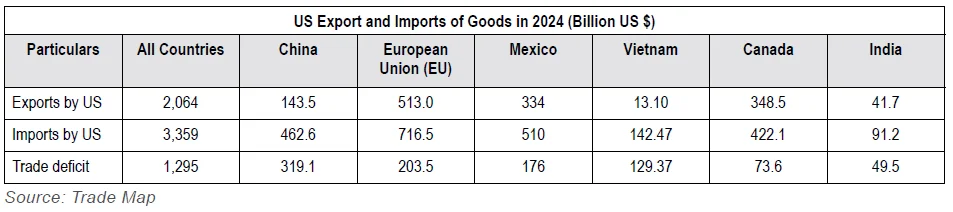
On 20th January, 2025, the first day of taking charge as the US President, Mr. Donald J. Trump (“Trump”) issued a series of Executive Orders (“EO”) and proclamations. Among them was the EO titled ‘America First Trade Policy’ (“AFTP EO”) which gave insights into the policy which the President would be following in days to come. The AFTP EO stated that the American economy, the American worker, and the National security of America will be at the forefront of US policy decisions. It also stated that the aim of the new US administration is to promote investment and manufacturing in the US. One of the ‘National Security’ risks highlighted in the AFTP EO was the ‘unfair and unbalanced trade’ with its major trading partners. To put a perspective, the table below provides the trade balance of the US with its major trading partners.

The table shows that in 2024, the US had an overall trade deficit in goods of $1.29 trillion, which means that the US imported more goods than it exported to other nations. The highest trade deficit was with China, at $319 billion, followed by the EU at $203.5 billion, Mexico at $176 billion and Vietnam at $129.37. There was a trade deficit even with Canada, India and other nations. On the services front, in 2024, the US’s exports were $1107.8 billion, and imports were $814.4 billion, giving a surplus of ~ $293.4 billion.5 Even if one offsets this surplus, the overall trade deficit in goods and services for the US in 2024 was close to $1 trillion.


5 https://www.bea.gov/news/2025/us-international-trade-goods-and-services-december-and-annual-2024

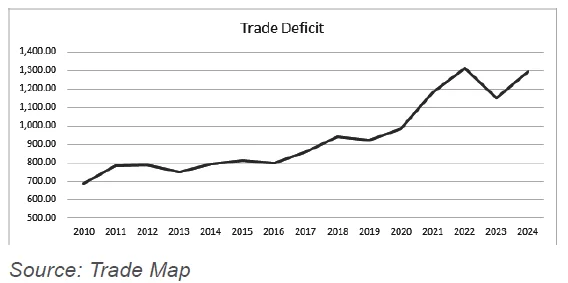
The ever-increasing trade deficit in goods has been a subject matter of debate between economists in the US for several decades. The trade deficit in goods has continuously increased from $690.16 billion in 2010 to $1.29 trillion in 2024, as shown in the graph below.

The burgeoning US trade deficit can be explained with the textbook theory of macro-economic factors of disbalance between savings and investment rates. In simple terms, this implies that Americans have been spending more money on consumption expenditure (i.e., buying more goods than they produce) with low savings and investment spending rates. This additional spending goes to foreign goods, which is then financed through borrowing from foreign lenders (US treasury bonds) or foreigners purchasing US assets.

Some policymakers argue that macro factors of the stronger dollar (which encourages imports and discourages exports), more buying power of consumers in the US, and manufacturing shift to lower labour cost jurisdictions would naturally lead to higher trade deficits. While others argue that shifting manufacturing to low-cost jurisdictions like the ASEAN (Thailand, Vietnam, Malaysia, Indonesia, etc.) and other parts of the World like China has been a result of unfair foreign government policies and incentivisation. It is argued that the rise of China during the last three decades as a World’s powerhouse of manufacturing, resulting from unfair trade practices of the Communist regime in Beijing, is a major cause of the situation. In particular, it is argued that Beijing’s State control and subsidisation of manufacturing led to the establishment of huge capacities in China far exceeding the domestic demand, boosting of exports through unfair incentives, tax enforcement of the IPR regime, manipulation of currency through devaluation to boost exports, unfair labour and environmental practices of China has led to the situation.

One set of policymakers focused their efforts on tackling this situation by addressing the inherent deficiencies like boosting investments in infrastructure and targeted incentives to increase the domestic manufacturing base. The previous US President Biden’s policy initiatives were efforts in that direction, such as the Bipartisan Infrastructure Law (BIL), formally known as the Infrastructure Investment and Jobs Act (IIJA) which focused on funding a wide range of infrastructure projects, the Build America, Buy America Act (BABA) which mandated that iron, steel, manufactured goods, and construction materials used in US federal funded infrastructure projects must be produced in the US, the CHIPS and Science Act which focused on boosting US semiconductor manufacturing. A similar set of policy initiatives may also be seen in the Indian context, like the ‘Make in India’ policy and infrastructure parks (Electronics Parks, Plastic Parks, PM MITRA Textile Parks, Mega Food Parks, etc.).

The other set of policymakers believe that directly disincentivizing or curtailing imports, inter alia through Tariff measures, is an immediate solution to the situation. The current US President Trump’s policy measures by imposing punitive import tariffs are efforts in that direction, even if it involves disrupting the rule based international trade and the principles established by the WTO.

Hence, there is a clear shift in the US policy under the new administration with tariffs as one of the main policy instruments. Tariffs have also been used by the US as a threat to negotiate better trade deals with its trading partners. With this background in mind, the next section looks at the relevant legislation used by the US in its renewed policy.

II. LEGISLATION USED BY THE US FOR IMPOSING TARIFFS AND ACTIONS TAKEN THEREUNDER

In his first term (2017-2021), Trump had used Section 232 of the Trade Expansion Act, 1962 (“TEA”) in 2018 to impose import tariffs of 25% and 10% on Steel and Aluminium, respectively, subject to some product / country-specific exemptions. These tariffs were expanded to include specified derivatives of Steel and Aluminium in 2020. In 2018, Trump also used Section 301 of the Trade Act, 1974 (“TA”) to impose tariffs ranging from 7.5% to 25% on several goods of China (covered in four lists ranging from $34 billion in list 1 to $300 billion in list 4). These tariffs continue to exist today and have been further expanded in Trump’s second term.

In his second term (2025-), effective March 12, 2025, Trump used Section 232 of the TEA to expand the scope of import tariffs on Steel and Aluminium by bringing both on par at 25% each, withdrawing all previous exemptions, and significantly increasing the scope of coverage of derivatives products. The President has also used the same section to impose tariffs of 25% on specified Automobiles (“Auto”) and Auto parts from all countries, subject to quota-based exemptions.6 Due to the close integration of Auto supply chains between the US, Canada and Mexico, the Tariffs on Autos, which qualify the USMCA rules of origin,7 have been exempted to the extent of US content of such vehicles. Further, the USMCA qualified Auto parts imported into the US from Canada and Mexico have also been exempted.


6 Auto Tariffs apply only to passenger vehicles (sedans, sport utility vehicles, 
crossover utility vehicles, minivans, and cargo vans) and light trucks. 
Auto parts cover Engines and engine parts, Transmissions and powertrain parts, 
and Electrical components of passenger vehicles and light trucks. 
Auto tariffs were effective April 3, 2025, and Auto parts Tariffs were effective May 3, 2025.

7 USMCA is the United States-Mexico-Canada Free Trade Agreement which 
replaced the North American Free Trade Agreement (NAFTA) and become 
effective July 1, 2020, in Trump’s first term.

In addition, Trump has extensively used another US Act, called as International Emergency Economic Powers Act, 1977 (“IEEPA”), to impose import tariffs on Canada, Mexico and China (including Hong Kong) by taking the cue of fentanyl trade8, which has claimed to cause a situation of ‘National Emergency’ and public health crisis in the US. A tariff of 10% was imposed on goods from China and Hong Kong with effect from 4th February, 2025, which was increased to 20% effective 12th March, 2025. Similarly, effective 4th March, 2025, the goods from Mexico and Canada have imposed a tariff of 25% (except potash/specified energy products having a tariff rate of 10%). This tariff measure was later amended to exempt USMCA-qualified goods.

The US President has also used IEEPA to impose a baseline tariff of 10% with effect from April 5, 2025, on all countries (including India)and a higher-country specific reciprocal tariff on 57 listed countries varying from 11% to 50%9 with effect from April 9, 2025 (currently on pause for 90 days, till 8th July, 2025). For China10, the reciprocal tariffs were increased to 125% from April 10, 2025, due to retaliation by China with similar tariffs on US goods (the 125% tariff has been suspended for 90 days and rolled back to 10% with effect from 14th May, 2025, pending negotiations between US and China).


8 Fentanyl is a synthetic opioid drug used for pain relief and anesthetic. 

The US has argued that Canada and Mexico have permitted the Fentanyl 

drug to flow into the US through its porous borders creating a 

situation of National Emergency and public health crisis in the US.

9 India is amongst the 57 countries and India’s tariff rate is specified to be 26%.

10 Includes Hong Kong and Macau

Further, under the IEEPA, the US has withdrawn the de-minimis exemption11 for goods, including international parcels from China and Hong Kong (effective 2nd May, 2025).


11 A de-minimis exemption is exemption given under US law to goods of value less 
than $800 from duties and certain procedural requirements at the time of imports into the US.

The above tariffs imposed by the US are in addition to normal customs duties (called MFN rates), fees, taxes, exactions, or charges applicable to imported articles. Further, the above tariffs stack on each other, i.e., becomes cumulative unless otherwise specified.12

Legislations Conditions and Actions Previous illustrative uses and the current usage
Sec 232 of TEA » If certain imports threaten the ‘National Security’ of the US.

» Authorises the President to bypass Congress and modify /adjust the imports by tariffs/quotas.

» Investigation by the Department of Commerce (“DOC”) and a report by the Secretary of Commerce to the President is a pre-condition to take action.

» Last imposed tariffs or other trade restrictions three decades before in 1986.

Shift in policy under Trump’s first term.

» The President opened 8 investigations, and Tariffs were imposed under 2 such cases on Steel and Aluminium.

» Other investigations were on Auto and Auto parts, etc. but no actions were taken, or agreements were reached with countries.

Continued actions under Trump’s second term

»  Expanded the tariffs on Aluminium and Aluminium derivatives to 25%.

» Expanded the coverage of derivatives of Steel and Aluminium.

» Imposed Auto and Auto parts tariffs of 25% from all countries, subject to some quota-based exemptions for Auto parts (acting on the 2019 report of the Secretary of Commerce).

Sec 301 of TA » United States Trade Representative (“USTR”) does an investigation and recommends action to enforce US rights under a trade agreement or to respond to certain foreign unfair trade practices.

» Consultations by USTR with targeted Government.

» If the determination is affirmative, it decides actions to be taken.

» Authorises the President to impose duties or other import restrictions and actions.


» Since the formation of WTO in 1995, the US used this measure to build cases and pursue dispute settlement at the WTO.

Shift in policy under Trump’s first term.

» 2018 – China was acted against due to its IPR violations.

» 2019 – The EU (including the UK) were acted against due to their subsidies on large civil aircraft (Tariffs later suspended in July 2021)

» 2019 – Investigation on France against its ‘discriminatory’ Digital Services Taxes (DST) (Tariffs later suspended due to larger investigation on countries adopting similar taxes).

» 2020 – Several countries, including India, were investigated for their ‘discriminatory’ foreign DST laws (No tariffs currently, pending negotiations).

» 2020 – Vietnam was investigated for their ‘unfair currency valuation’ and use of ‘illegally harvested timber’ (Tariffs not imposed based on an agreement with Vietnam to improve its currency valuation and timber trade practices)

IEEPA » Unusual and extraordinary threat, which has its source in substantial part outside the US, to the National Security, foreign policy, and economy of the US.

» Power given to the President with some exceptions and checks

»Report to be submitted later to Congress on actions taken.

»Trump, in his second term, has used this legislation extensively to impose tariffs on China / Mexico /Canada for failure to check the Fentanyl trade.

» Imposed baseline tariff of 10% on all countries due to ‘unfair and unbalanced trade” position with trading partners.

» Higher country specific reciprocal tariff on 57 countries (currently on pause for 90 days, till 8th July, 2025).

»Tariffs on de-minimis shipments from China and Hong Kong.


12 As per another executive order issued on April 29, 2025, 
the goods which are subject to Auto/Auto parts tariffs under
 Sec 232 of TEA will not be subject to Tariffs imposed on Canada/Mexico
 under IEEPA or Tariffs on Steel/Aluminium under Sec 232 of TEA. Further, 
the goods which are subject to IEEPA tariffs on Canada/Mexico will not be 
subject to Tariffs on Steel / Aluminium under Sec 232 of TEA.

The tariffs imposed by the US have been challenged in several lawsuits filed across the US, particularly by the Democratic States, including the States of Arizona, Colorado, Connecticut, Delaware, Illinois, New York and Oregon. In particular, the reciprocal tariffs have been challenged in the US courts on the grounds that the IEEPA does not specifically authorise the President to impose tariffs and that the US trade deficit cannot be equated to a “National Emergency” as contemplated under the IEEPA. In addition, the State of California has also filed a lawsuit to halt the tariffs imposed by the Trump administration, which the State believes was not taken with Congressional approval and will negatively impact its economy. In a recent decision of the Court of International Trade (CIT) in V.O.S. Vs. The USA, the CIT at Manhattan, New York has set aside all Trump’s actions under IEEPA and accordingly invalidated the reciprocal tariffs (10% baseline and higher country specific tariffs) and tariffs imposed on China/Canada/Mexico for failure to curb the fentanyl trade. The CIT held that Trump exceeded his authority granted by the Congress under the IEEPA to impose tariffs. The US government has appealed this decision before the Court of Appeals for Federal Circuit which has temporarily granted a stay on the CIT’s decision until the court hears both parties.

III. WTO/ GATT PERSPECTIVE OF US TARIFFS

“In the pre-World War II era, the market access for trade in goods was based on trading partners’ economic or political clout. With uncertainty and protectionist measures by different countries to further their economic objectives, several countries got together and entered into an agreement called the General Agreement on Tariffs and Trade (GATT, 1947), which formed the basis for rule-based international trade. This agreement was signed in Geneva in 1947 by 23 countries. Both India and the US were parties to the GATT. The GATT was a crucial step towards rebuilding the global economy after World War II with an aim to reduce trade barriers and promote free and fair trade among partner nations. The GATT aimed to reduce tariffs and eliminate other trade barriers to promote free trade. Importantly, it was the US which played a leading role in the creation of GATT because it wanted liberalisation of protectionist policies to help the US export more goods to other countries. It was the GATT, 1947, which, after several rounds of multilateral negotiations, led to the formation of WTO in 1995 by the Marrakesh Agreement, signed in Marrakesh, Morocco. While the WTO replaced GATT, the principles of GATT are still incorporated into the WTO agreement.

One of the basic principles enshrined in GATT/WTO is the Most Favored Nation (MFN) principle under Article I. The MFN principle essentially states that if a country grants a trade advantage (like lower tariffs) to one trading partner, it must unconditionally and immediately extend the same advantage to all other WTO members. Another important Article II of GATT is the schedule of concessions of each member nation, which binds the member not to increase the customs duty rates beyond the bound rate given in its schedule.

Article XXI(b)(iii) of GATT covers the national security exception, which allows the members to violate the GATT principles if such actions are “taken in time of war or other emergency in international relations”. The US has lost several cases at the WTO wherein it violated the GATT principles by invoking the national security exception under Article XXI(b)(iii). The argument of the US before the WTO’s judicial Panels, that this exception is ‘self-judging’ and cannot be subject matter of judicial review, has been rejected by the WTO panels. In the US-Origin Marking (Hong Kong, China) case,13 the argument raised by the US that human rights violations in Hong Kong can be used as a basis to violate the GATT disciplines was rejected by the WTO panel. It was held that such human rights violations in HK, even if evidenced, cannot be escalated to the threshold of requisite gravity to constitute an “emergency in international relations”. This phrase was held to refer to a state of affairs of the utmost gravity – a breakdown or near-breakdown in the relations between states.


13 WT/DS597/R (WTO Panel Report dated 21 December 2022)

More importantly, the US also lost WTO cases relating to the imposition of tariffs under Sec 301 of the TA against China14 and under Sec 232 of the TEA on Steel and Aluminium.15


14 The US defense built under Article XX(a) which deals with general exception of 
“necessary to protect public morals” was rejected on the ground that there was 
no genuine relationship of “ends and means” and hence it was held that the US had 
violated GATT disciplines relating to MFN and bound rates (WT/DS543/R WTO Panel 
Report dated 15 Sep 2020)
15 US’s defense under Article XXI(b)(iii) was rejected – measures not 
“taken in time of war or other emergency in international relations” and hence it
 was held that the US had violated MFN, bound rates and Quantitative Restrictions 
under GATT (WT/DS544/R WTO Panel Report dated 9 Dec 2022)

It may be worthwhile to note that since 2017 the US has blocked the appointment of new judges to the WTO’s Appellate Body (AB) due to complaints over judicial activism at the WTO and concerns over US sovereignty.16 This has brought the WTO’s dispute settlement system to a standstill making it effectively non-functional. There are currently no members in the seven member AB with the term of the last sitting member expired on 30th November, 2020.17 Hence, today, all appeals filed by the WTO members including the US against the Panel rulings are pending adjudication at WTO’s AB with no judges in place. It would not be out of place to say that the country which argued for liberalisation leading to the creation of GATT / WTO has itself turned back full circle to bring in an era of protectionism in trade.


16 The World Trade Organization: The Appellate Body Crisis | Economics Program and Scholl Chair in International Business | CSIS
17 https://www.wto.org/english/tratop_e/dispu_e/ab_members_descrp_e.htm

IV. IMPACT OF THE US TARIFFS ON THE INDIAN ECONOMY AND THE WORLD

In today’s globalised World, supply chains are integrated across nations, and most products pass through manufacturing stages in several countries before landing in the hands of the consumer in the country of consumption. If the country of consumption is the US, the moot question which arises is what will be the tariff rate applicable to such product at the time of import into the US? Whether it is the country where the principal raw material was manufactured (say, China) or where further processing on it was undertaken (say, India). This question assumes importance because US tariffs are now based on the country to which the product belongs. Complicating the situation is the test of the last ‘substantial transformation’ applied by the US in judging this criterion with a plethora of complex judicial rulings in the US courts. This has led to several supply chain shifts by companies away from China to avoid punitive US Tariffs.

In addition, reciprocal tariffs under IEEPA provide an exemption to the US content of the product if such US content is at least 20% of the total value of the product. Further, tariffs under Sec 232 on Steel and Aluminium derivatives are exempt if the Aluminum is smelted and cast in the US or Steel is melted and poured in the US. These issues are leading the companies to rethink their supply chain modelling to reduce the impact of US tariffs and stay export competitive.

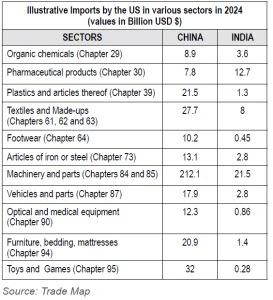
While the threat of US tariffs remains, there are certain opportunities for Indian businesses looking to export more to the US. A look at the table below shows that India is exporting products to the US under Chapters overlapping with China, which gives an opportunity to the Indian business to increase their exports on account of the present 30% tariffs on China vs. 10% tariffs on Indian goods under the IEEPA.

With the India-US currently engaged in intense negotiations for the Bilateral Trade Agreement (BTA), it still needs to be seen whether the Indian Government can negotiate a deal with the US which can lead to enhanced export competitiveness of Indian goods to the US, particularly in labour-intensive sectors like plastics, textiles, gems and jewellery, electronics, pharma and chemicals.

V. CONCLUSION

The US concern stems from an ever-increasing trade deficit in goods with most of its major trading partners. This has led to a discernible shift in the US trade policy to tariff measures. With the WTO in a state of limbo particularly due to the non-functional Appellate Body (AB) mechanism, the US seems to be not concerned with the legality of its measures with the GATT / WTO disciplines. As a result of US tariffs, the businesses World over, including in India, are forced to rethink the supply chains of their goods. The present situation is both a threat and an opportunity for Indian businesses and the success will depend upon how the businesses can rekindle their decision-making and whether the Indian government is able to negotiate a good deal with the US helping the Indian exporter community.

Rights of the Accused under PMLA for Obtaining Copies of the Records / Documents

This article deals with the Judgement of the Supreme Court in Sarla Gupta & Onr. vs. Directorate of Enforcement and the right of an accused to obtain copies of the Records / Documents collected by the Investigative Agencies under the PMLA.

INTRODUCTION

The saying that “Information is power” is age-old. Investigating agencies, while investigating a certain offence, tend to collect a large amount of data and information in the quest for justice. An investigation, as well as the resulting prosecution (if any), is supposed to be fair and unbiased. An officer administering certain provisions of an act also conducts inquiries from time to time. This also leads to the collection and compilation of a large amount of data. This data is relevant not only because it could be used to establish that a certain accused is involved in the offence of money laundering but also to give rise to reasonable doubt as to his complicity. The burden of proof to convict an accused in a criminal trial is “beyond reasonable doubt”. If the prosecution cannot prove its case beyond a reasonable doubt, the accused has to be acquitted. Just as the information conducted during an inquiry or an investigation forms the basis of the prosecution case, the same can also be pressed into service for defence. For a criminal trial to be fair to the accused, it is essential that the defence has access to all the material that is at the command of the prosecution. This is particularly relevant for the material that is relied on by the prosecution. The fundamental principle of criminal law is that an accused has the right to confront their accuser and also confront the evidence produced against them.

SECTION 207 & 208 OF CRPC AND PMLA PROCEEDINGS AND SUPPLY OF ‘RELIED UPON DOCUMENTS’

The three-Judge division bench judgement of the Supreme Court in Sarla Gupta & onr. vs. Directorate of Enforcement 2025 SCC OnLine SC 1063 strikes a win for fairness in prosecutions under the Prevention of Money Laundering Act, 2002 (better known as the PMLA).

In modern-day criminal law jurisprudence, due weightage needs to be given to fairness. After all, justice must not only be done but must also be seen to be done. Just like it would not be fair for a person to be made to participate in a fist-fight with one of his hands tied behind him, it would hardly be fair if an accused was not granted copies of the material relied on against him. There are two important provisions under the Code of Criminal Procedure (CrPC) which deal with the supply of documents – Sections 207 and 208. The corresponding Sections of the Bharatiya Nagrik Suraksha Sanhita (BNSS) are Sections 230 and 231 respectively. Section 207 of the CrPC applies when the proceedings have been instituted on a police report and are triable by the magistrate. Section 208 applies to a case that is instituted otherwise than on a police report, and the Magistrate is of the view that the case is exclusively triable by the Court of Session.

The complaint based on which the Special Court for the PMLA takes cognisance of an offence has documents annexed to it in order to support its contents. These are the documents ‘relied upon’ in this context to make its case. In Criminal Appeal No. 730 of 2024, which is a part of the common judgement reported in Sarla Gupta, the Supreme Court held that “Both Sections 207 and 208, on the face of it, do not specifically apply to a complaint under Section 44(1)(b) of the PMLA. But, there is no reason why the principles laid down under Sections 207 and 208 should not be applied to a complaint under Section 44(1)(b) of the PMLA”. Relying upon the concept of fair play and Article 21 of the Constitution of India, the Supreme Court made sections 207 & 208 of CrPC applicable to cases under the PMLA. The Court went on to read in the protections that are afforded by sections 207 & 208 of the CrPC into the PMLA in the form of these Directions:

“Therefore, once cognizance is taken on the basis of a complaint under Section 44(1)(b) of the PMLA, the learned Special Judge must direct that along with the process, a copy of the complaint and the following documents must be provided to the accused:

a. Statements recorded by the learned Special Judge of the complainant and the witnesses, if any, before taking cognizance;

b. The documents, including the copies of the Statements under Section 50 of the PMLA produced before the Special Court, along with the complaint, and the documents produced subsequently by the ED till the date of taking cognizance; and

c. Copies of the supplementary complaints and the documents, if any, produced with supplementary complaints.

After cognizance is taken on the basis of the complaint, the ED cannot be heard to say that a document has been produced with the complaint or in the proceedings of the complaint, but it is not a relied-upon document. The copies of documents must be supplied along with a copy of the complaint as required by subsection (3) of Section 204 of the CrPC (sub-section (3) of Section 227 of the BNSS).”

Thus, the directions of the Supreme Court to the Special Court for the trial of PMLA offences is quite clear – documents, as mentioned in the directions reproduced above, must be made available to the Accused once the Special Court take cognizance of an offence under the PMLA. This would equip the accused to take an informed decision on the defence that they wish to take up during trial. But this by itself is not enough. The Judgement of the Court also makes it mandatory that copies of the document produced with the complaint or the proceedings of the complaint must be supplied to the Accused and that the Directorate of Enforcement cannot refuse to furnish any such document by stating that it is not a ‘relied upon document’ in the complaint. This act of the Supreme Court in bringing in these safeguards based on sections 207 & 208 of CrPC is a significant development in PMLA jurisprudence.

SUPPLY OF DOCUMENTS IN THE POSSESSION OF THE DIRECTORATE, NOT RELIED UPON

The ED does not need to rely upon all the documents that it collects during its investigation. There is no obligation on the investigating agency to rely upon all the data that it so collects. However, some of this data could be beneficial to the Accused in preparing their defence. Just like statutes, the interpretation or inferences drawn from data can be different by a different set of eyes. Our system of law administration is fundamentally adversarial in nature unlike in some of the countries that follow ‘civil law’ or the ‘continental system of law’. This gives rise to the danger of the prosecution withholding exculpatory documents from the accused while only relying upon the incriminating documents. The danger of this situation actually arising cannot be ruled out, and the consequences can be severe.

In the year 2021, another three-judge Division bench of the Supreme Court in Criminal Trials Guidelines Regarding Inadequacies and Deficiencies, In re, (2021) 10 SCC 598 observed, “The Amici Curiae pointed out that at the commencement of trial, accused are only furnished with list of documents and statements which the prosecution relies on and are kept in the dark about other material, which the police or the prosecution may have in their possession, which may be exculpatory in nature, or absolve or help the accused. This Court is of the opinion that while furnishing the list of statements, documents and material objects under sections 207/208 CrPC, the Magistrate should also ensure that a list of other materials (such as statements or objects/documents seized, but not relied on) should be furnished to the accused. This is to ensure that in case the accused is of the view that such materials are necessary to be produced for a proper and just trial, she or he may seek appropriate orders under CrPC”. This right was also reiterated in the case of Manoj vs. State of M.P., (2023) 2 SCC 353 where the Supreme Court reiterated its stand that “this Court holds that the prosecution, in the interests of fairness, should as a matter of rule, in all criminal trials, comply with the above rule, and furnish the list of statements, documents, material objects and exhibits which are not relied upon by the investigating officer. The presiding officers of courts in criminal trials shall ensure compliance with such rules”.

In Criminal Appeal No. 730 of 2024, which is a part of the common judgement reported in Sarla Gupta, the Supreme Court observed these prior Judgements and agreed that these documents had to be furnished to the Accused. However, the Court proceeded to analyse at what stage the Accused is entitled to seek copies of the Documents not relied on by the prosecution. The Supreme Court observed that “at the time of hearing for framing of charge, reliance can be placed only on the documents forming part of the charge sheet. In case of the PMLA, at the time of framing charge, reliance can be placed only on those documents which are produced along with the complaint or supplementary complaint. Though the accused will be entitled to the list of documents, objects, exhibits etc. that are not relied upon by the ED at the stage of framing of charge, in ordinary course, the accused is not entitled to seek copies of the said documents at the stage of framing of charge.”

It is, therefore, rare that copies of all the documents are given to the Accused before the framing of the charge. To give or not to give would still be the discretion of the court. However, after the charge is framed, under Section 233 of the CrPC (Section 256 of the BNSS), there is less latitude given to the Courts to refuse the production of documents.

In Criminal Appeal No. 730 of 2024, which is a part of the common judgement reported in Sarla Gupta, the Supreme Court observed, “On plain reading of sub-section (1) of Section 91, the power of the court is discretionary. The word ‘may’ appears in sub-section (1) of Section 91. However, if we peruse sub-section (3) of Section 233 and sub-section (2) of Section 243, the word ‘shall’ has been used. The reason is that these two provisions apply at the stage of the accused leading defence evidence. Therefore, it is provided that if the accused applies for the issue of any process for compelling the attendance of any witness or the production of any document or thing, the court must issue such process. The prayer for issue of such process cannot be denied unless the court, for reasons to be recorded, holds that the application is made for the purposes of vexation or delay or for defeating the ends of justice.”

The Court, therefore, went on to hold that “After carefully perusing the provisions of the PMLA, we did not find any provision of the PMLA which is inconsistent with Section 91 of the CrPC. The power under sub-section (1) of Section 91 can be exercised by a Court when the production of any document or any other thing is necessary or desirable for the purposes of any investigation, inquiry, trial or other proceedings under the CrPC. The consistent line of judgments of this Court hold that at the stage of framing of charge, the accused is ordinarily not entitled to apply under Section 91 of the CrPC for producing the documents which are not relied upon by the complainant. For the purposes of his defence, the accused has a right to seek production of a document or a thing at the stage of leading defence evidence as Section 233 of CrPC will apply to the trial of an offence under the PMLA, due to the fact that Chapter XVIII of the CrPC is made applicable to such trial in view of clause (d) of Section 44(1) of the PMLA.” It also observed that in the light of the negative burden of proof that is placed by Section 24 of the PMLA on the accused, Section 233(3) of the CrPC should be liberally construed in favour of the Accused. This is also because the constitutional validity of Section 24 of the PMLA has been upheld on the ground that the accused has full opportunity to show that he has not violated the provisions of the PMLA and rebut the presumption. If the Special Court refuses the prayer for documents u/s 233 of the CrPC, the accused will not be able to discharge the burden, and the Supreme Court, therefore, held that this right of the Accused must be protected.

CAN DOCUMENTS BE SOUGHT BY THE ACCUSED DURING BAIL PROCEEDINGS UNDER THE PMLA?

The primary reason why PMLA is so feared is the difficulty that an arrested accused faces in order to obtain bail. Getting bail under the PMLA is infamously difficult and is the primary reason that the PMLA is considered draconian. The offence of money laundering is non-bailable, i.e. bail cannot be obtained as a matter of right but is subject to judicial discretion. There are various factors that weigh in with a Court while deciding whether or not to release an accused on bail. The PMLA, through Section 45(1)(ii), adds the ‘twin conditions’ that must be fulfilled over and above this in order for the accused to secure bail. Therefore, if an accused makes an application for bail u/s 45 of the PMLA and the prosecutor opposes the grant of bail, the Court cannot grant bail to the Accused unless “the court is satisfied that there are reasonable grounds for believing that he is not guilty of such offence and that he is not likely to commit any offence while on bail”.

The first of the twin conditions requires that the accused demonstrate to the court that there are ‘reasonable grounds’ for believing that he is not guilty of such offence. This can be very difficult to do if the Accused does not have access to the documents and data that can help him discharge the burden. The Supreme Court in Criminal Appeal No. 730 of 2024, which is a part of the common judgement reported in Sarla Gupta, held that “If a narrow view is taken, by denying this opportunity to the accused, he will not be in a position to discharge the burden on him, and therefore, it will affect his right to liberty as he may be denied bail. This denial will amount to a violation of his rights guaranteed under Article 21. Therefore, at the stage of hearing of a bail application to which stringent provisions of Section 45(1)(ii) of the PMLA are applicable, the accused must be allowed to invoke the provision of Section 91 of the CrPC for seeking production of the documents not relied upon by the ED. But, when the investigation is pending while permitting the accused to seek production of documents that are not relied upon by invoking Section 91 of the CrPC, care has to be taken to ensure that the investigation is not prejudiced. Therefore, when such an application is made, the ED is entitled to resist the production of documents that are not relied upon on the ground that if the said documents are disclosed at that stage to the accused, it may prejudice the investigation. Though the ED is entitled to raise the said plea, it will have to show the documents to the Court. The Court can, for reasons recorded, deny production of documents only if it is satisfied that the disclosure of the documents may prejudice the ongoing investigation. Needless to add that the ED cannot raise such an objection after the investigation is complete.” It is important to note that the Court considered Article 21 of the Constitution of India as the fountain from which the right to receive the documents springs. This Judgement, therefore, is a big step in defending the fundamental rights that have been guaranteed under the Constitution of India. The Court specifically observed that “ When the Legislature has felt a need to bring out a legislation like the PMLA, it is the duty of the Court to interpret Article 21 in such a way that the right of a fair trial available to the accused is not affected. The object of the provisions of Section 24 or 45(1)(ii) is not to take away the fundamental right of fair trial conferred on the accused. These provisions are different in the sense that they put a burden on the accused. When such a burden is put on the accused, it is all the more necessary that the right of fair trial guaranteed under Article 21 to the accused is protected by permitting the accused to lead defence evidence by seeking the production of witnesses and documents not relied upon by the prosecution. Similarly, for discharging the burden under Section 45(1)(ii), the accused has the right to invoke Section 91 of CrPC (Section 94 of the BNSS) for seeking production of documents at the stage of hearing of bail application.”

THE RIGHTS OF THE ACCUSED TO GET COPIES OF RECORDS / DOCUMENTS SEIZED AS PER SECTION 17 & 18 OF THE PMLA

The Supreme Court in Sarla Gupta was also concerned with the rights of the Accused under the PMLA to get copies of Records and Documents that have been seized u/s 17 (Search & Seizure) or Section 18 (Search of Persons). Section 21(2) of the PMLA, that deals with the retention of records, specifically mentions that the person from whom the records are seized or frozen shall be entitled to obtain a copy of the records. Section 2(b) of the PMLA includes deeds and instruments evidencing title or interest in property or asset.

The Supreme Court held that the order of retention under section 20 of the PMLA does not refer to the forfeiture of the property and that the seized property does not vest with the ED. The Supreme Court went on to hold that “There is no prohibition on providing copies of the deeds or instruments evidencing title to the person from whom or from whose premises the deeds or instruments are seized. If the provision is interpreted to mean that the person from whom such deeds or instruments are seized is not entitled to receive even copies of the same, the provision will be rendered arbitrary and violative of Article 14 of the Constitution. Therefore, as far as the seized documents and records are concerned, the person from whom or from whose premises the seizure has been made is entitled to get the true copies thereof. As far as the other property seized is concerned, the person from whom the property is seized is entitled to a copy of the seizure memo and the list of the properties seized.” It held that if the documents are bulky, then soft copies can be furnished and that even if seized records or documents are not relied upon in the Complaint, copies must be supplied, though the accused will not be entitled to rely upon them at the time of framing of charge.

CONCLUSION

In an adversarial system like ours, the ED has often resisted the furnishing of certain documents to the Accused, an example being the non-furnishing of grounds of arrest to the accused in writing, as remedied by the Supreme Court in the case of Pankaj Bansal vs Union of India, (2024) 7 SCC 576 where the Court held that There is no valid reason as to why a copy of such written grounds of arrest should not be furnished to the arrested person as a matter of course and without exception. There are two primary reasons as to why this would be the advisable course of action to be followed as a matter of principle. Firstly, in the event such grounds of arrest are orally read out to the arrested person or read by such person with nothing further and this fact is disputed in a given case, it may boil down to the word of the arrested person against the word of the authorised officer as to whether or not there is due and proper compliance in this regard. In the case on hand, that is the situation in so far as Basant Bansal is concerned. Though ED claims that witnesses were present and certified that the grounds of arrest were read out and explained to him in Hindi, that is neither here nor there as he did not sign the document. Non-compliance in this regard would entail the release of the arrested person straightaway, as held in V. Senthil Balaji vs. State, (2024) 3 SCC 51. Such a precarious situation is easily avoided, and the consequence thereof can be obviated very simply by furnishing the written grounds of arrest, as recorded by the authorised officer in terms of Section 19(1) PMLA, to the arrested person under due acknowledgement, instead of leaving it to the debatable ipse dixit of the authorised officer.”

In fact, in the case of Arvind Kejriwal vs. Enforcement Directorate, (2025) 2 SCC 248, the Supreme Court specifically held that it is not only the grounds of arrest that need to be given to the Accused but also the ‘reasons to believe’ that have been recorded. The Court held that this is because “it would be incongruous, if not wrong, to hold that the accused can be denied and not furnished a copy of the reasons to believe. In reality, this would effectively prevent the accused from challenging their arrest, questioning the “reasons to believe”.. .. “It follows that the “reasons to believe” should be furnished to the arrestee to enable him to exercise his right to challenge the validity of arrest.”

The phrase ‘Information is power’ is especially relevant in the realm of criminal defence law in general and in special laws like the PMLA in particular. While economic offences are to be considered a class apart, it cannot be denied that the process of prosecution of one accused of a crime must be fair. Jurisprudence with regard to the PMLA has grown by leaps and bounds over the last few years. The Supreme Court has, from time to time, sought to balance the fairness of proceedings under the PMLA, which otherwise can be considered quite draconian. The Judgement in the case of Sarla Gupta shall undoubtedly be useful for those caught in the clutches of this law to get a fair trial.

Dematerialisation of the Securities of Private Company

INTRODUCTION

Dematerialisation (Demat) of securities has gained its importance for a very long time. The Government has, from time to time, widened the scope and applicability of the same from listed companies to closely held public companies and now private limited companies.

As per the Companies Act, 2013, it is mandatory for all listed companies to have their shares and other securities1 in demat form for their smooth trading on Stock exchanges. The Ministry of Corporate Affairs (MCA), vide notification dated 10th September, 2018, inserted Rule 9A in the Companies (Prospectus and Allotment of Securities) Rules, 2014 (‘PAS Rules’), mandating every unlisted public company to hold and issue securities only in demat form.


1.“Securities” shall include all kinds of securities – shares, debentures, preference shares etc.

Recently, the Ministry of Corporate Affairs (MCA) vide notification No. GSR 802 (E) dated 27th October, 2023, has introduced Rule 9B after Rule 9A vide — Companies (Prospectus & Allotment of Securities) Second Amendment Rules, 2023 (‘Present Amendment’), and has extended such requirements for private companies.

Compliances under the new notification for the dematerialisation of the Securities shall have twofold compliances to be observed: One by Companies and the other by the security holders of such companies, making this a very important provision to be understood by the private limited corporate entities as well as security holders.

UNDERSTANDING THE COMPLIANCES TO BE FOLLOWED BY THE COMPANIES:

Every private company that is not a small company as per the audited financial statements as on the last day of the financial year ending on or after 31st March 2023, shall, within 18 months from the closure of such financial year, ensure that it:

  • issues the securities in dematerialised form only;
  • facilitates the dematerialisation of its securities;

in accordance with the provisions of the Depository Act, 1996 (22 of 1996) and regulations made thereunder.

and

  • dematerialises the entire holding of securities of its promoters, directors and key managerial personnel before making any offer for the issue of any securities, buyback of securities, issue of bonus shares or rights offer after the above-ascribed timelines.

With this Notification, all private Companies which are not small companies as of the last date of the financial year end on or after 31st March, 2023 are under a mandatory requirement of dematerialising their securities.

The applicability test begins with deciding the status of the company, whether a company being a private company is a small company or not. As per the revised definition of the “small company” (as per the amended Rule under the Companies (Specification of Definition Details) Amendment Rules, 2022, effective from 15th September, 2022), a small company is such a company,

a. Whose paid-up capital does not exceed ₹4 crore and

b. Whose turnover [as per profit and loss account for the immediately preceding financial year (for this Rule, it is 31st March, 2022] does not exceed ₹40 crores.

c. There are other categories of companies which are exempted from the definition of the small company, i.e., they are not considered as a small company irrespective of their paid-up capital and turnover.;

i) a holding company or a subsidiary company;

ii) a company registered under section 8; or

iii) a company or a body corporate governed by any special Act;

Let us understand these criteria with the help of the following examples:

Paid-up capital and Turnover as of the last date of the financial year ending on (Paid capital R4 core or more and Turnover above R40 crore or more) Demat applicability (mandatory)
31st March, 2022 31st March, 2022 31st March, 2022 Effective date (18 months from the date of such financial year end when the private Company cease to be a small company.
Company A -Less than the limit prescribed -small company. -Less than the limit prescribed –small company. -Less than the limit prescribed –small company. Not applicable.
Company B -More than the limit prescribed –Not a small company. -Less than the limit prescribed – small company. -Less than the limit prescribed –small company. To demat before 30th September, 2024.
Company C More than the limit prescribed – not a small company. More than the limit prescribed – not a small company. Less than the limit prescribed –small company. To demat before 30th September, 2024.
Company D Less than the limit prescribed –small company. More than the limit prescribed –Not a small company. Less than the limit prescribed –small company. To demat before 30th September, 2025.
Company E Less than the limit prescribed –small company. Less than the limit prescribed –small company. More than the limit prescribed –not a small company. To demat before 30th September, 2026. (Company E shall cease to be a small company as of 31st March, 2025)
A Holding Company, A Subsidiary Company, a Section 8 Company (except a company limited by guarantee), a company or body corporate governed by any special Act; Not a small company by definition, irrespective of paid-up capital and turnover Not a small company by definition, irrespective of paid-up capital and turnover Not a small company by definition, irrespective of paid-up capital and turnover To demat before 30th September, 2024.
a Government Company. Not a small company by definition, irrespective of paid-up capital and turnover Not a small company by definition, irrespective of paid-up capital and turnover Not a small company by definition, irrespective of paid-up capital and turnover Not applicable, as the Government company is not covered


CONCERNS FOR PRIVATE LIMITED COMPANIES

Correctly identifying the promoters and Key Managerial Personnel (KMP)

To observe the proper implementation of the rules, the Government has also mandated events relating to share capital like right issues, bonus issues, private placement, etc., which can be exercised by the Company only and only if the securities held by the promoters, directors and KMP of the Company are dematerialised before making any such offer for the issue of any securities.

This means that the persons who are promotors, directors and KMP as of 31st March, 2023 and thereafter must have their respective securities in demat form.

This could be a challenging exercise as the private companies are not under a mandatory requirement of appointing KMP under Section 203 of the Companies Act, 2013, except for the appointment of a Company Secretary on exceeding the threshold limit of paid-up capital of ₹10 Crores or more. Hence, such Companies shall exercise due care in identifying the promoters and KMP as per the Companies Act, 2013 and rules made thereunder before making any further issue of the securities.

Transfer of securities

Private companies, by their Articles, restrict/control the transfer of securities, with the Board having the power to approve or deny the said transfer in the best interest of the Company.

It was possible to adhere to these provisions of the Articles of Association where the shares are in
physical form. Now, with the dematerialisation of securities, the shares become freely tradable, and the Depository Act, of 1996, do not restrict any such transfer. It may lead to a dangerous situation for Private Limited Companies and may result in hostile takeovers. In addition to that, these provisions may result in transfer-related issues wherein the Articles relating to the transfer of shares, especially the clause related to the “Right of First Refusal”, may need to be amended or redrafted in accordance with the said amendment.

One solution to the above problem could be to use the facility of freezing one’s account with the Registrar and Transfer Agents (RTA). RTA provides ‘freeze–unfreeze’ options to the companies, wherein the debit of securities is frozen by the RTA under the company’s mandate and shall only unfreeze for a day or more as per the company’s instructions in writing. The companies will have to check for the cost involved in the same for the arrangement with RTA.

Non-Applicability of Rules

As per Rule 9B sub-rule 6 of the Companies (Prospectus and Allotment of Securities) Second Amendment Rules, 2023, the provisions of these rules are not applicable to Government Companies.

In conclusion, a company which is not a small company as defined above and which meets the criteria mentioned in the table above, needs to demat its securities by 30th September, 2024 or any other date, as may be applicable.

Procedure for Dematerialisation of Securities

To comply with the abovementioned provisions of the Companies Act, 2013 and the Rules made thereunder, a company should take the following steps:

a. Appoint RTA for Dematerlising its securities

b. Register itself with Depository (NSDL/CSDL). (India has two registered depositories, National Securities Depository Limited (NSDL) and Central Depository Services (India) Limited (CDSL).)

c. Obtain ISIN (International Security Identification Number) for all existing securities issued by the Company;

d. Facilitate dematerialisation of all existing securities (as and when a request is received from the holder of such securities);

e. Ensure that the entire holding of its promoters, directors and KMP are held in dematerialised form only prior to making any offer for issuance or buyback of securities on or after 30th September, 2024, or any other applicable relevant date.

f. Issue all securities in dematerialised form only after the due date;

Compliances by a Security Holder

Each holder of the securities of a private company that satisfies the abovementioned conditions shall mandatorily dematerialise the securities before

  • initiating the transfer of such securities

and

  • subscribing to any private placement offer, bonus shares or rights offer of such private company.

Process to be followed by a Security Holder

1. A Security holder needs to have a PAN or obtain a PAN number (This is also mandatory for foreign security holders)

2. Depository: India has two registered depositories, National Securities Depository Limited (NSDL) and Central Depository Services (India) Limited (CDSL).

3. Depository Participant (DP): The Investors (security holders) have to interact with the Depository through DPs, which are entities like public financial institutions, stock brokers, banks, clearing corporations/clearing houses, etc. The investor can choose a DP and either of the depositories to have their shares into a demat account.

4. Open a demat account with Indian Depository Participants (List of SEBI registered participants can be accessed through the NSDL and CDSL site.) and undertake the process of demat by filing a demat request form. If the investor already has a demat account then, he need not open a separate account.

5. Deposit the share certificates along with the DRF (Dematerialised Request Form) and all other documents and forms as required by the Depository Participants (DP).

6. The DP shall take up the further process and on cross-checking the correctness of all documents with the RTA, shall register the dematerialisation of shares.

Key points to be noted by the Security Holders

– Security holder can dematerialise only those security certificates that are already registered in the security holder’s name in the records of the issuing company/its RTA. i.e., he shall be a registered owner.

– The shares must be free from any lien, charge or encumbrance.

– In a case, where the security certificates are in joint names, the demat account shall also be opened in the same order of names.

– The new Rules do not mandate the security holders to have the securities in demat; they can continue to have the securities in physical form. However, after the due date, they will not be able to transfer the securities unless they are demated. Similarly, they will not be able to subscribe to new securities unless they have a demat account.

Private limited companies which are under the ambit of provisions under Rule 9B of Companies (Prospectus & Allotment of Securities) Second Amendment Rules, 2023, shall note the following:

– After 30th September, 2024, the securities which are in physical form will not allowed to be transferred unless they are dematerialised. (The securities can be transferred before 30th September, 2024).

– The security holders will not be able to subscribe to any private placement offer, bonus shares or rights offer of such private company unless the securities are demated.

– The Companies will mandatorily be required to issue and approve the transfer of the securities from the said date, on or after 30th September, 2024 (or the relevant date).

– A security holder, unless a promoter, director or KMP, may continue to hold shares in physical form even after 30th September, 2024. However, the said securities will not be permitted to transfer until dematerialised.

– Further, the security holder will be able to subscribe to any further issue only after ensuring the dematerialising of the securities. Also, the security holder will have to ensure that he has a demat account.

– The private companies are required to ensure compliances applicable to unlisted public companies under sub-rule (4) to (10) of Rule 9A (RULE 9A: (applies mutatis mutandis to private companies) with respect to payment of timely fees to depository and RTA agent, maintaining the security deposit at all times, adhering to SEBI and Depository guidelines to the extent applicable, grievances to be addressed to Investor Education and Protection Fund Authorities etc.

– Private companies will be required to file Form PAS-6 to the ROC within sixty days from the conclusion of each half-year. Therefore, for the half-year period from April to September, the due date to file Form PAS-6 will be 29th November, and for the period from October to March, the due date will be 30th May every year.

Advantages of Demating Securities

Although there could be teething troubles in following procedural and technical aspects to dematerialise the securities, the demat of securities is a very beneficial and welcome step taken by the Government for the private companies as well as the shareholders. There are certain benefits which are enumerated as under;

1. There is a well-defined electronic system which is well regulated by laws (under SEBI -Securities and Exchange Board of India) for keeping the securities in the demat form.

2. As there are no physical securities, it is safe to hold the securities of a company. There is no fear of loss, deface, mutilation or stealing.

3. Convenient — can be easily transferred electronically from one person to another.

4. Instant transfer of securities on authorisation, No stamp duty on transfer of securities.

5. There is no risk of bad delivery of shares — fake share certificates, delays, bad delivery, missing certificates, etc., Minimal paperwork.

6. Reduction in transaction costs and legal costs for the security holders. However, there is a possibility of an increase in cost due to annual maintenance charges of the demat account by RTA.

7. As there is no security certificate, even one share can be transferred without long paperwork and hassles.

8. All information of the security holder is easily maintained and stored electronically and can be easily amended and changed as required.

9. Automatic credit to account on stock split, bonus, right issues etc.,

10. A single demat account of an investor can hold multiple securities.

11. Better transparency of securities.

12. The security holder can have easy access to his security holding status.

CONCLUSION

The complete essence of the said provisions can only be achieved if it is followed and complied with by the company and its shareholders in their true spirit.

All in all, it is a good move towards disciplining private limited companies and removing manipulations in the case of physical securities. It will also enable investors to find all their holdings in one place and it will help successors to lodge claims and transfer securities in their names.

Decoding Residential Status Under FEMA

INTRODUCTION

This article is the third part of a series on Income Tax and the Foreign Exchange Management Act (FEMA) issues related to NRIs. The first article focused on the provisions of the Income Tax Act, whereas the second one was on the applicability of the treaty on the definition of Residential Status. This article will focus on the definition of Residential status under FEMA regulation.

BACKGROUND

Many professionals get flooded with questions on cross-border transactions day in and day out from their resident and non-resident clients regarding the remittance and capital account transactions to be done by individuals and companies.

FEMA governs the financial aspects of a cross-border transaction. As far as the individuals are concerned, the fundamental issue is determining their residential status under FEMA.

In India, the residential status of an individual is determined under the Income-tax Act as well as under FEMA. People at large get confused in deciding the status under both statutes as the criteria for determination and their impact are pretty different.

We shall try to decode the definition of a RESIDENT under FEMA.

An Individual can be a resident under the Income-tax Act, and a non-resident under FEMA and vice versa. An individual can simultaneously be a non-resident or a resident under both Acts.

Also, under FEMA, a split residency is permitted, meaning a person can be a resident for part of the year and a non-resident for another part and vice versa. However, under the Income-tax Act, a person is either a resident or a non-resident for the entire financial year.

Thus, many permutations and combinations are possible. This leads to further complications in practical application.

The definition of “Resident” for an individual under FEMA is similar to that of erstwhile FERA, as both emphasise on a person’s intention. However, FEMA has included the number of days stay in India (more than 182 days) in the preceding financial year as one of the criteria for determining the residential status.

DEFINITION

A person resident in India is defined u/s 2(v) of FEMA, as follow:

“person resident in India” means —

(i) a person residing in India for more than one hundred and eighty-two days during the course of the preceding financial year but does not include—

(A) a person who has gone out of India or who stays outside India, in either case—

(a) for or on taking up employment outside India, or

(b) for carrying on outside India a business or vocation outside India, or

(c) for any other purpose, in such circumstances as would indicate his intention to stay outside India for an uncertain period;

(B) a person who has come to or stays in India, in either case, otherwise than—

(a) for or on taking up employment in India, or

(b) for carrying on in India a business or vocation in India, or

(c) for any other purpose, in such circumstances as would indicate his intention to stay in India for an uncertain period;

(ii) any person or body corporate registered or incorporated in India,

(iii) an office, branch or agency in India owned or controlled by a person resident outside India,

(iv) an office, branch or agency outside India owned or controlled by a person resident in India;

Whereas,
(w) “person resident outside India” means a person who is not resident in India;

From the above definition, it is clear that section 2(v) defines an individual to be resident in India if he resides in India for more than one hundred and eighty-two days during the course of the preceding financial year, except where he has gone out of India or who stays outside India, (a) for or on taking up employment outside India, or (b) for carrying on outside India a business or vocation outside India, or (c) for any other purpose, in such circumstances as would indicate his intention to stay outside India for an uncertain period. Thus, a person falling under the above exceptions will not be considered a person resident in India even though his stay in India exceeded 182 days in the preceding financial year. This can give rise to a split residency. Consider an individual who leaves India for employment on 1st November, 2023. He can be considered a non-resident under FEMA from that date and would be a resident from 1st April, 2023 till 31st October, 2023. The exceptions will be operative as he is leaving for employment. Hence, although his stay in India during FY 2022-2023 exceeded 183 days, he would be regarded as non-resident w.e.f. 1st November, 2023.

Similarly, in case of a person resident outside India who is coming back to India to take up employment or for carrying on business or vocation in India or for any other purpose, in such circumstances as would indicate his intention to stay in India for an uncertain period, such person would be regarded as a person resident in India from the day he comes to India even if his stay in the preceding financial year in India was less than 183 days.

There is another school of thought, and according to which a person can become non-resident from the date he leaves India for employment, business / vocation or an uncertain period; however, to determine the residential status of an individual returning to India, one has to look at the physical stay of that person in the preceding financial year along with the intentions, such as employment, business / vocation or stay for an uncertain period. This view is applicable in the case of the purchase of immovable property in India as per the Press Release by the Government of India dated 1st February, 2009. As per the said Press Release, to be considered as a person resident in India, a person has not only to satisfy the condition of the period of stay in India (being more than 182 days during the preceding financial year) but also his purpose of stay as well as the type of Indian visa granted to him should indicate the intention to stay in India for an uncertain period.

In this regard, to be eligible, the intention to stay has to be unambiguously established with supporting documentation, including a visa.

Section 7(1) of the Limited Liability Partnership Act, 2008 (LLP Act) stipulates that every LLP should have two designated partners who are individuals, and at least one of them shall be a resident in India. The Explanation further provides that the term “resident in India” means a person who has stayed in India for a period of not less than one hundred and eighty-two days during the immediately preceding year. Thus, an individual must satisfy the 182-day stay criteria to become a designated partner in an LLP.

Determination of the Residential Status of an individual based on his stay in India in the preceding FY may pose serious challenges, as one has to wait for the entire year to become a resident of India that is too subject to stay in the preceding FY of 183 days or more. Therefore, except for buying properties or becoming a designated partner in an LLP, the earlier view seems more practical and workable, i.e., an individual becomes a resident of India from the date he arrives for employment, business/vocation, or stay for an uncertain period.

This view is strengthened by the provisions of Para 7 of Schedule 1 of FEMA Notification 5 (R)/2016 – RB – dated 1st April, 2016, which provides that NRE accounts should be re-designated as resident accounts or the funds held in these accounts may be transferred to the RFC accounts immediately upon the return of the account holder to India for taking up employment or for carrying on business or vocation or for any other purpose indicating intention to stay in India for an uncertain period.

From the above, it is clear that significant focus is being put on the intention of the person going abroad or returning to India.

Thus, we find that determining the residential status of a returning Indian is challenging. One needs to interpret the same in the context in which it is to be determined.

It is interesting to note that section 2(w) of the FEMA defines “person resident outside India” as a person who is not resident in India. Thus, it does not define the term “non-resident”, but for all practical purposes, the term “person resident outside India” is equated to “non-resident of India.” Similarly, the term “Non-Resident of India” (NRI) is not defined in FEMA, but various notifications / Master Directions define the term. For example, Para 2(vi) of the FEMA Notification 5 (R)/2016 – RB – dated 1st April, 2016, as well as defines ‘Non-Resident Indian (NRI)’ as a person resident outside India who is a citizen of India. Rule 2(aj) of the FEMA Non-Debt Instruments Rules, 20191 defines ‘Non-Resident Indian (NRI)’ as an individual resident outside India who is a citizen of India.


1      Also refer Para 2.18 of the Master Direction – Foreign Investment in India RBI/FED/2017-18/60 FED Master Direction No.11/2017-18 dated 4th January, 2018, updated up to 17th March, 2022

ILLUSTRATION

Let’s understand the concept of the Residential Status of an Individual under FEMA with the help of some examples:

1. Mr Raj leaves India for employment on 26th May, 2021. His stay during the preceding Financial Year, i.e., 2020–2021, was 365 days.

Will he be a non-resident as per FEMA?

Answer: Residence for an individual under FEMA has been defined u/s 2(v)(i).

An individual is considered an Indian resident if he has been in India in the preceding financial year for more than 182 days.

To determine the residential status of Mr. Raj as of26th May, 2021, we need to check if in the preceding year, i.e. 2020–21, his stay in India was more than 182 days.

As in preceding year Mr. Raj was in India for more than 182 days; he is a resident of India as on 26th May, 2021 as per FEMA.

However, on 26th May, 2021, Mr Raj went outside India for employment and therefore fell under one of the exclusions in the definition of “person resident in India” hence, he is a Non-resident of India from 26th May, 2021.

2. If Mr Raj returns to India on 31st July, 2023 for employment, what would be his residential status under FEMA for FY 2023–24? (You may assume his stay in India during the FY 2022–2023 period to be less than 182 days).

Answer: To determine the residential status as per FEMA law for the financial year 2023–24, we need to check if his stay in India in the preceding year i.e. 2022–23 was more than 182 days. As in the preceding year, Mr. Raj was in India for less than 183 days. He is a Non-resident as per FEMA till July 2023, after which he shall become a Resident if he intends to stay in India for employment.

However, if Mr Raj intends to buy a property in India, he must complete a stay in India of 183 days or more in the preceding FY. Assuming Mr. Raj’s stay in India during the FY 2023–2024 exceeds 182 days, he can buy a property in the FY 2024–2025.

From the above, it is clear that one needs to apply the test of stay in India as well as the intention of a person depending upon the context for which one determines the residential status.

RESIDENTIAL STATUS OF A STUDENT GOING ABROAD FOR STUDIES

RBI vide its Press Release 2003-2004/710. Circular No. 45 dated 8th December, 20032 has clarified that “taking into account the definition of resident under FEMA and the intention of the student to stay abroad for an uncertain period though not for permanent settlement, it has been decided to treat them henceforth as non-residents from the FEMA angle.” The Circular further clarifies that “as non-residents, students will, in any case, be eligible for receiving remittances from India, as follows: (i) up to USD 100,000 from close relatives from India on self-declaration towards maintenance, which could include remittances towards their studies also, (ii) up to USD 1 million out of sale proceeds / balances in their account maintained with an AD in India, (iii) all other facilities available for NRIs under FEMA, (iv) educational and other loans which were availed (as residents in India) by students would be allowed to continue.”


2      https://www.rbi.org.in/commonman/Upload/English/PressRelease/PDFs/40570.pdf and https://www.rbi.org.in/Scripts/NotificationUser.aspx?Id=2763

While taking up studies or further advanced courses, students may have to take up jobs or seek scholarships to supplement income to meet their financial requirements abroad. As they have to earn and learn, their stay for educational purposes gets prolonged than what is intended while leaving India. Thus, the above clarification and NRI status will help students take up jobs and undertake various financial transactions as non-residents without violating FEMA provisions.

A few more examples of residential status are as follows:


Sr. No. Purpose Status Reasons
1 A person Leaves India to take up employment for the first time. A person Resident Outside India Since he has left India for employment, he has become non-resident from the day he leaves India.
2 The student leaves for Australia to undertake a Master’s degree course for three years. A person Resident Outside India As per RBI Circular No. 45 dated
8th December, 2003,
3 A person visits India as a tourist. A person Resident Outside India Since he is on a visit for a fixed or specific period.
4 A person goes to Brisbane to participate and represent India. His stay was extended for eight months. A person Resident in India Since he has gone for a fixed period and his coming back is confirmed.
5 A person has gone to the UK. She will return to India after the maternity case of her daughter. A person Resident in India Since the period of stay is definite and not uncertain.
6 A person has taken up American citizenship even though his wife and children are in India. He travels to India to meet his family and is in India for more than 250 days. However, he is employed in the USA and intends to be outside India. A person Resident Outside India Since he has no intention to stay in India for the uncertain period and is employed outside India.
7 A person is serving on board a ship flying the Indian National Flag and has not set up any residence, business, or profession outside India. Person Resident in India A ship with the Indian National Flag is considered a territory of India. He cannot be considered a person who proceeded outside India to take up employment and set up a business or profession.
8 A person employed with an Indian company undertakes export promotion tours to Singapore. He was in Singapore for approximately 201 days. A person Resident in India Since he is employed in India and has not gone to Singapore to take up employment or carry on business for an uncertain period, a visit abroad while exercising employment in India or a business visit cannot make a person non-resident. Also, export promotion tours typically are for a fixed duration; therefore, on all counts, that person will be regarded as a Resident of India.
9 A person leaves India for the US as he received a Green Card but has no employment or business, but he intends to settle or stay there for an uncertain period. A person Resident Outside India The receipt of a Green Card signifies the intention to stay outside India. The said intention is fortified with the person moving to such a country. Therefore, he
will be regarded as
a non-resident from the day he leaves India.
10 A person who is a foreign citizen of non-Indian origin sets up a proprietary concern in India on 1st June, 2019, to carry on business with the intention of settling in India. A person Resident in India Since a person is coming to India to set up Business or Vocation, he will be considered a resident in India.

OVERSEAS CITIZEN OF INDIA (OCI)

Another essential aspect to understand is OCI.

The Constitution of India does not allow holding dual citizenship.

However, to overcome the difficulty for various Indians settled abroad who have taken foreign citizenship (foreign passports), on 2nd December, 2005, the government launched the “Overseas Citizens of India” scheme. Registration as an OCI provides the registrant with a few benefits. An illustrative list is stated below:


  • A multiple entry / multi-purpose life-long visa for visiting India.


  • OCI may be granted Indian citizenship after five years from the date of registration, provided they stay in India for one year before making the application and are subject to renouncing the citizenship of another country. Employment is allowed to an OCI in all areas except mountaineering, missionary and research work and other work requiring PAP / RAP (PAP – Protected Area Permit, RAP – Restricted Area Permit).


A foreign national is eligible for registration as an OCI holder if one falls under any of the below criteria:

  • Who was eligible to become a citizen of India on26th January, 1950** or


  • Was a citizen of India on or at any time after26th January, 1950 or


  • Belonged to a territory that became part of India after 15th August, 1947


  • Person of Indian Origin card holders are deemed to be OCI.

Children and grandchildren, including minor children of the above-referred persons, are also eligible for registration as an OCI, provided their country of citizenship allows the same in some form or other under local laws and are eligible for registration as an OCI.

However, if the applicant had ever been a citizen of Pakistan or Bangladesh, he would not be eligible for registration as an OCI.

  • A spouse of foreign origin of a citizen of India or spouse of foreign origin of an OCI card holder registered and whose marriage has been registered and subsisted for a continuous period of not less than two years immediately preceding the application’s presentation would be eligible to obtain registration as an OCI.

For eligibility for registration as OCI, such spouse shall be subjected to prior security clearance from a competent authority in India.

**Any person who, or whose parents or grandparents were born in India as defined in the Government of India Act, 1935 (as originally enacted), and who was ordinarily residing in any country outside India was eligible to become a citizen of India on 26th January, 1950. AnOCI card holder is eligible to visit India without obtaining a VISA.

PERSON OF INDIAN ORIGIN (PIO)

A PIO means a foreign citizen (except a national of Pakistan, Afghanistan, Bangladesh, China, Iran, Bhutan, Sri Lanka, and Nepal):

  • who at any time held an Indian passport; Or
  • who or either of their parents / grandparents/great grandparents were born and permanently resident in India as defined in the Government of India Act, 1935 and other territories that became part of India thereafter, provided neither was at any time a citizen of any of the countries above (as referred above); Or
  • who is a spouse of a citizen of India or a PIO.

A TRANSITION FROM PIO CARD TO OCI CARD

Earlier, the “PIO Card Scheme” was in place. The PIO card scheme has been withdrawn vide Gazette Notification No. 25024/9/2014 F. I dated 9th January, 2015. Further, vide Gazette Notification No 26011/01/2014IC. I dated 9th January, 2015; all existing PIO card holders are deemed OCI card holders. Therefore, no separate authentication of the existing PIO card as an OCI card is necessary. Henceforth, applicants may only apply for an OCI Card, as the PIO Card scheme no longer exists. Current PIO cardholders may apply for OCI cards instead of their PIO cards.

CONCLUSION

The residential status under FEMA is often misconstrued due to the insertion of a number of days’ conditions, similar to the definition under the Income-tax Act. However, it is essential to note that the impact of residential status under FEMA is from the regulatory perspective, not the revenue perspective. Some situations lead to different residential statuses as explained in the article above; however, from the perspective of FEMA, the person’s intention is of utmost importance. It is also noteworthy that intentions need to be justifiable / verifiable from the documentary evidence such as type of visa, employment letter, hiring of an apartment, etc., and it should not be merely a thought by a person that he intends to stay in or out of the country. If the intention, coupled with the number of days of stay, is examined correctly, the residential status can be obtained for a particular person for a given period. As stated earlier, applying the criteria of stay vs. intentions will be relevant in the context in which one seeks to apply the provisions.

Related Party Transactions and Minority Rights – Part 3

Related Party Transactions and Minority Rights – Part 2

Loan From Promoters: An Insight

This is a less-covered area—the words directors and promoters are used synonymously but this may not be always true and the consequence of these two on loans and deposits under the Companies Act, 2013 (CA 2013) and the Companies (Acceptance of Deposits) Rules, 2014 (AODR) are discussed hereunder:

The term “deposit” is defined in clause (31) of section 2 of the CA 2013 that states that ‘a deposit includes any receipt of money by way of deposit or loan or in any other form by a company, but does not include such categories of amount as may be prescribed in consultation with the Reserve Bank of India’.

Rule 2(1)(c) of AODR prescribes categories of amounts which shall not be termed as ‘deposits’ subject to meeting the prescribed conditions. It should be noted that receipt of money in a different form is also covered under the term “Deposit”.

LOAN AND DEPOSIT

Quite often, these two terms are used synonymously and interchangeably but these terms are different. A loan is repayable when it is contracted / incurred. But this is not so with a deposit. Either the repayment will depend upon the maturity date fixed therefore or the terms of the agreement relating to the demand, on making of which the deposit will become repayable. In other words, unlike a loan, there is no immediate obligation to repay in the case of a deposit. That is the essence of the distinction between a loan and a deposit. The loan is usually at the instance of the borrower whereas in the case of a deposit, it is at the instance of the person placing a deposit.

Thus, to simplify: I want a loan. I am a borrower. I approach the bank which is a lender for a loan. I am taking a premises on rent. I place a deposit with the landlord.

Section 143(1)(d) of CA 2013 [Section 227(1A)(d) of the Companies Act, 1956] provides that the auditor shall
inquire “whether loans and advances made by the company have been shown as deposits”. These provisions indicate that it may not be possible to interchange the terms loan and deposit under the Companies Act.

In a transaction of a deposit of money or a loan, a relationship of a debtor and a creditor must come into existence. The term deposit and loan may not be mutually exclusive, but in each case, one needs to consider the intention of the parties and the circumstances. What is required to be noted further is that under the limitation act, the period when limitation begins in the case of deposit and in the case of loan are different. The limitation period in case of a loan starts on a date on which the amount was repayable as per the agreement. As regards deposit, the limitation period starts from the date the depositor claimed repayment of money. In the case of a deposit, the accrual of interest ceases upon maturity, whereas in a loan, interest is payable up to the date of repayment of the loan itself. However, this does not mean that a loan or deposit necessarily will carry an interest. Thus, we come across interest-free loans and deposits. The onus of repayment of loan vests with the person taking the loan. In the case of a deposit, the depositor has to claim the deposit amount.

DEPOSIT

However, for the purpose of CA 2013, the definition of the term ‘Deposit’ clearly states that it includes ‘any receipt of money by way of deposit or loan or in any other form by a company’. Any loan has to fall within the exclusion from the definition of ‘deposit’ if it were to qualify as loan simpliciter.

Rule 2(1)(c) of the AODR prescribes receipts of money that shall not be treated as a deposit. For the purposes of this article, we shall be discussing only 2 such amounts namely:

AMOUNT RECEIVED FROM THE DIRECTOR

Clause (viii) of Rule 2(1)(c) reads as:

(viii) Any amount received from a person who, at the time of the receipt of the amount, was a director of the company or a relative of the director of the Private company:

Provided that the director of the company or relative of the director of the private company, as the case may be, from whom money is received, furnishes to the company at the time of giving the money, a declaration in writing to the effect that the amount is not being given out of funds acquired by him by borrowing or accepting loans or deposits from others and the company shall disclose the details of money so accepted in the Board’s report;

As per Notification dated 15th September, 2015, which amended the rule, any amount received from a director of a company or in the case of a private company, from the relative of the director, shall also be exempt, provided that such person furnishes a written declaration that the amount is not given out of any borrowing or accepting loans or deposits from others …. The reporting in the Board’s report is a condition imposed by the Amendment Rules which are effective from 15th September, 2015. Hence, all reports of the Board of Directors, signed after this date need to give this disclosure.

It is pertinent to note here that a Hindu Undivided Family shall not be regarded as a relative of the director. Rule 16A of ADOR mandates that every company, other than a private company, shall disclose in its financial statement, by way of notes, about the money received from the director.

Thus, the essential conditions for this exemption are as under:

  • Amount is received from a person who was a director of the company (whether Private or Public) at the time of the receipt of the amount (so subsequent cessation does not affect this exemption) or
  • In the case of a private company, from the relative of the director.

Such person furnishes a written declaration that the amount is not given out of any borrowing or accepting loans or deposits from others and the same is disclosed in the Board’s Report. (One needs to look into the exemption notification dated 5th June, 2015 and applicable conditions)

AMOUNTS FROM PROMOTERS

Let us now see Clause (xiii) of Rule 2(1)(c) that deals with the amount brought in by promoters.

Unsecured loans received from the promoters (as defined in clause (69) of section 2) or their relatives (as defined in clause (77) of section 2) or both as per the stipulation of any lending financial institution or a bank shall not be treated as deposits.

Hence, when the loan is brought in without any stipulation imposed by the lending institution or the loan brought in beyond the amount stipulated by lending institutions, the same will amount to a ‘Deposit’. This exemption is available only till the loan from the lending institution subsists and not after the same is repaid.

As the exemption is available only till the subsistence of the loan, the amount brought in by promoters needs to be repaid along with the loans from lending institutions.

The rule reads as:

(xiii) Any amount brought in by the promoters of the company by way of unsecured loan in pursuance of the stipulation of any lending financial institution or a bank subject to fulfillment of the following conditions, namely: –

(a) The loan is brought in pursuance of the stipulation imposed by the lending institutions on the promoters to contribute such finance;

(b) The loan is provided by the promoters themselves or by their relatives or by both; and

(c) The exemption under this sub-clause shall be available only till the loans of financial institution or bank are repaid and not thereafter;

One thus notes that conditions are cumulative. Condition (b) in my view implies that a loan cannot be given by third parties as compliance of the stipulation.

This clause and definition of the word promoter needs little elaboration:

As per section 2 (69) of CA 2013, “promoter” means a person—

(a) Who has been named as such in a prospectus or is identified by the company in the annual return referred to in section 92; or

(b) Who has control over the affairs of the company, directly or indirectly whether as a shareholder, director or otherwise; or

(c) In accordance with whose advice, directions or instructions the Board of Directors of the company is accustomed to act,

Provided that nothing in sub-clause (c) shall apply to a person who is acting merely in a professional capacity.

Before we deal with this definition, we may note that this definition is newly introduced in CA 2013. The term promoter was defined in the Companies Act 1956 only for the limited purpose of fixing liability for a misstatement in the prospectus. So, the definition of promoters under CA 2013 can be analysed in three parts. All the parts are separated by ‘or’ and are thus independent of each other, or mutually exclusive, meaning thereby that for being a promoter, a person may fall within any part of S. 2(69). Suffice it to state as an introduction that the promoter in sub clause (a) covers a factual aspect whereas to identify a person as a promoter in sub clause (b) and sub clause (c), the same has to be established with adequate material.

The first part [contained in sub-clause (a) of sub-section 69 of Section 2] lacks legal certainty in as much as instead of explaining the concept, it appears that it upholds as correct, what is mentioned in the documents referred to in the said sub clause. Without elaborating the essentials of the concept, it merely states that a person is a promoter if the name of that person is mentioned as a ‘promoter’ in the Prospectus or in the Annual Return filed under S. 92 of the Act.

In the second independent clause of the definition of ‘promoter’, we find a little objectivity in the definition, as it talks about the presence of one’s control over the affairs of the company as a prerequisite for being classified as a promoter. Such control may arise out of the position of that person as a shareholder, or a director or otherwise. The control envisaged can be direct or indirect. Undoubtedly, the definition also contemplates a person who may neither be a shareholder nor a director, and yet be a promoter if he has control over the affairs of the company. Thus at the same time, every shareholder or director need not be treated as promoter of the company if he does not exercise any control over the affairs of the company.

In this context, it is notable to look into the definition of ‘control’ given under S. 2(27) of the Act. As per section 2 (27), “control” shall include the right to appoint a majority of the directors or to control the management or policy decisions exercisable by a person or persons acting individually or in concert, directly or indirectly, including by virtue of their shareholding or management rights or shareholders’ agreements or voting agreements or in any other manner.

Thus we are told that if a person has a right to appoint the majority of directors or to control the management or policy decisions of a company, then he/she would be considered to be a promoter. But again, what may be classified as control over management and policy decisions is still ambiguous, uncertain, vague & definitely a matter of academic debate and interpretation and thus may lead to two views.

The last part of the definition states that a promoter is a person “(c) in accordance with whose advice, directions or instructions the Board of Directors of the company is accustomed to act”.

This is again vague and from the perspective of a person who is an outsider to the management of the company and this fact may not be evident very easily. So, applying the rules of literal interpretation on S. 2(69) of the Act, and reading all the parts of the definition together, a person may be a promoter of the company even without being a director or a shareholder, if he / she has been named so in the Prospectus or Annual Return of the Company.

Similarly, a person who has been stated to be a promoter in the prospectus of the company or the Annual Return of the Company, would be treated as a promoter even if he / she does not exercise any control over the affairs of the company or even if doesn’t have any right of appointment of a majority of the directors.

Thus, it can be seen that in the formation of a company, people who initially take an active part to give it a concrete shape are known as promoters in the commercial world. The term “promoters” is more familiar with the business than with law. It “involves the idea of exertion for the purpose of forming and starting a company.”

The individuals who not only conduct the task of promotion but also are responsible for all the affairs of the business are the promoters of a company. A promoter of a company is a person or a group of persons who came together with the objective of setting up a business. The promoter can be an individual, a firm or an association of artificial legal persons. To be a promoter, it is not necessary to be a founder of a business; the person who arranges capital and assists in other important works can be equally regarded as a “promoter of a company”. In another sense, the promoters may be called as the Parents of a company on the ideation of whom a company is born.

A person cannot become a promoter merely because he signed the memorandum as a subscriber for one or more shares. The proviso further carves out an exception as to the professionals such as counsels, solicitors, accountants, engineers or other technicians who will not become promoters by reason of acting unless they exceed their professional function and do something more in promoting the company.

TREATMENT OF LOAN RECEIVED FROM MEMBERS / DIRECTORS / PROMOTERS WHEN THEY ARE THE SAME

Let us consider a small Private limited company that has 2 members / shareholders who are directors of the Company. Consider a situation in which these directors lend money to the company for its operations. Since the loan is from the directors, it shall be considered as exempt only if a declaration is obtained from the directors. It is the duty of the concerned director to give the declaration, but it is equally the duty of the company to obtain the declaration. The sub clause granting exemption nowhere says that the director giving loan should not be a shareholder of the company. It similarly does not say that such a director should not be a Managing Director / Whole Time Director / Independent Director / Non-Executive Director / Employee of the Company. Reading any of these things or anything else will amount to inserting words in a statutory provision which we are not allowed to do. So, when a loan is accepted from a director who is a shareholder too, one needs to look into the exemption from the perspective of a loan from the director and one should not travel to other provisions regarding loan from members. If the intention of the rule-making authorities was to debar a company from accepting deposits/loan from their directors who happen to be shareholders of the company, there would have been a clear and explicit provision to that effect in clause (viii). But in the absence of such a provision, we cannot read it in the clause (viii) on our own. Thus loans from directors subject to compliance of conditions shall be treated as exempt deposit under rule 2(1)(c) (viii) of AODR.

Consider further a situation that this company decides to borrow from the financial institution (FI) a term loan of ₹100 crores and FI imposes a condition that promoters of the Company (in this case same 2 directors) bring in ₹10 Crores and such loan from the promoters shall not be repaid till term loan or part thereof continues. It is interesting to see here that such directors / promoters when they bring in a loan pursuant to a condition stipulated, there is no declaration required, and promoters (directors) in such cases, can place the funds with the company out of borrowed funds.

Thus, it is quite logical that with regards to the loans from promoters (who can be even non-individuals) to the company, there cannot be a condition similar to loan from directors or their relatives that they need to be out of their own funds.

Based on the logic explained in the paragraph on loan from directors, not to be treated as loan from members etc, one can conclude that loan from promoters pursuant to a stipulation cannot be considered as a loan from directors even though such promoters are directors and one need not take a declaration from such promoters since this is not prescribed when loan is from promoters.

Rule 2(1)(c) of AODR provides for certain situations in which the receipt of money shall become a deposit:

Any unsecured loans received from the promoters or their relatives or both as per the stipulation of any lending financial institution or a bank which continues beyond the subsistence of such loan from lending financial institution or a bank, shall become deposit.

Other compliances that need to be looked into in the case of loans and / or deposits:

I. CARO 2020 Clause (v) in Para 3 requires reporting in respect of the following:

in respect of deposits accepted by the company or amounts which are deemed to be deposits, whether the directives issued by the Reserve Bank of India and the provisions of sections 73 to 76 or any other relevant provisions of the Companies Act and the rules made thereunder, where applicable, have been complied with, if not, the nature of such contraventions be stated; if an order has been passed by Company Law Board or National Company Law Tribunal or Reserve Bank of India or any court or any other tribunal, whether the same has been complied with or not;

Thus, if loan from promoters does not fall in the four corners of exception, it needs to be reported in CARO.

II. Pursuant to amendments in Schedule III to the Companies Act, companies are required to give certain ratios which includes a ratio related to debts and equity namely Debt Equity ratio. The notification further mentions that the company shall explain the items included in numerator and denominator for computing the above ratios. Guidance note from ICAI further clarifies that the Debt-to-equity ratio compares a Company’s total debt to shareholders’ equity. Both of these numbers can be found in a Company’s balance sheet. Debt-Equity Ratio is defined to mean Total Debt / Shareholder’s Equity.

Is it possible to hold a view that the loan from promoters can be included in Equity for the purposes of this ratio?

CRISIL in its recent publication titled “CRISIL Ratings approach to financial ratios” mentions as under:

RELEVANT EXTRACTS ARE REPRODUCED

Computation of debt and equity has its nuances, especially in the context of promoter / family-owned unlisted entities where a sizeable portion of promoter funds deployed in the business could be in the form of unsecured loans.

These loans are infused either by promoters or family members and are usually subordinated to external debt. Over the years, CRISIL Ratings has observed that this source of funds has demonstrated a high degree of permanence in times of distress, with promoters deferring interest payments on these loans in order to prioritize the servicing of external debt. Furthermore, unsecured loans from promoters in case of promoter owned, unlisted entities are largely viewed as promoter source of funding by lenders and considered subordinate to all other forms of external debt.

Hence, even though as per accounting conventions, unsecured loans are considered part of debt, the aforementioned factors render some equity-like characteristics to these instruments.

CRISIL Ratings, as part of its analytical treatment of unsecured loans, classifies them into one of the following:

  • Part of overall debt,
  • May exclude unsecured loans from computation of debt,
  • In some circumstances, CRISIL Ratings accords partial equity treatment to around 75% of the unsecured loans, while considering the remaining as debt.

In view of the above, it is possible for a company to calculate the ratio treating unsecured loans from promoters as part of Equity.

CONCLUSION

The loans from Directors and Promoters and conditions related to exemptions from AODR are tabulated below:

Particulars Loan from Directors Loan from Promoters
Whether loan from Individuals Only Yes Not necessarily
Whether loan can be out of borrowed funds No Can be permitted
Whether any declaration required that loan is not out of the borrowed funds Yes No
Any Limit on the loan No Yes, subject to limits from Financial Institutions / Banks
Can the loan continue after director ceases to be a director of the Company Yes Not Applicable
Whether loan from relatives is permitted Yes (Only in case of private Limited Company) Yes. Not necessarily in the case of Private Limited Company.
How long loan can continue No such requirement and can be at the instance of the Company Loan can continue till Parent loan from FI continues
Reporting in the Board’s report Yes No such mandatory requirement

Navigating the Landscape: The Integration of ESG Factors Into Business Valuation

In the dynamic world of finance and investment, the integration of Environmental, Social, and Governance (ESG) factors into business valuation has become a paramount consideration. As the global business community grapples with the requirements of sustainability and responsible corporate practices, investors are increasingly recognizing the need to go beyond traditional financial metrics. This article explores the multifaceted realm of ESG, delving into its significance, the process of integrating these factors into business valuation, challenges encountered in this endeavour, and the highlights of Business Responsibility and Sustainability Reporting (“BRSR”) Core which has been introduced recently.

UNDERSTANDING ESG & ITS IMPORTANCE

ESG encompasses a triad of critical factors that collectively shape a company’s approach to sustainability, ethical practices, and corporate governance. Environmental criteria evaluate a company’s impact on the planet, social criteria gauge its relationships with stakeholders, and governance criteria assess the internal structures guiding decision-making. The importance of ESG lies in its ability to provide a holistic view of a company, reflecting its commitment to long-term resilience, ethical conduct, and positive societal impact. Investors are increasingly recognizing that companies with robust ESG practices are not only better equipped to manage risks but are also likely to be more resilient in the face of evolving market dynamics.

INTEGRATION OF ESG INTO VALUATION

The integration of ESG factors into business valuation marks a paradigm shift in how companies are assessed and valued for investment. Traditional valuation methods are being augmented with ESG considerations, as investors seek a more comprehensive understanding of a company’s performance and its ability to create long-term value. ESG integration involves analyzing a company’s ESG practices and assigning a quantitative value to these tangible and intangible factors. These factors become important for the valuation of a business as their impact can be considerable when taken for long periods of time including on its competitive advantages. Below are ways to incorporate the ESG impact under the market and income approach:

  • The Market Approach:

To account for ESG considerations, valuation under the market approach should:

1) Identify and assess ESG practices for comparable companies and industries, then

2) Assess the performance of the subject company for such criteria, and

3) Calibrate the market inputs to the subject entity to take into account the relevant performance as compared to the comparable companies.

An example for adjusting the ESG factor under market approach is as follows:

Relevant ESG Factors GHG Emissions (Co2e) Workplace Accidents
Competitor 1 0.60  65
Competitor 2 0.70 55
Industry Average (a) 0.65 60
ESF factor for Target Company (b) 0.75 70
Premium/(Discount) for ESG factor in comparision to Industry(c) (15%) (17%)
Weights (d) 50% 50%
Industry Average EV/Revenue Multiple (e)*   2.0
Calibrated EV/ Revenue multiple for the Target Company

Considering the ESG Factor (e*d*(1+c))

  1.7

A significant limitation of this method is that ESG data, disclosures, and rating systems are currently in their early stages of development, particularly for entities that are often private companies. Consequently, the scoring process is subjective, as different practitioners may assign varying weightings or scores to distinct ESG factors and practices implemented by companies.

  • The Income Approach:

To account for ESG considerations, valuation under the income approach should consider its impact on the discount rate or cash flows itself.

While discount rate adjustments can be used to incorporate ESG into the Discounted Cashflow approach (DCF), adjusting the discount rate may lead to double counting if beta values have reflected the market’s perspectives on ESG risks. A better way of integrating ESG factors in the DCF can be to adjust future cash flows. This helps the investor to integrate the company’s ESG factors into future cash flows and thus to focus on the relevant material issues. Depending on different industries and company performances, the translation of ESG factors to cash flow adjustments varies. Hence industry to industry lens is very critical since there is no standardized benchmark in ESG integration and adopting industry and company-specific value drivers could help avoid the ambiguity of the cash flow adjustments. Some of the adjustments to be considered include:

– The “E” factor can be incorporated by adjusting the cash flows with additional costs and Capex investments in carbon reduction initiatives and cost savings from the adoption of energy/water saving technology.

– The “S” factor can be incorporated through adjusting costs related to employee training programs, hiring contractual employees on a permanent basis, workplace safety measures and research and development investments to ensure quality and safe products among others.

– The “G” factor can be incorporated through adjusting for fines or penalties imposed by regulatory authorities due to weak governance policies of companies.

An example of adjusting the ESG factor under the income approach is as follows:

Cash Flow Items Amount (INR Mn) ESG Factor Explination of Adjustment
Revenue 1,500    
Revenue Adjustment (300) Social Reduced sales due to consumer boycott pf its products for unethical labour practises such as child labour, poor working conditions or low wages
Adjusted Revenue 1200    
Operating costs and expenses (250)    
Tax Expense (100)    
Tax Adjustment (40) Governance Additional tax payments due to fines imposed by regulatory authorities
Adjusted Net Profits 810    
Depreciation and Amortization 80    
Changes in Net Working Capital 50    
Necessary Capex (200)    
Capex Adjustment (80) Environmental Purchase of machineries necessary to reduce water resource waste
Free cash flow considering ESG Factors 660    

ISSUES IN INTEGRATING ESG FACTORS IN VALUATION

While the integration of ESG factors into business valuation is gaining momentum, it is not without its challenges. One key issue is the lack of standardized metrics and reporting frameworks, making it difficult for investors to compare ESG performance across companies. Additionally, there are concerns about “greenwashing,” where companies may overstate their ESG credentials to appear more attractive to investors. Striking a balance between qualitative and quantitative assessment poses another challenge, as some ESG factors are inherently subjective and context-dependent. Overcoming these challenges requires the development of standardized reporting practices, increased transparency, and ongoing dialogue between investors and companies.

BRSR CORE FRAMEWORK

Recent developments in the ESG landscape include the introduction of the BRSR Core Framework by SEBI, an extension of the existing BRSR framework that delves deeper into ESG integration by providing specific requirements for reporting and assurance. This framework aims to enhance transparency and accountability for companies and further elevate the role of ESG in business valuation.

  • Key Features of BRSR Core:

– Specificity: The framework defines a specific set of ESG indicators that companies must report on, — covering environmental, social, and governance aspects. This specificity ensures consistency and comparability across companies, facilitating easier analysis and assessment for investors.

– Assurance: BRSR Core introduces mandatory assurance requirements for a subset of reported ESG information. This independent verification enhances the credibility and reliability of ESG data, reducing the risk of greenwashing and building investor confidence.

– Value Chain Focus: The framework extends beyond a company’s own operations to include its value chain, requiring reporting on the sustainability practices of its suppliers and partners. This broader scope provides a more comprehensive picture of a company’s overall impact and promotes responsible sourcing practices.

– Phased Implementation: BRSR Core’s implementation is phased, starting with the top 1000 listed entities by market capitalization. This gradual approach allows companies to adapt and implement the framework while minimizing disruption.

Impact on Business Valuation:

– Enhanced Data for Valuation Models: The BRSR Core’s specific and assured ESG data provides valuable input for valuation models, enabling a more comprehensive assessment of a company’s long-term value and risk profile.

– Better Risk Assessment: Deeper insights into a company’s ESG performance through the value chain help identify potential environmental, social, and governance risks that could impact financial performance.

– Improved Comparability: The standardized reporting and assurance requirements facilitate easier comparison of ESG performance across companies, enabling investors to make more informed investment decisions based on ESG considerations.

BRSR Core represents a significant step towards a more integrated and transparent ESG landscape. The BRSR Core framework is still evolving, and its impact on business valuation is likely to grow as companies adapt and investors refine their assessment methods. Ongoing collaboration between regulators, investors, companies, and valuation professionals is crucial to ensure the effectiveness and continued improvement of the framework. Addressing data availability and accessibility, particularly for smaller companies, remains a challenge that needs to be tackled to ensure fair and equitable application of the framework.

CONCLUSION

The integration of ESG factors into business valuation is a transformative trend that reflects the evolving priorities of investors and the broader business ecosystem. ESG considerations are no longer peripheral but integral to evaluating a company’s overall performance and potential for sustained success. While challenges persist, the ongoing evolution of reporting frameworks like BRSR signals a commitment to addressing these issues and advancing the integration of ESG into mainstream financial practices. As businesses navigate this new landscape, embracing ESG not only contributes to a more sustainable future but also positions companies as leaders in an era where responsible practices are synonymous with long-term value creation.

Navigating the “CA (E)Volution”: Balancing Responsibility and Compliance in the Fight Against Money Laundering

“The Expanded Role of Chartered Accountants: Implications, Obligations, and Considerations under the New PMLA Rule in India”

The regulatory landscape in India has undergone a significant change with the new rule incorporating Chartered Accountants (CAs), along with Company Secretaries (CSs) and CMAs, as reporting entities under the Prevention of Money Laundering Act (PMLA). CAs, considered the warriors of the national economy, are expected to take the role of reporting entities as a vital role-upgradation for safeguarding the financial system and countering financial crimes. This expansion of reporting requirements places the role of CAs in the spotlight in combating money laundering and terrorism financing. As trusted professionals and gatekeepers of financial information, CAs now have the responsibility of detecting and reporting suspicious transactions linked to illicit activities or money laundering.

This article examines the concerns and considerations faced by CAs, compares approaches in other countries and provides insights on effective ways for CAs to equip themselves in light of the new rule. While there are already sources available for professionals to understand the notification and rules under the PMLA, this article primarily focuses on examining the specific implications and effects on CAs as reporting entities, providing insights and guidance relevant to their role in combating money laundering and terrorist financing.

BACKGROUND

In the context of combating money laundering and terrorist financing, the Financial Action Task Force (FATF), established by the G-7 countries as a global money-laundering watchdog headquartered in Paris under the OECD Secretariat, assumes great significance. This organisation sets global standards to combat money laundering, terrorist financing and other threats to the international financial system. FATF has developed 40 recommendations on legal, financial regulatory, and international cooperation that serve as a framework for countries to collectively address the challenges of money laundering, terrorist financing, and the financing of proliferation. These recommendations are meant to guide countries in effectively implementing measures within their national systems. The accounting profession plays a vital role in supporting the FATF 40 Recommendations in two key methods. Firstly, the “General Framework” recommendations align with the profession’s mission of promoting transparency and facilitating multilateral cooperation. Secondly, the “Financial System” recommendations emphasise the importance of record-keeping, reporting and promoting transparency, which directly aligns with the core competencies of the accounting profession, such as implementing controls and systems and maintaining audit trails.

One such recommendation is Recommendation 29, which requires the establishment of a Financial Intelligence Unit (FIU) in each country. The FIU serves as a central authority responsible for receiving, analysing and disseminating information related to suspicious transactions and financial intelligence. Reporting entities (RE), such as banks, financial institutions and other relevant businesses, are obligated to submit reports to the FIU in accordance with national laws and regulations.

In India, the FIU is known as FIU-IND and operates under the provisions of the PMLA. FIU-IND serves as the national centre for receiving, analysing and disseminating reports on suspicious transactions, money laundering activities, associated predicate offences and terrorist financing. This includes Suspicious Transaction Reports (STRs), Cash Transaction Reports (CTRs) and reports on cross-border wire transfers. The FIU utilises advanced analytics and intelligence tools to analyse the data received from these reports and shares actionable intelligence with law enforcement agencies.

With the recent rule, CAs have also been included as RE under the PMLA, expanding the concept to include them as well. This brings an important understanding of the differentiation between ‘reporting entities (RE)’ and ‘relevant persons.’ Relevant persons, including practising CAs, CSs and Cost and Works Accountants, become RE when they engage in specified financial transactions, thereby requiring them to comply with the necessary regulatory obligations. As relevant persons, CAs are included in the category of professionals who carry out specified financial transactions on behalf of their clients. These financial transactions fall within the ambit of RE, which means that CAs have reporting obligations under the PMLA. Hence, CAs can be referred to as both relevant persons and RE in the context of the PMLA.

As mentioned earlier, the PMLA encompasses a broad range of entities and individuals involved in designated businesses or professions. To specify the scope of RE, the Ministry of Finance, empowered by the PMLA, has outlined certain financial transactions conducted by relevant persons. These transactions pertain to diverse areas such as property dealings, management of client assets and establishment or administration of companies. The Ministry has further clarified that relevant persons encompass practising individuals or firms who hold certificates of practice under the Chartered Accountants Act, 1949, Company Secretaries Act, 1980 or Cost and Works Accountants Act, 1959. This inclusion aligns with the definition of a “person carrying on designated business or profession” and encompasses these professionals undertaking financial transactions on behalf of their clients. Consequently, these professionals assume the role of RE and are obligated to fulfil the requisite compliance obligations stipulated by the PMLA.

Recommendation 22

The above inclusion by PMLA aligns with Recommendation 22 of the FATF on Designated Non-Financial Businesses and Professions (DNFBPs). Recommendation 22 outlines the customer due diligence and record-keeping requirements that apply to DNFBPs in specific situations. These situations include activities carried out by lawyers, notaries, other independent legal professionals and accountants on behalf of their clients.

Recommendation 22(d): “The CDD and record-keeping requirements set out in Recommendations 10, 11, 12, 15, and 17 apply to designated non-financial businesses and professions (DNFBPs) in the following situations: Lawyers, notaries, other independent legal professionals, and accountants – when they prepare for or carry out transactions for their client concerning the following activities:

  • buying and selling of real estate;
  • managing of client money, securities, or other assets;
  • management of bank, savings, or securities accounts;
  • organisation of contributions for the creation, operation, or management of companies;
  • creation, operation or management of legal persons or arrangements, and buying and selling of business entities.”

By including CAs as RE and imposing compliance obligations on them, the PMLA takes reference from and assumes importance with the customer due diligence and record-keeping requirements outlined by the FATF for DNFBPs. While legal professionals like lawyers are excluded from this rule, unlike in other countries, the inclusion of CAs highlights their crucial role as relevant persons engaged in financial transactions, actively contributing to the fight against money laundering and other illicit activities. Consequently, this ensures that valuable information is gathered as part of the reports collected by FIU-IND, enhancing overall efforts to combat financial crimes.

ACCOUNTANTS AS RE IN OTHER COUNTRIES

In several countries, accountants have been included as RE under their respective Anti-Money Laundering (AML) acts or regimes.

The International Federation of Accountants (IFAC) highlights that while national AML regulations may not explicitly assign accountants specific responsibilities, practitioners are still obligated to adhere to the standards and guidelines set by local accounting bodies. Money laundering is generally not as directly impactful on financial statements as other forms of fraud, like misappropriation. Therefore, detecting money laundering through a financial statement audit is unlikely. However, the indirect consequences of money laundering can still affect an entity’s financial statements, which make it an area of concern for external auditors.

This leads us to the important question of the specific obligations imposed on CAs under this new rule.

THE TRANSITION OF OBLIGATIONS

When interpreting the notification, it is crucial to consider the purpose of the PMLA, which is to combat money laundering and terrorist activities. Suppose a transaction involves the client’s use or sourcing of funds and raises suspicions regarding money laundering or terrorism financing. In that case, the professional cannot claim ignorance of the client’s credentials, as due diligence on the client is a requirement. Additionally, if the professional identifies transactions that require reporting to the FIU-IND, they are obligated to report such transactions.

Comprehensively, below are the factors to be considered or that are expected by the CA to be performed.

1. Enhanced Customer Due Diligence (CDD): There is a need to implement robust CDD measures when establishing a business relationship with a client or when conducting occasional transactions above a certain threshold. Further, the professionals need to gather and verify information about the client’s identity, beneficial ownership and the purpose of the transaction.

2. Transaction Monitoring: The professionals ought to enhance their transaction monitoring systems to detect and report any suspicious transactions. They need to develop an understanding of the typical transaction patterns for each client and be alert to any anomalies or red flags.

3. Suspicious Transaction Reporting: If the professional identifies any suspicious transactions during their audit or through their transaction monitoring systems, they have a legal obligation to report these to the FIU-IND in a timely manner. This involves preparing an STR and submitting it as per the prescribed format and timelines.

4. Record Keeping: The professional must maintain detailed records of their clients, transactions and the measures taken to comply with the reporting obligations. These records should be readily accessible for review by regulatory authorities.

5. Compliance Training and Policies: There is a need for practising professionals to provide appropriate training to their staff on AML / CFT compliance, including recognising and reporting suspicious transactions. They should also update their internal policies and procedures to reflect the new reporting requirements and ensure adherence across the organisation.

As a result, CAs, in addition to the traditional roles in financial auditing, now need to be proactive in identifying and reporting suspicious transactions as per the new PMLA rule. This transition requires them to enhance their knowledge, implement new procedures and stay vigilant in their efforts to combat money laundering.

In practical terms, it is beneficial for CAs to consider the following points, drawing inspiration from a money laundering guide for lawyers. These recommendations encompass similar activities and requirements that can be relevant for CA professionals.

FATF Recommendation Key Consideration Relevance Recommended Actions
10 Customer due diligence Identifying clients and their ownership – Identify the client and their beneficial owner.
– Use reliable, independent source documents or information.
– Request a structure map and details of beneficial ownership for corporate clients.
– Understand the business relationship and the purpose of the transaction.
– Conduct ongoing due diligence to align with your knowledge of the client’s profile and source of funds.
– Refrain from establishing or continuing the business relationship if satisfactory due diligence cannot be carried out.

– Consider reporting suspicious transactions.

11 Record-keeping requirements Maintaining records – Keep copies or originals of documents obtained during CDD measures.
– Maintain files and business correspondence for a specified period or as per the recommended period by the PMLA.
– Include electronic and physical communications and documentation.
– Ensure records are sufficient to reconstruct individual transactions as potential evidence in suits.
12 Enhanced CDD for politically exposed persons (PEPs) Dealing with high-risk clients – Obtain senior partner approval for establishing or continuing a business relationship with PEPs, their families or close associates.
– Take reasonable steps to determine the source of wealth and funds.
– Conduct enhanced ongoing monitoring of the business relationship.
15 New technologies Keeping pace with emerging risks – Identify, assess and manage risks associated with new products, business practices and technologies used by lawyers.
17 Reliance on third parties and group-wide compliance Partnering with reliable entities – Ensure third parties have a good reputation and are regulated, supervised and monitored.
– Confirm that third parties have measures in place to comply with CDD and record-keeping requirements.
– Obtain necessary CDD information from third parties and ensure availability of identification data and documentation upon request.
20 Suspicious transaction reporting Identifying and reporting suspicious activity – Familiarise yourself with the requirements for reporting suspicious transactions in the relevant jurisdiction.
– Report suspicions of criminal or terrorist activity to the FIU-IND as per requirements.

These guidelines, based on the specific recommendations, provide suggested actions for CA professionals to follow in order to comply with the new PMLA rules and effectively prevent money laundering activities. Each recommendation highlights the key consideration, its relevance and the suggested actions to be taken by CAs to fulfil their obligations under the new rule.

ETHICAL CONSIDERATIONS AND CONCERNS

As with any new rule, the implementation of the amended PMLA raises several ethical considerations and concerns that the CA professionals need to navigate. One such consideration is the delicate balance between client confidentiality and reporting obligations. Professionals often face the challenge of deciding when and how to disclose information while upholding the privacy and trust of their clients. One may come across a suspicious transaction involving a client but revealing that information could potentially breach the client’s confidentiality. Striking the right balance requires a deep understanding of the legal framework and clear guidelines. Not to mention the significant effort and investment in conducting thorough due diligence on clients, monitoring transactions and maintaining records.

The enhanced requirements and extensive documentation can be time-consuming and resource-intensive, which requires professionals to allocate sufficient resources to meet these obligations while also ensuring the smooth functioning of their practice.

Importantly, the potential for bias and subjective interpretation in identifying suspicious transactions is also a valid concern. Professionals must ensure they approach their work with objectivity and avoid unintended biases. This can be particularly challenging in cases where transactions may appear suspicious based on subjective criteria. For instance, two professionals may have different interpretations of a transaction’s suspicious nature, leading to inconsistent reporting. Clear guidelines, regular training and collaboration with industry peers can help address this concern.

In light of the new obligations, the CA professionals should equip themselves in the following ways and prepare for the coming days:

The inclusion of professionals like CAs under the PMLA is a significant and welcome development in the fight against money laundering. This expansion of their role emphasises the critical responsibility they hold as warriors safeguarding the financial integrity of the nation. Despite the criticisms surrounding the lower contribution of accountants in terms of STRs compared to other contributors in the global scenario, it remains crucial to strike a balance between compliance efforts and conviction rates in India as the regulatory landscape evolves to combat financial crimes. For instance, although all DNFBPs are required to report suspicious activity reports (SARs), there is underreporting from higher-risk sectors such as trust and company service providers, lawyers and accountants in the UK. It is key to achieving the objective of ensuring that heightened compliance measures effectively translate into successful convictions without imposing an excessive burden on professionals.

The upcoming FATF assessment in 2023 will shed light on the effectiveness of the new notification in addressing financial crimes in India. It is imperative for CA professionals to step up their game by staying updated on compliance regulations, embracing technology and fostering a strong ethical framework. This expanded role signifies a crucial step towards curbing money laundering in India, reinforcing the collective effort to preserve the integrity of our financial system and protecting the interests of our nation.

REFERENCES

1. A Lawyer’s Guide to Detecting and Preventing Money Laundering October 2014, A collaborative publication of the International Bar Association, the American Bar Association, and the Council of Bars and Law Societies of Europe.

2. https://www.nortonrosefulbright.com/en-au/knowledge/publications/bae065f5/tranche-2

3. Anti-money laundering, 2nd edition by IFAC.

4. Extending the Reach: CAs, CMAs and CSs brought under the ambit of PMLA reporting entities by Dr (CA) Durgesh Pandey.

5. https://legal.thomsonreuters.com/en/insights/articles/what-is-a-suspicious-activity-report

6. Requiring Lawyers to Submit Suspicious Transaction Reports: Implementation Issues and Current International Trends by George V. Carmona, Chief of Party, ROLE – USAID

7. Guideline: Accountants Complying with the Anti-Money Laundering and Countering Financing of Terrorism Act 2009, March 2018, published by New Zealand Government

8. https://fintrac-canafe.canada.ca/re-ed/accts-eng

9. https://ec.europa.eu/commission/presscorner/detail/en/MEMO_13_64

10. https://alessa.com/blog/compliance-with-bank-secrecy-act-aml-requirements/

11. https://cfatf-gafic.org/index.php/documents/fatf-40r/388-fatf-recommendation-22-dnfbps-customer-due-diligence

12. https://www.cfatf-gafic.org/index.php/documents/fatf-40r/395-fatf-recommendation-29-financial-intelligence-units

13. https://www.rupanjanade.com/post/the-role-of-professionals-under-the-redefined-pmla

Reporting Under PMLA by Professionals – Deciphering ‘On Behalf Of’

INTRODUCTION

Notifications dated 3rd May, 2023 and 9th May, 2023 issued by the Ministry of Finance have the effect of making relevant persons ‘reporting entities’ as more particularly defined by Section 2(1)(sa)(vi) read with Section 2(1)(wa) of the Prevention of Money Laundering Act, 2002 (PMLA).

The 3rd May, 2023 Notification purports to cover within the definition of ‘reporting entities’ those ‘relevant persons’ who carry out ‘financial transactions’ on behalf of his / her client, in the course of one’s profession in relation to certain activities. If the certain activities listed in the Notification are carried out by the ‘relevant person’, then the professional would find himself/herself as a reporting entity under the PMLA. Explanation 1 in the Notification states that a ‘relevant person’ would include:

•    an individual who obtained a certificate of practice under section 6 of the Chartered Accountants Act, 1949 (38 of 1949) and practicing individually or through a firm, in whatever manner it has been constituted;

•    an individual who obtained a certificate of practice under section 6 of the Company Secretaries Act, 1980 (56 of 1980) and practicing individually or through a firm, in whatever manner it has been constituted;

•    an individual who has obtained a certificate of practice under section 6 of the Cost and Works Accountants Act, 1959 (23 of 1959) and practicing individually or through a firm, in whatever manner it has been constituted.

On the other hand, the 9th May Notification purports to cover within the definition of ‘reporting entities’ those ‘persons’ who carry out certain activities in the course of business on behalf of or for another person as the case may be. This Notification does not seek to restrict the applicability of the Notification to a specific business or profession and therefore, can also act as a trigger for professionals to become reporting entities under the PMLA.

India is a member of the Financial Action Task Force (FATF). The FATF has a set of 40 recommendations that the member countries seek to implement in order to combat the menace of money laundering. Trying to comply with the FATF recommendations on money laundering is one of our country’s international commitments. In fact, the PMLA Act itself is a result of India’s international commitments. The preamble to the Act reads as follows:

“An Act to prevent money-laundering and to provide for confiscation of property derived from, or involved in, money-laundering and for matters connected therewith or incidental thereto.

WHEREAS the Political Declaration and Global Programme of Action, annexed to the resolution S-17/2 was adopted by the General Assembly of the United Nations at its seventeenth special session on the twenty-third day of February, 1990;

AND WHEREAS the Political Declaration adopted by the Special Session of the United Nations General Assembly held on 8th to 10th June, 1998 calls upon the Member States to adopt national money-laundering legislation and programme;

AND WHEREAS it is considered necessary to implement the aforesaid resolution and the Declaration.”

While much has already been discussed regarding these two notifications, there is still uncertainty around the phrase ‘on behalf of’ as used in them. Though perhaps we may have to wait for an authoritative judicial pronouncement on the exact interpretation to be given to this commonly used phrase, today we seek to lay down broad contours of what ‘on behalf of’ could mean with regard to these two notifications.

THE FATF FACTOR

The FATF recommendations also use the phrase ‘on behalf of’ quite often. In fact, the phrase ‘on behalf of’ when used in the Recommendations, seems to signify a fiduciary relationship and is broader than what is given in Indian law. Recommendation 23 (a) reads as follows:

Lawyers, notaries, other independent legal professionals and accountants should be required to report suspicious transactions when, on behalf of or for a client, they engage in a financial transaction in relation to the activities described in paragraph (d) of Recommendation 22. Countries are strongly encouraged to extend the reporting requirement to the rest of the professional activities of accountants, including auditing.

Recommendation 22 (d) in turn reads as follows:

Lawyers, notaries, other independent legal professionals and accountants – when they prepare for or carry out transactions for their client concerning the following activities:

•    buying and selling of real estate;

•    managing of client money, securities or other assets;

•    management of bank, savings or securities accounts;

•    organisation of contributions for the creation, operation or management of companies;

•    creation, operation or management of legal persons or arrangements, and buying and selling of business entities.

The above two recommendations read together therefore are the genesis of the 3rd May, 2023 Circular. This is in line with the commitment that our country is showing to combat money laundering.

LAYING THE GROUNDWORK – USING ‘FOR ANOTHER PERSON’ TO HELP IN INTERPRETING ‘ON BEHALF OF’

In order to narrow down on the meaning of ‘on behalf of’, it would be perhaps instructive to hazard a guess as to what would constitute ‘for another person’. The 3rd May, 2023 notification does not include ‘for another person’. This language is used in the 9th May, 2023 Notification, the relevant portion of which reads –

“the following activities when carried out in the course of business on behalf of or for another person, as the case may be, as an activity for the purposes of said sub-clause”

Therefore, the Notification itself draws a distinction between ‘on behalf of another person’ and ‘for another person’ by making them alternative to each other through the use of the conjunction ‘or’. The list of activities covered in the 9th May notification is also instructive:

a)    “acting as a formation agent of companies and limited liability partnerships;

b)    acting as (or arranging for another person to act as) a director or secretary of a company, a partner of a firm or a similar position in relation to other companies and limited liability partnerships;

c)    providing a registered office, business address or accommodation, correspondence or administrative address for a company or a limited liability partnership or a trust;

d)    acting as (or arranging for another person to act as) a trustee of an express trust or performing the equivalent function for another type of trust; and

e)    acting as (or arranging for another person to act as) a nominee shareholder for another person”.

Though the Explanation to the Notification provides for a list of exclusions, the only relevant part for our discussion would perhaps be restricted to Explanation ‘b’ which reads as follows:

“any activity that is carried out by an employee on behalf of his employer in the course of or in relation to his employment;”

The list of activities enumerated from ‘(a) to (e)’ above is telling. These activities do not need to be necessarily carried out in a representative capacity. They may also be carried out in a personal capacity for the benefit of someone else. A hypothesis can thus be drawn that ‘on behalf of another person’ would denote a person acting in a ‘representative capacity’ for another person, but ‘for another person’ would denote a person acting in a personal capacity for another person. Therefore, based on this premise, the 9th May, 2023 notification would make a professional a ‘reporting entity’, whether he carried out those activities in his individual capacity or in a representative capacity.

However, the absence of ‘for another person’ in the 3rd May, 2023 notification is telling. Firstly, the notification restricts itself to ‘financial transactions’, to be carried out specifically ‘on behalf of a client’, ‘in the course of the profession’ and in ‘relation to the following activities’–

1.    “buying and selling of any immovable property;

2.    managing of client money, securities or other assets;

3.    management of bank, savings or securities accounts;

4.    organisation of contributions for the creation, operation or management of companies;

5.    creation, operation or management of companies, limited liability partnerships or trusts, and buying and selling of business entities.”

It may be of particular interest to note that the transactions covered in ‘1 to 5’ as enumerated above can possibly be conducted both ‘on behalf of a client’ as well as ‘for a client’. As the notification omits using the phrase ‘for the client’, the interpretation of ‘on behalf of a client’ gains a greater relevance. Significantly, distinguishing ‘on behalf of a client’ and ‘for a client’ also gains greater relevance as, while the former would make the professional a ‘reporting entity’, the latter would not.

DECIPHERING THE ENIGMA OF ‘ON BEHALF OF’

While embarking upon a journey to find the meaning of a phrase in law, the Black’s Law Dictionary has often served as a good starting point. The Black’s law dictionary, while defining ‘behalf’, includes the definition of ‘on behalf of’. The definition in the dictionary supports our hypothesis that ‘on behalf of’ would denote representative capacity. The dictionary states as follows:

behalf.[fr. Anglo-Saxon half “unit, side”] (14c) Side, part, advantage, or interest. • The phrase in behalf of traditionally means “in the interest, support, or defense of”; on behalf of means “in the name of, on the part of, as the agent or representative of.”

In fact, the Income-tax Act, 1961, also leads credence to this hypothesis of ‘on behalf of’ being used in a representative capacity. The phrase ‘on behalf of’ is used in the very definition of ‘Authorised Representative in Section 288(2) of the Act. It is reproduced below as follows:

Section 288 (2) For the purposes of this section, “authorised representative” means a person authorised by the assessee in writing to appear on his behalf, being—

(i)    a person related to the assessee in any manner, or a person regularly employed by the  assessee; or

(ii)    any officer of a Scheduled Bank with which the assessee maintains a current account or has other regular dealings; or

(iii)    any legal practitioner who is entitled to practise in any civil court in India; or

(iv)    an accountant; or

(v)    any person who has passed any accountancy examination recognised in this behalf by the Board; or

(vi)    any person who has acquired such educational qualifications as the Board may prescribe for this purpose; or

(via)    any person who, before the coming into force of this Act in the Union territory of Dadra and Nagar Haveli, Goa†, Daman and Diu, or Pondicherry, attended before an income-tax authority in the said territory on behalf of any assessee otherwise than in the capacity of an employee or relative of that assessee; or

(vii)    any other person who, immediately before the commencement of this Act, was an income-tax practitioner within the meaning of clause (iv) of sub-section (2) of section 61 of the Indian Income-tax Act, 1922 (11 of 1922), and was actually practising as such;

[(viii)    any other person as may be prescribed.]

Thus, the phrase ‘on behalf of’ in the Income-tax Act, 1961, is clearly in a representative capacity. It may be noted that for a professional to appear before the tax authorities, a ‘vakalatnama’ or a ‘power of attorney’ is required. This allows the person so authorised to appear ‘on behalf of a person’ before various authorities and make pleadings and submissions on their behalf. These pleadings and submissions are binding upon the person so represented. A cursory glance at umpteen Judgements of various courts will show that the Courts observe that Advocates have appeared ‘on behalf of’ a client. This introduces an additional point of distinction between ‘on behalf of’ and ‘for’. We may add this to our original hypothesis – For a transaction or activity to be carried out ‘on behalf of’ another person, there should be authorisation to that effect and the intention to be bound by the action of the person so authorised acting on one’s behalf.

In fact, inspiration can be drawn from the Judgment of the Constitution Bench of the Supreme Court in M. Siddiq (Ram Janmabhumi Temple-5 J.) vs. Suresh Das, (2020) 1 SCC 1The Judgment, more famously known as the ‘Ayodhya Judgment’ or the ‘Ram Janmabhoomi Temple Judgment’ discussed the right of a ‘Shebait’ and the ‘next friend’ of the idol to institute a suit. The following extracts of the Judgment may prove to be instructive:

“Courts recognise a Hindu idol as the material embodiment of a testator’s pious purpose. Juristic personality can also be conferred on a Swayambhu deity which is a self-manifestation in nature. An idol is a juristic person in which title to the endowed property vests. The idol does not enjoy possession of the property in the same manner as do natural persons. The property vests in the idol only in an ideal sense. The idol must act through some human agency which will manage its properties, arrange for the performance of ceremonies associated with worship and take steps to protect the endowment, inter alia by bringing proceedings on behalf of the idol. The shebait is the human person who discharges this role..

..The dedicated property legally vests in the idol in an ideal sense and not in the shebait. A shebait does not bring an action for the recovery of the property in a personal capacity but on behalf of the idol for the protection of the idol’s dedicated property. Ordinarily, a deed of dedication will not contain a provision for the duties of the shebait. However, an express stipulation or even its absence does not mean that the property of the idol vests in the shebait. Though the property does not legally vest in the shebait, the shebait may have some interest in the usufruct generated from it. Appurtenant to the duties of a shebait, this interest is reflected in the nature of the office of a shebait..

..Ordinarily, the right to sue on behalf of the idol vests in the shebait. This does not however mean that the idol is deprived of its inherent and independent right to sue in its own name in certain situations. The property vests in the idol. A right to sue for the recovery of property is an inherent component of the rights that flow from the ownership of property. The shebait is merely the human actor through which the right to sue is exercised. As the immediate protector of the idols and the exclusive manager of its properties, a suit on behalf of the idol must be brought by the shebait alone. Where there exists a lawfully appointed shebait who is able and willing to take all actions necessary to protect the deity’s interests and to ensure its continued protection and providence, the right of the deity to sue cannot be separated from the right of the shebait to sue on behalf ofthe deity. In such situations, the idol’s right to sue stands merged with the right of the shebait to sue on behalf of the idol..

..A suit by a shebait on behalf of an idol binds the idol.For this reason, the question of who can sue on behalf of an idol is a question of substantive law. Vesting any stranger with the right to institute proceedings on behalf of the idol and bind it would leave the idol and its properties at the mercy of numerous individuals claiming to be “next friend”. Therefore, the interests of the idol are protected by restricting and scrutinising actions brought on behalf of the idol. For this reason, ordinarily, only a lawful shebait can sue on behalf of the idol. When a lawful shebait sues on behalf of the deity, the question whether the deity is a party to the proceedings is merely a matter of procedure. As long as the suit is filed in the capacity of a shebait, it is implicit that such a suit is on behalf of and for the benefit of the idol..”

Therefore, the shebait acts in a representative capacity on behalf of the idol in instituting a suit and by the virtue of being the shebait, has the authorisation by the virtue of appointment and consequently the authority to bind the idol through a suit. In short, as the Supreme Court observed, the shebait can file a suit on behalf of the idol.

In fact, the expression ‘on behalf of’ also finds use in the relationship of ‘agency’. A recent Judgment of the Supreme Court inRajasthan Art Emporium vs. Kuwait Airways & Onr. 2023 SCC OnLine SC 1461,examining Section 237 of the Indian Contract Act considered if the agent had the authority to act ‘on behalf of’ the Principal.

Section 237 of the Contract Act provides that:

“237. Liability of principal inducing belief that agent’s unauthorised acts were authorised – When an agent has, without authority, done acts or incurred obligations to third persons on behalf of his principal, the principal is bound by such acts or obligations if he has by his words or conduct induced such third persons to believe that such acts and obligations were within the scope of the agent’s authority.”

The Court observed that: “There is no gainsaying that onus to show that the act done by an agent was within the scope of his authority or ostensible authority held or exercised by him is on the person claiming against the principal. This, of course, can be shown by practice as well as by a written instrument. Thus, the question for consideration is whether on the evidence obtaining in the instant case, can it be said that Respondent 3 had an express or implied authority to act on behalf of Respondent 1 as their agent? If Respondent 3 had such an authority, then obviously Respondent 1 was bound by the commitment Respondent 3 had made to the appellant.”

This Judgment would also support our hypothesis that in order to act ‘on behalf of’ someone, the person must be authorised, and act in a representative capacity and such act must have the power to bind the person to the act committed.

In State of W.B. vs. O.P. Lodha (1997) 5 SCC 93 where an agent was selling goods both in his individual capacity and in his capacity as an agent, the Supreme Court observed: “In my judgement, the scheme of the Act leaves no room for doubt that an agent who sells goods on behalf of somebody else cannot escape the liability to pay sales tax on the sales made by him for and on behalf of others merely because, he was selling goods on behalf of others.”

The importance of the ‘on behalf of’ being in the course of business or profession to trigger the reporting obligations.

Therefore, a relationship akin to an agency would see an agent act ‘on behalf of the principal’. A perusal of the list of the activities and finance transactions covered by both the 3rd May as well as the 9th May, 2023 Notifications would seem to suggest that an agency relationship and the relationship of a constituted attorney / power of attorney holder for carrying out the listed activities / transactions would trigger the definition of reporting entity. After all, a constituted attorney also acts in a representative capacity, is specifically authorised and can bind the Donor (the person who grants the power of attorney) by his / her Acts.

For professionals, it is important to note that both Notifications carry an important safeguard. The activity / transactions must be carried out in the course of business / profession. If this safeguard did not exist, then personal transactions / activities of the nature listed in the notifications would also have been covered. After all, it is quite common for a parent / guardian / family member / spouse to act ‘on behalf of’ the minor child / ward / other members of the family or spouse. For example, for a minor to be admitted into a partnership, a parent / guardian needs to enter into the contract on the minor’s behalf.

In CIT vs. Shah Mohandas Sadhuram [1965] 57 ITR 415 (SC) the Supreme Court observed “Before we discuss these questions it is necessary to consider what are the incidents and true nature of “benefits of partnership” and what is a guardian of a minor competent to do on behalf of a minor to secure the full benefits of partnership to a minor. First it is clear from sub-section (2) of section 30 of the Partnership Act that a minor cannot be made liable for losses. Secondly, section 30, sub-section (4), enables a minor to sever his connection with the firm and if he does so, the amount of his share has to be determined by evaluation made, as far as possible, in accordance with the rules contained in section 48, which section visualises capital having been contributed by partners. There is no difficulty in holding that this severance may be effected on behalf of a minor by his guardian. Therefore, sub-section (4) contemplates that capital may have been contributed on behalf of a minor and that a guardian may on behalf of a minor sever his connection with the firm. If the guardian is entitled to sever the minor’s connection with the firm, he must also be held to be entitled to refuse to accept the benefits of partnership or agree to accept the benefits of partnership for a further period on terms which are in accordance with law. Subsection (5) proceeds on the basis that the minor may or may not know that he has been admitted to the benefits of partnership. This sub-section enables him to elect, on attaining majority, either to remain a partner or not to become a partner in the firm. Thus it contemplates that a guardian may have accepted the benefits of a partnershipon behalf ofa minor without his knowledge. If a guardian can accept benefits of partnership on behalf ofa minor, he must have the power to scrutinise the terms on which such benefits are received by the minor. He must also have the power to accept the conditions on which the benefits of partnership are being conferred. It appears to us that the guardian can do all that is necessary to effectuate the conferment and receipt of the benefits of partnership.”

In fact, ‘on behalf of is often used between a minor and a guardian. If we look at the Indian Trusts Act, 1882, it uses the phrase ‘on behalf of’, statutorily allows a trust to be created by or on behalf of a minor subject to the law contained in Section 7(b) of the Act. In the Definitions included in the FATF 40 recommendations, the phrase ‘on behalf of’ is also used in the definition of trustee to denote a family member which reads as follows:

Trustee: The terms trust and trustee should be understood as described in and consistent with Article 2 of the Hague Convention on the law applicable to trusts and their recognition. Trustees may be professional (e.g. depending on the jurisdiction, a lawyer or trust company) if they are paid to act as a trustee in the course of their business, or a non-professional who is not in the business of being a trustee (e.g. a person acting on behalf of the family).

Normally, this activity of the Guardian would have triggered the definition of ‘reporting entity’ qua the 9th May, 2023 Notification by acting as a partner of a firm on behalf of the minor or through the other activities / transactions listed in the notifications e.g. buying and selling of immovable property and management of bank, savings of securities account. The same activities can also be carried out for family members as well as major children through an express Power of Attorney etc. Therefore, the transaction / activity needing to be in the course of profession / business in addition to being carried out on behalf of another person or (in the case of the 9th May, 2023 Notification) for another person is an important safeguard to one’s privacy.

CONCLUSION

This discussion, rather than trying to be the last word on the interpretation of the phrase ‘on behalf of’seeks to be a ‘starting point’.  The phrase ‘on behalf of’ is generic and is often used in a broad sense. Whether an activity or a transaction is conducted on behalf ofanother person or not would be greatly influenced by fact. The image would change as one peers through the kaleidoscope of facts. In law, the interpretation given to this phrase will undoubtedly affect both, the professionals as well as the general public with regard to the reporting and compliance requirements imposed by Chapter IV of the PMLA.

If one goes through the FATF recommendations which are available on the website, one would see  that the scheme is putting the onus on Lawyers, Notaries, Independent Legal Professionals and Accountants to carry out KYC and report suspicious transactions as a  part of the 40 recommendations. Therefore, putting the onus on professionals is not a decision that has been taken by the Government of India in an arbitrary manner or as a ‘vendetta’ but is a part of our international commitments to adhere to global practices. These obligations will be implemented in FATF member countries across the globe at some point in time, if not already implemented. The relationships that have been indicated for the purposes of reporting are mainly fiduciary in nature. Professionals can avoid being reporting entities by not rendering the services that have been listed in the Notifications. Most of these services are generally not a part of professional services rendered and are more ‘personal’ in nature and may be seen as being fiduciary relationships.

It is important to note that the penalty for not complying with Chapter IV of the PMLA is a monetary one under Section 13 and no prosecution is contemplated. The fine may be steep, as a separate fine may be levied (maximum of One lakh), but the fine shall be for each individual infraction and may add up quite quickly.  However, a word of caution: Some of these activities may also be in violation of the professional code of ethics and may give rise to disciplinary proceedings against the professional concerned. It would perhaps be better for most professionals to avoid carrying out the activities that are contemplated by the 3rd and 9th May, 2023 Notifications in the course of carrying on their professions.

Alternative Investment Funds (AIFs) — Examining the Application of PARI-PASSU and PRO-RATA Concepts

Alternative Investment Funds (AIFs) play a vital role in India’s economy. They provide risk capital in the form of equity/quasi-equity capital for pre-revenue stage companies, early and late-stage ventures, growth companies that wish to scale their operations, and even companies facing distress.

The size of AIFs has grown to a significant amount over the years. There are around 1,100 AIFs registered with SEBI with over 8.44 trillion INR in commitments (as of 30th June, 2023), witnessing an annual growth rate of over 30 per cent.

Considering the need of the economy for such funds, its growth and the huge amount committed, SEBI, aptly supported by its policy advisory committee, is continuously making sincere attempts to ensure transparency and good governance. Recently in May 2023 SEBI, in its consultation paper titled Consultation paper on proposal with respect to pro-rata and pari-passu rights of investors in Alternative Investment Funds (AIFs)”, has empathetically asserted:

“Considering that fair treatment of investors is a core and inherent principle for a pooled investment vehicle, as also evident from global references given above it is essential to expressly provide that AIFs shall not provide any differential treatment to investors which affects economic rights of other investors. Therefore, it is necessary to explicitly provide for fair treatment of all investors as a principle under the AIF Regulations, from the perspective of investor protection.” (para 31 — emphasis supplied)

The objective of this article is to critically examine the extant regulations on pari-passu and pro-rata rights of investors in AIF and the fair treatment of all investors as regards investors joining a fund at different points in time.

What is pari-passu?

Pari-passu is a Latin term that means “ranking equally and without preference.” Applied in the context of investments, pari-passu means that multiple parties to an investment joining an investment scheme at different points of time with varying amounts are treated the same, “ranking equally and without preference — in the sense that the assets or securities would be managed with equal preference or a preference weighted on the value or amount invested and when invested in either the asset or securities.”

Fundraising by an AIF scheme/ fund:

SEBI Regulations governing AIFs viz. SEBI (Alternative Investment Funds) Regulations, 2012, contemplate that a fund approved by SEBI may be able to attract investors to such a fund at different points of time, committing varying amounts (subject to the minimum prescribed). The terms used for investors joining at different points of time are (i) investors joining at the time of First Closing, (ii) investors joining at Subsequent Closing(s), and (iii) investors joining at the time of Final Closing. The Private Placement Memorandum (PPM — explained later) (in section VII) requires each scheme to specify indicative timelines for Initial closing, Subsequent closing(s), Final closing, Commitment Period and Term of the Fund/Scheme.

Considering the above, there is a need to place all these investors joining at different points of time with varying amounts on equal footing.

In mutual fund equity schemes where daily NAV based on the market prices is readily available, all subsequent investors join based on this daily NAV at the time of joining.

However, the investments by most AIFs are in private equity/ quasi equity. These investments have certain time frame depending on the period of nurturing required and success and growth of the ventures. They are illiquid investments and can’t have daily market value. Considering this limitation, the best way to put these investors joining at different points of time with varying amounts is by ensuring equal IRR (Internal Rate of Return) or equal RoI (Return on Investment) for all investors. The implementation of this system may be practically cumbersome and, therefore, in order to simplify the process, in cases of AIFs, this is ensured by what is popularly known as equalization method. In this method, there are three different types of contributions which investors joining during subsequent closing(s) and final closing have to pay — Catch-up Contribution, Compensatory Contribution and Management Fees Additional Contribution. The first two viz. Catch-up Contribution and Compensatory Contributions are meant to place subsequent investors on equal footing vis-à-vis earlier investors and therefore, are distributed by the fund amongst earlier investors on pro-rata basis.

In this article, I am making an attempt to specifically focus on the following:

• The precise nature of Catch-up Contribution and Compensatory Contribution.

• How they are quantified, collected from subsequent contributors (investors) and distributed pro-rata amongst original/ prior contributors.

In Annexure 1, I have brought out the key concepts and the regulatory framework that guides the functioning of AIFs.

The subject of the economic rights of investors during fundraising by AIF — specifically in the context of Category II AIF is very significant.

MODEL CONTRIBUTION AGREEMENT:

Every investor investing in an AIF has to enter into an agreement which is called a Contribution / Subscription Agreement.

The format of PPM provided by SEBI in Part A in Section VII titled ‘Principal Terms of the Fund/Scheme’ requires the Investment Manager to specify the indicative timeline for various closings, the payments unitholders participating in subsequent closings have to make (like catch-up contribution, compensatory contribution).

SIDBI, which manages Fund of Funds, on its website, provides a model contribution agreement.

https://www.sidbivcf.in/files/new_announcement/Model per cent20Contrubution per cent20Agreement per cent20for per cent20AIFs.pdf

The relevant definitions for the present subject are:

• “Catch-up Contribution”

• “Compensatory Contribution”

• “Final Closing”

• “First Closing”

• “Subsequent Closing”

• “Subsequent Contributor”

Clause 3 of this model agreement deals with the “Induction of new contributors and the issue of Units.”

For brevity, the same are not reproduced here.

On reading the above definitions and clause 3 of the model agreement and requirements of PPM, it conveys:

1. At every subsequent closing up to the Final Closing, subsequent contributors shall pay Catch-up Contribution as well as Compensatory Contribution.

2. Both these amounts collected by the Fund shall be distributed amongst the contributors who were admitted prior to such subsequent closing pro rata in proportion to their respective capital contributions.

Considering the above-stated provisions usually contained in all contribution/ subscription agreements and similar provisions contained in PPMs, it is evident that AIFs have to collect catch-up and compensatory contributions from subsequent investors and distribute the same pro-rata amongst prior/ earlier investors.

The next step is to understand how these two contributions are quantified, collected and distributed.

The methodology of quantifying, collecting and distributing Catch-up Contributions and Compensatory Contributions are explained using case studies.

CATCH-UP CONTRIBUTION:

Before a private equity fund is launched, the IM solicits commitments to invest from potential investors. These soft commitments are not legally binding and do not represent future subscriptions. They, however, indicate as to how much capital might be raised.

Once the IM decides to launch the fund, the PPM is published and circulated amongst potential/prospective investors. Thereafter, hard commitments are made by investors with whom contribution/subscription agreements are signed.

The IM can seek to raise additional commitments and capital at any time between the First Closing and the Final Closing.

The above is illustrated below by a hypothetical case of Rahul Fund as at First Closing on 30th November, 2018 (Table no. 1):


Investor

COMMITMENT(INR)

OWNERSHIP

The IM 5,00,00,000 10 per cent
Investor1 15,00,00,000 30 per cent
Investor 2 15,00,00,000 30 per cent
Investor 3 15,00,00,000 30 per cent
TOTAL 50,00,00,000 100 per cent

The Fund issues a drawdown notice dated 1st December, 2018 calling upon the investors to contribute 10 per cent aggregating to Rs. 5,00,00,000 and all investors send their contributions by 31st December, 2018. Accordingly, the above data will appear as under (Table no. 2):

INVESTOR COMMITMENT OWNERSHIP DRAWDOWN 1
The IM 5,00,00,000 10 per cent 50,00,000
Investor1 15,00,00,000 30 per cent 1,50,00,000
Investor 2 15,00,00,000 30 per cent 1,50,00,000
Investor 3 15,00,00,000 30 per cent 1,50,00,000
TOTAL 50,00,00,000 100 per cent 5,00,00,000

One year after the Initial Closing, the IM decides to seek additional capital commitments and finds an investor (Investor 4 in the table below). Rahul Fund’s investor allocation will now be as under (Table no. 3):


INVESTOR COMMITMENT OWNERSHIP DRAWDOWN 1
The IM 5,00,00,000 8.33 per cent 50,00,000
Investor1 15,00,00,000 25 per cent 1,50,00,000
Investor 2 15,00,00,000 25 per cent 1,50,00,000
Investor 3 15,00,00,000 25 per cent 1,50,00,000
Investor 4 10,00,00,000 16.67 per cent NIL
TOTAL 60,00,00,000 100 per cent 5,00,00,000


With this additional investor’s commitment, the initial investors’ ownership has been diluted, yet the new investor hasn’t paid anything into the fund. Investor 4 could simply make the initial drawdown payment to balance things out, but this wouldn’t accurately compensate the initial investors and would eat into Fund’s IRRs.

Instead, an equalisation needs to be completed.

What is equalisation — catch-up contribution?

Equalisation is the process of truing up all investors as if they had all joined a fund on its initial closing date. The process of doing so is multi-pronged. This is called catch-up contribution.

First, Investor 4 pays in drawdown 1 on 31st December, 2019. But rather than making the payment to the fund, the payment is allocated across the initial investors, according to their percentage of ownership of the fund (Table no. 4).


INVESTOR COMMITMENT OWNERSHIP DRAWDOWN 1 Returned/called Adj.Drawdown1 Per cent drawdown
The IM 5,00,00,000 8.33% 50,00,000 (8,35,000) 41,65,000 8.33
Investor1 15,00,00,000 25% 1,50,00,000 (25,00,000) 1,25,00,000 25
Investor 2 15,00,00,000 25% 1,50,00,000 (25,00,000) 1,25,00,000 25
Investor 3 15,00,00,000 25% 1,50,00,000 (25,00,000) 1,25,00,000 25
Investor 4 10,00,00,000 16.67% NIL 83,35,000 83,35,000 16.67
TOTAL 60,00,00,000 100% 5,00,00,000 NIL 5,00,00,00 100

The magic of equalisation is putting Investor 4 as if Investor 4 had joined the Fund at the time of initial closing — at par with the IM and other three Investors 1, 2 & 3.
Clause 3.1.of the model agreement also states:

“The Investment Manager shall promptly distribute Catch-up Contributions amongst the Contributors who were admitted prior to such Subsequent Closing pro rata in proportion to their respective Capital Contributions and such amounts distributed to the Contributors shall be added back to their Unpaid Capital Commitments, ……….”

This provision is illustrated as under (Table no. 5):

INVESTOR COMMITMENT DRAWDOWN 1 Unpaid capital commitment Returned/called Adj.Drawdown1 Adjusted unpaid capital
The IM 5,00,00,000 50,00,000 4,50,00,000 (8,35,000) 41,65,000 4,58,35,000
Investor1 15,00,00,000 1,50,00,000 13,50,00,000 (25,00,000) 1,25,00,000 13,75,00,000
Investor 2 15,00,00,000 1,50,00,000 13,50,00,000 (25,00,000) 1,25,00,000 13,75,00,000
Investor 3 15,00,00,000 1,50,00,000 13,50,00,000 (25,00,000) 1,25,00,000 13,75,00,000
Investor 4 10,00,00,000 NIL nil 83,35,000 83,35,000 9,16,65,000
TOTAL 60,00,00,000 5,00,00,000 45,00,00,000 NIL 5,00,00,00 55,00,00,000

From this Table No. 5, it is evident that the share in catch-up contribution received by The IM and Investors 1, 2 and 3 adds up to unpaid capital commitment by all four of them. This, in essence, means that the share in the catch-up contribution received is part refund of the amount they had already paid. This is relevant in deciding the taxability, if any, of this share in catch-up contribution received by original/ prior investors.

The cardinal principle of an AIF is — All investors have to be treated at par — equally treated (barring a few issues like set-up fees, and management fee structure). This ‘catch-up contribution’ has the effect of putting all investors on an equal footing. The outcome should be that, having re-balanced contributed capital, the amount of uncalled capital for each partner is consistent with the percentage ownership of each partner after this subsequent closing.

A basic premise in the treatment of subsequent closings is that subsequent investors should be treated as if they had invested at the beginning.

Following this principle, the new/subsequent investors who join at a later date are put at par with original/ prior investors following this system of catch-up contribution and its pro rata distribution amongst prior/ original investors.

Note that, so far, it appears that the fund does not receive cash on 31st December, 2019; the net effect of the cash flows shown is zero as the flows simply re-balance the investor’s capital

COMPENSATORY CONTRIBUTION:

However, there is one more area where also, both these types of investors need to be put at par — time value of money.

In the given case, the original three investors and the IM had put their money by December, 2018. Whereas the new investor 4 puts his pro rata contribution in December, 2019 — after a lapse of a year. This issue is addressed by what is called Compensatory Contribution in India and Equalisation Interest abroad. The same is amplified as under.

What is Equalisation Interest — called Compensatory Contribution in India?

In the given case, the IM and 3 original investors paid their first drawdown on 31st December, 2018. Whereas, Investor 4 pays Rs. 83,35,000 only on 31st December, 2019 — after a time lapse of 1 year. To compensate for this, Investor 4 also pays compensatory contribution at a specified rate per annum. Normally, this rate is the Hurdle Rate provided in the Contribution/ Subscription Agreement. This compensatory contribution is also distributed amongst original/ prior investors pro-rata.

The collection of Compensatory Contribution from the new investor and distribution of the same amongst the IM and original three investors will put all investors at par vis-à-vis each other. Any drawdown(s) thereafter will be paid by all the 5 investors as per their respective shares of unpaid capital commitments.

The impact of Compensatory Contribution is illustrated on the following page:

INVESTORS DATE AMOUNT Per cent HOLDING Equalisation Interest
Original Investors:
Investment Manager 31-12-2018  2,00,00,000 7.41 per cent  1,95,09,000
Investor 1 31-12-2018  20,00,00,000 74.07 per cent  19,50,11,000
Investor 2 31-12-2018  5,00,00,000 18.52  per cent  4,87,60,000
Final Closing:
Investor 3 30-06-2021  94,00,00,000 -26,32,80,000

Investor 3 pays interest at 10 per cent p.a. (compounded quarterly), being hurdle rate, from 31st December, 2018 to 30th June, 2021.

The readers will notice the loss original investors would suffer (almost close to 100 per cent of the invested amount) if an investment manager decides to waive this equalisation interest.

These calculations look relatively easy and straightforward, but it is easy to imagine how they quickly become increasingly complex as factors multiply. Funds might have multiple capital calls that they need to track between the initial and subsequent closing, as well as multiple closings with different investors on-boarding at different times.

Whether Investment Manager has the right to waive Catch-up and/or Compensatory Contributions?

Clause 3 of the Model Contribution Agreement deals with the Induction of new contributors and issue of Units). This clause states — “The Investment Manager shall however, have the power to waive or increase/reduce, subject to the consent of the Advisory Committee, the Compensatory Contribution on Catch-up Contributions to be received and accepted at such Subsequent Closings.”

In this context, readers’ attention is invited to SEBI’s Consultation paper with respect to pro-rata and pari-passu rights of investors issued in May 20231. In this paper, inter alia, it is stated, “While the above principle is not explicitly stated in AIF Regulations, maintaining pro-rata rights of investors in each investment of the scheme of AIF, including while making distribution of investment proceeds, is an essential characteristic of the AIF structure.”


1. https://www.sebi.gov.in/reports-and-statistics/reports/may-2023/consultation-paper-on-proposal-with-respect-to-pro-rata-and-pari-passu-rights-of-investors-of-alternative-investment-funds-aifs-_71540.html

Considering the above, the right, if any, of the investment manager to waive catch-up and/ or compensatory contribution has to be subject to conditions, and the fund and the trustee are responsible for ensuring pari-passu rights of all investors — initial as well as subsequent — at all times.

As mentioned earlier, accounts of each fund have to be audited each year and the auditor may consider examining, during the course of audit, whether the fund has collected and distributed catch-up as well as compensatory contributions from subsequent investors or not. And, if not, the auditor needs to examine whether such an act affects the pro-rata and pari-passu rights of investors or not. If the auditor finds that it affects this essential characteristic of the AIF structure, it may be his responsibility to suitably report the same.

Taxation of Catch-Up Contribution & Compensatory Contribution:

Also, considering that category II AIF enjoys pass-through status, it is important to understand the income-tax implications of the catch-up contribution and compensatory contribution collected from subsequent contributors and distributed by the Fund amongst prior/ original contributors.

No attempt is made here to analyse income tax implications of these two amounts either in the hands of the Fund or in the hands of contributors (both original as well as subsequent contributors).

However, the potential tax issues are listed as under:

1. The Fund:

• Whether it is a business income and therefore liable to be taxed in the hands of the Fund,

• If not, whether, while passing on both these amounts to original/ prior investors, whether the Fund is required to deduct tax at source? If yes, whether on both the amounts or only on equalisation interest (compensatory contribution)?

2. Subsequent contributors (new investors):

• Whether catch-up contribution as well as compensatory contribution will be treated as ‘cost’ while computing their taxable capital gain? If not, does it mean that same will not give any tax relief in respect thereof to such subsequent investors?

• Whether compensatory contribution which is in the nature of equalization interest (and not actual interest) can be claimed as deduction while computing gross taxable income of such a subsequent contributor in the year of payment?

3. Original / prior contributors:

• Whether these amounts are ‘capital receipts’ or ‘revenue receipts’?

• Whether catch-up contribution received can be adjusted against the amounts paid against earlier drawdown(s) to reduce that amount?

• If not, whether the catch-up contribution is liable to be taxed as capital gain or as income from other sources?

• Whether compensatory contribution (which is in the nature of equalisation interest) liable to be taxed as ‘interest income’? Or, whether the same too will go to reduce the cost already incurred? [NOTE: It is important to note that these so called ‘subsequent investors’ too will qualify to receive both ‘catch-up contribution’ as well as ‘compensatory contribution’ whenever there is any fresh round of fund-raising post their investment.]

CONCLUSION

Considering the above, I submit that it is the responsibility of the Investment Managers, PPM Auditors and Investors to assess if the true principles of catch up and compensatory contributions have been followed.

i. The investment managers have to decide whether to adopt equalisation method at the times of each subsequent closing(s) and final closing.

ii. The AIF PPM Auditors (who can be internal/external auditors or legal professionals), while conducing audits of PPM and annual accounts, have the responsibility to examine the actions and decisions of the IM and, if required, to report on the same.

iii. The investors too need to be vigilant as to their rights to receive catch-up and compensatory contributions whenever they notice that the fund in which they have invested has raised fresh commitments.

The writer has come across an instance where the IM, using its discretionary power, waived these contributions even though such a waiver negatively impacted the investor’s economic rights in his regard.

The annual audit of PPM compliance is mandated in the interests of investors. Considering this, SEBI regulations must provide that this annual audit report should also be shared with each investor along with corrective action(s) taken by AIFs. Considering the automation in back-office systems, the time allowed for conducting such an audit too needs to be reduced to maximum 90 days. SEBI also needs to take initiative to form an investors forum which can, on an on-going basis, disseminate information to investors in the matter of their economic rights and representatives of such a forum are included in alternative investment policy advisory committee.

ANNEXURE 1

The background on AIFs is briefly stated for readers’ quick references and understanding.

What is an Alternative Investment Fund (“AIF”)?

Alternative Investment Fund or AIF means any fund established or incorporated in India which is a privately pooled investment vehicle which collects funds from sophisticated investors, whether Indian or foreign, for investing it in accordance with a defined investment policy (stated in PPM) for the benefit of its investors.

AIF does not include funds covered under the SEBI (Mutual Funds) Regulations, 1996, SEBI (Collective Investment Schemes) Regulations, 1999 or any other regulations of the Board to regulate fund management activities. Further, certain exemptions from registration are provided under the AIF Regulations to family trusts set up for the benefit of ‘relatives‘, employee welfare trusts or gratuity trusts set up for the benefit of employees, ‘holding companies‘ etc. [Ref. Regulation 2(1)(b)]

(source – SEBI FAQs)
https://www.sebi.gov.in/sebi_data/attachdocs/1471519155273.pdf

AIFs are regulated by the capital market regulator’s SEBI (Alternative Investment Funds) Regulations, 2012 as amended from time to time and circulars issued by SEBI.

https://www.sebi.gov.in/legal/regulations/apr-2017/sebi-alternative-investment-funds-regulations-2012-last-amended-on-march-6-2017-_34694.html

SEBI’s Master Circular dated 31st July, 2023 on AIFs:
https://www.sebi.gov.in/legal/master-circulars/jul-2023/master-circular-for-alternative-investment-funds-aifs-_74796.html

SEBI circulars on AIFs:
https://www.sebi.gov.in/sebiweb/home/HomeAction.do?doListingAll=yes&cid=25

SEBI also has formed Alternative Investment Policy Advisory Committee under the chairmanship of Mr N R. Narayana Murthy. This committee has published three reports which are available on SEBI’s website.

Report dated 31st December, 2015:

https://www.sebi.gov.in/sebi_data/attachdocs/1453278327759.pdf

Report dated 26th November, 2017:
https://www.sebi.gov.in/sebi_data/attachdocs/jan-2018/1516356419898.pdf

In terms of SEBI AIF Regulations it is mandatory to obtain certificate of registration from SEBI for enabling AIFs to operate under one of the following 3 categories:

• Category I — AIFs which invest in start-up or early stage ventures or social ventures or SMEs or infrastructure. Includes venture capital funds, SME funds, social venture funds, infrastructure funds, angel funds, etc.

• Category II — AIFs, which do not fall in Category I or Category III and which do not undertake leverage or borrowing other than to meet day-to-day operational requirements. Includes private equity funds or debt funds for which no specific incentives or concessions are given by the government or any other regulator.

• Category III — AIFs, which employ diverse or complex trading strategies and may employ leverage including through investment in listed or unlisted derivatives. Includes hedge funds or funds, which trade for short term returns, or open-ended funds, for which no specific incentives or concessions are given by the government or any other regulator.

Private Placement Memorandum (PPM):

The PPM is a risk disclosure document (akin to a prospectus issued by a company making public issue) used for marketing a fund to its potential/ prospective investors.

In terms of Regulation 12, AIF has to, at least 30 days prior to the launch of a scheme, submit Placement Memorandum with the Board and the Board may communicate its comments which will have to be incorporated in the placement memorandum before it can be released to prospective investors. Circular dated 5th February, 2020 issued by SEBI has prescribed format for PPM.

The PPM is divided into two parts — Part A requiring minimum disclosures in respect of 15 sections listed in annexure I to the circular and Part B where any additional information in relation to the Fund/Scheme, Manager, investment team which does not form part of the standard disclosures and the section-wise supplementary section under the earlier sections, can be indicated. Considering a sizable amount invested by each investor and high risks associated with such investments, investors should read the PPM and understand the precise nature of the fund where the amount is being invested, particularly provisions which directly or indirectly affect investors’ economic and legal rights.

http://www.aibi.org.in/Circulars/Disclosure per cent20Standards per cent20for per cent20Alternative per cent20Investment per cent20Funds per cent20(AIFs).pdf

https://www.sebi.gov.in/sebi_data/commondocs/feb-2020/an_1_p.pdf

Economic rights:

The parity of economic rights between investors of AIFs is necessary as well as critical. It is observed that at times, the PPMs adopt different practices which provide differential benefits/rights to certain investors over others. Few such terms on which differential economic rights are provided by AIFs are Drawdown timeline, Hurdle rate of return/performance linked fee, Transfer rights, Information rights, Compensatory contribution for investors on-boarded in subsequent closings including catch-up contribution for maintaining pro-rata rights of investors, and Co-investment rights.

Even though PPMs may provide equal rights to investors in these matters, the IMs may, using their discretion, give such preferential rights to a select group of investors or waive catch-up as well as compensatory contributions. As the minimum investment amount prescribed is rupees one crore, general perception is that the investors are sophisticated and capable of taking decision to invest after properly studying PPM and understanding its contents. However, this perception in reality may not be correct.

AIFs and AUDIT REQUIREMENTS:

To complement the measures prescribed by SEBI, chartered accountants as auditors and consultants, also have an important role to play to ensure orderly growth of AIFs and protection of investors’ economic rights.

The accounts of each fund managed by a registered AIF have to be audited annually by a qualified auditor. Each AIF has to provide Annual Report to all its investors including financial information of investee companies and detailed risk profiles. The auditor’s report along with audited accounts are shared with the investors in each such fund along with the annual report. In order to further protect investors’ interests, SEBI circular has introduced a specific requirement that the terms of a contribution or subscription agreement (by any name it may be called) signed with each investor must be aligned with the terms of the Private Placement Memorandum (PPM — what is PPM is explained earlier) and contribution agreement cannot go beyond the terms of the PPM. The Investment Managers are required to ensure that they carry out all activities of the AIF in accordance with the PPM and that they should maintain fairness in ensuring that investors economic and legal rights are of paramount importance.
Also, with a view to ensure that the management team has complied with the terms of PPM, SEBI has introduced a requirement for annual audits of PPM. The results of the audit and any necessary corrective action must be shared with (i) the Trustee, Board, or Designated Partners of the AIF; (ii) the Board of the Manager; and (iii) SEBI within six months of the financial year’s end.

AIFs that have not received any funding from investors are exempt from the requirement of audit compliance. However, within six months of the end of the financial year, a Certificate from a Chartered Accountant declaring that no money has been raised must be provided to support this claim.

Considering SEBI’s persistent attempts to increase good governance and risks management in the management of AIFs through compliances and disclosures, management teams face number of challenges in their functioning and time is not far when large sized funds will need external audit firms to conduct internal audits to assist the management.
Considering the above, such high risk non-traditional investments present number of challenges to chartered accountants as auditors, tax experts & consultants to ensure that they discharge their expected obligations with due care and caution.

Considering the huge amount generated by AIFs, the responsibilities cast on auditors are enormous and, therefore, the auditors need to be familiar with various special features of AIFs, particularly economic rights of investors. One such important feature is — investors joining a fund at different points of time and ensuring they all stand in equal footing — paripassu.

In May 2023, SEBI had come out with several proposals for stricter regulations of AIFs. SEBI issued four consultation papers.

AIF Taxation:

Category I and Category II AIFs enjoy pass-through status. This subject is known to most tax practitioners.
Government’s role in AIF Funding:

Fund of Funds:

Government of India (GoI) created access to a large capital of funds for startups in India, through the scheme “Fund of Funds for Start-ups” to create a nation of job creators than job seekers. This Fund is operated by SIDBI. https://www.sidbivcf.in/en

Self-Reliant India (SRI) Fund — Mother-Daughters Fund:

MSME Sector is very important for the Indian economy in terms of contribution to GDP and employment generation. Considering that the GoI has set-up SRI Fund (Mother Fund) to assist MSME sector through Daughters Fund in the form of Category II Alternative Investment Fund (AIF) who are oriented towards providing funding support to MSMEs as growth capital, in the form of equity or quasi-equity. The details are available at https://dcmsme.gov.in/Final per cent20SRI per cent20Operating per cent20Guidelines per cent20 per cent20approved per cent20by per cent20Minister per cent20 per cent2017 per cent2008 per cent202021.pdf

The SRI Fund is managed by NSIC Venture Capital Fund. The details are available at http://www.nvcfl.co.in/AboutUs

The Retroactive Application of Special Criminal Laws – Recent Supreme Court Decisions

“The entire Community is aggrieved if the economic offenders who ruin the economy of the State are not brought to books. A murder may be committed in the heat of moment upon passions being aroused. An economic offence is committed with cool calculation and deliberate design with an eye on personal profit regardless of the consequence to the Community. A disregard for the interest of the Community can be manifested only at the cost of forfeiting the trust and faith of the Community in the system to administer justice in an even handed manner without fear of criticism from the quarters which view white collar crimes with a permissive eye unmindful of the damage done to the National Economy and National Interest.”

– State of Gujarat v. Mohanlal Jitamalji Porwal & Ors. (1987) 2 SCC 364

The above quote of the Supreme Court (SC) may seem general – but it puts the importance given to economic offenses in context. In the never-ending game of cat and mouse, it is always the law enforcement that seems to play catch up with the offenders. The last decade has seen an increased focus on special laws with the aim of curbing economic offenses. These laws are special – they have special agencies with special powers for investigation, special courts for prosecution and special procedures – for specific offenses, all justified to prevent economic offenders from escaping punishment. However, some of the amendments brought about to these Acts have raised a peculiar problem that gives the public a cause for concern. Can I be punished for an act that was not an offence at the time of its commission? Can criminal liability be fastened upon me by a retrospective amendment? What repercussions does this have for the concept of mens rea?

The SC has examined two different Acts in two different judgments, both in 2022. Both these judgments are considered a landmark in their own field and the legislations that they consider are of particular interest to Chartered Accountants – The Prohibition of Benami Transactions Act,  1988 (the Benami Act) and the Prevention of Money Laundering Act, 2002 (the PMLA). The issue, however, is still live – very recently, the Bombay High Court issued notice on a petition that challenges what it considers the retrospective application of the Black Money (Undisclosed Foreign Income and Assets) and Imposition of Tax Act, 2015 and contends that this Act should not penalize transactions that were entered into before it came into force.

The words “retrospective” and “retroactive” have different meanings in law. However, often these terms work in tandem like in the two SC judgments covered in this article. The SC in the case of Vineeta Sharma v. Rakesh Sharma, 2020 (9) SCC 1, described the nature of prospective, retrospective, and retroactive laws as follows: “The prospective statute operates from the date of its enactment conferring new rights. The retrospective statute operates backwards and takes away or impairs vested rights acquired under existing laws. A retroactive statute is the one that does not operate retrospectively. It operates in futuro. However, its operation is based upon the character or status that arose earlier. Characteristic or event which happened in the past or requisites which had been drawn from antecedent events.”

Readers may read this article and interpret these terms accordingly.

A. THE PROHIBITION OF BENAMI TRANSACTIONS ACT, 1988

The Benami Act was one of those Acts that stood quietly on the sidelines waiting to fulfill its avowed objectives. In 2016, sweeping changes were made to the Act in line with the government’s objective to crack down on economic offences and undesirable practices. The Benami Act has been the subject of much debate and discussion especially as benami transactions in India are neither new nor rare. Traditional civil remedies were often exercised in those transactions that were benami in nature. The courts had dealt with various civil disputes with regard to benami properties. Though the Benami Act was brought out in order to prohibit benami transactions, it was widely considered toothless and was rarely invoked.

Post-2016 amendments, however, the Benami Act is looked upon as having the colour of being criminal legislation. This is primarily because though entering a benami transaction was prohibited even prior to 2016, the criminal provisions lacked teeth. In recent years a variety of legislations have been enacted for special purposes and these are an amalgam of both civil and criminal provisions. The name of the Benami Act is self-explanatory, it seeks prohibition of benami transactions. This is a clear indication that the Act does not exist merely to punish, its raison d’être is to prohibit them altogether. It cannot, however, be doubted that the amending Act brought in wide-ranging changes to the original Act.

The judgment of the SC in UOI v. Ganpati Dealcom Pvt. Ltd. (2023) 3 SCC 315 is a watershed moment for many reasons. The judgment reaffirms the basic principle of the criminal law of not imposing criminality retroactively. How can it be that an act that is not an offence at the time of its commission be considered an offence subsequently? While this may seem like common sense, the manner in which the SC  arrives at this conclusion while considering Sections 3 and 5 of the Benami Act warrants consideration.

What is a Benami Transaction?

Post the 2016 amendment, the definition of ‘benami transaction’ given in section 2(9) of the Benami Act is as follows:

“benami transaction” means,—

(A)    a transaction or an arrangement—

(a)    where a property is transferred to, or is held by, a person, and the consideration for such property has been provided, or paid by, another person; and

(b)    the property is held for the immediate or future benefit, direct or indirect, of the person who has provided the consideration,

except when the property is held by—

(i)    a Karta, or a member of a Hindu undivided family, as the case may be, and the property is held for his benefit or benefit of other members in the family and the consideration for such property has been provided or paid out of the known sources of the Hindu undivided family;

(ii)    a person standing in a fiduciary capacity for the benefit of another person towards whom he stands in such capacity and includes a trustee, executor, partner, director of a company, a depository or a participant as an agent of a depository under the Depositories Act, 1996 (22 of 1996) and any other person as may be notified by the Central Government for this purpose;

(iii)    any person being an individual in the name of his spouse or in the name of any child of such individual and the consideration for such property has been provided or paid out of the known sources of the individual;

(iv)    any person in the name of his brother or sister or lineal ascendant or descendant, where the names of brother or sister or lineal ascendant or descendent and the individual appear as joint-owners in any document, and the consideration for such property has been provided or paid out of the known sources of the individual; or

(B)    a transaction or an arrangement in respect of a property carried out or made in a fictitious name; or

(C)    a transaction or an arrangement in respect of a property where the owner of the property is not aware of, or, denies knowledge of, such ownership;

(D)    a transaction or an arrangement in respect of a property where the person providing the consideration is not traceable or is fictitious.

Explanation.—For the removal of doubts, it is hereby declared that benami transaction shall not include any transaction involving the allowing of possession of any property to be taken or retained in part performance of a contract referred to in section 53A of the Transfer of Property Act, 1882 (4 of 1882), if, under any law for the time being in force,—

(i)    consideration for such property has been provided by the person to whom possession of property has been allowed but the person who has granted possession thereof continues to hold ownership of such property;

(ii)    stamp duty on such transaction or arrangement has been paid; and

(iii)    the contract has been registered;”

What are the broad repercussions of entering into a Benami Transaction?

Chapter II of the Benami Act deals with the prohibitions of benami transactions. Section 3 and Section 5 deal with the repercussions of entering into a benami transaction as amended in 2016 while Sections 4 and 6 deal with certain consequences with regard to civil remedies. Section 5 is punitive in nature while Section 3(2) and 3(3) make entering into a benami transaction a criminal offense.

Sections 3 and 5 are reproduced below:

“Section 3 – Prohibition of benami transactions.

3. (1) No person shall enter into any benami transaction.

(2)    Whoever enters into any benami transaction shall be punishable with imprisonment for a term which may extend to three years or with fine or with both.

(3)    Whoever enters into any benami transaction on and after the date of commencement of the Benami Transactions (Prohibition) Amendment Act, 2016, shall, notwithstanding anything contained in sub-section (2), be punishable in accordance with the provisions contained in Chapter VII.

“Section 5 – Property held benami liable to confiscation.

5.    Any property, which is subject matter of benami transaction, shall be liable to be confiscated by the Central Government.”

The case for Retroactive Application

Though the amendments were carried out in 2016, the effect of the 2016 amendment Act to the Benami Act (amending Act) was that transactions that could be captured under the definition of ‘Benami Transaction’ entered into before the year 2016 were also liable for prosecution. The stand of the Union of India, in this case, was clear – the 2016 amendments, according to the Union of India, only clarified the unamended 1988 Act (unamended Act) and were made to give effect to the older Act. It was in a sense enacted to fill up certain lacunae in the unamended Act and therefore could be given a retroactive application. It was the case of the Union of India that the 1988 Act had already created substantial law for criminalising the offence of entering into a benami transaction and therefore the 2016 amendments were merely clarificatory and procedural.

The SC’s Judgement with regard to retroactive Application

As the basic argument advanced on behalf of the Union of India was that the amending Act was merely clarificatory in nature, the SC decided to first consider the provisions of Section 3 of the Benami Act as it stood prior to its amendment. It is reproduced for ready reference as hereunder –

“3. Prohibition of benami transactions.—

(1)    No person shall enter into any benami transaction.

(2)    Nothing in sub-section (1) shall apply to—

(a)    the purchase of property by any person in the name of his wife or unmarried daughter and it shall be presumed, unless the contrary is proved, that the said property had been purchased for the benefit of the wife or the unmarried daughter;

(b)    the securities held by a—

(i)    depository as registered owner under sub-section (1) of section 10 of the Depositories Act, 1996

(ii)    participant as an agent of a depository.

Explanation.—The expressions “depository” and “Participants shall have the meanings respectively assigned to them in clauses (e) and (g) of sub-section (1) of section 2 of the Depositories Act, 1996.

(3)    Whoever enters into any benami transaction shall be punishable with imprisonment for a term which may extend to three years or with fine or with both.

(4)    Notwithstanding anything contained in the Code of Criminal Procedure, 1973 (2 of 1974), an offence under this section shall be non-cognizable and bailable.”

The SC observed that the criminal provisions envisaged under the unamended Section 3(2)(a) along with Section 3(3) did not expressly contemplate mens rea and that mens rea is an essential ingredient of a criminal offense.

This observation is interesting because it was the cornerstone for the SC to strike down the retrospective criminality put in place by this act. The importance of the existence of the ‘mental intention’ to be convicted in criminal proceedings is the fundamental cornerstone of criminal law. An individual cannot be said to commit a crime without intent, and where the requirement of intent is whittled down, without knowledge (As in the cases of the second part of Section 304 of the Indian Penal Code – culpable homicide not amounting to murder).

The SC found that the absence of mens rea creates the harsh result of imposing strict liability. The Court further found that ignoring the essential ingredient of beneficial ownership exercised by the real owner also contributes to making the law stringent and disproportionate with respect to benami transactions that are tri-partite in nature and that Section 3 as it stood prior to the amendment was susceptible to arbitrariness. The Court alluded to Article 20(1) of the Constitution of India to emphasise that a law needs to be clear, not vague and should not have incurable gaps that were “yet to be legislated/ filled in by judicial process”. The SC also held that a reading of Section 3(1) with Section 2(a) of the unamended Act would have created overly broad laws susceptible to being challenged as manifestly arbitrary.

It was also considered by the Court that the Union of India fairly conceded that the criminal provision had never been utilised as there was a significant hiatus in enabling the function of the provision.

Having considered the above four broad factors – the SC concluded that Section 3 which contained the criminal proceedings with regard to the unamended benami Act was unconstitutional. The Court held that the criminal provisions in the unamended Act had serious lacunae which could not have been cured by judicial forums, even through harmonious forms of interpretation. Regarding Section 5 of the unamended Act, the Court observed that the acquisition proceedings contemplated therein were in rem against the property itself – and that such rem proceedings transfer the guilt from the person who utilised a property which is a general harm to the society on to the property itself.

The SC held that Section 3 (and Section 5) of the unamended Act did not suffer from gaps that were merely procedural but that the gaps were essential and substantive. In absence of such substantive positions, the omissions in the unamended Act created a law which was both fanciful and oppressive at the same time and that such an overly broad structure would be ‘manifestly arbitrary’ as it did not incorporate sufficient safeguards. The Court held that as the Sections were stillborn (never utilised) in the first place, the said Section 3 was unconstitutional right from the inception.

As a natural corollary to Section 3 (and 5) of the unamended Act being held to be unconstitutional, the SC held that the 2016 amendments are in effect, creating new provisions and offences. The Court held that the law cannot retroactively reinvigorate a still-born criminal offence and therefore, “There was no question of retroactive application of the 2016 Act.”

The Fundamental take away from Ganpati Dealcom

The fundamental takeaway from the judgment of the SC in the case of Ganpati Dealcom with regard to the retroactive application of criminal statutes is that the retroactive application of the amended Section 3 of the Act was struck down not merely on the broadly accepted principles that criminal statutes cannot operate retroactively, but the reasoning was deeper. The primary reason of why the statute could not operate retroactively was that the provisions of the Act prior to the 2016 amendments were held to be unconstitutional and void ab initio. This automatically meant that the 2016 amendment could not claim to be merely ‘procedural or clarificatory’ but gave rise to substantial new offences – for the first time. Given the peculiar nature of the factual matrix of this statute, the retroactive operation of the amended Section 3 was held to be bad in law.

However, the Ganpati Dealcom Judgement is significant for another important reason – the SC had just a few months earlier passed another landmark Judgement in the case of Vijay Madanlal Choudhary & Ors. v. Union of India & Ors. 2022 SCC OnLine SC 92.

The Indian SC does not sit en banc – as a whole, but as a combination of various ‘divisions’ and benches of various strengths. That is the reason why it’s often been called ‘Many Supreme Courts in one.’ Within a few months of the Vijay Choudhary Judgment, some apprehensions were already being cast upon its veracity – one such apprehension has been explicitly mentioned in Ganpati Dealcom.

B. THE PREVENTION OF MONEY LAUNDERING ACT, 2002

The PMLA also seemed to wait in the wings for fulfilling its objectives until post-2014, when it started being invoked in earnest to curb the menace of money laundering. The PMLA, its provisions and its applications have all been criticised in the recent past for their draconian nature. A preventive law rather than a prohibitive one like the Benami Act, it was not ‘still born’. It had been amended from time to time in line with India’s global commitments. The Scheme of the PMLA clearly shows that it does not seek only to punish the offence of money laundering but also to prevent it. A substantive part of the legislation is dedicated to compliance and preventive powers given to the authorities under the PMLA.

While benami transactions were primarily a problem in India (and perhaps in the Indian sub-continent), PMLA is global in its outreach.  Primarily set up to combat some of the greatest evils in the form of drug trade, arms trade and flesh trade, today the framework covers a very wide variety of subjects, each perhaps not as dire as the other. The  PMLA, however, has the most motley assortment of legislations included in its Schedule. Various offences under the Indian Penal Code, Narcotic Drugs and Psychotropic Substances Act, Explosive Substances Act, Unlawful Activities Prevention Act, Arms Act, Companies Act, Wildlife Protection Act, Immoral Traffic (Prevention) Act, Prevention of Corruption Act, Explosives Act, Antiques and Art Treasures Act, Customs Act, Bonded Labour Law, Child Labour Law, Juvenile Justice Law, Emigration, Passports, Foreigners, Copyrights, Trademarks, Biological Diversity, Protection of plant varieties and farmer’s rights, Environment Protection Act, Water / Air Pollution Control law, Unlawful Acts against safety of Maritime Navigation and fixed platforms on Continental Shelf, etc.

What is Money Laundering according to the PMLA?

Section 3 of the PMLA defines the offence of money laundering –

“3.     Whosoever directly or indirectly attempts to indulge or knowingly assists or knowingly is a party or is actually involved in any process or activity connected with the [proceeds of crime including its concealment, possession, acquisition or use and projecting or claiming] it as untainted property shall be guilty of offence of money-laundering.

Explanation.—For the removal of doubts, it is hereby clarified that,—

(i)    a person shall be guilty of offence of money-laundering if such person is found to have directly or indirectly attempted to indulge or knowingly assisted or knowingly is a party or is actually involved in one or more of the following processes or activities connected with proceeds of crime, namely:—

(a)    concealment; or

(b)    possession; or

(c)    acquisition; or

(d)    use; or

(e)    projecting as untainted property; or

(f)    claiming as untainted property,
    in any manner whatsoever,

(ii)    the process or activity connected with proceeds of crime is a continuing activity and continues till such time a person is directly or indirectly enjoying the proceeds of crime by its concealment or possession or acquisition or use or projecting it as untainted property or claiming it as untainted property in any manner whatsoever.”

But this definition is incomplete without considering the definition of proceeds of crime as laid out in Section 2(1)(u) of the PMLA:

Proceeds of crime is defined u/s 2(1)(u) of  PMLA as under:

“(u) “proceeds of crime” means any property derived or obtained, directly or indirectly, by any person as a result of criminal activity relating to a scheduled offence or the value of any such property [or where such property is taken or held outside the country, then the property equivalent in value held within the country or abroad.

Explanation. —For the removal of doubts, it is hereby clarified that “proceeds of crime” include property not only derived or obtained from the scheduled offence but also any property which may directly or indirectly be derived or obtained as a result of any criminal activity relatable to the scheduled offence;”

It would be incorrect to assume that the offence of money laundering would be triggered upon the laundering of money. In fact, Section 3 of the PMLA makes even the possession of proceeds of crime a part of the offence of money laundering. If the section as reproduced above are read, it can be observed that both of them contain ‘explanations’. The retrospective application of these explanations were some of the issues that were brought up before the SC.

What are the broad repercussions of the offence of money laundering?

The broad repercussions of money laundering activity are laid down in Section 4 of the PMLA.

What is the most troublesome though is that the maximum punishment for money laundering that may arise out of all the above-assorted activities is the same – up to seven years (not less than three years) and a fine of five lakh rupees, with a single exception of Narcotic Drugs and Psychotropic Substances Act – the money laundering relating to which attracts a sentence of up to ten years (not less than three years) and a fine of up to five lakh rupees. This punishment is not graded based upon the severity of the scheduled offense.

The case for Retroactive/Retrospective Application

The landmark case on the PMLA is Vijay Madanlal Choudhary & Ors. v. Union of India & Ors. 2022 SCC OnLine SC 92. In this, the case for retrospective/retroactive application of the amendments made in 2019 made to Sections 3 and 2(1)(u) was fairly simple – what was inserted were merely explanations as a part of the statute. It was contended, inter alia, that these explanations were clarificatory in nature and did not increase the width of the definition itself.

What is important is that the constitutional validity of the provisions of Section 3 prior to the insertion of the explanation was not in doubt. What contended was that this amendment was merely clarificatory. It is trite law that the parliament is empowered to make laws that operate retroactively and retrospectively, and such action cannot be challenged especially if the changes are merely clarificatory and/or procedural in nature.

The Supreme Court’s Judgement with regard to Retroactive Application

In Vijay Madanlal Choudhary the SC held that the Explanation as inserted in 2019 in Section 3 of the PMLA (making the offence of money laundering a continuous one) did not entail expanding its purport as it stood prior to 2019. It held that the amendment is only clarificatory in nature in as much as Section 3 is widely worded with a view to not only investigate the offence of money laundering but also to prevent and regulate that offence. This provision (even de hors explanation) plainly indicates that any (every) process or activity connected with the proceeds of crime results in offence of money laundering. The Court held that projecting or claiming the proceeds of crime as untainted property is in itself an attempt to indulge in or being involved in money laundering, just as knowingly concealing, possessing, acquiring, or using of proceeds of crime, directly or indirectly. The Court held the inclusion of Clause (ii) in the Explanation inserted in 2019 was of no consequence as it does not alter or enlarge the scope of Section 3 at all as the existing provisions of Section 3 of the PMLA  as amended until 2013 which were in force till 31.7.2019, have been merely explained and clarified by it.

Similarly, for the changes in the definition of ‘proceeds of crime’ and ‘property’ it was held that the Explanation added in 2019, did not travel beyond that intent of tracking and reaching upto the property derived or obtained directly or indirectly as a result of criminal activity relating to a scheduled offence. Therefore, the Explanation was in the nature of a clarification and not to increase the width of the main definition of “proceeds of crime”. The Court held that the Explanation inserted in 2019 was merely clarificatory and restatement of the position emerging from the principal provision i.e., Section 2(1)(u) of the PMLA.

There is a stark difference in the approach of the SC in both cases. However, it cannot be challenged that the statutory matrix and the circumstances of the application of both laws were also very different. The PMLA was hardly in a state of stasis before the 2019 amendment. The constitutional validity of the sections sought to be amended was not in doubt, the challenge was limited to the amendment itself. However, it would be curious to see if the ‘continuing nature’ of the offence of PMLA will stand up to judicial scrutiny if dissected in a manner similar to the way it has been done in Ganpati Dealcom.

The Fundamental take-away from Vijay Madanlal Choudhary

The key take-away from the Vijay Madanlal Choudhary Judgment with regards to retrospective/retroactive application of criminal statutes is that the manner in which such amendments are brought about in the statute book does matter. Though the law as interpreted by the apex court now states that the explanations are merely clarificatory, the repercussion of making the offence of money laundering a continuing activity is far more sinister.

Though money laundering is an offence by itself, it is what can be termed as a predicate offence, it does not exist in the absence of a primary offence. That primary offence may be any of the offences that have been included in the schedule to the PMLA. By making the offence of money laundering a continuing one, however, the statute has empowered itself to virtually prosecute those accused of offences that may have been committed not only before their insertion into the schedule to the PMLA, but also before the PMLA ever came into force. It is possible that someone may be prosecuted for the offence of money laundering decades after the primary offence is committed, even though such an accused may not have been involved in the commission of the primary offence. This aspect of the retroactive application of the PMLA has been the subject of much litigation before various High Courts. The Vijay Madanlal Choudhary Judgment paves the way for such prosecutions at will, by upholding the explanation that states that the offence of money laundering never ends and also by upholding the explanation that makes proceeds of crime include any property ‘directly or indirectly’ obtained as a result of any criminal activity related to the scheduled offence.

It is not that the concept of manifest arbitrariness of various provisions of the PMLA has not been considered. Those claims however, have been dismissed.

C. CONCLUSION

The retrospective/retroactive application of criminal provisions of special laws cannot be countered by a broad sweeping observation that ‘Criminal legislation does not have retrospective application’. The approach of the Courts is always nuanced. Though certain amendments to the criminal provisions of the Benami Act were held to be prospective and certain amendments to the criminal provisions of the PMLA were considered retroactive/retrospective, this was done given due weightage to the type of amendment contemplated in the amending Act and the sort of lacunae that were sought to be filled by the amendments. The two judgments are harmonious in law, but a view can be taken that there is a difference in the approach and the jurisprudential philosophy between the both of them. It’s telling that just a few months after the Vijay Madanlal Choudhary judgment, in Ganpati Dealcom with regard to the principles regarding confiscation / forfeiture provisions the SC observed:

“In Vijay Madanlal Choudhary v. Union of India 2022 SCC OnLine SC 929, this Court dealt with confiscation proceedings under Section 8 of the Prevention of Money Laundering Act, 2002 (“PMLA”) and limited the application of Section 8(4) of PMLA concerning interim possession by the authority before conclusion of final trial to exceptional cases. The Court distinguished the earlier cases in view of the unique scheme under the impugned legislation therein. Having perused the said judgment, we are of the opinion that the aforesaid ratio requires further expounding in an appropriate case, without which, much scope is left for arbitrary application”.

Justice YK Sabharwal (the then Chief Justice of India) is said to have said in 2006 “We are final not necessarily because we are always right – no institution is infallible – but because we are final.”

The Supreme Court may be final – but that may not hold necessarily true for its judgments. Both these Judgments have come out in 2022. Review Petitions by aggrieved parties were filed against them and the Apex Court has already agreed (albeit separately) to consider the review of both of them, though such a review may take place well into the future.


Liberalised Remittance Scheme – How Liberal It Is? (An Overview And The Recent Amendments)

This article looks at recent amendments in the
Liberalised Remittance Scheme (LRS) under Foreign Exchange Management
Act (FEMA) and in the provisions of Tax Collection at Source (TCS) on
remittances under LRS under the Income-tax Act. The changes are
significant and people should be aware of these issues. Along with the
recent amendments, we have dealt with some important & practical
issues also.

A. FOREIGN EXCHANGE MANAGEMENT ACT:

1. Background:

1.1 In February 2004, RBI introduced the LRS with a small limit (vide A.P.
Circular No. 64 dated 4.2.2004). Any Indian individual resident could
remit up to US$ 25,000 or its equivalent abroad per year from his own
funds. It was introduced to provide exposure to individuals to foreign
exchange markets. Dr. Y. V. Reddy, ex-Governor of RBI in his book titled
“Advice & Dissent” on Page 352 mentions that the funds could be
used for almost any purpose. It was supposed to be a “No questions asked” window and was in addition to all existing facilities. Late Finance Minister Mr. Jaswant Singh in a gathering said “Go conquer the world, we will be your supporters”. That was the underlying theme of the LRS.

1.2 There was a small negative list of purposes for which remittance could
not be made. The negative list included payments prescribed under
Schedule I and restricted under Schedule II of Current Account
Transaction Rules such as lotteries and sweepstakes; and payments to
persons engaged in acts of terrorism. Remittances also could not be made
to some countries. Later in 2007 remittance under LRS for margin
trading was also prohibited.

1.3 Over the years, the scheme has been modified. The limits have been increased periodically
(except for a brief period from 2013 to 2015). Today the limit is US$
2,50,000 per year per person. Thus, every individual Indian resident can
remit US$ 2,50,000 per year for any permitted purpose. At the same
time, restrictions have been introduced on current account transactions
and investments under LRS and such restrictions have kept on increasing.
The spirit of the original theme has been diluted to a significant extent. Let us see the current provisions of LRS including its main issues.

2. The present LRS:

2.1 The present LRS is dealt with by the following rules, regulations and circulars. FAQs provide some more clarifications.

i) Foreign Exchange Management (Permissible Capital Account Transactions) Regulations, 2000 (FEMA Notification no. 1).

ii) Foreign Exchange Management (Permissible Current Account Transactions) Rules, 2000.

iii) Foreign Exchange Management (Overseas Investment) Rules, 2022 (hereinafter referred to as “OI Rules”).

iv) Foreign Exchange Management (Overseas Investment) Directions, 2022
vide AP circular no. 12 dated 22.8.2022 (hereinafter referred to as “OI
Directions”).

v) Master Direction No. 7 on LRS updated up to 24.8.2022.

vi) FAQs updated up to 21.10.2021 (these have not been updated with the
rules and regulations of August 2022. However, these contain some
important clarifications.)

The statutory documents are the first
three documents – Rules and Regulations. The fourth and fifth documents
are essentially directions to Authorised Persons – i.e. Banks for
implementation of the rules and regulations. The sixth document – FAQs –
doesn’t have a binding effect. These are clarifications and wherever
helpful, these can be used.

However, if one reads only the
statutory documents, one does not get the full picture. One has to read
all the documents together to understand the entire scheme with its
nuances. At times, A.P. Circulars and Master Directions contain
additional provisions which are nowhere covered in the statutory
documents. Hence it is necessary to consider all the documents.

Also,
as is the case with several rules and regulations under FEMA, one
cannot get the entire picture merely by reading the documents. Some
things go by practice. Many such issues and practical problems will be
dealt with subsequently. Needless to say, it will not be possible to
deal with all issues. The focus is on important issues and issues arising out of amendments to LRS in August 2022 and TCS provisions in Finance Act 2023.

2.2 The present LRS in brief:

2.2.1
Under the present scheme, an Indian resident individual (including a
minor) can remit up to US$ 2,50,000 or its equivalent per financial
year. This limit has been there since May 2015. The remittance can be
made for any “permitted” Current Account Transaction or a “permitted”
Capital Account Transaction. The word “permitted” is a later addition.
As per the 2004 circular, the LRS was overriding all restrictions
(except those stated in the circular itself).

For remittance
under LRS, the simple compliance is the submission of Form A2 with some
basic details. [No form is required for making a rupee gift or a loan.
However, the person must keep a track to see that aggregate of such
rupee payments (discussed later) and foreign exchange remitted during a
year are within the LRS limit.]

Remittances during one year have to be made through one bank only.

2.2.2 Remittance has to be made out of person’s own funds.
In a family, one member can gift (not loan) the funds to another family
member and all the relatives can remit the funds under LRS. This has
been an accepted position.

Source of funds:

Loans: A person cannot borrow funds in India and remit them abroad for capital account transactions.
The restriction on taking loans continues right from the beginning
(i.e., February 2004). One can refer to these provisions in Paragraphs 8
and 10 in Section B of the present Master Direction on LRS.

A person also cannot borrow funds from a non-resident to invest. Thus,
buying a home abroad with a foreign loan is not permitted even if the
loan repayment is within the LRS limit. Foreign builders offer schemes
where the person can get a completed house, but payment can be made over
the next few years after completion. This will clearly be a violation
as the payment option over a few years is a loan.

Primarily a loan also cannot be taken for current account transactions. However, in the FAQs dated 21st October 2021, FAQ 16 clarifies that banks can provide loans or guarantees for current account transactions
only. Here, FAQ is being relied upon. Strictly, FAQs have no legal
authority. In practice, it goes on. Thus, a loan can be taken from a
bank for education and funds can be remitted abroad. However, no loans
can be taken from anyone else even for a current account transaction.

Other prohibited sources:

Remittances out of “lottery winnings, racing, riding or any other
hobby” are prohibited. These are stated in Schedule I of the Current
Account Rules. Hence even if the person has his own funds but earned
from these sources, he cannot remit the same under LRS. This is an issue
that is missed by many people. Further, ‘hobby’ is a broad term. What
seems to be prohibited is income from hobbies which involve gambling and
chance income.

LRS covers both Current and Capital Account Transactions.

2.2.3 Current Account Transactions –

Under clause 1 of Schedule III of Foreign Exchange Management (Current
Account Transactions) Rules, 2000, the following purposes are specified
for which remittance can be made:

i) Private visits to any country (except Nepal and Bhutan).
ii) Gift or donation.
iii) Going abroad for employment.
iv) Emigration.
v) Maintenance of close relatives abroad.
vi) Travel for business or attending a conference or specialised
training or for meeting medical expenses, or check-up abroad, or for accompanying
as an attendant to a patient going abroad for medical treatment/check-up.
vii) Expenses in connection with medical treatment abroad.
viii) Studies abroad.
ix) Any other current account transaction.

Prior to May 2015, there was no limit on remittance for
Current Account transaction. Since May 2015, the limit has been brought
in. Item (ix) above seems to be a misplacement in the Current Account
Transaction rules. This raises some difficulties. Import of goods is a
Current Account transaction. An individual who is doing trading business
in his individual name could import goods worth crores of rupees. Now
can he import above the LRS limit? The view is that for Import, there is
a separate Master Direction laying down procedures and compliances.
Under that Master Direction, there is no limit for imports. Hence
whatever is covered under the Master Direction on Imports, can be
undertaken freely. All other expenses are restricted by the LRS limit.
Thus, expenses for services, travel, etc. will be restricted by the LRS
limit. It would be helpful if Central Government could come out with a
clarification.

We would like to state that India has accepted
Article VIII of the IMF agreement. Under the agreement, a country cannot
impose restrictions on Current Account transactions. However, some
reasonable restrictions can be placed. This is the stand adopted by
India also (refer Section 5 of FEMA). Under this section, a person is
allowed to draw foreign exchange for a Current Account Transaction.
However, the Government can impose some “reasonable restrictions”. This
can mean restrictions on some kinds of transactions or imposition of
some conditions. However, a blanket ban above US$ 2,50,000 on all
current account transactions may not come within the purview of
“reasonable restrictions”. A business entity owned by an individual can
remit any amount for a Current Account Transaction. But the same
individual cannot, if he is doing business in his individual name
(except import of goods and services). In our view, this is not logical.

Specified current account transactions allowed without any limit:

i) Expenses for emigration are permitted without limit. However,
remittances for making an investment or for earning points for the
purpose of an emigration visa are not permitted beyond the LRS limit.

ii)
For medical expenses and studies abroad also, one can incur expenses
more than the LRS limit subject to an estimate given by the hospital/
doctor or the educational institution.

2.2.4 Capital Account Transactions

– The permitted Capital Account transactions can be referred to in
Clause 6 – Part A of the Master Direction on LRS dated 24th August 2022.
Earlier the list was a little more elaborate. Now the list is truncated
after the Overseas Investment Rules have been enacted. The permitted
transactions are:

i) opening of foreign currency account abroad with a bank.
ii) acquisition of immovable property abroad, Overseas Direct
Investment (ODI) and Overseas Portfolio Investment (OPI), in accordance with
the provisions contained in OI Rules, 2022; OI Regulations, 2022 and OI
Directions, 2022.
iii) extending loans including loans in Indian Rupees to
Non-resident Indians (NRIs) who are relatives as defined in the Companies
Act, 2013.

The LRS is primarily used for opening bank accounts, portfolio
investment, acquiring immovable property and giving loans abroad. Prior
to 24th August 2022, the circular referred to specific kinds of
securities – listed and unlisted shares, debt instruments, etc. Now the
reference has been made to Overseas Portfolio Investment (OPI)
and Overseas Direct Investment (ODI) under the New Overseas Investment
regime. This is discussed more in detail in para 2.2.5 below.

It may be noted that a foreign currency account cannot be opened in a bank
in India or an Offshore Banking Unit. The bank account should be outside
India.

2.2.5 Overseas Portfolio Investment (OPI) – OPI has been defined in Rule 2(s) of OI Rules to mean “investment, other than ODI, in foreign securities, but not in any unlisted debt instruments or any security issued by a person resident in India who is not in an IFSC”.
(It has been clarified that even after the delisting of securities, the
investment in such securities shall continue to be treated as OPI until
any further investment is made in the entity.)

Basically, OPI
means investment in foreign securities. Then, there are exclusions to
the same – ODI, unlisted debt instruments and securities issued by a
resident [except by a person in the International Financial Services
Centre (IFSC)].

ODI includes investment in the unlisted equity capital
of a foreign entity. Equity Capital includes equity shares and other
fully convertible instruments as explained under Rule 2(e) of OI Rules.
Thus, now it is clear that investment even in a single unlisted share of
a foreign entity falls under ODI and it requires separate compliance.

Listed foreign securities have not been defined. However, “listed foreign
entity” has been defined in Rule 2(m) of OI Rules to mean “a foreign
entity whose equity shares or any other fully and compulsorily convertible instrument is listed on a recognised stock exchange outside India.”

Para
1(ix)(a) of OI Directions provides further prohibitions under OPI which
are not covered under the OI Rules. It provides that OPI is not
permitted in derivatives and commodities.

This brings out the following:

OPI means Investment in foreign securities. However, investment in the following are not covered under OPI:

i) Investments considered as ODI:

a) Investment in unlisted equity capital;

b) Subscription to Memorandum of Association;

c) Investment in 10% or more of listed equity capital;

d) Investment of less than 10% of listed equity capital but with control in the foreign entity.

ii) Unlisted debt instruments.

iii) Security issued by a person resident in India (excluding a person in an IFSC).

iv) Derivatives unless specifically permitted by RBI.

v) Commodities including Bullion Depository Receipts.

Debt instruments are defined in clause (A) of Rule 5 of OI Rules. These mean:

i) Government bonds.

ii) Corporate bonds.

iii) All tranches of securitisation structure which are not equity tranches.

iv) Borrowings by firms through loans.

v) Depository receipts whose underlying securities are debt securities.

Other investments:
Apart
from listed securities, investment is permitted in units of mutual
funds, venture funds and other funds which can be considered as “foreign
securities”.

Investment in Gold (precious metal) bonds is not permitted as it amounts to a corporate bond.

Buying physical gold or other precious metals outside India is also not permitted under LRS.
Also, see para 2.2.12 for more prohibitions under LRS.

2.2.6 Bank fixed deposits

– Is investment in fixed deposits of banks permitted? Can these be
considered as loans? Extending loans is specifically permitted under
LRS. What is prohibited is borrowing by firms. Banks are not firms.
These are companies.

Bank FDs are also not corporate bonds.
Bonds have a specific meaning. It means a security or an instrument
which can be transferred. A bank FD cannot be transferred.

However,
OPI means investment in foreign securities. A Bank Fixed Deposit is not
a “security”. Hence in our view, keeping funds in Bank FDs is not
considered as OPI.

One view is that bank fixed deposit is like a bank balance. Hence funds remitted under LRS may be kept in bank fixed deposits.
However, funds remitted abroad have to be used within 180 days. (See
para 3 for more discussion). Hence such FDs cannot be held beyond 180
days and should be used for some permitted purpose within 180 days.

2.2.7 Unlisted shares of a foreign company – A background:

From 2004 till 22nd August 2022, the Master Directions were abundantly clear that investment under LRS could be made in unlisted and listed equity shares. However, vide A.P. Circular 57 dated 8th May 2007, the RBI introduced the sentence – “All other transactions which are otherwise not permissible under FEMA …… are not allowed under the Scheme.”
Under this clause, RBI took a view that investment in unlisted shares
was not permitted. According to RBI, investment in unlisted shares was
permitted only as per ODI rules applicable at that time (Old ODI Regime
under FEMA Notification 120 which was in effect before 22nd August
2022). Under those rules, individuals were not permitted to make
business investments outside India. Hence, investments made by resident
individuals in unlisted foreign companies to undertake business were
considered as a violation. With due respect, the stand taken by RBI does
not go in line with the language of the Master Directions – right till
22nd August 2022. All penalties imposed for investment in unlisted
shares by resident individuals – are not in keeping with the law – FEMA.

The phrase “which are otherwise not permissible” applies
to all investments. For example, investment in immovable property
abroad is otherwise not permissible. But under LRS it is permissible.
Loans abroad are otherwise not permissible. But under LRS they are
permissible. The LRS was supposed to apply in addition to all existing facilities.
In Master Circular on Miscellaneous Remittances from India – Facilities
for Residents dated 1st July 2008, the phrase was amended to “The facility under the Scheme is in addition to those already included in Schedule III of Foreign Exchange Management (Current Account Transactions) Rules, 2000”. From May 2015, the Current Account Rules were changed and from Master Circular dated 1st July 2015 onwards, the phrase “in addition to”
has been dropped. However, the fact remains that till 22nd August 2022
investment in unlisted shares was permitted as per Master Direction.
From 23rd August 2022, the phrase “unlisted shares” was dropped in the
Master Direction.

On representation, RBI formally introduced the
scheme of ODI for resident individuals from August 2013 (generally
called “LRS-ODI”). It permitted individuals to invest in unlisted shares
of a foreign company having bonafide business subject to compliances
pertaining to ODI. However, RBI considered investments made prior to
August 2013 as a violation which required compounding. This did leave a
bad taste for Indian investors.

Thus, now the investment in
unlisted securities is covered under the ODI route and has a separate
set of rules and compliances. This was the position since August 2013
under the Old ODI regime as well as under the New OI regime notified on
22nd August 2022. It is not dealt with more in this article as that is a
subject by itself.

2.2.8 Listed securities abroad of Indian companies – Up to Master Circular dated 1st July 2015, the language was that investment could be made under “assets” outside India.
It did not specifically state that investment could be only in
securities of foreign entities. Hence investment made in say GDRs or
securities of Indian companies listed abroad was possible. Later, Master
Circulars were replaced with Master Directions. From Master Direction
dated 1st January 2016, it was provided that investment could be in “shares of overseas company”. Hence, it should be noted that under LRS, an individual can invest in listed securities of a foreign entity.
One cannot invest in securities of an Indian company which are listed
abroad. Some people have invested in bonds of Indian companies listed
abroad. Such investments are not permitted under LRS. One should sell
such investments and apply for compounding of offence. Under the OI
Rules as well, investment in securities issued by a person resident in
India is not permitted under OPI. There is only one exclusion to the
prohibition – investment in securities issued by an entity in IFSC is
allowed.

2.2.9 Investment in permissible security of an entity in IFSC is permitted under LRS. Under the Notification No. 339 dated 2.3.2015, any entity in an IFSC is treated as a non-resident.

OPI as discussed in para 2.2.5 above means investment …. in foreign securities, but not in any unlisted debt instruments or any security issued by a person resident in India who is not in an IFSC.
This language creates some confusion. Investment is not permitted in
any security issued by an Indian resident which is not in IFSC. Does it
mean that investment in any security such as “unlisted debt instrument”
issued by an entity in IFSC is permissible? We would not take such a
view. One has to equate an IFSC entity with a foreign entity. Whatever
security of a foreign entity one can invest in, similar security of an
IFSC entity can be invested in. Thus, investment should be in assets
discussed in paras 2.2.4 and 2.2.5.

2.2.10 Extending Loans:
Under LRS, extending loans to non-residents is allowed. However, this
is allowed in the case of outright loans to third parties. For instance,
Mr. A (an Indian resident) can give a loan to his friend Mr. B (a US
Resident) or to B Inc (a US company).

However, if Mr. A has made
ODI in the USA (whether in his individual capacity or through an Indian
Entity), then a loan by Mr. A to the investee entity in the USA is not
considered under LRS. Mr. A will have to comply with the ODI Rules in
such a case. Under ODI Rules, only equity investment can be made by
individuals. One cannot take a view that investment in equity of a
foreign entity will be under ODI and loan to that entity will be under
LRS. If there is any equity investment in a foreign entity as ODI, then
all conditions of the ODI route shall be fulfilled. Hence, no loan can
be given.

2.2.11 Transactions in Indian rupees – Indian
residents are allowed to give gifts and loans to NRI/ PIO relatives (as
defined under the Companies Act 2013) in rupees in their NRO account.

Para
6(iii) of the Master Direction initially refers to NRIs. Later, it has
been clarified that gifts and loans can be given to PIOs also (i.e.,
foreign citizens but Persons of Indian Origin).

It was represented to RBI that under LRS, foreign exchange can be remitted
outside India to anyone. However, if payment has to be made in rupees in
India, it is not permitted! RBI has since then permitted gifts and
loans in rupees in India but only to NRI/PIO relatives within the
overall LRS limit.

2.2.12 Prohibited transactions – Apart from restrictions discussed in para 2.2.5, the following transactions are prohibited:

i) Transactions specified in Schedule I and Schedule II of Current
Account Transactions Rules. This includes remittances for lottery
tickets, banned magazines, etc.

ii) Remittances to countries identified by FATF as non-co-operative countries.

iii) Remittance for margin trading. Thus, dealing in derivatives and options is not permitted.

iv) Trading in foreign exchange. (This is stated in FAQs updated up to 21.10.2021. No other document states this.)

3. Retaining funds abroad:

3.1 Background: This is the most important change in the LRS.

The individual who has remitted funds under LRS can primarily retain
the same abroad, reinvest the funds and retain the income earned from
such investments abroad. This has now undergone a change with effect
from 24th August 2022. The change has been carried out without any
specific announcement.

The Overseas Investment rules and
regulations were notified on 22nd August 2022. The Master Direction on
LRS was amended on 23rd August 2022 to factor in the changes in capital
account transactions as per the OI Rules as explained in paras 2.2.4 and
2.2.5 above. Paragraph 16 of the Master Direction amended on 23rd
August 2022 stated that – “Investor, who has remitted funds under LRS
can retain, reinvest the income earned on the investments. At present,
the resident individual is not required to repatriate the funds or
income generated out of investments made under the Scheme.” Till
23rd August 2022 funds remitted under LRS and income from the same could
be retained and used abroad without any restrictions.

The Master
Direction on LRS was amended again on 24th August 2022 (just one day
later). This amendment includes an important change in the scheme and
has been dealt with in the next para 3.2.

3.2 Main amendment: Under the LRS Master Direction amended on 24th August 2022, Paragraph 16 provides the following:

“Investor, who has remitted funds under LRS can retain, reinvest the income earned on the investments. The received/realised/unspent/unused foreign exchange, unless reinvested, shall be repatriated and surrendered to an authorised person within a period of 180 days
from the date of such receipt/ realisation/ purchase/ acquisition or
date of return to India, as the case may be, in accordance with
Regulation 7 of Foreign Exchange Management (Realisation, repatriation
and surrender of foreign exchange) Regulations, 2015 [Notification No.
FEMA 9(R)/2015-RB]”.

It is provided that the received or
realised or unspent or unused foreign exchange should be repatriated to
India, unless it is reinvested. The time limit of 180 days is provided.
This condition of repatriating the unused or uninvested funds back to
India within 180 days is a major change. No specific announcement was
made. It was simply brought in the Master Direction on 24th August 2022.

The language is broad. The terms “received” and “realised” can
refer to the amount received on sale of investment, or income on
investment. The terms “unspent” and “unused” can refer to amount
received on sale of investments, or income on investment, or amount remitted from India under the LRS. The amounts have to be reinvested within 180 days from the date of receipt, realisation, acquisition or purchase of foreign exchange.

While the word “reinvested” is used, it cannot be mandatory that the funds
should only be “reinvested”. The intention seems to be that funds should
not be parked idle. They should be “reinvested” or “used” within 180
days. Let us assume a person makes an investment under LRS, then sells
the same and receives the sale proceeds. These proceeds can be used for
any permitted Current Account Transaction (expenditure) or Capital
Account Transaction (investment) within 180 days. That is the purpose of
LRS. Here also it will be helpful if RBI could provide a clarification.

3.3 Retrospective amendment: The requirement to
repatriate the idle funds within 180 days applies not only to fresh
remittances but also to the existing funds lying abroad which were
remitted before 24th August 2022. It is effectively a retrospective amendment. Many people are not aware of this.

Let
us take a case where funds were remitted under LRS since 2018 and funds
were lying idle in the bank account since then. These are unspent funds
and the amendment made on 24th August 2022 applies to such funds as
well. Hence, the person will have 180 days to invest the funds from 24th
August 2022. If it is not done, the funds should be repatriated.

Thus, by 19th Feb 2023 the funds remitted prior to 24th Aug 2022 had to be
utilised, if they were lying unspent or unutilised. If the funds are not
used by then and are still lying abroad, it is a contravention of FEMA.

3.4 Issues: This will cause difficulties for several people. Let us consider some issues.

3.4.1 Small amounts to be tracked and invested: The
income earned on investments abroad should also be invested abroad
within 180 days, or these should be remitted back to India. The income
on LRS funds could be small. Let us take a case where funds are remitted
to a brokerage account in the USA and investment is made in listed
shares. A small amount of income is received and lying in the brokerage
account. Or some funds are kept in the brokerage account to pay an
annual fee. One will have to keep track of all these incomes and
reinvest them. Keeping such a track and investing small funds is
difficult. Further remittance of funds to India also costs money by way
of bank charges, etc.

3.4.2 Time-consuming investments: Let
us consider another case. Let us say the person has purchased a flat
and after few years, he sells the same. He would like to buy another
flat abroad. The sale proceeds of the first flat should be used within
180 days. Either he should buy the flat or invest the funds in permitted
investments. At times, to finalise the transaction for a flat takes lot
of time. Therefore, one will have to plan to invest within 180 days
from the sale of flat.

3.4.3 Consolidation of funds over multiple years for high-value investments:

Some people have sent funds over a few years to buy an immovable property
abroad as one year’s limit under LRS may not be sufficient. However,
with the 180 days’ time limit, the accumulation of funds is not
possible. In such cases, the funds remitted abroad should be invested in
portfolio investment. And when the funds are sufficient to buy the
property, the securities can be sold. This however means that the person
undertakes risks associated with the securities. A fall in prices of
the securities will jeopardise the purchase of property.

3.5 Can the person invest the funds in bank fixed deposits?

See
para 2.2.6 above where it is stated that Bank FDs do not fall within
the definition of OPI. Remitting funds under LRS and keeping them in
Bank FDs for up to 180 days is all right. However, bank fixed deposits
are not securities and can be considered equivalent to funds in a bank
account. Hence, in our view, placing funds in bank fixed deposits will
not be considered an “investment” of funds. It will be ideal if RBI
comes out with a clarification on the same.

3.6 Some cases where the 180-day limit will not apply:

As mentioned in para 2.2.4, Indian residents can give loans and gifts
to NRI relatives. Here, there is no question of utilising foreign
exchange. Hence there is no limit of 180 days or any other time period.
The limit of 180 days applies only for foreign exchange remitted abroad
or lying abroad.

Let us take another illustration. A student
remits funds under LRS for education purposes to his foreign bank
account. Before leaving India, he is an Indian resident. All funds may
not be utilised within 180 days. Some funds may be lying for ongoing and
future expenses. However, when the student leaves India for education
abroad, he becomes a non-resident. In such a case, the 180-day limit
will not apply. Once a person is a non-resident, the funds outside India
are not liable to FEMA restrictions. Hence, the condition of
repatriating the funds within 180 days will not apply.

3.7 Consequences of violation:

What are the consequences of a violation of not using the funds within
180 days? The person concerned has to apply for compounding. Compounding
is a process under which the person concerned admits to the violation.
RBI then levies a penalty for the violation. There is no option to pay
Late Submission Fee (LSF) and regularise the matter. LSF is for delays
in submitting the documents/forms.

There is however, a hitch. Before applying for compounding, the transactions have to be regularised. How does one regularise?

Regularising
means doing something now, which should have been done earlier. In our
view, the violation can be regularised in two manners – one is by
remitting the funds back to India. The other is to invest/use the funds
abroad as permitted – although with a delay. It is however doubtful
whether utilising the funds after the 180-days’ period will be
considered as regularisation. It will be better for the funds to be
repatriated to India. Once the funds are repatriated, a Compounding
Application should be filed with RBI.

3.8 Alternate views:

3.8.1
There is a view that the provision of use of funds within 180 days
applies to an “investor” only (see para 16 of Master Direction). Thus,
if funds are remitted by an investor for investment, one has to use the funds within 180 days. Whereas, if a person has remitted the funds for expenses
such as education, one can use the funds beyond 180 days also. However,
the language does not suggest such an intention. While the provision
starts with the term “investor”, the provision goes on further to add
that the funds have to be surrendered to the bank “in accordance with
Regulation 7 of Foreign Exchange Management (Realisation, repatriation
and surrender of foreign exchange) Regulations, 2015 [Notification No.
FEMA 9(R)/2015-RB]”. Regulation 7 of Notification 9(R) provides as under:

“A person being an individual resident in India shall surrender the
received/realised/unspent/unused foreign exchange whether in the form of
currency notes, coins and travellers cheques, etc. to an authorised
person within a period of 180 days from the date of such
receipt/realisation/purchase/acquisition or date of his return to India,
as the case may be.”

Regulation 7 applies to all individual
Indian residents and for all purposes. Hence even if the funds have been
remitted for expenses, they have to be utilised within 180 days.
Otherwise, the same should be remitted to India.

3.8.2 There is
another view as to when is the amount to be considered as unused/
unspent. The view is that once the amount is remitted abroad, it has to
be used on the first day. If it is not used on the first day, then it is
unused/unspent. If it unused/unspent, it has to be remitted back to
India. The time of 180 days is only to remit the funds back to India.

While
literal reading suggests this – in our view, this is neither the
correct interpretation, nor the intention. One cannot use the funds on
day one. It takes time for the funds to be used. If the funds are not
used within 180 days, then they have to be remitted back to India.

4. Some more issues:

4.1 Purpose Codes: At
the time of remittance, one has to state the purpose code in the form.
For example, one mentions the purpose code as S0023 (remittance for
opening a bank account abroad). After remittance, can the funds be used
for investment in shares? Or the purpose code stated is investment in
real estate (S0005) and one is not able to invest in real estate within
180 days, and hence invested in shares. Can it be done? Technically it
could be considered an incorrect purpose code. However, if one considers
the substance of LRS, remittance for any permitted purpose is allowed.
One may have the original intention for one purpose, but then the
purpose has changed, and it should be all right. After the remittance of
funds, change of use has always been permitted. Assume that a person
has remitted the funds to open a bank account abroad. Under the present
LRS scheme, funds have to be used within 180 days. To comply this
condition, funds are invested. This means the “use of funds” has changed
from keeping funds in bank account to investment. Or the funds are sent
for investment in shares, and then the shares are sold. Does it mean
the sale proceeds have to be reinvested only in shares? No. The funds
have to be used or reinvested for any permissible purpose.

It
will be better that after remitting the funds for the first time, if
there is a change in the use, one should write to the bank and inform
the change of use. This is however out of abundant caution. In substance
after sending the funds, the same can be used for any permitted
purpose. Also see para 3.2 of Part B on TCS provisions.

4.2 Joint holding:

There are people who open bank accounts and make investments in joint
names. Investment is made by one person (say the first holder). Funds
belong to the first holder. That is how it is declared in the income tax
returns. However, to take care of situations where the investor dies or
becomes incapacitated, the account or the investment is held in the
joint name. Otherwise, the funds may be blocked. The process of
producing a Will or succession document is a time-consuming process. So,
the second name is added for the sake of convenience. Hence in our
view, holding an investment or bank account in a joint name is all
right. It is a prudent step. There cannot be any objection to this.

5. Co-ownership and Consolidation of funds:

5.1 Co-ownership

– Assume that funds are sent by two or more relatives in one bank
account. From there investment has to be made. It is necessary that the
investment should be made in the proportion in which the funds are
remitted. Assume that Mr. A remits US$ 1,00,000 and Mrs. A remits US$
50,000, and together they invest US$ 1,50,000 in shares. The holding
ratio in the shares should be 2:1 between Mr. A and Mrs. A. If the
investment holding is 50:50, it means Mr. A has given a gift to Mrs. B.
Gift outside India from one resident to another resident is an
impermissible transaction. It will become a violation.

5.2 Consolidation of funds

– Master Direction prior to 23rd August 2022 permitted consolidation of
remittances by the family members. It further provided that clubbing is
not permitted by family members if they are not the co-owners of bank account/ investment/ immovable property. Here, the condition for co-ownership does not mean being just a co-owner. It means that ownership ratio in the asset should be commensurate with the ratio in which payment is made.
This is prima facie in line with the LRS that the owner should remit
the funds. If another person becomes the owner without remitting the
funds it is as good as a gift from the person who has remitted the
funds. This is different from being a joint holder (without remittance
or payment) for the sake of convenience discussed in para 4.2 above.

It may be noted that “family members” have not been explained. It should
be considered as a family comprising relatives under the Companies Act
2013.

5.3 Consolidation of funds for acquiring immovable property

– The amended Master Direction on LRS has retained the above-mentioned
condition of consolidation of funds and co-ownership. However, the
reference to the immovable property has been removed. The Master
Direction has stated that remittances for the immovable property should
be in accordance with OI rules.

Under the OI rules, an Indian
resident can acquire immovable property by remitting funds under LRS.
Further, an Indian resident can acquire property as a gift from another
resident also, subject to the condition that the donor should have
acquired such property in line with FEMA provisions applicable at the
time of acquisition.

Further, proviso to Rule 21(2)(ii)(c) of OI Rules states that “such
remittances under the Liberalised Remittance Scheme may be consolidated
in respect of relatives if such relatives, being persons resident in
India, comply with the terms and conditions of the Scheme”.

Does this mean that relatives can consolidate/ club the remittances, but
property can be owned by one person? As discussed above, an Indian
resident cannot gift funds to another Indian resident outside India.
When consolidated funds are remitted, purchase by one person actually
amounts to a gift of funds – which is not permitted. If the property is
acquired and then later the share in the property is gifted, it is
permissible.

However, if one considers the draft rules on Overseas investment published in 2021 for public consultation, it
provided that if funds were consolidated, the immovable property has to
be co-owned. In the final OI rules notified by Central Government and
the amended Master Direction, the language is different. The condition
of co-ownership is not present for the purchase of immovable property
abroad. While it seems like a specific amendment to relax the condition
for co-ownership, it does not come out clearly that funds can be
remitted by relatives but property can be purchased by one person.

At present, where remittances are consolidated amongst relatives, one
should avoid purchasing immovable property without complying with the
condition of co-ownership. It will be helpful if RBI can provide a
specific clarification.

5.4 In some cases, banks have permitted remittance under LRS from one account of an individual for say
4 different people by obtaining PAN of all 4 people. This is incorrect.
Remittance is not based on PAN. It is per person. One individual
can remit only up to the LRS limit and that too for himself/ herself.
If funds have to be remitted by other Indian resident family members,
then the account holder should first gift the funds to others and then
others may remit the funds from their account. Of course, if the bank
account is a joint account and funds in that account belong to all joint
holders, then each joint holder can remit up to the balance available
under his ownership. Consolidated funds can be remitted subject to what
has been discussed in para 5 above. In such cases, one should keep a
proper account of the funds, ownership and remittances.

Summary:

LRS was started in the year 2004 as the first step towards capital account
convertibility of the rupee. Subsequent amendments have imposed too many
conditions and restrictions. This clearly goes back from
liberalisation.

B. INCOME-TAX ACT – TAX COLLECTION AT SOURCE ON REMITTANCES UNDER LRS:

1. Provisions in force till 30th June 2023:

1.1 Basic provision:

Sub-section (1G) was introduced in Section 206C vide Finance Act, 2020
w.e.f. 1st October 2020. It provides for Tax Collection at Source (TCS)
at the rate of 5% on remittances out of India under LRS. There is
a threshold of INR 7,00,000 for the same, i.e., there is no TCS on
remittances up to INR 7,00,000. The rate of 5% is applicable for amount
in excess of Rs. 7,00,000. It should be noted that TCS is applicable per
person per financial year.

Thus, the bank which sells foreign exchange to the individual for remittance under LRS, will collect tax @
5% over and above the rupee amount required for sale of foreign
exchange. This TCS is like an advance tax. The individual can claim the
TCS as tax paid while filing his income-tax return. Many laymen are
under the impression that this is a straight loss. However, that is not
the case. The issue is that the funds of the person get blocked for some
time.

1.2 Non-applicability of TCS:

1.2.1 Remittance not covered under LRS: TCS applies only where remittance is made under the LRS. For instance – if
an NRI remits funds from his NRO/ NRE Account, TCS will not apply in
such case. It is because this is not a remittance under LRS. Similarly,
TCS is not applicable to remittances by persons other than individuals.

1.2.2 Remitter liable to TDS: It has been provided that if the remitter is liable to deduct tax at
source under any provisions of the Income-tax Act, and has deducted such
tax, then this TCS provision will not apply. The intention seems that
TCS is not applicable only if the remitter is liable to deduct tax at
source on the “concerned LRS remittance” and has deducted the same.

However, the language is not clear whether the remitter should be liable to
deduct tax at source on “the concerned remittance under LRS” or “any
transaction”. The literal reading suggests that it is not necessary that
TDS should be applicable on the concerned LRS remittance. The person
may be liable to deduct tax at source on any payment. Consider some
examples. Some individuals have to deduct tax at source where the
turnover or gross receipts from business/profession exceeds the
prescribed thresholds; or on purchase of immovable property u/s. 194-IA;
or on payment of rent u/s. 194-IB. These transactions on which TDS is
deductible are unrelated to the LRS remittance. The language suggests
that TCS is not applicable where the person has deducted tax at source
under any provisions. In our view, this is not the intention. It would
be better if the Government brings clarity in respect of the provision.

1.3. Concessional rate in case of loan taken for education:

A concessional rate of TCS @ 0.5% is applicable instead of 5% where:

the remittance is for the purpose of pursuing education; and
the amount being remitted is from loan funds obtained from a financial institution as defined u/s 80E.

In other words, if the remittance under LRS is made for the purpose of
education out of own funds then the concessional rate of TCS will not be
applicable and one needs to pay TCS @ 5 per cent.

1.4. Overseas Tour Program Package:

While the threshold of INR 7 Lakhs is prescribed for all purposes, such a
threshold is not applicable where the remittance is for the purpose of
an overseas tour program package. Hence, in such cases, TCS @ 5% is applicable without any threshold.

This is the position of TCS on remittances under LRS as of now. Let us take a look at the amendments proposed in Budget 2023.

2. Amendment vide Finance Act 2023 as passed by the Lok Sabha on 24.3.2023 – TCS rate to be increased to 20%:

2.1 Vide Finance Act 2023, the rate of TCS has been increased from the
existing 5% to 20% for remittances made under LRS w.e.f. 1st July 2023.

2.2 Further, the threshold of INR 7,00,000 has been restricted only to
cases where remittance is for the purpose of education or medical
treatment.

2.3 Consequently, the rate of TCS will now be 20% without any threshold for all purposes except education and medical treatment.

2.4 One more amendment is that the phrase “out of India” has been removed
for the purpose of TCS. Under the original provision, TCS was applicable
only where remittance was done “out of India” under LRS. As discussed
above in Para 2.2.11, LRS can be used for giving gift or loan in rupees
to NRI/ PIO relatives in their NRO account as well. In such case, TCS
was not applicable as per existing provision.

From 1st July 2023, TCS will be applicable on such rupee transfers as well. It is not
required that there is remittance out of India. It should be noted that
for rupee payments discussed in para 2.2.11 of Part A, there is no
mechanism to report to the bank. The remitter has to keep track of rupee
payments and see that all payments in rupees and foreign exchange
should be within the limits of LRS. For remittance abroad, formal
reporting must be made to the bank and thus bank will know that the
funds are being remitted under LRS. In the case of rupee payments, RBI
should work out a mechanism for reporting. Alternatively, the remitter
should himself provide the details to the bank and the bank should
collect TCS.

2.5 The concessional rate of 0.5% where remittance
is out of educational loan (discussed in Para 1.3 above) remains the
same after amendment.

The table below summarises the TCS rate for various transactions before and after the proposed amendment.

Particulars Vide
Finance Act 2020
1st
October 2020 to 30th June 2023
Vide
Finance Act 2023
1st
July 2023 onwards
Remittance out of educational loan taken from
financial institution defined u/s 80E
0.50% on amount exceeding INR
7,00,000
Education & medical treatment 5% on amount exceeding INR
7,00,000
Overseas tour program package 5% without any threshold 20% without any threshold
All other purposes 5% on amount exceeding INR 7,00,000 20% without any threshold

3. Other issues:

3.1 Payment through International Credit Cards:

It should also be noted that payments made by International Credit Card
(ICCs) for foreign tours or any other Current Account Transaction are
not captured within the purview of LRS. The limit of LRS, of course,
applies whether payment is made through bank transfer or through ICC.
There is however no mechanism to collect TCS when payment is made by
ICC.

Finance Minister – Smt. Nirmala Sitharaman, while passing
the Finance Bill in Lok Sabha on 24th March 2023 has made a statement on
this. The Central Government has requested the RBI to develop a
mechanism to capture payment for foreign tours and TCS by ICC.

3.2 Change in use of funds – As mentioned in para 4.1 of Part A, the purpose can be changed after remitting the funds. This can have some issues.

Normally the TCS rate is 20%. If the purpose of remittance is changed to
education, the TCS should have been lower at 5%. As excess tax is
collected, there is no difficulty. In any case, TCS is like advance tax.
It will be claimed as such in the income tax return.

However, let us assume that funds are remitted for education and TCS is 5%. Later
the use is changed to investment, then there is a shortfall in the TCS.
Banks would of course have collected the tax based on declaration and
documents provided by the remitter. The change in use would not cause
any liability on the bank. Will it cause any liability on the remitter?
There should be no implication for a bonafide case. For example, The
original remittance was for education purpose but some funds could not
be used within 180 days. In order to comply with the condition of
investing the funds within 180 days, the funds were invested.
Subsequently the investments were sold and funds were used for
education. This should not be an issue. Even otherwise there is no
specific provision for change of use. Please note that we are discussing
bonafide change in use and not false declarations. Out of abundant
caution, the remitter may inform the bank on change of use and if
necessary, ask the bank to collect additional tax from him and pay the
same to the Government. It may even collect interest. The remitter will
in any case claim the additional TCS in his tax return.

Summary:

20% is a very high rate for TCS. There are no thresholds. The threshold of
INR 7 Lakhs has also been removed. Sometimes, remittances are made for
pure expenses or gift to relatives which do not lead to any potential
incomes. However, with the steep hike in its rate, it appears that the
government does not wish to encourage remittances under LRS. Hence it is
making remittances costlier.

Conclusion:

There are significant changes in the LRS in terms of inserting some
restrictions and disincentives. Before making remittances under the LRS,
one should carefully understand the implications and then go ahead with
the remittance.

(Authors acknowledge contributions from CA Rutvik Sanghvi, Ms. Ishita Sharma and CA Nidhi Shah.)

The Risks Posed to Chartered Accountants by the Prevention of Money Laundering Act, 2002

INTRODUCTION

The role of Chartered Accountants has increased exponentially in the modern-day business environment. Gone are the days when the question of whether a Chartered Accountant conducting an audit was expected to be a watchdog or a bloodhound. The enlarged scope of audit/ compliance and the multifaceted advisory services rendered in today’s complex business environment by Chartered Accountants have opened them up to numerous regulatory and compliance-related challenges. We can see that Chartered Accountants are being called in for questioning by investigating agencies when a client’s affairs are the subject matter of investigation. Much unlike a Lawyer, the communication between a client and a Chartered Accountant does not get covered within the ambit of ‘legal privilege/privileged communication’ even though modern-day Chartered Accountants render a raft of quasi-legal services. With mushrooming of various tribunals before which Chartered Accountants has the right to represent, the risks they are exposed to in dispensing quasi-legal services need to be looked into given the numerous statutory laws that can cause an individual or professional firm to land in hot waters.

The last decade has witnessed sea changes in the regulation of economic activities. A number of legislations have now granted mandates to specialized agencies to detect and prevent economic offences. Much water may have flown under the bridge since the judgment of the Supreme Court in the State of Gujarat v. Mohanlal Jitmalji Porwal (1987) 2 SCC 364 wherein economic offences were compared with even a crime as unforgivable as murder. However, the judiciary still considers economic offences very seriously. It has now been established without a doubt that economic offences are to be regarded as a class unto themselves. The Serious Fraud Investigations Office, the Directorate of Enforcement, and the Income Tax authorities as mandated by the Prohibition of Benami Transaction Law in addition to other investigating agencies including the local police all operate in the field of investigating economic offences. Economic offences do not exist in silos. There is always the possibility of an overlap or an interplay. Investigation of economic offences invariably involves, inter alia, following the trail of money. Consulting and accounting professionals thus suddenly may find themselves in the epicenter of these investigations. No matter what the final verdict is, the taint of being accused of an economic offence often leaves an indelible mark on a person.

While studying for Master’s degree in law, a curious question was posed by a professor: “What can be done about bad advice?” This question was raised over a decade ago, and much water has flown under the bridge since then. Advice no longer needs to be bad to land a professional in hot water. In the Indian context, we have seen auditors hauled onto the coals for mistakes and frauds perpetuated by clients. It may very well be that in some cases professionals are complicit in those crimes due to professional pressure, however, more often than not it is likely that an auditor or a consultant from this august profession has unwittingly and unfortunately been dragged into controversy for no fault of his. This begs the question, “What can be done if good advice has unintended consequences? What can be done if a client does not follow the advice? What is the extent of the advisor’s liability? Chartered Accountants being arrested under the provisions of the Prevention of Money Laundering Act, 2002 (PMLA) (“Act”) are no longer unheard of. Though much has already been discussed about this harsh law with a client-centric focus, today this article shifts the focus onto professionals.

THE RELEVANT PROVISIONS OF THE ACT

One of the most important sections in any Act is the section that contains definitions. More often than not these definitions are contained in section 2 of an Act. The PMLA is no exception and defines proceeds of crime in section 2(1)(u) of the Act while section 3 itself defines the offence of money laundering. Both are reproduced below for clarity.

Section 2(1)(u) – “proceeds of crime means any property derived or obtained, directly or indirectly, by any person as a result of criminal activity relating to a scheduled offence or the value of any such property [or where such property is taken or held outside the country, then the property equivalent in value held within the country [or abroad].

[Explanation – For the removal of doubts, it is hereby clarified that “proceeds of crime” include property not only derived or obtained from the scheduled offence but also any property which may directly or indirectly be derived or obtained as a result of any criminal activity relatable to the scheduled offence.]”

Section 3 reads as follows-

“Whoever directly or indirectly attempts to indulge or knowingly assists or knowingly is a party or is actually involved in any process or activity connected with the [proceeds of crime including its concealment, possession, acquisition or use and projecting or claiming] it as untainted property shall be guilty of offence of money-laundering.

Explanation- For the removal of doubts, it is hereby clarified that, –

(i) a person shall be guilty of offence of money-laundering if such person is found to have directly or indirectly attempted to indulge or knowingly assisted or knowingly is a party or is actually involved in one or more of the following processes or activities connected with proceeds of crime, namely: –

(a) concealment; or

(b) possession; or

(c) acquisition; or

(d) use; or

(e) projecting as untainted property; or

(f) claiming as untainted property,

in any manner whatsoever,

(ii) the process or activity connected with the proceeds of crime is a continuing activity and continues till such time as a person is directly or indirectly enjoying the proceeds of crime by its concealment or possession or acquisition or use or projecting it as untainted property or claiming it as untainted property in any manner whatsoever.]”

ANALYSING THE RISK

A conjoint reading of both sections clearly shows that the Act casts an extremely wide net. This seems to be deliberate and by design. An immediate red flag for Chartered Accountants can be the term ‘knowingly assisted’ which can be easily imported to both, the act of commission as well as an omission by professionals. Some solace therefore can be sought from the inclusion of the word ‘knowingly’ before ‘assisted’, as it establishes the requirement of mens rea for an offence to be made out. The absence of mens rea will certainly be invoked as a defense if any accusations are made under the act, however, mens rea itself is not very easy to prove at the outset and often requires evidence to be lead which equates to one being subject to the rigors of an ignominious criminal trial. It is incredibly difficult to prove the absence of criminal intent before the trial commences unless it is apparent from the face of the record that the accused professional may indeed ex-facie have no criminal intent. A complication that one encounters is the fact that the Economic Case Information Report (ECIR) is not a public document and does not need to be handed over to the accused at the time of the arrest. It may be produced before the special court that shall conduct the trial if required as held in Vijay Madanlal Choudhary v. Union of India 2022 SCC Online SC 929; [2022] 140 Taxmann.com 610 (SC). The Court has held that the ECIR is an internal document of the Directorate and not equivalent to the First Information Report (FIR) which is provided for in the Criminal Procedure Code. This poses a significant increase in the challenge of drafting a bail application. Be that as it may, obtaining bail in PMLA prosecutions is whole together a different challenge by itself, even if the ECIR copy is supplied to the accused. The infamous twin conditions (of the court being satisfied that there are reasonable grounds for believing that the accused is not guilty of the offence and that he is not likely to commit any offence while on bail) fulfill the same role that the mythological Cerberus did when it comes to the grant of bail for those accused under the PMLA. The jurisprudence regarding bail under PMLA has been a roller coaster ride much akin to the plot of a gripping thriller novel, what with the Supreme Court in Nikesh Tarachand Shah v. Union of India (2018) 11 SCC 1 striking down the twin conditions, just for Vijay Madanlal Choudhary v. Union of India (supra) to uphold their revival post the 2018 amendment to the Act. Just like any other movie as of today, the story ends on a cliffhanger with the Supreme Court agreeing to review aspects of the Vijay Madanlal Choudhary judgment. That being said, as of today, the twin conditions are good law.

The red flag is not merely knowingly assisted. The explanation to section 3 lists out the processes or activities which shall constitute the offence of money laundering in wide terms such as ‘concealment, possession, acquisition, use, projecting as untainted property, or claiming as untainted property in any manner whatsoever’. This gamut of activities, despite the standard caveat of mens rea, is enough to cause considerable headaches to Chartered Accountants who are regularly called upon to assist in structuring transactions, helping out in complex business decisions, or auditing books of accounts. To precipitate matters, the definition includes the phrase “actually involved in any process or activity connected with the proceeds of crime.” It is incredibly easy for a Chartered Accountant to be accused of the crime of money laundering. The activity of money laundering, being a continuous activity, also leaves one susceptible to the wrath of the law long after one’s association with the clients concerned may have ceased. Yes, it is true that there are various defenses that may be available to a Chartered Accountant, but a defense is not the same as immunity. I’m sure many will agree that in this particular context, prevention is infinitely better than cure.

The definition of ‘proceeds of crime’ is also amorphous enough to cause sufficient headaches for a Chartered Accountant. Technically, a fee that is received from a client who is involved in the process of money laundering could easily fall within the four corners of the definition of proceeds of crime. This is due to the broad language employed by section 2(1)(u) where property derived even indirectly by a person as a result of criminal activity is to be considered as proceeds of crime, even though it may not by itself be derived or obtained from the scheduled offence. If a client is involved in the commission of a scheduled offence and he pays a fee to a Chartered Accountant, who is unaware of the occurrence of such a scheduled offence, arguably, the fee received could still be claimed to be proceeds of crime even though the offence of money laundering may not be made out. The Supreme Court in Vijay Madanlal Choudhary v. Union of India (supra) has held that the offence of money laundering is an independent offence and that the involvement of a person in any one of the processes or activities provided for in section 3 would constitute the offence of money laundering which would otherwise have nothing to do with the criminal activity relating to a scheduled offence except that the proceeds of crime may be derived or obtained as a result of that crime.

The Appellate Tribunal set up under the PMLA in the case of Vinod Kumar Gupta v. Joint Director, Directorate of Enforcement 2018 SCC On Line ATPMLA 27 has decided an appeal where the Appellant received consultation fees from a party accused of offences under the PMLA and the Appellant took up a defense that he had no way of knowing that he had received consultation fees which may be part of proceeds of crime. The Tribunal observed that all professionals such as Advocates, Solicitors, Consultants, Chartered Accountants, Doctors, and Surgeons receive their professional charges from their respective clients against the service provided. Neither can the presumption under section 5(1)(a) of the PMLA (section 5 deals with provisional attachment of proceeds of crime) be drawn ipso facto that they have the proceeds of crime received as professional charges in their possession nor on the basis of presumption can their movable and immovable properties be attached unless a link and nexus directly or indirectly towards the accused or the crime is established within the meaning of section 2(1)(u) of the Act. In the absence of such a link, the professionals are to be treated as innocent persons as unless a link and nexus of proceed of crime are established under section 2(1)(u), the proceeding under the Act cannot be initiated. A caveat here is advisable, the orders of the Adjudicating Authority and Appellate Tribunal are only with respect to Attachment – these orders are not binding upon the special court that actually tries the offence of money laundering. The Special Court is neither bound, governed nor influenced by any order passed by the Enforcement Authorities and has to act independently on the basis of evidence led before it. Various other High courts have held that the decisions of the Adjudicating Authorities are not binding upon the Special Court where the Special Court has independently applied its mind.

There are various ways in which a professional may be pulled into an investigation under the PMLA by the Directorate of Enforcement some examples that come to mind are:

(i)    Chartered Accountants are privy to sensitive information about their clients and therefore may find themselves receiving summons during an investigation.

Section 50 of the PMLA grants certain authorities of the Directorate the power to summon any person whose attendance they consider necessary to give evidence or to produce any records during the course of any investigation or proceeding under the PMLA. All the persons so summoned shall be bound to attend in person or through authorized agents, as such officer may direct, and shall be bound to state the truth upon any subject respecting which they are examined or make statements and produce such documents as may be required. This would not be a cause of concern for most Chartered Accountants as their role would be confined to assisting the Directorate with their investigation and as such, giving evidence. As mentioned earlier Chartered Accountants do not enjoy the protection of privilege as is enjoyed by lawyers under section 126 of the Indian Evidence Act, 1872. That being said, in Nalini Chidambaram v. Directorate of Enforcement 2018 SCC Online Mad 5924, the Madras High Court, where the concerned Senior Advocate had appeared through an authorized representative before the Directorate of Enforcement, permitted the Directorate to issue fresh summons to the Senior Advocate.

(ii)    Chartered Accountants may find themselves involved in strategizing/planning company structures etc. and may find themselves being entangled in the offence of money laundering.

It would considerably be riskier for a Chartered Accountant if a transaction that he has consulted upon attracts the offence of money laundering. A blanket stand that this was done unknowingly or without mens rea may not be sustainable at the outset, because both commissions and omissions of the Chartered Accountant would need to be considered and the Directorate can always take the stand that this would be a subject matter of evidence to be considered at trial. The directorate may also always take a stand that evidence would need to be led to establish the lack of mens rea or the innocence of the Chartered Accountant. Professionals may need to increase their due diligence with regard to the transactions that they consult upon with their client in order to avoid being unwittingly pulled into this web and ensure proper documentation.

(iii)    Chartered Accountants may find themselves certifying documents or statements and may find themselves being entangled in the offence of money laundering.

In Murali Krishna Chakrala v. The Deputy Director Criminal Revision Case No. 1354 of 2022 and Crl. M. P. No. 14972 of 2022, dated 23rd November 2022, the High Court of Madras held that when issuing certain certificates, a Chartered Accountant is not required to go into the genuineness or otherwise of the documents submitted by his clients and he cannot be prosecuted for granting the certificate based on the documents furnished by the clients.

However, the Madras High Court decision may not come to the aid of Chartered Accountants when they are required to exercise due care while issuing certificates without taking the same at face value. This judgment arguably may not aid auditors who are required to report whether the books of accounts reflect a true and fair view of the financial condition of the audited entity and to what extent an Auditor or a Chartered Accountant certifying a particular document is required to go into the accuracy of the data provided to them (which takes us back to the watchdog versus the bloodhound debate). The risk could always be higher for the internal auditors of an entity. There can be no clear-cut answers as to which commissions and the omissions of a certifying Chartered Accountant would entail scrutiny. It would be advisable to have an iron-fist adherence to the relevant auditing standards and checklists while also ensuring that the client similarly adheres to the relevant accounting standards. It may be tempting to make qualifications when undecided, if for no other reason than to cover one’s own risk. This may be an additional factor in the mind of an auditor or a Chartered Accountant issuing a certificate. It is always preferable to err on the side of caution when risk is involved. One may not need to be actually involved in any dubious activity to incur the wrath of this draconian law.

CONCLUSIONS

This article by itself cannot be considered to be exhaustive. It is meant to be indicative and to inform the Chartered Accountant fraternity that their roles are now under more scrutiny than ever before and so is the risk associated with it. As the business environment and transactions get increasingly complex while some of the scheduled offences remain by and large generic, it may prove impossible for a Chartered Accountant to mitigate all risks. The offences included in the schedule are wide-ranging, spanning from legislation regarding drug trade and human trafficking to offences under certain intellectual property legislations! The most dangerous are the generic offences under the India Penal Code for example -cheating – something that can be invoked easily and is generic enough to include a variety. This takes us back once again to the watchdog and bloodhound conundrum. In today’s modern world perhaps, the bloodhound side shall weigh heavily in the mind of a Chartered Accountant.

The diligence with regard to the documentation needs to start right at the start – from the engagement letter itself. A clearly defined scope of work can help mitigate risk as far as the question of the authorities as to why a specific issue has not been dealt with. Checklists can specify the depth of the scrutiny. An exhaustive and complete audit file for auditors is more important than ever. It may clearly need to be made out and disclaimers may be made out to the effect that the scope of the certification/audit or advice is limited to the commercials involved and that the client must ensure adherence to all relevant local and central laws. The scope of preventive documentation is not exhaustive. It is meant to ensure that the scope of engagement of Chartered Accountants as well as the actual work carried out by them are well defined in order to ensure that no aspersions can be cast upon the role of professionals in any manner. It is not possible for a Chartered Accountant to ensure that the client has not indulged in any of the scheduled offence, indeed, that is not their function unless they come across them while fulfilling the scope of their work. Increased diligence, erring on the side of caution, and extensive documentation are the key to mitigating risk. The margin of discretion in audit qualification has reduced drastically. Going through the schedule of the PMLA is highly recommended, you may be surprised at certain offences that are included therein!

MSME Act, 2006 – 12 Compliance Action Points for Entities Dealing with MSMEs

BACKGROUND OF THE MSME ACT, 2006

The Micro, Small and Medium Enterprises Development Act, 2006 (MSME Act) provides for the registration of micro, small and medium enterprises (MSME) based on the specified criteria. It thereafter provides for a host of measures for the promotion, development and enhancement of the competitiveness of micro, small and medium enterprises. It also casts various obligations on entities dealing with such MSME enterprises. This article explains the extent of obligations cast on entities dealing with such MSME enterprises and the consequences of non-compliance with such obligations.

MEANING OF ENTERPRISE AND APPLICABILITY OF MSME ACT

Section 7 of the MSME Act provides the criteria based on which an enterprise is classified as either a micro-enterprise, small enterprise, or medium enterprise. However, before venturing into the specific criteria for classifying an enterprise into micro, small or medium, it may be important to look at the definition of ‘enterprise’ as provided u/s 2(e) of the Act. The said definition is significant and reproduced below for ready reference:

“enterprise” means an industrial undertaking or a business concern or any other establishment, by whatever name called, engaged in the manufacture or production of goods, in any manner, pertaining to any industry specified in the First Schedule to the Industries (Development and Regulation) Act, 1951 (55 of 1951) or engaged in providing or rendering of any service or services.

On a perusal of the above definition, it is very clear that only establishments engaged in the manufacture of specified goods or rendering any service can be considered an ’enterprise’. Therefore, traders and works contractors are not covered under this definition, and the provisions of the MSME Act do not apply to such traders and works contractors. In fact, in its FAQ dated 24th October, 2016, the Ministry of MSME has clarified vide answer to Q. No. 18 that the policy is meant only for procurement of goods produced or services rendered by MSEs, and traders are excluded from the Policy.

Further, various Court rulings have held that works contractors are not covered under the MSME Act, 2006. Useful reference may be made to the decisions in the cases of Rahul Singh vs. Union of India C 42491 of 2016 (Allahabad High Court), Shreegee Enterprises vs. Union of India 2015 SCC Online Del 13169 (Delhi High Court), Samvit Buildcare Pvt Ltd vs. Ministry of Civil Aviation C/SCA/1094/2018 (Gujarat High Court) and Sterling and Wilson Pvt Ltd. vs. Union of India WP – L1261/2017 (Bombay High Court).

Action points for entities dealing with various vendors

1. Check whether the nature of the contract awarded to the vendor involves  supply of goods, services or works contracts. If the nature of the contract awarded is that of a works contract, then MSME Compliances are not applicable.

2. If the nature of the contract awarded to the vendor is that of the supply of goods, further check whether the goods supplied by the vendor are manufactured or produced by him. If the goods are neither manufactured nor produced by him, but he is merely a trader, then the MSME Compliances are not applicable. For example, a trader of stationery items or supplier of printer consumables would not be eligible for the benefit of the MSME provisions since the said suppliers neither manufacture nor produce the products supplied by them.

3. If the nature of the contract awarded to the vendor is that of supply of services, further check whether the services supplied by the vendor are rendered by him or by some other person. If the services are rendered by some other person and the vendor is merely acting as an intermediary/aggregator, then MSME Compliances are not applicable. For example, an advertising agent might help an enterprise by placing an advertisement in a newspaper. Since the services of advertisement are rendered by the newspaper and not the agent, MSME compliances would not apply to the advertisement amount. However, if the advertising agent charges some amount to the enterprise for either the preparation or placement of the advertisement, then the MSME compliances would become applicable only to the extent of such preparation/placement charges. A similar situation would apply to air travel agents as well.

CLASSIFICATION OF ENTERPRISES

Section 7 of the MSME Act provides for the criteria based on which enterprises can be classified either as micro-enterprise, small enterprise, or medium enterprise. The following table summarises the latest criteria concerning the classification of enterprises as micro, small or medium enterprises:

Classification

Investment Criteria in Plant, Machinery and Equipment do
not exceed

Turnover Criteria do not exceed

Micro

Rs. 1 Crore

Rs. 5 Crore

Small

Rs. 10 Crore

Rs. 50 Crore

Medium

Rs. 50 Crore

Rs. 250 Crore

Further, Section 8 provides for the registration of such enterprises with the MSME and the issuance of a registration certificate. At the time of registration, it is important to mention the specific NIC Codes under which the enterprise intends to supply the goods or the services. The privileges under the law are available only to enterprises which are so registered and bear a Udyog Registration Certificate with the specific NIC Codes listed therein.

Action points for entities dealing with various vendors

4. Check whether the vendor has obtained registration under the MSME Act and if so, obtain a copy of his registration certificate. The correctness of the said certificate can be checked online. If no communication is received from the vendor, it can be presumed that he is not registered under the MSME Act. In case the vendor is not registered under the MSME Act, then MSME Compliances are not applicable even if, factually, he satisfies the conditions for classification as an MSME.

5. Similarly, mere registration under MSME does not automatically entitle the enterprise for blanket benefit of all the privileges under the Act. The privilege to MSME and the obligation cast on the entity dealing with such an enterprise will have to be examined qua each transaction.

MISUSE OF MSME CLASSIFICATION

MSMEs are entitled to various benefits. Some enterprises furnish false information for obtaining Udyam Adhar Memorandum even though they may not be eligible. One of the benefits to MSMEs is procurement preference by public sector enterprises. In this context, to curb fraudulent practices and protect the interests of genuine MSEs, the Ministry of MSME vide Office Memorandum – F.No.5/1(1)/2019-P&G/Policy dated 10th January, 2020 (OM) has provided powers to specified buyers to enquire upon the status of MSEs before awarding any contract. The relevant extract of the said OM is reproduced below“While awarding contract to MSEs under the Public Procurement Policy (PPP), the Government Departments/ CPSEs / Other Organizations shall satisfy themselves about the MSE status of the concerned enterprise. In case of any doubt/ lack of evidence in respect of the MSE status of any enterprise, they may go through due verification process with the help of supporting documents such as CA certificate, details available from the website of Ministry of Corporate Affairs (MCA) etc.”

Action points for entities dealing with various vendors

6. While the above notification may not apply strictly to entities other than the public sector, it may be important to insist on such CA Certificate before taking upon the onus of ensuring the onerous compliance obligations cast in relation to MSMEs.

OBLIGATIONS CAST ON ENTITIES DEALING WITH VARIOUS VENDORS

Section 15 of the MSME Act casts specific obligations on the buyer to make payments to specified suppliers within the prescribed timelines. The provisions are reproduced below for ready reference

Where any supplier supplies any goods or renders any services to any buyer, the buyer shall make payment therefor on or before the date agreed upon between him and the supplier in writing or, where there is no agreement in this behalf, before the appointed day:

Provided that in no case the period agreed upon between the supplier and the buyer in writing shall exceed forty-five days from the day of acceptance or the day of deemed acceptance.

It may be noted that Section 15 uses the word ‘supplier’ and not ‘enterprise’. Therefore, it may be important to understand the definition of the supplier as provided under section 2(n) of the Act and the same is reproduced below:

“supplier” means a micro or small enterprise, which has filed a memorandum with the authority referred to in sub-section (1) of section 8, and includes … (not reproduced as very specific)

On a perusal of the above definition, it is evident that the term ‘supplier’ only covers micro or small enterprises. The MSME Act actually has three classifications – micro , small and medium. While medium-scale enterprises are eligible for various concessions and incentives provided under Chapter IV of the MSME Act, they are not included in the scope of suppliers for Section 15 compliances. Therefore, medium-scale enterprises are not eligible to enjoy the privilege of priority payment under section 15 of the Act.

Action points for entities dealing with various vendors

7. If the vendor is registered under the MSME Act, check the classification of the enterprise. If the enterprise is registered as ‘MEDIUM’, compliance with the provisions of Section 15 is not required. The classification is evident from the registration certificate.

UNDERSTANDING THE PAYMENT OBLIGATION

In cases where the vendors/transactions are eliminated from the purview of MSME Compliance in view of the earlier action points, there is no further cause for worry from the MSME perspective. However, in cases where the vendors/transactions are not eliminated from the purview, it may be important for the entity to examine and ensure compliance with the provisions of Section 15 referred to above. Basically, the said provision requires the entity to make the payment to the MSME vendor within prescribed timelines. Effectively, the provision requires that the payment be made within 15 days from the ‘day of acceptance’ (See detailed analysis later) of the goods or services by the buyer. This time limit can be extended up to a maximum of 45 days from the ‘day of acceptance’ if the date of payment is agreed upon between the supplier and the buyer in writing.Action points for entities dealing with various vendors

8. In order to avail the maximum time limit of 45 days, it is important that the entity enters into written agreements with the vendors and those agreements provide for the credit period to be mentioned as 45 days. In the alternative, if there is no formal agreement entered into with the vendor, the purchase order issued by the entity can specify this term and if no objection is raised to the purchase order, the said purchase order can be considered as the written agreement between the parties.

At this juncture, it may also be important to understand what is meant by ‘day of acceptance’. Explanation (i) to Section 2(b) defines the term ‘day of acceptance’ as under:

‘the day of acceptance’ means,—

(a) the day of the actual delivery of goods or the rendering of services; or

(b) where any objection is made in writing by the buyer regarding acceptance of goods or services within fifteen days from the day of the delivery of goods or the rendering of services, the day on which such objection is removed by the supplier.

Further, Explanation (ii) to the said clause deems the day of the actual delivery of goods or the rendering of services as the day of deemed acceptance where no objection is made in  writing by the buyer regarding the acceptance of goods or services within fifteen days from the day of the delivery of goods or the rendering of services.

The above provisions cast a very important burden on the entities dealing with various vendors to raise commercial or technical objections, if any, in writing within 15 days of the day of the actual delivery of goods or the rendering of services. If such commercial or technical objections are raised in writing, the burden then shifts to the supplier to ensure that such objections are duly resolved and removed. Clause (b) above acts as a protection to the buyer in such cases and the time count does not start till the time of removal of the commercial or technical dispute by the supplier.

Action points for entities dealing with various vendors

9. Immediately after the receipt of goods or services, verify the qualitative and quantitative, and commercial parameters of the goods or services and if there is any variation from the parameters expected under the agreement or the purchase order, raise the objection in writing to the supplier within 15 days of the receipt of the goods or services.

Since the timelines prescribed under the law are anchored around “the day of the actual delivery of goods or the rendering of services“, it may be important to understand what exactly is meant by delivery of goods and rendering of services.

At this juncture, it may be relevant to stress once again the limited applicability of the MSME Act only to the supply of goods manufactured by the vendor or services rendered by the vendor. As stated earlier, the MSME Act does not apply to either traders or to works contractors (where there is a composite supply of goods as well as services).

The Sale of Goods Act, 1930, is an elaborate code dealing with transactions of sale of goods. Section 2(2) of the said Act defines the term “delivery“ to mean a voluntary transfer of possession from one person to another. Section 33 of the Act further specifies that the delivery of goods sold may be made by doing anything which the parties agree shall be treated as delivery or which has the effect of putting the goods in the possession of the buyer or of any person authorised to hold them on his behalf.

The mere change in the place of location of goods from the suppliers’ warehouse to the buyers’ warehouse does not ipso facto mean that the goods have been delivered. Most of the agreements or purchase orders contain clauses which stipulate the timeline when the goods will be deemed to be delivered and the transfer of possession of the goods takes place. Further, it may be important to note the provisions of Section 41 of the Sale of Goods Act, 1930 which specifically mentions that where goods are delivered to the buyer which he has not previously examined, he is not deemed to have accepted them unless and until he has had a reasonable opportunity of examining them for the purpose of ascertaining whether they are in conformity with the contract. Having said so, it is also important to bear in mind the provisions of Section 42 of the Sale of Goods Act, 1930 which specifies that the buyer is deemed to have accepted the goods when he intimates to the seller that he has accepted them, or when the goods have been delivered to him and he does any act in relation to them which is inconsistent  with the ownership of the seller, or when, after the lapse of a  reasonable time, he retains the goods without intimating to the seller that he has rejected them.

Though the Sale of Goods Act, 1930 does not apply to the rendering of services, in my view, in the absence of any authoritative guidance on what could constitute acceptance of the rendering of services, I believe that the above principles would apply in the case of services as well.

Action points for entities dealing with various vendors

10. It is important that the entity enters into a written agreement with the vendors that provides for the time when the delivery will be deemed to be accepted by the buyer. In the alternative, if there is no formal agreement entered into with the vendor, the purchase order issued by the entity can specify this term and if no objection is raised to the purchase order, the said purchase order can be considered as the written agreement between the parties.

IMPACT OF GST NON-COMPLIANCES BY THE VENDOR

The payment due to the vendor would not only include the value of the goods or services supplied but also the GST charged by the vendor for onward payment to the Government. Such GST charged is available as an input tax credit to the buyer enterprise under the GST Law subject to various vendor-specific conditions like payment of tax to the Government and uploading the transaction details on the GST Portal. Many enterprises would wish to withhold the GST component in case of non-compliance in this regard by the vendor. Whether such a withholding of the GST Component would amount to non-payment to the vendor resulting in the consequences under the MSME Act?

A strict reading of Explanation (i) to Section 2(b) defining the term ‘day of acceptance’ may suggest that a buyer can raise an objection regarding the acceptance of goods or services only. However, this would be a very restrictive interpretation of the said provision. One may argue that the acceptance of goods or services is not limited to merely the physical characteristics of the said goods or services but their other financial facets. Eligibility for an input tax credit is a substantial financial facet associated with the supply of the said goods or services and accordingly, if the agreement or the purchase order is suitably worded, the buyer may be entitled to withhold the GST component in case of non-compliance by the vendor.

CONSEQUENCES OF DELAY IN PAYMENT

Section 16 of the Act provides for payment of interest by the buyer to the enterprise in case of delay in payment. The said provision has an overriding effect to anything specifically mentioned in the agreement. The relevant provision is reproduced below for ready reference:

Where any buyer fails to make payment of the amount to the supplier, as required under section 15, the buyer shall, notwithstanding anything contained in any agreement between the buyer and the supplier or in any law for the time being in force, be liable to pay compound interest with monthly rests to the supplier on that amount from the appointed day or, as the case may be, from the date immediately following the date agreed upon, at three times of the bank rate notified by the Reserve Bank.

It may be noted that the provision not only provides for the mandatory payment of interest but also mentions the way the interest is calculated. The same is explained below:

Issue

Provision

Illustration

When is interest payable?

If the buyer fails to make the payment of the
amount to the supplier within the credit period or before the appointed date.

If the goods are received on 15th
April and the agreement provides for a maximum credit period of 45 days, the
outer due date of payment will be 31st  May. If the payment is not made by that
date, the interest liability is triggered.

What is the type of interest?

Compounded interest with monthly rests.

The interest will be payable from 1st  June. The interest will be compounded each month.
So, the interest for the month of July will be calculated by taking the
outstanding principal as well as the interest of June.

What is the rate of interest?

Three times the bank rate notified by the
Reserve Bank

If the Bank Rate notified is 4.25 per cent,
the applicable interest rate will be 12.75 per cent.


An associated issue that usually arises is that the RBI keeps
amending the bank rate at various points. Therefore, what is the  bank rate to be taken into account for the
purposes of calculation? In my view, at the end of every month, the interest
needs to be calculated for compounding purposes. The bank rate on the said
date will be applied for the calculation of interest for that particular
month.

Action points for entities dealing with various vendors11. Make sure that the payments to MSMEs are made within the time limits stipulated earlier. If, for any reason, the payments are delayed, also calculate, and provide for interest as per the provisions mentioned above. Make sure that the payments to the MSMEs are made with the applicable interest at the earliest possible opportunity.

HOW DOES ONE DEFINE DELAY IN PAYMENT IN CASE OF MULTIPLE SUPPLIES FROM THE SAME SUPPLIER?

The above provisions require the payment of interest in case of delayed payment. However, a very common issue which may arise includes situations in which the supplier makes multiple supplies and payments are also made on account or in some cases, advances are also given. In such a scenario, the provisions of Sections 59 to 61 of the Indian Contract Act, 1872 become very important. Section 59 of the said Act provides that where a debtor, owing several distinct debts to one person, makes a payment to him, either with express intimation or under circumstances implying, that the payment is to be applied to the discharge of some particular debt, the payment if accepted, must be applied accordingly. Section 60 then provides a similar discretion to the creditor in cases where the debtor has omitted to intimate, and there are no other circumstances indicating to which debt the payment is to be applied. Further, Section 61 specifies that if neither parties make any appropriation, the debts will be discharged in order of time.

Action points for entities dealing with various vendors

12. Make sure that the payments to MSMEs are made with a specific instruction to appropriate the said payments against the outstanding amounts due from them.

FURTHER CONSEQUENCES OF DELAY IN PAYMENT

Section 18 of the Act provides the buyer a mechanism to enforce the payments due under sections 16 and 17 through a reference to MSEFC. The MSEFC would then undertake a conciliation process to settle the dispute between the MSME and the buyer and expedite the payment to the MSME.

Section 22 of the Act also requires the disclosure of the following information in the audited accounts of the enterprise:

(i) the principal amount and the interest due thereon (to be shown separately) remaining unpaid to any supplier as at the end of each accounting year;(ii) the amount of interest paid by the buyer in terms of section 16, along with the amount of the payment made to the supplier beyond the appointed day during each accounting year;(iii)  the  amount  of  interest  due  and  payable  for  the  period  of  delay  in  making  payment  (which have  been  paid  but  beyond  the  appointed  day  during  the  year)  but  without  adding  the  interest specified under this Act;(iv) the amount of interest accrued and remaining unpaid at the end of each accounting year; and (v) the amount of further interest remaining due and payable  even in the succeeding years,  until such date when the interest dues as above are actually paid to the small enterprise, for the purpose of disallowance as a deductible expenditure under section 23.

Section 23 further provides that the interest under the MSME Act will not be allowable as a deduction while computing taxable income.

CONCLUSION

The MSME Act, 2016 casts various obligations on entities dealing with such MSME enterprises. Further, Section 22 requires certain disclosures in the statutory accounts in this regard. Therefore, it is important for a statutory auditor to ensure that the disclosures are correctly made. In determining the correctness of the disclosure, it would be useful for the statutory auditor to understand the scope of the applicability of the law. Further, professionals could also obtain MSME registration for the services rendered by them if they qualify within the turnover and capital criteria listed earlier and avail the benefits of timely payment obligation cast by the Act on the clients serviced by them.

International Trade Settlement in Indian Rupees – New Mechanism

INTRODUCTION

The Reserve Bank of India (RBI) constantly monitors, supervises and regulates the foreign exchange market in India by regulating currency, securing monetary stability, maintaining currency reserves, and overseeing India’s credit and currency system. Due to the recent global events of Russia-Ukrainian conflict resulting in sanctions on major Russian banks by USA, UK and the EU from accessing the SWIFT, the impact of availability of crude oil and fear of global recession, India has been increasingly facing pressure on maintaining the Rupee stability. Further, India’s over dependence on using the US Dollar for trade settlement has its own set of challenges. In fact, dollarization of global trade has given huge advantage to USA at the cost of rest of the world. It’s time for India and other countries to start looking for alternatives to the USD.

In this context, and with an intention to promote international trade, build a healthy forex reserve, support the increasing interest of global trading community in Indian Rupees (INR), and to combat the rupee depreciation, the RBI recently issued a Circular vide A.P. (DIR Series) Circular No.10 dated 11th    July, 2022. Through this circular, RBI has introduced a new mechanism and arrangement for invoicing, payment, and settlement of exports / imports in Indian Rupees (INR). Earlier, under this RBI regulation, international trade (except for those done with Nepal and Bhutan) is only   permitted   to   be   settled   in   specified foreign currencies which are freely convertible. This latest notification paves   the   way   for   international   trade settlement in   INR. The   circular   provides   a   broad framework for implementing the arrangement for cross border transactions in INR.


LEGAL FRAMEWORK

OPENING OF SPECIAL RUPEE VOSTRO ACCOUNTS

The bank of a partner country to approach an Authorised Dealers (AD) bank in India for opening of Special INR Vostro account (nostro and vostro are terms used to describe the same bank account. Nostro, from the Latin, means ours – as in our money that is in deposit in your bank. Vostro again from Latin means yours – as in your money that is in deposit in our bank). The AD bank will seek approval from the RBI for opening and maintaining the special Vostro Account. For example, SBI in India will hold Bank of Russia’s Vostro Account.


TRANSACTION AND SETTLEMENT
An Indian exporter will approach his regular bank, which will send the invoice to the Indian AD bank. The Indian AD Bank will debit the Rupee Vostro account and credit the money to the exporter’s regular bank, which in-turn will credit the money to the exporter’s bank account.

An   Indian   importer   will   transfer   the   payment   into his/her regular bank, which will then transfer that to the AD bank. The AD Bank will credit the Rupee Vostro Account, and the exporter from the other country will be paid through the authorised bank there and in its local currency.


DOCUMENTATION
The export / import undertaken and settled shall be subject to normal documentation process and reporting requirements   as   done   for   regular   export / import transaction namely; LC and related documents etc.


ADVANCE AGAINST EXPORTS
In case of advance payment against exports in INR, the AD Banks will ensure that available funds in these accounts are first used towards payment obligations arising out of already executed export orders / export payments in the pipeline.

SETTING-OFF OF EXPORT RECEIVABLES

‘Set-off’ of export receivables against import payables in respect of the same overseas buyer and supplier with facility to make/receive payment of the balance of export receivables/import payables may be allowed in INR, subject to the conditions as mentioned under the Master Direction on Export of Goods and Services 20161 (as amended from time to time).

BANK GUARANTEE
Issue of Bank Guarantee for trade transactions, undertaken through this arrangement, is permitted subject to adherence to provisions of FEMA Notification No. 82, as amended from time to time and the provisions of Master Circular on Guarantees & Co-acceptances3.


REPORTING REQUIREMENTS
Reporting of cross-border transactions need to be done in terms of the extant guidelines under FEMA 19994.

FAQs

Whether New Mechanism of Settlement in INR is applicable to export / import of goods and services both?

As per the RBI Circular, the new mechanism is applicable to export / import of goods and services.

What is Special Rupee Vostro Account?

It is a bank account held by a foreign bank in India with an Indian bank in INR.

What are prohibited items under the New Mechanism?

As per RBI Circular, the new mechanism of settlement in INR is not available if the correspondent bank is from a country or jurisdiction in the updated FATF Public Statement on High Risk & Non-Co-operative Jurisdictions on which FATF has called for counter measures.

What additional documentation is required by exporters and Importers for settlement of transaction in INR?

As per RBI Notification, there are no additional documents and reports required for settlement of transaction in INR. The export / import undertaken and settled in this manner shall be subject to usual documentation and reporting requirements as per extant FEMA guidelines.

1. Master Direction – Export of Goods and Services (Updated as on 8th January, 2021) – RBI/FED/2015-16/11 FED Master Direction No. 16/2015-16 dated 1st January, 2016 (updated as on 8th January, 2021)
2. Notification No. FEMA 8/2000-RB dated 3rd May, 2000
3. Master Circular – Guarantees, Co-Acceptances & Letters of Credit – UCBs – RBI/2021-22/119 DoR.STR.REC.65/09.27.000/2021-22 dated 2nd November, 2021
4. Master Direction – Import of Goods and Services (Updated as on 31st May, 2022) and Master Direction – Export of Goods and Services (Updated as on 8th January, 2021)

Whether exporters are allowed to set-off export receivables against import payables?
As per RBI Circular, the ‘set-off’ of export receivables against import payables is allowed in respect of the same overseas buyer and supplier with facility to make/ receive payment through the Rupee Payment Mechanism subject to the conditions mentioned relating to set-off of export receivables against import payables under Master Direction on Export of Goods and Services 2016 (as amended from time to time).

Whether the issue of a Bank Guarantee for transaction through the Rupee Payment Mechanism is allowed?

Yes, issue of Bank Guarantee for transaction through the Rupee Payment Mechanism is allowed subject to compliance of provision of FEMA Notification No. 8 as amended from time to time and the provisions of Master Direction on Guarantees & Co-acceptances.


IMPLICATIONS UNDER VARIOUS OTHER LAWS
In case of a Company, to whom Ind-AS is not applicable, Division I of the Schedule III of Companies Act, 2013 requires disclosure and reporting of expenditure in foreign currency and earnings in foreign currency in the Notes to the Financial Statements. Thus, from the audit perspective, one should be careful in reporting and disclosure of expenditure in foreign currency and earnings in foreign currency since all export and imports may not be in foreign currency if the company has opted for trade settlement in INR for import and export in some cases.

Under the Income-tax Act, there are certain exemptions/ deductions relating to export business which are linked to sale proceeds realised in foreign exchange. One should be careful in claiming such exemptions/deductions if exports are settled in INR.

Under GST, the definition of “Export of Services” under clause (iv) states “payment to be received in convertible foreign exchange” whereas in definition of “Export of Goods” such condition is missing. So, one can presume that the benefits of GST can be availed if payment for export of goods is settled and received in INR. Further, in case of Import of Goods and Import of Services, the definition of import of goods and import of services, does not provide for payment in convertible foreign exchange. Thus, GST under reverse charge needs to be paid on import of goods and services settled in INR as provided.

CONCLUSION
The introduction of alternative payment mechanism in INR is not new for India. In the past, India had introduced a similar arrangement with Iran by allowing Rupee-Rial payment mechanism when economic sanctions were imposed on Iran. Further, a similar arrangement was made under Article VI of the 1953 Indo-Soviet trade agreement.

At present, the Indian Rupees (INR) is not considered as a freely convertible currency globally. However, with this effort of RBI, the new mechanism will focus on creating a recognition for the Indian rupee as an international currency by expanding external trade with the rupee- settlement mechanism which will bring down pressure on India’s forex reserves and assist in controlling the rupee depreciation to a certain extent. India’s total imports in F.Y. 2021-22 were $612,608 million5. It is estimated that this arrangement could potentially reduce outflows to the extent of $3 billion per month.

However, one needs to assess the provisions of GST to understand the impact of Rupee settlement on export of goods and services.


5. https://dashboard.commerce.gov.in/commercedashboard.aspx

Hierarchy of FEMA

INTRODUCTION

One of the common questions which a newly qualified CA / Lawyer often asks is “How does one Study FEMA?” The Foreign Exchange Management Act, 1999 (FEMA) has been around since 1999 and before that it existed as the Foreign Exchange Regulation Act, 1973 (FERA). In spite of such a long lineage, this question refuses to die down.

A
possible reason for this confusion could be the multiple sources of
legislations which one comes across when dealing with FEMA. In addition,
there are different agencies which one encounters under this law.
Through this article let us examine the hierarchy of FEMA and the
various types of legislations one encounters when dealing with foreign
exchange transactions in India!

CENTRAL ACT

The
Foreign Exchange Management Act, 1999 is a Central Statute of the
Parliament and is the supreme statute when it comes to regulating all
foreign transactions in India. The Preamble to the Act states that it is
a law relating to foreign exchange with the objective of facilitating
external trade and payments and for promoting the orderly development
and maintenance of the foreign exchange market in India. It applies to
the whole of India and even to an office, branch or agency abroad which
is owned or controlled by a person resident in India.

Three important decisions  have  examined  the  fabric  of FEMA. A two-Judge Bench of the Supreme Court in Dropti Devi vs. Union of India (2012) 7 SCC 499
held that FEMA was quite similar to its predecessor FERA. It held that
insofar as conservation and/or augmentation  of foreign exchange were
concerned, the restrictions in FEMA continued to be as rigorous as they
were in FERA. While its aim was to promote the orderly development and
maintenance of foreign exchange markets in India, the Government’s
control in matters of foreign exchange had not been diluted.

An
offence under FEMA is no longer a criminal offence as it was under FERA.
However, while no arrest can    be made under FEMA, the Supreme Court
in Union of India vs. Venkateshan S., 2002 AIR SCW 1978,
has held that a person who violates the provisions of the FEMA  to a
large extent can be detained under the Preventive Detention Act, namely,
the Conservation of Foreign Exchange and Prevention of Smuggling
Activities Act, 1974 (“COFEPOSA”). It held that the object
of FEMA was also promotion of orderly development and maintenance of
foreign exchange market in India. For violation of foreign exchange
regulations, a penalty can be levied and such activity is certainly an
illegal activity, which is prejudicial to conservation or augmentation
of foreign exchange. The COFEPOSA was enacted to prevent violation of
foreign exchange regulations or smuggling activities which were having
an increasingly deleterious effect on the national economy and thereby
serious effect on the security of the State. It observed that COFEPOSA
empowered the authority to exercise its power of detention with a view
to preventing any person inter alia from acting in any manner
prejudicial to the conservation or augmentation of foreign exchange. If
the activity of any person was prejudicial to the conservation or
augmentation of foreign exchange, the Authority under COFEPOSA was
empowered to make a preventive detention order against such person.
Preventive detention law was for effectively keeping out of circulation
the detenu during a prescribed period as held in Poonam Lata vs. M.L. Wadhawan and Others 1987 (3) SCC 347.

Subsequently, the Delhi High Court in Cruz City 1 Mauritius Holdings vs. Unitech Ltd [2017] 80 taxmann. com 188 (Delhi)
has explained the rationale of FEMA. It held that with the
liberalization of India’s economy, it was felt that FERA must be
repealed and a new legislation must be enacted. FEMA was enacted in view
of significant developments that had taken place ~ there was a
substantial increase in the foreign exchange reserves, growth in foreign
trade, rationalisation of tariffs, current account convertibility,
liberalisation of Indian investments abroad, increased access to
external commercial borrowings by Indian corporates and participation of
foreign institutional investors in India’s stock markets. The focus had
now shifted from prohibiting transactions to a more permissible
environment. The fundamental policy of FEMA no longer prohibited Indian
entities from expanding their business overseas and accepting  risks in
relation to transactions carried out outside India. The policy now was
to manage foreign exchange. Under FEMA, all foreign account transactions
were permissible subject to any reasonable restriction which the
Government may impose in consultation with the RBI.

Subsequently, a three-Judge Bench of the Supreme Court in VijayKaria vs. Prysmian Cavi E Sistemi SRL
[2020] 11 SCC 1, has approved the above Delhi High Court decision and
has again explained the legislative intent and the background behind the
replacement of FERA by FEMA. It held that FEMA, unlike FERA, referred
to the nation’s policy of managing foreign exchange instead of policing
foreign exchange, the policeman being the RBI under FERA. It was
important to remember that Section 47 of FERA no longer existed in FEMA
and hence, transactions that violated FEMA could not be held to be void
ab initio. Also, if a particular act violated any provision of FEMA or
the Rules framed thereunder, permission of the RBI could be obtained
post-facto if such violation could be condoned. The decision also
referred to the above-mentioned two member Bench decision in Dropti Devi (supra)
and held that the observations contained therein as to conservation
and/or augmentation of foreign exchange, so far as FEMA was concerned,
were made in the context of preventive detention of persons who violate
foreign exchange regulations. It concluded that to use those
observations in Dropti Devi to contend that any violation of any FEMA would make such violation an illegal activity did not follow.

The
FEMA consists of 49 sections. While section 2 contains definitions,
sections 3 to 9 are the substantive provisions of the FEMA which lay
down the permissions and prohibitions on a person for matters connected
with foreign exchange in India. All the remaining sections deal with
procedures, penalties, powers, etc.

U/s 46 of  the  FEMA,  the 
Central  Government  has  the power to make Rules to carry out the
provisions of the Act. Further, u/s 47, the RBI has powers to make
Regulations to carry out the provisions of the Act and the Rules.

The
Finance Act, 2015 made certain key amendments to FEMA. The Finance
Minister stated that Capital Account Controls was a policy, rather than a
regulatory matter. Therefore, the Finance Bill amended FEMA to clearly
provide that control on capital flows as equity will be exercised by the
Central Government, in consultation with the RBI. Controls on debt
capital flows continue to be exercised by the RBI. Further, even in the
equity flows, the matter of pricing, reporting and valuation continues
to be determined by the RBI. Moreover, the RBI administers the equity
flows as regulator under the aegis of the Rules enacted by the Central
Government.

RULES

As noted
above, the Central Government has power to frame rules under FEMA.
Accordingly, the Department  of Economic Affairs, Ministry of Finance,
exercises this power. The Government has framed various rules for
permitting Current Account Transactions, Adjudication Procedure under
FEMA, Compounding Procedure for violations under FEMA, etc.

In
2015, the power was shifted from the RBI to the Central Government to
frame laws pertaining to control of equity capital flows both into India
and from India. Pursuant to the same, the Central Government has
notified the Foreign Exchange Management (Non-Debt Instrument) Rules, 2019
which deal with foreign investment (e.g., Foreign Direct Investment,
Foreign Portfolio Investment, Foreign Investment in LLPs, AIF/REITs, NRI
Investment, etc.,) in India by a person resident outside India and
acquisition of immovable property in India by a person resident outside
India. Thus, now the power to make Regulations in respect of these two
important matters vests with the Central Government. However, the RBI
continues to administer these rules.

Recently, the Central Government has notified the Foreign Exchange Management (Overseas Investment) Rules, 2022
which deal with overseas investment (e.g., Overseas Direct Investment,
Overseas Portfolio Investment, Overseas Investment by an individual,
etc.,) by a person resident in India and acquisition of foreign
immovable property by a person resident in India. However, the RBI
continues to administer these rules.

REGULATIONS

The
RBI is the nodal regulatory authority for all matters connected with
foreign exchange transactions in India. It is the authority which has
powers to launch prosecution, levy penalties, allow compounding  of 
offences,  etc.,  as well as the agency which notifies regulations for
various vital foreign exchange transactions such as, borrowing and
lending in foreign exchange and rupees / realisation of foreign exchange
/ export and import provisions / foreign currency accounts / remittance
of assets / valuation / reporting requirements / cross border mergers,
etc.The RBI has been revising old regulations and hence, whenever it
issues a new regulation, it denotes the same with (R) as a suffix along
with the  year of publication. For example, the Foreign Exchange
Management (Remittance of Assets) Regulations, 2016 have superseded the
Foreign Exchange Management (Remittance of Assets) Regulations, 2000 and
the revised regulations are numbered FEMA13(R)/2016-RB dated 1-4-2016.
The regulations are notified by the Government in the Official Gazette.

DIRECTIONS / CIRCULARS

One
unique feature of the FEMA Regulations are the Authorised Person
Directions issued by the RBI u/s 10(4) and 11(1) of FEMA to various
Authorised Persons, popularly known as “A.P.(DIR Series) Circulars”.
Authorised Persons are Authorised Dealers, Money Changers, Banks, etc.,
who are authorised by the RBI  to deal in foreign exchange. These
directions lay down the modalities as to how the foreign exchange
business has to be conducted by the Authorised Persons with their
customers/constituents with a view to implementing the regulations
framed. Thus, these crculars are operational instructions from the RBI
to Banks, etc. The legal validity of these circulars has been upheld by
the Bombay High Court in the case of Prof. Krishnaraj Goswami vs. the RBI, 2007 (6) Bom CR 565.
The Court held the RBI issued the circulars by way of directions as
contemplated under Sections 10(4) and 11(1) of the Act. A bare reading
of these provisions clearly showed that  the  RBI  had the power to
issue directions to the authorised persons and this power was wide
enough to cover any kind of directions so far as it provided for the
regulation of FEMA. The RBI had jurisdiction to issue such circulars.
The Act clearly stipulated that an Authorised Person shall in all his
dealings be bound by these directions, general or special, issued by the
RBI.

MASTER DIRECTIONS
The
RBI has started the practice of issuing Master Directions on various
important subjects. For instance, all instructions issued by the RBI in
respect of External Commercial Borrowings and Trade Credits have been
compiled  in  the  Master  Direction  on  Master Direction – External Commercial Borrowings, Trade Credits and Structured Obligations.
The list of underlying Rules / Regulations /
Notifications/Instructions/  Circulars  on this subject are all compiled
and  consolidated  within this one direction. The Master Directions 
are  issued  u/s 10(4) and 11(1) of FEMA and have the same force  of law
as the AP DIR Circulars. As of date, the RBI has issued Master
Directions on different subjects such as, foreign investment in India,
LRS, import, export, deposits, remittance of assets, etc.

MASTER CIRCULARS
Earlier,
the RBI issued a Master Circular which consolidated all the existing AP
DIR Circulars at one place. Master Circulars were issued with a sunset
clause of one year. They were introduced in accordance with the
recommendations of the Tarapore Committee. This Committee recommended
that every year, the RBI should consolidate all the instructions and
regulations on each subject into a Master Circular for use by the
public. It also recommended that the Master Circulars should be prepared
in an unambiguous language without using jargons. The Master Circulars
did not have the same force of law which the Master Directions have.
However, now with the issuance of Master Directions on all subjects, the
Master Circulars have lost its significance. They could, however, yet
be referred to when there is some interpretation issue or if one wishes
to trace the history of changes to a provision.

FDI POLICY

When
it comes to foreign investment in India, one finds another important
legislation framed by another Ministry within the Government. The
Department for Promotion of Industry and Internal Trade (DPIIT),
Ministry of Commerce and Industry, frames the Foreign Direct Investment Policy
in India which lays down the sectors in which FDI is allowed, the
conditions attached and the sectoral caps.  It also lays down the
sectors in which FDI is Automatic and those in which it requires
approval of the Government of India. The FDI Policy is prepared in the
form of the Consolidated FDI Policy (“CFDIP”).

The
DPIIT, Commerce Ministry makes policy pronouncements on FDI through the
Consolidated FDI Policy Circular/Press Notes/Press Releases which are
notified by the Department of Economic Affairs, Ministry of Finance as
amendments to the Foreign Exchange Management (Non-Debt Instruments) Rules, 2019
under FEMA. These notifications take effect from the date of issue of
press notes/ press releases, unless specified otherwise therein. The
policy also clearly states that in case of any conflict, the relevant
notification under the Foreign Exchange Management (Non-Debt
Instruments) Rules, 2019 will prevail. The policy also explains that the
regulatory framework, thus, consists of FEMA and rules/ regulations
there under, consolidated FDI policy circular, press notes, press
releases, clarifications, etc.

The DPIIT issues a Consolidated
FDI Policy which subsumes all press notes / press releases / circulars
issued by DIPP till date. The latest CFDIP was issued in October
2020.Any amendments to this policy are by way of press notes issued by
the DPIIT.

The power of the Central Government to lay down economic policy has been the subject-matter of great judicial interest. In Balco Employees Union vs. UOI, (2002) 2 SCC 333,
the Supreme Court laid down the prerogative of the Government to frame
economic policy. It held that Courts have consistently refrained from
interfering with economic decisions. In Federation of Railway Officers Association vs. UOI (2003) 4 SCC 289,
the Apex Court laid down that on matters affecting policy and requiring
technical expertise Courts would leave the matter for decision of those
who are qualified to address the issues. Unless the policy or action is
inconsistent with the Constitution and the laws or arbitrary or
irrational or abuse of the power, the Court will not interfere with such
matters.

The validity of the FDI Policy laid down by the Government has come in for review by the Courts. In the decision of Radio House vs. UOI, 2008 (2) Kar. LJ 695 (Kar),
the Court while dealing with the FDI Policy, held, that no directions
can be given to the Government to accept a particular definition. It is
for the Government to evolve    a policy to safeguard the interest of
the retailers. It is  trite position in law that the Court should not
substitute its wisdom for the wisdom of the Government in policy
matters.

A decision of the Delhi High Court in the case of Putzmeister India Pvt Ltd and others vs. UOI, W.P.(C) 5633-35/2006 Order dated 1st July, 2008 (Del)
is also relevant. This case examined the validity of the press notes
issued by the Commerce Ministry. It held that a large number of
decisions have ruled that the wisdom   of an executive policy does not
fall within the domain of judicial review; nor does Article 226 permit
High Courts to sit in appellate judgment over executive decisions, made
in legitimate bounds of exercise of power.

The Supreme Court had an occasion in Manohar Lal Sharma vs. UOI, (2013) 33 taxmann.com 33 (SC)
to examine the Government’s FDI Policy in respect of retail trading. It
held that if the Government of the day after due reflection,
consideration and deliberation felt that by allowing FDI in multi-brand
retail trading, the country’s economy would grow and it would facilitate
better access to the market for the producer of goods and enhance  the
employment potential, then it was not open for the Court to go into the
merits and demerits of such a policy. It further laid down that on
matters affecting policy, the Supreme Court did not interfere unless the
policy was unconstitutional or contrary to the statutory provisions or
arbitrary or irrational or in abuse of power.

Again, the Delhi High Court in Dr. Subramanian Swamy vs. UOI, [2014] 44 taxmann.com 281 (Delhi)
was faced with a Public Interest Litigation over whether the FDI Policy
permitted FDI in existing airlines only and not in proposed or new
airlines. It refused to grant any interim injunction against the policy
and held that a policy of   the Government of India was essentially an
executive function, and not a statute.

FAQs

The
RBI has been issuing FAQs on matters pertaining  to various foreign
exchange transactions, such as, LRS, compounding of contraventions, etc.
The FAQs attempt to put in place the common queries that users have on
the subject in an easy to understand language. The FAQs issued by the
RBI are at best, executive instructions which neither have the statutory
force nor can override the express provisions of the law. The issuance
of FAQs by the RBI is not in pursuance of any power conferred under FEMA
and do not have any statutory force.
PRESS RELEASES
When
the RBI issues some Regulations or Directions, it may also issue a
press release giving a brief idea about the same and annex the main
Notification / Circular. The press release is merely for information
purposes.

NODAL AUTHORITY

As
explained above, the RBI is the nodal authority for   all matters
pertaining to FEMA. The Foreign Exchange Department of the RBI deals
with all foreign exchange matters. The RBI also issues various forms /
returns to be filed by users / banks in respect of foreign exchange
transactions.

ENFORCEMENT OF FEMA

For
adjudicating any offence under FEMA, the Central Government has powers
to appoint Adjudication Officers. The Directorate of Enforcement or ED
has been appointed as the Adjudicating Authority under FEMA. It has also
been vested with powers of search and seizure of assets of an accused.
One of the important powers of the ED in this respect is found u/s 37A
of FEMA. This empowers the ED to seize assets of the accused in India of
a value equal to the offence under FEMA. It may be noted that even
though the agency i.e., ED is same under FEMA and the Prevention of
Money Laundering Act, 2002 (PMLA), an offence under FEMA is not a
Scheduled Offence under PMLA. Thus, an offence under FEMA does not
automatically become an offence under PMLA and vice- versa. These two
Statutes are separate and independent. However, if an offence under FEMA
also falls under any of the scheduled offences under PMLA, then the
accused could be tried under both statutes. For instance, a person
resident in India, with a view to evading taxes, sets up an undisclosed
offshore structure which violates FEMA, and is also in violation of the
Black Money Act, 2015. This constitutes a scheduled offence under PMLA
and hence, could be tried under both FEMA and PMLA and not to mention
also under the Black Money Act! Similarly, a smuggling offence would
violate both the FEMA as well as the PMLA. Hence, whether or not PMLA is
attracted in addition to FEMA needs to be tested based on the facts of
each offence.

APPELLATE MECHANISM

Orders of the Adjudicating Authority can be appealed against before the Special Director (Appeals) constituted under FEMA.

An
appeal against an Order of the Special Director (Appeals) lies before
the Appellate Tribunal constituted under FEMA. The Appellate Tribunal
constituted under the Smugglers and Foreign Exchange Manipulators (Forfeiture of Property) Act, 1976 (SAFEMA)
is empowered to act as the Appellate Tribunal under FEMA. Any person
aggrieved by an Order of the Appellate Tribunal can appeal to the High
Court on any question of law arising from such Order.

COMPOUNDING

As
a parallel route, section 15 of FEMA provides that any contravention
under the Act may, on an application made by the person committing such
contravention, be compounded within 180 days from the date of receipt of
application by the officers of the RBI. Certain compounding powers have
been delegated to the Regional Offices/ Sub- Offices of the RBI but
offences related to Liaison/ Branch/ Project office(LO/ BO/ PO)
division, Non Resident Foreign Account Division (NRFAD) and Immovable 
Property  (IP) Division are compounded out at New Delhi . For all other
contraventions, compounding is handled by the CEFA, Foreign Exchange
Department, RBI Mumbai. The Compounding Authority examines the
application based on the documents and submissions made in the
application and assesses whether contravention is quantifiable, the
amount of contravention and the compounding fee. The Authority
accordingly issues the Compounding Order. In Sterlite Industries (India) Ltd.vs. Special Director of Enforcement, [2022] 140 taxmann.com 615 (Bom),
the Court held that it was clear that no proceeding or further
proceeding could be continued once a Compounding Order is passed by the
RBI in a particular case. A very interesting judgment of the Bombay High
Court on the powers of the RBI to compound an offence as well as the
interplay between FEMA and PMLA is found in New Delhi Television Ltd vs. RBI(2018) 149 SCL 29 (Bom).

HIERARCHY

Thus,
the descending order of hierarchy amongst various pronouncements would
be as follows: FEMA, 1999 -> Rules -> Regulations -> AP Dir
Circulars / Master Directions -> FAQs. While dealing with matters
pertaining to Foreign Investment in India, the Foreign Direct Investment
Policy should also be considered.

Another universe would be the
judgments on FEMA of the Supreme Court and High Court,  the  decisions 
of the FEMA Appellate Tribunal and Compounding Orders issued by the
Compounding Authority, RBI.

ANCILLARY LAWS

Certain allied laws though not directly connected with FEMA could be treated as friends of FEMA! These are the
Prevention of Money Laundering Act, 2002, the Conservation of Foreign
Exchange and Prevention of Smuggling Activities Act, 1974, the Smugglers
and Foreign Exchange Manipulators (Forfeiture of Property) Act, 1976,
the Foreign Contribution (Regulation) Act, 2010, the Foreign Trade
(Development and Regulation) Act, 1992.
One or more of these allied
laws, may or may not be relevant   in a transaction under FEMA. It would
be worthwhile to examine their applicability also when dealing with a
foreign exchange transaction. While foreign investment by Foreign
Portfolio Investors is governed by FEMA, their registration and
operational guidelines are handled by SEBI. Similarly, investments /
operations in the GIFT City are regulated by the International Financial
Services Centres Authority, SEBI and to some extent by the RBI.

EPILOGUE

India’s
laws on foreign exchange management are myriad, complex and ambiguous
at times. Add to this the multiplicity of regulations and you have a
heady cocktail! All the best with practicing FEMA!!

PMLA – Magna Carta – Part 2

Part – I of the article on PMLA – Magna Carta was published in the September 2022 issue of the BCAJ. In this concluding part, the author has answered some interesting and important questions arising from the Supreme Court decision in the case of Vijay Madanlal Choudhary vs. Union of India [2022] 140 taxmann.com 610 (SC). For a detailed analysis of the case, please refer to the September 2022 issue of the BCAJ.

1.    Whether investigation under PMLA can automatically be extended under other Statutes like the Black Money Act or the Fugitive Economic Offenders Act by the authorities under PMLA?
“Investigation” is a crucial term which has a bearing on the interpretation of all substantive aspects of PMLA. It is defined in section 2(1)(na) of PMLA, as under:

(na) “investigation” includes all the proceedings under this Act conducted by the Director or by an authority authorised by the Central Government under this Act for the collection of evidence.

The term “investigation” has been dealt with by the Supreme Court in the above mentioned decision. The Supreme Court has held that:

•    the term “proceedings” [section 2(1)(na) of PMLA] is contextual and is required to be given expansive meaning to include the inquiry procedure followed by the Authorities of Enforcement Directorate (ED), the Adjudicating Authority, and the Special Court.

•    the term “investigation” does not limit itself to the matter of investigation concerning the offence under PMLA, and is interchangeable with the function of “inquiry” to be undertaken by the authorities under PMLA.

It is apparent from the above mentioned interpretation of the term “investigation” by the Supreme Court that the word “proceedings” which is a part of the term “investigation” is contextual and must be given wider meaning to include the inquiry conducted by the Director or by an authority authorised by the Central Government under PMLA for collection of evidence. The “authority” referred to in section 2(1)(na) are all the authorities mentioned under sections 48 and 49 of PMLA.

In exercise of the powers conferred by section 49(1), the Central Government has notified the appointment of the following officers:

•    Director, Financial Intelligence Unit, India under the Ministry of Finance, Department of Revenue, to exercise the exclusive powers conferred under section 49.

•    Director of Enforcement holding office immediately before 1st July, 2005 under FEMA.

The scope of the powers of Director, Financial Intelligence Unit, India and the Director of Enforcement have been specified respectively, in Notification No. GSR 440(E) dated 1st July, 2005 and Notification No. GSR 441(E) dated 1st July, 2005. A review of the powers listed in the said two notifications suggests that the investigation under PMLA may be extended to other statutes.

•    This view is fortified by the powers of section 45 of PMLA authorising the Director of Enforcement or other authorised officer to file a complaint to the Special Court.

•    Reference may also be made to section 66 of PMLA which authorises the Director of Enforcement and other authorities specified by him to disclose information to authorities under “other laws”.

2. Whether fees received by a Chartered Accountant or a lawyer from an offender under PMLA be regarded as proceeds of crime?
The expression “proceeds of crime” is defined in section 2(1)(u), as under:

(u) “proceeds of crime” means any property derived or obtained, directly or indirectly, by any person as a result of criminal activity relating to a scheduled offence or the value of any such property or where such property is taken or held outside the country, then the property equivalent in value held within the country or abroad.

Explanation — For the removal of doubts, it is hereby clarified that “proceeds of crime” include property not only derived or obtained from the scheduled offence but also any property which may directly or indirectly be derived or obtained as a result of any criminal activity relatable to the scheduled offence.

A review of the above mentioned definition would show that it is very widely worded. However, with the passage of time, even such a widely worded definition was found inadequate to cover a number of situations faced by the authorities. Accordingly, the Explanation was added w.e.f. 1st August, 2019 to expand the parameters of “proceeds of crime”. The purpose of adding the Explanation was to bifurcate the definition into the following two types of properties on a stand-alone basis:

•    Property derived or obtained from a scheduled offence.

•    Property which is directly or indirectly derived or obtained as a result of any criminal activity related to a scheduled offence.

The opening words of the Explanation suggest that the Explanation is intended to apply retrospectively.

Wordings of the Explanation leave open a possibility that the Enforcement Directorate may consider the fees received by the Chartered Accountant or lawyer from an offender under PMLA as “proceeds of crime”. In terms of section 24 of PMLA, the burden of proving that the fees received from the offender do not constitute “proceeds of crime” will be on the CA or the lawyer.

It may be noted that the constitutional validity of section 24, which mandates a reverse burden of proof, has been upheld by the Supreme Court in the recent decision.

[However, the matter has been sent by SC for review by a larger Bench].

3. Can a legitimate property acquired by a person be attached or appropriated by the authorities, if later it is found that the said property was acquired by the seller from the proceeds of crime? To what layers the officers can go to attach the property?

Section 8(5) of PMLA deals with confiscation of property on the conclusion of the trial of an offence under PMLA as a result of which the Special Court gives a finding that the offence of money-laundering has been committed. Consequently, the Special Court will pass an order that the following properties stand confiscated to the Central Government:

•    The property involved in money-laundering; or

•    The property which has been used for the commission of the offence of money-laundering.

Accordingly, the property legitimately acquired may be attached and confiscated under PMLA if the Special Court finds that such a property was acquired by the seller through the proceeds of crime. The categorical finding of the Special Court that the property is involved in money- laundering does not leave any doubt that the property described in the captioned issue is liable to confiscation. As regards the second part of the captioned issue, namely; up to what layers the officers can go, a reference may be made to the definition of “offence of money-laundering” in section 3 which is very comprehensive. This definition is clarified and strengthened by the Explanation added w.e.f. 1st August, 2019. Being clarificatory, the Explanation is retrospectively applicable.

Clause (ii) of the Explanation clarifies that the process or activity connected with the proceeds of crime is a continuing activity which continues till such time a person is directly or indirectly enjoying the proceeds of crime.

In the Supreme Court decision, all nuances of the definition of money-laundering were examined and it was categorically held that the said definition has a wider reach so as to capture every process and activity, direct or indirect, connected with the proceeds of crime and is not limited to the happening of the final act of integration of tainted property in the formal economy.

4. In the event it is found that the legitimate property acquired by an innocent person was out of the proceeds of crime what remedies does he have? How can a person or a consultant safeguard his interests from handling proceeds of crime?

Section 24 of PMLA which deals with the reverse burden of proof gives the right of defence to the person charged with the offence to prove to the contrary. In this connection, a similar situation was noticed by PMLA Appellate Tribunal.

In S. Ramesh Pothy vs. Deputy Director, Directorate of Enforcement (2019) 102 taxmann.com 314 (PMLA-AT), the appellant had purchased the property from one ‘D’ for business. Enforcement Directorate alleged that the appellant purchased the property out of proceeds of crime since the father of ‘D’ was facing criminal prosecution for offences committed under provisions of PMLA. On that ground, the provisional attachment of said property was confirmed by the Adjudicating Authority. The appellant produced bank statements and individual tax returns to prove the source of funds for the purchase of property.

It was held by PMLA Tribunal that the appellant was the bonafide purchaser of the property and was not involved in any crime relating to money-laundering. The gist of the Tribunal’s decision is:

•    There was no cogent and clear material on record even prima facie that the appellant had any knowledge of any FIR against the accused vendor. There was no mechanism to know if any FIR was registered against any vendors, or their family members and other relatives.

•    While purchasing the property from any vendor, due diligence does not lead to knowledge about the registration of FIR against the vendor or his family members and other relatives.

•    Under the Transfer of Property Act and the Registration Act, there is no method or process to find out about the existence of any FIR nor is there any provision to mandatorily disclose the existence of any FIR against the vendor or his family members.

•    The “No Encumbrance Certificate,” issued in the State of Tamil Nadu, did not have any clause whereby the FIR against the relatives or family members of vendors is reflected.

The above mentioned decision gives sufficient clues to discharge the reverse burden of proof and the relevant remedies to discharge such burden.

Indeed, the person charged, or his consultant can safeguard his interest by proper study of section 3 and section 24 in light of the minutest facts of the case. Indeed, while presenting a reply to the show-cause notice, the facts have to be properly articulated and succinctly presented in defence.

[Section 24 has been under review by a larger Bench of SC.]

5. What are the beneficial provisions of section 436A of CrPC that can be invoked by the accused arrested for an offence punishable under PMLA?

Section 436A of CrPC deals with the maximum period for which an undertrial prisoner can be detained. To understand the substance of section 436A, it is necessary to refer to its following background.

Prior to June 2006, there were instances where undertrial prisoners were detained in jail for periods beyond the maximum period of imprisonment provided for the alleged offence. Therefore, section 436-A was inserted in the Code to release an undertrial prisoner [other than the one accused of an offence for which death has been prescribed as one of the punishments], who has been under detention for a period extending to one-half of the maximum period of imprisonment specified for the alleged offence, on his personal bond, with or without sureties.

The intention was also to provide that in no case should an undertrial prisoner be detained beyond the maximum period of imprisonment for which he can be convicted for the alleged offence.

Accordingly, w.e.f. 23rd June 2006, section 436-A was inserted in CrPC. The benevolent provisions of section 436-A are clear and evident from its following language.

“436-A. Maximum period for which an undertrial prisoner can be detained –


Where a person has, during the period of investigation, inquiry or trial under this Code of an offence under any law (not being an offence for which the punishment of death has been specified as one of the punishments under that law) undergone detention for a period extending up to one-half of the maximum period of imprisonment specified for that offence under that law, he shall be released by the Court on his personal bond with or without sureties.

Provided that the Court may, after hearing the Public Prosecutor and for reasons to be recorded by it in writing, order the continued detention of such person for a period longer than one-half of the said period or release him on bail instead of the personal bond with or without sureties:

Provided further that no such person shall, in any case, be detained during the period of investigation, inquiry, or trial for more than the maximum period of imprisonment provided for the said offence under that law.

Explanation — In computing the period of detention under this section for granting bail, the period of detention passed due to delay in proceeding caused by the accused shall be excluded.”

Indeed, the language of section 436-A of CrPC is self-explanatory and does not require any interpretation. However, to ensure that the case of the accused falls within the parameters of section 436A of CrPC so as to qualify him for the benefit thereunder, it is advisable for the accused to take the help of a professional having expertise in CrPC.

6. After this SC decision, what defences are still available to the litigants? Are they totally defenceless?

Reference may be made to Question No. 4 which gives a broad guideline for defence that may be formulated after a study of the case laws relevant to sections 3, 5, 8,19 and 24.

It may be noted that the strategy for defence must be formulated in consultation with the Counsel who had dealt with the matter in the High Court or subordinate Court before it was carried to the Supreme Court in various civil and criminal writ petitions, appeals, SLPs, etc. The order of the Supreme Court passed on 27th July, 2022 clarifies that the interim relief granted by the Supreme Court in the petitions/appeals will continue for a period of 4 weeks from 27th July, 2022, with the liberty to the parties to mention for an early listing of the case including for continuation/vacation of the interim relief.

7. What is the final take of this Supreme Court decision?

The final take of the decision may be summarised by a broad review of the following approach of the Supreme Court.

•    The Supreme Court was seized of 241 civil and criminal writ petitions, appeals, special leave petitions, transferred petitions and transferred cases raising various questions of law.

The Government of India, too, had filed appeals and SLPs. There were also few transfer petitions filed before the Supreme Court under Article 139A(1) of the Constitution of India.

Questions in these petitions, appeals, etc. pertained to the constitutional validity and interpretation of certain provisions of PMLA and other statutes including the Customs Act, the Central Goods and Services Tax Act, the Companies Act, the Prevention of Corruption Act, the Indian Penal Code and the Code of Criminal Procedure (CrPC).

However, the Apex Court decided to confine to challenge to the validity of certain important provisions of PMLA and their interpretation.

•    In addition to challenges to Constitutional validity and interpretation of provisions of PMLA, there were also SLPs filed against various orders of High Courts and subordinate Courts all over the country with prayers for grant of bail or quashing or discharge.

All such SLPs were rejected by the Supreme Court.

•    Instead of dealing with facts and issues in each case on merits, the Supreme Court confined itself to examining the challenge to the relevant provisions of PMLA, being a question of law raised by parties.

• The question as to whether some of the amendments to the PMLA could not have been enacted by the Parliament by way of a Finance Act was not examined by the Supreme Court. The same was left open for being examined along with the decision of the Larger Bench (seven Judges) of the Supreme Court in Rojer Mathew vs. South Indian Bank Ltd (2020) 6 SCC 1.


Revised Code of Ethics

INTRODUCTION AND OVERALL STRUCTURE OF THE REVISED CODE OF ETHICS

ICAI recently issued the 12th edition of the Code of Ethics, in convergence with the changes to the International Ethics Standards Board for Accountants (IESBA) Code of Ethics. In this article, we shall discuss certain significant changes in the revised Code of Ethics and their relevance in the contemporary professional world.

For the first time, the Code of Ethics has been segregated into different volumes, i.e. I, II and III. These volumes became applicable with effect from 1st July, 2020.

Volume–I of the Code of Ethics (12th edition) is the revised Counterpart of Part-A of Code of Ethics, 2009. It is based on International Ethics Standards Board for Accountants (IESBA) Code of Ethics, 2018 edition.

Volume–II of the Code of Ethics is the revised counterpart of Part-B of the Code of Ethics, 2009. It is based on domestic provisions.

Volume–III of the Code of Ethics contains Case Laws segregated and updated from the Clauses under Part-B of Code of Ethics, 2009.

The Code of Ethics, 2009, and the revised Code of Ethics are a convergence (and not an adoption) of the provisions of the International Federation of Accountants (IFAC) IESBA Code of Ethics.

It is a well-known maxim that “Ignorance of Law is No Excuse”. The revised Code of Ethics (Volume–I) has been issued as a Guideline of the Council. Further, there is change from “should” to “shall”, and requirements are clearly demarcated. As a result, the non-compliance with provisions of the Code will be deemed as a violation of Clause (1) of Part-II of the Second Schedule of the CA Act, 1949-

A member of the Institute, whether in practice or not, shall be deemed to be guilty of professional misconduct, if he-

(1) contravenes any of the provisions of this Act or the regulations made thereunder or any guidelines issued by the Council.

Thus, the revised Code of Ethics, 2019, is mandatory to be followed.


VOLUME-I – STRUCTURE

Volume-I of the Code of Ethics is based on the IESBA Code of Ethics and is structured as follows:

Part 1- which applies to all Professional Accountants, is Complying with the Code, Fundamental Principles and Conceptual Framework.

Part 2- pertains to provisions applicable to Professional Accountants in Service.

Part 3- pertains to provisions applicable to Professional Accountants in Public Practice.

The Code further contains International Independence Standards (Parts 4A and 4B):

• Part 4A- Independence for Audits & Reviews (Sections 400 to 899)

• Part 4B- Independence for Other Assurance Engagements (Sections 900 to 999).

The Code also contains a Glossary of terms used in the Code of Ethics applicable to all Professional Accountants, whether in practice or service.


DEFERRED PROVISIONS OF VOLUME I

There are certain provisions of Volume-I of the Code of Ethics deferred till further notification:

(a) The provision relating to Non-Compliance of Laws and Regulations, popularly called NOCLAR is the new provision in Volume-I. It was not there in the Code of Ethics, 2009. It has been made applicable to members in practice and service both.

(b)  Fees- Relative Size- These deal with the restriction of fees from any single client.

(c) Taxation Services to Audit Clients- the earlier edition of the Code had no prohibition on Taxation Services to Audit Clients. However, the revised Code has certain restrictions on taxation services provided to audit clients.


CERTAIN SIGNIFICANT CHANGES IN THE REVISED CODE OF ETHICS

(a)  Independence Standards- While the 2009 edition of the Code has Section 290, i.e., “Independence – Assurance Engagements”, Volume–I of the Revised Code, based on the 2018 IESBA Code, has “Independence Standards” in the form of Parts- 4A and 4B as mentioned above.

All members are expected to comply with these Independence Standards while conducting various professional assignments.

The segregation of the existing Section 290 into Parts- 4A and 4B represents the bulkiest change. Most provisions/compliances are common to both Parts 4A and 4B but are given separately in the Code under both parts.

(b)  Breaches of the Code- This is regarding the Accountant’s duty in case of breach of Independence Standards, where nobody, except the member knows that there has been breach on his part. There was no such corresponding provision in the earlier Code of Ethics.

This may be said to be a mechanism of self-correction prescribed in the Code in case the Chartered Accountant on his own discovers an unintentional violation.

Examples

A Chartered Accountant who identifies a breach of any other provision of the Code shall evaluate the significance of the breach and its impact on the chartered accountant’s ability to comply with the fundamental principles. The chartered accountant shall also: (a) take whatever actions might be available, as soon as possible, to address the consequences of the breach satisfactorily; and (b) determine whether to report the breach to the relevant parties.

(c) Firm Rotation Requirements- The 2009 edition of the Code of Ethics contained requirements relating to partner rotation. It does not contain Firm rotation requirements.

However, in line with the Companies Act, 2013, the Code being the immediately subsequent edition after coming into force of Companies Act, 2013, Section 550 on Firm rotation has been incorporated in Volume-I over and above the provisions of partner rotation appearing in the IESBA Code.

Accordingly, it is clarified in the Code that partner rotation will co-exist along with Audit Firm rotation (wherever prescribed by a statute).

The 2019 Code (i.e., Volume-I) incorporates Firm rotation requirements to make the guidance comprehensive for members.

(d) Introduction of Key Audit Partner and changes in Rules of Partner Rotation- Key Audit Partner was not defined in the earlier Code of Ethics. In Volume-I of the revised Code of Ethics, Key Audit Partner has been defined as “The Engagement partner, the individual responsible for the engagement quality control review, and other audit partners, if any, on the engagement team who make key decisions or judgments on significant matters with respect to the audit of the financial statements on which the firm will express an opinion. Depending upon the circumstances and the role of the individuals on the audit, “other audit partners” might include, for example, audit partners responsible for significant subsidiaries or divisions.”

The time or period of partners in the Firm remains the same, i.e., 7 years.

However, there is a change with regard to the difference in cooling-off periods. As against the cooling-off period of 2 years, now there will be a cooling-off period of:

  • 5 years for Engagement Partners;

  • 3 years for Engagement Quality Control Review; and

  • 2 years for all other Key Audit Partners of the Firm.

This change is important, as it makes stricter rules on partner rotation.

Further, there are certain restrictions on Activities During Cooling-off w.r.t partner rotation as contained in Section 540 of Volume-I of the Code of Ethics.

The Chartered Accountant will have to maintain the relevant documentation regarding the Key Audit Partner, Cooling-off provisions etc.

(e) Changes in Professional Appointments- The Council of ICAI approved the KYC Norms, which are mandatory in nature and shall apply in all assignments pertaining to attest functions. These became mandatory with effect from 1st January, 2017.

In the revised Code, in paragraph R320.8, the incoming auditor shall request the retiring auditor to provide known information regarding any facts or other information of which, in the retiring auditor’s opinion, the incoming auditor needs to be aware before deciding whether to accept the engagement. There was no such corresponding duty in the earlier Code.

(f) Periodical Review with respect to Recurring Client Engagements-
As per Volume-I of the Code of Ethics, for a recurring client engagement, a professional accountant shall periodically review whether to continue with the engagement.

In view of the same, potential threats to compliance with the fundamental principles might be created after acceptance which, had they been known earlier, would have caused the professional accountant to decline the engagement.

(g) Introduction of the term “Public Interest Entity”-
The Revised Code 2019 edition contains a new term, “Public Interest Entity” (PIE). It had not been used in the Code of Ethics, 2009.

PIE is defined as-

(i) A listed entity; or

(ii) An entity-

  • Defined by regulation or legislation as a public interest entity; or

  • For which the audit is required by regulation or legislation to be conducted in compliance with the same independence requirements that apply to the audit of listed entities. Such regulation might be promulgated by any relevant regulator, including an audit regulator.

For the purpose of this definition, it may be noted that Banks and Insurance Companies are to be considered Public Interest Entities.

Other entities might also be considered by the Firms to be public interest entities, as set out in paragraph 400.8.

There are enhanced independence requirements for PIE clients in the new Code.

(h) Management Responsibilities- The provisions on Management Responsibilities occur for the first time in the ICAI Code of Ethics and appear in Sections 607 – 608.

The feature did not find mention in the Code of Ethics, 2009. In Volume-I, there is a new section dealing with ‘Management Responsibilities’. As per the same, the Firm shall not assume management responsibility for an audit client.

Determining whether an activity is a management responsibility depends on the circumstances and requires the exercise of professional judgment. Examples of activities that would be considered management responsibility include:

  • Setting policies and strategic direction.

  • Hiring or dismissing employees.

  • Directing and taking responsibility for the actions of employees in relation to the employees’ work for the entity.

However, providing advice and recommendations to assist the management of an audit client in discharging its responsibilities is not assuming a management responsibility.

  • Providing administrative services to an audit client does not usually create a threat. Examples of administrative services include:

  • Word processing services.

  • Preparing administrative or statutory forms for client approval.

  • Submitting such forms as instructed by the client.

  • Monitoring statutory filing dates and advising an audit client of those dates.

Members may note another term known as “Management Services” as appearing in Section 144 of Companies Act, 2013. These are not defined in the Companies Act or the Rules framed thereunder. Since these will be defined by Government, there is no finality of views on the Management Services being or not being at par with Management Responsibilities as appearing in Volume-I of the Code.

(i) Documentation Requirements- The 2009 Code required Firms to document their conclusions regarding compliance with independence requirements.

In the 2019 Code, the requirements of documentation have been given in greater detail. NOCLAR requires all steps in responding with NOCLAR to be documented.

The Chartered Accountant is encouraged to document:

  • The facts.

  • The accounting principles or other relevant professional standards involved.

  • The communications and parties with whom matters were discussed.

  • The courses of action considered.

  • How the accountant attempted to address the matter(s).

  • Requirements for NOCLAR have to be sufficient to enable an understanding of significant matters arising during the audit, the conclusions reached, and significant professional judgments made in reaching those conclusions. Thus, documentation is of critical importance in manifesting compliance with NOCLAR.

CONCLUSION
The Code of Ethics has been developed to ensure ethical behaviour for members while retaining the long-cherished ideals of ‘excellence, independence, integrity’, protecting the dignity and interests of members and leading our profession to newer heights.

Major Changes in Overseas Investment Regulations under FEMA

INTRODUCTION
A revamp of the Overseas Direct Investment regulations of the Foreign Exchange Management Act, 1999 (FEMA) was under process for quite some time. Draft Overseas Investment Rules and Overseas Investment Regulations were also in the public domain for consultation. The Finance Ministry, in consultation with RBI, has now finalised the Rules and Regulations, overhauling the outward investment provisions substantially. The new rules supersede the Foreign Exchange Management (Transfer or Issue of Any Foreign Security) Regulations, 2004, and the Foreign Exchange Management (Acquisition and Transfer of Immovable Property Outside India) Regulations, 2015.

This article highlights the significant changes in Overseas Direct Investment provisions in a simplified manner. While there are open issues due to the language adopted in the rules and regulations, such analysis of issues is beyond the scope of this article.

1. WHAT ARE THE MAJOR CHANGES BROUGHT ABOUT BY THE NEW PROVISIONS?

The new provisions have liberalised a few important areas concerning overseas investments and, more importantly, clarified quite a few aspects regarding the older provisions. Some of the significant changes brought about by the new rules and regulations are summarised below:

(i) The new provisions provide enhanced clarity to various terms, including:

  • Bonafide business activity
  • Foreign entity
  • Overseas Direct Investment (ODI)
  • Overseas Portfolio Investment (OPI)
  • Strategic Sector
  • Subsidiary or Step-down subsidiary (SDS),
  • Financial services activity
  • Revised pricing guidelines

(ii) The provisions also dispense with approval for:

  • Deferred payment of consideration.
  • Investment/disinvestment by a person resident in India under investigation by any investigative agency/regulatory body if conditions are met.
  • Issuance of corporate guarantees to or on behalf of Second or subsequent level Step Down Subsidiary (SDS).
  • Write-off on account of disinvestment.
  • Round-tripped investment if conditions are met, etc.

The provisions have also brought in revised set of compliances and ‘Late Submission Fee’ (LSF) for reporting delays.

2. HOW WOULD THE REVISED OVERSEAS INVESTMENT RULES OPERATE?

In line with amendment to Section 6 of FEMA in 2015, the changes are brought about both by the Government and RBI in the following manner on 22nd August, 2022:

Title

Content

Notified by

FEM (Overseas Investment) Rules,
2022

Dealing with Non-Debt
Instruments

Central Government [Notification
No. G.S.R. 646(E).
]

FEM (Overseas Investment) Regulations,
2022

Dealing with Debt
Instruments

RBI [Notification No.
FEMA 400/2022-RB.
]

FEM (Overseas Investment) Directions,
2022

Directions to be
followed by Authorised Dealer-Banks

RBI [Annexed to AP DIR
Circular No. 12.
]

Consequential amendments have also been made to the Master Direction on Reporting under FEMA and the Master Direction on Liberalised Remittance Scheme (LRS).

3. WHAT IS COVERED BY OVERSEAS INVESTMENT?

Overseas Investment (“OI”) means Financial Commitment (“FC”) and Overseas Portfolio Investment (“OPI”) by a person resident in India.

FC, in turn, means the aggregate amount of investment made by a person resident in India by way of:

– Overseas Direct Investment (“ODI”),

– Debt (other than OPI) in a foreign entity or entities in which ODI is made, and

 – Non-fund-based facilities to or on behalf of such foreign entity or entities.

The total FC made by an Indian entity in all the foreign entities taken together at the time of undertaking such commitment cannot exceed 400% of its net worth as on the date of the last audited balance sheet or as directed by RBI.

It should be noted that the erstwhile regulations allowed unexhausted limit of holding as well as subsidiary for reckoning the limit of 400% of the net worth of the ‘Indian Party’. Now, only the net worth of the investor entity (Indian Entity) is to be
considered.

Corporate guarantees by specified group companies are allowed. However, they will be counted towards the utilisation of such group companies’ financial commitment.

4. WHAT DOES ODI COVER?

Rule 2(1)(q) of the OI Rules defines ‘Overseas Direct Investment’. Accordingly, ODI means investment by way of:

a.    Acquisition of unlisted equity capital of a foreign entity, or

b.    Subscription as a part of the Memorandum of Association of a foreign entity, or

c.    Investment in 10% or more of the paid-up equity capital of a listed foreign entity, or

d.    Investment with control, where investment is less than 10% of the paid-up equity capital of a listed foreign entity.

Control and Equity Capital are important terms, explained later in this article.

Further, once an investment is classified as ODI, the investment shall continue to be treated as ODI even if the investment falls below 10% of the paid-up equity capital of the foreign entity or if the investor loses control of the foreign entity.

5. WHAT ARE THE CHANGES IN ODI RULES AS COMPARED TO EARLIER?

The erstwhile regulations referred to ODI as Direct investment outside India by an Indian Party in a Joint Venture (JV) and Wholly Owned Subsidiary (WOS). All these terms have undergone a change.

JV/WOS is substituted under the new regime with the concept of ‘foreign entity’, which means an entity formed or registered or incorporated outside India with limited liability. By implication, investment cannot be made in any foreign entity with unlimited liability. It includes an entity in an International Financial Services Centre (IFSC) in India.

The concept of Indian Party (IP), where all the investors from India in a foreign entity were together considered as IP, has been substituted under the new regime with the concept of ‘Indian entity’, which shall mean a Company or a Limited Liability Partnership or a Partnership Firm or a Body Corporate incorporated under any law for the time being in force. Each investor entity shall be separately considered an Indian entity.

Further, there was lack of clarity between ODI and portfolio investment under the erstwhile regulations. ODI and OPI have now been demarcated into distinct baskets of investments which is explained below.

6. WHAT IS THE CRITERIA TO DETERMINE AN ODI INVESTMENT VIS-À-VIS LISTED AND UNLISTED ENTITIES?

One of the major clarifications emerging in the new rules is that any investment (even one share) in an unlisted entity would be considered as ODI. This was not clear in the erstwhile regime, and each AD Bank was applying different criteria for the same.

Further, an investment in a listed entity of over 10% will now be considered as ODI even if there is no control, while an investment of any limit in a listed entity which provides control would be considered as ODI.

The following flow-chart depicts the difference between ODI and OPI in the case of investment in equity capital:

Control has become a key factor in determining whether an investment is ODI. ‘Control’ has been defined to mean:

– the right to appoint a majority of the directors, or

– to control management or policy decisions exercisable by a person or persons, acting individually or in concert, directly or indirectly,

– including by virtue of their shareholding or management rights or shareholders’ agreements or voting agreements that entitle them to 10% or more of voting rights or in any other manner in the entity.

The above wording makes it clear that ‘Control’ should be looked at in substance and not on a technical basis.

As per the new rules, ODI covers investment in ‘Equity Capital’ which is defined to mean equity shares or perpetual capital; or instruments that are irredeemable; or contribution to non-debt capital of a foreign entity in the nature of fully and compulsorily convertible instruments. What is meant by perpetual capital is not clarified – but it seems to suggest that equity capital would be capital which is for the long term and not a specific period as it would be in the case of redeemable instruments.

7. WHAT ARE THE IMPORTANT CHANGES AS FAR AS STRUCTURING OF OVERSEAS INVESTMENTS GO?

One of the important changes brought about relates to subsidiary or step-down subsidiary (SDS) of the foreign entity. Subsidiary means a first-level subsidiary of a foreign entity. SDS means second and further level subsidiaries beneath the first level subsidiary. Subsidiary or SDS of a foreign entity is defined as an entity in which the foreign entity has ‘Control’. It should be noted that ‘Control’ is the only criterion for determining whether an entity is a subsidiary/ SDS of the foreign entity. Hence, where the foreign entity does not have ‘Control’, it will not be treated as SDS. The rules provide that in such a case, even no reporting is required.

However, it has been provided that the subsidiary and SDS shall comply with the structural requirements of the foreign entity, i.e., it should have limited liability. At the same time, it has been provided that only ‘subsidiaries and SDS’ are required to comply with the structural requirements of the foreign entity. Hence, it can be inferred that the foreign entity may invest in an entity with unlimited liability if the entity does not fall within the definition of subsidiary/ SDS, i.e., the foreign entity does not have control over such underlying entity.

Another important change is the introduction of ‘strategic sector’. The above requirement of limited liability for a subsidiary / SDS has been exempted for a foreign entity hiving its core activity in a ‘strategic sector’ which shall include energy and natural resources sectors such as Oil, Gas, Coal, Mineral Ores, submarine cable system and start-ups and any other sector or sub-sector as deemed fit by the Central Government. ODI in these sectors can also be made in unincorporated entities as well as part of consortiums (in the case of the submarine cable systems sector).

As can be noticed above, strategic sectors include startup sector. However, any ODI in startups shall not be made out of funds borrowed from others in accordance with Rule 19(2) of OI Rules.

8. WHAT DOES OPI MEAN?

OPI means investment in foreign securities other than ODI. It does not include investment in any unlisted debt instruments, or any security issued by a person resident in India (except for those in an IFSC).

More importantly, FC does not include OPI investment; hence the overall limit of 400% of net worth does not apply to OPI investments.

Thus, any investment less than 10% in a listed entity without control would be outside the ambit of FC and its limits. However, there are caps on OPI investments which are given below:

An Indian entity can invest only 50% of its net worth as on the date of its last audited balance sheet under the OPI route. A resident individual can invest up to the limit as per LRS, i.e., $ 250,000 per financial year.

OPI by a resident in India in the equity capital of a listed entity, even after its delisting, shall continue to be treated as OPI until any further investment is made in the entity.

Minimum qualifications shares, or shares or interest acquired by resident individuals by way of sweat equity shares or under Employee Stock Ownership Plan or Employee Benefits Scheme up to 10% of the equity capital of a foreign entity, whether listed or unlisted and without control shall be considered as OPI.

Any investment made overseas under Schedule IV of the OI Rules in securities as stipulated by SEBI, Mutual Funds (MFs), Venture Capital Funds (VCFs) and Alternative Investment Funds (AIFs) registered with SEBI shall also be considered as OPI.

9. WHAT CHANGES HAVE COME IN FOR INVESTMENTS THAT CAN BE MADE IN FOREIGN ENTITIES UNDERTAKING FINANCIAL SERVICES ACTIVITIES?

For an Indian entity engaged in financial services activity in India, there are no significant changes. Such an entity can make ODI in a foreign entity which is directly or indirectly engaged in financial services activity subject to the erstwhile conditions of a) a 3-year profit track record; b) being registered or regulated by a financial services regulator in India and c) having obtained the required approval for the activity from the regulators both in India and the host country. However, as per the new rules, in the case of an ODI made in an IFSC, such approval would have to be provided within 45 days from the date of application; else, it would be considered that such approval has been granted. Banks and NBFIs regulated by RBI are not included in these regulations and would need to follow the conditions laid down by RBI in this regard.

Further, until now, only Indian entities in the financial services sector were allowed to invest in foreign entities engaged in financial services. As per new ODI Rules, Indian entities which are not involved in financial services activities are also permitted to invest in foreign entities engaged in financial services (except banking and insurance) subject to only one condition – that such entities have earned net profits during the last three financial years.

This single condition also has been removed for Indian entities that invest in an entity in an IFSC engaged in financial services activity.

Even Resident Individuals (RI) are allowed to make ODI in a foreign entity in an IFSC, including in an entity engaged in financial services activity (except for banking and insurance). However, in such a case, where the RI controls the foreign entity, such entity cannot have a subsidiary or SDS outside the IFSC.

Further, what activities would constitute ‘Financial services activity’ was not clear in the erstwhile regulations as the term was not defined. However, the new rules provide that a foreign entity shall be considered to be engaged in the business of financial services activity if it undertakes an activity which, if it were carried out by an entity in India, would require registration with or is regulated by a financial sector regulator in India.

10. CAN A GIFT OF OVERSEAS SHARES BE RECEIVED OR MADE BY A RESIDENT INDIVIDUAL?

Foreign securities can be acquired by a Resident Individual (RI) as a gift from another person resident in India who is a relative as per clause (77) of section 2 of the Companies Act. Gift of shares can also be received from a person resident outside India, but only in accordance with provisions of the Foreign Contribution (Regulation) Act, 2010 (FCRA) and the rules and regulations made thereunder.

At the same time, RIs are not allowed to gift an overseas investment to a person resident outside India.

11. WHAT ARE THE CHANGES FOR OVERSEAS INVESTMENT BY A RESIDENT INDIVIDUAL?

Apart from changes in acquiring shares by way of gift and in a foreign entity in an IFSC as explained above, the following are the other main changes for overseas investment by a RI:

a. Step-down subsidiary (SDS) in case of ODI

Under FEMA 120, individuals investing under the ODI Route were not allowed to invest in a structure which would have a subsidiary or an SDS. Under the new regulations, a subsidiary or SDS of a foreign entity is allowed where RI does not have control of the foreign entity.

Moreover, in case of acquisition by way of inheritance or sweat equity shares or qualification shares or shares or interest under ESOP or Employee Benefits Scheme, ODI can be in a foreign entity engaged in financial services activity or can also have a subsidiary or SDS even if RI has control in such foreign entity.

b. Certain investments deemed to be OPI

Acquisition of sweat equity shares or qualification shares or shares or interest under ESOP or Employee Benefits Scheme, amounting to less than 10% of equity capital of a foreign entity without control, will be classified as OPI even if such entity is unlisted.

Similarly, a contribution by an RI to an investment fund or vehicle set up in an IFSC would be considered an OPI.

c. Inheritance of foreign securities under the ODI route is also now expressly provided.

12. IS ROUND TRIPPING ALLOWED UNDER THE NEW RULES?
Round tripping was not allowed earlier without prior approval of the RBI. It was not considered a bona fide business activity by RBI, which was the prerequisite for an ODI investment. While this condition continues, bona fide business activity has now been exhaustively defined under the new rules. It simply means an activity permissible under any law in force in India and in the host jurisdiction.

Rule 19(3) now prohibits investment back into India in cases where the resultant structure has more than two layers of subsidiaries.

The combined reading of the definition of bona fide business activity and limitation in restriction under Rule 19(3) above suggests that round tripping is now allowed. However, it has not been expressly provided for in the Rules.

13. ARE THERE ANY CHANGES IN THE ACQUISITION OF IMMOVABLE PROPERTY OUTSIDE INDIA?

While the rules for the acquisition of Immovable Property (IP) outside India have remained largely the same, the following changes need to be noted as per Rule 21 of the OI Rules read along with amendments in the LRS Master Direction:

a.    IP can be purchased under the LRS Scheme as earlier. Further, funds can also be consolidated in respect of relatives as earlier. However, the requirement for such relatives to be co-owners has been removed now.

b.    A person resident in India can acquire IP now out of income or sale proceeds of assets (other than ODI) acquired overseas as per the provisions of the FEMA.

c.    Earlier only a company having an office outside India could acquire IP outside India for the business and residential purposes of its staff. This has now been allowed for an Indian Entity which has a wider meaning now, as explained earlier.

d.    In the erstwhile regulations for buying IP outside India, it was permitted to acquire property jointly with a relative who is a PROI, given that there should be no remittance from India. This condition (of no remittance) seems to have now been removed.

14. WHAT ABOUT INVESTMENTS MADE UNDER THE ERSTWHILE REGULATIONS?

Rule 6 prescribes that any investment or financial commitment outside India made in accordance with the Act or the Rules or Regulations made thereunder and held as on the date of publication of these new rules shall be deemed to have been made under the new Rules and Regulations.

Conversely, it has been provided that if any investment was in violation of the earlier regulations it will remain a violation and may attract consequences as if the old rules are still applicable.

15. WHAT ARE THE CHANGES MADE FOR INVESTMENT IN IFSC?

There are several relaxations made under the new OI Rules in respect of investment in an IFSC. Fundamentally a foreign entity is defined to include an entity set up in an IFSC. Thus, investment into an entity in an IFSC would be considered ODI. At the same time, overseas investment by a financial institution in an IFSC is outside the ambit of the OI Rules.

Specific relaxations have also been made for investment by an Indian entity and RI in an entity engaged in financial services activity in an IFSC, as explained in reply to query 9 above. Such an investment is now allowed by an Indian entity not engaged in financial services activity within India without any attendant conditions.

16. ARE THERE ANY CHANGES IN THE PRICING GUIDELINES?

Earlier the pricing guidelines stated that investment in a JV/WOS outside India could happen at the value arrived at as prescribed by FEMA 120 or even at a value lower than that. Also, the transfer of investment in a JV/WOS could happen at the fair valuation as per FEMA 120 or even at a value higher than that. However, the new OI Rules prescribe that the pricing for investment as well as transfer shall be subject to a price arrived at on an arm’s length basis, taking into consideration the valuation as per any internationally accepted pricing methodology. Further, AD Banks are required to put in a board-approved policy with respect to the documents that need to be taken by them with respect to the pricing and also provide for scenarios where such valuation may not be insisted upon.

17. WHAT ARE THE MODES AVAILABLE FOR FINANCIAL COMMITMENT BY AN INDIAN ENTITY OTHER THAN BY WAY OF EQUITY CAPITAL?

Separate Regulations have been issued by RBI (OI Regulations) for investment in Debt Instruments issued by a foreign entity or to extend non-fund-based commitment to or on behalf of a foreign entity, including the overseas step-down subsidiaries of such Indian entity, subject to the following conditions:

i) The Indian entity is eligible to make ODI,

ii) Such an entity has made ODI in the foreign entity,

iii) The Indian entity has acquired control in such a foreign entity at the time of making such FC.

FC by an Indian entity by way of debt, guarantee, pledge or charge and by way of enabling deferred payment are covered in Regulations 4, 5, 6 and 7 of the OI Regulations. Further, FC under all these regulations would be considered part of the overall limit for FC as stipulated by the OI Rules.

18. IS DEFERRED PAYMENT ALLOWED NOW? WILL IT ALSO COVER CONDITIONAL PAYMENT?

Regulation 7 of OI Regulations now allows acquisition or transfer through deferred payment. This was earlier under the approval route. The deferred consideration shall be treated as part of non-fund-based commitment till the final payment is made. It is provided that payment of consideration may be deferred provided:

i)    Deferment is for a definite period,

ii)    Deferment should be provided for in the agreement,

iii)    Equivalent amount of foreign securities shall be transferred or issued upfront, and

iv)    Full consideration shall be paid finally as per applicable pricing guidelines.

Under conditional payment, the amount of payment may vary, or payment may not be made at all. Whereas the above-mentioned conditions for deferred payment require upfront transfer/issue and valuation and also eventual payment of full consideration as per pricing guidelines. Hence, conditional payment may not be allowed as part of deferred payment.

19. OTHER CHANGES

Apart from the above changes, the new OI Rules have also brought in changes with respect to the following:

a. Requirement of a NOC as per Rule 10 of the OI Rules by an Indian entity under investigation or having an account termed as NPA or classified as a willful defaulter.

b. Restructuring of the Balance Sheet of the foreign entity has been allowed subject to conditions as provided in Rule 18 of the OI Rules.

c. Reporting for OI has been changed, and new forms have been issued – ODI has to be reported in Form FC, while OPI has to be reported in Form OPI by a person resident in India other than individuals.

One must keep in mind the above changes before entering into a Financial Commitment in respect of a foreign entity. As mentioned earlier, there are certain issues with regard to the new regulations and an analysis of all such issues is beyond the scope of this article.

PMLA – Magna Carta – Part 1

BACKGROUND
On 27th July, 2022, the Supreme Court of India gave a landmark ruling in the case of Vijay Madanlal Choudhary vs. Union of India [2022] 140 taxmann.com 610 (SC) on various aspects and concepts involving dicey provisions of The Prevention of Money Laundering Act, 2002 (“PMLA”). This decision put to rest raging controversies on various issues agitated in a huge batch of petitions, appeals and cases.

DICEY ISSUES
The issues agitated before and examined by the Supreme Court covered as many as twenty significant aspects of PMLA. Some of these had arisen from decisions of various High Courts rendered a long time ago and were pending the final decision of the Apex Court. Few crucial aspects related to parameters of the concept of money-laundering, punishment for money-laundering, confirmation of provisional attachment, search and seizure, arrest, the burden of proof, bail, powers of authorities regarding summons, production of evidence and Special Courts.

These aspects were agitated before the Supreme Court in as many as over 240 civil and criminal writ petitions, appeals and special leave petitions (SLPs) including transferred petitions and cases.

APPROACH OF THE SUPREME COURT

The Supreme Court was seized of various civil and criminal writ petitions, appeals, SLPs, transferred petitions and transferred cases raising various questions of law. Such questions pertained to constitutional validity and interpretation of certain provisions of the other statutes, including the Customs Act, the Central Goods and Services Tax Act, the Companies Act, the Prevention of Corruption Act, the Indian Penal Code and the Code of Criminal Procedure (CrPC). However, the Apex Court decided to focus primarily on the challenge to the validity of certain important provisions of PMLA and their interpretation.

In addition to ‘challenge to constitutional validity’ and ‘interpretation of provisions of PMLA’, there were SLPs filed against various orders of High Courts and subordinate Courts all over the country. In all such SLPs, prayer for grant of bail or quashing or discharge was rejected by the Supreme Court. The government of India, too, had filed appeals and SLPs. There were also a few transfer petitions filed before the Supreme Court under Article 139A(1) of the Constitution of India.

Instead of dealing with facts and issues in each case, the Supreme Court confined itself to examining the challenge to the relevant provisions of PMLA, being a question of law raised by parties.

The question as to whether some of the amendments to the PMLA could not have been enacted by the Parliament by way of a Finance Act was not examined by the Supreme Court. The same was left open for being examined along with the decision of the Larger Bench (seven Judges) of the Supreme Court in Rojer Mathew (2020) 6 SCC 1.

Consistent with the approach of the Supreme Court, the author, too, has decided merely to give here the gist of the conclusions reached by the Supreme Court on crucial aspects, as follows.

DEFINITIONS
Certain substantive aspects of the following important definitions in PMLA were examined by the Supreme Court.

  • “investigation”
  • “proceeds of crime”

As regards the definition of “investigation”, it was concluded that the term “proceedings” [section 2(1)(na) of PMLA] is contextual and is required to be given expansive meaning to include the inquiry procedure followed by the Authorities of Enforcement Directorate (ED), the Adjudicating Authority, and the Special Court.

Likewise, it has been held that the term “investigation” does not limit itself to the matter of investigation concerning the offence under PMLA and is interchangeable with the function of “inquiry” to be undertaken by the Authorities under PMLA.

As regards the definition of “proceeds of crime”, it was held that the Explanation inserted w.e.f. 1st August, 2019 does not travel beyond the main provision predicating tracking and reaching up to the property derived or obtained directly or indirectly as a result of criminal activity relating to a scheduled offence.

OFFENCE OF MONEY-LAUNDERING

The concept of “money-laundering” is pivotal to all other provisions of PMLA. This concept was rationalised by inserting an Explanation w.e.f. 1st August, 2019. The Supreme Court examined all nuances of “money-laundering” and held that “money-laundering” has a wider reach so as to capture every process and activity, direct or indirect, in dealing with the proceeds of crime and is not limited to the happening of the final act of integration of tainted property in the formal economy. The Supreme Court opined that the Explanation does not expand the purport of Section 3 (Offence of money-laundering) but is only clarificatory in nature.

The Supreme Court clarified that the word “and” preceding the expression “projecting or claiming” occurring in Section 3 must be construed as “or”, to give full play to the said provision so as to include “every” process or activity indulged into by anyone. According to the Supreme Court, “projecting or claiming the property as untainted property” would constitute an offence of money-laundering on a stand-alone basis, being an independent process or activity. Being a clarificatory amendment, it would make no difference even if the Explanation was introduced by Finance Act or otherwise.

The Supreme Court very aptly rejected the interpretation suggested by the petitioners, that only upon projecting or claiming the property in question as untainted property that the offence of money-laundering would be complete. According to the Supreme Court, after insertion of the Explanation to section 3, this suggestion was not tenable. Indeed, it was explained that the offence of money-laundering is dependent on the illegal gain of property as a result of criminal activity relating to a scheduled offence. This proposition was elaborated by the Supreme Court with the observation that the Authorities under PMLA cannot prosecute any person on a notional basis or on the assumption that a scheduled offence has been committed unless it is so registered with the jurisdictional police and/or pending enquiry/trial including by way of criminal complaint before the competent forum. In view of the Supreme Court, if the person is finally discharged/acquitted of the scheduled offence or where the criminal case against him is quashed by the Court of competent jurisdiction, there can be no offence of money-laundering against him or anyone claiming such property being the property linked to the stated scheduled offence through him.

CONFIRMATION OF PROVISIONAL ATTACHMENT
In various appeals and petitions, the constitutional validity of section 5 of PMLA authorising provisional attachment was challenged. After examining the relevant legal position, it was held by the Supreme Court that section 5 is constitutionally valid. According to the Supreme Court, provisional attachment provides for a balancing arrangement to secure the interests of the person and also ensures that the proceeds of crime remain available to be dealt with in the manner provided by PMLA. Elaborating this, it was observed by the Supreme Court that the procedural safeguards as envisaged by law are effective measures to protect the interests of the person concerned.

The challenge to the validity of section 8(4) of PMLA authorising seizure of property attachment which is confirmed, was also rejected by the Supreme Court subject to Section 8 being invoked and operated in accordance with the meaning assigned to it.

SEARCH AND SEIZURE
In several petitions, PMLA authorities’ powers of search and seizure were challenged as unconstitutional to the extent of deletion of the Proviso to section 17 which dispensed with report or complaint to the Magistrate. This challenge was also rejected by the Supreme Court on the ground that there are stringent safeguards provided in section 17 and the rules framed thereunder.

A similar challenge to the deletion of Proviso to section 18(1) dealing with the search of persons was also rejected on the ground that there are similar safeguards provided in section 18. Accordingly, it was held that the amended provision does not suffer from the vice of arbitrariness.

ARREST
The challenge to the constitutional validity of section 19 providing powers to arrest was rejected on the ground that there are stringent safeguards provided in section 19. Accordingly, the Supreme Court held that section 19 does not suffer from the vice of arbitrariness.

BURDEN OF PROOF
Section 24 of PMLA mandates a reverse burden of proof. In respect to the challenge to the validity of this provision, the Supreme Court held that section 24 has reasonable nexus with the purposes and objects sought to be achieved by PMLA and cannot be regarded as manifestly arbitrary or unconstitutional.

SPECIAL COURTS TO TRY OFFENCE OF MONEY-LAUNDERING
Section 44 of PMLA provides for trial of the offence of money-laundering and scheduled offence by Special Courts.

As regards the challenge to the validity of section 44, the Supreme Court did not find merit in such a challenge (that was based on the premise that section 44 was arbitrary or unconstitutional). However, it observed that the eventualities referred to in section 44 shall be dealt with by the Court concerned and by the Authority concerned in accordance with the interpretation given in this judgement.

OFFENCES TO BE COGNISABLE AND NON-BAILABLE
Section 45 of PMLA deals with this aspect. Earlier, in Nikesh Tarachand Shah vs. UoI (2018) 11SCC 1, the Supreme Court had declared the twin conditions in section 45(1) of PMLA, as it stood at the relevant time, as unconstitutional. However, now the Supreme Court has held that the said decision did not obliterate section 45 from the statute book; and that it was open to the Parliament to cure the defect noted by the Supreme Court in the earlier decision to revive the same provision in the existing form.

To elaborate this, the Supreme Court observed that it does not agree with the observations in Nikesh Tarachand Shah distinguishing the ratio of the Constitution Bench decision in Kartar Singh, and other observations suggestive of doubting the perception of Parliament in regard to the seriousness of the offence of money-laundering including about it posing a serious threat to the sovereignty and integrity of the country. It was further elaborated by the Supreme Court that section 45, as applicable post-2019 amendment, is reasonable and has direct nexus with the purposes and objects to be achieved by PMLA and does not suffer from the vice of arbitrariness or unreasonableness.

As regards the prayer for grant of bail, it was explained by the Supreme Court that irrespective of the nature of proceedings, including those under section 438 of CrPC or even upon invoking the jurisdiction of Constitutional Courts, the underlying principles and rigours of section 45 may apply.

It was also explained that the beneficial provision of section 436A of CrPC (which provides a maximum period for which an undertrial can be detained) could be invoked by the accused arrested for an offence punishable under PMLA.

POWERS OF AUTHORITIES REGARDING SUMMONS AND PRODUCTION OF DOCUMENTS AND EVIDENCE

Section 50 of PMLA deals with the powers of authorities regarding summons, compelling production of records, etc.

In this connection, the Supreme Court held that the process envisaged by section 50 is in the nature of an inquiry against the proceeds of crime and is not an “investigation” in the strict sense of the term for initiating prosecution; and the authorities under PMLA referred to in section 48 are not police officers as such.

It was explained by the Supreme Court that the statements recorded by the Authorities under PMLA are not hit by Article 20(3) (no person accused of any offence shall be compelled to be a witness against himself) or Article 21 of the Constitution of India (Protection of life and personal liberty).

ENFORCEMENT CASE INFORMATION REPORT (ECIR)

In respect of the plea that a copy of ECIR should be supplied to the arrested person, the Supreme Court held that in view of the special mechanism envisaged by PMLA, ECIR cannot be equated with an FIR under CrPC. It was explained that ECIR is an internal document of the ED and the fact that an FIR in respect of a a scheduled offence has not been recorded does not come in the way of the authorities referred to in section 48 to commence inquiry/investigation for initiating “civil action” of provisional attachment of property being proceeds of crime.

It was held that the supply of a copy of ECIR in every case to the arrested person is not mandatory and it is sufficient that at the time of arrest, ED discloses the grounds of such arrest.

Indeed, the Supreme Court observed that, when the arrested person is produced before the Special Court, it is open to the Special Court to look into the relevant records presented by the authorised representative of ED for answering the issue of the need for his/her continued detention in connection with the offence of money-laundering.

On this issue, it was suggested by the Supreme Court that even though the ED manual is not to be published, being an internal departmental document issued for the guidance of the ED officials, the department ought to explore the desirability of placing information on its website which may broadly outline the scope of the authority of the functionaries under the Act and measures to be adopted by them as also the options and remedies available to the person concerned before the Authority and the Special Court.

PUNISHMENT
As regards the plea about the proportionality of punishment with reference to the nature of the scheduled offence, it was held by the Supreme Court that such plea is wholly unfounded and stands rejected.

WAY FORWARD
What next after the pronouncement of the Supreme Court ruling?

Indeed, in terms of Article 141 of the Constitution, the propositions affirmed by the Supreme Court are now binding on all courts in India.

That calls for clear direction for the way forward. The way forward post 27th July, 2022 is outlined by the Supreme Court by way of following interim measures for four weeks from 27th July, 2022.

  • The private parties in the transferred petitions are at liberty to pursue the proceedings pending before the High Court. The contentions other than those dealt with in this judgement, regarding validity and interpretation of the concerned PMLA provision, are kept open, to be decided in those proceedings on their own merits.

  • Writ petitions which involve issues relating to Finance Bill/Money Bill are to be heard along with the Rojer Mathew case.

  • In the writ petitions in which further relief of bail, discharge or quashing was prayed, the private parties are at liberty to pursue further reliefs before the appropriate forums, leaving all contentions in that regard open, to be decided on its own merits.

  • The writ petitions in which validity and interpretation of other statutes (such as Indian Penal Code, CrPC, Customs Act, Prevention of Corruption Act, Companies Act, 2013, CGST Act) were challenged, were directed to be placed before appropriate Bench “group-wise or Act-wise”.

  • The parties are at liberty to mention for early listing of the concerned case including for continuation/vacation of the interim relief.

[Some of the interesting questions and answers arising from reading of this judgment will be dealt with by the Author in the next issue of the BCAJ]

References:

[Readers are advised to read the following two articles published in the BCAJ in 2021 written by Dr. Dilip K. Sheth about PMLA for more insight. The said articles can be accessed on bcajonline.org]

1.    OFFENCE OF MONEY-LAUNDERING: FAR-EACHING IMPLICATIONS OF RECENT AMENDMENT – Published in January, 2021.

2. ‘PROCEEDS OF CRIME’ – PMLA DEFINITION UNDERGOES RETROSPECTIVE SEA CHANGE – Published in February, 2021.  

Editor’s Note: At the time of going to press, the Supreme Court, on 26th August 2022, stated that two aspects of its 27th July 2022 judgement required reconsideration (i.e. (i) the finding that ECIR is not FIR and hence no mandatory need to provide it to the accused; and (ii) the negation of the cardinal principle of “presumption of innocence”).

NSE’S HIGH-TECH STOCK MARKET SCANDAL: WILL THE MASTERMINDS GO SCOT FREE?

NSE was hit by a co-location trading scandal sometime in 2015 when a whistle-blower first complained to the Securities and Exchange Board of India (SEBI). Author and Journalist Palak Shah has done a deep dive investigation into the NSE co-location scam. His book The Market Mafia, published in November 2020, is a full-scale exposé of the deep rot in India’s financial market ecosystem. As a journalist working with some of the leading Business newspapers in Mumbai, Palak has much insight into the working of markets, exchanges, SEBI and regulations. Considering certain constraints, BCAJ sent him questions and carried this e-interview to throw light on how the NSE scam has unfolded and the delay in investigating it. Hope you enjoy reading it!

Q.1. Can you briefly explain the matter relating to the Colo scam and corporate governance issues at NSE?
Co-location (Colo) is nothing but proximity hosting of broker servers with NSE’s master order matching engine in the exchange premises at Bandra-Kurla Complex (BKC). It gives a superior trading speed and advanced information on price moves and order books. As I have detailed in my book, The Market Mafia, the Colo scandal goes back to 2010. When NSE started co-location trading, it lacked the necessary study from the market regulator SEBI and hence safeguards. There were flaws in the system, which investigations post 2015 revealed were deliberate. The flaws gave a few an advantage in connecting first and hence faster data and so on. Had SEBI made a proper study of NSE trading systems in 2010 or carried out a thorough audit and then given its go-ahead after a public consultation, the scenario would have been different. The deliberate flaws in the system were a result of corporate governance lapses at NSE, for which the accountability has to be fixed.   

Q.2. How was the matter unearthed?

In January 2015, an unknown whistle-blower first informed SEBI about the co-location scandal and certain flaws in the system. The then SEBI whole time-member Rajeev Agarwal pushed his officials into action, and the probe started in the weeks following the whistle-blower complaints. But even after Agarwal set the ball rolling, SEBI was slow in its approach and investigations since NSE’s top bosses enjoyed high patronage in New Delhi, and the regulators were scared to take them head-on. Multiple forensic and system audits by IIT Mumbai were carried out under SEBI’s instructions. NSE’s top management was hostile towards these investigations since they would not share the data and other inputs with the investigators. Yet certain facts on governance lapses and flaws in the system emerged. CBI registered an FIR in 2018 on the basis of a complaint but for four years the Co-location file kept gathering dust since no major investigation was done by the agency. It was believed by many that key players in the scam were difficult to identify. In November 2020, I published my book The Market Mafia – Chronicle of India’s High Tech Stock Market Scandal & The Cabal That Went Scot Free. The book detailed the nuts and bolts of NSE’s trading system and, for the first time, gave an inside into the working of a Co-location scam and other aspects that most of the market investors were unaware about. The book also gave vital details of the key characters in the co-location scam and brought into the public domain several hidden communication between NSE officials and SEBI with regard to the ongoing probe. The book laid bare how NSE flouted norms with relative ease and impunity, and even senior SEBI officials looked the other way. The Market Mafia carries a detailed account of brokers, NSE officials, financial market experts and policymakers who benefited from the Co-location scam and the happening within NSE. For the first time in 30 years after the Harshad Mehta scam, a book has revealed true events to show how India’s stock markets are rigged by those very people who are supposed to protect the system.

In February 2022, SEBI released an order against former NSE MD and CEO Chitra Ramkrishna, who was among the key managerial persons when the co-location scam was taking place and was later in charge of NSE between 2013 and 2016. The SEBI order stated that Ramkrishna was taking instructions from an unknown person to run the exchange, whom she called a Yogi dwelling in the Himalayas. All this attracted public attention to the NSE scandal, which I say is several times bigger than the Harshad Mehta scam.

Q.3. As the first line of oversight, has NSE performed its obligation when the matter came to light?


From the beginning, NSE has been lax in diving deep into the scandal, which came to light in 2015. It has shielded and protected its officials who could have turned a blind eye to the various lapse or who could have engineered the flaws in the trading system. Simple instance of NSE shielding its officials can be gauged from the fact that Ramkrishna was allowed to exit NSE with dignity and was also paid Rs 44 crore in dues in 2016. Instead, the exchange was required to conduct investigations into her bad governance practices and slap some serious charges. Several other instances, like sharing data illegally with Ajay Shah and Susan Thomas, the two well-known market researchers by NSE, show that the officials within the exchange were complacent with the scamsters.

Q.4. Was SEBI aware of the irregularities at NSE, and for how long?

SEBI officials can be charged with ‘Omission and Commission of Duty’ which implies complacency in the scandal. It is one of the directions in which the CBI is now probing SEBI officials. The regulator is alleged to have hidden facts from the public, investigators and government about the scam. This is clear from the various arguments of CBI in the court.

Q.5. As a regulator, has SEBI been fair in investigating the matter and discharging its obligation in terms of timeliness of action, quality of investigation, quantum of punitive action taken and taking corrective action?

SEBI failed to conduct due diligence of NSE co-location trading systems from the day it started in January 2010. SEBI has been very slow in ordering proper investigations and even conducting its own probe. It left the probe to NSE to investigate itself. SEBI’s orders are childish and loosely knit. It has broken down the scam into various instances of small violations and not imposed charges of fraud and other stringent provisions laid down in the SEBI Act. The regulator has wide-ranging powers to probe such scandals, which it has not used at all. The list of SEBI’s inaction is long. All this points to SEBI’s lack of willingness in bringing the real culprits to book.

Q.6. Was a similar matter also detected at any other exchanges, and has SEBI dealt with other exchanges differently?

Yes, a forensic audit by TR Chaddha and Co. points out a scandal in sharing data by MCX with Susan Thomas and one New Delhi based algo trading Chirag Anand in an unauthorised manner. But SEBI and MCX have buried this scandal. NSE data, which was illegally obtained by Ajay Shah and Susan Thomas was going into algo trading work. Similarly, data obtained from MCX without following proper checks and balances were also going into algo trading work. SEBI has failed to take the MCX probe further and bring the actual culprits to book.

Q.7. How, in your view, will these irregularities impact the credibility of the Indian securities market, especially when one out of two exchanges and its regulator is found inactive or even complicit?

Both foreign investors and domestic institutions strongly believe that India follows the rule of law. Retail investors believe that Indian markets are most efficient and scam free. All the investors have placed their faith in SEBI and exchanges like NSE, BSE and MCX who are the larger players. They invest and trade billions of dollars at the blink of an eye. But the scandal at NSE and data sharing at MCX in a dubious manner, both of which show SEBI in poor light, can erode the trust of these investors. The credibility of the market has already been impacted but would be in ruins till the time the culprits are not found and brought to book by the government.

Q.8. You have been covering the colo and corporate governance matter at NSE in detail at various forums for quite a long time and have also covered these irregularities in detail in your book – ‘The Market Mafia’ – What is the whole idea behind this book?

You will find that The Market Mafia is a unique book since it gives all the real names of those behind the scandal at NSE and dubious happenings at MCX. The book exposes SEBI and the government’s lack of will for the past few years to investigate the scandal. It also reveals the conflict of interest that prevails in the governing structures of the stock markets and, above all, the bureaucratic rut that has exposed SEBI as a lame paper tiger.

JURISDICTION OF SEBI IN TAKING ACTION AGAINST PRACTISING CHARTERED ACCOUNTANTS

BACKGROUND
With the onset of the infamous Satyam scam of 2008-2009, where major accounting frauds were exposed, SEBI initiated a detailed investigation in the books of accounts of Satyam. Post investigation, SEBI issued a Show Cause Notice to the statutory auditor of Satyam, namely Price Waterhouse Co. (PWC). The power of SEBI to issue such a Show Cause Notice to a Chartered Accountant (firm) was challenged by PWC before the Hon’ble Bombay High Court (Writ Petition No. 5249 of 2010) under Article 226 of the Constitution. The Hon’ble Bombay High Court (vide its order of 13th August, 2010) put the controversy to rest by allowing SEBI to initiate action and bring Chartered Accountants within its fold – subject to not encroaching on the ICAI’s powers under the Chartered Accountants Act, 1949 (CA Act).

The Hon’ble Bombay High Court emphasized the fact that only if the Chartered Accountant was involved in falsification and fabrication of books of a listed company, then SEBI could invoke its powers under Section 11(4) r.w.s. 11B of the SEBI Act, which reads as under:

Section 11B.

(1)    Save as otherwise provided in section 11, if after making or causing to be made an enquiry, the Board is satisfied that it is necessary:

(i)    in the interest of investors, or orderly development of securities market; or

(ii)    to prevent the affairs of any intermediary or other persons referred to in section 12 being conducted in a manner detrimental to the interest of investors or securities market; or to secure the proper management of any such intermediary or person

it may issue such directions:

(a)    to any person or class of persons referred to in section, or associated with the securities market; or

(b)    to any company in respect of matters specified in section 11A, as may be appropriate in the interests of investors in securities and the securities market.

An important facet of the aforesaid definition is whether an auditor of listed companies (and registered intermediaries) can be considered to be a ‘person associated with the securities market’ and thereby under the jurisdiction of SEBI. The Hon’ble Bombay High Court clarified that if SEBI concludes that there was no ‘mens rea or connivance’ to fabricate and fudge the books of accounts, then SEBI ought not to issue any direction(s) against the auditor.

Within the aforesaid contours, the proceedings (qua PWC) continued at the SEBI level and finally concluded with an Order against PWC (on 10th January, 2018), inter-alia, imposing a restraint on PWC on issuing a certificate to a listed company for two years, amongst other directions. PWC challenged the SEBI Order before the Hon’ble Securities Appellate Tribunal (SAT). In the said case (decided on 9th September, 2019), the Hon’ble SAT went into the question as to whether SEBI could have proceeded against an auditor in connection with the work which they have undertaken for a listed company in respect of maintaining its books of accounts. After deliberation, the Hon’ble SAT ruled that SEBI’s enquiry ought to be only restricted to the charge of conspiracy and involvement in ‘fraud’. SEBI cannot take action against the auditing firm on the charge of professional negligence – since the CA firm was under the jurisdiction of ICAI. The said SAT Order has been challenged by SEBI before the Hon’ble Supreme Court – in which the regulator obtained a limited stay in its favour (Supreme Court Order dated 18th November, 2019 in Civil Appeal No(s). 8567-8570/ 2019). Until the Hon’ble Supreme Court finally adjudicates the matter – the question of SEBI’s jurisdiction of taking action against the Chartered Accountant(s) remains an open-ended one.

However, in the recent past, SEBI has been penalizing auditors of listed companies and registered intermediaries in respect of their auditing functions by alleging that the concerned auditor had violated Sections 12A(a), 12A(b) and 12A(c) of the SEBI Act, which reads as under:

12A. No person shall directly or indirectly:

(a)    use or employ, in connection with the issue, purchase or sale of any securities listed or proposed to be listed on a recognized stock exchange, any manipulative or deceptive device or contrivance in contravention of the provisions of this Act or the rules or the regulations made thereunder;

(b)    employ any device, scheme or artifice to defraud in connection with issue or dealing in securities which are listed or proposed to be listed on a recognised stock exchange;

(c)    engage in any act, practice, course of business which operates or would operate as fraud or deceit upon any person, in connection with the issue, dealing in securities which are listed or proposed to be listed on a recognised stock exchange, in contravention of the provisions of this Act or the rules or the regulations made thereunder.

RECENT RULING BY HON’BLE SAT

Through recent decisions in the M. V. Damania case (Appeal No. 335 of 2020 decided on 17th January, 2022) and Mani Oommen case (Appeal No. 183 of 2020 decided on 18th February, 2022); the Hon’ble SAT has set aside the SEBI orders penalising the auditors:

I.    In the M. V. Damania case, the concerned auditor had certified the expenditure incurred by Paramount Printpackaging Ltd (PPL) towards Initial Public Offering (IPO) expenses out of the IPO proceeds. The crux of SEBI’s allegation was that auditor negligently certified that an amount of Rs. 36.60 crores was utilized towards objects of the IPO. SEBI had alleged that:

(i)    PPL made payment to the various vendors in crore of rupees without having any invoices;

(ii)    in some cases, bills from the vendors were issued at a later date, post remittance by PPL; and

(iii)    the auditor did not raise any red flag against doubtful payments made by PPL.

In view of the aforesaid, SEBI imposed a monetary penalty of Rs. 15 lakhs on the auditor firm (and its partner), jointly and severally, for alleged violation of provisions of Section 12A(a), 12A(b) and 12A(c) of the SEBI Act r.w. Regulations 3 and 4 of the SEBI (Prohibition of Fraudulent and Unfair Trade Practices relating to Securities Market) Regulations, 2003 (PFUTP Regulations).

In Appeal, the concerned auditor contended the following, amongst other arguments:

(i)    audit of the financial statements of PPL was based on the information provided by the management;

(ii)    in the process of the audit, the endeavour was to obtain audit evidence that is sufficient and appropriate to provide a basis for forming an independent opinion;

(iii)    all the payments made by PPL were supported by bank statements; and

(iv)    in any case, SEBI had no jurisdiction to proceed against Chartered Accountants, who are members of the ICAI.

The Hon’ble SAT ruled that the provisions of Section 12A(a) and 12A(b) of the SEBI Act do not apply to Chartered Accountants since ‘they are not dealing in the securities’. Similarly, the provisions of Section 12A(c) cannot be made applicable because the concerned auditor has carried out no ‘fraud’. Most importantly, the Hon’ble SAT ruled that in the absence of connivance, deceit, or manipulation by the auditor, the provisions of Regulation 3 and 4 of the PFUTP Regulations cannot be made applicable. Consequently, the SEBI Order was set aside.

II.    In the Mani Oommen case, SEBI alleged that DCHL (a listed company) had understated its outstanding loans to the tune of Rs. 1,339.17 crores in 2008-09 and wrongly disclosed the difference between the actual and reported outstanding loans for 2009-10 and 2010-11. Also, its promoters, the owner of the Deccan Chronicle Marketers (DCM) had wrongly transferred loans on the last day of the financial year and reversed on the first day of the next financial year. SEBI had alleged that:

(i)    As per Sections 224 and 227 of the Companies Act, 1956, an auditor owes an obligation to the shareholders to report true and correct facts about the company’s financials, and the auditor was duty bound to report correct facts under Section 227 of the Companies Act.

(ii)    SEBI opined that the concerned auditor overlooked the reporting of the outstanding loans, and he was not diligent in his obligation to check outstanding loans details from the bank and other independent sources.

In view of the aforesaid, SEBI held that the auditor did not adhere to the Auditing and Assurance Standard – 5 (AAS) prescribed by ICAI. SEBI alleged that the concerned auditor had violated the provisions of Section 12A(a) and 12A(b) of the SEBI Act r.w. Regulations 3 and 4 of the PFUTP Regulations. Consequently, SEBI penalized the said auditor and prohibited him from issuing any certificate of audit and rendering any auditing services to any listed companies and registered intermediaries for one year. Additionally, SEBI directed listed companies and intermediaries registered with SEBI not to engage any audit firm associated with the said auditor in any capacity for issuing any certificate w.r.t compliance of statutory obligations, which SEBI is competent to administer and enforce.

In Appeal, the concerned auditor contended the following, amongst other arguments:

(i)    as a statutory auditor, the responsibility was to express an opinion on the financial statement based on the internal audit;

(ii)    the auditor was not involved in the preparation of the books of accounts of the company; and

(iii)    the accounting adjustment, namely non-disclosure of the loans by transferring the same to the another entity was brought to his notice for the first time during audit of the books of accounts of DCHL in October-2012 (at a later point in time).

The Hon’ble SAT ruled that,
in the entire SEBI Order, there is no finding that the concerned auditor was instrumental in preparing false and fabricated accounts or has connived in the falsification of the books of account. The only finding by SEBI was that due diligence was not carried out by the said auditor. There was no finding (by SEBI) that the auditor had manipulated the books of accounts with knowledge and intention, in the absence of which, there is no deceit or inducement by the auditor. In the absence of any inducement, the question of fraud committed by the auditor does not arise. Consequently, the SEBI Order was set aside.

FRAUD VIS-À-VIS NEGLIGENCE

It is clear from the aforesaid rulings of the Hon’ble SAT that lack of due diligence can only lead to professional negligence, which would amount to misconduct – which could be under the purview of other regulators (like ICAI / NFRA). While the much-needed clarity on the jurisdiction of the SEBI vis-à-vis auditors is being awaited from the Hon’ble Supreme Court, the Chartered Accountant(s) must bear in mind that presently SEBI can act against them – if found that there was an element of ‘fraud’ while auditing listed companies and regulated intermediaries.

The Regulation 2 (c) of PFUTP Regulations define the term ‘fraud’ in two parts:

(i)    First part includes any act, expression, omission, or concealment committed whether in a deceitful manner or not by a person or by any other person with his connivance or by his agent while dealing in securities in order to induce another person or his agent to deal in securities, whether or not there is any wrongful gain or avoidance of any loss; and

(ii)    The second part includes specific instances which may tantamount to be fraudulent.

In the Kanaiyalal Baldevbhai Patel case (2017 15 SCC 1 – decided on 20th September, 2017), the Hon’ble Supreme Court has ruled that the term ‘fraud’ under the PFUTP Regulations is an act or an omission (even without deceit) if such an act or omission had the effect of ‘inducing’ another person to ‘deal in securities’.

The term ‘negligence’ as quoted in the PWC Order (SAT Appeal No. 6 of 2018) means the failure to use such care as a reasonably prudent and careful person would use under similar circumstances; it is the doing of some act which a person of ordinary prudence would not have done under similar circumstances or failure to do of a person of ordinary prudence would have done under similar circumstances (Black’s Law Dictionary, 6th edition).

RISK OF REGULATORY OVERREACH

The regulatory overlaps between SEBI and other regulators in the financial service space has been an ongoing issue. With SEBI having powers under the Securities and Exchange Board of India Act, 1992 (SEBI Act), there arises a situation where SEBI exercises jurisdiction against all persons on the ground that they are ‘associated with the securities market’. Consequently, the casualty is usually the regulated entities and professionals who advise them on lawfully navigating this complex regulatory space. In the past, there have been instances of such regulatory overlaps of SEBI with Insolvency and Bankruptcy Board of India (IBBI), Competition Commission of India (CCI), Reserve Bank of India (RBI), Central Electricity Regulatory Commission (CERC), etc.

One cannot deny that the SEBI is an apex regulator when it comes to protecting the sanctity of the securities market and, in fact, has been armed with powers to protect the interest of investors. If the regulator demonstrates that an auditor was involved in fabricating and fudging the financial statements or had ‘colluded’ with the listed company / promoters, a charge of fraud can be fastened. However, the question is whether SEBI ought to adjudicate on issues pertaining to professional conduct of practising Chartered Accountant(s). At the end of the day, the bible for Chartered Accountants is the auditing standards – which are prepared and deliberated upon by the ICAI. The hazard of over-regulation may result in moving away from a solution-oriented regime and create a situation where every audit report will carry more caveats than it already carries. There being a thin line between a ‘fraudulent’ and ‘negligent’ act, to avoid anomaly, inter-agency coordination is desirable.

THE WAY FORWARD

In October 2010, the central government constituted Financial Stability and Development Council (FSDC) – an apex regulatory Council to resolve regulatory overlaps. FSDC’s role is to enhance inter-regulatory coordination and promote financial sector development. The Chairman of the Council is the Finance Minister, and its members include the heads of financial sector Regulators (RBI, SEBI, PFRDA, IRDA, etc.), Finance Secretary and/or Secretary, Department of Economic Affairs, Secretary, Department of Financial Services, and Chief Economic Adviser. The Council is empowered to invite experts to its meetings as and when required. FSDC may consider inviting representatives from the ICAI and NFRA for inter-regulatory coordination to resolve the regulatory overlap.

THE ESG AGENDA AND IMPLICATIONS FOR C-SUITE AND CORPORATE INDIA

INTRODUCTION
The topic of Environmental, Social and Governance (‘ESG’) aspects of a business has been extensively covered across the global media in the past couple of years. The focus on ESG has been particularly expedited by the Covid-19 pandemic. There is mounting pressure on businesses from all stakeholders – shareholders, investors, regulators, suppliers, customers and communities – to start thinking about their sustainability and wider ESG journey.

ESG – DEVELOPMENTS IN INDIA

The business landscape in India is catching up on the ESG agenda. There is a significant growth in ESG-linked capital markets in India, with assets under management of the top 10 ESG mutual funds growing to INR 12,000 crore during 2019-2021 – representing almost a 5x increase in just two years1. From F.Y. 2022-23, SEBI has mandated the top 1,000 listed companies by market capitalisation to disclose ESG data through Business Responsibility and Sustainability Report (BRSR). At the COP26 summit in November 2021, India announced its goal to be net-zero by 2070. It will be businesses – large and small – which will eventually have to work towards achieving the net-zero goal and key targets around the country’s energy mix and carbon emissions intensity.     

In addition to this business and regulatory imperative, environmental factors are also at play. According to Germanwatch, India is one of the top countries which will be impacted by climate change2. Chennai almost ran out of water in 2019. The year 2021 saw droughts, floods, and landslides in various states in India. The start of the year 2022 was one of the coldest winters in India. The frequency and scale of such events are predicted to only increase in the future. Combining the impacts of such natural disasters with India’s goal to be net-zero by 2070 means that businesses across industry sectors will have to start considering sustainability and ESG parameters to make their operations more resilient for a climate-informed landscape of the future.


1   https://economictimes.indiatimes.com/mf/mf-news/esg-fund-assets-jump-4-7-times-in-2-years-may-grow-further/articleshow/88380627.cms

2   https://www.business-standard.com/article/current-affairs/india-among-top-10-countries-most-affected-by-climate-change-germanwatch-121012500313_1.html

So, what does this ESG agenda mean for Indian companies?

I have identified three key themes and focus areas for the C-suite to consider while trying to embed ESG parameters into business operations: a) Sustainable/ESG financing, b) Operating model, and c) Stakeholder engagement.

SUSTAINABLE/ESG FINANCING

Sustainability is not an overnight success. Embarking on a sustainability journey involves potential changes to how businesses have operated historically. This requires long-term planning and resources, with capital often being the most important. Organisations that lack enough capital or need additional funds can look at Sustainable/ESG financing. There are growing sustainability-focused capital markets – in India and overseas – that Indian companies can tap into to finance their sustainable business transformations. Depending on the business needs, the funding can take the form of either of the following two mechanisms: 1) ‘Use of proceeds’ instruments (e.g., Green/sustainability bonds/loans), where funds are used to finance specific projects/initiatives with environmental or social benefits. The 2022 Finance Budget has laid out various policies, including launching Sovereign Green Bonds and other initiatives on a private-public partnership model, in order to boost the climate finance ecosystem in India. In September 2021, Adani Green Energy Limited issued green bonds worth $750 million to fund the Capex of its ongoing renewable projects3. 2) ‘ESG-linked’ instruments (e.g., ESG/sustainability-linked loans), where repayment terms are pegged to certain environmental or social performance indicators. Ultratech Cement is already linking its financial commitments with sustainable targets4.


3   https://www.adanigreenenergy.com/newsroom/media-releases/Adani-Green-Energy-Continues-to-Ramp-Up-Focus-On-ESG

4   https://www.business-standard.com/article/current-affairs/glasgow-cop26-how-india-inc-plans-to-meet-net-zero-targets-by-2070-121110300058_1.html

Financial institutions are increasingly moving away from funding traditional environmentally damaging assets and industry sectors. Sustainable/ESG financing can help CFOs access necessary capital as well as a greater capital pool. Additionally, such funding can potentially be at a lower cost, in turn positively impacting the bottom line. ESG/sustainability-linked loans usually involve a reduced interest rate when underlying ESG goals are met. Similarly, organisations can issue Green/sustainability bonds at lower coupon rates to investors who are willing to accept lower returns alongside achieving positive environmental and social outcomes. For organisations, sourcing cheaper Sustainable/ESG financing can help reduce the cost of capital and improve margins whilst advancing their sustainability/ESG agenda. Additionally, through embedding ESG metrics within their strategic decision-making process, an organisation can ensure that funds are utilised in activities/initiatives which can generate maximum environmental and social impact.

OPERATING MODEL – VALUE CREATION FROM ESG
Secondly, from an operating model perspective, there are opportunities for value creation as well as risk mitigation from incorporating ESG parameters into business operations. Organisations can look at value creation by assessing their product/service mix. Companies can consider launching new sustainable products to take advantage of shifting consumer trends and preferences. E.g., the plant-based protein market in India is expected to grow to $650-700 million by 20255. Similarly, the market for vegan food, recycled raw materials, electric vehicles, alternative raw materials to single-use plastics, etc., is on the rise. A global BCG research suggests that within the consumer goods sector, 70% of consumers are willing to pay a 5% price premium for more sustainably manufactured products6. India’s net-zero goals and transition to zero-carbon economy present multiple business opportunities in the areas of green hydrogen, biofuels, electric vehicles and related infrastructure, waste management, etc. Organisations can therefore achieve top-line growth through a combination of ESG/sustainability-focused new product and service launches, entering into new markets, and premium pricing. For SMEs and start-ups, it is a great opportunity to be disruptors in the sustainability domain. Through sustainable products and services, SMEs/start-ups can achieve a competitive advantage vis-à-vis large corporates which lack ESG credentials.


5   https://www.cnbctv18.com/environment/global-surge-in-plant-based-cultivated-meat-indian-market-sees-substantial-growth-11012762.htm

6   https://www.bcg.com/publications/2020/supply-chain-needs-sustainability-strategy

A strong focus on environmental parameters can help organisations achieve significant resource efficiencies. Through embedding circular economy principles, companies can look at reducing the usage of raw materials and resources, including reusing and recycling them, in turn driving cost savings. A global paper company managed to achieve a 10% increase in EBITDA margins through a combination of emissions costs reductions, resource efficiencies and revenue growth7. By 2030, Ambuja Cement is targeting to save 77 litres of water/tonne of cement produced8. While these ESG-focused efforts require initial investments and often involve a longer payback period, it is not always the case. A private Indian mining company that invested in a water treatment facility on their site was able to recover the investment in just under three years. Reducing greenhouse gas emissions by shifting to renewable sources of energy and less carbon-intensive methods can also drive energy savings. Ultimately, such cost savings translate to higher business valuations. The BCG research cited earlier9 also suggests that by being leaders in the ESG domain, companies across industry sectors are able to achieve significant valuation premiums (between 11-14% across consumer goods, steel and chemical sectors) over peers. Businesses can therefore look at significant value creation through a combination of multiple ESG-focused initiatives across their end-to-end value chains.

OPERATING MODEL – RISK MITIGATION BY FOCUSING ON ESG

From a risk mitigation perspective, companies need to start assessing and adapting their supply chains to account for negative impacts from climate change. Almost 5 million hectares of crop in India was affected in 2021 due to climate crisis10.  A negative impact on the agricultural sector can have a knock-on implication on multiple other industry sectors that directly or indirectly rely on agricultural produce for their raw material needs. WWF research predicts that almost 30 cities in India will face acute water crises by 205011. In addition to traditional industry sectors like agriculture, manufacturing, mining, chemicals, this can be a cause of concern for the growing technology sector in India, whose demand for water to cool their data centres will continue to rise. There is a growing sense of urgency for businesses across industry sectors to look at sustainable options and plan for raw material shortages (in India and globally) to avoid potential supply chain disruptions.

Indian companies might also face risks from regulatory changes and/or increased scrutiny. While an earlier blanket ban imposed in 2019 on single-use plastics was held off by the central government, it is now going to come into force from 1st July, 2022. New EPR rules in relation to plastic recycling and use are also coming into effect from 1st July, 202212. Corporates will have to reassess their supply chains to comply with these upcoming regulations. In November 2021, a local municipal corporation in western India, imposed a crackdown on major textile companies discharging trade effluents into the city sewage network citing environmental concerns, leading to factory closures. Proactively implementing sustainable supply chain measures can help organisations mitigate any potential disruptions (and consequential financial loss) from such regulatory changes and/or scrutiny.


7   https://www.bain.com/client-results/a-paper-company-takes-bold-steps-to-become-a-sustainability-leader/

8   https://www.business-standard.com/article/current-affairs/glasgow-cop26-how-india-inc-plans-to-meet-net-zero-targets-by-2070-121110300058_1.html

9   https://www.bcg.com/publications/2020/supply-chain-needs-sustainability-strategy

10 https://www.downtoearth.org.in/news/climate-change/climate-crisis-has-cost-india-5-million-hectares-of-crop-in-2021-80809

Focusing on social aspects like health and safety, employee wellbeing, impact on communities and indigenous populations is also becoming increasing important. Any instances of corruption, bribery, child-labour, human rights abuses, etc. can lead to a negative impact on brand reputation. This might also entail financial risk in the form of a decline in stock prices or reduced valuations, regulatory penalties and fines. Ensuring the right social and governance policies for increased transparency and accountability is becoming critical.

Leading Indian multinationals have already committed to various climate change and sustainability and ESG goals. The likes of the Tata group have put compliance with ESG standards as a top business priority, and more business will follow. For SMEs as well, it will be a business imperative to consider the ESG agenda – particularly where they are suppliers or customers of large Indian and global multinationals which have their own sustainability goals and targets to achieve.


11 https://www.downtoearth.org.in/news/water/wwf-identifies-100-cities-including-30-in-india-facing-severe-water-risk-by-2050-74058

12           https://indianexpress.com/article/india/centre-notifies-epr-norms-for-plastic-packaging-waste-7780632/

ESG AND STAKEHOLDER ENGAGEMENT
Lastly, from a stakeholder engagement perspective, the C-suite can place high importance on ESG reporting and sustainability-related disclosures. For listed companies not within the remit of the current SEBI mandate, as well as for private companies, a voluntary disclosure can help achieve a competitive advantage through improved brand credentials. Such a voluntary disclosure can be based on existing domestic requirements in India (SEBI’s BRSR) or any global frameworks (like GRI, UN SDGs, etc.) or a customised basis depending on the commercial priorities. Voluntary disclosures can also help C-suite pre-empt any potential disclosure requests and/or pressure from customers, communities, activists and investors and build more transparent and better working relationship with these stakeholders. Mandatory or voluntary disclosures that show improved performance and results on ESG metrics can help enhance ESG ratings for organisations, which can in-turn enable them to access a larger capital pool and at more favourable terms. The government of India is also looking at obtaining an ESG ranking for the upcoming Initial Public Offering of the Life Insurance Corporation of India, with the aim of attracting a larger and responsible pool of capital13.

Impact investment has gained a lot of traction in India in the past couple of years. According to data from Impact Investors Council, almost $1.2 billion were invested just in the first five months of 202114. Private equity and venture capital groups in India are also increasingly focusing on ESG parameters as part of their investments as well as launching dedicated ESG funds15. Consequently, for SMEs and start-ups, focusing on ESG can be a great catalyst for raising funds to fuel their expansion and growth journey.

CONCLUSION

All of the above three themes – Sustainable/ESG financing, Value Creation and Risk Mitigation from ESG from an Operating Model perspective and Stakeholder Engagement – are in a way interrelated. In practice, it will be difficult to isolate one theme from the other. Progress in one aspect will have a compounding impact on others. Similarly, a negative outcome in one will also mean potential revisions across other ESG initiatives. Therefore, organisations will have to undertake a robust scenario-planning analysis in choosing ESG initiatives to be implemented and engage in continuous monitoring to maximise their ESG impact.

Irrespective of the industry sector, ownership status (public vs. private), the scale of operations (start-up vs. large multinational), it is becoming clear that there are multiple business reasons for organisations to look at ESG.

Climate change is already here (the latest evidence is the unseasonal rain on 6th January, 2022 in my home city of Ahmedabad – for a minute not considering its unintended consequences for the agricultural sector). The time for the C-suite of Indian organisations to act is now. The more proactive they are, the bigger will be the benefits and opportunities for future generations in India.


13             https://economictimes.indiatimes.com/markets/ipos/fpos/govt-working-on-esg-ranking-for-lic-ahead-of-public-offer/articleshow/88744950.cms

14 https://www.freepressjournal.in/business/impact-investors-infused-around-12-bn-in-india-amid-the-second-wave-of-covid

15           https://www.livemint.com/companies/news/aavishkaar-capital-launches-250-mn-esg-first-fund-11643022266115.html

UNDERSTANDING PREPACK RESOLUTION

BACKGROUND OF IBC AND NECESSITY OF PREPACKING THE RESOLUTION
The Insolvency and Bankruptcy Code, 2016 (IBC) was passed four years ago with the objective ‘to consolidate and amend the laws relating to reorganisation and insolvency resolution in a time-bound manner for maximisation of value of assets of such persons, to promote entrepreneurship, availability of credit and balance the interests of all the stakeholders including alteration in the order of priority of payment of Government dues and to establish an Insolvency and Bankruptcy Board of India, and for matters connected therewith and incidental thereto.’ The NCLAT in Binani Industries Limited vs. Bank of Baroda & Anr. laid down the objective of the code as ‘reorganisation and insolvency resolution of Corporate Debtor (CD), maximising value of assets of the company and promoting entrepreneurship, availability of credit and balancing the interests of all stakeholders’.

Since then, the IBC has moved on and benefited with the help of the rich source of knowledge as provided by jurisprudence. After all, it was time for Government to take steps that would further improve the ease of doing business. Especially with the impact of the pandemic, there is every possibility that businesses will suffer from greater stress due to external reasons beyond their control. This could also put many businesses into greater trouble, making them go through the stress of insolvency through the Courts.

The IMF, through its ‘Special Series on Covid’, identifies three potential phases of the crisis, viz., a first phase where there is a need for interim measures to halt insolvency and debt enforcement activity; a second phase, in cases of severe crisis, where transitional measures may be required to respond to the wave of insolvency cases, including special out-of-court restructuring mechanisms; and a third phase in which countries strengthen their regular debt resolution tools to address the remaining debt overhang and support economic growth.

While the harsh truth of such turmoil is flailing and failing businesses, the pressing need is to allow genuine businesses to sustain themselves and provide options for them to recoup and bounce back. Legislative options may create a lucrative, conducive environment to rescue those affected in these challenging times. ‘Prepack’ emerges in the midst of all this as a decoction which combines the formal and informal option to lessen the burden. Addressing this necessity, the Ministry of Corporate Affairs constituted a sub-committee on 24th June, 2020 to propose a detailed scheme for implementation of prepacked and prearranged resolution processes.

As of today a company in stress in India has four options: the Compromise and Arrangement scheme under the Companies Act, 2013; the Corporate Insolvency Resolution Process (CIRP) under the IBC; RBI’s prudential framework for early recognition, reporting and time-bound resolution of stressed assets; and fourth, the out-of-court settlement framework. The then Finance and Corporate Affairs Minister, the Late Mr. Arun Jaitley, once said, ‘I think today may not be the right time to go in for this discussion (informal option) because of the huge rush of companies coming to the insolvency process, but once this rush is over over the next couple of years, and business comes back to usual, honest creditor-debtor relationship is restored on account of IBC, a situation may arise when we may then have to consider a need to marry the two processes together so they may well exist simultaneously’. Thus, the necessity to introduce an ecosystem of informal options was foreseen at the time of legislation of the IBC and prepack has emerged as an innovative corporate rescue method that incorporates the virtues of both informal (out-of-court) and formal (judicial) insolvency proceedings1.

GETTING TO KNOW ABOUT PREPACK
Prepack is a process to conclude in advance an agreement by a company which is stressed before moving for statutory administration of the same. This provides it an opportunity to continue its business as a going concern and enables the promoter to rationally decide the options, and to save the time and money cost, along with erosion of goodwill, had this been routed through the CIRP channel.

The United Nations Commission on International Trade Law (UNCITRAL) in its ‘Legislative Guide on Insolvency’ uses the word ‘Expedited reorganisation proceedings’ and Paragraph 76 defines prepack as ‘to involve all creditors of the debtor and a reorganisation plan formulated and approved by creditors and other parties in interest after commencement of the proceedings. Reorganisation may also include, however, proceedings commenced to give effect to a plan negotiated and agreed by affected creditors in voluntary restructuring negotiations that take place prior to commencement, where the insolvency law permits the court to expedite the conduct of those proceedings’.

The USA was the first to introduce prepack in the Bankruptcy Reform Act of 1978. It soon gained momentum with more than 20% of the bankruptcies going through prepack2.The plan ‘is negotiated, circulated to creditors and voted on before the case is filed’3.

With a slight variation, the United Kingdom requires an administrator to conclude the sale. The Insolvency Practitioners Association issued a Statement of Insolvency Practice which defines prepack sale as ‘an arrangement under which the sale of all or part of a company’s business or assets is negotiated with a purchaser prior to the appointment of an Administrator and the Administrator effects the sale immediately on, or shortly after, appointment.’

In Singapore, the Insolvency, Restructuring, and Dissolution (Amendment) Bill, 2020 proposes to introduce a new prepack scheme for micro and small companies in the Covid-19 environment. An automatic moratorium would come into play when a company is accepted into the scheme. There would be no requirement to convene a meeting of the company’s creditors. Instead, the Court can approve the scheme, provided that the company can satisfy it that if a meeting had been called a majority representing at least two-thirds in value of the creditors would have approved the proposed scheme.

BENEFITS OF PREPACK

Faster resolution and cost effective: The greatest advantage of prepack lies in early disposal of the case. A majority of the terms are negotiated at the stage before the same are administered by the courts, which allows sufficient time for the debtor to fructify the negotiations. The time taken in courts reduces substantially, together with an increase in the possibility of a resolution. This eventually reduces the cost of administrator / Insolvent Professional (IP) consultant. On the other hand, increase in the time involved in the process of resolution would mean that the CD may have to sustain the stress until the resolution, which in turn reduces the value of the business and also the overall chances of resolution. After introduction of the IBC, the time for resolving insolvency also came down significantly from 4.3 years to 1.6 years. Now, prepack intends to bring it down even further. In countries which are in advanced stages of implementation of the insolvency law, such as the UK and the USA, the time of resolution in prepack can be as low as a few hours!

Goodwill retention and value maximisation: The threat to any business during the resolution process is the disruption that it causes on its normal business, which eventually threatens and hampers its goodwill. Even the Act tries to resolve this concern by introducing a moratorium on admission of CIRP, but the concern is that of loss of goodwill which would otherwise impact the right resolution options. Prepack as an option would enable the CD to safeguard the goodwill which otherwise would be impacted in the formal process.

Increases the possibility of resolution: Once a debtor opts for CIRP, he loses control of the decision-making process which goes to the creditors. It is believed that the defaulting debtor must not be in control of the decision-making process, but then this reduces the possibility of resolution and leads to liquidation. The incidental option for a defaulting debtor in CIRP is that of liquidation, but the statistics reveal that debtors that stay long at CIRP are more prone to end in liquidation. Liquidation is a consequence of failed resolution and a non-desirable situation for the debtor, the creditors, the employees, etc. With prepack invoking informal methods, the chances of resolution increase with intent to move with commercial wisdom, which the debtor can assist and resolve.

Less reliance on courts: The report of the sub-committee of the Insolvency Law Committee on prepacked Insolvency Resolution process mentions withdrawal of applications filed for initiation of CIRP in respect of 14,510 Corporate Debtors at pre-admission stage, closure of CIRPs of 218 CDs u/s 12A of the Code, 27 terminations of CIRPs by the Adjudicating Authority (AA), closure of CIRPs on taking note of settlement recorded by the mediator, and even settlements at the level of the Apex Court. The volume of cases is testimony to the success of out-of-court settlements which if nurtured and guided can enable courts to decide and resolve.

CONCERNS IN PREPACK
Transparency: In the existing CIRP, section 29A of the IBC, 2016 imbibes the importance of transparency and concern of involvement of the related party in the process. Over the concerns of serial prepacking or phoenix companies hangs the fear of failure of prepack. This may also necessitate the Government to work the whole process in a controlled environment to ensure that any unscrupulous elements do not fail the process.

Defaulting debtor in decision-making: The process of CIRP shifts the decision-making power from the CD to professionals who are independent and work for the common commercial good of all. This ensures that the CD is not in control of but only a part of the decision-making process. The RP and the COC decide the course of action which is further supervised by the Courts. Prepack in contract empowers the defaulting corporate to decide on the course of resolution, whereas administrator / RP / IP have a limited role in the resolution process, that of overseeing and approval. This ensures that the CD does not hijack the resolution in his favour if left unchecked.

Framework on prepackaged Insolvency Resolution Process as suggested by the sub-committee
Different jurisdictions have legislated prepack under insolvency with various options; but it is necessary to make a law which is country-specific because one size may not fit all. The three principles that the sub-committee suggested to guide the design of the prepack framework are,
(i)    the basic structure of the Code should be retained;
(ii)  there should be no compromise of the rights of any party; and
(iii) the framework should have adequate checks and balances to prevent any abuse.

The report mentions the following as the main features of prepack:

  •  Prepack as an option must be part of the same law which governs IBC and also part of the same legislation.
  •  Prepack as an option must be available to all CDs for any stress, pre-default and post-default.
  •  The CD shall initiate prepack with consent of simple majority of (a) unrelated FCs and (b) its shareholders. No two proceedings – prepack and CIRP – shall run in parallel.
  •  Promoters and management of the CD to be in control of the decision-making process, except for decisions on matters enumerated u/s 28 of the Code, including interim finance, which shall be taken by the CD with the approval of the CoC.
  •  List of documents and reports like outstanding claims, including contingent and future claims, and a draft Information Memorandum, etc., shall be prepared by the CD and certified by the MD.
  •  The moratorium u/s 14 shall be available from the Prepack Commencement Date (PCD) till closure or termination of the process.
  •  IP shall be appointed by unrelated FC’s who shall not run the business like in CIRP but only administer / conduct the process of prepack.
  •  Similar to CIRP, RP shall make public announcements but on electronic platform, he shall verify the claim, constitute CoC (Committee of Creditors), get valuation report, conduct due diligence, make application to AA (Adjudication Authority) in case of avoidance transaction, etc.
  •  As in CIRP, the CoC shall take decisions with regard to approval by majority of votes except that of liquidation which requires 75% vote.
  • ? Section 29A related to persons not eligible to be resolution applicants to remain sacrosanct even in the prepack process.
  •  Prepack to have the Swiss challenge method to counter the first offer to ensure better proposals. Two-option approach: (i) without Swiss challenge but no impairment to Operational Creditors (OCs), and (ii) with Swiss challenge with rights of OCs and dissenting FCs subject to minimum provided u/s 30(2)(b). Prepack should allow 90 days for market participants to submit the resolution plan to the AA and 30 days thereafter for the AA to approve or reject it.

BRIEF ABOUT THE PREPACK INSOLVENCY RESOLUTION PROCESS (PIRP) PASSED BY ORDINANCE DATED 4TH APRIL, 2021


The Government, aware of the urgent need for prepack, has inserted a Prepackaged Insolvency Resolution Process (PIRP) under Chapter III-A in Part II of the IBC through the ordinance route. The following is a brief, along with some highlights, about the process:

  •  An application for initiating a PIRP may be made in respect of a CD classified as a micro, small or medium enterprise under sub-section (1) of section 7 of the Micro, Small and Medium Enterprises Development Act, 2006.
  •  Restrictions have been placed on the CDs who have recently concluded CIRP / PIRP within three years or are undergoing CIRP, or those against whom liquidation order is passed u/s 33.
  •  An FC, not being a related party of more than 66% in value, has to propose an IP to be appointed as the Resolution Professional (RP). The CD shall also obtain approval for filing the PIRP from its FC not being its related parties representing not less than 66% in value of the financial debt due to such creditors.
  •  The majority of directors / partners have to declare that the CD shall file an application for PIRP within the timeframe not exceeding 90 days along with other declarations as required u/s 54A(2)(f).
  •   The special resolution in case of companies should have three-fourths of the total number of partners approving for filing the PIRP.
  •  The IP to be appointed as RP in PIRP is duty-bound to confirm whether the CD confirms the eligibility requirement for application under PIRP.
  •  Fees paid to the IP to perform his duties shall form part of the PIRP costs.
  •  The AA shall, within a period of 14 days of the receipt of the application under PIRP, either accept or reject it after providing seven days’ time to rectify the defects, if any.
  •  The PIRP shall commence from the date of admission of the application by the AA. The PIRP shall be completed within 120 days from its commencement and the RP shall submit the resolution plan within 90 days from the prepackaged insolvency commencement date. If the resolution plan is not approved by the CoC within the stipulated time, then the RP shall file for termination of the PIRP.
  •  Moratorium as provided in sub-section (1) read with sub-section (3) of section 14 shall be applicable and shall cease to exist upon termination of PIRP.
  •  CD shall submit within two days of commencement of PIRP a list of claims and preliminary information memorandum relevant to formulate the Resolution Plan.
  •  Unlike in CIRP, the management of affairs shall vest with the Board of Directors. However, the management may be handed over to the RP if the Committee by a vote of not less than 66% of the voting share in value decides to do so, or the AA is of the opinion that the affairs had been conducted in a fraudulent manner or there has been gross mismanagement.
  •  The CoC shall be constituted within seven days of the prepackaged insolvency commencement date and its first meeting shall be held within seven days of its constitution.
  •  The CD shall submit the base resolution plan, referred to in clause (c) of sub-section (4) of section 54A, to the RP within two days of the prepackaged insolvency commencement date and the RP shall present it to the CoC.
  •  The CoC may approve the base resolution plan for submission to the AA if it does not impair any claims owed by the CD to the operational creditors.
  •  The RP shall invite prospective resolution applicants to submit a resolution plan or plans, to compete with the base resolution plan, in such manner as may be specified.
  •  Sub-section (2) section 14, sub-section 2A of 14, section 14(3(c), section 17, section 19(3), section 18 clause g to e, section 19(2), section 21, section 25(1), clauses (a) to (c) and clause (k) of sub-section (2) of section 25, section 28, section 29, sub-sections (1), (2) and (5) of section 30, sub-sections (1), (3) and (4) of section 31, sections 24, 25A, 26, 27, 28, 29A, 32A, 43 to 51, provisions of Chapters VI and VII of Part II have been applied mutatis mutandis to the PIRP.
  •  If the AA is satisfied that the resolution plan as approved by the CoC under sub-section (4) or sub-section (12) of section 54K, as the case may be, subject to the conditions provided therein, meets the requirements as referred to in sub-section (2) of section 30, it shall, within 30 days of the receipt of such resolution plan, by order approve the resolution plan.

Prepack is a great way if India can take a leaf out of the book of countries which have legislated, administered and have learnt from experience. It may also be necessary to implement the law in a controlled environment but with the caution of not excessively restricting the eco-system which the law would promulgate. This law would stretch to the fullest strength when it is allowed to resolve the stress, provided that it is allowed to be experimented with within the framework, with little interference from courts. Excess legislation and restrictions may dilute the intent of faster resolution; this requires that those involved in the process of prepack are sensitive to the consensus-building mechanism of debtors and creditors. This also means that creditor-debtor must also act maturely during this process as they must realise that the success of this process depends on its negotiation and approval of the same. On the point of restriction, such as the one in section 29A, views are divided on transparency and genuine related-party buyer.

References
1 Bo Xie (2016), Comparative Insolvency Law: The Prepack Approach in Corporate Rescue, Edward Elgar Publishing
2 Vanessa Finch, Corporate Insolvency Law Perspectives and Principles (2nd ed., Cambridge University Press, 2009) 454
3 John D. Ayer et al, ‘Out-of-court Workouts Prepacks and Pre-arranged Cases, a Primer’, (April, 2005), ABI Journal <https://www.abi.org/abijournal/out-of-court-workouts-prepacks-and-pre-arranged-cases-a-primer> [2] (2020) 8 Supreme Court Cases 531

COGNIZANCE OF THE OFFENCE OF MONEY-LAUNDERING

INTRODUCTION
.
Newspaper reports show that, on an average, every week in two to three cases a businessman, politician, banker or bureaucrat is booked under the Prevention of Money-Laundering Act (PMLA). Apart from attachment of property and freezing of bank accounts, another action started simultaneously against such a person is initiation of criminal proceedings. On a complaint made u/s 44 of the PMLA, investigation commences and the Special Court may take cognizance of the offence of money-laundering.

However, the terms ‘cognizance of offence’ and ‘cognizable offence’ are not defined in the PMLA. Indeed, section 65 provides that the provisions of the Code of Criminal Procedure, 1973 (CrPC) shall apply insofar as they are not inconsistent with the provisions of the PMLA for arrest, search and seizure, attachment, confiscation, investigation, prosecution and all other proceedings under the PMLA.

Accordingly, in the absence of any provision in the PMLA, one may refer to the provisions of the CrPC on a given aspect such as the definition of ‘cognizable offence’. This
term is defined in section 2(c) of the CrPC as follows:

‘Cognizable offence’ means an offence for which, and ‘cognizable case’ means a case in which, a police officer may, in accordance with the First Schedule or under any other law for the time being in force, arrest without warrant.

From a review of the above-mentioned definition one can see that where the offence is covered under the First Schedule of the CrPC or under any other law for the time being in force, the police officer may arrest without a warrant.

A reference to the First Schedule shows that it provides the following classification of offences:
• cognizable or non-cognizable,
• bailable or non-bailable, and
• the court which will try the offence.

Part II of the First Schedule refers to ‘classification of offences under other laws’. It provides that offences punishable with imprisonment for more than three years would be cognizable and non-bailable.

A reference to section 4 of the PMLA shows that the offence of money-laundering is punishable with rigorous imprisonment for more than three years which may extend up to seven years (ten years in the case of NDPS offences).

Accordingly, on the basis of the criteria specified in the First Schedule of the CrPC, the offence of money-laundering is cognizable.

WHETHER THE OFFENCE OF MONEY-LAUNDERING IS COGNIZABLE?
The issue whether the offence of money-laundering is cognizable had come up for consideration before the Courts in the following cases:
•  Jignesh Kishorebhai Bhajiawala vs. State of Gujarat [2018] 90 taxmann.com 320 (Guj);
• Rakesh Manekchand Kothari vs. UoI (Manu/Guj/0008/2015);

Chhagan Chandrakant Bhujbal vs. UoI [2017] 78 taxmann.com 143 (Bom);
• Vakamulla Chandrashekhar vs. ED [2019] 356 ELT 395 (Del);
• Virbhadra Singh vs. ED (Manu/Del/1813/2015);
• Moin Akhtar Qureshi vs. Union of India [2017] 88 taxmann.com 66 (Del);
• Rajbhushan Omprakash Dixit vs. Union of India [2018] 91 taxmann.com 324 (Del).

The Courts gave views which were divergent and in many cases the matter was carried to the Supreme Court by way of SLPs which are pending.

However, an Explanation to section 45 has now settled the issue. The Explanation was added to section 45 w.e.f. 1st August, 2019 to clarify the meaning of ‘offence to be cognizable and non-bailable’. It reads as follows:

‘Explanation. – For the removal of doubts, it is clarified that the expression “Offences to be cognizable and non-bailable” shall mean and shall be deemed to have always meant that all offences under this Act shall be cognizable offences and non-bailable offences notwithstanding anything to the contrary contained in the Code of Criminal Procedure, 1973 (2 of 1974), and accordingly the officers authorised under this Act are empowered to arrest an accused without warrant, subject to the fulfilment of conditions under section 19 and subject to the conditions enshrined under this section’.

Thanks to this clarification, the controversies faced by the Courts in the above-mentioned decisions have been put to rest.

COGNIZANCE OF THE OFFENCE OF MONEY-LAUNDERING – PRECONDITION

There are two provisions which refer to the precondition to take cognizance of the offence of money-laundering.

Section 44(1)(b) of the Prevention of Money-Laundering Act, 2002 (PMLA) provides that, notwithstanding anything contained in the CrPC, a Special Court may take cognizance of the offence of money-laundering upon a complaint made by an authority authorised in this behalf under the Act, without the accused being committed to it for trial.

The second Proviso to section 45(1) lays down the basic precondition for taking cognizance of an offence punishable u/s 4. It categorically provides that the Special Court cannot take such cognizance except upon a written complaint by the Director or any officer of the Central or State Government authorised by a general or special order.

‘Taking cognizance of’ – connotation of
The expression ‘taking cognizance of’ is not defined or explained in the PMLA. In section 44, too, there is no clarification as regards the meaning of this expression. However, its meaning has been examined by the Supreme Court and the High Courts in various decisions. The propositions laid down by the Courts may be reviewed as follows:

• Whether a Magistrate has taken cognizance of an offence depends on the facts and circumstances of each case and no rule of universal application can be laid down on this issue1.
• Taking cognizance means cognizance of an offence and not of an offender. ‘Cognizance’ indicates the point of time when a Magistrate takes judicial notice of an offence. It is different from initiating a proceeding. Rather, it is a condition for initiating a proceeding2.
• Taking cognizance does not involve any formal action but occurs as soon as a Magistrate applies his mind to the suspected commission of an offence and takes first judicial notice of an offence on a complaint or police report or on his own information.3
• The Magistrate takes cognizance once he makes himself fully conscious and aware of the allegations made in the complaint and decides to examine or test the validity of the said allegation4.
• At the stage of taking cognizance, only the prima facie case is to be seen. It is not open to the Court to appreciate the evidence at this stage with reference to the material5.
• For taking cognizance of an offence, the Court has to merely see whether prima facie there are reasons for issuing process and whether the ingredients of an offence are on record6.
• ‘Taking cognizance of offence’ means taking notice of an offence which would include the intention of initiating judicial proceedings. It is not the same thing as issuance of process. It is entirely different from initiation of judicial proceedings; rather, it is a condition precedent to the initiation of proceedings by the Magistrate7.

Private complainant has no locus standi
Having regard to the provisions of section 44(1)(b) and section 45 of the PMLA dealing with a complaint to the Special Court to take cognizance of an offence punishable under the PMLA, an important question that frequently arises is whether a complaint filed by a private complainant can be entertained by the Special Court.

This question was addressed by the Delhi High Court in the Raman Sharma case8. While answering it in the negative, the High Court made the following observations:

‘The question before the learned Trial Court was whether the Trial Court can entertain a complaint filed by a private party for the offence committed under the Prevention of Money-Laundering Act. On this issue, section 44(b) of the Act clearly stipulates that the Special Court may, upon a complaint made by an authorised person in this behalf under this Act, take cognizance of an offence under section 3. Further, the second Proviso to section 45 makes it clear that the Special Court shall not take cognizance of offence except upon a complaint in writing made by the Director, or any officer of the Central Government or State Government authorised in writing in this behalf by the Central Government.

_________________________________________________________________________________

1   Nupur Talwar vs. CBI [2012] 1 SCC (Cr) 711

2   Ajit Kumar vs. State of WB; AIR 1963 SC 765

3   Anil Sawant vs. State of Bihar (1995) 6 SCC 142; R.R. Chari vs.
State of
UP 1951 CrLJ 775(SC); Darshan Singh Ram Kishan vs. State of Maharashtra 1971
CrLJ 1697 (SC)

4   Narayandas Bhagwandas Madhavdas vs. State of WB; 1959 CrLJ
1368(SC)

5   Kishan Singh vs. State of Bihar 1993 CrLJ 1700 SC

6   Chief Enforcement Officer vs. Videocon International Ltd.
[2008] 2 SCC 492

7   State of Karnataka vs. Pastor P. Raju: AIR 2006 SC 2825; State
of WB vs. Mohd Khalid AIR 1995 SC 785

8   Raman Sharma vs. Director, Directorate of Enforcement (2020)
113
taxmann.com 114 (Del)

Accordingly, the learned Trial Court opined that the aforesaid two provisions make it clear that the Court cannot entertain a complaint filed by a private complainant for the offence committed under the Act’.

Cognizance of supplementary complaint
In the context of a supplementary complaint, a question arises whether cognizance is required to be taken again on the filing of a supplementary complaint? This question has been addressed by the Delhi High Court in Yogesh Mittal vs. Enforcement Directorate (2019) 105 taxmann.com 336 (Del). While answering it in the negative, the Delhi High Court made the following observations:

‘It is thus trite law that cognizance is taken of the offence and not the offender. It is also well settled that cognizance of an offence / offences once taken cannot be taken again for the second time. Since this Court has already taken a view that a supplementary complaint on additional evidence qua the same accused or additional accused who are part of same larger transactions / conspiracy is maintainable, however, with the leave of the Court and cognizance is taken of the offence / offences, not the offender and in case no new offence is made out from the additional material collected during further investigation, supporting an earlier offence on which cognizance has already been taken or additional accused are arrayed, no further cognizance is required to be taken’.

Procedural aspect of the cognizance of the offence of money-laundering
Apart from the above-mentioned substantive aspects of cognizance of the offence of money-laundering, it is equally necessary to be aware of procedural aspects relating to the same. Such procedural aspects are not specified in the PMLA.

Section 65 of the PMLA provides that the provisions of the CrPC shall apply, insofar as they are not inconsistent with the provisions of the PMLA, for search and seizure, attachment, confiscation, investigation, prosecution and all other proceedings under the PMLA.

Hence, a reference may be made to Chapter XII of the CrPC [Information to the Police and their Powers to Investigate]. This Chapter lays down the procedure to be followed for investigation of cognizable or non-cognizable offences.

A reference may be made to the following provisions relating to a cognizable offence:
• Section 154 – Information in case of cognizable offence,
• Section 157 – Procedure for investigation of cognizable offence,
• Section 158 – Report to Magistrate, how submitted,
• Section 159 – Power to hold investigation or preliminary inquiry,
• Section 160 – Police officer’s power to require attendance of witnesses,
• Section 161 – Examination of witnesses by Police,
• Section 167 – Procedure when investigation cannot be completed in twenty-four hours,
• Section 172 – Diary of proceedings in investigation,
• Section 173 – Report of police officer on completion of investigation.

A review of the above-mentioned provisions of the CrPC in the context of certain provisions of the PMLA would show that the PMLA does contain the following provisions which are analogous to corresponding provisions of the CrPC:
• Section 19 of the PMLA empowers the ED to arrest a person u/s 19 if, on the basis of material in its possession, it has reason to believe that a person is guilty of an offence punishable under the PMLA.
• Proviso to section 44(1)(b) of the PMLA (inserted w.e.f. 1st August, 2019) requires that upon completion of investigation where it is found that no offence of money-laundering was committed, just like section 173 of the CrPC, the ED is required to submit a closure report to the Special Court.
• However, in respect of the other provisions of Chapter XII of the CrPC, such as filing of FIR, maintaining a case diary, etc., the PMLA does not contain analogous provisions.

CONCLUSION

Often, clients approach their chartered accountants with the show cause notice received by them from an Enforcement Officer alleging that an offence under the PMLA has been committed. The clients seek advice on the manner of giving a reply. That apart, a number of questions are raised by clients in respect of the consequences of various actions under the PMLA, such as provisional attachment of property, arrest, search and seizure, etc.

To advise clients on the proper course of action it is necessary for us to familiarise ourselves with basic knowledge of the main provisions of the PMLA. This will facilitate proper steps to be taken by the client during adjudication and other proceedings under the PMLA and briefing the arguing Counsel engaged by the client for representation before the Special Court.

SEBI TIGHTENS REGULATIONS FOR RELATED PARTY TRANSACTIONS – KEY AMENDMENTS AND AUDITOR’s RESPONSIBILITIES

Corporate Governance standards are being continuously strengthened with the focus on improving the quality of governance norms and disclosures by listed entities. Related party transactions have always been a key focus area for the regulators. Significant amendments have been made in the Companies Act, 2013 (2013 Act) as well as in the SEBI (Listing Obligations and Disclosure Requirements) Regulations, 2015 (Listing Regulations) to regulate such transactions and their disclosure in financial statements. The regulators made various amendments in the 2013 Act and Listing Regulations to align the requirements prescribed under the two, for example, omnibus approval by Audit Committee for repetitive related party transactions; however, SEBI regulations continue to be more stringent, for instance, the definition of related party under the Listing Regulations will result in the identification of significantly higher number of related parties vis-à-vis those under the 2013 Act.

The three important aspects of related party transactions which merit consideration are (a) Identification [who are considered related parties (RP) and when], thresholds (values or %), approvals (depending on the former who will approve – Audit Committee / Shareholders / Government) and disclosure (and their timelines) in financial statements and to be filed with the regulators. For minority shareholders such steps are of great importance to protect their interests and allow them to take decisions…Information on RPs also give better insight into performance and monitoring of movement of funds.

Section 188 of the Companies Act, 2013 deals with ‘related party transactions’, i.e., transactions specified in the section with any person who falls within the definition of ‘related party’ as per section 2(76) of the Act. Apart from section 188, there are several other provisions in the 2013 Act that deal with specific types of transactions with specific types of parties which may be covered within the definition of ‘related party’, for example, section 185 deals with loans to Directors and to certain other parties in which the Directors are interested; section 192 places restrictions in respect of non-cash transactions with Directors and certain other specified persons; and a number of sections that deal with managerial remuneration.

Further, the Listing Regulations also prescribe specific regulations which govern RPTs for the listed entities. While some provisions are common, however, with the recent amendment to the regulations, the Listing Regulations have been made much more stringent as discussed in this article.

With the aim to review and strengthen the regulatory norms pertaining to RPTs, undertaken by listed entities in India, SEBI constituted a Working Group in November, 2019 comprising members from the Primary Market Advisory Committee (PMAC)1, including persons from the industry, intermediaries, proxy advisers, stock exchanges, lawyers, professional bodies, etc.

On the basis of the recommendations of the working group, SEBI as per Notification dated 9th November, 2021 has further amended provisions relating to RPTs under the SEBI Listing Regulations.

____________________________________________________________
1 Reference may be made to SEBI Meeting – Review of Regulatory Provisions
 
 
EFFECTIVE DATE
The SEBI LODR Amendment Regulations are applicable in a phased manner; certain amendments will be effective from 1st April, 2022, while the remaining amendments will be effective from 1st April, 2023 (as specified in the regulations).SEBI LODR has been amended, inter alia, in respect of the following:
* Definition of ‘related party’ (RP) and ‘related party transactions’ (RPT),
* Change in monetary limits for classification of material RPTs,
* Disclosure requirements for RPTs,
* Process to be followed by Audit Committee for approval of RPTs.

The objective of this article is to provide an overview of the recent amendments made by SEBI and the auditor’s role in the audit of RPTs.

OVERVIEW OF THE AMENDMENTS
Definition of related party
The working group constituted by SEBI felt that the promoter or the promoter group may exercise control over and influence the decision-making of the listed entity. Accordingly, the recommendation was made to consider every person or entity forming part of the promoter or promoter group, irrespective of their shareholding in the listed entity, as a related party.

Existing regulations consider any person or entity to be a related party if he / she or it belongs to the promoter or promoter group of the listed entity holding 20% or more of shareholding in the listed entity.

The amended regulations consider any person or entity to be a related party if
* he / she / it is belonging to the promoter or promoter group of the listed entity (i.e., irrespective of shareholding) or
* if any person or entity is holding 20% or more equity shares either directly or on a beneficial interest basis as per section 89 of the 2013 Act at any time during the preceding financial year and effective from 1st April, 2023 if any person or entity is holding 10% or more of equity shares at any time during the immediately preceding financial year. This amendment will cover persons or entities holding shares as above even if he / it does not form part of the promoter or promoter group of the listed entity.

The rationale behind lowering of these amendments has been explained in the SEBI agenda2 which states that a significant percentage of Indian businesses are structured as intrinsically linked group entities that operate as a single economic unit, with the promoters exercising influence over the entire group. Thus, the promoter or promoter group may exercise control over a company irrespective of the extent of shareholding. There is also the possibility of a shareholder not being classified as a promoter but who may be exercising influence over the decisions of the listed entity by virtue of shareholding.

With the revised definition of related party and the changes in threshold to 10% w.e.f. from 1st April, 2023 it may pose a practical challenge for companies in identification of related parties, in conducting their day-to-day business since companies will need to keep track of such entities at any time during the past financial year, and transactions with such entities will require Audit Committee approval. Companies need to evaluate whether such a shareholder may have ceased to hold any shares in the listed entity in the year of applicability of the amended regulations or in a subsequent year.

_________________________________________________________
2 Reference may be made to the SEBI meeting – Review of Regulatory Provisions
DEFINITION OF RELATED PARTY TRANSACTIONS
The scope of the term has been made significantly wider, principally with a view to bring transactions with subsidiaries (listed or unlisted, Indian or foreign) within its ambit.As per existing regulations, the definition covers transfer of resources, services or obligations between a listed entity and an RP, regardless of whether a price is charged, whether there is a single or a group of transactions.

Some of the corporate actions such as issue of securities on preferential basis, rights issue, buy-backs, payment of dividend, sub-division or consolidation, etc., where these provisions are uniformly applicable / offered to all shareholders in proportion to their shareholding, have been excluded from the ambit of the definition.

SEBI has also revised thresholds for determining ‘materiality’ of an RPT. A transaction with a related party shall be considered material if the transaction(s) to be entered into individually or taken together with previous transactions during a financial year, exceed Rs. 1,000 crores or 10% of the annual consolidated turnover of the listed entity as per its last audited financial statements, whichever is lower (as per existing regulations, the threshold was only 10% of the annual consolidated annual turnover of the listed entity).

It is noteworthy that the scope of RPTs has been extended to include transactions that not only have a direct nexus with an RP but eventually also those which would indirectly benefit the RP. This will entail significant efforts from companies, and they will be required to scrutinise individual transactions with a third party and may also require listed entities to demonstrate that the RP is not benefited from a third-party transaction.

The meaning of purpose and effect’ has not been defined in the SEBI Regulations. In common parlance, purpose would mean to have an intent to benefit the RP and effect is that it actually happens indirectly; it is more of substance-based assessment and management will require to undertake critical evaluation of documentation and the commercial intention of the transaction.

PRIOR APPROVAL FROM AUDIT COMMITTEE AND SHAREHOLDERS
The amended regulations require prior approval of the Audit Committee and shareholders of the listed entity for all related party transactions and subsequent material modifications thereto… Provided that only those members of the Audit Committee, who are Independent Directors, shall approve related party transactions.

There is no need to have prior approval of the Audit Committee and shareholders of a listed entity for a related party transaction where the listed entity is not a party and its listed subsidiary is a party if Regulations 23 and 15(2) of SEBI Listing Regulations are applicable to such listed subsidiary.

1. The definition of the term ‘material modifications’
will be required to be defined by the Audit Committee and disclosed as part
of the policy on materiality.

An RPT to which a subsidiary of a listed entity
is a party (even if the listed entity by itself is not a party) shall require
prior approval from the Audit Committee of the listed entity, if the value of
such transaction (individually or together with previous transaction during
the F.Y.) exceeds

I. 10% of the annual consolidated turnover, as
per the last audited financials of the listed entity (with effect from 1st
April, 2022)

II. 10% of the annual consolidated turnover, as
per the last audited financials of the subsidiary (with effect from 1st
April, 2023)

The scope of an RPT which requires prior shareholders’ and Audit Committee approval has been expanded. Depending on the type of approval, prior approval may be taken, for example, for omnibus approval it may be before the next financial year, while for contract or transaction-based approval, it may be immediately before entering into an RPT. It is not clear whether the regulations will apply to RPTs which were entered into before 1st April 2022. While SEBI may issue a clarification in this regard, one may take a view that the regulations will be applicable prospectively considering there are no specific transitional provisions specified in the amended regulations.

DISCLOSURES
Schedule V to the Listing Regulations specifies the additional disclosures required to be provided by listed entities in their annual report. This, inter alia, includes related party disclosures and disclosures pertaining to the corporate governance report.

Existing timeline is as under:

For equity listed entities – disclosure for the
half year to be submitted within 30 days from the date of publication of its
standalone and consolidated financial results for the half year.

For high value debt listed entities – disclosures
for the half year at the time of submission of their standalone financial
results (on a comply or explain basis up to 31st March, 2023) and
on a mandatory basis from 1st April, 2023.

Revised timeline is as under:

For equity listed entities – within 15 days from
the date of publication of standalone and consolidated financial results for
the half year.

With effect from 1st April, 2023 – on
the date of publication of its standalone and consolidated financial results.

For high value debt listed entities – along with
its standalone results for the half year.

SEBI has issued another Circular dated 22nd November, 2021 which provides detailed disclosure formats of RPTs and information to be placed before the Audit Committee and the shareholders for consideration of the same.

AUDITORS’ ROLE IN AUDIT OF RELATED PARTY TRANSACTIONS
The corporate scandals over a period of time have indicated that related parties are often involved in cases of fraudulent financial reporting. The RPTs may provide scope for distorting financial information in financial statements and not presenting accurate information to the decision-makers and stakeholders. The audit of RPTs and transactions presents a particular challenge to auditors due to many reasons, including the following:
(1) Related party relationships and transactions are not always easy to identify due to complex structures
and arrangements;
(2) Management is responsible for identifying all related parties yet may not fully understand the definition of a related party under various regulations or may not want to provide information on the grounds of sensitivity;
(3) Many companies may not have effective internal controls in place for authorising, recording and tracking related party transactions.
(4) Auditors of smaller companies may find it difficult to identify related party relationships and transactions because management may not understand the related party disclosure requirements or their significance. It is therefore important for auditors to be clear about what needs to be disclosed so that they can advise management on the responsibility to prepare financial statements that comply with the relevant accounting framework.

ICAI issued SA 550 Related Parties which deals with the auditor’s responsibilities regarding related party relationships and transactions. Under the current auditing framework, auditors are required to focus on three areas:
1) identification of previously unidentified or undisclosed related parties or transactions.
2) significant related party transactions outside the normal course of business. Related parties may operate through an extensive and complex range of relationships and structures, with a corresponding increase in the complexity of related party transactions.
3) assertions that related party transactions are at arm’s length.

Auditors are required to evaluate whether the effects of RPTs are such that they prevent the financial statements from achieving a true and fair presentation.

With the given plethora of amendments in SEBI regulations, the responsibilities of auditors have been enhanced even further. The auditors need to understand the implications of the amendments on the company’s systems and processes of identification and disclosure of RPTs. The auditor may consider the following illustrative work-steps while conducting an audit of related party relationships and transactions to enhance the quality of the audit.

(i) Plan the audit of related party relationships and transactions by updating existing information, and by obtaining a list of related parties from clients, or compile a list based on discussions with clients. Needless to say, the auditor should consider the amendments to related party regulations for listed entities and their subsidiaries while obtaining such information.

(ii) Make inquiries from the management about changes from the prior period, the nature of the relationships, whether any transactions have been entered into and the type and purpose of the transactions.

(iii) Understand the nature, size and complexity of the businesses and use family trees or document group structures under various laws / statutes and regulations (e.g., income-tax – transfer pricing and indirect tax – GST) to help identify related parties and relationships between the client and related parties.

(iv) Consider the impact of undisclosed related party relationships and transactions as a potential fraud risk.

(v) Understand the controls, if any, that management has put in place to identify, account for, and disclose related party transactions and to approve significant transactions with related parties, and significant transactions outside the normal course of business. Also understand management’s plan to update such controls for change in related party regulations.

(vi) Perform procedures to confirm identified related party relationships and transactions and identify others including:
a. inspecting bank and legal confirmations obtained as part of other audit procedures.
b. inspecting minutes of shareholder and management meetings and any other records or documents considered necessary, such as:
*    Other third-party confirmations (i.e., in addition to bank and legal confirmations)
*    Entity income-tax returns, tax filings and related correspondence
*    Information supplied by the entity to regulatory authorities
*    Records of the entity’s investments and those of its pension plans
*    Contracts or other agreements (including, for example, partnership agreements and side agreements or other arrangements) with key management or those charged with governance
*    Significant contracts renegotiated by the entity during the period
c. Ensure compliance with all the requirements of sections 179, 180, 185, 186, 187 of the Companies Act, 2013 and rules thereunder.
d. When there are other components of the company that are not audited by the parent auditor, coordinate audit procedures with the component auditors to obtain necessary information relating to intercompany transactions and balances.
e. Review minutes and other agreements for support for loans or advances and for evidence of liens, pledges or security interests related to receivables from, or loans and advances to, subsidiaries.
f. Examine the agreements entered between the company and the related parties.

(vii) Consider any fraud risk factors in the context of the requirements of SA 240 Auditor’s Responsibilities Relating to Fraud in an Audit of Financial Statements.
(viii) Establish the nature of significant transactions outside the company’s normal course of business and whether related parties could be involved, by inquiring of management.
(ix) Consider any arm’s length assertions and obtain supporting evidence from third parties.
(x) Document the identity of related parties and the nature of related party relationships.
(xi) Obtain a representation that management has disclosed the identity of related parties, relationships and transactions of which they are aware, and that related parties and transactions have been appropriately accounted for and disclosed.
(xii) Communicate significant related party matters arising during the audit to those charged with governance unless all of those charged with governance are involved in its management.
(xiii) Ensure that the accounting for and disclosure of related parties and related party transactions are appropriate and in accordance with the applicable financial reporting framework.
(xiv) Reporting of Key Audit Matter (KAM) and determining whether identification of related parties and transactions with related parties is a KAM. SA 701 states that events or transactions that had a significant effect on the financial statements or the audit, may include significant transactions with related parties, significant transactions outside the normal course of business, unusual transactions. The auditor should assess whether a KAM on RPT is required and which require significant auditors’ attention.

Amendments in Corporate Governance Report
The companies as well as auditors should take note of additional disclosures in the corporate governance report by the listed entity and its subsidiaries of ‘Loans and advances’ in the nature of loans to firms / companies in which the Directors are interested by name and amount. A compliance certificate from either the auditors or practising company secretaries regarding compliance of conditions of corporate governance is required to be annexed with the Directors’ report.

CONCLUDING REMARKS
The SEBI LODR Amendment Regulations on RPTs will ensure greater transparency and better corporate governance which will safeguard the interests of all stakeholders and strengthen the regulatory framework. These amendments also enhance the responsibilities of the Audit Committees and the Independent Directors with respect to RPT approvals; Audit Committees will need to define ‘material modifications’ to RPTs, require amendment to the RPT policy, revise data base of RPTs with RPTs of subsidiaries and their value. In the light of the amended provisions, listed entities would need to revisit their list of related parties, RPTs, identify material RPTs which need Audit Committee / shareholder approval and comply with the additional disclosure and documentation requirements. The listed entities will be required to identify new related party transactions based on a review of the present arrangements, update the related party policy to capture amendments and recommend updating of processes, controls for capturing additional data requirement.

The auditors have an important role to play in reporting on related party transactions given the existing responsibilities under Standards on Auditing and amendments made in the Companies (Audit and Auditor’s Reporting) Rules applicable for the financial year ending March, 2022 onwards which requires auditors to obtain representations from management that (other than those disclosed in the financial statements) no funds have been provided to intermediaries with an understanding that the intermediaries would lend or invest or provide guarantee, etc., on behalf of the ultimate beneficiaries. A similar reporting requirement has also been prescribed for receipt of funds from funding parties.

DO CONGLOMERATE STRUCTURES FACILITATE BUSINESS EFFICIENCY?

A very common business structure used across the world for business control and management is that of Holding Companies. Business Promoter Groups hold shareholding interest in entities through the process of intercompany shareholding, everything finally rising to the top into a company which is called the ultimate Holding Company of that Business Group.

The purpose of this article is not financial analysis but to attempt to understand the reasons for variations and what could be the takeaways for corporate businesses.

These Holding Companies could have reporting entities (mainly subsidiaries) on a geographical basis (subsidiaries overseas) or on different business basis (national or international).

The writer analysed ten entities which have standalone businesses and investments in subsidiaries / joint ventures / associates. For the purpose of further discussion, two entities were dropped – one had losses and the other had negative working capital. The remaining eight entities are:

1. Infosys Ltd.;
2. Hindustan Unilever Ltd.;
3. Tata Chemicals Ltd.;
4. WIPRO Ltd.;
5. Tata Consumer Products Ltd.;
6. Maruti Suzuki Ltd.;
7. Godrej Consumer Products Ltd.;
8. Dr. Reddy’s Labs Ltd.

These entities were analysed for six Key High-Level Ratios at Standalone Business and Consolidated Financials basis:
a) Net Profit Before Tax to Total Revenue – as %;
b) Earnings before Interest and Tax (EBIT) to Total Revenue – as %;
c) Earnings before Interest, Depreciation, Amortisation and Tax (EBITDA) to Total Revenue – as %;
d) Return on Capital Employed – as % of EBIT divided by Capital Employed;
e) Turnover of Capital Employed – Number of Times Capital Employed is turned to get Total Revenue on annualised basis;
f) Working Capital Turnover – Number of times Working Capital is turned to get Total Revenue on annualised basis.

In ratios (a) to (d) above, the higher percentage is better and in the last two turnover ratios, a higher number of times indicates improved efficiency. For all eight companies, a comparison of the ratios at standalone and consolidated entity were done and the following were the results.

Findings from the ratios:
1) In two specific companies all six ratios at the Consolidated Financials stage were lower than at standalone stage;
2) In four companies, five ratios at CFS were lower than standalone entities;
3) In one company, four ratios at CFS were lower than standalone entity;
4) In one company, two ratios at CFS were lower than standalone entity – it was the only case where consolidated financials could be said to be stronger than standalone financials.

Clearly, the performance of the satellite units is NOT adding value to the standalone Holding Company.

The questions that one needs to ask are:
(a) Through the process of creating multiple subsidiaries, are we losing supervision of performance and management control on the business? This is a serious issue at the stage that India is – since inefficiency of Financial / HR / Management resources results in less than optimum performance;
(b) The Holding Company for whatever reasons – emotional on retaining / nurturing businesses or improper analysis of business study – thereby holding on to companies / businesses that it should legitimately divest;
(c) Is the financial reporting of business performance of a good quality so the right red flags are raised, or do matters suddenly blow up and management is left wondering what could have gone amiss;
(d) Are subsidiaries allowed a free run, with inadequate supervision or manned by a management cadre which is not up to the task? Are there no demands of performance on them since the subsidiaries are small businesses, not paid much attention to;
(e) Is there excessive management focus on holding company standalone businesses and the focus on other related entities is much less, resulting in great surprises when things go wrong.

Whatever may be the reasons, the recent IL&FS and DHFL cases have shown the need for much superior monitoring of conglomerate structures. Often, many skeletons start coming out of the closet on a trigger event occurring and they impact the ultimate Holding Company. There is no doubt that Boards of Directors, Auditors, Rating agencies, Capital markets (mainly minority shareholders) have been stung by these two cases. The need to focus on Consolidated Financials Statements is being felt stronger than ever before. CFS is no longer an accounting exercise devoid of practical applications.

One way of improving Indian corporate efficiency is ensuring that the variation in performance parameters in standalone and consolidated financials is not too significant to create cause for concern. In the eight companies forming part of this study, the variations were quite significant, reflecting the need for tighter management review and control.

It is my opinion that all companies which are listed Holding Companies and entities which are not listed but have a certain large size on Total Revenues and / or Net Worth, must have the following done for their fulfilment of legal requirements:

1) Look at the possibility of Holding Company dividends being considered not at standalone entity level but at consolidated financials level so that there is proper emphasis on performance and linking the same with dividends payouts;
2) Managerial remuneration under the Companies Act MUST BE guided not by standalone entity performance but by Holding Company (CFS) level performance.

There is reason to believe that both the above actions will force Promoter Groups to focus on overall performance rather than on standalone performance.

Note – The author wishes to thank the professionals that he has connected with for the purpose of clarifications on the subject of this Article.

PERSON IN CONTROL (PIC): NEW MODIFICATION IN THE ENTITY

Cementing the path for a notable modification in the manner that the promoters and more than 5,000 publicly-listed corporate entities operate in India, the Securities and Exchange Board of India (SEBI), in a consultation paper has suggested doing away with the concept of promoters and shifting to ‘person in control.’ It has proposed the change to put an end to the present definition of promoter group with an idea to streamline the disclosure encumbrance. Apart from this, SEBI has announced a few other proposals that include (a) decreasing the minimum lock-in period (tenure an investor can hold on to the securities) after an initial public offer (IPO) for promoters’ portion of a minimum 20% from the current three years to one year, and the lock-in period for holding more than 20% from one year to six months; and (b) decreasing the lock-in period for pre-IPO shareholders (those who invest in the entity even before the public issue) from the current one year to six months.

The notion of the promoter is a heritage from history when a corporate body or a group of companies (say, a business house like Tata, Birla and so on) would establish a business unit; for example, a power or steel or fertilizer plant, by pledging some funds of their own and financing the remainder of the project cost by borrowings from banks or financial institutions, on top of raising funds from the capital market. This business unit would remain linked with the establishment – virtually all through the life-span of the project – having a fundamental interest in safeguarding its constant profitability and progress and consistently work for achieving this goal, thereby obtaining the position of what one may label as ‘once a promoter, always a promoter’.

FIRST LESSONS IN INTERPRETATION OF CONTROL
In order to move with the times, SEBI in its Board meeting on 6th August, 2021 gave in-principle assent to move from the concept of promoter to ‘controlling shareholders’ as was recommended in the Consultation Paper dated 11th May, 2021 which dealt with the evaluation of the structure relating to promoters and the promoter group. Although the Consultation Paper has mentioned many other viewpoints and aspects, restructuring the definition of the promoter group rationalising the disclosure needs for group entities is one of the key changes proposed. This seems to be a branding modification in the configuration of the company law.

The Companies Act, 2013 along with the SEBI (Issue of Capital and Disclosure Requirements) Regulations, 2018 has defined the term promoter ‘as a person who has been named as such in a prospectus or is identified by the company in the annual return in section 92; or a person who has control over the affairs of the company, directly or indirectly, as a shareholder, director or otherwise; or a person with whose advice, directions or instructions the Board of Directors of the company is accustomed to act.’ A person or group of people to be categorised as a ‘promoter group’ should have at least 20% equity share capital.

As per the Consultation Paper issued by SEBI, a controlling shareholder is to be defined as ‘A person who has control over the affairs of the company, directly or indirectly whether as a shareholder, Director or otherwise.’ The concept of controlling shareholders would restructure the tactic followed by controllers while levying any compulsions and transferring the responsibility of obeying statutory compulsions over to the controlling shareholders.

According to Regulation 2(1)(e) of the Takeover Regulations, 2011, the term ‘control’ has been defined as the right to appoint the majority of the Directors or to control the management or policy decisions exercisable by a person or persons acting individually or in concert, directly or indirectly, including by virtue of their shareholding or management rights or shareholders agreements or voting agreements or in any other manner. In an identical manner, the term control has been defined u/s 2(27) of the Companies Act, 2013 as well.

Though the clarification of the term control given by the SEBI has been swinging, in the case of Subhkam Ventures vs. SEBI, the SEBI pronounced that defensive agreements, namely, positive votes extended to the nominee Director of the investor on issues such as amendment of the articles of association, alterations in share capital, consent of the annual business plan, reorganisation of the investee entity, the nomination of significant officers of the entity, etc., all these qualify as gaining of control by the investor.

However, on appeal the Securities Appellate Tribunal (SAT) opined that control is a power by which, on the one hand, an investor can instruct an entity to do what it wants to do. It was also explained by the SAT that the power by which an investor can prohibit an entity from doing what the latter wants to do cannot by itself qualify as ‘control’. SEBI appealed against the SAT order before the Supreme Court. However, the Court could not pronounce its verdict due to the removal of the case owing to the departure of the investor.

The interpretation of the term ‘control’ came up before the Whole-Time Member (WTM) of SEBI for judgment in the case of Kamat Hotels vs. SEBI. The WTM had to resolve, inter alia, whether there had been a takeover of control by the Noticees just by virtue of entering into a contract under which they were allowed a number of privileges that would activate an open offer under the Takeover Code, 1997. The WTM judged that the determination of ‘control’ because of the existence of positive voting rights in light of the realities of the case was inappropriate. The WTM, with regard to the privileges accessible to the Noticees as per the contract specified as above, made an obiter pronouncement in its order: ‘It is apparent that the scope of the covenants, in general, is to enable the Noticees to exercise certain checks and controls on the existing management for the purpose of protecting their interest as investors rather than formulating policies to run the target company.’

However, since the contract ended on 31st July, 2014 and the terms and clauses that allegedly bestowed ‘control’ on the Noticees under the contract were no longer compulsory on the promoters of Kamat Hotels, therefore, the WTM opted that the determination of ‘control’ was no longer appropriate.

On the basis of earlier precedents, it looks like determination of ‘control’ shoots from several ideologies which when applied to a given group of particulars and situations offers scope for various interpretations. In this background, SEBI had proposed a Consultation Paper in March, 2016 in which the definition of ‘control’ under the Takeover Regulations was considered to be
amended as: ‘(a) the right or entitlement to exercise at least 25% of voting rights of a company irrespective of whether such holdings give de facto control, and / or (b) the right to appoint the majority of the non-Independent Directors of a company’. However, the same has not yet been executed.

IS IT THE RIGHT TIME TO MOVE FROM THE WORD ‘PROMOTER’?
Many will give a quick answer to the above question by saying ‘yes’ since the concept of ‘promoter’ has become stagnant. The concept of promoter embraces all types of casual people, blood relatives who have been suing are also treated as promoters. In short, persons who have no control whatsoever of the organisation are treated as promoters. This gives an incorrect feeling to the investors of the organisation.

SEBI should make the concept smarter, fluid and accurate rather than completely abolishing the responsibility of the leading shareholder. This can be done by employing global yardsticks. Expressions like a person acting in concert or persons in control are understood throughout the world and these will surely describe who is overseeing the entity. The minority shareholder will be better off if this modification is implemented. But it is clear that the concept of promoter has not gone away and the only change is in the terminology which has moved on from ‘promoter’ to ‘person in control’. This is a step forward because once a Promoter need not always be a Promoter.

SEBI CHASING CHANGING SCENARIO
During the previous decade, the investor scene in India experienced a radical deviation whereby a new class of shareholders has arisen as leading investors, namely, private equity funds (PEF), alternate investment funds (AIFs), mutual funds, etc. Due to this the shareholding of the promoters has come down and total promoters’ holdings in the prominent 500 listed entities by market value is on a downhill journey since 2009 when it had topped at 58%.

The new class of shareholders invests in new-age and tech businesses (although unlisted) by means of what is termed as ‘control deals’ even prior to these going in for an initial public offer (IPO) and continue to retain shares post-listing, many times being the biggest public shareholders, holding special privileges such as the right to appoint Directors.

Although the actual ‘ownership’ and ‘controlling rights’ of a company have transferred to PEFs or AIFs, the establishment that introduced the business firm continues to possess power (notwithstanding its shareholding having been reduced to a minority) as the current regulation lists it as a promoter. The market watchdog needs to fix this glitch by changing the emphasis from promoters to controlling shareholders, or the so-called ‘person in control’ (PIC). Nonetheless, it also needs to be asked whether the new class is indeed keen to take control?

These organisations signify a collection of tens of thousands of investors. However, in the case of mutual funds these run into lakhs of investors. They gather money from individual investors and many of them are high net-worth individuals and invest in companies with the prime aim of producing handsome returns. In a basic way they are financial investors, would stay invested in an entity as long as the target is achieved, otherwise they will depart; on the other hand, the role of a PIC necessitates that he stay invested over the long term. The question is, does SEBI really expect promoters to play the role of PICs.

From its suggestions on minimum lock-in period, it does not seem to be so. Post an IPO, the SEBI allows the promoter to discard his or her portion of a minimum of 20% within one year against the existing three years. Besides, holding of more than 20% can be discarded in six months instead of one year.

It is even contemplating to entirely get rid of the condition of minimum shareholding for a person to qualify as a promoter. If a unit, for instance, PEF, can dispose of its shareholding obtained before its IPO (even though big enough to give it the position of a promoter) within one year of the public issue or the condition of minimum shareholding itself is relinquished, how can it be imagined to be fair to the role of a ‘person in control’?

Irrationally, the watchdog does not even want the public to recognise the individuality of investors behind the issuer. As per the relaxed disclosure obligations, the issuer need not furnish financial statements of group entities associated with the one being listed; it need not name financial investors as promoters in IPOs; and it need not specify precise corporate entities which are part and parcel of the promoter group. How can an entity whose basis of funding is masked in privacy infuse confidence?

Today, many of the listed companies are professionally administered and much of the activity is positioned around the Board of Directors, including several Independent Directors. It also includes the Chief Executive Officer (CEO) supported by numerous teams, including the audit committee, remuneration committee, etc., for crystal-clear operations. Could the PIC role be delegated to the CEO or the BoD? The answer to this is not in the affirmative.

The members of the Board, including the CEO, are professionals. They are nominated and obtain their power from the shareholders even though by majority vote or any other method approved by them. If the majority shareholders vacate, then it is doubtful that the current CEO or BoD will continue. Further, if the former leaves within a short period, which is highly possible as per the new regulations suggested by the market regulator, then the case for the CEO or BoD serving as PIC becomes less likely. When the person who established the entity is reduced to a minority and the new group of shareholders who have majority share are reluctant to sneak into the former’s shoes, it will be tantamount to impelling the listed entity into a position of a ‘ship without a commander’.

The market watchdog should re-look at its suggestions keeping two essential principles in mind. These are, (i) the voting or controlling power of an investor must be proportional to his investment or the shares held by him, and (ii) solidity of the management. In the present situation, where the majority of shareholding is entrusted in PEFs or AIFs, they should be made accountable to accept the role of a PIC and remain invested in the entity over a reasonably long period. The market regulator must not decrease the lock-in period. It should also not abandon the prerequisite of minimum shareholding for an entity to remain in control of the firm and demand complete clarity on funding bases. Amazingly, the complete workout of the transition from promoters to controlling shareholders will prove to be pointless unless the SEBI effectively tackles the elephant in the room, viz., the definition of ‘control’.

NEW MODIFICATION IN A NUTSHELL

SEBI has recommended decreasing the minimum lock-in periods post a public issue for promoters and pre-IPO shareholders.

The consultation paper suggested a three-year transition period for moving from the promoter to the person in control concept.

If the object of the issue involves an offer for sale or financing other than for capital expenditure for a project, then the minimum promoters’ contribution of 20% should be locked in for one year from the date of allotment in the IPO.

The promoters’ holding in excess of minimum promoters’ contribution shall be locked in for a period of six months as opposed to the existing requirement of one year from the date of allotment in the IPO.

Control Person means any person that holds a sufficient number of any of the securities of an issuer so as to affect materially the control of that issuer, or that holds more than 20% of the outstanding voting securities of an issuer.

Control Person means any individual who has a Control relationship with the Fund or is an investment adviser of the Fund.

Control Person means a Director or executive officer of a licensee or a person who has the authority to participate in the direction, directly or indirectly, through one or more other persons, of the management or policies of a licensee.

The changes in the nature of ownership could lead to situations where the persons with no controlling rights and minority shareholding continue to be classified as promoters.

It will lighten the disclosure burden for firms.

The regulator has proposed to eliminate the present definition of promoter group because it would rationalise the disclosure burden.

It is necessitated by the changing investor landscape in India where concentration of ownership and controlling rights do not vest completely in the hands of the promoters or the promoter group.

This is because of the emergence of new shareholders such as private equity and institutional investors.

The investor focus on the quality of board and management has increased, thereby reducing the relevance of the concept of promoter.

It also suggested doing away with the current definition of promoter group since it focuses on capturing holdings by a common group of individuals.

It often results in capturing unrelated companies with common financial investors.

CSR RULES AMENDMENT – AN ANALYSIS

1. BACKGROUND
Corporate Social Responsibility (CSR) can be defined as a company’s sense of responsibility towards the community and environment (both ecological and social) in which it operates. Companies can fulfil this responsibility through waste and pollution reduction processes, by contributing educational and social programmes, by being environmentally friendly and by undertaking activities of similar nature. CSR is not charity or mere donations. CSR is a way of conducting business by which corporate entities visibly contribute to the social good.

The Companies Act, 2013 has formulated section 135, Companies (Corporate Social Responsibility) Rules, 2014 and Schedule VII which prescribe mandatory provisions for companies to fulfil their CSR. This article aims to analyse these provisions (including all the amendments therein).

Applicability of CSR provisions
o On every company including its holding or subsidiary having:
* Net worth of Rs. 500 crores or more, or
* Turnover of Rs. 1,000 crores or more, or
* Net profit of Rs. 5 crores or more
o during the immediately preceding financial year, and
* A foreign company having its branch office or project office in India, which fulfils the criteria specified above.

However, if a company ceases to meet the above criteria for three consecutive financial years then it is not required to comply with CSR provisions till such time as it meets the specified criteria.

The Ministry of Corporate Affairs, vide Notification dated 22nd January, 2021 in exercise of the powers conferred by section 135 and sub-sections (1) and (2) of section 469 of the Companies Act, 2013 (18 of 2013), notified rules to further amend the Companies (Corporate Social Responsibility Policy) Rules, 2014. These rules are to be called the Companies (Corporate Social Responsibility Policy) Amendment Rules, 2021.

They shall come into force on the date of their publication in the Official Gazette. As per the Notification, section 21 of the Companies (Amendment) Act, 2019 has come into force with effect from 22nd January, 2021.

2. The top ten points relating to changes in CSR rules are as follows
CSR expenditure
(i) Surplus from CSR activities to be ploughed back in same project or transferred to Unspent CSR Account and spent as per policy and annual action plan, or transferred to Fund within 6 months of the end of the financial year.
(ii) Excess amount spent shall be set off within three succeeding financial years subject to conditions (i.e., surplus arising out of CSR activities shall not be considered and the Board of the company shall pass a resolution to that effect).
(iii) CSR amount may be spent for creation / acquisition of capital asset to be held in the manner prescribed.
(iv) Specific exclusion of sponsorship activities for deriving market benefits from the scope of CSR activities.

Governance
(v) Eligible implementing entities through which a company shall undertake CSR activities will be required to register themselves with the Central Government w.e.f. 1st April, 2021.
(vi) Responsibility of the Board to ensure that the funds so disbursed have been utilised for the purposes and in the manner as approved by it and the CFO or the person responsible for financial management shall certify to the effect.
(vii) CSR Committee to formulate Annual Action Plan for CSR activities.
(viii) Companies with average CSR obligation of Rs. 10 crores or more in three preceding years to undertake impact assessment through an independent agency for projects of Rs. 1 crore or more which have been completed not less than one year before the impact study and the report to be placed before the Board and in the Annual Report of CSR.

Reporting
(ix) Earlier, only the contents of the CSR policy were required to be disclosed on the company’s website. Now, composition of CSR Committee, CSR Policy and projects approved by the Board are required to be disclosed.
(x) New format inserted for disclosure to be included in the Board’s Report.

3. The provisions relating to amendment of the Companies Act are tabulated below:

Section

Description

Amendment

Earlier
provision

Implication

135(5)

CSR spending

If the company has not completed 3
years
since incorporation, then 2% of average net profit during such
immediately preceding financial year

The Board to ensure that the company
spends at least 2% of the average net profit made during 3 immediately
preceding financial years

This provision is to rationalise the
method of computation of net profit for the purpose of CSR

In case of newly-incorporated entities,
the amount of CSR expenditure will be increased

135(5)

2nd proviso

Unspent amount not relating to an
ongoing project

The unspent amount not relating to an
ongoing project shall be transferred to a Fund specified in Schedule
VII within 6 months of the end of the financial year

If the company fails to spend the
amount, the Board is required to specify the reasons for not spending

This is a welcome step and the
corporates will be benefited

In case the amount cannot be spent, it
can be transferred to a Fund, avoiding non-compliance

135(6)

Unspent amount relating to an ongoing
project

The company is required to transfer the
amount to a special ‘Unspent CSR Account’ within 30 days from
end of financial year and spend it within 3 financial years from date
of such transfer

No corresponding provision

This is a welcome step and the corporates
will be benefited

This will enable corporates to plan
their cash flows and park the excess amount in ‘Unspent CSR Account’ to be
utilised within next 3 F.Y.s

135(7)

Contravention w.r.t. sections 135(5) and
135(6)

Fine equal to:

In case of company – 2X of the amount required to be
transferred, or Rs. 1 crore, whichever is less

In case of officers – 1/10th of the amount
required to be transferred, or Rs. 2 lakhs, whichever is less

No corresponding provision

Provision for fine introduced

4. The provisions relating to amended CSR Rules as per the Companies (Corporate Social Responsibility Policy) Amendment Rules, 2021 are tabulated below:

Rule

Description

Amendment

Earlier
provision

Implication

4

CSR implementation

Eligible implementing entities through
which a company shall undertake CSR will require to register themselves
with Central Government w.e.f. 1st April, 2021

No corresponding provision

Welcome step from the point of view of
governance

Responsibility of the Board to ensure that the funds so disbursed
have been utilised for the purposes and in the manner as approved by
it and the CFO or the person responsible for financial management shall certify
to the effect

5(2)

CSR Committee

Committee to formulate annual action
plan
for CSR activities

Institute transparent monitoring
mechanism for implementation of projects

This is a new provision

Shall help in formulation of
Board-governed annual plan. This would lead to good governance

Board may alter such plan based
on recommendation of CSR Committee

7

CSR expenditure

Board to ensure administrative overheads
not to exceed 5% of total CSR expenditure for financial year

Contribution to corpus, expenditure on
CSR projects approved by Board on recommendation of CSR Committee, excluding
items not falling under Schedule VII

New provisions and welcome ones

This was required as corporates
necessarily need to incur some administrative expenses

Surplus from CSR activities not to be treated as business profit and
be ploughed back in same project or transferred to Unspent CSR
Account
and spent as per policy and annual action plan or transfer to
Fund
within 6 months from the end of financial year

New provision

Shall benefit the corporates in
smoothening their cash flow and also compliance of the CSR provision

Excess amount spent shall be set off within 3
succeeding financial years subject to conditions (i.e., surplus
arising out of CSR activities shall not be considered and Board of the
company shall pass a resolution to that effect)

New provision

Shall benefit the corporates in
smoothening their cash flow and also compliance of the CSR provision

CSR amount may be spent for creation
/ acquisition of capital asset to be held in the manner prescribed


8

CSR reporting

Companies with average CSR
obligation of Rs. 10 crores or more in 3 preceding years to undertake impact
assessment
through an independent agency for projects of Rs. 1 crore or
more which have been completed not less than 1 year before the impact study

No corresponding provision

New provision

Will lead to good governance

The report to be placed before the
Board
and in the Annual Report of CSR

Company may book the expenditure
towards CSR which shall not exceed 5% of total CSR expenditure or Rs. 50
lakhs, whichever is less

9

Display of CSR activities on website

Company to disclose composition of CSR Committee,
CSR Policy and projects approved by the Board

Company to disclose the contents of the
CSR policy


10

Format for Annual Report on CSR

New format inserted for disclosure to be included in the Board’s
Report

No corresponding provision

Procedural, to clarify the definitions
and meanings

2(b)

Meaning of administrative overheads

General management and administrative
expenditure, excluding direct expenses towards a particular project

No corresponding provision

2(d)

Meaning of CSR activities

Excludes sponsorship activities for deriving market benefits for its
products

As per Schedule VII

2(f)

Meaning of CSR Policy

Definition amended to widen the scope
of Committee to recommend formulation of annual action plan

2(g)

Meaning of international Org.

As defined u/s 3 of UN (Privileges and
Immunities) Act

No corresponding provision

2(i)

Meaning of ongoing project

Project already commenced, multi-year
project, i.e., not less than 1 year but not exceeding 3 years

No corresponding provision

2(j)

Meaning of public authority

As defined under the RTI Act

No corresponding provision

6

CSR Policy

Omitted

List of CSR projects which a company
plans to undertake and monitoring process

This provision was omitted as the
provision relating to annual plan has been introduced

5. Impact Analysis
(I) The new rules will give the corporates thenecessary flexibility in spending in case of ongoing projects.
(II) Those corporates that are unable to spend for any reason will be able to comply with the rules if they transfer the amount to a special Fund
(III) The new rules will bring in more transparency and will involve experts in impact analysis.
(IV) The quality of governance through the Board will be a notch higher
(V) The reporting and disclosure will improve.

ERRATA
We regret that in the BCAJ issue dated January, 2021 (Vol. 52-B, Part 4), certain inadvertent errors have crept in on three different pages. In all cases, lines / cross-headings that should have been deleted have appeared with a ruling line across them. On Page 5, the lines ‘Since we all try to avoid… feel negative emotions’, have a ruling line across them. Similarly, one line on Page 30 and six lines on Page 31 also have ruling lines across them.
The errors are sincerely regretted

DAUGHTER’S RIGHT IN COPARCENARY – PART VI

I am overwhelmed that my articles on the subject have evinced considerable interest. The amendment to the Hindu Succession Act, 1956 (‘the Act’) by the Hindu Succession Amendment Act, 2005 (‘the Amendment Act’) and the issue of daughters’ right in coparcenary property have now been the subject matter of substantial litigation all over the country. Through my articles published in the BCAJ in January, 2009; May, 2010; November, 2011; February, 2016; and May, 2018, I made an attempt to analyse and explain the legal position as per the various cases decided by several High Courts and by the Supreme Court of India.

It cannot be disputed that the amendments were beneficial to society and a step towards ensuring equality between males and females in an HUF. However, in view of the imprecise language of the Amendment Act and lack of clarity about what exactly was intended by the Legislature, the amendment was the subject matter of a plethora of court cases all over the country and ultimately some cases went up to the Supreme Court.

In view of the cases decided by the Supreme Court till then, my article published in February, 2016 expressed a hope that the legal position then explained was final. Unfortunately, further decisions came from the Supreme Court. I say unfortunately because as explained in my last article published in May, 2018, confusion was created by two different decisions of the Supreme Court and I had to end the article with the fervent hope that the Apex Court would review its decisions to resolve the conflict.

I am glad to note that the Supreme Court has now tried to resolve the conflict in its recent decision in the case of Vineeta Sharma vs. Rakesh Sharma and others, reported in (2020) 9 SCC 1.

The confusion created by the Supreme Court can be explained in brief as under:

‘The Supreme Court in the case of Sheela Devi vs. Lal Chand [(2006), 8 SCC 581] held that the Amendment Act would have no application in a case where succession was opened in 1989, when the father had passed away. In the case of Eramma vs. Veerupana (AIR 1966 SC 1880), the Supreme Court held that the succession is considered to have opened on the death of a person. Following that principle in the case of Sheela Devi (Supra), the father passed away in 1989 and it was held that the Amendment Act which came into force in September, 2005 would have no application’.

Based on this, the Madras High Court applied the decision to other cases.

Even in the case of Prakash vs. Phulavati (2016) 2 SCC 36 which was decided in 2016, the Supreme Court held that ‘the rights under the Amendment Act are applicable to living daughters of living coparceners as on 9th September, 2005 irrespective of when such daughters are born’.

Thus, there is a plethora of cases deciding that the father of the claiming daughter should be alive if the daughter makes a claim in the coparcenary property. Moreover, it is necessary that the male Hindu should have been alive on the date of coming into force of the Amendment Act. Thus, at that stage the legal position was that the rights of a daughter under the Amendment Act are applicable to living daughters of living coparceners as on 9th September, 2005 irrespective of when such daughters are born. Consequently, I closed my February, 2016 article with the hope that this final legal position would prevail without any further complications.

Unfortunately, this did not happen and in the case of Danamma vs. Amar (2018) 3 SCC 342 the Supreme Court held differently. The principle laid down in earlier cases was not followed and (without considering its own decision in the case of Sheela Devi) it was held that a daughter would have a share even if her father was not alive on the date of coming into force of the Amendment Act. This decision caused confusion. In my June, 2018 article I could end only by expressing the fervent hope that the Apex Court would review its decision in the Danamma case so that the apparent conflict is resolved without resulting in further litigation. Both these decisions were re-ordered by a Bench of two judges. Later, it was decided to refer the issue to a larger Bench.

Therefore, it is heartening to note that the larger Bench of the Supreme Court, after considering all previous decisions, including some High Court cases, has now taken a view which possibly settles all the confusion created earlier and lays down the law which is now final and binding on all. In the recent case of Vineeta Sharma (Supra), the Supreme Court has overruled its earlier decision in the cases of Prakash vs. Phulavati and partly overruled the Danamma decision of interpretation of the Amendment Act.

The final legal position as emerging from this decision can be summarised as follows:
(i) A daughter of a coparcener who is living as on9th September, 2005 shall by birth become a coparcener in her own right in the same manner as a son and have the same rights in the coparcenary property as she would have had if she would have been a son;
(ii) This position applies regardless of when such daughter is born;
(iii) It is not necessary that the father on account of whom a daughter gets a right should be alive.

Hopefully, this closes the chapter of controversies regarding the interpretation of the Amendment Act. I can only express the wish that the legal ingenuity of lawyers does not extend to raising any new issues and allows the final legal position to stand.

VALUATION OF CONTINGENT CONSIDERATION

The billion-dollar acquisitions that we read about, especially of early-stage companies, raise the question, how do deal makers arrive at the deal price? There is seldom a transaction wherein the buyer and the seller would agree on the future outcome of certain critical parameters which could be a point of negotiation, or even the cause of some potential deals falling through with the two parties unable to reconcile on the deal price. It is contingent consideration that helps in breaking this deadlock between two parties because it enables the buyer to pay a part of the deal price to the seller only on the achievement of certain pre-agreed critical milestones. While such contingent consideration is commonly observed in M&A deals, there are several complexities when it comes to the valuation aspects of such consideration.

1. INTRODUCTION TO CONTINGENT CONSIDERATION

Ind AS 103, Para 37 requires the consideration transferred in a business combination to be measured at fair value which is to be calculated as the sum of the acquisition-date fair value of assets transferred by the acquirer, the liabilities incurred by the acquirer to the former owners of the said business, and the equity interests issued by the acquirer. In fact, contingent consideration is one of the forms of consideration as described in Ind AS 103 and it has to be recorded at the acquisition-date fair value as a part of the total consideration. Contingent considerations are typically employed in transactions to bridge the valuation gap between the buyers’ and the sellers’ differences of opinion regarding the target entity’s future economic prospects. It helps to get the buyer and the seller on the same page when it comes to the valuation of the target entity. Let us examine this basic concept by way of an example:

Company A intends to acquire Company B. Company B has just introduced a new product line that is expected to generate significant sales. Company B’s owners have projected a significant amount of sales from the proposed product line and are considering the same to influence the deal size. Company A, on the other hand, believes that there is a risk of uncertainty in the achievement of targets contemplated by the seller and hence there is a disagreement on the deal valuation. By incorporating a contingent consideration clause in the purchase agreement, the seller accepts part of the business risk along with the buyer and also participates in any upside post-transaction.

Contingent consideration may be contingent on different events, for example, on the launch of a product, on receiving regulatory approval, or reaching a certain revenue or income milestone. The achievement of such events often spans over more than a year. Thus, it is necessary to understand the acquisition date as well as the post-acquisition treatment of such contingent consideration.

2. CLASSIFICATION AND MEASUREMENT OF CONTINGENT CONSIDERATION

2.1 Liability vs. equity classification
The classification of consideration is essentially driven by the mode of settlement of such consideration. Consideration settled in cash is always classified as a liability. In a scenario where the consideration is to be settled by issue of certain instruments of the buyer, one needs to determine whether the number of instruments to be issued are fixed and determined at the acquisition date. In a scenario where the number of instruments is fixed, then such consideration is classified as equity, and where the number of instruments to be issued is not fixed, then such consideration is to be recognised as a liability. Refer to Figure 2.1.1 for a simplified approach to determining equity vs. liability.

Figure 2.1.1: Classification of contingent consideration

Example: A fixed monetary amount to be settled in a variable number of shares would be classified as a liability.

Contingent consideration classified as a liability is required to be re-measured at its fair value at each reporting period. For example, a consideration depending on revenue achieved over the next three years from acquisition will need to be fair-valued at the end of each year / quarter. Whereas, a consideration classified as equity is not required to be fair-valued post the initial recognition since the consideration has already been determined and locked as at the acquisition date.

3. VALUATION OF CONTINGENT CONSIDERATION / EARN-OUTS

The methods to be followed and the approach will be driven by the way the payment of such contingent consideration or earn-outs is structured. The pay-outs are structured based on a single or more than one metric. The Table below illustrates the various metrics which are commonly observed for contingent consideration:

Financial matrices

Non-financial matrices

Revenue

Gross profits

EBITDA

Profit before tax

Cash flows targets

Stock price

Result of clinical trials

Software development / R&D milestones

Employee retention targets

Customer retention targets

Closing of a future transaction

Number of units sold

Mostly, contingent consideration is paid on achievement of certain revenue or profit targets. Additionally, such payments may be spread over more than just one year. The pay-outs can either be linear pay-outs or non-linear pay-outs.

3.1 Linear pay-outs
Pay-outs which are dependent on a single metric and are expressed in terms of a fixed percentage or the product of a financial or some non-financial parameters, are referred to as linear pay-outs. Considerations that vary based on different levels of revenue or other parameters are non-linear pay-outs. For example:

Target will receive a payment at some future date as follows:

  •  If EBIT < $1 million, the payoff is zero;
  •  If EBIT = $1 million, the payoff is a 10x multiple of EBIT.

The valuation method will be driven by the structure of the contingent consideration pay-outs. There are two broad valuation approaches used to value a contingent consideration.
i) Probably weighted expected return method, more commonly referred to as ‘PWERM’, or scenario-based method (‘SBM’); and
ii) Option pricing method, also referred to as the ‘OPM’.

3.1.1 Probably weighted expected return method (PWERM)
The PWERM assesses the distribution of the underlying matrices based on estimates of the forecasts, scenarios and probabilities. The pay-out computed is then discounted to present value using a discount rate corresponding to the risk inherent in the inputs considered while computing the compensation. The following are the steps followed:
i) Estimate scenarios of outcomes and associated probabilities.
ii) Compute the expected payoffs using the scenario probabilities.
iii) Discount expected payoffs to present value using risk-adjusted discount rates.

Illustration 3.1.1.1

• INR 100 crores payment contingent upon obtaining FDA approval.
• Approval expected in one year.

Solution:

Particulars

Payment

Probability

Prob.-weighted payment

Approval
obtained

Approval
obtained

INR
100

INR
0

75%

25%

INR
75

INR
0

Total

Discount
rate

Present
value factor


100%

10%

INR
75 crores


0.91

Fair
value of contingent consideration

INR
68 crores

Advantages:
i)    Management controls scenarios and probabilities: The scenarios and probabilities are generally prepared by the management because they would be the best source for such data points.
ii)    Understandable: The computation and the flow are understandable to a reader with basic financial knowledge.
iii)    Flexible: The model can be structured to fit most pay-out scenarios.

Disadvantages:
i)    Management controls scenarios and probabilities: While this has been discussed under advantages, management control over these inputs is also counter-intuitive since management tends to be overly optimistic or pessimistic in its assumptions.
ii)    Lots of subjective assumptions: Most of the methods / inputs are subjective and involve judgement, which at times is not the most ideal approach to value such pay-outs.
iii)    Discount rate: Since the methods involve multiple scenarios, it is challenging to estimate the appropriate discount rate.
iv)    Path dependencies: Pay-out scenarios which are path dependent, i.e., the result of one scenario is related to one or more dependent scenarios, are difficult to model in the PWERM. It can lead to multiple nodes and is prone to errors.

3.2 Non-linear pay-outs
Non-linear contingent considerations are either not strictly linear, or they pay a fixed amount based on a milestone correlated with the broader economy; thus, they require an OPM as their complexity and discounting cannot be adequately captured in a PWERM; for example, if the buyer pays INR 50 crores if EBITDA is at least INR 75 crores in the first three years, or if the buyer pays 40% of revenues above INR 50 crores in year two, subject to a maximum of INR 40 crores. Another, more complicated, example: The buyer pays 40% of revenues in years one to three, subject to a minimum of INR 10 crores and a cap of INR 40 crores. In such an arrangement, a PWERM will not work since it’s impossible to adjust the discount rate to align with the risk of such a complex pay-out structure. An option-pricing model is generally used to value such arrangements.

3.2.1 Option-pricing methods
The payoff structures for contingent consideration arrangements that have a non-linear structure are similar to those of options in that payments are triggered when certain thresholds are met. Accordingly, some option-pricing methods may be appropriate for valuing contingent consideration that have a non-linear payoff structure and are based on metrics that are financial in nature (or, more generally, for which the underlying risk is systematic or non-diversifiable). The OPM is implemented by modelling the underlying metrics based on a log-normal distribution that requires two parameters:

* The expected value: The management expectation of the matrices over the term of the arrangement. This is generally provided by the management.

* The volatility (standard deviation) of the metric: The volatility of the metric measures the potential variability from the expected value. This is generally determined by using market-based data. However, volatility for financial metrics like revenue and EBITDA cannot simply be computed using the movement in stock prices of the comparable companies. It needs to be appropriately levered and unlevered to capture the variability in achievement of the metrics.

There are two widely used option-pricing methods, viz., the Black-Scholes Model (‘BSM’) and the Monte Carlo simulation model.

3.2.1.1 Option-pricing method – Black-Scholes Model
BSM treats a pay-out arrangement just like an ordinary option which enables use of the standardised Black Scholes – Merton formula. This approach can work for simpler pay-out structures, for example, if the selling shareholder earns the pay-out only if the target metric hits a threshold, or for linear pay-outs with caps or floors. The consideration is assumed to represent a call option on the future performance of the seller.

Illustration for BSM
Earn-outs are contingent upon the target of achieving a benchmark EBIT of INR 11,25,000 within three years. The EBIT is currently INR 10,00,000. At the end, the acquirer will pay additional consideration equal to the excess EBIT over the benchmark.

The discount rate is 10% and the risk-free rate is 3%. Volatility of earnings is 14% based on historical EBIT.

The inputs to the Black-Scholes Model for this example are:

i)    The current INR 10,00,000 level of earnings is the value of the underlying,
ii)    the benchmark of INR 11,25,000 serves as the exercise price,
iii)    the term is three years,
iv)    the volatility is 14%,
v)    the risk-free rate is 3%, and
vi)    the dividend rate is 0%.

Based on the above inputs, calculations for the Black-Scholes Model can be incorporated into an Excel spreadsheet. The resulting call option value of INR 84,413 will be the value of the contingent consideration.

3.2.1.2 Option-pricing method – Monte Carlo Simulation Model
For more complex structures, a Monte Carlo simulation is preferred. Arrangements that pay over multiple periods or multiple metrics are subject to combined caps or a floor. A Monte Carlo simulation considers the correlation between matrices and pay-outs over multiple periods. The Monte Carlo simulation repeats a process many times attempting to predict all the possible future outcomes. At the end of the simulation, several random trials produce a distribution of outcomes that can be analysed. Random numbers are used to measure possible outcomes and the likelihood of their occurrence. Generally, simulation software are used to generate random numbers. These random numbers are generated based on the applicable distribution driven by the metric triggering the pay-outs.

The following are the important considerations of key inputs for valuing contingent considerations using an option-pricing model:

Discount rate applied based on risk of target metric
For earn-outs that require this kind of discount rate, either the top-down or bottom-up approach may be used to develop the rate. These approaches are well known in the valuation field. They rely on the concept of beta (ß), which reflects the level of market risk reflected in an instrument.

In the top-down approach, ß is based on the deal’s rate of return adjusted for the difference in market risk between the target metric and the overall enterprise value. Adjustments can reflect many relevant factors, such as the general risk in the target metric, leverage, term, size premium and entity-specific risk. In the bottom-up approach, ß is the target metric adjusted for term, size, entity-specific risk and other relevant valuation factors. The bottom-up approach may rely on statistical analysis of the target metric from the entity or its peers.

Volatility
Valuation techniques that rely on options modelling or Monte Carlo simulation require a volatility of the target metric. There are four ways in which such volatility can be computed:

i)    Historical changes in the target metric for the acquired entity and public comparable companies,
ii)    Entity volatility based on the relationship between the target metric and the enterprise value,
iii)    The difference between analyst forecasts and actual results for peer companies, and
iv)    Fitting a distribution to management’s estimates.

With any of these methods, a discussion with management is recommended since a derived volatility may fail to accurately incorporate the economics of the entity’s situation.

Both option-pricing models can get complex and difficult to comprehend for a lot of professionals and they have their share of advantages and disadvantages.

Advantages:
i)    Manage complex payoff structures: Can accommodate a wide range of complex payoff structures.
ii)    Objective assumptions: Most inputs are governed by market-related inputs making it less subjective than the PWERM.
iii)    Discount rate: Since the computations are made using random numbers and volatility, generally risk-adjusted discount rates are used, reducing the need of subjectivity inherent in building discount rates for financial matrices.

Disadvantages:


i)    Perceived to be complex and time-consuming.
ii)    Rigid: OPMs are based on a prescribed formula and are perceived as rigid relative to the PWERM.
iii)    Difficulty in converting real-world cash flows into risk-free cash flows: It is challenging at times to convert the pay-out structure into models to be used with the OPMs.

Valuation of contingent consideration and selection of the appropriate methods for doing so can be quite challenging. Such valuations are continuously evolving as new literature on methods and approaches is published around the world. The selection of methods to value these arrangements is driven by the complexity of the pay-outs and the experience and the qualifications of the valuer to be able to appropriately apply these methods.

The complexity of contingent consideration is not limited to its valuation but has several accounting and taxation implications which need to be considered and analysed. The accounting and tax aspects vary, based on the accounting standard being followed as well as the structure of the transactions. A discussion on these aspects would warrant an independent article, which we intend to cover over the next few issues.

INTRODUCTION TO ACCREDITED INVESTORS – THE NEW INVESTOR DIASPORA

Investors and investments have, over the decades, evolved with respect to form, structure, taxation and compliances involved. The constant need to test and re-invent has led to newer market participants exploring the investment universe.

However, one of the foremost principles of investment and investing, that is, investors should invest in financial products after knowing the risks and returns associated with them, and therefore take an informed decision regarding their investments in line with their risk-return profile, continues to prevail.

SEBI Consultation Paper: On 24th February, 2021, SEBI introduced a ‘Consultation Paper on the Introduction of the Concept of Accredited Investors’ (‘Consultation Paper’) in the Indian securities market.

The Consultation Paper made a case for introduction of the concept of Accredited Investors (AI) in the Indian securities market and covered the following aspects:

  •  Benefits to the Indian Securities Market
  •  Proposed AI eligibility criteria for various categories of investors, namely, Individuals, HUFs, Family Trusts, Bodies Corporate and Non-Resident Investors
  •  Process and validity of accreditation
  •  Procedure for implementation

SEBI Press Release (SEBI PR): Subsequently, on 29th June, 2021, SEBI via PR No. 22/2021, inter alia proposed a formal introduction of the framework for AI in the Indian securities markets.

This article covers the following aspects:

(A) CONCEPT OF AI

The AI framework as proposed by SEBI in India and prevalent framework across different economies; impact on the Indian securities markets vis-à-vis Private Equity, Venture Capital, Portfolio Management Services (PMS) and the Startup ecosystem.

AI, or as they are colloquially called Professional or Qualified Investors, amongst others are a class of investors who possess expert understanding of various financial products, the risks and returns associated with them, coupled with the financial capacity to absorb losses, enabling them to take relatively higher risk in their investing endeavours.

Hence, they are classified as a distinct group to recognise their ability to take informed decisions regarding investments and to selectively eliminate the need for extensive regulatory protection. Such investors may also enjoy relaxations with respect to disclosure requirements, filings of offer documents / prospectus, etc., and enhanced flexibility in respect of investor reporting.

Across the globe, other jurisdictions have also similarly demarcated this investor class considering their distinct knowledge and investment experience, alongside financial capacity.

(B) WHY HAVE ACCREDITED INVESTORS

The investment ecosystem in India today restricts investments in various asset classes based on the capacity of the investor to digest risks associated with that investment. This ability to digest risks is determined by minimum investment thresholds and high net worth requirements.

However, over time, investors have gained requisite knowledge to demonstrate an understanding of the asset class along with the ability to take on the risks associated with such investments.

Therefore, identifying this new investor diaspora as an ‘Accredited Investor’ enables achieving the premise of risk-reward balance coupled with the opportunity to allow investors to invest in asset classes that they understand and follow which would fill in the gap in the current investment and securities regulations. This model has also been successfully implemented globally (see ‘Accredited Investor Ecosystem Globally’ below) and has resulted in the creation of this new investor diaspora.

Overall economic boost in the investment universe and promotion of asset classes which hitherto were inaccessible to a large set of investors would be visible.

(C) THE ACCREDITED INVESTOR FRAMEWORK AS PROPOSED BY SEBI IN INDIA1 AND ACROSS DIFFERENT ECONOMIES:

(I) The eligibility criteria for Resident Investors, Non-Resident Indians and Foreign Entities as proposed by SEBI are as detailed below:

Category of investor

Eligibility criteria for Indian
investor to be an Accredited Investor

Eligibility Criteria for Non-Resident
Indians and Foreign Entities to be Accredited Investors

Individuals, HUFs and Family Trusts

Annual income >= INR 2 crores; or

Net worth >= INR 7.5 crores with not
less than INR 3.75 crores of financial assets; or

Annual Income >= INR 1 crore + Net
worth >= INR 5 crores; with not less than INR 2.5 crores of financial
assets;

Annual income >= USD 300,000; or

Net worth >= USD 1,000,000; with not
less than USD 500,000 of financial assets; or

Annual income >= USD 150,000 + Net
worth >= USD 750,000; with not less than USD 375,000 of financial assets

Trusts (other than Family Trusts)

Assets Under Management >= INR 50
crores

Assets Under Management >= USD 7.5
million

Bodies Corporate

Net worth >= INR 50 crores

Net worth >= USD 7,500,000

Others

Central and State Governments,
Developmental agencies such as SIDBI, NABARD, etc., set up under the aegis of
Government(s), funds set up by Government(s) and QIB’s as defined under SEBI
(ICDR) Regulations, 2018

Multilateral agencies, Sovereign Wealth
Funds, International Financial Institutions and Category – I FPIs


1   SEBI Consultation Paper dated 24th
February, 2021

Manner of determination of annual income, net worth and value of real estate assets
(i) The income and asset details which need to be considered for assessment of eligibility criteria shall be as per the data furnished in the Income-tax Returns filed for the immediately preceding financial year and the financial year in which assessment is being made.

(ii) For calculation of net worth, the value of the primary residence of the investor shall not be included.

(iii) In case the assets of the investor accounted for the assessment of eligibility criteria are in the form of real estate, a ‘ready reckoner rate’ as published by the respective local bodies shall be considered.

Manner of determination of annual income and net worth in case of joint accounts

In case of joint accounts held by individuals, the account shall be considered as an AI account only in the following scenarios:

(i) The First holder of the account is an AI;

(ii) The Joint holders are parent(s) and child(ren), where at least one person is independently an AI;

(iii) The Joint holders are spouses and their combined income / net worth meets eligibility criteria.

Manner of determination of financial capacity in case of bodies corporate

For bodies corporate, the latest statutorily audited information as on the date of application shall be considered for assessment of eligibility.

For trusts, the calculation of Assets Under Management shall be based on the valuation data as included in the Statutory Audit Report of the preceding financial year or as on the date of application.

(II) Accredited Investor Ecosystem Globally

Country

Accredited Investor criteria

Regulation

United States of America

Earned income exceeding USD 200,000 (or
USD 300,000 together with a spouse) in each of the prior two years and
reasonable expectation of a similar earning for the current year, or

SEC Reg 501(d)

United States of America


(continued)

has a net worth over USD 1,000,000,
either alone or together with a spouse (excluding the value of the primary
residence

SEC Reg 501(d)

Singapore

Net personal assets exceeding SGD 2
million (or equivalent in foreign currency), or in case of Corporates – Net
Assets exceeding SGD 10 million (or equivalent foreign currency) or

Income in preceding 12 months should be
not less than SGD 300,000 (or equivalent in foreign currency)

Section

4A(1)(a) of the Securities and Futures
Act (SFA)

Australia

Net assets of at least AUD 2.5 million, or

A gross income for each of the last 2
financial years of at least AUD 250,000

Section 708(8) of the Corporations Act,
2001

United Kingdom

‘Experienced Investor’ definition in the
UK:

A body corporate which has net assets in
excess of
€ 1,000,000 or which is part of a group which has net assets in excess of €
1,000,000;

Trustee of a trust where the aggregate
value of the cash and investments which form part of the trust’s assets is in
excess of € 1,000,000;

An individual whose net worth, or joint
net worth with that person’s spouse, is greater than € 1,000,000, excluding
that person’s principal place of residence

Section 3 of Financial Services
(Experienced Investor Funds) Regulations, 2012

When compared to global benchmarks, the financial parameters (vis-à-vis income and net worth) laid down by SEBI are on the higher side and may indicate a sense of conservative caution which is understandably needed in the advent of the sensitivity and adaptability concerns that surround this critical regulation. However, over time SEBI may consider re-evaluating these parameters as soon as AI investment becomes mainstream and with the imminent need to reduce entry barriers (income and net worth) for a seamless functioning of these crucial market participants.

(D) IMPACT ON THE INDIAN SECURITIES MARKETS VIS-À-VIS PRIVATE EQUITY, VENTURE CAPITAL, PMS AND STARTUP ECOSYSTEM

The Indian financial and securities market ecosystem is evolving with the Startups and the alternative investment space is fast maturing.

The proposed regulations as detailed below create a base for a thriving market and a soft regulatory regime. While the market for customised products for elite investors may not be readily available in the Indian securities market at this juncture, putting in place the required enabling framework will propel innovation in and development of the securities market in time to come.

Category of market participant

Associated effects under proposed
regulations2

Impact (Author’s view) and SEBI PR

Investors

Recognition as AI will help in availing
intended benefits

Portfolio diversification through access
to customised investment products or structured products;

more investment products due to lower
entry barriers such as minimum investment size

Alternative Investment Funds (AIF)

(Venture Capital, Private Equity and
Startups)


and


PMS players

Flexible participation for AI under the
AIF and PMS regulations

This is a welcome step and a much-needed
initiative opening up the investment ecosystem to AIs who were hitherto
restricted from such investments owing to prevalent minimum investment norms


AIFs3 and PMS4
would be able to attract capital from AIs for this fast-growing asset class
helping Startup and Venture Capital investments get the much-needed push
without the minimum investment norm requirements.

Alternative
Investment Funds


and


Portfolio
Management Services players

Beneficial interrelationship of AI with
AIF and PMS

for AI’s with minimum investment of INR
10 crores (PMS) or INR 70 crores (AIF)

Accredited Investors with minimum
investment of

INR 70 crores with AIF may avail
relaxation from regulatory requirements such as portfolio diversification
norms, conditions for launch of schemes and extension of tenure of the AIF

OR
INR 10 crores with registered

Alternative
Investment Funds


and


Portfolio
Management Services players


(continued)

PMS provider may avail relaxation from
regulatory requirements with respect to investments in unlisted securities
and shall be able to enter into bilaterally negotiated agreements with the
PMS provider


The above benefits shall be instrumental
for availing better means for investment structuring, pooling of capital,
co-investments, etc.


However, the threshold of INR 70 / 10
crores seems to be on the higher side and may merit reconsideration

Investment Advisers (IA)

Optimal engagement with IA

The terms of the agreement may be determined
mutually between the IA and the AI client, without diluting the fiduciary
responsibility cast on IAs under the SEBI Investment Advisors Regulations.

AI shall be in a better
position to bargain since the limits and modes of fees
can be governed through bilaterally negotiated contractual terms


2   SEBI PR
dated 29th June, 2021

3   As an illustration, the minimum capital
commitment required to participate in AIFs is INR 1 crore. In case of an
Accredited Investor, the manager may accept a capital commitment less than INR
1 crore

4   As an illustration, any entity may enter into
an agreement with a Portfolio Manager to avail customised asset management,
i.e., portfolio management service with a minimum capital of INR 50 lakhs. Such
capital may be made available to the Portfolio Manager in the form of cash or securities.
In case of a client who is an Accredited Investor, the Portfolio Manager may
accept capital and manage a portfolio of less than INR 50 lakhs

Accreditation Agencies
Accreditation Agencies (AA) can be Market Infrastructure Institutions (MIIs), i.e., Stock Exchanges, Depositories and / or subsidiaries of such MIIs. The modalities of accreditation, including documentation, fees, etc., will be specified by the AA separately.

Accreditation, once granted, shall be valid for a maximum period of one year from the date of accreditation.

The investor shall submit the necessary data and documents to the AA for ascertaining its eligibility to be an Accredited Investor. If eligible as per the approved criteria, the Accreditation Agency shall provide a certificate to this effect, clearly indicating the period of validity. Each certificate of accreditation shall have a unique certificate number.

The AI shall provide a copy of the Accreditation Certificate to the financial product / service provider along with a declaration to the effect that:

(i) The Investor is aware that being an AI, it is expected to have the necessary knowledge or means to understand the features of the investment product / service, including the risks associated with the investment and also has the ability to bear the financial risk associated with the investment.

(ii) The Investor is aware that the investment product / service in which it is proposing to participate may have a relaxed and flexible regulatory framework and may not be subject to the same regulatory oversight as retail products / services.

(E) WELCOME TO THE AI IN INVESTING AND ITS BALANCE
SEBI continues to pursue its ambitious attempts to harmonise the Indian securities market with the staggered introduction of global best practices in investments while giving due recognition to sophisticated market participants for better regulation.

While from a risk minimisation and mitigation perspective for market participants SEBI will need to ensure a robust recognition process and monitor the impact on the asset classes, short-term liquidity boost and transparency of information by parties looking to on-board AI’s with investor protection and interest would remain the paramount factor.

We hope that the accreditation, and acceptance, of specialist investors further propels the quantum of investments into new asset classes and helps drive the Indian economy to greater heights.

EMPOWERING INDEPENDENT DIRECTORS

BACKGROUND
The concept of Independent Directors (IDs) had emerged from the need to have a certain number of Directors on the Board who would think and act independently and to bring a healthy balance between the interests of the promoters and those of other stakeholders, including minority and small shareholders. IDs are an important component in the overall framework of corporate governance.

SEBI has, over the years, strengthened the institution of IDs through the recommendations of various committees. But despite several measures, concerns about the efficacy of IDs have continued. To further strengthen the overall framework of IDs for equity listed entities, the SEBI (Listing Obligations and Disclosure Requirements) Regulations, 2015 (‘Listing Regulations’) have been amended with effect from 1st January, 2022. The Listing Regulations have further been amended to specifically empower the IDs of ‘high value debt listed entity1’ which would apply on a ‘comply or explain’ basis until 31st March, 2023, and on a mandatory basis thereafter. This article seeks to provide an overview of the key aspects emanating from these amendments and the key considerations for the companies and the governance professionals.

DEFINITION OF AN ID

Regulation 16 of the Listing Regulations sets out certain objective conditions for determination of the independence of an ID. These conditions include areas of pecuniary relationship of self and of relatives with the listed entity, its promoter, or directors, etc. SEBI observed that scope exits to further strengthen the criteria for independence of IDs and harmonisation of certain requirements under the Listing Regulations, e.g., a cooling-off period while assessing the eligibility conditions for an ID. Further, an ID is also defined u/s 149 of the 2013 Act which provides that relatives of a proposed ID cannot have any pecuniary relationship including the pecuniary relationships as prescribed therein. The existing Listing Regulations do not provide a list of such pecuniary relationships. Hence, the definition of an ID under the 2013 Act and under the Listing Regulations is different.

To address the above concerns, especially harmonisation of requirements, SEBI has amended the Listing Regulations and has also inserted additional criteria as follows:

  •  Regulation 16(1)(b)(iv) of the Listing Regulations provides that a proposed ID, apart from receiving Director’s remuneration, should not have / had any material pecuniary relationship with the prescribed entities, including the listed entity, its holding and subsidiaries during the two immediately preceding financial years or during the current financial year. Regulation 16(1)(b)(iv) of the Listing Regulations has been amended to extend the cooling-off period to three immediately preceding financial years. Let us consider the following example to better understand the amendment:

Ms Z is proposed to be appointed as an ID in Company XYZ in F.Y. 2021-2022. She noticed that in January, 2019 she had had a material pecuniary relationship (other than remuneration) with Company XYZ. As per the existing provisions, Ms Z could have been appointed as an ID as the relationship existed prior to the cooling-off period of two years. However, since the cooling-off has been extended to three years, she cannot be appointed as an ID.

  • Section 149(6)(d) of the 2013 Act provides that a person cannot be appointed as an ID whose relatives have pecuniary relationships / transactions with the listed entity, its holding, subsidiary or associate company or their promoters, or directors including holding any security of or interest and being indebted (in excess of the prescribed amount) during the immediately preceding two financial years or during the current financial year. Regulation 16(1)(b)(v) of the Listing Regulations does not prescribe a list of the pecuniary relationships similar to that provided under the 2013 Act but simply states that the relatives of such proposed ID should not have / had pecuniary relationship during the two immediately preceding financial years or during the current financial year in excess of the prescribed amount.

The list of pecuniary relationships as provided u/s 149(6)(d) of the 2013 Act has been incorporated in Regulation 16(1)(b)(v) of the Listing Regulations – with certain modifications; e.g., the period for determining pecuniary relationship is stated as three immediately preceding financial years (under the 2013 Act – two immediately preceding financial years), and the lower threshold (as per existing norms) for determining pecuniary relationship of relatives has been retained. Let’s understand these key differences with the help of the following examples:

– While assessing his eligibility conditions, Mr. Y noticed that one of his relative owes Rs. 60 lakhs to the Holding Company of the Company ABC. Company ABC is proposing to appoint Mr. Y as an ID in F.Y. 2021-2022. Mr. Y considered that the pecuniary relationships are permitted to the extent of the following:

Under the 2013 Act

Rs.


Under the Listing
Regulations (lower of following)

Rs.

2% or more of gross turnover / income

90 lakhs


2% or more of gross turnover / income

90 lakhs


Another threshold

50 lakhs

In the above situation the balance outstanding from the relatives is within the permissible limits under the 2013 Act. However, the outstanding is in excess of the limit prescribed under the Listing Regulations. Hence, Mr. Y cannot be appointed as an ID.

– Mr. X is assessing the eligibility conditions for his proposed appointment as an ID in Company DEF in March, 2022. He noticed that during F.Y. 2018-2019 one of his relatives held equity shares of the Company whose face value exceeded the permissible limit prescribed under the 2013 Act and the Listing Regulations. A cooling-off period of two years and three years, respectively, has been prescribed under the 2013 Act and the Listing Regulations. Accordingly, in this case even though the requirement of the two-year cooling period under the 2013 Act is met, Mr. X cannot be appointed as an ID because his relative had held securities during the three-year cooling period prescribed under the Listing Regulations.

  • Regulation 16(1)(b)(vi) of the Listing Regulations provides that a proposed ID is a person who (neither himself nor whose relatives) holds or has held the position of a key managerial personnel or is or has been an employee of the listed entity or its holding, subsidiary or associate company in any of the three financial years immediately preceding the financial year in which he is proposed to be appointed. The amended Regulation 16(1)(b)(vi) of the Listing Regulations extends the restriction to employment in any promoter group company. However, the proviso to the Regulation further provides that the cooling-off period will not apply to relatives in employment of the stated entities, provided that they do not hold the position of a key managerial personnel. Accordingly, where relatives of a person holds employment (other than the position of a key managerial personnel) in the listed entity, its holding, subsidiary, or associate company or any company belonging to the promoter group of the listed entity in the preceding three financial years, such person can be appointed as an ID. The following example illustrates the amendment for better understanding:

While assessing her eligibility conditions, Ms Q noticed that her spouse is the Managing Director in a promoter group company of Company LMQ which is proposing her appointment as an ID in February, 2022. Since a relative of the proposed ID holds the position of a key managerial personnel in a promoter group company, Ms Q cannot be appointed as an ID in Company LMQ. If her spouse held an employment (other than the position of a key managerial personnel) such as Sales Executive, she can be appointed as an ID pursuant to the relaxation as per the proviso to Regulation 16(1)(b)(vi) stated above.

  • Regulation 16(1)(b)(viii) of the Listing Regulations provides that ID is a person who is not a non-independent director of another company on the Board of which any non-independent director of the listed entity is an ID. An explanation has now been inserted to provide that a ‘high value debt listed entity’ which is a body corporate that has been mandated to constitute its board of directors in a specific manner as per the law under which it is established, the non-executive directors on its Board would be treated as IDs. Similar requirement has also been prescribed for ‘high value debt listed entity’ which is a Trust.

• Pursuant to the amendment, the
Listing Regulation now provides a uniform cooling period of three years
across all eligibility conditions. Such a uniform cooling-off period strikes
a healthy balance of having a reasonable cooling-off period while also
upholding the independence of the proposed ID.


• It might be also noted that the
above amendments would require the listed entity to obtain revised
declaration of independence from the IDs since Regulation 25(8) of the
Listing Regulations requires IDs to provide such declaration whenever there
is any change in the circumstances which may affect the status as an ID.
Consequently, as required by Regulation 25(9), the Board of Directors would
be required to take on record such a declaration after undertaking due
assessment.

ENHANCING TRANSPARENCY IN THE ROLE OF THE NRC

At present, Regulation 19(1)(c) of the Listing Regulations provides that the Nomination and Remuneration Committee (NRC) should comprise of at least 50% of IDs and for listed companies having outstanding superior rights equity shares 2/3rd of the NRC should comprise of IDs. SEBI felt that there is a need to strengthen the composition of IDs in the NRC in order to reduce dependence on the promoters. Accordingly, Regulation 19(1)(c) was amended to provide that ‘at least 2/3rd’ of the Directors in the NRC of all listed companies (including listed companies having outstanding superior rights equity shares) should comprise of IDs. Let’s understand this amendment though the following example:

The NRC of Company DEF comprises six members – with equal representation by IDs and other Directors. Company DEF does not have outstanding superior rights equity shares. Hence the representation of IDs should be increased from the existing three to four IDs – so that 2/3rd of the NRC comprises IDs pursuant to the revised norms as stated above.

Clause A to Part D to Schedule II of the Listing Regulations provides that the role of the NRC includes formulation of the criteria for determining qualifications and positive attributes of a Director. Notwithstanding such requirements, SEBI was of the view that there is a lack of transparency in the process followed by NRCs. Therefore, a need exists to prescribe disclosures for selection of candidates for the post of an ID. These disclosures are expected to increase the transparency in the functioning of NRCs and would also be good from the governance perspective. SEBI accordingly introduced Clause 1A in Part D to Schedule II of the Listing Regulations to provide that:

  •     For every appointment of an ID, the NRC should evaluate the balance of skills, knowledge and experience on the Board of Directors;
  •     On the basis of such evaluation, the NRC should prepare a description of the role and capabilities of an ID. The person recommended to the Board for appointment should have the capabilities identified in such description;
  •     The NRC has the option of using the services of external agencies to consider candidates from a wide range of backgrounds (having due regard to diversity) and consider the time commitments of the candidates.

SEBI also introduced Regulation 36(f) in the Listing Regulations to provide that the shareholders’ notice should include the disclosures regarding the skills and capabilities required for the role and the manner in which the proposed person meets such requirements.

Further, amendments were made to Regulation 36(d) to provide that the shareholders’ notice for appointment of a new Director or reappointment of a Director should include the names of listed entities from which the person has resigned in the past three years.

• The Listing Regulations has
increased the number of IDs required in the NRC. Therefore, in case the NRC
of a listed entity does not meet the revised requirement, the NRC should be
reconstituted.


• The revised role of the NRC establishes
additional processes for appointment of an ID. As per the amended Schedule II
the NRC will be required to consider candidates from a wide range of
backgrounds. The databank of IDs as established under the 2013 Act might act
as a good reference point for selecting potential candidates.

COMPOSITION OF THE AUDIT COMMITTEE

The Listing Regulations cast specific responsibilities on the Audit Committee to review financial information, scrutinise inter-corporate loans and investments and the valuation of undertakings and assets of the listed entity, etc. At present, Regulation 18(1)(b) of the Listing Regulations provides that 2/3rd of the members of the Audit Committee should comprise of IDs, and for listed companies having outstanding superior rights equity shares the Audit Committee should comprise only of IDs. SEBI has amended this Regulation to provide that the Audit Committee of listed companies (which do not have outstanding superior rights equity shares) should comprise ‘at least 2/3rd of IDs’ instead of the existing composition of ‘2/3rd of IDs’. The amendment in the provision
relating to the constitution of the Audit Committee prescribes for a ‘minimum requirement’ of 2/3rd of the Committee to be comprised of IDs, thus allowing companies to appoint more IDs as members of the Committee. This amendment may not necessitate reconstitution of the Audit Committee.

For example, the Audit Committee of Company PQR comprises six members – four IDs and two other Directors. Company PQR does not have outstanding superior rights equity shares. So it can continue with the present composition of the Audit Committee as it has the minimum number of IDs in the Audit Committee as per the revised Regulations. Since the revised Regulations prescribe the minimum composition, Company PQR may choose to appoint a higher number of IDs on the Audit Committee.

Regulation 23(2) of the Listing Regulations provides that all related party transactions require prior approval of the Audit Committee. SEBI felt a need to further enhance the scrutiny around related party transactions. Accordingly, a proviso was added to Regulation 23(2) which provides that only those members of the Audit Committee who are IDs should approve related party transactions.

As per the revised norms, only those
members of the Audit Committee who are IDs can approve related party
transactions. There may be transactions which have either been approved prior
to the effective date of the amendment, or there might be modifications to
the terms and conditions of existing related party transactions, thereby
requiring approval of the Audit Committee. Listed entities would need to
assess whether these transactions would require
approval of the Audit Committee as per the
amended provisions.

APPOINTMENT, REAPPOINTMENT AND REMOVAL OF IDS

Appointment of an ID is made through an ordinary resolution in a general meeting of a company as provided u/s 152(2) of the 2013 Act. However, reappointment of an ID requires the passing of a special resolution by the company. SEBI felt that the present framework of appointment of IDs may be influenced by the promoters – in recommending the name of IDs and in the approval process by virtue of their shareholding. This may hinder the independence of IDs and undermine their ability to differ from the promoter, especially in cases where the interests of the promoter and of the minority shareholders are not aligned. Additionally, considering that the role of IDs includes protecting the interests of minority shareholders, there is a need for minority shareholders to have a greater say in the appointment / reappointment process of IDs.

Accordingly, to give more say to the minority shareholders in the simplest manner possible, SEBI introduced Regulation 25(2A) in the Listing Regulations to extend the requirement to obtain shareholders’ approval through a special resolution for appointment and removal of an ID. Thus, as per the revised requirements, the appointment, reappointment or removal of an ID should be subject to the approval of shareholders by way of a special resolution.

APPROVAL OF SHAREHOLDERS WITHIN A STIPULATED TIMEFRAME

As per the current practice, companies appoint IDs as additional directors, subject to approval of the shareholders at the next general meeting. It is, therefore, possible that a person gets appointed as an additional ID just after an Annual General Meeting and then serves on the Board of Directors, without shareholder approval, till the next Annual General Meeting. SEBI also observed that there have been cases in the past where the shareholders have rejected the appointment of IDs even while these IDs had served on the Board for a few months. Hence, SEBI felt that reduction / elimination of the time gap may give more say to the shareholders in the appointment process. Further, in order to bring consistency and ease of compliance, SEBI felt that such a time frame may also be applied to approval of appointment of all Directors including IDs, Executive Directors, Non-Executive Directors, etc.

Accordingly, Regulation 17(1C) was introduced in the Listing Regulations to provide that approval of shareholders for appointment of any person (including that arising due to casual vacancy) on the Board of Directors should be taken at the next general meeting or within three months from the date of appointment, whichever is earlier.

The revised norms require a listed
company to obtain shareholders’ approval at the next general meeting or
within three months from the date of appointment of the ID, whichever is
earlier. An issue arises where a person has been appointed as an ID (say in
November, 2021) but the shareholder approval is pending. The next general
meeting is expected to be held in September, 2022. One might argue that in
this case the shareholders’ approval should be obtained within three months
from the effective date of the amendments, i.e., by 31st March,
2022. However, under this approach the time gap between approval by the Board
and shareholders’ approval would exceed the time period prescribed under the
Listing Regulations. An authoritative clarification would be required from
SEBI to address these situations.

INSURANCE FOR IDS

The top 500 listed entities by market capitalisation are required under Regulation 25(10) of the Listing Regulations to undertake Directors and Officers insurance (‘D and O insurance’) for all IDs of such quantum and for such risks as may be determined by their Board of Directors. SEBI considered that due to increased expectation from IDs and the heightened regulatory scrutiny, adequate protection under a proper D and O insurance policy will help IDs perform their duties more effectively. Thus, the requirement of mandatory D and O insurance should be extended to a wider group of listed entities. Accordingly, SEBI has decided that with effect from 1st January, 2022 the requirement of undertaking D and O Insurance would be extended to the top 1,000 companies by market capitalisation.

The Listing Regulations were further amended to provide that a ‘high value debt listed entity’ should undertake D and O insurance for all its IDs for such sum assured and for such risks as may be determined by its Board of Directors.

COOLING OFF PERIOD – TRANSITION OF AN ID TO AN EXECUTIVE DIRECTOR

The current provisions as prescribed under Schedule III (Part A)(A)(7B)(i) require the resigning ID (within seven days of resignation) to disclose to the stock exchanges detailed reasons for the resignation along with a confirmation that there are no other material reasons for resignation other than those already provided. SEBI observed that IDs often resign for reasons such as preoccupation, other commitments or personal reasons, and then join the Boards of other companies. There is, therefore, a need to further strengthen the regulations around the resignation of IDs.

Hence, Schedule III was amended to provide for disclosure of the resignation letter of an ID along with the names of listed entities in which the resigning Director holds Directorships, indicating the category of Directorship and membership of Board committees, if any. It may be noted that the new requirement to disclose the entire resignation letter is only an extension of the existing requirements which require disclosure of detailed reasons for resignation along with a confirmation as aforesaid.

SEBI also observed cases where IDs have resigned and have then joined the same company as Executive Directors. While there may be valid reasons for transition from an ID to an Executive Director, such instances where an ID knows that he / she may move to a larger role in the company in the near future may practically lead to a compromise in independence. SEBI felt that a cooling-off period should be prescribed to reduce potential impairments to an ID’s impartiality in decision-making in instances where an ID knows that he / she may move to a larger role in certain companies in the near future.

Thus, Regulation 25(11) was introduced in the Listing Regulations to provide that an ID who has resigned from a listed entity cannot be appointed as an Executive / Whole-time Director on the Board of the listed entity, its holding, subsidiary or associate company or on the Board of a company belonging to its promoter group, unless a period of one year has elapsed from the date of resignation as an ID.

The amended Regulation provides a
cooling-off period of one year in case of resignation by an ID. However, such
cooling-off period has not been prescribed where the ID is appointed as an
Executive
Director post expiry of his
term as an ID.

TIME-PERIOD FOR FILLING UP CASUAL VACANCY OF IDS

As per Regulation 25(6) of the Listing Regulations, an ID who resigns or is removed should be replaced by a new ID at the earliest but not later than the immediate next meeting of the Board of Directors, or three months from the date of such vacancy, whichever is later. However, the time limit for filling of a casual vacancy prescribed under the 2013 Act [Schedule IV (VI)(2)] is different, i.e., three months from the date of resignation / removal. In order to avoid inconsistency, SEBI has modified Regulation 25(6) of the Listing Regulations to align the time limits prescribed under the 2013 Act.

THE WAY FORWARD


• Listed companies might encounter
implementation challenges emanating from these amendments – some of them have
been highlighted above. Hence it is important that the listed companies
should engage with governance professionals, including auditors, to iron out
these challenges.


• Apart from the above amendments, SEBI
in its Board Meeting held on 29th June, 2021 had also decided to
make a reference to the Ministry of Corporate Affairs for giving greater
flexibility to companies while deciding the remuneration for all Directors
(including IDs), which may include profit-linked commissions, sitting fees,
ESOPs, etc., within the overall prescribed limit specified under the 2013
Act. At present, ESOPs to IDs are prohibited under the Listing Regulations
and the 2013 Act. Accordingly, the implementation of the SEBI decision would
require modifications to the Listing Regulations and also to the 2013 Act.
Any positive development on this aspect would enable listed companies to
attract and / or retain talented IDs.
 

INDIA’S MACRO-ECONOMIC & FINANCIAL PROBLEMS AND SOME MACRO-LEVEL SOLUTIONS

India’s leadership wishes that India be recognised as an economic superpower.

But there is one catch in fulfilling this intent. Can we become an economy that comes in the first five in GDP rankings (although due to our large population, per capita we may still be very low) if we do not really ‘own’ our businesses in financial structures and do not supposedly pay our due share of taxes?

How can there be an entrepreneurial push to an economy when so much of quality time is spent not on expanding business and exploiting opportunities, but on creating ‘suitable business, financial and tax structures’?

Why are Indians considered a model minority culturally overseas when within the country we see examples of businesses defaulting on loans and interest payments with the term ‘wilful defaulter’ being specially coined for them and being accused of ‘tax evasion’?

[Please refer link (as example) – https://wap.business-standard.com/article/companies/around-rs-10-52-trn-corporate-debt-may-default-over-3-years-india-ratings-120030200388_1.html.]

‘Wilful defaulter’ is someone who has the ability to pay but is organising his business with the intent not to pay.

There are two macro-economic and financial problems that India is facing today:
(I) High debt capital gearing, and
(II) Intent of tax evasion (direct and indirect).

(I) High debt capital gearing

A classic case of high capital gearing and borrowings to fund business outcome comes from a major
telecom service provider (source – ‘moneycontrol.com’, standalone financials).

Between the years 2016-17 and 2020-21, this telecom company had these important events:
i)    Increase in equity capital – Rs. 25,130.07 crores;
ii)    Increase in tangible & intangible assets – Rs. 86,637.52 crores;
iii)    Increase in long-term borrowings – Rs. 105,777.67 crores;
iv)    Increase in short-term borrowings – Rs. 39.35 crores;
v)    Losses incurred in this period – Rs. 86,561.43 crores.

One can see that the increase in share capital to fund losses and increase in tangible and intangible assets is much lower than the increase in borrowings. The company has also used operating creditors to fund its business.

In the case of a large Indian entity whose major business is in oil and gas, between the years 2016-17 and 2020-21, the increase in reserves and surplus due to undistributed profits is Rs. 182,980 crores, while the increase in long-term and short-term borrowings is Rs. 92,447 crores. Clearly, there is a good match between increased borrowings and increased profits after tax for the period under review.

‘High Capital Gearing’ in Indian corporates is resulting in a skewed debt to equity ratio. This high debt when not serviced by payments on due dates of interest and principal instalment due, results in the corporate being ultimately called a ‘Non-Performing Asset’ (by bankers as lenders) and the process of recovery of dues starts.

NPAs pose a serious problem for the financial viability of India’s financial lending sector.

(Please see link – https://www.business-standard.com/article/finance/banks-gross-npas-may-rise-to-13-5-by-sept-financial-stability-report-121011200076_1.html.)

NPAs are unfair to the savings class of citizens because they destroy the net worth of banks – very unfairly, the insurance for the individual saving and keeping money in banks is restricted to Rs. 5 lakhs per bank. How this figure of Rs. 5 lakhs has come about is not known. Anybody who has studied Indian middle class savings patterns knows that a very large part of their savings corpus is in bank deposits. More than the borrower being impacted by action against him, the bank customer is hit hard, again very unfairly. Why has the RBI as regulator not thought of protecting the bank depositor by insisting that all deposits should be fully insured for bank default is not known. If the DICGC (Credit Insurance and Credit Guarantee Corporation) which is a 100% subsidiary of RBI does not have the financial muscle to carry the entire risk liability, one can always bring in Indian and overseas insurers for providing the default risk cover.

The issue that needs attention is why do corporates accumulate such high debt (mainly from the banking sector)? The reality is that once the banking sector was opened to private players and long-term funding got opened in foreign exchanges, both the then Development Finance Institutions, ICICI Ltd. and IDBI Ltd., chose to become commercial / retail banks.

As the push for infrastructure came from the Government of India, commercial bankers became financiers of long-term debt (instead of just working capital funding). Bankers who were working capital funding entities started moving into long-term capital funding without truly understanding the implications. The intent of this article is not to comment on fraudulent behaviour or political intervention in sanctioning of loans. That is a different matter and proving of criminal conduct and punishment thereof is outside the scope of this article.

Corporate promoter groups in multiple business types saw an opportunity to draw large debt (facilitated by the financial markets meltdown in 2008 and 2009) and exploited the situation. The absence of the ‘skin in the game’ philosophy resulted in debt being incurred on unmerited and unviable business expansion / extension or new business proposals. In the hope of keeping the engines of growth firing, the banking sector funding went into undependable and unviable projects. Why did banks and financial institutions continue their funding despite ‘High Capital Gearing’ being visible is the question to be asked. The ease of getting borrowings has compounded the problem. Ultimately, the borrower is facilitated and the depositor is ruined!

To be fair, there is no doubt that in many over-leveraged business segments like the realty sector during Covid-19, the business entities have worked towards reducing debt by sale of business, liquidation of assets, etc.

SOLUTION
One part of the solution to avoid ‘High Capital Gearing’ and funding thereof is to have a much better overview of lending proposals and their appraisal at the lenders’ end (banks and financial institutions).

The other part which is systemic in nature is to remove the Income tax shield advantage of interest cost. Any entity has two sources of funds:
1) Shareholders capital – This funding is less popular because returns to shareholders come after corporate or business Income tax.
2) Borrowings – This funding is more popular because interest paid on debt funds is an eligible item of deductible expense, thereby reducing their cost impact for the business.

If a business wishes to give a shareholder dividend of Rs. 1,000 at a corporate income tax rate of 30%, it needs to earn Rs. 1,400+. However, Rs. 1,000 paid as interest on borrowings being eligible for income tax deduction as expense, actually costs Rs. 700 to the business (tax shield Rs. 300).

This business structuring and Income tax differential treatment of interest payment and returns to shareholders post tax, has moved the pendulum unswervingly towards debt from shareholders’ funds. Also, Indian corporate and business management is still very much dependent on family-based promoter groups who clearly would like to keep their exposure to risk at the lowest level. The principle of ‘as little skin in the game’ is followed.

Owing to this family / promoter development in Indian corporates, and maybe because the law is not facilitative enough, we do not have aggressive ‘business control’ wars and that has closed off the option of takeover by a rival if the business is languishing or going down. The IBC comes in much later at the point where insolvency is declared.

This is why in India the promoters’ exposure when business goes down is very low, thanks further to low capital invested. The high risk exposure is taken by the unsecured creditors and debt holders who are the ones taking the ‘haircut’. Hence, we are seeing the way the existing promoter is fighting to retain control of the entity in the Insolvency and Bankruptcy proceedings. Companies languish but don’t die.

(Please see link – https://m.economictimes.com/news/company/corporate-trends/view-india-is-no-country-for-dying-companies/articleshow/85552085.cms.)

Our laws and our infrastructure to ensure timely implementation of laws are often not in sync with one another. This is fully exploited by a defaulting promoter. As the late Mr. Arun Jaitley said, ‘There are sick defaulting companies, but no poor promoters’!

Business Income tax should be based on profit before interest and tax, thereby removing the tax shield that is provided by interest. To compensate for this additional tax outgo, the rate on business income tax should be brought down by about 300 to 500 basis points (3 to 5%). By putting both sources of funds, at the same tax treatment level, the incentive to move towards debt and reduce equity contribution should diminish.

(II) Intent of tax evasion (direct and indirect)
There is no point in repeating ad nauseam that as per Finance Ministry Officials Indians evade both direct and indirect tax. Of course, nobody talks of the fact that agricultural income does not come under Income tax and therefore all international comparisons of percentage of direct taxpayers and percentage of total direct tax collection to total tax collected from individual assessees gets terribly vitiated.

GST has tightened indirect tax compliance to a great extent, but it could still do better on compliance matters. It is one thing to keep saying that Indians are tax-evaders and another to create an environment where tax evasion is not contemplated because it gives very marginal advantage.

SOLUTION
The solution is evident from the problem. There is a need to break the Chinese wall separating the Direct Tax Administration from the Indirect Tax Administration. GST has an issue because it is borne by the end customer who gets no credit on tax and it becomes a cost to him. That is why we have the sales without invoice, the unverified composition dealer sales, etc. Where the income tax payer can take GST credit (CGST, SGST, IGST) totally, he will be quite pleased.

The author is not aware whether fungibility between direct and indirect tax is available in other economies. All economies do have direct and indirect tax payment by the ultimate consumer. However, the Indian situation is different. We need to incentivise the ultimate taxpayer so that tax revenues are buoyant.

Amend the tax laws such that a direct tax payer is permitted GST paid on his personal purchases funded by income (taxable) as a credit. The moment this is done, the customer will insist on getting a proper ‘GST Invoice’. Of course, this GST invoice must have the assessee’s name and PAN #or Aadhaar #. Once the GST invoice is made, the details of a GST dealer will be available. A direct tax payer for the sake of taking GST credits on direct tax liability payable, will file his income tax return, thereby increasing the numbers of income tax returns filers.

Increased GST Returns filings will benefit state governments also in SGST and share of IGST.

It is preferred that agriculture income also comes within the income tax net, although this may have serious political consequences and may need to wait for implementation. Farmers buying agriculture equipment, seeds, fertilisers will be benefited.

In fact, if after full GST deduction the income tax assessee has a tax refund, 40% of that should be given / paid to him as incentive and the other 60% stand cancelled.

Our tax authorities (both direct and indirect) will need to do some original tax thinking. Just stating that Indians evade tax is insulting and does not improve tax compliance. Let them think of a solution that is not very convoluted and cumbersome.

The taxpayer must feel advantaged in filing the direct tax return, The authorities have to integrate direct and indirect tax, since the end customer is paying for the same and is the same person.

The answer to both the above serious problems lies in making the final individual taxpayer the centre of Government and regulatory authorities’ policies. The solution is available, it has to be accepted and implemented.

Of course, there will be serious resistance to the above proposals from the Revenue Ministry and from businesses, for being ‘impractical and unviable’. However, both proposals are of benefit to the individual – whether as bank depositor, shareholder of over-leveraged entities or as taxpayer (direct and indirect tax). The time has come to be different in thinking and implementing policies.

(The author is grateful for the usage of news links which have collaborated his point of view)

IMPLICATIONS OF KEY AMENDMENTS TO COMPANIES ACT, 2013 ON MANAGEMENT AND AUDITORS

The effect of laws and regulations on financial statements varies considerably. Non-compliance with the same may result in fines, litigation or other consequences for the entity that may have a material effect on the financial statements. It is the responsibility of management, with the oversight of those charged with governance, to ensure that operations are conducted in accordance with the provisions of various laws and regulations, including those that determine the reported amounts and disclosures in an entity’s financial statements.

Standards on Auditing (SA) 250, Consideration of Laws and Regulations in an Audit of Financial Statements, deals with the auditor’s responsibility to consider laws and regulations when performing an audit of financial statements. The provisions of some laws or regulations have a direct effect on the financial statements in that they determine the reported amounts and disclosures in an entity’s financial statements, e.g., the Companies Act, 2013 (‘2013 Act’). Other laws and regulations that do not have a direct effect on the determination of the amounts and disclosures in the financial statements, but compliance with which may be fundamental to the operating aspects of the business, to an entity’s ability to continue its business, or to avoid material penalties (e.g., compliance with the terms of an operating license, compliance with regulatory solvency requirements, or compliance with environmental regulations), non-compliance with such laws and regulations may therefore have a material effect on the financial statements. The Code of Ethics issued by the ICAI also includes specific sections on Responding to Non-Compliance of Laws and Regulations (NOCLAR)1 for listed companies. However, the auditor is not responsible for preventing non-compliance and cannot be expected to detect non-compliance with all laws and regulations.

The MCA has issued various amendments to the Companies Act, 2013, including an amendment to Schedule III of the Companies Act, 2013 to increase transparency and to provide additional disclosures in the financial statements, and CARO 2020 to enhance the reporting requirements for auditors. The MCA has also amended the provisions of Rule 11 of the Companies (Audit and Auditors) Rules, 2014 to include additional matters in the Auditor’s Report w.e.f. 1st April, 2021 (except the requirement related to audit trail which is applicable w.e.f. 1st April, 2022).

__________________________________________________________________
1 The ICAI issued an announcement dated 26th July, 2021 and deferred the applicability date of these provisions to 1st April, 2022

This article attempts to provide an overview of the key amendments relating to the definition of listed company, Corporate Social Responsibility and managerial remuneration and related challenges emanating from these amendments and the enhanced role of management and auditors.

I. AMENDMENT TO DEFINITION OF LISTED COMPANY
Section 2(52) of the 2013 Act provides the definition of a listed company. Listed companies under this Act are required to adhere to stricter compliance norms when it comes to filing of annual returns, maintenance of records, appointment of auditors, appointment of independent directors and woman directors, constitution of board committees, etc. This may dis-incentivise (or demotivate) private companies / unlisted public companies from seeking listing of their debt securities even though doing so might be in the interest of the company. Effective 1st April, 20212, the MCA amended section 2(52) of the 2013 Act and Companies (Specification of Definitions Details) Rules, 2014 to exclude the following class of companies from the definition of a listed company:

  •  Public companies which have not listed their equity shares on a recognised stock exchange but have listed:

– Non-convertible debt securities, or
– Non-convertible redeemable preference shares, or
– Both the above categories
issued on private placement basis in terms of the SEBI (Issue and Listing of Debt Securities) Regulations, 2008 / SEBI (Issue and Listing of Non-Convertible Redeemable Preference Shares) Regulations, 2013, respectively.

__________________________________________________________
2 The MCA issued Notification No. G.S.R. 123(E) dated 19th February, 2021 on the
Companies (Specification of Definitions, Details) Second Amendment Rules, 2021
.
  • Private companies which have listed their non-convertible debt securities on private placement basis on a recognised stock exchange in terms of the SEBI (Issue and Listing of Debt Securities) Regulations, 2008.


  • Public companies which have not listed their equity shares on a recognised stock exchange but whose equity shares are listed on a stock exchange in a permissible foreign jurisdiction as specified in the sub-section of section 23(3)3 of the 2013 Act.

It may be noted that SEBI has not modified the definition of a listed company. Accordingly, the implications are limited to the provisions prescribed under the 2013 Act. Some of these considerations are discussed below:

Relaxation for companies from compliances under 2013 Act

Listed companies are required to comply with additional stringent requirements under the 2013 Act, e.g., at least 1/3rd of the total number of directors to be independent directors, appointment of one woman director on the board, appointment of an internal auditor and compliance with auditor’s rotation norms. Companies which no longer qualify as listed companies pursuant to the above amendment would not be required to comply with such stringent requirements.

Besides, it is interesting to note that though the intent of the amendment is to provide relaxations for private / public companies, there might be some unintended consequences as well. One such unintended consequence is the debenture redemption norms. Section 71(4) of the 2013 Act read with Rule 18 of the Companies (Share Capital and Debentures) Rules, 2014 prescribes the quantum of debenture redemption reserve and the investment or deposit of sum in respect of debentures maturing during the year ending on the 31st day of March of the next year, unless specifically exempted. It may be noted that in accordance with Rule 18(7)(b)(iii)(B), debenture redemption reserve is not required to be created by listed companies having privately-placed debentures. Pursuant to the amendment, these exemptions may no longer be available; creation of the debenture redemption reserve and investment of sums in respect of debentures might become applicable for listed companies having privately-placed debentures. However, this will be subject to clarification by the MCA or the ICAI.

_____________________________________________________________
3 Such class of public companies may issue such class of securities for the purposes of listing on permitted stock exchanges in permissible foreign jurisdictions or such other jurisdictions, as may be prescribed
Preparation of financial statements under Ind AS by the company
One of the criteria for applicability of Ind AS prescribed under the Companies (Indian Accounting Standards) Rules, 2015 is that companies whose ‘equity or debt securities are listed’ or are in the process of being listed on any stock exchange in India (except for listing on the SME exchange or Innovators Growth Platform), or outside India would be required to prepare financial statements as per Ind AS. Further, these Rules provide that once a company starts following Ind AS, it would be required to follow these for all the subsequent financial statements even if any of the prescribed criteria do not subsequently apply to it. Accordingly, companies which no longer qualify as listed companies but have prepared financial statements under Ind AS, would continue to prepare financial statements in accordance with Ind AS.

Private / public companies listing non-convertible debt securities and / or non-convertible redeemable preference shares on a private placement basis are excluded from the definition of ‘Listed company’ as per the amended definition. One may argue that Ind AS applies to all listed companies. Since these companies are not listed companies as defined under the 2013 Act, such companies would not be required to comply with Ind AS (unless other thresholds are met). A closer look at the aforesaid Rules indicates that Ind AS applies to companies whose ‘equity or debt securities are listed’ – instead of ‘listed company’. Hence, strictly speaking, the other possible view is that private / public companies having listed non-convertible debt securities / non-convertible redeemable preference shares on a private placement basis would need to comply with Ind AS. These companies need to consider GAAP applicable to them and their auditors, while issuing an opinion on true and fair view and compliance with accounting standards u/s 133 of the Act, will need to consider this amendment.

Auditors reporting on Key Audit Matters (KAM)
Auditors are required to report Key Audit Matters in the audit report of a listed entity which has prepared a complete set of general purpose financial statements as required by SA 701, Communicating Key Audit Matters in the Independent Auditor’s Report. KAMs are those matters that, in the auditor’s professional judgement, were of most significance in the audit of the financial statements of the current period. The Standard on Quality Control – 1 and SA 220, Quality Control for an Audit of Financial Statements, define a listed entity as an entity whose shares, stock or debt are quoted or listed on a recognised stock exchange, or are traded under the regulations of a recognised stock exchange or other equivalent body.

Different definitions of ‘Listed company’ under the 2013 Act and SA 220 may raise an applicability issue. One may argue that auditing standards are prescribed u/s 143(10) of the 2013 Act. Accordingly, the question is whether a listed company should be understood uniformly for all purposes under the 2013 Act, including while reporting on KAMs, or the definition of SA 220 be applied while auditing and reporting on the company’s financial statements. The definitions under the 2013 Act are for compliance with the legal requirements under the 2013 Act and do not apply to accounting and auditing matters. Since auditors are responsible to conduct audit in accordance with the SA, the auditor should follow the definition of a listed entity as envisaged in the SAs while reporting on KAMs. Hence, one may argue that auditors of all listed companies (even those not considered as listed companies under the 2013 Act) would continue to report on KAMs as required by SA 701. The MCA and the ICAI may consider clarifying this aspect.

Auditor’s reporting on CARO 2020
The Central Government, in exercise of the powers conferred on it under sub-section (11) of section 143 of the Companies Act, 2013 (hereinafter referred to as ‘the Act’), issued the Companies (Auditor’s Report) Order, 2020 on 25th February, 2020. Called CARO 2020 for short, it is applicable for the financial years commencing on or after 1st April, 2021 to a prescribed class of entities including listed companies, public companies and private companies meeting the prescribed thresholds.

One may take a view that CARO 2020 does not prescribe the listing of securities by any company (including a private company) as a criterion for applicability. Hence the change in definition of a listed company may not impact the applicability of CARO. The MCA and the ICAI may consider clarifying this issue. However, reporting on CARO 2020 would continue to apply to all public companies (listed or unlisted).

II. AMENDMENT TO CORPORATE SOCIAL RESPONSIBILITY (CSR) PROVISIONS
Section 135 of the 2013 Act and the Companies (Corporate Social Responsibility Policy) Rules, 2014 (‘CSR Rules’) prescribe the norms relating to CSR. The MCA has recently overhauled the norms and brought significant changes in implementation of CSR initiatives, introduced new concepts like mandatory impact assessment, and prescribed the manner of dealing with unspent CSR amounts. These amendments were notified on 22nd January, 2021. CARO 2020 has also introduced specific additional reporting requirements for the auditors related to unspent amount under sections 135(5) and 135(6) of the 2013 Act. The revised Schedule III under the 2013 Act has added specific disclosures to be made by companies in respect of CSR spend.

The requirement of audit of CSR activities has not been made mandatory under the 2013 Act. However, various provisions of the Companies (Company Social Responsibilities Policy) Rules, 2014 require the monitoring and reporting mechanism for CSR activities.

Auditor’s responsibilities
Wherever an eligible company undertakes CSR activity itself, the key responsibilities of the auditor are summarised below:
• Auditors should check compliance with section 135 of the 2013 Act and check whether the expenditure has been incurred as per the CSR policy formulated by the company;
• The auditor is also required to check whether the activity / project undertaken is within the purview of Schedule VII of the Act;
• If mere contribution / donation is given for a specified purpose, then whether it is specifically allowed as per Schedule VII of the Act;
• The auditor, while opining on the financial statements, will also be required to check whether separate
disclosure of expenditure on CSR activities has been made as per Schedule III applicable for the financial
year ending 31st March, 2021 and additional disclosures as per revised Schedule III have been made by the company for the financial year commencing on or after 1st April 2021;
• The auditor to check whether the company has recorded a provision as at the balance sheet date to the extent considered necessary in accordance with the provisions of AS 29 / Ind AS 37, Provisions, Contingent Liabilities and Contingent Assets, in respect of the unspent amount;
• To check compliance with relevant Standards on Auditing for audit of CSR spend including:
– SA 250 – Consideration of Laws and Regulations in an Audit of Financial Statements;
– SA 720 (Revised) – The Auditor’s Responsibilities Relating to Other Information.

Eligible CSR activities in the context of Covid-19
The MCA has issued a Circular dated 30th July, 2021 clarifying that spending of CSR funds for Covid-19 vaccination for persons other than the employees and their families is an eligible CSR activity under Schedule VII of the Companies Act, 2013. Management would need to establish necessary internal controls to track that the spend is made to benefit persons other than employees and their families.

Increased focus on impact creation
The amendments require every company with an average CSR obligation of INR 10 crores or more (in the three immediately preceding F.Y.s) to undertake an impact assessment of their CSR projects having an outlay of INR 1 crore or more and has been completed not less than one year before undertaking the impact study. The assessment should be carried out through an independent agency and the impact assessment reports should be placed before the board and should be annexed to the annual report on CSR.

Enhanced monitoring mechanism
The amendments significantly enhance the monitoring mechanism and require the CSR committee to formulate and recommend an annual action plan in pursuance of its CSR policy to the board of directors. The action plan should include the prescribed matters such as the manner of execution of such projects or programmes, modalities of utilisation of funds and implementation schedules, and the monitoring and reporting mechanism for the projects or programmes.

The board of the company is required to satisfy itself that the funds disbursed have been utilised for the CSR purposes and in the manner as approved by it. It should be certified by the Chief Financial Officer or the person responsible for the financial management of the company.

The amendments have introduced a new format for the annual report on CSR activities to be included in the board’s report of a company for the F.Y. commencing on or after 1st April, 2020. Some of the new disclosures to be made by companies in the annual report include details of impact assessment of CSR projects (if applicable) along with the report and amount spent on impact assessment, details of the amount available for set-off and details of unspent CSR amount for the preceding three F.Y.s, including amount transferred to unspent CSR account and fund specified in Schedule VII of the 2013 Act. In case of creation or acquisition of a capital asset, additional disclosures are prescribed.

The auditor will also be required to read the information included in the annual report as required by SA 720, The Auditor’s Responsibilities Relating to Other Information.

Unspent CSR amount – Reporting in CARO 2020
Section 135 prescribes a mandatory spending of 2% of the average net profits made by the company during the three immediately preceding financial years on CSR activities. Earlier, section 135 followed a ‘comply or explain approach’, i.e., the board of directors was required to explain in the Board Report the reason for not spending the minimum CSR amount. Accordingly, no provision for unspent amount was required to be made before the amendment.

The MCA observed that a tenable reason does not expel or extinguish the obligation to spend the stipulated CSR amount4. With this objective in mind, section 135 and the CSR Rules were amended and the ‘comply or explain’ approach was replaced with a ‘comply or pay penalty’ approach. The amended provisions now require the following in respect of ‘unspent amounts’:

• On-going CSR projects [Section 135(6)]: In this case, the company should transfer the unspent amount to a special bank account within a period of 30 days from the end of the financial year. The company should spend such amount within a period of three F.Y.s from the date of such transfer as per its obligation towards the CSR policy. In case it fails to do so, it would be required to transfer the same to a fund specified in Schedule VII of the 2013 Act within a period of 30 days from the date of completion of the third financial year.

Other than on-going projects [Section 135(5)]: When there is no on-going project, the unspent amount should be transferred to a fund specified in Schedule VII of the 2013 Act within a period of six months from the end of the financial year.

Additional reporting requirements for CSR have been introduced in CARO 2020 which require the auditor to report on the above two aspects.

_____________________________________________________________
4 Report of the High-Level Committee on Corporate Social Responsibility, 2018
Subsequent to the amendment, the revised Technical Guide on CSR issued by the ICAI provides that an obligation to transfer the unspent amount to a separate bank account within 30 days of the end of the financial year and eventually any unspent amount out of that to a specified fund, indicates that a provision for liability for the amount representing the extent to which the amount is to be transferred within 30 days of the end of the financial year needs to be recognised in the financial statements.

Implementation challenges
The following implementation challenges will need to be considered and evaluated by both the company and the auditor in this regard:

• The CSR amendments do not link the applicability of the amendments to any financial year. It may be noted that the applicability of this amendment is prospective and therefore provision may be required for shortfall for the F.Y. 2020-21 and onwards.

• Assessment of presentation of unspent amount in the CSR bank account in the financial statements may be critical as such amounts would not be available for any other purpose. Ind AS 7 / AS 3 on Cash Flow Statement requires companies to disclose, together with a commentary by management, the amount of significant cash and cash equivalent balances held by the entity that are not available for use by the entity. Thus, the amounts in the unspent CSR bank account should be disclosed as restricted cash with adequate commentary by the management in the financial statements.

• While preparing quarterly financial information, an issue may arise whether provision for CSR obligation for the entire year should be recognised in the first quarter or the provision for unspent amount should be made at the end of the year. In this regard, the ICAI has clarified that for the unspent amount a legal obligation arises to transfer to specified accounts depending upon the fact whether or not such unspent amount relates to on-going projects. Therefore, liability needs to be recognised for such unspent amount as at the end of the financial year. However, the amount spent during the interim period needs to be charged as expense for the same interim period. It cannot be deferred to the remaining interim periods of the financial year.

The amendments have also prescribed significant penalties, e.g., in case of non-compliance with provisions relating to unspent amount a penalty twice the default amount would be imposed on the company subject to a maximum of INR 1 crore. The auditor will need to evaluate the implications on the audit report in case of non-compliance with the mandatory and stringent CSR provisions.

III. MANAGERIAL REMUNERATION
Section 149(9) of the 2013 Act provides that an independent director may receive remuneration by way of profit-related commission as may be approved by the members. In case of no / inadequate profit, section 197 of the 2013 Act permitted payment of remuneration only to its executive directors or managers.

The MCA has extended the model followed for remuneration to executive directors to non-executive directors (including independent directors) by amending section 149 and section 197, and Schedule V to the 2013 Act. Schedule V now prescribes the following limits for payment of remuneration to each non-executive director (including independent directors):

Where the effective capital
is

Limit of yearly
remuneration payable shall not exceed (INR) in case of other director (i.e.,
other than managerial person)

Negative or less than INR 5 crores

12 lakhs

INR 5 crores and above but less than INR 100 crores

17 lakhs

INR 100 crores and above but less than INR 250 crores

24 lakhs

INR 250 crores and above

24 lakhs plus 0.01% of the
effective capital in excess of INR 250 crores

Remuneration in excess of the above limits may be paid if the resolution passed by the shareholders is a special resolution.

While Schedule V has been amended to include the limits for non-executive directors, Explanation II which provides for computation of effective capital for a managerial person has not been amended. It provides as below:
• Where the appointment of the managerial person is made in the year in which the company has been incorporated, the effective capital shall be calculated as on the date of such appointment;

• In any other case the effective capital shall be calculated as on the last date of the financial year preceding the financial year in which the appointment of the managerial person is made.

In the absence of a specific amendment, one may take the view that similar provisions should be applied for other directors also, i.e., for a non-executive director. The MCA may issue a clarification in this regard.

The above amendment is effective from 18th March, 2021. This means that companies would need to comply with the amended provisions in F.Y. 2020-21 and onwards.

Amendment to remuneration policy
The earlier remuneration policies of the company would not have the flexibility of payment of remuneration in case of no / inadequate profits as payment of remuneration to non-executive directors (including independent directors). Since the amendments now permit payment of remuneration in case of loss / inadequate profits, the remuneration policy of the company would need to be updated so as to comply with these requirements.

Auditor’s reporting
Auditor’s reporting on director’s remuneration in its audit report (under ‘Report on Other Legal and Regulatory Requirement’) will encompass remuneration paid to non-executive directors as well. Since remuneration would be paid to non-executive directors (including independent directors) in case of no / inadequate profits, the auditors would need to verify compliance in this regard.

BOTTOMLINE
The overhaul of the CSR provisions, amendments to the definition of listed company and managerial remuneration highlights the intent of the MCA aimed towards developing a robust and coherent regulatory and policy framework and underlying ecosystem. The primary responsibility of effective implementation of these amendments lies with the management by ensuring their compliance in a timely manner. However, the reporting responsibilities and issuing a true and fair view on the financial statements of the company lies with the auditor. The auditor should keep track of these fast-changing regulations and their consequential implications on the audit report, especially in case there is any non-compliance.

Love what you have. Need what you want. Accept

SPECIAL PURPOSE ACQUISITION COMPANIES – ACCOUNTING AND TAX ISSUES

Special Purpose Acquisition Companies (SPACs) have become a rage in the United States and some other countries over the past few months. SPACs have a number of unique features – they have a limited shelf-life as they are in business only for a few years, they have no object other than acquiring a target company and they do not have too much in common with other corporates in terms of assets, liabilities, employees, etc. SEBI is considering issuing guidelines on how SPACs should operate in India. This article summarises the accounting and tax issues that SPACs could encounter here.

INTRODUCTION
SPACs. The word does not sound very exciting but it is a phenomenon that is taking stock markets (at least in the USA) by storm. The abbreviation expands as Special Purpose Acquisition Companies but a more street-sounding name is ‘blank cheque companies’. These are companies that are set up with next to nothing and list on the stock exchanges only for the purpose of raising capital for acquisitions. In India, SEBI is planning to come out with a framework on SPACs ostensibly to facilitate Startups to list on the exchanges. SPACs are usually formed by private equity funds or financial institutions, with expertise in a particular industry or business sector, with investment for initial working capital and issue-related expenses.

Private companies would benefit from SPACs as they go on to become listed entities without going through the rigours of an Initial Public Offering (IPO). It is not that SPACs is a new phenomenon – the concept of reverse mergers resembles a SPAC in many respects. SPACs are different from normal companies in that they have only one object – to list on the exchanges with the sole intention of acquiring a target company. One of the main advantages of a SPAC is the fact that it can use forward-looking information in the prospectus – this may not be permitted in a usual IPO.

In case the SPAC is not able to identify and acquire a target company within the set time frame it winds up and the funds are returned to the investors. In case the SPAC identifies a target company and enters into a Business Combination, the shareholders of the SPAC will have the opportunity to redeem their shares and, in many cases, vote on the initial Business Combination transaction. Each SPAC shareholder can either remain a shareholder of the company after the initial Business Combination or redeem and receive its pro rata amount of the funds held in the escrow account.

Investors in a SPAC put in a small amount of money for a stake in the company (usually around 20%). They get allotted shares with a lock-in period of up to a year. They have the option of exiting once the lock-in period is over. SPACs would also have similarities with Cat-1 alternate investment funds (AIF’s) – an angel fund listing on the SME platform.

THREE STAGES
Usually, a SPAC will have three phases with different time frames:

Stage

Activity

Indicative time frame

1

IPO

3 months

2

Search for target company

18 months

3

Close transaction

3 months

Ind AS accounting standards
Since all SPACs have to list on some stock exchange, they would have to follow Ind AS accounting standards as it is mandatory for all listed entities.

Stage 1
In Stage 1, SPACs normally issue different types of financial instruments to the founders / investors such as equity shares, convertible shares or share warrants. Investors would be keen to invest in these instruments since the warrants give them an opportunity to get some more shares in case a target company has been identified. Usually, the IPO price is fixed at par (say Rs. 10) while the exercise price of the warrants is fixed about 15% higher. SPACs are forced to invest at least 85% of their IPO proceeds in an escrow account. Accounting for these instruments would be driven by Ind AS 32 / Ind AS 109. Since the SPAC would not be undertaking any commercial activities at this stage, very few Ind AS standards other than Ind AS 32/109 would need to be applied. Typically, at this stage SPACs do not own too many assets. The nature of the financial instruments issued to the investors would determine the accounting. These instruments could be equity instruments, share warrants that are exercisable, convertible shares or bonds and other instruments that are entirely equity in nature. The type of the instrument would determine whether it would be accounted for as equity share capital, under other equity, or as a separate line item ‘instruments that are entirely equity in nature’.

Stage 2
Once a target company has been identified and the acquisition is formalised, Ind AS 103 Business Combinations would have to be applied. There are seven steps in Business Combination accounting:

1.    Is it an acquisition
2.    Identify the acquirer
3.    Ascertain acquisition date
4.    Recognising and measuring assets acquired, liabilities assumed, and NCI
5.    Measuring consideration
6.    Recognising and measuring Intangible Assets
7.    Post-acquisition measurement and accounting

First step – Is it an acquisition?
An amendment to Ind AS 103 has made the distinction between an asset acquisition and a Business Combination clearer. The main pointers are:

1.    Business must include inputs and substantive processes applied to those inputs which have ability to create output / contribute to ability to create output.
2.    Change in definition of ‘output’ – it now focuses on goods and services provided to customers.
3.    Omission of ability to substitute the missing inputs and processes by the market participants.
4.    Addition of ‘Optional Concentration Test’.

Remaining steps
Once the transaction meets the definition of a Business Combination, the other six steps would need to be followed. These would invariably be: identifying the acquirer, determining the acquisition date, measuring acquisition date fair values, measuring the consideration to be paid, recognising goodwill and deciding on post-combination accounting. Business Combination Accounting permits the recognition of previously unrecognised Intangible Assets – this clause would be important for SPACs since they would invariably look at technology companies that have some Intangible Assets for an acquisition.

GOING CONCERN?
Most SPACS have a limited shelf-life of about two to three years. One of the fundamental principles on which the Framework to Ind AS Standards has been formulated is the principle of Going Concern. An interesting question that arises is whether the management will need to comment on the going concern concept since it is clear that the SPAC will not be a going concern in a few years from the date of listing. Usually, SPACs provide a disclosure on their status in the financial statements. The disclosure given below is from the Form 10K (annual report) of Churchill Capital Corp IV for the year ended 31st December, 2020:

‘Our amended and restated certificate of incorporation provides that we will have until 3rd August, 2022, the date that is 24 months from the closing of the IPO, to complete our initial business combination (the period from the closing of the IPO until 3rd August, 2022, the “completion window”). If we are unable to complete our initial business combination within such period, we will: (1) cease all operations except for the purpose of winding up; (2) as promptly as reasonably possible, but not more than ten business days thereafter, redeem the public shares at a per share price, payable in cash, equal to the aggregate amount then on deposit in the trust account, including interest (net of permitted withdrawals and up to $100,000 of interest to pay dissolution expenses), divided by the number of then outstanding public shares, which redemption will completely extinguish public stockholders’ rights as stockholders (including the right to receive further liquidating distributions, if any), subject to applicable law; and (3) as promptly as reasonably possible following such redemption, subject to the approval of our remaining stockholders and our board of directors, dissolve and liquidate, subject in each case to our obligations under Delaware law to provide for claims of creditors and the requirements of other applicable law. There will be no redemption rights or liquidating distributions with respect to our warrants, which will expire worthless if we fail to complete our initial business combination within the completion window.’

It would appear that a disclosure on the above lines would suffice to satisfy the ability of the entity to continue as a going concern during the limited period of its existence.

CONTINGENT CONSIDERATION
A SPAC merger agreement may include a provision for additional consideration to be transferred to the shareholders of the target company in the future if certain events occur or conditions arise. This additional consideration, commonly referred to as an ‘earn-out’ payment, may be in the form of additional equity interests in the combined company, cash or other assets. If the SPAC is identified as the accounting acquirer and the target company is a business, the earn-out payment may represent contingent consideration in connection with a Business Combination. While such payments may be negotiated as part of the merger, the terms of the arrangement need to be evaluated to determine whether the payment is part of or separate from the Business Combination. In making this evaluation, the SPAC should consider the nature of the arrangement, the reasons for entering into the arrangement and which party receives the primary benefits from the transaction.

If the arrangement is entered into primarily for the benefit of the SPAC or the combined company rather than primarily for the benefit of the target or its former shareholders, the arrangement is likely a separate transaction that should be accounted for separately from the Business Combination. For example, payments are sometimes made to shareholders of the target company who will remain as employees of the combined company after the merger. In this case, the SPAC must carefully evaluate whether the substance of the arrangement is to compensate the former shareholders for future services rather than to provide additional consideration in exchange for the acquired business. If the SPAC determines that an earn-out provision represents consideration transferred for the acquired business, the contingent consideration is recognised at acquisition-date fair value under Ind AS 103. However, earn-out arrangements that represent separate transactions are accounted for under other applicable Ind AS. For example, payments made to former shareholders of the target company that are determined to be compensatory are accounted for as compensation expense for services provided in the post-merger period.

TAX IMPACT
Shareholders
At the time of the Business Combination, shares are usually issued. For shareholders under the Indian Income-tax Act, 1961, issue of shares in any form results in a ‘transfer’ of shares held by the existing shareholders of the Indian target entity. The consideration is received in the form of SPAC shares. Capital gains tax may emerge on the sale / swap of shares of the Indian target company against the shares of SPAC. The taxable capital gains would be the excess of the fair market value over the cost of acquisition in the hands of the selling shareholders. Tax rates vary from 10% to 40% under the Indian tax laws, plus applicable surcharge and cess. Tax rates shall primarily depend upon various factors – inter alia, the mode of transfer, i.e., share swap vs. merger, residential status of shareholders, availability of treaty benefits and the period of holding of the shares.

SPAC
A SPAC is required to comply with the applicable withholding tax obligation at the time of discharge of consideration to non-residents, i.e., whether on account of a merger or swap of shares.

If an Indian target company has unabsorbed tax losses and its shareholder voting rights change by more than 49%, then the unabsorbed tax losses would lapse and it shall not be eligible to carry forward its past tax losses.

Once the shares of the SPAC are listed, it is possible that the tax implications of the indirect transfer rules outlined in section 9(1)(i) would need to be considered. However, this would apply only if the SPAC is a foreign company. [Will SPAC be an Indian or a foreign company?] If it is an Indian company, then its shares are actually located in India only. Where is the question of applying indirect transfer rules? For example, a tax liability would arise if a SPAC derives its substantial value from India (more than 50%) under the Indian indirect transfer rules. Shareholders who hold less than 5% of the voting power or the SPAC’s capital are not subject to Indian indirect transfer implications, provided certain conditions are met. For other shareholders, any transfer of SPAC shares results in Indian indirect transfer implications.

SPONSORS
Typically, a SPAC sponsor converts its Class B shares into Class A shares upon successfully acquiring a target company. Depending upon the date and timing of the Business Combination and the conversion of Class B shares into Class A shares, tax implications under the Indian indirect transfer rules need to be evaluated for the SPAC sponsor.

SPACs would also need to consider the implications of Notification No. 77/2021 dated 7th July, 2021 issued by the Central Board of Direct Taxes which clarifies that where the value of net goodwill removed from the block is in excess of the opening written down value as on 1st April, 2020, such excess will now be offered to tax as short-term capital gain.

WOULD SPACs BE A SUCCESS IN INDIA?
The answer to this question would obviously depend on the guidance that SEBI comes up with on SPACs. The Primary Market Advisory Committee of SEBI is deliberating on whether a framework for SPACs should be introduced. The Committee is also looking into any safeguards that should be built into the framework being proposed. From the information available now, SPACs are being set up by hedge funds and private equity investors who plan for a quick exit from their investments in a couple of years. The success of SPACs depends on the existence of companies that are available for a Business Combination. Traditional Indian companies may not be interested in the SPAC route as many would feel that it is too short-term in nature – they are in for the long term. Startups could provide a good source of companies that are SPAC-eligible. India has a large number of Startups but how many of them are worthy of listing remains to be seen. In addition, Indian companies do not have a history of issuing complicated financial instruments which is one of the basic requirements of a SPAC. As things stand today, it would be reasonable to conclude that there will be a few SPAC transactions in India but the concept of SPAC is not going to overly excite everyone at Dalal Street!

‘PROCEEDS OF CRIME’ – PMLA DEFINITION UNDERGOES RETROSPECTIVE SEA CHANGE

The concept of ‘proceeds of crime’ is most vital and pervades the entire fabric of The Prevention of Money-Laundering Act, 2002 (PMLA). Previously, it was an exhaustive definition and consisted of only the following three constituents:
•    Any property derived or obtained, directly or indirectly, by any person as a result of criminal activity relating to a scheduled offence;
•    The value of any such property;
•    The property equivalent in value held within the country or abroad (where property considered proceeds of crime is taken or held outside the country).

The erstwhile definition was found narrow and inadequate to deal with the ever-growing menace of money-laundering. Therefore, the Enforcement Directorate had consistently represented to the Government that the definition of ‘proceeds of crime’ was ambiguous. The ambiguity adversely impacted three important aspects, viz., the ability of the Directorate to investigate the money trail, the adjudication of attachments by the PMLA Adjudicating Authority and Tribunal, and also the trial of the offence of money-laundering under PMLA. Accordingly, amendment in the definition of ‘proceeds of crime’ was long called for.

RETROSPECTIVE AMENDMENT

The erstwhile definition was eventually amended by the Finance (No. 2) Act, 2019 by adding the Explanation to the definition w.e.f. 1st August, 2019. The definition of ‘proceeds of crime’ in section 2(1)(u) after such amendment reads as under:

‘Proceeds of crime’ means any property derived or obtained, directly or indirectly, by any person as a result of criminal activity relating to a scheduled offence, or the value of any such property, or where such property is taken or held outside the country, then the property equivalent in value held within the country or abroad.
Explanation – For the removal of doubts, it is hereby clarified that ‘proceeds of crime’ include property not only derived or obtained from the scheduled offence but also any property which may directly or indirectly be derived or obtained as a result of any criminal activity relatable to the scheduled offence.

A review of the Explanation shows that the purpose of inserting it was to expand the parameters of ‘proceeds of crime’. The Explanation seeks to widen the scope of the definition by bifurcating the same into the following two properties as stand-alone constituents of the ‘proceeds of crime’:
•    Property derived or obtained from a scheduled offence;
•    Property which is directly or indirectly derived or obtained as a result of any criminal activity relatable to the scheduled offence.

From the initial words in the Explanation, ‘For the removal of doubts, it is hereby clarified that’, it is evident that the Explanation is intended to apply retrospectively.

The Supreme Court has held1 that an Explanation may be added in declaratory form to retrospectively clarify a doubtful point of law and to serve as proviso to the main section.


1   Y.P. Chawla vs. M.P. Tiwari AIR 1992 SC 1360,
1362

INGREDIENTS OF ‘PROCEEDS OF CRIME’

A review of the definition of ‘proceeds of crime’ in section 2(1)(u) as expanded by the new Explanation calls for a detailed examination of the following terms and expressions:
•    property [section 2(1)(v)]
•    person [section 2(1)(s)]
•    derived or obtained
•    directly or indirectly
•    as a result of criminal activity relating to
•    scheduled offence [section 2(1)(y)]
•    value (of property) [section 2(1)(zb)]

‘property’ is defined in section 2(1)(v). Its specific constituents: corporeal, incorporeal, movable, immovable, tangible and intangible are self-explanatory;
‘person’ is defined in section 2(1)(s). Its constituents are largely similar to its definition in the Income-tax Act with which all of us are familiar;
‘derived’ is a term that has been interpreted in the context of the expression ‘attributable to’ in a number or tax cases. The word ‘derived’ means ‘derived from a source’, or means ‘arise from or originate in’2.
Black’s Law Dictionary (Sixth Edition) defines ‘obtain’ as ‘to get hold of by effort; to get possession of; to procure; to acquire in any way.’
‘indirect’ has been defined in Black’s Law Dictionary (Sixth Edition) as follows:
‘Not direct in relation or connection; not having an immediate bearing or application; not related in natural way. Circuitous, not leading to aim or result by plainest course or method or obvious means, roundabout, not resulting directly from an act or cause but more or less remotely connected with or growing out of it’.
The expression ‘as a result of criminal activity relatable to’ is connected with ‘scheduled offence’. The expression ‘as a result of criminal activity relatable to’ is wider in scope than the expression ‘as a result of the scheduled offence’. A property may be derived or obtained from commission of a scheduled offence. Alternatively, it may be directly / indirectly derived or obtained as a result of criminal activity relatable to a scheduled offence. Both types of properties are now clarified to be considered ‘proceeds of crime’ on a stand-alone basis.

Accordingly, it stands to reason that property and receipts arising from any and every crime are not covered in this definition. Only the following kinds of receipt and property would be covered in the definition of ‘proceeds of crime’:
•    Property / receipts which are derived or obtained from the scheduled offence;
•    Property / receipts which are the result of criminal activity relatable to a scheduled offence.

‘scheduled offence’ is defined in section 2(1)(y). This definition consists of Part A, Part B and Part C with a clear mention of the statutes and matters covered therein. These do not call for any interpretation.
‘value’ (of property) is defined in section 2(1)(zb) to mean the fair market value of any property on the date of its acquisition.

In view of the expanded definition of ‘proceeds of crime’, a few important aspects are reviewed as follows:


2   CIT vs. Jameel Leathers and Uppers 246 ITR 97

CONSTITUTIONAL VALIDITY OF DEFINITION OF ‘PROCEEDS OF
CRIME’

The Constitutional validity of the definition of ‘proceeds of crime’ has been examined by courts in several cases.

Thus, in B. Rama Raju vs. Union of India (2011) 12 taxmann.com 181 (AP), the vires of the definition of ‘proceeds of crime’ in section 2(1)(u) was called in question on the following ground:

‘Section 2(u) of the Act defines “proceeds of crime” expansively to include property or the value thereof, derived or obtained, directly or indirectly, as a result of criminal activity relating to scheduled offence even if in the hands of a person who has no knowledge or nexus with such criminal activity allegedly committed by others. The expansive definition thus inflicts grossly unreasonable consequences on innocent persons and is, therefore, unconstitutional offending Articles 14, 20, 21 and 300A of the Constitution’. [Emphasis supplied.]

After examining various aspects, the Andhra Pradesh High Court held that section 2(1)(u) which defines the expression ‘proceeds of crime’ is not unconstitutional.

Similarly, in Alive Hospitality & Foods vs. Union of India (MANU/GJ/1313/0013), it was contended before the Gujarat High Court that the definition of ‘proceeds of crime’ was too broad and, therefore, arbitrary and invalid. While rejecting this contention, the High Court made the following observations:

‘The contention that the definition of “proceeds of crime” [section 2(u)] is too broad and is therefore arbitrary and invalid since it subjects even property acquired, derived or in the possession of a person not accused, connected or associated in any manner with a crime and thus places innocent persons in jeopardy, is a contention that also does not merit acceptance’. [Emphasis supplied]

Likewise, in Usha Agarwal vs. Union of India (MANU/SIK/0040/2013), the High Court of Sikkim held that the definition of ‘proceeds of crime’ has the object of preventing and stemming criminal activities related to money-laundering at its very inception and could not be considered arbitrary.

TAINTED PROPERTIES HELD OUTSIDE INDIA – DEEMED
‘PROCEEDS OF CRIME’

In several cases, it is found that properties derived or obtained by committing a scheduled offence are taken away and held outside India. In such situations, the question arises whether the Enforcement Directorate can initiate proceeding against any property of the accused which is held in India to the extent of the value of the proceeds of crime held overseas. This question was addressed by the Delhi High Court in Abdullah Ali Balsharaf vs. Directorate Enforcement (2019) 101 taxmann.com 466 (Delhi). The High Court held that the Enforcement Directorate would be entitled to initiate proceedings against any property held in India to the extent of the value of the ‘proceeds of crime’ held overseas.

It may be noted that the definition of ‘proceeds of crime’ was amended by the Finance Act, 2015 w.e.f. 14th May, 2015 which inserted the words ‘or where such property is taken or held outside the country, then the property equivalent in value held within the country’. Thus, the conclusion of the Delhi High Court is consistent with the said amendment.

In Deputy Director vs. Axis Bank (2019) 104 taxmann.com 49 (Delhi), the Delhi High Court considered a similar situation and came to the same conclusion by making observations to the following effect:

‘The empowered enforcement officer has the authority of law in PMLA to attach not only a “tainted property” – that is to say a property acquired or obtained, directly or indirectly, from proceeds of criminal activity constituting a scheduled offence – but also any other asset or property of equivalent value of the offender of money-laundering, the latter not bearing any taint but being alternative attachable property (or deemed tainted property) on account of its link or nexus with the offence (or offender) of money-laundering’. [Emphasis supplied.]

CLAIM OF BANK – A VICTIM OF FRAUD – CANNOT BE
DEFEATED EVEN IF PROPERTY REPRESENTS ‘PROCEEDS OF CRIME’

In Indian Bank vs. Government of India (2012) 24 taxmann.com 217 (Madras), the question before the Madras High Court was whether the claim of a bank that was a victim of fraud committed by its borrower can be defeated on the ground that the property represented ‘proceeds of crime’?

While answering this question in the negative, the High Court explained the material facts and rationale underlying its conclusion as follows:
•    Nationalised banks are the victims of a fraud committed by the company and its officers. It is the banks’ money which has actually been made use of by the company and its directors to buy properties in their names. Where do these victims stand vis-a-vis the accused in such cases?
•    The PMLA, thus, not only seeks to punish the offenders, but also seeks to punish the victims of such offences.
•    Section 8(6) and section 9, which seek to punish the victims of crime along with the accused, appear to be a disincentive for the victims.
•    For the victims of crime, there would virtually be no difference between the accused and the Central Government, as in any case they would have to lose their property to either of the two.
•    If the order of adjudication made by the Adjudicating Authority becomes final, after the conviction of the company and its directors by the criminal Court, the Central Government would confiscate such property in terms of section 8(6). Thereafter, the property would vest in the Central Government free of all encumbrances u/s 9. In other words, the banks, who were the victims of fraud, may have to lose the property to the Central Government for no fault of theirs except that they were defrauded by the company.
•    If a property is proved to be involved in money laundering, the Adjudicating Authority has only one choice, viz., to make the attachment absolute, wait for the final adjudication by the criminal Court and either release the property to the accused if he is acquitted in the criminal Court, or confiscate the property to the Central Government if the accused is convicted by the criminal Court. Therefore, section 8 in its entirety is accused-centric and Central Government-centric. It does not take into account the plight of the victims of crime.
•    In view of the inherent lacuna in the Act, I think the banks cannot be left high and dry.
•    The Statement of Objects and Reasons of the Act would show that the primary object for which the Act came into existence was for prevention of laundering of proceeds of drug crimes committed by global criminals / terrorists, involved in illicit trafficking of narcotic drugs and psychotropic substances. The more the Act is used for tackling normal offences punishable under the Indian Penal Code, committed within the territories of India, the more the result would be disastrous for the victims of crime. Therefore, sections 5, 8 and 9 cannot be used by the respondents to inflict injury upon the victims of the crime.

PROPERTIES REGARDED AS NOT ‘PROCEEDS OF CRIME’

In a number of cases, Courts and Tribunals have rejected the claim of the Enforcement Directorate that a particular property is ‘proceeds of crime’. A few illustrative cases may be reviewed as follows:

(i) Mortgaged properties acquired prior to fraud – not ‘proceeds of crime’
Often, circumstances show that mortgaged properties were acquired by owners much before the alleged fraud was committed by the accused persons. In such a situation, a question that needs to be addressed is whether such properties were purchased out of the ‘proceeds of crime’ as defined in section 2(1)(u). This question was addressed in Bank of Baroda vs. Deputy Director (2019) 103 taxmann.com 30 (PMLA-AT). In that case, it was held that mortgaged properties which were acquired by owners much before the alleged fraud was committed by the accused person cannot be considered ‘proceeds of crime’.

(ii) Amount of loan received against mortgage of property – not ‘proceeds of crime’
Obtaining loan on mortgage of property is a common business transaction. Often, the allegation is made that the property mortgaged for the loan is acquired from the ‘proceeds of crime’. However, in Branch Manager, Central Bank of India vs. Deputy Director (2019) 107 taxmann.com 102 (PMLA-AT), it was held that where property was mortgaged with the bank much prior to the date of commission of the offence of money-laundering, the property so mortgaged cannot be regarded as acquired out of the ‘proceeds of crime’.

(iii) Amount of loan obtained by misrepresentation – not ‘proceeds of crime’
In Smt. Nasreen Taj vs. Deputy Director (2017) 88 taxmann.com 287 (PMLA-AT), a loan was taken for purchase of land. It was found that the land was purchased before the grant of loan. It was also found that the loan was obtained by misrepresentation in collusion with a bank employee. It was held that the amount of such loan could not be regarded as ‘proceeds of crime’. While reaching this conclusion, the High Court explained the material facts and rationale underlying its conclusion as follows:
•    The complainant in the criminal case is the bank who is the victim. Had the bank not filed a criminal complaint, perhaps the conspiracy might not have been discovered.
•    In a case like the present one if the security of the bank is treated as ‘proceeds of crime’ and is confiscated under the Act, in future no bank in such circumstances would make a complaint to the authorities.
•    The trial in the prosecution complaint would take a number of years. The victim cannot wait for such a long period of time, although after trial and final determination the victim is entitled to recover the amount by selling immovable properties u/s 8(8).
•    The intention of the Act could not have been to affect a third person or an innocent person as is sought to be done in the instant case.
•    If the impugned order is correct, it would be a patently absurd situation that not only substantial securities of the Bank are not available for the benefit of the bank but are vested in the Central Government as ‘proceeds of crime’. Such a result does not advance the objects of the Act.

CONCLUSION

The recent amendment to the definition of ‘proceeds of crime’ has expanded the list of properties considered as involved in the offence of money-laundering or in a scheduled offence. Consequent to the amendment, the area of scrutiny of substantive transactions by a Chartered Accountant while reporting compliance of statutory laws, applicable to transactions involving properties, is widened substantially.

The said amendment makes it incumbent upon a Chartered Accountant to modify his checklist of forensic audit of substantive transactions to ensure that he fully complies with his reporting obligations.

Intaxication: Euphoria at getting a refund from the IRS, which lasts until you realise it was your money to start with
– From a Washington Post word contest

OFFENCE OF MONEY-LAUNDERING: FAR-REACHING IMPLICATIONS OF RECENT AMENDMENT

Section 3 of The Prevention of Money-Laundering Act, 2002 (PMLA) is
the most important provision and the pivot for many other provisions of the Act.
It deals with the crucial concept of the offence of money-laundering. This
definition was recently amended w.e.f. 1st
August, 2019 by inserting Explanation to section 3.

Section 3 after such
amendment reads as follows.

3.         Offence of
money-laundering

Whosoever directly or
indirectly attempts to indulge or knowingly assists or knowingly is a party or
is actually involved in any process or activity connected with the
1[proceeds of crime including its concealment, possession,
acquisition or use and projecting or claiming] it as untainted property shall be
guilty of offence of money-laundering.


2[Explanation – For the removal of doubts, it is
hereby clarified that

(i)         a person shall be guilty of offence of
money-laundering if such person is found to have directly or indirectly
attempted to indulge or knowingly assisted or knowingly is a party or is
actually involved in one or more of the following processes or activities
connected with proceeds of crime, namely –

(a) concealment; or

(b) possession; or

(c) acquisition; or

(d) use; or

(e) projecting as untainted property; or

(f)  claiming as
untainted property;

(g) in any manner whatsoever.


(ii)        the process or
activity connected with proceeds of crime is a continuing activity and continues
till such time a person is directly or indirectly enjoying the proceeds of crime
by its concealment or possession or acquisition or use or projecting it as
untainted property or claiming it as untainted property in any manner
whatsoever.]

Explanation
retrospectively brings a sea change

The Explanation has
been inserted in section 3 by the Finance (No. 2) Act, 2019 w.e.f. 1st August, 2019. It begins with the words
‘for the removal of doubts, it is hereby clarified that’. These words
suggest that the Explanation is intended to apply retrospectively. The
Supreme Court has held3  that an Explanation may be
added in declaratory form to retrospectively clarify a doubtful point of law and
to serve as proviso to the main section.


There are two parts in the
Explanation. While the first part seems to refine and modify the concept
of money-laundering given in section 3, the second part adds a new angle by
making the offence of money-laundering a continuous offence.


Earlier, some ambiguity
was found to exist in section 3. It was contended by the Directorate of
Enforcement that such ambiguity handicapped investigation of the money trail,
the adjudication of attachment by the PMLA Adjudicating Authority and Tribunals,
as also the trial of the offence of money-laundering under PMLA.


The handicap was created
by the words ‘and projecting or claiming it as untainted property’ in the
main part of section 3. Due to this, unless it was established in every case
that there was a further act of ‘projecting or claiming’ the
proceeds of crime as untainted property, section 3 could not be invoked. This
was a compulsory pre-condition that was required to be fulfilled due to the word
‘and’ preceding the words ‘projecting or claiming’. In other
words, money-laundering was regarded merely as projection or claiming proceeds
of crime as untainted property. This infirmity in the language of section 3
created a handicap. A person would fall in the earlier part of section 3 but
would escape the rigours of section 3 merely because it could not be
further proved in every case that he ‘projected or claimed’
the proceeds of crime as untainted property.


Explanation
(i)
now seeks to remove this
lacuna by clarifying vide placement of (e) and (f) as merely one of the
processes or activities the existence of which alone no longer remains a
pre-condition to attract the charge of money-laundering.


Having regard to the said
handicap, the Government considered it necessary to widen the scope of ‘proceeds
of crime’. This was done by inserting the Explanation to section 3. The
Explanation clarified the extent to which a person is guilty of the
offence of money-laundering where he is found to have directly or indirectly
attempted to indulge or knowingly assisted or knowingly was a party to or was
actually involved in any manner whatsoever in one or more of the processes or
activities specified in section 3 Explanation (i). The following two
activities have been mentioned in the list of processes or activities in
Explanation (i):

  •             projecting as untainted
    property,
  •             claiming as
    untainted property.


The words in
Explanation (i), viz., ‘one or more of the following’ and
‘in any manner whatsoever’ signify that Explanation (i) is
intended to widen the scope of section 3.


1   Substituted for ‘proceeds
of crime and projecting’ by the Prevention of  Money-Laundering (Amendment) Act,
2012, w.e.f. 15th February,
2013

2   Inserted by the Finance
(No. 2) Act, 2019, w.e.f. 1st August,
2019

3   Y.P. Chawla vs. M.P. Tiwari AIR 1992 SC
1360, 1362


INGREDIENTS OF OFFENCE OF MONEY-LAUNDERING

A broad analysis of
section 3 as amended shows the following ingredients:

  •             The persons regarded as guilty of
    money-laundering – mens rea implied in the definition of
    money-laundering.
  •             Actions must be connected with
    specified processes or activities.
  •             Specified processes or
    activities.
  •             Nexus of the processes or activities
    with ‘proceeds of crime’.
  •             ‘Proceeds of crime’ – defined in
    section 2(1)(u).
  •             Projecting or claiming proceeds of
    crime as untainted property – no longer an essential ingredient of the offence
    of money-laundering.


The above six ingredients
of the concept of money-laundering are reviewed as follows:


The persons regarded
as guilty of money-laundering –
mens rea implied in the definition of
money-laundering

The following four types
of persons are covered in section 3:


The person who directly or
indirectly


A review of the four types
of persons mentioned above in relation to the specified processes and activities
gives rise to the question whether mens
rea
or a guilty mind is implied in the definition
of money-laundering.


Mens rea is
defined in Black’s Law Dictionary (Sixth Edition) as under.

Mens rea

An
element of criminal responsibility; a guilty mind; a guilty or wrongful purpose;
a criminal intent.
Guilty knowledge and wilfulness.


The aspect of mens rea has been
subject of intensive debate before Courts under Income-tax law in respect of
penal provisions. The Supreme Court has held4  in a number of tax cases that a penal
provision must be strictly construed and that mens rea is a
necessary ingredient for the imposition of penalty.


Under the criminal law,
too, unless it is found that the accused had the guilty intention to commit
crime, he cannot be held guilty of committing the crime. Thus, mens rea is
considered an essential ingredient of criminal offence5. The nature
of mens rea
may be implied in a statute creating an offence if the object and the wordings
of the provisions of the statute so suggest.


The
Parliamentary debate on the Money-Laundering Bill, 1999 shows that the word
‘knowingly’ did not exist in the definition of
money-laundering.
Hence, the
Parliamentary Committee observed that without the word ‘knowingly’, the
provision creating liability for money-laundering was harsh and could result in
a situation where anyone who unintentionally commits the offence of
money-laundering will be regarded as guilty. To avoid such a situation, the
Committee recommended adding the word ‘knowingly’ to indicate that mens rea is an
essential ingredient of the definition of the offence of money-laundering. Thus,
where there is prima facie evidence of a guilty state of mind, the
accused will have the opportunity to disprove the allegation of offence by
presenting satisfactory evidence of honesty of his belief in the action that he
undertook innocently. This principle is now incorporated in section 24 (burden
of proof) that was amended w.e.f. 15th
February, 2013 to provide that in the case of a person not charged with the
offence of money-laundering, the mandatory opportunity to prove the contrary is
not available to such person. This is evident from the absence of the words
‘unless contrary is proved’ before the word ‘presume’ in section
24(b).


Accordingly, all four
types of persons who directly or indirectly


would be guilty
of money-laundering on the premise of their attempt, knowledge and actual
involvement. Section 24 gives such person an
opportunity to prove that he did not commit the offence of money-laundering as
defined in section 3.


‘Attempt – connotation
of’

The expression ‘attempt
to indulge
in’ in the main part of section 3 and the newly-inserted
Explanation is suggestive of the intention to widen the scope of the
definition of ‘offence of money-laundering’ in section 3.


The wording of section 3,
particularly the expression ‘directly or indirectly’ and the expression ‘attempt
to indulge in’, leaves no doubt that even where the attempt does not reach the
stage of completion of the action for which the attempt was made, the charge of
offence u/s 3 would be attracted in the same way as if the criminal act was
consummated.


What constitutes an
attempt is indeed a mixed question of law and fact and it depends on the
circumstances of each case to ascertain whether an attempt was made. When the
word ‘attempt’ is juxtaposed with the word ‘prepare’, it is clear that attempt
begins after the preparation is complete.


Actions must be
connected with specified processes or activities

To attract the guilt of
offence of money-laundering in section 3, it must be established that the
above-mentioned actions of the person were linked to the specified processes or
activities.

Specified
processes or activities


The following processes or
activities connected with proceeds of crime are covered by section 3

           concealment

           possession

           acquisition

           use

           projecting as untainted
property

           claiming as untainted
property.


The concepts underlying
the above processes and activities may be reviewed as follows:

The first process
or activity connected with the proceeds of crime is concealment.
Black’s Law Dictionary (Sixth Edition) defines ‘concealment’ as
follows:

To
conceal
.
A withholding of something which one knows and
which one, in duty, is bound to reveal. Concealment implies intention to
withhold or secrete information so that one entitled to be informed will remain
in ignorance.


The second process
or activity connected with proceeds of crime is possession. The
word ‘possession’ is defined in Black’s Law Dictionary (Sixth
Edition) as follows:

Possession. Having control
over a thing with the intent to have and to exercise control.


The term ‘possession’ has
been examined by Courts in a number of decisions. A reference may be made, in
particular, to the following decisions:

  •             Union of India vs. Hassan Ali
    Khan (2011) 14 taxmann.com 127 (SC);
  •             Radha Mohan Lakhotia vs. Dy. Director (2010) (5) Bom. Cr 625;
  •             Hari Narayan Rai vs. State of Jharkhand (2011) (6) R Cr
    1415;
  •             Vikash Kumar Sinha vs. State of Jharkhand (2011) (2) J Cr 395 (Jhr).


The third process
or activity connected with proceeds of crime is
acquisition.

The word ‘acquisition’ is
derived from the word ‘acquire’ which is defined in Black’s Law
Dictionary
(Sixth Edition) as under:

To
gain by any means, usually by one’s own exertions; to get as one’s own; to
obtain by search, endeavour, investment; practice or purchase; receive or gain
in whatever manner; come to have, to become owner of property; to make property
one’s own; to gain ownership of.


The term ‘acquisition’ has
also been examined by Courts in various decisions. A reference may be made, in
particular, to the following:

  •  State of
    Maharashtra vs. Mahesh P. Mehta 1985 CrLj 453 (Bom.);
  •  Devilal Ganeshlal vs. Director
    1982 CrLj 588 (Bom.).


The fourth process
or activity connected with the proceeds of crime is use. The term
‘use’ is defined in Black’s Law Dictionary (Sixth Edition)
as under:

To make use of; to convert
to one’s service; to employ; to avail oneself of; to utilise; to carry out a
purpose or action by means of; to put into action or service, especially to
attain an end.


The fifth process
or activity connected with proceeds of crime is projecting as untainted
property.
It is self-explanatory.


The sixth process
or activity connected with proceeds of crime is claiming as untainted
property
. This, too, is self-explanatory.


It may be noted that the
fifth and sixth activities connected with proceeds of crime have been placed in
Part (i) of the Explanation inserted in section 3 w.e.f. 1st August, 2019 to plug a loophole in the
language of section 3. Earlier, ‘projecting or claiming as untainted
property’
of proceeds of crime was a pre-condition to attract section
3.


It
was difficult to prove the existence of this fact of projecting or claiming.
This loophole has been plugged by bifurcating the projecting or claiming of
proceeds of crime as untainted property into two separate activities. The
existence of none of these two bifurcated activities is now a pre-condition to
attract the guilt of money-laundering u/s 3.


Nexus of the
processes or activities with ‘proceeds of crime’

To attract section 3 it is
necessary to establish that the specified processes or activities are connected
with the proceeds of crime. Without such a nexus of the processes or activities
with the proceeds of crime, section 3 cannot be invoked.


“Proceeds of
crime” – defined in section 2(1)(u)

The definition of
‘proceeds of crime’ in section 2(1)(u) needs to be dealt with in detail
to understand significant aspects of the definition on the basis of the legal
position considered by Courts in respect of significant aspects.


Projecting or
claiming proceeds of crime as untainted property – no longer an essential
ingredient of offence of money-laundering

All the above-mentioned
constituents of ‘proceeds of crime’ are interlinked and the presence of
any constituent in a given case will attract section 3. According to the law
prior to insertion of the Explanation to section 3
w.e.f.
1st August, 2019, even if a
single one of the above constituents was not found to exist in a given case, the
liability u/s 3 was not attracted to that case. Thus, despite the presence of
all other constituents of ‘proceeds of crime’, if there was no projection
or claiming the proceeds of crime as untainted property, the charge u/s 3 was
considered unsustainable. This position has undergone a sea change after the
insertion of the Explanation to section 3 w.e.f. 1st August, 2019 as explained in
the first paragraph.


Apart from the above six
ingredients, the following important aspects of the offence of money-laundering
may also be noted.


The offence of
money-laundering – now a ‘continuing’ offence

Explanation (ii)
adds a new dimension to the
rigours of section 3. Now, the offence of money-laundering is not to be
interpreted as a one-time offence that ceases with the processes or activities
specified in Explanation (i). The effect of Explanation (ii) is
that a person shall be considered guilty of the offence of money-laundering so
long as he continues to enjoy the proceeds of crime, thereby making the offence
of money-laundering a continuing offence.


The scope of the
Explanation is better understood when read with various amendments made
to the definition of ‘proceeds of crime’.


Definition of
“offence of money-laundering” strengthened by Explanation
– observes the
Bombay High Court

In a recent decision, the
Bombay High Court6 
has
dealt with the implications of the newly-inserted
Explanation w.e.f. 1st August, 2019.
In this connection, the High Court made the following significant
observations:


The offence of money laundering as defined in
section 3 of the PMLA is wide enough to cover an act of a person who directly or
indirectly attempts to indulge or knowingly assists or knowingly is a party or
is actually involved in any process or activity connected with the proceeds of
crime including its concealment, possession, acquisition or use and projecting
or claiming it as untainted property. The Explanation appended to the said
section clarifies that a person shall be held guilty of the offence of money
laundering if such person is found to have directly or indirectly attempted to
indulge or knowingly assisted or knowingly is a part or is actually involved in
one or more of the following processes or activities connected with proceeds of
crime, i.e., concealment or possession or acquisition or use or projecting or
claiming as untainted property, in any manner whatsoever. The process or
activity connected with proceeds of crime is a continuing activity and continues
till such time a person directly or indirectly enjoys the proceeds of crime by
various acts referred to in the sub-clause (i)’.


4              Dilip N. Shroff vs. CIT 291 ITR 519
(SC): (2007) 6 SCC 329; Ram Commercial Enterprise Ltd. vs. CIT 246 ITR 568; CIT
vs. Reliance Petroproducts Pvt. Ltd. 322 ITR 158 (SC):

5   Nathulal vs. State of MP AIR 1966 SC
43

6   Dheeraj Wadhawan vs. Directorate
of Enforcement (Anticipation Bail Appl. No. 39 & 41 decided by Bombay High
Court on 12th May, 2020).

CONCLUSION

While making due diligence to report compliance with various
statutory laws, as a part of forensic audit or internal audit function as
regards compliance with the provisions of the Prevention of Money-Laundering
Act, 2002, the new definition of the offence of money-laundering in section 3 as
amended w.e.f. 1st August, 2019 will have
to be kept in mind. The compliance checklist will have to be modified
appropriately to cover all the limbs of section 3 and, in particular, the
newly-inserted Explanation.


If there is a lapse made
by a Chartered Accountant entrusted with reporting the compliance of all
statutory laws, including the Prevention of Money-Laundering Act, 2002, he may
be held liable for negligence in his professional duties.

PFUTP REGULATIONS – BACKGROUND, SCOPE AND IMPLICATIONS OF 2020 AMENDMENT

Fraud shakes investor
confidence and damages both the capital markets and capital-raising because
people develop long memories when they lose a large part of their hard-earned
savings because of fraud. The disillusionment with the markets, a consequence
of the Harshad Mehta scam in the early 1990s, lingers even today. Though the
Harshad Mehta scam was really a massive banking scandal, it was the securities
markets which took the blame for it as the tainted and stolen money was put
into the securities markets on a huge scale leading to market manipulations and
disruptions. Another scam with Ketan Parekh at its helm towards the beginning
of this century, and later India’s most (in)famous corporate scam in recent
years, at Satyam Computers Limited, have shaken investor confidence in the
capital markets and corporate India. Fraud has a system-wide impact on the
economy and society, and not just on those defrauded. Where fraud exists,
honest companies’ cost of raising capital becomes higher, whether it’s issuing
debt or equity securities.


1.     BACKGROUND
TO REGULATION OF FRAUD AND MANIPULATION BY SEBI

Almost invariably,
successful economic times hide many problems including fraud to take root even
more easily in times of economic bubbles. The
beta
of the market hides the negative
alpha
of frauds. As the economic waters recede, many frauds are uncovered as it is no
longer possible to skim off returns without being noticed when the markets
can’t hide your fraud. Such phases are invariably followed by reports,
committees, investigations and, finally, new regulations.


After periods of fraud like
the ones led by Charles Ponzi, Harshad Mehta, Enron and WorldCom, and Ramalinga
Raju of Satyam Computers Limited, a host of new regulations were brought in.
The Harshad Mehta scam helped mould the outlook of the modern regulator of
India, SEBI, on the need for a robust regulatory environment.


SEBI recognised that in
order to ensure confidence, trust and integrity in the securities market, there
was a need to ensure fair market conduct. Fair market conduct can be ensured by
prohibiting, preventing, detecting and punishing such market conduct that leads
to market abuse. Market abuse is generally understood to include market
manipulation and insider trading and such activity is regarded as an
unwarranted interference in the operation of ordinary market forces of supply and
demand and thus undermines the integrity and efficiency of the market1
which, in turn, erodes investor confidence and impairs economic growth2.


It was for this purpose,
i.e., to ensure fair market conduct, to deal with fraudulent and unfair trade
practices related to the securities market, and to provide for the means of
detection, prohibition and prevention thereof3 that SEBI framed the
Prohibition of Fraudulent and Unfair Trade Practices relating to Securities
Markets, Regulations, 1995. These were thereafter reviewed and replaced with
the SEBI (Prohibition of Fraudulent and Unfair Trade Practices relating to
Securities Market) Regulations, 2003 (
PFUTP
Regulations
) which were notified on 17th July, 2003 and thereafter
amended in 2012, 2013, 2018 and 2020, respectively4.


The Supreme Court has
highlighted5  that the object
and purpose of the PFUTP Regulations is to safeguard the investing public and
honest businessmen. It is established6 that the aim of the
Regulations is to prevent exploitation of the public by fraudulent schemes and
worthless securities through misrepresentations, to place adequate and true
information before the investor, to protect honest enterprises seeking capital
by accurate disclosures, to prevent exploitation against the competition
afforded by dishonest securities offered to the public and to restore the
confidence of the prospective investor in his ability to select sound
securities.

The underlying aim behind
enacting the PFUTP Regulations is thus to preserve market integrity and to
prevent market abuse. The Supreme Court also asserted that in order to
effectively ensure security and protection of investors from fraud and market
abuse, SEBI, as regulator of the securities market must sternly deal with
companies and their directors indulging in manipulative and deceptive devices,
insider trading, etc., or else the regulator will be failing in its duty to
promote orderly and healthy growth of the securities market7.


__________________________________________________________________________________________________________________________________

1   Palmer’s Company Law, 25th Edition
(2010), Volume 2 at page 11097; Gower & Davies-Principles of Modern Company
Law, 9th Edition (2012) at page 1160

2   T.K. Vishwanathan Committee, Report of
Committee on Fair Market Conduct (8th August, 2018)

3   Munmi Phukon, ‘SEBI’s expanded power to
protect investors’ interest’ < http://vinodkothari.com/2019/01/sebis-expanded-power-to-protect-investors-interest/>

4   Id

5   SEBI vs. Kanhaiyalal Baldevbhai Patel,
2017 (8) SCJ 650

vinodkothari.com/2019/01/sebis-expanded-power-to-protect-investors-interest/>

6   Id

7   Id


2.     WHAT
CONSTITUTES FRAUD AND UNFAIR TRADE PRACTICES?

When one speaks of fraud in
general, it could include all forms of unfair behaviour starting from the
morally improper to the legally prohibited. However, fraud when legally defined
is a term of art used to describe a wide variety of conduct which is
fraudulent, deceptive or manipulative. At the same time, all conduct which may
be unfair may not be fraudulent.


Fraud

A subject like fraud which
attracts a lot of careful attention because of the stigma attached to it must
be read and interpreted carefully so that non-fraudulent conduct does not get
caught in its net. The definition of fraud under the PFUTP Regulations thus
requires a closer scrutiny and better understanding. It says that
‘“fraud” includes any act, expression, omission or
concealment committed whether in a deceitful manner or not by a person or by
any other person with his connivance or by his agent while dealing in
securities in order to induce another person or his agent to deal in
securities, whether or not there is any wrongful gain or avoidance of any loss…


However,
this definition of fraud under Regulation 2(1) of the PFUTP Regulations does
not clearly delineate the scope of fraud. What is stated therein is only part
of the expanse of the definition. If anything, the definition is not exhaustive
but only indicative by example. And the examples outlined by SEBI include,
inter alia, a knowing misrepresentation of truth, active concealment of material
facts, suggesting as a fact something known to be untrue by the person making
it, a promise made without any intention of performing it and other deceptive
behaviour with a view to induce another person to act to his detriment or to
deprive him of informed consent and full participation.
Further,
the definition includes within its ambit representations made in a reckless or
careless manner (irrespective of whether or not the same are true), acts or
omissions specifically declared to be fraudulent, false statements made without
reasonable ground for believing them to be true. Further, acts of an issuer of
securities involving misinformation affecting the market price of the
securities in a misleading manner also falls within the scope of the definition
as explicitly laid down thereunder.


However, general comments
made in good faith in regard to the economic policy of the government, the
economic circumstances of the country, trends in the securities market or any
other matter of like nature, whether such comments are made in public or in
private, are excluded from the definition of fraud.


Thus, the scope of
definition of fraud provided by SEBI is not exhaustive. Regulations 3 and 4
enlist ingredients of fraudulent and unfair trade practices. The term fraud has
been interpreted by the Supreme Court in
SEBI
vs. Kanhaiyalal Baldevbhai Patel
8
to be wider than ‘fraud’ as used and understood under the Indian Contract Act.
The term ‘unfairness’ has been interpreted to be even broader than and
inclusive of the concepts of deception and fraud. Unfair trade practices, the
Supreme Court has noted, are not subject to a single definition but require
adjudication on a case-to-case basis. Conduct undermining good faith dealings
may make a trade practice unfair. The Supreme Court has defined unfair trade
practices as follows:


‘having
regard to the fact that the dealings in the stock exchange are governed by the
principles of fairplay and transparency, one does not have to labour much on
the meaning of unfair trade practices in securities. Contextually, and in
simple words, it means a practice which does not conform to the fair and
transparent principles of trades in the stock market.’


Prohibited
dealings

By
virtue of Regulation 3 of the PFUTP Regulations, certain dealings in securities
including buying, selling or otherwise dealing in securities in a fraudulent
manner are prohibited. These dealings include using or employing any
manipulative or deceptive devices or contrivances in contravention of the
provisions of the SEBI Act or the rules of the regulations made thereunder in
connection with the issue, purchase or sale of listed or to-be-listed
securities. Further, it includes employing any device, scheme or artifice to
defraud as well as engaging in any act, practice, course of business which
operates or would operate as fraud or deceit upon any person in connection with
any dealing in or issue of securities which are listed or proposed to be listed
on a recognised stock exchange in contravention of the provisions of the SEBI
Act or rules or regulations made thereunder are prohibited dealings.


Regulation
4

Regulation 4 prohibits
manipulative, fraudulent and unfair trade practices. It provides indicative
examples of what constitutes fraud under the scope of the PFUTP Regulations.
The following are examples of instances of fraud governed under the
aforementioned provisions of the PFUTP Regulations:


Market
manipulation

The
regulations describe two classic forms of volume manipulation, one of which is
creation of an appearance of trading volume in the market. Regulation 4(2)(a)
deems dealings which
knowingly create a false or misleading appearance of trading to be
fraudulent. The false appearance of trading is intended to create an impression
amongst gullible investors that the securities are traded frequently and are
therefore highly liquid. The illusion of liquidity fools investors to purchase
the securities, only to be left holding illiquid securities when the artificial
trading ceases.


The second form of
classical volume manipulation pertains to another type of volume manipulation
where the same person is on both sides of the transaction. This is dealt with
under Regulation 4(2)(b) which provides that dealing in a security where parties
do not intend to effect transfer of beneficial ownership but intend to operate
only as a device to inflate, depress or cause fluctuations in the price of such
security for wrongful gain or avoidance of loss, is fraudulent.


In simple terms, the manipulator
(person), wearing the buyer’s hat, puts in successive bids of higher and higher
prices. Wearing the seller’s hat, the same person or his nominee sells at the
higher price. The false trade would give the appearance of a price higher than
is in fact the true value of the security. Similarly, a buyer can put
successively lower bids to reduce the price artificially.


Under-cutting
minimum subscription norms

The SEBI Act provides for
minimum subscription of shares on issue. There are people who try to undercut
these requirements by advancing money to potential subscribers so as to induce
them to subscribe to the shares for fulfilment of the minimum subscription on
issue requirement. Regulation 4(2)(c) classifies these kinds of transactions as
fraudulent and unfair trade practices. Such frauds are committed when a company
or its promoters seek to fill subscription of shares in a public offer through
fictitious trades to satisfy the minimum subscription requirements.


Price
manipulation

There are several forms of
fraudulent conduct leading to price manipulation of shares, some of which are
dealt with specifically in the regulations as provided below.


Regulation 4(2)(d) deals
with inducing someone to deal in securities with the objective of artificially
inflating, depressing, maintaining or causing fluctuation in the price of a
security by any means, including by paying, offering or agreeing to pay or
offer any money or money’s worth, directly or indirectly, to any person. This
form of fraud is a variation of classical manipulation described in Regulation
4(2)(b), with the difference being that it includes price manipulation using
another person.


Secondly, Regulation
4(2)(e) provides that any act, omission amounting to manipulation of the price
of a security, including influencing or manipulating the reference price or
benchmark price of any securities is fraudulent. This is also a variation of
volume manipulation described in Regulation 4(2)(b) with the significant
difference being that it does not require the person to be on both sides of the
transaction.


For example, a person can
inflate or depress the price of securities without being on both the buy and
the sell sides. This can be done by simply purchasing a large number of
securities for a nefarious purpose. In other words, there is a possibility of a
buyer (or a seller) putting in successively higher (or lower) prices in the
market driving up (or down) the prices artificially without the other side
knowing that such person is manipulating the market. Such actions amount to
manipulation.


Spreading
false information

PFUTP Regulations prohibit
spreading rumours or false information about a company and then profiting from
such information. This prohibition is dealt with by Regulation 4(2)(f) which
covers the knowing publication of false information relating to securities,
including financial results, financial statements, mergers and acquisitions,
regulatory approvals, which is not true or which the publisher does not believe
to be true, prior to or in the course of dealing in securities.

The
classic example is when a promoter talks up the prospectus of a company’s
performance and sells the shares of the company while it is in an inflated
state of informational being. However, it has more complex forms.


Another form of propagation
of false information has been prohibited in Regulation 4(2)(k) that pertains to
disseminating information or advice through the media, knowing such information
to be false and / or misleading and which is designed or likely to influence
the decision of investors dealing in securities.


Moreover, Regulation
4(2)(r) pertains to knowingly planting false or misleading news which may
induce sale or purchase of securities. This can range from false rumours about
a company to placing a wrong advertisement about an event of a company to
modify the price of its security.


Instances
of unauthorised trading

The following set of
regulations deal with different circumstances of unauthorised trading in the
market.


Regulation 4(2)(g) deems
any act of entering into a transaction in securities without the intention of
performing it or without the intention of change of ownership of such security;
this is a variation of regulation 4(2)(a) and is often described as ‘painting
the tape’. It is a form of market manipulation whereby market players attempt
to influence the price of a security by buying and / or selling it among
themselves so as to create the appearance of substantial trading activity in
it.


While Regulation 4(2)(h)
deals with stolen, fraudulently issued or counterfeit securities, persons
selling, dealing in such securities who are holders in due course, or
situations where such securities were previously traded on the market through a
bona fide transaction are, however,
excluded from this provision.


Regulation 4(2)(m) pertains
to churning. Churning means entering into repeated buy and sell transactions
merely to generate more commission income. It involves unauthorised trades that
may be made by a portfolio manager and suppressed from the client.


Regulation 4(2)(o) pertains
to market participants fraudulently inducing any person to deal in securities
with the objective of enhancing their brokerage or commission or income. And
Regulation 4(2)(t) pertains to illegal mobilisation of funds by carrying on or
facilitating the carrying on of any collective investment scheme by any person.


Circular
transaction

Circular trading is a
fraudulent scheme where sell orders are entered by a broker who knows that
offsetting buy orders for the exact same number of shares at the same time, and
at the same price, have either been or will be entered.


The
Regulation 4(2)(n) pertains to circular transactions in respect of a security
entered into between persons including intermediaries to artificially provide a
false appearance of trading in such security or to inflate, depress or cause
fluctuations in the price of such security.


Intermediary
predating

This
pertains to a broker or any other intermediary providing bogus records to
inflate the price a purchaser of security pays to such broker. Similarly, a
mutual fund may change the date of investment to give a favoured investor a
superior price (say of the previous date); these would be clearly fraudulent.
Regulation 4(2)(p) pertains to intermediary predating or otherwise falsifying
records, including contract notes, client instructions, balance of securities
statement, client account statements and so on.


Front-running

Front-running pertains to
any order in securities placed by a person on the basis of unpublished
price-sensitive information. It is a serious and common malpractice involving a
broker or other intermediary who knows about the client’s order and placing an
order ahead of the client.


Thus, a broker who knows
that his client wants to place an order of one million shares of Infosys
punches in his own order ahead of the client’s order. This front-running order
would increase the price available to his client and thus hurt his client.
Regulation 4(2)(q) prohibits front-running.


Misselling
of securities

Regulation 4(2)(s) pertains
to misselling of securities or services related to the securities market, which
means sale of securities or services related to the securities market by any
person directly or indirectly, by knowingly making a false or misleading
statement, or concealing or omitting material facts, or concealing the risk
associated with the securities, or by not taking reasonable care to ensure the
suitability of the securities or service, as the case may be, to the purchaser.


__________________________________________________________________________________________________________________________________

8   SEBI vs. Kanhaiyalal Baldevbhai Patel,
2017 (8) SCJ 650


3.     POWERS
FOR ENFORCEMENT OF PFUTP REGULATIONS

In order to effectively
enforce the provisions of the PFUTP Regulations, SEBI is empowered to
inter alia restrain persons from accessing
the securities market and prohibit any person associated with the market to
buy, sell or deal in securities, and to impound and retain the proceeds or
securities in respect of any transactions which are in violation or
prima facie in violation of these
regulations. Further, SEBI is also empowered to prohibit the person concerned
from disposing of any of the securities acquired in contravention of these
regulations and to direct such person to dispose of the securities acquired in
contravention of these regulations in such manner as the Board may deem fit,
for restoring the
status quo ante.


Disgorgement

It is well established that
the power to disgorge is an equitable remedy and is not a penal or even
quasi-penal action. It differs from
actions like forfeiture and impounding of assets or money. Unlike damages, it
is a method of compelling a defendant to give up the amount by which he was
unjustly enriched. Disgorgement is intended not to impose on defendants any
demand not already imposed by law, but only to deprive them of the fruit of
their illegal behaviour. It is designed to undo what could have been prevented
had the defendants not outdistanced the investors in their unlawful project. In
other words, disgorgement merely discontinues an illegal arrangement and
restores the
status quo ante.
Disgorgement is a useful equitable remedy because it strips the perpetrator of
the fruits of his unlawful activity and returns him to the position he was at
before he broke the law. But merely requiring a defendant to return the ‘stolen
goods’ does not penalise him for his illegal conduct.


In its order dated 4th
October, 2012 in the matter of
Shailesh
S. Jhaveri vs. SEBI
, the Securities Appellate
Tribunal (‘SAT’) ruled that disgorgement proceedings do not amount to
punishment and are merely an equitable monetary remedy. In this case, SEBI had
issued orders barring the persons concerned for a period of two years from
accessing the securities market and also issued a disgorgement order for
violation of Regulations 4(2) and 4(d) of the erstwhile PFUTP Regulations9.


By
virtue of Regulation 11(1)(d) of the PFTUP, SEBI is now expressly empowered to
impound, retain and order disgorgement of the proceeds or securities in respect
of transactions which are in violation or
prima facie in
violation of the PFUTP Regulations. In the
Morgan Industries price rigging case10, SEBI had charged
Alka Synthetics and some other entities with having rigged the prices of the
Magan Industries scrip. SEBI had directed the stock exchange concerned to impound the
proceeds totalling Rs. 10 crores (Rs. 100 million). Alka Synthetics challenged
this decision in the Gujarat High Court. The Bench held that SEBI
was within its rights to issue directions to impound the auction proceeds and
that this did not amount to deprivation of property and hence did not violate
Article 300(A) of the Constitution. The Supreme Court remanded the ruling back
to the High Court, though the setting aside was not on the merits.


Debarring
from accessing capital markets

In case of manipulation of
a public issue, debarring a person from accessing and associating with the
capital markets was upheld as a preventive measure while distinguishing cases
where similar orders were passed even though manipulation was not connected to
raising of capital from the public11.


Further, in the matter of Polytex India Limited12,
SEBI observed violation of the provisions of Regulations 3 and 4 of the PFUTP
Regulations as a consequence of manipulation of the price of the Polytex scrip.
It barred various noticees thereunder for periods ranging from five to seven
years from accessing the securities market and from buying, selling or
otherwise dealing in securities, directly or indirectly, or being associated
with the securities market in any manner whatsoever. It also passed directions
with regard to disgorgement of an amount of Rs. 3,05,99,174 with interest
accrued at 12% per annum from 17th December, 2012 till the date of
payment. Notably, this order was issued by SEBI on 31st January,
2019.


In the matter of Chetan Dogra & Ors13,
SEBI passed an order barring noticees therein from accessing the securities
market for six months to one year, as well as imposing disgorgement of unlawful
gains made to the tune of Rs. 2,14,85,115 for violation of Regulations 3(a),
(b), (c), (d), 4(1), (2a), (b) and (g) of the PFUTP Regulations.

The Supreme Court in SEBI vs. Pan Asia Advisors Ltd.14 affirmed SEBI’s power to pass
orders debarring respondents for a period of ten years in dealing with
securities while considering the role played by the respondents as lead
managers relating to the GDRs issued by six companies which had issued them.


Moreover, section 11(2)(e)
of the SEBI Act, 1992 expressly enables SEBI to take measures to prohibit
fraudulent and unfair trade practices. Regulations 3(a), (b) and (c) mirror the
provisions u/s 12A of the SEBI Act, 1992. Section 12A prohibits the use of
‘manipulative and deceptive devices’ and section 15HA provides for a penalty
for fraudulent and unfair trade practices u/s 12A.


__________________________________________________________________________________________________________________________________

9   Shailesh S. Jhaveri vs. SEBI [2012] SAT
180

10  SEBI vs. Alka
Synthetics, [1999] 19 SCL 460

11  Manu Finlease vs.
SEBI, [2003] 48 SCL 507 (SAT)

12  SEBI Whole-Time member
order dated 31st January, 2019 in the matter of Polytex India
Limited, Gemstone Investments Limited and KGN Enterprises Limited and Ors.

13  SEBI Whole-Time member order dated 31st
August, 2020 in the matter of  Chetan
Dogra & Ors.


4.     SEBI
PFUTP (SECOND AMENDMENT) REGULATIONS, 2020

By way
of the SEBI (Prohibition of Fraudulent and Unfair Trade Practices) (Second
Amendment) Regulations, 2003, an explanation has been inserted under Regulation
4(1) which clarifies that
any act
of diversion, misutilisation or siphoning off of assets or earnings of a
company whose securities are listed or any concealment of such act or any
device, scheme or artifice to manipulate the books of accounts or financial
statement of such a company that would directly or indirectly manipulate the
price of securities of that company, shall be and shall always be deemed to
have been considered as manipulative, fraudulent and an unfair trade practice
in the securities market.


This explanation clarifies
that SEBI has always held inherent powers to take appropriate action under the
PFUTP Regulations for violations involving fudging of books of accounts and
financial statements of listed companies where such fudging,
directly or indirectly, results
in manipulation in the price of the company’s securities. The explanation has
far-reaching effects and addresses questions pertaining to SEBI’s
jurisdictional prowess that remained unanswered for years.


Jurisdictional
conundrum – PwC

After
the unfolding of the large-scale accounting fraud in Satyam Computers Limited (
‘Satyam Computers’), SEBI had initiated proceedings against PriceWaterhouse Cooper (‘PwC’) since the accounting firm had conducted the audit in Satyam Computers
and their alleged failure to detect financial misdoings within the company of
momentous scale in turn resulted in severe losses to Satyam’s shareholders. The
financial wrongdoing by PwC included,
inter alia,
overstatement of cash and bank balances and misstatements in the books of
accounts.


When SEBI attempted to
charge the auditors involved in this massive accounting fraud by initiating
show cause proceedings against PwC under sections 11, 11B and 11(4) of the SEBI
Act and Regulation 11 of the PFUTP Regulations, it was faced with critical
uncertainty about its jurisdiction over such matters and the entities involved
therein.


In PricewaterhouseCoopers and Co. and Ors. vs. SEBI15, PwC challenged SEBI’s
initiation of proceedings against it and argued that SEBI did not have the
jurisdiction to initiate action against auditors who are discharging their
duties as professionals. It was also argued that the scope of SEBI’s power is
limited to entities forming part of the securities markets and that auditors
cannot be considered to be associated directly with the securities markets.


The Bombay High Court,
however, affirmed that SEBI has jurisdiction under provisions of the SEBI Act
and Regulations framed therein to inquire into and investigate matters in
connection with manipulation and fabrication of books of accounts and the
balance sheets of listed companies. It was further held that SEBI is empowered
to take regulatory measures under the SEBI Act for safeguarding the interest of
investors and the securities market. The Court held that in order to achieve
the same SEBI can take appropriate remedial steps which may include debarring a
Chartered Accountant from auditing the books of a listed company.


This resulted in the
implication that, even if indirectly, auditors owed a duty to shareholders and
investors. The High Court stated that ‘The auditors in the company are
functioning as statutory auditors. They have been appointed by the shareholders
by majority.
They owe a duty to the shareholders
and are required to give a correct picture of the financial affairs of the
company.’


This decision of the Bombay
High Court was appealed against and is pending before the Supreme Court of
India.


SEBI’s
deliberations

In its report16,
the Committee on Fair Market Conduct under the chairmanship of Dr. T.K.
Viswanathan (ex-Secretary-General Lok Sabha and ex-Law Secretary) had
inter alia noted that financial statement
frauds in a listed company has resulted in the loss of confidence by domestic
and international investors not only in the listed company in question but also
the entire industry to which that listed company belonged.


The committee had also
noted that there is a need for SEBI to take direct action against the
perpetrators of such financial fraud since it not only has an adverse impact on
the shareholders of the company but also impacts investor confidence in the
securities markets.


SEBI
felt17 that artificially inflating a company’s revenue, profits and
receivables, or hiding diversion of funds, will impact the price of its shares
and would influence the investment / disinvestment decisions of the investors.
In cases relating to diversion of funds or misstatements in disclosures of a
listed company and its management, the intention of the perpetrators has a
direct bearing on the interest of the investors as they remain invested or deal
in securities without having any information of such diversion. Therefore, such
diversion of funds or misstatements in disclosures are unfair trade practices
and the element of dealing in securities or the element of inducing others to
deal in securities need not be specifically proved in such cases.


SEBI felt that it was
important that gullible investors were not duped by such manipulative diversion
or misstatements and that the trust reposed in the securities markets was not
eroded by such fraudulent and manipulative activity18.


For the purpose of removal
of doubts, SEBI has now clarified that the existing provisions of the FUTP
Regulations always provided for effectively dealing with such fraudulent
activities of manipulating the prices of listed securities or diverting,
misutilising or siphoning off or hiding the diversion, misutilisation or
siphoning off of public issue proceeds or assets or earnings.


IMPLICATION

It is pertinent to note
that SEBI has acted upon the Report of the Committee on Fair Market Conduct for
issuing the clarification under the SEBI (Prohibition of Fraudulent and Unfair
Trade Practices) (Second Amendment) Regulations, 2020. Notably, the Committee
had observed that SEBI had powers u/s 11B of the SEBI Act, 1992 to issue
various directions, including directions to bar persons involved in financial
statement frauds, from associating with listed companies as promoter / director
/ auditor of any listed company, impounding and disgorgement of any illegal
gain made by such person, etc.19


Thus, SEBI has clarified that it was and is empowered to take action against
listed companies, their promoters, directors and auditors or any person
responsible for fudging and fraudulent actions pertaining to books of accounts
and financial statements of listed companies, where such actions result in or
have potential to mislead investors.


__________________________________________________________________________________________________________________________________


14  SEBI vs. Pan Asia Advisors Ltd., AIR 2015
SC 2782

15  PricewaterhouseCoopers and Co. and Ors.
vs. SEBI, 2011 (2) Bom CR 173

16  Report of the Committee on Fair Market Conduct
under the Chairmanship of Dr. T.K. Viswanathan (8th August, 2018)

17  SEBI Board Meeting dated 29th
September, 2020

18  Id

19 Report of the Committee on Fair Market Conduct
under the Chairmanship of Dr. T.K. Viswanathan (8th August, 2018)


STATEMENT RECORDED UNDER PMLA AND OTHER LAWS: WHETHER ADMISSIBLE AS EVIDENCE?

In a recent
decision of the Supreme Court (Tofan Singh vs. State of Tamil Nadu, Cr.
Appeal No. 152/2013 decided on 29th October, 2020)
, the
captioned question was examined in connection with the statement recorded under
the provisions of the Narcotic Drugs and Psychotropic Substances Act, 1985 (the
NDPS Act). The Supreme Court held that the officers who are invested with powers
u/s 53 of this Act are police officers and therefore a statement recorded u/s
67 of the Act cannot be used as a confessional statement in the trial of an
offence under the NDPS Act.


Section 53 of the
NDPS Act empowers the Central Government to invest any officer of the
Department of Central Excise, Narcotics, Customs, Revenue Intelligence or any
other department of the Central Government, including para-military forces, or
armed forces, or any class of such officers with the powers of an officer-in-charge
of a police station for investigation of offences under the NDPS Act.


The prohibition
that a statement recorded u/s 67 of the Act cannot be used as a confessional
statement has its roots in section 25 of the Indian Evidence Act, 1872 (Evidence
Act) which provides that no confession made to a police officer shall be proved
against a person accused of an offence.


It is section 53 of
the NDPS Act which distinguishes it from the provisions in other laws perceived
as comparable as regards issue of summons, power to call for information,
enforcing attendance of any person and examining him on oath, etc. If such
comparable provision in other laws (such as, FEMA, PMLA, Customs Act) does not
have wording similar to that of section 53 of the NDPS Act, it would not be
proper to apply the ratio of the Supreme Court’s decision in Tofan
Singh (Supra)
to say that the statement recorded by an officer under
such other laws is not admissible as evidence.


The purpose of
this article is to analyse the correct legal position to find the answer to the
question whether a statement recorded under PMLA is admissible as evidence.


The relevant
aspects of the subject-matter have been reviewed as follows.


RELEVANT PROVISIONS OF PMLA, CrPC AND EVIDENCE ACT

Section 50(3) of
the Prevention of Money-Laundering Act, 2002 (PMLA) specifies the
following obligations of the persons summoned:

(a)        To attend in person or through authorised
agents,

(b)        To state the truth with respect to the
subject for which they are examined or they make statements,

(c)        To produce such documents as may be
required.


Section 164(2) of
the Code of Criminal Procedure, 1973 (CrPC) provides that before
recording any confession, the Magistrate is required to explain to the person
making the statement that he is not bound to make such confession and that if
he does so, it may be used as evidence against him. It further provides that
the Magistrate shall not record the confession unless, upon questioning the
person making it, he has reason to believe that it is being made voluntarily.


The ban in section 25 of the Evidence Act (i.e., no confession made to a
police officer shall be proved as against a person accused of any offence) is
an absolute ban. However, there is no ban on the confession made to any
authority who is not a police officer except when such confession is made while the accused is in police custody.


WARNING U/S 164 OF CrPC – RAISON D’ETRE

Section 50(3) of
the PMLA, among others, enjoins upon the person summoned the obligation ‘to
state the truth upon any subject respecting which he is examined or makes
statement
’. In respect of such obligation of the person summoned, a crucial
question that needs to be addressed is whether the warning u/s 164 of the CrPC
needs to be administered to the person before he makes the statement.

This question has
been addressed by the Supreme Court in various decisions. After a detailed
review, the Supreme Court has laid down important propositions in this matter
and also explained the need and raison d’etre underlying the
administering of such a warning. These propositions may be reviewed as follows.


(i)   Section 30 of the Evidence Act does not
limit itself to a confession made to a Magistrate and, therefore, there is no
bar to its application to the statement so recorded. The person who makes the
statement is not excused from speaking the truth on the premise that such a
statement could be used against him. Such requirement is included in the
provision for the purpose of enabling the officer to elicit the truth from the
person being interrogated. There is no involvement of the Magistrate at that
stage1.

(ii)   Warning a person that making a false statement
is an offence cannot be construed to mean exertion of pressure to extract the
statement2.

(iii) Statements
made before the officers are not confessions recorded by the Magistrate u/s 164
of the CrPC. Such statements are not made subject to the safeguard under which
confessions are recorded by a Magistrate. Therefore, it is all the more
necessary to scrutinise such statements to ascertain whether the same were made
under threat from some authority. If such scrutiny reveals that the statements
were voluntary, the same may be received against the maker of the statement in
the same manner as a confession3.


PERSON MAKING A STATEMENT – NOT A COMPELLED WITNESS

During the
examination of an accused, an important issue that arises is whether an
accused person can be compelled to be a witness against himself. In this
connection, reference may be made to Article 20(3) of the Constitution of India
which provides that no person accused of any offence shall be compelled to be a
witness against himself.
However, to invoke such a Constitutional right
guaranteed under Article 20(3) against testimonial compulsion, the following
aspects must be examined4.


i)             
Whether a formal accusation has
been made against the person claiming such Constitutional guarantee. At the
stage when an authority issues notice to collect information, there is no
accusation against the person from whom the information is sought. The
information is collected to ascertain whether a formal accusation can be made
against the person. This is decided only after the information is collected and
examined. It is only when a show cause notice is issued that it can be said
that a formal accusation has been made against the person5;

_________________________________________________________________________

        
1      Asst. Coll. C. Ex.
Rajamundry vs. Duncan Agro Industries Ltd. [2000] 120 ELT 280 (SC)

       
2      C. Sampath Kumar
vs. Enforcement Officer [1997] 8 SCC 358

                
3      Haroon Haji Abdulla
vs. State of Maharashtra: AIR 1968 SC 832


4      See: Raja Narayanlal Bansilal vs.
Manek [1961] 1 SCR 417

ii) Whether the offence committed by such a person
would result in his prosecution;

iii)         What is the nature of the accusation and
the probable consequence of such an accusation?

iv)         To ascertain whether the statement is
covered within the prohibition of Article 20(3), the person must be an accused at
the time when
he made the statement. Therefore, the fact that he became
an accused after making the statement is irrelevant6.


OFFICER RECORDING STATEMENT – WHETHER A POLICE OFFICER

In respect of the
statement recorded u/s 50 of the PMLA, the crucial issue which requires
consideration is whether the officer who records such a statement is a police
officer for the purposes of section 25 of the Evidence Act. Section 25
provides that no confession made to a police officer shall be proved as against
a person accused of any offence. The provisions perceived as comparable to
section 50 of the PMLA are also found in the following statutes:

(1) Foreign
Exchange Management Act, 1999.

(2) Customs Act,
1962.

(3) Central Excise
Act, 1944.

(4) NDPS Act, 1985.


Accordingly, the
decisions of courts in respect of such apparently comparable sections in other
laws may provide a useful reference. The language of the relevant provisions in
the abovementioned laws must be carefully examined and compared with that of
section 50 of the PMLA before relying on the decisions based on the
corresponding provision in the other laws. In this context, some important
propositions laid down by the Courts are reviewed as follows:


(A)  
The crucial test to ascertain
whether an officer recording a statement under a Special Act (such as PMLA) is
a police officer is to check whether such officer is vested with all
powers exercisable by the officer-in-charge of a police station under the CrPC qua
investigation of offences under the CrPC Such powers include the power to
initiate prosecution by submitting a report or chargesheet u/s 173 of the CrPC.
It is not sufficient to show that such officer exercises some or many
powers of a police officer conducting investigation under the CrPC. If he does
not exercise all such powers, such officer would not be regarded
as a police officer7.

___________________________________________

5   Bhagwandas Goenka vs. Union of India: AIR
1963 SC 26

6   State of Bombay vs. Kathi Kalu Oghad [1962] 3
SCR 10


(B)  An officer under the Customs
Act, 1962
is empowered to check smuggling of goods, ascertain contravention
of provisions of the Customs Act, to adjudicate on such contravention, realise
customs duty and for non-payment of duty on confiscated smuggled goods and
impose penalty. The Customs Officer does not have power to submit a report to
the Magistrate u/s 173 of the CrPC because he cannot investigate an offence
triable by a Magistrate. He can only file a complaint before the Magistrate.


It is, thus,
evident that the officer recording a statement under the Customs Act does not
exercise all such powers. Accordingly, a Customs Officer is not a
police officer within the meaning of section 25 of the Indian Evidence Act.
Consequently, the statements made before a Customs Officer by a person against
whom such officer makes an inquiry are not covered by the said section and are,
therefore, admissible in evidence8.


(C)  While investigating offences under the PMLA,
the Director and other officers do not have all powers
exercisable by the officer-in-charge of a police station under the CrPC. For
example, they do not have the power to submit a report u/s 173 of the CrPC.
Hence, the officers recording a statement u/s 50 of the PMLA are not ‘police
officers’. Accordingly, they are not hit by the prohibition in section 25 of
the Evidence Act. Consequently, a statement recorded before such officers is
admissible as evidence9.


(D) On similar grounds, it has been held that an
officer functioning under FERA (having similar powers as under FEMA) cannot be
considered a police officer10.


(E)  In a recent decision11 concerning
the provisions of the NDPS Act, the Supreme Court examined important aspects
such as fundamental rights and the NDPS Act, confessions u/s 25 of the Evidence
Act, provisions contained in the NDPS Act, the scope of section 67 of the NDPS
Act (power to call for information, etc.) and whether an officer designated u/s
53 of the NDPS Act (power to invest officers of certain departments with powers
of officer-in-charge of a police station) can be said to be a police officer.
After such examination, the Supreme Court held as follows:

____________________________________________________________

7   Balkishan vs. State of Maharashtra AIR 1981
SC 379

8   State of Punjab vs. Barkatram: AIR 1962 SC
276; Rameshchandra Mehta vs. State of WB: AIR 1970 SC 940; Veera Ibrahim vs.
State of Maharashtra [1976] 2 SCC 302; Percy Rustomji Basta vs. State of
Maharashtra [1971] 1 SCC 847

9   Virbhadra Singh vs. ED (MANU/DEL/1813/2015)
(Del. HC)

10  P.S. Barkathali vs. DoE AIR 1981 Ker 81; also
see Emperor vs. Nanoo [1926] 28 Bom LR 1196; 51 Bom 78 (FB)

11    Tofan Singh vs. State of Tamil Nadu
(Criminal Appeal No. 152 of 2013 decided on 29th October, 2020)


  • the officers who are invested
    with powers u/s 53 of the NDPS Act are ‘police officers’ within the meaning of
    section 25 of the Evidence Act, as a result of which any confessional statement
    made to them would be barred under the provisions of section 25 of the Evidence
    Act and cannot be taken into account in order to convict an accused under the
    NDPS Act;
  •   a statement recorded u/s 67
    of the NDPS Act cannot be used as a confessional statement in the trial of an
    offence under the NDPS Act.


SUPREME
COURT SOUNDS A NOTE OF CAUTION REGARDING EVIDENTIARY VALUE OF STATEMENT
RECORDED BY THE OFFICER

The raison
d’etre
for section 25 of the Evidence Act (that the statement recorded by a
police officer is not admissible as evidence) is to avoid the risk of the
allegation that such a statement was obtained under coercion and torture.


In the preceding heading, the aspects, such as whether the officer
recording the statement under a particular statute is a police officer and
whether such statement is admissible as evidence as examined by Courts, have
been reviewed in detail in connection with various statutes.


The Supreme Court has sounded a note of
caution in respect of the statement made by a person to an officer who is not a
police officer, and which is accordingly not hit by the ban u/s 25 of the Evidence
Act. Such statement must be scrutinised by the Court to ascertain whether the
same was voluntary or whether it was obtained by inducement, threat or promise
in terms of the tests laid down in section 24 of the Evidence Act. If such
statement is impaired on the touchstone of such tests, the same would be
inadmissible12.

________________________________________________________

12  Asst. Coll. of C. Ex. Rajamundry vs. Duncan
Agro Industries Ltd. [2000] 120 ELT 280 (SC)


CORPORATE LAW IN INDIA – PROMOTING EASE OF DOING BUSINESS WITHOUT DILUTING STAKEHOLDER INTERESTS

INTRODUCTION

The sheer size
of corporates combined with the volatile stock markets has made corporate
performance the barometer of a country’s economic sentiment, and India is no
exception to this. In the last three decades, continuous measures to deregulate
the corporate sector were driven by the desire to attract investments to
accelerate economic growth. This was interrupted by new regulatory measures
introduced to prevent corporate scandals that erupted periodically from
recurrence. Seen through this lens, it appears that deregulation, which now
goes by the phrase promoting ‘Ease of Doing Business’ and protecting
stakeholders’ interests are contradictory as evidenced by the periodic swings
in the regulatory environment from promoting Ease of Doing Business to
protecting Stakeholders’ Interests and back.


This article
seeks to examine the validity of a perceived conflict between promoting Ease of
Doing Business and protecting Stakeholders’ Interests and explores potential
avenues to reconcile the two by taking a historical view. It is structured in
four parts:


Promoting
business and protecting stakeholders’ interests in the pre-corporate era;

Promoting
business and protecting stakeholders’ interests in the corporate era;

Indian
regulatory initiatives in the 21st century;
and

Reconciling
Ease of Doing Business with Protecting Stakeholders’ interests in the corporate
world.


Part 1: Promoting Business and Protecting
Stakeholders’ Interests in the pre-corporate era

Despite
appearing contradictory, in the transport sector the progress in braking technology
was a key prerequisite for quicker and faster transport of goods and people.
Likewise, protecting stakeholders’ interest is a prerequisite to promote
economic activity in a society. This can be seen in the evolution of the three
key commercial concepts that boosted economic growth, namely, (i) Recognition
of private property, (ii) Use of commercial lending and borrowing, and (iii)
Advent of corporate entities for conducting business.


Table 1: Commercial concepts that promoted
economic activity


Key commercial
concept

Promoting economic activity

Protecting stakeholders’
interest

Benefit
derived

Private property as distinct
from personal property

Ownership without possession led
to rental agreements increasing the use of assets

Defining theft and robbery, with
stringent penal action for defaulters, thereby protecting the owners’
interest

Development of agriculture and
trade then, and protection of intellectual properties now to fuel economic
growth

Commercial lending and borrowing
for interest

Defined norms for recording of
loan of goods or money to enforce promises made

Penalty for defaulting borrower:
bonded labour, debtors’ prison and 
disqualification from political and 
commercial activities to protect lenders’ interest

Credit sales and asset creation
using borrowed funds to fuel accelerated economic growth

Limited liability companies with
transferable shares

Liquidity to shareholders
without disrupting the business that enabled a larger number of investors to
collaborate

Reporting transparency,
regulation of related party transactions and insider trading to ensure fair
value for shareholders who wanted to exit by selling their shares at any
point in time

Creation of large multi-national
companies and ability to undertake economic activities with long gestation
period


The first
impetus to economic growth came with private property. Recognition of private
property resulted in ownership without possession by penalising theft and
robbery which can negate the owners’ rights. This enabled individuals to
undertake economic activities on a larger scale and with a longer gestation
period by assuring them that the rewards of their labour will be secured for
their own benefits. It resulted in human societies shifting from hunting and
gathering to agriculture where there is a time lag of a few days to weeks or
months between ploughing and harvesting of crops, which promoted production in
excess of consumption required by the individuals or their families. At a later
stage, this protection against theft and robbery promoted trade by assuring
travelling merchants the safety of their goods when they moved it from place of
production to places of consumption.


In the digital
economy of the 21st century, as the nature of assets changed, recognition
of private property is visible in the clamour for protection of Intellectual
Property (IP) that comes from technology companies and Startups who invest
their efforts in creating it. As a result, economies that protected IPs like
the USA and Europe have had accelerated economic growth and other economies
have since emulated them by enacting enforceable IP laws to promote local IP
creation.


The second impetus to economic growth came
from the use of credit for commercial activities which pulled in future demand
into the present time. For long periods in human history, lending and borrowing
were in the realm of social activity, where an individual or a household in
short supply would borrow their daily necessities from their neighbours. In the
social realm, the quantity borrowed and the quantity returned were the same. As
the goods borrowed changed from items of daily necessities to seeds for farming
and goods / money for trade, the concept of interest emerged. The borrowers
induced the lenders to part with their valuables by promising them a share of
their gains. Being a voluntary act motivated by profit, the lenders wanted an
assurance that the borrowers would honour their promise.


Given the
substantial benefits that accrue to the society, in the early stages regulators
created deterrents like bonded labour and imprisonment for the defaulting
borrowers. In later stages it took the form of enacting insolvency and
bankruptcy laws like the Insolvency and Bankruptcy Code that India enacted in
2016 which empowers lenders to enforce the promise made by the borrowers by
taking control of their assets.


Progress in enacting and enforcing the
Intellectual Property laws and enabling quick recovery of loans shows the
primary role played by private property and commercial lending in accelerating
economic activity. This rule of law is a primary prerequisite for economic
development and growth. At the next level, economic activity can be further
accelerated by ensuring good governance which has two components – political
governance and corporate governance, which is reflected in the social and moral
ethos of society even though its roots can be traced back to regulatory
enactments.


Part 2: Promoting business and protecting
stakeholders’ interests in the corporate era

By combining the three concepts of joint
ownership, limited liability and transferability of shares in one commercial
entity, which is the joint stock companies, the foundation was laid for rapid
and sustained economic progress. This new entity enabled collaboration among
large numbers of investors to undertake projects of longer gestation periods,
which would have been unimaginable without joint stock companies. This boon,
however, is not without reservations as it comes with significant drawbacks
that are visible in the periodic corporate scandals that have erupted across
the globe due to misuse of the limited liability provision combined with the
separation of ownership from operational controls.


Corporate scandals seen in the last five
centuries can be traced to one of these three elements – (a) indiscreet use of
corporate assets, (b) diversion of corporate assets for personal use, or (c)
misuse of corporate business information for personal gains. These concerns are
not new and were expressed when the first company was created. However, these
concerns were overlooked as the economic benefit from these companies was
substantial. The very first joint stock company was formed in the year 1553 in
London to find a trade route to China through the North Seas, although it ended
up finding a profitable trade opportunity with Russia. It sought to address
these concerns by prescribing three basic qualifications of ‘sad, discreet and
honest’ for their directors who held operational control of the company. While
discreet and honest are self-explanatory, the word ‘sad’ is derived from the
word ‘sated or satisfied’, to denote a satisfied individual who would take care
of the interest of minority shareholders and other stakeholders without
diluting it for his own personal interests.


Table
2: Major regulatory initiatives in corporate law


Year

Regulatory initiative

Trigger

Protection to stakeholders

1856

The
Limited Liability Companies Act, England

Need
for larger investments in manufacturing facilities due to the industrial
revolution using steam power that required collaboration by a larger number
of investors

Brought
in the concept of ‘perfect publicity’. This phrase was used for transparent
reporting at that time, to protect minority shareholders and other
stakeholders

1890s

Concept
of private limited companies introduced in England

Excessive
regulations for incorporating companies mandated due to the outrage triggered
by the Solomon vs. Solomon case where the promoter as debenture holder was
repaid ahead of unsecured creditors, who remained unpaid

A
private company had legal restrictions placed on the method of fund-raising
and free transfer of shares to prevent investors who are not connected with
promoters from participation

1932

Securities
Exchange Commission, USA

Need
for capital infusion to revive the US economy that shrank by more than a
quarter, i.e. 27%, following the 1929 stock market crash

Insider
trading was defined as illegal to encourage retail investors to invest,
thereby reviving the economy

1961

Outcome
of the case of Cady Roberts & Co., USA

Rampant
misuse of information by outsiders with inside information

Brought
‘outsiders’ with insider information under regulatory purview to protect
retail and institutional investors

1992

Cadbury
Committee, England

Corporate
scandals of BCCI, Poly Peck, Coloroll plc and Maxwell where promoters misused
their position for personal benefit

Advocated
the concept of independent directors on corporate boards and audit committees
to protect retail shareholders & institutional investors


The last five centuries of corporate history
have not come up with any new concepts to redress the concerns of minority
shareholders and stakeholders but has only seen refinement and fine-tuning in
implementing the three qualities of ‘sad, discreet and honest’ that were
defined in the year 1553. Thus, we have seen movement from


  Sad or Satisfied Directors to Independent
Directors who are entrusted with the job of protecting minority shareholders
and other stakeholders,

  Discreet to fair disclosures to prevent
benefits accruing to individuals with inside information by regulating insider
trading, and

  Honest to Related Party Transactions at arm’s
length pricing to prevent individuals with control from misusing their powers
for their personal benefit in transactions with the company.


While these concepts are clear in principle
to protect stakeholders’ interests, it is in their implementation that
challenges arise. Despite the refinements made in the last five centuries, the
outcome is not as desired. As a result, we see a constant battle between
promoting Ease of Doing Business and protecting Stakeholders Interest, as seen
from the regulatory developments in India over the last two decades.


Part 3: Indian regulatory scene in the 21st century

The statutory endorsement of the Securities
and Exchange Board of India (SEBI) in 1992, the entity that was set up in 1988,
is a key element in the economic liberalisation process of the Indian economy.
Modelled on the SEC in the USA, it replaced the Controller of Capital Issues as
the regulator of new issues for raising funds from the public by companies.
Moving from a formula-based pricing to a market-based pricing mechanism, SEBI
led the movement to promote and enforce good corporate governance in India as
it seeks to protect stock market investors by preventing corporate scandals.
Following the path set by SEC, SEBI too embraced the principle of empowering
investors by providing them with the information required to make informed and
educated decisions. Hence, since its inception SEBI has mandated and nudged
companies to provide additional information or mandated more frequent
information sharing as the means to achieve better quality corporate
governance.


Table
3:
Key Indian regulator initiatives in the 21st
century


Year

Initiative

Trigger

Major recommendations

2000

Kumar Mangalam Birla Committee on Corporate
Governance

To make Indian stock markets attractive as a destination
for capital inflows among the emerging markets by promoting good corporate
governance

25 practices for promoting good corporate governance,
of which 19 practices ‘are absolutely essential, clearly defined and could be
enforced by amending existing laws’ and classified as mandatory; the balance
six are listed as non-mandatory or recommended voluntary practices.
Implemented as Clause 49 of the listing agreement

2003

Narayanamurthy Committee on Corporate Governance

Stocktake of corporate governance practices in India
in the backdrop of corporate scandals in the USA

Strengthened the audit committee by defining members’
qualification roles, which included approval of related party transactions.
Also recommended real time disclosures of information important to investors
to prevent / reduce insider trading

2013

Companies Act, 2013

Satyam, Sahara and Saradha scams coming up in close
succession

Highly procedural systems outlined for companies
accepting public deposits and excluded interested shareholders from
participating in approving related party transactions. Both these measures
were significantly diluted after protests by promoters against the additional
burden placed on them

2017

Kotak Committee Report

Desire for higher quality of corporate governance to
bridge the valuation gap between performance of privately-owned companies and
publicly-owned companies, and public sector banks trading below their book
value and at a discount to private banks

Numerous practices aimed at reducing the gap between
the spirit of law and its practice in the corporate world regarding
independent directors, audit committees, related party transactions and
regulating insider trading, all with the intent of promoting higher quality
of corporate governance

2020

Covid-19 relaxations

Diluted requirements in many areas to enable
continuity of business during the country-wide lockdown period

In most cases, deferred the timeline for reporting,
reduced frequency of board meetings and permitted resolutions to be
considered in video / audio meetings that were in normal times banned


In the last two
decades, strengthening corporate governance or protecting stakeholder interests
has resulted in the prescription of multiple rules and procedures which
include, among others, to define an independent director, the minimum role of
the audit committee, elaborate systems for approving related party transactions
and complex processes for preventing insider trading to the detriment of other
investors. While these measures are well intended, historically they have not
served the purpose of preventing corporate scandals leading to erosion of
corporate shareholder value. Further, in the face of economic downturn or stock
market collapse, to stimulate economic activity many of the stringent controls
and systems mandated are diluted, despite knowing the adverse impact on
stakeholder interests.


Part 4: Reconciling
Ease of Doing Business with protecting Stakeholder Interests

Ease of Doing Business is associated with
nil or reduced regulatory costs, efforts and time required to take and
implement any decision. On the other hand, protecting stakeholder interests
involves placing restraints on certain decisions or specifying some
pre-conditions for it. The key challenge in reconciling Ease of Doing Business
with protecting stakeholder interests is in designing restraints on actions
that protect stakeholder interests without translating into additional costs,
efforts or time required to complete the actions.


In achieving such a reconciliation,
technology, especially electronic messaging and e-voting should be liberally
used to convert representative democracy, as manifest in decision-making by the
board of directors, to participatory democracy of shareholder decision-making.
Further, in this digital era of cashless economy and compulsory
de-materialisation of shares mandated for all public companies, use of
electronic records should be prescribed for record-keeping by companies.


A brief analysis of the restraints that are
in place to protect stakeholder interests in the corporate law as it exists
today is listed here along with the changes proposed for protecting stakeholder
interest while at the same time promoting Ease of Doing Business.


Certification
of company’s reports:
Certain reports that are
prepared by the company and shared with stakeholders are required to be
certified by specified professionals or professional agencies to assure
stakeholders of their veracity and fairness. These are reports like:


  •    Annual Accounts by statutory
    auditors,
  •    Corporate Governance report
    by practising company secretaries,
  •    Statutory compliances
    certificates by practising company secretaries, and
  •    Mandatory credit rating for
    issuing debt instruments.


Despite many instances where independent
professionals have failed in providing the required assurance, third party
certification is an effective means of assurance to all stakeholders. Measures
like limiting an auditor’s tenure through rotation, preventing the auditors
from providing consulting or advisory services that can dilute their
independence seek to prevent, if not reduce, the instances of failure. In this
regard, the initiative in the UK of getting the auditors to separate their
consulting business from audit firms needs to be closely watched to determine
its effectiveness for India to adopt the same.


Presence of
independent directors:
The concept of independent
directors was introduced in the corporate board rooms to protect the interests
of minority shareholders and other stakeholders from misuse of executive powers
by the promoters and executive management. This was especially the case with
respect to their role in approving related party transactions and staffing the
audit committees to prevent misreporting.


As seen in the last few decades, the role of
independent directors in preventing corporate scandals has had mixed results.
In a few cases, independent directors were ineffective and in a few other
instances, they have resigned at the first sign of trouble when their presence
was most needed.


Given this ineffectiveness, it is worth
considering whether all related party transactions should be put up for
approval of the shareholders. With the exemption for small value transactions
in place, defined with reference to the size of the company or an absolute
value, whichever is lower, for all other transactions shareholder approval
through e-voting should be considered as a cost-effective and efficient system,
with the Board’s role restricted to ensuring that accurate and adequate information
is provided to the shareholders for their decision-making. Given the dominance
of promoters in the ownership of companies, on specific issues like related
party transactions voting by majority of non-promoter shareholders present and
voting should be considered.


Pre-approval from a designated authority –
the regulatory cost and effort increases at higher levels of the hierarchy and
diminishes as the levels decrease. Further, the cost is related to the number
of occasions where the approval is sought to be obtained or the specified
intervals within which these meetings should be held. Different levels at which
approvals are required in the descending order of hierarchy and costs involved
are listed below:


From MCA for unlisted companies and / or SEBI
in case of listed companies,

From shareholders in a duly convened
meeting or postal ballot,

From the Board in a duly conveyed
meeting,

From the Board through a circular
resolution.


In certain exceptional cases like mergers or
demergers, approval from stakeholders like creditors and lenders is mandated to
ensure their interests are protected in restructuring the entity on which they
took their exposure, as its underlying value could change.


In the 19th century, proxy was an
effective means introduced to permit shareholders who were unable to attend
meetings in person. Given the technological advancement in the 21st
century, e-voting could be mandated for companies of all sizes to enable larger
participation of shareholders in decision-making. Over time, as shareholders
get used to e-voting, the proxy system can be dispensed with.


Further, the one-time Covid-19 relaxation
provided for conducting shareholder meetings in electronic mode be converted
into a permanent provision in the Act to enable greater shareholder
participation.


Providing advance notice – The regulatory specification that translates to time involved in
taking a decision based on the minimum time prescribed for undertaking an
activity.

Illustrations:

Shareholder meetings – 21 days’ advance
notice, plus, based on convention, 2 days’ postal time considered for delivery,

Board meetings – 7 days’ advance notice for
convening board meeting.


Given the widespread use of emails for
communication, combined with the need for investors to have PAN and / or
Aadhaar cards as part of their KYC, the time for providing advance notice can
be reduced to seven days in case of both board meetings and shareholder
meetings, thereby enabling faster decision-making. The current provision for
holding shareholder meetings at shorter notice requires consent from 95% of the
members. In companies with lesser number of members, inability to contact even
one or two shareholders to get their consent will render this provision
ineffective.


Filing of
returns with public authorities (MCA / Stock Exchanges):
The regulatory requirements specifying filing multiple returns with
the public authorities can be classified into two broad categories:

Event-based returns – Returns that are required to be filed only on the occurrence of
certain activities / transactions such as appointment or resignation of
directors, fund-raising;

Calendar-based returns: – Returns that are to be filed at periodic intervals reporting the
activity that occurred during that period, including filing of nil return or
reiteration of the status as on a given date such as annual filing of KYC form
for directors or half-yearly filing of MSME form;

Ease of
Doing Business
– Can
be promoted by reducing the cost and time for regulatory compliance by ensuring
event-based return filings to public authorities like MCA and SEBI are only for actions that require their prior
approval.
For all other returns that only notify actions already taken,
these returns be clubbed into a quarterly or annual return to be filed, thereby
reducing the compliance burden.


Maintenance
of internal records as evidence:
This includes
maintenance of registers for certain activities and minutes of shareholder and
board meetings that are required as evidence for future records or use in case
of disputes.


Initially encourage and subsequently mandate
companies to maintain all internal minutes and registers in electronic records
that are tamperproof, with audit trails for entries made; these can be retained
for long periods of time. Provision can also be made for stakeholders concerned
to have 24/7×365 days access to these records. This concept is in line with the
requirements for all public companies to have their shares in dematerialised
form. In the medium to long run, this will ensure elimination of disputes
related to incorrect records or absence of records.


The Covid-19 pandemic in March, 2020 by
imposing significant restrictions on the normal way of life has provided an
opening for digital technology to change our lives forever. In the governance
and compliance field, while exemptions are being provided on a transactional
basis, can we use this opportunity to make a transformational change in protecting
stakeholder value and at the same time promote Ease of Doing Business by
embracing technology?

WHETHER PRACTISING CAs CAN DEAL IN DERIVATIVES ON STOCK EXCHANGES

Chartered
Accountants who are in practice are not supposed to carry on any business
activity other than accounting professional activity. Reference must be made in
this regard to Part-I of the First Schedule of the Chartered Accountants Act,
1949 which deals with professional misconduct by CAs in practice; clause (11)
of the Act reads as follows:


The Chartered
Accountants Act, 1949

‘THE FIRST
SCHEDULE

[See Sections
21(3), 21A(3) and 22]

PART-I:
Professional misconduct in relation to chartered accountants in practice.

A Chartered
Accountant in practice shall be deemed to be guilty of professional misconduct,
if he –

(1) to (10)
……………

(11) engages in
any business or occupation other than the profession of chartered accountants
unless permitted by the Council so to engage;

Provided that nothing contained herein shall disentitle a chartered
accountant from being a director of a company (not being a managing director or
a whole time director) unless he or any of his partners is interested in such
company as an auditor.’


Given this
background, an attempt will be made here to understand ‘Whether chartered
accountants in practice can have dealings in Derivatives listed on stock
exchanges.’


Let us first look
at section 43(5) of the Income Tax Act; sub-clauses (d) and (e) of the same
read as under:

‘Sec. 43(5) –

(a) to (c)
……………..

(d) an eligible transaction in respect of trading
in derivatives referred to in clause [(ac)] of section 2 of the Securities
Contracts (Regulation) Act, 1956 (42 of 1956) carried out in a recognized stock
exchange; or

(e) an eligible transaction in respect of trading
in commodity derivatives carried out in a [recognized stock exchange] which is
chargeable to commodities transaction tax under Chapter VII of the Finance Act,
2013 (17 of 2013),

shall not be
deemed to be a speculative transaction.’


WHAT ARE
DERIVATIVES?

The term
‘Derivative’ indicates that it has no independent value, i.e., its value is
entirely ‘derived’ from the value of the underlying asset. The underlying asset
can be securities, commodities, bullion, currency, livestock or anything else.
In other words, Derivative means a forward, future, option or any other hybrid
contract of pre-determined fixed duration, linked for the purpose of contract
fulfilment to the value of a specified real or financial asset or to an index
of securities.


The definition of
Derivatives is specified u/s 2(ac) of the Securities Contracts
(Regulation) Act, 1956
and reads as under:

‘(ac)
“Derivative” includes –

 (A) a security derived from a debt instrument,
share, loan, whether secured or unsecured, risk instrument or contract for
difference or any other form of security;

 (B) a contract which derives its value from
the prices, or index of prices, of underlying securities.’


Whether
income / loss on dealings in Derivatives results in Income from Business

Since the issue of
Derivatives is laid down in section 43(5) of the Income Tax Act which falls
within the provisions of sections 28 to 44 which deal with ‘Income from
Business or Profession’, it seems implied that income / loss from dealing in
Derivatives shall form part of the ‘Income from Business’ and not any Other
Head of Income such as Income from Other Sources.


Reference is made to the ‘Guidance Note’ of the Institute of Chartered
Accountants of India on Tax Audit u/s 44AB of the Income Tax Act (Revised 2014
Edition), which contains a chapter dealing with determining the turnover or
gross receipt in respect of transactions in Derivatives / Future & Option. The
relevant paragraph 5.14 clause (b) of the said ‘Guidance Note’ u/s 44AB reads
as under:


‘5.14 –

(a)………….

(b) Derivatives,
futures and options: Such transactions are completed without the delivery of
shares or securities. These are also squared up by payment of differences. The
contract notes are issued for the full value of the asset purchased or sold but
entries in the books of accounts are made only for the differences. The
transactions may be squared up any time on or before the striking date. The
buyer of the option pays the premia. The turnover in such types of transactions
is to be determined as follows:

(i) The total of
favourable and unfavourable differences shall be taken as turnover.

(ii) Premium
received on sale of options is also to be included in turnover.

(iii) In respect
of any reverse trades entered, the difference thereon should also form part of
the turnover.’


This also added to
the understanding that income / loss from transactions of Derivatives, Futures
and Options shall likely be treated as Income from Business since the same is
considered in the ‘Guidance Note’ for the purpose of section 44AB which relates
to Income from Business or Profession only and not any other heads of income
under the Act.


In view of the
above, the following points emerge for consideration:

1.  Whether the income from the activity of a
chartered accountant in practice in respect of his investment dealing in
Derivatives listed on the stock exchange shall be treated as Income from
Business, in case there are multiple transactions of Derivatives undertaken by
a chartered accountant in a year.

2.  Whether a chartered accountant in practice can
otherwise invest in Derivatives listed on the stock exchange as part of his
investment activity.

3.  Although such income / loss on account of
dealings in Derivatives may be treated as Income from Business for the purpose
of Income Tax, but whether such income / loss can escape being treated as
Income from Business or Profession as per the guidelines of the Institute on
the subject, if any.

4.  Whether a chartered accountant in practice is
under obligation to seek permission of the Council of the Institute before
dealing in Derivatives.


To attain clarity
on the issue, the necessary clarification was sought from the Institute of
Chartered Accountants of India and the Secretary, Ethical Standards Board of
the Institute of Chartered Accountants of India, clarified the position as
under:


‘In this regard,
please note that the Ethical Standards Board at its 148th Meeting
held on 13.06.2019 was of the view that “Derivative transaction on stock exchange is not any kind of
investment but it’s more likely a business prohibited under Clause (11) of Part
1 of the First Schedule to the Chartered Accountants Act, 1949. Such kind of
practice is not permissible to members in practice.”’


In view of this, it
is submitted that the above clarification may be kept in mind by the chartered
accountants in practice in case they undertake transactions in Derivatives and
they should do so with the prior permission of the Council of the Institute so
as to protect them from any possible (charge of) professional misconduct under
the Chartered Accountants Act, 1949.


Practising chartered accountant as ‘Karta’ of Hindu Undivided Family

In case a chartered
accountant in practice undertakes dealings in Derivatives as the karta
of his HUF, such activity shall also not be permissible in view of the above
guidelines of the Ethical Board of  the
Institute.


In this regard
reference may be made to Part-1 of the First Schedule – Clause 11 of the Code
of Ethics
, Volume-III (Case Law Referencer) published by the Institute
which reads as under:


Practising CA as karta of Hindu Undivided Family

1.1.11(191) – A
member as a karta of his Hindu Undivided Family entered into a
partnership business for a short period with non-chartered accountants for
engaging in business other than the profession of chartered accountants without
prior permission of the Council.

Therefore, he was
found guilty in terms of clauses (4) and (11).

[R.D. Bhatt
vs. K.B. Parikh – Page 191 of Vol. VI (2) of Disciplinary Cases – Decided on 15th,
16th and 17th December, 1988].


1.1.11(192) – Where
a chartered accountant was karta of the HUF and was engaged in the
business of a firm without permission of the Council.

He was held guilty
of professional misconduct.

[V. Krishnamoorthy vs. T.T.
Krishnaswami – Page 192 of Vol. VII (2) of Disciplinary Cases – Council’s
decisions
dated 27th to 29th September, 1992].


1.1.11(193) – Where
a chartered accountant acted as karta of a Hindu Undivided Family
without taking prior permission of the Council.

It was held that he
was inter alia guilty of professional misconduct.

[B.L. Asawa,
Chief Manager, Punjab National Bank, Delhi vs. P.K. Garg – Page 728 of Vol. IX
– 2A – 21(4) of Disciplinary Cases – Council’s decisions dated 16th
to 18th September, 2003].


Clause (4) be read with Authority of the Council as contained in
Clause (11)

These guidelines of
the Ethical Board of the Institute are self-explanatory and may be kept in mind
by chartered accountants in practice who carry on dealings in Derivatives as karta
of and on behalf of their HUF.


Applicability to other professionals and Government servants

In case the same
analogy is extended to other professionals, such as doctors in practice or
advocates in practice, these categories of professionals may also need to be
vigilant about it. It may not be out of place to point out that even Government
servants who are not otherwise eligible to carry on any business need to be
cautious about dealings in Derivatives in view of the above clarification by
the Institute.


CONCLUSION

This article has
been written with the intention of bringing this issue to the notice of the
fraternity of chartered accountants so that while undertaking any transactions
/ dealings in Derivatives either in their individual capacity or as the karta of their Hindu Undivided Family, they may not be caught
on the wrong foot vis-à-vis the Ethical Rules of the Institute of
Chartered Accountants of India; they should seek the prior permission of the
Council of the Institute as laid down in Part-1 of the First Schedule of the
Chartered Accountants Act, 1949 before carrying out dealings in Derivatives.


The Idea of Dharma and Adharma


Dharma is both that which we hold to and that which
holds together our inner and outer activities. In its primary sense it means a
fundamental law of our nature which secretly conditions all our activities, and
in this sense each being, type, species, individual, group has its own dharma.
Secondly, there is the divine nature which has to develop and manifest in us,
and in this sense dharma is the law of the inner workings by which that grows
in our being. Thirdly, there is the law by which we govern our outgoing thought
and action and our relations with each other so as to help best both our own
growth and that of the human race towards the divine ideal.…Dharma is all that
helps us to grow into the divine purity, largeness, light, freedom, power,
strength, joy, love, good, unity, beauty, and against it stands its shadow and
denial, all that resists its growth and has not undergone its law, all that has
not yielded up and does not will to yield up its secret of divine values, but
presents a front of perversion and contradiction, of impurity, narrowness,
bondage, darkness, weakness, vileness, discord and suffering and division, and
the hideous and the crude, all that man has to leave behind in his progress.
This is the adharma, not-dharma, which strives with and seeks to overcome the
dharma, to draw backward and downward, the reactionary force which makes for
evil, ignorance and darkness

   Sri
Aurobindo

(Essays on the Gita, CWSA, Vol. 19, p.172)


BENEFITS FOR SMPs UNDER MSME ACT & OTHER STATUTES

The
Chartered Accountants in public practice spread across India are generally
categorised as Small and Medium Practitioners (SMP). As per ICAI statistics,
almost 97% of the CA firms in India are sole proprietorships or partnership
firms with up to five partners. This category forms the backbone of the
profession in India catering to a vast number of entities.


The
ICAI’s Ethical Standards Board in a recent decision has clarified that ‘A CA
firm may register itself on Udyog Aadhar, a web portal of the Ministry of
Micro, Small and Medium Enterprises’. Accordingly, the SMP CA firms can avail
the various benefits available to the MSME units by registering themselves
under ‘UDYAM’ (earlier Udyog Aadhar).


The
Micro, Small and Medium Enterprises Development (MSMED) Act was notified in
2006 to address policy and practical issues affecting MSMEs as well as the
coverage and investment ceiling of the sector.


Many CAs
do not register as MSMEs due to lack of familiarity with the various benefits
and support made available by the government for the sector. The authors have
attempted to summarise in this article the key benefits available to SMPs.


CLASSIFICATION OF MICRO, SMALL & MEDIUM ENTERPRISES


The
revised classification of MSME’s applicable w.e.f. 1st July, 2020
for Manufacturing and Service Enterprises is as follows:


Micro

Small

Medium

Investment in Plant & Machinery (for manufacturing entities) or
Equipment (for service entities) not more than

Rs. 1
crore

Rs. 10
crores

Rs. 50
crores


AND

Annual turnover not more than

Rs. 5 crores

Rs. 50 crores

Rs. 250 crores


REGISTRATION OF MSME (UDYAM)


Registration
under the MSME Act, 2006 will be called  Udyam
Registration w.e.f. 1st July, 2020 and a dedicated web portal has
been made available for registration at the following web address:
https://udyamregistration.gov.in.


The
following are important features of the new registration process:


* The
MSME registration process is fully online, paperless and based on
self-declaration.

* No
documents or proofs are required to be uploaded for registering as an MSME.

* No fees
are payable for registration.

* Aadhaar
number is mandatory for obtaining Udyam Registration (Aadhaar of
proprietor / partner / karta / authorised signatory).

* PAN and
GSTIN are mandatory for Udyam Registration from 1st April, 2021.

* PAN and
GST-linked details on investment and turnover of enterprises will be taken
automatically from government data bases.

*
Registration of entities not having either PAN or GSTIN will be cancelled
w.e.f. 1st April, 2021.

* A
registration certificate will be issued which will have a dynamic QR Code from
which the details about the enterprise can be accessed.

* All
existing enterprises registered under EM–Part-II or Udyog Aadhar shall register
again
on the Udyam Registration portal on or after 1st July,
2020. All enterprises registered till 30th June, 2020 shall be
reclassified in accordance with this Notification.

* The
existing enterprises registered prior to 30th June, 2020 and not
having registered under Udyam shall continue to be valid only for the
period up to 31st March, 2021.


KEY BENEFITS FOR SMPs UNDER THE MSMED ACT AND OTHER STATUTES


1.
Protection against delayed payments to Micro & Small Enterprises (MSEs)


The MSMED
Act, 2006 gives protection to MSME-registered entities against delay in
payments from buyers.
Further, the MSME’s have right of interest on delayed payment through
conciliation and arbitration and settlement of disputes to be done in minimum
time.


  • If any micro or small
    enterprise that has MSME registration supplies any goods or services, then
    the buyer is required to make payment on or before the date agreed upon
    between the buyer and the micro or small enterprise.
  •  In case there is
    no payment date on the agreement, then the buyer is required to make
    payment within 15 days of acceptance of goods or services.
  • Further, in any case,
    a payment due to a micro or small enterprise cannot exceed 45 days from
    the day of acceptance or the day of deemed acceptance.
  • In case of failure by
    the buyer to make payment on time, the buyer is required to pay compound
    interest with monthly interest rests to the supplier on that amount from
    the agreed date of payment or 15 days of acceptance of goods or services.
  •  The penal
    interest
    chargeable for delayed payment to an MSME enterprise is three
    times the bank rate
    notified by the Reserve Bank of India. Such
    interest is also not a tax-deductible expense under the Income-tax Act.
  • Further, as mentioned
    in section 22 of the MSMED Act, 2006, where any buyer is required to get
    his annual accounts audited under any law for the time being in force,
    such buyer shall furnish additional information in his annual statement of
    accounts regarding the outstanding principal and interest payable to MSME
    enterprises.


MSME
units can access the MSME SAMADHAAN portal
(https://samadhaan.msme.gov.in/) for prompt settlement of any disputes relating
to delay in payment or interest.


2.  Credit Guarantee Scheme for Micro & Small
Enterprises (CGTMSE)


  • Credit guarantee for
    loans up to Rs. 2 crores, without collateral and third-party guarantee.
  • New and existing Micro
    and Small Enterprises engaged in manufacturing or service activity are
    eligible borrowers under this scheme.
  • Borrowers need to
    conduct a market analysis and prepare a business plan containing relevant
    information, such as business model, promoter profile, projected
    financials, etc. and submit the loan application which is sanctioned as
    per the bank’s policy. After the loan is sanctioned, the bank applies to
    the CGTMSE authority and obtains the guarantee cover.
  • Guarantee coverage
    ranges from 85% (Micro Enterprise up to Rs. 5 lakhs) to 75% (others).
  • 50% coverage is for
    retail activity.

Detailed
information and application
can be obtained from https://www.cgtmse.in/


3.
Interest Subvention Scheme for MSMEs – 2018

  • 2% interest subvention
    on fresh or incremental loans, maximum up to Rs. 1 crore, to MSMEs.
  • This interest relief
    will be calculated at two percentage points per annum (2% p.a.), on outstanding
    balance from time to time from the date of disbursal / drawl or the date
    of notification of this scheme, whichever is later, on the incremental or
    fresh amount of working capital sanctioned or incremental or new term loan
    disbursed by eligible institutions.
  • Incremental / fresh
    term loan or incremental / fresh working capital extended from 2nd
    November, 2018 by any scheduled commercial banks, NBFCs, RRBs, UCBs
    (scheduled and non-scheduled) and DCCBs would be covered under the scheme.
  • SIDBI shall act as a
    nodal agency for the purpose of channelling of interest subvention to the
    various lending institutions through their nodal office.
  • MSMEs already availing
    interest subvention under any of the schemes of the State / Central
    government are not eligible under the scheme.


Detailed
information about the scheme can be obtained from:
https://rbidocs.rbi.org.in/rdocs/notification/PDFs/125ISCUR72A9B5ADE83345F9A47410967A83ED27.PDF

Detailed
information and application can be obtained from
https://sidbi.in/files/circulars/ISS-for-MSMEs,-2018—Circular-and FAQs.pdf


4.
Emergency Credit Line Guarantee Scheme – Atmanirbhar Bharat Mission 2020


The
Emergency Credit Line Guarantee Scheme, worth Rs. 3 lakh crores, was launched
as part of the Atmanirbhar Bharat Mission on 20th May, 2020. The
scheme provides credit relief to MSMEs facing hardships due to coronavirus
pandemic-triggered lockdowns.


In a
pragmatic mid-scheme assessment, the government on 1st August, 2020
has expanded the eligibility criteria for the Emergency Credit Line Guarantee
Scheme (ECLGS) beyond MSMEs to include ‘individuals who take loans for business
purpose’. With the eligibility expansion, Chartered Accountants, who
have taken loans for their professional needs, will be eligible for credit
under the special credit guarantee scheme which was earlier aimed to benefit
medium and small enterprises.


KEY FEATURES


  • All MSME borrower
    accounts with outstanding credit of up to Rs. 25 crores as on 29th
    February, 2020 which were less than or equal to 60 days past due as on
    that date, i.e., regular, SMA 0 and SMA 1 accounts, and with an annual
    turnover of up to Rs. 100 crores, would be eligible for Guaranteed
    Emergency Credit Line (GECL) funding under the scheme.
  • The amount of funding
    shall be either in the form of additional working capital term loans (in
    case of banks and FIs), or additional term loans (in case of NBFCs).
  • Funding would be up to
    20% of their entire outstanding credit up to Rs. 25 crores as on 29th
    February, 2020.
  • The entire funding
    shall be provided with a 100% credit guarantee.
  • Tenor of loan under
    the scheme shall be four years with moratorium period of one year on the
    principal amount.
  • No guarantee fee shall
    be charged.
  • Interest rates under
    the scheme shall be capped at 9.25% for banks and FIs, and at 14% for
    NBFCs.


5. Trade Receivables
Discounting System (TReDS)


  • TReDS is a digital
    platform for MSMEs to auction / discount their trade receivables at
    competitive rates through online bidding by financiers.
  • The system, which is
    accessible online through three exchanges, was launched to ensure that
    suppliers are credited their due receivables in a timely manner.
  • The system is
    initiated when a transaction is conducted between the supplier and buyer.
  • The receivable is
    logged into the system by the supplier.
  • Receivables are funded
    by financiers through a bidding process.
  • Only the supplier is
    able to view all the bids placed by different financiers. When the
    supplier selects the best bid, the amount is received within two to three
    business days from the financier.
  • On the regular due date,
    the due amount is debited from the buyer and transferred to the financier.
  • The objective is to
    address the critical needs of MSMEs:

(i)
Promptly finance trade receivables, and (ii) Financing trade receivables based
on buyers’ credit rating.


TReDS has
been licensed to three exchanges:


(1)
Receivables Exchange of India Ltd. (RXIL):
A joint venture between
Small Industries Development Bank of India (SIDBI) and National Stock Exchange
of India Limited (NSE).

https://www.rxil.in/AboutTreds/Treds

(2)       Invoicemart: Promoted by A TReDS Ltd.
(a joint venture between Axis Bank and mjunction services).

https://www.invoicemart.com

(3)       M1Xchange: Promoted by Mynd Solutions
Private Limited

M1xchange:
https://www.m1xchange.com/treds.php


Detailed
information available at:
https://rbidocs.rbi.org.in/rdocs/Content/PDFs/TREDSG031214.pdf


6. Public
Procurement Policy from MSME


  • The Public Procurement
    Policy for Micro and Small Enterprises (MSME) Order, 2012 has mandated every
    Central Ministry / Department / PSU to procure minimum 25% of the annual
    value of goods or services and certain reserved items from Micro and Small
    Enterprises.
  • No fees for procuring
    tender document or furnishing earnest money; and, in certain cases, price
    adjustment also permissible for MSEs to the extent of 15% to match lowest
    bid in tender.
  • The MSME SAMBANDH is
    the Public Procurement Portal launched by the Central Government for the
    MSMEs to monitor the implementation of the public procurement from MSEs by
    Central Public Sector Enterprises (sambandh.msme.gov.in).


7.
Reimbursement of ISO Certification


  • All registered Micro
    and Small Industries can avail an exemption of all expenses incurred for
    obtaining ISO 9000, ISO 14001 and HACCP certifications.
  •  It includes 75%
    of the certification expenses up to a maximum of Rs. 75,000 to each unit
    as one-time reimbursement.
  • Scheme applicable only
    to those MSEs which have acquired Quality Management Systems (QMS) / ISO
    9001 and / or Environment Management Systems (EMS) / ISO14001 and / or
    Food Safety Systems (HACCP) Certification.


For more
information:

https://www.startupindia.gov.in/content/sih/en/government-schemes/reimbursement_iso_standards.html


  • 8. Service Exports
    from India Scheme (SEIS)


  • To facilitate growth
    in export of services so as to create a powerful and unique ‘Served from
    India Scheme’ brand, instantly recognised and respected the world over.
  • Under this scheme, all
    Indian Service Providers having free foreign exchange earning of at least
    US $15,000 in the preceding year can claim the Duty Credit Scrip.
  • For Individual Service
    Providers and sole proprietorships, such minimum net free foreign exchange
    earnings criterion would be US $10,000 in the preceding financial year.
  • This Duty Credit Scrip
    is equivalent to 3% – 7% of ‘NET’ free foreign exchange earned during the
    previous financial year.
  • The Duty Credit Scrips
    and goods imported against them shall be freely transferable.
  • The services of SMPs
    are covered under the category – Professional Services – Legal Services,
    Accounting, Auditing and Bookkeeping Services and Taxation Services.
  • Free foreign exchange
    earned through International Credit Cards and other instruments as
    permitted by RBI for rendering of service are also taken into account for
    computation of Duty Credit Scrip.
  • Import Export Code
    (IEC) is mandatory at the time of rendering service for claiming benefits.


For more
information:
https://dgft.gov.in/CP/


9.
Reduced IPR Filing Fee

  • The Department of
    Electronics and Information Technology (DeiTY) has launched a scheme
    entitled ‘Support for International Patent Protection in E&IT
    (SIP-EIT)’ to provide financial support to MSMEs and Technology Startup
    units for international patent filing.
  • The reimbursement
    limit has been set to the maximum of Rs. 15 lakhs per invention or 50% of
    the total charges incurred in filing and processing of a patent
    application, whichever is lesser.


For
details refer:
http://www.ict-ipr.in/sipeit/SIPEITForm


CONCLUSION


The
Micro, Small & Medium Enterprises (MSME) is one of the top priority sectors
for the present Government of India and it is providing all the support and
assistance needed for the development of the sector. The Small and Medium
Chartered Accountant Practitioners (SMPs) are the most popular source of advice
and support to MSMEs.


Among
other MSMEs, the SMPs are also in need of credit and technical support for
growth and development. The delayed recovery of outstanding dues from clients
leads to working capital issues and a major roadblock for the growth of small
CA firms. The lockdown due to the Covid-19 pandemic has further reduced the
inflow of client funds and resulted in a cash crunch. The various schemes as
discussed above will come as a great guidance to the practising Chartered
Accountancy firms in these difficult times.


INSOLVENCY CODE VS. PMLA – CONFLICT OR OVERLAP?

The Insolvency
and Bankruptcy Code, 2016
(the Code) came into force on 28th May,
2016. It was enacted as a special statute to deal with important aspects of insolvency
and bankruptcy. Being a complete Code, it is to prevail over other laws so that
no person can take advantage of pendency of a proceeding under any other law to
stall insolvency and bankruptcy proceedings1. A specific provision
in the Code that confers overriding powers is section 238 which reads as under:


‘The provisions of
this Code shall have effect, notwithstanding anything inconsistent therewith
contained in any other law
for the time being in force or any instrument
having effect by virtue of any such law’ (emphasis supplied).


A review of section
238 of the Code, particularly the non-obstante expression therein, shows
that provisions of the Code have overriding effect over the provisions of other
statutes which are inconsistent with the Code.


The Prevention
of Money-Laundering Act, 2002
(‘PMLA’) came into force on 1st
July, 2005. PMLA was enacted as a special statute to prevent money-laundering
and for matters connected therewith and incidental thereto. A specific
provision of the PMLA that confers overriding powers is section 71 which reads
as under:


‘The provisions of
this Act shall have effect notwith-standing anything inconsistent therewith
contained in any other law
for the time being in force’ (emphasis
supplied).


Thus, a review of section
71 of the PMLA, particularly the non-obstante expression therein, shows
that the provisions of the PMLA have overriding effect over provisions of other
statutes which are inconsistent with the provisions of the PMLA.


TWO SPECIAL ENACTMENTS
– OVERLAP OR CONFLICT?

From a review of
the preamble to the Code and the PMLA which specify their respective
objectives, it is evident that both the Code and the PMLA are special Acts. The
moot issue for consideration is: when there are two Special Acts, how to resolve
overlap or conflict between the two?

This issue has been
addressed by Courts and other forums in the following manner: When there is
an overlap or conflict between any two Acts, both of which are special Acts,
then the Act which came later must prevail2.


Reiterating the
view that it is the subsequent legislation which will have the overriding
effect, the Supreme Court3 observed that it is possible that both
the enactments have the non-obstante clause. In that case, the proper
approach would be that one must be guided by the object and the dominant
purpose for which the special enactment was made.


Where the dominant
purpose of a law is covered by certain contingencies, even then the intention
can be ascertained by looking to the objects and reasons notwithstanding that
the law might have come at a later point of time.


OVERRIDING EFFECT OF
THE CODE

The overriding
effect of the Code has been examined in various decisions in the context of
specific legislations and proceedings thereunder. Thus, in respect of
proceedings under PMLA vis-a-vis the Code, the following important propositions
have been laid down:


(i)   PMLA is a statute which came into effect much
prior to the coming into force of the Code and, therefore, the Code has
overriding effect over the PMLA4.

(ii)   Where the properties of a corporate debtor
under liquidation were attached under PMLA, the question whether attached
properties were proceeds of crime or whether lenders were bona fide
lenders must be decided by the authorities under


PMLA. Besides, the
liquidator appointed under the Code has to approach the authorities under PMLA
for withdrawal of the attachment5.

(iii) Since the PMLA relates to a different field of
penal action regarding proceeds of crime, it can be simultaneously invoked with
the Code. Because of the absence of inconsistency, the PMLA has no overriding
effect over the Code and vice versa6.

(iv) Where prior to admission of the Corporate
Insolvency Resolution Process certain properties of a corporate debtor were
attached under the PMLA, the same could not be released as section 14 of the
Code does not have overriding effect on the PMLA7.

RECENT CASES

Keeping in mind the
afore-mentioned legal position, a few recent cases are examined.


PMT Machines case

In this case8,
in 2011-12, the debt-laden Sterling Biotech’s subsidiary, PMT Machines (‘the
company’) defaulted on its debt repayments following which the consortium of
banks, led by UCO Bank, initiated recovery proceedings in 2013 before the Debt
Recovery Tribunal.

In 2017, the
Enforcement Directorate conducted search and seizure under the provisions of
the Foreign Exchange Management Act and the Income-tax Act at the Mumbai and
Vadodara premises of the Sterling group’s promoters and the group companies. In
2018, the Enforcement Directorate (ED) passed orders for provisional attachment
of the properties of PMT Machines.

The company was
admitted for insolvency resolution by the Mumbai Bench of the National Company
Law Tribunal in 2018.

The Resolution
Professional approached the appellate authority under PMLA with the plea that
the properties were wrongly attached by the ED. This plea was made on the
premise that the attached properties were acquired before the ‘alleged
commission of offences and charges on the properties were created prior to the
date of alleged offences’.

The Resolution
Professional submitted that because of the attachment by the ED, the Corporate
Insolvency Resolution Process cannot achieve its objective of maximisation of
value of the stressed assets. He pleaded that the attachment of properties by
the ED was delaying the Corporate Insolvency Resolution Process of the company.


Upholding the
prevalence of the Code over the PMLA, the appellate authority (PMLA) released
the properties of the company which had been attached by the ED. The appellate
authority (PMLA) observed that since the properties attached had no relation to
the alleged crime committed by the management of the corporate debtor, the same
must be released to the Resolution Professional to ensure quick insolvency
resolution for the company.


Holding that the
recovery proceeding initiated by the banks was ‘valid and legal’ and that the
same could not be ‘blocked for years without valid reasons’, the PMLA appellate
authority observed that the ED is not precluded from attaching other private
properties and all other assets of the alleged accused.


The appellate authority, however, clarified that the ruling will ‘have
no bearing in any proceedings initiated against the alleged accused including
extradition proceedings pending or proposed to be initiated in any part of the
world’.


In response to the
ED plea that banks were the victim of the alleged fraud perpetrated by the
management of the corporate debtor and that the banks were entitled to recover
their dues, the PMLA appellate authority held that the banks should approach
the special court set up for that purpose.


The judgment, thus,
paves the way to achieve the desired objective of the insolvency process.


JSW Steel case

In the case of JSW
Steel (‘the Company’), the main issue was whether PMLA has overriding effect
on the Code?


The National
Company Law Tribunal (‘NCLT’) approved JSW Steel’s resolution plan for Bhushan
Power & Steel – one of the 12 big cases mandated by the Reserve Bank of
India for resolution under the Code. This should have ended the two-year-long
Corporate Insolvency Resolution Process for the stressed company. Instead, an
appeal was filed by JSW seeking protection from attachment and from the
liability resulting from criminal proceedings, highlighting conflict between
two apparently overlapping laws, the PMLA and the Code.


The company
explained its concern to NCLT about the main issue, viz., whether the PMLA
has overriding effect on the Code
, in the following words:


‘What is concerning
us is that contrary judgments are coming up in some ongoing PMLA cases. Today,
no bidder is aware of criminal liabilities. Criminal liability will be on the
person who has done it and the new management in no way would be responsible
for it. But can the assets of the corporate debtor be attached, that is the
main question’.


The company’s offer
for Bhushan Power was Rs 19,350 crores. Certain issues about the overriding
provisions of the PMLA and the Code had caused apprehensions to the bidders and
creditors of the stressed steel assets under the Code.


One of the bidders
expressed concern over the attachment of assets under the PMLA. The bidder
sought to secure the bid amount and creditors were concerned about recovering
their money.


THE CODE AND PMLA – OPERATE IN DIFFERENT SPHERES

In Deputy
Director, Directorate of Enforcement, Delhi vs. Axis Bank
9,
the Delhi High Court has held that both the PMLA and the Code have non-obstante
clauses but since they do not operate in the same sphere, they can co-exist.


It was observed
that the objective of the PMLA being distinct from that of the Recovery of
Debts Due to Banks and Finance Institutions Act
, the SARFAESI Act, and the
Code, these three legislations do not prevail over the PMLA. By virtue of
section 71 of the PMLA, PMLA has overriding effect on other existing laws in
the matter of dealing with ‘money laundering’ and ‘proceeds of crime’.


In two differing
judgments, however, the NCLAT in Rotomac Global10 and
the PMLA Appellate Authority in PMT Machines11 had dealt with
the issue of overlap between PMLA and the Code. In the Rotomac Global case,
it was held by the NCLAT that section 14 of the Code (moratorium) is not
applicable to proceedings under the PMLA and that neither law has an overriding
effect on the other because both the laws operate in different spheres.


In the case of PMT
Machines,
however, the PMLA appellate authority had upheld the prevalence
of the Code over the PMLA and set aside the order of attachment under PMLA and
released the properties on the ground that the properties were acquired much
prior to the date of the alleged offence of money laundering.


GROUND REALITIES

Indeed, banks will
have to establish that the security interest was created prior to the crime
period. The issue is: ‘Operationally, how would a creditor establish that
its charge on the property was created before the crime period?’


Bidders, too, are
awaiting clarity. In some cases, change of control had already taken place but
yet there was litigation. If the assets of the corporate debtor are allowed to
be attached, it will pose huge risk if, after paying a substantial sum, there
is no assurance about possession of the asset.


Sterling SEZ and Infrastructure Finance case

In this case12,
the Corporate Insolvency Resolution Process had commenced. The application of
the financial creditor initiating the Corporate Insolvency Resolution Process
was admitted, the Resolution Professional was appointed and moratorium was
declared.


The Enforcement
Directorate attached the assets of the corporate debtor. The Resolution
Professional informed the ED about the declaration of moratorium and sought
withdrawal of the attachment. However, the ED contended that the attached
properties constituted ‘proceeds of crime’ and, therefore, moratorium would not
be applicable to the proceedings under the PMLA. The adjudicating authority
under the Code was called upon to decide whether proceedings before the PMLA
Court in respect of attachment of properties were merely civil proceedings and,
accordingly, the adjudicating authority under the PMLA had no jurisdiction to
attach properties of the corporate debtor undergoing the Corporate Insolvency
Resolution Process.


After examining the relevant provisions of the Code and the PMLA, the
Adjudicating Authority under the Code held that the Adjudicating Authority
under the PMLA had no jurisdiction to attach properties of the corporate debtor
undergoing the Corporate Insolvency Resolution Process.


It also held that
the attachment order passed under the PMLA was non-est in law since it
was hit by declaration of moratorium under the Code. Accordingly, it was
finally held that the Resolution Professional could proceed to take charge of the properties as if there was no attachment order.


GOVERNMENT’S APPROACH

After completing
the resolution under the Code, several bidders faced demands from different
government authorities. The biggest concern, however, was the threat of
attachment under PMLA.


A number of
representations have been made by bidders to the Ministry of Corporate Affairs
on the issues pertaining to the PMLA, especially with regard to the attachment
of property.


In a holistic view
of the matter, it is suggested that the PMLA should either be amended or the
bidder should be allowed to revise the bid to the extent of the liability in
respect of the alleged ‘proceeds of crime’. The amount may be put in an escrow
account.


Government has taken cognisance of
this issue and has sought to amend the Code in December, 2019 to ring-fence the
prospective bidder for stressed assets against the liability for prior
offences.


__________________________________________-

1   Neeraj Jain vs. Yes Bank Ltd. (2019) 106
taxmann.com 35 (NCLAT)

2   Solidaire India Ltd. vs. Fair Growth AIR 2001
SC 958; Raman Ispat (P) Ltd. vs. Executive Engineer (Paschimanchal Vidyut
Vitran Nigam Ltd.) (2018) 97 taxmann.com 223 (NCLT-All).

3   Bank of India vs. Ketan Parekh AIR 2008 SC
2361; (2008) 8 SCC 148

4      Siddhi Vinayak Logistic Ltd. vs. Dy.
Director, DoE, Mumbai (2019) 101 taxmann.com 491 (PMLA-AT)

5   Anil Goel, Liquidator, Rotomac Global (P)
Ltd. vs. Ms Ramanjit Kaur Sethi, Dy. Director, DoE (2019) 102 taxmann.com 152
(NCLT-All)

6   Varrsana Ispat Ltd. vs. Dy. Director, DoE
(2019) 108 taxmann.com 96 (NCL-AT) Per contra Asset Reconstruction Co. (India)
Ltd. (ARCIL) vs. Dy. Director (2019) 109 taxmann.com 192 (NCLT-Hyd.)

7   Varrsana Ispat Ltd. vs. Dy. Director, DoE
(2019) 108 taxmann.com 96 (NCL-AT)

8      PMT Machines Ltd. vs. Dy. Director, DoE
(2019) 111 taxmann.com 362 (PMLA-AT)

9 (2019] 104 taxmann.com 49 (Delhi)

10 Rotomac Global (P) Ltd. vs. Dy. Director, DoE
[2019] 108 taxmann.com 397 (NCLAT)


11 PMT Machines Ltd. vs. Dy. Director, DoE (2019) 111 taxmann.com 362
(PMLA-AT)

12 SREI Infrastructure Finance Ltd. vs. Sterling SEZ
& Infrastructure Finance Ltd. [2019] 105 taxmann.com 167 (NCLT – Mum.)

CURRENT THEMES IN CORPORATE RESTRUCTURINGS AND M&As

This article attempts to consolidate recent key commercial and regulatory developments having a bearing on Corporate Restructurings and Mergers & Acquisitions. It could help decision-makers in preparing for the expected resurgence of corporate actions as we step into ‘Mission Begin Again’.

BACKDROP

The F.Y. 2019-20 was hampered by a global structural slowdown which got further amplified with the novel Covid-19 pandemic bearing significant impact on business models and corporate actions.

From a sustenance stand-point, raising fresh capital for organic and inorganic needs is clearly the need of the hour. We are seeing the outlier transaction of Jio Platforms’ Rs. 115,693 crores aggregate fund raise1  and then we have the flurry of announcements for rights issues, NCDs, venture debts and loan top-ups. From the startups’ perspective, pricing and dilution issues are forcing them towards debt and venture debt with unique situations around collaterals and dynamic business models with cash burn.

With Unlock 1.0 and the expectation of ‘normal’ monsoon2  serving as a confidence-booster, markets and industries are moving in a green zone, at least on a month-on-month basis, including for capital markets.

Index Current levels (1st June, 2020) % change from 1st Jan to 31st Mar % change from 31st Mar to 1st June
SENSEX 33,303 – 29% + 13%

Subject to the possibility of Covid continuing to lash out again and again in waves, Q3FY21 and Q4FY21 may provide some clarity on business feasibilities, cash runways, etc. which could act as a direct feeder for potential internal and external restructurings and M&A actions and consolidation across sectors.


1   https://www.bseindia.com/xml-data/corpfiling/AttachHis/715b628f-8f44-413a-b509-2943a2dd3f22.pdf
2  http://internal.imd.gov.in/press_release/20200601_pr_827.pdf

Each corporate action, irrespective of its nature, size and scale, has its unique internal and external challenges, including:

From the preparedness point of view, the above agenda clearly needs at least two to four months of planning before actual execution of corporate action. So, the time is NOW.

With almost all the businesses exposed due to the pandemic, it is absolutely essential to take a hard look / relook at the story, rephrase it and create a platform for market participants for ease of deal-making.

On the M&A horizon, we are seeing re-negotiations of live transactions, revalidating offerings and numbers to see if strategic reasons still hold good, to re-assess deal valuations, covenants, etc. For already ‘closed’ transactions, re-negotiations are expected in the capital structure (cap tables, as they are known commonly), earn-out targets, valuation covenants, agreed business plans and covenants in the shareholder / transaction agreements. Such re-negotiations may also get extended to ESOPs and sweat equity allocations and agreed benchmarks.

For us professionals, we can add significant value on both sides of the table, especially keeping tax and regulatory requirements in mind.

RIGOROUS OPERATIONAL ASSESSMENTS COULD LEAD TO RESTRUCTURINGS AND DEALS

An assessment of costs, commitments, scenario analyses, markets and stakeholders’ concerns during the lockdown could help in identifying ‘good apples’ and ‘bad apples’.

Consolidation (mergers) and hive-offs (de-mergers or slump sale or itemised sale) can be evaluated for the following scenarios:

Indicator Possible solution
New-age business or product Hive-off to attract new-age capital
Excess capacities, facilities and assets Hive-off and sale / leases, white-labelling arrangements, joint ventures
Unviable undertakings / companies Consolidation with parent to optimise on costs going forward
Business succession issues due to shifting of talent, labour and resources Merger / consolidation with other market participants


Creating group or sector-level outsourcing vehicles with independent business plan

High-performing businesses Separating from common hotchpotch and value realisation

At times, segregation of businesses with distinct cash flows could help could lead the way forward for the company, investor interest and fund-raising. Such a raise also helps promoters to bring their contribution in the bank settlements which are generally in 20%-25% ratio of restructuring and thereby helping and working on an overall bailout plan.

The Insolvency and Bankruptcy Code, 2016 (‘IBC’) has fast-tracked the insolvency and resolution process requiring swift action on the part of management in the rescue attempt. It is often seen that viable assets / businesses are drawn into distress if not segregated in time.

By way of example, recently Gold’s Gym filed for bankruptcy protection in the US3. Interestingly, they have closed company-owned gyms; however, licensing (franchising) business is expected to keep the company a going concern. We have had many such examples in India in the past.

Global companies and investors are looking out for replacing China with India and other developing countries. In times like these, corporates which are placed well from the structure, clarity of business plan, readiness and compliance point of view could be the preferred choice for external investors and also help in faster ‘closing’ of deals.


3   https://www.goldsgym.com/restructure/

Even a simple decision of choice of a legal entity between Limited Liability Partnership vs. Private Limited Company could have significant impact on the IRR of the project merely due to the difference in applicable income tax rates.

In October, 2019 RIL created a structural as well as technological platform providing flexibility in deal-making4.

Structures like these provide significant flexibility in deal-making or primary listing at a multiple level, like platform company, telecom company, investees or even any combination thereof.

The current slowdown and the ability to go back to the drawing board can certainly be leveraged to prepare for M&As, restructurings and the expected resurgence in Q3FY21 onwards. Going by experience, we often find ourselves hard-pressed for availability of sufficient time to implement the most effective structure and thereby compromising on possible savings even in time value of money terms.

From the balance sheet optics point of view, historically, companies have also used the capital reduction process u/s 66 of the Companies Act to adjust negative reserves or assets which have lost value against the capital. Companies can evaluate such strategies to right-size the balance sheet, especially absorbing the Covid impact.

IMPACT OF COVID-SPECIFIC ANNOUNCEMENTS

As announced under the Atmanirbhar Bharat initiatives and further ratified by the IBC (Amendment) Ordinance, 2020 dated 5th June, 2020:

  • No application for IRP shall be filed for any default arising on or after 25th March, 2020 for a period of six months or such further period not exceeding one year from such date; and

4   https://www.ril.com/DownloadFiles/Jio%20Presentation_25Oct19.pdf

(ii)   there shall be a permanent ban on filing of applications for any default which may occur during the aforesaid period.

Separately, government also intends to raise the minimum threshold to initiate fresh IBC proceedings to Rs. 1 crore.

Corporates can use this for their benefit in multiple ways, including:

(a)   Design and negotiate a restructuring strategy directly with lenders and creditors;

(b) Speedy disposal of internal restructuring schemes involving merger, de-merger, capital reduction, etc. due to expected reduction in the burden of cases on NCLTs.

The Government of India has also proposed multiple schemes such as the Rs. 3 lakh crores Collateral-free Automatic Loans for Business5, including MSMEs; Rs. 20,000 crores Subordinate Debt for MSMEs; Rs. 50,000 crores equity infusion through MSME Fund of Funds. Ultimately, financing under any such scheme will be subject to the strength of the business and balance sheet. Corporates have been using mergers as a tool to demonstrate higher asset and capital base.

Other recent initiatives announced by the government giving impetus to transactions include:

(1)   Direct listing of securities by Indian public companies in foreign jurisdictions;

(2)   Sector-specific initiatives and reforms in agriculture, defence, space, coal, food processing, aircraft MRO, logistics, education, etc.;

(3)   Private companies which list NCDs on stock exchanges need not be regarded as listed companies.

OVERSEAS LISTING OF PUBLIC COMPANIES – A NEW PARADIGM

In December, 2018 SEBI published the Expert Committee Report6 suggesting a framework for listing shares of Indian companies on overseas exchanges and vice versa.

In March, 2020 the Companies (Amendment) Bill, 2020 introduced in the Lok Sabha proposed to amend section 23 and provide for – such class of public companies may issue such class of securities for the purposes of listing on permitted stock exchanges in permissible foreign jurisdictions or such other jurisdictions, as may be prescribed.


5   https://www.eclgs.com/
6   Report of the Expert Committee for Listing of Equity Shares of companies incorporated in India on Foreign Stock Exchanges and of companies incorporated outside India on Indian Stock Exchanges, dated 4th December, 2020As of today, Indian companies can access the equity capital markets of foreign jurisdictions through the American Depository Receipts (‘ADR’) and Global Depository Receipts (‘GDR’) regimes. Indian companies can list their debt securities on foreign stock exchanges directly through the masala bonds and / or foreign currency convertible bond (‘FCCB’) / foreign currency exchangeable bonds (‘FCEB’) framework.

The proposed framework is expected to provide:

As stated in the Expert Committee Report, over the period 2013-2018, 91 companies with business operations primarily in China raised US $44 billion through initial public offerings on NYSE and NASDAQ in the USA. This indicated the potential for Indian companies, especially unicorns, to tap additional capital in the new structure.

The report also listed jurisdictions where listing could be allowed – USA, China, Japan, South Korea, UK, Hong Kong, France, Germany, Canada and Switzerland.

Key beneficiaries of this could be IT/ITES, unicorns, healthcare, infrastructure, companies having significant global exposure, companies having strong corporate governance and having third-party investors such as PE, VC investors.

From the process point of view, some of the critical aspects of the process include:

Key nuances of overseas listings include:

  1. Relatively higher process and adviser costs;
  2. Approximately six months of overall timelines;

iii.         Potential class action suits for significant drops in the prices, etc.;

  1. Understanding of and compliance with foreign regulations such as stock exchange regulations, regulations such as FCPA (anti-corruption regulations), FATF compliances; and
  2. Enhanced disclosures and continuous investor, market engagements.

Before this becomes a reality, substantial changes are expected across the spectrum from corporate law to securities law and tax laws.

OTHER RECENT REGULATORY DEVELOPMENTS

With the number of new proposals, disclosure requirements could also lead to re-assessment of group structures.

CARO 2020

Under CARO 20207, a disclosure is required whether a company is a Core Investment Company (‘CIC’) as per RBI regulations and whether the group has more than one CIC. As a fallout, if at such group level the aggregate asset of the CICs exceeds Rs. 100 crores, such CICs are required to be registered with RBI as ‘Systematically Important CICs’ (CIC-ND-SI).

Some of the legacy groups could unintentionally run into unwanted, tedious registration or compliance requirements with such new disclosures and focused assessment. It could even be reason enough to liquidate or consolidate unwanted holding / operating companies with the objective to cut costs and streamlining operations to reduce the regulatory burden.


7   Applicability extended from financial year 2019-20 to financial year 2020-21 onwards

Minority squeeze-outs

On 3rd February, 2020 sub-sections 11 and 12 were introduced in section 2308  to provide for compromise or arrangement to include takeover offers made in such manner as may be prescribed (except for listed companies where SEBI regulations are to be followed).

The MCA also notified the National Company Law (Amendment) Rules 2020 (‘NCLT Rules’) and the Companies (Compromises, Amalgamations and Arrangements) Amendment Rules, 2020 (‘Companies Rules’) to deal with the rules and procedures.

This will certainly provide an additional and specific window for companies looking to delist and provide them with a framework to eliminate the minority shareholders completely. This will help them to effectively take 100% control over operations and help in decision-making during corporate actions.

SEBI’s Press Release for Listed Companies having Stressed Assets9 and other relaxations

The timing of SEBI’s Press Release (PR No./35/2020) could not have been better. It principally deals with relaxation in the pricing of preferential issues and exemption from making an open offer for acquisitions in listed companies having ‘Stressed Assets’ (as per the eligibility criteria set out) by way of:

  1. Relaxation of pricing guidelines and limiting the pricing calculation based on past two weeks’ data only. Existing regulations also mandate considering 26 weeks’ price data which may not capture the Covid disruption;
  2. Exemption from making an open offer even if the acquisition is  beyond  the  prescribed threshold or if the open offer is warranted due to change in control.

The above proposal comes with conditions such as non-applicability for allotment to promoters, approval of majority of the minority shareholders, disclosure and monitoring of proposed use and lock-in period of three years.


8   https://tinyurl.com/ycdc3tvs
9. https://www.sebi.gov.in/media/press-releases/jun-2020/relaxations-for-listed-companies-having-stressed-assets_46910.html

Further, SEBI also issued PR No./ 36 / 2020 temporarily relaxed pricing guidelines (up to 31st December, 2020) for all the corporates and provided an additional option to price the preferential allotments at the higher of 12-week or two-week prices with lock-in of three years.

The above decisions could help in faster resolution of stress and avert liquidation proceedings under IBC and large M&As and also provide an incentive to the promoters to provide liquidity to the companies at current prices.

Peculiar situations arising in deals

Declining valuations create opportunities to seek deals that create long-term value and total shareholder returns


In fact, the numbers of buyers could also be limited in today’s times. This could be the single most important reason for deals to return soon and chase companies that have survived the impact of Covid-19

Valuation and volatility issues around primary markets are expected to spur secondary market deals and M&As at least for the rest of F.Y. 2020.

Ex-IBC M&A activity itself has seen a lull even in F.Y. 2019. For various reasons, transactions also take too long to close. Limited partners of PE Funds have also advised the general partners and fund managers to tread with caution and focus on situations in existing portfolio companies during Covid.

Key discussions amongst the investment community are revolving around the following points:

(a) Re-negotiations are rampant;

(b) Decision-making has slowed across the globe and parties are trying to fully understand the impact of Covid-19 on businesses;

(c) M&A deal-making teams need to identify what would be the ‘new normal’;

(d) Sectors like healthcare, agri, logistics and technology would get more investments in the near future, as their inherent need has been clearer due to the Covid situation. On the other hand, discretionary spends like luxury goods, hotels, tourism, etc. might have longer downturns;

(e) The deal-making process will change to more virtual meetings, online DDs, etc., managements may not be immediately comfortable in taking such strategic decisions through virtual meetings, leading to slower deal-making processes;

(f) Companies / business models which are cash-positive will be more in demand and would attract buyers’ interest;

_____________________________________________________________

8   https://tinyurl.com/ycdc3tvs
9   https://www.sebi.gov.in/media/press-releases/jun-2020/relaxations-for-listed-companies-having-stressed-assets_46910.html
10  MINISTRY OF FINANCE (Department of Economic Affairs) NOTIFICATION, New Delhi, 22ndApril, 2020

(g) Keeping a tab on regulatory changes, compliance timelines, ability to avail of fiscal benefit has been an area of concern. For example, post-22nd April, 202010 , foreign investment from neighbouring countries will require prior government approval.

Key changes in some of the deal-making aspects are dealt with as under:

Constrained due diligences with renewed focus areas:

The security of supply chains, possible crisis-related special termination rights in important contracts and other issues that were considered low-risk in times of economic growth will become more important.

Areas requiring special focus or an expert opinion during the diligences include:

(i)   Business Continuity Plan,

(ii) IT infrastructure and data security,

(iii) Insurance and Risk Mitigation policies,

(iv) Impact and scenario analysis, especially for fiscal benefits,

(v) Strength of supply chain.

One solution here could be ready with a vendor due diligence (‘VDD’) report upfront.

Pricing and instrument structuring: Pricing is generally a forward-looking exercise on the back of the latest financial performance.

Earnings / profitability-based pricing models are more relevant in case of established businesses, whereas indicators such as Daily Active Userbase (DAU), Merchandise Value or traction are used in valuing new-age businesses.

Due to changing dynamics and demand / supply chain disruptions, the problem is around sustainability of earnings of F.Y. 2020 and the estimation of earnings for F.Y. 2021.

In such situations, pricing based on a stable period which could be F.Y. 2021 or even F.Y. 2022, could be looked at whereby consideration can be back-ended or involving escrow arrangements. Such structures would also necessitate careful structuring from the income tax point of view.

Further, in case of FDI / cross-border transactions, transfer of equity instruments between an Indian resident and a non-resident, an amount not exceeding 25% of the total consideration –

(A) may be deferred or settled through escrow for a period not exceeding 18 months from the date of transfer agreement; or

(B) may be indemnified by the seller for a period not exceeding 18 months from the date of the payment of the full consideration.

While point (A) is often seen in practice, it does provide limited flexibility of 18 months. To address this, one can consider structuring staggered acquisition of shares over a period of time where performance needs to be comforted with an appropriate legal documentation or even using dilutive convertible instruments to the extent possible.

Disclosure lists, indemnities, representation and warranties:

While some of the risks are still not insurable, significant reliance and discussions could be around various disclosures since some of the standard representations may not hold good; let’s say the possibility of one of the largest customers calling off a contract, or a vendor renegotiating prices causing material adverse effect, etc.

It is imperative to provide for sufficient headroom for financial covenants typically agreed in shareholder agreements, especially for credit or quasi-credit deals.

Transaction structuring-related aspects:

Most often we see peculiar structuring needs around optimising tax costs, timelines, low compliances, etc. Table A (See below) provides a quick view of key parameters of some basic structuring ideas.

CONCLUSION

At the cost of many innocent lives, these unprecedented times are expected to bring in significant focus on sustainability and on an essentially minimalist and fundamental approach for any action or decisions. The ongoing fiscal, regulatory and geo-political changes are expected to add to the vibrancy for a living or corporal person.

Depending upon the strategy a business may adopt, defensive measures could help to protect the future and aggressive actions could actually help in transforming or even re-writing the future. On this positive note, we continue to look forward to some interesting corporate actions and decision-making.

Table A

Important Covid-19 Parameters Share Acquisition / Slump Sale Scheme of Arrangement (NCLT Route)
Consideration Cash flows or share swaps More flexible & comprehensive. Issue shares, convertible instruments, other securities or cash flow
Valuation Limited flexibility on account of certain taxation and commercial aspects and related costs Ability to structure the valuation subject to going concerns and future parameters
Tax Outflow Immediate tax liability – could put pressure on cash flows Could be structured as tax neutral combination or divestment, thereby postponing actual tax incidence to the liquidity event
Timelines 1 to 2 months


(Could increase in case of regulatory involvement)

4 to 8 months subject to NCLT process
Stamp Duty Costs Subject to state-specific laws


Could range between 0.25% to 3%, depending upon transfer of shares or transfer of business

Subject to state laws


Example, in Maharashtra – It is higher of 0.7% of value of shares issued and 5% of value of immoveable property situated in the state, subject to overall cap of 10% in the value of shares issued

GST Share transfers excluded. Asset sale subject to GST Transfer of business undertakings may not be subject to GST

OVERVIEW OF AMENDMENTS TO THE ARBITRATION AND CONCILIATION ACT, 1996: ONE STEP FORWARD AND TWO STEPS BACK

INTRODUCTION

In recent years, the volume and intensity of cross-border
investment, trade and commerce have become the key indicators for defining the
developmental growth index of a sovereign state. The Government of India has
implemented a myriad legislations and policies to attract investments and make
it easier to do business in India.


A key impediment of doing business in India has been the
difficulty of enforcing contracts and the time taken by courts and tribunals to
give determinations. An effective and efficient dispute resolution mechanism is
critical for instilling confidence in investors and to achieve the goals of a
growing economy.


Against this backdrop, the Government of India (GoI) after a
period of almost 20 years, in the year 2015 made much-needed amendments to the
Arbitration and Conciliation Act, 1996 (the 1996 Act) to ensure that
arbitrations are quicker and smoother. The amendments were indeed
path-breaking, since some of the amended provisions went well beyond what the
law in even arbitration-friendly countries provided for. These included
disclosures of impartiality (adopting the International Bar Association’s
Guidelines on Conflicts of Interest in International Arbitration, in the Act
itself) and providing for strict timelines within which an arbitration is to be
completed.


However, the GoI and the stakeholders in the arbitration
process felt that various provisions required clarifications or amendments. The
GoI, which has been closely watching the situation, was eager to provide
necessary support to the legislative framework for arbitrations in India.


A high-level committee under the chairmanship of Justice B.N.
Srikrishna, former judge of the Supreme Court of India, was constituted by the
Central Government to submit a report on how to achieve the goal of making
India an arbitration hub, to explore the lacunae in the effective
implementation of the 1996 Act and the Arbitration and Conciliation
(Amendment), 2015 (2015 Amendment) and also to provide a robust scheme of
legislation aligned with the letter and spirit of the UNCITRAL Model Law and
the Convention on the Recognition and Enforcement of Foreign Arbitral Awards
(the New York Convention).


Based partly on the report of the high-level committee, the
Arbitration and Conciliation (Amendment) 2019 Bill (the Bill) was framed and
placed before both the Houses of Parliament for approval. Both Houses swiftly
approved the Bill and the Arbitration and Conciliation (Amendment Act) 2019
(2019 Amendment) was passed. The 2019 Amendment received Presidential assent on
9th August, 2019 and by a Gazette Notification dated 30th
August, 2019 bearing No. S.O. 3154(E) (Gazette Notification), certain
provisions, namely, section 1, section 4-9 (both inclusive), sections 11-13
(both inclusive) and sections 15 of the 2019 Amendment were brought into force.
Some of the other provisions are yet to be notified. The speed at which such
amendments were passed and came to be implemented makes GoI’s intention to
support arbitrations clear. But has the GoI been successful? Some of the
amendments have given rise to mystifying questions which will be explored in
this article.


KEY
AMENDMENTS UNDER THE 2019 AMENDMENT


Definition of arbitral institution

Section 1(ca) inserted by the 2019 Amendment provides for the
definition of arbitral institution’ to mean ‘arbitral
institutions designated by the Supreme Court / High Court under the Act’.

This would mean that the established arbitral institutions such as the
International Court of Arbitration (ICC), the Singapore International
Arbitration Centre (SIAC), the London Court of International Arbitration
(LCIA), etc., would have to necessarily be designated to fall within the scope
of the definition of arbitral institution under the amended 1996 Act. This
section has been notified under the Gazette Notification. However, it is
unclear how arbitral institutions of the world will be designated and what
criteria will be required to be met to be recognised under the 1996 Act.


Arbitral appointments u/s 11

Sub-section 3A, inserted by the 2019 Amendment, empowers the
Supreme Court and High Court to designate arbitral institutions graded by the
Arbitration Council of India (ACI) u/s 43-I to make arbitral appointments. It
further provides that in cases where the High Court concerned does not have any
graded arbitral institutions within its jurisdiction, the Chief Justice of such
High Court is empowered to maintain a panel of arbitrators to discharge the
functions within the meaning of ‘arbitral institution’ under the amended 1996
Act. The arbitrators shall be entitled to fees as prescribed under the Fourth
Schedule of the amended 1996 Act.


The 2019 Amendment provides an explanation to sub-section 14
of section 11 that the rates as per the Fourth Schedule shall not be applicable
in cases of international commercial arbitration and in arbitrations (other
than international commercial arbitration) where parties have agreed for
determination of fees as per the rules of the arbitral institution. It may be
inferred from this that parties can agree to determination of fees by an
arbitral institution which is designated by the Supreme Court / High Court.
However, what happens in cases where an arbitral institution is not designated
with the Supreme Court / High Court remains unanswered.


The amendment also states that such panel of arbitrators as
maintained by the High Court is subject to review by the Chief Justice of the
High Court concerned. Although it may seem that the intention behind the
amendment to section 11 is to popularise institutional arbitration in India,
however, the intervention and excessive supervision may hamper party autonomy.
These provisions have not been notified as yet. There are several
representations pending with the GoI to revisit these provisions.


TIMELINES

The 2015 Amendment introduced a timeline of 12 months from
the date an arbitrator entered reference to complete the arbitration. This was
extendable by six months by consent of the parties. Further extensions could be
granted only by the courts.


The 2019 Amendment now provides that an arbitral tribunal has
to render an award within 12 months from the date of completion of pleadings
u/s 23(4) in cases of domestic arbitrations. Section 23(4) has been introduced,
providing a timeline for filing of the pleadings as six months from the date of
the arbitrator/s receiving notice of appointment. It may be noted that this
provision does not take into account the timelines for filing counterclaims and
defence thereto, rejoinders and sur-rejoinders. This provision has been
notified under the Gazette Notification. There could be challenges in some
cases, especially since there are times when parties seek additional time to
permit settlement talks, even once an arbitrator is appointed. The 12-month
timeline does not apply to international commercial arbitration. It is not
clear why international commercial arbitrations have been excluded from such
timelines and such distinction between domestic and international arbitrations
seems artificial. It is unlikely that foreign parties choosing arbitration in
India would appreciate this, since they would also desire that the arbitration
is concluded within the timeframe.


The Delhi High Court in its recent judgment in the matter of Shapoorji
Pallonji & Co. Pvt. Ltd. vs. Jindal India Thermal Power Limited
1
 has clarified that the new
timelines set out in the 2019 Amendment would be applicable not only to
arbitration proceedings which have commenced after the 2019 Amendment, but also
to arbitration proceedings which are pending as on the date of enactment of the
2019 Amendment. This will add to additional uncertainty, since there may be
pending arbitrations in which pleadings have not been filed within six months.


Amendment to section 34

The amendment to section 34 provides that the challenge to an
arbitral award could be established only on the basis of the record of the
Arbitral Tribunal.


The amendment was a welcome step to ensure speedy disposal of
challenges by losing parties, wherein the parties seek to produce new /
additional documents and lead evidence before the courts at the stage of
challenge to an award, thus fundamentally trying to re-open the arbitral
dispute itself. However, in September, 2019 the Supreme Court in Canara
Nidhi Limited vs. M. Shashikala
2  clarified the legal position that a challenge
u/s 34 ‘will not ordinarily require anything beyond the record that was
before the arbitrator and that cross-examination of persons swearing into the
affidavits should not be allowed unless absolutely necessary.
’ It will be
interesting to see how this judgment is used further as it provides for an open
field for the practitioners to adduce additional evidences, by proving that
their case falls within the exceptional circumstances contemplated under the Canara
judgment.


CONFIDENTIALITY

The issue of confidentiality pertaining to arbitral
proceedings has been debated extensively in international arbitrations. The
1996 Act did provide for confidentiality to be maintained in cases of
conciliation, but not in arbitration. In international arbitrations, the
parties have the option to apply the confidentiality provisions under the
International Bar Association (IBA) Guidelines and Rules; however, the IBA
Rules and Guidelines can only act as a soft law. The insertion of section 42A
provides the disclosure of the arbitral award to be made only where it is
necessary for implementing or enforcing the award. It is a welcome move to
provide statutory backing to the concept of confidentiality in arbitral
proceedings and ensuring that the stand taken by the Indian legislation is akin
to the international best practices. However, the interplay between the ACI’s
power to keep a depository of arbitral awards and confidentiality provisions is
something to be seen in future.


Protection afforded to an arbitrator for action taken in
good faith

Under the newly-inserted section 42B of the 2019 Amendment,
immunity is now provided to the arbitrators against liabilities for acts
performed in their capacity as arbitrators, so long as they are in good faith.
This section should act as an incentive for more people to act as arbitrators.


Arbitration Council of India

The 2019 Amendment sought to insert an altogether new Part
‘1A’ to the 1996 Act for the establishment and incorporation of an independent
body corporate, namely, the Arbitration Council of India (ACI) for the purposes
of grading of arbitral institutions as per the qualifications and norms
contained in the Eighth Schedule (as inserted vide the 2019 Amendment) which
includes criteria relating to the infrastructure, quality and calibre of
arbitrators, performance and compliance of time limits for disposal of domestic
or international commercial arbitrations, etc., formulating policies and training
modules to adept professionals in the field of arbitration and ADR mechanisms.


Section 43C(1) provides that the ACI shall be composed of a
retired Supreme Court or High Court judge, appointed by the Central Government
in consultation with the Chief Justice of India, as its Chairperson; an eminent
arbitration practitioner nominated as the Central Government Member; an eminent
academician having research and teaching experience in the field of
arbitration, appointed by the Central Government in consultation with the
Chairperson, as the Chairperson-Member; Secretary to the Central Government in
the Department of Legal Affairs, Ministry of Law and Justice and Secretary to
the Central Government in the Department of Expenditure, Ministry of Finance,
both as ex-officio members; one representative of a recognised body of
commerce and industry, chosen on rotational basis by the Central Government, as
a part-time member; and Chief Executive Officer-Member-Secretary,
ex-officio.


The Ministry of Law and Justice has, in its press release
dated 12th February, 2020, enlisted the draft rules prepared to set
in motion the proposal of the ACI and has invited comments from various
stakeholders on the following:


(1)   The
Arbitration Council of India (the Salary, Allowances and other Terms and
Conditions of Chairperson and Members) Rules, 2020;

(2)   The
Arbitration Council of India (the Travelling and other Allowances payable to
Part-time Member) Rules, 2020;

(3)   The
Arbitration Council of India (the Qualifications, Appointment and other Terms
and Conditions of the service of the Chief Executive Officer) Rules, 2020;

(4)  The
Arbitration Council of India (the Number of Officers and Employees of the
Secretariat of the Council and the Qualifications, Appointment and other Terms
and Conditions of the officers and employees of the Council) Rules, 2020.


This provision has received vastly
differing views from the arbitration fraternity. On the one hand, it is said to
enhance the use of institutional arbitration over ad hoc, as well as an
attempt to ensure that there is some quality control over institutions and
arbitrators. On the other hand, stakeholders have taken the view that being
accredited by government officials amounts to regulation and excessive control
of arbitrators. This is all the more significant, given that the government is
one of the largest litigants in India. The provisions relating to the ACI have
not been notified yet.


The Eighth Schedule

One of the biggest benefits for
parties opting for arbitration rather than a court process to dispute
resolution is the right to nominate an arbitrator of their choice. This gives
flexibility in the process and often parties can nominate domain experts to
determine a particular matter, rather than someone who may be a qualified
lawyer or a retired judge but who may not be as well versed in the subject
matter of the dispute. The 2019 Amendment has introduced an Eighth Schedule
setting out the eligibility requirements for the accreditation and
qualification of an individual as an arbitrator. These provisions have not been
notified as yet.


RESTRICTING FOREIGN LAWYERS?

While such accreditation and
qualification of individuals acting as arbitrators may, at first glance, seem
attractive as a measure for quality control, some of the eligibility criteria
are highly restrictive and will infringe on a party’s right to appoint an
arbitrator of its choice, keeping in mind the nature of the dispute.


Some qualifications under the Eighth
Schedule require an arbitrator to, inter alia, have knowledge of the
laws in India such as the Constitution of India and the labour laws. Such
knowledge may not have any connection with a dispute at hand, such as, say,
whilst determining a matter relating to a contractual dispute governed entirely
by foreign law.


The Eighth Schedule also speaks of
appointment of advocates having ten or more years’ experience and being
registered under the Advocates Act in India. This throws open the question
whether this would potentially restrict foreign lawyers from acting as
arbitrators in India. This may prove to be an issue in a contract in disputes
having smaller value. A lawyer of ten or more years’ experience may charge an
amount that is a substantial portion or even more than the amount in dispute.
Besides, the ban on foreign qualified lawyers acting as arbitrators would be
contrary to the ethos of international arbitration and could discourage foreign
parties from seating their arbitrations in India since they would be prevented
from appointing an arbitrator of their choice. This may be more significant if the arbitration itself is
governed by foreign law (although seated in India).


Of the changes and standards
introduced under the 2019 Amendment, the Eighth Schedule by far contains the
most restrictive provisions which might take a toll on the promotion of
arbitrations in India. In the interest of promoting India as a hub for
arbitration, it is hoped that the government will reconsider this amendment
and, inter alia, allow foreign lawyers to act as arbitrators.

Insertion of section 87

When
the 2015 Amendment came into force, there was a huge debate as to whether the
amendments would apply retrospectively or prospectively. This was ultimately
settled by the Supreme Court in Board of Control for Cricket in India vs.
Kochi Cricket Private Limited and Ors
3. Interestingly, the
GoI had filed an affidavit in the matter stating that its intention was to have
the 2015 Amendment apply only to arbitrations invoked after the 2015 Amendment
came into force. However, in the judgment, despite the position of the GoI stated
on affidavit, on an interpretation of a plain reading of the language used in
the 2015 Amendment it was ultimately held, inter alia, that the 2015
Amendment applied to applications which were pending in various courts
challenging an award in an arbitral proceeding which commenced before the
enactment of the 2015 Amendment. The judgment also went on to analyse and hold
exactly which section of the amendment would apply to ongoing arbitrations and
proceedings arising therefrom and which amendments would apply to arbitrations
invoked after the 2015 Amendment came into force.


The 2019 Amendment attempted to undo
the position held in the above judgment. The 2019 Amendment provides that,
unless otherwise agreed by parties, it shall not apply to:

(a)   the
arbitral proceedings commenced prior to the 2015 Amendment;

(b) the
Court proceedings arising out of or in relation to such arbitral proceedings
irrespective of whether such court proceedings have commenced prior to or after
the commencement of the 2015 Amendment.


MAKING INDIA AN ARBITRATION HUB?

It was further clarified that the
2015 Amendment shall only apply to arbitral proceedings that have commenced on
or after the introduction of the 2015 Amendment and to court proceedings
arising out of or in relation to such arbitral proceedings.


However, in the matter of Hindustan
Construction Company Limited & Anr vs. Union of India
4
the Supreme Court has now held that section 87 of the 2019 Amendment is
manifestly arbitrary and unconstitutional. This judgment goes on to clarify
that the 2015 Amendment, in its original form, shall be applicable as held in
the Board of Control for Cricket in India matter.

Observing the latest arbitration
trends in India, there is not an iota of doubt that the GoI is leaving no stone
unturned to try to make India an arbitration hub. However, the continuous
change in the position of the arbitration law has left many questions
unanswered. Some well-intentioned amendments also have underlying issues that
need to be revisited.

It
is also noteworthy that the Constitutional validity of the 2019 Amendments is
under challenge before the Supreme Court in Writ Petition (Civil) No. 76 of 2020
filed under Article 32 of the Constitution. The main challenge is to the
provisions relating to the qualification required to be an arbitrator and the
mandatory requirement for the Arbitral Institutions to register themselves
before the High Courts and the Supreme Court of India. This petition is subjudice
before the Supreme Court. It would be interesting to follow the developments in this matter as they might
lead to defining the arbitration regime in India.


The 2019 Amendment, however well intentioned,
clearly has some challenges. We will have to wait and see whether these issues
are addressed by the GoI or interpreted by the Supreme Court so that there is
clarity on them.


__________________________________________

1   OMP (Misc) (Comm) 512/2019

2   2019 SCC OnLine SC 1244

3   (2018) 6 SCC 287

4   Writ Petition (Civil) No. 1074 of 2019

TRANSITION TO CASH FLOW-BASED FUNDING

HISTORY

The Indian
banking industry is centuries old. A peep into its recent past is replete with
milestone events of change. Notable among them, starting with social control
over banks, have been nationalisation of commercial banks; identification of
priority sector for lending; an annual credit plan; diversification of
institutions and setting up of the Exim Bank to focus on export financing;
regional rural banks to introduce the hybrid of commercial bank strength with
local government participation; the creation of local area banks; micro-finance
companies; and so on. Clearly, banks have been an important tool to facilitate
the development of the Indian economy for decades. Foreign direct investment
norms in the banking sector were relaxed and the cap raised to 74%. The
financial needs of the rapidly-growing economy were catered to by government
banks, private banks and foreign banks, with a major share taken by government
banks. The Reserve Bank of India (RBI) issued guidelines for banks and ensured
compliance of BASEL-I norms in a phased manner between 1991 and 1999.


The growing economy needed more
finance and advanced banking. The ever-increasing need for strengthening of the
banking sector was further underlined as Lehman Brothers collapsed in the
Sub Prime Crisis
(it filed for bankruptcy in 2008 – the largest in US
history). Around that time, commercial banks in India were in the process of
implementing BASEL-II norms which were completed by March, 2009. With the
advent of Information Technology, the retail industry boom and modernisation of
communication and data transfer, there have been rapid changes in the way
people and corporates do banking. The most recent development in the banking
business was in 2016 when RBI approved ten entities to set up small finance
banks.


Reserve Bank of India is the
regulatory body of Indian banking. With the adoption of BASEL norms, the
functioning of Indian banks is more standardised and in line with international
practices.


PRESENT SCENARIO

There have been various business strategies
in corporate lending followed by bankers. Banks with large balance sheets have
shown an appetite for taking large exposures and have been also daring to play
long term. On the other hand, Non-Banking Financial Corporations (NBFCs) have
exercised quick entry and timely exit compromising on collateral covers but
snatching from banks the opportunity of making good profit margins. Whatever
the form of these loans, all of these are asset-backed financing models.


By and large, all public sector
banks in India are disbursing loans (long–term, short-term loans, working
capital loans / cash credits) on the basis of assets as security. For term
loans, the primary security are assets like property, plant, equipment (fixed
assets) owned by the company. For short-term loans and working capital loans,
normally stock and debtors (current assets) are the primary security. The
liquidation value of an asset is the primary focus and projected cash flows are
the secondary focus. Cash flows are part of project proposals; however, such
inflows are not linked directly to loan eligibility or repayment / servicing
frequency and mode. This involves a lot of documentation and mortgage of the
asset in the name of the banker till the loan remains outstanding.


Post-disbursal, borrowers submit
periodic performance reports and provisional financials to the bankers as per
agreed terms. This information is not real-time information and in many cases
there are delays in submission of these documents. Banks lack the advanced
analytical tools and bandwidth to assess these reports regularly on a real-time
basis. Non-performance of an asset, i.e., borrower account, gets noticed quite
late when risk exposure is already very high. Increase in non-performing assets
is worrisome not only for the banker but for the economy at large as public
funds are at stake.


One may find that the practice of
asset-based lending has not helped us in timely identification of likely
non-performing credit and immediate reconstruction to put them back on track. A
question therefore arises whether it is time to go for alternate methods of
credit appraisal and adopt international best practices in banking in general
and lending in particular.


PROPOSED CHANGE

Assets don’t help companies to
repay loans. Often, the disposal of assets, primarily immovable property, poses
great difficulty in selling. It’s their cash flow that makes a difference. The
need for mitigation of risk is inherent to the banking business – new
technologies, policies and strategies are adopted from time to time for this.
Under the new mechanism, banks would be able to prioritise their fund
deployment programme. The public sector major, State Bank of India (SBI), has
announced that it will shift to the cash flow-based lending model beginning April,
2020. Other PSUs will not lag behind in following suit; some banks are already
doing it for a portion of their products.


Banks in India have traditionally
lent to companies against their assets. Cash flow-based lending is widely
considered to be a more efficient and safe way of mitigating risk as it reduces
discretion on the part of the lender. The new framework for loan sanctions will
apply to large companies as well as small enterprises.


THE MECHANISM

Cash flow-based lending (CFL)
envisages a shift in the bank’s appraisal system from traditional balance
sheet-based funding to a more objective appraisal system of leveraging the cash
flows of the unit. In CFL, loan requirement is based on actual revenue
generation and capacity to repay. Further, the repayment schedule is based on
the timing of the entity’s cash inflows. Company’s cash conversion cycle is
calculated. Based on cash conversion cycle, the ability of the borrower to pay
back the loan is calculated. With better negotiated terms with vendors / creditors,
the cash conversion cycle will shrink; and with increase in credit period to
the customer, the cash conversion cycle will be longer. While 25% of the
working capital gap (the difference between assessed gross working capital
assets minus gross working capital liabilities) is met by the company, banks
fund the remainder. Most of the working capital finance is in the form of cash
credit, a system where companies freely draw (and service interest) within a
certain limit or drawing power fixed by the lender. Drawing power is arrived at
on the basis of inventory volume minus margin therein. Cash flow lending, then,
is essentially lending to repeated asset conversion cycles and payback is
dependent on the firm’s ability to generate (and retain in the business)
sufficient cash over a number of years of profitable operations to make
required interest and principal payments on the loan. The loan amount as well
as mode of repayment is adjusted with cash inflows based on the cash conversion
cycle. Documented cash flows and the credit rating of the borrower will play an
important role.


A system of determining monthly /
quarterly utilisation limits for credit drawings can be fixed. Actual drawings
should be confined to determine limits. Deviations are not allowed and, when
allowed, they are always with approval from higher levels. The quarterly
monitoring system should ensure no diversion of bank credit for purposes other
than the sanctioned purpose.


NATURE
OF CHANGE IN BASIS OF LENDING

India’s government-owned banks
are likely to change the way they lend. Since the 1970s, public sector banks
have given out most working capital loans and short-term loans required for the
day-to-day operations of a business. Public sector banks have a more than 55%
share of the loan market. These loans were disbursed on the basis of the net
current assets of corporate borrowers. This is considered as a flawed system
that is believed to have resulted in over-funding to some and under-funding to
others. A system which does not focus on entity cash inflows as the primary
basis of loan availment and mode of repayment, often results in delayed
repayments, thus adversely affecting the NPA ratio. The outdated practice may
soon change with the country’s largest lender State Bank of India proposing a
transition from an ‘asset-based lending’ model to ‘cash flow-based lending’, a
mechanism that, among other things, may reduce diversion of funds by borrowers
and enable banks to assess the ability of borrowers to service loans on time.
The shift will require borrowing entities to share their cash flow statements
more frequently with banks.


NATURE OF LOAN PORTFOLIOS

Except for
some seasonal industries such as sugar, public sector banks arrive at a
company’s working capital requirements by considering the difference between
the borrower’s current assets (receivables, raw material stock, finished goods)
and current liabilities (payables like loan interest, taxes, payment to vendors
and workers). While 25% of the working capital gap (the difference between
assessed gross working capital assets minus gross working capital liabilities)
is met by the company, banks fund the remainder, although in many cases they
end up funding more. Most of the working capital finance is in the form of cash
credit, a system where companies freely draw (and service interest) within a
certain limit or drawing power fixed by the lender. Such asset-based lending
ignores the manipulation of the actual value of the assets pledged.

In a country like India a major
portion of the short-term loan portfolios of PSU banks consists of Cash Credit
(CC) accounts. As mentioned above, these loans are disbursed on the basis of
current assets as primary security. These assets themselves are not cash but
there is always conversion time in which these assets will generate cash. On a
broader basis, there would be the cash conversion cycle of every company. These
types of loans are most suited for cash flow-based funding. This is further
suited for MSMEs (Medium, Small and Micro Enterprises). Cash flow-based lending
envisages a shift in the banks’ credit appraisal mechanism and monitoring
system from the traditional balance sheet-based funding to a more objective
appraisal system. In CFL, loan requirement is based on actual revenue
generation and capacity to repay. Furthermore, the repayment schedule is based
on the timing of the MSME’s cash inflows. The advantages of CFL are that the
loan amount and repayment are based on the MSME’s actual cash generation,
reduction in credit risk, reduced monitoring costs for banks, reduction in
turnaround time and ability to serve entities that don’t have adequate
collaterals.


CHANGE IN ASSESSMENT OF BORROWER
BUSINESS

The primary focus in assessment
of business will no longer be the asset base of the balance sheet. The primary
focus will be cash inflows and the cash conversion cycle. Assets will be only
secondary support. Proven past cash flow generation data and credit ratings
will play an important role. Various databases and information available on the
cloud platform will be considered for data analysis. TransUnion CIBIL data will
by and large be considered a reliable source. Nowadays this data is available
at one’s fingertips, thanks to linking of the data base of PAN, Udyog Aadhaar,
Credit Cards. This data is more reliable and available independently for
verification.


IMPACT

Banking disbursement is expected
to rise. As asset backing is no more a primary criterion, companies not having
a large fixed capital base or real estate but having past record of operations
and margins can now avail cash flow-based loans. Various Startups which are in
the category of service sector will be benefited as these cash flow-based
funding loans will be available to these units, thereby increasing the size of
the disbursement portfolios of banks and financial institutions.


IMPACT – On NPA and bank balance
sheet

As mentioned earlier, due to lack
of expertise and bandwidth to assess various financial data real time, the
monitoring was not very effective. Since there was no direct linking of the
timing of cash inflows, the cash conversion cycle and repayment mode and
frequency, there used to be delays and at times diversion of funds, too. With
the shift to cash flow-based funding, these drawbacks will no more result in
NPAs growing without any control as drawings can be stopped when cash flows are
affected. The framework is already available for analysis of data. Databanks
are ready with authenticated data linked to the borrower and access to such
information is available to bankers. Loan amount and repayment frequency when
tied up with cash inflow working and timing, loan disbursal will be more
scientific and will cover the cyclical nature of business. All these will
facilitate timely servicing of loans, thereby improving overall NPA ratio.


IMPACT – On borrowing cost

Since the primary security is
future cash flows based on past records and credit ratings, there is no
tangible security in many cases. The cost of borrowing will tend to be higher
than asset-backed lending. With favourable performance and consistency in
repayment, this cost will also tend to ease out for standard portfolios.


IMPACT – On sectors

Service-oriented businesses with
minimum fixed or tangible capital with proven business model Startups – which
do not have any past record but are in a tie-up with payment gateways for
capturing sales inflows which can be reliably assessed for funding.


Financial Technology Companies
which provide various financial solutions to traders and service providers for
capturing the data real time and for producing various complex reports needed
for assessment will be benefited and the impact will be positive.


INTERNATIONAL PRACTICE

Cash flow-based financing may be
a recent development in India; however, all over the world this is a settled
method of financing, specially to small and medium enterprises, or to
organisations which do not have collateral but have a strong margin business
model, or organisations which do not have past track records and hence
appraisal risks are high; in such cases also, cash flow-based funding is in
vogue.


Key Features:

Lending to finance an entity’s
permanent (long-term) needs, seasonal needs;

Usually medium-term, with loan
terms of up to seven or eight years in most cases;

Covenants in the loan agreement
are often included as a ‘trigger’ to signal to the lender a deteriorating
situation so that corrective action may be taken.


While there are pronounced
advantages in CFL over asset-based lending, the emphasis is on the process of
the lending method. This presupposes a dedicated and purpose-oriented
policy-making personnel equally supported by an alert team of front-end staff.


CONCLUSION

From the foregoing paragraphs one
may conclude that the rapid growth of the Indian economy needs to be
continuously supported by an efficient system of banking dedicated to lend with
care and identify the potential risk much in advance; and also to mitigate the
risk by suitably hedging with a cash flow-based lending in place of asset-based
lending with all its limitations.


In
the short run, or even in the long run, cash is the only factor that repays a
loan; the cash conversion cycle is the only correct method to decide the mode
and frequency of repayments. Collateral is the buffer in case cash is not
generated to repay a loan. Cash flow control is the need of the times. In order
to be in line with government policies and also to reap the benefits of a
win-win situation for bankers and small and medium enterprises, cash flow-based
loans appear more appropriate as the supporting infrastructure framework is
already ready.

COVID-19 IMPACT ON INDIAN ECONOMY AND THE FINANCIAL MARKETS

INTRODUCTION:
THE ECONOMIC IMPACT

It was mid-January when we
started to hear stories about a virus in China which had locked down the entire
Wuhan city, the epicentre of the virus. Its effect had also spread to other
Asian countries and by 30th January, 20201 India reported
its first Covid-19 case. After two and a half months of the first reported
case, India is now in the second phase of lockdown. India took early calls to
go for a complete lockdown and implemented strict guidelines due to the
experience of other countries, the rate of transmission of the virus from one
person to another and also the strain which this virus could cause on the
healthcare system of the country.


Observers state that the lockdown
slowed the growth rate of the virus by 6th April to a rate of
doubling every six days, from a rate of doubling every three days earlier. The
metric called R-Naught or R-Zero, estimates that the infection rates in India
have fallen to 1.55 on 11th April from 1.83 on 6th April,
further indicating that lockdowns could be helping2.


This article seeks to explore the
consequences and impact of the current health crisis on the overall Indian
economy and the Indian financial markets.


Looking back to the situation
till a couple of years ago, India was going through its own economic slowdown:

(i) The primary reasons were the ‘shocks’ of demonetisation in 2016 and
the introduction of the Goods and Services Tax (GST) in 2017.

(ii) India recorded the lowest quarterly GDP growth rate in the last
decade of 4.7% in Q3FY203 and the growth outlook (pre-Covid-19) for
FY21 was upwards of 5%.

(iii) The economy had started to show some signs of recovery when the
index of industrial production (IIP) grew by 2% on a y-o-y basis in January,
2020. The manufacturing index also improved by 1.5%.


(iv) To boost the economy, the Finance Minister reduced the base
corporate tax rate to 22% (effectively ~ 25%) for companies which do not seek
to take certain exemption benefits. This led to earnings recovery for many
companies and a boost to the stock markets as well.


What impact will the current
crisis have on the GDP growth rate?3

(a) It has been estimated by various rating agencies that the advanced
economies will contract by 0.5% to 3% in 2020 as against a global growth of
1.7% in 2019.

(b) China is estimated to grow ~ 3% in 2020, while India’s growth
forecast for FY21 has been revised downwards and is estimated to be between
1.8% and 2.5% from more than 5% estimated before the lockdown was announced.

(c) Having said that, even a 2% growth rate is still good news for
India. Due to the low base rate, the expected GDP growth in FY22 is expected to
be upwards of 7%.


With what is now happening across
the world (post the Covid-19 outbreak), including India, a slowdown in each and
every economy is imminent. The extent of impact in different geographies will
vary based on the severity of the virus, the stimulus packages by the
governments to revive the economy and how fast a nation is able to commence its
economic activities.


MEASURES
TAKEN SO FAR BY THE GOVERNMENT OF INDIA

Though India has been very slow
in announcing economic packages for industry, there have been three major
announcements – two by the RBI (monetary policy) and one by the Finance
Ministry (fiscal policy).


(1) On 26th March, Finance Minister Nirmala Sitharaman
announced a Rs. 1.7 lakh-crore fiscal package for the poor, including cash
transfers, free food grains and free cooking gas.

(2) On 27th March, the RBI announced a 75-basis points cut in
the policy rate and a 100-bps cut in the cash reserve ratio for banks to inject
liquidity in the system and provide moratoriums for loan repayments for three
months (March to May, 2020).

(3) On 17th April, RBI freed up more capital for banks to
lend, announced a fresh Rs. 50,000-crore targeted long-term repo operation to
address the liquidity stress of NBFCs and microfinance institutions and hinted
at the possibility of further rate cuts going forward. RBI also announced a Rs.
50,000-crore special finance facility to NABARD, SIDBI and NHB for onward
lending to NBFCs in the space. The RBI Governor also announced that India would
do ‘whatever it takes’.


To sum up, the government has
first prioritised the containment of the virus and providing relief to the
poorest sections of society. In the days to come, it will dole out sector- and
industry-specific packages as well.


IMPACT ON VARIOUS INDUSTRIES

It
goes without saying that the lockdowns will certainly have an impact on each
and every industry in
varying degrees.

S.No.

Industry

Impact

Likely nature of effect

1

Auto and auto components

High

  • Weak PV and CV demand due to
    liquidity shortage with NBFCs, economic uncertainties, weaker consumer
    purchasing power, likely NPAs in the sector
  •  Stuck with inventories of
    unsold BS-IV vehicles with the original deadline of selling
    them before 31st March, 2020

2

Aviation and tourism

High

  • Uncertainty over travel
    restrictions which can extend or remain restricted for a longer period of
    time, borders might remain closed
  • Loss of jobs and pay cuts
  • 102 of 137 airports managed
    by AAI have recorded losses to the tune of Rs. 1.6 billion
  • Estimated to render more than 50% of tourism industry workforce
    jobless in hospitality industry4

3

Agriculture

Low

  • Since agriculture is the
    backbone of the country and part of government-announced essential category,
    the impact is likely to be low on both primary agricultural production and
    usage of
    agri-inputs like seeds, pesticides and fertilisers
  • Agro-chemicals: Companies
    that depend on exports for finished goods sale and imports of raw ingredients
    will be impacted

  • Food exports: Major
    destinations like the U.S., Europe expected to grapple with Covid-19
    for the next few months and Indian export-based companies will be impacted
    due to low consumer demand and port hurdles
  • The economic packages likely
    to be announced will provide relief to farmers and the allied sectors and,
    hence, the overall impact on agriculture will be low

4

Chemicals and petrochemicals

Medium

  • Weakening in crude oil
    prices and cascading impact on petrochemicals, coupled with uncertain
    domestic and global demand; petrochemicals prices are likely to remain low
  • Uncertain demand outlook and weak prices are
    expected to lead to weak market
    sentiments and delayed investments in the sector

5

Consumer, retail & internet business

Low to medium

Essential commodities:

  • Growth seen for essential
    commodities players, with possible margin improvements, unless there is price
    control by government
  • There will be increased
    pressure on supply chain for deliveries of products amidst the lockdown

Non-essential commodities:

  • Markets likely to crash due to low discretionary
    demand. Overdependence on imports
    could pose a threat
  • Industries facing severe challenges: Apparel, durables, restaurants and other on-premise services like gyms / salons, etc.

6

Banking and NBFC’s

Medium to high

  • Banking sector to be under
    pressure due to reduced off-take of loans in expected recessionary market
    conditions and cautious lending
  • Possibility of increased delinquencies post the
    moratorium period, and may also result in depressed NIMs in a low interest
    rate regime
  • Drop in transaction fee-based income due to lower cross-border
    trade

  • Affordable housing, two-wheeler financing,
    micro-finance and gold loans
    exposures to be adversely impacted

7

Insurance

Low

  • Fresh demand for health insurance and life
    insurance witnessed a surge in the current scenario
  • Renewals may get delayed due
    to shortage of money in the hands of policyholders
  • Usage of AI / ML / technology can assist in
    reduction of operating costs, increasing customer satisfaction and policy
    management

8

MSMEs

High

  • Many MSMEs to face closure of business if the
    lockdown continues for more than eight weeks due to heavy leverage costs and
    no production output for more than eight weeks

  • More than 114 million people
    are likely to get affected, with a dent in
    their contribution to GDP (~ 30-35% of GDP)

9

Transport and logistics

Medium to high

  •  Crude price reduction is
    likely to positively impact the
    transportation costs in the short term
  • Freight traffic volume is expected to slow down

  • Post-monsoon, the demand is
    anticipated to spike on account of accrued consumer
    savings as well as onset of festive season
  •  Lower utilisation of ports
    infra, road and rail infra, storage infra due to reduced cargo traffic in
    short to medium term

10

Healthcare and pharmaceuticals

Low to medium

  • Generic drugs are most impacted – reliance is high on imports (~
    70%) from China

  • Non-availability of labour,
    transport of ingredients and supply side issues
    could impact production volume

  • High exports demand for
    certain products over the short term – as developed countries
    (U.S., EU, etc.) look to stockpile medicines
  • Probable price controls of essential drugs
  • Online pharmacies – medicine
    delivery has been affected due to non-availability of delivery staff

11

Construction and real estate

High

  • The housing sector is
    expected to see muted demand with significant reduction in new launches

  • The existing demand for
    commercial real estate may either get curtailed or
    postponed till H2 of the current year
  • One of the largest employment generators in the
    country, it will have a multiplier
    effect on around 250 allied industries
  • There is a likelihood of the
    government providing relief to the sector in terms of relaxation for project
    delays in residential housing sector, easing financial stress by extending
    loan repayment, etc.

12

Overall imports and exports

High

  •  India’s merchandise exports
    slumped by a record 34.6% in March, 2020 while imports declined 28.7% as
    countries sealed their borders to combat the Covid-19 outbreak5
  • Business Process
    Outsourcing, one of the India’s largest exports, will be severely affected as
    lockdown measures, both in origin and destination countries, have forced
    offices to close. It will be further accelerated with the cost-cutting
    measures by the destination countries
  • However, it is likely that India’s balance of
    payments position may improve. Weak domestic demand, low oil prices and
    Covid-19-related disruptions are expected to narrow the current account deficit
    to 0.2% in FY21 and to keep it low in the following years

Source: KPMG report, news articles


Some general and overarching
impacts on the overall economy could be:

(i) Unemployment – The unemployment in
India has shot up from 7% to 23% in the last two weeks of March, 20206

(ii) Poverty – As per the estimates of the Indian Labour
Organisation, more than 400 million people in India are at the risk of sinking
back below the poverty line.


While the current lockdown will
be ending on 3rd May and some relaxations have been offered post 20th
April, if the number of infections surges, there could be further lockdowns.
This could further affect the businesses and the economy and we should be
prepared for the same.


THE IMPACT ON THE FINANCIAL MARKET

Let us now look at how the Indian
financial markets have been impacted in the past during various crises – from
the Harshad Mehta and Ketan Parekh scams to the Global Financial Crisis (GFC)
and the recent China-US trade wars. Table 2 (next page) denotes the time
required for the market (Nifty) to bottom out from its peak and then the time
taken to reach back to its peak:


Peak

Trough (Bottom)

Peak to Trough

Recovery Month and  Value

Months to

Recovery

Month

Value

Month

Value

Months

Extent (%)

Month

Value

Mar-92

1262

Apr-93

622

13

-50.7

Feb-94

1,349

23M

Feb-94

1349

Nov-96

830

33

-38.5

Aug-99

1,412

66M

July-97

1222

Nov-98

818

16

-33.1

July-99

1,310

24M

Feb-00

1655

Sept-01

914

19

-44.8

Dec-03

1,880

46M

Dec-03

1880

May-04

1,484

5

-21.1

Nov-04

1,959

11M

Dec-07

6139

Nov-08

2,755

11

-55.1

Dec-10

6,135

36M

Dec-10

6135

Dec-11

4,624

12

-24.6

Oct-13

6,299

34M

Feb-15

8902

Feb-16

6,987

12

-21.5

Mar-17

9,174

25M

Aug-18

11681

Aug-19

10,793

6

-7.6

Apr-19

11,748

8M

Jan-20

12362

23-Mar-20

7,610

2

-38.4

??

??

??

Source: Nifty historical data


The Indian equities reached the
trough (bottom) on 23rd March, 2020. The current down-turn is still underway
and has shown the trough as on 23rd March, 2020.


What has happened to the Indian
financial markets since the start of the crisis?7

  • The valuations have corrected significantly
    on a trailing PE basis – from a high of 29.9 a few months back to ~ 16-17 now.
    During the GFC, the Nifty PE had touched a low of ~ 11-12 trailing PE.
  • The long-term EPS growth has been 13%
    year-on-year and in the quarter ended December, 2019 the EPS growth was ~ 15%.
    This was mainly due to the tax cuts which led to recovery in Q3 FY20.
  • The long-term average of Nifty Earnings has
    been ~ 12.5% while in the last five years the average has fallen to ~ 3-4%.
    There was a marginal recovery in the last financial year but now the recovery
    has been deferred to FY22.
  • The benchmark indices – Nifty50 and the
    Sensex – have fallen ~ 25% year-to-date (YTD), 2020.
  • Within the large-cap, mid-cap and small-cap
    space, the fall has been as under:

    small
cap has fallen ~ 33%

    followed
by mid-cap at ~ 26% and

    large
cap at ~ 19% on a YTD, 2020 basis.

  • Nifty Bank has fallen the most during this
    crisis, plunging almost 50% and certain NBFCs falling more than 50% as well.
    The markets recovered somewhat in the first two weeks of April, 2020 and today
    the Nifty Bank is sitting at a 40% discount to its peak valuation.
  • While Nifty Bank has fallen significantly,
    Nifty Pharma has been the biggest beneficiary and is the only index with a
    positive YTD return of ~ 16%. The rest of the indices (sectors) have seen
    negative returns, the least negative being Nifty FMCG at ~ (-)5%.
  • In the credit scenario the investment grade
    ratings have fallen from 40% earlier to ~ 30% now. The downgrades are much higher
    in value – ~ Rs. 1,990 billion worth papers have been downgraded.
  • On the global front, the US Dow Jones has
    fallen by ~ 20% on YTD, 2020 basis, while most of the European markets have
    fallen upwards of 20% on YTD, 2020 basis. The China market has been the most
    resilient and has fallen only ~ 8% on YTD, 2020 basis.


Before the Covid-19 crisis, the
banking and financial services were facing massive problems with the collapse
of IL&FS and DHFL and the Yes Bank fiasco. In the current market scenario,

  • NPAs are likely to increase as the private
    banks, NBFCs and even micro-finance institutions have aggressively built their
    retail loan book and there will likely be massive layoffs
  • Further, these loans are majorly unsecured
    and there can be a slew of defaults, especially on the MFI side, and can also
    bring the mid and smaller NBFCs to the brink of collapse
  • Some of the new-age digital financial
    startups which simply opened the liquidity tap to trap the young earners with
    huge interest rates, may be forced to shut shop
  • However, the liquidity and moratoriums
    provided by RBI will come to the rescue
  • More clarity in this regard will emerge only
    after three to six months when the economic activity resumes
  • Meanwhile, credit off-take can be low for
    the next couple of quarters as companies rework on their capex plans due to
    weak demand and the uncertain global environment.


ANY
SILVER LINING IN THE MIDST OF THIS CRISIS?

While all of the above sounds
quite alarming, there are many positives in India’s current state of affairs:


  • Forex reserves: India has forex reserves to
    the tune of USD 476.5 billion as on 10th April, 2020 and in a
    worst-case scenario this will take care of 11.8 months of India’s import bills8.

  • Crude prices: The crude prices have fallen
    to record lows, lower than $10 per barrel as on 20th April, 2020. If India can
    import and store additional crude at this level, it will save huge import bills
    once normalcy kicks in and crude prices rise. Since 80% of India’s oil
    requirement is met through imports, a fall in crude oil prices can save USD 45
    billion on crude oil imports9.
  • MSCI Index re-jig: Indian stocks are
    expected to see an inflow of more than USD 7 billion on account of a likely
    increase in their weight on the MSCI Index. FIIs have been net sellers and they
    have sold more than Rs. 30,000 crores in the last four weeks. Therefore, a
    re-jig of the MSCI index will bring in fresh FII inflows10.
  • Low inflation: The food inflation is on a
    declining trajectory and has eased ~ 160 basis points from its peak in January,
    2020. The CPI inflation as on 19th March, 2020 was 5.9% and the RBI is
    confident of bringing it below 4% by the second half of 2020.
  • Normal monsoons: The Indian Meteorological
    Department has forecast a normal monsoon in 2020. This will benefit agriculture
    which is the backbone of the Indian economy.
  • Shift from China to other geographies: Many
    countries are envisaging a shift of dependency from China and also to shift
    their manufacturing bases from China to either their home country or to find a
    suitable alternative. Japan has announced packages for its companies bringing
    back manufacturing home. India can benefit a lot if some of this shift happens
    from China to India. It will significantly improve FDI flows into India.


FOOD FOR THOUGHT

The way the economy will recover
or fall will depend on how the pandemic plays out. No doubt a vaccine is the
need of the hour, but that will take a minimum of nine months to a year to
develop and then to be distributed to every human being on the planet. While
there may be some medicinal cure which could be developed, there will be
uncertainties in the interim. During these times, the following possibilities
could emerge:


  • Will there be de-globalisation? Will
    countries close borders – partially or completely?
  • Will India gain a lot of market share with
    a shift in manufacturing base to India?
  • Will there be a V-shaped, U-shaped,
    W-shaped or L-shaped recovery of the Indian and global financial markets?
  • Will there be disruption in existing
    industries – Will Information Technology be the new king? Will the pharma
    sector be the best performer index in the market?


We are fighting with an ‘unknown
unknown’ phenomenon and only over time will we be able to get the answers to
the above questions.


I would like
to conclude with a quote from Joel Osteen – ‘Quit worrying about how
everything is going to turn out. Live one day at a time’
. This, too, shall
pass and we will emerge as a stronger and better economy in the end.


Disclaimer: The views, thoughts and opinions expressed
in this article belong solely to the author; the data has been gathered from
various secondary sources which the reader needs to independently verify before
relying on it. The information contained herein is not intended to be a source
of advice or credit analysis with respect to the material presented, and does
not constitute investment advice

________________________________________________________

1   Ministry of Health, https://www.mohfw.gov.in/, News Articles

2   https://theprint.in/science/r0-data-shows-indias-coronavirus-infection-rate-has-slowed-gives-lockdown-a-thumbs-up/399734/

3   IMF estimates,
Various rating agencies
4   https://economictimes.indiatimes.com/news/economy/indicators/indias-tourism-sector-may-lose-rs-5-lakh-cr-4-5-cr-jobs-could-be-cut-due-to-covid-19/articleshow/74968781.cms?from=mdr

5   https://www.livemint.com/news/india/india-s-trade-deficit-narrows-to-9-8-bn-in-march-exports-dip-34-6-11586955282193.html

6   CMIE
database,
https://www.cmie.com/kommon/bin/sr.php?kall=warticle&dt=2020-04-07%2008:26:04&msec=770

7   Newspaper Articles, Nifty50 Returns

9   https://www.energylivenews.com/2020/03/24/india-to-save-45bn-on-crude-oil-imports-next-financial-year/

10  https://www.bloombergquint.com/markets/morgan-stanley-sees-71-
billion-inflows-into-india-on-msci-rejig


SOME REFLECTIONS ON COVID-19 AND THE ECONOMY: RESET TIME

I am presenting a few thoughts on
the reasons for the pandemic, how to stop future pandemics, its impact on the
economy and steps for its revival, the oil shock and its domino effect and
other related issues.


PANDEMIC REASON – VIRUS AND STRESS IN
ANIMALS

I have seen
a video on the reasons for pandemics published by the Nutrition Facts Organisation
of the USA in 2010. Dr. Michael Greger, M.D., FACLM, explains that (i)
this is a zoonotic disease and the virus which is present in animals infects
mankind, (ii) most viruses are completely neutralised within 30 minutes under
direct sunlight; however, in dark, damp and shaded conditions they can survive
for weeks, (iii) viruses which have existed for thousands of years innocuously
have now become deadly.


Why is this so? Clearly, the stress
and the pain suffered by animals results in even an innocent virus turning
into a deadly one.
When these stressed animals / birds are eaten by men,
they get infected. If we don’t stop industrial animal farming for food, then we
should be prepared for a pandemic of deadly proportions equivalent to the
Indonesian tsunami of 2004 simultaneously hitting all the major cities around
the world.
In case a pandemic hits the USA, it may be necessary to lockdown
the whole country for 90 days. This prediction was made in the year 2010. (See
the video: https://nutritionfacts.org/video/pandemics-history-prevention/)


In short, extreme cruelty by
mankind on animals and birds has caused this pandemic. And all nations are
responsible for this cruelty. Industrial farming of pigs and chicken, of cows
for milk, etc., several such cruel practices were started in the capitalist western
countries and this is the chief cause of this virus.


According to me, in the same way,
globally, half the human population lives in stress because of poverty and wars
inflicted by greedy lobbies and nations. This stress also affects world peace
and welfare. It is time we take notice of this fact.


PREVENTING FUTURE VIRAL PANDEMICS

To prevent such pandemics, one
should not only turn vegetarian, one should turn vegan. It is a simple
philosophy. Love your animals as you love your family. Love your employees as
your own family. Love is a great strength. The absence of love or callousness
has immeasurable negative power. Philosophy includes the principles of how to
live happily in society and the world. In Hindi it is called:
In English, it’s ‘The
relationship amongst: Individuals, Universe and God’.


A useless plastic straw that we
throw away travels a few thousand miles through the ocean and hurts a tortoise.
The tortoise is in stress. Its stress affects world peace. We do not give
cognition to the stress suffered by billions of lives around the world. It is
high time that we recognise the philosophy that the stress caused in the
tiniest of lives will one day come back to haunt us. We have ignored the
warnings of numerous environmentalists. Let us now hear this warning by Mother
Nature or
This is the time to RESET
everything and challenge all our assumptions
. The virus has proved that we
have to live as one family,
The solution to this virus and many other
problems may be found by the world in co-operation and not in competition. All
national boundaries are man-made and artificial. The ultimate truth is – We Are
All One,


If someone
had said before seeing the above video, ‘Don’t be cruel with animals’, the mass
commercialised industrialist as well as the consumer would not have listened to
him. The government would not interfere considering ‘philosophy and ethics as a
matter of personal choice’. But after seeing the video anyone who believes in prevention
of pandemics
and other mass tragedies may want to practice and spread the
message of Universal Love and Truth.


A reader may ask, ‘Okay. I have
understood that the cause of the current pandemic is human cruelty to animals
and birds. But as an individual, what can I do?’ The answer to that is,
‘One individual cannot change the world. He cannot stop industrialised animal
farming. But he can stop eating animals and consuming dairy products.’ When
many individuals stop buying any product which involves cruelty, businesses
will have to change their practices. If we do not reset our business practices
and our personal lives, nature may (or may not) give us another warning.


PANDEMIC’S IMPACT ON ECONOMY

Both the Indian and the global
economies have suffered a serious setback due to the current pandemic.
How serious is it? How long will it take to recover? As recently stated by Mr.
Sanjiv Mehta, CA, Chairman of Hindustan Unilever, no one can provide a proper
answer to these questions. Economics is a social subject. Unlike the laws of
physics, the results of actions in economics cannot be predicted. They depend
upon society’s psychology, culture, readiness to put in hard work and so on.


To explain the issue in simple
terms, one can use the analogy of a person who has suffered a heart attack.
He knows the reasons of the attack: Lack of exercise, an over-indulgent
lifestyle, and so on. ‘Can he or will he recover? How good will be the
recovery?’ The answer to these questions is, ‘Of course he will recover.’ ‘How
well he will recover depends upon whether he has learnt his lesson. Will he
change his over-indulgent lifestyle? Will he start exercises? And does he have
the will power to return to a healthy life? Is he a positive thinker? Does his
positivity translate into action?’


This analogy can be applied not
only to individuals hit by disease, but also to nations hit by disasters.


The current pandemic has already
caused serious damage to economies. And the damage will continue for some time.
Nations and the world are not going to die. We will all recover. How well do we
recover is the issue. The quality of recovery depends upon how well we reset
our businesses and our personal lives.


Supply chains have been broken
and damaged. The demand for many goods and capital assets has evaporated. When
both supply and demand go down, there is necessarily a contraction of the
economy. There is no alignment between reduction in supply and demand. In other
words, the supply of goods A, B and C has stopped. The demand for goods C, Y
and Z has evaporated. Hence the contraction in the economy can be even worse.


In agriculture, tea gardens and
mango and grape orchards, vegetables and so on are adversely affected.
Agriculture has been exempted from the lockdown. But then a lot of migrant
workers have gone back to their native places. Transport is affected. Even the
manufacture of medicines is seriously affected.


Where does a nation start with relief
and recovery actions?
The Government of India (GOI) and the RBI have
already announced different packages of financial relief – all together
amounting to Rs. 5 trillions. (One trillion is a short term for one lakh
crores.) Food Security is provided to 80 crores of Indians. The
GOI has started with ensuring that the poor daily wage-earners do not stay
hungry. They are being provided food and fuel in different ways. It is my
personal knowledge that, at least in Gujarat, the GOI is reaching the poor.


Having discussed stress and the
pain in animals, let us turn to the stress and the pain in human beings.
Let us take an example. The Covid-19 virus has spread in the Dharavi slum.
Hundreds of people are infected. This has raised fears of community spread. The
Central and the State Governments are worried. They do not see any practical
solution. They are frustrated. Imagine an invisible tiny virus frustrating the
Government of India. Why has this situation arisen?


In Mumbai, some flats are sold at
a price of Rs. 1,00,000 per square foot, or even more. In the same city,
several million people live in slums, on footpaths and in chawls. Many
people just do not have a roof over their heads.


Why is there such a wide
difference in incomes and wealth?


We do not ask this question.
Society in general doesn’t care. The government has excellent schemes for slum
development.
Market forces will make it practical to give decent homes to
many slum-dwellers. And instead of spending money on slum redevelopment, the
government will get revenue. And yet, the Dharavi redevelopment scheme has not
taken off for so many years. Why? Because of corruption and greed.


Imagine a poor person living in
Dharavi. Most people there do not have toilets and bathrooms within their tiny
homes. They use common facilities. Imagine their fear of viral infection. They
can’t leave Dharavi due to the lockdown. And they can’t live in Dharavi because
of the abysmal living conditions. What amount of fear and stress are the people
living in Dharavi suffering from right now? Won’t that stress affect us and our
governments? Nature has already provided the answer. It will affect all of us.

There are many individuals and
NGOs who question the current pitiable condition of the poor. They work on the
ground in helping the poor. Many of them have achieved good success. May their
tribe grow; may their enthusiasm to help the poor infect society and
governments. May we see a day when every family in India has a home. One
such dreamer is
Prime Minister Narendra Modi. He has already planned a
scheme for this purpose. I remember saying in my presentation at the BCAS
Economics Study Circle in 2015: ‘If all the welfare schemes planned by Mr. Modi
are executed in reality (not just on paper), then India can have 12% GDP growth
for the next 20 years.’ This is the solution and the answer to the question,
’How will the economy be affected by the present pandemic?’


India has a huge unsatisfied
need. And India has sufficient natural resources to provide food, clothing and
homes to every individual in the country. But the market system will not permit
it. Under a capitalist market system, farmers, teachers and doctors earn less
than share market speculators and tax consultants. A producer of goods and
services earns less than a film star and a sportsman. This market system has
to be reset
.


GDP

GDP is a
misleading statistical figure that has become popular to such an extent that it
has become harmful. When a jungle is destroyed and factories are set up, GDP
goes up. But there is no consideration for the damage to the environment, the
loss of life of animals, the huge difficulties to tribals and so on. If the
Indian rupee rises to Rs. 36 per dollar, our GDP will jump from $2.8 trillion
to $5.6 trillion. This shows that the exchange conversion market is an
illusion. When liquor and cigarette production goes up, the GDP goes up. Share
market speculators speculate and GDP goes up with zero contribution to the real
economy. I am not worried if the GDP falls, but the people would be free from
pollution and the resultant diseases.


There is none and there will be
no direct relationship between welfare and GDP.


THE
CORONA SHOCK: NEGATIVE OIL PRICE

On Monday, 20thApril,
and also on Thursday, 23rd April, 2020, the price for a barrel of
crude oil on the New York Commodity Exchange dropped to negative $38. What is a
negative oil price? Why did it happen? And what can be the consequences?


This has happened because of
excess supply of crude oil and lack of storage capacity for the excess. Global
production (extraction from oil wells) is 100 million barrels per day (MBD).
With the almost global lockdown, the entire transport system and factories have
stopped. Now only domestic and agricultural consumption of power continues. As
per oil experts’ opinion, the demand has gone down by at least 25%. However,
production of crude oil continues at the same pace. Saudi Arabia, Russia and
the USA have agreed to cut down production by about 10.3 MBD. This cut will be
effective from 1st May, 2020. But the surplus of supply over
consumption will continue. Global storage tanks are almost full. In the USA,
people holding a ‘Buy’ contract have no storage space. Assume that a buyer has
already paid the full price. Now, either he has to lift the oil, or pay $38 per
barrel to cancel the contract. A negative price reflects the cost of storage
for an indefinite period. However, these negative prices will not last. It is
estimated that in the short term the price may settle around $20/barrel.


Crude oil is the most important
component of energy today. Hence, the USA has used it as an instrument in its currency
war.
Its government insists that all global trade must happen in US
Dollars. Some nations refused. They were ready to sell their oil in Euros.
Hence the attacks on Iraq, Lebanon and Libya and the sanctions on Venezuela and
Iran. This is a classic illustration of a currency war using commodities as
weapons. When the opponents do not succumb to sanctions, the USA starts a
weapons war. [See a clip of the news on CNN dated 23rd April, 2020:
New York (CNN Business) 22nd April, 2020.]


The report said, ‘The Trump
administration ordered Chevron to halt oil production in Venezuela
, dealing
another blow to the nation. The directive is part of President Donald Trump’s
effort to pressure the regime of Venezuelan President Nicolas Maduro by starving
it of cash. Despite having more oil reserves than any other country on earth,
Venezuela’s production has imploded because of tough sanctions imposed by the
United States and other reasons.’


But there are other factors to be
considered. When oil was sold at $100 per barrel, the USA started shale oil
production on such a scale that it became free from imports of crude oil. The
average cost of production of shale oil is estimated to be $40 per barrel
(estimates vary). When the oil price was high, shale gas producers took huge
loans on small capitals and did business. Now, with the oil price being less
than $40 per barrel, most of them are making losses. Because of the viral
pandemic, the global economy has slowed down. The demand for oil may remain low
in the short term. Hence prices may remain under $40 for many months. Some
shale oil producers may even go insolvent.


Domino Effect: When an
oil producer goes insolvent, the following people also suffer losses:
Speculators in oil prices, speculators in shares of oil companies, banks and
institutions that lent to the oil producers, speculators in bank shares;
employees of all of the above entities suffer and ultimately the government
loses tax revenues.
When these loss-making companies are bailed out, the common man, the taxpayer,
suffers. Thus, one loss has a domino effect.


We have seen this oil industry
projection at some length. There are many other enterprises that are also
highly leveraged. The airline industry is a capital intensive, high
revenue cost industry with widely fluctuating profit margins. The lockdown may
have caused huge losses for all airline companies. Some may go insolvent. Many
other enterprises will also go insolvent. That means huge losses for banks
and the financial system. Will it result in banks going insolvent? Will central
bankers around the world be able to save the banking system?


In Maharashtra, mango and
grape orchard
owners can’t export their fruits. All over the country, many
farmers cannot sell their products even within India. Most of their products
are perishable. They will suffer huge losses. Who will bear these losses? The
list can go on.


Suddenly, the force majeure
clause is being invoked by parties for not fulfilling their part of the
performance. Everyone looks at themselves. As if the ship is sinking! If this
happens on a very large scale, then the economy can come crashing down. The
economy is really like a giant machine with several wheels within wheels.
All these wheels are connected by bearings, gears and chains. Some wheels
stopping or slowing down may disrupt the machine. But if several wheels stop
functioning, then the bearings can break down and the machine stop. We need to
identify all the wheels, bearings, gears and chains in the economic machine.
Observe them, help them, and ensure that almost all parts function.


SOLUTION: ECONOMIC ACTION

Confidence at the highest level
is crucial. The US and European economies have been built over a few hundred
years. The Indian and Chinese economies and societies have been built over a
few thousand years.
How can these economies be destroyed if a pandemic
disturbs them for a few months? Only when an economy has its fundamentals
seriously wrong can it be damaged. Probably, all countries, including communist
countries, are working on Capitalist Market Economics. These need to be RESET.
In other words, extreme disparities in income, wealth and welfare have to be
reduced. Every producer of goods and services must get at least a living wage.
There should be no or minimum stress caused by unfair economics at the human
level. Poor people constitute the base of the economic pyramid. When the base
is strong, the structure will be steady. And it can come up fast. If the poor
at the base die due to starvation, the whole economy will be badly affected And
it cannot recover fast enough.


The Government of India has
effected a large financial relief package. And the Prime Minister has
his heart in the right place. First priority is being given to the poor, daily
wage earners, hawkers and others. Cooked and uncooked food is reaching the poor
in villages through the government machinery. There are corners where the government
may not reach. These are being reached by NGOs. Cash is reaching the poor under
‘Direct Benefit Scheme’. Tax refunds are being expedited. Banks are asked to
release more loans. Provident fund claims are being released quickly. Through
all practical measures the government is ensuring that cash flow in the nation
must continue. Cash in the society is like blood in the body. It must remain
circulating. Otherwise the body parts will get numb. And even the smallest part
going numb will affect the whole body.


One big relief this time is from
the tax departments. Every year, from January to March, Income-tax and
GST officers get into overdrive to collect tax revenues, whether departmental
claims were right or wrong. Big refund claims, howsoever legitimate, are
withheld for the 4th quarter. That pressure is off this year. And revenue
targets have naturally gone for a toss.


Will this huge expenditure of Rs.
5 trillion cause a budgetary deficit? Yes, certainly the budgetary
deficit will increase. Will it cause inflation? May be, maybe not. The
Food Corporation of India (FCI) has over 70 million tonnes of food stocks.
Every year, substantial quantities of food rot and have to be disposed of. If
this stock of food is used, the market demand-supply equations will not be
affected. There need not be any inflation in the price of food. There are some
other items whose demand has fallen. In the case of some other items, it is the
supply that has fallen. All together, as a combined figure, there may be a
minor inflation. (Any guess for the future is to be taken with a pinch of
salt.) But in times of recession, it will help the economy rather than damage
it.


ON TOP OF THE ECONOMIC CHAIN

Man is at the top of the food
chain
. No other animal eats man. Man eats almost every animal and plant.
Man contributes little to the nature, but he exploits nature to the maximum
extent. Similarly, there are many people within mankind who are on top of the
economic chain. They contribute little to the economy / society and yet earn
disproportionately large incomes. It is for governments to identify the
enterprises on the top of the economic chain. Do not spend a single rupee
and a single minute on these people. They will manage.


BAILOUT PACKAGES

All nations
have announced huge bailout packages. Most of the funds for these packages will
come simply by ‘printing money’. How long can money supply influence and when
does it become useless or even counter-productive? To understand this point,
consider an extreme hypothesis: Indian GDP is Rs. 190 trillion. Can we
say, ‘Just print Rs. 190 trillion and no one has to do any work? They can relax
and enjoy.’ We cannot do that. People have to work and produce goods and
services. A currency note that cannot buy anything has no value. Having
ruled out the extreme hypothesis, one needs to work out the right balance.
Every enterprise that breaks down due to the pandemic will be a wheel that
stops functioning. Save that wheel. Lend it sufficient cash to make it turn
again. Once it starts running, stop lending. Slowly take back the loans. On the
other hand, the daily wage earner can be given food free as long as the
lockdown runs. Probably, for one more week. Then stop all free doles. His
hunger will make him hunt for work. And those millions of wheels will start
functioning once again. Bailout packages is a huge subject by itself. But I
will not go into that right now.


There should be no central
command in the sense of planning from top-down. A central command will make
mistakes and commit blunders. Let everyone find their own way. Ensure
continuity of infrastructure. Those who need help should be helped. Give
priority to very small enterprises, then to small and medium, and finally to
large. Let individual spirits find individual solutions. Open up the market
with safety. Planning by every individual and every enterprise, with the
government supporting them, is the best approach.


Note: This
article was written on 24th April. Before it gets published in our
journal, I had the opportunity to listen to the Economic Wizard – Mr. Mohandas
Pai on BCAS Webinar on 9th May. I am adding a few more notes.


i)  When India works for full year, it generates
GDP of say Rs. 200 Trillions. It is clear that Indian economy will not work for
at least two months due to Covid 19 Pandemic. As simple arithmetics, GDP should
fall by 17%. There are many variables. Some things continued even during lock
down. Some things will not work even after the lock down is lifted. On the
whole, Indian GDP for the financial year 2020-21 can fall by 20%. From an
estimated growth rate of 5% if there is a fall of 20%, our GDP may fall by 15%.
This can cause massive repercussions. As discussed earlier, Government, RBI
& peoples’ job is to ensure that the wheels within wheels work with minimum
damage. Otherwise the domino effect can cause far more losses.

ii) Long term stability lies in
Indian economy being an independent economy. Neither based on exports, nor
based on imports. In still longer terms, when we all – Government to people are
sensitive to the weakest of the lives; and when we ensure welfare of all lives;
we can have a truly satisfied, peaceful India.


CONCLUSION

India
and the world have suffered huge personal and economic losses. All this because
of a tiny, invisible organism which probably does not even have life. This is a
warning that Mother Nature has given to Mankind. If we learn the lesson, if we
reset our lifestyle and our capitalist market economics, we can prevent future
pandemics. If we ensure that every individual and every fit enterprise survives
this pandemic, then the human spirit will ensure that in the short term the
economy will be functioning well. Ignore the share market indices and GDP
statistics. Focus on welfare of all – ‘Unto The Last’. Adopt Gandhiji’s and
Vinobaji’s concept of SARVODAYA.

IMPACT OF COVID-19 ON CORPORATE AND ALLIED LAWS

Prior to the manifestation of the
Covid-19 pandemic, most of us would have heard about a disaster recovery plan
or business continuity plan as part of the risk management plans. Such disaster
recovery plans would seldom have envisaged a situation of countrywide, or even
global, lockdowns which most of the world is currently experiencing. Therefore,
it is unwise to expect that such a well-thought-out disaster recovery or
continuity plan would have been prepared for a country as a whole. No doubt,
there are certain legislations like the Disaster Management Act, 2005 and the
Epidemic Diseases Act, 1897 which have come handy to the government in this
unprecedented calamity.


Coming to the specific subject of
the impact of Covid-19 on the Corporate and Allied Laws, we need to briefly
touch base with the typical limitations that all of us are suffering from. The
current situation of countrywide lockdown and social distancing norms is making
most of us feel handicapped at not being able to attend office as we would
generally do, have free access to the enabling office environment of accessing
computers, the internet, physical records, printing and scanning documents, DSCs
and all other tools that create a smooth working environment and enable the
ease of working. For most of our working lives easy availability of such basic
office infrastructure has been taken for granted and we did not pause and think
even for a minute what would happen if the easy availability of such office
infrastructure is interrupted for any length of time.


These aspects are highlighted to
pinpoint the limitations which business enterprises are facing today as far as
operational aspects are concerned. Apart from these operational limitations or
micro issues, there are many substantive effects or macro issues which Covid-19
has triggered globally. Therefore, in the context of Corporate and Allied Laws
we would need to dissect the Covid-19 impact from two broad perspectives, viz.,
(1) Operational or micro issues; and (2) Substantive or macro issues.


Various operational or micro
issues are more to do with operational difficulties currently faced by
corporates causing hindrances in timely and adequate compliances for the short
time span during the ongoing lockdown. On the other hand, the substantive or
macro issues would require a much deeper understanding of certain provisions of
the Corporate and Allied Laws in the context of the unique environment created
by Covid-19 and its possible effects, which would have a long-lasting impact on
Indian corporates in the medium to long term, say over a period of six to 18
months.


Many relaxations announced
address the operational or micro issues under the Companies Act, 2013, FDI
norms to check opportunistic takeovers of Indian companies and reducing the
post buyback period for raising further capital from 12 months to six months
under SEBI Regulations amongst others. Therefore, as the Indian corporates
battle the disruptions caused by Covid-19 and endeavour to revive and
streamline business operations post relaxations of the lockdown measures, there
would be a greater need to evaluate the Corporate and Allied Laws provisions
which could create hindrances or pose substantive or macro limitations to
effective recovery and announce enabling relaxations to provide a free runway
for a smooth take-off.


Most of us would be aware about
these relaxations by now given the quick spread of such updates on social media
platforms (even faster than coronavirus). Therefore, without getting into the
details, I would like to briefly summarise most of the relaxations as a quick
refresher for ease of reference.


I.   Companies Act, 2013 and related rules


1. Board meeting permitted through video conferencing or other
audio-visual means
in respect of certain matters for which mandatory
physical meeting is otherwise required, which includes approval of financial
statements, Board’s report, prospectus and matters relating to mergers,
amalgamations, demergers, acquisitions and takeovers – up to 30th
June, 2020
.


2. Maximum time gap between two consecutive Board meetings
relaxed from the existing 120 days to 180 days for the next two quarters, i.e. till
30th September, 2020.


3. Non-holding of at least one meeting of Independent Directors in
a financial year
without the attendance of Non-Independent Directors will
not be treated as violation for F.Y. 2019-20.


4. Non-compliance of residency in India for a minimum period
of 182 days by at least one director of every company will not be treated as
violation for F.Y. 2019-20
.


5. Implementation of reporting by auditors as per the Companies
(Auditor’s Report) Order, 2020 deferred by one year to F.Y. 2020-21.


6. The time limit for (i) creating Deposit Repayment Reserve of
20% of deposits
maturing during F.Y. 2020-21; and (ii) making specified
investment or deposit of at least 15% of the amount of debentures maturing during
F.Y. 2020-21 extended from 30th April to 30th June,
2020.


7. The time limit for filing of declaration for commencement of
business
by newly-incorporated companies extended from 180 days to 360
days
.

8. Contribution to newly-formed PM CARES Fund covered
under CSR spending of corporates and FAQs released in relation to CSR
spending in view of the peculiar situation of the Covid-19 pandemic.


9. Conduct of Extraordinary General Meetings through video
conferencing or other audio-visual means permitted till 30th June,
2020
in unavoidable cases, subject to certain safeguards and protective
mechanisms as detailed in MCA Circular No. 14/2020 dated 8th April,
2020 as further clarified by MCA Circular No. 17/2020 dated 13th
April, 2020.


10. Extension of due date of AGM to 30th September, 2020
for companies whose financial year has ended on 31st December,
2019
, i.e. time limit extended from six months from the end of the
financial year to nine months.


11. Companies Fresh Start Scheme, 2020 (CFSS) has been announced
in order to enable certain eligible defaulting companies to regularise their
filings without payment of additional fees and granting immunity from launching
prosecution or proceedings for imposition of penalty on account of delay
associated with certain filings. The detailed guidelines and operational
procedures have been laid out in MCA Circular No. 12/2020 dated 30th March,
2020.


12. LLP Settlement Scheme, 2020 (LSS) which was announced through
MCA Circular No. 06/2020 dated 4th March, 2020 has been modified vide MCA
Circular No. 13/2020 dated 30th March, 2020
keeping in mind the
prevalent situation.


II.  Securities and Exchange Board of India (SEBI)
Regulations applicable to listed companies


A. SEBI (Listing Obligations and Disclosure Requirements) Regulations,
2015 (‘LODR’)

1. The following relaxations, in the form of extension of timeline
for certain compliance requirements / filings by entities whose equity
shares are listed
, have been announced (Refer Table A).

Further, vide a separate
circular1, SEBI has granted similar relaxations to issuers who have
listed their debt securities, non-convertible redeemable preference shares and
commercial papers, and to issuers of municipal debt securities.


2. As per Regulations 17(2) and 18(2)(a), the Board of directors and
the audit committee need to meet at least four times a year, with a maximum
time gap of 120 days between two meetings. The listed entities are exempted
from observing this maximum time gap for the meetings held / proposed to be
held between 1st December, 2019 and 30th June, 2020.
However, listed entities need to ensure that there are at least four Board and
audit committee meetings conducted in a year.


3. The effective date of operation of the new SEBI circular on
Standard Operating Procedure (SOP)
dated 22nd January, 2020 in
relation to imposition of fines and other enforcement actions for
non-compliance with provisions of the LODR, has been extended to compliance
periods ending on or after 30th June, 2020 instead of 31st
March, 2020. Thus, the existing SEBI SOP Circular dated 3rd May,
2018 would be applicable till such date.


4. Publication of newspaper advertisements for certain
information such as notice of Board meetings, financial results, etc. as
required under Regulations 47 and 52(8) has been exempted for all events
scheduled till 15th May, 2020
.

Table A

No.

Regulation
No.

Compliance
requirement / filings

Relaxations
w.r.t. quarter / F.Y. ending
31st March, 2020


Due date

Extended date

1.

7(3)

Half-yearly compliance certificate on share
transfer facility

30th April, 2020

31st May, 2020

2.

13(3)

Quarterly statement of investor complaints

21st April, 2020

15th May, 2020

3.

24A

Annual secretarial compliance report

30th May, 2020

30th June, 2020

4.

27(2)

Quarterly corporate governance report

15th April, 2020

15th May, 2020

5.

31

Quarterly shareholding pattern

21st April, 2020

15th May, 2020

6.

33

Quarterly financial results

15th May, 2020

30th June, 2020

Annual financial results

30th May, 2020

30th June, 2020

7.

40(9)

Half-yearly certificate from practicing CS on
timely issue of share certificates

30th April, 2020

31st May, 2020

8.

44(5)

Holding of AGM by top 100 listed entities by
market capitalisation

31st August, 2020

30th September, 2020

9.

19(3A), 20(3A) and 21(3A)

Nomination and Remuneration Committee, Stakeholders
Relationship Committee and Risk Management Committee need to meet at least
once in a year

31st March, 2020

30th June, 2020

10.

Circular issued in terms of Regulation 101(2)

Disclosure requirement by large corporates


Initial disclosure

30th April, 2020

30th June, 2020

Annual disclosure

15th May, 2020

30th June, 2020


5. Regulation 29(2) specifies that listed entities should give prior
intimation to stock exchanges about Board meeting
(i) at least five days
before the meeting wherein financial results are to be considered, and
(ii) two working days for all other matters. This requirement of prior
intimation has been reduced to two days in all cases for Board meetings
to be held till 31st July, 2020.


6. Any delay in submission of information to stock exchanges
regarding loss of share certificates and issue of duplicate share certificates
within two days of receiving such information as required under Regulation
39(3) will not attract penal provisions for intimations to be made between 1st
March, 2020 and 31st May, 2020.


7. In line with the relaxations announced by the MCA for allowing
companies whose financial year ended on
31st December, 2019
to hold their AGM till 30th
September, 2020, SEBI has granted similar relaxation to top 100 listed
entities, whose financial year ended on 31st December, 2019,
for holding their AGM within a period of nine months instead of within a period
of five months from the year-end.


8. SEBI has further clarified that authentication / certification of
any filing / submission made to the stock exchanges under LODR may be done
using digital signature certificate (DSC) until 30th June, 2020.


Suggested relaxations: Apart from the above
relaxations proactively given by SEBI, the following further relaxations may be
considered by it:


1. There were a few amendments made to the LODR based on the
recommendations of the Kotak Committee which came into effect from 1st
April, 2020, mostly relating to Board of directors and its meetings. These
include (i) requirement of having at least one Independent woman director by
the top 1,000 listed entities [Reg. 17(1)(a)]; (ii) requirement of having at
least six directors on the Board by top 2,000 listed entities [Reg. 17(1)(c)]
and (iii) a person shall not be a director in more than seven listed entities
(Reg. 17A). While most of these provisions were introduced well before time for
listed entities to be compliant beforehand, the current situation warrants
reconsideration in extending the effective date of these provisions.

2. Regulation 25(3) of LODR requires Independent directors to hold at
least one meeting in a year without the presence of Non-Independent directors
and members of management. Here, too, relaxation should be granted by extending
the due date to 30th June, 2020 as done for compliance of
Regulations 19(3A), 20(3A) and 21(3A) in respect of committee meetings. It is
worthwhile to recall that the MCA has waived the similar requirements under the
Companies Act as stated above.


B.  SEBI (Substantial Acquisition of Shares and Takeovers) Regulations,
2011 (‘SAST’)

The time limit for filing annual
disclosures under Regulations 30(1) and 30(2) by persons holding 25% or more
shares / voting rights in a listed company and by promoters (including persons
acting in concert), respectively, regarding aggregate shareholding and voting
rights held in the listed company, have been extended till 1st June,
2020 instead of seven working days from the end of the financial year. Further,
a similar time limit extension has been granted for disclosure to be made by
promoters under Regulation 31(4) regarding non-encumbrance of shares held by
them, other than those already disclosed during the financial year.


C.  SEBI (Issue of Capital and Disclosure Requirements) Regulations,
2018 (‘ICDR’)

1. Rights Issues: SEBI has proactively announced certain
much-needed relaxations to listed entities in order to create an enabling
environment for fund-raising through rights issues that open on or before 31st
March, 2021. SEBI, vide a Circular2 , has granted relaxations
from strict application of certain provisions relating to rights issues, which
broadly include the following:


a) Eligibility conditions relating to Fast Track Rights Issues:
Certain eligibility conditions have been relaxed, inter alia, in the
form of reduction of certain time periods and monetary caps so that companies
can find it easy to comply with such conditions and come out with Fast Track
Rights Issues for quick fund raising.

b) Relaxation with respect to minimum subscription amount: The
requirement of receipt of minimum subscription amount in a rights issue has
been relaxed from the existing 90% to 75%, provided that such companies
need to ensure that at least 75% of the issue size is utilised for the objects
of the issue other than general corporate purpose.

c) Relaxation with respect to minimum threshold required for
non-filing of draft offer document with SEBI for its observations:
The
listed entities with a rights issue size of up to Rs. 25 crores (instead of Rs.
10 crores as earlier applicable) need not file draft letter of offer with SEBI
and can directly proceed to issue letter of offer to shareholders.


2. Validity of Observations issued by SEBI: As per the
existing provisions, a public issue / rights issue may be opened within a
period of 12 months from the date of issuance of Observations by SEBI. This has
been relaxed vide a SEBI Circular3  which provides that the validity of the SEBI
Observations, where the same have expired / will expire between 1st March,
2020 and 30th September, 2020 has been extended by six months from
the date of expiry of such Observations, subject to a requisite undertaking
from the lead manager to the issue.


3. Relaxation from fresh filing of offer document with SEBI in
case of increase / decrease in fresh issue size:
As per the existing
provisions, fresh filing of the draft offer document along with fees is
required in case of any increase or decrease beyond 20% in the estimated fresh
issue size. This has been relaxed vide a SEBI Circular3
whereby issuers have been permitted to increase or decrease the fresh issue
size by up to 50% of the estimated fresh issue size without the requirement to
file a fresh draft offer document with SEBI subject to fulfilment of certain
conditions. This relaxation is applicable for issues (IPO / Rights Issues /
FPO) opening before 31st December, 2020.


D. SEBI (Buy-back of Securities) Regulations,
2018 (‘Buy-back Regulations’)

Regulation 24(i)(f) of the
Buy-back Regulations imposes a restriction that companies shall not raise
further capital for a period of one year from the expiry of the buy-back
period, except in discharge of their subsisting obligations. Vide a SEBI
Circular4, this restrictive timeframe of one year has been reduced
to six months in line with the provisions of section 68(8) of the Companies
Act, 2013. This relaxation is applicable till 31st December, 2020.
This is a welcome relaxation, much needed in the current scenario where many
companies had announced buy-back prior to the outbreak of Covid-19 and may now
need capital to survive these difficult times.


III. Insolvency and Bankruptcy Code, 2016 (‘IBC’)

The provisions of the IBC can
play a crucial role to make or break an entity in this turbulent business
environment. It is obvious that many businesses would find it difficult to
honour their financial obligations on time due to loss of business, revenue and
profit, as well as due to lack of liquidity in the market. In this regard, the
government has already announced its intention to put in place requisite
safeguards so that business entities are not dragged to insolvency proceedings
to further worsen the ongoing business crisis. The following few key decisions
/ announcements have already been made or are at an advanced stage of
consideration:


1.    
The threshold limit of debt default for invoking the Corporate
Insolvency Resolution Process (CIRP) has been increased to Rs. 1 crore from Rs.
1 lakh.


2. An amendment has been made to the IBBI CIRP Regulations to provide
that the period of lockdown imposed by the Central Government due to Covid-19
shall not be counted for the purposes of the time-line for any activity that
could not be completed due to such lockdown in relation to a CIRP.


3. As per a news article, the provisions of
sections 7, 9 and 10 relating to initiation of CIRP is proposed to be suspended
for a period of six months which can be extended up to one year through
promulgation of an ordinance.


To conclude,
we must acknowledge the proactive relief measures announced by the government
and Regulators as far as Corporate and Allied Laws compliances are concerned,
which would provide a much-needed breather to India Inc. to successfully sail
through these difficult times. It would be imperative to continuously evaluate
and announce further substantive reliefs that should be provided till business
normalcy is achieved.


Let
me recall the words of Swami Vivekananda, ‘To think positively and
masterfully, with faith and confidence, life becomes more secure, richer in
achievement and experience’
in the hope that all of us would imbibe this
thought in these difficult times; and once we overcome this situation, we will
cherish this novel experience for the rest of our lives.


___________________________________________________

1   SEBI Circular No. SEBI/HO/DDHS/ON/P/2020/41 dated 23rd March,
2020

2     SEBI Circular No.
SEBI/HO/CFD/CIR/CFD/DIL/67/2020 dated 21st April, 2020

3     SEBI Circular No.
SEBI/HO/CFD/DIL1/CIR/P/2020/66 dated 21st April, 2020

4     SEBI Circular No.
SEBI/HO/CFD/DCR2/CIR/P/2020/69 dated 23rd April, 2020


‘MUTUALLY ASSURED DESTRUCTION’ IN CORPORATE LENDING

Mutually assured
destruction is a term normally associated with nuclear war.


Its origins go back
to the post-World War II era when the then three superpowers of the world – the
USA, the Soviet Union and China – engaged in a race to spend billions of
dollars to build nuclear weapons. Other countries including India followed
suit. But these countries quickly realised that if and when there is a nuclear
engagement between two nuclear-armed countries, it will lead to disruption and
destruction on such a large scale that perhaps it would destroy life for
generations to come. And the destruction may not be limited only to the
countries engaged in the war, but perhaps to the entire humanity. This
potential destruction caused by a nuclear war is what came to be known in the
US as ‘mutually assured destruction’. The acronym for this, ‘MAD’, is very,
very apt!


‘MAD’ is a term
which today can be widely applied in several areas, including the Indian
Corporate Lending scenario. Just as in nuclear war everyone destroys everyone
else, the stakeholders in this industry have acted in such a way that they have
ended up in a ‘MAD’ state.


WHY THE PLETHORA OF NPAs

Today in the
lending industry in India there is a plethora of NPAs. We have seen the biggest
names in the industry crumble, we have seen insolvencies like never before and
we have seen unprecedented destruction of wealth. The question to be asked is
how did we land up in this scenario? What was it that led to this? To answer
this question, we need to start by looking at corporate lending prior to the
NPAs and prior to the build-up of all those bad loans. To understand this
better, there is a need to comprehend a very simple methodology that any lender
uses while lending money to a corporate. This model is called EIC – basically,
economy, industry and company. A lender will look at not only the company, its
promoters, its business, cash flows, etc., but also look at it in reference to
the industry in which it operates. Thereafter, the industry is analysed based
on the prevalent economic scenario.


There is now one
more ‘E’ to this model and that is environment or the global environment /
economic state. The key point is that none of these elements, i.e., company /
industry / economy can or should be analysed in a silo. The analysis always has
to be comprehensive (or in toto, if you wish).


Statements such as
‘India should grow at 5% or 8% or 10%’ are very naïve, to say the least. All we
need to do is to look around and ask which countries have grown at this pace,
or have even grown at all over the last decade? And, what has growth brought?
Has it ensured equal distribution of wealth amongst all people? Has it pulled
people out of poverty? If not, what good is this growth? India, after all, is
not a bubble which floats around by itself. Its economic state is a result of
what happens around the world. This is typically what is called ‘big picture
dynamics’. Unfortunately, when we forget the big picture and try to look at the
short term and view things in a silo, it inevitably leads to trouble and
destruction.


So, along with the
EIC model, traditionally any lender would also looked at the all-important
three Cs – Company (promoters, business, products, etc.), Cash flow
(serviceability) and Collateral (back-up). This EIC+3 Cs pretty much worked
fine for many years.


Then there was a
huge change in the demand-supply dynamic that came in with licenses being
distributed to a huge number of NBFCs, small finance banks, MFIs, etc. All
these players wanted a piece of the very under-penetrated but very attractive
Indian market. The Indian market though very large, had a certain segment that
the whole industry was after. This segment was already being catered to by
banks. But now these new players also wanted to break in. The question for
these new lenders was what USP could they offer to lure these customers away? Then
began a rat race to grab the all-coveted market share of borrowers.


And this is what
led to the creation of a series of new, innovative, flashy, unthought-of
financial solutions under the domain of structured finance. Structured finance
typically features off-balance sheet funding, name-lending, zero coupon bonds,
etc. Some of these structures were very attractive to the borrowers because
they allowed them to raise debt without disclosing additional leverage on their
financials. While there was nothing inherently wrong with these structures,
what went wrong was that the lenders who were lending under these models
completely forgot and ignored the EIC+3 Cs model. The big picture dynamics also
seemed to have been forgotten. That is what has led us to this mess.


‘NAME-LENDING’ BECOMES
A PROBLEM

While there is no
dearth of examples to prove this, if we can just pick a couple of very well
written and publicised cases which went bad, we will realise how aptly the term
‘MAD’ fits in the corporate lending business. Both of these cases can
technically fall under the domain of ‘name-lending’ which is basically lending
to a reputed customer without thorough analysis and without collaterals (in
most cases).


The corporate
lending business has five critical elements – the borrowing entity, the
promoter, the lender, the auditors and the rating agencies. The best example of
how these five elements collaborated to ensure ‘MAD’ is the downfall of the
IL&FS group. In this particular case, the reason that it stands as one of
the largest NPAs in history is that almost all the stakeholders acted with no
vision, no big-picture dynamics and with a complete ignorance of basics. The
lack of integrity from the management and a total lack of accountability from
the auditors and rating agencies allowed IL&FS to become the mess that it
is today. The lenders, on the other hand, were guilty of showing blind faith in
the name, in the rating agencies and lending without thorough analysis and
collaterals in some cases. This all but ensured their own destruction in the
process, along with the destruction of several corporate entities within the
IL&FS group. This is a classical example of ‘MAD’.


The second apt
example would be Kingfisher Airlines. If we look at this case carefully through
the lens of the EIC+3 Cs model, some glaring, unfortunate decision-making on
the part of the promoter, the company and other stakeholders comes to the fore.


The Indian aviation
industry was booming at the time when KFA was launched. However, for years
together it has been a known fact that globally only five to ten airlines have
ever shown sustainable profitability; and there is a reason for this – this
industry, along with telecom, is completely marred by cut-throat competition.
The fact is the players in this industry cannot really control or decide a
floor price for themselves. Besides, to enter aviation you have to invest large
sums of money and you have to operate almost completely at the mercy of your
competitors who decide the price that customers are willing to pay, on the one
hand, and the ATF and other costs, on the other. There is very little an
aviation company can control on its own. Now, the important thing to note is
that any company to be sustainable has to make profits; possibly after a few years
of operations in industries where there are longer gestation periods. But in
the long run making profits is a must. The revenue model has to be robust
enough to make sustainable profits. In aviation, the only thing you can perhaps
control is a few peripheral costs. But really, without any predictability of a
top line, it is extremely difficult to run a profitable company and to make
sure that it sustains. That’s where the KFA story is very interesting.


At the time of its
launch, we had a reputed promoter who had run a very successful liquor
business. When he launched the airline, he seems to have had this vision that
his airline would resonate the King of Good Times slogan. With that in
mind, KFA was launched with a brand-new fleet, best in-flight entertainment,
best available crew and amazing meals; in short, a fully satisfying customer
experience. All seemed hunky dory for a while. While the airline was not making
too much money, it still seemed to be able to sustain its debt and operate
comfortably. What happened next was just naked ambition – the decision to take
over Air Deccan which was a low-cost carrier.


HIGH COST FOR A
LOW-COST BUY

As it turns out,
this was the starting point of all troubles for KFA. With this takeover, the
airline had a low-cost carrier under its brand and was still trying to match
its ‘best in industry’ service and the other standards that it was known for.
With the pricing of the low-cost carrier being about 30 to 40% lower than the
full-cost carrier, it was a simple case of costs outweighing revenues. It was
unabashedly a failed business model. Typically, any low-cost airline is
supposed to only fly its passengers from point A to point B. No value-added
services are provided because the cost of the tickets is not enough to cover
any other expenses. But KFA Red, which was the low-cost carrier, ignored this
and started operating in its own silo. Again, a case of losing sight of the
basics and losing sight of the big picture. While this happened, to cover the
deficit between income and costs, KFA kept leveraging its balance sheet more
and more and more. The lenders, knowingly or unknowingly, played a crucial role
in allowing this leverage to build up, eventually leading to destruction of
both the company and of themselves.


This was done
through the use of another common concept of corporate lending, i.e.,
‘refinancing’, which is a common end-use stated on the sanction letters of
borrowers in several industries, including real estate. What it means is that
when a Rs. 100-crore loan is up for repayment in the next two to three months,
the borrower approaches another banker and asks for a Rs. 100-crore loan to
repay the first one. And if this cycle continues to go on, it basically means
the borrower never actually repays the principal amount to any lender from his
own pocket. It is like one lender financing another through the borrower’s
balance sheet. This eventually ensures ‘mutually assured destruction’ because
the banker intentionally or unintentionally helps the borrower get
into a habit of never having to repay the principal amount.


MONEY LENT FOR ALL THE WRONG REASONS

Then there is
over-leveraging, another demon that has led to the downfall of most companies.
It is high time the lending industry restrains itself when it realises the
company has passed its ‘sustainable debt’. This is another concept which seems
to be lost on the industry. Lenders keep lending to the same company over and
over again even though its cash flows simply can’t keep up with the piling
debt. What makes it worse is that the money is lent for all the wrong reasons,
such as meeting quarterly targets, eating into another lender’s market share,
name-lending because the promoter is reputed and so on. None of these loans are
lent on the basis of any analysis. Once again, a case of moving away from the
basics, not thinking of the big picture and eventually mutually destructing.


A very important
point to note here is that bankers or lenders are not meant to be in the
business of invoking securities. It is the least productive thing a lender can
do. It basically means that your entire assessment has failed and you are now
relying totally on your back-up. A collateral is just that, a back-up. Yet
today, most lenders spend substantial amounts of time and money in trying to
invoke securities and recover their money.


Now, we can ask
whether all this is too idealistic. Shouldn’t we look at being practical? Who
cares which company survives and which doesn’t? But the problem with this
approach is that it has created a systemic issue of ‘bad credit’. And the
inconvenient thing about ideals is that they are difficult to chase, they
require resilience, they require courage, they require character. But we also
need to remember that if we have all these and we reach our ideals, or even
close to our ideals, very few things can topple us.


Therefore, a lender
needs to have the will and the vision to say ‘no’ when a borrower inches
towards over-leveraging or is struggling with a flawed revenue model.


No promoter who has
built his or her business from the ground up wants to see it destroyed. And
therefore, lenders and rating agencies and other stakeholders need to also
think about sustainability of the businesses they are dealing with and, in
turn, their own sustainability. The sooner this realisation of interdependence
and responsibility comes, the sooner will we start digging ourselves out of our
graves. Perhaps, then, we will automatically also see that there is enough
credit available for the people who need it.


COVID-19 AND THE RESHAPING OF THE GLOBAL GEOPOLITICAL ORDER

Geopolitics has been historically
shaped by multiple events in history. Wars, conflicts and occasionally
haphazard events have changed how nations have achieved and lost power on the
international stage. The international system after the Cold War ended has been
characteristically driven by the United States-led global order. The Western
institutions, collectively known as the Bretton Woods system, have been major
institutions shaping the global financial order. In the dying stages of the
Cold War, China’s rise was seldom seen as that of the next big global power fit
enough to challenge the US presence in Asia. The post-Cold War era also saw the
formation and development of the European Union. The diffusion of power and
geopolitics from central power to multiple regional power centres led to the
formation of the multipolar regional order.


Frictions between countries were
commonplace in Asia; an ascendant China was not only challenged by US presence
in the region, but also by the rise of India throughout the 2000s. However,
since the mid-2000’s, the rise of China and the debate on the uneasy decline of
US power in Asia has displayed itself in multiple events and forums across the
region, often with countries such as India and groupings like ASEAN having to
pay the price for choosing sides. The recent episode involving a trade war
between the US and China over supremacy in the technological space exposed the
limits of the structure and tipping points between both the countries in the
region. Eventually, the end of this war was followed by COVID-19, a ‘Black
Swan’ event which has had a huge impact on the global economy and geopolitics.


‘Black Swan’ events are an extremely
negative event or occurrence that is impossibly difficult to predict. In other
words, such events are both unexpected and unpredictable. As the world deals
with the COVID-19 pandemic which has seen 15,361 deaths till 23rd
March, 2020, reports have indicated faults at multiple levels in controlling
the issue at the right time. While China’s suppression of the information has
surfaced in recent understanding, the drop in its consumption levels has
severely impacted the global economy. Businesses have been clearly hit. Major
among them have been aviation and tourism. The drop in travel and bans on
flights have impacted the two industries, leading to a complete shutdown of
some sectors within these areas. Major global airlines have cut anywhere
between 80 to 90% of their capacity on the backs of travel bans and the lack of
passengers as a result thereof. Some economies reliant on tourism have been
badly hit.


Nevertheless, crisis times call for
astute diplomacy and capitalisation of the issues at hand. Several issues could
be noticed on how states handled the crisis and their response, and how global
markets and the uncertainty were taken advantage of by a few countries. While
China reached the peak of the crisis, global markets had started to respond by
closing down to the outside world systemically. Crashing markets and impacted
supply chains followed by reduced demands were indicative of the coming crisis.
One of the key impacts of the slowing economy was felt in the oil markets. The
reduced demand from China and the rest of the world has led to tumbling prices.
The OPEC, which coordinates and sets global oil prices, fell out with Russia.
This fallout between Russia and Saudi Arabia has sent oil prices crashing,
leading to historical lows, possibly benefiting bigger global consumers.


Japan, which had been continually
struggling to keep its economy afloat, reported one of the slowest growth rates
in many years due to domestic policies. Just staying above the line going into
recession, due to the slowdown caused by the virus, Japan may very well be
heading into an economic crisis. Recent discussions also highlight that Japan
would most likely be postponing the Summer Olympics which could have provided a
great boost to its economy.


Similarly, some other countries have
not failed to showcase their power through diplomacy. India, which has till now
done some of the most extensive relief operations in all affected regions by
bringing back stranded citizens, has also extended its hand to the South Asian
region which has fallen apart after the failure of the South Asian Association
for Regional Co-operation (SAARC); the joint effort call was heeded by all
(except Pakistan). Similarly, India also lifted the ban on the export of all
kinds of personal protection equipment, including masks, and cleared some
consignments of medical gear placed by China, a move seen as a goodwill
gesture; such diplomatic signalling is seen positively as an extending reach in
times of crisis. India’s ability to get back its citizens from Wuhan is also a
demonstration of this extended positive reach.


In the global sense, as the crisis’s
epicentre moves to Europe where the death toll has now overtaken that of China,
and the United States’ healthcare system has showcased its total unpreparedness
to tackle this epidemic, China’s reviving supply lines will surely find a
future market to sell its goods. India, with its developed pharmaceutical
sector, should capitalise on this situation. However, the US lobbies which are
averse to generic substitutes have always scuttled any ideas for the lucrative
markets. China’s companies, including its retail giant Alibaba, have already
started to send across protective medical supplies to all South Asian countries
(excluding India) as well as some countries in Africa. The inability to rely on
existing Western donor systems which have been increasingly challenged by China
since the last decade, may turn out to be a silver lining for China.


The
future of the global order remains uncertain; the COVID-19 crisis has struck at
a time when leaderships have been challenged domestically all over the world.
While the United States is in election season, China’s vulnerability to a
crisis has put a question mark on the strengthening of the power base of
President Xi Jinping within China and that of its ruling Communist Party.
However, India’s handling of the situation has helped quell some negativity for
now about the ongoing domestic issues in the country. Nevertheless, once the
dust settles, the gravest impact would be felt in Europe. As the region was
already battling a refugee crisis, deaths relating to Coronavirus would add a
burden on the regional economies. The inability to rebuild from the economic
impact would invariably shift the burden on the emerging powers within the
grouping, forcing an already delicate line in the grouping; the region’s
economic engine Germany has already recorded no growth in the coming year. The
negative growth rate and the developing internal political crisis within the
country do not hold a positive outlook.


In the second half of 2020, the geopolitical
shifts will be visible through geo-economics outlays. China, which was first in
and is now first out, will continue to rebuild from the economic shocks. It is
bound to benefit most from the post-crisis scenario as the virus spread will
keep it from exhausting its options in supplying the growing needs during the
crisis and its aftermath. India’s chances to plug into this geopolitical
reordering will be crucial. The uncertain political and economic reach of the West
could well make it use a resilient India to assert itself to balance China in
Asia; nevertheless, India will have to once again resort to its delicate
balancing game between the US and China, at the same time being careful not to
tip the scales too much to still be able to plug itself into a reviving Asian
economy.

HOUSEKEEPING FOR BHUDEVI

Nandurbar is one of Maharashtra’s
smaller districts by area (5,955 sq. km.) and its forest cover, according to
the India State of Forest Report, 2019, is just over 20% of its area; which
means that about 1,196 sq. km. of Nandurbar is forest. Far away from Nandurbar
is the district of Kokrajhar in Assam, which has about 1,166 sq. km. of forest
covering a smaller total area (3,296 sq. km.).


For all those who prefer seeing the
wood for the trees, the more forest a district has, the happier it must be.
There are a host of reasons why this is so and many of these reasons have to do
with the idea of ‘environment’, both as the presence of and manifestation of
what in English is called ‘nature’, and also as the provision of many of the
basic materials that are central to our lives.


Our Indic conception transcends
‘environment’ entirely, for our tradition regards the earth as Bhudevi,
whose consort Vishnu incarnates from age to age to rid her of the
accumulation of demonic forces. He does this out of love for the earth and its
inhabitants.


As guardians and practitioners of
this tradition, those who live close to and within the forest tracts of
Nandurbar and Kokrajhar would be the ideal persons to inform us about the worth
and value of the forest to their lives. To even the partially observant
traveller, India’s tribal and rural societies – wondrously variegated though
their individual cultures may be – take much of their identity from the forest
and from nature.


The forest supplies them with
firewood and timber for construction, it is home to the animal and bird prey
they seek for their cooking pots; the forest contains the medicinal plants and
herbs that indigenous and local medicinal traditions depend upon; fruits are
plentiful, cattle are watchfully allowed into the forest to seek the remedies
they are preternaturally aware of; and the forest is home to the wild relatives
of the grasses we call cereals and to the great majority of our vegetables.


If we compare this list of what the
forest supplies its residents with with another list, that of what contemporary
industrial society supplies its residents with, then there is no contest about
which list is the longer one. However, the most elementary materials on both
lists are none too different from each other. What is different is that the
non-forest list supplies each and every one of its items for a fee.


That fee embodies several important
concepts. There is extraction or collection of the primary material (wood, for
example, in the form of whole, uncut logs), movement of the primary material to
a place where some initial transformation to it can take place (such as a saw
mill), movement of the transformed material to a consumption centre (such as a
town or city), further transformation (sections for door and window frames, for
furniture, shaping into ordinary household goods, shaping into crafts items and
curios), final purchase and use in a wholesale or retail transaction.


These concepts communicate with us
in today’s world not as the transformation of a material, not as a reminder of
the origin of a material, but through a number we call the cost that is
connected to either the extraction of a material, the transformation of a
material, or the marketing of a transformed material to its final consumers.


These costs, whether considered once
depending upon where, in this chain of transformation, you stand, or whether
considered two or three times by those tasked with analysing an industry based
on a primary material, satisfy the current frameworks we employ to describe how
value is understood, multiplied and given economic substance. But they are
utterly unable to convey other kinds of valuing, especially the kind that the
tribal societies of Nandurbar and Kokrajhar use when they regard primary
material from their forests.


What are these other kinds of value?
From the point of view of the holders of knowledge about the primary material
in all its aspects, values associated with the forest in their living vicinity
are cultural, social, spiritual and pertain to health and well-being. Their
knowledge relates not to the market worth of a cubic metre of wood and how much
price value can be added to that block of wood by transforming it into a
contemporarily styled cabinet, or an objet d’art. Their knowledge
relates to the numerous physical conditions that need to be maintained and
balanced so that trees in the forest, just as much as the forest’s flora and
non-human residents, continue to be nourished.


The manner in which our system of
national accounts is framed, there is no scope whatsoever for knowledge of this
kind to be recognised, let alone to be valued even if imperfectly. Yet it is
becoming clearer with every passing year that such a valuation is needed. The
clarity comes because several biophysical and geophysical changes are becoming
more intense.


There is the diminishing of
biodiversity, which means fewer species than before. There is the expansion of
the human settlement footprint, which encroaches on nature’s territory, and in
doing so alters natural rhythms (such as when a wetland is filled in to become
a city suburb). There are the effects of climate change and variation, which
affect crop cycles as much as coastal towns or snowfields.


The science that monitors these
changes has led to some sophisticated models being created which, in turn, lead
to estimates of risk (and the corollary, prescriptions for the mitigation of
risk) and therefore estimates of the costs of not acting to reduce risk. This
is where cost sets that can apply to the bewildering complexity of our natural
world make their appearance. A domain dedicated to this nascent art has been
named, too: it’s environmental-economic accounting.


India’s official statisticians have considered
how to ‘cost’ (or ‘price’) nature since the mid-1990s, when experimental
accounts which included ‘nature’s value’ were drawn up for a few states. The
activity has languished at that level since. Had they looked at our wisdom,
they may well have found inspiration, for the Shiva Purana explained to
us that during Kaliyuga, our present age, one of the many signs of
growing chaos is that the merchant class ‘have abandoned holy rites such as
digging wells and tanks, and planting trees and parks’ (II.1.24).


Now, however, India’s obligations to
the large number of multilateral treaties and agreements which have to do with
environment and biodiversity broadly, as well as the effects of climate change,
and moreover to the United Nations Sustainable Development Goals, are running
into the inherent limitations of the system of national accounts that, so far,
excludes nature and knowledge systems associated with nature.


The accounting fraternity in our
country possesses experience and wisdom aplenty, for they know the daily pulse
of a huge and astonishingly variegated economic web. As our companies and
industries learn to lighten the environmental footprint of all their
activities, their need to adopt methods to measure, cost, assess and plan for
the environmental consequences of those activities will only increase.


Yet
it is not for us to adopt, in the name of standardisation, an ‘international’
method that values nature. Rather, what is called for is an Indic
conceptualisation of nature which suits our civilisational economic trajectory
and which is rooted in our scriptures. ‘Heaven is my father; my mother is this
vast earth, my close kin,’ says the Rig Veda (1.164.33).


By taking up such a challenge –
conceiving and imparting a new accounting literacy that sensitively interprets
the wisdom of our rishis and sants to temper the demands of our
era – the accounting fraternity will contribute considerably to renewing our
homage to Bhudeví.


(The author, Rahul Goswami, lives in Goa and is
the Unesco-Asia expert on intangible cultural heritage)
 

POSSIBLE SOLUTION TO THE PROBLEM OF STRESSED ASSETS

The gross
Non-Performing Assets (NPAs) of all Scheduled Commercial Banks shot up from Rs.
69,300 crores in 2009 to Rs. 9,33,609 crores in 2019. The stress in the industrial
sectors such as power, roads, steel, textiles, ship-building, etc. are mainly
responsible for this huge increase. RBI has time and again come up with various
guidelines to resolve the financial stress in NPAs and reclassify them to
standard assets. The Government of India also brought the Insolvency and
Bankruptcy Code (IBC) into force in 2016 to bring about quick resolution of
NPAs. However, the results have not been very encouraging.


BBBB MODEL OF INFRASTRUCTURE /
PROJECT DEVELOPMENT

Infrastructure
development and financing of green field / brown field projects is generally
plagued with several issues. And it is this area that has significantly
increased the NPAs in the banking sector. Since the opening up of the economy
the nexus between the 4B’s has been at the centre of the problem. One can
term it as the ‘BBBB model’ of infrastructure development wherein the
Bureaucracy, Businessmen, Bankers and the Bench (Judiciary) have played a key
role in creating stress in the project / company and consequently leading to
non-viability of the projects and the rise in NPAs.
The role played by
these 4Bs which has led to cost escalation of the projects or delays in their
implementation can be summarised as under:


Bureaucracy: The number of regulatory approvals creating hurdles in doing business,
delays in getting several regulatory approvals, land acquisition delays,
greasing of the palms of bureaucrats and politicians for expediting approvals,
compliance / clearances and licenses, etc.

Businessmen: Aggressive / unrealistic projections, siphoning off of funds and fund
diversion, gold plating the cost of projects, etc.

Bankers: Financing based on aggressive / unrealistic projections, lack of
project monitoring, delays in sanctioning / disbursements, phone banking /
corruption, technical and physical incapability / inefficiency for project
appraisal / analysis, etc.

Bench: The slow process of the judiciary / arbitration / claim settlement and
justice delivery system in India.


The above are some of
the primary reasons for delays in implementation of projects, consequently
leading to cost escalations, increase in the overall cost of the projects and
their non-viability.


Understanding financial stress in the
company / project

We normally hear
about ‘signs of financial stress’ like (1) the company is making losses, (2)
the net worth of the company is negative, (3) the company is not able to meet
its present payment obligations, (4) the company’s rating is downgraded, (5) it
has a high debt-to-equity ratio, (6) there is consistent over-drawl in the cash
credit account, and (7) it has a low current asset ratio.


These are only
‘signs’ of the financial stress in the company. Some of these signs would be
common across sectors, industries or among various companies in distress.
However, the causes of the financial stress among them would vary and could
relate to regulatory approvals, labour, reduction in demand for products /
services, land acquisition, debtors unable to pay, litigations, reduction in
revenues or prices of products or services, increase in input costs,
non-availability of inputs / raw materials, etc.


In order to resolve
the financial stress in companies and for resolving the NPA issue, we can
broadly categorise the solutions adopted by the regulator / government into two
kinds:


(1)
  Sweep the dust under the carpet:

Under this, the regulator allowed lenders to defer their interest and principal
payments, allowed lenders to provide additional funding and required promoters
to infuse more capital and provide personal and / or corporate guarantees. The
regulator even allowed regulatory forbearance (i.e., special dispensation to
lenders for not categorising these borrowers / assets as NPAs once the
restructuring plan was implemented) so that the company and existing capital
providers are given enough time to resolve the real cause of the financial
stress and the company can be revived.


The
problem with this approach was that the cause of the financial stress never got
resolved but the payment to lenders got postponed and the build-up of NPAs in
the system did not get reversed. Further, the lenders failed to monitor things
once the restructuring scheme got implemented whether or not the cause of
financial stress was resolved. Lenders with their short-sighted view were only
bothered that they did not have to classify the asset as an NPA or make
additional provisions immediately, and for the time being they could sweep the
dust under the carpet. This led to lenders approving restructuring schemes that
were based on aggressive business assumptions and sometimes even unrealistic
assumptions.


(2)   Lift the mat, show the dust to everyone and
let someone else clean it up:
Under the second type of solution, the regulator
took away the regulatory forbearance (i.e., special dispensation for not
categorising the account by lenders as NPA on restructuring). The regulator
allowed the lenders to defer their interest and principal payments and required
promoters to infuse more capital and provide personal and / or corporate
guarantees. The lenders were required to reach an agreement for a restructuring
scheme within specified timelines. If the restructuring scheme was not approved
within the specified timelines, lenders either had to change the owner or
resolve the matter under the Corporate Insolvency Resolution Process (CIRP).


The timelines
specified by the regulator again resulted in lenders approving some of the
restructuring schemes that were based on aggressive business assumptions and
sometimes unrealistic assumptions.


Another issue was
that each and every decision of the lenders was viewed and reviewed with
suspicion and the sword of inquiry by various investigative agencies of the
government and its authorities was hanging on the lender’s decision. This led
to lenders not reaching any decision at all in some cases. In such situations,
lenders preferred to let the NCLT, NCLAT or the Supreme Court decide under the
IBC even at the cost of possible value destruction of the asset on referring to
these forums.


These solutions did
not lead to a reversal of the build-up of NPAs or resolving the real cause of
the financial stress in the company. Further, shareholders and depositors of
lenders continued to lose money under both the above methods due to various
reasons.

As
you may have noticed under the above two approaches, the government or the
regulator is only providing a solution for postponing payment of interest and
principal but has failed to provide a solution for resolving the cause of the
financial stress. Resolving the cause of financial stress has been left to the
existing lenders or promoters, and in some cases to new lenders and promoters
where the asset is sold to a new investor. In order to resolve the stress of
NPAs in the economy, the government and various regulators need to step in and
resolve the true cause behind the financial stress. At the same time, it is
virtually impossible for governments and regulators to have a customised
solution for each company for resolving its financial stress. Hence there is a
need to generalise the causes of financial stress in a company and then
government and regulators need to find a solution for resolving these issues
rather than merely postponing interest and principal payments.


The factors leading
to financial stress in a company can be broadly categorised as under:


Table 1

Sr.

Stress factor

Entity responsible

(A)

Revenue

Customers are interested in minimising
the price of the product and consequently revenue for the company

(B)

Variable cost

Raw material, labour costs, etc. directly linked to generating
revenue. Suppliers, labour are interested in maximising or increasing this component and consequently the
cost of production

(C)

Fixed cost

– Revenue-linked

Administration cost, legal, rentals, etc. (other bare minimum fixed
costs which are absolutely necessary)

(D)

Fixed cost

– Capital
provider-related

Depreciation and interest. Capital providers are interested in maximising or increasing this component
in order to maximise their return on capital

(E)

Profit

Capital providers are interested in maximising
or increasing this component in order to maximise their return on capital


Please note: Regulator / government will have a role in all or any of the above
factors directly or indirectly either for minimising or maximising the stress
factor. (Examples: Central Electricity and Regulatory Commission would be
keen on minimising revenue and tariff for customers. NHAI, if it delays in
land acquisition for a road project, it would push the cost of the project
and consequently fixed costs)


Financial stress in a
company can be reduced if the role of any of the above can be reduced or
eliminated. The factors stated in A, B and C above can be difficult to reduce
or eliminate. However, the factors stated in D and E can be reduced or
eliminated to make the operations of the company viable and resolve the
financial stress in the company.


‘Utility
Instruments’: A possible solution for resolving stress / NPAs

One of the solutions
for resolution of stressed assets and reducing the NPAs in the books of lenders
can be the issuing of ‘Utility Instruments’. A typical project which is an NPA,
especially in the infrastructure space, is funded by a mix of debt (from banks)
and equity infused by the promoters / investors in the company. What if an
instrument is introduced which replaces all the debt and equity in the company?


Two questions arise:

(1) Who will
subscribe to these ‘Utility Instruments’?

(2)
What will be the return on these ‘Utility Instruments’ – especially when the
project is not even able to service the interest, forget servicing of principal
and return on equity?


The answers to the
above questions will be explained in detail with the help of an example of a
stressed power-generating company that is an NPA asset in the books of the
bankers.


How it will work

A typical Power
Generation Company POGECO Ltd. has set up a coal-fired thermal power plant of
1,000 MW at Rs. 5 crores per MW with a debt-to-equity ratio of 70:30.  When the project is implemented and
operational, the balance sheet of such a company would broadly look as under:


Table 2

Liabilities

Rs. Cr.

Assets

Rs. Cr.

Equity

1,500

Fixed Assets

5,000

Debt

3,500


Total

5,000

Total

5,000


A typical Profit and
Loss account of POGECO Ltd would look as per Table 3, had it been
operating under normal circumstances based on certain assumptions.


These
assumptions are further detailed in Table 4 (for those interested in
understanding the details of calculations).

Table 3

Sr.

Particulars

Total for the year

(Amt. Rs. Cr.)

(A)

Per unit

(Amt. in Rs./Kwh)

(B)

% of Tariff (B)

(A)

Revenue

2,973

4.39

100%

(B)

Variable cost – fuel cost

1,929

2.85

65%

(C)

Fixed cost


i

O&M

150

0.22

5%

ii

Depreciation

200

0.30

7%

iii

Interest on long-term loan

420

0.62

14%

iv

Interest on working capital loan

48

0.07

2%


Total fixed cost

818

1.21

28%

(D)

Profit Before Tax (PBT)

226

0.33

7%


Cost components of
POGECO Ltd. and assumptions


Table 4

Sr.

Cost component

Assumption

(A)

Variable costs


1

Coal purchase cost

Rs. 4,000 per tonne (4,000 gross calorific value – GCV) (including
transportation up to the gate, taxes, etc.)

2

Secondary fuel purchase cost

Rs. 0.10 per kwh

(B)

Fixed cost


1

Operation & maintenance (O&M)

Rs. 15 lakhs per MW p.a. (including maintenance capex)

2

Depreciation on fixed assets

Rs. 200 crores p.a. assuming a 25-year plant life

3

Interest on long-term debt

12% p.a.

4

Interest on working capital

12% p.a.

5

Return on equity

15% – promoter / investor will expect some return on his investment
(or else he will not be interested in carrying out the operations). This is
generally even recovered from the consumers in the tariff in a typical PPA

(C)

Other assumptions


1

Plant load factor (PLF)

85%

2

Auxiliary consumption

9%

3

Station heat rate

2,500 kcal/kWh

4

Working capital requirement

1 month coal inventory and 1 month receivables


Let us critically
analyse the above cost components.

As you can see (refer
Table 3)
, 28% of the cost is fixed cost (in the first year). Normally, this
cost would gradually go down over the years as the debt gets paid and the
interest cost on long-term loan would gradually decrease. However, costs of
other components that are fixed will not decrease over the years and will
remain constant throughout the plant life.


Any investor putting
in his time, money and effort would want a normal return on his investment.
Hence, PBT of Rs. 226 crores is nothing but 15% return on Rs. 1,500 crores
equity investment. Accordingly, PBT would represent about 7% of the tariff
which will be charged to the consumers of POGECO Ltd.


From a consumer’s
perspective he will be paying ~ 35% (28%+7%) of the power tariff on account of
O&M, depreciation, interest and return of equity. As a consumer, he would
be interested in reducing these components to the maximum extent.


In India we have also
seen the issue relating to gold plating of projects or cost escalations /
overruns due to delays. In such a scenario, per MW cost of setting up the power
plant is much higher than Rs. 4 crores to Rs. 5 crores per MW (as assumed in
our example). In such an event the consumers would be paying more than 35% of
the tariff in fixed costs component.


To put it in a different
perspective, the stress in POGECO Ltd. will be due to the following conflicting
factors among various parties:

(1)
Consumers and regulator will want to
minimise
the tariff / revenue, i.e. component A from tariff (refer
Table 3
);

(2) Bankers or debt
providers will want to ensure their
interest and principal gets paid hence they will not be interested in reducing
component Cii, Ciii and Civ (i.e. depreciation and
interest) from the tariff and the Profit & Loss statement (refer Table 3).
The reason for including depreciation here is that although in the P&L it
is a non-cash item, but commensurate cash flows will be utilised to service the
principal portion of the debt.

(3) Investors /
promoters will want to maximise
their return, hence they will try to increase component Cii and D
(i.e. depreciation and PBT) (refer Table 3).


The
conflict among the above factors makes POGECO Ltd. unviable (the example
tariffs are too low or the cost of project is high which has increased the
fixed costs). What could be the solution for making POGECO Ltd. viable which
ensures principal payment to banks, return of investment / equity of promoter /
investor and tariff reduction for consumers?


The key is to
eliminate some of the components of the fixed costs which will benefit the
consumer while ensuring that the investments of the banks and investors are
returned.


How do we reduce the
fixed cost components?

Step 1 – Issue ‘Utility Instruments’ to
the end-consumers of the power

To make it easier to
understand, let us assume a town with 30 lakh consumers / families /
connections is consuming electricity from POGECO Ltd. Further, it is assumed
that distribution lines are already set up and cost related to distribution /
distribution losses is not involved. These consumers are directly purchasing
power from POGECO Ltd. These 30 lakh consumers on an average would consume
about 180-190 units per month which is about 6,776 million units of electricity
requirement.


The net generation of
the 1,000 MW power plant (assuming it operates at 85% PLF and 9% of auxiliary
consumption) would be roughly ~ 6,776 million units.


Hence, POGECO Ltd.
would issue ‘Utility Instruments’ to these 30 lakh consumers. Each instrument
issued by POGECO Ltd. would give the right to the consumer to purchase 10 units
of electricity from POGECO Ltd. at a discounted price per unit.


POGECO
Ltd. will issue 67.76 crore ‘Utility Instruments’ at Rs. 73.79 each to its
consumers. This will enable POGECO Ltd. to generate Rs. 5,000 crores from the
issuance. The calculation can be better explained in the table below:


Table 5

Sr.

Particulars

Quantity

(A)

POGECO Ltd. capacity

1,000 MW

(B)

Net generation @ 85% PLF and 9% auxiliary consumption

6,77,58,60,000 units

(C)

Number of ‘Instruments’ to be issued with right to purchase 10 units
(b/10)

67,75,86,000

(D)

Cost of project for setting up the power plant

Rs. 5,000 crores

(E)

Amount to be raised per ‘Instrument’ (d/c)

Rs. 73.79


Step 2 – Utilise the proceeds received
from these ‘Utility Instruments’ to pay the bankers and the investors

A Board of Trustees
can be appointed to oversee the entire process of getting the proceeds from
consumers and paying the bankers and investors (once the plant is made
operational). An O&M contractor should be appointed who will be managing
the plant and will be operating under the supervision / oversight of the Board
of Trustee and the regulator. With the proceeds from the ‘Utility Instruments’,
POGECO Ltd. will pay back the debt of Rs. 3,500 crores and the equity
investment of Rs. 1,500 crores.


RETURN ON INVESTMENT

The investor will
demand some return on investment up to the date he receives his money from the
‘Utility Instruments’. Further, there will also be a working capital
requirement to fund coal / fuel inventory and receivables. These additional
requirements can always be factored into the amount to be raised from the
consumers through the ‘Utility Instruments’.


Step
3 – Supply electricity to consumers at variable cost

The ‘Utility
Instruments’ will not carry any interest, nor will the amount paid by consumers
for purchase of the same (@ Rs. 73.79 per ‘Instrument’) be repaid to the consumers.
However, with the ‘Instruments’ the consumer has the right to purchase
electricity from POGECO Ltd. at a variable cost. Accordingly, each unit
consumed by the consumer will cost him only Rs. 3.07 per unit vs. Rs. 4.39 per
unit (that he would have otherwise paid to purchase power in our example –
refer Profit & Loss statement in Table 3 above). This is a saving of
about 30% in electricity cost for the consumer!


Let us do the math on
how he is getting the return on his investment of Rs. 73.79 per ‘Utility
Instrument’.


Assuming a family is
consuming 100 units of electricity every month, it consumes 1,200 units every
year. The consumer will need to buy 120 ‘Utility Instruments’. This will
require him to pay or invest Rs. 8,855. Against this investment he will be
saving Rs. 1.32 per unit of his consumption, or Rs. 1,584 in the first year of
investment on consumption of 1,200 units of electricity (i.e. Rs. 1.32 fixed
cost x 1,200 units). This works out to about 17.88% of the amount invested.


These savings would
gradually reduce (i.e. as discussed above due to the impact of the long-term
debt as it gets paid and the interest cost on long-term loan as part of fixed
cost would gradually decrease). The yearly saving gradually reduces to Rs. 861
in the 25th year of the power plant’s life. However, the Internal Rate of
Return for the consumer would still work out to be about ~ 15.5% over the
period of 25 years of the life of the plant.


With the above
analysis, the questions related to (1) Who will subscribe to these ‘Utility
Instruments’, and (2) What will be the return on these ‘Instruments’ are
answered.


Enumerable factors
such as costs related to distribution licensee, distribution and transmission
costs and losses, etc. will also play a role which would pose practical
challenges for implementing this concept. How to deal with these challenges and
issues can be a separate analysis or part of a study.


Applicability to
other sectors

A detailed analysis
of the concept has been presented here using the example of a power company.
However, this principal / concept can be applied to any company / sector that
is capital intensive or any public utility company, or any company having a
substantial component of operating and financial leverage and is catering to a
large number of consumers.


Examples:

(a) ‘Utility
Instruments’ can be issued to truck owners / transport companies / courier
companies wherein they will be paying toll limited to variable and O&M
costs for a road project.

(b) ‘Utility Instruments’
can be issued by Metro projects in urban areas such as Mumbai Metro or Delhi
Metro to its daily travellers / office-goers.

(c) Companies laying
the network of pipelines for the distribution of natural gas in urban areas can
issue ‘Utility Instruments’ to their consumers who would be using piped natural
gas.

(d) Financing for
setting up of infrastructure for charging stations in the city and providing
batteries for electric cars can be done through issuing ‘Utility Instruments’
to consumers using electric cars.


Implementation of the concept

We can always think
of variations to the above principle for implementation of this concept in the
current scenario with limited changes / amendments to the regulations. Let us
assume that Tata Power (i.e. a generation company) issues ‘Utility Instruments’
to the consumers in Mumbai. The proceeds will be utilised to reduce the debt
and / or equity component in their balance sheet.


As a consumer the
holder of a ‘Utility Instrument’ will be paying the normal electricity bill
every month as per the existing mechanism along with other consumers. At the
end of the year, Tata Power can reimburse various cost components (other than
O&M cost and variable cost) to the holders of these instruments. A
Chartered Accountant can play a role here for identifying companies wherein
this structure / concept can be implemented and give necessary advice to the
senior management to this effect.


Under
the current scenario there would be various regulatory challenges for issuance
of ‘Utility Instruments’. This will even require SEBI and RBI to come together
for necessary issuance and / or amendment of guidelines for enabling their
issuance. Several existing guidelines such as ICDR guidelines, the Companies
Act, 2013, etc. will also have to be amended in order to recognise these
‘Instruments’. A Chartered Accountant can play an important role here, too,
initially making necessary representations to various regulatory and industrial
bodies.


These
‘Utility Instruments’ can also be marketable / tradeable, i.e. if in a
given year the consumer shifts location, there is flexibility for him to sell
the same to another consumer. A Chartered Accountant / Merchant Banker can play
a critical role in the valuation of such ‘Instruments’.
The
Board of Trustees will also play a key role in ensuring successful
implementation of the concept. The government will have to issue necessary
regulations for the purpose of setting up, functioning and overseeing of the
Board of Trustees in the interest of the consumers and holders of ‘Utility
Instruments’. Here, too, a Chartered Accountant can play an eminent role as a
watchdog and audit the entire process on a continuous basis.

In these unprecedented times, going forward there is going to be significant
stress in the manufacturing, industrial and infrastructure sectors. Companies
which were probably viable prior to Covid-19 may turn unviable due to lack of
demand or various other factors. We need to think of out-of-the-box solutions
in order to cope with the possible crisis. Through implementation of this
concept in sectors wherein wide numbers of consumers are being catered to, we
can attempt to eliminate the fixed costs related to investments.


RERA, A CRITICAL ANALYSIS

RERA (or Real Estate Regularity Authority),
introduced as a remedy against the rampant malpractices of builders and to
safeguard the interests of homebuyers by ensuring the sale of plots, apartments
or buildings in an efficient, fair and transparent manner, has had more than
two years of operation and it is time to look back and assess the strengths and
weaknesses of the legislation in its present form and application. As with any
regulatory measure at the nascent stage, particularly in an area like the real
estate sector, there were inevitably certain teething problems to be addressed
and the effectiveness lies in the way such problems have been dealt with.


NOT OPERATIONAL IN ALL STATES

The Central legislation, applicable
throughout the country (except the then state of Jammu & Kashmir), did not
find an equally enthusiastic response from several states and Union territories
which failed to act within the prescribed time in matters of framing rules,
setting up the Authorities, creating the website and establishing the Appellate
Tribunals in their respective jurisdictions.


It is a matter of common knowledge that
barring Maharashtra and a few other states, the governments did not abide by
the mandate of the Act in framing the Rules in the prescribed time. As conveyed
recently by the Centre to the Supreme Court, the process to notify the Rules in
Arunachal Pradesh, Meghalaya, Nagaland and Sikkim is still under way. Twenty
nine states / UTs have so far set up the Authority and only 22 the Appellate
Tribunal. The inaction on the part of several states for a considerably long
period of time not only distorted the pan-India nature of the Act, but also
deprived the people of those states of the intended benefits, creating unjust
differentiation.


The Centre needs to be more active in
ensuring enforcement of the Act and its timely implementation in the true
spirit of the legislation by constant monitoring.


LACK OF HARMONY BETWEEN THE ACT AND RULES

RERA, the Central Act, is not uniformly
implemented in various states because the rule-making power is vested in the
states which have framed rules of varying nature, some even inconsistent with
the substantive provisions of the Act.


Section 84 of RERA provided for the state
governments to make rules for carrying out the provisions of the Act by
notification within a period of six months of the commencement of the Act.
Although the power to frame rules was vested in the states, it was expected
that the Rules would be within the framework of the Act and as such would not
be different in substance beyond a reasonable limit.


But is it fair for certain states to go
beyond the authority to suit their own understanding of how the provisions
should be? For instance, the provision of section 4(2)(l)(D) requires 70% of
the amounts realised from time to time from the allottees to be deposited in a
separate bank account to cover the cost of construction and the land cost which
can be withdrawn from the account to cover the cost of the project, in
proportion to the percentage of completion of the project. The idea in broad
terms was to have free funds equal to the profit component embedded in the
receipts (estimated at 30% of the receipts) and to keep the balance amount
separate from other funds to be used exclusively for the cost of the
construction and the land. The withdrawal, as per the Act, is restricted to the
amount proportionate to the percentage completion of the project.


Certain states
have prescribed rules for determining the withdrawable amount which are not
consistent with the provisions of the Act. Maharashtra, for instance, permits
withdrawal of the entire land cost and the entire cost incurred up to the date
of withdrawal, leaving, in a large number of cases, hardly any amount to be
utilised for further construction. Further damage to the concept is done by the
executive order giving artificial meaning to the land cost which is a notional
cost higher than the actual land cost envisaged in the Act. The Maha-RERA, for
instance, permits withdrawal of the notional indexed cost in line with the
computation of cost of acquisition for purposes of capital gain under the
Income-tax Act which results in withdrawal of an amount several times more than
the actual land cost (Circular No. 7/2017 dated 4th
July, 2017).


There are other areas where such digression
is visible. Notable among these is the area of conveyancing. Section 11(4)(f)
provides for executing a registered conveyance deed of the apartment, plot or
building in favour of the allottee and the undivided proportionate title in the
common areas to the Association of Allottees or the Competent Authority. The
Rules of several states are at variance with this provision as they have chosen
to go by the prevailing / prevalent local laws, even if they are inconsistent
with the provisions of the Act. Maharashtra, for instance, goes by the pattern
laid down in MOFA and provides for conveyance of the building not to the
allottees but to the association of allottees / society / company. In case of
buildings in layouts, the structure of the building (excluding basements and
podium) is to be conveyed to the respective societies and the undivided and the
inseparable land along with basements and podiums are to be conveyed to the
apex body or Federation of all the societies formed for the purpose [Rule
9(2)]. Tamil Nadu follows its local law, i.e., The Tamil Nadu Apartment
Ownership Act,1994 and provides for conveyance of undivided share of land,
including proportionate share in the common area, directly to the respective
allottees [Rule 9(3) of Tamil Nadu Rules]. Karnataka follows Tamil Nadu and
provides for conveyance of apartment along with proportionate share in common
areas to the respective allottees.


One can hold a view that such rules are more
reasonable and pragmatic, providing for consistency in the practice so far
observed, without in any way harming the cause of the allottees. The solution
in such cases appears to be a review of the Act instead of allowing such
variance to continue. Rules being subordinate legislation are to be in
conformity with the law. Another possible solution can be to make the
provisions applicable in the absence of local laws, as has been done in section
17 which lays down the time within which the conveyance is to be made.


UNWORKABLE
OR DIFFICULT DIRECTIONS

There is one area of concern to the
promoters. In an agreement where the landowner gets his land developed by the
builder in consideration of allotment of certain units in the developed
building free of cost, both the landowner as well as the builder are regarded
as the promoters under the Act.


In such a case, is it fair to insist on both
of them to open separate bank accounts for depositing 70% of the receipt from
the allottees, creating a situation where the landowner who though not required
to incur any cost of construction, is forced to keep 70% of sale proceeds of
his share of units in the bank account till the entire project is completed? If
we examine the provision closely, it requires opening of a separate account for
the project and not for individual promoters. If the project is one in which
there are two promoters, then there should be a requirement of opening one bank
account only. Is it fair in such circumstances to ask the landowner to deposit
70% of sale proceeds in a separate bank account?


It will take a substantially long time for
contentious issues to be settled in judicial forums. In case a high-level body
is established at the Centre with the authority to issue clarifications by way
of circulars binding on all the Authorities, much of the hardship and
litigation can be avoided.


INTERPRETATIONS INCOMPATIBLE WITH THE SPIRIT
OF LAW

RERA has been introduced to safeguard the
interests of the home-buyers. The object and the purpose of the legislation is
material in the understanding of any provision which, unless contrary to any
specific provision, is to be interpreted in a manner so as to subserve the
purpose of the Act.


In view of such
an accepted canon of interpretation particularly in respect of a legislation
which is remedial in nature, meant to address the problems faced by the class
of people having no accessible remedy for the harm done to them by the class of
powerful persons, is it fair for the authorities to go by the rigidity and technicality
of words and expressions disregarding the objects and purposes of the
legislation? The decision not to entertain complaints for delayed possession
after the promoter has offered to give possession; the decision exempting the
promoter from the requirement of registration if the completion certificate is
issued within three months from the commencement of the Act; the decision not
to entertain complaints if the project is not registered; the decision not to
consider a project as ongoing even if a part-occupancy certificate is issued
before 1st May, 2017; these are some of the decisions which appear
to go against the avowed purpose of the legislation depriving the affected
persons of the remedy to which they are entitled for no fault of theirs.


DECISION-MAKING PROCESS

Even though the Authority is constituted of
a Chairman and two members, the decision on complaints filed by the aggrieved
allottees is taken by a single member, resulting in the same Authority taking
different views on the same issue. This introduces subjectivity in judicial
decision-making which should ideally be avoided.


One finds instances of a differing approach
in decisions by different members of the same Authority. On the basic issue,
for instance, whether RERA has application in respect of projects which are not
registered or which are exempted from registration, different decisions have
come from different members. One member has taken a decision that registration
is one of the obligations cast on the promoter, non-performance of which visits
with penal consequences under the Act. The registration is not the essential
pre-requisite for entertaining a complaint under RERA. A different view is
taken by the other member who declines to entertain the complaint of the
aggrieved person if it relates to an unregistered project. The issue has been
considered and adjudicated by the Appellate Tribunal and the jurisdictional
High Court, yet the
problem persists.


As a matter of sound judicial process, it is
advisable to introduce the Bench system of deciding judicial matters. Once a
different view is proposed to be taken by another Bench on the matter of
interpretation, the Chairman should constitute a larger Bench to decide the
matter.


PUBLICATION OF CASES DECIDED BY DIFFERENT
JUDICIAL AUTHORITIES

RERA being a
Central Act, the views taken by any Tribunal / High Court on any issue should
be a source of guidance to all the Authorities in the country. For this it is
necessary to have agencies like those bringing out AIR, Taxmann, etc., for
publishing important decisions on points of law given by different Tribunals,
High Courts and the Supreme Court so that the doctrine of precedent  and Stare Decisis may be applied in relation to RERA cases also.


CONCLUSION

Overall, RERA has provided substantial relief to the
hitherto unprotected home-buyers. It has succeeded in instilling a sense of
confidence and providing an assurance that things will go as promised. In this regard,
certain states including Maharashtra have played a commendable role. With this
undeniable truth, the need is for the initial enthusiasm to continue unabated
in providing speedy resolution of disputes in the true spirit of the
legislation. The discussion above is meant to focus on certain aspects, a
meaningful consideration of which may go a long way in making RERA serve its
purpose even better.


MANDATED CSR AND IMPRISONMENT: A FIT CASE FOR RECONSIDERATION

Corporate Social Responsibility (CSR) is in
the news with the passing of the Companies Amendment Act, 2019 because it has
made lapses in complying with CSR spends an offence subject to imprisonment for
a maximum period of three years1. The penal provision for
imprisonment replaces the earlier requirement to comply with CSR spends or
explain the reason why a company had not spent the mandated amount on CSR. This
change was brought in after witnessing five years’ track record of implementing
mandated CSR. Hence it is appropriate that we evaluate and take stock of the
idea behind Mandated CSR in the backdrop of India Inc’s track record on
implementing CSR spends in the last five years and evaluate the fairness of the
current punishment accorded for lapses in CSR spends in the overall context of
the penal provisions prescribed under the Companies Act, 2013.


India is the first and probably only country
till date to mandate CSR spends by large corporates. It was part of the
Companies Act, 2013 which was enacted to replace the 1956 Act and was seen as a
major measure to promote ease of doing business and corporate activity that
would accelerate the pace of India’s economic growth. Probably to balance the
inequality created by private sector-led economic growth, the new Act required
large companies, defined by their net-worth, turnover or profits beyond the
defined threshold level, to spend 2% of the average profits of the last three
years on specific activities identified in schedule VII of the Act.

__________________________________________________________________

1   135 (5)
The Board of every company referred to in sub-section (1), shall ensure
that the company spends, in every financial year, at least two per cent of the
average net profits of the company made during the three immediately preceding
financial years, or where the company has not completed the period of three
financial years since its incorporation, during such immediately preceding
financial years, in pursuance of its Corporate Social Responsibility Policy:

Provided that the
company shall give preference to the local area and areas around it where it
operates, for spending the amount earmarked for Corporate Social Responsibility
activities:

Provided further
that if the company fails to spend such amount, the Board shall, in its report
made under clause (o) of sub-section (3) of section 134, specify
the reasons for not spending the amount and, unless the unspent amount relates
to any ongoing project referred to in sub-section (6), transfer such
unspent amount to a Fund specified in Schedule VII, within a period of six
months of the expiry of the financial year.

Explanation—For the
purposes of this section “net profit” shall not include such sums as may be
prescribed and shall be calculated in accordance with the provisions of section
198.

(6) Any amount remaining
unspent under sub-section (5), pursuant to any ongoing project,
fulfilling such conditions as may be prescribed, undertaken by a company in
pursuance of its Corporate Social Responsibility Policy, shall be transferred
by the company within a period of thirty days from the end of the financial
year to a special account to be opened by the company in that behalf for that
financial year in any scheduled bank to be called the Unspent Corporate Social
Responsibility Account, and such amount shall be spent by the company in
pursuance of its obligation towards the Corporate Social Responsibility Policy
within a period of three financial years from the date of such transfer,
failing which, the company shall transfer the same to a fund specified in
schedule VII, within a period of thirty days from the date of completion of the
third financial year.

(7) If a company
contravenes the provisions of sub-section (5) or sub-section (6),
the company shall be punishable with fine which shall not be less than fifty
thousand rupees but which may extend to twenty-five lakh rupees and every officer of such company who is in default
shall be punishable with imprisonment for a term which may extend to three
years
or with fine which shall not be less than fifty thousand rupees but
which may extend to five lakh rupees, or with both.


CSR RATIONALE – THE THREE VIEWPOINTS

The concept of CSR emerged in economies
where there was exclusive focus on corporate business responsibility. In
contrast, in social democratic societies in Northern Europe, especially the
Nordic countries, the concept of CSR is quite nascent and is focused more on
sustainability and innovations as the basic social security needs of health,
education and old-age relief are provided by the state. Even in continental
Europe, in countries like France and Germany, where some form of state
socialism prevails, CSR has limited appeal. Companies in the private sector of
these economies implement labour laws which are quite comprehensive and pay
their taxes which fund social security programmes for the rest of the society.


The idea of CSR has flourished only in
liberal market economies such as the United States where the private sector
dominates healthcare and education, catering only to the needs of the society
that can afford to use their service. The reason for this is not too difficult
to fathom. The primary business responsibility of a company in these economies
is restricted to earning a profit by conducting its affairs legally and the
social security system in place is not comprehensive enough to cover all the
vulnerable sections of the society. Further, some of these social concerns were
not addressed by the government despite the visible and pressing needs as it
was seen by some to infringe on the personal freedom of individuals, or seen by
some others to be discretionary for which tax-payers’ money should not be used.


Over time, three distinct views emerged to
justify CSR in these liberal economies. Initially, CSR spending was seen as an
optional marketing expense, essential for building a corporate brand and
goodwill among the public at large who were seen as potential customers or
employees in the long run. In the second stage, the pressure to spend on CSR
increased in companies operating in certain sectors like mining and energy that
used natural resources and caused noticeable pollution / environmental hazards.


But then a new rationale emerged, with CSR
being seen through the lens of the social contract theory. Using this theory,
CSR spending was justified as the fee paid by the polluting firms to society in
return for their right to carry on business. This view seems to have gained
credibility as firms with high CSR spends were found in highly polluting
sectors, or sectors with large negative externalities, such as mining, tobacco
and oil exploration.


Around the end of the second millennium, a
third view emerged. It was an interesting viewpoint, where CSR was seen as
businesses serving the base of the pyramid. This idea gained traction in
parallel with the idea of social enterprises gaining visibility, especially in
areas like micro-finance. Depending upon whom you talk to and which part of the
world you are in, all the three views can be heard.


MANDATED CSR – A
PRO-CON ANALYSIS

The idea of mandated CSR introduced by the
Companies Act, 2013 emerged in the backdrop of the prevailing concepts of CSR
expenditure seen as brand investment or as a social contract with the society
to compensate for the negative effects of business, or as catering to the needs
of the base of the pyramid, or as a variant of social enterprise. In this
context, mandated CSR was a new idea not found elsewhere in the world. Shorn of
its voluntary ‘mask’, mandated CSR is a form of taxation, where the tax,
instead of being paid to the exchequer, was now in the hands of the taxpayer to
be spent on pre-defined purposes. Instead of a legal process coercing the
company to spend with the threat of penalty for defaults in spending, the 2013
mandate used the principle of social pressure of ‘Comply or Explain’, a
technique using social standing and reputation as leverage to get companies to
spend on CSR.


Advocates of the mandated CSR approach
hailed it for three specific reasons:

(i) Companies would be more effective than
government in spending the money as they would bring in the speed and
efficiency of the corporate world in the selection, implementation and
monitoring of the CSR spends. Especially on the monitoring front, there was
huge expectation of corporate experience bringing in new techniques and methods
of monitoring that would help the social sector.

(ii) Absence of the bureaucracy and
discretion available in the corporate world would enable innovative projects to
be taken up in the social sector funded by the corporates. Once these projects
succeeded, they could be used by the government for scaling up and reaching
larger segments of the society.

(iii) Companies would cater to the needs of
specially deserving segments of the population and meet the specific needs of
their location that may not be visible to the larger government machinery.


Opponents of the mandated CSR school, in
addition to questioning the ‘corporate efficiency’ theory, also raised the
issue of intent where some corporates instead of allocating incremental budgets
for CSR spends may be reclassifying their current spends or placing a social
envelop for their business spends on marketing and pre-recruitment training
expenses to meet the mandate. Further, they also questioned the desire of
corporates to spend time and effort in building the competency required to
manage social projects.


While both sides had their merits, only the
track record of India Inc. in CSR spends could settle the issue one way or the
other. So what does the five-year track record of India Inc. show?


INDIA INC.’S CSR
PERFORMANCE – THE TRACK RECORD

In the first year of mandated CSR, if we
take Nifty 50 as representative of India Inc., the performance reflected
teething troubles as is to be expected of any new enactment, especially one
that involves discretionary spends. Against a mandated spend of Rs. 5,046
crores, reflecting 2% of the profits of the Nifty 50 companies, the actual
spend was at 79%, amounting to Rs. 3,989 crores2. Two of the Nifty
50 entities, State Bank of India and Bank of Baroda, are not regulated by the
Companies Act, 2013 and hence were not required to specify their mandated
spends on CSR.

__________________________________________-

2   CimplyFive’s India Secretarial Practice 2015,
Nifty 50 Annual Report Analysis, December 2015


Of the remaining 48 companies, 16 spent in
excess of the mandate, including three companies where the mandated spends on
CSR was negative due to lack of profits. The remaining 32 companies had a
shortfall in their spends, with 30 of them explaining the reason for their
inability to spend. Only two companies offered no explanation for not spending
the required amount on CSR. A further analysis revealed that 12 companies had
stated that being the first year, they were not able to spend as they were
building their capacity to spend.


Table 1: Comparison of CSR spends by Nifty 50
Companies in the first two years of mandate


Financial year

CSR amount mandated

Rs. crores

Amount spent

Rs. crores

% spent of mandated amount

Companies not spending mandated amount

2014-15

5,046

3,989

79%

32 (64%)

2015-16

5,478

5,082

93%

25 (50%)


In the second
year of implementation, we see a marked improvement in CSR spends compared to
the first year as depicted in Table 1. The mandated amount of CSR spends
increased by 8.5% to Rs. 5,478 crores and the amount spent on CSR activities
increased by 27% to Rs. 5,082 crores. Even the amount spent as percentage of
the mandate increased from 79% to 93%, an increase of 14%.3  Companies not spending the mandated amount
too decreased from 32 to 25 and only one company did not disclose the reason
for not spending the mandated amount.


The steady improvement in compliance becomes
more evident when we look at the last two years. In 2017-18, the CSR spend as a
percentage of mandate was 984 
and in the last financial year 2018-19, the spend as a percentage of
mandate was at 104. However, the number of companies with shortfall in CSR
spends in 2018-19 at ten remained at the same level as in 2017-18.


The performance of India Inc., as
represented by the Nifty 50 companies in the five-year period, reflects that
the objective of CSR mandate in getting companies to spend on social activities
is achieved as evidenced by Nifty 50 companies, as they spent 104% of the
mandated amount.

____________________________________________________

3   CimplyFive’s India Secretarial Practice 2016,
Nifty 50 Annual Reports Analysis, November 2016

4   CimplyFive’s India Secretarial Practice 2018,
A Study of Nifty 50 Companies, March 2019


Table 2: CSR spends of the Nifty 50 Companies
in last two years


Financial year

CSR amount mandated

Rs. crores

Amount spent

Rs. crores

% spent of mandated amount

Companies not spending mandated amount

2017-18

6,434

6,300

98%

10 (20%)

2018-19

6,858

7,109

104%

10 (20%)


The Indian experience of using ‘comply or
explain’ is at par with the international experience seen in Europe where it
takes three to four years for a new regulation to be widely adopted and
implemented. While the experience of Indian corporates outside the Nifty 50
companies could be different, there is no data that is analysed and presented
to show that. Given this analysis, was there a need to change the penal
provision to enforce CSR spends by Indian corporates to the extreme level of
imprisoning the officers in default for a maximum period of three years? How
does this punishment compare with penalties for other defaults in company law?


PENALTY IN CORPORATE
LAW

Conceptually, punishment or penalty can have
two distinct objectives:


(a) Compensatory, i.e., to punish the
wrongdoers by taking away from them the benefit accruing to them from their
wrongdoing. Most often this is in the form of monetary penalties; or

(b) Deterrent and preventive, i.e., act as a
disincentive to the wrongdoer and all other potential wrongdoers by imposing a cost on them that is prohibitive and dissuades them from
committing the wrong. Since the objective is to be a deterrent and preventive,
this takes the form of monetary penalties, where the amount recovered is more
than the benefit obtained by the wrongdoer and / or limiting the personal
freedom of the wrongdoer, i.e., imprisonment.


The Companies Act, 2013, consisting of 470
sections, has penalties both in the nature of compensatory and
deterrent-cum-preventive measures. The Act has 101 sections with monetary
penalties for non-compliance and 56 sections that have imprisonment as penalty
combined with fine, as monetary penalty.5  While monetary penalties can be levied on
either the company or the officers in default, imprisonment is a penalty
applied only to the officers in default.

__________________________________________________

5   CimplyFive’s Report on the Cost of Compliance
and Penalty for Non-compliance under the Companies Act, 2013, December 2017


Analysing the penalty provisions that
provide for imprisonment in the Companies Act, 2013 we can classify them into
six distinct categories based on their value as a deterrent, as detailed in
Table 3:


Table 3: Classification of penalty provisions
for imprisonment based on their value as a deterrent


Category

Quantum of imprisonment

Illustrative types of wrongdoing

I

Which may extend up to 6 months

If company issues shares at a discount (section 53)

II

Which may extend up to 1 year

If a company fails to comply with the orders of the Tribunal
regarding rectification of registers of members (section 59)

III

Which may extend up to 2 years

Tampering with minutes (section 118)

IV

Which may extend up to 3 years

If a company violates the provisions of buyback of securities
(section 68)

If a company violates the provisions of buyback of securities
(section 69)

Default in complying with the order of the Tribunal to redeem
debentures, pay interest, etc. (section 71)

V

Which may extend up to 7 years

If company fails to repay deposit, or interest thereof,
within the time specified (section 74)

VI

Which may extend up to 10 years

Incorporation of a company providing false or incorrect
information (section 7, attracting penalty under section 447)


Seen in this backdrop, lapses in complying
with the CSR requirements on spending / transferring the amount to specified
accounts with imprisonment up to three years equates it to a category IV
offence, which is higher than tampering with the minutes of meetings of the
company.


Further, an analysis of Nifty 50 companies
that have short-spent on the mandated amount reveals that in some companies,
the Profit After Tax may not be backed by Operating Cash flows providing them
the liquidity to spend. At the Nifty 50 level, Operating Cash flows at Rs. 3,13,638 crores
are 90% of Profit After Tax at Rs. 3,48,751 crores. For certain companies that
have short-spent on CSR, Operating Cash flow as a percentage of Profit After
Tax drops to 16. Given this anomaly of Operating Cash flows being lower than
Profit After Tax in many companies due to their business model of selling on
credit or having a long working capital cycle, the penal provision of
imprisonment for non-compliance which could be the result of a business reality
needs a review.


Given the fact that charity cannot be
mandated or legislated, this mandate to prescribe imprisonment for lapses in
CSR spends, which the world over is optional for corporates, needs to be
seriously reconsidered.
The regulators, by swiftly
amending the law to remove this aberration, would visibly signal a conducive
corporate environment to promote economic growth and employment generation.


PS: After this article was written but
before publication, the government has responded to implement the report of
high-level committee on CSR which has recommended that violations should be
treated as civil offences and made liable to monetary fines.


This is a welcome step and will go a long
way in the Indian companies feeling the responsive nature of the regulator to
critical feedback.


HIGHLIGHTS OF THE COMPANIES (AMENDMENT) ACT, 2019

BACKGROUND

The Companies Act, 2013 (CA 2013) was enacted with a view to consolidate and amend the law relating to companies and it is now six years since its notification. However, it was observed that a large numbers of cases concerning compoundable offences are pending in the trial courts. Various settlement schemes were introduced in the past (in 2000, 2010 and 2014) to reduce the pendency of cases. The Vaish Committee constituted in 2005 even recommended withdrawal of cases where larger public interest was not involved. It was noted at that time that pendency every year was steadily increasing by about 2,000 cases, the average period of disposal of cases was five years and the average cost awarded per case to the government was alarming – Rs 5731.

It was further noted that under CA 2013 there are 18 instances where defaults are subject to civil liability by levying penalties through the adjudication mechanism. These broadly relate to technical non-compliances. It was then felt that this list was not exhaustive and there are other defaults which are also procedural / technical in nature and these can be rectified by levy of penalty instead of prosecution in the courts. This would incentivise enhanced compliance. In this backdrop, a committee was constituted in July, 2018 under the chairmanship of Injeti Srinivas (at present Secretary in the MCA).

The terms of reference of the committee were:

(i) Examine the nature of all acts categorised as compoundable offences (those which are punishable with fine only or with fine or imprisonment, or both) and recommend whether they can be re-categorised as acts which attract civil liabilities and thus be liable for penalty;

(ii) To review non-compoundable offences and recommend whether they can be re-categorised as compoundable offences;

(iii) Review the existing mechanism of levy of penalty under CA 2013 and suggest improvements therein;

(iv) To lay down the broad contours of an in-house adjudicatory mechanism wherein penalties can be levied in a non-discretionary manner;

(v) Suggest changes in the law and matters incidental thereto.

The said committee, after taking the views of several stakeholders, submitted its report in August, 2018. However, in view of the urgency, the Companies (Amendment) Ordinance, 2018 was promulgated on 2nd November, 2018. To replace the aforesaid Ordinance, a bill, namely, the Companies (Amendment) Bill, 2018, was introduced in the Lok Sabha and passed in the said House on 4th January, 2019. However, the Bill could not be taken up for consideration in the Rajya Sabha. In order to give continued effect to the Companies (Amendment) Ordinance, 2018, the President promulgated the Companies (Amendment) Ordinance, 2019 and the Companies (Amendment) Second Ordinance, 2019 on 12th January, 2019 and 21st February, 2019, respectively. The Companies (Amendment) Bill, 2019 was passed by the Rajya Sabha on 30th July, 2019 and by the Lok Sabha on 27th July, 2019.

Besides the terms of reference which are listed above, the objective of the committee was to unclog the trial courts of routine cases so that cases of more serious nature could be pursued with enhanced rigour. The committee had noted that as on 30th June, 2018, the total cases pending was as under:

Regional Directors Compoundable Non-Compoundable
All 7 Regional Directors 32,602* 1,055
Pending applications for withdrawal 6,391 0
Total 38,993 1,055
*Eastern Region (out of the total above) 18,292 268

The committee had classified the nature of defaults under CA 2013 and after detailed analysis it was noticed that compoundable offences under the CA 2013 could be classified as under:

Categories Type of offence under CA 2013 No. of offences Recommendation and rationale
I Non-compliance of the orders of statutory authorities and courts, etc. 15 Defiance will not be considered to be procedural lapse and shall continue with criminal action.
Status quo be maintained
II Those resulting from non-maintenance of certain records in registered office of the company 4 The defaults involve public interest therefore the same were not brought under the regime of
in-house adjudication
III Defaults on account of non-disclosures of interest of persons to the company, which vitiates the records of the company 3 Any non-disclosure of interest of persons in the company shall result in serious implications to the public and hence should not be brought under
in-house adjudication
by levying penalties
IV Defaults related to corporate governance norms 5 Offences under such category are technical and can be penalised by initiating in-house adjudication proceedings. Hence, such offences should be shifted to in-house adjudication
V Technical defaults relating to intimation of certain information by filing forms with ROC or in sending of notices to the stakeholders 13 11 out of these 13 offences should be brought under in-house adjudication
VI Defaults involving substantial violations which may affect the going concern nature of the company or are contrary to larger public interest or otherwise involve serious implications in relation to the stakeholder 29 These defaults are substantial violations which directly affect the status of the company, therefore involve large public interest. Hence these cannot be brought under the regime of in-house adjudication
VII Default related to liquidation proceedings 9 Offences under these sections shall not be replaced with penalty as the same are placed before the NCLT and the Tribunal shall be the decision-making authority. Hence there shall be no change
VIII Defaults not specifically punishable under any provision but made punishable through an omnibus clause 3 Due to the wide-ranging nature of defaults and unintended consequences, should not be brought under the in-house adjudication regime
  Total 81  

(A) Amendments carried out to CA 2013 vide Companies Amendment Act, 2019

Based on recommendations of the committee2 (refer para 1.5 of Chapter I of the report), the following offences are re-categorised as defaults carrying civil liabilities which would be subject to an in-house adjudication mechanism. Amendments made along with the pre-amendment punishment in each case are as under:

Clause of the Bill Section amended/ inserted Nature of default Before Now
9 Section 53(3)

Fine or imprisonment or both

Prohibition of issue of shares at a discount Fine or imprisonment or both Non-compliance shall result in the company and officer in default being liable to a penalty of amount raised or Rs 5 lakhs whichever is less. Besides, amount to be refunded with interest @ 12% per annum
10 Section 64(2)

Notice to be given to Registrar for alteration of share capital

(Form SH 7)

Failure / delay in filing notice for alteration of share capital (alteration includes changes in authorised capital, etc.) Fine only Non-compliance shall result in the company and officer in default being liable to a penalty of Rs 1,000 per day or Rs. 5 lakhs, whichever is less
14 Section 90


Register of significant beneficial owners in a company

(Form BEN 2 and related forms)


Failure / delay in making a declaration to the company and company has to maintain a register Fine only If any person fails to make a declaration as required, he shall be punishable with imprisonment for a term which may extend to one year or with fine which shall not be less than Rs. 1 lakh but which may extend to Rs. 10 lakhs, or with both, and where the failure is a continuing one, with a further fine which may extend to Rs. 1,000 for every day after the first during which the failure continues.

If a company, required to maintain register (and file the information) or required to take necessary steps under sub-section (4A) fails to do so or denies inspection as provided therein, the company and every officer of the company who is in default shall be punishable with fine which shall not be less than Rs. 10 lakhs but which may extend to Rs. 50 lakhs, and where the failure is a continuing one, with a further fine which may extend to Rs. 1,000 for every day after the first during which the failure continues.


If any person wilfully furnishes any false or incorrect information or suppresses any material information of which he is aware in the declaration made under this section, he shall be liable to action under section 447

15 Section 92(5)

Annual return

(Form MGT 7)

Failure / delay in filing annual return Fine or imprisonment or both Non-compliance shall result in  the company and its every officer who is in default to be liable to a penalty of Rs. 50,000 and in case of continuing failure, with further penalty of Rs. 100 for each day during
which such failure continues, subject to a maximum of Rs. 5 lakhs
16 Section 102(5)

Statement to be annexed to notice (explanatory statement)


Attachment of a statement of special business in a notice calling for general meeting Fine only Non-compliance with the section shall result in every promoter, director, manager or other key managerial personnel who is in default being liable to a penalty of Rs. 50,000 or five times the amount of benefit accruing to the promoter, director, manager or other key managerial personnel or any of his relatives, whichever is higher
17 Section 105(3)

Proxies


Default in providing a declaration regarding appointment of proxy in a notice calling for general meeting Fine only Non-compliance shall result in every officer in default being liable to a penalty of Rs 5,000
18 Section 117(2)

Resolutions and agreements to be filed

(Form MGT 14)

Failure / delay in filing certain resolutions Fine only Non-compliance shall result in the company being liable to a penalty of Rs. 1 lakh and, in case of continuing failure, with further penalty of Rs. 500 for each day after the first during which such failure continues, subject to a maximum of Rs. 25 lakhs, and every officer of the company who is in default, including liquidator of the company, if any, shall be liable to a penalty of Rs. 50,000 and in case of continuing failure, with further penalty of Rs. 500 for each day after the first during which such failure continues, subject to a maximum of Rs. 5 lakhs
19 Section 121(3)

Report on annual general meeting (Form MGT 15 applicable to listed companies)


Failure / delay in filing report on AGM by public listed company Fine only Non-compliance shall result in the company being liable to a penalty of Rs. 1 lakh, and in case of continuing failure with a further penalty of Rs. 500 for each day after the first during which such failure continues, subject to a maximum of Rs. 5 lakhs, and every officer of the company who is in default shall be liable to a penalty which shall not be less than Rs. 25,000, and in case of continuing failure, with a further penalty of Rs. 500 for each day after the first during which such failure continues, subject to a maximum of Rs. 1 lakh
21 Section 135 Failure / delay in complying with CSR (Corporate Social Responsibility) Fine or imprisonment or both If a company contravenes the provisions, the company shall be punishable with fine which shall not be less than Rs. 50,000 but which may extend to Rs. 25 lakhs, and every officer of such company who is in default shall be punishable with imprisonment for a term which may extend to three years or with fine which shall not be less than Rs. 50,000 but which may extend to Rs. 5 lakhs,
or with both
22 Section 137(3)

Copy of financial statement to be filed with Registrar

(Form AOC 4)


Failure / delay in filing financial statement Fine or imprisonment or both Non-compliance shall result in:

(i) the company being liable to a penalty of Rs. 1,000 for every day during which the failure continues but which shall not be more than Rs. 10 lakhs, instead of being punishable with fine; and

(ii) the managing director and the chief financial officer of the company, if any, and, in the absence of the managing director and the chief financial officer, any other director who is charged by the board of directors with the responsibility of complying with the provisions of section 137 and, in the absence of any such director, all the directors of the company, being liable to a penalty of Rs. 1 lakh, and in case of continuing failure, with further penalty of Rs. 100 for each day after the first during which such failure continues, subject to a maximum of Rs. 5 lakhs

23 Section 140(3)

Removal, resignation of auditor and giving of special notice

(Form ADT2
and ADT3)

Failure / delay in filing statement by auditor after resignation Fine only Non-compliance shall result in the auditor being liable to a penalty, he or it shall be liable to a penalty of Rs. 50,000 or an amount equal to the remuneration of the auditor, whichever is less, and in case of continuing failure, with further penalty of Rs. 500 for each day after the first during which such failure continues, subject to a maximum of Rs. 5 lakhs
24 Section 157(2)

Company to inform Director Identification Number to Registrar

(Form DIR 3C)

Failure / delay by company in informing DIN of director Fine only Non-compliance shall result in the company in default being liable to a penalty of Rs. 25,000 and in case of continuing failure, with further penalty of Rs. 100 for each day after the first during which such failure continues, subject to a maximum of Rs. 1 lakh, and every officer of the company who is in default shall be liable to a penalty of not less than Rs. 25,000 and in case of continuing failure, with further penalty of Rs. 100 for each day after the first during which such failure continues, subject to a maximum of Rs. 1 lakh
25 Section 159

Punishment for contravention – in respect of DIN


Contraventions related to DIN Fine or imprisonment or both Non-compliance shall result in any individual or director of a company in default being liable to a penalty, which may extend to Rs. 50,000, and where the default is a continuing one, with a further penalty which may extend to Rs. 500 for each day after the first during which such default continues
27 Section 165(6)

Number of directorships


Section 165(6)

number of directorships


Fine only If a person accepts appointment as a director in contravention, such person shall be liable to a penalty of Rs. 5,000 for each day after the first during which such contravention continues
28 Section 191(5)

Payment to

director for loss of office, etc., in connection with transfer of undertaking, property or shares

Payment to director not to be made on loss of office Fine only Non-compliance shall result in such director being liable to a penalty of Rs. 1 lakh
29 Section 197(15)

Overall maximum managerial remuneration and managerial remuneration in case of absence or inadequacy of profits

Managerial remuneration Fine only Non-compliance shall result in any person in default being liable to a penalty of Rs. 1 lakh and where any default has been made by a company, the company shall be liable to a penalty of Rs. 5 lakhs
30 Section 203(5)

Appointment of key managerial personnel

Communication of appointment of KMPs in certain class of companies Fine only Non-compliance shall result in the company who is in default being liable to a penalty of Rs. 5 lakhs and every director and key managerial personnel of the company who is in default shall be liable to a penalty of Rs. 50,000, and where the default is a continuing one, with a further penalty of Rs. 1,000 for each day after the first
during which such default continues, but not
exceeding Rs. 5 lakhs
31 Section 238(3)

Registration of the offer of scheme involving transfer of shares

Registration of the offer of scheme involving transfer of shares Fine only Non-compliance shall result in the
director being liable to a penalty of Rs. 1 lakh

Note: In the process of re-categorisation of the offences and making them liable for civil liabilities, some unintended hardships are likely to be caused, especially to the smaller companies who do not have much professional assistance available. In such cases, it would have been better if penalty was imposed linked to slabs of paid-up capital instead of flat penalties.

(B) Serious offences: Pay more or suffer more

In case of repeated defaults, the habituated defaulter will now have to pay twice. To achieve the said objective, the Ordinance has modified sub-sections (3) and (8) of section 454 and also introduced a new section 454A as follows:

Section Title Post-Ordinance impact
454(3) Adjudication of penalties Opportunity be given to make good the default. Not to initiate action unless such opportunity is given
454(8) Adjudication of penalties Default would occur when the company or the officer in default would fail to comply with the order of the adjudicating officer or RD as the case may be
454A Penalty for repeated default Under this newly-inserted section it is provided that in case a penalty has been imposed on a person under the provisions of CA 2013 and the person commits the same default within a period of three years from the date of order imposing such penalty, he shall be liable for the second and every subsequent default for an amount equal to twice the amount provided for such default under the relevant provision of CA 2013

(C) De-clogging the NCLT: More powers to Regional Directors

Section Title Post-Ordinance impact
441(1)(b) Compounding of certain offences Power of Regional Director to compound offence punishable increased up to
Rs. 25,00,000

Pre-amendment, where the maximum amount of fine which may be imposed for such offence did not exceed Rs. 5 lakhs, such offence was compounded by the Regional Director or any officer authorised by the Central Government

Through the amendment, where the maximum amount of fine which may be imposed for such offence does not exceed Rs. 25 lakhs, such offence shall be compounded by the Regional Director or any officer authorised by the Central Government

441(6)(a) Compounding of certain offences Section 441(6)(a), which requires the permission of the Special Court for compounding of offences, being a redundant provision, is omitted

(D) Other Amendments

Vesting in the Central Government the power to approve the alteration in the financial year of a company u/s 2(41):

Section before amendment After amendment Remarks
First Proviso:

In case of associate companies incorporated outside India and required to follow different financial years, such companies were required to approach the Tribunal

First Proviso:

After amendment this power is now given to Central Government


Post-amendment, holding company or a subsidiary or associate company of a company incorporated outside India can apply to the Central Government for a different financial year.

Application pending before the Tribunal shall be
disposed of by the Tribunal

Requirements related to Commencement of Business (newly-inserted section 10A):

Section before amendment After amendment Remark
(1) A company incorporated after the commencement of the Companies (Amendment) Ordinance, 2018 and having a share capital shall not commence any business or exercise any borrowing powers unless:

(a) a declaration is filed by a director within a period of one hundred and eighty days of the date of incorporation of the company in such form and verified in such manner as may be prescribed, with the Registrar that every subscriber
to the memorandum has paid the value of the shares agreed to be taken by him on the date of making of such
declaration;

and

(b) the company has filed with the Registrar a verification of its registered office as provided in sub-section (2) of section 12


(2) If any default is made in complying with the requirements of this section, the company shall be liable to a penalty of Rs. 50,000 and every officer who is in default shall be liable to a penalty of Rs. 1,000 for each day during which such default continues, but not exceeding an amount of Rs. 1 lakh

Re-introduction of section 11 omitted under the Companies (Amendment) Act, 2015 (after doing away with the requirements of minimum paid-up capital) to provide for a declaration by a company having share capital before it commences its business or exercises borrowing power


Non-compliance of section 11 by an officer in default shall result in liability to a penalty instead of fine

Inspection of Registered Office of the Company and consequent removal of the name of the company (section 12):

Section before amendment After amendment Remark
  If the Registrar has reasonable cause to believe that the company is not carrying on any business or operations, he may cause a physical verification of the registered office of the company in such manner as may be prescribed, and if any This provision is introduced to curb shell companies
default is found to be made in complying with the requirements he may, without prejudice to the provisions, initiate action for the removal of the name of the company from the
register of companies
 

Vesting in the Central Government the power to approve cases of conversion of public companies into private companies (section 14):

Section before amendment After amendment Remark
Third Proviso:

Every alteration of the articles under this section and a copy of the order of the Tribunal approving the alteration as per sub-section (1) shall be filed with the Registrar, together with a printed copy of the altered articles, within a period of fifteen days

Second Proviso:

Provided further that any alteration having the effect of conversion of a public company into a private company shall not be valid unless it is approved by an order of the Central Government on an application made in such form and manner as may be prescribed


Third Proviso:

Every alteration of the articles under this section and a copy of the order of the Central Government approving the alteration as per sub-section (1) shall be filed with the Registrar, together with a printed copy of the altered articles, within a period of fifteen days

Any application pending before the Tribunal shall be disposed of by the Tribunal in accordance with the provisions applicable to it before these amendments.

The power has been shifted from Tribunal to Central Government

Registration of charges (Section 77):

Clause 11 of the Bill seeks to amend the first and second proviso of sub-section (1) of section 77 of the Act to provide that the Registrar may, on the application made by a company, allow registration of charge, in case of charges created before the commencement of the Companies (Amendment) Act, 2019, within a period of 300 days, or in case of charges created after the commencement of the said Act, within 60 days, on payment of additional fees. The additional period of 60 days within which the charges are required to be registered is also provided. In such case, an ad valorem fee will be charged which will be prescribed later.

Corporate Social Responsibility (Section 135):

The Bill seeks to amend sub-section (5) of section 135 and insert sub-sections (6), (7) and (8) in the said section of the Act to provide, inter alia, for (a) carrying forward the unspent amounts to a special account to be spent within three financial years and transfer thereafter to the fund specified in Schedule VII, in case of an ongoing project; and (b) transferring the unspent amounts to the fund specified under schedule VII, in other cases.

DISQUALIFICATION OF DIRECTORS (SECTION 164)

Section before amendment After amendment Remark
Insertion of Clause (i):

He has not complied with the provisions of sub-section (1) of section 165

A new clause (i) after clause (h) in section 164(1) inserted, whereby a person shall be subject to disqualification if he accepts directorships exceeding the maximum number of directorships provided in section 165

CONCLUSION

The Companies (Amendment) Bill, 2019 was introduced to replace the Companies (Amendment) Second Ordinance, 2019 with certain other amendments which were considered necessary to ensure more accountability and better enforcement to strengthen the corporate governance norms and compliance management in the corporate sector.

BAN ON UNREGULATED DEPOSIT SCHEMES

1.  BACKGROUND


The Lok Sabha
passed the “Banning of Unregulated Deposit Schemes Bill, 2019” on 13th
February, 2019. As the said Bill could not be passed by Rajya Sabha before the
Parliament was dissolved, the Hon’ble President has issued an Ordinance called
“The Banning of Unregulated Deposit Schemes Ordinance, 2019”, on 21st
February, 2019. This has come into force on 21st February, 2019. The
main objective of the Ordinance is to provide for a comprehensive mechanism to
ban unregulated deposit schemes and to protect the interest of depositors. The
Ordinance contains a substantive banning clause which bans deposit takers from
promoting, operating, issuing advertisements or accepting deposits in any
unregulated deposit scheme. It creates three different types of offences, viz.,
Running Unregulated Deposit Schemes, Fraudulent default in Regulated Deposit Schemes
and Wrongful inducement in relation to Unregulated Deposit Schemes. There are
adequate provisions for disgorgement or repayment of deposits in cases where
such schemes have managed to raise deposits illegally. The Ordinance provides
for attachment of properties/assets of the deposit taker by the Competent
Authority and subsequent realisation of assets for repayment to the depositors.
However, there are some controversial provisions in the Ordinance which have
created some practical issues. In this article an attempt is made to discuss
some of the important provisions of this Ordinance.


2. UNREGULATED
DEPOSIT SCHEMES

(i)     Section 2(17) of the
Ordinance states that an
“Unregulated
Deposit Scheme” shall mean a Scheme or an arrangement under which deposits are
accepted or solicited by any deposit taker by way of business. However, this
term does not include a deposit taken under the Regulated Deposit Scheme as
stated in the First Schedule to the Ordinance.


(ii)    Section 3 of the Ordinance
bans any Unregulated Deposit Schemes effective from 21st February,
2019. In other words, no deposit taker can directly or indirectly promote or
issue any advertisement soliciting participation or enrolment in such a scheme.
Further, the deposit taker cannot accept any deposits in pursuance of an
Unregulated Deposit Scheme.


(iii)    Section 5 of the Ordinance
provides that no person shall knowingly make any statement, promise or forecast
which is false, deceptive or misleading in material facts or deliberately
conceal any material facts to induce another person to invest in, or become a
member or participant of, any Unregulated Deposit Scheme.


(iv)   Further, section 6 of the
Ordinance states that a Prize Chit or Money Circulation Scheme which is banned
under the provisions of the Prize Chits and Money Circulation Scheme (Banning)
Act, 1978, shall be deemed to be an Unregulated Deposit Scheme under this
Ordinance.


3. REGULATED DEPOSIT SCHEMES


(i)     The Ordinance does not apply to Regulated
Deposit Schemes as mentioned in the First Schedule to the Ordinance as under:  


S.No

Schemes Prescribed by

Regulated Deposit Schemes

(a)

Securities and  Exchange
Board of India

Collective Investment Scheme

Alternative Investment Funds

Funds managed by Portfolio Managers

Share-Based Employee Benefits

Any other scheme registered under SEBI

Amounts received by Mutual Funds

(b)

Reserve Bank of India

Deposits accepted by NBFC

Any other scheme registered / regulated with RBI.

Amounts received by 
Business Correspondents and Facilitators

Amounts received by Authorised Payment System.

(c)

Insurance Regulatory and Development Authority

Contract of Insurance

(d)

State Government or Union Territory Government

Scheme by Co-operative Society

Chit Business under Chit Funds Act, 1982.

Scheme regulated by enactment relating to money lending

Any scheme of prize chit or money circulation scheme

(e)

National Housing Bank

Scheme for accepting deposits under NHB Act, 1987

(f)

Pension Fund Regulatory and Development Authority

Scheme under PFRDA

(g)

Employees P. F. Organisation

Scheme under EPFMP Act, 1952

(h)

Central Registrar, Multi-State Corporative Society

Scheme for accepting deposits from voting members

(i)

Ministry of Corporate Affairs

Deposits under Chapter V of Companies Act, 2013

Nidhi or Mutual Benefit Society u/s. 406 of Companies Act, 2013.

(j)

Any Regulatory Body

Deposits accepted under any scheme registered with a regulatory
body

(k)

Central Government

Any other scheme as notified by the Government under this
Ordinance


(ii)    Section 4 of the Ordinance
provides that while accepting deposits pursuant to a “Regulated Deposit Scheme”
no deposit taker shall commit any fraudulent default in the repayment or return
of the deposit on maturity or in rendering any specified services promised
against such deposit.


(iii)    From the above provisions
for Unregulated Deposit Schemes it is evident that the terms (a) Deposit and
(b) Deposit Taker are important. It may be noted that merely because a person
is covered by the term “Deposit Taker”, or loan or advance is covered by the
term “Deposit”, it does not mean that such deposit taken by a deposit taker is
prohibited by the Ordinance. These two terms defined in the Ordinance are
explained in the following paragraphs.


4.     DEFINITION OF “DEPOSIT”


The term “Deposit” is defined in section 2(4) of the Ordinance as under:


(i)     Deposit

Deposit means an amount of money received by way of an advance or loan
or in any other form by any Deposit Taker with a promise to return the money
after a specified period or otherwise, either in cash or kind or in the form of
a specified service. This may be with or without any benefit in the form of
interest, bonus, and profit, or in any other form.

(ii)    Exclusions

However, the following transactions are excluded from the definition of deposit.

(a)    Loan from a Scheduled Bank,
Co-operative Bank or any other banking company as defined in the Banking
Regulation Act, 1949.

(b)    Loan or financial assistance
received from a notified Public Financial Institution, Regional Financial
Institution or insurance companies.

(c)    Amount received from a State
or Central Government or from any other source if it is guaranteed by the
government or from a Statutory Authority.

(d)    Amounts received from any
foreign government, foreign bank, multilateral financial institution, foreign
government-owned development financial institutions, foreign export
collaborators, foreign corporate bodies, foreign citizens, foreign authorities
or persons resident outside India (subject to provisions of FEMA, 1999), etc.

(e)    Amounts received as credit
by a buyer from a seller on the sale of any movable or immovable property.

(f) Amounts received by a recognised asset reconstruction company.

(g)    Any deposit made u/s. 34 or
an amount accepted by a political party u/s. 29B of the Representation of
People Act, 1951.

(h)    Any periodic payment made by
the members of the self-help groups recognised by the State Government.

(i)     Any amount collected for
such purpose as is authorised by the State Government.

(j)     An amount received in the
course of or for the purpose of business and bearing a genuine connection to
such business. This includes the following receipts:

(i)     Payment or advance for
supply or hire of goods or services.

(ii)    Advance received in
connection with consideration of an immovable property.

(iii)    Security or dealership
deposit for contract for supply of goods or services.

(iv)   Advance received under
long-term projects for supply of capital goods.


The above receipts are subject to the following conditions:

  •    If the above amounts become refundable,
    such amount shall be deemed to be deposits on the expiry of 15 days, if not
    refunded within 15 days.
  •     If the above amount becomes refundable due
    to the Deposit Taker not obtaining necessary permission or approval under the
    law to deal in goods or properties or services for which the money is taken, it
    will be treated as a ‘Deposit’

(k)    Amount received as
contribution towards the capital by partner of any partnership firm or LLP.        

(l)     Amounts received by an
Individual by way of loan from relatives or amounts received by a firm by way
of loan from relatives of any of its partners.


For the above purpose the term “relative” is defined to mean any one who
is related to another if they are members of an HUF, or is husband, wife,
father, mother, son, son’s wife, daughter, daughter’s husband, brother, or
sister of the individual.


It may be noted that this is a very restricted definition as brother’s
wife, sister’s husband, nephew, niece, mother-in-law, father-in-law or near
relatives of spouse are not considered as relatives.  Therefore, any loan or advance received from
such persons will be treated as a deposit.


5.     DEPOSIT TAKER

Section 2(5) of the Ordinance states that a “Deposit Taker” means (i) An
Individual or a Group of Individuals, (ii) A proprietorship Concern, (iii) A
Partnership Firm, (iv) An LLP, (v) A company, (vi) AOP, (vii) A Trust – Private
Trust or Public Trust, (viii) Co-operative Society or a Multi – State
Co-operative Society, (ix) Any other arrangement of whatsoever nature. However,
this term does not include (a) A Corporation incorporated under an Act of Parliament
or a State Legislature or (b) a Banking Company, SBI, a subsidiary bank, a
regional rural bank, a co-operative bank, or a multi- state co-operative bank.


6.     IMPACT OF THE ORDINANCE ON CERTAIN DEPOSITS

Some practical issues arise from the above provisions of the
Ordinance.  As stated above, if any loan,
advance or deposit is taken by a person who falls in the list of Regulated
Deposit Schemes the provisions of the Ordinance will not apply.  Further, merely because a loan, advance or
deposit falls within the definition of ‘Deposit’ given in the Ordinance it does
not mean that it is to be considered as a deposit under the Unregulated Deposit
Scheme.  What is prohibited under the
Ordinance is a loan, advance or deposit taken under the “Unregulated Deposit Scheme”
as defined in section 2(17) of the Ordinance. 
In other words, if the deposit taker is not operating any scheme under
which deposits are accepted by way of business, such deposit will not be
considered as a deposit under Unregulated Deposit Scheme.  Accepting deposit by way of business would
mean that the business of the deposit taker is to accept deposits and give the
money as loans to others (i.e. Money-Lending or Finance business). 


In the light of the above, some of the practical issues are discussed
below:


(i)     If an Individual takes a
loan of Rs. 50 lakh from his friends for construction of his house, such loan
is not prohibited by the Ordinance although such loan is considered as a
deposit u/s. 2(4) of the Ordinance.  This
is because under the definition of the term “Unregulated Deposit Scheme” only
such deposit which the deposit taker takes by way of business is
prohibited.  In other words, if the
deposit taker is taking loans, advances or deposits for his money-lending or
finance business and such business is not covered by the definition of
Regulated Deposit Schemes, it will be considered as a deposit under the
Unregulated Deposit Scheme.

(ii)    If an Individual, Firm or
LLP takes any loan, advance or deposit of Rs. 1 crore from any person (including
a partner of the firm or LLP or a non-relative of such partner) as working
capital for the manufacturing or trading business, it is not prohibited by the
Ordinance.  The reasoning is the same as
stated in (i) above as the person taking such loan, advance or deposit is not
taking the same for the business of taking deposits.  Further, the deposit taker cannot be
considered as having advertised or solicited for taking loans, advances or
deposits.  Such receipt is in the course
of, or for the purpose of, business and bearing a genuine connection to such
business and therefore will not be considered as a ‘Deposit’ u/s. 2(4) of the
Ordinance.

(iii)    If an LLP engaged in
construction of residential flats takes an advance from the prospective
customers against promise to allot residential flats after construction, the
said advance cannot be considered as a deposit taken under the Unregulated
Deposit Scheme. This is because the advance is not taken for the purpose of
business of taking deposits as stated in (i) above.

(iv)   If an individual carrying on
business of money-lending has taken loans, advances or deposits from relatives
he will not be considered as  having
contravened the provisions of the Ordinance since such  loans, advances or deposits do not come within
the definition of ‘Deposit’ u/s. 2(4) of the Ordinance. The same will be the
position if such loans, advances or deposits are taken from relatives of a
partner of a partnership firm.  However,
if such loans, advances or deposits are taken from relatives of any partner of
an LLP carrying on money-lending business, which is not falling within the
definition of Regulated Deposit Scheme, the LLP will be considered as violating
the provisions of the Ordinance.  This is
because deposits from a relative of a partner of an LLP is not excluded from
the definition of a deposit under the Ordinance.

(v)    Amounts received by way of
contributions towards the capital by partners of any partnership firm or an LLP
are not considered as ‘Deposit’ u/s. 2(4) of the Ordinance.  A partnership deed of any partnership firm or
LLP specifies the initial contribution to be made by partners towards
capital.  Further, the deed also provides
that further contribution of money shall be made by the partners in such manner
as may be mutually agreed upon by the partners. 
Therefore, it is possible to take the view that any further funds
brought in by the partners in the partnership firm or LLP will be considered as
contribution towards capital by partners. 
Further, even if the amount received from a partner is considered as a
‘Deposit’ u/s. 2(4) of the Ordinance, it will not be considered as a deposit
under Unregulated Deposit Scheme if the partnership firm or LLP is not carrying
on money-lending or finance business.

(vi)   If a company is accepting
deposits from public and is complying with Chapter V  (Acceptance of Deposits by Companies) of the
Companies Act, 2013, such deposits will not be considered as deposits under
Unregulated Deposit Scheme.

(vii)   If an LLP engaged in manufacturing business takes
a loan of Rs. 2 crore from a partnership firm carrying on Money-Lending
Business, the provisions of the Ordinance will not apply.  This is for the  reason that the  term ‘Deposit’ in section 2(4) of the
Ordinance does not include any amount received in the course of or  for the purpose of business of LLP and having
a genuine connection to the business.

(viii)  If a subsidiary company
takes a loan from its holding company it will not be contravening the
provisions of the Ordinance. This is because u/s. 2(4) of the Ordinance
‘Deposit’ taken by a company is given the same meaning as assigned to it in the
Companies Act, 2013. Section 2(31) of the Companies Act read with Rule 2(1) (c)
(vi) of the Companies (Acceptance of Deposits) Rules, 2014 provides that “Any
amount received by a company from any other company is  not to be considered as a deposit.

(ix)   If a buyer of goods receives
credit of 45 days from the seller, the same will not be considered as an
Unregulated Deposit and the Ordinance will not apply to such credit.  This is because such credit is not considered
as a Deposit u/s. 2(4) of the Ordinance.

(x)    Section 3 of the Ordinance
bans the Unregulated Deposit Schemes w.e.f
21st
February, 2019. It also prohibits, w.e.f. 21st
February, 2019, any deposit taker from,
directly or indirectly, promoting, operating, issuing any advertisement or
accepting deposits in pursuance of an Unregulated Deposit Scheme.  This will mean that a Deposit Taker cannot
take any fresh deposit under such scheme on or after
21st
February, 2019.  However, it is not clear from this section as
to what is the position of the deposits already taken before
21st
February, 2019 under any Unregulated Deposit
Scheme.  This issue — whether the Deposit
Taker has to refund such outstanding deposits to the depositor and, if so,
within what period? — requires clarification from the government.


7.     COMPETENT AUTHORITY


(i)     The provisions of the
Ordinance are to be administered by the State Governments and the Union
Territories (Appropriate Governments). Section 7 of the Ordinance authorises
the Appropriate Governments to appoint one or more officers (not below the rank
of Secretary to that government) as a Competent Authority.


(ii)    Where a Competent Authority
has reason to believe, on the basis of the information and particulars as
prescribed by the Rules, that any Deposit Taker is soliciting deposits in
contravention of the provisions of the Ordinance, he may provisionally attach
the deposits held by the Deposit Taker. 
He may also attach the money or other property acquired by the Deposit
Taker or any other person on his behalf. 
The procedure for such attachment will be as prescribed by the Rules.  


(iii)    For the above purpose the
Competent Authority is vested with the powers of the Civil Court under the Code
of Civil Procedure, 1908. While conducting the investigation or inquiry he can
exercise this power for (a)  discovery
and inspection, (b) enforcing attendance of any person, (c) compelling the production
of records, (d) receiving evidence on affidavits, (e) issuing commission for
examination of witnesses and documents, 
and (f) any other matter which may be prescribed  by the Rules.


(iv)   Except for the offences u/s.
4 (fraudulent default under Regulated Deposit Schemes) and intimation to be
given about accepting deposits u/s. 10, all other offences under the Ordinance
shall be cognisable and not-bailable. In other words, for these offences any
police officer can book a case on receipt of an FIR without waiting for a
magistrate’s order. The police officer has, then, to inform the Competent
Authority. On receipt of such information, the Competent Authority shall refer
the matter to CBI if the offence relates to a deposit scheme involving
depositors or properties located in more than one State or Union Territory or
outside India and the amount involved is of such magnitude as to significantly
affect public interest.  


(v)    The proceedings before the
Competent Authority shall be deemed to be judicial proceedings u/s. 193 and 288
of the Indian Penal Code.  In other
words, the Competent Authority will have to conduct the proceedings as per the
Rules to be prescribed and on the basis of principles of natural justice.


(vi)   U/s. 9(1) the Central
Government is required to designate the Authority to maintain and operate an
online database for information on Deposit Takers operating in India.  This Authority may require any Regulator
(SEBI, RBI, IRDA, State Government, Union Territory, etc.,) or the Competent Authority
to share such information about Deposit Takers as may be prescribed.  Similarly, section 11 of the Ordinance
provides that all other authorities such as Income tax  authorities, banks, regulators or any investigating
agency has to share information about any offence by a Deposit Taker with the
Competent Authority, CBI, police, etc.


(vii)   Section 10 of the Ordinance
provides that every Deposit Taker who commences or carries on its business as
such on or after
21st February, 2019 shall intimate the Authority appointed by the
Central Government u/s. 9(1) of the Ordinance about its business in the
prescribed form.  It may be noted that
this form is required to be filed by any Deposit Taker who accepts or solicits
deposits as defined u/s. 2(4) of the Ordinance. Further, this form is to be
filed by a company which accepts deposits under Chapter V of the Companies Act,
2013. In other words, the form is required to be filed even if the deposits
taken by the Deposit Taker are under unregulated Deposit Scheme or not.


(viii)  It may be noted that the requirement of
furnishing information u/s. 10 of the Ordinance is going to be onerous as it
applies to almost all persons who are carrying on any business of manufacturing
goods, trading in goods, money lending, financing, rendering of services, etc.
The definition of ‘Deposit’ in 2(4) of the Ordinance includes any loan or
advance. Therefore, any person engaged in business or profession receiving
loan, advance or deposit, as stated in Para 3 and 4 above, will have to furnish
the information in the prescribed form to the Authority appointed u/s. 9(1) of
the Ordinance. Even a company accepting fixed deposits as specified under
Chapter V of the Companies Act, 2013 has to comply with this requirement. It is
not clear as to whether this information is to be given only once or every year
on an ongoing basis. We will have to await the relevant rule to be prescribed
or any clarification from the government.


8.     DESIGNATED COURTS

(i)     Section 8 of the Ordinance
provides that the appropriate government shall constitute one or more courts
which will be called “Designated Courts” to deal with the cases relating to
contravention of the provisions of the Ordinance.  No other court shall have jurisdiction in respect
of matters relating to the provisions of the Ordinance.


(ii)    The Competent Authority,
within a period of 30 days (which may be extended to 60 days for the reasons to
be recorded in writing) from the date of provisional attachment of the
property, as stated in Para 7(ii) above, has to file an application to the
Designated Court for confirmation of the attachment and for permission to sell
the property so attached by public auction or by private sale.


(iii)    On receipt of such
application the Designated Court has to issue notice to the Deposit Taker, the
person whose property has been attached and other concerned persons to show
cause within 30 days as to why the attachment should not be confirmed and  these properties should not be sold.


(iv)   The Designated Court, after
adopting the established procedure, has to pass an order confirming the
attachment or such other order as it deems fit. 
The Designated Court can also pass an order that either entire or part
of the attached property may be sold by the Competent Authority by public
auction or by private sale.


(v)    The Designated Court can
pass an order or issue directions, as may be necessary, for equitable
distribution amongst the depositors of money attached or realised from the sale
of attached properties.


(vi)   When the default relates to
one or more Unregulated Deposit Schemes which are investigated by CBI, the
Supreme Court can direct that the case be transferred from one designated court
to another designated court.


(vii)   Section 15 of the Ordinance
provides that the Designated Court shall endeavour to complete the above
proceedings within a period of 180 days from the date of receipt of the
application from the Competent Authority.


(viii)  Any aggrieved person who is
not satisfied with the order of the Designated Court can file an appeal before
the High Court against the said order within 60 days of such order. The High
Court may entertain any appeal  filed after the above period if sufficient cause for the delay is explained.


9.     PUNISHMENT
FOR OFFENCES


Sections 21 to 27 of the Ordinance
provide for punishment for contravention of the provisions of the Ordinance as
under:

SNo.

Nature of Offence

Fine

Imprisonment

Minimum

Maximum

Minimum

Maximum


(Rs. in lakh)

(No. of Years)

(No. of Years)

(i)

Soliciting
for Unregulated Deposits Scheme (Section 3) (This will include advertisement)

2

10

1

5

(ii)

Accepting
deposit under Unregulated Deposits Scheme (Section 3)

3

10

2

7

(iii)

Deposit
Taker fraudently defaults in repayment of such deposit or in rendering any
specified service (Section 3)

5

200% of deposit collected

3

10

(iv)

Failure
to furnish information u/s. 10

0

5

—–

(v)

Contravention
of section 4

5

25 crore or 300%, of profits made whichever is
higher

0

7

(vi)

Contravention
of section 5

0

10

1

5

(vii)

Second
or subsequent offence

10

50 (crore)

5

10

(viii)

In
case of offences by persons other than individual,  every individual in charge of the affairs
of the Deposit Taker shall be deemed to be guilty of the offence and  punished as above

—–

—–

—–

—–


10.   TO SUM UP

(i)       The
present Ordinance banning Unregulated Deposits Scheme has been issued after
detailed consideration at various levels. The Standing Committee on Finance
(SCF) presented its report on the subject of “Efficacy of Regulation of
Collective Investment Schemes, Chit Funds, etc.” in the Lok Sabha.  The SCF had issued this report after
consultations with various ministry officials and other stakeholders.


(ii)    The Central Government had
appointed an Inter-Ministerial Group to identify gaps in the existing regulatory
framework for deposit-taking activities and suggest administrative / legal
measures and also to draft a new legislation to cover all aspects of deposit
taking.


(iii)    The report of this
Inter-Ministerial Group was made public for public comments.  After detailed consideration a Bill to ban
Unregulated Deposits Schemes was introduced in the Lok Sabha on 18.7.2018. The
Bill was referred to the SCF on 10.8.2018. It was only after consideration of
the SCF report that the Bill was passed by the Lok Sabha on 13.02.2019.


(iv)   From the above it is evident
that a lot of thought has gone into the drafting of this legislation. It is
only because the Rajya Sabha could not pass this Bill, before the Parliament
was dissolved, that the Hon’ble President has issued this Ordinance on 21st
February, 2019. Let us hope this Ordinance is approved by both Houses of
Parliament after the elections.


(v)    Reading the provisions of the
Ordinance it appears to be very harsh. But considering the fact that many
ill-informed persons get lured by attractive schemes for deposits floated by
unscrupulous persons, the government has considered it necessary to enact this
legislation in order to protect the interests of small depositors. 


(vi)   An issue which requires
clarification is about the position of such Unregulated Deposits Schemes
started before 21.2.2019. There is no specific mention about the same. There is
also no provision for refund of money to depositors of such existing schemes
within a particular period. Let us hope that the government will issue
clarification in this matter. 


(vii)        Section 10 of
the Ordinance requiring every person carrying on business or profession of
receiving loans, advances or deposits to report to the Authority to be
appointed by the government in the prescribed form, is going to be an onerous
exercise. Whether the form is to be filed only once or every year on an ongoing
basis is not clear. This requirement and certain other procedural requirements
under the Ordinance are dependent on the rules to be prescribed by the
government. We have to wait for these rules which are likely to be issued
shortly.

THE LATEST AMENDMENTS TO THE INSOLVENCY AND BANKRUPTCY CODE, 2016

ONE STEP FORWARD
AND TWO STEPS BACKWARD?


INTRODUCTION

The Insolvency and Bankruptcy Code has been
one of the present government’s landmark legislations and continues to be
pursued as a mechanism to improve India’s standing in the rankings for ‘ease of
doing business’. The government has been keenly following the judicial
developments and has also been very proactive in amending the law in an attempt
to iron out any difficulties.

Recently, by a Gazette Notification dated 16th
August, 2019 bearing No. S.O. 2953(E), the provisions of the Insolvency and
Bankruptcy Code (Amendment) Act, 2019 (Amendment Act) were brought into force.
This Amendment Act, in principle, is touted to be an outcome of the decision
passed on 4th July, 2019 by the National Company Law Appellate
Tribunal (NCLAT) in the case of Standard Chartered Bank vs. Satish Kumar
Gupta, R.P. of Essar Steel Ltd.
1
and amends the Insolvency
and Bankruptcy Code, 2016 (IBC) on certain vital issues.


THE ESSAR STEEL CASE

The Essar Steel case related to the
insolvency and bankruptcy proceedings of Essar Steel India Limited (ESIL) which
were initiated on the basis of an application filed by the State Bank of India
and Standard Chartered Bank under the provisions of section 7 of the IBC before
the National Company Law Tribunal (NCLT), Ahmedabad. These proceedings were
amongst the first few insolvency proceedings initiated pursuant to the RBI
press release2  directing
banks to take action against 12 large companies that had defaulted on their
repayment obligations. The matter has had a chequered history and has been heavily
contested by various parties.

Initially, the litigation before the NCLT
was related to two resolution applicants, ArcelorMittal India Pvt. Ltd. (AMIPL)
and Numetal Limited (Numetal) submitting their respective resolution plans.

The Resolution Professional, however, found
both AMIPL and Numetal ineligible to be resolution applicants in view of the
amendments brought about by the Insolvency and Bankruptcy Code (Amendment) Act,
2017 and in particular the enactment of section 29A to the IBC which deals with
disqualification of applicants.

____________________________________

1   Company Appeal (AT) (Ins.) No. 242 of 2019

2   
https://www.rbi.org.in/scripts/BS_PressReleaseDisplay.aspx?prid=40743


While considering the challenge, the NCLT
remanded the matter back to the Committee of Creditors (COC) of ESIL, with
directions that the comments of the Resolution Professional on the eligibility
of the resolution applicants be placed before the COC and the COC should
consider the resolution plans submitted by the resolution applicants.


This decision of the NCLT was challenged
before the NCLAT. However, while the appeals were pending, the COC rejected the
proposals of both the resolution applicants, i.e., Numetal and AMIPL.
Eventually, when the appeals were finally heard by NCLAT, it found Numetal to
be an eligible resolution applicant as Numetal’s shareholder, Aurora
Enterprises Limited (which was a related party and hence violative of section
29A) had divested from Numetal. The NCLAT directed the COC to consider the
resolution plan of Numetal. However, insofar as the eligibility of AMIPL was
concerned, the NCLAT permitted its resolution plan to be considered by the COC
subject to it paying the outstanding dues and interest of KSS Petron Pvt. Ltd.
and Uttam Galva Steels Limited (both of which were alleged to be related
parties of AIMPL and hence affected by the provisions of section 29A). Both
Numetal and AMIPL approached the Supreme Court of India challenging the order
passed by the NCLAT.


The Supreme Court, vide its judgement of 4th
October, 20183 , while dealing with the challenges to section 29A of
the IBC, held that both the resolution applicants, AMIPL and Numetal, were in
breach of provisions of section 29A; however, exercising its powers under
Article 142 of the Constitution of India, it agreed to once again permit the
resolution applicants to pay the debts of their respective related corporate
debtors and submit the resolution plans for consideration by the COC.
Subsequently, only AMIPL paid the debts of its related corporate debtors and
the resolution plan submitted by it was considered and ultimately approved by
the COC.

______________________________________

3   Civil Appeal Nos. 9402-9405 of 2018 in
ArcelorMittal India Pvt. Ltd. vs. Satish Kumar Gupta and others


The second phase of litigation started
subsequent to approval of the resolution plan by the Adjudicating Authority
where the plan submitted by AMIPL was approved with certain modifications. The
order passed by the Adjudicating Authority was challenged before the NCLAT4
by various stakeholders, including the promoter, secured creditors as well as
the operational creditors and the COC. The NCLAT dismissed the challenge to the
resolution plan but in the process laid down principles which are arguably
against well-settled banking principles and distribution of assets.


The NCLAT held that the COC is not empowered
to decide the manner in which the distribution of the resolution proceeds is
required to be made between one or other creditors as the same is within the
exclusive domain of the resolution applicant and, if found discriminatory by
the NCLT, the resolution plan could be rejected. It further laid down that the
COC is merely required to see the viability and feasibility of the resolution
plan apart from the other requirements and ineligibility of the resolution
applicant but not the distribution of the proceeds.


It also held that that under the IBC there
was no distinction between secured and unsecured financial creditors and the
IBC only had a homogenous class of financial creditors. Further, it also stated
that the provisions of section 53 of the IBC will not apply to distribution of
amounts amongst stakeholders as proposed by the resolution applicant in the
resolution plan. Finally, NCLAT observed that in cases where the NCLT is unable
to decide the claim on merit, the parties can raise the issue before the
appropriate forum in terms of section 60(6) of the IBC, whereas financial and
operational creditors whose claims have been decided by the Adjudicating
Authority or by NCLAT, such decision being final, is binding on such financial
and operational creditors. Their total claims will be considered to have been
satisfied.


In addition to the above, NCLAT also held
that the claims of financial creditors who were beneficiaries of a guarantee
will stand satisfied to the extent of the guarantee and the comparative amount
of the guarantee cannot be claimed from the principal borrower.

______________

4   Supra at 3


CONCERNS
ARISING SUBSEQUENT TO THE NCLAT DECISION IN STANDARD CHARTERED BANK VS. SATISH
KUMAR GUPTA, R.P. OF ESSAR STEEL LTD.5

By laying down that the COC was not required
to look into the distribution of the proceeds but merely the viability and
feasibility of the resolution plan, the NCLAT has ruled contrary to the report
of the Banking Law Reforms Committee of November, 2015 wherein primacy has been
given to the COC to evaluate the various possibilities and take a decision. In
the words of the Banking Law Reforms Committee, ‘the appropriate disposition
of a defaulting firm is a business decision, and only the creditors should make
it’.


Fittingly, the Supreme Court in K.
Shashidhar vs. Indian Overseas Bank
6 held that the
commercial and business decisions of the financial creditors are not open to
any judicial review by the Adjudicating Authority or the appellate authority.
Largely, prior to the NCLAT decision in Essar Steel’s case, it was settled that
COC will be the imprimatur (meaning authoritative approval) that will
guide the resolution process. This, perhaps, also explains the purposive
distinction between financial and operational creditors and the consequential
waterfall mechanism under the IBC. However, by significantly taking away the
power to decide the distribution of the proceeds, the NCLAT had left the door
wide open for more companies seeing liquidation proceedings as opposed to
insolvency and resolution.


Another fundamental distinction made by the
NCLAT in Essar Steel’s case was where it has refused to recognise the
difference between secured and unsecured financial creditors and decided to
treat both at par. This has created grave difficulties for secured creditors
where insolvency proceedings are pending and which are yet to commence. As a
result, this would also cause the cost of borrowing to go up significantly. An
equally important point to note would be that on the kicking in of the
moratorium period, the rights of secured creditors would get immediately
impacted, and now, with this ruling, secured creditors would expect little in
the resolution process. It would, therefore, not be completely incorrect to
conclude that more secured creditors may prefer to opt for liquidation as opposed
to resolution, as under liquidation at least the sanctity of those secured
creditors that chose to realise the security would be maintained.
Interestingly, even u/s 31B of the Recovery of Debts Due to Banks and Financial
Institutions Act, 1993, primacy has been given to provisions of the IBC while
recognising the supremacy of secured creditors.

__________________________________

5   Supra at 3

6 
Civil Appeal No. 10673 of 2018 decided on 5th February, 2019


Another can of worms had also been opened
when the NCLAT held that provisions of section 53 of IBC do not apply to the
distribution of amounts received under a resolution plan but only apply in the
event of actual liquidation. This not only does violence to the language of the
statute, but is also a far cry from the well-established principles of law.
Even otherwise, operationally, this would lead to most COCs voting in favour of
liquidation as opposed to resolution, given that liquidation would recognise their
rights to realise security. Effectively, ‘maximisation of value’ through
resolution would arguably have become ‘liquidation’ value.


Given the flutter created by the judgement
in Essar Steel’s case, the government took prompt steps by amending the IBC.
Just how quick the reaction was is borne out from the fact that the judgement
in Essar Steel was passed on 4th July, 2019 and the Amendment Act
was passed on 24th July, 2019 and after receiving the President’s
Assent on 5th August, 2019 it was brought into force with effect
from 16th August, 2019.


Significantly, the NCLAT decision in the
Essar Steel matter has been challenged by the COC forthwith before the Supreme
Court7 and the same is pending further adjudication. It is yet to be
seen exactly how the same will play out, given that the Amendment Act is now in
force.


KEY
AMENDMENTS UNDER THE AMENDMENT ACT

Some of the key amendments brought about by
the Amendment Act are discussed below:


Amendment to section 7(4) of IBC

The Amendment Act has amended section 7(4)
of the IBC to make it necessary for the Adjudicating Authority to record
reasons if, in the case of a financial creditor application, it has not
ascertained the existence of default and passed the order within a period of 14
days. This amendment effectively recognises
the principle set out in the NCLAT decision in JK Jute Mills Company
Limited vs. Surendra Trading Company
8
where the NCLAT, while considering
whether the timelines under the IBC were mandatory for rectifying the defects
in an insolvency application, held that the timeline of seven days was
mandatory but the timeline of 14 days to decide on admission of the application
was directory. The NCLAT stated that reasons may be recorded where the
insolvency application is not disposed of within the time specified under the
IBC. Whilst the NCLAT made it discretionary to record reasons, the Amendment
Act makes it mandatory to record reasons.

____________________________

7   Civil Appeal (Diary Nos.) 24417 of 2019


Amendment to section 12 of IBC

A significant change brought about by the
Amendment Act is the mandatory timeline introduced for the completion of the
corporate insolvency resolution process (CIRP) by inserting a proviso to
section 12(3) of the IBC. The Amendment Act states that the CIRP shall
mandatorily be completed within a period of 330 days from the insolvency
commencement date, i.e., the date of admission, and shall be inclusive of
extensions granted and the time taken in legal proceedings in relation to the
resolution process of the corporate debtor. Where CIRP is at present pending,
the Amendment Act has made it mandatory for the CIRP to be completed within a
period of 90 days from the date of commencement of the Amendment Act, i.e., 16th
August, 2019.

__________________________________________

8   Company Appeal (AT) No. 09 of 2017 decided on
1st May, 2017. The NCLAT decision was challenged in the Supreme
Court in Civil Appeal No. 8400 of 2017 where the Supreme Court held that the
time to remove the defects from an insolvency application was not mandatory but
directory, but sufficient cause is required to be shown for the delay in
removing the defects


From the
changes made in the Amendment Act, this amendment seems to be the most
noteworthy and will have an immediate impact on all CIRPs, pending as well as
those admitted to insolvency. The timeline of 330 days, at first blush, seems
salutary, but given the mandatory nature of the amendment, appears difficult to
achieve in practice.


First, the 330-day period is inclusive of
all time taken in litigation in relation to the resolution process, which seems
difficult to achieve given the pendency of cases as well as delays in the
judicial system. Moreover, judicial primacy has already been bestowed to
exclude the time during which applications and appeals are pending before the
Adjudicating Authority and the appellate authority, keeping firmly in mind the
established principle, Actus curiae neminemgravabit – the act of the Court
shall harm no man
and, to quote the Supreme Court9 , ‘This is
only to say that in the event of the NCLT, or the NCLAT, or this Court taking
time to decide an application beyond the period of 270days, the time taken in
legal proceedings to decide the matter cannot possibly be excluded, as
otherwise a good resolution plan may have to be shelved, resulting in corporate
death and the consequent displacement of employees and workers.’


The NCLAT in the case of Quinn
Logistics India Pvt. Ltd. vs. Mack Soft Tech Pvt. Ltd. and Ors.
10
has enumerated several other instances beyond the control of the parties, other
than pending litigation, which could also delay the CIRP. Instances are also
seen where the suspended board of directors and personnel of the corporate
debtor have not co-operated with the interim resolution professional leading to
delay in formal commencement of the insolvency resolution process. Second, this
amendment makes the extension period granted for the CIRP exclusive. This,
along with the mandatory language of the amendment, would suggest that in the
event the CIRP is not completed within the period of 330 days, there would be
no other option before the Adjudicating Authority but to remit the corporate
debtor to liquidation under the provisions of section 33 of the IBC.
Threateningly, this has been the outcome in the case of S.N. Plumbing
Limited
11 where the resolution plan was not
approved within the period of 270 days under the then prevailing provisions of
the IBC, and the NCLAT held that the COC ceased to have any authority after 270
days, resulting in the Adjudicating Authority being mandatorily required to
pass an order for liquidation. Needless to say, this would be against the
spirit of the IBC which has fostered the idea to maximise valuation and save the
debtor from corporate death. Additionally, a one-size-fits-all approach may not
work where a CIRP for companies as large as Essar Steel India Limited having a
resolution plan worth more than Rs. 40,000 crores is being deliberated upon.

________________________________________

9   Supra at 5 – This decision was prior to the
Amendment Act, where the time period allowed under the IB Code was 270 days
inclusive of extension of 90 days

10  Decision
dated 8th May, 2018 in Company Appeal (AT) Insolvency No. 185 of 2018


Amendment to section 30 of IBC

Another key change has been made by amending
the provisions of section 30 of the IBC. This change has primarily been brought
about in view of the NCLAT decision in Essar Steel’s case. Essar Steel’s case
stated that it would be impermissible for a resolution applicant to
discriminate between various classes of creditors, such as secured and
unsecured creditors. This led to a position where, even though certain
creditors had security, they would recover only such amounts as would an
unsecured creditor. This was widely criticised.


The amendment to section 30 now provides
that a resolution plan should at the very least provide for payments to
operational creditors, which shall be the higher of the amount that would be
paid to the operational creditor u/s 53 of the IBC on liquidation of the
corporate debtor, or the amount that would be paid to the operational creditor,
if the corporate debtor was wound up and the resolution proceeds were
distributed in accordance with the waterfall set out in section 53(1). The
amendment further provides that the resolution plan should provide for the
payment to financial creditors who do not vote in favour of the resolution plan
and that such payment shall not be less than the amount such creditor would
receive u/s 53 if the corporate debtor was being liquidated. As would be
apparent, this change has been brought about to emphasise that the distribution
of resolution proceeds shall only be in accordance with the statutory waterfall
provided u/s 53 of the IBC and to negate the anomaly created in view of the
NCLAT’s decision in the Essar Steel case. This, therefore, clarifies that
different classes of creditors may continue to be treated differently and the
interest of a secured creditor would take priority over that of an unsecured
one.

____________________________________________

11  NCLAT decision in Sanjay Kumar Ruia vs.
Catholic Syrian Bank Limited
decided on 3rd January, 2019


Under section 53, the priority of claims
would be for claims of insolvency resolution professional costs, workmen’s
dues, claims of secured creditor where such secured creditor has relinquished
his security and is standing in line with the other creditors, wages of
employees, financial debts of unsecured creditors, government dues, unsecured
debts of secured creditors after adjusting the security value that they have
realised on enforcing the security. This means that only after the above claims
have been satisfied, the claims of operational creditors are given their due.
This is also the reason why operational creditors are normally given a nil
value or only Re. 1 as the resolution applicants are uncertain whether any
value will remain subsequent to settling the prior claims.


Section 30 has also been amended with an explanation
to state that the distribution of the resolution proceeds in accordance with
section 30 shall be fair and equitable. This change, in the view of the
authors, has been brought about in order to cease and desist operational
creditors or unsecured financial creditors from claiming that the resolution
plan is unfair, inequitable and discriminatory.


As an example, if a corporate debtor has
overall creditors of say Rs. 1,000 crores (Rs. 500 crores secured and remaining
unsecured), is undergoing insolvency and has a liquidation value of about Rs.
300 crores, the code mandates that a resolution applicant pay the creditors a
minimum of Rs. 300 crores. Further, the distribution of the Rs. 300 crores must
be in a manner so that they pay each class of creditors more money than they
would have got if the corporate debtor is wound up and money received is
distributed as per the waterfall set out in section 53 of the Code. Based on
Essar Steel’s judgement, distribution of amounts received from a resolution
applicant (Rs. 300 crores) would have to be paid proportionately to all
creditors for it to be approved (irrespective of their place in the waterfall
set out in section 53). Interestingly, in a recent judgement12, the
NCLAT has considered the amended provisions of section 30 of the IBC and has
held that creditors falling under the same class cannot be treated differently,
even if they have a dissenting vote. The basis of the judgement seems to be
that even though provisions of section 30 have been amended, the provisions of
regulation 38 of the CIRP regulations have not been amended. Thus, the CIRP
regulations do not permit a successful resolution applicant to discriminate
between similarly situated ‘secured financial creditors’ on the ground of
dissenting vote.

__________________________________

12  Company Appeal (AT) Insolvency No. 745 of 2018
decided on 17th September, 2019 – Hero Fincorp Ltd. vs. Rave
Scans Pvt. Ltd. and Ors.


Another explanation added to section 30
clarifies that on and from the commencement date of the Amendment Act, i.e., on
and from 16th August, 2019, the amended provisions of section 30
will also apply (a) where the resolution plan is pending approval or has not
been rejected by the Adjudicating Authority, (b) where an appeal has been preferred
either before the NCLAT or the Supreme Court, or (c) where a legal proceeding
has been initiated in any court against the decision of the Adjudicating
Authority in respect of the resolution plan.


Yet another amendment that has been brought
to section 30 in view of the NCLAT’s decision in Essar Steel’s case is that the
COC is required to consider not just the ‘feasibility and viability’ of the
resolution plan but also ‘the manner of distribution proposed, which may take
into account the order of priority amongst creditors as laid down in section
53(1) of the IBC including the priority and value of the security interest of a
secured creditor’. A bare reading of this change will make it abundantly clear
that this has been brought about only to address the Essar Steel case.


By virtue of these changes and the
applicability of the amendments to section 30 even to those resolution plans
where appeals are pending before the NCLAT and the Supreme Court, it is clear
that these amendments may change the eventual distribution of the resolution
proceeds in the Essar Steel case.


OTHER
AMENDMENTS UNDER THE AMENDMENT ACT

Amendment to section 5(26) of IBC

Section 5(26) of the IBC has been amended to
clarify that the resolution plan may include provisions for restructuring,
including by way of merger, amalgamation and demerger. By permitting
restructuring under a resolution plan, the IBC has provided for greater
flexibility in the potential revival of a corporate debtor which is in
furtherance of the objective of the IBC. By providing even for merger,
amalgamation and demerger as potential options in a resolution plan, the
Amendment Act has effectively borrowed the principle as laid out in the NCLAT
decision in S.C. Sekaran vs. Amit Gupta & Ors.13
wherein it directed the liquidator to take steps u/s 230 of the
Companies Act, 2013 and only if there is a failure of revival, should the
liquidator then proceed with the sale of the company’s assets wholly, and if
that is not possible, then to sell the company in part and in accordance with
law.

_______________________________

13  Company Appeal (AT) (Insolvency) No. 495 &
496 of 2018 decided on 29th January, 2019


Amendment to section 25A(3) of IBC

The Amendment Act has substituted the
provisions of section 25A(3) with the addition of section 3A which provides
that the authorised representative under 21(6A), i.e., the authorised
representative for security and deposit holders (viz., debenture / bond holders
and fixed deposit holders) as well as real estate allottees shall vote at COC
meetings in accordance with a majority decision, i.e., 50.01% or more of the
financial creditors he represents. Additionally, the amendment also states that
where the decision is in respect of section 12A, i.e., withdrawal of the
insolvency application, the authorised representative shall vote in accordance
with section 25(3) only, i.e., in accordance with the instructions received
from each financial creditor, to the extent of such financial creditor’s voting
share.


This amendment will further enhance the
objective to complete the insolvency resolution process in 330 days where large
insolvencies involving home buyers and investors holding security receipts are
concerned.


Amendment to section 31(1) of IBC

Amendment to section 31(1) has crystallised
that once the resolution plan has been approved by the Adjudicating Authority,
the same shall be binding on all and sundry. The Amendment Act has specifically
included Central government, state government and local authority to whom
statutory dues are pending in the list of stakeholders on whom the resolution
plan shall be binding.


As much as this is a much-celebrated
amendment as it will lead to increased resolution applicant interest and
confidence to bid by staving regulatory litigation, it could also lead to
situations where companies being in significant statutory debt could avoid
prosecution by simply knocking on the doors of the NCLT.


Amendment to section 33(2) of IBC

Provisions for initiation of liquidation as
provided u/s 33 have been amended to statutorily recognise the supremacy of the
COC to decide on the insolvency process of the corporate debtor. The amendment
provides that the COC may take a decision to liquidate the corporate debtor at any
time after the constitution of the COC but before confirmation of the
resolution plan, including before preparation of the information memorandum.


As argued earlier, this again recognises
that, after all, it is the COC which is the best judge on taking commercial
decisions, including as to whether or not revival of the corporate debtor is
possible. If the COC views that resolution is unlikely or not possible, it can
now kick-start the process of liquidation immediately and save time. Even
before the principle of COC supremacy was recognised by the Supreme Court in K.
Shashidhar
14, the National Company Law Tribunal, Mumbai in
the case of Gupta Coal India Private Limited15
recognised the supremacy of the COC and permitted liquidation of the corporate
debtor where it rejected the resolution plan and decided to go for liquidation.
The National Company Law Tribunal held that it could not go against the
decision of the COC.


CONCLUSION

The Amendment Act, in part, is a step in the
right direction where it has recast the efficacy of the resolution process by
recognising the COC’s supremacy and commercial wisdom in deciding not only on
the feasibility and viability of the resolution plan but also the distribution
of the resolution proceeds. Another laurel of the Amendment Act is that it has
statutorily recognised the applicability of the waterfall mechanism u/s 53 of
the IBC regarding liquidation proceedings to even insolvency proceedings. However,
despite these advantages the amendment to section 12 where the 330-day deadline
has been introduced as a hard stop may be impractical and risks more companies
undergoing liquidation rather than resolution. The government must naturally
look to augment the number of NCLT benches and improve the infrastructure.
There is also a need for improved training being given to stakeholders like
resolution professionals and COC members who play a crucial role in the
process.


Much like amendments to various economic
legislations being tested on constitutional principles, even the provisions of
the Amendment Act are now subject to the constitutional challenge in the case
of Committee of Creditors of Essar Steel India Limited vs. Satish Kumar
Gupta & Anr.
16. It now remains to be seen whether the
changes proposed would have the necessary effect on the corporate insolvency
resolution process and yield the desired results.

_________________________________

14
Supra at 8

15
Decisionin MA 524 in Company Petition No.
31 of 2017 rendered on 1st January, 2018

16 Order dated 7th August, 2019
passed in Civil Appeal (Diary Nos.) 24417 of 2019


SUPREME COURT’S LANDMARK DECISION IN ESSAR STEEL CASE

In Committee
of Creditors of Essar Steel India Limited vs. Satish Kumar Gupta
1,
the Supreme Court has examined and clarified certain important aspects of the
corporate insolvency resolution process under the Insolvency and Bankruptcy
Code, 2016. The crux of this judgment represented by the main conclusions
reached by the Supreme Court is summarised here.


BACKGROUND

Essar Steel was one
of the twelve accounts mandated by the Reserve Bank of India (RBI) for
resolution under the Insolvency and Bankruptcy Code, 2016 (the Code). Essar
Steel owed approximately Rs. 49,000 crores to financial creditors. Its
resolution with payment of Rs. 42,000 to financial creditors in the final
resolution plan makes it among the best resolutions. The Supreme Court decision
has facilitated the biggest resolution under the Code in Indian corporate
history.


Essar was admitted
to insolvency in June, 2017. Several bidders showed interest, including
ArcelorMittal which finally won the bid after several legal and procedural
hurdles were cleared. Earlier, the National Company Law Appellate Tribunal
(NCLAT) had cleared the Committee of Creditors’ (COC) plan but tweaked the
financial distribution plan by ordering an equal recovery plan for all
creditors.


The challenges
faced during the corporate insolvency resolution process included managing
stakeholders for maximisation of value, improving operations and litigation in
different forums, including by resolution applicants u/s 29A of the Code.
Section 29A was introduced to prevent defaulting promoters from bidding without
paying overdue amounts.


ORDER OF APPELLATE TRIBUNAL (NCLAT)

The COC of Essar
Steel had filed an appeal against the July, 2019 order of the NCLAT, mainly
contesting NCLAT’s modification of the distribution of Rs. 42,000 crores in the
resolution plan amongst financial and operational creditors.


NCLAT had proposed
an equitable distribution of the bid amount, which meant secured lenders
sacrificing a large portion, approximately 30% of Rs. 42,000 crores. The NCLAT
had also held that the profits of Essar Steel during the pendency of the
insolvency would also be distributed among the creditors on a pro rata
basis.


The Supreme Court
observed that the law refers to ‘equitable’ and not ‘equal’ treatment of
operational creditors. Fair and equitable treatment of operational creditors’
rights requires the resolution plan to specify the manner of dealing with the
interests of operational creditors. This is different from saying that
operational creditors must be paid the same amount of their debt
proportionately.


The fact that the
operational creditors are given priority in payment over all financial
creditors does not imply that such payment must necessarily be the same
recovery percentage as that of financial creditors.


The Supreme Court
recognised the inherent gap in the nature of unsecured lending. The risk was
present at inception. Moreover, all secured creditors too are taking
substantial haircuts.


One of the
financial creditors (Standard Chartered Bank) had challenged ArcelorMittal’s
resolution plan before the NCLAT on the ground that the approval process
adopted by the COC was illegal and discriminatory.


By virtue of a stay
order in July, 2019 the Supreme Court had ordered status quo of the
resolution process till completion of the adjudication of the issues involved
in the matter. It had assured that it would expeditiously decide on all issues.


SUPREME COURT SETS ASIDE NCLAT ORDER

By its order of
November, 2019, the Supreme Court has set aside the order of NCLAT in the Essar
case2 and upheld the claims of the COC.


The Supreme Court
has eventually drawn the curtains on a major battle for debt-laden Essar Steel,
paving the entry of the world’s largest steel-maker, ArcelorMittal, into the
second-biggest steel market, India.


Its decision
removes all hurdles in the takeover of Essar Steel by ArcelorMittal. It has
been hailed by bankers and lawyers as a landmark judgment which will now speed
up resolution under the Code.


In a ruling that
would have a far-reaching impact on litigation under the Code, the Supreme
Court has set aside the NCLAT order that put on par a different class of
creditors – financial vis-à-vis operational creditors, as also secured
and unsecured financial creditors.


The judgment has
brought finality to the approval of the resolution plan of ArcelorMittal for
Essar Steel, the largest account under the Code, and opened the doors for its
implementation which would result in inflows of more than Rs. 42,000 crores to
creditors.


ISSUES SETTLED BY THE SUPREME COURT

The order was
delivered by a three-judge Bench of the Supreme Court and is binding on all
stakeholders, including the erstwhile promoters. This much-awaited judgment
puts to rest several controversies which were contested in various fora
below. It has settled several contentious issues under the Code as explained
here.


1.   Commercial wisdom of
Committee of Creditors – not to be questioned

The Supreme Court
has held that the NCLAT could not have interfered with the decision of the COC,
which is based on its commercial wisdom. It held that the COC will have the
final say in the resolution plans and thereby upheld the primacy of financial
creditors in the distribution of funds received under the corporate insolvency
scheme.


Neither the NCLT
nor the NCLAT has the jurisdiction to reverse the commercial wisdom of the
dissenting financial creditors and that, too, on the specious ground that it is
only an opinion of the minority financial creditors.


The Supreme Court
accepted the distribution of proceeds as decided by the COC, thereby
establishing the primacy of financial creditors. It will now resolve hundreds
of cases that are pending in the NCLT and the NCLAT.


The Court has
crystallised the roles of the COC and the NCLT. It has clarified the limits of
judicial review and left commercial decisions to the COC.


According to the
Supreme Court, it was not proper for the NCLAT to have taken up the task of the
COC. The COC has to enter into negotiations with the resolution professional
and the resolution applicant and look at the health of the company and
thereafter make the allocation.


2.   Equitable distribution
among creditors

Holding that there
could be no classes of financial creditors on the basis of being secured and
unsecured, the NCLAT had directed that all financial creditors having a claim
amount of over Rs. 100 crores would be entitled to 60.7% of their admitted
claim. It had also awarded around 60% of the admitted claim to certain operational
creditors having claims of more than Rs. 1 crore.


The Supreme Court held that under the principle of parity, secured and
unsecured creditors cannot be treated to be equal. It emphasised that equitable
treatment is applicable only to similarly situated creditors and that the
principle of equitable treatment cannot be stretched to equal treatment of
unequals. Equitable treatment may be given to each creditor depending on the
class to which it belongs (that is, secured or unsecured, financial or operational).


3.   Deadline for completion
of resolution process – not mandatory

The Supreme Court
relaxed the revised time limit of 330 days for resolving stressed assets by
diluting its mandatory nature and leaving a window open for the NCLT and the
NCLAT to extend the time under certain circumstances.


The Court permitted
flexibility by observing that though 330 days is now the outer time limit
within which a corporate resolution plan must be made, exceptions can be made
in deserving cases in which a plan is on the verge of being finalised. It said
that the NCLT and the NCLAT can send the plan back if it falls short of
judicial parameters. If a plan is not approved within time, the liquidation
process must be allowed to start.


The Supreme Court
has recognised the need for time-bound resolution even though it has relaxed
the 330 days’ limit by making allowance for exceptional cases to take longer,
if required.


4.   Status of personal
guarantees and undecided claims

The Supreme Court
examined the effect of approval of the resolution plan on the claims of
creditors who have not submitted their claims before the resolution
professional within the specified time limit. It held that in terms of section
31(1), once a resolution plan is approved by the COC, it binds all
stakeholders, including guarantors. The Court observed that after the
resolution plan submitted by the resolution professional has been accepted, a
successful resolution applicant cannot be made to face uncertainty in respect
of undecided claims as regards the amounts payable by a successful resolution
applicant who has taken over the business of the corporate debtor. All such
claims may be submitted to the resolution professional so that a resolution
applicant knows precisely the amount payable for taking over and managing the
business of the corporate debtor.


The NCLAT had
extinguished the right of creditors against guarantees extended by promoters /
promoter group of the corporate debtor. The Supreme Court set aside the
aforesaid decision on the premise that the same was contrary to section 31(1)
of the Code and the judgment of the Supreme Court in State Bank of India
vs. V. Ramakrishnan
3 .


Moreover, the
guarantors of the corporate debtor contended that their right of subrogation,
which they may have if they are ordered to pay amounts guaranteed by them in
the pending legal proceedings, could not be extinguished by the resolution
plan. On this aspect, the Supreme Court observed that it was difficult to
accept that the part of the resolution plan which provides extinguishment of
claims of the guarantor on account of subrogation cannot be applied to the
guarantees furnished by the erstwhile directors of the corporate debtor.
Indeed, the Supreme Court added a caveat that it was not stating anything that may
affect the pending litigation pursuant to invocation of such guarantee.


5.   Scope of jurisdiction
of NCLT and NCLAT

The Supreme Court
has clarified that the scope of judicial review to be exercised by the
Adjudicating Authority (NCLT) must be within the parameters of section 30(2) of
the Code while the review by the NCLAT must be confined to the grounds provided
in section 32 read with section 61(3) of the Code.


The NCLT cannot
exercise discretionary or equity jurisdiction outside section 30(2) of the Code
in respect of adjudication of a resolution plan. The Court emphasised that the
discretion to decide the amount payable to each class or sub-class of creditors
is vested in the COC. This, however, is subject to three caveats. Firstly,
the decision of the COC must show that it has considered the need of the
corporate debtor to continue as a going concern during the insolvency
resolution process. Secondly, the resolution plan has considered the
need to maximise the value of the assets of the corporate debtor. Thirdly,
the interests of all stakeholders, including operational creditors, have been
taken into account.


It was observed by the Supreme Court that if nothing is payable to the
operational creditors, the minimum, being liquidation value – which may be nil
after secured creditors have been paid – would not balance the interest of all
stakeholders or maximise the value of assets of a corporate debtor if it
becomes impossible to continue its business as a going concern. Moreover, the
review by the NCLT must consider whether the resolution plan as approved by the
COC has met the requirements of section 30(2) and section 30(2)(e) [viz., that
the resolution plan does not contravene any of the provisions of the law for
the time being in force, as the provisions of the Code are also provisions of
law for the time being in force]. If the NCLT finds that there is any such
contravention, it may send the resolution plan back to the COC to re-submit the
same after complying with the requirements of the said two provisions.


6.   Delegation of powers to
sub-committee

As regards the
exercise of powers of the COC pertaining to managing the business of the
corporate debtor, the Supreme Court held that such powers cannot be delegated
to any other person in terms of section 28(1)(h). At the time of approving a
resolution plan u/s 30(4), such power cannot be delegated to any other body as
it is only the COC that is vested with this important power. The Court observed
that sub-committees may be appointed for negotiations with resolution
applicants, or for performing other ministerial or administrative acts,
provided such acts are ratified by the COC.


7.   Profits
of the corporate debtor during the resolution process

Whether
available to pay off creditors

The NCLAT had held
that the profits of the corporate debtor during corporate insolvency resolution
process must be used to pay off creditors of the corporate debtor. The Supreme
Court set aside the aforesaid decision by observing that the request for
proposal issued and consented to by ArcelorMittal and the COC had provided that
distribution of profits made during the corporate insolvency process will not
go towards payment of debts of any creditor.


8.   Treatment of disputed
claims submitted to resolution professional

In this case, the
claim of certain creditors was admitted by the resolution professional
notionally at Re. 1 on the premise that disputes were pending before various
authorities in respect of such claims. However, NCLT directed the resolution
professional to register their entire claim and the same was upheld by NCLAT.
But the Supreme Court set aside the decision of NCLAT on the ground that the
resolution professional was right in admitting the claim only at a notional
value of Re. 1 due to the pendency of disputes regarding such claims.


9.   Constitutional validity
of 2019 amendments

The Constitutional
validity of sections 4 and 6 of the Insolvency and Bankruptcy (Amendment)
Act, 2019
(2019 Amendment Act) was challenged before the Supreme Court.


Section 4 of the
2019 Amendment Act sought to introduce the mandatory time limit of 330 days for
completion of the corporate insolvency resolution process, failing which the
corporate debtor would face liquidation. On the other hand, section 6 of the
2019 Amendment Act provided the minimum amount payable to the operational
creditors and dissenting financial creditors as per the resolution plan.


The Supreme Court
observed that the time taken in legal proceedings should not prejudice the
litigant if, without any fault of the litigant, the litigant’s case cannot be
taken up within the specified period. Thus, the mandatory deadline
without any exception would violate Articles 14 and 19(1)(g) of the
Constitution.
With such observations, while retaining section 4 of the
2019 Amendment Act, the Supreme Court struck down the word ‘mandatorily’
as being manifestly arbitrary under Article 14 of the Constitution and as being
an excessive and unreasonable restriction on the litigant’s right to carry on
business under Article 19(1)(g) of the Constitution.


It was clarified
that ordinarily, the corporate insolvency resolution process must be completed
within the extended limit of 330 days from the insolvency commencement date,
including extensions and the time taken in legal proceedings. However, in a
particular case, if it is found that the period left for completion of
corporate insolvency resolution process beyond 330 days is inadequate, and that
it would be in the interest of all stakeholders that the corporate debtor
deserves to be revived and not liquidated, and that the time taken in legal
proceedings is largely due to factors for which the litigant cannot be faulted,
the delay or a large part thereof being attributable to the tardy adjudication
and appellate process, then the NCLT or NCLAT may extend the time limit beyond
330 days. Likewise, even under the new proviso to section 12, where due
to the aforesaid factors the grace period of 90 days from the date of
commencement of the 2019 Amendment Act is exceeded, the NCLT or NCLAT may give
further extension after taking into account the aforesaid factors. Indeed, such
extension is to be given only in such exceptional cases.


The Supreme Court
held that section 6 of the 2019 Amendment Act was a provision beneficial to
operational creditors and dissentient financial creditors inasmuch as they
would now receive minimum amount and the computation of such minimum amount was
more favourable to operational creditors, while in the case of dissentient
financial creditors the minimum amount provided was a sum that was earlier not
payable.


The constitutional validity of section 6(b) of the 2019 Amendment Act was
upheld by the Supreme Court by observing that the same was merely a guideline
for the COC which may be followed by it for accepting or rejecting a resolution
plan. It also clarified that the COC does not act in any fiduciary capacity to
any group of creditors. The COC is bound to take its decision by majority after
weighing the ground realities. Such a decision would be binding on all
stakeholders, including dissentient creditors.


THE WAY FORWARD

The Supreme Court’s
decision should significantly narrow down the chances of long-drawn litigations
under the Code and eventually lead to faster resolutions of stressed assets.


This landmark
decision will result in a large-scale disposal of pending appeals before NCLAT
and disposals at NCLT. On similar questions of law, even the High Courts will
now be in a position to direct their registrars to locate such cases and place
them before the judges / courts for disposal in accordance with this landmark
judgment.  


DECLARATION OF SIGNIFICANT BENEFICIAL OWNERSHIP IN A COMPANY

1. BACKGROUND

1.1
Section 90 of the Companies Act, 2013 (Act), when enacted from 01.04.2014,
provided for investigation of beneficial ownership of shares in certain cases.
This section corresponded to section 187D of the Companies Act, 1956.This
original section is replaced by a new section by the Companies (Amendment) Act,
2017 effective 13.06.2018. This new section provides that every individual or
trust having significant beneficial ownership of shares in a company (private
or public) has to file a declaration for such holding in the manner prescribed
in the Rules.


1.2
By a Notification dated 13.06.2018, the Companies (Significant Beneficial
Owners) Rules, 2018 were notified. These Rules came into force on 13.06.2018.
There were a lot of ambiguities about some of the provisions in these Rules.
Therefore, they were not made operative and have been amended by a Notification
dated 8.02.2019. Accordingly, the Companies (Significant Beneficial Owners)
Amendment Rules, 2019 have now come into force from 8.02.2019.


1.3
Section 90 has been further amended by the Companies (Amendment) Ordinance,
2018 effective 02.11.2018. Section 90 and the above Rules contain provisions
which require certain individuals having significant beneficial ownership in
shares of a company to make a declaration in the prescribed form. In this
article some of the important provisions relating to declaration of significant
beneficial ownership in a company are discussed.


2. DECLARATION OF BENFICIAL INTEREST IN ANY SHARE

2.1
Section 89 of the Companies Act, 2013 provides for declaration to be filed by a
shareholder in respect of beneficial interest in any shares of a company
(whether public or private). Under this section, if a shareholder of a company
has no beneficial interest in the shares of a company held by him / her, such
shareholder has to file with the company a declaration in Form No. MGT-4 giving
particulars of the beneficial owners of the shares within 30 days of acquiring
these shares. A similar declaration is also required to be filed with the
company within 30 days whenever there is a change in the particulars of the
beneficial owners. Similarly, the person having beneficial ownership in shares
of a company held in the name of any other person is required to file a
declaration in Form No. MGT-5 within 30 days of acquiring such beneficial
interest. On receipt of the above declarations, the company is required to make
a note of such declarations in the Register of Members and file Form No. MGT-6
within 30 days with the Registrar of Companies (ROC) with the prescribed filing
fees.


2.2 If there is default in filing the above
declarations by the shareholder or the beneficial owner of shares within time,
section 89(5) provides for levy of a fine up to Rs. 50,000. For continuing
default further fine up to
Rs. 1,000 for each day can be levied. Similarly, for default in filing Form.
No. MGT-6 in time by the company a fine will be levied on the company and every
officer in default. In this case the minimum fine will be Rs. 500 subject to
maximum of Rs. 1,000. Further, in case of continuing default by the company, a
further fine up to Rs. 1,000 per day will be levied on the company and on the
officers in default.


2.3 Further, if the beneficial owner does not make
the declaration u/s. 89, he / she or any person claiming through him / her
shall not be entitled to claim any right in respect of such shares. Section 89
is amended by the Companies (Amendment) Act, 2017, effective from 13.06.2018.
According to this amendment, it is provided that for the purposes of sections
89 and 90, beneficial interest in a share includes, directly or indirectly,
through any contract, arrangement or otherwise, the right or entitlement of a
person or persons to (a) exercise any or all of the rights attached to such
shares, or (b) receive or participate in any dividend or other distribution in
respect of such shares.


3. SIGNIFICANT BENEFICIAL OWNER

3.1 The
term “Significant Beneficial Owner” is defined in section 90(1) of the Act as
under:

(i)  This
term applies to – every individual, who acting alone or together, or through
one or more persons or trust (including a foreign trust and persons resident
outside India);

(ii)  Such
person holds beneficial interest of not less than 25%, or such other
percentage, as may be prescribed (at present the Rules prescribe 10%), in the
shares of the company;

(iii) Such person may have right to exercise or may be actually
exercising significant influence or control as defined in section 2(27) of the
Act.


3.2
In order to further understand who is a “Significant Beneficial Owner” we have
to refer to the Companies (Significant Beneficial Owners) Amendment Rules,
2019. This term is defined in Rule 2(h) to mean as under:


An individual referred to in section
90(1), who acting alone or together, or through one or more persons or trust,
possesses one or more of the following rights or entitlements in the company:


(i)  Holds
indirectly or together with any direct holdings not less than 10% of (a)
shares, (b) voting rights in the shares, or (c) right to receive or participate
in the total distributable dividend or any other distribution in a financial
year;

(ii)  Has
right to exercise or actively exercises significant influence or control in any
manner other than through direct holdings alone. For this purpose “Significant
Influence” is defined in Rule 2(i) to mean the power to participate, directly
or indirectly, in the financial and operating policy decisions of the company
but not control or joint control of those policies. The term “Control” includes
the right to appoint majority of the directors or to control the management or
policy decisions exercisable by a person or persons acting individually or in
concert, directly or indirectly, including by virtue of shareholding or
management rights or shareholders agreements or voting agreements or in any
other “manner”;

(iii) If an individual does not hold any right or entitlement as stated in
para 3.2(i), indirectly, he shall not be considered to be a significant
beneficial owner.


3.3
(i) An individual shall be considered to hold a right or entitlement, as stated
in Para 3.2(i), directly, if he / she (a) holds the shares in the company in
his own right, or (b) holds or acquires a beneficial interest in the shares of
the company as provided in section 89(2) and has made the declaration required
to be made u/s. 89;

(ii)  From
the above, it is evident that the provisions of section 90 are applicable to a
person only if he / she holds shares in the company indirectly. If he / she
holds such shares directly only, he / she has to make the declaration u/s. 89
only and not u/s. 90.


3.4
Explanation III to Rule 2(4) states that an individual shall be considered to
be holding a right or entitlement
in the shares of a company indirectly if he / she satisfies any of the following
criteria in respect of the member of the company:


(i)  Where the member of the company is a body
corporate (whether Indian or foreign), other than an LLP, and the individual
(a) holds majority stake in that member, or (b) holds majority state in the
ultimate holding company (whether Indian or foreign) of that member;

(ii)  Where the member of the company is an HUF
(through karta) then the individual who is the karta of the HUF.
This will mean that if the individual is only a member of an HUF (and not its karta),
he / she will not be considered to have indirect interest in the company;

(iii) Where the member of the company is a
partnership entity (including an LLP) and the individual is (a) a partner, (b)
holds majority stake in the body corporate which is a partner of the
partnership entity, or (c) holds majority stake in the ultimate holding company
of the above body corporate;

(iv) Where the member of the company is a trust
(through its Trustee) and the individual is (a) a Trustee in the case of a Discretionary
Trust or a Charitable Trust, (b) a beneficiary in the case of a Specific Trust,
or (c) Author or settlor in the case of a Revocable Trust. This will mean that
a settlor of an Irrevocable Trust or a beneficiary of a Discretionary Trust
will not be considered as holding indirect interest in the shares held by a
Trust;

(v) Where the member of the company is (a) A pooled
Investment Vehicle, or (b) An entity controlled by the pooled Investment
Vehicle based in Member State of the Financial Action Task Force on Money
Laundering and the Regulator of the Securities Market in such Member State is a
member of the International Organisation of Securities Commissions, and the
individual in relation to the pooled Investment Vehicle is (A) a general partner,
(B) an Investment Manager, or (C) a Chief Executive  Officer, where the Investment Manager is a
body corporate or a partnership entity. It may be noted that if the pooled
Investment Vehicle is based in a jurisdiction which does not fulfil the above
requirements, the provisions of items (i) to (iv) above will apply.

(vi) Explanation VI clarifies that any financial
instruments in the form of (a) Global Depository Receipts, (b) Compulsorily
Convertible Preference Shares, or (c) Compulsorily Convertible Debentures will
be treated as shares in the company and all the above provisions will apply to
such instruments;

(vii)
It may be noted that for the above purpose the expression “Majority Stake” is
defined in Rule 2(1)(d) to mean (a) holding more than 50% of the equity share
capital in the body corporate, (b) holding more that 50% of the voting rights
in the body corporate, or (c) having the right to receive or participate in
more than 50% of the distributable dividend or any other distribution by the
body corporate;

(viii) It may be noted that the
above provisions do not apply to the shares of the company held by the
following entities:


(a) The
Authority constituted u/s. 125(5), i.e., Investor Education and Protection
Fund;

(b) The
Holding Company, provided that the details of such holding company are reported
in Form No. BEN-2;

(c) The
Central Government, State Government or any Local Authority;

(d) The
Company, Body Corporate or the entity controlled by the Central Government,
State Governments or partly by Central and partly by a State Government or
Governments;

(e) SEBI-registered Investment Vehicles, Mutual
Funds, Alternative Investment Funds, Real Estate Investment Trust,
Infrastructure Investment Trusts, regulated by SEBI;

(f)  Investment
Vehicles regulated by RBI, IRDA or Pension Fund Regulatory and Development
Authority.


From the above discussions it is
evident that each individual will have to study the provisions of section 90
and the Rules carefully to determine whether he / she along with any other person
is holding directly and indirectly 10% or more of the specified rights or
entitlements in the shares or financial instruments such as CCPS or CCDS of the
company. This is an onerous exercise depending on the facts of each case.


4. DECLARATION OF SIGNIFICANT BENEFICIAL OWNERSHIP

4.1
Section 90(1) further provides that the person who has significant ownership in
shares of a company should file with the company the prescribed Form No. BEN-1,
specifying the nature of his / her interest and such other particulars as
provided in the Rules. This Form is to be filed within the prescribed time
limit as under:


(i)  In
respect of significant beneficial ownership existing on 08.02.2019, within 90
days from the commencement of the Rules, i.e., by 07.05.2019;

(ii)  If
the significant beneficial ownership is obtained after 08.02.2019, but before
07.05.2019, the Form should be filed within 30 days after 07.05.2019.

(iii) In all other cases within 30 days of acquiring significant
beneficial ownership or changes therein.


4.2
Every company has to maintain a Register of Significant Beneficial Ownership in
Form No. BEN-3 as prescribed by the Rules. This Register will be open to
inspection by every member on payment of the prescribed fees.


4.3 Upon
receipt of such declaration in Form BEN-1 from the person who has significant
beneficial ownership in shares, the company has to file Form No. BEN-2 with the
ROC with the prescribed fees within 30 days of the receipt of such declaration.


4.4
If such declaration is not received by a company, it has to give a notice in
Form No. BEN-4 to the person (whether a member of the company or not) if the
company has knowledge or has reasonable cause to believe that such person:


(i)  Is
a significant beneficial owner of the company;

(ii)  Is
having knowledge of the identify of a significant beneficial owner or another
person who is likely to have such knowledge; or

(iii) Has been a significant beneficial owner of the company at any time
during the three years immediately preceding the date on which the notice is
issued.


On receipt of this notice from the
company, such person has to give the required information to the company within
30 days of the date of the notice.


4.5 If no information is received by
the company from the above person or the information given by such person is
not satisfactory, the company has to apply to the National Company Law Tribunal
(NCLT) within 15 days. By this application the company can apply for directions
from NCLT that the shares in question shall be subject to restrictions,
including:


(i)  Restrictions
on transfer of interest attached to such shares;

(ii)  Suspension
of the right to receive dividend or any other distribution in relation to such
shares;

(iii) Suspension of voting rights in relation to such shares;

(iv) Any
other restriction on all or any of the rights attached to such shares.


4.6
NCLT has to give notice to all concerned parties and after hearing them pass
appropriate order within 60 days or such extended period as may be prescribed.
On receipt of the order of the NCLT, the company or the aggrieved person may
apply for modification / relaxation of the restrictions within one year from
the date of such order. If no such application is made within one year, the
shares will be transferred to the Authority appointed u/s. 125(5) of the Act
for administration of the Investor Education and Protection Fund.


5. PUNISHMENT FOR CONTRAVENTION OF SECTION 90

Section 90(10) to 90(12) provides
for punishment for contravention of provisions of section 90 as under:


(i)  If
a person required to file declaration u/s. 90(1) does not file the same he
shall be punishable with imprisonment for a term which may extend to one year
or with fine of Rs. 1 lakh which may extend to Rs. 10 lakhs, or with both. For
continuing default, there will be a further fine up to Rs. 1,000 per day till
the default continues;

(ii)  If a company required to maintain the Register
u/s. 90(2) and to file information with the ROC u/s. 90(4) fails to do so in
time or denies inspection of relevant records, the company and every officer
who is in default shall be punishable with fine which shall not be less than
Rs. 10 lakhs and may extend to Rs. 50 lakhs. In case of continuing default a
further fine up to Rs. 1,000- per day will be levied for the period of the
default;

(iii) If any person wilfully furnishes any false or incorrect information
or suppresses any material information of which he / she is aware in the
declaration filed u/s. 90, he / she shall be liable to action u/s.  447 of the Act (i.e., Punishment for Fraud).


6. IMPACT OF THE ABOVE PROVISIONS

Some practical issues arise from the
above provisions relating to declaration of Significant Beneficial Ownership of
shares in a company. As stated earlier, the above declaration is to be made by
the individual who has indirect beneficial interest in the shares of a company
held by any other person. Further, section 90 and the applicable Rules provide
that the company has to maintain certain records and file the declaration with
the ROC. Non-compliance with the provisions of the section and the Rules invite
stringent penalties. In view of the above, some of the practical issues are
discussed below:

(i)  If
Mr. X holds 5% of equity shares in XYZ Pvt. Ltd., but he has no beneficial
interest in such shares. Mr. M is the beneficial owner of these shares. In this
case, section 89 is applicable. Mr. X will have to file declaration in Form No.
MGT-4 within a period of 30 days from the date on which his / her name is
entered in the Register of Members of such company and Mr. M will have to file
declaration in Form No. MGT-5 with the company within 30 days after acquiring
such beneficial interest in the shares of the company. The company will have to
file the declaration with the ROC in Form No. MGT-6 within 30 days of receipt
of the Forms MGT-4 and MGT-5;           

(ii)  PB
Pvt. Ltd. is holding 8% of the equity shares of XYZ Ltd. and Mr. P is holding
4% of the equity shares in XYZ Ltd. Mr. P is also holding 51% of equity shares
of PB Pvt. Ltd. In this case, Mr. P will be deemed to be holding significant
beneficial ownership in shares of XYZ Ltd., as he is indirectly holding
interest in 8% equity shares (through PB Pvt. Ltd) and directly holding 4% of
equity shares. In this case, Mr. P will have to file declaration in Form No.
BEN-1 with XYZ Ltd.;

(iii) AB Pvt. Ltd. is holding 15% of equity shares of XYZ Ltd. Mr. A is
holding 55% of equity shares in AB Pvt. Ltd. In this case, Mr. A will be
considered as holding Significant Beneficial Ownership of more than 10% of
equity shares of XYZ Ltd. This is because Mr. A will be considered to have 15%
indirect ownership of shares of XYZ Ltd. through AB Pvt. Ltd. Therefore, Mr. A
will have to file declaration in Form No. BEN-1;

(iv) ABC
(HUF), through its karta Mr. B, is the owner of 12% equity shares of XYZ
Ltd. In this case, Mr. B will be considered as indirect owner of these shares
and he will have to file declaration in Form No. BEN-1. No other member of the
HUF has to file this declaration;

(v) Mrs.
N is a Trustee of NPS Trust. There are two beneficiaries of the trust who have
equal share. Mrs. N in her capacity of Trustee is holding 20% equity shares in
ABC Ltd. In this case, each beneficiary will be deemed to have significant
beneficial ownership in shares of ABC Ltd. Therefore, each beneficiary will
have to file declaration in Form No. BEN-1. If the trust is a discretionary
Trust, the above declaration is to be filed by the Trustee only. If the trust
is a revocable Trust, such declaration is to be filed only by the Settlor of
the Trust.

(vi) JDS
LLP is holding 25% equity shares of ABC Ltd. Mr. J, Mr. D, Mr. S and JDS Pvt.
Ltd are partners of JDS LLP. In this case Mr. J, Mr. D and Mr. S will be deemed
to be significant beneficial owners of the shares and each of them will have to
file a declaration in Form No.BEN-1. There is one Mr. R who holds 60% of equity
shares of JDS Pvt. Ltd. (one of the partners of JDS LLP).Therefore, Mr. R will
also be considered as a Significant Beneficial Owner of shares of ABC Ltd. and
he will also be required to file declaration in Form No. BEN-1.

(vii) There are the following
members in PR Ltd.:

(a)

CD Pvt. Ltd

2%

(b)

ABC (HUF) (Through Karta)

4%

(c)

PDS LLP

3%

(d)

DC (Trust) (Discretionary Trust)

5%

(e)

XYZ & Co. (Partnership Firm) (through its partner A)

8%

(f)

Others

78%


——-


TOTAL

100%


====


Mr. A holds 55% equity shares in CD
Pvt. Ltd. He is the karta of ABC (HUF). He is also a partner of PDS LLP.
and XYZ Co. and a Trustee of DC Trust. All these entities together own 22% of
equity shares in PR Ltd. Therefore, Mr. A will be treated as having Significant
Beneficial Ownership of more than 10% of equity shares of PR Ltd. and he will
have to file declaration in Form No. BEN-1.


7. TO SUM UP

From the analysis of the above provisions of
section 90 and the applicable Rules, it will be noticed that an onerous duty is
cast on individuals who hold indirect, together with or without direct,
interest of 10% or more in the equity shares of a company. Therefore, all
individuals who are having investments in shares of companies directly or
indirectly will have to study these provisions and file declaration in Form No.
BEN-1 within the prescribed time limit. It appears that these provisions are
made to locate persons who hold control in a company through benami
holdings. That is the reason why stringent penalties are provided in sections
89 and 90 for non-compliance by the individuals, the company and its defaulting
officers. Let us hope that these provisions will curb some unethical practices
which are at present adopted by certain individuals and companies for
exercising control over and to influence certain corporate decisions.

VALUATION STANDARDS – AN ATTEMPT TO STANDARDISE SUBJECTIVITY

‘Valuation is the process of
determining the economic worth of a subject under certain assumptions and
limiting conditions for a particular purpose on a particular date.’


The above
description comes closest to defining ‘Valuation’ from a financial and economic
perspective. Such a process of valuation usually culminates into an ‘estimation
of value’, that is generally performed by a person with the desired skill-sets.
Since long, the valuation exercises have been the domain of various
subject-matter-experts, each claiming to be one in a specific category. The
nuances of such specific categories, e.g. real property, financial assets,
personal assets, intangibles, etc., ensured that the profession of valuation
remained scattered across various professional silos operating in a particular
domain area.


In the recent past, various
developments and factors in the Indian context have contributed to the
thought-process of creating a distinct class of professionals who would be
entrusted with the responsible need of performing valuations. The shift to the
fair-value based financial reporting, fragmented regulatory regime surrounding
valuations, advent of the insolvency and bankruptcy code and enhanced
stakeholder expectations, were the key contributors to the thought-process of
creating a distinct class of professionals to focus on performing valuations.
The Companies Act, 2013 (‘Act’), more specifically section 247 therein,
incarnated this distinct class of professionals as ‘Registered Valuers’.


The Act envisages an entire
framework under which the Registered Valuer is expected to function. Amongst
the many constituents of this framework, is an important obligation on the
Registered Valuer to ensure the conduct of the valuation exercise is in
accordance with the valuation standards as notified by the Central Government. Unlike
the other contemporaries, being Accounting Standards, Auditing Standards,
Standards of Internal Audit, etc., the Valuation Standards have, in a sense, a
self-defeating role in standardising the judgments, estimations,
subjectivities, presumptions and perceptions that are the inherent basis and
purpose of a valuation exercise.
Each of these attributes are a clear
antithesis to ‘standardisation’. Having said that, there is a real opportunity
to standardise the processes surrounding valuation and the broad contours of a
valuation exercise, basis of which a valuation professional can apply
his expertise.


Globally, there are different
valuation standards that are applicable to different jurisdictions. More
notable ones being (a) the International Valuation Standards (‘IVS’)
issued by the International Valuations Standards Council, applicable to various
countries, (b) the Uniform Standards of Professional Appraisal Practice (‘USPAP’)
issued by The Appraisal Foundation – USA (‘TAF’), predominantly
applied in the United States of America and (c) European Valuation Standards (‘EVS’)
as issued by The European Group of Valuers’ Association, applicable to certain
countries in the European region. These prominent sets of valuation standards
are more different than similar in their construct, approach, guidance and
application. Whilst attempts are being made to bridge the divergence between
these prominent valuation standards, significant differences remain between
these prominent international standards. Whilst the IVS tend to be highly
principle-based in their approach, the EVS and USPAP are fairly rule-based in
their approach. The EVS ecosystem particularly also provides detailed technical
guidance on nuances of the valuation process through guidance notes, codes and
technical documentation.


Indian Regulatory Position on Valuation
Standards


Rule 8 of Companies (Registered
Valuers and Valuation) Rules, 2017 mandates every Registered Valuer to comply
with valuation standards as notified by the Central Government.


Till date, no valuation standards
have yet been notified under the Companies Act, 2013 and the duty has been
entrusted to a committee formed by the central government, i.e. ‘Committee to
advise on valuation matters’ to recommend the valuation standards to the
Central Government for an eventual notification on their applicability.


The Act envisages 3 (three)
different asset classes, being a) Land and Building, b) Plant and Machinery and
c) Securities or Financial Assets; and the Registered Valuer shall practice
only in the specific asset class for which the Registered Valuer is qualified
for. Intangible assets are a part of Securities or Financial Assets. One would
expect that the committee would recommend valuation standards separately for
each asset class. It will be interesting to observe the outcome of this process
and the road map set by the committee for promulgation of valuation standards
under the Act.


Until such time the Central
Government formulates and notifies the valuation standards, the Registered
Valuer shall perform valuation engagements in accordance with (a) internationally
accepted valuation standards or (b) valuation standards adopted by any
registered valuation organisation.


Meanwhile, the Institute of
Chartered Accountants of India (‘ICAI’) recognising the need to
have consistent, uniform and transparent valuation policies and harmonise the
diverse practices in use in India, constituted the Valuation Standards Board (‘VSB’)
on 28th February, 2017. The composition of the VSB is broad-based
and ensures participation of all interest groups in the standard-setting process.
Amongst various other functions, the main function of the VSB is to formulate
Valuation Standards to be recommended by ICAI to Registered Valuers
Organisations in India, the Government and other regulatory bodies in India and
abroad for adoption and implementation. Based on the recommendation of the VSB,
the ICAI at its landmark 375th meeting issued a set of Valuation
Standards aka ICAI Valuation Standards’.


These ICAI Valuation Standards are
applicable to members of the ICAI for all valuation engagements on a mandatory
basis under the Companies Act, 2013.
In respect of valuation
engagements under other statutes like Income Tax, SEBI, FEMA, etc., it will be
on recommendatory basis for the members of the Institute. These Valuation
Standards are effective for the valuation reports issued on or after 1st
July, 2018. There are currently 8 (eight) valuation standards along with
Preface and Framework documents that have been made applicable by the ICAI.
They are as follows:


a.   Preface
to the ICAI Valuation Standards

b.   Framework
for the Preparation of Valuation Report

c.   ICAI
Valuation Standard 101
Definitions

d.   ICAI
Valuation Standard 102
Valuation Bases

e.   ICAI
Valuation Standard 103
Valuation Approaches    and Methods  

f.    ICAI
Valuation Standard 201
Scope of Work, Analyses and Evaluation 

g.   ICAI
Valuation Standard 202
Reporting and Documentation

h.   ICAI
Valuation Standard 301
Business Valuation

i.    ICAI
Valuation Standard 302
Intangible Assets

j.    ICAI
Valuation Standard 303
Financial Instruments


The standards have been neatly
grouped into three different number scalable series, with 1XX series dealing
with a set of standards that are fundamental common principles being applicable
to across asset classes, the 2XX series dealing with the specifics of
performing a valuation engagement and the 3XX series dealing with explicit
matters in relation to an asset class. The currently applicable ICAI Valuation
Standards cover only the asset class of Securities or Financial Assets under
the 3XX series. On the other hands, the IVS as issued by International
Valuation Standards Council are as below:


a.   International
Valuation Standards Framework

b.   International
Valuation Standards 101
Scope of work

c.   International
Valuation Standards 102
Investigations and Compliance

d.   International
Valuation Standards 103
Reporting

e.   International
Valuation Standards 104
Bases of Value

f.    International
Valuation Standards 105
Valuation Approaches and Methods

g.   International
Valuation Standards 200
Business and Business Interests

h.   International
Valuation Standards 210
Intangible Assets

i.    International
Valuation Standards 300
Plant and Equipment

j.    International
Valuation Standards 400
Real Property Interests

k.   International
Valuation Standards 410
Development Property

l.    International
Valuation Standards 500
Financial Instruments


Since the ICAI Valuation Standards
are mandatory for chartered accountants, we shall discuss in detail on those
standards. The ICAI Valuation Standards are drafted by a committee of experts
appointed by the VSB and are curated keeping in sight the nuances surrounding
the valuation ecosystem in India alongwith the peculiar conditions of the
Indian regulatory regime. A synopsis of the ICAI Valuation Standards and key
provisions in each of the above standards is covered below:


a.   Preface
to the ICAI Valuation Standards

The Preface acts a precursor
to understanding the backdrop to valuation standards. The preface delves
in detail into formation and functioning of the Valuation Standards Board, the
scope of valuation standards and the procedure to issue a valuation standard.
The mandatory nature of the standards is also an attribute being derived from
the Preface.


b.   Framework for the Preparation of Valuation Report

The Framework sets out the concepts
that underline the preparation of valuation reports in accordance with the ICAI
Valuation Standards. The Framework acknowledges the fact that the ICAI
Valuation Standards may not be able to cover every nuance of a valuation
engagement and accordingly a valuation professional is expected to apply his
judgment to the matter. The Framework further elaborates the factors on which
the judgment should be based including the regulatory guidance surrounding such
an application of judgment. The Framework prescribes
a) Understandability, b) Reliability and c) Reliance as the three principal
qualitative characteristics that make the information in the valuation report
useful to the users of the valuation report. The Framework also prescribes
fundamental ethical principles to be followed by the valuation professional,
being a) Integrity and fairness, b) Objectivity, c) Professional competence and due care, d) Confidentiality and
e) Professional behaviour.


In case of a conflict between the
ICAI Valuation Standards and Framework, the provisions of ICAI Valuation
Standards would prevail.


c.   ICAI
Valuation Standard 101 – Definitions

The objective of this valuation
standard is to prescribe specific definitions and principles which are
applicable to the ICAI Valuation Standards, dealt specifically in other
standards. The definitions enunciated in this standard shall guide and form the
basis for certain terms used in other ICAI Valuation Standards.


The standard prescribes 48
definitions that are used in other ICAI Valuation Standards. Various terms
which are more generally and colloquially used have been defined in this
standard, e.g. As-is-where-is Basis, Goodwill, Fair value, Forced Transaction,
Highest and best use, Observable inputs, etc.


It is evident from the drafting of
the standard that an attempt has been made to maintain parity of common
definitions that are also defined in the accounting standards.


As-is-where-is Basis: The term
as-is-where-is basis will consider the existing use of the asset which may or
may not be its highest and best use.


d.   ICAI
Valuation Standard 102 – Valuation Bases

This standard defines important
valuation bases, prescribes the measurement assumptions on which the value will
be based and explains the premises of values.


Valuation Base’ is as an
indication of the type of value being used in an assignment. Different
valuation bases may lead to different conclusions of value. Therefore, it is
important for the valuation professional to identify the bases of value
pertinent to the engagement. This standard defines the following valuation
bases:


(a) Fair value;

(b) Participant specific value; and

(c) Liquidation value


On the other hand, ‘Valuation
Premise
’ refers to the conditions and circumstances of how an asset is
deployed.


In a given set of circumstances, a
single premise of value may be adopted while in some situations multiple
premises of value may be adopted. Some common premises of value prescribed in
the standard are as follows:


(a) highest and best use;

(b) going concern value;

(c) as is where is value;

(d) orderly liquidation; or

(e) forced transaction.


A valuation professional shall
select an appropriate valuation base considering the terms and purpose of the
valuation engagement. The standard also recognises the multiplicity of
‘valuation premises’ based on the conditions and circumstances how an asset is
deployed.For instance, a ‘Liquidation Value’ being the ‘Valuation Base’ with
‘Forced Transaction’ being the ‘Valuation Premise’ can result in a completely
different valuation outcome for a same asset being valued on a ‘Fair Value’ as
‘Valuation Base’ with ‘Highest and Best Use’ as the ‘Valuation Premise’.


e.   ICAI
Valuation Standard 103 – Valuation Approaches and Methods 

The objective of this standard is
to provide guidance on different valuation approaches and methods that can be
adopted to determine the value of an asset. The standard lays down three main
valuation approaches:


(a)  Market
Approach

(b)  Income
Approach

(c)  Cost
Approach.


The appropriateness of a valuation
approach for determining the value of an asset would depend on valuation bases
and premises. The standard requires that valuation approaches and methods shall
be selected in a manner which would maximise the use of relevant observable
inputs and minimise the use of unobservable inputs. It is also possible to use
multiple methods to arrive at combination value or weighted value.


ICAI Valuation Standard 103 is one
of the lengthiest of the valuation standards and delves on various commonly
used methods that are adopted vis-à-vis the different approaches. Few of the
methods discussed under this standard include:


(a)  Market Approach Methods:

i.    Market
price method

ii.    Comparable
companies multiple method

iii.   Comparable transaction multiple method


(b)  Income
Approach

i.    Discounted
cash flow method

ii.    Relief
from royalty method

iii.   Multi-period excess earnings method

iv.   With
and without method

v.   Option
pricing method


(c)  Cost Approach

i.    Replacement
cost approach

ii.    Reproduction
cost method


f.    ICAI
Valuation Standard 201 – Scope of Work, Analyses and Evaluation
 

This standard prescribes the basis
for (a) determining and documenting the scope/terms of a valuation engagement,
responsibilities of the valuer and the client; (b) the extent of analyses and
evaluations to be carried out by the valuer; and (c) responsibilities of the valuer
while relying on the work of other experts.


The standard prescribes detailing
of certain key attributes that form a part of a valuation engagement and such
attributes must be documented by way of an engagement letter. The minimum
contents of an engagement letter are also prescribed in the standard.


The standard is an important
guiding factor for the extent of analyses and evaluation that should be
conducted by a valuation professional in conducting the valuation exercise,
including the level of review of non-financial information, ownership
information, general information, subsequent events, etc. The standard also
provides guidance on necessary evaluation to be conducted by the valuation
professional in placing reliance on the work of other experts.


In placing reliance on the work of
other experts, the valuer shall evaluate the skills, qualification, and
experience of the other expert in relation to the subject matter of his
valuation. It is for the valuer to evaluate whether the expert has sufficient
resources to perform the work in a specified time frame and also explore the
relationship which shall not give rise to a conflict of interest.


If the work of any third party
expert is to be relied upon in the valuation assignment, the description of
such services to be provided by the third party expert and the extent of
reliance placed by the valuer on the expert’s work shall be documented in the
engagement letter. The engagement letter should document that the third party
expert is solely responsible for their scope of work, assumptions and
conclusions.


g.   ICAI
Valuation Standard 202 – Reporting and Documentation

The objective
of this Standard is to prescribe the minimum contents of the valuation report
depending upon the nature of the engagement and specify the responsibility of a
valuer in preparing the relevant documentation for arriving at a value. The
standard also deals with the functionality of a management representation and
its limitations.


In relation to the documentation to
be maintained by a valuation professional, the standard provides adequate
direction in relation to maintenance of sufficient and appropriate evidence of
the valuation exercise. The minimum set of documentation that should be
preserved by the valuation professional is also prescribed by the standard.


h.   ICAI
Valuation Standard 301 – Business Valuation

This standard provides guidance for
valuation professionals who are performing business valuation or business
ownership interests valuation engagements. The standard acknowledges the fact
that such a business valuation may be carried out for various different
purposes including for financial transactions, dispute resolution, reporting
requirements, compliance requirements, internal planning, etc.


The standard lays down a
step-by-step methodology in performing business valuation as under:


(d)  define
the premise of the value

(e)  analyse
the asset to be valued and collect the necessary information;

(f)   identify
the adjustments to the financial and non-financial information for the
valuation;

(g)  consider
and apply appropriate valuation approaches and methods;

(h)  arrive
at a value or a range of values; and

(i)   identify
the subsequent events, if any.


The standard also provides guidance
on commonly used methods for business valuation across the different approaches
that are used in the valuation of a business.


i.    ICAI
Valuation Standard 302 – Intangible Assets

In an increasing knowledge-driven
new-age economy, the valuation of intangibles is of greater and heightened importance.
The objective of this standard is to prescribe specific guidelines and
principles which are applicable to the valuation of intangible assets that are
not dealt with specifically in another ICAI valuation standard. The standard
defined an intangible asset as an identifiable non-monetary asset without
physical substance. The interplay of goodwill with intangible assets and their
distinct natures is well enshrined in the standard.


The standard
elucidates on the various types of intangible assets and goes on to provide
detailed guidance on various methods that are commonly used in valuation of
intangible assets across the different valuation approaches. Apart from other
methods, the greenfield method and the distributor method are also guided for
in the standard.


j.    ICAI
Valuation Standard 303 – Financial Instruments

The term ‘financial instrument’ has
a common adaption across financial reporting and valuation. This standard
establishes principles, suggests methodology and considerations to be followed
by a valuation professional in performing valuation of financial instruments.
For the purposes of this Standard, financial instrument is any contract that
gives rise to a financial asset of one entity and a financial liability or
equity instrument of another entity. Equity instruments, derivatives, debt
instruments, fixed income and structured products, compound instruments, etc.,
are certain examples of financial instruments.


The principles laid down in this
standard are generally consistent with the broad principles of Ind AS, although
the Ind AS provide far more detailed guidance including specific
classifications of inputs (level 1, level 2 and level 3) and their preferred
usage in a valuation exercise.


Acknowledging the prevalence of
market, income and cost approach, the standard discourages the use of cost
approaches as it is more commonly used in non-financial asset valuation.
Amongst various other matters, the standard deals with certain special
considerations surrounding (a) the entity control environment, (b) the
determination of present value in a valuation technique, (c) adjustment to
credit risks in a valuation exercise.


Conclusion


As evident from the above synopsis,
the ICAI Valuation Standards set the right platform for a valuation professional
to perform his valuation exercise. These standards have put in place various
guard-rails to which the subjectivity and estimation element of a valuation
exercise, can be subjected to. One of the important enhancements to the quality
of valuation reporting under the ICAI Valuation Standards is the enhanced
disclosure requirements that are mandated by the ICAI Valuation Standards.


The minimum disclosure requirements
also enhance comparability and provide a sense of underlying assumptions that
are considered by the valuer in making his assessment.


Given this fact and the
cohesiveness of the ICAI Valuation Standards adequately capturing the Indian
nuances, it would not be surprising if the ‘Committee to advise on valuation
matters’ as set up by the Ministry of Corporate Affairs recommends the ICAI
Valuation Standards as notified valuation standards under the Act, especially
for the securities and financial assets class.

One will need
to wait and watch the adoption of ICAI Valuation Standards by other registered
valuation organisations and their applicability for other regulatory purposes.


The ICAI Valuation Standards pushes the practice of valuation into certain
required rigours of documentation, reporting, reliance on experts, evaluation
of a control environment, etc., that would only act as a catalyst to further
enhance the reliance on the report of the valuation professional. While the
domain does not and by its very nature cannot, remove the element of
‘subjectivity’, the robust nature of ICAI Valuation Standards alongwith the
enhanced disclosure requirements have the potential go a long way in setting
the right principles and providing the right directional clarity to the
professional valuer performing a valuation exercise. The needle of balance
between subjectivity and standardisation has certainly moved a fair bit towards
standardisation.

JUDICIAL DISCIPLINE

1.  Prelude

In the
hierarchy of tax, the Assessing Officer is the first authority to determine the
tax liability in accordance with law. One of the most important provisions of
the Constitution of India is Article 265, which provides “no tax
shall be levied or collected except by authority of law”.
CBDT vide
Circular No. 14 (XL-35 dt. 11-04-1955 dealing with refunds and reliefs
to the assessee, stated that it is the duty of the Assessing Officer to grant
relief if he is legally entitled though the assessee has not claimed it in the
return of income. First appeal lies u/s. 246A of the Income-tax Act before the
Commissioner of Income-tax (Appeals), who has been stated as a superior
assessing authority to correct and also to cure the assessment. Adversary
proceedings commence with appeal u/s. 253 to the Income Tax Appellate Tribunal,
an independent body functioning under the Ministry of Law, which is the final
fact finding
authority and to whom second appeal lies by the assessee as
well as by the Revenue. Third appeal lies u/s. 260A before the State High Court
against order of the Income Tax Appellate Tribunal only on substantial question
of law. Final appeal lies to the Supreme Court of India u/s. 261 and Special
Leave Petition can be filed under Article 136 of the Constitution of India
before the Supreme Court, which is discretionary power, whereas all other
appeals are statutory. Relevant rules govern the procedure in first and second
appeal and third appeal is governed by the Civil Procedure Code and State High
Court rules. In the same order is the subordination and each is bound by the judicial
precedents
of the higher authorities, Tribunal, High Court and Supreme
Court. To maintain discipline, decorum and to avoid chaos and arbitrariness ‘Judicial
Discipline’ has been built-up by the judicial precedents, judge made
law.


2. 
Object, sanctity and effect

The basic object of judicial
discipline is to bring in consistency; to avoid unwanted litigation, which is costly
and full of uncertainties; to avoid harassment of tax-payers; to eliminate
denial of justice and to put an end to controversy. It has been rightly said
that if an appeal would have been provided against an order of the Supreme
Court, at least 10% of earlier judgments would have been reversed. Hence, a
four-tier scheme of appeal has been provided under the Income-tax Law.


3. 
Supreme Court   


3.1   The Supreme Court in Bhopal Sugar
Industries Ltd. vs. ITO (1960) 40 ITR 618 (SC)
observed that an assessing
authority is bound to carry out the directions given by the superior tribunal.
It stated as under: Refusal by a subordinate court is in effect a denial of
justice, and “is further more destructive of one of the basic principles in
the administration of justice based as it is in this country on a hierarchy of
courts”.


3.2   The Supreme Court in UOI vs. Kamlakshi
Finance Corporation Ltd. AIR 1992 SC 711
at 712 emphasised: The
principles of judicial discipline require that the orders of the higher
appellate authorities should be followed unreservedly by the subordinate
authorities. The mere fact that the order of the appellate authority is not
‘acceptable’ to the Department – in itself an objectionable phrase
– and is
the subject-matter of an appeal can furnish no ground for not following it
unless its operation has been suspended by a competent court.


3.3   The principle of judicial discipline as
expounded in the case of Kamlakshi Finance Corporation Ltd.(supra) has
been followed in the case of Nicco Corporation Ltd. vs. CIT (2001) 251 ITR
791 (Cal.) (HC)
.


3.4   Judgment delivered by the Income-tax
Appellate Tribunal is binding on the Assessing Officer. The Assessing Officer
is bound to follow the judgment in its ‘letter and spirit’. This is
necessary for judicial unity and discipline as the Assessing Officer is an
inferior officer vis-à-vis the Tribunal. Hence, the Assessing Officer should
not attempt to distinguish the same on untenable grounds. In this context, it
will not be out of place to mention that “in the hierarchical system of courts”
which exists in our country, “it is necessary for each lower tier” including the
High Court, “to accept loyally the decisions of the higher tiers”.


3.5   Hence, I.T.O. cannot refuse to follow orders
of Tribunal and such order would be without jurisdiction as held in Voest-Apline
Ind. GmbH vs. ITO. (2000) 246 ITR 745 (Cal.) (HC)
.


3.6   In Assistant Collector of Central Excise
vs. Dunlop India Ltd. (1985) 154 ITR 172
at 173 (SC): “It is inevitable
in a hierarchical system of courts that there are decisions of the supreme
appellate tribunal which do not attract the unanimous approval of all members
of the judiciary. But the judicial system works only if someone is allowed
to have the last word and that last word, once spoken, is loyally accepted”
.
Also refer Bank of Baroda vs. H.C. Shrivastava (2002) 256 272 385 Bom H.C.


3.7   In Cassell and Co. Ltd. vs. Broome (1972)
AC 1027 (HL)
, the House of Lords observed we hope it will never be
necessary for us to say so again that : “in the hierarchical system of
courts” which exists in our country, it is necessary for each lower tier,
including the High Court “to accept loyally the decisions of the higher tiers”.
`The better wisdom of the court below must yield to the higher wisdom of the
court above’.
That is the strength of the hierarchical judicial system.


3.8   In Cassell vs. Broome (1972) AC 1027,
commenting on the Court of Appeal’s comment that Rookes vs. Barnard (1964)
AC 1129
, was rendered per incuriam, Lord
Diplock observed (p. 1131): “The Court of Appeal found themselves able to
disregard the decision of this House of Rookes v. Barnard by applying to it the
label per incuriam. That label is relevant only to the right of an appellate
court to decline to follow one of its own previous decisions, not to its right
to disregard a decision of a higher appellate court or to the right of a judge
of the High Court to disregard a decision of the Court of Appeal”.


3.9   In this connection reliance is also placed on
the observations of the Supreme Court in the case of East India Commercial
Co. Ltd. vs. Collector of Customs AIR 1962 SC 1893
at page 1905. “Where
there is a decision of a higher appellate authority, the subordinate authority
is bound to follow such decision. Hence, an order passed by the Income Tax
Officer following the decision of the Appellate Tribunal cannot be held to be
erroneous and such an order cannot be revised u/s. 263”. Russell Properties
Pvt. Ltd. vs. A. Chowdhury, Addl. CIT (1977) 109 ITR 229 (Cal.) (HC)


3.10 Ours is a unified judiciary. According to
Article 141 of the Constitution of India, the law declared by the Supreme Court
shall be binding on all Courts within the territory of India. The expression “all
courts means courts other than the Supreme Court”
. The decision of the
Supreme Court is binding on all the High Courts. In other words, the High
Courts cannot hold the law laid down by the Apex Court is not binding on the
ground that relevant provisions were not brought to the notice of the Supreme
Court, or the Supreme Court laid down the legal position without considering
all points. The decision of the Apex Court binds both the pending cases and the
future ones. Even the directions of the Apex Court in a decision constitute
binding law under Article 141
Vishaka vs. State of Rajasthan AIR 1997 SC
3011
.


3.11 It is pertinent to state that : the Supreme
Court is not bound by its own decisions and may also overrule its
previous decisions either by expressly saying so or impliedly by not following
them in a subsequent case. Dwarka Das Shrinivas vs. Sholapur Spinning and
Weaving Company Ltd.,- AIR 1954 SC 119)
and C N Rudramurthy vs. K
Barkathulla Khan (1998) 8 SCC 275
.


3.12 Thus, in view of Article 141 of the
Constitution of India, when there is a decision of the Apex Court directly
applicable with all the force to the case on hand, the learned Single Judge
could have decided the Writ Petitions following the decision of the Apex Court,
holding that the decision of the Division Bench is contrary to the law laid
down under Article 141 of the Constitution of India. Sidramappa & Others
vs. State of Karnataka and others AIR 2014 (Karn.)100
, at 103 (Full Bench).


3.13 Two member bench not agreeing with opinion of
earlier three member bench, may refer to the President for a larger bench as
held in Union of India vs. Paras Laminates Pvt. Ltd. (1990) 186 ITR 722 (SC).
Judicial discipline and propriety demands that a Bench of two judges of the
Supreme Court should follow a decision of a Bench of three judges. If the Bench
of two judges concludes that an earlier judgment of a Bench of three judges is
so very incorrect that in no circumstances can it be followed, the proper
course for the Bench of two judges to adopt is to refer the matter before it to
a Bench of three judges, setting out the reasons why it could not agree with
the earlier judgment. If, then, the Bench of three judges also comes to the
conclusion that the earlier judgment of a Bench of three judges is incorrect, a
reference to a Bench of five judges is justified
Pradip C. Parija vs.
Pramod C. Patnaik (2002) 254 ITR 99 (SC)
.


3.14 No co-ordinate Bench of Supreme Court can even
comment upon, let alone sit in judgment over the discretion exercised or judgment
rendered in a case or matter before another co-ordinate Bench. Sub-Committee
of Judicial Accountability vs. UOI (1992) 4 SCC 97
.


3.15 On 18.01.2018 a Division Bench of the Supreme
Court in National Travel Services vs. CIT (2018) 401 ITR 154 (SC), directed,
after giving detailed reasons to place the matter before the Hon’ble Chief
Justice for reconsideration of decision in CIT vs. Madhur Housing and
Development Co. (2018) 401 ITR 152 (SC)
. Incidentally it is noticed
that Hon’ble Mr. Justice Rohinton Fali Nariman is common in both the cases. Matter
stands referred to the larger bench.


3.16 Further if the order of an appellate authority
is the subject-matter of further appeal, that cannot be the ground for not
following it, unless its operation has been suspended by a competent court.
If this rule is not followed, the result will not only be undue harassment to
assessees but also chaos in the administration of tax laws. The State is bound
to be fair to those with whom it has to deal, and to the extent possible, it
must avoid any harassment to the assessee public without causing any loss to
the exchequer. Nokia Corporation vs. DIT (2007) 292 ITR 22 (Delhi) (HC).


3.17 In case for any reason the Executive /
Department does not agree with the decision of the Supreme Court it can seek
review of the decision. However, the experience has been that the executive has
sought to amend the law.


4. 
Precedent


It would be appropriate to consider
the doctrine of precedent. In Krishnakumar vs. UOI AIR 1990 SC 1782,
the Hon’ble Apex Court considered the doctrine of precedent i.e., being bound
by a previous decision was limited to the decision itself and not as to what
was necessarily involved in it. It does not mean that the Court was
bound by the various reasons given in support of it, especially when they
contain proportions wider than the case required. In other words, the
enunciation of the reason or principle upon which a question before a Court has
been decided alone is a precedent.
The ratio decidendi is the
underlying principle
, namely the general reasons or the general grounds
upon which the decision is given devoid of peculiarities of the particular case
which give rise to the decision. Hence, it is the principle laid down in the
judgement that becomes the law of the land
and not every word mentioned in
the judgement. Bharat Petroleum 117 Taxman 377 Sc.


5. 
Supreme Court & High Court decision


5.1   It is needless to add that in India under
Article 141 of the Constitution, the law declared by the Supreme Court shall be
binding on all courts within the territory of India and under Article 144 all
authorities, civil and judicial, in India shall act in aid of the Supreme
Court. It may be added under Article 226 of the Constitution all authorities
civil and judicial, in a State shall act according to the decision of the
relevant High Court.


5.2   The Tribunal has to follow decision of
jurisdictional High Court without making any comment upon the decision and/or
without ignoring it on any ground. National Textile Corporation Ltd. (M.P.)
vs. CIT. (2011) 338 ITR 371 (MP) (HC)
.


5.3   A view expressed by the High Court is of
binding nature on all the subjects and authorities functioning within its
territorial jurisdiction [Motor Industries Co. Ltd. vs. JCIT (2007) 292 ITR
70 (Karn.) (HC)
] Precedent law must be followed by all concerned; deviation
from the same should be only on a procedure known to law. A subordinate
court is bound by the law enunciated by the superior court.


5.4   A co-ordinate Bench of a court cannot
pronounce judgment contrary to law declared by another Bench. It can only refer
it to a larger Bench if it disagrees with the earlier pronouncement. [(CIT
vs. Travancore Titanium Products Ltd. (2004) 265 ITR 526 (Ker. HC)
]. The
same principle will apply to the decision of the Tribunal. Hence, we have
experienced the constitution of special benches of the Tribunal CIT vs.
Travancore Titanium Products Ltd (2004) 265 ITR 526 KER.H.C
.


5.5   The Supreme Court in Sub-Inspector Rooplal
and Anr. vs. Lt. Governor (2000) 1 SCC 644
considered the situation where a
co-ordinate Bench of the Central Administrative Tribunal had in effect
overruled an earlier judgment of another co-ordinate Bench of the same
Tribunal. The Court observed: “If at all, the subsequent Bench of the
Tribunal was of the opinion that the earlier view taken by the co-ordinate
Bench of the same Tribunal was incorrect, it ought to have referred the matter
to a larger Bench so that the difference of opinion between the two co-ordinate
Benches on the same point could have been avoided. This Court has laid down
time and again that precedent law must be followed by all concerned; deviation
from the same should be only on a procedure known to law. It can only refer it
to a larger Bench if it disagrees with the earlier pronouncement”.

Also refer the following :


  •    District Manager,
    APSRTC, Vijayawada vs. K. Sivaji and Ors. (2001) 2 SCC 135
  •    Dr. Vijay Laxmi Sadho
    vs. Jagadish (2001) 2 SCC 247
  •    Gopabandhu Biswal vs.
    Krishna Chandramohanty and Ors. (1998) 4 SCC 447 para 16
  •    Usha Kumar vs. State of
    Bihar and Ors. (1998) 2 SCC 44 para 3 and
  •    State of A.P. vs. V.C.
    Subbarayudu (1998) 2 SCC 516 para 10.


5.6   Hence, it is well-settled that if a Bench of
co-ordinate jurisdiction disagrees with another Bench of coordinate
jurisdiction whether on the basis of “different arguments” or otherwise, on
a question of law,
it is appropriate that the matter be referred to a
larger Bench for resolution of the issue rather than leave two conflicting
judgments to operate, creating confusion”.


5.7   In a multi-judge court, it is essential the
judges are bound by precedents and procedure. They could use their discretion
only when there is no declared principle, no rule and no authority is found.
Judicial decorum and legal propriety demand that where a single judge or a
Division Bench does not agree with the decision of a Bench of co-ordinate
jurisdiction, the matter may be referred to a larger Bench.


It would be subversion of judicial process not to follow this procedure.
Sundardas Kanyalal Bhatija and Others vs. Collector, Thane, Maharashtra and
Others (1990) 183 ITR 130 (SC)
.


5.8   If a division bench expresses a view without
noticing a contrary view of a concurrent bench the lower judicial /
administrative authorities face a dilemma. It has been held that the later
decision will prevail and the subordinate court / authority would follow the
later view. However, the division bench of the High Court would have to
refer the matter to the Chief Justice for constituting larger bench.


6. Mixed Question of law and fact

6.1   The final authority on facts is the Tribunal.
However, the High Court and Supreme Court can consider the facts of a case if
the decision of Tribunal is perverse. Hence, the Supreme Court or High Court
can go into facts on a mixed question of law and fact. The Supreme Court in CIT
vs. Bedi & Co. P. Ltd. (1998) 230 ITR 580
observed: “Where the High
Court has to deal with various facts on record to determine whether the amount
in question was a loan or income, if the discussion of the High Court leads to
the conclusion that the amount was a loan and not income, it cannot be urged
that the High Court disturbed the findings of fact recorded by the Tribunal”.


The Supreme Court in Kailash
Devi Burman vs. CIT (1996) 219 ITR 214 (SC)
observed: “Even when the High
Court is required to decide whether the findings of fact reached by the
Tribunal are perverse, the High Court is confined to the evidence that was
before the Tribunal. The High Court cannot look at evidence that was not
before the Tribunal when it reached the impugned findings to hold that those
findings are perverse”.


7. Substantial Question of Law  


7.1        Appeal u/s. 260-A can be preferred only
on substantial question of law since 01.10.1998. The Supreme Court in Santosh
Hazari vs. Purshottam Tiwari (2001) 251 ITR 84
stated: “To be
“substantial”, a question of law must be debatable, not previously settled by
law of the land or a binding precedent, and must have a material bearing on the
decision of the case, if answered either way, in so far as the rights of the
parties before the court are concerned. The substantial question of law need
not necessarily be a substantial question of law of general importance”.


7.2   In Premier Breweries Ltd. vs. CIT (2015)
372 ITR 180
it was held: “The legal inference that should be drawn from
the primary facts is eminently a question of law
”.


8. Tribunal
and sanctity of its decision(s)


8.1   Income Tax Appellate Tribunal is the final
fact finding authority. Facts found by the Tribunal are final, unless perverse.
Facts found, if proper, cannot be tinkered with and will govern the decision of
the High Court and Supreme Court. Order passed by the Tribunal is binding on
all Revenue authorities functioning under the jurisdiction of the Tribunal.


8.2   A single member of the Tribunal is bound by
the view of another single member. If the single member wants to differ the decision must have the support of a decision of a division bench.
The Gujarat High Court in Sayaji Iron and Engineering Co. vs. CIT (2002) 253
ITR 749
, dealing with an almost similar situation laid down guidelines for
resolution of such controversy as follows: the
Tribunal on facts had no right to come to a conclusion contrary to the one reached by another Bench of the Tribunal on the same facts. If the
Tribunal wanted to take a view different from the one taken by an earlier
Bench, it ought to place the matter before the President of the Tribunal so
that he can refer to a Bench consisting of three or more members under the
provision in the Income-tax Act itself”. In the instant case, the learned
Members of the Indore Bench of the Tribunal instead of reviewing their own
earlier judgment, ought to have referred the matter to the larger Bench. This
finds support in Agarwal Warehousing and Leasing Ltd. (2002) 257 ITR 235
(MP) (HC)
.


8.3   The requisite provision is sub-section (3) of
section 255 where the President of the Tribunal is authorised to constitute a
Special Bench of three or more members.


8.4   Constitution of benches is the prerogative of
the President. The President can constitute a Special Bench constituting of
three or more members, on any particular case. The Supreme Court in ITAT vs.
DCIT (1996) 218 ITR 275(SC)
stated: “The administrative decision of the
President that a case is of all-India importance and requires to be decided by
a larger Bench or a Special Bench of three members is an administrative order
and such an order is not open to scrutiny under article 226 of the Constitution
of India except in extraordinary cases wherein the order is shown to be mala
fide one”.


8.5   Status of decision of Tribunal on CIT(A) or AO

A decision of
Special Bench of the Tribunal is a binding precedent on all single and division
Benches of the Tribunal and if any, division or three member Bench has
different opinion, the matter must be referred to the President of the Tribunal
u/s. 255(4) and if the President is satisfied can constitute larger Bench to
resolve the controversy.


8.6   A decision of Special Bench is not binding on
the High Court, but it is permissible to refer and if convinced the High Court
may adopt the same reasoning.


8.7   The CIT(A) or AO being subordinate to the
Tribunal are bound to follow the decision of the Tribunal. K.N. Agarwal vs.
CIT (1991) 189 ITR 769 (All) (HC).
In case the AO or the CIT differ from
the decision it is the bounden duty of the CIT(A) or AO to refer the cited case
law and to distinguish on facts. One single non-similar fact may justify the
CIT(A) or AO’s decision not to follow.
But it cannot be laid aside at
the ipse-dixit of the subordinate authority. Ratio decidendi
has to be
followed and cannot be commented upon or legal lapse or fault found by the
subordinate authority.


8.8   On the same facts the A.O. and CIT (A) needs
to follow an earlier decision.


8.9   The ITO is bound by decision of a single
judge. K. Subramanian vs. Siemens India 156 ITR 11.


8.10 Full Bench decision is binding on the A.O. even
if an appeal is pending before the Supreme Court Koduru Venkata Reddy ITO
ITR 15 A.P.


8.11 In Eagle Flask Industries 72 ITD 455 Pune:
it is observed

The action on the part of the
authorities below was flagrant disregard and disrespect to the provisions of
law. It may be considered as settled law that the decision of higher
authorities is binding on the lower authorities in the judicial hierarchy. Accordingly,
it would stand to reason that the CIT Appeals and the A.O. would be bound by
the decision of the Tribunal because at the time of passing the order, they
were working within the jurisdiction of the Pune Tribunal’.


8.12 In DCWT vs. Ashwin C Shah 82 ITD 573 BOM: it
is observed

Judicial adventurism or originality
has its limitations and cannot be taken to such absurd lengths where each and
every judgement of a higher judicial forum is sought to be circumvented on some
slender or tenuous ground. Every discovery of argumentative novelty cannot
compel reconsideration of a binding precedent. This would lead to judicial
chaos and indiscipline.


9. Impact
of decision of non-jurisdictional High Court over appellate authorities and the
Tribunal


9.1   In CIT vs. Sarabhai Sons Ltd 147 ITR 473
the Gujarat High Court has observed that one High Court should follow the other
High Court with a view to maintain uniformity in tax matters.


9.2   The Bombay High Court in Godavari Das
Saraf 113 ITR 589
has held that decision of another High Court should have
more than persuasive value for another High Court and would generally be
binding on the Tribunal.


9.3   In Arvind Boards & Paper Products Ltd.
vs. CIT (1982) 137 ITR 635
the Gujarat High Court observed: “If one High
Court has interpreted the provision or section of a taxing statute, which is an
All India statute, and there is no other view in the field, another High Court
should ordinarily accept that view in the interest of comity of judicial
decisions and consistency in matters of application of a taxing statute”.

Also refer CIT vs. Virajlal Manilal 127 ITR 512 MP.


9.4   Hence as Income-tax Act is a Central
legislation and applies on all the tax payers and tax administration
alike, a decision of a non-jurisdictional High Court is of persuasive value and
must be followed unless and until any contrary decision is available of any
other High Court. In case of conflict between High Courts or debatable issue
between different High Courts, the appellate authority or the Tribunal would
be justified to follow one which convinces its conscience and ignore the other.

In C.I.T. vs. Alcock Ashdown & Co. Ltd. (1979) 119 ITR 164 (Bom.) (HC)
High court observed at 170: “if any High Court has construed any section or
rule and come to a particular interpretation thereof, that interpretation
should be followed by this court unless there are compelling reasons brought to
our notice for departing from the view taken by another High Court.”


9.5   If different High Courts have expressed
different view and it is a debatable issue, the view taken by the
jurisdictional High Court would prevail and need to be followed. Refer Taylor
Instrument Co. (India) Ltd. vs. CIT (1998) 232 ITR 771 (Delhi) (HC), CGT vs.
J.K. Jain (1998) 230 ITR 839 (P&H) (HC), CIT vs. Sunil Kumar (1995) 212 ITR
238 (Raj.) (HC), CIT vs. Thana Electricity Supply Ltd. (1994) 206 ITR 727
(Bom.) (HC), Indian Tube Company Ltd. vs. CIT (1993) 203 ITR 54 (Cal.) (HC),
CIT vs. P.C. Joshi and B.C. Joshi (1993) 202 ITR 1017 (Bom.)
(HC), and
CIT vs. Raja Benoy Kumar Sahas Roy (1957) 32 ITR 466 (SC). Same view expressed
in DCIT vs. Raghuvir Synthetics Ltd. (2017) 394 ITR 1 (SC).


9.6   It is pertinent to note that if a decision of
a particular High Court is cited and the other High Court does not agree with
the same – the differing High Court would issue what in legal parlance is
termed a ‘speaking order’.


10. 
Hope & Expectation


Judicial Discipline deserves to be
followed religiously and its sanctity must be understood. It is painful that
despite a plethora of decisions commencing with Bhopal Industries, the AO. and
CIT(A) and few of the members of the Tribunal are flouting judicial discipline
and committing contempt. It is high time that appellate authorities correct the
errant authorities with heavy hand. It is being noticed that the Supreme Court
and High Courts are taking indiscipline seriously. Recently the Hon’ble Supreme
Court in UOI. v. Prithwi Singh(SC) (www.itatonline.org) dismissed the appeal
with cost of Rs.1,00,000/-. It held that, Union of India has created a huge
financial liability by engaging so many lawyers for an appeal whose fate can be
easily decided on the basis of existing orders in similar cases. Yet the Union
of India is increasing its liability and asking the taxpayers to bear an
avoidable financial burden for the misadventures.
The Bombay High Court has
also levied cost and passed strictures against errant officers, and has
directed that even cost be realised from such officers. However, there remain
deafening ears. The subordinate authorities should remain within their bounds
and do justice to the harassed tax payers. It is suggested that the Central
Board of Direct Taxes must keep a watch and vigil and take disciplinary action
against the wrong doers. Malady must go. Law is Supreme – Not the Tax
Authorities.
I conclude by stating : Judicial discipline is the essence of
`rule of law’.
 

Benami Act – No Longer A Paper Tiger ! – Part II

(continued
from page 38 of september 2018 bcaj)


5.     HOW WILL THE ACT BRING OUT ILLICIT MONEY?

Illicit money is parked to a substantial extent in benami properties.
The benefits of such properties are now effectively nullified by the Government
in the following manner.

     Firstly, the real owner is disabled
from claiming any right on benami property.

    Secondly, the benamidar is prevented
from re-transferring the benami property to the real owner.

     Thirdly, by including sale proceeds
of benami property in the definition of ‘benami property’, benamidar is
prevented from enjoying the sale proceeds of such property.

     Finally, the benami property is
confiscated and the same vests in the Central Government. Thus, the illicit
money parked in benami properties is eventually sent to Government coffers.


Thus, the Act provides teeth to the law and thereby enables
Government to deal with the holders of the illicit money parked in benami
properties. This is visible in the new preventive and punitive provisions which
did not exist in the Act prior to its amendment in November 2016. The
three preventive provisions which act as effective deterrents are reviewed, as
follows.


5.1      The
Owner deprived of the right to recover the benami property


Position of law prior to 1988 in respect of the prohibition of the right
to recover benami property was explained by the Supreme Court[1]
in the following words.

“prior to the coming into operation of the Benami
Transactions (Prohibition) Act, 1988, benami transactions were a recognised
specie of legal transactions pertaining to immovable properties. It was a legal right of the plaintiff to contend in
those days that even though the transfer of the property had been effected in
the name of defendant benamidar for the plaintiff from whom the consideration
had moved, the plaintiff was the real owner and, therefore, the defendant was
bound to restore such property to the real owner.
If the benamidar took up
a defiant attitude, then the law provided a substantive right to the plaintiff
to come to the court for an appropriate declaration and relief of possession on
that ground. For the purpose of prohibiting such benami transactions, the
Benami Transactions (Prohibition of the Right to Recover Property) Ordinance,
1988, was promulgated by the President and it was followed by the Act.”
(Emphasis supplied)


5.1.1     The Act reaffirms the Owner’s deprivation


The abovementioned position prevailing prior to 1988 pertaining to the
real owner’s rights in respect of Benami property, was altered by
promulgation of the Ordinance[2]  on 19 May 1988. The Ordinance eventually
resulted in the enactment of section 4 which disabled the real owner in two
ways.


Section 4(1)barred the enforcement of the real owner’s claim on the benami
property
. Thus, now, the real owner cannot bring any suit, claim or action
to enforce his right as the real owner on the plea that the ostensible owner is
merely a benamidar. Section 4(1), thus, disables the real owner from
enforcing his right against the benamidar.


Likewise, section 4(2) is the other disabling provision in respect of benami
property. When the benamidar brings a suit to enforce his right in the
property, section 4(2) disables the real owner from enforcing his right of
defence to claim that he is the real owner.


5.2     Confiscation
of Benami Property


Under the old section 5, there was no provision for confiscation of
benami property and its vesting in the Central Government. This infirmity is
now sought to be remedied by providing confiscation of the benami property and
its vesting in the Government. Upon such vesting, all rights and title in the
confiscated property vest in the Central Government absolutely free from all
encumbrances and that, too, without paying any compensation.


5.2.1 Confiscation
of sale proceeds


The Act defines “benami property” to mean any
property which is the subject-matter of a benami transaction. The term
also includes the proceeds from such property. The order of confiscation is in
respect of benami property which also includes the proceeds from sale of
such property. Hence, the sale proceeds of benami property are also
liable to confiscation.


5.3     Bar
on re-transfer of benami property


The Act provides that benamidar shall not re-transfer the Benami
property to the beneficial owner or his nominee.


5.3.1 Re-transfer–
null and void


The Act provides that any re-transfer of property by benamidar to
the real owner or his nominee in violation of the abovementioned prohibition is
null and void.


5.3.2     Prohibition
on re-transfer

  not
applicable to IDS cases


Where the beneficial owner has made a declaration of benami property under
Income Declaration Scheme (“IDS”) pursuant to which benamidar
re-transfers the benami property, such re-transfer does not attract the
prohibition and voiding of the retransfer.


6.     ADMINISTRATION OF THE ACT

The administration of the Act is done by various authorities and
officers.

6.1     Adjudicating
Authority


The Central Government is empowered to appoint Adjudicating Authorities
to exercise the jurisdiction, powers and the authority conferred by the Act.

Two notifications were issued by the Central Government on 25-10-2016
for appointment of Adjudicating Authorities.


6.1.1 Composition
of the Authority


The Adjudicating Authority comprises –

    Chairperson

    At least two other members


Thus, the minimum number of members of the Adjudicating Authority is
three.


6.1.2 Adjudicating
Authority to regulate its own procedure


The Act provides that the Adjudicating Authority is not
bound by the procedure specified in the Code of Civil Procedure, 1908.


The Authority has powers to regulate its own procedure, subject to the
other provisions of the Act.


The Adjudicating Authority is, however, to be guided by the principles
of natural justice.


6.1.3   Central
Government to provide staff


The Act requires the Central Government to provide each
Adjudicating Authority with officers and employees.


6.1.4 Superintendence
over the staff


The officers and employees of the Adjudicating Authority are required to
discharge their functions under the general superintendence of the Adjudicating
Authority.


The word “superintendence” signifies exercise of some authority or
control over the person or thing subjected to oversight[3].


6.2     Authorities


The Act provides the following authorities.

     The Initiating Officer (i.e. Assistant
Commissioner of Income-tax or a Deputy Commissioner of Income-tax);

     The Approving Authority (Additional
Commissioner of Income-tax or Joint Commissioner of Income-tax);

    The Administrator (Income-tax Officer); and

     The Adjudicating Authority.


The roles of the abovementioned authorities are as follows.


6.2.1 Initiating
Officer


On the basis of the information in his possession, if the Initiating
Officer has reason to believe that any person holds a property as benamidar,
he initiates the process by issuing notice to the benamidar to show
cause within the time specified in the notice why such property should not be
treated as Benami property. A copy of the notice is served on the
beneficial owner.


Thereafter, with the previous approval of the Approving Authority, the
Initiating Officer provisionally attaches the property if, in his opinion, the
person in possession of the Benami property is likely to alienate such
property during the period specified in the notice. After making such inquiries
and calling for reports or evidence and taking into account all relevant
materials, the Initiating Officer takes the following actions within 90 days
from the date of issue of notice with the prior approval of the Approving
Authority.


(a)  Where the provisional
attachment was made:

(i)   pass order continuing
the provisional attachment of the property till the date of the order made by
the Adjudicating Authority; or

(ii)   revoke the
provisional attachment of the property;

(b)  Where provisional attachment
is not made:

(i)   pass order
provisionally attaching the property till the date of order made by the
Adjudicating Authority; or

(ii)   decide not to attach
the property specified in the notice.


Where the Initiating Officer passes the order continuing the provisional
attachment or passes the order provisionally attaching the property, he is
required to draw up a Statement of the Case within 15 days from such
attachment, and refer it to the Adjudicating Authority.


6.2.2   Approving
Authority


The Approving Authority may give or deny the prior approval to the
orders of the Initiating Officer which approve-

     the provisional attachment of the property
held by benamidar.

     the revocation of the provisional
attachment.

     the order continuing the provisional
attachment

    the decision not to attach the property
specified in the notice.

6.2.3   Adjudicating
Authority


On receiving the Statement of Case from the Initiating Officer, the
Adjudicating Authority takes the following actions.

     adjudicates whether property is Benami
property,after hearing the affected persons, and pass an order.

     Hears the affected persons after
passing the adjudicating order, and pass the confiscation order.


6.2.4     Administrator 


His role is to take possession of the confiscated Benami property
and manage the same.


6.2.5     Assistance
of other departments


In the enforcement of the Act, the authorities are assisted by
the following officers:

     Income-tax authorities;

     officers of the Customs and Central Excise
Departments;

     officers of the Narcotic Drugs and
Psychotropic Substances Act, 1985;

     officers of the stock exchange recognised
under Securities Contracts (Regulation) Act, 1956;

     officers of the Reserve Bank of India;

    police officers;

     officers of the Enforcement Directorate;

    officers of the SEBI;

     officers of any other body corporate
constituted or established under a Central or a State Act; and

     such other officers of the Central
Government, State Government, local authorities or banking companies as the
Central Government may, by notification, specify, in this behalf.


6.3     Scope
of the powers of the Authorities


The powers of the abovementioned four authorities are not unfettered.


The authorities are required to exercise the powers and perform all or
any of the functions conferred on, or assigned to them under the Act or
the prescribed rules.


6.3.1   Authorities
to have powers of a Civil Court


The Authorities have the powers vested in a Civil Court under the Code
of Civil Procedure, 1908
, while trying a suit in respect of the following
six matters:

    discovery and inspection;

     enforcing attendance of any person,
including any official of a banking company or a public financial institution
or any other intermediary or reporting entity, and examining him on oath;

     compelling the production of books of
account and other documents;

    issuing commissions;

     receiving evidence on affidavits; and

     any other prescribed matter.


7.     SCOPE OF PRACTICE FOR CHARTERED ACCOUNTANTS

Section 48 of the Act deals with “Right to representation”.
A person preferring an appeal to the Tribunal may choose to appear in person.
He is also free to take assistance of an authorised representative of his
choice to present his case before the Tribunal.


It is provided that any of the following persons may be authorised by
the appellant to appear on his behalf –

     a relative or employee.

     any officer of a scheduled bank with which
the appellant maintains an account or has other regular dealings.

    any legal practitioner who is entitled to
practice in any civil court in India.

     any person who has passed
theCBDT-recognised accountancy examination

    any person who has acquired the
CBDT-prescribed educational qualifications.


8.     CASE STUDY: HOME LOAN – WHETHER BENAMI
TRANSACTION

In case of home loan, the following facts are observed:

    The lender provides funds to the home-owner
and debits the account of the borrower.

     The borrower (buyer) does not hold the
property “for the immediate or future benefit, direct or indirect,” of
the lender.

     It is not intended that the lender will be
the real owner while the borrower will be mere name-lender.

     Lender’s intention is only to get the
repayment of loan in scheduled instalments (including interest).

     Lender will have charge on the property
till the loan is repaid with interest.


The moot issue is: whether the fact that the consideration for the
property is provided by the lender (who is a person other than the person in
whose name property is registered), will make the property the benami property?


The abovementioned facts show that the case of home loan will not fall
within the definition of ‘benami transaction’ under the Act.This
proposition is supported by the Supreme Court[4].


The legal position will not be any different where the loan is given for
purchase of a house under construction. For such loan, tripartite agreement is
entered into by the parties viz., lender, borrower, builder/developer/seller.


9.     PUNITIVE PROVISIONS OF THE ACT

One may now review the rigorous punitive provisions of the Act
reflected in imprisonment and fine for certain offences [sections 3, 53 and
54
of the Act].The implications of these punitive provisions are
reviewed, as follows.


9.1     Section
3


Section 3(2) provides punishment for breaching the prohibition on benami
transactions. Punishment for entering into any benami transaction is
imprisonment uptothree years or with fine or both.


9.1.1     Punishment for transaction after 1st
November 2016


Section 3(3) provides different punishment for the benami
transaction entered into after 1st November, 2016.


Whosoever enters into any benami transaction on or after 1st
November 2016 is punishable u/s. 53, 54 and 55 which deal with the following
three aspects.

    53: Penalty for benami
transaction

    54: Penalty for false
information

    55: Previous sanction


9.1.2     Overriding
nature of this punishment


Section 3(3) overrides section 3(2) [see the non-obstante expression in
section 3(3), viz., “notwithstanding anything contained in sub-section (2),
….
]

Thus, in respect of the benami transactions entered into after 1st
November, 2016, the punishment mentioned in section 3(2) will not apply. The
punishment for such transactions will be determined in accordance with the
provisions of sections 53, 54 and 55.


9.1.3     Enquiry
by tax department into the source of

purchase of benami property – not barred


Punishment u/s. 3 does not prevent the tax department from enquiring
into the real ownership of property for tax purposes. Section 4 of the Act
merely nullifies the possibility of setting up of a claim of Benami in
any suit, claim or action between the real owner and the benamidar. A
proceeding for the purpose of tax assessment in which the question of benami
arises, however, does not partake of such claim, action, etc.


The tax department is concerned mainly with inquiring into the source of
investment in property for the purpose of assessment of income under the Income-tax
Act,
and ascertaining the person who made such investment: the assessee or
the benamidar.


Accordingly, prohibitions in sections 3 and 4 of the Benami Act
do not bar the enquiry by the tax officer into the source of investment in benami
property. The enquiry by the tax officer is to ascertain whether the investment
was made by the assesse. The benami character of the acquisition of the
property is merely secondary aspect in such inquiry. Any finding on such
secondary aspect is merely incidental[5].


9.2     Section
53


For convenience of reference, section 53 is extracted here.


53.  Penalty for benami
transaction


(1)  Where any person enters into a
benami transaction in order to defeat the
provisions of any law or to avoid payment of statutory dues or to avoid payment
to creditors,
the beneficial owner, benamidar and any other person who
abets or induces any person to enter into the benami transaction, shall be guilty of the offence of benami transaction.

(2)  Whoever is found guilty of the
offence of benami transaction referred to in sub-section (1) shall be
punishable with rigorous imprisonment for a
term which shall not be less than one year, but which may extend to seven years
and shall also be liable to fine which may
extend to twenty-five per cent of the fair market value of the property.(Emphasis
supplied)


Section 53 (1) which is deemed to have come into force on 19th
May 1988, provides penal consequences where any person enters into a benami
transaction for any of the following three purposes.

    to defeat the provisions of any law;

     to avoid payment of statutory dues; 

    to avoid payment to creditors


9.2.1   Persons guilty of the offence

According to section 53(1), three persons are guilty of the offence of
Benami transaction, viz,

     the beneficial owner,

     benamidar, and

    any other person who abets or induces any
person to enter into Benami transaction.


9.2.2     Quantum
of punishment


Section 53(2) provides punishment for the offence of benami
transaction, viz, rigorous imprisonment for a term ranging from one year to
seven years.


The person guilty of the offence of benami transaction will also be
liable to fine which may extend to 25% of the fair market value of the
property. For this purpose, “fair market value” is the price that the
property would ordinarily fetch on sale in the open market on the date of the
transaction. Where the benami property is unquoted equity shares, their
market value will be determined in accordance with Rule 3(1) of the Prohibition
of Benami Transactions Rules, 2016
.


9.2.3     Difference
in the quantum of punishment:

Section 53(2) vs. Section 3(2):


Punishment for entering into benami transaction is by way of imprisonment for a
term that may extend to three years. Violation of section 3(1) may be
additionally punishable with fine. However, levying fine is optional.

When we look at the punishment provided in section 53(2) for benami transaction
entered into for any one or more of the three purposes mentioned in section
53(1), the following rigours of section 53(2) become apparent when compared
with the penalty u/s. 3(2).

    Firstly, section 53(2) provides
punishment of rigorous imprisonment for a term of one to seven years. However,
in section 3(2), it is simple imprisonment that may extend upto three years.

     Secondly, additional punishment
under section 53(2) by way of fine up to twenty-five percent of fair market
value of the property is mandatory and not optional. On the other hand, in
section 3(2), fine is optional.

9.2.4   Overriding
nature of section 53


According to section 3(3), in respect of Benami transactions
entered into on or after 1st November 2016, section 53 shall apply
not withstanding anything contained in section 3(2). Accordingly, Chapter VII
(Sections 53, 54 and 55) overrides only section 3(2) and not sections 3(1), 4,
5 and 6.


Thus, the rigorous imprisonment and fine specified in Chapter VII are
attracted only to the benami transactions entered into on or after 1
November, 2016 to defeat the provisions of any law or to avoid payment of
statutory dues or to avoid payment to creditors. However, the legal
consequences specified in sections 3, 4, 5 and 6 in respect of benami
transactions or benami properties will operate irrespective of the motive for
entering into the transaction.


9.2.5     Prosecution
of transferor – only in specified cases


A moot question that needs to be addressed is: can the transferor of a
benami property be prosecuted u/s. 53 of
the Act?


The transferor would be prosecuted only if he has abetted or induced any
person to enter into Benami transaction for any of the following three
purposes.

     to defeat the provisions of any law

    to avoid payment of statutory dues

    to avoid payment to creditors.


This is indicated by the words in section 53(1) “beneficial owner,
benamidar and any other person who abets or induces any person to enter into
benami transaction, shall be guilty of the offence”.


In the context of the abovementioned three purposes, one may also note
the relevance of the following provisions of the Indian Penal Code, 1860.


Section

Subject

415

Cheating

421

Dishonest or
fraudulent removal or concealment of property to prevent distribution among
creditors

422

Dishonestly or
fraudulently preventing debt being available for creditors

423

Dishonest or
fraudulent execution of deed of transfer containing false statement of
consideration

424

Dishonest or
fraudulent removal or concealment of property


9.2.6     Fraudulent
Transfers punishable


Now, fraudulent transfers are made specifically punishable u/s.
53 of the Act. Indeed, the Transfer of Property Act, 1882 empowers
the Court to set aside transfers in fraud of creditors and transfers in fraud
of subsequent transferees[6].


9.3     Penalty
for furnishing false information


Any person who is required to furnish information under the Act knowingly
gives any false information to any authority or furnishes any false document in
any proceeding under the Act is punishable with rigorous imprisonment
for a term ranging from six months to five years and shall further be liable to
fine that may extend to ten percent of the fair market value of the property.


“Fair market value” is the price that the property would ordinarily
fetch when sold in open market on the date of the transaction. If Benami
property is unquoted equity shares, their fair market value will be determined
in accordance with rule 3 of Prohibition of Benami Property Transactions
Rules, 2016
.


9.4    Previous sanction for prosecution


Previous sanction of the Board is mandatory for instituting prosecution
against any person in respect of any offence u/s. 3, 53, or 54.


10.   CONCLUSION

In past, the debates in Parliament and the observations in the Law
Commission Reports always lamented that the then law was toothless. The
administration of the old Benami Law was found ineffective. There were no
deterrents to the persons indulging in benami transactions.


All shortcomings of the erstwhile benami legislation have been taken
care of in the Act that came into force on 1st November 2016.
The Government is determined to remove the evil of the benami transactions by
implementing provisions of the Act with all its deterrent and penal
remedies.


It is reported that so far, investigation has led to discovery of substantial
illicit money parked in benami properties valued at several hundred crores.
Show cause notices have been issued in a number of cases. Provisional attachments
have been made of benami properties totalling Rs 1,500 crores and the matters
are being pursued vigorously.  


[1] Rajagopal Reddy (R)
vs. Padmini Chandrasekharan (1995) 213 ITR 340 (SC)

[2] See: Section 2, The
Benami Transactions (Prohibition of the Right to Recover Property) Ordinance,
1988

[3] P RamanathAiyer’s
Law Lexicon, 2nd Edition (2001)

[4] Pawan Kumar Gupta
vs. RochiramNagdeo (1999) 4 SCC 243; AIR 1999 SC 1823

[5] CIT vs. K Mahion
(1995) 213 ITR 820 (Ker)

[6] See Law Commission
of India 57th Report: 7 August 1973, Paragraph 5.8

VALUATION STANDARDS: ANALYSIS OF THE UNEXPLORED PROVISIONS OF REGISTERED VALUERS

Companies Act 2013 (“the Co’s Act”), introduced a new section
(i.e. section 247) to legislate valuations done under the requirements of the
said Act. While most of the other provisions of the statute were made
enforceable from September 2013 or April 2014, this provision dealing with
registered valuers remained latent for over four years. Like a slumbering
volcano it was forgotten.


While the other provisions became immediately applicable and
were analysed and tested, the provisions of section 247 were left behind and
not scrutinised for its implications. Now, vide notification dated October 18,
2017 the government has made these provisions effective with immediate effect.
Along with the bringing into effect of these provisions, new rules for
valuations by registered valuers were also notified from the same date.


This development should be closely understood by
professionals who carry out valuations under the provisions of the Co’s Act.
Some professionals take any new rule or regulation as a new opportunity. And I
often hear such exuberant remarks for the regulations.


So it is pertinent to understand if these provisions open up
more opportunities or would they actually curtail our practise? Would this
create a more transparent atmosphere conducive to investors? Will they give
rise to excessively controlled atmosphere for valuers? It is therefore,
imperative that we understand what these provisions hold for us. The purpose of
this article is to examine the new provisions threadbare and prepare ourselves
for an unbiased view on what awaits us.


We can start by looking at the
instances that require a valuation to be carried out under various statutes and
the special discipline for which they are reserved:

Valuation
required under the Co’s Act:

Section

Description

Valuation by

62

Further
issue of share capital

Registered
Valuer

192

Restriction
on non-cash transactions involving directors

Registered
Valuer

230

Power
to compromise or make arrangements with creditors and members

Registered
Valuer

236

Purchase
of minority shareholding

Registered
Valuer

281

Submission
of report by Company Liquidator

Registered
Valuer

232

Merger
and amalgamation of companies

Expert

Valuation
required under other statutes:

STATUTE

DESCRIPTION

Valuation by

FEMA

  •  Inbound Investment – Issue of Shares by
    a Resident
  • Transfer of Shares (Resident to Non
    Resident and vice-versa)
  • Outbound Investment – Direct Investment
    in JV/WOS less than USD 5 million
  • Outbound Investment – Direct Investment
    in JV/WOS less than USD 5 million

Merchant
banker (“MB”) or Chartered Accountant


MB

Income-Tax
Act

  •  Rule 11UA of the Income-tax Rules, 1962

Fair value of unquoted equity shares for 56(2)(x)

Fair value of unquoted equity for issue following the asset
approach

Fair value of unquoted shares other than equity for 56(2)(x)

Fair
value of unquoted equity shares for issue following DCF approach


Anyone


Chartered Accountant or MB


MB

SEBI

  •  Valuation of shares which are not frequently traded for the
    purposes of SEBI (Substantial Acquisition of Shares and Takeovers)
    Regulations,2011
  •  Valuation of shares which are not frequently traded for the
    purposes of SEBI (Issue of Capital and Disclosure Requirements) Regulations,
    2009
  • Valuation of shares in a case of delisting under SEBI
    (Delisting of Equity Shares) Regulations, 2009   


MB, Chartered Accountant


MB


From the
foregoing it can be observed that it is currently only for valuations required
under the Co’s Act that the valuer needs to be a registered valuer (“RV”).
These provisions of the Co’s Act became effective much before October 2017,
when section 247 the special provision that was enacted under the Co’s Act to
specifically deal with the code relating to the Registered Valuers and the new
Registered Valuers Rules (“RVR”) u/s.247 were notified. Therefore, in the
interim, while the RVR had not seen the light of the day it was provided in
Explanation to Rule 13(2) of Companies (Share Capital and Debentures) Rules,
2014 (inserted by Companies (Share Capital and Debentures) Amendment Rules,
2014 w.e.f. 18-6-2014) that a Chartered Accountant having ten years of
experience or an independent merchant banker registered with SEBI would be
treated as a registered valuer for the purposes of the Co’s Act. The
transitional arrangement under the RVR has also provided that persons who are
providing valuation services under the act on the date when the rules got
notified can continue to act as valuers without obtaining a certificate of
registration till March 31, 2018, which date is currently extended till
September 30, 2018.


The following part lists out some
key highlights that emerge from the RVR


The Authority that has
been granted the power to regulate the registered valuers is the Insolvency and
Bankruptcy Board of India


Qualification and Eligibility

Some of the key eligibility
criteria for a person to be a Registered Valuer (“RV”) are:


1.  He should be a member of a Registered Valuers
Organisation (“RVO”).


2.  He should have passed the valuation exam
specified under the RVR.


3.  He should possess qualification as required
under the RVR.


4.  He should be a person resident in India as per
section 2 of Foreign Exchange Management Act.


5.  No penalty u/s. 271J of the Income Tax Act has
been levied on him which he has not appealed against or where it has been
confirmed by the Appellate Tribunal at least 5 years have elapsed from the date
of levy of penalty.


6.  Is a fit and proper person.


Besides the foregoing
requirements, the person should not be a minor or a bankrupt or of unsound
mind.


For a firm or a company to be an
RV, three of its partners or directors as the case may be should be RVs. Also,
the entity should be set up exclusively for the objects of rendering
professional or financial services. The entity should also ensure that one of
its partners is registered for the asset class that the entity seeks to value.
Besides, none of its partners should be disqualified under the foregoing
criteria that apply to an individual.


On a perusal of the qualification
criteria specified under the RVR one finds a number of disciplines recognised
for different types of valuations. Valuation of asset class of land and
buildings is reserved for graduates or post graduates in civil engineering or
architecture and of plant and machinery is reserved for graduate or post
graduates in mechanical or electrical engineering. On the other hand, for
valuation of financial assets or securities, one of the qualifications
recognised is graduation in any field. This means that while a commerce
graduate cannot undertake valuation of asset classes of land, building, plant
and machinery; an engineer or architect can undertake valuation of financial
assets.


Further, when one looks at the
post qualification experience requirement, one would observe that a Chartered
Accountant requires at least a three years’ experience post qualification to be
a member of an RVO. A graduate requires five years’ experience for such
membership. An analysis of this shows that a Chartered Accountant would have a
six years work experience if the period of articleship training was to be
considered. It is also beyond doubt that the curriculum and training of a
Chartered Accountant is rigorous and is highly competitive. So effectively,
while an RV who is a Chartered Accountant will have a six years’ of work
experience, a graduate in any stream with a five years’ work experience could
also be an eligible member of the RVO. The thought process that has gone
into this kind of unequal treatment meted out to Chartered Accountants needs
some clarification.


Process of registrations of RV

The process of registration of an
RV broadly involves the individual who desires to become RV to first take
membership of an RVO. Amongst the various documents that are required to be
filed, the individual needs to also file the copies of his income tax returns
of past three years. The only inference one could draw from this requirement is
that this could possibly be required for the RVO to ascertain that the applicant
is not insolvent at the time of making the application. After becoming a member
of the RVO, the applicant has to attend fifty hours of training, which is given
by the RVO, after completion of the training he should pass an examination
conducted by the Authority viz. IBBI. Upon passing the exam, the RVO where the
person is registered would make a recommendation to the Authority to recognise
him as an RV. For a firm or a company to be registered as RV, first three of
its partners or directors would need to be registered and after their
registration the firm or company has to make an application to the Authority
for recognising it as an RV.

This entire process of
registration would involve substantial time as can be seen from the following:


1.  If the authority is satisfied after the
abovementioned process, it may grant a certificate of registration as an RV in Form-C
of Annexure-II within 60 days.


2.  If the authority is not satisfied, it shall
communicate the reasons for forming such an opinion within 45 days of receipt
of the application, excluding the time given as above (21 days).


3.  The applicant shall submit an explanation as
to why its application should be accepted within 15 days of the receipt of the
communication


4.  After considering the explanation, the
authority shall either accept or reject the application and communicate its
decision to the applicant within 30 days of receipt of explanation.


Conduct of valuation and Valuation standards

Before the advent of these rules,
valuations in India did not need to comply with any valuation standards.
However, the RVR requires that valuations should comply with valuation
standards that will be notified under the same. And in the interim the RV
should either follow the international valuation standards or standards issued
by any RVO.


Currently, the RVO formed by
Institute of Chartered Accountants of India has prescribed the following ICAI
Valuation Standards (“IVS”).


IVS

Contents

101

Definitions

102

Valuation
Bases

103

Valuation
Approaches and Methods

201

Scope
of Work, Analyses and Evaluation

202

Reporting
and Documentation

301

Business
Valuation

302

Intangible
Assets

303

Financial
Instruments


These standards were published on
May 25, 2018 and are effective for valuation reports issued on or after July 1,
2018. Thus, any valuation done post July 1, 2018 should be in compliance with
these standards.The ICAI Valuation Standards will be effective till Valuation
Standards are notified by the Central Government under Rule 18 of the Companies
(Registered Valuers and Valuation) Rules, 2018.


Under the RVR, the Central
Government is required to notify standards and for this purpose it would be
advised by a committee which will be composed as follows:


Composition of Committee

  •     a Chairperson who shall be a person of eminence and well – versed
    in valuation, accountancy, finance, business administration, business law,
    corporate law, economics;

  •     one member nominated by the Ministry of Corporate Affairs;

  •     one member nominated by the Insolvency and Bankruptcy Board of
    India;

  •   one member nominated by the Legislative
    Department;

  •   upto four members
    nominated by Central Government representing authorities which are allowing
    valuations by registered valuers;

  •  upto four members who are
    representatives of registered valuers organisations, nominated by Central
    Government.

  •  up to two members to represent industry and other
    stakeholder nominated by the Central Government in consultation with the
    authority;


The Chairperson and Members of
the Committee shall have a tenure of three years and they shall not have more
than two tenures.


From the foregoing it can be
observed that the committee will have upto 14 members. Of these upto a maximum
of 4 members can be from all the RVOs. Also, there is no cap on the number of
RVO that could be recognised by the Government. So it can be observed that 4
representations will be out of all the RVOs put together. This implies that
each RVO may not be able to represent on the committee.


Reporting requirements

Till now there was no statutory
guideline mandating the minimum requirements for a valuation report. The RVR
now specifies this framework, which is a welcome move. However, one of the
disclosures required is that of valuer’s interest or conflict. A question,
therefore, arises whether the disclosure should be detailed. But considering that
most of the services rendered by professionals is confidential in nature,
giving a very detailed description of all the other involvements would be a
breach of confidentiality. Considering this balancing act of maintaining
confidentiality of client information it should be in order to make a general
disclosure statement of involvements in various areas of professional services.


Another important requirement
under disclosure is a restriction on the RV from specifying a limitation that
restricts his responsibility for the valuation report. This restriction would
however, only operate within the ambit of the purpose and scope of valuation.
Thus, the limitations that limit the ambit of the report only to the scope
would still continue to be valid.


Code of conduct to be followed by RVs

The RVR has laid down an
elaborate code of conduct to be followed by RVs.This is given at Annexure I to
the RVR.The same requires the valuer to follow certain ethical code which
requires the RV to have high level of integrity, be straightforward, forthright
in all professional relationships, make truthful representation of facts, take
care of public interest etc.


The RV is expected to exercise
due diligence, use independent professional judgment, follow professional
standards, stay updated on knowledge. The RV should not disclaim liability for
his expertise except to the extent the assumptions are based on statements of
facts provided either by the company being valued or its auditors or consultant
and or from public domain, i.e., it is not generated by the RV.This is a very
important carve out from the responsibility on the RV as he cannot be held
liable for professional misconduct if he has relied on the information that he
has not generated. Though he should use due diligence in analysing such data.


Further, the valuer is required
to maintain complete objectivity and should not take up assignments where
either he or his relatives or associates are not independent. Here the term
relative should mean as what is defined in the Co’s Act. The term associate is
not defined under the RVR. Therefore, the meaning of this term can be taken
from the accounting standards that are prescribed under the Co’s Rules. The
term ‘associate’ is defined in Accounting Standard 23 to mean an enterprise in
which an investor has significant influence and which is neither a subsidiary
nor a joint venture of the investor. The term significant influence is defined
in that standard to mean the power to participate in financial and/ or
operating policy decisions of the investee but not control over those policies.
Thus, even if an associate of a relative of the RV has a conflict or a material
relationship with the company being valued it could be viewed as a situation
where the RV is deemed to be not independent. In connection with this it would
be pertinent to note the relevant provision of section 247 which debars a
valuer from undertaking a valuation if he has any direct or indirect interest
at any time within three years prior to his appointment and three years after
the valuation. It may be noted that the statute does not define the meaning of
the term interest.This would lead to a situation where if an RV purchases
shares of a company two years after he undertook valuation of its shares, then
the valuation would be considered void, since he could not have undertaken such
valuation. This restriction is not merely on the RV, but because of the
provisions of the RVR, also applicable to all the relatives and associates of
the RV. This would lead to absurd results whereby, if the RV undertakes a
valuation then he will need to take a clearance even from his relatives [as
defined under the Co’s Act] that they have not had any interest in the asset
for past three years as also will not have any interest in the asset for the
future three years. This is not a viable condition. Ideally, the statute should
have defined what should be considered as interest. Merely holding shares of a
company as a retail investor should be kept out of the purview of the
application of the section. There could be many other instances apart from
holding of shares which is just one absurd situation which is more likely, that
could disqualify a valuer.  


Further, the Code of Conduct also
requires an RV to maintain documents and make them available to certain persons
for inspection. The RV is required to maintain back up for all the decisions
taken and the documents must be maintained for at least three years. These are
to be maintained in case their production is required by a regulatory authority
or for peer review.


The Code also considers accepting
of gifts and giving gifts by RVs as a violation of the code. However, it would
be considered as a violation only if such action could have an effect on the
independence of the RV. Therefore, if an RV accepts small gifts which are
customary then such gifts should not be construed as a violation of the code of
conduct. The Code requires that the RV should not accept any fees other than
what is agreed contractually. Thus, an RV will now have to ensure that he
executes a contract with the client. It may also be noted that the valuation
standards on documentation requires that the RV should specify his scope of
work and his and his client’s responsibilities in the contract. This also
requires the RV to execute a contract with the client. Further, section 247 of
the Co’s Act requires appointment of RV to be done by the audit committee.
Thus, the contract of engagement should be approved by the audit committee. The
Code requires the RV to charge at a consistent level. The thought behind this
could be to prevent situation where an RV would compromise independent
assessment for an unreasonably high compensation. This would necessitate that
the RV should maintain adequate documentation to show that contemporaneous
assignments involving similar level of work and responsibility are charged in a
similar manner.


The Code also requires an RV to
accept only as many assignments which he can handle with adequate time.
Currently, there is no upper limit on the number of assignments. Also, adequate
time would depend on the infrastructure, resources and techniques available
with the RV. Therefore, generalisation of maximum number would anyway be
impractical.


Cancellation or suspension of registration

The authority is bestowed with
the power to cancel or suspend registration that is granted to an RV or an RVO
under Rule 15 of the RVR. The action of cancellation will necessarily have to
flow from a complaint filed with the Authority. Thus, it can be interpreted
that the cancellation of the registration of either the RV or the RVO can only
be upon a complaint.


However, the Rule does not
specify the triggers for the complaint. Considering that the complaint is
against the RV or the RVO, legally it can only stem from any violation of the
Act or the Rules which in turn would also include the bye-laws issued by the RVOs
which are also required to be adhered by the RVs.However, when one looks at the
contents of the show cause notice prescribed under Rule 17, it can be observed
that the show cause notice should state the provisions of the Act or Rules or
certificate of registration allegedly violated or the manner in which public
interest is allegedly affected. Now, if one were to see the code of conduct
given in Annexure I of the RVR or the model bye-laws for RVO given under Part
II to Annexure III to the RVR or the eligibility given under Rule 3 of the RVR,
we will find no reference to public interest. In this connection, it is
worthwhile to note the provisions of section 247 of the statute under which the
Rules are framed. Under s/s. 3 of the said section a penalty shall be imposed
on the RV if a valuer contravenes the provisions of this section or the rules
made thereunder he shall be punishable with a fine which shall not be less than
twenty-five thousand rupees but which may extend to one
lakh rupees. 


Further, if the valuer has
contravened such provisions with the intention
to defraud the company or its members
, he shall be punishable with
imprisonment and would also be fined. Thus, the statute provides for punishment
only if the valuer has intended to defraud the company or its members. Whereas,
the RVR provides for action if public interest is affected. The meaning that
can be attributed to the term “public interest” is very wide and subjective.
Thus the rules have gone beyond the statutory framework. In this connection
attention is invited to the following judgments where it was held that rules
framed under the statute cannot go beyond the requirements spelt out in the
statute.


Case laws on this law

  •    CIT vs. Sirpur Paper Mills [(1999) 237 ITR 41 (SC)];
  •    CIT vs. Taj Mahal Hotels [(1971) 82 ITR 44 (SC)];
  •    Avinder Singh vs. State of Punjab [AIR 1979 SC 321];
  •    Harishankar Bagla vs. State of Madhya Pradesh [AIR 1954 SC 465]


Thus, to the extent the rules
overstep the statute, they could be considered as ultra vires.


Now, Rule 17 further provides
that if based on the findings of inspection, investigation or complaint
received, or material otherwise available, the authorised officer is of
the prima facie opinion that there exists sufficient cause to cancel or
suspend the registration of the RV, then he shall issue a show cause notice. On
a combined reading of Rule 15 and Rule 17 it is fair to interpret that the
authority can only cancel or suspend registration if it has received a
complaint and upon receipt of the complaint it will have to first form a prima
facie opinion based on information that it may obtain on its own or based
on complaint received. Thus, the power of the authority should not be construed
as expanded by Rule 17 so as to interpret that the authority can even take suo
moto action even if there is no complaint made against the RV or the RVO.


If a complaint lies against the
RVO then the authorised officer is required to seek information from the RVO
and is not required to carry out an investigation on its own. It is further
provided that if sufficient and satisfactory information is not received from
the RVO then the authority can initiate proceedings under Rule 17 or direct the
matter to the Central Government for directions. This process would thus ensure
that the RVOs will have the benefit of being asked their version of information
before any show cause notice is issued on them. Whereas this benefit will not
be available to RVs, who can be issued show cause notice by the authorised
officer for forming a prima facie opinion against them. It is only upon
getting the show cause notice that the RVs would get an opportunity to explain
their case.


Interestingly, Rule 16 provides
that in case of a complaint against a director of a company or a partner of a
firm, the authority may refer the complaint to the relevant RVO and such
complaint is to be dealt with by the RVO in accordance with its bye laws. Thus,
there are two important observations to draw out from this provision viz;


1)  If the complaint is against an individual RV
then the complaint may be transferred to the RVO where he is registered. This
can be linked to the position that only an individual can be a member of an
RVO.


2)  However, it can be observed that the proviso
carves out the exception only for individuals. Therefore, if a complaint lies
against the partnership firm or a company which is an RV, then the complaint
will be dealt with at the level of the Authority.


From the foregoing one can
envisage that if a complaint is filed against a firm which is an RV then it
would be only dealt with by the Authority. However, if it is against the
individual partner of the said firm then it would be handled from the RVO. If
the complaint is filed against both the firm and the partner who has carried
out the valuation then the power to deal with the complaint would lie with two
regulators. In a situation of this type it is possible that the term may/could
be interpreted as an option with the Authority and not a mandatory requirement.
In such a situation, the Authority could step in to deal with the complaint and
the case of the individual member may not be transferred to the relevant RVO.


The authorised officer is
required to dispose of the show cause notice following the principles of
natural justice, which should entail giving reasonable opportunity and time to
respond to the notice. The order of disposal of the show-case notice could
provide any one of the following; 1) no action; 2) warning; 3) suspension or
cancellation of registration or recognition; 4) change in any partner or
director of the RVO.


For all of the above, the powers
vest with the authorised officer, who will be ‘specified’ by the Authority.
Currently, no such authorised officer is specified. Further, it is provided
that the appeal against the order of the authorised officer would lie before
the Authority. Thus, if the authorised officer does not act independent of the
Authority, then the appeal to the Authority against the order of the authorised
officer will violate the principle of natural justice. [Refer ICAI vs. L.K.
Ratna& Others[1987 AIR 71 (SC)].


Further, it can be noted that,
there is no provision for appeal to the higher courts. However, following the
principles of natural justice, the aggrieved person should have a natural right
to challenge such an order of the Authority before higher courts.


Thus, it may be observed that
the RVR needs to address several open issues. Also, the RVR should not exceed
the regulatory ambit laid down in the statute. It should be also noted that the
area of valuation was always open to anyone who had the requisite knowledge to
carry out that work. Historically Chartered Accountants were preferred for this
service as they have the requisite educational training through their
curriculum to carry out valuations as also have good knowledge of various
statutes to understand implications flowing from the regulatory framework. They
are trained in their domain i.e., accounting, and so have excellent ability to
understand and analyse financials, which is the foundation of this service.
Therefore, a Chartered Accountant has always been a natural choice for this
service. Through, section 247 of the Co’s Act this area of service has actually
been abrogated. It is therefore upon us to consider this regulation as an
“opportunity” as some, in ignorance of the true implication of the provisions,
may portray.

BENAMI ACT – NO LONGER A PAPER TIGER ! – PART 1

“The (1988) Ordinance will remain ‘a paper tiger’,
ineffective in every manner. It would be inane”. – 130th Report of
Law Commission on Benami Transactions.


1. INTRODUCTION

Few months ago, Government directed the Registrars to furnish
the particulars of immovable properties registered during last ten years having
value above Rs. 1 crore. The purpose of the directive was to trace the benami
properties purchased or held in violation of The Prohibition of Benami
Property Transactions Act, 1988 (“the Act”).


Also, Business Standard reported on 12th January
2018 that more than 900 properties worth about Rs 35 billion have been attached
under the Act. The attached properties included immovable assets, such
as, land, flats and shops worth Rs. 29 billion, while jewellery, vehicles and
bank deposits constituted the rest.


Some of the specific and important aspects of the Act are
reviewed below.


2. OBJECTIVE OF THE ACT

The following preamble of the Act as amended in 2016
reflects its objective.


“An Act to prohibit benami
transactions
and the right to recover
property held benami
and matters connected therewith or incidental
thereto”. (Emphasis supplied)


3. TRANSACTIONS AND ASSETS
COVERED

Section 3 of the Act puts blanket prohibition on
benami transactions. Thus, all transactions that fall within the definition of
benami transaction” would be covered by the blanket prohibition.


3.1 ‘Benami transaction’: Type 1

New section 2(9) has substituted the definition of ‘benami
transaction
’ with effect from 1st November 2016. The difference
between the old and new definition of ‘benami transaction’ can be
ascertained by the following comparative review.


Section
before amendment


Amended
Section

2(a)

“Benami transaction”
means any transaction in which property is transferred to one person for a
consideration paid or provided by another person.

2(9)

“benami transaction”
means,—

(A)
a transaction or an arrangement –

(a)
where a property is transferred to, or is
held by
, a person, and the consideration for such property has been
provided, or paid by, another person; and

(b)
the property is held for the immediate or
future benefit, direct or indirect, of the person who has provided the
consideration,

except where the property is held by … …

[Emphasis
supplied]


The above mentioned review indicates the following features
of the definition.


  •  The new definition
    introduces the element of “intention” of the real owner about the
    person for whose benefit the property is held1.

______________________________________________________

1   See:
Law Commission of India: 57th Report: 7 August 1973: Paragraph
5.2(b)


  •  The genesis of the
    concept of benami is three-fold:
  •  the consideration for purchase of the property must flow
    from one person;
  •  the property is purchased in the name of the other person;
    and
  •  the consideration so flowing for the purchase was not
    intended to be gift to the person in whose name the property is purchased2.


  •  After the main limb of
    the new definition, four types of transactions are described as “benami
    transaction
    ”.


Indeed, the definition of ‘benami transaction’ of Type
1
specifies four exclusions and their conditionalities. The exclusions
pertain to the properties of HUF, trustee, executor, partner, director,
depository, spouse, child, lineal ascendant and descendant and power of
attorney arrangement.


These exclusions ensure that honest and bona fide transactions
are out of the sweep of the Act.


The new definition of ‘benami transaction’ and their
exceptions with conditionalities are diagrammatically summarised below.


3.1.1  Property’;
‘Benami Property

Property’ is a crucial term in the definition of ‘benami
property
’. There is a difference between the wordings of the definition of
“property” in the pre-Amendment Act and the new definition. For a comparative
review, both the definitions are extracted below.


Section
before amendment


Amended
Section

2(c)

“Property”
means property of any kind, whether movable or immovable, tangible or
intangible, and includes any right or
interest in such property.

2(26)

“property”
means assets of any kind, whether movable or immovable, tangible or
intangible, corporeal or incorporeal and
includes any right or interest or legal documents or instruments evidencing
title to or interest in the property and where the property is capable of
conversion into some other form, then the property in the converted form and
also includes the proceeds from the property;

[Emphasis supplied to show the
distinction between the two definitions]

2   Syed
Abdul Kader vs. Rami Reddy AIR 1979 SC 553


3.1.2     New asset
classes introduced

The new definition specifies the following nine asset classes
as “property”.

• Movable

• Immovable

• Tangible

• Intangible

Corporeal (new class introduced)

Incorporeal (new class introduced)

• Right/interest/legal document/instruments

– evidencing title to or interest in the property

Property in the converted form (new class introduced)

Proceeds from the property (new class introduced)


3.2 
      Benami transaction: Type 2

Transactions in fictitious name


The second type of benami transaction is the transaction or
arrangement made in a fictitious name.


3.3        Benami
transaction: Type 3

The owner “not aware of” “denies knowledge of”


Third type of benami transaction is “a transaction or
arrangement in respect of a property where the owner of the property is not aware of, or, denies knowledge of, such ownership”.


Connotation of the expressions “not aware of” and “denies
knowledge of
” can be understood by the following illustration.


In the course of a search action, a lady partner gave the
statement that she was a partner in a firm.


However, she admitted that she did not know her share in the
firm and other particulars of the firm.


On these facts, the question for consideration is: whether
her being a partner will involve a benami transaction
?


In this case, the lady was indeed aware of the fact that she
was a partner. She did not deny that fact. Her statement clearly indicated
that, as a partner, she was owner of her share in the firm.


Indeed, she admitted that she did not know the other
particulars relating to the firm. Having no knowledge of the firm’s
particulars, however, cannot be regarded as being “not aware of, or denies
knowledge of such ownership
”. Hence, in this case, it cannot be said that
the lady’s being a partner involves a benami transaction.


3.4    Benami
Transaction: Type 4

Provider of consideration “not traceable or is fictitious”


The issue is: whether this type of transaction would cover
charitable and religious institutions where often donors wished to remain
anonymous as a precondition to giving donations to the institution?

Section 58 of the Act addresses this issue. It
empowers the Central Government to exempt any property relating to charitable
or religious trusts from the operation of the Act. Therefore, large
donations received by the charities from anonymous donors will not be regarded
as benami property if covered by Central Government’s exemption notification.


4.   TRANSACTIONS NOT COVERED

As regards the benami transaction of Type 1, the
following four transactions are excluded from this type of benami transaction.


4.1   First exclusion:

Property held by HUF Karta or member


This exclusion is applicable in the following circumstances.

  •  The property is held for
    the benefit of Karta or other members of HUF; and
  •  Consideration for the
    property is provided out of known sources of HUF.


4.1.1     “Known
sources”


The crucial issue is: what is the meaning of the
expression “known sources
”? This expression is new and was not a part of
the pre-amended Act.


The expression “known sources” is different from “known
sources of income
”. The rationale behind the expression “known sources” was
explained by the Finance Minister during the debate on the Benami Amendment
Bill in the following words.


“… … This is exactly what the Standing Committee went into.
The earlier phrase was that you have purchased this property, so you must show
money out of your known sources of income. So, the income had to be personal.
Members of the Standing Committee felt that the family can contribute to it,
you can take a loan from somebody or you can take loan from bank which is not
your income. Therefore, the word ‘income’ has
been deleted and now the word is only ‘known sources’
. So, if a brother or
a sister or a son contributed to this, this itself would not make it benami,
because we know that is how the structure of the family itself is………” [Emphasis
supplied]


_________________________________________________-

3   Kalekhan
Mohammed Hanif vs. CIT (1963) 50 ITR 1(SC)


4.1.2     Under
the Income-tax Act if the assessee does not explain the nature and
source of credit in his books of account, the amount of credit will be regarded
as his taxable income. The Supreme Court3  has held that the onus to explain the nature
and source of cash credit is on the assessee. To discharge such onus, the
assessee must prove:


  •  The identity of the creditor
  •  The capacity of the creditor
  •  Genuineness of the transaction


4.1.3     According
to section 106 of the Indian Evidence Act, 1872, if any fact is
especially within the knowledge of any person, the burden of proving that fact
is on him. Thus, where wife holds the property as benami for her
husband, conjoint reading of Income-tax Act and the Evidence Act,
raises a question: whether the burden of proving that the consideration was
paid by the husband from his known sources is discharged when the wife
furnishes the particulars of the consideration provided by her husband who
purchased the property in her name
?


In other words, can the benamidar wife be asked to
prove the source from which her husband provided the consideration?


4.1.4     The
view that an assessee cannot be asked to prove the source of the source has
been recently called in question by the Calcutta High Court in the following
decisions.


  •  Rajmandir Estates Pvt. Ltd. vs. CIT (Principal) [2016]
    386 ITR 162 (Cal)
  •  CIT vs. Maithan International [2015] 375 ITR 123 (Cal)


4.1.5     There
is, indeed, a subtle difference in the nature of Income-tax Act and that
of the Benami Act. Income-tax Act is a Revenue law but the
Benami Act
is a law dealing with economic offence. In view of the said two
decisions, it stands to reason that under the Benami Act, benamidar may
be called upon to prove the source from which the real owner provided funds for
purchase of the benami property.


4.2        Second Exclusion: Property held by
trustee, executor, partner, director, depository or participant as agent of a
depository


This exclusion applies to the property held by the above
named persons. They are merely illustrative of the class of persons covered by
this exclusion. Hence, apart from the abovementioned persons, any other person,
too, may be covered by this exclusion where the following two facts exist.


  •  The property is held by the person in fiduciary
    capacity;
    and
  •  The person holds the property for the benefit of another
    towards whom he stands in fiduciary capacity.


The Supreme Court has held4 that “while the
expression “fiduciary capacity” may not be capable of precise definition, it
implies a relationship that is analogous to the
relationship between a trustee and the beneficiary of the trust.
The expression is in fact wider in its import for it extends to all such situations that place
the parties in positions that are founded on
confidence and trust
on the one part and
good faith
on other
”. [Emphasis supplied]


Moreover, the Central Government is empowered to notify any
other person for inclusion in the abovementioned exclusion.


4.3        Third
exclusion: Property held in the name of wife or child


This exclusion is
applicable only if the consideration is paid or provided from the individual’s “known
sources”
.


Following important
aspects of this exclusion may be noted.


  •  The expression mentioned
    in the condition is “known sources” and not “known sources of income”.
    Thus, where an individual takes loan for purchasing a property in child’s name,
    it will not be Benami transaction because loan is the individual’s
    “known source” though not necessarily, the known source of his income. Thus, it
    is sufficient that the property is purchased from the individual’s “known
    sources”. The person need not further prove that the property is purchased from
    the known sources of his income.

________________________________________________

4   Marcel
Martins vs. M Printer [2012] 21 taxmann.com 7


  •   The term “child” is not
    defined in the Act. Hence, in terms of section 2(31) of the Act,
    the definition of “child” given in section 2(15B) of the Income-tax Act
    may be adopted. This definition of ‘child’ includes a step-child and adopted
    child. The term “child” also includes “married daughter”. Moreover, “child”
    includes major child and also illegitimate child5.


4.4        Fourth Exclusion:
Property held jointly with

brother, sister, lineal ascendant or descendant


This exclusion is
applicable where the following facts exist.


  •  The name of the person providing consideration appears as
    joint owner in the property document.
  •  The consideration for property is provided out of
    individual’s known sources.


The following important aspects of this exclusion may be
noted.


  •  The terms “brother” or
    “sister” include half-brother/sister6. Though colloquially, it is
    customary to address cousins as “cousin brother” or “cousin sister”, they are
    not considered “brother” or “sister”.


  •  Likewise, step-brother
    and step-sister are not “brother” or “sister”.


  •  The properties held in
    the sole name of the brother, sister, lineal ascendant or descendant is
    not covered in this exclusion.


  •  “Lineal ascendant” and
    “lineal descendant” are not defined in the Act. Sections 24 and 25 of the Indian
    Succession Act, 1925
    throw light on these two expressions.


In the light of the Indian
Succession Act
, [section 24: kindred or consanguinity and section 25(1):
Lineal consanguinity], “lineal ascendant” or “lineal descendant” may be
described as the connection or relation between two persons, one of whom has
descended in a direct line from the other, as between a man and his father,
grandfather and great-grandfather, and so upwards in the direct ascending line;
or between a man and his son, grandson, great-grandson and so downwards in the
direct descending line.


4.5  Fifth
exclusion: Power of Attorney transactions

__________________________________________________

5   Sunderlal
Chaurasiya vs. Tejila AIR 2004 MP 138

6  ITO
vs. Mahabir Jute Mills Ltd (1983) 17 TTJ (All) 49


An important question for consideration is: whether “power of
attorney transactions” in immovable properties (POA transactions) are ‘benami
transactions
’?


This question is addressed by the Explanation to
section 2(9)of the Act. The Explanation clarifies that ‘benami
transaction’ shall not include any transaction involving the allowing of
possession of any property to be taken or retained in part performance of a
contract referred to in section 53A of the Transfer of Property Act, 1882
if:-


  •  Consideration for such property was provided by the person
    to whom possession is allowed but the person who has granted possession thereof
    continues to be owner of such property;


  •  Stamp duty on such transaction or arrangement has been
    paid; and


  •  The agreement has been registered.


Thus, POA transactions are not regarded as benami
transactions
as per the following clarification given by the Finance
Minister7.


“As far as power of attorneys
are concerned,
I have already said, properties which are transferred in
part performance of a contract and possession is given then that possession is
protected conventionally under section 53A of the Transfer of Property Act.
That is how all the power of attorney transactions in Delhi are protected, even
though title is not perfect and legitimate. Now,
those properties have also been kept out as per the recommendation made by the
Standing Committee”.
[Emphasis supplied]


As the Explanation uses the words “for the removal
of doubts, it is hereby declared …”
, it is clear that the Explanation
is retrospective in effect.


Another issue that may arise is whether the Explanation
is intended to confer legal title in the property on the power-of-attorney
holder who is in possession of property? It may be noted that the Explanation
merely removes the element of Benami from the POA transactions. It is
settled law that POA is not a title document. This aspect of the POA
transaction is not changed by the Explanation.


4.6        Further
exclusion: “Foreign property”

____________________________________________

7   See
the debate on the Amendment Bill in Rajya Sabha on 3-8-2016


A reference to the definition of ‘benami property’ in
section 2(8) and the definition of ‘property’ in section 2(26) of the Act shows that any property located abroad is not excluded from the said two
definitions.


However, the Finance
Minister has addressed this aspect in the following clarification8.


“What happens if the asset is outside the country? If an asset is outside the country, it would not be covered under this Act. It would be covered
under the Black Money Law
, because you are owning a property or an asset
outside the country”. [Emphasis supplied]


Thus, according to the
abovementioned clarification, the foreign property would not be covered under the
Act
. It would be covered under the Black Money Act.


4.7        One more exclusion: Sham transaction


A ‘sham transaction’
is different from a ‘benami transaction’.


In a benami transaction,
the transaction, in fact, takes place. A sham transaction is merely a
description given to a bogus or fictitious arrangement where transaction does
not take place at all. Sham transaction consists merely of fictitious entries
and fabricated documents, such as, bogus invoices.


The Supreme Court9
has explained the difference between “benami” and “sham” by observing
that the word ‘benami’ is used to denote two classes of transactions
which differ from each other in their legal character and incidents. To
demonstrate this proposition, the Supreme Court gave the following
illustration.


“A sells a property to B
but the sale deed mentions X as the purchaser. Here the sale is genuine, but
the real purchaser is B, X being B’s benamidar. This is the class of
transactions which is usually termed as benami. But the word ‘benami
is also occasionally used to refer to a sham transaction. e.g. when A purports
to sell his property to B without intending that A’s title should pass to B. The fundamental difference between these two
classes of transactions is that in a benami transaction, there is an
operative transfer resulting in the vesting of title in the transferee.
On
the other hand, in a sham transaction, there is
no real transfer since the transferor continues to retain the title even after
execution of the transfer deed.
In benami transactions, when a
dispute arises as to whether the person named in the deed is the real
transferee or B, it would be necessary to address the question as to who paid
the consideration for the transfer, X or B. However, when the question is whether the transfer is genuine or sham, the
point for decision would be, not who paid the consideration but whether any consideration at all was paid”.
(Emphasis supplied)


_______________________________________________

8   Rajya
Sabha Debate on 2-8-2016 on the Amendment Bill

9   Sree
Meenakshi Mills Ltd. vs. CIT [1957] 31 ITR 28 (SC);AIR 1957 SC 49


The essential feature of
sham transaction is that the real owner of the property transfers the property
to another without the intention of transferring the legal title in the
property10.


The distinction between Benami
transaction and sham transaction is lucidly explained in the undernoted
decision11 in the following words.


“The benami transaction
evidences an operative and valid transfer
resulting in the passing of title in the transferee,
whereas in the sham
transaction, there is no valid transfer of interest, though ostensibly the deed
incorporating the transaction seeks to clothe the transferee with the title in
the property. Sham transaction takes place, inter
alia
, when there is no consideration for the transfer. Hence, if the
transferor wants to assail the validity of the transaction, he will have to
seek cancellation of the document since as long as the document exists, the
transferee would remain clothed with the title to the property.
In case of benami
transaction, however, the document has legal effect being perfectly valid;
such as a sale deed executed for consideration. However, the issue is: who is
the true owner of the property – whether the transferee named in the deed or
any other person being a benami. In such a case, the aggrieved person
would not demand cancellation of the sale deed because, if the deed is
cancelled, he would not be clothed with any right, title or interest in the
property which is the subject matter of the sale deed.
This would be directly against his interest
inasmuch as he wants to derive right, title and interest in the property on the
strength of the sale deed, but wants a declaration that it is he who had
derived title and not the person named as transferee in the document. On the
other hand, in a sham transaction, the aggrieved person may require
cancellation of the deed where the transaction is of voidable nature.”
(Emphasis supplied)


The Act covers only Benami transaction and does not cover
sham transaction12.

(To be continued in part 2
to cover how this Act will bring out illicit money, its administration,
opportunities for CAs, case study and rigour of punitive provisions.)
 

___________________________________________________________________________________

10  Sree
Meenakshi Mills Ltd. vs. CIT (1957) 31 ITR 28 (SC), AIR 1957 SC 49; Thakur Bhim
Singh vs. Thakur Kan Singh: AIR 1980 SC 727; (1980) 3 SCC 72

11  Keshab
Chandra Nayak vs. Lakmidhar Nayak: AIR 1993 Ori 1 (FB)

12             Bhargary P. Sumathykutty vs.
Janaki Sathyabhama (1996) 217 ITR 129 (Ker)(FB)

AMENDMENTS IN COMPANIES ACT BY AN ORDINANCE

1. 
Introduction 


The Companies Act, 2013, (Act) came into force on 1.4.2014.  There are 470 sections in this Act as
compared to more than 650 sections in the previous Companies Act, 1956.  Various sections of the present Act were
brought into force in a phased manner. 
This Act was amended by the Companies (Amendment) Act, 2015 and again by
the Companies (Amendment) Act, 2017. 
These amendments were brought into force in a phased manner.  Now, some important amendments are made in
the Act by the Companies (Amendment) Ordinance, 2018, which has been
promulgated by the Hon’ble President on 2nd November, 2018.  These amendments have come into force on 2nd
November, 2018.  Some of the important
amendments made by the Ordinance are discussed in this Article. 


2. FINANCIAL YEAR – SECTION 2(41)


(i)   The term “Financial Year” is
defined in section 2(41) of the Act. This section provides that the Financial
Year of a Company or a Body Corporate shall end on 31st March, every
year. However, a company or a body a company which is holding, subsidiary or
associate of a Foreign Company which is required to prepare financial
statements with different Financial Year for submission of consolidated
accounts outside India, according to the law of that country, can have a
different Financial  Year if  the National Company Law Tribunal
(Tribunal),  on application by such
company or body corporate, permits the same. 
In this case such company or body corporate can have a different
financial year for the purpose of consolidation of accounts.


(ii)   By amendment of this section it is now
provided that on and after 2.11.2018 such application will have to be made to
the Central Government in the prescribed form. 
In other words, power to grant this permission is now transferred from
the Tribunal to the Central Government. 
All pending applications as on 2.11.2018 before the Tribunal can be
disposed of  by the Tribunal.


3. COMMENCEMENT OF BUSINESS BY A COMPANY – (NEW SECTION 10A AND SECTION 12)


(i)   At present there is no provision for giving
intimation  about commencement of
business by a company.  A new section 10A
is now inserted to provide that a company incorporated on or after 2.11.2018
and having a share capital shall not commence any business or exercise  any borrowing powers without complying with
the following procedure.


(a)  A declaration in the prescribed form should be
filed by a Director of the company within 180 days of the date of incorporation
with the ROC. In this declaration it should be stated and verified that every
subscriber to the Memorandum of Association has paid the value of the shares
agreed to be taken by him on the date of making such declaration.


(b)  Further, it is to be stated in the declaration
that the company has filed a verification of its Registered Office u/s. 12(2)
with the ROC.


(ii)   If the above declaration is not filed, the
company will be liable to penalty of Rs. 50,000/-.  Further, every officer who is in default will
be liable to pay penalty of Rs. 1,000/- per day during which the default continues
subject to a maximum of Rs. 1 Lakh.


(iii)  Further, if the above declaration is not filed
within 180 days of the date of incorporation and the ROC is satisfied that the
company is not carrying on any business or operations, he can remove the name
of  the company from the Register of
Companies as provided in Chapter XVIII of the Act.


(iv)  It may be noted that s/s. (9) is added in
section 12 to provide that if the ROC is satisfied that a company is not
carrying on any business or operations, he can make physical verification of
the Registered Office of the Company in the prescribed manner.  If the ROC is satisfied that no such
Registered Office is maintained by the company and no business or operations
are carried on by the company, he can remove the name of the company from the
Register of Companies as provided in the Chapter XVIII of the Act.


(v)  It may be noted that consequential amendment
is made in section 248 dealing with power of ROC to remove the name of the
company from the Register of Companies. 
It may further be noted that similar provision existed in this section
when enacted in 2013. However, this was omitted by the Companies (Amendment)
Act, 2015, w.e.f. 29.05.2015. The same provision is now brought back w.e.f.
2.11.2018 by amendment of section 248. 
Further, this power to remove the name of the company for the above
default applies to a Private or a small company having share capital.


(vi)  The above power appears to have been given to
the ROC to weed out some bogus or in operative companies which are formed by some
unscrupulous persons for money laundering and other anti-social activities.


4. CONVERSION OF PUBLIC COMPANY INTO PRIVATE COMPANY – (SECTION 14)


At present section
14(1) provides that a Public Company can be converted into a Private Company
with approval of the Tribunal.  This
section is now amended to provide that such conversion can be made only after
approval by the Central Government.  For
this purpose application should be made to the Central Government in the
prescribed form. It is also provided that all pending applications before the
Tribunal shall be disposed of by the Tribunal.


5. PROHIBITION ON ISSUE OF SHARES AT DISCOUNT – (SECTION 53)


(i)   At present the punishment for non-compliance
with the section is fine between Rs. 1 Lakh to Rs. 5 Lakh payable by the
company and imprisonment of officer in default for a period upto six months or Fine
between Rs. 1 Lakh and Rs. 5 Lakh or with both.


(ii)   This section is now amended to provide that
in the  event of non-compliance with the
provisions of the section, the company and every officer in default shall be
liable to Penalty upto an amount equal to the amount raised  through issue of shares at a discount or Rs.
5 Lakh whichever is less.


(iii)  Further, the company will have to refund all
monies  received from the persons who
have subscribed to  such shares with
interest at the rate of 12% P. A. from the date of receipt to the date of
refund .


(iv)  It may be noted that the
punishment by way of imprisonment of defaulting officers is now done away with.


6. NOTICE TO BE GIVEN TO ROC FOR ALTERATION OF SHARE CAPITAL – (SECTION 64)


Under the existing
section 64(2) the Company and  every
officer in default has to pay Fine of Rs. 1,000/- per day during
which the default continues subject to maximum of Rs. 5 Lakh.  The amendment to this section provides that
the amount shall be payable as Penalty for contravention of the
section.


7. DUTY TO REGISTER CHARGES – (SECTION 77)


(i)   Section 77 provides that any charge created
by the company shall be registered with ROC within 30 days of such
creation.  If this is not done, the
charge can be registered within 300 days of creation of the charge on payment
of the prescribed additional fees.  If the
charge is not registered within this period of 300 days, the company can apply
for extension of time to the Central Government as provided in section 87.


(ii)   This provision for extension of time beyond
30 days is  now amended by amendment of
section 77 as under:


(a)  The ROC may allow, on application by the
company, to register charges created before 2.11.2018 and the same can be filed
within 300 days of the date of creation, if not filed within 30 days, on
payment of prescribed additional fees


(b)  If charge created before 2.11.2018 which has
not been filed within 300 days, the same can be filed within 6 months from
2.11.2018 on payment of such prescribed additional fees and different fees may
be prescribed for different classes of companies.


(c)  The ROC may allow, on application by the
company, to register charges created on or after 2.11.2018, if not filed within
30 days, and the same can now be filed with 60 days of creation on payment of
the prescribed additional fees.  It may
be noted that existing period of 300 days is now reduced to 60 days.


(d)  In the case of a charge created on or after
2.11.2018, if the charge is not filed within 60 days, the ROC, on application
made by the company, may allow registration of charge within a further period
of 60 days after payment of such advalorem fees as may be
prescribed.  This will mean that the fees
payable for the delay will be calculated as a percentage of the amount of the
charge.


(iii)  Existing section 86 provides for punishment to
the company and its officers in default for contravention of sections 77 to
85.  In addition to this punishment, this
section is now amended to provide that if any person willfully furnishes any
false or incorrect information or knowingly suppresses any material information
required to be registered u/s. 77, he shall be liable for action under section
447. U/s. 447 there is provision for levy of fine as well imprisonment of the
defaulting officer for specified period.


8. RECTIFICATION BY CENTRAL GOVERNMENT IN REGISTER OF CHARGES – (SECTION 87)


The existing
section 87 is replaced by a new section 87 which provides as under:


(i)   The section provides for a situation in which
there is omission to give intimation to ROC of payment or satisfaction of a
charge within the stipulated time limit. 
It also deals with the omission or misstatement of any particulars with
respect to any such charge or modification or with respect to any memorandum of
satisfaction or other entries made as provided u/s. 82 or 83.


(ii)   With respect to the above, if the Central
Government is satisfied that such omission or misstatement was accidental or
due to inadvertence or some other sufficient cause or it is not prejudicial to
the position of creditors or shareholders, it may, give the following relief.


(a)  Extend time for giving intimation of payment
or satisfaction of debt.


(b)  Direct that the omission or misstatement be
rectified in the Register of Charges.


9. REGISTER OF SIGNIFICANT BENEFICIAL OWNERS IN A COMPANY – (SECTION 90)

(i)   A very comprehensive new section 90 was
introduced by the Companies (Amendment) Act, 2017.  Under this section a person having beneficial
interest of not less than 25% or, such percentage as may be prescribed in the
Shares of the Company or has right to exercise significant influence or control
as defined in section 2(27) has to give a declaration in the prescribed manner.
Section 90(9) provides that the company or the person aggrieved by the order of
the Tribunal passed u/s. 90(8) can make an application to the Tribunal for
relaxation or lifting of the restriction placed u/s. 90(8).


(ii)   Section 90(9) has now been
amended to provide that the above application can be made within one year from
the date of the order u/s. 90(8). 
Further, if no such application is made within one year, such shares as
referred to in section 90 shall be transferred to the authority constituted
u/s. 125(5), in such manner as may be prescribed. In other words, in the event
of delay  in filing the declaration under
this section, the shares may be transferred to Investor Education and
Protection Fund set up u/s. 125.


(iii)  Section 90(10) provides for punishment for
contravention of the provisions of section 90. 
This section is amended to provide that 
the person who fails to make the declaration of significant beneficial
ownership in the company u/s. 90 shall be punishable with imprisonment for a
term upto one year or with minimum fine of Rs. 1 Lakh which may extend to Rs.
10 Lakh or with both.  If the default
continues, a further fine upto Rs. 1,000/- per day will be payable for the
period of default.


(iv)  The above amendment appears to have been made
to deal with cases of benami shareholders in companies.


10. ANNUAL RETURN – (SECTION 92)


(i)   The existing section 92(5) provides for
punishment for delay in filing Annual Return within the time specified in section
92(4).  This punishment is by way of Fine
payable by the company and by way of imprisonment of officers in default or
with fine or both.


(ii)   The above provision for punishment is now
modified by amendment of section 92(5) as under:


   (a)  The
company and every officer in default will be liable to pay penalty of Rs.
50,000/-.


(b)  In case of continuing default, further penalty
of
Rs. 100/- per day subject to maximum of Rs. 5 Lakh is also payable.


It may be noted
that the provision for prosecution of the officer in default is now deleted.


11. STATEMENT TO BE ANNEXED TO SPECIAL NOTICE OF GENERAL MEETING – (SECTION 102) AND PROVISION FOR PROXIES – (SECTION 105)


In both the
sections 102 and 105 there is provision for punishment for contravention of the
provisions of the sections in the form of monetary payment by way of Fine.  By amendment of these sections it is now
provided the same monetary amount shall be payable as Penalty.


12. RESOLUTIONS AND AGREEMENTS TO BE FILED WITH ROC – (SECTION 117)


The existing
section 117 (2) provides for levy of Fine if the specified
Resolutions and Agreements to be filed with ROC are not filed within the
specified time. The monetary limits of Fine is reduced and it is
now provided that the following Penalty shall be payable for the
default.


(i)   The company shall be liable to pay penalty of
Rs. 1 Lakh and, in case of continuing default, further penalty of Rs. 500/- per
day of default, subject to maximum of Rs. 25 Lakh.


(ii)   Further, every officer in default (including
the Liquidator, if any) shall be liable to pay Penalty of Rs. 50,000/- and, in
case of continuing default, he shall be liable to pay a further penalty of Rs.
500/- per day, subject to maximum of Rs. 5 Lakh.


13. REPORT ON AGM TO BE FILED WITH ROC – (SECTION 121)


U/s. 121 Report on
Annual General Meeting held by a listed public company is to be filed by such
company within the time provided in the section. U/s. 121(3) the company and
every officer in default is required to pay Fine for
non-compliance with the requirement of the section.  This provision is now amended and it is
provided that Penalty for this default will be payable as under:


(i)   The company will have to pay Penalty
of Rs. 1 Lakh and,  in case of continuing
default, further penalty of Rs. 500/- per day of default subject to maximum of
Rs. 5 Lakh will be payable.


(ii)   Further, every officer in default shall be
liable to pay penalty of Rs. 25,000/- and, in case of continuing default, a
further penalty of Rs. 500/- per day of default, subject to a maximum of Rs. 1
Lakh will be payable.


14. COPY OF FINANCIAL STATEMENTS TO BE FILED WITH ROC -(SECTION 137)


U/s. 137(3) the
company and the officers in default, as specified in the section, are liable to
pay fine of specified amount for non-compliance with the requirements of the
section. There is also provision for prosecution of the officers in
default.  These provisions are amended
and it is now provided for payment of Penalty as under:


(i)   The company shall be liable to pay Penalty of
Rs. 1,000/- per day during the period of default subject to  a maximum of Rs. 10 Lakh.


(ii)   Every officer in default, as specified in the
section, shall be liable to pay Penalty of Rs. 1 Lakh and,  in case of continuing default, further
penalty of Rs. 100/- per day of default shall be payable subject to  a maximum of Rs. 5 Lakhs. It may be noted
that the existing provision for imprisonment of the officer in default for a
specified period is now deleted from this section.


15. REMOVAL AND RESIGNATION OF AUDITOR – (SECTION 140)


Section 140 (2)
provides that an Auditor of a company has to file with ROC and the Company (C
& AG, if applicable) a Statement in the prescribed form (ADT-3) within 30
days about details of his resignation as Auditor. Section 140 (3) provides that
in the  event of failure to comply with
this requirement the Auditor will have to pay Fine of Rs.
50,000/- which may extend to Rs. 5 Lakh.


Section 140(3) is
now amended to provide that the Auditor will have to pay for non-compliance
with the provisions of section 140(2) Penalty of Rs. 50,000/- or
an amount equal to his remuneration as Auditor, whichever is less.  Further, in case of continuing default, a
further penalty of Rs. 500/- per day of default subject a maximum of Rs. 5 Lakh
will be payable.


16. COMPANY TO INFORM DIN TO ROC – (SECTION 157)


Section 157(1) provides for furnishing information about Director
Identification Number (DIN) to ROC and other prescribed authorities within the
specified time.  In the event of default
in complying with this requirement the company and the officers in default have
to pay Fine as stated in section 157 (2). The provisions of
section 157(2) have now been amended to provide for payment of Penalty
as under:


(i)   The Company shall be liable to pay penalty of
Rs.  25,000/-.  Further, in case of continuing default, a
further penalty of Rs. 100/- per day of default subject to maximum of Rs. 1
Lakh shall be payable.


(ii)   Further, every officer in default will be
liable to pay penalty of Rs. 25,000/- and a further penalty for continuing
default shall be payable at Rs. 100/- per day of default subject to a maximum
of Rs. 1 Lakh.


17. PUNISHMENT FOR CONTRAVENTION OF SECTIONS 152,155 AND 156 – (SECTION 159)


The existing
section 159 providing for payment of Fine as well imprisonment of
the individual or Director in default has been replaced by a new section 159.
This new section 159 removes the provision for imprisonment of the Individual
or Director in default and provides for levy of penalty as under:


(i)   Penalty which may extend upto Rs. 50,000/-


(ii)   In case of continuing default, a further
penalty which may extend upto Rs. 500/- per day during the period when the
default continues.


The wording of the
above section indicates that a penalty of less than Rs. 50,000/- or less than
Rs. 500/- per day may be levied at the discretion of the concerned authority.


18. DISQUALIFICATIONS FOR APPOINMENT OF DIRECTOR – (SECTION 164)


Section 164 gives a
list of circumstances under which a director may be disqualified for
appointment as Director in any other company. 
The amendment of this section states that a person who has not complied
with the provisions of section 165(1) will now be disqualified for appointment
as Director of any other company.  It may
be noted that section 165(1) provides that a person will not be entitled to
become director of more than specified number of Companies.


19. NUMBER OF DIRECTORSHIPS – (SECTION 165)


U/s. 165(6), if a
person accepts an appointment as a director in contravention of the specified
number of directorships stated in section 165(1), he is liable to pay Fine
of specified amount. This provision is now modified by amendment of section
165(6).  It is now provided that such
person will be liable to pay Penalty of Rs. 5,000/- for each day
during which the default continues.


20. PAYMENT TO DIRECTOR FOR LOSS OF OFFICE – (SECTION 191)


U/s. 191(1) no
director can receive any compensation for loss of office under specified
circumstances.  If there is contravention
of this provision, section 191(5) provides for payment of Fine by
such Director of Rs. 25,000/- which may extend to Rs. 1 Lakh. This section is
now amended to provide for payment of Penalty of Rs. 1 Lakh by such Director
for contravention of the provisions of section 191.


21. MAXIMUM REMUNERATION PAYABLE TO MANAGERIAL PERSONNEL – (SECTION 197)


(i)   Section 197(7) provides that an Independent
Director shall not be entitled to receive any stock option from the
company.  He can only receive sitting
fees, commission and reimbursement of expenses. 
Now sub-section (7) of section 197 is omitted.  Effect of this amendment will be that besides
sitting fees, commission etc., an Independent Director can enjoy the benefit of
Stock Option from the Company.


(ii)   At present section 197(15) provides for
payment of Fine of specified amount by the person who contravenes
the provisions of this section.  By
amendment of this section the Penalty of Rs. 1 Lakh can be levied
on the person who contravenes the provisions of section 197.  Hitherto, no Fine was payable by the company.
By this amendment it is provided that if the company has contravened the
provisions of section 197, it will have to pay penalty of Rs. 5 Lakh.


22. APPOINTMENT OF KEY MANAGERIAL PERSONNEL – (SECTION 203)


The monetary limits
of Fine u/s. 203 (5) for non-compliance with section 203 have now
been modified by amendment of section 203(5) as under:


(i)   The company will be liable to pay Penalty of
Rs. 5 Lakhs


(ii)   Every Director and Key Managerial Personnel
who is in default shall be liable to pay penalty of Rs. 50,000/-.


(iii)  In case of continuing default, further penalty
of Rs. 1,000/- per day of default subject to maximum of Rs. 5 Lakh shall also
be payable.


23. REGISTRATION OF OFFER OF SCHEMES INVOLVING TRANSFER OF SHARES – (SECTION 238)


U/s. 238(3) the
Director who is in default is liable to pay Fine between Rs.
25,000/- to Rs. 5 Lakh. This is now changed to Penalty of Rs. 1
Lakh by amendment of this section.


24. COMPOUNDING OF CERTAIN OFFENCES – (SECTION 441)


(i)   At present section 441(1)(b) provides that an
offence  punishable under the Act with
Fine only which does not exceed Rs. 5 Lakh can be compounded by the Regional
Director. By amendment of this section this limit of Rs. 5 Lakh is increased to
Rs. 25 Lakh. Therefore, the Regional Director can now compound any offence
where the Fine is below the limit of Rs. 25 Lakhs. U/s. on 441(1) (a) the
Tribunal has power to compound an offence where the amount of Fine leviable is
of any amount (i.e. even more than Rs. 25 Lakh).


(ii)   Section 441(6) is now amended to provide that
any offence which is punishable under the Act with imprisonment only or with
imprisonment and also with Fine shall not be compoundable.  In the existing section 441(6) it was provided
in specified cases it was possible to compound the offence with the permission
of Special Court.  This concession is now
not available.


25. LESSER PENALTIES FOR ONE PERSON AND SMALLER COMPANIES – (SECTION 446B)


Section 446 B was
enacted by the Companies (Amendment) Act, 2017. 
It came into force on 9.2.2018. 
This section provided that if a One Person Company or a Small Company
fails to comply with provisions of section 92(5), 117(2) or 137(3), such
company or any officer in default shall be punishable with Fine or
Imprisonment, such Fine or Imprisonment shall not be more than half of the Fine
or half of the period of Imprisonment specified in the above sections.  Now this section is amended to provide that,
if the company or the officer in default is liable to penalty, the same shall
not be more than half of the penalty specified in the above sections.  This amendment is made as in the above
sections the punishment in the form of Fine and Imprisonment is now replaced by
the specified amount of penalty.


26. PUNISHMENT FOR FRAUD – (SECTION 447)


The second proviso
to section 447 provides that if fraud involves an amount of less than Rs. 10
Lakhs or one percent of the turnover of the company, whichever is less, and
does not involve public interest, such person may be awarded punishment by way
of imprisonment upto 5 years.  Further,
fine upto Rs. 20 Lakh can be levied.  By
amendment of this section the amount of the fine is now increased upto Rs. 50
Lakh. 


27. ADJUDICATION OF PENALTIES – (SECTION 454)


Section 454
provides for appointment of adjudicating officer for adjudging penalty under
the provisions of the Act in such manner as may be prescribed.  As per section 454(3) the adjudicating
officer may, by an order, impose a penalty on the company and the officer in
default.  Now, s/s. (3) is substituted by
another s/s. (3) granting power to adjudicating officer to impose penalty on
any other person in addition to company and officer in default. Further, it is
also provided that adjudicating officer may direct such company or officer in
default or any other person to rectify the default wherever he considers fit.


28. PENALTY FOR REPEATED DEFAULT – (NEW SECTION 454 A)


This new section
provides for levy of Penalty for repeated defaults.  It provides for levy of additional penalty on
the company, any officer in default or any other person in whose case any
penalty is levied under any provision of the Act, again commits such default
within 3 years from the date on which such penalty order is passed by the Adjudicating
Officer or the Regional Director.  In
such a case for a second or subsequent default, the amount of the Penalty shall
be an amount equal to twice the amount of penalty provided for such default in
the relevant section.  From the wording
of the section it appears that if penalty is once levied for non-compliance of
section 64, double the amount of penalty can be levied for subsequent default
for non-compliance of section 64 only and not for default under any other
section.  This new section is on the same
lines as section 451 which provides for levy of double the amount of Fine for
second or subsequent default.


29. FINE VS. PENALTY


From some of the
amendments made by the above Ordinance it will be noticed that in some
sections, which provided for levy of Fine, the word “Fine” is replaced  by the word “Penalty”.  The distinction between the expression “Fine”
and “Penalty” can be explained as under;


(i)   Chapter XXVIII (sections 435 to 446A) deals
with appointment of Special Courts and their powers.  If we read these provisions it will be seem
that where the Act provides for punishment for contravention of any provision
by way of levy of  Fine on the company or
levy of Fine and or Imprisonment of any defaulting officer, the same can be
done by the Special Court only.  It is
also provided in section 441 that where only Fine can levied, the same can be
compounded by the Regional Director or the Tribunal.  This is a time consuming procedure.


(ii)   As compared to the above, where there is a
provision for levy of Penalty for default in complying with a particular
provision of Act, section 454 Provides that such Penalty can be levied by an
Adjudicating Officer appointed by the Central Government.  By a separate Notification, some Registrars
of Companies (ROC) are appointed as Adjudication Officers.  Thus, penalty leviable under different
sections can be levied by ROC.  Any
company or officer in default aggrieved by levy of penalty by ROC can file
appeal before Regional Director u/s. 454(5). 
This procedure will be less time consuming.


30. TO SUM UP


(i)   The above amendments in the
Companies Act, 2013, have been made by an Ordinance promulgated by the Hon’ble
President on 02.11.2018 on the basis of the recommendations of the expert panel
appointed by the Ministry of Corporate Affairs. 
This Panel was headed by the Corporate Affairs Secretary, Shri
Srinivas.  The Ordinance covers only some
of the suggestions made by the Panel which the Government considered to be of
urgent nature.  There are some more
recommendations by the Panel which are under consideration of the
Government.  It appears that some more
amendments may be made in the Companies Act during the coming months.


(ii)   It may be noticed from the amendments made in
some of the sections that punishment to officers in default by way of
imprisonment for specified period has been done away with.  These sections deal with procedural
lapses.   In some of the sections the
provision for Fine has been replaced by Penalty.  Since the Fine can be levied by a Court and
Penalty can be levied by ROC, the administration of the provision for levy of
penalty will be less time consuming. 


(iii)          Some
of the amendments made by this Ordinance are of procedural nature. Taking an
overall view, the amendments by this Ordinance are Welcome.  One area in which major amendments are
required relates to provisions applicable to private limited companies.  As these Companies experience difficulties in
complying with some of the stringent provisions of the Act, which apply to all
companies, there is need to make relaxation in these provisions so that there
is ease of doing business for small and medium size industries and traders and
their compliance burden in reduced.


ANSWERS TO SOME IMPORTANT RERA QUESTIONS

REGISTRATION


Q.1. A developer
wants to develop a land admeasuring 500 sq. meters having 8 apartments. He is
advised by RERA expert that in view of section 3(2) he does not need to
register that project. The Developer wants to know whether his Project will be
totally outside the purview of RERA and none of the provisions of the Act will
be applicable to his project.


Issue regarding the
applicability of RERA in respect of the projects which should have been
registered but not registered by the Promoter for any reason, as also the
projects which are not required to be registered under the provisions of
section 3(2) of RERA, has been subject of varying views with different
Authorities taking different approach in the matter.


According to one
view the regulatory power is exercised on the basis of information furnished by
the promoter in the application for registration. In the absence of
registration of project, the Authority will not get the required information.
Hence, many provisions of RERA would become unworkable e.g. provisions based on
the sale agreement as per proforma,quantum of penalty, conveyance etc.


The other view is
that RERA nowhere restricts its application to registered projects. The
definition of ‘Real Estate Project’ is not confined to registered projects only.
Registration is only one of the obligations cast on the promoter, default in
respect of which visits with penalty under the Act. Non- compliance with one of
the obligation by the promoter, does not absolve him from all other obligations
which are cast on him for safeguarding the interest of the buyers which happens
to be primarily object and purpose of the legislation. It cannot be the
legislative intent to deprive the buyers of the protection provided under RERA
because of the self-serving default of the promoter.


MahaRERA had
consistently taken the view as mentioned in FAQs that it will entertain
complaint only in respect of registered projects. In a Writ Petition Mohmd
Zain Khan vs. MahaRERA & Others
W.P. lodged under No. 908 of 2018
decided on 31.07.2018 the High Court of Bombay directed the Authority to
entertain complaints even in respect of unregistered projects and consequently
MahaRERA agreed to upgrade its software to record such complaints.
Consequently, the complaints in respect of unregistered projects also are being
registered by MahaRERA.


This settles the
controversy about the projects that are required to be registered but not
registered, The High Court order did not make it clear whether it will apply to
the projects which are exempted from registration by virtue of section 3(2) of
the Act. A view is possible to be taken that what applies to unregistered
projects, equally apply to unregisterable projects as well. Certain projects,
considered small, have been exempted from the requirement of registration for
ease of operation. It cannot be the legislative intent to deprive the
purchasers of apartments in real estate projects, the protection granted to the
purchasers under the Act. There is also no specific provision in the Act to
exclude these projects from the operation of RERA nor are they kept out of the
meaning of real estate project.


Q.2. As per
section 3(2)(b) the registration of the project will not be required if the
promoter has received completion certificate before 01.05.2017. This implies
that the relevance of O.C. is only for ongoing projects and not for those
projects which commence on or after 01.05.2017. Can a promoter start a new
project without advertising and without registering if he sells all the
apartments only after getting O.C.?


Section 3(1)
provides that w.e.f. 1st May 2017 the Promoter can advertise and
sell the apartments only after registration of the project. As per section
3(2)(b), if promoter has received completion certificate before 1st
May 2017 then registration is not required. This indicates that relevance of OC
is only in respect of the ongoing projects. However, as per the answer received
by us, MahaRERA has clarified that if a project is constructed, OC is obtained
and till the date of OC the promoter has not made any advertisement, then such
projects do not require registration. It means OC is relevant for new projects
also. If this view is adopted, the builder can avoid registration provided he
does not give advertisement and does not sell apartments till the date of OC.
This way he can save GST also.


The clarification,
however, has to be taken with a bit of caution. Any legislation needs to be
understood and interpreted in the context of the object and purposes it seeks
to serve. RERA is designed to introduce professionalism and transparency in the
sector and to ensure that the interest of the buyers are safeguarded against
the prevalent malpractices of the promoters. A question arises as to whether
the receipt of OC leaves the promoter with no scope for any other malpractice
against which remedies are provided under the Act.


Q.3. Suppose a
new project was registered on 15.05.2017 mentioning possession date as
30.08.2017. The Promoter could not complete construction. Hence, he got
extension of one year upto 30.08.2018. He obtained OC in August, 2018 but could
not sell all apartments upto 30.08.2018. Can he sell his unsold apartments
after 30.08.2018 when the registration certificate is not valid?


It has been
clarified by MahaRERA that after OC, registration is not required for a project
of a single building. Hence, sale of Apartments in building with OC does not
require MahaRERA registration.


The validity of
dispensing with the requirement of registration after issue of OC is a debatable
issue. In the facts of the case in the question, technically speaking, there
should not be any sale without registration. However, considering the
unavoidable hardship to the promoter, the Authorities may take a lenient view.


JOINT DEVELOPMENT PROJECT


Q.4. In
redevelopment arrangement where the landowner and the developer join to develop
a project, who is the promoter when-


(i)   there is an arrangement of area sharing?


(ii)  there is arrangement for revenue sharing?


RERA defines the
promoter as one who constructs or causes to be constructed apartments for sale.
The Explanation, however, provides that if the person constructing and the
person selling the apartments are different persons, both will be considered as
promoter and will be jointly liable in the project. Applying this provision, in
a redevelopment arrangement based on area sharing, both the landowner as well
as the developer will be treated as promoters as, while the construction will
be carried on by the developer, the sale of the share coming to the landowner,
will be made by the landowner.


The position in a
redevelopment arrangement based on revenue sharing, however, appears to be
different. MahaRERA in its clarification has been treating the area sharing and
revenue sharing arrangements at par and treating both as promoter. There is no
provision in the Act which makes the landowner sharing the revenue, as the
promoter when the entire work of construction and sale is carried out by the
developer alone.


Q.5. Whether a
cooperative Housing Society which enters into redevelopment arrangement in
consideration of part of additional constructed area to be allotted to existing
members, will be a promoter jointly liable with the developer. If so, whether
the Society will be responsible to the buyers of apartments sold by the
developer?


The issue is in the
realm of uncertainty. As per the definition of Promoter, the construction is to
be for the purpose of sale. In a redevelopment arrangement for development of
society land, the society, generally, gets the apartments from the builder, not
for sale, but for allotment to its members in lieu of the flats that they were
occupying pre-development. Strictly speaking, in such a case the society should
not be treated as promoter. MahaRERA, however, in its clarifications has been
taking different view and holding the society also as a promoter.


In a recent case of
Jaycee Homes Pvt. Ltd.,[7713] the Authority has taken the view that the
society is also a promoter and is also liable to the purchasers of the free
sale area made available to the developer. The order appears to have raised a
controversial issue. It needs to be read in the context in which the view was
taken by the Authority. Jaycee Homes Pvt. Ltd. executed development agreement
with Udayachal Goregaon CHS Ltd. The Developer constructed up to 11th
floor out of 15 floors. It sold flats of his share. Meanwhile the society
terminated the agreements of the developer and refused to recognise the
purchasers of apartments from the developer. The purchasers filed a complaint
with MahaRERA and contended that their agreements are binding upon the society
as the society is also a promoter as per section 2(zk). Society relied upon the
judgement of Bombay High Court in the case of Vaidehi which held that as per MOFA,
the society is not a promoter. It was also contended that there was no privity
of contract between the society and the purchasers who purchased apartments
from the developer. But the Authority held that the society is a promoter and
liable to the purchasers.


In the facts of the
case above, the decision of the Authority seems to be influenced by the fact
that the development agreement having been terminated, the purchasers from the
developers were left in lurch and were without any remedy for no fault of
theirs. The society was brought within the meaning of ‘Promoter’ because of the
fact that by cancelling the development agreement of the developer and revoking
his power of attorney, the society regained the control and ownership of the
sales component. What the decision would have been, if the development of
building had gone in normal way without termination of the agreement, cannot be
said with any degree of certainty.


In our view, the
decision remains contentious. A cautious view is called for.


Q.6. Where the
person constructing and person selling are different, RERA makes both of them
promoters and make them jointly liable in respect of the project. In a
situation of redevelopment, on area sharing basis, whether it will be incumbent
on both to open separate specified bank accounts and deposit 70% of their
respective receipts in their accounts. If so, what will be the basis for the
landowner to withdraw from the bank account since no cost will be incurred by
him in the construction of the project and there will be no cost of land to the
project?


MahaRERA has taken
the stand that in such cases both the person being the promoter, should open
separate bank accounts and deposit 70% of their respective receipts in these
accounts. (Circular No. 12 ) In our view, the view needs reconsideration. The
law requires opening of the bank account for the project and not for the
promoter(s). In any case, the view leads to a position in which the landowner
having deposited 70% of the receipt from his share will not be able to withdraw
any amount as he will not be incurring any cost and as far as land owner is
concerned, there will be no land cost for the project. A view which results in
such situation of unintended hardship, can not be the legislative intent.


LEASE AGREEMENTS 


Q.7. Lavasa
Corporation Ltd. is developing a township at Lavasa. It is executing agreements
for transfer of apartments by charging substantial premiums and Re. 1/- lease
rent per annum for 999 years. Lavasa Corporation Ltd. is of the view that the
purchasers are given apartments on rent. Hence, Lavasa Corporation Ltd. is not
a promoter but Landlord.  Provisions of
RERA are not applicable to the lease of apartments by Lavasa Corporation Ltd.
What view can be taken in such matter?


A complaint was
filed before the Regulatory Authority against Lavasa Corporation Ltd. which was
dismissed by the Authority accepting the arguments of the promoter, for want of
jurisdiction. The learned member came to this conclusion on the basis of
definition of allottee given in section 2(d) of the Act. In the appeal filed by
the allottee before RERA Tribunal, it was held as under:


  • “10) The Respondent Lavasa
    by its conduct of filing reply did not object to the point of jurisdiction and
    also got its project registered with the RERA Authority is estopped in law in
    terms of sec. 115 of the Evidence Act. The conduct of Lavasa naturally made it
    believe to the customer / the Appellant that there was no bar to jurisdiction
    with the MahaRERA Authority. Again when the registration was caused on 28th
    July 2017 in the Schedule, the property or the apartment, where the Appellant
    has booked the flat is included. There is no exclusion at the time of
    registration of specific property in the Hill Station – the township of Lavasa.
    In the absence of such exclusion It is not open for Lavasa to canvass that the
    point of jurisdiction raised before the Ld. Adjudicating Member was just.”


  • “Section 18 of the Act
    contemplates as under:
    18(1) if the promoter
    fails to complete or is unable to give possession In accordance with terms of
    Agreement for Sale or as the case maybe, duly completed by the date specified
    therein. The term “as the case may be”, necessarily indicate to the
    agreement which is subject of controversy. It means, depending on
    circumstances. The statement in the Section equally applies to two or more
    alternatives, Such Agreement in the situation cannot be by-passed or alleged to
    be a Rent Agreement. This is supported by overall effect of Agreement,
    referring Appellant to be a customer and not a tenant.”


  • “Sec. 105 of the Transfer
    of Property Act contemplates a lease of immovable property to be a transfer of
    right to enjoy immovable property for a certain time or in perpetuity in
    consideration of price paid or promised, in the instant case, the terms are for
    999 yrs. with an annual rental of Re. 1/-. The annual rental is of no
    consequence as the Agreement itself provides a deposit of Rs.50,000/- by the
    Appellant for meeting with exigencies. Consequently, there can’t be in
    perpetuity any breach of any payment or deposit of rentals. The amt. of
    Rs.43,77,600/- was accepted as premium naturally to provide freehold rights to
    the Appellants to enjoy the property subject to restrictions under the Development
    Control Authority or the Regulatory Authority of a township or the Hill Station
    Rules. However, that by itself would not tantamount to squeezing the rights of
    the Appellant to enjoy the property absolutely or to invoke the jurisdiction of
    RERA.”


Although the
decision is on the facts of the case, it can be taken to be the view in all
such matters where the property is transferred on long term lease with
substantial amount by way of premium and a very nominal amount as rent to give
it the colour of a lease. Following several other cases cited by the appellant,
the Tribunal has held that the premium is to provide freehold rights to enjoy
the property subject to restrictions under the applicable Acts. The allottee
cannot be deprived of the benefits of RERA merely because a different
nomenclature is given to the transactions. The decision may be of help in all
such cases of long-term leases where the amount of premium forms a significant
part, almost equal to the price, forming in substance, a substitute of the
price of the property.


MOFA AND RERA


Q.8. The local
laws dealing with real estate promotion and development which prevailed when
RERA was introduced have not been repealed. As a result of which two
legislations dealing with the same subject are in operation simultaneously. In
such a situation, when RERA regulates ongoing projects also, how will the
defaults in delivery of possession in respect of agreements executed prior to
1.5.2017 will be dealt with in the matters of –


(i)   Award of interest?


(ii)  Award of compensation?


(iii) Quitting the project?


It was held by the
Tribunal in Aparna Arvind Singh vs. Nitin Chapekar (10448) that the
ongoing project bring with them the legacy of rights and liabilities created
under the statute of the land in general and MOFA in particular. Section 88
provides that its provisions shall be in addition to and not in derogation of
the provisions of any other law. MOFA has not been repealed.


MahaRERA in Order
No.4 dated 27.06.2017 clarified that ongoing projects in which agreements were
executed prior to 1st May, 2017 shall be governed by the MOFA. Based
on this view, if the provisions of MOFA are applied, the position should be:-


Interest- Under MOFA, section 8 provides for payment of interest in case of
delay.at the rate of 9%. The Model agreement under MOFA also provides for
interest @ 9%. Hence, unless any other rate of interest is provided in the
agreement, that rate should be applied and in the absence of any rate, the rate
as per MOFA can be applied.


The question as to
whether the proposed date of completion should be as per the MOFA agreement or
the revised date informed under RERA. This question has been answered by the
Mumbai Tribunal in the case of Sea Princess Realty (0078) holding that
any extension of the date mentioned in the agreement is impermissible and the
promoter cannot give a go-by to solemn affirmation made at the time of
registration of the Agreement.


Compensation- There being no provision under MOFA for award of compensation in
case of default, award of compensation in accordance with RERA may not be
permissible.


Quitting the
Project-
There being no provision under MOFA for
quitting the project, it is debatable whether an allottee can be permitted to
quit as per section 18 of RERA. Although, the Authority constituted under RERA
do allow the Allottees to quit and receive interest.


Section 88 of RERA
provides that the provision of this Act shall have effect, notwithstanding
anything inconsistent therewith contained in any other law for the time being
in force. With such a provision, in our view, it should not be impermissible to
decide the above issues in accordance with the provisions of the RERA and the
rules and regulations made thereunder.


ONGOING PROJECT


Q.9. Will a
project which was completed and occupied by the buyers but no OC was received
before 01.05.2017 qualify as an ongoing project required to be registered.
Also, whether the project which is completed with OC but the promised amenities
and facilities are yet to be provided, will qualify as ongoing?


MahaRERA in their
clarification through FAQs had taken the view that the projects which are
completed and occupied by the purchasers are not required to be registered as
ongoing projects, even if the OC has not been received. However, the Authority
in the decision, given by its Member Shri Kapadnis in Parag Pratap Mantri
vs. Green Space Developers
has taken a different view holding that the
promoters of the buildings which are occupied by the residents without OC, must
register such projects with MahaRERA. The decision is of far reaching
consequence, at least in Mumbai where thousands of buildings are occupied but
are without the occupation certificate.


A view can be taken
that a project of a building with OC but without amenities like swimming pool
/office is not complete project. Such projects should be registered.


Q.10. If an
ongoing project is registered with MahaRERA, then will the Act be applicable
for the entire project or will it be applicable only to units sold after
registration?


Registration is of
the Project/Phase as a whole. The ongoing project is registered in its
entirety. Hence, the provisions of the Act are applicable to all units of the
Project/Phase irrespective of whether the agreement in respect of those
apartments was entered into prior to or post RERA.


REMEDIES U/S.18


Q.11. Does the
issue of OC debars the allottee to seek remedy u/s. 18 of RERA? Whether all the
provisions of RERA or certain provisions only, cease to apply after the receipt
of OC?


There is no
provision in the Act which takes away its jurisdiction in cases where OC is
received. The only exception is in respect of the project which were complete
before RERA came into force and OC was received.  The object of the Act is to safeguard the
interest of the apartment buyers and protect them against the default committed
by the promoters/agents irrespective of whether the OC was received or not when
they entered into contract with the promoter. Non-receipt of OC is a violation
of the provision by the promoter for which he is subjected to penalty. The law
does not discriminate between the buyer who files complaints before receipt of
OC and one who files complaints for getting remedy u/s. 18 after OC. In the
absence of any provision to this effect, the protections under RERA are
available to both.


In a decision
MahaRERA has based the order on the premise that once the project is completed,
the rights of the buyers for remedy u/s. 18 cease. If the project is complete
and OC received, the buyer will cease to have remedy u/s. 18 even if the
possession was not delivered in time. The Authority has relied on the word “
is” used in section 18 which, according to it, rules out its application in
case of defaults if the project is complete and OC issued. In our view, the
Authority has misconstrued the import of the word ís’ and has failed to
appreciate that every word in the statute which needs to be construed in the
context in which it occurs.


In our view, the
only provision that ceases to be applicable, after the issue of OC, is the
provision to deposit 70% of the proceeds in the separate bank account. It is
because once the project is complete, the very purpose of the provision ceases
to exist. The Rules also provide that the money remaining in the bank account
can be withdrawn after the OC is issued. All other provisions of the Act
continue to be applicable even after the issue of OC.


Q.12. Whether
relief u/s. 18 can be claimed where no date of possession is mentioned in the
agreement of sale executed before the coming into force of RERA?


In Aparna Arvind
Singh vs. Nitin Chaphekar (10448)
where the agreement was made under MOFA
and no date of possession was mentioned in the agreement, the Mumbai Tribunal
applied the provisions of section 4(1A) of MOFA and held that the promoter
committed breach of the provision by not mentioning the date of possession in
the agreement.


Going by the
cumulative effect of section 71(1), 72(d), 79 and 88 of RERA and the provisions
of MOFA, it was held that effect will have to be given in favour of the cause
propounded by the affected party. Beneficial legislation cannot be extended in
favour of a deceit against the docile flat purchaser/allottee.


Q.13. Is it
possible to claim relief u/s. 18 and other sections of RERA on the basis of
allotment letters?


In Ashish
RajkumarBubna vs. S R Shah Developer [0251]
where there was specific
reference of flat number., its area, consideration, mode of payment, date of
possession and other necessary details given in the allotment letter itself,
the Mumbai Tribunal held that the parties were under an obligation to adhere to
the allotment letter.


Q.14. Whether
the refund of money envisaged u/s. 18 on failure of the promoter to complete
the project and deliver possession in time includes refund of service tax, VAT
charged from the allottee?


There are contrary
decisions of the Mumbai Tribunal on this issue. In Venkatesh Mangalwedhe vs.
D. S. Kulkarni [10409]
the promoter was directed to refund the amount of
VAT and Tax charged from the purchaser. In the later decision in Ashutosh
Suresh Bag vs. MahaRERA [0120] ,
the Tribunal held that the refund of VAT
could not be given by the promoter as the tax amount is credited to the State
government in the name of the allottee. The promoter cannot be held responsible
to refund the VAT amount.


In this connection,
it may be relevant to refer to the provisions of section 72 which contains the
factors which the Adjucating Officer is required to take into account in
adjudging the quantum of compensation or interest. Clause (b) of the section
mentions ‘the amount of loss caused as a result of the default’. On
cancellation of Agreement VAT, GST paid by the purchaser is a loss to the
purchaser but not a gain for the promoter. Hence, final verdict will depend
upon the view taken by the High Court.  .


CHANGES IN SANCTIONED LAYOUT

Q.15. Rule 4(4) 0f the Maharashtra Rules permit
inclusion of contiguous land parcel to the project land. Will it involve
obtaining written consent of at least two-third number of allottees and
revision of the original registration? Or, the contiguous land piece should be
registered as independent project or phase of the project even when the same is
dependent on the earlier project in certain matters including the right of way?


Since the rules
permit the amalgamation of a contiguous piece of land with the main project
land, there should be no legal necessity of obtaining the consent of at least
two-third of the number of allottees unless there will be changes in the
layout plan consequent to such amalgamation.
The Rule permits separate
registration of the project either as independent project or as a phase of the
project.


Third proviso to Rule 4 states consent of 2/3rd allottees may not be
necessary for implementation of proposed plan disclosed in the agreement prior
to registration and for changes which are required to be made by the promoter
in compliance of any direction or order by any Statutory Authority.


Q.16. If due to
a change in government policy, the promoter is entitled to additional FSI etc.,
can the promoter build additional floors in a registered ongoing project where
initially those floors were not planned?


Yes, but subject to
the approval of the Competent Authority and the consent of at least two- third
number of allottees as required u/s. 14 of RERA.


Q.17. Can the
promoter change the plans of subsequent phases after registration of the 1st
phase?


If a subsequent
phase has not been registered, the promoter can change the plans of the
subsequent phase without obtaining consent of the allottees from the allottees
of registered phase. However, if the subsequent phase is also registered,
consent of allottees, of the concerned phase, would be needed if the change in
the subsequent plan impacts the interest of the allottees of the registered
phase.


There are
situations where, when a project is divided in phases and registered
separately, the amenities and facilities in respect of all the phases are
concentrated in the last phase In such a case any change in the sanctioned plan
of the last phase will necessitate the consent of atleast two-third of the
number of allottees of all the earlier phases.


END USER VS. INVESTOR


Q.18. Whether
RERA differentiates between the end-user and the investor in matter of
application?


In PIL
developers vs. S R Shah [10411]
, the purchaser purchased 11 flats and a
plea was taken by the promoter that the purchaser was not an allottee under the
Act, but an Investor. The Mumbai Tribunal held that the Act nowhere makes a
distinction between the investor and actual user.

POSSESSION


Q.19. Whether
possession given for fit out is to be treated as possession given to the
allottee under the Act?


In BhavanaDuvey
vs. Teerth Realities [054]
the Mumbai Tribunal held that Fit out possession
without occupancy certificate is not the contemplated possession under the Act.
Under RERA/MOFA the Act, possession can be given only after the issue of OC and
any possession given for whatever purpose before the issue of OC will not be in
accordance with the law.


PAYMENT BEFORE AGREEMENT


Q.20. Sometimes
buyer is ready and gives undertaking that he is okay with giving money beyond
10% but he does not want to register the agreement and pay stamp duty. Should
it be allowed?


No. Section 13(1)
of the Act prohibits the promoter from taking more than 10% of the cost of
apartment without entering into a written agreement for sale, duly registered.


CONVEYANCE


Q.21. If a phase is considered up to certain
floors as envisaged in the rules, then how & when will conveyance take
place. Assuming the next phase approvals for upper floors are not obtained in a
timely manner, what will be the position for effecting conveyance for the
floors constructed for which O.C.
received?


Conveyance of the
structure (floors) contained in the phase is possible. As per section 17 the promoter
shall execute conveyance of the structure in favour of the Allottees and common
areas to the association of the Allottees. Thus, conveyance of the structure of
existing floors is possible as per section 17 of RERA.


In case the
amenities and facilities and other common area is tagged on and can be
determined only after the upper floors are constructed, the apartments in the
phase can be conveyed but conveyance of the common area to the Apex society
will wait till they are constructed.


VARIATIONS BETWEEN PROVISIONS OF RERA AND RULES


Q.22. What
should be the approach in matters where the rules framed by the State
Legislature are at variance with the provisions of RERA?


The States, in exercise of their rule making
power, have, in certain matters made rules which are at variance with the
substantive provisions of the Act. As a general principle, Rules are
subordinate legislation and a subordinate legislation cannot override the
substantive law. However, the Central Government is silent over it. As the variations
are generally benefiting the promoters, there is little possibility that these
rules will be challenged. One should, however, be aware of the possibility of
the rules being struck
down
if, there is a challenge.

Economic War

1. Preface

This is a simple
and short article explaining ‘what is an economic war’. The term: “Trade War”
has become current term. Earlier popular term was “Currency War”. Economic War
is a broader term covering all these smaller wars.


Some common queries
may be: “Why this War?” “What may be the impact of a global economic war on
India/ on global economy?” “Can we protect India from the ill effects of a war
amongst other nations?” “How is it that President Trump imposed sanctions on
Turkey (In August 2018) and Indian Rupee went down?”


This article
presents:


(i)    Historical reasons leading to current
Trade War; and


(ii) A few probabilities as results of war. These are considered guesses.
I don’t know actually how future will unfold.


Global events like
Economic Wars are like “elephants”. Writers and observers are like “the
six blind men
”. Everyone looks at one or two aspects. Warring parties
involved also create deliberate confusions. I am presenting my views. There are
several other views simultaneously prevalent. Some philosophical thoughts on
Wars are given in notes at the end of the article.


1.2  Definition: An
Economic War
is fought mainly for economic benefits using economic instruments
as weapons. Its economic impact can be more devastating than a weapons war. And
yet, there may be no loss of life – at least directly due to war.


1.3  When the war is between a
giant like USA and a smaller country like Venezuela; the smaller nation may get
economically destroyed. When the war is between two giants like USA &
China, both may be damaged. If a full scale Economic World War erupts,
global economy can be seriously damaged. Whole world will be poorer.

Share markets should normally be the first victim. Yet, even now the market
indices have not fallen. This may be because: (i) the cartel of share market
giants may be convinced that all these “War Cries” are just Trump’s typical
style of negotiating. Once the declared opponents concede, there will be no
war. Or (ii) they may be offloading their stocks to the gullible retail
investors. Or (iii) the Cartel may have some other strategy.


1.4  Different economic
weapons
are:


i)     Currency exchange rate manipulation or
currency dumping (also called Currency War);


(ii)   Globalisation & imposition of a particular
currency at the cost of others (Dollarisation);


(iii)   Tariffs (Custom duties);


(iv) Import restrictions of the licensing type &
others;


(v)   Nationalisation of assets & businesses
belonging to enemy Government and citizens of enemy country. US government has
done this repeatedly.


(vi) Sanctions; rhetoric & threats; etc.


(vii) Finally when
nothing works, weapons wars have been unleashed in the last few decades. The threat
of real weapons war makes rhetoric work. North Korean dictator Kim Jong-un knew
well that his fate will not be different from the fate of Iraq’s Saddam Hussein
and Libya’s Gaddafi. Hence, Kim came to the negotiating table.


1.5  Almost all wars
are fought for economic reasons (Greed of exploiting other nations’
resources for own benefit) and/or for ego issues. Even in today’s modern
world, large nations may go to war largely for ego. Generally many issues are
mixed up as the cause for a war. Mahabharat war was fought largely for
economics & ego. Duryodhan was greedy & egotist. He would not fulfil
his promise. War became necessary. Hitler started 2nd world war for
redeeming the German pride & for economic reasons. USA has started current
trade war with China & several other countries mainly for economic reasons.


1.6  Many people are
greedy
. This applies to individuals, societies, corporates and countries.
They want economic benefits at the cost of others. Generally they will start
with exploitations. If the exploited person, group, market does not
understand, fine. If, even after understanding, the exploited group cannot
fight back, there is apparent peace – which in economics may be called “Equilibrium”.
When someone resists, the equilibrium is disturbed. Systems are established
to frustrate resistance. When systems do not work and exploited people/
countries fight back; there may be a weapons war. Generally the exploited lobby
is further destroyed. Rarely the exploited sections win & exploiters lose the
war. Historians
praise victors.


Two illustrations
of economic exploitation within a country are given below: paragraphs 1.7 &
1.9.


1.7  Illustration 1: In
India the “Upper Caste” developed an entire caste system of exploiting the
“Lower Castes
”. Religion & mythology have been used to confuse &
confound the poor people; and to establish & continue the exploitative
caste system. Similarly, religion & gender bias have been used by men to
exploit women. They (‘lower’ caste people & women) were deprived of even
education beyond their occupation by birth. It worked for thousands of years.
No amount of social reforms by several reformers including Gandhiji has
effectively removed Casteism from our society. (People living in big cities may
not have the idea of deep rooted caste prejudices in smaller towns &
villages.) Indian Constitution gave equal rights to women; and to every
individual irrespective of caste. Every Indian has a right to education. This
single step has maximum positive impact.


Indian Supreme
Court
has now given equal rights to LGBT community & declared
individual freedom as corner stone of our constitution. But even these have
still not completely removed caste based prejudices and exploitations from our
society.


This is an
explosive subject & can provoke heated discussions on several issues.

1.8  My purposes for giving illustrations here are
to
show that:


(a)   Economic exploitation is all pervasive in
human life. Greed is almost like gravity
– pulling every one down. Both
(Greed & Gravity) are not noticed in everyday life. Most people never
realise that they are: (i) exploiting others; and/or (ii) they are being
exploited. We Indians exploit others when we get opportunity. Exploitation is
not special to some people.


(b)   At the same time, there can be NO
generalisations.
Most social reformers have come from men and ‘upper
castes’.


(c)   Exploitations have reversed also. As held by
Honourable SC in India, some backward caste people have abused the provisions
of The Scheduled Castes and Tribes (Prevention of Atrocities) Act, 1989. In
life there are several cross-currents.


1.9  Illustration 2:  In USA, whole population is exploited
by business lobbies. Pharmaceutical Lobby and Insurance
lobby – to name two. For anyone in doubt, ask for costs of medicines and
medical services in USA; and compare with the costs in India. You will realise
how US residents are being exploited by Pharma lobby & Insurance lobby.


Banking Lobby

In the past, US
Government tightly regulated banks & financial institutions which
used public money. They were not allowed to indulge in speculation & in
derivatives with depositors’ money. The banking lobby got the regulations modified
and openly used public savings for dangerous speculation including derivatives.
Banks & Financial Institutions together brought about the Great American
Economic Crisis of the years 2007 & onwards.
Economists of the world
know that ‘greed of banks and financial institutions’ was the primary cause for
the crisis. Nothing happened to bankers or to banking laws. Whole focus as
“Cause for Crisis” was shifted to tax planning; and BEPS programme was started
by G20 & OECD.


In USA, the weapons
lobby
(Pentagon) is of course most powerful. Whole of USA is being
exploited for continuing wars and weapons productions. In fact, world has
financed American wars. This statement may look unbelievable. I have explained
it in some of my past articles. For a short statement, listen to CNBC interview
of Jack Ma – chairman of Alibaba at:


https://www.cnbc.com/video/2017/01/25/alibaba-chairman-jack-ma-on-meeting-donald-trump.html?__source=sharebar%7Cemail&par=sharebar


Current US initiated Trade War


2.    Current
Trade War – started in July, 2018:


2.1  We come to current US
initiated Trade War. The Trade War has already started. So we are not
discussing empty theories. It is also possible that by the time, BCAS Journal
is printed and you read this article; a lot of developments would have taken
place.


2.2  To understand the
reason why Trump has started this trade war, we may consider several matters.


2.3  Trump’s theories:  Trump claims that USA is the most liberal
country and rest of the world is taking undue advantage of USA. This is at the
cost of GDP, trade deficits and employment in USA. Since other countries are
not responding to his appeals; war is necessary. He also claims that USA is the
most powerful economy as well as army. So the war will be won by USA.


2.4  Trump has conveniently forgotten
past strategies
implemented by USA. Today, when those strategies have
resulted in unemployment in USA, Trump loves to blame China & others. (See
Jack Ma’s interview on link given under paragraph 1.9 above and also see
paragraphs 5 & 6 below.)


2.5  War mongering:   Every warrior – whether Individual or
Government – spreads several theories including incorrect theories that justify
the war. World has neither forgotten nor forgiven the campaign that US & UK
had spread when they decided to attack Iraq. They alleged after September 2001
(World Trade Centre attack by Al Qaeda) that Iraqi dictator Saddam Hussein had
accumulated “Weapons Of Mass Destruction” (WMD) which could be used
against..(?). It was known that Iraq neither had WMD nor the capability to
strike USA. It was later that the world realised that real purpose of attack
was – to punish Saddam Hussein – who defied US order to ‘sell oil only in US$’.
Saddam sold oil in Euro and got killed. Iraq got economically destroyed for not
obeying USA.


This is a clear
illustration of the hypothesis (Please see paragraph 1.6 above.) that: “when
economic exploitation is resisted, the victim is destroyed by weapons war”
.
For eg., Saddam Hussein  resisted US
Dollarisation of Iraqi crude oil exports. And Iraq was attacked by US. And
the world remained a silent spectator
.


2.6  Even a strong army
may not open war on all fronts. But initially it seemed that Trump
opened up war on several fronts. He blamed almost all – (i) known adversaries
of USA as well as (ii) countries that considered themselves as strong allies of
USA. (Please see Note 1 below.) This second category includes Mexico, Canada,
UK & European Union (EU). After a lot of war rhetoric against EU; on 24th
July, 2018, EU president Jean Claude Juncker met Trump and a temporary truce
has been signed. (Please see note No. 5 below.)


India has been
warned by Trump. But India is an insignificant trade partner of USA and hence
is on the low burner. (Don’t feel bad. We, Indians are still insignificant in
world economy.) There is also another equation of – using India to fight China.
So how USA behaves with India – is yet to be seen.


2.7  Some History: After 2nd
world war
, USA turned benevolent to all war victim countries including the
countries attacked by USA – Germany and Japan. To protect Western Lobby from
Russian threat, NATO was formed. Under NATO and similar other
agreements, the US army is present in every West European country and many
others. 72 years after the end of World War II, and 26 years after
dismemberment of USSR, US army is still present in Europe and several other
countries. Hence even Germany observes restrain while protesting against US
policies. Others have to simply toe the line.


2.8  Truth under the surface:
In USA, the President is most conspicuous person. He is the spokesman
for the whole Government. But his real power and impact may be far less than
apparent. There is an Establishment of think tanks, bureaucrats & lobbies
that works. They continue to work irrespective of the President for the time
being.


Illustration: When, in 1981, Ronald Reagan became the President, many
observers wrote him off as an ineffective failure from film industry. In 1982,
preparations for an Economic War against USSR started. (For some
details, see Note 2 below.) Reagan retired in 1988. The Economic attack on USSR
was made in the year 1992. Credit for the great event – destruction of USSR –
is being given to Reagan. However, who actually fought the war? The Establishment
which remains behind curtains fought the real economic war.


US policies (Paragraphs 3 to 6 below):


3.    Super
Power No.1


3.1  It is US policy that US
should always remain Super Power No.1. All other countries should start from
No. 11 & onwards. If any country becomes so strong that it can challenge;
or does challenge US authority in some serious manner; it will be destroyed by
several alternatives available with USA. One of the alternatives is: Economic
War. Economic wars may take ten years preparations also.


3.2  I believe that an
action plan to hit China’s powers was already prepared long before Trump
decided to stand in election. Now that the Establishment has got a suitable
President, the war is started.


3.3  China has started
serious process to make Chinese Yuan a currency of international
trade.
It has asked Russia, India and several countries to start their
bilateral trade in bilateral currencies. This is a challenge to the
Dollarisation of global trade.


China has started
serious endeavour to reduce its holding of US treasury bonds. China is
developing international foreign exchange markets in Yuan. This is a direct
challenge to Dollarisation of the international trade & investment.


China is today 2nd
largest economy. Chinese military and mind-set are the only powers on
earth that can say “No” to USA. (Apart from President Putin of
Russia.)  The “One Belt One Road”
project by China is an audacious plan to increase Chinese influence globally.
Expanding Chinese bases in South China Sea; building a chain of ports in
countries like Srilanka, Pakistan, Djibouti etc., is a threat to American ego
for its largest military presence all over the world.


These are more than
enough causes for USA to set in motion a plan to destroy China. The plan may or
may not be similar to the plan for USSR. The Establishment waited for
suitable opportunity and struck when suitable president was in chair. Further
plans will unfold as the days go by.


4.  Dollarisation of Global Trade:

It is another
unwritten order that whole world should do its international trade in US $.
When this order is not obeyed, see what happens:


4.1 Iran & Venezuela are facing allegations of being
terrorist nations. Severe sanctions are imposed on them crippling common life.
Their offense: exporting crude oil in currencies other than US$.


4.2  South East Asian
countries – Indonesia, Thailand, South Korea, Malaysia, Philippines – went
insolvent in the year 1997 because they started exporting their goods to Japan
in Japanese Yen instead of US $. President Suharto of Indonesia committed
another offense of disobeying US order of allowing independence to East Timor.
(Population 12,00,000.) Suharto lost his power and Indonesia lost East Timor.


4.3  Iraq was attacked
and destroyed because it was selling oil in Euro. European Union understands
fully well that this is an indirect attack on EURO. However, EU can’t do much
except being a silent spectator.


4.4  EU launched Euro on 1st
January, 1999. This was a challenge to Dollar  
monopoly of international currency. Hence EURO suffered a massive
economic attack. Its exchange rate dropped from “1 Euro = $ 1.2” to “1 Euro = $
0.8”.


These are just some
illustrations of how US enforces Dollarisation of global trade &
investments – by fighting economic wars on the world.


4.5  Having Dollarised
global financial settlements, now US has Weaponised Dollar. She is using
$ as a weapon. If any nation, any bank or financial institution disobeys US
dictates, its international payments will be crippled.  That entity’s international business will
almost be stopped.


5.    Using World for
outsourcing labour:


Outsourcing is done
for many decades. Computer software outsourcing through the internet made it
famous. However, outsourcing manufacturing functions is far older tradition.


5.1  There was a time
when the US Establishment adopted a policy. “Reserve US manufacturing for high
tech products and for weapons. Even for high tech items US MNCs need to own
only the technology. Manufacturing was shifted abroad and commoditised. All low
value manufacturing should be outsourced.” First outsourcing started with Japan.
Then major supplier of labour was China. The Establishment’s theory was
as under. Manufacturing within USA has high labour cost. China can provide
cheap labour. So let China manufacture goods. US want only sales and
distribution of cheap goods from abroad. This way, US consumers would get goods
at cheaper prices. And MNCs will make higher profits. Around 1980, China was
‘advised’ to devalue its currency. Chinese currency was devalued from Two
Yuan per $ to Four Yuan per $.
By the year 1993, Yuan depreciated to Eight
Yuan per Dollar.


5.2  A devaluation of Chinese
currency means:
(i) US gets same goods for much less dollars. (ii) Chinese
individual exporter –who counts his profits in Yuan, feels that he is still
making good profits. (iii) China as a whole suffers massive losses. In fact
devaluation meant poor Chinese people subsidising rich Americans.


American MNCs would
go to China and set up factories there. China would feel happy as “foreign
direct investment” was flowing into the country bringing precious dollars.
However, all low value products and environmentally harmful production was
being shifted to China.


5.3  This was an
elaborate plan. Explaining it in easier terms would mean several pages of
article. I would end this second US strategy in short here.


6.    Results of outsourcing were:


6.1  Americans were getting goods
at low prices. Inflation within USA was always under control.
American consumer was happy. American business made good profits in marketing
and distribution.


6.2  American labour
jobs were exported
abroad. This was planned by US establishment. It was not
an unknown development. In a super capitalist country, it is a declared policy
that “there is no job security in USA.” Business creates several entry barriers
for competition and secures its safety. But as far as labour is concerned, it
has to simply hope. Simultaneously, even education is fully commercialised in USA.
It is very costly. Middle class and poor cannot afford higher education. Hence
supply of blue collar labour kept on increasing and employment opportunities
kept on going down.


6.3  This outsourcing
policy has gone on for a few decades. Whole generations of middle class have
become poorer than their parents. Trump realised this gap in US economic
system. He used it for his political advantage. Now, to fulfil his election
promise to bring jobs back to USA, he has to start a Trade War. This is what
the Establishment wants.


This is the
reason why USA has started a Trade War.

See preface
paragraph 1(i).


Summary so far: There is a serious challenge to USA’s Super Power status and
monopoly of Dollar. USA has started a pre-emptive strike before the challenge becomes
serious.


Note: US economic policies require decades of study to understand. It is
difficult to explain in one article. I have tried to simplify and summarise.
Another way of understanding real life economics is personal discussions at
BCAS study circle for International Economics.


7.   Indian Government:

Very few Indians
give due importance to Economics Wars. Fewer still understand it. In these
chaotic and dangerous times we need a Government that fully understands the
risks to which whole world is now exposed; and implements plans to protect
Indian economy. In my humble submission our present Prime Minister understands
these matters far better than most other PMs. He has the will power and the
capability to protect Indian economy.


We may remember
that in 1992 & 1997 a cartel did attack primarily USSR and South East Asia.
Attacks on Indian economy were incidental. The 2007 American Economic Crisis
spread over almost entire globe. In all three instances, it was primarily GOI
and RBI which managed and protected Indian economy. Government bureaucracy
continues to be same – probably, now more competent and empowered. We should be
able to sail through.


Sadly, we do not
have any private sector think tanks that can help GOI.


8.   Indian share market:

For a long period
Indian share market has behaved as if it has no connection with Indian economy.
In a war, such myths get exposed and destroyed. If the war is prolonged, Indian
share market can be badly affected.


9.  Can we estimate how the Trade War will proceed
further?

What will be the
results for Global economy?


See preface
paragraph 1(ii).


The war can go any
which way. It is difficult to guess how it will go. And yet, there are people
with huge investments in global markets. Apart from investors in shares and
securities, there are large industrial investments that can be seriously
affected. They would want considered estimates of the consequences of the
current Trade War. Can anyone advise them? I cannot advise. But I am presenting
some extreme opposite probabilities.


Some probable
results:

9.1  Trump made all
kinds of noises, insults and threats against several countries. But he settled
without firing a single bullet – with North Korea and Mexico. There is a
compromise of sorts with EU. Canada may soon fall. It is possible that Trump
may win the “War on the World” simply by threats. Only China refuses to
succumb.


9.2  Past Economic Wars – Instruments used:


Some of the past
Economic Wars have shown that these wars are fought by US Government using
following instruments:


(i) media for
public mind manipulation; (ii) IMF, UN & World Bank; (iii) cartel of banks
& financial institutions (iv) American Think Tanks (v) fact that Dollar is
the global currency.


We may refer to all
these together as Economic War Group. Note that only USA has all these
war instruments.


Secrecy of their strategy is their strength. They will never tell “what” is
their target; and “how” and “when” they will try to achieve the target.

The issue of “When”
is answered as the Trade War with China has already started.


Let us assume that
Chinese Government is fully aware of this strategy of economic wars. To fight
this strategy, China needs similar group of international institutions under
its control; control over global media; global currency; and so on. It is well
known that no country other than USA has this strength. So, how can China win
the war? Make your own guess.


9.3  China’s possible alternative response:


In absence of a
comparable Economic War Group, what can China do? What can be the consequences?


Consider the war
background
before proceeding.


1.    USA is the largest debtor country.
Borrowing is now a compulsion. She needs to borrow every day $ 2 Bn. If the
world stops subscribing to US treasury bonds; US Government will stop
functioning.


2.    Several countries around the world are fed
up of US hegemony. But “Who will bell the cat?” Who will throw the first
salvo? Once a nation strikes against US Economic war; many nations may join.


3.    Trump is unpopular within and outside
USA. Long hand of law may catch up with Trump. Whether the next president will
be friendly with the “Establishment” or not; is an issue.


Possible
Response:
Let us say, China takes following steps
& US responds step by step or at one stroke. (Note: This is pure
hypothesis. And yet, it is possible.) China owns largest quantity of US
treasury bonds and currency as its foreign exchange reserve.


CHINA

China dumps US
treasury
bonds & currency worth one trillion Dollars in the market in
one day for cash settlement. Then China refuses to buy any further US treasury
bonds. China refuses to sell any goods to USA on credit or for $ payment. She
demands either gold or Yuan or commodities in payment for any export to USA.


USA

US Treasury bond
market can crash.

Or

US Government &
Economic War Group can try to buy entire stock on the same day. This may not be
practical because China would demand cash payment. This would not be a
“futures” transaction. This would be sale by China “in Cash” for immediate
payment.


EU, Canada &
Mexico may follow China and refuse to sell goods on credit to US customers.


US need to borrow
every day. If the funds are not available, Government machinery will stop. It
has now happened several times that US Govt. could not pay its expenses &
non-essential services had to be stopped. Then the Govt. increased borrowing
limits & paid its expenses out of borrowings. Fiscal Cliff has been
discussed several times. It is a serious reality for which no American
Government has any solution. Real financial position of USA is weaker than what
is made out.


Now, if the world
stops lending to USA, what can US do? She will have to finance expenses by
simply printing notes. If there is no outside taker of US notes, deficit
financing will cause immediate and significant inflation. A country that
has not seen more than 2% inflation, will be shocked by 10% inflation.


More important, a
lot of commodities that US public takes for granted, will simply not
be available.
US talks of shifting production from China to USA. Can it
start fresh factories in a short time? There can be huge uproar within USA
making US Government fall. So far, all wars have been fought beyond American
land. This war will be fought within USA. For the first time Americans
may suffer consequences of the war.


China’s response to
Economic War – by an attack on US $ – may work better if Japan, EU, Canada
& Mexico etc., join in the Economic World War. Normally US would succeed in
divide & rule policy” & won’t allow all of them to join
together. However, the way Trump behaves, probability of a combined front
against USA has improved. Against a combined front USA is doomed. In absence of
a combined front, ‘who will win’ becomes uncertain. Only certainty will be –
world economy will be damaged.


9.4  How long the world will go
on fighting?

How can world
avoid all wars?


One solution
appears. If there were a World Government, all wars would be
unnecessary. We have a good experience also. In India, at some time, there were
more than seven hundred kingdoms. Huge amount of their resources were spent on
war & defence. Now India is one country. All Kingdoms have merged into one.
There is no war within India. Of course, there are differences and troubles.
But these can’t be compared with wars.


Another solution
may be: At the root of all wars, there are greed and ego. Consider –
hypothetically, a solution where greed and ego are replaced by love &
spirituality. There would simply be no wars of any kind. Not a single soul
would go without food, medical services, education & home. Then the form of
Government would be irrelevant.


May God Bless human
kind.


Notes:


Note 1.             Allies:  (See para No. 2.4) India, Pakistan, Britain or
any other country may consider itself to be a friend of USA. However, in
economics as in politics; no one is a permanent enemy and no one is a permanent
friend. Britain and European Union (EU) realised this fact when US cartel
attacked Euro on 1st January, 1999 – the day of Euro’s launch.
Trump’s accusations against EU have made this fact abundantly clear.


Note 2.             Outsourcing & Exchange Rates:
Japan:


In the year 1940,
Japanese Yen to US $ rate was 4 yen = $1. After 2nd
world war defeat of Japan huge inflation took place in Japan. US occupied Japan
& controlled its economy. It is then that US outsourcing to Japan started.
Yen was depreciated to 360 Yen = $1.


After a few
decades, Japan grew in manufacturing strength. Japanese cars started winning
the competition with American cars. This is when Japan was asked to revalue its
currency. Eventually, it appreciated to 140 yen to a dollar in the year 1990.
And Japan went into deep recession. 1990s was called the lost decade for Japan.
By now rate has gone up to 112 yens per dollar.


US Strategy is: when a country is pure commodity supplier, its currency must be
down. When it starts competing with US manufacturers, its currency must
appreciate.


My observations: Japan is excellent in manufacturing and poor in international
economics. It followed the dictates of US Establishment in exchange rate policy
and suffers. China is refusing to obey the orders by the Establishment. Hence
the Trade War.


Note 3. An Illustration of past
Economic War: 1992 economic war on USSR
.


In the year 1982
under president Reagan, US Establishment started preparations for economic war
against USSR. For the public & media consumption, “Star Wars” were started
to maintain US superiority in air war over USSR. Real strategy was – massive
expenditure in developing missiles and counter missiles made USSR insolvent, US
printed dollars & world grabbed dollars as $ was global currency. World
was financing US Star War
. No one was buying USSR Rouble & hence no one
financed USSR in her Star War. Result was – USSR insolvency.


Reagan retired in
1989. In the year 1992 USSR was economically destabilised because of sudden
change from communist regime to democratic regime installed by President
Mikhail Gorbachev. KGB arrested Gorbachev and nation was thrown in chaos. At
that time the G4 – US, UK, France and Germany together with their cartel of
banks and financial institutions struck. USSR got divided into fifteen
countries and economically went insolvent
. It got reduced from the position
of Super Power No. 2 to 11. USA won the Cold War without losing men or money.


Note 4. Strategies like outsourcing
may not be a Government of USA decision. Nor a one man decision. Initially,
businesses found it profitable to shift labour abroad. Then Government
supported it. Eventually it developed into a full national strategy.


Note 5. Trump’s negotiating
strategy
is now famous. “First threaten the opponent with dire
consequences. When the opponent is mentally broken, negotiate on your own
terms.” This is what he did with North Korea and Mexico. This is how he
negotiated a temporary truce with European Union.


This truce has
given USA tremendous benefit. Consider the news that China was making overtures
with EU to make a joint attack on USA. EU was scared but was considering
joining hands with China. Now Trump has ensured that EU will stay with US.
China is the lonely warrior.


Note 6.             More and more
nations are disillusioned about US hegemony. Finance Minister of Germany
– Mr. Heiko Maas came out with clear statement that – US is
using $ monopoly for suppressing other nations. Even the global Swift Payment
system based in Belgium is using US$ for settlements. EU must come out with its
own international settlement system independent of US $. Prime Minister Ms.
Merkel of Germany quickly contradicted. She said: US defence deal with Germany
is far more important. See the link –
https://www.politico.eu/article/angela-merkel-quashes-german-foreign-minister-heiko-maas-anti-american-dream/.


Soon French
President stated that US defence deal is no longer reliable. EU must not depend
exclusively on US for its defence.


Note 7. Ego:     It is said: “Eleven Sadhus can stay in one
hut. But two Samrats cannot stay in one Samrajya”.


Note 8.  Advait:

1.    Indian philosophy of Advait has taught me
that “We are all one”. “
?? ?? ?? ??” is a famous Indian slogan.


2.    Hence no one is my enemy. When “We are all
one”; the concept of enemy is void ab initio.


3.    We have to live in this practical Sansar
knowing the philosophy and yet being alert about people who, under the
influence of greed, are out to harm us. Protect ourselves. Protect the weak.
Hate none.


Note 9.  Geeta: 

Consider what Trump
representing US Government thinks: “I am the Super Power No. 1. I must get what
I demand. I can & will destroy all competition. Who can fight me?”


See here Geeta
chapter 16 shlok 14 as translated by Swami Chinmayanandji: (Without any
modification.)


“Businessmen in
the world, unknown to themselves, constantly chant this stanza in their heart
of hearts. “I destroyed one competitor in the market, and now I must destroy
the remaining competitors also.” …”In fact, what can those poor men do to stop
me from doing what I want?”… “Because there is none equal to me in any
respect…I am the Lord. I enjoy, I am the most successful man. I am strong in
influence, among political leaders, in my business connections, and in my bank
balance. I am strong and healthy….” This, in short, is the ego’s SONG OF
SUCCESS that is even hummed in the heart of a true materialist. Under the spell
of this Satanic lullaby, the higher instincts and the divine urges in man go
into a sleep of intoxication.


Most people keep
Geeta on one side while analysing commercial/ economic/ war matters. I
personally submit: Geeta is a way of life. Without incorporating principles of
Geeta in life, it (life) has no meaning at all. Consequences of a person’s
actions will be as projected in Geeta.

Nature has its own
way of dealing with any person (Individual, company or Government) who
continuously abuses others. Nature’s ways are unpredictable and beyond our
logic.


10. In my reading,
it is possible that the Trade wars started by USA – together will several other
factors; will bring about the downfall of USA. Then what? Some other greedy
people will exploit the world. Men have been fighting wars for thousands of
years. When will it stop?


Wars will stop when
people become free from forces of Maya – Greed and Ego. In other words, wars
will stop when people become spiritual.


Can a trust be a beneficiary in another trust?

Sometime back a CA friend of mine
specializing in tax planning, who normally consults me on legal issues before
formulating any tax saving plan, casually asked me whether I had an occasion to
consider the question as to whether a trust can be named to be one of the
beneficiaries of another trust.


My friend being conscientious and
thorough does not recommend to any client of his any tax saving plan unless he
is fully satisfied with all applicable legal and other issues.  He had some reservation on this question and
added that a particular Big Four CA firm was 
using this idea in its tax saving recommendations.  As I needed research to answer the point, I
could not respond to the inquiry spontaneously. 
The result of the research undertaken by me was quite interesting.  The purpose of this article is to share with
the readers of your esteemed journal the result of my research on the issue.


Section 9 to the Indian Trusts Act,
1882 provides that every person capable of holding property may be a
beneficiary.  Therefore, the two basic
requirements of being a beneficiary is that (i) the beneficiary should be a
person and (ii) should also be capable of holding property.


The term “person” is not defined in the
Indian Trusts Act.  It is therefore,
necessary to look at the definition of the term under the General Clauses Act,
1897.  The said Act defines a large
number of words and expression and such definitions apply to all Central Acts
and Regulations thereunder. The said Act defines the term ‘a person’ to include
any company or association or body of individuals, whether incorporated or
not.  Even the Indian Penal Code, 1860
which also defines the term “person” gives same definition of the term to
include any company or association or a body of persons whether incorporated or
not.  It may be noted that both these
definitions are inclusive definitions and not exclusive. 

Therefore, to answer the question it is
necessary to determine whether a trust can be considered a “person”.


In the case of Abraham Memorial
Educational Trust  vs. C. Suresh Babu
reported in [2012] 175 Comp Cas 361 (Mad) the Madras High Court had occasion to
consider the meaning of the term “person”. 
It was a criminal case arising under Section 138 of the Negotiable
Instruments Act, 1881 and the court was required to interpret the meaning of
the term ‘company’ used in the Act. 
Section 141 of the said Act defines the word to mean ‘any body corporate
and includes a firm or other association of individuals’.   In that case the Court has held that
applying the doctrine of “ejusdem generis” and going by the purpose and
context, while interpreting the definition clause, a Public Charitable Trust
falls within the definition of the term “company”.  This definition will also apply in the
interpretation of the term ‘person’ in Section 11 of the Indian Penal Code and
Section 3(42) of the General Clauses Act.


In that case, the Hon’ble Court, inter alia, referred to
a passage from the decision of the Supreme Court in case of Shiromani Gurdwara
Prabandhak Committee  vs. Som Nath Dass
(reported in (2000) 4 SCL 146 para 19) as under:

19.     Thus,
it is well settled and confirmed by the authorities on jurisprudence and courts
of various countries that for a bigger thrust of socio-political-scientific
development evolution of a fictional personality to be a juristic person became
inevitable.  This may be any entity,
living, inanimate, objects or things.  It
may be a religious institution or any such useful unit which may impel the
courts to recognise it.  This recognition
is for subserving the needs and faith of the society.  A juristic person, like any other natural
person is in law also conferred with rights and obligations and is dealt with
in accordance with law.  In other words,
the entity acts like a natural person but only through a designated person,
whose acts are processed within the ambit of law.


After considering some other Supreme Court case law, the
Hon’ble Court held as follows:

26.     From
the foregoing discussions, it is manifestly clear that the moment a Trust
(organisation) is formed with an obligation attached to the same, an artificial
person is born and because such artificial person is recognised by law,
conferring upon such artificial person right to own property, to enjoy certain
other rights and also to discharge certain obligations, it attains the status
of a “juristic person”.  Thus, a Trust,
whether private or public, is a juristic person who can sue / be sued or
prosecute / be prosecuted.


The Court further considered the point whether omission
of the word ‘trust’ within the meaning of term ‘company’ had any effect and
held that:

64.     When
there is omission to expressly mention the expression ‘Trust’ within the
meaning of the term ‘company’, by applying the principle of casus omissus,
whether this Court could fill up the said gap by reading the expression ‘Trust’
into the interpretation clause of Section 141 of the Act.  In this regard, I may refer to the
Constitution Bench Judgment of the Hon’ble Supreme Court in Punjab Land
Development and Reclamation Corporation Ltd., Chandigarh  Vs. 
Presiding Officer, Labour Court, Chandigarh reported in 1990 (3) SCC 682,
wherein the Hon’ble Supreme Court has held as follows:-

            However,
a judge facing such a problem of interpretation cannot simply fold his hands
and blame the draftsman.  Lord Denning in
his Discipline of Law says at p.12: “Whenever a statute comes up for
consideration it must be remembered that it is not within human powers to foresee
the manifold sets of facts which may arise, and, even if it were, it is not
possible to provide for them in terms free from all ambiguity.  The English language is not an instrument of
mathematical precision.  Our literature
would be much the poorer if it were. 
This is where the draftsman of Acts of Parliament have often been
unfairly criticised.  A judge, believing
himself to be lettered by the supposed rule that he must look to the language
and nothing else, laments that the draftsmen have not provided for this or
that, or have been guilty of some or other ambiguity.  It would certainly save the judges trouble if
Acts of Parliament were drafted with divine prescience and perfect clarity.  In the absence of it, when a defect appears a
judge cannot simply fold his hands and blame the draftsman.   He must set to work on the constructive task
of finding the intention of Parliament, and he must do this not only from the
language of the statute, but also from a consideration of the social conditions
which gave rise to it, and of the mischief which it was passed to remedy, and
then he must supplement the written word so as to give ‘force and life’ to the
intention of the legislature.


Based on this discussion the Court held that:

65.     Applying
the above law laid down by the Constitution Bench of the Hon’ble Supreme Court,
as I have already concluded, considering the intention of the Legislature while
bringing in Chapter – XVII of the Negotiable Instruments Act and the fact that
a Trust having two or more trustees will squarely fall within the ambit of
‘association of individuals’ which in turn will fall within the meaning of the
term ‘company’, I am of the view that a Trust having a single trustee should
also be brought within the definition of the term ‘company’.
” 


Thus, based on the decision, a trust
(public or private) held to be a person and the first requirement condition of
being a beneficiary as required under Section 9 of the Indian Trusts Act is
satisfied.

Even otherwise, the Supreme Court had
many occasions to consider the meaning of the term ‘person’ under a number of
Central and State laws and has given very wide and extended meaning to the term
‘person’.  Illustratively, in Agarwal
Trading Corporation  v. Collector of
Customs, the word ‘person’ is held to include a company or association or body
of individuals whether incorporated or not. 
(See (1972) 1 SCC 553).  Again in
M M Ipoh v. CIT (1968) ISCR 65, it is held to include a firm so also in CIT v.
S.C. Angidi Chettiar (AIR 1962 S.C. 970). 
Moreover, while interpreting the word ‘person’ in Section 154(1) of U.P.
Zamindari Abolition and Land Reforming Act, 1950 the Supreme Court has held
that keeping in view the object of legislation and by applying the rule of
contextual interpretation it becomes clear that the same would include human
being and a body of individuals which have juridical or non-juridical status. (
See Oswal Fats & Oils Ltd. v. Commr. (Admn.), (2010)4SCC728. )


Therefore, the first requirement of the
legal provision being satisfied, we have to consider the second condition.  As far as the second requirement is
concerned, it does not need any elaboration to say that a trust is capable of
holding property.


Therefore, both the requirements to be
a beneficiary under Section 9 of the Indian Trusts Act are satisfied and a
trust can be a beneficiary in another trust.


Our trust laws mostly follow the
principles of English trust laws. 
Interestingly, however, the English Law does not recognise this
principle.  The general rule under
English Law is that a trust must have a ‘cestui que trust’.  A (private) trust to be valid must be for the
benefit of individuals …. or must be in that class of trusts for the benefit of
the public which the courts recognise as charitable in the legal sense of the
term (see Lewin on Trusts, 2008 edition, page 102 para 4.38).  The term ‘cestui que trust’ is defined to
mean ‘a beneficiary under / of a trust; one entitled to the income and profits
of trust funds; a person in whose favour the trust is created’ (see P. Ramanathan
Aiyar’s Law Lexicon 4th Edition Volume 2  page 1079). 
Halsbury’s Laws of England also provides that a trust may be created in
favour of any person to whom a gift can legally be made and a trust may also be
created for charitable purposes but not in general for a non-charitable purpose
or object or a non-human beneficiary … in general equity will refuse to
recognise a trust other than a charitable trust unless it is for benefit of
ascertained or ascertainable beneficiaries. 
Therefore, it is clear that under English Law a private trust has to be
for the benefit of individuals and that another trust cannot be named as a
beneficiary under a trust.


Accordingly, it is established that under Indian Law a
trust can be named as a beneficiary under another trust.


CHANGING PARADIGMS OF CORPORATE SOCIAL RESPONSIBILITY

fiogf49gjkf0d
Not a New Issue
The concept of “Corporate Social Responsibility” (CSR) is not a new concept for business organisations. In fact, many organisations , both in the private and public sector, have pioneered the concept of CSR in India as part of their business responsibilities in different forms. Whilst the most common form of CSR has been the various employee welfare measures undertaken, quite a few companies / business groups have also been involved in charitable causes of different types either through their own “Not for Profit” entities or by tying up with NGOs or simply by making donations to avail of tax benefits.

Recent Developments
The concept of CSR has recently been in the limelight due to it being made mandatory under the Companies Act, 2013 (“the Act”) and the rules framed thereunder for certain classes of companies. It has been widely discussed that such mandatory provisions are not part of any other country’s corporate law provisions and in that sense it could be considered as an innovative provision. The provisions governing CSR are laid down in section 135 of the Act and the Companies (Corporate Social Responsibility Policy) Rules, 2014 (“the Rules”) and are applicable with effect from 1st April, 2014. The provisions broadly cover the following:

Companies having a net worth (Rs. 500 crore or more), turnover (Rs. 1,000 crore or more) or net profits (Rs. 5 crore or more) are required to mandatorily spend in every financial year starting from 1st April, 2014, atleast two percent of their “average net profits” of the three immediately preceding financial years calculated as per section 198 of the Act (for determining the managerial remuneration limits), on prescribed CSR activities.

The Rules define net profit of a company to mean the net profit as per its financial statements prepared in accordance with the Act, but excludes any profit arising from any overseas branch or branches of the company, whether or not operated as a separate company and any dividend received from other companies in India that are covered under and complying with CSR provisions. Net profit in respect of a financial year for which financial statements have been prepared as per the Companies Act, 1956 is not required to be re-calculated as per the 2013 Act.

Constitution of a CSR Committee of the Board of Directors having atleast one Independent Director (as defined in the Act). However, the Rules have clarified that in the following cases, the committee need not have an Independent Director:

• Unlisted public and private companies who are not required to appoint an Independent Director under the Act.

• Private Companies having only two directors may constitute the committee with the said directors.

• In case of foreign companies, the committee shall comprise of its authorized representative in India and any other nominated person.

The above CSR Committee shall formulate and recommend to the Board of Directors, a CSR Policy which shall specify the activities to be undertaken by the Company as prescribed in Schedule VII of the Act (discussed below) and no other activities even if they are in the nature of social activities would be eligible.

The Rules specify various procedural activities to be undertaken by the above committee and the management like specifying the amount which can be spent on the prescribed activities and the monitoring thereof, displaying the policy on the web site, format for disclosures in the Annual Report, clarifying that expenses incurred for the benefit of only employees and their families would not be considered for inclusion in the prescribed limits, political contributions not covered, etc.

The following are some of the eligible CSR spending which have been prescribed in Schedule VII of the Act:

a) Promoting preventive health care and sanitation and making available safe drinking water;

b) Setting up homes, hostels for women and orphans; old age homes, day care centres and other related activities;

c) E nsuring ecological balance, and other related matters;

d) Livelihood enhancement projects;

e) Protection of national heritage, art and related activities;

f) Measures for the benefit of armed forces veterans, war widows and their dependents;

g) Training to promote rural sports, nationally recognised sports, Olympic sports etc;

h) Contributions or funds provided to technology incubators located within academic institutions which are approved by the Central Government;

i) Promoting education and employment enhancing vocational skills;

j) Rural development projects;

k) Contribution to Prime Minister’s National Relief Fund or any other fund set up by the Central Government for socio-economic development and welfare of scheduled castes, scheduled tribes, minorities and women.

Changing Paradigms
As with any new concept, the above legislative changes are expected to bring about a paradigm shift; both positive and negative in how corporates in particular and society in general could view CSR activities; the important ones amongst them are briefly discussed hereunder:

Commercialisation
Experience indicates that any new idea or concept which is mandated and thrust upon society drives its commercialisation, which is nothing but a formalised and systematic approach at launching the same. CSR which was hitherto largely seen as a voluntary concept is now mandatory, which would require companies, through the CSR Committee, to formalise various processes and formulate policies on various matters which are laid down in the Rules. The policies and procedures should cover various aspects like when, where, what and how to launch such activities within ethical and legal boundaries and keeping in mind the overall social responsibilities which are expected to take care of the interest of various stakeholders. These questions would need to be kept in mind by the CSR Committee and the Management whilst framing the CSR policy.

Certain specific aspects laid down in the Rules which would need to be kept in mind whilst framing the CSR policies and procedures are as under:

• The expenditure is required to be incurred only in respect of activities which are prescribed. This would require companies which are already undertaking CSR activities to reassess whether the same meet the criteria of eligible CSR spend. Also, any activities undertaken in the normal course of business though they may be in the nature of CSR activities need to be excluded. e.g a bank which lends money towards Clean Development Mechanism (CDM) projects and provides project and advisory services towards trading in Certified Emission Reductions (CER) even though it may facilitate in maintaining ecological balance and protecting the environment.

• CSR projects / programs / activities are required to be undertaken in India only.

• CSR projects / programs / activities benefitting only the employees of the Company and their families will not be considered as CSR activities.

• Contribution of any amount directly or indirectly to any political party will not be considered as CSR activity.

• The policy shall specify that any surplus arising out of the CSR projects or programs or activities shall not form part of the business profit of the Company.

Further, the Rules provide that the CSR programmes / activities which are approved can be implemented through either of the following:

• registered trust, or
• a registered society, or
• a company

established by the company or its holding or subsidiary or associate company whether as a “not for profit” company or otherwise.

If any of the above entities is not established by the company or its holding or subsidiary or associate company, it must have an established track record of 3 years in undertaking similar programs or projects. The company must also specify the projects or programs to be undertaken through these entities, the modalities of utilization of funds on such projects and programs and the monitoring and reporting mechanism.

The Rules also provide that the companies may build CSR capacities of their own personnel as well as those of their implementing agencies through institutions with established track record of at least three financial years. However, such expenditure is capped at 5% of total CSR expenditure of the company in a particular financial year. Also, collaboration with other companies for undertaking CSR activities is permissible provided that the CSR Committees of respective companies are in a position to report separately.

The above provisions if implemented in the right spirit would lead to a significant amount of funds getting channelized for the poorer and disadvantaged sections resulting in sustainable and all-round development. However, for companies which are already incurring expenses towards the benefit of their employees and families or in respect of other social causes which are not specifically within the purview of CSR activities prescribed in the Rules would have to incur additional expenses which may lead to a reduction of the distributable profits and consequentially lower returns to the shareholders. Hence, it is imperative that companies engage in a dialogue with the various stakeholders when formulating the CSR policy.

Professionalism
Professionalism is inevitable when commercialisation creeps in and the same is bound to happen also in the case of CSR. Professionalism encompasses taking the help of specialists and consultants. It is expected that many companies would take the help of professionals in formulation of customised CSR strategies aligned with the company’s core values as well as on various types of activities to be undertaken and the effective implementation thereof within the boundaries imposed by regulations so as not to fail on the legal front and be exposed to penalties. This would also open up opportunities for professionals at the same time increasing the cost for companies in the form of fees. Professionalism would also creep in internally through setting up of specialised departments by companies staffed by experienced professionals with the desired competencies to enable companies to navigate through the CSR regulatory maze.

Transparency
Commercialisation and professionalism make transparency inevitable. Further, the Act and the Rules contain various provisions / requirements which would bring about transparency, some of which are as follows:

• Displaying the CSR policy duly approved by the Board of Directors on the company’s web site.

• Detailed disclosures in the Board Report regarding the policy developed and implemented by the Company and the specific initiatives undertaken by the Company on the CSR front.

Many companies have already been disclosing in their Annual Reports on a voluntary basis their CSR initiatives. Further, SEBI through an amendment to the Listing Agreement, mandated the top 100 companies in terms of market capitalisation to include a Business Responsibility Report containing prescribed particulars dealing with various aspects of the company’s contribution towards various sustainability initiatives which amongst others would also include its CSR initiatives, including the amount spent towards the same. This could lead to some amount of duplication and information overload between the disclosures under the Act and the Listing Agreement for the large companies.

Whilst greater transparency is always desirable, it could also have negative connotations since competing recipients / donors of services could demand greater benefits for themselves thereby putting undue pressure on companies.

Employee Benefits
Presently most of the companies equate CSR with providing benefits to their employees and their families in the form of housing, education and medical benefits. However, these activities that benefit only the employees of the company and their families are not considered as CSR activities in the revised guidelines. Hence, most of the companies would have to go much beyond their employees to fulfill their CSR obligations. Further, any social service activities undertaken by the employees of the company not represented by actual spending by the company on the prescribed activities would not be considered to fall within the purview of CSR.

Political Overtones
Though donations to political parties and political contributions are not covered as eligible CSR spend, the CSR mandate could lead to certain forms of indirect contributions to political parties under which companies could be forced to incur CSR spend through organisations which have some form of political patronage or in areas of specific interest to the local political parties. However, it may be noted that contribution to the Prime Ministers’ National Relief is one of the permissible avenues for CSR spend.

Conclusion
Whilst the objectives and intentions of the above innovative provisions are laudable and a step in the right direction for a developing country like ours, it needs to be seen as to how India Incorporated navigates through its various positives and pitfalls.

Expectations from an Advisor

fiogf49gjkf0d
“Look for what’s missing. Many Advisors can tell a President how to improve what’s proposed or what’s gone amiss. Few are able to see what isn’t there”
 
Donald Rumsfeld

Over the years that I have been in the profession. I have seen the role of an advisor undergo a radical change and marked shift on the expectations that one has from the advisor. And over these years, I have seen a few things remain constant. The constants are the bedrock of the traits of an advisor and foundation without which no advisor can be successful. The changes emanate from the evolution of the profession and the changes in the ecosystem in which we operate.

Let’s first talk of the changes; I would describe them as:

– execution is the key

– the broad basing of the recipients

– recognising that change is the only constant and

– no man is an island.

Let me elaborate.

It is all about execution. There was a point of time when what was expected from an advisor was advice and the execution was left in-house. While clients do have execution capabilities, they now expect the advisor to be fully involved and lead the execution process. The reason is simple. The challenges at the execution level impact the advice and its efficacy. Whether the Registrar of Companies (ROC) will approve a Limited Liability Partnership (LLP) carrying on financial services or whether SEBI permits an AIF to be an LLP are issues to which the advice reading the law may be different from how execution happens at the ground level.

There was a point of time when the recipient of the advice was the only constituent who the advisor had to address. No longer so. The wider constituents who can be impacted by the advice today expect their interests to be addressed. This is critical from the view point of the advisor too. Increasingly, if the client is accused for breaking a law, the advisor could have his reputation sullied or be held to abet.

The world is in a constant flux of change. Just in the field of taxation, we grew up to say that tax and equity are strangers. One merely has to look at what the law says and no more, no less. No longer so. BEPS is making changes which will have deep rooted impact on the way a MNC operates. Street protests are held if a MNC is perceived as not paying ‘fair’ taxes. The world of taxes and equity are not as strangers as it seemed!! We need to recognise this change as advisors; in fact, the result of the actions we advise today will be evaluated after a few years and we need to anticipate changes and advice accordingly

Finally, the need is to collaborate with other specialists. An accounting advice has tax and financial implications; a tax advice has accounting and financial implications and, most important, all of these need to dovetail into the overall business objectives of an organisation. As advisors, we tend many a time to forget the overall business objective and focus on the little area of specialisation we have. The broad basing of the objective, the ability to relate to the bigger picture and interaction with other Advisors to provide holistic advice is the key to success.

Let us now look at a few constants which I have experienced over the decades;

– the spirit of partnership

– client before self

– tenacity and

– ethics and values

The identification of the advisor with the client and proactively finding solutions is a key constant. Most times, clients do not know the right questions to ask. It is for the advisor to prompt the client to the right question and guide them in the spirit of partnership.

Client before self may sound like a cliché!! It is not and I have seen the most successful advisors, when proposed an assignment by a client, respond that it is not necessary to carry out the assignment!! Indeed, sometimes the client believes in a complex solution which may mean larger fees to the advisor but the solution can be quite simple. It is for the advisor, at all times, to put client’s interest first. In fact, the best advisors have the ability to tell a client that he is not the right advisor but someone else is!!

Solutions provided by an advisor may be difficult to implement and often the client wants short cuts. Building substance to a transaction is a difficult process. It may be the only way to sustain a structure. An advisor needs to be firm with his convictions and not go down the path of least resistance; howsoever convenient it may sound in the short run

Last, but the most important, is ethics and integrity. Short term gains which compromise integrity come up all the time in a variety of ways. Some of these, like referral fees, may sound innocuous but pose conflicts of interest. Similarly, disclosure of interests or potential conflicts is critical. At the end of the day, an advisor has just one reputation to protect and its compromise is the end of the journey.

Summary Of Supreme Court’s (Sc) Judgement On Operations Of Multinational Accounting Firms (MAF) In India

Date: 23rd February, 2018

Writ Petitions:

Civil Appeal No. 2422 of 2018: Arising out
of SLP (Civil) No. 1808 of 2016 and Write Petition  (Civil) No. 991 of 2013

Issue/s Involved:

“Whether the MAFs are operating in India in
violation of law in force in a clandestine manner; and no effective steps are
being taken to enforce the said law. If so, what orders are required to be
passed to enforce the said law.”


Averments:

a.  MAF are operating illegally in India and
providing Accounting, Auditing, Book Keeping and Taxation Services.

b.  They are operating with the help of ICAFs
illegally.

c.  Operations of such entities are, inter alia,
in violation of Section 224 of the Companies Act, 1956, sections 25 and 29 of
the CA Act, the Code of Conduct laid down by the Institute of Chartered
Accountants of India (‘ICAI’ or ‘Institute’).


(Reference: Report dated 15th
September, 2003 of Study Group of the ICAI)


Study Group Report dated 15th September
2003:

The Study Group was constituted by the
Council of the ICAI in July, 1994 to examine attempts of MAFs to operate in
India without formal registration with the ICAI and without being subject to
any discipline and control. This was in the wake of liberalisation policy and
signing of GATT by India.


It was noted by the study group that the
bodies corporate formed for management consultancy services were being used as
a vehicle for procuring professional work for sister firms of Chartered
Accountants. Members of ICAI were associating with such board of directors,
managers etc. to provide escape route to MAFs. CA function must be discharged
by animate persons and not in anim bodies.


The concerns of various segments of CAs
noted by the Study Group are as under:


a)  Sharing fees with non-members;

b)  Networking and consolidation of Indian firms;

c)  Need to review the advertisement aspect;

d)  Multi-disciplinary firms with other
professionals;

e)  Commercial presence of multi-national
accounting firms;

f)   Impact of similarity of names between
accountancy firms and MAFs/Corporates engaged in MSC-Scope for reform and
regulation;

g)  Strengthening knowledge base and skills;

h)  Facilitating growth of Indian CA firms &
Indian CAs internationally;

i)   Perspective of the Government, corporate
world and regulatory bodies and role of ICAI;

j)   Introduction of joint audit system;

k)  Recognition of qualifications under Clause (4)
of Part I of the First Schedule to the Chartered Accountants Act, 1949 for the
purpose of promoting partnership with any persons other than the CA in practice
within India or abroad;

l)   Review the concept of exclusive areas keeping
in view the larger public interest involved so as to include internal audit
within it;

m) Conditionalities prescribed by certain
financial institutions/Governmental agencies insisting appointment of select few
firms as auditors/concurrent auditors/consultants for their borrowers.


Further allegations by the writ petitioners
directly filed in SC:

PricewaterhouseCoopers Private Limited
(PwCPL) and their network audit firms operating in India, apart from other violations,
have indulged in violation of Foreign Direct Investment (FDI) policy, Reserve
Bank of India Act (RBI)/Foreign Exchange Management Act (FEMA) which requires
investigation. Firms operating under the brand name of PwCPL received huge sums
from abroad in violation of law and applicable policies but the concerned
authorities have failed to take appropriate action. M/s. Pricewater House,
Bangalore was the Auditor of the erstwhile Satyam Computer Services Limited
(Satyam) for more than eight years but failed to discover the biggest
accounting scandal which came to light only on confession of its Chairman in
January, 2009. The said scandal attracted penalty of US Dollars 7.5 Million
(approx. Rs.38 crores) from the US Regulators apart from other sanctions. Since
certification by Auditors is of great importance in the matter of payment of
subsidies, export incentives, grants, share of government revenue and taxes,
sharing of costs and profits in PPP (Public Private Partnership) contracts etc.,
oversight of professionals engaged in such certification has to be as per law
of the land. Accordingly, even though investigation was sought by the
petitioner vide letter dated 1st July, 2013, no satisfactory
investigation has been done.


ICAI Expert Group Report dated 29th July
2011 (Report made in the wake of Satyam scam):


The expert group constituted by the ICAI
also examined the issues concerning operation of MAFs in India. Issues
referred to the Expert Group
by the High Powered Committee group of the
ICAI are:


a)  Manner in which certain Indian CA firms, hold
out to public that they are actually MAFs in India, the manner in which
assignments are allotted, determination of nexus/linkage. The representatives
of certain Indian CA firms carry two visiting cards one of Indian CA firm and
another of a multinational entity. They represent the multinational entity and
seek work for Indian CA firm.

b)  Name used by auditor in his/her report – The
basic question was whether the auditors of M/s. Satyam had correctly mentioned the
name of their firm in the audit report.

c)  Terms and conditions and cost payable for use
of international brand name – No international firm will allow its name to be
used by all and sundry. The question is what is the consideration whether it is
determined as a percentage of fee or profits and whether it is within the
framework of Chartered Accountants Act, 1949, Regulations framed, thereunder
Code of Conduct and Ethics.

d)  Nature of extra benefits accrued to the Indian
CA firms having foreign affiliation.

e)  How the MAFs placed their foot in India – Long
back in a meeting with RBI it was informed that the MAFs entered in India to
set up representative offices. No documents are available as regards the terms
and conditions set out while granting them permission to operate in India.
However, the RBI vide its letter No.Ref.DBS.ARS.No.744/08:91:008 (ICAI)/
2003-2004 dated 23rd March, 2004 inter alia, mentioned that
“RBI has not permitted any foreign audit firm to set up office or to carry out
any activity in India under the current exchange control regulations.

f)   Contravention of permission originally
granted by Government – What was the original permission given for these firms
to enter into India and subsequently whether they are adhering to the terms and
conditions of that permission? If contravention was found to take up with
Government/FIPB – for approaching Government or FIPB, ICAI must have
information as to the nature of permission given. As already mentioned, no
documents are available indicating the nature of permission granted. What is
the current position of international trade in accounting and related services?
The opening up of accounting and related services, can be linked to reciprocal
opening up by developed countries.

g)  Additional powers required by ICAI to curb the
malpractices – If under the existing legislation, ICAI does not have enough
powers to curb this practice, whether they would need more powers. A separate
proposal for amendment of Chartered Accountants Act, 1949 has been sent by the
Council to the Government seeking additional powers.


The Expert Group observed that MAF solicits professional work in an international brand name.
They have registered Indian CA firms with the ICAI with the same brand names
which are their integral part. There is no regulatory regime for their
accountability. Thus, the principle of reciprocity u/s. 29 of the CA Act,
Section 25 prohibiting corporates from chartered accountancy practice and Code
of Ethics prohibiting advertisement and fee sharing are flouted. The MAFs also
violate FDI policy in the field of accounting, auditing, book keeping, taxation
and legal services.

The Expert Group recommended that no person or entity and specially Chartered Accountants can
hold out to public that they are operating in India as or on behalf or in their
trade name and in any other manner so as to represent them being part of or
authorised by MAFs to operate on their behalf in India or they are actually
representing MAFs or they are MAFs office/representatives in India, except
those registered with ICAI in terms of clause (Hi) as a network, in accordance
with network guidelines as notified by ICAI from time to time.


Status Report by the ICAI

The Institute called for information from
171 Indian CA firms perceived to be having international affiliation to examine
whether they are functioning within the framework of CA profession. However,
the said firms were reluctant to submit copies of agreements with foreign
entities and their tax returns. Certain CA firms submitted the documents by
masking certain portions contained in their agreements, partnership deeds and
assessment orders/income tax returns claiming confidentiality and commercially
sensitive nature of the documents. Some of the firms did not provide the
details. Some of the findings from the data collected were as follows:


a)  The multinational entity has granted
permission to the participating firms in the network to use the brand name.
This is notwithstanding the fact whether the firms have signed the License
Agreement with the entity or not. The relationship between members and firms
and how these are governed from same offices under common management and
control is not disclosed. The data disclosed on the website, however, clearly
brings out the linkage.

b)  Though some of the firms participating in the
networks have not signed the Verein document of Name License Agreement, yet
while making remittances to the multinational entity, the revenue of the entire
network is taken into account.

c)  Firms received financial grants from non-CA
firms.  A member of the Institute is prohibited
from receiving any part of profits from a non-member of the Institute. Such an
act on the part of a member/firm seems to be in violation of Item (3) of Part I
of the First Schedule to the Chartered Accountants Act 1949.

d)  The networking firms have made remittances to
a multinational entity, sharing their revenue which they have claimed to be
towards subscription fees, technology cost and administration cost etc.
in violation of Code of Ethics and regulations under CA Act.

e)  Firms used the words such as “In Association
with ….”, Associates of ……..”, Correspondents of ……” etc. on the
stationery, letter-heads, visiting cards thereby violating provisions of Item
(7) of Part I of the First Schedule to the Chartered Accountants Act,1949.  The networking firms in Network and all their
personnel are using the domain name identical to the name of the multinational
entity in their email IDs and the same is displayed in their visiting cards.

f)   The obligations set out in respect of some of
the CA firms as per the sub-licensee agreement give a clear indication that the
CA firms are under the management and supervision of a non-CA firm for matters
such as admission of partners, merger, purchase of assets, etc.

g)  Some of the firms in Network have admitted
that the global network identifies broad market opportunities, develops
strategies, strengthens network’s internal products and promotes international
brand. The member firms in India also gain access to brand and marketing
materials developed by their overseas affiliate, thereby indirectly soliciting
professional work.

h)  Most of these firms have a name license
agreement to use International brand name. One of the terms of such agreement
is that apart from common professional standards etc., the Indian
affiliates shall harmonize their policies etc. with the global policies
of the network. In this manner, matters such as selection and appointment of
partners, acquisition of assets, investment in capital etc. are
regulated through the means of such agreements and at time even the
representative voting is held by an aligned private limited company rather than
the CA firms themselves. As a consequence of this, the control of the Indian CA
firms is effectively placed in the hands of non-members/companies/foreign
entities.

i)   The member firms are required to refer the
work among themselves. In respect of some firms, referral fee is payable and
receivable. Agreements also provided for use of name and logo. Payment/receipt
of referral fee is prohibited as per code of conduct applicable to CAs.


In the light of the aforesaid findings,
following recommendations were made to the Council:


a) The Council should consider action against the
firms which had not given the full information.

b) Consider action against the firms who are
sharing revenue with multinational entity/consulting entity in India which may
include cost of marketing, publicity and advertising as against the ethics of
CAs or receiving grants from them.

c) Action to be taken against the audit firms
distributing its work to other firms and allowing them access to all
confidential information without the consent of the client;

d) Require the CA firms to maintain necessary data
about the remittances made and received on account of networking arrangement or
sharing of fee;

e) Consider action against firms being paid or
offered referral fee;

f)  To disclose their international
affiliation/arrangement every year to the Institute;

g) Council should consider action against the
firms using name and logo of international networks and securing professional
business by means not open to CAs in India;

h) Only CAs and CA firms registered with ICAI
should be permitted to provide audit and assurance services. Wherever MAFs are
operating in India, directly or indirectly, they should not engage in any audit
and assurance services without ‘No Objection’ and permission from ICAI and RBI.


Directives issued by the court:


Important observations of the SC:


“Though the Committee analysed available
facts and found that MAFs were involved in violating ethics and law, it took
hyper technical view that non availability of complete information and the
groups as such were not amenable to its disciplinary jurisdiction in absence of
registration. A premier professionals body cannot limit its oversight functions
on technicalities and is expected to play proactive role for upholding ethics
and values of the profession by going into all connected and incidental
issues.” (Page 68)


“It can hardly be disputed that
profession of auditing is of great importance for the economy. Financial
statements audited by qualified auditors are acted upon and failures of the
auditors have resulted into scandals in the past. The auditing profession
requires proper oversight.”
(Page 69)


On the basis of various reports and findings
as discussed aforesaid, the Court issued the following directives:


a)   The Union of India may constitute a three
member Committee of experts to look into the question whether and to what
extent the statutory framework to enforce the letter and spirit of Sections 25
and 29 of the CA Act and the statutory Code of Conduct for the CAs requires
revisit so as to appropriately discipline and regulate MAFs.

b)  To consider need for appropriate legislation
on the pattern of Sarbanes Oxley Act, 2002 and Dodd Frank Wall Street Reform
and Consumer Protection Act, 2010 in US or any other appropriate mechanism for
oversight of profession of the auditors.

c)   Question whether on account of conflict of
interest of auditors with consultants, the auditors’ profession may need an
exclusive oversight body may be examined.

d)  It may also consider steps for effective
enforcement of the provisions of the FDI policy and the FEMA Regulations
referred to above.

e)   Such Committee may be constituted within two
months. Report of the Committee may be submitted within three months
thereafter.

f)   The Enforcement Directorate (ED) may complete
the pending investigation within three months.

g)  ICAI may further examine all the related
issues at appropriate level as far as possible within three months and take
such further steps as may be considered necessary.


(The above decision is a summery. Full
text of the decision may be read on the Supreme Court portal:
http://sci.gov.in/supremecourt/2013/35041/35041_2013_Judgement_23-Feb-2018.pdf
)


Money Laundering Law: Dicey Issues

INTRODUCTION

United Nations General Assembly held a special
session in June 1998. At that session, a Political Declaration was adopted
which required the Member States to adopt national money-laundering
legislation.

On 17th January, 2001, the President
of India gave his assent to The Prevention of Money-Laundering Act, 2002
(“PMLA”). Enactment of PMLA is, thus, rooted in the U.N. Political Declaration.


EVOLUTION OF LAW


The preamble to PMLA shows that it is an “Act
to prevent money-laundering and to provide for confiscation of property derived
from, or involved in, money-laundering and for matters connected therewith or
incidental thereto”.


After PMLA was enacted, the Government had to
deal with various issues not adequately addressed by the existing legal
framework. Accordingly, the Government modified the legal framework from time
to time by amendments to PMLA. The amendments made in 2005, 2009, 2013 and 2016
helped the Government to address various such issues which were reflected in
the Statement of Objects and Reasons appended to each amendment.


JUDICIAL REVIEW


In addition to the issues addressed by the
amendments to PMLA, many more issues came up for judicial review before Courts.
The Supreme Court and various High Courts critically examined such further
issues and gave their considered view in respect of such issues.

In this article, the author has dealt with the
following dicey issues and explained the rationale underlying the conclusion
reached by the Court.


1)  Does
possession of demonetised currency notes constitute offence of
money-laundering?

2)  Whether
a chartered accountant is liable for punishment under PMLA?

3)  Doctrine
of double jeopardy – whether applicable to PMLA?

4)  Right
of cross-examination of witness.

5)  Whether
the arrest under PMLA depends on whether the offence is cognisable?

6)  Whether
the arrest under PMLA requires the officer to follow CrPC procedure?
(Registering FIR, etc.)

7)  How
soon to communicate grounds of arrest?


1) Does possession of demonetised currency notes
constitute offence of money-laundering?


This issue was examined by the Supreme Court in a
recent decision
[1] in the
light of the following facts.


In November 2016, the Government announced
demonetisation of 1000 and 500 rupee notes. The petitioner conspired with a
bank manager and a chartered accountant (CA) to convert black money in old
currency notes into new currency notes. In such conspiracy, the CA acted as
middleman by arranging clients wanting to convert their black money. The CA
gave commission to the petitioner on such transactions.


The petitioner opened bank accounts in names of
different companies by presenting forged documents and deposited Rs. 25 crore
after demonetisation.      


Statements of 26 witnesses were recorded.
However, the petitioner refused to reveal the source of the demonetised and new
currency notes found in his premises.


The abovementioned facts were viewed in the light
of the relevant provisions of PMLA and thereupon, the Supreme Court explained
the following legal position applicable to these facts.


Possession of demonetised currency was only a
facet of unaccounted money. Thus, the concealment, possession, acquisition or
use of the currency notes by projecting or claiming it as untainted property
and converting the same by bank drafts constituted criminal activity relating
to a scheduled offence. By their nature, the activities of the petitioner were
criminal activities. Accordingly, the activity of the petitioner was replete
with mens rea. Being a case of money-laundering, the same would fall
within the parameters of section 3 [The offence of money-laundering] and was
punishable u/s. 4 [Punishment for money-laundering].


The petitioner’s reluctance in disclosing the
source of demonetised currency and the new currency coupled with the statements
of 26 witnesses/petitioner made out a formidable case showing the involvement
of the petitioner in the offence of money-laundering.


The volume of demonetised currency and the new
currency notes for huge amount recovered from the office and residence of the
petitioner and the bank drafts in favour of fictitious persons, showed that the
same were outcome of the process or activity connected with the proceeds of
crime sought to be projected as untainted property.


The activities of the petitioner caused huge
monetary loss to the Government by committing offences under various sections
of IPC. The offences were covered in paragraph 1 in Part A of the Schedule in
PMLA [sections 120B, 420, 467 and 471 of IPC].


On the basis of the abovementioned legal
position, the Supreme Court held that the property derived or obtained by the
petitioner was the result of criminal activity relating to a scheduled offence.


The possession of such huge quantum of
demonetised currency and new currency in the form of Rs. 2000 notes remained
unexplained as the petitioner did not disclose their source and the purpose for
which the same was received by him. This led to the petitioner’s failure to
dispel the legal presumption that he was involved in money-laundering and the
currencies found were proceeds of crime.


2) WHETHER A CHARTERED ACCOUNTANT IS LIABLE TO
PUNISHMENT UNDER PMLA?


A chartered account can act as authorised
representative to present his client’s case u/s. 39 of PMLA.


In the event of the client facing charge under
PMLA, can his chartered account be also proceeded against and punished under
PMLA?


This topical issue was examined by the Supreme
Court in the undernoted decision
[2].


In this case, CBI was investigating the charge of
corruption on mammoth scale by a Chief Minister which had benefitted his son –
an M. P. When CBI sought custody of the respondent chartered accountant, he
contended that he was merely a chartered accountant who had rendered nothing
more than professional service.


The Supreme Court rejected such contention having
regard to serious allegations against the chartered accountant and his nexus
with the main accused. The Supreme Court gave weight to the CBI’s allegation
that the chartered accountant was the brain behind the alleged economic offence
of huge magnitude. The bail granted to the chartered accountant by the Special
Court and the High Court was cancelled by the Supreme Court.


The ratio of this decision may be used by
CBI/Enforcement Directorate to rope in chartered accountants for their role in
the cases involving bank frauds and transactions which are economic offences
which are recently in the news.


3) DOCTRINE OF DOUBLE JEOPARDY- WHETHER
APPLICABLE TO PMLA


When a person facing criminal charge in a trial
is summoned under PMLA, can he raise the plea of double jeopardy in terms of
Article 20(2) of the Constitution?


This issue was examined by the Madras High Court
in the undernoted decision
[3].

In this case, the charge-sheet was filed by
police to investigate the offences of cheating punishable under sections
419-420 of the Indian Penal Code. Under PMLA, these offences are
regarded as “scheduled offences”.


When summon under PMLA was issued to the
petitioner, she pleaded that the summon cannot be issued to her. According to
her, the summon was hit by double jeopardy as police had already filed
charge-sheet alleging the offence under the Indian Penal Code.


It was held by the Madras High Court that
issuance of summon under PMLA was merely for preliminary investigation to trace
proceeds of crime which did not amount to trying a criminal case. Hence, there
was no double jeopardy as envisaged under Article 20(2) of the Constitution.


 The plea of double jeopardy was also raised in
another case
[4].


In this case, the petitioner was acquitted from
criminal charges under the Indian Penal Code. After such acquittal,
however, the proceedings under PMLA continued. Hence, the petitioner claimed
the benefit of double jeopardy on the ground that the proceedings under PMLA
regarding seized properties cannot be allowed to continue after his acquittal
from criminal charges under the Indian Penal Code.


The Orissa High Court held that even when the
accused was acquitted from the charges framed in the Sessions trial, a
proceeding under PMLA cannot amount to double jeopardy since the procedure and
the nature of onus under PMLA are totally different.


4)  RIGHT
OF CROSS-EXAMINATION OF WITNESS


Whether, at the stage when a person is asked to
show cause why the properties provisionally attached should not be declared
property involved in money-laundering, can he claim the right of
cross-examining a witness whose statement is relied on in issuing the
show-cause notice?


This was the issue before the Delhi High Court in
the under mentioned case
[5].


The Delhi High Court observed that, prior to
passing of the Adjudication Order u/s. 8 of PMLA, it cannot be presumed that
the Adjudicating Authority will rely on the statement of the witness sought to
be cross-examined by the petitioner. On this ground, it was held that the
noticee did not have the right to cross-examine the witness at the stage when
he merely received the show-cause notice.


5)  WHETHER
THE ARREST UNDER PMLA DEPENDS ON WHETHER THE OFFENCE IS COGNISABLE


 The Bombay High Court has discussed this issue in
the undernoted decision
[6].


The Court referred to the definition of ‘cognisable
offence
‘ in section 2(c) of CrPC and observed that if the offence falls
under the First Schedule of CrPC or under any other law for the time being in
force, the Police Officer may arrest the person without warrant. The Court also
referred to the following classification of the offences under the ‘First Schedule’
of CrPC.


‘cognisable’ or ‘non-cognisable’;

bailable or non-bailable

triable by a particular Court.


Under Part II of the First Schedule of CrPC,
[‘Classification of Offences under Other Laws’], it is provided that ‘offences
punishable with imprisonment for more than three years would be cognisable and
non-bailable’.


The punishment u/s. 4 for the offence of
money-laundering is described in section 3. The punishment is by way of
imprisonment for more than three years and which may extend up to seven years
or even upto ten years. Therefore, in terms of Part II of the First Schedule of
CrPC, such offence would be cognisable and non-bailable. 


In the opinion of the Bombay High Court,[7] however,
for arresting a person, the debate whether the offences under PMLA are
cognisable or non-cognisable is not relevant.


The Court explained that section 19 of PMLA
confers specific power to arrest any personif three conditions specified in
section 19 existde hors the classification of offence as cognisable.


According to section 19, the following three
conditions need to exist for arresting a person.


Firstly, the authorised officer has the reason to believe
that a person is guilty of the offence punishable under PMLA.


Secondly, such reason to believe is based on the material
in possession of the officer.


Finally, the reason for such belief is recorded in
writing.


Section 19 nowhere provides that only when the
offence committed by the person is cognisable, such person can be arrested.


6) WHETHER THE ARREST UNDER PMLA REQUIRES THE
OFFICER TO FOLLOW C
RPC PROCEDURE (REGISTERING FIR, ETC.)?


Section 19 of PMLA does not contemplate the
following steps before arresting the accused in respect of the offence
punishable under PMLA.


registration of FIR on receipt of information relating to cognisable offence.

obtaining permission of the Magistrate in case of non-cognisable offence.


 According to the Court[8], when
there are no such restrictions on the ‘power to arrest’ u/s. 19 it does not
stand to reason that in addition to the procedure laid down in PMLA, the
officer authorised to arrest the accused under PMLA be required to follow the
procedure laid down in CrPC (viz., registering FIR or seeking Court’s
permission in respect of non-cognisable offence) for arrest of the accused.


The Court observed that if the provisions of
Chapter XII of CrPC (regarding registration of FIR and Magistrate’s permission)
are to be read in respect of the offences under PMLA, section 19 of PMLA would
be rendered nugatory. According to the Court, such cannot be the intention of
the Legislature. Thus, a special provision in PMLA cannot be rendered nugatory
or infructuous by interpretation not warranted by the Legislature.


7)  HOW
SOON TO COMMUNICATE THE GROUNDS OF ARREST?


Whether the grounds of arrest must be informed or
supplied to the arrested person immediately or “as soon as possible” and
whether the same must be communicated in writing or orally.


The Bombay High Court[9] addressed
this issue as follows.


Section 19(1) of PMLA does not provide that the
grounds of arrest must be immediately informed to the arrested person. The use
of the expression ‘as soon as may be‘ in section 19 suggests that the
grounds of arrest need not be supplied at the very time of arrest or
immediately on arrest. Indeed, the same should be supplied as soon as may be.


The Court observed that if the intention of the
Legislature was that the grounds of arrest must be mentioned in the Arrest
Order itself and that, too, in writing, the Legislature would have made clear
provision to that effect by using the word ‘immediately’ or ‘at the time of
arrest’. According to the Court, the fact that the Legislature has not done so
and instead, used the words ‘as soon as may be‘, is clear indication
that there is no statutory requirement that the grounds of arrest should be
communicated in writing and that also at the time of arrest or immediately
after the arrest. The use of the words ‘as soon as may be‘ implies that
the grounds of arrest should be communicated at the earliest.


SUMMATION


All the aforementioned dicey issues considered by
the Supreme Court and High Courts have significant relevance to chartered
accountants in practice while advising their clients on the matters concerning
PMLA.


As discussed in the Supreme Court’s decision in
the case of Vijay Sai Reddy
[10], there is always a possibility that
the bail initially given to the chartered accountant by the Special Court or
High Court may be cancelled by the Supreme Court.


Hence, it is important for chartered accountants
to take a conservative view while giving their professional advice or view.
They must keep abreast of the important issues discussed in this article which
would enable them to give proper advice to their clients.


[1] Rohit Tandon vs. ED
[2018] 145 SCL 1 (SC

[2] CBI vs. Vijay Sai Reddy (2013) 7SCC 452

[3] M.Shobana vs. Asst
Director (2013) 4 MLJ (Cr.) 286

[4] Smt. Janata Jha vs.
Asst Director (2014) CrLJ2556 (Orri)

[5] Arun Kumar Mishra
vs. Union (2014) 208 DLT 56

[6]Chhagan Chandrakant Bhujbal vs. Union
[2017] 140 SCL 40 (Bom)

[7] Chhagan Chandrakant Bhujbal vs. Union [2017] 140 SCL 40 (Bom)

[8] Chhagan Chandrakant Bhujbal vs. Union [2017] 140 SCL 40 (Bom)

[9] Chhagan Chandrakant Bhujbal vs. Union [2017] 140 SCL 40 (Bom)

[10] CBI vs. Vijay Sai
Reddy (2013) 7 SCC 452

Daughter’s Right In Coparcenary – V

The Hindu Succession Act, 1956 (“the Act”)
was amended by the Hindu Succession (Amendment) Act, 2005 (“the Amending Act”)
with effect from 9th September 2005, whereby the law recognised the
right of a daughter in coparcenary. Unfortunately, the amended provisions of
section 6 of the Act has caused a lot of confusion and resulted in litigation
all over the country. My articles in BCAJ published in January 2009, May 2010,
November 2011 and February 2016 have made some attempt to analyse and explain
the legal position as per the decided case law.

When my last article was published in BCAJ
in February 2016, it was safe to assume that in view of the then latest Supreme
Court decision in the case of Prakash and others vs. Phulavati and others (now
reported in (2016) 2 SCC 36) the law was finally settled and there would be no
need for any further discussion on the subject. However, Supreme Court is
supreme. Its latest decision in case of Danamma vs. Amar (not yet
reported) has not only prompted me to write this fifth article on the subject,
but may also open floodgates of new controversy for further litigation on the
issue all over the country.

Sub-section (1) of section 6 of the Amendment
Act inter alia provides that on and from the commencement of the
Amendment Act, the daughter of a coparcener shall, by birth become a coparcener
in her own right in the same manner as the son; have the same rights in the
coparcenary property as she would have had if she had been a son; and be
subject to the same liabilities in respect of the said coparcenary property as
that of a son.

The aforesaid recent decision seems to be
contrary to the earlier decisions of the Supreme Court. With a view to understand
the issue, it may be necessary to consider the earlier case law although some
of it was already a part of my earlier articles.

The Supreme Court in the case of Sheela
Devi vs. Lal Chand [(2006), 8 SCC 581]
has clearly observed that the
Amendment Act would have no application in a case where succession was opened
in 1989, when the father had passed away. In the case of Eramma vs.
Veerupana (AIR 1966 SC 1880),
the Supreme Court has held that the
succession is considered to have opened on death of a person. Following that
principle in the case of Sheela Devi cited above, the father passed away in
1989 and it was held that the Amendment Act which came into force in September
2005 would have no application.

The same issue was considered by the Madras
High Court in the case of Bhagirathi vs. S. Manvanan. (AIR 2008 Madras 250)
and held that ‘a careful reading of section 6(1) read with section 6(3) of the
Hindu Succession Amendment Act clearly indicates that a daughter can be
considered as a coparcener only if, her father was a coparcener at the time of
coming into force of the amended provision.’

Para 14 of the said judgement reads as
under:-

“In the present case, admittedly the father
of the present petitioners had expired in 1975. Section 6(1) of the Act is
prospective in the sense that a daughter is being treated as coparcener on and
from the commencement of the Hindu Succession (Amendment) Act, 2005. If such
provision is read along with S. 6(3), it becomes clear that if a Hindu dies
after commencement of the Hindu Succession (Amendment) Act, 2005, his interest
in the property shall devolve not by survivorship but by intestate succession
as contemplated in the Act.”

In the said case, the Hon’ble Court relied
upon its earlier decision in the case of Sundarambal vs. Deivanaayagam
(1991(2) MLJ 199).
While interpreting almost a similar provision, as
contained in section 29-A of the Hindu Succession Act, as introduced by the
Tamil Nadu Amendment Act 1 of 1990 where the Learned Single Judge had observed
as under:-

“Under sub-clause (1), the daughter of a
coparcener shall become a coparcener in her own right by birth, thus enabling
all daughters of the coparcener who were born even prior to 25th
March, 1989 to become coparceners. In other words, if a male Hindu has a
daughter born on any date prior to 25th March, 1989, she would also
be a coparcener with him in the joint family when the amendment came into
force. But the necessary requisite is, the male Hindu should have been alive on
the date of the coming into force of the Amended Act. The Section only makes a
daughter a coparcener and not a sister. If a male Hindu had died before 25th
March, 1989 leaving coparcenary property, then his daughter cannot claim to be
a coparcener in the same manner as a son, as, on the date on which the Act came
into force, her father was not alive. She had the status only as a sister vis-a-vis
her brother and not a daughter on the date of the coming into force of the
Amendment Act …”.

The Madras High Court had occasion to
consider the similar issue in the case of Valliammal vs. Muniyappan (2008
(4) CTC 773)
where the Court has observed as under:-

“6. In the plaint, it is stated that the
father of the plaintiffs died about thirty years prior to the filing of the
suit. The second plaintiff as P.W.1 has deposed that their father died in the
year 1968. The Amendment Act 39 of 2005 amending S. 6 of the Hindu Succession
Act, 1956 came into force on 9-9-2005 and it conferred right upon female heirs
in relation to the joint family property. The contention put forth by the
learned Counsel for the appellant is that the said Amendment came into force
pending disposal of the suit and hence the plaintiffs are entitled to the
benefits conferred by the Amending Act.

The Amending Act declared that the daughter
of the coparcener shall have the same rights in the coparcenary property as she
would have had if she had been a son. In other words, the daughter of a
coparcener in her own right has become a coparcener in the same manner as the
son insofar as the rights in the coparcenary property are concerned. The
question is as to when the succession opened insofar as the present suit
properties are concerned. As already seen, the father of the Plaintiffs died in
the year 1968 and on the date of his death, the succession had opened to the
properties in question.  In fact, the
Supreme Court itself in the case of Sheela Devi vs. Lal Chand has
considered the above question and has laid down the law as follows:-

19.
The Act indisputably would prevail over the old Hindu Law. We may notice that
the Parliament, with a view to confer the right upon the female heirs, even in
relation to the joint family property, enacted the Hindu Succession Act, 2005.
Such a provision was enacted as far back in 1987 by the State of Andhra
Pradesh. The succession having opened in 1989, evidently, the provisions of
Amendment Act, 2005 would have no application.

In view of the above statement of law by the
Apex Court, the contention of the appellant is devoid of merit. The succession
having opened in the year 1968, the Amendment Act 39 of 2005 would have no
application to the facts of the present case.”

Even in the case of Prakash vs. Phulavati
cited above which was decided in 2016, the Supreme Court has held that
“the rights under the Amendment Act are applicable to living daughters of
living coparceners as on 9.9.2005 irrespective of when such daughters are
born”.

Thus, there is a plethora of cases deciding
that the father of the claiming daughter should be alive if the daughter makes
a claim in the coparcenary property. Moreover, it is necessary that the male
Hindu should have been alive on the date of coming into force of the Amended
Act.

With a view to understand the problem, it is
necessary to consider the facts leading to Danamma judgement. Danamma and her
sister, who were the appellants before the Supreme Court, were daughters of
Gurulingappa. Apart from these two daughters, Gurulingappa had two sons Arun
and Vijay. Gurulingappa died in 2001 leaving behind two daughters, two sons and
his widow. After his death Amar, son of Arun, filed a suit for partition. The
trial court denied the shares of the daughters. Aggrieved by the said
judgement, the daughters appealed to the High Court but the High Court
dismissed the appeal. The Supreme Court held in favour of the daughters giving
each of them shares equal to the sons. Paras 24 and 28 (part) read as follows:-

“24. Section 6, as amended, stipulates that
on and from the commencement of the amended Act, 2005, the daughter of a
coparcener shall by birth become a coparcener in her own right in the same
manner as the son. It is apparent that the status conferred upon sons under the
old section and the old Hindu Law was to treat them as coparceners since birth.
The amended provision now statutorily recognizes the rights of coparceners of
daughters as well since birth. The section uses the words in the same manner as
the son. It should therefore be apparent that both the sons and the daughters
of a coparcener have been conferred the right of becoming coparceners by birth.
It is very factum of birth in a coparcenary that creates the
coparcenary, therefore, the sons and daughters of a coparcener become
coparceners by virtue of birth. Devolution of a coparcenary property is the
later stage of and a consequence of death of a coparcener. The first stage of a
coparcenary is obviously its creation as explained above, and as is well
recognised. One of the incidents of coparcenary is the right of a coparcener to
seek a severance of status. Hence, the rights of coparceners emanate and flow
from birth (now including daughters) as is evident from sub-s (1)(a) and (b).”

“28. On facts, there is no dispute that the
property which was the subject matter of partition suit belongs to joint family
and Gurulingappa Savadi was propositus of the said joint family
property. In view of our aforesaid discussion, in the said partition suit,
share will devolve upon the appellants as well. …”

It is apparent that Gurulingappa had died in
the year 2001 i.e. before the Amendment Act came into force and the succession
opened before coming into force of the Amendment Act. That being so, if we
apply the principles laid down by the Supreme Court in Sheela Devi’s case, the
daughter would not have any claim or share. The earlier case law (including
Supreme Court) contemplates that the male Hindu (in whose estate the daughter
is making a claim) should have been alive on the date of coming into force of
the Amendment Act. While in the present case, Gurulingappa had died before the
Amendment Act came into force. However, in that case the Supreme Court had no
occasion to consider its own earlier decision in case of Sheela Devi cited
above.

It is submitted
that Sheela Devi’s case was well considered and had settled the issue.
Therefore, the recent decision of the Supreme Court in Danamma’s case can
result in further litigation and court cases. I can only end with a fervent
hope that the Apex Court will review its decision in Danamma’s case so that the
apparent conflict is resolved without resulting in further litigation.

Companies (Amendment) Act, 2017 – Part I: Genesis and Changes in Key Definitions

Companies Act 1956 was replaced in the year 2013 with a new avatar as the Companies Act 2013. When an act was on the statute book for a period of almost 60 years and a new act has come in its place, it was bound to have issues from practical perspectives, besides challenges and shortcomings.

To overcome these issues, the new Act had to undergo several amendments in its first few years. If we look at the evolution of this Act, of the total 470 sections of the Companies Act, 2013 the status as on date is as under:

Particulars

Number
Of sections

Sections
Notified on different dates

428

Sections
yet to be enforced

2

Sections
Deleted

40

Total

470


Major amendments were done in the year 2015. At the time of these amendments it was felt that the matter needs further relook and hence Companies Law Committee was constituted (CLC) to address these issues. The CLC made its recommendations which culminated in Companies Amendment Bill, 2016.

Companies Amendment Bill, 2016 was introduced in Lok Sabha in March 2016 and was referred to Standing Committee on Finance (Committee) for further examination. After considering various suggestions of the Committee this Bill was renamed as Companies Amendment Bill, 2017 and was reintroduced and passed in Lok Sabha in July 2017.

This Bill was approved by Rajya Sabha on 19th of December 2017 and has received President’s Assent on 3rd January 2018. It was notified on the same day in the official gazette and will be called as The Companies (Amendment) Act, 2017.
OBJECTIVE/GUIDING PRINCIPLES BEHIND AMENDING THE COMPANIES ACT, 2013
The amendments introduced in The Companies (Amendment) Act, 2017 are guided by the following objectives1 :-

(i) addressing difficulties in implementation owing to undue stringency of compliance requirements,

(ii) facilitating ease of doing business for companies, including start-ups, in order to promote growth with employment,

(iii) harmonisation with accounting standards, and other financial and economic legislations,

(iv) rectifying omissions and inconsistencies in the Act, and

(v) Carrying out amendments in provisions relating to qualification and selection of members of NCLT and NCLAT in accordance with the Supreme Court directions.

The key amendments in the Companies (Amendment) Act, 2017, are2 :

a) Simplification of the private placement process, involving doing away with separate offer letter, details/record of applicants to be kept by company and to be filed as part of return of allotment only, and reducing number of filings to Registrar
[section 42].

b) Allowing unrestricted object clause in the Memorandum of Association dispensing with detailed listing of objects, with a view to ease incorporation of companies; Self-declarations to replace affidavits from subscribers to memorandum and first directors [sections 4 and 7].
________________________________________________________________
1  37th Report of the Standing Committee on Finance dated 01-12-2016 Para 1.12  
2  37th Report of the Standing Committee on Finance dated 01-12-2016 Para 1.14  

c) Provisions relating to forward dealing and insider trading in securities to be omitted from Companies Act as these are covered under SEBI regulations [sections 194 and 195].

d) Requirement of approval of Central Government for Managerial remuneration above prescribed limits to be replaced by approval through special resolution by shareholders in general meeting [sections 196 and 197].

e) Companies may give loans to entities in which directors are interested after passing special resolution and adhering to disclosure requirement [section 185].

f) Amendment of definitions of associate company and subsidiary company to ensure that ‘equity share capital’ is the basis for deciding holding-subsidiary relationship rather than “both equity and preference share capital” [section 2].

g) Rationalisation of penal provisions with reduced liability for procedural and technical defaults. Penal provisions for small companies and One Person Companies to be reduced [various sections].

h) Auditor reporting on internal financial controls to be restricted with regard to financial statements [section 143].

i) Frauds involving an amount less than Rupees 10 lakhs to be compoundable offences [section 447].

j) Reducing requirement for maintaining deposit repayment reserve account from 15% each for two years to 20% during the maturing year [section 73].

k) Test of materiality to be introduced for pecuniary interest for testing independence of Independent Directors [section 149].

l) Recognition of the concept of beneficial owner of a company proposed in the Act. Register of beneficial owners to be maintained by a company, and filed with the Registrar. [Section 90].

m) Re-opening of accounts to be limited to 8 years [section 130].

n) Requirement for annual ratification of appointment/continuance of auditor by members to be removed [section 139].

o) Provisions relating to Corporate Social Responsibility to bring greater clarity [section 135].

CHANGES IN KEY DEFINITIONS

Let us now consider a few important amendments made by the Act in the definitions. In total, 14 Definitions have been amended. I am discussing major amendments hereunder.
 
I.  Associate Company – Section 2 (6)

Section before Amendment

After Amendment

Remarks

For the purposes of this clause, ?significant influence
means control of at least twenty per cent of total
share capital, or of business decisions under an agreement;

For the purpose of this clause—


(a) the expression “significant influence”
means control of at least twenty percent, of total voting power, or
control of or participation in business decisions under an agreement;


(b) the expression “joint venture” means a
joint arrangement whereby the parties that have joint control of the
arrangement have rights to the net assets of the arrangement;’

The definition is made more specific from existing percentage
of share capital to percentage of total voting power.


Latter portion of the Explanation is amended from control
of business decisions under an agreement to
“or control of
or participation in business decisions under an agreement.”


However, a joint venture is defined but joint
arrangement is still not defined.


Probable Impact would be –

?   Total
voting power to be referred to;

?   Control
determined through total voting power only and not by capital

?   Agreement
is essential element to establish control through participation


Presently an Associate Company is a related party of
Investor. However, for Associate Company, Investor was not a related party
(i.e. Converse was not true). This anomaly is sought to be removed by
amending Section 2(76) to include an investing company or the venturer of the
company as related party of an investee i.e. an Associate;


(For more details please refer amendment to section
2(76) below).

Definition of Associate Company in clause 6 of section 2 is amended so as to substitute existing explanation as under:

GENESIS OF THIS AMENDMENT:
In fact, at the time of representations before Standing Committee, various stake holders had suggested that the words “control of or participation in business decisions under an agreement” from the explanation may be deleted.

The Ministry of Corporate affairs however in response suggested3  as under:

“Various innovative and complex instruments are being used by business entities to exercise control or significant influence over other entities. It is felt that in order to cover various situations including through issue of instruments referred to above through which companies may exercise significant influence over other companies, the phrase “or control of or participation in business decisions under an agreement” needs to be retained in the explanation. “

Suggestion of MCA was accepted and that of the stakeholders rejected. However, in the process, this definition of Significant Influence has undergone a change to incorporate even participation in business decisions under an agreement.

II. Financial Year – Section 2(41), Change of Financial Year in the case of Associate Company of a Company incorporated outside India  

Section before Amendment

After Amendment

Remarks

First Proviso:

Provided
that on an application made by a company or body corporate, which is a
holding company or a subsidiary of a company incorporated outside India and
is required to follow a different financial year for consolidation of its
accounts outside India, the Tribunal may, if it is satisfied, allow any
period as its financial year, whether or not that period is a year:

“Provided
that on an application made by a company or body corporate, which is a
holding company or a subsidiary or associate company of a company
incorporated outside India and is required to follow a different financial
year for consolidation of its accounts outside India, the Tribunal may, if it
is satisfied, allow any period as its financial year, whether or not that
period is a year.”

Post
Amendment, even an Associate Company of a company incorporated outside India
can apply to the Tribunal for a different financial year.


This
amendment will facilitate ease of doing business. 

________________________________________________________
3  37th Report of the Standing Committee on Finance dated 01-12-2016 Para 2.4   

III. Section 2(46), Holding Company

Section before Amendment

After Amendment

Remark

?holding company, in relation to one or more other
companies, means a company of which such companies are subsidiary companies;

Explanation—For the purposes of this clause, the
expression “company” includes anybody corporate


Presently Body corporate is not included in the
definition of Holding Company.


This amendment has far reaching implications for
ascertaining the status of the Subsidiary company as to whether it is Public
or Private. For the said purpose, one will have to ascertain the status of
Body Corporate. (Definition of Public Company u/s. 2(71) may be referred.)


Henceforth, Subsidiary Companies who would otherwise be
a Small Company, will now have to ascertain whether they continue to be so,
based on the status of their holding company (body corporate) (Refer section
2(85) of the Companies Act)


A body corporate, which may earlier be excluded from
Related Party Disclosure, will now be included as a related party.


For more details, please refer amendment to section
2(76) below. 


GENESIS OF THIS AMENDMENT:
The Stakeholders in their written memorandum suggested on this clause as under:-

“The proposed insertion should not take place in view of the “ease of doing business” in Indian Companies.”

The Ministry responded as under:

“Attention is invited to section 4 of the erstwhile Companies Act, 1956, wherein the proposed explanation was applicable for both the terms ‘holding company’ and ‘subsidiary company’. The intention behind the change in section 2(46) is to bring harmony between provisions of section 2(87) and 2(46) of the Bill. It goes without saying that overseas holding companies will have to comply with the provisions of the jurisdictions in which these are incorporated. However, it would be appropriate to have this provision to ensure that transactions entered with overseas holding companies are carried out with adequate disclosures and thus any abuse is avoided. The suggestion, therefore, may not be considered.”

The Committee, while endorsing the view of the Ministry, recommended that the proposed amendment in Explanation to Clause 2(v) relating to clause (46) of the Companies Act, 2013 on definition of “holding company” may be retained in order to ensure adequate disclosure in regard to transactions entered with overseas holding companies.

IV. Section 2(49), Interested Director

Interested director was defined u/s. 2(49) as under:

interested director” means a director who is in any way, whether by himself or through any of his relatives or firm, body corporate or other association of individuals in which he or any of his relatives is a partner, director or a member, interested in a contract or arrangement, or proposed contract or arrangement, entered into or to be entered into by or on behalf of a company;

The term interested director was relevant for the purposes of section 174 (Quorum), 184 (Disclosure of interest by director) and section 189 (Register of contracts or arrangements in which directors are interested).Unfortunately, definition of interested director was very wide and leading to the confusion as to which definition is to be used.

FAQs published by ICSI in the year 2014 sought to answer the question but that too with a caution. (Refer last two lines in reply to the question)

Question and reply reads as under:  

Q. Section 2(49) defines the term ‘interested directors’ whereas at various sections reference to section 184 is drawn to mean/define interested director. Section 2(49) is wider than section 184 leading to confusion – which definition should be applied?

Ans. Section 2(49) of the Companies Act, 2013 defines interested director as a director who is in any way, whether by himself or through any of his relatives or firm, body corporate or other association of individuals in which he or any of his relatives is a partner, director or a member, interested in a contract or arrangement, or proposed contract or arrangement, entered into or to be entered into by or on behalf of a company;

Section 184 (2) provides that every director of a company who is in any way, whether directly or indirectly, concerned or interested in a contract or arrangement or proposed contract or arrangement entered into or to be
entered into—

(a) with a body corporate in which such director or such director in association with any other director, holds more than two per cent. shareholding of that body corporate, or is a promoter, manager, Chief Executive Officer of that body corporate; or

(b) with a firm or other entity in which, such director is a partner, owner or member, as the case may be,

shall disclose the nature of his concern or interest at the meeting of the Board in which the contract or arrangement is discussed and shall not participate in such meeting.

Wherever the term ‘interested director’ appears in the Act and the Rules thereon, read sections 2(49) and 184 together.

Section 2(49) is now deleted and thus confusion in the term is sought to be avoided.

V. Section 2(51), Key Managerial             Personnel (KMP)

Section before Amendment

After Amendment

Remarks

“Key
managerial personnel” in relation to a company, means—


“Key
managerial personnel”  in relation
to a company, means—


This
change in the definition now enables Companies to designate whole time
employees as KMP besides the four designation based categories.

This
is an enabling provision.

(i)
the Chief Executive Officer or the managing director or the manager;

(ii)
the company secretary;

(iii)
the whole-time director;

(iv)
the Chief Financial Officer; and

(v)
Such other officer as may be prescribed.


(i)
the Chief Executive Officer or the managing director or the manager;

(ii)
the company secretary;

(iii)
the whole-time director;

(iv)
the Chief Financial Officer;

(v) such other officer, not more than one level below the
directors who is in whole-time employment, designated as key managerial
personnel by the Board; and

(vi)
such other officer as may be prescribed


VI.  Section 2(57), Net Worth

Section before Amendment

After Amendment

Remark

“net worth” means
the aggregate value of the paid-up share capital and all reserves created out
of the profits and securities premium account, after deducting the aggregate
value of the accumulated losses, deferred expenditure and miscellaneous
expenditure not written off, as per the audited balance sheet, but does not
include reserves created out of revaluation of assets, write-back of
depreciation and amalgamation

net worth” means
the aggregate value of the paid-up share capital and all reserves created out
of the profits, securities premium account and
debit or credit balance of profit and loss account
, after deducting
the aggregate value of the accumulated losses, deferred expenditure and
miscellaneous expenditure not written off, as per the audited balance sheet,
but does not include reserves created out of revaluation of assets,
write-back of depreciation and amalgamation.

In
absence of clarity, one was not clear about treatment to be given to Debit or
credit Balance in Profit and Loss Account. Unfortunately, while introducing
this amendment, transition to Ind AS of several companies is lost sight of.
It would have been in the fitness of things, if clarification on the
components of Other Comprehensive Income (OCI) was also given. Especially
this assumes importance because OCI includes unrealized gains too.

VII. Section 2(71), Public company

Section before Amendment

After Amendment

Remark

Public company means a company which— (a) is not a private company;
(b) has a minimum paid-up share capital as may be prescribed: …………

“(a) is not a private company; and

The word “and” is added so as to clarify that cumulative conditions
are to be observed. This provision is more clarificatory in nature.   


VIII.  Section 2(76) Related Party

Section before Amendment

After Amendment

Remark

(viii)
any company which is—

(A)
a holding, subsidiary or an associate company of such company; or

(B)
a subsidiary of a holding company to which it is also a subsidiary;


“(viii)
anybody corporate which is—

A.
a holding, subsidiary or an associate company of such company;

B.
a subsidiary of a holding company to which it is also a subsidiary; or

C.
an investing company or the venturer of the company;


Explanation — For the purpose of this clause, “the investing
company or the venturer of a company” means a body corporate whose investment
in the company would result in the company becoming an associate company of
the body corporate.

“Company”
is replaced with “body corporate” and investing companies/ venturer are also
added to the list.


The
amended Explanation has expanded the scope of the definition of related
parties.


The
reference to body corporate is consequent upon inclusion of body corporate in
the definition of holding company.

Refer
discussions above for impact on Associate Company [Section 2(6)] and Holding
Company [Section 2(46)].


GENESIS OF THIS AMENDMENT:

At the time of representations to the Committee, MCA had suggested as under:

Suggestions were received by the Committee, pointing out that the term “related party”, as currently defined, used the word ‘company’ in Section 2(76)(viii), meaning thereby that those entities that were incorporated in India would come in the purview of the definition. This resulted in the impression that companies incorporated outside India (such as holding/ subsidiary/ associate / fellow subsidiary of an Indian company) were excluded from the purview of related party of an Indian company. It noted that this would be unintentional and would seriously affect the compliance requirements of related parties under the Act. The Committee, therefore, recommended that section 2 (76) (viii) be amended to substitute ‘company’ with ‘body corporate’

IX.Section 2(87) Subsidiary Company

  • Sub section is amended to the effect  that a company will be treated as subsidiary in case the holding company exercises or controls more than 50%  of the total voting power either of its own or together with one or more of its subsidiary companies. Currently, the Act provides for exercise or control of more than half of the total share capital (Which included Preference Capital).  Henceforth, holding of Preference Shares only will not be considered for control and instead only voting power will be considered.
  • Preference shares, which is often a quasi loan is rightly excluded. For example, optionally convertible redeemable preference shares are effectively a loan and the option exists only for the purpose of security of the lender.
  • This change also makes the definition consistent with AS 21 – Consolidated Financial Statements. However, the change falls short of its coherence with the Ind AS.  
  • As regards layers of Subsidiaries, the proviso to Section 2(87) remains and was notified on 20th September 2017.

•It will be interesting to see what happened after introduction of Companies Amendment Bill 2016 as regards the proviso referred to above.
•The Companies Act 2013 permits Central Government to impose a cap on layers of subsidiaries a company can have. Companies Amendment Bill 2016 removed the restrictions on number of layers of a subsidiary company. Standing Committee had no recommendation on this issue. Finally (Quietly?) on 5th April 2017, amendments were circulated which restored the position which existed in the Companies Act 2013. (Source Notice of Amendments, The Companies (Amendment) Bill, 2016, Lok Sabha, April 5, 2017 http://www.prsindia.org/uploads/media/Companies,%202016/Notice%20of%20Amendments,%20Apr%205,%202017.pdf)
•One may now refer to the Companies (Restriction on number of layers) Rules, 2017 which have become effective from 20th September, 2017.

X.Section 2(91) Turnover

Existing Definition

As Amended

Remark

“turnover”
means the aggregate value of the realization of amount made from the
sale, supply or distribution of goods or on account of services rendered, or
both, by the company during a financial year;

turnover”
means the gross amount of revenue recognised in the profit and loss account
from the sale, supply, or distribution of goods or on account of services
rendered, or both, by a
company during a financial year;

Previously
“turnover” was indicative of realisations made.


Now the shift is to amount recognised in Profit and Loss
Account. The concept of turnover is important since several obligations of
the company are linked to the turnover.


Interestingly
amended definition now refers as “a company “instead of “the company” before
amendment.


CONCLUSION

The Standing Committee Report states that more than two thousand suggestions  were received from the stake holders4. Additionally, responses of CLC and views of MCA were considered in finally amending the Act. The amendments also include inputs given by Standing Committee. This entire process, having taken massive amount of interactions and deliberations over a period of about 2 years from 2016 has resulted in the Companies (Amendment) Act, 2017 which seems like a largely  cohesive document as far as definitions are concerned. _
___________________________________________________________
4    37th Report of the Standing Committee on Finance dated 01-12-2016
Para 1.8

Can there be Two Kings of the Jungle? The Delineation of ‘Dominance’ under the competition Act, 2002

Until the advent of competition law in
India, many large corporate entities functioned on the principle that “might is
right”. The stronger and more influential would set the norms, which others
would have to follow. This practice took various shapes and forms, by which
companies which had a substantial market share would dictate the terms on which
a particular market / industry would function, and all the others were expected
to fall in line.

Substantive provisions of the Competition
Act, 2002 (the “Act”) were notified in 2009. A regulator, namely the
Competition Commission of India (“CCI”) was established with the avowed
objective of promoting and sustaining competition in the market and for
striking down and preventing activities found to be having an appreciable
adverse effect on competition in the relevant market.

The thrust of the competition policy is directed
to preventing cartel-like anti-competitive arrangements (section 3 of the Act)
and preventing parties from abusing their dominant position (section 4 of the
Act) so as to adversely affect consumers as well as competitors in a relevant
market. The Act also provides for regulation of mergers and acquisitions which
exceed certain prescribed thresholds of assets and turnover where the prior
approval of the CCI will be required before giving effect to such transactions
(sections 5 and 6 of the Act).

The Regulator – Role and Powers

Since its inception, the CCI has set about
its role investigating into anti-competitive conduct of various companies
across various sectors, and taking appropriate remedial measures with alacrity.
Over the years, the CCI has investigated the activities of various corporate
entities, trade associations and PSUs, and has passed various orders with the
object of restoring the balance in the relevant market. The various sectors
investigated include the cement manufacturers, real estate developers,
automobile part manufacturers, explosive manufacturers and the practices of
stock exchanges.

The CCI is a quasi-judicial body which has
the power to frame regulations, to investigate into offences through its
investigative wing, namely the office of the Director–General, and also to hear
and decide complaints in connection with anti-competitive conduct and to pass
appropriate, reasoned orders in respect of the same. Under the Act, the CCI has
been bestowed the powers to initiate investigations suo motu or upon
receipt of complaints / information from parties aggrieved by anti-competitive
conduct of other entities.

Further, the CCI has been granted extensive
powers to issue appropriate orders against entities found to be in violation of
the provisions of the Act. For instance, the CCI may impose penalties not
exceeding 10% of the average turnover of an offender for the preceding three
financial years. In case of a cartel, the penalty may be up to three times the
profits for each year of the continuance of the agreement, or 10% of turnover
for each year of continuance of the agreement, whichever is higher. The CCI
also has the power to direct enterprises to terminate an agreement which is
found to be anti-competitive; to direct them not to re-enter into such an
agreement, and even to modify an agreement which is perceived to have an
anti-competitive effect. An order passed by the CCI may be appealed before the
Competition Appellate Tribunal constituted under the Act. Any appeal against an
order of the Appellate Tribunal will lie directly before the Supreme Court.

Abuse of Dominance

Many sectors in the Indian market had
companies which held a substantial market share and huge asset base, and which
were in a position to abuse their dominance in the market by indulging in
discriminatory pricing policies and prescribing unfair terms and conditions for
purchase / sale of products dealt with by these entities.

Such conduct is caught by section 4 of the
Act, which states that no enterprise shall abuse its dominant position. The
types of ‘abuses’ of a dominant position caught by the Act are enumerated in
section 4(2) of the Act, and includes the imposition of an unfair or
discriminatory condition or price in the purchase / sale of goods, limiting or restricting
production of goods or services, practices resulting in denial of market
access, and also using a dominant position in one market to enter into or
protect another market. As such, abuse of dominance under the Act would cover
scenarios where a dominant entity imposes unfair conditions on consumers
directly (such as by excessive pricing). It also covers behaviour where a
dominant entity engages in conduct which would preclude competitors from
entering into or expanding in a particular market (such as by tying – i.e.
making the sale of one product conditional upon purchase of another product).
Such conduct reduces competition in the market, which ultimately harms
consumers. It is pertinent to note that abuse of dominance can also occur
across markets, for instance, where a supplier holding a dominant position in
an upstream market (e.g. for raw materials / input products) refuses to supply
its competitor in a downstream market, and thereby forecloses competition in
the downstream market.

One of the widely recognised forms of abuse
of dominance is by indulging in predatory pricing policies, where goods are
sold below the cost of production by a dominant undertaking with a view to
eliminate competition and capture the market. The concept is in the nature of
undertaking short-term pain for long-term gain, where an undertaking would, on
the basis of its vast resources, willingly undertake losses in the short-run
with the expectation of recouping these losses in the future when competition
would be eliminated. Smaller players and market participants would not be able
to match such a conduct of dropping prices below the cost and consequently
would be driven out of the market, leaving the dominant entity free to raise
prices and recover its losses.

A recent case which saw this kind of a
conduct was in MCX-SX vs. NSE, where NSE, a leading stock exchange, used its
dominant position in the market to implement a zero transaction fee structure
for trading on its currency derivatives segment, thereby making it unviable for
others who did not have a similar asset and resource base to match the NSE’s
transaction-fee waiver. MCX-SX, a relatively newer and smaller market player,
brought this conduct to the attention of the CCI, alleging that NSE had abused
its dominant position in violation of section 4 of the Act. A full-fledged
inquiry was conducted by the CCI, and a detailed order was passed holding that
NSE was in a dominant position in the relevant market, that it had used its
dominant position in one market to abuse its position in another market, and
huge penalties were consequently imposed on NSE for such a conduct in addition
to directions to refrain from such a conduct which had an anti-competitive
effect on the market1.

In another case, huge penalties were imposed
on DLF, a real-estate major, in connection with anti-competitive practices
whereby onerous terms and conditions were imposed on consumers looking for
residential accommodation in real estate projects. It was observed by the CCI
that DLF was holding a substantial market share in the relevant market, which
was defined as the market for high-end residential accommodation in Gurgaon2.

Factors that determine violation

As can be seen, there have been a number of
cases where the CCI has stepped in where a dominant undertaking was found to be
abusing its market position to the detriment of consumers and/or other
competitors. However, the determination of whether each such company has, by a
particular practice, abused its dominant position in a particular market, is
not a cut-and-dried formula. Each industry exhibits different complexities in
the factors that influence the development of competition in that market, and
therefore each type of market practice alleged to be abusive and violative of
the Act may impact different markets differently. Therefore, in each of the
cases that the CCI is faced with, a detailed analysis is conducted to arrive at
a conclusion as to (i) the relevant product market and geographic market in
which the entity which was subject to scrutiny, operated, (ii) whether the
entity in question was a dominant undertaking in the relevant market, so
defined, and (iii) whether the conduct complained of amounted to an abuse of
the dominant position, contrary to section 4 of the Act.

A pre-condition to a finding of abuse of
dominance in terms of section 4 of the Act, therefore, is that the entity in
question holds a dominant position in the relevant market. The assessment of
dominance includes an analysis of various factors including the market share of
the entity in the relevant market, its assets and resource base, barriers to
entry and expansion of competitors in the market, the relative size, importance
and resources of competitors, etc.

__________________________________________________________________________

1   Case
No. 13/2009,MCX-SX vs. NSE, decided on 23 June 2011

2 
Case No. 19/2010, Belaire Owner’s Association vs. DLF Limited


Can more than one entity be dominant?

While there have been a number of cases
where a single undertaking is found to be abusing its dominant position in a
particular market, it remains to be seen whether the concept of ‘dominance’
under Indian competition law will embrace possibility of there being more than
one undertaking exercising substantial market power in a particular market,
where either or all of such companies can be said to be in a dominant position.

For example, there may be instances where
the market can be potentially carved out between two companies, both exercising
substantial market power without them indulging in any concerted arrangement inter
se
. It may be possible for these two dominant undertakings to mirror each
other’s anti-competitive practices to the exclusion of other smaller players
who do not have the resources to compete in such anti-competitive conduct. The
situation which could result would be one where the market is carved out
between two undertakings exercising market power and being in a position to
abuse such power. Also, the possibility of two players trying to carve out markets
by indulging in similar practices and eventually aligning their forces,
directly or indirectly, cannot be ruled out.

While there is nothing in the Act which
prevents the possibility of more than one dominant undertaking in a relevant
market, the jurisprudence on this aspect is yet at a nascent stage. In a recent
decision, the CCI has taken the view that the Act does not allow for more than
one dominant player. According to the CCI, the concept of ‘dominance’ is meant
to be ascribed to only one entity.

By contrast, antitrust laws of other
jurisdictions have recognised the concept of “collective dominance”. European
competition law, for instance, prohibits abuse of a dominant position “by
one or more undertakings”
, thereby expressly accounting for the possibility
of two or more economically independent undertakings together holding a
dominant position vis-à-vis the other operators in the same market.

Other jurisdictions have also embraced the
possibility of more than one dominant undertaking operating in a particular
market in circumstances that merit such a finding. One such instance was the
case of Visa and Mastercard which was decided by the District Court of New
York, where it was alleged that both Visa and Mastercard had both violated
antitrust law by implementing rules prohibiting their member banks from issuing
cards of their competitors, American Express and Discover. Pursuant to a
detailed analysis of the market and the impugned market practices, the Court
came to the conclusion that both Visa and Mastercard had market power, whether
considered jointly or separately. This finding of the District Court was upheld
by the US Court of Appeals3. In a similar case before the Canadian
Competition Appellate Tribunal, the Canadian authorities too, accepted the
proposition that both Mastercard and Visa each possess market power in the same
relevant market4.

Even under the Indian Competition Act, if an
enterprise enjoys a position of strength and the potential to operate
independently of competitive forces in the market or affect its competitors /
consumers / the market in its favour, it will be an enterprise having a “dominant
position”
5. Such a position would not change even if there
is another enterprise which also meets the above criteria.

Evolution and Way Forward

Competition law in India is a dynamic law
which must constantly adapt to meet with the requirements of the time and the
changed circumstances of different markets. Competition jurisprudence and
policy must evolve to meet the challenges which new facts and situations may
present. The legislation ought to be given effect to further the object of the
law-makers; the approach must be to identify a wrong-doing and prevent mischief
from bearing fruition. Any constraint on the law or to the ability of a
regulator to act in such a case may result in a situation which may defeat the
avowed objects with which the law was enacted. As Lord Denning famously said6:


“What is the
argument on the other side? Only this, that no case has been found in which it
has been done before. That argument does not appeal to me in the least. If we
never do anything which has not been done before, we shall never get anywhere.
The law will stand whilst the rest of the world goes on; and that will be bad
for both.”
_

__________________________________________________________________________________

 3   United
States Court of Appeals for the Second Circuit, United States of America vs.
Visa & Mastercard, Decision dated 17 September 2003

4   CT-2010-010
Commissioner of Competition vs. Visa Canada Corporation & Ors., Decision
dated 23 July 2013

5   Explanation
(a) to section 4 of the Competition Act, 2002

6  Packer vs. Packer
[1953] 2 All ER 127

Companies (Amendment) Act, 2017 – Important Amendments Which Have Relevance From Audit

In the first part, I have covered
definitions along with its impact and also reasons/ background for such
amendments. In this article, I propose to cover amendments which are of
importance and relevance from Audit of small and medium-sized companies and issues
one may face while carrying their audit. I have thus avoided matters applicable
to listed companies


I.   Public deposits:


Provisions in brief prior to Amendment

Provisions after Amendment

Impact / Implications/ Remarks

Presently,
companies are required to deposit an amount of not less than 15% of the
deposits maturing during the financial year and financial year next following
which is to be kept in a Scheduled Bank and called as Deposit Repayment
Reserve Account. ( Section 73)

Companies
Amendment Act 2017 (CAA 2017) now provides that an amount of not less than
20%
of the deposits maturing during the following financial year is to be
kept in a Scheduled Bank and called as Deposit Repayment Reserve Account.

Companies
Law Committee ( CLC/ Committee) Observations in Para 5.1 of the report are
self-explanatory which read as under :


The
Committee felt that though the provision was a safeguard for depositors, it
would increase the cost of borrowing for the company as well as lock-up a
high percentage of the borrowed sums. Accordingly, the requirement for the
amount to be deposited and kept in a scheduled bank in a financial year
should be changed to not less than twenty percent of the amount of deposits
maturing during that financial year, which would mitigate the difficulties of
companies, while continuing with reasonable safeguards for the depositors who
have to receive money on maturity of their deposits.


Currently
Rule 13 of Companies (Acceptance of Deposits) Rules, 2014 provides that
amount of deposit pursuant to these rules shall not fall below fifteen per
cent
. of the amount of deposits maturing, until the end of the current
financial year and the next financial year. 


This
provision in the case of larger deposit accepting companies required huge amount
to be blocked in deposits since it required two financial years to be
considered for maintenance of liquid assets . Thus amendment made now will
help in reducing the financial burden of deposit accepting companies
especially in the falling interest rate scenario. 

Presently,
companies accepting deposits are required to get the deposits insured.

This
requirement is done away with.

CLC
Observations in Para 5.2 of the report are self-explanatory which read as
under :


It
was also noted by the Committee that as on date none of the insurance
companies is offering such insurance products.


Considering
the above situation, the provisions of Section 73(2) (d) along with relevant
Rules are  omitted.

Presently,
companies accepting deposits are required to certify that the company has not
committed any default in the repayment of deposits accepted either before or
after the commencement of this Act or payment of interest on such deposits.(
Section 73)

CAA
2017 provides that companies accepting deposits are required to certify that
the company has not committed any default in the repayment of deposits
accepted either before or after the commencement of this Act or payment of
interest on such deposits and where a default had occurred, the company
has made good the default and a period of five years
has elapsed since
the date of making good the default. 

Thus
post-amendment, Company can accept deposits after 5 years from the date of
making good such default (In repayment of deposit and/or interest). 


CLC
Observations in Para 5.3 of the report are self-explanatory which read as
under :


The
Committee noted that imposing a lifelong ban for a default anytime in the
past would be harsh. Therefore, it was recommended that the prohibition on
accepting further deposits should apply indefinitely only to a company that
had not rectified/made good earlier defaults.


However,
in case a company had made good an earlier default in the repayment of
deposits and the payment of interest due thereon, then it should be allowed
to accept further deposits after a period of five years from the date it
repaid the earlier defaulting amounts with full disclosures.

Currently,
deposits accepted and interest thereon, which remained unpaid at the commencement
of Companies Act, 2013 was required to be paid within one year or before the
expiry of the stipulated period, whichever was earlier.  ( Section 74)

CAA
2017 now provides that such amounts shall be repaid within three years or
before the expiry of the stipulated period, whichever was earlier.

Under
Companies Act 2013, deposits are allowed to be accepted by only eligible
companies and this has put lot of restrictions on the companies which had
accepted deposits under Companies Act 1956 . 


To
overcome the difficulties faced by such companies, repayment is now permitted
up to 3 years or maturity , whichever is earlier.     

Currently,
Section 76A(1)(a) provides that in respect of contraventions of Section 73 or
76, the company shall, in addition to the payment of the amount of deposit or
part thereof and the interest due, be punishable with fine which shall not be
less than one crore rupees but which may extend to ten crore rupees;

CAA
2017 provides that a company will be punishable with a fine of one crore
rupees or twice the amount of deposit accepted by the company, whichever is
lower.

Normally,
rules of Penalty require that Penalty be imposed with reference to the
quantum of offence committed. Thus flat penalties provided under the current
provisions were disproportionate to the offence committed and hence this
amendment seeks to correlate penalty with the underlying deposit.

Currently,
it is provided that an officer of the company who is in default shall be
punishable with imprisonment or fine.

Now
it is provided that an officer of the company who is in default shall be
punishable with imprisonment and fine.

In
the process, the offence has been made non-compoundable.


II. Registration and
Satisfaction of Charges:

Provisions
in brief prior to Amendment

Provisions
after Amendment

Impact
/ Implications/ Remarks

Currently,
the charge holder can register the charge only in case the company fails to
do so within the period specified in section 77, which is 300 days.

CAA
2017 now provides that the person in whose favor the charge has been created
can file the charge on the expiry of 30 days from the creation of charge
where a company (borrower) fails to file such charge

This
amendment is welcome from the point of view of the lender.


Primary
obligation for registration was with the borrower u/s 77 which allowed
creation of charge up to 300 days on payment of additional fees. After such
period, application for condonation was required to be done by the company or
any other person interested in such charge. It was felt that the wordings of
the present section required a waiting period up to 300 days for creation of
charge by the lender. But in the process the charge remained to be registered
and as such loan under the charge remained unsecured. This anomaly is sought
to be removed by this amendment.   

A
company was required to report satisfaction of charge within a period of 30
days from the date of such satisfaction failing which an application for
condonation of delay had to be made before the Regional Director.( Section
82)

The
company can now report satisfaction of charge within a period of 300 days.

This
amendment now brings reporting period of satisfaction in line with creation
of charge and as such a welcome measure. 


III. Annual Returns to be filed by the Companies:

Provisions
in brief prior to Amendment

Provisions
after Amendment

Impact
/ Implications/ Remarks

Section
92(1) Every company shall prepare a return (hereinafter referred to as the
annual return) in the prescribed form containing the particulars as they
stood on the close of the financial year regarding—

(c)
it’s indebtedness;


(j)details,
as may be prescribed, in respect of shares held by or on behalf of the
Foreign Institutional Investors indicating their names, addresses, countries
of incorporation, registration, and percentage of shareholding held by them;


Provided
that in relation to One Person Company and small company, the annual return
shall be signed by the company secretary, or where there is no company
secretary, by the director of the company.

Section
92(1):


(a)
clause (c) shall be omitted;


(b)
in clause (j), the words “indicating their names, addresses, countries
of incorporation, registration, and percentage of shareholding held by
them” shall be omitted;


(c)
after the proviso, the following proviso shall be inserted, namely:—


“Provided
further that the Central Government may prescribe abridged form of annual
return for One Person Company, small Company and such other class or classes
of companies as may be prescribed”;


The
details related to disclosing indebtedness and details with respect to
name, address, country of incorporation etc. of FII in the annual return of
the company are also omitted.


It
is further provided that the Central Government may prescribe the abridged
form of annual return for One Person Company (‘OPC’), Small Company and such
other class or classes of companies as may be prescribed.


This
amendment thus seeks to achieve an objective of avoiding duplication of
information.

Further
proviso when implemented will achieve simplicity in the case of companies
proposed to be covered in the proviso.


Section
92(3)

An
extract of the annual return in such form as may be prescribed shall form
part of the Board‘s report.


Section
92(3)

 Every company shall place a copy of the
annual return on the website of the company if any, and the web-link of such
annual return shall be disclosed in the Board’s report.”

CAA
2017 has omitted the requirement of MGT-9 i.e. extract of annual return to
form part of the Board’s Report. The copy of annual return shall now be
uploaded on the website of the company if any, and its link shall be
disclosed in the Board’s report.


This
amendment was largely guided by the fact that report of the Board of Directors
was becoming very much lengthier and expensive especially for the listed
companies.


Time
limit of 270 days within which annual return could be filed on payment of the
additional fee has been done away with. It is further provided that a company
can file the annual return with ROC at any time on payment of a prescribed
additional fee.

All
the measures proposed hereinabove are expected to simplify Annual Return
filing process and avoid duplication of information.

;


IV. Dividend:


Provisions in brief prior to Amendment

Provisions after Amendment

Impact / Implications/ Remarks

Presently
dividend can be paid u/s 123(1) from :

Current
Year Profits or

Accumulated
Profits or

from
a and b above or

From
money provided by Central or State Governments pursuant to a guarantee given


A
proviso is added as under :

“Provided
that in computing profits any amount representing unrealized gains, notional
gains or revaluation of assets and any changes in carrying amount of an asset
or of a liability on measurement of the asset or the liability at fair value
shall be excluded;


Reserves
are clarified as “free reserves”   so
as to bring clarity as to the source of the dividend.


Consequent
upon Ind AS Applicability to Phase I and Phase II companies, this amendment
is clarificatory and a welcome measure.


This
has become essential since one of the sources for payment of dividend is free
reserves and definition of free reserves under Section 2 (43) excludes
unrealised or notional gains and l credits to such reserves on account of
measurement of assets and liabilities at fair value. Thus primary source of
reserves being profits are also sought to be brought in line with definition
of free reserves for the purpose of determination of distributable
profits. 

Section
123 (3)The Board of Directors of a company may declare interim dividend
during any financial year out of the surplus in the profit and loss account
and out of profits of the financial year in which such interim dividend is
sought to be declared:


Provided
that in case the company has incurred a loss during the current financial
year up to the end of the quarter immediately preceding the date of
declaration of interim dividend, such interim dividend shall not be declared
at a rate higher than the

Section
123 (3) The Board of Directors of a company may declare interim dividend
during any financial year or at any time during the period from closure of
financial year till holding of the annual general meeting out of the surplus
in the profit and loss account or out of profits of the financial year for
which such interim dividend is sought to be declared or out of profits
generated in the financial year till the quarter preceding the date of
declaration of the interim dividend:


Dividends
are usually payable for a financial year after the final accounts are ready
and the amount of distributable profits is available. The dividend for a
financial year of the company (which is called ‘final dividend’) is payable
only if it is declared by the company at its annual general meeting on the
recommendation of the Board of directors. Sometimes dividends are also paid
by the Board of directors between two annual general meetings without
declaring them at an annual general meeting

average
dividends declared by the company during the immediately preceding three
financial years.


Provided
that in case the company has incurred a loss during the current financial
year up to the end of the quarter immediately preceding the date of
declaration of interim dividend, such interim dividend shall not be declared
at a rate higher than the average dividends declared by the company during
immediately preceding three financial years.”

 (which is called ‘interim dividend’).


[Source:
Monograph on Dividend by ICSI ]

Thus
it is now clarified that Interim dividend will not only mean dividend paid during
the financial year but also dividend declared from the closure of financial
year till holding of an AGM.


V. Financial Statements:

Provisions in brief prior to Amendment

Provisions after Amendment

Impact / Implications/ Remarks

Section
129(3)-

‘Where
a company has one or more subsidiaries, it shall, in addition to financial
statements provided under sub-section (2), prepare a consolidated financial
statement of the company and of all the subsidiaries in the same form and
manner as that of its own which shall also be laid before the annual general
meeting of the company along with the laying of its financial statement under
sub-section (2):


Revised
Section 129(3)-

“Where
a company has one or more subsidiaries or associate companies, it shall, in
addition to financial statements provided under sub-section (2), prepare a
consolidated financial statement of the company and of all the subsidiaries
and associate companies in the same form and manner as that of its own and in
accordance with applicable accounting standards, which shall also be laid
before the annual general meeting of the company along with the laying of its
financial statement under sub-section (2):


As
regards consolidation of accounts, main concern related to the inclusion of
associate companies in absence of the specific provisions. This concern now
is addressed and consolidation will have to be done even if there is no
subsidiary. 


The
consolidated financial statement of the company, its subsidiaries and
associates should be in accordance with the applicable accounting standards
which is now specifically provided in the section itself.


Explanation.—For the purposes of this
subsection, the word ?subsidiary
?
shall include associate company and joint venture.

This
explanation stands deleted after the amendment

This
amendment is consequential to the changes mentioned hereinabove.


VI. Reopening of Accounts:

Provisions in brief prior to Amendment

Provisions after Amendment

Impact / Implications/ Remarks

Existing
Sec 130 of the Act provides that reopening can be done on the basis of an
order from court or tribunal. The said section provides that court or
tribunal will give a notice to various regulatory authorities and will take
into consideration representations made by such regulatory authorities. However,
the said section did not provide for an opportunity of representing to any
other concerned party.

CAA,
2017 has now amended the said section to give an opportunity to other persons
concerned of making a representation before an order is passed by the
tribunal or court.

Presently
in the case of reopening, notice was required to be given to various
regulatory authorities and court or tribunal is required to take into
consideration representations of such regulatory authorities . Surprisingly
it did not provide for representation to persons concerned such as auditors
even though court/ tribunal had an inherent power to give notice to any other
interested parties.      This amendment
will remove this anomaly since it is now provided in the section itself. 


Existing
section did not provide the time limit up to which reopening could be done

CAA,
2017 now provides that reopening cannot be done for a period earlier than 8
financial years immediately preceding the current financial year unless
Central Government has given a direction under Section 128(5) for maintaining
the accounts for a longer period.

Section
128(5) provides for the period for which books are required to be maintained
which cannot go beyond 8 financial years immediately preceding current
financial year except with the permission of the Central Government.


Thus
the amendment seeks to align the period of maintenance of books of accounts
with the reopening.


VII. Financial Statements, Board’s report etc.:

Provisions in brief prior to Amendment

Provisions after Amendment

Impact / Implications/ Remarks

The
financial statement, including consolidated financial statement, if any,
shall be approved by the Board of Directors before they are signed on behalf
of the Board at least by the chairperson of the company where he is
authorised by the Board or by two directors out of which one shall be
managing director and the Chief Executive Officer, if he is a director in the
company, the Chief Financial Officer and the company secretary of the
company, wherever they are appointed, or in the case of a One Person Company,
only by one director, for submission to the auditor for his report thereon.(
Section 134) 

The
financial statement, including consolidated financial statement, if any,
shall be approved by the Board of Directors before they are signed on behalf
of the Board by the chairperson of the company where he is authorised by the
Board or by two directors out of which one shall be managing director, if
any, and the Chief Executive Officer, the Chief Financial Officer and the
company secretary of the company, wherever they are appointed, or in the case
of One Person Company, only by one director, for submission to the auditor
for his report thereon .

The
amendment provides that the Chief Executive Officer shall sign the financial
statements irrespective of the fact whether he is a director or not because
Chief Executive Officer is a Key Managerial Personnel, and is responsible for
the overall management of the company. Further, since the appointment of a
managing director is not mandatory for all companies, it is proposed to
insert the words “if any”, after the words “managing director”.


Presently
extract of Annual Return is required to be annexed to the Board’s Report. (
Section 134)

Now
annual return is to be placed on the website and web address is required to
be mentioned in the Board’s report.

The
Requirement of having an extract of Annual return (Form MGT-9) has been done
away with by placing the copy of annual return on the website of the company
(if any) and the web address/ link is to be provided. As mentioned in the
Annual Return part above, this seeks to avoid duplication and voluminous
information which was associated with report of the Board of Directors. 


Right
of member to copies of audited financial statement [ Section 136(1) ]

A
copy of the financial statements, including consolidated financial
statements, if any, auditor‘s report and every other document required by law
to be annexed or attached to the financial statements, which are to be laid
before a company in its general meeting, shall be sent to every member of the
company, to every trustee for the debenture-holder of any debentures issued
by the company, and to all persons other than such member or trustee, being
the person so entitled, not less than 21 days before the date of the meeting:


A
provision is now made for a situation where the required copies are sent less
than 21 days before the date of the meeting. Accordingly, If the copies of
the documents are sent less than 21 days before the date of the meeting, they
shall, notwithstanding that fact, be deemed to have been duly sent if it is
so agreed by members—

(a)
holding, if the company has a share capital, majority in number entitled to
vote and who represent not less than 95% of such part of the paid-up share
capital of the company as gives a right to vote at the meeting; or

(b)
having, if the company has no share capital, not less than 95% of the total
voting power exercisable at the meeting:


Amendment
to sub-section (1) of section 136 provides that copies of audited financial
statements and other documents may be sent at shorter notice if ninety-five
percent of members entitled to vote at the meeting agree for the same.

Section
101 of the Act provides that the consent of members holding at least
ninety-five percent of the voting power be obtained to call a general meeting
at a notice shorter than twenty-one days.

For
circulation of annual accounts to members, the MCA had clarified by way of a
circular dated 21st July 2015 that the shorter notice period would
also apply to the circulation of annual accounts. It is now provided in the
Amendment Bill itself.


Appointment
and Ratification:

It
was provided that every company shall, at the first annual general meeting,
appoint an individual or a firm as an auditor who shall hold office from the
conclusion of that meeting till the conclusion of its sixth annual general
meeting and thereafter till the conclusion of every sixth meeting.

It
was further required that the company shall place the matter relating to such
appointment for ratification by members at

every
annual general meeting.( Section 139)


The
requirement to place the matter

relating
to such appointment for

ratification
by members at every annual general meeting has been removed.


In
view of this amendment, controversy as to whether the form is required to be
filed with ROC after every ratification stands resolved.


Besides,
inconsistency between removal (which required Special Resolution and Central
Government Approval) and non ratification (which required only Board
Approval) stands resolved.


Resignation
of auditor:

The
penalty for non-filing of the return of resignation with the Registrar made
the auditor punishable with fine, not less than fifty thousand rupees but
which may extend to five lakh rupees.( Section 140)


The
penalty for non-filing of the return of resignation with the Registrar shall
now make the auditor punishable with fine not be less than fifty thousand
rupees or the remuneration of the auditor,

whichever
is less.


This
form filing requirement was to be complied by the Auditor who was resigning.
(Form ADT 3).


Eligibility
:

Presently,
it was provided in Section 141(3)(i) as under: The following persons shall
not be eligible for appointment as an auditor of a company, namely:-

(i)
any person whose subsidiary or associate company or any other form of entity,
is engaged as on the date of appointment in consulting and specialised
services as provided in section 144.


In
section 141 of the principal Act, in sub-section (3), for clause (i), the
following clause shall be substituted namely:-

(i)
a person who, directly or indirectly, renders any service referred to in
Section 144 to the company or its holding company or its subsidiary company.

Explanation.—For
the purposes of this clause, the term “directly or indirectly”
shall have the meaning assigned to it in the Explanation to section 144.‘


Existing
provisions were not very happily worded and gave an impression that Auditor
could not provide services referred to in Section 144 to any other company.

Amendment
now made makes it clear that such services are not to be provided to auditee
company or its holding or subsidiary company.


Access
to the records :

Presently
the proviso to Section 143(1) reads as under :


Provided
that the auditor of a company which is a holding company shall also have the
right of access to the records of all its subsidiaries in so far as it relates
to the consolidation of its financial statements with that of its
subsidiaries.

(i)
in sub-section (1), in the proviso, for the words “its
subsidiaries”, at both the places, the words “its subsidiaries and
associate companies” shall be substituted;

The
change now made will enable auditors of the holding  company to have right to access records of
associate companies.

As
associate includes, Joint Venture (JV), access will now be available to the
records of JVs also.


Internal
Financial Controls:

Presently
as per the provisions of Section 143(3)(i) auditor is required to report :

whether
the company has adequate internal financial controls system in place and the
operating effectiveness of such controls.


Amendment
provides as under:


in
sub-section (3), in clause (i) for the words “internal financial
controls system”, the words “internal financial controls with
reference to financial statements” shall be substituted;


This
amendment is in pursuance of the suggestion of Companies Law Committee in
Para 10.11which are worth noting:

Section
143 (3) (i) requires the auditor to state in his report whether the company
has adequate internal financial controls system in place and the operating
effectiveness of such controls. This has to be read with Section 134 (5) (e)
on the Directors’ Responsibility Statement which also defines internal
financial controls, and Rule 8(5)(viii) of Companies (Accounts) Rules, 2014.
Rule 10A of the Company (Audit and Auditors) Rules, 2014, makes the
requirement under Section 143(3)(i) optional for FY 14-15 and is mandatory
from FY 15-16 onwards. It has been expressed that auditing internal financial
control systems by auditors would be an onerous responsibility. It was also
expressed that their responsibility should be limited to the auditing of the
systems with respect to financial statements only and that this cannot be
compared with the responsibility of directors which is wider and can be
discharged as they have other resources like internal auditors, etc. who can
be used for this purpose. In this regard, the Committee recommended that the
reporting obligations of auditors should be with reference to the financial
statements.

Thus
this amendment is now brought in line with the Guidance Note issued by
ICAI. 


VIII: Corporate Social Responsibility (CSR) (Section 135):

Provisions in brief prior to Amendment

Provisions after Amendment

Impact / Implications/ Remarks

Applicability
:

Every
company having net worth of rupees five hundred crore or more, or turnover of
rupees one thousand crore or more or a net profit of rupees five crore or
more during any financial year shall constitute a Corporate Social
Responsibility Committee of the Board consisting of three or more directors,
out of which at least one director shall be an Independent Director.


In
section 135 of the principal Act,—

in
sub-section (1) –

(a)
for the words “any financial year”, the words “the immediately
preceding financial year” shall be substituted;


(b)
the following proviso shall be inserted, namely:—

“Provided
that where a company is not required to appoint an independent director under
sub-section (4) of section 149, it shall have in its Corporate Social
Responsibility Committee two or more directors.”;


Eligibility
criteria for the purpose of constituting the corporate social responsibility
committee and incurring expenditure towards CSR is proposed to be calculated
based on immediately preceding financial year. Currently this eligibility is
decided based on preceding three financial years.


In
case of a company which is not required to appoint an Independent Director
and such company is required to appoint CSR Committee, such committee can be
constituted with two or more directors. 


IX: Remuneration of Managerial Persons (Section 197):

Provisions in brief prior to Amendment

Provisions after Amendment

Impact / Implications/ Remarks

Remuneration
of Managerial Personnel ( Section 197)


First
Proviso
to Subsection 1 allowed the
company in general meeting ( with the approval of the Central Government) to
authorise the payment of remuneration exceeding 11% of the net profits of the
company, subject to provisions of Schedule V.

The
requirement of taking approval from Central Government has been done away
with.

CLC
has observed in Para 13.5 of the report as under :


Currently,
the law in countries like the US, the UK and Switzerland, does not require
the company to approach government authorities for approving remuneration
payable to their managerial personnel, even in a scenario where they have
losses or inadequate profits and empowers the Board of the companies to
decide the remuneration payable to Directors.


Further,
the Committee also recommended that the requirement for government approval
may be omitted altogether, and necessary safeguards in the form of additional
disclosures, audit, higher penalties, etc. may be prescribed instead.


Keeping
in line this philosophy, Approval of Central Government is dispensed with and
Special Resolution is replaced in the place. 


Second
Proviso
allowed companies to pass
ordinary resolution in general meeting and prescribe remuneration in excess
of limits specified therein.

The
second proviso has been amended by replacing ordinary resolution by special
resolution

This
amendment is consequential.


Additionally
a third proviso has been inserted which provides  that, where the company has defaulted in
payment of dues to any bank or public financial institution or non-convertible
debenture holders or any other secured creditor, the prior approval of the
bank or public financial institution concerned or the non-convertible
debenture holders or other secured creditor, as the case may be, shall be
obtained by the company before obtaining the approval in the general meeting.

Equity
demands that parties affected by any decision should be consulted prior to
taking of such decisions. Although most lenders have such clauses as a part
of their agreement, legal compulsion was lacking which is now provided for in
the section itself.

Sub
Section 3 :

Provided
that in case a company had no profits or its profits were inadequate, the
company could not pay to its directors, including any managing or whole-time

director
or manager, by way of remuneration any sum exclusive of any fees payable to
directors under sub-section (5) except in accordance with the provisions of
Schedule V and if it was not able to comply with such provisions, with the
previous approval of the Central Government.


the
words “and if it is not able to comply with such provisions, with the
previous approval of the Central Government” shall be omitted.

This
amendment is consequential.

Sub
Section 9:


If
any director draws or receives, directly or indirectly, by way of
remuneration any such sums in excess of the limit prescribed by this section
or without the prior sanction of the Central Government, where it is
required, he shall refund such sums to the company and until such sum
is refunded, hold it in trust for the company.


Sub
Section 9 is amended as under:

If
any director draws or receives, directly or indirectly, by way of

remuneration
any such sums in excess of the limit prescribed by this section or without approval
required under this section, he shall refund such sums to the

company,
within two years or such lesser period as may be allowed by the company
,
and until such sum is refunded, hold it in trust for the company.”;


Period
of Recovery in the event of excess remuneration now stands extended to 2 years
subject to passing of Special Resolution. Existing section did not provide
for any time limit within which such excess remuneration paid was to be
recovered. 

Sub
Section 10:

The
company shall not waive the recovery of any sum refundable to it under
sub-section (9) unless permitted by the Central Government


Sub
Section 10

The
company shall not waive the recovery of any sum refundable to it under
sub-section (9) unless approved by the company by special resolution within
two years from the date the sum becomes refundable


Presently,
act did not provide time limit within which refund of excess remuneration was
to be made. This amendment is consequential to the amendment made in the
previous clause.


Proviso
inserted :

Provided
that where the company has defaulted in payment of dues to any bank or public
financial institution or non-convertible debenture holders or any other
secured creditor, the prior approval of the bank or public financial
institution concerned or the non-convertible debenture holders or other
secured creditor, as the case may be, shall be obtained by the company before
obtaining approval of such waiver.

Equity
demands that parties affected by any decision should be consulted prior to
taking of such decisions. Although most lenders have such clauses as a part
of their agreement, legal compulsion was lacking which is now provided for in
the section itself.

Sub
Section 11:

In
cases where Schedule V is applicable on grounds of no profits or inadequate
profits, any provision relating to the remuneration of any director which
purports to increase or has the effect of increasing the amount thereof,
whether the provision be contained in the company‘s memorandum or articles,
or in an agreement entered into by it, or in any resolution passed by the
company in general meeting or its Board, shall not have any effect unless
such increase is in accordance with the conditions specified in that Schedule
and if such conditions are not being complied, the approval of the Central
Government had been obtained.


Sub
Section 11:


the
words “
and
if such conditions are not being complied, the approval of the Central
Government had been obtained” shall be omitted;


Thus
in such cases, special resolution of the company in general meeting will
suffice. The theme of the law makers now seems to be shifting to the self
regulation rather than government approvals.


Sub
Section 16:

The
auditor of the company shall, in his report under section 143, make a
statement as to whether the remuneration paid by the company to its directors
is in accordance with the provisions of this section, whether remuneration
paid to any director is in excess of the limit laid down under this

section
and give such other details as may be prescribed.


Presently
clause xi of CARO 2015 has mandated for this reporting which is now
brought under the provisions of the act.  
This will possibly lead to duplication of reporting unless MCA
clarifies the position .


Sub
Section 17:

On
and from the commencement of the Companies (Amendment) Act, 2017, any
application made to the Central Government under the provisions of this
section [as it stood before such commencement], which is pending with that
Government shall abate
, and the company shall, within one year of such
commencement, obtain the approval in accordance with the provisions of this
section, as so amended.”


This
provision is enabling provision which deals with approvals pending as on the
date of the commencement of new section. This also shows lesser  indulgence of the government in the
approval process. 


X: Calculation of Profits (Section 198):

Provisions in brief prior to Amendment

Provisions after Amendment

Impact / Implications/ Remarks

Section
198 : Calculation of profits.


Section
198 : Calculation of profits.

(3)
In making the computation aforesaid, credit shall not be given for the
following sums, namely:—

(a)
profits, by way of premium on shares or debentures of the company, which are
issued or sold by the company;


(3)
In making the computation aforesaid, credit shall not be given for the
following sums, namely:—

(a)
profits, by way of premium on shares or debentures of the company, which are
issued or sold by the company unless the company is an investment company as
referred to in clause (a) of the Explanation to section 186


CLC
in Para 13.9 observed as under:


Section
198(4) requires that while calculating profits for managerial remuneration,
the profits on sale of investments be deducted. The Committee agreed to the
argument that Investment Companies, whose principal business was sale and
purchase of investments, would not be using the correct profit figures, and
may need to comply with the requirements of Schedule V to pay remuneration to
its managerial personnel. It was recommended, that specific provisions for
such companies be incorporated in the Act. 


3)
In making the computation aforesaid, credit shall not be given for the
following sums, namely:—

(f)
any amount representing unrealised gains, notional gains or revaluation of
assets.”;


This
clause is newly added consequent upon Ind AS applicability to the companies.

In
Para 13.7 of its report, CLC observed as under:


The
Committee examined Section 198 as to whether it has outlived its utility
in current times where the
Accounting Standards prescribe a robust framework for the determination of
yearly profit or loss for the company, and the possibility of using the net
profit before tax as presented in the financial statements, for basing the determination
of managerial remuneration. Alternative formulations were considered, but
found to be more complex, and further the present formulation is well
accepted. Therefore, no change, other than on account of requirement of
Ind AS, was recommended.

This
amendment is consistent with the amendment related to distributable profits
for the purposes of dividends discussed above under Dividends.  


(4)
In making the computation aforesaid, the following sums shall be deducted,
namely:

(l)
the excess of expenditure over income, which had arisen in computing the net
profits in accordance with this section in any year which begins at or
after the commencement of this Act,
in so far as such excess has not been
deducted in any subsequent year preceding the year in respect of which
the net profits have to be ascertained;

(
Portion marked in bold is omitted after amendment)


(4)
In making the computation aforesaid, the following sums shall be deducted,
namely:

(l)
the excess of expenditure over income, which had arisen in computing the net
profits in accordance with this section in any year which begins at or
after the commencement of this Act
, in so far as such excess has not been
deducted in any subsequent year preceding the year in respect of which the
net profits have to be ascertained;


CLC
in Para 13.8 has observed as under :


Section
198(4)(l) mandates the deduction of ‘brought forward losses’ of the company
while calculating the net profit, for the purpose of computing managerial
remuneration in the subsequent years. However, the clause did not provide for
the deduction of brought forward losses of the years prior to the
commencement of the Act, which may be an inadvertent omission.  Thus amendment now made has amended
Section 198(4)(l), to include brought forward losses of the years subsequent
to the enactment of the Companies (Amendment) Act, 1960 and inadvertent
omission existing is corrected .


If one looks at the amendments discussed
hereinabove, various difficulties which were experienced at the time of
implementation of the provisions are sought to be removed. Amendments are made
to clarify the position which was ambiguous. Some of the provisions which were
inconsistent when read with the Rules are amended so as to bring these
inconsistencies to an end and thus an objective of rectifying omissions and
inconsistencies is largely achieved. _


Public Trusts in Maharashtra : The Changing Legal landscape Recent Amendments to the Maharashtra Public Trusts Act, 1950

The Maharashtra Public Trusts Act, 1950 (‘MPT
Act
’) was recently amended by the Maharashtra Public Trusts (Second
Amendment) Act, 2017 (‘Amendment Act’), which came into force on October
10, 2017. In this article, we discuss some of the key conceptual changes that
the Amendment Act has made to the MPT Act.

Background

The MPT Act was first enacted with the
objective of regulation and administration of public religious and charitable
trusts in, what was then, the State of Bombay. 1Originally called
the Bombay Public Trusts Act, 1950, its title was changed with retrospective
effect in 2012 to the Maharashtra Public Trusts Act, 1950. Today, the MPT Act
applies to the whole of Maharashtra and regulates more than eight lakh public
religious and charitable organisations registered under it2. There
are only a few states in India that have enacted legislation to regulate public
trusts, with Maharashtra being prominent on account of the MPT Act.

In recent years, the focus on regulating the
non-profit space in India has increased as governments are becoming
increasingly wary that non-governmental organisations (‘NGOs’) are being
misused for undesirable activities that range from tax evasion to funding of
terrorism. With a view to regulating such NGOs, the Central Government is even
considering (with some helpful prompting from the Supreme Court) the framing of
a central legislation for this purpose3.

It is in this environment that the
Maharashtra Government constituted a committee on January 13, 2016, under the
chairmanship of Mr. A. J. Dholakiya, former Charity Commissioner and comprising
Mr. S. B. Savle, the Charity Commissioner and other officers, to review the MPT
Act and propose amendments to it. The Dholakiya Committee’s report suggested
comprehensive amendments to the MPT Act, leading to the enactment of the
Amendment Act4.

_____________________________________________________

1   Preamble
to the MPT Act.

2   Statement
of Objects and Reasons in the Maharashtra Public Trusts (Second Amendment)
Bill, 2017.

 3 
Economic Times,  August 17, 2017:
http://economictimes.indiatimes.com/articleshow/60100358.cms?utm_source=contentofinterest&utm_medium=text&utm_campaign=cppst

4   Statement
of Objects and Reasons in the Maharashtra Public Trusts (Second Amendment)
Bill, 2017.


Key Amendments

From a reading of the provisions of the
Amendment Act, it appears that the purpose of its enactment is mainly
three-fold: preventing misuse of the MPT Act, reducing delays in proceedings
which impact the functioning of NGOs, and streamlining processes to improve
effectiveness. The key conceptual changes which give effect to this purpose are
discussed below.

(i) Introduction of definition
of ‘beneficiary’

Background

The term ‘beneficiary’, although used in the
MPT Act, was not defined earlier. A definition has now been inserted in section
2 of the MPT Act, which is as follows: ““beneficiary” means any person
entitled to any of the benefit as per the objects of the trust explained in the
trust deed or the scheme made as per this Act and constitution of the trust and
no other person.”

The term ‘beneficiary’ acquires significance
because, in the case of a public charitable trust (not a society)5 ,
a beneficiary is regarded as a ‘person having interest’ in such trust (refer
section 2(10)). Consequently, a beneficiary can apply for certain significant
reliefs in respect of such trusts such as seeking institution of an inquiry,
applying for appropriate orders for protection of trust property, institution
of suits in relation to the public trust, and applying for framing of a scheme
for the trust. This definition is not relevant for a society because in the
case of a society, its members are regarded as ‘person having interest’.

The likely objective behind insertion of the
definition of ‘beneficiary’ appears to be to aid the Charity Commissioner’s
office in determination of whether the person seeking the above reliefs was
indeed a beneficiary/person having interest in the trust who had locus to make
the application. Unfortunately the definition may not serve the desired
purpose.

_____________________________________________________________________

5 Unless specified otherwise, the term ‘public
trust’ as used in this article includes a ‘society’ registered under the
Societies Registration Act, 1860 and the MPT Act

Analysis

The primary challenge in determining
beneficiaries of a public trust stems from the inherent limitation in identifying
and segregating them – as one of the essential characteristics of a public
trust (and which distinguishes it from a private trust) is that its
beneficiaries are the general public or a class thereof, and constitute a body
which is incapable of ascertainment (as observed by the Supreme Court in Deoki
Nandan
vs. Murlidhar, AIR 1957 SC 133).

The second challenge is that the language of
the definition is ambiguous – although this can be said to be a consequence of
the inherent limitation discussed above. Any person who is ‘entitled’ to any of
the benefits as per the objects of the trust is regarded as a beneficiary. This
encompasses not only those who have received some benefits from the public
trust, but also those who are ‘entitled’ to them.

The term ‘entitle’ means to give a claim,
right, or title to; to give a right to demand or receive, to furnish with
grounds for claiming. The term ‘entitled to’ means ‘having a title to’ (both as
defined in The Law Lexicon, P. Ramanatha Aiyar, 3rd Edition).

Thus, it can be said that any person who has
a potential or theoretical ‘claim’ or‘right’ to any of the benefits as per the
objects of the trust is regarded as a beneficiary. However, this interpretation
is not without doubt:

  Firstly,
can it be said that any person has the ‘claim’ or ‘right’ to receive any
benefit from a public trust – or conversely, the trust is duty bound to benefit
such person?

   Even
if the response is in the affirmative, given that the definition uses the term
‘objects’ and not ‘activities’, can a person claim as of right that he is a
beneficiary of the trust even if the trust has not commenced activities in
relation to a particular object?

Therefore, although the language of the
definition presumes that the phrase ‘a person who is entitled to any of the
benefits as per the objects of the trust’
constitutes an objective and
limited criterion on the basis of which it can be determined with certainty
whether a person is or is not a beneficiary, in our view, this is not the case.

Example

The above difficulties can be explained with
the aid of an example. A public charitable trust set up with the objects of
‘medical relief for the poor’ and ‘promoting primary education’, operates a
hospital for treatment of the poor, without any restriction as to religion,
community, etc. Therefore, all poor persons in India are free to seek treatment
from this hospital.

The first difficulty arises in determining
whether such poor persons are ‘entitled’ to benefits as per the objects of the
trust. Can it be said that all poor persons have the ‘right’ to seek treatment
from this hospital –would it not be within the hospital’s right to refuse to
treat someone, for instance if there is no vacancy?

Assuming this view can be taken, an odd
situation arises wherein all poor persons in India could be regarded as
entitled to benefits as per the objects of the trust, and therefore, be
classified as beneficiaries of the trust – even though they may not actually
have sought treatment from the hospital.

Moreover, the trust may not have started any
primary school in furtherance of its object of ‘promoting primary education’.
Yet, it could be argued that all children in the country who are aged between 4
and 14 years would be persons who are entitled to benefits as per the ‘objects’
of the trust – thus, as noted above, entirely defeating the purpose for
insertion of the definition of ‘beneficiary’ in the MPT Act.

(ii)  Amendments to ‘change report’
provisions

 (a)  Extension
of time for filing change report

Background

Under section 22 of the MPT Act, any change
in the particulars (such as in respect of the trustees or the properties) of a
public trust as set out in the Register of Public Trusts under the MPT Act is
required to be reported by the trustees to the Deputy or Assistant Charity
Commissioner in charge of the Public Trusts Registration Office where such
register is kept. Such report is commonly known as the ‘change report’.

A change report is required to be filed
within 90 days from the date of the occurrence of the change required to be
reported. A trustee who fails to file a change report is, on conviction,
punishable with a fine of up to Rs. 10,000, u/s. 66 of the MPT Act.

Previously, the MPT Act did not expressly
provide for an extension of time for filing change report or condonation of
delay in filing it. Pursuant to the Amendment Act, a proviso has been inserted
in section 22(1) which empowers the Deputy or Assistant Charity Commissioner to
extend the period of 90 days for filing change report on being satisfied that
there was sufficient cause for delay in filing, subject to payment of costs by
the reporting trustee, which are to be credited to the Public Trust
Administration Fund.

Interestingly, even prior to insertion of
the proviso, trustees were known to apply for condonation of delay for late
filing of change report – in some cases after many years – to the relevant
Deputy or Assistant Charity Commissioner. In fact, the Bombay High Court had
validated the permissibility of such applications under the general provisions
of section 5 of the Limitation Act, 1963 (Rajkumar s/o Pundlikrao Zape &
Ors. vs. Shantaram Amrutrao Waghmare & Ors.,
2008 (3) MhLJ 209).
Therefore, the benefits of insertion of the new proviso appear to be that it
might help eliminate wasteful litigation and the Deputy or Assistant Charity
Commissioner will be able to seek costs from errant trustees for late filing of
change reports.

Analysis

Similar to section 5 of the Limitation Act,
1963, the new proviso to section 22(1) permits extension of time if ‘sufficient
cause’ is shown. This scope and purport of this expression has been extensively
considered by the Courts which have laid down the following broad principles:

  It
is not possible to lay down precisely what facts or matters would constitute
‘sufficient cause’ u/s. 5 of the Limitation Act, 1963;

 –   That said, delay in filing an appeal should not
have been for reasons which indicate the party’s negligence in not taking
necessary steps, which it could have or should have taken (State of West
Bengal vs. Administrator, Howrah Municipality,
AIR 1972 SC 749);

  The
words ‘sufficient cause’ should receive a liberal construction so as to advance
substantial justice (State of Karnataka vs. Y. Moideen Kunhi (dead) by Lrs.
and Ors.
,AIR 2009 SC 2577);

  Length
of delay is irrelevant and acceptability of the explanation is the only
criterion for extension of time (N. Balakrishnan vs. M. Krishnamurthy,
AIR 1998 SC 3222).

Thus, each application for extension of time
will have to be considered by the Deputy or Assistant Charity Commissioner on the facts and circumstances of the case.

There are also some other aspects relevant
for consideration in relation to this proviso. First, it does not set out a
formula or cap for computation of costs for late filing, which could lead to a
situation where determination of costs is at the discretion of each individual
Deputy or Assistant Charity Commissioner. Secondly, the costs are to be borne
‘by the reporting trustee’– this position differs from that set out in sections
79A and 79B under which certain costs, charges and expenses are payable out of
the ‘property or funds of the public trust’.

 (b)
Provisional acceptance of change reports

Background

Once a change report is filed, the Deputy or
Assistant Charity Commissioner may6 hold an inquiry in the
prescribed manner to verify whether the change which is reported has occurred.
After completion of the inquiry, he must record his findings as to whether or
not he is satisfied that the change has occurred. If he is satisfied and
records the same in the Register of Public Trusts, he is said to accept the
change report.

Although this process is useful as, in
theory, it helps ensure transparency and honesty in the functioning of public
trusts, in practice it is time consuming and results in a huge pendency of
matters. It is believed that there are some change reports which are pending
for several years, although efforts have been made recently to dispose of old
reports at the earliest.

Such delay could obstruct the functioning of
trusts – in particular where the change which has occurred pertains to the
constitution of trustees. In such cases, the Charity Commissioner’s office may
be wary to permit applications under other provisions of the MPT Act (such as
for alienation of trust property) by the new trustees whose report is pending.
Although the Bombay High Court has held that a change of trustees becomes
effective from the date when it was brought into effect in accordance with law,
and not from the date of acceptance of the change report (Chembur Trombay
Education Society vs. D.K. Marathe and Ors.
, 2002 (3) BomCR 161), in
practice, the Charity Commissioner’s office may be hesitant to permit
applications by such trustees regarding whose appointment change reports are
pending.

____________________________________________________

6   Although
section 22 uses the term ‘may’ for holding an inquiry, the Bombay High Court
has held that a change report, whether contested or not, has to be decided
after holding an inquiry – refer Rajabhau Damodar Raikar vs. The Assistant
Charity Commissioner and Ors.
(2016(1)BomCR233).

The fact that the pendency in change report
cases is of concern, and has prompted the enactment of the Amendment Act, has
been recognised Statement of Objects and Reasons in the Bill pertaining to the
Amendment Act as under:

“The State Government is concerned with
the huge pendency of cases before the authorities under the Act, especially the
change reports, more particularly the uncontested change reports, to make
entries in the registers kept u/s. 17 of the said Act.

 … to promote swift disposal and arrest
the pendency of the change reports u/s. 22, certain provisos are proposed to be
added to s/s. (2) to mandate the decision on the change reports within the
stipulated period, and also provide for a mechanism for provisional acceptance
of change reports and attach finality to
the orders of provisional acceptance of change in uncontested matters.”

Summary

Thus, in order to facilitate the functioning
of public trusts, the Amendment Act has inserted three provisos to section
22(2) of the MPT Act, which introduce the concept of provisional acceptance of
change reports in case of change in the names or addresses of trustees and
managers or the mode of succession to their office. The process is summarised
as follows:

  When
such a change report is filed, the Deputy or Assistant Charity Commissioner may
pass an order provisionally accepting the change within period of 15 working
days and issue a notice inviting objections to such change within 30 days from
the date of publication of such notice;

  – If no
objections are received within the said period of 30 days, the provisional
acceptance shall become final;

   If
objections are received within the said period, then he may hold an inquiry and
record his findings within 3 months from the date of filing objections, as to
whether the changes have occurred or not;

   If
he is satisfied that the changes have occurred, then he must make the
corresponding changes in the Register of Public Trusts.

 (iii)  Ex-post facto
sanction

 Background

Under section 36 of the MPT Act, sanction of
the Charity Commissioner is required for the sale, exchange or gift of any
immovable property of a public trust, as well as for a lease for a period
exceeding ten years in the case of agricultural land and for a period exceeding
three years in the case of non-agricultural land or a building.

Although the Charity Commissioner had, in
circular no. 169 dated February 1, 1973, indicated that ex-post facto sanction
could be granted u/s. 36, the Bombay High Court has taken the view that only
prior sanction could be granted u/s. 36 and post facto sanction of the
Charity Commissioner is not permitted (Central Hindu Military Social
Education Society vs. Joint Charity Commissioner and Anr.,
2009 (2) BomCR
499).

This dichotomy has now been settled by the
Amendment Act which has introduced sub-section (5) to section 36 to permit ex-post
facto
sanction of the Charity Commissioner. As per this provision, the
Charity Commissioner may grant ex-post facto sanction to the transfer of
the trust property by the trustees in exceptional and extraordinary situations
where the absence of previous sanction results in hardship to the trust, a
large body of persons or a bona fide purchaser for value, if he is
satisfied that the following conditions are met,—

(a) there was an emergent
situation which warranted such transfer,

(b) there was compelling
necessity for the said transfer,

(c) the transfer was necessary
in the interest of trust,

(d)  the property was
transferred for consideration which was not less than prevalent market value of
the property so transferred, to be certified by the expert,

(e) there was reasonable
effort on the part of trustees to secure the best price,

(f)   the trustees’ actions,
during the course of the entire transaction, were bonafide and they have
not derived any benefit, either pecuniary or otherwise, out of the said
transaction, and

(g) the transfer was effected
by executing a registered instrument, if a document is required to be
registered under the law for the time being in force.

The said
section has been further amended by the Maharashtra Public Trusts (Amendment)
Ordinance, 2017 (‘Ordinance’) promulgated on October 10, 2017, to
provide that ex-post facto sanction may only be granted in respect of
trust property transferred after the commencement of the Amendment Act (i.e.
October 10, 2017).

Analysis

The presence of the term ‘and’ after clause
(f) above indicates that the criteria are cumulative. Further, this power is
not to be exercised routinely but only in ‘exceptional and extraordinary
situations’. Very few transfers are, therefore, likely to satisfy the
requirements of this provision for granting ex-post facto sanction.
Moreover, as per the Ordinance, only those transfers which have been effected
on or after October 10, 2017 will be eligible for such sanction.

This provision may lead to a problematic
situation in cases where a transfer of trust property is effected by trustees
on the bona fide assumption that it is a fit case for grant of post
facto
sanction, but the sanction is not thereafter granted by the Charity
Commissioner because he is not satisfied that the necessary criteria are met.
As no time limit has been specified for the Charity Commissioner to dispose of
an application for ex-post facto sanction, it may even take years for an
acceptance or rejection. Unwinding the transfer after a long period of time,
particularly if there has been construction on the property post the transfer,
will not only be practically difficult but could also lead to an anomalous
legal situation if the transfer was effected under a registered instrument.

Given these risks, this provision may be
reduced to a paper provision as every diligent buyer of property is likely to
insist on prior approval to eliminate threat to title.

Apart from section 36, the concept of ex-post
facto
sanction has been introduced in section 36A which requires trustees
to obtain the sanction of the Charity Commissioner to borrow money (whether by
way of mortgage or otherwise) for the purpose of or on behalf of the trust.
Sub-section (3A) has been introduced in this section to permit the Charity
Commissioner to grant ex-post facto sanction to the trustees to borrow
money from any nationalised bank or scheduled bank, in exceptional and
extraordinary situations where the absence of previous sanction results in
hardship to the trust, beneficiary or bona fide third party.

(iv)  Streamlining
processes

 Background

The MPT Act, before the amendment, had
created a hierarchy of authorities and courts to hear various
applications/matters, with different processes for each application/matter. The
Amendment Act has sought to streamline some of these processes and also reduce
the number of appeals permitted so that cases may be disposed of more
efficiently.

The Statement of Objects and Reasons in the
Bill pertaining to the Amendment Act summarises the rationale for these changes
as under:

“It was further noticed that the said Act
has created a hierarchy of authorities and courts, with a series of appeals,
applications or revisions. Orders of the Charity Commissioner, for instance,
have been made subject to challenge before the District Court, the Maharashtra
Revenue Tribunal and Divisional Commissioner. This multiplicity of proceedings
and forums under the Act, when a substantial number of judicial officers of the
rank of District Judge, discharge the functions of Charity Commissioner and
Joint Charity Commissioner has been found to be unwarranted and even
anomalous.”

In this regard,
a number of amendments have been carried out in the MPT Act, some of which are
explained below:

 –  Under
erstwhile section 50A of the MPT Act, schemes were framed and modified by the
Charity Commissioner, against which order an application could be made to the
City Civil Court in Mumbai and District Court elsewhere in Maharashtra. Now,
the power to frame and modify schemes has been granted to the Deputy Charity
Commissioner and Assistant Charity Commissioner, and such order may be appealed
before the Charity Commissioner;

   Under
section 51, if the Charity Commissioner refuses his consent to the institution of
a suit, then the appeal will lie before the High Court instead of the
Divisional Commissioner;

   In
the Cy pres provisions under sections 55 and 56, the power conferred on
the court originally has now been conferred on the Charity Commissioner. Thus,
earlier if inter alia a trust had failed, the Charity Commissioner could
require the trustees to apply for directions to the court, and if they failed
to apply, he could himself apply. The court could then give necessary
directions to give effect to the original intention of the author of the public
trust or object for which the public trust was created – and if the same was
not expedient, practicable, desirable, necessary or proper in public interest,
then the court could direct the property or income of the trust to be applied cy
pres
to any other charitable object.

Now, the power has been conferred on the
Assistant Charity Commissioner and Deputy Charity Commissioner to pass
appropriate orders after making an inquiry and to make a report to the Charity
Commissioner; the Charity Commissioner may suo motu or on the report of
Assistant or Deputy Charity Commissioner, give the necessary directions;

The
High Court replaces the City Civil Court in Mumbai and District Court elsewhere
as the first appellate court under the MPT Act;

   Accordingly,
the language of the definition of “Court” has been replaced by “High Court
of Judicature at Bombay” from “in the Greater Bombay, the City Civil Court and
elsewhere, the District Court”.

 Tabular
summary

The following table sets out the changes to
the processes in respect of key provisions:


Key:

D
or ACC = Deputy or Assistant Charity Commissioner

CC
= Charity Commissioner

District
Court = City Civil Court in Mumbai, District Court elsewhere in Maharashtra

HC
= High Court

District
Court / HC = Application to District Court from whose decision an appeal lies
before HC


Old

New

Section

Application

Authority/Court

Appellate authority

Authority/Court

Appellate authority

18-20

Registration
of public trust

D
or ACC

u CC

u Then District Court / HC

No
change

CC

22

Filing
change report / deregistration of trust

D
or ACC

u CC

u Then District Court / HC

No
change

CC

41

Order
of surcharge

CC

District
Court / HC

No
change

41D

Suspension,
removal and dismissal of trustees

CC

District
Court / HC

No
change

HC

41E

Order
for protection of charities

CC

District
Court

No
change

HC

50A

Power
to frame schemes

CC

District
Court / HC

D
or ACC

CC

51

Consent
for suit

CC

Divisional
Commissioner

No
change

HC

55,
56

Cypres

CC
directs that an application be made to District Court, or will make the
application himself. Thereafter, the said court will hear the application

HC
against order of District Court

D
or ACC will report to CC who will give directions

HC

79

Decision
of property as public trust property

D
or ACC

u CC

u Then District Court / HC

No
change

CC


Other amendments

The Amendment Act has also carried out a
number of other modifications to the MPT Act – some of these are briefly
summarised below:

(i)  Conditions on
alienation:
As noted above, u/s. 36 of the MPT Act, sanction of the Charity
Commissioner is required for alienation of immovable property of the public
trust. Such sanction may be accorded subject to such condition as the Charity
Commissioner may think fit considering the interest, benefit or protection of
the trust.

Pursuant to the  Amendment 
Act, the Charity Commissioner has been empowered to modify the
conditions imposed by him prior to the transaction for which sanction is given
is completed. Further, although he can revoke a sanction in specified
circumstances, he cannot do so after the execution of the conveyance in respect
of the immovable property except on the ground that such sanction was obtained
by fraud before the grant of such sanction.

Further, the Charity Commissioner has been
prohibited from sanctioning any lease of immovable property of a public trust
for a period exceeding 30 years.

(ii) Fixed timelines: To
reduce delays by the Charity Commissioner in processing of applications such as
for (a) granting trustees permission for investing trust funds in any manner
other than that permitted under the MPT Act (section 35); and (b) issuing
directions for the proper administration of the trust (section 41A), the
Charity Commissioner has been enjoined to decide such application within three
months from the date of receipt of such application and if it is not
practicable to do so, to record the reasons for the same.

 (iii) Revised process for suspension of trustees etc.: The process for suspension, removal or dismissal
of trustees u/s. 41D of the MPT Act has been revised for the benefit of
incumbent trustees. Earlier, upon receipt of an application for this purpose,
the Charity Commissioner could frame charges and take appropriate action as set
out in the provision. Post the amendment, the Charity Commissioner must notify
such trustee and give him an opportunity to be heard before framing such
charges. Further, he can only issue such notice only when he finds that there is
prima facie material’ to proceed against the said person.

 (iv) Advice
or direction of the Court:
The Amendment Act has deleted section 56A of the
MPT Act under which any trustee of a public trust could apply to the court for
the opinion, advice or direction of the Court on any question affecting the
management or administration of the trust property or income. However, deletion
of this section 56A will not preclude trustees or beneficiaries from applying
for the issue of an Originating Summons in the Bombay High Court for such
advice or direction, in accordance with Chapter XVII of the Bombay High Court
(Original Side) Rules.

In conclusion

In conclusion, the amendments to the MPT Act
are a positive development and are likely to assist the earnest efforts made by
the Charity Commissioner’s office recently to improve the implementation of the
MPT Act and reduce backlog of matters.

On a separate note, we find that NGOs in
India are increasing in scale and stature, and are exploring more sophisticated
structures and arrangements for their functioning, dealings and holding of
assets. They are also seeking to professionalise their operations by adopting
corporate best practices.

When the MPT Act is next reviewed, we
suggest that some amendments which assist with this evolution, but also
maintain adequate checks and balances, be considered. These include
introduction of stricter governance standards, express inclusion of section 8
companies within the ambit of the MPT Act, facilitation of appointment of professional
trustee companies, easing of mergers of public trusts with societies,
regulating related party transactions, permitting investments in safe market
securities, and so on.
_

Threats to RTI

Those who wish to proclaim the great impact of Right to
Information say that it is responsible for creating the culture of transparency
in the government. The widespread usage of RTI is proof of this. This claim is
reasonable and is obvious in the empowerment of citizens and the scams it has
exposed. There is a strong feeling that corruption is unacceptable and there is
a great resolve to curb it. This is in line with the declaration in the
preamble of the constitution.

However, accountability and transparency have not yet
become embedded in the DNA of those with power, and this is a change that is
being resisted.
There are signs that we may have reached a point of
stagnation, which could lead to RTI’s regression. This cannot be good for the
citizens and democracy. Many techniques have been developed by the officers to
stall RTI queries. At times, absurdly high charges in tens of thousands are
sought as costs for gathering the information. Another way is to offer piles of
files for inspection without indexing and pagination. I once asked a government
department about a list of transfers of senior officers in violation of Act 21
of 2006; they sent it to over 30 different offices. One more technique is to
transfer the application multiple times. All these are against the letter and
spirit of the law.

First let us analyse the reasons for RTI’s success and wide
proliferation. The main reason was the fact that it was reasonably well crafted
because of active civil society intervention and participation. There were
people’s movements like Mazdoor Kisan Shakti Sangathan which had championed
this law. The teeth of the act were the penalty provisions which for the
first time provided for a financial penalty up to Rs. 25000 to be paid by a
public information officer, if he/she did not provide information without
reasonable cause. This for the first time recognized the sovereignty of the
individual citizen.

Civil society organizations and individuals very
enthusiastically took upon themselves the job of educating people. Citizens
took ownership of this law. Government officials feared the Information
Commissions and felt they would have a difficult time if the matters went to
courts in writs. Among the first few cases which went to courts, various high
courts acknowledged that this was a fundamental right of citizens which had
been earlier defined in various Supreme Court judgements, such as those in Raj
Narain case, R. Rajagopal, SP Gupta, ADR-PUCL and others.

However, after the first few years of this honeymoon, the resistance
to RTI began building up within the establishment. The establishment soon
realized that it had unleashed a genie, which curbs its powers for
arbitrariness and corruption. In less than a year, the government decided to
amend the act to dilute its effectiveness. There were intense protests across
the country by citizens and the government had to retract. After that there
were at least two more efforts to dilute the Act but these too failed. The last
time was when the Central Information Commission ruled that six major political
parties were ‘public authorities’ as defined by the law and hence would have to
give information in RTI. The parties ganged up together so that they could
carry on with their opaque operations with black money, undemocratic working
and in contravention of their constitutions. Citizen opposition managed to
again stop this. But political parties have jointly decided to defy the
orders of the Commission to display their pompous arrogance. They have refused
to appoint Public Information Officers or give any information in RTI. They are
disregarding the orders of the Commission without even a fig leaf of getting a
stay from a Court.

Most state and central governments are showing great
reluctance to follow the RTI Act. They have developed techniques to wear out
the applicant. The lackadaisical ways of the Information Commissions have
helped and emboldened them. It has been noticed that most Information
Commissions impose penalties in the rarest of cases, as if they are imposing a
death penalty. Governments often do not appoint Commissioners.

Amongst the few times that the former PM spoke he had
mentioned his distress at what he called ‘frivolous and vexatious’ RTI
applications and the time taken up in these. A RTI query about this revealed
that it was a casual observation based on his perception and irritation with
pestering RTI queries by the powerless citizen. There was no evidence. The
present PMO refused to even provide information about the visitors to the PM!
Why should this be so? The PM works round the clock in the service of people
and such reluctance appears suspicious.
Will revealing those names reveal
some dark secrets?

The governments appear to be institutionalizing mechanisms
whereby citizens know only what the government wants them to know
. It is
absurd that citizens who are mature enough to elect those who should govern the
nation are not considered mature enough to be trusted about information on
those who represent them. This claim is made by those who are in power, and who
do not understand and subscribe to democratic working. After getting power,
people’s mindset undergoes a transformation. It is a matter of deep distress
that even the present CM of Delhi Arvind Kejriwal, who became nationally famous
for his work in the RTI campaign, has not brought about any significant change
in his government towards transparency.

Information Commissioners are mainly selected as an act of
political patronage.
Many of them have no predilection for transparency,
though they may pay lip service to it. The lack of effective working,
accountability and transparency at most of the commissions is heart wrenching.
Many commissioners do not understand the law, nor the basic rationale for
transparency or democracy.  Apart from
this the lazy way in which many work has built up mounting pendencies, and it
appears that they will be largely responsible for frustrating RTI.

It is unfortunate that the last few years have seen decisions
by most quasi-judicial and judicial bodies expanding the interpretations of the
exemptions and constricting the citizen’s right. Former Supreme Court judge,
Justice Markandey Katju has said “I therefore submit that an amendment be made
to the RTI Act by providing that an RTI query should be first examined
carefully by the RTI officer, and only if he is prima facie satisfied on
merits, for reasons to be recorded in writing that the query has some substance
that he should call upon the authority concerned to reply. Frivolous and
vexatious queries should be rejected forthwith and heavy costs should be
imposed on the person making them.” A former Chief Justice of India said in
April 2012, “The RTI Act is a good law but there has to be a limit to it.”
At this rate and logic, we may be asked to justify why we wish to speak or express
ourselves! A study of all the Supreme Court judgements by this writer
appears to show that the Right to Information is being constructed by gross
misinterpretation. Government departments get stays from Courts to many
progressive orders of the Information Commissions.
Citizens do not have the
wherewithal to fight protracted legal battles. While parliament’s attempts to
dilute the RTI Act were thwarted by the sovereign citizens, its emasculation by
adjudicators is happening at a brisk pace. Many decisions are blunting the law
of its power to curb corruption.

 One of the most
problematic statements by the Supreme Court in a RTI case is quoted in many
places: “Indiscriminate and impractical demands or directions under RTI Act
for disclosure of all and sundry information (unrelated to transparency and
accountability in the functioning of public authorities and eradication of
corruption) would be counter-productive as it will adversely affect the
efficiency of the administration and result in the executive getting bogged
down with the non-productive work of collecting and furnishing information. The
Act should not be allowed to be misused or abused, to become a tool to obstruct
the national development and integration, or to destroy the peace, tranquillity
and harmony among its citizens. Nor should it be converted into a tool of
oppression or intimidation of honest officials striving to do their duty. The
nation does not want a scenario where 75% of the staff of public authorities
spends 75% of their time in collecting and furnishing information to applicants
instead of discharging their regular duties. “

This needs to be contested. The statement “should not be
allowed to be misused or abused, to become a tool to obstruct the national
development and integration, or to destroy the peace, tranquillity and harmony
among its citizens
” would be appropriate for terrorists, not citizens using
their fundamental right to information. There is no evidence of RTI damaging
the nation. As for the accusation of RTI taking up 75% of time, I did the
following calculation: By all accounts, the total number of RTI applications in
India is less than 10 million annually. The total number of all government
employees is over 20 million. Assuming a 6-hour working day for all employees
for 250 working days, it would be seen that there are 30,000 million working
hours. Even if an average of 3 hours is spent per RTI application (the average
is likely to be less than two hours) 10 million applications would require 30
million hours, which is 0.1% of the total working hours. This means it would
require 3.2% staff working for 3.2% of their time in furnishing information to
citizens. This too could be reduced drastically if computerised working and
automatic updating of information was done as specified in section 4 of the RTI
Act. It is unfortunate that the apex court has not thought it fit to castigate
public authorities for their brazen flouting of their obligations u/s. 4, but
upbraided the sovereign citizens using their fundamental right.

I would submit that the powerful find RTI upsetting their
arrogance and hence try to discredit it by often talking about its misuse.
There are many eminent persons in the country, who berate RTI and say there
should be some limit to it. It is accepted widely that freedom of speech is
often used to abuse or defame people. It is also used by small papers to resort
to blackmail. The concept of paid news has been too well recorded. Despite all
these there is never a demand to constrict freedom of speech. But there is a
growing tendency from those with power to misinterpret the RTI Act almost to a
point where it does not really represent what the law says. There is widespread
acceptance of the idea that statements, books and works of literature and art
are covered by Article 19 (1) (a) of the constitution, and any attempt to curb
it meets with very stiff resistance. However, there is no murmur when users of
RTI are being labelled deprecatingly, though it is covered by the same article
of the constitution. Everyone with power appears to say: “I would risk my
life for your right to express your views, but damn you if you use RTI to seek
information which would expose my arbitrary or illegal actions.”
An
information seeker can only seek information on records.


I would also submit that such frivolous attitude
towards our fundamental right is leading to an impression that RTI needs to be
curbed and its activists maybe deprecated, attacked or murdered. The citizen’s
fundamental right to information is now facing strong challenges, owing to its
great success and the fact that it has changed the discourse and paradigm of
power. Our democracy is at a crossroads. The next decade could result in
increasing the scope of transparency to result in a true democracy. However, if
the forces opposing transparency gain over the demos, a regression can
take place. If this happens, those in power must note that the citizen will not
stand for it. Citizen groups must take active measures to defend their right,
including demanding a transparent process of selecting commissioners and making
the political leadership aware that they will resist any dilution of the law. RTI
must be saved and allowed to flower. At this juncture as the nation celebrates
70 years of independence it must hold samvads (dialogues) across the nation to
restore RTI to its pristine glory. Parliament with citizen inputs made a law
which ranks amongst the top five in the world in terms of its provisions.
However, we rank at a poor 66 in terms of implementation.
It is our duty to
create adequate public opinion to safeguard our Right to Information.

Insolvency and Bankruptcy Code 2016 – Challenges and Opportunities

The enactment of the ‘The Insolvency and Bankruptcy Code
2016’ (IBC) on May 26, 2016 is perhaps one of the biggest reforms along with
GST undertaken by India in recent times. The Code unifies and streamlines the
laws relating to recovery of debts and insolvency for both corporate and
non-corporate persons, including individuals.

The preamble to the Act introduces the Act as

   An Act to consolidate and amend the laws
relating to reorganisation and insolvency resolution of corporate persons,
partnership firms and individuals

   To fix time periods for execution of the law
in a time bound manner

   To maximise the value of assets of interested
persons

   To promote entrepreneurship

   To increase availability of credit

   Balance the interests of all stakeholders
including alteration in the order of priority of Government dues.

The vision of the new law is to encourage entrepreneurship
and innovation. Some business ventures will always fail but they will be
handled rapidly and swiftly. Entrepreneurs and lenders will be able to move on
instead of being bogged down with decisions taken in the past.

The Code repeals or overrides around 11 laws and promises to
bring a sea change in how debt recovery and insolvency are handled in India,
drawing from the success of such law in other countries.

Insolvency, Bankruptcy and Liquidation

Bankruptcy and Liquidation share in common the concept of
‘Insolvency’. This means that it takes a person or a company becoming
‘Insolvent’ to trigger a Bankruptcy or Liquidation.

Having said that, not all Liquidation occurs as a result of
Insolvency (i.e., Members Voluntary Liquidations occurs when the shareholders
of a solvent company elect to liquidate the company, simply because that
company has achieved its purpose).

To address the question directly, Insolvency is the common
link to Bankruptcy and Liquidation.
Let me unpack these concepts.

Applicability of the Code

The provisions of the Code shall apply for insolvency,
liquidation, voluntary liquidation or bankruptcy of the following entities:

1.  Any company incorporated under the Companies
Act 2013, or under any previous law

2.  Any other company governed by any special act
for the time being in force, except insofar as the said provision is
inconsistent with the provisions of such Special Act

3.  Any Limited Liability Partnership under the
LLP Act 2008

4.  Any other body incorporated under any law for
the time being in force, as the Central Government may by notification specify
in this behalf

5.  Partnership firms and individuals.

There is an exception to the applicability of the Code that
it shall not apply to corporate persons who are regulated financial service
providers like Banks, Financial Institutions and Insurance companies.

Institutional set up under
the code

With a view to improve Ease of doing business in India, the
code provides for a time bound process for speedy disposal and also the manner
for maximisation of value of assets. It will create a win-win situation not
only for the creditor and debtor companies, but it will also benefit the
overall economy.

The IBC provides an institutional set-up comprising of the
following five pillars:

I.   Insolvency Professionals (‘IP’) –To
conduct the corporate insolvency resolution process and includes an interim
resolution professional; the role of the IP encompasses a wide range of
functions, which includes adhering to procedure of the law, as well as accounting
and finance functions.

II.  Insolvency Professional Agencies (‘IPA’)
–To enroll and regulate insolvency professional as its member in accordance
with the Insolvency and Bankruptcy Code 2016 and read with regulations.

III.  Information Utilities – to collect,
collate and disseminate financial information to facilitate insolvency
resolution.

IV. Insolvency and Bankruptcy Board of India
(‘IBBI’)
– A Regulator who will oversee these entities and to perform
legislative, executive and quasi-judicial functions with respect to the
Insolvency Professionals, Insolvency Professional Agencies and Information
Utilities.

V. Adjudicating Authority – The National
Company Law Tribunal (NCLT), established under the Companies Act, 2013 would
function as an adjudicator on insolvency matters under the Code.

The implementation of any system does not only depend on the
law, but also on the institutions involved in administration and execution of
the same. It depends on the effective functioning of all the institutions but
the Insolvency Professionals have a vital role to play in the insolvency and
bankruptcy resolution process.

Distinguishing Features of the IBC

The Code provides a comprehensive and time bound mechanism to
either put a distressed person on a firm revival path or timely liquidation of
assets. The interests of all stakeholders have been taken care of. Some of the
salient features of the code are as follows:-

1.    Dedicated Adjudicating and Appellant
Authority:

       The adjudicating authority for Corporates
shall be National Company Law Tribunal (NCLT) and for others shall be Debt
Recovery Tribunal (DRT).The first appeal shall lie with NCLAT and DRAT
respectively and the final appeal shall lie with the Supreme Court. No other
Court shall have any jurisdiction to grant any stay or injunction in respect of
matters within the domain of NCLT, DRT, NCLAT and DRAT. This would provide a
specialised mechanism to resolve stressed accounts problem.

       Further, a separate regulator i.e. the
IBBI is set up to regulate various matters under the Code.

2.    Time Bound Process: The Code provides that
the insolvency resolution shall have to be completed within 180 days (maximum
one extension of 90 days allowed) from the date of admission of application for
insolvency resolution. If no resolution is reached in the above time frame, the
Code provides for automatic liquidation. Hence, once default happens and
insolvency resolution application is filed by any stakeholder, financial
creditors would be forced to make intelligible choices so as to maximise
economic value of business or face liquidation. At the same time, promoters
should get sensitive about managing cash flows as default would straight lead
to loss of control over business. 

3.    Preserving Value of Business: Once the
application for insolvency resolution is admitted, there shall be complete
moratorium till completion of insolvency proceedings. Board of Directors shall
remain suspended and affairs of the company shall come under the control of the
Resolution Professional. Though the entity shall remain a going concern.
Creditors shall be precluded from taking any action against the Company
including enforcement of security under SARFAESI Act during this period. Even a
lessor cannot take possession of leased assets back during the moratorium
period. Thus it shall provide an opportunity for the creditors to discuss
sensible restructuring that can provide a better value than straight
liquidation even while business and its assets are preserved during this
period.

4.    Failure to Pay is the new Trigger: Existing
mechanisms under SICA and Companies Act are tuned to provide for interjection
when the borrower’s ability to pay is demonstrably impaired. Whereas under the
Code, a creditor can trigger insolvency resolution process just on default.
Thus a defaulter can be dragged into insolvency resolution process without
waiting for its net-worth to get eroded or for the account to be classified as
NPA. This would be a big deterrent for able debtors to arm-twist small
creditors.

     Therefore, the Code will have an effect
of early identification of distress. It will instill discipline among promoters
or else they will risk losing management control and also face liquidation.

5.    Professionalisation of Insolvency
Management:

       The Insolvency Professionals shall be
regulated and licensed professionals and will have a critical role in the
process. During the process of Insolvency Resolution, the management of the
borrower shall be taken over by the Insolvency Resolution Professional. This
will help preserve the value of business and assets of the debtor during the
insolvency resolution process. Lenders will no longer be worried about
mismanagement by promoters of distressed corporates. As of now, the only option
lenders had was to convert debt into equity and take over the management for
which they may not be having the requisite competency.

6.    New Priority Order of Payment: A welcome
change brought in by the Code is that the statutory dues are relegated to the 5th
position in the priority of payment from the current 1st
position. Herein, even unsecured financial creditors shall be paid before
clearance of dues of the Central and State Governments. This provision is
likely to boost corporate bond market as well as debt funding of SMEs and
startups.

7.    All Creditors empowered to trigger
Insolvency: All creditors whether domestic or foreign, whether secured or
unsecured and whether financial or operational can apply for insolvency
resolution. The defaulting debtor himself may also apply. Thus for the first
time, structured mechanism for redressal of defaults is being provided to
operational creditors such as suppliers, employees etc. Similarly, the
foreign lenders and unsecured lenders shall find a mechanism to enforce their
debts in a fair and transparent process. This no doubt will deepen the credit
markets in India.

8.    Enforcement of Personal Guarantees: If any
corporate debt is secured by means of personal guarantee, then the bankruptcy
of the personal guarantor shall be dealt with by same NCLT rather than DRT.
Thus, there will be a common forum for a creditor to enforce debt from both
borrower and guarantor.

9.    Information Utilities: There is an enabling
provision to facilitate creation of Information Utilities which will house
comprehensive credit data relating to debtors, their creditors and securities
created. This will improve transparency and better decision making at all
levels.

10.  Fresh Start: A non-corporate debtor on finding
himself unable to pay his debts may apply for a fresh start by discharge from
certain debts, provided he satisfies the following conditions:-

   Gross annual income of the debtor is not
exceeding Rs 60,00/-

   Aggregate value of debtor is not exceeding
Rs. 20,000/-

   Aggregate value of debts is not exceeding Rs.
35,000/-

   Debtor is not undercharged bankrupt

   Debtor does not own a dwelling unit
(encumbered or not )

    No Fresh Start Order in the last 12 months
prior to the date of application.

Brief Overview of Corporates Insolvency Resolution Process

In the following flowchart, we can see an overview of the
Corporate Insolvency Resolution Process.

Who can become an Insolvency Professional?

Category I – Any Chartered Accountant, Company Secretary,
Cost Accountant and Advocate who has passed the Limited Insolvency Examination
and has 10 years of experience and enrolled as a member of the respective
Institute/Bar Council; or a Graduate who has passed the Limited Insolvency
Examination and has 15 years of experience in management, after he received a
Bachelor’s degree from a University established or recognised by law.

The IBBI has notified the syllabus for the Limited Insolvency
Examination. For syllabus, enrollment process for the examination, etc.,
kindly visit: http://www.ibbi.gov.in/limited-insolvency.html or www.iiipicai.in

The ICAI has also set up a section 8 company and its website
contains an interesting E Learning platform covering the entire gamut of IBC
including mock tests. (www.iiipicai.in)

Category II – Any other individual on passing the
National Insolvency Examination.

The IBBI is yet to notify the syllabus for the National
Insolvency Examination.

The IPs are regulated by the code set out by the IBBI.
Section 208 (2) sets out code that needs to be followed by every insolvency
professional.

Further, the duties of the IP are laid out in the Model Bye
Laws [IBBI – (Model Bye-Laws and Governing Board of Insolvency Professional
Agencies) Regulations 2016, Clause VII of Schedule – Regulation 13].

Opportunities for Chartered Accountants (CAs)

The passage of the Insolvency and Bankruptcy Code, 2016 has
thrown up a tremendous set of new opportunities for CAs.  On an analysis of the major responsibilities
of the IPs to the Debtors and Creditors, the IPs should be well versed with
aspects of Company Law, Taxation, Banking and Finance, Stakeholder Management,
Valuation/Sale of assets, Cash flow management and Commercial and business
acumen.

Considering the onerous responsibilities on the IP, it would
be very difficult for an individual to possess such multiple skills and hence
the IBC has brought in a concept of Insolvency Professional Entities (IPEs)
which can be registered as partnerships, limited liability partnerships and
corporate entities.

Such IPEs can be expected to have the capacity to offer the
diverse skill sets on a single platform to facilitate the Insolvency and
Bankruptcy practice.

IPE presents opportunities to CAs to team up their
counterparts, Company Secretaries, Cost Accountants and Lawyers and present a
complete solution to their clients. 

Based on precedents of the last 6 months, and a view of this
author, in case of insolvency cases filed by Financial creditors, IPs can earn
between Rs. 2 lakh to Rs. 4 lakh per month and in case of cases filed by
creditors or by the corporates, IPs can earn between Rs. 50,000 to Rs. 2 lakh
per month depending upon the size of business and complexity of each case.

With the recent push by the Reserve Bank of India (‘RBI’) to
the Banks to file for Insolvency on the top 500 defaulters/NPAs under the new
IBC, banks have moved fast and started the process in the right earnest and the
process is expected to pick up speed. Further, with large scale media coverage
on the IBC, the creditors have also filed numerous cases for Insolvency on
Debtors and have received favourable closures in a short span of time. Both
these would throw up numerous and multiple opportunities for Professionals in a
short span of time and the first mover advantage will always help in quickly
building up the credentials in this space.

As on date, approximately 800-1,000 IPs have been
registered with IBBI and there is an estimate of more than 1 lakh cases of
defaulters/NPA pending only with Banks at various stages. Hence, there exists a
significant gap between the potential demand of IPs expected in the near future
versus the supply of IPs.

Problem Areas under IBC

As the Indian corporate sector and business community get
more aware of the IBC due to push by the Government to the banks to file for
insolvency and widespread media coverage, financial creditors (primarily
unsecured lenders) and operational creditors are using the IBC as a pressure
tactic on the Corporate Debtor to pay their due sums. During the last few
months, there have been numerous cases filed by operational creditors with NCLT
under the IBC, however, many such cases filed by operational creditors have not
been admitted by NCLT due to various reasons. However, at the same time, under
the fear of IBC, many cases of operational creditors have been settled by the
Corporate Debtor to avoid being referred to NCLT under the IBC. Hence, as we
get more judicial precedence of cases not being admitted by NCLT, sense should
prevail and only genuine cases would be filed under IBC. Further, business
practices amongst the Indian corporate sector and business community especially
with respect to operational creditors should definitely see a significant
improvement in the years to come.

Conclusion

This Code is currently in early stages of
implementation and is focused on revival of business and putting idle resources
of the economy to use, this can bring a huge change in lives, livelihoods and
prospects of both creditors, debtors and professionals. It is one of the most
challenging and equally rewarding career options. In this era of major reforms
in uncharted territories, it throws up a big opportunity to work as an
Insolvency Professional and get an early mover advantage.

Ingredients for Crafting a Model Policy On Dealing With Related Party Transactions

Introduction

Related Party Transactions (RPTs) have been a contentious
issue since the advent of Companies. Separation of ownership and control
combined with diffused ownership in companies provides a fertile ground for the
unscrupulous elements to unjustly enrich themselves. More than 200 years ago,
Lord Cranworth in the landmark case of York Building Company vs. McKenzie
highlighted the reason for RPTs invoking distrust. In 1795, he noted

‘No man can serve two masters.
He that is entrusted with the interest of others, cannot be allowed to make the
business an object of interest to himself; because from the frailty of nature,
one who has the power, will be too readily seized with the inclination to use
the opportunity for serving his own interest at the expense of those for whom
he is entrusted.’

A critical strand in the history of corporate law is the
evolution of regulations dealing with RPT, for mal-governance often manifests
itself through RPTs. Despite its role in hampering good governance, RPTs are
not banned anywhere in the world, as this ‘cure’ is more harmful than the
‘disease’ itself.

Given the interdependence, a key element of good governance
is evidenced in the way in which RPTs are regulated. While legal compliance is
the minimum expected of any corporate citizen, good governance practices go
beyond the minimum and set higher standards to inspire shareholders’ and
stakeholders’ confidence in building a profitable and sustainable business.

Regulating RPTs has three critical parts, namely Formulating
a Policy for Dealing with RPTs, Implementing the Policy that is formulated, and
Disclosure of RPTs to their shareholders. This article attempts to provide
insights into crafting a model ‘Policy on Dealing with Related Party
Transactions’ by drawing on the history of regulating RPTs, analysing the
Indian statutes and learning from the practices of the Nifty 50 companies.

A Brief History of Regulating RPTs

One of the earliest recorded RPT disputes involves the East
India Company and Robert Clive. Following the Battle of Plassey, Robert Clive
privately negotiated for himself an annual income of £30,000 for installing Mir
Jaffar as the Nawab of Bengal. In 1765, Laurence Sulivan, the Chairman of East
India Company, who wanted to weed out corruption in the company, initiated the
move to cancel this annual payment as unjustified, resulting in a fight for the
control of East India Company. As it looks, this does not seem to be the first
disputed RPT as joint stock companies were in existence from the 16th century.
However, fighting for the control of the company seemed to be the only method
available to shareholders for redressing their grievances. As RPTs became
avenues for fraud, regulators had to move in to regulate them. Even in events
as recent as 2004, when the US-SEC initiated proceedings against Parmalat of
Italy on what it called ‘the largest financial fraud in history’, RPTs had a
role, revealing a close nexus between frauds and RPTs  

After 1844 AD, when companies could be registered under
specific laws, RPT regulations has evolved rapidly. A major factor prodding on
this evolution is the conflicting economic theories that viewed RPTs from
different perspective. While the Conflict of Interest Theory viewed it
negatively, the Efficient Transaction Theory viewed RPTs positively. Their
difference was in what they viewed as primary to the transaction. In the
Conflict Theory, relationship between Directors and Shareholders in creating
shareholder value was considered of paramount importance, however in the
Efficient Transaction Theory, the business and the business outcome was placed
in the centre stage.

Between the two extremes, corporate law has evolved to
regulate RPTs rather than ban them altogether. Occasionally, on the backdrop of
a large corporate scandal, given the damage they have inflicted on business
confidence, proposals to ban RPTs are mooted and debated at length. However, in
almost all cases, with the passage of time these proposals get diluted as the
ease of doing business assumes importance, resulting in higher disclosures and
more stringent approval processes mandated to prevent misuse of RPTs.

Table 1: Evolution of Regulations for Dealing with Related
Party Transactions

Stage

Year / Country

Status of RPT

Basis

Content

1

1845

UK

Directors disqualified on
entering into RPT
but the Act silent on the
effect of  RPTs enforceability

Companies Clauses
Consolidation Act, 1845

As per Section 86, a
Director who held an office of profit or profited from any work done for the
company would cease from voting or acting as a Director.

2

1855

UK

RPTs void Ab-initio

Aberdeen Railway Co. vs.
Blaikie Bros.

‘The ground on which the
disability or disqualification rests, is no other than the principle which
dictates that a person can be both judge and party.’

3

1856

UK

RPT permitted if not
invalidated by the Articles of Association

The Companies Act, 1856

In this Act, a clause was
introduced in the model Articles of Association (which is optional for
companies to adopt) that made Directors with RPTs vacate their office. Many
companies which were incorporated during this period chose to delete this
clause thereby permitting RPTs.

4

1913

India

Board to approve RPT after
the Director declares their interest

The Companies Act, 1913

Section 91 A requires a
Director to provide disclosure of interest in any contract or arrangement
entered into by or on behalf of the company.

5

1936

India

Disinterested Board to
approve RPT with disclosure to shareholders

The Companies (Amendment)
Act, 1936

Section 91 B prohibited an
interested director from voting on any contract or arrangement in which he is
directly or indirectly concerned or interested.

6

1956

India

Central Government to
approve RPTs in certain companies

The Companies Act, 1956

Section 297 required
companies with share capital of Rs.1 crore and above to get Central
Government’s approval for RPTs.

7

2013

India

Disinterested shareholders
to approve RPT with disclosures to 
shareholders

The Companies Act, 2013

Section 188 of the Act,
introduced the concept of interested shareholders.

RPT Regulations in India

The Companies Act, 2013 regulates RPTs for all companies in India. Further
listed entities are also required to comply with the SEBI’s (Listing
Obligations and Disclosure Requirements) Regulations, 2015. Taken together, the
two regulations provide a comprehensive framework for dealing with RPTs.

The Companies Act, 2013 that defines a related party, which in addition
to relatives of Directors & Key Managerial Personnel and body corporates
controlled by them and their companies has a distinct category in clause (vii)
of section 2 (76). This clause includes ‘any person on whose advice, directions
or instructions a director or manager is accustomed to act’. Explanatory
statement to this clause specifically excludes professionals who advice the
directors or managers. Given this exclusion, the persons covered by this clause
can be colloquially categorized as ‘friends, philosophers and guides’. In
practice, this clause may come into effect in financial transactions with
former promoters, Chairman and Chief Executives who acting as unofficial
advisors and mentors could be wielding soft-power over the current decision
makers.

In line with the globally established practice of regulating RPTs and
not banning them, the Companies Act, 2013 too regulates RPTs through section
177 and section 188. Section 188 requires the Board of Directors to approve all
RPTs in both public and private companies. Contrary to the popular
perception, all provisions regulating RPTs specified in the Companies Act, 2013
apply to both the public and the private limited companies equally
. The
only concession provided to the private company is vide a notification issued
on June 5, 2015, where the related party in a RPT is permitted to vote on their
transactions in both the Board and Shareholder meetings.

The Act for approving RPTs uses the lens of ‘Ordinary Course of
Business’ and ‘At arm’s length’ basis. As these two terms are not defined in
the Act or by SEBI, a working definition is attempted here. A transaction in
the ordinary course of business would have many other comparable transactions
with multiple unrelated parties thereby making RPTs comparable. Likewise, a
transaction at arm’s length is one in which all the economic benefits and
rewards are embedded in the transaction itself and thereby stand the test of
market place.

Given its comparability and market based pricing, a transaction that is
in the ordinary course of business and at arm’s length basis requires only the
audit committee’s prior approval (section 177). Extending this principle
further, the Audit committee can provide a blanket approval for repetitive
transactions that have a valid reason necessitating prior approval.

Where a transaction does not meet either one of the two
criteria-ordinary course of business or at arm’s length basis, approval of the
Board of Directors is required in a duly conveyed meeting. Hence, this approval
cannot be given by them passing a Circular Resolution. Further, where the
transaction size exceeds defined threshold levels, approval of the Shareholders
is required either in a physical meeting or through the postal ballot.  Rule 15 of the Company (Meeting of the Board
and its Powers) Rules 2014 details these thresholds, which is quite elaborate,
capturing different types of transactions like sales and purchase of goods,
availing or rendering services, buying, selling or leasing of property, with
specific absolute and relative limits for each one of them.

The provisions of the Companies Act, 2013 as detailed above are quite
technical and require considerable analysis to identify the approval process
required. Good governance requires transparency and clarity. Probably taking
this cue, Regulation 23 of the SEBI’s LODR Regulation 2015 provides for the
formulation of a Policy on Materiality of RPTs and on dealing with RPTs to help
decision makers interpret the law and provide operational guidelines for
implementing it. Further, Regulation 46 requires this policy to be displayed on
the Company’s website inviting public scrutiny. Considering its availability,
we have reviewed all the policies that were displayed in the month of May 2017
by Nifty 50 companies to arrive a model policy. 

Lessons from the Practices of Nifty 50 Companies in Drafting
their Policy for Dealing with RPTs

Our review of the Policies on dealing with RPTs of the Nifty 50
companies revealed five critical clauses that define the quality of their policy,
namely:

1.  Objective of the policy,

2.  Basis for giving Omnibus Approvals,

3.  Effect of RPTs not approved,

4.  Criteria for Granting Approvals to RPTs, and

5.  Disclosures required of RPTs.

For each of these clauses, we have picked out one of the exemplary
extracts from the Nifty 50 companies as possible role model for adoption.

I.       Objective of
the Policy

To effectively deal with RPTs, the policy objectives need to be clearly
articulated as illustrated in the example given by highlighting it in bold. 

Reliance Industries Limited.

“Reliance Industries Limited (the “Company” or “RIL”) recognises that
related party transactions can present potential or actual conflicts of
interest and may raise questions about whether such transactions are consistent
with the Company’s and its stakeholders’ best interests.”

II.      Omnibus
Approval

The clarity and specificity of conditions attached to granting omnibus
approval and its subsequent reporting should be unambiguous of what is expected
from the Audit Committee and the management team of the company as seen in the
example given here.

Bosch Ltd.

In the case  of frequent /
regular / repetitive transactions which are in the normal course of business

of the Company, the Audit Committee may grant standing pre-approval / omnibus
approval. While granting the approval, the Audit Committee shall satisfy
itself of the need for the omnibus approval and that the same is in the
interest of the Company. The omnibus approval shall specify the following:

a.  Name of the related
party.

b.  Nature of the
transaction.

c.  Period of the
transaction.

d.  Maximum amount of the
transactions that can be entered into.

e.  Indicative base price
/ current contracted price and formula for variation in price, if any.

f.   Such other
conditions as the Audit Committee may deem fit.

Such transactions will be deemed to be pre-approved and may not
require any further approval of the Audit Committee
for each specific
transaction. The thresholds and limitations set forth by the Committee would
have to be strictly complied with,
and any variation thereto including to
the price, value or material terms of the contract or arrangement shall require
the prior approval of the Audit Committee.

Further, where the need of the related party transaction cannot be
foreseen and all prescribed details (as aforementioned) are not available, the
Audit Committee may grant omnibus approval subject to the value per transaction
not exceeding Rs.1,00,00,000/-
(Rupees One Crore only). The details of such
transaction shall be reported at the next meeting of the Audit Committee for
ratification.

Further, the Audit Committee shall, on a quarterly basis, review and
assess such transactions
including the limits to ensure that they are in
compliance with this Policy. The omnibus approval shall be valid for a
period of one year and fresh approval shall be obtained after the expiry of one
year.”
 

III.     Effect of  RPT
not approved

The options available to the Audit Committee on dealing with a RPT needs
to be explicitly spelt out. This could include seeking the related parties to
pay compensation for loss suffered in addition to examining the reasons for this lapse in reporting and suggesting measures to rectify it.

Tata Motors Ltd., Tata Steel Ltd., Tata Power Ltd.

“In the event the Company becomes aware of a
transaction with a related party that has not been approved in accordance with
this Policy prior to its consummation, the matter shall be reviewed by the
Audit Committee.
The Audit Committee shall consider all of the relevant
facts and circumstances regarding the related party transaction
, and shall
evaluate all options available to the Company, including ratification, revision
or termination of the related party transaction.
The Audit Committee shall also
examine the facts and circumstances pertaining to the failure of reporting such
related party transaction to the Audit Committee under this Policy and failure
of the internal control systems,
and shall take any such action it deems
appropriate.

In any case, where the Audit Committee determines not to ratify a
related party transaction that has been commenced without approval, the
Audit Committee, as appropriate, may direct additional actions including, but
not limited to, discontinuation of the transaction or seeking the approval of
the shareholders, payment of compensation for the loss suffered by the related
party et
c. In connection with any review/approval of a related party
transaction, the Audit Committee has authority to modify or waive any
procedural requirements of this Policy.”

IV.     Criteria for
approval

The criteria captured for approval here is a brief and succinct summary
of the complex legal provisions.   

Axis Bank

“All Material Related Party Transactions shall
require approval of the shareholders through ordinary resolution and the
Related Parties shall abstain from voting on such resolutions
. The approval
policy framework is given below:

  Audit Committee- All Related Party Transactions

  Board Approval- All Related Party Transactions referred by
Audit Committee for approval of the Board to be considered and Related Part
Transactions as required by the statute

  Shareholders’ Approval- Approval by Ordinary Resolution
for:

i.   Material Related
Party Transaction

ii.  Related Party
Transactions not in Ordinary Course of Business or not on Arm’s Length basis
and crosses threshold limit as prescribed under the statute.

Related Party
Transactions will be referred to the Audit Committee for review and prior
approval
. Any member of the Committee who has a potential interest in any
Related Party Transaction will recuse himself or herself and abstain from
discussion and voting
on the approval of the Related Party Transaction.

In determining whether to approve, ratify, disapprove or reject a
Related Party Transaction, the Audit Committee, shall take into account all the
factors it deems appropriate.

To review a Related Party Transaction, the Audit Committee is provided
with all relevant material information of the Related Party Transaction,
including the terms of the transaction, the business purpose of the
transaction, the benefits to the Bank and to the Related Party,
and any
other relevant matters.”

V.      Disclosures

The scope and extent of disclosures of RPTs needs to be captured
comprehensively by including all employees concerned with implementation.

Aurobindo Pharma Ltd.

“The particulars of contracts or arrangement with Related Parties
referred to in section 188(1) shall be disclosed in the Board’s report for the
financial year commencing on or after April 1, 2014 in Form AOC-2
enclosed as Annexure-I and the form shall be signed by the persons who have
signed the Board’s report.

Further the particulars of contracts or arrangement with Related Parties
shall also be entered in the Register of Contracts as per the provisions
of section 189 of the Act and the Rules made there under.

All Material RPTs that are entered into with effect from October 1,
2014, shall be disclosed quarterly along with the compliance report on
corporate governance.

The Company shall disclose this Policy on its website and also a web
link thereto shall be provided in in its annual report. The Policy shall also
be communicated to all operational employees and other concerned persons of
the Company.

Conclusion     

In today’s world, there is no company that can eliminate RPTs totally,
as they are an integral part of the commercial world. Given that all RPTs do
not dilute shareholder value or reflect mal-governance or fraud, it is
important to have a transparent and clear policy in dealing with them. While
compliance with law is the minimum that is expected of any corporate citizen,
good governance practices should go beyond the minimum and set new standards.
In the context of dealing with RPTs, this can begin with investing time and
effort in crafting a clear, comprehensive and concise policy that will enrich
shareholder value creation for the company in addition to significantly
enhancing its sustainability.

A Chartered Route to International Anti-Corruption Laws

Corruption has been seen as an immoral and unethical practice since biblical times. But, while the Bible condemned corrupt practices, ironically Chanakya in his teachings considered corruption as a sign of positive ambition.1 However, there can be no doubt that in modern business and commerce, corruption has a devastating and crippling effect. According to the Transparency International Corruption Perception Index, India is ranked 76 out of 167 nations. These statistics do not help India’s image as a destination for ease of doing business.

The growth of anti-corruption law can be traced through a number of milestone events that have led to the current state of the law, which has most recently been expanded by the entry into force in December 2005 of the sweeping United Nations International Convention against Corruption (UNAC). Spurred on by a growing number of high-profile enforcement actions, investigative reporting and broad media coverage, ongoing scrutiny by non-governmental organisations and the appearance of a new cottage industry of anti-corruption compliance programmes in multinational corporations, anti-corruption law and practice is rapidly coming of age.

While countries have for long had laws to punish their own corrupt officials and those who pay them bribes, national laws prohibiting a country’s own citizens and corporations from bribing public officials of other nations are a new phenomenon, less than a generation old.

The US Foreign Corrupt Practices Act (FCPA) was the first anti-corruption law that rigorously pursued cross border bribery. For more than 25 years, the United States was the only country in the world that through the extra territorial reach of its FCPA, rigorously investigated bribes paid outside of its own borders.

It was surpassed by The UK Bribery Act enacted by the UK government in 2010 and is arguably the most radical extra-territorial anti-graft law to date. This law was put into place by the UK Parliament after a demand from the Organization for Economic Cooperation and Development (OECD) in 2007 that the UK offer some explanation for its failure to abide by its OECD Anti-Bribery Convention obligations.

The United Kingdom has in 2010 enacted the robust United Kingdom Bribery Act (UKBA), that has created a new anti-corruption compliance regime which is even more powerful than the FCPA in many respects. Failure to adhere to anti-bribery compliance obligations based on these and other new anti-corruption laws can result in substantial and potentially debilitating fines being imposed against companies and their aids.

Both legislation and the business response to anti-corruption are now intensifying. On 11th May 2016, The Law Society of England and Wales; The Institute of Chartered Accountants in England and Wales, The Society of Trust and Estate Practitioners; The Law Society of Northern Ireland; The Law Society of Scotland; The International Federation of Accountants; The Association of Chartered Certified Accountants; The Chartered Institute of Public Finance and Accountancy; The Institute of Chartered Accountants of Scotland; Chartered Accountants Ireland, The Chartered Institute of Management Accountants; The Association of Taxation Technicians; The Association of International Accountants; The Chartered Institute of Taxation; The International Association of Book-Keepers; The Institute of Certified Bookkeepers; The Institute of Financial Accountants; UK200; The Association of Accounting Technicians issued the Anti-Corruption Statement by Professional Bodies – deploring corruption and the significant harm it causes. The statement acknowledges that criminals seek to abuse the services provided by Professional service providers such as Chartered Accountants to launder the proceeds of corruption and we are committed to ensuring the professionals are armed with the tools to thwart this abuse.2

Chartered accountants, either in business or in the profession, have to be well informed of the latest developments to ensure that they play a meaningful role in the prevention of corruption in the organisations which they serve.

THE PREVENTION OF CORRUPTION ACT 1988 (POCA)

In India, the law relating to corruption is broadly governed by the Indian Penal Code, 1860 (‘IPC’) and the Prevention of Corruption Act, 1988 (‘POCA’). Apart from the risk of criminal prosecution under POCA, there is also the risk of being blacklisted, debarred and subject to investigation for anti-competitive practices.

Sections 8, 9 and 10 of the POCA are applicable to arrest the supply side of corruption namely: Taking gratification, in order, by corrupt or illegal means, to influence public servant (Sec.8), Taking gratification for exercise of personal influence with public servant (Sec.9), Punishment for abetment by public servant of offences defined in Section 8 or 9 (Sec.10). Section 11 criminalises various acts of public servants and middlemen seeking to influence public servants.

In the case of H. Naginchand Kincha vs. Superintendent of Police Central Bureau of Investigation 3, the Karnataka High Court has clearly held that the words occurring at section 8 of the Act “Whoever accepts or obtains, or agrees to accept, or attempts to obtain, from any person, for himself or for any other person, any gratification…………”

covers the persons other than the public servants contemplated by definition clause (c) of section 2 of the Act and that does not require much elaboration.4

Unlike laws in some other jurisdictions, POCA makes no distinction between an illegal gratification and a facilitation payment. A payment is legal or illegal. This treatment applies to other laws and regulations in India as well.

PREVENTION OF CORRUPTION (AMENDMENT) BILL 2013–2011 TO 2016

After India ratified the United Nations Convention on Anti-Corruption, the Government of India initiated measures to amend POCA to bring it in line with international standards. Materially, these included –

a. Prosecuting private persons as well for offences, b. Providing time-limits for completing trials, c. Attachment of tainted property,

d. Prosecuting the act of offering a bribe.

In 2013, the Amendment Bill was introduced in Parliament, reviewed by the standing committee and Law commission of India.

One of the significant amendments proposed, to widen the scope of the Act beyond bribery of public servants, provides that irrespective of capacity in which the person performs services for or on behalf of the commercial organisation either as an agent, service provider, employee or subsidiary, the liability under POCA would follow. This places an organisation at considerable risk since illegal acts by employees even at the entry level can expose the organisation to prosecution.

The above proposed amendments are corroborated by the WhistleBlowers Protection Act, 2014 and section 177(9) of the Companies Act 2013 which provides for the establishment of a vigil mechanism for directors and employees to report genuine concerns in such manner as may be prescribed.

While the Companies Act, 2013 provides that companies should have a vigil mechanism, the Companies Act does not provide for consequences if a vigil mechanism is in place. In any event, companies may adopt measures provided in international documents like the UNCAC which provides for implementation of preventive anti-corruption policies and practices.

UNCAC provides for liability of legal persons. While commercial organisations and key officers should be prosecuted, there needs to be certainty and clarity in relation to the scope of such provisions. The UNAC further provides for the right of an aggrieved party to seek compensation/ damages for loss caused due to corrupt practices.

In light of the above, most commercial organisations may adopt measures provided in international documents and implement Anti-corruption compliance procedures which would not only be preventive in nature but would also assist in nailing the offender under law and fixing his liability. This would not only reduce the impact of the instance on the organisation by showing the bonafide of the organisation as a whole and bring to book corrupt individuals.

THE UNITEDSTATES FOREIGN CORRUPT PRACTICES ACT OF 1977 (FCPA)

For many years, the FCPA has been the world champion of ethical corporate behaviour on the part of companies registered in, or associated with, the United States (US). The combined determination of the Securities Exchange Commission (SEC) and the Department of Justice (DOJ) requires big business to take rigorous measures to thwart corporate bribery, or face substantial penalties.

The FCPA, which is an US federal law, targets the payment of bribes by businesses linked to the US to foreign government officials. The FCPA’s anti-bribery provisions make it illegal to offer or provide money or anything of value to officials of foreign governments, or foreign political parties, with the intent of obtaining or retaining business. It also requires businesses to keep proper books and records. It also prohibits the payment of bribes indirectly through a third person. For these payments, coverage arises where the payment is made while knowing, that all or a part of the payment will be passed on to a foreign official.

Record penalties for corporate corruption were imposed against Siemens AG when the multi-national company settled FCPA charges with the Department of Justice, the Munich Public Prosecutor’s Office (i.e. in its home country Germany) and the SEC. These included multiple guilty pleas and $1.6 billion in fines and penalties, including $800 million in disgorgement of bribe-tainted profits to the US authorities. This case demonstrates how regulators in different jurisdictions are cooperating with each other more than ever. According to the DOJ, this was the largest monetary sanction ever imposed in an FCPA case.5

As is demonstrated by the Siemens settlement, there is no double-jeopardy defence for offenders, and the same set of facts can give rise to a multitude of prosecutions since the violations generally took place in subsidiaries in remote regions. This is an important factor for local companies, as many Indian corporates are expanding their business operations globally at a rapid rate. They will have to implement stern measures to manage the corruption risk and ensure that management in their remote subsidiaries avoid the payment of bribes or face the wrath of the not just the DOJ and SEC but also local judiciary.The DOJ signalled to companies that it would continue to book corporates on FCPA violations around the globe.

For violating anti-bribery provision, FCPA provides that;

  •     corporations and other business entities are subject to a fine of up to $2 million;

  •     Individuals, including officers, directors, stockholders, and agents of companies, are subject to a fine of up to

  •     $250,000 and imprisonment for up to five years.

For violating accounting provision of the FCPA6

  •     corporations and other business entities are subject to a fine of up to $25 million

  •    Individuals are subject to a fine of up to $5 million and imprisonment for up to 20 years.

Under the (US) Alternative Fines Act, courts may impose significantly higher fines than those provided by the FCPA—up to twice the benefit that the defendant obtained by making the corrupt payment, as long as the facts supporting the increased fines are included in the indictment and either proved to the jury beyond a reasonable doubt or admitted in a guilty plea proceeding.

The UK Bribery Act 2010

The Bribery Act 2010 expands its territorial applicability beyond the UK through section 6-Active bribery of a foreign official and section 7 Company failing to prevent bribery (corporate offense) (strict liability). Under section 11, the maximum penalties that can be imposed on an individual convicted of an offence u/s. 1, 2 or 6 is an unlimited fine and imprisonment for up to 10 years.

An organisation that can prove it has adequate procedures in place to prevent persons associated with it from bribing will have a defence to the Section 7 offence.

The guidance, provided u/s. 9 of the Act, will help commercial organisations of all sizes and sectors understand what sorts of procedures they can put in place to prevent bribery, as mentioned in section 7.

An organisation could also be liable where someone who performs services for it – like an employee, consultant or agent – pays a bribe specifically to get business, keep business, or gain a business advantage for the organisation. But the organisation will have a full defence for this particular offence, and can avoid prosecution, if the organisation can show it had adequate procedures in place to prevent bribery.

While under the Act there is no need for extensive written documentation or policies. organisations may have proportionate procedures through existing controls over company expenditure, accounting and commercial or agent/consultant contracts for example. In larger organisations, it will be important to ensure that management in charge of the day to day business is fully aware and committed to the objective of preventing bribery. In micro-businesses, it may be enough for simple oral reminders to keystaff about the organisation’s anti-bribery policies. In addition, although parties to a contract are of course free to agree whatever terms are appropriate, the Act does not require you to comply with the anti-bribery procedures of business partners in order to be able to rely on the defence.7

CONCLUSION

The principal problem in the modern corporation is mainly the separation of ownership and control in organisations, the managers have often different motives from the owners, the management often tries to find ways to conceal corrupt practices and/or any setbacks in the company’s performance. They postpone intimating the shareholders, or even to the board, waiting for things to improve. In these cases, transparency and full disclosure in financial reporting are often sacrificed.

Anti-corruption compliance is the new watch-phrase in global boardrooms, and chartered accountants have a responsibility to not only help organisations to develop meaningful and robust anti-corruption controls, but also to understand compliance obligations applicable to them and keep pace with any changes in the bribery risks and compliance mechanisms put in place by multi-national organisations. These mechanisms are intended to prevent the use of accounting practices to generate funds for bribery or to disguise bribery on a company’s books and records.

Violations of record-keeping requirements can provide a separate basis of liability for companies involved in foreign and domestic bribery. It is here that the Chartered Accountant would play an important role, of not just raising the red flag but refusing to sign the accounts until all questionable payments are explained to their satisfaction by the Company.

The role of Chartered Accountants (CAs) has been seen as promoting transparency and fairness. CAs are national-level watchdog. However, CAs are not specialised anti-corruption agencies: on the whole, they are not expressly charged with detecting or investigating corrupt activity, but they have expertise in auditing and reporting the facts. CAs have traditionally undertaken financial audits of organisations’ accounting procedures and financial statements, and compliance audits reviewing the legality of transactions made by the audited body, and it is this vigilance that is relied upon while bringing to task the bribe givers and takers.

Prevention of Corruption Act 1988, focuses on the legal definitions governing corruption, lacks the suggestive guidance of how best to implement in practice financial and other controls which would be effective to prevent corruption, and bring to light any questionable payments.It is through their detailed study of several financial systems adopted by their various clients that CA’s are equipped with the required information and can suggest best practices that may be incorporated by the Government in a Model anti-corruption vigilance mechanism which may serve as a guidance to various organisations, and a yard stick to assess the ethical quotient of any organisation.

1    Chanakya – His Teachings & Advice, Pundit Ashwani Sharma, Jaico Publishing House, 1998: In the forest, only those trees with curved trunks escape the woodcut-ter’s axe. The trees that stand straight and tall fall to the ground. This only illustrates that it is not too advisable to live in this world as an innocent, modest man.

2    ANTI-CORRUPTION STATEMENT BY PROFESSIONAL BODIES – ISSUED 11th MAY 2016; https://www.icaew.com/-/media/corporate/files/technical/legal-and-regulatory/business-crime-and-misconduct/anti-corruption-statement.ashx?la=en

3    http://judgmenthck.kar.nic.in/judgmentsdsp/bitstream/123456789/183651/1/CRL-RP1040-14-13-09-2017.pdf

4    http://bangaloremirror.indiatimes.com

5    U.S. v. Siemens Aktiengesellschaft, 2008 – Case No. 08-367.

6    Section 78(b) of the FCPA contains certain accounting provisions that are applicable only to issuers. These require issuers to make and keep accurate books and ac-counts as well as certain internal controls

7    https://www.justice.gov.uk/downloads/legislation/bribery-act-2010

Prohibition of Benami Property Transactions Act, 1988 (As Amended) – Some Important Issues [Part – II]

In the Part I of the Article published in April 2017 issue of
BCAJ, we have given an overview of the amended Benami law. In this part, we are
dealing with certain important issues which are likely to arise in the mind of
a reader. It is important to note that there are many issues relating to Benami
Act. We have dealt with some issues which could be useful for a large number of
readers.

1.  What is Benami Property Law? What is its role
in fighting black money & corruption? How does it fit in the overall scheme
of things?

a.  Prohibition of Benami Property Transactions
Act, 1988 [the Act/Benami Act] contains the law relating to benami properties.
In addition, section 89 of the Companies Act, and rule 9 of the Companies
(Management and Administration) Rules, 2014 contain provisions relating to
declaration in respect of beneficial interest in any share.

b.  The objective of the Act is to prohibit benami
transactions so that the beneficial owner i.e. true or real owner who provided
consideration, would be compelled to keep the property in his own name only and
various legal issues and complexities arising due to apparent owner not being
the real owner, could be avoided and taken care of.

c.  The objective of the Benami Transactions
(Prohibition) Amendment Bill, 2015 and its role in fighting black money, was
explained by the Finance Minister during parliamentary debate as follows:

     “the principal object behind this Bill is
that a lot of people who have unaccounted money invest and buy immovable
property in the name of some other person or a non-existent person or a
fictitious person or a benami person. So these transactions are to be
discouraged. As far as assets held illegally abroad are concerned, from the
very beginning the effort of the Government has been, they should be squeezed,
the use of cash beyond a certain limit should be discouraged, unaccounted money
must make way and, so, the colour of transaction of money itself must change.
Therefore, this is an important step in that direction. It is predominantly
an anti-black money measure that any transaction which is benami is illegal and
the property is liable to be confiscated.
It will vest in the State and the
entrant of the benami transaction is liable to be prosecuted.” 

2.  Are the provisions of Black Money (Undisclosed
Foreign Income and Assets) and Imposition of Tax Act, 2015 [Black Money Act],
Prevention of Money Laundering Act, 2002 [PMLA], Prevention of Corruption Act,
1988, Income-tax Act, 1961 and FEMA overlapping with provisions of Benami Act?

a.  The Black Money Act contains provisions to
deal with the problem of black money that is undisclosed foreign income and
assets, the procedure for dealing with such income and assets and provides for
imposition of tax on any undisclosed foreign income and asset held outside
India and for matters connected therewith or incidental thereto.

b.  PMLA essentially deals with money laundering
which involves disguising financial assets so that they can be used without
detection of the illegal activity that produced them. Thus, PMLA is restricted
only to proceeds of crime i.e. property obtained as a result of criminal
activity relating to scheduled offences.

     Please refer to our article on the subject
published in September 2016 issue of BCAJ.

c.  The Prevention of Corruption Act, 1988 is
enacted to combat corruption in government agencies and public sector
businesses in India.

d.  As regards conflicts, if any with the
provisions of the Income-tax Act, 1961, while replying to the debate on the
Amendment Bill in Lok Sabha on 27.7.2016, the Finance Minister clarified as
follows:

     “Is this law in conflict with the Income
Tax Act in any way? The answer is ‘no’. This law is not in conflict with
the Income Tax Act in any way.
The Income-tax deals with various
provisions of taxation, the powers to levy the procedures, etc. This particular
law deals with any benami property which is acquired by a person in somebody
else’s name to be vested in the Central Government. So the two Acts are
supplementary to each other as far as this Act is concerned.”

e.  Foreign Exchange Management Act, 199 [FEMA]
contains law relating to foreign exchange with the objective of facilitating
external trade and payments and for promoting the orderly development and
maintenance of the foreign exchange market in India. 

f.   As mentioned above, since the purpose and
objective of each of the abovementioned Act is different, there is no
overlapping with the provisions of Benami Act.

g.  Benami Act vs PMLA: The Benami Act applies
equally to both a property acquired through proceeds of crime or through
legitimate means and hence its scope is wider than PMLA. Its objective is to
prohibit benami transactions so that the beneficial owner would be compelled to
keep the property in his own name only.

3.  What is benami property and a benami
transaction? Who has the onus of proof? Is it limited to only Real Estate?

a.  The term ‘benami property’ has been defined in
section 2(8) of the Benami Act to mean any property which is the subject matter
of a benami transaction and also includes the proceeds from such property.
Similarly, the term benami transaction has been elaborately defined in section
2(9) of the Benami Act.

b.  Onus or burden of proof:

     The burden of proof regarding benami is
upon the one who alleges benami. The burden to prove passing of consideration
or the motive is on the person who alleges benami. This aspect of the matter
was considered by the Supreme Court in Valliammal (D) By Lrs vs.
Subramaniam & Ors (2004) 7 SCC 233,
where it was held:

     “This
Court in a number of judgments has held that it is well-established that
burden of proving that a particular sale is benami lies on the person who
alleges the transaction to be a benami.
The essence of a benami transaction
is the intention of the party or parties concerned and often, such intention
is shrouded in a thick veil which cannot be easily pierced through.
But
such difficulties do not relieve the person asserting the transaction to be
benami of any part of the serious onus that rests on him, nor justify the
acceptance of mere conjectures or surmises, as a substitute for proof. Referred
to Jaydayal Poddar vs. Bibi Hazra, 1974 (1) SCC 3; Krishnanand vs. State of
Madhya Pradesh, 1977 (1) SCC 816; Thakur Bhim Singh vs. Thakur Kan Singh, 1980
(3) SCC 72; His Highness Maharaja Pratap Singh vs. Her Highness Maharani
Sarojini Devi & Ors., 1994 (Supp. (1) SCC 734; and Heirs of Vrajlal J.
Ganatra vs. Heirs of Parshottam S. Shah, 1996 (4) SCC 490. It has been held that
in the judgments referred to above that the question whether a particular
sale is a benami or not, is largely one of fact, and for determining the
question no absolute formulas or acid test, uniformly applicable in all
situations can be laid.
After saying so, this Court spelt out following six
circumstances which can be taken as a guide to determine the nature of the
transaction:

1. the
source from which the purchase money came;

2. the
nature and possession of the property,
after the purchase;

3. motive, if any, for giving the transaction a
benami colour;

4. the
position of the parties and the relationship, if any, between the claimant and
the alleged benamidar;

5. the
custody of the title deeds after the sale; and

6. the
conduct of the parties concerned in dealing with the property after the
sale.”

     The above indicia are not exhaustive
and their efficacy varies according to the facts of each case. Nevertheless,
the source from where the purchase money came and the motive why the property
was purchased benami are by far the most important tests
for
determining whether the sale standing in the name of one person, is in reality
for the benefit of another. We would examine the present transaction on the
touchstone of the above two indicia.”

c.  Is it limited to only Real Estate? 

     No. the Benami Act covers all kinds of
assets including cash, bank balances, shares etc. Section 2(26) of the Benami
Act defines “property” to mean assets of any kind, whether movable or
immovable, tangible or intangible, corporeal or incorporeal and includes
any right or interest or legal documents or instruments evidencing title
to
or interest in the property and where the property is capable of conversion
into some other form, then the property in the converted form and also includes
the proceeds from the property.
 

4.  What are the consequences if a benami
transaction / property is proved?

     If a benami transaction is proved, the
following consequences follow:

a.  Punishable Offence – imprisonment and fine

b.  Prohibition of the right to recover property
held benami

c.  Benami property liable to confiscation

d.  Prohibition on re-transfer of benami property
by benamidar to beneficial owner

     For details of the above, please refer to
para 3 of Part I of this article published in BCAJ April 2017.

5.  Can multiple actions be taken under different
laws in respect of the same benami property against different or same person?
In other words, will a person face simultaneous action under PMLA,
Anti-corruption law, FEMA, Income-tax Act etc. in respect of the same
transaction / property?

     There is no exclusion clause in any of the
abovementioned Acts. Accordingly, if an action lies under the provisions of any
particular Act in respect of same benami property, then a person may face
simultaneous action under various Acts in respect of same transaction /
property.

6.  If a benami property has already been sold,
transferred or passed on to another for lawful & adequate consideration,
what are the consequences for such a buyer / acquirer?

a.  Section 24(1) of the Act provides that
where the Initiating Officer, on the basis of material in his possession, has
reason to believe that any person is a benamidar in respect of a
property, he may, after recording reasons in writing, issue a notice to the
person to show cause
within such time as may be specified in the notice why
the property should not be treated as benami property. 

b.  Section
26(3)
of the Act provides that the Adjudicating Authority shall,
after (a) considering the reply, if any, to the notice issued under sub-section
(1); (b) making or causing to be made such inquiries and calling for such
reports or evidence as it deems fit; and (c) taking into account all relevant
materials, provide an opportunity of being heard to the person specified as a benamidar
therein, the Initiating Officer, and any other person who claims to be the
owner of the property, and, thereafter, pass an order (i) holding the
property not to be a benami property and revoking the attachment order; or
(ii) holding the property to be a benami property and confirming the
attachment order, in all
other cases.

c.  Section 27 of the Act deals with confiscation
and vesting of the benami property. Section 27(1) of the Act provides
that where an order is passed in respect of any property under sub-section
(3) of section 26 holding such property to be a benami property,
the
Adjudicating Authority shall, after giving an opportunity of being heard to the
person concerned, make an order confiscating the property held to be a
benami property.
It is also provided that where an appeal has been filed
against the order of the Adjudicating Authority, the confiscation of property
shall be made subject to the order passed by the Appellate Tribunal u/s. 4. It
is further provided further that the confiscation of the property shall be made
in accordance with such procedure as may be prescribed.

d.  Section 27(2) provides that nothing in
sub-section (1) shall apply to a property held or acquired by a
person
from the benamidar for adequate consideration, prior to
the issue of notice
under sub-section (1) of section 24 without
his having knowledge of the benami transaction.

e.  Section 57 deal with certain transfers
to be null and void and provides that notwithstanding anything contained in the
Transfer of the Property Act, 1882 or any other law for the time being in
force, where, after the issue of a notice u/s. 24, any property referred to
in the said notice is transferred by any mode whatsoever, the transfer shall,

for the purposes of the proceedings under this Act, be ignored and if the
property is subsequently confiscated by the Central Government u/s. 27, then,
the transfer of the property shall be deemed to be null and void.

     Therefore, the transfer of property prior
to the issue of a notice u/s. 24(1) by the Initiating Officer, by any mode
whatsoever, shall be deemed to be null and void.

f.   Accordingly, there will be no consequence for
a buyer/acquirer who has acquired the property from the benamidar
for adequate consideration, without his having knowledge of
the benami transaction, prior to the issue of notice u/s 24(1).

7.  If demonetised high value notes are deposited
in say Jan Dhan a/c of an account holder and the account holder is not aware of
or denies knowledge of the same, then what are the consequences for such an
account holder?

     As per section 2(8) of the Act, benami
property means any property which is the subject matter of a benami
transaction and also includes the proceeds from such property.

     If the monies have been deposited in a Jan
Dhan a/c without the consent of the account holder who is totally unaware or
denies knowledge, in that case though the transaction is a ‘benami transaction’
the account holder cannot be prosecuted u/s. 53, inter alia, on the ground that
he has not ‘entered into’ any such transaction.

8.  Does the law have retrospective application or
it applies prospectively?

a.  One view – Law is retrospective

     Section 1(3) enacted as part of the Original
(pre-amended) Act provides that the provisions of sections 3 (Prohibition of
benami transactions), 5 (property held benami liable to acquisition) and 8
(Power to make rules) shall come into force at once i.e. 5-9-88 being the date
on which original Act was notified and the remaining provisions of the Act
shall be deemed to have come into force on the 19th May, 1988.

     It is to be noted that said section 1(3) of
the Benami Act has not been amended by the Benami Transactions
(Prohibition) Amendment Act, 2016, which came into effect from 1-11-2016.

     Based on the provisions of section 1(3), it
is argued that the provisions of the Benami Transactions (Prohibition)
Amendment Act, 2016 are retrospective in nature.

b.  The Other view:

     The renumbered section 3(2) of the Act
provides that whoever enters into any benami transaction shall be punishable
with imprisonment for a term which may extend to three years or with fine or
both.

     Section 3(3) of the Act, inserted by the
Benami Transactions (Prohibition) Amendment Act, 2016 w.e.f. 1-11-2016 provides
that whoever enters into any benami transaction on and after the date of
commencement of the Benami Transactions (Prohibition) Amendment Act,
2016, shall, notwithstanding anything contained in sub-section (2), be
punishable in accordance with the provisions contained in Chapter VII.

     Section 2(9) defines ‘benami transaction’
and was substituted by the Benami Transactions (Prohibition) Amendment Act,
2016 w.e.f. 1-11-2016, with enlarged scope as compared to the earlier
definition of ‘benami transaction’ provided in section 2(a).

     Benami Act is a penal law. During the
parliamentary debate, it has been clarified and explained that as per Article
20 of the Constitution of India, penal laws cannot be made retrospective and in
this regard the finance minister stated as follows:

     “The 1988 Act also has a provision for
prosecution. The provision for prosecution, prohibition and acquisition
remained in that Act. So, the prosecution provision u/s. 3(3) says that whoever
enters into any benami transaction shall be punishable with imprisonment for a
term which may extend to three years or with fine or both. So, whoever
subsequent to 1988 entered into a transaction which was a benami transaction,
either of the two parties would be liable for prosecution.

     So,
if we had accepted the recommendation of the Standing Committee – repealed the
1988 Act and recreated a new law in 2016 – that would have been granting
immunity to all people who acquired properties benami between 1988 and 2016.
Obviously, the acquisition now cannot take place, but the penal provisions of
the 1988 Act also would have stood repealed. When a new Act with a similar
provision would have come, it could only apply for a penal provision to
properties which are benami and entered into after 2016.
        

    Anybody will know that a law can be
made retrospective, but under Article 20 of the Constitution of India, penal
laws cannot be made retrospective. The simple answer to the question why we did
not bring a new law is that a new law would have meant giving immunity to
everybody from the penal provisions during the period 1988 to 2016 and giving a
28-year immunity would not have been in larger public interest, particularly if
large amounts of unaccounted and black money have been used to transact those
transactions.
That was the principal object. Therefore, prima facie
the argument looks attractive that ‘there is a 9-section law and you are
inserting 71 sections into it. So, you bring a new law.’, but a new law would
have had consequences which would have been detrimental to public interest.”

     In view of the widening of the scope of the
definition of the term ‘benami transaction’ it is contended that since there
was no provision in law to cover various transactions of the nature mentioned
in the substituted definition of benami transaction in section 2(9), which came
into effect from 1-11-2016, the law cannot have retrospective application in
this regard.

c.  Judicial precedents regarding retrospective
application of section 4(1) and 4(2) dealing with prohibition of the right to
recover property held benami (which have remained the same in the amended Act
also)

i.   In Mithilesh Kumari & another vs.
Prem Behari Khare [(1989) 1 SCR 621]
, the Supreme Court observed that
though section 3 is prospective and though section 4(1) is also not expressly
made retrospective by the legislature, by necessary implication, it appears to
be retrospective and would apply to all pending proceedings wherein right to
property allegedly held benami is in dispute between the parties and that
section 4(1) will apply at whatever stage the litigation might be pending in
the hierarchy of the proceedings, for the reasons mentioned therein.

ii.  The Supreme Court in a later decision in the
case of R. Rajagopal Reddy vs. Padmini Chandrasekharan [(1995) 2 SCC 630],
agreed with the view that “on the express language of Section 4(1) any right
inhering in the real owner in respect of any property held benami would get
effaced once Section 4(1) operated, even if such transaction had been entered
into prior to the coming into operation of section 4(1), and hence-after
section 4(1) is applied, no suit can lie in respect to such a past benami
transaction. To that extent, the section may be retrospective. 

     However, the court did not agree with the
view that “Section 4 (1) would apply even to such pending suits which were
already filed and entertained prior to the date when the section came into
force and which has the effect of destroying the then existing right of
plaintiff in connection with the suit property cannot be sustained in the face
of the clear language of section 4(1).”

9.  Does the Benami Act apply to a ‘sham
transaction’?

     For a transaction to be ‘benami
transaction’, there has to exist an actual transaction which has taken place.
In a sham, bogus or fictitious transaction, no transaction has actually taken
place and the transaction is merely shown to have taken place on paper.

     In the context of original Act, before the
Kerala High Court in the case of Ouseph Chacko vs. Raman Nair [1990] 49
Taxman 410 (Ker.)
the following questions arose for determination –

(i)  Is a sham transaction `benami’?

(ii) Does section 4 of the Benami Transactions
(Prohibition) Act, 1988 apply to sham transactions?

     The Court after exhaustively considering
various decisions of the Privy Council, the Apex Court and also the provisions
of the Indian Trusts Act, the provisions of the Benami Transactions
(Prohibition) Act, 1988, observed that in view of the decision of the Apex
Court in Shree Meenakshi Mills case and in Bhim Singh’s case the question
for consideration is whether the Act applied to both these cases, or whether it
is limited only to the benami transactions falling in the first category and
does not extend to those falling in the second category.

     The Kerala High Court, in this case held
that-

     The Act has provided a definition for
‘benami transaction’. It means any transaction in which property is transferred
to one person for a consideration paid or provided by another. It contemplates
cases where (a) there is a transfer of property, and (b) the consideration is
paid or provided not by the transferee, but by another. Where there was no
transfer of property as in a sham document, there is no consideration for the
transaction which does not satisfy the definition of ‘benami transaction’ under
the Act. The definition of ‘benami transaction’ in the Act, thus, excludes from
its purview a sham transaction. Further, section 81 of the Indian Trusts Act,
1882, applies to a transaction under which no transfer was intended and no
consideration passed, i.e., to a sham transaction. But section 82 provides for
another class of transactions which are also statutorily treated as obligations
in the nature of a trust and they relate to transfer to one for consideration
paid by another. It is significant that section 82 has practically been bodily
lifted and incorporated in the definition of ‘benami transaction’ in the
present Act. This definition has nothing to do with the concept contained in
section 81. If the Act intended to embrace transactions covered by section 81
also, there was no reason for restricting the definition of ‘benami
transaction’ to the phraseology employed in section 82. This also gives an
indication that sham transactions, loosely called benami transactions, which
are in fact not benami transactions in the real sense of the term, are not
subject to the rigour of the Act
. It is true that section 3 uses the
words ‘benami transaction’ and section 4 uses only the word ‘benami’. But that
makes no qualitative difference in the application of the Act.”

10. Whether power of attorney transactions in
immovable properties are ‘benami transaction’?

     It appears that by virtue of Explanation to
section 2(9) power of attorney transactions will not be regarded as benami
transactions provided the conditions mentioned therein are satisfied.

     In his reply to the debate on the Amendment
Bill in Rajya Sabha on 3.8.2016, the Finance Minister has clarified as under:

     “As far as power of attorneys are
concerned, I have already said, properties which are transferred in part
performance of a contract and possession is given then that possession is
protected conventionally under section 53A of the Transfer of Property Act.
That is how all the power of attorney transactions in Delhi are protected, even
though title is not perfect and legitimate. Now, those properties have also
been kept out as per the recommendation made by the Standing Committee.”

11. Is every transaction where consideration is
provided by a person other than a transferee a `benami transaction?

     In its submissions before the Parliamentary
Standing Committee on Finance, the Ministry of Finance explained the amendment
to the definition of `benami transaction’ as under–

     “The circumstances in which another
person pays or provides the consideration to the transferee for being passed on
to the transferor may be manifold. A person may provide consideration money to
the transferee out of charity or under some jural relationship such as creditor
and debtor or the like. The final relationship between such other person and
the transferee has nothing to do or may have nothing to do with the jural
relationship between the transferor and the transferee. The intention of the
other person paying or providing the consideration is in substance the main
factor to be considered and is of great importance. If that other person really
intends that he should be the real owner of the property, then only the
transferee may be characterized as a benamidar, whether the transferee is a
fictitious person or a real person having no intention to acquire any title by
means of the transfer. It was perhaps for this very reason that intention of
the persons actually paying or providing consideration to the transferee was
incorporated as an essential element in the provisions of section 82 of the
Indian Trusts Act. It would appear to be unreasonable to rest the provisions
relating to benami transactions on the payment or provision of consideration
alone by a person other than transferee. To have such a provision in a sweeping
language may make the Act unworkable in actual implementation. The actual
payment or provision of consideration has been made the dominant factor, but by
itself it may have no real substance unless the person providing the
consideration does so with the intention of actually benefiting himself.
 

     In view of the above, it is proposed that
the payment alone by the other person should not be the only consideration for
deciding a benami transaction rather intention of the other person paying or
providing the consideration should be considered for deciding a benami
transaction. Therefore, to hold a transaction or an arrangement as benami, it
is proposed to provide an additional test that the benamidar should be holding
the property for the benefit of the person providing the consideration.”
 

     [Para 2.10 of the 58th Report of
the Parliamentary Standing Committee on Finance].

12. Does `foreign property’ also come within scope
of benami property?

     While
there is no requirement in either section 28 dealing with the management of the
properties confiscated or in section 2(26) defining the term ‘property’ that
the property or benami property should be located in India. However, in his
reply to the debate on the Amendment Bill in Rajya Sabha on 2.8.2016, the
Finance Minister clarified as follows:

     “What happens if the asset is outside
the country? If an asset is outside the country, it would not be covered under
this Act. It would be covered under the Black Money Law, because you are owning
a property or an asset outside the country….”

13. What is meant by “known sources”? Does it mean
“Known sources of income” of the individual? If an individual takes a loan and
purchases property in spouse’s name, will it be benami transaction?

     The term ‘known sources’ is not defined in
the Act. “Known sources” of the individual should not be construed as “known
sources of income”.

     The words “of income” were originally there
in the Amendment Bill but were omitted at the time of passing of the Bill. In
his reply to the debate on the Amendment Bill, the Finance Minister clarified
in this regard in the Rajya Sabha as under:

     “ …. This is exactly what the Standing
Committee went into. The earlier phrase was that you have purchased this
property so you must show money out of your known sources of income. So, the
income had to be personal. Members of the Standing Committee felt that the
family can contribute to it, you can take a loan from somebody or you can take
loan from bank which is not your income. Therefore, the word “income” has been
deleted and now the word is only “known sources”. So, if a brother or sister or
a son contributed to this, this itself would not make it benami, because we know that is how the structure of the family itself is….”
 

14. What would happen if the property is in the
name of a Director, but the money has come from the company? Would the
transaction be regarded as a benami transaction?

     In this regard, the Finance Minister
clarified as follows while replying to the debate on the Amendment Bill in
Rajya Sabha:

     What would happen if the property is in
the name of a Director, but the money has come from the company? Already in
this Act there is an exception that if you hold it as a fiduciary of the
company as a Director, then, it is not an offence. If you hold it as a trustee
of a trust, it is not an offence. So fiduciary holding is allowed as an
exception to benami”.

The
provisions of the Black Money Act, PMLA, Prevention of Corruption Act,
Income-tax Act and FEMA together form a heady concoction of law dealing to deal
with black money and undisclosed income and property, in whatever form such
that any violator would find it difficult to escape from the clutches of the
law. In fact, the provisions of these laws are wide enough to also rope in the
advisors and various intermediaries who aid and abet such transactions.

The Payment of Bonus Act, 1965

Editor’s
note
: According to the Payment of Bonus
Act, eligible employees are to be paid bonus within a period of 8 months from
the close of the financial year i.e. on or before 30th November. The purpose of
this article is to make readers aware of the basic provisions of this welfare
legislation.

Introduction

The
Payment of Bonus act, 1965 gives to the employees a statutory right to a share
in the profits of his employer. Prior to the enactment of the act some
employees used to get bonus, but that was so if their employers were pleased to
pay the same. The payment was voluntary, with no vested right in the employee.
With the passing of the act, employees covered by the act had a right to Bonus.

Object

The
object of the act is to maintain peace and harmony between labour and capital
(i.e. employees & employers), by allowing the employees to share the
prosperity of the establishment reflected by the profits earned by the
contributions made by capital, management and labour.

Applicability

The
act applies to

a)  Every factory

b)  Every other establishment employing 20
(twenty) or more persons.

A
state government can, however, apply the act to any establishment employing
less than 20 but not less than 10 persons.

c)  The Government of Maharashtra by notification
dt:- 11th  April 1984 has expanded the
scope by making the same applicable, where 10 or more persons are employed in
any establishment or factory.

Once
the act applies, it shall continuously remain in force, irrespective of number
of employees falling in number i.e. once covered always covered.

 Applicability to Public Sector

A
Public sector establishment which sells any goods produced or manufactured by
it or renders any services in competition with the private sector and earns
income from such sale or services shall be covered by the act.

Eligibility

Every
employee who is drawing a salary or wages up to Rs.21,000/- per month and has
worked for a minimum period of 30 days in a particular year is entitled to get
Bonus. as per the above ceiling, all employees drawing wages  up 
to  Rs.21,000/- per  month 
shall  be  eligible for Bonus irrespective of their
grade/designation i.e. manager/part-time/casual/seasonal employee etc.(w.e.f.
01/04/2014 by Gazette Notification Dated : 1st jan, 2016)

Sum with Reference to Which Bonus is Payable

For
the purpose of calculation of Bonus Salary or Wages includes Basic Salary,
dearness allowance / Special allowance only, but does not include other
allowances such as overtime, house rent allowance, Conveyance, travelling
allowance, monthly Bonus, Contribution to Provident fund,  retrenchment compensation, Gratuity or
commission.

Amount of Bonus

An
employee who is drawing salary or wages not exceeding Rs.7,000/- per month, is
entitled to get bonus on entire salary/wages or minimum Wages, whichever is
higher.

An
employee who is drawing salary or wages between Rs.7,000/- per month and
Rs.21,000/- per month, the Bonus payable to him is to be calculated as, if his
salary or wages were Rs.7,000/- per month. An employee drawing a salary or wage
exceeding Rs.21, 000/- per month is not entitled to get Bonus as per payment of
Bonus act.

Minimum & Maximum Bonus (Limits)

The
quantum of bonus depends on allocable surplus, which is explained in the
following paragraph. An employer is bound to pay his employees every year a
minimum Bonus of @ 8.33% of the yearly salary or wage or Rs.100/- whichever is
higher, whether he has allocable surplus or not. if in any year the allocable
surplus exceeds the amount of minimum Bonus payable to the employees, the
maximum Bonus payable by the employer to his employee in that particular year
is @ 20% of the yearly salary or wages. Hence, 
Bonus  is  payable 
to  the  employee 
between 8.33% & 20% as per availability of allocable surplus. An
employer is not required to pay bonus in excess of 20% even if bonus is linked
with production or productivity.

Available
surplus & allocable surplus

The
Bonus payable under the Act is linked with profits of the company. The employer
has to calculate “Gross Profit” of his establishment in the manner specified in
section 4. Then from Gross Profit so calculated, he has to deduct the sums
referred to in section 6 as prior charges. The balance amount is the “available
surplus”. A percentage of available surplus calculated in accordance with the
provisions of sub-section (4) of section 2 is described as “allocable surplus”.

Where
allocable surplus exceeds the amount of minimum Bonus  payable 
to  the  employee, 
the  employer  must pay to every employee in respect of that
year Bonus in proportion to the salary or wages earned by the employee during
the year subject to a maximum of 20% of such salary or wage.

What is set on & Set Off Of Allocable Surplus

Set on :-

Where
for any year the allocable surplus exceeds the amount of maximum Bonus payable
to the employees, then the excess shall (subject to limit of 20% Bonus of total
salary/wages) be carried forward for being set on in the succeeding year and so
on to be utilised for the purpose of payment of Bonus.

Set off:-

Where
for any year there is no surplus or the surplus in respect of that year falls
short of the amount of minimum Bonus payable i.e. 8.33% to employees and there
is no amount or sufficient amount carried forward and Set On which can be
utilised for the purpose of minimum Bonus, then 
such  minimum  amount 
or  the  deficiency 
as  the case may be shall be
carried forward for being Set off in succeeding year and so on.

Deductions from bonus:-

Where
in any year the employer has paid any amount to an employee as customary/pooja
bonus, then he can deduct such amount from Bonus payable to the employee for
that year.

If
any employee is found guilty of misconduct causing financial loss to the
employer, the employer can deduct the amount of loss from the amount of Bonus
payable to the employee for the year in which he was found guilty of misconduct.

Time limit for payment of bonus:-

Bonus
must be paid within a period of 8 months from the close of accounting year as
per income-tax act i.e. April to March.

If
any dispute about the payment of Bonus is pending before any authority, then
Bonus must be paid within one month from the date of award by any such
authority.

Remedy for recovery of bonus:-

If
any employer fails to pay Bonus to the employee, he can make an application for
recovery of Bonus to the competent Authority. The authority may issue a
certificate to the collector to recover the same as arrears of land revenue
i.e. by way of attachment of Property and assets. However,  the time limit for application to the
authority is one year from the date on which Bonus amount became due.

Productivity bonus :-

Bonus
paid on production or productivity or under a formula different from that under
the act can be allowed, but subject to the Provisions of the act in respect of
the payment of minimum or maximum Bonus. However, attendance bonus or any other
allowances are outside the purview of payment of Bonus act.

If an entity has a number of departments, under takings or
branches, should they be treated as separate establishments or as one composite
establishment?

If
an establishment consists of different departments or undertakings or has
branches, whether situated in the same place or in different places, unless a
separate balance-sheet and profit and loss account are prepared and   maintained  
by   such or  branches, 
they  should  be same 
establishment  for  the departments/undertakings treated  as 
parts  of  the purpose 
of  computation formula  different 
from  that  under 
the  act,  i.e. 
bonus linked with production or productivity; but subject to the
provisions of the act in respect of payment of minimum of  bonus, 
and  once  they 
are treated  as  part 
of  the and maximum bonus. Same
establishment, they should continue to be treated as such.

Is bonus payable to contractors employees

Section
32 provides that the act shall not apply to certain classes of employees.
Clause (vi) of the said section refers to “employees employed through
contractors on building operation”. This clause has been deleted by the Payment
of Bonus amendment ordinance, 2007 with retrospective effect from 1st April 2006.
The said class of employees is therefore, entitled to get april 2006. bonus
with effect from 1st April 2006.

Excluded
categories :-


Following
establishments / entities are excluded from application of the Bonus Act:


L.I.C. of India

Reserve Bank of India

Unit Trust of India

Universities & other Educational
Institutions

Any other establishments permitted by
Government for a specified period and subject to specified conditions.


Newly
set-up establishment :-

A newly set-up establishment is
exempted from paying Bonus to its employees in the first 5 (Five) years, if it
does not make any profit. If however, employer derives profit in any of the
first five years, it loses the exemption under the Act and he has to pay Bonus
for that year. The provisions of Set-On & Set-Off are not applicable in
such cases.


Employee
disqualified from receiving Bonus :-

Employee is disqualified from receiving
Bonus if he is dismissed from the service for       (A) Fraud (B) Riotous or Violent
behavior while on the premises of the establishment     (C) Theft, misappropriation or sabotage of
any property of Establishment.


Agreement
or Settlement of Bonus
:-

Employees can enter into an agreement
or a settlement with their employer for granting them bonus under a formula
different from that under the Act, i.e. bonus linked with production or
productivity; but subject to the provisions of the Act in respect of payment of
minimum and maximum bonus.


Attendance
Bonus
:-

As attendance bonus which was being
paid by the establishment was outside the purview of the Payment of Bonus Act,
1965. Workmen / employees of the establishment can claim the bonus payable
under the act over and above the attendance bonus


Is
a Seasonal Worker entitled to get Bonus?

Section 8, relates to the eligibility
for Bonus. The only requirement of that section is that the employee should
have worked in an establishment for not less than thirty working days in an
accounting year. Therefore, if a seasonal worker has worked in an establishment
for more than thirty working days, he shall be entitled to get bonus.


Manner of payment of
Bonus in State of Maharashtra.

If
Bonus amount is more than Rs.3,000/- then it has to be paid by Account Payee
Cheque or by Bank transfer.


Records
to be Maintained:-

A register in “Form No. A” showing
Computation of Allocable Surplus.

A register in “Form No. B” showing
Set-On & Set-Off of the allocable surplus.

A register in “Form
No. C” showing details of the Bonus due to each of the    employee & deductions under Section 17
& 18 and the amount actually disbursed.


Submission of annual Return:-


Purpose

When to Submit

Form/ Return

By Whom

To Whom

Relevant Section / Rule

1

2

3

4

5

6

Submission of
Annual Return

Within 30 days
after the expiry of time limit specified under the act

Form – D

Every employer

Labour Officer of
the concerned area

Section 26 read
with rules 5.


Offences
/ Punishments:-

If any persons contravenes the
provision of the Act or any rule made there under or fails to comply with any
directions given to him he would be punished with imprisonment up to six (6)
months or with fine up to Rs.1,000/- or both.

 THE PAYMENT OF BONUS (AMENDMENT)
ACT, 2015 w.e.f  1st
APRIL, 2014

(Gazette Notification Dated 1st Jan., 2016)

Theamendment
in The Payment of Bonus Act received the assent of the President on the 31st
December, 2015, and isdeemed to have come into force on 1st April 2014.

Key provisions of Amendment Act
– Eligibility of employees:

The Act
provides for enhancing Bonus calculation ceiling from the existing Rs 3,500 to
Rs7,000 per month or the Minimum wages for the Scheduled Employment whichever
is higher .

It also
enhances the eligibility limit for payment of bonus from Rs 10,000 per month to
Rs 21,000 per month.

Calculation of bonus: In regard to employees drawing
salary more than Rs. 3,500/-p.m. as per Section 12 of the Act, the bonus was
computed on a maximum salary of Rs. 3,500/=p.m.
only. Now the Amendment Act  has raised
this calculation ceiling of bonus to Rs.
7,000 per month
from present from 
Rs  3,500/-  per 
month  ceiling.  Accordingly, 
the  Maximum  Bonus 
payable  to  an employee 
under  the  Payment 
of  Bonus  Act  (20% 
of  Rs.  3,500X12) 
worked  out  to  Rs.8,400/=pa. Because of the salary
ceiling being raise to Rs 7,000/= p.m. the Bonus of 20%would now become Rs. 16,800/= for the year or more if
minimum wages are more than Rs.7000/- pm.

The Act has been amended
retrospectively from 1st April 2014.
In respect of the Financial Year, April 1, 2014
to 31st March 2015 Bonus was due to be paid with the close of 8 months of the
Accounting Year i.e. November 30, 2015.


Retrospective applicability
stayed

Courts in at least 8 States have already stayed the retrospective
applicability of the Amendment act referred to above.


Conclusion

The aim of this article is to make readers aware of The Payment of Bonus
Act, a welfare legislation. The same should be followed in letter and
spirit.

Prohibition of Benami Property Transactions Act, 1988 (As Amended) – An Overview [Part – I]

In the last couple of years, there has been an immense hue and cry about curbing benami transactions and black money. The number of benami transactions in the real estate and other sectors have increased astronomically. In the absence of an effective regulation, the black or ill-gotten money is easily parked in the opaque real estate industry. Since the year 2014, this issue also assumed significant importance in view of the election manifesto of Bharatiya Janata Party and subsequent focus and determination of the present government, reflected in the substantial amendments to the applicable law and prompt actions initiated for its effective implementation.

The Benami Transactions (Prohibition) Act, 1988 has been completely revamped in the year 2016 by the Benami Transactions (Prohibition) Amendment Act, 2016 and the government is vigorously invoking the amended law in achieving its objective of combating the menace of black money and corruption. The purpose of this article is to provide a brief history of the law on benami transactions, and give an overview of the law dealing with such transactions and the journey of the vital changes in law.

1.    Background & Brief History

A.    Background
a)    The earliest noteworthy mention of benami transactions was in the 18th century when the British had colonised the territory of India. In the case of Gopeekrist Gosain vs. Gungapersuad (1854) 6 MLA 53, it was held that such benami transactions were a part of India’s custom and therefore must be recognised unless otherwise provided by law.

    Thereafter, sections 81 and 82 of the Indian Trusts Act, 1882 extended legislative recognition to benami transactions due to which the Indian Courts were bound to enforce them. The rationale provided for justifying these transactions was section 5 of the Transfer of Property Act, 1882 according to which there is no prohibition on transfer of property in the name of one person for the benefit of the other.

b)    In the last few decades, many such transactions were entered between parties to deploy ill-gotten wealth and to defraud and frustrate various law enforcement authorities under various laws. In order to remedy this situation the Parliament introduced section 281A in the Income-tax Act, 1961 [the ITA] to prohibit the institution of suits with regards to benami properties. The widespread menace of illegal benami transactions was not effectively curtailed and therefore sections 81 and 82 of the Indian Trust Act, 1882 and section 281A of the ITA were repealed by the Benami Transactions (Prohibition) Act, 1988 w.e.f. 19-5-1988. Thereafter following the recommendations of the 57th Law Commission Report the Benami Transaction (Prohibition of the Right to Recover Property) Ordinance, 1988 was promulgated by the President on 19th May, 1988.

c)    The said Ordinance was subjected to criticism in the media and public on the grounds that it was not an effective mechanism to curb benami transactions. Accordingly, 130th Law Commission Report submitted certain recommendations as enumerated below:-

–    All kinds of property must be covered by benami transactions.
–    The new law must declare that entering into benami transactions is an offence except when a father or husband transfers property in the name of his daughter or wife.
–    Omission of section 94 of the Transfer of Property Act, 1882.
–    Acquisition of such properties under the same procedure as provided in Chapter XXA dealing with acquisition of immovable properties in certain cases of transfer to counteract evasion of tax, of the ITA.
d)    Thus, after incorporating the relevant recommendations of the Law Commission the Benami Transactions (Prohibition) Bill was passed by both the Houses of Parliament and on 5th September 1988, it became the Benami Transactions (Prohibition) Act, 1988.

B.    Benami Transactions (Prohibition) Act, 1988 now renamed as Prohibition of Benami Property Transactions Act, 1988

The Benami Transactions (Prohibition) Act, 1988 now renamed by the Benami Transactions (Prohibition) Amendment Act, 2016 as Prohibition of Benami Property Transactions Act, 1988 [the Benami Act] was enacted in order to prohibit all benami transactions and confiscating of property which has been held as benami. The pre-amended Act consisted of only 9 sections out of which Sections 3, 4 and 5 were significant.

–    Section 3 prohibited entering into a benami transaction. The exceptions to the same were as follows:

    “the purchase of property by any person in the name of his wife or unmarried daughter and it shall be presumed, unless the contrary is proved, that the said property had been purchased for the benefit of the wife of the unmarried daughter.”

–    Section 4 provided that no suit or claim shall be maintained to enforce rights with respect to benami properties. The exceptions to the same were:

“(a)     where the person in whose name the property is held is a coparcener in a Hindu undivided family and the property is held for the benefit of the coparceners in the family; or (b) where the person in whose name the property is held is a trustee or other person standing in a fiduciary capacity, and the property is held for the benefit of another person for whom he is a trustee or towards whom he stands in such capacity.”

–    Section 5 provided that the benami properties shall be acquired by authority without any compensation or payment in return.

C.    Delay in implementation of the Act

The menace of benami transactions has flourished not due to lack of appropriate legal framework but mainly due to non-implementation/lack of proper implementation of the enacted laws and lack of adequate administrative infrastructure. In other words, although 28 years ago the Benami Act was passed by the Parliament, it was not implemented despite the request by the Central Vigilance Commission [CVC] to the government to empower the CVC under the Benami Act and also prescribe rules for effective implementation. In this context, the Government justified that the Act was not made operational due to apparent lacunae and pitfalls in the law. Hence, recently the present government brought in a new bill to completely revamp the Benami law in tune with the current circumstances and requirements and to deal with growing challenges.

D.    Benami Transactions (Prohibition) Amendment Act, 2016

The original Benami Transactions (Prohibition) Act, 1988 i.e. the ‘Principal Act’ was woefully inadequate to address the rampant menace of benami transactions in a country with widespread poverty and illiteracy.

    In the recent past, there have been various instances in which people used their unaccounted money to purchase property in name of a fictitious or non-existent person. Therefore, the need for a strong mechanism to combat such activities has become inevitable. The object and purpose of the Benami Transactions (Prohibition) Amendment Act, 2016 is not only to efficaciously prohibit benami transactions but also to prevent evasion of law by illegal practices. The most significant aspect of the Amendment Act is that all the benami properties shall be confiscated after following due procedure of law.

    However, the law extended immunity under the Income Declaration Scheme, 2016 to those who made a declaration in respect of their benami properties.

E.    Development of the law on prohibition of benami transactions
–    On 13th May, 2015, the Benami Transactions (Prohibition) Amendment Bill, 2015 was introduced in Lok Sabha in order to amend and incorporate certain very important provisions of the Benami Act i.e. amendment to the definition of benami transactions, establishment of Adjudicating Authority and Appellate Tribunal, penalties on benami transactions.
–    The Amendment Bill, 2015 was then referred for examination to the Standing Committee on Finance. On 28th April, 2016, the Standing Committee’s report was submitted.
–    On 22nd July, 2016, the government proposed amendments to the Amendment Bill, 2015. On 27th July, 2016 the Amendment Bill was passed by the Lok Sabha and on 2nd August, 2016 the Rajya Sabha approved the same.
–    The Amendment Bill received the President’s assent on 10th August, 2016 and the Benami Transactions (Prohibition) Amendment Act, 2016 [the Amendment Act, 2016] was brought into force.

F.    Reason for enlargement of the Act from 9 sections to 72 sections instead of enacting a new Benami Act

    A question arises as to why the government has chosen to make such a large number of amendments i.e. from 9 sections to 72 sections, instead of enacting a new law altogether.

    This was explained by the Finance Minister during the parliamentary debate, as follows:

    “Anybody will know that a law can be made retrospective, but under Article 20 of the Constitution of India, penal laws cannot be made retrospective. The simple answer to the question why we did not bring a new law is that a new law would have meant giving immunity to everybody from the penal provisions during the period 1988 to 2016 and giving a 28 year immunity would not have been in larger public interest, particularly if large amounts of unaccounted and black money have been used to transact those transactions. That was the principal object.”

2.    Meaning of Benami Transaction

What is Benami?
The term “Benami” has its origin in the Persian language which implies “without a name”. The term “benami” implies made, held, done, or transacted in the name of (another person). It is used in Hindu law to designate a transaction, contract, or property that is made or held under a name that is fictitious or is that of a third party who holds as ostensible owner for the principal or beneficial owner.

The benami transaction is any transaction in which property is transferred to one person for a consideration paid by another person. In this kind of transaction the person who pays for the property does not buy it under his/her own name. The person on whose name the property has been purchased is called the benamidar and the property so purchased is called the benami property. The person who finances the deal is the real owner. The property is held for the benefit, direct or indirect, of the person paying the amount.

In simple terminology, benami transactions are transactions where property is purchased in the name of one person but the consideration for the said purchase is paid by other person; therefore, the former will be the nominal owner and the latter will the real owner of the property. The Privy Council in the case Pether Perumal vs. Muniandy (1908) ILR 35 Cal. 551 held that the person who lends his name for the purchase of property and has ostensible title, i.e., the benamidar is nothing but an alias for the real owner who has beneficial ownership of the property.

The Amendment Act, 2016 has substituted the definition of ‘benami transaction’ and the substituted definition, considerably expanding the scope of the term, reads as follows.

     “(9) “benami transaction” means, –

    (A) a transaction or an arrangement –

(a)    where a property is transferred to, or is held by, a person, and the consideration for such property has been provided, or paid by, another person; and
(b)    the property is held for the immediate or future benefit, direct or indirect, of the person who has provided the consideration, except when the property is held by –

(i)    a Karta, or a member of a Hindu undivided family, as the case may be, and the property is held for his benefit or benefit of other members in the family and the consideration for such property has been provided or paid out of the known sources of the Hindu undivided family;

(ii)    a person standing in a fiduciary capacity for the benefit of another person towards whom he stands in such capacity and includes a trustee, executor, partner, director of a company, a depository or a participant as an agent of a depository under the Depositories Act, 1996 (22 of 1996) and any other person as may be notified by the Central Government for this purpose;

(iii)    any person being an individual in the name of his spouse or in the name of any child of such individual and the consideration for such property has been provided or paid out of the known sources of the individual;

(iv)    any person in the name of his brother or sister or lineal ascendant or descendant, where the names of brother or sister or lineal ascendant or descendent and the individual appear as joint-owners in any document, and the consideration for such property has been provided or paid out of the known sources of the individual; or

(B) a transaction or an arrangement in respect of a property carried out or made in a fictitious name; or

(C) a transaction or an arrangement in respect of a property where the owner of the property is not aware of, or, denies knowledge of, such ownership;

(D) a transaction or an arrangement in respect of a property where the person providing the consideration is not traceable or is fictitious.

    Explanation – For the removal of doubts, it is hereby declared that benami transaction shall not include any transaction involving the allowing of possession of any property to be taken or retained in part performance of a contract referred to in section 53A of the Transfer of Property Act, 1882 (4 of 1882), if, under any law for the time being in force, –

(i)    consideration for such property has been provided by the person to whom possession of property has been allowed but the person who has granted possession thereof continues to hold ownership of such property;

(ii)    stamp duty on such transaction or arrangement has been paid; and

(iii)    the contract has been registered;”

Prior to its substitution, the definition of ‘benami transaction’ read as follows:

“2(a)”benami transaction” means any transaction in which property is transferred to one person for a consideration paid or provided by another person.”

    In the context of pre-amended provisions of the Act, the Supreme Court in the case of G. Mahalingappa vs. G. M. Savitha [2005] 147 Taxman 583 (SC) held that the following findings of fact were arrived at by the appellate court and the trial court, and would conclusively prove that the transaction in question was benami in nature:

(1)    the appellant had paid the purchase money.
(2)    the original title deed was with the appellant.
(3)    the appellant had mortgaged the suit property for raising loan to improve the same.
(4)    he paid taxes for the suit property.
(5)    he had let out the suit property to defendant Nos. 2 and 5 and collecting rents from them.
(6)    the motive for purchasing the suit property in the name of plaintiff was that the plaintiff was born on an auspicious nakshatra and the appellant believed that if the property was purchased in the name of plaintiff/respondent, the appellant would prosper.
(7)    the circumstances surrounding the transaction, relationship of the parties and subsequent conduct of the appellant tend to show that the transaction was benami in nature.
    Similarly, in the context of cases under the ITA, various courts and tribunals have laid down various tests for deciding the issue regarding benami nature of transactions. However, it is important to keep in mind the enlarged scope of the definition of the ‘benami transaction’ substituted by the Amendment Act, 2016.

Meaning of some other important terms

    The Amendment Act, 2016 has substituted or inserted various other important definitions in the Act, some of which are given below for ready reference.

“(8)    “benami property” means any property which is the subject matter of a benami transaction and also includes the proceeds from such property;”

“(10)    “benamidar” means a person or a fictitious person, as the case may be, in whose name the benami property is transferred or held and includes a person who lends his name;”

“(12)    “beneficial owner” means a person, whether his identity is known or not, for whose benefit the benami property is held by a benamidar;”

“(16)    “fair market value”, in relation to a property, means –

(i)    the price that the property would ordinarily fetch on sale in the open market on the date of the transaction; and

(ii)    where the price referred to in sub-clause (i) is not ascertainable, such price as may be determined in accordance with such manner as may be prescribed;”

“(24)    “person” shall include (i) an individual; (ii) a Hindu undivided family; (iii) a company; (iv) a firm; (v) an association of persons or a body of individuals, whether incorporated or not; (vi) every artificial juridical person, not falling under sub-clauses (i) to (v);”

“(26)    “property” means assets of any kind, whether movable or immovable, tangible or intangible, corporeal or incorporeal and includes any right or interest or legal documents or instruments evidencing title to or interest in the property and where the property is capable of conversion into some other form, then the property in the converted form and also includes the proceeds from the property;”

“(29)    “transfer” includes sale, purchase or any other form of transfer of right, title, possession or lien;”

3.    Prohibition and consequences of  Benami Transactions

A.    Benami Transactions – A punishable Offence

a)    Section 3(1) provides that no person shall enter into any benami transactions.

b)    Section 3(3) provides that whosoever enters into any transaction on or after the date of commencement of Amendment Act, 2016 i.e. 1-11-2016, shall be punishable in accordance with the new Chapter VII i.e. new section 53 of the Act.

c)    Section 53(1) provides that where any person enters into a benami transaction in order to defeat the provisions of any law or to avoid payment of statutory dues or to avoid payment to creditors, the beneficial owner, benamidar and any other person who abets or induces any person to enter into the benami transaction, shall be guilty of the offence of benami transaction.

d)    Section 53(2) provides that whoever is found guilty of the offence of benami transaction referred to in sub-section (1) mentioned above, shall be punishable with rigorous imprisonment for a term which shall not be less than one year, but which may extend to seven years and shall also be liable to fine which may extend to twenty-five per cent of the fair market value [FMV] of the property.

e)    The FMV of the property shall be determined in accordance with section 2(16) read with Rule 3 of the Prohibition of Benami Property Transaction Rules, 2016 [the Rules]. Presently, Rule 3 prescribes the methodology of valuation of unquoted equity shares i.e. higher of its cost of acquisition, FMV as per Discounted Cash Flow method and value determined in prescribed manner as per prescribed formula.

B.    Prohibition of the right to recover property held benami

a)    Section 4(1) provides that no suit, claim or action to enforce any right in respect of any property held benami against the person in whose name the property is held or against any other person shall lie by or on behalf of a person claiming to be the real owner of such property.

b)    Section 4(2) provides that no defence based on any right in respect of any property held benami, whether against the person in whose name the property is held or against any other person, shall be allowed in any suit, claim or action by or on behalf of a person claiming to be the real owner of such property.

C.    Property held benami liable to confiscation.

    Section 5 provides that any property, which is subject matter of benami transaction, shall be liable to be confiscated by the Central Government.

D.    Prohibition on re-transfer of property by benamidar.

    Section 6 provides that no person, being a benamidar shall re-transfer the benami property held by him to the beneficial owner or any other person acting on his behalf. Any such re-transfer shall be deemed to be null and void. However, this prohibition shall not apply to a re-transfer made in accordance with the provisions of section 190 of the Finance Act, 2016 i.e. under the Income Declaration Scheme, 2016.

4.    Authorities

    Chapter III and sections 7 to 23 of the Act deal with various authorities under the Act and their powers.

    Section 18 of the Act provides that the following shall be the authorities for the purposes of the Act, namely:

a)    The Initiating Officer;
b)    The Approving Authority;
c)    The Administrator; and
d)    The Adjudicating Authority.
    An Adjudicating Authority shall consist of a Chairperson and at least two other members.

    The Central government has vide notification no. 3288(E), dated 25-10-2016, notified that the Adjudicating Authority appointed u/s. 6(1) of the Prevention of Money-laundering Act, 2002 [PMLA] and the Appellate Tribunal established u/s. 25 of PMLA shall discharge the functions of Adjudicating Authority and Appellate Tribunal under the Benami Act until the appointment of Adjudicating Authority and establishment of Appellate Tribunal under this Act.

    Section 19 deals with the powers of discovery and inspection, enforcing attendance, compelling production of books of accounts and other documents, issuing commissions, receiving evidence on affidavits etc.

    Section 21 provides for the power to call for information while power to impound documents is given in section 22. In addition, section 23 provides for the power of authority to conduct inquiry etc.

5.    Attachment, Adjudication and Confiscation

    Chapter IV and sections 24 to 29 of the Act deal with the attachment, adjudication and confiscation of the benami property.

A.    Notice and attachment of property involved in benami transaction

    Section 24 and Rule 5 provide for issue of notice by the Initiating officer to any person believed to a benamidar and to beneficial owner, provisional attachment of the property for a period not exceeding 90 days, passing of appropriate order for continuing provisional attachment or revocation of the provisional attachment order (after making such inquires and calling for such reports or evidence as he deems fit and taking into account all relevant materials) and in case of order for continuation of provisional attachment or order for provisional attachment, draw up a statement of the case and refer it to the Adjudicating Authority within 15 days of the attachment.

B.    Manner of service of notice
    Section 25 provides for manner of service of the notice on the person named therein either by post or as if it were a summons issued by a Court under the Code of Civil Procedure, 1908 and to be addressed to specified addressees in various cases.

C.    Adjudication of benami property

    Section 26 contains provisions relating to the process to be followed by the Adjudicating Authority in respect of adjudication of benami property. On receipt of a reference from an Initiating Officer, the adjudicating authority shall issue notice within 30 days to (a) the person specified as a benamidar therein; (b) any person referred to as the beneficial owner therein or identified as such; (c) any interested party, including a banking company; (d) any person who has made a claim in respect of the property and provide not less than 30 days to furnish the information sought.

    The Adjudicating Authority shall, after (a) considering the reply, if any, to the notice issued under s/s. (1); (b) making or causing to be made such inquiries and calling for such reports or evidence as it deems fit; and (c) taking into account all relevant materials, provide an opportunity of being heard to the person specified as a benamidar therein, the Initiating Officer, and any other person who claims to be the owner of the property, and, thereafter, pass an order (before the expiry of one year from the end of the month in which the reference under sub-section (5) of section 24 was received) (i) holding the property not to be a benami property and revoking the attachment order; or (ii) holding the property to be a benami property and confirming the attachment order, in all other cases.

D.    Confiscation and vesting of benami property

    Section 27 provides that where an order is passed in respect of any property under sub-section (3) of section 26 holding such property to be a benami property, the Adjudicating Authority shall, after giving an opportunity of being heard to the person concerned, make an order confiscating the property held to be a benami property. In case an appeal has been filed against the order of the Adjudicating Authority, the confiscation of property shall be made subject to the order passed by the Appellate Tribunal u/s. 46.

    The procedure for confiscation of the property is prescribed in Rule 6, which provides that the adjudicating officer shall send a copy of the order of confiscation to the Authorised Officer. The rule contains separate procedure for confiscation in respect of immovable property and moveable property.

    It is further provided that nothing in sub-section (1) shall apply to a property held or acquired by a person from the benamidar for adequate consideration, prior to the issue of notice under sub-section (1) of section 24 without his having knowledge of the benami transaction.

    Where an order of confiscation has been made, all the rights and title in such property shall vest absolutely in the Central Government free of all encumbrances and no compensation shall be payable in respect of such confiscation. Any right of any third person created in such property with a view to defeat the purposes of this Act shall be null and void.

E.    Management of properties confiscated

    Section 28 provides that the Administrator shall have the power to receive and manage the property, in relation to which an order of confiscation has been made. Rules 7, 8 and 9 contain relevant rules in respect of receipt of the confiscated property, management of confiscated property and disposal of the same.

    The Central government has vide notification no. 3290 (E), dated 25-10-2016, directed that the Income-tax Authorities specified u/s. 116 of the Income-tax Act, 1961, as mentioned in the notification, to exercise the powers and to perform the functions of the ‘Authority’ i.e. Approving Authority, Initiating Officer and Administrator, under the Act.

F.    Possession of the property.

    Section 29 provides that where an order of confiscation in respect of a property has been made, the Administrator shall proceed to take the possession of the property. The Administrator shall (a) by notice in writing, order within seven days of the date of the service of notice to any person, who may be in possession of the benami property, to surrender or deliver possession thereof to the Administrator or any other person duly authorised in writing by him in this behalf; (b) in the event of non-compliance of the order referred to in clause (a), or if in his opinion, taking over of immediate possession is warranted, for the purpose of forcibly taking over possession, requisition the service of any police officer to assist him and it shall be the duty of the officer to comply with the requisition.

6.    Appeals

    Chapter V and sections 30 to 49 of the Act and Rule 10 together with Form 3, contain relevant provisions relating to appeal to Appellate Tribunal against the order of the Adjudicating Authority and Appeal to high Court against the order of the Appellate Tribunal.

7.    Offences and Prosecution

    In addition to confiscation of the benami property and penalty for benami transactions mentioned earlier in the context of section 3, section 54 provides that any person who is required to furnish information under the Benami Act knowingly gives false information to any authority or furnishes any false document in any proceeding under the Benami Act, shall be punishable with rigorous imprisonment for a term which shall not be less than 6 months but which may extend to 5 years and shall also be liable to fine which may extend to 10% of the FMV of the benami property.

    No prosecution can be instituted against any person in respect of any offence u/s. 3, 53 or 54 without the prior sanction of the CBDT.

8.    Other Important provisions

a)    Certain transfers to be null and void
    
     Section 57 provides that notwithstanding anything contained in the Transfer of the Property Act, 1882 or any other law for the time being in force, where, after the issue of a notice u/s. 24, any property referred to in the said notice is transferred by any mode whatsoever, the transfer shall, for the purposes of the proceedings under this Act, be ignored and if the property is subsequently confiscated by the Central Government u/s. 27, then, the transfer of the property shall be deemed to be null and void.

b)    Proceedings etc. against legal representatives

    Section 66 provides where a person dies during the course of any proceeding under the Benami Act, any proceeding taken against the deceased before his death shall be deemed to have been taken against the legal representative and may be continued against the legal representative from the stage at which it stood on the date of the death of the deceased.

    Any proceeding which could have been taken against the deceased if he had survived may be taken against the legal representative and all the provisions of this Act, except section 3(2) relating to entering into benami transaction prior to 1-11-2016 and the provisions of Chapter VII relating to offences and prosecution, shall apply accordingly.

    Where any property of a person has been held benami u/s. 26(3), then, it shall be lawful for the legal representative of the person to prefer an appeal to the Appellate Tribunal, in place of the person and the provisions of section 46 relating to appeals to Appellate Tribunal shall, so far as may be, apply, or continue to apply, to the appeal.

c)    Provisions of the Act to override other laws

    Section 60 clarifies that the provisions of the Benami Act shall be in addition to, and not, save as hereinafter expressly provided, in derogation of any other law for the time being in force.

    Section 67 provides that the provisions of the Benami Act shall have effect, notwithstanding anything inconsistent therewith contained in any other law for the time being in force.

In this connection, the Finance Minister, during the parliamentary debate, clarified as follows:

“Is this law in conflict with the Income-tax Act in any way? The answer is ‘no’. The Income-tax deals with various provisions of taxation, the powers to levy the tax and prescribes procedures etc. This particular law deals with any benami property which is acquired by a person in somebody else’s name to be vested in the Central Government. So the two Acts are supplementary to each other as far as this Act is concerned.”

The above gives an overview of the amended Benami law. In the next part of the Article, we shall deal with certain important questions which are likely to arise in the mind of a reader.

Imprisonment And Penalty Under Rera Realty Firm’s Directors, Partners And Officers, Beware!

BACKGROUND OF REAL ESTATE LAW

Real estate business, perceived to be non-transparent, is now
required to fall in line with stringent requirements of the Real Estate (Regulation
and Development) Act, 2016 (“RERA”)
.

Under RERA, real estate companies are required to furnish
exhaustive particulars to the regulator. Some of these are:

  Promoters to do prior registration of
projects with the regulator before advertising, booking or selling apartments;

   Each phase of a project must be registered
separately as a standalone;

   Every application for completion certificate
should have minute details, including past project details, delivery status and
legal cases pending against the promoter;

   Developer must be ready with approval and
commencement certificate, sanctioned plan and project details at all times.

Offences under RERA will attract serious consequences
including imprisonment in some cases. This is intended to deter promoters,
directors, partners and officers of the real estate concerns from indulging in
financial malpractices and cheating.

Recently, promoters of a well-known realty company were
arrested by the Economic Offences Wing (EOW) of the Delhi Police for alleged
fraud in their real estate project in which Rs. 363 crore were collected from
customers. It is alleged that the promoters siphoned Rs. 200 crore off their
project and stashed the same abroad. They have also been accused of duping
buyers who booked flats in their residential project.  

Nearing 1 May 2017, the implementation date of RERA,
the government notified the remaining sections of RERA on 19 April 2017. This
has put an end to the speculation about extension of implementation deadline.
Thus, RERA is viewed as a positive step and shows the government’s firm resolve
to protect home buyers’ interest.

RERA – A NEW LAW

RERA is a new legislation. Most of its provisions came into
force on 1 May 20161. Remaining provisions came into force on 1 May
20172. Thus, now all provisions are notified and the entire Act has
come into force by 1 May 2017. The following are the provisions that were
notified on 19 April to come into force on 1 May 2017. [The others were earlier
notified and came into force a year earlier on 1 May 2016].

(i)   Sections 3 to 10: Registration of real estate
projects and registrationof real estate agents.

(ii)  Sections 11 to 18: Functions and duties of
promoter.

(iii)  Section 19: Rights and duties of allottees

(iv) Section 40: Recovery of interest or penalty or
compensation and enforcement of order

(v)  Sections 59 to 70: Offences, penalties and
adjudication

(vi) Section 79: Bar of jurisdiction

(vii) Section 80: Cognisance of offences.

Section 69 of RERA which [has come into force on 1 May 2017]
deals with the liability of promoters, directors, partners and officers of the
realty companies, firms and other non-individual entities, came into force on 1
May, 2017.

Since RERA is new, its provisions including section 69 would
need to be interpreted on the basis of similarly worded provisions of other
legislations. For example, section 42 of the Foreign Exchange Management
Act, 1969 (FEMA
) shows that the same is identically worded and corresponds
to section 69 of RERA. Accordingly, provisions of section 69 may be interpreted
by relying on the propositions concluded in the decisions rendered u/s. 42 of
FEMA or similarly worded sections in other laws.


1   See Notification
No. SO 1544 (E) [F No. O-17034/18/2009-11] dated
26 April, 2016

2   See
Notification No. 1216(E) [F No. O-17034/275/2017-H] dated
19 April, 2017

Offences under RERA are punishable under Chapter VIII thereof
(sections 59-68). The gist of the penal provisions is given below.

Sr

Description of offence

Penal consequence

1

Violation of section
3 requiring prior registration of the real estate project

Penalty upto 10% of
the estimated project cost

2

Continuing violation
of section 3

Imprisonment upto 3 years and/or
fine upto further 10% of the estimated project cost

3

Providing false
information or failure to apply for registration alongwith documents
specified under section 4

Penalty upto 5% of
the estimated project cost

4

Failure to comply
with other provisions (i.E. Other than section 3 and 4)

Penalty upto 5% of
the estimated project cost

5

Real estate agent’s
failure to do prior registration or comply with the functions specified in
section 10(2)

Penalty @10,000/-
per day of default with the ceiling of 5% of cost of apartment / land /
building

6

Promoter’s failure
to comply with orders of Authority

Penalty upto 5% of
the estimated project cost

7

Promoter’s failure
to comply with Tribunal’s Order

Imprisonment upto 3 years and/or
fine upto 10% of the estimated project cost

8

Real estate agent’s
failure to
comply with orders of the Authority

Penalty upto 5% of
the estimated cost of plot/apartment/building

9

Real estate agent’s
failure to comply with Tribunal’s order

Imprisonment upto 1 year and/or
fine upto 10% of the estimated cost of plot/apartment/building

10

Allottee’s failure
to comply with orders of Authority

Penalty upto 5% of
estimated cost of the plot/apartment/building

11

Allottee’s failure
to comply with Tribunal’s Order

Imprisonment upto 1 year and/or
fine upto 10% of the estimated cost of the plot/apartment/building

The persons liable to punishment would often involve
companies, partnership firms and association of individuals. As will be seen
from the abovementioned gist, the punishment is by way of stiff fine and in
four cases, also by way of imprisonment.

A partnership firm is merely a compendious description of its
partners. However, a company is a juristic entity distinct from its
shareholders1. In case of a partnership, it may also be difficult to
link any partner directly with the offence committed by the firm. For this
reason, in the provisions of a statute dealing with offences, partnership firms
are treated as companies. In section 69, this is evident from the Explanation
which is extracted here:

________________________________________

1   Bacha F. Guzdar vs.
CIT (1955) 27 ITR 1 (SC)

Explanation
— For the purpose of this section—

(i)  “Company” means any body corporate and
includes a firm or association of individuals; and

(ii) “Director”, in relation to a firm, means a
partner in the firm.”

In terms of the Explanation to section 69, a company
means a body corporate and includes a firm or association of individuals; and a
director in relation to a firm, means a partner in the firm. A firm is not a
distinct legal entity and, prima facie, proceedings cannot be initiated
against a firm. Under the Explanation, however, a firm is regarded as a
company for the purposes of this section and therefore, proceedings against a
firm would be valid.

It may be noted that the definition of “company” is inclusive
in nature and could be interpreted in wider manner so as to include even other
entities and persons.

GIST OF SECTION 69 OF RERA

Before section 69 is analysed in detail, it would be better
to review the gist of its provisions.

Section 69 deals with the offences committed by firms,
companies and association of individuals. A company has been defined to include
a firm or association of individuals for the purposes of this section. In terms
of section 69(1) and 69(2), therefore, the persons who are liable to be charged
with the offence committed by the company, firm, association, etc. would
include the following persons:

  A person in charge of the business of the
company, firm, association, etc.;

   A person who is responsible to the company,
firm, association, etc. for the conduct of its business;  

   Director of the company;

   Partner of the firm;

   Secretary of the company;

   Manager of the company, firm, association, etc.;

   Any other officer of the company, firm,
association, etc.

If an offence under RERA is committed by a company, firm,
association, etc., both, the person in charge of the company firm,
association, etc. and the company, firm, association, etc. are
deemed to be guilty of such offence. The person charged with the offence,
however, will not be liable to punishment if he proves that the offence was
committed without his knowledge or that he had exercised all due diligence to
prevent commission of such offence. Where the offence has been committed by a
company with the consent or connivance of, or is attributed to any neglect of
secretary, director, manager or any other person in charge of the business of
the company, such person will also be deemed to be guilty of the offence and
liable to be proceeded against and punished accordingly.

RATIONALE UNDERLYING SECTION 69

Since a company is not a physical person, the pain of
punishment cannot be inflicted on it. Unlike an individual, the company does
not have mind that can be guilty of criminal intent. Hence, for a company,
punishment under RERA is not practical. It is, therefore, necessary to punish
the functionaries of the company, association, etc. whose duties,
responsibilities and conduct represent the policy of the company.

The Joint Committee of Parliament had also discussed the
spirit and content of the various clauses in the Bill (which was eventually
enacted into the repealed FERA) pertaining to vicarious liability of the
functionaries of company, etc. The following observations made by the
Joint Committee are enlightening:

“…..in corporations also, extent
of vicarious liability cannot be extended beyond the acts which are punishable
with fines. First, a clear distinction should
be made between vicarious liability of the master for acts of the servant, and
imputation of the actions of a person in the employment, or acting on behalf of
the Corporation
which are properly imputable to the latter. Imputed liability is not vicarious but original
liability.
The principles of vicarious responsibility has been developed in
the law of tort, because it has seemed socially and economically necessary to
hold the master – and that it is in many cases a corporation liable vis-à-vis
third parties for acts committed within his sphere of operations. The master is held liable to recover against his
servant.
The law of tort is, however, concerned with the economic
adjustment of burdens and risks, and the principle of vicarious liability is
applicable to the criminal law only in so far as the criminal law is
approximated to the objectives of the law of tort i.e. where the law is
essentially concerned with the enforcement of certain objective standards of
conduct, through the imposition of fines, rather than with the individual guilt
of a person. This point to the area of strict responsibility which is largely,
though not entirely, co-extensive with the area of so-called public welfare
offences”. [Emphasis supplied]

PERSONS LIABLE TO IMPRISONMENT AND/OR FINE

A reference to the Explanation to section 69 of RERA
shows that the provisions of section 69 are applicable to the persons in charge
of the business of or responsible to the companies, partnership firms, body
corporates and any other associations of individuals. The word “includes”
in the definition of the “company” given in the Explanation seems to
expand the sweep of section 69 so as to also cover the other non-individual
entities, such as, trust, society, etc. Directors, partners, managers,
secretaries and other officers of the company, body corporate, associations of
individuals, trusts, societies, etc. would be covered by section 69 provided
any such person was regarded as “in charge of” or “responsible to”
the company for the conduct of its business. While the company would be primarily
liable for the consequences of the offence committed by it under RERA, the
director, partner, manager, secretary, other officer and functionaries of the
company, partnership, associations of persons, trust, society, etc.
would be vicariously liable for the offences committed under RERA by the
primary offender. Indeed, the charge of vicarious liability u/s. 69 can be
fastened on such functionary only after establishing that he was in charge of
or responsible to the company for the conduct of its business at the time
when the offence
was committed by the company. A review of various
provisions of RERA shows that the business in real estate sector conducted in
the form of non-individual entities, such as, a company, a partnership firm,
AOP, trust, society, etc. would attract the vicarious liability provided
u/s. 69. Thus, the following persons connected with the real estate business
would be covered under the wide sweep of the vicarious liability provided u/s.
69 of RERA and would be punishable with fine and/or imprisonment, as the case
may be.

   Promoters, directors, partners and officers
of realty companies, firms, etc., and builders, developers, etc.
engaged in the real estate business

   Companies, firms and association, etc.
in the business of Real estate agents

   Allottees of the plots, apartment, and
buildings

   Architects

   Engineers

   Various entities defined as “person
in section 2 [zg]

All the abovementioned persons concerned with or engaged in
the real estate business in the form of company, partnership firm, AOP,
society, trust and other non-individual entities and the functionaries of such
entities are covered under the wide sweep of section 69 of RERA and would be
punishable with fine and/or imprisonment, as the case may be.

Accordingly, show cause notices for the offence under RERA
may be issued to such functionaries in addition to the show cause notice issued
to the non-individual entities, i.e., company, partnership firm, AOP, trust,
society, etc.

LIABILITY OF THE PERSON-IN-CHARGEOF THE COMPANY, FIRM, ETC.

Section 69(1) deals with the directors, senior executives and
employees of the company and partners and key officers of partnership firms,
associations of individuals, etc. who are in charge of or responsible to
the company, firm, etc. for the conduct of its business. Where an
offence has been committed by a company under RERA, apart from the company
being liable for such offence, the person who was in charge of or was responsible
to the company for the conduct of its business at the time of such offence
is also liable to the penal consequences of the offence. The offence may be of
any provision of RERA. Indeed, the deeming provision that the offence has been
committed by such person is a matter of presumption. Such presumption can be
rebutted by establishing that the offence was committed without the knowledge
of the person or that he had exercised all due diligence to prevent the
commission of such offence. It is settled law1 that a person, who
has failed to carry out a statutory obligation, cannot be punished unless he
either acted deliberately in defiance of law or was guilty of conduct
contumacious or dishonest or that he acted in conscious disregard of his
obligations.

In Girdharilal Gupta vs. D. N. Mehta2, a
leading case on vicarious liability, it has been held by the Supreme Court that
such provision [Corresponding to section 69(1)] is a highly penal provision
since it makes the person in charge of or responsible to the company for the
conduct of its business, vicariously liable for the offence committed by the
company. Therefore, this section must be construed strictly. In other words, to
charge a person with vicarious liability for the impugned offence committed by a
company, it is necessary for the Department to establish the following:

__________________________________________________________

1   Hindustan Steel Ltd
v. State of Orissa (1972) 83 ITR 26 (SC).

2    AIR
1971 SC 28

   at the time the offence was committed by the
company, the person was in charge of or was responsible to the company for the
conduct of the business of the company; or

   the offence was committed with the consent or
connivance of the person; or

  the offence was attributable to the neglect
of the person.

“PERSON-IN-CHARGE” –
CONNOTATION OF

The material expression in section 69(1) is the “person
in-charge of”
. Connotation of this expression was examined by the Supreme Court in Girdharilal Gupta vs.
D. N. Mehta3.
This expression has been explained by the
Supreme Court in following words.

“A person ‘in-charge’ must mean the person in overall control of the
day-to-day business of the company
. This inference follows from the
wordings of s/s. (2). It mentions director, who may be a party to the policy
being followed by the company and yet not be
in-charge of the business of the company
. Further, it mentions manager, who
usually is in charge of the business but not in overall charge. Similarly, the
other officers may be in charge of only some part of business”. (Emphasis
supplied)

In this connection, one may also note the decision of the
Delhi High Court in Umesh Modi vs. Dy Director4 in which
distinction has been drawn between the directors in charge of day to day
affairs of the company’s business and other directors who are not.

A person cannot be convicted of the offence merely because
he, as a partner, has a right to participate in the firm’s business under the
terms of the Partnership Deed5. When a person in charge of business
goes abroad, it would not mean that he ceases to be in charge, unless it is
established that he gave up the charge in favour of another person.

Similarly, it is only that partner/director who is in charge
of or responsible to the firm/company who could be made liable u/s. 69 and,
therefore, those partners who had not signed the relevant documents, say,
regarding exports, could not be visited with penalty concerning the offence
pertaining to export transactions6.

__________________________________________________

3   AIR 1971 SC 2162

4   [2015] 130 SCL 621
(Del)

5   State of Karnataka
vs. Pratap Chand (1981) 128 ITR 573 (SC).

6   Sofi
Carpets vs. Directorate of Enforcement (1990) 50 Taxman 439 (FERAB).

In the undernoted case1, a company was found
guilty of contravention of FERA. Adjudication proceedings were initiated
against the company and also against the appellant in his capacity as a
director. On investigation, it was found that the bank certificate furnished
during the investigation showed that another director was exclusively in charge
of the company’s accounts. This certificate was, however, not brought on
record. The matter was remanded for identifying the director who was in charge
of and was responsible to the company for the conduct of its business. The
expression “person in charge of and was responsible to the company”, was
interpreted threadbare in the undernoted case2 in which it was held
that the expressions “in charge of” and “responsible to” are
synonymous. A person in charge of the business was, thus, always responsible
therefor3.

DISTINCTIVE FEATURE OF SECTION 69

However, the said proposition is not applicable to section 69
of RERA because of the word “or” between the two expressions “was in charge
of
” and “was responsible to” in section 69(1). To this extent, section
69 is different from the corresponding provisions in other laws, such as,
section 42 of FEMA, section 62 of Prohibition of Benami Property
Transactions Act, 1988
. In those Acts, the word between the said two
expressions is “and” whereas in section 69 of RERA, it is “or” between the said
two expressions.

JOINT AND SEVERAL LIABILITY OF THE COMPANY AND THE PERSON-IN-CHARGE

The words “as well as” in section 69(1) clearly suggest that
the liability for the offence committed by the company is joint and several as
between the company and its director, partner or functionary who, at the time
the offence was committed, was in charge of and responsible to the company,
firm, etc. for the conduct of its business.

Accordingly, it would not be proper for the person charged
with the offence u/s. 69(1) to argue that the company should be charged first
and that his being charged for the same offence was conditional upon the
company being first so charged. This argument does not appear tenable because
the section does not lay down any condition that the person-in-charge of the
company cannot be separately charged for the offence committed by the company
when the company itself was not prosecuted. From the words “as well as”, it is
clear that each such person or any one of them may be charged separately or
alongwith the company, the only requirement for the same being that there
should be a finding that the offence was committed by the company4.

______________________________________________________

1   Biren N. Shah v. DE
(1999) 104 Taxman 496 (FERAB).

2   N. Sasikala v.
Enforcement Officer (1998) 93 CC 355 (Mad).

3   ANZ
Grindlays Bank, Bombay v. Directorate of Enforcement (1999) Cr LJ 2970 (Bom).

In the undernoted case5, the appellant was
mother–general of a registered society running a convent. She was charged with
contravention of certain FERA provision. On appeal, it was held that the
appellant could not be proceeded against for transactions made on behalf of a
registered society unless the society was found guilty of the contravention.
Similarly6, if the charge against the company itself was not
established, none of the directors of the company could be held liable.Thus, it
would be irrational to charge a person mentioned in that section with vicarious
liability independent of the proceedings to first charge the company for the
offence.

In Raman Narula vs. Director7, the Delhi
High Court has held that where no factual basis was laid by the Directorate for
alleging that the noticee was in-charge of and responsible to the company for
conduct of its business, he could not be held vicariously liable for the
alleged contravention by the company.

BURDEN OF PROOF – ON THE DEPARTMENT

A reading of section 69(1), the Proviso to section
69(1) and section 69(2) offers an interesting review of “burden of proof”.

Section 69(1) shows that the burden of proof is on the
Department to establish the following:

  The company, firm, etc. has committed
offence of any provisions of RERA.

  At the time the offence was committed, the
person charged with the offence was in charge of the company, firm, etc.
or

   At the time the offence was committed, the
person was responsible to the company, firm, etc. for the conduct of its
business.

__________________________________________________________________________________________________

4   Sheoratan Agarwal
v. State of M P AIR 1984 SC 1824 (rendered in the context of the analogous
provisions of section 10 of the Essential Commodities Act, 1955). Per contra:
Union of India v. Annamalai (1987) 11 ECC 240 (Mad).

5   Nambibai Mary v.
Directorate of Enforcement (1990) 50 Taxman 534 (FERAB).
11          N Sasikala v. Enforcement Officer
(1998) 93 CC 355 (Mad).

6   Shirin Sabbir
Rangwala (Mrs) v. Directorate of Enforcement (1991) 55 Taxman 39 (FERAB);
Nowrosjee Wadia Sons (P) Ltd v. Directorate of Enforcement (1999) 106 Taxman
551 (FERAB); Rakesh Jain v UoI [2015] 53 Taxmann.com 133 (Del).

7     [2014] 216 SCL
120 (Del)

Unless the Department discharges the burden of proving the above
facts, the Department’s action u/s. 69(1) would be ab initio void1.

As regards the nature of
the burden of proof under the Proviso to section 69(1) and u/s. 69(2), a
reference may be made to the relevant synopsis headings (infra).

In the undernoted case2,
Special Director called the petitioner for personal hearing. Petitioner filed
writ petition contending that he had no role with regard to remittances and
receipts of foreign exchange in the conduct of IPL in 2009 in South Africa and
that a separate committee was set up to administer IPL with a separate bank
account to be operated by the Treasurer. On these facts, it was held that as
far as opening and operating bank account of IPL and obtaining permission of
Reserve Bank for making remittances or receipts of foreign exchange was
concerned, the petitioner was not in charge of and responsible for such
operational matters. Accordingly, it was considered necessary for adjudicating
authority to form the opinion whether the petitioner was at all covered by the
substantive part of section 42(1) of FEMA [section 69(1)].

Likewise, in the undernoted case3, the appellant
contended that he was not aware of the transaction in question as he was not
looking after day to day affairs of the company. The Department failed to prove
that the appellant was in charge of affairs of the company and he was also
looking after day to day affairs of the company including the transaction in
question. It was also noted that similar penalty on other directors was set
aside by the High Court. Accordingly, the penalty imposed on the appellant was
also set aside.

PRIVATE AGREEMENT – CANNOT OVERRIDE THE STATUTORY PROVISION

In the undernoted case4, there was a change in
ownership and management of a company pursuant to an agreement. The agreement
provided that all personal liabilities attached to the office of the managing
director or director will continue to be the personal liabilities of the
directors under whose charge the offence was committed and the incoming
directors were not responsible for the offence committed prior to the takeover.
On appeal by the incoming directors who contested the charge, it was held that
such term in the agreement cannot absolve the company and the present
management merely because the offence was committed before the present
management took over. It was held that the terms of the agreement could not
override statutory provisions as there is no estoppel against statute.

_____________________________________________________________________________________________________________________________

1   See Sayed Wahid vs.
Director of Enforcement (1988) 37 Taxman 16 (FERAB); See Also: Kavita Dogra vs.
Director (2014) 126 SCL 182 (Del).

2   Shashank Vyanktesh
Manohar vs. Union of India (2013) 122 SCL 317 (Bom)

3   Sanjay Dalmia vs.
Special Director (2014) 123 SCl 311 (ATFFE).

4   Iyer & Sons Pvt
Ltd vs. Directorate of Enforcement (1990) 53 Taxman 160 (FERAB).

EXERCISE OF DUE DILIGENCE – PROVISO GIVES BENEFIT OF DOUBT

In the undernoted case5, the Chairman of the appellant
company had given power-of-attorney to conduct the company’s business at the
time when contravention of a FERA provision took place. It was held that though
the Chairman would come within the meaning of “a person in charge of and
responsible to the company
” for the conduct of its business at the time of
the contravention, he was entitled to the benefit of the Proviso to
section 68(1) [corresponding to the Proviso to section 69(1)] since he
had exercised all due diligence to prevent the contravention.

LIABILITY UNDER SECTION 69 IS NOT ABSOLUTE

In the undernoted case6 , the Supreme Court has
once again observed that while deciding the matter, it is open for the Court to
consider that the liability of the person is vicarious or that the offence was
committed without his knowledge or neglect.

Thus, even if the documents relied upon indicate that the
offence was committed, it would not be a ground for denying a person inspection
of all such documents7 .

ILLUSTRATIVE CASES

Having regard to the principles discussed above, some
illustrative cases may be reviewed in which the person-in-charge argued on
various grounds that he cannot be charged for the offence committed by the
company.

DIRECTOR

Director of a company may
be held liable by virtue of section 69(2) if the offence was committed with his
connivance and he had actively acquiesced in the commission of the offence1.
Likewise, where the Director was duty-bound to supervise the sale of foreign
currency which was physically handled by his subordinate, the director can be
held liable for the offence arising from such sale2.

_____________________________________________________________________

5   Pheroze Kudianavala
Pvt Ltd vs. Directorate of Enforcement (1991) 54
Taxman 164 (FERAB)

6   AIR 1971 SC 2162;
see also: Lalit Kumar Modi vs. Special Director (2014) 125 SCL 330 (Bom).

7   Lalit
Kumar Modi vs. Special Director  (2014)
125 SCL 330 (Bom); Shashank Vyanktesh Manohar vs. Union of India (2013) 122 SCL
317 (Bom)

The nature of liability of a director is merely vicarious.
Accordingly, a director cannot be held guilty3 without first, the
company being held guilty and that, too, after adducing reasons for invoking
his vicarious liability.

Section 69(1) extends the liability, by a deeming fiction,
only to such directors who, at the relevant time, were in charge of or were
responsible to the company for the conduct of its business. In the undernoted
case4, petitioners had ceased to be directors by the company on 14
November, 1997. This was disclosed in Form No. 32 filed with the Registrar of
Companies. The export proceeds were to be realised by the company for the year
ended 31 March 2008. It was held by the Delhi High Court that the contravention
in respect of such export receivable could take place only after 31 March 2008
by which time the petitioners ceased to be directors of the company. On this
ground, the submission of the petitioners (that the proceeding against them was
not sustainable in law), was accepted by the Delhi High Court by relying on the
decision of the Supreme Court in S.M.S. Pharmaceuticals Ltd vs. Neeta Bhalla5.

However, in ANZ Grindlays Bank Ltd vs. Director6,
the Supreme Court has held that even if the company cannot be punished, it does
not mean that the persons referred to u/s. 68(1), (2) of FERA [section 69(1),
(2)] cannot also be punished. Indeed, a Director who had ceased to be a
director as evidenced by form No. 32, cannot be said to be in charge of the
affairs of the company or responsible for the conduct of its business in
respect of the transactions after he ceased to be a director7.

_____________________________________________________________________________

1   Directorate of
Enforcement v. South India Viscose Ltd (1990) 50 Taxman 501 (FERAB).

2   Travels &
Rental (P) Ltd v. Director (2009) 92 SCL 211 (ATFE)

3   C R Das Gupta v.
Special Director (2000) 112 Taxman 608 (FERAB); Eupharma Laboratories Ltd v.
Enforcement Directorate (2000) 110 Taxman 469 (FERAB); Nowrosjee Wadia &
Sons P Ltd v. Director of Enforcement (1999) 106 Taxman 55‘; S P Singh v.
Director of Enforcement (1990) 104 Taxman 503 (FERAB).

4   Bhupendra V. Shah v.
Union of India – WP(C) 19881 of 2004, WP(C) 26 and WP(C) 1038 of 2005 decided
by Delhi High Court on 26 March 2010; M M Shah v. Dy Director (2010 104 SCL 79
(Bom)

5   (2005) 8 SCC 89.

6   (2005) 58 SCL 350
(SC).

7   Bhupendra
V. Shah v. Union of India (WP/C 19881/04 decided on 26-3-2010 by Delhi High
Court); M. M. Shah v. Dy Director (2010) 104 SCL 79 (Bom)

It is possible in some cases that a director is merely
concerned with laying down the policy for the company’s business and is not
concerned with the day to day or operational matters of the company. This
aspect was examined by the Allahabad High court in R. K. Khandelwal vs.
State
8. In this decision, Allahabad High Court has observed that
there can be directors who merely lay down the policy and are not concerned
with the day to day working of the company.

Accordingly, the mere fact that a person is a director of the
company does not automatically make him liable for the offence committed by the
company particularly when the other ingredients of section 69(1) are not
established so as to make him vicariously liable. In this respect, a reference
may also be made to the Supreme Court decision in S M S Pharmaceuticals Ltd
vs. Neeta Bhalla9
. In this case, the Supreme Court has
categorically held that the vicarious liability is cast on persons who may have
something to do with the transaction complained of and not on the basis of
merely holding a designation or office. It would depend on the role he plays
and not on his designation or status. The said decision was rendered in respect
of section 141 of the Negotiable Instruments Act but was held by the Bombay
High Court as applicable to section 42 of FEMA [section 69] as the wordings of
both the provisions are in pari uthoriz [see: Shashank Vyanktesh
Manohar vs. Union
10 ].

MANAGING DIRECTOR

Normally, managing director is appointed by an agreement with
the company or by a resolution of the company or by the company’s Memorandum and
Articles of Association. These are the sources from which the managing director
derives the powers of management entrusted to him. Thus, if the managing
director is to be charged for the offence committed by the company, it would
not be sufficient for the Department to merely make an allegation to that
effect without anything more. For charging the managing director with the
vicarious liability u/s. 69(1), first of all, the burden of proof must be
discharged by the Department by adducing appropriate evidence. If, however, the
Department fails to bring sufficient evidence to discharge such burden, the
managing director cannot be charged for the offence committed by the company11.
Where, however, the Managing Director was dutybound to supervise the sale of foreign
currency which was physically handled by his subordinate, the Managing Director
can be held liable for the offence concerning such sale1 .

_______________________________________________________

8   [1964] 62 A L J 625

9   [2005] 63 SCL 93
(SC)

10  [2013] 37
taxmann.com 151 (Bom), para 35]

11   E
Merck (I) Ltd v. Director of Enforcement (1988) 39 Taxman 47 (FERAB).

However, a reference may be made to another decision2 in
which managing directors of two companies which were charged with contravention
of FERA were deemed guilty of such contravention in terms of section 68(1)
[section 69(1)].

EX-DIRECTOR

In the undernoted case3, the company and its
ex-director were charged for failure to repatriate export proceeds. On appeal
by the ex-director, it was held that penalty on ex-director was justified since
he did not take reasonable steps to repatriate export proceeds. It was
particularly observed that he had not sought intervention of Indian and Russian
diplomatic authorities in time in respect of export proceeds receivable from
Russia.

In a similar situation, it was held by the Delhi High Court4
that the ex-director was not vicariously liable where there was no evidence to
show in what manner she was responsible to the company for the conduct of its
business. Where the show cause notice on the ex-director was served at the
address of the company at the time when he had ceased to be a director, it was
held that such service was not proper service and the Order based on such
improper service was unsustainable in law5.

NON-EXECUTIVE DIRECTOR

Can a director of the company who is not in full time
employment and who is not involved in the day-to-day management of the company
be charged with contravention by invoking section 69(2)? Having regard to the
aforesaid discussion on the principles of the burden of proof u/s. 69(2), the
answer is ‘no’. This answer has greater relevance to the professional
directors, independent directors and the nominees of the financial
institutions. The proposition that such director, simpliciter cannot be charged
with the offence committed by the company is fortified by the undernoted
decision of the Calcutta High Court6.

PROFESSIONAL/NOMINEE DIRECTOR

In the undernoted case7, the Bombay High Court
held that nominee/professional director cannot be vicariously held liable for
acts of commission or omission of subordinates.

1   Travels &
Rentals (P) Ltd v. Director (2009) 92 SCL 211 (ATFE)

2   Telco
Ltd v. Special Directorate of Enforcement (1991) 55 Taxman 85 (FERAB).

3   Dheklapara Tea
Company Ltd v. DE (1998) 100 Taxman 470 (FERAB).

4   Kavita Dogra v DoE
[2014] 126 SCL 182 (Del)

5   Shailendra Swarup v
Special Director [2015] 54 taxmann.com 79 (Del)

6   Bhagwati Prasad Khaitan v.
Special Director of Enforcement (1977) CrLJ 1821 (Cal).

PROPRIETOR

Business concerns are often floated in the names which may
not contain proprietor’s name. Ostensibly, therefore, the show cause notice may
be issued in the name of the concern as also in the name of the proprietor. The
moot point, however, is whether it was in order to invoke section 68(1) of FERA
[corresponding to 69(1)] at all? This question has been examined in the
undernoted case8 in which it was held that a proprietary concern and
its proprietor both are same. Hence, section 68(1) [section 69(1)] cannot be
invoked in case of a proprietary concern.

PARTNER

Can a partner be charged for the offence committed by the
firm? The answer appears to be ‘yes’. In principle and by analogy, vicarious
liability could be extended to contravention by partnership firms2.
However, having regard to the Explanation defining the “company” and
“director”, coupled with the Proviso to section 69(1), a partner cannot
be charged unless the following two conditions are fulfilled.

Firstly, the Department has discharged the following
triple-burden of proof.

  The partnership had committed offence of any
provision of RERA;

   At the time when the offence was committed,
the partner was in charge of the business of partnership; or

   At the time the offence was committed, the
partner was responsible to the partnership firm for the conduct of its
business.

Secondly, the partner was unable to prove that the
offence was committed without his knowledge or that he had exercised all due
diligence to prevent commission of the offence. Thus, where the non-resident
partners were fully aware of the affairs of the appellant firm as also the
affairs of the foreign buyers who were related to them, such non-resident
partners can be held vicariously liable for the offence10. On the
other hand, where the non-resident partner was employed abroad and had not
taken part in the day to day affairs of the firm, he could not be held liable
for the offence committed by the firm1

_____________________________________________________________________________________________

7   M M Shah v. Dy
Director (2010) 104 SCL 79 (Bom)

8   Apex Exports &
Baljeet Singh v. DE (1997) 92 Taxman 452 (FERAB).

9   Brij Trading Co. v
Enforcement Directorate (2014) 126 SCL 118 (Del)

10  Simertex v.
Director (2006) 69 SCL 177 (ATFE).

.

Assuming that the Department succeeds in discharging such
triple-burden of proof, still if the partner is able to rebut the charge in
terms of the Proviso, he cannot be punished2. Thus, penalty cannot
always be imposed on managing partner3.

However, where the firm is penalised for the offence, the
partners of the firm cannot be penalised again for the same offence since
partnership firm is just a compendious description for the partners
constituting the firm and the firm does not exist independently of the partners
particularly for the purposes for imputing the penal liability4.

In the undernoted case5, a partnership firm was
charged with failure to repatriate export proceeds. On investigation, it was
found that the partner in charge had taken “reasonable steps” to repatriate
export proceeds. On appeal, it was confirmed that reasonable steps were taken
to repatriate the export proceeds. It was held that reasonable steps taken by the
partner should be regarded as reasonable steps taken by the firm. It was also
held that, once the finding was reached that one partner had taken reasonable
steps to repatriate export proceeds, the charge cannot be sustained either
against the firm or against any other partner. The fact that the firm was
already penalised is also a factor to be weighed while deciding the liability
of partners under this section6.

In the last-mentioned case, the Court examined the
phraseology of section 140 of the Customs Act which was in pari uthoriz
with the relevant FERA provision (corresponding to section 69).

_____________________________________________________________________________

1   United Enterprises
v. Special Director (2002) 35 SCL 273 (ATFE)

2   Agarwal Trading Co
v. Asst Collector of Customs AIR 1972 SC 648; Girdhari Lal Gupta v. D N Mehta
AIR 1971 SC 28.

3   SRC Exports (P) Ltd
v. Director of Enforcement (2000) 112 Taxman 142
(FERAB); See also: Chhabra Handicrafts v. Deputy Director (2000) 111 Taxman 138
(FERAB).

4   K B.S.H. Export
House v. Director of Enforcement (1988) 41 Taxman 138 (FERAB). Tarak Nath Sen
v. Union of India AIR 1975 CAL 337; Mohan, Prop. Kandan Mohan Exports v.
Director (2009) 95 SCL 58 (ATFE);

     Jagmohan Tandon v.
Director (2003) 46 SCL 273 (ATFE); Garments India Exporters v. Director (2005)
62 SCL 276 (ATFE); Hathibhai Bulakhidas v. Director (2002) 36 SCL 764 (FERAB).

5   Lakshmi Garments v.
DE (1996) 86 Taxman 259 (FERAB).

6   Tarak Nath Sen v.
Union AIR 1975 Cal 337.

It may be noted that the nature of liability of a partner is
merely vicarious. Accordingly, a partner cannot be held guilty without the firm
being held guilty and that, too, after adducing proper reasons for invoking the
vicarious liability7.

SLEEPING PARTNER

Sleeping partners cannot be held liable for the offence
committed by the firm and penalties cannot be imposed on them8.

POWER-OF-ATTORNEY HOLDER

In case of proprietary concerns, it is usual for the
proprietor to delegate certain functions of business to others who are not his
employees but who act as his agents and act on his behalf in terms of the
power-of-attorney executed by the proprietor in their favour.

All acts of the holder of the power-of-attorney are done by
him in his capacity as mere agent of the proprietor. The responsibility for all
acts done by the agent rests on the proprietor. Accordingly, the concept of
joint and several liability cannot be invoked in such cases to fasten vicarious
liability u/s. 69(1) on the power-of-attorney holder9. However,
where the power-of-attorney holder is in full control of business of a
non-resident, he would be vicariously liable for the offence10.

EXPORT MANAGER – NOT A PERSON IN-CHARGE OF THE COMPANY

Generally, the show cause notice alleging non-repatriation of
export proceeds is issued to the export manager on the premise that he was the
person in charge of the export business. Is it possible for the export manager
to argue that he was not the person in charge of the business? This question
was considered in the undernoted case11. In that case, a company
applied for permission to export certain machinery for participating in an
exhibition in USA. The permission was given on the condition that the machinery
will be re-imported. The company failed to re-import the machinery pursuant to
which the show cause notice was issued charging the company, its director and
the export-manager for the alleged contravention. Penalty was imposed on all
the three. While the company and its director paid the penalty, the
export-manager contended that he was not the person in charge of the company’s
affairs and accordingly, he could not be considered guilty even for abetment.

It was observed that in view of the provisions of section
68(2) of RERA [section 69(2)] the export manager could be held guilty only
if
it was proved that the offence was committed with his consent or
connivance or was attributable to neglect on his part. It was also observed
that when the company had a managing director in charge of the company’s affairs,
the other functionaries could not be considered to be in-charge of the
company’s affairs. Accordingly, the penalty levied on the export manager was
set aside.

________________________________________________________________

7   Sumangal Enterprises
v. DE (1999) 104 Taxman 489 (FERAB).

8   Chhabra Handicrafts
v. Dy Director (2000) 111 Taxman 138 (FERAB).

9   Rajathi Agencies v.
Director of Enforcement (1988) 39 Taxman 56 (FERAB).

10  Simertex v. Director
(2006) 69 SCL 177 (ATFE)

11  R K Caprihan v.
Director of Enforcement (1988) 38 Taxman 23 (FERAB).

LEGAL REPRESENTATIVE

The liability u/s. 69(1) is on the person who, at the time
the offence was committed, was in charge of or was responsible to the company
for the conduct of its business. It is extremely arguable whether the legal
representatives of such person can be held liable by imputing such vicarious
liability. The tenor of section 69 also does not appear to suggest that if
there is any offence of any provisions of the Act by father, his legal
representatives would be vicariously liable for the same. This issue was
examined by the Madras High Court1 where a sole proprietor was
charged for some offence. The proprietor’s sons had no interest in the
proprietary business of their father and had never taken part in its management
or control during the lifetime of their father. Accordingly, they argued that
they cannot be regarded as “the person in charge of and responsible for the
conduct of the business of” the proprietary concern. The lower authorities held
the sons liable for the offence which was alleged to have been committed by
their father. While deleting the penalty, the Court made the following
observations:

“There
is no provision in the Foreign Exchange Regulation Act that, if there is any
contravention of the provisions of the Act by the father, his legal
representatives would be vicariously liable and responsible for the same. The application of the doctrine of vicarious
liability in the criminal law may be described as actuated by necessity rather
than desirability.
Criminal responsibility is generally regarded as being
essentially personal in character and it is with considerable diffidence that
the principle is accepted whereby a man may be found guilty and punished for an
offence which is actually committed by another.

One
member of a family is not vicariously liable for acts of another member merely
because of the family relationship
. Thus one spouse is not liable for the
torts of the other, nor the parent for the
torts of the child if nothing more than relationship appears in the case.


___________________________________________________________________________________________________

1   P N P Thulkarunai
& Co v. Director, Enforcement Directorate (1969) 39 CC 101 (Mad).


Thus, the doctrine of vicarious
liability is not of general application in the field of statutory crimes.

They are no doubt heirs of their
father. But when they succeeded to the estate of their father, they formed
themselves into a partnership business. They never partook of any interest in
the sole proprietorship concern of their father. [Emphasis supplied]

WHEN DOES THE BURDEN OF PROOF SHIFT FROM THE DEPARTMENT?

The Proviso to section 69(1) deals with this issue.
Its language signifies two things.

Firstly, for invoking the Proviso, the
Department must discharge the initial burden of proof in terms of section
69(1). Thus, where there was no evidence to show in what manner the director
was responsible to the company for the conduct of its business and the facts
relevant to the director were not discussed in the Order, it was held that the
Department had failed to make out a case for vicarious liability2. Secondly,
only after the Department discharges the burden of proof, the same would shift
to the person charged. The burden of proof so shifted is, however, rebuttable
and hence it is open to the person charged to prove the existence of any of the following two facts:

  The offence was committed without his
knowledge; or

  He had exercised due diligence to prevent the
commission of the offence.

It has been held3 that a mere averment that the
company had exercised due diligence or that the offence was committed without
the knowledge of the company or the officers responsible for the conduct of the
business would not suffice to establish a defence under the Proviso to
section 42(1) of FEMA [corresponding to Proviso to section 69(1)]. In
the absence of proper disclosure of the internal arrangements made by the
company to ensure proper conduct of the business according to the guidelines
framed, it was held that there indeed was failure to discharge the burden under
the Proviso to section 42(1) of FEMA [corresponding to Proviso to
section 69(1)].

__________________________________________________________

2   Kavita Dogra v. DoE
[2014] 126 SCL 182(Del)

3    V.
S. Ubhaykar v. Special Director (2012) 112 SCL 114 (Bom)

CONSIDERATIONS RELEVANT FOR SHIFTING THE BURDEN

What considerations should weigh the authorities for
ascertaining whether the person has discharged the burden which shifted to him
in terms of the Proviso? This question was considered by the Supreme
Court1.

The Supreme Court held, among others, that in case of a
partnership firm, acting partner would be liable for the offence committed by
the firm and unless the acting partner proves that he was not aware of the
offence or that he had exercised due diligence to prevent it and the fact that
when the offence was committed, he was out of India would be of no avail.

MITIGATING FACTORS-MAY RESCUE PROMOTER, DIRECTOR, PARTNER,
ETC.

In the undernoted case2, the appellant guest-house
had accepted rupees from foreigners in contravention of FERA. The partner and
manager of the guest-house were penalised u/s. 68(1), (2) of FERA [section
69(1), (2)]. The appellant pleaded that there was no mala fide
intention. The penalty against the partner was set aside in terms of the Proviso
to section 68(1) of FERA [Proviso to section 69(1)] on the ground
that he was not aware that the contravention was committed. Penalty on the
manager, too, was set aside on the basis of the following mitigating factors.

  Contravention occurred unwittingly and
without awareness of the contravention.

  The Department did not dispute that the
appellant fully co-operated with the Department.

  There was no past history of contravention,
this being the first and the only one.

   Appellant had not benefitted from the
contravention.

  Appellant’s averment – that had he known the
correct legal requirement, he would have certainly complied with the same – was
not disputed by the Department.

It was observed that if all offenders are treated alike
without giving due weightage to the honest conduct of some of them, it may make
even honest persons dishonest.

______________________________________________________________________

1   Giridharilal Gupta
vs. D N Mehta AIR 1971 SC 28.

2   Sangam Guest House
vs. Dy Director [2002] 35 SCL 20 (ATFE)

Delhi High Court3 has held that mere fact that in
the opportunity notice given to the appellant, it was stated that the appellant
was in charge of and responsible for the day to day functioning is not enough
to discharge the initial burden cast on the Department to prove so. In that
case, neither in the order of Special Director nor of the Appellate Tribunal,
there was any finding that the appellant was in charge of and was responsible
for the day to day working of the company.

OFFENCE COMMITTED WITH CONNIVANCE OF PROMOTER, DIRECTOR,
PARTNER OR OFFICER

While section 69(1) deals with the persons who, at the time
of contravention, are in charge of or responsible to the company for the
conduct of its business, section 69(2) imposes liability on a functionary who
is a director, partner, manager, secretary or other officer. However, the
Department is required to prove not only the fact that the functionary
proceeded against was a director, partner etc. but also the fact that the
offence was committed either with the consent or connivance of such functionary
or is attributable to any neglect on his part. Unless both these facts are
established, the functionary would not be liable for punishment. Thus, in the
undernoted case4, a company was found guilty of receiving payment in
rupees from non-resident. The investigation showed that the payment was
received by the appellant. The adjudicating officer charged the appellant u/s.
68(2) of FERA [section 69(2)] on the ground that contravention took place with
his consent. On appeal, the finding of the adjudicating officer was confirmed
that the contravention took place with his consent so as to attract section
68(2). [section 69(2)].

NATURE OF BURDEN OF PROOF ON THE DEPARTMENT

The language of section 69(2) suggests that the burden of
proving the consent, connivance or neglect of the functionary lies on the
Department.

HOW WILL THE DEPARTMENT DISCHARGE SUCH BURDEN?

As regards “connivance”, it would be necessary for the
Department to establish that the offence was committed in the circumstances
showing that but for the reticence of the functionary, it was possible for him
to prevent the commission of such offence.

____________________________________________________________________________________

3   Parag Dalmia vs.
Special Director (2012) 115 SCL 57 (Del)

4   Bhupinder Singh vs.
DE [1997] 95 Taxman 315 (FERAB)

As regards “neglect”, the Department must first
ascertain as to what is the spectrum of the duties of director, partner,
officer, etc. This can be done by examining the letter of his appointment,
agreement, the resolution, etc. from which he derived the powers
exercised by him in discharge of his duties. Thereafter, the Department will
have to adduce evidence that it was possible for the functionary to do an act
in discharge of the duties assigned to him which in fact he did not.

SUMMATION : TWO ISSUES

While summing up the discussion on the liability of
promoters, directors, partners and officers of the realty companies, firms,
association, etc. following two issues deserve some further thought.

First, what is the distinction between the provisions
of section 69(1) and section 69(2)?

Second, is there any possibility of the peculiarly
structured real estate transactions triggering the provisions of Prohibition of
Benami Property Transactions Act, 1988 that came into force
retrospectively from 19 May 1988 ?

As regards the first issue, the principal distinction is that
u/s. 69(1), the burden of proof lies on the Department. Once the Department
discharges it, the Proviso shifts the burden to the person vicariously
charged with the offence.

On the other hand, section 69(2) casts the burden of proof on
the Department without the opportunity of shifting the same to the functionary
of the company vicariously charged thereunder.

As regards the
applicability of Prohibition of Benami Property Transactions Act, 1988,
one may note the following.

Real estate developers across India are currently in a
quandary over how to deal with properties they have aggregated over the years through
proxies.

Because of restrictive land ceiling laws, it was common for
real estate developers to amass land holdings through proxies—normally through
firms not directly controlled
or owned but funded by way of loan or subscription to share capital.

Despite the Benami Transactions (Prohibition) Act being
in force from 1988, not much attention was paid to the parcels of land acquired
by developers through proxies because the law had no implementing agency until
now and hence was rarely applied.

With the income-tax department now starting to crack the whip
on the transactions in which the actual beneficiary is different from the
registered owner, many real estate developers across India who have structured
the transactions through land aggregators are in a quandary.

In the run-up to 2016 November amendment to the benami law,
many real estate developers hurriedly “reversed” benami transactions by
transferring properties back to themselves from their proxies who previously
held them. But under the amended law, such ‘re-transfers’ are banned with
retrospective effect.

Of the 72 sections of the amended Benami Act, only
three came into force last year; the rest were made effective from 19 May 1988
through the 2016 November amendment.

Real estate developers claim that their acquisitions through
proxies should not be treated in the same manner as any other transaction aimed
at tax evasion or concealment of wealth. According to them, proxies were used
only to get past restrictive land ceiling laws.

Under the amended Benami law, people involved in benami
transactions face up to seven years in jail and confiscation of properties
without compensation.

The aim of the Benami Act is to curb black money. Real
estate developers will be in difficulty if it is used to take on land
aggregation through proxies.

If it can be established that the motive for
creating multiple ownership in land aggregation was not to avoid tax, hopefully
the government may not bracket such transactions with benami transactions.

FRAUD INVESTIGATION TECHNIQUES AND OTHER ASPECTS – PART II

Use of the juxtaposition test in audit to detect fraud

Conventional audit tests look for reasonable evidence to
support the financial statements being audited. Vouching, tracing, casting and
scrutiny of accounts, whether in manual or soft data form, usually include
examination of records or documents, but they are seldom penetrative enough to
detect  duplication, falsification,
manipulation and forgery. In this regard, the additional use of a juxtaposition
test may be very useful in many audit situations to directly ferret out fraud.
What exactly is this juxtaposition test? It is a simple common sense test of
comparison, by placing side by side, two or more pieces of evidence. In simple
words, to juxtapose means to put adjacent to, or to place side by side to
facilitate comparison. It can be used either to detect similarities where none
are expected or differences where there should be none.

Usually in the course of day-to-day business, senior
management executives have to review, sign, or approve various documents,
invoices, even agreements and contracts with external parties such as vendors,
customers, etc. Even within an organisation, there are documents
constantly floating around for approval, such as vouchers, letters, minutes of
meetings. In almost every such situation, the relevant document (say for example
a vendor’s bill), will be seen or examined only one at a time. Two or
more documents (or any other evidence such as CCTV, Audio recordings, pictures
etc) from a particular party will seldom be examined together for comparison.
Usually only very important details, computations, amounts, or specific clauses
are examined and scrutinised more carefully. Consequently a fraud like a
duplicated letterhead bill from a vendor can easily escape detection because
one may not remember what exactly the original letterhead looked like. This
kind of fraud and many other frauds in evidence relied upon can perhaps be
detected by applying this simple juxtaposition test.

This juxtaposition test can be used in myriad number of ways,
in different situations, on different objects. Let us consider the various
places where such a juxtaposition test can be used:

1.  Comparison of external letters / documents for
inexplicable similarities indicating that the source is the same. Eg, multiple
quotations may not be from different parties but actually the same. Similarly
reference letters from two different employers may have some unique
similarities where there should be none. For example the following instances of
two such reference letters from totally different organisations indicate
exactly the same grammatical mistakes, spelling mistakes and english sentences.
These can be easily spotted only by juxtaposition and are outlined below.

 (Above names,
addresses, are purely for academic and demonstrative purposes. Any resemblance
to any entity is purely co-incidental. Nowhere is any fraud suggested or
implied)

2.  Approval signatures. Just as a bank manager
compares a signed cheque or an RTGS form with the specimen signature, it is
imperative for an auditor to see hard copy documents such as vouchers,
agreements, bills, minutes etc., with the specimen signature of those
who have signed. In one case, an auditor specifically asked for a list of
specimen signatures of the approving authorities on agreements, important
documents, records and vouchers. The company initially resisted but relented
and provided him such signatures. There were some sarcastic remarks about him
conducting an investigation instead of an audit. However the auditor was
unruffled and took this step as a routine control testing procedure and his
effort paid rich dividends. He meticulously conducted a sample check comparison
of approval signatures on payment vouchers with specimen signatures provided by
the company to him. He found some signatures which did not match with any
signature on the list given to him. He then went to the CFO of the company to
inquire about these unidentified signatures. The CFO was also surprised because
he too could not identify any of those signatures. After making detailed
inquiries with all departments, it was eventually established that they belonged
to no one and were mere scribbles
. There were no such authorised
signatories and approvals for such vouchers were fictitious and invalid
authorisations. No one bothered to inquire who had authorized them and the
cashier presumed that these were genuine authorisations. In a year almost Rs 80
lacs were so paid through multiple small value vouchers. All that was required
was someone to see whether such signatures were known and valid before permitting
such expenditure. It is important to note that one need not be a signature
verification technical expert. A simple comparison with given signatures is
enough to detect fraud.

Example of an unidentifiable signature

3.  Juxtaposition check can be even within a
document. In the above case, the cashier did not have readily all the specimen
signatures. The juxtaposition test is sometimes missed out even when it is
possible on one single document. A huge purchase order of over Rs. 60 lakh was
executed without anyone realising that all the three signatures of the buyer,
checker and approver were the same. The human mind becomes so cluttered with
other information on any given document that focus is given only on critical
information such as value, rate, date, vendor, description of the material and
the existence of approval signatures. The human mind gets switched off beyond
that to examine deeply by applying any test for deception or wrongdoing. In
this case since the three signature were side by side (juxtaposed) on the
voucher. Just by looking at the three signatures, one could easily see that
they were by the same person.

(above is just an imaginary voucher with assumed names,
product and signatures for demonstration purposes; any resemblance is
co-incidental and unintentional and nowhere is any such person or entity
connected with fraud).

In the same manner, the juxtaposition test can be used to
compare:

(a) Vendors’ bills. Usually printing and stationery
bills, transport bills, courier charges, and similar regular expenditure
related bills are the ones most likely to be duplicated or replicated. By
juxtaposing these expenses, we will be in a position to identify anomalies and
perhaps spot a fictitious bill.

(b) Agreements and contracts lying between two or
more departments such as legal department, commercial department, purchase
department etc. It is expected that these are identical copies, but
wrongdoers even make alterations in copies of different departments for ulterior
motives of facilitating fraud.

(c) Documents with different ages. A two year old
document when compared with a recent document will have a difference in the
physical condition. Over a period of time, paper yellows out, creases, smudges
with handling and even tears a little. 
However, new documents have a crisp, whiter look and usually do not have
many smudges. In one case an auditor compared bills from a  suspected supplier for a two year period and
applied a juxtaposition test. Though he did not find anything anomalous in the
content matter,  he noticed that one of
the oldest bills was absolutely white and crisp. This stood out in complete
contrast with all the bills of that year. On a detailed investigation, it was
revealed that the bill was inserted recently because the original one had been
removed for a wrongful purpose of alteration. 

There are many such examples of the juxtaposition test on
documents; but  one may well ask whether
this test is going to be useful in the paperless environment with soft data,
spreadsheets, data on audio recordings, videos, CCTVs etc. The answer is
yes, very much. In some of the future articles in BCAS journal,  further examples and illustrations of usage
of juxtaposition test will be given. _

DAUGHTER’S RIGHT IN COPARCENARY – IV

fiogf49gjkf0d
The 2005 amendment in the Hindu Succession Act, 1956 (“the Act”) by the Hindu Succession (Amendment) Act, 2005 (“the Amendment Act”) and the issue of daughter’s right in coparcenary property have now been a subject matter of substantial litigation all over the country. My articles in BCAJ published in January 2009, May 2010 and November 2011 made an attempt to explain the legal position as per the cases decided by several High Courts.

In the article published in May 2010, we had examined the decision of the Madras High Court in the case of Valliammal vs. Muniyappan (2008 (4) CTC 773) which had relied upon a decision of the Supreme Court in the case of Sheela Devi & Ors. vs. Lal Chand & Anr. reported in (2006) 8 SCC 581; 2007(1) MLJ 797 (SC) and other decided case law and come to the following conclusion:- “Therefore, it is clear that a daughter would get benefit of the Amendment Act only if her father is alive at the time of coming into force of the Amendment Act.”

Amongst varying controversial issues arising out of the Amendment Act, one of the major issues was as to whether the Amendment Act had retrospective effect and in which type of cases a daughter of a coparcener would get right in coparcenary property by birth.

With a view to make this article self-explanatory, it is necessary to reproduce here Section 6(1) of the Act as amended by the Amendment Act:-

“6. Devolution of interest in coparcenary property.
– (1) On and from the commencement of the Hindu Succession (Amendment) Act, 2005, in a joint Hindu family governed by the Mitakshara law, the daughter of a coparcener shall, –

(a) by birth become a coparcener in her own right in the same manner as the son;
(b) have the same rights in the coparcenary property as she would have had if she had been a son;
(c) be subject to the same liabilities in respect of the said coparcenary property as that of a son,and any reference to a Hindu Mitakshara coparcener shall be deemed to include a reference to a daughter of a coparcener:

Provided that nothing contained in this sub-section shall affect or invalidate any disposition or alienation including any partition or testamentary disposition of property which had taken place before the 20th day of December, 2004.”

While several High Courts have considered the question of retrospectivity, there was no consistency in the approach. The different views taken by High Courts on the question are reflected in the following case law:-

In the case of Pravat Chandra Pattnaik & Ors. vs. Sarat Chandra Pattnaik & Anr., AIR 2008 Orissa 133, the Orissa High Court held that looking into the substance of the provisions (of section 6), it is clear that the Act is prospective. It creates substantive right in favour of a daughter from the date when the amended Act came into force i.e. 9.9.2005, whenever she may have been born.

In the case of Sugalabai vs. Gundappa A. Maradi & Ors. (2007) 6 AIR Kart. R 501, the Karnataka High Court held that as soon as the Amendment Act was brought into force, the daughter of a coparcener becomes by birth a coparcener in her own right in the same manner as the son and that there is nothing in the Amendment Act to indicate that the same will be applicable only in respect of a daughter born on or after the commencement of the Amendment Act.

The Madras High Court in the case of Valliammal vs. Muniyappan (2008 (4) CTC 773) held that the father of the daughter claiming interest in the coparcenary property having died prior to the Amendment Act and the succession having opened to the properties in question before such amendment the daughter was not entitled to any share in the coparcenary property.

In the case of Sadashiv Sakharam Patil vs. Chandrakant Gopal Desale – ( (2012)1 Mah LJ 197; (2011) 5 Bom C.R. 726), the Bombay High Court held that for the purpose of getting benefit of the amended provision it is not necessary that the birth of the daughter should also be after commencement of the amending act and that by virtue of the Amendment Act, the daughter of a coparcener becomes by birth a coparcener even if she was born before the Amendment Act coming into force.

In Vaishali Ganorkar vs. Satish Ganorkar (AIR 2012 Bom 101), the division bench of the Bombay High Court (headed by Chief Justice Mr. Mohit Shah) disagreeing with some other High Courts’ decisions to the contrary, held that only daughters born after 9th September 2005 (being the date of commencement of the Amendment Act) would get benefit under the Amendment Act. It also held that the new rights granted to a daughter which would affect vested rights would be on a wholly different footing and cannot be applied retrospectively. Although appeal to Supreme Court against the said decision was dismissed (2012 (5) Bom CR 210) the question of law was kept open.

In another case of Badrinarayan Shankar Bhandari vs. Omprakash Shankar Bhandari reported in AIR 2014 Bom 151, the division bench of the Bombay High Court (also headed by Chief Justice Mr. Mohit Shah) has reconsidered its own earlier decision cited above and held that a bare perusal of sub-section (1) of section 6 would clearly show that the legislative intent in enacting clause (a) is prospective i.e. daughter born on and after 9th September 2005 will become a coparcener by birth but the legislative intent in enacting clauses (b) and (c) are retroactive and give rights to the daughter who was already born before the amendment and who is alive on the date of amendment coming into force. The court has further held that however if the daughter of a coparcener had died before 9th September 2005, her heirs would have no right in the coparcenary property.

It appears that in view of lack of clarity in the language of the provisions of amended section 6(1) of the Act, different High Courts had put emphasis on some particular wording in the Section in support of their decisions. Thus, while there were different decisions from High Courts, there was no finality and the confusion (and resultant litigation) continued.

Now, the controversy as to whether the Amendment Act is retrospective or not has been settled by a very recent decision of the Supreme Court dated 16th October 2015 in the case of Prakash and Ors vs. Phulavati and Ors. (2015 (6) Kar LJ 177) which has not yet been reported in any official reporter.

In that case the plaintiff Phulavati filed a suit before Additional Civil Judge (Senior Division) Belgaum for partition and separate possession to the extent of oneseventh of her share in the coparcenary property held by her late father Yeshwant, who had died on 18th February 1988. During the pendency of the suit the Amendment Act was passed and the plaintiff amended the plaint to claim a share as per the Amendment Act. The suit was contested and the Trial Court partly decreed the same in favour of the plaintiff. The plaintiff thereupon preferred first appeal before the Karnataka High Court claiming that she had become coparcener under the Amendment Act and was entitled to inherit the coparcenary property equal to her brothers. The High Court followed the decision of the Supreme Court in the case of G. Sekar vs. Geetha and others (AIR 2009 SC 2649) and held that any development of law inevitably applies to a pending proceeding and in fact it is not even to be taken as a retrospective applicability of the law but only the law as it stands on the day being made applicable. Therefore, the High Court considered the case in light of the provisions of the Amendment Act. The High Court (AIR 2011 Kar 78) held that the plaintiff was entitled to a share in the coparcenary property. In appeal by the defendant Prakash to the Supreme Court it was held that the rights of a daughter under the Amendment Act are applicable to living daughters of living coparceners as on 9th September 2005 irrespective of when such daughters are born.

The effect of the Amendment Act is now clear. Therefore the law now stands that a daughter of a coparcener, who is living as on 9th September 2005, shall by birth become a coparcener in her own right in the same manner as the son and have the same rights in the coparcenary property as she would have had if she would have been a son. It is irrespective when such daughter is born.

Let us hope that this final legal position now prevails without any further complications.

When Regulators Overlap: Competition Commission of India and the Draft Indian Financial Code 2015

fiogf49gjkf0d
The Indian regulatory landscape is dotted with several sectoral regulators. Each of these specialised sectoral regulators is entrusted the task of maintaining the market dynamics of its own sector and preventing market failure. However, often their regulatory mandates overlap with each other, and nowhere is this blurring of boundaries more pronounced than in the efforts to foster and fuel competition in the Indian economy.

The Competition Commission of India (‘CCI’) is a specialised sector-agnostic regulator tasked with preserving and promoting competition. Given its pansector mandate, it is no surprise that the CCI often ventures into the domain of sectoral regulators. Many sectoral regulators, such as the Telecom Regulatory Authority of India, Insurance Regulatory & Development Authority, Securities and Exchange Commission and the Petroleum & Natural Gas Regulatory Board, are also meant to independently encourage competition in their respective markets. Given the already existing jurisdictional tension among regulators with overlapping functions, the Government of India (‘GoI’) has further obscured the sectoral delineations with the Draft Indian Financial Code 2015 (‘Draft 2015 Code’) which was released on July 23, 2015 by the Financial Sector Legislative Reforms Commission (‘FSLRC’).

The Draft 2015 Code seeks to regulate the financial sector and financial agencies, including the Financial Authority, the Reserve Bank of India (‘RBI’), the Financial Redress Agency, the Resolution Corporation, the Financial Stability and Development Council and the Public Debt Management Agency (together called the ‘Financial Regulators’). When in place, it will replace a plethora of existing laws and attempt to bring coherence and efficiency to financial regulation in India.

The Competition Act, 2002 (‘Competition Act’) currently allows sectoral regulators to make references to the CCI on competition law issues and vice versa. Furthering this theme of inter-regulator cooperation, the Draft 2015 Code seeks to impose an obligation on the CCI to make a reference to the Financial Regulator, albeit as a nonvoting participant, when it undertakes any proceedings under the Competition Act where at least one of the parties is a financial services provider. In such cases, the Financial Regulator would be entitled to nominate a member or senior official to attend CCI proceedings. On the other hand, under the Draft 2015 Code, the Financial Regulator would be obligated to make a reference to the CCI to report any conduct of a financial service provider which it believes to be in violation of the Competition Act.

However, the Draft 2015 Code goes further and empowers the CCI to intervene in the issuance of any regulations, guidance or codes proposed by the Financial Regulators, if it feels they will, or are likely to, create any restriction or distortion of competition in the market for financial products or financial services (‘Negative Effect’). The CCI may comment even when the Negative Effect has been created on account of ‘a feature or combination of features of a market that could be dealt with by regulatory provisions or practices’. ‘Features of a market’ include both the structure of the market for financial products/ services as well as the conduct of financial service providers and/or consumers (even if this conduct is not in the market for the concerned financial product/services).

However, the CCI’s powers, as envisaged under the Draft 2015 Code, do not stop at the provision of commentary alone. The Financial Regulator in question is also required to respond to the CCI outlining what action it proposes to take to address the concerns raised by the CCI or provide reasons if it is not adopting any such actions. Nonetheless, if the CCI continues to remain of the opinion that a Negative Effect is/will be created, the CCI may issue binding directions to the Financial Regulator requiring it to take particular actions to remedy the same. These binding directions would need to be submitted to the Central Government and receive parliamentary approval. While the intention behind the Draft 2015 Code may have been to advance and nurture free and fair competition in the market for financial services and products it does raise certain fundamental issues which need closer scrutiny.
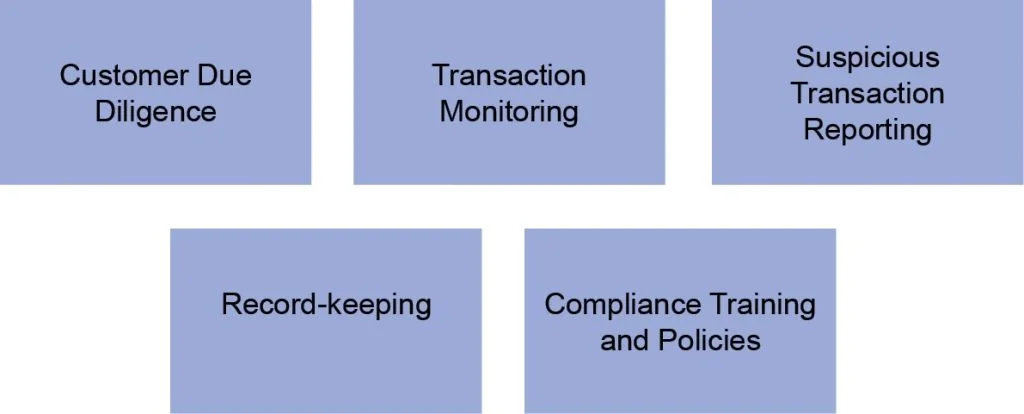
Vast increase in the powers of the CCI – While the requirement of parliamentary approval of any binding directions by the CCI does signal an acknowledgment by the FSLRC that these powers should be exercised sparingly by the CCI; given the absence of any specific guidelines to this effect, the end result could be a vast increase in the CCI’s powers. This could result in significant distortion of the boundaries between sectoral regulators and the CCI, particularly when the Financial Regulators are trying to address distinct structural and/or conduct related issues in the market.

CCI review of policy decisions in the financial services/products market – The CCI is a pan-sectoral regulator with the mandate to promote competition across all markets in India. However, the Draft 2015 Code empowers the CCI to influence policy decisions of the Financial Regulators if it is of the opinion that these decisions cause a Negative Effect in the market. While Financial Regulators focus on correcting specific issues in the markets for financial services/products, the CCI’s intervention could alter the focus of the policy actions in question.

Intervention in proceedings before the CCI – As mentioned earlier, any proceeding under the Competition Act where at least one of the parties is a financial services provider, the Financial Regulator would be entitled to nominate a member or senior official to attend the CCI’s proceedings, albeit as a non-voting participant. Such a nomination mechanism appears to be a reasonable way to lend sectoral expertise to the CCI’s proceedings, but the extent to which the said nominee may participate in the proceedings is not clear. Even without a vote, any active intervention by the nominee could influence the proceedings. This is especially so in cases where a Financial Regulator is a party to the proceeding., This provision may create due process issues that could effect enforcement under the Competition Act since the procedural guidelines on the conduct of nominees during the CCI’s proceedings are pending and unclear.

Competition regulators in other jurisdictions have not been granted similar powers of review and oversight into the financial sector. Whilst the Draft 2015 Code is a positive step towards harmonising various financial norms and regulators, it could blur the line between the mandates of financial and competition regulators. Comprehensive guidelines that delineate the extent of CCI oversight on the market for financial services and products in India, as distinct from its own mandate under the Competition Act could bring welcome clarity. Equally, some clarity on the role and participation of other stakeholders in CCI proceedings is also needed.

Net Neutrality

fiogf49gjkf0d
A lot has been written and spoken about Net Neutrality in the recent
past. We have also seen full page advertisements in our newspapers by
FaceBook exhorting Indians to support Free Basics which is Mark
Zuckerberg’s version of Face Book for the poor. So, what is Net
Neutrality? And what is the big controversy around it that has suddenly
made it the centre of such a roaring debate?

Net neutrality is
the concept of treating the Internet Services as a Public Utility
similar to electricity, water or gas supply.

Net neutrality is
endorsing a view to treat all data on the Internet at par without
discriminating or charging differentially irrespective of user, content,
site, platform, application or instrument

The term “Net
Neutrality” was coined way back in 2003 by Timothy Wu, a professor at
Columbia Law School in his paper “Network Neutrality, Broadband
Discrimination”. The Paper by Tim Wu rooted for neutrality among
applications, data, quality of service and also proposed some sort of
legislation to deal with these issues.

Though this concept was
coined in 2003 and has become part of legislation in many countries
since 2010. In India, the hue and cry began only in December 2014, when
one of the telecom operators announced additional charges for making
voice calls on its network using apps like WhatsApp, Skype, etc.

To
clear the prevailing confusion, in March 2015, TRAI released a
consultation paper on Regulatory Framework for Over-the-Top (OTT)
Services. The consultation paper was heavily criticised in all quarters
for being one sided and not having clarity in many areas.

Let’s
understand what this hue and cry is and how it is affecting content
companies like YouTube, Facebook, Skype etc., Vis network providers,
telecom operators, etc.

Though this concept was discussed all
these years, there was no pressure on either internet service providers
or telecom operators. However, with the advance of YouTube and other
video content companies, load on the network increased tremendously.
Similarly, photos and video on Facebook and other popular social media
sites too became all pervasive and miilions of MBs of content is now
being uploaded every day onto these sites. As a result, the internet
network started feeling the heat of overburden of content over
internet/telecom highway.

Most of the telecom companies argue
that they are investing heavily in internet highway and hence those
using this highway should either pay charges or share their revenue with
telecom/internet companies.

A major factor that has raised this
storm is the fact that social media companies with low investment draw
huge traffic and huge revenue from advertisements, etc., and as compared
to that, telecom/internet companies who invest heavily into
infrastructure and enable all those users to reach particular content
site get hardly anything.

One more factor which led to a dent in
telecom companies’ margins was the heavy fall in the number of sms
messages after evolvement of many free messenger apps. This was further
worsened by voice over internet protocol (VOIP) calls provided by
various apps, which has directly impacted the telecom companies earning
revenues from STD / ISD calls. This stream of revenue has literally
vanished after evolvement of these messenger apps.

Video content
sharing on almost all the social media platforms has put tremendous
pressure on all the carriage providers who are now reluctant to upgrade
their network capacity unless cost for the same shared by such content
companies.

In some quarters, arguments in favour of Net
Neutrality are cracking down as attempt to differentiate content from
network is not able to sail through.

Let’s understand this
problem from another angle. What if concept of Net Neutrality is not
there? Let us assume a life without Net Neutrality. In that scenario,
telecom companies will start charging content companies and will in turn
offer Sponsored Data or Free Data for such content companies over its
network.

Real trouble will start here when those content
companies with very little start up who are not able to share either
cost or revenue with internet/telecom companies will see lesser traffic
as these infrastructure companies will be partial to content companies
sharing cost/revenue as against those who are using their information
highway free of cost.

Recently, we are seeing free Facebook
plans by various telecom companies which are nothing but some type of
similar arrangement wherein telecom companies will be compensated by
content companies.

Now let’s analyse the entire scenario to understand as to who will gain and who will lose from this concept of Net Neutrality.

Presently,
without Net Neutrality, those content companies which don’t have to
share cost or revenue with infrastructure companies (which are heavily
burdened) are benefitted as compared to the infrastructure companies
which have to provide hassle free info highway which in turn pushes them
to invest more and more into towers and related infrastructure without
any corresponding increase in the revenue.

With Net Neutrality,
telecom companies will be further burdened to provide better information
highway which will require them to invest more and this concept won’t
allow telecom companies to enter into any arrangement of sharing cost
with or revenue from content companies for any sponsored data type
packages.

Now in last limb, let us understand how things will
worsen without this concept. In absence of any regulation of internet
highway, most telecom companies will enter into arrangement with content
companies for sponsored data and will not charge end users any fees for
usage of visit to such content companies. E.g., Reliance offering free
internet for Facebook or Airtel offering free internet for Flipkart.

Any
such arrangement will simply push users towards content companies which
are providing free access at the cost of new or low funded start-up
companies which many not be able to share cost or revenue with telecom
companies.

This can lead to a very big negative impact affecting
the whole internet revolution which started with free world wide web.
With all such sponsored data packages, telecom companies and content
companies can drive and decide as to what end user should read, watch or
listen.

To conclude, we can summarize that this subject is not
that easy to tackle. Implementing Net Neutrality can either kill
efficiency of telecom operators or their financial /economic viability.
With regulators and consumer forum just focussing on better quality and
better network and not addressing fallacy in revenue models of telecom
operator will hurt economy in long term.

On the other hand, the
risk of not implementing or regulating Net Neutrality may leave business
in the hands of large content companies and telecom operators, who will
mould, drive and drag users in the way they want. Such laissez faire in
the long term will choke the growth of any small content company whose
financial health cannot allow it to bear the cost or share the revenue
with telecom operators. Without Net Neutrality, users will lose the real
benefit of information technology revolution as they will be at mercy
of partial or biased approach of internet highway operators, i. e.
internet/telecom companies.

The whole world is exploring various
options for striking a balance between the two extremes. Most of the
western or developed countries which have implemented Net Neutrality are
facing tremors as veneer of this concept is cracking in the tussle of
carriage and content.

In long term, government, regulators and
industry bodies will have to come together and work for balance between
Net Neutrality along with reasonable compensation for telecom companies
who will keep pumping money into establishing and improving better and
better information highway. The next few months will prove very
interesting as the debate continues and the haze begins to clear.

WRIT POWER OF THE HIGH COURT IN A COMMERCIAL MATTER

fiogf49gjkf0d
Introduction
Article 226 of the Constitution of India (Constitution) confers a writ jurisdiction on a High Court. This is an extra ordinary jurisdiction and extends to the action of the State or any authority endowed with State authority and empowers the High Court to issue direction to the State and the authorities to act in accordance with those directions. Courts have time again emphasised that this extra ordinary power must be exercised sparingly, cautiously and in exceptional situations only.
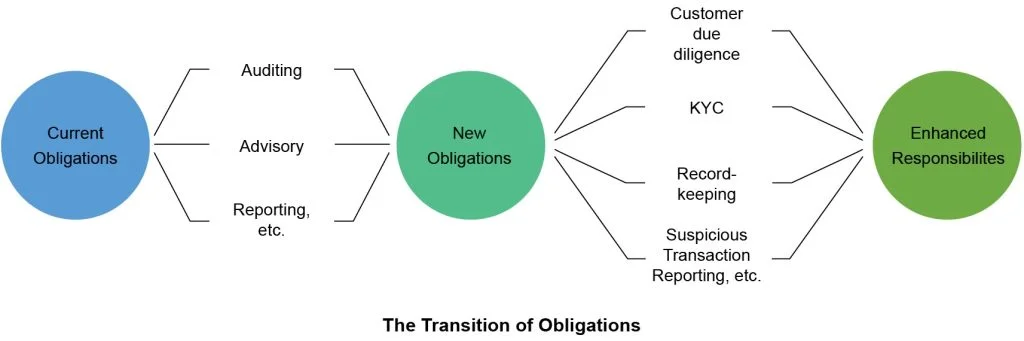
Can a writ jurisdiction be exercised when the State is not acting in an administrative capacity but acting only as a party to a contract i.e in a contractual capacity? The Supreme Court of India (SC) had the occasion to reiterate some of the basic principles governing the subject recently in the case of Joshi Technologies International Inc vs. UOI in the context of section 42 of the Income-tax Act, 1961(the Act).

FACTS IN BRIEF
Joshi Technologies (Petitioner/appellant) had entered into two contracts dated 20.02.1995 with the Union of India, through Ministry of Petroleum and Natural Gas (MoPNG) relating to exploration of certain oil fields. These contracts were on production sharing basis (Production Sharing Contracts,i.e PSC). It started production after entering into the contract and submitted its return of income on the income generated from the aforesaid production. The appellant claimed benefit of section 42 of the Act in the return of income.

Section 42 is a special provision for deductions in the case of business for prospecting, etc. for mineral oil. It provides for certain additional deduction of expenditure as specified in the PSC. It may be noted that such allowances, as stipulated in the section, are to be specifically mentioned in the PSC as well, which is entered into with the Central Government and it is also necessary that such an agreement has been laid on the Table of each House of Parliament.

It may be noted that Article 16 of the Model Production Sharing Contract (MPSC) contained a specific provision, which provided certain financial benefits and deductions in relation to taxes etc. that would be allowed to contractors/developers, as per the requirements of section 42 of the Act. According to the appellant, since no amendments to Article 16 of MPSC had been suggested nor contemplated by the Union of India, it was (and is) the belief and legitimate expectation of the appellant that all the benefits, financial or otherwise, offered in Article 16 of the MPSC to the prospective bidders were duly included in the above two PSCs.

The Assessing Officer (AO) granted deductions u/s. 42 of the Act from the assessment year 2001-02 onwards. However, while making assessment for the Assessment Year 2005-06, the AO observed that there were no such provisions in the PSC/Agreements which were signed between the Central Government and the appellant and in the absence of such stipulation in the agreements, the appellant was not entitled to deductions u/s. 42 of the Act.

It is worth noting that the Union of India signed many PSC’s with the private developers at the relevant period of time and there were 13 PSCs which did not contain the provisions for the deduction as envisaged under Article 16 of MPSC read with section 42 of the Act. A Joint Secretary of the MoPNG vide his communication dated 11.04.2007 wrote to the MoF specifically admitting that in certain PSCs, a reference to section 42 deductions had been omitted by oversight. The MoF was, accordingly, requested to extend the benefits of section 42 to the 13 PSCs (including the appellant’s two PSCs) in line with all other signed PSCs.

Realising that the Agreements did not contain such a provision, the appellant wrote to the MoPNG stating that there was an arrangement agreed to as per the understanding between the two parties to grant deduction as envisaged u/s. 42, non-inclusion thereof was an inadvertent omission in the agreements that were signed.

The MoPNG wrote to Ministry of Finance (MoF) accepting the aforesaid omissions and requested the MoF to give clarification in this behalf. However, no clarification came from the MoF and hence, the AO disallowed the claim for deduction u/s. 42of the Act.

At this stage, the appellant preferred writ petition under Article 226 of the Constitution in the High Court of Delhi.

In this background, the petitioner prayed among other prayers that a writ, order or direction be issued that considering the total facts of the case the petitioner is entitled to the benefit of the said deductions u/s. 42 of the Act, from the date of these Production Sharing Contracts. The prayer did not include a specific prayer to direct the authorities to amend the PSC.

The High Court examined the notice inviting the tender (Bid documents), MPSC and other relevant documents. It noted that, no statement or promise, that advantage u/s. 42 would be available to the successful bidder, was promised or made. It concluded that appellant was fully aware of Clause 16.2 of MPSC which specifically makes reference to benefit u/s. 42 of the Act, but did not advert to and refer to the same in their tender bid and did not ask for this benefit. Therefore, it was not possible to accept the contention of the appellant that benefit u/s. 42 of the Act was inadvertently missed out, or due to an act of oversight, not included in the contract.

The High Court accepted the explanation put forth by the respondents that 13 PSCs formed a different class in as much as their contract was in respect of small oil fields which had already been discovered and, therefore, the risk factor was less. On the other hand, other PSCs were in respect of undiscovered oil fields and for this reason benefit u/s. 42 had been granted to them.

The High Court dismissed the writ petition vide its judgment dated 28.05.2012 holding that the appellant is not entitled to any deductions u/s. 42 of the Act in the absence of stipulations to this effect in the Contracts signed between the parties. The matter went to the SC.

PROCEEDINGS BEFORE SUPREME COURT
One of the submissions of the counsel for the petitioner was that a writ of Mandamus be issued for amending the contract and including the clause for granting the benefit of section 42 of the Act. It was also submitted that when the other contracting parties, namely, MoPNG specifically admitted that this provision was left out inadvertently, the Court should have given a direction for amendment of the Contract and that such a direction can be issued by the High Court in exercise of its powers under Article 226 of the Constitution. In support of his submission the counsel relied on various judicial precedents.

Opposing the said prayer for issue of a writ, the counsel for the respondent submitted that in the realm of contractual relationship between the parties, this plea was inadmissible. He pleaded that PSCs are in the nature of contract agreed to between two independent contracting parties and each of the PSCs are distinct from the other and is not a copy of MPSC. He also pointed out that before signing the PSC, the approval of the Cabinet was obtained, which meant that the PSCs as submitted to the Cabinet, had the approval of one of the contracting parties, i.e. Government of India and when signed by the other party it became a binding contract.

Therefore, the appellant could not claim to be oblivious of the provisions of law or the contents of the contract at the time of signing and was precluded from seeking retrospective amendment as a matter of right when no such right was conferred under the contract. He submitted that the doctrine of fairness and reasonableness applies only in the exercise of statutory or administrative actions of a State and not in the exercise of a contractual obligation and that the issues arising out of contractual matters will have to be decided on the basis of the law of contract and not on the basis of the administrative law. He also relied on the various precedents in support of his submissions.

The SC took note of the Article 32 of the PSC entered into between the parties and observed that Article 32.2 categorically provided that the PSC shall not be amended, modified, varied or supplemented in any respect except by an instrument in writing signed by all the parties, which shall state the date upon which the amendment or modification shall become effective. Thus, even if it is presumed that there was an understanding between the parties before entering into an agreement to the effect that benefit of section 42 shall be extended to the appellant, the understanding vanished into thin air with the execution of the two PSCs. Now, for all intent and purpose, it was only the PSCs signed between the parties, which could be looked into. Thus, unless respondents agreed to amend, modify or vary/supplement the terms of the contract, no right accrued to the appellant in this behalf.

The SC noted that the PSCs in question were governed by the provisions of Article 299 of the Constitution. These were formal contracts made in the exercise of an executive power of the Union (or of a State, as the case may be) and are made on behalf of the President (or by the Governor, as the case may be). Further, these contracts are to be made by such persons and in such a manner as the President or the Governor may direct or authorise. Thus, when a particular contract is entered into, its novation has to be on fulfillment of all procedural requirements.

Whether, in such a case, can the Court issue a Mandamus?

OBSERVATIONS OF THE SUPREME COURT
The Supreme Court among other questions framed the question whether mandamus can be issued by the Court to the parties to amend the contract and incorporate provisions to this effect? In other words, whether the Court has the power to issue a writ of mandamus or direction to the Government?

The Supreme Court observed that in pure contractual matters extraordinary remedy of writ under Article 226 or Article 32 of the Constitution cannot be invoked. However, in a limited sphere, such remedies are available only when the non-Government contracting party is able to demonstrate that it is a public law remedy which such party seeks to invoke, in contradistinction to the private law remedy.

The Supreme Court examined various judicial precedents in this regard and observed that under the following circumstances, ‘normally’, the Court would not exercise such discretion to issue a writ:

a) the Court may not examine the issue unless the action has some public law character attached to it.

(b) Whenever a particular mode of settlement of dispute is provided in the contract, the High Court would refuse to exercise its discretion under Article 226 of the Constitution and relegate the party to the said mode of settlement, particularly when settlement of disputes is to be resorted to through the means of arbitration.

(c) If there are very serious disputed questions of fact which are of complex nature and require oral evidence for their determination.

(d) Money claims per se particularly arising out of contractual obligations are normally not to be entertained except in exceptional circumstances.

The Supreme Court examined various case laws on the subject and legal position emerging from them. The same are summarised as under:

(i) At the stage of entering into a contract, the State acts purely in its executive capacity and is bound by the obligations of fairness. In its executive capacity, even in the contractual field, the state cannot practice discrimination. It has an obligation in law to act fairly, justly and reasonably which is the requirement of Article 14 of the Constitution of India. Therefore, if State or instrumentality of the State has acted in contravention of the above said requirement of Article 14 then a writ court can issue suitable directions to set right the arbitrary actions.
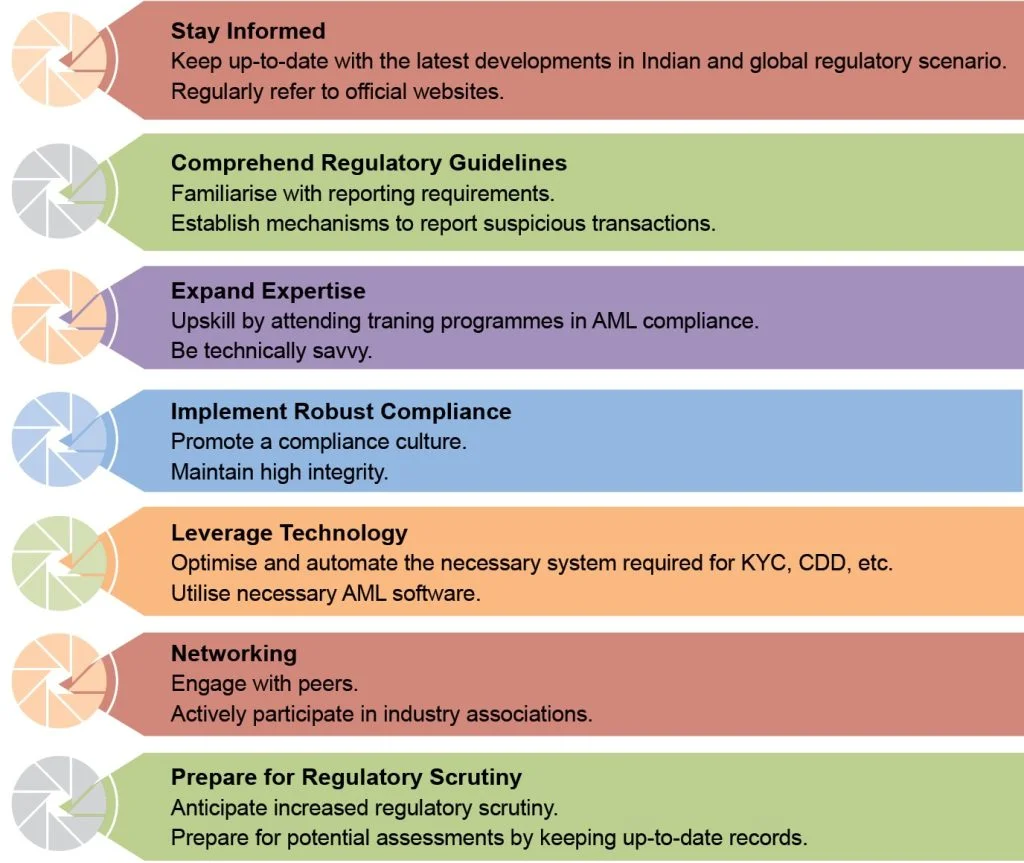
(ii) In cases where question is of choice or consideration of competing claims before entering into the field of contract, facts have to be investigated and found. If those facts are disputed and require assessment of evidence, the correctness of which can only be tested satisfactorily by taking detailed evidence, examination and crossexamination of witnesses, the case could not be decided in proceedings under Article 226 of the Constitution. In such cases court can direct the aggrieved party to resort to alternate remedy of civil suit etc.

(iii) Writ jurisdiction of the High Court under Article 226 cannot be used to avoid voluntarily obligation undertaken. Occurrence of commercial difficulty, inconvenience or hardship in performance of the conditions agreed to in the contract cannot provide justification in not complying with the terms of contract which the parties had accepted with open eyes. Writ petition cannot be maintained in such cases.

(iv) Ordinarily, where a breach of contract is complained of, the party complaining of such breach may sue for specific performance of the contract, if contract is capable of being specifically performed. Otherwise, the party may sue for damages.

(v) Writ can be issued where there is executive action unsupported by law or there is denial of equality before law or equal protection of law or it can be shown that action of the public authorities was without giving any hearing and violation of principles of natural justice after holding that action could not have been taken without observing principles of natural justice.

(vi) If the contract between private party and the State/ instrumentality and/or agency of State is under the realm of a private law and there is no element of public law, writ jurisdiction generally would not survive .In such cases the aggrieved party should invoke the remedies provided under ordinary civil law.

(vii) The distinction between public law and private law element in the contract with State is getting blurred. However, it has not been totally obliterated. Dichotomy between public law and private law, rights and remedies would depend on the factual matrix of each case and the distinction between public law remedies and private law, field cannot be demarcated with precision.

Once on the facts of a particular case, it is found that the nature of the activity or controversy involves public law element, then the matter can be examined by the High Court under Article 226 of the Constitution to see whether action of the State and/or instrumentality or agency of the State is fair, just and equitable or that relevant factors are taken into consideration and irrelevant factors have not gone into the decision making process or that the decision is not arbitrary.

(viii) Failure to consider and give due weight to reasonable or legitimate expectation of a citizen, may render the decision of the state or its instrumentality arbitrary, and this is how the requirements of due consideration of a legitimate expectation be made part of the principle of non-arbitrariness.

(ix) If the rights are purely of private character, no mandamus can be issued. The condition which has to be satisfied for issuance of a writ of mandamus is the public duty. In a matter of private character or purely contractual field, no such public duty element is involved and, thus, mandamus will not lie.

(x) Where an authority appears acting unreasonably, a writ of mandamus can be issued for enforcing it to perform its duty free from arbitrariness or unreasonableness.

(xi) when an authority has to perform a public function or a public duty if there is a failure a writ petition under Article 226 of the Constitution is maintainable.

Keeping in mind the aforesaid principles and after considering the the facts of the case, the SC held that this was not a fit case where the High Court should have exercised discretionary jurisdiction under Article 226 of the Constitution. According to the court, the matter is in the realm of pure contract and it is not a case where any statutory contract is awarded. The SC confirmed the order of the High Court that the appellant is not entitled to benefit of deduction u/s. 42 of the Act.

CONCLUSION
It is clear from the above that the scope of judicial review in respect of disputes falling within the domain of contractual obligations may be limited. The power to issue prerogative writs under Article 226 of the Constitution is plenary in nature and is not limited by any other provisions of the Constitution. The High Court having regard to the facts of the case, has a discretion to entertain or not to entertain a writ petition. The Court has imposed upon itself certain restrictions in the exercise of this power. This plenary right of the High Court to issue a writ will not normally be exercised by the Court to the exclusion of other available remedies unless such action of the State or its instrumentality is arbitrary and unreasonable so as to violate the constitutional mandate of Article 14 or for other valid and legitimate reasons, for which the court thinks it necessary to exercise the said jurisdiction.

The reiteration of the aforesaid principles by the Supreme Court is very important today, especially when the Government is entering into partnership with private parties for various infrastructure projects under PPP model.

It is very clear from the above that the real challenge will lie in demarcating and identifying the line between the public law domain and the private law field, identifying the public duty, public cause. It is impossible to draw the line with precision and lay down in black and white the principles governing such demarcation. The question must be decided in each case with reference to the particular action, the activity in which the State or the instrumentality of the State is engaged when performing the action, the public law or private law character of the action and a host of other relevant circumstances.

DIGITAL TRENDS IN HIGHER EDUCATION

fiogf49gjkf0d
Let me begin by quoting a few statistics from a recently published report of the Ministry of Human Resource Development (HRD).

Gross Enrolment Ratio (GER), which is the ratio of total enrolment in Higher Education in the 18-23 years age group, as a percentage of the eligible population in that age group, has moved up to 23.5 % in 2014-15 from 21.5 % in 2012-13. For men, the ratio is 24.5 % and it is 22.7 % for women.

There were 33.3 million students enrolled in 757 universities in 2014-15, as against 32.3 million enrolled in 723 universities in 2013-14.

While the numbers can become overwhelming, it is easy to see that these statistics augur well for the country. If this trend continues, it is possible for the country to achieve the target of 30 % GER by 2020. The next target would be a GER of around 45 per cent, which is prevalent in most developed countries.

The target may be ambitious, but there are a host of issues, which need to be addressed as well – access, quality, shortage of teachers, outdated curriculum etc. In this maelstrom, will digital technology make a significant impact?

There has been a paradigm shift in the thinking process of the role of digital technology in higher education. Traditionally, it was meant to provide IT infrastructure and support all the process and routine functions. Its role has changed and it is now seen as critical for providing a digital learning experience to students.

“Student-centricity” and “delighting the student” with an amazing learning experience in the lifecycle of higher education are the new mantras of digital solutions and service providers. This fundamentally means that technology is no longer in the foreground and the centre of attention is the “learner”.

With this rapidly shifting landscape, there are three broad trends, which will make a significant impact on higher education:

1. Personalisation
2. Big Data
3. Mobility

PERSONALISATION
The traditional learning methodology was by prescription and adherence. Students were given a prescribed curriculum and had to study within the boundaries of the path laid down by the various subjects to ultimately obtain a degree.

With the use of digital resources, personalisation allows creation of custom pathways for learning. Massachusetts Institute of Technology (MIT) has experimented with breaking its courses down into modules and then enabling students to reassemble the modules into a personalised educational pathway.

It is akin to creating a “playlist” in iTunes.

Before the opening of the iTunes store on April 28, 2003 the only choice for a music lover was to buy an entire CD of songs, even if the music lover wanted to listen to only one song. iTunes allows music lovers to pick and choose songs from various albums, to create a personalised playlist. Within a decade of its launch, Apple had announced that more than 25 billion songs were downloaded and by now, probably, more than 50 billion songs have been downloaded. This is a staggering number and has truly shaken up the music industry, giving consumers a unique listening experience. One of the clear indications of this churn is the recent press report suggesting that the iconic music store of Mumbai, “Rhythm House” will shut down soon.

Like a playlist, why can’t a student formulate a customised, multi-institutional pathway to a degree? Can a student do one subject from H.R. College, another from N.M. College and a third from St. Xaviers’ College? Or, can a student do one subject from Mumbai University, another from Delhi University and a third from Bengaluru University? And, eventually, can a student do multiple subjects from universities across the world?

Traditionally, the learning process and the eventual conferring of a degree happened in a single institution. But now, with all the digital possibilities, students should have the ability to aggregate and disaggregate subjects and courses. And more importantly, they should be able to control the pace of learning by accelerating or decelerating, depending on their individual requirements. When all of this coalesces, a student will have complete “personalisation” of his learning path to a degree.

BIG DATA
Big Data is large volume of data, structured and unstructured, which is difficult to process using traditional databases and software. A lot of IT investment in the corporate sector is going into Big Data computing, which reveals patterns, trends and associations.

There is an enormous amount of data, which gets generated in higher education institutions and the time is ripe to use Big Data techniques to mine this information and come up with meaningful patterns and trends.

Big Data can create customised reports for all the stakeholders in higher education – personalised assistance to students, dashboards to the teachers on the learning paths, reports to the heads of institutions and compliance charts to the regulators. The broad institutional goals and targets can be measured and analysed periodically. Importantly, analytics of a student’s learning path can enable intervention at an early stage.

Big Data can do the unthinkable – homework assignments that learn from students; courses tailored to fit individual students and textbooks that talk back. This is beyond online courses and MOOCs that are currently on offer. We are now looking at the education landscape of tomorrow, powered by Big Data.

A seminal work on the power of Big Data is a book written by Viktor Mayer-Schonberger and Kenneth Cukier, titled “Learning with Big Data – The Future of Education”. The authors have articulated how the ever-increasing amounts of data and its analysis will have an influence on the conduct of higher education. They have also stated how the fascinating changes are happening in measuring students’ progress and how data can be used to improve education for everyone, in real time, both online and offline.

MOBILITY
The mobile phone is now a ubiquitous device. It is with everyone and everywhere, doing multiple tasks from listening to songs to taking pictures. Talking on phone is only one of its myriad functions, and certainly not the main one.

In India, the number of mobile phone subscribers has crossed 1 billion, making it only the second country after China to have achieved this landmark. The launch of cheaper smartphones, low call rates and intense competition has accelerated the pace of growth. Interestingly, the number of smartphones has crossed 170 million and is growing at 26 per cent CAGR.

Technology, which immerses the mobile phone as its centerpiece, will become a key piece of technology in learning and teaching. Mobile technology gives unprecedented freedom to students and teachers from the constraints of the IT campus of the Institution. Now learning can happen beyond the precincts of the institution at a time and pace convenient to the learner.

There is an enormous amount of online content now available on the Internet. A teacher can make available a properly curated content to a learner and then measure and track progress. Similarly, the learner can supplement or even substitute his classroom learning, collaborate with other learners and communicate with the teacher – all of this without the constraint of time and place – on his mobile phone.

With the advent of 4G and deeper penetration of smartphones, mobile based learning is likely to make a big impact on higher education. Starting with a blended model, it will eventually keep increasing its sphere of impact and influence.

An interesting case study on the application of digital technology to higher education is the launch of the Minerva Project by Ben Nelson. Minerva Project (www. minerva.kgi.edu) is a for-profit company founded by Ben Nelson, whose goal is to provide Ivy League education at a faction of the price. The tuition fee at Minerva for an undergraduate course (called “graduate” course in India) is USD 10,000, which is a fourth of the tuition fees at Ivy League Institutions like Harvard and Columbia.

In this four-year course, the first year is at San Francisco, followed by the other years in seven cities across the world. There is no physical campus for learning. Each class has less than 20 students and lessons are delivered online in an interactive manner and are recorded. All students are visible onscreen. Professors are prohibited from droning for more than 5 minutes. Students are evaluated not only on how they participate, but also how effectively they think. There are no exams.

Ben Nelson has proclaimed, “We are building a perfect university. That’s our goal” .

Digital trends have made a huge impact on the corporate world. Sectors like banking have embraced the digital medium like a “fish takes to water”. In contrast, the education sector has been a laggard, particularly higher education. With the rapid pace of change, it is an opportune time for higher education to leapfrog its adoption and make a significant impact on the learning process and the learner.

CALCULATING TURNOVER – CHALLENGES & AMBIGUITIES

fiogf49gjkf0d
Introduction
Accountants are often the most trusted advisers of businesses. It is therefore essential that accountants also understand when key disclosures need to be made to regulators. Among other things, the Competition Act, 2002 (‘the Competition Act’), regulates merger and acquisitions (combinations) of large enterprises. Combinations that satisfy the relevant asset/turnover thresholds prescribed in Section 5 of the Competition Act require mandatory prior notification to, and approval from, the Competition Commission of India (‘CCI’). While the Act provides a relatively detailed guidance on calculating the value of assets, the definition of ‘turnover’ is very wide. ‘Turnover’ is defined to include the value of sale of goods or services, excluding indirect taxes1. Beyond this skeletal definition, there is no other statutory guidance parties can rely on. To ensure compliance with the law, accountants should remain vigilant and work with lawyers to determine when notification to the CCI is required.

Importance of turnover
Turnover calculation is critical from a merger control perspective as the very requirement to notify a transaction often hinges on the turnover of the parties involved. Transactions where the parties fail to meet the asset and turnover thresholds under Section 5 of the Competition Act need not be notified. Further, to assess whether a transaction qualifies for the exemption under the Government of India notification S.O. 482(E) dated March 4, 2011 (‘Target Based Exemption’), parties need to assess if the target’s turnover in India is below INR 750 crores (or if target’s assets in India are below INR 250 crores). Computation of turnover by the parties will guide their decision on whether to notify transaction or not. Absent clarity on how to actually compute turnover for the purposes of the Act, businesses and their advisors face substantial uncertainty while deciding whether a transaction requires notifying to the CCI or not. Given the potentially substantial penalties that may be attracted for not notifying a transaction to the CCI, businesses and their advisors require clarity on how to calculate turnover so they can make the decision to notify or not notify with reasonable confidence.

The implications of getting it wrong are significant. A combination is void until it is cleared by the CCI as not being likely to cause an appreciable adverse effect on competition in India. In addition, substantial penalties of up to 1% of the turnover of the combination apply for failing to give the CCI notice of a notifiable combination.

Issues in turnover calculation

Here we examine 2 (two) questions which often surface in calculation of turnover while determining whether a transaction needs to be notified to CCI:

How to calculate turnover of enterprises which generate their revenue from commissions (i.e. enterprises which receive a gross amount which they subsequently transfer to another enterprise while retaining a percentage as their commission)? – It is possible that considering only the commissions earned while calculating turnover could lead to a decision not to notify a transaction to CCI whereas a turnover calculation based on gross receipts would require that a notification be made.

What constitutes turnover ‘in India’ for the purposes of the Competition Act? – Determining turnover ‘in India’ of an enterprise is crucial as both the turnover thresholds under Section 5 of the Competition Act as well as the de minimis thresholds under the Target Based Exemption have an India nexus requirement (i.e. a certain amount of turnover should be ‘in India’). Despite the critical importance of determining the residency of an enterprise’s turnover, when it comes to determining what constitutes turnover ‘in India’, there are no statutory guidelines at all.

Calculation of turnover for enterprises which generate their revenue from commissions
To determine the turnover of an enterprise, in practice, in most cases, the CCI looks at the audited books of accounts of an enterprise. However, in certain cases a simple reading of the books of accounts does not suffice and the CCI can and, in some cases, has gone beyond the books of accounts to determine the turnover.

In Fair Bridge/Thomas Cook2 , the CCI refused to consider the turnover figures for Thomas Cook (India) Limited (‘Thomas Cook’), as reflected in its books of accounts, as the ‘turnover’ for the purposes of the Competition Act. Considering the nature of Thomas Cook’s package tour operating business wherein Thomas Cook charges a consolidated amount for a packaged tour (which includes transportation, boarding, lodging, sightseeing and similar services). The CCI held that Thomas Cook’s turnover would include the gross amount charged to customers and not merely the commissions earned. In interpreting turnover to include gross receipts instead of commissions, the CCI relied on mainly two grounds – (i) Lack of a principal-agent relationship between Thomas Cook and the vendors who actually provided the lodging, boarding, sightseeing and similar services; and (ii) Provisions in Accounting Standards and Guidance Notes issued by the Institute of Chartered Accounts of India (‘ICAI’) as well as internationally accepted accounting practices followed by leading tour operators worldwide.

While Fairbridge/Thomas Cook decision does clarify the CCI’s stance on turnover calculation to a certain extent, the situation is still not completely clear. The CCI has considered commissions and not gross receipts to be the correct measurement of turnover of an enterprise acting as an agent for another entity, which is in line with the Indian Accounting Standards issued by the ICAI3. However, can this be interpreted to mean that in all situations where there is no principal-agent relationship, gross receipts are the correct measure of revenue? The answer is far from clear.

Thus, it appears that a mere lack of a principal-agent relationship need not necessarily imply taking the gross amounts which flow through an intermediary (such as an online retailer) as the turnover for the purposes of the Competition Act. However, absent any statutory clarification or definitive decisional observations by the CCI, calculation of turnover continues to remain an area of interpretive ambiguity.

We would suggest that accountants work closely with lawyers to determine whether the CCI is likely to treat commissions or gross receipts as the relevant turnover as the measure of revenue.

What constitutes turnover ‘in India’?
There are no statutory guidelines on determining what constitutes turnover ‘in India’. Calculating turnover ‘in India’ for an enterprise is crucial as: (i) parties involved in a transaction need to satisfy the asset/turnover thresholds u/s. 5 of the Competition Act to be considered ‘combinations’ and these thresholds have an India-nexus requirement, i.e. a certain amount of assets/turnover must be ‘in India’; and (ii) the applicability of the Target Based Exemption depends upon the target’s turnover ‘in India’.

Two issues which arise in determining an enterprise’s turnover ‘in India’ are: (i) whether the value of sales in the Indian market by a foreign company (i.e. a company not incorporated in India) cwonstitute turnover in India; and (ii) whether sales in non-Indian markets by Indian companies (i.e. companies incorporated in India) constitute turnover in India.

From the CCI’s decisional practice the following also constitute turnover in India:

  • revenue from sales in the Indian market by a foreign enterprise; and
  • revenue from export sales by an Indian enterprise.

Again, it is not always clear what the CCI would consider constitutes turnover ‘in India’.

Conclusion
While
the CCI is continually clarifying the rules, ambiguities in calculating the
turnover for certain enterprises which work on a commission based business
model remain. Further uncertainty also exists when it comes to determining what
constitutes turnover ‘in India’. Given these ambiguities, it is important that
accountants and lawyers use each others’ expertise to ensure that compliance
with the law is achieved.

Territorial Jurisdiction – Infringement of Copyright and/or Trademark

fiogf49gjkf0d
Introduction
A question that arises in almost every matter
pertaining to violation of intellectual property rights is – Which Court
would have the necessary territorial jurisdiction to try, entertain and
dispose of the present proceedings? By this article, an endeavour shall
be made to explain which Court/Courts would have territorial
jurisdiction in respect of matters of infringement of copyright and/or
trademark.

The determination of territorial jurisdiction of a
civil court is governed by the Code of Civil Procedure,1908(“CPC”)1
Section 20 of the CPC which would be the relevant Section with respect
to cases of infringement of copyright and/or trademark provides that a
Suit may be filed, inter alia, either where the Defendant actually and
voluntarily resides or carries on business or works for gain or where
the cause of action arises wholly or in part. An explanation appended to
the said Section provides that a Corporation is deemed to carry on
business at its sole or principal office in India or at a place, where
in respect of any cause of action arising at such place it has a
subordinate office.

Hence, under these provisions, a Plaintiff
would be obliged to travel to where the Defendant actually and
voluntarily resides or carries on business or works for gain or where
the cause of action has arisen, wholly or in part. To illustrate this
point, consider a a case where an owner of copyright in a musical work
resides in Delhi, however, his musical work is being infringed by a
Defendant in Chennai by causing unauthorised communication thereof in a
bar in Chennai itself and nowhere else. In such a case, the Plaintiff
copyright owner would be constrained to travel to Chennai to file a
proceeding to restrain the acts of infringement of copyright since both
the Defendant is residing in Chennai as also the cause of action has
arisen in Chennai. Such acts of infringement often take place in remoter
parts of the country, making it even more cumbersome for a Plaintiff to
travel to every nook and corner of the country to protect his
intellectual property rights.

These difficulties were noted by
the Joint Committee that was constituted prior to the passing of the
Copyright Act, 1957 (“CA”) in as much as it was observed that many
authors are deterred from instituting infringement proceedings because
the court in which the proceedings are to be instituted are at a
considerable distance from the place of their ordinary residence. The
Joint Committee recommended that such impediments should be removed and
the proceedings should be allowed to be instituted in the local court
where the person instituting the proceedings ordinarily resides, carries
on business etc2.

Hence, it was in this background that an
additional forum was provided for by Legislature in section 62 of the CA
to enable authors to file a suit for infringement of copyright where
they reside or they carry on business or work for gain3. Subsequently,
section 134 was also brought into effect in the Trade Marks Act, 1999
(“TMA”) to provide an additional forum even in case of infringement of
trademark at a place where the Plaintiff resides or carries on business
or works for gain.

It is the scope and purview of both these
provisions that is sought to be explained and commented upon in this
Article. In fact, the Supreme Court has in a recent judgment dated 1st
July, 2015 in the case of IPRS vs. Sanjay Dalia4 dealt extensively with
the ambit and scope of the said provisions. My effort shall be to
explain the ratio decidendi of the Apex Court and thereafter highlight
certain issues which may still need to answered by the Hon’ble Courts to
afford complete clarity on these provisions.

STATUTORY PROVISIONS
Before
adverting to the aforesaid decision of the Apex Court in the case of
IPRS vs. Sanjay Dalia5, it would be helpful to consider the actual text
of the relevant provisions which provide, inter alia, as under :-

CA
“Section
62. Jurisdiction of court over matters arising under this Chapter. —
(1) Every suit or other civil proceeding arising under this Chapter in
respect of the infringement of copyright in any work or the infringement
of any other right conferred by this Act shall be instituted in the
district court having jurisdiction.

(2) For the purpose of sub-section (1), a “district court having jurisdiction” shall,
notwithstanding anything contained in the Code of Civil Procedure, 1908
(5 of 1908), or any other law for the time being in force, include a
district court within the local limits of whose jurisdiction, at the
time of the institution of the suit or other proceeding, the person
instituting the suit or other proceeding or, where there are more than
one such persons, any of them actually and voluntarily resides or
carries on business or personally works for gain.”

TMA
“134. Suit for infringement, etc., to be instituted before District Court. —
(1) No suit– (a) for the infringement of a registered trade mark; or
(b) relating to any right in a registered trade mark; or (c) for passing
off arising out of the use by the defendant of any trade mark which is
identical with or deceptively similar to the plaintiff’s trade mark,
whether registered or unregistered, shall be instituted in any court
inferior to a District Court having jurisdiction to try the suit.

(2) For the purpose of cls. (a) and (b) of sub-section (1), a “District Court having jurisdiction” shall,
notwithstanding anything contained in the Code of Civil Procedure, 1908
(5 of 1908) or any other law for the time being in force, include a
District Court within the local limits of whose jurisdiction, at the
time of the institution of the suit or other proceeding, the person
instituting the suit or proceeding, or, where there are more than one
such persons any of them, actually and voluntarily resides or carries on
business or personally works for gain…”

It may be noted
that though the current TMA contains Section 134 which provides an
additional forum to a Plaintiff, the earlier Trade and Merchandise Marks
Act, 1958 contained no such provision. Under the Trade and Merchandise
Marks Act, 1958, a Plaintiff was constrained to follow the Defendant
and/or the cause of action for vindication of his rights as u/s. 20 of
the CPC. This position has, however, now changed u/s. 134 of the TMA. A
bare perusal of both section 62(2) of the CA and section 134(2) of the
TMA which are pari materia6 in nature would show that they make a
significant departure from the provisions of the CPC and provide for the
existence of an additional forum in a Suit relating to infringement of
copyright and/or trademark, before a Court, where the Plaintiff actually
and voluntarily resides or carries on business or works for gain.

Both section 62(2) of the CA and section 134(2) of the TMA are additional forums and do not take away or abridge the right of a Plaintiff, if he so chooses to follow the Defendant and/or the cause of action u/s. 20 of the CPC. Hence, a Plaintiff in a suit for infringement of copyright and/or trademark would be entitled to approach the appropriate Court either u/s. 20 of the CPC or u/s. 62(2) of the CA or u/s. 134(2) of the TMA, as the case may be. It is possible, in a given case, that the appropriate Court could be the same Court whether section 20 of CPC is applied or the provisions of the CA or TMA are applied. An illustration would be that, take a case where an owner of copyright in a musical work resides in Delhi. The Defendant is also residing in Delhi and is infringing the musical work by causing unauthorised communication thereof in a bar in Delhi itself and nowhere else. In such a case, the Courts at Delhi would have the necessary territorial jurisdiction to entertain such a Suit for infringement of copyright since firstly, as u/s. 62 of CA, the Plaintiff resides in Delhi. Secondly, u/s. 20 of CPC, the Defendant also resides in Delhi and thirdly, even the cause of action is arising in Delhi. Hence, in such a case, it would only be the Courts at Delhi which would have the necessary territorial jurisdiction.

The question however, is of cases where only section 62 of the CA and/or section 134 of the TMA are invoked as conferring territorial jurisdiction on the Court.

    IPRS VS. SANJAY DALIA7

The Apex Court was dealing with two appeals from the Delhi High Court in this case. In the first Appeal, the facts were that the the Plaintiff was carrying on business through a Branch Office situate at Delhi and it was on this basis that the territorial jurisdiction of the Delhi High Court had been invoked. In the second Appeal, also the territorial jurisdiction of the Delhi High Court was invoked on the basis that the Plaintiff had a branch office at Delhi. In both these matters, the admitted position was that the registered office of the Plaintiffs was not in Delhi nor had any cause of action arisen in Delhi at the time of filing the suits but only the Branch Offices were in Delhi. Proceedings had been filed on the basis, as a suit could be filed wherever the Plaintiff was carrying on business and since these Plaintiffs had a branch office in Delhi, they must be deemed to carry on business in Delhi thereby, rendering the Delhi High Court as the Court having the necessary territorial jurisdiction. Objections were however, raised by the Defendants to the territorial jurisdiction of the Delhi High Court, on the basis that in both these matters the Plaintiff had a registered office in Bombay where the cause of action had also arisen and hence, it should be the Courts at Bombay which would have the necessary territorial jurisdiction. A Division Bench of the Delhi High Court upheld the objection of the Defendant in the first matter whilst in the second matter, the Division Bench of the Delhi High Court, allowed an amendment to be made to the Plaint to add averments to the effect that the infringing magazines were being circulated in Delhi as well thereby showing that cause of action had arisen in Delhi, and on this basis rejected the plea of the Defendant of lack of territorial jurisdiction. It was against these two Orders of the Delhi High Court, that appeals were preferred before the Apex Court.

The Supreme Court was thus called upon to answer whether in light of section 62 of CA and section 134 of TMA could a Plaintiff Corporation file a Suit anywhere it chose to, based on the existence of a branch office or must the Plaintiff Corporation be constrained to file proceedings at a place where either its registered office is situated or at a place where it has a branch office and where the cause of action has also arisen akin to the Explanation to section 20 of the CPC. The Explanation to section 20 of the CPC as mentioned earlier provides that a Corporation is deemed to carry on business at its sole or principal office in India or at a place, where in respect of any cause of action arising at such place it has a subordinate office.

The Supreme Court after considering the legislative history and the purpose for which the provisions had been brought onto the statute book observed that if the provisions are not interpreted purposively, as is being suggested by the Supreme Court, it could lead to abuse of the provisions, in as much as the Plaintiff will institute a suit in a wholly unconnected jurisdiction based solely on the existence of a branch office. The Supreme Court illustrated the possible abuse and observed, inter alia, that “There may be a case where plaintiff is carrying on the business at Mumbai and cause of action has

arisen in Mumbai. Plaintiff is having branch offices at Kanyakumari and also at Port Blair, if interpretation suggested by appellants is acceptable, mischief may be caused by such plaintiff to drag a defendant to Port Blair or Kanyakumari. The provisions cannot be interpreted in the said manner devoid of the object of the Act.” It has also been observed that such a counter mischief to the defendant was unforeseen by Parliament and it is the court’s duty to mitigate the counter mischief.

Hence, the Supreme Court has held that the additional right to institute a suit at a place where the Plaintiff resides or carries on business has to be read subject to certain restrictions, such as in case plaintiff is residing or carrying on business at a particular place/having its head office and at such place cause of action has also arisen wholly or in part, plaintiff cannot ignore such a place under the guise that he is carrying on business at other far flung places also. The very intendment of the insertion of provisions in the CA and TMA is the convenience of the plaintiff. The interpretation of provisions has to be such which prevents the mischief of causing inconvenience to parties. The Supreme Court whilst interpreting these provisions was also of the view that the issue raised before it had not been raised in any of the earlier cases cited before it

It was in light of these findings that the Supreme Court was pleased to dismiss both the appeals by holding that the provisions of section 62 of the CA and section 134 of the TMA have to be interpreted in the purposive manner. There is no doubt about it that a suit can be filed by the plaintiff at a place where he is residing or carrying on business or personally works for gain. He need not travel to file a suit to a place where defendant is residing or cause of action wholly or in part arises. However, if the plaintiff is residing or carrying on business etc. at a place where cause of action, wholly or in part, has also arisen, he has to file a suit at that place.

Whilst this judgment, brings much required clarity to the issue as to the interpretation of these provisions of the CA and TMA, in my opinion, these findings of the Supreme Court amount to introducing an Explanation or a Sub-section (3) to both section 62 of the CA and section 134 of the TMA, which explanation or sub-section had not been provided even by the Legislature whilst passing the said statutes.

The effect of this judgment would be to limit the scope and effect of these provisions. Plaintiffs would now be obliged to file proceedings in accordance with these principles laid down by the Apex Court. The effect of this judgment will, in fact, be felt in several pending proceedings, which proceedings may have been initiated prior to this judgment at a place where the Plaintiff had only a branch office but no cause of action, based on the bare language of these provisions. Already in several proceedings in different High Courts, to my knowledge, applications have been moved for rejection/return of plaint on account of lack of territorial jurisdiction of that Court based on this judgment.

    CONCLUSION

Even though this judgment does bring forth a fair amount of clarity on the issue of territorial jurisdiction in cases of infringement of copyright and/or trademark, in my opinion, certain important issues still remain to be answered in connection with the interpretation of these provisions.

To illustrate an issue which still needs to be addressed and has not been conclusively determined by the Supreme Court, consider a situation, where the Plaintiff is having a branch office in Delhi and the cause of action has also arisen there whilst its registered office is at Bombay. In such a case, can it be said that the Plaintiff is precluded from approaching the Courts at Bombay and must only file his case in the Courts at Delhi or is it still his option to choose the forum of his convenience between these two forums.

It may be noted that the Supreme Court in the IPRS judgment, was dealing with two cases where factually this position did not arise and in both cases, jurisdiction had been invoked only on the existence of a branch office and not on the basis of a combination of branch office plus cause of action. It is trite law that a decision is an authority for what it actually decides8 and hence, considering the nature of the facts involved, it would be difficult to assert that this issue has been conclusively adjudicated upon.

In my opinion, however, in the IPRS case itself, the Supreme Court had referred to its earlier judgment in Patel Roadways vs. Prasad Trading Co.9 wherein the Court whilst explaining the provisions of Section 20 of the CPC had observed, inter alia, that “The clear intendment of the Explanation, however, is that, where the corporation has a subordinate office in the place where the cause of action arises, it cannot be heard to say that it cannot be sued there because it does not carry on business at that place.”

Thus, from the perspective of the convenience of the Defendant and not the Plaintiff, the Supreme Court has already opined that it is the location of the subordinate office, within the local limits of which a cause of action arises, which is to be the relevant place for the filing of a suit and not the principal place of business.

On an analogy of this principle of convenience of parties as explained by the Supreme Court, in my opinion, it could be urged that a Plaintiff corporation which has a subordinate office in the place where the cause of action arises, ought not to be heard to say that it will not sue there since it would like to sue at a place where it has its registered office. The obvious convenience involved of both parties would have to be considered as has been explained by the Supreme Court. Considering that the Plaintiff has a branch office at that place he can hardly be heard to complain that the place is not convenient and also from the perspective of the Defendant, considering cause of action is arising at that place, it would mean that the Defendant and/or its products and/or services are to be found at that place thereby indicating that such a place would be convenient to the Defendant also. Hence, on the basis of convenience of both parties, it ought to be held that it is only the Court where the cause of action has arisen and where the Plaintiff also has a branch office which is the Court having the necessary territorial jurisdiction.

Another issue which has remained unanswered is the effect of this judgment on the Chartered High Courts i.e. the High Courts of Bombay, Calcutta and Chennai. As explained herein above, the Supreme Court has in a sense incorporated the Explanation to section 20 of CPC into the provisions of the CA and the TMA, however, by virtue of section 120 of CPC, section 20 of CPC itself does not apply to the Chartered High Courts. The territorial jurisdiction of the Chartered High Courts is governed by their respective Letters Patent and not by section 20 of CPC10. Hence, in such a situation can it be said that this interpretation would apply to these Chartered High Courts or would these Courts be able to exercise a more unrestricted jurisdiction than the other High Courts.

Whilst in my opinion, the judgment in IPRS does leave door ajar for several new issues to be resolved upon to bring forth complete clarity on the subject, the judgment is an important step forward towards interpreting and laying down the contours of the territorial jurisdiction of a Court in respect of proceedings initiated u/s. 62 of the CA or section 134 of the TMA.

Aligning Human Capital for sustained growth of Professional Service Firms

fiogf49gjkf0d
One of the least focused functional aspects of
running a professional service firm (“PSF”) is human resources. We call
it human capital within PSF’s. This includes the Partners, the
Principals or Directors, the Senior Managers, the Managers going on to
the associates and interns. This also includes the admin and other
non-billing staff in the PSF.

The challenge has always been to
recognise that PSF’s can grow well and scale up enough only and only if
the human capital is in alignment. This recognition comes to most firms
very late in their life span; sometimes so late that not enough course
corrections can be made. Most good firms that have succeeded and grown
over decades have done a remarkably great job at aligning their human
capital.

It is therefore, required of PSF leaders to understand the dynamics of human capital early in the growth curve of the PSF.

This picture outlines the various stakeholders that draw on an individual’s time:

Let
us analyse the dynamics of human capital engagement for each of the
stakeholders, starting with the PSF’s internal team members – i.e., the
individual himself: 1. The self: Internal teams are the most critical
asset of any PSF. It is all about managing the human capital responsibly
and effectively.

A few questions to ask and examine of each individual team member are:

Who is this professional?
How did he come into being in to our firm?
What are his aspirations?
What
drives him? Is there a conflict in his thought process, his goals and
career aspirations? Will he be a Partner in the firm in a few years? Is
he a good mentor and a team player? Is he a good fit for the firm
currently?

The above are some of the hard questions that a PSF
needs to answer. If the responses to some of the above are not very
encouraging for the firm, then it is clear that the human capital is not
optimally aligned and PSFs have a lot of work to do to bring about an
alignment. The individual within the internal team needs to be
understood, mentored, coached and encouraged to give his or best. His
working style is irrelevant, beyond a point. His weaknesses can be
corrected to a point; but the focus of the PSF should be to “make his
strengths productive” to the firm. It is far more effective to recognise
an individual’s strengths and make it work for him, his team and the
firm, as opposed to trying to constantly correct his weaknesses. Peter
Drucker exhorted this proposition and articulated that people work best
when their strengths are aligned to the needs of the firm. The challenge
for a Partner in the PSF to identify the strengths of his internal team
members and make this happen.

The professional – an individual within a PSF:
It
is incumbent upon the professional to be the best that he can be in the
environs of a PSF. For that to happen, the professional has to learn to
“Manage himself”. Managing oneself is a very critical aspect of
effectiveness and alignment. Unless a professional learns to manage
himself, the team dynamics and client delivery is never going to be
optimum. Managing oneself is all about knowing thy time, assigning
priorities and taking responsibilities for action. A professional is a
manager, akin to an executive in a business, who is required to make
effective decisions, conform to an execution framework, focus on
priorities, have a growth orientation, think with a solution mindset and
multitask between production and management.

The individual has
to have a strong sense of affinity to the society, his family, his
friends, his work colleagues and his clients. It is these interpersonal
relationships and their dynamics, which largely influence the way the
individual conducts himself. Thus, managing oneself is a starting step
in aligning human capital.

2. Teams
Individuals in
PSF’s need to be effective in teams, this would mean being collaborative
in teams, sharing knowledge with the team members, generating a spirit
of camaraderie and sportsmanship and having a congenial disposition on a
day-to-day basis.

Teams get most influenced by team dynamics.
E.g.: If the senior most member in the team cannot set the tone, he will
quickly lose respect. Similarly, someone who is technically brilliant
as a professional will still not be the favourite of the team if he does
not learn to be a go-getter and a real team player. Being technically
brilliant does not mean that they should be intellectually arrogant. In
fact, if these technically brilliant people are also respectful to their
peers and have an intrinsic habit of sharing their knowledge and
expertise, it will go a long way in creating successful future leaders
in their respective firms.

Sharing of ones’ knowledge is
critical to have the team come up to terms with the thought process of
the team leader. This, in other words, assumes that over a period of
time, each professional in the team will get upgraded to a level of
knowledge which will help them converse with their senior team members
and their clients with equal ease. It is also imperative on the team
members themselves to have a constant quest for learning and upgrading
themselves. And, in that they have somebody to look up to in terms of
the team leader, the technically superior member amongst them, who’s
depth of knowledge is a vital resource for the firm to access. The
question then is – Is the congeniality quotient in the team at a level
that permits such free and fair exchange of knowledge? To be in
alignment, PSF’s have to get this rolling, ensure that teams work in a
spirit of sharing and caring, have tremendous respect and affinity to
each and other and for their firm, and truly care for the growth of the
firm and their peers within the firm.

3. Clients
Professionals
have their foremost duty to solving client’s problems and servicing
client efficiency. PSF’s have to create an environment and pursue a
culture where professional respect each and every client and clients
feel that the teams are responsive to their problems and challenges on a
continuous and sustained basis. This needs hard selling of the concept
of “client comes first”.

As the great Mahatma Gandhi eloquently
put it “We exist because of our clients”; “The customer is not an
interruption of our work; he’s the purpose of it”.

Professionals
have to have a mindset of solving problems and challenges of clients.
To be in a continuous frame of mind of being a solution provider needs
reiteration of this tenet and at a deeper level “a connect” with the
client. The Partner concerned does not really have to sell his
expertise; all he needs to do is to engage into a conversation with the
client and understand the client.

This includes the following:
If
you want to win a client’s confidence, give him the chance to talk to
you, person to person, about his needs and his expectations. Make it
easy and comfortable for the clients to share his secrets. In short, if
you really want the client’s business, talk to the client and have a
conversation, make him feel that you are using normal language and not
“corporate speak”. Both parties should engage into a conversation, it
cannot be a monologue.

It’s about a mindset of joint problem
solving, not about trying to win or prevail. Finally, its about allowing
people with different views to learn from each other.

If teams
can achieve this dynamic with their clients and if they work hard at
doing this consistently, the PSF would have created and aligned its
human to create a winning client base.

4. Market

Partners and managers and everybody in between, have to be focused on the markets.

    Where is the profession heading?

    Would our services be relevant, three years from now and seven years from now?

    What do we need to do today to continuously adapt to the marketplace?

    Is there a better way of doing what we do?

What are the trends in the market place that the professional can see and that helps him to think about generating more opportunities for his firm?

What can he do about it? In capital markets, they say that the market is a great leveler; one can extend this to professional service market and say that the market is very discerning and will choose the most appropriate service player for its requirements.

Often, what is perceived is the truth. E.g.: If a lawyer provides very high-end technical solutions, he is perceived to be an expert with a very busy schedule with very little time to spend. This preconception comes because of a perception. Perceptions take long to create but can dissipate very quickly. Thus, a PSF should make sure that what Partners say and do is relevant to his chosen segment of clients and stays that way on a continuous basis. A PSF would than be omnipresent in the Market and would be aligned for faster growth.

    Regulators

Professionals have to be trained to deal with the entire regulatory ecosystem. We have in our day-to-day existence, a need to deal with various set of regulators, authorities, governmental agencies and the likes. This would include the regulator of the profession; Example: the Bar Council for the Lawyers, The Institute of Chartered Accountants for the Accountants etc. This would also include the revenue authorities, the courts, the justice delivery system, the administration in the state and all departments thereto.

The Chambers and associations, who influence policy making, the public representatives who make the laws, and a wide gamut of people who form the servicing (internal) team of these constituents also deal with Regulators constantly. And professionals need to learn to deal with the Chambers and Associations too.

Professionals need to have skill-sets to deal with them differently, as these are not clients. Some of these are watchdogs, some of them are policy makers and the others are policy implementers. The most successful firms have aligned their human capital to a point where a group of professional within the firm deals with each one of them effectively. This needs lots of training and high quality communication skills that work with bureaucrats and a deep understanding of policy formation.

The best firms thrive in such an ecosystem by having specific people earmarked to deal with this breed – the Regulators.

    Peers

PSF’s constantly have a cliental pressure to benchmark themselves with their peers; especially when it comes to the relative size of the firm, the size of the team, the infrastructure, the quality of the delivery, the timeliness and responsiveness and the professional fees/compensation for the engagements.

In this context, the most compared resource is the quality of human capital. That is the biggest differentiator between the good firms and the better and the best firms, as it is partners and managers who are the touch point of the firm and the face of the firm across the ecosystem. The quality of delivery is also a reflection of the level of training, the level of knowledge base, the expertise of the firm and therefore its unique positioning in the marketplace and all of this ties in to the human capital of the firm.

Most successful firms have been growing primarily because relative to their peers, they have done a great job at mentoring their teams.

And most successful firms have been successful because they have been constantly aligning their human capital to the firm’s growth trajectory.

Basics of Board Evaluation

fiogf49gjkf0d
Introduction
In a typical public
company, the ownership and control are separated and the shareholders
extensively rely on the Board of Directors to represent their interests.
Whilst the Board of Directors is not running the company on a day-today
basis, which is the responsibility of the management, its involvement
in the form of timely decisions, guidance, direction and oversight plays
a key role in the effective functioning of the company. The way in
which the Board discharges its duties would go a long way in defining
the governance model of the company. These aspects underscore the fact
that the Board must, in addition to reviewing the performance of the
organisation and the management, also review its own performance to make
sure they are doing their duty diligently and effectively. Behavioural
psychologists and organisational learning experts agree that people and
organisations cannot learn without feedback. No matter how good a Board
is, it is bound to get better if it is reviewed intelligently. In view
of the importance attached to the Board, the Indian Companies Act, 2013
requires the evaluation of the performance of the board to add value to
the stakeholders and corporates.

Legal Requirement
The
Companies Act, 2013 has recognised the long felt need for having a
structured process for evaluation of the performance of the Board of
Directors. Section 178(2) of the Companies Act, 2013 mandates that the
Nomination and Remuneration Committee constituted by the Board shall
carry out an evaluation of the performance of every Director. In
addition, the Code for Independent Directors mandates that the
Independent Directors of a Company shall hold at least one meeting, in
which the performance of the non-independent directors and the Board as a
whole, shall be reviewed. Further, the quality, quantity and timeliness
of the flow of information between the Management and the Board shall
be evaluated. The performance of the independent directors shall also be
done by the entire Board excluding the director being evaluated. Based
on such evaluation, the Board’s report shall contain a statement
indicating the manner of evaluation and the conclusions thereof.

Evaluation Process
Typically,
the performance evaluation of the Board would be on the basis of a
benchmark which could be decided upfront and used for the purpose of
this exercise. The evaluation can also be carried out on specific
matters relating to each committee and those which would apply only at a
Board level as well.

With respect to the evaluation of the
individual directors, the performance evaluation could be done on the
basis of the following macro aspects:

-Allocated Roles and Responsibilities
-Strategic Thinking
-Risk Management
-Core Governance and Compliance Management
-Independence & Ethics
-Corporate Culture
-Compliance with the Code of Conduct of Directors
-Industry/Entity Knowledge
-Talent Management
-Leadership Style
-Unbiased Approach
-Effectiveness of Decision Making
-Entity Performance

In addition, the following specific aspects could also be considered for performance evaluation:

-Attendance and contribution to the meetings
-Application of financial/technical/legal/treasury/other expertise on specific matters
-Quality of debate
-Extent of communications with executive management
-Relationship with other Board members
-Personal eminence and the reputation
-Quality of the feedback provided to the management

The
Act does not stipulate the timing or the period for evaluation of the
Board. Hence, a company could either decide to do the evaluation on an
annual basis similar to the policy followed for its employees or deal
with it by having any other review period on a systematic basis. Each
company needs to assess the specific aspects applicable to it and then
consider the frequency/ periodicity of the evaluation. The review could
be done at a pre-determined frequency or could be performed on an “as
needed” basis. The “as needed” approach may work in situations where the
Board has a clear policy on the triggers that would prompt an
evaluation. However, in situations where such guidelines are not
available, then it is possible that the need for performance evaluation
may be overlooked. Performing the evaluation on an annual basis is the
most common frequency as this in line with the annual planning cycle
and, therefore, useful in adapting the performance expectations with the
strategic needs of the organisation. However, a predictable frequency
could result in the evaluation becoming mundane and routine.

On
an overall level, the performance evaluation should be an ongoing
process and not just an annual event. One of the best practices is to
devise other mechanisms in addition to the annual review to ensure
ongoing performance improvement. Irrespective of the period chosen, the
same may be followed in letter and spirit and on a consistent basis.

Attributes
of a Successful Governance Oversight Model Identifying an appropriate
governance oversight model is the basic starting point for having a
robust evaluation platform. All the subsequent activities will be driven
by this. In general, a successful governance oversight model should
encompass the following attributes:

-Competence – skills required for the Board to effectively execute its responsibilities
-Understands corporate governance and its application to Board structure, operations, processes, and procedures
-Understands the organisation, its businesses, and underlying drivers
-Has relevant, recent experience in the industry, adjacent industries and markets, or competitors
-Has knowledge of the interests and priorities of stakeholders
-Process – processes required for the Board to both understand and properly oversee the activities of the entity
-Understands the risks inherent in the organization’s governance programmes
-Selects qualified, independent Board members, aligning overall Board composition with the organization’s strategy
-Establishes and periodically reaffirms Board leadership
-Establishes and ensures compliance with Board operating principles and governance policies
-Designs and implements a committee structure that complements and enhances the work of the Board
-Assesses and continually improves the Board, its leaders, and committees
-Engages with stakeholders
-Oversees public disclosures related to Board operations
-Information – information required by the Board adequate to support effective oversight and decision making
-Receives verbal and/or written feedback and development plans resulting from periodic assessments
-Receives Board governance documents and related tools (e.g., Board calendars, planning tools) for review and improvement
-Receives thought leadership or continuing education related to Board governance developments
-Behaviour – Board’s behaviour to support and reinforce strong oversight
-Displays ownership and commitment to governance excellence and continuous improvement
-Creates a culture of collaboration, engagement, and healthy tension among Board members
-Holds Board members accountable for their behaviour.

Techniques of Evaluation
The
evaluation can be done by using qualitative techniques such as
interviews, feedbacks, etc. or through quantitative techniques such as
surveys, scorecards, questionnaires etc. A typical questionnaire/
scorecard would cover the aspects indicated under “what will be
evaluated?” and in particular the following aspects:

Composition and Quality
-Understanding the business and risks
-Process and procedures
–    Oversight of the financial reporting process and internal controls
–    assessing related party transactions
–    understanding competitive landscape
–    understanding risks relating to management override, including significant judgements, assumptions and estimates.
–    fair compensation.
–    Communication with employees, vendors and customers
–    adequacy and effectiveness of Board initiated/ monitored mechanisms such as Code of Conduct, Whistle Blower Policy, PTR, CSR Policy, etc.
–    oversight of the audit function
–    ethics and compliance
–    monitoring activities
–    Strategy effectiveness
–    management relationship
–    Succession Planning & training.

Further,   this   could   be   done   through   face   to   face discussions, telephonic conversations, e-mails, web based scoring modules etc. Irrespective of the evaluation technique used, due care should be taken in documenting the process and the conclusions reached.

The next step in the process is to decide who will perform the evaluation – whether internally (by the nomination and remuneration Committee) or using specialist consultants or external experts. the decision regarding the same will need to be taken after considering the following factors:
–    autonomy of the Board
–    Board Culture and dynamics
–    Confidentiality
–    Perception of Bias
–    need for transparency and objectivity
–    Skills and experience of Performing evaluations
–    time and Cost.

The  general  process  to  be  followed  could  be  to  obtain the self-evaluation from the individual directors about the individual and also about the Board which forms the basis for an independent evaluation by the designated person/ committee/authority.

Evaluation Feedback
The  feedback  to  the  Board  could  be  provided  not  only by the members of the Board, but to make it more transparent and comprehensive, the participant base could be extended to cover the internal and external stakeholders  as  well.  Typically,  the  internal  participants who could be consulted for obtaining the feedback on the performance of the Board could be the CEO and other key managerial personnel who interact with the Board on various matters. Similarly, the external participants could range from the shareholders, key customers & suppliers, internal & external auditors. Whilst the internal participant could provide a more specific feedback, the external participants could provide a general feedback about the company/culture which would reflect the performance of the Board.

The  Board  should  agree  upfront  the  required  actions that it can take to improve governance. the performance assessment of the Board would typically be discussed by the Board collectively. With respect to the performance assessment of the individual director, generally the same will be discussed by the Chairman of the Board with the concerned member/director. The practice of releasing the summary of the results of the Board’s performance to the entire organisation is also considered as one of the best practices in connection with the Board evaluation process worldwide.

Whilst section 134 (3)(o) of the Companies act, 2013 requires only a statement indicating the manner in which the formal annual evaluation has been made by the Board of its own performance and that of its committees and individual directors and the results of the individual evaluation, distribution of the results of the evaluation to stakeholders would be decided by each company based on various factors including the governance model followed, expectations, complexities, culture etc. Irrespective of the method adopted and the regulatory provisions, the Board should keep in mind that the process of performance evaluation, providing the required feedback and the extent of sharing such feedback with others would reflect its commitment to the entire governance process!

Conclusion
Performance evaluation is very important for the Board for not only in meeting the regulatory requirement but also in setting the right tone at the top. This is one of the key mechanisms for the Board to demonstrate its commitment to continuing improvement. It would be a great value multiplier tool for the company, directors and all those stakeholders who will be impacted by the functioning of the company.

When the Board recognises the importance of this process and attributes sanctity and importance to this process, and implements it with all vigour, this would help in building a sound corporate structure which can avert governance failures. Whilst the process is new to india, the experience gained in implementation would help Indian corporates in fine-tuning it on a continuous basis.

When Professionals have to run their firms…….

fiogf49gjkf0d
Professionals are a unique blend of people who not only have to produce (i.e., service and manage clients), but also have to manage their flock (i.e., their people). When these professionals start assimilating management knowhow, they start shaping their firm’s destiny. Management knowhow usually comes very late in the day to most professionals and often from one’s own experiences and pitfalls; which means that the firm may have suffered multiple consequences till then. These could be in terms of stagnant growth, losing talented professionals, making do with mediocrity, or becoming a second rated firm for their “target” client segment.

Some of the questions that need to be soul searched are:

1. What is it that makes “running a firm” so difficult?
2. Why do we often hear that he is great tax professional, but a lousy leader of people?
3. Why do we often hear that he is a good people person, but lacks the technical skills to become a partner?
4. Why do talented professionals leave good firms?

Similarly, there are questions that abound within professionals that merit serious consideration.

The one word that seeks to address all of the above is “Leadership”.

When professionals have to run their firms…… how can you empower professionals to run their firms? Are they born with such talent? Can these abilities be imparted? Do these abilities need to be upgraded every few years? The answer is a resounding YES.

Almost everyone can be trained to be a good manager. And each good manager can develop himself to become a great leader.

A true professional will primarily concern himself with knowledge acquisition and upgradation, synthesis of facts and solution formulation for clients, and set a precedent for others to be inspired from and emulate. Additionally, he will be looking at market forces – competitors, new players, regulators, associates and other stakeholders, and constantly evaluate and reposition his firm’s strategy. He will be constantly mentoring his team and providing them valuable feedback on how they should be motivated to embrace the challenges of the profession. Professionals who excel at all of these are running their firms successfully.

In pursuit of the above goal of running a firm successfully, there are challenges galore:

? Analysis and interpretation of professional standards, law and regulations
? Human resources management
? Client servicing and delivery
? Risk Management and accountability
? Ethics and values
? Professional upgradation – Life Long Learning

ATTRIBUTES
One can look at the following attributes for a professional who is trying to lead his professional service firm (“PSF”) and the way to think about implementing and executing:

Focus:
Often when professionals are asked “what is the vision of your firm” and someone says to be the market leader or to be the best or to excel in so and so, it is often an empty rhetoric. There is no vision statement written nor do the other partners and/or the managers or even the associates are completely clueless on the founder/ partner’s vision for the firm. It is of paramount importance that there is laser focus (relentless) on the goals of the firm. The firm leadership in an inclusive manner defines the goals. It is the collective responsibility of each member of the firm to ensure that the goals are met. When there is an intent backed with adequate time and resources and coupled with “tone at the top”, goals will get executed. The quality of the execution is purely a derivative of passion and relentless focus.

Planning:
Planning comes naturally to professional service firms who manage projects, e.g., an audit firm is used to planning an audit engagement where there is deployment of resources (team members) and there is a time bound expectations of the final audit report. A well planned engagement is more likely than not going to result into a successful engagement. Conversely, professionals, especially sole practitioners and smaller firms who do not plan adequately often run into cost over runs due to delayed and inefficient completion of engagements. Project management principles always suggest efficient planning as the corner stone of any project.

Execution:
This brings us to execution. No professional service firm can grow or even sustain itself without quality execution and the resultant client satisfaction. Again, one has to remember the mathematical model of clients pay for lack of knowledge or ability. Execution drives the fair market value in the equation. At the end of the day what every client wants from a professional is a solution to their problem. Execution directly impacts the professionals’ perception in the eyes of the client. Professionals who deliver solutions to complex problems are considered premium professionals i.e., the high end intellectual class of professionals. Those who provide expertise and experience are the second category who command a relative premium over the general practitioner. This category primarily comprises of professionals with grey hair i.e. professionals with solid experience and a fair degree of expertise. The rhetoric is “trust us: we have been through this before”. The final category is out friendly neighborhood, general practitioner. He is the go to guy for all first level problems and for the bread and butter solutions.

Now, execution is laser focused in the first category of the premium expert as it is time which is very scarce and therefore commanding a very high premium for these professionals. Their processes are geared up to provide high quality focused execution. No wonder they are at the top of their game.

In the second category, execution is clinical and professional.

In the third category of the general practitioner, execution standards greatly differ from one professional service firm to another. Those firms that practice a high degree or high quality of execution focus will outshine the rest.

Solution:
Professional service firms have to learn to be solutions focused and not be perceived as problem creators or query raisers. Each business has its own dynamic of the professional problems and challenges. A professional service firm that believes in problem solving and thinking about solutions for its clients is a hands down winner. It is this solution centricity that brings us closer to client centricity: one of the key attributes of successful professional service firms. The culture of the firm has to encourage individuals into constantly thinking about client solutions. This again ties in to our model of clients pay for value.

Professionals get paid for the value they deliver. This is not just a clichéd statement. In the ever-growing complex environment, the larger organisations have in-house teams for all vital functions.

Example: It is not uncommon to have a separate M&A team that focuses on new acquisitions/inorganic growth opportunities. If insourcing is a given, why should a client pay to a consultant or a professional advisor? In a real world situation clients pay because either they do not know the solution or they do not know enough about the subject or even if they know, they may not have the ability to be sure about a final opinion – which is demanded by regulations or otherwise. Thus, when clients pay for value, what they are essentially doing is paying for the lack of knowledge and/or ability and/or time. Simply put,

Clients pay for value = Fair market value of lack of knowledge or ability or time

Value is what is perceived and what is delivered. A solution to a complex problem is value delivered, so also is out of the box thinking or innovative application of a tax position or a tax rule, such that it reiterates a client position or saves taxes for a client.

Often, clients are habituated to pay for what is not within their realms of expertise or functional subject matter area. Sometimes it is also to cover oneself from a potential risk of an adverse outcome.

Thus, when a professional demonstrates knowledge and ability to execute, if he delivers significant value, he can often command a premium on his normal charge out rates.

Dynamic Forces in Market Place:

Each country is constantly revisiting the relevance of accounting, tax and business rules and constantly looking at ways to keep them updated. Business transactions evolve constantly and the level of complexity keeps on growing. Demand and supply forces generate lot of incongruity between what is and what ought to be. In such a situation, the dynamic forces in the market place takeover and dictate how a particular profession will grow and respond to these forces. Businesses often reach out to the professional firms in terms of being the harbinger for change. It is upto the professional service firms to create systems that allow rapid response to these dynamic forces. A professional service firm has to be in alignment with the 7-S’ framework1 so as to seize the incongruency and the resultant opportunities that are thrown up.

Clients tend to expect real time responses to questions and day to day challenges. PSFs have to be organised and geared up to provide rapid responses to meet the client need and to answer “what is value to the client?”

III. Counseling vs. Advocacy

Advocacy by definition is all about articulating one’s professional ideals and channelizing the technical knowledge to a given client challenge and finally tying all of these together, to communicate the professional’s intent. It is of deep importance that a PSF leader wears a hat of an advisor when it comes to dealing with a client. It is often found that a deep dividing line can be created between completing a job versus providing professional advice/counseling. To meet this gap, if a professional wears the hat of an Advisor, it is far more permeable to further a client’s interest.

Counseling is all about conveying a point of view to a client. Thereafter, providing alternative scenarios of possible outcomes and associated results.

In contrast, advocacy is sheer representation of a client’s position before a target interest group (“TIG”). This TIG could be a regulatory authority, a court of law, an arbitration panel, a policy maker or even a client interest group. It is clear that when a client’s position is to be conveyed across this broad spectrum, it is the art of advocacy that helps remove all communication barriers and synthesises a technical argument in a manner that the TIG can see the underlying merit and accept the arguments.

Example: The eminent jurist, late Shri Nani Palkhivala, in the case of Kesavananda Bharati vs. the State of Kerala, articulated the matter before the Supreme Court and outlined the Basic Structure doctrine of the Constitution. The Basic Structure doctrine forms the basis of a limited power of the Indian judiciary to review, and strike down, amendments to the Constitution of India enacted by the Indian parliament which conflict with or seek to alter this basic structure of Constitution. Such was the power of his advocacy, that recalling Mr. Palkhivala’s performance during the hearing of the review petition, Justice Khanna remarked, “It was not Nani who spoke. It was divinity speaking through him.” Justice Khanna was speaking for an astounded and grateful nation.

It is therefore important for professionals to learn the art of advocacy as that will put them in good stead when providing representation and litigation advisory services to their clients.

Values, integrity, ethics

A professional is normally called upon for implementing any new policy or regulation. The members of the public trust a professional and inbuilt in that trust is integrity, values and ethics.

Integrity is a personal virtue, an uncompromising and predictably consistent commitment to honour moral, ethical, spiritual and artistic values and principles.

In ethics, integrity is regarded by many as honesty and truthfulness or accuracy of one’s actions.

Values can be defined as broad preference concerning appropriate courses of actions or outcomes. Values reflect a person’s sense of right and wrong or what “ought” to be. Types of values include ethical/moral values, ideological (religious, political) values, social values and aesthetic values. Values have been studied in various disciplines such as anthropology, behavioral economics, business ethics, corporate governance, political sciences, moral philosophy, social psychology, sociology and theology.

Nothing summarises this better than the phrase, “Doing the right things”..

Leadership    is    all    about    doing    the    right    things….

management is doing things right, said Peter F. Drucker.

It is so important for the leader in a PSF to set the tone about doing the right things. This, by implication, clearly means that always a leader has to focus on the right path. This is often tough and full of obstacles. Pursuing the right path is never easy and is like traversing a road full of twists and turns. One can never know what to expect at the next juncture. One can expect several resistances on the way including from one’s own fraternity in the firm. It is during this gruesome journey when the mantle of leadership is tested to its core. At that point, a leader of the PSF should consider the right path.

It is normally easy to take a convenient way out, which is full of short cuts and is devoid of any long term substance or depth. To add to this, the temptation of short term positive results create an indiscretion in one’s mind and a leader is often tempted to follow this wrong path in pursuit of short term gains. It is here that a true leader amplifies the spirit of leadership by pursuing the right path and embodying the universally acclaimed principle of doing the right things. The result is often long lasting and sustained and helps creating a firm that lasts and endures generations.

Zero tolerance:

It is important for a PSF to set a culture of zero tolerance for inappropriate conduct, accepting delivery that is less than optimal and enduring professionals who show scant respect for the basic tenets of professional ethics. The survival of individuals within a PSF environment that is cultured with zero tolerance goes a long way in establishing the righteousness and forbearance of morality, ethics and values, integrated with the basic social fibre and the deep rooted belief in doing the right things for the PSF. Zero tolerance also sets a clear roadmap for growth and sustenance of a PSF. All the firms that have grown and sustained over decades have shown tremendous affinity to the concept of zero tolerance.

Fearless approach:

Absolute clarity in one’s technical abilities leads to conduct which is fearless. It is often said that when there is nothing to lose, there is nothing to fear. Once a professional accepts that the final results are not in one’s hands, and therefore one should not endlessly worry about the outcome of a particular matter. What is more relevant and important is that the professional has given his or her best to a particular client situation and there is no technical deficiency in the final product. Thereafter, if a different view is taken by a competent authority, it is not really a reflection of the professional’s quality of delivery. Thus, there cannot be a question of aspersing any doubt on the technical ability of the professional. At that stage, the professional can truly find a sense of equilibrium in his professional practice. His “Dharma” is to conduct himself fearlessly and the resultant outcome will always be optimum.

Client centricity:

Quality work is not equivalent to quality service. If a professional in a PSF can ensure that client service is accorded paramount importance alongside the quality of the client delivery, what he would have created is a culture of “Client centricity” in the firm. All teams of various practice areas would keep the client at the centre whilst rendering their professional services. The client should feel that his or her needs and sensitivities are being addressed contemporaneously by the client service team. Client centricity also deals with ensuring that we do a better job than our competitors at listening to our clients and working out at finding out what they like and don’t like about dealing with us. We also have thoughtful, well executed plans to invest our time and resources in growing relationships with key clients, thereby earning and deserving their trust and future business. Finally, it deals with laying a greater emphasis in the firm’s measurement and reward systems on growing existing client relationships, rather than just pursuing new accounts and “rain-making”.

    In conclusion

When professionals have to lead and run their firms, a lot of the above needs to be implemented so as to sustain the firm. And to grow the firm, the leadership of the PSF has to connect the firm to the future and connect the professionals to the firm. Leaders will be expected to set direction, ensure execution, secure commitment and lead by example.

Potato Salad and the Funny World of Finance

fiogf49gjkf0d
If you were to do a Google search for “Potato Salad” what do you think will be the very first result?

A recipe…
An update on the nutritional value of potato salad…

A list of places that serve the ‘best’ potato salad…

You will be surprised that it is none of this. Instead, what you may find is a link to a Kickstarter fundraising project initiated by Zach Danger Brown, wanting to raise US $ 10 for his project, which he describes very simply as:

I’m making potato salad.

Basically, I’m just making potato salad. I haven’t decided what kind yet.

Zach put up this very simple project on the crowdfunding platform ‘Kickstarter’ to raise a modest US $ 10 …. And he has already got a commitment of over US $ 50,000 till date! What is even more interesting is the speed at which he has managed to raise the funds and the number of people who have chosen to contribute to the project – at the point when I am writing this article (1st August, 2014) there are 6,730 backers who have pledged a whopping US $ 54,030 against the goal of just US $ 10! Surely, Zach would not be short of US $ 10, and may be, he didn’t even want to make Potato salad… but a creative thought, the promised reward of “…you will get a ‘thank you’ posted on your website and I will say your name out loud while making the potato salad…” was enough to set the crowdfunding community amused enough to make a commitment to the project.

Well, when you ask for US $ 10 and get US $ 50000 instead, it is surely newsworthy. No wonder that the story made its way in to the Forbes e-magazine, with the title “What Potato Salad Teaches Us About Crowdfunding”. The article goes on to explain that, there are many projects that aim at alleviating poverty or making healthcare available to the needy, or making that breakthrough invention…. But every once in a while, it will happen that the project that manages to raise funds has nothing to do with charity, social relevance or technology; the project that catches the fancy of the invisible contributing community is the one that makes no lofty promises but just tickles their funny bone, or amuses them after a tiring day at work!

This brings us to crowdfunding, and what’s new in this funny world of finance.

Kickstarter is a crowd-funding platform with the stated objective of ‘bringing creative projects to life’. It allows individuals with creative ideas to conceptualise the idea, convert it to a project and seek funding for a specific amount through the website www.kickstarter.com.

The project is then hosted on the website for making commitments for contributing to the project. If the project is able to raise the requisite funding within the timeline defined by the project creator, the project goes ahead, the funds committed are collected and given to the project creator – all this for a small fee of 5% retained by Kickstarter. If the project fails to obtain full commitment for funding, it does not go ahead – it is all or none principle for fundraising.

Kickstarter has been successful is raising funds for many projects. The website claims that 6.7 million people have backed a kickstarter project till date, and many of them have backed multiple projects.

Kickstarter is just one of the many crowdfunding platforms – these platforms provide a unique option of raising funds for projects that may not be able to access the traditional banking channels or may not have the requisite commercially viable revenue model that is required under the traditional financing options. Each platform defines the elibility criteria, who can post a project and who can contribute – the rules may vary, but the underlying principle remains the same: using an internet-based platform for seeking funds from a wide and vibrant variety of internet users for ideas, projects, causes, whims and fancies. These platforms give a chance to the contributor to feel a sense of belonging to the underlying cause and feel connected with the community of contributors.

Crowdfunding has made it possible for people to fund projects in the arena of art, design, movie making, theatre, publishing, photography and more. This means of funding is equally popular for raising funds for socially relevant projects, charity, angle investing, developing technology or undertaking some extra-ordinary travel. So, if you have a great art project, an idea about an App that you are convinced will serve a useful purpose, a sculpture that you want to create, a book that you want to write, a movie that is running in your mind…..you know that there could be an eager set of contributors waiting to give you the funds to make that project happen.

I know that many of the readers would be wondering as to how the funds in the hands of the project owner would be taxed, if at all, or how will the Crowdfunding Platform accrue its income, or how do the platform creators prevent abuse and frauds…. As for me, I will stick to telling stories about people who made history in the world of finance by asking for $ 10 to make potato salad!

levitra