Listening
In our profession, we are trained to read numbers, interpret laws, identify risks and ask the right questions. We are expected to have answers. Clients come to us because they believe we know something they do not.
It is therefore natural that we speak a lot. But the quality of our spoken or written advice depends on an oftenneglected skill: the ability to listen. And listening is not the same as hearing.
A client may spend twenty minutes explaining a problem, while the professional is already constructing an answer in his head. We hear the initial words, identify the apparent issue and begin solving it. But sometimes the real problem is hidden somewhere beyond the initial words.
Consider a client who seeks advice on whether tax is required to be deducted at source on a particular payment. The legal position may be genuinely debatable with arguments on both sides. The professional instinct is to analyse the provisions, examine the decisions and recommend the interpretation that appears stronger in law.
But suppose we first ask: “What is most important to you in taking this position?”
The answer may change the advice. The client may be willing to adopt an aggressive but defensible interpretation because the amounts involved are substantial. Another client, faced with the same legal question, may prefer the more conservative position because it has thousands of payees, cannot easily recover tax later, or does not wantrecurring disputes in assessment. A third may be concerned about the commercial consequences of withholding tax from a key vendor.
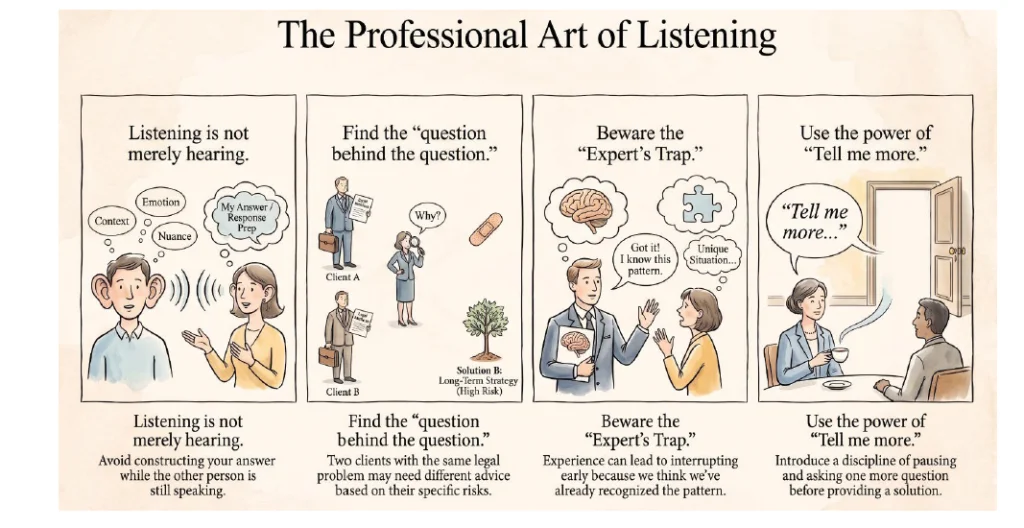
The law has not changed. The competing interpretations remain exactly the same. What changes is our understanding of the client’s real problem. Good professional advice is therefore not merely about identifying the better legal argument. It is also about understanding the consequences the client is willing, or unwilling, to live with.
Listening allows us to discover the question behind the question.
This becomes particularly important as our profession changes. Technology and AI are increasingly capable of retrieving provisions, analysing documents, comparing judicial decisions and even generating technically sound opinions. The relative value of merely knowing information will inevitably decline. What will become more valuable is our ability to understand context, intention, risk and people.
Senior professionals often believe that their experience makes them better listeners. Yet, paradoxically, it can sometimes have the opposite effect. We recognise patterns quickly and therefore assume we already know what the younger colleague is going to say. So, we interrupt and give advice before the other person has finished explaining. In doing so, we may save two minutes of conversation and lose an opportunity to understand something important.
There is another dimension to listening: listening without immediately judging. Not every conversation requires a solution. Sometimes a colleague, client or team member needs to feel safe enough to articulate an innovative, contrarian or uncomfortable thought. If every statement is immediately evaluated, corrected or criticised, people eventually stop bringing us the information we most need to hear. For a profession built on trust, that is costly.
Perhaps the simplest way to improve is to introduce a small discipline into our conversations: pause before responding. Ask one more question. Paraphrase what you have heard. Resist the temptation to formulate the answer while the other person is still speaking.
The objective is not to become passive listeners. Quite the opposite. Great listening is an active professional skill. It requires curiosity, attention, patience and the humility to accept that our first understanding may be incomplete.
The future chartered accountant will still need technical excellence. That is non-negotiable. But technical excellence alone may no longer distinguish one professional from another. The differentiator may be something much more human. The ability to sit across the table from another person, put aside the urge to speak, and genuinely understand what they are trying to tell us.
We spend years learning how to read numbers. Perhaps it is time we became equally good at reading people.
Because sometimes, the most valuable professional advice begins not with an answer, but with a very simple question:
“Tell me more.”