Geography Is History – Regional to National to Global
For decades, the geography of a Chartered Accountant’s practice was the geography of his professional destiny. Metros like Mumbai, Delhi, and Bengaluru boasted of the best clients, the highest fee realisations, and the strongest talent, trapping practitioners in Tier 2 and Tier 3 cities in a constrained universe. This divide created a self-perpetuating cycle: small-city firms lacked the resources to pitch for large mandates, and the absence of such mandates prevented them from attracting top-tier talent. Today, however, that geographic monopoly is collapsing, reshaping the profession from the ground up.
The first disruption was statutory. The introduction of the GST Network, income tax portal and the MCA21 portal unified the national compliance architecture. Most compliance and filing obligations no longer require proximity to the jurisdictional government offices but are accessible through a single browser interface. A well-equipped firm in Nagpur can now manage multi-state compliance for a pan-India manufacturer just as effectively as a firm in Mumbai, quietly eroding the traditional ‘local CA advantage’. One nation, one tax inherently produced a level playing field for practitioners across the country.
The second equaliser is the advent of faceless adjudication. By shifting assessments to the National Faceless Assessment Centre, cases are no longer tied to geographical wards but are allocated randomly based on workload and expertise. Central GST hearings are also mandated to be virtual unless specifically requested. The quality of the written brief, structured argumentation, and legal precision often dictate success, rather than mere proximity to government offices.
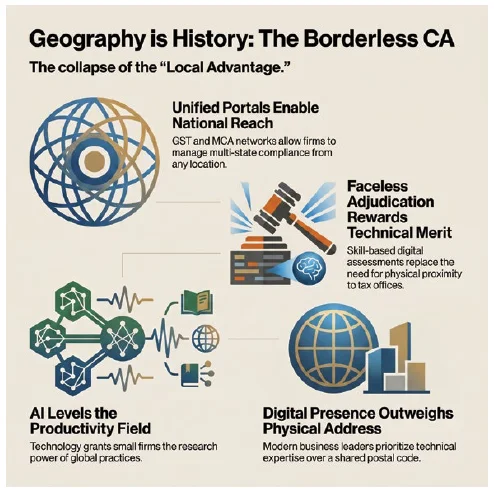
Layered over these regulatory shifts is the third and most potent equaliser: Artificial Intelligence. AI tools now act as a productivity leveller, permitting retail access to capabilities that were once the exclusive domain of well-resourced global firms. Technology allows mid-sized Indian firms to access resources and close workflows exponentially faster. Properly used, generative AI can empower a three-partner firm in Coimbatore to produce grounds of appeal that match the statutory construction and case law citation of top-tier metro practices with significant domain expertise. Recognising this paradigm shift, the ICAI has actively endorsed AI adoption, hosting tools on its portal and signalling that technological proficiency is now a baseline professional expectation rather than a mere competitive edge.
Yet, supply-side equalisation must confront a stubborn demand-side barrier: client perception. Historically, the Indian business owner’s trust in a CA was rooted in physical accessibility: the comfort of a neighbourhood advisor who shared community norms and could be called upon at any hour. However, this architecture is rapidly evolving. A generational transition is transferring business control to a digital-first cohort of leaders. For these incoming decision-makers, a practitioner’s digital presence, peer reputation, and technical expertise carry far more persuasive weight than a shared postal code.
If digital portals and AI have erased the borders between Coimbatore and Mumbai, they have equally erased the borders between Surat and Silicon Valley. Geography is history, and the infrastructure of a local meritocracy is the exact same infrastructure needed for global export. Yes, globalising beyond national borders brings in questions of multi-jurisdictional regulatory oversight. One may also need to develop a larger scepticism quotient to discern a hallucinated AI generated response in a domain which has been uncharted. Many more issues will arise, but the opportunity is real. We have already witnessed a few success stories of regional firms from smaller cities growing in scale and nurturing national aspirations. The time is ripe to further expand our horizons. The next edition of the BCAJ will explore the theme of ‘Globalisation of Indian CA Firms’ offering thought leadership on how practitioners can leverage this new borderless reality not just to scale nationally, but to claim their rightful place on the global stage.