GST Reforms: Are We Treating The Symptoms Or The Disease?
The exercise of power to arrest has long raised concerns about the balance between revenue protection and individual liberty. The recommendation of the 57th GST Council Meeting to omit Section 69 of the CGST Act is, therefore, a welcome development.
Yet, there is a contradiction. While the Council has sought to moderate the consequences of alleged tax violations, it has deferred addressing some of their underlying causes. The question of input tax credit eligibility, particularly where a genuine recipient is penalised for the supplier’s default, has been referred to a committee for examination. While this is a welcome acknowledgement of the problem, the issue has troubled taxpayers for years and deserved a more decisive response. Should the priority not be to prevent unjust demands in the first place, rather than merely reducing their consequences?
The Council has otherwise recommended several procedural reforms, including simplification of registration and cancellation, automation of refunds, improvements in return reconciliation, rationalisation of penalties and safeguards against indiscriminate interception of goods. These measures address genuine difficulties and deserve appreciation.
However, viewed collectively, they raise a larger question. Are we witnessing a coherent programme of GST reform, or merely an accumulation of solutions to problems?
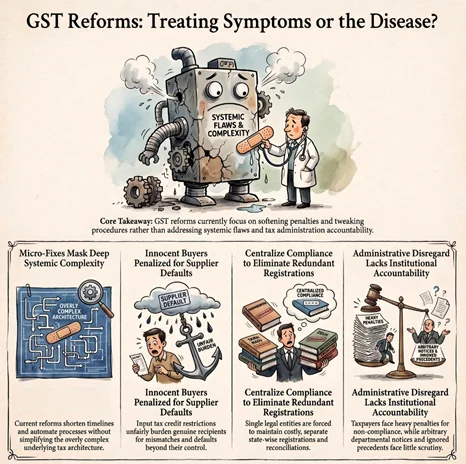
Most recommendations are essentially micro reforms. They simplify a procedure, shorten a timeline, automate a process or moderate a penalty. Each has merit, but their sheer number, almost a decade after GST was introduced, also reveals the complexity that has accumulated within the system. Perhaps the time has come to question the necessity of some of these requirements rather than continuously refining them.
Consider the requirement for multiple State-wise registrations. A business operating across India must maintain separate registrations, compliances and reconciliations for different States, despite being a single legal entity. The treatment of establishments as distinct persons further complicates internal transactions and credit distribution. Surely, it is possible to explore centralised compliance without disturbing the federal allocation of GST revenues.
Similarly, the restrictions on threshold exemptions deserve reconsideration. Inter-State suppliers and suppliers operating through electronic commerce platforms are not eligible for threshold benefit with very few relaxations introduced over time. The Council’s proposal to simplify registration for small e-commerce sellers is useful, but misses the central question: why should a small business really require registration in a distinct state or be denied the benefit of threshold merely because its customer is in another State or it sells through an online marketplace?
The treatment of input tax credit raises an even more fundamental concern. GST was conceived as a value-added tax in which credit would flow seamlessly through the supply chain. Yet, genuine recipients continue to face demands arising from supplier defaults, retrospective registration cancellations, reporting mismatches and automated portal generated demands over which they have little control. Fraud must certainly be addressed firmly, but the law must distinguish a participant in fraud from an innocent commercial counterparty. A framework that places disproportionate responsibility on recipients to police their suppliers undermines the very foundation of GST.
There is, however, a challenge even larger than the design of the law: the absence of meaningful accountability in tax administration.
The legislature may enact safeguards, and the judiciary may repeatedly emphasise principles of natural justice, jurisdictional discipline and reasoned adjudication. Yet, taxpayers continue to encounter mechanically issued notices, routine allegations of suppression, orders passed without adequately considering submissions, and binding judicial precedents disregarded. The Council’s recommendation to issue comprehensive guidelines for better notices and adjudication orders is an implicit acknowledgement of these problems. But can another circular achieve what existing statutory provisions and judicial pronouncements have often failed to secure?
The difficulty is that non-compliance with the law frequently carries serious consequences for the taxpayer, while disregard of the same law by the administrator rarely attracts comparable institutional scrutiny. Unless there are effective mechanisms to examine arbitrary actions, fix responsibility and evaluate the quality of departmental decisions, procedural safeguards may remain impressive on paper but ineffective in practice.
The 57th GST Council Meeting undoubtedly represents progress. Its recommendations should reduce friction, improve liquidity and moderate some of the harsher aspects of tax administration. But there is a distinction between making a complicated system slightly easier to navigate and making the system fundamentally simpler, fairer and more predictable.
As GST approaches its tenth anniversary, the next phase of reform must move beyond incremental corrections. The Council needs to revisit the architecture of the law, reconsider the allocation of compliance risks and, above all, address the accountability of those entrusted with its administration.
A good tax system is not judged merely by how efficiently it collects revenue, but also by how fairly it treats those who contribute to it.