BCAS President CA Zubin Billimoria’s Message for the Month of February 2026
My Dear BCAS Family,
As I begin to write, I would like to reflect on my visit to the new Parliament Building during the Direct Tax Residential Retreat in Delhi, which was a first in the history of BCAS. Being within the hallowed precincts of the “temple of democracy” gave us a glimpse of the magnificent halls where laws are debated and enacted. Each piece of legislation that emerges from there affects our economy, our businesses, and our professional practice. Further, it stands as a symbol of democratic deliberation and legislative wisdom. Also, by the time you read this, the Union Budget, which plays a pivotal role in shaping our professional landscape, will have been presented by the Hon. Finance Minister. This has prompted me to focus on the theme of legislation and its impact on professionals and institutions like us.
Legislation is not merely a tool of governance but also a means of social order, justice, and economic growth, and the foundation of our professional journey.
Impact on Professionals:
The impact of legislation on our profession can be viewed under various lenses as follows:
Collective Regulatory Functioning:
The Chartered Accountants Act, 1949, is one of the earliest laws of independent India, laying the foundation for a self-regulated profession with high ethical standards. The regulations governing the same have evolved to keep pace with changing times, as evidenced by recent networking and advertising guidelines. These empower the ICAI not only to educate and examine, but also to regulate, discipline, and uphold public interest. Accordingly, every member acts as a bridge between the legislature’s intent and society’s compliance.
Advisory and Interpretative Role:
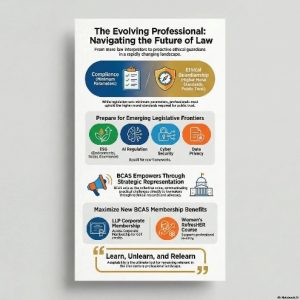
The pace of legislative change over the past few decades, especially in financial and economic domains, has accelerated significantly and fundamentally transformed our role as professionals, whether in practice, industry, or entrepreneurship. Whether it is the evolution from the Companies Act, 1956, to the Companies Act, 2013; the Income-tax Act, 1961, to the Income Tax Act, 2025; GST 1.0 to 2.0 or other legislations on IBC, Money laundering, SEBI LODR guidelines, Labour Codes, Digital Personal Data Privacy Act; the list is endless. Furthermore, as we move toward becoming a $5 trillion developed economy, new areas of legislation related to ESG Frameworks, climate change, AI regulation, Cyber and Data Security, and the Work-Life Balance (Right to Disconnect Bill) are likely to emerge. Our role to our clients and employers is not just to interpret laws, but also to provide constructive feedback to improve compliance. Whilst we have kept pace with the changes, certain challenges as follows need to be kept in mind:
- Retrospective amendments and frequent clarifications create uncertainty.
- Navigating through ambiguous provisions and evolving interpretations.
- Frequent changes in rules and the addition of explanations, especially in tax and corporate laws.
This will require us to adapt, upskill, and remain proactive. The mantra is to learn, unlearn, and relearn!
Guardians of Legislative Integrity:
Legislation brings structure to governance and provides the framework within which economic activity takes place, disputes are resolved, and compliance is measured. Whilst legislation sets the minimum parameters, ethics sets the ideal standards for implementation. Whilst legislation may not always codify every situation or intent, we need to act in a manner that is not only legally compliant but morally and ethically sound.
The profession’s deep engagement with legislation is both a privilege and a responsibility. With the Accounting Standards now having the force of law for the last two decades, our audit report is not merely a procedural requirement, but a legal document which is relied upon by regulators, investors, lenders, and the public at large.
BCAS’s Role
BCAS plays a critical role in the legislative ecosystem by representing the collective voice of practitioners who implement legislation in practice. Our responsibility extends beyond continuing education to active engagement in the legislative processes. We represent practitioners’ concerns to regulatory authorities, provide platforms for knowledge dissemination, and facilitate dialogue between practitioners and policymakers. Our pre-budget memoranda, representations on both proposed and enacted legislation, and technical seminars serve as vital touchpoints in the legislative cycle. Recently, we have taken steps to strengthen our research capabilities, enhance our advocacy efforts, and ensure that practitioners’ practical challenges are communicated effectively to lawmakers.
Recent Initiatives at BCAS
Before concluding, I would like to touch on a couple of recent initiatives: Corporate Membership and the “Women’s RefresHER” Course.
Corporate Membership:
We have recently extended Corporate Membership benefits to LLPs. I would appeal to all members connected with LLPs to urge their firms to convert to Corporate Membership by nominating CAs to access membership benefits for the next three years at reduced fees, before March 2026, as Corporate Membership fees are proposed to increase from April 2026. The membership would allow you to claim the GST Input Tax Credit, which is not otherwise available to a firm for individual membership enrolment, as well as the flexibility to change nominees each year. For details, you may refer to our website.
Women’s RefresHER Course:
This is a unique course, “for women and by women,” as part of the “Nari Shakti” initiative, comprising 14 sessions and aimed at Women CAs. Non-members who have enrolled will receive a six-month journal subscription. I would like to warmly welcome all our new subscribers and urge you to become regular members soon!
Adaptability and Learning:
To conclude, I would like to refer to a profound quote by author Alvin Toffler in his book “Powershift: Knowledge, Wealth and Power at the Edge of the 21st Century,” where he places emphasis on adaptability to continuous learning to remain up to speed in the context of evolving legislation for professionals and institutions like BCAS to remain relevant.
“The illiterate of the 21st century will not be those who cannot read and write, but those who cannot learn, unlearn, and relearn.”
A big thank you to one and all!