

BCAJ October 1977

Stay abreast with the latest developments in the professional domain along with in-depth analysis through the monthly BCA Journal. Get access to an engaging library of researched publications from the BCAS stable.
Learn MoreExplore past issues of BCA Journal & indulge in a treasure trove of high-quality professional content across format of print, videos & learning events from the BCAS stable.
Learn More





I TRIBUNAL
18. M/s. ODC Logistics Pvt. Ltd. vs. CST
2023-TIOL-639-CESTAT-KOL
Date of Order: 23rd June, 2023
Order beyond the scope of SCN is legally unsustainable. The conclusion based on assumptions and conjectures cannot deprive the assessee of the credit.
FACTS
Appellant provided logistics services including transportation of goods. Of the two issues involved in the show cause notice (SCN), the first related to RCM liability under Goods Transport Agency (GTA) service for payments made to suppliers of lorries on hire, based on expenses booked in financial statements as “freight charges”. The appellant contended that the supplier had not issued a consignment note and hence legally, it was not liable to pay service tax. However, the adjudicating authority proceeded by examining the nature of income of the appellant for providing output transportation services and observed that by avoiding issuing consignment notes for rendering output services, it could not avoid service tax liability as the appellant earned freight income and based on the said observation, service tax on GTA service was confirmed. For this conclusion, the appellant’s submission was that besides traveling beyond allegation in the SCN, which is the foundation of the levy and recovery, service tax liability could not be fastened when SCN did not contain allegations for liability on output services and further that service tax on GTA service is payable by the recipient of the service. In the second issue, CENVAT credit availed by the appellant on invoices issued by two specific vendors was disallowed on the ground that the department was unable to trace them at their office address and hence service providers were non-existent. For this, the appellant’s contention was that there was neither any investigation report brought on record nor was there any allegation made in the SCN as to having connivance with the service providers or that the service provider had not deposited by the service tax.
HELD
In the case of the demand under GTA service, the adjudicating authority traveled beyond SCN as the only allegation contained in the SCN was that the appellant did not pay service tax under RCM on expenditure involved on lorry hire charges / freight charges. However, the order conferring liability on the output services is beyond the scope of SCN and hence impermissible in law. Also, the Commissioner has accepted the order that lorry suppliers were not required to issue consignment notes and hence RCM cannot be invoked and hence the demand is set aside. On the issue of disallowance of CENVAT credit, it was observed by Hon. Bench that both SCN and the impugned order are silent on the inquiry report which was not made available at any stage of proceedings. Moreover, there being no allegation of any connivance with the service providers, the Bench was agreeable that denial of credit based on assumptions and conjectures cannot be held legally correct.
Hence the order was unsustainable and hence the appeal was allowed.
19. Alstom Projects India Ltd. vs. CCE
2023-TIOL-629-CESTAT-KOL
Date of Order: 2nd June, 2023
SCN issued after 4 years of information gathered is highly barred by limitation.
FACTS
The impugned order in this case confirmed the duty amount on compensation received on account of the cancellation of the order by West Bengal Power Development Corporation treating the same as additional consideration under Rule 6 of Central Excise Valuation (Determination of Price of Excisable Goods) Rules, 2000 by invoking extended period of limitation. The appellant submitted all material information regarding the non-receipt of two contracts, vide their letter dated 10th May, 2002 and subsequent letter dated 25th March 2003, and that as per the MOU, the appellant received the payment. The show cause notice, however, was issued in October, 2007 to the appellant engaged in the manufacture of boilers and boiler parts. The appellant was awarded two contracts, out of which one was canceled in 1994 on account of a financial crisis at the end of the client wherefore a cancellation order was passed to terminate the unexecuted portion of the contract to mutually agree on the amount of damages for cancellation. On a similar footing, another order of cancellation was issued in 2002 wherein also damages were payable by the contractee to the appellant. Despite the above, a show cause notice was issued as above on the grounds of suppression. The appellant submitted that damages did not attract excise duty and reliance in this regard was placed on various judicial pronouncements inter alia including the latest in the case of Skoda Auto Volkswagen India Private Limited vs. CCE, Aurangabad 2023-TIOL-149-CESTAT-MUM.
HELD
It was found that all the information was available to the department in 2003 itself and since no information was suppressed, the show cause notice issued four years later is not sustainable and is highly barred by limitation and hence merits of the case were not gone into and the appeal was allowed.
20. Maa Kalika Transport Pvt. Ltd. vs. Commissioner of CGST & CE
2023-TIOL-625-CESTAT-KOL
Date of Order: 10th July, 2023
The demand of service based on the IT department’s data is not sustainable based on merits as well as a limitation when it is without corroborative evidence. Also, the order was held beyond the scope of SCN.
FACTS
The appellant was issued a show cause notice in December, 2020 demanding a service tax of Rs. 9.50 crore for the F.Y. 2015–16 based on the data received by the service tax department from the income tax department and which was confirmed by adjudicating authority under the category of cargo handling service by also imposing an equal amount of penalty under section 78(1) of the Act. Hence the appeal. According to the appellant, the bonafide belief is that they provided transportation service for which the service receiver is liable to pay service tax. They transported coal within a distance of 180 km. to 200 km. which was rightly classifiable as transportation of goods (GTA service) and hence service tax is not leviable under cargo handling service. Adjudicating authority was provided with work orders of various parties wherein terms of contract with each party were different. However, essentially the contracts were for the transportation of coal as per the appellant. Further, SCN had not specified any category for proposed demand of service tax.
HELD
In terms of the above facts, the issues before Hon. Tribunal was to examine which of two, viz. cargo handling service or transportation of goods was correct classification and also whether transportation service was bundled with other individual services and hence whether the contract could be vivisected and also whether the demand of tax under “cargo handling service” was beyond the scope of the SCN and whether the demand could be made based on the data received from income tax department without there being any corroborating evidence available with the department, Hence whether suppression was involved at all to demand service tax invoking extended period? Consequently, whether penalties could sustain at all. Based on a perusal of the contracts, it was found that the contracts were composite contracts but primarily for transportation and other services were incidental to it. The contract did not specify separate charges for such ancillary services and hence it could not be vivisected to arrive at a separate value for each service. Also, there was no proposal in the impugned SCN as to the classification of cargo handling service and hence adjudicating authority traveled beyond the scope of the notice which is legally unsustainable. Also as per the appellant, based on the data received from income tax, the department put in no effort to ascertain corroborative evidence and the impugned order contained no finding on this. This view also found support in the case of Larsen & Toubro Ltd. vs. ACST (2023) 2 Centax 327 (Cal.) and in CST vs. Hindustan Cables Ltd, 2022 (382) ELT 188 (Cal.). As for the existence of suppression, it was found that when the department itself was unclear about the classification, no suppression of the facts was involved. For this, reliance was placed on Ugam Chand Bhandari vs. CCE 2004 (167) ELT 491 (SC) and hence extended period was held as not invokable.
Thus, it was held that the appellant provided transportation services which were mutually bundled in the contracts. Further, since SCN did not have a proposal to demand service tax under cargo handling service, the order impugned traveled beyond the scope of the notice. The demand for tax could not be made only on the basis of data furnished by the income tax department without any corroborative evidence. Also when suppression did not exist and hence even on the ground of limitation, the demand would fail and consequently the penalty would not be sustained.
I. HIGH COURT
51. Dhanya Sreekumari vs. State Tax Officer (IB), State GST Department, Alappuzha
2023 (75) GSTL 404 (Ker.)
Date of order: 27th June, 2023
Cash not forming part of stock-in-trade cannot be seized during the inspection by the department as per section 67 of CGST Act.
FACTS
Petitioner was engaged in the manufacture and sale of Idly/Dosa batter, Parotta, Chappathi, etc. An inspection was conducted by the department in the manufacturing unit and at the residence of the petitioner. Cash amounting to Rs. 32,73,900 was found and seized from the residence of the petitioner. Pay-in-slips for depositing the amount in the bank were also found at the residence of the petitioner. Further, the petitioner made representation before the department for the return of seized cash but no action was taken.
HELD
Cash cannot be seized where it was not forming part of the stock-in-trade of the petitioner. Further, pay-in-slips indicated that cash was intended to be deposited in the bank. Hence, there was no reason to retain it further. It was directed to release the seized cash forthwith. The petition was disposed of in favour of the petitioner.
52. APJ Investments Pvt Ltd vs. Asst. Commr. of CGST, Delhi West
2023 (75) GSTL 451 (Del.)
Date of order: 9th May, 2023
Application for revocation of cancellation of GST registration restored where SCN did not provide reasons for cancellation.
FACTS
Petitioner was issued a SCN for cancellation of registration dated 22nd August, 2022 stating that the petitioner had obtained registration by means of fraud, wilful misstatement, or suppression of facts. The petitioner denied the allegations and claimed that it was in the process of winding up its business in Delhi and would voluntarily file an application for cancellation of registration once its import consignments arrived at New Delhi. SCN did not specifically indicate reasons for proposing to cancel the petitioner’s registration. The Proper Officer rejected the response filed by the petitioner and passed an order dated 13th October, 2022, whereby the petitioner’s GST registration was cancelled. Subsequently, the petitioner applied for revocation of cancellation of registration which was rejected and a new SCN dated 11th November, 2022 was issued to which the petitioner did not respond. Further, the petitioner’s application for revocation was rejected by an order dated 28th November, 2022. Thereafter, an appeal filed by the petitioner against the order was rejected on the ground that the petitioner had shifted its premises. Being aggrieved, the petitioner preferred a writ before the Hon’ble Court.
HELD
The Hon’ble High Court held that the SCN issued dated 22nd August, 2022 did not provide necessary particulars for cancellation of registration. It is a well-settled law that SCN must set out reasons for proposing an adverse action in order for the noticee to respond to the same. Undisputedly, in this case, the impugned SCN did not satisfy the said standards. Therefore, it would be appropriate to restore the petitioner’s application for revocation of cancellation of its GST registration. Hence petitioner be granted further opportunity to respond to SCN dated 11th November, 2022 and the opportunity to be heard. Petitioner’s application to be decided afresh.
53. B.C. Power Controls Ltd. vs. Union of India 2023 (75) GSTL 465 (Raj.)
Date of order: 18th April, 2023
Application for refund cannot be withheld on the grounds of pendency of certain other proceedings.
FACTS
Petitioner was engaged in the business of exporting electrical wires and allied products. Petitioner filed a refund claim and considered the shipping bill for application of refund as per section 54 of the CGST Act read with section 16 of the IGST Act and Rule 96 of CGST Rules. Regardless of repeated representations, the respondent did not decide on the claim for the refund as there were allegations against the petitioner that fake invoices were raised for the purpose of claiming the refund. As a result, two SCNs were issued under section 74 of the CGST Act and refund proceedings were kept on hold. According to the respondent, once the pending proceedings are concluded the claim of refund would be decided.
HELD
It was held that the application for a refund once filed needs to be addressed as per the provisions of the law and cannot be kept pending on the grounds of pendency of certain other proceedings. As per revenue’s claim, since this case involved allegations of raising fake invoices and the matter was under investigation, no direction for refund was issued. However, the respondent was directed to decide the petitioner’s refund application.
54. Diya Agencies vs. State Tax Officer [2023] 154 taxmann.com 421 (Kerala)
Date of order: 12th September, 2023
The input tax credit cannot be denied merely on the ground that the concerned invoice does not appear in GSTR-2A. If on examination of the evidence submitted by the assessee, the assessing officer is satisfied that the claim is bonafide and genuine, the assessee should be given input tax credit.
FACTS
The petitioner’s claim for ITC was denied on the ground that as per GSTR-2A in respect of a supply invoice, the taxpayer is only eligible for the input tax amount shown in GSTR-2A.
HELD
The Hon’ble Court held that if the seller dealer (supplier) has not remitted the said amount paid by the petitioner to him, the petitioner cannot be held responsible. The Court relied upon the decision in the case of The State of Karnataka vs. M/s Ecom Gill Coffee Trading Private Limited 2023 (3) TMI 533 SC and held that whether the petitioner has paid the tax amount and whether the transactions between the petitioner and seller dealer are genuine are the matter of facts and evidence. The petitioner has to discharge the burden of proof regarding the remittance of tax to the seller dealer by giving evidence. The Court thus set aside the impugned order holding that merely on the ground that in Form GSTR-2A the said tax is not reflected should not be a sufficient ground to deny the assessee the claim of the input tax credit and remanded the matter with a direction to the concerned revenue authority to allow the petitioner to give evidence to establish genuineness of his claim for input tax credit.
55. AEW Technologies LLP vs.
Assistant Commissioner of Revenue,
Bureau of Investigation
[2023] 154 taxmann.com 265 (Cal.)
Date of order: 29th August, 2023
Where revenue recovered the amount in excess of the statutory pre-deposit required to be made before the first appellate authority and tribunal and that too before the expiry of the period for filing of the appeal, the Court directed the authorities to refund the excess amount.
FACTS
The petitioner challenged the order of the first appellate authority and was also aggrieved by the fact that the department initiated recovery for the amounts which are more than the statutory pre-deposit requirements before the first appellate authority and the second appellate authority; and that such amounts were recovered even before the expiry of the statutory period of time to file the appeal before Tribunal.
HELD
The Hon’ble Court directed the authorities to refund the excess amount of pre-deposit to the petitioner.
56. Vaishnavi Metals vs. Assistant Commissioner (ST) (Madras)
[2023] 154 taxmann.com 331
Date of order: 11th September, 2023
The Court quashed the recovery proceeding pending the disposal of the petitioner’s rectification application by the authorities.
FACTS
The petitioner received an adjudication order along with impugned recovery notices. However, owing to certain errors in the order, the petitioner filed a rectification application against the said order. The department initiated a recovery proceeding against the petitioner.
HELD
The Hon’ble Court quashed the recovery proceeding since the rectification applications were pending and directed the revenue authorities to dispose of the petitioner’s rectification application expeditiously.
57. Zydus Wellness Products Ltd vs. UOI [2023] 154 taxmann.com 261 (SIKKIM)
Date of order: 12th September, 2023
The benefit of the Budgetary Support Scheme for the “remainder period” cannot be given to the new entity when there is a change of ownership. The petitioner’s argument that the exemption should be based on the unit and not on the ownership is not accepted by the Hon’ble Court.
FACTS
The petitioners, Zydus Wellness Products Ltd (Zydus) and Alkem Laboratories Ltd (Alkem) approached the Court seeking a direction to allocate fresh Unique Identity (UID) in the name of new entities and to extend the benefit of the Budgetary Support Scheme (‘Scheme’) to them for the residual period. In the case of Zydus, the partnership firm was converted into a company in February 2019 and in the case of Alkem, a unit belonging to Cachet Pharma was transferred to Alkem as a going concern. The parties had approached the Ministry for obtaining a necessary clarification in this regard and CBIC had opined that as per the guidelines of the Scheme, if any unit undergoes relocation, expansion and change of ownership, it would not be eligible.
HELD
Referring to the definition of ‘person’ under section 22 of the CGST Act, 2017, the Hon’ble Court held that the erstwhile partnership firm of Zydus and the company as also the Cachet Pharma and Alkem are separate and distinct legal entities and required to obtain a separate registration under section 22 of the CGST Act. The Court also observed that the Scheme therefore was a measure of goodwill only to the units that were eligible for drawing benefits under the earlier excise duty exemption/refund schemes but has otherwise no relation to the erstwhile schemes. The Court therefore held that the petitioners who are separate legal entities qua the previous persons who were eligible for the Scheme, could not have filed an application under the said Scheme and were not the eligible units as defined in paragraph 4.1 of the said Scheme. The Court further held that the exemption under Notification No. 20/2007-CE was intended for those who have made investments in the State of Sikkim and not for those who have not made investments. The Court concluded that it was the previous owners who had invested to be eligible for the scheme and not the petitioners and accordingly their petition was dismissed. The petitioner’s argument that the exemption should be based on the unit and not on ownership is not accepted by the Hon’ble Court.
AMENDMENT IN ACTS
The Goods and Services Tax Council (GST Council) in its 50th and 51st meetings considered representation from various associations on the issues regarding the taxability of Casinos, Horse Racing and Online Gaming and recommended making certain amendments in the Central Goods and Services Tax Act, 2017 (the Act) to provide clarity regarding taxability of Casinos, Horse Racing and Online Gaming. Accordingly, CGST Amendment Act and IGST Amendment Act, both dated 18th August, 2023 are passed and notified in Gazette.
B. NOTIFICATIONS
1. Notification No. 39/2023 — Central Tax dated 17th August, 2023
By the above notification, the Amendment is made in Notification No. 2/2017 dated 19th August, 2017 by which some entries are substituted which are regarding territorial jurisdictions.
2. Notification No. 40/2023 — Central Tax dated 17th August, 2023
The above notification seeks to appoint common adjudicating authority in respect of show cause notices issued to M/s United Spirits Limited.
3. Notification No. 41, 42, 43 & 44/2023 — Central Tax dated 25th August, 2023
By the above notifications, the extension of time is granted for furnishing of Form GSTR-1, return in Form GSTR 3B (monthly/ quarterly) and GSTR -7 respectively for taxpayers registered in Manipur. The extension is up to 25th August, 2023 for all the above returns.
4. Notification No.45/2023 — Central Tax dated 6th September, 2023
By the above notification, the CGST Rules are amended. These amendments are in relation to valuation for online gaming including online money gaming and actionable claims in the case of Casinos. For this purpose, Rules 31B & 31C have been inserted.
C. ADVISORY
a) The information is given by GST: The Advisory is about “Mera Bill Mera Adhikaar Scheme” dated 24th August, 2023.
b) The GSTN has further informed about introducing “Electronic Credit reversal and Re-claimed statement” dated 31st August, 2023.
D. ADVANCE RULINGS
34. Exemption vis-à-vis Agreement with NSDC
Nxtwave Disruptive Technologies Pvt Ltd (Order No.: A.R. Com/12/2022 dated 27th September, 2022 (TSAAR Order No. 50/2022) (Telangana)
M/s Nxtwave Disruptive Technologies Private Limited has filed this application (name referred to as Nxtwave).
Nxtwave was founded by IIT Bombay, IIT Kharagpur and IIT Hyderabad alumni — Sashank Reddy Gujjula, Anupam Pedarla and Rahul Attuluri. The Nxtwave offers training programs in Industry 4.0 Technologies for college students, graduates, and early professionals.
The Nxtwave aims to empower 150 million college students and recent graduates, between the age groups of 18-24, into highly-skilled professionals to gear up for the 4.0 revolution.
National Skill Development Corporation (“NSDC”), a Section 25 Company under Companies Act, 1956 (corresponding to section 8 of the Companies Act, 2013), was initially set up under the Prime Minister’s National Council on Skill Development with the primary mandate of enhancing and supporting private sector initiatives for Skill Development in India through appropriate Public-Private Partnership (“PPP”) models and striving for significant operational and financial involvement from the private sector. At present, NSDC functions under the aegis of the Ministry of Skill Development & Entrepreneurship (“MSDE”).
NSDC through this Scheme endeavors to create a sustainable and enabling skill training ecosystem by promoting the provision of market-led fee-based Services under the various models like:
(i) self-financed by the candidate,
(ii) financed by the candidate or partner through a loan or under an income sharing arrangements with the partner etc.
Any Eligible Entity having relevant experience in Skill Development can submit a Proposal to become a Partner of NSDC. The Proposal shall be in the prescribed format and shall include details of the services proposed to be offered by the Partner under the Scheme.
Both the Nxtwave and NSDC have entered into an agreement dated 9th June, 2022 to further their objectives, and the Nxtwave has been recognized as a “Training Partner” of the NSDC with effect from 9th June, 2022.
As per the agreement, Nxtwave shall offer its training programs, as detailed in the proposal approved by the NSDC, as amended from time to time with the approval of NSDC.
The scheme extends mutual benefits to all stakeholders, like NSDC, Nxtwave as well as students.
With the above background, following questions were raised before AAR:
“Q1: Whether training programmes offered by the applicant, as approved by NSDC would be construed under the “any other scheme implemented by the NSDC” as required under Serial No. 69 of the Notification and the benefit of GST exemption would be available to the applicant from the date of its agreement with NSDC?
Q2: Whether the training programmes offered in collaboration with other business partners, imparted by business partners of the applicant under a subcontract would be construed under the “any other scheme implemented by the NSDC” as required under Serial No. 69 of the Notification and the benefit of GST exemption would be available to the applicant?
Q3: Exemption of GST is available to the company as a whole as long as its services fulfill the criteria laid down under serial no.69 of the said notification and not limited to Telangana GST?”
Applicant justified its claim of exemption raised in questions, on the ground that Applicant is rendering education and training services under the following models:
CCBP Intensive:
CCBP Intensive enables tech job aspirants (college graduates and early professionals) to get a software job. The details of the program can be referred to on the company website (www.ccbp.in).
CCBP Academy:
CCBP Academy enables college students from engineering & technology colleges to become industry-ready by the time of their graduation and achieve high-paid software jobs.
It was submitted that the above services are covered within the HSN 9992.
It was also submitted that the applicant is an approved training partner of the NSDC and that the project under implementation is already approved by the NSDC and an agreement is executed between parties.
Therefore, a claim was made that the activity is exempt under Entry No. 69 in Notification No. 12/2017 — Central Tax (Rate) issued by the Ministry of Finance dated 28th June, 2017.
The second question was also justified to be exempt as the subcontract is made simply for the furtherance of the objectives of the scheme and is on a principal to principal basis.
Regarding question 3, it was submitted that the exemption of GST shall be available to the company as a whole and not just under the Telangana GST Act.
The ld. AAR made a reference to Entry 69 of Notification No. 12/2017 which provides an exemption to,
“Any services provided by, —
(a) ………….
(b) ………….
(c) ………….
(d) A training partner approved by the National Skill Development Corporation or the Sector Skill Council, in relation to —
(i) The National Skill Development Programme implemented by the National Skill Development Corporation; or
(ii) A vocational skill development course under the National Skill Certification and Monetary Reward Scheme; or
(iii) Any other Scheme implemented by the National Skill Development Corporation.”
The ld. AAR made detailed reference to the object of NSDC and the scheme of exemption granted in Entry 69. The ld. AAR observed that for Entry 69 the service provider has to be a training partner approved by the National Skill Development Corporation or the Sector Skill Council. The applicant has submitted the attested photocopy of the certificate of Partnership which shows that the applicant is the Approved Training Partner of the National Skill Development Corporation (NSDC) from 23rd June, 2022, up to 22nd June, 2023. Therefore, the ld. AAR held that the applicant is presently an Approved Training Partner of NSDC.
The ld. AAR noted further requirements, whether the application is providing any services in relation to any other Scheme implemented by the National Skill Development Corporation. In this context, the ld. AAR found that the applicant is providing courses in relation to the Scheme for market-led fee-based services by the National Skill Development Corporation.
The ld. AAR also found that the applicant has entered into agreement with NSDC dated 23rd June, 2022 which substantiates a partnership with NSDC for executing training under the above scheme for market-led fee-based services under non-funded affiliation.
The ld. AAR also found that the applicant is offering training programs, as detailed in the proposal approved by the NSDC as amended from time to time with the approval of NSDC, mentioned above, like CCBP.
The ld. AAR concluded that the services provided by the applicant are as the training partner approved by the National Skill Development Corporation and are in relation to the Scheme implemented by the National Skill Development Corporation.
Accordingly, the ld. AAR held that the services offered by the applicant fall under Sl. No. 69 (d) (iii) and therefore eligible for exemption under Notification No. 12/2017 for CGST and SGST.
So far as the second question is concerned, the ld. AAR observed that as per Entry 69, the services supplied by the applicant as an approved training partner of NSDC in relation to any other scheme implemented by the NSDC are exempt but not the services received by the applicant from others including a sub-contractor who supplies such services to the applicant, as he is not a training partner approved by the National Skill Development Corporation or the Sector Skill Council. Therefore, the ld. AAR answered question (2) in negative.
Accordingly, the first issue is decided in the favour of the applicant holding the activity as exempt. However, in relation to question (2), the AAR ruled in negative.
In respect of question (3), the learned AAR held that the only services covered by Entry 69 are exempt and not others.
35. Nature of Contract for operation and maintenance of Dam Work
Secure Meter Ltd. (AR No. RAJ/AAR/2022-23 dated 12th October, 2022 (Raj.)
The applicant i.e., M/s Secure Meter Limited, E-Class, Pratap Nagar Industrial Area, Udaipur is engaged in providing compressive water services and currently is in the process of bidding for a tender floated by the PHED, a unit of the Government of Rajasthan for the Operation and Maintenance of the Mansi Wakal Dam Stage-I.
The applicant has explained various aspects of the contract.
The applicant has raised the following questions:
“1. Whether the activity of operation and maintenance is to be considered as Supply of goods or a Supply of Services under CGST / RGST Act 2017? Accordingly, whether the transaction can be sub-classified as a “Pure Supply of Service” or “Pure Supply of Goods” or “Composite supply of goods and services being a works contract?
2. Whether the applicant is entitled to the benefit of exemption under Entry 3 A of Notification No. 12/2017 — Central Tax (Rate) dated 28th June, 2017, as amended? If not, what is the applicable rate of tax?”
Based on the written submission made by the applicant and given details, the ld. AAR found that applicant is in the process of bidding for a tender floated by the PHED, a unit of the Government of Rajasthan for the Operation and Maintenance of the Mansi Wakal Dam Stage-I complete system, including mechanical, electrical, instrumentation installation works, switchyards / GSS and maintenance of Dam, pumping machinery, pipe line & tunnel from Mansi Wakal Dam to Nandeshwar filter plant project on ESCO and O&M contract. The terms and scope of the contract combines ESCO Model and O&M contract.
Based on the scope of work as detailed in contract / Tender Document NIT No. 03 / 2021-22, the ld. AAR observed that the ESCO model requires improvement of the whole water supply system involving pump houses, pumping stations, transmission lines, switchyards, and headwork. Re-modelling of pump foundation and extension of pump house, replacement of fittings / fixtures and painting of all permanent structures like pumping station building, Dam, Tunnel etc. are involved in the contract. It was further observed that a single tender shall be floated for Operation and Maintenance of Dam, pumping machinery, pipeline & tunnel on ESCO Cum O&M Contract where the preamble of scope specifies that the contract combines ESCO model and O&M work. It was observed that the activities under the ESCO model and the O&M contract are closely linked.
The ld. AAR referred to the meaning of works contract, Composite Supply and meaning of immovable property. Based on facts that the main intention is to supply maintenance services, the ld. AAR observed that the activity also involves the use of materials. It was also observed that all the components of the pumping system are erected at the prescribed location and permanently attached to the earth and they cannot be dismantled and reassembled, as such dismantling may cause substantial damage to the system and its components. Therefore, the activities to be undertaken by the applicant with respect to Operation and Maintenance are for an immovable property i.e., Mansi Wakal Dam and the given work is works contract, held by the ld. AAR. Accordingly, it was also held that all the conditions of composite supply are satisfied, therefore it is a composite supply of works contract. It was also observed that as per the break-up of material cost under the Operation & Maintenance of Mansi Wakal water project provided by the applicant, the value of supply of goods is 11.50 per cent i.e., below 25 per cent out of the total value of supply and hence, the applicant is eligible for exemption under Entry No. 3A of Notification No. 12 / 2017-CT (R) dated 28th June, 2017.
The ld. AAR gave the ruling as under:
“The activity of O & M of Mansi Wakal Dam Project on ESCO Model and O & M work by the applicant is to be undertaken /being undertaken for a Government Department. In this activity of Composite supply of goods and services, the applicability of GST will be as under:
(a) Composite supply of goods and services where supply of goods is below 25 per cent out of the total value of supply then GST will be @ NIL.
(b) Composite supply of goods and services where the supply of goods is more than 25 per cent of the total value of supply then GST will be @12 per cent (SGST 6 per cent + CGST 6 per cent).”
36. Classification — Satin Rolls, Taffeta Rolls
Mean Light Co. (AR No. KAR/ADRG-43/2022 dated 29th November, 2022 (KAR)
The applicant has raised questions about the “classification of products “Satin Rolls” and “Taffeta Rolls” with sizes between 19 mm to 40 mm.
The brief facts about the products are narrated as under:
“Satin Rolls: Made with 100 per cent polyester, the rolls are available having a width between 10 mm to 810 mm. We mainly deal with sizes between 19 mm to 40 mm. The same will be sold to printers for printing purposes. The ultimate customers of the products are the companies engaged in manufacturing of readymade garments. The products will be ultimately used for the purposes of printing wash care instructions & fabric contents (to capture instructions).
Taffeta Rolls: Made with 100 per cent Nylon and dip quoted sizes available in the market from 10 mm to 810 mm. We mainly deal with sizes between 19 mm to 40 mm. The same will be sold to printers for printing purposes. The ultimate customers of the products are the companies engaged in manufacturing of readymade garments. The products will be ultimately used for the purposes of printing wash care instructions & fabric contents (to capture instructions).”
Applicant further supplied the following information:
“11.1 Taffeta Rolls: The standard manufacturing size of the fabric is 60 inches / 1524 mm wide fabric, made up of polyester yarn. Acrylic coating is made on the fabric for better printing quality and also to protect from raveling or fraying, then will be cut in different sizes and shapes as normal scissor cut.
11.2 Polyester Satin Ribbons: The fabric is made from polyester yarn, standard manufacturing size is 60 inches / 1524 mm wide. Either optical or non-optical coating is made on the fabric for brightening and to remove impurities. Optical brighter coating will give shiny and bright finishing and non-optical dull finishing. It has plain selvedges on both sides of the fabric. Hot blades are used to cut into different shapes and sizes which arrest the fabric from fraying.”
The ld. AAR examined the classification of the impugned products.
The ld. AAR made reference to the Section Notes and Chapter Notes of the relevant Chapters of the Customs Tariff and also the corresponding Harmonised Commodity Description and Coding System Explanatory Notes of the World Customs Organisation (WCO).
The ld. AAR noted that Chapter 5806 of the first schedule to the Customs Tariff Act, 1975 covers NARROW WOVEN FABRICS OTHER THAN GOODS OF HEADING 5807; NARROW FABRICS CONSISTING OF WARP WITHOUT WEFT ASSEMBLED BY MEANS OF AN ADHESIVE (BOLDUCS). Read with Notes of Chapter 58, the ld. AAR noted that the impugned products, as per the applicant, are woven fabrics having the width of less than 30 cm; that Taffeta rolls are made up of polyester yarn with acrylic coating to protect from raveling or fraying and also to have better printing quality; It also noted that Satin rolls are made up of polyester yarn, with optical or non-optical coating for brightening and to remove impurities, having plain selvedges on both sides of the fabric; and cut with hot blades to arrest fabric fraying. Therefore, the impugned products qualify to get covered under “Narrow Woven Fabrics”, observed the ld. AAR.
The ld. AAR also referred to Chapter 5807 which covers labels, badges and similar articles of textile materials, in the piece, in strips or cut to shape or size, not embroidered. Referring to Explanatory Notes to tariff heading 5807, the ld. AAR observed that this heading covers (i) Labels of any textile material (including knitted) and (ii) Badges and similar articles of any textile material (including knitted), subject to the following conditions:
a) They must not be embroidered. The inscriptions or motifs on the articles classified here are generally produced by weaving (usually broche work) or by printing.
b) They must be in the piece, in strips (as is usually the case) or in separate limits obtained by cutting to size or shape but must not be otherwise made up.
The ld. AAR found that the impugned products are not embroidered and fulfill the aforesaid conditions. Therefore, the ld. AAR held that the impugned products merit classification under tariff heading 5807 10 20.
37. Exemption vis-à-vis Government Authority
Hyderabad Metropolitan Water Supply and Sewerage Board (AR No. AAAR.Com/09/2022 dated
2nd November, 2022 (Telangana)
The Appellant filed this appeal against AAR dated 3rd June, 2022 wherein the Question posed before it was decided as under:
| “Question | Ruling |
| 1. Is Medical insurance premium taken to provide Health Insurance to the employees, pensioners and their family members, eligible for exemption as mentioned in Entry No. 3 of the Notification No. 12/2017 – Central Tax (Rate), dated 28th June, 2017? |
No |
| 2. Is the Vehicle Insurance Policy taken to provide insurance to the vehicles owned by the Board, eligible for exemption as mentioned in Entry No. 3 of the Notification No. 12/2017 – Central Tax (Rate), dated 28th June, 2017? | Yes, if the vehicles are directly used to provide services under Schedule XII of the Constitution.
No, if they are used for transportation of employees/board members/other persons with no direct relationship to functions discharged under Article 243W.” |
The ld. AAAR referred to the factual position that Hyderabad Metropolitan Water Supply and Sewerage Board (The Board) was constituted on 1st November, 1989 under the provisions of Hyderabad Metropolitan Water Supply and Sewerage Act 1989, with the following Functions & Responsibilities in the Hyderabad Metropolitan Area.
• The Supply of potable water including planning, design, construction, maintenance, operation & management of the water supply system.
• Sewerage, Sewerage Disposal and sewerage treatment works including planning, design, construction, maintenance, operation & management of all sewerage and sewerage treatment works.
The ld. AAAR also observed that from 1st July, 2017 to 17th November, 2021 as per Sl. No. 3 of Central Tax (Rate) Notification No. 12/207 dated 28th June, 2017 the rate of tax on the supply of the following services is Nil.
| “Sl. No. | Chapter Section
Heading Group or Service Code |
Description of services |
Rate
(per cent.) |
Condition |
| 3 | Chapter 99 | Pure services (excluding works contract service or other composite supplies
involving the supply of any goods) provided to the Central Government, State Government or Union territory or local authority or a Governmental authority [or a Government Entity] by way of any activity in relation to any function entrusted to a Panchayat under Article 243G of the Constitution or in relation to any function entrusted to a Municipality under Article 243W of the Constitution. |
NIL | NIL” |
The ld. AAAR concurred that the Appellant is the Government Authority as per the meaning of the same given in section 2(zf).
The ld. AAAR observed that since the Hyderabad Metropolitan Water Supply and Sewerage Board is a board set up by an act of state legislature to carry out any function entrusted to a Municipality under Article 243W, it is a ‘Governmental Authority’ as per the above definition.
The Appellant had contended that the following supply of services to them is eligible for exemption under Sl. No. 3 mentioned above:
1) Insurance services provided to the board for insuring their employees and their family members.
2) Insurance services provided to the vehicles of the board.
The ld. AAAR also observed that services are exempted if the following conditions are satisfied.
“1)The services provided should be Pure services (excluding works contract service or other composite supplies involving the supply of any goods).
2) The services provided should be by way of any activity in relation to any function entrusted to a Municipality under Article 243W of the Constitution.
3) After 01-01-2022, the exemption is available only if it is provided to the Central Government, State Government and Local Authority only”.
Based on the above position, the ld. AAAR held that if the services procured by the board are by way of any activity in relation to any function entrusted to a Municipality (like water supply and sewerage), then only the supply is exempt from tax as per condition at Sl. No. 2 above.
The ld. AAAR held that the insurance supplies made to the board for its employees and their family members are not in relation to any function entrusted to the municipality.
The ld. AAAR held that the word ‘in relation to’ will include only functions which are in direct relation to the entry like water supply and sewerage.’
Relevant judicial pronouncements were also referred to.
Therefore, the ld. AAAR held that the insurance services for employees and employees’ family members received by the applicant is not in direct and proximate relation to water supply and sewerage related function entrusted under Article 243W, hence the supply received by the applicant does not fall under Sl. No. 3 of Central tax (rate) Notification No. 12/2017 and are not exempt.
The ld. AAAR also held that the board also receives insurance services for vehicles which are used for transportation of water and sewerage management. These vehicles are essential for performing the functions as entrusted in 243W of the constitution, the ld. AAAR held that the applicant is eligible for exemption under Entry mentioned above services in relation to all other vehicles which are not used for performing the functions as entrusted in 243W of the constitution shall be taxable, held the ld. AAAR.
Regarding the period from 1st January, 2022, due to changes in Entry 3, by which the Government Authority is omitted from said Entry, the ld. AAAR concurred with AAR that no service will be exempt. In view of the above, the ld. AAAR confirmed the AR.
38. Recovery from employees towards Canteen Facility — Liable to GST
Federal Mogul Goetze India Ltd (AR No. KAR-ADRG-42/2022 dated 29th November, 2022 (KAR)
The applicant, a manufacturer of auto parts, has to maintain the canteen facility as per Factories Act, 1948. The Factories Act provides canteen facilities to all their employees including contractual employees. In the present case, the said canteen is operated by the applicant and all the equipment and items essential for running the canteen such as groceries, utensils, cooking equipment etc., are arranged by the applicant. The applicant entered into a separate contract with a service provider for providing / supplying manpower required to manage the canteen operations. The service provider raises monthly invoices towards the supply of manpower for canteen operations and charges applicable GST.
On the above facts, the applicant has sought an advance ruling in relation to the applicability of GST on the deductions made from the salary of the employees raising the following questions:
‘Whether the subsidized deduction made by the applicant from the employees who are availing food in the factory would be considered as a “supply” by the Applicant under the provisions of Section 7 of the CGST / KGST Act 2017.
a. In case the answer to above is yes, whether GST is applicable on the nominal amount being recovered by the Applicant?
b. Whether Input Tax Credit (“ITC”) of the GST charged by the Service Provider would be eligible for availment to the Applicant?”
The applicant also submitted that with respect to regular employees they deduct Rs.50 from salary and for contract employees Rs.10.
The argument of the applicant was that it is not liable under GST on the above recoveries. The submission was based on three grounds:
(i) It is not ‘supply’ as per section 7 of the GST Act.
It was contended that there shall be a legal intention of both the parties to the contract to supply and receive the goods or services or both. The absence of such intention would mean that there is no supply within the meaning of the CGST Act.
The further contention was that there was no consideration. The supply should involve quid pro quo — viz., the supply transaction requires something in return, which the person supplying will obtain, which may be in monetary terms / in any other form except in cases of deeming provision as specified in Schedule I. Applicant submitted that in its present case, the transaction is only money transaction and no ‘quid pro quo’ available as the applicant is running a canteen as mandated under the Factories Act, 1948.
The ld. AAR observed that there is the legal intention to provide canteen food and therefore the contention that applicants do not have any legal intention for the provision of a canteen is contrary to the obligation placed on the applicant under the Factories Act, 1948. The ld. AAR also observed that the contractual relationship is evident from the fact that the applicant is charging employees R50 per month from the payroll and union employees and R10 per meal from contract employees. The ld. AAR observed that since the charges are pre-decided and deducted from the salaries, which are also agreed upon by the employees, a contractual relationship is clearly established between the applicant and their employees.
(ii) Regarding the contention that there is no consideration, the ld. AAR observed that as per the definition of ‘consideration’ in section 2(31) the consideration includes any payment made or to be made, in response to, the supply of goods or services or both. Adequacy of consideration or otherwise is not a factor in deciding whether the activity amounts to supply or not. The ld. AAR held that the fact that a consideration is being charged by the applicant and paid by the employee is sufficient to establish a contractual relationship with reciprocal obligations leading to the supply of service. The ld. AAR rejected the argument of the applicant that there is no quid-pro-quo between them and the employee is factually and legally not sustainable.
(iii) Regarding the third argument that it is not in the course or furtherance of business, the ld. AAR, after noting the definition of ‘business’ in section 2(17) observed that the applicant is a manufacturer and thus their activity is covered under Section 2(17)(a) of the CGST Act. The ld. AAR further observed that Section 2(17)(b) stipulates that any activity/transaction in connection with sub-clause (a) i.e., Section 2(17)(a), is included in the ‘business’. Since in the instant case, the applicant is running the canteen in connection with the manufacturing activity, the ld. AAR held that providing a canteen facility is incidental to their main activity of manufacture, and therefore covered in the definition of ‘business’ in terms of Section 2(17)(b). The ld. AAR also held that the canteen factory is also in furtherance of business as, if such facility is not provided the quantum of production will get affected as employees will move out for food which will be time consuming.
Regarding the contention of the applicant that the activity is covered by Entry I in Schedule III the ld. AAR held that the said provision is not applicable to the instant case as the issue pertains to the services being provided by the employer to the employees and not vice-versa. As per Entry I of Schedule III, only services by employees to employers are exempted and not services by employers to employees.
In respect of reference to the rulings of various advance ruling authorities and Appellate authorities, the ld. AAR observed that in such cases the canteen facilities were provided by third parties and collection of employees’ share and payments to canteen service providers without profit was held as not amounting to supply by the employer. However, since in the instant case, the applicant themselves are providing the canteen facility, the ld. AAR held that the advance rulings cited before it are not relevant to the facts of the case.
It is also observed that advance rulings are extended to the applicants only and can’t be generalized and applied to all and therefore ld. AAR declined to follow them.
The ld. AAR also referred to the question as to whether GST is applicable on the nominal amount being recovered by the applicant?
The ld. AAR made detailed reference to provisions of valuation like section 15.
In light of the provision of Explanation (a)(iii) to Section 15 of the CGST Act 2017, the ld. AAR observed that employers and employees are related persons. Therefore, it is observed that in the instant case since the supplier of the service i.e., the applicant is the employer and the recipients of the said services are employees, they are related persons.
The ld. AAR also observed that when the supplier and the recipients are related parties and the price is not the sole consideration, Section 15(1) of the Act is not relevant. The ld. AAR observed that Section 15(4) of the Act stipulates that in the cases where the value of the supply of goods or services or both cannot be determined under section 15(1), the same shall be determined in such manner as may be prescribed, is applicable in the present case.
The ld. AAR held that the value should be as per Rule 28 read with Rules 30 or 31.
In respect of eligibility to ITC of GST paid on manpower supply the ld. AAR held that services of applicants are covered in the category of services provided in the canteen and other establishments and merit classification under SAC 996333. It is further observed that the said services attract GST @ 5 per cent, without ITC in terms of Notification No. 11/2017-Central Tax (Rate) dated
28th June, 2017, as amended. Therefore, the ld AAR held that the applicant is not entitled to ITC of the GST paid on manpower supply servicesthat are used for providing a canteen facility.
39. Recovery towards Canteen Facility — Liable to GST
Tube Investment of India Ltd. (AR No. 12/2022 in Appl. No. 07/2022-23 dated 24th November, 2022 (Uttarakhand)
In this case, the applicant has submitted facts as under:
“(a) That they are a leading engineering company engaged in the manufacture of precision steel tubes and strips, automotive, industrial chains, car door frames and bicycles. And they have a factory in the state of Uttarakhand where more than 500 workmen (both direct and indirect) are employed.
(b) They have entered into an agreement with the contractors to operate a canteen within the factory premises to provide food to their employees.
(c) They recover a nominal amount from the employees on a monthly basis and such recoveries are shown as a deduction in the monthly slip of the employees.
(d) They do not avail Input Tax Credit (ITC) on the expenses incurred on the services provided by the canteen service provider and are absorbing the GST charged by the canteen service provider as a cost in the books of accounts.
(e) They discharge GST @5 per cent on the cost of the canteen service provider’s total taxable value plus 10 per cent notional markup.”
Based on the above, the ruling was sought on the following questions:
“a. Whether the nominal amount of recoveries made by the Applicant from the employees who are provided food in the factory canteen would be considered as a “Supply” by the applicant under the provisions of Section 7 of Central Goods and Service Tax Act, 2017,
b. In case, the answer to the above is “Yes”, — whether GST is applicable on the amount recovered from the employees for the food provided in the factory canteen or on the amount paid by the Applicant to the Canteen Service Provider?
c. Whether input tax credit (ITC) is available to the Applicant and GST charged by the Canteen Service Providers for providing the catering services of the factory where it is obligatory for the Applicant to provide the same to its employees as mandated under the Factories Act, 1948, even if the answer to question (a) is “No”?
d. Whether Input Tax Credit (ITC) can be availed on GST charged by the Canteen service providers, the answer to the question (b) is “Yes”?”
In the course of the hearing, it was further explained that in compliance with the provisions of the Factories Act, 1948, they provide canteen facilities to employees.
It was also explained that they have entered into an agreement with the contractors to operate a canteen within the factory premises to provide food to their employees and the amount raised by the canteen operator is booked as expenses in the P&L account, without taking the benefit of ITC of the GST paid by them.
It was explained that they recover nominal amounts from the employees on a monthly basis and such recoveries are shown as a deduction in the monthly slip of the employees and the recoveries made are credited to the expense account.
The ld. AAR made reference to the CBIC Press release dated 10th July, 2017, wherein the concept of ‘GST on Gifts’ to employees is clarified. However, in this case, since it is not free, as some amount, though nominal, is collected and also canteen is as per requirement of the Factories Act, 1948.
Regarding further contention that it is not in the course or furtherance of business, the ld. AAR observed that establishing a canteen is in the furtherance of the business of the applicant and supply of food to the employees when the same is not part of the agreement is not an allowance as a part of the employment. Thus, the ld. AAR held that the provision of food in the canteen for a nominal cost is a ‘Supply’ for the purposes of GST and it is a service as per relevant Entry in Schedule II to the CGST Act, 2017.
The further contention of the applicant is that the amount, received from the employees, is in the nature of recovery and not consideration as the recovered amount is directly paid to the third-party vendor without any profit element in the hands of the Applicant, also rejected on the ground that the running of a canteen in the factory of the applicant is in the course of furtherance of business. Though the applicant has chosen to run the canteen through a third party vendor, in the factory, the ld. AAR observed that the provision of a canteen facility and bearing certain costs, in running of canteens are mandated on the part of the employer as per the Factories Act and accordingly, such canteens are in furtherance of business.
Considering the definition of ‘consideration’ in section 2(31) the ld. AAR observed that the applicant supplies food to their employees at a nominal cost, and the same is the consideration for such supply made by the applicant on which GST is liable to be paid. The recovery of cost from the salary as deferred payment does not alter the fact of the service provided and the person providing the said supply observed the ld. AAR.
The issue about ITC also ruled in negative in view of the existing section 17(5)(b)(i), even though it was obligatory to provide canteen under other law.
In respect of the AR of other States, AAR also held them not applicable as each AR is based on its own facts.
[Compiler’s Note: Please also refer to Circular No.172 of 2022 dated 6th July, 2022, in which certain clarifications about blockers of ITC under Section 17(5)(b) are given.]
27. Dheeraj Singh vs. Greater Noida Industrial Development Authority & others AIR 2023 Supreme Court 3110
4th July, 2023
Cross Objection — Cross Objections have the same trapping as a Regular Appeal — Not considered by the High Court — Matter remanded to High Court for fresh adjudication. [O. 41, R. 22, Code of Civil Procedure, 1908; S. 14, 17, Land Acquisition Act, 1894].
FACTS
The State of Uttar Pradesh (Respondent) had acquired the land of the Appellants under the provisions of the Land Acquisition Act, 1894 and paid compensation for the same. The Ld. District Judge granted further compensation. Aggrieved by the same, the Respondent filed an appeal in the High Court of Allahabad (High Court). Subsequently, the appellants filed a cross objection in the High Court. The Hon’ble High Court confirmed the order of the Ld. District Judge. It was the contention of the Appellants before the Hon’ble Supreme Court that the Cross Objection filed by them (Appellants) was not considered by the Hon’ble High Court.
HELD
The Hon’ble Supreme Court observed that the Hon’ble High Court failed to consider the Cross Objections filed by the Appellants. The Court further held, relying on Order 41, Rule 22 of the Code for Civil Procedure, 1908, that Cross Objections have all the trappings of a regular appeal. Thus, the matter was remanded to the High Court for fresh adjudication.
28. Manoj Kumar Jain and another vs. UOI AIR 2023 (NOC) 580 (CAL)
9th June, 2023
Look out Circular — Economic Offence — Issuance of Look Out Circular by the bank for non-re-payment of loans — Apprehension that Petitioner would flee the country — Petitioner was not declared a fraudster or economic offender — Constant efforts of settlement of dues — Lookout circular for every borrower incorrect — Lookout Circular quashed. [Art. 226, Constitution of India, O. VI, Rule 17, The Code of Civil Procedure, 1908].
FACTS
The Petitioners were de-boarded from the plane by the Immigration Authority. The Petitioners were informed about the lookout circular issued against them and, thus, the petitioners filed a writ petition challenging the lookout circular. The Petitioner had failed to repay the loan obtained for the expansion of the business. The lookout circular issued by the lender bank was on the apprehension that the petitioner might flee the country and thereby frustrate the whole process of settlement of dues.
HELD
The Hon’ble Calcutta High Court held that lookout circulars have to be issued in only exceptional cases and cannot be issued at the slightest provocation. The Hon’ble High Court also observed that Petitioner made efforts in the process of settlement of loans by actually paying loans to the other banks in the consortium. Further, the lender bank also had securities of the Petitioner and further realised some of the outstanding by realising the property of the Petitioner. The Hon’ble Court also observed that Petitioner was allowed to travel by the CBI court and there was no complaint with respect to Petitioner not complying with conditions. The court held that Petitioner was not declared a fraud or economic offender and his travel to the UK was for his son’s education. Thus, the lookout circular was quashed.
29. V Narayanasamy vs. Vanchikodi AIR 2023 (NOC) 631 (MAD)
19th April, 2023
Condonation of Delay — Delay of 1,835 days — Negligence of earlier Counsel — Not a sufficient ground — Condonation denied. [S. 5, Limitation Act of 1963].
FACTS
The Petitioner / Plaintiff had filed a suit to declare the title of the property of the Petitioner and a relief of permanent injunction before the lower court. However, the complaint was returned by the Registry for rectifying certain defects and a time of one month was given to the petitioner. The Plaintiff, however, failed to comply with the time period of one month. The lower court dismissed the petition on the ground that no prima facie case was made by the plaintiff and there were no sufficient reasons to condone the delay of the plaintiff. The plaintiff, after a delay of 1,835 days, approached the Madras High Court for the same.
HELD
The Hon’ble Madras High Court held that merely stating that earlier counsel was negligent and did not inform the plaintiff regarding the proceedings of the suit, was not a sufficient reason to condone the delay of 1,835 days. Thus, the Hon’ble High Court upheld the order of the lower court. The Petition was dismissed with no costs.
30. Revanasiddappa & Anr vs. Mallikarjun & Ors Civil Appeal No. 2844 of 2022
1st September, 2023
Hindu Undivided Family — Children born of void or voidable marriage — Have a right in their parent’s share in the Hindu Undivided Family. (Hindu Marriage Act, 1955, S. 16, Hindu Succession Act, 1956, S. 2, S. 6).
FACTS
Section 16(1) of the Hindu Marriage Act, 1955 provides that even if a marriage is null and void, any child born out of such marriage who would have been legitimate if the marriage had been valid, shall be considered to be a legitimate child. However, Section 16(3) of the Hindu Marriage Act 1955 states such children are entitled to inherit only their parents’ property and will have no right over the other coparcenary shares. On this background, a question of law arose before the three-judge bench of the Hon’ble Supreme Court, whether children born out of void or voidable marriage will have a right in their parent’s share in the undivided family property, as Section 16 of the Hindu Marriage Act 1955 confers legitimacy to children who are born out of invalid marriages.
HELD
The provisions of the Hindu Succession Act, 1956 have to be harmonised with the mandate in Section 16(3) of the Hindu Marriage Act, 1955 which indicates that a child who is conferred with legitimacy will not be entitled to rights in or to the property of any person other than the parents. Therefore, the children born of such marriages will be entitled to a right to their parent’s share in the Hindu Undivided Family.
(Editor’s Note: Refer to Laws and Business where this decision and the subject have been discussed).
31. Bhagyanathan Nadar vs. Vishwanathan Nadar and others AIR 2023 (NOC) 568 (KER)
13th April, 2023
Settlement deed — Cancellation unilaterally — No legal effect — Not enforceable by law — A gift deed once executed cannot be revoked. (Specific Relief Act, 1963, S. 34; Transfer of Property Act, 1882, S. 5, S. 123).
FACTS
A settlement deed was executed by the owner of a property in favour of the Original plaintiffs. The deed of settlement did not provide for any power to revoke the settlement. A dispute arose between the parties and the settlement deed was cancelled. The donee / Original Plaintiffs, inter alia, challenged the cancellation deed before the lower court. The lower court, considering all the facts, held in favour of the Original plaintiffs.
On appeal, the first appellate court held in favour of the Original Plaintiffs and dismissed the appeal of the Original Defendants.
On the second appeal
HELD
The Hon’ble Kerala High Court held that the settlement deed was valid and binding. After the acceptance of the gift, if the donor wants to revoke the gift by resorting to Section 126 of the Transfer of Property Act, 1882, the donor will have to institute a suit for the same. A gift can be cancelled only if the gift is the one executed in contemplation of section 126 of the Transfer of Property Act, 1882 and not otherwise. There is no such agreement between the donor and donee to suspend or revoke the gift. It also provides that a gift which parties agree shall be revocable wholly or in part on the mere will of the donor, is void wholly or in part as the case may be. So a gift deed once executed cannot be revoked and even if such contingencies as contemplated under Section 126 of Transfer of Properties Act, 1882 are in existence in the deed, a suit has to be filed for cancellation.
Therefore the settlement deed is valid and the second appeal is dismissed.
Friends, in this series, I have been writing on rich thoughts from Sanskrit literature, succinctly put in Subhashitas (shlokas or verses). These are innumerable. I am choosing only those which are popularly used as ‘proverbs’.
The full text of this shloka is: –
यस्यास्ति वित्तम् स नर: कु लीन: |
स पण्डित: स श्रुतवान् गुणज्ञ: |
स एव वक्ता स च दर्शनीय: |
सर्वे गुणाः कांचनमाश्रयन्ते ||
It is taken from Bhartruhari’s Neeti Shatak (नीतिश तक).
This can be interpreted in two ways. In one sense, it says that certain qualities look more graceful when the person possessing these virtues also possesses wealth. However, it is not usually used in this positive sense. The usage is more in a sarcastic sense. That means if a man is rich, all virtues in the world get automatically attributed to him. With money, one is recognised as a meritorious person.
The literal meaning of the shloka is that –
He who has wealth is described as from a high or reputed family (कुलीन). He is a ‘scholar’, a well-read and knowledgeable person, he is reputed and he can recognise talents and merits (पण्डित: श्रुतवान् गुणज्ञ:). He is a brilliant and impressive orator (वक्ता) he alone is ‘handsome’ (दर्शनीय:). In short, he is described as possessing all the virtues, qualities, skills and talents. कांचन (kanchan) means gold. All good qualities are attributed to ‘Gold’!
We come across this situation in many places. It is no doubt true that with money, one can afford many good things. Many comforts and conveniences become affordable to a resourceful person. A rich person can also perform religious things in a better way. In big temples, the ‘special darshan’ of Gods or Idols is available smoothly and quickly by paying higher charges. Higher education, nutritious food, medical treatment — all these become easily available to a rich person. There is nothing inherently wrong with being rich.
The disturbing feature is that by throwing money, nowadays, you can purchase good marks in examinations, get favours in the present judicial system, purchase prizes and awards, manipulate records to show that you are a clean person, etc. You can get a position in the ‘elite class’ merely by your ‘resources’ and not on merit. You can become ‘virtuous’ and a meritorious’. This is markedly visible during elections – be it political elections or that of professionals. By money, one tries to get publicity of qualities which one does not possess; or popularity that one does not deserve.
Today, people with criminal, corrupt or tainted backgrounds can become ‘leaders’, ministers’ or even spiritual leaders on the strength of money!
Against this background, we should be proud of our BCAS, where a member commands respect and reputation only and strictly on the basis of genuine merits. Our endeavour should be to change the disgusting situation in the society. We should spread the message that your virtues, ethics, good qualities, knowledge and talents are the real wealth!
1. CENVAT Credit :
Non-alcoholic beverage manufacturers of concentrates whether are eligible to avail credit of service tax paid on advertisement, sales promotion, market research and utilise the same against duty liability on the concentrates is the issue involved.
Coca Cola India (P) Ltd. v. CCE, 2009 (22) SIT 130 (Bom.) (HC)
The credit was denied on the ground that advertisements did not relate to concentrates manufactured by the appellant although advertisement expenses formed part of the sale price of the said concentrates manufactured by the appellant. The appellant contended that the advertisement of the brand name with a soft drink had direct relationship with the manufacture of concentrate inasmuch as the demand and consequently, the production of concentrate depended on the consumption of the soft drink and that the advertisement enhanced the market-ability of the concentrate. It was also pleaded by the intervener in the case that service tax like CENVAT was a consumption tax, which had to be borne by the consumer. There was an integral link between the concentrate manufactured by the appellant and the beverage viz. aerated water manufactured by the bottler from it. In this context, the definition of ‘input service’ was analysed in great detail. Further, the Supreme Court’s decision in the case of Bombay Tyres International, 1983 (14) ELT 1896 (SC) was discussed at length. In this case, the Supreme Court held that even though the levy was on the manufacturer, the measure could be with reference to the sale price. Accordingly, it was held that the expense for marketability and selling including advertisement and publicity would form part of the value of goods under assessment. It was also contended by the appellant that revenue never disputed that advertisement of aerated water was an activity related to manufacture and sale of concentrate and that cost of advertisement was relatable to aerated water which formed part of the value of concentrate in the hands of its manufacturer and therefore, it was included in the sale price of concentrate charged by the manufacturer. In this background, the terms ‘means’, includes’, ‘such as’ and ‘business’ used in the definition of ‘input service’ were extensively analysed with reference to several Supreme Court and Larger Bench decisions which inter alia included the following:
Pepsi Foods Ltd. v. CCE, 2003 (158) ELT 552 (SC)
Bharat Co-op. Bank (Mumbai) Ltd. v. Co-op. Bank Employees Union, (2007) 4 SCC 685
Good Year India Ltd. v. Collector of Customs, 1997 I.(95) ELT 450
Doypack Systems (P) Ltd. v. UOI, 1988 (36) ELT (SC).
In summation, what followed from the discussion was that credit was availed on the tax paid on the Input service, which was advertisement and not the contents of the advertisement. Thus, it was observed that it was not necessary that the advertisement must relate to the final product manufactured by the person advertising. So long as the manufacturer can prove that the advertisement services used had an impact on the manufacture of the final product, he could avail the credit of the service tax paid by him. The correlation between the soft drink and the concentrate being direct and proportionate, the advertisement indirectly enhanced the marketability of the concentrate. Once the cost incurred for service was added to the cost assessed, the nexus of the cost of the advertisement service was established with the manufacture of the final product. As such, the expression ‘input service’ was capable of covering indirect use in or in relation to the manufacture of the final product and accordingly, CENVAT credit was available to the manufacturer for payment of duty.
2. Import of service:
Unitech Ltd. v. CST, 2009 (15) STR 385 (Delhi)
The High Court agreed with the issue settled by the Bombay High Court in the case of Indian National Shipowners Association v. UOI, 2009 (13) STR 235 (Bom.) and held that the Revenue could collect tax only upon being invested with due legal authority, an event which occurred only on insertion of S. 66A on 18-4-2006 and as such, the demand confirmed by Tribunal from recipient of taxable service of foreign architect for the period 1-1-2005 till 15-6-2005 was held as done without authority of law and accordingly answered the question of law.
3.Penalty: Power of Commissioner (Appeals) to reduce:
CCE v. Madhuri Travels, 2009 (15) STR 241 (Bom.)
The short question before the Tribunal was, to examine whether minimum penalty prescribed u/ s.76 could be reduced by Commissioner (Appeals). The Court ruled that considering S. 80 of the Finance Act, 1994 the authority was vested with the power not to impose penalty or reduce the same and matter being covered in the order of the Court in the case of CCE&C Nashik v. D. R. Gade, 2008 (9) STR 348 (Bom.), revenue’s appeal was dismissed.
II. Tribunal:
4.(a) Appeals: Hearing without pre-deposit when divergent views prevail :
SRC Projects P. Ltd. v. CCE, 2009 (15) STR 463 (Tri.-Chennai)
In the instant case, the appellant adjusted excess service tax paid against later liability. The original authority relied on the Single Member Tribunal’s decision of Nelson Org. Mang. P. Ltd. V. CCE, Delhi 2006 (3) STR 503 (Tri.-Del). However, various other decisions including the one in the case of Nima Architect and Valuers V. CCE, 2006 (1) STR 305 (Tri.-Del) decided that excess payment of service tax could be adjusted against later liability of service tax. The Commissioner (Appeals) dismissed the appeal as payment of pre-deposit ordered was not complied with. The Tribunal remanded the matter for fresh decision with a direction that the matter be heard without insisting on pre-deposit in the circumstances when divergent views were held in various Tribunal decisions.
b) Pre-deposit not insisted if tax paid with interest:
K. Fasteners V. Commissioner of Central Excise, Salem 2009 (15) STR 330 (Tri.-Chennai)
The appellant assembled items supplied by its principal. Service tax was demanded under ‘business auxiliary service’ and applicable interest and penalties were levied. The appellant contended the activity as manufacturing yet paid service tax with interest before issuance of Show Cause Notice. The appellant’s appeal before the Commissioner (Appeals) was rejected for non-payment of pre-deposit insisted on penalty amount for considering the appeal. While hearing the stay application, appeal itself was taken up by the Tribunal and the matter was remanded to the Commissioner (Appeals) directing that the appeal be heard without pre-deposit as usually when tax is paid with interest, pre-deposit should not be insisted upon.
5. CENVAT Credit :
a) Service tax on construction of compound wall – an input service:
In re: Raymond Zambaiti P. Ltd., 2009 (15) STR 596 (Commr. App)
Appellant availed service tax paid on construction service of compound wall of the factory. CENVAT credit was disallowed on the ground that it was neither used directly for ‘manufacture’ of excisable goods nor for any output service. The appellant contended that the compound w311was part of the factory. Reliance was placed on Apex Court’s decision in the case of South Eastern Coalfields Ltd. V. CCE, 2006 (200) ELT 357 (SC) and according to which ‘precinct’ had to be given broader meaning to include the surrounding area. It was further observed that the definition of ‘input service’ included services used in relation to setting up, modernisation, renovation or repairs of factory and no factory could function without a compound wall to take care of security, environmental protection etc., the construction of compound wall would be input service within the meaning of its inclusive definition and as such, CENVAT credit was considered allowable.
b) Security agency service used for factory admissible:
CCE&C Guntur V. Hindustan Coco-Cola Beverages P. Ltd., 2009 (15) STR 248 (Tri. Bang.)
Services of security agency at the depot and services of pest busters were used in the manufacturing activity of food products for human consumption. The former service used to prevent theft and the latter from contamination were found eligible for CENVAT credit by Commissioner (Appeals) after detailed analysis of ‘input service’ and following precedent of DCM Shriram Consolidated Ltd., 2006 (4) STR 610 (Comrnr. Appl.) Finding no infirmity in the order, plea of department for stay of order was rejected.
c) Substantive benefit not denied on procedural ground:
C&CCE. Vapi v. DNH Spinners, 2009 TIOL 1216 CESTAT-AHM
The assessee received invoices from vendors in the name of head office instead of factory. Based on the decisions in the case of Eveready Industries India Ltd., 2007 (219)ELT 333 and Tisco Ltd., 2008 (228) ELT 224, it was held that when the invoices received by head office/registered office were endorsed by the appellant, substantive benefit could not be denied on procedural ground. Incidentally, the appellant being only manufacturing unit, the head office could not be considered as input service distributor and the denial was dismissed.
6. Import of Service:
a) Limitation: Plea justified when clarity in law is absent:
Ashok Leyland Ltd. v. CCE&ST, LTU Chennai, 2009 (15) STR 289 (Tri. Chennai)
The appellant paid commission to foreign parties during 2004-05 and 2005-06 till October 30, 2005. This was covered as Business Auxiliary Service. However, service was exempt till 9-7-2004 under Notification No. 8/04-ST until it was restricted to services of commission agents relating to agricul-tural produce. The appellant had a bonafide belief as to non-taxability under reverse charge until the introduction of S. 66A on 18-4-2006. Several deci-sions were cited. which inter alia included ‘ Sterlite Industries (India) Ltd. v. CCE, 2008 (11) STR 375), Lohia Strangler v. CCE, 2008 (10) STR 483 (Tri.-Del), Foster Wheeler Energy Ltd. v. CCE, 2007 (7) STR 443. The Tribunal also took a note of the Larger Bench’s decision in the case of Hindustan Zinc Ltd. v. CCE, 2008 (11) STR 338 (Tri.-LB) and distinguished Apex Court’s decision in the case of Kerala State Electricity Board (KSEB) v. CCE, 2008 (9) STR 3 (SC) cited by the department. The Tribunal found force in the limitation plea as no clarity existed in law at material time as to the issue of applicability of reverse charge provision. It accepted bonafide belief in non-taxability and provided waiver of pre-deposit as part payment was made by the appellant prior to the issuance of Show cause Notice.
(b)(i) Import of service (ii) operational assistance for export considered BSS :
Fifth Avenue v. CST, 2009 (15) STR (Tri.-Chennai)
Service tax was paid by the appellant for the period April 2006 to September 2006 being receiver of operational assistance for execution of export orders to whom payment was made in foreign exchange. Issue involved was two fold: Appellant pleaded to consider the service of operational assistance for export orders as business support service and not business auxiliary service and secondly application of reverse charge was also contended to be applicable only from 18-4-2006 relying on the Bombay High Court’s decision in the case of Indian National Shipowners Association v. UOI, 2009 (13) STR 235 (Bom). Appellant succeeded on merits on both the pleas and therefore, service tax demand for the period prior to 1-5-2005 was set aside.
c. Bathija International v. Commissioner of Central Excise, Salem 2009 (15) STR 249 (Tri. Chennai)
Appellant, an exporter, paid commission to agents abroad. Service tax was demanded under ‘Business Auxiliary Service’ and applicable interest and pen-alties were imposed for the period 12-8-2004 to 27-9-2006. Appellant contended that there being no li-ability prior to introduction of S. 66A on 18-4-2006 and the liability for the subsequent period already having been paid by them, plea was made for remand without further pre-deposit. The matter was remanded without pre-deposit.
7. Refund: Admissible based on credit notes:
Professional International Couriers Pvt. Ltd. v. CST, 2009 (15) STR 295 (Tri.-Chennai).
Appellant being co-loader for a courier agency was not required to pay service tax as per Board’s Circular, however inadvertently paid service tax after collecting the same from the principal courier agency and claimed refund. The principal agency was returned the so-collected service tax by way of credit note. The principal agency even reversed the credit taken by them for service tax so paid to the appellant. Relying on the ratio of decision in the case of Shiva Analyticals (I) Ltd. v. CST, 2007 (7) STR 35 (Tri.-Bang.), it was held that in the circumstances when service tax erroneously collected was returned to the customer whether by cheque or by issuing credit note and the fact supported by chartered accountant’s certificate, there being no unjust enrichment, the refund was held as admissible.
8. Valuation: Benefit of Notification No. 12/ 2003 to caterer’s service:
a. Grand Ashok v. CST, 2009 (15) STR 344 (Tri.-Bang.)
The appellant, an in-flight caterer was called upon to pay service tax on the gross amount of their bill, which included supply of goods and beverages on which VAT was paid. Service tax was paid on handling and transportation. Decision of Imagic Creative P. Ltd. v. CCT, 2008 (9) STR 337 (SC) was discussed at length and relied upon. Apex Court’s decision in case of Bharat Sanchar Nigam Ltd. v. UOI, 2006 (2) STR 161 (SC) also was relied upon and it was held that service tax was liable to be paid on outdoor caterer’s service. However on sale of goods, since VAT was paid, service tax could not be levied and the appellant was entitled to benefit under Notification No. 12/2003-ST. Further, appellant being under bonafide belief, longer period of limitation was not invokable.
b. On a similar issue in the case of LSG Sky Chefs (India) Pvt. Ltd. v. CST, 2009 (15) STR 545 (Tri.-Bang.), it was held that sales tax and service tax being mutually exclusive and separate invoices having been issued for supplies of goods, service tax could not be imposed on the portion of the contract on which VAT was paid.
c) Pre-deposit waived: Cost of goods in construction service:
M/s. Sobha Developers Ltd. v. CST, Bangalore 2009 TIOL 1176 CESTAT-Bang.
In case of residential consumption service, the appellant paid service tax on 30% of the contract and VAT was paid on the balance 70% representing value of goods and material. Relying on the same Bench’s final order No. 24/2009 dated 16-1-2009 in case of M/s. LSG Sky Chefs (India) Pvt. Ltd. (supra) and in the case of Wipro GE Medical System Pvt. Ltd., 2008 TIOL 2476 CESTAT-Bang., it was observed that the Board also has issued circular to the effect that the appellant is not liable to pay service tax and the appellant had a strong case of merits based on the fact that where sales tax is paid, service tax would not be demanded and the balance remaining unpaid pre-deposit was waived.
The Power Point presentation covered all practical issues dealing with TIN, E-payments, Challan Status Enquiry key points for preparation and submission of E-TDS statements, Quarterly Statement Status, Refund Status, Registration for view of Form 26AS and benefits of Form 26 AS.
She brought out the common errors/inconsistencies and gave practical hints to overcome the same and also informed of new initiatives planned which are likely to be introduced in near future. Members resolved their queries and pointed out difficulties faced in the question-answer session.
Vispi Patel, Chartered Accountant, addressed members on Transfer Pricing Audit – Documentation and Benchmarking in the background of Recent Assessments/Decisions. He started with some important provisions, and then dealt in detail with documentation and Benchmarking of international transactions with associated enterprises. He not only covered important decisions on the topic but also dealt with interesting case study, so as to have a better understanding of the subject, in his inimitable style,’ which was appreciated by all those present in the meeting.
Accounting & Auditing Committee:
NBFCs are fast emerging as an important segment of Indian financial system, performing financial intermediation in a variety of ways, like accepting deposits, making loans and advances, leasing, hire purchase, etc. The working and operations of NBFCs are regulated by the Reserve Bank of India (RBI)within the framework of the Reserve Bank of India Act, 1934, and the directions issued by it under the Act.
To make the members and professionals in industry aware about the overall working of the NBFCs, BCAS under its Accounting & Auditing Committee, had organised this full day seminar at Hotel Marine Plaza. It was addressed by four eminent speakers having expert knowledge of the areas covered by each of them. The seminar was well attended by 80 participants and more than half of the participants were from industry, reflecting the importance of the subject.
The seminar was inaugurated by President of BCAS, Ameet Patel who emphasised the need to understand the regulations and compliances for NBFCs properly, so that their audit can be carried out in a meaningful manner.
Later, Chairman of the Accounting & Auditing Committee Himanshu Kishnadwala, touched upon the concept and the importance of topics chosen for the seminar.
The first session was addressed by Archana Mangalagiri, GM, Department of Non-Banking Supervision, RBI. She spoke on the topic of ‘Classification and Regulation for Deposit Acceptance’. Before going into the nitty-gritty of the classification and regulation, she took the participants through the history and build-up of regulatory mechanism over the years, which gave them an in-side view of the purpose of the classification and its regulatory requirements. She also dealt with the supervisory framework undertaken by RBI in the form of on-site inspection, off-site inspection and market intelligence. She further highlighted the importance attached to the role of auditors in the supervisory framework.
The second session was addressed by Jayant Thakur. He dealt with the topic ‘Some Regulatory Aspects for Auditors’. He touched upon the perspectives in NBFCs which are very relevant for the auditors and also shared his knowledge on the working of minimum NOF, what receipts are termed as public deposits, etc.
The third session was addressed by Manish Gujral. He gave a presentation on the topic’ Audit
Procedures and Reporting for NBFCs’. He briefly highlighted the Circulars and Guidelines issued by RBIwhich have to be taken into consideration while preparing financial statements of NBFCs as well as while auditing the same. He very methodically explained the disclosures to be made in the financial statements and also explained the procedures to be performed by the auditors to check the compliances and adequacy of the disclosures.
The last session was addressed by Yogesh Thar. He dealt with the ‘Typical Tax Issues in NBFCs’. He elaborately explained the controversies as to the compliance of Prudential Norms while provisioning of interest and bad debts vis-a-vis the allow ability of those expenses in Income Tax. He also shared his experience on the controversies relating to applica-bility of S. 14A and explanation to S. 73.
Overall, the seminar was a success as the participants got good insight into the important aspects of NBFCs which needs to be complied to have smooth functioning of the NBFCs as well as to carry out a quality audit of NBFCs.
Taxation Committee:
Seminar on Direct Tax Code:
The Taxation Committee of BCAS had conducted a Special Seminar on Direct Tax Code (DTC) on 28th and 29th August 2009 at Y. B. Chavan Pratishthan, Nariman Point. The seminar received very good response. The total enrolment was 470 participants which included members from the industry and from different parts of the country. The seminar was addressed by prominent speakers namely; Kishor Karia, Pinakin Desai, Gautam Doshi, Rajan Vora, Gautam Nayak, Yogesh Thar and Amrish Shah. The speakers highlighted many of the important aspects of the Direct Tax Code and gave suggestions for making proper representations to the Government on certain contentious and far reaching conse-quences that the DTC may have.
Taxation Committee:
Accounting & Auditing Committee:
Seminar on ‘Implementation of Standard on Quality Control’
A half-day seminar on SQC 1 (Quality Control for Firms that Perform Audits & Related reviews of Historical Financial Information, and Other Assurance & Related Services Engagements) was held on Saturday 5th September 2009 at the premises of the Society. It was attended by 55 participants and addressed by 2 Chartered Accountants in practice, Govind Ahuja and Ramchandran Vasudevan.
The seminar was interactive and covered various nuances of this new Standard on Quality Control which was issued to align quality aspects of Indian Audit practices with the rest of the world. The speakers dealt with important clauses of the standard and in particular covered documentation, monitoring audit assignments, and how a practice can establish quality control mechanism within a medium-sized practice. The participants not only benefitted from the insights of the speakers but received answers to their questions as well.
1 Disclosures in respect of
derivative losses, corporate debt restructuring, winding up petitions, etc.
WOCKHARDT LIMITED — (15
months ended 31st March 2010)
From Significant Accounting
Policies :
Derivative Financial
Instruments :
The Company uses derivative
financial instruments such as option contracts and interest rate swaps to hedge
its risk associated with foreign currency fluctuations and interest rates.
As per the Institute of
Chartered Accountants of India (ICAI) Announcement, accounting for derivative
contracts, other than those covered under AS-11, are marked to market on a
portfolio basis, and the net loss is charged to the income statement. Net gains
are ignored.
From Notes to Accounts :
32. Corporate Debt
Restructuring (CDR) Scheme is effective from April 15, 2009. The outstanding
liabilities of the Company are being restructured under the aegis of Corporate
Debt Restructuring (CDR) Scheme. As required under the Scheme, the Master
Restructuring Agreement (MRA) and other necessary documents have been executed
and effected. The CDR Scheme comprehensively covers the FCCB liabilities and
crystallised derivatives/hedging liabilities.
35. CONTINGENT LIABILITIES
NOT PROVIDED FOR :
(e) Certain
derivative/hedging contracts have been unilaterally cancelled by the banks. The
Company has treated the demand of ‘8,483.22 million (previous year — ‘4,895.24
million) as a contingent liability and has not acknowledged the same as debt,
since the liability cannot be currently ascertained even on a best-effort basis
till the final outcome of the matter.
The Company is of the view
that these are contingent liabilities as these arise from past events and
existence of which will be confirmed only by the occurrence or non-occurrence of
one or more uncertain future events not wholly within control of the Company and
therefore, has not acknowledged these claims against Company as debts.
36. Winding-up petitions are
filed by certain lenders/banks in the Bombay High Court and the Company has
filed affidavit in reply. ICICI Bank, as empowered by CDR and Employee Union
have filed intervention application against the winding-up. The matter is sub-judice
and outcome of which cannot be currently ascertained.
From Auditors’ Report :
5. Without qualifying our
opinion, we draw attention
(a) to Note 32 of the
financial statements, wherein as explained, the Company’s outstanding
liabilities are being restructured under the aegis of Corporate Debt
Restructuring Scheme (CDR) with effect from April 15, 2009 and as required
by the Scheme, the Master Restructuring Agreement (MRA) and other necessary
documents have been executed and are effective.
(b) to Note 36 of the
financial statements, wherein as explained, certain lenders have filed
winding-up petitions against the Company in the Bombay High Court and the
Company has filed affidavit in reply. The matter is sub-judice and outcome
of which cannot be currently ascertained.
The Company’s ability to
continue as a going concern is dependent on the Company being able to
successfully implement the actions proposed in the CDR Scheme and outcome of the
winding-up petitions in favour of the Company.
6. (a) With regard to
outstanding derivative contracts as on March 31, 2010, the premiums
aggregating ‘1,843.79 million are unconfirmed and we are informed that the
relevant documents are being put in place. The consequential effect of
subsequent adjustment/s — if any — on relevant assets and liabilities and
loss for the period is not ascertainable.
(b) In respect of
crystallised derivative losses of ‘11,303.80 million forming part of
‘exceptional items’, we have relied on appropriate written representations.
7. As explained in Note
35(e) to the financial statements, the Company had, on certain derivative
contracts with banks, stopped payment of margins called by the banks. The banks,
based on the Early Termination clause in the agreement, terminated these
contracts and claimed an amount of ‘8,483.22 million, being the loss incurred on
termination of such contracts, which the Company has disputed and not
acknowledged as debt. No provision has been made in the accounts for the above
amount, which has been considered as contingent liability. The consequential
impact upon relevant assets and liabilities and loss for the period is not
ascertainable.
8. In our opinion, and to
the best of our information and according to the explanations given to us,
subject to the matter included in paragraph 6 and 7 above, the effect of which
cannot be currently ascertained, the said accounts give the information required
by the Act in the manner so required and also give a true and fair view in
conformity with the accounting principles generally accepted in India.
From Annexure to Auditor’s
Report :
(vii) In our opinion,
the Company has an internal audit system commensurate with the size and
nature of its business, except that scope needs to be enlarged in respect of
Treasury Operations.
(ix)(a) In our opinion and according to the information and explanations given to us, considering the loan liabilities being re-structured under the aegis of Corporate Debt Restructuring (CDR) Scheme and Master Restructuring Agreement being signed by lenders, as per the terms of CDR Scheme, there has been no default in repayment of principal and interest to CDR lenders.
b) With respect to Foreign Currency Convertible Bonds aggregating ‘4,464.02 million which were due for repayment in October 2009, no repayment has been made and as informed, CDR Scheme comprehensively covers FCCB liabilities.
c) As informed, the Company is in dispute with certain lenders whose liabilities as per books of accounts aggregate ‘1,490.70 million. Further, as stated in Note 35(e), the Company has not acknowledged as debt the demand raised on account of unilateral termination of certain derivative contracts. We are unable to comment in respect of such liabilities whether there has been any default in view of the dispute.
From Directors’ Report?:
With regard to qualification and emphasis of matter contained in the Auditors’ Report, explanations are given below?:
a) Point 5(a) of Auditor’s Report — Note 32 of Notes to Accounts to the financial statements?:
Corporate Debt Restructuring (CDR) Scheme is effective from April 15, 2009. The Outstanding liabilities of the Company are being restructured under the aegis of Corporate Debt Restructuring Scheme. As required under the Scheme, the Master Restructuring Agreement (MRA) and other necessary documents have been executed and effective. The CDR Scheme comprehensively covers the FCCB liabilities and crystallised derivatives/ hedging liabilities.
b) Point 5 (b) of Auditor’s Report — Note 36 of Notes to Accounts to the financial statements?:
Winding-up petitions are filed by certain lenders/banks in the Bombay High Court and the Company has filed affidavit in reply. ICICI Bank, as empowered by CDR and Employee Union have filed intervention application against the winding-up. The matters are sub-judice and outcome of which cannot be currently ascertained.
c) Point 6 of Auditor’s Report?:
The Company has charged the crystallised derivative losses to the Profit & Loss Account and some of the documentation trail is being corelated, for which the Company has formed a task force and necessary actions are being taken.
d) Point 7 of Auditor’s Report?:
Certain derivatives/hedging contracts have been unilaterally cancelled by banks. The Company has treated the demand of ‘8,483.22 million as a contingent liability and has not acknowledged as debt, since the liability cannot be currently ascertained even on a best-effort basis till the final outcome of the matter. The Company is of the view that these are contingent liabilities as these arise from past events and existence of which will be confirmed only by the occurrence or non-occurrence of one or more uncertain future events not wholly within control of the Company and therefore, has not acknowledged these claims against the Company as debts.
e) Point (vii) of Annexure to Auditor’s Report?:
The Company has an internal audit system which it believes to be commensurate to the size of its operations. The Company has already commenced the process of further strengthening the internal audit system to enlarge its scope in respect of Treasury Operations. Further, as per the CDR Scheme the Company cannot execute any new derivative transactions (excluding forwards strictly for hedging purposes for a maximum period of 180 days) without prior approval of CDR Empowered Group and accordingly the treasury operations of the Company have been significantly reduced.
Hindalco Industries Ltd.
— (31-3-2009) (standalone)
From Notes to Accounts :
(a) The Company has formulated a scheme of financial restructuring to deal with various costs associated with its organic and inorganic growth plan. The recent economic downturn particularly in the commodity space is also expected to result in impairment/diminution in value of certain assets/investments. Accordingly, as per a scheme of Arrangement under Sections 391 to 394 of the Companies Act 1956 (‘the Scheme’) between the Company and its equity shareholders approved by the High Court of Judicature of Bombay, a separate reserve account titled as Business Reconstruction Reserve (‘BRR’) has been created by transferring balance standing to the credit of Securities Premium Account of the Company for adjustment of certain expenses as prescribed therein. Accordingly, Rs.8,647.37 crores has been transferred to BRR and following expense incurred during the year have been adjusted against the same as per the Scheme :
(i) Impairment of fixed assets amounting Rs.66.80 crores, net of deferred tax of Rs.34.40 crores (refer Note no. 24 in this schedule).
(ii) Certain costs amounting to Rs.0.18 crores in connection with the Scheme.
(b) Had the Scheme not prescribed aforesaid treatment, the impact would have been as under:
(i) in the Profit and Loss Account


6. Without qualifying our opinion, attention is drawn to the following:
b) As per Scheme of Arrangement u/ s.391 to 394 of the Companies Act 1956 approved by the Honourable High Court of Mumbai vide its Order dated 29th June, 2009 the company has been allowed to create Business Reconstruction Reserve by transferring balance standing to the credit of Securities Premium Account for adjusting certain expenses as defined in the scheme. Accordingly, the management of the Company, during the year has identified and adjusted Impairment of Fixed Assets amounting to Rs.66.80 crores (Net of Tax) and certain expenses amounting to Rs.0.18 crores against Business Reconstruction Reserve. This has resulted in the profit before tax and profit after tax for the year being higher by Rs.101.38 crores and Rs.66.98 crores respectively and deferred tax asset being lower by Rs.34.40 crores. Refer Note No. 22 in Schedule 19.
From Directors’ Report:
Scheme of arrangement:
The Company has formulated a scheme of financial restructuring to deal with various costs associated with its organic and inorganic growth plan. The recent economic downturn particularly in the commodity space is also expected to result in impairment/diminution in value of certain assets/investments. The Board of Directors of the Company at its meeting held on 14th February, 2009 had approved said Scheme of Arrangement. Accordingly, as per the Scheme of Arrangement under Sections 391 to 394 of the Companies Act 1956 (‘the Scheme’) between the Company and its equity shareholders approved by the High Court of Judicature of Bombay, a separate reserve account titled as Business Reconstruction Reserve (‘BRR’) has been created by transferring balance standing to the credit of Securities Premium Account of the Company for adjustment of certain expenses as prescribed therein. Accordingly, Rs.8,647 crares has been transferred to BRR and Rs.67 crores in standalone accounts and Rs.4,617 crores in Consolidated accounts have been adjusted against the same as per the Scheme during the year.
HINDALCO INDUSTRIES LTD. – (31-3-2009) (consolidated)
From Notes to Accounts:
8.(a) The Company has formulated a scheme of financial restructuring to deal with various cost!’ associated with its organic and inorganic growth plan: The recent economic downturn particularly in the commodity space is also expected to result in impairment/ diminution in value of certain assets Zinvestments, Accordingly, as per a scheme of Arrangement under sections 391 to 394 of the Companies Act 1956 (‘the Scheme’) between the Company and its equity shareholders approved by the High Court of judicature of Bombay, a separate reserve account titled as Business Reconstruction Reserve (‘BRR’) has been created by transferring balance standing to the credit of Securities Premium Account of the Company for adjustment of certain expenses as prescribed therein. Accordingly, Rs.8,647.37 crores has been transferred to BRR and following expenses incurred during the year have been adjusted against the same as per the Scheme:
i) Impairment of goodwill amounting Rs.3,597.30 crores arises on consolidation of Novelis Inc. while preparing consolidated accounts of the Company.
ii) Impairment of fixed assets amounting Rs.111.30 crores (net of deferred tax of Rs.34.40 crares).
iii) Interest and Finance Charges amounting Rs.544.47 crores on loan taken by A. V. Minerals (Netherlands) B. V., subsidiary of the Company, for acquisition of Novelis Inc. by the Company.
iv) Costs amounting to Rs.363.62 crores in connection with exiting business.
v) Certain costs amounting to Rs.0.18 crores in connection with the Scheme.
b) Had the Scheme not prescribed aforesaid treatment, the impact would have been as under:
i) in the Profit and Loss Account


5. Without qualifying our opinion, attention is drawn to the following:
c) As per Scheme of Arrangement u/s.391 to 394 of the Companies Act 1956 approved by the Honourable High Court of Mumbai vide its Order dated 29th June, 2009 the company has been allowed to create Business Reconstruction Reserve by transferring balance standing to the credit of Securities Premium Account for adjusting certain expenses as defined in the scheme. Accordingly, the management of the Company, during the year has identified and adjusted Impairment of Goodwill in a subsidiary amounting to Rs. 3,597.30 crores, Impairment of Fixed Assets amounting to Rs. 111.30 crores (Net of Tax) and certain expenses amounting to Rs. 908.27 crores against Business Reconstruction Reserve. This has resulted in loss for the year before tax being understated by Rs. 4,651.27 crores and profit for the year after tax of Rs.485.31 crores of the group would have been converted in a loss for the year of Rs. 4,165.96 crores. Refer Note No. 8 in Schedule 20.
Suggestion of Expert Advisory Committee of ICAI for AS-22 not
followed pending revision of AS-22 by ICAI
Power Finance Corporation Ltd.
— (31-3-2008)
From Notes to Accounts :
20. The Deferred Tax Assets/Liabilities have been created
in terms of the Accounting Standard 22 issued by the Institute of Chartered
Accountants of India (ICAI) since the year it became applicable to the
company, i.e., 2001-02 except on account of ‘Special reserve created
and maintained under Section 36(1)(viii) of the Income Tax Act’ on which the
DTL was created by debiting profit & loss account for 2004-05 and by charging
revenue reserve for 2001-02 to 2003-04. However, PFC has taken up the issue
for total withdrawal of DTL on Special Reserve with the ICAI and with the
Ministry of Corporate Affairs. The Institute in its letter dated 4-4-2007
stated that the Accounting Standard Board examined AS-22, Accounting for Taxes
on Income, in the light of the opinion of the Expert Advisory Committee. It is
further stated that “the Board decided to take up the revision of the standard
on the lines of the corresponding IAS, namely, IAS-12, Income taxes, as a part
of its convergence with IFRS project. It was argued that since IAS-12 is based
on the ‘balance sheet approach’ as against ‘income statement approach’ on
which the existing AS-22 is based, the problem being encountered by the
company may not arise”. The Ministry of Corporate Affairs also endorsed the
letter issued by ICAI to PFC.
In view of this, rectification as suggested by the ICAI
vide their letter dated 31-1-2006 regarding creation of DTL on Special Reserve
created and maintained under Section 36(1)(viii) of the Income-tax Act, 1961
for the period 2001-02 to 2003-04 by charging to P&L Account and crediting the
reserves by Rs.539.39 crores has not been carried out and pending revision of
AS-22, the Company has maintained status quo and continued the practice
of creating the DTL on the Special Reserve created and maintained under
Section 36(1)(viii) of the Income-tax Act, 1961.
From Auditors’ Report :
Attention is drawn to the following Notes in Schedule 18 :
(j) Note No. 20 regarding the suggestion of the Expert
Advisory Committee of the ICAI suggesting the rectification by creating the
Deferred Tax Liability on ‘Special Reserve created and maintained’ under
Section 36(1)(viii) of the Income-tax Act, 1961 for the period 2001-02 to
2003-04, by charging the Profit & Loss Account (Prior Period Items) and
crediting the Reserves by Rs.539.39 crores, has not been carried out by the
Company pending the decision of the ICAI on the Company’s request for total
withdrawal of provision of AS-22 regarding creation of Deferred Tax Liability
for the Special Reserve Created and Maintained under Section 36(1)(viii) of
the Income-tax Act, 1961. Pending the decision of the ICAI, the Company has
not given effect to the suggestion of the Expert Advisory Committee of the
ICAI.
Intangible assets, etc. acquired under a Business Transfer
Agreement adjusted against General Reserve pursuant to High Court Order
Blue Star Ltd. — (31-3-2008)
From Notes to Accounts :

(a) The intangible assets of Rs.41,18.62 lakhs and Goodwill of Rs.8,32.32Iakhs arising on acquisition of electrical contracting busi-ness of NEPL.
(b) Loss of Rs.35.10 lakhs on sale of 3,98,000 equity shares of Blue Star Design & Engineering Ltd.
NAVIN FLUORINE INTERNATIONAL LTD. – (31-3-2008)
From Auditors’ Report:
5. Attention is invited to the following in Schedule 17, out of which points i and ii were also the subject matter of our report similarly modified in the previous year:
(i) Note 3.a, regarding accounts of the joint venture company not having been consolidated which is in contravention of the provisions of AS-27, ‘Financial Reporting of Interests in Joint Ventures’.
(ii) Note 16, regarding non-accounting of rent/ recovery of expenses of Rs.Nil; aggregate to date as at the year end, Rs.108.83 lacs (previous year, Rs.Nil; aggregate to date as at the previous year end, Rs.108.83 lacs);.
(iii) Note 12, regarding recognition of deferred tax asset of Rs.285.94 lacs (previous year, Rs.Nil) by the associate in respect of unabsorbed depreciation and carry-forward losses.
We further report that without considering item 5(i) above, the effect of which on the financial statements for the year ended 31st March 2008 and on the corresponding figures in the previous year ended 31st March, 2007, could not be determined, had the observation made by us in item 5(ii) and (iii) been considered, there would have been a loss of Rs.145.53 lacs, as against the reported profit of Rs.56.83 lacs (previous year, a profit of Rs.1,719.09 lacs, as against the reported figure of profit of Rs.1622.47 lacs), reserves and surplus would have been Rs.18,091.65 lacs, as against the reported figure of Rs.18,294.01 lacs (as at 31st March, 2007, Rs.18,450.90 lacs, as against the reported figure of Rs.18,354.28 lacs), investments would have been 1,464.55 lacs, as against the reported figure of Rs.1,750.49 lacs, loans and advances would have been Rs.6,227.21 lacs, as against the reported figure of Rs.6,118.38 lacs (as at 31st March, 2007, Rs.3,124.99lacs, as against the reported figure of Rs. 3,016.16 lacs) and provisions would have been Rs. 842.52 lacs, as against the reported figure of Rs.817.27lacs (as at 31st March, 2007, Rs.880.65 lacs, as against the reported figure of Rs.868.44 lacs).
Subject to the foregoing………….
Dear Esteemed Readers,
Well, by the time you receive this message, the majority of
you folks will be relaxing from post September tax work. We, especially CAs,
need to learn to relax. After a day’s hard work (often putting in more than 10
hours), it is not uncommon to find a CA carrying some work to do at home. The
reason for this state of affairs is that we are unable to work in water-tight
compartments. In my childhood, I had learnt a poem, “Work while you work,
play while you play, it is way to be happy and gay”. Unfortunately, we not only
take work home but also whilst on vacation. As a result, we return home
exhausted despite the vacation. Let us stop being workaholics and start living,
which is all about balancing. In the words of Brian Dyson, CEO of Coca
Enterprises (1959-1994), “Imagine life as a game in which you are juggling five
balls in the air. You name them – work, family, health, friends, and spirit –
and you’re keeping all of these in the air. You will soon understand that work
is a rubber ball. If you drop it, it will bounce back. But the other four balls
– family, health, friends, and spirit are made of glass. If you drop one of
these, they will be irrevocably scuffed, marked, nicked, damaged, or even
shattered. They will never be the same. You must understand that and strive for
balance in your life”.
It reminds me of one of the seven habits of highly effective
people, as discussed by Stephen Covey, i.e. “Begin with the end in mind”. Let us
work toward our goals in different areas of life rather than concentrating on
only one area of life.
Generally, CAs and taxmen are perceived to be practical,
being occupied with so-called boring figure work. They are perceived to be
non-creative, being away from art and culture. Labeling a class of people one
way or the other is not appropriate. Art and culture is a matter of individual
traits and tastes. The Income tax Department is celebrating 150 years of its
existence, to commemorate which, a unique Art Exhibition was organized at the
Prince of Wales Museum in Mumbai during 24-27 Sep. 2010. I had the privilege of
witnessing the creativity of the IT officials. The Art Exhibition displayed
paintings, essays, books and poetry— all the work of taxmen. It was heartwarming
to see the different facets of the taxmen’s collective personality. We were
already aware of the word picture (by delivering well-articulated assessment
orders) by some smart taxmen; this Art Exhibition showed the picture painted.
Our compliments to one and all artistic taxmen and also to the Income tax
Department.
Today, we are living in an era of all-pervading negativity.
Television channels, in their quest to beat each other, are sensationalizing
news and scaring people. For TV Channels, every news is breaking news. Most of
the news is picked up from police files resulting in more of a crime reporting.
Flood or drought, fire or earthquake, any small or big incident is projected as
the beginning of an end of the world i.e. Pralay, in 2012. As it is,
India is struggling with floods in North India, unrest in the Kashmir valley,
attacks by Maoists, terror threats and epidemics such as Malaria, Dengue and
Swine Flu. To add to this, irresponsible TV Channels, and some newspapers are
thoughtlessly adding fuel to the fire. More than natural calamities, this
country suffers from perverted TV serials, which tend to sully our
national/social fabric. The aam junta tries to find solutions to their problems
through TV serials; what is worse is that they (especially teenagers) identify
themselves with the stars of these serials. This is dangerous, as extra marital
affairs, cheating and betraying in families are the corner stones of most of the
prime time TV serials. In the name of reality shows, all unreal things are
projected which is socially detrimental. It is a patent misuse of freedom of
expression. Well, if the power of media is rightly and wisely used, it can make
politicians and bureaucrats accountable and provide good entertainment to tired
souls. The media being the most powerful medium of communication and capable of
influencing the masses, should exercise restraint of the highest order and
discharge its social responsibility.
We must contribute our might to spread positivity. The Right
to Information Act is a powerful weapon in the hands of ordinary citizens to get
justice and instil accountability in public servants.
The much awaited Direct Tax Code (DTC) was introduced in
Parliament on 30th August, 2010 in its new avatar. Critics say it is old
wine in a new bottle. After a lot of hue and cry about the first version, the
second version of the DTC seems to be taking care of many
objections/representations made in the first draft. However, the amendments are
falling short of expectations. Any way, the law is unfolding and the Government
would welcome suggestions. Let us hope that representations from professional
bodies and trade associations are given due consideration before the DTC becomes
the law. Stringent General Anti Avoidance Regulations (GAAR) should not be
introduced without proper checks and balances lest they become a handle to
harass innocent tax payers. Provisions relating to Safe Haven and the likes
should be embedded in GAAR to provide relief to Micro, Small and Medium
Enterprises (MSMEs). “Place of effective Management” should be clearly defined
in order to avoid litigation in respect of determination of residential status
of foreign companies. Notwithstanding these irritants, CBDT deserves kudos for
simplification of the tax law (DTC) to be effective from 1st Aril 2012.
Coming back to the BCAS, last month, there was a lull in the
society’s activities as it was busy season. However, a few notable events took
place such as the workshop on “How to Conduct a Tax Audit”, addressed by Messrs
Anil Sathe and Himanshu Kishnadwala, and a Lecture Meeting on Transfer Pricing
by Vispi Patel. Two Webinars were held on the subject of “Introduction to XBRL”
on 11th and 22nd September 2010. The Webinars elicited good participatory
response from local and outstation members as well as those staying overseas.
The Webinars were conducted by Vinod Kashyap. It was the first time such a
Webinar was organised, thanks to the painstaking efforts by the “Infotech and 4i
Committee”. XBRL stands for Extensible Business Reporting Language, which is a
language for electronic communication of business and financial data, which is
revolutionising business reporting around the world. It offers major benefits to
all those who have to create, transmit, use or analyse such information. XBRL
India is facilitated by the Institute of Chartered Accountants of India (ICAI).
Members of XBRL India include various regulators such as RBI, IRDA, SEBI, MCA,
BSE and NSE. CAs can play a role in the implementation of XBRL and this may well
be a new avenue of practice.
Last but not the least, the countdown has begun for the
Commonwealth Games. Let us hope that our athletes bring back to India its lost
glory.
And now that the verdict on the Ayodhya dispute is finally
out, let us pray that people will respect it and maintain communal harmony – the
core essence of India’s cultural heritage.
Tathastu! Amen! So Be
It!
Dear BCAJ Lovers,
By the time you get this issue of BCAJ in your hands, the
busy month of September would have been over and you would be a bit relaxed.
The wonderful festival of Diwali would be round the corner. I wish all readers
a peaceful, joyous and memorable festive season.The views expressed by me regarding today’s students in my
last month’s President’s Page have touched a cord in many readers’ hearts. I
have received calls from several persons including a past president of ICAI
complimenting me on accurately bringing out the plight of students. I am glad
that readers are alive to this serious issue. I hope that more and more people
take a lead in guiding and mentoring the children of today so that we have
better human beings, capable professionals and able leaders tomorrow.The elections to the regional and central councils of ICAI
have now been announced. The first week of December will see hotly contested
elections. If the past is anything to go by and if reports that are trickling
in are to be believed, the elections this time will see many more candidates
and intense campaigning across the country. Elections in our country – be they
political ones or the ones that take place in professional and other
organisations like ICAI, generally have one feature in common – a lot of
people interested in contesting and very few people interested in voting.
Candidates cry themselves hoarse in inviting, cajoling, imploring voters, to
come out and vote. And voters simply stay at home. This year too, most of us
would have by now been approached by someone or the other, who is planning to
contest the elections. Already, the media of sms, e-mails, facebook, groups,
etc., have started being used by some such persons. Unfortunately, the
enthusiasm shown by the contestants is not shared by the voters. Every
election sees a dismal voter turnout. Not even 50% of professional voters in
the country deem it fit to spend a few minutes to fulfil their moral duty to
go and vote. Why does this happen? First of all, what is it that attracts so
many people to contest the ICAI elections ?If I don’t have the time and inclination to vote, I have no
moral right to complain about the leaders that get elected. This holds good
for every one of us. We must vote. The recent developments at the ICAI, which
all of us are well aware of, in view of the widely circulated e-mails, are
highly deplorable. When elections are round the corner, it offers all of us a
golden opportunity to set our house in order. Let us all carefully analyse the
credentials of each candidate and then vote for the most competent and
deserving one(s). Hopefully, the ICAI elections would not be fought on caste
and communal lines. Hopefully, the results of elections would not be dependent
on the power of influential candidates backed by large firms or political
parties. Hopefully, ICAI will create a platform for all candidates to appear
before their voters and present their views and thereby allow voters to judge
for themselves whom to vote for and whom not to vote for. Last time, the BCAS
had decided to organise an event titled “Know your Candidates”. However, the
same could not be held on account of the restrictions placed by ICAI on the
candidates appearing in such programmes. This is most unfortunate and I
strongly urge the Central Council to reconsider this particular issue and, if
necessary, to amend its election guidelines to allow candidates to meet their
voters on a common platform. Even during the political elections, we have seen
such programmes being held. It is not enough for ICAI to merely send a
standard booklet giving academic and other achievements of the various
candidates. It is the need of the hour for ICAI to permit the voters to
collectively meet the candidates on a common platform and let the voters judge
the candidates on the basis of personal interaction. In fact, if our leaders’
yoga sessions could be telecast on a TV channel, why not a panel discussion of
the candidates? The future of our profession is dependent on its leaders. If
our leaders are not worthy, our future is hazy.I urge every member of our Institute who reads the BCAJ to
wake up and take the ensuing elections seriously. Let us rise to the occasion
and vote this time to make a difference. Let us seriously consider the merits
of each candidate and then elect only good, competent and selfless people. Let
us question every person who approaches us for our vote as to why he/she is
contesting the elections. There have always been lurking allegations about
using one’s position in the Council for obtaining empanelment and allotment of
bank and PSU audits or for helping others in doing so. The ICAI must bring out
a clarification on this issue. The ICAI members have every right to question
the ICAI as well as its leaders. After all, that is what democracy is all
about. Several of the sitting and aspiring Council members are my friends. To
all of them as well as to all others, my message is simple and common – prove
your worth and genuineness to me if you want my vote. There is also one
controversial matter that has been at the back of my mind for a long time. I
would like to vote only for the candidate who promises me that he/she would
strive for getting BCAS programmes recognised for CPE credit purposes. This of
course is something which cannot be decided by one or two council members.
However, I have yet to come across any candidate who has actually promised to
make efforts in this behalf. Where there is a will, there is a way. I am
searching for the person with the will. Many BCAS members whom I meet, often
ask me why the BCAS programmes are not recognised for CPE credits even though
they are excellent in terms of quality. My answer to them is to go and ask
this question to the ICAI council members. Maybe, now that elections are round
the corner, it would be a good time to ask this question. This applies with
equal force to programmes organised by other sister organisations which have
been doing fantastic work for their members.The mystery of the Direct Tax Code is slowly getting known
to all of us. By now, several programmes have been held across the nation on
this subject. One hopes that this Finance Minister reads the Representations
that are made. One also hopes that the large number of mistakes, problems and
anomalies that have been discovered will be rectified when the final version
is unveiled.The Accounting and Auditing Committee of the BCAS has come
up with an ambitious plan of an IFRS month in December, 2009. We would be
focussing on IFRS during that month. The enthusiastic members of the committee
are excitedly planning for the same. Plans for the annual RRC are also in
progress. You will read more about all these in the days to come.The BCAS has always excelled in arranging programmes on
technical matters. I would now like the organisation to also help and guide
its members in running their own offices more efficiently and in a better
manner. Practice Management is something that most small and medium sized
firms do not pay much attention to. In the September issue of BCAJ, there is an article on HR. I am hopeful that we will be able to carry more such articles in future on the subject. If smaller firms are serious about facing the challenges from larger firms and global firms, they need to drastically improve their internal systems and processes. BCAS would play the role of a catalyst in this matter, as usual. I invite your feedback on the same.Have a great festive season.
Sincerely yours,
Ameet Patel
President
Dear Professional Colleagues,
When this issue of the Journal reaches you, the deadline for
completion of audits and filing of returns will have just passed. You, along
with your partners, colleagues and staff, must have burnt midnight oil (in some
parts of the country literally) to comply with this deadline. You will have
placed in the hands of your clients, and other stake holders, your reports which
are expected to contain your opinion as to whether the financial statements show
a true & fair view and whether the particulars which you have verified are true
and correct.
The audit process which you follow, and which culminates in
your report is expected to comply with certain assurance standards. The accounts
which are audited have to be compliant with accounting standards. Over the past
few years we have seen, in many forums, protracted debate over the extent of
disclosure required in the accounts. The tenor of discussion often is that if an
opinion need not be expressed according to the letter of the law or if a
disclosure is not required, such an opinion should not be expressed or a
disclosure should not be made.
According to the classical definition of the role of an
auditor, he is required to express his opinion as to whether on the basis of
generally accepted accounting principles (GAAP), the financial statements show a
true and fair view. Today these GAAPs have to be read with accounting standards.
In respect of corporate entities the accounts have to comply with the standards
prescribed by the Central Government in consultation with the National Advisory
Committee on Accounting Standards. Non-corporate assessees have to follow most
of the accounting standards prescribed by the Institute of Chartered Accountants
of India. Non-compliance attracts a qualification in the auditor’s report. Some
of these standards are so complex that Chartered Accountants have to debate
interpretation of some of their aspects. In most cases neither the owner/
promoter nor his ill-equipped accountant understands the true import of these
standards. In this scenario, General Purpose Financial Statements at times lose
their purpose of communicating the state of affairs to the reader.
I am conscious of the fact that businesses have become global
and competitive. Measurement and reporting standards have to have an
international acceptance, since the financial statements of entities doing
global business have to be interpreted by users in different countries. However,
the number of entities carrying on such scale of activity is minuscule compared
to the number of entities whose accounts are subjected to audit under one
statute or the other. My only concern is that in the quest for standardisation
and perfection, we should not make presentation of accounts and related
disclosure requirements so complex that the expectation gap between what the
society expects from us and what we deliver becomes so large that we cannot
bridge it.
The accounting standards and reporting requirements mandated
by various statements have the objective of standardising the measurement of
accounting estimates, various disclosures and the manner in which opinions are
expressed by auditors. This is done to make financial statements by various
entities comparable and understood by all users in the same way. However, in
trying to achieve this objective, if both, financial statements and the reports
thereon become lengthy and incomprehensible, it defeats that very objective.
Once this happens, these statements and reports are put away for future
reference but are rarely referred to. It would be interesting to note that the
tax audit report has been with us for twentyfour years. Yet a note from the CAG
dated 31st July 2008 exhorts revenue officials to read this report and in the
same breath asks action to be taken against professionals who have issued
erroneous reports.
Over the years, regulatory authorities, if I may use the
term, ‘outsourced’ responsibility to the auditor. The auditor is required to
comment on or report on aspects which are inherently the domain of the auditee
or the regulatory authorities. With the onus on the auditor being increased
substantially, he may tend to comply with the letter of a regulation rather than
the spirit. He may side-step the regulation, rule or reporting requirement, if
he can do so with some justification and adequate protection. Often more
attention is paid to documentation and working papers, rather than verifying
accounting records to form an opinion. Audit then becomes a compliance ritual
and the soul of audit which is an expression of opinion in regard to the true
and fair view, is lost. It is this opinion that a reader is looking for. The
world accepts that accounts are essentially estimates. The assurance that it
expects from us is that these estimates are made bonafide and in compliance with
the generally accepted accounting principles. If there is something amiss, the
attention of the user must be drawn to that fact. This assurance or if I can use
the term ‘blowing of the whistle’, must be in the simplest form.
I think there is a need to extensively deliberate upon these
issues and find solutions quickly. The International Accounting Standards Board
(IASB) is already in the process of formulating IFRS for SMEs. The only issue is
what constitutes a small and medium enterprise would be materially different in
different countries. If compliance is to be encouraged, India should take the
lead in formulating these simpler standards for SMEs. Stringent measurement and
reporting standards should be restricted to those entities where the users of
those statements and reports can understand them and appreciate their nuances.
If the reports are for different users with different
objectives, distinct formats of both financial statements and reports can be
contemplated. There will be problems in doing this but I am sure they can be
sorted out. For a vast majority of entities, especially non-corporate, the
disclosure requirements should be far simpler as should be the reporting
formats. This will strengthen the faith of the public in our profession which
has been repeatedly shaken in the recent past due to failures of corporate
giants.
All what I have said above actually passed through my mind
during this September. I felt that before we commence audits for the new year it
would be appropriate to leave my thoughts on the subject with you.
This year the advancement of the due date has left us free to enjoy the
festival. I take this opportunity to wish all readers and their families a happy
Diwali and a very prosperous and happy new year !
Anil Sathe
(i) The threshold limit of total sales/turnover/gross receipts for the purposes of tax audit u/s.44 AB in case of business has been increased from `40 lac to `60 lac from A.Y. 2011-12. In case of the profession, the said limit has been increased from `10 lac to `15 lac.
(ii) The Direct Tax Code Bill, 2010, proposes to provide in S. 88 that the threshold limit of total sales/turnover/gross receipts for business for tax audit shall be increased from `60 lac to `1 crore. In case of the profession, the said limit is proposed to be increased from `15 lac to `25 lac. The new provision will come into force from F.Y. 2012-13 if the DTC Bill is passed by the Parliament with the above provision.
(iii) U/s.314(86) of DTC, 2010, the due date for filing the return of income by an assessee, who does not have business income, is proposed to be advanced from the existing 31st July to 30th June. Similarly, the due date for filing the return in cases of companies and other assessees is proposed to be advanced from 30th September to 31st August. Therefore, from 2013 the Tax Audit Report will have to be given by 31st August, 2013.
(iv) S. 271B provides for levy of penalty for non-compliance with the provisions of S. 44AB at the rate of ½% on total sales, turnover or gross receipts. The maximum penalty has been increased from `1 lac to `1.50 lac from A.Y. 2011-12.
(v) Proposed S. 232 of the Direct Tax Code Bill, 2010, provides that the minimum penalty shall be `1 lac and the maximum penalty will be `2 lac w.e.f. F.Y. 2012-13 for non-compliance with the provisions of S. 88 to get the tax audit report before the due date.
2. Know your ethics :
The Ethical Standards Board of ICAI has discussed some ethical issues at page 394 of September, 2010, issue of C.A. Journal as under :
(i) Whether a member of the Institute in practice is liable for professional misconduct if he does not follow the direction given by the Council or an appropriate Committee or on behalf of any of them, to the incoming auditors not to accept the appointment as auditors, in the case of unjustified removal of the earlier auditors ?
Ans. : In exercise of the powers conferred by Clause (1) of Part II of the Second Schedule to the CA Act, the Council of ICAI issued General Guidelines, 2008 which specify that a member of the Institute in practice shall follow the direction given by the Council or an appropriate Committee or on behalf of any of them, to him being the incoming auditor(s) not to accept the appointment as auditor(s), in the case of unjustified removal of the earlier auditor(s).
(ii) Can the auditor revise his audit report ?
Ans. : The Council has issued a ‘Guidance Note on Revision of the Audit Report’ in booklet form. The auditor can revise his audit report in the situations and circumstances mentioned therein.
(iii) What is the status of a Chartered Accountant who is a salaried employee of a Chartered Accountant in practice or a firm of such Chartered Accountants ?
Ans. : An associate or a fellow of the Institute who is a salaried employee of a Chartered Accountant in practice or a firm of such Chartered Accountants shall, notwithstanding such employment, be deemed to be in practice for the limited purpose of the training of article assistants. He may hold Certificate of Practice, but he is not entitled to perform attest functions w.e.f. 1-4-2005.
(iv) Can a member in practice be Promoter/Promoter Director of a company ?
Ans. : There is no bar to a member in practice becoming a promoter/signatory to the Memorandum and Articles of Association of any company. For becoming such promoter/signatory, members are not required to obtain specific permission of the Council.
(v) Can such a Promoter/Promoter Director of a company be Director Simplicitor of that company ?
Ans. : There is also no bar for such a Promoter/Signatory becoming Director Simplicitor of that company, irrespective of whether the objects of the company include areas which fall within the scope of the profession of Chartered Accountants. In this case also, specific permission of the Council is not required.
(vi) Can a member in practice be a sleeping partner in a family business concern ?
(vii) Can a member who is in part-time/full-time employment apply for Certificate of Practice and perform audit ?
(viii) What should be the size of the signboard for the office ?
Ans. : With regard to the size of the signboard for his office that a member can put up, it is a matter in which the members should exercise their own discretion and good taste. The size of the signboard should be reasonable. Use of glow signs or lights on large-sized boards as is used by traders or shopkeepers would not be proper. A member can have a name board at the place of his residence with the designation of a Chartered Accountant, provided it is a name plate or name board of an individual member and not of the firm.
3. EAC Opinion: Treatment of liquidated damages payable for delay in commissioning of plant :
Facts :
A limited company having its registered office in India is a group member of a transnational player in the global gases and engineering industry. The company’s gases division is engaged in the manufacture and sale of industrial, medical and special gases to customers across industries.
The company has entered into one such Long Term Agreement (LTA) dated 31st May, 2006 for supply of industrial gases to a customer by installing an air separation plant (the plant) at the customer’s steel works premises on Build-Own-Operate (BOO) basis. As per one of the clauses of the ‘general conditions’ of the agreement, the company is liable to pay ‘late start liquidated damages’ to the customer if there is a delay in the commencement of gas supply from the plant after the target commencement date due to the company’s fault and the customer is ready to consume gas at its expanded steel-making facility.
As per the agreement, the target commencement date was 31st March, 2008, being the date on which the company estimated that it would be able to start fulfilling its obligation to supply gas from the plant. However, due to delay by the main equipment supplier of the plant and other related problems at site, the company was not ready to commission the plant and commence supplies on the target commencement date and instead, was ready for supply for gases only in November 2008. At this stage, due to the economic downturn, the customer requested to further delay the start-up of the plant which was finally commissioned in February 2009.
The company is now in the process of negotiating a settlement with the customer for the delays in plant commissioning on both its own as well as on the customer’s part. As a result of such negotiation, the company will have to pay ‘late start liquidated damages’ to the customer for the delayed commissioning of the plant due to its inability to have the plant ready for supply of gases on the appointed target commencement date of 31st March, 2008.
Query:
Based on the facts stated above, the querist has sought the opinion of the Expert Advisory Committee, on the following issue:
“Whether the amount to be paid by the company on account of liquidated damages due to delay in commencement of supply of gases to the customer consequent upon delay in bringing the plant to its working condition on the appointed target commencement date can be capitalised in its books of account as additional cost attributable to the project (capitalised in March 2009) in accordance with the provisions of AS-10 and any other related Accounting Standard or statute, or whether the liquidated damages payable can be treated as deferred revenue expenditure to be amortised over a period of 3 to 5 years after the commencement of commercial production, or whether the company can charge off the amount of liquidated damages as an expense in the profit and loss account?”
Opinion:
The Committee noted that the basic issue raised in the query relates to the treatment of liquidated damages payable by the company for delay in the commissioning of the plant.
After considering paragraphs 9.1, 20 and 21 of Ac-counting Standard (AS) 10 — Accounting for Fixed Assets, the Committee noted from the facts of the case that the ‘late start liquidated damages’ are payable by the company on account of delay in the commencement of gas supply from the plant on the target commencement date. The Committee is of the view that such expenditure cannot be said to be attributable to bringing the plant to its working condition for its intended use. Such expenditure is not attributable to construction activity. It is also not in the nature of price adjustment on account of which cost of a fixed asset may undergo a change subsequent to its construction. The Committee is of the view that the liquidated damages are of the nature of a penalty resulting from non-fulfilment of the terms of the agreement, in this case, the target date of commencement of gas supply. The amount of liquidated damages is compensation to the customer for loss of revenue on account of non-supply of gas by the company. Accordingly, the Committee is of the view that such expenditure cannot be capitalised and should be expensed by way of charge to the profit and loss account as no future benefit is expected from the same.
[Refer pages 418 to 420 of C.A Journal of September, 2010]
4. Important announcements for PE-II and PCC
Students:
The following important announcement is made by the President, ICAI, in his communication on page 386 of C.A. Journal for September, 2010.
The Council has considered the case of PE-II stu-dents especially in order to mitigate their hardship vis-à -vis their joining the CA course through PCC/IPCC route. PE -II students having joined the course through all streams can now commence articled training in case they have passed any of the groups of PE-II examination instead of earlier requirement of passing both the groups. They will also be eligible to appear in the final examination during the last 12 months of articled training. In addition, such students shall be exempted from undergoing the Orientation Programme, on switching over to IPC course. Further, they shall not be charged any fee for switching over to IPC course, except `1,500 to cover the cost of study material and administrative charges, instead of `4,000 at present.
With a view to bringing overall uniformity, students registered for Professional Competency Course (PCC) shall now be eligible to appear in the final examination during the last six months of the three and a half year period of articled training as against the earlier requirement of appearing in the final examination after completion of articled train-ing. Further, realising the difficulties faced by the students to complete the Information Technology Training (ITT) and Orientation Programme before appearing at the examination, it has now been decided that all students would now be permitted to submit proof of their successful completion of ITT to the Examination Section before the commencement of the article training, instead of earlier requirement of submitting the said proof before appearing in the examination. However, this would not be applicable to the PCC students. However, it has also been observed that many students are withdrawing their registration from ITT centres and they wish to complete the ITT and Orientation Programme before the commencement of the article training. All such students are advised to undergo ITT and Orientation Programme as early as possible, because this would not only help them in solving the questions posed in examinations in the IT paper but also release the pressure on the training centres.
5. ICAI News:
(Note: Page Nos. given below are from September, 2010, issue of C.A. Journal)
(i) ICAI job portal:
The ICAI job portal has been developed to provide a platform for industry to fill their vacancies for Chartered Accountants and Accounting Technicians. The recruiting organisations as well as experienced Chartered Accountants and Accounting Technicians can avail the benefit of this job portal. For this purpose, they can contact the Secretary to CMII by E-Mail placements@icai.org or ssuneja@icai.org (Tel No. 011-30110450/491) (refer page 498).
ii) ICAI publication:
a) Accounting Reforms in India — A Bird’s-eye View.
b) Technical Guide on Internal Audit of Sugar Industry
(pages 499-500)
iii) Peer review of audit firms of listed companies:
The Peer Review Board of ICAI is in the process of updating the status of the firms. Accordingly, the Peer Review Board has desired to know the status regarding whether your firm has been peer reviewed in the past or whether the peer review certificate has already been issued to your firm for updation of the latest position regarding the status due to the migration of firms from the Stage II to Stage I and vice-versa. In view of this, it is requested that the latest status of your firm may kindly be sent at email id peerreviewboard@icai.org so as to expedite the peer review of the firms doing the audit of the listed companies which has been mandatory as per the Circular dated April 5, 2010 issued by SEBI. Further, the firms doing the audit of the listed companies who’s peer review process is not initiated by the Board may also send a request for voluntary peer review to the Peer Review Board. (pages 501-502)
iv) Assurance Reports on Contacts at a Service Organisation:
Auditing and Assurance Standards Board has issued an Exposure Draft of Standard on Assurance Engagements (SAE) 3402 of ‘Assurance Reports on Control at a Service Organisation’ for comments by Members. (Refer pages 507 to 522)
v) Status of convergence with IFRS:
The latest position of finalisation of Accounting Standards after convergence with IFRS is explained by the President of ICAI in his communication (page 383).
vi) Training for members for ICAEW membership:
Members of ICAI who desire to become members of the Institute of Chartered Accountants England and Wales have to appear in one paper on Advanced Case Study (4-hour final paper) and undergo training. The ICAI has made arrangements for this training as stated in the President’s Communication. (page 385)
vii) Disciplinary cases:
It is reported that since February, 2010, onwards the Disciplinary Committee has passed orders u/s. 21D in 60 cases and u/s.21B in 20 cases. Further, 10 old disciplinary cases have also been completed. So far as Board of Discipline is concerned, it has disposed of 34 cases u/s.21A. It is understood that prior to February, 2010, several other similar cases have been decided by the Disciplinary Committee as well as Board of Discipline. (page 385)
However, the ICAI has not published decisions taken by these two committees under the new provisions and therefore, members of ICAI are not aware as to what are the decisions of these two committees on various provisions of the two Schedules of the CA Act.
1. Disciplinary case :
In the case of ICAI and Shri M. D. Loya, reported on Page 461
of C.A. Journal for September, 2008, ICAI received information against the
member. It was alleged that in the audit report given by the member in the case
of a public trust u/s.12A(b) of the Income-tax Act (in Form No. 10B) it was
certified that no income or property of the trust was used or applied during the
previous year for the benefit of persons referred to u/s.13(3) of the Income-tax
Act. It was, however, found that certain fixed deposit receipts of the trust
were pledged by the trustees with a bank and a loan was obtained on security of
these FDRs by a firm in which some of the trustees were partners.
The matter was referred to the Disciplinary Committee of the
Institute which found that the member was guilty of professional misconduct
under clauses (7) and (8) of Part I of Second Schedule to the C.A. Act. The
Council of ICAI accepted this finding and recommended to the Bombay High Court
that the member be reprimanded.
After hearing the matter, the High Court observed that it was
clear that the member did not seriously challenge the lapse on his part in not
calling for all the FDRs for physical verification before signing the audit
report. The High Court has accepted the view of the ICAI Council that the member
be reprimanded for this lapse on his part and accordingly passed the order of
reprimand.
2. Revision of Guidance Note on Tax Audit
u/s.44AB of Income-tax Act :
Clause 17(L) was added to Form 3CD by a Notification No.
208/2006, dated 10-8-2006. This clause deals with ‘Amount of deduction
inadmissible in terms of S. 14A of the Income-tax Act in respect of expenditure
incurred in relation to income which does not form part of the Total Income’.
ICAI had issued a supplementary Guidance Note for Tax Audit u/s.44AB in
September, 2006, explaining the implications of the requirement of clause 17(L)
in Form 3CD. The Government has now amended the Income-tax Rules and inserted
New Rule 8D which lays down the method for determining the amount of expenditure
to be disallowed u/s.14A. ICAI has revised the Guidance Note on Tax Audit
u/s.44AB in the month of August, 2008. The text of this revised Guidance Note is
available on Institute’s website www.icai.org. Operative part of this Guidance
Note (Para 40.6) reads as under :
“40.6 The method prescribed under sub-rule (2) of Rule 8D
is applicable when the Assessing Officer is not satisfied with the correctness
of the claim of expenditure made by the assessee or with the claim made by the
assessee that no expenditure has been incurred. Normally this situation would
arise at the time of assessment i.e., after the tax audit has been
completed and the return has been filed. Therefore, at the time of tax audit
the tax auditor will have to verify the amount of inadmissible expenditure as
determined by the assessee. The method under sub-rule (2) of Rule 8D does not
mandate that the assessee should necessarily compute the disallowance as per
the method prescribed under sub-rule (2). Therefore, the assessee may or may
not adopt the same.”
Further, in para 40.11, it is stated that the Tax Auditor
should verify the amount of inadmissible expenses as worked out by the assessee.
If he is in agreement with the assessee, he should report the amount with
suitable disclosures of material assumptions. If he is not in agreement with the
assessee, he should suitably qualify his report as stated in the above Guidance
Note.
(Refer P. 461 of C.A. Journal for September 2008)
3. Accounting Standard (AS-2) (Revised) — ‘Inventories’ :
Exposure Draft of this revised standard has been published
for comments of members by 15-11-2008. There is no major difference between this
Exposure Draft and the International Accountancy Standard (IAS-2) dealing with
‘Inventories’.
The major difference between the Exposure Draft of revised
AS-2 and the existing AS-2 is as under :
(i) On the lines of IAS 2, the Exposure Draft deals with
the subsequent recognition of cost/carrying amount of inventories as an
expense, whereas the existing AS-2 does not provide the same.
(ii) The Exposure Draft provides explanation with regard to
inventories of service providers, whereas the existing AS-2 does not contain
such an explanation.
(iii) The Exposure Draft does not apply to measurement of
inventories held by commodity broker-traders, who measure their inventories at
fair value less costs to sell. However, this aspect is not there in the
existing AS-2. Accordingly Exposure Draft defines ‘fair value’ and provides an
explanation in respect of distinction between ‘net realisable value’ and ‘fair
value’.
(iv) The Exposure Draft provides detailed guidance in case
of subsequent assessment of net realisable value. It also deals with the
reversal of the write-down of inventories to net realisable value to the
extent of the amount of original write-down, and the recognition and
disclosure thereof in the financial statements. The existing AS-2 does not
deal with such reversal.
(v) The Exposure Draft excludes from its scope only the
measurement of inventories held by producers of agricultural and forest
products, agricultural produce after harvest, and minerals and mineral
products, though it provides guidance on measurement of such inventories.
However, the existing AS-2 excludes from its scope, such types of inventories.
(vi) The existing AS-2 specifically provides that the
formula used in determining the cost of an item of inventory should reflect
the fairest possible approximation to the cost incurred in bringing the items
of inventory to their present location and condition, whereas the Exposure
Draft does not specifically state so and requires the use of consistent cost
formulas for all inventories having a similar nature and use to entity.
(vii) The Exposure Draft requires more disclosures as
compared to the existing AS-2.
4. CPE requirements for members in Industry and senior citizens :
ICAI President has clarified the position on this subject on Page 406 of CA. Journal for September, 2008, as under:
“As you are aware, the unstructured learning activities have been made applicable from January this year and we have already issued.a Continuing Professional Education (CPE)Advisory in this regard. However, I notice that there is some apprehension among certain members in industry and senior citizens about this requirement. I may clarify that for members in industry and senior citizens it is not necessary to attend regular CPE programmes. These regular CPE programmes such as seminars, study circle meetings, etc. are called structured learning activities and are mandatory for members holding certificates of practice, but they are optional for members in industry and senior citizens. Members in industry not holding a certificate of practice and senior citizens could comply with the new CPE requirement by reading articles in journals, books, etc. They could read those articles at their leisure.
You will be glad to know that taking this important initiative forward, it has been decided to grant one hour CPE Credit each for reading some selected article(s) published in the Institute’s journal as part of unstructured learning activities from the September 2008 issue itself.”
5. Exposure Drafts on Auditing Standards:
The following Exposure Drafts are issued for comments by members:
(i) Auditing Accounting Estimates, including Fair Value Accounting Estimates, and Related Dis-closures [Revised Standard on Auditing (SA) 540]
(Refer pages 536-560 of CA. Journal for September 2008)
(ii) Related Parties [Revised Standard on Auditing (SA) 550]
(Refer pages 561-576 of CA. Journal for September 2008)
6. ICAI News:
(Note: Page Nos. given below are from CA. Journal for September, 2008)
(i) Internal Audit of Accounts of Stockbrokers:
By letter dated 22-8-2008, SEBI has advised that all Stockbrokers/Clearing members of Stock Exchange should get Internal Audit of their accounts carried out by independent qualified Chartered Accountants. Similarly, the Insurance Regulatory and, Development Authority has also amended its Regulations to provide that every insurance company having Assets under Management (AUM) of not more than Rs.1000 crore shall get Internal Audit conducted on quarterly basis. Insurance companies with AUM of above Rs.1000 crore should appoint a Chartered Accountant firm for Concurrent Audit (Page 406).
(ii) Certificate Course on IFRS and Valuation:
ICAI has decided to conduct (a) a Certificate Course on ‘International Financial Reporting Standards’, and (b) a Certificate Course on ‘Valuation’. Both the courses are to be launched in September/October 2008. (Page 406)
(iii) Rules of Arbitration:
ICAI has issued the ‘ICAI Rules of Arbitration’ and also decided to start a Certificate Course on Arbitration for our members. Details are hosted on Institute’s website. (Page 407)
(iv) ICAI Toll-free telephones:
Toll-free telephones for getting services from ICAI are now available as under:

(v) Examination on alternate days:
To reduce stress of our students, it has been decided that from November 2008, Institute examinations will be held on alternate days. Thus November 2008 examinations will be held from 1st to 16th November 2008. (Refer Pages 408 and 532)
(vi) International Conference at Jaipur in November, 2008:
The above conference for members is to be held from 20th to 22nd November, 2008. The details are on Institutes website. (Page 408)
(vii) Recognition for Ph.D Course:
University of Rajasthan has recognised the CA. Course for the purpose of doing Ph.D from that University. (Page 418)
(viii) Peer review:
Some major deficiencies noticed by reviewers while conducting peer review are published on Page 513.
(ix) Director (Discipline) :
ICAI has appointed CA Smt. Vandana Nagpal, Senior Deputy Secretary, as Director (Discipline) to head the Disciplinary Directorate. This Directorate is for making investigations in respect of information and complaint cases against members.
(x) New publication of ICAI :
Technical Guide on E-Commerce – Consideration for Audit of Financial Statements. (Page 531)
(xi) Obituary:
(a) CA P. M. Narielvala, former President of our Institute, passed away on 8-8-2008 at Kolkata. He was our President in 1975-76 and a Council Member of ICAI for two terms for 1967-70 and 1973-76. The accountancy profession in India has lost one of its leading lights. We pay our respectful homage and pray that the departed soul may rest in peace. (Page 418)
(b) CA S. P. Chhajed, Former President of our Institute passed away on 18-9-2008 at Mumbai. He was our President in 1999-2000 and Council Member of ICAI from 1982 to 2001. Shri Chhajed was a very popular figure in Mumbai and other places. Our profession has lost a leading personality. We pay our respectful homage and pray that the departed soul may rest in peace.
3 To be precise
v
“India cannot be held to any emission control target. They (developed
countries) should get off our backs. We are an expanding economy. How can we
levy a cap when millions are living with deprivation ?”
R.
K. Pachauri, Head of the Intergovernmental Panel on Climate Change (IPCC), to
IANS
v
“If you have not been a villain at a certain point in time, you will never be
a hero. And even if you are a hero one day, you may well become a villain the
next”
Carlos Ghosn, CEO, Nissan and Renault, in Newsweek
v
“Technology will not be a differentiator between rich and poor consumers;
personalised experience will be”
C.
K. Prahalad, Professor, Ross School of Business, at the University of
Michigan, in Mint
v
“Being a CEO is like answering a call to bring the organisation to a better
place than where you found it”
Edward J. Ludwig, CEO, Becton, Dickinson and Company, in Harvard Business
Review
v
“I don’t see anybody in Washington or anywhere else saying, look, this energy
crisis is the biggest one we’ve had, let’s really put the best people to work
on figuring out how to reduce the country’s dependence on oil”
Indra Nooyi, Chief Executive Officer, PepsiCo, in Reuters.com
v
“People in India are simple folks, who work hard and save. I believe that the
simpler the product (insurance), the better will be the reception”
P.
Chidambaram, Finance Minister, in Hindustan Times
v
“Over the last several decades, revolutions in communication and technology
have sent jobs wherever there’s Internet connections; that have forced
children in Raleigh and Boston to compete for those jobs with children in
Bangalore and Beijing. We live in a more competitive world, and that is a fact
that cannot be reversed”
Barack Obama, Democrat Party candidate for the US presidential election, in
The Times of India
v
“Once things start slowing down in India, we think that the competition may
give up. We see that as an opportunity”
Martin Sorrell, CEO, WPP Group, in Mint
v
“You have to encourage experimentation. You must hire people who don’t listen
to you. You have to create a sandbox where people can play — and fail, often
and early”
Anand Mahindra, Vice-Chairman & MD, Mahindra & Mahindra, in Harvard Business
Review
(Source :
Business Today, 10-8-2008, 13, 27-7-2008)
I. Supreme Court :
Whether levy of penalty can be considered by Court while considering quantification of penalty under a civil appeal ?
Commissioner of Central Excise, Haldia v. Exide Industries Ltd., 2010 (19) STR 291 (SC)
The appellants tried to challenge the levy of penalty in the civil appeal filed for its quantification. The Supreme Court rejected the appeal observing that the Tribunal had rejected the appeal for levy of penalty against which the appellants did not appeal. The Court did not express any opinion on merits.
II. High Court :
2. Penalty :
Whether penalties u/s.76 and u/s.78 can be imposed simultaneously for the same default ?
Commissioner of C.Ex. Chandigarh v. City Motors, 2010 (19) STR 486 (P&H)
The Adjudicating Authority levied penalty on the assessee u/s.76 and u/s.78 for the same default. In the first appeal, penalty u/s.78 was reduced and penalty u/s.76 was set aside and this decision was affirmed by the Tribunal. In the Revenue’s appeal to the High Court, it was held that penalty u/s.78 is sufficient to cover the default and two penalties for the same default cannot be imposed.
3. Import of services :
Can service tax be levied on firms or body corporate under consulting engineer’s services prior to 1st May, 2006 ?
Commissioner of Service Tax, Bangalore v. Araco Corporation, 2010 (19) STR 169 (Kar.)
The Department, in appeal, claimed that the respondent providing technical assistance and know-how to an Indian company should be liable to service tax under the category of ‘consulting engineer’s services’ for the period from November, 1998 to December, 2000.
The assessee contended that S. 65(31) dealt with the definition of ‘consulting engineer’ not the taxability thereof and the term ‘body corporate and any other firm’ in the said S. 65(31) was introduced only w.e.f. 1st May, 2006 and therefore, in the period prior to this date, the category applied only to individuals.
Secondly, the assessee also claimed that S. 65(31) applied only to an Indian service provider and the foreign service provider is liable to service tax only after the introduction of S. 66A w.e.f. 18th April, 2006.
According to the Court, reference to S. 65(31) being irrelevant was not acceptable and even on assuming its applicability, it applied only to services of Indian consulting engineers.
Holding that during the disputed period, the definition did not apply to a firm or body corporates and reverse charge also did not apply prior to 18th April, 2006, the Department’s appeal was dismissed.
[Author’s Note : The term ‘an engineering firm’ was always there in the definition introduced with effect from 7-7-1997. Therefore, the conclusion is based on misquoted legal provision. However, primarily reverse charge did not apply prior to 18-4-2006 and therefore, it would not impact the decision based on misquoted legal provision.]
4. Liability to pay service tax :
Whether liable when the services are provided by the principal ?
Commissioner of Central Excise v. P.C. Paulose, 2010 (19) STR 487 (Ker.)
By an agreement with Calicut Airport Authority Ltd., a right to collect entrance fees from visitors was provided to the assessee and therefore, the service tax was demanded from them. The demand was confirmed in the first appeal. The Tribunal’s order that the Airport Authority was rendering service and not the respondent was challenged by the Department.
The High Court held that once licence was given by the Airport Authority to the respondent to permit entry and allow enjoyment of services provided to the visitors, the respondent was a service provider though he was acting only as an agent and liable for service tax.
5. Recovery of dues :
Can the Department directly recover dues from principal employer u/s.87 ?
ONGC Ltd. v. Dy. Commissioner of Cus., C. Ex. & S.T., Rajahmundry 2010 (19) STR 164 (AP)
The Department was of the view that even though no assessment order was passed, manpower supply agencies were liable for assessment and since ONGC made substantial payment to them, notice u/s.87 of the Finance Act, 1994 could be issued on principal employer directing it to remit the payment.
ONGC Ltd. contended that it was not required to pay service tax in respect of payments made to manpower supply agencies and in absence of any assessment order, the question of directing the principal employer to pay service tax liability did not arise. The High Court observed that the authorities have the responsibility of collecting data and pass an assessment order. Only if there’s a failure or default in payment by the assessee, the Department has the option to call the principal employer in terms of S. 87 of the Finance Act, 1994. Without an assessment order in place, service tax was not crystallised and therefore, S. 87 could not be invoked.
6. Search & seizure :
Whether Revenue could retain the amount collected during search or seizure in absence of liability being crystallised ?
Naresh Kumar & Company v. Union of India, 2010 (19) STR 161 (Cal.)
Search was carried out in the petitioners’ premises and various records and documents were seized. The petitioners claimed that they were compelled to handover cheque of Rs 15 lakh to protect against service tax liability.
The High Court held that the trial judge did not decide the matter in the right direction and the actual issue was whether the Department could re-tain this amount under the provisions of law. While examining communication with the Department, it could be concluded that the payment was not voluntary and no provisions in the service tax law could justify compulsory payment of service tax in advance. Therefore, no amount could be withheld and the Department was bound to return the same with interest @ 9% per annum.
7. Storage & warehousing:
Whether service tax is applicable on compensation received from Government for storage of free-sale sugar?
Commissioner of C. Ex., Chandigarh v. Nahar Industrial Enterprises Ltd., 2010 (19) STR 166 (P & H)
A manufacturer of sugar was directed by the Gov-ernment to maintain buffer stock and was also compensated towards storage, interest, insurance charges, etc. by way of subsidy. The Revenue contended that buffer subsidy was taxable under ‘storage and warehousing services’.
The High Court observed that the respondent stored its own stock in buffer and therefore, there is no service provider and service-recipient relationship emerging as one cannot provide service to his own self. Further, the subsidy was meant as compensation for loss of interest, insurance, etc. and not for rendition of any service. The respondent could not be construed as ‘storage and warehouse keeper’ and Government could not be held as its ‘client’ and accordingly, the appeal was dismissed.
III. Tribunal:
8. CENVAT credit:
i) Whether CENVAT credit is allowable fully to a service provider having a trading activity in view of Rule 6(3) of CENVAT Credit Rules, 2004?
Orion Appliances Ltd. v. Commissioner of Service Tax, Ahmedabad 2010 (19) STR 205 (Tri.-Ahmd.)
The appellant engaged in providing repairs and maintenance services and commissioning and installation services was taking full CENVAT credit on advertising, security, courier, telephone and banking services. However, these input services were being used for providing repairs and maintenance services and trading activities. The Department contended that the appellant is liable to pay service tax for excess CENVAT credit availed in respect of trading activities in terms of Rule 6(3) of CENVAT Credit Rules, 2004.
The appellant contested that Rule 6, requiring maintenance of separate books of accounts, applies only to an assessee engaged in providing exempted as well as taxable services and trading activities cannot be considered as exempted services and therefore, Rule 6(3) did not apply to him.
The Tribunal accepted that trading activity was not a service and therefore, Rule 6(3) did not apply. However, full CENVAT credit could not be availed by the appellant as CENVAT credit of input service requires one to one correlation with output services. Therefore, the appellant had to choose and segregate the quantum of input service attributable to trading activity and exclude the same from availment of CENVAT credit. Since the quantum could not be ascertained in advance, the appellant should calculate such amount once in a quarter or every six months. The matter was remanded for quantifying the amount of reversal, if required, after giving an opportunity to appellant.
ii) CENVAT credit: Outward transportation up to the place of removal when sale is for destination at customer’s premises:
L. G. Electronics (India) Pvt. Ltd. v. Commissioner of C. Ex., Noida 2010 (19) STR 340 (Tri.-Del.)
The appellant availed CENVAT credit of service tax on GTA service in respect of outward transportation of finished goods from factory gate to the customer’s premises or from factory to depots and from depots to customer’s premises. However, the department contended that the outward transportation from place of removal i.e., factory gate or depot to customer’s premises was not covered within the definition of ‘input service’ under Rule 2(l) of CENVAT Credit Rules, 2004.
The appellant contended that in all the cases, the sales to dealers, whether from factory gate or depots, was on FOR basis. Therefore, the goods were transported at the appellant’s risk and sale took place at customer’s premises and the customer’s price included the transportation cost.
Since the words ‘place of removal’ are not defined in CENVAT Credit Rules, they must be understood as defined by S. 4 of the Central Excise Act where-under the customer’s premises are considered as the place of removal. The credit in respect of GTA services for transportation from factory gate to depots should not be denied as the sales are held to be made from depots. In terms of Circular No. 97/8/07-ST dated 23-8-2007, CENVAT credit of GTA services up to customer’s premises were available to the appellant. Even if duty was paid on MRP-based valuation, credit of GTA services could be taken in terms of Circular No. 137/3/2006-CX-4, dated 2-2-2006.
The Department contended that in case of payment u/s.4A, Board’s Circular No. 97/8/07 ST, dated 23rd August, 2007 was irrelevant and CENVAT credit could not be availed by the appellant. U/s.37(2)(xvii) of the Central Excise Act, Central Government is entitled to make rules for credit of service tax as well as excise duty. Since there was no nexus between manufacture and input service, outward transportation from the place of removal could not be regarded as ‘input service’. The scope of CENVAT Credit Rules, 2004 could not travel beyond the scope of provisions of the Central Excise Act.
The Tribunal in turn observed that the Department’s contention that input duty credit is available only in respect of services used in or in relation to manufacture in terms of S. 37(2) of the Central Excise Act and that “in case of conflict between provisions of the Act and provisions of Rule, provisions of the Act shall prevail” does not hold good for reasons that in Bombay Tyre International Ltd. 1983, the Supreme Court held that it was not acceptable that because the levy of excise was on manufacture, the value of excisable goods must be limited to manufacturing cost and profit only. Referring to the basic principle of value added tax and valuation aspect, since all expenses up to place of removal were included in assessable value, the Tribunal observed that the whole scheme of Central Excise levy is to be kept in mind rather than interpreting Rule 2(l) of CENVAT Credit Rules, 2004 and S. 37(2) of Central Excise Act in isolation. The contention of the Department that the duty was paid u/s.4A was found baseless as availability of credit and valuation for payment of duty were found to be two independent issues as explained vide Circular No. 137/3/2006. Since the matter was decided exparte, the case was remanded back to the Commissioner to examine whether the sale was on FOR destination basis and if this was found to be the fact, direction was provided to allow credit up to customer’s place.
iii) Outdoor catering service used in the factory not an input service
Commissioner of C.Ex., Chennai v. Sundaram Brake Linings, [2010 (19) STR 172 Tri-Chennai]
There were 13 appellant manufacturers to the issue involving availment of CENVAT credit on outdoor catering service disallowed holding that they were not used for manufacturing excisable products. Applying decision of GTC Industries 2008 (12) STR 468, the appellate authority allowed the credit.
The Department contended before the Tribunal citing the case of CCE, Nagpur v. Manikgarh Cement Works, 2010 (18) STR 275 that in order to fall in the definition of input service, the service must be used in or in relation to manufacture directly or indirectly and outdoor catering service had no nexus with the manufacturing activity.
The appellants relied on the decision of GTC Industries (supra) and contended that it was rightly followed by the first Appellate Authority and since the value of catering service formed a part of cost of production, the same was to be considered as an input service. The Tribunal stated that the Central Government is empowered to frame rules for grant of credit of duty of service tax and held that outdoor catering service cannot be considered as input service and restored the original order deleting however, penalties imposed by the original authority.
iv) Whether CENVAT credit allowable on invoices in the name of branch, not registered under service tax?
Manipal Advertising Services Pvt. Ltd. v. CCE, Mangalore 2010 (19) STR 506 (Tri-Bang.)
The appellant provider of advertisement services was disallowed credit on invoices addressed to branch offices both by original and Appellate Authorities.
The appellant referred to Rule 4(2) of Service Tax Rules, 1994 which provided that in case of centralised billing or centralised accounting system, in respect of any services, the assessee had the op-tion to register the premises or offices from where centralised billing or central accounting system was located. Accordingly, the appellant got registered its premises on the ground that they had centralised billing or central accounting system. Reliance was placed on the case of Stadmed Pvt. Ltd. 1998 ELT 466 wherein credit of duty was allowed on invoices addressed to branch offices. However, according to the Department, in absence of centralised registration, credit in respect of inputs used at branches was not admissible.
The Tribunal held that since the appellant discharged service tax liability, the benefit of CENVAT credit could not be denied on the ground that invoices were in the name of branch. The appeal was allowed.
9. Stay of pre-deposit:
Whether appellant is engaged in providing business auxiliary services?
Jetlite (India) Ltd. v. Commissioner of C. Ex., New Delhi 2010 (19) STR 209 (Tri.-Del.)
The appellant took over M/s. Sahara Airlines Ltd. (SAL) and added the category of ‘business auxiliary services’ in March, 2007 in service tax registration. The Department demanded `128 crore of service tax for the period from July, 2003 to January 2007 under the said category and interest and penalty of the same amount.
The appellant had entered into an agreement with Sahara India Commercial Corporation Limited (SICCL) in 1995 to promote business of SICCL of housing and real estate projects through printing it on air tickets. Consideration was paid based on per ticket.
SAL accounted the money received as ‘operational revenue’. However, SICCL recorded the same as ‘project work in progress’ as it was a capital expenditure.
The Department contended that SAL being already registered with Service Tax authorities ought to have disclosed material facts in the ST-3 return. However, the appellant had taken opinion on 4th August, 2003 in regard to the present activity and therefore, was under a bona fide belief. Therefore, the appellant relisted invoking of extended period of limitation.
According to the appellant, they merely used logo of SICCL and as per agreement, no brochures or other arrangements to popularise the business was carried out. The difference between promotion of sale of goods and use of brand was explained and the appellant claimed that the entire consideration was only towards display of logo.
The Tribunal observed that:
Levy and collection of tax is regulated by law and not by contract. The term ‘service’ has a variety of meanings, but has to be construed depending on the context in which it is used. An activity provided individually or integrally would not make any difference as to its charge. The character of service does not change with permutation or combination of services and the nature of services does not alter if certain clauses of agreement are not fulfilled. No evidence was led to prove that use of logo was not helpful to promote real estate business of SICCL. The information of SICCL’s projects was supplied purposely to air travel passengers.
There was no case made out to show that undue hardship would be caused to the appellant if no full waiver was granted. Noting Ravi Gupta’s case 2009, wherein it was held that if prima facie it appears that the demand raised would not stand, the assessee should not be compelled to pay full or substantial part of the demand. The appellant was directed by the Tribunal to make pre -deposit of `100 crore within eight weeks of the date of receipt of the order staying the balance demand.
1. High Court :
(i) Service Tax on provision of service and not service provider :
Rashtriya Ispat Nigam Ltd. V. Dewanchand Ramsaran,
2008 (11) STR 453 (Bom.)
In this case, the appellant filed appeal against judgment
passed by a single Judge in an arbitration petition. The respondent was
appointed as a handling contractor handling iron & steel for the appellant. In
November 1997, because of creation of reverse charge in case of clearing and
forwarding services, while paying the respondent their handling charge the
appellant deducted 5% Service Tax under the assumption that the respondent was a
clearing and forwarding agent. The deduction was made in spite of objection
raised by the respondent. There being a dispute, the matter was referred to a
sole arbitrator. The arbitrator dismissed the claim and therefore, Dewanchand
Ramsaran filed petition against the award. The Single Judge allowed the petition
and set aside the arbitration award after perusing the agreement between the
parties and finding that the agreement contained no clause or provision fixing
liability of Service Tax on respondent. The payment of tax made by the appellant
to the Government as recipient of service did not imply that it was paid on
behalf of the contractor. The contractor being service provider was not liable
to make payment of Service Tax. The Court considered the arbitration award as
faulty, considering it as opposed to the scheme of Service Tax, which levies tax
on services and not on service provider. The decision in the case of All
India Federation of Tax Practitioners v. UOI, 2007 (7) STR 625 (SC) was
relied upon. The appellant’s appeal was dismissed as dismissal of arbitration
award was upheld.
(ii) Refund :
ICCE Bangalore v. Motorola India P. Ltd., 2008 (11)
STR 555 (Kol).
The assessee in this case paid duty by error in excess of
duty payable and drew attention of authorities who in turn directed to file a
claim of refund. A refund application was subsequently filed by the assessee,
however the same was rejected on the ground of lapse of time and this was also
confirmed by the Appellate Commissioner. On moving the Tribunal, the refund was
allowed. The Court observed that the Tribunal chose to allow the case on the
basis that amount paid by mistake cannot be termed as ‘duty’ and therefore, time
bar did not apply. Since under similar circumstances, the Apex Court in India
Cements Ltd. V. CCE, 1989 (4) ELT 358 had accepted the case of the assessee,
the Court decided not to interfere with the Tribunal’s decision and rejected the
Revenue’s appeal.
2. Tribunal :
(i) Banking and financial services — Machinery given on
lease on monthly user charge basis :
CCE Vadodara I v. M/s. GE India Industries (P) Ltd.,
2008 TIOL 1444 CESTAT-Ahm.
The noticee gave extrusion machinery on lease under an
agreement to a party, which the Revenue held as banking and financial service
and served show-cause notices. The respondent cited the decision in the case of
Thermax Ltd. V. CCE Pune, 2007 (8) STR 487 (Tri. Mum), wherein it was
held that the appellant was not a professional in leasing business, and the
activity was confined to own products and considering ‘interest on loan’ not
forming part of value of taxable service in view of explanation 1 to S. 67 of
the Finance Act, 1994, the demand was held unsustainable. Relevant portion of
the definition of banking and other financial service was analysed and financial
lease covered by the said service as opposed to monthly refutal charge was
discussed. Following the decision in the case of Thermax (supra), the
Revenue’s appeal was rejected.
(ii) Business auxiliary service : Whether
individual/proprietor — a commercial concern ?
(a) Anuradha Jain v. CCE Bhopal, 2008 TIOL 1452 CESTAT-Del.
The appellant pleaded only on the issue that individual or
proprietary concern cannot be treated as commercial concern and Service Tax
applied to only commercial concerns in case of business auxiliary service. The
issue, having been decided in the case of CCE v. R. S. Financial Services,
2008 (9) STR 231, it was no longer ‘res integra’, the service was held as
liable for Service Tax.
(b) CCE Belgaum v. Chadha Auto Agencies, 2008 TIOL
1388 CESTAT-Mad.
The assessee, a dealer in sale and services of two wheelers,
also arranged loan from financial institutions/banks for hire/purchase and thus
promoted/marketed services of banks for which they received commission from such
banks/institutions. The Department proceeded to consider the activity as
business auxiliary service. The Commissioner (Appeals) however held that there
was no evidence to confirm as to whether remuneration was in the nature of rent
or business support service and that assessee provided office space, furniture,
etc. to banks to sell their products and therefore, held it as business support
service, which was challenged by the Revenue. The Bench found that they had
examined similar issue in the case of Silicon Honda v. CCE Bang., 2007
(7) STR 475 (Tri.-Bang). The Bench stated that the assessee did not cause sale
or purchase of services on behalf of another person for a consideration.
Financial institutions paying for occupying table space in the premises of auto
dealer could not be considered business auxiliary service and the Revenue’s
appeal was rejected.
(a) Maersk India Pvt. Ltd. v. CCE Raigad, 2008 TIOL 1477 CESTAT-MUM
The appellant, registered under the category of ‘storage & warehousing’ and ‘maintenance and repairs services’, got a part of its empty containers repaired through its subcontractors. The sub-contractors charged Service Tax on their ‘repair charges’ received from the appellant and in turn, the appellant, against his Service Tax liability on output service of ‘maintenance & repairs’, claimed credit of Service Tax paid on input services of subcontractors. CENVAT credit was denied on the ground that sub-contractors did not have Service Tax liability and that there did not exist an agreement between the appellant and the sub-contractor for providing the latter’s services. The Tribunal found that there existed an agreement between the parties, which even the lower Appellate Authority had taken note of and irrespective of the same, it was ruled that once Service Tax has been paid by the supplier, the same cannot be questioned at the receiver’s end and accordingly, credit cannot be denied. Credit for the period prior to 10-9-2004 (the date on which the CENVAT Credit Rules were prescribed) also was held allowable as the ground was the same and in terms of existence of the Service Tax Credit Rules, 2002, credit could not be denied.
(b) Credit: Whether can be utilised for Service Tax payment on GTA service?
M/s. Sri Sarvana Spg. Mills P. Ltd. v. CCE Madurai, 2008 TIOL 1429 CESTAT-Mad.
The short issue involved in the appeal was whether input duty credit can be utilised for payment of Service Tax on GTA services for the period October 2005 to March 2006. Since by an earlier order the appellant was already given a decision in their favour (covered under MMS Steel Ltd. & Others v. CCE Trichy, 2007 TIOL 1317 CESTAT-Mad.) and identical decision was also given in the case of RRD Tex Pvt. Ltd. v. CCE Salem 2007 TIOL 891 CESTAT-Mad., the order of the lower authority was set aside after condoning the delay in filing the appeal.
(c) Jindal Steel & Power Ltd. v. CCE Raipur, 2008 TIOL 1450 CESTAT-Del.
The appellant, after taking registration as recipient of consulting engineer’s service and on the sum paid to foreign party, paid Service Tax net of abatement for R & D cess paid by them. The foreign party however had transferred merely the technology. Holding that the appellant was not entitled to utilise CENVAT credit for payment of Service Tax on output services, Service Tax was demanded and penalties were imposed. Since output services were provided much later than the year in which Service Tax was paid as receiver of services i.e., deemed service provider, input services were not considered co-relatable with output services. It was held that the date on which the registration for providing output service was sought was not relevant and that Service Tax paid as deemed output service provider was eligible for taking credit of. Further, Service Tax on transfer of technology under ‘consulting engineering service’ was wrongly paid by the appellant at the instance of the department and therefore also credit could not be denied. The Tribunal also stated that there was no time limit prescribed for utilisation of credit and therefore Service Tax paid on deemed output service was available as credit. The decisions cited by the appellant also supported the case of the appellant (Bhushan Power & Steel Ltd. v. CCE, 2008 (10) STR 18 (Tri.-Kol) and CCE Nagpur v. Visaka Industries Ltd., 2007 (8) STR 231 (Tri. Mum). Accordingly, the credit taken and utilised was held regular.
(iv) Management Consultant’s Service: Services to group companies:
M/s. RPG Enterprises Ltd. v. CCE Mumbai-IV, 2008 (11) STR 488 (Tri.-Mum).
The appellant received licence fee from various group companies including CEAT Ltd. under agreement with them, They contended as follows:
The Tribunal stated that being a company incorporated under the Companies Act, 1956 it was a separate legal entity independent of the entities among which its cost incurred was apportioned and it was essential to look at the very nature of the activities undertaken by M/ s. RPG so as to determine its taxability as management consultant as defined in S. 65(37) of the Finance Act, 1994. As per the Tribunal’s observation of company’s memorandum of association, the company’s objectives included developing and providing part of general economic and industrial intelligence, information in diverse areas of taxation, finance, legal, insurance risk management, data processing, information, systems, marketing, drafting, public relations, etc. to develop cadres of managers, provide infrastructure and administrative set-up for promotion, supervision, monitoring, etc. to the licensees. The Tribunal also found and reproduced extracts from income tax assessment order of CEAT Ltd. stating to the effect that RPG issued guidelines for MIS and possessed expertise in strategic planning, corporate finance, etc. In summation, RPG’s activities were held to be providing services with a view to improve the structure of organisations of licensees and therefore charges recovered by them were held to be leviable to Service Tax in the category of management consultancy.
On the plea of principle of mutuality, the Tribunal stated that the relationship between the two independent legal entities was not that of principal-agent and it did not fulfil the conditions enumerated in the decision of Chemsford Club, 200 (37) SCC 214 as the identity of fund contributors and the recipients of the fund was not the same. The amount paid to RPG by CEAT was shown as expense for the receipt of service in the latter’s balance sheet and therefore it was held that no one acted on behalf of the other in the instant case.
The plea of valuing gross amount charged as inclusive of Service Tax also was not accepted on the ground that explanation 2 to S. 67 of the Financial Act, 1994 was added from 10-9-2004 and was not applicable retrospectively for the period under dispute.
The plea for non-applicability of longer period of limitation based on solicitor’s opinion also was not found convincing on the ground that bona fide belief was not blind belief and the intention to suppress the facts existed and thus rejecting the appeal the demand of Service Tax and penalties was confirmed.
(v) Penalty: Bona fide belief held:
Tidewater Shipping Pvt. Ltd. v. Commissioner of Service Tax, 2008 (11) STR 475 (Tri.-Bang).
In four different appeals, the appellant paid entire Service Tax with interest on being pointed out the lapse and much prior to issuance of show-cause notice. The adjudicating authority did not levy penalty considering the discretion u/ s.80. However, the Commissioner reviewed the orders and imposed penalties u/s.76 and u/s.78. Finally, all the cases were held to be under bona fide belief, appeals were allowed with consequential relief.
(vi) Penalty u/s.78 :
Industrial Security Agency v. CCE All., 2008 (11) STR 347 (Tri. Del).
In this case, circumstances under which penalty is leviable and provisions of S. 78 have been discussed at length. The Tribunal observed that non-submission of return; result and concomitant of non-registration for which penalty is already imposed. Penalty u/s.78 is not imposable simply because the assessee has not filed the Returns. Accordingly, the Tribunal set aside penalty u/ s.78 considering that the facts and circumstances of the case not led by suppression, fraud or even contravention of relevant statutory provisions with an intent to evade Service Tax. Further, according to the Tribunal, if reasonable cause for failure to pay Service Tax is proven, penalty u/s.76 may not be imposed at all. However, the facts of the case were found to be not justifying complete waiver of penalty. Yet, the penalty u/s.76 was reduced.
(vii) Software (Imported) whether goods or service?
Perfect Technologies v. CCE & CS, Siliguri 2008 TIOL 1386 CESTAT-Kol.
The appellants imported software from a foreign company in a digitised form by downloading the same online. The plea was made by the appellant that downloaded software being ‘goods’ was not chargeable to Service Tax. According to the Revenue, it could be treated as online service as it was downloaded online. However, considering the fact that even if it was a service provided online, reverse charge did not apply prior to 18-4-2006 (in terms of S. 66A coming into force) and such view was supported by the decision of Lohia Starlinger v. CCEX Kanpur, 2008 (10) STR 483 (Tri.-Del.) and demand for the subsequent period was not quantified by the Revenue. Further, in the case, there also existed a doubt as to the jurisdiction of the adjudicating Commissioner and therefore it was held fit for waiving pre-deposit.
(viii) Valuation of reimbursements:
Rolex Logistics Pvt. Ltd. v. Commissioner Service Tax, Bangalore, 2008 (11) STR 394 (Tri.-Bang) :
The appellants, registered under ‘management consultancy services’ and ‘maintenance and repair services’, filed their returns and paid Service Tax. On search operation, it was found that no Service Tax was paid on reimbursements shown in the balance sheet and hence, differential Service Tax was demanded in the show-cause notice. The appellant pleaded that rent of godown, salary of employees, etc. were not management consultancy services. The Tribunal observed that order of the Commissioner (Appeals) was non-speaking on various case laws relied upon by the appellant. Further, the facts of appellants’ filing of return and checking and scrutinising of records, etc. by the Department could not be prima facie considered ‘suppression’ in the light of various Supreme Court decisions cited by the appellants, waiver of pre-deposit was granted.
I have been out of practice (pun intended) for many years now since I joined the industry. I had almost forgotten how busy practicing CAs get in a few months in a year. Come September and they become unavailable to friends and family and are completely at the service of their clients. As most of the active core group members, including the office bearers are practicing Chartered Accountants, the activities at BCAS were a wee bit slow.
So a text from my daughter gave me time to reflect on a few things. But first her text; “Papa, can we reschedule our dinner tonight, please? I am so sorry but have to go for dinner with a few friends. Thank you for your understanding!”
The text got me thinking. Yes, I was upset that I couldn’t spend quality time with her, as I had planned. Then why was I not angry? And it struck me… It was the three golden words that she used in her text which set the tone of the text as a very polite request. What if her text read – “Dad, am cancelling dinner. Meeting my best friend for her birthday”?
What am I talking about? What else but the three magic words – Sorry, Please and Thank You! Please–Order someone to do something and they may do it grudgingly, but request that person and you will see him smile. Notice the change in demeanour between ordering an employee to fetch a file and requesting him to get the file. Think about how you felt when you were summoned and how you felt when your presence was requested. What is it about “please” that pleases us and changes the equation between two persons? The fact is that we often take relationships for granted and order people to do things for us instead of requesting them to do us a favour. What is the response from the other person? A wife feels inferior, children are scared and employees are disdainful. A short and simple “Please”, makes the other person feel gracious.
Sorry–They say, “to err is human…” and we do exercise this right. But it takes a lot of courage to accept our mistakes and apologise for them. Saying sorry does not make a person any inferior. In fact, the person is perceived as being honest and is respected. Sorry expresses so many feelings—“I am sorry” – apology, “I am sorry for your loss” – sorrow/sympathy, “I am sorry I said that” – regret, “It’s a sorry situation” – pity. Many of us would have realised the importance of sorry at one point of time or another. For those who have not yet realised its significance, here’s a perspective – Australia, a whole nation, commemorates the mistreatment of a part of its population by having a “National Sorry Day” every year on 26th May, since 1998!
Thank You – Not a day goes by without us taking help from another person, be it family, friends or colleagues and even strangers. Have we ever acknowledged the favours we took? Did we thank the liftman for dropping us at the right floor while we were busy on a call? What about our staff which works round the clock to help us meet deadlines? Do we thank our parents for their fabulous upbringing? Have we thanked our wife for managing the house so efficiently while we are busy at work? Did we remember to thank our husband for supporting our career when husbands in other houses don’t let their wives work? These are small acts of kindness and easy to overlook.
From the time we start our day till we step into our bed for a good night’s sleep, we have taken a number of favours. However, how many times do we thank the other person truly? Why not be free and generous in saying Thank You! Express your gratitude! It does not take away your credit, but definitely makes the other person happy and more willing to help you the next time!
These three simple words can work wonders for people. Genuine use of these words in day-to-day communication with people brings a definite change in the way people respond. Then it doesn’t matter if it is business or personal life.
How do we feel when we are wronged and the other person doesn’t apologise for it? How about not being thanked for a favour? And how about being ordered and not requested to perform a task?
Doesn’t this sound rude?
There is a saying we learnt in school —“Do unto others as you would like others to do unto you”. If I am not polite in my dealings with others, do I have any right to be offended by their rudeness? At the same time, if I am gracious, polite and sensitive, does the other person have any reason to be rude to me?
These three short and simple words sure have a lot of power. They can make a friend out of a foe.
Don’t they add a touch of kindness in this increasingly busy world? In a life which is becoming more and more mechanical, these words help to make relationships human.
These are not just tools for communicating but also for connecting. Many people find ways to express these sentiments in innovative ways. Munnabhai gives his Jaadu ki jhappi. My friend, Lt. Gen. Ata Hasnain has his “10 handshakes-a-day” rule.
I am brought out of my reverie by a knock at my office door by the peon. I ask for a cup of tea and after a split-second, remember to say “please”.
Kudos to the person who invented these three magic words!
Here’s wishing everyone happiness and love.
With Warm Regards
Naushad A. Panjwani
2. NEW DRPs constituted – Order No. 2/FT & TR/2013 dated 27-08-2013
The
CBDT has issued this order for Constitution of the Dispute Resolution
Panel in Delhi, Mumbai, Ahmedabad, Pune, Kolkata, Bangalore, Hyderabad
and Chennai with effect from 19-08-2013
3. CBDT Instruction
on unmatched TDS challans in Form 26AS–Instruction No. 11/2013 dated
27-08-2013 ( available on www.bcasonline. org)
4. Income-tax
(14th amendment) Rules, 2013– amendment in Rule 37BB and amendment to
Form 15CA and 15CB-Notification No. 67/2013 dated 2nd September, 2013.
In
terms of Notification No. 58/2013 dated 5th August, 2013, Income-tax
(12th amendment) Rules, 2013 were issued to amend Rule 37BB with effect
from 1st October, 2013. Rule 37BB is further amended vide Notification
No. 67/2013 which prescribes the procedure to be followed by a person
responsible for making a payment to a non-resident. Form 15CA i.e., the
form to be filled by the person making remittance and Form 15CB, a
certificate to be issued by the Chartered Accountant are amended.
CBDT
Instruction on procedure for adjustment of refund against
demand—Instruction No. 12/2013 dated 09-09-2013 ( available on
www.bcasonline.org)
Safe Harbour rules notified vide
Income-tax (16th Amendment) Rules, 2013–Notification No. 73/2013 dated
18th September, 2013 Transfer Pricing: Finance Ministry Press Release
Reg Safe Harbour Rules
The Ministry of Finance has issued a
press release stating that the Safe Harbour Rules have been finalized
after considering the comments of various stake holders. The significant
aspect is that in case of transactions in the nature of routine ITES
and ITS activities the earlier ceiling of Rs. 100 crore has been
removed. Transactions upto Rs. 500 crore have been provided safe harbour
margin of 20% and transaction above Rs. 500 crore have been provided
safe harbour margin of 22%. Similarly, the ceiling of Rs. 100 crore
provided for transactions in the nature of corporate guarantee has been
removed. Also, the rules provide for a time bound procedure for
determination of the eligibility of the assessee and the international
transactions. Any rejection of the option exercised by the assessee
shall be by way of a reasoned order passed after hearing the assessee.
The assessee shall have a right to file an objection with the
Commissioner against adverse finding regarding the eligibility. The
Commissioner shall thereafter decide about the validity of the option
exercised by the assessee.
7. Compulsory manual scrutiny
norms for scrutiny during F.Y. 2013-14 have been modified— Instruction
No. 13/2013 dated 20-09-13 ( available on www.bcasonline.org)
8.
Clarification received on 20-09-2013 from the ADIT (Systems), New Delhi
in respect of mandatory requirement of mentioning of Bank Account No.
& IFSC Code in case of Foreign Companies in ITR-6
On
representation, the ADIT (Systems), New Delhi, has clarified vide an
email to the Society that in ITR 6 in case of Foreign Companies not
having a bank account in India, in the space meant for Bank Account No.
put ‘999999999’ i.e. 9 times 9 and in IFSC Code put ‘NNNN0NNNNNN’ [the
fifth digit being ‘Zero’ and NOT alphabet ‘O’], in all cases where there
is no bank account available in India.
9. Board issues instructions regarding non-filers
Instruction No.14/2013
F.No. 225/153/2013/ITA.II
Government of India
Ministry of Finance
Department of Revenue
Central Board of Direct Taxes
To
Sir/Madam
Subject: Standard Operating Procedure for cases under Non-filers Monitoring System (‘NMS’)-regarding-
The
existing procedure for monitoring cases of ‘Non-Filers of IT Returns’
as identified by Director General of Income Tax (System) has been
examined by the board. It is felt that at present, cases of Non-Filers
are not being uniformly monitored by the Assessing Officers due to lack
of consistency in approach in dealing with such cases. Therefore, in
order to streamline processing of such cases and to ensure consistency
in monitoring NMS cases by the Assessing officers, the Board, hereby
lays down the following Standard Operating Procedure:
1. The
Assessing Officer should issue letter to the assessee with 15 days of
the case being assigned in NMS, seeking information about the return of
income flagged in NMS. Facility to generate letter has been provided in
the NMS module in i-taxnet.
2. If the letter is delivered, the Assessing Officer to capture the delivery date in the NMS module.
3.
If the letter is not delivered, the Assessing Officer should issue
letter to the alternate address of the assessee available in the Online
Monitoring System or any other address available with the Assessing
Officer through field enquiries or otherwise. All addresses used in IT
Return, AIR, CIB databases have been made available to the Assessing
Officer in the Online Monitoring System to assist the field formations
in identification of current address of the taxpayer.
4. If the
return is received, the assessing officer should capture the details in
AST within 15 days of filing of return, if the assessee informs that
paper return has already been filed which was not captured in AST, the
details of return should be entered in the AST within 15 days of
receiving such information. E-files returns will be automatically pushed
to NMS.
5. If no return is required to be filed in the case, (
non-resident etc.), the Assessing Officer should mark “No return is
required” and mention reason for the same in NMS which needs to be
confirmed by Range head.
6. If the Assessing Officer is not able
to serve the letter and identify the taxpayer, assessing officer should
mark the assessee “Assessee not traceable” in NMS which needs to be
confirmed by Range head.
7. In cases where the assessee has been
identified and no return has been filed within 30 days of the time
given in the letter, the Assessing Officer should consider initiation of
proceedings u/s 142(1)148 in AST.
8. The cases will be
processed every week by the Directorate of Systems and will be marked as
closed in NMS. If one of the following actions are taken for A.Yr.’s
2010-11, 2011-12, and 2012-13:
a) Details of return are available in AST
b) Notice u/s 142(1) or 148 has been issued in AST
c) “ No return is required” is marked by the Assessing Officer and confirmed by Range head.
I
am further directed to state that the above be brought to the notice of
all officers working under your jurisdiction for necessary and strict
compliance.
|
(Rohit Garg) |
|
Deputy Secretary Government of India |
Adani Enterprises Ltd (CFS) (31-3-2013)
From Notes to Financial Statements
Exceptional Items
(a)
The Company has disposed off its investment in a wholly owned
subsidiary, ‘Adani Infrastructure and Developers Private Limited
(‘AIDPL’) representing the Real Estate Business, to its promoters at a
valuation done by an independent valuer. The Company has accounted a
gain of Rs. 453.63 crore against the disposal of the above said
Investment.
(b) During the financial year 2012-13, during the
year, Adani Ports & Special Economic Zone Limited (APSEZ) a
subsidiary of the Company had initiated and recorded the divestment of
its entire equity holding in Adani Abbot Point Terminal Holdings Pty
Limited (AAPTHPL) and entire Redeemable Preference Shares holding in
Mudra Port Pty Ltd (MPPL) representing Australia Abbot Point operations
to promoter Company, Abbot Point Port Holdings Pte Ltd, Singapore for
consideration of AUD 235.71 million. The Company entered Share Purchase
Agreement (‘SPA’) on 30th March, 2013 to sell its holdings in AAPTHPL
and MPPL. In terms of the SPA the conditionality as regards regulatory
and lenders approvals was obtained except in respect of approval from
one of the lenders who have given specific line of credit to MPPL, which
the APSEZ is following up with lender and is confident of obtaining the
same.
The Company, based on the legal counsel opinion,
concluded that on the date of signing of SPA, AAPTHPL and MPPL cease to
be subsidiaries of the Company w.e.f. 31st March, 2013 and accordingly
not been consolidated as per provisions of Accounting Standard 21
“Consolidated Financial Statements” notified in Companies (Accounting
Standards), Rules, 2006. Adani Ports & Special Economic Zone Limited
(APSEZ) has accounted gain of Rs. 419.57 crore against disposal of
investment.
From Auditors Report
We draw attention to
Note 41(b) to the consolidated financial statements recording sale of
investments in Australia step down subsidiaries, on the basis indicated
in the note, whereby gain of Rs. 419.57 crore have been recognised in
the books. Our opinion is not qualified in respect of this matter.
Reliance placed on judgement of the management on various matters
Lok Housing & Constructions Ltd (31-3-2013) From Notes to Financial Statements Accounting Policies Revenue Recognition
a)
The Company in respect of its construction activity follows substantial
completed contract method of accounting. Under this method profit in
respect of units sold is recognised only when work in respect of the
relevant units is substantially completed which is determined on
technical estimates as certified by management. The auditors have relied
upon such management certificate.
b) Revenue recognition in
respect of transactions for sale of properties/development rights is
done on the date on the date of execution of agreement and the same are
subject to conclusion of formalities such as conveyance and compliance
of applicable legal formalities.
c) Revenue recognition in
respect of constructed premises is on the basis of booking done by the
prospective customers and the same is subject to execution of registered
sale deed under the Maharashtra Ownership Flats Act (MOFA) and payment
of consideration.
d) Sales in respect of a particular project are accounted net of cancellation during the same accounting period.
e)
The completion status of a project at the end of each accounting
period, the estimated cost for completion of the construction and
development work relating to the units sold, which are considered for
profit are estimated on the basis of technical evaluation and are so
certified by the management. The auditors have relied upon such
management certificate.
Other Notes (extracts)
a) The
Company is in the process of restructuring and renegotiating its
outstanding unsecured loans. Consequently provision for interest due on
the outstanding unsecured loans has been made on simple interest basis
@18% p.a. Interest is not provided on the original/ last contracted rate
and also no provision for interest is made on the unpaid interest
amount. On account payments made by the Company to its lenders, this
practice results in reduction in the provision.
b) The Company
has entered into debt resettlement with Ranbaxy Laboratories Ltd.
However the Company has failed in its re-structured debt obligations to
Ranbaxy Laboratories Ltd. At the time of resettlement the Company has
received benefit of interest waiver amounting to Rs. 21.77 lakh which
was credited to Work in Progress account. In the opinion of the Company
the revised liabilities as per the settlement with Ranbaxy Laboratories
Ltd is valid and subsisting, because the Company has not received any
legal notice from the concerned Lender for termination of the
settlement. The liability in respect of Ranbaxy Laboratories Ltd., as
reflected in the Books of Accounts of the Company is Rs. 70.77 lakh
(previous year Rs. 60 lakh).
c) In case of disputed/defaulted
loans taken by the Company, provision for interest due on the
outstanding secured loans has been made at the last contractual rate of
interest. No provision is being made for interest on unpaid interest as
also for any penal interest and other charges.
d) The balances
in overdue secured and unsecured loans are subject to confirmation. The
management has been advised that for tactical reasons not to obtain
confirmations from its lenders as the same would impact the ongoing
negotiations of the Company. The Company has also requested the auditors
not to directly write to the lenders to obtain confirmations. The
auditors have relied on the judgement of the management in this regard.
e)
The balances in trade payables, secured and unsecured loans are subject
to confirmation. During the year under review balances in the accounts
of the several trade payables and other current liabilities have been
written off, as in the opinion of the management the same are no longer
payable. The auditors have relied on the judgment of the management in
this regard.
f) The balances in receivables are subject to
confirmation. The management is of the opinion that all the receivables
reflected in the financial statements are fully realisable and that
there is no impairment in them. During the year under review balances in
the accounts of the several receivables have been written off because
in the opinion of the management the same are no longer receivable. The
auditors have relied on the judgement of the management in this regard.
Due to difficulties faced by some assesses in uploading the offline utilities, due date for submission of the Form ST-3 for the period from 1st October 2012 to 31st March 2013, has been extended from 31st August, 2013 to 10th September, 2013.
MVAT UPDATE
11.Amendments in Audit Form 704
Notification No VAT/AMD-2013 /1B/Adm-8 dated 23-08-2013
Vide this notification amendments are made in MVAT Audit Form 704.
12.TDS Return to be E-filed
Notification No VAT/AMD-2013/1B/Adm-8 dated 01- 07-2013
Vide this notification, it is provided that return in Form 424 regarding TDS shall be uploaded in electronic form.
13.Norms to qualify as Tribunal Member relaxed
Notification No VAT-1513/CR.96/Taxation-1 dated 07-08-2013
Vide this notification, eligibility requirement for appointment of tribunal member is changed. Now a person who has for a continuous period of not less than two years (earlier three years) held an office, not below the rank of Joint Commissioner of Sales Tax, in the Sales Tax Department of the State Government can be appointed as tribunal member.
14.Administrative Instructions in respect of Assessment/ Audit Plan for the periods 2006-07 to 2010-11
Circular No. 10A OF 2013 dated 28-08-2013
The Commissioner has given administrative instructions in respect of assessment and audit plan for the periods 2006-07 to 2010-11.
Etiquette for teleconferencing
An important consideration one has to keep in mind while engaging in teleconferencing, (especially with overseas client) is that you are not visible to him. The way you speak and conduct yourself on the phone is the sole criteria of his judgment. While most are familiar with general norms for conducting one on one teleconference, the challenge of engaging on multi-level team teleconference is entirely different. Some of the essential points are given below:
Personal grooming and attire:
Famous American thinker Emerson once said ‘People begin to evaluate us before any words are ever spoken, who you are speaks so loudly —- I do not hear what you say’. Thus the way you dress and observe personal hygiene will have an impact on your chance to succeed. Some important etiquette tips are given below:
The Ethical Standards Board of ICAI has considered some ethical issues which have been published in C.A. Journal for September, 2011, at page 380. Some of these issues are as under:
(i) Issue: If a member has passed any additional course of the ICAI, is he permitted to print such qualification on visiting cards, letter heads and other stationery?
Under Clause (7) of Part I of the First Schedule to the C.A. Act, a member is permitted to print such qualification on the visiting cards, letter heads and other stationery like a degree of a University established by law in India or recognised by the Central Government or a title indicating membership of the ICAI or of any other Institution that has been recognised by the Central Government or may be recognised by the Council.
(ii) Issue: Whether a member in practice can use the designation (District Governor) in his rotary visiting card along with the term ‘Chartered Accountant’?
The member who is in practice cannot use the designation of ‘District Governor’ in his rotary visiting card along with the term ‘Chartered Accountant’.
(iii) Issue: Whether public notice published in the newspaper by a Chartered Accountant individually or jointly with an Advocate in respect of acquirement of land by their client is permitted?
In terms of the Guidelines under Clause (7) of Part I of the First Schedule to the C.A. Act, as appearing in the Code of Ethics, the public notice published in the newspaper in respect of acquirement of land by their client is permissible.
(iv) Issue: Whether it is obligatory for the auditor appointed to conduct a special audit u/s.233A of the Companies Act to communicate with the previous auditor who has conducted the regular audit for the period covered by the special audit?
Council direction under Clause (8) of Part I of the First Schedule to the C.A. Act prescribes that it is not obligatory for the auditor appointed to conduct a special audit u/s.233A of the Companies Act to communicate with the previous auditor who has conducted the regular audit for the period covered by the special audit.
(v) Issue: Whether a Chartered Accountant in practice can accept audit in case the audit fee of the previous auditor remains unpaid?
In case the undisputed audit fees for carrying out the statutory audit under the Companies Act, or various other statues have not been paid, the incoming auditor should not accept the appointment unless such fees are paid. In respect of other dues, the incoming auditor should in appropriate circumstances use his influence in favour of his predecessor to have the dispute as regards the fees settled.
(vi) Issue: Whether a Chartered Accountant firm can accept branch audit of a bank when a partner has taken loan from any other branch of the same bank?
Independence of Auditors can neither be diluted nor any scope be left for dilution in the eye of stakeholders. The term ‘indebtness’ must continue to be in relation to an entity and not in relation to a branch. Thus if a partner has taken loan from any branch of a bank, the firm is not allowed to do the audit of other branch of that bank.
2. Opinion on financial statements when there is substantial interest
The Council has revised the existing guidelines on the above subject w.e.f. 28-6-2011 as under.
“A member of the Institute shall not express his opinion on financial statements of any business or enterprise in which one or more persons who are his ‘Relatives’ within the meaning of Accounting Standard (AS-18) has/have, either by themselves or in conjunction with such member, a substantial interest in the said business or enterprise.
Explanation — For this purpose and for the purpose of compliance of clause (4) of Part I of the Second Schedule of the Chartered Accountants Act, 1949, the expression ‘Substantial Interest’ shall have the same meaning as is assigned thereto under Appendix (9) of the Chartered Accountants Regulations 1988.”
It may be noted that para 10.9 of AS-18 defines ‘Relative’ to mean ‘in relation to an individual, means the spouse, son, daughter, brother, sister, father and mother who may be expected to influence or be influenced by that Individual in his/her dealing with the reporting enterprise.’ (Refer pages 488-489 of C.A. Journal for September, 2011).
3. Answer Books of ICAI Examination
In a recent decision of the Supreme Court of India, in a dispute under the Right to Information Act, it is held that ICAI must disclose, if requested by a candidate in its examination, the standard criteria relating to moderation employed by it for the purpose of making revision. The submission of ICAI that it had copy right over question papers and, therefore, this cannot be disclosed even after the tests was rejected by the Court. Further, the submission to the effect that if this criteria is disclosed, the workload on the Institute will increase and it will be difficult to handle this workload in view of the large number of candidates who may demand this information, the Supreme Court has said that “Additional workload is not a defence. If there are practical insurmountable difficulties, it is open to the examining bodies to bring them to the notice of the Government for consideration, so that any changes to the Act can be deliberated upon. Examining bodies like ICAI should change their old mindsets and tune them to the new regime of the disclosure of maximum information. Public authorities should realise that in an era of transparency, previous practices of unwarranted secrecy have no longer a place”.
4. K.Y.C. Norms
The Council has formulated the following Know Your Client Norms (KYC norms) which shall be recommendatory in nature, and apply only in case of attest function by members in practice w.e.f. 13-7-2011.
K.Y.C. Norms
The financial services industry globally is required to obtain information of their clients and comply Know Your Client Norms (KYC norms).
Keeping in mind the highest standards of Chartered Accountancy profession in India, the Council of ICAI thought it necessary to recommend such norms to be observed by the members of the profession who are in practice.
In light of this background, the Council of ICAI approved the following KYC Norms. However, these norms are recommendatory in nature and every Chartered Accountant carrying out attest function is encouraged to follow them.
1. Entity Information
(i) General Information — (a) Name of the Entity, (b) Type of Entity and (c) Business Description
(ii) Corporate Structure — (a) Name of ultimate parent company, (b) Name of parent company and (c) Name of Affiliates
(iii) Regulatory Information — (a) Company PAN No., (b) Company Identification No., (c) Directors’ Identification No., (d) Directors’ Name & Addresses and (e) Name(s) and Addresses of Companies, in which above person is director
2. Other information
a) Entities financial information, (b) Name of the ultimate parent Auditor and (c) Any known violation of any Law/Regulations
5. EAC Opinion
ESOP Accounting on Account of Revision of the Exercise Price
Facts:
A listed manufacturing company had granted stock options to its employees (‘ESOP’) in August, 2007. Total number of options granted originally was 10,000 to be vested over a period of 4 years i.e., 25% each year. Market price of shares of the company on the date of ESOP grant was Rs.2,800 per share and exercise price was Rs.2,000 per share.view of AS-16.
The company decides to revise the exercise price as Rs.1,800 per share in 2009 on account of reduction in market price of company’s share which was Rs.2,000 per share in that year.
The company has raised the following questions.
(i) Whether any additional charge is to be taken to the profit and loss account under employee cost on revision of exercise price in 2009. If yes, what will be the amount to be charged as employee cost on revision of the exercise price from 2009 onwards?
(ii) Whether the extra charge in 2008 will be adjustable in subsequent charge to the profit and loss account in the remaining vesting period, consequent upon reduction in the number of ESOPs eligible for exercise in 2009.
(iii) What will be the treatment of the amount credited to the ESOP Outstanding Account against original grant, i.e., Rs.800 per share (Rs.2,800 less Rs.2,000) at the time of exercise of options?
Opinion
The Committee has noted that ICAI has issued a ‘Guidance Note on Accounting for Employee Share – based Payments’. It is also noted that SEBI has also issued the “Securities And Exchange Board of India (Employee Stock Option Scheme and Employee Stock Purchase Scheme). The Committee has noted that while accounting for modification of terms of stock option is not addressed in SEBI Guidelines, the same is addressed in ICAI Guidance Note.
After detailed consideration of the above guidance notes, the committee has given the following opinion.
(i) Incremental cost on account of revision of exercise price is required to be accounted for in respect of outstanding options on the basis of difference between the exercise price measured immediately before and after the revision. As regards the amount to be charged from 2009 onwards as employee cost on account of revision of the exercise price, it should be the sum of the amount chargeable as per original plan plus the relevant portion of the incremental cost to be expensed. The basis of amortisation of the incremental cost should be same as adopted for amortisation of the original cost as per SEBI Guidelines.
(ii) Extra charge in 2009 will be the net result of accounting for lapses and accounting for incremental cost expensed as explained in paragraph 15 of the opinion.
(iii) At the time of exercise of the option, amount in ESOP Outstanding Account, to the extent that it is related to the options exercised, should be debited along with the consideration received against them (viz. cash/bank account), while Share Capital and Share Premium account should be credited as explained in para 16 of the opinion.
(Refer pages 416 to 419 of C.A. Journal for September, 2011)
6. Unique Document Identification (UDIN)
Time and again, various authorities across the country have reposed their faith in chartered accountants as professionals realising the work of their attributes like integrity, excellence and independence. Based on the same, they are relying on various certifications being issued by chartered accountants in practice in the normal course of business. They look upto chartered accountants as reliable source of authentic information and to ensure compliance with various rules, regulations, procedures stipulated under different statues.
However, many instances have been brought to the attention of ICAI wherein financial statements and certificates issued by non -members or members not holding Certificate of Practice have been relied upon by authorities as true statements and certificates. It needs no reiteration that a certificate issued by a practising chartered accountant binds him to its accuracy and subject him to disciplinary proceedings of the Institute, in case a complain in that regard is filed with the Institute by the concerned authorities or any affected party.
To ensure the authenticity of various statements and documents being certified/attested by Chartered Accountants, ICAI has introduced the new concept of Unique Document Identification Number. The said scheme is available at the link http:/www.icai.org/uid
Clarifications on various issues relating to UDIN are given on pages 504 and 505 of C.A. Journal for September, 2011.
7. CA Profession and Women Empowerment
In the CA students Journal for September, 2011, a write-up on this topic states that CA is one profession which, of late, is witnessing a significant spurt in the number of girls enroling and qualifying in C.A. examination and also figuring prominently in the top 50 Merit List. Some noteworthy information in the write-up is as under.
(i) Ms. Shirin K. Engineer became the first woman CA 1933. She was followed by Ms. R. Shivabhogam in 1947 and Ms. Nilima Chatterjee in 1954.
(ii) In November, 1983, Ms. Nandita P. (Shah) Parekh got the honour of becoming the first lady candidate to secure the first rank in C.A. Final Examination. She was followed by Ms. C. V. Sakunthala who secured first rank in May, 1984, Final Examination. Both these girls were awarded special prizes by our Prime Minister late Mrs. Indira Gandhi at a special function organised by the Institute. During the years 1989 to 2011, 14 girl candidates have secured the first rank in Final Examination. In May, 2011 Final Examination all the first three ranks have been secured by girls viz. Ms. Maitreyee Rajaput (Pune), Arti Jain (Bikaner) and Charmy Sheth (Mumbai).
(iii) The membership of women in C.A. profession in the span of 16 years from 1995 to 2010 has increased from 5.21% in 1995 to 18% in 2010. The women membership increased from 3697 in 1995 to 29491 in 2011. The increase of women in part-time practice was from 541 to 1387, (b) full-time practice 1569 to 9139 and (c) not in practice 1587 to 18965.
i) Audit of smaller entities: ICAI has prepared a note on the above subject which has been published on pages 453 to 465 of CA Journal for September, 2012. The Standards on Auditing, issued by ICAI, contain objectives, requirements and application and other explanatory material that are designed to support the auditor in obtaining reasonable assurance about the financial statements and express an appropriate opinion. The note prepared by ICAI explains the importance by using SA for Audit of small entities.
ii) Eligibility of paid assistant in CA firm Regulation 43 of Chartered Accountants Regulations has been amended w.e.f 1-8-2012, providing that the period of employment of paid assistant to the same firm of Chartered Accountants for the purpose of engagement of articled assistants 111 (2012) 44-b BCAJ has been increased from the present period of 12 months to 3 years. This notification is available on Institute Website (Page 518).
iii) New branches of students association The following two branches have been opened for Western India Chartered Accountants Students Association w.e.f. 4-7-2012 (Page 518). a) Gandhidham Branch of WICASA b) Solapur Branch of WICASA iv) Announcement for members in practice The following announcement has been published by ICAI (Page 518).
In continuation of the Announcement published in the February, 2011 issue of the C. A. journal at 1174, attention of the members in practice is hereby once again drawn to the resolution of the Council taken in December, 2010 required to be complied with, while responding to tenders or enquiries issued by various users of professional services.
In terms of the said Council decision, a member in practice responding to tenders and accepting professional work based thereon, is required to maintain a cost sheet incorporating therein details of the costs being incurred therein having regard to number of persons involved, hours to be spent, etc.
The said cost sheet is required to be submitted to the Institute, when so directed. Members concerned are required to take note of the above and ensure compliance, in their own interest.
Facts:
A company is an infrastructure company, which is developing, constructing, operating and maintaining an international airport. The company has in its Fixed Assets Register (FAR), various assets, which include buildings and other infrastructure assets used for the airport operations. Depreciation is provided on straight line method (SLM) based on the useful life of the assets in line with the rates prescribed under Schedule XIV to the Companies Act,1956 which are considered as the minimum rates.
The company has stated that after three years of commencement of operations, the company is planning to expand the existing terminal building in order to cater to the increase in passenger traffic movement. Due to this, portion/part of the existing building and other infrastructure assets may have to be demolished. The book value of those assets are of material amounts. Net realisable values arising from disposal of those assets are not material. This demolition is required exclusively for the expansion of the terminal building. Kind of assets demolished includes : (a) part of building, (b) escalators, (c) furniture and fittings and (d) electrical installations.
Query:
On the basis of the above, the company has sought the opinion of Expert Advisory Committee on the treatment of the above value of assets in the books of the company?
Opinion:
The Committee notes that in the company’s case, the fixed assets register is being maintained wherein the details of various assets, viz., buildings, escalators, etc. are being recorded separately and , therefore, the assets which are being demolished can be identified separately. Further, it is understood from the Facts of the Case that the existing assets are being demolished and there is no intention to refurbish such assets. Further, these assets will not be used in future.
The Committee is also of the view that there could be the possibility of a time gap between the time when these assets are retired from their active use and the time when these are demolished/ disposed off. The Committee, considering AS 10
“Accounting for Fixed Assets”, is of the view that a fixed asset should be eliminated from the financial statements on disposal or when no further benefit is expected from its use and disposal. Further, as per the requirements of AS 10, when an already existing fixed asset is demolished for constructing a new asset, it is the derecognition principles of AS 10, which are to be first applied to the existing asset before recognition of a new asset, irrespective of the purpose for which it has been demolished/ disposed off. Accordingly, the Committee is of the view that on disposal/demolition of the existing fixed assets, the carrying amounts of the portion/items of the fixed assets demolished/disposed off, should be eliminated from the financial statements and the gain or loss on derecognition, i.e., the difference between the net disposal proceeds (if any) and the net book value of such fixed assets, should be recognised in the statement of profit and loss.
As regards capitalisation of book value of the demolished asset to the cost of new asset to be constructed, the Committee is of the view that although demolition/disposal of the existing asset may be necessary for the construction of new asset, the demolished asset is not part of the construction activity and accordingly, can not be said to be directly related to the specific asset or attributable to the construction activity in general. Therefore, the book value of the demolished/disposal of asset should not be capitalised as part of the cost of the new asset.
(i) Issue: In a representation submitted to a company u/s. 225(3) of the Companies Act, 1956, the auditors of the company included the contribution made by the firm in strengthening the control procedures of the company during their association with the company. Is it misconduct? Para (i) under Clause (6) of Part 1 of the First Schedule to the CA Act, provides for scope of such representation, which an Auditor is entitled to make u/s. 225(3) of the Companies Act, 1956. This section permits a retiring auditor to make a representation in writing (not exceeding a reasonable length) to the company. The proposition of the partner to highlight contributions made by the firm in strengthening the control procedures in the representation should not be included in such representation because the representation letter should not be prepared in a manner so as to seek publicity. The Code of Ethics issued by the Institute makes it amply clear that the right to make representation does not mean that an auditor has any prescriptive right or a lien on an audit. The wording of his representation should be such that apart from the opportunity not being abused to secure needless publicity, it does not tantamount directly or indirectly to canvassing or soliciting for his continuance as an auditor. The letter should merely set out in a dignified manner how he has been acting independently and conscientiously through the term of office and may, in addition, indicate if he so chooses his willingness to continue as auditor if re-appointed by the shareholders. The representation proposed by the auditors could not be approved since, it may lead to his being held P. N. Shah H. N. Motiwalla Chartered Accountants icai and its members guilty of professional misconduct under Clause (6) of Part 1 of the First Schedule to the Act.
(ii) Issue:
Can a Chartered Accountant in practice, accept original professional work emanating from the client introduced to him by another member? Para (i) under Clause (6) of Part 1 of the First Schedule to the Act prescribes that a member should not accept the original professional work emanating from a client introduced to him by another member. If any professional work of such client comes to him directly, it should be his duty to ask the client that he should come through the other member dealing generally with his original work.
(iii) Issue:
Whether a Chartered Accountant in practice can give public interviews and also whether he can furnish details about himself or his firm in such interviews? A Chartered accountant in practice can give public interviews. While doing so, due care should be taken to ensure that such interviews or details about the member or his/her firm is not given in a manner highlighting the professional attainments, which may hit clauses (6) & (7) of the First Schedule of the Act.
(iv) Issue:
Whether a Chartered Accountant in practice can use expression like Income Tax Consultant, Cost Accountant, Company Secretary, Cost Consultant or a Management Consultant? Council direction under Clause (7) of Part 1 of the First Schedule to the Act which prescribes that it is improper for a Chartered Accountant to state on his professional documents that he is an Income tax Consultant, Cost Accountant, Company Secretary, Cost Consultant or a Management Consultant. However, it is permitted to mention his/her degrees.
(v) Issue:
Can a Chartered Accountant in practice give the date of setting up the practice or date of establishment on the letterheads and other professional documents, etc.? Council direction under Clause (7) of Part 1 of the First Schedule to the Act prescribes that the date of setting up of the firm on the letterheads and the professional documents, etc. should not be mentioned. However, in the Website, the year of establishment can be given on a specific “pull” request.
By the time this issue reaches your hands, most of you would be feeling relaxed after the hectic days in the end of September. This year Ganesh Chaturthi festival being in the second fortnight of the month, everybody would have faced difficulties and pressure situations. But, surely Lord Vignaharta was there to take care of all the stress. Every year when the deadline approaches, there is a clamour for extension of the date. I would earnestly request each one of you to ask a question to oneself – Do we really need the extension? I am sure the answer would be ‘no extension’, as the scenario would be the same for next month also. The only solution is to educate clients, chalk out systematic schedules, and accept assignments that are within our capacity.
Friends, it’s time to rejoice now and put aside all the stressful & negative experience, and celebrate the positive spiritual vibrations emanating from the coming holy festivals of Navratri & Dussera.
On the Society front, I am happy to share with you that the most eagerly awaited event – our 46th RRC – to be held this year at Bangalore, has received an overwhelming response, and enrolment was closed within a week of it’s announcement. I congratulate our Seminar Committee for the same, and I am sure members enrolled will have a great time. The International Taxation Committee and Taxation Committee of BCAS has forwarded the representation on draft report of the Expert Committee on GAAR, and we do hope that the issues covered in the representation will be considered by the Committee.
I have received various emails and feedback from members suggesting organisation of programmes and events at bigger venues, as they could not attend the programme as enrolment was closed. At the outset, I on behalf of BCAS am thankful to all for attending the programmes in large numbers. We have taken note of the inconvenience faced in the past few months, but my only request to all would be to enrol well in advance and not to wait till the last date. Your early action will help us to take remedial action to the extent possible. At this juncture, I would also urge members to enrol for WEB TV facility offered by BCAS, as then, one can watch the important seminars or lecture meetings posted on the WEB TV. I with all earnestness request all our esteemed readers and members to continue their feedback.
This issue is aimed at getting us working professionals to take a second out from our busy lives to contribute to the society at large, for what is a professional who has no heart and only a mind? There are endless questions that bother us, but none more pertinent than those that follow:
Is it right to charge a person who lives below the poverty line for a fatal illnesses like cancer ? Is it right to charge a client more than what he has been serviced for ? In charging fees, should one charge fees commensurate with service or according to the ‘ability to pay’ principle ? The so called ‘realists’ would say ‘yes’ and in their truculent manner, state that it is essential to do so to survive.
The Chartered Accountants Act, 1949 gives an overview of what is ethical and what isn’t, but there is only one guide book which shows us what we should do and what we shouldn’t and that is our conscience. And though we, who are deemed to be the smartest minds in the professional world can manipulate documents and numbers, can we sleep in peace when we know the ‘best practices’ that are being followed aren’t what they should be?
One of the more heart-warming stories involves a young man, his dying grandmother, and a bowl of clam chowder from Panera Bread. It’s a little story that offers big lessons about service, brands, and the human side of business — a story that underscores why efficiency should never come at the expense of humanity.
At BCAS, few of our members actively involve themselves, in activities that are being carried out by BCAS Foundation. One such activity is “Chalo English Sikhaye” , where the volunteers teach English to students of Standard 5th to 8th, studying in vernacular schools. There are a lot of other activities which are carried on by BCAS Foundation with other similar organisations. Any member who is interested, may volunteer and join hands with other fellow colleagues for the good cause.
With Warm Regards,
Yours truly,
Deepak R. Shah
Speaker : Shri Narendra P. Sarda
Day and Date : Wednesday, 4th September, 2013
Venue : K. C. College, Mumbai
Objective of the lecture: To take participants through a journey of the world of accounting developments internationally and in India.
The speaker first dealt broadly with the journey of Accounting Standards formation in India:
Year 1973 – IASC was formed
Year 1977 – ICAI issued the Preface to Accounting Standards.
Year 1977-1993 – 15 Accounting Standards were notified. The pace was slow as India was an insulated economy.
Year 1993-2000 – This was a period of lull, when there were no new AS notified.
Year 2000 – There was a pressure from regulators to keep pace with the international developments in the accounting world, as India had liberalised its policies and there was expectation from the international community to have financial statements prepared at par with international best practices.
Year 2000-2007 – New Accounting Standards formulated included standards on Consolidation, Segment Reporting, Related Parties, etc. There were not only recognition standards, but also standards on disclosures.
Year 2007 – As India was moving fast towards raising resources from foreign countries and there was a flow of foreign companies setting up operations in India, there was a debate as to whether IFRS should be adopted in totality or whether there should be convergence with IFRS. India decided to converge with IFRS.
The speaker highlighted that 95% of countries have decided to converge with IFRS. He also detailed the difference of adoption and convergence with IFRS.
Adoption – Adopt IFRS in totality.
Convergence – Formulate these as such that they are almost on par with IFRS, with some departures considering local business and legal requirements.
Most of the countries in Europe apply IFRS only for Consolidated Financial Statements (CFS), whereas Standalone Financial Statements (SFS) are allowed to be prepared as per local GAAP.
The speaker was of the opinion that India should have done the same; however, India took a decision of applying converged Indian Accounting Standards to CFS as well as SFS.
A set of 35 converged Accounting Standards was prepared and NACAS reviewed the same and these have been put up on MCA’s website. However, the applicability of the same has not yet been announced.
The speaker informed that at present there are three sets of Accounting Standards in India.
• Converged Accounting Standards (IndAS), which are not yet applicable;
• Mandatory Accounting Standards, which are applicable as per the Companies Act, 1956; and
• ICAI-promulgated Accounting Standards, which are applicable to all the other entities.
The speaker then discussed the carve-outs in converged Accounting Standards (IndAS) which are not part of IFRS.
He listed and discussed in detail the carve-outs on the following standards:
• IndAS 21 – The Effects of Changes in Foreign Exchange Rates;
• IndAS103 – Business Combinations;
• IndAS 19 – Employee Benefits;
• IndAS 11 – Construction Contracts;
• IndAS101 – First Time Adoption of Indian Accounting Standards;
• IndAS 27 – Consolidated and Separate Financial Statements;
• IndAS 20 – Accounting for Government Grants and Disclosure of Government Assistance;
The speaker also informed the participants about the Revised Schedule VI which is based on IAS 1 and IndAS 1 – Presentation of Financial Statements. As per Revised Schedule VI, Accounting Standards are supreme and if there is any variance between the Revised Schedule VI and Accounting Standards, the Accounting Standards will have to be followed. In view of the same, AS-1 which was based on the Old Schedule VI has been under revision to fall in line with the reporting requirements as prescribed in Revised Schedule VI.
While dealing with the Financial Instruments standards, he brought out an interesting fact that IndAS 39–Financial Instruments–Recognition and Measurement is promulgated but not yet applicable. Similarly AS 30, 31 & 32 dealing with Financial Instruments are also not applicable. Hence at present only AS 13–Accounting for Investments is mandatory and there are no applicable standards for Derivative Contracts. However, on the concept of prudence, ICAI came out with an announcement for accounting and recognising losses on Derivative Contracts though there is no standard made applicable.
The speaker then dealt with the conceptual differences between IFRS and Indian Accounting Standards. He highlighted the main differences as follows:
• IFRS is more focused on Fair Value Accounting;
• Under IFRS, more importance is attached to the balance sheet, whereas in India, importance is to assess the profitability;
• IFRS provides importance to Time Value of Money and hence there is discounting approach;
• IFRS gives more importance to the substance of the transaction than to the form of the same; and
• IFRS is based more on judgments.
He also briefly discussed the draft Tax Accounting Standards (TAS) proposed by the Indian tax authorities. He said that the committee formed to prepare draft TAS, has identified 14 AS where there is a requirement to have separate TAS.
After discussing specifics of the Accounting Standards, the speaker dealt with global developments. He elaborated that earlier there was a competition in drafting Accounting Standards between US GAAP and IASB. However, of late, the approach is that of coordination. There are five specific areas where both the organisations are working on joint projects. The same are as follows:
• Financial Instruments;
• FV Measurement;
• Revenue Recognition;
• Lease Accounting; and
• Insurance Contracts.
He also dealt with the economic crisis of the year 2008, which made all the accounting bodies to accept the fact that there is a need for globally accepted Accounting Standards. There has to be more clarity and guidance for accounting and disclosure of Complex Financial Instruments and Off-Balance Sheet items should be examined thoroughly and to the maximum extent avoided.
Before concluding, he also provided an overview of the developments and progress on various joint projects between FASB and IASB.
The lecture was very well appreciated by the audience and concluded with a well deserved vote of thanks to the speaker.
The Ethical Standards Board of ICAI has given answers to some ethical issues raised by our members. These are published on pages 388 to 390 of C. A. Journal for September, 2013. Some of these issues are as under:
Issue:
Can a Chartered Accountant in practice allow any person to practice in his name as a Chartered Accountant?
No, clause (1) of Part-I of the First Schedule to the CA Act prohibits a Chartered Accountant in practice to allow any person to practice in his name as a Chartered Accountant unless such person is also a Chartered Accountant in practice and is in partnership with or employed by him.
Issue:
Can a Chartered Accountant in practice pay to any person any share, commission or brokerage in the fees or profits of his professional business?
No, clause (2) of Part-I of the First Schedule to the CA Act prohibits a Chartered Accountant from paying or allowing any share, commission or brokerage in the fees or profits of his professional business, to any person other than a member of the Institute or a partner or a retired partner or the legal representative of the deceased partner or a member of any other professional body or with such other persons having such qualifications as may be prescribed, for the purpose of rendering such professional services from time to time in or outside India.
Issue:
Can a Chartered Accountant in practice share his fees with the Government in respect of Government Audit?
The Council considered the issue and while noting that the Government is asking auditors to deposit such percentage of their audit fee for recovering the administrative and other expenses incurred in the process, the Council decided that as such there is no bar in the Code of Ethics to accept such assignment wherein a percentage of professional fees is deducted by the Government to meet administrative and other expenditure.
Issue:
Can goodwill of a Chartered Accountant firm be purchased?
Yes. The Council of the Institute considered the issue whether the goodwill of a proprietary firm of a Chartered Accountant can be sold/transferred to another eligible member of the Institute, after the death of the proprietor concerned and came to the view that the same is permissible. Accordingly, the Council passed the Resolution that the sale/transfer of goodwill in the case of a proprietary firm of Chartered Accountants to another eligible member of the Institute, shall be permitted.
Issue:
Can a practicing Chartered Accountant secure any professional business through the services of a person who is not his employee or partner?
No, clause (5) of Part-I of the First Schedule to the C. A. Act prohibits a practicing Chartered Accountant from securing any professional business, either through the services of a person who is not an employee of such Chartered Accountants or who is not his partner.
Issue:
Can a practicing Chartered Accountant solicit clients or professional work by advertisement?
No. Clause (6) of Part-I of the First Schedule to the CA Act prohibits a practicing Chartered Accountant from soliciting clients or professional work either directly or indirectly by circular, advertisement, personal communication or interview or by any other means.
However, there are the following exceptions to it:
(i) A member can respond to tenders or enquiries issued by various users of professional services or organisations from time to time and securing professional work as a consequence.
(ii) A member may advertise changes in partnerships or dissolution of a firm, o r of any change in the address of practice and telephone numbers, the advertisement being limited to a bare statement of facts and consideration given to the appropriateness of the area of distribution of the newspaper or magazine and number of insertions.
(iii) A member is permitted to issue a classified advertisement in the Journal/Newspaper of the Institute intended to give information for sharing professional work on assignment basis or for seeking professional work on p a r t n e r s h i p basis or salaried employment in the field of accounting profession provided it only contains the accountant’s name, address, telephone, fax number and e-mail address.
Issue:
Whether member in practice is permitted to respond to announcement for empanelment for allotment of audit and other professional work and quote fees on enquiries being received?
It has been clarified by the Council under proviso (ii) to clause (6) of part-I of the first schedule of the CA Act that if announcements are made for empanelment by the Government, Corporations, Courts, Cooperative Societies, Banks and other similar institutions, members may respond to such announcements provided the existence of the panel is within their knowledge. The Council has further clarified that the quotations of fees can be sent, if enquiries are received by the members in this regard.
Issue:
Can a member in practice indicate in a book or an article, authored/contributed/published by him, his association with any firm of Chartered Accountants?
No, as per Para (e) under Clause(6) of Part I of First Schedule to the CA Act as appearing in the Code of Ethics, 2009, a member is not permitted to indicate in a book or an article, authored/contributed/ published by him, the association with any firm of Chartered Accountants.
EAC Opinion:
Amortisation of Land Right of Way:
Facts:
A company (hereinafter referred to as ‘the company’) is a Government company within the meaning of section 617 of the Companies Act, 1956. The shares of the company are listed with recognised stock exchanges. The company is engaged in the business of refining of crude oil and marketing of petroleum products. It has two refineries and lube blending/ filling plants. The company also has depots, installation and LPG plants across India, besides having administrative offices at Delhi, Chennai, Kolkata, Mumbai and other major cities.
The company owns pipelines for movement of petroleum products from one location to another for the purpose of stock transfer/sale. These pipelines are underground pipelines having sectionalising valve stations/intermediate pigging stations/ booster pumping stations in between. Products are pumped through these pipelines as and when movement of product is required and at any point of time, the pipeline is filled with the product. For the purpose of laying the pipelines, the company acquires ‘right of way’, i.e., right of use in land (ROU) under which such pipeline is to be laid. The right is acquired under the Petroleum and Minerals Pipelines (Acquisition of Right of User in a Land) Act, 1962, and vests absolutely with the company free from all encumbrances.
Though the ownership of the land under which the pipeline is laid continues with the land owner, the pipeline remains the property of the company. The company also has perpetual and absolute right to enter the land under which pipeline has been laid for the purpose of maintaining, examining, repairing, altering or removing any such pipeline or for doing any other acts necessary for any of the aforesaid purposes or for the utilisation of such pipeline. This enables the company to lay one or more pipelines. The land owner cannot construct any permanent structure or plant any tree having deep roots on this piece of land, though he can raise crops. According to the company, the ROU is an independent fixed asset as this right is absolute and perpetual as per the Petroleum and Minerals Pipelines (Acquisition of Right of User in Land) Act, 1962.
Query
In view of the above, the company has sought the opinion of the EAC on the issues: (i) Whether the current practice of the company not to amortise the land right of way as it is perennial in nature is correct; (ii) In case it is not correct, what should be the useful life to be considered for computing the amortisation in view of the fact that the right of way is perennial in nature?
Opinion
The Committee notes from the facts of the case and the Petroleum and Minerals Pipelines (Acquisition of Right of User in Land) Act, 1962 that the user’s right is restrictive for laying down and maintaining the pipelines and not unlimited for any purpose. Further, after considering AS–26 “Intangible Assets” particularly paragraph 68, the Committee is of the view that the useful life of an intangible asset is always finite, howsoever long and indefinite it may be. AS 26 does not justify non-amortisation; it only requires disclosures where the useful life is considered more than 10 years. It stipulates that the life has to be determined on a prudent and rational basis. The Committee also does not agree with the view of the company that the useful life of land right of way is infinite. In the view of the Committee, the useful life of the land right of way may be determined considering various technical, legal and economic factors, such as, useful life of petroleum reserves from which the petroleum products are being produced and then transported, technological changes in the transportation modes, alternative resources of energy, etc. The Committee is further of the view that as per the Standard, the useful life of the land right of way may be indefinite but it is not finite and, accordingly, the depreciable amount should be allocated on a systematic basis over the best estimate of its useful life. Therefore, the Committee is of the view that the current practice of the company not to amortise the land right of way is not correct. The Committee also wishes to point out that in case useful life of the intangible assets is determined to exceed more than 10 years, the company should provide reasons for such presumption as per the requirements of paragraph 94 of AS 26.
ICAI News:
The result of the Chartered Accountants Intermediate (IPC) Examination was declared on 31st July, 2013. The details of percentage of candidates passed in the said examinations are given below:
New Publications of ICAI
1. Handbook of Auditing Pronouncements 2013 Edition
2. Revised–Guidance Note on Report under Section 92E of the Income-tax Act, 1961 (Transfer Pricing)
3. Trends and patterns in Public Finance: Theoretical and Empirical Aspect.
4. Technical Guide on Auditing Waste Management.
Series 5
Shrikrishna (S) –Arey Arjun, I am aware that this is the time of acute pressure of work for you. But why don’t you plan the work properly? Why such last minute rush every year?
Arjuna (A)– Hey Bhagwan! We are continuously into fire-fighting. There is no peaceful time at all! Every month, some deadline or the other. Our time-planning becomes a myth. The tax department also makes us dance to their tune any time.
S – Why? Don’t you have assistants? Why don’t you delegate some of the work?
A – Our trained articles always go on leave for exams exactly when we need them. Clients’ data is never ready when our staff is available.
S – Yours is a seasonal work due to common deadline for all tax-audits. So pressure is bound to be there. But in the Mahabharata War, it was fiercer. Death was constantly hovering around you. Still, you always looked fresh and cheerful.
A – True. But then, in that war, the fighting was only up to sunset. We could relax at nights. But in this war of tax-audits, we are fighting day and night.
S – But now everything is on computers. And there is e-filing. Then what is the problem?
A – This year, we need to upload our tax audit and other reports also. Upto last year, we were comfortable. After the returns were e-filed, we could peacefully complete the reports! Again, they are changing the forms and software every now and then. It is just chaotic!
S – You mean, fighting with a pen is more tiring than fighting with the bow and arrows. But, how do you ensure that the accounts you sign are alright?
A – Everything is Ram Bharose! Who has time to see all those things! Many of the audits we sign just like that! Now take these audits of other CA firms. All the partners of those firms are my good friends. Who has time to check their accounts? And it doesn’t look good also.
S – I remember, one Chartered Accountant signed another CA firm’s accounts in good faith like this. But unfortunately, in their scrutiny assessment, it was noticed that there was a small negative balance of cash on one day!
A – Oh God! Then what happened?
S – The tax officer simply forwarded it to your Institute as a case of negligence! Poor fellow suffered like anything.
A – But the regulation is too much. One friend of mine checked the accounts thoroughly. When that unit became NPA, the bank filed a complaint for negligence. It was revealed that he did not enquire about contingent liability. And there were many such liabilities of contingent nature. Taxation, labour litigations and what not!
S – Last time I told you, there is no end to the forms in which negligence takes place. Now, I am sure, all those company balance sheets you are signing now will carry a date of 31st August or 1st September. And I am also sure that in between, you must have sent e-mails about pending queries. That means you have created evidence of negligence against yourself!
A – No. You had once told me that a senior member of a very reputed firm was held guilty for such back-dating. So I take maximum care.
S – Good, another area of negligence is physical verification of fixed assets and stocks. Do you remember, in the Mahabharata, you used to take inventory of all weaponry—swords, bows, arrows, and also of horses, elephants, food grains and many other things. Are you doing it as an auditor?
A – We had studied all about stock-taking for the exam. In my friend’s enquiry of misconduct, there was no record at all of his ever visiting client’s office, or factory. No one from the auditor’s office ever went for stocks. And many items of machinery were not there. He used to just ‘rely on management’s certificate’.
S – I doubt whether he was obtaining any certificate. You people just mechanically mention in the report that you obtained certificates.
A – I agree. We are very much lax in taking the Management Representation Letter. I have heard stories of all such lapses being treated as misconduct.
S – Are you aware, nowadays, ROC’s inspection has been activated and there are many lapses in audit being reported? ROC is forwarding its observations directly to your Institute. And it is being treated as ‘information’ to initiate disciplinary proceedings.
A – Baap Re! I have heard many of my friends received notices from ROC’s office. They used to think that no one sees the audit reports of private limited companies. But what you say is alarming!
S – Another very important point—you people are under a sweet impression that if two directors sign the balance sheet, it is enough. But read section 215 of the Companies Act. It says what is necessary and important is the Board’s approval.
A – You had told me this once. But our friends sign in good faith, when even directors have not signed. And I know a case where the auditor signed it when only one director signed. Later on, the other director who was his brother, refused to sign the balance sheet. He wanted to take revenge on the CA since the CA had refused to take that director’s daughter as a ‘dummy’ article! So, one should never sign in good faith.
S – Quite strangely, many people argue that there was no mala fide intention. Remember, the Council is not concerned with your intentions but it wants to see whether you discharged the duties diligently. And quite often, those who claim to have clear conscience have a weak memory!
A – You started your philosophy again. Now I make a new year resolution from 1st October that I will prepare for next year’s audits right now!
S – That’s great! But let it not be the usual ‘New Year Resolution”!
Om Shanti !
The above dialogue between Shri Krishna and Arjuna is a continuation of earlier dialogues published in BCA Journals of May 2013 and June 2013. It deals with the terminologies ‘gross negligence’ and ‘lack of due diligence’ used in Clause (7) of Part I of Second Schedule. This is the most important and serious charge of misconduct. Discussion on this clause will continue.
The Companies Bill, 2012, received the President’s assent on 29th August 2013 and became the Companies Act, 2013 (new Act). The new Act was published in the Official Gazette on 30th August 2013. The same can be accessed at www.egazette.nic.in/WriteReadData/20 13/E_27_2013_425.pdf
Different sections of the new Act will become effective on different dates as may be appointed by the Central Government by notification in the Official Gazette. On 12th September 2013, the Ministry of Corporate Affairs (MCA) issued a Notification for commencement of 98 sections of the new Act, making them effective from 12th September 2013, the details of which areavailable on the MCA website.
The Ministry of Corporate Affairs has vide Circular 16/2013 Dated 18th September 2013 clarified that with effect from 12-9-2013, the relevant sections of the Companies Act 1956 which correspond to the 98 sections of the Companies Act 2013 brought into effect from 12-09-2013 have ceased to have effect from that date. The Circular can be accessed at www.mac.gov.in/pdf/ General_Circular_16_2013.pdf
The Ministry of Corporate Affairs has vide Circular No. 15 dated 13th September 2013, clarified that:
a) Section 2 (68) the Registrar of Companies may register those Memorandum and Articles of Association received till 11-09-2013 as per the definition clause of the Private Company under the Companies Act 1956 without referring to the definition of Private Company under the “said Act”.
b) Section 102 – Companies which have issued notices of General Meeting on or after 12-09-2013, the statement to be annexed to the Notice shall comply with additional requirements as prescribed in Section 102 of the Companies Act 2013.
c) Section 133 – Till the Standards of Accounting or any addendum thereto are prescribed by the Central Government, the existing Accounting Standards as notified under Companies Act 1956 shall continue to apply.
d) Section 180 – For notices for General Meeting issued prior to 12-09-2013, matters requiring special resolution under section 180 of the Companies Act 2013 as against ordinary resolution required under Companies Act 1956 may be passed in accordance to the requirement of Companies Act 1956.
2) Companies Removal of Difficulties Order 2013
The Ministry of Corporate Affairs has vide its Companies (Removal of Difficulties) Order 2013 dated 20th September 2013, notified for the transfer of all matters, proceedings or cases to the Tribunal constituted under Chapter XXVII of the Companies Act 2013, that the Board or Company Law Administration shall exercise the powers of the Tribunal under sections 24, 58 and 59 of the Act namely – section 24: Power of Securities and Exchange Board to regulate issue and transfer of securities, etc., and sections 58 and 59 pertaining to share capital and debentures: Refusal of registration and appeal against refusal and rectification of register of members respectively. The order can be accessed at
3) Relaxation of Last Date and Additional Fee in Filing E-Form 23C for Appointment of Cost Auditor
Vide general Circular No. 14/2013 dated 3rd September 2013, the Ministry of Corporate Affairs has decide to extend the last date of filing and to relax the additional fess applicable on e-form 23C up to 31st October 2013 i.e., the form can be filed up to 31st October 2013 or within 90 days of the commencement of a company’s financial year to which the appointment relates, whichever is later.
4) Draft Rules under the Companies Act 2013
The Ministry of Corporate Affairs has made the draft Rules for 16 chapters under the Companies Act 2013, live for public comments in the 1st phase to be received by 8th October 2013 and those in the 2nd Phase by 19th October 2013. The stakeholders can use the platform at www.ncbfeedback.mca.gov.in/ for providing their suggestions and comments on the draft rules.
The CBDT vide Circular No. 2/2011, dated 27-4-2011 had notified the procedure to claim excess amount of TDS deducted/paid from the Assessing Officer (TDS) wherein a time limit of two years from the end of the financial year in which such tax was deducted was laid down. This condition is relaxed for the refund claims pertaining to the period up to 31-3-2009 which may now be submitted to the Assessing Officer (TDS) up to 31-12-2012.
Long-Term Infrastructure Bonds notified — Notification No. 50/2011, dated 9-9-2011.
For the purpose of section 80CCF, CBDT has notified conditions to qualify as Long-Term Infrastructure Bonds, namely:
They shall be issued by IFCI, LIC, IDFC, IIFC and NBFC as classified by RBI as Infrastructure Finance Company during financial year 2011- 2012.
The volume of issuance would be limited to 25% of the additional infrastructure investment (as specified) made by the issuer company during financial year 2011-2012.
Tenure of the Bonds would be ten years with a lock-in period of 5 years. Post that the investor would have the option to sell in the secondary market or opt for buyback scheme as mentioned in the offer document at the time of issue by the issuer. Loan, lien, etc. available post lock-in period.
PAN submission during investment is mandatory.
The yields and the end use of the proceeds have been specified.
If one were to believe all the reports coming in over the last one month it would be easy to conclude that India was in the midst of a national crisis. Everything that could go wrong was going wrong. Over the last year or so scams were breaking out with a regularity that would put a railway timetable to shame. A nation that was celebrating a World Cup victory in its ‘national’ pastime, cricket had failed to win a single match against England on a miserable tour. The economy which had recovered from the 2008 crisis seemed to be floundering. Inflation was worsening and there seems to be no respite on the horizon.
A discussion in a group of friends set me thinking. Just six months ago I had persuaded the only son of a friend of mine to return to India after having completed his education explaining to him that this was the country of his dreams and not the west. In a recent conversation the young lad asked me whether I still believed what I had told him six months ago.
I think it is really a question of perception as to whether the glass is half empty or half full. The media seems to report only those stories which garner the highest TRP ratings. Corruption has been the buzz word for the last few months. It is undoubtedly true that it is a malaise that has been eating into our national fabric for over six decades and has now reached alarming proportions. However, that does not mean that there are no honest citizens left. Every day one hears stories of individuals who have shown exemplary honesty and courage. These events do not even get a mention, let alone be reported in the media. Every time there is ‘breaking news’ on television it is of an accident, a scam, a robbery or a murder. Has everything good stopped happening in this country? I think the media needs to show far more restraint and balance than it has been showing at present. There are many positive things happening, they need to be not only reported, they need to be highlighted.
While corruption needs to be exposed we also need to tell the world that we have a judicial system where even the high and mighty land up in jail. The system undoubtedly has substantial lacuna, and is painfully slow, but in retrospect it may still be a better system than the instant justice that is being handed out in other parts of the world. Ours is a judicial system where the accused has the fullest opportunity to present his case and not a system where the administrators decide as to who the criminal is and dispense justice.
Undoubtedly the economic growth has slowed down substantially and is a cause for concern, but it is heartening to note that we have an RBI Governor who while listening to what the Government says does not bow to its demands. One may disagree with the actions of the regulator, but the fact that he is independent is indeed satisfying. We may have fallen from grace in our national pastime, that is cricket, but we are possibly on our way to regaining our strength in hockey.
I think in these hard times there needs to be a change in attitude. Society must bring all problems to the fore and focus on solving them, but as it tackles the ills it must also focus on the positive things that happen. I am in entire agreement with what the spokesman of a prominent national party said in a panel discussion on television. When asked as to why representatives insist on disrupting the Parliament rather than focussing on the problems and debating them, he candidly admitted that people who rush into the well of the Lok Sabha get far more publicity than those who make well-researched speeches. If the media is going to reward and report triviality, then that is what we are going to get.
What is true of the attitude of society is equally true of laws and regulations. The law must undoubtedly punish the wrongdoer, mete out severe punishment if the offence so warrants, but must also have provisions to reward compliance. We see newspapers filled with the advertisements of the Income-tax Department calling upon citizens to do their duty and pay tax. While all law-abiding citizens would undoubtedly comply with the law, such compliance must be commended not by way of a ‘sanman’ letter but by way of some action which actually shows that the State cares. While a person is penalised for deducting tax late or not depositing it within time, there is no credit of tax in the deductor’s own case for having deducted tax properly and in time. Collection of revenue is the duty of the State. When it transfers this obligation to its citizen, I believe it is in the fitness of things that if the citizen does a good job he deserves a reward. I am conscious that many of my professional colleagues and even seniors may not agree with this concept, but I believe that this is something that is worth trying.
I am an eternal optimist and I am of the view that we are on the threshold of change. While we must recognise the evils that face us and do our best to eradicate them, it is essential that we encourage those who have achieved something of note. We need to believe that the glass is half full and will get filled up soon, rather than say that it is half empty and it will get drained in future.
I deliberately gave vent to my feeling in my communication for this month, because I felt that in the month of October most of you would have more time on your hands to ponder over what I had said. All of you have been through the grind for the last entire month trying to fulfil your duty towards your clients, the lawmakers and the regulators. It is time to take a break and unwind a little. There can be no better way to unwind than a dance in the approaching Navaratri festival, meeting friends and relatives and enjoying the festival of lights.
I take this opportunity to wish all readers a joyful Navaratri, a happy Dassera, Diwali and a prosperous New Year!
With warm regards,
Pradip K. Thanawala
C A
Service Tax & VAT on Sale of under Construction Flats
At this lecture meeting held on 22nd August 2012 at the Indian Merchants’ Chamber, Mumbai, Mr. Vikram Nankani, Advocate, addressed the participants on the subject of the meeting. The speaker covered various judicial decisions such as K. Raheja Development Corporation, Assotech Realty Pvt. Ltd., L&T and MCHI among others and explained several vexed and controversial issues. He also dealt with recent Trade Circular 14T dt. 6/8/2012 issued by Sales Tax Department of Maharashtra directing builders to apply for registration by 16/8/2012, file returns by 31/8/2012 along with payment of taxes and interest and brought out the various intricacies of the topic for the benefit of 400 + participants. Mr. Nankani also touched on the new scheme of Service Tax and its approach through negative list. The webcast of the meeting is available on BCAS WebTV.
Negative List based Taxation of Services – Important Issues Mrs. Puloma Dalal, Chartered Accountant, addressed the participants on the issues pertaining to Negative List of Services at this lecture meeting held on 3rd September 2012 at the Indian Merchants’ Chamber. The speaker discussed in detail finer aspects of the new law such as definition of service, declared services, various aspects and interpretation of negative list and bundled services. Nearly 200 participants attended and gained from the knowledge and experience shared by the faculty. The webcast of the meeting is available on BCAS WebTV.
Other programmes
Monsoon Trekking
The Human Resources Committee of the Society organised a one day trek on Saturday, 25th August 2012 from Dodhani Village near Panvel to Sunset Point at Matheran.
The trek was through a thick jungle, with lots of butterflies and birds, and a good view of surrounding hills in the midst of greenery and Panvel reservoir. The view got better as the participants gained height. Considering that climate on that day was unusually hot and humid, the trek turned out to be little above the ‘easy’ grade. Yet the 40 participants did admirably well, enjoyed the nature and successfully completed the trek under guidance from 5 experienced volunteers from Explorers & Adventurers Club. During the return journey, the group lightened the mood and indulged in singing and antakshari amidst stronger camaraderie and bonding.
ASPIRE – Interactive Session for CA Students – Success Mantras for Success in CA exams
The Human Resources Committee of the Society and the Chamber of Tax Consultants jointly organised this seminar on Saturday, 8th September 2012 at Gulmohar Hall of BCAS Society, Mumbai and was presided over by Mr. Deepak Shah, President of BCAS, and Mr. Manoj Shah, President of CTC.
The object of the seminar was to discuss how to overcome various challenges while studying for the professional course of Chartered Accountant and sharing of “Success Mantras” to achieve spectacular success in exams.
The seminar was addressed by Mr. Atul Bheda, Chartered Accountant, and Rank-holders of May 2012 Batch namely Ms. Devshree Ganantra, Mr. Dharan Gandhi, Ms. Isha Changdiwala, Ms. Radhika Subramanian and Mr. Sunny Gosar, who shared their personal experiences of how they prepared for examinations and handled the stress. Past President Mr.Narayan Varma also motivated the students for coming in the profession with good ethics and integrity. The seminar ended with vote of thanks by Mr. Krishna Kumar Jhunjhunwala, Chartered Accountant, to all the faculties for inspiring the students with valuable Success Mantras and invigorating them.
International Tax & Finance Conference 2012
The 16th International Tax and Finance Conference, 2012 was organised by the International Taxation Committee of the Society from 17th August 2012 to 20th August 2012 in very refreshing atmosphere at Holiday Inn Resort, Goa where the following papers were discussed and presented:
Papers for group discussion:
Papers for presentation:
The Conference received excellent response and was attended by 192 participants from various parts of India and overseas including Hyderabad, Bangalore, Chennai, Coimbatore, Delhi, Ahmedabad, Pune, Goa, Secunderabad, Jamnagar, Kolkata, Karnataka and Dubai besides Mumbai.
The participants witnessed a very high quality of deliberations. Seminar on NBFC Regulations (Including Audit & Tax Aspects) Accounting and Auditing Committee of the Society had organised this seminar on 30th August 2012 at the Indian Merchants’ Chamber, Mumbai to equip members and industry professionals with the overall perspective of NBFCs Regulations and the recent updates with respect to RBI directives, legal, accounting and tax aspects. The seminar was attended by over 120 participants with representatives equally from industry and profession.
Mr. Naushad Panjwani, the Vice President, of the Society, inaugurated the seminar and highlighted the importance of the subject of the Seminar. Mr. Himanshu Kishnadwala, Chairman of the Accounting and Auditing Committee, outlined the contents of the seminar and explained the importance of various topics.
Ms. Archana Mangalagiri, General Manager, Reserve Bank of India (RBI), briefed the participants about the recent developments and initiatives taken by RBI in the field of NBFCs and gave RBI’s perspective in respect of various recent developments in the NBFC regulations.
Mr. Anup Shah, Chartered Accountant, discussed in detail various legal aspects applicable to various categories of NBFCs with focus on various recent notifications and circulars.
Mr. Viren Mehta, Chartered Accountant, covered “Audit Procedures and Reporting” and explained role and responsibility of the auditors under NBFC regulations. Mr. Yogesh Thar, Chartered Accountant, dealt with various contentious issues faced by the NBFCs under the direct tax laws.
Workshop on How to Conduct a Tax Audit
The Taxation Committee of the Society organised this workshop on 31st August 2012 at the Indian Merchants’ Chamber, Mumbai where the following faculties, all Chartered Accountants, enlightened the participants on the topics allocated:
Mr. Anil Sathe – Tax aspects
Mr. Himanshu Kishnadwala – Audit aspects
Mr. Raman Jokhakar
Ms. Sonalee Godbole – Clause-wise analysis of Form 3CD
The workshop concluded with an interactive Brain Trust session that provided guidance to over 325 participants on various controversial and catchy issues. The video recording of this workshop is available at BCAS Web TV.
Professional Accountant Course B atch XIV – Convocation
The Human Resources Committee successfully completed Batch XIV of the Professional Accountant and held Convocation on 4th September 2012 at H.R. College, Churchgate to award Certificates of “Professional Accountant” to 33 students. It was a memorable event for these students having put in hard work to learn practical and theoretical aspects of day-to-day accounting and tax compliance. The course was conducted over 23 sessions during April 2012 to July 2012.

The Conference was inaugurated by the chief Guest Mrs. Rashmi Fouzdar, Chief General Manager, RBI (FED Section). In her keynote address, she expressed her views in regard to various important issues which have arisen on account of current trend and fiscal and monetary policies.

• Transparency.org:
CORRU PTION IS THE ABUSE OF ENTRU STED POWER FOR PRIVATE GAIN. IT HUR TS EVERY ONE WHO DEPENDS ON THE INTEGR ITY OF PEOPLE IN A POSITION OF AUTHORITY. Some More:
• Wrongdoing on the part of an authority or powerful party through means that are illegitimate, immoral, or incompatible with ethical standards. Corruption often results from patronage and is associated with bribery.
• Dishonest behaviour by those in position of power, such as managers or government officials. Corruption can include giving or accepting bribes or inappropriate gifts, double dealing, under-the-table transactions, manipulating election, diverting funds, laundering money and defrauding investors. One example of corruption in the world of finance would be an investment manager who is actually running a ponzi scheme.
World bank writes on Governance & Anti-Corruption:
The World Bank views good governance and anticorruption as important to its poverty alleviation mission. Many governance and anti-corruption initiatives are taking place throughout the World Bank Group. They focus on internal organisational integrity, minimising corruption on World Bank-funded projects, and assisting countries in improving governance and controlling corruption.
Combining participatory action-oriented learning, capacity-building tools, and the power of data, the World Bank Institute (WBI), in collaboration with other units in the World Bank Group, supports countries in improving governance and controlling corruption. We also provide policy and institutional advice and support to countries in their formulation of action programs.
Using a strategic and multidisciplinary approach, we apply action-learning methods to link empirical diagnostic surveys, their practical application, collective action, and prevention. Concrete results on the ground are emphasized in our learning programs and clinics as well as the periodic release of the Worldwide Governance Indicators (WGI) and country diagnostics. This integrated approach is supported by operational research and a comprehensive governance databank.
At one of the annual meeting, World Bank officials spoke extensively about corruption. It is an understandable concern: money that the Bank lends to developing countries that ends up in secret bank accounts or finances some contractors’ luxurious lifestyle leaves a country more indebted, not more prosperous.
Corruption Worldwide:
Corruption, fraud and money-laundering cost poor countries a total of $1.0 trillion a year, the anti-poverty organisation ONE said in a study released in this month. The group, founded by U2 rock group singer Bono, said the misuse of funds resulted in $38-64 billion a year in uncollected taxes alone. This in turn cost 3.6 million lives a year that could be saved if the missing money were wisely invested, nongovernment organisation ONE estimated.
Na Khaunga, na khane dunga:
• Bringing up the issue of corruption during the second leg of his daylong tour to Jammu & Kashmir last month, PM Narendra Modi said his mantra was “Na khaunga, na khane dunga (neither will I take bribe, nor will I allow anyone also to take bribe).”
(Compare above with former PM Manmohan Singh: He did not take bribe but allowed many of his ministers to take bribe)
• PM Narendra Modi described corruption as cancer that can destroy India and said people were no longer willing to tolerate it.
Addressing a gathering at a foundation stone laying ceremony for a highway, and amid slogans of Bharat mata ki jai, he asked, “Should strong steps not be taken to remove corruption?” Modi said some had pointed out that he did not speak on August 15.He reminded them that he had said “if somebody had to get any work done one would ask ‘mera kya’ (what’s in it for me). If the work is not done, one would say ‘mujhe kya’ (why do I care). This has spoiled the nation.”
Maharashtra Anti-corruption Bureau ( ACB )
• In a bid to check corruption and embarrass the offenders, the Maharashtra Anti Corruption Bureau (ACB) is planning to launch a page on a popular social networking site where it would upload the pictures of those caught for taking bribes.”In a bid to intensify our action against corrupt and reach out to people, we are planning to use the popular platform of Facebook shortly”, said Director General of Police (ACB) Pravin Dixit. When asked if the court rulings prevented posting pictures of suspects at public places, Dixit said the ACB cases were different. “We have a suspect who is known and arrested after adopting legal procedures. There is no question of identification parade like other crimes. Hence, there is nothing wrong in putting up pictures on the website or elsewhere.” Dixit said.
• The Facebook page, if started, will have the pictures of the accused, besides the details of the bribe amount the accused took, valuables and other documents recovered from him or her during searches at office and home, police said. The ACB which had laid as many as 744 traps so far this year, a 114 per cent jump from the same last year, has been for the past two months publishing pictures of those caught in the act on its own website. During the 744 traps till August 16, it has arrested 1,009 government employees and their associates, who are private individuals. In the same period last year, 348 traps were laid in which 452 were arrested.
Transparency International: Corruption perception Index 2013:
In August issue of BCAJ, some details of Corruption Perceptions Index 2013 were reported. I had missed to report CPI of some more neighbouring countries. Now along with 3 which were reported hereunder are Ranking of India and its neighbouring countries:

It is interesting to note that atleast one neighbouring country, Bhutan ranks at 31, quiet high, and scores 63.
In a recent order by ITA Tribunal in the case of Shri Vijay V. Meghani vs. DCIT, where there was a delay of 2,984 days in filing appeal against the order of CIT (A) due to misleading advice of a C.A. firm, the Hon’ble Members of the Tribunal have commented about the falling professional standards of ICAI Members. The author of this order being a Senior Chartered Accountant, the contents of this order should be an eye opener for all members of the C.A. profession and need introspection by our members. The relevant portion of the order in Para 9.6 is as under:
“9.6 However, if it is considered for a moment that the above said C.A. firm has really given such advice to the assessee herein and accordingly it has furnished the letter and affidavit, then, in our view, it may be showing signs of deteriorating standards with some of the Chartered Accountants in profession, which needs to be stopped on war footing by the ICAI. We have already noticed that the assessee is having connection with many tax professionals and, in all probabilities, the assessee might have had consultation with any one or more of them on the impugned problem. It is inconceivable that all the Chartered Accountants, whom the assessee might have had consultation or availed services, would have concurred with the view expressed by the above said C.A. firm. If it is presumed for a moment that all the C.A.s have concurred with the said view, then it only shows that the C.A. profession is losing its grip over the Income tax matters, which is another cause of concern for ICAI. The self study model with ‘on-site articled clerk training’ embedded in the Chartered Accountancy course aims to achieve high quality education and training through undergoing practical training, inculcating the habit of thinking, self introspection, application of mind, analytical ability etc. and they enable the C.A. students to have strong grip over the subjects and also to attain expertise in them. The commendable feature of the C.A. course is that, as stated earlier, the C.A. students are trained by the practicing Chartered Accountants during their articled clerk training program. Thus, the methodology adopted by the ICAI enabled the C.A. students to become a thorough professional with versatile knowledge and innovative mind. We notice that, in the recent past, the methodology of self study is given a go-by by some of the C.A. students and they have started depending more and more on the Commercial Coaching Centers, who undertake coaching of various subjects in the class room model. We notice that the ICAI does not appear to have taken steps to contain mushrooming growth of such coaching institutes, which indulge in manufacturing of Chartered Accountants through class room model, which may ultimately have undesirable effect on the quality of Chartered Accountants, since the habit of thinking, introspection, application of mind is replaced by spoon feeding, which kind of teaching discourages independent thinking. There should not be any controversy on the fact that the Chartered Accountants, till date, have occupied pioneer position vis-a-vis their counterparts in other parts of the World. They also contribute a lot to the building, sustenance and growth of our National economy. Any compromise on the quality of Chartered Accountants would not only affect our Country very badly, but is also expected to endanger the pioneer position enjoyed by the C.A. fraternity vis-a-vis their counter parts in other parts of the world. In our view, the ICAI should seriously taken note of these alarming practices emerging in our Country and should take appropriate corrective steps, lest the confidence reposed in C.A.s by the public should get diluted.”
Further, in Para 10 of the order it is observed as under
“Thus, it is seen that the advice claimed to have been given by the C.A. firm has been given without analysing the facts prevailing in the instant case and also without clear understanding of the provisions of the Act and their implications. We have also noticed that a C.A firm could not give such kind of advice, since it cannot forecast the outcome of an appeal filed before the Tribunal.We have already noticed that the CPE programmes have been designed by ICAI with the noble objective of enlightening the Chartered Accountants with current topics, current developments and such programmes are also aimed to continuous updating or refreshing of the knowledge of Chartered Accountants. The advice claimed to have been given by Chartered Accountants, if considered to have been really given, would create doubt about the efficacy of the CPE programmes, since such kind of advices is not expected from a Professional. Further these kind of advices claimed to have been given by a C.A. firm clearly give signals that the CPE programmes might have failed to achieve the desired objectives with some of the Chartered Accountants. It is high time that the ICAI should take note of these practicalities and should take corrective steps in order to maintain/restore the high standards and quality expected from a C.A professional.”
2. Some Ethical Issues
The Ethical Standards Board of ICAI has given answers to some Ethical Issues on pages 316 to 317 of C. A. Journal for September, 2014. Some of these issues are as under:
(i) Issue:
Can goodwill of a Chartered Accountant firm be purchased?
The Council of the Institute considered the issue whether the goodwill of a proprietary firm of a Chartered Accountant can be sold/transferred to another eligible member of the Institute, after the death of the proprietor concerned and came to the view that the same is permissible. Accordingly, the Council passed the Resolution that the sale/transfer of goodwill in the case of a proprietary firm of Chartered Accountants to another eligible member of the Institute, shall be permitted.
(ii) Issue: Can a Chartered Accountant in practice share his fees with the Government in respect of Government Audit?
The Institute came across certain Circulars/Orders issued by the Registrar of various State Co-operative Societies wherein it has been mentioned that certain amount of audit fee is payable to the concerned State Govt. and the auditor has to deposit a percentage of his audit fee in the State Treasury by a prescribed challan within a prescribed time of the receipt of Audit fee.
In view of the above, the Council considered the issue and while noting that the Government is asking auditors to deposit such percentage of their audit fee for recovering the administrative and other expenses incurred in the process, the Council decided that as such there is no bar in the Code of Ethics to accept such assignment wherein a percentage of professional fees is deducted by the Government to meet the administrative and other expenditure.
3. Financial Reporting Review Board (FRRB)
ICAI has published a “Study on Compliance of Financial Requirements.” Some of the observations from this publication are given below for information of Members.
(i) Contingencies and Events occurring after the Balance Sheet Date (AS-4)
From one of the Notes to Accounts given in the Annual Report of a company, it was noted that Advances were given to certain companies which had incurred losses and their net worth had eroded. These Advances were included under the heads of “Sundry Advances” or “Sundry Debtors” on the pretext that the management was confident of recovering these dues. Therefore, no provision was made.
Observation of FRRB (P. 37)
The erosion of net worth of the companies to whom advances were given itself indicated that the amounts due may not be fully recoverable. further, future events should be considered to confirm impairment of the asset rather than expecting its recoverability. If the net worth of the companies had eroded and they were incurring losses, provision should be made unless such companies have already entered into contracts to confirm profitability in future. Non-creation on provision in these cases is contrary to the requirements of AS-4.
(ii) Provision for Taxation for Earlier years (AS-5)
From the statement of Profit and Loss given in the Annual report of a Company, it was noticed that the provision for taxation for earlier years was adjusted under the head “appropriations.”
Observation of FRRB (p42)
Adjustments arising due to prior period items should be included in the determination of net Profit or Loss for the current period instead of showing the same as “appropria- tion” of Profits. Income tax expense relating to prior years cannot be disclosed as appropriation of profits. Hence, the profit of the Company for the year is over stated and the Statement of Profit and Loss cannot be considered to be providing true and fair view of the profit of the busi- ness. accordingly, the company has not complied with the requirements of AS-5.
4. EAC opinion
Accounting Treatment of Liquidated Damages on Unex- ecuted Portion of Contract.
Facts
A Central public sector enterprise, registered under the Companies act, 1956 was established for manufacturing of weapon systems required for Armed Forces.
The customers of the company recover liquidated damages for delayed delivery of goods, i.e., when goods are delivered after due date. the company makes provision for liquidated damages for the unexecuted portion of contract for the period of delay from due date of delivery till the date of the accounts. the company is following this practice as a prudent policy as liquidated damages amount is quantifiable and is a definite known liability. In most of the cases, the customer extends the due date, however, with levy of full liquidated damages. At the time of payment, the customer recovers the liquidated damages amount and pays the balance amount only. Then, the company reverses the liquidated damages provision and debits to liquidated damages recovered account (ex- pense account).
Query
from the above background, the Company has sought the opinion of the expert advisory Committee of the ICAI on the following issues:
(a) Whether the provision for liquidated damages should be made or not in respect of unexecuted portion of the contract for the period of delay from the due date of delivery till date of accounts? (b) Whether such provi- sion for liquidated damages is also required to be made in case the due date falls exactly on the last date of the accounts of the financial year, viz. balance sheet date, i.e., whether one day delay is to be reckoned or not?
(c) Whether the practice is to be spelt out as a ‘major Accounting Policy’ in terms of AS1 or will it be sufficient if a financial note is appended to the statement of profit and loss or even financial note is not required to be appended?
EAC opinion:
The Committee notes that in the case of the company, liquidated damages are recovered by the customers for the period of delay between the due date of delivery of goods and the actual date of delivery. Further, as per the Company, there is no clause in the contact to exit from the sales contract(s) entered with the customer, with or without the payment of penalty and the past experience of the company shows that in most cases, although the customers extend the due date of delivery, the liquidated damages are recovered in full. Accordingly, the Committee is of the view that the terms and conditions of the sales contract(s) are binding and legally enforceable by the customers. In the company’s case, although it is stated that the liquidated damages are in the nature of compensatory payment, the Committee is of the view that the liquidated damages are akin to penalty and there is a contractual obligation on the part of the company to pay for liquidated damages as soon as there is a delay in the delivery of goods beyond the due date as per the delivery schedule. Further, this obligation can not be avoided by the company’s future course of actions as it does not have any realistic alternative but to settle the contractual obligation (i.e., making the payment of such liquidated damages). Thus, there exists a present obligation arising from past event, viz., delay beyond scheduled delivery and settlement of which is expected to result in an outflow of resources embodying economic benefits. Accordingly, the Committee is of the view that the company should recognise a provision in respect of liquidated damages for the period of delay between the due date of delivery of goods and the expected date of delivery of the said goods and not only for the period of delay till the date of financial statements, in the light of evidence provided by events occurring after the balance sheet date, as per paragraph 36 of AS29.
The Committee is of the view that ‘matching concept’ does not preclude recognition of present obligations as liabilities at the reporting date. the Company should disclose its accounting practice in respect of liquidated damages, considering the materiality of the items and transactions and their impact on the financial statements from the perspective of users financial statements.
[Pl. Refer page nos. 344 to 348 of C. A. Journal – September, 2014]
5. ICAI news
(Note: Page Nos. given below are from C.A. Journal for September, 2014)
(i) Database of Independent Directors:
Section 150 of the Companies Act, 2013 provides for creation and maintenance of data Bank of independent directors by recognised bodies. iCai has joined with institute of Company Secretaries and Institute of Cost Accountants to operationlise a repository for independent directors. mCa has approved this initiative of ICAI. The Repository (http://independentdirector.in) will provide opportunity to individuals who are willing to act as independent directors in Companies. Further, it will be possible for companies which wish to select independent directors to make use of this data Bank. (P.303)
(ii) Revised Dates for Campus Placement Programme (P. 432)
It may be noted that the revised dates for campus Placement Programme for October, 2014, are as follows:
|
S. no |
centre |
dates |
|
1 |
Mumbai & New Delhi |
13th to |
|
2 |
Bangalore, Chennai & Kolkata |
14th to |
|
3 |
Hyderabad |
15th to |
(iii) Revised Minimum recommended Fees for Professional Services:
ICAI has revised minimum recommended fees which members can charge for various professional services. The details are given in CA Journal for September, 2014 (P. 424 – 430).
(iv) Scheme for Enrolment of Overseas Citizens of India:
The Scheme for enrolment of Overseas Citizens of India (OCI) as members of ICAI has been finalised by ICAI. Under this scheme, an oCi holding professional accountancy qualification shall be recognised as a member of ICAI on completion of such examination, training and modules as listed in schedule ‘B’ to C.A. Regulations. Details of the scheme are published on P. 412-415 of C.A. Journal for September, 2014.
(v) New ICAI Publication
Revised Guidance note on tax audit u/s. 44aB of the income-tax act, 1961 (2014 edition)
The Ministry of Corporate Affairs has notified the following amendment on 12th September, 2014 in the Companies (Corporate Social Responsibility Policy) Rules 2014. In Rule 4, in sub-Rule (6) after the words “but such expenditure” the words and comma “including expenditure on administrative overheads” shall be inserted. Consequently, the clarification (iv) in General Circular No. 21 of 2014 dated 18-06-2014 stands omitted.
2. Clarification regarding Accounting Standard – AS 10 – Capitalisation of Cost
The Ministry of Corporate Affairs has vide General Circular No. 35/2014, dated 27-08-2014, clarified issues with respect to the capitalisation of borrowing costs in Competitive Bid power projects:
1) As per Accounting Standards AS-10 & AS-16 issued by ICAI in consultation with ASB, borrowing and other costs incurred during extended delay in commencement of commercial production after the plant is otherwise ready, should not be capitalised as it does not increase the worth of the fixed assets.
2) As per AS 16, capitalisation of some part of the project which is capable of being used while construction continues for the other units should be capitalised once that part is ready for commercial production
3) it is further clarified that AS-10 & AS-16 are applicable irrespective of whether the power projects are ‘Cost Plus Projects’ or ‘Competitive Bid Projects.’
3. National Advisory Committee
The Ministry of Corporate Affairs has vide circular dated 18th September, 2014 constituted an Advisory Committee to be called the National Advisory Committee on Accounting Standards, consisting of the Mr. Amarjit Chopra, Dr. A. S. Durga Prasad, Shri R. Sridharan and CA K. Raghu and others, to advise the Central Government on the formulation and laying down of accounting policies and accounting standards for adoption by companies or class of companies under the said Act.
The Chairperson and members shall hold office for a period of one year from the date of publication of this notification in the Official Gazette or till the constitution of National Financial Reporting Authority u/s. 132 of the Companies Act, 2013 whichever is earlier. 4. U seful Life Of Asset The Ministry of Corporate Affairs has vide notification dated 29th August, 2014, substituted the following in Schedule II of Companies Act 2013 – Part A Para 3 (i), substituted;
(i) The useful life of an asset shall not ordinarily be different from the useful life specified in Part C and the residual value of an asset shall not be more than 5% of the original cost.
Provided that where a Company adopts a useful life different from what is specialised in Part C or uses a residual value different from the limit specified above, the financial statements shall disclose the difference and the justification supported by technical advice.’
In Part C under the heading Noted – the para 4 shall be substituted by:
4(a) Useful life specified in Part C of the Schedule is for the whole asset and where cost of a part of the asset is significant to total cost of the asset and useful life of that part is different from the useful life of the remaining asset, useful life of that significant part shall be determined separately.
(b) The requirement under sub-paragraph (a) shall be voluntary in respect of financial year commencing on or after 01-04-2014 and mandatory for financial years commencing after 01-04-2015.
(c) in para 7 (b) for the words ‘shall be recognised,’ the words ‘may be recognised’ are substituted.
In the landmark decision delivered on 25th September 2014 in the matter of the National Tax Tribunals (NTT) Act, 2005, the five judges bench of the Supreme Court declared the NTT Act as unconstitutional mainly on the grounds that the basic structure of the Constitution will stand violated if while enacting the legislation pertaining to transfer of judicial power, the Parliament does not ensure that the newly created court/tribunal, conforms with the salient characteristics and standards, of the court sought to be substituted. And that the constitutional conventions, pertaining to constitutions styled on the Westminster model, will also stand breached, if while enacting the legislation pertaining to transfer of judicial power, conventions and salient characteristics of the court sought to be replaced, are not incorporated in the court/tribunal sought to be created.
In this decision, the Supreme Court also held that allowing Chartered Accountants to appear on behalf of a party before the NTT would be unacceptable in law. The Supreme Court has stated that in their understanding the Chartered Accountants would at best be specialist in understanding and explaining issues pertaining to accounts which fall purely in the realm of facts, whereas the determination at the hands of the NTT is shorn of factual disputes. It observed that the NTT has to decide only ‘substantial question of law’ arising from not only the income tax laws but also a wide range of family, trust, corporate and other laws. This decision draws support from a compilation of 96 different income-tax case laws that involve substantial questions of various laws. The Supreme Court found it difficult to appreciate the propriety of representation, on behalf of a party to an appeal, through a Chartered Accountant and unfortunately bracketed them with the Company Secretaries.
With due respect to the Supreme Court, these observations seem to be misplaced. The Hon’ble Mr. Justice R. V. Easwar, then Judge of Delhi High Court, in an address, has acclaimed the contribution of chartered accountants in shaping of the Income-tax Appellate Tribunal (ITAT), and I quote: ‘Several chartered accountants have worked as Members of the Tribunal in its long history of almost 72 years. There were some who became its President…
The Income-tax Act has entrusted a significant role to the chartered accountants. It has reposed immense confidence on them to certify the various claims for deductions…
…With their incisive analysis of the accounting aspect of the case, they have, if I may acknowledge with respect, admirably fulfilled the role expected of them. This is not to say that their judicial insights are any less than the judicial members. Over a period of years they also acquire a grip over the legal aspects of the case and they are second to none in conforming to the judicial norms and discipline in the discharge of their functions.’The expertise of Chartered Accountants has been recognised widely,and they are permitted to appear before not only the direct and indirect tax forums but also under other laws.With international taxation issues gaining prominence and evolution of specialised areas such as transfer pricing, a Chartered Accountant with his vigorous training and resulting expertise brings significant value tothe judicial process pertaining to the revenue matters.It is unfortunate that the highest court has not taken into consideration the pivotal role played by Chartered Accountants in ITAT as well as in their contribution in administration of tax and other laws.
Also, the Supreme Court has not addressed the core issues that plague the judicial redressal system, such as unfathomable delays and multiplicity of proceedings resulting from the existence of multiple appellate levels. The uncertainties and complexities in the judicial redressal system get further compounded by conflicting opinions at various appellate forums having independent jurisdiction across the country.
It is pertinent to note that the idea of the NTT was first mooted in 1955 by the first law commission chaired by Mr. M. C. Setalvad in 1955 and reiterated by the Wanchoo Committee in 1970 and by the C. C. Choksi Committee in 1977. The dilatory, cumbersome reference procedure which caused enormous delay in disposal of tax litigation was the main reason behind them making this recommendation. As an interim measure to the above recommendation, the Choksi Committee suggested, the desirability of constituting Special Tax Benches in High Courts to be comprised of judges with special knowledge of tax law to deal with the large number of pending tax cases.
In this decision, the Supreme Court has once again raised concerns about the growing tribunalisation of justice and rightly so. As per one count, over 100 tribunals have been setup to date by the Central and various State Governments.The Report of the Arrears Committee (1989-90), popularly known as the Malimath Committee Report, stated that the overall picture regarding the tribunalisation of justice in our country is not satisfactory.These concerns remain valid even today.
The NTT and other decisions such as in the matters of 2G and Coalgate also raise concerns about legislative and regulatory capabilities of the legislature and the executive. Commenting on the Companies Act, 2013, Justice A. K. Sikri lamented that this legislation exposes the lack of expertise in legislative draftmaking. He also said that indeterminate laws make the courts struggle to find the intent of legislature where 90 % of the parliamentarians don’t even know when the law comes, what is the law and the same is not even debated.
The BJP in its election manifesto has promised a wide range of measures to ensure justice which is prompt and accessible.It is high time the Government undertakes these comprehensive legal reforms promptly and not restrict itself to cleaning only outdated laws.
Prime Minister Modi launched the ‘Make in India’ initiative to boost our manufacturing sector and aims to improve India’s rank from 135 to 50 in ‘Ease of Business’ ranking. He is sensitising his team and his bureaucracy to not create unnecessary barriers to business and spur positivity and inspire confidence among manufacturers. In this backdrop, it appears that transforming the rigid and mechanical bureaucracy seasoned over decades will be an uphill task. The recent experience with the CBDT where it prolonged extending the due date for filing of the return of income despite a large number of representations until pressurised through various High Courts decisions, is a case in point.
At a recently held Advanced FEMA Conference, organised jointly by the BCAS and the Chamber of Tax Consultants, the Chief Guest Mr. G. Padmanabhan, the Executive Director of the Reserve Bank of India (RBI), accepted that the FEMA regulations have become too complex and require a comprehensive review. The Conference provided an opportunity for participants, many from outstation, to raise their difficulties with concerned officials from the RBI directly and expert analysis from the excellent faculty.
The much deserved extension and ensuing season of festivals give us an opportunity to take a break from the routine of multi-tasking and rushing from one deadline to another and instead spend quality time with our loved ones. Let us embrace these celebrations with open hearts and relearn how to enjoy life.
Wishing you all a happy and joyous Deepavali!
With warm regards,
I hope most of you have recovered from the
September pressure. This year was particularly overwhelming, with first
time audits under the Companies Act, 2013, Tax Audit, ITR filing and
Black Money filings all falling at the same time. As usual, the
government did not issue forms in time nor did it relent to extension
requests. The apathy on this topic has become a stable and predictable
feature. In spite of two courts giving directions, the insistence on not
extending the timeline continued. The Revenue Ministry seemed to
disregard the verdict of the Courts as well as request from taxpayers.
The apathy of Revenue Department is such that they would want assessees
to comply, whereas the rules are different for them. Endowed with
administrative privileges and powers, their share of responsibility is
disproportionately low. The way revenue laws are drafted and
administered, appear to be unfavourable for the citizens. The scariest
part of revenue law making today is, that it has become a legitimate way
to unleash excesses on citizens. A tax payer citizen, who is at the
core of this democracy, is now a victim of the very mechanism that is
meant to serve him. If there was the slightest sense of FAIRNESS and
CONSIDERAT ION of the overall situation a taxpayer was placed into, the
department would have suo motu extended the time line. Isn’t it a bit
too much, to ask for fairness and equality, a taxpayer has to go to the
Court. MOF took 4 months to issue new forms for the year that ended in
March 2015, yet it is unwilling to give one more month to tax payer to
carry out their filing. Add to that, the intermittent changes in the
utility even in the last few days. The most bizarre part of the whole
drama was when a press release came from CBDT on 1st October morning,
extending the ‘due date’ by 1 month. I leave to your good sense to
juxtapose all this against the talk about building a STA BLE, PREDICTA
BLE and NON ADVERSARIAL tax regime.
At the BCAS we celebrated the
INTERNAT IONAL RIGHT TO KNOW DAY and 10 years of RT I in India. As we
all know, RT I is the strongest instrument in the hands of our people to
protect, preserve and nurture justice, liberty and equality envisioned
and guaranteed by our founding fathers. Right to know is part of our
fundamental rights. The desire to know and the desire to use that
knowledge are seminal. Since RT I came into force, we have come a long
way asking for information that remained hidden in the secrecy lockers
of the government. Today about 50-80 lacs applications, are made each
year, seeking information. RT I has been a game changer for citizens’
rights and has put a spotlight on the government to move towards the
goal of transparency driven accountability. The struggle today is about
‘information’ – of receiving it for millions whose lives are impacted
whereas not parting with it for few thousands in the seat of power to
keep their chairs. The key note speaker at RT I event Mr. Nikhil Dey,
ended his talk with a very potent quote of Jeremy Cronin – ‘Now we need
to speak truth to power, we now need to make truth powerful, we now need
to make the powerful truthful’. Each one will have to decide whether he
wants to be in the majority who only wishes for the change or he wants
to be in the minority who will become the change they seek!
Talking of
information, India is marching ahead of the rest of the world in the
area of information technology (IT). The way things are moving, IT could
be the singular redeemer for the destinies of 1.25 billion people. The
MEGATREND S we are seeing will create a tectonic change at a never
imagined pace. Our countrymen, without going through desktops, laptops
or tablets will leapfrog into a different orbit through a little gadget
in their hands. A smart phone, available from Rs. 2500 is at the centre
of this revolution in making. Here are a few samples, taken from a
recent conference, that we need to pay heed to:
Increase in Electronic Clearing – For the first time electronic clearing is on par with paper clearing. The National Payments Corporation of India (NPCI, www.npci.org.in) has created IMPS, an instant clearing product. It was created in 2011 and in 3 years it overtook ‘money order’ (established 1880, and dead now) volumes. IMPS has 1/3 remittance market in India. IMPS will overcome Debit and Credit Card Sales very soon. India has Rs. 800-900 billion remittance market today.
Digital Wallet – Today 900 million Mobile users carry out 3 – 3.5 billion mobile recharges of small values. Digital Wallet has tremendous potential in numerous areas of making transactions through mobiles.
Today DBT (Direct Benefit Transfer) Program of the government for LPG subsidy alone makeup to 3 million transactions a day or 1 billion transaction a year, reaching 120 million customers. This saved Rs. 15000 crore ($2.5 billion) for the government according to the Prime Minister’s Independence Day speech. If this is extended to fertilisers, food, water, etc., it can reach 4 billion transactions and transfer Rs. 300,000 crore ($50 billion).
11 Payment Banks are given licences. This is perhaps the greatest regulatory innovation in recent times. They cannot offer loans but can take money up to Rs. 100,000 and work through mobiles. They will make you do cashless, cheque less, card less transactions.
Today highest E-Commerce transactions are happening in India (and 40% of all transactions are happening through mobile)
The winning formula is 1 billion ADHAAR (900 million already) by 2016 and 1 billion Mobile phones. This magic recipe will result in online authentication, instantaneous bank account opening, instant KYC, and two way credential check (will work as credit card and PIN both). Such two way authentication is nowhere in the world – a single click 2 factor authentication. Most of you will know ADHAAR based e-verification of ITRs this year. Credential checking will be like never before.
The dream of universal banking is closer to reality than ever before. Jan Dhan Yojana has created some 180 million bank accounts in a short time. With 1 billion ADHAAR, 1 billion bank accounts and 1 billion mobile phones the economic landscape of the country will be changed both in size and pace.
Smart Phones will do the work of payment for the payer and for the Merchant it will serve as a receiver of that payment. Unified Payment Interface of NPCI will perhaps make POS Machines, ATM s redundant.
Take for example – PAYTM . It gives you a Person to Merchant payment. PAYTM that began in 2010 is doing more number (volume) of purchase transactions than any bank in India – in ONLY 5 YEARS. But there will be Person to Person wallet also happening soon. Any ‘wallet’ to any ‘wallet’ transaction. This P2P Transaction system will be launched in December 2015 and could reduce cash movement drastically.
Although there will be ATM s and Bank Branches, every person will be an ATM . If a person wanted currency note he could transfer to the persons standing next to him on a local train and in return get a Rs. 100 note from his fellow traveller. Well you could be buying your sabzi with your mobile soon and won’t have to carry your wallet at all!
Digital Locker – This is a mega innovation happening. Check out their website digitallocker.gov.in
In short,
soon all your banking could be on mobile! This explosion of innovation
affecting 1 billion people will be extraordinary for our nation’s financial
services history. The IT super power, making IT work for its citizens. An
unimaginable transformation is waiting to happen for India. Even this tax
filing season you would have seen, how digital prowess worked wonders, through
the e-filing portal. We are entering a new world of digital disruption for a
digital billion. I hope this will change our collective destiny forever, for
good.
The
Ministry of Corporate Affairs has vide notification dated 15th
September 2015 amended the Companies (Acceptance of Deposits) Rules,
2014. In rule 2, in subrule (1), in clause (c), for sub-clause (viii),
the following is substituted :
“(viii) any amount received from a
person who, at the time of the receipt of the amount, was a director of
the company or a relative of the director of the private company:
Provided
that the director of the company or relative of the director of the
private company, as the case may be, from whom money is received,
furnishes to the company at the time of giving the money, a declaration
in writing to the effect that the amount is not being given out of funds
acquired by him by borrowing or accepting loans or deposits from others
and the company shall disclose the details of money so accepted in the
Board’s report;”.
In rule 3, for the words “paid-up share
capital and free reserves”, wherever they occur, the words “paid-up
share capital, free reserves and securities premium account” shall be
substituted;”
2. Companies (Filing of documents and forms in XBRL ) Rules, 2015
The
Ministry of Corporate Affairs has vide notification dated 9th September
2015 issued the Companies (Filing of Documents and Forms in Extensible
Business Reporting Language) Rules, 2015. As per the said rules, all
listed Companies and their Indian subsidiaries or Companies having a
paid up capital of Rs.5 crore or Companies having turnover of Rs. 100
crore and above or Companies which were covered under the Companies
(Filing of Documents and Forms in Extensible Business Reporting
Language) Rules 2011 shall file the financial statements with the
Central Government using the XBRL taxonomy for the financial years
commencing 1st April 2014.
The rules further specify that
companies that are required to file the cost audit report and other
documents with the Central Government shall do so using the XBRL
taxonomy for the financial years commencing 1st April 2014.
3. Companies (Management and Administration) Amendment Rules, 2015
The
Ministry of Corporate Affairs has vide notification dated 28th August
2015 issued the Companies (Management and Administration) Amendment
Rules, 2015. As per the amendment, Rule 23 which pertains to special
notice to be given to the Company, the words “not more than five lakh
rupees” is substituted by the words “not less than five lakh rupees”.
The contents of Form MGT-7 for the Annual Return of the Company have been modified.
4. Companies (Accounts) Second Amendment Rules 2015
The
Ministry of Corporate Affairs has vide notification dated 4th September
2015 issued the Companies (Accounts) Second Amendment Rules 2015.
Following clauses have been inserted:
Rule 2 ( 1) (da)
‘Indian Accounting Standards “means the Indian Accounting Standards
referred to in rule 3 and Annexure to the Companies (Indian Accounting
Standards) Rules 2015
Rule 4A : Forms and items contained in the Financial Statements :
The financial statements shall be in the form specified in Schedule III
to the Act and comply with Accounting Standards or Indian Accounting
Standards as applicable. Provided that the items contained in the
financial statements shall be prepared in accordance with the
definitions and other requirements specified in the Accounting Standards
or the Indian Accounting Standards as the case may be.
The Ministry has also released the contents of the following forms
AOC – 4 [Earlier Forms 23 AC & 23 ACA] – Form for filing Financial Statements & other documents with the Registrar &
AOC – 4 CFS –
Form for filing Consolidated Financial Statements & other documents
with the Registrar, both to be filed with certification by CA/CS/CMA.
5. Alterations to Schedule III of Companies Act 2013
The
Ministry of Corporate Affairs has vide notification dated 4th September
2015 made the following alterations to Schedule III (General
Instructions for Preparation of Balance Sheet and Statement of Profit
and Loss Account) In Part I Balance sheet under the heading “Equity and
liabilities” for the term trade payables the following shall be
substituted:
Trade payables:
Total outstanding dues of micro enterprises and small enterprises.
Total outstanding dues of creditors other than micro enterprises and small enterprises.
Additional disclosures in Notes in relation to Micro, Small and Medium Enterprises have also been prescribed.
Notifies capital goods and parts and components thereof under schedule entry C-107(2A) wef 01-09-2014 and amends the government order Finance Department No. VAT -1507/CR/93/Taxation-1 dated 21-01-2008 wef 01-09-2014.
6. Notification u/s. 42 of the MVAT Act (Retailer Composition Scheme) VAT-1514/CR 58/Taxation dated 21.8.2014 & Trade Circular 17T of 2014 dated 20-09-2014
By this notification new retailer composition scheme introduced in place of old scheme wef 01-10-2014. Now in new retailer composition scheme two options have been provided for payment of composition amount. If dealer opts to pay composition amount on total turnover of sales including tax-free goods then 1% and other option is 1.5% of total turnover of sales of taxable goods. Present dealers who are in composition scheme also have to apply in Form 4A before 31st October, 2014 and opt for the composition scheme otherwise not eligible for new composition scheme and old retailer composition scheme shall expire on 30-09-2014. Trade Circular No. 17T explains eligibility, rate of tax and conditions for composition scheme for retailer.
7. Notification u/s. 31A (2) of the MVAT Act (Tax Collection at source on Minor Minerals) VAT 1514/CR 68/Taxation-1 dated 21-08-2014
Notifies authorities and rate to collect amount from the dealer who has been awarded quarrying lease/permit in respect of minor minerals.
8.Notification under entry 2A of Schedule A appended to MVAT Act.No.VAT 1514/CR-59/Taxation -1 dated 21-08-2014
Notifies spare parts of air crafts for the purpose of Schedule A Entry No. 2A appended to MVAT Act.
9. Trade Circular 16T of 2014 providing E payment facility for Professional Tax, Luxury Tax and Sugarcane Purchase Tax through GRAS dated 17-09-2014
Sales Tax department has decided to accept payments under Professional Tax EC & RC, Luxury Tax and Sugarcane Purchase Tax through Government Receipt Account System (GRAS). Portal https://gras.mahakosh.gov.in/salestax available from 18-09-2014. At present it is optional. Detailed procedure for making payment is explained in the Circular.
CBDT has revised the monetary limits for Dossier
Cases requiring periodic review and reporting by various tax
authorities to have focused monitoring and rationalising the work load –
Instruction no. 10/2015 dated 16.9.2015
Additional
clarifications have been issued regarding tax compliance for undisclosed
foreign income and assets under The Black Money (Undisclosed Foreign
Income and Assets) and Imposition of Tax Rules, 2015 – Circular no. 15
dated 3 September 2015.
Guidance note issued by CBDT dated
31.08.2015 on implementation of reporting requirements for the US law
called “Foreign Account Tax Compliance Act” (FATCA).
Non-applicability of MAT on FIIs/ FPIs for period prior to 1.4.15 – Instruction No. 9/2015 dated 2.9.15 (reproduced alongside)
A
Committee on Direct Tax Matters chaired by Justice A. P. Shah, was
constituted to examine the issue of applicability of Minimum Alternate
Tax (‘MAT ’) on Flis/FPls for the period prior to 01.04.2015. The
Committee has submitted its final report to the Government on
25.08.2015. The Committee has recommended that section 115JB of the
Income-tax Act, 1961 (‘Act’) may be amended to clarify the
inapplicability of the provisions of section 115JB to FlIs/FPls having
no permanent establishment (PE)/place of business in India. The
Government has accepted the said recommendation and it has been decided
to carry out appropriate amendment in the Act so as to prescribe that
MAT provisions will not be applicable to Flls/FPls not having a place of
business/permanent establishment In India, for the period prior to
01.04.2015.
The field authorities are accordingly advised to
take into consideration the above position and keep in abeyance, for the
time-being, the pending assessment proceedings in cases of Flls/FPls
involving the above issue. They are further advised not to pursue the
recovery of outstanding demands, if any, in such cases.
(Rohit Garg)
Deputy Secretary to the Government of India
F. No. 225/237/2015-ITA -II
Compiler’s Note
The
EAC of ICAI had in July 2011 opined that expenditure on enabling assets
not owned by the company should be charged off to revenue in the
accounting period in which such expenditure is incurred. ICAI has
subsequently issued ED of AS 10 (revised) wherein the matter was sought
to be addressed. The ICAI has also subsequently issued GN on Rate
Regulated Activities effective from 1st April 2015 with an earlier
adoption permitted.
Given below are instances of accounting
treatment on expenditure incurred by ‘rate regulated entities’ and
earlier adoption of the ICAI GN on Rate Regulated Activities in some
cases.
NTPC Ltd. (31-3-2015)
From Significant Accounting Policies
Fixed Assets
4.
Capital expenditure on assets not owned by the Company relating to
generation of electricity business is reflected as a distinct item in
capital work-inprogress till the period of completion and thereafter in
the tangible assets. However, similar expenditure for community
development is charged off to revenue.
Extract from notes below ‘Tangible Assets’ schedule
h)
The Company has received an opinion from the EAC of the ICAI on
accounting treatment of capital expenditure on assets not owned by the
Company, wherein it was opined that such expenditure are to be charged
to the Statement of Profit and Loss as and when incurred. The Company
has represented that such expenditure being essential for setting up of a
project, the same be accounted in the line with the existing accounting
practice and sought a review.
During the year, ICAI has issued
an exposure draft of AS- 10 ‘Property, Plant & Equipment’ which
would replace the existing AS-10 ‘Accounting for Fixed Assets’. Para 9
of the said exposure draft and explanation thereto provides for
capitalisation of such expenditure alongwith the project cost. The final
AS-10 ‘Property, Plant & Equipment’ is yet to be issued by the
Ministry of Corporate Affairs (MCA), GOI. Pending receipt of
communication from the ICAI regarding the review of opinion &
notification of the Revised AS-10 by the MCA, the Company continues to
account for the said expenditure as per accounting policy no.E-4.
From Comments of C&AG u/s. 143(6)(b) and management reply thereon
Capital work-in-progress – (Note No.13)
Capital Expenditure on assets not owned by the Company – Rs.76.37 crore
As
per provisions of AS-10 highlighted by the Expert Advisory Committee
(EAC) of the Institute of Chartered Accountants of India (ICAI) in their
opinion of May 2010 reiterated in July 2011, the expenditure incurred
on enabling assets not owned by the Company should be charged off to
revenue in the accounting period in which such expenditure is incurred.
The
Company, however, capitalised the expenditure incurred on assets not
owned by the Company. The Company was requested (September 2014) by
Audit, to revise its Accounting Policy in line with the opinion given by
EAC of ICAI, if the decision of EAC on the review application of NTPC
of October 2011 is not received till finalisation of annual accounts of
the Company for 2014- 15. Though the decision of EAC of ICAI in the
matter raised by the Company was not received till finalisation of the
accounts for 2014-15, the Company did not revise its Accounting Policy
on enabling assets not owned by the Company in the current year.
The Company stated that based on their follow up, ICAI issued Exposure Draft of AS-10 which would replace the existing AS-10. The issue is being addressed in the revised AS-10. The reply is to be viewed against the fact that Revised AS-10 has not yet been notified and is likely to have prospective application. Therefore, booking of expenditure on enabling assets not owned by the Company under Tangible Assets and Capital work in progress up to March 2015 has resulted in understatement of “Expenses” by Rs.130.77 crore and overstatement of “Tangible Assets” (Net block) by Rs.54.40 crore as well as “Capital work in progress” by Rs.76.37 crore. Consequently, profit for the year is also overstated by Rs.130.77 crore.
Management Reply
The Company is a Rate Regulated Entity. Accounting of capital expenditure on the assets not owned by the Company was being done by the Company considering the Guidance Note on ‘Treatment of Expenditure during Construction Period’ since long. With the withdrawal of the above guidance note, accounting of such expenditure is being done in line with the provisions of Para 9.1 and 10 of AS 10 on ‘Accounting for Fixed Assets’ which provides that expenditure on assets which is directly attributable to the construction of the power project should be capitalised.
The balances appearing under the head ‘Capital expenditure on assets not owned by the Company’ in Tangible Assets and Capital Work-in-Progress represents expenditure incurred on roads, construction power lines, etc.
Expenditure incurred on these assets is directly attributable to the construction of the power projects without which the construction of projects of the Company would not be possible. In the opinion of the Management, such expenditure is necessary for bringing the asset to the location and condition necessary for it to be capable for operating in the manner intended by the management.
Accordingly, a reference has been made to the Expert Advisory Committee of the Institute of Chartered Accountants of India for review of its opinion which is still awaited. Pending disposal of the reference, the company has continued its existing practice of capitalisation of such expenditure which has been followed consistently over the years. This has also been disclosed in Note No.12 (h) of the financial statements.
NHPC Ltd . (31-3-2015)
From Notes to Accounts
10. Construction activities at site of Subansiri Lower Project have been interrupted w.e.f. 16.12.2011 due to protest of anti-dam activists. Technical and administrative work is however continuing. Management is making all out efforts to restart the work at site. In line with the opinion of Expert Advisory Committee (EAC) of the Institute of Chartered Accountants of India (ICAI), borrowing cost of Rs. 406.83 crore (up to previous year Rs. 766.90 crore) and administration and other cost of Rs. 115.12 crore (upto previous year Rs. 341.54 crore) have been charged to the Statement of Profit & Loss.
The company has, however, adopted the accounting as per Guidance Note on Rate Regulated Activities issued by the Institute of Chartered Accountants of India which allows recognition of ‘Regulatory Asset’ and corresponding ‘Regulatory Income’ of the right to recover such expense which are not allowed to be capitalised as part of cost of relevant fixed asset in accordance with the Accounting Standards, but are nevertheless permitted by Central Electricity Regulatory Commission (CERC), the regulator, to be recovered from the beneficiaries in future through tariff. (Detailed disclosure as per the ibid Guidance Note is given at para no.23 below of this Note)
23. Disclosure relating to creation of Rate Regulated Assets & recognition of Rate Regulated Income as per the ‘Guidance Note on Accounting for Rate Regulated Activities’ issued by the Institute of Chartered Accountants of India (ICAI) :
The company is engaged in construction & operation of hydroelectric power projects. The price (tariff) to be charged by the company for electricity sold to its customers, is determined by Central Electricity Regulatory Commission (CERC) under applicable CERC (terms & conditions of tariff) Regulations. The said price (tariff) is based on allowable costs like interest costs, depreciation, operation & maintenance including a stipulated return. This form of rate regulation is known as cost-of-service regulations. The basic objective of such regulations is to give the entity the opportunity to recover its costs of providing the goods or service plus a fair return.
For the purpose, the company is required to make an application to CERC based on capital expenditure incurred duly certified by the Auditors or already admitted by CERC or projected to be incurred upto date of commercial operation and additional capital expenditure duly certified by the Auditor or projected to be incurred during tariff year. The tariff determined by CERC is recovered from the customers (beneficiaries) on whom the same is binding.
The above rate regulation does result into creation of right (asset) or an obligation (liability) as envisaged in the accounting framework which is not the case in other industries. The ICAI has issued a Guidance Note on accounting for Rate Regulated Activities, which is applicable to entities that provide goods or services whose prices are subject to cost-of-service regulations and the tariff determined by the regulator is binding on the customers (beneficiaries). As per guidance note, a regulatory asset is recognised when it is probable (a reasonable assurance) that the future economic benefits associated with it will flow to the entity as a result of the actual or expected actions of the regulator under applicable regulatory framework and the amount can be measured reliably.
As explained above, all operating activities of the Company are subject to cost-of-service regulations as it meets the criteria set out in the guidance note hence it is applicable to the Company. Though the Guidance Note is effective from 01.04.2015, the Company has opted to adopt it from the Financial Year 2014-15, since earlier adoption is permitted.
The guidance note also provides that in some cases, a regulator permits an entity to include in the rate base, as part of the cost of self-constructed (tangible) fixed assets or internally generated intangible assets, amounts that would otherwise be recognised as expense in the statement of profit and loss in accordance with Accounting Standards. After the construction is completed, the resulting cost is the basis for depreciation or amortisation and unrecovered investment for rate determination. A regulatory asset is to be recognised by the entity in respect of such costs since the same is recoverable from the customers (beneficiaries) in future through tariffs.
As stated in para 10 above, the borrowing cost of ` 406.83 crore (up to previous year Rs.766.90 crore) and administration and other cost of Rs.115.12 crore (up to previous year Rs.341.54 crore) incurred on ‘Subansiri Lower Project’, wherein the active construction is interrupted since 16.12.2011, have been charged to the Statement of Profit & Loss in compliance of provision of Accounting Standard 10, Accounting for fixed asset & Accounting Standard-16, Borrowing Cost as notified under the Companies Act, 2013. However such expenditure is permitted under CERC (Terms and Conditions of Tariff) Regulations, 2014 to be recovered through future tariffs.
In pursuance of the above, the company has created regulatory assets and has recognised corresponding regulatory income for the Financial Year 2014-15/ credit to the opening balance of surplus against the amount pertaining to the period 16.12.2011 to 31.03.2014 using transition provision as per the ibid Guidance Note as below:
|
Regulatory |
For the period |
For the finan- |
Total |
|
created in relation to: |
16.12.2011 to |
cial year |
|
|
|
31.03.2014 |
2014-15 |
|
|
Borrowing Costs |
766.90 |
406.83 |
1173.73 |
|
|
|
|
|
|
Administrative & other |
341.54 |
115.12 |
456.66 |
|
Costs |
|
|
|
|
Total |
1108.44* |
521.95** |
1630.39 |
|
|
|
|
|
*by corresponding credit to opening balance of Surplus by Rs.876.10 crore (Rs. 1108.44 crore less provision for Income Tax for Rs.232.34 crore) [refer- Note No.3-Reserves and Surplus].
** by corresponding credit to current year’s profit through “Regulatory Income”. From Auditors’ Report Emphasis of Matters a) ..b) .. c) .. d) .. e) ..
f) Note No. 29 para 23 read with significant accounting policy no. 4 to the Financial Statements regarding earlier adoption (duly permitted) of Guidance Note on Accounting for Rate Regulated Activities issued by The Institute of Chartered Accountants of India.
Our opinion is not modified in respect of these matters.
Nuclear Power Corporation of India Ltd (31-3-2015) From Significant Accounting Policies
Capital Work-in-Progress
Capital work in progress (CWIP) includes all expenditure for acquisition and construction of assets. Such expenditure includes cost of preparing project report, conducting feasibility study, land survey and location study etc. CWIP also includes all direct incidental expenditure during construction (EDC). All common costs are allocated on a rational basis. EDC is allocated on a pro rata basis to the assets capitalised on commencement of commercial operation.
Major Renovation, Modernisation and Upgradation of Units of Stations needing long shut down resulting in increased efficiency of the unit are considered as projects.
All direct expenditure during such major renovation, modernisation & upgradation is considered as ‘CWIP’ and capitalised on its completion.
Any payment in relation to the development schemes/ creation of facilities at projects as per the approval/ directive of Department of Atomic Energy (i.e. regulator for fixation of tariff) and recoverable through tariff is considered as ‘Capital Work in Progress’ and capitalised on completion of the relevant projects.
From Notes to Financial Statements
Department of Atomic Energy (DAE) in consultation with the Tamil Nadu State Government has directed to release funds amounting to Rs.200.00 crore to Tamil Nadu State Authorities (TSAs) towards the approved development schemes for the project affected people of KKNPP. As per the directive of DAE, the said amount released to TSAs is required to be included in the overall project cost of KKNPP 3 & 4 and a sum of Rs.89.34 crore (Rs.45.00 crore in FY 2012-13 and Rs.44.34 crore in FY 2014-15) has been released to TSAs. Further, the said amount released to TSAs is recoverable through tariff on the completion of the said project. The Institute of Chartered Accounts of India in its Guidance note on ‘Accounting for rate regulated activities’ has advised to recognise such nature of payments as regulatory ‘Asset’ as they met the recognition criteria given in the framework. Accordingly, the said amounts released have been accounted under the capital work in progress (Note-12).
Keeping in view the above, a new clause in the significant accounting policies related to Capital Work in Progress (CWIP) has been introduced during the current year ended on 31.03.2015 (Refer Accounting Policy No. G – CWIP). Had this guidance note not been followed , this may result in decrease in CWIP by a sum of Rs.89.34 crore and also decrease in profit before tax by a sum of Rs.89.34 crore.
Arjun (A) — Yes. This is September. Virtually a killing month for all CAs.
S — This is every year’s ‘crying’. Why don’t you plan well in advance?.
A — Very easy to say so. But in reality, every month there is some compliance or the other. And consequences of defaults are very harsh. You have to be on your toes constantly.
S — But the tax-audit date has been extended? Isn’t it?
A — T rue; but I am not sure whether the deadlines for filing returns will be extended. Then what is the use? I wonder why the Government does not clarify things well in time.
S — A ll CAs are sailing in the same boat. Granted that it worries you. But you are rather tensed up today. What is the matter?
A — A ctually, nowadays all the returns and other forms are to be submitted on-line. They are to be uploaded.
S — So what?
A — F or this, all the clients are keeping their digital signatures in our custody only.
S — Why?
A — Because all the returns are completed only in the last two days only. And when we are slogging, the clients are enjoying themselves abroad or at hill-stations.
S — Oh, I see. So you take all their tokens of digital signatures in your custody and use them! Is it not?
A — Exactly. And just now, my office informs me that two such signatures are misplaced. Not traceable!
S — O h! It is very risky. But why do you take such a risk? Is there any documentation for keeping it with you? Do you have any written instructions to use them? Otherwise, under the IT Act, it is an offence.
A — I didn’t come across any such provision in Income Tax Act. Is it in DTC?
S — N o Arjun. IT means Information Technology Act, 2000.
A — I have never read it.
S — Actually, using another person’s digital signature in his absence and without his specific consent is a serious offence. It is like a forgery. See section 42 of Information Technology Act. It says that the digital signature can be used only by the subscriber or person authorised by him to affix it.
A — O h, my God! Then what should we do?
S — E very time, you should take a letter from the client that he is handing over the token or the CD of digital signature to you. And there should be a specific instruction authorising you to use it. And when you return it, take his acknowledgement. It may be misused or wrongly used and the blame may come on you.
A — But now what should I do? Their returns are to be filed now. Fortunately, there is no proof that they have handed over to my office.
S — I t is embarrassing. Actually, you should have not only proper documentation but all signs should be kept under lock and key; under the control of a very responsible person.
A — What are the consequences under that Information Technology Act?
S — Penalty is in the form of compensation upto Rs. 25,000 to be paid to the affected person.
A — Baap Re!
S — N ot only that. But it amounts to negligence or lack of due diligence in discharging your duties.
A — I t is a double jeopardy.
S — Y es. And the tension that the misplaced digital signature may be misused is all the more disturbing.
A — I wonder how I will tell those clients that their digital signatures are not traceable! It is a question of my reputation.
S — That’s right. In Bhagavad Geeta also I told you the same thing. Loss of reputation is more harmful than even death. Now it is high time that you focus on systems in your office.
A — It is an eye-opener. Small lapses lead to heavy damage. Usually after our tax audits, we relax, and wake up only next year. But this year, I should change this. I must focus on housekeeping and get better organised. I am convinced that this is a serious professional misconduct and if I were in the client’s position, I would be very much upset.
S — Good. This is a lesson which should change your functioning. All the best to you.
Note: The above dialogue between Shri Krishna and Arjun is based on Clause (7) of Part I of Second Schedule which is reproduced below. This dialogue aims at bringing out those small things that we take for granted. Such small things and lack of documentation can lead to big problems in future. It thus becomes very important to inculcate a habit of documentation not only within us but also amongst our office staff.
Clause (7) of Part I of Second Schedule states that a CA in practice shall be deemed to be guilty of professional misconduct, if he –
“does not exercise due diligence, or is grossly negligent in the conduct of his professional duties”. Be very cautious and see to it that nothing is done in ‘good faith’ without proper documentation/safeguards.
The CIC’s order against Maria had accepted slain officer Ashok Kamte’s wife, Vinita Kamte’s allegations, that there were discrepancies between two copies of call logs of wireless conversation between the control room and Kamte’s van, in which he was shot down by terrorists along with the then Maharashtra ATS chief Hemant Karkare and encounter specialist Vijay Salaskar.
She had charged that there was a delay in sending help to her injured husband and his colleagues and that the call logs were tampered with to hide this. She had also alleged that information about who directed her husband and his colleagues to follow the terrorists into the Cama Hospital lane, where they were ambushed, was denied to her.
RTI activist Anil Galgali said the CIC had exceeded its brief in ordering the judicial inquiry.”Gaikwad has been appointed by the state government to give information and thereby give justice. But he has no powers to order an inquiry. The job of the State Information Commission is to provide information. They have failed in that,” he said.
No plan to strip Saif of Padma Shri:
The home ministry denied any move to strip actor Saif Ali Khan of his Padma Shri award, conferred on him in 2010, in the wake of a Mumbai court framing charges against him for assaulting an NRI businessman at a city hotel.
“The home ministry’s reply to the RTI filed by SC Agarwal to know the status of his own complaint, stating that the matter is under examination, is a routine response to any query that relates to a pending complaint. The home ministry has to call for necessary records from the state government or the court to validate the charges made in the complaint… this takes time and the merits of the complaints are finally decided on the basis to be under examination,” a senior home ministry official said.
Above was in reply to SC Agarwals RTI application to the home ministry
Gifts to PM Manmohan Singh:
From a fancy Bose music system to a glittering Piaget ladies wrist watch, former PM Manmohan Singh took home some 101 unique pieces of gift items that were given to him by heads of states whose countries he visited in his official capacity, an RTI query has revealed. But the government has refused to share details of Singh’s pay and perks, his parting comments or names of countries that gave the presents. Singh is permitted to retain gifts under the Foreign Contribution (Acceptance or Retention of Gifts or Presentations) Regulations, 1978 and its Rules, 2012.
are covered as “public authority” under the RTI Act (Covered in my article of July 2013). Last para of the order reads as under:
93. The Presidents, General/Secretaries of these Political Parties are hereby directed to designate CPIOs and the Appellate Authorities as their headquarters in 06 weeks time. The CPIOs so appointed will respond to the RTI applications extracted in this order in 4 weeks time. Besides, the Presidents, General/Secretaries of the above mentioned Political Parties are also directed to comply with the provision of section 4(1) (b) of the RTI Act by the way of making voluntary disclosures on the subjects mentioned in the said clause.
It appears that none of the said 6 parties acted on the above direction.
The Commission had issued notices on 7th February and 25th March, to these parties seeking their detailed comments on the complaint by Agarwal that they had not complied with the orders of the CIC. The notice had been sent to the chiefs of Congress, BJP, BSP and NCP and to the general secretaries of CPI and CPI-M.
In what could spell trouble for Congress president Sonia Gandhi, the Delhi HC in August, 2014 issued direction on a petition accusing her failure to abide by a Central Information Commission directive.
HC directed the CIC to decide in six months a complaint against Gandhi that she hasn’t implemented the transparency panel’s direction making political parties answerable under the RTI Act. The court acted on a petition filed by RTI activist R. K. Jain who had earlier approached the Commission with his complaint against Gandhi saying that party had returned his RTI application without furnishing details that were asked.
Now in the month of September 2014, The Central Information Commission (CIC) has issued showcause notices to BJP President Amit Shah and Congress chief Sonia Gandhi, along with the heads of four other political parties, asking why an inquiry should not be instituted for non-compliance of its order to implement the RTI Act.
Section 2(f) – Information:
The Hon’ble Delhi High Court in WP(C) No. 7265/2007 dated 25th September 2009 has observed as follows:
“Information as defined in section 2(f) means details or material available with the public authority. The later portion of section 2(f) expands the definition to include details or material which can be accessed under any other law from others. The two definitions have to be read harmoniously. The term held by or under the control of any public authority in section 2(j) of the RTI Act has to be read in a manner that it effectuates and is in harmony with the definition of the term information in section 2(f) of the RTI Act. It is well settled that an interpretation which renders another provision or part thereof redundant or superfluous should be avoided. Information as defined in section 2 (f) of the RTI Act includes in its ambit, the information relating to any private body which can be accessed by any public authority under any law for the time being in force. Therefore, if a public authority has a right and is entitled to access information from a private body, under any other law, it is information as defined in section 2(f) of the RTI Act.”
[WP (C) No. 7265/2007 dated 25th September 2009]
Section 2(f) – Information:
After hearing both the parties and on perusal of documents, the Commission observes that as deserving as the appellant might be for the post of Social Worker, he cannot ask interrogative questions from a public authority under the Act. The public authority is not bound to answer queries like whether he would be considered for the post since he has crossed the age limit or whether he will be granted any age relaxation and whether his merit will be considered or not. Interrogative queries viz. “How/Why/ When” do not come under the ambit of the RTI Act.
In Dr. Celsa Pinto vs. Goa State Information Commission (W.P.No. 419 of 2007), the High Court of Bombay, in its order dated 03.04.2008, held:
“The definition (of information) cannot include within its fold answers to the question “why” which would be the same thing as asking the reason for a justification for a particular thing. The Public Information Authorities cannot expect to communicate to the citizen the reason why a certain things was done or not done in the sense of a justification because the citizen makes a requisition about information. Justifications are matter within the domain of adjudicating authorities and cannot properly be classified as information.”
[G. Senthil Kumar vs. Dr. Raman, DoH, Directorate of Health & Family Welfare Services, Puducherry – File No. CIC/SS/A/2013/000838-YA: Decided: 28.05.2014]
Section 6(1) &7(1) of the RTI Act:
This matter pertains to an RTI application dated 03-05- 2012 filed by the Appellant, seeking information on twelve points. The CPIO responded on 04-06-2012 and asked the Appellant to deposit photocopying charges, amounting to Rs. 48, to obtain the information running into 24 pages. The CPIO also asked the Appellant to deposit postal charges of Rs. 25.
We note that no further action pending on this RTI application on the part of the Respondents. We also note that the CPIO erred in asking for postal charge of Rs. 25. Accordingly, we direct the CPIO that in case the Appellant deposits the amount of Rs. 48, the information running into 24 pages should be provided to him, within 15 days of deposit of the above amount by him.
[Navneet Singhania vs. CPIO, Oriental Bank of Commerce, Regional Office: Ranjeet Avenue, Amritsar – File No. CIC/VS/A/2012/000711/SH: Decided 05-05-2014]
Section 7(1) of the RTI Act:
The Appellant stated that the FAA had not given him a personal hearing despite his request to that effect. In this context, we advice the FAA that in the interest of natural justice, he should give a personal hearing, in case requested by a person filing an appeal to him on an RTI matter.
The Appellant has drawn our attention to the fact that the CPIO has not been mentioning his name in his replies to RTI applications. In this context, we inform the Respondents the decision of the Commission that the CPIOs and FAAs should mention their name, address, telephone and fax number in all correspondence on RTI matters. The CPIO is directed to ensure compliance with the above decision of the Commission.
[Chayan Ghosh Chowdhury vs. CPIO, Union Bank of India, Lucknow – File No. CIC/VS/A/2013/001508/SH: decided on 23-05-2014]
If readers appreciate this kind of my write ups, I shall continue whenever any landmark decision is not available.
26. Provision for doubtful receivable, advances and deposits
26(a) Certain parties who had previously given the required undisputed balance confirmations for the year ended 31st March 2013,claimed in their balance confirmations to the Company for the year ended 31st March 2014 that they have advanced certain amounts to certain alleged UB Group entities, and that the dues owed by such parties to the Company will, to the extent of the amounts owing by such alleged UB Group entities to such parties in respect of such advances, be paid/refunded by such parties to the Company only upon receipt of their dues from such alleged UB Group entities. These dues of such parties to the Company are on account of advances by the Company in the earlier years under agreements for enhancing capacity, obtaining exclusivity and lease deposits in relation to Tie-up Manufacturing Units (TMUs); agreements for specific projects; or dues owing to the Company from customers. These dues wereHI duly confirmed by such parties as payable to the Company in such earlier years. However, such parties have now disputed such amounts as mentioned above. Details are as below:

In response to these claims, under the instruction of the Board, a preliminary internal inquiry was initiated by the Management. The results of this inquiry were as follows:
i. One party (which falls under (a) above), who owes certain amounts to the Company, has disputed an amount of Rs. 2,240.7 million (including interest claimed by it as due from an alleged UB Group entity), alleging that it had advanced monies to such alleged UB Group entity based on an understanding that, to the extent of the amounts owed to it from such alleged UB Group entity in respect of such advance, it could withhold from the amounts payable by it to the Company, and such party has said that it would not pay its dues to the Company to the extent of the amounts claimed by it from such alleged UB Group entity as mentioned above, unless it received repayment of the amount advanced by it to such alleged UB Group entity along with interest.
ii. Certain parties (which falls under (a) above), who owes certain amounts to the Company, have disputed an aggregate amount of Rs. 984.5 million (including interest claimed by them as due from alleged UB Group entities), alleging that they had advanced monies to such alleged UB Group entities and that, to the extent of such dues from such alleged UB Group entity as mentioned above, unless it received repayment of the amount advanced by it to such alleged UB Group entity along with interest.
iii. Certain other parties (which fall under [(b) and (c)] above) changed their original stand and acknowledged that their dues from the alleged UB Group entities were based on transactions that were independent of their dealings with the Company. These parties have subsequently provided appropriate confirmations of the relevant balances due from them to the Company. The related balances are Rs. 2,681.8 million.
iv. In addition to the above, there is an additional party, being a TMU, whose allegations are on a similar basis to those of the parties mentioned at (iii) above and who has subsequently provided an appropriate confirmation of the balance due from it to the Company. However, this party’s undertaking has closed down and the related balance of Rs. 648.5 Million (including interest) has been provided in the current year.
v. The claims made in relation to the advances to the parties (including the additional party) mentioned above may indicate that all or some of such amounts may have been improperly advanced from the Company to such parties for, in turn, being advanced to the alleged UB Group entities. The aforesaid, however can only be confirmed by a detailed inquiry which has been authorised by the Board as mentioned below.
vi. The Company is proposing to more fully inquire into the allegations or claims by the parties in detail and does not acknowledge the correctness of the same. In any event, the Management does not believe that the parties referred to above are entitled to withhold payment/ repayment to the Company as claimed by them. The Management further believes that the Company is entitled to recover all the above amounts, including those disputed by certain parties as mentioned in notes (i) and (ii) above, as and when due from these parties. However, the Management has also examined the financial capability of some of these parties, based on which the Management has concluded that the ability of these parties to pay, and consequently the recoverability of, the relevant amounts is doubtful. After considering the above and other considerations and though the above claims were received only when the Company sought balance confirmations from the relevant parties for the year ended 31 March 2014, as a matter of prudence, a provision has been made in the accounts in respect of the dues from these parties (including interest claimed up to the various dates of the balance confirmations from these parties) as detailed below, and as these transactions relate to the period prior to 1 April 2013 they have been reflected as prior period items in the financial statements:

Based on the current knowledge of the Management, the Management believes that the aforesaid provision is adequate and no additional material adjustments are likely to be required in relation to this matter.
As mentioned in Note 26(c), the Board has: (i) directed a detailed and expeditious inquiry into this matter and (ii) authorised the initiation of suitable action and proceedings as considered appropriate by the Managing Director and Chief Executive Officer (MD) for recovering the Company’s dues. Appropriate other action will also be taken commensurate with the outcome of that inquiry.
Pending completion of the inquiry mentioned in note 26(c), the Company is unable to determine whether, on completion of the inquiry, there could be any impact on these financial statements; and these financial statements should be read and construed accordingly.
26(b) Certain pre-existing loans/deposits/advances due to the Company and its wholly-owned subsidiaries from United Breweries (Holdings) Limited (UBHL) which were in existence as on 31st March 2013, had been taken into consideration in the consolidated annual accounts of the Company drawn up as of that date. Pursuant to a previous resolution passed by the board of directors of the Company on 11th October 2012, such dues (together with interest) aggregating to Rs.13,374 million were consolidated into, and recorded as, an unsecured loan by way of an agreement entered into between the Company and UBHL on 3rd July 2013. Further, the amounts owed by UBHL to wholly-owned subsidiaries have been assigned by such subsidiaries to the Company and are recorded as loan from such subsidiaries in the books of the Company. The merger of one of such subsidiaries with the Company is currently under process. The interest rate under the above mentioned loan agreement dated 3rd July 2013 is at 9.5% p.a. to be paid at six months intervals starting at the end of 18 months from the effective date of the loan agreement. The loan has been granted for a period of 8 years and is payable in three annual installments commencing from the end of 6th anniversary of the effective date of the loan agreement.
Certain lenders have filed petitions for winding up against UBHL. UBHL has provided guarantees to lenders and other vendors of Kingfisher Airlines Limited (KFA), a UB Group entity. Most of these guarantees have been invoked and are being challenged in Courts. The Company has also filed its affidavit opposing the aforesaid winding up petitions and the matter is sub-judice.
The management has performed an assessment of the recoverability of the loan and has reviewed valuation reports in relation to UBHL prepared by reputed independent valuers that were commissioned by UBHL, and shared by UBHL with the Company. As a result of the abovementioned assessment and review by the management, in accordance with the recommendation of the management, the Company, as a matter of prudence, has not recognised interest income of Rs. 963.069 million and has provided Rs. 3,303.186 million towards the principal outstanding as at 31st march 2014. the management believes that it should be able to recover, and no further provision is required for the balance amount of rs. 9,956.806 million, though the Company will attempt to recover the entire amount of rs.14,223.061 million. however, the management will continue to assess the recoverability of the said loan on an ongoing basis.
26(c) the Board has directed a detailed and expeditious inquiry in relation to the matters stated in Notes 26(a), 26(b) and 30(f), the possible existence of any other transaction of a similar nature; the role of individuals involved; and potential non-compliance (if any) with the provisions of the Companies act, 1956 and other regulations applicable to the Company in relation to such transactions. The Board has directed the managing director (“md”) to engage independent advisers and specialists as required for the inquiry. The Board has also authorised the MD to take suitable action and proceedings as considered appropriate by him for recovering the Company’s dues. Appropriate other action will also be taken commensurate with the outcome of that inquiry. On the basis of the knowledge and information of the management, the management believes that no additional material adjustments to the financial statements are likely to be required in relation to the matters mentioned above in this note. However, pending completion of the detailed inquiry mentioned above, the Company is unable to determine the impact on the financial statements (if any), on completion of such detailed inquiry, and these financial results should be read and construed accordingly.
30(f) Subsequent to the balance sheet date, the Company received a letter dated 5th may 2014 from the lawyers of an entity (alleged Claimant) alleging that it had given loans amounting to rs. 2,000 million to Kfa at an interest rate of 15% p.a. purportedly on the basis of agreements executed in december 2011 and january 2012. this matter came to the knowledge of the Board for the first time only after the management informed the Board of the letter dated 5th may 2014. the letter alleges that amongst several obligations under these purported agreements, certain investments held by the Company were subject to a lien, and requires the Company, pending the repayment of the said loan, to pledge such investments in favour of the alleged Claimant to secure the aforesaid loans. the Company has responded to this letter received from the lawyers of the alleged Claimant vide its letter dated 3rd june 2014, wherein the Company has disputed the claim and denied having created the alleged security or having executed any document in favour of the alleged Claimant. the Company has reiterated its stand vide a follow-up letter dated 28th july 2014 and has asked for copies of purported documents referred to in the letter dated 5th May 2014. Subsequent to the above, the Company has received a letter dated 31st july 2014 from the alleged Claimant stating that in light of certain addendums to the aforesaid purported agreements (which had inadvertently not been informed to their lawyers) the alleged Claimant has no claim or demand of any nature whatsoever against inter alia the Company, including any claim or demand arising out of or connected with the documents / agreements referred to their lawyer’s letter dated 5th May 2014. The Company has replied to the alleged Claimant vide a letter dated 6th august 2014, noting the above mentioned confirmation of there being no claim or demand against the Company, and asking the alleged Claimant to immediately provide to the Company all the alleged documents referred to in the letter dated 5th may 2014 and the addendum referred to in the letter dated 31st july 2014, and to also confirm the identity and capacity of the signatory to the letter dated 31st july 2014.
Subsequently, in September 2014, the Company obtained scanned copies of the purported agreements (including the purported power of attorney) and various communications between KFA and the alleged Claimant. these documents indicate that while the purported agreements may have sought to create a lien on certain investments of the Company, subsequently, the Alleged Claimant and KFA sought to negotiate the release of the purported obligation to create such lien, which was formalised vide a second addendum in September 2012.
The Management has verified from a perusal of the minutes of meetings of the board of directors of the Company that the board of directors of the Company at the relevant time had not approved or ratified any such purported agreement. the management has represented to the Board that till the receipt of scanned copies of the purported agreements in September 2014, the Company had no knowledge of these purported agreements. The management, based on legal advice received, does not expect any liability or obligation to arise on the Company out of these purported agreements.
From auditors’ report (given in italics in the original report) Basis for Qualified Opinion
1. As stated in Note 26(a) to the financial statements, certain parties who had previously given the required undisputed balance confirmations for the year ended 31st march 2013, alleged during the current year, that they have advanced certain amounts to certain alleged UB Group entities and linked the confirmation of amounts due to the Company to repayment of such amounts to such parties by the alleged uB Group entities. Also, some of these parties stated that the dues to the Company will be paid/refunded only upon receipt of their dues from such alleged UB Group entities. These dues of such parties are on account of advances by the Company in the earlier years under agreements for enhancing capacity, obtaining exclusivity and lease deposits in relation to tie-up Manufacturing Units; agreements for specific projects; or dues owing to the Company from customers. These claims received in the current year may indicate that all or some of such amounts may have been improperly advanced from the Company to such parties for, in turn, being advanced to the UB Group entities. however, this can only be confirmed after a detailed inquiry. Based on the findings of the preliminary internal inquiry by the management, under the instructions of the Board of Directors; and Management’s assessment of recoverability, an aggregate amount of rs. 6,495.4 million has been provided in the financial statements and has been disclosed as prior period items. Based on its current knowledge, the management believes that the aforesaid provision is adequate and no additional material adjustments to the financial statements are likely to be required in relation to this matter. As stated in paragraph 4 below, the Board of directors have instructed the management to undertake a detailed inquiry into this matter. Pending such inquiry, we are unable to comment on the nature of these transactions; the provision established; or any further impact on the financial statements;
2. As stated in Note 30(f) to the financial statements, subsequent to the balance sheet date, the Company received a letter dated 5th may 2014 from the lawyers of an entity (alleged Claimant) alleging that the alleged Claimant had advanced loans amounting to rs. 2,000 million to Kingfisher Airlines Limited (hereinafter referred to as “KFA”), a UB Group entity, in an earlier year on the basis of agreements, executed in december 2011 and january 2012, through which the Company was alleged to have created a lien on certain investments in favour of the alleged Claimant as security for the aforesaid loans. The letter alleged that KFA had defaulted in repayment of the foresaid loans as well as interest of Rs. 790 million due thereon and demanded that the Company should pay the aforesaid amounts and pending such repayments, create a valid pledge on the specified investments. The Company responded to the aforesaid letter vide its letters dated 3rd june 2014 and 28th july 2014, wherein the Company denied knowledge of the purported loan transactions and the purported agreements for the creation of security on such investments held by the Company. A letter dated 31st july 2014 was received from the alleged Claimant wherein they have stated that the notice sent earlier did not take into account an addendum to the loan agreement; and after examining the aforesaid addendum, they have no claim or demand of any nature against the Company. In September 2014, scanned copies of the purported agreements and certain related documents were obtained by the Company. These documents indicate that while the agreements may have sought to create a lien on certain investments of the Company; subsequently, the Alleged Claimant and KFA sought to negotiate the release of the lien, which was formalised vide a second addendum in September 2012.
The management has represented to us that the Company had no knowledge of these purported agreements; that the Board of directors of the Company have not approved any such purported agreements; and it is not liable under any such purported agreements. We are unable to conclude on the validity of these agreements; any required compliance with the provisions of the Companies act, 1956; and any consequential impact of the same;
3. As stated in Note 26(b) to the financial statements, the Company and its subsidiaries had various preexisting loans/advances/deposits due from united Breweries (holdings) limited (hereinafter referred to as “uBhl”). During the current year, pursuant to a previous resolution passed by the Board of directors on 11th october 2012, these dues (together with interest) were consolidated into an unsecured loan aggregating rs. 13,374 million vide an agreement dated 3rd july 2013.
The loan has been granted for a period of 8 years with a moratorium period of 6 years. Certain lenders have filed petitions for winding-up against UBHL. UBHL has provided guarantees to lenders and other vendors of Kingfisher Airlines Limited, which have been invoked and are currently being challenged in courts. the Company has also filed its affidavit opposing the aforesaid winding up petition and the matter is sub- judice. Based on its assessment of the recoverability of the loan, the Company has made a provision of rs. 3,303 million against the loan outstanding and has not recognised the interest income of Rs. 963 million on the loan. Given the various uncertainties involved with respect to the litigations involving UBHL as aforesaid and the extended period for repayment of the loan, we are unable to comment on the level of provision established;
4. As stated in Note 26(c) to the financial statements, the Board of directors have instructed the management to undertake a detailed inquiry in relation to the matters stated in the paragraphs above; the possible existence of any other transaction of a similar nature; the role of individuals involved; and potential non-compliance (if any) with the provisions of the Companies act, 1956 and other regulations applicable to the Company. The Board has also instructed the management to engage independent advisers and specialists, as required, for the inquiry. As the inquiry is yet to be carried out, we are unable to comment on any further adjustment that could be identified as a result of the inquiry; its resultant impact on the financial statements; and any potential non-compliances with the provisions of the Companies act, 1956 and other regulations; and
5. Though the observations in paragraph 1 above relate to claims received in the current year, the underlying transactions were entered into in earlier years. Accordingly, the financial statements of those earlier years and consequently the opening balances may be incorrectly stated to that extent. Further, the detailed inquiry as referred to in paragraph 4 above may result in further adjustments that may have an impact on the opening balances.
Opinion
In our opinion and to the best of our information and according to the explanations given to us, except for the effects of the matter described in the Basis for Qualified Opinion paragraph, the financial statements give the information required by the Act in the manner so required and give a true and fair view in conformity with the accounting principles generally accepted in India. …
From Directors’ Report
BOARD OF DIRECTORS’ RESPONSES TO OBSERVATIONS, QUALIFICATIONS AND ADVERSE REMARKS IN AUDITOR’S REPORT
The Statutory Auditors have qualified their opinion in relation to the matters specified in Notes 26(a), 26(b), 26(c) and 30(f) of the Financial Statement as follows:
1. Auditor’s observations under Paragraph 1 of the Auditor’s report to the financial statement (“the Statement”): Not reproduced
Director’s Response: Information and explanation on the qualification on paragraph 1 of the audit report is provided in Note 26(a) to the Statement. In particular, as stated in note 26(a), the transactions referred to in the said note are on account of amounts that were advanced by the Company in the earlier years and were duly confirmed by the relevant parties as payable to the Company in such earlier years, but were disputed by such parties for the first time when the Company sought balance confirmations from them for the year ended 31st march 2014. This was brought to the attention of the Board after 31st march 2014. Accordingly, as mentioned in note 26(a), as a matter of prudence, the amounts mentioned in the note 26(a) have now been provided for. Since the transactions referred to in the said note 26(a) were entered in to prior to 31st March 2013, they have been reflected as prior period items in the financial statements.
Further, as mentioned in Note 26(a), the Board has:
(i) Directed a detailed and expeditious inquiry into this matter and (ii) authorised the initiation of suitable action and proceedings as considered appropriate by the Managing Director and Chief Executive Officer (MD) for recovering the Company’s dues. Appropriate other action will also be taken commensurate with the outcome of that inquiry.
2. Auditor’s observations under Paragraph 2 of the Auditor’s report to the financial statement: not reproduced
Directors’ Response: Information and explanation on the qualification at paragraph 2 of the audit report is provided in Note 30(f) to the Statement. In particular, as stated in note 30(f), the claim is based on documents purportedly executed by the Company in the months of december 2011 and january 2012. however, the claim was received by the Company only after the year ended 31st march 2014. this matter was only thereafter brought to the knowledge of the Board by the management. a letter dated 31st july 2014 was received from the alleged Claimant wherein they have stated that the notice sent earlier did not take into account an addendum to the loan agreement; and after examining the aforesaid addendum, they have no claim or demand of any nature against the Company. Subsequently, in September 2014, the Company obtained scanned copies of the purported agreements (including the purported power of attorney) and various communications between KFA and the alleged Claimant. These documents indicate that while the purported agreements may have sought to create a lien on certain investments of the Company, subsequently, the Alleged Claimant and KFA sought to negotiate the release of the purported obligation to create such lien, which was formalised vide a second addendum in September 2012.
The Management has verified from a perusal of the minutes of meetings of the board of directors of the Company that the board of directors at the relevant time had not approved or ratified any such documents. accordingly, the Company has, in its responses to the alleged Claimant, disputed the alleged claim and denied having created the alleged security or having executed any document in favour of the alleged Claimant. Further, the management, based on legal advice received, does not expect any liability or obligation to arise on the Company out of these allegations.
3. Auditor’s observations under Paragraph 3 of the Auditor’s report to the financial statement: Not reproduced
Directors’ Response: Information and explanation on the qualification at paragraph 3 of the audit report is provided in Note 26(b) to the Statement. In particular, as stated in note 26(b), the management has performed an assessment of the recoverability of the loan and has reviewed valuation reports in relation to UBHL prepared by reputed independent valuers that were commissioned by UBHL, and shared by UBHL with the Company. As a result of the above mentioned assessment and review by the management, in accordance with the recommendation of the management, the Company, as a matter of prudence, has not recognised interest income of Rs. 963 million and has provided Rs. 3,303 million towards the principal outstanding as at 31st march 2014. The management believes that it should be able to recover, and no further provision is required for the balance amount of Rs. 9,957 million, though the Company will attempt to recover the entire amount of Rs.14,223 million. However, the management will continue to assess the recoverability of the said loan on an ongoing basis.
Further, the Board has directed the management to review the underlying loan agreement(s) and / or other relevant documents (“loan documents”), to inter-alia assess: (i) whether any event of default(s) under the loan documents has occurred on the part of UBHL;
(ii) the legal rights and remedies which the Company has under the loan documents; (iii) whether the Company should invoke any of the remedies available to it under the loan documents (including recalling of the entire loan); and (iv) whether there is any scope of renegotiating the terms and conditions under the loan documents.
In this regard, the management should expeditiously take all the necessary steps to fully protect the interest of the Company and shareholders.
4. Auditor’s observations under Paragraph 4 of the Auditor’s report to the financial statement: Not reproduced
Directors’ Response: Information and explanation on the qualification at paragraph 4 of the audit report is provided in Note 26(c) to the Statement. In particular, as stated in note 26 (c) above, in addition to commissioning the inquiry, the Board has also authorised the md to take suitable action and proceedings as considered appropriate by him for recovering the Company’s dues. Appropriate other action will also be taken commensurate with the outcome of the inquiry commissioned by the Board. on the basis of the current knowledge and information of the management, the management believes that no additional material adjustments to the financial statements are likely to be required in relation to the matters mentioned above in notes 26(a), 26(b) and 30(f). However, pending completion of the detailed inquiry mentioned above, the Company is unable to determine whether, on completion of such detailed inquiry, there could be any impact on the financial statements.
5. Auditor’s observations under Paragraph 5 of the Auditor’s report to the financial statement: Not reproduced
Directors’ response: Information and explanation on the qualification at paragraph 5 of the audit report is provided in Note 26(a) to the Statement. In particular, as stated in note 26 (a), while the claims referred to in note 26(a) were received only when the Company sought balance confirmations from the relevant parties for the year ended 31st march 2014, the transactions referred to in the said note were entered in to prior to 31st march 2013 and therefore, they have been reflected as prior period items in the financial statements. Further, as stated in note 26(a) (iii), the management has stated to the Board that, on the basis of their current knowledge, no additional material adjustments to the financial statements are likely to be required in relation to the matters mentioned in the said Note. As mentioned in Note 26(c) to the financial statement, the Board has commissioned the inquiry referred to in note 26(c). Upon completion of the inquiry, the Board will consider impact on the financial statements, if any.
Compilers’ note
The Auditors’ Report also contains qualifications in the CARO report, which are in turn explained in the Directors’ report. the same will be reproduced in the next issue of BCAJ.
Information and Communications Technology (ICT) against corruption
Introduction
Information
and Communication Technologies (ICTs) are increasingly seen by
governments as well as activists and civil society as important tools to
promote transparency and accountability as well as to identify and
reduce corruption. New technologies, in the form of websites, mobile
Phones, applications etc., have been used to facilitate the reporting of
corruption and the access to official information, to monitor the
efficiency and integrity of social services and of a country’s political
life, and to make financial information more transparent. ICTs can also
support campaigning efforts and help mobilise people against
corruption. Over the last decade, governments have launched an
increasing number of e-government initiatives to enhance the efficiency
and transparency of public administration and improve interaction with
citizens.
1. ICTs against corruption: potential and challenges
Potential benefits
There
is a broad consensus that ICTs have the potential to make a significant
contribution in the fight against corruption. By facilitating the flow
of information between government institutions, between government and
citizens, as well as among citizens, new technologies can promote
transparency, accountability and civic participation There are numerous
ways in which ICTs can trigger positive change: by reducing the
asymmetries of information between public officials and citizens;
limiting the discretion of public officials; automatising processes,
cutting out intermediaries, and reducing red tape and bureaucracy. The
Swedish Program for ICT in Developing Regions (Spider) developed a list
of the possible areas in which ICTs can help combat corruption
(Grönlund, 2010):
Impact of ICTs: little evidence but positive signs
Although
new technologies are increasingly seen by governments and
anti-corruption practitioners as a transformational tool and a
game-changer; very limited research has been undertaken to measure the
actual impact of ICTs on corruption at the macro-level. Andersen, in a
study of the impact of e-government measures on the World Bank “Control
of corruption” index, found that the implementation of e-government
solutions often resulted in a considerable reduction of the levels of
corruption: by conservative estimates, moving from the 10th percentile
to the 90th percentile in the e-government implementation implies a
reduction in corruption equivalent to moving from the 10th percentile to
the 23rd percentile in the control of corruption measurement.
Similarly, Shim and Eom studied the correlation between the usage of
ICTs (measured by the UN e-Government readiness index, the UN
e-participation index and the level of internet penetration) and the
level of corruption (measured by Transparency International’s CPI). They
conclude that the country’s position on the e-readiness and
e-participation indices is negatively correlated with the levels of
corruption, meaning that a good positioning on the e-readiness and
e-participation indices goes together with lower levels of perceived
corruption. Both studies argue that the use of ICTs should be combined
with administrative reform but that the order of implementation does not
matter.
A 2013 study by Garcia-Murillo analysing the
correlations between the implementation of e-Government innovations
(measured by the UN e-Government Readiness index and the UN
Telecommunications Infrastructure index) and the level of corruption
(measured by the Worldwide Governance Indicators) comes to similar
conclusions, that the governments’ web presence reduces the perception
of corruption in a country.
Challenges and limitations
In
spite of its potential, the use of ICTs for anticorruption is not a
magic bullet. The realisation of its full E-readiness is the ability to
use ICTs to develop a country’s economy and institutions.
E-participation is the use of ICTs for enabling and strengthening
citizen participation in democratic decision-making processes.
Technological innovations to identify and reduce corruption potential,
depends on political, infrastructural, social and economic factors.
Significant challenges in terms of internet access, confidentiality, and
costs related to the implementation of ICT solutions remain to be
addressed
Political environment
The
prerequisite for the success of ICT solutions is an enabling political
environment that promotes and protects free speech. This conflicts with
the experience of many countries, in which governments have made efforts
to control the development and use of ICTs.
Potential for misuse
ICTs
can be used and misused for social mobilisation. A case study of the
2007/2008 Kenyan presidential election crisis illustrates how digital
technologies can serve as catalyst for predatory behaviours such as
ethnicity-based mob violence (Goldstein J. and Rotich, J.). There is
also a risk of ICTs being misused by undemocratic governments for
control. Such discussions have arisen in Uganda in relation to the
debate about the proposed Interception of Communication Bill, which
sought to authorise security agencies to intercept phone, e-mails and
postal communication for national security reasons. Infrastructural
environments: Worldwide, over a billion people have access to the
internet and can use new information and communication technologies for
development and good governance. However, a vast majority of the world’s
population is still without internet access and thus cut off from these
tools and innovations (Spider, 2010). While mobile phone penetration is
progressing at rapid pace, obstacles remain to universal internet
access. In particular, the lack of backbone links limits the
connectivity between different regions of the world. A series of new
marine and terrestrial cables is currently under construction and it is
expected that it will eventually increase capacity and reduce the cost
of internet access worldwide. The first of these, the SEACOM cable,
eastern Africa’s first modern submarine cable, was completed in 2009
(The Economist, 2009). The lack of reliable access to electricity in
some developing countries can also be an obstacle, making it difficult
and costly for people to charge their phones and other devices,
especially in rural areas. Tech support systems are also usually weak
and hard to reach in developing countries.
Security and confidentiality
There are significant security challenges associated with the use of mobile phones for reporting corruption. If the system is poorly designed or vulnerable, the whistle-blower risks being identified or the message intercepted. In China, for example, the government has allegedly established a SMS monitoring programme to monitor and censor text messages, by setting up SMS surveillance centres around the country (USAID, 2008). According to USAID, plain text messages should not be considered secure, particularly when it is possible that the receiver or sender has been placed under surveillance. Many governments are also putting pressure on operators to register SIM cards to be able to connect a person to the SIM; some countries already require identification for purchasing a SIM card, which may facilitate the identification of the user. The challenge is therefore to secure confidentiality when sensitive information is being communicated.
Operational issues
Operational issues can also be obstacles to the effective use of ICTs. They include usability and the limitations of mobile phones (small screens, short messages, and complicated commands), regulations and legal aspects of mobile applications, costs, payment, revenue sharing, etc. Some services are tied to a specific operator, creating challenges of interoperability between operators and roaming between countries (Hellström, J., 2009).
2. Examples of technological innovations to identify and reduce corruption
There are multiple ways in which ICTs can contribute to identify and reduce corruption and bribery:
Technologyinnovations can be used by governments to improve the efficiency and transparency of public administration and to better communicate with and provide information to citizens;
The latest
International Anti-Corruption Conference hosted a hackathon focused on finding innovative ways to fight corruption using new technologies. More concretely, a broad range of initiatives have been successfully implemented in the last decade throughout the world as reflected by the examples below.
ICTs for reporting
Technology provides effective new channels to report administrative abuses and corruption, and facilitate the lodging of complaints. Reporting can be done via websites, hotlines or phone applications that solicit and aggregate citizens’ experience of corruption.
Reporting bribery and petty corruption
Perhaps the most renowned corruption reporting website is Janaagraha Centre for Citizenship’s ipaidabribe.com. Through this website, citizens can report on the nature, number, pattern, types, location, frequency and values of actual corrupt acts that they experienced. Ipaidabribe.com received almost 22,500 reports between 2010 and 2012, some of which were picked up by the media and resulted in arrests and convictions (IACC, 2012). On the same website, citizens can also report on positive experiences they had with honest officers. The initiative started in India but has now been duplicated in Greece, Kenya, Zimbabwe, and Pakistan. New versions of ipaidabribe. com will soon be launched in Azerbaijan, South Africa, Ukraine and Tunisia. Transparency International has opened over 50 Advocacy and Legal Advice Centres (ALACs) since 2000 to receive citizens’ complaints about corruption and engage in strategic advocacy on people’s behalf. TI Macedonia has launched an online reporting platform called Draw a Red Line which allows individuals that have experienced or witnessed corruption to report their cases via ONE (Mobile Operator) by sending SMS from their mobile phones, sending an email, using a web form, on twitter by using the hashtag #korupcijaMK or by reporting over the phone. The reports are then verified by TI Macedonia staff and forwarded to the appropriate public institution to solicit follow-up. In 2012, Draw a Red Line received about 200 reports, 60 of which were verified. A number of global reporting platforms have also been developed in recent years. BRIBEline is a reporting website available in 21 languages that was initiated by TRACE. BRIBEline collects information, through anonymous complaints, about bribes solicited by certain official or quasi-official bodies – governments, international organizations, security forces, state-owned enterprises, etc. – throughout the world. The information gathered is used to take legal or investigative action and the aggregated data is made available to the public to raise awareness about specific corruption challenges.
Mapping bribery and petty corruption
Bribe Market is a similar initiative developed in Romania that allows citizens to share their experiences of bribery when interacting with public services and the amount of money they had to pay. This initiative was developed in 2012 thanks to the support of the Restart Challenges competition financed by TechSoup Global, the Central and Eastern European Trust for Civil Society, US embassies and Microsoft. Within its first four months of existence Bribe Market received nearly 650 reports of corruption. Reports are mapped to help people identify which service providers are the “cheapest” and the least corrupt (IACC, 2012).
Reporting electoral fraud
Mobile phone reports have also been adapted for citizens election monitoring. In the Philippines for example, during the 2010 presidential elections, the VoteReportPH project encouraged voters to report electoral fraud and irregularities via SMS, email, Twitter and the website, using a collaborative Ushahidi-based platform2. The project has gained much online popularity, attracting around 2,500 unique hits per month (Grönlund, A. et al, 2010). In Uganda, Ugandawatch 2011 is an independent hotline that allows citizens to report problems, fraud and irregularities during the electoral process. The organisations involved then analyse the information and publish reports covering issues such as voter registration issues, money in politics, as well as violence and intimidations (Hellström, J., 2010).
ICTs for monitoring
ICTs are increasingly used to monitor budgets, projects and government activities, as well as to request official information.
Access to information
Alaveteli is a free social email software that is used by citizens to request information from their government. Alaveteli facilitates the correspondence with the relevant authorities and keeps track of all requests and their responses. Alaveteli was funded by the Open Society Institute and the Hivos Foundation and has supported the launch of many FOI websites, such as the EU’s Ask The Eu, Brazil’s Queremos Saber and Kosovo’s Informata Zyrtare.
Budget monitoring
Openspending.org is an Open Knowledge Foundation initiative promoting open knowledge and data, particularly regarding government budgets through a mapping of money flows. The aim of Openspending.org is to help track every government and corporate financial transaction across the world and present it in user-friendly and engaging forms. The project is participative and has been taken up in several countries: Transparency International Slovakia launched Slovakia Openspending in early 2013, presenting budget and expenditure information from more than 20 cities across Slovakia; the World Bank launched Cameroon Budget Inquirer, in collaboration with Opensepending.org, to visualise the national investment budget, to provide a sub-national budget transparency index and to allow people to easily explore the country’s financial data.
Monitoring of political life
ICTs can also serve to monitor a country’s political life, from political party financing to Parliament activities. Argentina’s PoderCiudadano launched the website Dinero y Politica to present data on political party finances. This website has become a point of reference for information regarding political and campaign financing and offers data from national elections dating back to 2007. In France, a group of citizens formed Regards Citoyens to provide official information about the country’s political life (votes and debates at the National Assembly and at the Senate, database of lobbying activities etc.) in a simplified manner. The Czech and Slovak website KohoVolit keeps records of the proposals and positions of electoral candidates before elections and monitors whether candidates and parties’ actions while in power match their campaign programmes and pledges.
Monitoring of social services
In recent years, many social accountability projects have started using ICTs to monitor the delivery of different social services. Transparency International Germany recently launched an online platform to monitor the connections between the business community and German Universities. Hochschulwatch maps the money received by German higher education institution through corporate agreements. A good example of the use of new technologies is the Philippines’ Check My School project. Check My School is a participatory monitoring tool combining ICTs and community monitoring to look into use of public funds by schools. The objective of the project is to help the Department of Education identify resource gaps. ICTs have also been utilised in the health sector. TI Uganda has recently launched a project on “Promoting social accountability in the health sector in northern Uganda”. This project empowers health users to monitor local health centres through the use of the radio, call centre operations, mobile phones and web applications.
Monitoring of the judiciary
ICTs can also help monitor the work of the judiciary. Guatemala is a country where impunity is a serious problem, partly due to the politicisation of the appointment of judges. Guatemala Visible is an online platform, set up and maintained by civil society organisations, that monitors the selection of the Auditor General, the General Prosecutor, the Public Defender, the Ombudsman and other key judiciary officials. Guatemala Visible has so far succeeded in publicising information about candidates to senior judicial positions, compelling the nomination committees to conduct rigorous background checks and scrutinize unqualified candidates (TAI, 2010).
Monitoring of illegal logging
The use of satellite images/cameras to monitor illegal logging is currently being explored within the context of the initiative for Reducing Emissions from Deforestation and Forest Degradation (REDD). There are major corruptions risks associated with carbon emissions reduction schemes such as REDD. First, REDD takes place in a corruption-prone sector, where corruption is widespread in the form of state looting, elite capture, theft and fraud. In addition, there are specific governance challenges associated with emerging forest development practices and carbon trading schemes, such as inappropriate validation and verification, misappropriation of carbon rights, double counting and fraudulent trade of carbon credits. Satellite Imaging Technology (Remote Sensing) can be used as a tool for monitoring, assessing, reporting and verifying carbon credit and co-benefits. Such technologies are currently widely tested and suggested as a tool for REDD monitoring, assessment and verification (UN-REDD Programme, 2008).
ICTs for data collection
In parallel to online reporting, ICTs can be used to collect and aggregate data to make certain arguments more compelling. Hungary’s K-Monitor has built a database of media reports concerning corruption, searchable by location, political party, sector etc. This initiative had collected, categorised and published over 20,000 reports in 2012. Similarly, although not directly related to corruption, Cambodia’s Human Rights Portal, sithi.org, maps reported cases of journalist assassinations, media harassments, land conflicts and other similar human rights violations. This website aims to provide information on the human rights situations in Cambodia to raise public awareness and improve the understanding of human rights in this specific context.
ICTs for campaigning, social mobilisation and citizen-to government interaction
Citizen mobilisation
ICTs can also be used for citizen mobilisation and awareness raising campaigns. Mobile applications can be designed to reach the majority of mobile subscribers through outreach/publicity campaigns using SMS. Organisation running such initiatives need to build a substantial data base of targeted subscribers with active phone numbers, which can prove challenging. (An example of similar approaches is the campaign run by #InternetNecesario in Mexico, which used a combination of twitter, blogs posts and media outreach to put pressure on Mexican legislators to eliminate a 3% tax on internet access which was passed without civil society consultation (Technology for transparency Network, 2010). ICTs can also be used to mobilise people and raise awareness through art. In Tanzania, Chanjo, a collaborative project between musicians, aims to combat corruption through art, mobile phones and social media. The Chanjo project is structured around concerts and tours throughout the country followed by public discussions and debates about corruption. The music tour organised by the artists through Tanzania is coupled with the free distribution, through mobile phones and internet, of songs about corruption issues. The use of internet and social media allowed the project to reach almost 11,000 people between October and December 2011 (Spider, 2011).
Government-citizen interactions
ICTs can also be used to promote more direct interactions between governments and citizens and empower citizens to influence local governance in their constituency through the use of SMS and the Web. In Kenya, for example, several initiatives enable mobile phone users to pose questions to their local parliamentarians, in order to increase bottom-up communication and citizen-to-government interaction. BungeSMS, a commercial vendor from South Africa, has designed a platform for holding Kenyan Members of Parliament accountable. Citizens can send an SMS to a MP through a designated number which is then routed to the BungeSMS website
E-government initiatives
ICTs are increasingly used by governments all over the world to deliver government information and services to citizens, to enhance the efficiency and transparency of public administration and to better interact with citizens. E-government plays an increasingly important role in the promotion of participatory and inclusive development and democracy, and has grown in parallel to the rising demand for government transparency and accountability (UNPAN, 2012). Numerous e-government initiatives have been successfully implemented in the last decade and those provided below are just a few examples.
E-procurement
E-procurement was one of the first applications of ICTs in government activities. E-procurement is the replacement of paper-based procedures with ICTs throughout the procurement processes. E-procurement can reduce administrative costs, speed up the process, increase transparency, facilitate monitoring, encourage cross-border competition and support the development of a centralised procurement administration. South Korea adopted its Government e-Procurement System (GePS) in 2002, providing integrated bidding information as a one-stop shop for customers and enabling the electronic processing of the entire procurement process. The bidding system and procurement information are available through mobile phones. According to the OECD, South Korea’s e-procurement system has significantly reduced the risks of corruption, through the enhanced transparency made possible by the digitalisation of information, and increased competition (OECD, 2005).
E-taxation
Governments also use ICTs for tax collection and payment, with the objective of making the system more transparent and efficient, and to cut out potential corrupt tax collectors. E-taxation has been implemented in 77 countries throughout the world, which is equivalent to 40% of the United Nations’ member states. An increasing number of developing countries, such as Tunisia, Sao Tome e Principe and Cape Verde, have opted for electronic tax collection to accelerate the tax processing time and ease the process of paying taxes, (UNPAN, 2012).
E-judiciary
ICTs offer considerable potential to improve the way the judiciary operates both nationally (filing, archiving, protection of evidence, reporting, traceability) and internationally (international judicial cooperation, training). E-judiciary has helped make workflows more efficient and court proceedings more transparent (Zinnbauer, 2012). In addition, it informs citizens of their rights and can contribute to simplifying procedures (Velicogna, 2007). India, for example, has implemented a number of ICT-based initiatives in its judiciary, like the e-justice process, to provide better access to justice for Indian citizens. Turkey has launched an SMS judicial information system, offering a legal notification service for citizens and lawyers about any development concerning their cases (UNPAN, 2012).
Electronic identification
New technologies have been used to modernise the process of citizen identification and distribution of social services and benefits. The digitalisation of the procedure to obtain an identity card, E-ID cards and biometric proof of identity captured in electronic authentication mechanisms can have the potential to make the system more accessible, transparent and accountable. Such initiatives can reduce corruption risks in the distribution of social benefits and services, as well as in international aid (Zinnbauer, 2012).
Financial transactions
In 2009, the Afghan National Police began to test paying salaries through mobiles instead of cash, using a text and interactive voice response system. Most policemen assumed that they had been given a significant raise in salaries, while there were simply receiving their full pay for the first time. The new system revealed that in the past at least 10% of payments had been going to ghost policemen and that middlemen in the police hierarchy commonly pocketed a percentage of other policemen’s salaries (Rice, D and Filippelli, G.,2010).The Better Than Cash Alliance, uniting governments, private sector companies as well as the development community, is advocating for organisations to carry out their distribution of benefits, salaries and other payments in electronic form. The Alliance provides research as well as policy and technical assistance on transition to electronic payments.
2. Search and Survey operations and Income Declaration Scheme – Circular No. 32 dated 1st September 2016
Wherever in the course of search under section 132 or survey operation under section 133A of the Act, any document is found as a proof for having already filed a declaration under the Income Declaration Scheme, including acknowledgement issued by the Income-tax Department for having filed a declaration, no enquiry would be made by the Income-tax Department in respect of sources of undisclosed income or investment in movable or immovable property declared in a valid declaration made in accordance with the provisions of the Scheme.
3. Press Release dated 5th September 2016 – Income Declaration Scheme 2016
– Government issues Clarifications in the form of Sixth Set of Frequently Asked Questions
4. RBI Circular DBR.No. Leg.BC. 13-09.07.005-2016-17 dated 8 September 2016
– RBI has instructed the banks to accept cash deposits from all the declarants under the Income declaration Scheme irrespective of amount, over the counters, for making payment under the Scheme through challan ITNS-286.
5. Order F.No.225-195-2016-ITA-II dated 9th September 2016
– Due-date provided under section 139(1) for furnishing return of Income and obtaining Tax Audit Report extended from 30th September, 2016 to 17th October, 2016.
6. Further Clarifications on the Direct Tax Dispute Resolution Scheme, 2016
– Circular No. 33 dated 12th September 2016 and Instruction no 8 dated 15 September 2016
7. Circular No. 34 dated 21st September 2016 – where a declaration is made under the Income Declaration Scheme for years, which are not under assessment on an identical issue which is pending in assessment under section 143(3)/147 of the Act , no penalty or prosecution be initiated against such person if he offers to pay the tax and interest, on such issue for the year pending in assessment under section 143(3)/147
8. Procedure for generation of scrutiny notices under Section 143(2) for limited and full scrutiny under CASS
– Instruction No. 3 dated 16.09.2016
9. Revised guidelines for engagement of standing counsels and schedule of fees payable to them
– Instruction no. 6 and 7 dated 7 September 2016
10. Procedure for issue of NOC , voyage return and voyage assessment in case of foreign shipping companies
– Circular No. 30/2016 dated 26th August 2016
1.
Business Income – Set of
accumulated losses of amalgamating company by the amalgamated under section 72A
to be allowed after adjusting the remission of cessation of interest liability
of amalgamating company which are chargeable to tax under section 41(1)
McDowell and Company Ltd. vs. CIT (2017)
393 ITR 570 (SC)
There was a
company known as M/s. Hindustan Polymers Limited (HPL) which had become a sick
industrial company. Proceedings in respect of the said company were pending
before the Board for Industrial and Financial Reconstruction (BIFR) under Sick
Industrial Companies Act (SICA). At that stage, petitions under sections 391
and 392 of the Companies Act, 1956, were filed in the High Court of Bombay and
Madras for amalgamation of HPL with the Assessee-Appellant, i.e., M/s. McDowell
and Company Limited. Both the High Courts approved the scheme of amalgamation
as a result of which, w.e.f. 01.04.1977, HPL stood amalgamated with the
Assessee/Appellant-company.
HPL owed a lot
of money to banks and financial institutions. In its books of accounts, the
interest which had accrued on the loans given by such financial companies was
shown as the money payable on account of interest to the said banking companies
and was reflected as expenditure on that count. As the interest payable was
treated as expenditure, benefit thereof was taken in the assessment orders
made. The Assessee had approached the Central Government, before moving the
High Court, with the scheme of amalgamation for getting benefits of section 72A
of the Act. This section makes provisions relating to carry forward and set off
accumulated loss and unabsorbed depreciation allowance in certain cases of
amalgamation or demerger etc. Under certain circumstances and on
fulfillment of conditions laid down therein, the company which takes over the
sick company is allowed to set off losses of the amalgamating company as its
own losses. The Central Government had made a declaration to this effect u/s.
72A of the Act granting the benefit of the said provision to the Assessee.
Under the
scheme of amalgamation that was approved by the High Court, after following the
procedure in terms of sections 391 and 392 of the Companies Act, which included
the consent of the secured creditors as well, the banks which had advanced
loans to HPL agreed to waive off the interest which had accrued prior to
01.04.1977. This interest was claimed as expenditure by HPL in its returns. On
the waiver of this interest, it became income in terms of section 41(1) of the
Act. In the return filed by the Assessee for the Assessment Year 1983-1984, the
Assessee claimed set off of the accumulated losses which it had taken over from
HPL by virtue of the provisions contained in section 72A of the Act. This was
allowed. However, later on, it came to the notice of the Assessing Officer that
while allowing the aforesaid benefit to the Assessee, the income which had
accrued u/s. 41 of the Act had not been set off against the accumulated loses.
It so happened that on certain grounds, the assessment was reopened by the
Assessing Officer and while undertaking the exercise of reassessment, the
Assessing Officer also noticed that the aforesaid fact, viz., the income which
had accrued within section 41(1) of the Act as mentioned above, was not set off
while giving benefit of accumulated losses u/s. 72A of the Act to the Assessee.
The Assessing Officer, therefore, treated the aforesaid income at the hands of
the Assessee and adjusted the same from the accumulated losses. The assessment
order was drawn accordingly. This reassessment was challenged by the Assessee
by filing appeal before the Commissioner of Income Tax (Appeals), which was
dismissed. However, in further appeal before the ITAT, the Assessee succeeded
inasmuch as the ITAT held that the aforesaid income u/s. 41(1) of the Act was
not at the hands of the Assessee herein but it may be treated as income of the
HPL and since HPL was a different Assessee and a different entity, the Assessee
herein was not liable to pay any taxes on the said income. Feeling aggrieved
thereby, the Revenue sought reference u/s. 256 of the Act and ultimately, the
reference was made on the following questions of law:
“Whether on the
facts and in the circumstances of the case, the Tribunal was justified in law
in upholding that the over due interest waived by the financial institutions
amounting to Rs. 25.02 lakhs is not assessable in the hands of the Assessee?”
This question
of law was decided in favour of Revenue by the impugned judgment.
The Supreme
Court held that the Assessee was given the benefit of accumulated losses of the
amalgamating company. The effect thereof was that though these losses were
suffered by the amalgamating company they were deemed to be treated as losses
of the Assessee company by virtue of section 72A of the Act. In a case like
this, it cannot be said that the Assessee would be entitled to take advantage
of the accumulated losses but while calculating these accumulated losses at the
hands of amalgamated company, i.e., HPL, the income accrued u/s. 41(1) of the
Act at the hands of HPL would not be accounted for. That had to be necessarily
adjusted in order to see what are the actual accumulated losses, the benefit
whereof is to be extended to the Assessee.
According to
the Supreme Court, this appeal was without any merit and was, accordingly,
dismissed.
Note:
Interestingly, the above case arose as a result of amalgamation which was
effective from 1/4/1977, but the issue came-up in relation to Asst. Year.
1983-84. In the above case, the Apex Court distinguished its earlier judgement
in the case of Saraswati Industrial Syndicate Ltd. [186 ITR 278] on the ground
that in the instant case the assessee had the benefit of carry forward losses
of the sick company [amalgamating company] u/s. 72A and the assessee company
[amalgamated company] had, in fact, availed the benefit of the waiver of
interest [which accrued to the assessee after the sick company had ceased to
exist due to amalgamation] and therefore, the same should be adjusted against
such losses and in that case, the Court dealt with the provisions of section
41(1) per se where section 72A was not the subject matter of the
decision. Therefore, the facts of the two cases are different. The judgment in
the case of Saraswati Industrial Syndicate Ltd. has been analysed in the column
“Closements” in the December, 1990 issue of the BCAJ. It may also be
noted that subsequently, section 41(1) has been substituted by the Finance Act,
1992 [w.e.f. Asst. Year. 1993-94] which effectively nullified the effect of the
ratio of the judgment in the case of Saraswati Industrial Syndicate Ltd.
2. Exemption – Compensation
received on compulsory acquisition of agricultural land – The acquisition
process is initiated by invoking the provisions of Land Acquisition Act, 1894
by the State Government is completed with the award and the only thing that
remains thereafter is to pay the compensation as fixed under the award and take
possession of the land in question from the owner and to avoid litigation if
such owner enters into negotiations and settles the final compensation with the
buyer, the character of acquisition would not change from that of compulsory
acquisition to the voluntary sale
Balakrishnan
vs. UOI and Ors. (2017) 391 ITR 178 (SC)
The Appellant
was the owner of 27.70 acres of land in Sy. No. 18.60 hectares of paddy field
in Block No. 17 of Attippra village in Thiruvananthapuram District comprised in
Sy. No. 293/8. This was agricultural land. The Appellant was using the same to
grow paddy.
The Government
of Kerala sought to acquire the aforesaid property of the Appellant for the
public purpose namely, ‘3rd phase of development of Techno Park’. For this
purpose, Notification u/s. 4(1) of the Land Acquisition Act, 1894 (hereinafter
referred to as the ‘LA Act’) was issued on 01.10.2005. An opportunity was given
to the Appellant to file his objections, if any, u/s. 5A of the LA Act. Record
does not reveal as to whether such objections were filed or not. However
admittedly, thereafter, declaration u/s. 6 of the LA Act was issued on
02.09.2006 wherein the Government had declared that it was decided to acquire
the land for the aforesaid purpose. After this acquisition, the Land
Acquisition Collector (Special Tahsildar), after following the due procedure,
even passed the award on 15.02.2007. As per this award, compensation was fixed
at Rs. 14,36,616/-. The amount of compensation fixed by the Land Acquisition
Collector was not acceptable to the Appellant. At that stage, some negotiations
started between the parties on the amount of compensation and ultimately it was
agreed by the Techno Park, for whom the property in question was acquired, to
pay a sum of Rs. 38,42,489/-. After this amount was agreed upon between the
parties, the Appellant agreed to execute a sale deed of the property in
question in favour of Techno Park. Such sale deed was executed on 08.05.2008
and duly registered with the Sub-Registrar, Kazhakoottam. While disbursing the
aforesaid amount of sale consideration, the Techno Park deducted 10% of the
amount of TDS and it was later refunded to the Appellant herein by the Income
Tax Department on completion of the assessment for the assessment year 2009-10,
taking a view that no capital gain was payable on the aforesaid amount received
by the Appellant as the same was exempted u/s. 10(37) of the Income-tax Act,
1961 (hereinafter referred to as ‘ the Act’).
However,
thereafter on 30.05.2012, a notice was issued to the Appellant u/s. 148 of the
Act whereby the Income Tax Department decided to re-open the assessment on the
ground that income which was assessable to income tax escaped assessment during
the year 2009-10. The stand which was taken by the Revenue in this notice was
that the amount of compensation/consideration received by the Appellant against
the aforesaid land was not the result of compulsory acquisition and on the
contrary it was the voluntary sale made by the Appellant to the Techno Park
and, therefore, the provisions of section 10(37) of Act were not applicable.
The Appellant
objected to the re-opening of the said assessment by filing his reply dated
30.11.2012. However, the Joint Commissioner, Income Tax Range-I, Kawadiar,
Thiruvananthapuram, took the view that the case did not come under compulsory
acquisition and directed the Assessing Officer to compute the income
accordingly. This direction dated 11.03.2013 of the Joint Commissioner was
challenged by the Appellant by filing a Civil Writ Petition in the High Court
of Kerala. The learned Single Judge, however, dismissed the said writ petition
vide judgement dated 11.07.2013 relying upon the earlier judgement of the same
High Court in case of Info Park Kerala vs. Assistant Commissioner of Income
Tax (2008) 4 KLT 782. The writ appeal preferred by the Appellant met
the same fate as it was dismissed affirming the view of the learned
Single Judge.
It is in the
aforesaid backdrop, the following question arose before the Supreme Court for
its consideration.
“Whether, on
the facts and circumstances of the case, the High Court was justified in
denying the claim for exemption u/s. 10(37) of the Income-tax Act, 1961 to the
Appellant?”
The Supreme
Court observed that on the transfer of agricultural land by way of compulsory
acquisition under any law, no capital gain tax is payable. The Supreme Court
noted that the initial view of the Income Tax Department, while refunding the
aforesaid TDS amount to the Appellant, was that the land in question was
compulsorily acquired under the LA Act and, therefore, capital gain tax was not
payable.
According to
the Supreme Court, from the facts mentioned above, it was apparent that the
acquisition process was initiated by invoking the provisions of LA Act by the
State Government. For this purpose, not only Notification u/s. 4 was issued, it
was followed by declaration u/s. 6 and even Award u/s. 9 of the LA Act. With
the award the acquisition under the LA Act was completed. Only thing that
remained thereafter, was to pay the compensation as fixed under the award and
take possession of the land in question from the Appellant. No doubt, in case,
the compensation as fixed by the Land Acquisition Collector was not acceptable
to the Appellant, the LA Act provides
for making a reference u/s.18 of the Act to the District Judge for determining
the compensation and to decide as to whether the compensation fixed by the Land
Acquisition Collector was proper or not. However, the matter thereafter is only
for quantum of compensation which has nothing to do with the acquisition. The
Supreme Court held that it was clear from the above that insofar as acquisition
was concerned, the Appellant had succumbed to the action taken by the
Government in this behalf. His only objection was to the market value of the
land that was fixed as above. To reiterate his grievance, the Appellant could
have either taken the aforesaid adjudicatory route of seeking reference under
section18 of the LA Act leaving it to the Court to determine the market value.
Instead, the Appellant negotiated with Techno Park and arrived at amicable
settlement by agreeing to receive the compensation in the sum of Rs.
38,42,489/-. For this purpose, after entering into the agreement, the Appellant
agreed to execute the sale deed as well which was a necessary consequence and a
step which the Appellant had to take.
The Supreme
Court reiterated that insofar as acquisition of the land was concerned, the
same was compulsorily acquired as the entire procedure prescribed under the LA
Act was followed. The settlement took place only qua the amount of the
compensation which was to be received by the Appellant for the land which had
been acquired. According to the Supreme Court, had steps not been taken by the
Government under sections 4 and 6 followed by award u/s. 9 of the LA Act, the Appellant would not have agreed to
divest the land belonging to him to Techno Park. He was compelled to do so
because of the compulsory acquisition and to avoid litigation entered into
negotiations and settled the final compensation. Merely because the
compensation amount is agreed upon would not change the character of acquisition
from that of compulsory acquisition to the voluntary sale. It may be mentioned
that this is now the procedure which is laid down even under the Right to Fair
Compensation and Transparency in Land Acquisition, Rehabilitation and
Resettlement Act, 2013 as per which the Collector can pass rehabilitation and
resettlement award with the consent of the parties/land owners. Nonetheless,
the character of acquisition remains compulsory.
The Supreme
Court doubted the correctness of the judgment in the case of Info Park
Kerala vs. Assistant Commissioner of Income Tax (2008) 4 KLT 782.
The Court in the said case took the view that since the title in the property
was passed by the land owners on the strength of sale deeds executed by them,
it was not a compulsory acquisition. The Supreme Court did not subscribe with
the aforesaid view. According to the Supreme Court, it was clear that but for
Notification u/s. 4 and Award u/s. 9 of the LA Act, the Appellant would not
have entered into any negotiations for the compensation of the consideration
which he was to receive for the said land. As far as the acquisition of the
land in question was concerned, there was no consent. The Appellant was put in
such a condition that he knew that his land had been acquired and he could not
have done much against the same. The Appellant, therefore, only wanted to
salvage the situation by receiving as much compensation as possible
commensurate with the market value thereof and in the process avoid the
litigation so that the Appellant is able to receive the compensation well in
time. If for this purpose the Appellant entered into the negotiations, such
negotiations would be confined to the quantum of compensation only and cannot
change or alter the nature of acquisition which would remain compulsory. The
Supreme Court, therefore, overruled the judgment of the Kerala High Court in Info
Park Kerala vs. Assistant Commissioner of Income Tax (2008) 4 KLT 782.
The Supreme
Court allowed the appeal of the Appellant and quashed the proceedings u/s.148
of the Act.
Note: The above
judgment is very useful in the context of current scenario of emphasis on
infrastructure development by the government and consequent need for land
acquisition with the resultant issue of taxation of capital gain arising on
compulsory acquisition of urban agricultural land, which may arise very often.
In such cases where the assessee receives higher compensation on negotiations
with the concerned party in the process of such acquisition, the benefit of
exemption u/s. 10(37) will be crucial and this judgement will become beneficial
in that context and may also help in reducing the litigation on contesting the
acquisition proceeding under the LA Act.
Furthermore, in this case, the issue arising out of re-assessment proceedings
initiated in the year 2012 got finally resolved in 2017 [i.e. in a short period
of 5 years] at the level of the Apex Court. This shows clear advantage of
adopting the route of filing Writ Petition challenging such re-assessment
proceedings, especially involving a clear point of law. In normal course, the
matter generally would not have got resolved at that level in a period of less
than two decades.
3.
Exemption/Deduction – Though
Section 10A, as amended, is a provision for deduction, the stage of deduction
would be while computing the gross total income of the eligible undertaking
under Chapter IV of the Act and not at the stage of computation of the total
income under Chapter VI
C.I.T. and Ors. vs. Yokogawa India
Ltd. (2017) 391 ITR 274 (SC)
The Supreme
Court formulated the following specific questions arising in the group of cases
before it for consideration.
(i) Whether
section 10A of the Act is beyond the purview of the computation mechanism of
total income as defined under the Act. Consequently, is the income of a section
10A unit required to be excluded before arriving at the gross total income of
the Assessee?
(ii) Whether
the phrase “total income” in section 10A of the Act is akin and pari
materia with the said expression as appearing in section 2(45) of the Act?
(iii) Whether
even after the amendment made with effect from 1.04.2001, section 10A of the
Act continues to remain an exemption section and not a deduction section?
(iv) Whether
losses of other 10A Units or non 10A Units can be set off against the profits
of 10A Units before deductions u/s.10A are effected?
(v) Whether
brought forward business losses and unabsorbed depreciation of 10A Units or non
10A Units can be set off against the profits of another 10A Units of the
Assessee.
The Supreme
Court clarified that the decision of this Court with regard to the provisions
of section 10A of the Act would equally be applicable to cases governed by the
provisions of section 10B in view of the said later provision being pari
materia with section 10A of the Act though governing a different situation.
The Supreme
Court considered the submissions advanced and the provisions of section 10A as
it stood prior to the amendment made by the Finance Act, 2000 with effect from
1.4.2001; the amended section 10A thereafter and also the amendment made by the
Finance Act, 2003 with retrospective effect from 1.4.2001.
The Supreme
Court observed that retention of section 10A in Chapter III of the Act after
the amendment made by the Finance Act, 2000 would be merely suggestive and not
determinative of what is provided by the section as amended, in contrast to
what was provided by the un-amended Section. The true and correct purport and
effect of the amended section would have to be construed from the language used
and not merely from the fact that it had been retained in Chapter III.
According to the Supreme Court, the introduction of the word ‘deduction’ in
section 10A by the amendment, in the absence of any contrary material, and in
view of the scope of the deductions contemplated by section 10A, it had to be
understood that the section embodied a clear enunciation of the legislative
decision to alter its nature from one providing for exemption to one providing
for deductions.
The Supreme
Court held that the difference between the two expressions ‘exemption’ and
‘deduction’, though broadly may appear to be the same i.e. immunity from
taxation, the practical effect of it in the light of the specific provisions
contained in different parts of the Act would be wholly different. The above
implications could not be more obvious than from the cases which had been filed
by assessee having loss making eligible units and/or non-eligible units seeking
the benefit of this section.
The Supreme
Court noted that sub-section 4 of section 10A which provides for pro-rata
exemption, necessarily involving deduction of the profits arising out of
domestic sales, was one instance of deduction provided by the amendment.
Profits of an eligible unit pertaining to domestic sales would have to enter
into the computation under the head “profits and gains from business”
in Chapter IV and denied the benefit of deduction. The provisions of
sub-section 6 of section 10A, as amended by the Finance Act of 2003, granting
the benefit of adjustment of losses and unabsorbed depreciation etc.
commencing from the year 2001-02 on completion of the period of tax holiday
also virtually worked as a deduction which had to be worked out at a future
point of time, namely, after the expiry of period of tax holiday. The absence
of any reference to deduction u/s.10A in Chapter VI of the Act could be
understood by acknowledging that any such reference or mention would have been
a repetition of what has already been provided in section 10A. The provisions
of sections 80HHC and 80HHE of the Act providing for somewhat similar
deductions would be wholly irrelevant and redundant if deductions u/s. 10A were
to be made at the stage of operation of Chapter VI of the Act. The retention of
the said provisions of the Act i.e. section 80HHC and 80HHE, despite the
amendment of section 10A, indicated that some additional benefits to eligible
section 10A units, not contemplated by sections 80HHC and 80HHE, was intended
by the legislature. Such a benefit could only be understood by a legislative
mandate to understand that the stages for working out the deductions u/s. 10A
and 80HHC and 80HHE are substantially different.
“The export
turnover and the total turnover for the purposes of sections 10A and 10B shall
be of the undertaking located in specified zones or 100% Export Oriented
Undertakings, as the case may be, and this shall not have any material
relationship with the other business of the Assessee outside these zones or
units for the purposes of this provision.”
If the specific
provisions of the Act provide [first proviso to Sections 10A(1); 10A (1A) and
10A (4)] that the unit that is contemplated for grant of benefit of deduction
is the eligible undertaking and that is also how the contemporaneous Circular
of the department (No. 794 dated 09.08.2000) understood the situation, it was
only logical and natural that the stage of deduction of the profits and gains
of the business of an eligible undertaking has to be made independently and,
therefore, immediately after the stage of determination of its profits and
gains. At that stage the aggregate of the incomes under other heads and the
provisions for set off and carry forward contained in sections 70, 72 and 74 of
the Act would be premature for application. The deductions u/s. 10A therefore
would be prior to the commencement of the exercise to be undertaken under
Chapter VI of the Act for arriving at the total income of the Assessee from the
gross total income. The somewhat discordant use of the expression “total
income of the Assessee” in Section 10A could be reconciled by
understanding the expression “total income of the Assessee” in section
10A as ‘total income of the undertaking’.
The Supreme
Court answered the appeals and the questions arising therein, as formulated
above, by holding that though section 10A, as amended, is a provision for
deduction, the stage of deduction would be while computing the gross total
income of the eligible undertaking under Chapter IV of the Act and not at the
stage of computation of the total income under Chapter VI. All the appeals were
disposed of accordingly.
4. Assessment – Prima facie
adjustment – Capital or revenue – Even though it is may be a debatable issue
but where the jurisdictional High Court has taken a particular view,
authorities under its jurisdiction are bound by it and it could not be said that the issue was a debatable one in that State
DCIT vs.
Raghuvir Synthetics Ltd. (2017) 394 ITR 1 (SC)
The
Respondent-Assessee, a public limited company, filed its return for the
assessment year 1994-95, wherein it had claimed revenue expenditure of Rs.
65,47,448 on advertisement and public issue. However, in the return of income,
the company made a claim that if the aforesaid claim could not be considered as
a revenue expenditure then alternatively the said expenditure may be allowed
u/s. 35D of the Income-tax Act, 1961 (hereinafter referred to as “the
Act”) by way of capitalising in the plant and machinery obtained.
The Assessing
Officer issued an intimation u/s. 143(1)(a) of the Act disallowing a sum of Rs.
58,92,700 out of the preliminary expenditure incurred on public issue. He,
however, allowed one-tenth of the total expenses and raised demand on the
balance amount.
The intimation
was challenged before the first appellate authority which allowed the appeal by
holding that the concept of “prima facie adjustment” u/s.
143(1)(a) of the Act could not be invoked as there could be more than one
opinion on whether public issue expenses were covered by section 35D or section
37 of the Act.
Feeling
aggrieved by the order passed by the first appellate authority, the Revenue
preferred an appeal before the Income-tax Appellate Tribunal. The Tribunal
upheld the order of the Commissioner of Income-tax (Appeals) and dismissed the
appeal filed by the Revenue.
The Appellant
preferred an appeal u/s. 260A of the Act before the High Court of Gujarat at
Ahmedabad. The Division Bench of the High Court by the impugned order dismissed
the appeal on the ground that a debatable issue cannot be disallowed while
processing return of income u/s. 143(1)(a) of the Act.
The Supreme
Court held that even though it was a debatable issue but as the Gujarat High
Court in the case of Ahmedabad Mfg. and Calico (P.) Ltd. (1986) 162 ITR 800
(Guj) had taken a view that it is capital expenditure which was subsequently
followed by Alembic Glass Industries Ltd. vs. CIT (1993) 202 ITR 214 (Guj)
and the registered office of the Respondent-Assessee being in the State of
Gujarat, the law laid down by the Gujarat High Court was binding. Therefore, so
far as the present case was concerned, it could not be said that the issue was
a debatable one.
According to the Supreme
Court, the order passed by the Commissioner of Income-tax (Appeals), the
Income-tax Appellate Tribunal and also the order of the Gujarat High Court were
not sustainable and were therefore set aside as they had wrongly held that the
issue was debatable and could not be considered in the proceedings u/s. 143(1)
of the Act. The Supreme Court allowed the appeal of the Revenue.
Dear Members,
We witnessed an
innovative Navratri celebration in Mumbai this year. Enthusiastic dandiya
raas dancers decked in all their colourful attire were swaying to music
till the early hours in the morning. What’s unique is that they are all wearing
cordless headphones – so now they can celebrate without disturbing anyone! An
ingenious mind and a little technology have saved the day…or rather the
night. This is silent garba beating the noise deadlines !! I hope other
communities may take cue from this and pursue their celebrations without
creating any nuisance or heartburn for others.
Let me also in advance take this opportunity to extend to all of you and
your families my sincere greetings for a truly Happy Diwali and a Prosperous
New Year. May the triumph of light and truth illuminate our lives and the
future of India. And may our festive celebrations overflow with colourful
rangolis, sweet temptations, surprise gifts and a sky ablaze with sparkling
sound proof fireworks of many hues.
Across the
Pacific, there are fireworks between the US and North Korea sparked off by
North Korea’s missile and H-Bomb testing and UN sanctions. Tensions have
escalated with a petulant North Korea Foreign Minister declaring that the US
President had made “their rockets’ visit to the entire US mainland inevitable”
by calling the North Korean leader a “rocket man”. The war of words accompanied
by threats and a show of military strength from both sides have sent stock
exchanges across the world tumbling. The prospect of an all-out nuclear
confrontation looks remote but nevertheless the markets are still on
tenterhooks.
Indian markets
too have been impacted by the geopolitical pressure, but have also taken a
beating for several other reasons. India’s GDP growth rate has slipped to 5.7%
in the June quarter and demonetisation and the GST seems to have been partly
responsible. Both economic measures were very much needed but possibly their
unplanned and hurried implementation has caused the markets toreact sharply.
The proactive
government has already announced a stimulus package to arrest any further
market descent. But it is in a quandary…should it choose to spend and risk
overshooting its fiscal target which it has so carefully maintained. Or should
it reduce expenditure and add to the ferment and pessimism in the market. Both
the avenues have the potential to further unnerve both domestic and foreign
investors.
Against the
dismal economic stagnation, the Indian e-commerce market, which is slated to
touch $100 billion by 2020, is clearly the silver lining. Flagging off the
festival season, the giants in the business Flipkart and Amazon held their big
annual sales. Piggybacking on the buzz generated, several smaller e-commerce
companies too joined the sales bandwagon. The response to the sales has been
phenomenal.
Flipkart claims
that it has doubled sales over the previous year and hopes to touch Rs. 6,000
crore. The high point of their Big Billion Sale is that they sold 1.3 million
smartphones in just 20 hours of the sale. Amazon too scored high saying that it
was their biggest shopping event…the largest in terms of units, sales value,
sellers, customers and pin codes they served. What’s notable is that they
garnered 85% of their new customers from tier 2 & 3 cities. Amazon claims
sales were spectacular with 50% of the 32 categories on offer doubling in value
terms over last year.
What’s
significant is that these e-commerce companies attract a lot of funding which
goes into creation of jobs and infrastructure. E-commerce has disrupted
traditional business models and has turned into a money spinner for all and a
money saver for millions of customers. May their tribe increase!
The journey began
a long time ago…on 18 April 1966, the first protest march against triple
talaq was held. And only in 2017, the Supreme Court has finally decreed it as
unlawful. Post the verdict, activists have now swivelled their attention
towards decriminalising homosexuality and marital rape. Today the focus has
widened considerably and the debate now centres on developing and introducing a
Uniform Civil Code.
Is it possible or
practical to reconcile divergent laws and formulate a common code that is
acceptable to all communities? Those in favour believe a common code will
provide a potential platform to unite India. A stronger argument is being made
that a common code will ensure gender justice and discourage gender bias. But
after a thorough comparative study of personal laws of India’s many
communities, the sheer diversity of laws and the zeal with which they are
adhered to defies any possibility of uniformity.
Those against,
argue that there already exists an optional civil code with several acts that
may be used by those who wish to avoid the religion and custom based laws.
There is also a suggestion, which I like, that instead of trying to force a
common code it would be better to take a few key aspects such as marriage,
adoption, succession and maintenance and progressively work them into a common
code.
Before I conclude
this message, I would like to make this earnest request to all of you to join
me in the BCAS membership drive. The Society needs to increase its membership,
specially the youth. This will help us to generate more revenues, besides the
Society will be taken more seriously when it comes to interaction at all levels
of the Government. After all, numbers do matter. If all of us adopt the
initiative of “Each one brings one”, we can target to double our membership,
which will be a big step forward.
I would like to
end by paying tribute to our Past President Shri Pradeepbhai Shah who left us
this month. As a Trustee of the BCAS Foundation, he was actively involved in charity
and had organised many campaigns for the needy. The drive for cancer afflicted
children at Tata Memorial this year was one of his initiatives. A walking
encyclopaedia of jokes and anecdotes, he helped inspire people and transform
difficult situations with his effervescent optimism. We pray that Shri
Pradeepbhai may reap the abundant rewards he sowed and enjoy eternal rest.
Feel free to
write to me on president@bcasonline.org
With kind regards
CA. Narayan Pasari
President
Section A:
Disclosures
regarding Consolidated Financial Statements (CFS) prepared (as per AS 23) for
first time to include results of an Associate
Bajaj
Electricals Ltd (31-3-2016)
From
Notes to CFS
Summary of significant
accounting policies followed by the Company
The consolidated financial statements include
results of the associate of Bajaj Electricals Limited (BEL), consolidated in
accordance with Accounting Standard 23 ‘Accounting for Investment in Associates
in Consolidated Financial Statements’.
This being the first year Consolidated Financial Statements are drawn
up, the previous year comparative numbers have not been presented and
accordingly no consolidated cash flow statement has been prepared.
|
Name of |
Country |
% Bajaj |
Consolidated |
|
Starlite Lighting Limited |
India |
19% |
Associate |
For the purpose of Section 2(6) of the Companies
Act, 2013, “associate company”, in relation to another company, means a company
in which that other company has a significant influence, but which is not a
subsidiary company of the company having such influence and includes a joint
venture company. Explanation – for the purposes of this clause, “significant
influence” means control of at least twenty per cent of total share capital
and/or the ability to significantly influence the operational and financial
policies of the company but not control them.
The holding of Bajaj Electricals Limited in Starlite Lighting Limited
(Starlite) is less than 20%. The Starlite Lighting Limited is consolidated as
an Associate by virtue of the formers ability to influence the operational and
financial policies whereby the share of the parent in the associate’s net worth
and profit has been picked up and accounted for under an independent line item
in the “General Reserve”, “Investment” and “Statement of Profit and Loss”. The excess of cost of Investment in the
associate and the share of net worth of the associate on the day of investing
is reflected as “Goodwill”.
In all other aspects these financial statements
have been prepared in accordance with the other generally accepted accounting
principles in India under the historical cost convention on accrual basis,
except for certain tangible assets which are being carried at revalued amounts.
Pursuant to Section 133 of the Companies Act, 2013 read with Rules 7 of
Companies (Accounts) Rules, 2014, till the standards of accounting or any
addendum thereto are prescribed by Central Government in consultation and
recommendation of the National Financial Reporting Authority, the existing
Accounting Standards notified under the Companies Act, 1956 shall continue to
apply. Consequently, these financial statements
have been prepared to comply in all material aspects with the accounting
standards notified under Section 211(3C) of the Companies Act, 1956 [Companies
(Accounting Standards) Rules, 2006, as amended] and other relevant provisions
of the Companies Act, 2013.
All assets and liabilities have been classified as
current or non-current as per the “Company’s normal operating cycle and other
criteria set out in the Schedule III to the Companies Act, 2013. Based on the nature of products and the time
between the acquisition of assets for processing and their realisation in cash
and cash equivalents, the Company has ascertained its operating cycle as 12
months for the purpose of current or non-current classification of assets and
liabilities.
Notes to these consolidated financial statements
are intended to serve as a means of informative disclosure and a guide to
better understanding of the consolidated position of the companies. Recognising this purpose, the Ministry of
Corporate Affairs vide its General Circular No. 39/2014 dated 14 October 2014
has clarified that only those note which are relevant to understanding the Consolidated
Financial Statements should be disclosed and not merely repeating the Notes
disclosed in the standalone financial statements to which these consolidated
financial statements are attached to.
Accordingly:
1] The Company has disclosed only such notes from the
individual financial statements, which fairly present the needed disclosures.
2] The accounting policies of the parent also broadly
represent the accounting policies of the consolidated entity and hence are best
viewed in its independent financial statements, Note 2. However the accounting of derivative
instruments on the basis of the principles of hedge accounting specified in
AS-30 followed by the Associate is in contrast to accounting for the same by
parent (BEL) as a fair value to Profit and Loss account, which has been
adjusted to be consistent with the accounting policies followed by the Company
(BEL). Other accounting policies
followed by the associate consolidated herein have been reviewed and no further
adjustments are considered necessary.
3]
Note Nos.2, 4, 5, 6, 7, 8, 9, 10, 11, 13, 14. 16,
17, 18, 19, 20, 21, 22, 23, 26, 27, 28, 29, 30, 31, 32, 33, 34, 35 represent
the numbers and required disclosures of the Parent and accordingly are best
viewed in BEL’s independent financial statements.
GENESYS INTERNATIONAL
CORPORATION LTD
(31-3-2016)
From
Notes to CFS
Summary of significant
accounting policies followed by the Company
The
consolidated financial statements include results of the associates of Genesys
International Corporation Limited, consolidated in accordance with Accounting
Standard 23 ‘Accounting for Investment in Associates in Consolidated Financial
Statements’, as below:
|
Name |
Country |
% |
Consolidated
|
|
A.N.Virtual |
Cyprus |
45.01% |
Associate |
|
Virtual |
India |
– |
Wholly |
For
the purpose of Section 2(6) of the Companies Act, 2013, “associate company”, in
relation to another company, means a company in which that other company has a
significant influence, but which is not a subsidiary company of the company
having such influence and includes a joint venture company. Explanation – For
the purposes of this clause, “significant influence” means control of at least
twenty per cent of total share capital and/or the ability to significantly
influence the operational and financial policies of the company but not control
them. The equity holding of Genesys International Corporation Limited in A.N.
Virtual World Tech Limited is 45.01%. The A.N. Virtual World Tech Limited is
consolidated as an Associate by virtue of the formers ability to influence the
operational and financial policies whereby the share of the parent in the
associate’s net worth and profit / loss has been picked up and accounted for
under an independent line item in the “General Reserve”,
“Investment” and “Statement of Profit and Loss”. The excess
of cost of Investment in the associate and the share of net worth of the
associate on the day of investing is reflected as “Goodwill”.
In
all other aspects these financial statements have been prepared in accordance
with the other generally accepted accounting principles in India under the
historical cost convention on accrual basis. Pursuant to Section 133 of the
Companies Act, 2013 read with Rule 7 of Companies (Accounts) Rules, 2014, till
the standards of accounting or any addendum thereto are prescribed by Central
Government in consultation and recommendation of the National Financial
Reporting Authority, the existing Accounting Standards notified under the
Companies Act, 1956 shall continue to apply. Consequently, these financial
statements have been prepared to comply in all material aspects with the
accounting standards notified under Section 211(3C) of the Companies Act, 1956
[Companies (Accounting Standards) Rules, 2006, as amended] and other relevant
provisions of the Companies Act, 2013.
All
assets and liabilities have been classified as current or non-current as per
the Company’s normal operating cycle and other criteria set out in the Schedule
III to the Companies Act, 2013. Based on the nature of products and the time
between the acquisition of assets for processing and their realisation in cash
and cash equivalents, the Company has ascertained its operating cycle as 12
months for the purpose of current or non-current classification of assets and
liabilities.
Notes
to these consolidated financial statements are intended to serve as a means of
informative disclosure and a guide to better understanding of the consolidated
position of the companies. Recognising this purpose, the Ministry of Corporate
Affairs vide its General Circular No. 39/2014 dated 14 October 2014 has
clarified that only those note which are relevant to understanding the
Consolidated Financial Statements should be disclosed and not merely repeating
the Notes disclosed in the standalone financial statements to which these
consolidated financial statements are attached to.
Accordingly:
1]
The Company has disclosed only such notes which fairly present the
needed disclosures.
2] The accounting policies of the
parent also broadly represent the accounting policies of the consolidated
entity and hence are best viewed in its independent financial statements, Note
2. However, the useful life of intangible assets for the purpose of its
depreciation is considered as 20 years by the associate, which is in contrast
to the accounting policy of the parent.
3] Note Nos.
2,3, 5, 6, 7, 8, 9, 10, 11, 12, 14, 15, 16, 17, 18, 19, 20, 21, 22, 23, 24, 25,
26, 27, 28, 29, 30, 31, 32, 34, 35, 36, 37, 38, 39, 40, 41 represent the
numbers and required disclosures of the Parent and accordingly are best viewed
in Genesys International Corporation Limited independent financial statements.
Submission of application under Settlement Act Electronically & FAQs on Settlement of Arrears in Disputes Act, 2016.
Trade Circular 21T OF 2016 dated 24.8.2016
Commissioner of Sales tax has explained procedure to upload application electronically under the Maharashtra Settlement of Arrears in Dispute Act, 2016 and also updated FAQs on the said Scheme.
Return filing in new automation processes and changes in procedures
Trade Circular 22T of 2016 dated 24.8.2016
Commissioner has explained new procedure to file MVAT & CST returns from April-2016 in New Automation System. The process of submission of returns for the period starting from April, 2016 was put on hold because of certain technical problems. However, dealers were required to pay tax due on or before the due dates prescribed under the provisions of law. For filing monthly and quarterly returns extended due dates are given in the circular and the new automation system and procedure to prepare and upload the return are explained. From April, 2016 dealer who is registered under the CST Act and whose turnover under CST Act is NIL requires to file NIL CST return.
Facility through e-Seva Kendra for online submissions
Trade Circular 23T of 2016 Dated 2.9.2016 & 25T of 2016 dated 7.9.2016
Dealers who do not have facility to apply online now can file application of registration through e-Seva Kendras. Other online services for e-filing of Returns, e-Payments and e-CST Declarations will be available from e-Seva Kendras.
Clarification under Settlement of Arrears in Disputes Act, 2016
Trade Circular 24T of 2016 dated 3.9.2016
Commissioner has issued this Clarification and revised instructions regarding various aspects and queries received by department from various associations in respect to availment of benefits under the Settlement of Arrears in Dispute Act, 2016.
Grant of Administrative Relief to Builders and Developers
Trade Circular 26T of 2016 dated 8.9.2016
Commissioner has clarified that Builders/Developers who have complied all the conditions as per the trade circular concerning registration and grant of administrative relief for unregistered period except compounding fees paid in time but paid later are now also be considered for administrative relief.
Amendments to the Maharashtra Settlement of Arrears in Disputes Act, 2016. (Mah. Ordinance No. XXIII of 2016.)
Trade Circular 27T of 2016 dated 21.9.2016
Amendment has been made in the Maharashtra Settlement of Arrears in Dispute Act, 2016 by an Ordinance and thereby condition of stay order has been dispensed with. Similar treatment will be given to payment made after passing the statutory order but before filing of appeal as the treatment given for part payment made in appeal.
Increase in Rate of Tax in respect of Schedule C, Schedule D-10 (Petrol) and Schedule E goods
Notification VAT. 1516/CR 123/ Taxation-1, dated 16.9.2016
The Government of Maharashtra has issued this Notification to amend Schedules ‘C’, ‘D’ and ‘E’ appended to the MVAT Act, 2002. W.e.f. 17.9.2016 in Schedule ‘C’ for various entries specified in Notification rate has been increased to 6% from 5.5% and for Schedule E rate has been increased to 13.5% from 12.5%. In Schedule ‘D’ in entry 10 any other kind of motor spirit rate has been increased by Rs.1.5 per litre.
1. Economy
1.
US defence firms want control
over tech in Make-in-India plan
The US- India
Business Council (USIBC) wrote to India’s defence minister last month seeking a
guarantee that US firms would retain control over sensitive technology — even
as joint venture junior partners.
(Source:
International Business Times dated 19.09.2017)
2.
Crypto crash: Bitcoin nosedives
50% in India in just 13days
Bitcoin and newer
rivals like Ethereum and Litecoin have in recent times been fighting a losing
battle against regulators.
(Source:
International Business Times dated 19.09.2017)
3. KitKat Bets on Weird and Wonderful
Flavor’s in Japan – Cough-medicine-flavored KitKat anyone?
It may not be to
everyone’s taste, but this is just one of 300 weird and wonderful flavor’s
flying off the shelves in Japan, which has become the world’s biggest market
for the four-fingered snack. In true Japanese style, human workers are a rare
sight at one Kitkat factory in Kasumiguara, around 100Km east of Tokyo.
Instead, dozens of robots manufacture four million bars a day at breakneck
speed, from mixing the chocolate paste to wrapping them ready for sale. Kitkats
have been around in Britain since 1935 and only arrived in Japan in 1973. But
the Japanese market has a crucial unique selling point – a huge variety of
different flavours. It all started with a strawberry flavoured Kitkat in 2000
and the range expanded quickly – from flavours aimed at local taste buds such
as sake, green tea and wasabi – to more exotic combinations like melon and
mascarpone.
(Source:
Economic Times dated 07.09.2017)
4.
AI system writes next Game of
Thrones novel
Can’t wait to
find out what happens next in the Game of Thrones? A new artificial
intelligence (AI) system has written the first five chapters of the next book
of the popular fantasy series.
The TV show Game
of Thrones, which is based on the George R R Martin book series A Song of Ice
and Fire, has gained widespread popularity worldwide.
The show’s
seventh season recently aired its last episode, and fans will now have to wait
till 2019 to know what happens to their favourite characters next.
Martin is
currently working on the sixth novel of the book series, The Winds of Winter.
Zach Thoutt, a
software engineer in the US, trained an AI system to predict the events of the
sixth novel using the characters from the fictional Seven Kingdoms of Westeros.
“I start each chapter by giving it a prime
word, which I always used as a character name, and tell it how many words after
that to generate,” Thoutt said.
“I wanted to do
chapters for specific characters like in the books, so I always used one of the
character names as the prime word. There is no editing other than supplying the
network that first prime word,” he said.
(Source: Business Line dated 15.09.2017)
5.
Leadership thoughts
5.
Why wisdom can’t be taught?
“I cannot teach
anyone anything, I can only make them think” – Socrates
In the pursuit of
wisdom, executives may find themselves taking off their masks to become truly
authentic and reflective leaders.
The day after
becoming the CEO of a company facing turbulent times, David had a dream. In it,
while walking on a beach he discovered a bottle. On opening, a genie appeared
offering him a wish in exchange for her freedom. Eschewing riches, fame or a
long life, David opted for the one thing he knew he needed to help him guide
his people in the best way possible. He chose the gift of wisdom.
In today’s
hyperactive digital age, attaining wisdom is a challenge. With tablets and
phones and their various apps constantly vying for our immediate attention, it
is increasingly difficult to find the time and mental space for making
meaningful connections or engaging in the deep conversations, reflection,
emotional awareness, empathy and compassion, necessary in its pursuit.
Indeed, it is an
unfortunate fact for many leaders in David’s position, that while wisdom
requires education, education does not necessarily make people wise. As
Professor Charles Gragg noted in his classic case study “Because Wisdom Can’t
Be Told”, the mere act of listening to wise statements and sound advice doesn’t
necessarily ensure the transfer of wisdom.
What does it mean to be wise?
People often
equate wisdom with intelligence or being knowledgeable; but all too often, it
becomes apparent that being intelligent and being wise are quite different
things. The world is full of brilliant people who intellectualise without
really understanding the essence of things. In contrast, wise people try to
grasp the deeper meaning of what is known and strive to better understand the
limits of their knowledge.
Wisdom implies
more than merely being able to process information in a logical way. Knowledge
becomes wisdom when we have the ability to assimilate and apply this knowledge
to make the right decisions. As the saying goes, ‘knowledge speaks but wisdom
listens’. Wise people are blessed with good judgement. In addition, they possess
the qualities of sincerity and authenticity, the former implying a willingness
to say what you mean, the latter to be what you are.
Wise people are
also humble; their humility deriving from a willingness to recognise the
limitations of their knowledge. They accept that there are things they will
never know. By accepting their ignorance, they are better prepared to bear
their own fallibility. People who are wise know when what they are doing makes
sense, but also when it will not be good enough. Ironically, it is exactly this
kind of self-knowledge that pushes them to do something about it.
Wisdom can be
looked at from both a cognitive and emotional perspective. Cognitively, wise
people have the ability to see the big picture. They are able to put things in
perspective; to rise above their personal viewpoint and observe a situation
from many different angles (thus avoiding simplistic black-and-white thinking).
From an emotional perspective, people acknowledged for their wisdom are
reflective, introspective and tolerant of ambiguity. They know how to manage
negative emotions, and possess both empathy and compassion; qualities that
differentiate them in an interpersonal context.
Ironically, what
makes wisdom more important than success and riches is that it enables us to
live well. Our mental and physical health flourishes when we are congruent with
our beliefs and values. As Mahatma Gandhi once said, “Happiness is when what
you think, what you say, and what you do are in harmony.” Wise people are
attuned to what constitutes a meaningful life. They know how to plan for and
manage such a life. This implies self-concordance, behaving consistently with
their values, a journey that requires self-exploration, self-knowledge and
self-responsibility.
Age doesn’t make us wiser
So, how can we
acquire wisdom and can we expedite its acquisition? Becoming wise is a very
personal quest. It is only through our own experiences, learning how to cope
with the major tragedies and dilemmas embedded within life’s journey, that we
will discover our own capacities and learn how to create wisdom.
Setbacks are
memorable growth experiences contributing to a deeper understanding of the
vicissitudes of life. Overcoming difficult situations contributes to an
increased appreciation of life and the recognition of new possibilities. These
experiences enable us to rise above our own perspectives and see things as they
are.
Unfortunately,
wisdom is not something that automatically comes with the passing of years.
While older people may be more capable than their younger counterparts, many
never put their life experiences to good use. To acquire the required sense of
reflectivity may necessitate the help of others. Educators, coaches,
psychotherapists and mentors can play a significant role, not only by assisting
with the dissemination of knowledge but by helping those searching for wisdom
work through challenging experiences and encouraging them to work on emotional
awareness, emotional self-regulation, relational skills and mindfulness.
Wisdom and authenticity
A learning
community is also a great place to practice open-mindedness. Encouraging
participants to step out of their comfort zone and to deal with people who are
very different from themselves, leads to a deeper understanding and acceptance
of the ambiguous nature of things. If designed in a holistic manner, these
communities are a great exercise in humility, giving participants a better
awareness of their limitations as well as a greater ability to integrate their
knowledge and experiences when dealing with the challenges ahead.
In their pursuit
of wisdom, group members will be encouraged to learn from their mistakes, to
think before acting and, by taking off their masks, to become more authentic in
living their values.
(Source: Insead Knowledge – The Business School
for the world)
1.
Deccan
Chronicle Holdings Ltd. (DCHL) vs. ROC [2017] 83 taxmann.com 315 (NCLT – Hyd.) Date of Order: 5th July, 2017
Section 297 read
with section 621A of Companies Act, 1956 – Money was advanced to a related
party without any interest without obtaining prior approval of concerned
authority – Even though the amount was returned by such a related party; the
same still violated section 297 – Offence could be compounded subject to
payment of hefty fees.
FACTS
“D Ltd.” a listed company, filed an
application for compounding an offence committed u/s. 297 of Companies Act,
1956 (“the Act”). Section 297 prohibited related party transaction except with
the consent of the Board of Directors and in case the company had a paid up
share capital of not less than Rs. 1 crore, prior approval of Central
Government was required. D Ltd. had transferred Rs. 99 crores to a company ‘F
Ltd.’ towards aircraft maintenance and other fund transfers. ROC issued a notice
demanding an explanation for violation of section 297. D Ltd. submitted that
the transactions with F Ltd. were out of purview of section 297 and also that
owing to some other reasons, F Ltd. was asked to repay all the sums transferred
to it and F Ltd. had duly complied with such request. In view of these facts,
proceedings, if any should be dropped. D Ltd filed an application with NCLT
which was dismissed by it. The Applicants therefore filed an appeal and
Appellate Tribunal directed the NCLT to examine the case in terms of section
621A of the Act which provides for compounding of offences.
Before the Tribunal, D Ltd. urged that the
transactions had been fairly concluded and all amounts remitted to F Ltd. had
been received back. As the offence did not continue, the same qualified for
compounding.
HELD
The Tribunal observed that although the
amounts advanced to F Ltd. were recovered in full, there was no payment of any
interest by F Ltd. Such advancing of money without payment of interest caused
loss to the shareholders of D Ltd. The Tribunal observed that transparency in
operations is one of the key elements of listed company and appropriate
disclosures of related party transactions are very essential to various
stakeholders and as such, the same is the duty of the Company/Board of
Directors to give true and fair picture of the functioning of the Company to
its shareholders especially any decision having adverse financial impact on the
Company which in turn will have an impact on the shareholders whether directly
or indirectly.
The Tribunal held that D Ltd. was guilty of
violation of section 297 of the Act and directed that offence may be compounded
u/s. 621A upon payment of heavy charges in respect thereof.
2. Chartered Accountants Act, 1949, In
re
[2017]
84 taxmann.com 175 (All) Date of Order: 2nd
August, 2017
Sections 21 and
22 of Chartered Accountants Act, 1949 – Chartered Accountant had resigned from
Board of company prior to the opening of its public issue but signed the
prospectus for the same – The Chartered Accountant was held to be guilty of
other misconduct.
FACTS
Mr. ‘S’ was a member of the Institute of
Chartered Accountants of India (ICAI) and a director of B Co. S had resigned
from the company before opening of its public issue, but his resignation was
accepted on 09.09.1997 which was after the close of issue. Public issue of BCo
opened on 25.07.1996 and closed on 05.08.1996. Mr. S signed the prospectus of
this public issue on 17.06.1996 which named him as a director of BCo. Mr. S did
not object to the inclusion of his name in the prospectus of BCo.
The disciplinary committee of the ICAI found
him guilty of “other misconduct”. The Council of ICAI considering the said
findings recommended the removal of his name as a member for a period of three
months to the High Court.
Mr. S argued that although he resigned prior
to opening of public issue, his resignation was accepted only on 09.09.1997. He
further submitted that since no public money was received by BCo; there was no
question of misleading investors and inducing them to subscribe to the shares
of the said company.
Counsel appearing for the ICAI urged that
under the Companies Act, 1956, resignation of a director comes into effect the
moment it is tendered. As Mr. S accepted that he in fact resigned from the
company before the opening of the public issue, his name should not have
appeared as a director in the prospectus.
HELD
The High Court observed that the Companies
Act, 1956 did not have any specific provision relating to resignation of
director from the company. Neither of the parties produced the Memorandum Of
Association and Articles Of Association of the company to show anything in this
regard. Accordingly, it was held that common law principle would apply in so
far as resignation of directors was concerned.
The Court having relied on various judgements,
came to a conclusion that resignation of a director of a company was a
unilateral act that came into effect as soon as the resignation was tendered by
the director of the company. The directors were merely agents of the company
and agents were competent to determine the agency at their own end.
As Mr. S had resigned before the opening of
the public issue, his name should not have appeared in the prospectus as a
director of the company which was in fact there. The Court held that such an
act amounted to lending of name to the prospectus and misleading the investors.
It was immaterial whether any investor was actually mislead. The act of
misconduct was nonetheless completed.
3. APC Credit rating (P.) Ltd. vs. ROC
[2017]
84 taxmann.com 75 (NCLT – New Delhi) Date
of Order: 19th July, 2017
Section 420 of
Companies Act, 2013 – NCLT does not have an inherent power to review its own
decision – NCLT can only rectify its decision.
FACTS
ACo had violated various provisions of the
Companies Act, 1956 and filed applications with the Tribunal u/s. 441 of the
Companies Act, 2013 for compounding the same. The Tribunal dismissed the
applications vide order dated 26.09.2016 for reasons mentioned therein.
Subsequently, ACo preferred application under Rule 154 of National Company Law
Tribunal Rules, 2016 (“Rules”) for review of the orders in light of certain
decisions which were not considered by the Tribunal. The Tribunal, vide order
dated 28.04.2017, dismissed the applications by holding that review was
different from appeal and it was not possible to replace one order with
another.
ACo challenged
this order before the Tribunal and also filed an application for condonation of
delay in filing the appeal.
HELD
The Tribunal examined the provisions of
section 420 of Companies Act, 2013 along with Rules 11 and 15. The Tribunal
observed that it has limited power to rectify any mistake apparent from the
record and to amend the order accordingly, but there is no inherent power to
review its own order.
It held that the present case did not fall
within the meaning of ‘mistake apparent on the face of the record’ of appellant
and therefore, there was no occasion for the Tribunal to exercise power
conferred by section 420 (2) of the Act. Further, non-reference to previously
rendered judgement did not constitute an “omission”.
Baljeet Singh vs. Pratap Singh and Others. AIR 2017 ALLAHABAD 165
The simple issue before the Hon’ble court was whether the counsel for the appellant before the lower appellate court could have filed the affidavit in support of the present appeal as a family friend?
It was observed that an advocate gets his right to practise in a court only u/s. 30 of the Act. ‘Practise’ in itself means to appear on behalf of his client before a Court or Tribunal in the best interest of his client. Practise, however, certainly does not give liberty to an advocate to identify himself with his client and step into the shoes of his client, so far as the rights of his client are concerned.
It was held by the Hon’ble Court that the said counsel who filed the affidavit is guilty of professional misconduct in identifying himself with his client and filing an affidavit in support of the appeal, but considering that he himself expresses that he had acted under naivety and has submitted an unconditional apology, the matter may not be referred to the Disciplinary Committee of the State Bar Council.
2. Evidence – Admissibility of evidence during the appellate proceedings. [Evidence Act, 1872, Section 65B(4)].
Sonu alias Amar vs. State of Haryana AIR 2017 SUPREME COURT 3441
An objection w.r.t. electronic record being not admissible unless it was accompanied by a certificate was raised in the appellate proceedings.
The only issue is the permissibility of an objection regarding inadmissibility of evidence at the Appeal stage. Admittedly, no objection was taken when the CDRs were adduced in evidence before the Trial Court. It does not appear from the record that any such objection was taken even at the appellate stage before the High Court.
It was observed that objections as to admissibility of documents in evidence may be classified into two classes: (i) an objection that the document which is sought to be proved is itself inadmissible in evidence; and (ii) where the objection does not dispute the admissibility of the document in evidence but is directed towards the mode of proof alleging the same to be irregular or insufficient.
It was held by the Hon’ble Court that it is clear that an objection relating to the mode or method of proof has to be raised at the time of marking of the document as an exhibit and not later. Objections regarding admissibility of documents which are per se inadmissible can be taken even at the appellate stage. Admissibility of a document which is inherently inadmissible is an issue which can be taken up at the appellate stage because it is a fundamental issue. The mode or method of proof is procedural and objections, if not taken at the trial, cannot be permitted at the appellate stage.
3. HUF – Ancestral property – Deemed to be joint – Unless proved otherwise. [Hindu Law]
Adiveppa & Ors. vs. Bhimappa & Anr. CIVIL APPEAL No. 11220 OF 2017 SUPREME COURT (www.itatonline.org)
The disputes were regarding ownership and extent of the shares held by the Appellants (Plaintiffs) in the agricultural lands.
It was alleged that while some properties were ancestral while others were self-acquired and hence the Plaintiffs (Appellants) have 4/9th share in the ancestral properties as members of the family. The Respondents (Defendants) denied the plaintiffs’ claim and averred inter alia that all the suit properties were ancestral properties. It was alleged by the Respondents that during the lifetime of the father of the plaintiff, an oral partition had taken place amongst the family members in relation to the all the suit properties pursuant to which all family members were placed in possession of their respective shares.
It was held by the Hon’ble Court that it is a settled principle of Hindu law that there lies a legal presumption that every Hindu family is joint in food, worship and estate and in the absence of any proof of division, such legal presumption continues to operate in the family. The burden, therefore, lies upon the member who after admitting the existence of jointness in the family properties asserts his claim that some properties out of entire lot of ancestral properties are his self-acquired property. Since the Plaintiffs themselves had based their case by admitting the existence of joint family nucleus and also could not prove with any documentary evidence that the suit properties described were their self-acquired properties, the appeal was dismissed.
4. Search/Survey – Undated cheques for collection of differential duty – Illegal. [Central Excise Act, 1944, Section 12F]
Digipro Import & Export Pvt. Ltd. vs. Union of India & Ors. 2017 (350) E.L.T. 145 (Del.).
Five undated cheques totalling to Rs. 1.25 crore were collected from the Petitioner by the officers of the Anti-Evasion Wing, Commissioner of Central Excise, Delhi-I during a Search/Survey conducted under the Central Excise Act, 1944.
The only issue was whether such an act of the department of collecting ‘undated cheques’ constituting the differential duty liability during the process of a visit/search or survey was sustainable.
The Hon’ble Court relying on various decisions held that there was no provision of law or any notification or any circular that permitted the officers who visited the Petitioner’s business premises to collect undated cheques which purportedly constitute the differential duty. It must be realised that the officers of the Anti-Evasion Wing of the Central Excise Department have to function within the four corners of the law. They are bound by not only the Central Excise Act and the Rules made thereunder but all the notifications/circulars/instructions issued from time to time including those issued by the CBEC. There is no scope at all to collect duty and that too without even quantifying the extent of duty evasion.
5. Rectification of mistake apparent – Within 6 months – Date of Order not to be seen. [Central Excise Act, 1944 –Section 35C, Section 37C]
Liladhar T. Khushlani vs. Commissioner of Customs 2017 (351) E.L.T. 36 (Guj.)
The short question, which was posed for consideration was, whether for the purpose of filing the rectification application, period of limitation of six months would commence from the date of the order, which is sought to be rectified or from the date of receipt of the order sought to be reviewed/rectified by the concerned assesse under the Central Excise Act, 1944?
It was held by the Hon’ble court that unless and until a party to the appeal is in a position to go through and study the order it would not be possible, nor can it be envisaged, that a party can claim to be aggrieved by the mistake apparent from the record. Hence, even on this count, the period of limitation has to be read and understood so as to mean from the date of the receipt of the order. In the result, the impugned order passed by the learned CESTAT was quashed and set aside.
Accounting for composite scheme of
amalgamation and arrangement as per accounting standards applicable as on the
appointed date and not as per IndAS as applicable for the financial year
Suzlon Energy Ltd. (Year ended 31st March
2017)
From Notes
to Financial Statements
Composite scheme of amalgamation and
arrangement
On April 27,
2016, the Board of Directors of the Company had approved a composite scheme
which comprised of merger of its three wholly owned subsidiaries, namely, SE
Blades Limited (‘SEBL’), SE Electricals Limited (‘SEEL’) and Suzlon Wind
International Limited (‘SWIL’) in the Company, with effect from January 1, 2016
(being the appointed date for merger) and demerger of tower business from
wholly owned subsidiary, Suzlon Structures Limited (‘SSL’) (now known as Suzlon
Global Services Limited) (‘Scheme’) from the Company, with effect from April 1,
2016 (being the appointed date for demerger).
This Scheme has been approved by the
Honourable National Company Law Tribunal, Ahmedabad Bench on May 31, 2017 and
the Company has incorporated the accounting effects in its books of accounts as
per the accounting treatment prescribed in the Scheme which is in compliance
and accordance with the accounting standards applicable to the Company as of
the appointed date of the Scheme. Accounting standards currently applicable to
the Company are Ind AS. Had the Company applied the accounting treatment in accordance
with Ind AS 103, Business Combination, the following would have been the
accounting treatment:
a) The assets and liabilities
of transferor companies would have been taken over at carrying amount in the
books of transferor company and not at fair value;
b) Retained earnings appearing
in the books of transferor companies would have been aggregated with the books
of the Company. The total amount of retained earnings would have been Rs.
11,236.30 Crore.
c) No new assets / liabilities
would have been recognised and no adjustments would have been made to reflect
fair values of assets or liabilities of the transferor companies. As a result
of acquisition of transferor companies, the Company has recognised Goodwill of
Rs 1,059.80 Crore which shall be amortised over five years in accordance with
the Scheme.
d) Financial statements in
respect of prior period would have been restated as if business combination had
occurred from the transition date. The Company has accounted for the business
combination of transferor companies as well as demerged business from the
appointed dates defined in the Scheme.
e) Business combinations which
are effected after the balance sheet date but before approval of financial
statements, are not incorporated in the financial statements but only
disclosures required by Ind AS 10 Events after the reporting period are made.
In the current case, the Company has recorded the business combination on the
appointed date defined in the Scheme.
f) The Company has not
recognised deferred tax asset or liabilities arising out of assets acquired or
liabilities assumed.
Accounting for
composite scheme of amalgamation and arrangement
On April 27, 2016, the Board of Directors of
the Company had approved a Composite Scheme (‘Scheme’) which comprised of:
a) Merger of its three wholly
owned subsidiary companies, namely, SE Blades Limited (‘SEBL’), SE Electricals
Limited (‘SEEL’) and Suzlon Wind International Limited (‘SWIL’) in the Company,
with effect from January 1, 2016 (being the appointed date for merger);
b) Demerger of tower business
from wholly owned subsidiary, Suzlon Structures Limited (‘SSL’) (renamed as
Suzlon Global Services Limited (‘SGSL”)) from the Company, with effect from
April 1, 2016 (being the appointed date for demerger).
SEBL, SEEL, SWIL are hereinafter referred to
as the ‘transferor companies’ and tower business of SSL is referred to as
‘demerged business’.
Prior to merger, the transferor companies
and tower business of SSL, were engaged in manufacturing components of wind
turbine generators (WTGs). The Scheme defined following accounting treatment
for recording this transaction with transferor companies in the books of the
Company:
a) Transfer of all assets and
liabilities appearing in the books of transferor companies to the Company at
their fair values as on the appointed date;
b) The cost of equity and
preference shares issued by transferor companies and held by the Company, shall
be treated as consideration paid for acquisition of business of transferor
companies;
c) The Reserves (whether
capital or revenue or on revaluation) of transferor companies should not be
recorded in the financial statements of the Company;
d) Loans and advances inter-se
between the transferor companies and the Company, if any shall stand cancelled;
e) Differences in accounting
policy between the transferor companies and the Company will be quantified and
adjusted in the balance in the statement of the profit and loss of the Company;
and
f) Difference between net
assets value taken over from transferor companies and the cost of investments
defined in (b) above, shall be debited to Goodwill account / credited to
capital reserve account. Goodwill, if any, shall be amortised on a
straight-line basis over period of full five years (i.e. 60 months) and shall
accordingly be amortised proportionately for a part of any financial year, if
so required.
The Scheme defined the following accounting
treatment for recording this transaction with demerged business in the books of
the Company:
a) Transfer of all assets and
liabilities in the books of demerged business to the Company at their
respective book values, as appearing in the books of SSL immediately preceding
the appointed date
b) Intercompany balances, if
any between the demerged business and the Company shall stand cancelled
c) Amount of net assets /
(liabilities) of demerged business transferred to the Company, shall be
recorded as Capital Reserve / Goodwill respectively. This Goodwill / Capital
Reserve shall be independent of Goodwill / Capital Reserve arising on merger of
transferor companies defined above.
This Scheme has been approved by the
Honourable National Company Law Tribunal, Ahmedabad Bench on May 31, 2017 and
the Company has incorporated the accounting effects in its books of accounts as
per the accounting treatment prescribed in the Scheme which is in compliance
and accordance with the accounting standards applicable to the Company as of
the appointed date of the Scheme. Accounting standards currently applicable to
the Company are Ind AS.
The details of Fair values of assets and
liabilities taken over from transferor companies and book value of assets and
liabilities taken over from demerged business in accordance with the Scheme are
as follows:
|
Rs. In crores |
||||
|
|
Sebl |
Swil |
Seel |
Tower |
|
Assets |
91.60 |
67.76 |
134.51 |
20.38 |
|
Property, |
0.67 |
0.43 |
0.65 |
2.71 |
|
Trade |
134.93 |
20.61 |
188.45 |
63.89 |
|
Inventories |
81.68 |
23.83 |
102.79 |
69.57 |
|
Other |
51.31 |
245.85 |
7.06 |
5.04 |
|
Other |
1.46 |
6.02 |
7.01 |
2.16 |
|
Total |
361.65 |
364.50 |
440.47 |
163.75 |
|
Liabilities |
||||
|
Trade payables |
209.88 |
332.28 |
106.24 |
51.34 |
|
Provisions |
7.42 |
32.61 |
2.38 |
2.91 |
|
Borrowings |
109.01 |
224.45 |
215.09 |
85.22 |
|
Deferred tax |
– |
– |
12.61 |
– |
|
Inter Division Balance |
– |
– |
– |
22.14 |
|
Other Financial Liabilities |
21.85 |
55.87 |
24.56 |
1.84 |
|
Other Non-Financial Liabilities |
10.02 |
19.71 |
4.26 |
0.30 |
|
Total Liabilities (B) |
358.18 |
664.92 |
365.14 |
163.75 |
|
Net Assets Taken Over C=(A-B) |
3.47 |
(300.42) |
75.33 |
– |
|
Gross Value Of Investment |
538.98 |
203.30 |
95.90 |
– |
|
Goodwill Arising on Acquisition |
535.51 |
503.72 |
20.57 |
– |
|
Purchase Consideration *refer Note (b) below |
|
|
|
|
|
Equity Share Capital |
15.00 |
10.00 |
10.00 |
– |
|
Preference Share Capital |
523.98 |
193.30 |
85.90 |
– |
|
Contribution |
||||
|
Revenue |
295.04 |
2.78 |
534.70 |
278.33 |
|
Profit |
(66.14) |
(128.34) |
27.87 |
1.30 |
None of the trade receivables is credit
impaired and it is expected that the full contractual amounts can be collected.
The above mentioned fair valuation is based
on valuations performed by an accredited independent valuer and the valuation
model is in accordance with that recommended by the International Valuation
Standards Committee.
Notes:
a) Other financial liabilities
of SSL include an amount of Rs. 22.14 Crore, relating to amount payable by the
tower business to other businesses included in SSL. As this in the nature of
other financial liability, the same has been included in the computation of net
assets of tower business.
b) The Scheme states that
since the entire share capital of transferor companies being SEBL, SEEL and
SWIL is held by SEL, being wholly owned subsidiaries of SEL, no shares of SEL
shall be allotted in respect of its holding in the transferor companies
pursuant to amalgamation due to operation of law. The value of investment in
the shares of transferor companies held by SEL shall stand cancelled in the
books of SEL, without further act or deed. The cost of acquisition of such
equity and preference shares in the hands of SEL shall be treated as the
consideration for the acquisition of business of transferor companies. As
regards the de-merger of tower manufacturing division of SSL, the Scheme states
that since the entire share capital of demerged company is held by SEL and its
nominees, no shares of SEL shall be allotted in respect of its holding in the
demerged company pursuant to demerger, due to operation of law.
** As a result of the merger, the Company
has recognised adjustment of Rs. 69.15 Crore on account of cancellation of
RCPs, Rs. 111.90 Crore on account of accounting policy alignment including Ind
AS adjustments.
From
Auditors’ Report
Emphasis of Matter
It was a beautiful Sunday morning with some light drizzle, while enjoying masala chai I was trying to catch up with the news. Alas! My enjoyment disappeared with the immensely distressing news…Eighteen Indian soldiers were martyred by Pakistani infiltrators using grenades and AK 47 rifles. Uri, the picturesque garrison town at the border had plumes of smoke emanating from the site where our Indian soldiers sleeping in tents were killed. The four militants were promptly neutralized in a shoot-out with the Indian army, but the dreams and happiness of eighteen families were irrevocably shattered.
Over the past few decades, Pakistan has been ravaged by its stupidity and short-sightedness. It allowed religious fundamentalism to proliferate unfettered and today it is repeatedly bitten by the monster it nurtured. Its economy is in a downturn; exports are negligible and remittances are contracting drastically. Hardliner Army Chief calls the shots while Prime Minister has been effectively reduced to a puppet. In an attempt to distract its suffering and disgruntled population, it is desperately raking up the Kashmir issue.
Pakistan appears to be spoiling for a fight; from Kargil to Pathankot Air Station and now the army camp in Uri. India has always exercised restraint, but now India has gone on the offensive! Moving quietly but decisively it responded with a campaign of prudent and well-timed initiatives.
First off the block was a stinging rejoinder to Nawaz Sharif’s vitriolic speech at the UN. First Secretary Eenam Gambir minced no words no words as she dubbed Pakistan as the epicenter of terrorism, adding that the effects of its toxic curriculum (imbibed in its extremist madrassas) is felt across the world. She boldly accused Pakistan of channelizing billions of dollars of international aid to training and financing terrorist groups.
International condemnation of the Uri terror attack put Pakistan in a spot. With Nawaz Sharif’s plan in shambles, India pulled out yet another ace as it brought the Indus Water Treaty up for review, with Prime Minister Modi saying “blood and water can’t flow together”. It followed this diversion with External Affairs Minister Sushma Swaraj lambasting Pakistan at the UN for nurturing and harbouring terrorists responsible for attacks worldwide. She bluntly underlined the fact that “Jammu and Kashmir is an integral part of India and will always remain so.”
With Pakistan clearly on a back foot, it was time for a master stroke. On a moonless night, two hundred Indian para commandos crossed the Line of Control and destroyed seven terror launch pads. The surgical strikes are believed to have killed at least fifty terrorists and more importantly sent an unequivocal message to Pakistan…that India will not remain complacent any more.
Having gained traction in the diplomatic arena, India needs to be more proactive than reactive. India must continue a concerted and sustained diplomatic campaign to isolate Pakistan. The US, EU and Middle East countries need to be consistently addressed to severely limit aid and trade support to Pakistan in order to force it to give up cross border terrorism.
“A day will come when people of Pakistan will go against its own government to fight terrorism,”
Bright Spot? – Modi vs Moody
The silver lining through all the dastardly acts discussed earlier and international economic turbulence is that India’s economy is growing at over 7%. The Prime Minister, Shri Narendra Modi, speaking at a global summit took pains to reiterate the many achievements of his government. He showcased, increase in FDI, reining inflation, lowest balance of payment deficit and fiscal discipline as achievements, so far, of the Government. Another strong factor of fiscal discipline to be considered is the Debt/GDP (%). India had Debt/GDP in C.Y.2015 of 140 as against the Global Average of 235. This would be more glaringly appreciative when considered against this ratio of some of the Developed Markets(DMs). US – 251, Euro Area – 291, Japan – 481 and UK – 279. This is despite having a growth momentum of more than 7% in GDP.
Jan Dhan Yojana, one of the key initiatives of the government has been hailed as the world’s largest and most successful financial inclusion plan. Two hundred million people have been introduced to the advantages of banking and their accounts today have a balance exceeding a phenomenal $4 billion! It’s relatively new Startup India, Stand-Up India and MUDRA programs are a step in the right direction as they are designed to empower youth, women, SC/ST and OBCs.
In the sphere of good governance, the government has already identified 1,877 old and unnecessary laws. 125 of these have already been repealed, while 758 are in an advanced process of being pulled out of the system. The government’s focus on good governance is highly visible in the passing of the Goods and Services Tax too. Cleared in both houses in the first week of August, the government is now working overtime to ensure its smooth rollout on 1st April 2017.
All these concerted efforts of the government seem to be bearing fruit. Some big global financial institutions have applauded India’s growth rates; and the string of reforms that have been implemented and are already transforming lives.
To take one example, Morgan Stanley Research, in its latest Global Macro Briefing, while dealing with India in Country Highlights has stated that the growth recovery is becoming more broad based, driven by public capex, FDI and consumption. Improved macro-stability conditions should minimize the impact from external uncertainties.
These global financial institutions believe India is “on the cusp of a major growth phase” and “looks to be firing at last”. With the global growth rates inching along, India’s enormous market potential appears to be an oasis for international investors.
The makeover of India is happening due to tone at the Top – Mr. Narendra Modi’s approach of working like a Rock Star for the progress of India. He has been walking on the stage for momentous days of India and playing his heart out. He is delivering the performance of his life. He has instilled a sense of confidence and urgency in his team and also in each and every Indian to deliver the best.
Here I would like to quote Henry David Thoureau, an American Poet – “I know of no more encouraging fact than the unquestiobale ability of a human being to elevate their life by conscious endeavor.”
However, not all share this gung-ho sentiment. International credit rating giant Moody’s has not been swayed by all the hype and gloss of a media-savvy government. India continues to languish with a ‘Baa3’ rating – the lowest grade of investment rating. India’s pitch for an upgrade has been firmly dashed by a plethora of serious issues; which range from spiraling debt, stagnant revenue, massive NPAs in public sector banks, the slow pace of policy reforms, corruption in some sectors, geopolitical risks and the reluctance of private sector investments.
So is the Indian growth story, economy and prospects all hunky dory? You have heard it from the well informed, Shri “Modi” and got a nutshell analysis from “Moody’s”, the no-nonsense global credit rating agency and now it’s time for you to give India your very own rating!
“In economics there are no miracles, there are only consequences-ruthless and inescapable consequences. Inflation is the invisible tax which has never been passed by Parliament”.
After the busy ‘extended’ tax season, this Diwali let us take an opportunity to take a break from the routine of multi-tasking and rushing from one deadline to another and instead spend quality time with our loved ones. Let us embrace these celebrations with open hearts and relearn how to enjoy life.
Wishing you all a happy and joyous Deepavali!
With warm regards,
Chetan Shah
Arjun (A) — Hey Bhagawan, I always envy you. You are always
enjoying without any worries !
Shrikrishna (S) — Why? What did I do to enjoy?
A — See, we are slogging here on GST; struggling
to somehow push the returns; and you played ‘Govinda’ dancing on music
with people !
This year you enjoyed the independence
day by breaking the Dahihandi.
S — What you are saying is right ! But it is not
that I enjoyed because it was my birthday. It is my very nature to be cheerful.
That is Karmayoga with detachment that I preached through Geeta to you.
Did you forget it?
A — It is very easy to say so; but you don’t
know our plight in complying with the tax laws. It is a nightmare !
S — I appreciate that. But see my case. I was
born in prison at midnight. If king Kansa had known about my birth, he would
have killed me. Then it was heavily raining. There was a flood in river Yamuna.
In that situation, my father took me across the river and left me at Gokul.
A — Yes, I am aware.
S — Further, right in my early childhood, there
were attacks on my life, from cruel demons! I had a hard life.
A — I know, you had to fight with many Rakshasas
throughout your life.
S — So enjoyment and cheerfulness is my very
nature – ‘Swabhaava’. It does not depend on external factors. You have
to do your karma religiously.
A — That is OK. But here the Government has made
it a total mess ! They are pushing the GST when their own machinery is not
geared up.
S — Arjuna, you have faced many more challenging
situations when you were in exile for 12 years, and when you fought at Kurukshetra
in Mahabharata !
A — That is true; but our Government authorities
are more dangerous and fierceful than those Kauravas. Here, there is
nothing but confusion.
S — Cool, Arjun. Cool down. Things will be
settled soon. You only put in sincere efforts. Start in time.
A — But simultaneously, we have to do tax
audits. That deadline is also approaching. There are festivals in between.
Articles are on leave. I wonder how we are going to manage all this !
S — They will give you enough time. Don’t worry.
A — Don’t tell me. Nowadays, they have stopped
giving extension !
S — Never give up hope. Think positive.
A — Actually, I forgot to tell you one incident
of one lady CA. She is a very average practitioner mainly into traditional
work.
S — What happened to her?
A — She had two new clients. One wanted some big
amount of loan. By coincidence, the other client claimed to be rendering
financial services; arranging for bank-loans and so on.
S — Good. So she introduced one to the other.
Right?
A — Yes. And that person asked for advance fees
by cheque as well as cash for expenses. The client who wanted loan insisted
that he would do this only through this CA lady.
S — Oh ! That’s dangerous.
A — You guessed it right. She collected fees,
issued her receipt; and passed on the amount to the other person through bank.
S — Even cash ?
A — No. That she delivered physically.
She sent email to him saying that she
has passed on to him the full amount. He confirmed it by return email; but with
a little vague wording.
S — That person must have let her down.
A — Absolutely ! He ditched both – the lady as
well as that other client. And both the clients have filed criminal complaints
against each other, dragging the CA also into it.
S — So sad !
A — And on the top of it, he also filed a
complaint to our Institute! Poor lady. She just allowed the amount to be routed
through her hands and is now in deep trouble !
S — That is because she issued a receipt as if
she was going to render the service ! I know, she did it innocently, with
honest intention.
A — So vulnerable our profession is !
S — So, again I tell you; Be very cautious. You
will be signing many audit reports this month. Be proactive. Be clear in
communicating. Don’t risk your own image while accommodating a client. Do
proper documentation. Keep all working papers. Don’t have too much good faith
in others. If there are new assignments, write to the previous auditor
immediately. Ensure, by careful verification and in writing that previous
auditors’ audit fees have been really paid – Get proper appointment letter and
engagement letter.
And………
A — Oh Lord ! You are telling me the entire Code
of Ethics now perhaps for the 50th time! I know it by heart.
S — But unfortunately, you don’t follow it and
then succumb to remorse ! It is my duty to tell you, advise you till you get
it. Just as I did it in Geeta.
A — And Bhagawan, I do put your advice in
action most dutifully !
S — True ! But you must follow it more
skillfully for yoga is skill in action! Do your Karma diligently;
perform your part of duty diligently; and the fruit will follow. That is my
duty !
Om Shanti.
The purpose of this
dialogue was to underline the importance of documentation in our work and point
out the vulnerability. Acts done in good faith and to accommodate others may
sometime backfire very badly.
Dear Members,
As I sit to write this
communication on the 2nd October, the Nation celebrates the birth
anniversaries of two great leaders – Mahatma Gandhi and Lal Bahadur Shastri. Born in 1869, Mahatma Gandhi steered the
country into independence with his weapons of “truth” and “non-violence”. Born
in 1904, his disciple Lal Bahadur Shastri went on to become the 2nd
Prime Minister of Independent India and made a marked difference in the lives
of citizens with “the White Revolution” and “the Green Revolution”.
For such principle-centred
leaders, independence did not mean just transferring colonial era British power
brokering system, favours-driven, bureaucratic, class exploitative structure
and mindset into Indian hands. In fact, Gandhiji had warned that such a
transfer would still be English rule, just without the Englishman. Seven
decades post-independence, as we (as professionals and as citizens) inch closer
towards the Council Elections and the General Elections and cast our votes to
choose the leaders, it is time to take stock and identify leaders whose birth
anniversaries our next generations would be inspired to celebrate.
The GST Audit Report was
notified recently. The Society is pleased to note that most of the suggestions
made by it towards simplification of the report and alignment of the same with
the objectives of audit sought by the Act have been accepted. While the Society
is in active dialogue with the Government for certain clarifications and
ironing some gaps in the audit report, it is now time for the professionals to
step up the technical capabilities and live up to the trust placed by the
Government. The Society was invited by the CIT (CPC TDS) to provide inputs about
Phase 2.0 of TRACES Project. This phase will use latest technologies and would
totally transform the TDS Administration in the country and promote the ease of
doing business.
For professionals,
September was a very busy month. As members struggled to complete their
obligations and sought extension of due date, the initial reactions were not
very positive resulting in a panic situation. Ultimately, the much-needed
extension was announced. Is the 15-day extension sufficient? Is it fair for the
Government to expect interest in such cases? The social media was abuzz with
various news, views and information in this regard. I would believe that rather
than spending time on such questions, it would be gainful for the members to
concentrate their energies on work, make the most of this extension and
complete the balance work before the extended due date. After completing the
pending work at hand, it may also be a time to strategise the way forward for
better time and work flow management in the coming years.
The enrolments for the 52nd
Residential Refresher Course have already gained momentum. This time, the RRC
is at a luxurious venue of ITC Mughal in the historic city of Agra. Packed with
innovative formats, relevant topics and best faculties, this RRC promises to be
an experience of a lifetime. It has a full day devoted to practice management
sessions where members can collectively reflect on the future of the
profession. The detailed announcement is available on the website and I would
urge the members to enrol at the earliest to avail the early bird benefits.
Many other interesting
programs have been announced – the long duration study course on GST, full day
panel discussion on burning issues in real estate sector (jointly with IMC),
panel discussion and case studies on GAAR, a specially designed workshop for
senior citizens on using mobile apps. I would request the members to attend
these events and encourage the organisers to innovate and provide you relevant
and best events.
During the last quarter,
the Society could release a series of publications on diverse topics and most
of them were sold out within a fortnight. As a matter of convenience, the
Society has a publication imprest scheme whereby books are couriered to members
immediately on their release and the amount is debited to the imprest. Those
who are interested can enrol for the said Scheme.
I also take this
opportunity to wish all the members a great festive season ahead. Do take
periodic breaks from your busy schedule and energise yourself with your family and
friends.
Warm Regards
CA.
Sunil Gabhawalla
President
| 1. | Mr. Atul Doshi | Awardee -BCAS |
| 2. | Mr. Achyuta Samanta | Awardee – DBM |
| 3. | Mr.Anil Galgali | Awardee -PCGT |
| Developments & Issues in Accounting Standards | CA. Rajesh Mody |
| Critical FRRB observations on financial statements | CA. Abhay Mehta |
| Audit Reporting Requirements | CA. Zubin Billimoria |
| Developments in Companies Act, 2013 | CA. Paresh Clerk |
1. Technology
1.
When will ultrafast internet
5G come to your phone?
A surge in mobile-data
demand worldwide has more and more people asking when they will get that speedy
next-generation 5G mobile service. Companies are wondering, too, since 5G has
the potential to revolutionise everything from self-driving cars to robotic
surgery. Mobile providers are racing to patent technologies that will form the
industry standards and build working networks. Yet not all nations are
embracing the push with equal vigor. And concerns about China’s ability to use
5G equipment to spy on other nations may limit its manufacturers’ ability to
profit from the world’s next mobile upgrade.
5G simply stands for
fifth-generation mobile networks or fifth-generation wireless systems. It will
be the successor to 4G, the current top-of-the-line network technology first
introduced commercially in 2009. 5G could end up being 100 times faster than
4G, with speeds that could reach 10 gigabits per second.
South Korea showed off the
world’s first commercial use of 5G at the Pyeongchang Winter Olympics in February.
China started trials in more than a dozen major cities this year. In the U.S.,
Verizon Communications Inc., will offer the first 5G internet and TV service in
five cities — Houston, Indianapolis, Los Angeles, and Sacramento, California —
beginning Oct. 1. Verizon will provide the service via portable hot spots
called pucks.
These are not standard 5G
gear, though Verizon says it will switch to standardised equipment when it
becomes available. AT&T Inc., says it will be the first with a standards-based
service; later this year it will test 5G devices in Atlanta, Dallas, Waco,
Texas, and two North Carolina cities, Charlotte and Raleigh.
5G mobile tests also need
special handsets, transmission hardware and software and a system design that
does not interfere with 4G and 3G networks. And governments need to set aside
mobile spectrum space for 5G. The equipment is being built. China’s Huawei
Technologies Co. Ltd., says it has about 50 contracts with wireless carriers to
test its equipment. Nokia and Ericsson AB each have $3.5 billion contracts with
T-Mobile US Inc. Some telecommunication companies are looking to join forces to
provide more money and reach to develop 5G networks.
T-Mobile has promised to
invest $40 billion in a 5G network that will reach 90 percent of the U.S.
population by 2024. But claims are easy to make and trials are easy to pull
off. The real test will be the first field deployment serving large numbers of
customers in a technically challenging urban area. No provider has yet implemented
that kind
of network.
(Source
www.financialexpress.com)
2.
Facebook is hiring human
rights policy director to promote peace and prevent conflict.
In the recent years,
Facebook has faced severe criticism for its failure to take greater
responsibility for the spread of hate speech and fake news on its platform.
Despite knowing the fall outs of the impact of its platform, the company has
failed to take substantial measures to solve the problem and minimise the
damage. But things are changing and in one of the many measures aimed to
improve the present situation, Facebook has decided to hire a Director of Human
Rights Policy to promote peace and build strong communities. “We are looking
for a Director of Human Rights Policy to coordinate our company-wide effort to
address human rights abuses, including by both state and non-state
actors,” the company wrote in a job listing on its page.
The human rights policy
director will hold a critical position at Facebook and will be expected to
perform a number of tasks including- ‘coordinating and advising the company’s
teams working on human rights, conflict prevention, peace-building, and related
projects’; ‘working with Product, Public Policy, Community Operations, and
Security teams to identify and work to disrupt actors that seek to misuse its
platforms and target its users and support those using our platforms to foster
peace-building and enable transitional justice’; ‘working within Facebook’s
Product Policy team to formulate policies that govern user, advertiser, and
developer behavior on its platform’; and ‘representing the company in meetings
with politicians, policymakers, NGOs and civil society groups’ among other
things.
In the recent times,
Facebook-owned WhatsApp has been criticised for spreading misinformation which
in turn has led to mob lynchings across the country and death of over a dozen
people. In Myanmar, the social media giant has been accused of ethnic cleansing
of Rohingya Muslims. The company’s role in spreading hate speech against the
Muslim minority in Myanmar had also been cited by the UN investigators.
Meanwhile, in the Philippines, the company stands accused of playing an
important role in the election of President Rodrigo Duterte, who is accused of
covering up at least 12,000 extrajudicial state-sponsored killings since he
assumed the office. The platform has also been used by “keyboard warriors”
in Libya to hunt and kill their enemies.
These are some of many incidents
where Facebook’s platform has been used for violence. At a time when Facebook
is struggling to keep its head above the water and prevent its platform from
being misused, the appointment of a human rights policy director shows is one
of the many steps that the company is taking to fix its platform. More
importantly, it represents a serious effort on part of the company in fixing
everything that is wrong with its platform.
(Source:
www.indiatoday.in)
3.
Can health services handle
the Apple Watch?
When Apple announced two
major new healthcare features this week, it billed them both as terrific
innovations that may well keep us alive. Later this year, Apple Watch will be
able to automatically call emergency services if it detects you have suffered a
fall and are no longer moving. And it will also let you know if you have heart
problems and should perhaps visit your doctor as soon as possible. Other
devices have offered similar functions in the past, albeit in less elegantly
presented gadgets. But with an estimated 50 million Apple Watches out there
already, there are concerns about the pressures it may bring to
already-strained healthcare systems.
The result may be even more
calls to emergency services and, according to one of Britain’s leading
surgeons, a new wave of technology-driven hypochondria. “Medical
professionals will also need to be vigilant to the risk of misdiagnosis and
overtreatment that this proliferation of personalised health information could
bring,” said Richard Kerr, chairman of the Royal College of Surgeons’
commission on the future of surgery.
(Source:
www.bbc.com)
2. World News
4.
Tax haven link to rainforest
destruction and illegal fishing
Some 68% of the investments
tracked in the Amazon came from companies based in countries where no tax is
paid. The analysis shows that of the almost $27bn of foreign capital that was
transferred to key companies involved in beef and soy production in the Amazon
between 2000 and 2011, more than $18bn was transferred from tax haven
jurisdictions. The biggest provider for these activities was the Cayman
Islands. “It is not illegal!” said Victor Galaz, the study’s lead
author, from the Stockholm Resilience Centre. “This is part of the
internal financing of companies, but we need a better assessment of the
environmental consequences of the uses of tax havens both legal and
illegal.” “What we can see in the data, in these sectors there are
subsidiaries placed in tax havens that are providing loans to activities in
Brazil and the Amazon. That you can see.”
When it comes to illegal
fishing, around 70% of known vessels are registered in tax havens. Illegal,
unreported and unregulated fishing is also a major blight on the oceans of the
world but according to this paper, the vast majority of the boats involved are or have been flagged under a tax haven
jurisdiction, in particular Belize and Panama.
There is a bit of a double
whammy going on when it comes to illegal fishing as these tax havens are often
what are known as ‘flag of convenience’ states – meaning essentially that the
governments in these countries do not prosecute if the ships on their register
are involved in illegal activities.
“The global nature of
fisheries value chains, complex ownership structures and limited governance
capacities of many coastal nations, make the sector susceptible to the use of
tax havens,” says co-author Henrik Österblom, also from the Stockholm
Resilience Centre.
While the Paradise Papers
and the Panama Papers exposed how wealthy individuals and companies dodged
personal and corporate taxes, this new study claims to be the first to show
that tax havens have a significant environmental impact as well.
(Source:
www.bbc.com)
5.
Amazon chief Jeff Bezos
gives $2bn to help the homeless
Jeff Bezos, the founder and
chief executive of Amazon, is well on his way to becoming the richest person in
the world, with a net worth of more than $80 billion. What’s less certain is
what he plans to do with his fortune, and how he could reinvent philanthropy.
After
questions from The New York Times about the level of his giving, Mr. Bezos
posted on Twitter a “request for ideas” for philanthropy. “I’m thinking about a
philanthropy strategy that is the opposite of how I mostly spend my time —
working on the long term,” he wrote. “For philanthropy, I find I’m drawn to the
other end of the spectrum: the right now.”
Citing a homeless program
in Seattle, Amazon’s hometown, that the company is working with, he said he was
seeking to help people “at the intersection of urgent need and lasting impact,”
adding, “If you have any ideas, just reply to this tweet…”
Mr. Bezos, who owns about
17 percent of Amazon, has enjoyed what could be the most rapid personal-wealth
surge in history. As Amazon’s share price has more than tripled since 2015, its
leader has added more than $50 billion to his net worth, bringing his current
total to nearly $83 billion, according to the Bloomberg Billionaires Index. He
is now less than $7 billion shy of taking the title of the world’s richest
person from Bill Gates, who has held the crown for 18 of the past 23 years.
(Source:
nytimes.com)
3. Survey
6.
Indian demi-billionaires to
rise by 70% by 2022
The analysis highlights
that in five years time the number of demi-billionaires in Asia will overtake
those in North America for the first time. As the list of wealthy Indians with
over USD 500 million or more in assets grows, the number of demi-billionaires
is poised to grow by 70 per cent by 2022. According to a report by Knight
Frank, India, which had 200 demi-billionaires in 2017, this number is slated to
increase to 340 in 2022. “Prime residential markets in cities such as
Mumbai and Delhi have remained largely stable in the last five years, which
creates a good entry opportunity for buyers. The increase in number of
demi-billionaires clearly underscores the potential for demand and price growth
going forward,” the report said.
The analysis highlights
that in five years’ time the number of demi-billionaires in Asia will overtake
those in North America for the first time. Wealth data specialists Wealth-X
predict that there will be almost 3,000 people based in Asia who have more than
USD 500 million in assets by 2022.
“Strong global
economic growth, as well as rising asset prices as key drivers behind the
growth in the world’s demi-billionaire population. By 2022, Wealth-X
anticipates that there will be 9,570 demi-billionaires worldwide, up from 6,900
at the end of 2017,” it said.
(Source:
Moneycontrol.com)
7.
More Indians plan to take
time off from work and take vacation in 2018
A survey conducted by Ipos
showed that a majority of Indians polled (83 per cent) said they will be
spending at least one week away from home on vacation in 2018. This is three
points higher than the previous year. “Companies are encouraging employees to
take a break and return rejuvenated,” said Parijat Chakraborty, executive
director, Ipsos Public Affairs.
Some other markets seeing a
significant increase over 2017 in those planning to go on vacation include
Turkey (74 per cent, up nine points), China (62 per cent, up eight points), and
Sweden (72 per cent, up six points). Some other markets experiencing a similar
upsurge compared to the previous year include Australia (53 per cent, up seven
points), France (66 per cent, up five points), and Saudi Arabia (81 per cent,
up five points).
Most Indians plan to use up
their entire entitled vacation days in a year. More Indians plan to use up
their entire quota of leave (72 per cent, up five points), compared to 2017,
the survey said. Those saying no to work emails and messages during vacation
has also seen a significant jump in 2018. More Indians are choosing to unplug
from work emails and messages (54 per cent, up five points), as against 2017.
Indians learning to switch
off from work while on vacation is a welcome change. With support from their
teams, it is becoming easier to disconnect as its business as usual,
otherwise,” Chakraborty added.
(Source:
www.business-standard.com)
1. Tax return filing before due date:
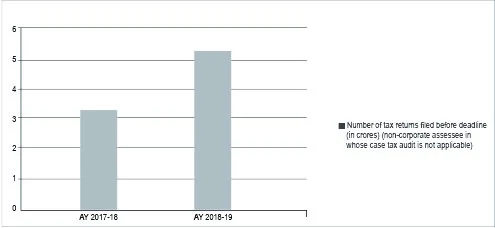
Source: Live Mint

Source: Twitter @IncomeTaxIndia
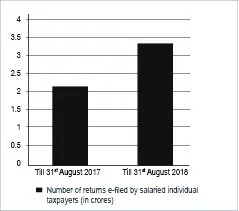
Source: Twitter @IncomeTaxIndia
Global 4G availability trends
| Circle | 4G availability score |
| Singapore | 86.6% |
| Hong Kong | 90.4% |
| Taipei | 89.8% |
| Kuala Lumpur | 80.8% |
| Yangon | 82.8% |
India’s top 5 circles on 4G LTE availability
| Circle | 4G availability score |
| Kolkata | 90.7% |
| Punjab | 89.8% |
| Bihar | 89.2% |
| MP | 89.1% |
| Odisha | 89.0% |
Source: OpenSignal, UK
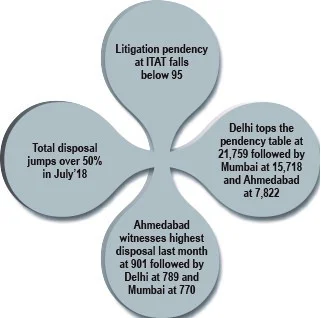
Source: Taxsutra
Title: Bean Counters – The Triumph of the
Accountants and How They Broke Capitalism
Author: Richard Brooks
A well-researched book that starts with tracing the history of double entry
booking keeping and its growth, need and usefulness to the industry from 1200
AD to its present state. It vividly traces the growth in stature of the “bean
counters” in the US, UK and European countries. A reader will find interesting
history of formation and merger and consolidation of firms leading to the Big 4
firms in its current avatar.
Interesting observations on the political
influence across countries of the Big 4 will be both a delight and an eye
opener for any serious reader and observer on the stature and influence of the
Big 4, while the same firms (in spite of rotation) controlling 99% of the
market. The styling of Big 4 in US and UK makes interesting reading which the
author details out in the book.
A view pre and post 1980 on the defined role
of Auditors by the author cannot but be missed by the reader where he observes
that “for generations members of these huge influential practices considered
themselves who happened to be in business but beginning 1980 they saw
themselves as businessmen who happened to be in profession.”
The author observing that the displaced key
performance indicators of Big4, being revenue growth and improved profit
margins followed by measures of staff and customer satisfaction while exposing
false accounting, fraud, tax evasion and risks to economies’, (everything that
the society might want from accountants) not featuring at all as a performance indicator of the firms, raises a basic question on the
very model that the firms have now become.
The observation on devising of legal
structure of the firms for worldwide domination while escaping the
responsibility away from home by the HQ by distancing itself from local
misdeeds elsewhere in the world, while profitably exploiting the name, brand
and commercial networks spills the beans of the operation of the Big 4. For the
few past decades all the firm’s global growth coming from selling more
consultancy services while its talent of turning any change into fee earning
opportunity discloses the growth strategy. In the digital age, cyber security is
the latest major growth engine for the firm’s consultants and now audit fees
worldwide account for 39% while it is 21% in UK making them consultancy firms
with auditing sidelines, rather than the other way around.
The author’s observations on the manner in
which the British Accountancy firms converted to LLP by stating it as “a shabby
episode in accountancy history” will not be missed by a reader. When the
Companies Act 1989 allowed accountants to operate as limited liability
companies, the partners were more wedded to the partnership for the tax
advantage that came with being self-employed rather than company directors.
The ease of sending money across borders in
the age of financial liberalisation allowed the multinational companies to
break up businesses and park more profitable parts where they would be lightly
taxed and the “bean counters showing them (the companies) how to do it by
exploiting their expertise thereby siphoning billions of euros from hard
pressed economies” shows the bean counters in poor light. It is interesting to
note that the users of such services are leading multinational multibillion
dollar companies, goes to showcase the inter dependency of the multinational
and the Big 4.
A list of hundreds of active tax products
under various acronyms by the bean counters makes the author opine that “in
simple truth these were little more than shams.”
The author’s bold statement on the mastered
art of “revolving door” of senior personnel brings closeness that breeds
uniform market oriented view of the public and provides an insight into the
prevalent practice. “So smoothly and frequently the revolving door is spun that
it creates a realistic hope amongst ministers and mandarins that subject to
keeping them happy the Big 4 will present career opportunities to supplement
their pensions.”
The 2008 financial crisis proved to the
contrary the assertions of President Bush that “era of false profits are over”
just six years earlier, speaks volumes about the unreformed and unrepentant
approach and influence of the Big 4. The author clearly links a clear nexus
during the period in the US towards lobbying donations to senators and
Congressmen through political action committee by the Big 4 employees hitting
record levels and the reforms being blocked fairly easily.
The author has very pertinent and far
reaching suggestions that cover separation of accounting and consultancies,
having strong independent regulations, bring in transparency, suggesting public
auditing of major institutions of the government, ending the “quadropoly” which
brings accountability demands an immediate detailed relook.
The book published this year by
AtlanticBooks, UK comes in at the most appropriate time for India when read in
the backdrop of recent Hon. Supreme court judgement of February 2018 and the
vision of the Hon. Prime Minister of India, on Indian Audit firms becoming
world leaders. Any serious reader and well-wisher of audit profession of our
country will find that this book serves a road map towards establishing a new structure
of the audit profession by learning from the mistakes of the West so very well
documented in book.

Arjun
(A) — (alone, chanting prayers)
Hare Ram Hare Ram Ram Ram Hare Hare
Hare Krishna Hare Krishna Krishna Krishna Hare Hare
He Bhagwan ! I can’t see
you anywhere. There is a deep darkness all around; and you are also dark
(Krishna) in complexion!
Hare Ram Hare Ram Ram Ram Hare Hare
Hare Krishna Hare Krishna Krishna Krishna Hare Hare
Shreekrishna enters – (smiling at the sight of Arjun)
S — Re
Arjun, What’s the matter? Can’t you see me? I am omnipresent. I am there in
your heart.
A —
You are right; but I have lost my heart. I have lost everything! I have lost my
senses!
S — Cool down, Arjun. I had told you in Geeta that one has to be “sthitapradnya”
– always cool and collected. Never lose your balance. Tell me what happened.
A — Nothing is happening!
Clients
are not coming in time. Accounts are not ready. Audits are pending. Articled
trainees are on exam leave. So many difficulties! And Government is not
extending the date.
S — That’s your annual grumbling. Why don’t you improve your ways
and become pro-active?
A — It is very easy to say so. But our profession is essentially
reactive. Government, regulators and clients do something and we are expected
only to react and also act! We can do audits only after the clients’ accounts
are finalised. Government keeps on changing the forms, regulators introduce new
systems; new requirements without understanding practical realities.
S — But now with computerisation everything is digitised.
How is it that the work is
not completed on time.
A — Many clients are not tech-savvy. They rely on us. Small
businessmen, senior citizens, charitable organisations, housing societies and
such other people are not used to the `digital environment’.
S — So you mean, you alone have to take care of 1000 such small
clients!
A — Precisely! And further, in case non-audit assessees the date
was extended from 31st July to 31st August. So, the July
load was carried forward to August 2018. Further GST requirements are keeping
us busy round the year! – It is a big volume.
S — Why don’t you represent to the Government?
A — We are doing it repeatedly; but it is falling on deaf ears. We
are helpless. Our Institute had made an excellently drafted convincing
representation – and it was rejected on 3 occasions! Actually, there is
something structurally wrong in the present statutory deadlines.
S — Relax. You will get extra time.
A — But when? On 29th September? – when we have
virtually, somehow pushed the returns!
S — That means, somehow or the other you can do it!
A — No. Really speaking, it is humanly impossible. And quality
suffers; let alone the stress that affects health.
S — But you have to stick to your discipline and ethics. You can’t
afford to compromise on quality. That will defeat the very purpose of audit.
A — Yes. Everybody expects that CAs should maintain discipline,
give quick results and at the same time ensure quality! Further we have to
ensure many compliances on day-to-day basis. Hence, we don’t have time for
creative and meaningful work.
S — You say there is no room for creativity; but in all scams
Government feels that it was the ingenuity of CAs.
A — That’s the pity. Real thieves are different; but everywhere CAs
are blamed. CAs are expected to perform the role of fraud-detectors even in the
normal audit! No one realizes that there is difference between audit and
investigation. I at times wonder why I became a CA!
S — Don’t be so nervous. Things will improve.
A — I don’t see any chance of that. We are facing humiliation
everywhere. Everybody is taking us for a ride. – Government, regulators,
clients, bankers, staff, even our articled trainees!
Everybody is deviating from
ethics.
S — That is Kaliyug. But you should never compromise on
ethics. You need to be more firm and assertive.
A — I am aware of all this philosophy. Unfortunately though we are
not a part of unethical acts, we are expected to certify the reporting is
correct and `true and fair’.
S — It seems, your grievances are unbearable today.
A — Yes. We have no choice. By nature, we are not rebellious. But
sometime, our feelings are going to explode. Hell with this compliance
practice! They are thrusting everything on us; and on the top of it, Government
is not even listening to our genuine requests.
S — So, what to do now?
A — Arey Bhagwan, when I am helpless, I approach you with
this question. And today you are yourself asking me this question? So, you also
don’t have the solution, it seems!
S — Go to the Courts.
A — Ah! I am skeptical about it. And even if Court intervenes,
Government will not understand the spirit of the verdict. There is no savior
for us.
S — Hmmm!
A — And in this birth, becoming and practicing as a CA appears to
be a sin! So I don’t know what is going to
happen in next birth.
S — We will see of next
birth. But what are you going to do now?
A — Beg to FM, wait, watch and chant bhajan –
Hare Ram
Hare Ram Ram Ram Hare Hare
Hare
Krishna Hare Krishna Krishna Krishna Hare Hare
Note: The above dialogue only shows how various stakeholders have taken
our fraternity for granted. It’s high time we put our foot down and unite
together. Though, preaching on Code of Ethics seems old school, this is the
only thing that will help us.

1.
Bhagavan Das Dhananjaya Das vs. Union of India [2018] 96 taxmann.com 189
(Madras)
W.P. NOS. 25455 OF 2017 AND 25456, 25729,
26654, 16903, 16970, 16995, 16999, 17151, 17161 of 2018 & Oths.
Date of Order: 3rd August, 2018
Section 164(2) of the Companies Act, 2013 –
Disqualification of directors – The provision which came into effect on
01.04.2014 cannot be given a retrospective effect especially when the
disqualification clause did not trigger in the previous regime
FACTS
B was a
director of B Co a private limited company incorporated under the Companies
Act, 1956 (“1956 Act”). He was also a director in other company S Co which was
also a private limited company incorporated under the 1956 Act. B Co had no
operations and was lying dormant till the year 2012.
In the year
2012, the directors planned to revive the company and there was infusion of
additional share capital as well as introduction of three new members to the
Board of B Co (one of them being Mr. B). The revival plan did not fructify and
B Co continued to remain a dormant company. B Co did not file its annual
returns from financial year 2012-13. The last annual return filed was in
respect of financial year 2011-12.
Registrar Of Companies (“ROC”) on 18.03.2017
issued a show cause notice for striking off the name of B Co. There being no
plans to revive the company, B Co issued a no objection letter to the ROC for
striking off. On 08.09.2017 ROC issued a list of directors disqualified u/s.
164(2)(a) of Companies Act, 2013 (“2013 Act”) which included name of B as well.
Accordingly, B would be prohibited from acting as a director in any other
company for a period of 5 years.
Aggrieved, B filed a writ petition before
the Hon’ble Madras High Court. B contended that provisions of section 164(2)(a)
came into effect from 01.04.2014. Applicability of the section would commence
in respect of financial years commencing from 01.04.2014 and should not apply
in respect of offences committed prior to that date.
HELD
The High Court examined the provisions of
section 274(1)(g) of 1956 Act and section 164 (2)(a) of the 2013 Act. The
former section only disqualified a director from being appointed as a director
in any “public” company for a period of 5 years which was broadened under the
2013 Act to any company. The High Court observed that section 164(2)(a) was
made effective from 1.4.2014, as per section 2(41) of the 2013 Act, the first
financial year for the purpose of section 164 of the 2013 Act would be
31.3.2015 i.e., from 1.4.2014 to 31.3.2015. ROC thus wrongly applied section
164(2)(a) from financial year 01.04.2013.
The High Court further held that the
disqualification of directors of a private company could get triggered only on
or after 30.10.2017, hence, the list of disqualified directors published on the
website of the first respondent in September, 2017 had no legal legs to stand
up to the scrutiny of the Court under Article 226 of the Constitution of India.
It was observed that General Circular
No.08/14 dated 4.4.2014 also has made it clear that in respect of the financial
year commencing on or after 01.04.2014, the provisions of the new Act shall
apply, the first financial year for the purpose of section 164(2)(a) shall be
1.4.2014 to 31.3.2015 and the second and third financial years would be from
1.4.2015 to 31.3.2016 and from 1.4.2016 to 31.3.2017 respectively.
The High Court observed that by virtue of
the first proviso to section 96(1) of the 2013 Act, Annual General Meeting for the
year ending on 31.3.2017 can be held within six months from the closing of
financial year i.e., 30.9.2017, additionally in the light of section 164(2)(a)
referring to “annual return” and “financial statement”, the
time limit to file annual return u/s. 92(4) of 2013 Act is sixty days from
Annual General Meeting or the last date on which Annual General Meeting ought
to have been held, hence, the time limit to file balance sheet u/s. 137(1) of
the 2013 Act is again thirty days from Annual General Meeting. The
disqualification could get triggered off only on or after 30.10.2017 only, if
any company fails to file annual forms for three financial years. Even beyond
that time limit, additional time limit of 270 days was available by virtue of
the then first proviso to Section 403.
The High Court observed that ROC although
sent a show cause notice to B Co before striking off its name, it did not give
any such notice to B before disqualifying him as a director.
A company can be struck off if that company
has not been carrying on any business for a period of two financial years and
if their directors had not filed the financial statements or annual returns for
any continuous period of three financial years, they shall be, no doubt,
disqualified to be reappointed as a director of that company for a period of
five years from the date on which the said company fails to do so, whereas for
disqualification of the directors u/s. 164(2)(a), there must be a default for
not filing the financial statement or annual return for a continuous period of
three financial years.
The ROC should have sent a notice to B
before taking any action, as it affects its right to continue as directors in
other companies which are complying with the provisions of law.
The High Court however clarified that the
mischief of removal of the names of the companies by the Registrar of Companies
and the disqualification of the directors in the defaulting company will go
together, as it is inseparable, and the ROC need not give fresh notice to the directors
for their disqualification from the dormant company, if there is a failure to
file the financial statement or annual return for any continuous period of
three financial years as per section 164(2)(a).
The High Court thus set aside the order and
allowed the writ petitions filed before it.
2.
Dinesh Kumar Bhasin vs. Batliboi Impex Ltd.[2018] 96 taxmann.com 94
(NCL-AT)
COMPANY APPEAL (AT) (INSOLVENCY) NO. 318 of
2018
Date of Order: 29th June, 2018
Section 9 of Insolvency and Bankruptcy
Code, 2016 – NCLT admitted the petition against the corporate debtor which was
filed by the operational creditor for default in payment of certain sum – A
shareholder of the corporate debtor challenged the admission on the ground that
the same was passed without hearing the corporate debtor – The order of the
NCLT was set aside – The dispute was already settled and hence, the same was
not remanded back to NCLT
FACTS
B Co filed an application u/s. 9 of the
Insolvency and Bankruptcy Code, 2016 (“the Code”) for initiating corporate
insolvency resolution process against T Co (“Corporate debtor”). National
Company Law Tribunal (“NCLT”) admitted the application, passed order of
‘Moratorium’ and pursuant to proceeding, an ‘Interim Resolution Professional’
was appointed.
Mr. D, a shareholder of T Co, objected to
the order of the NCLT on the grounds that an opportunity of being heard was not
afforded to B Co. Had B Co been heard, it could have pointed out the grounds
for rejection and in case of non-acceptance, it could have settled the dispute.
It was submitted to the NCLAT that T Co and
B Co had arrived at a settlement.
HELD
NCLAT held that the order of the NCLT was
passed without giving the corporate debtor an opportunity of being heard.
Accordingly, the same was liable to be set aside.
However, as the parties had already come to
a settlement, the same could not be remanded back to NCLT.
B Co was further ordered to bear the cost of
resolution professional appointed through the order of NCLT.
3.
[2018] 96 taxmann.com 271 (SC)
State Bank of India vs. V. Ramakrishnan
CIVIL APPEAL NOS. 3595 & 4553 of 2018
Date of Order: 14th August, 2018
Section 14 of the Insolvency and Bankruptcy
Code, 2016 – Moratorium for limited period mentioned in the Code would not
apply to personal guarantor of a corporate debtor – Amendment to section 14(3)
was clarificatory in nature and accordingly would have a retrospective
application
FACTS
V was the Managing Director of corporate
debtor and also its personal guarantor in respect of credit facilities availed
from State Bank of India (“SBI”). The guarantee agreement is dated 22.02.2014.
Owing to non-payment of debt, account of the corporate debtor was classified as
a non-performing asset on 26.07.2015 and proceedings under SARFAESI Act were
initiated.
On 20.05.2017 corporate debtor filed a
petition to initiate corporate insolvency resolution process against itself
which was admitted on 19.06.2017 and moratorium was statutorily imposed in
terms of section 14 of the Insolvency and Bankruptcy Code, 2016 (“the Code”).
V took up a plea that moratorium would apply
to the personal guarantor as well and as a consequence the proceedings against
personal guarantor ought to be stayed. National Company Law Tribunal (“NCLT”)
admitted the plea and restrained SBI from moving against V.
An appeal filed by SBI against the order of
NCLT before the NCLAT was also dismissed. The reasoning was that since the
personal guarantor can also be proceeded against, and forms part of a
Resolution Plan which is binding on him, he is very much part of the insolvency
process against the corporate debtor, and that, therefore, the moratorium
imposed u/s. 14 should apply to the personal guarantor as well.
HELD
Supreme Court examined various provisions of
the Code.
Section 2(e) as substituted by the Amendment Act, 2018 which came into effect
from 23.11.2017 specifically provides that provisions of the Code shall apply
to personal guarantors to corporate debtors. It was observed that Part III of
the Code titled “Insolvency Resolution and Bankruptcy for Individuals and
Partnership Firms” was not yet been brought into force. The repealing
provision, namely section 243, which repeals the Presidency Towns Insolvency
Act, 1909 and the Provincial Insolvency Act, 1920, was also not been brought
into force. Section 249, which amends the Recovery of Debts Due to Banks and
Financial Institutions Act, 1993, so that the Debt Recovery Tribunals under
that Act can exercise the jurisdiction of the Adjudicating Authority conferred
by the Code, was also not been brought into force.
Supreme Court observed that on a plain
reading, moratorium referred to in section 14 can have no manner of application
to personal guarantors of a corporate debtor. It was observed that so far as
personal guarantors were concerned, Part III has not been brought into force,
and neither has section 243, which repeals the Presidency-Towns Insolvency Act,
1909 and the Provincial Insolvency Act, 1920. The net result of this was that
so far as individual personal guarantors were concerned, they will continue to
be proceeded against under the aforesaid two Insolvency Acts and not under the
Code. It was further observed that use of the word “bankruptcy” in section
60(2) of the Code would not include SARFAESI proceedings but only to the two
Insolvency Acts referred to above.
It was observed that the scheme of section
60(2) and (3) was thus clear – the moment there was a proceeding against the
corporate debtor pending under the Code, any bankruptcy proceeding against the
individual personal guarantor would, if already initiated before the proceeding
against the corporate debtor, be transferred to the NCLT or, if initiated after
such proceedings had been commenced against the corporate debtor, be filed only
in the NCLT. However, NCLT would decide such proceedings only in accordance
with the Presidency-Towns Insolvency Act, 1909 or the Provincial Insolvency
Act, 1920, as the case may be.
Section 31 which was relied upon by V, only
stated that once a Resolution Plan, as approved by the Committee of Creditors,
takes effect, it shall be binding on the corporate debtor as well as the
guarantor. Supreme Court observed that this was for the reason that otherwise,
u/s. 133 of the Indian Contract Act, 1872, any change made to the debt owed by
the corporate debtor, without the surety’s consent, would relieve the guarantor
from payment. Section 31(1), in fact, makes it clear that the guarantor cannot
escape payment as the Resolution Plan, which has been approved, may well
include provisions as to payments to be made by such guarantor.
It was further observed that sections 96 and
101, when contrasted with section 14, would show that section 14 cannot
possibly apply to a personal guarantor. It was open for the Supreme Court to
mark the difference in language between sections 14 and 96 and 101, even though
sections 96 and 101 were not yet been brought into force. This was for the
reason that a law ‘made’ by the Legislature is a law on the statute book even
though it may not have been brought into force.
Upon examining the history of the Code and
previous enactments, the Court observed that Parliament, specifically did not
provide for any moratorium along the lines of section 22 of the Sick Industrial
Companies (Special Provisions) Act, 1985 in section 14 of the Code.
It was observed that Amendment of 2018,
which makes it clear that section 14(3), is now substituted to read that the
provisions of section 14(1) shall not apply to a surety in a contract of
guarantee for corporate debtor. It was held that object of the Amendment was to
clarify an overbroad interpretation of section 14 and such the same was a
clarificatory amendment which would be retrospective in nature.
The order of the NCLT was thus set aside.
1. Evidence – Admissibility of electronic
evidence without certification as required under the provision of the
Act–Valid. [Evidence Act, 1872; Section 64B]
Shafhi Mohammad vs. The State of Himachal
Pradesh SLP (CRL.) No. 2302 of 2017 dt. 30/1/2018 (SC)
An apprehension was expressed on the
question of applicability of conditions u/s.
65B(4) of the Evidence Act to the effect that if a statement was given
in evidence, a certificate was required in terms of the said provision from a
person occupying a responsible position in relation to operation of the
relevant device or the management of relevant activities.
It was argued
that if the electronic evidence was relevant and produced by a person who was
not in custody of the device from which the electronic document was generated,
requirement of such certificate could not be mandatory, since if this is not so
permitted, it will be denial of justice to the person who is in possession of
authentic evidence/witness but on account of manner of proving, such document
is kept out of consideration by the court in absence of the certificate.
The Court
clarified the legal position on the subject of the admissibility of the electronic
evidence, especially by a party who is not in possession of device from which
the document is produced. It held that such party cannot be required to produce
certificate u/s. 65B(4) of the Evidence Act. The applicability of requirement
of certificate being procedural can be relaxed by Court wherever interest of
justice so justifies.
Alankar Sahkari Griha Rachana Sanstha
Maryadit, through Chairman S.K. vs. Atul Mahadev Bhagat and Anr. Writ Petition
No. 4457 of 2014 dt. 31/08/2018 (Bom.)(HC). www.itatonline.org
The facts of
the case are that a donation of Rs. 5,00,000/- was made by the respondents to
the Petitioner society. It was alleged by the Respondent that the amount
of Rs. 5,00,000/- was paid for the
purpose of regularising the transfer of plot to a third party by the respondents.
The Petitioner
pointed out that there has been admission on the part of the Respondents with
respect to the amount of Rs. 5,00,000/- being a donation.
It was held
that, after the completion of construction of the bungalow, the Respondents
were in need of money and therefore they decided to sell the plot. On the
background of such facts, a person facing financial difficulties will not
donate an amount of Rs.5,00,000/- to the housing Society. Even though in the
present case, the Respondents have given admission that they paid Rs.5,00,000/-
towards donation to the Petitioner-society, it cannot be further read that it
was paid voluntarily without any pressure.
Hence, it was
concluded that the amount paid was not donation but money was a transfer fee paid
out of compulsion and it was not a voluntary payment.
3.
Natural Justice – Additional
Evidence – Chance for rebuttal. [CPC, 1908; O.41, R. 27]
Akhilesh Singh vs. Lal Babu Singh and Ors.
(2018)4 SCC659
A suit seeking
partition of their share in joint family properties was filed by the sons of
the grandfather of the Appellant. The suit was decreed and the Respondents
aggrieved, preferred an appeal. Various applications were filed for accepting
additional evidence. Since, nobody had appeared on behalf of the Appellant, the
High Court proceeded with the hearing of the appeal and relying on additional
evidence set aside the judgment and decree of the Trial Court. Aggrieved by
such order, the present appeal was preferred. It was held by the Court that the
Appellate Court before which any statement in sale deeds was relied ought to
have given an opportunity to lead evidence in rebuttal or to explain the
admission. Opportunity to explain the admission contained in the sale deeds was
necessary to be given to the contesting party. Accordingly, the High Court
order was set aside.
Industrial Mineral Co. (IMC) vs. Commissioner
of Custom. 2018 (15) G.S.T.L. 249 (Mad.) (HC)
In the present
case, the adjudicating authority had mentioned that the case on hand is similar
to another case, passed by the Customs, Excise & Service Tax Appellate
Tribunal, where the said case has been questioned by the Department, before the
Hon’ble Supreme Court and that the issue is yet to reach a finality.
The Court was
of the view that when the order passed by the Tribunal has not been stayed or
set aside by the Hon’ble Supreme Court, it is the bounden duty of the
adjudicating authority to follow the law laid down by the Tribunal. Since a
binding decision has not been followed by the adjudicating authority in this
case, this Court can interfere straightaway without relegating the assessee to
file an appeal. Accordingly, the order
passed by the Tribunal was quashed.

1. [2008-TIOL-149-AAR-GST]
Coffee Day Global Ltd dated 21st August, 2018
The GST rate applicable to
Restaurant Services classified under heading 996331 is 5% (CGST-2.5% and
SGST-2.5%) without availing input tax credit.
Facts
Applicant is in the
business of running restaurants under the name and style of Café Coffee Day
where non-alcoholic beverages and food items are served. Notification
No.46/2017 dated 14.11.2017 provides that restaurants can pay GST @5%
(CGST-2.5% and SGST-2.5%), provided they do not avail input tax credit of the
tax paid on input goods and services. Notification No.11/2017- CTR dated
28.06.2017, at Sl.No.35, provides for levy of GST @18% (CGST-9% & SGST-9%)
on supply of unclassified services and the suppliers are entitled to take input
tax credit in the circumstances where they pay output tax. The question before
the authority is whether Notification No.46/2017-CTR dated 14.11.2017 applies
in circumstances where the applicant does not avail input tax credit; that it
does not prevent a restaurateur from paying tax at 18% (CGST – 9% and SGST –
9%) and availing input tax credit.
Held
Services rendered by the
applicant are clearly defined under Service Code (Tariff) 996331 – restaurant
services covered under serial number 7 of the Notification 11/2017-CTR. As the
services provided are covered under a specific heading and the Notification
carves out a specific rate of tax for that heading, the same shall be
applicable. Serial number 35 would qualify for invocation only in respect
of services that do not find
classification elsewhere, therefore, the applicant is covered by serial number
7 and not 35 (which covers heading 9997). Further right to avail input tax
credit is not an absolute right and conditions and restrictions may be
prescribed for its availment. Thus, Applicant is not entitled to pay the GST @
18% with input tax credit as the services being offered are classified under a
heading attracting GST @ 5%, without input tax credit.
2.
[2018-TIOL-148-AAR-GST]
Emerge Vocational Skills Pvt. Ltd dated 13th August, 2018
Education Services in
affiliation with a University is exempted from payment of GST
Facts
Applicant is a private
limited company engaged in providing specified educational services in the
field of Hotel Management – advance ruling is sought on the question ‘whether
the services provided in affiliation to specified universities and providing
degree courses to students under related curriculums are exempt from Goods and
Services Tax vide entry no. 66 of the Notification No. 12/ 2017 – Central Tax
dated 28.06.2017.
Held
The Authority noted that
the Applicant has submitted that he proposes to obtain an affiliation with a University in the
State of Karnataka and shall thereafter be engaged in provision of education in
affiliation with the said university in the State of Karnataka. Since the
“Services provided by an educational institution to its students, faculty and
staff” is exempt from tax under the Central Goods and Services Tax Act, they
qualify as an educational institution insofar as those courses for which
affiliation has been obtained from the University in the State of Karnataka and
for which University Curriculum is prescribed and the qualifications recognised
by the law for the time being in force is given
after the conduct of examinations by such University. The applicant is exempted
from Goods and Services Tax vide entry no. 66 of the Notification No. 12/ 2017
– Central Tax (Rate) dated 28.06.2017.
Tribunal
1. [2018-TIOL-2674-CESTAT-MUM] K B Mehta
Construction Pvt. Ltd. vs. CST-Service Tax, Ahmedabad Date of Order: 12th July, 2018
When the service is
inclusive of supply of goods in such case, value of goods is exempted by
Notification 12/2003-ST.
Facts
Appellant entered into a
consolidated contract involving service and supply of raw material wherein sale
and service value was provided separately. The department contended that the
bifurcation into goods and services is artificial and thus the total contract value is the
gross value of provision of service liable for service tax.
Held
The Tribunal noted that
when the service is inclusive of supply of goods, in such case the exemption in
respect of the value of the goods involved in the provision of services is
exempted by Notification No.12/2003-ST dated 20.06.2003. According to the
Tribunal, the Revenue did not make any effort to verify as to whether despite
making different invoices in respect of services and sale of the goods, the
value of service was suppressed and transferred to the transaction of sale of
the goods. Further, it was observed that they paid VAT in respect of those
invoices where the goods were shown to have been sold. Accordingly, it was held
that if the value shown in the sale invoices was correct towards the sale of
the goods, the same would not be chargeable to service tax in terms of
Notification No. 12/2003-ST dated 20.06.2003. The demand thus was set aside and
the matter was remanded to verify the above observation.
2.
[2018-TIOL-2656-CESTAT-MAD]
International Travel House Ltd vs. Commissioner of Service Tax, Chennai Date of Order: 23rd March, 2018
There is no service
provider – service receiver relationship between inter-divisions and both are
one and the same entity. Cost of parking charges collected are in the nature of
reimbursable expenses and are not liable for service tax.
Facts
On perusal of ST-3 returns,
it was noticed in audit that assessee had not paid service tax on Parking
charges which their travel desk had collected from customers who were provided
with Rent-a-Cab Services, service charges which they received from their travel
division for booking air tickets for clients staying at the hotel and
Commission received from travel division for booking air tickets on behalf of
service provider. Show Cause Notice was issued proposing demand of service tax
under “Rent a Cab Services” and “Air Travel Agency
Services”. It was argued that the travel division undertakes the booking
of air tickets and raises an invoice charging service tax on basic fare, which
is forwarded to travel desk. The bills raised include the value of
inter-division services along with service tax and service charges. Since
service tax on basic fare is being discharged by travel division of assessee
company under Air Travel Agency Services, the demand on assessee treating these
two divisions as separate entities is incorrect.
Held
The Tribunal noted that the
company and its travel division are the same entity and there is no service
provider or service receiver relationship between these divisions. Thus, when
service tax is already discharged by the travel division on the basic fare, the
demand of service tax is without any factual or legal basis and requires to be
set aside. In regard to parking services, it is noted that while providing the
Rent-a-Cab service, the cost of parking charges is also collected. This is in
the nature of reimbursable expenses and therefore cannot be subject to service
tax, as decided in the case of Intercontinental Consultants and Technocrats
Pvt. Ltd. [2018-TIOL-76-SC-ST].
3.
[2018] 96 taxmann.com 2
(Mumbai – CESTAT) Amby Valley City Developer Ltd. vs.
Commissioner of Central Excise, Pune-1
Date of Order: 8th June, 2018
The activity of allowing
complementary use of conference hall by hotel, to guests residing therein,
without charging any separate amount therefor cannot be charged on a notional
amount under “convention service”.
Facts
The appellant, owner of
hotel, while renting the rooms to various corporate entities, also allows use
of conference hall as complimentary and did not charge any amount separately
for said use of conference hall. The billing of rooms is done on the basis of
single occupancy or double occupancy and specifies that the additional facility
of conference hall, seating arrangements and audio visual will be provided.
Revenue alleged that such use of conference hall is liable to service tax as
provision of “convention services”. Whereas appellant submitted that they are
not separately providing “convention service” as alleged by department and the
conference hall charges are included in room tariff included in total bill i.e.
already loaded in value of taxable services on which service tax liability has
been discharged.
Held
The Tribunal noted that
appellant rented rooms and discharged service tax liability wherever
applicable. Further, no separate charges for Convention Center have been
charged and the use has been complementary. Therefore, the Tribunal held that
the demand is computed on notional basis and since the use of convention center
has been complementary, no service tax can be charged. Reliance was placed on
decision in Dukes Retreat Ltd. vs. C.C.Ex., [Final Order No.
M/86948-86949/17/STB, dated 13-4-2017] and Taj View Hotels vs. C.C.Ex. [2014]
47 taxmann.com 198/46 GST 601 (New Delhi – CESTAT). Accordingly, the demand
was set aside.
4.
[2018] 96 taxmann.com 390
(Allahabad – CESTAT) Commissioner of Customs, Central Excise & Service Tax,
Noida vs. Fortune Cookie
Date of Order: 26th July, 2018
When assessee took
premises of golf course on rent and provided food to members of Golf Course
itself, Tribunal held that such services would be in the nature of “restaurant
services” and not “outdoor catering services”.
Facts
Respondent
took premises of Golf Course on rent and paid lumpsum amount to golf course.
From said premises, respondent was providing food to members of Golf Course.
Respondent treated said activity as provision of “restaurant services”, whereas
revenue contended that such activity is taxable as provision of “outdoor
catering service”.
Held
The Tribunal noted that the
“outdoor catering service” is to be provided at the premises of the
service recipient i.e. at his own premises or the premises taken on hire by the
service recipient, whereas in the case of “restaurant service”, the
service is to be provided by the service provider in its own premises. The
Tribunal observed that in instant case, the respondent i.e. service provider
renders services from its premises i.e. premises taken on rent from Golf
Course. It was also noted that in Tamil Nadu Kalyana Mandapam Assn. vs.
Union of India [2006] 4 STT 308 (SC), the Hon’ble Apex court held that the
service of restaurant and outdoor caterer are distinguishable. Further, the
Tribunal noted that the respondent maintains menu card, fixes prices for every
item and there is no personal interaction with service recipient in restaurant.
Accordingly, it was held that services provided by respondent qualify as
“restaurant services” and not “outdoor catering services” and set aside the
demand.
5.
[2018] 96 taxmann.com 28
(Bangalore – CESTAT) Hindustan Petrochemical Corporation Ltd. vs. CCE
Date of Order: 8th June, 2018
Undertaking certain
activities in relation to maintenance and safety of tank trucks and merely
issuing certificates to the effect that tank trucks are purged as required
under petroleum law cannot be regarded as provision of “technical inspection
and certification services”.
Facts
The appellant is engaged in
the business of refining of crude and marketing of various petroleum products.
They have set up a facility to store the LPG and from there, the stored LPG is
sent to various LPG bottling plants of oil distribution companies through tank
trucks. Whenever LPG tank trucks require any repair or mandatory testing of
safety valves, the tanks are cleaned and completely degassed. For this
activity, the appellant collects cost of water, LPG and the labour charges from
the truck owners. On finding that the repairs to truck tankers had to be
conducted with the advance approval in writing and the repair work should be
conducted as per the code IS 2825/BS 5500, department alleged that the
certificates issued by appellant imply that appellant has certified purging of
truck tankers as required under petroleum law and thus, the activities
undertaken by appellant would be chargeable to service tax under “technical
inspection and certification services”.
Held
Hon’ble Tribunal noted that
the appellants are not basically an agency involved with testing and
certification and the activities performed by them make the truck tanks fit to
be filled with LPG for further transportation. Thus, the Tribunal held that
though appellant performed certain activities in relation to the maintenance
and safety of tank trucks and issued certificates to the effect that the tanks
are purged/degassed, such activities of appellant would be construed only as an
activity related to safety and maintenance of the tank truck. Accordingly, the
Tribunal concluded that since appellant has not fulfilled the conditions so as
to impart the activity of purging and degassing tank trucks as ‘technical
inspection and certification service’, the demand was set aside.
6.
[2018] 96 taxmann.com 323
(New Delhi – CESTAT) Ivanhoe Cambridge Investment Advisory India (P.) Ltd. vs.
Commissioner of Service Tax, Delhi
Date of Order: 27th March, 2018
Investment advisory
services provided by Indian service provider to foreign service recipient in
relation to investment opportunities in India, would not be chargeable to
service tax under category of “real estate agency services”.
When experts provided by
foreign holding company to Indian subsidiary, had employer-employee relation
with Indian subsidiary, The Tribunal set aside demand under “manpower
recruitment or supply agency services”.
Facts
The appellant renders
non-binding investment advisory service to its holding company located abroad.
Scope of such services includes identification and advise on investment
opportunities to holding company in diverse sectors including real estate
sector, providing financial and economic market intelligence reports, providing
information on investment targets, structuring of investments as well as exit
options etc., and thereby, enables the foreign company to take decisions on
investment opportunities in India. Department alleged that such advisory
services are in the nature of “real estate agency services” and thus, liable to
pay service tax under reverse charge mechanism.
Further, the foreign
holding company of appellant provided certain expatriates to appellant who were
experts in the area of investment advisory and they were employed by appellant.
Department alleged that appellant supplied manpower to principal and thus, liable
to service tax under category of “manpower recruitment and supply agency
services”.
Held
As regards demand under
category of “real estate advisory services”, the Hon’ble Tribunal noted that in
terms of “Advisory Service Agreement” entered into between appellant and its
holding company, appellant was required to render investment advisory services
in connection with investment opportunities in India and such services were rendered
relating to real estate sector. Also, Tribunal categorically noted that the
scope of the agreement did not cover such advisory services in connection with
any piece of real estate. The Tribunal even observed that various judicial
decisions relied upon by appellant not only support the view canvassed by
appellant but also have held that such activities will be in the nature of
export despite the fact that the contract companies are in India.
Consequently, it was held that services provided by appellant cannot be said to
be covered within the scope of “real estate agency services”.
As
regards demand under “manpower recruitment and supply agency services”, the
Tribunal noted that the terms and conditions under which the expatriates were
placed at the disposal of the appellant are governed by “employment secondment
agreement”. The Tribunal noted that the payment letters issued by appellant to
the expatriates made it clear that such expatriates would be employees of the
appellant during the period of their assignments. Also, the income tax returns
filed by expatriates show appellant as their employer and Income-Tax has also
been paid for the amounts received by the expatriates in India, under the
category of salary. Therefore, the Tribunal held that as the appellant and
expatriates enjoyed employer-employee relationship with appellant, the demand
under “manpower recruitment and supply agency services” would not sustain.
7.
[2018] 96 taxmann.com 549
(New Delhi – CESTAT) Olam Agro India Ltd. vs. Commissioner of Central Excise,
Delhi-III
Date of Order: 31st July, 2018
The commission paid by
Indian company to its foreign parent company towards corporate guarantee
extended by such parent company in favor of Indian banks, so as to facilitate
provision of bank guarantee by such Indian banks to appellant, is liable to pay
service tax under “business auxiliary services”.
Facts
Appellant engaged in
agricultural business was exporting agricultural products. For obtaining loan
from various Indian banks, appellant obtained corporate guarantee from its
foreign parent company in favor of Indian banks. In lieu thereof, the appellant
paid commission amounting to 1 per cent of the value of such corporate
guarantee to their parent company. The Revenue contended this was liable for
service tax under category of “business auxiliary services” under reverse
charge mechanism as services were provided by parent company to appellant in
relation to procurement of service by Appellant. However, appellant contended
that such commission was paid to parent company towards providing guarantee for
obtaining loan by the appellant and not for procurement of any service.
Appellant relied on decision in case of Abdullabhai Abdul Kader vs.
Commissioner 2017 (4) GSTL 38 (Tri Mum.), wherein it was held that
providing the facility of L/C through their bank to various importers cannot be
charged to service tax under the category of “Business Auxiliary Service” since
it was not in connection with procurement of goods which are inputs for the
clients. It was further submitted that as the parent company did not procure
services from bank for the appellant, there cannot be said to be provision of
business auxiliary services.
Held
Hon’ble Tribunal noted that
a corporate guarantee is used when a corporation agrees to be held responsible
for completing the duties and obligations of debtor to a lender, in case the
debtor fails to comply with the terms of the debtor- lender contract; whereas a
bank guarantee is a promise from a bank that the liability of the debtor will
be met in the event the debtor fails to favour his contractual obligations.
Therefore, the nature of corporate guarantee as well as of bank guarantee is
one and the same i.e. for facilitation of the lending facilities. The Tribunal
observed that in present case the foreign parent company executed corporate
bank guarantee in favor of appellant for facilitation of lending of funds to
the appellant and in turn, received guarantee commission by way of foreign
exchange remittance from appellant. It was found that periodic debit notes were
issued by parent company on appellant towards guarantee commission. This
indicated that the transactions were with regard to lending facilities in
India, it was held that changing name from ‘bank’ to ‘corporate’, it cannot be
said that guarantee commission paid by appellant would not get covered as
“business auxiliary services”. Demand was thus upheld.
Capital or revenue receipt – Deposits by
way of subscription pursuant to investment schemes made by subscribers which
have never been forfeited are capital receipts – Nature of receipt cannot be
decided only by the treatment of such subscriptions in the accounts of the
assessee
The assessee company had floated various
schemes which required subscribers to deposit certain amounts by way of
subscriptions in its hands and, depending upon the scheme in question, these
subscribed amounts at the end of the scheme were ultimately repaid with
interest. The schemes also contained forfeiture clauses as a result of which
if, midway, a certain amount was forfeited, then the said amount would
immediately become income in the hands of the assessee.
For the assessment years 1985-86 and
1986-87, the AO treated these amounts as income inasmuch as under the
accounting system followed by the assessee, these amounts were credited to the
profit and loss account for the years in question as income. The Commissioner
of Income Tax (Appeals) dismissed the appeal from the original assessment
orders and confirmed the same. The Income Tax Appellate Tribunal, on the other
hand, allowed the appeals by relying upon the judgement of this Court in Peerless
General Finance and Investment Co. Limited and Anr. vs. Reserve Bank of India,
(1992) 2 SCC 343 in which, according to the Appellate Tribunal, the
Supreme Court finally decided the question in the assessee’s own case stating
that such amounts cannot be treated to be income but are in the nature of
capital receipts. This was not only because of the interpretation of an RBI
circular of 1987, but also because, on general principles, such amounts must be
treated to be capital receipts or otherwise they would violate the provisions
of the Companies Act.
It further went through the various clauses
contained in the scheme and found that in point of fact no subscription
certificate had, in fact, been forfeited as a result of which it was clear that
there would be no income in the hands of the assessee for these two years. It
also dealt with certificates that were surrendered prior to the stated time and
stated that in such cases whatever would remain as surplus in the hands of the
assessee would be treated as income. It went on to state that there would be no
estoppel in law against the assessee making a claim that these amounts
were in the nature of capital receipts and not income, and also relied upon
certain judgements of the Supreme Court to buttress the proposition that the
Supreme Court had also held that what is the true position in law cannot be
deflected by what the assessee may or may not do in its treatment of the matter
at hand in its accounts. The appeal against the order of the Commissioner of
Income Tax (Appeals) was allowed by the Income Tax Appellate Tribunal.
In the first round, the High Court, by its
judgement dated 9th September, 1999 stated that since no question of
law arose, the reference applications before it were dismissed.
The Supreme Court, by an order dated 3rd
December, 2002 set aside the High Court judgement and referred the questions of
law to the High Court.
On remand, the High Court, by the impugned
judgement dated 6th October, 2005, allowed the appeal against the
Appellate Tribunal holding that a perusal of the subscription scheme of the
company showed that since forfeiture of the amounts deposited was possible,
this amount should be treated as income and not as a capital receipt. Further,
it relied heavily upon the fact that the assessee had itself treated such amounts
as income and credited them to its profit and loss account for the years in
question and would, therefore, be estopped by the same. Referring to the
judgement of the Supreme Court in Peerless General Finance and Investment
Co. Limited (Supra), it went on to state that since the said judgement
dealt with an RBI circular of 1987, which itself was only prospective, any law
declared as to the effect of clause 12 of that circular would be prospective in
nature and would, therefore, not apply to the assessment years in question.
On an appeal by the assessee company, the
Supreme Court observed that the question raised in the appeal was as to whether
receipts of subscriptions in the hands of the assessee company for the previous
years relevant to the assessment years 1985-86 and 1986-87 should be treated as
income and not capital receipts inasmuch as the assessee has in its books of
accounts shown this sum as income.
The Supreme Court noted that the
subscriptions were received in the years in question from the public at large
under a collective investment scheme and these subscriptions were never at any
point of time forfeited. It observed that this being the case and surrendered
certificates not being the subject matter of the appeal before it, it was clear
that even on general principles deposits by way of amounts pursuant to these
investment schemes made by subscribers which have never been forfeited could
only be stated to be capital receipts.
The Supreme
Court held that while it was true that there was no direct focus of the Court
on whether subscriptions so
received were capital or revenue in nature, still the Supreme Court had also,
on general principles, held that such subscriptions would be capital receipts
and if they were treated to be income it would violate the Companies Act. It
was, therefore, incorrect to state, as had been stated by the High Court, that
the decision in Peerless General Finance and Investment Co. Limited
(Supra) must be read as not having laid down any absolute proposition
of law that all receipts of subscription at the hands of the assessee for these
years must be treated as capital receipts.
The Supreme Court reiterated that though its
focus was not directly on this, yet, a pronouncement by the Supreme Court, even
if it could not be strictly called the ratio decidendi of the judgement,
would certainly be binding on the High Court. Even otherwise, it was clear that
on general principles also such subscription could not possibly be treated as
income. In cases of this nature it would not be possible to go only by the
treatment of such subscriptions in the hands of accounts of the assessee itself.
In the circumstances, the Supreme Court set
aside the judgement of the High Court and restored that of the Income Tax
Appellate Tribunal. The appeal was allowed.
Dear Members,
On October 2, 2019, the
whole world will celebrate the 150th birth anniversary of the
‘Father of the Nation’ – Mahatma Gandhi. India will mark the event, both
nationally and internationally, by propagating the message of the Mahatma. A
national committee headed by the Prime Minister has been set up for this
purpose. We at BCAS are also making efforts to celebrate this momentous
occasion in a unique way. The October, 2019 issue of the BCAJ carries
special articles and a collage of quotes and thoughts of Gandhiji. We have also
planned an event for members which will include a talk by a senior Gandhian on
the ‘Gandhian’ way of life, some of Gandhiji’s favourite bhajans, a short skit
by members, followed by poetry recitation and exchange of thoughts on
Gandhiji’s principles.
There are many lessons from the Gandhian way of
life that we can adopt in our lives. The one Gandhi thought that has made an
everlasting impression on me is: ‘Service which is rendered without joy helps
neither the servant nor the served’. This is very, very true. I try to practice
this in my personal and professional life. In today’s fast and frenzied age, we
are totally immersed in providing service to our clients or the organization
where we work, but the question we need to ask ourselves is, ‘Are we happy with
what we are doing’? If the work that we are doing gives us pleasure and
satisfaction, that is a big motivating factor which keeps us going. It is
rightly said that ‘all other pleasures and possessions pale into nothingness
before service which is rendered in a spirit of joy’. So let us work with this
mindset of joy and enjoyment for ourselves, motivate our staff and students to
enjoy what they are doing and look forward to another day with anticipation;
let us reach our workplace happily every morning rather than out of compulsion,
without energy or enthusiasm.
On a different note, on August 26, 2019 the RBI
transferred a record Rs. 1.76 lakh crore of its surplus for F.Y. 2018-19 into
the government’s coffers (more than that of the preceding three years). As per
Section 47 of the RBI Act, 1934, the balance of the RBI remaining after making
all required provisions shall be paid to the Central Government. The current
year’s highest-ever transfer was a result of bumper / higher / exponential
surplus and a one-time exceptional transfer from RBI’s Contingency Fund
amounting to Rs. 52,000 crore. Transfer of surplus funds from Central Banks to
their respective governments has always been a topic of debate and discussion
across the world because every government likes to extract the maximum and the
Central Banks want to retain the surplus to make the balance sheet stronger.
The Dr. Bimal Jalan Committee constituted for this purpose recommended that the
equity reserves be in the range of 6.5% to 5.5% of the balance sheet size (it
was 6.8% prior to this transfer). The recommendations of the Committee were
accepted and reserves in excess of the minimum 5.5% (Rs. 52,000 crore) were
allowed to be transferred, thus leaving no buffer for future contingencies.
Further, the transfer came from a bumper profit triggered by interest income
and gains from foreign exchange transactions. Further, as per the
recommendations of the said Committee, the unrealised gains sitting in the
RBI’s balance sheet have remained untouched.
The government has not yet come out clearly about
how and where it intends to use this windfall bonus. Ideally, it should be used
for purposes like recapitalisation of public sector banks, reduce government
borrowing to control the fiscal deficit target, or provide a much-needed
stimulus to a slowing economy, rather than a thoughtless carnival of government
spending. Later, in September, the Finance Minister announced huge direct tax
cuts to boost investments and consumer spending and it appears this revenue
loss will be fully met out of the RBI surplus. Hopefully, this is a one-time
solution and the exception does not become the rule and precedent for future
governments.
Before I sign off,
let me offer my warm wishes to you and your family on the joyous
occasion of Diwali! May this auspicious festival of lights illuminate every
pore of your being by adding sparkling moments of Love, Happiness, Success, Joy
and Good Health.
With Best Regards,
CA Manish Sampat
President
(i) LIBERALISATION OF THE FDI REGIME
On 28th August,
2019 the Union Cabinet chaired by the Prime Minister approved several proposals
for review of Foreign Direct Investment in the coal mining, contract
manufacturing and single brand retail trade sectors. A press release stated
that the Cabinet had approved major proposals for relaxation of the existing
Foreign Direct Investment Policy (FDI Policy) in these sectors:
COAL MINING
Proposal
Permit 100% FDI under
automatic route for sale of coal, for coal mining activities, including
associated processing infrastructure, subject to provisions of the Coal Mines
(Special Provisions) Act, 2015 and the Mines and Minerals (Development and
Regulation) Act, 1957 as amended from time to time, and other relevant acts on
the subject. ‘Associated Processing Infrastructure’ would include coal washery,
crushing, coal handling, and separation (magnetic and non-magnetic).
CONTRACT MANUFACTURING
Proposal
The present FDI policy
provides for 100% FDI under automatic route in the manufacturing sector. There
is no specific provision for contract manufacturing in the policy. In order to
provide clarity on contract manufacturing, it has been decided to allow 100% FDI
under automatic route in contract manufacturing in India as well.
Foreign
investment in ‘manufacturing’ sector is under automatic route. Manufacturing
activities may be conducted either by the investee entity or through contract
manufacturing in India under a legally tenable contract, whether on
principal-to-principal or principal-to-agent basis.
Comments
The law proposes to clarify
that manufacturing need not be done by the FDI entity but can also be done by
any other entity. This proposal will set to rest concerns expressed by some
quarters that contract manufacturing is a trading activity because a company
only sells a product after getting it manufactured.
The contract manufacturer
need not be a group company or working exclusively for an FDI entity. Further,
the arrangement can be on principal-to-principal or principal-to-agent basis.
Thus, the policy includes the typical contract manufacturer as also the toll
manufacturer.
A manufacturer is permitted
to sell products manufactured in India through wholesale and / or retail,
including through e-commerce, without government approval.
Thus,
this proposal is likely to open up a number of opportunities for retail trading
and promote label products without inviting extant restrictions applicable to
retail trading.
SINGLE BRAND RETAIL TRADE (SBRT)
Proposal
As per the existing FDI
policy, 100% FDI is allowed under automatic route for SBRT activity. However,
there are various conditions that need to be fulfilled. The government has
relaxed some of these conditions to attract more FDI for SBRT activities in
India.
Local
sourcing norms
The existing FDI policy
provides that in respect of the SBRT entity having more than 51% FDI, the
sourcing of 30% of value of goods purchased must be done from India only. In this
regard, the SBRT entity is permitted to set off its incremental sourcing of
goods (by non-residents undertaking SBRT in India either directly or through
their group companies) from India for global operations against the mandatory
30% local sourcing requirement during the initial five years only. After five
years, the SBRT entity is required to meet the 30% sourcing norms directly
towards its India operations on an annual basis.
With regard to the above,
the government has now proposed to relax these conditions as under:
Local
sourcing for domestic as well as export sales by SBRT entity:
All the procurements made from India by the SBRT entity for the single brand
shall be counted towards local sourcing, irrespective of whether the goods
procured are sold in India or exported, and the same would apply even beyond
the initial five years.
Incremental
sourcing vs. year-on-year sourcing: As per
the extant policy, only that part of the global sourcing is considered for
abovementioned set-off towards local sourcing requirement which is over and
above the previous year’s value, i.e., only incremental sourcing is considered
for set-off against local sourcing requirements. The government has now decided
the entire (and not the incremental) sourcing from India for global operations
shall be considered towards local sourcing requirement.
Direct and indirect sourcing: It has also been decided that the global sourcing would cover sourcing
of goods from India for global operations not only by non-residents undertaking
SBRT in India either directly or through their group companies (resident or
non-resident), but also by an unrelated third party, done at the behest of the
SBRT entity or its group companies under a legally tenable agreement.
E-commerce
As per the existing policy,
an SBRT entity must operate through brick-and-mortar stores before starting
retail trading of that brand through e-commerce. However, the government has
now decided to allow retail trading through online trade prior to opening of
brick-and-mortar stores, subject to the condition that the SBRT entity opens
brick-and-mortar stores within two years from the date of start of online
retail.
DIGITAL MEDIA
Proposal
The
extant FDI policy provides for 49% FDI under approval route in up-linking of
‘News and Current Affairs’ TV channels. It has been decided to permit 26% FDI
under government route for uploading / streaming of news and current affairs
through digital media on the lines of print media.
Comments
(i) This
proposal has given rise to more questions than answers. FDI policy in print
media and broadcasting content service provides for uplinking news and current
affairs TV channels and were defined;
(ii) There
was no clarity in law for FDI in digital media. As per one view, since
uploading / streaming of news and current affairs through digital media is not
covered by sectors or activities listed in Regulation 16 of FEMA 20(R)/2017,
FDI up to 100% was permitted under automatic route;
(iii)
Thus, considering the exponential growth, internet penetration, reducing prices
of smart phones and so on, Indian companies engaged in digital media invited FDI
investments, such as Quint, Dailyhunt, Huffpost, VC Circle, etc. A question
arises on FDI investments made in such companies. Will the law require such
companies to reduce FDI holding?
(iv) In
case of startups engaged in said activities, cap on foreign investment may
hamper future funding as such startups will have to rely on domestic investors
to raise capital;
(v) It is a popular practice for media companies to stream news live on
their apps and websites (e.g., Republic TV, NDTV News, Aaj Tak Live TV, etc.).
Extant FDI policy provides for 49% FDI under approval route in up-linking of
news and current affairs TV channels. Now, the proposal provides 26% limit for
streaming news through digital media. Thus, the issue arises whether differing
FDI threshold will mandate media companies to house digital media in a separate
company and comply with FDI norms. Even if the division is spun off, the
company will be required to give exit to FDI investors which may be a
complicated affair;
(vi)
Further, the proposal brings uploading / streaming of news and current affairs
through digital media under government route. This may result in delays and
mandatory compliance with conditions imposed by ministries concerned;
(vii)
Impact of the above proposal on streaming services offered on social media
platforms such as Facebook and Google is also not clear, or whether foreign
digital news websites that can be accessed in India will continue to be
available or not;
(viii) It
is not clear whether OTT platforms such as Zee5, Hotstar, Voot and others that
have both entertainment and news content would be covered under the 26% or the
49% FDI regime.
Since the
policy announcement is yet to be legislated, one expects that the fears
expressed by the media industry will be adequately clarified.
(ii) ANALYSIS OF RECENT COMPOUNDING
ORDERS
An analysis of some interesting compounding orders passed by the Reserve
Bank of India in the month of August, 2019 and uploaded on the website1
are given below. The article refers to regulatory provisions as existing at the
time of offence. Changes in regulatory provisions are noted in the comments
section.
_________________________________
1 https://www.rbi.org.in/scripts/Compoundingorders.aspx
FOREIGN DIRECT INVESTMENT (FDI)
COMPOUNDING ORDERS
A. Dharmpal
Agarwal (for self and on behalf of Vineet Agarwal, Chander Agarwal, Urmila
Agarwal, Priyanka Agarwal & Chandrima Agarwal)
Date of order: 19th July, 2019
Regulation: FEMA 3/2000-RB Foreign Exchange Management (borrowing and
lending in foreign exchange)
ISSUE
Availing
of foreign currency loan overseas, for the purpose of purchasing property
abroad
FACTS
(a) The
applicant and the others, resident individuals, jointly acquired a residential
property in Singapore at a total cost of SG$ 3,032,320;
(b) SG$
606,464 was met through remittances under LRS; the remaining amount of SG$
2,425,856 (Rs. 6,78,26,933) was paid by availing a loan from OCBC Bank,
Singapore;
(c) During personal hearing it was submitted that instalments for
repayment of loan and payment of interest (EMIs) with respect to the loan were
met out of the proceeds of lease rental received on the lease of the property;
(d) In the
initial years of loan repayment, reduction in principal amount of loan was
small and the interest component made up a large part of the EMI. Therefore,
considering the total amount paid under EMIs on the loan over the years, the
applicant ended up effectively re-paying more than the amount of loan;
(e) The
applicant and the others have sold the property and repaid the loan. The
applicant submitted that he had not made any gains through availing loans
overseas for acquisition of the property abroad.
Regulatory provisions
Regulation
3 of Notification No. FEMA 3/2000-RB states that, ‘Save as otherwise provided
in the Act, Rules or Regulations made thereunder, no person resident in India
shall borrow or lend in foreign exchange from or to a person resident in or
outside India’.
Contravention
|
Nature of default |
Amount involved |
Time period of default |
|
Availing of foreign currency |
Rs. 6,78,26,933 |
Nine years and six months |
Compounding
penalty
Compounding
penalty of Rs. 5,58,702 was levied.
Comments
While
remitting money under LRS for purchase of property is permitted, availing of
foreign currency loan overseas for the purposes was not permitted and was in
contravention of Regulation 3 of FEMA 3(R)/2000-R.
Interestingly,
in this case immovable property was leased to earn rental income. In the past,
RBI has taken a view that under LRS route only purchase of immovable property
was permitted and leasing activity was not permitted. However, no such
observations have been made in the instant case. Additionally, it is
interesting to note that under FDI provisions real estate business has been
defined to specifically include earning of rental income from leasing of
property. However, real estate business as defined under ODI regulations does
not include earning of rental income from leasing of property resulting in
dichotomy between real estate business as defined under FDI regulations and the
ODI regulations.
B. Mindtree Limited
Date of
order: 11th July, 2019
Regulation:
FEMA 20/2000-RB Foreign Exchange Management (transfer or issue of security by a
person resident outside India)
ISSUE
Delay in reporting the issuance of shares under the Employee Stock
Options Plans (ESOP) beyond the stipulated time period; as also delay in
reporting the issuance of bonus shares beyond the stipulated time period.
FACTS
(i) The
applicant is an international information technology consulting and
implementation company that delivers business solutions through global software
development;
(ii) The
applicant company issued shares under ESOP (value – Rs. 1,96,00,000) to foreign
nationals / non-resident Indians (NRIs), but delayed the reporting of the same
beyond the stipulated time period;
(iii)
Besides, the applicant also delayed reporting the issuance of bonus shares
(total value – Rs. 40,12,500) beyond the stipulated time period;
(iv)
During personal hearing it was submitted that the applicant was under inquiry
by the Directorate of Enforcement (DoE) in connection with trade-related
transactions of the company;
(v) RBI,
vide its letter reference No. FED.CO.CEFA/4994/15.20.67/2018-19 dated 21st
February, 2019, had sought a No-Objection Certificate (NOC) from the DoE to
proceed with the compounding process;
(vi) DoE, vide its letter reference No. RBI/SDE/WR/B-223/2019/335
dated 30th April, 2019, conveyed
their no objection to compounding of the abovementioned contraventions.
Regulatory Provisions
(a) Regulation 8(3) of Notification No.
FEMA.20/2000-RB, which dealt with ‘Issue of shares under Employees’ Stock Options
Scheme to persons resident outside India’, as then applicable, says, ‘The
issuing company shall furnish to the Reserve Bank, within thirty days from the
date of issue of shares under the scheme, a report…’;
(b) Regulation 6B of the above-mentioned Notification
states ‘A company issuing rights shares or bonus shares or warrants in terms of
these regulations shall report to the Reserve Bank in Form FC-GPR as stipulated
in Paragraph 9(1)(B) of Schedule 1 to these Regulations’.
Contravention
|
Regulations of FEMA |
Nature of default |
Amount involved |
Time period of default |
|
Regulation 8(3) |
Delay in reporting the |
Rs. 1,96,00,000 |
7 days |
|
Regulation 6B |
Delay in reporting the |
Rs. 40,12,500 |
8 days |
Compounding penalty
Compounding
penalty of Rs. 24,750 was levied.
Comments
(I) The applicant is required to give an
undertaking at the time of filing compounding application that it is not under
any inquiry / investigation / adjudication by any agency such as Directorate of
Enforcement, CBI, etc., as on the date of the application;
(II) This condition results in difficulty in
making compounding application by the applicant who is before ED for any other
violation (e.g., non-receipt of export proceeds within permissible time) or
replies to notice issued by ED, but there is no further correspondence from ED.
Issue arises whether existence of on-going ED proceeding shuts the door for
compounding;
(III) In this order, as also in the case of
Satyanarayan Goel2, RBI has taken a practical view by taking an NOC
from the ED and thereafter compounding the offence. Thus, it is advisable for
an applicant to approach the RBI for compounding by disclosing all pending
proceedings before the ED.
OVERSEAS DIRECT INVESTMENT (ODI)
COMPOUNDING ORDERS
C. Tata Chemicals Limited
Date of
order: 10th July, 2019
Regulation:
FEMA 120/2004-RB – Foreign Exchange Management (transfer or issue of any
foreign security) Regulations, 2004
ISSUE
Extending
loan without any equity contribution to overseas Joint Venture (JV), without
prior approval of the Reserve Bank of India.
FACTS
(i) The applicant is engaged in the business of
manufacturing chemicals and fertilizers;
(ii) The applicant set up an overseas JV, namely,
Grown Energy Zambeze Limitada (GEZ), Mozambique, under overseas direct
investment (ODI) on 22nd April, 2008;
(iii) The applicant company remitted an amount of
USD 275,000 (Rs. 1,19,15,500) in three tranches between 26th
February and 26th September, 2008 as project advance. No shares were
issued against the remittances sent and these remittances were treated as loans
/ advances by the applicant;
(iv) In June, 2009, the applicant decided to quit
the project due to uncertainty around allotment of land. The money has now been
brought back to India and the UIN has been closed on 7th May, 2019.
Regulatory provisions
Regulation
6(4) of Notification No. FEMA.120/2004-RB, as then applicable, states ‘an
Indian party may extend a loan or a guarantee to or on behalf of the joint
venture / wholly-owned subsidiary abroad, within the permissible financial
commitment, provided that the Indian party has made investment by way of
contribution to the equity capital of the joint venture.’
_________________________
2 CA
No 4910 / 2019
Contravention
The applicant has contravened the provisions of Regulation 6(4) of
Notification No. FEMA 120/2004-RB. The amount of contravention is Rs.
1,19,15,500 and the period of contravention is approximately eleven years.
Compounding penalty
Compounding penalty of Rs. 1,39,366 was levied.
Comments
This order
reflects that conditions prescribed in FEMA 120 of 2004 need to be complied
with strictly. In fact, the amount was disclosed as loans / advances and thus
it resulted in violation of Regulation 6(4) of FEMA 120 of 2004. The provision
does not specify the threshold for investment in equity capital. Thus,
theoretically, a loan based on infusion of nominal equity capital would have
been permissible. Regulation 15(i) obligates an Indian party which has acquired
foreign security to receive a share certificate or other document as evidence
of investment in the foreign entity to the satisfaction of RBI within six
months or such further period as RBI may permit. Flexibility of extended time
limit by RBI is available provided investment is for acquisition of foreign
security. In this case, the amount was stated as loans / advances and, accordingly,
Regulation 15(i) would not apply.