Globalisation Of Indian Firms | A Timed Opportunity
Some opportunities arrive quietly and leave just as quietly. In 2002, the collapse of a global accounting giant left a vacuum in the professional services market, instantly consolidating the Big Five into the Big Four. It was a moment when a new, formidable institution could have emerged from the Global South. India missed that window. Over two decades later, despite producing hundreds of thousands of the most rigorously trained professionals in the world, India has yet to build a single accounting firm of true global scale. We have mastered the art of exporting exceptional talent, but we have fundamentally struggled to export the institution.
The market will no longer wait for us to catch up. Indian corporations are no longer purely domestic entities; they are acquiring assets overseas, operating complex cross-border supply chains, and navigating multi-jurisdictional tax and regulatory regimes. They require advisors who can follow them, providing integrated, multi-jurisdictional competence with a single point of accountability. Simultaneously, technology has dismantled the traditional advantages of geographic proximity. Cloud infrastructure and artificial intelligence are rapidly commoditizing routine compliance work. The premium has shifted entirely to high-level professional judgment and trust.
So, what holds Indian firms back? The barrier is rarely technical capability; it is our structural DNA. The Indian accounting sector remains deeply fragmented, with the vast majority of practices operating as small proprietorships. Many firms remain trapped in the illusion that staying small preserves professional independence. We are often wedded to founder names, reluctant to share authority, and deeply reliant on individual hero-partners who control marquee client relationships. A practice built entirely around the personal credibility of one or two individuals cannot cross a state line, let alone an international border. More importantly, the regulatory architecture has historically constrained the form, branding, ownership, fee-sharing and multidisciplinary models through which Indian CA firms could participate in international platforms.
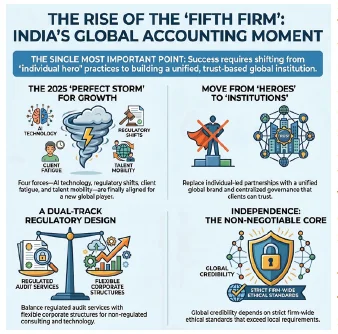
To build a firm that travels well, leadership must pivot from personality to systemic architecture. Globalisation demands transitioning from a loose confederation of partners sharing a letterhead to a unified institution. This requires uncomfortable shifts. Client relationships must belong to the firm, not the individual. Technology must be treated not as a discretionary overhead, but as the core infrastructure that enables scale and enforces quality. Most critically, it requires massive capital. Expanding internationally, attracting top-tier local talent in foreign markets, and deploying enterprise-grade technology necessitates funding models that challenge traditional partnership economics. It requires patient capital and investment discipline: whether generated internally, pooled across partners, or enabled through structures that remain consistent with professional independence.
Furthermore, true global expansion exposes the cracks in a firm’s foundation. Domestic success is frequently insulated by long-standing relationships and regulatory barriers. In a new market, incumbency vanishes, and the firm must survive purely on its distinctive value. To survive this exposure, firms must view regulation and independence not as constraints, but as the very architecture of trust. A global practice cannot operate with variable ethics—strict in one jurisdiction and flexible in another. Institutional culture is not a values statement; it is what happens when a junior associate spots an error at midnight and raises it, even when no senior partner is watching.
The forces of technology, client fatigue with market concentration, and shifting regulatory frameworks are finally aligning to create an opening for the “Fifth Firm”. However, going global must never be a vanity project pursued simply to print a foreign address on a business card. It is the ultimate diagnostic test of a firm’s resilience and maturity.
History reminds us that windows of opportunity do not stay open indefinitely. The question facing the Indian accounting profession is no longer whether we have the talent to operate on a global stage; our professionals already run the engine rooms of the world’s largest corporations. The real question is whether we have the institutional courage to build our own. We can choose the comfort of our fragmented domestic ecosystem, remaining highly competent participants in a game governed by others. Or, we can undertake the heavy work of forging an enduring global institution—one where the firm outlives its founders, where economics are shared, and where the name on the door stands for uncompromising trust. Two decades ago, we watched an opportunity pass us by. The ground has shifted once again. This time, we must be the ones to build.