







COMPILER’S NOTE:
Few leading companies in India now publish a Tax Transparency Report to highlight the tax related matters, approach to tax, tax governance, managing tax risk, tax strategy, approach to compliance, advocacy and relationship with regulators and global contribution to tax. Given below are relevant extracts of a Tax Transparency report and Assurance Report thereon.
Tata Motors Passenger Vehicles Limited (formerly Tata Motors Ltd)
Extract of Tax Transparency Report FY 2025-26
INTRODUCTION
We recognize that the tax that we account for, and pay is an important aspect of our wider economic and social impact of the Tata Motors group. Tata Motors PV as always is guided by the Tata Code of Conduct, hence accountability remains rooted in all aspects of its decision. The focus is not only product sustainability but also operational sustainability with strong governance structure around all practices including tax. In furtherance to our endeavour last year, we hereby present our approach to tax related matters and Global Tax & Other Contributions in this 2nd Tax Transparency Report, thereby endorsing our continued commitment to tax accountability that in turn plays a key role in sustainability. This would also address the changing tax environment globally, requiring public disclosures of tax related parameters.
(Discontinued Operation) April to June 2025
| Particulars | FY26 |
| Revenue Contribution |
16,730 2,322 |
CATEGORY WISE SUMMARY
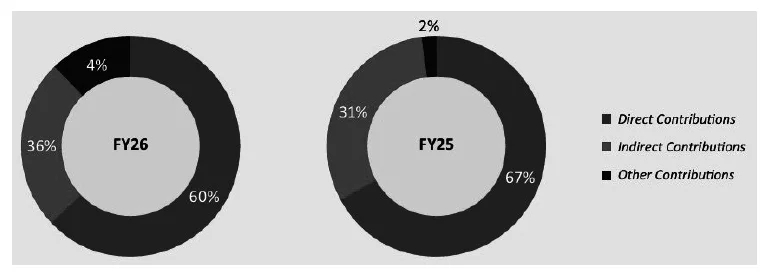
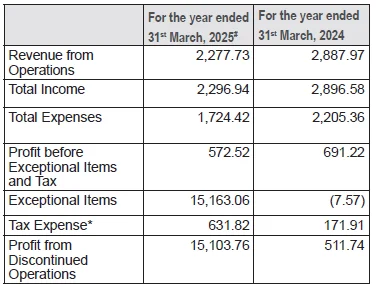
The graphs present data for only Tata Motors PV entities for FY 2025 and FY 2026. The data for commercial vehicles undertaking entities are provided for parity with Financial Statement as discontinued operation in a separate table.
Our approach to tax
At Tata Motors PV, we place strong emphasis on fulfilling our tax related obligations across the Group, guided by the core values embedded in the Tata Code of Conduct. Our responsible approach to taxation extends beyond governance and accountability frameworks and includes continuous capability building through structured training programs for our tax professionals. These programs focus on audit preparedness, evolving tax legislation, and developments in the dynamic tax and regulatory environment.
We are firmly committed to full compliance with the tax laws and regulations of the jurisdictions in which we operate, with zero tolerance for non-compliance. All tax positions and decisions are grounded in applicable local tax laws and, where required, are reviewed and validated by external experts. Business decisions are driven by commercial substance and are never motivated by artificial or aggressive tax planning. Tata Motors PV is committed to paying taxes in the jurisdictions where economic value is created, reflecting our belief that accountable and efficient operations are central to sustainable success. Our stakeholders, including customers, investors and shareholders, vendors, and employees place a high premium on accountability, of which being a responsible taxpayer is an essential element. Accordingly, our tax function is guided by clearly articulated tax principles that are aligned with our business conduct and ethical standards across our global operations.
KEY TAX PRINCIPLES
The following are the key principles in relation to our approach to tax matters and the conduct of our tax affairs. We adhere to a transparent approach, ensuring full disclosure of our activities to all stakeholders.
1. Compliance
We act with integrity, both within the letter and spirit of all tax legislation and relevant international standards. We have a zero tolerance to tax evasion, including the evasion of tax by third parties associated with our business. As a commercially driven organization, we consider the tax consequences and do not engage in transactions without commercial substance with the sole purpose of avoiding tax. In making business decisions we seek to maximize value to our stakeholders. Tax decisions are driven by core values of integrity, unity and responsibility and planning is driven by commercial rationale. Our commitment to ethical taxation is built on a foundation of unwavering integrity and rigorous adherence. We approach our responsibilities with earnest sincerity, ensuring the timely payment of all relevant taxes in all the jurisdictions we operate.
2. Robust internal controls
We proactively seek to identify, manage, and mitigate any potential tax risks, staying abreast of key changes and trends in tax matters through our internal control systems and external advisors/consultants as needed. Our internal controls have stringent escalation matrix at strategic intercepts to ensure critical decisions and positions are evaluated from all perspective.
3. International tax
We embrace business unity to ensure that our international tax affairs are aligned and kept current with the substance of our business operations and international tax guidance. We do not engage in any form of artificial tax structuring. Our subsidiaries are located in countries where the business has significant substance. We claim reliefs, credits, incentives and exemptions that are legislated in these countries as applicable to our operations.
4. Stakeholders relationship
We seek to maintain trusting, transparent and constructive relationships with tax authorities, and proactively participate in dialogues with industry and advocacy bodies to shape effective future tax policy and create shared value. We believe in open communication with all our stakeholders regarding our business substance and any tax related decisions. Our approach to tax disputes is open dialogue or adoption of available dispute resolution options in local jurisdictions.
5. People
We invest in our people, as we strongly believe that their continued learning and growth is essential for us to deliver on all our commitments. In line with current trend, it is our continuous endeavour to ensure that our people at every department adopt and leverage technology.
OUR APPROACH TO TAX GOVERNANCE AND RISK
Our corporate philosophy is in tandem with Tata Group’s enduring legacy of integrity, transparency, accountability, trusteeship and ethical governance. Tata Motors PV corporate philosophy derives and exercises its commitment to ethical, transparent and accountable governance practices through its corporate governance framework. Our corporate governance practices are consistent with international best practices and standards. Our governing principles are driven by a sense of responsibility and fairness, ensuring that our leaders and our work are always guided by the best interests of all our stakeholders. Both, approach to tax governance and risk are treated as strategic enablers of sustainable value creation, not merely statutory obligations. This approach to governance percolates to the tax function within the group.
The Board of Directors, supported by its committees, ensures that the Company is able to conduct its business responsibly and uphold the best interests of its diverse stakeholders by ensuring fairness, independence and transparency in all its decisions through the governance framework. They specifically review all financial and non-financial information. Tata Motors PV has a robust internal tax governance framework, which includes, clearly defined tax policies and internal controls, dedicated in-house tax and finance teams, oversight by senior management and the Board as well as regular internal reviews and audits.
We at Tata Motors PV, appreciate our operational complexity being spread across multiple jurisdictions with various complex regulations. This lends an inevitable inherent degree of tax uncertainty in the operational level, which might not always be visible and hence immediately addressable. However, we address tax uncertainties by partnering with business to provide timely tax advice. At all times, our endeavour is to ensure that such business decisions are evaluated for all tax implications and vetted by local tax experts to ensure adherence to all local tax regulations as well as compliances.
MANAGING OUR TAX RISK
The Company’s tax operating model is designed to ensure effective governance and oversight, with the direct tax and indirect tax verticals reporting independently to senior leadership. Each vertical is further structured to provide centralized support to multiple Group entities across key tax functions. The Company continues to retain responsibility for its entire legacy tax litigation portfolio, which is managed appropriately by leveraging historical knowledge, documentation, and experienced in house teams.
Further, through creation of joint ventures like the global shared service and digital/ artificial intelligence focused entities the Company ensures alignment across its group entities with respect to tax solutions and IT infrastructure supporting the same.
This collaborative operating model is underpinned by consistent governance principles, strong internal controls, and shared accountability frameworks, ensuring that tax operations across the Group are aligned with the Company’s overarching compliance and ethical standards.
The centralized tax model operates through two distinct but complementary dimensions:
Centralized Drive: Planning, strategy, overall compliance review, advisory, assessments, investigations & litigations, have a centralized approach. This includes initiatives aimed at unlocking of funds through driving tax refunds, credits, Lower Deduction Certificate (LDC), disposal of litigations etc. It ensures uniform tax positions through proactive initiatives. It provides support for restructuring, and Mergers & Acquisitions (M&A) activities of the group and assisting in simplifying the Related Party Transactions (RPT) policy and benchmarking. The various international tax updates and changes are coordinated as they form the core of advocacy initiatives.
Centralized Delivery: The operational support in terms of compliances is performed centrally, wherever possible. Process improvements through implementation of automation & analytics is a focus. Support is provided to the various entities in the group through the central delivery mechanism.
We seek to take a unified and consistent approach to tax positions and compliance, whilst acknowledging that each country has its own tax law and practice that must also be taken into account. Working closely with the business and applying relevant expertise and capabilities, we align business strategy with robust compliance. Where required, we seek external validation of any positions taken. Based on the magnitude of the impact, the decision mechanism flows to the Audit Committee (AC) and the Board of Directors.
The preservation of the governance and compliance framework is facilitated by appropriately qualified and experienced tax resources supported with technology. The tax and finance function teams consist of several qualified accountants with the skills, knowledge and experience to manage the Company’s tax affairs, who undertake mandatory Continuing Professional Development (CPD) training to stay up to date with the relevant tax compliances. Further they are supported with customized adoption of technology to monitor and ensure global compliance standards are met [including management of any litigations]. Tools are used for preparation of essential reports including tax computations, GST, deferred tax, Country-by-Country Reporting (CbCR) and RPT.
TAX STRATEGY
The Company maintains a robust tax risk management and control framework, designed to ensure adherence to our key tax principles and support responsible decision making across the organisation. This framework is reinforced through periodic internal reviews, regular refresh of tax policies, and the use of independent external advisors where interpretational complexities or uncertainties in tax law arise. As a Group, Tata Motors PV maintains a conservative and limited appetite for tax risk, and, guided by the Tata Code of Conduct, continuously endeavours to identify, assess, and mitigate tax risks at every level of the decision-making process.
Day to day management of tax affairs rests with the dedicated tax function, comprising an appropriate blend of experienced and qualified tax professionals. The tax function also plays a strategic role by advising senior management on Group tax strategy, policy formulation, and significant business transactions, ensuring that commercial decisions are supported by sound and compliant tax outcomes.
1. Tax controls
Strong tax controls form the foundation of our tax governance framework. These include tax policies, standard operating procedures, defined approval matrices, and multi layered review mechanisms. Technology enabled controls are increasingly deployed to monitor compliance timelines, track statutory filings, validate data integrity, and support accurate reporting across jurisdictions.
2. Risk management and governance
Tax risk is managed as an integral component of the Company’s overall enterprise risk management framework. Potential tax exposures whether arising from legislative changes, complex transactions, interpretations, or audits are identified early and assessed for materiality and likelihood. Material tax risks and positions are escalated through defined governance channels and ensuring appropriate oversight by senior management This structured governance ensures accountability, consistency in tax positions, and alignment with the Company’s risk appetite.
3. Tata Code of Conduct
All tax professionals across geographies are onboarded and operate in strict adherence to the Tata Code of Conduct, which places a strong emphasis on integrity, ethical behaviour, transparency, and accountability. Given that tax impacts not only the Company but also the broader social and governmental ecosystem, heightened awareness of tax risks and responsibilities is considered non-negotiable across the tax function. Integrity is embedded in every action and decision related to tax planning, compliance, and reporting.
4. Engagement and dealings with tax authorities
The Company strives to maintain open, transparent, and constructive relationships with tax authorities across jurisdictions. Engagements with authorities whether in the context of assessments, audits, investigations, or litigation are conducted in a professional and cooperative manner, supported by accurate documentation and timely disclosures. Positions taken by the Company are well reasoned, technically supported, and aligned with applicable laws. To further strengthen the governance, the tax function leverages technology-based solutions to track compliance obligation, streamline processes, enhance efficiency, and manage risks, including review and escalation mechanisms. These tools support compliance monitoring, litigation management, and preparation of critical tax reports, enabling proactive risk identification and informed decision-making.
OUR APPROACH TO COMPLIANCE
We adhere to the regulatory compliances pertaining to all taxes including RPT as required by the various jurisdictions in which we operate. Our approach to some of the key requirements are as below:
Annual compliances: Tata Motor PV group of companies, continue to monitor and execute centrally the annual compliances with maker-checker review framework. Controllers and/or CFO review and approve basis controls designed and implemented around the tax functions. There are customised tools developed to monitor these controls that are continuously tested by in house teams and auditors.
Litigation mitigation: Our standard approach is to adopt well validated and strong tax positions on controversial or any tax adjustments. Endeavour remains to partner with the tax authorities at adjudication stage. The group may also enter into Advance Pricing Agreements (APAs) / Bilateral Advance Pricing Agreements (BAPA) where practical.
Litigation: Robust monitoring system includes centralized litigation repository. Further, the standard procedure involves representation through best of the counsels including senior counsels in appellate and court matters.
BEPS 1.0: CbCR is prepared centrally, with insights, review and approval by Group Controller. Masterfile is similarly developed centrally with similar review and approval mechanism being adopted.
BEPS 2.0: Tata Motors PV is currently working on Global Information Return (GIR) filing and adhering to Public CbCR requirements. Company has already initiated adherence to the various notification requirements in the countries that have adopted the above mandates.
RELATED PARTY TRANSACTIONS
Tata Motors PV as a group have multiple transactions not only amongst its various subsidiaries but also with other Tata Group entities. For example, information technology services are from Tata Consultancy, while distribution of its cars in Africa region is conducted through Tata International, both part of the Tata Group. However, for any such transaction, utmost care is taken to ensure that arm’s length principle is adhered to by the transacting entities within the Tata Motors PV group. We have adopted technology to ensure that such related party transactions are not conducted without an arm’s length policy in place that is vetted by professionals and basis materiality is also approved by the AC or the shareholders, as required under Securities Exchange Board of India (Listing Obligations and Disclosure Requirements) Regulations, 2015 (SEBI (LODR)), in India. The Company ensures continuous apprising of its team on the various changes and updates of the SEBI (LODR) as well as other country specific requirements to ensure that compliance requirements for all related party transactions are adhered to. In Indian context, the Company at the beginning of each financial year places all its related party transaction details including, transacting entity names, value of transaction and the arm’s length pricing policy for an ‘Omnibus’ approval to the AC. It has implemented the revised standard format as effective from September 2025 under the SEBI(LODR) requirement for reporting its related party transactions to the AC. The Company also reviews Omnibus versus actual transactions on a quarterly basis and changes, if any, are considered. New transactions are evaluated for arm’s length pricing before being concluded.
Further, we are monitoring the EU public disclosure of CbCR to ensure that the same is conformed to as required by a non-EU headquartered multinational. Globally, we also proactively reach out to tax authorities for negotiating APAs wherever it is a practical solution.
ADVOCACY AND RELATIONSHIP WITH REGULATORS
We at Tata Motors PV believe in open and transparent communication with all our stakeholders. Tata Motors PV considers regulators and government bodies as strategic stakeholders, not just compliance authorities. Engagement is designed to ensure full regulatory compliance, contribute to policy development, and align business growth with national priorities. Our approach to tax authorities and other industry regulators also endorses similar approaches.
Effective engagement with regulators enables Tata Motors PV to anticipate and adapt to regulatory changes early, reduce compliance and operational risks, influence progressive automotive and EV policy, maintain strong governance and ethical standards and support national priorities on safety, sustainability, and mobility.
This reinforces Tata Motors PV’s reputation as a responsible and trusted automotive manufacturer. Thus, the Tax Heads in India participate through industry bodies such as Society of Indian Automobile Manufacturers (SIAM), Confederation of Indian Industries (CII) as well as at Tata Group level for effective industry related advocacy.
In JLR and Tata Technologies Limited (TTL) entities too, stakeholder engagement is treated as a core governance and sustainability mechanism, risk management and social impact. The primary objective of engagement with government and regulators is to ensure compliance and contribute to policy development. The typical engagement mechanisms include direct dialogue with national and regional governments, participation in industry associations and consultations. This has resulted in proactive regulatory alignment and reduced compliance risk during business transformation.
We have been closely working with government and tax administrator on policy, administration and technology related issues. In the various other jurisdictions we operate, our approach to policy matters relating to our industry has been similar. We work with the local industry bodies and government to communicate our position on any policy decisions.
As far as tax authorities are concerned, we maintain an amicable relation basis our approach of paying the right amount of tax at the right time. However, there are at times certain interpretational issues that might result in litigations, which are usually addressed with help of external expert counsels. Wherever possible we also explore options of advance pricing arrangements both unilateral and bilateral.
In summary, Tata Motors PV engages regulators through structured consultations, industry representation, transparent compliance, and policy advocacy to ensure regulatory alignment, risk mitigation, and sustainable growth.
BACKGROUND
The Global Tax & Other Contributions summarized in this section provides the total payments made directly or indirectly to the Government. As a part of direct contributions, disclosures in relation to corporate tax, net indirect taxes, and other charges are aggregated for representation at each business group level. The indirect contributions include the payments made on behalf of other stakeholders to the Government, including withholding and payroll taxes. Other non-tax payments such as employer’s provident fund and employee pension scheme constitute the other contributions category.
Global tax & other contributions: Categories & examples of contributions
Direct contributions Corporate Tax
- Corporate Income Tax
- Surcharge and Cess
- Corporate Tax Credit and Incentives
Net Indirect Taxes
- Goods and Service Tax (GST)
- Custom Duties (all types)
- Value Added Tax (VAT)
- Sales and Use Tax
Other Charges
- Stamp Duty
- Property Tax
- Municipal Taxes
- Land Revenue
- Electricity Duties
- Apprenticeship Levy
Indirect contributions Withholding and Payroll Taxes
-
Withholding Taxes Collected from employee/Payroll Taxes
-
Withholding Taxes (WHT) collected from vendor
- Withholding Taxes collected from shareholder
- Tax Collected at Source (TCS) for Sale to Customers
- Professional Taxes
- Foreign Worker Levy
- Work Permit Levy
Other contributions
- Provident Fund
- Employee Pension Scheme
- Employee State Insurance
- Labour Welfare Fund
- National Insurance
- Social Security Fund
- Compensation Funds
- Disable Person Funds
- Gratuity Scheme
- Superannuation Scheme
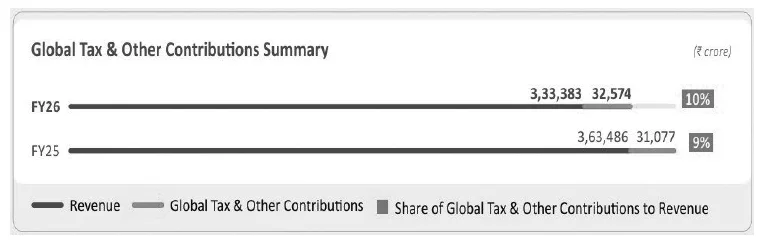
GLOBAL TAX AND OTHER CONTRIBUTIONS FY26
| ₹32,574 Crores Total Contributions |
₹11,600 Crores Indirect Contributions |
| ₹19,518 Crores Direct Contributions |
₹1,456 Crores Other Contributions |

Tata Motors Limited
(Discontinued Operation) April to June 2025
| Contributions | (in Cr) |
| Total Contributions
Direct Contributions Indirect Contributions Other Contributions |
2,322
1,987 287 48 |
GLOBAL TAX AND OTHER CONTRIBUTIONS FY25#
| ₹31,077 Crores
Total Contributions |
₹ 9,620 Crores
Indirect Contributions |
| ₹20,723 Crores
Direct Contributions |
₹734 Crores
Other Contributions |

# The comparative amounts have been presented as if, the Commercial Vehicles undertaking were discontinued in the prior period. Direct contribution excludes Stamp duty and Land Transfer charges accrued in books but not paid.
* Entity Schedule.
BASIS OF PREPARATION
Reporting entities
We have reported the Global Tax & Other Contributions to the Government by Tata Motors PV, our subsidiaries and joint operations (excluding associates and joint ventures). The contribution made by Tata Motors PV and its subsidiaries including branch offices are reported at full amounts and that for joint operations is reported in the proportion of shareholding. However, the entities which were liquidated/ demerged in the said financial year or are under process of liquidation or yet to commence operations or have insignificant operations as on March 31, 2026 have been excluded from reporting for that particular year, but if they have paid any taxes during the year, the entity has been considered for reporting. Further, certain foreign companies follow calendar year basis in multiple tax compliances, whereas our reporting period is April to March. Accordingly, for this reporting, the contributions paid as per our reporting period of April to March have been considered. The entire list of entities at business group level considered in this report has been included in the Entity Schedule.
METHODOLOGY
We have reported Global Tax & Other Contributions under cash basis unless otherwise mentioned below. The reporting methodology followed for each type of Global Tax & Other Contributions has been detailed below.
DIRECT CONTRIBUTIONS
Corporate tax
This comprises Corporate Income Tax. These taxes are the actual payments made net of refunds (including interest) received during the financial year with respect to corporate income tax liability of the same year and/or of previous years. Typically, these taxes would be reflected in various statutory periodic forms/returns and statements/challans or any other documents being filed with the relevant government authorities, or audited cash flow statements, or bank statements evidencing the payments or statements from third party payment partners honouring the obligations.
OTHER TAXES AND CHARGES
This comprises stamp duty, property tax, land revenue, municipal tax, electricity duty borne (including cross subsidy surcharge paid), and any other similar contribution by the Company and its subsidiaries. The same have been compiled based on payments to the Government exchequer and/ or challans and bank statements.
NET INDIRECT TAXES
Amounts reported represent indirect tax payments remitted to the Government on cash basis. Indirect tax payments made for reverse charge liability and on imports paid in cash form part of the amount reported. However, it may be noted that the payment of taxes on procurements paid to vendors have not been considered here. Typically, the amounts reported under net indirect taxes have been obtained from various statutory periodic forms/ returns and statements/ challans/ relevant Government portals or any other documents being filed and maintained with the relevant Government authorities.
INDIRECT CONTRIBUTIONS
Indirect contributions include tax deducted at source (withholding taxes) from vendors and employees, taxes collected from customers and other payroll taxes. A withholding tax is an income tax to be paid to the Government by the payer of the income rather than by the recipient of the income. The tax is thus withheld or deducted from the income due to the recipient. Withholding taxes usually apply to payments made to employees, vendors, service providers, etc., of the Company. This also includes taxes collected on various payments received from customers for prescribed goods or services. In addition, payroll taxes include professional and work permit levies that are withheld from employee remuneration and paid to the Government by the respective companies in the capacity of an employer. Typically, these taxes are reflected in various forms, returns, statements and challans prescribed or approved by the Government for this purpose.
OTHER CONTRIBUTIONS
Other contributions include contributions made by the employer to social security programmes for the benefit of employees as mandated by regulatory bodies. This includes the employer’s share in provident fund, including national insurance, employee pension scheme, social security and employee state insurance. Typically, these contributions are reflected in the returns, statements and challans prescribed or approved by the concerned statutory bodies for this purpose.
COVERAGE
The various heads of contributions are summarised in this report. The grouping of taxes under the heads of ‘Direct Contributions’, ‘Indirect Contributions and ‘Other Contributions’ is based on our understanding of the nature of taxes and its payment mechanism. Where date of actual cash inflow/outflow was not available, the tax payments shown as due in the relevant tax period has been considered for reporting.
Global tax and other contributions
Direct Contribution
Corporate Tax
- Corporate Income Tax
- Surcharge and Cess
- Corporate Tax Credit and Incentives
Net Indirect Taxes
- Goods and Service Tax (GST)
- Custom Duties (all types)
- Value Added Tax (VAT)
- Sales and Use Tax
Other Charges
- Stamp Duty
- Property Tax
- Municipal Taxes
- Land Revenue
- Electricity Duties
- Apprenticeship Levy
Indirect contributions
Withholding and Payroll Taxes
- Withholding Taxes Collected from employee/Payroll Taxes
- Withholding Taxes (WHT) collected from vendor
- Withholding Taxes collected from shareholder
- Tax Collected at Source (TCS) for Sale to Customers
- Professional Taxes
- Foreign Worker Levy
- Work Permit Levy
Other contributions
- Provident Fund
- Employee Pension Scheme
- Employee State Insurance
- Labour Welfare Fund
- National Insurance
- Social Security Fund
- Compensation Funds
- Disable Person Funds
- Gratuity Scheme
- Superannuation Scheme
Excluded amounts
The following are not included in the Global Tax & Other Contributions statement:
- Payment of indirect taxes on procurements paid to vendors
- Any fees paid to the government and its authorities for various kinds of compliance, filings, penalties etc.
Currency
The currency considered for this report or the reporting currency is the Indian Rupee (₹). The data for Global Tax & Other Contributions to Government provided by any subsidiary in their local reporting currency, has been converted to ₹ based on the exchange rate that has been considered in preparation of Form AOC-01.
Independent Reasonable Assurance Report
Independent Reasonable Assurance Report to Tata Motors Passenger Vehicles Limited on Global Tax & Other Contributions
We (Name) were engaged by the management of Tata Motors Passenger Vehicles Limited (Formerly Tata Motors Limited) (‘Tata Motors PV’ or ‘the ‘Company’) to report on ‘Global Tax & Other Contributions’ section contained in the Company’s Tax Transparency Report for the financial year 2025-26 [the said section hereinafter referred to as ‘Global Tax & Other Contributions’], in the form of an independent reasonable assurance conclusion about whether Tata Motors PV statement that the Global Tax & Other Contributions is properly prepared, in all material respects, based on ‘Basis of Preparation’ attached to the Tax Transparency Report is fairly stated.
Tata Motors PV responsibilities
The management of Tata Motors PV are responsible for preparing the Global Tax & Other Contributions that is free from material misstatement in accordance with the Basis of Preparation and for the information contained therein. The management of Tata Motors PV is also responsible for preparing the Basis of Preparation. This responsibility includes designing, implementing and maintaining internal control relevant to the preparation and presentation of Global Tax & Other Contributions that is free from material misstatement, whether due to fraud or error. It also includes developing the Basis of Preparation. The Company is also responsible for preventing and detecting fraud and for identifying and ensuring that it complies with laws and regulations applicable to its activities.
Our responsibilities
Our responsibility is to examine the Global Tax & Other Contributions prepared by the Company and to report thereon in the form of an independent reasonable assurance conclusion based on the evidence obtained.
We conducted our engagement in accordance with International Standard on Assurance Engagements (ISAE) 3000: Assurance Engagements Other Than Audits or Reviews of Historical Financial Information issued by the International Auditing and Assurance Standards Board. That standard requires that we plan and perform our procedures to obtain reasonable assurance about whether the Global Tax & Other Contributions is properly prepared, in all material respects.
(Name) applies International Standard on Quality Control 1 and accordingly maintains a comprehensive system of quality control including documented policies and procedures regarding compliance with ethical requirements, professional standards and applicable legal and regulatory requirements.
We have complied with the independence and other ethical requirements of the Code of Ethics for professional accountants issued by the International Ethics Standards Board for Accountants, which is founded on fundamental principles of integrity, objectivity, professional competence and due care, confidentiality and professional behaviour. The procedures selected depend on our judgment, including the assessment of the risks of material misstatement of Global Tax & Other Contributions whether due to fraud or error. In making those risk assessments, we have considered internal control relevant to the preparation and presentation of Global Tax & Other Contributions in order to design assurance procedures that are appropriate in the circumstances, but not for the purposes of expressing a conclusion as to the effectiveness of the Company’s internal control over the preparation and presentation of Global Tax & Other Contributions. Our engagement also included assessing the appropriateness of Global Tax & Other Contributions, the suitability of the Basis of Preparation used by the Company in preparing the Global Tax & Other Contributions in the circumstances of the engagement, evaluating the appropriateness of the procedures used in the preparation of Global Tax & Other Contributions and the reasonableness of estimates made by the Company and evaluating the overall presentation of the Global Tax & Other Contributions. Reasonable assurance is less than absolute assurance.
The procedures performed by us have been included herein as Annexure – Assurance procedures – Global Tax & Other Contributions.
CONCLUSION
Our conclusion has been formed on the basis of, and is subject to, the matters outlined in this report. We believe that the evidence we have obtained is sufficient and appropriate to provide a basis for our conclusion. In our opinion, the Global Tax & Other Contributions is properly prepared in all material respects, based on the Basis of Preparation.
Restriction of use of our report
In accordance with the terms of our engagement, this independent reasonable assurance report on Global Tax & Other Contributions has been prepared for the Company solely for inclusion in its Tax Transparency Report for the financial year 2025-26 and for no other purpose or in any other context.
Our report should not be regarded as suitable to be used or relied on by any party wishing to acquire rights against us other than the Company for any purpose or in any context.
Any party other than the Company who obtains access to our report or a copy thereof and chooses to rely on our report (or any part thereof) will do so at its own risk. To the fullest extent permitted by law, we accept or assume no responsibility and deny any liability to any party other than the Company for our work, for this independent reasonable assurance report, or for the conclusions we have reached. Our report is released to Tata Motors PV on the basis that it shall not be copied, referred to or disclosed, in whole (save for inclusion in Tata Motors PV Tax Transparency Report) or in part, without our prior written consent.
Annexure – Assurance Procedures – Global Tax & Other Contributions
- Understand and examine the processes and controls at Tata Motors PV level in managing, collating and reviewing the data for the Global Tax & Other Contributions
- Review the guidance provided/ instructions issued to locations / units / group entities by central team for their collation of various tax and other specified items
- Review the country wise break-up of the tax and other specified items reported in the Global Tax & Other Contributions
- Understand and examine the processes and controls at local country level for collation of tax and other specified items included in Global Tax & Other Contributions. This will include review of:
O reporting to central team to ensure adherence of the guidance provided by the central teamO processes for ensuring that all local country taxes are included within the reporting to central team
- Review the basis on which the country level tax and other specified data reported has been captured, reviewed and consolidated to assess whether the data has been collected, consolidated and reported fairly
- For the countries selected, perform trend analysis on the tax and other specified data for the reporting period to understand any material variances. Seek explanations for variances, if any
- For the countries selected, verify the tax paid (on a sample basis) to the underlying documents
- Compare the tax and other specified data in the report to the relevant disclosures in the consolidated financial statements for the reporting period.