Subscribe to the Bombay Chartered Accountant Journal Subscribe Now!

RECENT DECISIONS PART B : VAT

Jyothy Laboratories Limited vs. State of Bihar
and Others, (2019) 60GSTR 71 (Patna High
Court) – Judgment dated 17th July, 2018
Correction in the C Form.

FACTS
The Department had issued incorrect Form C. the Petitioner
had written several letters to the authorities, however
no action was taken to issue correct C Form. Finally, the assesse approached the High Court under Article, 226 of the
Constitution of the India.

HELD
The Hon’ble High Court directed the Commissioner of
Commercial Taxes to either himself take up the issue and
decide the question of correction in the Form C as prayed for
or should assign the matter to any other Statutory Authority
constituted for that purpose. The action was directed to be
taken within Three Weeks from the date of appearance of the Petitioner. It was also directed that in case, the corrected
form C could not be issued to the Petitioner, it would be
incumbent upon the authority to hear the Petitioner, consider
the submissions and pass a speaking order indicating
reasons to the Petitioner as to why his grievance could not
be remedied.

V.V. Shameer vs. State of Kerala(2019) 60 GSTR
73 (Ker)– Judgment dated 3rd July, 2018
Whether a claim can be granted when the Credit
Notes were not issued in the prescribed form?

FACTS
The Petitioner had received incentives from the
manufacturer. Those incentives were received at a later
stage. The Petitioner had shown such incentives in the books
of accounts, however, had not shown them in the returns,
neither had filed revised returns. The Petitioner had claimed
Input Tax Credit without considering the incentives received
by him. During assessment the Petitioner contended that
the manufacturer had paid full tax and had not considered
the incentives given by him to the buyers. Further, Petitioner
had also issued Credit Notes to the manufacturer. However,
the assessing authority disallowed the Input Tax Credit.

HELD
It was held that the Credit Notes as relied on by the Petitioner
were not in the prescribed form. Those did not contain the
details that would be necessary for allowing the claim of
credit to the dealer by the manufacturer. Though the amounts
were disclosed in the book of account and discrepancy was
noticed in the Audit Statement the Petitioner did not attempt to file revised return. Thus, the Credit Notes having not been
issued in the prescribed form the disallowance of Input Tax
Credit having been granted with respect to the incentives
was confirmed by the Court.
Commissioner, Commercial Tax, Uttarakhand
vs. Jai Durge (2019) 60 GSTR 82(Uttarakhand)–
Judgment dated 10th April, 2018
Whether the filing of prescribed form in the case
under consideration was mandatory?

FACTS
The assessee was the Job Worker. He had manufactured
tiles for the Government Department and supplied the
same to them. The Tribunal had given the findings that all
materials were supplied by the Government Department to
the assessee and that what was supplied by the assessee
was actually the labour component. The materials were
made use of by the assessee, who had supplied the labour
to make the tiles to be supplied. The Revenue contended
before the High Court that the assessee had not filed Form
No. IIID which was prescribed for that purpose.

HELD
The Court Noticed that the findings of the Tribunal were not
challenged by the Revenue. The Court also noticed that for
the earlier year the Tribunal as well as the High Court had
decided the same issue in favour of the appellant and had
held that the appellant was doing only a job work. The Court
therefore, held that the submission of Form IIID was not fatal
to the case of the assessee and confirmed the order of the
Tribunal.

Tech Mantra

This time we present a few nifty productivity tips for
Accountants – from the must-haves to the exotic. Each tool
has its advantages and some are those which you simply
cannot do without!


SENDTHISFILE.COM

Very often, we need to send
large files to colleagues, friends or family. They may be
image files or video files or just pdf files. Sometimes, it may
be large medical reports which need to be sent to a doctor
abroad for a second opinion. Most of the email clients
cannot handle file sizes of more than 20-25 MB at a time –
gmail has a limit of 25MB for attachments.
www.sendthisfile.com comes to the rescue. This is a very
simple but powerful utility which helps us send large files. You
just need to logon, create an account – yes it is free – and send
your file. As simple as that! What it does, is that it uploads the
files to a secure server, and sends the link of the uploaded
file to the email recipient. The email recipient just has to click
on the link, and she can download the file directly. So neither
your email account nor the recipient’s email account is used,
except for a brief line communicating the link.
It works pretty efficiently. The speed of the uploads and
downloads depends on the total no. of files that you have
transferred. The first time, it goes at full speed and then,
as your traffic increases, the speed slows down. However,
the counter is re-set every month for your account. So the
first file which you send in any month is super-fast and the
speed keeps deteriorating as you send more and more
files. Also, you can send only one file at a time. The other
limitation is that the recipient can download the file that you
have sent, only 3 times. And the file is held on their servers
only for 3 days. But in spite of all these limitations, it works
extremely well for most users without any problems.
If you go for a paid account, these limitations are eliminated.
Besides, it offers encryption of the data also, just in case
there are peeping toms around! Check it out the next time
you are stuck with a LARGE file to send or receive. http://
www.sendthisfile.com is a great transporter of large files!


NEEDTOMEET.COM

When you wish to organise a meeting of 3 or more people,
it is a challenge to check with each one about their available
timings and trying to synchronise a meet. Needtomeet.
com is a simple tool that helps you effortlessly find a
time to meet. The design principle used in creating this
service is simplicity. Meetings can be created in just three
simple steps. There is no need to register for an account
or provide any information not pertinent to the task. The
unique calendar interface allows you to select meeting
times in an intuitive and user-friendly manner and to see at
a glance which times work best for your group.
You can setup a meeting in just 3 simple steps:
1 Define a meeting and select available times. The
site gives you a link which you then send across to the
prospective attendees.
2 Attendees indicate their availability by clicking on the
link.
3 Find the best time to meet when the majority are
available!
So go ahead – schedule that meeting, organise that
event, book that trip, or set up that conference – all with
the convenience of a few clicks and an easy to use and
uncluttered interface.


IRFANVIEW

One of the best and lightest image viewers
that I have come across is Irfanview –
available free at irfanview.com
IrfanView is very fast, small, compact and innovative and
hence, very popular too. It is very simple for beginners and
powerful for professionals. It creates new and/or interesting
features in its own way. You need no knowledge of any
graphic programs when you use Irfanview. Just download
it, install it and run it – as simple as that. The variety of
graphic files it can handle, is to be seen to be believed. And
coupled with the Plugins / Addons available, it can manage
multimedia audio and video files too.

Although primarily it is a viewer, it gives some basic but
powerful image editing options too – you can adjust the
brightness, contrast and color of your image at the touch
of a button with a visual preview online. Rotation and
giving special effects to your images like a professional,
is a breeze. Format conversion, is as simple as clicking on
Save As, and re-sizing your large camera images before
uploading online, is child’s play. The batch-processing
mode helps you run several repetitive tasks, like re-sizing
of hundreds of photos, in a single click.
An added bonus is that you can play slide-shows of your
favorite pictures and also play movies in a large range of
formats – which used to be a daunting task for the lay user.
Capturing snapshots of your screen, running the multiimage
viewer, flipping images – one can go on and on. All
this, and much more, is available in a very light, easy to
use, intuitively designed interface.
Now, go ahead, be a PRO at image viewing and editing
with Irfanview.


MOVING EXCEL SHEETS – VERY EASY !!

Moving Right Next Door!
As I’m sure we all know, you can rearrange worksheets in
an MS Excel file with a simple click-hold-and-drag of the
sheet tab.

But, did you know that you can also move
worksheets from one workbook to another
using the same method? No? Well, the
good news is, you can, and it’s really as
easy as it sounds.
First, open both workbooks. (The one with the worksheet
and the one to which the worksheet needs to be relocated).
Next, arrange your workbooks side by side.
Next, you need to click and hold the sheet tab to be moved.
Now, still holding down the left mouse button, drag the
sheet tab into the other file.
You’ll see the small triangle that appears when a sheet is
moved, so you can tell where it will be located.
When it’s where you need it to be, simply release the
mouse button.
Voila!
The sheet is moved from one workbook to another. No
fuss, no muss!

RECENT DECISIONS PART B: VAT

The Addi. Commissioner of Sales Tax vs.
Benchmark Engineering Pvt Ltd.(Bom H.C) –
Judgment dated 28th November, 2018
Whether VAT can be levied on Service Tax,
Separately collected, even when the VAT is paid
under Composition Scheme?

FACTS

The appeal related to the period 2005-2006. The substantial
question of law referred to the Hon’ble High Court was
whether the Tribunal was justified in holding that for
determining the Composition amount in lieu of amount of
tax payable in respect of Works Contract Sales, the amount
of Service Tax charged separately in the invoice will not be
included in total contract value?

HELD

The Hon’ble Court upheld the judgment of the Tribunal
which had observed that the amount of Service Tax charged
separately in the invoice will not be included in total contract
value for the purpose of levy of VAT. The Hon’ble Court
referred to Trade Circular No.6T dated 14.05.2015 issued
by the Commissioner of Sales Tax, Maharashtra State which
had informed the trade that the Government had accepted
the judgment of the Tribunal in the case of Sujata Painters
wherein it was held that the Service Tax could not formed
part of Sale Price u/s.2(25) of the MVAT Act, in a transaction
wherein the sale price is determined subject to Rule 58 of
the MVAT Rules and is not liable to VAT. The Court said,
once the State had accepted the decision of the Tribunal in
the case of Sujata Painters by issuing Trade Circular and
pointing out that so far as the period prior to 01.04.2015 was
concerned, the Department had accepted the order of the
Tribunal that Service Tax would not form part of the Sale price
and informed the trade, the same would bar the Revenue
from taking a contrary view. The Court further said that the
State has to apply law uniformly to all the assesses. The
AGP had drawn the attention of the Court to the appeal on
similar issue, involved in the case of Technocrat Engineers,
and submitted that the same had already been admitted by
the Hon’ble Court. However, the Court refused to accept his
submissions stating that aforesaid Circular No.16 of 2015
was not pointed out to the Court at the time of admission of
that appeal.

Deepak Fertilisers And Petrochemicals
Corporation Ltd. vs. State of Maharashtra and
Others (Bom H.C.) – Judgment dated
26th June, 2018
Whether the Trade Circulars issued by the
Commissioner of Sales Tax, Maharashtra State can
controll the substantive notifications?

FACTS

The Petitioner was engaged in the manufacture and sale of
fertilisers and for the purpose of manufacture of fertilisers,
purchased natural gas from GAIL. The natural gas was
either utilised as fuel or as an input in the manufacture
and processing of fertilisers and chemicals. The rate of tax
applicable to the natural gas prior to 30th June 2017 was
13.5% under the MVAT Act,2002. However, Input Tax Credit
was available under that Act above 3%. Thus, the effective
rate on natural gas under that Act, was 3%. The Goods and
Service Tax was introduced on 1st July 2017. The natural
gas along with some other few goods was left outside the
coverage of the GST Act and VAT and CST continued to be
levied on the same. With effect from 1st July 2017, when any
person purchased natural gas domestically, the seller would
collect full tax from him @ 13.5% and since the person was
no longer a dealer under the 2002 Act due to the section
16(6A), he could not claim setoff or refund of the input tax
collected from him. Furthermore, he would be liable to pay
goods and service tax on his outputs at the full rate since the
GST Act only provided for ITC of goods and Service Tax paid
and not of value added tax paid. Hence, the effective rate
after 1st July 2017 got increased to 13.5%. The Government
of Maharashtra in exercise of its powers conferred u/s. 9(1)
of the MVAT Act issued a Notification dated 24th August
2017 adding Entry 16 in Schedule “B” to the MVAT Act, by
which the sale of natural gas to a registered dealer, subject
to the condition mentioned in the notification, was eligible
for a lower rate of VAT @ 3%. To avail the benefit of the
reduced rate of 3%, the purchasing dealer was required to
be certified by the Joint Commissioner. Queries were raised
to the Commissioner of Sales Tax whether the benefits
given under the Notification dated 24th August, 2017 were
available to the tax payers registered under the GST Act.
The Commissioner issued trade Circular No.39T dated 8th
September 2017 clarifying that the benefits of notifications dated 24th August 2017 would also be available to taxable
persons registered under the GST Act. Subsequently, by
Notification dated October 13, 2017, an explanation to
entry 16 of Schedule “B” of the MVAT Act was amended
with effect from 14th October 2017 to the effect that the
benefit of the Entry 16 in Schedule “B” shall be available to
a registered taxable person under the GST Act. However,
by Trade Circular No.3T of 2018 dated 16th January 2018 it
was clarified that manufacturers – buyers who did not hold
registration certificate under the MVAT Act on or after 1st
July 2017 either due to cancellation of registration certificate
or due to the deeming provision relating to cancellation of
registration certificate u/s. 16(6A) of the MVAT Act, shall
not be entitled for the benefits of the reduced rate of 3% in
respect of use of natural gas in manufacturing, for the period
24th August 2017 to 13th October 2017. Writ Petitions were
filed contending that Notification dated 13th October 2017
should be given effect to and operated from 24th August 2017
because Trade Circular No.3T of 2018 dated 16th October
2018 and the addenda dated 13th January 2018 enabled
recovery of VAT in excess of 3%.

HELD
Writ Petitions were dismissed holding that the language of
the Notifications issued was clear. The circulars were for
internal guidance or clarification of queries of the trade and
officials, but their language could not control the substantive
notifications.


Vishat Diagnostic Pvt Ltd. vs. State of
Maharashtra and Others (VAT Appeal Nos. 425
and 567 of 2017 (MSTT) – Judgment dated
30th November, 2018
Whether the words ‘on the body’ appearing in the
Entry for “Drug’ in the MVAT Act, 2002 exclude the

diagnostic kits used in the laboratory for testing of
blood etc., from the coverage of that entry and sent
the same to the residuary entry?

FACTS
The appellant was dealing in diagnostic reagents which were
used in laboratories in the diagnosis of the diseases like
diabetes, cancer etc.. The Advance Ruling Authority (ARA)
had relied upon the words ‘on the body’ appearing in Entry
No. C-29 (a) which was for drugs and held that the same
were falling under the residuary entry liable to tax @12.5%. It
was the contention of ARA that the words ‘on the body’ were
inserted in the said entry consequent to the judgment of the
Hon’ble Bombay High Court in the case of Merind Ltd. The
introduction of the said words in the Entry under the MVAT
Act was conscious. The legislature intended to exclude such
products which are used outside the human body i.e. in the
laboratory.

HELD
Hon’ble Maharashtra Sales Tax Tribunal relied on the
several judgments of the Apex Court, more particularly,
on the judgment in the case of Rajendra Prasad Yadav
and Others vs. State of M.P. and others (1997) 6 SCC
678 dated 09/07/1997 were in it was held that it is settled
principal of interpretation that all the provisions should be
harmoniously interpreted to give effect to all the provisions
and no part thereof rendered surplusage or otiose. Thus,
the words ‘diagnosis’ and ‘on the body’ were harmoniously
construed by the Hon’ble Tribunal. The Tribunal also relied
on the certificates issued by the competent authorities which
averred that there is no such product which can be used for
the purpose of diagnosis on the body of a person as held by
the ARA. The Hon’ble Tribunal gave liberal meaning to the
words ‘on the body’ and held that the diagnostic kits sold by
the appellant were covered by the entry for Drugs attracting
tax @5% and not 12.5%.

FROM THE PRESIDENT

Dear Members,


One more month, one more
opportunity for communication, in a slightly relaxed month of May, the
preferred month for taking vacations. Vacation for anybody is a chance to take
a break from work, see the world and enjoy time with your near and dear ones. Today’s
world is full of choices – right from the choice of destination and
accommodation to the travel options, the sight-seeing itinerary and the like.
In an attempt to optimise the vacation benefits, at times, we cramp too many
goals into one vacation. As if there is no tomorrow!


The objective of vacations
is to increase the happiness levels. The attempt is not only to increase
happiness levels but to portray happiness. Substantial time is spent in taking
selfies, photographs and updating social media rather than really sinking into
the new environment and enjoying the moment. In an attempt to capture and store
the moments, do we compromise on the real feel of the environment?


A slew of notifications was
issued under the GST Law to implement the GST Council recommendation of a lower
rate of tax for builders and developers. The objective was to simplify, but a
cursory look would suggest that the outcome is complex. The taxpayer is
expected to procure at least 80% of goods and services from registered vendors.
What is the genesis of such a provision? Is it the mindset of the taxpayer to
use every possible opportunity to optimise tax outflows or is it reflective of
the government mindset to not trust the taxpayers enough? Whatever may be the
genesis, one thing is certain, we are back to the old days of complex laws,
litigation and uncertainty. Before things really go out of hand, we need to
bring back the much desired simplicity in the law.


GST Law prescribes for a
mandatory audit in case of assessees having aggregate turnover above Rs. 2
crore. This audit represents an opportunity as well as a challenge. In view of
the implementation of GST from the middle of the financial year and the concept
of rectification in subsequent periods rather than revision of returns, the
approach towards audit will have to be fine-tuned. At the same time, by its very nature there will be substantial
transactional volume. Initial months of GST resulted in a lot of chaos. The
auditor will have to walk the tightrope of ensuring strict compliance as per
the law as well as be sensitive to the compliance and portal-related issues.
With this challenge also comes the opportunity of showcasing the abilities of
the members to rise to the occasion and provide valuable and balanced inputs through
the audit report both to the government officials and the assessees.


The renewal fees for
ordinary memberships, subscriptions for journals (including new life members)
and study circles have become due and the Society has already sent emails in
this regard. I am happy to inform that a substantial percentage of renewals are
already effected. In case you have missed the email in view of your busy
schedule, I urge you to kindly renew your memberships or subscriptions at the
earliest.


The ITF Conference to be
held in August, 2019 has already been announced. The preparations for the Jal
Erach Dastur CA Students Annual Day event “Tarang 2K19” are in full swing. This
event will be held in June, 2019 where about 500 CA students will showcase
their talent in various extra-curricular activities. The Youth RRC, specially
designed by young chartered accountants, has also been announced and is
receiving encouraging response. In addition to the above, your Society has
lined up a series of educational programmes, the details whereof are available
alongside. I would request you to participate in large numbers and take benefit
of the same.


Regards


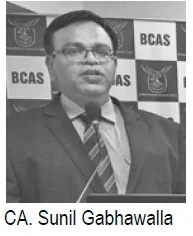
CA.
Sunil Gabhawalla

President


SOCIETY NEWS Part 1

DTAA Course held on 1st, 8th,
15th and 22nd December, 2018 and 5th, 12th
and 19th January, 2019 at BCAS Conference Hall


BCAS successfully conducted
its 19th Study Course on Double Taxation Avoidance Agreement at BCAS
Conference Hall spanning over 7 Full Days – 1st, 8th, 15th
and 22nd December, 2018 and 5th , 12th and 19th
January, 2019. As a result of continuous refinement, the Study Course was
designed to cover all the articles of DTAA, FEMA / BEPS / MLI / GAAR, Transfer
Pricing, Source Rules under Income Tax Act, 1961, TDS u/s. 195, Substance v/s
Form and other relevant provisions. The lectures were delivered by 25 eminent
faculties who shared their experience by way of case studies on critical topics
like Residence (including case studies and POEM) and PE. The Study Course was
attended by 64 participants with diverse background such as Senior
Professionals, Practicing CAs, Young Professionals associated with Big and SME
Accounting Firms. The Study Course was an eagerly awaited event amongst the
Practitioners of International Taxation from all around the country and was
well received and appreciated by the participants. The participants were hugely
enlightened with the knowledge imparted by learned speakers.


Technology Initiatives Study Circle


Study Circle Meeting on “Data Analytics and
use of CAATs” held on 22nd January, 2019 at BCAS Conference Hall


Technology Initiatives
Committee of the Society conducted a Study Circle Meeting on “Data Analytics
and use of CAATs” on 22nd January, 2019 at BCAS Conference Hall. The
study circle was led by CA. Murtaza Q. Ghandiali, who is a Practicing Fellow
Chartered Accountant and also having diploma in cyber law & information
technology from Mumbai University. 


The Speaker discussed Data
Analytics and how to use CAATs tools more effectively along with practical
examples and shared his in-depth knowledge with the participants. He also
resolved all the questions raised by the participants during the session.


The participants benefited
a lot and appreciated the efforts put in by the Speaker and group leaders.


BEPS Study Circle


Study Circle Meeting on
“Impact of MLI” held on 28th and 30th January, 2019 at
BCAS Conference Hall.


Study Circle Meeting was
held on 28th January, 2019 on Impact of MLI on Treaties entered into
by India with UK, Netherland and Belgium, at BCAS Conference Hall. The
discussion was led by Mr. Jimit Devani, Ms. Barkha Dave and Ms. Darshani Shah.
A very analytical presentation was given and an ‘Article by Article’ discussion
on clauses of MLI was done. The speakers also made references to other Treaties
entered into by India as well. 


To keep the momentum on,
the next meeting was held on 30th January, 2019 for further
discussions. Again a very interactive and informative session, the learned
speakers agreed to update the presentation with the inputs received during the
meetings and circulate to the participants.


The participants
appreciated the efforts put in by the speakers and benefitted a lot from the
sessions.


Lecture Meeting on “Changing Professional
Opportunities for Corporate Social Responsibility in India” held on 6th
February, 2019 at BCAS Conference Hall


Corporate and Allied Laws
Committee organised a meeting on the captioned subject at BCAS Conference Hall
which was presented by CA. Zubin Billimoria who has authored a book on the same
topic.


The
speaker provided a holistic view of Corporate Social Responsibility prevailing
since post-independence era and its evolution in the form of personal and
professional social responsibility. He spoke on various aspects of Corporate
Social Responsibility with regard to 4 P’s viz., People, Planet, Profit and
Process. He also shared broad framework for CSR commencing from internal
restructuring and reorganisation to reporting requirements of CSR citing some
good examples and anecdotes on social responsibility.


His in-depth knowledge and
passion towards the subject made the lecture meeting insightful, interesting
and knowledge enriching. He very diligently shared the professional
opportunities in CSR for professionals, consulting agencies and NGOs at large.
The meeting was a huge takeaway for the participants.


International Economics Study Group


International Economics Study Group Meeting
on “The Modi Government – Building India of our Dreams” held on 14th
February, 2019 at BCAS Conference Hall


International Economics
Study Group conducted a meeting on 14th February, 2019 at BCAS
Conference Hall to discuss “Road to 2019 – Modi`s perspective”. CA. Shalin
Divetia presented his well researched theme “The Modi Government – Building
India of our Dreams”
covering Challenges faced by Modi Govt., Addressing
Core Issues (Inequality in Living Standards, Lack of Economic Opportunities,
Corruption & Security), Permanent Solutions, Holistic Approach, Vision
backed by Execution, International Relations, Civilisational Pride. Modi
Government has launched schemes that encompass human lifecycle: Infancy, For
the Young, Family necessities, Risk Protection and Retirement. He also brought
out how Modi has attempted in Bridging Rural-Urban Divide, Initiative for
farmers, creating Economic Opportunities (Mudra Yojna, Make in India, Ease of
Doing Business, and Innovation), Tackling Corruption & NPAs, Economic
Reforms – GST & IBC, and International Relations.


CA. Harshad Shah
highlighted that 2019 Election has turned From Cakewalk to Contest and World’s
biggest election has suddenly become competitive. He highlighted few key themes
for this election such as:


Will Women Decide
India’s 2019 Elections? – Women have become a focal point of the BJP’s 2019
re-election campaign. When we empower the women in a family, we empower the
entire house-hold and have thus brought Women Centric Schemes. Women Turnout is
dramatically increasing from 2014.


Welfare Hook”– Big
Ticket Popular Schemes – 22 to 50 crore beneficiaries.


Health,
Pension, Electricity, Gas
– 10% Reservation to
Economically backward, Financing of MSMEs and Traders, KIsan Yojana, Tax Sops
for Middle Class Salaried & Small traders


Social
Media
– India has 30 crore Facebook users, 20 crore WhatsApp Members
(In 2014, they had only 5 crore), Twitter 3.44 crore, 45 crore Smart phones (3
times more than 2014 election) 1.14 billion mobile phone connections. Remember
2016 US Election?


UP
Mahagathbandhan
– Caste, Religion, Mathematics in politics,
1+1 doesn’t always equal 2 when 2 or more parties with diverse views, caste
matrix, ideology join together and fights compound.


Big 4 toss up states – Bengal,
Orissa, Tamilnadu, and Kerala


Numbers
Game
– Higher Voter Turnout benefits BJP & People vote differently
for state and general elections


Critical
Issues
– Farm Distress, Loan Waivers, Unemployment, Ram Mandir, Cow,
Polarisation, Triple Talaq etc.


CA.
Rashmin Sanghvi deliberated upon “Is this the beginning of Cold War II after
Trump withdrawing from Nuclear Missile Treaty”
and brought out historical
perspective of Cold War 1 which was between 2 Super Powers USA (NATO) &
USSR. This time it`s between USA (not NATO) & China plus Russia and is
playing out through different wars – Trade, Currency, Space, Cyber etc.


The sessions were a good
learning experience for the participants


“Interactive Session with Students for
Success in CA Exams” held on 16th February 2019 at BCAS Conference
Hall


The BCAS Students Forum
under the auspices of the HRD Committee organised an Interactive session with
students for success in CA Exams on 16th February, 2019 at BCAS
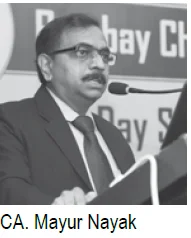
Conference Hall. Students Forum had invited CA. Mayur Nayak and CA. Atul Bheda
to guide students on how to crack CA exams. They both left the audience spell
bound.


CA. Rajesh Muni, Chairman
of HRD Committee in his opening address welcomed the speakers and the student
participants. He discussed about the activities which are undertaken by HRD
Committee throughout the year and motivated the students to actively take part
in the same.


CA. Mihir Sheth, Honourable
Joint Secretary of BCAS through his inspiring words encouraged the students.
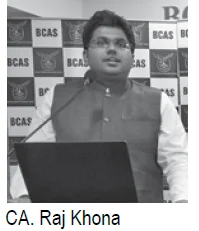
CA. Raj Khona, HRD committee member then introduced the speakers and also
shared his experience in clearing the CA exams.


CA. Mayur Nayak took the
students through his own journey on how he turned his weaknesses into
opportunities and how he prepared to crack CA final exams in first attempt with
a Rank. His session was truly motivational and inspired the students to work
hard and excel in their exams. CA. Atul Bheda took the students through the
entire ICAI exam process and solved various myths and misunderstandings
regarding the same. He provided practical tips and tricks to be implemented in
order to crack the same exams. His session was very informative and
knowledgeable to the participating students.


Around 60 students got
enlightened from this interactive session and their feedback was very positive.


BEPS Study Circle


Study Circle Meeting on “OECD Report on
addressing the Tax Challenges of the Digitalisation of the Economy” held on 21st
February, 2019 at BCAS Conference Hall


Study Circle Meeting was
held on 21st February, 2019 on OECD Report on “Addressing the Tax
Challenges of the Digitalisation of the Economy” at BCAS Conference Hall.  The discussion was led by CA. Ganesh
Rajgopalan and CA. Rashmin Sanghvi.


OECD released “Public
Consultation Document – Addressing the Tax Challenges of the Digitalisation of
the Economy” and sought public comments on key issues identified in a public
consultation document on possible solutions to the tax challenges arising from
the digitalisation of the economy. The last date for submission of comments was
1st March, 2019 and therefore, the meeting was held to discuss the
report and the background thereof and also to take inputs from the participants
to enable BCAS to finalise its comments.


CA. Ganesh Rajgopalan
presented masterly overview of the paper and CA. Rashmin Sanghvi gave the
understanding of background facts which helped the participants to understand
the report in proper perspective. The participants benefited immensely from the
efforts put in by the speakers on the subject.


Technology Initiatives Committee


Half day workshop on “Technology as an
enabler for Compliance on Audit Documentation” held on 22nd
February, 2019 at BCAS Conference Hall


Technology Initiatives
Committee conducted a half day workshop on “Technology as an enabler for
Compliance on Audit Documentation” on 22nd February, 2019 at BCAS
Conference Hall. The Workshop was conducted by CA. Ashesh Jani who has domain
experience thereof in solutioning, architecting, customising and execution of
technology tools for ensuring compliance on audit documentation.


The speaker dealt with the
topic very systematically by providing insights on importance of thorough audit
documentation while conducting the audit assignments and essentials of
maintaining audit documentation in digital form. He also discussed various
issues and the control point to mitigate the issues while dealing with
technology for maintenance of audit documentation.


The program was truly
enthralling with participants. The participants appreciated the in-depth
insight given by the learned Speaker.

“9th Ind AS Residential Study Course” held on 28th February to 2nd March, 2019

The 9th Ind AS RSC was held at The Gateway Hotel, Taj Group, Nashik from 28th February to 2nd March, 2019 where 107 participants from across the country participated in this Mahakumbh of learning on Ind AS subject, based on the concept of Group discussion and Presentation. This year, the topics chosen for Group Discussion were of Topical importance like Ind AS 115 on “Revenue from contracts with Customers”, Ind AS 109 on “Financial Instruments”, other Ind AS topics like Ind AS 16 PPE, Ind AS 21 Foreign Currency Differences, Ind AS on Consolidation, Jt. Control, etc. There were 3 papers for presentation on very important and highly relevant topics like Ind AS 116 Leases, Ind AS and MAT, Audit Reporting under the revised Reporting Standards etc.

The list of Topics and the paper writers/presenters name is as under:-

Sr. No. Paper Author GD or Presentation
1. Case Studies on Ind AS 115 CA. Anand Banka GD
2. Case Studies on Various Important Ind ASs CA. Santosh Maller GD
3. Case Studies on Financial Instruments CA. V. Venkat GD
4. Audit Reporting under Revised Reporting Standards CA. S. Vasudeva Presentation
5 Impact of Ind AS on MAT CA. Santosh Maller Presentation
6 Ind AS 116 Leases CA. Manan Lakhani Presentation

The RSC Started on Friday, 28th February, 2019 with the group discussion on case studies on Revenue from contract with customers, Ind AS 115. The participants were divided into 3 groups to have a great learning and sharing experience. The group leaders had put in lot of efforts to prepare their PPTs for better discussion on the allotted Topics.

At the RSC inauguration function, CA. Sunil Gabhawalla, President BCAS, CA. Himanshu Kishnadwala, Chairman Accounting & Auditing Committee, CA. Abhay Mehta Jt. Secretary, CA. Amit Purohit and CA. Rajesh Mody, Convenors were present. The President – BCAS, in his opening remarks welcomed all the participants and wished all of them a great learning experience. He also briefly elaborated on the activities undertaken at BCAS and invited non-members to become members to gain uninterrupted knowledge.

  1. Himanshu Kishnadwala then briefly explained the importance and relevance for such RSC and outlined the events for next 2 days. At this occasion, the publication on “FAQs on Standards on Auditing – Part I” was released at the hands of CA. Sanjay Vasudeva, past Vice Chairman of AASB of ICAI. The Booking was opened for outstation members and the response was very positive.

Then the paper writer of 1st GD paper CA. Anand Banka presented his views and gave clarity on the issues covered by him. The evening ended with the Presentation Paper on “Reporting requirements under Revised Reporting Standards” presented by CA. Sanjay Vasudeva.

Next morning CA. Santosh Maller gave his views on the issues covered by his paper and he also clarified on the issues raised by the members. There was also a Presentation Paper on Ind AS and MAT by CA. Santosh Maller, who ably covered the most difficult and sought after subject in a very lucid manner. After a break, the groups assembled to discuss the 3rd GD Paper on Financial Instruments Standard.

The last day of the RSC started after the gruelling schedule of the previous day. The session started with the presentation of views by CA. V. Venkat on very complex Topic of Financial Instruments Standard. He also replied to members’ queries in his unique style to the fullest satisfaction of the members.

The last session of the RSC was a paper on Ind AS 116 – Leases which was aptly dealt by CA. Manan Lakhani. He covered the whole topic with lots of case studies and explained the complex standard. The RSC ended with a concluding session where in 8-10 members who were 1st time participants expressed their experience at the RSC.

The chairman thanked the participants for making the event a grand success. The Jt. Secretary, CA. Abhay Mehta thanked CA. Himanshu Kishnadwala for successfully planning and executing such an important event this year by setting highest benchmark for quality learning.

The participants got highly enlightened with the knowledge shared by the learned and experienced speakers.

“What Next? – A Career Planning Talk for Fresh Chartered Accountants” held on 8th March, 2019 at BCAS Conference Hall

The Seminar and Membership Development Committee organised a career planning talk for Fresh Chartered Accountants on the topic of “What Next?” on 8th March, 2019 at BCAS Conference Hall which was addressed by CA. Mudit Yadav, a TEDx speaker and Success Coach.

The session began with opening remarks by Chairman of committee CA. Narayan Pasari who briefed the young audience about BCAS and its activities. He also encouraged new CAs to join BCAS and become part of the knowledge sharing. CA. Sunil Gabhawalla, President, BCAS also addressed the gathering and inspired them to aim high and become respected professionals with immense integrity. A Rank holder of Nov. 2018 was felicitated and he shared his views on success in
CA exams.

The speaker CA. Mudit Yadav took up the following major issues faced by young professionals like:

(a) How to choose the ideal career path for yourself? (b) Difference between an average and a star professional. (c) Habits of the most extraordinary professionals. (d) How to develop the mindset of a true professional? (e) How to develop a sharper executive presence? (f) How can you be a pioneer of the future of CA profession?

  1. Mudit Yadav also shared his personal experience around his career and challenges he faced while carving out his career in unconventional and non-traditional field as a motivational speaker.

The talk was attended by more than 60 fresh Chartered Accountants who extensively benefited from the talk and experiences shared by the Speaker.

Half-Day Workshop for Senior CAs – Get the most from your smart phone! held on 9th March, 2019 at BCAS Conference Hall

HRD Committee organised half day workshop for the benefit of Senior CAs (including spouse) and those who were not familiar with their smart phone and mobile apps, on 9th March, 2019 at BCAS Conference Hall.

The first session was conducted by young and dynamic CA. Pankaj Singhal who narrated the benefit of various Banking Support Apps and Mobile Wallets. The participants were guided to download various apps like PhonePe, UTS, PayTM, Google Maps and Uber. He assisted them to register on these apps and perform transactions.

The second session was conducted by a senior and well-experienced techie CA. Yazdi Tantra who narrated the benefits of Google. He gave live training on optimum use of Google through Voice Search and performing simple arithmetic calculations, setting reminders and alarms, exploring time/weather in any city, playing a song or current news, translating in various languages and many more benefits of Google. He also explored various apps like Tripit, Shush, MAadhar, DigiLocker, Senthisfile.com, Blinkist, True Caller, Camscanner, Texpand, Skedit, Life360, Voter Helpline, Otter-Voice Notes and Calm.

The entire session was very interactive and participants were provided hands on experience on usage of various mobile apps. The faculties too were energetic in guiding the participants who were overwhelmed on knowing numerous benefits of a smartphone which till date was used largely by them for only making calls.

Lecture Meeting on “Recent Important Decisions in Income Tax” held on 13th March 2019 at BCAS Conference Hall

BCAS organised a lecture meeting on Recent Important Decisions in Income Tax on 13th March, 2019 at BCAS Conference Hall which was addressed by CA. Rajan Vora. The Speaker gave his insights on important decisions delivered by various courts and tribunals and the rationale behind those decisions, amongst other decisions on different topics and issues. He further explained far reaching impact of recent Supreme Court decision u/s. 68. The Speaker also responded to the queries raised by the participants during the Q&A session.

The lecture meeting was a good learning and very enlightening experience for the participants.

Suburban Study Circle Meeting on “The Banning of Unregulated Deposit Schemes Ordinance, 2019” held on 16th March, 2019

The Suburban Study Circle had organised a meeting on “The Banning of Unregulated Deposit Schemes Ordinance, 2019” on 16th March, 2019 at Bathiya & Associates, Andheri East which was addressed by CA. Janak Bathiya.

The Speaker made a detailed presentation on the section wise analysis of the “The Banning of Unregulated Deposit Schemes Ordinance, 2019” which was promulgated by the Hon’ble President of India Shri Ram Nath Kovind on 21st February, 2019. The Speaker explained some of the Important Provisions as noted below:

Meaning of Unregulated Deposits, Applicability of this Ordinance to Proprietors, Partnership Firm, LLP, Company etc., Impact on Existing Loans and Advances or Deposits, how to ensure compliance of this Ordinance, Grievance, Appeal, etc.

The practical examples helped the participants in understanding the latest ordinance. The participants learnt a lot from the presentation shared by the speaker.

International Economics Study Group

Study Group meeting on the topics “How IBC is Revitalising Indian Economy” and “Current Economic & Geopolitical Developments” held on 19th March, 2019 at BCAS Conference Hall

International Economics Study Group conducted a meeting on 19th March, 2019 at BCAS Conference Hall to discuss “How IBC is Revitalising Indian Economy and Current  Economic & Geopolitical Developments”. CA. Pravin Navandar (Insolvency Professional) led the discussion and presented his thoughts on the subject. He presented various provisions of IBC and how it is helping in resolving many big ticket NPAs such as – Essar Steel are getting handed over to new owners. He brought out India`s ranking in implementation of IBC, many finer provisions of the law, Supreme Court`s speedy disposal of some cases and bringing out clarity in law.

He also brought out how IBC has overriding effect on all other laws relating to insolvency and bankruptcy matters and how the new owners are reviving the sick units with increasing capacity utilisation and workers playing very important role in driving India to New age of economic growth. He also brought out how many Corporations are now taking preventive steps making sure that they don’t default and not land themselves in Insolvency proceedings. Bank lending will resume once IBC helps to clean up Balance Sheets of Banks and they get their stuck dues. India will develop an environment with ease of selling and buying Businesses. Financial Risk to Foreign Lenders would be decreased (faster and higher recovery), Foreign Investors now invited to take ready units without existing promoters and India will have much higher FDIs in Debt segment etc.

This has resulted in quantum jump of 30 places in World Bank`s “ease of doing business” in India. Lenders have been able to recover Rs.1.43 lakh crore from their NPAs. Truly, IBC is not just a Surgical Strike, it`s a full-fledged war on NPAs. Due to fear of IBC proceedings, many promoters are now approaching banks/financers and trying to regularize their loan accounts.

  1. Harshad Shah brought out developing situation in Venezuela which has largest proven Oil (one of the best quality) reserve in the world. USA is intending for a regime change in Venezuela where as China and Russia have economic interest to recover their debt from Venezuela. He also brought out reasons for sudden appreciation in exchange rate of Indian Rupee.

The sessions were very interactive and interesting for the participants to understand about the current Indian Economy.

Four Day Study Course on Foreign Exchange Management Act (FEMA) held on 15th, 16th, 22nd and 23rd March 2019 at BCAS Conference Hall

Four Day Study Course on FEMA was conducted at BCAS Conference Hall on 15th, 16th, 22nd  and 23rd March 2019. There were 14 presentation sessions and one Panel Discussion. The Course started with a topic “Understanding of FEMA” and it went on to cover various other subjects such as Practical aspects of FDI in Real Estate Sector, Immovable Property in India & Outside India, Export and Import of Goods & Services, Setting up of a Liaison Office, Branch Office & Project Office in India & outside India, FDI, Outbound Investment, Borrowing(ECB), Due Diligence/Audit from FEMA Perspective, Practical aspects of filing various forms under FEMA, Practical aspects of Money Laundering, Fugitive economic offence, Black Money Act, Compounding of offence etc. The study course concluded with a Panel Discussion wherein the participants got answers to various tricky questions. A total of 90 participants enrolled for the Course amongst whom many participated from outside Mumbai.

Eminent faculties shared their knowledge and experience with the Participants who got enriched immensely.


REPRESENTATIONS

1.  Dated: 6th
March, 2019

     To: Tax Policy and
Statistics Division, Centre for Tax Policy and Administration, Organisation for
Economic Cooperation and Development (OECD)

     Subject: Thanking
OECD for providing an opportunity to study and offer comments in the
consultation document on Addressing the Tax Challenges of the Digitalisation
of the Economy

     Representation by:
International Taxation Committee of the Bombay Chartered Accountants’ Society.


2.  Dated: 18th
March, 2019

     To: Principal Chief General Manager, Non-Resident Foreign Account
Division (NRFAD)-Policy Division, Foreign Exchange Department, Reserve Bank of
India

     Subject: Private
Trusts for Indian assets-clarification required

Representation
by:
International Taxation Committee of the Bombay
Chartered  Accountants’ Society.  

MISCELLANEA

1.  Economy


1.   1.   
Startups cheer as rule changes ease path for receiving new investments


CBDT clarifies relief like an increase in the limit
to Rs 25 crore and raising of benefit period to 10 years will be available from
February 19.


Indian startups are cheering the bonanza of the
proposed implementation of the recent changes to the ‘angel tax’ from February
19. The Department for Promotion of Industry and Internal Trade (DPIIT) has
announced new norms including a change in the definition of startups to help
budding entrepreneurs to benefit from the full range of the angel tax
concession, media reports say.


The new norms that the Central Board of Direct
Taxation (CBDT) has issued raise the limit of investments that can benefit from
angel tax norms to Rs 25 crore. The angel tax is the income tax payable on
capital unlisted companies raise through the issue of shares where the share
price is in excess of the fair market value of the shares sold. The excess
realisation is treated as income and taxed accordingly. The angel tax was first
introduced in the 2012 Union Budget by then finance minister Pranab Mukherjee
to tackle money laundering. The tax has come to be called angel tax because it
mostly affects angel investments in startups.


The CBDT will implement the detailed framework the
DPIIT has formulated for which it recently issued a new clarification,
according to a report in The Economic Times. The CBDT has said section 56
(2)(viib) of the Income Tax Act prescribing the angel tax will not apply to
consideration in excess of the fair value of shares issued to an investor if
the funds had been received in accordance with the DPIIT’s conditions. In the
past, the amount a startup raises by the issue of shares in excess of the fair
market value was being deemed as income from other sources liable to be taxed
at 30 per cent, deterring angel investors.


The new provisions have also raised the investment
limit for a startup to seek exemption under the section to Rs 25 crore from Rs
10 crore. The startups would also be able to avail themselves of the tax
benefits for up to 10 years as against seven years earlier, according to
reports. The only condition is that the startup will have to submit a
self-declaration about the use of the raised amount to the DPIIT, which will be
forwarded to the CBDT.


“……this was a procedural notification which the
CBDT was required to issue to put in place the mechanism for claiming benefit
given to startups by the earlier DPIIT notification. Startups are elated the
notification came at a time when many said they had received notices under
Section 56(2)(viib), adversely affecting their businesses. The CBDT has
reportedly directed the field staff to clear the proceedings if the tax demands
have been raised.


(Source: International Business Times – By
Prathapan Bhaskaran, 8 March 2019)


2.    2.  
Government completely bans import of solid plastic waste to fight pollution


It is to be noted that China had banned such
imports a few years ago, in the meanwhile India became one of the largest
importers of plastic waste.


The central government has now completely banned
the imports of solid plastic waste/scrap into the country. The decision has
been taken to fight the ever-growing plastic waste in India. As per the
official data, the country generates 25,940 tonnes of plastic waste daily. In
the past, such imports were partially banned as only the special economic zones
(SEZ) were allowed to import such solid wastes. Additionally, the government
had also allowed the imports of plastic waste/scrap by export-oriented units
(EOUs) which used to procure it from abroad as post-recycling resources.


Quoting one of the environment ministry officials,
national daily, the Times of India reported that keeping up with India’s
commitment to completely phase out single-use plastic by 2022, the government
has now entirely banned the imports of solid plastic waste. He added, “The
country has now completely prohibited the import of solid plastic waste by
amending the Hazardous Waste (Management & Trans-boundary Movement) Rules
on March 1.” He further said that the rules were changed because of the huge
mismatch between waste generation and recycling capacity in the country.


It is to be noted that China had banned such
imports a few years ago. Meanwhile, India became one of the largest importers
of plastic waste. In India, many companies were misusing the partial ban on the
pretext of being in an SEZ. The country lacks the adequate capacity to recycle
plastic waste and it is because of this reason a huge amount of such wastes
remains uncontrolled. This eventually causes heavy damages to soil and water
bodies. A study conducted by the Central Pollution Control Board (CPCB) shows
that out of 25,940 tonnes of plastic waste per day around 10,376 tonnes remains
uncollected. The figures are astonishingly high as it is almost 40 per cent of
the total waste generated.


The ministry has made changes in the existing
rules, now white category (practically non-polluting or very less polluting) of
industries will dump their hazardous wastes generated to authorised users,
waste collectors or disposal facilities. Since its inception in 1950, global
plastic production has increased exponentially, from 2 million tonnes to 380
million tonnes in 2015. Its sheer convenience — lightweight and durability –
has made this man-made material present in every sphere of human existence. In
the last 70 years, 8.3 billion tonnes of plastic have been produced.


(Source: International Business Times – By Ashesh
Shukla, 7 March 2019)


3.    3.  
Cross-border insolvency law changes to boost ease of doing business in India


A separate section in the Insolvency and Bankruptcy
Code (IBC) modelled after international best practices will help partners in
foreign tie-ups.


A proposal by the Narendra Modi government to tweak
the bankruptcy law to tackle cross-border insolvency is expected to boost the
country’s ease of doing a business ranking, media reports say. India made huge
strides in the World Bank’s Ease of Doing Business ranking to reach 77th
spot among 190 countries in 2018 from 100 in 2017.

The government proposes to bring about the changes
through an ordinance amending the Insolvency and Bankruptcy Code (IBC) and
adding a chapter on cross-border insolvency, a report said. The amended law is
aimed at giving comfort to foreign investors in India and vice-versa. The new
law will reduce the time for exchanging information with another country,
encouraging foreign investors and multi-lateral agencies such as the World
Bank.


A panel headed by Corporate Affairs Secretary
Injeti Srinivas recommended using the model law formulated by the United
Nations Commission on International Trade Law, known as the UNCITRAL model,
which has been accepted by 44 nations including some from where India’s major
investments originate like the US, the UK and Singapore. A cabinet nod for the
new law is soon expected, according to a report in Business Standard.


In view of the general election 2019 in a couple of
months, only the next government may introduce a bill in parliament. Such
cross-border insolvency provisions empower foreign creditors to get back money
lent to Indian corporate entities. The reciprocity of the law makes it easier
for Indian companies to claim their dues from foreign companies. The
cross-border insolvency provisions in sections 234 and 235 of the IBC have not
yet been notified and cannot be enforced. The amended law will replace the
provisions and make the Indian law up to international best practices.


The government is aware of the limitations of any
law handling cross-border insolvency because in the case of some foreign
governments bilateral treaties are required for effective execution, an
unidentified official in the Ministry of Corporate Affairs told the newspaper.


Such treaties take a long time finalising as each
one is different and all through the protracted negotiations, foreign investors
will be uncertain of the provisions. The ambiguity will also affect Indian
courts and the National Company Law Tribunal (NCLT), which have to handle each
case separately.


The compulsion for an altogether separate section
for handling insolvency of cross-border investors is to make the law more
comprehensive based on a global model so to encourage its global acceptance.
The new law will revolutionise the key aspects of cross-border insolvency
litigation. The law will give direct access to foreign insolvency professionals
and foreign creditors to participate in or commence domestic insolvency
proceedings against a defaulting debtor. Under the law, foreign proceedings and
remedies will find acceptance in Indian courts. It will enable cooperation
between domestic and foreign courts and domestic and foreign insolvency practitioners
as also coordination between two or more concurrent insolvency proceedings in
different countries, according to sources.


(Source: International Business Times – By
Prathapan Bhaskaran, 5 March 2019)


2.  Science


4.    4.  
New study finds evidence of extraterrestrial life on Mars; could revolutionise
future space missions


The discovery of alien life on Mars is expected to
revolutionise future Mars missions and planetary colonisation projects.


Conspiracy theorists including popular
extraterrestrial researcher Scott C Waring have been long alleging that alien
life might be thriving or might have thrived on Mars. Adding heat to these long
spanning claims, a new study published in the Journal of Astrobiology and Space
Science has suggested the possible presence of alien life forms on the Red
Planet.


As per the new study report, NASA’s Curiosity Rover
has snapped images of fungi and algae on Mars. Even though NASA has not
admitted or denied the conclusions made in the study, several space experts
strongly believe that this research report is indisputable proof of alien
presence on Mars.


It should be noted that the potential alien life
which has been now spotted on Mars are not evolved, but rather simple living
beings like fungi and algae.


As per Dr Regina Dass of the Department of
Microbiology, School of Life Sciences, India, the lead author of the study,
Curiosity Rover has sent at least 15 images that show fungi and algae growing
on the Martian surface.


“There are no geological or other abiogenic
forces on Earth which can produce sedimentary structures, by the hundreds,
which have mushroom shapes, stems, stalks, and shed what looks like spores on
the surrounding surface. In fact, fifteen specimens were photographed by NASA
growing out of the ground in just three days,” said Dass, Express.co.uk
reports.


Dr Vincenzo Rizzo, a
National Research Council biogeologist revealed that the seasonal fluctuations
of methane in the Martian atmosphere can be connected with natural life-and-death
cycles of organic matter on earth.


The study report is expected to revolutionise
future space missions to Mars. Upcoming probes to Mars by NASA is expected to
analyse these Martian fungi so that the habitat in which they are thriving can
be studied in depth. Potential life on Mars, even in its simplest form will
also raise the hope of surviving on Mars during colonisation.


Earlier, SpaceX founder Elon Musk had revealed that
he will surely go to Mars despite minimal chances of survival. With this new
discovery, it has been proved that alien life, at least in the simplest form
can survive on the Red Planet, and this will surely elevate the projects which
are being now carried out aiming at colonizing Mars.


A few weeks back, self-proclaimed researcher Scott
C Waring had claimed to have spotted fossil-like structures on Mars. In a post
on his website ‘UFO Sightings Daily’, Waring argued that Mars was once home to
an alien civilisation. The researcher also urged United States President Donald
Trump to make him the head of NASA, so that he can unveil the unknown mysteries
surrounding alien life on the Red Planet.


(Source: International
Business Times – By Nirmal Narayanan, 25 March 2019)


STATISTICALLY SPEAKING

1.    Inflation rate in India from 2012 to 2018


2.    Top 10 Fastest Growing cities in the World,
2019-35


3.    Budget 2019 – Increase in direct tax
collection


4.    Mumbai Roads


5.    Commuting time to be included in working
hours


ETHICS AND U

Arjun (A) — Bhagwan, we meet every
month.  I always get valuable insights
from you.


Shrikrishna — I also enjoy talking to you and
observe how you are following the principles from Geeta


A — I must admit that Kauravas
had a huge army; many times more than ours. But we won only because we followed
your advice.


S —Even today, you are in constant
war against evil. You can fight it only with the shield of ethics and sword of
action. If you want to be independent, you need to be eternally vigilant
.


ATrue. Times have changed.
People’s thinking has changed. Now we CAs are expected to be blood-hounds and
not mere watch-dogs.


SMany scams are revealing
direct or indirect involvement of your clan. People are perceiving auditor’s
involvement. This is very dangerous.


AI have the same dilemma as I
had in the Mahabharata what to do. It is whether to continue to act as
Auditor?


SI understand your anxiety.
But what else can you do?


AKrishna I feel like giving
up all audit and signing assignments.


SThat’s not the answer. A
professional like you cannot think of running away. Do you think there is no
risk in rendering other services like advisory?


AThe reality is that all
authorities are after our blood. They harass our clients – result – all
tensions come on us.


SThat’s precisely what I had
advised you in Geeta. Be detached. Yours’ probably is the only
profession that gets emotionally involved with the client.


AWe are trapped in a vicious
circle. On one side laws are radically changing. New laws are coming. Our own
Institute’s rules and regulations are a little too much for a small entity. On
the other hand, there is lack competent manpower. We can’t afford to employ too
many qualified people. The irony is that our clients don’t appreciate our
efforts and are also not willing to pay for our services! They take us for
granted.


SThat’s because they don’t
find any value addition. The client perceives your services as mere compliance.


AKrishna but that is a wrong
perception. By ensuring compliance we save them from penalty and prosecution.
Another issue that bothers us is : How much to study? Under pressure we neglect
our health and family. There is no time to relax and live – we merely exist.


SToday, you seem to be too
stressed.


AYes. As it is, every March
is like this. March mars our mood!


S(smiles). In Geeta, I
advised you to be a ‘sthitapradnya’ – a balanced and steady mind.
Unperturbed by anything!


A—Krishna, it is easy to advise, but difficult to
follow. See how many fronts we have to fight – advance tax, GST, planning for
closure of books, gearing up for bank audits! To add to this our
assistants/trainees are on exam leave! On top of this the tax authorities are
all out for coercive recoveries! How can they have target oriented tax
assessments and recoveries? Government’s thinking is strange!


SArjun, why are you whaling?
I understand your difficulties. But today all professions are sailing in the
same boat. Please remember your very survival depends on the laws made by the
Government! Don’t complain about complicated and confusing laws.


AI envy other professions –
that perform and also enjoy without any tension!


SThat’s a wrong impression.
Grass is always greener on the other side.


AWhat was the point you were
making?


SSee, you criticised the
Government. Now elections are coming. It is your duty to vote consciously. And
also educate and motivate others to do so! As intellectual professionals you
owe a duty to the nation and society.


AThat’s OK. But this year I
am worried about bank audits! The recent scams are frightening!


SEnsure that you write to the
previous auditor. Better talk to him and get fair idea and opinion about the
branch you are going to audit. Also, keep the record of your work – working
papers. In short, be diligent, meticulous and careful. Timely communication
backed by proper evidence will help you in doing the work smoothly. Remember,
work should not only be done; but it should be seen that it is done.


AYes, Lord! I cannot run away
from the profession.  Everywhere the
things may be the same. Whatever I do, I must do it properly and diligently. I
seek your blessing!


SYou are always blessed, My
Dear!


Om
Shanti.


RIGHT TO INFORMATION (r2i)

PART A I  DECISION
OF SIC


  •    SIC awards Rs. 10,000 relief to RTI
    applicant

Telangana State
information Commission has awarded a compensation of Rs. 10,000 to a senior
citizen who was fighting for information regarding her revised pension and
other records from the medical department for the last 10 months. Dr TSS
Lakshmi (76), a retired professor of dermatology/Medical Superintendent of
Osmania General Hospital, had filed a Right To Information petition in December
2017 seeking information from the Director of Medical Education on the revision
of her pension details. “Provide me with the xerox copy of my service register
and information of health card and a copy of the proposal for revision of pay
fixation and pension,” said the applicant in the petition. However, the
applicant did not get the required information even after 30 days of the
standard procedure time mentioned under the RTI Act, 2005.


In the follow up hearing of the case, she
was informed by the Public Information Officer that there were no records of
her data. Irked by the PIO’s response, the Chief Information Commissioner Dr
Raja Sadaram Soma ruled in favour of Lakshmi. He said that the complainant
retired in 2002 and that she has been drawing pension from the State,
suggesting that the PIO’s response was not convincing at all.


(Source:http://www.newindianexpress.com/states/telangana/2019/mar/17/sic-awards-rs-10000-relief-to-rti-applicant-1952150.html)


  •  RTI applicant can choose mode of information collection: SIC

The State Information Commission has held
that it is for the information seeker under the Right to Information Act to
choose the mode of collecting the required information and that the State
Public Information Officer (SPIO) has no discretionary power to dictate any
particular mode.The commission made the observation while issuing a show cause
notice to the SPIO of the Revenue Divisional Office, Kottayam, for asking an
information seeker to visit the office and gather the required information by
perusing the relevant files there.


The commission pointed out that as per
section 2(j) of the RTI Act, right to information meant the information held by
or under the control of any public authority and which include the right to
inspect work, documents, records, and take note, extracts or certified copies
of documents or records. The Commission pointed out that section 2(i)(ii)(iii)
and (iv) of the Act spoke of the right of the information seeker to gather
information by adopting his/her own mode of choice.


(Source:https://www.thehindu.com/news/national/kerala/rti-applicant-can-choose-mode-of-info-collection-sic/article26493229.ece)


PART B I RTI ACT, 2005


  •     With the RTI Law in Place,
    Rafale Deal Secrets Can’t Be Called ‘Stolen’

For discovering an incriminating document from the defence department, a
journalist is threatened. For attaching those documents to a public interest
litigation, a lawyer is threatened with prosecution under the Official Secrets
Act. The battle is now between the freedom of speech and official secrecy. Can
official deals, if wrongful, be protected under the curtains of secrecy?

In the wake of resistance and criticism from media bodies and the public,
the attorney general said the government had no intention of prosecuting
journalists and lawyers for using the ‘documents’.


Then Centre filed an affidavit on March 13, 2019 stating that those who
leaked were guilty of penal offences including theft. It was claimed that
annexed notes were marked ‘secret’, and exempted from disclosure even under the
Right to Information Act. It also raised a point under the Evidence Act, on the
use of evidence derived from unpublished official records relating to the
affairs of the state without permission.


These claims reflect the intention to attack the review petition on
technical grounds, without condemning the veracity of the contents that
strengthen allegations. First of all, it is not a trial in which admissibility
of evidence need to be thoroughly examined; the government can raise those
points in the trial that happens after the investigation the petitioners
are seeking. The facts of the case have to be considered to decide whether a
probe should be ordered.


The second point is on the documents being marked ‘secret’. Which part of
the deal is secret, and why? The test established by the Supreme Courts of
India and the US in several cases to withhold a document as secret is the
doctrine of ‘clear and present’ danger. The Pentagon Papers case in the
US and Raj Narain’s case against Indira Gandhi in India, the Supreme Courts
laid down the norm that the danger should be so clear that secrecy needs to be maintained.


In Pentagon Papers, failures of the US Army in Vietnam were leaked
by the New York Times, Washington Post and others. The US
government wanted to prevent newspapers from publishing these reports, citing
‘national security’. In the Raj Narain case, the Centre was refusing to
share the blue book for the then prime minister’s visit during electioneering,
even many years after the event. The Centre has a duty to explain how a dissent
note from three negotiators would pose a clear and present danger to
‘security’.


To say that this document could not have been disclosed even under RTI
Act is legally not tenable, because the RTI Act provided for disclosure of
defence details and information from exempted organisations as well in the
context of corruption and human rights violation. The political executive
cannot use the Official Secrets Act and a ‘national security’ defence, without justifying them, to hide the truth and prevent a
probe.


The very origins of the Official Secrets Act was to muzzle the voice of
the opposition and criticism. The pre-independence 1923 Official Secrets Act
promotes secrecy and confidentiality around ‘governance’. It is shocking that
attorney general, representing the Centre, said the prosecution had stolen
‘secret’ documents and pleaded with the Supreme Court not to consider the
stolen parts of the deal papers.


The review of the apex court’s December 14 decision will have very
serious implications because the petitioners – Yashwant Sinha, Arun Shourie and
Prashant Bhushan – are seeking an FIR against Prime Minister Narendra Modi and
others involved in the Rafale deal.


Relying largely on documents published in the media, the petitioners want
the Supreme Court to reverse their conclusion about the absence of alleged
commercial favouritism, because certain critical information was suppressed
from judicial scrutiny.


The AG attacked the review petition, claiming the documents were stolen
and then attached to the petition before the bench, which means the petitioners
are involved. It is in this context that the threat of prosecution under the
Official Secrets Act has to be examined.


Though the AG has retreated from this threat, it has stirred a debate
about practical application of provisions of the Official Secrets Act, because of
their inconsistency with the Right to Information Act, 2005. One must see how
official secrets are valid when transparency is the law and disclosure the
rule. Secrecy is now an exception.


More than a threat to the freedom of press and due process, the use and
abuse of the Official Secrets Act threatens good governance and promotes
corruption.


CULTURE OF SECRECY


As rightly observed by the Second Administrative Reforms Commission, the
Official Secrets Act is founded on colonial mistrust of people and primacy of
officials who deal with citizens. The culture of secrecy was established
through this draconian law.


The commission’s recommendation to repeal it was rejected. In 2017, a
committee of the cabinet secretariat recommended making the Act more transparent,
at least. That was not acted on.


On the one hand, the government fills information commissions with former
bureaucrats to discourage disclosure, and on the other promotes the use of the
Official Secrets Act. The pre-independence Congress party had resolved to
repeal the Act, but every party including the Congress has used it to stifle
voices. When it is used in the forum of the Supreme Court to stall a probe into
the Rafale deal, the public must doubt the commitment to transparency and zero
tolerance of corruption.


Every document is not a secret and every leak is not a crime under the
Official Secrets Act. Criminality lies in “intending to benefit enemy country
directly or indirectly”. Sections 3 and 5 of the Act refer to making or
accessing a sketch, plan, model or note or document which is useful to the
enemy or wrongfully communicating it, which is likely to affect the sovereignty
and integrity of India, security of state or friendly relations with foreign
state.


THE ACT DOES NOT DEFINE ‘SECRECY’

The most interesting factor is that the Officials Secrets Act does not
define ‘secret’ or ‘official secret’, and does not provide a ‘classification’
of documents. The Manual of Departmental Security Instruction (MODSI) of the
Ministry of Defence has laid down procedures and criterion for classification
of documents as ‘top secret’, ‘secret’ and ‘confidential’.


Papers containing vital information which cannot be disclosed for reasons
of national security are classified as ‘top secret’, and these must not be
disclosed to anyone for whom they are not essential. Such papers include
references to current or future military operations, intending movements or
disposition of armed forces, shaping of secret methods of war, matters of high
international and internal political policy, ciphers and reports derived from
secret sources of intelligence.


The ‘secret’ classification is reserved for papers the disclosure of
which could cause administrative embarrassment or difficulty, an internal
breach of peace and amity, injury to the interest and prestige of the
government, or would be of advantage to a foreign nation or enemy.


The ‘confidential’ category is reserved for papers containing information
the unauthorised disclosure of which, while not endangering national security,
would be prejudicial to the interests of the nation, any government activity or
individuals, or would cause administrative embarrassment or difficulty or be of
an advantage to a foreign nation. In S.P. Gupta, the Supreme Court
rejected the criteria of ‘embarrassment to the government’.


OFFICIAL SECRETS ACT VS RTI

Section 2 of the Official Secrets Act defines ‘document’ as ‘document
includes part of a document. This means if any part of the document is secret’,
then the disclosure of part other than ‘secret’ part also can be denied.


Section 10 of RTI Act provided for separation of the ‘secret’ part and
release of the rest.


This is the conflict between these two Acts. Section 22 of the RTI Act
expressly provided that the provisions of the RTI Act shall have effect
notwithstanding anything inconsistent therewith contained in the Official
Secrets Act, 1923, and any other law for the time being in force or in any
instrument having effect by any law other than the RTI Act.


This was further fortified in section 8(2), which stated that information
exempted under sub-section (1) or exempted under the Official Secrets Act, 1923
can be disclosed if public interest in the disclosure overweighs the harm to
the protected interest.


The Bofors scandal was the result of a media investigation and the
leakage of key documents. In fact, the official radio of Sweden released
threads of the bribery to Indian dealers behind the Bofors deal with India.
This could happen because there is a Freedom of Press Act in Sweden, which
granted people the right to information back in 1766. The transparency law
ensures corruption-free defence deals.


STOLEN TRUTHS

In this context of a 21st century access law overriding a
97-year-old British relic law of secrecy, one has to see whether all papers of
negotiations, undue increase in the price, irrational preference of Anil Ambani
to HAL, ignoring the ‘make in India’ policy, dissent of three members of
seven-member negotiating team against a parallel bargain by the PMO in Rafale
deal, etc., can be considered as ‘official secrets’.


Even if agreed that they are stolen, as contended by the AG, the
documents accessed by the media are not condemned as false. This strengthens
the plea to review the Supreme Court’s December 14 decision. The government has
a duty to tell the apex court and people which part of the Rafale deal could
harm security interests, and disclose the rest.


Whether citizen, journalist or lawyer, shouldn’t everyone have the right
to criticise and challenge the purchase of Rafale fighter aircraft at a price
much higher than earlier estimated?


M. Sridhar Acharyulu is a former Central Information Commissioner and a
professor of media law at Bennett University.


(Source:https://thewire.in/law/rafale-deal-official-secrets-act-rti)


PART C I INFORMATION ON & AROUND


  •     Movie Ticketing Apps Not Allowed to
    Charge ‘Internet Handling Fee’ from Customers, Says RBI In Response to RTI
    Query

An RTI query has revealed that portals like BookMyShow levy an extra
‘internet handling fee’ against each ticket, which is in violation of the RBI’s
Merchant Discount Rate (MDR) regulations that were issued by the Reserve Bank
of India on Dec 6, 2017.


As per the regulations, the merchant (in this case, the movie theater)
is supposed to pay an amount to the bank against every transaction made by
customers using a credit or debit card as per MDR regulations.


However, movie ticketing apps may be allowing the merchant to transfer
this fee onto unwitting customers by charging it from them in the form of
“internet handling fee”. This fee includes 18 percent Integrated GST
(IGST) which the customer is supposed to pay.


(Source:https://www.news18.com/news/buzz/rti-bookmyshow-overcharging-customers-rbi-meity-2068071.html)


  •     Rural distress: Farmer suicides in Maharashtra
    doubled in last 4 years, reveals RTI

In the last four years, Amravati division, commonly known as Vidarbha,
recorded highest number of suicides, at 5,214.This was followed by Aurangabad
division, also known as Marathwada, with 4,699 farmer suicides.


At a time when drought has been declared in about half of Maharashtra –
about 150 tehsils out of 360 – a Right to Information query has revealed that
the number of farmer suicides in the state has doubled in the last four years.


In a letter to the National Human Rights Commission (NHRC), the
Maharashtra government says between 2011 and 2014, which is when the
Congress-NCP was in power, 6,268 famers committed suicide. The number rose
sharply by 91 per cent to 11,995 from January 2015 till the end of 2018.


“The core issues of farmers related to the distress in the rural
area is mostly related to the credit, cost and the crop pattern adopted by the
farmers. The issues of health, rural unemployment and natural climate are also
very significant,” Kishore Tiwari, head of Vasantrao Shetti Swawalamban
Mission, Maharashtra government.


(Source:https://www.moneycontrol.com/news/india/rural-distress-farmer-suicides-in maharashtra-doubled-in-last-4-years-reveals-rti-3617231.html)


  •     Only one musk deer in country’s zoos,
    reveals RTI reply

Only one musk deer is present across zoos in the country, according to a
response obtained under the Right to Information Act.


The Central Zoo Authority, under the Ministry of Environment, Forest and
Climate Change (MoECC), stated that the lone male musk deer was in a zoo in
Himachal Pradesh.


A Noida-based RTI activist had sought details on the population of musk
deer across states in the country, both in zoos as well as in the wild. He had
also asked statistics related to the poaching of the wild species, if any.


“There is only single male musk deer (that) exists in recognized zoo
(Himalayan Nature Park, Kufri as on 31.03.2018),” said the Central Zoo
Authority, which maintains the records of captive animals in zoos.There are
seven musk deer species of the genus Moschus and all of them are endemic to
Asia.


(Source:https://www.tribuneindia.com/news/nation/only-one-musk-deer-in-country-s-zoos-reveals-rti-reply/739473.html)


  •     Does The Office Of CJI Come Under The
    Purview Of RTI Act? SC Finally Lists Its Own Appeal Before Constitution Bench

In the list of cases to be heard by the Constitution bench of the
Supreme Court from March 27th, the Supreme Court has included its
own appeal against a Delhi High Court judgment that had held that the Supreme
Court and the Chief Justice of India are “public authorities” under
the Right to Information Act. Three Judge bench of Delhi High Court comprising
the then Chief Justice A P Shah, Justice Vikramjeet Sen and Justice S
Muralidhar had upheld the single bench judgment that Supreme Court and the
Chief Justice of India have statutory duty to furnish information sought by
citizens regarding the functioning and administration of the Supreme Court. The
single bench had dismissed the challenge against the order of Central
Information Commission whereby it had directed the Supreme Court CPIO to
provide the information requested by Subhash Chandra Agarwal for supply of
information concerning declaration of personal assets by the Judges of the
Supreme Court.


(Source:https://www.livelaw.in/top-stories/constitution-bench-hearing-list-143623)


  •     Only 920 MBBS seats added in 5 years
    against 10,000 approved: RTI

Only 920 MBBS (Bachelor of Medicine and Bachelor of Surgery) seats have
been added in the government medical colleges against the approved 10,000, in
the last five years, reveals an RTI.


According to the RTI filed by Chandra Shekhar Gaur, a resident of Madhya
Pradesh, the government has approved 36 medical colleges for adding 2,615 MBBS
seats in Andhra Pradesh, Gujarat, Jharkhand, MP, Odisha, Punjab, Rajasthan,
Tamil Nadu, Uttarakhand, West Bengal, Manipur and Karnataka.


It also released Rs 685 crore in 2015-18 for 12 states for increasing
the number of MBBS seats.


In Andhra Pradesh and Rajasthan, only 50 new seats each have been added
against the approved 150 and 350 seats, respectively, in Karnataka, 350 seats
have been created against the approved 550, the RTI revealed.


In states like Jharkhand, MP, Tamil Nadu, Uttarakhand, West Bengal and
Manipur not a single seat has been added.

According to the RTI, 450 seats were to be created in MP. But even after
sanction of Rs 108 crore in three years for the four government-owned medical
colleges, not a single seat has been added.


In Tamil Nadu, too, over Rs 82 crore has been released by the Centre to
add 345 seats. But the seat count remains the same.


States like Odisha (200 seats), Gujarat (170 seats) and Punjab (100
seats) have upgraded their medical colleges and increased the requisite number
of MBBS seats.


In 2014, a cabinet committee of the UPA government had approved the
Ministry of Health and Family Welfare’s proposal relating to the
Centre-sponsored scheme for upgradation of government medical colleges and
increasing the number of MBBS seats. It was also announced that Rs 10,000 crore
would be invested for increasing the MBBS seats. Of this, the Centre was to
contribute Rs 7,500 crore and states/UTs Rs 2,500 crore.


The funding pattern was to be 90:10 between the central and the state
governments for northeastern states and the special category states. The ratio
of 70:30 was decided for other states.


Creation of one MBBS seat cost around Rs 1.20 crore, according to the
cabinet committee in 2014.


Again in 2018, the cabinet approved the proposal for adding 10,000
under-graduate seats by 2020-21 and 8,058 post-graduate seats — 4,058 in the
first phase by 2018-19 and 4,000 in the second phase by 2020-21.


(Source:https://www.moneylife.in/article/only-920-mbbs-seats-added-in-5-years-against-10000-approved-rti/56456.html)


  •     Two years after demonetisation: Okaying
    note ban, RBI rejected govt claim on black money, fake notes

Less than four hours before Prime Minister Narendra Modi announced
demonetisation on November 8, 2016, the Central Board of the Reserve Bank of
India (RBI) gave its approval to the scheme but also rejected, in writing, two
of the key justifications — black money and counterfeit notes — that he would
make in his televised address to the nation.


The minutes of the 561st meeting of the RBI’s Central Board,
which was convened hurriedly in New Delhi at 5.30 pm that day, reveal that the
central bank’s directors described the move as “commendable” but also warned
that demonetisation “will have a short-term negative effect on the GDP for the
current year”.


The minutes were signed by RBI Governor Urjit Patel on December 15,
2016, five weeks after the meeting was held. In all, six objections, described
as “significant observations”, were recorded in the minutes by the RBI Board.
The RBI directors, after receiving a proposal draft of the scheme from the
Ministry of Finance on November 7, 2016, argued that the government’s
reasoning, that the withdrawal of HD (high denomination) currency notes of Rs
1,000 and Rs 500 would help in curbing black money and restrict circulation of
counterfeit cash, did not really hold good.


The minutes list out the justifications given by the Ministry of
Finance.


RBI Red Flags

• Short term
negative on GDP

• Rs. 400 crore
fake notes not very significant share of total cash

• Most black money
not held in cash but gold, real estate • Adjustment for inflation, difference
between economic growth and cash available not so stark.


(Source:https://indianexpress.com/article/india/two-years-after-demonetisation-okaying-note-ban-rbi-rejected-govt-claim-on-black-money-fake-notes-5438516/)


  •     SBI has found fraud worth Rs 7,951.3
    crore in Apr-Dec: RTI reply

The State Bank of India has said as much as Rs 7,951.29 crore involving
1,885 cases of fraudulent activities have come to light during the first nine
months of the current fiscal year. In a reply to a right to information query,
the nation’s largest lender said, the first quarter reported 669 cases of
fraudulent activities amounting to Rs 723.06 crore, the second quarter saw 660
cases involving an Rs 4,832.42 crore and the third quarter reported 556 cases
amounting to Rs 2,395.81 crore. According to RTI activist Chandrashekhar Gaud,
the bank shared the data on Feb. 25.


Though he had also sought information about the financial losses to its
customers due to these fraudulent activities, the SBI refused to share the same
saying such information is exempted from disclosure under section 7 (9) of the
RTI Act of 2005. The bank did not share details of frauds such as phishing,
online, debit, credit cards fraudulent transactions or borrowers engaging in
fraudulent activities with the borrowed money.


(Source:https://www.bloombergquint.com/business/sbi-has-found-fraud-worth-rs-7-951-3cr-in-apr-dec-rti-reply#gs.1xytaa)


  •     Maharashtra: No internal committees in
    ministers’ offices to receive, address sexual harassment complaints

In a response to a Right to Information (RTI) application filed by The
Indian Express, the office of Maharashtra Chief Minister Devendra Fadnavis said
no IC has been established. In addition, none of the ministers’ offices have
such an IC either.


The Sexual Harassment of Women at Workplace (Prevention, Prohibition and
Redressal) Act, 2013, mandates that all places of employment with 10 or more
employees are mandated to have a functioning IC. While the Maharashtra CM
Secretariat has 110 employees, including 20 women, all the ministers’ offices
have more than 10 employees. In all, there are 38 ministers, including the
Chief Minister.


An RTI request was filed with the CM Secretariat seeking to know the
date of formation of the IC as per the provisions of law. In its reply, Public
Information Officer Geeta Yadav said, “The establishment works related to the
CM Secretariat is handled by the Desk 21 of the General Administration
Department (GAD),” and hence, such a committee was not established at the CM
Secretariat. “However, appropriate action is being taken in the matter after
seeking remarks from the concerned departments,” the reply added.


(Source:https://indianexpress.com/article/cities/mumbai/no-internal-committees-in-ministers-offices-maharashtra-sexual-harassment-complain-5605934/)


PART D I RTI CLINIC-SUCCESS STORY


RTI Clinic of BCAS was approached by Mr.
Gandhi whose goods (Bales) were in the custody of the GST department and a
penalty was charged to him. It was mentioned that on payment of the penalty his
goods would get released by the department, but even after 3 months of paying
the penalty the goods were not released. After filing of a RTI application the
goods were released by the department.


RTI Clinic in April 2019: 2nd, 3rd,
4th Saturday, i.e. 13th, 20th and 27th  11.00 to 13.00 at BCAS premises.
_


GLIMPSES OF SUPREME COURT RULINGS

1.      
CIT (Exemptions) vs. Jagannath
Gupta Family Trust (2019) 411 ITR 235 (SC)


Charitable purpose – The High Court allowed
the appeal mainly on one ground, namely, that one bogus donation would not
establish that the activities of the trust are not genuine – According to the
Supreme Court, the High Court had committed error in entertaining the appeal
against the remand order passed by the appellate-authority, and in quashing the
order of cancellation of registration


Jagannath Gupta Family Trust (the Trust), a
registered Trust u/s. 12AA of the Income Tax Act, 1961, (for short ‘the Act’)
and also approved u/s. 80G(5)(vi) of the Act, was created with an avowed object
of public and charitable purposes, namely, medical relief, education, any other
causes of public utility etc. The Trust is running an Engineering College.


A survey was conducted u/s. 133A of the Act,
in the premises of School of Human Genetics and Population Health (SHGPH),
Kolkata by the Investigation Wing on 27.01.2014. During the said survey the
Income-tax Department noticed a donation entry of Rs. 37,00,000/- (Rupees
Thirty-Seven Lakh) in two tranches in the months of February and March, 2013.
According to the Department, such donation given to the Trust was bogus and
sham. The donor did not actually donate such amount, such entry was shown by
receiving the amount in cash from the Trust, by retaining commission.


In view of such allegation, the Commissioner
of Income-tax (Exemptions) initiated the proceedings for cancellation of
registration and issued a show-cause notice to the Trust on 04.12.2015. The
Trust replied to the same and contested the proceedings. The main plank of the
defence was that the procedure adopted by the Department was contrary to the
principles of natural justice. It was also the case of the Trust, that though a
statement of the representative of the donor was recorded and on the said basis
proceedings were initiated for cancellation of registration, but the Trust was
not given any opportunity to cross examine such representative.


After receipt of the explanation to the
show-cause notice, alleging that the activities of the Trust were neither
genuine nor as per the objects of the trust, further alleging that the
transaction in question was only a money laundering, therefore, receipt of
donation in lieu of cash was never the object of the trust and as such it was
to be treated as ingenuine and illegal activity. It was also held that such activities
were carried out by the Trust not only in one year but in several years.


By recording the aforesaid findings, the
primary authority, by order dated 15.03.2016, in exercise of power u/s. 12AA(3)
of the Act, cancelled the registration of the Trust.


Aggrieved by the order of cancellation dated
15.03.2016, the Trust filed an appeal before the Income Tax Appellate Tribunal,
at Kolkata. The appellate authority, recorded a finding that, though the
statement of the donor was made basis for initiating proceedings for
cancellation of registration of the Trust, but the Trust was not given an
opportunity to cross-examine the representative. The appellate-authority held
that an opportunity of cross-examination of the representative of the donor was
to be given to the Trust. The appellate-authority set aside the order dated
15.03.2016 and remanded the matter for fresh consideration by primary
authority.


Aggrieved by the order of the appellate
authority dated 10.04.2017, the Trust filed an appeal, before the High Court of
Calcutta. By the impugned order, the High Court allowed the appeal by order
dated 18.09.2017 and quashed the order of cancellation of registration. The
High Court held that while it was possible that a particular donation may be
bogus or fictitious and, the Trust may be assessed to tax therefor and other
steps could be taken but the single donation which was allegedly bogus, would
not establish that the activities of the trust were not genuine and not being
carried out in accordance with the objects of the trust. It also held that if
there were multiple bogus transactions of similar kind, it may lead to
reasonable assessment for the Competent Authority to hold that the trust was
engaged in such activities which could be said to be not genuine or not in
conformity with the objects of the trust.


The Commissioner of Income tax (Exemptions),
Kolkata, aggrieved by the Order dated 18.09.2017 passed by  the High Court of Calcutta filed an appeal before the Supreme Court.


The Supreme Court noted that in the
proceedings initiated for the cancellation of registration, mainly it was the
case of the Trust that proceedings for cancellation were initiated only on the ex-parte
statement of the representative of the donor, without giving any opportunity to
the Assessee. It noted that though a survey was also conducted on the Trust,
but nothing adverse was found during such survey to support the case of the
Revenue, to cancel the registration. The Supreme Court, on the perusal of the
order passed by the High Court, found that the High Court had allowed the Writ
Petition mainly on one ground, namely, that one bogus donation would not
establish that the activities of the trust are not genuine.


According to the Supreme Court, such a reason
assigned by the High Court was erroneous and ran contrary to the plain language
of section 12AA(3) of the Act. In view of the serious allegations made against
the Trust, it was a matter for consideration of the issue, after giving
opportunity as pleaded by the Trust but the High Court had committed error in
entertaining the appeal against the remand order passed by the
appellate-authority, and in quashing the order of cancellation of registration.


The Supreme
Court therefore set aside order of the High Court, but however, clarified that
it had not expressed any opinion on merits, and it was open to the Commissioner
of Income Tax (Exemptions), Kolkata to consider all the issues on its own
merit, uninfluenced by the observations made by the appellate authority, the
High Court or in this order by it.

FROM PUBLISHED ACCOUNTS

Audit
Reporting as per revised Standard on Auditing (SA 701)

Compilers’
Note

The
International Auditing and Assurance Standards Board (IAASB) has issued revised
and new International Standards on Auditing (ISAs) for audit reporting. These
audit reporting ISAs are applicable for all reports issued after 15th
December, 2016 onwards.


With a
view to align the Standards on Auditing (SAs) in India, ICAI has also issued
revised reporting standards which are effective for audits of financial
statements for periods beginning on or after 1st April, 2017. The
said date was subsequently deferred by 1 year to now become effective for
audits of financial statements for periods beginning on or after 1st April,
2018. ICAI has also issued an implementation guide to SA 701.


One of the
key features of the revised audit reports is the inclusion of a paragraph
called “Key Audit Matters” (KAM). KAM are defined as those matters that, in the
auditor’s professional judgment, were of most significance in the audit of the
financial statements of the current period. KAM are selected from matters
communicated with TCWG.


Given
below is an illustration of the KAM paragraph included in the audit of interim
consolidated financial statements.


Infosys
Ltd: (9 months ended 31st December, 2018)

Key
Audit Matters

Key audit matters are those
matters that, in our professional judgment, were of most significance in our
audit of the financial statements of the current period. These matters were
addressed in the context of our audit of the interim consolidated financial
statements as a whole, and in forming our opinion thereon, and we do not
provide a separate opinion on these matters.


KEY AUDIT MATTER

RESPONSE TO KEY AUDIT MATTER

Accuracy of revenues and onerous obligations in
respect of fixed price contract involves critical estimates


Estimated effort is a critical estimate to determine revenues
and liability for onerous obligations. 
This estimate has a high inherent uncertainty as it requires
consideration of progress of the contract, efforts incurred till date and
efforts required to complete the remaining contract performance obligations.


Refer Notes 1.5a and 2.16 to the Interim Consolidated Financial
Statements.


Principal Audit Procedures

Our
audit approach was a combination of test of internal controls and substantive
procedures which included the following:

? Evaluated the design of internal controls
relating to recording of efforts incurred and estimation of efforts required
to complete the performance obligations.

?Tested the access and
application controls pertaining to time recording, allocation and budgeting
systems which prevents unauthorised changes to recording of efforts incurred.

? Selected a sample of
contracts and through inspection of evidence of performance of these
controls, tested the operating effectiveness of the internal controls
relating to efforts incurred and estimated.

? Selected a sample of
contracts and performed a retrospective review of efforts incurred with
estimated efforts to identify significant variations and verify whether those
variations have been considered in estimating the remaining efforts to
complete the contract.

? Reviewed a sample of
contracts with unbilled revenues to identify possible delays in achieving
milestones, which require change in estimated efforts to complete the
remaining performance obligations.

? Performed analytical
procedures and test of details for reasonableness of incurred and estimated
efforts.


Conclusion

Our procedures did not identify any material exceptions.

Reasonableness of carrying amount of assets
reclassified from “held for sale”


Carrying amounts of assets reclassified from “held for sale” is
at the lower of cost and recoverable amounts.


Recoverable amounts of assets reclassified from “held for sale”
have been estimated using management’s assumptions relating to business
projections which consist of significant unobservable inputs.


Refer Note 1.5f and 2.1.2 to the Interim Consolidated Financial
Statements.

Principal Audit Procedures

Our audit procedures consisted of challenging management’s key
assumptions relating to business projections and other inputs used by the
external valuer in computing the value in use to determine the recoverable
amounts. We have also considered the sensitivity to reasonable possibility of
changes in key assumptions and inputs to ascertain whether these possible
changes have a material effect on the recoverable amounts.


Conclusion

The assumptions and inputs have been appropriately considered in
estimating the recoverable amounts.


CORPORATE LAW CORNER

1 Commissioner of Income Tax vs. Gopal Shri
Scrips Pvt. Ltd.
[2019] LSI-87-SC-2019(NDEL) (SC) Civil Appeal No. 2922 of 2019 Date of Order: 12th March, 2019


Section 560(5)
of the Companies Act, 1956 – In the event name of a company has been struck off
the Register of companies, liability, if any, of every director, manager or
other officer who was exercising any power or management, and of every member
of the company, would continue and could be enforced as if the Company had not
been dissolved.


FACTS

Commissioner of  Income-tax (“CIT”) Jaipur (IT department) had
filed an appeal u/s. 260A of the Income Tax Act, 1961 in the High Court of
Rajasthan (Jaipur Bench) against the order of Income Tax Appellate Tribunal
(“ITAT”). During the course of the hearing of the said appeal, status of G Pvt
Ltd was sought. ROC had issued communication to the court that name of G Pvt
Ltd been struck off from the register and said company was dissolved. The High Court
of Rajasthan held that the appeal filed has become infructuous and accordingly
dismissed the appeal u/s. 260A of IT Act, 1961. An SLP was filed in Supreme
Court challenging the order of High Court of Rajasthan, dismissing the appeal
of IT department.


HELD

The Supreme Court (SC) examined the
provisions of section 560(5) of the Companies Act, 1956 and held that the High
Court failed to notice section 560 (5) proviso (a) of the Companies Act and
further failed to notice Chapter XV of the Income Tax Act which deals with
“liability in special cases” and its clause (L) which deals with
“discontinuance of business or dissolution”.


The SC further observed that the
aforementioned two provisions, namely, one under the Companies Act and the
other under the Income Tax Act specifically deal with the cases of the
Companies, whose name has been struck off u/s. 560 (5) of the Companies Act.


The SC further concluded that these
provisions provide as to how and in what manner the liability against such
Company arising under the Companies Act and under the Income Tax Act is
required to be dealt with.


Since the High
Court of Rajasthan did not decide the appeal keeping in view the aforementioned
two relevant provisions the order of the High Court is not legally sustainable
and hence was set aside. The case was accordingly remanded to the High Court
for deciding the appeal afresh on merits in accordance with law keeping in view
of the relevant provisions of Companies Act and the Income tax Act.


(Note: This judgment was delivered in the
context of section 560(5) (a) of the 1956 Act, dealing with the striking of the
name of the Company. 2013 Act covers identical provisions u/s. 248 and hence
this case is relevant in the current context).


ALLIED LAWS

1.      
Appeal – Ground before lower
authorities – Issue could not be adjudicated at appellate stage [Code of Civil
Procedure, 1908; Order 41, Rule 22]


Gunamma
(D) by L.R. vs. Shevantibai (D) by L.R. and Ors. (2018) 15 SCC 599


An issue was raised before
the court which was not raised before the lower authorities.


It was observed that the
filing of cross-objection is an optional course of action and not mandatory.
While the same may be correct, Under Order XLI Rule 22 of the Code of Civil
Procedure, 1908 a contest can also be made to a finding adverse to a party
though the decree may be in his favour. No contest to the findings of the
learned first appellate Court was made in the Second Appeal before the High
Court.


It was held that it was not
appropriate to go into the said question in the present proceedings under
Article 136 of the Constitution of India.


2.               
Evidence – Confessional
Statements after repeated interrogation – Recovery of incriminating material –
Held to be not voluntary and hence invalid [Constitution of India; Article
20(3)]


Ashish
Jain and Ors. vs. Makrand Singh and Ors. AIR 2019 SC 546


In a criminal appeal before
the honourable Supreme Court, it was observed that all the confessions by the
accused persons were made after interrogation, but the mode of this
interrogation did not appear to be of normal character, inasmuch as
investigating officer had deposed that the accused persons were grilled and
interrogated multiple times before extracting the confessions which lead to the
recovery of the ornaments, cash, weapons and key.


It was held that the
confessions that led to the recovery of the incriminating material were not
voluntary, but caused by inducement, pressure or coercion. Once a confessional
statement of the accused on facts is found to be involuntary, it is hit by
Article 20(3) of the Constitution, rendering such a confession inadmissible.
There is an embargo on accepting self-incriminatory evidence, but if it leads
to the recovery of material objects in relation to a crime, it is most often
taken to hold evidentiary value as per the circumstances of each case. However,
if such a statement is made under undue pressure and compulsion from the
investigating officer, as in the present matter, the evidentiary value of such
a statement leading to the recovery is nullified. It was opined that the
recovery of the stolen ornaments, etc., in the matter were based on involuntary
statements, which effectively negates the incriminating circumstance based on
such recovery and severely undermines the prosecution case.


The criminal appeal was
dismissed and the order of acquittal was upheld.


3.      
Hindu Law – Partition –
Memorandum of Settlement entered into after partition – Admissible in evidence
for collateral purpose provided the document is impounded, stamp duty is paid
together with penalty. [Registration Act, 1908 – Section 17]


Sita Ram
Bhama vs. Ramvatar Bhama (2018) 15 SCC 130


The facts of the case state
that Plaintiff and Respondent are brothers being sons of Late Mr. D. Mr. D on
25.10.1992 decided to divide his self-acquired movable and immovable properties
between the Plaintiff and the Defendant. The father D, however, did not execute
any settlement deed. D died on 10.09.1993 and thereafter on 09.09.1994, the
Plaintiff and the Defendant recorded a memorandum of settlement as decided by
their father regarding his self-acquired properties. The memorandum of
settlement was signed by mother of the parties as well two sisters had signed
as witnesses. The Plaintiff filed suit for partition.


The Defendant pleaded that
there was no cause of action for the Plaintiff to file a partition suit since
the partition had already taken place and a memorandum showed that the
partition had taken place.


The lower authorities
accepted the case of the Defendant that the parties which were in joint family
have been divided, there was nothing joint between the parties,  and hence there is no cause of action for the
Plaintiff for filing the suit for partition.


In
appeal, the Defendant contended that the memorandum of settlement was a family
settlement deed and a relinquishment document which was not admissible as
evidence, being inadequately stamped and not being registered. The High Court
upheld the view that so called family settlement takes away the share of the
sisters and mother, therefore, the same was compulsorily registrable. The
plaintiff is in appeal against the same.


The Hon’ble Apex Court,
while dealing with whether the memorandum of settlement could have been
accepted by the trial court in evidence or whether trial court had rightly
taken the view that the said document was inadmissible, held that the
memorandum of settlement was compulsorily registrable. However, it may be
admissible in evidence for collateral purpose provided the Appellant gets the
document impounded and pays the stamp duty together with penalty.


4.      
Natural Justice – Hearing
both sides to a Writ petition mandatory. [Constitution of India; Article 14,
226]


Johra and
Ors. vs. State of Haryana and Ors. AIR 2019 SC 542.


The High Court, in a writ
petition filed before it observed that they do not deem it necessary to issue
any notice to any of the private Respondents except to the State and its Authorities
considering the nature of the order they intend to pass for the disposal of the
writ petition.

In an SLP filed before the
Supreme Court, the Court observed that when a person is made a party to the
judicial proceedings in relation to a dispute, such person has a legitimate
right to raise an objection that before passing any order in such proceedings,
he should be at least heard and his views/stand in relation to the subject
matter of the proceedings be taken into consideration. The Court is duty bound
to hear all such person(s) by giving them an opportunity to place their stand.


It was held by the Supreme
Court that the High Court issued some mandatory directions to the State in
relation to the subject-matter of the proceedings but it was done without
hearing the Appellants (Respondents in the writ petition before the High
Court). It is for this reason, the impugned order was set aside.


GOODS AND SERVICES TAX (GST)

I.    
High Court


1.       2019 [21] G.S.T.L. 3 (Kerala). Kun Motor Co. Pvt. Ltd. vs.
Assistant State Tax Officer, Kerala State GST Department, Thiruvananthapuram.
Dated 6th December, 2018.


E-way
bill not required in case of transportation of car for personal use by dealer
of one State to individual buyer of another State, considered as intra-state
supply.


Facts

First
appellant, a resident of Thiruvananthapuram (Kerala) purchased a Mini-Cooper
Car from Second appellant assessee, a motor vehicles dealer, situated in
another State at Pondicherry for his personal use. Instead of driving, the
appellant opted for transportation of same to Thiruvananthapuram. Dealer’s
owned transportation and logistics wing registered under GST was used for the
transportation of car, in a specifically equipped carriage by road, without
issuance of E-way Bill. Revenue officials intercepted and seized the car in
Pondicherry due to non-compliance of E-way Bill.


Held

The
Hon’ble High Court held that transfer of property in goods vested with the
purchaser at Pondicherry itself, wherein supply was terminated. Further, it was
used for some distance which indicated that it was “used for personal effect”.
Further, subsequent transportation of car to another State would not make the
buyer liable to comply with E-way Bill requirements. Apparent doubt of the
Revenue as to whether a transaction was an inter-state or intra-state sale was
absurd as in case of intra-state there was no ground of detention and for the
latter case the applicable IGST was satisfied, which document was accompanying
the transport also. Detention notice and order quashed as illegal and without
jurisdiction. Appeal of Appellant was allowed.


2.      
2018 [19] G.S.T.L. 84
(N.A.P.A) Ankur Jain vs. Kunj Lub Marketing Pvt. Ltd.  Dated 8th October, 2018.


Benefit
of reduction in rate of tax of one product cannot be passed by reducing the
price of another product to a greater extent.


Facts

Complaint
was lodged against the respondent a distributor of Maggie Noodles alleging
profiteering. The rate of tax on Maggi Noodle pack (35 gms and 70 gms) was reduced
from 18% to 12%. However, the benefit of such reduction in rate of tax for pack
of 35 gms was not passed on. Instead, the respondent reduced the price of
Maggie Noodles of 70 gms to a greater extent than required.


Held

N.A.P.A
held that benefit to be passed on account of reduction in rate of tax cannot be
granted selectively thereby, concluding that benefit given to one set of
customers cannot be enhanced and set off against another. It was further held
that the respondent had no legal authority to fix the MRP of the product
arbitrarily. Subsequently, penalty was imposed and the respondent was directed
to refund the so earned profit.


3.      
2018 [19] G.S.T.L. 90
(N.A.P.A.) Raman Khaira and others vs. Yum Restaurants Pvt. Ltd.
and others.  Dated  29th October, 2018.


Allegation
of profiteering by non-passing of benefit of reduction in GST rate to recipient
could not be established for want of credible evidence, hence no violation of
Anti-profiteering provisions.


Facts

The
respondent was alleged to be resorting to profiteering on sale of products
after reduction in rate of tax from 18% to 5%. The Applicant could not conduct
investigation as specific evidence of profiteering against specific supplier.


Held

N.A.P.A
held that there lies no sustainability in the contention of the application
since no credible evidence was produced against the respondent by the
Applicants. The application was dismissed as no violation of anti-profiteering
provisions could be established.


II.    
Authority for Advance Ruling (AAR)


4.      
[2019-TIOL-12-AAAR-GST]
Ernakulam Medical Centre Pvt. Ltd.  Dated 14th December, 2018


Medicines
sold to outpatients by a pharmacy attached to the hospital is not a composite
supply of health care services and therefore taxable.


Facts

AAR had held
that supply of medicines and allied items provided by the hospital through the
pharmacy to the in-patients is part of composite supply of health care
treatment and hence not separately taxable. However, it was held that supply of
medicines and allied items by the hospital through the pharmacy to the
out-patients is taxable. An appeal is filed with the plea that the ruling of
AAR be modified by ruling that the supply of medicines and allied items to the
outpatients through the pharmacy attached to the hospital is also a part of
healthcare services and exempted under the notification.


Held

In case of
outpatients, it is the choice of the patient whether to follow the medical
advice given by the doctor or not. Neither the hospital nor the consulting doctors
can coerce the patient to follow the medical advice given by the doctor and nor
do they have any control over the patients’ medical care. Thus in the case of
outpatients, the healthcare service provided by the hospital is restricted to
the consultation of the doctor and these are not naturally bundled to be
considered as composite supply. Thus even if the outpatient decides to buy
medicines from the pharmacy run by the hospital, the charges for supply of
medicines is billed separately and cannot be considered as composite supply to
extend the exemption.


5.       [2019-TIOL-16-AAAR-GST] Shreenath Polypast Pvt. Ltd. Dated 24th
July, 2018


Interest
or late fee or penalty for delayed payment of consideration by the customer
would be leviable to Goods and Services Tax.


Facts

In the
present case, goods are supplied directly from the principal to the buyer
(recipient) and in case the buyer (recipient) is not in position to pay to the
principal by the due date, Del-Credere Agent extends loan to the buyer
(recipient) and makes payment of such supply to the principal on behalf of the
customer. The said loan is repaid by the buyer along with interest agreed
between the Agent and the buyer (recipient). AAR held that service provided by
applicant is by way of extending short term loans and that insofar as the
consideration is represented by way of interest, same is covered under Sl. No.
27 of Notification 12/2017-CT(R) and hence exempted from payment of Goods and
Services Tax – Appeal filed against this order before the AAAR by Assistant
Commissioner.


Held

It was
noted that once the Agent makes payment to the principal on behalf of the
customer, the Del-Credere Agent enters into the shoes of the principal and
becomes entitled to recover the amount from the customer. If such transaction
is treated as a short term loan and the interest thereon considered as exempt
then clause (d) of sub-section (2) of section 15 becomes otiose. In case of
direct transaction between supplier and the customer, where the customer makes
delayed payment with interest, the amount of interest would be charged to GST.
Therefore it was held that an interpretation which would make the leviability
of GST on the interest/late fee/penalty for delayed payment of consideration by
the customer dependent upon the nature of transaction is untenable. Thus, that
interest or late fee or penalty for delayed payment of consideration by the
customer would be leviable to Goods and Services Tax.


6.      [2019] 102 taxmann.com 37 (AAAR-Karnataka) Toshniwal Brothers (SR)
(P) Ltd. Dated 9th January, 2019


Since the
after sales support services are independent of promotion and marketing
services, though such services are supplied in terms of single composite
contract, the same cannot be considered as “composite supply” under GST law.


In light
of section 97(2) of CGST Act, 2017, the AAR lacks jurisdiction to give ruling
on questions relating to determination of place of supply. 


Facts

Appellant
supplies services of marketing, sales promotion and post-sale support services
to overseas clients located in non-taxable territory. As per the agreement, 25%
of the commission was attributable towards after sales support services. An
application was made to determine as to whether such after sales support
services, provided under composite contract, would amount to “composite supply”
under GST law and if so, what would be the principal supply? The AAR held that
the “after-sales support service” is independent from the promotion and
marketing service and is not a composite supply. Further, as regards whether
services supplied qualify as “export of services” and whether they will be
treated as “zero rated supply”, AAR refrained from giving a ruling for the said
issue being out of scope of section 97(2). Being aggrieved appellant filed
present appeal. 


Held

As regards
whether after sales support services constitutes composite supply, the
Appellate Authority observed that it is admitted fact that such after sales
services by way of installation are not required in each and every case of
sale. It was observed that in order for the supply to be termed as a “composite
supply”, what is required is that the supply of the said services should at
least be bundled, more specifically be “naturally bundled” and supplied in
conjunction with each other. The term “naturally bundled” has not been defined
in the GST Act. The appellate Authority noted that the concept of composite
supply under the GST law is similar to the concept of naturally bundled
services that prevailed under the service tax regime and the same was
understood to refer to those transactions involving an element of provision of
service and an element of transfer of title in goods in which various elements
are so inextricably linked that they essentially form one composite
transaction. Accordingly, it was held that the question of after sales service
being naturally bundled with other promotional and marketing services does not
arise for the reason that every promotional activity with a prospective
customer does not result in a sale. Further, every sale does not necessarily
mean that installation support or after-sale support is required. Consequently,
the Appellate Authority held that the after sales support service, although
rendered in a composite manner with the promotion and marketing service is not
a composite supply and especially when the price for the after sales support
service is clearly identifiable and has been so stated in the contract itself.
The ruling given by AAR was upheld. As regards next issue, the appellate
authority upheld ruling of AAR by observing that since question of
determination of place of supply is not covered under section 97(2) of CGST
Act, 2017, the AAR was right in refraining from answering this question on the
grounds of lack of jurisdiction.     


7.      
[2019] 102 taxmann.com 278
(AAAR-Haryana) Awla Infra. Dated 13th September, 2018


Providing
godowns on lease and the services of management of “storage and warehousing of
agricultural produce” in such godowns can be provided independently, thus when
both services are supplied simultaneously, it is case of “mixed supply”, and
applicable rate of GST would be rate for such supply which attracts highest GST
rate.   


Facts

The Food
Corporation of India (FCI) framed a scheme for construction of godowns for
storage of agricultural produce and appointed a nodal agency for implementing
said construction scheme. The nodal agency invited tenders from private parties
for construction of godowns for FCI and the godowns were to be managed and
supervised by nodal agency for guaranteed lease of ten years on Build, Own and
Operate/lease basis for varying capacity of storage of food grains. In terms of
agreements between (a) FCI and Applicant and (b) Applicant and Agency, there
were two types of schemes (i) on lease only basis and (ii) on lease and service
basis. In case of lease only scheme, godowns were built by the Applicant and
were leased out to Nodal Agency which then manages the godowns. Under “lease
and service arrangement”, Applicant entered into agreement with nodal agency
for construction of godowns, wherein Applicant built godowns, leased it to the
nodal agency and also managed the storage & preservation of stocks of food
grains of FCI under the supervision of nodal agency. The “rent received from
leasing of immovable property” is chargeable to GST, whereas “storage and
warehousing of Agricultural produce (Wheat & Paddy) and Rice” is exempt
from GST. However, due to nature of arrangement on “lease with service basis”
between Applicant and nodal agency, the FCI clarified that such arrangement
would be exempt from GST. Accordingly, applicant sought present ruling as to
whether the services supplied by Applicant to nodal agency would be exempt or
chargeable to tax as “renting of immovable property services”?  


Ruling

The
authority held that since the Applicant provides both the services to nodal agency
i.e. support services in relation to agricultural produce as well as real
estate services and since both these services are capable of being provided
independently, these cannot be considered naturally bundled. Therefore, it was
held that such services would be regarded as “mixed supply” under section 2(74)
of CGST Act, 2017 and would attract GST rate of that particular supply which
attracts the highest rate of tax of that particular supply in terms of section
8(b) of the CGST Act, 2017. Consequently, the services supplied by Applicant to
nodal agency are held to be chargeable to GST at 18%”.


8.       [2019] 102 taxmann.com 284 (AAAR-Haryana) Esprit India (P)  Ltd. 
Dated 22nd November, 2018


The
Advance Ruling Authority declined to give ruling on questions regarding
taxability of export of services and refund of ITC to exporter for said
questions being out of scope of section 97(2) of CGST Act, 2017.


Facts

The
Appellant is engaged by its foreign holding company/associates to provide
support services to them in relation to goods and merchandise sold by them in
India. Advance ruling is sought on taxability of such support services provided
to foreign associates under GST regime. Further, ruling is sought as to whether
such services would be “export of services” and thus, whether they would be
eligible for refund of Input Tax Credit paid on inputs services or goods or
both. The AAR held that services provided would be chargeable to GST being “intermediary
services”. As regards question of “export of services” and “refund of ITC”, the
AAR declined to give ruling by holding that said question is out of scope of
section 97(2) of CGST Act, 2017. Being aggrieved, Appellant filed the present
appeal.


Held

The
Appellate authority upheld the decision of AAR that services supplied to its
associates would be chargeable to GST under category of “intermediary
services”. As regards remaining two questions, it was observed that the powers
of Authority for Advance Ruling are limited to cases covered u/s. 97(2) of CGST
Act, 2017 only. However,  the question
whether a service is “export of service” and thereby whether assessee would be
eligible for “refund of taxes paid on inputs/input services” falls out of the
ambit of section 97(2), it was held that the AAR correctly declined to give
ruling on said issues.


Note: In [2019]
102 taxmann.com 217 (AAR-Maharashtra) K.Uttamlal Exports (P) Ltd.
(Date of
Ruling: 23.10.2018), similar issue arose i.e. whether goods exported out of
India directly by the manufacturer but mentioning the applicant as “Third Party
Exporter” on export documents for the purpose of compliance under Foreign Trade
Policy, can be considered as “export of goods” in the hands of applicant for
the purpose of GST law, the AAR declined to give ruling on the ground that said
question is not covered under purview of section 97(2) of CGST Act, 2017.    


9.      
[2019] 102 taxmann.com 420
(AAR-Odisha) Indian Institute of Science Education & Research. Dated 13th
February, 2019


Imported
Goods supplied by Indian OEM suppliers to specified research institutions are
chargeable to GST at concessional rates and not exempted from GST as such
exemption is available only when specified goods are directly imported by such
research institutions. 


Facts

Applicant institution is engaged in imparting science education and
research training. Research laboratories procure imported equipments from
abroad or from OEM (Original Equipment Manufacturer) suppliers of such imported
equipments in India. In terms of Notification No. 51/1996-Customs dated
23.07.1996 read with Notification No. 43/2017-Customs dated 30.06.2017,
equipments directly imported by applicant (i.e. Eligible Institution as
specified in notification) from outside India, are exempted from IGST. In some
cases, research institutions to which the imported goods are to be supplied is
known to the importer at the time of import and in some cases not. Since the
OEM suppliers charged GST at the rates applicable from time to time, the
applicant sought ruling as to whether benefit of exemption granted under
aforesaid notifications would be applicable for specified imported equipments
delivered to eligible research institutions and the applicant is not liable to
pay IGST charged on such imported equipments by OEM suppliers of imported
equipments. Also, applicant sought ruling as to whether concessional rate of
GST vide Notification No. 45 & 47-IGST (Rate) dated 14.11.2017 are
applicable for supply of specified indigenous equipments to the eligible
institutions?


Held

The
Authority noted that the OEM supplier is located in India and the supply of
equipments by such supplier to the specified research institutions is a case of
domestic supply. The transaction of import of equipments by the OEM suppliers
on their own and thereafter, supply of such equipments to some pre-determined
or other research institutions, who otherwise qualify for IGST exemption on
imports, are two different consecutive transactions. Since importer is not
covered under said exemptions under Customs Law, importer would be liable to
pay IGST. Authority observed that the liability to pay GST on the
importer-supplier and not on applicant. Thus, Authority held that in absence of
any liability, the applicant cannot claim for exemption. As regards next question,
authority held that concessional rate of GST is applicable to supply of all the
specified goods, whether imported or indigenous.     


10.    [2019] 102 taxmann.com 282 (AAR-Haryana)  B. M. Industries. Dated 29th June, 2018


Merger of
proprietary going concern with private limited company does not come within
ambit of term ‘supply’ and thus, not liable to GST. Upon the merger, the
transferor can transfer the balance in its Electronic Credit ledger only to the
transferee and not the balance in Electronic Cash Ledger.   


Facts

Applicant
proposed to merge his going concern proprietary business with a private limited
company along with all the assets, liabilities, rights, claims of proprietary
business etc. After merger, applicant would apply for cancellation registration
within 30 days as prescribed. The applicant sought ruling on GST implications
on said merger and transfer of balance lying in Electronic Credit Ledger and
Electronic Cash ledger of applicant to the company in which applicant’s
proprietary concern would be merged. 

Held

The
Authority observed that in terms of schedule II of CGST Act, 2017, transfer of
business as going concern to another person is not treated as supply under GST.
Thus, authority held that there will not be any GST liability on transfer of
assets and liabilities by applicant to another entity in the course of proposed
merger. AS regards transfer of balances lying in Electronic Cash and Credit
Ledger of Applicant, the authority held that in terms of provisions of section
18(3) of CGST Act, 2017 read with Rule 41 of the CGST Rules, 2017, only the
balance lying in Electronic Credit ledger pertaining to unutilised input tax
credit can be transferred to the credit ledger of the transferee by filing form
GST ITC-02. Since the said provision is not applicable to balance in Electronic
Cash Ledger, applicant cannot transfer such balance to the transferee. 


11.    [2019] 102 taxmann.com 283 (AAR-Haryana) Pasco Motor LLP. Dated 14th
August, 2018


When the
invoice for sale of goods is issued in one month but the goods are delivered in
subsequent month, the ITC is available to buyer in the month in which he
receives physical delivery of goods. 
Further, irrespective of date of actual delivery of goods i.e. whether
in the same month in which invoice is issued or subsequent month, the time of
supply shall be the date of issue of invoice by supplier. 


Facts

Applicant
purchases goods from vendors which is in transit for five to ten days. The
vendor raised invoices on applicant only after receiving payment in advance. As
regards the invoices issued by vendor in the end of the month, the goods are
received  in subsequent month and thus,
entry for such purchases is made in its books upon receipt of goods. However,
the vendor reports the invoices in its GST returns for the previous months only
i.e. the month in which such invoices are issued. The applicant sought ruling
as to whether the applicant would be entitled to claim the ITC in the same
month in which the vendor has issued the invoices or the next month in which
goods are received.  Further, in order
meet its monthly sales target, the applicant raises invoices on its customers
without being in actual possession of goods i.e. before receiving the physical
delivery of goods from its suppliers since the goods are in transit and then,
the applicant makes delivery of goods to its customers in next month. The
applicant sought ruling as to whether applicant will be under liability to pay
tax in the same month in which the invoice was raised though he was not in
possession of goods to be delivered under such invoice.


Held

As regards
the first issue, The authority observed that the explanation to section
16(2)(b) covers only those situations where goods are supplied on “Bill to –
Ship to” basis. In present case, since the applicant himself is the buyer and
the seller of the goods, it was held that the ITC on goods would be available
to the applicant only when he has received the goods in the next month and not in
the month in which the seller has raised the invoice.


As regards
next question, authority held that the provisions of section 12(2), which deals
with the time of supply in case of liability to pay tax on goods, clearly
stipulates that the time of supply shall be earlier of date of issue of invoice
or date of receipt of payment. Thus, in case of issuance of invoice where the
goods are delivered by applicant later on, but the invoice is raised earlier,
the date of issue of invoice will be the time of supply for the purpose of
determining tax period for filing of return and payment of tax.


SERVICE TAX

Tribunal


1.      
[2019-TIOL-530-CESTAT-MAD]
The Leigh Bazar Merchants Association Ltd vs. Commissioner of GST and Central
Excise  Date of Order: 24th January, 2019


Demand of
service tax on rent received from members is not sustainable on account of
principles of mutuality.


Facts

The appellant is an
association formed for the purpose of facilitating merchants to store and trade
food grains from the demarcated premises. They received certain amounts from
its members, who are merchants for utilising the land owned by them. A show
cause notice was issued demanding service tax under the category of
“Renting of Immovable Property”.


Appellant contended that
members are able to take lease of the lands only because they are members of
the association and therefore the principle of mutuality prevails. Further it
was also stated where the property is leased to non-members, the total taxable
value would be within the threshold limit and therefore, the demand cannot
sustain.


Held

The Tribunal relying on
Appellant’s own case held that the rent collected from members cannot be
subject to levy of service tax due to the principle of mutuality as laid down
in the case of Saturday Club Ltd. [2004-TIOL-48-HC-KOL-ST] and Ranchi Club
Ltd. [2012-TIOL-1031-HC-JHARKHAND-ST].
Further the benefit of threshold
limit was extended for the rent collected from non-members and the demand on
such rent from non-members was also set aside.


2.      
[2019-TIOL-722-CESTAT-MUM]
Commissioner of Service Tax, Mumbai-II vs. Reliance Communications
Infrastructure Ltd Date of Order: 8th February, 2019


Not
considering the written submissions while passing the order is an error
apparent on record.


Facts

Revenue has filed this
miscellaneous application, seeking rectification of mistake in the order passed
by the Tribunal. The appeal was heard in presence of both sides and the order
was reserved. Both sides were directed to file written submissions within two
weeks’ time. Revenue filed the written submissions in the Registry but they
were not placed on the file.


Held

The Tribunal held that it
is evident that without considering the submissions made by Revenue, the order
was passed which is an apparent mistake on the face of the record. Accordingly,
the miscellaneous application merits consideration for recalling the order and
for hearing of appeals afresh.


3.      
[2019-TIOL-725-CESTAT-DEL]
Premium Real Estate Developers vs. CST Service Tax, Delhi Date of Order: 27th
November, 2018


In
absence of any defined consideration for alleged service, there is no contract
of service at all and hence is not liable for service tax.


Facts

The assessee, a partnership
firm in the business of real estate trade entered into a Memorandum of
Understanding with Sahara India Limited. On perusal of the MOU, it is obvious
that MOU is not only for providing purely service for acquisition of the land but
also involves many other functions such as verification of title deeds of the
persons from whom the lands are to be acquired, obtaining necessary rights for
development of the land from the Competent Authority etc. The remuneration or
payment for providing this activity was not quantified in the MOU. The MOU
provided “the difference, if any, of the amount being actually paid to the
owner of the land and the average rate shall be payable to the second party
(appellant).” A show cause notice was issued demanding service tax under the
category of Real Estate Agent.


Held

The Tribunal noted that no
fixed amount was agreed in the MOU, the amount of remuneration for service, if
any is not clear in this case. It was noticed that for levy of service tax, a
specific amount has to be agreed between the service recipient and the service
provider. Reliance was placed on the decision of Mormugao Port Trust vs. CC,
CE&ST, Goa [2016-TIOL-2843-CESTAT-MUM]
. Accordingly it was held that
since the specific remuneration was not fixed in the deal for acquisition of
the land, both the parties have worked more as partners in the deal rather than
as an agent and the principal. Therefore the taxable value itself did not
acquire finality. Further it was also held that the issue relates to
interpretation and there is no malafide intention on the part of the
appellant. It was noted that the transaction is duly recorded in the books of
accounts. Therefore there is no suppression of information. Thus extended
period is also not invokable.


4.      
2018
[19] G.S.T.L. 270 (Tri. Mumbai) Raymond Ltd. vs. Commissioner of Service Tax,
Mumbai-II
Date of Order: 23rd March, 2018


Amount
deducted by foreign banks in foreign currency from the bank in India as
collection charges from export proceeds not taxable in the hands of Indian
exporter.


Facts

Appellant assessee incurred
certain expenditure on account of bank charges in foreign currency in respect
of which the Revenue authorities confirmed the demand contending that the said
charges were liable for service tax along with interest and penalty.


Held

Relying on its decision
passed in an identical case of Greenply Industries Ltd. vs. CCE, Jaipur,
Final Order No. 50149 dated 03.01.2014
of the Hon. Tribunal held that an
amount collected as bank charges by the foreign bank was collected from the
Indian bank and not from the assessee and thus the assessee cannot be construed
as service recipient and thereby not liable to service tax. The appeal was thus
allowed.


5.      
2018 [19] G.S.T.L. 277 (Tri.
All.) P.V.S. Construction Pvt. Ltd. vs. Commissioner of Central Excise &
Service Tax, Ghaziabad Date of Order: 23rd March, 2018


No
service tax on security deposit received as pure agent on behalf of flat owners
and subsequently given to society after its formation by flat owners.


Facts

Appellant,
a builder, did not discharge his service tax liability on account of late
registration and late filing of ST-3 returns. Consequent upon the audit by the
department, Appellant paid not only the tax amount, interest and late fee, but
also an excess amount at regular intervals except for the time when the
Appellant’s bank account was frozen. Despite paying more than the proposed tax
liability, the demand was confirmed along with interest, late fee and penalty.
Also tax was confirmed on amounts received by the Appellant as “Security
Deposit” from the prospective flat owners which were later handed over to the
Society.


Held

The Hon’ble Tribunal held
that the Appellant had no intentions of evasion of tax and freezing of bank
account was a reasonable cause for delay in submission of payment of taxes and
accordingly filing of returns were delayed. Therefore, penalty was liable to be
set aside. Further, Appellant suo motu applied for registration and also
did not have any taxable receipts prior to the date of registration. As regards
service tax liability on the amount of security deposit, it was held that said
amount received was in the nature of pure agent as it was later given to the
society when formed. Further it was also held that the amount paid in excess
was eligible for refund and such claim applied in respect of it shall be
granted with interest as per the rules.


6.      
2018 [19] G.S.T.L. 653 (Tri.
All.) Commissioner of Central Excise and Service Tax, Allahabad vs. Balrampur
Chini Mills Ltd Date of Order: 2nd August, 2018.


In case
of an exempt service, payment under reverse charge does not arise.


Facts

Appellant assessee obtained
certain amount from the International Finance Corporation as “External
Commercial Borrowings” for the purpose of purchase of a plant. Authorities
opined that service recipient was liable to pay tax on reverse charge basis
since supplier of service did not have an office in India. On perusal of facts
it was clearly seen that service supplier i.e. IFC was exempt from payment of
any tax and duty in India as per the IFC Act, 1958 and hence question of
payment of tax on reverse charge basis should not arise on something that was
already exempt. Thus, demand against assessee was set aside by Ld. Commissioner
(Appeals). The Revenue filed this appeal.


Held

On perusal of records and
facts of the case, the Tribunal held that the assessee had obtained services
from an institution that enjoys relief in the form of exemption given to it
vide the IFC Act, 1958 and thereby payment of tax by the service provider does
not arise. Therefore, the question of shifting any obligation on service
recipient does not arise. The Revenue’s appeal was thus dismissed.


7.      
2019 [20] G.S.T.L. 88 (Tri.-
Mumbai.) Pushpak Steel Industries Pvt. Ltd. vs. Commissioner of Central Excise
& Service Tax, Pune-III Date of Order: 7th May, 2018


Arrangement
of transportation merely to facilitate delivery of duty paid excisable goods at
buyers’ premises cannot be categorised as “Business Support Service”.


Facts

Appellant collected
delivery charges separately from the buyers along with assessable value of
goods, statutory dues etc., for delivery of excisable goods to buyers’
premises. No other agreement existed between the parties for providing any
service, over and above the supply of goods. Delivery charges were collected
from the buyers which were incurred for delivery of goods at buyers’ premises
for which appellant paid lump sum amount for transportation of goods and the
balance was shown as “Freight Reimbursement” in the books. Service tax and
penalty was imposed considering the balance amount retained by the appellant as
taxable service under the category of “Business Support Service”.


Held

The Hon’ble Tribunal held
that the appellant did not support the business of his clients in any manner.
The activity of the appellant cannot be held liable for service tax as Business
Support Service as they were outside the ambit of taxable services, thereby
allowing the appeal.


8.       2019 [21] G.S.T.L. 33 (Tri. All.)
Commissioner of Customs, Central Excise & Service Tax, Noida vs. Fortune
Cookie  Date of Order: 26th July, 2018


Restaurant
Services provided from rented premise in Golf Course would not amount to
Outdoor Catering Service.


Facts

Revenue
initiated proceeding against Respondent alleging that activity of providing
food in premises of Noida Golf Course to their members through Noida Golf
Course by the respondent would fall under “outdoor catering service” and not
under “restaurant service”. The demand was confirmed and penalty was imposed
vide adjudication order holding the assessee liable to pay service tax 2007
onwards. The adjudication order was quashed by the Ld. Commissioner (Appeals).


Held

It was held that since the
place from where service was provided was taken on rent from Noida Golf Course,
the services are considered as provided from premises of respondent assessee
only. Further, relying on the decision in the case of Tamil Nadu Kalyana
Mandapam Assn. vs. UOI 2006 (3) STR 206 SC
, it was observed that the
service of restaurant and outdoor catering are distinguishable and the service
provided by respondent are in nature of “restaurant service”.


9.      
2019 [21] G.S.T.L. 37 (Tri.
Chennai) MAS Logistics vs. Principal Commissioner of C.T. & Central Excise,
GST, Chennai Date of Order: 25th September, 2018


Logistic
services provided from India to foreign company for re-export of returned goods
amounts to export of service. Eligible for refund of tax on input services used
for such re-export of returned goods.


Facts

The Appellant provided
Logistic Support Service of return of imported goods under instruction of a
foreign shipper and received consideration in convertible foreign exchange.
Also availed various input services for the export of logistic services and
hence filed a refund claim. The said refund claim was rejected by the Revenue
stating that it did not appear to be in relation to export of service.


Held

The Hon’ble Tribunal held
that the allegation of department that Appellant acted as intermediary and so
place of provision of service as India cannot be sustained in light of the fact
that as Appellant was engaged by H & H, China, to whom they actually
provided service and raised invoices on account of facilitating re-export of
goods. As contract between shipper and importer cancelled, the delivery of
goods was not taken by the importer and the goods were taken back to China
resulting in re-export. The input services availed for doing such return of
goods to China are services availed for exports of services. It was H & H,
China who acted as intermediary and as recipient of logistic services situated
outside India and which paid consideration in convertible foreign exchange.
Therefore Appellant’s service is export of service. Consequently the appeal was
allowed and the refund along with consequential relief was granted.


GLIMPSES OF SUPREME COURT RULINGS

13. 
ITO vs. Urban Improvement Trust and Ors.
(2018) 409 ITR 1 (SC) 


Exemption – Local
Authority – The word “Municipal Committee” occurring in clause (iii) Explanation
to section 10(20) has a definite purpose and object, namely, to cover those
bodies, which are discharging municipal functions but are not covered by the
definition of municipalities as is required to be constituted by Article 243Q
of the Constitution of India – Urban Improvement Trust constituted under the
Rajasthan Urban Improvement Act, 1959 was not covered by the definition of
Municipal Committee as contained in clause (iii) of Explanation to section
10(20) of the Act.


A notice u/s. 142(1) of the
Act dated 01.08.2005 was issued requiring the Assessee to file a return for the
assessment year 2003-2004. A reply was submitted on behalf of the Assessee that
Urban Improvement Trust-the Assessee was a municipality within the meaning of
Article 243P of the Constitution of India, hence it was not required to file an
income tax return. Assessing Officer passed an assessment order dated
28.03.2006 rejecting the contention of the Assessee that its income was
exempted u/s. 10(20). An appeal was filed by the Assessee before the
Commissioner (Appeals). Commissioner (Appeals) passed an order on 10.02.2010
holding that Assessee was a local authority within the meaning of section
10(20) of the Act. The Revenue filed an appeal before the Income Tax Appellate
Tribunal challenging the appellate order. The ITAT accepted the Revenue’s claim
that Assessee was not covered within the definition of clause (iii) of
Explanation to section 10(20). The Appellate Tribunal allowed the appeal and
restored back the matter to the Commissioner of Income Tax (Appeals) for
consideration of the other issues.


Both
the Assessee and Revenue aggrieved by the order of ITAT had filed appeals
before the High Court. The High Court decided all the appeals vide its judgment
dated 25.07.2017. High Court held the Assessee to be local authority within the
meaning of section 10(20) Explanation. After answering the above issue in
favour of the Assessee, the High court held that other issues have became
academic. Consequently, the appeals filed by the Revenue were dismissed and
that of the Assessee were allowed.


According to the Supreme
Court, the only issue which arose before it was as to whether the Urban
Improvement Trust constituted under the Rajasthan Urban Improvement Act, 1959
was a local authority within the meaning of Explanation to section 10(20) of
the I.T. Act, 1961.


The Supreme Court noted
that section 10(20) was amended by Finance Act, 2002 w.e.f. 01.04.2003. By
Finance Act, 2002, provisions of section 10(20A) were also deleted. Section
10(20A), which existed prior to amendments made by Finance Act, 2002 exempted
any income of an authority constituted in India by or under any law enacted
either for the purpose of dealing with and satisfying the need for housing
accommodation or for the purpose of planning, development or improvement of
cities, towns and villages or for both. The Rajasthan Urban Improvement Act,
1959 was enacted for the improvement of Urban Areas in Rajasthan. The Rajasthan
Urban Improvement Act, 1959 was, thus, clearly covered by Section 10(20A). It
was availing exemption u/s. 10(20A) prior to Finance Act, 2002.


According to the Supreme
Court it had to decide as to what was the consequence of deletion of section
10(20A) and further insertion of Explanation u/s. 10(20) providing for an
exhaustive definition of the word “local authority”, which was not
defined under the Act prior to Finance  Act,
2002?


The Supreme Court on
perusal of the Scheme of the Rajasthan Urban Improvement Act, 1959 as well as
the Rajasthan Municipalities Act, 1959 held that the provisions of the said Act
indicated that Urban Improvement Trust undertook development in the urban area
included in municipality/municipal board. Urban Improvement Trust was not
constituted in place of the municipality/municipal board rather it undertook
the act of improvement in urban areas of a municipality/municipal board under
the Rajasthan Urban Improvement Act, 1959. It could also perform certain
limited power of the municipal board as referred to in sections 47 and 48 but
on the strength of such provision Urban Improvement Trust did not become a
municipality or municipal board.


The Supreme Court further
observed that Learned Counsel for the Assessee had not based its claim on the
basis of clause (ii) of Explanation which relates to Municipalities rather it
had confined its claim to only clause (iii). Under clause (iii) claim of the
Assessee was that it was a “Municipal Committee”. The Supreme Court, thus,
proceeded to examine as to whether the Assessee was a Municipal Committee
within the meaning of Explanation to section 10(20) or not?


The Supreme Court noted
that the word “Municipal Committee” as occurring in section 10(20)
Explanation came for consideration before it in Agricultural Produce Market
Committee Narela, Delhi vs. Commissioner of Income Tax and Anr. (2008) 305 ITR
1
. In the above case, it had examined the Explanation to section 10(20) as
amended by Finance Act, 2002 and the definition of local authority contained
therein. It held that the words “Municipal Committee and District
Board” in Explanation were used out of abundant caution. In 1897, when the
General Clauses Act was enacted there existed in India Municipal Committees and
District Boards, which were discharging the municipal functions in different
parts of the country. The expression “Municipal Committee and District
Board” were included by amendments incorporated by Finance Act, 2002 to
take into its fold those Municipal Committees and District Board which are
still discharging municipal functions where no other municipalities or boards
to discharge municipal functions have been constituted.


The Supreme Court held that
the word “Municipal Committee” occurring in clause (iii) Explanation,
thus, had a definite purpose and object. Purpose and object was to cover those
bodies, which are discharging municipal functions but were not covered by the
definition of municipalities as was required to be constituted by Article 243Q
of the Constitution of India. Urban Improvement Trust constituted under the
Rajasthan Urban Improvement Act, 1959, thus, could not be held to be covered by
the definition of Municipal Committee as contained in clause (iii) of
Explanation to section 10(20) of the Act.


The Supreme Court observed
that in New Okhla Industrial Development Authority vs. Chief Commissioner of
Income Tax and Ors. (2018) 406 ITR 178
, it had considered in detail the
object and purpose of section 10(20A), the object and purpose of Finance Act, 2002
amendment adding the Explanation to section 10(20) and deletion of section
10(20A).


The Supreme Court further
held that the provision of sections 47 and 48 which permits certain powers of
the municipal boards to be performed by the Trust does not transform the Trust
into a Municipal Committee. The power entrusted u/s. 47 and 48 was for limited
purpose, for purposes of carrying out the improvement by the Improvement
Trusts. Further, sections 61 to 64 which empowers levy of betterment charges,
were again in reference to and in context of carrying out improvement by the
Improvement Trust in urban areas. The Municipal Board, Kota performed its
functions, in areas where Municipal Board existed. There was no reason to
accept that Urban Improvement Trust was a Municipal Committee within the
meaning of section 10(20) Explanation clause (iii). Also, section 105, which
provides for ultimate dissolution of Trust and transfer of its assets and
liabilities to the Municipal Board, does not in any manner improve the case of
the Assessee. The provision was for different purpose and object. The above
provision did not support the contention that Improvement Trust was a Municipal
Committee as referred to in clause (iii) of Explanation to section 10 of the
Act.


The Supreme Court was,
thus, of the view that Scheme of the Rajasthan Urban Improvement Act, 1959 did
not permit acceptance of the contention of the Appellant Assessee that Urban
Improvement Trust was a Municipal Committee within the meaning of section
10(20) Explanation (iii).


According to the
Supreme Court, the High Court had based its decision on the fact that functions
carried out by the Assessee were statutory functions and it was carrying on the
functions for the benefit of the State Government for urban development. The
said reasoning could not have lead to the conclusion that it was a Municipal
Committee within the meaning of section 10(20) Explanation clause (iii). The
High Court has not adverted to the relevant facts and circumstances and without
considering the relevant aspects had arrived at erroneous conclusions.


14.  Honda Siel Cars India Ltd. vs. CIT (2018)
409 ITR 42 (SC)


Capital or revenue expenditure – Lump-sum
payment of technical fee as well as continuing royalty both as capital
expenditure – Assessee is entitled to depreciation thereon


The
Supreme Court in its judgment in Honda Siel Cars India Ltd. vs. CIT [2017]
395 ITR 713 (SC)
for the assessment years 1999-2000 and other years treated
the lump-sum payment of technical fee as well as continuing royalty both as
capital expenditure for the assessment years in question. On a miscellaneous
application filed by the Appellant, the Supreme Court held that since these
were capital expenditure, the applicant/Appellant would be entitled to
depreciation thereon.


15.  Anil Kumar Nehru vs. ACIT Civil
Appeal No(s). 11750 of 2018; Dated:
31st December, 2018


Appeal to the High Court – Condonation of
delay – Delay of 1662 days – The High Court should not take a technical view
and dismiss the appeal on the ground of delay when appeals for earlier
assessment years with identical issues are already pending before it


The Supreme Court noted that on the identical issue raised by the
appellant in respect of earlier assessment, the appeal was pending before the
High Court. In these circumstances, according to the Supreme Court, the High
Court should not have taken such a technical view of dismissing the appeal in
the instant case on the ground of delay, when it had to decide the question of
law between the parties in any case in respect of earlier assessment year. For
this reason, the Supreme Court, set aside the order of the High Court; condone
the delay for filing the appeal and directed the High Court to decide the
appeal on merits.


The
appeals were allowed accordingly.


ETHICS AND U

Arjun:    O hell with this profession!
Lord Krishna, please save me!


Shrikrishna:  Arey Arjun, you are now
in practice over three decades. Well settled now. Then, why this frustration?


Arjun:    I am really fed up with this
tax representation work. Nothing moves without corruption! So much wastage of
time and energy! And on the top of it, so much botheration and harassment. Life
has become miserable.


Shrikrishna:  Relax, Parth. I have
explained to you the theory of Karma. You get the fruit of what you do.


Arjun: What do you
mean? Are we also corrupt?


Shrikrishna:  What do you mean by
corruption?


Arjun:  See, even for petty things, they take so much
of bribe! Right from locating your file – to passing of the order. Not only
that, even for delivering the order, you have to pay. They don’t do their duty
honestly.


Shrikrishna:  I agree. But do you mean
bribery is the only form of corruption?


Arjun:  Then what else is
corruption?


Shrikrishna:  It could be corrupt
thinking, corrupt behaviour; any deviation from duty, especially knowingly, is
also corruption.


Arjun: I didn’t
follow what you want to say. Tell me, where we have not performed our duty.


Shrikrishna:  See, Arjun. Your profession
is like that of the police. When you do audit, you are a financial police.


Arjun: I see your
point.

Shrikrishna:       You curse
the police department for corruption. Do you sign all financial statements only
after
proper verification?


Arjun: Well, we
try our utmost to get all information and explanations. But as you know, we
cannot see everything.


Shrikrishna:  And whatever discrepancies
you notice, how do you deal with them.


Arjun: Wherever
possible, we get it corrected. But sometimes, clients don’t accept the
correction. They insist on the presentation that suits them.


Shrikrishna:  So they want it that way
only. That means some deliberate mistakes.


Arjun: Yes. After
all, it is to suit the banks, financial institutions and revenue authorities…
rather, all authorities under
all laws!


Shrikrishna:  In short, adjustments!
Right?


Arjun: (smiles):
Yes, Lord. There is no financial statement without any ‘adjustment’.


Shrikrishna: And knowingly you sign them!


Arjun: There is no
alternative.


Shrikrishna:  And still you say it is
‘True and Fair’. And also take full fees. Is it not corruption?


Arjun: There is a
point in what you are saying.


Shrikrishna: Further, you not only certify erroneous accounts, you help in
filing an erroneous return and then try to justify it as correct in the
tax-proceedings.


Arjun: In recent
years many such matters were exposed as scams or frauds. This has spoilt the
image of the profession. But what is the way out?


Shrikrishna: You need to act objectively, without fear or favour. You need to
be impartial.


Arjun: All this is
easy to say. But where is independence? If we do our duty strictly, we will
lose the assignment.


Shrikrishna: Then the entire profession needs
introspection. Where do we stand? Are we united? Have we lost our spine? Are we
compromising on principles?


Arjun:  You have
opened my eyes. Still, unless we get united and act collectively, our voice
will never be heard. That is why people are running away from our core function
of audit.


Shrikrishna:  True.
Then this is a serious ethical issue.


Arjun: Even the government does not listen to us.
There is no respect for the profession. We are being taken for granted. And see
the ever-increasing regulation! We can’t cope with it.


Shrikrishna:  Government treats you like its own extended
arm. Your very survival depends on the laws and regulations. How can you raise
your voice?


Arjun: Then what is the solution?

Shrikrishna: Prove that you are indispensable. Be
assertive. You may lose a few clients; but eventually you will command respect.
Increase your credibility. That requires systematic working. And of course,
there is some sacrifice necessary.


Arjun: Unfortunately, the profession does not have
good and strong leaders. We lack courage and boldness to assert ourselves.

Shrikrishna: That is the reason… every time you have
to compromise on ethics. There is no point in blaming others. Stand up and
learn to say ‘No’ to ‘adjustments’. Update your knowledge, upgrade your skills
and maintain documents and discipline. Then you have nothing to worry. Good
rewards will flow. That is the theory of Karma.


Arjun: Yes, Bhagwan.


Om Shanti

(This dialogue is based on
the present unenviable situation of the CA profession and a few reasons for the
same.)

FEMA FOCUS

ANALYSIS OF RECENT COMPOUNDING ORDERS

An analysis of some interesting compounding orders
passed by the Reserve Bank of India in the period March to June, 2019 and
uploaded on the website1 is given below. This article refers to
regulatory provisions as existing at the time of offence. Changes in regulatory
provisions are noted in the comments section.


FOREIGN DIRECT INVESTMENT (FDI)

A. M/s. Shri Naveen Trehan

Date of order: 1st March, 2019

Regulation: FEMA 20/2000-RB Foreign Exchange
Management (Transfer or issue of security by a person resident outside India)
Regulations, 2000


ISSUE

1.  Purchase
of equity shares of an Indian company by an NRI through a resident savings bank
account.


FACTS

  •    The NRI acquired equity shares of an Indian
    company from an individual resident in India.
  •    On 28th January, 2016 the NRI
    buyer issued a cheque drawn on HDFC Bank in favour of Indian resident
    individuals towards payment of the sale consideration.
  •    The said amounts were paid through the
    resident savings bank account of the NRI maintained with HDFC Bank.

  •    However, the NRI got converted his ordinary
    resident savings account into an NRO account; the Foreign Investment Division
    (FID) of FED advised the AD Bank to let the NRI know that his investment is
    being treated as
    non-repatriable.


Regulatory Provisions

  •    Paragraph 3 of schedule 4 of Notification No.
    FEMA 20/2000-RB states that the amount of consideration for purchase of shares
    or convertible debentures of an Indian company on non-repatriation basis shall
    be paid by way of inward remittance through normal banking channels from abroad
    or out of funds held in NRE/FCNR/NRO/NRSR/NRNR account maintained with an
    authorised dealer or as the case may be with an authorised bank in India.

  •    Regulation 5(3) (ii) of Notification No. FEMA
    20/2000-RB states that a non-resident Indian or an overseas corporate body may
    purchase shares or convertible debentures of an Indian company on
    non-repatriation basis other than under Portfolio Investment Scheme, subject to
    the terms and conditions specified in
    schedule 4.


Contravention


Relevant para of FEMA 20 Regulation

Nature of default

Amount involved (in rupees)

Time period of default

Para 3 of schedule 4 read with regulation 5(3) (ii) of this
regulation

Purchase of equity shares of an Indian company by an
individual pursuant to becoming a Non-Resident Indian (NRI) through a
resident savings bank account

Rs. 39,00,000

15th April, 2015 to 26th April, 2018


Compounding penalty

A compounding penalty of Rs.75,350 was levied.


Comments

Under provisions of FEMA, once an Indian resident
becomes non-resident, his Indian savings bank account will be designated as NRO
bank account. However, the balance lying in this NRO bank account cannot be
utilised for buying shares of an Indian company either on repatriation or
non-repatriation basis.


The said funds can be utilised for undertaking
permissible transactions in the nature of local payments, transfers to another
NRO account, remittance of current income outside India net of applicable
taxes, etc., as permitted by the Foreign Exchange Management (Deposit)
Regulations, 2016.


B. M/s. Celon Laboratories Private Limited

Date of order: 15th March, 2019

Regulation: FEMA 20/2000-RB Foreign Exchange
Management (Transfer or issue of security by a person resident outside India)
Regulations, 2000


ISSUE

1.  Received
consideration amount from third party for the allotment of shares to NRI on
non-repatriation basis.

2.  Transfer
of repatriable shares issued to non-resident to another non-resident on
non-repatriation basis.


FACTS

  •    The applicant, an NRI, was allotted equity
    shares on non-repatriation basis, whereas the consideration of those shares was
    received from DNA Biotec Limited, a resident Indian company on behalf of the
    NRIs.
  •    Further, NRIs were also allotted equity
    shares of an Indian company on repatriation basis. These shares were
    subsequently transferred to another NRI without any consideration and on
    non-repatriation basis.


Regulatory Provisions

  •    Regulation 4 of Notification No. FEMA
    20/2000-RB which states that remittance has to be received from the same person
    to whom shares are to be allotted.
  •    Once shares are issued on repatriation basis,
    the same cannot be converted into non-repatriation basis.


Contravention


Relevant para of FEMA 20 Regulation

Nature of default

Amount involved (in rupees)

Time period of default

Regulation 4

Issue 1: Receiving
consideration amount from third party for the allotment of shares to resident
outside India on non-repatriation basis


Issue 2: Transfer of
shares to non-resident under non-repatriation, which were originally held on
repatriation

Issue 1:
Rs. 1,07,25,000


Issue 2:
Rs. 71,68,340

Issue 1: 10 years, 3
months, 7 days

approximately


Issue 2: 8 years, 6
months, 1 day approximately


Compounding penalty

A compounding penalty of Rs. 2,15,470 was levied.


Comments

Under provisions of FEMA, extreme care needs to be
taken that entity / person to whom shares are issued is the same as the one who
has paid consideration and shares cannot be issued on behalf of anyone. Care
also needs to be taken for ensuring that once shares are issued on repatriation basis, the same cannot be transferred on non-repatriation basis.


C. M/s. Ibiz Consultancy Services India Pvt. Ltd.

Date of order: 13th March, 2019

Regulation: FEMA 20/2000-RB Foreign Exchange
Management (Transfer or issue of security by a person resident outside India)
Regulations, 2000


ISSUE

Taking on record the transfer of shares in the
books of the company without certified FC-TRS.


FACTS

  •    The company has taken the transfer of 40,000
    shares on record without certified Form FC-TRS.
  •    Form FC-TRS was submitted for certification
    to the AD Bank on 14th August, 2015, whereas the company has taken
    the transfer of shares on record 18 days prior to filing of Form FCTRS with AD
    Bank


Regulatory Provisions

  •    Regulation 4 of Notification No. FEMA 20/
    2000-RB which states that Indian company will record share transfer only upon
    receipt of Form FC-TRS acknowledged by AD Bank


Contravention


Relevant para of FEMA 20 Regulation

Nature of default

Amount involved (in rupees)

Time period of default

Regulation 4

Taking on record the transfer of shares in the books of the
company without certified FC-TRS

Rs. 4,00,000

18 days approximately


Compounding penalty

Compounding penalty of Rs. 10,080 was levied.


Comments

Any Indian company having non-resident
shareholders should ensure that any share transfer between resident and
non-resident is not taken on record without receiving Form FC-TRS duly
acknowledged by AD Bank.


D. Vijay P Uttarwar

Date of order: 12th April, 2019

Regulation: FEMA 20/2000-RB Foreign Exchange
Management (Transfer or issue of security by a person resident outside India)
Regulations, 2000


ISSUE

Transfer of shares of Indian company by way of
gift by a resident to non-resident without RBI approval.


FACTS

  •    An Indian resident individual transferred
    2,50,000 equity shares of Re. 1 each of an Indian company as gift to a
    non-resident on 31st March, 2016 without obtaining prior RBI
    approval.
  •    Post-facto approval was granted by RBI
    on 12th March, 2018.


Regulatory Provisions

  •    Regulation 10A(a) of Notification No.
    FEMA20/2000-RB which provides that transfer of shares by way of gift from
    resident to non-resident is subject to prior RBI approval.


Contravention

Relevant para of FEMA 20 Regulation

Nature of default

Amount involved (in rupees)

Time period of default

Regulation 10A(a)

Transfer of shares by way of gift by a resident to
non-resident without RBI approval

Rs. 2,50,000

2 years approx.


Compounding penalty

Compounding penalty of Rs. 51,375 was levied.


Comments

Transfer of shares by an Indian resident to
non-resident by way of gift requires prior RBI approval both under earlier FEMA
20 regulation as well as revised FEMA 20(R), dated 7th November,
2017.


E. Ramasubramanian Balasubramanian

Date of order: 12th April, 2019

Regulation: FEMA 20/2000-RB Foreign Exchange
Management (Transfer or issue of security by a person resident outside India)
Regulations, 2000


ISSUE

Transfer of shares by way of gift by a resident to
a non-resident without RBI approval.


FACTS

  •    The applicant is an NRI and is also a
    promoter / director of an Indian company, viz., IBIZ Consulting Services India
    Pvt. Ltd.
  •    The applicant transferred 40,000 shares held
    by him in the Indian company to IBIZCS Group Pte. Ltd, Singapore (a
    non-resident entity) for a consideration of Rs. 4,00,000 on 9th
    July, 2015.
  •    Transfer of shares by an NRI to an NR was not
    a permitted transaction under automatic route during the said period.


Regulatory Provisions

  •    Regulation 9(2)(ii) of Notification No. FEMA
    20/2000 states that an NRI can transfer shares of an Indian company by way of
    gift or sale only to another NRI.
  •    Hence, NRI cannot transfer shares of an
    Indian company to another person resident outside India.


Contravention

Relevant para of FEMA 20 Regulation

Nature of default

Amount involved (in rupees)

Time period of default

Regulation 9(2)(ii) read with Regulation 3 of FEMA 20.

Transfer of shares by way of gift by an NRI to non-resident
without RBI approval

Rs. 4,00,000

2 years and 4 months


Compounding penalty

Compounding penalty of Rs. 52,400 was
levied.


Comments

It is interesting to note that earlier
Notification No. FEMA 20 provided that NRI could transfer shares only to
another NRI and not to any other person resident outside India without prior
RBI approval. The revised Notification No. FEMA 20(R) permits an NRI to
transfer shares to any other person resident outside India, including an NRI.


OVERSEAS DIRECT INVESTMENT
(ODI)

F. Aricent Technologies (Holdings) Limited

Date of order: 15th April, 2019

Regulation: FEMA 20/2000-RB Foreign Exchange
Management (Transfer or issue of security by a person resident outside India)
Regulations, 2004


ISSUE

Making Overseas Direct Investment (ODI) in an
entity with an already existing Foreign Direct Investment (FDI) structure.


FACTS

  •    The applicant, an Indian company, acquired
    the shares of a Mauritian company, Aricent Mauritius Engineering Services PCC
    (Aricent Mauritius), from its existing shareholders.
  •    The total amount remitted by the applicant to
    the existing shareholders for acquiring equity participation of 50.28%,
    amounted to USD 9,00,00,000 (Rs. 572,58,60,000).
  •    However, Aricent Mauritius was already
    holding investment in an existing Indian company, Aricent Technologies Private
    Limited, India (Aricent India) when ODI was made by the applicant Indian
    company.
  •    The resultant structure amounted to making
    ODI in an entity with pre-existing FDI, which is not permitted without the
    prior approval of RBI.
  •    The entire structure, i.e., FDI and ODI, was
    unwound before compounding application was filed.


Regulatory Provisions

Regulation 5(1) read with Regulation 13 of
Notification No. FEMA 120/2004-RB (‘FEMA 120’).


Contravention


Relevant para of FEMA 120 Regulation

Nature of default

Amount involved (in rupees)

Time period of default

Regulation 5(1)

Making Overseas Direct Investment (ODI) in a company with an
already existing Foreign Direct Investment (FDI) structure

Rs. 572,58,60,000

Three years, one month


Compounding penalty

Compounding penalty of Rs. 3,72,68,090 was levied.


Comments

It is interesting to note that existing Regulation
FEMA 120 governing outbound investment does not specifically mention that ODI
is not allowed in an entity which has FDI structure. Further, in the instant
case, RBI has specifically mentioned in the compounding order that the entire
structure, i.e., both FDI and ODI, was wound up before compounding application
was considered indicates that if both FDI and ODI are existing in one
structure, RBI may not compound the same unless it is unwound. Besides, in the
revised FAQs on ODI published by RBI in May, 2019, a specific answer has been
provided that FDI and ODI in one structure is not permissible under existing
ODI regulations.

Hence, care needs to be taken to ensure that even
in cases where an Indian entity is buying stake from existing investors of a
foreign company, the foreign company should not have any FDI in India to avoid
FDI and ODI in one structure.


ACQUISITION AND TRANSFER OF IMMOVABLE PROPERTY

G. Mr. Sha Mathew

Date of order: 8th March, 2019

Regulation: FEMA 21/2000-RB Foreign Exchange
Management (Acquisition and Transfer of Immovable property in India)
Regulations, 2000


ISSUE

Acquisition of immovable property in India by an
NRI without RBI permission.


FACTS

  •    The applicant, Mr. Sha Mathew, an NRI,
    acquired two agricultural properties in Kerala in the year 2012 without
    obtaining prior permission from the Reserve Bank of India.
  •    The immovable properties were acquired for a
    total consideration of Rs. 16,38,700.


Regulatory Provisions

  •    Regulation 8 of Notification No.
    FEMA-21/2000-RB dated 3rd May, 2000 provides that an NRI is not
    eligible to purchase any agricultural property in India. Accordingly, the NRI
    was advised to transfer the property to any resident person within six months
    and not to repatriate the sale proceeds outside India without prior permission
    of the RBI.


Contravention


Relevant para of FEMA 21/2000 Regulation

Nature of default

Amount involved (in rupees)

Approx. Time period of default

Regulation 8

Purchase of immovable property, being agricultural land, by
an NRI without RBI permission

Rs. 16,38,700

05 years, 10 months, 04 days, i.e., from 13th
July, 2012 to 17th May, 2018


Compounding penalty

Compounding penalty of Rs. 24,53,590
was levied.


Comments

In the instant case, based upon the
RBI’s letter to transfer the immovable property to a resident in India, the
applicant transferred the property in favour of his son, who was resident in
India. However, RBI determined the value of land at Rs. 40,30,000 based on a
valuation report as on the date of filing the compounding application.
Accordingly, undue gain was computed at Rs. 23,91,300 (difference between value
as per valuation report, i.e., Rs. 40,30,000 minus Rs. 16,38,700, being cost of
land). Hence, the compounding penalty of Rs. 24,53,590 was levied through which
the entire undue gain derived by the NRI on purchasing agricultural land was
neutralised. The quantum of penalty reflects the stringent view taken by RBI on
purchase of immovable property by citizens from select countries. The said
restriction is not applicable if such nationals are OCI card-holders2
.


OPENING AND MAINTAINING
ORDINARY SAVINGS ACCOUNT

H. Mr. Thakorbhai Dahyabhai Patel

Date of order: 18th March, 2019

Regulation: FEMA5/2000-RB Foreign Exchange
Management (Deposit) Regulations, 2000


ISSUE

  •    Transfer of funds from NRE account to
    ordinary
    savings account.


FACTS

  •    The applicant, Mr. Thakorbhai Dahyabhai
    Patel, was an OCI and a person non-resident in India in terms of section 2(w)
    of FEMA.
  •    The applicant had opened and maintained an
    ordinary savings bank account with ICICI Bank and Prime Co-operative Bank
    Limited.
  •    Being a non-resident, he was not eligible to
    open and maintain an ordinary savings account as per extant FEMA guidelines.
  •    The applicant had granted a loan of Rs.
    1,39,01,100 to his friend, Mr. Narendra V. Solanki, a person resident in India,
    in five tranches starting from 1st April, 2013 to 4th
    September, 2013, from his ordinary savings account maintained with ICICI Bank.
  •    He had also charged interest at the rate of
    6% per annum on the above loan.
  •    The amount given as loan represented either
    transfer of funds from his NRE Account maintained with HDFC Bank or amount
    received from LIC on his father’s death.

  •    For this purpose, the applicant has
    transferred Rs. 85,01,100 from his NRE Account maintained with HDFC Bank to his
    ordinary savings account maintained with
    ICICI Bank.
  •    The loan was subsequently repaid in FY
    2017-18.


Regulatory Provisions

  •    Regulation 4(C) of schedule 1 to Notification
    No. FEMA.5/2000-RB states that permissible debit of NRE account is transfer to
    NRE / FCNR (B) accounts of the account holder or any other person eligible to
    maintain such an account.
  •    Regulation 4(i) and (ii) of Notification No.
    FEMA.4/2000-RB regulates borrowing and lending in rupees between a person
    resident in India and a person resident outside India.


Contravention

The amount of contravention is Rs. 85,01,100 and
the period of contravention is five years, seven months and six days from 4th
January 2013 to 10th August, 2018.


Compounding penalty

A compounding penalty of Rs. 1,13,758 was levied
in the case.


Comments

This case reflects a common violation wherein
persons resident outside India, specifically NRIs and OCI card-holders, open
savings bank accounts even when they are not resident in India. Once a person
becomes non-resident, he / she cannot open savings bank accounts and can
transact only through NRE / NRO Account in the manner which is permissible.
Further, if an Indian resident individual becomes non-resident, all his
existing savings accounts would be converted into NRO accounts and hence he
cannot operate his old savings account without changing its status to NRO
account.
 

FROM PUBLISHED ACCOUNTS

DISCLAIMER OF OPINION FOR REPORT
ISSUED ON FINANCIAL RESULTS IN TERMS OF SEBI LODR


RELIANCE INFRASTRUCTURE LTD. (31ST MARCH, 2019)


From Auditor’s Report on standalone annual financial
results

1.    We
were engaged to audit the standalone annual financial results of Reliance
Infrastructure Limited (the Company) for the year ended 31st March,
2019, attached herewith, being submitted by the company pursuant to the
requirement of regulation 33 and regulation 52 of the Securities and Exchange
Board of India (Listing Obligations and Disclosure Requirements) Regulations,
2015 (Listing Regulations). Attention is drawn to the fact that the figures for
the last quarter ended 31st March, 2019 and the corresponding
quarter ended in the previous year as reported in these standalone annual
financial results are the balancing figures between figures in respect of the
full financial year and the published year to date figures up to the end of the
third quarter of the relevant financial year. Also, the figures up to the end
of the third quarter had only been reviewed and not subjected to audit.


2.    These
standalone annual financial results have been prepared on the basis of the
standalone annual financial statements and reviewed quarterly financial results
which are the responsibility of the company’s management. Our responsibility is
to conduct an audit of these standalone annual financial results based on our
audit of the standalone annual financial statements which have been prepared in
accordance with the recognition and measurement principles laid down in the
Companies (Indian Accounting Standards) Rules, 2015 as per section 133 of the
Companies Act, 2013 and other accounting principles generally accepted in India
and in compliance with regulation 33 and regulation 52 of the listing
regulations.


3.    Our
responsibility is to conduct an audit of the standalone annual financial
results in accordance with the standards on auditing and to issue an auditor’s
report. However, because of the matter described in the paragraph below, we
were not able to obtain sufficient appropriate audit evidence to provide a
basis for an audit opinion on these standalone annual financial results.


4.    We
refer to Note 10 to the standalone annual financial results which describes
that the company has investments in and has various amounts recoverable from a
party aggregating Rs. 7,082.96 crores (net of provision of Rs. 3,972.17 crores)
[Rs. 10,936.62 crores as at 31st March, 2018 net of provision of Rs.
2,697.17 crores] comprising inter-corporate deposits including accrued interest
/ investments / receivables and advances. In addition, the company has provided
corporate guarantees during the year aggregating to Rs. 1,775 crores (net of
corporate guarantees aggregating to Rs. 5,010.31 crores cancelled subsequent to
the balance sheet date) in favour of the aforesaid party towards borrowings of
the aforesaid party from various companies, including certain related parties
of the company.


According to the management of the
company, these amounts have been mainly given for general corporate purposes
and towards funding of working capital requirements of the party which has been
engaged in providing engineering, procurement and construction (EPC) services
primarily to the company and its subsidiaries and its associates. We were
unable to obtain sufficient appropriate audit evidence about the relationship
of the aforementioned party with the company, the underlying commercial
rationale / purpose for such transactions relative to the size and scale of the
business activities with such party and the recoverability of these amounts.
Accordingly, we are unable to determine the consequential implications arising
therefrom and whether any adjustments, restatement, disclosures or compliances
are necessary in respect of these transactions, investments and recoverable
amounts in the standalone annual financial results of the company.


5.    On
account of the substantive nature and significance of the matter described
above, we have not been able to obtain sufficient appropriate audit evidence to
provide a basis for an audit opinion as to whether these standalone annual
financial results:

(i)    are
presented in accordance with the requirements of regulation 33 and regulation
52 of the listing
regulations; and

(ii)   give
a true and fair view of the net loss and other comprehensive income and other
financial information for the year ended 31st March, 2019.


6.    (a)
We draw attention to Note 3 to the
standalone annual financial results regarding the scheme of amalgamation (the
scheme) between Reliance Infraprojects Limited (a wholly-owned subsidiary of
the company) and the company sanctioned by the Honourable High Court of
Judicature at Bombay vide its order dated 30th March, 2011 wherein
the company, as determined by the Board of Directors, is permitted to adjust
foreign exchange gain credited to the standalone statement of profit and loss
by a corresponding credit to general reserve which overrides the relevant
provisions of Indian Accounting Standard 1 Presentation of financial
statements
. Pursuant to the scheme, foreign exchange gain of Rs. 192.24
crores for the year ended 31st March, 2019 has been credited to
standalone statement of profit and loss and an equivalent amount has been
transferred to general reserve.

(b)  We
draw attention to Note 4 to the standalone annual financial results wherein,
pursuant to the scheme of amalgamation of Reliance Cement Works Private Limited
with Western Region Transmission (Maharashtra) Private Limited (WRTM),
wholly-owned subsidiary of the company, which was subsequently amalgamated with
the company with effect from 1st April, 2013, WRTM or its
successor(s) is permitted to offset any extraordinary / exceptional items, as
determined by the Board of Directors, debited to the statement of profit and
loss by a corresponding withdrawal from general reserve, which override the
relevant provision of Indian Accounting Standard 1 Presentation of financial
statements
. The Board of Directors of the company in terms of the aforesaid
scheme, determined an amount of Rs. 6,616.02 crores for the year ended 31st
March, 2019 as exceptional item comprising various financial assets amounting
to Rs. 5,354.88 crores and loss on sale of shares of Reliance Power Limited
(RPower), an associate company pursuant to invocation of pledge of Rs. 1,261.14
crores. The aforesaid amount of Rs. 6,616.02 crores for the year ended 31st
March, 2019 has to be debited to the standalone statement of profit and loss
and an equivalent amount has been withdrawn from general reserve.

Had the accounting treatment
specified in paragraphs 6(a) and 6(b) above not been followed, loss before tax
for the year ended 31st March, 2019 would have been higher by Rs.
6,423.78 crores and general reserve would have been higher by an equivalent
amount.


7.    We draw attention to Note 8 of the
standalone annual financial results. The factors, more fully described in the
aforesaid Note, relating to losses incurred during the year and certain loans
for which the company is guarantor, indicate that a material uncertainty exists
that may cast significant doubt on the company’s ability to continue as a going
concern.


8.    We
draw attention to Note 9 to the standalone annual financial results which
describes the impairment assessment performed by the company in respect of its
investment of Rs. 5,231.18 crores and amounts recoverable aggregating to Rs.
1,219.63 crores in RPower as at 31st March, 2019 in accordance with
Indian Accounting Standard 36 Impairment of assets / Indian Accounting
Standard 109 Financial Instruments. This assessment involves significant
management judgement and estimates on the valuation methodology and various
assumptions used in determination of value in use / fair value by independent
valuation experts / management as more fully described in the aforesaid note.
Based on management’s assessment and the independent valuation reports, no
impairment is considered necessary on the investment and the recoverable
amounts.

…..


Notes below financial results of
Reliance Infrastructure Ltd. (extracts of relevant notes)

3.  
Pursuant to the scheme of
amalgamation of Reliance Infraprojects Limited with the company, sanctioned by
the Hon’ble High Court of Judicature at Bombay on 30th March, 2011,
net foreign exchange gain of Rs. 98.98 crores and Rs. 192.24 crores for the
quarter and year ended 31st March, 2019, respectively, has been
credited to the statement of Profit and Loss and an equivalent amount has been
transferred to General Reserve. Had such transfer not been done, the loss
before tax for the quarter and year ended 31st March, 2019 would
have been lower by Rs. 98.98 crores and Rs. 192.24 crores, respectively, and
General Reserve would have been lower by Rs. 192.24 crores. The treatment
prescribed under the scheme overrides the relevant provisions of Ind AS 1 Presentation
of Financial Statements
. This matter has been referred to by the auditors
in their report as an emphasis of matter.


4.    Pursuant
to the scheme of amalgamation of Reliance Cement Works Private Limited with
Western Region Transmission (Maharashtra) Private Limited (WRTM), wholly-owned
subsidiary of the company, which was subsequently amalgamated with the company
w.e.f. 1st April, 2013, during the quarter and year ended 31st
March, 2019 an amount of Rs. 6,616.02 crores has been withdrawn from General
Reserve and credited to the statement of Profit and Loss against the
exceptional items of Rs. 8,597.36 crores and Rs. 12,797.36 crores for the
quarter and year ended 31st March, 2019 representing a loss on sale
/ w/off of / provision for diminution in the value of certain financial assets
including Rs. 1,261.14 crores being loss on sale of investments pursuant to
invocation of pledge. Had such withdrawal not been done, the loss before tax
for the quarter and year ended 31st March, 2019 would have been
higher by Rs. 6,616.02 crores and General Reserve would have been higher by an
equivalent amount. The treatment prescribed under the scheme overrides the
relevant provisions of Ind AS 1 Presentation of Financial Statements.
This matter has been referred to by the auditors in their report as an emphasis
of matter.

…..


8.  
The company has incurred net
losses (after impairment of assets) of Rs. 913.39 crores during the year ended
31st March, 2019. Further, in respect of certain loan arrangements
of certain subsidiaries / associates, certain amounts have fallen due and / or
have been reclassified as current liabilities by the respective subsidiary /
associate companies. The company is guarantor in respect of some of the loans /
corporate guarantee arrangements and consequently, the company’s ability to
meet its obligations is significantly dependent on material uncertain events
including restructuring of loans, achievement of debt resolution and
restructuring plans, time-bound monetisation of assets as well as favourable
and timely outcome of various claims. The company is confident that such cash
flows would enable it to service its debt, realise its assets and discharge its
liabilities, including devolvement of any guarantees / support to the
subsidiaries and associates in the normal course of its business. Accordingly,
the standalone annual financial results of the company have been prepared on a
going concern basis.


9.  
The company has an investment of
Rs. 5,231.18 crores as at 31st March, 2019 which represents 33.10%
shareholding in Reliance Power Limited (RPower), an associate company. Further,
the company also has net recoverable amounts aggregating to Rs. 1,219.63 crores
from RPower as at 31st March, 2019. RPower has incurred a net loss
(after impairment of certain assets) of Rs. 2,951.82 crores for the year ended
31st March, 2019 and its current liabilities exceeded its current assets by Rs.
12,249.17 crores as at that date. Management has performed an impairment
assessment of its investment in RPower as required by Indian Accounting
Standard 36 Impairment of assets, Indian Accounting Standard 109 Financial
Instruments
, by considering inter alia the valuations of the
underlying subsidiaries of RPower which are based on their value in use
(considering discounted cash flows) and valuations of other assets of RPower /
its subsidiaries based on their fair values, which have been determined by
external valuation experts and / or management’s internal evaluation. The
determination of the value in use / fair value involves significant management
judgement and estimates on the various assumptions including relating to growth
rates, discount rates, terminal value, time that may be required to identify
buyers, negotiation discounts, etc. Further, management believes that the above
assessment based on value in use / fair value appropriately reflects the
recoverable amount of the investment as the current market price / valuation of
RPower does not reflect the fundamentals of the business and is an aberration.
Based on management’s assessment and the independent valuation reports, no
impairment is considered necessary on this investment and recoverable amounts.


10.
The Reliance Group of companies, of which
the company is a part, supported an independent company in which the company
holds less than 2% of equity shares (EPC Company) to inter alia
undertake contracts and assignments for the large number of varied projects in
the fields of power (thermal, hydro and nuclear), roads, cement, telecom, metro
rail, etc. which were proposed and / or under development by the Group. To this
end, along with other companies of the Group, the company funded EPC Company by
way of EPC advances, subscription to Debentures and Preference Shares and
inter-corporate deposits. The aggregate funding provided by the company as on
31st March, 2019 was Rs. 7,082.96 crores (previous year Rs.
10,936.62 crores) net of provision on Rs. 3,972.17 crores, Rs. 2,697.17
crores). In addition, the company has provided corporate guarantees during the
year aggregating (net of subsequent cancellation) to Rs. 1,775 crores.


The activities of EPC Company have
been impacted by the reduced project activities of the companies of the Group.
In the absence of the financial statements of the EPC Company for the year
ending 31st March, 2019 which are under compilation, it has not been
possible to complete the evaluation of the nature of relationship, if any,
between the independent EPC Company and the company. At present, based on the
analysis carried out in earlier years, the EPC Company has not been treated as
related party.


Similarly, in the absence of full visibility on
the assets and liabilities of the EPC Company, and after considering the
reduced ability of the holding company of the Reliance Group of Companies to
support the EPC Company, the company has provided / written-off further Rs.
2,042.16 crores during the year in respect of the outstanding amount advanced
to the EPC Company. Given the huge opportunity in the EPC field, particularly
considering the Government of India’s thrust on infrastructure sector coupled
with increasing project and EPC activities of the Reliance Group, the EPC
Company with its experience will be able to achieve substantial project
activity in excess of its current levels, thus enabling the EPC Company to meet
its obligations. The company is reasonably confident that the provision will be
adequate to deal with any contingency relating to recovery from the EPC
Company.

GOODS AND SERVICES TAX (GST)

I.    
High Court


34.  [2019] 105 taxmann.com 324 (Orissa HC) Safari
Retreats (P.) Ltd. vs. CC-CGST

Date
of order: 17th April, 2019


High Court held that input tax
credit in respect of input and input services used for construction of
immovable property can be utilised for payment of GST on rent charged for
letting out such property and restrictions imposed u/s 17(5)(d) of Finance Act,
1994 would not be applicable in such cases


FACTS

The petitioner constructed a
shopping mall for the purpose of letting out the same to numerous tenants and
lessees. He paid GST on various inputs and input services consumed in the
course of construction of the mall. But the petitioner is liable to charge GST
on the rents charged for supply of services of letting out the units in the
mall. The petitioner approached the Revenue authorities as to whether he can
utilise the input tax credit of GST paid on inputs and input services used for
construction of the shopping mall towards payment of GST charged on rent
received from tenants of the mall. However, he was advised to deposit GST
liability without taking input tax credit, in view of restrictions placed as per
section 17(5)(d) of the CGST Act, 2017 and was warned of penal consequences if
he did not do so. Accordingly, the petitioner filed the present writ petition.


HELD

The Hon’ble High Court opined that
while considering the provisions of section 17(5)(d), the narrow construction
of interpretation put forward by the Department is frustrating the very
objective of the Act, inasmuch as the petitioner has to pay huge amount without
any basis. In the present case, the petitioner is retaining the property and is
not using it for his own purpose; he is letting out the property on which he is
covered under the GST, but still has to pay huge amount of GST for which he is
not liable. The Court noted that in light of the decision of the Supreme Court
in Eicher Motors Ltd. vs. Union of India 1999 taxmann.com 1769 (SC),
the very purpose of the credit is to give benefit to the assessee. Therefore,
it was held that when the assessee is required to pay GST on the rental income
arising out of the investment on which he has paid GST, the assessee would be
entitled to take ITC which is otherwise considered as blocked credit in terms
of section 17(5)(d) of the GST law.


35.  [2019] TIOL-1443 (HC-Ahm.-GST) M/s Amit
Cotton Industries vs. Principal Commissioner of Customs

Date of order: 27th
June, 2019


Circular 37/2018-Customs stating
that refund of IGST cannot be granted if the drawback is claimed at a higher
rate is contrary to the statutory rules and therefore has no legal force


FACTS

The applicant exported goods in
July, 2017 and availed drawback at 1% higher; he also availed refund of the
IGST paid in regard to the ‘Zero Rated Supply’, i.e., the goods exported out of
India. It is submitted that the refund ought to have been sanctioned
immediately irrespective of the fact whether the drawback was claimed at the
rate of 1% (higher rate) or at the rate of 0.15% (lower rate). Further, it is
not in dispute that the differential drawback is paid back. The Revenue argued
that the return of the drawback amount is a unilateral act not recognised in
law. Further, reliance was placed on Circular No. 37/2018-Customs dated 9th
October, 2018 which categorically provides that it is not justified allowing
exporters to avail IGST refund after initially claiming the benefit of higher
drawback.


HELD

The Court noted that the contention
of the Revenue that there is no option available in the system to consider the
drawback to be paid back and therefore the applicant is not entitled to refund
of the IGST, is not acceptable. Further, the circular upon which reliance has
been placed cannot be said to have any legal force. The circular cannot run
contrary to the statutory rules, more particularly, Rule 96 referred. Rule 96
is relevant for two purposes. The shipping bill that the exporter may file is
deemed to be an application for refund of the integrated tax paid on the goods
exported out of India and the claim for refund can be withheld only if a
request is received from the Jurisdictional Commissioner, or if the export is
done in violation of the provisions of the Customs Act, 1962. Accordingly, the
respondents were directed to immediately sanction the refund of the IGST paid.


II. 
AUTHORITY FOR ADVANCE RULING (AAR)


36.  [2019] TIOL-173 (AAR-GST) Kansai Nerolac
Paints Ltd.

Date
of order: 19th March, 2019


In case of supplies made between
distinct entities, Rule 28 of the Central Goods and Services Tax Rules, 2017
can be applied and the value will not be questioned, if the recipient is
eligible to avail full input tax credit


FACTS

The applicant is engaged in the
manufacture and sale of decorative and industrial paints to its customers
across the states from its factories and depots located all over India. They
seek a ruling as to whether value of supply of goods by one distinct entity
(factory / depot) to another distinct entity can be determined on the basis of
cost of production as the same depends mainly on cost of inputs and input
services, and which fluctuates, inasmuch as the company is contemplating
determining the value of supply of goods as per the second proviso to Rule 28
of the CGST Rules and replacing the existing method of valuation of goods,
viz., 110% of the manufacturing cost prescribed under Rule 30 of the Rules.


HELD

The Authority noted that Rule 28
has been specified to determine the value of transactions between related
persons – moreover, Rule 30 will come into operation in a situation where the
value of a supply of goods or services or both is not determinable by any of
the rules preceding Rule 30 of Chapter IV of the CGST Rules (thus Rule 28 is
the specified rule); also, as per the second proviso to Rule 28 if the
recipient is eligible for full ITC, the invoice value will be deemed to be the
open market value. Therefore, the Authority finds no breach by the applicant in
changing the method of determination of value of supply by the application of
Rule 28 instead of Rule 30.


37.  [2019] TIOL-188 (AAR-GST) Time Tech Waste
Solutions Pvt. Ltd.

Date
of order: 27th June, 2019


The provisions of section 51 of the
GST law dealing with tax deducted at source are not applicable to exempt
supplies


FACTS

The applicant is providing
conservancy / solid waste management service to Bally Municipal Corporation
(BMC) merged with Howrah Municipal Corporation (HMC). The BMC is deducting TDS
while paying consideration for the supply in terms of Notification
50/2018-Central Tax (Rate) and insists that the applicant take registration.
However, since their services are exempted in terms of serial No. 3 of
Notification 12/2017-Central Tax (Rate), they are not required to pay tax and
consequently not liable for registration.


HELD

The Authority noted that the
recipient is a municipal corporation, which is a local authority as defined in
section 2(69) of the Act. Article 243W refers to the functions listed under the
12th Schedule and serial No. 6 of the Schedule refers to public
health, sanitation, conservancy and solid waste management. Therefore, the
applicant’s supply to BMC / HMC is a function mentioned under the 12th
Schedule and their service is exempt. Since they are making an exempt supply,
the provisions of section 51 of the Act dealing with tax deducted at source do
not apply. Further, since supply of unbranded organic manure, unless packed in
containers, is classifiable under HSN 3101 and Municipal Waste is classifiable
under HSN 3825, supplies of both of these are exempt under serial Nos. 108 and
110 of the exemption notifications (goods) [2/2017-Central Tax (Rate)], and
therefore if the applicant’s turnover consists entirely of exempt supplies he
is not liable to registration u/s 23 of the Act.


38.  [2019] 105 taxmann.com 143 (AAR-W. Beng.)
Senco Gold Ltd., In re

Date
of order: 8th May, 2019


AAR held that the applicant can
discharge consideration for inward supplies to recipient by way of ‘book
adjustment’ and in such case, ITC will not be required to be reversed in light
of section 16(2) of CGST Act, 2017 prescribing condition of payment of value of
supply along with tax to the recipient within 180 days from the date of
invoices


FACTS

The applicant,
a manufacturer and retailer of jewellery and other articles made of gold,
silver, platinum, diamonds and other precious stones, also maintains a network
of franchisee-operated stores. The applicant raises tax invoices on the
franchisees for the supply of jewellery and other articles and also for
franchise support services in terms of the agreement periodically. On its part,
the franchisee also raises tax invoices on the applicant for the supply of old gold,
silver, etc. received from the customers. The applicant intends to settle the
mutual debts through book adjustments. The applicant sought the present advance
ruling on whether the input tax credit is admissible when he settles through
book adjustment the debt created on inward supplies from the franchisee, as in
light of section 16(2) of CGST Act, 2017 if the recipient fails to make payment
of value of supply along with tax to the supplier within 180 days from date of
issue of invoice, the recipient is liable to reverse ITC in respect of such
invoice.


HELD

The Authority noted that the
‘consideration’, as defined u/s 2(31), provides the scope and ambit for modes
of payment and it includes in relation to the supply of goods or services, any
payment made or to be made, whether in money or otherwise, and also the
monetary value of any act or forbearance. AAR held that if the payee owes the
payer a debt, and accepts a reduction in such a debt liability as a valid form
of payment, i.e., reduction in book debt (an asset in the payer’s books of
accounts) should also be regarded as a valid ‘consideration’ for a supply.
Therefore, AAR held that unless the law specifically restricts the recipient
from claiming the input tax credit when consideration is paid through book
adjustment, credit of input tax cannot be denied.


39.  [2019] 105 taxmann.com 91 (AAR-Mah.) Puranik
Construction (P.) Ltd., In re

Date
of order: 20th March, 2019


Once the construction project
qualifies to be an affordable housing project, the benefit of concessional GST
rate of 12% is available, irrespective of whether the project is undertaken by
a developer or a contractor appointed
by a developer


FACTS

The applicant engaged in the
business of civil construction of residential premises as a contractor has
proposed to enter into civil construction contracts with a developer for
construction of a residential project comprising of 135 buildings, wherein 98.5%
sq. mtrs. of FSI will be consumed for flats having residential units with a
carpet area of up to or less than 60 sq. mtrs., i.e., an ‘Affordable Housing
Project’ (AHP). The applicant sought a ruling on whether the construction
services proposed to be provided will qualify for the reduced GST rate of 12%,
as provided in Sr. No. 3, item (v)(c) of Notification No. 11/2017 Central Tax
(Rate) dated 28th June, 2017, as amended by Notification No. 1/2018
Central Tax (Rate), dated 25th January, 2018.


HELD

AAR held that the issue was similar
to that raised in Prajapati Developers, In re [2018] 97 taxmann.com 21/69
GST 851 (AAR-Mah.)
with a slight variation, i.e., in said application
it was the developer who had raised the question and in the present case it is
the contractor providing composite supply to the developer who is raising the
question. AAR held that the entry (v)(da) of Notification 01/2018 mentioned
above nowhere restricts the benefit to a ‘Developer’ only.


The Notification entry is qua
the supply of service and not qua the person and therefore once a
project qualifies as an AHP, the benefit of concessional rate of tax would be
available in respect of works contract services pertaining to low cost houses,
irrespective of it being supplied by the developer or the contractor. Since the
project proposed to be undertaken by the applicant qualified to be an AHP, AAR
held that the benefit of concessional rate of tax would be available to the
applicant.
 

SERVICE TAX

I.
HIGH COURT


30.  [2019] (25) GSTL 207 (Del.) Commr. of Central
Tax, GST, Delhi East vs. Team HR Services Ltd.

Date
of order: 24th August, 2018


Invocation of extended period was
set aside as mere omission to fulfil one’s tax liability cannot automatically
lead the authorities to conclude that the assessee had practiced fraud or
misrepresentation


FACTS

The respondent was engaged in providing
services like marketing of car loans and other retail finance products which,
as per the department’s view, fell under the definition of ‘business auxiliary
service’. However, the respondent disclosed these services under the head
‘business support services’ when introduced with effect from 1st
April, 2006 and filed its return.


Show cause notice was issued on 23rd
July, 2008 proposing assessment of service tax for the period 1st July,
2003 to 9th September, 2004 and demanding tax under the head
‘business auxiliary services’ which was resisted by the respondent including
the invocation of extended period. Denying the contention of the respondent,
the demand was confirmed by the Commissioner.


Aggrieved, the respondent
approached the CESTAT against the imposition of tax liability along with
interest levied from 1st July, 2003 onwards. CESTAT partially
confirmed the Commissioner’s order to the extent of levy of demand to the
extent of details filed by the respondent in its service tax return under the
head ‘business support services’ but set aside the extended period of
limitation invoked by the Department holding it to be unwarranted. Revenue
preferred an appeal before the Hon’ble High Court against the CESTAT order.


HELD

The Hon’ble High Court, relying on
decisions of the Hon’ble Supreme Court [2012 (9) SCC 753 and 2013 (288) E.L.T
161 (S.C)] dismissed the appeal filed by the Revenue holding that mere omission
to fulfil one’s tax liability cannot automatically lead the authorities to
conclude that the assessee had practiced fraud or misrepresentation and found
no reasons to interfere with the order passed by the CESTAT.


II. 
TRIBUNAL


31.  [2019] (25) GSTL 257 (Tri. – Mum.) Commr. of
C. Ex. & S.T. (LTU), Mumbai vs. IDBI Bank Ltd.

Date
of order: 15th March, 2019


Inadmissible Cenvat credit not
available to the assessee for any purpose, not even for payment of pre-deposit
under section 35F


FACTS

The respondent
was issued the impugned order on 30th June, 2016 by the Commissioner
disallowing the Cenvat credit and raising the service tax demand of Rs.
61,49,57,000. The respondent preferred an appeal before the Tribunal which,
under Rule 6(3B) of Cenvat Credit Rules, 2004 reversed the 50% Cenvat credit
amounting to Rs. 30,74,78,500 (equivalent to 50% of demand raised). However, no
pre-deposit amount equivalent to 7.5% of the disputed adjudged demand was made
u/s 35F of the Central Excise Act, 1944.


Revenue filed a miscellaneous
application challenging the maintainability of the appeal filed by the
respondent on the ground that the respondent had failed to meet the
prerequisites to file an appeal.


HELD

The Hon’ble
Tribunal affirmed the Revenue’s view, allowed the miscellaneous application
filed by the Revenue and directed the respondent to comply with the
requirements of section 35F read with section 83 of the Finance Act, 1994
within a period of 30 days from the date of receipt of order.


32.  [2019] (25) G.S.T.L. 230 (Tri. – Hyd.) Bayer
Bio Science Pvt. Ltd. vs. Commr. of Cus., C. Ex. & S.T., Hyderabad-II

Date
of order: 26th February, 2019


Providing guidance does not amount
to rendering of scientific and technical consultancy services since it amounts
to merely transferring of knowhow


FACTS

The appellant,
who was engaged in the activity of developing seeds of new varieties and
hybrids, had an agreement with its client in Germany to provide the services
under the guidance of its client. The appellant had a plant-breeding team which
looked for specific traits from the germplasm and then cross-pollinated such
plants with existing parental lines. Such varieties were tested for seven to
nine years across various climatic zones in the country to check their
performance. Reports were sent to its client who thereafter filed a patent
application and obtained Intellectual Property Rights (IPR) for the hybrid
seeds so produced. As per another set of agreements, the appellant provided
guidance to farmers for a fee to multiply the hybrid seeds which they provided
to farmers for multiplication and to purchase the seeds so produced for a
price; it sold the seeds for profit. The above appeal was filed contesting the
demand of service tax on the above services as ‘Scientific and Technical Consultancy’
services.


HELD

The Hon’ble CESTAT, after a
detailed perusal of the facts of the appellant, held that the services rendered
by it to its client in Germany were in the nature of Scientific and Technical
Consultancy services and were exempt from the levy for the period 1st April,
2004 to 14th March, 2005 and were held as Export of Services under
Rule 3(1) of the Export of Services Rules for the period thereafter.


So far as the second element of the
demand was concerned, it was held that guidance provided by the appellant is
known as extension-education which involved merely transferring the knowhow to
farmers and no involvement of scientific or technical research. Therefore, the
said appeal was allowed setting aside demands, interest as well as the
penalties arising out of the impugned order.


33.  [2019] (25)
G.S.T.L. 263 (Tri. – Chenn.) Ambika Cotton Mills Ltd. vs. Commissioner of GST
and C. Ex., Madurai

Date of order: 7th March, 2019


Demand cannot
be raised invoking the extended period of limitation by issuing fresh show
cause notice abating the previous notice after the retrospective introduction
of the liability in the statute


FACTS

The appellants, engaged in
manufacturing of cotton yarn, had availed services of transporters during the
period 16th November, 1997 to 1st June, 1998. Show cause
notice was issued on 30th August, 2001 alleging suppression of facts
and invoking the extended period of limitation. Later, the Finance Act, 2000
brought the retrospective amendments to validate the recovery of the service
tax. Till then it was settled that the recipient of the service could not be
made liable to pay service tax vide the Supreme Court judgement in the case of Laghu
Udyog Bharti vs. Union of India 1999 (112) ELT 365 (SC)
.


Subsequent to
the said amendment, a second show cause notice was issued on 27th April,
2004 to the appellants for demand of service tax for the period 16th
November, 1997 to 1st June, 1998, wherein it was stated that the
said notice arose out of the show cause notice issued earlier. However, in the
operative portion of the notice, contradicting its own statement, it specified
that the earlier notice issued on 30th August, 2001 abates and
stands withdrawn.


HELD

The Hon’ble CESTAT held that when
there is no liability on the appellants, the expectation from it to file
returns and pay tax is unwarranted. The ingredients for invocation of extended
period were absent and therefore the demand was held unsustainable. Allowing the
appeal, the impugned order was set aside.


34.  [2019] (25) G.S.T.L. 110 (Tri. – Del.)
Executive Engineer E., C/o BSNL vs. Commissioner of Central Excise and Service
Tax, Jaipur


Appellant, a telecommunication
service provider, provided service to its associate company and thus service
provided to one’s own self does not result in a taxable event


FACTS

The appellant is a holder of
service tax registration under the category of ‘Telecommunication Service’ and
provided such services to its telecommunication operators and its associate
company for which the appellant has collected monthly charges and discharged
tax on the same. It was evident that its associate company had booked the
amount as income in the books of accounts. However, the appellant had not
considered the said amount as taxable; as a result, a show cause notice dated
20th October, 2014 was served on the appellant raising the demand
along with the appropriate interest and penalty which was confirmed by the
order under challenge.


HELD

The Hon’ble Tribunal held that for
the provision of service there had to be a service provider as well as a
service recipient. The appellant was a service provider and an associate
company was the service recipient; both had different service tax registrations
but under the same PAN as both had the same incorporation. The law mandatorily
required existence of two different entities which was missing in the instant
case and hence the transaction was not termed as provision of service. It was
certain that service provided to one’s own self is not a taxable event.
Therefore, the Department was not entitled to invoke the extended period of
limitation, thus the show cause notice was held time-barred. The order under
challenge was set aside and the appeal was allowed.


35.  [2019] 105 taxmann.com 344 (Chandi. – CESTAT)
DLF Commercial Projects Corporation vs. CST

Date
of order: 22nd May, 2019


When the appellant obtained land /
development rights from land-owning companies on behalf of another entity and
the land-owning companies had not transferred the development rights to the
appellant, the Tribunal held that such activity being only acquisition of land,
the same would be outside the definition of ‘service’ u/s 65B(44) of the
Finance Act, 1994


FACTS

M/s. DLF Ltd. (DLF) is engaged in
the business of construction and development of integrated townships. As per
its business module, it appointed the appellant to purchase the land /
development rights on its behalf from various land-owning companies (LOCs),
obtain necessary permissions / approvals from various Government authorities
for carrying out development of land and to hand over the land to DLF for
further development, and thereafter to transfer the same to the appellant for
construction and sale of flats / properties developed by DLF to prospective
buyers. DLF would pay advances to the appellant which in turn would remit the
same to various LOCs and which in turn would purchase the lands.


At the time of transferring the
constructed property to prospective buyers, there is a tri-pirate agreement
between the land-owning company, DLF and the prospective buyers and documents
of transfer of title are executed at that time. Revenue alleged that the
appellant has transferred development rights to DLF and therefore was liable to
pay service tax on amounts received by it from DLF as business advances from
which the appellant had paid the LOCs. The impugned demand was confirmed along
with interest and penalty was imposed. Being aggrieved, the appellant filed the
present appeal.


HELD

The Hon’ble
Tribunal noted that the agreement between the appellant and the LOCs provided
that on acquisition of land the appellant was required to transfer the
development rights to DLF. Further, it observed that the ownership of land /
development rights was never transferred by the LOCs to the appellant and the
LOCs remained the owner of the land. The Tribunal therefore held that when the
appellant never remained the owner of the land at the time of receiving the
advance from DLF against purchase of land, they cannot transfer the land
development rights to DLF. Thus this is mere transaction of the sale and
purchase of land, or purchase of land by the appellant for DLF for further
development. As the appellant did not get any ownership of the land, in the
circumstances transfer of development right does not arise.


Further, the
Tribunal observed that when the LOCs transfer land development rights to the
developers, the developers get the right to not only develop their project on
such land but also the right to sell such developed property along with
undivided interest in the land underneath and to receive payments for such
transfers from the buyers. Once the land-owning companies transfer the land
development rights to the developer for a consideration, they are obligated to
transfer the undivided interest in the land in favour of developer’s buyers for
which no separate consideration is paid. In other words, such transfer of
undivided interest in the land by the land-owning company is in return for the
initial consideration paid by the developer to it for transfer of land
development rights only.


Thus,
it is the ownership of the land, which stands transferred effectively by the
land-owning company in return for consideration payable by the developers. The
moment it is either land or ‘benefits arise out of land’, it goes outside the
purview of ‘service’ as defined in section 65B(44) of the Finance Act, 1994.
The Tribunal also noted that under similar factual circumstances, in Premium
Real Estate Developers vs. CST [2018] 100 taxmann.com 471 (New Delhi – CESTAT)
,
the impugned service tax demand on amounts received by the appellant therein
for acquisition of land was set aside.

GOODS AND SERVICES TAX (GST)

I. AUTHORITY
FOR ADVANCE RULING


19

2019 [21] G.S.T.L. 272
(A.A.R.-GST)

[In Re: Storm Communications
Pvt. Ltd.

Date of order: 28th
January, 2019]


For
a person to avail and utilise ITC he has to be registered, and then only the
credit of the input tax paid is available


FACTS

The Applicant was engaged in supply of event management services and for
the said purpose he had to move to various States where he was being charged
GST in respect of the input services received by him. The applicant then
applied for advance ruling to confirm whether ITC of one State can be utilised
for payment of liability in another State when he was not registered in the
State where tax was paid. His query was based on the fact that he had received
services in the State of Tamil Nadu and was issued a B2B invoice with his GSTIN
for the State of West Bengal; he wanted to utilise the said credit against his
liability of West Bengal (his registered premise).


HELD

It was held that since the applicant was not registered in the State of
Tamil Nadu, GST levied on services received by him will not qualify as input
tax in respect of that State and hence won’t be available for utilisation
against the liability of West Bengal. Further, that a person registered in one
State cannot claim ITC for CGST and SGST of other States and thereby cannot adjust
ITC of one State’s CGST for payment of another State’s CGST.


20

[2019] 103
taxmann.com 209 (AAAR-Maharashtra) IL&FS Education & Technology
Services Ltd.

Date of order: 4th
February, 2019


The
activity of implementation of project ‘Information & Communication
Technology’ (ICT) Lab in government schools constitutes ‘composite supply’
wherein imparting training is the principal supply and the supply of computer
equipments for ICT labs is naturally bundled with training services. Therefore,
the said supply can be said to be covered under entry No. 72 of Exemption
Notification No. 12/2017-CT(R) – exemption to training programmes where total
expenditure is borne by Central/State government


FACTS

The Government of India has framed a national policy for the implementation
of its Information & Communication Technology (ICT) school project
(hereinafter referred to as ICT) across the country. The implementation is
being carried out through the State governments by engaging the services of
private partners under “Build, Own, Operate and Transfer”, i.e., the BOOT
model. Accordingly, the appellant is entrusted with the responsibility to
implement ICT in 5,000 schools in Maharashtra.


As per the terms of the agreement between the State government and the
appellant, the government would arrange the necessary minimum constructed rooms
/ space in each school for setting up computer labs and the appellant would
carry out the work, viz., flooring, furniture and fixtures, etc., for preparing
each site to be used as an ICT lab. The appellant will procure the requisite
quantity of IT equipment for installation in the labs. Then the appellant has
to operate the ICT labs for imparting computer training, appointing one teacher
in each school for the same. The curriculum of the training was designed and
developed by the government.


The responsibility of maintenance and upkeep of ICT labs in proper
working condition is vested with the appellant at his cost. The appellant would
also maintain a help-desk to execute service requests. Upon completion of the
contract period, the appellant transfers the entire infrastructure to the
government at a nominal value of Rs. 1. The appellant sought advance ruling
from the AAR as to whether the said activity would be exempt in terms of entry
No. 72 of Notification No. 12/2017-Central Tax (Rate) which provides exemption
from payment of GST to services provided under the training programme for which
the entire expenditure is borne by Central / State government.


The AAR held that the said entry covers supply of services only and not
supply of goods, whereas the appellant is engaged in a composite supply which
includes supply of various computer equipments along with imparting training on
use of such equipments. Thus, AAR held that as activities of the appellant are
in the nature of “composite supply” which is not naturally but artificially
bundled having distinctly separate components with distinct value attributable
to each of its components, the exemption provided under said entry No. (72)
shall not be applicable to the appellant. Being aggrieved, the appellant filed
this appeal.


HELD

As regards the issue as to whether activities of the appellant can be
regarded as “composite supply”, the learned appellate authority observed that
the ICT scheme, a project of the Central Government, is itself introduced with
the aim of promoting computer literacy. The training along with the supply of
computers is an inherent part of the project and the project is imagined as such.
Further, the Education Department of the State government accepts the services
of the appellant as a package, i.e., a bundle of service, and the same model is
being followed by the appellant all over the country. As such, a single party
performing as a package is envisaged.


The
appellate authority concurred with the appellant’s contention that a single
price is not a mandatory requirement in case of a composite supply, because
u/s. 2(74) of the CGST Act, 2017, the requirement of single price is in the
case of mixed supply and not in the case of composite supply
. Accordingly,
the appellate authority held that the supply of computers along with training
can be said to be naturally bundled.


21

[2019] 103 taxmann.com 371
(AAAR-Gujarat) Sapthagiri Hospitality (P) Ltd.

Date of order: 2nd
January, 2019


The services
supplied by a hotel located in SEZ to persons located outside SEZ, i.e., in
DTA, would be chargeable to GST u/s. 5(1) of IGST Act, 2017


FACTS

The appellant constructed a hotel in the SEZ on land allotted to it and
started providing hospitality services from the premises. The appellant sought
advance ruling as to whether such services provided to clients located in the
SEZ as well as outside the SEZ would attract GST. The AAR held that services
provided by the appellant to other SEZ units for authorised operations will be
treated as zero-rated supplies u/s. 16(1) of the IGST Act, 2017 read with
section 2(m) of the SEZ Act, 2005. However, services supplied to clients
located outside the territory of the SEZ cannot be regarded as “zero-rated
supply” and are thus liable for GST u/s. 5(1) of the IGST Act, 2017. Being
aggrieved by the decision of the AAR on the second issue, the appellant filed
the present appeal.


The appellant submitted that the services were provided directly in
relation to immovable property in the SEZ and such services are a part of the
authorised operations of the SEZ as is evident from the Letter of Permission.
Thus, in light of sections 51 and 53 of the SEZ Act, 2005, IGST should not be
applicable on the services provided in SEZ to persons other than SEZ units as
the said services are received within the SEZ, which is deemed to be territory
outside India. The appellant also submitted that u/s. 53(2) of the SEZ Act,
2005 a deeming fiction is created whereby a SEZ is deemed to be a port,
airport, inland container depot, land station and customs station u/s. 7 of the
Customs Act, 1962, and that in terms of Circular Nos. 46/2017-Cus dated
24.11.2017 and 3/1/2018-IGST dated 25.05.2018, goods transferred / sold while
being deposited in a warehouse registered u/s. 57 or 58 or 58A of the Customs
Act, 1962 (customs bonded warehouse) are not liable to IGST. Similarly, no GST
would be chargeable to services supplied within SEZ.


HELD

The appellate authority observed that section 53(1) of the SEZ Act, 2005
provides a deeming fiction that only for the specific purposes of undertaking
the authorised operations the SEZ shall be deemed to be a territory outside the
customs territory. The term “customs territory” cannot be equated
with the territory of India. Further, the AAAR stated that the interpretation
adopted by the appellant would lead to a situation where a SEZ would not be
subject to any laws of India whatsoever. Then, the entire SEZ Act, 2005 would
be rendered redundant since it is argued to be extending to the whole of India.
AAR noted that section 51 of the SEZ Act, 2005 provides for overriding effect
in case there is anything inconsistent contained in any other law.


Further it
was noted that even if SEZ is deemed to be a port, etc., u/s. 7 of the Customs
Act, 1962, the aforementioned circulars issued under the Customs law deal with
import or export of goods and not of services. Therefore, it was held that
services supplied by the appellant to persons located outside the territory of
a SEZ would be regarded as “DTA supply” and chargeable to GST. Consequently,
the appeal was dismissed by upholding the ruling of AAR that services supplied
to non-SEZ units would be chargeable to GST.


22

[2019] 103
taxmann.com 127 (AAR-Maharashtra) Biostadt India Ltd.

Date of
order: 20th December, 2018


The input tax
credit on gold coins procured for distribution to customers fulfilling criteria
laid down under a sales promotion scheme would be disallowed u/s. 17(5) of CGST
Act, 2017 by treating the same as ‘gifts’


FACTS

The
applicant is in the business of developing, manufacturing and distributing crop
protection chemicals and hybrid seeds. In order to achieve sales and collection
targets, a sales promotion scheme was launched wherein the customers were
entitled to gold coins upon fulfilment of certain conditions which are linked
to either purchase of products in specified quantities or making payment in
prescribed staggered manner. In the present application, the applicant sought a
ruling as to whether they will be entitled to input tax credit of GST paid on
purchase of gold coins. The applicant submitted that since they are
contractually bound to give gold coins to the customers who fulfil prescribed
criteria and it was not a voluntarily act, such gold coins cannot attract
disallowance of ITC u/s. 17(5) of the CGST Act, 2017.


HELD

The AAR observed that in cases where inputs are procured with the levy
of input tax and are supplied without tax being paid on such output supplies,
the scheme of the GST Act provides no input tax credit, except export. U/s. 17(5),
no ITC on any goods can be availed if they are given as gifts, whether or not
in the course of or furtherance of business. As a corollary, if it is
considered that the gift has some commercial consideration, then GST shall be
paid at the time of giving away or disposal of the same and in such cases only
ITC will be available.


Further, the AAR found that a gift is normally seen as an enticement to
customers, as in the subject case which would bear heavily on the customers in
making purchase of particular quantities or in making payment of certain value.
If it is not excluded from the scope of being supply, the provisions of
valuation rule would be relevant. The AAR held that in such cases it can be
assumed that the purchase value and output supply value of the gift shall be
the same and therefore, the ITC would be the same as the output GST is payable.
In other words, if the giver of the gift does not pay output tax on the same,
then the compensation to the government would be by foregoing the ITC on such
gifts. Accordingly, the AAR held that gold coins distributed by the applicant
under its sales promotion scheme are gifts and thus, ITC paid on purchase
thereof would be disallowed u/s. 17(5).


23

[2019] 103
taxmann.com 123 (AAR-Maharashtra) Allied Digital Services Ltd.

Date of order: 19th
December, 2018


Services of
design, development, implementation and maintenance of CCTV-based surveillance
system for city constitutes composite supply of works contract, but such
contract not being contract for original works, applicable rate of GST would be
18% and not reduced rate of 12%


FACTS

The
Government of Maharashtra envisaged to set up a comprehensive CCTV-based City
Surveillance System for the city of Pune and Pimpri-Chinchwad (hereinafter
referred as “surveillance project”) The applicant was engaged as a “system
integrator” so as to provide services of design, development, implementation
and maintenance of the CCTV-based surveillance system under the said project.
The applicant sought an AAR ruling as to whether fees received by them for the
said project would be chargeable to GST, being consideration for supply of
services, and what would be the applicable rate of GST. The applicant submitted
that services provided by them under the surveillance project would constitute
composite supply of works contract services and accordingly attract tax rate of
12%.


HELD

The AAR found that the applicant supplies more than two taxable supplies
of goods or services or combination/s thereof and the provision consists of
different supplies such as design, development, implementation and maintenance
of CCTV-based surveillance system and are integrated in such a way that all of
them constitute, overall, a supply to set up a comprehensive CCTV-based city
surveillance system. Thus, the AAR held that various supplies contemplated
under contract for the surveillance project constitute “composite supply” u/s.
2(30) of the CGST Act, 2017.


As regards whether such a contract can be regarded as a “works contract”
under GST, AAR noted that the CCTV-based city surveillance system can be termed
as “immovable property” as such a system is permanently fastened to things
attached to earth and the same cannot be shifted without first dismantling it
and erecting it at another site. The AAR held that the activities of the
applicant result in installation / commissioning of immovable property wherein
transfer of property in goods is involved in execution of works contract and
thus, “surveillance project” is a works contract as defined u/s. 2(119) of the
CGST Act, 2017 and is supply of services as per 6(a) of Schedule II of the CGST
Act.


Further, the
AAR noted that reduced rate of tax (i.e., 12%) is applicable only if it is
original work. The expression “original works” is not defined under GST law. As
per the CPWD Works Manual, 2014, “original works” would mean all new
constructions, all types of additions and alterations to abandoned or damaged
structures on land that are required to make them workable, erection,
installation, etc., that results in increase in the life and value of the
property. The AAR held that the work done by the applicant in the present case
cannot be said to be “original works” and the said service being one of
composite supply of works contract would attract 18% GST.


24

[2019] 103
taxmann.com 124 (AAR-Maharashtra) Cummins India Ltd.

Date of
order: 19th December, 2018


The Annual
Maintenance Contracts for repairs and maintenance of diesel and gas engines,
wherein maintenance and inspection services are provided along with supply of
parts / consumables as and when necessary, constitute ‘composite supply’ u/s.
2(30) of the CGST Act, 2017 and principal supply in such case would be supply
of service as supply of parts / consumables is incidental to such supply of
maintenance services


FACTS

The applicant, engaged in the business of manufacturing diesel and
natural gas engines, executed Annual Maintenance Contracts (AMC) with
end-customers to provide maintenance services to keep the engines in good
working condition by undertaking regular maintenance. The AMC services included
carrying out routine maintenance, preventive maintenance, inspection of parts,
supply of consumables and other repairs and replacements. The applicant treated
such AMC contracts as “composite supply” u/s. 2(30) of the CGST Act, 2017. In
terms of the present application, the applicant sought ruling as to what would
constitute “principal supply” of the composite supply qua their
maintenance contracts with their customers.

HELD

The AAR noted that the main purpose behind executing the AMC contract is
to keep the engines unimpaired and operative at all times for which a fixed
price has been decided for the AMC. The dominant intention of the activity is
service where skill is important rather than supply of goods and the skill is
supplied by the applicant who uses competent engineers to perform the services
mentioned in the contract. The AAR observed that goods, material, spare parts,
etc., are required to be supplied only if and when required. Thus, even though
the AMC covers both, supply of goods and service, the predominant intention is
to provide maintenance services for the proper upkeep of the machines belonging
to their clients and supply of goods follows as a consequence of the supply of
maintenance service.


Accordingly, the AAR held
that the supply made by the applicant under an AMC contract is naturally bundled,
with the supply of goods being incidental to the supply of services. Therefore,
such contracts are to be considered as a composite contract where the principal
supply is that of service.

SERVICE TAX

I. Tribunal


18

2019 [21] G.S.T.L. 42
(Tri.-Chennai) Bharat Sanchar Nigam Ltd. vs. Commissioner of GST & Central
Excise, Chennai

Date of order: 6th
September, 2018


Interconnectivity Usage Charges (IUC) service from a telecom service
provider located outside, tax demand not sustainable. SCN proceedings void ab
initio
as it lacked clarity in regard to the category of service under
which the tax was proposed


FACTS

The
appellant was a provider of telecommunication services. During the Departmental
Audit it appeared to the Revenue that the appellant also provided Interconnectivity
Usage Charges (IUC) services to other telecom operators in India and was
receiving IUC services from a provider located outside India to whom payments
were made in foreign currency. Therefore, a show cause notice was issued
proposing to demand service tax without specifying the category of service.
Subsequently, the said demand. An appeal was filed against this before the
Hon’ble Tribunal.


HELD

It was observed that the show cause notice issued by the department
lacked proper clarity in regard to the category of service under which the tax
was proposed to be demanded, thereby spoiling the proceedings from the very
commencement. Further, a reference was made to the proposed new definition of
“Telecommunication Service” which made IUC service a taxable one.


Contesting the above definition, the appellant made a reference to
Circular 91/2/2007-S.T. which stated that since the service provider was
outside India and was not covered u/s. 65 (105) of the Finance Act, 1994, the
services provided by such a provider cannot be taxed under telecommunication
services. Based on the above facts and grounds as presented, it was held that
the demands made by the department were liable to be set aside.


19

2019 (21) GSTL 44 (Tri.-Chennai)
Good Fortune Capitals (P) Ltd. vs. Commissioner of GST & Central Excise,
Salem

Date of order: 14th
September, 2018

No late fee, when return filed manually belatedly due to system error


FACTS

The appellant, a provider of “Stock Broker Service”, was served with a
show cause notice alleging default in filing ST-3 returns within the stipulated
time and thereby liable to pay late fee. The appellant contested that due to
difficulty in filing of ST-3 returns electronically within stipulated time,
they filed the return manually and got it duly acknowledged by the department
and also intimated the issue to the department. However, the department
contested that the appellant did not have any evidence of communication of the
said problem to the authorities, and therefore the Appellate Authority
confirmed the demand of late fee only for the partial period and set aside the
demand for the rest of
the period.


Aggrieved, the appellant preferred an appeal before the Tribunal and
submitted screen shots of the returns filed by them manually bearing signatures
of the Jurisdictional Superintendent.


HELD

It was held that the Appellant had communicated the said problem to the
department by way of acknowledgement obtained for the manually filed returns
and it is the duty of the department to solve such an issue as communicated by
the appellant. Since the problem faced by the appellant was genuine, the appeal
was allowed, setting aside the demand.


20

2019 (21)
GSTL 57 (Tri.-Chennai) B.S.N.L. vs. Commissioner of Central Excise, Tirunelveli

Date of
order: 11th October, 2018


Sale of space on the reverse of the telephone bill for advertisement


FACTS

The appellant, a telecom company, issued telephone bills printed through
a printer, for which tender of two rates of printing telephone bills was
issued, one @ Rs. 0.68 per page without advertisement and the other @ Rs. 0.58
per page with free supply of space for advertisement. The appellant agreed to
Rs. 0.58 per page with free supply of space for advertisement. The Revenue
issued a show cause notice proposing service tax on the sale of space alleging
that the activity of making profit from agreeing to provide space on the
reverse side of the bill for commercial advertisement attracts service tax
under “selling of space or time for advertisement, other than print media”. The
adjudicating authority, however, quashed the SCN. The Appellate Authority held
that the Appellant was liable for service tax.


HELD

It was held that the printer was allowed to put advertisement on 1/5th
portion of the bill by way of a consideration for reducing the printing cost.
Since this was for commercial benefit, it would be an indirect income or
consideration as per section 65(2) of the Finance Act, 1994. The differential
amount saved very much becomes value of taxable service under “sale of space
for advertisement” and thus the appeal was dismissed.


21

2019 (21)
GSTL 561 (Tri.-Mumbai) Holtec Asia P. Ltd. vs. Commissioner of Central Excise,
GST, Pune-I

Date of
order: 20th April, 2014


Services provided to a foreign company, which had project office in
India, held as export of service as both were different establishments and the
project office had no connection with service rendered from the service provider
in India


FACTS

The appellant claimed refund of CENVAT credit of service tax paid on
input services used in providing output services under Rule 5 of CENVAT Credit
Rules, 2004 read with Rule 6A of Service Tax Rules, 1994. The appellant
provided service from India to Holtec International, USA which had its project
office in Pune, India. Therefore, Revenue rejected their claim of refund on the
ground that impugned service did not qualify as export of service as both
service provider and recipient are located in India; therefore, the conditions
of Rule 6(A)(b) and (d) of the Service Tax Rules, 1994 were not satisfied and
thus the Appellant was liable to pay service tax. This was also confirmed by
the appellate authority. Hence the appeal.


HELD

It was found that the Pune (India) office of Holtec International, USA
had no connection with the services rendered by the Appellant to the company
abroad and thus found the interpretation of lower authorities incorrect as
regards the place of provision of service. It was held that services were
rightly rendered to the recipient located outside India and further as per
Explanation 3 to section 65B(44) of the Finance Act, 1994, Holtel
International, USA was a distinct establishment from its project office at Pune,
India. Thus, services rendered by appellant would clearly fall under category
of Export of Service for which consideration was also received in convertible
foreign exchange and hence the Appellant was eligible for refund.


22

[2019-TIOL-1260-CESTAT-HYD]
Marinetrans India Pvt. Ltd. vs. Commissioner, Service Tax, Hyderabad-ST

Date of
order: 17th January, 2019


The sale of space by freight forwarders acting on a
principal-to-principal basis is not liable for service tax under Business
Auxiliary Service


FACTS

The appellant is a freight forwarder and is registered as a service
provider. Intelligence gathered by the Excise Department revealed that they
purchased space from shipping lines and sold the same to exporters for a
profit. The space purchased at a lower price from the shipping lines is in turn
sold at higher prices to the exporters, on account of which they earn some
extra income. SCN was issued seeking to levy service tax under Business
Auxiliary Service, on grounds that they were promoting the services of the main
shipping line and getting paid for it.


HELD

The Tribunal primarily noted that their activity is on
principal-to-principal basis between them and the shipping lines and again
between the exporters and them. It could purchase the space for a lower price
and sell it at a higher price and so earn profit. On the other hand, if they
failed to sell the space to exporters after purchasing from the shipping lines,
they may incur a loss. Besides, it is evident from CBIC Circular No. 197/7/2016-ST
dated 12.08.2016  that service tax is
payable when one acts as an intermediary and not analogical to a trader dealing
on principal-to-principal basis on their own account; it was held that sale of
space on ships does not amount to rendering a service and so any profit arising
therein is not taxable. Considering such a position, the duty demands, interest
and penalties warrant being quashed.


23

[2019-TIOL-1336-CESTAT-HYD]
Oil India Ltd. vs. Commissioner of Central Tax

Date of
order: 6th May, 2019


A refund claim filed for a tax paid beyond the provisions of the Act is
not maintainable as the same is beyond the jurisdiction of the officers and the
scope of the Act


FACTS

The assessee company is engaged in exploration of mineral oil and
natural gas. During the relevant period, they availed services of drilling
exploratory wells. The vendor paid the appropriate service tax amount. However,
the assessee also paid service tax on the same service, under reverse charge
mechanism. Upon realising this, a refund claim was filed u/s. 11B of the
Finance Act, 1994. The Revenue issued SCN proposing to deny refund on grounds
that it was claimed after one year from the date of payment of service tax. On
adjudication, the denial of refund claim was sustained on grounds of time bar.
On appeal, such findings were upheld. Hence the present appeal.


HELD

The Tribunal primarily noted that the refund application was clearly
filed beyond the one-year limitation period. Further, it was noted that the
refund jurisdiction of the Central Excise and Service Tax officers emanates
from sections 12E and 11B of the Central Excise Act, 1944 and section 83 of the
Finance Act, 1994. The Commissioner (A) draws authority from section 35 of the
CEA, 1944 to decide upon appeals or take such decisions. Thus, the officers
lack jurisdiction to decide matters falling beyond the scope of law.


In such cases, the appropriate remedy is to file a civil suit u/s. 72 of
the Indian Contracts Act, 1872 and the officers here lack the jurisdiction to
decide upon such suits. Where the contractor has already paid service tax and
the assessee also pays the same despite not being liable to do so, such payment
representing service tax is beyond the scope of the Finance Act, 1994. Hence
the limitation provisions or those pertaining to jurisdiction of officers to
sanction refund claims will not apply in such a case. Hence the order in
challenge is upheld because the refund claim is not maintainable for any amount
paid beyond the scope of the Finance Act, 1994 itself.


II. HIGH
COURT

24

[2019-TIOL-1027-HC-DEL-ST]
Amadeus India Pvt. Ltd. vs. Pr. Commissioner, Central Excise, Service Tax and
Central Tax Commissionerate

Date of order: 8th
May, 2019


Show
Cause Notice issued without giving an opportunity for pre-consultation is
liable to be set aside


FACTS

Pre-show cause notice consultation by the Principal Commissioner /
Commissioner prior to issue of show cause notice in cases involving demands of
duty above Rs. 50 lakhs is made mandatory by Para 5 of instruction issued vide
F. No. 1080/09/DLA/MISC/15 dated 21.12.2015. In the present case, show cause
notice issued in the month of September, 2018 was despatched without an
opportunity for pre-consultation. Whether the said issuance was valid in law?


HELD

The Court primarily noted
that in terms of section 37B of the Central Excise Act, 1944 as made applicable
to service tax by section 83 of the Finance Act, 1994, instructions issued by
the CBEC would be binding on the officers of the department. The Court noted
that the exception to Para 5 of the said instruction is applicable in case of
preventive and offence-related cases which is not applicable in the present
case. Therefore, without expressing any view on the merits of the case of
either party in relation to the issues raised, the court sets aside the
impugned SCN and relegated the parties to the stage prior to issuance of
impugned SCN.

SOCIETY NEWS

TECHNOLOGY INITIATIVE STUDY CIRCLE


‘Tricks and Tips of GST compliances in Tally
ERP9’ held on 4th and 8th June, 2019 at BCAS Conference
Hall


The Study Circle meeting on this
important subject was led by CA Punit Mehta, a practicing fellow Chartered
Accountant and a Director of Aimtech Business Solutions Pvt. Ltd. Punit is a
regular speaker at various seminars and conferences. He has also conducted
several training and workshops on Tally software implementation at study
circles and branches of the WIRC of the Institute of Chartered Accountants of
India and of the BCAS.


In the course of the programme, CA
Punit covered the importance of the ‘Alt + N’ function, the key role of
Hierarchy for incorporating the GST number, the issue of invoice of different
locations with the same Tally company, issue of invoice to the customer for
various locations with the same ledger along with many more different tricks
for ease of compliance along with practical demonstrations. He shared his
in-depth knowledge with the participants and answered all the questions raised.


FEMA STUDY CIRCLE


Meeting on ‘Overseas Direct Investment – Procedure &
Documentation’ held on 8th June, 2019 at BCAS Conference Hall


CA Kaumudi Joshi led the discussion
on the subject ‘Overseas Direct Investment – Procedure & Documentation’. A
banker by profession, she shared her vast knowledge about the procedure to be
followed and documentation to be submitted to the authorised dealer in relation
to overseas direct investments. She shared her insights on common errors
committed while submitting the form for ODI. The members appreciated her
presentation.


HRD STUDY CIRCLE


Meeting on ‘Breath the Healer’ (Breath heals life! Breath is
life!) held on 11th June, 2019 at BCAS Conference Hall

Between birth and death, we live
life. How happy and peaceful our life depends a lot on our health. Proper
breathing is essential not just for healthy lungs but also for good health.


The presentation emphasized the
techniques of breathing and pointed out how we neglect giving time to
ourselves. By consciously training ourselves to breathe correctly, we can live
a long and healthy life.


Wrong breathing can be harmful. It
can cause blockages and prevent proper blood circulation. We forget that breath
is free and proper breathing is in our hands. We must learn to breathe
correctly, training ourselves consciously so that proper breathing is an automatic
occurrence.


The participants found the
learnings from Mr. Pravin Mankar very useful and requested more such meetings.


INTERNAL AUDIT CONCLAVE


‘Joining Hands to Raise the Bar – Taking
Internal Audit to New Heights’ held on 20th and 21st
June, 2019


The two-day foundation course was
conducted at Hotel Orchid and attracted a full house of more than 75
participants, with a healthy mix of practicing members as well as members in
the industry, including a few who came from outside the city.


The programme
provided the participants the opportunity to learn, unlearn, debate, discuss
and network. The eminent speakers, a careful mix of Chief Internal Auditors,
Audit Committee Chairs and Internal Audit Partners, shared their knowledge with
the participants, liberally interspersing their talks with their own
experiences in handling audits, from either side of the table.


CA Mario Nazareth, the
Keynote speaker, set the tone by urging participants to shake off their
complacency and be aware and responsive to the changing environment.


CA Satish Shenoy highlighted
the importance of being agile and thoughtful, acquiring new skill sets and
harnessing technology.


CA Ashutosh Pednekar spoke on
the audit of related party transactions from the viewpoint of the Internal
Auditor. His suggestions included comparing terms and conditions agreed with
related parties to those agreed with third parties and checking to see whether
related parties are rated and evaluated just like third parties.


CA Nandita Parekh brought out
the essence of the audit exercise by identifying the key Internal Audit
matters. She candidly shared the need to decide upon three things right at the
start of every engagement – the rules of the game, the stakes and the quitting
time.


The speakers on the second day took
the momentum forward and provided a lot of food for thought to the
participants.


CA Shailin Desai dwelt on
the differences between an Internal Audit and an investigation, highlighting
the use of technology to identify data patterns. He gave many practical
suggestions such as approaching industry forums to understand the specific
industry-related frauds and accessing the reporting done to the whistle-blowing
mechanism and their resolution.


CA Nawshir Mirza spoke about
the responsibility of those charged with governance in setting the tone at the
top for an empowered Internal Audit function. He emphasised the need to build a
strong relationship with the Audit Committee and insist on regular meetings.


CA Jyotin Mehta shed light on
auditing the Compliance Function which gives comfort to the Boards. He spoke of
the merit in auditing the benefits that accrue to the organisation.


CA Naren Aneja touched the
very nerve of every organisation – auditing the organisation culture. After all,
the cover-page of a recent Harvard Business Review reads, The main challenge
isn’t technology, it’s culture.


The thoughtfully-curated two-day
conclave left the participants wanting more. A unique feature of the programme
was that the participants took it upon themselves to introduce the speaker
before the session and propose a well-deserved vote of thanks at the end.


With a balanced and vibrant faculty
keen on sharing their practical insights into the changing role and
expectations from the Internal Auditor, the foundation has been well laid for
many more interesting programmes in the future.


HUMAN RESOURCE DEVELOPMENT COMMITTEE


HRD Study Circle – ‘International YOGA Day Celebration’ held on 21st
June, 2019 at BCAS Conference Hall


From 7.30 to 8.30 a.m. on Friday,
21st June, the Committee organised a ‘Yoga’ session jointly with the
ISH foundation. This was to mark the International Yoga Day which falls on 21st
June every year.


Pradeep Thakkar, a professional
Yoga teacher and also an active member of the ISH Foundation, guided the
participants who attended the programme.


He demonstrated and guided
participants to perform different Asanas with ease and comfort for a
healthy body and mental relaxation. He also taught some ‘powerful’ Asanas
to improve memory and also for different types of discomfort such as sciatica,
maintaining mental fitness, to keep the body flexible and tone the muscles.


TARANG 2K19 – CA STUDENTS’ ANNUAL DAY held on 29th June,
2019 at K C College Auditorium


Four months ago, when the students’
team met with the members of the Human Resource Development Committee, the
success and grandeur of the past eleven glorious years began to reverberate in
everyone’s mind.

It was decided then that the 12th
edition of the Jal Erach Dastur CA Students’ Annual Day under the brand of
‘Tarang’ had to be bigger and better. With this in mind, the students’ team
embarked upon the journey with enthusiasm and dedication for ‘Tarang 2k19’
led by the student coordinators – Mr. Rohit Dhanesha and Ms. Devyani Choksi.


This year ‘Tarang’ altered its
eleven-year-old essay-writing competition and turned it into a story-writing
competition to create a fun-filled and thrilling experience for the students.
This year’s edition also witnessed the reintroduction of the debate competition
which was last witnessed in Tarang 2k17.


There was a huge enrolment of 450
students in spite of the delay in CA exams and the various due dates on the 30th
of June, 2019. There were as many as 260 participants in the contests, with the
highest number of participants in the talent show and the photography
competitions.


The event was organised by the BCAS
Students’ Forum under the auspices of the Human Resource Development Committee
of the BCAS for the CA students. It was sponsored by Mr. Sohrab Dastur and
supported by the Late Mr. Pradeep Shah and Family. The Students’ Forum
comprised of a team of 37 dedicated and enthusiastic students. The event was
truly an event ‘OF CA students, FOR CA students and BY CA students’. It
completely changed the perception regarding CA students as they excelled in
their roles as event managers, anchors, dancers, and photographers.


The ‘Tarang 2K19’ event
was held at K.C College Auditorium on 29th June, 2019 from 4.00 pm
onwards.


It commenced with the lighting of
the traditional lamp by the HRD Committee and the student coordinators – with
the Ganesh Vandana and the Saraswati Vandana playing in the background,
invoking the blessings of Lord Ganesh, the god of Wisdom and Maa Saraswati, the
Goddess of Knowledge.


The three finalist teams of the
‘Antakshari’ competition, named as ‘Deewane’, ‘Parwane’ and ‘Mastane’, were the
first to take the stage. It had fun-filled and innovative rounds to test the
quick thinking of the participants while tickling their lighter side. Everyone
was astonished to witness the accuracy of CA students, even in the arena of
Bollywood songs and trivia. The event was hosted by the dashing CA Vijay Bhatt
who was accompanied by CA Tej Bhatt. Overall, it provided a great start to the
event and the audience actively participated throughout the show.


The next event was the debate which
had eight finalists who were declared on the spot. The moderator was our very
own Mr. Ryan Fernandes, who left the audience amazed with his moderation
skills. The topic for debate was given on the spot by Mr. Ryan – ‘Should there
be a Dress Code in Colleges?’ The judges and the audience were astonished with
the debating skills of the students. The audience was equally involved. To add
to the excitement, the moderator switched the ‘for’ and ‘against’ sides in the
last round to assess the spontaneous thinking of the students and that was a
fun-filled experience.


Mr Sohrab Dastur, Sr Advocate the
brother of late Jal Dastur, in whose name the event is conducted, was present
for the debate.


After the debate, one of the
student coordinators, Ms. Devyani Choksi, came on stage to talk about the other
events of the BCAS for all CA students throughout the year. CA Rajesh Muni, the
chairman of the HRD Committee, then felicitated all the students who were
actively involved in the students’ activities throughout the year under the
auspices of CA Raj Khona and CA Jigar Shah.


The next event was ‘Talk Hawk’
(sponsored by Smt. Chandanben Maganlal Bhatt Elocution Fund) wherein the three
finalists had to give a four-minute Ted Talk on any topic. This enabled a level
playing field for all participants who came up with impressive performances. It
was indeed a close contest, even for the judges to decide the winner. One could
only gasp at the ability of CA students to give motivational talks with such
wit and vigour.


This was followed by a 15-minute
break.


Then the time was ripe for the most
awaited event of the evening – ‘CA’s got Talent’. The singers had assembled,
the guitars, flutes, and violins were in place, dancers were on their feet and
actors began polishing their lines before they could thrill the audience with
their mesmerising performances. To give a spirited kick-start to this most
awaited event, the students’ team presented a three-minute flash mob which was
choreographed by CA Rishikesh Joshi.


The audience could sense that the
amazing flash mob was just a trailer of what they were going to witness in the
talent show. And rightly so, the 13 performances in music (which included
singing, instrumental and beatboxing), dancing and other performing arts,
enthralled the audience. The judges were fascinated, rather bewitched, by the
talent of the young CA students. They indeed had a Himalayan task of choosing
the winner.


After the talent show, the winning
film of the short film-making competition – ‘The Screenmasters’ was played. All
the films were so precisely shot that one could easily imagine chartered
accountants as the next big-league film directors.


Next, the best photographs from the
photography competition ‘Khinch Le’ were displayed. For the public choice
award, photographs were put up by the participants on the BCAS Tarang Page and
the photograph with the maximum likes was declared the winner. Participants
were given themes on which they had to click creative photographs and post
these on the Facebook Page with an innovative tagline based on the theme
selected. This competition saw a record participation of 51 entries and kept
the Facebook Page thundering. With such mind-boggling photographs, the judges
indeed had a herculean task of selecting the best.


With the clock ticking away, the
participants began crossing their fingers as the ice was about to be broken.


The winners of the competition
representing their firms were finally announced. The list goes as follows:

Story Writing Competition – ‘Ink It!’

Prize

Name of Student

Name of Firm

1st Prize Winner

Isha Samant

Dhruv A. & Co.

2nd Prize Winner

Prachi Gosalia

CNK & Associates LLP

3rd Prize Winner

Janvi Kuruwa

GBCA & Associates LLP

The Rotating Trophy went to
Dhruv A. & Co.


Talk Hawk – ‘Aspire to
Inspire’

Winner

Tanvi Parekh


Talent Show – ‘CA’s Got
Talent’

1st Prize
(Music-Singing Category)

Vanishree Srinivasan


1st Prize
(Music-Others Category)

Prakhar Gupta

DK Surana & Associates

1st Prize
(Dancing Category)

Tanvi Parekh


1st Prize (Other
Performing Arts Category)

Nilay Gokhale

V.K. Bhate & Co.
Chartered Accountants


Antakshari Competition –
‘Suro ke Sartaaj’

Winning Team

Jagat Dave

Dipen Mehta & Co.


Akash Gupta

Amit Bhatt & Associates


Nikhil Taksande

ASBS & Co.

Best Individual Performer

Jagat Dave

Dipen Mehta & Co.


Drawing Competition – ‘The
Artpreneur’

1st Prize Winner

Darshan Mamania

GBCA & Associates LLP

2nd Prize Winner

Romil Goyal


3rd Prize Winner

Amravati Saroj

S.K. Patodia &
Associates


Photography Competition –
‘Khinch Le’

Judges’ Choice Prize

Sophia Pereira

J.H. Gandhi & Co.

Public Choice Prize

Nilay Gokhale

V.K. Bhate & Co.,
Chartered Accountants


Short Film-Making
Competition – ‘The Screenmasters’

1st Prize Winner

Pratik Hingu, Hardik Dedhia,
Hetana Shah, Ankit Shah and Viral Shah


Debate Competition – ‘War of
Words’

Winning Team

Gauri Kakrania

Phaphat and Rathi


Anirudh Parthasarathy


Tanvi Parekh


Best Debater

Gauri Kakrania

Phaphat and Rathi


Hearty Congratulations to
all the winners and their firms!


Judges for the various
competitions were as follows:

Competition

Elimination Round

Final Round

Story Writing

CA Narayan Pasari, CA
Namrata Dedhia and CA Sangeeta Pandit

Talk Hawk

CA Ashish Fafadia

CA Mukesh Trivedi

CA Aliasgar Kherodawala

CA Zubin Billimoria

CA Tushar Doctor

Talent Show

CA Suresh Subramanium

CA Hrudyesh Pankhania

Mr. Salil Jamdar

CA S. Padmanabhan

Mrs. Pallavi Choksi

CA Rishikesh Joshi

Antakshari Competition

Mr. Satyaprakash Dubey

CA Devansh Doshi

CA Ryan Fernandes

CA Kartik Srinivasan

Drawing Competition

CA Gunja Thakrar and Mrs.
Dipti Shah

Photography Competition

CA Divyesh Muni and Dr.
Candida Saldanha

Short Film-Making
Competition

CA Raman Jokhakar and CA
Charmi Shroff

Master Of Ceremony Contest

CA Nitin Shingala, CA Mihir
Sheth and CA Rajesh Muni

The entire evening was superbly
anchored by Mr. Monil Mehta, Mr. Akash Narayanan, Ms Raseeka Gokhale, and Ms.
Hemanshi Gandhi with their sheer display of energy and with mind-blowing
performances. The anchors were also supported by Mr. Nilay Gokhale, Mr. Kedar
Pandey, and Ms. Gauri Kakrania in hosting the show. Together, they ensured that
the audience had no reason to blink their eyes during the entire show.


Ms. Drishti Bajaj proposed the
well-deserved vote of thanks to Mr. Sohrab Erach Dastur for sponsoring the
annual day in the fond memory of his brother, the late Jal Erach Dastur, the
family of Smt. Chandanben Maganlal Bhatt for sponsoring the Elocution
Competition, the members of the Managing Committee and HRD Committee, the
coordinators of the Annual Day, the photographer of the event, the BCAS Staff,
parents and principals of students, sound technicians, the vibrant team of
student volunteers and all the students for participating in big numbers.


A scrumptious
dinner was arranged after the event for all those who marked their presence at
the Annual Day. The underlying purpose of the event was to not only develop and
encourage skills and extracurricular participation but to bring together the
entire fraternity, which was well achieved this time again, leaving some
unforgettable memories.
With this 12th edition scaling new
heights and raising the bar, all eyes are now set on what the next edition has
to offer.


BEPS & INTERNATIONAL ECONOMICS STUDY
GROUP


Meeting on ‘How Tax Havens Damage Global Economy’ held on 1st
July, 2019 at BCAS Conference Hall


BEPS and the International
Economics Study Groups held their joint meeting on 1st July, 2019 to
discuss ‘How Tax Havens Damage Global Economy’. CA Rashmin Sanghvi and CA Kapil
Sanghvi (Jamnagar) led the discussions and presented their thoughts on the
subject.


CA Kapil
presented the basics of tax havens, which are those havens, how do MNCs manage
to avoid paying fair and legitimate taxes in the jurisdictions they operate in.
CA Rashmin Sanghvi, on the other hand, presented the mechanics of how ‘Tax War’
is being fought through the use of several means like treaty shopping,
resulting in substantial loss to India. He brought out how MNCs and the world’s
leading developed economies are facilitating erosion of tax revenue to the
detriment of developing countries like India.


CA Abhay Bhagat shared his thoughts
on the book – ‘The Big Nine – How the Tech Titans and Their Thinking
Machines Could Warp Humanity’
by Amy Webb wherein it is explained how
Artificial Intelligence will, by design, begin to behave unpredictably,
thinking and acting in ways which defy human logic. The big nine corporations
(six American, viz., Amazon, Google, Apple, IBM, Microsoft and Facebook, and
three Chinese, Baidu, Alibaba, and Tencent) may be inadvertently building and
enabling vast arrays of intelligent systems that don’t share our motivations,
desires, or hopes for the future
of humanity.


INTERNATIONAL ECONOMICS STUDY GROUP


Meeting on ‘Budget 2019 & Economic Survey 2018-19 @ Modi 2.0’
held on 11th July, 2019 at BCAS Conference Hall


CA Rashmin Sanghvi and CA Kapil
Sanghvi (Jamnagar) led the discussions and presented their thoughts on
the subject.


CA Kapil spoke
on ‘Economic Survey & Budget 2019 # Economy @ $5 trillion’. He presented
the strategic blueprint of the government through the investment-driven
virtuous cycle, nourishing dwarf to become giant, use of behavioural economics
in policy-making and data-driven government.


CA Rashmin explained in detail the
examples of ‘Virtuous cycle’ of rupee appreciation and ‘Internal vicious cycle”
of rupee depreciation. He also presented his thoughts on some of the key
proposals of the budget such as Zero Budget Organic and natural farming, water
issues, targeted schemes, DBTs, rural infrastructure, and so on.

CA Rashmin also presented the
mechanics of how ‘Tax War’ is being fought through the use of several means
like treaty shopping, resulting in substantial loss to India.


He brought out how MNCs and the
world’s leading developed economies are facilitating erosion of tax revenue to
the detriment of developing countries like India.


CA Abhay Bhagat shared his thoughts
on the Book, ‘The Big Nine…’ by Amy Webb which describes how
Artificial Intelligence will, by design, begin to behave unpredictably,
thinking and acting in ways that defy human logic.


The big nine corporations (six
American and three Chinese) may be inadvertently building and enabling vast
arrays of intelligent systems that don’t share our motivations, desires, or
hopes for the future of humanity.


FEMA STUDY CIRCLE


Held on 12th July, 2019 at BCAS Conference Hall


It was a remarkable beginning of
the new year of the study circle, which was graced by the presence of more than
50 FEMA enthusiasts. The room brimming with the energy of young members and the
icing on the cake was the presence of learned group leader CA Manoj Shah,
Chairman Mayur Nayak and our newly-elected BCAS President CA Manish Sampat.


CA Manoj Shah led the discussion on
Foreign Direct Investment in India. The group leader discussed each regulation
of FEMA 20(R) along with the relevant FAQ published by the RBI which enabled
360-degree coverage of the topic. A lot of emphasis was placed on the practical
aspects of FDI during the discussion.

GLIMPSES OF SUPREME COURT RULINGS

14.  Snowtex Investment Ltd. vs.
Pr. CIT; [2019] 414 ITR 227 (SC)


Loss – Set off – Speculative transaction – The assessee having made an
admission on a statement of fact that the principal business activity was
trading in shares and securities, must bind it – The principal business of the
assessee thus not being of granting loans and advances during the assessment
year, the deeming fiction under section 73 was attracted – The provisions which
were contained in the Finance Act (No. 2) 2014 insofar as they amended the
Explanation to section 73, were not clarificatory


The appellant was registered as a non-banking financial company under
the Reserve Bank of India Act, 1934. The appellant filed its return of income
for the assessment year 2008-09 on 27th September, 2008. By an order
dated 14th December, 2010 the AO recorded that the principal business
activity of the assessee was trading in shares and securities. The loss from
share trading was held to be a speculation loss. The AO further held that in
view of the provisions of section 43(5)(d), activities pertaining to futures
and options could not be treated as speculative transactions. The loss from
speculation was held not to be capable of being set off against the profits
from business.


Against the AO’s order for the assessment year 2008-2009, an appeal was
filed before the CIT(A). The CIT(A) rejected the contention of the assessee
that the AO had erred in not allowing the speculation loss to be set off
against profits of trading in futures and options.


The assessee appealed against the decision of the CIT(A). The Income Tax
Appellate Tribunal, by its decision dated 6th November, 2015 held
that the claim of the assessee for setting off the loss from share trading
should be allowed against the profits from transactions in futures and options,
since the character of the activities was similar. The ITAT held that the
assessee who was in the business of share trading had treated the entire
activity of the purchase and sale of shares, which comprised both of
delivery-based and non-delivery-based trading, as one composite business.


The Revenue appealed before the High Court which, by its judgement dated
22nd November, 2016 accepted its submission. The High Court held
that the profits which had arisen from trading in futures and options were not
profits from a speculative business. Hence, the loss on trading in shares could
not be set off against the profits arising from the business of futures and
options.


On an appeal by the assessee, the Supreme Court noted that the
provisions of section 43(5) were amended by the Finance Act, 2005. Prior to the
amendment, section 43(5) defined a ‘speculative transaction’ to mean a
transaction in which a contract for the purchase or the sale of any commodity
including stocks and shares is settled otherwise than by the actual delivery or
transfer of the commodity or scripts. The impact of the amendment by the
Finance Act, 2005 was that an eligible transaction on a recognised stock
exchange in respect of trading in derivatives was deemed not to be a
speculative transaction. With effect from 1st April, 2006 trading in
derivatives was by a deeming fiction not regarded as a speculative transaction
when it was carried out on a recognised stock exchange. The circular of the CBDT
dated 27th February, 2006 indicated that this amendment was
occasioned by the changes which were introduced by SEBI both at the legal and
the technological level for bringing in greater transparency in the market for
derivatives.


The Supreme Court further noted that section 73 deals with losses from
speculation business. Under sub-section (1) of section 73, a loss computed in
relation to speculation business carried on by an assessee can only be set off
against the profits and gains of another speculation business. The Explanation
to section 73 contains a deeming fiction where certain businesses shall, for
the purposes of that section, be deemed to be speculation businesses. The
Explanation also carves out an exception in respect of certain specified businesses
which shall lie outside the fold of the deeming fiction. Prior to amendment of
the Explanation by the Finance (No. 2) Act, 2014 with effect from 1st
April, 2015, the business of trading in shares carried on by a company was not
excluded from its purview. However, by the amendment which was brought into
force from 1st April, 2015, the Explanation to section 73 further
excluded from the deeming fiction a company whose principal business was
trading in shares or banking.


The Court observed that while, on the one hand, Parliament amended
section 43(5) with effect from 1st April, 2006 as a result of which
trading in derivatives on recognised stock exchanges fell outside the purview
of the business of speculation, a corresponding amendment to the Explanation to
section 73 in respect of trading in shares was brought in only with effect from
1st April, 2015.


The submission which had been urged on behalf of the appellant was that
there was no logical reason to exclude from the purview of speculation business,
trading in shares, whereas trading in derivatives was excluded, from the ambit
of section 43(5) after 1st April, 2006.


The Supreme Court first dealt with the first submission, namely, that
the Explanation to section 73, as it stood prior to the amendment, excluded
from the deeming definition of a speculation business a situation where the
principal business of a company was granting of loans and advances.


The Court noted that there was no dispute about the fact that the
assessee was registered as an NBFC under the provisions of the Reserve Bank of
India Act, 1934. Before the Supreme Court it was urged that the principal
business was of granting of loans and advances. According to the Court, the
correctness of this aspect of the submission was not required to be determined
in the facts of the present case since the High Court had relied upon the
specific admission of the assessee that during the assessment year in question
its sole business was of dealing in shares.


The Supreme Court noted that while the assessee had given loans and
advances of Rs. 11.32 crores during the assessment year, it included
interest-free lending to the extent of Rs. 9.58 crores.


Having regard to these facts and circumstances, the specific admission
of the assessee before the AO assumed significance. According to the Supreme
Court, the assessee had made an admission on a statement of fact which must
bind it. Thus, the principal business of the assessee was not of granting loans
and advances during the assessment year. As a consequence, the
deeming fiction under section 73 was attracted. Hence, the finding of the High
Court on the first aspect could not be faulted.


So far as the second submission which was canvassed in the course of the
hearing of the appeal was concerned, the Supreme Court held that it was
difficult to hold that the provisions which were contained in the Finance Act
(No. 2) 2014 insofar as they amended the Explanation to section 73 were
clarificatory or that notwithstanding the provision by which the amendment was
brought into force with effect from 1st April, 2015, that it should
be given retrospective effect. 


FROM PUBLISHED ACCOUNTS

MULTIPLE KEY AUDIT MATTERS IN INDEPENDENT
AUDITORS’ REPORTS


RELIANCE INDUSTRIES LTD. (31st MARCH,
2019)


From Auditor’s Report on Consolidated
Financial Statements


KEY AUDIT MATTERS

Key Audit Matters are those matters that, in our professional judgement,
were of most significance in our audit of the Consolidated Financial Statements
for the financial year ended 31st March, 2019. These matters were
addressed in the context of our audit of the Consolidated Financial Statements
as a whole, and in forming our opinion thereon, and we do not provide a
separate opinion on these matters. For each matter below, our description of
how our audit addressed the matter is provided in that context. We have
determined the matters described below to be the Key Audit Matters (KAMs) to be
communicated in our report.


We have fulfilled the responsibilities described in the auditor’s
responsibilities for the audit of the Consolidated Financial Statements section
of our report, including in relation to these matters. Accordingly, our audit
included the performance of procedures designed to respond to our assessment of
the risks of material misstatement of the Consolidated Financial Statements.
The results of audit procedures performed by us and by other auditors of
components not audited by us, as reported by them in their audit reports
furnished to us by the management, including those procedures performed to
address the matters below, provide the basis for our audit opinion on the
accompanying Consolidated Financial Statements.


KAM: Capitalisation of property, plant and
equipment, intangible assets and related depreciation and amortisation

The holding company has identified capitalisation of property, plant and
equipment as a KAM. As a part of the gasification project, the holding company
has incurred additional capital expenditure for modification of power plant
equipments, i.e., gas turbines, auxiliary boilers, HRSGs, process furnaces,
etc., to make them compatible with multiple feedstock, including those received
from petcoke gasifier. Currently, all units of the gasification complex, its
associated utilities and offsites have been started and the complex is under
stabilisation. The testing phase of the project is under progress as at 31st
March, 2019 as it has not achieved the quality and efficiency parameters.
Accordingly, significant level of judgement is involved to ensure that
capitalisation of property, plant and equipment meet the recognition criteria
of Ind AS 16 Property, Plant and Equipment, specifically in relation to
determination of the trial run period and costs associated with trial runs for
it to be ready for intended use. As a result, the aforesaid matter was
determined to be a KAM.


The auditors of Reliance JioInfocomm Limited (‘RJIL’), a subsidiary of
the holding company, have reported a KAM on capitalisation of property, plant
and equipment / intangible assets and amortisation / depreciation of spectrum
costs and related tangible assets as it is a material item on the balance sheet
of the subsidiary in value terms. The property, plant and equipment and
intangible assets of the subsidiary as at 31st March 2019 is Rs.
134,000 crores. While the subsidiary has capitalised the wireless
telecommunication project, it continues to augment capacity therein and
continues to invest in setting up the wireline telecommunication project. Items
of property, plant and equipment and intangibles are capitalised when they are
ready for use as intended by the management.


Further, spectrum costs and the related tangible assets are amortised /
depreciated to appropriately reflect the expected pattern of consumption of
expected future economic benefits from continued use of the said assets (Refer
Note B.3 [e] of the Consolidated Financial Statements). Determination of timing
of capitalisation as well as rate of amortisation / depreciation in order to
ensure compliance with the stipulation of the applicable Accounting Standards
involve estimates, significant use of technology and significant judgement. Accordingly,
valuation and completeness are key assertions related to capitalisation of
property, plant and equipment and intangible assets, while accuracy is the key
assertion in respect of depreciation / amortisation charge.


How our audit addressed the KAM

Our audit procedures included and were not limited to the following:


Assessing the nature of the costs incurred to substantially modify the
existing power plants to test whether such costs are incurred specifically for
trial runs and meet the recognition criteria as set out in paras 16 to 22 of
Ind AS 16.


Evaluating the assessment provided by
third-party vendors involved in the construction and testing process to
determine whether capitalisation ceased when the asset is in the location and
condition necessary for it to be capable of operating in the manner intended by
the management.


In respect of the KAM reported by the auditors of RJIL, we performed
inquiry of the audit procedures performed by them to address the same. As
reported by the subsidiary auditor, the following procedures have been
performed by them:


(i) Testing the design, implementation and operating effectiveness of
controls in respect of review of capital work in progress, particularly in
respect of timing of the capitalisation with source documentation;

(ii) Testing controls over determination of
expected economic benefits from the use of relevant assets and monitoring
actual consumption thereof to true-up (sic) the expected pattern of
consumption during an accounting period;

(iii) Testing, including substantial involvement of internal telecom and
information technology specialists, to validate the expected pattern of
consumption of the economic benefits emanating from the use of the relevant
assets, as well as testing the relevant application systems used in monitoring
of actual consumption of the expected economic benefits;

(iv) Substantive testing procedures, including testing necessary
authorisations for capitalisation of items of PPE and intangible assets,
testing supporting documentation for consumption of capital goods inventory,
comparison of actual pattern of consumption of benefits for the current year
with the budget and testing the mathematical accuracy of computation of amortisation
/ depreciation charge for the year.


Obtained and read the financial statements of RJIL to identify whether
disclosure for capitalisation of property, plant and equipment and intangible
assets including spectrum and related amortisation / depreciation has been
appropriately disclosed in the consolidated financial statements of the group.


KAM: Changes in useful life and residual
value of plant and machinery

As at 31st March, 2019 the holding company had a gross block
of Rs. 228,340 crores in plant and machinery which constitutes 52.1% of the
property, plant and equipment. In the current year, the holding company has
revised the useful life and residual value of the plant and machinery used in
the refining segment. Assessment of useful lives and residual values of plant
machinery in an integrated and complex plant involves management judgement,
consideration of historical experiences, anticipated technological changes,
etc. (Refer Note 1.7 of the Consolidated Financial Statements). Accordingly, it
has been determined as a KAM.


How our audit addressed the KAM

Our audit procedures included and were not limited to the following:


(a) Evaluating the reasonableness of the assumptions considered by the
management in estimation of useful life and residual values;

(b) Examining the useful economic lives and residual value assigned with
reference to the holding company’s historical experience, technical evaluation
by third party and our understanding of the future utilisation of assets by the
holding company;

(c) Assessing whether the impact on account of the change has been
appropriately recognised in the financial statements;

(d) Review of the disclosures made in the financial statements in this
regard.


KAM: Estimation of oil reserves and decommissio-ning
liabilities

Refer to Note 30.2 on proved reserves and production, both on product
and geographical basis, and Note C(A) on estimation of oil and gas reserves,
Note C(C) on depreciation, amortisation and impairment charges and Note B.3(k)
on provisions. The determination of the holding company’s oil and natural gas
reserves requires significant judgements and estimates to be applied. Factors
such as the availability of geological and engineering data, reservoir
performance data, acquisition and divestment activity, drilling of new wells
and commodity prices, all impact the determination of the holding company’s
estimates of oil and natural gas reserves. The holding company bases its proved
reserves estimates considering reasonable certainty with rigorous technical and
commercial assessments based on conventional industry practice and regulatory
requirements. Estimates of oil and gas reserves are used to calculate depletion
charges for the holding company’s oil and gas assets.


The impact of changes in estimated proved reserves is dealt with
prospectively by amortising the remaining carrying value of the asset over the
expected future production. Oil and natural gas reserves also have a direct
impact on the assessment of the recoverability of asset’s carrying values
reported in the financial statements. Further, the recognition and measurement
of decommissioning provisions involves use of estimates and assumptions
relating to timing of abandonment of well and related facilities which would
depend upon the ultimate life of the field, expected utilisation of assets by
other fields, the scope of abandonment activity and pre-tax rate applied for
discounting. Accordingly, the same is considered as a KAM. The auditors of
Reliance Holding USA Inc. (‘RHUSA’), a subsidiary of the holding company, have
also reported a KAM on the aforesaid topic.


How our audit addressed the KAM

Our procedures have focused on the management’s estimation process in
the determination of oil and gas reserves and decommissioning liabilities. Our
work included, and was not limited to, the following procedures:


(I) Understand the holding company’s process and controls associated
with the oil and gas reserves estimation process;

(II) Evaluate the objectivity, independence and competence of the
internal specialists involved in the oil and gas reserves estimation process;

(III) Test that the updated oil and gas reserve estimates were included
appropriately in the holding company’s consideration of impairment, accounting
for amortisation / depletion and disclosures of proved reserves and proved
developed reserves in the financial statements;

(IV) Test the assumptions used in determining the decommissioning
provisions. And compare these assumptions with the past year and inquire for
reasons for any variations;

(V) In respect of the KAM reported to us by the auditors of RHUSA, we
performed an inquiry of the audit procedures performed by them to address the
same. As reported to us by the subsidiary auditor, they have performed
procedures in relation to the approach used; test of controls performed with
regard to data input into the system for calculation of oil and gas reserves;
audit report issued by external experts appointed by the subsidiary relating to
the audit of the key data and assumptions used by the management for estimating
the oil and gas reserve and the future net income as at the year-end;
competence and objectivity of the external experts; calculation of the
depletion charge and future net income and reasonableness of the discount rate
used by the subsidiary for calculating the future net income for impairment
calculation;

(VI) With respect to RHUSA, obtain and read its financial statements to
identify whether the disclosures on estimation of oil reserves have been
included in the Consolidated Financial Statements of the group.


KAM: Litigation matters (oil and gas)

The holding company has certain significant open legal proceedings under
arbitration for various complex matters with the Government of India and other
parties, continuing from earlier years, which are as under:


(i) Disallowance of certain costs under the production-sharing contract
relating to Block KG-DWN-98/3 and consequent deposit of differential revenue on
gas sales from D1D3 field to the gas pool account maintained by Gail (India)
Limited (Note 30.3 and 30.4 [b]);

(ii) Claim against the holding company in respect of gas said to have
migrated from neighbouring blocks (KGD6) (Note 30.4 [a]);

(iii) Claims relating to limits of cost-recovery, profit-sharing and
audit and accounting provisions of the public sector corporations, etc.,
arising under two production-sharing contracts entered into in 1994 (Note 30.4
[c]);

(iv) Suit for specific performance of a contract for supply of natural
gas before the Hon’ble Bombay High Court (Note 30.4 [d]). Due to the complexity
involved in these litigation matters, management’s judgement regarding
recognition and measurement of provisions for these legal proceedings is
inherently uncertain and might change over time as the outcomes of the legal
cases are determined. Accordingly, it has been considered as a KAM.


How our audit addressed the KAM

Our audit procedures included, and were not limited to, the following:


(a) Assessing management’s position through discussions with the
in-house legal expert and external legal opinions obtained by the holding
company (where considered necessary) on both the probability of success in the
aforesaid cases and the magnitude of any potential loss;

(b) Discussion with the management on the
developments in these litigations during the year ended 31st March,
2019;

(c) Roll out of inquiry letters to the holding company’s legal counsel
(internal / external) and studying the responses received from them. Assessing
that the accounting / disclosures made by the holding company are in accordance
with the assessment of the legal counsel;

(d) Review of the disclosures made in the financial statements in this
regard;

(e) Obtaining a representation letter from the management on the
assessment of these matters.


KAM: IT systems and controls over financial
reporting

We identified IT systems and controls over financial reporting as a KAM
for the holding company because its financial accounting and reporting systems
are fundamentally reliant on IT systems and IT controls to process significant
transaction volumes, specifically with respect to revenue and raw material
consumption. Automated accounting procedures and IT environment controls, which
include IT governance, IT general controls over programme development and
changes, access to programmes and data and IT operations, IT application
controls and interfaces between IT applications, are required to be designed
and to operate effectively to ensure accurate financial reporting.


How our audit addressed the KAM

Our procedures included and were not limited to the following:


(I) Assessing the complexity of the IT environment by engaging IT
specialists and through discussions with the head of IT;

(II) Assessing the design and evaluation of the operating effectiveness
of IT general controls over programme development and changes, access to
programmes and data and IT operations by engaging IT specialists;

(III) Assessing the design and evaluation of the operating effectiveness
of IT application controls in the key processes impacting financial reporting
of the holding company by engaging IT specialists;

(IV) Assessing the operating effectiveness of controls relating to data
transmission through the different IT systems to the financial reporting
systems by engaging IT specialists.


KAM: Impairment of goodwill

The group’s balance sheet includes Rs. 11,997 crores of goodwill,
representing 1% of its total assets. In accordance with Ind AS, goodwill is
allocated to cash generating units (CGUs) which are tested annually for
impairment using the discounted cash-flow approach of each CGU’s recoverable
value compared to the carrying value of the assets. A deficit between the
recoverable value and the CGU’s net assets would result in impairment. The
impairment test includes sensitivity testing of key assumptions, including
revenue growth, operating margin and discount rate. The annual impairment
testing is considered a significant accounting judgement and estimate and a KAM
because the assumptions on which the tests are based are highly judgemental and
are affected by future market and economic conditions which are inherently
uncertain.


How our audit addressed the KAM

With respect to goodwill relating to material subsidiaries, our audit
procedures included and were not limited to 

the following:


(i) Obtaining and reading the financial statements of the material
subsidiaries. Assessing the appropriateness of the methodology applied in
determining the CGUs to which goodwill is allocated;

(ii) Assessing the assumptions around the key drivers of the cash flow
forecasts including discount rates, expected growth rates and terminal growth
rates used, including engaging valuation specialists in certain cases;

(iii) Assessing the recoverable value headroom by performing sensitivity
testing of key assumptions used;

(iv) Discussing potential changes in key drivers as compared to previous
year / actual performance with management in order to evaluate whether the
inputs and assumptions used in the cash flow forecasts were reasonable.


KAM: Revenue recognition

The accounting policies of the group for revenue recognition are set out
in Note B3(p) to the Consolidated Financial Statements. The auditors of
Reliance JioInfocomm Limited (‘RJIL’), a subsidiary of the holding company,
have reported revenue recognition as a KAM due to the high volume of the
transactions, the high degree of IT systems involvement and considering that
accounting for certain tariff schemes involves exercise of judgements and
estimates, thereby affecting occurrence, cut-off and accuracy assertions in
respect of revenue recognition. Reliance Retail Ventures Limited (‘RRVL’), a
subsidiary of the holding company, trades in various consumption baskets on a
principal basis and recognises full value of consideration on transfer of
control of traded goods to the customers which most of the time coincides with
collection of cash or cash equivalent. The auditors of the subsidiary have reported
revenue recognition as a KAM due to the high volume of the transactions and
reconciliation of mode of payments with revenue recognised.


How our audit addressed the KAM

Our audit procedures included and were not limited to the following:


(a) Obtaining and reading the financial statements of RJIL and RRVL to
identify whether the revenue recognition policies are included in the
consolidated financial statement of the group;


(b) In respect of the KAM reported by the auditors of RJIL, we performed
an inquiry of the audit procedures performed by them to address the same.  As reported by the subsidiary auditor, the
following procedures have been performed by them:


(i) involvement of IT specialists and testing of the IT environment inter
alia
for access controls and change management controls over the subsidiary
company’s billing and other relevant support systems;

(ii) evaluation and testing of the design and operating effectiveness of
the relevant business process controls, inter alia controls over the
capture, measurement and authorisation of revenue transactions and involvement
of IT specialists for testing the automated controls therein;

(iii) evaluation of substantive testing involved, testing collections,
customer ratings for new products and tariffs introduced in the year, testing
the reconciliation between revenue as per the billing system and the financial
records and testing supporting documentation for manual journal entries posted
in revenue to ensure veracity thereof;

(iv) validation of the judgements and estimates exercised by the
management regarding the application of revenue recognition accounting standard
with respect to certain tariff schemes, particularly in view of adoption of
Ind AS 115;


(c) In respect of the KAM reported to us by the auditors of RRVL, we
performed an inquiry of the audit procedure performed by them to address it. As
reported to us by the subsidiary auditor, the following procedure had been
performed by them:

(v) Evaluation of the design, testing of the implementation of internal
controls and review of the operating effectiveness of the controls relating to
reconciliation of consideration with store sales by selection of samples from
different stores and dates throughout the period of audit and re-performance of
the reconciliation between store sales and the mode of payment collection
report.


KAM: Inventory

The auditors of Reliance Retail Ventures Limited (‘RRVL’), a subsidiary
of the holding company, have reported existence of inventory as a KAM due to
involvement of high risk on the basis of and the nature of the retail industry
wherein value per unit is relatively insignificant but high volumes are
involved which are dispersed across different points of sale and warehouses.
Refer Note B.3(i) to the Consolidated Financial Statements of the group.


How our audit addressed the KAM

Our audit procedures included and were not limited to the following:


In respect of the KAM reported to us by the auditors of RRVL, we
performed an inquiry of the audit procedures performed by them to address the
same. As reported to us by the subsidiary auditor, the following procedures
have been performed by them:

(I) Evaluation of the design and testing of the implementation of
internal controls relating to physical inventory counts on a test basis;

(II) Performance of test of controls over verification of documentary
evidence of controls including the calculation of shrinkages;

(III) Performance of test of details through sample selection of stores
as part of the inventory verification programme, including verification of
inventory from floor to documentary evidence and vice versa and
verification of shrinkage.


KAM: Transfer of the fibre undertakings

Pursuant to a Composite Scheme of Arrangement between Reliance
JioInfocomm Ltd. (RJIL), Jio Digital Fibre Private Limited (JDFPL) and Reliance
JioInfratel Private Limited (RJIPL) (the Scheme), RJIL has demerged its optic
fibre cable undertaking to JDFPL upon the scheme becoming effective on 31st
March, 2019. As per the scheme, RJIL transferred the undertaking to JDFPL at
book value and adjusted the carrying amount of net assets in reserves. Further,
JDFPL applied the purchase method of accounting in accordance with Ind AS 103
as mentioned in the scheme and recorded assets and liabilities of the
undertaking at their respective fair values and issued equity shares of Rs. 3
crores (fair value Rs. 497 crores) and optionally convertible preference shares
with surplus rights (OCPS) of Rs. 544 crores (fair value Rs. 77,701 crores) to
the company, being the shareholders of RJIL. Pursuant to the receipt of these
equity shares and OCPS, the holding company in its standalone financial
statements (SFS) has allocated its cost of investments in RJIL to RJIL and JDFPL
and elected to value its investment in OCPS at fair value through other
comprehensive income (FVTOCI).


Subsequently, the holding company sold its controlling equity stake in
JDFPL to Digital Fibre Infrastructure Trust resulting in a gain of Rs. 246
crores recognised in the consolidated statement of profit and loss. The
management has determined that the holding company has no control or
significant influence over JDFPL post the controlling stake sale. Further, the
remaining equity investment in JDFPL is measured at FVTPL and OCPS is measured
at FVTOCI in the Consolidated Financial Statements (Refer Note 2.2 of the
same). The auditors of RJIL have also reported a KAM in respect of the
accounting treatment applied for the scheme in its financial statements. The
above is considered as a KAM as the same has been reported as a significant
transaction that occurred during the current year which involves exercise of
judgement and interpretation of the relevant Indian Accounting Standards and
applicable tax and other statutes / regulations.


How our audit addressed the KAM

Our audit procedures included and were not limited to the following:


(i) Obtaining and reading the composite scheme of arrangement for
demerger of the optic fibre cable undertaking;

(ii) Obtaining the memo prepared by the holding company in consultation
with external experts (including related assumptions and accounting policy
choice) on the accounting treatment to be applied in the financial statements;

(iii) Evaluating whether the accounting treatment of the said
transaction is in line with the applicable Indian Accounting Standards;

(iv) Performing substantive testing procedures, including involvement of
valuation specialists for testing of the valuation reports provided by the
management for appropriateness of assumptions involved and testing of the
computation;

(v) Assessing whether the accounting entries recorded in the books are
in line with the accounting treatment assessed above, including the
arithmetical accuracy of the same;

(vi) In respect of the KAM reported by the auditors of RJIL, we
performed inquiry of the audit procedures performed by them to address the
same.


As reported by the subsidiary auditor, the following procedures have
been performed by them:


(I) Evaluation and testing of the internal controls over the
management’s assessment of the accounting treatment of the said transaction in
terms of the applicable Indian Accounting Standards and applicable tax and
other statutes / regulations, identification of assets and liabilities related
to each of the two undertakings;

(II) Substantive testing procedures including involvement of tax
specialists to validate the management position on tax implications of the
transaction and testing of tax computation for appropriate application of tax
laws, involvement of valuation specialists for testing of the valuation reports
provided by the management for appropriateness of assumptions involved and
testing of the computation, accounting of the transactions and the disclosures
for compliance with the requirements of the applicable accounting standards.


KAM: Impairment of assets of subsidiaries of
Reliance Industrial Investments and Holding Limited

The auditors of Reliance Industrial Investments and Holdings Limited (‘RIIHL’),
a subsidiary of the holding company, have reported a KAM on the impairment of
investment and loans given to subsidiaries as the recoverability assessment
involves significant management judgement and estimates (Refer Note B.3 [j] of
the Consolidated Financial Statements). Though these investments and loans are
eliminated at the consolidated level, the assets of the RIIHL subsidiaries are
included on a line-by-line basis in the Consolidated Financial Statements.
Accordingly, the impairment of these assets is considered to be a KAM.


How our audit addressed the KAM

Our audit procedures included and were not limited to the following:

(a) Obtaining and reading the financial statements of RIIHL and its
subsidiaries to identify whether any impairment has been recorded in the
current year;

(b) In respect of the KAM reported to us by the
auditors of RIIHL, we performed an inquiry of the audit procedures performed by
them to address the KAM. As reported to us by the subsidiary auditor, the
following procedures have been performed by them for material subsidiaries:


(i) Assessment of
the net worth of RIIHL subsidiaries / associates on the basis of latest
available financial statements;

(ii) Assessment of the methodologies applied to
ascertain the fair value or, as the case may be, value in use of the assets of
the subsidiaries / associates, where the net worth was negative;

(iii) Assessment of the accuracy and reasonableness
of the input data and assumptions used to determine the fair value of
subsidiaries’ assets, cash flow estimates, including sensitivity analysis of
key assumptions used.


Allied Laws

25. 
Hindu law — Joint family property – Co-sharer can only alienate to the
extent before partition which is the undivided interest of the coparceners in
the joint property – Sale of specific portion of property can only be done
after partition has been effected


Parmal Singh and Ors. vs. Ghanshyam and
Ors. AIR 2019 Madhya Pradesh 131


The plaintiffs had filed a suit against the
defendants for declaration of title and permanent injunction against the sale
of a specific part of the joint family property. A sale deed was executed by
defendant No. 1 in favour of defendant No. 2 and, thereafter, by defendant No.
2 in favour of defendant No. 3. Defendant No. 3 has purchased the land in
dispute from defendant No. 2 by registered sale deed dated 21st
August, 1997 after making payment of the entire consideration amount and he has
also been placed in possession.


The question that arose was whether specific
portion of the land could be sold without partition or not?


It was held that when the property in
dispute is joint in nature, then although the co-sharer can sell the property
to the extent of his share, he cannot sell the specific piece of land. All that
a co-sharer purchases at the execution of sale is the undivided interest of the
coparcener in the joint property. No title to any defined share in the property
was acquired and hence was not entitled to joint possession from the date of
his purchase. The rights could only be worked out by a suit for partition and
his right to possession would date from the period when a specific allotment
was made in his favour. Accordingly, it was directed that in case if the
defendant Nos. 1, 2 and 3 file a suit for partition within a period of three
months, then the purchaser shall continue to remain in possession of the land
purchased by him till the actual partition is done. The specific piece of land
would be decided only after the partition is done.


26. 
Limitation – Alienation of property by natural guardian – Prayer to set
aside such alienation to be within 3 years by minor / legal representative
[Hindu Minority and Guardianship Act, 1956, S. 8; Limitation Act, 1965, Art.
60]


Murugan and Ors. vs. Kesava Gounder (Dead)
thr. L.Rs. and Ors. AIR 2019 Supreme Court 2696


Mr. B executed a sale deed on behalf of his
minor son P. The plaintiffs were cousins of Mr. B. Their case was that Mr. B
had no authority to execute a sale deed on behalf of his minor son P and that
the same was voidable and prayed that the plaintiffs were entitled for
declaration and possession of the properties from the defendants. The issue was
whether the sale deed executed could be set aside even after a lapse of three
years from the date of death of the minor?


The Appellate Court held that since the
minor son P died in 1986, the suit to set aside sale deeds and for possession
should have been filed within three years of his death. The suit filed in 1992
was barred by limitation. For this, the Appellate Court relied on article 60 of
Limitation Act.


The plaintiffs filed a second appeal in the
High Court. The Court held that the alienations made by Mr. B could be
construed only as voidable alienations and not void alienations. The High Court
held that the Plaintiffs’ suit ought to have been filed within three years as
per article 60 of the Limitation Act. The Court dismissed the second appeal.
Aggrieved by the judgement, an appeal was filed in the Supreme Court.


The Supreme Court held that the first
Appellate Court and the High Court had rightly held that limitation for the
suit was governed by article 60 and the suit was clearly barred by time.


The Court observed that in case of
alienation by natural guardian in contravention of section 8 of the Hindu
Minority and Guardianship Act, 1956 a sale deed was voidable. Alienations,
which were voidable, at the instance of a minor or on his behalf, were required
to be set aside before relief for possession could be claimed by the
plaintiffs. The suit filed on behalf of the plaintiffs without seeking a prayer
for setting aside the sale deed was, thus, not properly framed and could not
have been decreed. When a registered sale deed was voidable, it was valid till
it was avoided in accordance with the law. Rights conferred by a registered
sale deed were good enough against the whole world and the sale could be
avoided in case property sold was of a minor by a natural guardian at the
instance of the minor or any person claiming under him. A document which was
voidable had to be actually set aside before taking its legal effect.


In the present case, it was necessary for a
person claiming through the minor to bring an action within the period of
limitation, i.e., within three years from the date of death of the minor, to
get the sale deed executed by Mr. B set aside. The sale deed executed by Mr. B
was not repudiated or avoided within the period of limitation as prescribed by
the law. Accordingly, the appeal filed by the plaintiffs was dismissed.


27. 
Partition – Deed of partition or a memorandum showing list of past
partition – To be determined with reference to recitals therein and not by its
title for the purpose of determining the applicability of stamp [Indian Stamp
Act, 1899, S. 35]


Koyya Ganga Venkata Satya Bhaskara Rao and
Ors. vs. Koyya Rama Krishnudu and Ors. AIR 2019 Andhra Pradesh


An issue arose when a document purported to
be a memorandum of past partition was attached as an annexure to the plaint by
the plaintiff. The defendants objected to the tendering of a deed of partition
as evidence since the said document was not stamped and registered and hence
inadmissible in evidence. The AR for the plaintiffs argued that the document
was a mere memorandum of past partition and not a deed of partition, hence no
registration or stamp was required due to which the said document should have
been admissible.


The trial Court, having referred to the
contents of the document as well as the precedents cited before it, upheld the
objection of the defendants and recorded a finding that the document in
question was a deed of partition and was liable to be charged with required
stamp duty. The aggrieved plaintiffs preferred revision.


The short question was whether the document
in question was a deed of partition chargeable with duty or a memorandum of
partition, or a partition list evidencing a transaction of past partition?


It was observed that the nature of a
document had to be determined with reference to the recitals therein and the
substance of the transaction embodied in the instrument and not with reference
to the title, caption or name given to the instrument. The name or the caption
given to the document is not determinative and the nature or character or the
substance of the transaction contained in the document is the only determinative
factor.


From the perusal of the said document, it
was understood that the recitals therein made it manifest that under the very
document the immovable properties were permanently partitioned once and for
all.


It was held that the said document was a
Deed of Partition and not a Memorandum of Partition showing a list of past
partition. Accordingly, it was held that since the document was not stamped, it
could not be admitted even for collateral purpose unless the required stamp
duty and penalty collectable on the instrument were paid and collected.


28. 
Recusal – Litigant cannot insist on a judge to not hear the case – Judge
can recuse himself by choice but not at the request of the litigant


Seema Sapra
vs. Court on its own motion [2019]; Writ Petition No. 13 of 2018; Dated: 14th
August, 2019


During the course of the hearing, the
appellant-in-person made an oral request that the bench ought to recuse from
hearing the matter which fact was noted. While dealing with the gravamen of the
apprehension of the appellant as to why she has insisted for recusal of one of
the judges, the Court observed that the apprehension of the appellant is
founded on the allegation that she may not get justice from the bench as one of
the judges was well acquainted with the advocates who incidentally are members
of the Supreme Court Bar Association against whom personal allegations have
been made by her in the accompanying writ petition.


In respect of the limited point of recusal,
the Court held that indubitably it is always open for a judge to recuse at his
own volition from a case entrusted to him by the Chief justice. But recusing at
the asking of a litigant party cannot be countenanced unless it deserves due
consideration and is justified. It was further mentioned that ‘it must be never
forgotten that an impartial judge is the quintessence for a fair trial and one
should not hesitate to recuse if there are just and reasonable grounds. At the
same time, one cannot be oblivious of the duties of a judge which is to
discharge his responsibility with absolute earnestness, sincerity and being
true to the oath of his / her office. After perusal of the assertions made in
the I.A.s, we have no hesitation in holding that the same are devoid of merit
and without any substance.’


29. 
Hindu Law – Female Hindu – Property held by male governed by any school
of Hindu law other than Dayabhaga dies, his widow shall have the same right in
the property as the deceased had – Accordingly, property possessed by female
Hindu whether acquired before or after the commencement of the Hindu Succession
Act, shall be held by her as the full owner thereof and not as a limited owner
[Hindu Succession Act, 1956, S.14; Hindu Women’s Right to Property Act, 1937,
S.3]


Jagannath Waman Undre vs. Yamunabai Sitaram
Kadam AIR 2019 Bombay 143


The plaintiff (sister) filed a suit for
declaration of her rights in the suit property. The defendant was the
plaintiff’s brother whose name alone was entered in the records of rights of
the suit property after their mother’s death. The district court reversed the
order of the trial court and passed the order in favour of the plaintiff. The
appellant-defendant is in appeal before the high court.


The learned trial court held that under the
coparcenary law a wife or a widow or a daughter though a member of Joint Hindu
Family, was not entitled to any share or interest in the coparcenary property
of that joint family, except to the extent of the right of maintenance and
residence or marriage expenses. The trial court thus held that a woman, whether
wife or widow or daughter, could not claim share separately. On this ground
alone, the suit was dismissed.


The Appellate Court held that under sub-section
(2) of section 3 of the Hindu Women’s Right to Property Act, 1937 when a Hindu
governed by any school of Hindu law other than Dayabhaga dies having at the
time of his death interest in Hindu joint family property, his widow shall have
the same right in the property as the deceased. However, such interest shall be
limited interest known as Hindu woman’s estate.


Further, in
view of the provisions of section 14 of the Hindu Succession Act, 1956 the
mother of the plaintiff and the defendant became absolute owners of their share
in the suit property which was the limited interest or Hindu woman’s estate.
Accordingly, the mother’s interest in the property would devolve as per the
scheme in terms of section 15 of the Hindu Succession Act, 1956. Thus, her property
will devolve upon her sons, daughters and husband and not only on the son as
seen in the present case.


FROM THE PRESIDENT

Dear Members,


It has
been just a month since I communicated with you, but the events that have
unfolded in the last 30 days make it appear as if a long period of time has
elapsed. There have been some major developments (both positive and negative)
in the socio-economic and political landscape of our country that would have a
significant impact on our future. Beginning with the successful launch of the
Chandrayaan 2 mission to the moon, the scrapping of Article 370 of the
Constitution which provides a special status to the state of Jammu and Kashmir,
the passing of the Triple Talaq – Muslim Women (Protection of Rights on
Marriage) Bill, 2019, the floods situation across many states, the enactment of
the Companies (Amendment) Act, 2019, re-emergence of the Direct Tax Code and,
above all, the Prime Minister’s meetings with the Finance Minister and the
industry leaders on the state of the economy.


I was
recently reading a report which points out that the just-concluded budget
session of Parliament was the most productive in decades. It was one of the
busiest sessions in the past 20 years, both the houses spent nearly half their
time on legislative business, passing 30 bills and working more than 70 hours
extra. As citizens of the country we feel proud of this but, at the same time,
also hope that a healthy debate has taken place before any enactment and that
the Government has taken all the stakeholders on board.


Is it
fair?


The
Companies (Amendment) Act, 2019 received the assent of the President on 31st
July, 2019; this has made a U-turn on certain provisions relating to Corporate
Social Responsibility (CSR) spending by companies. Initially, when CSR was
introduced in the Companies Act, 2013 it was purely voluntary and without any
penal provisions. However, the said Amendment Act introduces provisions like
deposition of funds for mandatory CSR expenditure for a given fiscal in an
escrow account in case of certain ongoing projects and transfer of unspent
funds (within three years) to the National CSR Fund. Further, if a company does
not have an ongoing project that requires funding in stages, then such a
company will be required to transfer unused CSR funds to the National CSR Fund.
For the first time, non-compliance would attract a fine and imprisonment for
the officer in default. We need to ask the question: ‘Is it fair to all
concerned? Are such provisions aiding in the Government’s efforts of “Ease of
doing business in India”?’


It
gives me immense pleasure to inform you that we had made a joint representation
to the Hon’ble Union Minister of State for Finance and Corporate Affairs who
gave us a personal hearing; a number of major points causing difficulties to
tax payers and professionals were explained to the Minister. Both direct and
indirect tax issues were brought to the table and explained in detail. He was
appreciative of the various issues raised by us and we hope that, as in the
past, many of our suggestions would be accepted and concrete corrective action
would be taken in time.


The
Consumer Confidence Survey of the Reserve Bank of India indicates that not only
was the sentiment negative for three of the five parameters in the month of
July, but it was expected to deteriorate further compared to two months ago. We
are witnessing a weak consumer sentiment which is also reflecting in the
business sentiment, with businesses being less upbeat about production, order
books and capacity utilisation. The good news is that the Government is aware
of the overall slowdown in the economy and might take corrective action very soon.
This, coupled with the upcoming festival season following a healthy monsoon, is
expected to bring cheer to the stressed sectors of the economy in the second
half of the fiscal.


Fortunately,
soon after I penned the above thoughts, the Finance Minister announced a
recovery package to provide immediate succour to some of the worst pain points
of the economy in the hope of effecting a turnaround – including a rollback of
CSR violations being treated as a criminal offence!


Wishing
all of you all the best for the upcoming busy September tax audit season.


With
Best Regards,


CA
Manish Sampat

President

FINANCIAL REPORTING DOSSIER

This article provides key recent updates in
financial reporting in the global space that could soon permeate into Indian
financial reporting; insights into an Ind AS accounting topic, viz., other
comprehensive income, tracing its roots, developments and relevance; compliance
aspects of capital disclosures under Ind AS; and a peek at an international
reporting practice in audit committee reports


1.   KEY RECENT UPDATES


1.1   From disclosing ‘significant accounting
policies’ to disclosing ‘material accounting policies’

The IASB on 1st
August, 2019, proposed amendments to IAS 1 Presentation of Financial
Statements
and IFRS Practice Statement 2 Making Materiality Judgements.
A threshold for disclosing accounting policies is clarified by replacing the
requirement to disclose ‘significant’ accounting policies with ‘material’
accounting policies. Materiality in this context is a threshold that can
influence users’ decisions based on the financial statements.


1.2   Exception to recognising deferred tax upon
first-time recognition of assets or liabilities

The IASB has
proposed amendments to IAS 12 Income Taxes on 17th July, 2019
clarifying accounting for deferred tax on leases and decommissioning
obligations. IAS 12 exempts recognising deferred tax upon recognition of assets
or liabilities for the first time. As per the exposure draft, this exemption
would not apply to leases and decommissioning obligations – transactions for which
companies would recognise both an asset and a liability. Recognition of
deferred tax on such transactions would therefore be required.


1.3   Useful information on ECL estimation for Ind
AS stakeholders

The FASB has issued
a Staff Q&A on Developing an Estimate of Expected Credit Losses on
Financial Assets.
Akin to IFRS 9, USGAAP requires financial assets held at
amortised cost to be subject to impairment testing using the ECL approach. This
approach requires an entity to consider historical experience, current
conditions and reasonable and supportable forecasts. The Q&A issued on 17th
July, 2019 provides guidance in this area.

1.4   Revisions to the international code of ethics
for professional accountants

The IESBA issued an
Exposure Draft on 31st July, 2019, Proposed Revisions to Promote
the Role and Mindset Expected of Professional Accountants
that inter
alia
enhances robustness of the fundamental principles of integrity,
objectivity and professional behaviour.


2.   RESEARCHING – OTHER
COMPREHENSIVE INCOME (OCI)


2.1   Introduction

Comprehensive
income as a reported accounting measure is new in the Indian context. The
notion of income is wider under comprehensive income in comparison with a
narrower income statement (profit and loss) concept.


2.2   Setting the context

Analysis of three
sample companies’ total comprehensive income (TCI) dissecting their composition
and growth in terms of profit after tax (PAT) and other comprehensive income
(OCI) is provided below:


Company 1 – Walt Disney, US listed (Dow
Index Component)


2017
($ MN)

2016
($ MN)

2017 (%)

2016 (%)

Growth %

PAT

9,366

9,790

96%

120%

(4.3)%

OCI

426

(1,656)

4%

(20%)


TCI

9,792

8,134

100%

100%

20.4%


Company 2 – Power Finance Corporation,
India listed, NBFC


2019
(Rs. cr)

2018
(Rs. cr)

2019 (%)

2018 (%)

Growth %

PAT

6,953

4,387

103%

108%

58.5%

OCI

(207)

(324)

(3%)

(8%)


TCI

6,746

4,063

100%

100%

66.0%


Company 3 – British Petroleum, US and UK
Listed
(Dow Index Component)


2018
($ MN)

2017
($ MN)

2018 (%)

2017 (%)

Growth %

PAT

9,578

3,468

126%

41%

176.2%

OCI

(1,980)

5,016

(26%)

59%


TCI

7,598

8,484

100%

100%

(10.4%)


As can be seen from
the table above, Company 1 reported an increase of 20.4% at the TCI layer,
while the PAT witnessed a ‘de-growth’ of 4.3%.


Volatility in OCI could
amplify or mask total comprehensive income. Do investors focus on PAT or TCI as
a measure of financial performance? Is TCI an important measure for investors?


In this section an
attempt is made to address the following questions:


1.

Is the concept of OCI new under Ind AS or did it exist under
AS?

2.

Was IFRS the first GAAP to introduce this concept?

3.

Did OCI develop as an accounting concept or as a practice?

4.

What have been the historical and current developments?

5.

Is OCI relevant to investors?


2.3   The current position in India

Other Comprehensive
Income (OCI) as an accounting concept and a reporting measure made its way into
India Inc.’s corporate balance sheets with the introduction of Ind AS. OCI
comprises items of income and expenses that are not recognised in profit or
loss as required or permitted by other Ind ASs.


Ind AS 1 Presentation
of Financial Statements
lists the components of OCI that inter alia
include changes in revaluation surplus of items of property, plant and
equipment, gains and losses arising from translating the financial statements
of a foreign operation, gains and losses from investments in equity instruments
designated at FVTOCI, gains and losses on financial assets measured at FVTOCI,
re-measurement of defined benefit plans and the effective portion of gains and
losses on hedging instruments in a cash flow hedge.


Schedule III to the
Companies Act requires Ind AS companies to report other comprehensive income in
the statement of profit and loss as a separate measure. Investors are provided
in a single statement the accounting measures of profit for the period, other
comprehensive income and total comprehensive income.


2.4   Background


2.4.1 India

In the Indian GAAP
(AS) dispensation, revaluation of fixed assets was permitted and the process of
consolidating a foreign subsidiary generated a resulting foreign currency
translation reserve (FCTR). These two line items have been taken up for the
purpose of this discussion.


AS 10 Accounting
for Fixed Assets
before it made its way to AS 10 Property, plant and
equipment,
permitted an increase in net book value arising on revaluation
of fixed assets to be credited directly to owner’s interests under the head of
revaluation reserve (paragraph 30).


AS 11 the
Effects of changes in Foreign Exchange Rates
requires a non-integral
foreign operation to use translation procedures whereby the resulting exchange
differences should be accumulated in an FCTR until disposal of the investment
(paragraph 24).


The concept of
OCI is new in India despite the fact that items like revaluation surplus and
FCTR were also accounted under AS.
The AS treatment
for these items bypassed income and had direct entry to the balance sheet,
whereas converged Ind AS does not permit direct entry to the balance sheet.


2.4.2 The United
States

IFRS (IAS in its
previous avatar) was not the first GAAP to introduce the concept of
comprehensive income.


Comprehensive
income was defined for the first time in USGAAP in 1980. Although the term was
defined, reporting standards for the same did not evolve for a considerable
period of time.


The origin of other
comprehensive income reporting in global accounting literature can be traced to
a 1997 USGAAP Statement of Financial Accounting Standard (FAS) – Reporting
Comprehensive Income
. This statement issued by the Financial Accounting
Standards Board (FASB) established standards for reporting and presenting
comprehensive income and its components.


The relevant
concepts surrounding how globally accounting income reporting was historically
characterised in terms of a contrast between a ‘dirty surplus’ and a ‘clean
surplus’ income concept is highlighted in the table below:


Current operating performance income
concept

All-inclusive income concept

Dirty Surplus in Accounting Theory

Clean Surplus in Accounting Theory

Current operating performance income
concept

All-inclusive income concept

Extraordinary and non-recurring gains
and losses are excluded from income

All revenues, expenses, gains and losses
recognised during the period are included in income regardless of whether
they are considered to be results of operations of the period


Until 1997, the
FASB followed the all-inclusive income concept but it did make exceptions by
requiring that certain changes in assets and liabilities not be reported in the
income statement but instead be included in balances within a separate
component of equity in the balance sheet. Some examples include foreign
currency translation, accounting for certain investments in debt and equity
securities akin to Indian GAAP ‘AS’ revaluation gains (AS 10, now replaced) and FCTR treatment (AS 11).


In 1997, as a step
in implementing the concept of comprehensive income, the FASB required that
changes in the balances of items that were reported directly in a separate
component of equity in the balance sheet be reported in a financial statement
that is displayed as prominently as other financial statements, viz.,
‘Comprehensive Income’.


The purpose of
reporting comprehensive income is to report a measure of all changes in equity
of an entity that result from recognised transactions and other economic events
of the period other than transactions with owners in their capacity as owners.


OCI and TCI reporting developed more as a practice
than a concept. Further developments and improvements are expected both under
USGAAP and IFRS.


2.4.3 The United
Kingdom

In 1992, the UK Accounting Standards Board issued a financial reporting
standard – Reporting Financial Performance. It introduced a ‘Statement
of Total Recognised Gains and Losses’ financial statement component that was
analogous to the US comprehensive income.


2.4.4 IFRS

OCI and
Comprehensive income reporting was introduced in IFRS in 2007 with a revision
to IAS 1 Presentation of Financial Statements requiring inter alia
components of OCI to be displayed in the statement of comprehensive income and
total comprehensive income to be presented in the financial statements.


2.5 Recent
developments

The IFRS Conceptual
Summary revised by the IASB in 2018 lends relatively more clarity to the
distinction between net profit and OCI. In the development of standards, the
IASB may now decide in exceptional circumstances that income or expenses
arising from a change in the current value of an asset / liability be included
in OCI when it results in the statement of profit or loss providing more
relevant information or a more faithful representation of financial
performance.


In December,
2018, the ICAI issued an Exposure Draft of AS 1 – Presentation of Financial
Statements
, to replace the extant AS 1 – Disclosure of Accounting
Policies
. The wider income concepts of OCI and comprehensive income have
been introduced in this IGAAP exposure draft.


2.6   Is OCI relevant to investors?

The IASBs-IFRS
Conceptual Framework (2018 revised) states that an understanding of financial
performance requires analysis of all recognised income and expenses, i.e., PAT
and OCI. The expected focus is therefore on TCI.


Net earnings for
the period as reported by the measure PAT lends itself to assessment of
forecast cash flows from a dividend distribution perspective.


The ground reality
globally is that Alternate Performance Measures (APMs) are fast becoming
mainstream. Progressive companies continue to strive to provide insights into
real value creation using measures that are alternates to accounting measures,
including TCI.


3.  
COMPLIANCE: CAPITAL DISCLOSURES (I
nd AS)


Capital
disclosures

This Ind AS
disclosure requirement ensures that users of financial statements are provided
useful information about entity-specific capital strategies.


This disclosure in the notes is mandatory for all entities and, moreover
is in addition to other disclosures related to equity and reserves. The
disclosure requirements are contained in Ind AS 1 Presentation of Financial
Statements
(paragraphs 134 to 136). A reporting entity also needs to
consider paragraphs 44A to 44E of Ind AS 7 Statement of Cash Flows
(Changes in Liabilities Arising from Financing Activities) to comply with Ind
AS 1 capital disclosure requirements.


The capital
disclosures are applicable to all companies and not only to companies that are subject
to externally imposed capital requirements like banks / NBFCs.


An entity is required to disclose information that enables users of its
financial statements to evaluate its objectives, policies and processes for
managing capital. In complying with this, qualitative and quantitative
disclosures are required.


Qualitative disclosures

Quantitative disclosures

Description of what an entity manages as
capital

Summary quantitative data about what it
manages as capital

How it is meeting its objectives for
managing capital


For entities subject to externally
imposed capital requirements, the nature of those requirements and how the
same is incorporated into capital management


Capital for the
purpose of this disclosure has to be understood the way it is considered as
part of corporate financial management text / practices. Capital is not just
share capital or equity but includes liability components, too.


Capital
disclosures should be based on the information provided internally to key
management personnel (KMPs).
For instance, some
entities may consider lease liabilities and / or overdrafts as components of
capital for capital management, while others may not.


4. 
GLOBAL ANNUAL REPORT EXTRACTS: AUDIT COMMMITTEE REPORT


Extracts from ‘Audit Committee Report’
Section of Annual Report

Company: BAE Systems PLC (2018
revenues GBP 16.8 billion)


The Audit
Committee reviews all significant issues
concerning the financial
statements. The principal matters it considered concerning the 2018
financial statements were (see table below):


Principal matters considered by Audit
Committee

Taxation

Computation
of the group’s tax expense and liability, the provisioning for potential tax
liabilities and the level of deferred tax asset recognition are underpinned
by management judgement and estimation of the amounts that could be payable

Whilst
tax policy is ultimately a matter for the Board’s determination, we reviewed
the group’s tax strategy. Twice during the year, we (‘the
Audit Committee’
)1 reviewed the group’s tax charge, tax
provisions and the basis of recoverability of the deferred tax asset

relating to the group’s pension deficit

Pensions

Accounting
for pensions and other post-retirement benefits involves making estimates when
measuring the group’s retirement benefit obligations. These estimates require
assumptions to be made about uncertain events such as discount rates
and longevity

Recognising
the scale of the group’s pension obligation, we (‘the Audit
Committee
’)1 reviewed the key assumptions supporting the
valuation of the retirement benefit obligation
. This included a
comparison of the discount and inflation rates used against externally
derived data.
We also considered the adequacy of disclosures in respect
of the sensitivity of the deficit to changes in these key assumptions


5. FROM THE PAST – ‘IMPROVED OUTSIDE AUDITING
IN THE FINANCIAL REPORTING BUSINESS’


The Former
Securities Exchange Commission’s Chairman, Mr. Arthur Levitt’s 1998 remarks (NYU
Center for Law and Business)
are relevant even today. Extracts of the same
are reproduced below:


‘As I look at
some of the failures today, I can’t help but wonder if the staff in the
trenches of the profession have the training and supervision they need to
ensure that audits are being done right. We cannot permit thorough audits to
be sacrificed for re-engineered approaches that are efficient, but less
effective.


Numbers in the abstract are just that – numbers. But
relying on the numbers in a financial report are livelihoods, interests and,
ultimately, stories
: a single mother who works two jobs so she can save
enough to give her kids a good education; a father who laboured at the same
company for his entire adult life and now just wants to enjoy time with his
grandchildren; a young couple who dreams of starting their own business.


These are the stories of American investors. Our
mandate and our obligations are clear. We must re-dedicate ourselves to a
fundamental principle: markets exist through the grace of investors.


ETHICS AND U

Arjun : (Chanting) Hare Rama Hare Krishna…


Shrikrishna : Arjun, I am sure you are praying for extension of due date.


Arjun : Oh, Lord, I didn’t notice when you arrived.


Shrikrishna : I am omnipresent.


Arjun : Yes, you guessed correctly what I was thinking about. September is
really a nightmare for all of us. It is a yearly phenomenon.


Shrikrishna : All these years, I used to feel that the fault lies with you CAs only.
But over the years I realised that it is a problem of the system. It has become
a chronic issue.


Arjun : You said it! Actually, our time and energy is lost in the relatively
unproductive exercise of filing smaller returns. Government also may not be
getting substantial revenue from it.


Shrikrishna : But you get 2 full months after 31st of July.


Arjun : Agreed. But this year, even that date was extended up to 31st
of August. It was followed by Shree Ganesh festival.


Shrikrishna : But Ganesh festival is only in a few states.


Arjun : What you say is right. But Mumbai is the financial capital. So the
social life of Mumbai has to be considered by the government. And there were
disastrous floods in Maharashtra. This year, there was a record rainfall.


Shrikrishna : Why don’t you tell all this to the government?


Arjun : Further, all our experienced CA trainees are on exam leave in
September. Government – especially bureaucrats – are least bothered about our
problems.


Shrikrishna : This would be the problem of all seasonal businesses and professions.

Arjun : And all compliances almost coincide with each other. Tax audits, tax
returns, GST, company law compliances, AGM – everything simultaneously. How can
we cope up with all these?


Shrikrishna : But your clients also have to take it seriously. Don’t they co-operate?


Arjun : That is another hazard! All clients appear at the 11th hour
only. Each one is under the sweet impression that he is our only client. They
are relaxed when we are slogging day and night for them! They feel that we are
doing all these compliances for our own sake only! They have nothing to do with
any paper work. Accounting Standards, Auditing Standards and other regulations…


Shrikrishna : Then let them suffer penalties.


Arjun : That is true! But again they blame us! And the present-day tax
terrorism is depressing. For every small default, there is disproportionate
penalty and even prosecution.


Shrikrishna : Why don’t you employ more qualified staff?


Arjun : Bhagwan, in today’s grave recession, we find it difficult to pay
salaries to even the existing staff. Again, newly-passed CAs do not wish to
enter this profession. I am told, even the number of new students joining the
course has reduced by more than half.


Shrikrishna : But I know that you have a common practice of backdating the signatures!


Arjun : Ha! Ha! Ha! But now, that is also restricted. We need to generate ‘UDIN’.


Shrikrishna : What is that?


Arjun : Unique Document Identification Number. Actually, it is in our interest
only as there were many instances of forgery of CAs’ signatures on financial
statements. Now, after signing the audit, we have to generate our UDIN for each
document within 15 days.

Shrikrishna : That means, from all angles, you are trapped. That should curb many unethical
practices.


Arjun : Bhagwan, finally all our discussions turn to the topic of
ethics. For your information, non-generation of UDIN is also now regarded as a
professional misconduct.


Shrikrishna : Then you need to be extra careful. In a hurry and confusion, you may
forget to do so in a few cases! I suggest you better establish a proper system
of recording the dates of signatures and creation of UDIN. The best way is not
to sign any document without UDIN.


Arjun : Bhagwan, it is an ideal or dream situation! Never possible in a
typical CA’s  office. The pressure of
uploading is too acute – rather, suffocating.


Shrikrishna : Then really, all of you should come together; and think of a real
solution to this perpetual, never-ending problem. You only take a lead and God
will support you!


Arjun : Yes, My Lord! I will do it next year!


Om Shanti.


(This dialogue is based on the yearly
problem of tax compliances in CAs’ offices and the requirement of UDIN in Code
of Ethics)


FROM PUBLISHED ACCOUNTS

ILLUSTRATION
OF AUDIT REPORT WITH QUALIFIED OPINION AND KEY AUDIT MATTERS (WHERE THE
PREDECESSOR AUDITOR HAD ALSO ISSUED AUDIT OPINION WITH QUALIFICATIONS ON
CERTAIN MATTERS)


FORTIS HEALTHCARE LTD.
(31st March, 2019)


From
Auditors’ Report


BASIS
FOR QUALIFIED OPINION


(a)  The matters stated below were also subject
matter of qualification in predecessor auditor’s audit opinion on the
consolidated financial statements as at 31st March, 2018:


(i)  As explained in Note 31 of the consolidated
financial statements, pursuant to certain events / transactions, the erstwhile
Audit and Risk Management Committee (ARMC) of the company had initiated an
independent investigation by an external legal firm and special audits by
professional firms on matters relating to systematic lapses / override of
internal controls as described in Note 31 of the consolidated financial
statements. The report has since been submitted and is subject to the limitations
on the information available to the external legal firm and their
qualifications and disclaimers as described in their investigation report.


Additionally, different
regulatory authorities are currently undertaking their own investigations,
details of which are described in Note 31 and Note 32 of the consolidated
financial statements and are stated below:


SEBI has initiated an
investigation in respect of the various issues. On 17th October,
2018, 21st December, 2018, and 19th March, 2019, SEBI
passed orders (orders) and further investigation by regulatory authorities is
continuing. In its orders, SEBI observed that certain inter-corporate deposits
(ICDs) made by Fortis Hospitals Limited (FHsL), a wholly-owned subsidiary of
the company, with certain identified entities were so structured that they seem
to be prima facie fictitious and fraudulent in nature resulting inter
alia
in diversion of funds from the group for the ultimate benefit of the
erstwhile promoters (and certain entities controlled by them) resulting in a
misrepresentation in the financial statements of the group in earlier period.
Further, SEBI issued certain directions inter alia directing the company
and FHsL to take all necessary steps to recover Rs. 40,300 lakhs along with the
due interest from the erstwhile promoters and various other entities as
mentioned in the orders. It has also directed the erstwhile promoters and the
said entities to repay the sums due. The aforesaid ICDs were fully provided for
in the books as at 31st March, 2018. SEBI, in its orders, also
directed the erstwhile promoters and the said entities that pending completion
of investigation and till further order, they shall not dispose of or alienate
any of their assets or divert any funds, except for the purpose of meeting
expenses of day-to-day business operations, without the prior permission of
SEBI. Erstwhile promoters have also been directed not to associate themselves
with the affairs of the company in any manner whatsoever till further
directions. The initial directions issued by SEBI have been confirmed by SEBI
in their order dated 19th March, 2019.


The Serious Fraud Investigation
Office (SFIO), Ministry of Corporate Affairs, u/s 217(1)(a) of the Companies
Act, 2013, inter alia, has initiated an investigation and has been
seeking information in relation to the company, its material subsidiaries,
joint ventures and associates to which, as informed to us, the company has
responded.


Since the investigation and
inquiries carried out by regulators as aforesaid are currently ongoing, the
need for additional procedures / inquiries, if any, and an overall assessment
of the impact of the investigations on the financial statements is yet to be
concluded.


Based on investigations carried
out by an external legal firm, orders by SEBI and other information available
currently, as per the management all identified / required adjustments /
disclosures arising from the findings in the investigation report and the
orders by SEBI, were made in the consolidated financial statements for the year
ended 31st March, 2018.


Matters included in the
investigation report (but not limited to) and highlighted by the predecessor
auditor in their audit report for the year ended 31st March, 2018,
are as below:


Provisions against the
outstanding ICDs amounting to Rs. 44,503 lakhs (including interest accrued
thereon of Rs. 4,260 lakhs), provision of Rs. 5,519 lakhs towards amounts paid
as security deposit, advances towards lease of office space and expenditure
incurred towards capital work in progress and Rs. 2,549 lakhs towards property
advance (including interest accrued thereon of Rs. 174 lakhs) due to
uncertainty of recovery of these balances (refer to Note 29 and Note 30 of the
consolidated financial statements).


The company through its overseas
subsidiaries sold its investment held in a fund at a discount (money was
received on 23rd April 2018) which was recorded as a loss in the
consolidated financial statements for the year ended 31st March,
2018. In the absence of sufficient information available, the rationale to
demonstrate the reasonability of the discount was not established [refer to
Note 30(c) and 31(b) of the consolidated financial statements].


Certain past transactions as
mentioned in Note 31 of the consolidated financial statements may have been
prejudicial to the group.


No additional adjustments /
disclosures were required to be made in the consolidated financial statements
for the year 31st March, 2019 in respect of the above.


As explained
in Note 9(5) and Note 31(e) of the consolidated financial statements, related
party relationships prior to loss of control of erstwhile promoters / directors
in the year ended 31st March, 2018 were identified by the management
taking into account the information available with the management and including
the findings and limitations in the investigation reports. In this regard,
specific declarations from the erstwhile directors / promoters, especially
considering the substance of the relationship rather than the legal form, were
not available. Therefore, the possibility cannot be ruled out that there may be
additional related parties of erstwhile promoters / directors whose
relationships may not have been disclosed to the group and, hence, not known to
the management.

Further, as
explained in Note 14 of the consolidated financial statements, a civil suit was
filed by a third party against various entities including the company relating
to ‘Fortis, SRL and La-Femme’ brands. The company has received four demand
notices aggregating to Rs. 25,344 lakhs in respect of this civil suit. The
allegations made by the third party have been duly responded to by the company,
denying (i) execution of any binding agreement with the third party; and (ii)
liability of any kind whatsoever. Based on legal advice of the external legal
counsel, the management believes that the claims are without legal basis and
not tenable. The matter is currently subjudice.


Due to the
ongoing nature of the various regulatory inquiries / investigations, we are
unable to comment on the adjustments / disclosures which may become necessary
as a result of further findings of the ongoing regulatory investigations on the
consolidated financial statements, including completeness / accuracy of the
related party transactions which relate to or which originated before 31st
March, 2018, the regulatory non-compliances, if any, and the consequential
impact, if any, on the consolidated financial statements.


(ii)  As explained in Note 29 and Note 30, during
the year ended 31st March, 2018 interest income of Rs. 4,434 lakhs
comprising Rs. 4,260 lakhs (on the outstanding ICDs given) and Rs. 174 lakhs
(relating to property advance) had been recognised. A provision was, however,
created against the entire amount in the year ended 31st March, 2018
and the provision was disclosed as an exceptional item. The recognition of the
aforesaid interest income as at 31st March, 2018 on doubtful ICDs
and property advance is not in compliance with Ind AS 18 ‘Revenue’ (as it does
not meet the recognition criteria) and consequently interest income and the
provision for doubtful interest disclosed as exceptional items (net) are
overstated to that extent. It had no impact on loss for the year ended 31st
March, 2018.


(iii)  As explained in Note 34 of the consolidated
financial statements, during the year ended 31st March, 2018, the
company having considered all necessary facts and taking into account external
legal advice, concluded that it had paid amount aggregating to Rs. 2,002 lakhs
to the erstwhile Executive Chairman during his tenure (ended during the year
ended 31st March, 2018) in excess of the amounts approved by the
Central Government u/s 197 of the Companies Act, 2013 for his remuneration and
other reimbursements. This is accordingly a non-compliance
with
the provisions of section 197 of the Companies Act, 2013. In the current year,
the company has taken requisite actions to
recover this amount. Due to the uncertainty involved in recoverability of the
said amounts, a provision for this amount has also been recorded.


(b) The
group has recorded a cumulative financial liability as at 31st
March, 2019 of Rs. 118,000 lakhs (included under ‘other current financial
liabilities’) by debiting ‘other equity’ in respect of put option available
with certain non-controlling shareholders of SRL Limited [refer to Note 12(b)
of the consolidated financial statements]. The group has not quantified the
liability relating to previous periods and, therefore, we are unable to comment
on the impact of such liability for previous periods.


We conducted
our audit in accordance with the Standards on Auditing (SAs) specified u/s
143(10) of the Act. Our responsibilities under those SAs are further described
in the Auditor’s Responsibilities for the Audit of the Consolidated
Financial Statements
section of our report. We are independent of the group
in accordance with the Code of Ethics issued by the Institute of Chartered
Accountants of India and we have fulfilled our other ethical responsibilities
in accordance with the provisions of the Act. We believe that the audit
evidence we have obtained is sufficient and appropriate to provide a basis for
our qualified opinion.


EMPHASIS OF MATTER

We draw
attention to the following matters in the Notes forming part of the
consolidated financial statements:

(a) Note
14(II) relating to outcome of income tax assessments in respect of Escorts
Heart Institute and Research Centre Limited (EHIRCL), one of the subsidiaries
in the group, regarding amalgamation of two societies and its subsequent
conversion to EHIRCL;

(b) Note
14(II) relating to the outcome of the civil suit / arbitrations with regard to
termination of certain land leases allotted by Delhi Development Authority
(DDA) and the matter related to non-compliance with the order of the Honourable
High Court of Delhi in relation to provision of free treatment / beds to the
poor by EHIRCL;

(c) Note
14(III) regarding matter relating to termination of hospital lease agreement of
Hiranandani Healthcare Private Limited, one of the subsidiaries in the group,
by Navi Mumbai Municipal Corporation (NMMC) vide order dated 18th
January, 2018.


Based on the
advice given by external legal counsel, the likelihood of outflow in the above
litigations is remote and accordingly no provision / adjustment has been
considered necessary by the management with respect to the above matters in the
consolidated financial statements.


Our opinion
is not modified in respect of these matters.


KEY AUDIT MATTERS

Key audit
matters are those matters that, in our professional judgement, were of most
significance in our audit of the consolidated financial statements of the
current period. These matters were addressed in the context of our audit of the
consolidated financial statements as a whole, and in forming our opinion
thereon, and we do not provide a separate opinion on these matters.


In addition
to the matters described in the ‘Basis for Qualified Opinion’ paragraphs, we
have determined that the following are the key audit matters:


The
key audit matter

How
the matter was addressed in our audit

Accounting for
acquisitions


As explained in Note 26
of the consolidated financial statements, the group acquired business of RHT
Health Trust (formerly known as Religare Health Trust) for a consideration of
Rs. 466,630 lakhs and on the basis of the preliminary purchase price
allocation recorded
goodwill of Rs. 180,070 lakhs


The contractual
arrangements for such transactions can be complex and require management to
apply judgement in determining whether a transaction represents an
acquisition of an asset or a business combination and there are estimates and
judgements made in any such purchase price allocation

In view of the
significance of the matter we evaluated the accounting for the acquisition,
including:


Assessed
the judgements applied in determining whether this acquisition represented an
acquisition of an asset or a business combination. This involved assessing
whether or not the entities and the assets acquired constitute the carrying
on of a business, i.e., whether there are inputs and processes applied to
those inputs that have the ability to create outputs;


Inspected the
agreements to determine whether the appropriate intangible assets (including
termination of pre-existing relationship) have been identified and that no
unusual terms exist that have not been accounted for;


The audit procedures in
relation to consideration payable, accounting of fair valuation of the
separately identifiable acquired assets and assumed liabilities; and


Tested the valuation
assumptions such as projected cash flows growth, discount and tax rates by
reviewing assumptions used in such calculations and recalculating on sample
basis


In doing so we have
involved independent valuation specialists to assist us in carrying out the
aforesaid procedures as considered appropriate


We have also evaluated
the accounting and respective disclosures made in the consolidated financial
statements

Goodwill and
investment


As set out in Note
6(ii) and 6(iv), the group carries goodwill of Rs. 372,076 lakhs and
investments in associates and joint ventures of Rs. 19,031 lakhs. Management
performs an annual impairment review of goodwill as at 31st March.
Investments are tested for impairment in case an indicator of potential
impairment is identified


There are judgements
used in this, such as forecast cash flows, discount rates and growth rates


We have assessed the
group’s current and forecast performance and considered whether any other
factors exist that would suggest that the goodwill / investment is impaired.
We have performed the
following procedures:


Challenged management’s
identification of Cash Generating Units (CGUs) against our understanding of
the business and the definition as set out in the accounting standards;


Assessed the
appropriateness of the calculation of the value in use of each CGU and the
associated headroom, performing recalculations to test the mechanical
accuracy of those amounts;


Forecast inputs and
growth assumptions were compared against historical trends to assess the
reliability of management’s forecast, in addition to comparing forecast
assumptions to external market analysis;


With the assistance of
specialists, we compared the discount rate applied to the future cash flows
and benchmarked it against other companies in the industry; and


Performed sensitivity
analysis


In doing so we have
involved our valuation specialists to assist us in carrying out aforesaid
procedures as considered appropriate


We have also evaluated
the accounting and respective disclosures made in the consolidated financial
statements

Legal matters


There are a number of
threatened and actual legal, regulatory and tax cases against the group.
These include those relating to land and related commitments, tax matters,
claims made by or against the group on account of medical matters and other
civil suits, etc. There is a high level of judgement required in assessing
consequential impact and disclosures thereof on the consolidated financial
statements


Refer to Note 3 –
Critical estimates and judgements; Note 6(xx) – Provisions; and Note 13 –
Contingent liabilities and legal proceedings

Our procedures included
the following:


Testing key controls
surrounding litigation, regulatory and tax cases;


External legal opinions
obtained by management and independent confirmations obtained by us;


Reading correspondences
including those of subsequent period;


Discussing open matters
with the management including, but not limited to, company legal counsel, tax
teams, regional and financial teams; and


Assessing and
challenging management’s conclusions through understanding precedents set in
similar cases


Based on the evidence
obtained, management’s assessment of such legal, regulatory and tax matters,
the provision carried in the books of accounts in respect of such matters as
on 31st March, 2019 (while noting the inherent uncertainty of such
matters) and related disclosures seem to be reasonable


Report on Other
Legal and Regulatory Requirements

1. As regards the matters to be
inquired by the auditors in terms of section 143(1) of the Act, we report, to
the extent applicable, as follows:


(a) As explained in Note 29 and
Note 31(d)(i) of the consolidated financial statements, FHsL, a wholly-owned
subsidiary of the company, has granted loans in the form of ICDs to three
borrower companies which were stated to have been secured at the time of grant
on 1st July, 2017. However, it has been noted in the investigation
report that:

(i) there were certain systemic
lapses and override of internal controls including shortcomings in executing
documents and creating a security charge. The charge was later on created in
February, 2018 for the ICDs granted on 1st July, 2017 while the
company / FHsL was under financial stress; and

(ii) there were certain systemic
lapses in respect of the assignment of the ICDs and subsequent termination of
the arrangement, viz., no diligence was undertaken in relation to assignment,
it was not approved by the Treasury Committee, and was antedated. The Board of
the subsidiary took note of the same only in February, 2018.


Further, we note from the
investigation report that the external legal firm was unable to assess as to
whether the security (charge) is realisable considering the nature of assets
held by the borrower companies.


In view of the above, we are
unable to comment whether aforesaid loans and advances made by the wholly-owned
subsidiary on the basis of security have been properly secured or whether they
are prejudicial to the interests of the group.


(b) In respect of the ICDs placed,
the investigation report has stated that a roll-over mechanism was devised
whereby the ICDs were repaid by cheque by the borrower companies at the end of
each quarter and fresh ICDs were released at the start of succeeding quarter
under separately executed ICD agreements. Further, in respect of the roll-overs
of ICDs placed on 1st July 2017 with the borrower companies, FHsL
utilised the funds received from the company for the purposes of effecting
roll-over. We are unable to determine whether these transactions in substance
represent book entries or whether they are prejudicial to the interests of the
group as these were simultaneously debited and credited to the bank statement.

However, as explained in Note 29
to the consolidated financial statements, the company’s management has fully
provided for the outstanding balance of the ICDs and the interest accrued
thereon as at 31st March, 2018.


(c) As explained in Note
31(d)(iv), during the year, the company through its subsidiary (i.e., Escorts
Heart Institute and Research Centre Limited or EHIRCL), acquired 71% equity
interest in Fortis Healthstaff Limited at an aggregate consideration of Rs.
3.46 lakhs. Subsequently, EHIRCL advanced a loan to Fortis Healthstaff Limited,
which was used to repay the outstanding unsecured loan amount of Rs. 794.50
lakhs to a promoter group company. Certain documents suggest that the loan
repayment by Fortis Healthstaff Limited and some other payments to the promoter
group company were ultimately routed through various intermediary companies and
used for repayment of the ICDs / vendor advance to FHsL / company.


Further as explained in Note
31(i), the company through its subsidiary (FHsL) acquired equity interest in
Fortis Emergency Services Limited from a promoter group company. On the day of
the share purchase transaction, FHsL advanced a loan to Fortis Emergency
Services Limited which was used to repay an outstanding unsecured loan amount
to the said promoter group company. It may be possible that the loan repayment
by Fortis Emergency Services Limited to the said promoter group company was
ultimately routed through various intermediary companies and was used for
repayment of the ICDs / vendor advance to FHsL.


With regard to the above
acquisitions, we are informed that pre-approval from the Audit Committee was
obtained for acquiring the equity interest, but not for advancing the loans to
these subsidiaries. Further, we understand that the aggregate of the amounts
paid towards acquisition of shares and the loans given were substantially
higher than the enterprise value of these companies at the time of acquisition,
as determined by the group.


In view of the above, we are
unable to determine whether these transactions are prejudicial to the interests
of
the group.


……


3. With respect to the other
matters to be included in the Auditor’s Report in accordance with Rule 11 of
the Companies (Audit and Auditor’s) Rules, 2014, in our opinion and to the best
of our information and according to the explanations given to us and based on
the consideration of the reports of the other auditors on separate financial
statements of the subsidiaries, associates and joint ventures, as noted in the
‘other matters’ paragraph:


(a) Except for the effects /
possible effects of matters described in paragraph (a)(i) of the ‘Basis for
Qualified Opinion’ section above, the consolidated financial statements
disclose the impact of pending litigations as at 31st March, 2019 on the
consolidated financial position of the group, its associates and joint ventures.
Refer Note 13 to the consolidated financial statements.


(b) Except for effects / possible
effects of the matters described in paragraph (a) of the ‘Basis for Qualified
Opinion’ section above, provision has been made in the consolidated financial
statements, as required under the applicable law or Ind AS, for material
foreseeable losses, if any, on long-term contracts including derivative
contracts. Refer Note 12(b), 6(xx) and 12(d) to the consolidated financial
statements.


(c) There were no amounts which
were required to be transferred to the investor education and protection fund
by the group. Refer Note 12(e) of the consolidated financial statements.


(d)  The
disclosures in the consolidated financial statements regarding holdings as well
as dealings in specified bank notes during the period from 8th
November, 2016 to 30th December, 2016 have not been made in the
financial statements since they do not pertain to the financial year ended 31st
March, 2019.


From
Notes to Accounts


31. Investigation initiated by
the erstwhile Audit and Risk Management Committee:

(a) During the previous year
there were reports in the media and inquiries from, inter alia, the
stock exchanges received by the company about certain inter-corporate loans
(ICDs) given by a wholly-owned subsidiary of the company. The erstwhile Audit
and Risk Management Committee of the company in its meeting on 13th February,
2018 decided to carry out an independent investigation through an external
legal firm on this matter;


(b) The
terms of reference of the investigation, comprised: (i) ICDs amounting to a
total of Rs. 49,414 lakhs (principal), placed by the company’s wholly-owned
subsidiary, FHsL, with three borrowing companies as on 1st July,
2017 (refer Note 29 above); (ii) the assignment of these ICDs to a third party
and the subsequent cancellation thereof as well as evaluation of legal notice
(now a civil suit) received from such third party (refer Notes 14I and 29
above); (iii) review of intra-group transactions for the period commencing FY
2014-15 and ending on 31st December, 2017; (iv) investments made in
certain overseas funds by the overseas subsidiaries of the company [i.e.,
Fortis Asia Healthcare Pte. Ltd, Singapore and Fortis Global Healthcare
(Mauritius) Limited] {refer Note 30(c) above}; (v) certain other transactions
involving acquisition of Fortis Healthstaff Limited (Fortis Healthstaff) from
an erstwhile promoter group company, and subsequent repayment of loan by said
subsidiary to the erstwhile promoter group company;


(c) The investigation report was
submitted to the re-constituted Board on 8th June, 2018;


(d) The re-constituted Board
discussed and considered the investigation report and noted certain significant
findings of the external legal firm, which are subject to the limitations on
the information available to the external legal firm and their qualifications
and disclaimers as described in their investigation report:


(i) While the investigation
report did not conclude on utilisation of funds by the borrower companies,
there are findings in the report to suggest that the ICDs were utilised by the
borrower companies for granting / repayment of loans to certain additional
entities including those whose current and / or past promoters / directors are
known to / connected with the erstwhile promoters of the company;


(ii)  In terms of the relationship with the
borrower companies, there was no direct relationship between the borrower
companies and the company and / or its subsidiaries during the period December,
2011 to 14th December, 2017 (these borrower companies became related
parties from 15th December, 2017). The investigation report has made
observations where erstwhile promoters were evaluating certain transactions
concerning certain assets owned by them for the settlement of ICDs, thereby
indirectly implying some sort of affiliation with the borrower companies. The
investigation report has observed that the borrower companies could possibly
qualify as related parties of the company and / or FHsL, given the substance of
the relationship. In this regard, reference was made to Indian Accounting
Standards dealing with related party disclosures, which states that for
considering each possible related party relationship, attention is to be
directed to the substance of the relationship and not merely the legal form;

Objections on record indicate
that management personnel and other persons involved were forced into
undertaking the ICD transactions under the repeated assurance of due repayment
and it could not be said that the management was in collusion with the
erstwhile promoters to give ICDs to the borrower companies. Relevant documents
/ information and interviews also indicate that the management’s objections
were overruled. However, the former Executive Chairman of the company, in his
written responses, has denied any wrongdoing, including override of controls in
connection with grant of the ICDs;


(iii)    Separately, it was also noted in the Investigation Report that the
aforesaid third party to whom the ICDs were assigned has also initiated legal
action against the company. (Refer Note 29). Whilst the matter was included as
part of the terms of reference of the investigation, the merits of the case
cannot be reported since the matter was subjudice;


(iv)    During the previous year ended 31st March, 2018, the
company through its subsidiary (Escorts Heart Institute and Research Centre
Limited or EHIRCL), acquired 71% equity interest in Fortis Healthstaff Limited
at an aggregate consideration of Rs. 3.46 lakhs. Subsequently, EHIRCL advanced
a loan to Fortis Healthstaff Limited which was used to repay the outstanding
unsecured loan amount of Rs. 794.50 lakhs to an erstwhile promoter group
company. Certain documents suggest that the loan repayment by Fortis
Healthstaff Limited and some other payments to the erstwhile promoter group
company may have been ultimately routed through various intermediary companies
and used for repayment of the ICDs / vendor advance to FHsL / EHIRCL. Further,
the said loan advanced by EHIRCL to Fortis Healthstaff Limited was impaired in
the books of accounts of EHIRCL due to anticipated chances of non-recovery
during the year ended 31st March, 2019;


(v)     The investigation did not cover all related party transactions
during the period under investigation and focused on identifying undisclosed
parties having direct / indirect relationship with the erstwhile promoter
group, if any. In this regard, it was observed in internal correspondence
within the company that transactions with certain other entities have been
referred to as related party transactions. However, no further conclusions have
been made in this regard;


(vi)    Additionally, it was observed in the investigation report that
there were significant fluctuations in the NAV of the investments in overseas
funds by the overseas subsidiaries during a short span of time. Further, like
the paragraph above, in the internal correspondence within the company,
investments in the overseas funds have been referred to as related party
transactions. During the year ended 31st March, 2018 investments
held in the Global Dynamic Opportunity Fund were sold at a discount of 10% with
no loss in the principal value of investments.


OTHER
MATTERS

(e) Related party relationships
as required under Ind AS 24 Related Party Disclosures and the Companies
Act, 2013 were as identified by the management taking into account the findings
and limitations in the investigation report [Refer Notes 31(d)(i), (ii) and
(vi) above] and the information available with the management. In this regard,
in the absence of specific declarations from the erstwhile directors on their
compliance with disclosures of related parties, especially considering the
substance of the relationship rather than the legal form, the related parties
were identified based on the declarations by the erstwhile directors and the
information available through the known shareholding pattern in the entities up
to 31st March, 2018. Therefore, the possibility cannot be ruled out
that there may have been additional related parties whose relationship may not
have been disclosed to the group and, hence, not known to the management;


(f) With respect to the other
matters identified in the investigation report, the Board initiated specific
improvement projects to strengthen the process and control environment. The
projects included revision of authority levels, both operational and financial
and oversight of the Board, review of financial reporting processes, assessment
of secretarial documentation w.r.t. compliance with regulatory requirements and
systems design and control enhancement. The assessment work has been done and
corrective action plans have been implemented. The Board, however, continues to
evaluate other areas to strengthen processes and build a robust governance
framework. Towards this end, it is also evaluating internal organisational
structure and reporting lines, the roles of authorised representatives and
terms of reference of executive committees and their functional role. The
company’s Board of Directors has also initiated an inquiry of the management of
certain entities in the group that were impacted in respect of the matters
investigated by the external legal firm;


(g) It is in the above backdrop
that it is pertinent to mention that during the previous year the company
received a communication dated 16th February, 2018 from the
Securities and Exchange Board of India (SEBI), confirming that an investigation
has been instituted by SEBI in the matter of the company. In the aforesaid
letter, SEBI required the company u/s 11C(3) of the SEBI Act, 1992 to furnish
by 26th February, 2018 certain information and documents relating to
the short-term investments of Rs. 473 crores reported in the media. SEBI had
appointed forensic auditors to conduct a forensic audit, and of collating
information from the company and certain of its subsidiaries. The company / its
subsidiaries furnished all requisite information and documents requested by
SEBI.


In
furtherance of the above, on 17th October, 2018 SEBI passed an ex-parte
interim order whereby it observed that certain transactions were structured by
some identified entities over a certain duration, and undertaken through the
company, which were prima facie fictitious and fraudulent in nature and
which resulted in inter alia diversion of funds from the company for the
ultimate benefit of erstwhile promoters (and certain entities controlled by
them) and misrepresentation in financial statements of the company. Further, it
issued certain interim directions that inter alia directed the company
to take all necessary steps to recover Rs. 40,300 lakhs along with due interest
from erstwhile promoters and various other entities, as mentioned in the order.
More importantly, the said entities had also been directed to jointly and severally
repay Rs. 40,300 lakhs (approximately) along with due interest to the company
within three months of the order. Incidentally, the order also included FHsL as
one of the entities directed to repay the due sums. Pursuant to this, FHsL’s
beneficial owner account had been suspended for debits by the National
Securities Depository Limited and Central Depository Services (India) Limited.
Further, SEBI had also directed the said entities that pending completion of
investigation and till further order, they shall not dispose of or alienate any
of their assets or divert any funds, except for the purposes of meeting
expenses of day-to-day business operations, without the prior permission of
SEBI. The erstwhile promoters have also been directed not to associate themselves
with the affairs of the company in any manner whatsoever till further
directions. Parties named in the order had been granted opportunity for filing
their respective replies / objections within 21 days.


The company and its wholly-owned
subsidiary, Fortis Hospitals Limited (FHsL), had then filed applications for
modification of the order, for deletion of the name of FHsL from the list of
entities against whom the directions were issued. Pursuant to this, SEBI, vide
order dated 21st December, 2018, modified its previous order dated
17th October, 2018 deleting FHsL from the list of entities against
whom the order was directed. Pursuant to this, the suspension order by National
Securities Depository Limited for debits in beneficial owner account of FHsL was
accordingly removed. Vide an order dated 19th March, 2019 SEBI has
confirmed the directions issued vide ad interim ex-parte order dated 17th
October, 2018 read with order dated 21st December, 2018 till further
orders. SEBI also directed the company and FHsL to take all necessary steps to
recover Rs. 40,300 lakhs along with due interest from the erstwhile promoters
and various other entities, as mentioned in the order.


The company and FHsL have filed
all necessary applications in this regard including an application with the
Recovery Officer, SEBI, u/s 28A of the Securities and Exchange Board of India
Act, 1992 for the recovery of the amounts owed by the erstwhile promoters and
various other entities to the company and FHsL.


The matter before SEBI is subjudice
and the investigation is ongoing, inasmuch as it has observed that a detailed
investigation would be undertaken to ascertain the role of each entity in the
alleged diversion and routing of funds. The Board of Directors is committed to
fully co-operating with the relevant regulatory authorities to enable them to
make a determination on these matters and to undertake remedial action, as may
be required, and to ensure compliance with applicable laws and regulations. In
the aforesaid context, proper and sufficient care has been taken for the
maintenance of adequate accounting records in accordance with the provisions of
the Act for safeguarding the assets of the company and for preventing and detecting fraud and other irregularities.


(h) As per the assessment of the
Board, based on the investigation carried out through the external legal firm,
the SEBI order and the information available at this stage, all identified /
required adjustments / disclosures arising from the findings in the
investigation report were made in the consolidated financial statements for the
year ended 31st March, 2018.


No further adjustments have been
required to be made in consolidated financial statements for the year ended 31st
March, 2019. Any further adjustments / disclosures, if required, would be made
in the books of accounts as and when the outcome of the above is known.

(i) In the backdrop of the
investigation, the management has reviewed some of the past information /
documents in connection with transactions undertaken by the company and certain
subsidiaries. It has been noted that the company through its subsidiary Fortis
Hospitals Limited (FHsL) acquired equity interest in Fortis Emergency Services
Limited from a promoter group company. On the day of the share purchase
transaction, FHsL advanced a loan to Fortis Emergency Services Limited, which
was used to repay an outstanding unsecured loan amount to the said promoter
group company. It may be possible that the loan repayment by Fortis Emergency
Services Limited to the said promoter group company was ultimately routed
through various intermediary companies and was used for repayment of the ICDs /
vendor advance to FHsL.


From
Directors’ Report


QUALIFIED
OPINION

We have audited the consolidated
financial statements of Fortis Healthcare Limited (hereinafter referred to as
the ‘company’ or ‘holding company’) and its subsidiaries (holding company and
its subsidiaries together referred to as ‘the group’), its associates and its
joint ventures, which comprise the consolidated balance sheet as at 31st
March, 2019, the consolidated statement of profit and loss (including other
comprehensive income), consolidated statement of change in equity and
consolidated cash flow statement for the year then ended, and notes to the
consolidated financial statements, including a summary of significant
accounting policies and other explanatory information (hereinafter referred to
as ‘the consolidated financial statements’).


In our opinion and to the best of
our information and according to the explanations given to us, and based on the
consideration of the reports of auditors on separate financial statements of
such subsidiaries, associates and joint ventures as were audited by other
auditors, except for the effects / possible effects, if any, of the matters
described in the ‘Basis for Qualified Opinion’ paragraphs of our report , the
aforesaid consolidated financial statements give the information required by
the Companies Act, 2013 (the ‘Act’) in the manner so required and give a true
and fair view in conformity with the accounting principles generally accepted
in India, of the consolidated state of affairs of the group, its associates and
joint ventures as at 31st March, 2019, of its consolidated profit
and other comprehensive income, consolidated statement of changes in equity and
consolidated cash flows for the year ended on that date.

Basis for
Qualified Opinion

(a) The matters
stated below were also subject matter of qualification in predecessor auditor’s
audit opinion on the consolidated financial statements as at 31st March,
2018:

(i) As
explained in Note 31 of the consolidated financial statements, pursuant to
certain events / transactions, the erstwhile Audit and Risk Management
Committee (ARMC) of the company had initiated an independent investigation by
an external legal firm and special audits by professional firms on matters
relating to systematic lapses / override of internal controls as described in
Note 31 of the consolidated financial statements. The report has since been
submitted and is subject to the limitations on the information available to the
external legal firm and their qualifications and disclaimers as described in
their investigation report. Additionally, different regulatory authorities are
currently undertaking their own investigations, details of which are described
in Note 31 and Note 32 of the consolidated financial statements and are stated
below:


* SEBI has initiated an
investigation in respect of the various issues. On 17th October,
2018, 21st December, 2018  and
19th March, 2019, SEBI passed orders and further investigations by
regulatory authorities is continuing. In its orders, SEBI observed that certain
inter-corporate deposits (ICDs) made by Fortis Hospitals Limited (FHsL), a
wholly-owned subsidiary of the company, with certain identified entities were
so structured that they seem to be prima facie fictitious and fraudulent
in nature resulting inter alia in diversion of funds from the group for
the ultimate benefit of erstwhile promoters (and certain entities controlled by
them) resulting in a misrepresentation in the financial statements of the group
in the earlier period. Further, SEBI issued certain directions inter alia
directing the company and FHsL to take all necessary steps to recover Rs.
40,300 lakhs along with the due interest from the erstwhile promoters and
various other entities, as mentioned in the orders. It has also directed the
erstwhile promoter and the said entities to repay the sums due. The aforesaid
ICDs were fully provided for in the books as at 31st March, 2018.
SEBI in its orders also directed the erstwhile promoters and the said entities
that pending completion of investigation and till further order, they shall not
dispose of or alienate any of their assets or divert any funds, except for the
purposes of meeting expenses of the day-to-day business operations, without the
prior permission of SEBI. The erstwhile promoters have also been directed not
to associate themselves with the affairs of the company in any manner
whatsoever till further directions. The initial directions issued by SEBI have
been confirmed by SEBI in their order dated 19th March, 2019.


* Serious Fraud Investigation
Office (SFIO), Ministry of Corporate Affairs, u/s 217(1)(a) of the Companies
Act, 2013, inter alia, has initiated an investigation and has been
seeking information in relation to the company, its material subsidiaries,
joint ventures and associates to which, as informed to us, the company has
responded.


Since the investigation and
inquiries carried out by the regulators as aforesaid are currently ongoing, the
need for additional procedures / inquiries, if any, and an overall assessment
of the impact of the investigations on the financial statements is yet to be
concluded.


Based on investigations carried
out by an external legal firm, orders by SEBI and other information available
currently, as per the management all identified / required adjustments /
disclosures arising from the findings in the investigation report and the
orders by SEBI, were made in the consolidated financial statements for the year
ended 31st March, 2018.


Matters
included in the investigation report (but not limited to) and highlighted by
the predecessor auditor in their audit report for the year ended 31st
March, 2018 are as below:


* Provisions
against the outstanding ICDs amounting to Rs. 44,503 lakhs (including interest
accrued thereon of Rs. 4,260 lakhs), provision of Rs. 5,519 lakhs towards
amounts paid as security deposit, advances towards lease of office space and
expenditure incurred towards capital work in progress and Rs. 2,549 lakhs
towards property advance (including interest accrued thereon of Rs. 174 lakhs)
due to uncertainty of recovery of these balances (refer to Note 29 and 30 of
the of the consolidated financial statements).


* The company through its
overseas subsidiaries sold its investment held in a fund at a discount (money
was received on 23rd April, 2018) which was recorded as a loss in
the consolidated financial statements for the year ended 31st March,
2018. In absence of sufficient information available, rationale to demonstrate
the reasonability of the discount was not established [refer to Note 30(c) and
31(b) of the consolidated financial statements].


* Certain past transactions as
mentioned in the Note 31 of the consolidated financial statements which may
have been prejudicial to the group.

No additional adjustments /
disclosures were required to be made in the consolidated financial statements
for the year 31st March, 2019 in respect of the above.


As explained in Note 9(5) and
Note 31(e) of the consolidated financial statements, related party
relationships prior to loss of control of erstwhile promoters / directors in
the year ended 31st March, 2018 were identified by the management
taking into account the information available with the management and including
the findings and limitations in the investigation reports. In this regard,
specific declarations from the erstwhile directors / promoters, especially
considering the substance of the relationship rather than the legal form, were
not available. Therefore, the possibility cannot be ruled out that there may be
additional related parties of the erstwhile promoters / directors whose
relationships may not have been disclosed to the group and, hence, not known to
the management.


Further, as explained in Note 14
of the consolidated financial statements, a civil suit was filed by a third
party against various entities including the company relating to ‘Fortis, SRL
and La-Femme’ brands. The company has received four demand notices aggregating
to Rs. 25,344 lakhs in respect to this civil suit. Allegations made by third
party have been duly responded to by the company denying (i) execution of any
binding agreement with the third party; and (ii) liability of any kind
whatsoever. Based on legal advice of the external legal counsel, the management
believes that the claims are without legal basis and not tenable. The matter is
currently subjudice.


Due to the ongoing nature of the
various regulatory inquiries / investigations, we are unable to comment on the
adjustments / disclosures which may become necessary as a result of further
findings of the ongoing regulatory investigations on the consolidated financial
statements including completeness / accuracy of the related party transactions
which relate to or which originated before 31st March, 2018, the
regulatory non-compliances, if any, and the consequential impact, if any, on
the consolidated financial statements.


(ii) As explained in Note 29 and
Note 30 during the year ended 31st March, 2018 interest income of
Rs. 4,434 lakhs comprising Rs. 4,260 lakhs (on the outstanding ICDs given) and
Rs. 174 lakhs (relating to property advance) had been recognised. A provision
was, however, created against the entire amount in the year ended 31st
March, 2018 and the provision was disclosed as an exceptional item. The
recognition of aforesaid interest income as at 31st March, 2018 on
doubtful ICDs and property advance is not in compliance with Ind AS 18
‘Revenue’ (as it does not meet the recognition criteria) and consequently
interest income and the provision for doubtful interest disclosed as
exceptional items (net) are overstated to that extent. It had no impact on loss
for the year ended 31st March, 2018.


(iii) As explained in Note 34 of
the consolidated financial statements, during the year ended 31st
March, 2018, the company having considered all necessary facts and taking into
account external legal advice, concluded that it had paid an amount aggregating
to Rs. 2,002 lakhs to the erstwhile Executive Chairman during his tenure (ended
during the year ended 31st March, 2018) in excess of the amounts
approved by the Central Government u/s 197 of the Companies Act, 2013 for his
remuneration and other reimbursements. This is accordingly a non-compliance
with the provisions of section 197 of the Companies Act, 2013. In the current
year, the company has taken requisite actions to recover this amount. Due to
the uncertainty involved in recoverability of the said amounts, a provision for
this amount has also been recorded.


(b) The group has recorded a
cumulative financial liability as at 31st March, 2019 of Rs. 118,000
lakhs (included under ‘other current financial liabilities’) by debiting ‘other
equity’ in respect of put option available with certain non-controlling
shareholders of SRL Limited [refer to Note 12(b) of the consolidated financial
statements]. The group has not quantified the liability relating to previous
periods and, therefore, we are unable to comment on the impact of such
liability on previous periods.


DIRECTOR’S
RESPONSE TO COMMENTS OF THE STATUTORY AUDITORS IN THE AUDIT REPORT:

(i) With regard to the comments
of the statutory auditors in paragraph a(i) of the ‘Basis for Qualified Opinion
of Audit Report’, pertaining to the investigation report, it is submitted that,
based on the investigation carried out by the external legal firm, SEBI interim
orders dated 17th October, 2018 and 21st December, 2018
and confirmed vide order dated 19th March, 2019 and the information
available at this stage, all identified / required adjustments / disclosures
arising from the findings in the investigation report, were made in the
previous year. Further, the Board initiated specific improvement projects
during current year to strengthen the process and control environment. The
Board continues to evaluate other areas to strengthen processes. Further,
investigations by various regulatory authorities are yet to be completed. With
regard to other comments, all identified adjustments / disclosures have been
made. For more details please refer to Notes 14, 29, 30, 31, 21 to financial
statements;


(ii)     With regard to the comments of the statutory auditors in
paragraph a(ii) of the ‘Basis for Qualified Opinion of Audit Report’, there was
no impact on the net income for the previous year;


(iii)    With regard to the comments of the statutory auditors in paragraph
a(iii) of the ‘Basis for Qualified Opinion of Audit Report’, pertaining to the
LoA issued to the erstwhile Executive Chairman, the company, having considered
all necessary facts, has decided to treat as non-est the LoA issued to
the erstwhile Executive Chairman and is taking suitable legal measures to
recover the payments made to him under the LoA as well as all the company’s
assets in his possession. For more details, please refer to Note 34 to
financial statements.


(iv)    With regard to the comments of the statutory auditors in paragraph
b, of the ‘Basis for Qualified Opinion of Audit Report’ in relation to put
options granted to certain non-controlling shareholders of the subsidiary, due
to contractual agreement, facts and circumstances of the case at that time, the
group considered not to recognise this liability in the previous year.


The statement on Impact of Audit
Qualifications as stipulated in regulation 33(3)(d) is placed below:


Qualifications
in the Auditor’s Report

The Board of Fortis Healthcare
Limited has dealt with the matters stated in the qualifications in statutory
auditor’s report on the consolidated financial results of Fortis Healthcare
Limited (the ‘parent’ or ‘the company’) and its subsidiaries (the parent /
company and its subsidiaries together referred to as ‘the group’) and its share
of profit / (Loss) of its joint ventures and associates for the year ended 31st
March, 2019 (the consolidated annual results) included in the statement of
consolidated financial results (the consolidated statement) to the extent
information was available with them.


(Rs.
in lakhs)

Sl.
No.

Particulars

Audited
figures (as reported before adjusting for qualifications)

Adjusted
figures (audited figures after adjusting for qualifications)$

1

Turnover
/ total income

456,176

Not
determinable

2

Total
expenditure

478,547

—Do—

3

Net
profit/ (loss)

(22,371)

—Do—

4

Earnings
per share

(3.70)

—Do—

5

Total
assets

1,195,127

—Do—

6

Total
liabilities

483,878

—Do—

7

Net
worth

711,249

—Do—

8

Any
other financial item(s) [as felt appropriate by the management]


“$” for
Qualifications a to b of the Auditor’s Report


QUALIFICATION 1
OF THE AUDITOR’S REPORT

1. Details of audit
qualification:

As explained in basis of
qualification a(i) above;


2. Type of audit
qualification:

Qualified opinion;


3. Frequency of qualification:

Second time;


4. For Audit qualification(s) where
the impact is quantified by the auditor, management’s views:

Not applicable;


5. For audit qualification(s)
where the impact is not quantified by the auditor:

(i) Management’s estimation on
the impact of audit qualification:
Not quantifiable;


(ii) If management is unable
to estimate the impact, reasons for the same:

Please refer point No. (i) above
of Director’s response to comments of the statutory auditors in the Audit
Report;


(iii) Auditors’ comments on
(i) or (ii) above:

Due to the nature of various
regulatory inquiries / investigations, the consequential impact, if any, cannot
be ascertained.


QUALIFICATION 2
OF THE AUDITOR’S REPORT

1. Details of audit
qualification:

As explained in basis of
qualification a(ii);


2. Type of audit
qualification:

Qualified opinion;


3. Frequency of qualification:

Second time;


4. For Audit qualification(s)
where the impact is quantified by the auditor, management’s views:

Please refer point No. (ii) above
of Director’s response to comments of the statutory auditors in the Audit
Report.


5. For audit qualification(s)
where the impact is not quantified by the auditor:

(i) Management’s estimation on
the impact of audit qualification:

No impact in the current year
2018-19;


(ii) If management is unable
to estimate the impact, reasons for the same:

Not applicable;


(iii) Auditors’ comments on
(i) or (ii) above:

Not applicable.


QUALIFICATION 3
OF THE AUDITOR’S REPORT

1. Details of audit
qualification:

As explained in the basis of
qualification a(iii) above;


2. Type of audit
qualification:

Qualified opinion;


3. Frequency of qualification:

Second time;


4. For audit qualification(s)
where the impact is quantified by the auditor, management’s views:

Not applicable;


5. For audit qualification(s)
where the impact is not quantified by the auditor:

(i) Management’s estimation on
the impact of audit qualification:

Not quantifiable;


(ii) If management is unable
to estimate the impact, reasons for the same:

Please refer point No. (iii)
above of Director’s response to comments of the statutory auditors in the Audit
Report;


(iii) Auditors’ comments on
(i) or (ii) above:

A continuing qualification from
previous year as non-compliance with section 197 of the Companies Act, 2013 is
pending to be regularised.


QUALIFICATION 4
OF THE AUDITOR’S REPORT

1. Details of audit
qualification:

As explained in basis of
qualification (b) above;


2. Type of audit
qualification:

Qualified opinion


3. Frequency of qualification:

First time;


4. For audit qualification(s)
where the impact is quantified by the auditor, management’s views:

Not applicable;


5. For audit qualification(s)
where the impact is not quantified by the auditor:

(i) Management’s estimation on
the impact of audit qualification:

Not quantifiable;


(ii) If management is unable
to estimate the impact, reasons for the same:

Please refer point No. (iv) above
of Director’s response to comments of the statutory auditors in the
Audit Report;


(iii) Auditors’ Comments on
(i) or (ii) above:

In our view, based on contractual
agreement and facts available, the group is required to recognise liability of
this put option in earlier years.


FROM THE PRESIDENT

Dear Members,

Welcome back after a long and
exhausting tax audit filing season and the refreshing Diwali break.


As per the 2020 edition of World
Bank’s Ease of Doing Business ranking, India jumped 14 places to 63 in the
overall ranking, riding on the sustained business and economic reforms
undertaken by the government over the past several years. India has climbed 79
positions in the last five years and has been among the top ten performers for
the third year running. According to reports, India improved its ranking on
seven out of ten indicators tracked by the World Bank with the highest 56-place
jump to 52 in resolving insolvency. The lowest gain was with regard to starting
a business. PM Narendra Modi had, in 2014, set a target of breaking into the
top 50 by 2020. We are hopeful and confident that this will indeed be achieved.
This will help us in attracting foreign investment, boosting the sluggish
economy and thereby enhancing the country’s overall competitiveness.


On a different note, I also came
across another world ranking on a diverse parameter. According to the Global
Hunger Index 2019 Report, India ranked 102 out of 117 countries in the Global
Hunger Index (GHI) 2019, placed below its South Asian neighbours such as Nepal,
Bangladesh and Pakistan. This report suggests, ‘India is suffering from a
serious hunger problem’. In 2014, India’s ranking was 55 out of 76 countries,
which has worsened in 2019 to 102 out of 117. It is ironical that we are making
all-out efforts on the economic fronts but are lagging behind in taking care of
the basic necessity of life, i.e., food. I am sure the government has taken
cognisance and will take all the necessary corrective steps for the well-being
of our fellow countrymen.


Recently, the ICAI announced that it
had come to its notice that certain members in practice were listing their
services with certain online application-based service provider aggregators,
wherein other business persons, technicians, maintenance workers, event
organisers, etc. were also listed. ICAI cited that subject to fulfilment of
certain conditions and guidelines, publication of name or firm name by
Chartered Accountants in the telephone or other such directories published by
telephone authorities or private bodies is permissible. However,
application-based service provider aggregators are not covered in this
category. Therefore, it is not permissible for members to list themselves with
such aggregators. Members are advised not to be tempted by any such offers and
refrain from listing their or their firm’s name or services on such websites or
mobile applications. 


Our society has announced two marquee
events which are open for enrolment. The first-ever Internal Audit Residential
Refresher Course (RRC) is planned for 21st and 22nd
November at Lonavala with the theme ‘Let’s Converge’. It’s for the first time
that such an event is being organised specifically for internal audit
professionals; we have a galaxy of distinguished paper writers on various
topics, which would help them to become better internal auditors. The flagship
53rd RRC has also been announced. It will be held in Tirupati
between 9th and 12th January, 2020. Its theme is
‘Emerging Areas of Practice’, apart from routine papers on direct tax and a
multi-disciplinary panel discussion. Refer to the website and event
announcements for other details. Members are requested to enrol for these
events, which also provide an excellent networking opportunity.


On 21st October, 2019 our
Society lost one of its most respected and illustrious Past Presidents, Kahan
Chand Narang, or Narang Saheb as he was popularly called. He was the President
in 1992-93, but his association with and contributions to its activities go
back decades before that. Apart from other Committees, he was an integral part
of the Accounting & Auditing and Journal Committees to which his
contributions have been invaluable. His ideas and suggestions have also been
vital for the Editorial Board of the BCAJ, of which he was a member for
more than two decades. He was a thorough professional and a perfectionist. A
man ahead of his times, he had a passion for reading and research. He always
had the interest of the Society and inspired many young members to take up
leadership positions. On a personal front, I was very fortunate to have known
and worked with Narang Saheb for almost 25 years; in fact, he was the person
who introduced me to this wonderful organisation. May his soul rest in eternal
peace. We will deeply miss you, Sir.


With Best Regards,


CA Manish Sampat

President


GLIMPSES OF SUPREME COURT RULINGS

2.  Commissioner of Income Tax vs. Laxman Das
Khandelwal (2019) 416 ITR 485 (SC)


Assessment – Entire
assessment proceedings stand vitiated as the AO lacks jurisdiction in absence
of notice u/s 143(2) of the Act – The scope of the provision of section 292BB
is to make service of notice having certain infirmities to be proper and valid
if there was requisite participation on part of the assessee but the section
does not save complete absence of notice

The assessee, an
individual, was carrying on a business of brokerage. Search and seizure operation
was conducted u/s 132 of the Act on 11th March, 2010 at his
residential premises. The assessee submitted return of income on 24th
August, 2011, declaring total income of Rs. 9,35,130. The assessment was
completed u/s 143(3) read with section 153(D) of the Act. A sum of Rs. 9,09,110
was added on account of unexplained cash u/s 69 of the 1961 Act. Another sum of
Rs. 15,09,672 was added on account of unexplained jewellery; Rs.45,00,000 was
added on account of unexplained hundies; and Rs. 29,53,631 was added on
account of unexplained cash receipts.


Aggrieved, the assessee
filed an appeal before the Commissioner of Income Tax (Appeals). The CIT(A)
deleted an amount of Rs. 7,48,463 holding that jewellery found in locker
weighing 686.4 grams stood explained in view of Circular No. 1916 and further
deleted the addition of Rs. 29,23,98,117 out of Rs. 29,53,52,631 holding that
the correct approach would be to apply the peak formula to determine in such
transaction which comes to Rs. 29,54,514 as on 5th March, 2010.


Aggrieved, Revenue filed
an appeal. The assessee filed cross-objection on the ground of jurisdiction of
the AO regarding non-issue of notice u/s 143(2) of the Act. The Tribunal upheld
the cross-objection and quashed the entire reassessment proceedings on the
finding that the same stood vitiated as the AO lacked jurisdiction in absence
of notice u/s 143(2) of the Act.


In an appeal arising
from the decision of the Tribunal, the issue that arose before the High Court
was the effect of absence of notice u/s 143(2) of the Act. The assessee relied
upon the decision of the Supreme Court in Assistant Commissioner of
Income Tax and Anr. vs. Hotel Blue Moon (2010) 321 ITR 362 (SC).
On the
other hand, reliance was placed by the Revenue on the provisions of section
292BB of the Act to submit that the respondent having participated in the
proceedings, the defect, if any, stood completely cured.


The
High Court dismissed the appeal in view of the decision of the Supreme Court in
Hotel Blue Moon (Supra).


According to the Supreme
Court, the law on the point as regards applicability of the requirement of
notice u/s 143(2) of the Act was quite clear from the decision in the Blue
Moon
case. However, the issue that needed to be considered was the
impact of section 292BB of the Act.


The Supreme Court
observed that according to section 292BB of the Act, if the assessee had
participated in the proceedings, by way of legal fiction, notice would be
deemed to be valid even if there be infractions as detailed in the said
section. The scope of the provision is to make service of notice having certain
infirmities to be proper and valid if there was requisite participation on part
of the assessee. According to the Supreme Court, the section does not save
complete absence of notice. For section 292BB to apply, the notice must have
emanated from the Department. It is only the infirmities in the manner of
service of notice that the section seeks to cure. The section is not intended
to cure complete absence of notice itself.


The
Supreme Court held that since the facts on record were clear that no notice u/s
143(2) of the Act was ever issued by the Department, the findings rendered by
the High Court and the Tribunal and the conclusion arrived at were correct.
Therefore, there was no reason to take a different view in the matter. The
appeal was, therefore, dismissed.


3. Prashanti Medical
Services and Research Foundation vs. Union of India (UOI) and Others (2019) 416
ITR 485 (SC)


Business Expenditure –
Donations to notified eligible projects and schemes – Neither the appellant nor
the assessee has any right to set up a plea of promissory estoppel
against the exercise of legislative power such as the one exercised while
inserting sub-section (7) in section 35AC of the Act, more so when it was made
applicable uniformly to all alike the appellant prospectively – No deduction
could be allowed to an assessee either for the period 2017-2018 or for any
subsequent period for any amount received by the appellant from such assessee
for their project


The appellant is a
charitable trust registered under the provisions of the Bombay Public Trust
Act, 1950. It set up a heart hospital in Ahmedabad. The project began in the
year 2014 (on 5th May, 2014).


On
27th September, 2014, the appellant filed an application u/s 35AC of
the Act before the National Committee for Promotion of Social and Economic
Welfare, Department of Revenue, North Block, New Delhi (‘the Committee’) for
grant of approval to their hospital project as specified in section 35AC of the
Act so as to enable any ‘assessee’ to incur expenditure by way of making
payment of any amount to the appellant for construction of their approved
hospital project and accordingly claim appropriate deduction of such payment
from their total income during the previous year. Like the appellant, several
persons, as specified in section 35AC of the Act, also made applications to the
Committee for grant of approval to their hospital projects.


A notification was
issued by the Government of India on 7th December, 2015 mentioning
therein that the Committee has approved 28 projects as ‘eligible projects’ u/s
35AC of the Act. The name of the appellant appeared at serial No. 10 in the
said notification.


According to the
appellant, they received amounts by way of donation from several assessees
during the years 2015-2016, 2016-2017 and 2017-18. These assessees then claimed
deduction of the amounts, which they had donated for the hospital project, from
their total income.


The benefit of claiming
deduction was, however, discontinued from the assessment year 2018-2019 by
insertion of sub-section (7) in section 35AC of the Act by the Finance Act,
2016 with effect from 1st April, 2017.


The appellant in the petition
questioned the constitutional validity of sub-section (7) of section 35AC of
the Act inter alia on the ground that once the Committee granted
approval to the appellant’s hospital project for a period of three financial years,
the same could not be withdrawn qua the appellant on the strength of
insertion of sub-section (7) in section 35AC of the Act. In other words, the
challenge was on the ground that sub-section (7) of section 35AC was
essentially prospective in nature and, therefore, it would have no application
to those projects which were approved by the Committee prior to insertion of
sub-section (7), i.e., 1st April, 2017. The challenge was also on
the ground that the Revenue could not apply sub-section (7) retrospectively and
withdraw the benefits, whether fully or partially, which were approved to the
appellant. It was, therefore, contended that the appellant and the assessees
should be held entitled to avail the full benefit for the three financial years
in terms of the notification dated 7th December, 2015.


The High Court, in the
impugned order, repelled the challenge and while upholding the pleas raised by
the respondent (Revenue) dismissed the appellant’s petition, which gave rise to
filing of the appeal before the Supreme Court by the appellant after obtaining
special leave from the Court.


The Supreme Court noted
that one of the main objects for which section 35AC was enacted was to allow
the assessees to claim deduction of the amount paid by them to the appellant
for their project. It observed that none of the assessees (donees), who claimed
to have paid amounts to any eligible projects, came forward complaining that
despite their donating the amount to the appellant for his project they were
denied the benefit of claiming deduction of such amount from their total income
by virtue of sub-section (7) of section 35AC of the Act during the financial
year 2017-2018.


The Supreme Court noted
that the benefit of the deduction available u/s 35AC of the Act was duly
availed of by all the assessees for two financial years, namely, 2015-2016 and
2016-2017. The dispute was confined only to the third financial year, i.e.,
2017-2018, because for that year, the assessees were not allowed to claim
deduction of the amount paid by them to the appellant on account of insertion
of sub-section (7) in section 35AC of the Act with effect from 1st
April, 2017.

The Court was of the
view that sub-section (7) was prospective in its operation and, therefore, all
the assessees were rightly allowed to claim deduction of the amount paid by
them to eligible projects from their total income during two financial years,
namely, 2015-2016 and 2016-2017. If sub-section (7) had been retrospective in
its operation then the deduction for 2015-2016 and 2016-2017, too, would have
been disallowed.


The Supreme Court held
that a plea of promissory estoppel is not available to an assessee
against the exercise of legislative power, nor any vested right accrues to an
assessee in the matter of grant of any tax concession to him. In other words,
neither the appellant nor the assessee has any right to set up a plea of
promissory estoppel against the exercise of legislative power such as
the one exercised while inserting sub-section (7) in section 35AC of the Act,
more so when it was made applicable uniformly to all alike the appellant
prospectively.


According to the Supreme
Court no deduction could be allowed to an assessee either for the period
2017-2018 or for any subsequent period for any amount received by the appellant
from such assessee for their project.


The
Supreme Court observed that in a taxing statute, a plea based on equity or /
and hardship is not legally sustainable. The constitutional validity of any
provision and especially taxing provision cannot be struck down on such
reasoning.


The Supreme Court
dismissed the appeal finding it to be without any merit. 


FROM THE PRESIDENT

Dear Members,


General Elections are just
around the corner. The role of elections in ensuring a vibrant democracy and a
progressing nation cannot be underplayed. For the incumbent government,
elections present an opportunity to showcase their achievements and also promise
a path of continuity of policies. For the opposition, elections present an
opportunity to highlight the shortcomings of the incumbent government and offer
an alternative narrative towards various policies. In a sense, the elections
have the potential of acting as a reality check. As citizens, we regularly
voice our support or concerns to various initiatives (or the lack of them!) of
the government. At times, we feel frustrated that our voices go unheard. To
citizens, elections present a once in five years (subject to certain
exceptions!) opportunity to make their voices heard. How can we miss this
opportunity? Actually, it is not just an opportunity, it is our duty towards
the nation.


In a crowd of conflicting
noises and opinions, it is easy to get disillusioned, either due to
disagreement with policies or inability to see immediate outcome of the
policies. At the same time, not having many superlative alternatives may also
make one think whether there is really a choice and whether one vote matters?
Having an election day near a weekend may entice one to make simple choice of
enjoying a vacation. For the sceptics who believe that one vote may not matter,
let me remind them that each drop builds up the ocean. As accountants, we like
numbers. So let me draw up some eye-opening statistics from the General
Elections 2014 – in a whopping 524 constituencies, the vote margin of the
winning candidate was less than number of voters who did not turn up for
voting. While it is too ambitious to assume that everyone from the nation would
vote, even if 50% of the non-voters would have additionally voted over and
above those who actually voted, 427 constituencies could have reported a
different scenario since the vote margins there were less than even 50% of the
non-voters. Dilute this to 25% additional turnout of non-voters, one would
still see 240 impacted constituencies. In the past, we have seen political
parties with less than these many numbers calling the roost with other
coalition partners. In my view, these are eye opening numbers to suggest that
the biggest damage is done to the nation by voter apathy. The sum and substance
of the message is very clear – Come what may, Vote we must.


Closer to our profession,
the BCAS had the opportunity of an interaction with the newly elected
torch-bearers of the Institute-President Shri Prafulla Chajjed, Vice President
Shri Atul Kumar Gupta and Chairperson of WIRC Smt. Priti Savla. The meeting was
very fruitful and many issues of topical interest were discussed. BCAS
congratulates all of them and reiterates its commitment to complement the
efforts of the Institute towards long term development of the profession.


The month of March
witnessed varied activities and events at the Society–starting with an RRC on
Ind As, followed by two lecture meetings covering recent decisions in direct
taxes and Banning of Unregulated Deposits Scheme respectively, a series of
study circle meetings and workshops, a four-day intensive study course on FEMA,
two-day Company Law Conclave and a full-day Tech Summit were events cherished
by the members at large. The Society also felicitated rank holders and new
entrants to the profession. Acknowledging its responsibility towards the
Society, a Blood Donation Camp was organised, which also received good response.
The Journal Committee celebrated the occasion of completing 50 years of the
BCAJ with a bang and felicitated various feature writers and editors.


Though the financial year
has come to a close, the activities at BCAS continue unfettered. The JOSH is
high – the organising teams have planned the GST RRC at Vadodara, the Youth RRC
is also announced and the preparation for the annual student event Tarang is in
its final stages. It is the members’ enthusiasm and whole hearted participation
which motivates the organising teams of the volunteers to devote their time,
effort and energy to make each event more memorable than the earlier one. I
would urge all of you to participate in these events and contribute towards the
collective growth of the profession.


The membership for the
Society was due for renewal by 31st March and reminders were sent a
couple of months ago. In your busy schedule, if you have missed out on your
renewals, I would request you to kindly renew the membership at the earliest.


Please
feel free to write to me at president@bcasonline.org


Regards


CA.
Sunil Gabhawalla

President

CORPORATE LAW CORNER

6

Ramco Systems Ltd. vs. SpiceJet Ltd.

[2019] 105 taxmann.com 175 (NCLAT)

Company Appeal (AT) (Insolvency) No.
31
of 2018
Date of order: 8th May, 2019

Section 9 of the Insolvency and Bankruptcy Code, 2016 – When
Operational creditor could not establish that invoices in respect of debt due
and payable were actually forwarded to the corporate debtor and received by it,
claim u/s. 9 could not be maintained for want of consistency and clear
documentation of debt due


FACTS

R Co entered into “Aviation Software Solutions Agreements”
dated 13.05.2013 consisting of four agreements, all of even date, with S Co.
There were certain amendments made on 01.07.2014 which reduced the number of
authorised licences, amongst others.


By an email sent on 19.01.2016, R Co submitted that an amount
of Rs. 62.89 lakhs was payable and an invoice of the same was intimated to S Co
by email on that day. The invoices relate to documents dated 30.05.2013 and
23.07.2014. S Co, on the other hand, submitted that all the claims depended on
invoices raised in the year 2013-14 and were barred by limitation.


Next, R Co issued a demand notice u/s. 8(1) on 24.04.2017
without attaching the invoices relating to the debt which was payable. S Co, on
the other hand, claimed that it never received the invoices in question.


R Co filed an application with the NCLT u/s. 9 of the Code.
NCLT dismissed the said petition on the grounds of inconsistency in the overall
payments and the non-compliance with the provisions of section 9(3)(c) by the
“Operational Creditor”. NCLT further observed that S Co had made certain
payments to R Co. R Co then filed an appeal before the NCLAT.


HELD

The Appellate Tribunal held that there was no record to show
that invoices dated 23.07.2014 were received or forwarded to S Co. Therefore,
the demand notice issued on 24.04.2017 as related to invoice dated 23.07.2014,
though it cannot be held to be barred by limitation, but in absence of specific
evidence relating to invoices actually forwarded by R CO and there being a
doubt, it was held that the NCLT had rightly refused to entertain the
application u/s. 9 which required strict proof of debt and default.


It was further held that this order would not come in the way
of R Co to move before a court of competent jurisdiction for appropriate
relief.


7

JK Jute Mill Mazdoor Morcha vs.
Juggilal Kamlapat Jute Mills Company Ltd.

[2019] 105 taxmann.com 1 (SC)

Civil Appeal No. 20978 of 2017

Date of order: 30th
April, 2019

Section 5(20) of the Insolvency and Bankruptcy Code, 2016
– Registered trade unions qualify as “person” within the meaning of section
3(23) – The statement that there were no services rendered by them to the
corporate debtor was of no significance – Registered trade unions represent
their members who are workers, to whom dues may be owed by the employer –
Registered trade unions can thus qualify as operational creditors that are
capable of filing and maintaining a petition on behalf of their members


FACTS

J Co was a jute mill that was closed and reopened several
times until, finally, it was closed for good on 07.03.2014. Proceedings were
pending under the Sick Industrial Companies (Special Provisions) Act, 1985. On
14.03.2017, JM being the trade union of J Co, issued a demand notice on behalf
of roughly 3,000 workers u/s. 8 of the Insolvency and Bankruptcy Code, 2016
(“the Code”) for outstanding dues of workers. J Co replied to the same on
31.03.2017. The National Company Law Tribunal (“NCLT”) dismissed the petition
filed by JM on the grounds that a trade union was not an operational creditor.
On 12.09.2017, the National Company Law Appellate Tribunal (“NCLAT”) followed
suit and dismissed the appeal filed by JM.


Aggrieved, JM filed an
appeal before the Supreme Court. It was their contention that a trade union
being a person would qualify as an operational creditor within the meaning of
the Code. If a purposive interpretation is given to the provisions of the Code,
the same would result in maintenance of the application. J Co argued that there
were no services rendered by the registered trade union to it to claim any dues
which could be termed as debt, and as such the trade unions would not come
within the definition of operational creditors. That apart, each claim of each
workman was a separate cause of action in law and, therefore, there are
separate dates of default of each debt. That being so, a collective application
under the rubric of a registered trade union would not be maintainable.


HELD

The Supreme Court examined
the provisions of sections 5(20), 5(21), 3(23) of the Code; Rule 6 of the
Insolvency and Bankruptcy (Application to Adjudicating Authority) Rules, 2016
(“the Rules”); as well as the provisions of the Trade Unions Act.


The Court observed that a
trade union was an entity established under a statute – namely, the Trade
Unions Act, and would therefore fall within the definition of
“person” u/s. 3(23) of the Code. Thus, a claim in respect of
employment could certainly be made by a person duly authorised to make such
claim on behalf of a workman. Rule 6 of the Rules also recognises the fact that
claims may be made not only in an individual capacity but also conjointly.


It was further held that a
trade union, like a company, trust, partnership, or limited liability
partnership, when registered under the Trade Union Act, would be
“established” under that Act in the sense of being governed by that
Act.


Also, it was observed that
instead of one consolidated petition by a trade union representing a number of
workmen, filing individual petitions would be burdensome as each workman would
thereafter have to pay insolvency resolution process costs, costs of the
interim resolution professional, costs of appointing valuers, etc., under the
provisions of the Code read with Regulations 31 and 33 of the Insolvency and
Bankruptcy Board of India (Insolvency Resolution Process for Corporate Persons)
Regulations, 2016.

A registered trade union which is formed for the purpose of
regulating the relations between workmen and their employer can maintain a
petition as an operational creditor on behalf of its members. The Supreme Court
further observed that procedure was a handmaid of justice, and is meant to
serve the justice.


The Court held that NCLAT was incorrect in not going into
whether a trade union was a person or not as well as holding that a trade union
would not be an operational creditor as no services are rendered by the trade
union to J Co. It was also observed that if one were to state that for each
workman there would be a separate cause of action, a separate claim and a
separate date of default, this would ignore the fact that a joint petition
could be filed under Rule 6 read with Form 5 of the Rules.


The judgement of NCLAT was set aside and the appeal was
allowed with a direction to NCLAT to decide the appeal on merits expeditiously.


8

Serious Fraud
Investigation Office vs. Rahul Modi

[2019] 103 taxmann.com 408
(SC)

Criminal Appeal Nos. 538,
539 of 2019

Date of order: 27th
March, 2019


CL: Prescription of period within which a report has to be
submitted to Central Government under sub-section (3) of section 212 is purely
directory – Even after expiry of such stipulated period, mandate in favour of
Serious Fraud Investigation Officer (SFIO) and the assignment of investigation
under s/s. (1) would not come to an end – The only logical end as contemplated
is after completion of investigation when a final report or “investigation
report” is submitted in terms of sub-section (12) of section 212


FACTS

The investigation was assigned to SFIO vide order dated
20.06.2018. The order stipulated that the inspectors should complete their
investigation and submit their report to the Central Government within three
months. The period of three months expired on 19.09.2018. The proposal to
arrest three accused persons was placed before the Director, SFIO and approval
was granted by him on 10.12.2018. After they were arrested, the accused were
produced before the Judicial Magistrate, who by his order dated 11.12.2018
remanded them to custody till 14.12.2018, to be produced before the Special
Court on that day. On 13.12.2018 extension of time for completing investigation
of the case was preferred by the SFIO which was accepted on 14.12.2018,
granting an extension up to 30.06.2019.


On 14.12.2018 the Special
Court, Gurugram, remanded the accused to custody till 18.12. 2018. On
17.12.2018, the accused (respondents herein) preferred Writ Petitions which
came up for hearing for the first time before the High Court of Delhi on
18.12.2018. On that day itself, the accused were further remanded to police
custody till 21.12.2018. On 20.12.2018 the Writ Petitions were entertained and
the order which is under appeal was passed. Pursuant to the said order, the
original writ petitioners (the respondents herein) were released on bail.


The principal issues which arise in the matter are whether
the High Court was right and justified in entertaining the petition and in
passing the order of release under appeal?


HELD

The Supreme Court (SC) examined the provisions related to
SFIO in detail as under:

 1. Section 212 empowers the Central Government to assign the
investigation into the affairs of a company to SFIO. Upon such assignment the
Director, SFIO may designate such number of inspectors under sub-section (1)
and shall cause the affairs of the company to be investigated by an
Investigating Officer under s/s.(4).

2. The expression used in s/s. (1) is “assign the
investigation”. S/s. (2) incorporates an important principle that upon such
assignment by the Central Government to SFIO, no other investigating agency of
the Central Government or any State Government can proceed with investigation
in respect of any offence punishable under the 2013 Act and is bound to
transfer the documents and records in respect of such offence under the 2013
Act to the SFIO.

3. Under s/s. (3) where the investigation is so assigned by
the Central Government to the SFIO, the investigation must be conducted and a
report has to be submitted to the Central Government within such period as may
be specified.

4. The subsequent provisions then contemplate various stages
of investigation including arrest under s/s. (8) and that SFIO is to submit an
interim report
to the Central Government, if it is so directed under s/s.
(11). Further, according to sub-section (12), on completion of the
investigation, SFIO is to submit the “investigation report” to the
Central Government. Under s/s. (14) on receipt of said “investigation report”
the Central Government may direct SFIO to initiate prosecution against
the company.

5. The “investigation report” under s/s. (12) is to be
submitted on completion of the investigation, whereas report under s/s. (11) is
in the nature of an interim report and is to be submitted if the Central Government
so directs.

6. In the backdrop of these provisions the Supreme Court had
to consider whether the period within which a report is contemplated to be
submitted to the Central Government under s/s. (3) is mandatory.


The Supreme Court, on the basis of an analysis of the above
provisions, concluded as under:


  • Section 212(3) of the 2013 Act
    by itself does not lay down any fixed period within which the report has to be
    submitted. Even under s/s. (12) which is regarding “investigation report”,
    again, there is no stipulation of any period. In fact, such a report under s/s.
    (12) is to be submitted “on completion of the investigation”. There is no
    stipulation of any fixed period for completion of investigation which is
    consistent with normal principles under the general law.
  • Again, sub-section (2) of
    section 212 of the 2013 Act does not speak of any re-transfer of the relevant
    documents and records from SFIO back to the said investigating agencies after
    any period or occurrence of an event. For example, u/s. 6 of the National
    Investigation Agency Act, 2008 (“NIA Act” for short) the Agency (NIA) can be
    directed by the Central Government to investigate the scheduled offence under
    the NIA Act and where such direction is given, the State Government is not to proceed
    with any pending investigation and must forthwith transmit the relevant
    documents and records to the Agency (NIA). But u/s. 7 of the NIA Act, the
    Agency may, with previous approval, transfer the case to the State Government
    for investigation and trial of the offence.
  • The very expression “assign” in
    section 212(3) of the 2013 Act contemplates transfer of investigation for all
    purposes where after the original Investigating Agencies of the Central
    Government or any State Government are completely divested of any power to
    conduct and complete the investigation in respect of the offences contemplated
    therein. The transfer under sub-section (2) of section 212 would not stand
    revoked or recalled in any contingency. If a time limit is construed and
    contemplated within which the investigation must be completed then logically,
    the provisions would have dealt with as to what must happen if the time limit
    is not adhered to.
  • The statute must also have
    contemplated a situation that a valid investigation undertaken by any
    investigating agency of the Central Government or State Government which was
    transferred to SFIO must then be re-transferred to the said investigating
    agencies. But the statute does not contemplate that. The transfer is
    irrevocable and cannot be recalled in any manner. Once assigned, SFIO continues
    to have the power to conduct and complete investigation. The statute has not
    prescribed any period for completion of investigation. The prescription in the
    instant case came in the order of 20.06.2018. Whether such prescription in the
    order could be taken as curtailing the powers of the SFIO is the issue.
  • It is well settled that while
    laying down a particular procedure if no negative or adverse consequences
    are contemplated for non-adherence to such procedure, the relevant provision is
    normally not taken to be mandatory and is considered to be purely directory.

    Furthermore, the provision has to be seen in the context in which it occurs in
    the statute. There are three basic features which are present in this matter:


1. Absolute transfer of investigation in terms of section
212(2) of the 2013 Act in favour of SFIO and upon such transfer all documents
and records are required to be transferred to SFIO by every other investigating
agency.

2. For completion of investigation, sub-section (12) of
section 212 does not contemplate any period.

3. Under sub-section (11) of section 212 there could be
interim reports as and when directed.


  • In the face of these three
    salient features, the Supreme Court held that the prescription of period within
    which a report is to be submitted by SFIO under sub-section (3) of section 212
    is for completion of period of investigation and on the expiry of that period
    the mandate in favour of SFIO must come to an end. If it was to come to an
    end, the legislation would have contemplated certain results including
    re-transfer of investigation back to the original investigating agencies which
    were directed to transfer the entire record under sub-section (2) of section
    212.
  • In the absence of any clear
    stipulation, the Supreme Court further held that an interpretation that with
    the expiry of the period, the mandate in favour of SFIO must come to an end
    will cause great violence to the scheme of legislation. If such interpretation
    is accepted, with the transfer of investigation in terms of sub-section (2) of
    section 212 the original investigating agencies would be divested of power to
    investigate and with the expiry of mandate, SFIO would also be powerless which
    would lead to an incongruous situation that serious frauds would remain beyond
    investigation.
  • The only construction which is,
    possible therefore, is that the prescription of period within which a report
    has to be submitted to the Central Government under sub-section (3) of section
    212 is purely directory. Even after the expiry of such stipulated
    period, the mandate in favour of the SFIO and the assignment of investigation
    under s/s. (1) would not come to an end. The only logical end as contemplated is
    after completion of investigation when a final report or “investigation report”
    is submitted in terms of sub-section (12) of section 212.
  • It cannot, therefore, be said
    that in the case discussed above the mandate came to an end on 19.09.2018 and
    the arrest effected on 10.12.2018 under the orders passed by Director, SFIO was
    in any way illegal or unauthorised by law. In any case, extension was granted
    in the present case by the Central Government on 14.12.2018. But that is
    completely besides the point since the original arrest itself was not in any
    way illegal.


The Supreme Court accordingly concluded that the High Court
had completely erred in proceeding on that premise and in passing the order of
release of the respondents herein.

ALLIED LAWS

10

Agricultural Land –
Preferential rights of heirs over immovable property applies to agricultural
properties also [Hindu Succession Act, 1956, Sections 4, 14, 22]

Babu Ram vs. Santokh
Singh (deceased) through his L.R.s and Ors. AIR 2019, Supreme Court 1506


A dispute arose over the
question whether one of the heirs would have a preferential right over the
intestate property devolved upon them at the time of transferring such
property. Whether section 22 of the Hindu Succession Act, 1956 applies to
agricultural lands also?


Section 22 of the Act
provides that any immovable property of an intestate person, or any business
carried on by him or her, whether solely or in conjunction with others,
devolves upon two or more heirs specified in Class I of the Schedule, and if
any one of such heirs proposes to transfer his or her interest in the property
or business, the other heirs shall have a preferential right to acquire the
interest proposed to be transferred. However, the Act does not say anything in
the case of agricultural land.


It was observed that when
the Parliament thought of conferring the rights of succession in respect of
various properties, including agricultural holdings, it put a qualification on
the right to transfer to an outsider and gave preferential rights to the other
heirs with a designed object. Under the Shastric Law, the interest of a
coparcener would devolve by principles of survivorship to which an exception
was made by virtue of section 6 of the Act. If the conditions stipulated
therein were satisfied, the devolution of such interest of the deceased would
not go by survivorship but in accordance with the provisions of the Act. Since
the right itself in certain cases was created for the first time by the
provisions of the Act, it was thought fit to put a qualification so that the
properties belonging to the family would be held within the family, to the
extent possible, and no outsider would easily be planted in the family
properties. It is with this objective that a preferential right was conferred
upon the remaining heirs in case any of the heirs was desirous of transferring
his interest in the property that he received by way of succession under the Act.


In view of the above, it
was held that the preferential right given to an heir of a Hindu u/s. 22 of the
Act is applicable even if the property in question is agricultural land.


11

Co-operative Society – Premium for Transfer –
Supreme Court upholds the direction of the State Government putting a ceiling
limit of Rs. 25,000 on the premium charged by a society on transfer of a
property by a society’s member [Maharashtra Co-operative Societies Act, 1960;
Section 79A]

The New India
Co-operative Housing Society Ltd. vs. the State of Maharashtra and Anr., WP No.
4567 of 2007 (HC)(Bom), Dated: 01.02.2013


The New India
Co-operative Housing Society Ltd. vs. the State of Maharashtra and Anr., Civil
Appeal No. 10683/2017 (SC), Dated: 23.04.2019


The main ground in the
challenge was whether rejection of application of respondent No. 2 was valid on
the premise of non-payment of Rs. 2 crore as demanded by the society for the
purpose of transferring the property.


The said applications,
undisputedly, were made in the requisite form annexed to the Maharashtra
Co­operative Societies Rules, 1961, along with a demand draft of Rs. 25,000. It
was informed that on the face of it the application was not acceptable since
the transfer fee offered of Rs. 25,000 was inadequate in view of regulation 6A
of the society and the amount demanded was Rs. 2 crore.


The Hon’ble High Court in the case of Mont Blanc
Co­-operative Housing Society Limited vs. State of Maharashtra, 2007 (2) Bom.
C.R. 533
considered the validity of a similar government notification
dated 1st August, 2001 issued u/s. 79A of the said Act thereby
imposing a ceiling of 10% of non­-occupation charges. The Court observed that
they were satisfied that the notification was issued to secure the proper management
of the business of the co-­operative housing societies in general and for
preventing the affairs of such societies being conducted in a manner
detrimental to the interests of the members of such societies. The order does
not suffer from the vice of arbitrariness and it cannot be termed as an unfair
or unjust act by the state government so as to deprive the societies of their
legal, just and proper levies. It is a bona fide exercise by the state
to avoid litigations / disputes and to bring in a uniform levy of
non­-occupancy and to prevent the exploitation of minority members. To bring in
an orderly situation, the government stepped in and exercised its statutory
powers u/s. 79A by issuing directions to levy non-­occupancy charges at 10% of
the service charges.


The Court observed that in
the present case also, the government vide notification dated 9th
August, 2001 has directed uniform rates to be charged for effecting transfer of
the tenements / flats. Insofar as municipal corporations are concerned, the
premium has been determined as Rs. 25,000. It is to be noted that clause (2) of
the said notification specifically provides that the said charges are towards
transfer of a member’s tenement / flat and his share and rights in the share
capital / property in the said society. The perusal of the said notification
would reveal that it is applicable to all co­-operative housing societies. In
order to grab exorbitant sums of money from the new members who are trying to
become members of the society, they are being subjected to exploitation at the
hands of the society.


The Court held that the
petitioner was bound to comply with the directions issued by the state
government u/s. 79A of the said Act and could not have charged premium higher
than Rs. 25,000.


12

Environment – Duty of State as well as the
Citizens to prevent pollution and improve the environment [Constitution of
India; Article 21, 51-A]

Rajesh Madhukar Pandit
and Ors. vs. the Nashik Municipal Corporation and Ors. AIR 2019 (NOC)129 (Bom)


A PIL was filed concerning pollution of the Godavari
which is the second longest river in India after the Ganges. The Godavari is
one of the main sources of water supply to the city of Nashik. Several steps
are required to be taken for rejuvenation of the river and for preventing
pollution of the said river.


It was observed that the
scope of Article 21 of the Constitution of India gives a right to live in a
clean and pollution-free environment. Moreover, the right to have clean
drinking water is also a fundamental right guaranteed by Article 21. This is in
the context of the fact that the Godavari is a source of water supply to the
said corporation area and nearby villages. The right to live a dignified and
meaningful life is also an essential part of the bundle of rights guaranteed by
Article 21. If the rivers are polluted and pollution is created in and around
the rivers, the fundamental right of living a dignified and meaningful life of
the citizens is defeated. The fundamental right to live in a pollution-free atmosphere
is also violated.


Article 48A of the
Constitution of India is a Directive Principle of State Policy which enjoins
the State to protect and improve the environment. Clause (g) of Article 51A
casts a duty on the citizens to protect and improve the natural environment,
including forests, lakes, rivers and wild life, and to have compassion for
living creatures.


In view of the above, the
Court held that for protecting the fundamental rights of citizens under Article
21, the State is duty-bound to take all steps to prevent pollution of rivers
and to initiate measures for cleaning and rejuvenation of the rivers. It is the
obligation of the State to keep rivers clean and free from pollution. The
citizens owe a duty to protect and improve the environment, including rivers.


13

Notice – Service of notice
by ordinary Post – Dispatch register does not prove fact of service of notice
[General Clauses Act 1897, Section 27]

Agrofab vs. State of Rajasthan and Ors. AIR 2019 Rajasthan 34

The petitioner firm
contended that the showcause notice was never received by it.


The Court observed that the
respondents by way of additional affidavit tried to justify the service of the
said notice by producing a photocopy of the dispatch register and postage
register on record.

It was held that sending of
notice by showing any dispatch register through ordinary post does not prove
the fact of service of such notice on the petitioner firm. Further, it was held
that since the terms of the contract provided that rate contract and supply
orders and any discrepancy with regard to the conditions, specifications,
nomenclature, delivery period, etc., if the same were not as per the agreed
terms, conditions and specifications, such letter to the Direct Demanding
Officer and Chief Engineer was to be sent by registered post / AD. Hence, when
the communication is required to be made by the parties by way of registered
post / AD, the plea of the respondents that the showcause notice was sent by
ordinary post is not to be believed by the Court.


14

Will or Codicil attested
by a legatee as a witness – Examination of the legatee alone not valid [Indian
Succession Act, 1925, Sections 63, 67; Transfer of Property Act, 1882, Section
3; Indian Evidence Act, 1872, Section 68]

Raveendran Nair vs.
Raman Nair, AIR 2019 Kerala 91


The dispute concerned a
Will and its genuineness. There were two attesting witnesses to the Will. One
of the witnesses is the first defendant. The Will was executed in favour of the
children of the first defendant by giving a major portion of the property to
them and only a minor portion was given to other legatees.


The questions which arose
in the course of hearing were regarding the legal effect of an unprivileged
Will attested by the legatees alone left out by a Hindu. Whether the
examination of a legatee under a Will who is an attesting witness to the Will
or Codicil would be a sufficient compliance of the requirement as mandated u/s.
68 of the Indian Evidence Act?


The Court observed that
though there is no prohibition in the Act to stand as an attesting witness by a
legatee, the mandate both u/s. 63 of the Indian Succession Act and section 68
of Indian Evidence Act would convey the meaning that what is required is the
attestation by two or more witnesses, since the question of genuineness of
execution of a Will or Codicil would arise only after the death of the
testator. The attesting witness must have and should have the necessary animus
testandi
or intention to attest the Will or Codicil. The word “attesting”
stands for something more than mere signing of a document as a witness.
Attestation means signing of a document with the intent and purpose to testify
the signature of the executant rather than mere witnessing the affixing of
signature by the executant or its due execution. Necessarily, the attesting
witness must display the necessary competence and the quality of an independent
witness. The word “attested” is defined u/s. 3 of the Transfer of Property Act
which is exactly pari materia with that of the third requirement as
enumerated in clause (c) of section 63 of the Indian Succession Act.


The Court held that a Will
or Codicil attested by legatees alone or the person interested with the
legatees who holds a fiduciary relationship with the legatee / legatees would
itself amount to suspicious circumstance attached to its execution. The absence
of an independent attesting witness to the document is fatal to the bequest
under the document. It would destroy the legislative intention demanding compliance
of mandate incorporated both u/s. 68 of the Indian Evidence Act and section 63
of the Indian Succession Act. The evidence or attestation of such witness would
stand as self-serving, though there is no provision debarring attestation by a
legatee as far as an unprivileged Will of a Hindu is concerned. At least one of
the attesting witness should be an independent witness and his examination
cannot be avoided if he is capable of giving evidence and amenable to the
process of the Court for proving the Will or Codicil in accordance with the
mandate u/s. 68 of the Evidence Act.


In short, a legatee under the Will or a person who is
interested in the bequest cannot be an independent witness for the purpose of
attestation to a last testament either as a Will or Codicil; and hence mere
examination of a legatee who stands as one of the attesting witness would not
be a sufficient compliance of the mandate u/s. 68 of the Evidence Act.

BOOK REVIEW

“CRASH –
Lessons from the Entry and Exit of CEOs” by R. Gopalakrishnan


Mr. R.
Gopalakrishnan is a well-known corporate leader, management author and adviser
who needs no introduction. However, a few words about him will be useful to the
young reader.


He is the
author of best-selling books such as The Case of the Bonsai Manager, When
the Penny Drops: Learning What’s Not Taught and A Biography of Innovations:
From Birth to Maturity.


Interestingly,
Mr. Gopalakrishnan

studied physics at the University of Kolkata and Engineering at IIT Kharagpur.
He also completed an Advanced Management Programme at Harvard Business School.
Apart from serving as Chairman of Unilever Arabia, M.D. of Brooke Bond Lipton
and Vice-Chairman of Hindustan Lever, he has been Executive Director of Tata
Sons and several Tata group companies. At present he is Corporate Adviser, the
Mindworks, and is actively engaged in both instructional and inspirational
speaking.


While many
people talk about the path to the top of organisations, very few are honest
about how difficult it is to stay at that position. Mr. Gopalakrishnan
analyses the ‘software’ challenges which leaders confront every day and shares
the insights he has gained while developing, managing, investing in and
supervising a variety of companies. He points out that great leaders continue
to excel not just because of their skills and intelligence, but also by
connecting with others using emotional competencies like empathy and
self-awareness.


The book is
divided into two parts. In Part One, which has five chapters, the author
explores some pertinent questions: Is company performance a surrogate for
leadership and CEO performance? If a company falters, is it related purely to
the CEO’s performance? Conversely, if a company does well, does it redound to
the credit of the leader?


Mr.
Gopalakrishnan

observes that to be successful, a CEO requires cognitive intelligence as well
as intuitive emotional intelligence – which means that he or she must possess a
responsive sense of empathy for the views of various stakeholders. In his
experience, once a person gets into a leadership role, there are forces that
cause his or her emotional intelligence or sense of empathy to shrink. This
poses a real and hidden challenge to the leader, a challenge for which he or
she is unprepared. The power of a leader ‘damages’ his / her brain. This damage
cannot be totally avoided, but its pernicious effects can be mitigated.


He then goes on
to examine why power causes this kind of brain damage. He asks: What brings out
the best in a person? Perhaps a need to challenge one’s capability? He opines:
When leaders feel that their intelligence is being tested rather than being merely
incentivised through money, their motivation is triggered. Money helps, but
ambition is aroused by internal drives and challenges. This is what people in
leadership positions experience when they assume a bigger responsibility.


The author
further observes that power causes a significant behavioural change in leaders.
Leaders tend to be self assured; but they need to be so if they have to lead
their people; however, the line that divides self-assuredness and
over-confidence is a thin one. The leader’s confidence can be rooted in logic
and data, or it can be rooted in feelings and emotions. If his / her confidence
is based on the best available data, then the leader comes across as authentic.
This is a positive form of self-confidence. If the leader’s confidence is not
data-based, he / she may seem impetuous or someone who is not rooted in
reality. This is a negative form of self-confidence.


How and why
does power damage the leader’s brain? What happens in cases of behavioural
change? Does the person change because of power, or because of being placed in
a radically different context? Or is it that the people around view him / her
through a separate set of lenses? The author puts it simply, and shorn of
jargon – that leaders loose a bit of their emotional capacities, those very
emotional capacities that were essential to their rise. That holding power
changes the way they process their world. They became impulsive, less
risk-aware and less adept at seeing things from other people’s perspective. In
other words, power blinds the leader to others’ perspectives, power turns the
leader into an abstract thinker, power leads to unrealistic optimism about
goals and power leads to the view of the world in terms of goals already set.


Mr.
Gopalakrishnan
concludes
that power intoxicates and it impairs human judgement: in short, the
acquisition of power causes ‘brain damage’. Every leader, whether in politics,
in society or business, is vulnerable to this danger. Several leaders learn to
cope with the inevitable threats and dangers, but many fail. They become
victims of the affliction.


Thus, in Part
One of the book the author examines the above questions and issues on the basis
of his extensive study of the available literature on the subject, and his long
years in business in leadership positions.


Part Two of the
book, divided into 15 chapters, tells similar stories of various well-known
business leaders, such as Carly Fiorina at HP; Jamie Dimon at JPMorgan Chase;
Vikram Pandit at Citigroup; John R. Walter at AT&T; Lee Iacocca and Mark
Fields at Ford Motors; Michael Ovitz at Walt Disney Company; G. Richard Thoman
at Xerox; Jim Donald at Starbucks; Travis Kalanick at Uber; Chris Viehbacher at
Sanofi; Ramesh Sarin at Voltas India; Klaus Kleinfeld at Arconic; Anshu Jain at
Deutsche Bank; and Vishal Sikka at Infosys.

In the
Epilogue, the author quotes Thomas Middelhoff, a top-notch, famous executive in
Germany, CEO of the German media giant Bertelsmann, later found guilty of
misusing corporate funds and sentenced to three years in jail on charges of
embezzlement and related tax frauds. After his release from jail and in an
interview to Financial Times in May, 2018 he said, “I was out of touch
with reality and thought that certain rules did not apply to me.


Ability brings
you to the top, but character keeps you there”. He admitted that a key flaw in
his character was constantly craving public attention and affirmation. Over the
years, he felt that he had been carried away by narcissism and hedonism.


The book is
based on the author’s extensive study and research on the subject, which is
borne out by the copious notes at the end of the book running into about 30
pages wherein he has given references to all his sources.


Filled with
anecdotes and analysis of various situations CEOs may find themselves in, and
unconventional advice to help them, Crash: Lessons from the Entry and Exit
of CEOs
is for veteran leaders as well as for those who aspire to start
their own ventures. The book is useful not only to CEOs and other senior
management executives, but also to every person who is running even a small or
medium-sized organisation.

Allied Laws

20. 
Appeal pending – Till order of court is varied or modified, it remains
valid and subsisting and has to be complied with [West Bengal Municipal Act,
1993, S.96]


Subrata Sen vs. The Kolkata Municipal
Corporation and Ors. AIR 2019 Calcutta 32

The issue before the court was whether an
appropriate writ in the nature of mandamus could be issued against the order of
the municipal assessment tribunal, when a revision application had been filed
against such order.


It was held by the court that it was a
well-settled law that till an order passed by a competent court or forum is set
aside and / or stayed and / or varied and / or modified, the said order remains
valid and subsisting and is required to be complied with, both in law and in
spirit. If a stand is taken by any person that he / she is unable to comply
with a valid and subsisting order simply because an appeal is pending before a
higher forum, it would render the concept of adherence to due process of law to
a state of absolute farce. This is neither desirable nor acceptable, nor
permissible.


If one has to accept the stand taken on
behalf of the Kolkata Municipal Corporation, it would mean that no order passed
by any competent legal forum will ever be complied with till the person
aggrieved by the said order has exhausted all further remedies even if such
remedies are essentially discretionary in nature. This is certainly not in
conformity with the scheme for rendering effective justice in the matter.


Accordingly, it was decided that the order
of the Municipal Assessment Tribunal would be implemented and the same shall
not cause any prejudice to the rights of the Kolkata Municipal Corporation in
respect of the revision application, which shall be decided on its own merit
without being influenced in any manner by any observation
made herein.


21. 
Dishonour of cheque – Prosecution launched against directors quashed by
High Court set aside – Court would have to look into whether directors had any
role in the business activities of the company [Negotiable Instruments Act,
1881, S.138, 141, 482]


A.R. Radha Krishna vs. Dasari Deepthi and
Ors. AIR 2019 Supreme Court 2518


The appellant had entered into an investment
agreement with accused No. 1, i.e., the company on the basis of representations
made by the directors of the company. Later, the company agreed to repay the
amount invested by issue of seven cheques. The cheques were returned
dishonoured as ‘payment stopped by drawer’.


Consequently, proceedings were initiated u/s
138 and 141 of the Negotiable Instruments Act. During the pendency of the
proceedings, the directors filed an application before the High Court for
quashing of the proceedings initiated against them. The High Court allowed the
criminal petitions filed by the directors and quashed the proceedings against
them. Aggrieved by the same, the appellant approached the Supreme Court.


The complaint specifically mentioned that
the directors, who actively participated in the day-to-day affairs, in active
connivance, intentionally issued cheques and later issued instructions to the
bank to stop the payment.


But it was contended on behalf of the
directors that both the respondents / directors were non-executive directors of
the company, neither playing any role in the day-to-day activities of the
business nor in charge of the affairs of
the company.


It was observed that the High Court, in
deciding a quashing petition u/s 482, Code of Criminal Procedure, must consider
whether the averment made in the complaint is sufficient or if some
unimpeachable evidence has been brought on record which leads to the conclusion
that the director could never have been in charge of and responsible for the
conduct of the business of the company at the relevant time. While the role of
a director in a company is ultimately a question of fact, and no definite
formula can be fixed for the same, the High Court must exercise its power u/s
482, Code of Criminal Procedure when it is convinced from the material on
record that allowing the proceedings to continue would be an abuse of process
of the Court.


In the present
case, the appellant had specifically averred in his complaint that the
directors were actively participating in the day-to-day affairs of the company.
The complaint also specified that all the accused, in active connivance,
mischievously and intentionally issued the cheques in favour of the appellant and
later issued instructions to the bank to ‘Stop Payment’. No evidence of
unimpeachable quality had been brought on record by the directors to indicate
that allowing the proceedings to continue would be an abuse of the process of
the Court. In view of the same, the appeals were allowed and the order passed
by the High Court was set aside and that of the trial court restored.


22. 
Mahommedan Law – Bequest of property can only be done after taking
consent of all heirs [Mulla’s Principles of Mahommedan Law, S.117]


Ayyub and Ors. vs. Llahi Baksh and Ors. AIR
2019 Chhattisgarh 113


A property was
bequeathed to one heir without consent of the other heirs who were the
respondents / plaintiffs. Accordingly, a suit was filed by the latter for
declaring the Will void.


It was held by
the Court that section 117 of Mulla’s Principles of Mahommedan Law deals with
bequest to an heir and provides that a bequest to an heir is not valid unless
the other heirs consent to the bequest after the death of the testator. Any
single heir may consent so as to bind his own share. Accordingly, the verdict
of the trial court that the Will was void ab initio and illegal was
affirmed.


23. 
Service of notice to employee – Employee holding the seal of the company
must be taken to be duly authorised by the company to receive summons on behalf
of the company [Code of Civil Procedure; Order 29, Rule 2]


Frost International Ltd. vs. Five Star
Vanijya Pvt. Ltd. AIR 2019 (NOC) 325 Calcutta


An application
was filed for recalling an ex parte order. It was stated that the reason
for non-appearance before the court by the applicant was that there was no
proper service of notice on the company. It was argued that the applicant’s
office was totally closed. The applicant did not have any employee by the name
of Manab Basu who accepted the service of the writ of summons on behalf of the
defendant. If anything was received on behalf of the defendant, the same could
not reach the defendant and as a result the writ of summons cannot be treated
to have been served upon the applicant company. The applicant further mentioned
that it had an excellent defence on merits.


It was submitted on behalf of the
respondents that the application for recalling the order was barred by
limitation. It was further contended that there was a document which showed
receipt of the writ of summons by one Manab Basu on behalf of the defendant and
the defendant’s official seal was there next to the signature of Manab Basu.


The court observed that the said Manab Basu
while acknowledging receipt of the writ of summons put the defendant company’s
seal next to his signature. An employee of a limited company who has in his
custody the company’s seal must be deemed to be authorised by the company to
accept service of notices, summons etc. Order 29 Rule 2 of the CPC provides
that an employee of a corporation / company holding the seal of the company
must be taken to be duly authorised by the company to receive summons on behalf
of the company.


In view of the above, the court dismissed
the application for recalling the ex parte order.


24.  Unpublished public records – The citizens
have a right to demand information even in respect of matters such as security
of the country and matters relating to relations with a foreign state where
proper reasons are established [Right To Information Act, 2005, S.24, 123;
Evidence Act, 1872, S.124; Official Secrets Act, 1923, S.3, 5]


Yashwant Sinha and Ors. vs. CBI and Ors.
2019 (25) G.S.T.L. 161 Supreme Court


Reliance was placed on three additional
documents unauthorisedly removed from the office of the Ministry of Defence,
Government of India, that had been appended to the review petition and relied
upon by the review petitioners. The main contention was whether such documents,
being covered u/s 124 of the Indian Evidence Act, 1872 which states that no
public officer shall be compelled to disclose communications made to him in
official confidence, when he considers that the public interests would suffer
by the disclosure, could be placed in the open.


It was argued that u/s 8(1)(a) of the Right
to Information Act, information, the disclosure of which will prejudicially
affect the sovereignty and integrity of India, the security and strategic
security and strategic scientific or economic interests of the state, relations
with a foreign state or information leading to incitement of an offence, are
ordinarily exempt from the obligation of disclosure.


It was held by the Court that even in
respect of matters relating to state or other prohibited information, Parliament
has advanced the law in a manner which can only be described as dramatic by
giving recognition to the principle that disclosure of information could be
refused only on the foundation of public interest being jeopardised. Section
8(2) recognises that there cannot be absolutism even in the matter of certain
values which were formerly considered to provide unquestionable foundations for
the power to withhold information. The RTI Act through section 8(2) has
conferred upon the citizens a priceless right by clothing them with the right
to demand information even in respect of such matters as security of the
country and matters relating to relations with a foreign state. No doubt,
information cannot be given for the mere asking. The applicant must establish
that withholding of such information produces greater harm than disclosing it. 


STATISTICALLY SPEAKING

LETTERS FROM THE READERS

Dear Mr President,


I read with lot of interest
“Pelting Pessimism”, so well written editorial, hats off to him….I
had posted this on my facebook wall, despite there are not many who really
read, I received the following appreciating words….Please pass it to him….

 “Yatendra Goyal Excellent. I have gone
through the whole text. The views expressed are a result of deep study of
present day scenario. Congrats for the nice thought provoking views.”


Yatendra Goyal.


Dear Raman,


Your editorial titled “
Pelting Pessimism” in the BCAS Journal of February 2019 is simply superb!


It is definitely an
eye-opener for the negative thinkers. Not only the choice of subject is very
good, the article is also excellently articulated. Congratulations!


Such thoughts should be
widely shared to beat the pessimism. In case you are not doing so yet, suggest
you send such editorials to a couple of conscious newspapers.

These are my personal
thoughts.


Swati Kapadia 

SOCIETY NEWS

Full day Seminar on “Capital Gains and Income from Other Sources” held on 18th January 2019 at BCAS Conference Hall

The Taxation Committee organised a full day Seminar on Capital gains and Income from other Sources on 18th January, 2019 at BCAS Conference Hall, with distinguished speakers sharing their in-depth knowledge on the subject. The event garnered overwhelming response and saw an attendance of 104 participants which also included outstation participants from 6 cities. President CA. Sunil Gabhawalla gave the opening remarks.

Following topics were taken up at the Seminar by the Speakers:

Certain Fundamental Concepts Governing Capital Gain on Immovable Property Adv. Vipul Joshi
Overview of provisions of capital gains from transfer of shares and securities – issues in long term capital gains on listed shares – applicability of grand fathering clause – derivatives – business income v/s capital gains CA. Gautam Nayak
Income from Other sources – transfer of shares between relatives and non-relatives including minor – issues in section 56(2) – sale of shares of distressed companies – intergroup transfer and restructuring – recent judicial decisions. CA. (Dr.) Anup Shah
Brain Trust Questions – Capital Gains Issues

Short term – long term – sections 45 & 48 – sections 54, 54EC and 54F – section 47: transfers not liable to tax – clubbing of income – exempt income – winnings from lotteries, prizes etc.

CA. Rajan Vora,

CA. Anil Sathe &

CA. Radhakishan Rawal

Adv. Vipul Joshi started the first session highlighting the fundamental concepts on taxation of Income from Capital gains. He concentrated on various issues arising from Capital Gains on Immovable Property and cited relevant case laws on various issues.

CA. Gautam Nayak explained to the participants about Taxability on Transfer of Shares & Securities. He discussed and explained the basis on which the income should be categorised as Capital Gains or Business income. He gave his insights on taxation of transactions in derivatives. Participants also had the benefit of knowing Mr Nayaks’ views on Capital Gains on listed Equity Shares and EOMFs as amended vide the Finance Act 2018.

CA. (Dr.) Anup Shah spoke on issues under section 56(2) and business restructuring. He covered almost all the issues and gave the recent jurisprudence on the said issues. He also gave his insights on newly inserted section 56(2)(x) and the controversy surrounding Angel Tax. He explained business restructuring in detail including merger, demerger, takeover, slump sale etc.

CA. Rajan Vora, CA. Anil Sathe and CA. Radhakishan Rawal were the trustees for the last session of Brains Trust. All of them were given six questions each to address. CA. Rajan Vora gave his views and answers to questions relating to sections 45(3), 50C, 56 (2) (x), 68, 54, 54F etc. CA Anil Sathe answered questions largely concerning Capital Gains and Income from other sources from transfer of Immovable Property. He also addressed participants on issues concerning joint development agreements between landowners and the developer. CA. Radhakishan Rawal gave his insights on questions relating to taxability from transfer of securities and ESOPs with examples.
The sessions were interactive and the speakers shared their insights on the subject. The participants benefited immensely from the guidance and practical views on various issues by the faculties.

Suburban Study Circle Meeting on “FEMA – Liberalised Remittance Scheme (‘LRS’) and Overseas Direct Investment (‘ODI’)” held on 24th January, 2019

The Suburban Study Circle organised a meeting on “FEMA – Liberalised Remittance Scheme (‘LRS’) and Overseas Direct Investment (‘ODI’)” on 24th January, 2019 at Bathiya & Associates, LLP, Andheri East, which was addressed by CA. Rutvik Sanghvi.

The speaker made a detailed presentation on (i) FEMA vs. FERA (ii) Liberalised Remittance Scheme (iii) Overseas Direct Investment (iv) Investment in Real Estate outside India and (v) FEMA Compliance related to LRS and ODI. He further presented the brief about the FEMA law and how FEMA replaced FERA and also lucidly explained the rules and regulations related to LRS and ODI provisions citing practical examples that helped the participants in understanding the FEMA regulations. The participants benefited from the presentation shared by the speaker.

DIRECT TAX LAWS STUDY CIRCLE

Study Circle Meeting on “Issues under section 56(2) (x) of the Income-tax Act, 1961” held on 31st January 2019 at BCAS Conference Hall

Direct Tax Laws Study Circle organised the captioned meeting on 31st January, 2019 at BCAS Conference Hall. The Chairman of the session, CA. Anil Sathe gave his opening remarks. The Group leader, CA. Navin Gandhi gave a brief overview of the gift tax regime and its back door entry into the Income-tax Act, 1961. Thereafter, the group leader briefly explained the underlying principle and the scope of section 56(2)(x) of the Act. Subsequently, the group leader discussed in detail various issues relating to consideration, exception of ‘relatives’, valuation requirements for the said section and transfer of immovable property being covered under the ambit of section 56(2)(x). Also, the interplay between gift tax provisions and the Act was discussed. The session was quite interactive and participants got highly enriched with the rich experience of the Group Leader.

FEMA STUDY CIRCLE

Meeting on “External Commercial Borrowing- Recent Amendments” held on 5th February 2019 at BCAS Conference Hall

A FEMA Study Circle Meeting was held on 5th February, 2019 at BCAS Conference Hall where CA. Niki Shah led the discussion on the topic of “External Commercial Borrowing – Recent Amendments”. The Group leader discussed a new ECB framework which is divided into two parts now viz. foreign currency denominated ECB and Indian Rupees Denominated ECB. He also deliberated on the expanded list of eligible borrowers, recognised lenders, end use restriction, ECB Liability Equity Ratio, Limit and Leverages, Hedging provision, procedure and reporting requirements etc. The Speaker further elaborated as to whether LLP can take ECB and whether late submission fees is to be paid for each form and under what circumstances. The participants appreciated and benefitted immensely from the efforts put in by the group leaders who made the discussion very live.

“17th Residential Retreat” held on 8th, 9th and 10th February, 2019

Human Resource Development Committee organised 17th Residential Retreat on 8th, 9th and 10th February 2019 which was attended by 28 delegates including 8 couples. The theme of the Programme was ‘Principle Centred Leadership Spectrum’ at picturesque, serene and beautiful Rambhau Mhalgi Prabodhini, Keshav Shrushti, Bhayander West. Senior Mentor Mr. Gopal Sehjpal, ACC (ICF), an International Trainer in Behavioural and Leadership/Management facilitated as trainer.

President CA. Sunil Gabhawalla shared his views on leadership in his inaugural address. He touched upon the important qualities of a good leader i.e. Integrity, Positivity, Understanding, Listening and Smile. He also emphasized the significance of Clarity of purpose, building and grooming the team.
CA. Rajesh Muni, Chairman of HRD Committee, briefed the participants about various activities of the committee and shared details of the past 16 Residential Retreat Programs.

1) Trainer Mr. Gopal Sehjpal had various interactive sessions with the participants and shared the key points such as Principle, Centre and Leadership as under:
(a) Principles are Natural Laws that govern us. They are, never changing, operating everywhere at all time and virtues are personal choices. (b) Important qualities of a leader are passion, courage, humility and love. Love is treating others more than self. (c) Spiritual Quotient is more important than Intellectual and Emotional Quotient. (d) People live their life keeping in centre money, work, pleasure, health, self-image, friend, family, spouse, enemy, religion, etc. The right way is to have “Principles” as centre. (e) Success is optimization of efficiency (speed) and effectiveness (direction).

2) The Speaker also discussed that Spectrum signifies acronym VIBGYOR. (Vision, Introspection, Blue Print for success, Governance, Y Factor, Organisation, Relationship) and explained each characteristic of VIBGYOR as under:

Vision and mission

Organisation or family must evaluate its Strengths and Opportunities. Vision helps to visualise the unknown future and identify the potential obstacles and therefore enables one to come up with possible solutions to overcome them. It also brings enthusiasm in attaining the Goal and to move forward despite obstacles. It provides focus, clarity and a sense of purpose. It should be made in the context of Strength, Weakness, Opportunities and Threats. One must be aware of 35 time wasters categorised in seven areas (Planning, organising, staffing, Leading, Controlling, Communicating and decision making), introspect and overcome such obstacles.

Blue print for success:
It is a process of setting Goals and drawing action plans aligned with the Vision and Mission Statements.

Governance:
Governance relates to the tone at the top. It provides clarity on important parameters like Time, Cost and Resource Allocation, Statutory Compliance, Corporate Social Responsibility, Ethics and Values.

Y Factor: On a graph, Y axis represent results and X axis is for input and resources. It is an exercise of plotting inputs to evaluate productivity, proficiency and efficiency.

Organisation: Structure of reporting relationships vertically and horizontally to provide clarity on accountability.
Relationship: Intrapersonal and Interpersonal relationships have to be appropriate and conducive for synergy.

3) Important 8 Quality Management Principles are:

(i) Customer Focus (ii) Leadership (iii) Involvement of People (iv) Process Approach (v) System approach to management (vi) Continuous improvement (vii) Factual approach to decision making and (viii) Mutual beneficial supplier relationship.

4) Guide to break 12 Ineffective Habits

(i) Reluctance to claim your achievements (ii) Expecting others to spontaneously notice and reward your contribution (iii) Overvaluing expertise (iv) Building rather than leveraging relationship (v) Failing to enlist allies from day one (vi) Putting your Job before your carrier (vii) The Perfection Gap (viii) The Disease to Please (ix) Minimizing (x) Too Much (xi) Ruminating and (xii) Letting your radar distract you.

In the concluding session, on 8th February, a small clip of 10 minutes titled ‘Down the memory lane’, was screened. It took the participants down the memory lane, recounting the experiences of previous camps. It was a tribute to Late Shri Pradeepbhai. The regular participants who were emotionally connected with him were moved as they reminisced the experiences shared with Pradeepbhai. New participants had a very heart-warming experience too. On 9th February, participants enjoyed a campfire in the late evening with some dancing and singing. On 10th February, participants returned with some beautiful memories of the camp. The participants got highly enlightened and refreshed their memories of the past Residential Retreats.

International Taxation Committee

Half Day Seminar on “Selective Issue under FEMA” held on 9th February 2019 at BCAS Conference Hall

A half day seminar was organised by the International taxation committee on 9th February 2019 in the form of a panel discussion. The focus of the seminar was to discuss difficulties being faced in FEMA regulations.

The panellists comprised of senior ex-RBI executives – Mr. G Padmanabhan (Ex-Executive Director), Mr. Himansu Mohanty (ex-General Manager) and Dr. M. K. Singh (ex-Assistant General Manager, New Delhi). The session was chaired and moderated by CA. Rashmin Sanghvi. It was discussed that administration has been delegated to the banks. Different banks take different views. One is not able to clarify matters with RBI as it insists on approaching the banks first. This is causing tremendous difficulties. There were several interpretation issues. Panellists gave the background of the issues and agreed that these issues need to be resolved. One should make representations to RBI so as to bring about clarity. Some of the issues are explained below:

One was the need to have clarity on family Trusts. Today there are rich families with members in India and abroad. They wish to form trusts for succession planning. There is no clarity in case of trusts which is required. It was discussed that people also misuse the laws. In case of Trusts, it should not amount to a situation where non-resident beneficiaries can remit more funds out of India than what they can do without a family trust. The panellists suggested that one may write to RBI and request for a clarification by way of FAQ. As long as remittance of funds does not exceed that which is possible without a trust, it should be all right to create a trust.

Another issue was that there are several proposals from non-residents to purchase real estate and lease the same. RBI has permitted lease of the premises. However, is it possible for Indian entities with FDI to “buy and lease the premises”, or should the Indian entity “construct and lease the premises”? It was discussed that it is safer to take a conservative view. If the entity constructs the premises, it can lease it.

Overall the seminar brought out the issues under FEMA and that one should err on the safer side. Aggressive views can cause difficulties. The Seminar was a huge takeaway for the participants.

HRD STUDY CIRCLE

Study Circle meeting on “Management and Life Lessons from Mt. Everest” held on 12th February, 2019 at BCAS Conference Hall

HRD Study Circle of BCAS organised a meeting on 12th February, 2019 at BCAS Conference Hall which was addressed by Mr. Venkatesh Maheshwari. The Speaker spoke about the mountains calling him. It was his childhood dream to climb the mountain and reach the top. He followed the dream by research, intensive physical and climbing training, educating himself, getting physically and mentally fit etc. It was a tremendous effort.

He had to face fears and prepared himself that there are no short cuts to the top. When you do not prepare well, you will never get the mental strength. Self Belief, patience, commitment, effort, perseverance, honesty were among the many needed traits that helped him achieve his target of being on top of Mt. Everest.

He learnt many lessons in the process like in-resource management and planning every move, facing fear, do not do what you think you cannot do, need to stop and rest when you cannot make it. There is no need to push yourself to do something when you cannot. You have to be focussed and stay focussed to achieve, ask help when you need, team work, to name a few. The Speaker also mentioned that there are passions in life which we need to pursue and achieve satisfaction and fulfilment in life. The participants found the session very inspiring and interesting to emulate the achievers.

Suburban Study Circle Meeting on “GST – Recent Amendments, Notifications and Circulars” held on 15th February, 2019

The Suburban Study Circle had organised a meeting on “GST – Recent Amendments, Notifications and Circulars” on 15th February, 2019 at Bathiya & Associates, Andheri East which was addressed by CA. Jignesh Kansara. The speaker made a detailed presentation on the following amendments and notifications on Goods & Service Tax Act:

(a) GST Amendment Act 2018 (b) 31st GST Council Meeting (c) 32nd GST Council Meeting (d) Removal of Difficulties Orders (e) Recent Circulars and Notifications. The speaker had presented all the amendments highlighting the provisions applicable before the amendments. The practical examples and tabular formats helped the participants in understanding the impact of the changes. The participants benefited from the presentation shared by the speaker.

BCAS IN THE PRINT MEDIA

As always, the Bombay Chartered Accountants’ Society was in the news this last month with its Presidents, both present and past, being sought and quoted on several key issues.

It all started with the report in a leading city newspaper which said that tax officials, with a view to meet steep revenue targets, had started issuing prosecution notices to the directors of several multinationals (Economic Times, January 16, 2019). Among the MNCs issued such notices were Google, Facebook, Samsonite and KraftHeinz.

The report stated that the use of prosecution notices was tantamount to making these cases equivalent to criminal offences and gave the IT officers additional powers just like those with the police. As a result, relief in such cases would only be available from a magistrate’s court.

BCAS President CA. Sunil Gabhawalla was quoted in the report as saying, “Last year and this year, several notices have been issued across the board to several individuals and Indian and multinational companies, which is creating a lot of legal issues for them”.

For its part, the Indian Merchants’ Chamber told the Central Board of Direct Taxes (CBDT) that “these notices project a wrong image of the Indian government… It is driving them (MNCs) away by initiating criminal proceedings on a mechanical basis…” Such notices had previously been used only when concealment of black money or similar wrongdoing was suspected.

However, some prosecution notices had been issued even for cases involving small amounts. Besides, notices had been issued to two directors in each MNC; even directors not based in India had not been spared; in some cases, even companies that had failed to deduct paltry sums like Rs. 1,000 on an employee’s salary had received notices.

Apart from the BCAS and the IMC, the Chartered Accountants’ Association of Ahmedabad (CAA) had also questioned these developments, with the BCAS and the CAA sending a representation to the CBDT in the matter.

The newspaper stated that this development had stemmed from a “quota” that the CBDT had given to the tax officials because of a shortfall in collections. “CBDT imposing a ‘quota’ for assessing officers to file prosecution leads to such a grave situation, said Dilip Lakhani, a senior Chartered Accountant, who added that the attempt to raise revenue by forcing assessees to opt for payment of compounding fees to avoid criminal proceedings could only be termed as arm-twisting.

According to a statement by a senior official, tax officers had been asked to issue about 2,00,000 notices during the financial year. While the actual number of notices could not be confirmed, some sources said that in the case of MNCs at least 500 had been served notice.

In another report published in The Times of India on January 20, 2019, Mr. Sushil Chandra, CBDT Chairman, was said to have issued a circular on January 6 asking his cadre to send prosecution notices to those wilfully evading payment of outstanding taxes and also for substantial defaults in remitting TDS to the government.

The report quoted Mr. Ameet Patel, CA and Chairperson of the Taxation Committee and Past President of the BCAS, as saying that “for the smallest defaults like late payment of TDS; of self-assessment tax; delayed or non-filing of tax returns (including TDS); taxpayers are issued show-cause notices asking why prosecution proceedings should not be launched against them. Even a mere non-filing of appeal against any addition to income or disallowance of expenditure made during assessment is a ground for launching prosecution. Further, tax-payers are given a very short period within which to respond.” The BCAS, the IMC, the CAA and other associations of CAs all over India had filed a representation with Revenue Secretary Ajay Bhushan Pandey protesting against the use of prosecution provisions in a mechanical manner, with minor mistakes being treated as major offences at par with large-scale evasion.

The representation pointed out that such action (prosecution notices) vitiated the promise of a non-adversarial tax regime. Even as many other steps (e-assessment and speedy refunds) had been taken to benefit tax-payers, the spate of prosecution notices sent a bad signal, it added.

MISCELLANEA

Miscellanea was started by Narayan Varma
and Ajay Thakkar in 1984. A number of people compiled it for few years
including Rashmin Sanghvi, Uday Chitale, Ashutosh Pednekar, etc. Rajesh Muni
and Raman Jokhakar manned it between 1999-2000 to 2004-05. Tarun Singhal joined
in 2005 and continued with Raman till 2017. Present contributors Jhankhana
Thakkar joined in
2016-17 and Chirag Chauhan in January, 2018.

The
aim of this column was to bring out relevant and useful news and views ‘in
short’.


1.   Technology


11. Apple’s
AirPower wireless charger may already be in production – and shipping soon


In September 2017, Apple
announced it would ship its AirPower product by the end of 2018. Expectations
grew with each passing quarter last year that the charging pad would finally
arrive. But Apple missed its own deadline and pundits surmised the company was
struggling with technical issues, such as how to regulate different charging
requirements on a single pad using the Qi wireless charging specification.


After failing to meet its
own shipping timeline in 2018, Apple is now thought to have two manufacturers
ramping up production of its AirPower wireless charging pad, according to a
Hong Kong-based website that specialises in device charging news. While there
may be more than a dozen multi-device wireless chargers technically available
now, but none have introduced a product that can handle all three of Apple’s
products: smartphone, watch and earbuds.


(Source:
www.itworld.com)


12. Facebook
testing stories feature that will encourage your friends to join you at parties


Facebook
wants to make invitation a simpler process. The social media company is
bringing a new Stories feature that will encourage your friends to join you at
events. The company announced that it will test a new feature that lets users
share events that they are interested in attending in to their Story and then
plan meet ups with friends who are also interested in attending the same.


So how
will the feature work? You will see a new option “Share to your
story” when you visit any event’s page on Facebook. Tech Crunch explains
that your friends will see a tappable sticker when you share the event to your
story. The sticker would include details of the event and your friends can
directly reply from the Story if they are “interested” in going.


Facebook
announces the new feature at the time when the company is losing its young
users at a faster pace. The eMarketer’s report from 2018 shows reveals that
last year less than half internet users in the US aged between 12- 7 used
Facebook at least once a month. The feature aims to attract younger users as
many of them have now moved to Instagram and prefer the app over Facebook for
posting photos and Stories.


(Source:
www.indiatoday.in)


13. Google
removes thousands of malicious Android apps and millions of fake reviews on
Play store


It’s high time, Google
scales up the security to ensure shady apps don’t enter Play store.


In the past few years,
Google, despite taking stringent measure to screen malicious apps creeping into
the Play, has been unable to control them. Now, the company in a massive
cleanup drive has removed millions of fake reviews and thousands of bad apps.


Recently, Google received
complaints from concerned app developers that the Play store rating systems are
being rigged with fake reviews affecting their rankings, which apparently
driving the consumers away. Taking the cognisance of the issue, Google studied
the pattern and found several targeted false reviews, the presence of profane
language to downgrade an app and also incentivised (paid) top ratings to
boosting rankings of the app.


During the screen, the
company unearthed thousands of shady apps with malicious features and has
removed them in addition to weeding out millions of fake reviews from the Play
store in just one week.


The
company has also urged Android app developers not to indulge in shady review
tactics by offering incentives such as free in-app purchases or gifts to lure
their users to write fake ratings or else risk getting banned from Play store.


Over the last one month,
Google has weeded out close to 35 apps from the Play store over fake ads.
Detailed investigations revealed that the apps were riddled with malicious
codes to create fake click impressions via users to generate ad revenue. Also,
some were found to steal financial information from the Android phone.


There were just two of the
techniques, app developers had several other methods and did them without
obtaining the user consent


(Source:
International Business Times)


2.   Environment


14.  Antarctica ice melting increased by 280% in
last 16 years, study says


Yearly loss of ice from
Antarctica has increased by an alarming rate of 280 per cent between 2001 and
2017, according to a study which showed that accelerated melting caused global
sea levels to rise more than half an inch in the last four decades.


The researchers,
including those from Nasa’s Jet Propulsion Laboratory (JPL) and Utrecht
University in the Netherlands, were able to discern that between 1979 and 1990,
Antarctica shed an average of 40 gigatonnes of ice mass annually From 2009 to
2017, about 252 gigatonnes per year were lost. The pace of melting rose
dramatically over the four-decade period. From 1979 to 2001, it was an average
of 48 gigatonnes annually per decade. The rate jumped 280 per cent to 134
gigatonnes for 2001 to 2017.


For
the study published in journal Proceedings of the National Academy of Sciences,
researchers conducted the longest-ever assessment of remaining Antarctic ice
mass. Spanning four decades, the project was also geographically comprehensive;
the research team examined 18 regions encompassing 176 basins, as well as
surrounding islands. As climate warming and ozone depletion send more ocean
heat toward those sectors, they will continue to contribute to sea level rise
from Antarctica in decades to come


 (Source: www.economictimes.com)


3.   World News


15. China
to cut taxes, keep policy flexible to counter slowdown 


China plans to slash taxes,
step up spending and provide ample financing to private and small enterprises
to help counter the country’s worst slowdown since the global financial crisis
and the impact of a bruising trade war with the U.S. The People’s Bank of China
is confident it can keep the value of China’s currency, the yuan, steady while
maintaining a stable but flexible monetary policy


The plans for 2019 outlined
included specific measures such as raising the maximum income levels for tax
exempt companies and individuals and reducing the tax rate. The government
plans to begin construction of major projects and promote settlement of rural
migrants in cities, slash bureaucratic and anti-competitive red tape, cut
energy consumption and open more business areas to foreign investment, said
Lian Weiliang, vice chairman of the National Development and Reform Commission,
China’s planning agency.


 (Source: economictimes.com)


16. Big
Four face major overhaul in U.K.


The Big
Four accounting firms may have to split their operations into separate U.K.
business units as part of a sweeping overhaul of the industry proposed by
regulators that stopped short of the measures sought by some critics. The
Competition and Markets Authority (CMA) said audit work should be split from
the much larger consulting business at an operational level, but held off on
recommending a full structural breakup or a cap on auditor’s market share. A
further report said the U.K. needed a tough new watchdog to prevent the
failings of the past.


Stung by a
string of scandals at prominent British firms including Carillion Plc, the
government demanded regulators set out reforms to roll back the dominance of
the largest accounting firms. The industry has had a turbulent year, with
record fines and reprimands in the U.K.


Separately
the U.K. government said it agreed with a new report that the country’s heavily
criticised Financial Reporting Council should be abolished and replaced with a
new accounting regulator. The new watchdog, the Audit, Reporting and Governance
Authority, would have powers to investigate companies, their accounts and
governance.

The FRC
was accused of being to be too close to the firms it oversaw, especially
Deloitte, KPMG, EY and PricewaterhouseCoopers. “I have sympathy with the
view that the FRC has tended overall to take too consensual an approach to its
work,” said John Kingman, who led a review of the regulator.


To
encourage more competition, the CMA said it currently preferred to have the
largest companies require joint reviews with two audit firms signing off on the
accounts rather than a market share cap on the auditors.


(Source:
www.accountingtoday.com)


4.   Startups


17. Kochi
gets the biggest startup incubator in India


Kerala Chief Minister Pinarayi Vijayan on Sunday inaugurated India’s
biggest startup incubator at Kochi. The startup incubator- the Integrated
Startup Complex– which is housed inside a 1.8-lakh square-feet facility at the
Technology Innovation Zone (TIZ) in Kochi, is the home to host of segments that
cater to the modern technology.


The startup incubator, which has been setup under the watchful guidance
of the Kerala Startup Mission (KSUM), houses a number of modern facilities such
as the Maker Village that promotes hardware startups, the Bionest that promotes
medical technologies, BRINC which is India’s first international accelerator
for hardware startups, BRIC which aids developing solutions for cancer
diagnosis and care, and a Centre of Excellence, that has been backed by some of
the prominent tech companies that operate in India. Apart from boosting the
startup ecosystem, the state government is also planning to give 2.5 lakh
direct jobs in IT with an aim of fostering social development in Kerala.


(Source:
www.indiatoday.in)


18. Books
to help a busy entrepreneur like you avoid burnout this year


Books are
wisdom in refined, concentrated form. In that spirit, I’d can recommend several
books to buoy busy, frenetic or otherwise on-the-verge-of-burning-out
entrepreneurs. Some are new. Some are old. Some tackle the problem of burnout
head on, while others do so indirectly. Either way, I’m confident that each of
the below can increase your inspiration this year, and well beyond.


1. Log
Off: How to Stay Connected After Disconnecting– Blake Snow.


Snow, a
seasoned journalist, gives us this quick-read, which explains how to live large
on low-caloric technology, to increase face time with actual people, outperform
workaholics in half the time and increase our productivity with fewer online
distractions. Snow also does more than just throwing a lot of alarming
statistics and life-changing recommendations at the reader. Rather, he weaves
both into his own decade-long story, making his advice easier to follow and
remember. The concepts he gives names to, like the King Complex, the Rule of
Thirds, Reformed Luddism and the Four Burners Theory, are sure to spike your
productivity. Bonus points for being the shortest book on my list.


2. The
Last Place on Earth — Roland Huntford


Roland
Huntford’s account of this legendary tale of the 1911 South Pole race between
Roald Amundsen and Robert Scott is well researched and full of proven business
insights. While both men were incredibly brave, their individual approaches to
preparedness, forecasting and strategy for reaching the South Pole first were
strikingly different.


This was
so much so that after reading this book, you’ll probably take greater care in
leaving nothing to chance. You’ll also finish this book with a greater
appreciation for early explorers and how you might adopt similar success
strategies in your admittedly less dangerous existence. It’s crazy to think
this story still hasn’t caught Hollywood’s attention.


3. Console
Wars: Sega, Nintendo, and the Battle that Defined a Generation — Blake Harris


Looking
for a fun read? Need a fresh perspective before planning your next marketing
campaign? Look no further than Harris’s riveting account of one of the ‘90s
greatest rivalries. “There was no such thing as a magic touch,” writes Harris.
“The only thing it takes to sell toys, vitamins, magazines (or anything) is the
power of story. That was the secret. That was the whole trick: to recognize
that the world is nothing but chaos, and the only thing holding it (and us)
together are stories.” Console Wars is as good as (if not better than) David
Sheff’s seminal Game Over: How Nintendo Conquered The World.


4. A Short
History of Nearly Everything — Bill Bryson


Bryson is
one of the most beloved non-fiction writers today. And, here, he impressively,
humorously and succinctly summarises how we “big banged” from nothing to get
where we are today as a species. To accomplish this, Bryson spent three years
researching the world’s greatest scientific discoveries and interviewing the
people who know them best.


Simply
put, the result is awe-inspiring. “It has been suggested that there isn’t a
single bit of any of us — not so much as a stray molecule — that was part of
us nine years ago,” Bryson writes. “It may not feel like it, but at the
cellular level we are all youngsters.”


5. Peak
Performance: Elevate Your Game and Avoid Burnout with the New Science of
Success –Brad Stulberg and Steve Magness


What would happen if a successful management consultant and Olympic
coach teamed up to study and distill the secret of top performers? Thankfully,
they have. This new book is the result and covers how anyone can achieve his or
her best. “Whether someone is trying to qualify for the Olympics, break ground
in mathematical theory, or craft an artistic masterpiece, many of the practices
that lead to great success are the same,” the authors assert.


For
example, “stress plus rest equals growth” means you get better
results when you design and live a routine-filled day; and having a greater
purpose keeps you focused and motivated.


6.
Thinking Fast and Slow — Daniel Kahneman


The better you understand the human mind, the wiser you’ll know how to
use, master, and leverage it. That’s why everyone — entrepreneurs very much
included — should read this breakthrough book by Nobel Prize-winning
behavioral scientist Kahneman. After decades of research, Kahneman was the
first to discover that the brain makes decisions in two ways. The first is
“fast thinking,” which makes everyday, mostly involuntary and largely gut-based
decision-making possible. This means decisions like eat this, pick up that,
move out of the way and stay alive.


“Slow
thinking,” on the other hand, means slow to engage and deliberate, even lazy,
because this kind of thinking requires significantly more energy. The trick to
being a better thinker, therefore, lies in knowing and understanding how to
trigger your “slow thinking” more often. This book shows you how.


(Source:
www.entrepreneur.com)


BOOK REVIEW

“CRASH –
Lessons from the entry and exit of CEOs” by Shri R. Gopalkrishnan


Shri R. Gopalkrishnan is a
well known Corporate Leader and Management Author and Advisor and needs no
Introduction. However, a few words of Introduction will be useful to a Young
reader.


He studied physics at
University of Kolkata, Engineering at IIT Kharagpur. He has attended advanced
Management Program at Harvard Business School. He has served as the Chairman of
“Unilever Arabia, M.D. of Brooke Bond Lipton, Vice Chairman of Hindustan Lever,
and as the Executive Director of Tata Sons and several Tata Group Companies.
Presently, he is a Corporate Advisor. He is actively engaged in both
Instructional and Inspirational Speaking. He is the author of bestselling books
such as The Case of the Bonsai Manager, When the Penny Drops: Learning
What’s Not Taught, and A Biography of Innovations: From Birth to Maturity.


While many people talk
about the path to the top of organisations, very few are honest about how
difficult it is to stay at that position. Shri R. Gopalakrishnan
analyses the ‘software’ challenges, which leaders confront every day, and
shares the insights he has gained developing, managing, investing in and
supervising a variety of companies. The author shows that great leaders
continue to excel not just because of their skills and intelligence but also by
connecting with others using emotional competencies like empathy and
self-awareness.


The book is divided into 2
parts- Part One has 5 chapters and Part 2 has 15 Chapters.


In part One of the book,
the Author explores many pertinent questions: Is company performance a
surrogate for leadership and CEO Performance? If a company falters, is it
purely related to CEO performance? Conversely, if a company does well, is it a
definite credit to the leader?


The Author observes that to
be successful, a CEO requires cognitive intelligence as well as an intuitive
emotional intelligence – which means he or she must have a responsive sense of
empathy for the views of various stakeholders. In his experience, once a person
gets into a leadership role, there are forces that cause his or her emotional
intelligence or sense of empathy to shrink, This poses the real and hidden
challenge to the leader, a challenge he or she is unprepared for. The power of
a leader damages his/her brain. The damage cannot be totally avoided, but its
pernicious effects can be mitigated.


The Author then goes to
examine why power causes brain damage. He examines: What brings out the
best in a person? Perhaps a need to challenge one’s capability?
He
opines: when leaders feel that their intelligence is being tested rather than
being merely incentivised through money their motivation is triggered. Money
helps, but ambition is aroused of internal drives and challenges. This is what
people in Leadership positions experience when they assume a bigger
responsibility.


The Author observes that
power causes a significant behavioural change in leaders. Leaders tend to be
self assured, they need to be so if they have to lead their people and the line
that divides self-assuredness and over confidence is a thin one. The leader’s
confidence can be rooted in logic and data, or it can be rooted in feelings and
emotions. If his /her confidence is based on the best available data, then the
leader comes across as authentic. It is a positive form of self confidence. If
the leader’s confidence is not data based, the leader may seem impetuous or
someone who is not rooted in reality. This is negative form of self confidence.


The author
goes on to examine how and why power damages the leader’s brain. What happens
in cases of behavioural change? Does the person change because of power or
because of being placed in a radically different context? Or do the people
around the new leader view him/her through a separate set of lenses?

The Author puts it simply, and shorn of jargon, that Leaders loose a bit of
their emotional capacities, those very emotional capacities that were essential
to their rise. That holding power change the way leaders process their world.
They became impulsive, less risk–aware and less adept at seeing things from
other people’s perspective. That power blinds the leader to others’
perspectives, power turned the leader into an abstract thinker, power leads to
unrealistic optimism about goals and power leads to the view of the world in
terms of goals already set.


The Author concludes that
power intoxicates and it impairs human judgement-in short the acquisition of
power causes brain damage. Every leader whether in politics or society or
business is vulnerable to this danger. Several leaders learn to cope with the
inevitable threats and dangers, but many fail. They become victims of
the affliction.


Thus, in Part One of the
Book the Author examines the above questions and issues on the basis of his
extensive study and review of the available literature on the subject, and his
long years in business in leadership positions.


In part Two of the book,
divided into 15 chapters, it tells similar stories of various well known
business leaders who exited from their CEO positions for one reason or
another
: Carly Fiorina HP at HP, Jamie Dimon at Citibank, Vikram Pandit at
Citigroup, John R. Walter at AT&T, Lee Iacocca & Mark Fields at Ford
Motors, Michael Ovitz at Walt Disney Company, G.Richard Thoman at Xerox, Jim
Donald at Starbucks, Travis Kalanick at Uber, Chris Viehbacher at Sanofi,
Ramesh Sarin at Voltas India, Klaus Kleinfeld at Arconic, Anshu Jain at
Deutsche Bank, Vishal Sikka at Infosys. It is pertinent to note that none of
the aforesaid leaders had to exit either due to moral turpitude or financial
misdemeanour.


The Author narrates an
incident involving a heated exchange between J.R.D. Tata and a Senior Director,
A.D. Shroff, who sent his resignation from the Tata Group. The matter was
patched up by J.R.D with a great sense of egalitarianism and humility,
in his letter to A.D. Shroff, dated 23.08.1951:


I was surprised and
upset at receiving your letter. I do not remember exactly the words I used
during the somewhat heated exchange at the agents’ meeting but my complaint to
you was merely that an argument you used to score a debating point over me was
not an honest one. That is surely a far cry from questioning your honesty and I
am surprised that you interpreted it in that way.


You have a
right to resent my speaking angrily or showing your discourtesy as a result,
and for that I sincerely apologize, but if friends and associates decided to
part every time they had an argument, life would become
very difficult
.


In the
Epilogue, the Author quotes Thomas Middelhoff, a top–notch and famous executive
in Germany, CEO of the German media giant- Bertelsmann, later on found guilty
of misusing corporate funds and sentenced to 3 years in jail on charges of
embezzlement and related tax frauds, after his release from the jail from an
interview by Financial Times in May 2018, “I was out of touch with reality and
thought that certain rules did not apply to me. Ability brings you to the
top, but character keeps you there.
” He admitted that a key flaw in his
character was constantly craving public attention and affirmation. Over the
years, he felt that he had been carried away by narcissism and hedonism.


The book is based on the
Author’s extensively study and research on the subject, which is borne out by
copious notes at the end of the book running in about 30 pages wherein he has
given references to all his sources.


Filled with anecdotes,
analysis of various situations CEOs may find themselves in and unconventional
advice to help them, Crash: Lessons from the Entry and Exit of CEOs
is for veteran leaders as well as for those who aspire to start their own
ventures. This book is useful not only to CEOs and other Senior Management
Executives but also to every person who is running even a small or medium size
Organisation.


RIGHT TO INFORMATION (r2i)

The column r2i was started in November,
2005 by Narayan Varma. The feature aimed to cover changes in the Act, RTI
success stories, current developments/issues and RTI decisions. The idea was to
encourage the members to use the power of RTI and become effective citizens.

Narayanbhai
single handedly wrote it for nearly 15 years till he was joined by 2 young
members. Since his passing away, Jinal Sanghvi has been writing it as the sole
author. When we asked her what keeps her going, she said: “The zeal of my
mentor, Varma sir and his dedication and love towards RTI”


PART A DECISION OF SUPREME COURT


?    EVM is ‘information’ under
Right to Information Act, rule Central Information Commission


An Electronic Voting Machine (EVM) is “information” under the Right to
Information Act, the Central Information Commission has ruled.


The Commission was hearing the appeal of an RTI applicant who had asked
the Election Commission for an EVM but was denied.


Chief Information Commissioner (CIC) Sudhir Bhargava ruled that “the EVM
which is available with the respondent [ECI] in a material form and also as
samples … is an information under the RTI Act.”


EVMs have been in the spotlight recently as several Opposition leaders
have raised doubts about the credibility of the machines. They have also
demanded that the ECI cross-check 50% of results with voter-verifiable paper
audit trails (VVPAT) in the upcoming Lok Sabha poll.


Mr. Bhargava noted that the definition of information under Section 2(f)
of the RTI Act includes “any material in any form, including records,
documents, memos, e-mails, opinions, advices, press releases, circulars,
orders, logbooks, contracts, reports, papers, samples, models, data material
held in any electronic form…”


The CIC upheld applicant Razaak K. Haidar’s contention that the terms
“models” and “samples” should apply to an EVM.


ECI Under-Secretary Soumyajit Ghosh admitted that “models/samples of EVM
are available with the ECI, but the same are only kept for training purpose by
the ECI, and not saleable to the general public.”

Fresh argument

Mr. Ghosh also argued that the information was exempted from disclosure
under section 8(1)(d) of the RTI Act as “the software installed in the machines
is an intellectual property of a third party, the disclosure of which would
harm the competitive position of the third party concerned.”


Mr. Bhargava noted this fresh argument, but did not rule on it. Instead,
he directed the ECI to file an appropriate response to the appellant within
four weeks, as it had erroneously denied the information sought, using Section
6(1) of the RTI Act, which does not deal with grounds for exemption.


(Source:https://www.thehindu.com/news/national/evm-is-information-under-right-to-information-act-rule-central-information-commission/article26358323.ece
)


PART B RTI ACT, 2005


?   BCAS Right To Information
Clinic


   Year of Commencement: 2006

   Total years the Clinic has
been in operation: A little more than 12 years

   Fees charged: No fees charged
/ Services are provided pro-bono

   Days of operation: 2nd,
3rd and 4th Saturday of every month

   Timing: 11:00 am to 1:00 pm at
BCAS premises

   RTI applications made or
advised provided: Average of 5 per week

n   Some Matters dealt under RTI by the clinic:

n   State Government, Central Government, MCGM
(BMC), Income Tax, Sales Tax, Gifts Tax, Wealth Tax, Service Tax, Value Added
tax (VAT), GST, Professional Tax, MTNL, BEST, Railways, Excise Duty, Police,
Bank, Bond, Co-op Banks, Co-op Societies, Voter ID Cards, Caste Certificates,
PPF, EPF, Pension, Air India, MHADA amongst many others.

   Objective of the Right to
Information Act: The basic object of the Right to Information Act is to empower
the citizens, promote transparency and accountability in the working of the
Government, contain corruption, and make our democracy work for the people in
real sense. It goes without saying that an informed citizen is better equipped
to keep necessary vigil on the instruments of governance and make the
government more accountable to the governed. The Act is a big step towards
making the citizens informed about the activities of the Government.

   The RTI Act empowers Indians
to do the following:

Request any information from any public office, Take copies of the
documents, Inspect those documents, Inspect the progress of works and, Take
samples of materials used at work sites


PART C IINFORMATION
ON & AROUND


  •     Unaided schools, colleges under RTI ambit
    now


Students and their parents running from pillar to post for getting
information from unaided privately managed high schools, secondary schools and
colleges have a reason to cheer as the Chief Information Commission (CIC) has
ruled that all recognised unaided high, secondary schools and colleges fall
under the preview of the Right to Information (RTI) Act.


Consequently,
the Director, Higher Education, has designated all District Education Officers
(DEOs) as Public Information Officers (PIOs) of respective districts for
furnishing relevant information, while the Additional Director or Joint
Director (Administration) will be the first appellate authority under the Act.


The question whether purely private high schools and colleges, not
getting any aid from the government be brought under the preview of the RTI
Act, had been there for quite some time. Following an appeal filed by one
Balbir Singh, the state CIC had issued directions to the Education Department
to appoint the PIOs and an appellate authority for these educational
institutions to facilitate people at large to seek information under the RTI
Act, 2005.


Now, the CIC has passed interim orders in appeals filed against a
senior secondary school in Una district and a high school in upper Shimla,
saying: “Given the definition of ‘information and appropriate government’ in
section 2(f) and section 2(a) of the RTI Act, the information available with
the ‘public authority” (Education Department) under the Right to Education
Act-2009, the HP Private Education Institutions (Regulation) Act-1997 or any
other regulatory mechanism related to any private body which can be accessed by
a ‘public authority’ is covered under ‘information’ and the same has to be
provided by the Education Department.


(Source:https://www.tribuneindia.com/news/himachal/unaided-schools-colleges-under-rti-ambit-now/735081.html)


  •     In RTI Reply To Telangana Voter
    Deletions, Poll Commission Admits Lapses


The names of a large number of voters in Telangana were deleted from
electoral rolls without due procedure ahead of last year’s assembly elections,
responses to queries under the Right To Information Act has revealed.


Reports of large-scale voter deletions had sparked anger during the
Telangana elections on December 7. It had been reported how a software that
linked voter IDs with Aadhaar may have played a role in the deletions.
Responses to RTI queries now show there were flaws in the verification process.


A letter dated 8th August 2015, written by then Chief
Electoral Officer of Telangana, Bhanwar Lal, to Sumit Mukherji, Secretary of
the Election Commission, states “door to door verification not conducted
properly” in 24 assembly seats of the Greater Hyderabad Municipal
Corporation Area and there were “many complaints that BLOs (Booth Level
Officers) have not visited houses”.


Between February and August 2015, the Election Commission had carried
out the National Electoral Roll Purification and Authentication Programme or
NERPAP, as part of which, voter IDs were linked with Aadhaar through a software
to weed out duplicates.


But before someone cane be deleted, the name has to be on electoral
rolls first.


Rules say the Election Commission has to go door-to-door issuing a
notice to each voter.  If a house is
locked, the official is supposed to visit two more times and even then if the
voter is not available, he has to paste a sticker asking her to contact the EC.


Replies to the RTI indicate this was not done.


Srinivas Kodali, a cybersecurity researcher who filed the RTI, claims
the Commission is hiding a lot more.


“The Election Commission, UIDAI and Chief Electoral Officer of
Telangana have consistently denied the role of Andhaar and state resident data
hub on voter deletions,” he said, accusing them of hiding facts.


“Even now, we don’t know the details of the pilot projects which
have taken place in Telangana. The Election Commission must answer for this.
They need to delete Aadhaar data with them, voter data with government and give
the lists of deleted voters”.


Rajath Kumar, the current Chief Electoral Officer of Telangana, claims
even if some names were deleted, the Commission has solved the issue by giving
ample opportunity to voters.


“The NERPAP exercise was carried out in 2015 and subsequently
there have been not only the annual revisions in 2016, 2017 and 2018, but we
also had the elections in 2018, during which 26 lakh voters were registered,
both new as well as those who got re-enrolled,” Mr Kumar said.


The commission, he said, has carried out a drive now to prepare the
list with effect from 1st January in which 17.72 lakh voters have
come in, “so we have given maximum amount of opportunity for those whose
names were deleted at that time”.


“The best that I can do as current CEO is to give them maximum
opportunity to re-enroll themselves,” Mr Kumar added.


(Source:https://www.ndtv.com/telangana-news/in-rti-reply-to-telangana-voter-deletions-poll-commission-admits-lapses-1999191
)


  •     Cryptocurrencies in India legal,
    regulation in final stages, reveals RTI query


The Indian government is in the final stages of formulating regulations
on cryptocurrencies, according to an RTI response from the Department of
Economic Affairs.


The response was with regard to the RTI filed by Coin Crunch India on
December 13, 2018, asking whether the panel on cryptocurrency has recommended a
ban on Bitcoin and if they have submitted the report to the Ministry of
Finance.

“The report of the Committee is in the finalisation stage, hence,
prohibited under section 8(3) of RTI Act, 2005,” the ministry said in its
response.


(Source:https://www.moneycontrol.com/news/business/cryptocurrency/indias-cryptocurrency-regulation-in-final-stages-3447481.html)


  •     Pune RTI activist found dead


An RTI activist missing since January 30 was found dead in Pune
district, a police officer said on Tuesday.


Police suspect Vinayak Shirsath, 32, was murdered.


The decomposed body was found near a village on Lavasa Road on Monday
evening, the officer said.


Shirsath, a resident of Pune city, was reported missing on January 31.
His family had registered a police complaint.

“We later registered a kidnapping case on February 5 after his
family raised a suspicion that he might have been abducted as he had raised his
voice under the Right to Information (RTI) Act against illegal construction
work in some parts of the city,” the police officer said.


Shirsath’s family pointed fingers at several people linked to the real
estate sector, but during the probe all of them were found to be close friends
of the deceased, he said.

A case has now been registered under IPC sections 302 (murder) and 201
(causing disappearance of evidence of offence) and a probe is under way, the
police said.


(Source:https://www.telegraphindia.com/india/pune-rti-activist-found-dead/cid/1684353)

RTI Clinic in March 2019: 2nd, 3rd, 4th
Saturday, i.e. 9th, 16th and 23rd  11.00 to 13.00 at BCAS premises.


FROM PUBLISHED ACCOUNTS