Subscribe to the Bombay Chartered Accountant Journal Subscribe Now!

Life Skills

We are living in an era where there
is great focus on skill development. Unfortunately, skills are interpreted only
to mean those that could be easily monetised. This distorts the whole paradigm
of life and makes it money centric. Wise men have professed that the purpose of
knowledge should be to educate and help human beings to have a balanced view of
life. It should help human beings to fully enjoy the experience of life. It
should make him understand that money is a medium of exchange and does not
assure happiness. Such a balanced view of life can be made possible through
right education that teaches us to develop “Life Skills” to follow the path of
wisdom.

What are Life Skills?

Life skills are those skills that
are necessary for full participation in everyday living. They help us to live
life with grace, positive mind and gratitude. These are the skills that help us
to deal with challenges in life effectively and attain happiness by developing
objectivity. Life takes each individual through experiences to evolve him.
Knowledge of life skills can give one maturity to understand this process and
attain stoicism towards the happenings in his life.

Life Skills can be classified into
two types; “Gross” and “Subtle”. At gross level, these are the skills
that deal with inter personal skills, effective communication, time management,
problem solving… etc. These skills can give one an edge in dealing
with challenges in daily life. Their importance though cannot be denied, what
could be a life changing experience for the human being is the understanding of
life skills at subtle level that teaches one how to live rightly. These
skills are about the way we should deal with life as it comes. They are
discussed below.

Life is a Teacher

Life is a gift from God to give you
an opportunity to evolve. Experiences that you go through in life, whether good
or bad, are preordained to prepare you for better future. The moment you learn
to appreciate this, your resistance and negativity to the untowardly happenings
around you vanishes. You make a conscious choice of flowing with the nature
with positive mindset. You develop faith that every dark night is certain to be
followed by bright sunshine and the darkness you are enveloped into will soon
give way to the golden rays of sun. You learn a cosmic truth (and a life skill)
so important, that the purpose of darkness was to let you experience the true
joy of sunshine. This learning helps you deal with challenges head on and live
life without any despair.

Love and Accept Yourself

The world we live in is not perfect.
In imperfection lies the beautiful perfection. There is a harmony even in
imperfection. Each individual is unique in his strength and weakness and
complements another such creation of the God. The life skill that can give one
a great strength is an understanding that one cannot live life with regret and
guilt of inadequacy. It teaches that comparison of self with any other is inapt
and against the cosmic law. One needs to focus on one’s strengths rather than keep on trying to improve one’s
weaknesses
. This enhances one’s self esteem and teaches one to love
himself. It is obvious that when one loves oneself without any ego as a beautiful
and divine creation of God, one also learns to love others and accept them as
what they are. This shift makes him create a win-win situation even under most
difficult circumstances. With this life skill one learns to accept that there
is a place for divergent opinions without any personal bias and each could be
justified on his respective opinion. Failure to get a desired result in such
cases does not beget guilt of personal inadequacy or anger and frustration of
failure. As a consequence, one’s confidence increases to tackle even difficult
people, and situations.
_

  (To be concluded next month)


Works Contract – Rate Of Tax Vis-À-Vis Nature Of Goods Transferred

Introduction


Taxation of Works Contract
has always remained a debatable issue even under the VAT era. As per the position
prior to GST, Works contract was separate subject by itself as it was
considered as deemed sale. Article 366 (29A)(b) provided the definition of
‘works contract’ which is as under:


(29A) tax on the sale or
purchase of goods includes:-

(a)  

(b) a tax on the transfer of property in
goods (whether as goods or in some other form) invoked in the execution of a
works contract;


As per the definition,
‘transfer of property in goods’ is considered as deemed sale. The issue arose
whether it is single transaction attracting one rate of tax on the total
contract value or transfer of various goods involved in the same so as to
attract respective rates on the goods so transferred? There are a number of
judgements throwing light on the given disputable issue.


Recent judgement of M.S.T. Tribunal  


Recently, similar issue
arose before Hon. M.S.T. Tribunal in case of Sai Construction (S.A.No.375
of 2016 dated 31.8.2017
) and the period involved was 2008-2009. The
short facts of the appeal narrated by the Hon. Tribunal can be reproduced as
under:


4. Shri V. P. Patkar,
learned Advocate, has explained the entire case and process of work done by the
appellant. The appellant is engaged in execution of works contract in general
and construction contract in special. During the period under assessment,
appellant has constructed road bridges. Contracts were awarded by Executive
Engineer Public Works Department, Miraj. For the purpose of construction of
said bridge, appellant purchased cement, 
and metals. Said material is mixed together which is normally called
mortar and used in the construction of bridge. Appellant is assessed u/s. 23(3)
and taxable sale of goods is calculated according to the provisions u/r. 58.
According to Shri Patkar, lower authorities have erred in levying tax @ 12.5%
on sale of ‘sand’ and ‘khadi’ used in the execution of contract. According to
the appellant, sand and khadi is taxable @ 4%. Hence, it should be taxed
accordingly. Concrete prepared from sand and khadi is not purchased. It is
prepared during the process for use in the construction of bridge. Hence
concrete is not purchased by the dealer and not liable to tax @ 12.5%. Shri
Patkar, learned Advocate relied upon various judgments and authorities. We will
mention and discuss the same as we proceed further.    


The arguments of the
department are also narrated by the Tribunal as under:


5. Shri S. S. Pawar,
learned Asst Commissioner of Sales Tax (Legal), appeared on behalf of revenue,
he has vehemently argued the case and also relied on various judgments of
different High Courts and Apex Courts. According to Shri S. S. Pawar, it is
important to ascertain what are the goods actually used in the execution of
said contract. The goods used in the contract are liable to tax u/s. 6 of MVAT
Act. The appellant has purchased sand, khadi, cement and they are mixed in
specified proportion. This mixture is called ‘concrete’ or ‘mortar’. Mortar is
then poured in the designed patterns at site. Then what is used in contract is
important. Shri Pawar further stated that, according to the theory of
accretion, goods accreted at the site are subject matter of tax according to
the deeming provisions as promulgated in sub clause (b) of clause 29A of
Article 366 of the Constitution. Transfer of property in the goods under clause
29A(b) of Article 366 is deemed to be sale of the goods involved in the
execution of works contract by the person making the transfer and the purchases
of those goods by the persons to whom such transfer is made. It is not
necessary to ascertain what dominant intention of the contract is.


Based on above two sets of
arguments, the Tribunal referred to historical background of the works contract
taxation and also analysed various judgements cited before it. After having all
the discussion, the Tribunal observed as under:


10. Considering all judgments
and authorities, we have come to the conclusion that, after 46th
amendment to the constitution it has become possible for the state to levy
sales tax on the value of goods involved in the works contract in the same way
in which the sales tax was leviable on the price of the goods and material
supplied in a building contract which has been entered into two distinct and
separate parties as goods and services (Builders Association of India,
1989)(SC)
provisions in section 2(24)(b)(ii) clearly interpret that, sales
means “transfer of property in goods whether as goods or in some other form
involved in the execution of works contract.” It clearly shows that, goods can
be used as goods in the same form or in some other form, it does not make
difference. It clearly indicates that, the goods which are appropriated to the
contract in which property is transferred are liable to tax in the State. When
the property is transferred to the buyer, it may be in some other form.
According to lower authorities, the theory of accretion is important. In the
present case, movable goods in the form of mortar is accreted as per section 6
of the W.C.T. Act, 1989, but not under the MVAT Act, 2002. We do not agree with
this contention of the revenue. Sand and Khadi purchased and appropriated to
the contract of construction of bridge is important aspect for levy of tax.
When transfer of property in the goods is to be held liable to tax then, goods
appropriated to the contract are important. In the present case, sand and khadi
are appropriated to the contract, in which property is transferred, as these
are the goods involved in the execution of bridge construction contract. In
W.C.T. Act, 1989, levy of tax explained in section 6. In section 6 goods were
liable to tax as per their form. Whether goods are sold in the same form or
otherwise was an important aspect but under the provisions of the MVAT Act and
as held by the Apex Court in Builders Association case (cited supra)
state is entitled to levy tax on the value of goods involved in the execution
of contract in the same way in which sales tax was leviable on the price of
goods and material supplied in building contract.


11. Considering all these
aspects and discussions made above, lower authorities have erred in applying
the rate of tax on the goods involved in the execution of contract. In our
considered opinion, in the present case, sand and khadi involved in the
execution of contract is liable to tax at price as arrived at after deducting
various items as per Rule 58 of MVAT Rules. Sand and khadi is used in the form
of mortar and thereafter the transfer of property takes place in the form of
bridge does not make any difference. Constitution article 366(29A)(b) clearly
says that, it is a deemed sale of goods involved in the execution of contract
whether as goods or in some other form. Hence, the tax levied @ 12.5% on
concrete/mortar is liable to be set aside. It requires fresh calculation at
specified rate of sand and khadi. Hence, the matter is required to be remanded
back to the first appellate authority.

Thus, the Tribunal has
provided useful guidelines about nature of goods transferred in a works
contract. It will be useful for discharging correct tax liability.   


Conclusion     


Under Works Contract, there
are a number of disputes including whether the transaction is a works contract
or not? Similarly, there are disputes about valuation of goods transferred. As
far as rate of tax is concerned, there are also a number of disputes. However,
by the above judgement, there is a very useful guideline to interpret nature of
goods for the purpose of applying rate of tax. _

GST – First Principles On Valuation (Part-1)

One of the
important aspects of taxation is the determination of the value on which tax is
sought to be computed and collected.  The
Goods & Service Tax law has been designed on value addition principle and
has adopted the ‘transaction value’ approach for defining the tax base.  In view of the number of concepts in
valuation, the article has been split into two parts – this article captures
the basic concepts and issues in valuation and the next article would capture specific
instances of valuation. 

 A)  Gist
of the Valuation provisions

The scheme of valuation hovers around
‘transaction value’. Section 15 of the Central/ State GST law contain the
valuation provisions and the scenarios where an adjustment should be made to
arrive at the taxable value.  The entire
scheme of valuation can be depicted by way of a flow chart as under:


B) 
Analysis of Valuation Provisions

 a)  Meaning of the term
‘Transaction Value’

Section 15 states that the taxable value
would be the transaction value of supply i.e. ‘price paid or payable’ for the
supply of goods or services.  Though the
term ‘price’ is not defined in the GST law, the Sale of Goods Act, 1930 defines
price to mean ‘money consideration’.  It
is the price which is contractually agreed between the parties to the
supply.  The phrase ‘paid or payable
implies that the consideration would include all sums which have accrued to the
supplier, irrespective of its actual payment. 
As per Customs Interpretative notes to the Customs Valuation Rules, the
said phrase refers to total payment made by the buyer to or for the
benefit of the seller.  Payment need not
always involve transfer of money and would include payments through letter of
credits, negotiable instruments, settlement of debt, etc. 

 b)  Consideration – Nexus
Theory

The term consideration has been defined in
section 2(31) of the CGST/ SGST law to refer to any payment (monetary or
non-monetary) or monetary value of an act or forbearance, ‘in respect of’
or ‘in response to’ or ‘for inducement of ’ the supply of goods
or services.  It refers to the
counter-promise received in response to the supply and it is immaterial whether
such counter-promise is in monetary or non-monetary form. 

On a reading of the definition of
consideration, it can be inferred that a nexus between the payment and the
supply is essential to term it as consideration.  The italicised phrases indicates this
requirement.  In view of the clear
definition of ‘consideration’, it can be contended that the decision of the
Hon’ble Supreme Court in CCE, Mumbai vs. Fiat India Pvt. Ltd.
would no longer apply1. Therefore, where prices are subsidised or
set below the cost (such as market penetration sales), it would still be termed
as sole consideration, unless the supplier has received any other direct
benefit for the said supply. 

Activities
undertaken by the buyer on his own account are not to be considered as indirect
payments to the seller, even-though that might be regarded as resulting in a
benefit to the seller.  As an example,
advertisement expenses incurred to advertise aerated products (finished goods)
manufactured by a third party bottler were held to be excludible from
assessable value of concentrates (which are raw materials) manufactured and
sold under an agreement with the bottlers (CCE, Mumbai v. Parle
International Ltd.
2).
These costs are incurred by the
concentrate manufacturer on his own account and not as an indirect payment to
the bottler of goods. 


  1 2012 (283) E.L.T. 161 (S.C.) – The Court had
interpreted the term ‘consideration’ to include market considerations/ factors
which influence price, such as reduction of price for market penetration.
Accordingly, it held that price was not the sole consideration as market
penetration was an additional consideration for deciding the price.

 c)  Price to be sole consideration

According to Black laws dictionary, ‘sole’
refers to single, individual, separate as opposite to joint.  By sole, the legislature requires that price
should be the lone consideration for it to be accepted as the transaction
value. It should not be adversely affected by any supplementary or ancillary
transaction.  As per Customs
Interpretative Notes, price would not be regarded as being the sole
consideration, where the seller establishes or places a restriction on the
buyer that sale of goods is conditional to purchase of other goods, and
therefore, reference to valuation rules may be warranted. Further, if money
consideration is affected by any other non-monetary payment or any act or
forbearance, then price  is not
considered as a sole consideration and reference should be made to the
valuation rules.

Where price is not the sole consideration
(in case of a non-monetary component in the transaction) or where price is not
determinable, Rule 27 is to be invoked. 
A sort of an hierarchial valuation structure has been provided where
subsequent clauses would apply only if the preceding rule fails to provide
reliable basis of valuation: 

Once a comparable transaction is identified,
certain adjustments may be required to bring parity for ascertainment of value,
such as:

 –   Difference
in commercial level of supply

Difference
in commercial terms (such as freight, insurance, warranty, etc.)

  Difference
in product characteristics (additional features, add-ons, etc.)

In the above flow chart, Open market value
(OMV) would refer to ‘full money value’ of the goods/services supplied at the
same time when the supply being valued is made. 
Comparable value (CV) would refer to value of goods or services of like
kind and quality under similar commercial terms. Substantial resemblance to the
subject supply would suffice while determining comparable value. It may be
worth appreciating that the law has made a subtle difference between OMV and
the Comparable Value.  This can be
tabulated as follows:

Parameter

Open Market Value

Comparable Value

Price of

Identical Goods

Similar goods

Degree of Comparability

Very High

Substantial resemblance

Time Factor

OMV at the same time of supply

No specification

Priority

Higher

Lower


To cite an example, if a Company is valuing
a related party transaction of say ‘Surf Excel’ washing powder, one cannot
directly adopt the market value of ‘Ariel or Tide’ since these are only
comparable products.  The valuation
provisions require that an attempt should first be made to ascertain the market
value of Surf Excel itself, at the same time at which the supply under
consideration is being made.  It is only
in the absence of such a market value, should the comparable values of either
Ariel or Tide be adopted (off-course with the justification that they share a
similar reputation).  This is more or
less in line with the principle laid down in the Customs Valuation Rules where
a priority is given to identical goods (i.e. goods are same in all respects except
with minor differences not having a bearing on value) over similar goods. 

 d)  Transaction to be between
unrelated parties

Price would be adopted as the transaction
value only if the supply is between unrelated parties.  Explanation to the said section deems, inter-alia,
the following persons as related parties:

a.     Persons are officers or
directors in one another’s business

b.     Persons are legally
recognised partners – say joint venture partners

c.     Employer and their
employees

d.     One of the parties
directly or indirectly controls the other or they are controlled by a third
person or they together control a third person

e.     Members of same family

f.     Sole agent or
distributor or concessionaire would be deemed to be related.

The said definition has been borrowed from
the Customs Valuation rules.  In cases
where the transaction is between related parties, Rule 28 requires the assesse
to follow the similar pattern as applicable in Rule 27 (above).  By way of a second proviso, a concession is
provided by way of an assurance of acceptance of invoice value in cases where
the recipient of such supply is eligible for full input tax credit.  It may be interesting to note that the
proviso does not explicitly state whether the full input credit should be
examined at the entity level or at the invoice level eg. A sells to its related
entity B certain goods.  B is entitled to
full input tax credit at the invoice level (T4 bucket of Rule 42) but avails
proportionate credit at the entity level. 
A view can be taken that the test of full input tax credit should be
examined at the invoice level and not at the assesse level.  Simply put, if the recipient is able to justify
that the credit is exclusively for taxable supplies i.e. (for inputs or input
services), then valuation in related party transactions cannot be questioned.
This is purely on the rationale that any under-valuation would be revenue
neutral since the output tax at the supplier’s end would become the input tax
credit at the recipient’s end. 

 e)  Principal-Agent Transaction
for supply of Goods (Rule 29)

Transaction of supply of goods, inter-se,
between the principal and agents have been deemed as supply transactions in
terms of entry 3 of Schedule I of the CGST/ SGST law.  The valuation rules would be invoked in the
absence of a ‘price’ between the principal and agent.  Rule 29 provides for an option of adopting
the OMV or 90% of the re-sale price of the goods by the supplier. 

 f)   Common provisions for Rule
27, 28 & 29 (Rule 30 & 31)

The valuation rules also provide a last
resort (in cases where value is in indeterminable under the preceding rules)
under Rule 30.  The said rule prescribes
that cost of ‘production/manufacture’ or cost of ‘acquisition’ or cost of
‘provision of services’ with 10% mark-up can be adopted as the transaction
value. The rules do not provide for a mechanism to determine such costs.  In such cases, it may be advisable to apply
the generally accepted accounting/costing standards3. An indicative
matrix of costs which may be generally included or excluded has been provided
below:

Manufacturing

Trading

Services

Direct
RM Costs

Y

Purchase
Costs

Y

Direct
Salary Costs

Y

Direct
Labour Costs

Y

Inward
Logistics Costs

Y

Other
direct overheads allocable to the service

Y

Allocated
/ Identified Manufacturing Overhead Costs4

Y

Product
loss within acceptable limit (such as evaporation, etc)

N

Project
specific costs

Y

Know-how
/ royalty for production

Y

Loss
of Goods in Storage


Outward
logistic Costs

N

Outward
logistic Costs

N

Administration
Costs

N

Administration
Costs

N

Administration
Costs

N

Sales
& Marketing Costs

N

Sales
& Marketing Costs

N

Sales
& Marketing Costs

N

Financial
Costs

N

Financial
Costs

N

Financial
Costs

N


N

Brand/
Marketing Royalty

N

After
Sales Support Services

N


N

 Rule 31, as residuary rule provides that
valuation should be made keeping in line with the valuation principles outlined
in the preceding rules. The purpose of Rule 31 is to ease the valuation
mechanism in the case of failure of the preceding rules to arrive at a
value.  It must be appreciated that this
rule is not a ‘best judgement assessment’ as it would still require the person
invoking the valuation to establish failure of preceding methodologies and also
give a justifiable basis of valuation. 
To cite an example, in case of renting of an immovable property between
related parties (say recipient is unable to avail entire credit), earlier
mechanisms may not in some circumstances be suitable to arrive at the
appropriate value.  It may be possible
for an assessee or the tax officer to use the discounting model or the IRR
model and arrive at the fair lease rental for the subject immovable
property.  Similarly, in case of supply
of intangibles, it is challenging to identify the OMV/CV or even the cost of
such intangible. The intangibles may have been developed over a fairly long
period of time (including several failures) which would not be clearly
ascertainable.  In such cases, a
discounted free cash flow method from an independent valuer may form a suitable
basis under this Rule. ____________________________________________________________

 3 Cost Accounting Standards Issued by Cost Accounting Standards Board (CASB) may form a reliable basis

4 Including cost of consumables

 C)      Table
comparing the erstwhile valuation schemes

A comparative tabulation of the broad
features of erstwhile law would assist in appreciating the essence of the
valuation scheme:

Parameter

Sales Tax/VAT

Excise Law

Service Tax Law

Customs Law

Taxable Event

Sale transactions

Manufacture of Goods

Service Transactions

Importation / exportation of Goods

Valuation Principle

Price

Duty on goods with reference to its value

Money/ non-monetary consideration

Duty on goods with reference to its value

Base Value

Contracted Price

Transaction value

Gross amount charged

Transaction Value

Valuation Rules

Absent, except to the extent of removal of non-taxable
portion in case of composite supplies

Specific scenarios

Restricted cases

Elaborate and applicable to all cases

Additions to base value

NIL

Additional amount in connection with sale (such as
advertisement, publicity,
etc.)

NIL

Freight, Insurance, Handling, etc. and royalty, etc.
in connection with sale of imported of goods

Specific Deductions

Trade Discounts, Freight charged separately

Trade Discounts, Post removal recoveries

Deficiency in services

Post importation recoveries

Reference to time and place for valuation

NIL, being a transaction tax

Valuation at the time and place of removal

NIL, being a transaction tax

Valuation at the time and place of importation / exportation

Scenarios for reference to Valuation rules

NIL

Related party transaction, price not being sole
consideration, free of cost (FOC) supplies, absence of sale/ transaction
value, captive consumption, difference place of sale and place of removal

Consideration either partly or wholly in non-monetary form,
non-taxable component in gross amount charged, FOC supplies, notified
transactions, specific inclusions or exclusions

Similar to excise with additional adjustments for post
importation payments  (for royalty, technical
services, etc.) , restrictions placed by supplier, accruals to
importer from sale proceeds, etc.

Valuation methodology

NA

Cost accounting rules prescribed

Value of similar services or Cost of provision of service

Sequential  mechanism
of arriving at value based on price of identical or similar goods or either
through deductive or computed price method

Post taxable event adjustment

Post-sale expenses are not relevant

Post removal accruals, those having a nexus with the
transaction of removal/ sale includible

No specific provision but generally included as part of gross
amount charged

Post importation flow back of consideration includible in
specific scenarios

Cum-tax benefit

NIL unless specifically included

Available

Available

Not Applicable

 As evident from the table above, the scheme
of valuation under the GST law is a concoction of the valuation scheme under
the erstwhile laws. The settled principles in earlier laws may not have a
direct application to the GST law, yet a possible conclusion/inference can be
drawn from those decisions. Though there is an excise/customs hue to the
current valuation scheme, the term Supply is more akin to the term
sale/service, both being based on a contractual arrangement.

Therefore, the basic tenet of valuation
under GST should ideally follow the sales tax law principle rather than
excise/customs valuation principles. It may be worthwhile to study the
important principles under the earlier law in this context and appreciate the
difference in approach under the said laws.

 Sales Tax Law

In the famous
case of State of Rajasthan vs. Rajasthan Chemists Association5,
the Hon’ble Supreme Court struck down the attempt of the Legislature to tax a
sale transaction on the basis of the MRP of the product. But importantly, it
stated that unlike in Excise where the duty is on the goods itself, the levy of
sales tax is on the activity of sale rather than the goods itself. Therefore,
the attempt of the Legislature to adopt a measure of tax on the value of goods
at a point distinct from its taxable event is unconstitutional. The legislature
cannot attempt to tax a ‘likely price’ in a contract of sale since what can
only be taxed is a completed sale transaction and not an agreement of
sale.


5   (2006)
147 STC 542 (SC)

 Service Tax Law

 In the context of service tax, the Delhi
High Court in Intercontinental Consultants and Technocrats Pvt. Ltd. vs. UOI
(2013) 29 STR 9 (Del)
stated that the valuation should be in consonance
with the charging provision under the Finance Act, 1994. Since the charging
section levied a tax on service, nothing else apart from the consideration for
the service can be included in arriving at the value of a service. On this
basis, the Court struck down a valuation rule which exceeded the scope of the
charging section of the Service tax law. 
In a slightly different context, the Delhi High Court in G.D.
Builders vs. Union of India 2013 (32) S.T.R. 673 (Del.)
also stated that
the value of a service should be restricted only to the service component in
the transaction, implying that the valuation scheme is limited by the scope of
the charging provisions.

Excise Law

The excise law has had significant amount of
litigation over the valuation of goods manufactured and removed from the
factory premises of a manufacturer. The excise law has progressively evolved
from a wholesale price approach to a normal price approach and then to a
transaction value approach w.e.f 01. 07. 2000. Though the Central Excise scheme
focused on determining duty on manufacture of goods, the valuation provisions
were linked to the price paid or payable (i.e. including post manufacturing
costs and profits) with adjustments where price was not a reliable basis of
valuation. On a challenge over inclusion of post manufacturing costs/profits,
the Hon’ble Supreme Court in Union of India vs. Bombay Tyres International
case (1983) ELT 1896 (SC)
, made a clear distinction between the subject
matter of tax and the measure of tax and held that the Legislature had the
flexibility to fix the measure of tax different from the subject matter of
taxation so long as the character of impost is not lost.  Courts have concluded that while the levy of
excise duty was on the manufacture or production of goods, the stage of
collection need not in point of time synchronise with the completion of the
manufacturing process; the levy had the status of a constitutional concept, the
point of collection was located where the statute declared it would be.  This issue is again under consideration
before a larger Bench of the Hon’ble Supreme Court in the case of CCE,
Indore vs. Grasim Industries6
  in view of a difference in opinion by the
coordinate three judge bench in Commissioner of Central Excise vs. Acer Ltd.6.  Be that as it may, the basis of levy of duty
under excise law is clearly distinct from that of the GST law and therefore,
excise law principles should not be directly applied while interpreting the
valuation scheme under the GST law.

GST Law

In GST, the term ‘supply’ is a contractual
term.  It comes into existence only under
an obligation of a contract.  The list of
transactions cited as examples in section 7 (sale, exchange, barter, lease,
license, etc.) arise out of contractual obligations. In line with the
sales tax law, it is very well possible to contend that the taxable event of
supply should also be understood in the context of the obligations agreed
between parties under a contract. 
Consequently, valuation should also be undertaken with due consideration
to the obligations between the contracting parties for the supply. Therefore,
where there was no supply intended between the contracting parties, say FOC
materials, its value cannot be included in the transaction value. This
principle may have implications in various scenarios which have been discussed
later. 

Valuation principle – Conceptual aspects

D)   Key
principles emerging from a reading of valuation provisions

 Conceptual aspects

The following conceptual points may be
applied while addressing a point on valuation in GST:

i. Taxable value is a
function of the contracted price. 
Intrinsic value/fair value/market value of goods or services are not
relevant except in specific circumstances.

______________________________________________________________________

6 in Civil Appeal No. 3159 of 2004 & (2004) 8 SCC 173

ii.  Price implies monetary
consideration agreed for the subject supply.

iii.  Valuation of a supply
would succeed its categorisation – into ‘composite or mixed supply’
basket. 

iv. Valuation provisions are an
amalgam of erstwhile laws including the Customs law.

v.  Receipt of
price/consideration could be from any third party and not necessarily by the
recipient.

vi. Each supply transaction is
distinct and independent from the previous transactions and price of one
transaction cannot generally have a bearing on another transaction.

vii. Transaction value is not
with reference to any particular time or place – a distinguishing feature in
comparison to the erstwhile Excise law or Customs Law. 

viii.  Every ‘gross amount
charged’ (like service tax) is not the transaction value – there should be some
nexus between the amount charged and supply of goods/services.

 Other Procedural aspects

i. Valuation Rules would
trigger only under specific scenarios – in all other cases, price should be
accepted as transaction value – Onus is on the revenue to establish that the
pre-requisites of invoking the valuation rules have been satisfied.  Valuation guidelines have to be followed
necessarily and best judgement assessments are not permissible.

ii.  Valuation rules attempt to
identify undervaluation of transaction. While valuation rules do not
specifically prohibit questioning over-valuation, the consequential legal
implications of over-valuation in terms of adjudication/recovery etc. do
not capture cases, such as excess payment of output taxes, etc.

iii.  Any upward or downward
revision in price or value should be undertaken by issuance of a debit or a
credit note by the supplier of the goods or services only. Downward revision in
price is different from non-recovery of consideration (such as bad debts).  Bad debts are not deductible from taxable or
already taxed value, though non recovery on account of there being no supply of
goods or services or on account of deficient supply are deductible by way of
credit notes.

iv. Valuation rules are not
mutually exclusive. Eg. in case of second hand goods between related parties
operating under the margin scheme, valuation officer can invoke the valuation
rules to recalculate the sale price for arriving at the appropriate gross
margin.

 E)      Specific
issues in Valuation

 Ex-works/
FOB/CIF basis of pricing and delivery

The erstwhile sales tax and excise law were
flooded with disputes over valuation especially in the context of inclusion of
freight, insurance and other costs in the taxable value. The pricing and terms
of delivery in the transaction were critical in deciding the issue on
valuation.  Under sales tax law, ex-works
sales indicated exclusion of post-sale freight and insurance charges. Under the
excise law, ex-works delivery terms indicated exclusion of all costs recovered
after removal of goods from the factory gate. 

In the context of GST, the price agreed
between parties is considered as the taxable value of the supply. Sub clause
(c) to section 15(2) specifically includes an incidental expense charged by the
supplier for anything done before delivery of goods to the customer. The
law has clearly shifted the goal post from the point of supply to the point of
delivery of goods. All recoveries from the customer until the supply/sale of
goods would be includible in price agreed for the goods. Additional recoveries
post sale/ supply but until delivery of goods would be includible in the
taxable value u/s. 15(2), even if the ownership or price agreed between the
parties is on ex-works or FOB basis. On application of section 15(1) and 15(2),
all pre-delivery costs charged from the customer would be includible in the
taxable value of supply. 

There are cases where the sale and delivery
by the manufacturer is ex-works/FOB, but the supplier arranges for the
transportation in pursuance of the buyer’s instructions. The supplier incurs a
‘freight advance’ and recovers the same either in the invoice our buy way of an
additional debit note. In such cases, the supplier has undertaken post-delivery
activities as a ‘pure agent’ of the buyer and hence should not form part of the
taxable value either u/s. 15(1) or 15(2) of the GST law. An alternate
contention can be placed by invoking the concept of composite supply, ie, the
arrangement of transport by the supplier is naturally bundled with the supply
of goods and hence, part of transaction value. Disputes on this front are bound
to continue unless the supplier takes a conservative view in cases where the
recipient is eligible for full input tax credit.

Discount
Policies

Like the issue over freight, the sales tax
law and excise law experience litigation over deduction of discounts.  Trade discount granted at the time of sale or
at the time of removal of goods were generally deductible under the sales
tax/excise law. The issue arose especially where discounts were granted after
sale or removal of goods. 

Under the excise law, trade discounts given
at the time of removal of goods were considered deductible, while any post
removal discounts were held to be non-deductible.  In Union of India & Ors vs. Bombay
Tyres International (P) Ltd.
7  and subsequently in the case of Purolator
India Ltd. vs. CCE, Delhi7
, it was held that discounts stipulated
in the agreement of sale but provided subsequently would be eligible for
deduction from the price “at the time of removal”. 

In a recent decision of the Hon’ble Supreme
court in Southern Motors vs. State of Karnataka8, the
Supreme Court read down a rule contained in the VAT law which required
discounts to be disclosed in the invoice for it to be eligible to claim a
deduction from the total turnover of a dealer. The Court relying upon the
decision of the Supreme Court in IFB Industries Ltd. vs. State Of Kerala and
Deputy Commissioner of Sales Tax (Law) vs. M/s. Advani Orlikon (P) Ltd.9
  observed as follows:

 “21. This Court
referred to the definition of “sale price” in Section 2(h) of the Act and noted
that it was defined to be the amount payable to a dealer as a consideration for
the sale of any goods, less any sum allowed as cash discount, according to the
practice normally prevailing in the trade. While observing that cash discount
conceptually was distinctly different from a trade discount which was a
deduction from the catalogue price of goods allowable by whole-sellers to
retailers engaged in the trade, it was exposited that under the Central Sales
Tax Act, the sale price which enters into the computation of the turnover is
the consideration for which the goods are sold by the assessee. It was held
that in a case where trade discount was allowed on the catalogue price, the
sale price would be the amount determined after deducting the trade discount.
It was ruled that it was immaterial that the definition of “sale price” under
Section 2(h) of the Act did not expressly provide for the deduction of trade
discount from the sale price. It also held a view that having regard to the
nature of a trade discount, there is only one sale price between the dealer and
the retailer and that is the price payable by the retailer calculated as the
difference between the catalogue price and the trade discount. Significantly it
was propounded that, in such a situation, there was only one contract between
the parties that is the contract that the goods would be sold by the dealer to
the retailer at the aforesaid sale price and that there was no question of two
successive agreements between the parties, one providing for the sale of the
goods at the catalogue price and the other providing for an allowance by way of
trade discount. While recognizing that the sale price remained the stipulated
price in the contract between the parties, this Court concluded that the sale
price which enters into the computation of the assessee’s turnover for the
purpose of assessment under the Sales Tax Act would be determined after
deducting the trade discount from the catalogue price.”


7   1984
(17) E.L.T. 329 (S.C.) & 2015 (323) E.L.T. 227 (S.C.)

8   [2017]
98 VST 207 (SC)

9  
(1980) 1 SCC 360

 
 The Court also expounded the meaning of
trade discount as follows:

 “28. A trade
discount conceptually is a pre-sale concurrence, the quantification whereof
depends on many many factors in commerce regulating the scale of sale/purchase
depending, amongst others on goodwill, quality, marketable skills, discounts,
etc. contributing to the ultimate performance to qualify for such discounts.
Such trade discounts, to reiterate, have already been recognized by this Court
with the emphatic rider that the same ought not to be disallowed only as they
are not payable at the time of each invoice or deducted from the invoice
price.”

 The GST law seems to have simplified the law
to the extent that any pre-supply discount is considered as deductible provided
it is recorded in the invoice issued to the customer. The law also provides an
additional deduction in respect of post supply discounts provided two
conditions are satisfied – (a) the terms of discount is agreed before the
supply and (b) corresponding input tax credit has been reversed by the
recipient of supply. As regards the first condition, the law requires that the
principles, eligibility or formula of discount is agreed before the supply
occurs. The quantification of the discount could take place any time subsequent
to the supply by way of credit notes (of-course within the permissible time
limit). The objective is to deny benefit of discounts which are an
afterthought.  The second condition
requires that corresponding input tax credit on such discounts is reduced by
the customer. 

 Price
Support vs Discounts

Section 15(2)(e) provides that price
subsidies (i.e. directly linked to the price of a product), except those
provided by the Central/State Governments are includible in the transaction
value. ‘Subsidy’ refers to paying a part of the cost.  Subsidy could be received from any party
interested in the transaction and is not restricted to the manufacturer of
goods. Commercial trade adopts innovative formats and nomenclatures in order to
subsidise the price of their products and promote their sale. One such format
of subsidy is providing a ‘price support’ to the person stocking the goods in
order to liquidate the stocks for commercial reasons. The price support could
be in the form of monetary reimbursements by issuance of credit notes in favour
of the stockist or also in non-monetary form but it ultimately reduces the
original sale price for the stockist. In certain states like Tamil Nadu/
Karnataka, the VAT law required reversal of input tax credit where the sale
price was less than the purchase price but such a provision is absent in the
GST law.  Is this price support a subsidy
or a discount or neither of these?  The
possible differentiating factors can be tabulated below:


Discount

Price Subsidy

Price Support/ Protection

Deductible from turnover in hands of supplier

Added to the value in the hands of recipient

Depending on whether it is a discount or price subsidy

Contractually agreed at the time of original supply and
provided subject to fulfillment of certain conditions

Usually provided by someone other than the seller of goods

Provided subsequent to the transaction of supply for
liquidating stocks at lower prices

By the seller of the goods but not generally linked to the
subsequent sale price

Pre-agreed & specifically linked to a subsequent sale by
the recipient

Discretionary, ie companies are not obliged to provide it
contractually though it is in their own interest to support their
distribution channels


Could be provided by the seller, manufacturer or even an
online platform


On the above basis, the treatment of price
support may be adopted as follows:

 a.  Where price support is
provided by the supplier (contracting parties to the supply), it should be
treated as a trade discount and treated in accordance with section 15(3).

 b.  Where price support is
provided by third parties (such as an online platform), it should be treated as
a subsidy and treated as per section 15(2)(e) and added to the sale value.

 Moulds/
Dies/ Tools, etc.

Under the excise law, products were
manufactured from moulds or dies supplied by the buyer of such goods.  Generally, the intellectual property of these
moulds and dies continued to be with the buyer of the said goods.  These moulds were usually sent on free of
cost (FOC) and returnable basis.

Resultantly, the conditions of transaction
value were not satisfied since the price of the manufactured goods was not the
sole consideration – in view of section 4(1)(a) read with Rule 6 of the Excise
Valuation Rules, such FOC items were termed as additional consideration. The
said rule contained an explanation requiring the manufacturer to amortise or
apportion the value of such moulds, etc. as additional consideration to
the transaction.

The GST law imbibes the concept of ‘price
being sole consideration’ but does not contain corresponding rules like Rule 6
of Excise Valuation rules.  Since this
rule was made in order to identify and attribute a value towards additional
consideration, a question arises regarding an attribution similar to excise.  There are arguments both for and against this
which have been tabulated below:

Attribution required because:

Attribution not required because:

FOC could certainly result in undervaluation – Price of the
product does not contain the cost of the FOC item and therefore price is not
sole consideration in such cases

GST being a contract/ transaction tax (similar to sales tax/
service tax), unlike Excise, cannot extend beyond the contracted price and
not a notional price


Sole consideration-Similar terms have been used under the
excise law where such an attribution was an accepted legal principle

There is no corresponding rule which requires such addition
like Rule 6.  The law is silent on the
mechanism, etc. which indicates that it does not intend to tax such
items


Sales tax law did not contain any such rule for valuation –
The service tax law contained specific rules for inclusion of FOC items
unlike in GST

In the view of
the author, GST being a transaction tax rather than a duty on goods, the case
for a non attribution seems to be a stronger proposition. Reliance can be
placed on the decision of the Hon’ble Supreme Court in Moriroku UT India
(P) Ltd. vs. State of UP 2008 (224) E.L.T. 365 (S.C.),
which was
rendered in the context of the sales tax law wherein the court stated that
toolings and moulds supplied by the customer to the manufacturer/seller cannot
be amortised as in the case of Excise Duty under the Central Excise Act,
1944.  A CBEC circular dt. 26th
October, 2017 has been issued in the context of valuation of supply of paraffin
by way of extraction from Superior Kerosene Oil (SKO). The circular clarifies
that the value of supply is the quantity of paraffin retained from extraction
of SKO rather than the entire quantity of SKO sent by refinery for extraction.
This in a way resounds that valuation of supply is with reference to the
charging section and limited to price paid or payable in a supply transaction.

The subsequent article on valuation
would address specific instances where valuation under GST would pose certain
challenges and possible resolutions to such issues by taking hints from the
earlier indirect tax laws.

9 Sections 32, 43(3) – The benefit of additional depreciation is available to the assessees who are manufacturers and is not restricted to plant and machinery used for manufacture or which has first degree nexus with manufacture of article or thing.

9. [2017] 87 taxmann.com 103 (Kolkata)

DCIT vs. Bengal
Beverages (P.) Ltd.

ITA No. :
1218/KOL/2015

A.Y.: 2010-11                                                                     

Date of
Order:  6th October, 2017

Sections 32,
43(3) – The benefit of additional depreciation is available to the assessees
who are manufacturers and is not restricted to plant and machinery used for
manufacture or which has first degree nexus with manufacture of article or
thing.

A manufacturer of soft drinks is entitled to claim additional
depreciation on `Visicooler’ installed at the distributor’s or retailer’s
premises so as to ensure that the cold drink is served chilled to the ultimate
customer.  Such installation at the
premises of the distributor or the retailer would tantamount to use of the
`visicooler’ for the purpose of business.

 FACTS 

During the
previous year under consideration, the assessee company was engaged in the
business of manufacture of soft drinks, generation of electricity through wind
mill and manufacture of pet bottles for packing of beverages. The assessee
claimed additional depreciation on Visicooler amounting to Rs. 90,56,200 (Rs.
41,67,159 + Rs. 48,89,004). The Visicoolers were kept at the premises of the
distributors/retailers and not at the factory premises of the assessee. The
assessee submitted to the Assessing Officer (AO) that the Visicoolers were
required to be installed at the delivery point to deliver the product to the
ultimate consumer in the chilled form, therefore these Visicoolers are part of
assessee’s plant entitling the assessee to claim additional depreciation.

The AO was of
the view that the assessee is not carrying out manufacturing activity on the
product of the retailer at the retailer’s premises and merely chilling of
aerated water cannot be termed as manufacturing activity and even that chilling
job is the activity of the retailer and not of the assessee. The AO, disallowed
the assessees claim of additional depreciation of Rs. 90,56,200.

Aggrieved, the
assessee preferred an appeal to the CIT(A) who observed that the twin reasons
for which the AO disallowed claim for additional depreciation on visi coolers
was –

(i)   visi cooler
was not used by the assessee at its own premises but at the premises of the
distributor; and

(ii)  the
visi cooler cannot be said to be used for manufacture of cold drinks.

The CIT(A) held
that depreciation is allowed to an assessee if he owns the asset and the asset
is used for the purposes of his business. 
Save and except these two conditions, no further or additional conditions
are required to be fulfilled by an assessee to claim depreciation. In order to
prove that an asset is used “for the purpose of business”, it is not necessary
to prove the first degree nexus between the “use of asset” and its use by the
assessee himself.  So long as the use of
the asset, directly or indirectly, benefits or enables an assessee to carry on
its business, it will be sufficient to satisfy the criteria of “use for the
purpose of business”.  The Apex Court has
in the case of ICDS Ltd. vs. CIT [2013] 29 taxmann.com 129, while
interpreting this condition held that language of section 32 did not mandate
usage of the asset by the assessee itself. 
So long as the asset is used or utilised for the purposes of business,
the requirement of section 32 stands satisfied notwithstanding non usage of the
asset itself by the assessee. The contention of the assessee that the usage of
visicooler at the distributor’s premises so as to ensure that the “cold drink”
is served “cold” to the ultimate consumer tantamount to usage in the course and
for the purpose of business.  The CIT(A)
deleted the addition made by the AO.

HELD 

The Tribunal
noted that the Apex Court has in the case of Scientifc Eng. House (P.) Ltd.
vs. CIT [1986] 1257 ITR 86 (SC)
laid down a test viz. Did the article
fulfill the function of a plant in the assessee’s trading activity? Was it a
tool of his trade with which he carried on his business? If the answer was in
the affirmative it would be a plant. 

The Tribunal
held that applying the said test to the Visicooler came to a conclusion that
the answer is in the affirmative.  It
held that visicooler is a tool which is necessary for carrying out, the
business of the assessee. The Tribunal upheld the order passed by CIT(A).

The appeal filed by the Revenue was dismissed.


5 Sections 220(2) and 221(1) – Penalty – Default in payment of tax – Penalty should not exceed the amount of tax in arrears – Tax in arrears does not include interest payable u/s. 220(2)

CIT vs. Oryx Finance and Investment P.
Ltd.; 395 ITR 745 (Bom):

The return of income was processed u/s.
143(1) Act, 1961 and a demand was raised. The Assessing Officer also imposed
penalty of Rs. 1,19,30,677 u/s. 221(1) of the Act for default by the assessee
in the payment of demand. The Commissioner (Appeals) and the Tribunal held that
the penalty should not exceed the amount of tax in arrears and that tax in
arrears does not include interest payable u/s. 220(2).

On appeal by the Revenue, the Bombay High
Court upheld the decision of the Tribunal and held as under:

 “i)   On reading the provisions
of section 221 conjointly with the definition of “tax” as detailed u/s. 2(43)
of the Act, the irresistible conclusion that would be drawn was that the
phraseology “tax in arrears” as envisaged in section 221 of the Act would not
take within its realm the interest component.

 ii)   The Assessing Officer
could impose penalty for default in making the payment of tax, but it should
not exceed the amount of tax in arrears. Tax in arrears would not include the
interest payable u/s. 220(2) of the Act.”

4 Sections 9 – DTAA between India and U.K – Arbitration – r.w.s. 195, and article 5 of DTAA – Income – Deemed to accrue or arise in India (Capital gains) – Whether arbitration proceedings against retrospective tax imposed by Finance Act, 2012 brought by Vodafone Group, UK under the Indo-UK BIPA (Bilateral Investment and Promotion Agreement) are liable to be stayed when on same issue an arbitration proceeding brought by Vodafone International Holdings BV is pending? – Multiple foreign corporate entities of same group cannot bring multiple arbitration proceedings under multiple investment protection treaties against a host State in relation to same investment, same economic harm and same measures especially when reliefs sought are same

UOI vs. Vodafone Group PLC UK; [2017] 84
taxmann.com 224 (Delhi):

Hutchinson Telecommunications International
Limited (HTIL) earned capital gains on the sale of stakes to Vodafone
International Holdings B.V. (VIHBV) in an Indian company by the name of
Hutchinson Essar Limited (HEL) for a certain consideration. The acquisition of
stake in HEL by VIHBV was held liable for tax deduction at source u/s. 195 and
since VIHBV failed to honour its tax liability, a demand u/s. 201(1)(1A)/220(2)
for non-deduction of tax was raised on VIHBV. However, the Apex Court quashed
the said demand. Subsequently, a retrospective amendment to section 9(1) and
section 195 read with section 119 of the Finance Act, 2012 re-fastened the
liability on VIHBV.

It was stated in the plaint that aggrieved
by the imposition of tax, VIHBV, the subsidiary of defendants invoked the
arbitration clause provided under the Bilateral Investment Promotion and
Protection Agreement (BIPA) between the Republic of India and the Kingdom of
Netherlands for the promotion and protection of investments through a notice of
dispute and subsequent notice of arbitration. While the said arbitration
proceedings were pending, the defendants served a notice of dispute and notice
of arbitration upon the plaintiff for resolution of an alleged dispute under
the India-UK BIPA primarily in respect of the same income tax demand that VIHBV
had identified as protected investment under the India-Netherlands BIPA and
which was already under adjudication before the Arbitral Tribunal constituted
under BIPA. It was stated in the plaint that though the plaintiff had raised
preliminary objections to the jurisdiction of the arbitral tribunal constituted
under the India-Netherlands BIPA yet the tribunal ruled that the issue of
jurisdiction and merits should be heard together.

On an application made by the Union of India
challenging the jurisdiction of the Arbitral Tribunal, the Delhi High Court
held as under:

“i)   This Court is of the prima
facie
view that in the present case, there is duplication of the parties
and the issues. Prima facie, this Court is also of the view that India
constitutes the natural forum for the litigation of the defendants’ claim
against the plaintiff. In fact, the reliefs sought by the defendants under the
India-UK BIPA and by the VIHBV the subsidiary of defendants under the
India-Netherlands BIPA are virtually identical.

 ii)   This Court in Pankaj
Aluminium Industries (P.) Ltd. vs. Bharat Aluminium Company Ltd., 2011 IV AD
(Delhi) 212
after relying upon DHN Food Distributors Ltd. vs. London
Borough of Tower Hamlets
[1976] 3 ALL ER 462 at Page 467 has recognised the
doctrine of single economic entity. Consequently, the defendants as well as
their subsidiary VIHBV, prima facie, seem to be one single economic
entity.

 iii)   This Court is of the prima
facie
opinion that as the claimants in the two arbitral proceedings form
part of the same corporate group being run, governed and managed by the same
set of shareholders, they cannot file two independent arbitral proceedings as
that amounts to abuse of process of law. This Court is further of the prima
facie
view that there is a risk of parallel proceedings and inconsistent
decisions by two separate arbitral Tribunals in the present case. In the prima
facie opinion of this Court, it would be inequitable, unfair and unjust to
permit the defendants to prosecute the foreign arbitration.

 iv)  Consequently, defendant,
their servants, agents, attorneys, assigns are restrained from taking any
action in furtherance of the notice of dispute and the notice of arbitration
and from initiating arbitration proceedings under India-UK Bilateral Investment
Protection Agreement or continuing with it as regards the dispute mentioned by
the defendants.”

9 Section 69 – Unexplained Investment – A. Ys. 1993-94 and 1994-95 Seizure of diaries and files – No cogent evidence to prove assessee booked vehicles in fictitious names or earned premium by sale – No addition for unexplained investment permissible on conjectures or surmises

CIT vs. Classic Motors Ltd.; 396 ITR 1
(Del):

The assessee was a car dealer. Pursuant to a
search action u/s. 132 of the Act, 1961 in the premises of the assessee certain
diaries and files were seized. Based on some abbreviations found in the seized
diaries, but, which did not state any particulars of amounts or addresses, the
Assessing Officer held that there were unexplained investments on account of
booking of vehicles in fictitious names for the A. Ys. 1993-94 and 1994-95, and
also by selling those vehicles at a premium for the A. Y. 1993-94.

Accordingly, he made additions calculated at
25% of peak booking amounts as unexplained investments. The Tribunal held that
without any material or evidence, no additions could have been made and deleted
the additions.

On appeal by the Revenue, the Delhi High
Court upheld the decision of the Tribunal and held as under:

“i)   The Appellate Tribunal
did not err in appreciating the evidence before it and concluding that without
cogent and credible material that the bookings were made by the assessee for
itself, the additions ought not to have been made.

 ii)   The Assessing Officer’s
additions made on account of peak booking amounts, as unexplained investments
from undisclosed income, were based on conjectures and surmises. The questions
are answered in favour of the assessee and against the Revenue.”

8 Section 263 – Revision – A. Y. 2009-10 AO not specifically mentioning particular claim does not mean that AO passed assessment order without making enquiry in respect of allowability of claim – AO not expected to raise more queries if he was satisfied about admissibility of claim on basis of material and details supplied – Order not erroneous or prejudicial to Revenue – Order u/s. 263 is not valid

MOIL vs. CIT; 396 ITR 244 (Bom):

The assessee, a public sector undertaking
was involved in the business of extraction and sale of manganese ore, generation
of electricity and manufacturing and sale of EMV and ferro minerals. In the
course of the scrutiny assessment for the A. Y. 2009-10, the Assessing Officer
issued notice u/s. 142(1) of the  Act,
1961, requiring details in respect of twenty items. According to item No. 9,
the Assessing Officer asked the assessee to give a detailed note of expenditure
for the corporate social responsibility along with the bifurcation of the
expenses under different heads. In pursuance of the notice, the assessee had given
the bifurcation of expenses under various heads towards the corporate social
responsibility claim. The Assessing Officer allowed certain claims without
making a specific reference to them in the assessment order and disallowed
certain claims after giving detailed reasons for the disallowance. The
Commissioner invoked the jurisdiction u/s. 263 of the Act after holding that
the Assessing Officer had passed the assessment order without making any
enquiry regarding the alowability of expenses claimed by the assessee under the
head “corporate social responsibility” and hence, the order was erroneous and
prejudicial to the interest of the Revenue and remanded the matter to the
Assessing Officer to redo the assessment in respect of the claim of the
assessee pertaining to the corporate social responsibility. The Tribunal
confirmed this order.

On appeal by the assessee, the Bombay High
Court reversed the decision of the Tribunal and held as under:

 “i)   The Assessing Officer
applied his mind to the claims made by the assessee and wherever the claims
were disallowable they have been discussed in that assessment order and there
was no discussion or reference in respect of the claims that were allowed. It
could not be said that merely because the Assessing Officer had not
specifically mentioned about the claim in respect of corporate social
responsibility, the Assessing Officer had passed the assessment order without
making any enquiry in respect of the allowability of the claim of corporate
social responsibility.

 ii)   The query pertaining to
corporate social responsibility was exhaustively answered and the assessee had
provided the data pertaining to the expenditure under each head of the claim in
respect of corporate social responsibility, in details. The Assessing Officer
was not expected to raise more queries, if he was satisfied about the
admissibility of the claim on the basis of the material and the details
supplied. The provisions of section 263 of the Act could not have been invoked
by the Commissioner.

 iii)   The orders of the
Commissioner of Income-tax and the ITAT are quashed and set aside.”


7 Section 263 – Revision – A. Ys. 2010-11 and 2011-12 Erroneous and prejudicial to revenue – AO not overlooking relevant facts, not failing to make enquiries – Order not erroneous – Revision not justified – Revision order covering issues not mentioned in show-cause notice – Not permissible. DTAA between India and Oman, arts, 11 and 25 – Credit for tax paid in other country – Dividend received from Omani company by PE of assessee in Oman – Clarification of Oman authorities that exemption granted to dividend under Omani tax laws was tax incentive – To be regarded as conclusive – Assessments in earlier years allowing tax credit – Assessee entitled to benefit of tax credit

Principal CIT vs. Krishak Bharati
Co-perative Ltd.; 395 ITR 572 (Del):

The assessee was a multi co-operative
society registered in India. In a joint venture with the Oman oil company, it
formed a company in Oman in which it held 25% of the share holding. The
assessee established a branch office in Oman to oversee its investments in the
joint venture company. The branch office was independently registered as a
company in Oman and claimed the status of PE of the assessee in Oman under
article 25 of the DTAA between India and Oman and filed returns of income under
the Oman tax laws. For the A. Ys. 2010-11 and 2011-12, the assessments were
completed u/s. 143(3) of the Act, 1961, bringing to tax dividend received by
the assessee from the joint venture company but allowing tax credit in respect
of the dividend received from the joint venture company, although the dividend
was exempted under the Oman tax laws by an amendment w.e.f 2000. Thereafter,
the Principal Commissioner issued a notice u/s. 263 of the Act on the ground
that any income which was not taxed at all according to the tax laws, could not
be construed as an incentive and that the exemption granted was not an
incentive granted under the Omani tax laws. He held that no tax credit was due
to the assessee u/s. 90 and that the order passed by the Assessing Officer was
erroneous and prejudicial to the Revenue. He also held that the assessee had
credited more income than the dividend received by it, that the accretion and
addition to its opening capital in terms of the profit on account of its PE in
Oman, audited and submitted during the proceedings, were not disclosed in its
accounts in India. He directed the Assessing Officer to make the assessment
accordingly.

The Tribunal held that the order passed u/s.
263 was without jurisdiction and unsustainable and that tax credit had been
allowed to the assessee during several preceding assessment years and
therefore, when there was no change in the facts or the relevant provisions of
law, following the principle of consistency of approach, credit for deemed
dividend tax was allowable in respect of the assessment year in question. It
also held that, (a) the annual accounts of the PE were prepared in accordance
with the International Financial Reporting Standards and accordingly, its share
or profit or loss in the joint venture company at 25% had to be accounted as
income in the profit and loss account of the PE eventhough such income was only
to the extent of dividend declared and distributed, (b) the joint venture
company was required to transfer a specified amount out of the total
distributable profit to reserve under the Omani tax laws and only the remaining
profits were distributed to the shareholders, and (c) therefore, even under the
Omani laws, the PE offered for taxation only the dividend income actually
received and not the total share of the PE in the profits of the joint venture
company. The undistributed share of profits shown in the books of the PE could
not be said to partake the character of income under the provisions of the  Act, 1961, as only the real income was
chargeable to tax. Accordingly, the Tribunal allowed the appeals of the
assessee.

On appeal by the Revenue, the Delhi High
Court upheld the decision of the Tribunal and held as under:

 “i)   The order u/s. 263 dealt
with issues which were not covered by the show-cause notice which was issued to
the assessee. This was not permissible.

 ii)   Neither did the Assessing
Officer overlook the relevant facts nor did he not make inquiries. The queries
were specifically with respect to dividend income and exemption and had also
considered the explanation of the Omani authorities on the subject. Therefore,
the Commissioner’s view that the assessment orders were erroneous and required
revision was unsustainable.

 iii)   The certification
rendered by the Sultanate of Oman in its letter to the effect that under the
company income tax law of Oman, dividend formed part of gross income chargeable
to tax and that the tax law of Oman provided income tax exemption to companies
undertaking to certain identified economic activities considered essential for the
country’s economic development with a view to encouraging investments in such
sectors, were to be regarded as conclusive. If the tax authorities had any
doubts, they could not have proceeded to elevate them into findings, but
addressed them to Omani authorities if not directly, then through the Indian
diplomatic channels. In not doing so, but proceeding to interpret the laws and
certificate of Oman authorities, the Department had fallen into error.

 iv)  The Appellate Tribunal
found that up to the tax year 2011 in the orders passed under the income tax
law of Oman, dividend had been included in the total income and thereafter
deduction had been granted and that it was established that the assessee was
entitled to get credit for the deemed dividend tax under the provisions of
section 90 of the Act, 1961, together with the clarifications issued by the
Sultanate of Oman and the assessment made under Omani laws.

 v)   The findings of fact did
not call for interference and the Appellate Tribunal did not err in holding
that the Principal Commissioner had erred in directing the Assessing Officer
u/s. 263 to withdraw the tax credit. Questions of law are answered in favour of
the assessee and the appeals are dismissed.”

6 Sections 147 and 148 – Reassessment – A. Y. 2008-09 – Notice for reassessment by authority other than authority normally assessing assessee – Not mere irregularity or curable defect – Defective issuance of notice and not service of notice- Notice not valid – To be quashed

Shirishbhai Hargovandas Sanjanwalla vs.
ACIT; 396 ITR 167(Guj):

For the A. Y. 2008-09, the assessee’s return
was processed u/s. 143(1) of the Act, 1961 by the ACIT Circle 4(2) who is the
jurisdictional Assessing Officer of the assessee. Subsequently, ACIT Circle
5(2) issued a notice u/s. 148 for reopening the assessment. According to the
Department, as the assessee was described as an agriculturist in a sale deed,
having a particular residential address, his assessment was made by the ACIT
Circle 5(2). The assessee filed a writ petition challenging the reassessment
notice.

 The Gujarat High Court allowed the writ
petition and held as under:

 “i)   In administrative or
quasi judicial matters, where exercise of powers is well regulated and segregated
through rules and regulations or administrative instructions, no authority or
officer who is not vested with the jurisdiction of the particular nature can
exercise such powers which would be purely a case of lack of authority failing
which there would be total anarchy and any officer positioned at any place may
choose to exercise jurisdiction over any assessee.

 ii)   It was a defective
issuance of notice and not a service of notice as it was issued by an authority
who was not competent. The Department ignored the fact that the assessee had
been regularly assessed year after year and originally was within the
jurisdiction of Income-tax Circle 9 and after restructuring, the ACIT Circle
4(2). Therefore, the ACIT Circle 5(2) had no jurisdiction to assess and issue
the notice for reassessment. It was not a mere irregularity or a defect which
could have been cured, but a question of jurisdiction of the authority to
reopen the assessment. The notice was to be quashed.“

8 Section 54F – If the assessee has invested sale consideration in the construction of a new residential house within three years from the date of transfer, deduction u/s. 54F cannot be denied on the ground that he did not deposit the said amount in capital gain account scheme before the due date prescribed u/s. 139(1) of the Act.

[2017]
86 taxmann.com 72 (Kolkata)

Sunayana Devi vs. ITO

ITA No. : 996/KOL/2013

A.Y. : 2004-05    

Date of Order: 
13th September, 2017

Section 54F – If the assessee has invested
sale consideration in the construction of a new residential house within three
years from the date of transfer, deduction u/s. 54F cannot be denied on the
ground that he did not deposit the said amount in capital gain account scheme
before the due date prescribed u/s. 139(1) of the Act.

FACTS 

During the
previous year under consideration, the assessee, an individual, sold land for a
consideration of Rs. 20 lakh on 9.12.2003. 
The stamp duty value of the land sold was Rs. 41,00,000.  Of the Rs. 20 lakh received on sale of land,
the assessee utilised a sum of Rs. 3,50,000 on purchase of land for
construction of a new residential house, on 29.7.2004, and also paid Rs. 31,839
as stamp duty thereon.

The Assessing Officer with a view to verify
the details of deposit of balance consideration in Capital Gains Account called
for the required details.  The assessee
did not file the required details. In the circumstances, the AO proceeded to compute
long term capital gain at Rs. 38,94,750 by adopting stamp duty value of the
land transferred as full value of consideration. He denied allow exemption u/s.
54F of the Act.

Aggrieved, the
assessee preferred an appeal to CIT(A). 
In the course of appellate proceedings, photocopy of pay in slip was
furnished to substantiate that cash of Rs. 2,60,000 was deposited on 31.7.2004
in Capital Gains Account Scheme and a cheque of Rs.13,90,000 was deposited on
30.7.2004 which cheque was misplaced by the Bank and on 12.2.2005 a fresh
cheque was issued to the bank for deposit in Capital Gains Account Scheme.  The CIT(A) held that the assessee was
entitled to deduction of Rs. 2,60,000 u/s. 54F as this was the amount deposited
in Capital Gains Account Scheme by 31.07.2004 being due date of furnishing
return of income u/s. 139(1) of the Act. 
With regard to the balance sum of Rs. 13,90,000 ( Rs.16,50,000 – Rs.
2,60,000) since deposit was made after 31.07.2004, the CIT(A) held that the
assessee will not be entitled to deduction u/s. 54F of the Act.

Aggrieved, the
assessee preferred an appeal to the Tribunal.

HELD 

In the course
of appellate proceedings before the Tribunal, it was submitted that though the
completion certificate was not received within three years, the remand report
established that an Inspector was deputed to conduct spot inquiry and the
Inspector reported that the construction was completed within three years from
the date of transfer. 

The Madras High
Court has in the case of CIT vs. Sardarmal Kothari [2008] 302 ITR 286
(Mad.),
held that it would be enough if the assessee establishes that he
has invested the  entire net
consideration within the stipulated period. The Chennai Bench of ITAT in the
case of Seetha Subramanian vs. ACIT [1996] 59 ITD 94 (Mad.) has taken a
view that investment of net consideration for construction of the house has
alone to be seen for allowing deduction u/s. 54F of the Act. The Tribunal held
that the absence of completion certificate cannot be a ground to deny the
benefit of deduction u/s. 54F of the Act. 

The Tribunal
observed that having come to the conclusion that the assessee had utilised the
net consideration in construction of a house within a period of 3 years from
the date of transfer, the question would be whether the absence of deposit of
unutilised net consideration in a specific bank account as is required u/s
54F(4) of the Act, should the assessee be denied the benefit of deduction u/s.
54F of the Act.

The Tribunal
noted that the Karnataka High Court has in the case of CIT vs. K.
Ramachandra Rao [2015] 567 taxmann.com 163 (Karn.)
held that if the
assessee invests the entire consideration in construction of the residential
house within 3 years from the date of transfer, he cannot be denied deduction
u/s. 54F of the Act on the ground that he did not deposit the said amount in
capital gains account before the due date prescribed u/s. 139(1) of the Act.

Considering the
factual position that the assessee invested the sale consideration in
construction of a residential house within three years from the date of
transfer and also the decision of the Karnataka High Court in the case of CIT
vs. K. Ramachandra Rao (supra),
the Tribunal held that the assessee should
be given the benefit of deduction u/s. 54F of the sum of Rs. 16,50,000 also and
this benefit cannot be denied on the ground that he had not complied with the
requirements of section 54F(4) of the Act. 

The Tribunal
held that in effect the assessee would be entitled to a deduction of Rs.
20,31,839 viz. for the investment of Rs. 3,50,000 in purchase of land, Rs.
31,839 stamp duty and registration charges and Rs. 16,50,000 utilised for
construction of a residential house within the period specified u/s. 54F(1) of
the Act.  It directed the AO to allow
deduction of Rs. 20,31,839 u/s. 54F of the Act.

7 Section 37 – Expenditure incurred on stamp duty and registration charges on sale of flats, to attract buyers, as an incentive scheme by duly advertising the same, is allowable as a revenue expenditure.

[2017] 87 taxmann.com 70 (Mum.)

Kunal
Industrial Estate Developers (P.) Ltd. vs. ITO

ITA No. :
307/MUM/2017

A.Y.: 2012-13

Date of
Order:  10th October, 2017

Section 37 –
Expenditure incurred on stamp duty and registration charges on sale of flats,
to attract buyers, as an incentive scheme by duly advertising the same, is
allowable as a revenue expenditure.

Interest on
delayed payment to creditors for payment beyond credit period is allowable
expenditure, since it is in relation to business carried on by the assessee.

FACTS-I 

During the
previous year under consideration, the assessee, a builder, with a view to
attract buyers came up with a scheme of bearing expenses on stamp duty and
registration charges. This offer was known as Monsoon Offer and was advertised
in the newspapers as such.  The assessee
incurred a sum of Rs. 2,28,400 as Stamp Duty and Rs. 1,28,450 as registration
charges in respect of flats registered and recorded as sales during the
year.   This amount was claimed as a
deduction. In the course of assessment proceedings, the assessee filed copies
of relevant extracts of the newspaper in which the scheme was advertised. The
Assessing Officer (AO) disallowed this expenditure without stating the ground
or reason for disallowance. 

Aggrieved, the
assessee preferred an appeal to CIT(A) who upheld the action of the AO without
mentioning any specific reason except mentioning that it is not a revenue
expenditure.

Aggrieved, the
assessee preferred an appeal to the Tribunal.

HELD-I  

The Tribunal
noted that the CIT(A) had not given any reasons for upholding the disallowance
except stating that it is not a revenue expenditure. It held that when the
assessee had made the expenditure on stamp duty and registration charges, as
the incentive scheme by duly advertising the same, it did not give any reason
as to how it could not be treated as a revenue expenditure. It observed that
this expenditure is in relation to the sale of the item in which the assessee
deals in and the same is stock-in-trade. 

Expenditure
related to the sale of the item in which the assessee deals in, can by no
stretch of imagination be deemed to be capital expenditure. The Tribunal set
aside the orders of the authorities below on this issue and decided this ground
in favour of the assessee.

FACTS-II 

During the
previous year under consideration, the assessee,  a 
builder,   incurred  and  
claimed  a  sum  
of Rs. 17,999 as
interest on delayed payments to parties. This interest, it was submitted, was
charged by the parties since their payments were delayed beyond the credit
period.  The AO disallowed this amount
claimed by the assessee.

Aggrieved, the
assessee preferred an appeal to the CIT(A) who upheld the action of the AO on
the ground that this interest payment on delayed payment to creditors is not
compensatory in nature and therefore, not allowable.

Aggrieved, the
assessee preferred an appeal to the Tribunal.

HELD-II  

The Tribunal
noted that the AO made the disallowance by holding that this interest is penal
in nature and cannot be allowed as a business expenditure. However, there is no
discussion in the assessment order as to how this is penal payment, not
allowable as a business expenditure. The action of the CIT(A) was held to be
absolutely mechanical. The Tribunal held that when the assessee is paying the
creditors interest for payment made beyond the credit period allowed, the
expenditure is undoubtedly in relationship (sic relation) to the
business conducted by the assessee and is therefore allowable. The Tribunal set
aside the orders of the AO and CIT(A) on this issue and decided this ground in
favour of the assessee.

3 Section 32 – Depreciation – Jetty – A. Y. 2005 – 06 – Rate of depreciation – 100% depreciation on temporary building structure – Jetty is a temporary structure – Entitled to 100% depreciation

CIT vs. Anand Transport; 396 ITR 204
(Mad):

The assessee was in the business of loading
and unloading of bulk cargo, relating to exports and imports, transportation of
cargo, both within and outside the ports and by see and attending to all works,
incidental to the works connected with the main business. The assessee was
awarded a contract by the MMTC on May 6, 2004. A jetty or loading platform was
erected, albeit, temporarily to facilitate loading of iron-ore onto vessels, in
furtherance of the contract awarded by MMTC, in favour of the assessee. The
assessee claimed 100% depreciation on the jetty. The Assessing Officer came to
the conclusion that the jetty or platform was a plant, as it was an apparatus
or tool which only enabled the assessee to carry on its business. The Assessing
Officer’s observation was that the jetty consisted mainly of a belt conveyor
and electrical support, and that the civil work was negligible. The Assessing
Officer further held that the conveyor belt could be dismantled and reused. He
allowed 25% depreciation on the jetty. The Tribunal allowed the assessee’s
claim.

On appeal by the Revenue, the Madras High
Court upheld the decision of the Tribunal and held as under:

“i)   A bare perusal of the
meaning of the word “jetty” would show that, it is in the nature of a
construction which is used either as a landing stage, a small pier, bridge,
staircase or a construction, built into the water to protect the harbor. The
utility of the jetty is limited by its construction. It is used to obtain
either access to a vessel, or protect the harbour.

 ii)   The provisions of the
contract would show that the jetty or loading platform was constructed by the
assessee on build-operate-transfer basis for a period of three years from the
date of commencement of the vessel loading operation. Quite clearly, the jetty
or loading platform, in this case, was erected by the assessee in order to
effectuate its business under the contract entered into with MMTC, which was
tenure based, and therefore, could not have been treated as anything else but a
temporary erection. Upon completion of the contract the assessee was required
to dismantle it.

 iii)   The fact that the jetty had other contraptions attached to it, such as a
conveyor belt, to facilitate the process of loading could not convert such a
structure into a plant. Therefore, even if the functional test was employed the
main function of a jetty, in the facts of the instant case, is to provide a
passage or a platform to ferry articles onto the concerned vessels. This could
have been done manually. That it was done by using a conveyor belt would not
convert a jetty into a plant. The assessee was entitled to 100% depreciation on
the jetty.”

2 Section 41(1) – Business income – Deemed income A. Y. 2007-08 – Remission or cessation of trading liability – Benefit must be obtained in respect of liability – Assessee a co-operative bank – Stale demand drafts and pay orders for sums owed by assessee bank to customers – Bank not deriving benefit on account of liability and liability still subsisting – Section 41(1) not applicable

CIT vs. Raddi Sahakara Bank Niyamitha;
395 ITR 652 (Karn)

The assessee was a co-operative bank. For
the A. Y. 2007-08, the Assessing Officer made an addition in the income of the
assessee on the ground of demand drafts and pay orders payable as on the last
date of the financial year, which were not so far encashed by the customers. He
treated the said amount as representing cessation of liability u/s. 41(1) of
the Income-tax Act, (hereinafter for the sake of brevity referred to as the “Act”)
1961, and added back the amount to the declared income of the assessee. The
Tribunal deleted the addition.

On appeal by the Revenue, the Karnataka High
Court upheld the decision of the Tribunal and held as under:

 “i)   In order to invoke
section 41(1) of the Act, 1961, it must be first established that the assessee
had obtained some benefit in respect of a trading liability which was earlier
allowed as a deduction. It is not enough if the assessee derives some benefit
in respect of such liability, but it is essential that such benefit arises by
way of “remission” or “cessation” of liability.

 ii)   The addition could not be
made u/s. 41(1) of the Act, since the liability of the assessee bank to pay
back the amounts to the customers in respect of such stale demand drafts and
pay orders does not cease in law. The appeal is dismissed.”

1 Section 37(1) – Business expenditure -A. Ys. 1997-98 to 2002-03, 2004-05 and 2009-10 – Year in which deductible (Licence fee) – Assessee, sole proprietor of Oil Corporation, was granted licence by Northern Railway for use of a piece of Railway land against a licence fee – On 20/01/1999, Northern Railway revised licence fee taking revised base rate as on 01/01/1985 – Thereafter, for each of years from A. Y. 2002-03 till A. Y. 2008-09, Northern Railway issued letters demanding enhanced licence fees and damages – Assessee paid actual licence fee and claimed deduction on account of licence fee but had disputed enhanced liability – AO disallowed licence fee on ground that it was a contingent liability and not allowable as a deduction till liability for enhanced licence fee, which had been contested by assessee, actually crystallized

1 Business expenditure
– Section 37(1) – A. Ys. 1997-98 to 2002-03, 2004-05 and 2009-10 – Year in
which deductible (Licence fee) – Assessee, sole proprietor of Oil Corporation,
was granted licence by Northern Railway for use of a piece of Railway land
against a licence fee – On 20/01/1999, Northern Railway revised licence fee
taking revised base rate as on 01/01/1985 – Thereafter, for each of years from
A. Y. 2002-03 till A. Y. 2008-09, Northern Railway issued letters demanding
enhanced licence fees and damages – Assessee paid actual licence fee and
claimed deduction on account of licence fee but had disputed enhanced liability
– AO disallowed licence fee on ground that it was a contingent liability and
not allowable as a deduction till liability for enhanced licence fee, which had
been contested by assessee, actually crystallized – Since assessee was
following mercantile system of accounting, liability to pay enhanced licence
fee would arise in year in which demand was made or to which it related
irrespective of when enhanced fee was actually paid by assessee 

Jagdish Prasad Gupta vs. CIT; [2017] 85
taxmann.com 105 (Delhi):

The assessee the sole proprietor of Oil
Corporation was granted licence by the Northern Railway for use of a piece of
Railway land for constructing and maintaining a depot for storage of petroleum
products etc. By a letter dated 08/02/1980, the Northern Railway revised
the licence fee. On 23/03/1988, the Northern Railway further enhanced the
licence fee. The Northern railway further terminated the licence for use of the
land on the ground that the assessee had failed to deposit the licence fees.
The Northern Railway applied to the Estate Officer (EO) praying for eviction of
the assessee from the land in question. The said application was disposed of by
the EO holding that the enhancements were made by the Northern Railway too
frequently and without legal basis. Further on 20/01/1999, the Northern Railway
revised the licence fee taking the base rate as on 01/01/1985. Thereafter, for
each of the years from assessment year 2002-03 till assessment year 2008-09,
the Northern Railway issued letters demanding enhanced licence fees and
damages. The tax treatment of the claim of the assessee in its income-tax
returns of the enhanced licence fee was deduction. The said claim was allowed
by the Assessing Officer for A. Ys. 1987-88 to 1994-95. For A. Ys. 1996-97 to
1999-2000, the Assessing Officer allowed the licence fee actually paid by the
assessee, holding that it was a contingent liability and not allowable as a
deduction till the liability for the enhanced licence fee, which had been
contested by the assessee, actually crystalised. CIT(A) and the Tribunal
allowed the assessee’s claim.

On appeal by the Revenue, the Delhi High
Court upheld the decision of the Tribunal and held as under:

 “i) The undisputed
fact is that the assessee is following the mercantile system of accounting. It
has to book the liability in the year in which it arises irrespective of
whether it in fact discharges the liability in that year. In that sense, the
liability to pay the enhanced licence fee would arise in the year in which
demand is made or to which it relate irrespective of when the enhanced fee is
actually paid by the assessee.

 ii)   In the present case,
the liability of the assessee to pay the enhanced licence fee has, far from
being excused, sought to be enforced by the Northern Railway by repeated demands
notwithstanding the EO’s order dated 28/03/1990. As noted earlier, the Northern
Railway has preferred claim for arrears of enhanced licence fees and damages to
the tune of over Rs. 45 crores against the assessee before the sole Arbitrator
appointed by it. The demand is therefore very much alive and is subject matter
of adjudication in arbitration proceedings.

 iii)  The order dated
29/03/1990 of the EO no doubt holds the termination notice dated 23/03/1988 and
the claim for enhanced licence fee to be bad in law. However, it does not hold
that there is no liability on the assessee to pay the enhanced licence fees as
and when that is determined in accordance with law. The EO has in fact observed
that the Northern Railway ‘should form a definite policy in revising the
licence fee for a considerable period on uniform basis by incorporating the law
of principles of natural justice to avoid unnecessary litigation thereby not
causing losses of revenue to the railway administration under these
circumstances and ensuring prompt and regular payment of licence fee by
licencees.’ Also the EO ends the order by stating. The applicant is free to
revise the licence fee in accordance with the provisions of law and as per
terms of agreement. The order of the EO read in the correct perspective,
requires the Northern Railway to follow the due process of law by giving a
hearing to those adversely affected by the upward enhancement of liability
before a decision is taken. The Revenue’s characterisation of the said order,
as negating the liability to pay the enhanced licence fee for all times to come
does not flow on the above reading of the said order. On the other hand, it is
more consistent with the plea of the assessee that while he is not denying the
liability to pay the licence fee he is only questioning the procedure involved
in its revision which, according to him, is not in accordance with law.
Consequently, it could not be said that the assessee has sought to mislead this
Court by contending that he is not questioning the liability to pay licence fee
but is only questioning the quantification or the quantum of the licence fee.

 iv)  While the revenue may be
right in pointing out that for assessment years 2002-03 to 2005-06, the
assessee claimed only Rs. 35,37,300 as deduction on the ground of enhanced
licence fee although it could have claimed the further enhancement which had
taken place by then, the fact remains that the enhanced liability claimed by
the Railways by its letter dated 20/01/1999 and later by the letter dated 29/07-1999
subsisted and was /being demanded. The explanation offered by the assessee for
this inconsistency in its claim is a plausible one. It does not deter from the
position that being an accrued liability, the enhanced licence fee can be
claimed by it as a deduction in the year in which such liability arose.

 v)   In the arbitration
proceedings, the claim of the Railways includes the claim for the enhanced
licence fee as well as the arrears. The arbitration proceedings could end
either in favour of the Railways or the assessee. If it goes in favour of the
assessee, it would then have no liability to pay such enhanced licence fee and
in the year in which such final decision is rendered, the corresponding
reversal of entries will have to take place in terms of section 41(3). All of
this, in no way, extinguishes the liability of the assessee to pay the licence
fee. The assessee would be justified in claiming the enhanced licence fee as
deduction in the year in which such enhancement has accrued even though the
assessee has not paid such enhanced licence fee in that year. This legal
proposition is well settled.

 vi) The Railways has already
filed its claim before the Arbitrator for the arrears of licence fees and
‘damages’. As rightly held by the Commissioner (Appeals), and concurred with by
the Tribunal, the mere characterisation by the Northern Railway of the amount
claimed by it from the assessee as ‘damages’ will not, in the context of the
present case, make it any less an accrued liability. It is an expenditure
incurred by the assessee corresponding to the income he derives from using the
land for the purposes of his business.

 vii) The Tribunal did not
make a grievous error, in the order passed by it, regarding the claim for
enhanced licence fee as a deduction being allowable not in assessment year
1995-96 but in assessment year 1996-97. The argument that the Tribunal may have
exceeded its jurisdiction done not hold since the revenue has, apart from not
challenging the said order, implemented it fully by the consequent appeal
effect order.

 viii) For all of the above
reasons, the first issue is decided in favour of the assessee and against the
revenue by holding that the liability of the assessee to pay enhanced licence
fees for the assessment years in question was an accrued liability which arose
in the year in which demand was raised.”

Annual Value of a Vacant Property

Issue for Consideration

The annual value of any building or land
appurtenant thereto is chargeable to income tax in the hands of the owner,
under the head ‘Income from House Property’, as per section 22 of the
Income-tax Act. The amount received or receivable is deemed to be the annual
value, as per section 23(1)(c), in a case where the property is let and was
vacant during the whole or any part of the previous year and as a result
thereof, the amount received or receivable is less than the sum for which the
property is reasonably expected to be let from year to year.

The relevant part of section 23(1),
substituted with effect from 1.4.2002, reads as under:

23.
(1) For the purposes of section 22, the annual value of any property shall be
deemed to be—

 (a) the sum for which the
property might reasonably be expected to let from year to year; or

 (b) where the property or any
part of the property is let and the actual rent received or receivable by the
owner in respect thereof is in excess of the sum referred to in clause (a), the
amount so received or receivable; or

 (c) where the property or any
part of the property is let and was vacant during the whole or any part of the
previous year and owing to such vacancy the actual rent received or receivable
by the owner in respect thereof is less than the sum referred to in clause (a),
the amount so received or receivable :

Issues arise in interpretation and application
of clause (c) of section 23(1), particularly about the possibility of claiming
the benefit of section 23(1)(c) by limiting the deemed annual value determined
under clause (a), in cases where the property was not let out during the year
and had remained vacant throughout the year. An additional dimension is
provided to the issue in a case where attempts are made to let out the property
without success, or where the property was let out during the preceding
previous year, but had remained vacant during the previous year.

A controversy has arisen around the true
import of clause (c) on account of certain decisions, whereunder the Pune and
other benches of the Income Tax Appellate Tribunal have taken a view that the
benefit of clause (c) shall be available even in cases where a property had
remained vacant throughout the year. Against that the Mumbai bench had recently
held that the property should have been let, at least for some part of the
year, for availing the benefit under the said clause.

Vikas Keshav Garud’s Case

The issue in
the recent past had arisen in the case of Vikas Keshav Garud vs. ITO, 71
taxmann.com 214
,
before the Pune Bench of the Tribunal for assessment year 2009-10.

In that case, the commercial premises
situated at Dande Towers, Pune, owned by the assessee, had remained vacant
throughout the financial year 2008-09. The assessee had not offered any deemed
income for the purposes of taxation for assessment year 2009-10. The A.O.
however assessed the notional income of the premises at Rs. 1,51,200 under the
head ‘Income From House Property’ by adopting annual letting value of Rs.
12,600 p.m., which was the monthly rent received by the assessee during the
financial year 2006-07 from a tenant.

The assessee challenged the assessment under
the head ‘Income from House Property’ before the CIT(A) in appeal, which was
dismissed by the CIT(A), by confirming the action of the A.O., relying on the
decision of the Andhra Pradesh High Court in the case of Vivek Jain vs.
ACIT, 337 ITR 74 (AP).

The Tribunal, in a further appeal by the
assessee, noticed that the A.O. had denied the benefit of clause (c) on the
ground that the property was not let at all during the year under consideration
and had also held that the intention to let out the property had no bearing on
application of the provisions of clause (c) of section 23(1); that the assessee
had ardently contested the action of the A.O. by relying on the decisions,
before the CIT(A) in the cases of Premsudha Exports (P.) Ltd. vs. ACIT, 110
ITD 158 (Mum)
and Shakuntala Devi vs. DDIT, ITA No. 1520/Ban/2010 dt.
20.12.2011;
that both the authorities had relied upon the decision in the
case of Vivek Jain (supra) for denying the benefit of clause (c) and
rejecting the claim of the assessee.

The Tribunal noted that the property was let
out in financial year 2006-07 to IDBI Home Finance Ltd. at a monthly rent of
Rs. 12,600 and that the assessee could not let out the property during the
year, which led to the property remaining vacant throughout the year, though it
was available for being let and the intention to let, though clear, could not
fructify into actual letting. The Tribunal, in allowing the claim of the
assessee, held that the underlying principle of the provision was to be viewed
with regard to the intention of the assessee in letting out of the property,
together with the efforts put in by assessee for such letting out; that the
actual rent received from the property would have to be considered as ‘zero’ in
case of an assessee who made appropriate efforts for letting the property, but
failed to let.

Importantly, the Tribunal held that the
language of section 23(1)(c) clearly included a situation, where a property was
vacant for the whole year; that a situation could not co-exist wherein the
property was let during the year, with it being simultaneously vacant for the ‘whole
year; that the words ‘let’ and ‘vacant’ were mutually exclusive;
that the interpretation placed by the authorities was inconsistent with the
phraseology of the provision.

The Tribunal gathered the legislative intent
of allowing the benefit of clause (c) in the given situation, by contrasting
the provisions of sub-section (3) of section 23 of the Act, whereunder the
legislature in its wisdom used the phraseology ‘house is actually let’.
The Tribunal observed that the legislature, wherever required, had insisted on
actual letting of the property in express terms. Applying the purposive
interpretation, the Tribunal held that the expression “property is let
had to be read in contrast to “property is self-occupied” to arrive at
the true import of clause (c).

Importantly, the Tribunal observed that the
decision of the high court in Vivek Jain’s case (supra) could not
be read by the revenue in a manner that if the property remained vacant
throughout the year, section 23(1)(c) did not apply at all. The Tribunal also
relied on the fact that the property was actually let out during the financial
year 2006-07. In the totality of the circumstances and having regard to the
provisions of the Act, the Tribunal held that the annual value for the property
had to be assessed at Nil. The appeal of the assessee on this ground was
accordingly allowed by the tribunal.

A similar view was taken by the Mumbai bench
of the Tribunal in the case of Informed Technologies India Ltd. vs. Dy CIT
162 ITD 153.

Sharan Hospitality (P.) Ltd.’s case

The issue again arose before the Mumbai
bench of the ITAT in the case of Sharan Hospitality (P.) Ltd. vs. DCIT in
ITA No. 6717/Mum/2012 dt. 12.09.2016
for assessment year 2009-10.

The assessee company, in the facts of the
case during the previous year under consideration, had acquired two properties.
One of the properties was acquired on December 18, 2008 and possession was
received on the same date. The property was acquired with the intent of
letting, so as to earn rental income. The assessee had entered into
negotiations with a company, which was in the process of setting up a state of
the art laboratory, at the relevant time. The basic terms and conditions agreed
upon between the parties for taking the property on rent, w.e.f 1.4.2009
onwards, were recorded in a letter of Intent dated February 9, 2009. The
property was accordingly let with effect from 1.4.2009 at the agreed rent of
Rs.38.95 lakh per month vide Leave and License Agreement dated 06.08.2009. The
Assessing Officer computed the annual value of the said property for assessment
year 2009-10 at Rs.116.85 lakh, i.e., taking notional rent for three months,
being January to March, 2009, ignoring the fact that the property was vacant
during that period. The action of the AO was confirmed by the CIT(A).

In appeal to the Tribunal, the assessee,
while not disputing the quantum of the gross annual rental value, claimed that,
inasmuch as the property, though lettable, was ‘vacant’ during the entire
period of the year since its acquisition in December, 2008; that its annual
value ought to be restricted to the actual rent received or receivable, i.e.,
Nil; that the condition of the property being let was met by the intent to let
out the same; that when the legislature had required the house property to be
actually let, it had stated so, as in section 23(1)(a); that not accepting the
claim of assessee would lead to absurd results, as in a case where the property
was not let for a single day of the year, and was vacant for the whole year,
its AV would stand to be computed taking the lettable value for the entire
year, while if it was let even for a single day during the year, the same would
stand restricted to the actual rent received/receivable, i.e., for one day.

It was further argued that the property
could not be ‘let’ and be ‘vacant‘ for the whole year at the same
time in-as-much as the two conditions could not co-exist, as was pointed out by
the Tribunal in Premsudha Exports (P.) Ltd. vs. ACIT, 295 ITR (AT) 341
(Mum).
The words “where the property was let” were to be
construed to include property held with the intent of letting it. Reliance was
also placed on decisions in cases of, Kamal Mishra vs. ITO 19 SOT 251 (Del);
Smt. Poonam Sawhney vs. AO, 20 SOT 69 (Del.); ACIT vs. Dr. Prabha Sanghi, 139
ITD 504 (Del); DLF Office Developers vs. ACIT, 23 SOT 19 (Del); Indu Chandra
vs. DCIT in ITA No. 96/2011 (Luck.); Shakuntala Devi vs. Dy. DIT (in ITA No.
1524/Bang/2010 dated 20.12.2011); Aryabhata Properties Ltd. vs. ACIT (in ITA
No. 6928/Mum/2011 dated 31.7.2013);
and ACIT vs. Suryashankar Properties
Ltd. in ITA No. 5258/Mum/2013 dated 10.6.2015).

The Revenue, in reply, contended that the
notion of ‘proposed to be let’ or ‘held for letting‘, etc.,
could not be imported into the provision, which sought to bring to tax a
notional sum, being the income potential – termed annual value, of a house
property, subject of course to the provisions of the Act, the measure of which
was the fair rental value, defined as the rent at which the house property
might reasonably be let from year to year; that it had nothing to do with the
actual letting of the house property, or the actual receipt of rent, and was in
the nature of an artificial or statutory income; the law in the matter was
well-settled, by the decision in case of CIT vs. Dalhousie Properties Ltd.,
149 ITR 708 (SC); New Piece Goods Bazar Co. Ltd. vs. CIT, 18 ITR 516 (SC); CIT
vs. H. G. Gupta & Sons, 149 ITR 253 (Del);
and Sakarlal Balabhai vs.
ITO, 100 ITR 97 (Guj).
It was further contended that the annual value,
irrespective of whether the property was actually let or not, was thus to be
subjected to tax, unless covered u/s. 23(1)(b), as was reiterated in Sultan
Brothers (P.) Ltd. vs. CIT, 51 ITR 353 (SC)
and In Liquidator of
Mahamudabad Properties (P.) Ltd. vs. CIT, 124 ITR 31 (SC),
wherein it was
held that even where the property was found to be in a state of utter
disrepair, it would yet have some annual value. The decisions relied upon by
the assessee, viz. Premsudha Exports (P.) Ltd. (supra); Shankuntala
Devi (supra)
; and Indu Chandra (supra) were claimed to be
distinguishable on facts. Reliance was placed on the case of Vivek Jain vs.
ACIT 337 ITR 74 (AP),
wherein the Andhra Pradesh high court, had rejected
similar contentions as were made in the instant case.

The Tribunal noted that a deduction for
vacancy allowance up to assessment year 2001-02, was allowable under clause
(ix) of section 24(1) which clause was omitted w.e.f. assessment year 2002-03.
Instead, section 23(1), substituted w.e.f. A.Y. 2002-03, contained clause (c)
that provided for appropriate reduction of annual value in cases where a let
property was vacant. The Tribunal simultaneously took note of various decisions
of the courts, wherein it was held that the vacancy allowance of the kind
provided u/s. 24(1)(ix) could not be claimed if the property was not let out at
all during the previous year concerned, and that a proportionate amount out of
the annual value was permissible to be deducted, only where the property was
let out for a part of the year.

The Tribunal further noted that the issue,
u/s. 24(1)(ix), was well settled in favour of the view that a vacancy allowance
was possible only where the property was let out for a part of the year and not
where the property remained vacant throughout the year. Importantly, the
Tribunal in paragraph 5.3 of its order observed, that the position of the law qua
vacancy remission, post amendment, remained the same. The law laid down by
the courts in interpreting section 24(1)(ix) materially remained the same u/s.
23(1)(c), and therefore, no adjustment was possible under clause (c) of section
23(1) for a property which was vacant throughout the year. It also referred to
Circular no. 14 of 2001 issued by the CBDT for explaining the provisions of the
Finance Act, 2001 and to the Notes to clauses and the Explanatory Memorandum
accompanying the said Finance Act.

The Tribunal, in paragraph 5.2, took a
detailed note of the decision of the Andhra Pradesh high court in the case of Vivek
Jain (supra)
and the reasons supplied by the court in arriving at the
conclusion that no adjustment was possible u/s. 23(1)(c) on account of vacancy
in a case where the property was not let out at all during the year of
assessment.

The Tribunal also took note of the decisions
in cases of Ramesh Chand vs. ITO 29 SOT 570 (Agra) and Indra S. Jain
vs. ITO, 52 SOT 270 (Mum.),
wherein a view similar to the one being
advocated by the revenue was taken. The plethora of cases cited by the assessee
in favour of its claim including the case of Premsudha Exports (P.) Ltd. vs.
ACIT, 295 ITR (AT) 341 (Mum.),
could not persuade the Tribunal to allow a
relief under clause (c) of section 23(1). On the contrary, the Tribunal
expressed its anguish that the different benches in the past failed to take
notice of the decision in the case of Vivek Jain (supra) and also did
not notice the developed law on the subject while deciding the issue u/s.
24(1)(ix), now omitted. It also observed that the Tribunal, in any case, was
not competent to read down the provision of law in a manner desired by the
assessee.

The Tribunal further observed that vacancy
as a concept had a symbiotic relationship with the notion of letting out and both
of them were intrinsically linked. There could not be a vacancy without actual
letting and there was no scope for the application of the ‘principle of causus
omissus
’, inasmuch as the law on the subject was abundantly plain and
clear. A vacancy could not exist or be considered independent of and de hors
the letting. The assessee’s appeal was accordingly dismissed.

Observations 

The issue under consideration has become
extremely contentious in as much as some of the decisions, delivered by
different benches of the Tribunal, uphold the claim for relief u/s. 23(1)(c) on
account of vacancy, even after the sole decision of the high court on the
subject in the case of Vivek Jain (supra), a decision which was cited
specifically in Vikas Keshav Garud’s case (supra).

In Vivek Jain’s case (supra), the
assessee, a practicing advocate, had adopted an annual value of Rs. Nil in
respect of a property that was vacant during the year as the same was not let
out. The benefit of section 23(1)(c) claimed by him was rejected by the AO, the
CIT(A) and the ITAT. In the further appeal u/s. 260A, the Andhra Pradesh High
Court upheld the action of the assessing officer with the following findings
and observations;

  the
contention that, as clause (c) provided for an eventuality where a property
could be vacant during the whole of the relevant previous year, both
situations, i.e., “property is let” and “property is vacant for
the whole of the relevant previous year”, could not co-exist, did not
merit acceptance.

 –  a
property let out for two or more years could also be vacant for the whole of a
previous year bringing it within the ambit of clause (c) of section 23(1) of
the Act.

 –   clause
(c) encompassed only such cases where a property was let out for more than a
year in which event alone would the question of it being vacant during the
whole of the previous year arose.

–    the
contention that, if the owner had let out the property even for a day, it would
acquire the status of “let out property” for the purpose of clause
(c) for the entire life of the property even without any intention to let it
out in the relevant year was also not tenable.

    the circumstances in which the annual let out value of a house
property should be taken as nil was as specified in section 23(2) of the
Act.

    u/s.
23(l)(c), the period for which a let out property might remain vacant could not
exceed the period for which the property had been let out.

   if
the property had been let out for a part of the previous year, it can be vacant
only for the part of the previous year for which the property was let out and
not beyond.

   for that part of the previous year during which the property was not
let out, but was vacant, clause (c) would not apply and it was only clause (a)
which would be applicable, subject of course to sub-sections (2) and (3) of
section 23 of the Act.

    such
a construction did not lead to any hardship, inconvenience, injustice,
absurdity or anomaly and, therefore, the rule of ordinary and natural meaning
being followed could be departed from.

–    the
benefit u/s. 23(1)(c) could not be extended to a case where the property was
not let out at all.

–       there
was no merit in the submission that the words “property is let” were
used in clause (c) to take out those properties which were held by the
owner for self-occupation from the ambit of the said clause.

    section
23(2)(a) took out a self-occupied residential house, or a part thereof,
from the ambit of section 23(1) of the Act. Likewise, u/s. 23(2)(b),
where a house could actually not be occupied by the owner, on account of his
carrying on employment, business or profession at any other place requiring him
to reside at such other place in a building not belonging to him, the annual
value of the property was also required to be treated as nil, thereby taking it
out of the ambit of section 23(1) of the Act. Section 23(3)(a) makes it
clear that section 23(2) would not apply if the house, or a part thereof, was
actually let during the whole or any part of the previous year. Thus, only such
of the properties which were occupied by the owner for his residence, or which
were kept vacant on account of the circumstances mentioned in clause (b)
of section 23(2), fell outside the ambit of section 23(1) provided they were,
as stipulated in section 23(3)(a), not actually let during the whole or part of
the previous year.

    clause
(c) was not inserted to take out from its ambit properties held by the
owner for self-occupation inasmuch as section 23(2)(a) provided for such
an eventuality.

    it
was only to mitigate the hardship faced by an assessee, and as clause (b)
did not deal with the contingency where the property was let and, because of
vacancy, the actual rent received or receivable by the owner was less than the
sum referred to in clause (a), that clause (c) was inserted.

–      in
cases where the property had not been let out at all, during the previous year
under consideration, there was no question of any vacancy allowance being
provided thereto u/s. 23(l)(c) of the Act.

–       the
order of the Tribunal, denying the benefit of vacancy u/s. 23(1)(c), was
upheld.

The unfairness of the law is manifest in
cases where the property is ready for being let out and cannot be let out in
spite of the best of the efforts of the owner. This unfairness is further
aggravated in a case where the property was let out in the past but could not
be let out during the year. It is in such circumstances that the decision of the
Andhra Pradesh high court hits hard and perhaps requires reconsideration. It is
true that the court had comprehensively examined the provisions, on hand, of
section 23(1)(c). There, however, is an urgent need to appreciate the
following:

–     the
provisions of section 23(1)(c) are materially different than the erstwhile
provisions of section 24(1)(ix), and therefore the case law developed on the
subject of a provision, now omitted, i.e. based on past law, should not color
the outcome on a new provision of law. An independent appraisal of section
23(1)(c) on the basis of the language of the law is required.

–    the
express words of the phraseology ‘was vacant during the whole or any part of
the previous year’
in section 23(1)(c) requires to be given due weightage.
While the Andhra Pradesh High Court has sought to give meaning to the term ‘whole
in the provision by explaining that it dealt with a situation involving letting
out of the premises for longer period, it remains to be interpreted in the
context of real life situations involving shorter periods of letting out. There
is no reason to not apply the provision in cases of letting out for shorter
periods and, if done so, there is a good possibility of a relief in such cases.

–     again,
the use of the phraseology ‘actually let’ in section 23(3)(a), during the whole
or any part of the previous year, clearly indicates that the legislature
whenever intended has in express terms provided for actual letting out of the
premises during the year itself. This aspect, though examined by the court, in
our respectful opinion, requires to be reviewed in as much as the fact
continues to be that the term ‘actually let’ has been used in contradiction to
only ‘let’ in the same section 23(3).

–    it
is impossible to envisage a situation wherein a property is vacant for the
‘whole of the year’ and is still let out during the same year. The property is
either vacant or let out.

     We are of the considered view that the
provisions of section 23(1)(c), when read in the manner in which it has been
read by the Andhra Pradesh High Court, results in unjust deprivation of a
deserving benefit in cases where the property had remained vacant throughout
the year and was not put to any use. The legislative intent therefore requires
to be clarified, or the law requires to be amended to restore the equity and
fairness.

Section 80JJAA – A Liberalised Incentive

Introduction

Job creation is the objective of any welfare
state. In a developing country like India, with its typical demographic
profile, creating employment is a priority of the government. For this purpose,
the state often promotes labour intensive industry and business. Giving a tax
incentive to businesses which provide for jobs is a method adopted for this
purpose. If the object is to promote a certain category of expenditure a tax
incentive/deduction is normally related to the expenditure itself. Section
80JJAA, from the time it was brought on the statute book from assessment year
1999-2000, provided such a deduction with reference to “additional wages”
paid to new regular workmen.

The manner in which it was enacted,
restricted its availability to only a few assessees. Firstly, only those
carrying on the business of manufacture of goods in a factory were entitled to
the deduction. Secondly, the deduction was limited only to payments to workmen.
Thirdly, the deduction was available only with reference to new regular workmen
in excess of 50 workmen, and that too, only if there was an increase of 10% or
more in the number of workmen employed. All in all, the deduction did not
provide the requisite incentive.

Finance Act
2016, with effect from 1st April 2017, liberalised the deduction
substantially. While some further relaxation would make the provision even more
effective, in its current form as well, the deduction is welcome. Though the
amendment to this provision was enacted a year earlier, it does not seem to
have attracted the attention that it deserves. The object of this article is to
explain the provisions, and bring to the notice of the reader certain issues
that may arise.

 Scope of the deduction

The deduction granted u/s. 80JJAA (1)
specifies the following conditions:

(1) it applies to an assessee
to whom section 44AB applies

(2) the gross total income of
such an assessee should include any profits and gains derived from business.

If  these threshold conditions are satisfied, the
assessee is eligible for a deduction of 30% of “additional employee cost”
incurred in the course of such business for three assessment years commencing
from the year in which such employment is provided.

 Exclusions

The deduction will not be available if

(1) the business is formed by
splitting up or the reconstruction of an existing business (the proviso
excludes business which is formed as a result of re-establishment,
reconstruction or revival specified in section 33B)

(2) the business is acquired by
the assessee by way of a transfer from any other person or as a result of any
business reorganisation

(3) the assessee fails to
furnish along with the return of income the report of an accountant as defined
in the explanation to section 288, giving such particulars in the report as may
be prescribed ( Rule 19 AB and form 10DA).

 Definitions

The explanation defines the terms
“additional employee cost”, “additional employee” and “emoluments”.

 Additional employee cost

This means the total emoluments paid or
payable to additional employees employed during the previous year. In the first
year of a new business, the additional employee cost will be the aggregate
emoluments paid or payable to employees employed during the previous year. In
case of an existing business, if there is no increase in the number of
employees from the total number of employees employed on the last day of the
preceding year, the additional employee cost shall obviously be “nil”

Emoluments paid otherwise than by account
payee cheque, account payee bank draft or the use of electronic clearing system
through a bank account would not be eligible for deduction. This would ensure
that the payment to the employee is verifiable subsequently and, since cash
payments are not permissible, it would significantly reduce misuse.

 Additional employee

An additional employee is one who is
employed by the employer during the previous year and thereby increases the
total number of employees employed by the employer. The following employees are
excluded from this definition.

 (1)    Employees whose total
emoluments are more than Rs. 25,000 per month.

(2)    An employee whose entire
contribution is paid by the government under the employees pension scheme
notified in accordance with the Employees Provident Funds and Miscellaneous
Provisions Act 1952 (EPF Act). Under the EPF Act, this refers to employees with
a disability. The rationale and relevance of this exclusion is not understood
and is discussed separately in the following paragraphs.

(3)    An employee who is
employed for a period of less than 240 days during the previous year.

(4)    An employee who does not
participate in the recognised provident fund.

 Emoluments

The term emolument is defined as any sum
paid to the employee but excludes

 (1)    contribution by the
employer to a pension fund, provident fund or any other fund for the benefit of
employees

(2)    any lump sum payment
paid or payable to an employee at the time of termination of his service, or on
superannuation or voluntary retirement such as gratuity, severance pay, leave
encashment, voluntary retrenchment benefits, commutation of pension etc.

Deduction for earlier years

Sub-section 80JJAA (3), provides that the
provisions of this section as they stood prior to the amendment would govern
the deduction for the assessment year 2016-17, and earlier years.

Issues

The amended provisions are certainly far
more liberal than those in force for assessment year 2016-17, and earlier
years. However, certain issues still remain. These are

(1) The deduction is available only to an
assessee to whom section 44AB applies and whose gross total income includes any
profits and gains derived from business.
The question that arises is
whether an assessee carrying on a profession would be eligible for the
deduction.

The terms business and profession are defined distinctly in section 2. Further,
section 44AB itself prescribes different thresholds for business and
profession. The Act, where it seeks to include the term profession, does so
explicitly (e.g., section 28). Therefore, it appears that an assessee carrying
on a profession will not be eligible for the deduction.

(2) If an assessee acquires a business
either by way of transfer or business reorganisation
, such an assessee
would not be eligible for the deduction
. While denying the benefit to an
assessee who acquires business on transfer may have some logic, one does not
understand as to why the benefit should be denied in a case of business
reorganisation. An undertaking may be transferred in the course of an
amalgamation or demerger. The business in such a situation is continued in a
different entity post such amalgamation/demerger. The possible reason for this
exclusion may be that the benefit is not intended to be given on account of
employees added due to a business being received on amalgamation/demerger.

However, succession to a business which
falls neither in the term “transfer” or “business reorganisation”, should not
result in a denial of the deduction. To illustrate if a business is succeeded
by legal heirs on the demise of the proprietor, the legal heirs should be
entitled to the deduction, in regard to the remaining assessment year/s for
which the claim is available

(3) The term additional employee excludes a
person whose emoluments are more than 25,000 per month. It may so happen
that an employee joins employment at a lower salary, but during the period of
three years for which an assessee employer is entitled to the claim his
emoluments cross 25,000.
The issue would be whether emoluments paid to such
an employee, should be excluded in totality or if such exclusion is
partial/limited. The exclusion of the employee is one “whose total emoluments
are more than Rs. 25,000 per month”. Therefore, till the emoluments reach that
threshold, the employee would continue to be an additional employee. The
provision to be interpreted is a deduction granting relief. Consequently, the
emoluments paid till they reach the threshold should be eligible for the
deduction.

(4) An employee who is employed for a
period of less than 240 days is excluded from the definition of “additional
employee”.
An issue is whether leave taken by the employee is to be
included for counting the days of employment. If an employee is entitled to a
certain number of days leave for the days served, the days of paid leave should
certainly be included for the purposes of calculating the number of 240 days.
Even otherwise, just because an employee has gone on leave, it cannot be said
that his employment has ceased during that period.

(5) An employee who does not participate
in a recognised provident fund is excluded from the definition of additional
employee.
In a situation where the provident fund act does not apply to the
establishment, on account of the number of employees being less than the
threshold limit, this should not act as a disability. This is on account of the
established principle of law that an assessee cannot be asked to do the impossible.
Therefore, if the relevant statute does not apply to the assessee, he should
not be denied deduction.

(6) A very odd
provision seems to be the provision of Explanation (ii)(b). As has been
mentioned in the foregoing paragraphs, under the Employees Provident funds and
Miscellaneous Provisions Act 1952, the contribution to the employees pension
fund is to be borne by the government in the case of an employee having a
disability. Such an employee is excluded from the definition of an additional
employee and consequently the emoluments paid to him do not qualify for
deduction. This provision does not seem to have any rationale, except perhaps,
that the Government does not want to give an additional benefit in such cases,
over and above the PF contribution that it is already bearing. The government
always seeks to promote and ensure that persons with disability are employed
gainfully. Therefore those employers who employ differently abled persons ought
to get an incentive. An amendment to this provision is called for.

 (7) One more issue is in respect of
calculation of number of additional employees. This could be a potent point for
litigation and therefore working of it is a key element. Consider the following
example in respect of eligible employees:


Year 1

Year 2

Employees at the beginning of the year

50

52

Resigned during the year

3

5

Added during the year

5

2

Net Addition

2

(3)

Total at year end

52

49


Considering the
above example, following questions arise:

a)  In Year 1, should net
additional employees be considered for deduction or gross addition?

b)  Does one need to maintain a
list of eligible employee and if so, how? If the numbers resigning / retrenched
are more, will deduction be denied?

c)  In Year 2, if there is a
net deduction, should the assessee still make a claim for 2 the additions made?

While at first blush this appears to be a
controversial issue, the answer is contained in the definition of additional
employee in the Explanation to the section. According to clause (ii) of the
explanation the term “additional employee” means an employee who has been
employed during the previous year and whose employment has the effect of
increasing the total number of employees employed by the employer as on the last
day of the preceding year.
In the illustration given above, the employer
employs five new employees during the year, but three resign resulting in a net
addition of two employees.

The issue arises because while the
explanation requires a comparison to be made with the strength of the employees
as on the last day of the preceding year, it does not contain a stipulation as
to when this comparison is to be made. When there is no specific mention one
would have to go by a purposive interpretation of the section. The incentive is
for employment generation. This is how the explanatory memorandum
describing the amendment refers to it. In light of the same, it will be
appropriate to consider only the net addition of employees. As to the point of
time when the comparison is to be made, it should be the last day of the
previous year for which the deduction is to be claimed. In respect of which
employee the deduction is to be claimed will be left to the discretion of the
employer assessee. Therefore in year one, the deduction should be claimed in
respect of the net increment of two employees. As far as the second year is
concerned, it appears that the assessee would not be entitled to any deduction.

Conclusion

Considering the provision in totality, it is
certainly far more liberal than its predecessor. A large number of assessees
could become entitled to the benefit of this deduction. This will be the first
year of the claim, and therefore, my professional colleagues should apprise
their clients of this deduction.

Reporting in form 3CD For AY 2017-18 – New Elements

Tax Audit has become more onerous with each
passing year. Tax Audit u/s. 44AB is carried out by perhaps the largest number
of practitioners, even more than statutory audit of companies. This article
seeks to cover important new points relevant to Tax Audit for AY 2017-18.

There have been notable changes in clauses related to ICDS and Loans. This
article seeks to put those points in perspective and update the reader of
nuances and intricacies that require a professional’s attention either as a
preparer or as the tax auditor.

 1.      Clause 8

        The relevant clause
of section 44AB under which the audit has been conducted is required to be
mentioned here. This aspect becomes important considering the fact that certain
deductions and exemptions may depend on the appropriate selection, and possibly
trigger action from CPC. A new category inserted in the utility pertains to S.
44ADA which is applicable from AY 1718:

         Clause (d) For
claiming profits less than prescribed u/s. 44ADA

        Eligible assessee [as
per section 44AA (1)] can select this clause in the utility if assessee chooses
to show taxable profit from specified profession less than 50% of total
turnover not exceeding Rs. 50 lakh.

 2.      CLAUSE 13 – Method of accounting                – ICDS Aspects

        Sub-clauses (d),
(e) and (f) have been inserted this year
to cover the impact of the Income
Computation and Disclosure Standards (ICDS). The Tax Auditor is required to
identify whether any adjustment is required to be made to the profit or loss as
per books of accounts in order to comply with the ICDS and if so, quantify the
adjustment. Further, the various disclosures required by each ICDS are required
to be given in clause (f). The following paragraphs deal briefly with each ICDS
and identify probable areas which may warrant adjustment from the income in the
books to arrive at the taxable income and consequent reporting under these
clauses.

 3.      ICDS discussed

        The Income
Computation and Disclosure Standards are applicable for computation of income
chargeable under the head “Profits and gains of business or
profession” or “Income from other sources” and not for the
purpose of maintenance of books of account. The Preamble to every ICDS provides
that in case of any conflict between the provisions of the Income-tax Act,
1961(‘the Act’) and the relevant ICDS, the provisions of the Act shall prevail
to that extent.

 3.1     ICDS II – Inventories

 3.1.1  ICDS II requires the
value of inventories to include duties and taxes (the “inclusive method”) in
line with the provisions of section 145A of the Act. This is in contrast with
Accounting Standard (“AS”) – 2 on Valuation of Inventories which mandates the
“exclusive method”. Under the exclusive method, inventories are to be valued
net of any duties or taxes that are subsequently recoverable from the taxing
authorities. The ICAI Guidance Note on Tax Audit provides detailed
reconciliation of the adjustments required u/s. 145A of the Act between both
the methods and concludes that the effect on the profit or loss due to these
adjustments would be ‘nil’. Looking at the requirements of ICDS II in isolation
one may conclude that the inclusion of recoverable duties and taxes in the
value of inventories would result in increase of profit for the year. However,
taking the effect of all the adjustments required as per the provisions of
section 145A, there would be no resulting increase or decrease of profit.
Accordingly, the Tax Auditor may report ‘nil’ under this head with a suitable
note detailing the Section 145A adjustments and the stand taken by her.

 3.1.2  In respect of business
of service providers, AS 2 does not cover work in progress (WIP) arising in the
ordinary course of business. Therefore, if under Ind-AS, WIP of service
providers is recognised, that is to be ignored under the ICDS unless it falls
under ICDS III.

 3.2     ICDS III – Construction
contracts

 3.2.1  ICDS III requires
contract revenue to be recognised when there is a reasonable certainty of
ultimate collection while AS 7 and Indian Accounting Standard (“Ind- AS”) -11
mandate recognition when it is possible to reliably measure the outcome of the
contract. In cases where these two conditions are not simultaneously met, it
could result in an adjustment.

 3.2.2  ICDS III provides for
adopting the percentage of completion method (‘POCM’) for recognising contract
revenue and contract costs at the reporting date. AS 7 and Ind-AS 11 also
provide similarly. The manner of determining the stage of completion for
recognition of contract revenue / contract costs is similarly provided.

 3.2.3  Under ICDS III, as in AS
7 and Ind-AS 11, during the early stage of contract where the outcome of the
construction contract cannot be estimated reliably, contract revenue is
recognised only to the extent of costs incurred. However, early stage of a
contract shall not extend beyond 25% of the stage of completion as per ICDS
III. There is no such requirement under AS-7 or Ind-AS 11. The difference in
treatment will result in an adjustment.

 3.2.4  Retention monies are
part of contract revenue as defined in ICDS III. AS 7 is silent on their
treatment. If the retention monies are not recognised in books till they are
due, there will be an adjustment required to taxable income.

 3.2.5  Both AS 7 and Ind-AS 11
require recognition of expected losses, that is, when it is probable that total
contract costs will exceed total contract revenue, as an expense immediately.
There is no such provision under ICDS III and such expected loss would be
recognised like any other loss from the contract on the basis of Percentage of
Completion Method followed. This difference in treatment would require an
adjustment while computing the taxable income.

 3.2.6  CBDT has ‘clarified’
that there is no specific ICDS applicable to real estate developers, BOT
projects and leases.1 However, in the later part of the
clarification, CBDT has stated, “Therefore, relevant provisions of the Act
and ICDS shall apply to these transactions as may be applicable”
. It
appears that since there is no special treatment given for these businesses,
all the ICDS would be relevant. However, the draft ICDS on Real Estate
Transactions issued in May 2017, would be notified in due course. In case
of  Builder-Developer, applicability of
ICDS III and ICDS IV  is questionable,
considering that such Developer is constructing on his own account and not as a
contractor, and further, is not selling goods or rendering servicces. However,
ICDS IV may apply for other income of Real Estate Developers.

 3.2.7  ICDS IV applies to sale
of goods and rendering of services. In cases where, in substance, the
transactions are not in nature of construction contracts, with the developer
not passing on the risk and rewards of ownership, the developer is selling
immovable property which are not goods and he is not rendering any services as
he develops the property on his own account and subsequently sells or leases
them. Hence, arguably, ICDS IV should also not apply to him.

 3.3    ICDS
IV – Revenue Recognition

 3.3.1  Revenue is measured
under Ind AS 18 at fair value of consideration received or receivable. If there
is an element of deferred payment terms in the consideration, then the fair
value of consideration may be less than the nominal amount of cash receivable.
In such a case, the difference is to be recognised as interest revenue. ICDS IV
does not require such treatment and the resulting difference in the amount of
revenue will require an adjustment.

 3.3.2  In cases where the
transaction price is composite, for instance, where the selling price of a
product includes consideration for after-sales service, Ind AS 18 requires the
consideration for such after-sales service to be deferred and recognised as
revenue over the period during which the service is performed. There is no such
requirement in
ICDS IV.

 3.3.3  Services contracts-

         AS 9 gives the option
of completed service contract method for services contracts in certain
situations. In contrast, under ICDS IV, services contract revenue is to be
recognised as per the percentage of completion method (POCM) in accordance with
ICDS III. The resulting difference would require an adjustment. Further, ICDS
IV permits completed services contract method in cases of services contracts
with duration of not more than ninety days. Similar relaxation is not available
under AS 9 and could result in an adjustment.

 3.3.4  Interest, royalty and
dividends-

a.  Interest received on
compensation or enhanced compensation is taxable when received [section
145A(2)] and ICDS IV is not applicable.

b.  ICDS requires interest on
any refund of tax, duty or cess to be recognised when received. This treatment
may be at variance with that in the books when such interest is recorded
earlier on accrual..

c.  Under ICDS IV, interest is
to be recognised on time basis while royalty on the basis of contractual terms.
The condition of reasonable certainty of ultimate collection contained in AS 9
or Ind-AS 18 is absent. The difference in treatment could result in an
adjustment.

 3.4    ICDS
V – Tangible assets

 3.4.1  Under Ind-AS 16, the
components of costs of property, plant and equipment (PPE) include estimated
costs of dismantling and removing the item and restoring the site. Also
included in the costs are costs of major inspections. These costs are not
included under ICDS V and such expenditure cannot be considered as expenditure
directly attributable in making the asset ready for its intended use.

 3.4.2  Ind-AS 16 provides that
in case the payment for PPE is beyond the normal credit terms, the difference
between the cash price equivalent and the total payment is to be recognised as
interest over the period of credit unless such interest relates to a period
before such asset is ready for intended use and is capitalised in accordance
with Ind- AS 23. However, ICDS V is silent in this regard, and therefore, the
total payment would be treated as the cost.

 3.4.3  Under both AS 10 and
Ind-AS 16, cost of a fixed asset/PPE should be recognised as an asset only if
it is probable that future economic benefits associated with the item will flow
to the enterprise and such costs can be measured reliably. Under ICDSV, this
condition is absent. As a result, under ICDS V, the initial recognition of the
asset and subsequent addition to the cost would be made whether or not economic
benefits will flow to the enterprise.

 3.4.4  Though AS 10 recognises
that the cost of fixed asset may undergo changes subsequent to its acquisition
and construction due to exchange fluctuations, exchange losses or gains cannot
be capitalised after the asset is ready for its intended use. However, ICDS VI
provides for recognition of exchange difference as per section 43A of the Act.
Section 43A provides that, in case of an asset acquired from a country outside
India, the increase or reduction in liability while making payment towards the
cost of the asset or repayment of the moneys borrowed for acquiring the asset
due to change in the rate of exchange, shall be added to or deducted from the
actual cost of such asset. Section 43A has no application in case of asset
acquired from within India by availing a foreign currency loan. These
differences in treatment could result in an adjustment while computing the
taxable income.

 3.5    ICDS
VI – Effect of changes in Forex Rates

 3.5.1  ICDS VI requires
non-monetary items to be translated at the rate on the date of the transaction,
except in case of inventory which is carried at net realisable value
denominated in foreign currency, where it shall be reported at the closing
rate. This treatment is in accordance with AS 11 dealing with effects of
foreign exchange rates. However, ICDS [in para 5(ii)] provides that any
exchange difference arising on conversion of non-monetary items on the
reporting date shall not be recognised as income or expense of the year. There
is an apparent contradiction within ICDS VI itself in the treatment provided in
this respect.

 3.5.2  Foreign operations

        AS 11 and Ind-AS require that all assets and
liabilities of a non-integral foreign operation to be converted at closing rate
and resulting exchange differences to be taken to a Foreign Currency
Translation Reserve (FCTR). ICDS VI requires the transactions of a foreign
operation, integral or non-integral, to be treated as the transactions of the
assessee itself. Accordingly, the difference in treatment will give rise to
adjustment to the taxable income. Further, the transitional provisions require
any balance in FCTR as on 1st April, 2016 to be recognised in AY
2017-18 to the extent not recognized in the computation of income in the past
[FAQ 16 Circular No. 10/2017, dated 23rd March, 2017]. These
differences in treatment will result in adjustments while computing the taxable
income.

 3.5.3  Forward exchange
contracts

      AS 11 requires
mark-to-market (MTM) losses/gains to be recognised at the reporting date in
respect of trading or speculation contracts. In contrast, ICDS requires
premium/discount on such contracts to be recognised only on settlement.

 3.6    ICDS
VII – Government grants

 3.6.1  ICDS VII provides that
the recognition of government grants should not be postponed beyond the date of
receipt. In a case where the grant is received pending compliance of some
conditions and the accrual of the grant has not taken place, the grant would be
disclosed as a liability in the books of accounts. This difference in treatment
could result in an adjustment in the computation of income, though it can be
argued that where income has not accrued, ICDS VII should yield to section 5 of
the Act.

 3.6.2  As per AS 12, grants
that relate to non-depreciable assets are to be credited to a capital reserve.
Such an option is not available under ICDS VII and has to be recognised as
income. This will require an adjustment to the computation of total income.

 3.6.3  As per AS 12,
non-monetary assets given at concessional rates are to be accounted in the
books at their acquisition cost or if given free, such assets are to be
accounted at a nominal value. ICDS VII also requires similar treatment.
However, Ind-AS 20 requires such assets to be accounted at fair value,
warranting an adjustment in computation.

 3.7    ICDS
VIII – Securities

 3.7.1  Under ICDS VIII, where a
security is acquired in exchange for other security, the fair value of security
so acquired shall be its actual cost. This is in contrast to the treatment
under AS 13 wherein the acquisition cost should be the fair value of the
securities issued. This difference in treatment would result in different costs
of securities for accounting and tax purposes and will affect the resulting
gain or loss on their disposal.

 3.7.2  The treatment of
pre-acquisition interest is same in ICDS VIII and AS 13.

 3.7.3  ICDS VIII requires the
securities held as stock-in-trade to be valued at year-end at actual cost or
net realisable value, whichever is lower. However, the comparison of actual
cost and net realisable value is required to be done category-wise and not
item-wise
as is done under AS 13. The categories for the purpose of
comparison under ICDS VIII are shares, debt securities, convertible securities
and any other securities not covered above. Therefore, adjustments would need
to be made for the difference in valuation of closing stock.

 3.7.4  ICDS VIII requires
unlisted and thinly-traded securities held as stock in trade to be valued at
actual cost regardless of their realisable value. AS 13 does not deal with
unlisted and thinly-traded securities specifically.

 3.8    ICDS
IX – Borrowing Costs

 3.8.1  Borrowing costs defined-

         Section 36(1)(iii)
and Explanation 8 to section 43(1) of the Act cover only interest to be
considered for capitalisation to the cost of the asset. ICDS IX extends
capitalisation requirement to other components of borrowing costs [vide para
2(1)(a)]. Borrowing costs are defined in ICDS IX on the same lines as under AS
16 and Ind-AS 23, except that the exchange differences arising from foreign
currency borrowings to the extent they are regarded as an adjustment to
interest costs are not dealt with by ICDS IX.

 3.8.2  In case of inventories,
as per AS 2, interest and other borrowing costs are usually considered as not
relating to bringing the inventories to their present location and condition
and as a result not included in the cost of inventories. On the other hand,
inventories which require a substantial period of time to bring them to a
saleable condition are qualifying assets and borrowing costs that are directly
attributable to the acquisition, construction or production of such assets are
to be capitalised as part of the cost of such asset as laid down in AS 16.
However, Proviso to section 36(1)(iii) read with Explanation 8 to section 43(1)
require that interest paid on amount borrowed for the acquisition of new assets
for the period before such assets are first put to use is to be capitalised and
not allowable as revenue expenditure. Arguably, inventories are not for
extension of business or profession and are not ‘put to use’ and the proviso
ought not apply to inventories. Contrarily, ICDS IX requires capitalisation of borrowing
costs related to inventories which take more than twelve months to bring them
to saleable condition. This will result in an adjustment.

 3.8.3  Under AS 16 and Ind-AS
23, qualifying assets requiring capitalisation of borrowing costs are assets
requiring substantial period of time to get ready for their intended use. There
is no such requirement under ICDS IX. Thus, any delay, however short, in
putting to use any asset, being tangible or intangible assets listed in the
definition would require capitalisation of borrowing costs directly related to
their acquisition. The treatment mandated by ICDS IX is in accordance with
provisions of section 36(1)(iii) and Explanation 8 to section 43(1) of the Act.

 3.8.4  Further, there is no
provision in ICDS IX for suspension of capitalisation during extended periods
when active development in construction of a qualifying asset is interrupted as
is mandated by AS 16 and Ind-AS 23. This treatment is in accordance with the
provisions of section 36(1)(iii) and Explanation 8 to section 43(1) of the Act.

 3.8.5  Capitalisation –
Borrowing costs directly attributable borrowings

        Where funds are
borrowed specifically for acquisition, construction or production of a
qualifying asset, ICDS IX provides that the amount of borrowing costs to be
capitalised on that asset shall be the actual borrowing costs incurred during
the period on the funds so borrowed. In cases where funds borrowed are not
utilised for the qualifying asset or where funds are borrowed for other
purposes but are utilised for acquisition, construction or production of
qualifying asset, ICDS IX would have no application. However, such a literal
reading of ICDS IX could lead to an anomalous interpretation and the
consequences may be unintended. Utilisation of the funds borrowed for the
purposes of acquisition, construction or production of qualifying asset alone
should qualify for capitalisation.

 3.8.6  Capitalisation –
Borrowing costs of general borrowings

        ICDX IX gives detailed
calculations to determine borrowing costs to be capitalised in case of use of
general borrowings to acquire qualifying assets. The calculations given do not
envisage situations where funds are utilised out of general borrowings on
different dates. Both AS 16 and Ind-AS 23 provide for weighted average cost of
borrowing to be capitalised. The difference in determining the borrowing costs
for general borrowings could result in adjustment in computation of income.

 3.8.7  Income from temporary
investments out of borrowed funds

        Both AS 16 and Ind-AS
23 provide that where borrowed amounts are temporarily invested pending their
expenditure on the qualifying asset, the borrowing costs to be capitalised
should be determined as the actual borrowing costs incurred on that borrowing
during the period less any income on the temporary investment of those
borrowings. ICDS IX is silent in this respect and could result in an
adjustment. The Supreme Court has held that such interest cannot be set off
against interest paid and has to be offered to tax under the head ‘Income from
other Sources’.2 On the other hand, it was held in another case that
where the investment is inextricably linked with the process of setting up of
the plant, such interest should be set-off against the interest paid and the
net interest is to be capitalised3. The Tax Auditor may form her
opinion on the basis of specific facts of the auditee and apply these rulings.

 3.9    ICDS
X – Provisions and contingencies

 3.9.1  As in AS 29 and Ind AS
37, ICDS X does not require recognition of a contingent asset. However, for
subsequent recognition of a contingent asset as an asset, ICDS X requires
‘reasonable certainty’ of inflow of economic benefits, as against the need for
‘virtual certainty’ of inflow of economic benefits under AS 29 and Ind AS 37.

This difference in treatment could result in an adjustment.

 3.9.2  In respect to
recognising reimbursements of expenditure to be provided for, both AS 29 and
Ind AS 37 require a ‘virtual certainty’ of the receipt of reimbursement. In
contrast, ICDS X requires only ‘reasonable certainty’ to recognise the
reimbursements.

 3.9.3  Under ICDS X, provisions
are to be reviewed at every year-end and if it is no longer reasonably certain
that an outflow of resources will be required to settle the obligation, the
provision should be reversed. AS 29 and Ind AS 37 both require reversal of the
provisions if it is no longer probable that there will be an outflow of
resources. This difference in the trigger for reversal of provisions could lead
to an adjustment in computing taxable income.

 3.9.4  Transitional
provisions in ICDS X require that at the end of the financial year 2016-17, a
review of all past events is needed to be carried out to see whether any
provision is to be recognised or derecognised, and whether any asset is to be
recognised or derecognised, in relation to such past events, as per the
provisions of ICDS X.

3.10   One will have to
carefully consider the transitional provisions given in each ICDS to ascertain
exact applicability of the respective ICDS for previous year ended 31st
March 2017 being the first transitional year.

 3.11   An important point that
demands mention here relates to keeping track of ICDS related changes in the
following years. Since ICDS effect is given directly in the computation of
income, and not in books of account, one will have to keep a track on a
memorandum basis. In the subsequent year/s, this effect will have to be
considered at the time of computation of income since the same might be getting
reflected in the books of account and double inclusion of income and its
elimination will be required. For example, an item of revenue was considered in
FY 2017-18. Due to ICDS revenue standard, it was already added to taxable
profits in FY 2016-17 (AY 2017-18). In such a scenario, this item needs to be
removed at the time of computing the income for AY 2018-19.

 3.12   A welcome measure
introduced by way of a proviso to section 36 (1)(vii) which has considered the
possible implications of an item being considered as income even though not in
the books and its subsequent irrecoverability not being written off in the
books of account. This provision was introduced by Finance Act 2015 w.e.f.
1.4.2016 and accordingly applies from AY 2017-18 onwards.

 3.13   Disclosure required by
clause 13(f) is a new challenge. The online utility already contains a field
for standard wise disclosures. However, in the utility, no tables are getting
accepted thus necessitating description. It is suggested that the practitioner may
compile a list of ICDS disclosures required each ICDS wise, and insert them in
these fields. Alternatively, an annexure may be prepared of all such
disclosures ICDS wise, and uploaded as an annexure to the tax audit report.

 4.      CLAUSE 18: Depreciation

         Recently, the CBDT
has made changes in the Income Tax Rules to restrict the rate of
depreciation maximum up to 40% for block of assets which are currently eligible
for depreciation at a higher rate (50%, 60%, 80%, 100%). This amendment is
applicable from current financial year itself (i.e. FY 2016-17) in case of new
manufacturing companies (incorporated on or after 1.3.2016) which will opt for
lower corporate tax rate of 25% u/s. 115BA of the Income Tax Act, 1961.

       For all other
assessees, the Notification states the effective date is 01.04.2017. However,
ITRs for A.Y. 2017-18 have not been modified and they still mention rates of
depreciation higher than 40%. Hence, it can be inferred that the above
amendment is applicable from next year (i.e. FY 2017-18) for assesses not
opting for section 115BA benefit.

 5.      CLAUSE 26 – Section 43B – Any tax, duty or other sum

        Section 43B has been
amended vide Finance Act (FA) 2016 to include any sum payable by the assessee
to the Indian Railways for the use of railway assets [Clause (g)]. For
instance, this clause will include amounts charged by Indian Railways to hire
out wagons. The disallowance under this clause does not include railway freight
payable as the same is towards service of transportation and not for use of
railway assets.

 6.      CLAUSE 31: ACCEPTANCE OR REPAYMENT OF LOAN OR DEPOSIT OR SPECIFIED
SUMS (SECTION 269SS/SECTION 269T)

         Substantial changes
have been made in clause 31 of Form 3CD dealing with above transactions.

         Earlier there were
three sub clauses in clause 31. In the amended form, there are five sub
clauses.
Sub-clause (a) deals with particulars of each loan or deposit
in an amount exceeding the limit specified in section 269SS taken or accepted
during the previous year. Sub-clause (b) deals with particulars of each specified
sum
in an amount exceeding the limit specified in section 269SS taken or
accepted during the previous year.

          In both the above
clauses, following details to be reported additionally:

            Whether the loan or deposit or specified sum
was taken or accepted by cheque or bank draft or use of electronic clearing
system through a bank account;

            in case the loan or deposit or specified sum
was taken or accepted by cheque or bank draft, whether the same was taken or
accepted by an account payee cheque or an account payee bank draft.

         In this regard,
reference may be made to amendment to sections 269SS and 269T by the Finance
Act 2015, whereby the scope of these sections was extended to transactions in
immovable property. Explanation to section 269SS defines the term specified sum
as money receivable as advance or otherwise in relation to transfer of an
immovable property, whether or not transfer has taken place. Explanation to
section 269T defines the term specified sum as money in the nature of advance
or otherwise in relation to transfer of an immovable property, whether or not
transfer has taken place. This definition does not distinguish between capital
asset or stock in trade. So the scope of this section is very wide. All
transactions in immovable property exceeding the threshold will have to be
reported in this clause.

        Sub-clause (c) deals
with particulars of each repayment of loan or deposit or any specified sum in
an amount exceeding the limit specified in section 269T made during the
previous year. In addition to the existing details, the following details are
to be reported additionally:

     – whether the repayment
was made by cheque or bank draft or use of electronic clearing system through a
bank account;

     – in case the repayment
was made by cheque or bank draft, whether the same was taken or accepted by an
account payee cheque or an account payee bank draft

          In addition to the
above changes, two new sub- clauses (d) and (e) are inserted:

       Sub-clause (d) deals
with particulars of repayment of loan or deposit or any specified sum in
an amount exceeding the limit specified in section 269T received otherwise
than by a cheque or bank draft or use of electronic clearing system through a
bank account during the previous year.
Sub-clause (e) deals with
particulars of repayment of loan or deposit or any specified sum in an
amount exceeding the limit specified in section 269T received by a cheque or
bank draft which is not an account payee cheque or account payee bank draft during the previous year.

           Following details are
required to be given in these clauses:

(i) name, address and
Permanent Account Number (if available with the assessee) of the payer;

(ii) amount of loan or deposit or any specified advance received
otherwise than by a cheque or bank draft or use of electronic clearing system
through a bank account during the previous year / received by a cheque or bank
draft which is not an account payee cheque or account payee bank draft during
the previous year.

        The reporting
requirement in respect of section 269T was earlier applicable only in case of
the person making the repayment of loan or deposit or any specified advance.
Under the new clause 31, reporting is also to be done by the recipient. So the
person who receives any repayment of loan or deposit or any specified sum
in an amount exceeding the limit specified in section 269T, will have to
scrutinize the mode of repayment and report whether any repayment is received
by him otherwise than by a cheque or bank draft or use of electronic
clearing system through a bank account during the previous year or received by
a cheque or bank draft which is not an account payee cheque or account payee
bank draft during the previous year.
This information will enable the
department to initiate penalty proceedings u/s. 271E against the person who has
made the repayment in contravention of section 269T.

 7.      Cash 
deposits  during
demonetisation period – Impact on     Clause 16 (a) & 16(d)

         Cash deposits in the
bank accounts due to demonetisation would be very common. This needs to be
dealt with diligently as it might have consequences on taxable income of the
assessee. Clause 16 of the tax audit report requires reporting of certain
amounts not credited to the Profit & Loss A/c. It has several sub-clauses
out of which the followings may be relevant:

(a) the items falling within
the scope of section 28

(d) any other item of income

        It might be possible
that cash has been deposited in personal bank account of the assessee (who has
a proprietary concern) and it does not form part of the books of account
related to his business which have been audited. In such case, the auditor
should not be concerned about its source and evidences in that regard as the
scope of audit is restricted only to the books of account related to the
business or profession of the assessee.

        However, when cash
has been deposited in the regular bank account of the business and has also
been recorded in the books of account which are subject to audit, the auditor
needs to consider the following aspects:

  Whether
it is out of the balance available in the cash book as on that particular date?

  Are
there any irregular / unusual receipts which are recorded in the cash book
which have increased the cash balance matching with deposit into bank account?

   What
is the source of such receipts and are there sufficient audit evidences
available to justify it?

        In case of companies,
the disclosure made in the financial statements pursuant to MCA Notification GSR
308(E) dated 31-3-2017 should also be taken into account while reviewing the
above aspects. One may need to ascertain, especially in case of non corporate
assessees, that the available cash balance shown as on 31st March
consist of permitted / non SBN currency to ensure accuracy and validity of cash
balance.

          The
reporting under the specific clause as mentioned above or reporting of
qualification at the appropriate place in Form No. 3CA/3CB may be considered
depending upon outcome of the inquiry made in this regard. Where sufficient and
reliable audit evidences are not available justify the source of cash deposits,
the auditor may qualify his report by incorporating suitable qualification in
Form No. 3CA/3CB.

7 Section 271(1)(c) – Penalty levied on account of depreciation wrongly claimed deleted.

Harish Narinder Salve vs. ACIT

Members: 
H. S. Sidhu (J. M.) and L.P. Sahu (A. M.)

I.T.A. No. 100/Del/2015

A.Y.: 2010-11.                                                                    
Date of Order: 21st September, 2017

Counsel for Assessee / Revenue:  Sachit Jolly / Arun Kumar Yadav

Section 271(1)(c) – Penalty levied on
account of depreciation wrongly claimed deleted.

FACTS

The assessee is an Advocate by profession. During
the assessment proceedings, additions on account of, amongst others, excess
depreciation claimed in his return of income of Rs. 11.4 lakh and for claiming
as expenditure, a sum of Rs. 1.69 lakh towards loss on sale of fixed assets,
were made.  According to the AO, the
assessee furnished inaccurate particulars of income which resulted into
concealment of income. Considering the same, the penalty of Rs. 4.04 lakh u/s.
271(1)(c) was levied which was confirmed by the CIT(A).   

Before the Tribunal, the revenue justified
its action stating that the assessee had made illegal and unjustified claim of
expenses on account of depreciation on car and on account of loss on sale of
fixed assets. The assessee had understated his taxable income by claiming
higher depreciation of Rs. 11.4 lakh and loss on sale of fixed assets at Rs.
1.69 lakh. The assessee did not voluntarily surrender the claim of
depreciation, it was only when a show cause was issued by the AO as to the
basis of claim of depreciation for the entire year, the assessee offered to tax
additional income. Before issuing show cause, the assessee was sitting quietly.
This shows that it was not merely a bonafide mistake or error. The revenue
further stated that the assessee was unable to prove that he had filed the true
particulars of his income and expenses during the assessment proceedings. The
facts clearly showed that though the car was purchased and delivered in
November 2009, the assessee had wrongly claimed depreciation for the entire
year. According to it, the fact was very much in the knowledge of the assessee
and the claim of depreciation and loss on sale of assets was ex-facie bogus
which attracted penalty u/s. 271 (1) (c). In support of the above contention,
the revenue also relied upon the following cases:

 –   MAK
Data P. Ltd. vs. CIT (38 Taxmann.com 448) / (2013 358 ITR 593);

 –  CIT
vs. Escorts Finance Ltd. (183 Taxman 453);

 –   CIT
vs. Zoom Communication (P) Ltd. 191 Taxman 179 (Delhi);

 –   B.
A. Balasubramaniam and Bros. Co. vs. CIT (1999) 236 ITR 977 (SC);

 –   CIT
vs. Reliance Petroproducts (2010) 189 Taxman 322 (SC);

 –   Union
of India vs. Dharmendra Textile Processors (2007) 295 ITR 244.

 HELD

The Tribunal noted that during the
assessment proceedings, the assessee had given his explanation supported by
documentary evidences on the additions in dispute, especially relating to the
depreciation issue, that he had forgone the benefit of 50% depreciation on
account of car and offered the amount to tax vide his letter dated 20.11.2012
to avoid litigation. According to the Tribunal, the claim for depreciation only
gets deferred to subsequent years by claiming it for half year. The Tribunal
further added that the deferral of depreciation allowance does not result into any
concealment of income or furnishing of any inaccurate particulars. 

As regards wrongful claim of loss on sale of
fixed assets, the Tribunal agreed that it was a sheer accounting error in
debiting loss incurred on sale of a fixed asset to profit & loss account
instead of reducing the sale consideration from written down value of the block
under block concept of depreciation. There was a separate line item viz., loss
on fixed asset of Rs.1.69 lakh in the Income & Expenditure Account which
was omitted to be added back in the computation sheet. The error went unnoticed
by the tax auditor as well as by the tax consultant while preparing the
computation of income. According to it, there was no intention to avoid payment
of taxes. The quantum of assessee’s tax payments clearly indicated the
assessee’s intention to be tax compliant. The assessee’s returned income of Rs.
34.94 crore and tax payment of more than Rs.10.85 crore, according to the
Tribunal, did not show any mala fide intention to conceal an income of Rs.13.09
lakh (not even 0.4% of returned income) with an intention of evading tax of Rs.
4 lakh (not even 0.4% of taxes paid). Therefore, in view of the above mentioned
facts and circumstances, the allegation that the assessee was having any mala
fide intention to conceal his income or for furnishing inaccurate particulars
of income was not correct. Hence, the penalty in dispute needs to be deleted.

According to the Tribunal, the case laws
relied upon by the revenue were distinguishable on the facts of the present
case, and hence, the same were not applicable in the present case.

Further, relying on the decision of the
ITAT, Mumbai Bench in the case of CIT vs. Royal Metal Printers (P) Ltd.
passed in ITA No. 3597/Mum/1996 AY 1991-92 dated 8.10.2003 reported in (2005)
93 TTJ (Mumbai) 119, the Tribunal set aside the orders of the authorities below
and deleted the levy of penalty.


20 Sections 2(15) and 12AA – Charitable purpose – Registration and cancellation – A. Y. 2009-10 – Exclusion of advancement of any other object of general public utility, if it involved carrying out activities in nature of trade, commerce or business with receipts in excess of Rs. 10 lakh – Dominant function of assessee to provide asylum to old, maimed, sick or stray cows – Selling milk incidental to its primary activity – No bar on selling its products at market price – Assessee not hit by proviso to section 2(15) – No need to cancel registration of assessee

20.  Charitable
purpose – Registration and cancellation – Sections 2(15) and 12AA – A. Y.
2009-10 – Exclusion of advancement of any other object of general public
utility, if it involved carrying out activities in nature of trade, commerce or
business with receipts in excess of Rs. 10 lakh – Dominant function of assessee
to provide asylum to old, maimed, sick or stray cows – Selling milk incidental
to its primary activity – No bar on selling its products at market price –
Assessee not hit by proviso to section 2(15) – No need to cancel registration
of assessee 

DIT
(Exemption) vs. Shree Nashik Panchvati Panjrapole; 397 ITR 501 (Bom)

The
assessee trust was registered with the Charity Commissioner since 1953. The
assessee was granted a certificate 
of  registration u/s. 12A of the
Act, on 04/08/1975. By Finance (No. 2) Act, 2009, the definition of “charitable
purpose” u/s. 2(15) of the Act, was amended w.e.f. April 12, 2009. According to
the newly added proviso, charitable purpose would not include advancement of
any other object of general public utility, if it involved carrying out
activities in the nature of trade, commerce or business, with receipts in
excess of Rs. 10 lakh. The Director of Income-tax (Exemption) issued a show
cause notice upon the assessee and held that the activities carried out by the
assessee of selling milk were in the nature of trade, commerce or business and
thus, the assessee was not entitled to registration u/s. 12A of the Act. In
response to the show-cause notice, the assessee pointed out that it was running
a panjrapole i.e., for protection of cows and oxen for over 130 years. The
activity of selling milk was incidental to its panjrapole activity and in any
case did not involve any trade, commerce or business, so as to be hit by the newly
added proviso to section 2(15) of the Act. But the Director of Income-tax
(Exemption) cancelled the assessee’s registration under the Act invoking
section 12AA(3) of the Act, in view of the newly added proviso to section 2(15)
of the Act. The Tribunal held that the activity of selling milk would be
incidental to running a panjrapole and the proviso to section 2(15) of the Act
was not applicable. The Tribunal set aside the order of the Director of
Income-tax (Exemption) cancelling the registration.

On appeal by the Revenue,
the Bombay High Court upheld the decision of the Tribunal and held as under:


i)   The
appeal should be decided only on the grounds mentioned in the order for
cancellation of registration and no other evidence not considered by the Director
of Income-tax (Exemption) could be looked into, while deciding the validity of
the order. The Tribunal recorded a finding of fact that the dominant function
of the assessee was to provide asylum to old, maimed, sick and stray cows.
Further, only 25% of the cows being looked after yielded milk and if the milk
was not procured, it would be detrimental to the health of the cows. Therefore,
the milk which was obtained and sold by the assessee was an activity incidental
to its primary activity of providing asylum to old, maimed, sick and disabled
cows.


ii)   The
activity of milking the cows and selling the milk was necessary in the process
of giving asylum to the cows. An incidental activity of selling milk which
might be resulting in receipt of money, by itself would not make it trade,
commerce or business nor an activity in the nature of trade, commerce or
business to be hit by proviso to section 2(15) of the Act.


iii)   Further,
the fact that the milk was sold at market price would make no difference as
there was no bar in law on a trust selling its produce at market price.
Therefore there was no need to cancel the registration. The appeal is
dismissed.”

19 Section 68 – Cash credit – A.Y. 2006-07 – Sums outstanding against trade creditors for purchases – Appellate Tribunal concluding that assessee having failed to furnish confirmation had paid in cash from undisclosed sources – Finding not based on any material but on conjectures and surmises – Perverse – Addition cannot be sustained

19.  Cash credit – Section 68 – A.Y. 2006-07 –
Sums outstanding against trade creditors for purchases – Appellate Tribunal
concluding that assessee having failed to furnish confirmation had paid in cash
from undisclosed sources – Finding not based on any material but on conjectures
and surmises – Perverse – Addition cannot be sustained

Zazsons
Export Ltd. vs. CIT; 397 ITR 40 (All):

The assessee was a
manufacturer of leather goods for export purposes. It purchased the raw
material on credit from petty dealers, who were shown as trade creditors in the
books of account, and payments were made subsequently. For the A.Y. 2006-07,
the assessee disclosed the purchase of raw materials from small vendors, part
of which amount was confirmed and the remaining was unconfirmed. Such
unconfirmed amount was treated as cash credits u/s. 68 of the Income-tax Act,
1961 (hereinafter for the sake of brevity referred to as the “Act”),
and added as income of the assessee. The Commissioner (Appeals) deleted the
addition. The Appellate Tribunal restored the addition on the ground that the
assessee had failed to confirm the amount and that such purchases were made on
cash payment, which had not been accounted for and as such liable to be added
to the assessee’s income u/s. 68.

On appeal by the assessee,
the Allahabad High Court reversed the decision of the Tribunal and held as
under:


i)   The
credit purchases of raw material shown in the books of account of the assessee
from petty dealers even if not confirmed would not mean that it was concealed
income or deemed income of the assessee, which could be charged to tax u/s. 68
of the Act. The finding of the Appellate Tribunal that it was possible that the
assessee paid them in cash from undisclosed sources without accounting for it
and therefore, the amount paid was to be added to the income of the assessee,
was based on no material but on conjectures and surmises. The purchases made by
the assessee were accepted by the Assessing Officer and the trade practice that
payment in respect of the purchases of raw material was made subsequently was
not disputed. Therefore, its finding was perverse.


ii)   In
order to maintain consistency, a view which had been accepted in an earlier
order ought not to be disturbed unless there was any material to justify the
Department to take a different view of the matter. In respect of the earlier
assessment year, 2005-06, the Department had accepted the decision of the
Appellate Tribunal that the trade amount due to the trade creditors in the
books of account of the assessee could not be added to the income of the
assessee. There was nothing on record to show that any appeal had been filed by
the Department against that order, which had become conclusive.


iii)   The
appeal is allowed insofar as the addition of Rs. 1,05,01,948 u/s. 68 of the Act
is concerned.”

Loan or Advance to Specified ‘Concern’ by Closely Held Company which is Deemed as Dividend U/S. 2 (22) (E) – Whether can be Assessed in the Hands of the ‘Concern’? – Part I

Introduction


1.1     Section
2(22)(e) of the Income-tax Act,1961 (the Act) creates a deeming fiction to
treat certain payments by certain companies to their shareholders etc.
as dividend subject to certain conditions and exclusions provided in section
2(22) ( popularly known as ‘ deemed dividend’). These provisions are applicable
to certain payments made by a company, not being a company in which public are
substantially interested (‘closely held company’/ such company) of any sum
(whether as representing a part of the assets of the company or otherwise) by
way of advance or loan. For the sake of brevity, in this write-up, such sum by
way of advance or loan both are referred to as loan. In this context, section
2(32) is also relevant which defines the expression ‘person who has a
substantial interest in the company’ as a person who is the beneficial owner of
shares, not being shares entitled to a fix rate of dividend, whether with or
without a right to participate in profits (shares with fixed rate of dividend),
carrying not less than 20% of the voting power in the company. Under the
Income-tax Act, 1922 (1922 Act), section 2(6A)(e) also contained similar
provisions with some differences [such as absence of requirement of substantial
interest etc.] which are not relevant for the purpose of this write-up. Such
payments can be treated as ‘deemed dividend’ only to the extent to which the
company possesses  `accumulated profits’.
The expression “accumulated profits” is also inclusively defined in
Explanations 1 & 2 to section 2 (22). Section 2(22)(e) also covers certain
other payments which are not relevant for this write-up.


1.2     The
Finance Act, 1987 (w.e.f. 1/4/1988) amended the provisions of section 2(22)(e)
and expanded the scope thereof. Under the amended provisions, dividend includes
any payment of loan by such company made after 31/5/1987 to a shareholder,
being a person who is the beneficial owner of the shares (not being shares with
fix rate of dividend) holding not less than 10% of the voting power, or to any
concern in which such shareholder is a member or partner and in which he has
substantial interest. Simultaneously, Explanation 3 has also been inserted to
define the term “concern” and substantial interest in a concern other than a
company. Accordingly, the term ‘concern’ means a Hindu undivided family (HUF),
or a firm or an association of person [AOP] or a body of individual [BOI] or a
company and a person shall be deemed to have substantial interest in a
‘concern’, other than a company, if he is, at any time during the previous
year, beneficially entitled to not less than 20% of the income of such
‘concern’. It may be noted that in relation to a ‘concern’, being a company,
the determination of person having substantial interest will be with reference
to earlier referred section 2(32). As such, with these amendments, effectively
not only loan given to specified shareholder but also to a ‘concern’ in which
such shareholder has substantial interest is also covered within the extended
scope of section 2(22)(e) (New Provisions – Pre-amended provisions are referred
to as Old Provisions).The cases of loan given by such company to specified
‘concern’ are only covered under the New Provisions and not under the earlier
provisions.


1.3     Under
the 1922 Act, in the context of the provisions contained in section 2(6A)(e),
the Apex Court in the case of C. P. Sarathy Mudaliar (83 ITR 170) had
held that the section creates a deeming fiction to treat loans or advances as “
dividend” under certain circumstances. Therefore, it must necessarily receive a
strict construction .When section speaks of “shareholder”, it refers to the
registered shareholder [i.e. the person whose name is recorded as shareholder
in the register maintained by the company] and not to the beneficial owner of
the shares. Therefore, a loan granted to a beneficial owner of the shares who
is not a registered shareholder cannot be regarded as loan advanced to a
‘shareholder’ of the company within the mischief of section 2(6A)(e).This
judgment was also followed by the Apex Court in the case of Rameshwarlal
Sanwarmal (122 ITR 1
) under the 1922 Act. Both these judgment were in the
context of loan given by closely held company to HUF, where it’s Karta was
registered shareholder. As such, under the 1922 Act, the position was settled
that for an amount of loan given to a shareholder by the closely held company
to be treated as deemed dividend, the shareholder has to be a registered
shareholder and not merely a beneficial owner of the shares. Even in the
context of expression ‘shareholder’ appearing in section 2(22) (e), this
proposition , directly or indirectly, found acceptance in large number of
rulings under the Act. [Ref:- Bhaumik Colour (P). Ltd – (2009) 18 DTR 451
(Mum- SB), Universal Medicare (P) Ltd – (2010) 324 ITR 263 (Bom), Impact
Containers Pvt. Ltd. – (2014) 367 ITR 346 (Bom), Jignesh P. Shah – (2015) 372
ITR 392, Skyline Great Hills – (2016) 238 Taxman 675 (Bom), Biotech Opthalmic
(P) Ltd- (2016) 156 ITD 131 (Ahd)
, etc]


1.4     Under
the New Provisions, loan given to two categories of persons are covered viz. i)
certain shareholder (first limb of the provisions) and ii) the ‘concern’ in
which such shareholder has substantial interest (second limb of the
provisions). In this write-up, we are only concerned with the loan given to
person covered in the second limb of the provisions (i.e. ‘concern’). For both
these provisions, the expression shareholder was understood as registered as
well as beneficial shareholder as explained by the special Bench of the tribunal
in Bhaumik Colour’s case (supra) and this position of law largely
held the field in subsequent rulings also.


1.4.1 For
the purpose of understanding the effect of section 2(22)(e) under both the
limbs of the provisions, the decision of the Special Bench in Bhaumik
Colour’s
case (supra) is extremely relevant as that has been
followed in number of cases and has also been referred to by the High courts.
Basically, in this case, the Special Bench laid down following main principles:


(i) The expression ‘shareholder’ referred to
in section 2(22)(e) refers to registered shareholder. For this, the Special
Bench relied on the judgments of the Apex Court under 1922 Act, delivered in
the context of section 2(6A)(e), referred to in para 1.3 above.


(ii) The
expression ‘ being a person who is beneficial owner of shares’ referred to in
the first limb of the New Provisions is a further requirement introduced under
the New Provisions which was not there earlier. Therefore, to invoke the first
limb of New Provisions of section 2(22)(e), a person has to be a registered
shareholder as well as beneficial owner of the shares. As such, if a person is
a registered shareholder but not the beneficial shareholder then the provisions
of the section 2 (22)(e) contained in the first limb will not apply. Similarly,
if a person is a beneficial shareholder but not a registered shareholder then
also this part of the provisions of the section 2(22)(e) will not apply.


(iii) The second limb of the New Provisions
dealing with treatment of loan given to specified ‘concern’ is introduced for
the first time in the New Provisions. The expression ‘such shareholder’ found
in this provision dealing with a loan given to a ‘concern’, only refers to the
shareholder referred to in the first limb of the provisions referred to in (ii)
above. As such, to invoke this provision, a person has to be a registered
shareholder as well as beneficial shareholder having requisite shareholding
[i.e. 10 % or more] in the lending company and this shareholder should have a
substantial interest in the ‘concern’ receiving the loan.


 (iv)
If, the conditions of second limb of provisions referred to in (iii) above are
satisfied, then the amount of the loan should be taxed as deemed dividend only
in the hands of the shareholder of the lending company and not in the hands of
the   ‘concern’ receiving the amount of
loan.


1.5.  
Even in cases where the condition for invoking the second limb of the
New Provisions are satisfied (i.e. the concerned person is a registered shareholder
as well as beneficial owner of the shares), the issue is under debate that, in
such cases, where the loan is given to a ‘concern’ in which such shareholder
has substantial interest, whether the amount of such loan is taxable as deemed
dividend in the hands of such shareholder or the ‘concern’ to whom the loan is
given. In this context, the CBDT (vide Circular No 495 dtd. 22/9/1987) has
expressed a view that in such cases, the deemed dividend is taxable in the
hands of the ‘concern’. However, the judicial precedents largely, directly or
indirectly, showed that in such cases, the deemed dividend should be taxed in
the hands of the shareholder [Ref: in addition to most of the cases referred to
in para 1.3., Ankitech (P) Ltd. – (2012) 340 ITR 14 (Del), Hotel Hilltop –
(2009) 313 ITR 116 (Raj), N. S.N. Jewellers (P) Ltd.- (2016) 231 Taxman 488
(Bom), Alfa Sai Mineral (P) Ltd. – (2016) 75 taxmann.com 33(Bom), Rajeev
Chandrashekar – (2016) 239 taxman 216 (Kar)
, etc.


1.6    
In the context of loan given to an
HUF by a closely held company in which it’s Karta is the registered shareholder
having requisite shareholding, the issue was under debate as to whether the New
Provisions relating to deemed dividend will apply and if these provisions are
applicable, the amount of such deemed dividend should be taxed in whose hands
i.e. the registered shareholder or the HUF, which received the amount of loan.
This issue has been dealt with by the Apex Court in the case of Gopal &
Sons (HUF) [391 ITR 1]. The Apex Court in this case, based on the facts of that
case, decided that the amount of such loan will be taxable as deemed dividend
in the hands of the HUF. As such, the Court impliedly decided the issue
referred to in para 1.5 which gives support to the opinion expressed in the
CBDT circular referred to in that para. This judgment has been analysed by us
in this column in April and May issues of the journal.


1.7     Recently,
the issue referred to in para 1.5 directly came-up for consideration before the
Apex Court in the case of Madhur Housing & Development Co. Considering the
impact of the judgment in this case, it is thought fit to consider the same in
this column.


         CIT
vs. Madhur Housing and Development Company [ITA 721/2011- Delhi HC]


2.1    In the above case, the relevant facts [as found
from the decision of the Tribunal] were: the assessee company was a closely
held company and during the previous year relevant to A. Y. 2006-07, the
assessee company had received Rs. 1,87,85,000 from M/s Beverley Park
Operations & Maintenance (P) Ltd. [BPOM]
against the issue of fully
paid debentures by the assessee company. In BPOM, one Mrs. Indira Singh was
holding 33.33% equity shares, in her individual capacity, carrying voting
power. She as well as her husband [Mr. K. P. Singh] were also indirectly
holding 32.3 % equity shares each in BPOM through another company, which was
ultimately held [through layer companies] by holding company controlled by Mr.
and Mrs. Singh with the holding of all the equity shares [50% each] . All these
companies were part of DLF group of companies and were controlled by Mr. K. P.
Singh and family. There was sufficient accumulated profits in BPOM to cover the
amount of debentures issued to it by the assessee company. It was also revealed
that Mr. K. P. Singh and Mrs. Indira Singh [both, break-up in individual name
is not available] were holding 58.27% of equity shares in the assessee company
for which the investment was made by the partnership firm known as General
Marketing Corporation [GMC]. As such, GMC was the beneficial owner of the
shares [58.27%] held in the assessee company which were registered in the name
of its partners [namely, Mrs. Indira Singh and Mr. K. P. Singh]. Necessary
disclosures for holding these shares on behalf of the firm [GMC] were also made
before the Registrar of Companies [ROC]. Mr. & Mrs. Singh were also holding
certain preference shares with fixed rate of dividend in the assessee company.


2.1.1  
            During the assessment
proceedings, the Assessing Officer [AO] took the view that the assessee company
received a loan in the form of debentures from BPOM and Mr. K. P. Singh and
Mrs. Indira Singh are having substantial interest as they are registered
shareholder holding 10,200 equity shares [58.27%] in the assessee company. Name
of the GMC is not there in the register of the assessee company and as such,
they are registered and beneficial shareholder having substantial interest in
the assessee company. They are also beneficially holding more than 10% equity
shares in BPOM [may be , more so as Mrs. Indira Singh was holding 33.33% shares
directly for herself in BPOM]. As such, the conditions of section 2(22)(e) are
satisfied and accordingly, the AO treated the said amount of 1,87,85,000 as
deemed dividend in the hands of assessee company. While doing so, the AO
rejected the main contentions of the assessee that: Mr. K P Singh and Mrs.
Indira Singh were only registered shareholders of the assessee company as the
firm as such can not hold shares in it’s name and shares were actually held by GMC
through its partners, payment by BPOM was not a loan but investment in
debentures and the amount given by BPOM was in the ordinary course of business
and money lending is a substantial part of the business of BPOM and as such,
the transaction is covered by the exceptions provided in section 2(22)(e).


2.2     When
the above issue came up before the Commissioner of Income- tax (Appeals) [CIT
(A)] at the instance of the assessee company, the CIT (A) noted the principles
laid down by the Special Bench of the tribunal in Bhaumik Colour’s case
(supra) to the effect that the deemed dividend can be assessed only in
the hands of the shareholder of the lending company and not in the hands of a
person other than a shareholder and the expression shareholder in section 2(22)(e)
refers to both registered shareholder as well as beneficial shareholder [refer
para 1.4.1 above].


2.2.1  The
CIT (A) then noted the fact that Mr. K. P. Singh and Mrs. Indira Singh are
holding 10,200 equity shares [i.e. 58.27% of equity capital] in the assessee
company. However, these shares are beneficially held by the GMC and they are
registered in the name of it’s partners. Therefore, these shares are not
beneficially held by Mr. and Mrs. Singh. Mrs. Indira Singh and Mr. K. P. Singh
are also holding certain non- cumulative preference shares in the assessee
company in their individual capacity which are carrying fixed rate of dividend
and not carrying any voting power and therefore, this fact is not relevant for
involving section 2(22)(e).The assessee company is neither a registered
shareholder nor a beneficial shareholder in BPOM and further, admittedly, Mrs.
Indira Singh held equity shares in both the companies [i.e. assessee company as
well as BPOM] but, she did not hold any equity shares in the assessee company
in her individual capacity as equity shares held by her in assessee company
were on behalf of GCM in which she is one of the partners. Finally, CIT(A) took
the view that in the light of these facts, in view of the decision of Special
Bench of the tribunal in Bhaumik Colour’s case (supra), the
provisions of section 2(22)(e) cannot be invoked in this case. Accordingly, CIT
(A) deleted additions made on account of deemed dividend. It seems that CIT (A)
does not seem to have either gone in to other contentions raised by the
assessee company before the AO (ref para 2.1.1) or had not found any merit in
the same.


2.2.2 
From the above, it appears that CIT (A) seems to have deleted the
additions of deemed dividend on two counts viz. (i)  the assessee company is neither a registered
shareholder nor the beneficial shareholder in BPOM (i.e. lending company) and
(ii) though Mrs. Indira Singh is registered as well as beneficial shareholder
holding more than 10% equity shares in BPOM, she did not 
beneficially hold any equity share in the assessee company as the shares
registered in her name were held by her for and on behalf of GMC(i.e. she is
registered shareholder but not the  beneficial
owner of the shares).


2.3   
The above matter was carried to the Appellant Tribunal at the instance
of the Revenue [ITA NO: 1429/Del/2010]. After hearing contentions of both the
parties which primarily related to the decision of the Special Bench in Bhaumik
Colour’s
case (supra), the Tribunal observed as under:


          “7.2
We have carefully considered the submissions. We find that the Tribunal in the
Special Bench decision in the case of Bhaumik Colours has held that
deemed dividend can be assessed only in the hands of a person who is a
shareholder of the lender company and not in the hands of the borrowing concern
in which such shareholder is member or partner having substantial interest.
Admittedly, in the case assessee is not shareholder of BPOM. Hence, the amount
of Rs. 1,87,85,000/- borrowed by the assessee from BPOM cannot be considered
deemed dividend in the hands of the assessee.”


2.3.1     
Finally, the Tribunal decided the issue in favour of assessee and held as under


          “7.3
Ld. Commissioner of Income Tax (Appeals) has followed the aforesaid Hon’ble
Special Bench decision and found that the ratio is applicable in this case and
no contrary decision or contrary facts has been brought to our notice. On the
facts of the present case the ratio of the said decision is applicable. Hence,
we do not find any infirmity or illegality in the order of the Ld. Commissioner
of Income Tax (Appeals). Accordingly, we uphold the same.”


2.3.2  
From the above, it would appear that the tribunal has effectively
confirmed the order of the CIT (A). This shows that the Tribunal has also
confirmed the findings of the CIT (A) and both the reasons given by CIT(A) for
deletion of the additions referred to in para 2.2.2 above.


2.4   
The matter then travelled to the Delhi High Court at the instance of the
Revenue. It seems that on an earlier day, the Division Bench of the Delhi High
Court had already decided similar issue in the case of Ankitech (P) Ltd.
[ITA No 462/2009]
. Following that decision, the High Court dismissed the
appeal  [vide order dated 12-05-2011] of
the Revenue by observing as under:


          “This
matter is covered by the judgment of this Court dated 11.5.2011 passed in ITA
No. 462/2009 (CIT vs. Ankitech Pvt. Ltd.) In view of the said  judgment, the assessment cannot be in the
hands of the assessee herein u/s. 2(22)(e) of the Income-tax Act, but it has to
be in the hands of the  shareholder of
the company.”


2.5     From
the above, it would appear that the issue was decided in favour of the assessee
company on the short ground that the assessee company was not the shareholder
of the lending company and the deemed dividend u/s.2(22)(e) can not be assessed
in the hands of the assessee company (i.e. ‘concern’) but can be assessed only
in the hands of shareholder of the company. As such, it seems that  the High Court decided the issue only on one
ground for deletion [given by the CIT(A)] referred to in para 2.2.2 for
confirming the deletion of the addition made on account of deemed dividend u/s.
2(22)(e). _


[To be
continued]

Set-Off of Losses from an Exempt Source Of Income

Issue for consideration

It is usual to come across cases of losses
on transfer of shares of listed companies held as long term capital assets.
These losses arise for several reasons including on account of erosion in
value, borrowing cost and indexation. Such losses, where on capital account,
are computed under the head ‘capital gains’. Any long-term capital gains on
transfer of listed shares, on which STT is paid, is exempt from liability to
taxation u/s. 10(38) provided the conditions prescribed therein are satisfied.

Sections 70 and 71 permit the set-off of the
losses under the head ‘capital gains’ against any other income within the same
head of income and also against the income under any other sources subject to
certain specified conditions.

An issue often discussed is about the
eligibility of the losses, of the nature discussed above, for set-off in
accordance with the provisions of section 70 and 71 of the Act. In the recent
past, the Mumbai bench of the Tribunal held that such losses are eligible for
set-off against income from other sources, while the Kolkata bench held that it
is not permissible to do so.

LGW Ltd.’s case

The issue arose in the case of LGW Ltd.
vs. ITO, 174 TTJ 553 (Kol.).
In that case, the assessee incurred a loss of
Rs.5,00,160 on sale of listed shares for assessment year 2009-10. The loss was
claimed as a deduction in the computation of the total income by setting off
against the other income. The AO disallowed the set-off of loss in view of the
fact that section 10(38) exempted any income arising from the long-term capital
asset being equity share and as such the loss if any should be kept outside the
computation of the total income; thus, loss in view of section10(38), would not
enter the computation of total income of an assessee. The appeal of the
assessee against the said order was dismissed by the CIT(A). The assessee not
being satisfied raised the following ground before the Tribunal; “That the
learned Commissioner of Income Tax (Appeals) erred in confirming the
disallowance of loss of Rs.5,00,160 incurred by the assessee company on sale of
Long Term investment in shares.”

On behalf of the assessee, it was submitted
that section 10(38) of the Act used the expression “any income” and
therefore loss on sale of long term capital asset being equity shares should be
allowed as deduction. In reply, the Revenue relied on the order of CIT (A).

The Tribunal observed that the stand taken
by the assessee was not acceptable in view of the decision in the case of CIT
vs. Harprasad & Co. (P.) Ltd. 99 ITR 118 (SC).,
and cited with approval
the following part of the decision : ‘From the charging provisions of the
Act, it is discernible that the words ” income ” or ” profits
and gains ” should be understood as including losses also, so that, in one
sense ” profits and gains ” represent ” plus income ”
whereas losses represent ” minus income ” (1). In other words, loss
is negative profit. Both positive and negative profits are of a revenue
character. Both must enter into computation, wherever it becomes material, in
the same mode of the taxable income of the assessee. Although section 6
classifies income under six heads, the main charging provision is section 3
which levies income-tax, as only one tax, on the ” total income ” of
the assessee as defined in section 2(15). An income in order to come within the
purview of that definition must satisfy two conditions. Firstly, it must
comprise the ” total amount of income, profits and gains referred to in
section 4(1) “. Secondly, it must be ” computed in the manner laid
down in the Act “. If either of these conditions fails, the income will
not be a part of the total income that can be brought to charge.’

The Tribunal noted that Supreme Court in
that case, took note of the fact that any capital gains  arising between April 1, 1948, and April 1,
1957 was not chargeable to tax and therefore had held that the condition, namely,
“the manner of computation laid down in the Act” which “forms
an integral part of the definition of ‘ total income’ ”
was not
satisfied and in the assessment year, 
capital gains or capital losses did not form part of the “total
income” of the assessee which could be brought to charge, and therefore,
were not required to be computed under the Act.

The Tribunal held that the law laid down by
the Supreme Court clearly supported the stand taken by the Revenue and as a
consequence, the claim for deduction by way of set-off of loss was without any
merit and the same was dismissed.

Raptakos Brett & Co. Ltd.’s case

The issue arose in the case of Raptakos
Brett & Co. Ltd. vs. DCIT, 58 taxmann.com 115 (Mumbai)
. In that case,
the assessee, a pharmaceutical company, in the computation of income had shown
long term capital loss on sale of shares amounting to Rs.57,32,835 and loss on
sale of mutual funds units amounting to Rs.2,61,655. The said long term capital
loss had been set off against the long term capital gains of Rs.94,12,00,000
arising from sale of land at Chennai. The AO held that the losses claimed could
not be allowed since the income from long term capital gain on sale of shares
and mutual funds was exempt u/s. 10(38) of the Act of 1961. He held that the
long term capital loss in respect of shares, where securities transaction tax
had been paid, would have been exempt from long term capital gain had there
been profits, and therefore, long term capital loss from sale of shares could
not be set off against the long term capital gain arising out of the sale of
land. The CIT(A) confirmed the action of the AO on the ground that exempt
profit or loss construed separate species of income or loss and such exempt
species of income or loss could not be set off against the taxable species of
income or loss. He held that the tax exempt losses could not be deducted from
taxable income and, therefore, the AO had rightly disallowed the claim of
losses from shares to be set off against the long term capital gain from sale
of land. The assesseee company in appeal to the Tribunal raised the following
grounds; ‘1.1 On the facts and circumstances of the case and in law, the
learned Commissioner of Income-tax (Appeals) – Central II, Mumbai [“the
CIT(A)”] erred in confirming the action of Deputy Commissioner of Income
Tax (the A.O) by not allowing the claim of set off of Long term Capital Loss on
sale of shares where Security Transaction Tax (“STT”) was deducted
against the Long Term Capital Gain arising on sale of land at Chennai; 1.2 the
appellant prays that such set off of the said Long Term Capital Loss be
allowed;

It was submitted that what was contemplated
in section 10(38) was exemption of positive income and losses would not come
within the purview of the said section; the set off of long term capital loss
had been clearly provided in sections 70 and 71; the legislation had not put
any embargo to exclude long term capital loss from sale of shares to be set off
against long term capital gain arising on account of sale of other capital
asset; even in the definition of capital asset u/s. 2(14), no exception or exclusion
had been provided to equity shares the profit/gain of which were treated as
exempt u/s. 10(38); capital gain was chargeable on transfer of a capital asset
u/s. 45 and mode of computation had been elaborated in section 48; certain
exceptions had been provided in section 47 to those transactions which were not
regarded as transfer; nothing had been mentioned in sections 45 to 48 that
capital gain or loss on sale of shares were to be excluded as section 10(38)
exempted the income arising from the transfer of long term capital asset being
an equity share or unit; legislature had given exemption to income arising from
transfer of long term capital asset being an equity share in company or unit of
equity oriented fund, which was chargeable to STT; section 10(38) could not be
read into section 70 or 71 or sections 45 to 48.

The assessee supported the contention by
relying upon the decision of the Calcutta High Court in the case of Royal
Calcutta Turf Club vs. CIT, 144 ITR 709
to submit that similar issue with regard
to the losses on account of breeding horses and pigs which were exempt u/s.
10(27), whether it could be set off against its income from a business source
was considered and the High Court after considering the relevant provisions of
section 10(27) and section 70, had held that section 10(27) excluded in
expressed terms only any income derived from business of livestock breeding,
poultry or dairy farming and did not exclude the business of livestock
breeding, poultry or dairy farming from the operation of the Act. The losses
suffered by the assessee in respect of livestock, breeding were held to be
admissible for deduction by the court and were allowed to be set off against
other business income. It was pointed out that the court in turn had relied on various
decisions, especially in the case of CIT vs. Karamchand Premchand Ltd.40 ITR
106(SC).
It was pointed out that there was a decision of the Gujarat High
Court in the case of Kishorebhai Bhikhabhai Virani vs. Asstt. CIT, 367
ITR 261, which had decided the issue against the assessee and the said decision
had not referred to the decisionof the Calcutta High Court at all and
therefore, did not have precedence value as compared to the Calcutta High Court
decision, which was based on Supreme Court decision on the point. Also pointed
out was the fact that the ITAT Mumbai bench also in the case of Schrader
Duncan Ltd. vs. Addl. CIT 50 SOT 68
had decided a somewhat similar issue
against the assessee but was distinguished.

On the other hand, the Revenue strongly
relied upon the order of the AO and CIT(A) and submitted that, firstly, if the
income from the long term capital gain on sale of shares was exempt, then the
loss from such sale of shares would also not form part of the total income and
therefore, there was no question of set off against other income or long term
capital gain on different capital asset. Secondly, the decisions of the Gujarat
High Court and ITAT Mumbai bench were required to be followed. It was further submitted
that it was quite a settled law that income included loss also and, therefore,
if the income from sale of shares did not form part of the total income, then
the losses from such shares also would not form part of the total income.

The Mumbai Tribunal on the conjoint reading
and plain understanding of all the sections observed that;

   firstly,
shares in the company were treated as capital asset and no exception had been
carved out in section 2(14), for excluding the equity shares and unit of equity
oriented funds that they were not treated as capital asset;

   secondly,
any gains arising from transfer of Long term capital asset was treated as
capital gain which was chargeable u/s. 45;

  thirdly,
section 47 did not enlist any such exception that transfer of long term equity
shares/funds were not treated as transfer for the purpose of section 45, and
section 48 provides for computation of capital gain, which was arrived at after
deducting cost of acquisition i.e., cost of any improvement and expenditure
incurred in connection with transfer of capital asset, even for arriving of
gain in transfer of equity shares;

   sections
70 & 71 elaborated the mechanism for set off of capital gain. Nowhere, any
exception had been made/carved out with regard to Long term capital gain
arising on sale of equity shares. The whole genre of income under the head
‘capital gain’ on transfer of shares was a source, which was taxable under the
Act. If the entire source was exempt or was considered as not to be included
while computing the total income then in such a case, the profit or loss
resulting from such a source did not enter into the computation at all.
However, if a part of the source was exempt by virtue of particular
“provision” of the Act for providing benefit to the assessee, then it
could not be held that the entire source would not enter into computation of
total income.

  the
concept of income including loss would apply only when the entire source was
exempt and not in the cases where only one particular stream of income falling
within a source was falling within exempt provisions. Section 10(38) provided
exemption of income only from transfer of long term equity shares and equity
oriented fund and not only that, there are certain conditions stipulated for exempting
such income and as such exempted only a part of the source of capital gain on
shares.

  it
needed to be seen whether section 10(38) exempted the source of income which
did not enter into computation at all or only a part of the source, the income
in respect of which was excluded in the computation of total income.

   the
precise issue had come up for consideration before the Calcutta High Court in Royal
Calcutta Turf Club’
s case (supra), wherein the court observed that “under
the Income tax Act, 1961 there are certain incomes which do not enter into the
computation of the total income at all. In computing the total income of a
resident assessee, certain incomes are not included under s.10 of the Act. It
depends on the particular case; where the Act is made inapplicable to income
from a certain source under the scheme of the Act, the profit and loss
resulting from such a source will not enter into the computation at all. But
there are other sources which, for certain economic reasons, are not included or
excluded by the will of the Legislature. In such a case, one must look to the
specific exclusion that has been made.”
The court relying specifically
on the decision of in the case of Karamchand Premchand Ltd. (supra),
came to the conclusion that “cl.(27) of s.10 excludes in express terms
only “any income derived from a business of live-stock breeding or poultry
or dairy farming. It does not exclude the business of livestock breeding or
poultry or dairy farming from the operation of the Act. Therefore, the losses
suffered by the assessee in the broodmares account and in the pig account were
admissible deductions in computing its total income”

   the
decision in the case of Schrader Duncan Ltd. (supra), the issue
involved was slightly distinguishable and secondly, the ratio of Calcutta High
Court was applicable in the case before them. Lastly, the decision of the
Gujarat High Court in the case of Kishorebhai Bhikhabhai Virani (supra),
though the issue involved was almost the same, and was decided against the assessee,
the ratio of the decision of the Calcutta High Court was to be followed more so
where the said decision had not been referred or distinguished by the Gujarat
High Court.

The Mumbai bench of the Tribunal finally
held that the ratio laid down by the Calcutta High Court was clearly applicable
and accordingly was to be followed in the case before them to conclude that
section 10(38) excluded in expressed terms only the income arising from
transfer of long term capital asset being equity share or equity fund which was
chargeable to STT and not entire source of income from capital gains arising
from transfer of shares and that the provision of section 10(38) did not lead
to exclusion of the entire source and not even income from capital gains on
transfer of shares. Accordingly, long term capital loss on sale of shares was
allowed to be set off against long term capital gain on sale of land in
accordance with section 70(3) of the Act.

Observations

The issue being considered here has a long
history. Time and again, it has been subjected to judicial inspection including
by the Supreme Court and in spite of the decisions of the Apex court,
conflicting decisions are being delivered by the courts on the subject as was
highlighted by this feature published in BCAJ, some 25 years ago.

The Supreme court in the case of Harprasad
& Co. (P) Ltd. 99 ITR 118 (SC)
(supra) held that losses from a
source, the income whereof did not enter into computation of total income, was
not eligible for set-off against income from other sources. The Supreme court
in yet another case, Karamchand Premchand & Co. (supra),
narrated the circumstances where the losses of the  given nature were eligible for set-off.

One would have thought the issue of set-off
was settled with the Supreme court decisions on the subject, but as is pointed
out by the conflicting decisions of the Tribunal that the issue is alive and
kicking. Subsequent to the Apex court decisions, the Madras High Court in the
case S.S. Thiagarajan 129 ITR 115(Mad) examined the issue to decide
against the eligibility for set-off of such losses from an exempt source of
income. In that case, the assessee had incurred losses on his activity of
racing and betting on horses, the income whereof was otherwise exempt u/s.
10(3) of the Income-tax Act. Subsequently, the Calcutta High Court in the case
of Royal Calcutta Turf Club 144 ITR 709 held that the losses from a
source, the income whereof was otherwise exempt, was eligible for set-off
against income from other sources. In that case, the assessee club had incurred
losses on its activities of livestock breeding, dairy farming and poultry
farming, the income whereof was exempt from taxation under the then section
10(27) of the Act and had sought its set off against the income from dividend
which was then taxable. In deciding the issue, the High Court took notice of
the decision of the Madras High Court in the case of S.S. Thiagarajan (supra)
and dissented from the ratio of the said decision.

A finer distinction is to be kept in mind,
for supporting the claim, between a case where an income does not enter into
computation of total income per se, as per the scheme of taxation, for
e.g., an agricultural income or a capital receipt as against the case of an
income, otherwise taxable, but has been exempted expressly from taxation for
economic reasons or where a part thereof only is exempted and not the entire
source thereof or a case where the exemption is conditional. It is believed
that in the later cases, where the exemption is conferred for economic reasons
and few other reasons cited, the law otherwise settled by the Supreme Court in
the case of Harprasad & Co. should not apply. Needless to say that
the exemption, u/s. 10(38) for long term capital gains on sale of shares was
given for economic reasons of developing the securities market and was also
otherwise a case quid pro quo inasmuch as exemption was only on payment
of another direct tax namely STT and in any case is conditional and further, is
not for all types of capital gains.

There also is a merit in the contention that
section 10(38) deals with the case of an ‘income’ alone and should not be
stretched to include the case of a ‘loss’ and principle that an ‘income
includes loss ‘should not be applicable to the provision of section 10(38) of
the Act.

Section 10(38) is a beneficial provision
introduced to help the tax payers to minimise their tax burden, once an STT is
paid. In the circumstances, it is in the fitness of the things that the
provisions are construed liberally in favour of the exemption. Bajaj Tempo
Ltd., 196 ITR 188(SC)
. The fact that the issue of eligibility of setoff is
controversial and is capable of two conflicting views is highlighted by the two
opposing decisions discussed here and therefore, a view favourable to the tax
payer, in such cases, should be taken. Vegetable Products, 88 ITR 192 (SC).

In Harprasad & Co.‘s case (supra)
, the assessee claimed capital loss on sale of shares of Rs.28,662 during the
previous year relevant to assessment year 1955-56. The AO disallowed the loss
on the ground that it was a loss of a capital nature and the CIT (A) confirmed
his order. Before the Tribunal, the assessee modified its claim and sought that
the loss which had been held to be a ” capital loss ” by the authorities
below, should be allowed to be carried forward and set off against profits and
gains, if any, under the head ” capital gains ” earned in future, as
laid down in sub-sections (2A) and (2B) of section 24 of the Act of 1922. The
Tribunal accepted the contention of the assessee and directed that the ”
capital loss ” of Rs. 28,662  
should  be  carried 
forward  and  set off 
against  ” capital gains “, if any, in
future. On appeal, the Delhi High Court confirmed the order of the tribunal.

On further appeal by the Revenue, the
Supreme Court considered: “Whether, on the facts and in the
circumstances of the case, the capital loss of Rs. 28,662 could be determined
and carried forward in accordance with the provisions of section 24 of the
Indian Income-tax Act, 1922, when the provisions of section 12B of the
Income-tax Act, 1922, itself were not applicable in the assessment year 1955-
56.
“The Court, on due consideration of facts and the law, held: ‘Under
the Income Tax Act, 1922, capital gain was not included as a head of income and
therefore capital gain did not form part of the total income. Certain important
amendments were effected in the Income-tax Act by Act XXII of 1947. A new
definition of ” capital asset ” was inserted as Section 2(4A) and
” capital asset ” was defined as ” property of any kind held by
an assessee, whether or not connected with his business, profession or vocation
“, and the definition then excluded certain properties mentioned in that
clause. The definition of ” income ” was also expanded, and ” income
” was defined so as to include ” any capital gain chargeable
according to the provisions of Section 12B “. Section 6 of the Income-tax
Act was also amended by including therein an additional head of income, and
that additional head was ” capital gains, ” Section 12B, provided
that the tax shall be payable by an assessee under the head ” capital
gains ” in respect of any profits or gains arising from the sale, exchange
or transfer of a capital asset effected after 31st March, 1946, and that such
profits and gains shall be deemed to be income of the previous year in which
the sale, exchange or transfer took place. The Indian Finance Act, 1949,
virtually abolished the levy and restricted the operation of section 12B to
” capital gains ” arising before the 1st April, 1948. But section
12B, in its restricted form, and the VIth head, ” capital gains ” in
section 6, and sub-sections (2A) and (2B) of section 24 were not deleted and
continued to form part of the Act. The Finance (No. 3) Act, 1956, reintroduced the
” capital gains ” tax with effect from the 31st March, 1956. It
substantially altered the old section 12B and brought it into its present form.
As a result of the Finance (No. 3) Act of 1956, “capital gains ”
again became taxable in the assessment year 1957-58. The position that emerges
is that ” capital gains ” arising between April 1, 1948, and March
31, 1956, were not taxable. The capital loss in question related to this
period.’

In Karamchand Premchand & Co. Ltd.
(supra)
the court held ; “What it says in express terms is that the Act
shall not apply to any incosme, profits or gains of business accruing or
arising in an Indian State etc. It does not say that the business itself is
excluded from the purview of the Act. We have to read and construe the third
proviso in the context of the substantive part of section 5 which takes in the
Baroda business and the phraseology of the first and second provisos thereto,
which clearly uses the language of excluding the business referred to therein.
The third proviso does not use that language and what learned counsel for the
appellant(Revenue) is seeking to do is to alter the language of the proviso so
as to make it read as though it excluded business the income, profits or gains
of which accrue or arise in an Indian State. The difficulty is that the third
proviso does not say so; on the contrary, it uses language which merely exempts
from tax the income, profits or gains unless such income, profits or gains are
received in or brought into India”. It went on to hold “ Next, we have to
consider what the expression “income, profits or gains” means. In the
context of the third proviso, it cannot include losses ……….. and the expression
“income, profits or gains” in the context cannot include losses. ………
The appellant(Revenue) cannot therefore say that the third proviso excludes the
business altogether, because it takes away from the ambit of the Act not only
income, profits or gains but also losses of the business referred to therein.”
Lastly, “The argument merely takes us back to the question—does the third
proviso to section 5 of the Act merely exempt the income, profits or gains or
does it exclude the business ? If it excludes the business, the appellant
(Revenue) is right in saying that the position under the proviso is not the
same as under section 14(2)(c) of the Indian Income-tax Act. If on the contrary
the proviso merely exempts the income, profits or gains of the business to
which the Act otherwise applies, then the position is the same as under section
14(2)(c). It is perhaps repetition, but we may emphasize again that exclusion,
if any, must be done with reference to business, which is the unit of taxation.
The first and second provisos to section 5 do that, but the third proviso does
not.”

The Mumbai bench of the Tribunal, in
deciding the issue in favour of the assessee, has taken due note of the direct
decision of Gujarat High Court in the case of Kishore Bhikhabhai Virani,
(supra) which in turn had followed the decision of Madras High Court in S.S.
Thiagarajan’s
case(supra) and chose to chart a different course of
action for itself only after due consideration of the law on the subject. The
Kolkata bench of the Tribunal has however followed the said decision of the
Gujarat High Court to arrive at the opposite conclusion.

In deciding the issues before them, both the
High Courts have based their decisions on the different decisions of the
Supreme court, one in the case of Harprasad & Co.(supra) and
the other in the case of Karamchand Premchand Ltd.(supra). The
Mumbai bench has dutifully examined the ratio of these decisions of the Supreme
court while applying one of the ratios of the decisions of the high courts. It
has also examined the application or otherwise of the direct decision of the
Gujarat High Court. In that view of the matter, the decision of the Mumbai
bench is the only decision which has examined the issue with its various facets
and has brought on record a very detailed analysis of a vexatious and complex
issue on due application of judicial process. The better view, in our humble
opinion, is in favour of allowance of the set-off of losses against income from
other sources, for the reasons discussed here. _


Building A Top Global Indian Accounting Firm

Introduction

During his address on the occasion of the CA Day on 1st July
2017 hosted by the Institute of Chartered Accountants of India (ICAI), Hon’ble
Prime Minister Shri Narendra Modi exhorted the Chartered Accountants and said,

“There are so many accounting firms in India, but none had
managed to find a place among the top global players…By 2022, let us have a
Big Eight, where Four firms are Indian”. 

The ICAI, in its Vision 2030, states that it will develop
skilled professionals with competencies to service clients not only within
India but across the globe that requires technical skills as also
cross-cultural appreciation and understanding of global needs.

The above goals are audacious! While there are many Indian
Chartered Accountants who have become successful global professionals, our
profession will need to overcome many challenges and shortcomings to pursue
realisation of this goal of building top global Indian Accounting Firms (IAFs).

This article attempts
to present a current snapshot of the accounting profession in India with an
international benchmarking and discuss some of the measures required in
building a global accounting firm.

Indian Accounting Profession and International Benchmarking

Let’s look at the current
landscape of the accounting profession in India and how it fares in
international comparison to understand the enormity of the challenge presented
by the Hon’ble PM. Given our historical linkage and comparable size of our
economies based on the GDP in nominal US Dollar terms, the UK has been selected
for the international comparison.

Particulars

India

UK

1GDP,
current prices (USD Billions)
2017 est.

2,439

2,565

2Members
of Accounting Bodies

2,70,307

(1.4.2017)

3,50,912

(31.12.2016)

3Total
Accounting Firms

69,428

(24.9.2017)

43,700

(10.3.2017)

4Proprietary
Firms %

69%

49%

4Firms
with 2 to 6 Partners %

29%

45%

5Firms
with 50 or more Partners

9

21

5Firms
with 100 or more Partners

1

14

5Partners
in the largest firm

133

956

5Total
Partners in top 50 Firms

1,677

5,962

5Total
Partners in Big FourNetwork Firms

Not available

3,180

6Peer
Reviewed Firms/Registered Audit Firms

1,826

(11.08.2017)

6,010

(31.12.2016)

Peer Reviewed Firms/Registered Audit
Firms as % of Total Accounting Firms

2.63%

13.75%

6Recognised
Qualifying Bodies (RQBs) offering audit qualification

1

6

6Recognised
Supervisory Bodies (RSBs) responsible for supervising the work of statutory
auditors

1

4

Sources and notes:

1.  www.imf.org. India is catching up fast and
expected to surpass by 2019 as per the recent estimates by the IMF.

2.  www.icai.org and www.frc.org.uk. The total
number of members for the seven accountancy bodies in the UK and Republic of
Ireland (ROI) within these two countries.

3.  www.icai.org and www.ons.gov.uk.

4.  www.icai.org and www.frc.org.uk. The UK data
represents the registered audit firms.

5.  www.icai.org and www.accountancyage.com – UK’s
Top 50+50 Accountancy Firms 2017 by Accountancy Age.

6.  www.icai.org and www.frc.org.uk.

The Select Committee on Economic Affairs of the
House of Lords of the UK(the Select Committee) in its report “Auditors:
Market concentration and their role
” published in March 2011 notes that the
Big Four audited 99 of the FTSE 100 leading firms and around 240 of the
next-biggest FTSE 250 in 2010. They also had about 80% audits of the FTSE small
capitalisation firms. The Select Committee commented that it took 150 years
from the beginnings of modern audit in Britain around 1850 to the emergence of
the Big Four. The Committee added that internationalisation of business,
economies of scale and the reputational assurance to be the significant factors
that helped the dominance of the Big Four.

In contrast, the Big Four in India audited merely
26% of the total 1,519 companies listed on the National Stock Exchange (NSE) as
per a study report published by Prime Database in September 2016. The report
also stated the percentage of the companies audited by the Big Four was higher
at 47% in the Nifty-500 subset. Despite a much lower proportion (2.63%) of the
IAFs being subject to peer review, the percentage of the Big Four amongst the
NSE listed companies is much smaller.

The history of the Big Four in India is of recent
vintage, and the evolution of large IAFs is in early stages. There have been
several successful IAFs with a long history. However, very few of them have
been able to evolve beyond a set of individuals into an institution and expand
their footprint significantly.
A good number of such IAFs have become part
of the Big Four in order mainly in the wake of globalisation post-1991.

The statistics in the above table show that the
IAFs are much more fragmented with a higher ratio of the proprietary firms even
though the Small and Medium Practitioners (SMPs) form a large part of the
Accounting Profession even in a matured market. The economics of the SMP
practice is such that the intensity of competition exerts further pressure on
margins which results in inadequate investment required in turn hampering their
evolution into a large organisation. India has witnessed very few successful
examples of AFs coming together to build a bigger firm that could encourage the
consolidation in the accounting profession. A major impediment is the ability
of the founders/partners to grow beyond the personal capacity of serving the
clients and building the business.

The statistics in the above table also show a much
lower number of IAFs with 50/100 or more partners as well as the aggregate
number of the partners in such large firms in India when compared to the UK.
The advent of the Limited Liability Partnership (LLP) removing the restrictions
on the number of partners in India and possibility of forming
multi-disciplinary partnerships should give an impetus to open tremendous
growth opportunities for the IAFs.

Building a Top Global Accounting Firm

David H. Maister, in his well acclaimed book “Managing
Professional Services Firm
” writes that every professional service firm in
the world, regardless of size, specific profession, or country of operation,
has the same mission statement: “Outstanding service to clients, satisfying
careers for its people and financial success for its owners.”

Building a top global AF requires striving well
beyond these necessary ingredients of outstanding client service, nurturing a
winning team and ensuring the financial success. Research on what makes a
long-lasting global organisation shows that the following elements are critical
in building a top global IAF:

Core Ideology

In his book “Built to Last”, the author Jim Collins
narrates how their research revealed that the visionary company was guided more
by a core ideology—core values and a sense of purpose beyond just making
money—than the comparison company was. Jim says that a deeply held core
ideology gives a company both a strong sense of identity and a thread of
continuity that holds the organisation together in the face of change.

Another important learning from their research is that the architects of
visionary companies don’t just trust in good intentions or “values statements;”
they build cult-like cultures around their core ideologies. These learnings
apply equally to the AFs wanting to transform into a long-lasting organisation
that will transcend beyond individuals and to be regarded as institutions.

Marketplace Strategy

A successful AF will require evolving winning
strategy not only regarding whether to specialise or to generalise but also the
marketplace positioning. As an example, one may adopt “Cost leadership” as a
strategy given the India advantage or pursue a “Differentiation” strategy or a
research-driven “Focus/Expertise” as a strategy. Many IAFs cruise along and do
not exercise a conscious choice when it comes to this critical element. Several
firms take up every assignment that comes their way and not focus on a specific
segment/area where they wish to be. Research shows the business that are
focussed on specific market segments are able to build a stronger brand and
also are more profitable.

Eminence and Thought Leadership

Closely linked with the marketplace strategy are
the eminence and thought leadership strategy and plans. The AFs need to build
their reputation in a way that helps create new relationships and drive the
growth. In an increasingly competitive and complex world, an AF that can
showcase early-stage thinking and the unique expertise of an emerging thought
Leader to win the battle for ideas will stand to gain.

Partnership governance

The partnership governance is the most critical
factor. However, being a highly sensitive subject and perhaps due to conflict
of interest, there is minimal discussion around this. A strong Partnership
governance where the individual partners regard the organisational benefits
above self-interests is crucial to building a large, long-lasting organisation
.
The norm today is for the firm to be democratic whereby every member of the
Partnership, howsoever senior, should be required to abide by the majority vote
regardless of how they feel about a matter. The partners elect a governing
board and to strive for consensus on major issues, such as strategy,
compensation, hiring, training, organisation, and choice of service lines.

As part of the governance process, the AF should
evolve a structured approach to deal with partners’ compensation and promotion
that can be based on measurable performance usually adapting the principles of
the balanced scorecard.
 The measures could include quantitative as
well as qualitative criteria such as earnings, billable hours, collection,
cross-referrals, contribution to firm’s initiative such as building eminence,
etc. Such a performance appraisal process can raise contentious, confusing and
conflicting issues in many firms, but data-driven, objective and structured
appraisal process covering even the managing partner or the CEO can contribute
to long-term growth and success of an AF.

Collaboration

Building a global AF will require fostering a
culture of collaboration and ensuring the people do not work in silos. A higher
degree of cooperation is needed in the areas of staffing (cross-staffing, staff
rotation), client relationship, knowledge-sharing and training &
development to break through the silos and pursue growth. David Maister
describes the preferred model as “The One-Firm Firm”. Maister suggests that a
firm that cultivates an environment focused on the outcomes for the firm as a
whole rather than for the individuals only, will operate as an effective team.
Such a firm also needs to foster the culture of coaching and mentoring at all
levels starting from the top with the Partners actively helping to solve
problems, develop opportunities and provide inspiration.

Talent management

The importance of attracting the right talent and
nurturing them can never be over-emphasised. A typical SMP falls into the trap
of lower fees resulting in lesser ability to attract and retain quality staff.
A regular challenge faced by an AF is the inability of a senior member to
delegate appropriately. There is a core tendency of ‘professionals’, to assume
higher levels of expertise, find it necessary to do the work and that there is
less standardisation possible – a problem caused by insecurity or unresolved
ego issues. Building a right mix of the staff pyramid and ensuring appropriate
delegation with rewards and recognition at each level are crucial to the
success of an AF.

Technology

In today’s age, the technology has become an
essential enabler for an AF to success. Many firms are embracing cloud and
digital technologies for real-time collaboration with the clients and manage
the paperless workflow. The AFs need to groom and encourage younger leaders to
adapt to the changes and overcome the challenges thrown by continuously
evolving technology.

Conclusion

The successful global accounting firms, such as the
Big Four, present several lessons that can help IAFs embrace the opportunity
and pursue growth. There are several top global Indian information technology
(IT) companies, and India has emerged as the Worlds’ largest sourcing
destination for the IT industry. A large number of Indians occupy the
leadership positions in large global businesses.

These successes have led not only the economic
transformation of the country but also altered the perception of India in the
global economy. The rise of Indian multinational companies has been well
acclaimed and can provide a strong backbone to the IAFs in pursuing global
growth opportunities.

Let’s hope the nudge from the Hon’ble PM on 1st
July 2017 triggers the IAFs and the Profession at large to


reflect and pursue the goal of building a top global IAF in times to come.

Ind As – Learnings From Phase 1 Implementation Tips For A Smooth Implementation (Part 2)

Introduction

The first human landing on the moon was
aptly described by Neil Armstrong as “One small step for man, but a giant leap
for mankind.” For Phase 1 Ind AS conversion process one may say, “One small
step for the regulators, but a giant leap for the profession and the corporate
sector.”

In accordance with the road map, phase 2
entities have started providing quarterly results under Ind AS starting from
the first quarter of 2017-18 with comparative Ind AS numbers for 2016-17. Under
Ind AS 101, the first time adoption choices are open and can be changed till
the preparation of the first annual financial statements for 2017-18. Also,
quarterly results do not include the disclosures required in the Ind AS annual
financial statements. It is therefore worthwhile for Phase 2 entities to learn
from Phase 1 Ind AS implementation. Some important tips were included in Part I
of the article. With Part II, we conclude this topic.

Make the 
I
nd AS conversion process a system driven process and not a manual
process

For many Phase 1 entities, transition was
not a smooth process. Most companies used short cuts such as doing the Ind AS
conversion process using spread sheets. Fixed asset registers were not updated
for the Ind AS impacts. Neither did the entity consider the impact of Ind AS
conversion on internal financial controls. Reliance was placed more on manual
controls rather than automatic IT controls. Tax accounts were generated offline
and consolidation was done on spread sheets instead of using an accounting
package. The conversion processwas dependent entirely on a few people and was
not institutionalised. Therefore it became a people driven activity rather than
a process driven activity. With the departure of those critical people, some
entities may haveexperienced severe difficulty.

Phase 1 entities grappled with a lot of
challenges simultaneously, such as, GST, ICDS, Company law, Audit rotation, MAT
and Ind AS.
As a result of lack of time and an
unstable platform, it was probably not possible or efficient for Phase 1
entitiesto make the Ind AS change a system driven process. In contrast, Phase
II entities have a relatively stable platform, more time and have already dealt
with some other challenges, such as audit rotation or Company law. Phase II
entities should therefore make the Ind AS conversion a system driven process.

Closely consider matters relating to control
and consolidation

The definition of control and joint control
under Indian GAAP and Ind AS are significantly different. For companies that
have a lot of structured entities or strategic investments, Ind AS may have a
huge impact in the consolidated financial statements (CFS). Consider an
example.

The Insurance Laws (Amendment) Act, 2015
provides specific safeguards relating to Indian ownership and control.
Currently, FDI is allowed only upto 49%. Many Indian companies have set-up
insurance companies in partnership with foreign partners. Though the Indian
company owns 51% of the shares, but through the shareholders agreement, the
foreign partner was having effective control or joint control of the insurance
company.

Under Indian GAAP, the Indian partner fully
consolidated the Insurance subsidiary, based on 51% shareholding.

Under Ind AS, the insurance company is not a
subsidiary of the Indian partner, since it does not have the effective control.
The auditors insisted that the company cannot be consolidated by the Indian
partner under Ind AS; whereas, the Insurance Regulatory and Development
Authority (IRDA) wanted the Indian partner to consolidate the entity since as
per the Insurance Laws (Amendment) Act, the Indian partner should have the
control of the insurance company. In a particular case, the shareholders
agreements was changed to enforce IRDA’s guidelines on ‘India Owned India
Controlled’. Another example of legal challenge relates to real estate. The
regulations on Urban Land Ceilings (ULC) would restrict the quantum of land
owned by a real estate company. As a result, real estate companies own land
through several structured land holding entities, which are not subsidiaries
under Indian GAAP and therefore not consolidated. Till such time the outdated
legislations are amended, these strategies will have to be evaluated, after due
consideration of the Ind AS requirements.

Similar issues may arise in e-retail,
defence, hospital, education, payment banks, etc. where FDI norms or
other regulations apply. These issues are very complicated and would need
careful consideration, legal opinions and timely planning.

Watch-out for Unintended Consequences

A lot of puritanical accounting required by
Ind AS can create challenging situations for Indian entities. Consider an
example.

Example 1

Telecom companies are required to pay
license fees on their revenue. As per the Honorable Supreme Court judgement,
revenue includes treasury income. Under the Companies Act 2013, a loan to a
subsidiary company should be interest bearing and the interest rates are market
linked. However, a telecom company may have subscribed to redeemable preference
capital issued by a subsidiary that provides only discretionary dividend.
Consequently, this would require the Telecom Company to present the preference
share investment in Ind AS financial statements at a discounted amount, and
subsequently recognise P&L credit arising from the unwinding effect. This
is elaborated in the example below.

A day prior to transition, Parent gives 10
year INR 1000 interest free loan to Subsidiary.


Parent
accounting

Debit

Credit

Comments


On
transition date (TD)


Investment
in redeemable preference shares (Loan to Subsidiary)

600


Recorded
at discounted amount

Addition
to equity investment in Subsidiary

400


MAT
benefit available on sale or realization of the investment

Bank


1000


Going
forward over 10 years


Investment
in redeemable preference shares (Loan to Subsidiary)

400


Interest
income (P&L)

(unwinding
of interest on loan)


400

MAT
will be paid on the book profits over the 10 year period of interest income
recognition

A similar accounting would be required when
the Telecom Company provides a financial guarantee to a bank on behalf of its
subsidiary. P&L will also be credited for the unrealised fair value gains
on mutual fund valuation, when the net asset value of the mutual fund has
increased.

From an accounting point of view, counting
the chicken before they are hatched, may be appropriate as it represents the
substance of the transaction or the fair value at the date of the balance
sheet. Consequently, regulators may argue that telecom companies are required
to pay license fee on such artificial income recognised in accordance with Ind
AS. Similarly, if the Telecom Company is in the Minimum Alternate Tax (MAT)
regime, all the above artificial income would be included in book profits and
subjected to a MAT tax. Is it fair, that an accounting change should have
such severe unintended consequences for Indian entities?
These are some
unintended consequences of implementing Ind AS, which in the opinion of the
author should have been taken care of by the authorities much before the
implementation of Ind AS was announced.

Phase II companies should not
underestimate the business consequences of implementing Ind AS, and carefully
plan for these unintended consequences.
For example,
in the above situation, if the Telecom Company had converted the loan into
equity prior to the TD, the above consequences can be mitigated. However, there
may be other tax consequences of converting loan into equity. Therefore,
entities should strategize after obtaining appropriate tax advice.

Do some out of the box thinking

Some out of the box thinking will always
help. For this purpose, the entity will need to be assisted by  people 
with  many  years 
of Ind AS experience and expertise. Consider an example. With respect to
joint ventures, some entities may have preference for the proportionate
consolidation method, because it helps the consolidating entity to show a
higher revenue and a larger balance sheet size. Other entities may have
preference for the equity method of accounting for joint ventures, because it
reduces the debt and the leverage in the consolidated balance sheet. Under
Indian GAAP, joint ventures are always consolidated using the proportionate
consolidation method. However, Ind AS invariably requires the equity method of
accounting for jointly controlled entities. The actual impact in the case of a
tower infrastructure company is given below.


Impact on Ind AS results of FY March 2016
compared to Indian GAAP results for the same period

INR million

Approximate % of reduction

Reduction in revenues

68,000

50% reduction

Reduction in Property, Plant and Equipment (PPE)

79,000

57% reduction

Reduction in gross assets

38,000

15% reduction


It may be noted that under Ind AS 108, Operating
Segments,
the segment operating results do not have to be prepared based on
the accounting policies applied in the preparation of the financial statements
of the entity. The segment disclosures are presented in the financial
statements, based on how those are reported to the Chief Operating Decision
Maker (CODM) for the purposes of his/her decision making. It is therefore
possible for an entity to present the segment disclosures in which the jointly
controlled investee is consolidated using proportionate consolidation method
though for the financial statements it was consolidated using the equity
method. This strategy can be applied only if the CODM actually uses the segment
information for decision making prepared on the basis of proportionate consolidation
method.

There will be many such situations where an
entity will be required to do some out of the box thinking.

More planning required for mergers and
amalgamations (M&A)

Entities will need to rethink their
strategies around M&A because Ind AS requirements are very different
compared to Indian GAAP. More importantly, the Companies Act now requires an
auditor’s certificate to certify that the accounting given in the M&A
scheme submitted to the court is in compliance with the accounting standards.

This requirement applies irrespective of the listing status of the company.
Many companies faced situations where they did not have any clarity on the
M&A accounting, particularly those that happened prior to the TD or in the
comparative Ind AS period. The end result was that the M&A accounting
particularly those prior to the TD and in the comparative period ended up all
over the place. Trying to explain all that is meaningless, and will sound
gobbledegook.

Two key differences between Indian GAAP
and Ind AS is that under Indian GAAP, the M&A is to be accounted from the
appointed date mentioned in the scheme. Under Ind AS, the M&A is accounted
at the effective date, which is when all the critical formalities relating to
the M&A are completed.
For example, in the case
of a merger of two telecom companies, TRAI approval, court order, CCI approval,
etc. would need to be completed and the date when all these important
formalities are completed would be the effective date for accounting the
M&A. The other major difference is that under Indian GAAP, it was easily
possible with a bit of tweaking to either apply the pooling of interest method
or the acquisition accounting method. Contrarily, under Ind AS, M&A between
group companies under common control is only accounted using the pooling of
interest method and M&A between independent companies is only accounted
using the acquisition accounting method. Therefore under Ind AS entities will
no longer have the flexibility that Indian GAAP provided.

It may be noted that under the pooling of
interest method, the M&A is accounted at book values of the net assets of
the transferor company and the difference between the fair value of the
consideration paid and the share capital of the transferee company is adjusted
against reserves. This accounting could therefore significantly dent the net
worth of the acquirer.

A common challenge is whether the M&A is
accounted from the appointed date or the effective date. This would depend on
whether we perceive the Court approval as a substantive hurdle or a mere
procedural formality. The author believes that under Indian jurisdiction, court
approval should be considered as a substantive hurdle. It cannot be considered
as a mere procedural formality.The Madras High Court by way of its order dated
6th June, 2016 in the case of Equitas passed a very
interesting order. In the said case, the holding company had applied to the RBI
for in-principle approval to establish a Small Finance Bank (SFB). The RBI
granted an in-principle approval subject to the transfer of the two transferor
companies into the transferee company, prior to the commencement of the SFB
business. The Regional Director (RD) raised a concern that the scheme did not
mention an appointed date, and that the appointed date was tied to the
effective date. Further, even the effective date was not mentioned and it was
defined to be the date immediately preceding the date of commencement of the
SFB business. The court observed that under section 394 of the Companies Act
such a leeway was provided to the Company. Further, section 394 did not fetter
the court from delaying the date of actual amalgamation/merger. This judgement
would provide a leeway to the Company to file scheme of mergers/amalgamation
with an appointed date/effective date conditional upon happening or
non-happening of certain events.

M&A prior to TD also lent itself to
numerous tax mitigation or balance sheet sizing opportunities. Consider an
example. Parent acquires business under slump sale before TD from home grown
subsidiary, the book value of which was INR 600 and fair value was INR 650. The
accounting under Indian GAAP is as follows.

 Scenario under Indian GAAP: Apply
acquisition accounting under AS 14


Particulars

INR

Consideration

1000

Fair value

650

Goodwill

350


 Under Ind AS, since this is a common control
transaction, pooling of interest method would apply and consequently no
goodwill is recorded.

Scenario under Ind AS: Common control
transaction. Apply pooling of interest method. No goodwill.


Particulars

INR

Consideration

1000

Book value

600

Capital reserve (negative)

400

In the normal Income Tax computation, when
the M&A was first recorded under Indian GAAP, goodwill will form part of
the gross block of asset and tax depreciation deductions would be available
subject to fulfillment of certain conditions. On the other hand, by applying
Ind AS retrospectively to the M&A, goodwill in the TD balance sheet is
eliminated, and consequently future P&L is protected against any impairment
of that goodwill. This strategy should not taint the tax deductibility of
goodwill, since it is already included in the gross block in the tax computation.

Do not forget that impact of regulations can
be debilitating

Appendix A to Ind AS 11 Service
Concession Arrangements
applies to an arrangement in which the Government
regulates the pricing and has residual interest in that project. Hitherto,
under Indian GAAP, an infrastructure company recorded the investment in an
infrastructure project as PPE (INR 100 in example below) and the user charges
collected from users as revenue. Under Ind AS, such an arrangement would be
treated as an exchange transaction between the Government and the
infrastructure company.
The exchange involves providing construction
services in lieu of a right to charge users (eg, toll in the case of a
road) or receive annuity from the Government. Accordingly the infrastructure company
would record construction services at fair value (INR 120 in below example) in lieu
of an intangible asset (or annuities) it receives from the Government. This
accounting results in recording a profit of INR 20 (in the example below) as
the construction services are provided.


Indian GAAP

Ind AS

PPE

100

Construction cost

100


Construction margin/ profit

20


Construction revenue

120


Intangible Asset or Receivables

120


The above accounting creates numerous
business challenges, a few of which are given below:

  Certain
infrastructure projects require a percentage of revenue to be shared with the
Government. The above Ind AS accounting results in a huge revenue recognition
upfront, potentially creating an obligation on the infrastructure company to
pay a share of the revenue to the Government. The amount and the consequences
and the litigation that can follow, can be debilitating to an infrastructure company.

–   For
an infrastructure company that is under MAT regime, it would have to pay MAT on
the artificial income of INR 20. Besides, for a company that is under normal
tax regime, an obligation to pay tax may arise on INR 20, depending on how ICDS
is interpreted.

 –   If
the arrangement entails annuity payments by the Government, then instead of an
intangible asset a receivable from the Government would be recorded at fair
value. This could potentially make an infrastructure company an NBFC, exposing
it to a whole set of financial regulations and RBI requirements.

The above are only a few examples of the
consequences of adopting Ind AS for an infrastructure company. The author
believes that these are unintended consequences, which the authorities should
have resolved before making Ind AS implementation mandatory. The problems faced
by infrastructure companies are enormous. This will further add to their
burden.

Similar challenges also arise in multiple
areas, for example, in the case of leases embedded in service contracts.
However, with careful planning and structuring, an entity may be able to
eliminate or minimise the adverse consequences.

Great opportunity to correct size the balance
sheet

The Ind AS conversion process provides a
once in a life time opportunity to get the balance sheet right, and to execute
tax mitigating opportunities. Consider some examples.

 1.  The
Expected Credit Loss (ECL) model can be applied on the TD for making a
provision against receivables or work in progress. This strategy can reduce
some of the stress on the old receivables, particularly arising from the time
value of money. More importantly, since the provision amount is adjusted
against retained earnings the future P&L will be protected. As per FAQ 6 in
Clarifications on computation of book profit for purposes of levy of MAT
u/s 115JB of the Income-tax Act, 1961 for Ind AS compliant companies

issued by CBDT, TD adjustments relating to provision for doubtful debts shall
not be considered for the purpose of computation of the transition amount for
MAT deduction.

 2.  Upward increase in fair
value of PPE, particularly land will improve the net worth of an entity. If all
PPE is fair valued upwards, it may result in higher depreciation charge in
future years. On the other hand, if only land is fair valued, then net worth
may improve significantly without causing any dent on future P&L on account
of depreciation. A downward fair valuation of PPE may be applied in cases when
those assets are on the threshold of an impairment charge. A downward fair
valuation of the PPE, will ensure that future P&L is protected from an
impairment charge.

3.  Perpetual debts are
instruments that do not contain an obligation for redemption or interest
payments. However, they do contain an economic compulsion, such as, dividend
blocker on other equity shares of the issuer or steep increases in the interest
rate for future periods, etc. An entity can achieve a better balance
sheet by using appropriate capital instruments. For example, instruments which
do not contain a redemption obligation would be classified as equity. Therefore,
perpetual debts in the books of the issuer will be classified as equity and the
interest outflow will be treated as dividends and debited to Statement of
Changes in Equity (SOCIE)
.  One will
also need to consider tax risks of Tax Authority seeking to deny deduction of
interest in normal tax computation and/or seeking to levy Dividend Distribution
Tax u/s. 115-O on the ground that it is in the nature of dividend. Further,
since interest outflow will be debited to SOCIE, the company will lose out on
MAT deduction in the absence of debit to P&L.

Phase II companies should evaluate the
numerous possibilities of getting the balance sheet right.

Conclusion

Phase 2 entities should use the benefit of
lessons learnt on Phase 1 implementation and avoid any pitfalls. It will
require help from an expert, careful consideration of regulatory and business
impacts and timely planning. _

E-Assessments – Insights on Proceedings

In 2006, the Indian government introduced
mandatory e-filing of income tax returns by the corporate assesses. Later on,
this was extended to other types of assessees and since then, the digitisation
in this area has progressed for betterment. Gradually, a lot of facilities have
been provided through the official e-filing website of income tax like checking
refund status and demand status, filing of online rectifications, viewing 26AS
for the ease of tax payers etc.

Until now, processing of returns is done by
two ways, i.e. summary assessments u/s. 143(1) and scrutiny assessment u/s.
143(3). In summary assessment, the arithmetical accuracy of returns filed like
errors in interest calculation or claim of credit u/s. 26AS or any such errors
are checked by Centralised Processing Centre (CPC) on e-filing of return of
income. Intimation is thereby sent to the taxpayer by email determining a
demand, refund or just accepting the return as filed, if there are no errors.
Tax payer can file a response to this intimation online on the e-filing portal.
In the latter case of scrutiny assessment, the case is transferred from CPC to
the jurisdictional Income Tax Officer of the assessee to analyse the case in detail.

A scrutiny assessment requires submission of
lot of paper work, evidences and submission of basically everything which the
Assessing officer (AO) desires. Also, the assessee is required to be present
every time the AO will request attendance by way of notice. The entire process
of filing heaps of paper with several meetings and of course, a never-ending
wait outside the officer’s cabin has made the entire process of assessment time
consuming and cumbersome, not to mention the menace of growing corruption in
the whole practice.

As a part of the e-governance initiative and
with a view to facilitate a simple way of communication between the Department
and the taxpayer, through electronic means, the Central Board of Direct Taxes
(CBDT), the policy making body of income tax department, launched its pilot
project on E-assessment proceedings in October, 2015. The idea was to reduce
human interface in the proceedings and to bring transparency and speed.

Initially, the pilot project was launched in
5 metro cities i.e. in Ahmedabad, Bengalaru, Chennai, Delhi and Mumbai where a
few non corporate assessees were assessed through notices and replies shared
through electronic mails (E- mails) and through e-portal of income tax, and
later on it was extended to another two metros – Kolkata and Hyderabad. This
pilot project was successful in these 7 cities. A latest blue print prepared by
the department on the subject states that the number of paperless or
e-assessments over the internet has seen growth in the last three years. It
also said that a simple analysis of the figures states that the growth in the
number of cases being processed in an e-environment has jumped slightly over 78
times. As digital platform is now available to conduct end to end scrutiny
proceedings, CBDT has decided to utilise it in a widespread manner for conduct
of proceedings in scrutiny cases.    

The Finance Bill, 2016 proposed to amend
various provisions of the Income-tax Act, 1961 read with Rule 127 of Income Tax
Rules, 1962 and the Notification No. 2/2016 issued by the Central Board of
Direct Taxes (CBDT) which aimed to provide adequate legal framework for
e-assessment, in order to enhance the efficiency and reduce the burden of
compliance.

Accordingly, section 282A is amended so as
to provide that notices and documents required to be issued by income-tax
authority under the Act shall be issued by such authority either in paper form
or in electronic form in accordance with
such procedure as may be prescribed. Also, sub-section (23C) is inserted to
section 2 so as to define the words “Hearing” to include the communication of
data and documents through electronic mode.

The Central Board of Direct Taxes (CBDT)
vide Income-tax (18th Amendment) Rules, 2015 had notified Rule 127
for Service of notice, summons, requisition, order and other communication on 2nd
December 2015. This rule states the manner of communications through physical
and electronic transmission. Also, the Principal Director General of Income tax
(Systems) has specified by Notification No. 2/2016, the procedure, formats and
standards for ensuring secured transmission of electronic communication in
exercise of the powers conferred under sub-rule (3) of Rule 127. So, all the e-
assessment proceedings will be governed by the above stated section, rule and
notification.

Who and what is covered under E-assessments?

  All
taxpayers who are registered under the e-filing portal of income tax –
http//:incometaxindiaefiling.gov.in are technically covered by this initiative.

 –  The
new regime is voluntary for the tax payer and the tax payer can choose between
the e-proceedings through electronic media or the existing manual assessment
proceedings with the income tax department.

 –  The
E-functionality shall be open for all types of notices, questionnaires, and
letters issued under various sections of the Income-tax Act, 1961, and it shall
cover the following:

    Regular Assessment
proceedings u/s. 143(3).

    Transfer pricing
assessments.

    Penalty proceedings under various
sections.

    Revision assessments.

    Proceedings in first
appeal for hearing notice.

   Proceedings for granting
or rejecting registrations u/s. 12AA, 80G or other exemptions.

    Proceedings for seeking
clarification for resolving e-nivaran grievances.

   Rectification applications
and proceedings and any other things which may be notified in future.

 Step by step procedure of E-assessment
proceedings
:

   All
the notices and questionnaires will be visible to the taxpayers after they log
onto the income tax e-filing website under “E-proceeding” tab and the same
shall also be sent to the registered email address of the taxpayer. In case a
taxpayer wishes to communicate through any other alternative email ID, the same
may be informed to the officer in writing. All mails from the income-tax
department for the e-assessment proceedings should be sent through the
designated email ID of the assessing officer having the official domain, for
eg: domain@incometax.gov.in.

 –   Also,
a text message will also be required to be sent on the mobile number of the
taxpayer registered on the e-filing website.

 –  Notice
received u/s. 143(2) should clearly mention the nature of scrutiny as “Limited
Scrutiny” or “Complete Scrutiny” as the case may be, along with issues
identified for examination i.e. reason for selection by the Assessing Officer
is supposed to have detailed description related to the case collected from
AIR, CIB and other sources.

 –   All
notices/questionnaires/communications sent by department through e-proceeding
shall be digitally signed by the Assessing officer.

 –  The
ITO along with these correspondences shall also send a letter by email seeking
consent for use of email based communication of paperless assessment. However,
the assessee will have the choice to opt out of the e-proceedings and this can
be communicated by sending a response through e-filing website. Also, the
assessee can, even after he has opted for e-assessment proceedings, at any time
choose to switch to manual proceedings with prior mention to the Assessing
Officer.
This should remove apprehensions about limiting the right to
being heard.

 –  Manual
mode can also be adopted for those assessees who are not registered on the
E-filing website of The Income-tax Department or if the Income-tax Authority so
decides with specific reasons which should be recorded in writing and approved
by the immediate supervisory authority.

 – Response
should be submitted in PDF format as attachments and the size of attachments in
a single email cannot exceed 10MB. In case total size of the attachments
exceeds 10 MB, then the tax payer shall split the attachment and send in as
many emails as may be required to adhere to the limit of the attachment size of
10MB per mail. Alternatively, responses may also be sent in e-filing website
through e-proceeding tab available.

 –  The
Assessee will be able to view the entire history of
notice/questionnaire/letter/orders on ‘My Account’ tab on the e-filing website
of the department, if the same has been submitted under this procedure.

 –  All
email communications between the tax officer and taxpayer shall also be copied
to e-assessment@incometax.gov.in for audit trail purposes.

   In
order to facilitate a final date and time for e-submission, the facility to
submit a response will be auto closed 7 days prior to the Time-Barring (TB)
date, if any. If there is no statutorily prescribed TB date, then the
income-tax authority can, on his volition, close the e-submission whenever the
compliance time is over or when the final order or decision is under
preparation to avoid last minute submissions. The authority shall close
proceedings in such case after mentioning in the electronic order sheet that
‘hearing has been concluded’        

 –  Once
the proceeding is closed or completed by the income-tax authority, e-submission
will not be allowed from assessee.

 – Once
the scrutiny/hearing is completed, the tax officer shall pass the assessment
order/final letter and email it in PDF format to the taxpayer and the same will
also be uploaded on the e-filing portal of the user.

Salient Features of CBDT’s Instruction no.9/2017
dated 29th September, 2017:

CBDT vide its Instruction No. 8/2017 dated
29th September, 2017 has brought about various aspects of conducting
assessments electronically in cases which are getting time barred by limitation
during the financial year 2017-18.

 –  All
time barring scrutiny assessments pending as on 1st October 2017,
where hearing has not been completed shall be now migrated to e-proceeding
module on ITBA. An intimation informing the same shall be sent by the AO to
assessee before 8th October, 2017.

 –  In
respect of ‘limited scrutiny’ cases, now an option has been made available to
the assessee to give his consent to conduct e-proceeding of their scrutiny
assessment. The consent is required to be submitted before 15th October,
2017.

 –  Scrutiny
cases which are covered as above or cases where assessee has opted for manual
proceedings, all time barring assessments u/s. 153C/53A or any specific time
barring proceedings such as proceedings before the transfer pricing officer,
before the Range head u/s. 144A shall be continued to be conducted
manually. 

 –  
Assessment proceedings being carried out through e–proceeding facility may
under following situations take place manually:

    Where manual books of
accounts or original documents needs to be examined.

    Where AO invokes
provisions of section 131 of the Act or notice has been issued for any third
party investigation/enquiries.

    Where examination of
witness is required to be made by the concerned assessee or department.

    Where a show cause notice
has been issued to the assessee expressing any adverse views and assessee
requests for personal hearing to explain the matter.

   In
time barring ‘limited scrutiny cases’ or seven metros under email based
assessment where now proceedings will be conducted through e-proceeding
facility, the records related to earlier case proceedings shall be continued to
be treated as part of assessment records. In these cases, case records as well
as note sheet of subsequent proceedings through e-proceeding shall be maintained
electronically.                       

 Advantages if the taxpayer opts for the
scheme:

  It
shall certainly save a lot of time and money of the tax payer contrary to the
existing scenario, where most of the time goes in travelling to the income tax
offices and being present personally before the officer, as also waiting
outside the cabins of the officers.

 –  No
bulky submissions are required to be made physically anymore, so this will
definitely reduce the compliance burden on the assessee. It will also result in
saving of tonnes of paper.

 –   Facilitates
ease of operation for both the taxpayer as well as the Income Tax Officer.
Taxpayer can at anytime, and from anywhere, reply to the questionnaires and
notices issued by the Income Tax Officer.

 – Taxpayer
and Assessing Officer can track a complete record of any number of proceedings
between the two, thus offering stability and uniformity.

 – The
e-assessment process will limit the interactions between the taxman and the
taxpayer and will improve transparency in the entire course of assessments,
accordingly helping in reducing corruption in the system.

  The
taxpayer has flexibility any time at his discretion to opt out of this scheme
with prior intimation to the Assessing Officer.

 Prospective issues which may occur:

  The
complete proceedings of e-assessments are based on technology and hence, the
system shall totally depend on the timely and appropriate two way communication
between the tax payer and the tax officer and also the simplicity the system
provides.

 –  Currently,
many tax payers are reluctant to opt for e-assessments, worrying that it will
be difficult to make a complex representation.

 –  For
assessments where voluminous data and details are asked by the assessing
officer, it may be a challenge to upload everything online within the given
limit of 10 MB, and may also become an onerous task at the same time.

 –  Once
the proceedings are closed by the officer, no e-submission of the assessee will
be accepted, one has to wait and watch the consequences of genuine defaults and
delays.

   The
proceedings can be a nightmare for senior citizens who may not be technology
savvy to use this service, so they may opt for manual proceedings only.

However, given the limited hardships it has,
the expediency offered by the paperless proceedings cannot be neglected. The
time and cost saved in consultants, record keeping, and making personal
representations are worth appreciating. Considering the significance of
technology in today’s era, it is a welcome move by the government towards
digitalisation of India.

The e-proceedings are hassle free and cannot
be tampered with under vigilant cyber security laws. If best practices are
adopted by the taxmen and the taxpayer towards the e-proceedings, it shall
prove to be a historic change in the tax systems of the country. A large number
of assessments today are done based on asking for details and data and seeking
justifications and explanations; this option should help such assessees.

The success of the scheme shall depend upon
the ease of operation in e-proceedings, acceptance of tax officers to get acquainted
with it and the willingness of the taxpayers to opt for it. _


Article 5 of India-Denmark DTAA – Where master and crew on a vessel charter hired by a Denmark company to an Indian company were not employees of the Taxpayer but procured from a group company, and were under control and direction of the Indian company, the Taxpayer could not be said to have ‘Service PE’ in India in terms of article 5; where decisions relating to business were taken in Denmark, no PE in India in terms of article 5(2)(a) was constituted on account of ‘Place of management’.

8. 
[2017] 86 taxmann.com 77 (Delhi – Trib.)

Maersk A/s vs. ACIT

A.Ys.: 1998-99 to 2003-04

Date of Order: 08th June,
2017


FACTS

The Taxpayer was a company
incorporated in Denmark. It qualified for benefits under India-Denmark DTAA. It
was in the business of providing charter hire services for ‘Anchor Handling Tug
cum Supply Ship’ (“the vessel”). The Taxpayer owned the vessel and had procured
the master and the crew from its group company. During the relevant assessment
year, the Taxpayer entered into agreement with an Indian company (“ICo”) for
charter hire of the vessel for exploration and exploitation of oil and natural
gas in Indian off-shore area. In its return of income, the Taxpayer disclosed
‘nil’ taxable income on the ground that no part of the receipts from ICo were
taxable in India since it did not have any Permanent Establishment (“PE”) in
India in terms of Article 5 of India- Denmark DTAA.

During the course of the
assessment proceedings, the Taxpayer submitted that:


   it did not have any fixed place in the form
of ‘place of management’, branch, office, factory, workshop, etc.;


  it did not have any installation or structure
used for the exploration and exploitation of the natural resources since the
vessel could not be said to be an installation or structure;


   in terms of any of the clauses (a) to (j) of
paragraph 2 of Article 5 of India- Denmark DTAA, it did not have any PE in
India.


Hence, no income could be
taxed in India in terms of Article 7.

According to the Assessing
Officer (“AO”), the commentary on ‘UN model’ mentions that a ‘place of
management’ may also exist where no premises is available or required for
carrying on business and it is sufficient if the enterprise has certain amount
of space at its disposal and it uses such space to carry out its business
wholly or partly through it, which the Taxpayer had done from the vessel. He
further referred to commentary by Phillip Baker, which mentions that where
enterprise lets out or leases facilities, equipment, and tangible properties
and also supplies the personnel to operate the equipment with wider
responsibilities, then the activities of such enterprise constitute a PE.
Accordingly, he held that the vessel of the Taxpayer, being a ‘place of
management’, constituted a PE under Article 5(2)(a) of Indo-Denmark DTAA and
therefore, receipts of the Taxpayer from ICo were taxable in India.

HELD

  Perusal of the agreement showed that the
arrangement was for hire of vessel for exploitation and exploration of oil and
natural gas by ICo. Not only the vessel but also the master and the crew were
under the direction and control of ICo. In another decision in case of the
Taxpayer, the High Court had accepted that the master and the crew were not the
employees of the Taxpayer, but were procured from a group company.


   When the personnel manning the vessel were
not the employees of the Taxpayer; and nor were they within the direction and
control of the Taxpayer, it cannot be said that these personnel constituted a
PE in terms of either ‘Service PE’ or that the Taxpayer was rendering its
activities through its employees in India for a period of 183 days or more.


   The revenue had contended that the vessel was
a “place of management” in terms of Article 5(2)(a) of India- Denmark
DTAA. However, it cannot be disputed that the management of the Taxpayer is in
Denmark where the decisions relating to the business are taken. The concept of
control and management of the business alludes to a concept of a place where
controlling and directive power (i.e., the head and brains) of the enterprise
is situated and where the decisions are taken. The AO and the CIT(A) have
misinterpreted the UN commentary. In his commentary, Arvid A. Skaar has
emphasised that the place must have power to make significant decisions.


  To conclude, the following three aspects need
to be considered. Firstly, the hiring of the vessel by ICo does not make
the vessel a place of management for the Taxpayer in India; secondly, as
accepted by the High Court in the Taxpayer’s own case, the crew and the master
of the vessel were not the employees of the Taxpayer; and lastly, in any
case master and crew did not have power to make significant decisions for the
Taxpayer because they were under control and direction of ICo.


–  The vessel of the Taxpayer cannot be reckoned as installation or structure used for exploration and exploitation of natural resources as such activity was being done by ICo. ICo had merely hired the vessel from the Taxpayer. Therefore, even under this clause it could not be held that the vessel of the Taxpayer constituted a PE in India.


   Thus, no PE of the Taxpayer in India was
constituted. Hence, payments received from ICo could not be taxed in India in
terms of Article 7 of DTAA.

Article 5 and 22 of India-Saudi Arabia DTAA – Only solar days of services rendered in India should be considered to examine constitution of service PE; question of virtual PE does not arise in the absence of services rendered virtually.

7. 
TS-451-ITAT-2017(Bang)

Electrical Material Center Co. Ltd. vs.
DDIT

A.Y.: 2010-11      Date of Order: 28th September, 2017


FACTS       

The Taxpayer was a company resident of Saudi
Arabia. It received income from an Indian company for rendering certain
services through four engineers who were sent to India. All the engineers in
aggregate spent more than 360 individual man days in India. However, their
collective stay in India was 90 days. The Indian company paid the Taxpayer for
services provided by the engineers in India.


  While filing the return of income in India,
relying on the Madras High Court ruling in the case of Bangkok Glass
Industry Co. Ltd. vs. ACIT
1, the Taxpayer claimed that income
from services to the Indian company were in the nature of FTS, and since
India-Saudi Arabia DTAA did not have any specific Article dealing with FTS,
such income was not taxable in India. The Taxpayer further relied on the
decision of the Mumbai Tribunal in the case of Clifford Chance2 and
contended that only solar days should be considered for the purpose of
determining the existence of a service PE. Accordingly, as the presence of
engineers in India was less than 182 solar days, no service PE was created.


According to the Assessing Officer (“AO”),
the income of the Taxpayer was taxable in India as “royalty” under the Act as
well as the DTAA; and a PE is created if the aggregate man days of stay of the
engineers in India (i.e., 360 individual man days) exceed the threshold period
in the DTAA. He relied on the decision of the Bangalore Tribunal in ABB FZ –
LLC vs. DCIT
3 to contend that the physical presence of the
employee was not essential since services could be rendered through various
virtual modes. The DRP confirmed the order of the AO.

________________________________________________

1   [2015
(4) TMI 503]

2   76
TTJ 0725

3     IT (TP) A No. 1103/bang/2013


HELD

Service PE

  In Clifford Chance (supra), the Mumbai
Tribunal has held that only solar days are to be considered, and not man days.
As the presence of the Taxpayer in India, through its engineers, was only 90
solar days (i.e., less than 182 days), there was no service PE.


  The decision of the Bangalore Tribunal (supra)
on virtual PE was distinguishable on facts because, in the present case,
payment was made only for the services rendered through the engineers in India
and no service was rendered through virtual modes like e-mail, internet, video
conferencing, etc.


Taxability
of income under other provisions of DTAA


   In the absence of the FTS Article, income
should be considered as “other income” under Article 22 of India-Saudi Arabia
DTAA, which will be taxable only in the country of residence of the Taxpayer,
i.e., Saudi Arabia.

Section 9 of I T Act, Article 12 of India-USA DTAA – Payment received by an American company for grant of non-exclusive, non-transferable software license to Indian customer for a specific time period was not liable to tax in India as royalty since copyright was retained by the taxpayer.

6. 
[2017] 86 taxmann.com 62 (Delhi – Trib.)

Black Duck Software Inc vs. DCIT

A.Y.: 2012-13  Date of Order: 11th September, 2017


FACTS

The Taxpayer was an
American company. It provided software products and services at enterprise
scale. During the year under consideration, the Taxpayer entered into a ‘Master
License and Subscription Agreement’ with two entities in India for sale of
software. According to the Taxpayer, it received the payment for copyrighted
product and not for use of copyright. The Taxpayer further submitted that it
did not have any Permanent Establishment (“PE”) in India. Therefore, receipts
from sale of software were not taxable as business income in terms of Article 7
of India-USA DTAA.

The Assessing Officer
(“AO”) concluded that receipts of the Taxpayer from licensing of software were
taxable as royalty u/s. 9(1)(vi) of the Act. He further held that even in terms
of Article 12(3) of India-USA DTAA, the payment received was in the nature of
royalty.


HELD

  The Taxpayer had contended that since it did
not have any PE in India, receipts from sale of software will not be taxed as
business income in terms of article 7 of India-USA DTAA. However, the Revenue
had not rebutted this.


   From perusal of the terms of ‘Master License
and Subscription Agreement’, it was apparent that:

    the
Taxpayer had granted a non-exclusive, non-transferable, non-perpetual license
for the specified subscription period;

    the
customer did not have right to retain or use the programme after termination of
applicable subscription period;

    the
customer was not permitted any access or use of the programme for any user
other than the user licenses paid by the customer;

    while
the customer was permitted to make reasonable number of copies of the programme
for inactive back up, disaster recovery, failover or archival purposes, it was
not permitted to rent, lease, assign, transfer, sub-license, display or
otherwise distribute or make the programme available to any third party;

    the
customer was prohibited to modify, disassemble, decompile or otherwise reverse
engineer the programme or to permit any third party to do so.


   Thus, the Taxpayer had retained all the
rights in the software which comprised copyright and the customer did not have
any right to exploit the copyright in the software.


  The payment received by the Taxpayer was for
copyrighted software product and not for grant of right to use any copyright in
the software.


  Definition of ‘copyright’ in section 14 is an
exhaustive definition and refers to bundle of rights. In respect of computer
programming, copyright mainly consists of rights as given in clause (b). If any
of the said rights are not given, there is no copyright in the computer
programme or software. None of the rights granted under ‘Master License and
Subscription Agreement’ are in the nature of the aforementioned rights,


  Since the software was to be run at an
enterprise level, in the Supplement Agreement, there was a stipulation of unlimited
number of users, but all the users were to be only from within the
organisation. Further, since the software was to be used only on one server in
India, the contention of the revenue that access was granted to all servers was
not correct.


   Accordingly, the payment received by the
Taxpayer was not in the nature of ‘royalty’ under Article 12(3) of India-USA
DTAA. Therefore, question of taxability did not arise. Indeed, if the receipts
cannot be taxed under India – USA   
DTAA    as  royalty, they cannot be taxed u/s. 9(1)(vi).


Aadhaar and the Right to Privacy: An Overkill by Over linking?

Aadhaar seems
to be the flavour of the day for the Government. In the past few months, the
Government has gone on an overdrive to link all persons, transactions and other
digital initiatives through Aadhaar. Linking of PAN to Aadhaar was made
mandatory to be done before 31st August 2017 (now extended to 31st
December 2017). Providing Aadhaar for all bank accounts before 31st
December 2017 has been made mandatory under the Prevention of Money Laundering
(Maintenance of Records) Rules.Besides the requirement of obtaining Permanent
Account Number, Aadhaar number of the purchaser for all financial transactions
exceeding Rs. 50,000 has been introduced.Linking of all mobile SIM cards with
Aadhaar before 6th February 2018 has also been made mandatory. The
requirement of quoting of Aadhaar on registration of a death has also been
introduced from 1st October 2017. MCA has announced its intention to
make all MCA21 services linked to Aadhaar. The Government has also stated its
intention of linking all driving licences with Aadhaar shortly.

 While one
appreciates the need from a security perspective to link all these transactions
or accounts with the Aadhar number, a few questions do arise as to the manner
and haste with which this is being implemented. If one examines the provisions
of the Aadhaar (Targeted Delivery of Financial and Other Subsidies, Benefits
and Services) Act, 2016, section 3(1) clearly provides that every resident shall be entitled to obtain an Aadhaar number
by submitting his demographic information and biometric information by undergoing
the process of enrolment. Therefore, obtaining an Aadhaar number is not
mandatory under the Aadhaar Act, but optional. This was confirmed by the
Supreme Court in Binoy Viswam’s case (396 ITR 66), where the mandatory linking
of Aadhaar number with PAN was challenged.

Section 7 of
the Aadhaar Act provides that the Government, for the purpose of establishing
identity of an individual as a condition for receipt of a subsidy, benefit or
service, may require that such individual undergo authentication,or furnish
proof of possession of Aadhaar number, or in the case of an individual to whom
no Aadhaar number has been assigned, such individual makes an application for
enrolment. The proviso to this section states that if an Aadhaar number is not
assigned to an individual, the individual shall be offered alternate and viable
means of identification for delivery of the subsidy, benefit or service.

Therefore,
the very basis of the Aadhaar Act was that Aadhaar is optional, only for
purposes of subsidies, benefits or services, and that alternative and viable
means of identification should also be offered to persons who did not have
Aadhaar number.
Given
this, without amending the Aadhaar Act, is the Government justified in making
it mandatory under other laws?  Of course,
in Binoy Viswam’s case, the Supreme Court upheld the legality of the
requirement u/s.139AA of the Income Tax Act to link every PAN with the Aadhaar
number, justifying it on the ground of the need to check corruption and black
money, to tackle the problems of terrorism and crime and to ensure that
subsidies reach the right person. This decision was rendered subject to the
issue pending before the Supreme Court on whether the right to privacy, which
may be violated by the requirement of furnishing Aadhaar, was a fundamental
right under the Constitution.

A nine-judge
bench of the Supreme Court, in the case of Justice K. S. Puttaswamy vs. Union
of India, has now held that the right to privacy is a fundamental right under
the Constitution. It has further held that an invasion of life or personal
liberty must meet the three-fold requirement of (i) legality, which postulates
the existence of law; (ii) need, defined in terms of a legitimate state aim;
and (iii) proportionality which ensures a rational nexus between the objects
and the means adopted to achieve them. The Supreme Court further held:

 “We commend to the Union Government the need to
examine and put into place a robust regime for data protection. The creation of
such a regime requires a careful and sensitive balance between individual
interests and legitimate concerns of the State. The legitimate aims of the
State would include for instance protecting national security, preventing and
investigating crime, encouraging innovation and the spread of knowledge, and
preventing the dissipation of social welfare benefits. These are matters of
policy to be considered by the Union government while designing a carefully
structured regime for the protection of the data.”

While the legal
position of whether the requirements of mandatorily linking bank accounts, PAN
and mobile SIMs to Aadhaar violate this right to privacy would be taken up by the Supreme
Court in November 2017, other questions as to whether this is the right
approach by the Government do arise.

From a
situation where Indian residents are informed that Aadhaar is optional, to make
it compulsory under other laws may be legally correct, but is it morally
correct? Does this backdoor approach not amount to misleading the public? First
asking citizens to obtain Aadhaar which is meant to give benefits under social
schemes, then, steadily making Aadhaar mandatory for one thing after another!
Is it morally correct to burden citizens, especially those outside most social
benefit schemes to mandatorily quote Aadhaar in spite of them having obtained
PAN and other KYC registrations?

Again, in
law, Aadhaar was meant to ensure targeted delivery of subsidies, benefits and
services by the Government. What is the subsidy, benefit or service provided by
the Government when I file my tax returns, operate my bank account, use my
mobile phone or purchase jewellery exceeding Rs.50,000? Should not the
Government first amend the Aadhaar law, clarify the complete purpose of
Aadhaar, define benefits to every citizen and the State, put a security
apparatus in place for those who are keeping this identity information, and
then implement these requirements?

Viewed from the
perspective of observance of the right to privacy, versus the legitimate
concerns of the State, one can understand the need to link bank accounts with
Aadhaar ((e.g. to check money laundering). But what is the compelling need to
link mobile numbers or driving licences or death certificates with Aadhaar? One
can understand that this will help improve governance in these areas, or help
in tracing persons. But is this so necessary that it overshadows the right to
privacy? In almost all countries, obtaining a SIM card is an easy process, and
one does not need a domestic national identity proof / social security number
to obtain a SIM card. Is this therefore a case of overkill?

Through these
requirements, the Government is effectively making Aadhaar mandatory. Today, a
mobile phone is almost a necessity, a driving licence ensures that you can move
around even in the absence of efficient public transport, and it is not
possible to carry out some basic economic transactions without a bank account,
given the restrictions on cash payments. So a person is left with no choice but
to compromise his right to privacy in order to obtain an Aadhaar number due to
these requirements. What was meant to give benefits is now an impediment to
deny basic benefits citizens are entitled to and pay for!

There is also
the problem of the exceptional cases. Many senior citizens are unable to have
their fingerprints captured, due to their fingerprints being flattened and
faded by old age. They are unable to obtain Aadhaar, even if they have the
desire to do so. How do non-residents obtain SIM cards for use during their
visits to India without an Aadhaar number, for which they are not eligible?
Non-resident accounts obviously cannot comply with the requirement of linking
their bank accounts to Aadhaar. The Government in the past has come in for a
lot of flak for implementing schemes in haste without proper planning or
considering all the ramifications. The same fate should not befall this
initiative. Therefore, all these exceptions need to be thought through and
exemptions provided for, just as was done in the case of linking of PAN to
Aadhaar.

Given the large
number of hacking incidents involving hitherto thought safe databases (such as
Equifax) that one reads about, and given the different places at which the
Aadhaar numbers would be provided, the likelihood of leakage of Aadhaar data is
quite high. Should the Government not provide in the law for insurance or
compensation to persons affected by any such leak? After all, it is at the
behest of the Government that one is being forced to obtain and provide an
Aadhaar number.

Lastly, should
not a citizen, who just wants to comply with the law, and lead a quiet, decent
and private life without much Government interference, be allowed to do so? Can
we really see a situation of “less Government, more governance” graduate from
just being a slogan, to becoming a reality in our lifetimes?

6 Section 40a(i) read with section 195 – Sales commission paid to foreign agent is neither technical service nor managerial, hence not covered under Explanation to section 9(2). No tax required to be deducted u/s. 195.

6. 
Divya Creation vs. ACIT

Members: 
R. K. Panda (A. M.) and Suchitra Kamble (J. M.)

ITA No.5603/Del/2014. 

A.Y.: 2010-11                                                                     

Date of Order: 14th September,
2017

Counsel for Assessee / Revenue:  Piyush Kaushik / Arun Kumar Yadav

Section 40a(i) read with section 195 –
Sales commission paid to foreign agent is neither technical service nor
managerial, hence not covered under Explanation to section 9(2). No tax
required to be deducted u/s. 195.

 FACTS

The assessee is a partnership firm engaged
in the business of manufacturing and export of plain and studded gold and
silver jewellery.  During the year under
appeal, the assessee had paid commission of Rs. 62.13 lakh to two parties in
France and Switzerland for promoting the sales in Europe.The AO disallowed the
commission u/s. 40a(i) for non-deduction of tax at source u/s. 195 giving
following reasons:

 –   commission
has been remitted to the foreign agent only after realisation of proceeds by
the assessee from the customers solicited by the agents;

 –   as
per the agreement, in case of losses / interest which are not paid by the
customers on account of delay in payment, the same was to be adjusted against
commission payable to the agent;

 –   as
per the agreement, the agent was personally acting as agent of the assessee,
which was inferred by the AO as that the income of foreign agent had a real and
intimate connection with the income accruing to the assessee and this
relationship amounted to a business connection through or from which income can
be deemed to accrue or arise to the non-resident.

Further, relying on the decision of the AAR
in the case of SKF Boilers and Driers Pvt. Ltd. reported in 68 DTR 106 and the
decision of AAR in the case of Rajiv Malhotra reported in 284 ITR 564, the AO
disallowed the commission u/s. 40a(i). According to the CIT(A) although the
non-resident agents had rendered services and procured orders abroad, but the
right to receive the commission arose in India when the orders got executed by
the assessee. Accordingly, he upheld the order of the AO.

Before the Tribunal, the revenue relied on
the orders of the lower authorities.

HELD

The Tribunal referred to the following
decisions:

 –  The
Ahmedabad Tribunal in the case of DCIT (International Taxation) vs. Welspun
Corporation Ltd.
reported in 77 taxmann.com 165 held that the commission
paid to agent cannot be considered as the fees for payment for technical
services. Such payments were in nature of commission earned from services
rendered outside India which had no tax implications in India. The Tribunal
while deciding the issue had also considered the two decisions of the AAR which
were relied on by the AO as well as the CIT(A);

   The
Allahabad High Court in the case of CIT vs. Model Exims reported in 363
ITR 66 held that the payments of commission to non-resident agents, who have
their own offices in foreign country, cannot be disallowed, since the agreement
for procuring orders did not involve any managerial services. It was held that
the Explanation to section 9(2) was not applicable;

 –   The
Delhi High Court in the case of CIT vs. EON Technology P. Ltd. reported
in 343 ITR 366, held that non-resident commission agents based outside India
rendering services of procuring orders cannot be said to have a business
connection in India and the commission payments to them cannot be said to have
been either accrued or arisen in India;

 –   The
Tribunal also referred to the decision of the Supreme Court in the case of CIT
vs. Toshoku Ltd.
reported in 125 ITR 525, Madras High Court in the cases of
CIT vs. Kikani Exports Pvt. Ltd. reported in 369 ITR 96 and CIT vs.
Faizan Shoes Pvt. Ltd
. reported in 367 ITR 155.

In view of the above, the Tribunal held that
the assessee was not liable to deduct tax under the provisions of section 195
on account of foreign agency commission paid outside India for promotion of
export sales.

6 Business expenditure – Mark to market loss – Loss suffered in foreign exchange transactions entered into for hedging business transactions – cannot be disallowed as being “notional” or “speculative” in nature: Section 37(1)

6.  Business
expenditure – Mark to market loss – Loss suffered in foreign exchange
transactions entered into for hedging business transactions – cannot be
disallowed as being “notional” or “speculative” in nature: Section 37(1)


CIT-4 vs. Walchandnagar Industries Ltd. [Income tax Appeal no. 352 of
2015 dated : 01/11/2017 (Bombay High Court)].


[Walchandnagar Industries Ltd. vs. ACIT. [ITA No. 3826/Mum/2013; Bench
: G ; dated 21/08/2014 ; AY 2009-10, Mum. ITAT ]


The
assessee is a manufacturer of engineering goods. During the course of the
assessment proceedings, the A.O noticed that the assessee has shown loss on
account of foreign exchange currency rate fluctuation. On perusing the details,
the A.O noticed that the loss was on account of marked to market loss.


The
assessee was show caused to explain why the exchange rate fluctuation loss
should not be treated as speculation loss. The assessee explained the
difference between forward contracts and option contracts. The AO did not
accept the detailed submission of the assessee. The AO was of the opinion that
the loss arising from revaluation as on 31.3.2009 is a notional loss and cannot
be allowed as expenditure u/s. 37(1) of the Act.


The
assessee carried the matter before the Ld. CIT(A) but without any success.


Before
ITAT, the assessee stated that the issue of disallowance on account of marked
to market loss is squarely covered in favour of the assessee by the decision of
the Hon’ble Supreme Court in the case of CIT vs. Woodward Governor India
Pvt. Ltd. 312 ITR 254.


The
ITAT find that the Hon’ble Supreme Court in the case of Woodward Governor
India (Supra)
has held that loss suffered by the assessee on account
of fluctuation in the rate of foreign exchange as on the date of the balance
sheet is an item of expenditure u/s. 37(1) of the Act. Respectfully following
the decision of the Hon’ble Supreme Court, the AO is directed to delete the
disallowance of Rs. 2,28,01,707/-.


Being
aggrieved the Revenue filed an appeal to the High Court. The court perused the
said decision of this Court in the case of CIT vs. M/s. D. Chetan &
Co ( 2017) 390 ITR 36 (Bom.)(HC)
;
the Court held that ; Loss
suffered in foreign exchange transactions entered into for hedging business
transactions cannot be disallowed as being “notional” or “speculative” in
nature.


Hence, no
substantial question of law arises and accordingly the appeal was dismissed. 

5 TDS – Section 194C or 194J – subtitling and standard fee paid for basic broadcasting of a channel at any frequency

5.  TDS – Section
194C or 194J – subtitling and standard fee paid for basic broadcasting of a
channel at any frequency 


CIT (TDS) vs. UTV Entertainment Television Ltd. [ Income tax Appeal no.
525 of 2015 dated : 11/10/2017 (Bombay High Court)].


[UTV Entertainment Television Ltd. vs. ITO (OSD)(TDS) 3(1). [ITA No.
2699, 4204, 4205 & 2700/Mum/2012; Bench: F ; dated 29/10/2014 ; Mum. ITAT ]


The
assessee is a Public Limited Company carrying on business of broadcasting of
Television (TV) channels. The assessee operates certain entertaining channels.
During the survey, A.O found that certain amounts were paid by assessee on account
of ;


 (i)
Carriage Fees / Placement Charges.

(ii)
Subtitling charges (Editing Expenses).

(iii)
Dubbing Charges.


Tax
was deducted on the said amounts as per section 194C of the Act. The A.O was of
the opinion that the carriage fees, editing charges and dubbing charges were in
the nature of fees payable for technical services and, therefore, tax should
have been deducted u/s. 194J of the Act. The A.O passed an order that the three
items were not covered by section 194C but by section 194J.


The
appeal preferred by the assessee before the CIT(A) was partly allowed holding
that there was no short deduction of tax by the assessee on account of payment
of placement charges, subtitling charges and dubbing charges. Further appeal
was before the ITAT where Revenue appeal was dismissed.


Being
aggrieved by the said order, an appeal was preferred by the Revenue before the
High Court. The Revenue submitted that the payments made by the assessee was
not contractual payments and, therefore, section 194C of the Act will not be
applicable. His contention was that the activity for which payments were made
by the assessee are either for professional or for technical services and,
therefore, section 194J will apply to the present case. As per the Agreements
these payments are given to MSO/Cable Operators to retransmit and/or carry the
service of the channels on ‘S’ Band in their respective territories. The
services provided by these MSOs/Cable Operators does not come within the
purview of section 194C of the Act, as placing the service of the channel on
‘S’ Band is a Technical Service for which the TDS is required to be deducted as
per the provisions of section 194J of the Act.


The
Hon. Court observed that as per the agreements entered into between the
assessee and the cable operators/ Multi System Operators (MSOs), the cable
operators pay a fee to the assessee for acquiring rights to distribute the
channels. It is pointed out that the cable operators face bandwidth constraints
and due to the same, the cable operators are in a state to decide which channel
will reach the end viewer at what frequency (placement). Accordingly,
broadcasters make payments to the cable operators to carry their channels at a
particular frequency. Fee paid in that behalf is known as “carriage fee” or
“placement fee”. The payment of placement fee leads to placement of channels in
prime bands, which in turn, enhances the viewership of the channel and it also
leads to better advertisement revenues to the TV channel. The placement charges
are consideration for placing the channels on agreed frequency bands. It was
found that, as a matter of fact, by agreeing to place the channel on any
preferred band, the cable operator does not render any technical service to the
distributor/ TV channel. Reference is made to the standard fee paid for basic
broadcasting of a channel at any frequency. It has considered clause (iv) of
the explanation to section 194C which incorporates inclusive definition of
“work”. Clause (iv) includes broadcasting and telecasting including production
of programmes for such broadcasting and telecasting.


The
subtitles are textual versions of the dialogs in the films and television
programmes which are normally displayed at the bottom of the screen. Sometimes,
it is a textual version of the dialogs in the same language. Reliance is placed
on the CBDT notification dated 12th January 1977. The said
notification includes editing in the profession of film artists for the purpose
of section 44AA of the Act. However, the service of subtitling is not included
in the category of film artists. As noted earlier, subclause (b) of clause (iv)
of the explanation to section 194C covers the work of broadcasting and
telecasting including production of programmes for such broadcasting or telecasting.


The
High Court observed that when services are rendered as per the contract by
accepting placement fee or carriage fee, the same are similar to the services
rendered against the payment of standard fee paid for broadcasting of channels
on any frequency. In the present case, the placement fees are paid under the
contract between the assessee and the cable operators/ MSOs. Therefore, by no
stretch of imagination, considering the nature of transaction, the argument of
the Revenue that carriage fees or placement fees are in the nature of
commission or royalty can be accepted. Thus, the High court concur with the
view taken by the Appellate Tribunal. The Revenue appeals were dismissed.

4 Cessation of liability – waiver of loans availed by assessee from DEG, Germany – in nature of capital liability – hence, the provision of section 41(1) was not applicable.

4.  Cessation of liability –  waiver of loans availed by assessee from DEG,
Germany – in nature of capital liability – hence, the provision of section
41(1) was not applicable.


CIT-4 vs. Rieter India Pvt. Ltd. [ Income tax Appeal no 477 of 2015
dated : 18/08/2017 (Bombay High Court)].


[ACIT vs. Rieter India Pvt. Ltd. [dated 24/07/2014 ; AY : 2003-04 ;
Mum. ITAT ]


The
assessee company had obtained the term loan from DEG, Germany in the course of
the FY: 1994-95 and 1995-96. The term loan from DEG, Germany has been approved
by the RBI.


The
said RBI approval reveals that the assessee was permitted to raise foreign
currency loan from DEG, Germany for financing the import of capital equipments
for manufacturing of textile spinning machinery and components.


Further,
even the loan agreement with DEG, Germany reflects financing of the project
undertaken by the assessee of manufacturing textile spinning machinery and
components thereof. The said agreement also shows that the loan raised from
DEG, Germany was a long term means of finance for the purposes of funding assessee’s
project of manufacturing textile spinning machinery and components for textile
industries.


The
assessee had placed the list of machineries which have been acquired from
Spindle Fabrik Suessen, Germany and the respective invoices thereof. The
financial statements of the assessee as on 31.03.1995 reveals that a liability
of Rs.32.75 crore was outstanding as a part of current liabilities of Rs.42.60
crore against the name of Spindle Fabrik Suessen, Germany, against the
machineries acquired. The aforesaid position is not disputed by the Revenue.
The loan from DEG, Germany was received on 30.09.1995 and was utilised for
payment of the outstanding liability towards acquisition of fixed assets of
Rs.32.75 crore, apart from meeting other liabilities. It is not in dispute that
assessee has utilied the loan raised from DEG, Germany for payment of Rs.32.75
crore to Spindle Fabrik Suessen, Germany, which was a liability outstanding
against acquisition of fixed assets from the said concern.


The
Dept. contented that discharge of such liability of Spindle Fabrik Suessen,
Germany cannot be treated as utilisation of term loan from DEG, Germany for
acquisition of fixed assets, because the assets already stood acquired prior to
that date.


The
Tribunal held that the payment made by the assessee to Spindle Fabrik Suessen,
Germany towards outstanding liability against acquisition of fixed assets of
Rs.32.75 crore, which is out of the loan funds from DEG, Germany is to be
understood as utilisation of loan funds towards
acquisition of capital assets. Therefore, it has to be understood that the loan
availed from DEG, Germany was utilised for the purposes of acquisition of
capital assets, to the above extent.


Further,
the Tribunal held that the subsequent waiver of such an amount,  cannot be said to be waiver of a loan raised
for trading activity. The waiver of the principal amount of term loan granted
by DEG, Germany of Rs.29,63,27,000/- was with respect to a loan which was
granted as well as utilised for purchase of capital assets, namely, plant &
machinery. Considered in the aforesaid factual backdrop, the waiver of the
principal amount of loan utilised for acquisition of capital assets and not for
the purposes of trading activity and accordingly the issue was covered in
favour of the assessee by the judgment of the Hon’ble Bombay High Court in
the case of Mahindra and Mahindra Ltd. (2003) 261 ITR 501 (Bom).


The
High Court agreed with the conclusion arrived at by ITAT,  the same to be in consonance with the
principle of law laid down by the Division Bench of this Court in the case of Mahindra
& Mahindra Ltd. vs. CIT, (2003) 261 ITR 501.
The Revenue in support
of the appeal, however, urged that the Tribunal ignored the law laid down in
another Judgement reported in Solid Containers Ltd. vs. DCIT, 308 ITR 417.
However, the court held that the facts and circumstances involved in the
present case were not identical to those considered in Solid Containers (supra).
The court observed  that such facts as
are disclosed in the records of the present case are closer to that of Mahindra
& Mahindra and not Solid Containers. The assessee relied upon a latest
order passed in ITXA No. 1803 of 2014 dated 07th August 2017, Commissioner
of Income Tax9 vs. M/s. Graham Firth Steel Products (I) Ltd.
In the
above view, the appeal of revenue was dismissed.

27 Sections 147 and 148 – Reassessment Sections 147 and 148 – A.Ys. 1999-00 to 2004-05 – Procedure – Failure to furnish copy of reasons recorded for reopening of assessments – Not mere procedural lapse – Notices and proceedings vitiated

27.  Reassessment – Sections 147 and 148 – A.Ys.
1999-00 to 2004-05 – Procedure – Failure to furnish copy of reasons recorded
for reopening of assessments – Not mere procedural lapse – Notices and
proceedings vitiated 

Principal CIT vs. Jagat Talkies Distributors; 398 ITR 13 (Del):

The
assessee did not file returns u/s. 139(1) of the Act, for the A.Ys. 1999-00 to
2004-05, but had filed returns for earlier years. On the basis of information
received from the banks to which the assessee had let out its property, it was
discovered by the Department that rent had been paid to the assessee by them
after deducting tax at source. The Assessing Officer recorded reasons for
reopening of the assessment u/s. 147 and issued notices u/s. 148 asking the
assessee to file the returns. Pursuant to the notice, the assessee filed
returns which disclosed the income from the property and the business income.
The Assessing Officer initiated the assessment proceedings by issuing notices
u/s. 143(2) and section 142(1) of the Act. The assessee sought supply of the
reasons recorded for the reopening of the assessments. The reasons were not
furnished by the Assessing Officer to the assessee. Since the assessment was
getting time barred, the Assessing Officer made additions on account of the
income from house property and passed separate reassessment orders in respect
of each of the assessment years in question. The Appellate Tribunal held that
the failure to supply the reasons u/s. 148 despite the request made by the
assessee, vitiated the entire reassessment proceedings.


On
appeal by the Revenue, the Delhi High Court upheld the decision of the Tribunal
and held as under:

i)    The Appellate Tribunal was right in holding
that on account of failure on the part of the Assessing Officer to furnish the
copy of reasons recorded for reopening the assessments u/s. 147, to the
assessee, the reassessment proceedings stood vitiated. Failure by the Assessing
Officer to provide the assessee the reasons recorded for reopening the assessment
could not be treated as a mere procedural lapse.


ii)   The assessments for the A.Ys 1999-00 onwards
for five years were sought to be reopened. Having contested those proceedings
for nearly two decades, the Department was not fair in making the offer to
consider the assessee’s objections to the reopening and pass orders thereon. No
reasons could be discerned why the Assessing Officer had failed to furnish to
the assessee the reasons for reopeniong the assessments. It was not disputed
that the assessee had made requests in writing for reasons in respect of each
of the assessment years in question.


iii)   Merely because the assessee did not repeat
the request did not mean that it had waived its right to be provided with the
reasons for reopening the assessment. According to the provisions of section
292BB(1) there was no estoppels against the assessee, on account of
participating in the proceedings, as long as it had raised an objection in
writing regarding the failure by the Assessing Officer to follow the prescribed
procedure. No question of law arose.


26 Sections 200, 201 and 221 – Penalty – DS – A.Y. 2009-10 – Foreign company Expatriate employees – Failure to deposit tax deducted at source with Central Government within prescribed time – Penalty – Delay in depositing amount on account of lack of proper understanding of Indian tax laws and compliance required thereunder – Tax deducted at source deposited with interest before issuance of notice – Sufficient and reasonable cause shown by assessee – Deletion of penalty proper

26. Penalty – TDS – Sections 200, 201 and 221 – A.Y.
2009-10 – Foreign company Expatriate employees – Failure to deposit tax
deducted at source with Central Government within prescribed time – Penalty –
Delay in depositing amount on account of lack of proper understanding of Indian
tax laws and compliance required thereunder – Tax deducted at source deposited
with interest before issuance of notice – Sufficient and reasonable cause shown
by assessee – Deletion of penalty proper


Principal
CIT(TDS) vs. Mitsubishi Heavy Industries Ltd.; 397 ITR 521(P&H):


The assessee was a company
registered in Japan. For the F. Y. 2008-09, it deducted tax at source u/s. 200
of the Act, on the salaries paid to its employees sent on secondment to India.
The assessee failed to deposit the amount of tax deducted at source within the
prescribed time limit as laid down under rule 30 of the Income-tax Rules, 1962.
A notice u/s. 201 r.w.s. 221(1) was issued to the assessee for failure to
comply with the provisions of Chapter XVIIB. The assessee, inter alia,
submitted that the delay in depositing the amount was on account of lack of
proper understanding of Indian tax laws and the compliance required thereunder.
It further submitted that the tax deducted at source had been deposited along
with interest on 05/06/2009, before the issuance of the notice. By an order
dated 10/08/2010, the Assessing Officer held that the assessee is deemed to be
an “assessee in default” u/s. 201 and imposed penalty u/s. 221. The
Commissioner (Appeals) cancelled the penalty and held that there was sufficient
and reasonable cause before the Department for the assessee’s non-compliance
with the provisions of tax deducted at source as the deduction of tax at source
involved complexities and uncertainty and that therefore, the order passed by
the Assessing Officer imposing penalty was unsustainable. The Appellate
Tribunal upheld the decision of the Commissioner (Appeals).


On
appeal by the Revenue, the Punjab and Haryana High Court upheld the decision of
the Tribunal and held as under:


The Department had not
been able to show any illegality or perversity in the findings recorded by the
Commissioner (Appeals) which had been affirmed by the Appellate Tribunal. No
question of law arose.

25 Sections 147 and 148 – Reassessment Notice after four years – Failure by assessee to disclose material facts necessary for assessment – No evidence of such failure – Notice not valid

25. Reassessment
– Sections 147 and 148  – A. Y. 2004-05 –
Notice after four years – Failure by assessee to disclose material facts
necessary for assessment – No evidence of such failure – Notice not valid 

Anupam
Rasayan India Ltd. vs. ITO; 397 ITR 406 (Guj):

For the A.Y. 2004-05, the
assessment of the assessee company was completed u/s. 143(3) of the Act,
wherein the total income was computed at Nil and the company was allowed to
carry forward the unabsorbed depreciation of Rs. 3.81 lakh. Thereafter the
Assessing Officer issued a notice u/s. 148 dated 28/09/2009 seeking to reassess
the assessee’s income for the A. Y. 2004-05. The assessee filed writ petition
challenging the validity of the notice.

The Gujarat High Court
allowed the writ petition and held as under:

i)   While
citing five different reasons for exercising the power of reassessment, the
Assessing Officer in each case had started with the preamble “on going through
the office record it is seen that …” or something similar to that effect. In
essence therefore, all the grounds of reopening emerged from the materials on
record.


ii)   In
the background of the documents on record and the scrutiny previously
undertaken by the Assessing Officer it was clear that there was no failure by the
assessee to disclose material facts necessary for assessment. The notice for
reassessment was not valid.”


24 Income Computation and Disclosure Standards (ICDS) are intended to prevail over the judicial precedents that are contrary. Section 145 permits Central Government to notify ICDS but not to bring about changes to settled principles laid down in judicial precedents which seek to interpret and explain statutory provisions contained in the Income-tax Act (Act)

24. Income
Computation and Disclosure Standards (ICDS) are intended to prevail over the
judicial precedents that are contrary. Section 145 permits Central Government
to notify ICDS but not to bring about changes to settled principles laid down
in judicial precedents which seek to interpret and explain statutory provisions
contained in the Income-tax Act (Act) 

Chamber of
Tax Consultants vs. UOI; [2017] 87 taxmann.com 92 (Delhi)

The Chamber of Tax
Consultants challenged the validity of Income Computation and Disclosure
Standards (ICDS)notified by the Department. The Delhi High Court held as under:

Article 265 of the
Constitution of India states that no tax shall be levied or collected except
under the authority of law. Section 145(2) does not permit changing the basic
principles of accounting that have been recognised in various provisions of the
Act unless, of course, corresponding amendments are carried out to the Act
itself.

In case the ICDS seeks to
alter the system of accounting, or to accord accounting or taxing treatment to
a particular transaction, then the legislature has to amend the Act to
incorporate desired changes.

The Central Government
cannot do what is otherwise legally impermissible. Therefore, the following
provisions of ICDS are held as ultra vires and are liable to be struck
down:-


(1)  ICDS-I
: It does away with the concept of ‘prudence’ and is contrary to the Act
and to binding judicial precedents. Therefore, it is unsustainable in law.


(2)  ICDS-II
: It pertains to valuation of inventories and eliminates the distinction
between a continuing partnerships in businesses after dissolution from the one
which is discontinued upon dissolution. It fails to acknowledge that the
valuation of inventory at market value upon settlement of accounts on a partner
leaving which is distinct from valuation of the inventory in the books of the
business which is continuing one.


(3)  ICDS-III
: The treatment of retention money under Paragraph 10 (a) in ICDS-III will have
to be determined on a case-to-case basis by applying settled principles of
accrual of income.


a.  By deploying ICDS-III in a manner that seeks
to bring to tax the retention money, the receipt of which is
uncertain/conditional, at the earliest possible stage, irrespective of the fact
that it is contrary to the settled position, in law, and to that extent para 10
(a) of ICDS III is ultra vires.

b.  Para 12 of
ICDS III, read with para 5 of ICDS IX, dealing with borrowing costs, makes it
clear that no incidental income can be reduced from borrowing cost. This is
contrary to the decision of the SC in CIT vs. Bokaro Steel Limited
[1999] 102 Taxman 94 (SC).


(4)  ICDS
IV
: It deals with the bases for recognition of revenue arising in the
course of ordinary activities of a person from sale of goods, rendering of
services and used by others of the person’s resources yielding interest,
royalties or dividends.


a.  Para 5 of ICDS-IV requires an assessee to
recognise income from export incentive in the year of making of the claim, if
there is ‘reasonable certainty’ of its ultimate collection. This is contrary to
the decision of the SC in Excel Industries [2013] 38 taxmann.com 100.

b.  As far as para 6 of ICDS-IV is concerned, the
proportionate completion method as well as the contract completion method have
been recognized as valid methods of accounting under the mercantile system of
accounting by the SC in CIT vs. Bilhari Investment Pvt. Ltd. [2008] 168
Taxman 95. Therefore, to the extent that para 6 of ICDS-IV permits only one of
the methods, i.e., proportionate completion method, it is contrary to the above
decisions, held to be ultra vires.


(5)  ICDS-VI
: It states that marked to market loss/gain in case of foreign currency
derivatives held for trading or speculation purposes are not to be allowed that
is not in consonance with the ratio laid down by the SC in Sutlej Cotton
Mills Limited vs. CIT
[1979] 116 ITR 1.


(6)  ICDS-VII
: It provides that recognition of governmental grants cannot be postponed
beyond the date of accrual receipt. It is in conflict with the accrual system
of accounting. To this extent, it is held to be ultra vires.


(7)  ICDS-VIII
: It pertains to valuation of securities.


a.  For those entities which aren’t governed by
the RBI to which Part A of ICDS-VIII is applicable, the accounting prescribed
by the AS has to be followed which is different from the ICDS.

b.  In effect, such entities are required to
maintain separate records for income-tax purposes for every year, since the
closing value of the securities would be valued separately for income-tax
purposes and for accounting purposes.

23 Income or capital receipt – A. Y. 2004-05 – Sales tax subsidy – Is capital receipt

23.  Income or capital receipt – A. Y. 2004-05 –
Sales tax subsidy – Is capital receipt 

CIT vs.
Nirma Ltd.; 397 ITR 49 (Guj):

Dealing with the nature of
sales tax subsidy the Gujarat High Court held as under:

i)   The
character of the subsidy in the hands of the recipient whether revenue or
capital will have to be determined having regard to the purpose for which the
subsidy is given. The source of fund is quite immaterial.


ii)   Where
a subsidy though computed in terms of sales tax deferment or waiver, in essence
was meant for capital outlay expended by the assessee for setting up the unit
in the case of a new industrial unit and for expansion and diversification of
an existing unit, it would be a capital receipt.

22 U/s. 10A – Exemption – A.Y. 2005-06 – Newly established undertaking in free trade zone – Units set up with fresh investments – Units not formed by reconstruction or expansion of earlier business – Business of each unit independent, distinct, separate and not related with other – Assessee entitled to deduction u/s. 10A

22. Exemption
u/s. 10A – A.Y. 2005-06 – Newly established undertaking in free trade zone –
Units set up with fresh investments – Units not formed by reconstruction or
expansion of earlier business – Business of each unit independent, distinct,
separate and not related with other – Assessee entitled to deduction u/s. 10A

 CIT vs.
Hinduja Ventures Ltd.; 397 ITR 139; (Bom):

The assessee had four units
engaged in the business of information technology and information technology
enabled services. For the A.Y. 2005-06, the assesee claimed deduction u/s. 10A
of the Act, in respect of unit II and unit III. The Assessing Officer did not
allow deduction u/s. 10A. Even though the remand report was in favour of the
assessee, the Commissioner (Appeals) confirmed the order of the Assessing
Officer. The Tribunal agreed with the remand report of the Assessing Officer
and held that unit II and unit III were entitled to the benefit u/s. 10A of the
Act.

On appeal by the Revenue,
the Bombay High Court upheld the decision of the Tribunal and held as under:


“i)   The
Assessing Officer in his remand report had specifically observed that both
units were set up with fresh investment. The assessee purchased plant and
machinery for these units and it was not the case that these units were formed
by splitting or reconstructing existing business.


ii)   Separate
books of account were maintained. The employees of each of the units were fresh
set of employees and were not transferred from the existing business. The
nature of activity of both units was totally different. The customers of each
unit were completely different and unrelated and both the units had new and
independent sources of income.


iii)   Thus,
unit II and unit III were not formed by reconstruction of earlier business nor
were they expansions thereof. Though permission was sought by way of an
expansion, the facts on record categorically and succinctly establish that the
business of unit II and unit II was independent distinct and separate and they
were not related with each other or even with unit I. Therefore, the assessee
was entitled to benefit u/s. 10A of the Act.”

21 u/s. 11 – Charitable purpose – Exemption – A.Y. 2012-13 – Assessee incurring expenditure for upkeep of priests who belonged to particular community – Programmes conducted by assessee open to public at large – Activity of assessee not exclusively meant for one particular religious community – Assessee is entitled to exemption u/s. 11

21.  Charitable  
purpose      Exemption  
u/s.  11  – A.Y. 2012-13 – Assessee incurring
expenditure for upkeep of priests who belonged to particular community –
Programmes conducted by assessee open to public at large – Activity of assessee
not exclusively meant for one particular religious community – Assessee is
entitled to exemption u/s. 11


CIT vs.
Indian Society of the Church of Jesus Christ of Latter day Saints.; 397 ITR 762
(Del):


The assessee was registered
u/s. 12A(a) of the Act. The main object of the assessee was to undertake the
dissemination of useful religious knowledge in conformity with the purpose of
the Church of Jesus Christ of Latter-Day Saints, to assist in promulgation of
worship in the Indian Union, to establish places of worship in the Indian Union,
to promote sustain and carry out programmes and activities of the Church, which
were among others, educational, charitable, religious, social and cultural. A
second amendment to the memorandum and articles of association was adopted by
the assessee and it included providing educational opportunities to its young
members who  could  not 
afford  to  finance their education. For the A. Y. 2012-13, the
Assessing Officer held that the assessee was incurring expenditure for upkeep
of the priests who belonged to a particular community and did not pursue any
activity in the true nature of charity for the general public directly itself.
The Assessing Officer noted that the expenses incurred by the assessee included
donations for general public utility. However, on the ground that it
constituted “a very small part of the total expenditure”, the Assessing Officer
held that the assessee was not using its funds for public benefit but rather
for the benefit of specified persons u/s. 13(3) of the Act. He held that section
13(1)(b) of the Act would be attracted and it could not be granted exemption
u/s. 11 of the Act. The Tribunal granted exemption u/s. 11 of the Act.


On appeal by the Revenue
the Delhi High Court upheld the decision of the Tribunal and held as follows:


“The Tribunal found that
the programmes conducted by the society were open to the public at large
without any distinction of cast, creed or religion and the benefits of these
programmes held at the meeting house were available to the general public at large.
Since the activity if the assessee, though both religious and charitable, were
not exclusively meant for one particular religious community, the assessee was
rightly not denied exemption u/s. 11 of the Act.”

19 Articles 5, 12 and 22 of India-UAE DTAA – The threshold of nine months for a service PE is to be calculated based on actual period for which services are rendered including the period during which services are rendered virtually and is not to be limited only to period during which the employees are physically present in India.

TS-256-ITAT-2017(BANG)

ABB FZ – LLC vs. DCIT

A.Ys: 2010-11 and 2011-12

Date of Order: 21st June 2017

Facts

The Taxpayer, a company
incorporated in the UAE, was engaged in the business of providing regional
services for the benefit of its group entities in India, the Middle East and
Africa. During F.Y. 2009-10 and 2010-11, Taxpayer entered into a regional
headquarter service agreement with its group entity in India (ICo) to provide
managerial and consultancy services comprising Occupational Health and Safety
(OHS) service, Security Service, Project Risk Management Service and Market
Development Service. These services were rendered by the Taxpayer’s employees
either by visiting India or remotely from outside India through email, phone
calls, video conferencing, etc. During the year, the employees of
Taxpayer were present in India for a period of 25 days.

The Taxpayer claimed income was
not taxable in India on the ground that:

   in the absence of FTS Article in India-UAE
DTAA, such income would fall under Article 22 – ‘Other Income’;

   in terms of Article 22 of the India-UAE DTAA,
such income would be taxable in India only if the UAE company had a PE in
India;

   the UAE company did not have any PE in India
(including a service PE) since the stay of its employees was only for 25 days
in aggregate during the given year which did not cross the 9-month threshold
under Article 5 – ‘Permanent Establishment’; and

   accordingly, income from such services
agreement was not taxable in India.

Assessing Officer (AO)
contended that the income was taxable in India as “royalty” under the Act as
well as the India-UAE DTAA. Aggrieved by the draft order of AO, Taxpayer
appealed before the DRP, which subsequently upheld order of AO. Aggrieved, the
Taxpayer filed an appeal before the Tribunal.

Held

In absence of a valid tax residency certificate
for the relevant financial year, it was held that Taxpayer was not eligible to
claim the benefit of India-UAE treaty. Tribunal, however proceeded to decide on
the merits of non-taxability of payments made by ICo to the Taxpayer as
follows:

   The Taxpayer merely provided access to
industrial, commercial or scientific experience acquired by it to ICo. Such
information was not available in public domain and could not be acquired by ICo
on its own effort.

   Performing specialised services for a party
is different from transferring of specialised knowledge or skill. The Taxpayer
provided information pertaining to industrial, commercial or scientific
experience and also permitted ICo to use such confidential information. Hence,
the consideration received by Taxpayer from ICo qualifies as ”royalty” under
the Act as well as the DTAA.

   The requirement under the DTAA for creation
of service PE is that services including consultancy services should be
rendered by an enterprise through its personnel or other employees for a period
exceeding nine months within any 12 month period. It does not require that the
employees should also be present within India for a period exceeding
nine months.

   Undisputedly, the Taxpayer was providing
“consultancy services” in India “through its employees. Further considering
that the services could easily be provided by the Taxpayer, remotely through
virtual modes like email, internet, video conferencing etc. without
physical presence of employees, the threshold of 9-month was to be treated as
being satisfied on the facts of the case. Thus, the Taxpayer constituted a
service PE in India under the DTAA.

PS: Having decided on the
fact that the payment qualified as royalty and Taxpayer triggered Service PE in
India, the Tribunal did not further rule on the issue whether such payments
would be taxable as royalty income or


business income.

Fear

‘We have nothing to fear but fear itself’.

Franklin D. Roosevelt

Fear, it appears in the second nature of a
human-being. We live our lives in fear. Let us list a few ‘fears’

Fear of failure

Fear of parents – peers

Fear of Society

Fear of hell

Fear of death and above all

Fear of God

The
question is : why is it that fear dominates our lives. It is because we
are indoctrinated into ‘fear’ since our birth – it is sub-consciously instilled
in us. ‘Fear’ also stems from negative thinking. On the other hand, if properly
viewed fear can be a great motivator. Let us examine how : ‘fear of
failure’ can and should motivate us to work hard and succeed, ‘fear of parents
– peers’ – their criticism and castigation should motivate us to good action,
same should be the case with ‘fear of Society’ and ‘fear of hell’ should
motivate us to live a righteous life. As everyone likes to be immortalised and
is conscious that death is a certainty – ‘fear of death’ should motivate us to
achieve the impossible, namely, act with the purpose of serving selflessly.
This service society recognises as leaving ‘footprints on the sands of time’ –
for example – actions of Mahatma Gandhi, Martin Luther King Jr., Abraham
Lincoln, Chanakya, Alexander, Edison, Einstein and many more. All of them would
have harboured some fears including fear of failure, but they converted ‘fear’
into a motivator and it is for all of us to see what they achieved. ‘Fear’
for them ceased to be ‘fear’
– result – they have left ?foot prints on
the sands of time’.

The
fear that amazes me is ‘fear of GOD’. Rumi says God’s message to mankind
is : ‘Love me, fear me not’. Yet it is an achievement of human mind to
have converted an object – nay – fountain of love into an element of fear. GOD
in all religions is gracious, yet we have, consciously and
unconsciously, been taught to live in fear of HIM. W. B. Yeats proclaims : ‘GOD
that frightens is no GOD’
. Hence, there should be no fear of GOD.

The
question is : What is the answer to ‘fear’. I would say challenge the fear –
face it. I also believe, fear can be conquered with knowledge. Emerson guides us
‘the wise man in the storm prays to God, not for safety from danger, but for
deliverance from fear’
. Robin Sharma recommends – ‘walk towards your
fear
’. In other words, altering our attitude and perceptions of fear we
can convert ‘fear’ into ‘love’. Instead of being afraid, let us start loving
all those we are afraid off – in essence start loving ‘fear’ itself. Fear like
love is a reaction – emotion which arises in the mind. So let us make an
effort to change our thinking to replace ‘fear’ with ‘love’. Every fear
including all the ‘fears’ herein can be converted into Love. However, the
apparent contradiction is conversion of ‘fear of hell’ into ‘Love for hell’.
I think this should be the easiest because once there is no fear of hell – hell
ceases to exist. It has been rightly said ‘love has no place for fear’.

I
conclude by quoting Dada Vaswani :

‘Love is what we are born with, fear is what
we learn here’

So let
us stop fearing ‘fear’ and start loving our ‘fears’.

Author’s
note: I ask myself, have I overcome my ‘fears’ – the honest answer is : most
yes and some no – but the journey continues.

‘Real Beauty’

A few years ago, I read a news item
that the sense of beauty in Indian men’s perception is not mature enough! It
was in the context of the ‘vital statistics’ of a woman’s figure, her complexion
and other criteria.


I wondered as to who are the
Americans or Europeans to dictate the standards of beauty. After all, the
beauty lies in the eyes of the beholder –as rightly said by an Urdu ‘Shayar’


“Kubsoorti dekhnewale ke dilme hoti
hai”


There is a story of Jesus Christ.
His mother went to his school a little before the school recess. She was in a
hurry; so she handed over the tiffin to another lady waiting to give tiffin to
her child. Jesus’s mother requested her to hand over the tiffin box to Jesus.
The lady said she did not know Jesus. The mother said when the children would
come out, the most beautiful child would be Jesus. The lady agreed.


Obviously, the lady handed over the
tiffin to her own son!


This is a universal truth. ‘Beauty’
– like many other qualities is a relative and subjective term. It varies from
viewer to viewer.


Once upon a time, there was a great
quarrel between Shree Laxmidevi – Lord Vishnu’s wife – Goddess of
riches and Shree Shanidev (God of planet Saturn who is known to trouble
the people for a period of seven and a half years – called sade sati).
The dispute was as to who between them looks more beautiful.


About the beauty of Goddess
Laxmi,
all of us know well. But Saturn as a planet also looks very nice –
with the three illuminating rings around him. The dispute was not getting
resolved. Fortunately, there was no judicial system like it is of today.
Otherwise, the litigation could have continued for thousands of years; and
perhaps even Laxmiji would not have afforded the lawyers’ fees!

When they were arguing between
themselves at the top of their voice, Shree Naradmuni was passing by. He
heard it, saw them and tried to escape from there. He smelt that he was in
trouble!


Laxmiji and Shaniji
saw Naradji and called him close. They referred the dispute to his sole
Arbitration. He was not like present arbitrators and being a Sanyasi,
had no greed for money! At the same time, he wanted to avoid the embarrassing
‘assignment’ since he could not afford the frown of either! But despite his
request, and the pretext of ‘hurry,’ they would not let him go.


After all, Narad
was the son of Lord Brahma – and had extraordinary intelligence. He
thought of an idea. He asked both of them to walk upto a distant tree and come
back. They were wild. They said – “Naradji, we are asking you to decide who
between us is more beautiful and you are asking us to walk to the tree?”. But
they had no choice as the arbitrator had certain powers!


They walked reluctantly and
returned.


“No, No, No, No, No, No!” said Naradji;
“I didn’t see properly. You should not have anger on your faces. It mars the
beauty! Please do it again”. Poor Laxmiji and Shaniji were
furious in their minds; but could not express their displeasure before him.
They performed the ‘walking’ act again.


Naradji smiled and said
“yes, yes! Now I realised. While walking away from here, Shanidev looked
more beautiful and while coming back from the tree, Laxmiji was more
beautiful!


So friends, beauty lies in your
perception; your mood and your expectations!


Can
the same thing be said about ‘GST’?

Furnishing of Form GSTR-3B

August 9, 2017

To,

The Revenue Secretary

Shri Hasmukh Adhia

The Government of India

Ministry of Finance,

(Department of Revenue)

(Central Board of Excise
& Customs)

New Delhi.

Dear Sir,

Ref: Notification No.
21/2017 – Central Tax dated 08.08.2017 [F. No.349 /74 /2017-GST(Pt.)]

Sub.: Furnishing of
Form GSTR-3B

This has a reference to the
above referred Notification issued by your office regarding the dates by which
the summary return in Form GSTR-3B has to be filed.

As per the said notification,
the Form GSTR-3B for the month of July 2017 has to be filed before 20th
August 2017. Accordingly, the effective last date for filing the same is 19th
August 2017.

While filling the Form GSTR-3B,
we are able to fill in all the details but when we try to upload the Form by
clicking on the “submit” tab, the uploading does not take place. We are
unable to move further.

Further, between the date of the
notification and the last date of filing the Form GSTR-3B though there are
eleven days but out that, five are holidays as listed hereunder:

Sr.
No.

Date

Nature
of Holiday

1.

12th August
2017

Second Saturday of the
month

2.

13th August
2017

Sunday

3.

14th August
2017

Janmashtami

4.

15th August
2017

Independence Day

5.

17th August
2017

Parsi New Year

As such, the effective working
days are just 6 days which are too short to ensure timely filing of the Form.

In view of the above, we request
your goodself to kindly consider the difficulties faced by the tax payers and
the professionals and extend the said date to 1st September 2017.

Thanking you


For
Bombay Chartered Accountants’ Society,


Narayan
Pasari                                                           Deepak
R. Shah              

President                                                                                            Chairman
– Indirect Tax Committee

18 Chapter X, Sections 4 and 5 of the Act –– Chapter X provides manner of computation of income from international transaction – Income so computed to be considered for calculating total income u/s. 5 of the Act.

TS-346-ITAT-2017(Bang)-TP

Insilca Semiconductors India Pvt. Ltd vs. ITO

A.Y.: 2007-08, Date of Order: 15th March, 2017

Facts

Taxpayer was an Indian company.
During the course of assessment proceedings, TPO made certain transfer pricing
adjustments in relation to income from software development services. Taxpayer
contended that the charging provisions u/ss. 4 and 5 do not refer to Chapter X
dealing with transfer pricing provisions. Hence, any addition made under
Chapter X cannot be subjected to tax under the Act.

However, AO rejected the contentions of the Taxpayer.
Aggrieved by the order of AO, Taxpayer appealed before the CIT(A) who upheld
the order of AO. Subsequently, Taxpayer appealed before the Tribunal.

Held

   Section 
4 of the Act levies tax on Total Income. Further, section 5 of the Act
provides that total income includes all income received or deemed to be
received in India or accrues or arises or is deemed to accrue or arise in India
or income accrues or arises to him outside India.

   Income under consideration is taxable in
India as the same is falling within the scope of sections 4 and  5 of the Act. Moreover, income is to be
computed after deducting various expenses incurred for earning taxable revenue.

   Chapter X provides the manner of computation
of income from international transaction. No dispute can be raised about
applicability of Chapter X in computing the total income, unless the
international transaction in respect of which addition is made is exempt from
tax.

   Section 5 provides that total income is to be
computed subject to the provisions of this Act. Hence the total income u/s. 5
is inclusive of various incomes. Chapter X is part of the Act. Therefore, the
same has to be applied wherever applicable. Accordingly, the contention that
income computed under Chapter X is not taxable under the Act is not tenable.

38. Revision – Scope of power of Commissioner – Section 264 1 – A. Y. 2006-07 – Record includes all records relating to any proceedings – Not confined to return of income and assessment order in case of assessee – Order passed on other party treating lease rent received by it from assessee as its income – Application by assessee for revision on basis of order – Order can be considered and applied to allow deduction in assessee’s hands – Remedy u/s. 264 appropriate

Selvamuthukumar vs. CIT; 394 ITR 247 (Mad):

The petitioner had entered into an agreement with S for the
purchase of its hostel buildings. The hostels were being managed by the
petitioner pending finalisation of sale and depreciation claimed thereupon in
respect of A. Ys. 2003-04 to 2005-06. The transaction could not be completed
and upon cancellation of the agreement the hostels reverted back to S in
December 2005. The petitioner received back only a sum of Rs. 8,63,70,652 as
against the consideration of Rs. 9,79,44,847 paid by it originally.
Accordingly, no depreciation was claimed in the A. Y. 2006-07. For the purpose
of taxability on the transaction, an order u/s. 144A of the Act, 1961 was
passed to the effect that the transaction was one of lease. The Assessing
Officer of S was directed to bring to tax the difference between the amount of
the original sale consideration received and the amount returned by it to the
assessee pursuant to the cancellation of the sale agreement, considering it as
lease rent to be spread over four years pro rata. The order u/s. 144A had
attained finality. Consequently, the assessee claimed the lease rentals paid by
it over the period of the four A. Ys. 2003-04 to 2006-07, as business
expenditure u/s. 37. Notices u/s. 148 were issued to the assessee for
reassessment in respect of the A. Ys. 2003-04 to 2005-06 and the claims for
depreciation and the claim of lease rentals as business expenditure were allowed
in the reassessment. The assessee filed revision petition u/s. 264 before the
Commissioner for deduction of lease rentals for the A. Y. 2006-07. The
Commissioner rejected the application on the ground, that, (a) the order u/s.
144A was passed in the case of S and as such was not relevant in the case of
any other assessee and, (b) the power to revise u/s. 264 was specific to
consideration of any issue discussed or decided in an order of assessment which
was not the case of the assessee. He was of the view that the contention raised
by the assessee did not emanate from either the return filed by him or the
order of assessment and therefore, jurisdiction u/s. 264 could not be invoked.

The Division Bench of the Madras High Court allowed the writ
petition filed by the assessee and held as under:

“i)  The embargo placed on an Assessing Officer in
considering a new claim would not impinge on the power of the appellate
authority or revisional authority.

ii)  Section 264 of the Act has been inserted as a
parallel and alternate remedy and relief available to an assessee. It provides
powers to the Commissioner to make or cause such enquiry to be made as he
thinks fit in dealing with an application for revision. The power u/s. 264 is
wide and extends to passing any order as the Principal Commissioner or
Commissioner may think fit after making an inquiry and subject to the
provisions of the Act, suo moto or on an application by the assessee.

iii)  The order passed u/s. 144A of the Act in the
case of S had relevance in the assessment of the assessee for the reason that
the transaction dealt with in that order was one between S and the assessee.
Effect had been given to the directions in the order u/s. 144A in the
assessment of S as well as in the assessment of the assessee for the A. Ys.
2003-04 to 2005-06. There was no reason why a different conclusion was taken
for the A. Y. 2006-07, when the transaction, the facts, the circumstances and
the law remained identical and unchanged throughout. Even applying the
principle of consistency, the treatment accorded to an issue that arose in a
continuing transaction should be consistent for the entire period.

iv) Section 264 provides powers to the Commissioner
to make or cause such inquiry to be made as he thought fit while deciding an
application for revision which included taking into consideration, the relevant
material that had a bearing on the issue under consideration, which in the
assessee’s case, include the order issued to S u/s. 144A. The order u/s. 144A
ought to have been taken into consideration and applied.

v)  The order u/s. 264 was appropriate and ought
to have been exercised in favour of the assessee by the Commissioner.”

37. Penalty – Block assessment – Sections 132(4), 158BC and 158BFA(2) – On mutual understanding with department, director of assessee – company filed return showing undisclosed income and assessee filed Nil return – Undisclosed income assessed finally partly in hands of director and partly in hands of assessee – Penalty not leviable on assessee

CIT vs. Saraf Agencies Ltd.; 394 ITR 444(Cal):

Pursuant to a search and seizure, the assessee company and
its director filed returns. On a mutual understanding with the Department, the
director of the assessee-company filed return showing undisclosed income of Rs.
2,02,66,971 and the assessee filed Nil return. The Assessing Officer assessed
the undisclosed income of the assessee company at Rs. 491.50 lakh and initiated
penalty proceedings u/s. 158BFA(2) of the Act, 1961. The undisclosed income of
the assessee was reduced to Rs. 37 lakh by the Commissioner (Appeals). The
Assessing Officer imposed penalty u/s. 158BFA(2) on the undisclosed income of
Rs. 37 lakh. The Commissioner (Appeals) deleted the penalty. The Commissioner
(Appeals) held that the developments in the course of the assessment
proceedings did not modify the quantum of undisclosed income but only the
proportion of distribution of the undisclosed sum between the assessee and the
director. He also held that the director was acting upon some kind of understanding
about the person who should make the declaration and that the levy of penalty
on the technical ground that the assessee declared nil undisclosed income u/s.
158BC of the Act and that there was some income found after the appellate
decision, was not justified and cancelled the penalty. The Tribunal upheld the
order of the Commissioner (Appeals).

On appeal by the Revenue, the Calcutta High Court upheld the
decision of the Tribunal and held as under:

“i)  The imposition of penalty, when the returns of
undisclosed income were filed in consultation with the Department, was
inequitable. What had emerged after the search and seizure was that the
Department itself was unable to conclude whether the undisclosed income
belonged to the assessee or its director. It was on the basis of an
understanding arrived at between the parties that the director had made a
disclosure of Rs. 2.16 crore and the assessee filed a nil return. Finally, the
undisclosed income of the director was assessed at Rs. 2.02 crore approximately
and that of the assessee at Rs. 37 lakh.

ii)  Both
the Commissioner (Appeals) and the Tribunal had held that in the facts of the
case no penalty should be levied upon the assessee. The understanding arrived
at between the Department, the assessee and the director had not been disproved
nor had that finding been assailed. The cancellation of penalty was justified.“

36. Income- Exempt income – A. Y. 1991-92 – When the royalty and interest income were claimed as exempt on accrual basis in earlier years, forex fluctuation gain or loss arising on receipt of such income in subsequent period could not also be considered as exempt. Such gain or loss could not be considered as part of royalty or interest income and it should be taxed on basis of AS-11

Ballarpur Industries Ltd. vs. CIT; [2017] 84 taxmann.com
61 (Bom)

Assessee-company had accounted for royalty and interest
income on accrual basis, which were exempt under the then India-Malaysia DTAA.
During the subsequent period (A. Y. 1991-92), the assessee had received such
income that was more than what was accounted in earlier years due to exchange
differences. The assessee argued that the exchange difference should be treated
as part of royalty and interest income. Accordingly, it would be exempt from
tax as per India-Malaysia DTAA. The Assessing Officer did not accept the
assessee’s claim and assessed the exchange difference as taxable income. The
Tribunal upheld the decision of the Assessing Officer.

On reference by the assessee, the Bombay High Court upheld
the decision of the Tribunal and held as under:

“i)  Gain or loss arising on account of foreign
exchange variation could not bear the same character of exempt income

ii)  The revenue had correctly placed reliance on
AS 11 which indicates that benefit derived on account of currency fluctuation
after the year of accrual is to be considered as income or expense in the
period in which they arise

iii)  This gain/loss on account of foreign exchange
fluctuation is not part of royalty and interest nor is it any accretion to it.
In this case, it is the generation of further income which is taxable in the
subject assessment year when the variation in foreign exchange has resulted in
further income in India

iv) Thus,
differential amount arising on account of exchange fluctuation was an extra
income which would be subject to tax in the year in which it was received.”

Questions on GST

Issue 1: Should
the revenue be presented gross or net of GST under Ind AS?

 Paragraph 8 of Ind AS 18 Revenue states as below:

 “Revenue includes only the gross
inflows of economic benefits received and receivable by the entity on its own
account. Amounts collected on behalf of third parties such as sales taxes,
goods and services taxes and value added taxes are not economic benefits which
flow to the entity and do not result in increases in equity.”

An entity collects GST on behalf of the government and not on its own
account. Hence, it should be excluded from revenue, i.e., revenue should be net
of GST. This view is consistent with the guidance given in the Guidance note on
Ind AS Schedule III issued by ICAI and will apply irrespective of pricing
arrangement with customers, say, fixed prices inclusive or exclusive of GST. It
may be noted that GST net presentation does not impact the presentation of
excise collected from customers and paid to the government for periods till 30th
June 2017. Excise duty will be included in revenue and presented as an expense
in accordance with Ind AS principles.

Issue 2: How
should a company treat the GST paid on raw material/ finished goods inventory
purchased and available as GST input tax credit? Should it be included in
valuation of inventory at the quarter/ year-end?

Paragraph 11 of Ind AS 2 Inventories states as below for
refundable taxes:

“The costs of purchase of inventories
comprise the purchase price, import duties and other taxes (other than those
subsequently recoverable by the entity from the taxing authorities), and
transport, handling and other costs directly attributable to the acquisition of
finished goods, materials and services.”

Thus, only those taxes are included as costs of inventory which are not
subsequently recoverable by the company from taxation authorities. Since
GST paid on raw material/ finished goods inventory purchased is available for
set-off against the GST payable on sales or is refundable, it is in the nature
of taxes recoverable from taxation authorities. Accordingly, input tax paid
should not be included in the costs of purchase, to the extent
utilisable/refundable.

On similar lines, Ind AS 16 Property, Plant and Equipment (PPE)
requires that the cost of an item of PPE comprises – purchase price, including
import duties and non-refundable purchase taxes,
after deducting trade
discounts and rebates (emphasis added). Hence, similar accounting will
apply to the GST Input Credit available on purchase of items of PPE. To the
extent not utilisable/refundable, the same may be included in cost of goods
sold, inventory or PPE as the case may be.

Issue 3: How is
GST paid on inter-branch transfers accounted for? It is assumed that sales
depots have obtained requisite registration and other documents. Hence, they
will be able to obtain full credit for GST paid on supply of goods.

For reasons already mentioned (refer issue 2), the valuation of
inventory at the branches should not include GST. The GST paid on branch
transfer of inventory should be reflected under an appropriate account such as
“GST Input Tax Credit (GITC) Receivable Account.”

Issue 4: As on
30th June 2017, the factory is holding substantial stock of
inventory on which no excise duty is paid, since those were not cleared from
the factory. How should the company value such inventory and the input tax
credit (ITC) on the inputs for manufacturing the inventory?

1.  Since excise duty is not payable on such inventory (as per
notification of CBEC), no provision for excise duty is required. Consequently,
the inventory valuation will not include excise duty.

 2.  After 30th June, the Company will pay GST on supply.

 3. The ITC credit on procurement for manufacturing the inventory will
be recorded as GST Input Tax Credit (GITC) Receivable Account, provided the
Company has adequate documentation and is reasonably certain of receiving the
ITC.

Issue 5: As on
30th June 2017, the sales depot of the entity is holding substantial
stock of inventory on which excise duty was paid, since those goods were
cleared from the factory. How should the company value such inventory and the
excise duty paid? The Company is entitled to ITC subject to submission of
proper documents. The Company has sufficient documentation available.

Paragraph 11 of Ind AS 2 Inventories states as below for
refundable taxes:

“The costs of purchase of inventories
comprise the purchase price, import duties and other taxes (other than those
subsequently recoverable by the entity from the taxing authorities), and
transport, handling and other costs directly attributable to the acquisition of
finished goods, materials and services.”

Since the tax is a recoverable tax, inventory lying at the depot should
be valued at net of excise duty paid to the extent the company will be able to
receive ITC. The corresponding ITC should be reflected under the other
appropriate account such as “GST Input Tax Credit (GITC) Receivable Account.”

Issue 6: After
initial recognition, how should the “GST Input Tax Credit (GITC) Receivable
Account” be treated in the financial statements?

Balances in the GITC Receivable Account, pertaining to both inputs and
PPE, should be reviewed at the end of each reporting period. If it is found
that the balances or a portion thereof are not likely to be used in the normal
course of business or not refundable (even in inverted duty structure), then,
notwithstanding the right to carry forward such excess credit under GST Law,
the non-useable excess credit should be adjusted in the financial statements.
The irrecoverable input credit should generally be added to COGS or inventory
or PPE, as applicable.

In some cases, it may so happen that the company is not able to avail
input credit for reasons such as: it has not got proper registration, not
maintained proper documentation or not filed proper returns or the vendor has
not uploaded credit. In such cases, GST Input Credit disallowance is in the
nature of expense for the company. The same should be written off to P&L
immediately.

It may be noted that GITC is not a financial
instrument;
hence Ind
AS 109 Financial Instruments is not applicable. Though impairment rules
of Ind AS 109 do not apply, the impairment rules of Ind AS 36 Impairment
of Assets
will apply.
Therefore, GITC that may not be recovered or
recovered after significant time period should be impaired for
non-recoverability and time value of money under Ind AS 36.

Issue 7: How should
a company present the “GITC Receivable Account” in the balance sheet?

The GITC Receivable Account represents an amount receivable due to
statutory right and against contractual right. Hence, it is a non-financial
asset and should be presented as such in the balance sheet.

The amount should be classified as current and non-current asset
depending upon the classification criteria as laid down under paragraph 66 of
the Ind AS 1 Presentation of Financial Statements and Ind AS compliant
Schedule III, viz., the following criteria. Particularly, the criteria at (a)
and (c) will be more critical.

‘An entity shall classify an asset as current when:

(a) It expects to realise the asset, or intends to sell or consume it,
in its normal operating cycle,

(b) It holds the asset primarily for the purpose of trading,

(c) It expects to realise the asset within twelve months after the
reporting period, or

(d) The asset is cash or a cash equivalent (as defined in Ind AS 7 Statement
of Cash Flows
) unless the asset is restricted from being exchanged or used
to settle a liability for at least twelve months after the reporting period.

 An entity shall classify all other assets as non-current.’

Issue 8: Under
the GST regime, dealers may face losses on their inventory at 30th
June; for example, ITC benefit may not be available with respect to certain
local taxes or cess. To compensate dealers for the losses, the manufacturing
company has decided to provide cash compensation to dealers. How should the
company treat such compensation to dealers, particularly whether it should be
reduced from revenue or shown as an expense?

Paragraphs 9 and 10 of Ind AS 18 provide as below:

“9. Revenue shall be measured at the
fair value of the consideration received or receivable.

 10. The amount of revenue arising on a
transaction is usually determined by agreement between the entity and the buyer
or user of the asset. It is measured at the fair value of the consideration
received or receivable taking into account the amount of any trade discounts
and volume rebates allowed by the entity.”

 Paragraph 18 of Ind AS 18 states as below:

 “18. Revenue is recognised only when it
is probable that the economic benefits associated with the transaction will
flow to the entity. In some cases, this may not be probable until the
consideration is received or until an uncertainty is removed. For example, it
may be uncertain that a foreign governmental authority will grant permission to
remit the consideration from a sale in a foreign country. When the permission
is granted, the uncertainty is removed and revenue is recognised. However, when
an uncertainty arises about the collectability of an amount already included in
revenue, the uncollectible amount or the amount in respect of which recovery
has ceased to be probable is recognised as an expense, rather than as an
adjustment of the amount of revenue originally recognised.”

 Based on the above, the following two views seem possible under Ind AS
18:

 (a) The cash compensation paid to dealer is effectively a cash incentive
paid by the company. This reduces consideration received/ receivable for sale
of goods and fair value thereof. Consequently, it should be reduced from
revenue since Ind AS 18 requires revenue to be recognised at fair value. This
would also be the view under Ind AS 115 Revenue from Contracts with
Customers,
which requires any cash compensation paid to customer or
customer’s customer to be reduced from revenue.

 (b) The circumstances for compensation arising from the extraordinary
situation did not prevail at inception, when the original sale agreement was
signed between parties. At the time of recognition, there was no uncertainty
regarding the revenue receivable. Nor the company had any explicit/ implicit
obligation to provide cash compensation. Rather, the company has decided to
provide cash compensation to the dealer in exceptional circumstances arising
purely after recognition of the original sale transaction. This expense was
incurred to maintain harmony and good relationship with dealers and is not
reflective of the fair value of the revenue. The compensation should be seen as
a distinct activity from the original revenue. Thus,  it can be presented as an expense rather than
reduction from revenue.

The author believes that from an Ind AS 18 perspective, both the views
are acceptable.

Issue 9:
Consider that a company has entered into contract for supply of goods for INR
10,000 plus GST @ 18%, i.e., total invoice amount of INR 11,800. The sale
agreement involves deferred payment at the end of the 18th month. It
is a ‘zero percent’ financing arrangement. The management has determined that
the present value of sale consideration including GST amount discounted at
market rate of interest is INR 9,900. How will the company reflect this
transaction in the financial statements?

Though the company will recover the amount from the customer at a later
date, it needs to pay the GST immediately to the government. Consequently, the
company will pass the following entry to recognise sale/ supply of goods:

Debit
Receivable from customer

(discounted
amount)                       INR 9,900

Credit Sale of goods                       INR 8,100

Credit GST payable                         INR 1,800

Going forward, interest on receivable from customer will be recognised
using market rate of interest, i.e., the rate used for original discounting.

Issue 10:
Consider that the company has entered into fixed price construction contract
which includes all taxes at the rates prevailing when the agreement was signed.
No variation is allowed due to change in indirect tax rates. Due to
applicability of GST, the taxes applicable on the company have increased. How
should the company reflect such impact in its financial statements?

GST   is pass   through on the company, i.e., the company
collects GST on behalf of the government. Hence, revenue should be net of GST
Payable to the government, irrespective of the 
fact  that the company has signed
an all-inclusive  contract with its
customers. Consequently, the increase in tax rate due to the GST
applicability which cannot be absorbed by customer will reduce overall
construction revenue/margins.
The company should reflect such reduction as
change in estimate while determining construction revenue/margins to be
recognised based on Ind AS 11 Construction Contracts principles. The
company will make Ind AS 8 Accounting Policies, Changes in Accounting
Estimates and Errors
disclosures related to change in estimate. If due
to increase in the GST rate, the overall contract has become loss making, Ind
AS 11 would require an expected loss on the construction contract to be
recognised as an expense.

Issue 11: How
does the introduction of GST impact indirect tax incentive schemes such as
advance authorisation/ EPCG schemes and various export promotion schemes under
the foreign trade policy (FTP)? How should these schemes be accounted for under
Ind AS and GST regime?

At the time of writing this article, the status of indirect tax
incentive schemes under the GST regime is not very clear. It is expected that
the Government will introduce appropriate changes in the law/ foreign trade
policy to clarify these impact.

Based on non-authoritative FAQs issued by the Finance Ministry, the
following applies:

 As
the GST Law stands today, while the exporters will continue to get the benefit
of BCD (Basic Custom Duty) exemption, the Integrated GST (IGST) that has
replaced CVD (Countervailing duty) and SAD (Special Additional Duty) is not
exempt. This would mean the importer will have to pay IGST and claim refund or
utilise it against output liability, if any. Midterm review of the Foreign
Trade Policy is likely to align FTP with GST. Representation has been made to
allow IGST exemption in case of Advance Authorisation, EPCG and other such
benefits. IGST paid would be presented as GITC Receivable Account.

  The benefit of Merchandise Exports from India
Scheme (MEIS) and Service Exports from India Scheme (SEIS) for its utilisation
against procurement tax (earlier Central excise and Service tax) is no longer
available under GST. However, they may be utilised to pay basic custom duty or
additional duties of customs not covered under GST.

   Therefore, MEIS and SEIS scripts at 30th June, may be
usable. The entity will have to evaluate the extent to which it can be used.
Since the scripts are also transferable, the possibility of utilisation is
high. To the extent it cannot be used, or refund is not available, the same
will have to be written off.

  There
is no clarity in respect of State incentives or Package schemes and the
Area-based exemptions made available to industry, which had made investment in
the state. Fact remains that under GST, the exemption could be only by way of
refund or utilisation of tax credit after paying tax. For example, in a State,
the entity may be entitled to sales tax exemption for a certain number of
years. Under GST, the entity will have to pay GST, and claim refund of SGST
from the State Government. The entity will have to evaluate the extent to which
they will be able to receive refund; to the extent refund is not available,
impairment would be required.

This is an area where the companies should maintain a close watch.
Further clarity on this matter will emerge in the near future.

The author believes that accounting impact on such incentive schemes can
be analysed in detail only after clarity from the Government. In the interim,
the related principles in Ind AS 20 Accounting for Government Grants and
Disclosure of Government Assistance
will continue to apply to these
schemes.

If the government does not provide incentive schemes which were
previously available to the company, then this may indicate an impairment of
assets/ onerous contracts. Consequently, it is imperative that the companies
evaluate the impact of applying Ind AS 36 Impairment of Assets and Ind
AS 37 Provisions, Contingent Liabilities and Contingent Assets carefully.

Issue 12: At
the time of dispatch of goods, a company raises an invoice and incurs GST
liability. Does that automatically result in revenue recognition under Ind AS?

Under Ind AS 18, revenue from the sale of goods shall be recognised when
all the following conditions have been satisfied:

(a) the entity has
transferred to the buyer the significant risks and rewards of ownership of the
goods;

(b) the entity retains
neither the continuing managerial involvement to the degree usually associated
with ownership nor the effective control over the goods sold;

(c) the amount of revenue
can be measured reliably;

(d) it is probable that the
economic benefits associated with the transaction will flow to the entity; and

(e) the costs incurred or
to be incurred in respect of the transaction can be measured reliably.

It may so happen that an
invoice is raised and
GST liability is incurred, but because the above conditions are not fulfilled,
revenue cannot be recognised under
Ind AS.

GST – implementation – Practical difficulties – need for appropriate Guidance

September 1st 2017

To,

Shri Hasmukh Adhia, Revenue Secretary,

The Government of India,

Ministry of Finance,

(Department of Revenue, Central Board of
Excise & Customs)

New Delhi


Dear Sir,


GST Implementation –
Practical Difficulties – Need for appropriate Guidance

A.  Registration:

1. Section 22 of CGST Act
states “(1)Every supplier shall be liable to be registered under this Act in
the State or Union territory, other than special category States, from where he
makes a taxable supply of goods or services or both, if his aggregate turnover
in a financial year exceeds……”

     There is wide spread
confusion about the phrase “from where he makes a taxable supply of goods or
services”. Different interpretations are being given by Central authorities and
State authorities. It is requested that either the terminology may kindly be
defined in the Act itself or appropriate guidance may kindly be provided in
this regard so that the Taxable Persons can comply with the requirements
accordingly.

2.     Many dealers, who were already registered under the earlier laws,
have not been able to migrate due to various difficulties: one of them is
difference in PAN in the records of authorities and real PAN. They should be
permitted to migrate the registration with effect from 1st July 2017
by bringing in suitable amendments in the portal. The time limit for making
application for migration by such persons may be provided to be 30 days from
the introduction of this functionality on the portal.

3.  There are certain
sectors, which have come into the GST net for the first time (they were not
liable for VAT or Service Tax earlier). Many of them have already applied for
registration, but their applications are still pending for approval, all such
applications may kindly be cleared at the earliest. And those who have not yet
been able to apply due to any kind of confusion or due to non working or slow
working of website or for any other reason, may kindly be permitted to apply
for registration w.e.f. 1st July 2017. The time limit for making
application by such persons may be stipulated to be 30th September
2017.

4.     It may be noted that unless registration is granted to such
persons, they may not be able to issue Tax Invoice. Thus, will not be able to
pay tax and submit returns etc.

5.   Further, in many cases
where application has been made before 30th July for new
registration, certificates have been issued granting registration w.e.f. the
date of granting registration, instead of date of liability. The online filing utility
for GSTR-3B does not allow such dealers to submit return for the month of July.
It may be necessary to issue general instruction for all such cases that their
registration should be made effective from 1st July 2017 and that
the portal should accept invoices of the earlier date.

B. Submission of Returns and
Payment of Taxes:

     Present provisions under
the GST laws provide filing monthly returns by all tax payers whether small or
big. (Except those who have opted for composition scheme). And such returns
have to be filed in three parts on three different dates. Several restrictions
have been prescribed whereby if a person wishes to submit required information
earlier than the due date, he cannot do so. This is creating greatest unrest
among the small and medium enterprises. It may be imperative for the Government
to mitigate the hardship likely to be caused to all such taxable persons.

    It looks like that
suggestions made by various trade associations in this regard have been
ignored. If your good selves have a look at the provisions in GST laws
worldwide, you will appreciate that all such countries who have successfully
implemented GST have ensured much easier compliance by the tax payers. However,
our country has chosen such a rigid time frame and in such a manner, which is
practically impossible to comply with on regular basis. Kindly consider the
time and energy which will be required for such kind of compliance by SMEs
every month throughout the year.

     It is requested
therefore, Chapter IX of the CGST Act regarding submission of returns etc. may
kindly be revisited. (Suggestion made by various associations may kindly be
considered and/or the provisions may kindly be made on the lines of similar
provisions under the laws of various other countries who have successfully
implemented VAT such as EU VAT, Australian VAT or Singapore VAT, etc.)

     It is also observed that
many functionalities on the portal are still not operational. The trade and
industry will need at least 30 days to understand the nuances of the portal
since it is the first time of operation. Therefore, it is suggested that the
due dates of filing of various returns be decided at least 30 days after the
respective functionalities are opened on the portal.

   Further, the
offline/online utility should be provided in such a manner that GSTR-3 is
simultaneously generated from information contained in GSTR-1 and GSTR-2.

     Form GSTR-3B requires a
taxable person to report “supplies made to composition dealer”. As the
compliance of such a requirement looks almost impossible, the Form may kindly
be amended accordingly.

     The due date for payment
of tax may remain same i.e. within 20 days from the end of month.

C. Reverse Charge Mechanism:

   Another major area of
concern to all the tax payers (whether big or small) is provisions contained in
section 9(4) of the CGST Act (supplies received from un-registered persons),
coupled with section 31(3)(f) and the condition that the liability under
reverse charge has to be first paid in cash and the credit thereof (if
eligible) can be claimed thereafter.

     Section 9 “(4) The
central tax in respect of the supply of taxable goods or services or both, by a
supplier who is not registered, to a registered person shall be paid by such
person on reverse charge basis as the recipient and all the provisions of this
Act shall apply to such recipient as if he is the person liable for paying the
tax in relation to the supply of such goods or services or both.”

    Section 31(3) “(f)a
registered person who is liable to pay tax under sub-section(3) or sub-section
(4) of section 9 shall issue an invoice in respect of goods or services or both
received by him from the supplier who is not registered on the date of receipt
of goods or services or both;”

    Respected Sirs, there is
an urgent need to kindly have a look into the provision once again. How much
revenue does the Government expect from such a provision? It will be the most
cumbersome job for the tax payers calculating liability on account of all such
supplies received from ‘un-registered persons’, issuing an invoice for all such
supplies, calculation of tax for each item at respective rate, payment thereof
and thereafter again claiming credit of the same amount as ITC. It may the most
time-consuming exercise for all taxable persons throughout the country,
resulting into almost no additional revenue to the Government and undue burden
of cash outflow on the Tax Payer. It may also result into a tool of harassment
at assessment and audit proceedings. It is requested that such provisions must
be avoided.

    Till necessary amendment
is done in the Act, the applicability of section 9(4) may kindly be kept in
abeyance, or, permission may kindly be granted to discharge the liability
through the Electronic Credit Ledger to the extent credit is available in
respect of such supplies received from un-registered suppliers in the same tax
period.

D. Time of Supply:

     Section 12(2) of CGST
Act may need appropriate amendment to provide ease of compliance.

E. Place of Supply:

     Considering
the complexities involved in the provisions, it is requested that a Guidance
Note may kindly be issued for appropriate compliance by Taxable Persons. It may
be noted that there are different views expressed by the concerned authorities
and leading consultants in respect of various kinds of transactions of supply
of goods as well as in respect of supply of services.

F. Composition Schemes:

     World over composition
schemes are being encouraged for easier compliance by all those who are
generally supplying goods/services to consumers, but, the Composition Schemes
as provided under our laws contain too many conditions and restrictions whereby
all those who really want to opt for composition cannot do so. It is suggested
that:

1. The turnover limit of
Composition scheme for manufacturers and retailers may kindly be raised to
Rupees 150 lakhs (from present limit of Rs. 75/50 lakhs).

2. The Composition Scheme
for hotels (restaurants, eating houses and caterers) should be permitted to all
such establishments without any limit of turnover. It will provide a great
relief to all those people who are dependent on such eating houses for their
daily meals. As the rate of composition under this scheme is kept at 5%, which
is much higher than other composition schemes, the suggestion may kindly be
considered in the interest of people in general.

G.         HSN Codes and
Rates of Tax:

1.   Although the Government
has not made it clear to the people that why it is necessary to mention HSN
code in respect of each and every supply of goods and why HSN code-wise summary
of intra state and interstate supplies is required to be reported in GSTR-1 and
GSTR-2, in this connection, kindly have a look at the rates of tax prescribed
through various rate schedules, items falling under same HSN code (2 digits and
4 digits) may be liable to tax under 2 or 3 different rate schedules. The
registered tax payers are maintaining rate wise bifurcation of each outward
supply as well as inward supply. Further bifurcation thereof into HSN codes and
service accounting codes may result into a much complicated accounting and the
same may lead to various kinds of errors in reporting. It is requested that HSN
code-wise reporting may kindly be kept in abeyance for the time being (at least
during first two years of implementation).

 2. The Rate Schedules may have to be thoroughly reviewed. In the
present set up it is likely to raise a large number of classification disputes,
which must be avoided for having it to be a just and fair law.

H. FAQs and Replies through
Twitter:

    It should be made clear
to all those concerned that whether replies given through Twitter can be
considered as official reply of the Department and if someone has followed the
same whether he will be protected from levy of additional tax, fine and
penalties.   

Thanking you

Yours sincerely,


For
Bombay Chartered Accountants’ Society,


Narayan
Pasari                                                           Deepak
R. Shah              

President                                                                    Chairman
– Indirect Tax Committee

Intimation Issued Under Section 143(1) of the Income-Tax Act, 1961…

24th August 2017

To,

Mr. Sushil Chandra, Chairman

Central Board of Direct Taxes,

North Block,

New Delhi

 Dear Mr. Chandra


Sub: 1)
Intimation issued under section 143(1) of the Income-tax Act, 1961 (‘the Act’)
displays mismatch of income without detailed analysis or reconciliation of income tax
returns filed by assessees.


            2) Challenges and potential consequences in
relation to returns processed by CPC


On behalf of our members
and on behalf of thousands of affected tax payers of the country, we would like
to bring to your kind attention some serious issues which have been brought to
our notice by some of our members on the captioned subject.


1.  Issuance of intimation under section 143(1) of the Act without
detailed analysis

It is noted that while
issuing Intimations issued u/s. 143(1) for A.Y. 2016-17, in a large number of
cases, notices have been sent to tax payers pointing out alleged discrepancies
in the income shown in the return of income. These notices are based on a
reconciliation done by the CPC between Form 26AS, Form 16 (in case of salaried
tax payers) and the figures reflected in the ITR forms. In most cases, the
notices state that the difference between the figure as per the ITR and the
figure as per Form 16 / 26AS represents under reported income or over reported
deductions and therefore adjustments will be made in the Intimation to be
issued u/s. 143(1).

Some of the sample
adjustments that have been proposed to be made in several cases are given
below:


a.  Denial of Allowances, Deductions and extra additions made at the
issuance in Income Tax Return


a.1 Allowances
which are exempt under section 10(14)(ii) of the Act read with Rule 2BB of the
Income-tax Rules,1962 (‘the Rules’),claimed in the
Income-tax return has been disallowed since the same has not been considered in Form 16 issued to the
assesses say Transport Allowance


a.2 Chapter
VI- A deductions- mainly u/s. 80C, 80D and 80TTA have been denied on the ground
that the same are not reflected in the Form 16.

It is respectfully
submitted that these types of comparisons are completely unfair and unwarranted
u/s. 143(1). First of all, Form 16 cannot be made the basis for computing the
total income of an assessee. At best, the salary income can be verified with
the Form 16. An assessee has every right to claim deductions and/or exemptions
if he/she is entitled to do so under the Income-tax Act even if the same are
not reflected in the Form 16. It may be appreciated that issuance of Form 16 is
not in the control of a salaried person. It is done by the employer. If an
employer makes a mistake or if an employer provides incomplete information in
the Form 16, that cannot be taken as the basis for making upward adjustments in
an employee’s total income. In any case, deduction u/s. 80TTA can never form
part of Form 16 since it is a deduction in respect of interest on savings bank
account. This deduction will never appear in the Form 16 unless the employee
has provided details of his income from savings bank account to his employer.

Further, it is common
knowledge that many times, employees prefer to pay advance tax on their non
salary income instead of disclosing the said income to the employer and getting
a TDS done from that income by the employer. This stand is taken across the
country by thousands of employees. There could be various reasons for this. One
very strong reason for taking such a stand is to protect the privacy of one’s
other income from the employer. In such cases, the income as well as deductions
claimed under Chapter VI-A against such income will not appear in the Form 16.

It is respectfully
submitted that proposing adjustments to the income based on such a comparison
will only add to the problems faced by taxpayers. This is in stark contrast to
the Finance Minister’s repeated statements that the government would like to
make tax laws simple and easy to comply with, for taxpayers.

As regards the exemptions
like transport allowance, there are multiple situations where the Form 16
generated by an employer is not accurate in all respects. Often, employers show
only net taxable salary income in the e-TDS statements and Form 16 instead of
showing the gross separately and the exemptions separately. On the other hand,
an employee, while filing his own return, would show the correct amounts (i.e.
gross and exemptions). In such cases, the employee cannot be penalised because
of the lapse of the employer. At the end of it, the employer has every right to
disclose his true and correct income in the return.


b.  Amounts on which Tax is Collected at Source is being considered as
Other Income

In certain cases, the
seller of certain goods has to collect tax at source and pay it to the
government. This TCS appears in the Form 26AS of the tax collector. In several
cases, it has been brought to our notice that the gross amount (on which the
seller has collected the tax at source) is being added to the total income of
such person based on Part B of Form 26AS which displays the details of tax
collected at source (TCS) by the seller.


c.  Notice u/s. 139(9) of the Act

In a large number of cases,
tax payers have received notices u/s. 139(9) stating that the return filed is
defective. In such cases, the reason given for such a stand is that certain
amounts as shown in the ITR in the fields of income do not match with the
amounts shown in the ITR in the Balance Sheet / Profit & Loss Account
fields.

In this regard, certain
examples brought to our notice by some of our members are given below:

Case
one:  

When a taxpayer has Capital
Gains which is credited to the Profit & Loss Account, the same is reduced
from the figure of Net Profit in the computation and then offered for tax under
the head “Capital Gains”. The amount that is reduced from the Net Profit as per
Profit & Loss Account would be the book profit. On the other hand, the
amount of capital gains offered for tax in the return would be as computed
under the provisions of the Income-tax Act. Therefore, in case of long term
capital gains, the gain offered to tax would be indexed gain which would
naturally be different from the figure of book profit.

In such genuine cases also,
the income tax return has been treated as defective return under section 139(9)
of the Act to the extent of mismatch between the schedules of Business Profit
with reference to CG schedule.

Case two:

The Income tax return has
been rejected on the basis of difference between schedules of Business Profit
and Income from Other Source as illustrated hereunder:

Actual facts of the case –
income earned by Mr. A


Sr.
No.

Particulars

Amount (Rs.)

Amount (Rs.)

1.

Net
Profit as per Profit & Loss Account (includes Interest income of parent)


35,000


2.

Other
Sources


Interest
Income


Parent

10,000


Minor’s
income (which would obviously not be credited to P&L Account of the
parent)

15,000


25,000


  Thus, in the above example,
the gross income of the assessee would be as under:


Business
Income (35,000 less 10,000) =

Rs. 25,000

Income
from Other Sources (own + minor’s income)

Rs. 25,000

Total

Rs. 50,000


In the return of income
filed by Mr. A, the above data would be shown as under. As against this, the
last column shows the stand that the CPC is taking while processing the
returns:


Particulars

As
per Return

Stand
taken by CPC

Business
Profits

35,000


Less:
Interest Income – Parent

            
10,000

Mismatch
of Interest income offered under other sources as reduced from Business
Income.

Net
Business Income

            
25,000


Other
Sources


Interest
Income


Parent

10,000


Minor’s
income

15,000


Total
Income from Other Sources

         
25,000

Interest
income offered for tax is not matching with interest income reduced from
Schedule Business Profits

Gross
Income

50,000


Thus, in such cases, while
processing the return, non-existent defects are pointed out by the CPC and the
return is treated as defective. 

Case
three:

In Form ITR 1 – Income from
salary (net) has to be mentioned in Part B. On the other hand, the employer is
required to show gross salary, various exemptions (like HRA, LTA) and the net
taxable salary in the TDS return filed in Form 24. As a result, Form 26AS shows
gross salary based on the TDS return filed by the employer. 


In such cases, the income
tax return has been treated as defective return under section 139(9) of the Act
due to the mismatch of salary income shown in ITR 1 and Form 26AS. It may be appreciated
that in such cases, the tax payer cannot, even if he wants to, show the gross
salary and the deductions/exemptions separately in ITR 1.

In ITR 2, in salary
schedule, gross salary, exempt allowances and net salary can be shown and hence
139(9) notices are not received if ITR 2 is filed.


2. Challenges and potential
consequences in relation to returns processed by CPC

Quoting from the maiden
budget speech of the Hon’ble Finance Minister in 2014 “……I would like to convey
to this August House and also the investors community at large that we are
committed to provide a stable and predictable taxation regime that would be
investor friendly and spur growth….”.

However, receipt of notices
of defective returns as mentioned in preceding paragraphs not only negate the
stated objective of the government but also create huge challenges and hardship
on the affected assessees. In this process, the good work done by the
income-tax department of expeditious disbursement of refunds in several cases
goes unnoticed and the negativity created by such wrongful and inappropriate
adjustments / proposed adjustments to the income overshadows the minds of tax
payers.

We humbly request your goodself
to resolve the issues and issue necessary directions to the CPC so that before
issuing any notices to the assessees, proper care is taken and unnecessary
hardship is not caused to tax payers.

Thanking you,

Yours sincerely,


For
Bombay Chartered Accountants’ Society,


Narayan R.
Pasari                                                       Ameet
N. Patel                

President                                                                      Chairman,
Taxation Committee

There is No Competition…(If you Decide to) Create Your Own Niche

Professional
service firms need to recognise that you don’t need to compete to grow; what
you need is to work towards creating your own niche.

 The niche firm

Those who think they can create a specialist professional service
firm…….……………………..will be the ones who in all probability will.

The niche professional service firm

Today
competitive advantage is defined as the leverage a business has over another.
In simple words, to show being better than the competitor/s. Businesses develop
attributes that differentiate their goods and services through price, quality
and such other features.

Does
one need to really compete in the professional services firm market? Shouldn’t
work be referred to oneself or one’s firm by someone who has been a satisfied
client. This is an age old truth of the professions; yet it is seldom
understood in its purest form.

At the
core of the profession lies knowledge and the abundance of it. And
professionals who excel are normally those who do that ‘one thing’ right. Over
and over and over again. In doing so, they learn so much and improvise
consistently. They reach such a level in their thought process that their final
output is hard to match, or even to come close to, by other professionals. It
is their calling. Their finesse and passion that creates what we call
“expertise”. Once expertise is developed, two things can happen. Professionals
can bask in their glory, develop complacency of what I would say ‘intellectual
arrogance’ and wane over a period of time. Or, for the select minority, they
would rise and rise and reach a level of sublimity that is seldom seen. The
latter is the one who creates new milestones, raises the bar, and develops new
frameworks, new models and new competencies that professionals would follow in
the years ahead.

Those
who succeed in their profession, have done so because they concentrated on
getting that one thing right. And they persevered till they succeeded. And then
moved on to continuously raising the bar, the depth of their advice, the
alternatives that one could explore and charted the unknown. It is they who the
world has recognised and rewarded. They have truly created, what we call, a
‘niche professional service firm’ out of years of demonstrated expertise,
research and perseverance.

Clients don’t need to be sought by a niche firm. Clients will find their
way to expertise, themselves.
They will
be referred to the expert. Just like if one needs a knee replacement surgeon,
one would normally ask “do you know who is the best in the business?” Patients
who need these surgeries dread even the thought of something going wrong and
they losing their mobility for life. “Is he good with post-operative care?”;
“How many surgeries has he conducted?”; “What is his success rate?”; “What
happens if something goes wrong – how will he and his team help me?”. These and
others are very natural questions that would come. The expert surgeon will give
a calm, composed and articulated, yet clear, response to each question and
more. The patient and their families return home reassured that they are in
safe hands. The surgery goes smoothly. The post-operative recuperation and
physio goes well. Spot on. The patient is back on his feet. Expertise proven.
What happens next – “He is the best surgeon around…he did so and so..he said so
and so..I highly recommend him..” Haven’t we all heard this at some point in
time about some or the other professional. Does this professional need to worry
about growth? His diary is full, weeks in advance. That is what being a niche
expert does to one’s credibility and reputation.

This
is the point that one needs to reach, if one has to really scale and grow in a
professional service firm. Create your niche. Create a perception..a visible
perception..that you are an expert. And the world is yours. Sounds simple…?
Well, may not be as easy as it sounds.

Let’s
look at how others have done this.

What
are the challenges? What does it take? Does everyone have a shot at becoming an
expert? The answer to all of these question lie in the choices that one makes.
The pattern of rigour and research. The perseverance.

The
road is always so full of challenges. It is always tough.

Can
one find their calling in this narrow space? To start with, a professional
needs to identify his calling. What does he or she excel at? What efforts is he
or she making currently and willing to make to reach the pinnacle?

Let’s look at a few examples

Most
senior tax professionals regularly converge in speaking sessions, conferences,
workshops, seminars, firm level discussion groups, study groups or peer groups
to dissect and analyse any new change or a new law or a path breaking judgment
that impacts the tax practice. It is hard work, at their age, coupled with a
quest for learning new concepts, unlearning old ones at times, and continuous
realignment to the demands of the profession that makes them excel at what they
do. The fire is burning even at the age of 65 or 75 – it is that X factor that
“I want to be the best tax professional around” that keeps them going. They
have made their money in life, they have achieved everything in the profession
that one could possibly achieve, they have earned their stars and kept them
flying high for north of 40-50 years. And done things repeatedly well. They
have become the luminaries of the profession. The key reason – know your niche
and excel at it.  

Sachin
Tendulkar, known world over as the Maestro of Cricket, practiced at 5.30 am
even during his last season – in his 24th year of international
cricket. Did the coach tell him to do that – No!! Did the captain ask him to
prove his fitness – No!! Then what was it? Well, it was the innate desire to
give his best – each time, every time. A quest for perfection and excellence.
Nothing less. Not even 0.5% diminution in performance would do for him. It is
this hunger and passion that led him to become what he is – the highest run
scorer in the history of cricket in both forms of the game (tests and one days)
and 100 centuries – a record that is unlikely to be broken for a long long
time. So what was it?

Do we,
as professionals, have it in us to strive for excellence – each time, every
time. Can we burn the morning hours to keep ourselves fit, take care of our
health – physical and mental, create an environment in the firm that attracts
the best people, retains them and rewards them for performance? Excel at client
delivery and client servicing. Follow the principles of practice management to
the core. And, have a strategy of focusing on a niche and building on that
niche. If we can answer a YES to all of these, consistently, we would have created
a niche professional service firm, that one can be proud of. Then, one does not
need to really compete in the true sense. One can focus on excellence, and
clients will come – referred from various sources. All you got to do is deliver
your best; and that will keep on increasing the referrals coming your way.

 That
brings us to the following questions commonly asked by practitioners:


  How does a small or medium sized CA firm
create a niche?


Where does one start?

 For a
SME CA firm, here are some ideas and examples that could be used as reference
points:


1.  First, SME firms should change their mindset
and believe in themselves and their abilities. Developing a niche may sound
daunting; but in reality, it is not. It needs determination and strong will;
such that the resolve to learn, apply and practice is with the highest level of
motivation. Imagine preparing for the CA final exams – that is the only goal –
and that is to develop expertise in a particular subject. And excel in the
same, continuously – month on month, year on year. Impossible – not at all,
just needs hard work and concentration.


2.  Focus. Look at some of our practitioners of
Service Tax who have transitioned into the GST regime like a fish takes to
warmer waters. They have adapted to the new law, spent hours and hours decoding
the developments and updates from the GST council, with new rules coming out
almost on a daily/weekly basis, the client requisitions for conducting GST
impact studies and assisting in the transition process, the technology
challenges and so on. One may argue that they already had a Service Tax
practice; and in that sense, were a niche player. But, even then, GST is a new
law, an amalgam of sales tax/VAT and service tax and central excise; and it
takes perseverance and patience to unlearn and relearn. The fact that they had
a practice helped them to focus on the new law, without worrying about other
service lines. And that’s where CAs will need to strive to transition to. Do not
worry about all service lines. Focus on one and give off your best.


3.  For SME firms, with two or more partners, the
easiest thing would be for service areas to be split between partners. Everyone
should not be doing everything. Taxation – Indirect Taxation and Direct
Taxation, Audits – Statutory and Internal, Corporate Advisory – Lead Advisory
and Transaction Advisory, are all knowledge driven practice areas. To expect
one professional to do justice to both Direct and Indirect Taxation is an
outright misalignment. You do not have many all-rounders in any profession;
that’s a small breed. A vast majority are generalists and SMEs would do well to
allow individual partners to pick up one service area and run with it. This
will also create a case for consolidating practices and growing one’s own firms
with merging with like-minded firms. When you have more bandwidth at the
partner level, each partner can pick up an area that he is most wanting to
excel in and then run with it. The partner can then excel at the particular
service area, develop his own team and create a niche for the firm.


4.  Consolidation of practices is the name of the
game. The large international and national firms have all grown because they
have partners leading specific practice areas. Clients see the expertise and it
is over and over again demonstrated due to the depth of the partner concerned.
How can a normal CA firm compete with such a value proposition? The only real
answer lies in focusing on that one practice area. Start with making a
determined effort in an area and grow with the expectation that what you are
creating is a niche that will pay rich dividends over time. Get all the books,
practice manuals, databases, expert articles, world literature available on the
subject; make a conscious effort to study and understand the concept, adapt it
to the law in India or whichever jurisdiction you need to apply it; and start
practicing in the right earnest.


     There is no one right way to implement these ideas; each firm
will have to adapt itself to the marketplace based on its own philosophy and
strengths. Be market centric, customer focused and consistently develop,
enhance, communicate your niche area of expertise in a demonstrable manner.


            In
conclusion, all of these examples drive to that one key principle: one really
does not need to compete with other professionals. Just execute on creating
your own niche. Remember the story of Akbar asking Birbal to shorten a line
without rubbing it out? Birbal simply draws a larger line!

Liberalised Remittance Scheme

1.  Background

     Liberalised
Remittance Scheme [LRS / the Scheme] was introduced vide AP (DIR Series)
Circular No. 64 dated 4th February, 2004 read with Notification No.
207(E) dated 23rd March, 2004.

     LRS was
introduced as a liberalisation measure to facilitate resident individuals to
remit funds abroad for permitted capital or current account transactions or
combination of both.

     Presently, FED
Master Direction No. 7/ 2015-16 dated January 1, 2016 (updated as on 12th
April, 2017) [LRS Master Direction] and FAQs on LRS dated 11th August,
2016 [LRS FAQs], explain the provisions of the LRS.

2.  LRS Limit

    Currently,
under LRS, Authorised Dealers [ADs] may freely allow remittances by resident
individuals up to USD 2,50,000 per Financial Year (April-March) for any
permitted current or capital account transaction or a combination of both.

    Consistent
with prevailing macro and micro economic conditions, the LRS limit has been
revised in stages. During the period from February 4, 2004 till date, the LRS
limit has been revised as under:


Date

Feb 4, 2004

Dec 20, 2006

May 8, 2007

Sep 26, 2007

Aug 14, 2013

Jun 3, 2014

May 26, 2015

LRS limit (USD)

25,000

50,000

1,00,000

2,00,000

75,000

1,25,000

2,50,000

Subsumes
remittances for current account transactions

Previously, there
were separate limits in respect of current account transactions. With effect
from 26th May 2015, LRS limit was increased to USD 2,50,000 per FY.
The increased limit now also includes/subsumes remittance limit for current
account transactions available to resident individuals under Para 1 of Schedule
III to Current Account Transactions Rules, as amended.

Clause 1(ix) of
the Schedule III to Current Account Transactions Rules, provides ‘Any other
Current Account Transaction’. However, Current Account Transactions Rules do
not clarify the type of transactions that are covered under this residual
clause and also whether there will be separate limits for those transactions or
that they too will be subsumed within LRS limit. Specific RBI approval will be
required for any transaction above the LRS limit.

Consolidation
and Clubbing

Members of a family
can consolidate their individual remittances under the Scheme if each of the
individual family member complies with all the terms and conditions. However,
in case of capital account transactions such as opening a bank
account/investment/purchase of property, etc. consolidation by family members
is not permitted if the remitting family member is not a co-owner/co-partner in
the overseas bank account/investment/property. Apparently, this is because a
resident cannot draw foreign currency to make gift to another resident in
foreign currency even if such gift is made by way of credit to the latter’s
overseas foreign currency account held under LRS.

3.  Availability of the LRS

   LRS is available to all resident
individuals including minors
. In case of remitter being a minor, the Form
A2 must be countersigned by the minor’s natural guardian.

   LRS not available to Corporates,
Partnership firms, HUF, Trusts, etc.

  Remittance by sole proprietor under LRS

    In case of a
sole proprietorship business, there is no legal distinction between the
individual / owner and the business. Hence, the owner of the business (in his
personal name and not in the name of the business) can make remittance up to
the
permissible limit under LRS. If the owner of the sole proprietorship business
intends to remit the money from the bank account of the sole proprietorship
business, then the eligibility of the proprietor only in his individual
capacity should be considered. Hence, if an individual in his own capacity
remits USD 250,000 in a financial year under LRS, he cannot remit another USD
250,000 in his capacity as owner of the sole proprietorship business.

4.    Permissible/Prohibited
transactions under LRS

 4.1  Permissible
Capital Account Transactions

       Para A.6 of
the LRS Master directions provides that the permissible capital account
transactions by an individual under LRS are:

opening of foreign currency account abroad
with a bank;

purchase of property abroad;

making investments abroad – acquisition and
holding shares of both listed and unlisted overseas company or debt
instruments; acquisition of qualification shares of an overseas company for
holding the post of Director; acquisition of shares of a foreign company towards
professional services rendered or in lieu of Director’s remuneration;
investment in units of Mutual Funds, Venture Capital Funds, unrated debt
securities, promissory notes;

–   setting up Wholly Owned Subsidiaries and Joint
Ventures1 (with effect from August 05, 2013) outside India for bona
fide business subject to the terms & conditions stipulated in Notification
No. FEMA. 263/ RB-2013 dated March 5, 2013;

  extending loans including loans in Indian
Rupees to Non-resident Indians (NRIs) who are relatives as defined in Companies
Act, 1956.

 4.2  Permissible
Current Account Transactions

       As
mentioned earlier, limit of USD 2,50,000 per FY subsumes earlier separate
limits for remittances under Current Account Transactions Rules (viz. private
visit; gift/donation; going abroad on employment; emigration; maintenance of
close relatives abroad; business trip; medical treatment abroad; studies
abroad). Release of foreign exchange exceeding USD 2,50,000, requires prior
permission from the RBI.

 a. Private
Visits

       For private
visits abroad, other than to Nepal and Bhutan, any resident individual can
obtain foreign exchange up to an aggregate amount of USD 2,50,000, from an AD
or FFMC, in any one financial year, irrespective of the number of visits
undertaken during the year.

      Further,
all tour related expenses including cost of rail/road/water transportation;
cost of Euro Rail; passes/tickets, etc. outside India; and overseas
hotel/lodging expenses shall be subsumed under the LRS limit. The tour operator
can collect this amount either in Indian rupees or in foreign currency from the
resident traveller.

 b. Gift /
Donation

       Any
resident individual may remit up to USD 2,50,000 in one FY as gift to a person
residing outside India or as donation to an organization outside India.

 c. Going abroad
on employment

      A person
going abroad for employment can draw foreign exchange up to USD 2,50,000 per FY
from any AD in India.

 d. Emigration

      A person
emigrating from India can draw foreign exchange from AD Category I bank and AD
Category II up to the amount prescribed by the country of emigration or USD
250,000. Remittance of any amount of foreign exchange outside India in excess
of this limit may be allowed only towards meeting incidental expenses in the
country of immigration and not for earning points or credits to become eligible
for immigration by way of overseas investments in government bonds; land;
commercial enterprise; etc.

 e. Maintenance
of close relatives abroad

       A resident
individual can remit up-to USD 2,50,000 per FY towards maintenance of close
relatives [‘relative’ as defined in section 6 of the Indian Companies Act,
1956] abroad.

 f.  Business
Trip

        Visits by
individuals for attending an international conference, seminar, specialised
training, apprentice training, etc., are treated as business visits. For
business trips to foreign countries, resident individuals can avail of foreign
exchange up to USD 2,50,000 in a FY irrespective of the number of visits
undertaken during the year.

   If an employee
is deputed by the employer for any of the above and the expenses are borne by
the employer, such expenses shall be treated as residual current account
transactions outside LRS and may be permitted by the AD without any limit,
subject to verifying the bona fide of the transaction.

g. Medical
Treatment Abroad

ADs may
release foreign exchange up to an amount of USD 2,50,000 or its equivalent per
FY without insisting on any estimate from a hospital/doctor. For amount
exceeding the above limit, ADs may release foreign exchange under general
permission based on the estimate from the doctor in India or hospital/ doctor
abroad. A person who has fallen sick after proceeding abroad may also be
released foreign exchange by an AD (without seeking prior approval of the RBI)
for medical treatment outside India.

       In addition
to the above, an amount up to USD 250,000 per financial year is allowed to a
person for accompanying as attendant to a patient going abroad for medical
treatment/check-up.

 h. Facilities
available to students for pursuing their studies abroad.

       AD Category
I banks and AD Category II, may release foreign exchange up to USD 2,50,000 or
its equivalent to resident individuals for studies abroad without insisting on
any estimate from the foreign University. However, AD Category I bank and AD
Category II may allow remittances (without seeking prior approval of the RBI) exceeding
USD 2,50,000 based on the estimate received from the institution abroad

 i.  Purchasing
Objects of Art

       Remittances
under the Scheme can be used for purchasing objects of art subject to the
provisions of other applicable laws such as the extant Foreign Trade Policy of
the Government of India.

 5.    Outward remittance in the form of a DD

      The Scheme
can be used for outward remittance in the form of a DD either in the resident
individual’s own name or in the name of beneficiary with whom he intends putting
through the permissible transactions at the time of private visit abroad,
against self-declaration of the remitter in the format prescribed.

 6.    Open, maintain and hold Foreign Currency
Accounts

Individuals can
also open, maintain and hold foreign currency accounts with a bank outside
India for making remittances under the Scheme without prior approval of the
Reserve Bank. The foreign currency accounts may be used for putting through all
transactions connected with or arising from remittances eligible under this
Scheme.

 7.    Prohibitions under LRS

 7.1  Question
2 of the LRS FAQs provides that the remittance facility under the scheme is not
available for the following:

The Scheme is not available for remittances
for any purpose specifically prohibited under Schedule I or any item restricted
under Schedule II of Foreign Exchange Management (Current Account Transaction)
Rules, 2000, dated May 3, 2000, as amended from time to time.

Remittance from India for margins or margin
calls to overseas exchanges / overseas counterparty.

Remittances for purchase of FCCBs issued by
Indian companies in the overseas secondary market.

  Remittance for trading in foreign exchange
abroad.

  Capital account remittances, directly or
indirectly, to countries identified by the Financial Action Task Force (FATF)
as “non- cooperative countries and territories”, from time to time.

  Remittances
directly or indirectly to those individuals and entities identified as posing
significant risk of committing acts of terrorism as advised separately by the
Reserve Bank to the banks.

   In addition,
Banks should not extend any kind of credit facilities to resident individuals
to facilitate capital account remittances under the Scheme.

 7.2  Holding
Gold Abroad

        Under LRS a
person can remit for any purpose except those specifically prohibited.

       LRS Master
Direction provides a positive list of transactions permitted and FAQs of 2016
provides a negative list of transactions which are not permitted.

      Though not
specifically prohibited, it is understood that RBI is not in favour of using
remittances under LRS for holding gold abroad.

 7.3  Providing
Loans Abroad

      Due to
positive / negative list, though not specifically prohibited, it is understood
that RBI is not in favour of using remittances under LRS for giving loans
abroad.

 8.    Procedure for remittances under LRS

      The
individual should designate a branch of an AD through which all the remittances
under the Scheme will be made. The resident individual seeking to make the remittance
should furnish extant Form A2 for purchase of foreign exchange under LRS.

 9.    Overseas Direct Investment by Individuals
under LRS

      Regulation 20A of the Foreign Exchange Management
(Transfer or issue of any Foreign Security) Regulations, 2004 [FEMA 120]
provides that a resident individual (single or in association with another
resident individual or with an ‘Indian Party’ as defined in this Notification) satisfying
the criteria as per Schedule V of this Notification
, may make overseas
direct investment
in the equity shares and compulsorily convertible
preference shares of a Joint Venture (JV) or Wholly Owned Subsidiary (WOS)
outside India.

      Para 5 of
the Schedule provides that at the time of investments, the permissible ceiling
shall be within the overall ceiling prescribed for the resident individual under Liberalised
Remittance Scheme
as prescribed by the Reserve Bank from time to time.

      Explanation:
The investment made out of the balances held in EEFC/RFC account shall also
be restricted to the limit prescribed under LRS.

       A resident
individual who has made overseas direct investment in the equity shares;
compulsorily convertible preference shares of a JV/WoS outside India or ESOPs,
within the LRS limit, will be required to comply with the terms and conditions
prescribed by the overseas investment guidelines in Schedule V of FEMA 120 vide
Notification No. FEMA 263/ RB-2013 dated March 5, 2013.

       No ratings
or guidelines have been prescribed under LRS of USD 2,50,000 on the quality of
the investment an individual can make. However, the individual investor is
expected to exercise due diligence while taking a decision regarding the investments
which he or she proposes to make

 10.  Rupee Loan by a resident individual to a
NRI/PIO who is a close relative

       A resident individual is permitted to make a rupee
loan to a NRI/PIO who is a close relative of the resident individual
(‘relative’ as defined in section 2(77) of the Companies Act, 2013) by way of
crossed cheque/ electronic transfer subject to the following conditions:

 a. The loan is free
of interest and the minimum maturity of the loan is one year.

 b. The loan, though
in rupees, should be within the overall LRS limit of USD 2,50,000, per
financial year, available to the resident individual. It is the responsibility
of the lender to ensure that the amount of loan is within the LRS limit of USD
2,50,000 during the financial year.

 c. The loan should
be utilised for meeting the borrower’s personal requirements or for his own
business purposes in India.

 d. The loan should
not be utilised, either singly or in association with other person, for any of
the activities in which investment by persons resident outside India is
prohibited, namely;

–  the business of chit fund, or

–   Nidhi Company, or

–  agricultural or plantation activities or in
real estate business, or construction of farmhouses, or

trading in Transferable Development Rights
(TDRs).

 Explanation:
For this purpose, real estate business shall not include development of
townships, construction of residential / commercial premises, roads or bridges.

 e. The loan amount
should be credited to the NRO a/c of the NRI / PIO. Credit of such loan amount
may be treated as an eligible credit to NRO a/c.

 f.  The loan amount
shall not be remitted outside India.

g. Repayment of
loan shall be made by way of inward remittances through normal banking channels
or by debit to the Non-resident Ordinary (NRO) / Non-resident External (NRE) /
Foreign Currency Non-resident (FCNR) account of the borrower or out of the sale
proceeds of the shares or securities or immovable property against which such
loan was granted.

11.     The purpose of this article is to highlight the
major changes in the LRS which were brought about by Notification No. FEMA.
263/RB-2013 dated March 5, 2013 in respect of investment outside India,
Notification No. G.S.R. 426(E) dated May 26, 2015 issued by Ministry of Finance
in respect of limits under LRS and Notification No. FEMA. 341/2015-RB dated May
26, 2015 in respect of subsuming of limits under Current Account Transactions
Rules in a holistic manner. This apart, there could be some contentious issues.
However, in the absence of any official clarification, it may not be proper to
consider these.

Shell-shocked – SEBI’s directions against ‘Shell’ Companies

Background

In August 2017, SEBI issued
directions to Stock Exchanges to severely restrict trading in the shares of
certain companies. SEBI had received a list of 331 companies from the Ministry
of Corporate Affairs (“MCA”). It appears that the reason for this restriction
is that these companies were shell companies (i.e., having no substantive
operations) and may have been used for money laundering post demonetisation in
November 2016. The directions caused severe distress to these companies and
their shareholders, and some of the companies appealed to the Securities
Appellate Tribunal and got relief. SEBI’s directions were remarkable, have
far-reaching impact and involve issues of law, and hence, it is worth
discussing and understanding these directions.

Overview of what happened

SEBI stated that it had
received a list of companies from MCA that were allegedly shell companies
(which apparently compiled the list after taking inputs from other authorities
such as SFIO). The list included listed companies.

In the ordinary course of
business, stock exchanges do place restrictions on trading of companies. Under
stock exchange regulations, depending on what is suspected (which may include
disproportionate rise in price/trading without underlying fundamentals),
restrictions in trading are placed. These restrictions progressively increase
by levels till the most restrictive level VI is reached. At this stage, trading
is allowed only once a month, with the price being the last traded price. Thus,
increase or decrease in price is not possible.

The
buyer is also required to pay 200% margin for five months as deposit with the
stock exchange. There are other restrictions also. Needless to say, while this
is marginally better than total delisting/suspension of listing, however, for
all practical purposes, trading in shares of such companies drops to virtually
zero. In the ordinary course, it is for the stock exchange to decide the level
of restrictions.

However, in the present
case, SEBI issued a directive to stock exchanges to place all these companies
at level VI. Exchanges are bound to obey such directions. Thus, trading was
effectively stopped and it could be done only in the restricted manner
mentioned earlier. The directions also imposed restrictions on `off market
transactions.’

Curiously, SEBI did not
clarify that the authorities that had forwarded the list had required SEBI to
place restrictions on all companies. It appears that MCA wanted SEBI to
investigate and thereafter take action. It also appears that not all the companies
were listed on stock exchanges! Hence, even SEBI had to ask the exchanges to
first check the list to find out which of the companies are listed and then
take action.

Factually, many of the
companies were large profitable companies with considerable operations and
active trading. Trading in their shares on exchanges suddenly ceased. These
companies had no choice but to urgently approach the Securities Appellate
Tribunal (“SAT”). Appealing to SAT could have been difficult, because of the
manner in which the directions were given. However, SAT gave prompt relief,
staying the orders in case of companies which appealed and ordered SEBI to
investigate and give opportunity to the said companies to present their case.

The
present status is that except for the handful of companies that appealed and
got a stay, trading in the remaining listed companies stands suspended.

Directions issued against the shell
companies

The
following extract from the directions dated 7th August 2017 of SEBI
to stock exchanges make clear what was ordered:-

“Trading in all such listed securities shall be placed in Stage VI
of the Graded Surveillance Measures (GSM) with immediate effect. If any listed
company out of the said list is already identified under any stage of GSM, it
shall also be moved to GSM stage VI directly. Under the Stage VI of GSM,
trading in these identified securities shall be permitted to trade once in a
month under trade to trade category. Further, any upward price movement in
these securities shall not be permitted beyond the last traded price and
Additional Surveillance Deposit of 200% of trade value shall be collected from
the Buyer which shall be retained with Exchanges for a period of five months.


Exchanges shall initiate a process of verifying the
credentials/fundamental of such companies. Exchanges shall appoint an
independent auditor to conduct audit of such listed companies and if necessary,
even conduct forensic audit of such companies to verify its credentials/
fundamentals.


On verification, if Exchanges do not find appropriate credentials/
fundamentals about existence of the company, Exchanges shall initiate the
proceedings for compulsory delisting against the company, and the said company
shall not be permitted to deal in any security on exchange platform and its
holding in any depository account shall be frozen till such delisting process
is completed.”

MCA had only suggested investi-gation by
SEBI, not orders

In its defense before SAT,
SEBI made a plea that it was required by the Ministry of Corporate Affairs to
pass such directions. This contention was rejected by SAT. Even otherwise, it
was held that SEBI cannot blindly follow directions of MCA. SEBI, being an
entity bound by the SEBI Act, could not issue such directions without following
due process prescribed under the SEBI Act. SAT also noted that MCA had merely
required SEBI to investigate such companies, whether they were shell companies,
etc. and to take action, if required under law.

Issue of directions as a circular which
could be non-appealable

SEBI took an interesting
mode of taking action against such companies. In the ordinary course, it would
examine the facts of each company, notify and put the facts before them, make
specific allegations and ask them to explain their side before passing an
order. In extreme cases, SEBI can even pass interim ex parte order and
could grant the company a post-order hearing. But, even such orders would
require at least basic investigation and also be a speaking order.

Instead, SEBI directly
issued directions to stock exchanges requiring them to put the companies on the
highest restriction level. The result of this was that – the companies faced
restrictions just as they would have under a direct order on them. It seems,
SEBI did that to avoid an overturning of its order by claiming protection under
a recent decision of the Supreme Court (in NSDL vs. (2017) 5 SCC 517,
discussed in an earlier article in this column) that administrative orders
cannot be the subject matter of appeal. Thus, the only course of action against
such directions would have been a writ petition to the High court.

When the companies appealed
to SAT, SEBI contended that such directions being of administrative nature,
were not appealable as held by the Supreme Court.

However, SAT rejected this
contention. The following observations of SAT are relevant in this regard:-


“4. We see no merit in the preliminary objection raised by SEBI.
In the case of NSDL (Supra) the Apex Court after considering the scope of the
expression ‘administrative orders’ held that in that case the administrative
circular issued by SEBI was referable to Section 11(1) of SEBI Act and hence
falls outside the appellate jurisdiction of this Tribunal.


6. Thus, the impugned communication is not a general direction
given by SEBI to the three stock exchanges in the interests of investors or
securities market as contemplated u/s. 11(1) of SEBI Act, but a specific
direction given in respect of only 331 listed companies which MCA suspected to
be shell companies. Moreover, specific direction given in the impugned
communication prejudicially affects the interests of only those companies
covered under the list of 331 companies identified by the MCA as ‘suspected to
be shell companies’. Therefore, in the facts of present case, the impugned
communication of SEBI which has serious civil consequences cannot be said to be
an administrative order. In other words, the impugned communication which
prejudicially impairs the rights and obligations of the appellants, its
promoters and directors would fall in the category of a quasi judicial order
and hence appealable before this Tribunal u/s. 15T of SEBI Act.


7. It is contended on behalf of SEBI that appeal u/s. 15T of SEBI
Act is maintainable only against an order passed by the Board or the
Adjudicating Officer of SEBI and therefore, the impugned communication issued
by the Chief General Manager of SEBI is not appealable u/s. 15T of SEBI Act. We
see no merit in the above contention, because, it is admitted by counsel for
SEBI during the course of arguments that the impugned action was approved by
the WTM of SEBI on 28.07.2017 and only thereafter on 07.08.2017, the Chief
General Manager has issued the impugned communication. Since the impugned
communication which is approved by the WTM of SEBI seeks to suspend the trading
in the securities of the appellants, on day to day basis the impugned
communication is in effect referable to a quasi judicial order passed u/s.
11(4) of SEBI Act and not an administrative order passed u/s. 11(1) of the SEBI
Act. Accordingly, we see no merit in the preliminary objection raised by SEBI.”

Whether matter was urgent?

SEBI often passes interim
orders before concluding investigation to ensure that status quo is
maintained. In the instant case, SAT rejected the view that there was an
urgency. SEBI received the letter from MCA dated 9th June 2017, but
issued directions after nearly two months.

Striking off of names of companies by
Registrar of Companies

A similar action against
allegedly shell companies was initiated earlier by the respective Registrar of
Companies of various states. However, due process of law was followed whereby a
notice was issued, giving reasons as to why their names were sought to be
struck off and an opportunity was given to the companies to respond.
Reportedly, such companies were more than 2.50 lakhs in number. However, SEBI,
did not issue any such notice.

What laws have such companies violated?

An interesting question
that arises is: What Securities Laws have such companies violated, even if it
was found that they were guilty of money laundering? Though SEBI does have wide
powers to issue orders, generally they are passed where Securities Laws are
violated, or to protect interests of investors, etc.

If there was any money
laundering, the company and its directors could face action under appropriate
law. However, that   may  not enable SEBI to pass orders under the
Securities Laws. In particular, if restrictive orders are passed, it is the
public shareholders of such companies who may get affected probably for no
fault of theirs as it happened in the instant case. Earlier, in cases where it was alleged that price manipulation
and other wrongs was carried out for helping parties to earn tax free long term
capital gains, there were several grounds to take action under Securities Laws.
However, in the present case, it is not evident on the face of it as to what
action SEBI could take.

Conclusion

This is an
example of arbitrary action by SEBI. The prices of the shares of the companies,
even of those who got a stay order, crashed. There was no formal investigation
as required by law and no hearing was granted before or after such directions.

While the companies who rushed to SAT got a stay, the SAT has not granted a
stay for operation of the directions on all companies. Even the route adopted
by SEBI of issuing directions to stock exchanges with a hope that it cannot be
appealed against was not justifiable. The silver lining in all this is how
SAT promptly distinguished the decision of the Supreme Court and thus created a
precedent for questioning SEBI’s orders.


The
concerns about abuse of corporate form for money laundering and other crimes
and even of listing remain. However, a well thought out strategy would be
needed to ensure that the action hits those entities who engage in such
activities – and them only.

Insolvency and Bankuptcy Code: Pill for all Ills – Part I

Introduction

The Insolvency
and Bankruptcy Code, 2016 (“the Code”) has been hailed by many as the
messiah for resolving India’s sick company scene. It has been seen as the
saviour which would rescue India’s ailing companies and entities and provide a
speedy resolution for the creditors. Let us make an in-depth examination as
to whether the Code actually has the teeth to provide a simple one-window
clearance for creditors and the sick debtors or is it just another legislation
in India’s overcrowded regulatory scene!

Replaces Old Acts

The Code replaces
the archaic Sick Industrial Companies (Special Provisions) Act, 1985.
Although this Act was repealed long ago, it has only now been given a formal
burial. The Code even amends the Companies Act, 2013 and has deleted all
provisions relating to winding-up of companies. Provisions relating to
winding-up (voluntary or compulsory) and sickness resolution for corporate
bodies are now enshrined in the Code itself. Even the Securitisation and
Reconstruction of Financial Assets and Enforcement of Security Interest Act,
2002 (SARFAESI Act) has been made subject to the Code. Thus, bankers cannot
resort to the SARFAESI Act when an application under the Code has been
admitted. Thus, the Code even gives a major breather to borrowers.

Eventually,
provisions relating to bankruptcy / financial sickness of individuals, and
firms would also be governed by the Code. However, these sections have not yet
been notified.
As and when that happens, the
Presidency Towns Insolvency Act, 1909 and the Provincial Insolvency Act, 1920
would be repealed. Thus, the Code would eventually become a one-shop law to
deal with financial sickness in all entities, corporate and non-corporate.
 

The Code is
divided into Five separate Parts, with the important ones being, Part II which
deals with Insolvency Resolution and Liquidation for Corporate Persons, Part
III
which deals with Insolvency Resolution and Liquidation for
Individuals and Firms
(this has not yet been made operational) and Part
IV
which deals with the Regulation of Insolvency and Bankruptcy Board of
India, Insolvency Professional Agencies, Insolvency Professionals,
etc.

The Code
constitutes an Insolvency and Bankruptcy Board of India (IBBI). The IBBI
would exercise regulatory oversight over insolvency professional agencies,
insolvency professionals, etc. and prescribe Regulations and Standards for
various purposes. The Scheme of the legislation is – the Code – the Rules
framed by the Central Government – the Regulations framed by the IBBI.

The Adjudicating
Authority under the Code is the National Company Law Tribunal (NCLT) and an
Appeal lies against an NCLT Order to the National Company Law Appellate
Tribunal (NCLAT). It may be noted that there is a barrage of
applications before the NCLT and the NCLAT has also been very active. 

Triggering the
Code for Corporate Debtors

The Code gets
triggered when a corporate debtor commits a default provided the
default is Rs. 1 lakh or more. Thus, a very low threshold has been kept for the
creditors to access the Code. Even corporate debtors from the SME sector could
get covered within the ambit of the Code. The meaning of several important
terms has been defined by the Code:

 a)  A corporate
debtor
is a corporate person (company, LLP, etc.,) which owes a debt
to any person. Here it is interesting to note that defined financial
service providers
are not covered by the purview of the Code. Thus,
insolvency and bankruptcy of NBFCs, banks, insurance companies, mutual funds,
etc., are not covered by this Code.
However, if these financial service
providers are creditors against any corporate debtor, then they can seek
recourse under the Code.

 b)  A debt
means a liability or obligation in respect of a claim and could be a financial
debt or an operational debt.
A financial debt is defined to mean a debt
along with interest, if any, which is disbursed against the consideration for
the time value of money. An operational debt is defined as a claim for
provision of goods or services or employment dues or Government dues. The NCLAT
in the case of Neelkanth Township & Construction P. Ltd. vs. Urban
Infrastructure Trustees Ltd.,
CA(AT) (Insolvency) 44-2017
has
held that the law of limitation does not apply to the institution of an
insolvency process in respect of a financial debt in the nature of a debt with
interest. It further held that issue of debentures would fall within a
financial debt. Interestingly, the IBBI has come out with Regulations for other
creditors who are neither financial nor operational for submitting proof of
their claims. 

c)  A claim
which is one of the most important definitions is defined to mean a right to
payment or right to remedy for breach of contract under any law if such breach
gives rise to a right to payment. The right could be reduced to judgement,
fixed, disputed, undisputed, legal, equitable, secured or unsecured.

 d)  It is also
relevant to note the meaning of the term default which is defined to
mean non-payment of debt when whole or any part has become due and payable and
is not repaid by the debtor.

Initiating
Corporate Insolvency Resolution Process

The initiation (or starting) of the corporate insolvency resolution
process under the Code, may be done by a financial creditor (in respect of
default of a financial debt) or an operational creditor (in respect of default
of an operational debt) or by the corporate itself (in respect of any default).
Depending upon the type of initiator, the process may be summarised as
explained in Table-1 below.

Table-1: Types of
Insolvency Resolution


Insolvency Resolution by Financial Creditor

Insolvency Resolution by Operational
Creditor

Insolvency Resolution by the
Corporate itself

One or more financial creditors can file an application before
the NCLT once a default (for a financial debt) occurs for initiating a
corporate insolvency resolution process against a corporate debtor. The
Gujarat High Court has, in the case of Essar Steel Ltd. vs. RBI, C/SCA/12434/2017,
held that banks can initiate insolvency proceedings even without waiting for
directions from the RBI under the Banking Regulation Act.

Any operational creditor can, once a default (for an operational
debt) occurs, deliver a demand notice on a corporate debtor.

Once a corporate debtor commits any default, it may on its own,
file an application for initiating corporate insolvency resolution
proceedings before the NCLT.

The NCLT would decide within 14 days whether or not a default
has occurred and whether to admit the application.

The debtor must, either pay the sum demanded within 10 days of
receipt of the notice or point out any pending dispute in
respect of the notice and pending arbitration / suit which has been filed before
the receipt of such notice. The dispute could be qua
the
quality of goods / service or breach of any representations and warranties.
The NCLAT in Kirusa Software P. Ltd. vs. Mobilox Innovations P. Ltd,
CA(AT)(Insolvency) 6-2017
has held that dispute cannot be confined to
pending arbitration or a civil suit alone. It must include disputes pending
before every judicial authority including mediation, conciliation etc. as
long there are disputes as to existence of debt or default etc., it would
satisfy the conditions of a dispute. It could be in the form of a notice
prior to institution of a suit, notice under the Sale of Goods Act relating
to the quality of goods, etc.

The
NCLT would decide within 14 days whether or not to admit the application.

The
resolution process commences from the date of admission of the application by
the NCLT.

If
the corporate debtor does neither of the above, then the operational creditor
may file an application before the NCLT. Only if the Operational Creditor
does not receive payment or notice of dispute can he file an application
before NCLT. The
NCLAT in Uttam Galva Steels
Ltd vs. DF Deutsche Forfait AG CA (AT) (Insolvency) 39-2017
has held
that right of an operational creditor to file an application accrues after
expiry of 10 days from the delivery of demand notice.

The
resolution process commences from the date of admission of the application by
the NCLT.


The
NCLT would decide within 14 days whether or not to admit the application.


The
resolution process commences from the date of admission of the application by
the NCLT.


The NCLAT in JK
Jute Mills vs. Surendra Trading Co Ltd, CA(AT) 09-2017
has held that
the 14 days’ period available to the NCLT to admit or reject an application
must be counted from the date of receipt of the application by the NCLT and not
from the date of filing of the application. There would be a time gap between
the two, since the Registry will check whether the application filed is proper
in all respects. Further and importantly, it held that the 14 day period was
not a mandate of law since it was procedural in nature. Hence, in appropriate
cases, the NCLT could admit a petition even after this 14 days’ period. This is
a very crucial decision since it hits against the early resolution process for
which the Code is reputed. However, the NCLAT added that the time-bound
resolution within 180 + 90 days is mandatory since time is of the essence under
the Code.

The Calcutta High
Court in Sree Metaliks Ltd. vs. Union of India, WP 7144 / 2017
considered an interesting issue as to whether the NCLT must grant a hearing to
the corporate debtor before admitting any insolvency proceedings against it.
NCLT acting under the provisions of the Act, 2013 while disposing off any
proceedings before it. It held that NCLT was not to bound by the procedure laid
down under the Code of Civil Procedure, 1908. However, it is to apply the
principles of natural justice in the proceedings before it. It can regulate its
own procedure, however, subject to the other provisions of the Companies Act of
2013 or the Insolvency and Bankruptcy Code of 2016 and any Rules made
thereunder. The Code of 2016 read with the Rules 2016 is silent on the
procedure to be adopted at the hearing of an application u/s. 7 presented
before the NCLT, that is to say, it is silent whether a party respondent has a
right of hearing before the adjudicating authority or not. The Court held that
based on principles of natural justice a corporate debtor must be given an
opportunity of being heard and rebutting the claim of default against him. A
similar view has also been held by the NCLAT in Innoventive Industries
Ltd, CA(AT) (Insolvency) 1&2-2017
.

Once an
application is admitted by the NCLT in either of the above three scenarios, the
corporate insolvency resolution process is set in motion and it must be
completed within a maximum period of 180 days subject to a further (maximum)
extension of up to 90 days. Thus, there is a specific time bound process within
which the corporate must be rehabilitated or else the NCLT would order its
liquidation / winding-up. This is one of the unique features of the Code.
Interestingly, once the Code has been triggered and a corporate insolvency
resolution process commences, there is no mechanism for its withdrawal and it
must be carried forward to its logical end, i.e., either the corporate is
rehabilitated or the resolution plea is rejected and liquidation proceedings
against the corporate commence. The Supreme Court has recently given a somewhat
distinguishing judgment in the case of Lokhandwala Kataria Construction
P. Ltd. vs. Nisus Finance and Investment Managers LLP, CA No. 9279/2017,

where it determined whether the NCLT has powers to admit a compromise between
the creditor and the corporate debtor once a resolution proceeding commences?
The NCLT held that it could not do so and the Supreme Court stated that this
was the correct position in law. However, its Order went on to state that since
all the parties were before it, by virtue of the powers conferred upon the
Supreme Court under Art. 142 of the Constitution, it was admitting the consent
terms. A similar view was again taken by it in Mothers Pride Dairy P.
Ltd. vs. Portrait Advertising and Marketing P. Ltd., CA No. 9286/2017
.
One
wonders whether for every consent terms would the parties have to approach the
Supreme Court for admission? Would this not be an unnecessary cost and time
burden on all parties concerned? Would it not be better to have a provision for
entertaining a consent applications by the NCLT itself? It is yet early days
for the Code and hopefully, these teething troubles would be resolved soon. It
may be noted that prior to admission, the Rules framed under the Code permit an
applicant to withdraw the applicant prior to its admission by the NCLT. This
view has also been held by NCLAT in its Order in the case of Ardor Global
P. Ltd. vs. Nirma Industries P. Ltd., CA (AT) (Insolvency) No. 135-2017.

The Gujarat High
Court in the case of Essar Steel Ltd. vs. RBI, C/SCA/12434/2017
has laid down the following guidelines to be followed by the NCLT while
considering any application under the Code:

 1.  It should not
act mechanically and that all provisions may not be treated mandatory but it
could be treated as a directive only based upon facts, circumstances and
evidence available before the NCLT;

 2. It should act without being guided by any advice or
directions in any form or nature by RBI or any other authority.

 3. The NCLT may proceed in accordance with Law and there
should not be undue pressure on it by the administration

 (… to be continued)

Sections 271BA, 273B of the Act – Non-filing of Form 3CEB on the basis that no AE relationship is created on combined reading of section 92A(2) and section 92A(1) is a reasonable cause – penalty not leviable u/s. 271BA

1.       TS-631-ITAT-2017(Mum)

Palm Grove beach vs. DCIT

A.Y.: 2011-12, Date of Order: 9th August, 2017

Facts

Taxpayer, an Indian company entered into a transaction with a
Non Resident (NR). Taxpayer contended that the definition of AE in terms of
section 92A(2) is to be read with section 92A(1) of the Act and consequently,
NR does not qualify as Associated Enterprise (AE) of the Taxpayer.
Consequently, Taxpayer did not file Form 3CEB as it had no other international
transaction.

AO rejected contentions of the Taxpayer and levied penalty
u/s. 271BA of the Act on ICo for failure to file Form 3CEB. Aggrieved, Taxpayer
appealed before CIT(A), who upheld the order of AO.

Aggrieved, the Taxpayer appealed before the Tribunal

Held

   The Taxpayer did not file Form 3CEB in
respect of its transaction with the NR on the grounds that NR did not
constitute its AE u/s. 92A. Taxpayer was under a bonafide belief that the
provisions of section 92A(2) of the Act cannot be read in isolation but in
combination with section 92A(1) of the Act. Since the conditions specified in
both the sections were not satisfied in respect of Taxpayer’s transaction with
the NR, he took a view that NR does not qualify as its AE.

   The view that section 92A(2) of the Act
cannot be read independent section 92A(1) of the Act is one of the possible
interpretations of section 92A of the Act. Thus the Taxpayer was prevented by
sufficient cause from furnishing the TP audit report in Form 3CEB.

    Section
273B of the Act specifies that penalty u/s. 271BA of the Act will not be levied
in case there is a reasonable cause for failure to furnish Form 3CEB. Hence,
penalty u/s. 271BA of the Act is to be set aside.

Sections 92A, 92B of the Act – Transaction with foreign branch of Indian company is not an ‘international transaction’. Threshold of 90% purchase for determining associated enterprise (AE) relationship u/s. 92A(2)(h) is to be computed qua each supplier for AE determination.

1.       TS-689-ITAT-2017(Mum)

Elder Exim Pvt. Ltd. vs. DCIT

A.Ys: 2008-09 to 2010-11,

Date of Order: 16th August, 2017

Facts

Taxpayer is an Indian company engaged in the business of
manufacturing of spliced decorative veneer in flitch form. During the
assessment year (AY) under consideration, Taxpayer had entered into transaction
of purchase/import of raw-materials with two entities. One of the entities was
a foreign Company FCo and the other was the US branch of another Indian
company, ICo.

AO treated the transactions with the two entities as
‘international transactions’ within the meaning of section 92B of the Act. It
was contended by the AO that both FCo and ICo are Associated Enterprises (AEs)
for the following reasons: (1) 90% of purchases of Taxpayer were from FCo and
the US branch of ICo (2) Taxpayer and FCo had common shareholders/director who
influenced the prices at which the goods were purchased by the Taxpayer.

Taxpayer contended that (a) since there were no common
shareholders/directors of FCo and taxpayer, FCo was not an AE of the Taxpayer.
Thus the transaction with such entity would not qualify as an international
transaction; (b) Moreover, the transaction with US branch of ICo was a
transaction with an Indian entity and hence, did not qualify to be an
international transaction.

AO rejected the claims of the Taxpayer and made adjustment to
the purchase price paid by the Taxpayer by re-determining the arm’s length
price.

Aggrieved by the action of AO, Taxpayer appealed before
CIT(A) who affirmed the order of AO. Subsequently, Taxpayer appealed before the
Tribunal

Held

   International transaction is defined under
the Act as a transaction between two AEs, where either or both of them are
non-residents (NRs).

   The fact
that ICo is an Indian resident is not disputed. Since Taxpayer and ICo are
residents, the transaction between Taxpayer and ICo’s US branch cannot be
characterised as ‘international transaction’ under the Act.

   There was no evidence brought on record to
show that Taxpayer and FCo had common shareholders/directors. Further, the
director/shareholders of Taxpayer negotiated the prices of the purchases on
behalf of Taxpayer and not on behalf of FCo.

   Two enterprises are treated as AEs, u/s.
92A(2)(h), if 90% or more of purchases of one enterprise is from the other
enterprise. Thus, the Act requires computation of 90% threshold qua each
enterprise or party. It does not permit aggregation of purchases from different
parties for the purpose of testing the 90% threshold.

  Since purchase of raw materials
from FCo was about 38% of total purchases of taxpayer, FCo cannot be treated as
an AE of the Taxpayer u/s. 92A(2)(h). In absence of any AE relationship between
Taxpayer and FCo, transactions between them do not qualify as international
transaction.

Article 5 and 7 of India-Netherlands DTAA – Independent agent acting in its ordinary course of business and procuring ad time to be broadcasted on TV channels without an authority to legally bind the Taxpayer does not constitute DAPE of the taxpayer. Also, no further attribution to DAPE if agent is remunerated at ALP.

1.       TS-340-ITAT-2017(Mum)

International Global Networks BV vs. ADIT

A.Ys: 1998-99 to 2004-05,

Date of Order: 26th July, 2017

Facts

Taxpayer, a Netherlands company, was a wholly owned
subsidiary of FCo, a Hong Kong Company. FCo was ultimately held by another
company Foreign Company (FCo1). Taxpayer had an exclusive right for sale of
advertising time (ad time) in India on the channel owned by FCo Group. Taxpayer
engaged ICo, an Indian entity of the group, to procure business from Indian
advertisers in return for a commission of 15% of the gross advertisement
receipts from India.

AO held that the Taxpayer was merely a conduit and the
advertisement income belonged to FCo. The AO however assessed the whole of ad
time fees the income in the hands of the Taxpayer on protective basis.

Aggrieved by the order of AO, taxpayer appealed before CIT(A)
who concluded that the Taxpayer had a Permanent Establishment in India in the
form of ICo being its dependent agent.

Taxpayer argued that (a) ICo did not have power to conclude
contracts on behalf of the Taxpayer; (b) ICo carried on the activities for
Taxpayer in the ordinary course of ICo’s business;(c) ICo was engaged in
various business activities like undertaking agency activities,
producing/procuring and supplying program and acting as a licensee in India in
respect of other parties. Accordingly, ICo was economically independent of the
Taxpayer; (d) Consequently, ICo did not qualify as a dependent agent PE (DAPE)
of the Taxpayer in India; (e) In any case, since the remuneration paid to ICo
was at arm’s length, it did not warrant any further attribution, to Permanent
Establishment (PE).

Aggrieved, Taxpayer appealed before the Tribunal.

Held

   The Tribunal noted that agreement between
Taxpayer and ICo, indicated as follows:

    ICo had to solicit the advertisement at the
rates fixed by the Taxpayer.

    ICo could not enter into agreement with any
client independently. Even after the agreement, Taxpayer was the final
authority to decide the fate of the advertisement.

    ICo was to receive fixed percentage of
invoiced amount as commission.

    ICo was free to carry out any other business
and as observed earlier did carry out other business.

    ICo had no right to bind the Taxpayer into
any legal obligation.

   The Tribunal ruled that ICo did not create a
DAPE for the Taxpayer in India for the following reasons:

    ICo was not economically dependent on the
Taxpayer, as it was engaged in various business activities like undertaking
agency activities, producing/procuring and supplying program and acting as a
licensee in India in respect of other parties.

    ICo was an independent agent acting in its
ordinary course of business and its activities were not wholly or exclusively
devoted to the Taxpayer.

    Activities of ICo are no different from
other agents of foreign telecasting companies operating in India.

   Also, commission of 15% paid to ICo was as
per the standard norms prevalent in the industry and it was also accepted to be
at  ALP by the tax authorities in the TP
assessment of the Taxpayer. Thus, the transaction between the parties were at
ALP. Even otherwise, since the payment was at ALP, there was no need of further
attribution in the hands of Taxpayer. Reliance was placed on Bombay HC ruling
in the case of Set Satellite (Singapore) Pte. Ltd. vs. DDIT(IT) [307 ITR
205]
and CIT vs. BBC Worldwide Ltd. [35 DTR 257]

Section 9(1)(vi) of the Act – Payment for access to database containing publicly available information without any right to commercially exploit the information does not qualify as royalty.

1.      
TS-288-ITAT-2017(Del)

McKinsey Knowledge Centre India P. Ltd. vs. ITO

A.Y: 2008-09, Date of Order: 11th May, 2017

Section 9(1)(vi) of the Act – Payment for access to database
containing publicly available information without any right to commercially
exploit the information does not qualify as royalty.

Facts

Taxpayer, an Indian company, was engaged in the business of
rendering customised back-office operations and acting as a support center. For
the purpose of its business, Taxpayer was required to access the database owned
and maintained by FCo. The database contained general information on share
price, market commodity, currency exchange rates etc.

Taxpayer filed an application u/s. 195(2) of the Act for
obtaining a nil withholding certificate on amount payable to a Singapore Co
(FCo) for access to the database.

AO held that the transaction was in the nature of royalty and
thus, subject to withholding at the rate of 10% under India-Singapore DTAA.
Aggrieved by the order of AO, Taxpayer appealed before CIT(A).

Taxpayer contended that the payment was made only for access
of the database which contained publicly available information. Taxpayer did
not obtain any license for use of the copyright in the literary work or to
commercially exploit the information and hence payment did not qualify as
royalty.

However, CIT(A) held that
access to database provided a right to the Taxpayer to use information relating
to technical, industrial and commercial knowledge, experience and skill and
hence qualified as royalty under the Act.

Aggrieved, Taxpayer appealed before the Tribunal.

Held

   FCo provided Taxpayer a right to access a
database which consisted of general data relating to equity, share price,
market, exchange rates and commodity prices, which are available otherwise in
the public domain. The information was neither secret nor undivulged nor did it
pertain to FCo’s own experience.

   Though the information was the copyright of
FCo, Taxpayer had a limited right to access the database for its own use in
accordance with the agreement and not for the purpose of commercial
exploitation. Taxpayer obtained a non-exclusive, non-transferable right to use
the information.

   The transaction does not involve transfer of
all or any rights in respect of copyright in the literary work. Payment made by
the Taxpayer is for the use of “copyrighted material” and not for the “use
of the copyright”. Thus, the amount payable by ICo does not qualify as royalty
under the Act.

10 Explanation 1(a) to section 9(1)(i) of the Act – consortium comprising non-resident foreign company and ICo is not an AOP since there was clear demarcation in the work and cost between the consortium members; contract was clearly divisible since there was no business connection in India, offshore supplies were not taxable in India.

TS-497-ITAT-2017(Mum)

Vitkovice
Machinery A.S. vs. ITO

A.Y: 2011-12                                                                      

Date of Order:
27th October, 2017

Explanation
1(a) to section 9(1)(i) of the Act – consortium comprising non-resident foreign
company and ICo is not an AOP since there was clear demarcation in the work and
cost between the consortium members; contract was clearly divisible since there
was no business connection in India, offshore supplies were not taxable in
India.

FACTS

The Taxpayer, a
non-resident company, was engaged in the business of steel production and
supply of heavy machinery. Taxpayer formed a consortium with an Indian company
(ICo) to bid for a contract for supply and installation of certain equipment in
India. The contract was awarded to the consortium of Taxpayer and ICo. There
was a clear demarcation of work and cost between the Taxpayer and ICo and each
one was fully responsible and liable for its respective scope of work. While
the Taxpayer was responsible for design, engineering, supply, commissioning,
guarantees, supervision services of all the main and critical equipment, ICo
was responsible for supply of all indigenous equipment and auxiliaries, civil
and erection work and providing assistance during commissioning and performance
tests at the site.

During the
relevant year, Taxpayer received income from offshore supply of goods made to
the Indian entity.

The AO held
that the consortium between the Taxpayer and ICo was taxable as an Association
of persons (AOP). Further, though the contract between consortium and the
Indian entity was a composite contract, to avoid taxability in India it was
artificially divided into offshore and onshore supply and services components.

Hence, the AO
held that the income from offshore supply was also taxable in India.

On appeal,
relying on SC ruling in Ishikawajima Harima Heavy Industries (2007) 288 ITR 408
and Delhi HC ruling in Linde AG [TS-226-HC-2014(DEL)], Dispute Resolution Panel
(DRP) held that income from offshore supply was not taxable in India for
following reasons.

  Merely
because a project was a turnkey project would not necessarily imply that the
entire contract had to be considered as an integrated one for taxation
purposes.

–    As per
Explanation 1 to section 9(1)(i) only income attributable to operations in
India is taxable in India.

  Where
equipment and machinery is manufactured and procured outside India, such income
cannot be taxed in India in absence of a business connection in India.

  Mere
signing of a contract in India would not constitute a business connection in
India.

 Aggrieved, AO appealed before the
Tribunal.

HELD

   The purpose
of the consortium was to procure the contract jointly. However, there was a
clear demarcation of work and cost between the Taxpayer and ICo. Each of them
was fully responsible and liable for their respective scope of work. While the
Taxpayer was responsible for design, engineering, supply, commissioning,
guarantees, supervision services of all the main and critical equipment, ICo
was responsible for supply of all indigenous equipment and auxiliaries, civil
and erection work and providing assistance during commissioning and performance
tests at the site.

   The
contract between the consortium and the Indian entity specifically provided for
a break up of consideration payable to each party as well as for each activity
to be carried on by the parties. Segregation of the contract revenue was agreed
upon at the stage of awarding the contract and not after awarding the contract.
Thus, the contract was clearly divisible. The consideration was also paid
separately to the Taxpayer and ICo against separate invoices raised by them in
relation to their respective work.

   Both ICo
and Taxpayer incurred expenditure only in relation to their specified area of
work. Taxpayer and ICo incurred profit or loss depending on performance of
their share of work under the contract. There was no joint liability between
the Taxpayer and ICo. Also, liquidated damages, if any, under the contract was
deductible from the contract price of defaulting party alone.

  Having
regard to the above, it was clear that the contract was divisible.

  Taxpayer
was responsible for offshore supply of equipment and material. The equipment
and material were manufactured, procured and supplied outside India. Thus,
income from offshore supply was not taxable in India in absence of a business
connection in India. Reliance in this regard was placed on SC decision in the
case of Ishikawajima Heavy Industries Limited (2007) 288 ITR 408.

GST vis-a-vis Judgement under earlier Regime

Introduction

GST has been
introduced in our country from 1st July 2017. Although the overall
design of GST scheme is new, it is a mixture of both the taxes i.e. tax on
Goods as well as tax on Services. In the earlier regime, the taxation of goods
was separate and service tax was separate, hence litigation was accordingly
with the respective laws. However, certain judgements under earlier laws may
still have their relevance in GST regime. Looking into present notifications on
classification and rate/s of tax, it seems that classification of a transaction
and rate of tax thereon is going to be one major area of confusion and/or
conflict, wherein such judgements may provide us necessary guidance.

Case study 

Normally, there
can be five categories of transactions, to be dealt with to decide rate of tax.

(i)   Whether
transaction is supply of goods or supply of service?

(ii)  Whether
transaction is works contract?

(iii)  Whether
transaction relates to treatment / process of goods of others? 

(iv) Whether
transaction is mixed supply transaction?

(v)  Whether
transaction is composite transaction?

Once the nature
of transaction is decided to be one of above, the rate can be decided
accordingly.

If the
transaction is relating to supply of goods, the rate will be as applicable to
said goods. If it is service transaction, the rate will be as applicable to
service.

Works
Contracts, under GST, are related to immovable properties and such transactions
are categorised as ‘service transactions’. At the same time ‘Treatment and
Processing’ transactions are also categoried as ‘service transactions’.

Once a
transaction is categorised as service transaction, then it will not be
necessary to look into any goods involved in supply of services. The
transaction should be taxed as service, as one transaction.

Blasting
transaction   

In case of
blasting transaction, different chemicals and explosive materials are used for
blasting of land or rocks etc. It is seen that explosive materials are
taxable at 28% under GST, where as chemicals are taxable at 18%.

The first issue
in the above case will be to see the nature of blasting transaction. The nature
of blasting transaction has already been a subject matter of interpretation by
the Hon. Rajasthan High Court in case of Shekhawat Explosives vs. State
of Rajasthan and another (137 STC 326)(Raj)
.
The facts narrated by the
High Court in the above judgment are as under:

“5. In any case, both the sides requested
us that the matter may be examined on merits also. We therefore, heard learned
counsel on the merits of the case. Learned counsel Sh. Mehta has argued that
the job-work, which was undertaken by the present appellant was that of
blasting and in this job of blasting the explosives were used, which stood
exhausted in the process of blasting itself. Therefore, there is no effective
sale of any explosive by the appellant so as to make it leviable for charging
the sales tax under the provisions of the Act and therefore, the order as has
been passed by the assessing officer was bad from very inception.”

The Rajasthan
Sales Tax Department’s argument was that there is transfer of property in goods
in the above transaction and hence it is liable as works contract.

The Hon. High
Court examined the issue and came to conclusion as under:

“The charging
section is section 4 under chapter II, i.e., levy of tax and its rate and it
has been clearly provided under sub-section (1) of section 4 that the tax
payable by the dealer under this Act shall be at single point in the series of
sales by successive dealers, as may be prescribed and shall be levied at such
rates not exceeding fifty per cent on the taxable turnover, as may be notified
by the State Government in the Official Gazette. A conjoint reading of the
provisions of section 2(38) and section 4(1) makes it clear that in such
matters when a job of blasting is undertaken, the use of explosives in such job
can neither be termed as sale within the meaning of the Rajasthan Sales Tax Act
nor it could be subjected to the levy of tax.

Learned counsel
Sh. Bhandari has argued before us, rather he was at pains to argue on the basis
of section 2(38), clause (ii) that it remains a case of sale because it
involved a transfer of property in goods and he submits that the explosives had
been purchased by the appellant on the basis of the form “C” supplied
by the department and on that basis he did avail certain concession. Even if
that be so, it will not give the status of sale to such process of extension.
Even if it is a case of transfer of property, though the property does not
stand transferred in any physical form, it stands exhausted in the process of
the execution of the works contract. Unless any transaction is given the status
of sale within the meaning of section 2(38), there is no question of charging
sales tax thereon. In case the appellant has made any misuse of the form
“C” and has wrongly availed any concession or has taken any undue
benefit or unlawful gain, which otherwise could not be available to him, it is
always open for the concerned authorities to take appropriate action against him
in accordance with law, but that does not mean that he could be made liable to
pay sales tax on such transaction (which does not amount to sale) on the basis
of which job of blasting was undertaken and completed and in the process
thereof the explosives were made use of.

6. We therefore, find that this appeal
must succeed on its own merits, the order dated November 24, 2001 passed by the
learned single Judge is set aside. This appeal as well as the writ petition are
allowed and the impugned assessment order dated September 29, 2001 (annexure 7)
is quashed and set aside.”

Conclusion     

It can be seen
that the transaction of blasting is considered as not sale of any kind of goods
and therefore it becomes transaction of rendering service. The nature of
transaction will remain the same even under GST regime. The outcome is that the
blasting transaction will be taxable under GST as service transaction. Even if
goods involving different rates are used for rendering the above service, still
there will not be any impact of the same for deciding the rate of tax. Service
is one transaction and the rate will be attracted as per rate applicable to
service. Since for blasting transaction, no separate classification is made for
rate of tax, it will fall in residuary category and liable to GST at 18%.

There are several such
other judgements, in the old regime, which will be useful for appropriate
guidance in the
GST regime.

GST – First Principles on the term ‘Business’

The objective of this article is to
understand the scope and relevance of the term ‘business’ under GST laws and
apply it in context of non-commercial institutions such as charitable trusts,
NGOs, educational institutions, employee welfare trusts, etc. and mutual
associations such as residential welfare associations, trade associations,
clubs, societies, etc. GST is generally understood as an amalgam of VAT and
Service Tax laws. While most of the VAT laws applied to dealers, which
somewhere built in the requirement of business, the service tax laws applied
comprehensively to all persons. In this context, it may be gainful to bear in
mind that the philosophy of the VAT laws is inherited in the GST law to some
extent.

At the outset, it can be argued that the
term supply by itself is a commercial term and is generally not used for
activities undertaken by non-commercial organisations. Though the term ‘supply’
is defined in a very broad manner, presence of a tinge commercial character in
the transaction seems to be essential element (unless specifically made
redundant). When examined in the presence of the terms ‘sale’, ‘transfer’,
‘service’, the term supply is narrow if seen from this perspective. It is
pertinent to note that the law makers have not used the term ‘activity’ (as was
used in the service tax law) but rather chose to use the term ‘supply’ which
indicates the intent of the Legislature to narrow down the scope of
chargeability on this count. Also, the statutory definition of term supply u/s.
7(1) is further qualified by the phrase ‘in the course of furtherance of
business’.

In fact, the term business plays a
significant role in the entire definition of ‘supply’ under section 7 which can
be analysed as follows:

 (i) The first clause of supply requires that all forms of supply of
goods or services should be ‘in the course or furtherance of business’ .

(ii) The second clause dispenses with the requirement that the
import transaction should be in the course or furtherance of business; in
other words, non-business transactions
which are import of services would
also be termed as supply.

(iii) The third clause r/w Schedule I enlist transactions entered
into without consideration. This clause dispenses with the requirement of
consideration flowing between the taxable persons in such transactions. Even
though certain entries do not use the term business, there is an implicit
requirement of a business activity being present in view of the specific terms
such as ‘business asset’, ‘principal’, ‘agent’, etc.

This interpretation leads one to an
inference that except in case of import of service (as well as import of goods
in IGST transactions), transactions can be termed as a supply only if they
acquire the feature of being a business/ commercial transaction. Further
analogy can also be drawn from various other definitions / provisions under the
GST Law (such as outward supply, capital goods, inputs, composite supply, input
tax credit, place of business, etc). None of these terms attempt to
administer a non-business transaction. Given the scheme of the law, it would be
reasonable to interpret that only transactions in the nature of ‘business’
(except import of service and goods) would have GST implications.

This leads us to question as to whether any
boundaries can be drawn over the term ‘business’ under the GST law.

 Definition of ‘Business’

The term business has been defined in an
inclusive manner u/s. 2(17) of the CGST Act to include the following
activities:

 a)  Any trade, commerce,
manufacture, profession, vocation, adventure, wager or any other similar
activity, whether or not it is for a pecuniary benefit

b)  Any activity or transaction
in connection with or incidental or ancilliary to sub-clause (a)

 c)  Any activity or transaction
in the nature of sub-clause (a), whether or not there is volume, frequency,
continuity or regularity of such transaction

 d)  Supply or acquisition of
goods including capital goods and services in connection with commencement or
closure of business;

 e)  provision by a club,
association, society, or any such body (for a subscription or any other
consideration) of the facilities or benefits to its members;

 f)   admission, for a
consideration, of persons to any premises;

 g)  services supplied by a
person as the holder of an office which has been accepted by him in the course
or furtherance of his trade, profession or vocation;

 h)  services provided by a race
club by way of totalisator or a licence to book maker in such club ; and

 i)   any activity or
transaction undertaken by the Central Government, a State Government or any
local authority in which they are engaged as public authorities;

 The primary part of the said definition can
be analysed as follows:

 (a) Main activity being in the
nature of ‘trade, commerce, manufacture, profession, vocation, adventure, wager
or any similar activity whether or not it is for a pecuniary benefit’;

 (b) Incidental/ ancillary
activity to the above business activity;

 (c) Main activity constituting
business regardless of whether there is volume, frequency, continuity or
regularity; and

 (d) Any activity in connection
with commencement or closure of business.

A brief history of a similarly worded
definition under the VAT laws may assist us in understanding the scope of the
term. Historically, the term business was not included in the list of
definitions under the Central Sales Tax Act and other General Sales tax
legislation. It was in 1959 where the Madras General Sales Tax Act defined this
term to include trade, commerce, etc. within its ambit. The definition has
evolved over time and attempted to overcome certain infirmities identified by
judicial decisions. It would be very interesting to note that the Courts not
given an unlimited space to this term even-though the said term was defined in
an inclusive manner.

 Legal principles on the term ‘business’

The Central Sales Tax Act, 1956 had defined
the said term as follows:

 “‘business’ includes,

(i)  And trade, commerce,
manufacture or an adventure or concern in the nature of trade, commerce or
manufacture, whether or not such trade, commerce, manufacture, adventure or
concern is carried on with a motive to make gain or profit and whether or not
any gain or profit accrues from such trade, commerce, manufacture, adventure or
concern; and

(ii) Any transaction in
connection with, or incidental or ancillary to, such trade, commerce,
manufacture, adventure or concern”

The said definition is similar, in terms of
coverage, to clause (a) and (b) of section 2(17) of the GST Law. The respective
state enactments also had similar definitions with modifications in terms of
additional clauses widening the coverage of the term. The debate over the scope
of the term business dates back to the decision of the Hon’ble Supreme Court in
State of Andhra Pradesh vs. Abdul Bakhi And Bros [1964] 15 STC 644 (SC),
wherein the Court held that the expression “business” though extensively used
as a word of indefinite import, in taxing statutes it is used in the sense of
an occupation, or profession which occupies the time, attention and labour of a
person, normally with the object of making profit. To regard an activity as
business there must be a course of dealings, either actually continued or
contemplated to be continued with a profit motive, and not for sport or
pleasure.

In another decision (prior to the insertion
of expansive clauses of incidental/ ancillary activity), the Hon’ble Supreme
Court in Raipur Manufacturing Co. Ltd’s case ([1967] 19 STC 1 (SC)) was
examining whether discarded machinery, sale of waste, scrap or unserviceable
material and by-products fall within the scope of the term ‘business’. The
assessee contended that it was not engaged in buying and/or selling of such
material and the said material was not sold with an objective of profit. The Court observed that the term ‘business’ does
not hinge solely on the motive of earning profit though it predicates a motive
which pervades a whole series of transactions effected by the person
. The
Court observed that though the volume and frequency of the transaction was
high, the taxable person cannot be said to have the intention of carrying on
business of such items. Though the residuary price may impact the profit and
loss account by reducing the costs, that does not by itself establish an
intention to carry on business in that product.

 They are either
fixed assets of the Company or are goods which are incidental to the
acquisition or use of stores or commodities consumed in the factory.
Those goods are sold by the Company for a price which goes into
the profit and loss account of the business and may indirectly be said to
reduce the cost of production of the principal item, but on that account,
disposal of those goods cannot be said to become part of or an incident of the
main business of selling textiles.
In order
that receipts from sale of a commodity may be included in the taxable turnover,
it must be established that the assessee was carrying on business in that
particular commodity, and to prove that fact it must be established that the
assessee had an intention to carry on business in that commodity. A person who
sells goods which are unserviceable or unsuitable for his business does not on
that account become a dealer in those goods, unless he has an intention to carry
on the business of selling those goods.

In the same judgement, the Court also held
that sale of by-products (caustic liquor) was an incident of the manufacturing
activity of the Company and was includible in the definition of business under
the Bombay Sales Tax Act under the primary clause itself.

 ‘For reasons
which we have already set out in dealing with “kolsi”, we are of the
view that waste caustic liquor may be regarded as a by-product or a subsidiary
product in the course of manufacture and the sale thereof is incidental to the
business of the Company and the turnover in respect of both “kolsi”
and “waste caustic liquor” would be liable to sales tax.’

Subsequently, in the post amendment period,
the Hon’ble Supreme Court in Burmah Shell Oil Storage and Distributing Co.
of India ltd. [1973] 31 STC 426 (SC)
settled some conflicting High Court
decisions and held that the amendment in 1964 has made the intention of
profit
as an unnecessary criteria not only to the primary clause,
but also to the secondary clause of the definition of business. In view of this
amendment, canteen sales, sales of advertisement materials and scrap sales were
held to be taxable under the post amendment period even if they were not
conducted with the object of making profit. Though the decision of Raipur
Manufacturing (supra)
was held to be not applicable as regard the intention
of profit, in the view of the author, the intention of carrying on trade,
commerce which was cited in the said decision is still relevant.

In a landmark decision of State of Tamil
Nadu and Another Versus Board of Trustees of the Port of Madras,
the Court
was examining the taxability of sale of uncleared or abandoned items by a Port
established under a statute performing statutory functions without any objective
of making profit. It was held that, if the main activity was not business then
any connected or incidental activity of sales would not amount to business
unless an independent intention to conduct business is these connected
activities is established. In this backdrop, the Court held that Port Trust was
not engaged in business and hence the activity of sale of uncleared or
abandoned items cannot be termed as a business activity. This ruling is very
important in the context of educational, social and charitable associations and
discussed in later paragraphs.

In another decision in Board of Revenue
vs. A. M. Ansari [1976] 38 STC 577 (SC),
auction of forest produce was held
not to be regarded as a business activity in the absence of a frequency of such
activity. The Supreme Court held that volume, frequency, continuity and
regularity of transactions in a class of transactions should ordinarily be
undertaken to be termed as a business activity.

Application of legal principles of the
definition of business under GST Law

The first clause of the definition is the
bedrock on which most of the clauses of definition rest upon. Except for the
inclusion of profession, vocation, adventure, wager, etc., the said
clause is more or less similar to the definition of the business in the central
sales tax and state sales tax statutes. The clause should be understood in a
commercial sense (as understood by the Supreme Court in Abdul Bakshi’s case
supra
) except for the requirement of a profit motive. The clause renders the
intention of making pecuniary benefits as an irrelevant factor in deciding
whether an activity is business. Each of the words in this clause could be
attributed a meaning as follows:

   ‘trade’
primarily refers to exchanging of goods for goods or goods for money with a
secondary meaning of being a repeated activity carried on with a profit motive
which is distinguished from agriculture, etc; but in the context of this Act
should also refer to provision of services and not merely goods

‘commerce’
refers to a larger volume of trade though there is not specific scale when a
trade is termed as commerce. 

   ‘manufacture’
has been used to cover manufacturing activities which do not fall within the
contours of the term ‘trade’.

  ‘profession’
would refer to an occupation requiring intellectual skill or any other manual
skill controlled by intellect.

   ‘vocation’
refers to calling or the way in which an individual passes his/her life; but in
the context of the previous terms should be understood to refer to activities
such as sports, art not undertaken as a professional but for recreation or
pleasure.

  ‘adventure’
would refer pecuniary risks, a venture, a speculation in which there is
considerable risk of loss as well as a chance of gain; and in the context of
the previous terms should be understood as having a feature of trade, commerce,
manufacture, etc. say conducting research activities connected or not with the
primary business.

   ‘wager’
would refer to betting activities where the possibility of success is highly
uncertain.

The second clause includes activities which
are incidental to the primary business activity. The said clause emphatically
requires that the primary activity should be in the nature of business for the
incidental activity also to be included in the definition. This is in line with
the principles laid down by the Madras Port Trust’s case where the primary
activity of the Trust was of non-business character. As rightly pointed out in
the decision, this conclusion should be reached only after ensuring that the
incidental activity should not be an independent activity to fall within the
first clause itself.

The third clause makes the frequency,
continuity or regularity of the primary activity as irrelevant in deciding
whether the activity is in the nature of business, in other words occasional
transactions. This clause overcomes the Supreme Court’s view in H.A.
Ansari’s case
which required that there should be some regularity in
dealings for the transaction to be a business and also overcomes a contention
of the assessee that they are not ‘carrying on’ (a degree of continuity) a
business activity.

The fourth clause specifically includes any
transaction in connection with commencement or closure of business. The purpose
of this clause is to remove any ambiguity over such transactions to be ‘in the
course’ of business. Such transactions though strictly not in the course of
business would also be included in the definition of business. Similarly,
transactions which relate to closure of business would be included though they
are strictly not ‘in the course or furtherance of business’.

It can be inferred that the legislature has
intended to cover transactions even having a remote connection with a business
activity and also made the stage of business irrelevant for the definition of
business. As a consequence, the legislature has widened the scope of items
which would be governed under the law. Further, a definition of wide import
would ensure all transactions are eligible for the benefit of input tax credit
since the eligibility of input tax credit (like taxability) revolves around the
transactions being in the ‘course or furtherance of business’. Having said
this, a question arises whether the definition has implicitly excluded
non-commercial activities which are undertaken by social, charitable or public
organisations from its scope. While the definition is qua the activity, in the
view of the author, the status of the organisation performing the activity
should also be kept in mind to understand the intention behind the activity. A
discussion based on the above thought process has been attempted below.

Charitable Trusts and Charitable Activities

The GST Law has conferred certain exemptions
on specified services by charitable organisations; one exemption is with
reference to services of an entity registered u/s. 12AA of the Income-tax Act,
1961 (IT Act) by way of charitable activities; the other is for services by way
of conducting religious ceremonies, renting of religious place meant for general
public and owned or management by an entity registered u/s.12AA or section
10(23C) of the IT Act, provided the rental charges for the room/ hall, etc.
are within the specified limits. The exemption entries are fairly narrow in its
scope and may result in taxation of other non-commercial activities.

The former exemption entry grants benefit on
two counts i.e. (a) the service should be provided by a 12AA registered entity
and (b) such activities are in the nature of charitable activities. One aspect
(i.e. the subject) has been borrowed from the IT Act while the other aspect
(i.e. the subject matter of taxation) has been provided under said notification
itself by way of an explanation.

The coverage of the first aspect of the
exemption entry is purely dependent upon the status of the registration u/s.
12AA of the IT Act. The Income-tax Act provides that exemption would be
available on specified incomes of charitable or religious trusts under the
provisions of section 11 and 12 provided such eligible trusts are registered
u/s. 12AA of the IT Act. The trust may or may not be enjoying complete
exemption from income tax (say in view insufficient recoupment of income for
charitable purposes, etc.). As long as the trust is holding a valid 12AA
registration certificate, it meets the requirement of the first part of the
exemption entry and the said entity would continue to be covered under the said
clause. Therefore, religious trusts, though not strictly carrying charitable
activities exclusively, would still be covered under this clause, since 12AA
registration is applicable even for religious trust.

The other aspect is with reference to the
scope of services which are eligible for such exemption. The trust which is
registered u/s. 12AA is eligible for exemption only for services ‘by way of’
charitable activities. Charitable need not always mean free or without
consideration; charitable would also refer to subsidised or at minimal costs
with an intent to grant a benefit to the recipient over and above what is charged
for that activity. This entry grants exemption from GST on recoveries from such
activities as long as the activities are for charitable purpose i.e. public
health and awareness in respect of specific diseases; advancement of religion,
spirituality or yoga, educational or skill development programmes for specified
persons and preservation of environment.

The said exemption entries are narrow in the
sense that not all social activities would fall within the term ‘charitable
activities’. The larger question that arises is whether an entity not
registered u/s. 12AA or engaged in activities which are not within fold of
‘charitable activities’ under the exemption notification be liable to GST at
all. Framing a legal proposition, would a non commercial entity engaging in
public service, irrespective of whether registered u/s. 12AA of the IT Act or
not, be liable to be taxed under GST. Two simple examples can be taken:

Example 1 – Old Age Homes under a
Charitable Trust (whether registered u/s. 12AA or not)

ABC trust is owning and operating old-age or
orphanage homes. The said Trust owns the land, buildings and the proceeds from
such trust are necessarily required to be applied for the primary object of the
Trust. The Trust has the following sources of receipts – (a) maintenance
charges for the persons admitted at the old age home; (b) renting of precincts
to third parties for their commercial activities; (c) sale of handmade goods by
old age persons; etc. Admittedly, the trust is not a commercial concern
though it is engaging in certain income generating activities. Clause (a) of
the definition requires that there should be an activity in nature of ‘trade,
commerce, etc’ with or without a pecuniary benefit. Though the intention of
profit has been made irrelevant, the intent to engage in business has not been
dispensed with (refer analysis above) in Burmah Shell case. Moreover in the Madras
Port Trust case (supra)
the Court held that mere sale of articles cannot by
itself be termed as business unless there is an intention to engage in such
activity. The Hon’ble Supreme Court in Commissioner of Sales Tax v. Sai
Publication Fund [2002] 126 STC 288 (SC)
applying the Madras Port Trust
case has held a similar view. Hence, it can be argued that the Old age Trust
should not be subject to any GST on such transaction even though they are
income generating activities i.e. any sale or service cannot be equated to a
business activity, especially in the absence of an intention to engage in such
activity as an occupation.

Example 2 –
NGO engaged in Charitable activities organising a Marathon (whether registered
u/s. 12AA or not)

An NGO which is registered as a 12AA trust
and engaged in charitable activities relating to public health. The NGO
conducts a marathon for collection of funds and uses the same for charitable
activities1. The NGO collects participation fee for the marathon and
also receives other income from sponsors and advertisers. The said income is
then deployed for charitable activities. The activity may or may not be an
isolated/ non-recurring activity for the NGO. Applying the definition of supply
and business, the question that needs to be answered is whether the aforesaid
income can be said to be part of a trade/ commercial activity and subjected to
GST. Going by the rationale in the previous case study, a stand can be taken
that the NGO is not engaged in trade, commerce, etc. Though clause (c) taxes
transactions which are non-recurring, such transactions should first qualify as
a business transaction as per clause (a). The marathon activity by the NGO
cannot be termed as a trade, commerce activity and hence the NGO cannot be
termed to be in business. However, this is different from an organisation which
organises a marathon and as a practice chooses to donate a portion of proceeds
for a particular social cause. The differentiating factor is the intent behind
the activity which continues to be highly relevant in the scheme of the
definition of business, though the proceeds may meet the same end-use.

____________________________________________________________________________________________

 1   There
is a thin line of difference between services ‘for’ charity and service ‘by
way’ of charity.  The exemption entry
only covers the latter but not the former.

 Example 3 – Employee Welfare Trust

Companies establish welfare trusts wherein
the employees compulsorily contribute a nominal sum towards membership fees.
The trust is established with an objective of medical aid, scholarships to
employees or their dependants. The trust cannot be said to be engaged in a
trade, commerce or such activity and may not fall within the scope of the term
supply. Moreover, the membership fee is strictly not a consideration since the
amount is not paid for a direct inducement of a supply of service of goods
rather it merely establishes an eligibility at the employees to claim a benefit
provided by the trust.  It can therefore
be argued that the Trust is not liable for payment of GST.

In summary, the status of the entity, its
objective (incl. that enshrined in charter documents), pattern of dealings and
the importance of the transaction in the scheme of objects would all play a
role in deciding the intent behind the transaction. As repeatedly held by
Courts, the onus of proving taxability qua business transaction is on
the revenue contending the taxability. Similarly, there is a very good case to
argue that the welfare trusts, social trusts and institutions claiming income
tax exemptions u/s. 10(23C), whether charitable or not, can still be said to be
outside the ambit of GST unless they undertake activities which are
predominantly in the nature of trade, commerce, etc.

 Mutual Associations (Trade/Non-Trade), etc.

The fundamental requirement for a
transaction to be termed as ‘supply’ in section 7 of the GST law is the
existence of two or more transacting parties (with or without consideration).
The definition of business includes a provision of a facility/ benefit by a
club, association, society or such mutual benefit body as ‘business’. The
question arises is whether in view of this inclusion any activity by a mutual
concern (such as clubs, resident welfare associations, etc.) to its
members results in a levy of GST on the services of such concerns. In order to
answer this question, it may be essential to relook at the principles under income tax and erstwhile service tax regime.

 Mutuality Principles under Income Tax
Law

Mutual societies are formed by pooling
resources for the common benefit of all its members. The mutual societies could
be incorporated or otherwise and it would not alter the concept of mutuality.
Under income tax, an association of members forming a mutual group is not
taxable on the surplus resulted in the hands of the association on the doctrine
of mutuality. This is based on the concept that no one can profit from himself
or trade with himself. The profit or surplus merely indicates that the members
have over-charged themselves and they continue to have a right of disposal over
the surplus or even wind up such surplus.   

The Hon’ble Supreme Court in Commissioner
of Income-Tax vs. Bankipur Club [1998] 109 STC 427 (SC
) laid down certain
requirements to claim the benefit of mutuality:

    Complete identity of the
contributors and the participators i.e. contributors to the common fund and the
participators in surplus should be an identical body

    Legal form of the
association is immaterial

    Mere fact that some of the
members take  advantage of the activities
while the others having the right to do so do not avail of this, does not
affect mutuality

    If money is realised from
members and non-members for the same consideration by giving alike facilities
to all, it evidences profit earning motive and commerciality and mutuality
cannot be said to exist (Commissioner of Income-Tax, Bombay City vs. Royal
Western India Turf Club Ltd. AIR 1954 SC 85)
.

 The relevant extract of the judgement is :

“………if the
object of the assessee-company claiming to be a “mutual concern” or “club”, is
to carry on a particular business and money is realised both from the members
and from non-members, for the same consideration by giving the same or similar
facilities to all alike in respect of the one and the same business carried on
by it, the dealings as a whole disclose the same profit-earning motive and are
alike tainted with commerciality. In other words, the activity carried on by
the assessee in such cases, claiming to be a “mutual concern” or “members’
club” is a trade or an adventure in the nature of trade and the transactions
entered into with the members or non-members alike is a trade/business/transaction
and the resultant surplus is certainly profit income liable to tax……

In a more recent case of Bangalore Club
vs. CIT [2013] 350 ITR 509 (SC)
, the Court denied the benefit of mutuality
on the basis that surplus funds which were loaned to a member bank against
interest were at the disposal of such member who used it for commercial
operations. In other words, diversion of funds to third parties or even members
for exclusive use would adversely affect the concept of mutuality and taint the
society with a commercial nature, though to the extent the mutual operations
continue, such benefit would be available. 

Mutuality Principles under Service
Tax Law

The service tax law vide Finance Act, 2006
and subsequently in the negative list scheme had by insertion of an explanation
treated a club or association and its members as distinct persons. The
explanation was attempted to dissect the principle of mutuality and impose
service tax on the services of a club or association to its members. A dispute
arose with regard to the impact of the explanation on the club or association
services provided by such mutual associations. The High Court in Ranchi Club
Ltd vs. CCE, Ranchi (2012) 26 STR 401 (Jhar)
differentiated between a
‘members club’ and a ‘propreitory club’ for incorporated associations. In a
members club, every member is a shareholder and every shareholder is a member
with no third party transaction and there is no separate legal person in such
case. However, in a propreitory club, where certain shareholders are members or
certain members are shareholders; or members are not owner of the property of
the club, then the club and its members are distinct persons. The Court
followed the decision of the Supreme Court in Joint Commercial Tax Officer
vs. The Young Men’s Indian Association – 1970 (1) SCC 462,
which held that
in a member’s club, the club is merely acting as an agent for its members in
the matter of supply of various preparations and there could not be a ‘sale’ in
such arrangements.

In order to tax a mutual concern, it is
imperative that the legislature breaks through the concept of mutuality by
fictionally delinking the mutual society from its members. In the current GST
law, the provisions do not fictionally define the club or its members as
distinct persons or alter the status of mutuality, The inclusion in the
definition of business merely treats the activity as a business activity.
Neither does the current definition of ‘supply’ nor the charging section of GST
law treat the club and its members as distinct persons. In fact, the case of
seeking GST from clubs or mutual society is on a weaker footing in comparison
to the service tax law as there is no parallel to Explanation 3 of section
65B(44) of the Finance Act, 1994, in the current GST law. In fact, in few
specific instances, the deeming fiction to treat branches in two States or in
two countries as distinct persons or supplies between principal and agent as
deemed supplies has been introduced. In the absence of such deeming fiction, it
can be argued that the limited role which the said clause performs is include
the activity as a business activity for the club, association or mutual
society. The said analysis could be applied in the following case studies:

Example 1 – Resident Welfare associations
(RWAs)

RWAs are established for the mutual welfare
of the residents of a particular locality. RWAs collect maintenance fees, rent
out space for commercial establishments, hoardings, etc. The said
associations are formed by the residents with periodical contributions which
are utilised for the maintenance of common areas of the resident establishment.
In the process, it derives income from third parties from the common area but
for the sole purpose of reducing the maintenance costs to residents of the
establishment. Section 7 defining supply requires that there has to be a supply
to another for consideration for it to be termed a supply. The maintenance fee
collected by the RWAs from its members cannot be termed as a transaction
between two parties (in view of the concept of mutuality) and consequently be
outside the scope of taxability. The exemption entries for RWAs (Rs. 5,000/-
per month) may really not have any application to associations which are
conforming to the concept of mutuality.

Renting service by the RWAs to third parties
would not fall within the concept of mutuality. Yet, in such transactions, a
contention can be made that the renting services by RWAs are for the purpose of
reduction of costs of the RWAs and therefore not a business activity in the
sense of being a trade, commerce, etc. It may also be noted that section
2(17)(e) covers only services and facilities to members within the scope of
business and not services and facilities to non members.

Another example would be with respect to the
club facilities which are housed in the RWAs. If the in-house club is
maintained and operated by the third party and the association merely rents out
the place which houses the club, the principle of mutuality would not apply and
GST would be applicable on the services rendered by the third party club. But
where the club is being operated by the association itself, the ground of
mutuality can certainly be taken and GST may not apply in such circumstances.

Example 2 – Clubs or association services
(RWAs)

Clubs provide several facilities to its
members including recreation, restaurants, renting of space, etc.
Member’s clubs operate on the principle of mutuality, own properties on behalf
of the members and hold the funds/ contribution for the members. The club would
have to conforn to the conditions to establish mutuality based on the
principles in Bankipur’s case. While article 366(29A) contains a specific
clause to tax on ‘supply’ of goods by an unincorporated association or body of
persons to a member for consideration as a sale of goods by such association to
its members, the said clause cannot on its own trigger taxation in GST regime
on account of the following reasons:

   The
Calcutta Court in State of West Bengal and Ors vs. Calcutta Club Limited
[2008] 14 VST 499 (Cal)
held that though article 366(29A) has been amended,
the vital requirement of consideration continues to be present in the sales tax
law. In a members’ club, the charges paid for the services are merely
reimbursement of the costs incurred by the club and cannot be termed as
consideration between the club and the members2.


2   It may be noted that this matter has been
referred to a larger bench of the Supreme Court vide decision [2016] 96 VST 20
(SC) State Of West Bengal And Others vs. Calcutta Club Limited, but in the view
of the author, the decision of the Calcutta High Court states the correct
position of law.

  The
effect of the deeming fiction of Article 366(29A) has not been percolated in
the GST law in the definition of supply or taxable persons (and only in a
limited way in Schedule II of the Act). The requirement of two persons and a consideration
in mutual societies is still wanting in the current GST law.

  Article
366(29A) applies to ‘supply of goods’ and does not apply ‘supply of services’ –
also refer Entry 7 of Schedule II of the GST law. Therefore, a restaurant
services by a mutual society is deemed to be a supply of service & would
not be covered by the said entry.

   Section
25(4) and (5) of the GST law does not seem to cover the aspect of distinct
persons for a club and its members.

The author does see a certain challenge in
taking the stand over non-taxability in view of entry 3 of Schedule I which
deems a supply of goods by an agent to its principal as a GST transaction. This
is in view of the Court observations that clubs operate as an agent of the
members in performing its function. But it may also be noted that the
definition of ‘agent’ does not strictly cover the classes of persons like a
club, society, etc. and hence, may stand excluded.

The exercise of examining the business
aspect of a transaction is a double-edged sword since any attempt to exclude an
act from the term business would have potential consequences over the input tax
credit claim u/s. 17(1), on the ground of it being used either wholly/ partly
for a non-business activity.

This is on the basis that an input or input
service or capital goods on which credit is proposed to be claimed should
necessarily be used ‘in the course or furtherance of business’ for it to be
eligible for credit. But there would certa inly be fresh litigation on the
definition of business and last word is far from being stated.

2 Section 43(1) – Grant / subsidy received for research – Assessee in books of account reduced it from the cost of plant and machinery but depreciation claimed on the original cost – Tribunal upheld the assessee’s action of claiming depreciation on the cost of fixed assets without deducting the grant / subsidy amount.

1.      
Spectrum Coal & Power Ltd.
vs. ACIT (Mumbai)

Members: P. K. Bansal (V. P.) and Pawan
Singh (J. M.)

ITA Nos.: 1295 and 1296 / Mum / 2012.

A.Ys.: 2000-01 and 2001-02,           Date of Order: 3rd August,
2017

Counsel for Assessee / Revenue: Salil Kapoor
/ Ram Tiwari

FACTS

The assessee
had received a sum of Rs. 9.97 crore from US Aid through ICICI under the
Program for Acceleration of Commercial Energy Research in the years 1996-97 and
1997-98, which was credited to the capital reserve in the balance sheet of the
Company’s accounts. In the F.Y. 1999-2000, the assessee company had adjusted
this amount against the investment in plant and machinery. However, the cost of
plant & machinery was not reduced to this extent while calculating the
written down value (WDV) for the purpose of determining the depreciation as per
the provisions of the Income-tax Act. The Assessing Officer treated the grant
received by the assessee from US Aid through ICICI as cost met directly or
indirectly by any other person or authority as per the provisions of Section
43(1) and in computation of WDV of the plant and machinery for the purpose of
calculation of depreciation the amount of grant received was reduced from the
cost of plant and machinery. On appeal, the CIT(A) confirmed the order of the Assessing
Officer.

Before the
Tribunal, the assessee submitted that the grant was not given to meet the cost
of any specific asset but to create an institutional environment for the
technology innovation in the energy sector. Further, it was pointed out that
this grant was repayable by the assessee. The repayment had to be made @2% of
the gross annual sales. The Revenue on the other hand, supported the decision
of the lower authorities and argued that the true nature of the amount received
by the assessee was not loan, but it was a grant. The ICICI had merely turned
this assistance into a conditional grant while extending this amount to the
assessee, repayable amount being twice the amount of conditional grant given as
royalty linked to the sales. It was contended that the assessee had merely
returned a sum of Rs 20 lakh. Thereafter, neither the ICICI Ltd. has recovered
the amount from assessee company nor the assessee has provided for any royalty
payable to ICICI Ltd. in its books of account. The conduct of the assessee
shows that it has treated this amount given by ICICI Ltd. as aid / assistance /
grant / subsidy and not as a loan.

HELD

The Tribunal
went through the agreement entered into between the assessee and ICICI Ltd.
under which the assessee was given the said amount. Based thereon, it noted
that the assessee was required to repay the said grant subject to the condition
that the maximum repayment amount will not exceed 200% of the grant received
and till then the assessee was to pay 2% of the gross annual sales of the coal
beneficiated under the proposed commercial project.

According to
the Tribunal, the grant from this agreement was conditional. It was a financial
arrangement and cannot be regarded to be a subsidy / grant. The Tribunal also
observed that the grant was to create an institutional environment for
technological innovations in the energy sector. Therefore, even if the grant is
not treated as the financial arrangement and was treated as a subsidy, as
contended by the revenue, it was not for a specific plant & machinery.

The Tribunal
further relied on the decision of the Visakhapatnam Tribunal in the case of Sasisri
Extractions Limited vs. ACIT (122 ITD 428)
and noted that even after
insertion of Explanation 10 to section 43(1), the Tribunal has categorically
held that the basic principle underlying the decision of the Apex Court in the
case of CIT vs. P. J. Chemicals (210 ITR 830), still holds good.
Accordingly, it was held that financial grant received by the assessee could
not be reduced from the actual cost of fixed assets for computing the
depreciation under the Income-tax Act.

1 Section 11 – (i) Depreciation allowed on fixed assets cost of which was allowed as application of income; (ii) Assessee allowed the benefit of carry forward of deficit for future set-off.

1.      
DCIT vs. Gharda Foundation
(Mumbai)

Members: G. S. Pannu (A. M.) and Amarjit
Singh (J. M.)

ITA Nos.: 5962 & 5963/MUM/2016

A.Ys.: 2011-12 and 2012-13,

Date of Order: 30th August, 2017

Counsel for Revenue / Assessee: Saurabh
Deshpande / Hiro Rai

FACTS

The assessee
being a charitable organisation registered u/s. 12A was engaged in carrying on
activities of charitable nature. The dispute involved in the appeal was on two
issues – firstly, the Revenue was aggrieved by the decision of the CIT(A) in
directing the AO to allow the benefit of depreciation and secondly, the action
of the CIT(A) in allowing the assessee the benefit of carry forward of the
deficit of Rs. 3.5 crore for future set-off.

Before the
Tribunal, the revenue justified the AO’s action pleading that the decision of
the Bombay High Court in the case of CIT vs. Institute of Banking Personnel
Selection (264 ITR 110
), which was relied on by the assessee, had not been
accepted by the Department on merits and on a similar issue, SLP (Civil) no.
9891 of 2014 has been filed before the Supreme Court in the case of Maharashtra
Industrial Development Corporation. Further, it was contended that allowing of
depreciation would amount to a double deduction, which was impermissible having
regard to the judgment of the Supreme Court in the case of Escorts Ltd. (199
ITR 43).

HELD

The Tribunal
noted that the decision in the case of Escorts Ltd. being relied upon by the
Revenue had been considered by the Delhi High Court in the case of Indraprastha
Cancer Society, (112 DTR 345), wherein it opined that the allowance of
depreciation in similar situation would not amount to a double deduction.
Further, it was noted that the Delhi High Court in the case of Vishwa Jagriti
Mission, ITA No. 140/2012 dated 29.3.2012 also allowed a similar claim after
analysing the judgment of the Supreme Court in the case of Escorts Ltd. It also
noticed that the Supreme Court had dismissed the SLP filed by the Department
against the said decision of the Delhi High Court vide SLP No. 19321 of 2013.
The Tribunal further noted that the Bombay High Court, subsequent to the
decision in the case of Institute of Banking Personnel Selection, had
considered a similar argument of the Revenue in the case of Mumbai Education
Trust, ITA No. 11/2014 dated 03.05.2016 and had allowed the claim of the
assessee. Therefore, the Tribunal dismissed the appeal filed by the revenue on
this ground and allowed the depreciation as claimed by the assessee.


As regards the
issue relating to carry forward of the deficit of Rs.3.50 crore to be set-off
against the future income, the Tribunal upheld the order of the CIT(A) relying
on the judgements of the Bombay High Court in the case of Mumbai Education
Trust.

3 Section 115BBE– Amendment made by the Finance Act, 2016 to section 115BBE(2), with effect from 01.04.2017, whereby set-off of loss against the income referred to in sections 68, 69, 69A, 69B, 69C or 69D is denied, is prospective and is effective from 01.04.2017.

1.      
[2017] 84 taxmann.com 138
(Jaipur- Trib.)

ACIT vs. Sanjay Bairathi Gems Ltd.

ITA No. : 157 (Jp.) of 2014

A.Y.: 2013-14, Date of Order: 8th
August, 2017

FACTS       

The assessee-company was engaged in carrying
on business of export, import and manufacture of precious and semi-precious
stones and jewellery. In the course of survey action at the business premises
of the assessee-company which action was converted into search, excess stock of
Rs. 231.41 lakh was surrendered.


The AO assessed the income on account of
excess stock u/s. 69B. However, he denied set-off of business loss against
excess stock by applying the provisions of section 115BBE and relied on the
decision of the Punjab & Haryana High Court in the case of Kim Pharma
(P.) Ltd. vs. CIT [2013] 35 taxmann.com 456
and Liberty India vs. CIT
[2007] 293 ITR 520.


Aggrieved, the assessee preferred an appeal
to the CIT(A) who relying on the ITAT, Jaipur Bench in the case of DCIT vs.
Ramnarayan Birla
[IT Appeal No. 482 (JP) of 2015, dated 30.9.2016] held
that the excess stock so found is part of regular business, the same is to be
taxed as business income. He further held that the amendment to the proviso of
section 115BBE wherein the word “or set off of any loss” is introduced by the
Finance Act, 2016 w.e.f. 1.4.2017, set-off of business loss during the year
against the excess stock found in the search operation is allowable. The CIT(A)
allowed the appeal filed by
the assessee.


Aggrieved, the Revenue preferred an appeal
to the Tribunal where, on behalf of the Revenue, it was argued that the
provisions of section 115BBE come under Chapter XII providing for determination
of rate of tax in certain special cases and accordingly, it relates to
quantification of amount of tax and not to the computation of total income and
therefore, the amendment brought in by the Finance Act, 2016 would not affect
the computation of total income. It was, accordingly, contended that the
business loss in the instant case cannot be allowed to be set-off against the
amount brought to tax u/s. 69B in terms of undisclosed investment in stock of
stones, gold and jewellery.

 HELD

The Tribunal having noted the amendment
brought in section 115BBE(2) by the Finance Act, 2016, observed that if the
contentions made by CIT(DR) are accepted, the question that arises is would the
interpretation render sub-section (2) otiose and what was the necessity
for bringing in such amendment. It observed that the intention of the
legislature has been provided in the memorandum explaining the amendment.

The Tribunal held that given the fact that
the AO has invoked the provisions of section 115BBE in the instant case, the provisions
of sub-section (2) to section 115BBE are equally applicable. The amendment
brought in by the FA, 2016 whereby set-off of losses against income referred to
in section 69B has been denied is stated clearly to be effective from 1.4.2017
and will accordingly, apply AY 2017-18 onwards. Accordingly, for the year under
consideration, there is no restriction to set-off of business loss against
income brought to tax u/s. 69B of the Act.

The Tribunal observed that the matter could
be looked at from another perspective. The provisions relating to set-off of
losses are contained in Chapter VI relating to aggregating of income and
set-off of losses. Whenever legislature desires to restrict set-off of loss or
allowance of loss, in a particular manner, usually, the provisions are made in
Chapter VI such as non-allowance of business loss against salary income as
provided in section 71(2A), and treatment of short-term or long-term capital
losses. There is no specific provision which restricts set-off of business losses
against income brought to tax u/s. 69B. Interestingly, both section 69B and
section 71 fall under the same Chapter VI. In the absence of any provisions in
section 71 falling under Chapter VI which restrict set-off, in the instant
case, set-off of business losses against income brought to tax u/s. 69B cannot
be denied.

The Tribunal dismissed the appeal filed by
the revenue.


Section 37– Expenses on account of provident fund contribution of employees employed through the sub-contractor of the assessee-contractor are allowable if the same are incurred as per the conditions of contract entered into by the assessee-contractor and rendering of services by labourers of sub-contractors for the purposes of business of assessee was not doubted.

1.      
 [2017] 82 taxmann.com 292 (Pune- Trib.)

Ratilal
Bhagwandas Construction Co. (P.)
Ltd. vs. ITO

ITA No.:
1698 (Pune) of 2014

A.Y.:
2009-10, Date of Order: 31st May, 2017

FACTS

The assessee-company was engaged in the
business of industrial concern. It filed its return of income declaring a total
income of Rs. 4,82,49,120. In the course of assessment proceedings, the
Assessing Officer (AO) on perusing the `Office and Administration Expenses
Account’, noticed that assessee had debited Rs. 20,78,557 on account of
provident fund for employees of the contractors of the assessee company. He
noticed that this amount of Rs. 20,78,557 comprised of Rs. 9,73,953 being
employees’ contribution to PF and Rs. 11,04,624 being employers’ contribution.

The AO asked the assessee to justify this
claim of Rs. 20,78,557. The assessee submitted that under the agreement entered
into by the assessee with its various clients, the assessee is liable for
provident fund expenditure. It also submitted that many of the sub-contractors
do not have PF registration and hence, the assessee has paid their PF
contribution and therefore the same is claimed as an expenditure. The AO
considering the fact that in respect of assessee’s own employees, assessee has
contributed only employers’ contribution and had deducted the portion of
employees’ contribution from their wages / salaries, but in respect of
employees of the sub-contractors which were engaged by the assessee, no such deduction
was made from the wages / salaries of the concerned employees. The AO
disallowed Rs. 9,73,953 (being employees contribution to PF in respect of
employees of sub-contractor).

Aggrieved, the assessee preferred an appeal
to the CIT(A) who apart from upholding the order of the AO also enhanced the
disallowance by directing the AO to disallow further Rs. 11,04,124 being
employer’s contribution pertaining to contractor’s employees.

Aggrieved, the assessee preferred an appeal
to the Tribunal.

 HELD

The Tribunal observed that under the terms
of the contract entered into by the assessee with its customers, it is the
responsibility of the assessee to comply with the requirements of the Employees
Provident Fund Act. Under the contract, it was the duty of the assessee to
cover all employees (including that of sub-contractor) under the Provident Fund
Act.

The Tribunal held that a perusal of sections
of Employees Provident Fund & Miscellaneous Provisions Act, 1952 and
Employees Provident Fund Scheme 1952 together with the clauses of the agreement
that the assessee had entered into with his clients show that the assessee is
responsible for the deduction of provident fund dues of the employees,
including those employed through sub-contractor and its deposit with the
appropriate authorities. It observed that in the present case, the rendering of
services by the labourers of the sub-contractors for the purpose of business of
the assessee has not been doubted by the revenue. It observed that statutorily,
the assessee could have recovered the Provident Fund dues from the
subcontractors, but when the assessee is not in a position to recover the
amounts paid as provident fund contribution for the respective contract
labourers, or considering the business exigencies when the assessee bears the
expense on account of Provident Fund contribution, then whether in such a
situation the expense can be disallowed? It held that the same cannot be
disallowed as an expenditure, more so when the rendering of services by the
subcontractors for the business of the assessee is not in doubt and in such a
situation, the expenditure can be allowed u/s. 37(1) of the Act.

Section 37(1) does not curtail or prevent an
assessee from incurring an expenditure which he feels and wants to incur for
the purpose of business. Expenditure incurred may be direct or may even
indirectly benefit the business in the form of increased turnover, better
profit, growth, etc. The AO cannot question the reasonableness by
putting himself in the arm-chair of the businessman and assume status or
character of the assessee and that it is for the assessee to decide whether the
expenses should be incurred in the course of his business or not. Courts have
also held that if the expenditure is incurred for the purposes of the business,
incidental benefit to some other person would not take the expenditure outside
the scope of section 37(1) of the Act.

It observed that it is a settled law that
the commercial expediency of a businessman’s decision to incur a particular
expenditure cannot be tested on the touchstone of strict legal liability to
incur such expenditure.

The Tribunal held that the disallowance of
employees contribution of PF (as made by the AO) and that of employers
contribution of PF (as enhanced by CIT(A)) was uncalled for. The appeal filed
by the assessee was allowed.

The Tribunal allowed the appeal filed by the
assessee.


1 Section 153C – AO cannot assume jurisdiction u/s. 153C on the basis of loose paper, seized in the course of search on a person (other than the assessee), which loose paper neither makes any reference to the assessee company, nor of any transaction entered into by the assessee. Amendment made by the Finance Act, 2015 to section 153C is prospective and is applicable w.e.f. 1.6.2015.

1.      
  [2017] 85 taxmann.com 87 (Mumbai – Trib.)

DCIT vs. National Standard India Ltd.

ITA Nos. 4055 to 4060 (Mum.) of 2015

A.Ys.: 2005-06 to 2010-11,  Date of Order: 28th July, 2017

FACTS

The management of the assessee company
changed in May 2010 and consequently, the assessee company became a part of
Lodha Group of companies. At the time of search on Lodha Group of entities on
10.1.2011, premises of the assessee company at Wagle Estate, where the project
of Lodha Group viz. Lodha Excellencia was coming up, was covered u/s.
133A. 

In the course of the search, minutes of SCUD
meeting giving details of projects, customers, flats booked by them, area of
the flat, consideration and deviation from the listed price were seized. These
minutes had a remarks column which explained the deviation and indicated in
many cases payment in cash euphemistically referred to as “payment in other
mode”.

Further, in the course of search, Mr.
Abhinandan Lodha, key person of Lodha Group, in his statement recorded u/s.
132(4) of the Act, came up with a disclosure of Rs. 199.80 crore and offered
the same as additional income.  From the
entity wise details of unaccounted income, furnished by Mr. Lodha, it was found
that it included Rs. 110.25 lakh in respect of sale of parking space in the
hands of assessee company in AY 2011-12.

The Assessing Officer, based on these
minutes and the statement recorded u/s.132(4), assumed jurisdiction u/s.153C of
the Act and issued a notice requiring the assessee to furnish return of income.

Vide order dated 31.3.2013 passed u/s.153A
r.w.s. 153C/143(3) the Assessing Officer (AO) assessed the loss to be Rs.
6,40,575 as against the returned loss of Rs. 3,62,51,460.

Aggrieved, the assessee preferred an appeal
to the CIT(A) who observed that the seized document on the basis of which the
AO assumed jurisdiction u/s. 153C of the Act indicated the modus operandi
of the Lodha Group of receiving money, but did not make any reference to any
project of the assessee. It also did not bear any reference to the transactions
entered into by the assessee. The CIT(A) held that the AO had wrongly assumed
jurisdiction u/s. 153C of the Act. Accordingly, he quashed the assessment
framed by the AO u/s. 153A r.w.s. 153C/143(3) of the Act.

Aggrieved, the Revenue preferred an appeal
to the Tribunal.

HELD

A reference to the provisions of section
153C of the Act reveals beyond any doubt that upto 30th May, 2015,
the requirement, as per mandate of law, for the purpose of assumption of
jurisdiction u/s. 153C was that the AO of the person searched should be
satisfied that money, bullion, jewellery or other valuable article or thing or
books of accounts or documents seized `belonged’ to a person other than the
person referred to in section 153A. Section 153C excludes from its scope and
gamut such seized documents which though were found to pertain or relatable to
such `other person’, but however not found to be `belonging’ to the latter.

The legislature realising the fact that the
usage of the aforesaid terms seriously jeopardised the assumption of
jurisdiction by the AO in a case where any `books of account’ or `documents’
which though pertained to or any information contained therein related to such
other person, but were not found to be `belonging’ to him, amended the
provisions of section 153C, by the Finance Act, 2015, with effect from 1.6.2015
and dispensed with the terms `belongs’ or `belong to’ and instead included
within its sweep books of account or documents which pertain or pertains to or
any information contained therein, relates to such other person.

The Tribunal held that the aforesaid
amendment to section 153C is not retrospective in nature and is applicable only
w.e.f. 1.6.2015. This observation stands fortified by the judgment of the Bombay
High Court in the case of CIT vs. Arpit Land (P.) Ltd. [2017] 393 ITR 276
(Bom.)
. It held that the case of the assessee would be governed by the
pre-amended law as was applicable upto 30.6.2015.

It observed that a bare perusal of the
seized documents does neither make any reference of the assessee company, nor
of any transaction entered into by the assessee company, which could go to
justify the assumption of jurisdiction by the AO u/s. 153C.

The Tribunal held that in the absence of any
document belonging to the assessee having been seized during the course of
search proceedings in the case of Lodha Group, the assumption of jurisdiction
by the AO u/s. 153C by referring to the above referred seized documents is
highly misplaced.

It also observed that the statement of Shri
Abhinandan Lodha recorded u/s. 132(4) in the course of search and seizure
proceedings conducted in the case of Lodha group cannot be construed as a
`seized document’, therefore, the reliance placed by the AO on the same to
justify the validity of jurisdiction assumed u/s. 153C in the hands of the
assessee company, cannot be accepted.

The Tribunal held that the AO had clearly
traversed beyond the scope of his jurisdiction u/s. 153C and therein proceeded
with and framed assessment u/s. 153A r.w.s. 153C/143(3) in the hands of the
assessee company.

The Tribunal upheld the order of CIT(A) and
dismissed the appeal filed by the revenue.


Article 12 of India-US DTAA – secondment of employee to Indian subsidiary – employee rendering specialised and expert services in the field of technology of setting up of a business centre does qualify as FIS under India-US DTAA.

1.       TS-294-ITAT-2017(Bang)
Emulex Design &
Manufacturing
Corporation vs. DCIT
A.Y.: 2010-11, Date of
Order: 23rd June, 2017

Facts

Taxpayer, a US company
(FCo) had a subsidiary, ICo in India. FCo entered into an agreement with ICo as
per which, FCo seconded one of its employee to ICo for rendering specialised,
skill based expert service to ICo. The services were in the field for technology
of setting up of an independent business centre. In the relevant financial
year, ICo reimbursed expenses incurred by FCo viz. the salary of the seconded
employee without any mark-up.

While filing the return of
income in India, FCo contended that the amount received from ICo was purely in
the nature of reimbursement and hence not taxable in India. Moreover, the
nature of services rendered by the seconded employee was managerial in nature
and hence was excluded from the purview of ‘Fees for included service’ (FIS) as
defined under Article 12 of India-US DTAA.

However, AO argued that the payment was in the nature of FIS.
Aggrieved, FCo raised objection before the Dispute Resolution Panel (DRP), who
also upheld the order of AO.

Aggrieved by the order of AO, FCo appealed before the
Tribunal.

Held

   The secondment agreement between FCo and ICo
indicated that ICo intended to obtain the temporary services of FCo’s employee
who possessed specialised skills and capabilities. The seconded employee was
required to provide their expert service in the field of technology for setting
up of an independent design centre.

   Thus, secondment was for the purpose of
rendering specialised and expertise services and not for providing general
managerial or administrative service.

   Having regard to the business profile of ICo1,
the services rendered by the employee qualifies as technical services.

   Though the payment by ICo is without any
mark-up, such receipt is still chargeable to tax as FIS under the India-US DTAA2.

6 Section 54B – Deduction u/s. 54B cannot be denied on the ground that entering into agreement to sell does not amount to `purchase’.

6 
[2017] 86 taxmann.com 217 (Chandigarh- Trib.)

     Anil Bishnoi vs. ACIT

      ITA No. : 1459 (Chd.) of 2016

      A.Y.: 2014-15    Date of Order:  27th September, 2017


The word `purchase’ cannot
be interpreted and detached from the definition of word `transfer’ as given
u/s. 2(47) of the Act.


FACTS       

The assessee, during the
year under consideration, sold land for a consideration of Rs. 1,29,00,000 and
claimed deduction u/s. 54B claiming purchase of following agricultural lands –


(i)  Agricultural  land 
at  Kiratpur  Rotwara, 
Jaipur, of Rs. 28,84,500 through a registered sale deed dated 6.5.2013;


(ii) Agricultural   land  
at   Village   Dudu, 
Jaipur  for Rs. 1,00,00,000 through an agreement to sell dated 16.4.2014.

The Assessing Officer,
allowed deduction for purchase of land mentioned at S. No. (i) above but in
respect of land mentioned at (ii) above he asked the assessee to show cause why
deduction claimed should not be disallowed on the ground that the sale deed is
not registered, but only an agreement to sell is entered into. 

The assessee submitted that
the entire payment for purchase of land was made through cheques and the
possession was handed over to the assessee by the seller with all the rights to
use the said land or to sell it further. The name of the assessee had also been
entered in Khasra Girdawari, a document showing the possession and cultivation
of the land. The assessee also submitted that at the time of execution of the
agreement to sell, the assessee was not aware of the Stay Order to the sale of
land issued by ADM and hence, the sale deed could not be registered.

The AO held that the word
used in section 54B is `purchase’ and not `transfer’ as defined in S. 2(47).
The purchase, according to the AO, could be only through a registered sale
deed. He disallowed the claim for deduction u/s. 54B with reference to the land
for which only an agreement to sell was entered into.

Aggrieved, the assessee
preferred an appeal to the CIT(A) who upheld the action of the AO.

Aggrieved, the assessee
preferred an appeal to the Tribunal.

HELD

The Tribunal noted that the
assessee paid consideration through cheques and also obtained possession of the
property in question. The claim of deduction was denied on the ground that the
deed of purchase / sale had not been registered with the competent authority.

The Tribunal having noted
the ratio of the decisions of the Supreme Court in the case of Sanjeev Lal
vs. CIT (2014) 269 CTR 1 (SC); CIT vs. T. R. Arvinda Reddy (1979) 12 CTR 423
(SC)
and the decision of the Bombay High Court in the case of CIT vs.
Dr. Laxmichand Narpal Nagda (1995) 211 ITR 804 (Bom.)
, held as follows –

If capital gains are deemed
to have been earned by the assessee on transfer of land as per the provisions
of section 2(47) of the Act, as per which registration of the sale deed is not
necessary, the consequences are that the seller of the assessee is said to have
transferred his right in property and consequently, those rights are acquired
by the transferee; if in the case of transferor, the same is to be treated as
sale, then, we do not find any reason to give a different meaning to the word
`purchase’. If someone has sold a property, consequently the other person has
purchased the said property.

If the transfer of property
is complete as per the definition of transfer u/s. 2(47) of the Act, the
assessee is made liable to pay tax on the capital gains earned by him, on the
same analogy, the transfer is also complete in favour of the purchaser also.
The provisions cannot be interpreted in a manner to say that transfer vis-à-vis
selling is complete, but vis-à-vis purchase is not complete in respect
of same transaction. In view of this, the word `purchase’ cannot be interpreted
and detached from the definition of word `transfer’ as given u/s. 2(47) of the
Act.

When the transfer takes
effect as per the provisions of section 2(47) of the Act, if a liability to pay
tax arises in the case of the seller, the consequent right to get deduction on
the purchase of property accrues in favour of the purchaser, if he otherwise is
so eligible to claim it as per the relevant provisions of the Act. The Tribunal
directed the AO to give the benefit of deduction u/s. 54B of the Act in respect
of the purchase of property at Village Dadu.

The Tribunal allowed the
appeal filed by the assessee.

5 Section 54 – Investment made upto due date of filing return u/s. 139(4) of the Act qualifies for deduction u/s. 54 provided the investment is made upto date of filing of return of income.

5   TS-443-ITAT-2017 (Ahmedabad- Trib.)

      Anita Ajay Shad vs. ITO

       ITA No. 3154 (Ahd.) of 2015

       A.Y.: 2011-12      Date
of Order: 18th September, 2017


FACTS

During the previous year
relevant to assessment year 2011-12, a long term capital gain of Rs. 35,23,326
arose to the assessee, an individual, on transfer of an immovable property
jointly owned by her. The assessee claimed that a sum of Rs. 35 lakh was exempt
u/s. 54 on the ground that the assessee has deployed the consideration for
purchase of a new residential house. The assessee made the following
investments towards purchase of a new residential property –


#    Rs.
15 lakh before 31.7.2011 (being due date for
filing ROI u/s. 139(1)


#    Rs.
5 lakh before actual date of filing ROI (being 25.8.2011); and


#    Rs.
15 lakh between Sept. 2011 to Dec. 2011  (which
is within the time limit available under section
139(4) of the Act).


While assessing the total
income of the assessee, the Assessing Officer (AO) denied the claim for
deduction u/s. 54 on the ground that the assessee has not invested capital gain
before filing return of income and the tax payer has not acquired the new
property before filing return of income.

Aggrieved, the assessee
preferred an appeal to CIT(A) who observed that the assessee has invested the
gains after furnishing the return of income. He, held that the assessee is
entitled to claim partial exemption u/s. 54 of the Act.

Aggrieved, the assessee
preferred an appeal to the Tribunal where, on behalf of the assessee, it was
contended that the investment made is within the due date stipulated u/s.
139(4) of the Act and that the property was acquired and put to use within a period
of two years from the date of transfer of original asset and therefore,
qualifies for exemption u/s. 54 of the Act.

HELD

Section 54(2) enjoins that
the capital gain is required to be appropriated by the assessee towards
purchase of a new asset before furnishing of return of income u/s. 139 of the
Act. Alternatively, in the event of non-utilisation of capital gains towards
purchase of new asset, the assessee is required to deposit the capital gains in
specified bank account before the due date of filing of return of income u/s.
139(1) of the Act. Any payment towards purchase subsequent to the furnishing of
return of income (25.8.2011 in the instant case) but before the last date
available to file the return of income u/s. 139(4) of the Act is irrelevant.
Such subsequent payments after filing of return are required to be routed out
of deposits made in capital gain account scheme. Thus, the plea of the assessee
that utilisation of capital gain can be made before   the  
extended   date for filing of
return of income  u/s. 139(4) of the Act
even after filing of return do not coincide with the plain language employed in
section 54(2) of the Act. Nonetheless, the capital gain employed towards
purchase of new asset before the actual date of furnishing return of income
either u/s. 139(1) or  u/s. 139(4) of the
Act will be deemed to be sufficient compliance of section 54(2) of the Act.

The Tribunal observed that
the legislature in its wisdom has used the expression section 139 for purchase,
etc. of new asset while on the other hand, time limit u/s. 139(1) has
been specified for deposit in the capital gain account scheme. When viewed
liberally, the distinction between the two different forms of expression of
time limit can yield different results. A beneficial view may be taken to say
that section 139 being omnibus would also cover extended time limit provided
u/s. 139(4) of the Act. Thus, when an assessee furnishes return subsequent to
due date of filing return u/s.139(1), but within the extended time limit u/s.
139(4), the benefit of investment made upto the date of furnishing return of
income u/s. 139(4) cannot be denied on such beneficial construction. However,
any investment  made after   the 
furnishing of return of income but before extended date available u/s.
139(4) would not receive beneficial construction in view of unambiguous and
express provision of section 54(2) of the Act. The suggestion on behalf of the
assessee on eligibility of payments subsequent to furnishing of return of
income is not aligned with and militates against the plain provision of law as
stated in section 54(2) of the Act.

Since there was ambiguity
on record as to whether the other joint owner of the property purchased by the
assessee has also availed exemption in respect of investment made from joint
account and if yes, to what extent, the Tribunal set aside and remanded back to
the file of AO for the limited purpose of verification of the extent of claim
made by the other joint owner.

The appeal filed by the
assessee was allowed.

4 Section 68 – Addition u/s. 68 cannot be sustained in respect of share application money received from shareholder who is a daughter of a director and is therefore, not a stranger. Also, shareholder was a resident of USA, earnings statement of her husband were on record, the payments were made through banking channels and receipts in bank account of the shareholder were also through banking channels.

4    TS-432-ITAT-2017 (Ahd.)

Namision Powertech Pvt. Ltd. vs. ACIT

 ITA No. : 218/AHD/2015

A.Y.: 2010-11      Date of Order:  21st
September, 2017

FACTS 

During the financial year
2009-10, the assessee company received a sum of Rs. 19,00,000 towards share
application money from Smt. Pammi Sandesara, daughter of one of the directors
of the assessee company. The Assessing Officer (AO) held that the source of
funds in the hands of Smt. Pammi Sandesara and her creditworthiness are not
proved.  He rejected the explanation
furnished by the assessee viz. that she was a resident of USA, money was
received in US dollars through her ICICI Bank account in India.

Aggrieved, the assessee
preferred an appeal to CIT(A) who upheld the action of the AO.

Aggrieved,
the assessee preferred an appeal to the Tribunal.

HELD 

The Tribunal observed that
Smt. Pammi Sandesara was a resident of USA as was evident from her passport. It
also noted that the earnings statement of her husband issued by NetApp Inc USA
was filed. The payments were made through banking channels and receipts in her
bank account were also through banking channels.

The relationship between
the assessee-company and the shareholder is well established in the sense that
the shareholder is the daughter of one of the directors of the company. It is,
therefore, not a transaction between two strangers and her bank accounts show prima
facie
evidence of the means of the shareholder. The amounts have been
received through the banking channels. The Tribunal held that bearing in mind
all these factors, the receipts from Smt. Pammi Sandesara cannot be treated as
unexplained cash credit. The Tribunal deleted the addition made by the AO.

The Tribunal allowed the
appeal filed by the assessee.

OECD – Recent Developments – an update

In this
issue, we have covered major developments in the field of International
Taxation so far in the year 2017 and work being done at OECD in various other
related fields. It is in continuation of our endeavour to update the readers on
major developments at OECD at regular intervals. Various news items included
here are sourced from various OECD Newsletters as available on its website.

 In this write-up, we have
classified the developments into 4 major categories viz.:

1)  Transfer
Pricing 

2)  Tax Treaties

3)  BEPS
Action Plans

4)  Exchange
of Information


1) Transfer Pricing


(i)  OECD releases latest updates to the Transfer Pricing Guidelines for
Multinational Enterprises and Tax Administrations


     The OECD released the 2017 edition of the OECD
Transfer Pricing Guidelines for Multinational Enterprises and Tax
Administrations on 10.07.2017.


    The OECD Transfer Pricing Guidelines
provide guidance on the application of the “arm’s length principle”, which
represents the international consensus on the valuation, for income tax
purposes, of cross-border transactions between associated enterprises. In
today’s economy where multinational enterprises play an increasingly prominent
role, transfer pricing continues to be high on the agenda of tax administrations
and taxpayers alike. Governments need to ensure that the taxable profits of
MNEs are not artificially shifted out of their jurisdiction and that the tax
base reported by MNEs in their country reflects the economic activity
undertaken therein and taxpayers need clear guidance on the proper application
of the arm’s length principle.


   The
2017 edition of the Transfer Pricing Guidelines mainly reflects a consolidation
of the changes resulting from the OECD/G20 Base Erosion and Profit Shifting
(BEPS) Project. It incorporates the following revisions of the 2010 edition
into a single publication:


   The substantial revisions introduced by the
2015 BEPS Reports on Actions 8-10 “Aligning Transfer Pricing Outcomes with
Value Creation” and Action 13 “Transfer Pricing Documentation and
Country-by-Country Reporting”. These amendments, which revised the guidance in
Chapters I, II, V, VI, VII and VIII, were approved by the OECD Council and
incorporated into the Transfer Pricing Guidelines in May 2016;


   The revisions to Chapter IX to conform the
guidance on business restructurings to the revisions introduced by the 2015
BEPS Reports on Actions 8-10 and 13. These conforming changes were approved by
the OECD Council in April 2017;


  The revised guidance on safe harbours in
Chapter IV. These changes were approved by the OECD Council in May 2013; and


–  Consistency changes that were needed in the
rest of the OECD Transfer Pricing Guidelines to produce this consolidated
version of the Guidelines. These consistency changes were approved by the
OECD’s Committee on Fiscal Affairs on 19 May 2017.


    In
addition, this edition of the Transfer Pricing Guidelines include the revised
Recommendation of the OECD Council on the Determination of Transfer Pricing
between Associated Enterprises. The revised Recommendation reflects the
relevance to tackle BEPS and the establishments of the Inclusive Framework on
BEPS. It also strengthens the impact and relevance of the Guidelines beyond the
OECD by inviting non-OECD members to adhere to the Recommendation. Finally, it
includes a delegation by the OECD Council to the Committee on Fiscal Affairs of
the authority to approve by consensus future amendments to the Guidelines which
are essentially of a technical nature.


   To
read the full version online: www.oecd.org/tax/transfer-pricing/oecd-transfer-pricing-guidelines-for-multinational-enterprises-and-tax-administrations-20769717.htm


(ii) Release of a discussion draft containing Additional Guidance on
Attribution of Profits to Permanent Establishments


   The
Report on Action 7 of the BEPS Action Plan (Preventing the Artificial Avoidance
of Permanent Establishment Status) mandated the development of additional
guidance on how the rules of Article 7 of the OECD Model Tax Convention would
apply to PEs resulting from the changes in the Report, in particular for PEs
outside the financial sector. The Report indicated that there is also a need to
take account of the results of the work on other parts of the BEPS Action Plan
dealing with transfer pricing, in particular the work related to intangibles,
risk and capital. Importantly, the Report explicitly stated that the changes to
Article 5 of the Model Tax Convention do not require substantive modifications
to the existing rules and guidance on the attribution of profits to permanent
establishments under Article 7 (see paragraph 19-20 of the Report).


   Under
this mandate, this new discussion draft has been developed which replaces the
discussion draft published for comments in July 2016. This new discussion draft
sets out high-level general principles outlined in paragraph 1-21 and 36-42 for
the attribution of profits to permanent establishments in the circumstances
addressed by the Report on BEPS Action 7. Importantly, countries agree that
these principles are relevant and applicable in attributing profits to
permanent establishments. This discussion draft also includes examples
illustrating the attribution of profits to permanent establishments arising
under Article 5(5) and from the anti-fragmentation rules in Article 5(4.1) of
the OECD Model Tax Convention.


(iii)   Discussion Draft on the Revised Guidance on Profit Splits


    Action
10 of the BEPS Action Plan invited clarification of the application of transfer
pricing methods, in particular the transactional profit split method, in the
context of global value chains.


    Under
this mandate, this revised discussion draft replaces the draft released for
public comment in July 2016. Building on the existing guidance in the OECD
Transfer Pricing Guidelines, as well as comments received on the July 2016
draft, this revised draft is intended to clarify the application of the
transactional profit split method, in particular, by identifying indicators for
its use as the most appropriate transfer pricing method, and providing
additional guidance on determining the profits to be split. The revised draft
also includes a number of examples illustrating these principles. 


   Public Consultation:  The OECD intends to hold a public
consultation on the additional guidance on the attribution of profits to
permanent establishments and on the revised guidance on the transactional
profit split method in November 2017 at the OECD Conference Centre in Paris,
France. Registration details for the public consultation will be published on
the OECD website in September. Speakers and other participants at the public
consultation will be selected from among those providing timely written
comments on the respective discussion drafts.


(iv) Toolkit to provide practical guidance to developing countries to
better protect their tax bases


    The
Platform for Collaboration on Tax (PCT) – a joint initiative of the
International Monetary Fund (IMF), Organisation for Economic Co-operation and
Development (OECD), United Nations (UN) and World Bank Group – has published a
toolkit to provide practical guidance to developing countries to better protect
their tax bases on  22/06/2017.


   The
toolkit responds to a request by the Development Working Group of the G20,
and addresses an area of tax called “transfer pricing,” which refers
to the prices corporations use when they make transactions between members of
the same group. How these prices are set has significant relevance for the
amount of tax an individual government can collect from a multinational
enterprise.


   The toolkit, “Addressing
Difficulties in Accessing Comparables Data for
Transfer Pricing
Analyses”
, specifically addresses the ways developing countries can
overcome a lack of data needed to implement transfer pricing rules. This data
is needed to determine whether the prices the enterprise uses accord with those
which would be expected between independent parties. The guidance will also
help countries set rules and practices that are more predictable for business.


    The toolkit is part of a series of reports
by the Platform to help developing countries design or administer strong tax
systems. Previous reports have covered tax incentives and external support for
building tax capacity in developing countries.


     The delivery of the toolkit coincides with
the third meeting of the Inclusive Framework on Base Erosion and Profit
Shifting (BEPS), held in the Netherlands on 21-22 June 2017, and demonstrates
the commitment of the Platform partners to work together to tackle a wide range
of pressing tax issues.


    The
toolkit has been updated following comments on a consultation draft which was
made public in January 2017.


     For
more information on the PCT, visit: www.worldbank.org/en/programs/platform-for-tax-collaboration


(v)  OECD releases a discussion draft on the implementation guidance on
hard-to-value intangibles


     In
May 2017, OECD invited public comments on a discussion draft which provides
guidance on the implementation of the approach to pricing transfers of
hard-to-value intangibles described in Chapter VI of the Transfer Pricing
Guidelines.


    The
Final Report on Actions 8-10 of the BEPS Action Plan (“Aligning Transfer
Pricing Outcomes with Value Creation”) mandated the development of guidance on
the implementation of the approach to pricing hard-to-value intangibles
(“HTVI”) contained in section D.4 of Chapter VI of the Transfer
Pricing Guidelines.


     This
discussion draft, which does not yet represent a consensus position of the
Committee on Fiscal Affairs or its subsidiary bodies, presents the principles
that should underline the implementation of the approach to HTVI, provides
examples illustrating the application of this approach, and addresses the
interaction between the approach to HTVI and the mutual agreement procedure
under an applicable treaty.


2) Tax Treaties


(i)  The Platform for Collaboration on Tax invites comments on a draft
toolkit on the taxation of offshore indirect transfers of assets


     In
August, 2017, the Platform for Collaboration on Tax – a joint initiative of the
IMF, OECD, UN and World Bank Group – sought public feedback on a draft toolkit
designed to help developing countries tackle the complexities of taxing
offshore indirect transfers of assets, a practice by which some multinational
corporations try to minimise their tax liability.


    The tax treatment of ‘offshore indirect
transfers’ (OITs) — the sale of an entity located in one country that owns an
“immovable” asset located in another country, by a non-resident of
the country where the asset is located — has emerged as a significant concern
in many developing countries. It has become a relatively common practice for
some multinational corporations trying to minimise their tax burden, and is an
increasingly critical tax issue in a globalised world. But there is no unifying
principle on how to treat these transactions, and the issue was not addressed
in the OECD/G20 Base Erosion and Profit Shifting (BEPS) Project. This draft
toolkit, “The Taxation of Offshore Indirect Transfers – A
Toolkit,”
examines the principles that should guide the taxation of
these transactions in the countries where the underlying assets are located. It
emphasises extractive (and other) industries in developing countries, and
considers the current standards in the OECD and the U.N. model tax conventions,
and the new Multilateral Convention. The toolkit discusses economic
considerations that may guide policy in this area, the types of assets that
could appropriately attract tax when transferred indirectly offshore,
implementation challenges that countries face, and options which could be used to enforce such a tax.


     The toolkit responds to a request by the
Development Working Group of the G20, and is part of a series the Platform is
preparing to help developing countries design their tax policies, keeping in
mind that those countries may have limitations in their capacity to administer
their tax systems. Previous reports have included discussions of tax incentives,
and external support for building tax capacity in developing countries. This
series complements the work that the Platform and the organisations it brings
together are undertaking to increase the capacity of developing countries to
apply the OECD/G20 BEPS Project.


     The
Platform aims to release the final toolkit by the end of 2017.


Questions to consider

1.  Does
this draft toolkit effectively address the rationale(s) for taxing offshore
indirect transfers of assets?

2.  Does
it lay out a clear principle for taxing offshore indirect transfers of assets?

3.  Is
the definition of an offshore indirect transfer of assets satisfactory?

4.  Is
the discussion regarding source and residence taxation in this context balanced
and robustly argued?

5.  Is
the suggested possible expansion of the definition of immovable property for
the purposes of the taxation of offshore indirect transfers reasonable?

6.  Is
the concept of location-specific rents helpful in addressing these issues? If
so, how is it best formulated in practical terms?

7.  Are
there other implementation approaches that should be considered?

8.  Is
the draft toolkit’s preference for the ‘deemed disposal’ method appropriate?

9.  Are
the complexities in the taxation of these international transactions adequately
represented?


(ii) OECD releases the draft contents of the 2017 update to the OECD
Model Tax Convention


    In
July 2017, the OECD Committee on Fiscal Affairs released the draft contents of
the 2017 update to the OECD Model Tax Convention prepared by the Committee’s
Working Party 1. The update has not yet been approved by the Committee on
Fiscal Affairs or by the OECD Council, although, as noted below, significant
parts of the 2017 update were previously approved as part of the BEPS Package.
It will be submitted for the approval of the Committee on Fiscal Affairs and of
the OECD Council later in 2017. This draft therefore does not necessarily
reflect the final views of the OECD and its member countries.


     Comments
are requested at this time only with respect to certain parts of the 2017
update that have not previously been released for comments.


    As part of the 2017 update, a number of
changes and additions will also be made to the observations, reservations and
positions of OECD member countries and non-member economies. These changes and
additions are in the process of being formulated and will be included in the
final version of the 2017 update. 


(iii) OECD releases BEPS discussion drafts on attribution of profits to
permanent establishments and transactional profit splits


     In
June 2017, OECD invited Public comments on the following discussion drafts:


–     Attribution of Profits to Permanent
Establishments
, which deals with work in relation to Action 7
(“Preventing the Artificial Avoidance of Permanent Establishment
Status”) of the BEPS Action Plan;

  Revised Guidance on Profit Splits,
which deals with work in relation to Actions 8-10 (“Assure that transfer
pricing outcomes are in line with value creation”) of the BEPS Action
Plan.


3) Base Erosion and Profit Shifting (BEPS) Action
Plans


(i)   OECD releases further guidance on Country-by-Country reporting
(BEPS Action 13)


     On
06/09/2017, the OECD’s Inclusive Framework on BEPS has released two sets of
guidance to give greater certainty to tax administrations and MNE Groups alike
on the implementation and operation of Country-by-Country (CbC) Reporting (BEPS
Action 13).


     Existing guidance on the implementation of
CbC Reporting has been updated and now addresses the following issues: 1) the
definition of revenues; 2) the treatment of MNE groups with a short accounting
period; and 3) the treatment of the amount of income tax accrued and income tax
paid. The complete set of interpretative guidance related to CbC Reporting
issued so far is presented in the document released today.


     Guidance has also been released on the
appropriate use of the information contained in CbC Reports. This includes
guidance on the meaning of “appropriate use”, the consequences of
non-compliance with the appropriate use condition and approaches that may be
used by tax administrations to ensure the appropriate use of CbCR information.


(ii)  Neutralising the tax effects of branch mismatch arrangements


     On
27/07/2017,
the OECD released a report on Neutralising the Effects of
Branch Mismatch Arrangements
(BEPS Action 2).


     In October 2015, as part of the final BEPS
package, the OECD/G20 published a report on Neutralising the Effects of
Hybrid Mismatch Arrangements
(OECD, 2015). This report set out
recommendations for domestic rules that put an end to the use of hybrid
entities to generate multiple deductions for a single expense or deductions
without corresponding taxation of the same payment. While the 2015 Report
addresses mismatches that are a result of differences in the tax treatment or
characterisation of hybrid entities, it did not directly consider similar
issues that can arise through the use of branch structures. These branch
mismatches occur where two jurisdictions take a different view as to the
existence of, or the allocation of income or expenditure between, the branch
and head office of the same taxpayer. These differences can produce the same
kind of mismatches that are targeted by the 2015 Report thereby raising the
same issues in terms of competition, transparency, efficiency and fairness.
Accordingly, this new report sets out recommendations for changes to domestic
law that would bring the treatment of these branch mismatch structures into
line with outcomes described in the 2015 Report.


(iii) Major progress reported towards a fairer and more effective
international tax system


     The
latest Report from OECD Secretary-General Angel Gurría to G20 Leaders  describes the continuing fight against tax
avoidance and tax evasion as one of the major success stories of the G20,
founded on enhanced international co-operation. 
The report updates progress in key areas of OECD-G20 tax work, including
movement towards automatic exchange of information between tax authorities and
implementation of key measures to address tax avoidance by multinationals.


     The report to G20 Leaders highlights
progress in each of the areas where OECD has been mandated to boost
international co-operation on tax issues. 
This includes ongoing movement towards greater transparency, principally
through the work of the OECD-hosted Global Forum on Transparency and Exchange
of Information for Tax Purposes, which now includes 142 members and is managing
worldwide implementation of the Common Reporting Standard and the first
automatic exchanges of financial account information (AEOI), to take place in
September 2017.


    Global Forum members have established close
to 2,000 bilateral exchange relationships for AEOI. “These efforts are already
paying off, with 500000 people having disclosed offshore assets and around EUR
85 billion in additional tax revenue identified as a result of voluntary
compliance mechanisms and offshore investigations.” Mr Gurría said.


   Implementation also continues on measures to
reduce tax avoidance by multinational enterprises under the G20/OECD BEPS
Project. 101 countries and jurisdictions are now working on an equal footing
to set standards and monitor implementation via the OECD/G20 Inclusive Framework
on BEPS.
The OECD has established a peer review process to assess
implementation of the BEPS minimum standards and work continues on pending
issues including transfer pricing.


     At the same time, countries are considering
measures to enhance tax certainty based on the joint OECD-IMF report to G20
Finance Ministers, as well as progressing discussions on the complex issues
around taxation of the digital economy. An interim report on taxation of the
digital economy will be delivered by the OECD/G20 Inclusive Framework on BEPS
in early 2018, followed by a final report in 2020.


4) Exchange of Information


     CFA
Approves New Manual on Information Exchange


     In 2006, the Committee on Fiscal Affairs
approved a Manual on Information Exchange. The Manual provides practical
assistance to officials dealing with exchange of information for tax purposes
and may also be useful in designing or revising national manuals.


   The Manual follows a modular approach. It
first discusses general and legal aspects of exchange of information and then
covers the following specific subject matters:

(1) Exchange of Information on Request,

(2) Spontaneous Information Exchange,

(3) Automatic (or Routine) Exchange of
Information,

(4) Industry-wide Exchange of Information,

(5) Simultaneous Tax Examinations,

(6) Tax Examinations Abroad,

(7) Country Profiles Regarding Information
Exchange, and

(8) Information Exchange Instruments and
Models.

(9) Module
on joint audits: the Forum on Tax Administration joint Audits Participants Guide


     Joint
Audits (JA) are an innovative form of cooperation between countries. Bilateral
or multilateral JA have great potential for transfer pricing audits etc.
A JA is defined as an arrangement whereby Participating Countries agree to
conduct a coordinated audit of one or more related taxable persons (both legal
entities and individuals) where the audit focus has a common or complementary
interest and/or transaction. This new module reproduces the FTA (Forum on Tax
Administration) joint Audits Participants Guide issued by the FTA at its 6th
meeting on 15-16 September 2010 in Istanbul where tax commissioners met to
co-ordinate actions to address international compliance and taxpayer service.
They agreed that major improvements in compliance can be obtained through in
particular a Report on Joint Audits to support coordinated action through joint
audits and this  practical Guide intended
to inform tax auditors and their strategy team http://www.oecd.org/dataoecd/10/13/45988932.pdf.


     The modular approach allows countries to
tailor the design of their own manuals by incorporating only the modules that
are relevant to their specific exchange of information programmes.


     Note: The reader may visit
the OECD website and download various reports referred to in this article for
his further studies.

Sections 45, 48 – The cost of construction incurred by the Builder cannot be the consideration for exchange of land in the scheme of Joint Development. It is the FMV, based on the value of the Sub-Registrar, on the date of JDA, which needs to be taken as full value of consideration

16.  Y. S. Mythily vs. ITO
(Bangalore)

Members : Inturi Rama Rao (AM) and Lalit
Kumar (JM)

ITA No. 235/Bang./2016

A.Y.: 2006-07.                                                                    
Date of Order: 9th June, 2017.

Counsel for assessee / revenue: H. Guruswamy / Swapna Das

FACTS  

The assessee owned vacant site in respect of which she
entered into a Joint Development Agreement (JDA) with M/s Sai Dwarka Builders
and Developers. As per the terms of JDA entered into by the assessee, the
assessee agreed to transfer to the developer 55% of the undivided portion of
the land measuring 3153 sq. ft. (sic mts) out of total 5733 sq. ft. (sic mts)
and the remaining undivided portion of 2580 sq. mts was retained by the
assessee. The proposed built up area to be constructed was about 19,836 sq. ft.
out of which the assessee was entitled to 45% of the built-up area measuring
8735 sq. ft. in exchange of 3153 sq. ft of undivided portion of land and
developer was entitled to 55% of the built-up area measuring 11000 sq. ft.

In the course of assessment proceedings, the Assessing
Officer (AO) proposed to adopt cost of construction incurred by the Builder as
consideration for exchange of 55% of the undivided portion of land measuring
3153 sq. ft. According to the AO, the cost of construction, as provided by the
Builder to the AO, was Rs. 1238 per sq. ft. The AO accordingly, determined the
consideration to be Rs. 1,08,13,930 in respect of 55% of undivided portion of
land transferred by the assessee in favor of the Builder. The assessee, relying
on the ratio of the decision of Karnataka High Court in the case of Sri. Ved
Prakash Rakhra (2015) 370 ITR 762 (Kar.) submitted that the cost of
construction incurred by the Builder cannot be the consideration for exchange
of land in the scheme of Joint Development. The AO did not accept the
contentions of the assessee.

Aggrieved, the assessee preferred an appeal to the CIT(A) who
dismissed the appeal on the ground that the decision of the Karnataka High
Court in the case of Sri. Ved Prakash Rakhra (supra) is distinguishable
in as much as in the case of the assessee the agreement does not mention the
price of land transferred by the assessee.

Aggrieved, the assessee preferred an appeal to the Tribunal.

HELD 

The Tribunal upon going through the relevant clauses of the
JDA observed that neither the AO nor the CIT(A) had adjudicated as to the date
of transfer i.e. as to when the property would be transferred in terms of JDA.
In the opinion of the Tribunal, prima facie, the property would not be
transferred to the assessee during the assessment year under consideration in
terms of JDA. However, since this was not urged before the Tribunal, it did not
adjudicate this issue on merit.

The Tribunal held that for the purposes of
determining the cost of construction, in identical facts and circumstances of
the case, the Hon’ble jurisdictional High Court has in the case of Ved Prakash
Rakhra (supra) held that the date of entering into the JDA would be “the
date” for the purposes of arriving at the cost of transfer i.e. cost of
structure as on the date of agreement would be the cost of transfer instead of
cost of actual construction in terms of JDA. Following the decision of the High
Court, the Tribunal allowed the appeal filed by the assessee.

Sections 43(5), 271(1)(c) – Penalty cannot be levied in a case where set off of loss against normal business income was not allowed because the AO assessed the loss to be speculative loss as against normal business loss claimed by the assessee in its return of income. Such a change amounts to change in sub-head of loss and not furnishing of inaccurate particulars of income invoking penal provisions.

18.  [2017] 84
taxmann.com 63 (Kolkata – Trib.)

DCIT vs. Shree Ram Electrocast (P.) Ltd.

A.Y.: 2009-10                                                                     
Date of Order: 2nd June, 2017

FACTS 

The assessee in its return of income for AY 2009-10 claimed
deduction of Rs. 51,00,000. This sum represented amount paid by the assessee as
damages to Global Alloys Pvt. Ltd. with whom assessee had entered into a
contract on 9.7.2008 for purchase of 200 MT of “Silicon Magnum” and 50MT of
“Ferro Silicon” at the rate of Rs. 78,000/MT and Rs. 86,000/MT respectively.
The contract was valid till 28.2.2009. The contract interalia provided
that in case of failure on the part of the assessee to lift the material on the
date fixed for performance of the agreement, the assessee would pay damages to
seller. Similar was the provision in case the supplier failed to supply the
material. The quantification of damages was with reference to market price on
the date of failure.

The Assessing Officer (AO) held that –

(i)   the agreement read as a whole showed that the
loss in question was speculative in nature;

(ii)  the element of speculation was embedded in
clauses 7 and 8 of the agreement;

(iii)  non-delivery of material was contemplated in
the contract itself and the payment of Rs. 51 lakh was emanating directly from
the settlement of the contract rather than on account of any arbitration award
on account of any separate suit filed by counter party for breach of the
contract;

(iv) non-delivery of material was never a breach of
the contract but was a part of the contract under clauses of the contract and
either assessee or the seller could lose or gain depending upon whether price
of the material decreases or increases in future.

The AO rejected the contention of the assessee that the
amount paid was damages and damages paid for breach of contract was not to be
regarded as speculative loss was not accepted by the AO.

As a result of the AO treating the loss to be speculative in
nature, there was a consequent addition to the total income of the assessee.
Further, the AO initiated penalty proceedings u/s. 271(1)(c) for furnishing
inaccurate particulars and concealing particulars of income. He levied penalty
u/s. 271(1)(c) of the Act.

Aggrieved, the assessee preferred an appeal to the CIT(A) who
held that a loss declared in the income was treated as a speculative loss and
consequently not allowed to be set off against the normal business income would
only be a change of the sub-head of the loss and it could not be said that
there was furnishing of inaccurate particulars. He decided the appeal in favour
of the assessee.

Aggrieved, the revenue preferred an appeal to the Tribunal.

HELD

The Tribunal noted that in the quantum proceedings, the
Tribunal has vide order dated 22.3.2013 confirmed the action of the CIT(A) that
the loss under consideration is a speculation loss and cannot be set off
against income of a non-speculative nature. It observed that the question that
requires consideration and decision is whether the disallowance of the
assessee’s claim for set off of share trading loss against other income by
treating the same as speculation loss will attract penalty u/s. 271(1)(c). It
observed that the issue is covered in favour of the assessee by the following
judicial pronouncements –

(i)   CIT vs. SPK Steels (P.) Ltd. [2004]
270 ITR 156 (MP);

(ii)  CIT vs. Auric Investment & Securities
Ltd.
[2009] 310 ITR 121 (Delhi)

(iii)  CIT vs. Bhartesh Jain [2010] 323 ITR
358 (Delhi).

The Tribunal noted that the Delhi High Court in the case of
Auric Investment & Securities Ltd. (supra) has held that penalty
imposed by the AO u/s. 271(1)(c) was not sustainable as mere treatment of
business loss as speculation loss by the AO did not automatically warrant
inference of concealment of income and there was nothing on record to show that
in furnishing return of income, the assessee has concealed its income or had
furnished any inaccurate particulars of income.

The Tribunal upheld the action of the CIT(A) in deleting the
penalty levied by the AO.

The Tribunal dismissed the appeal filed by the
revenue.

Section 5: Where foreign employer directly credited the salary, for services rendered outside India, into the NRE bank account of the non-resident seafarer in India, same cannot be brought to tax in India u/s. 5.

17.  [2017] 82
taxmann.com 209 (Kolkata – Trib.)

Shyamal Gopal Chattopadhyay 
vs. DDIT

A.Y.: 2011-12                                                                                  
Date of Order: 2nd June, 2017

FACTS 

The assessee, a Marine Engineer, engaged with Wallem Ship
Management Ltd., in capacity as a Master was paid USD 74271.36 on different
dates, convertible into Indian Rupees of Rs. 33,47,312. The amount was received
in USD outside India and on request of the assessee, was remitted to the
Savings Bank NRE Account maintained by the assessee with HSBC in India. The
above income was not offered for taxation on the ground that it has been
received from outside India in foreign currency.

In the course of assessment proceedings, the Assessing
Officer (AO) issued asked the assessee to show cause why remuneration received
in India should not be brought to tax in terms of section 5(2)(a) of the Act.

The AO rejected the assessee’s contention that the payments
were received outside India and at the request of the assessee, were remitted
to his savings bank NRE account maintained in India. The AO charged to tax the
sum of Rs. 33,47,112 as income chargeable to tax in India. For this
proposition, he placed reliance on the Third Member decision of Mumbai Tribunal
in the case of Capt. A. L. Fernandes vs. ITO [2002] 81 ITD 203, wherein
it has been held that salary received by the assessee in India is taxable u/s.
5(2)(a) of the Act.

Aggrieved, the assessee preferred an appeal to the CIT(A) who
confirmed the action of the AO.

Aggrieved, the assessee preferred an appeal to the Tribunal
where it contended that its case is squarely covered by the following decisions

(i) DIT
(Int Tax) vs. Prahlad Vijendra Rao
[2011] 198 Taxman 551 (Kar.)

(ii) CIT
vs. Avtar Singh Wadhwan
[2001] 247 ITR 260 (Bom.)

It was also submitted that the issue is now squarely covered
in favour of the assessee by CBDT Circular No. 13/2017 dated 11.4.2017 wherein
it has been categorically clarified by CBDT that the subject mentioned receipt
is not taxable as income u/s. 5(2)(a) of the Act.

HELD 

The Tribunal observed that the decision in the case of Tapas
Kumar Bandhopadhya vs. DDIT (Int. Tax)
[2016] 159 ITD 309 (Kol.-Trib.),
relied upon by the ld. DR, was rendered by placing reliance on the Third Member
decision of Mumbai Tribunal in case of Capt. A. L. Fernandes (supra).
This decision clearly lays down that the receipt in India of salary for
services rendered on board a ship outside the territorial waters of any country
would be sufficient to give the country where it is received the right to tax
the said income on receipt basis. Such a provision is found in section 5(2)(a)
of the Act which was applied in the aforesaid decision. It is trite that
decision of a Third Member would be equivalent to a decision of a Special Bench
and thereby would become a binding precedent on the division bench. However, we
find that the impugned issue has been duly addressed by the CBDT Circular No.
13/2017 dated 11.4.2017 as rightly relied upon by the ld AR.

A perusal of the Circular referred to above, shows that
salary accrued to a non-resident seafarer for services rendered outside India
on a foreign going ship (with Indian flag or foreign flag) shall not be
included in the total income merely because the said salary has been credited
in the NRE account maintained with an Indian bank by the seafarer. Remittances
of salary into NRE Account maintained with an Indian Bank by a seafarer could
be of two types: (i) Employer directly crediting salary to the NRE Account
maintained with an Indian Bank by the seafarer; 
(ii) Employer directly crediting salary to the account maintained
outside India by the seafarer and the seafarer transferring such money to NRE
account maintained by him in India. The latter remittance would be outside the
purview of provisions of section 5(2)(a) of the Act, as what is remitted is not
“salary income” but a mere transfer of assessee’s fund from one bank
account to another which does not give rise to “Income”. It is not
clear as to whether the expression “merely because” used in the
Circular refers to the former type of remittance or the latter. To this extent,
the Circular is vague.

In the instant case, the employer has directly
credited the salary, for services rendered outside India, into the NRE bank
account of the seafarer in India. In our considered opinion, the aforesaid
Circular is vague inasmuch as it does not specify as to whether the Circular
covers either of the situations or both the situations contemplated above.
Hence, we deem it fit to give the benefit of doubt to the assessee by holding
that the Circular covers both the situations referred to above. The result of
such interpretation of the Circular would be that the provisions of sec.5(2)(a)
of the Act are rendered redundant. Be that as it may, it is well settled that
the Circulars issued by CBDT are binding on the revenue authorities. This
position has been confirmed by the Hon’ble Apex Court in the case of Commissioner
of Customs vs. Indian Oil Corpn. Ltd.
[2004] 267 ITR 272, wherein their Lordships
examined the earlier decisions of the Apex Court with regard to binding nature
of the Circulars and laid down that when a Circular issued by the Board remains
in operation then the revenue is bound by it and cannot be allowed to plead
that it is not valid or that it is contrary to the terms of the statute.
Accordingly, the grounds raised by the assessee are allowed.

Sections 23, 198, 199 – Credit has to be granted even in respect of TDS on the part of annual value which has been claimed as unrealised rent.

16.  [2017] 82 taxmann.com 456 (Mumbai- Trib.)

Shree Ranji Realties (P.) Ltd. vs. ITO

A.Y.: 2010-11                                                                     
Date of Order: 9th June, 2017

FACTS 

The assessment of total income of the assessee company having
investment in shares, mutual funds and immovable properties, etc. was
completed u/s. 143(3) of the Act. 
Subsequent to completion of assessment, the Assessing Officer (AO)
noticed that the assessee had offered income under the head `Income from House
Property’ after deducting amount of unrealised rent under Rule 4 of the
Income-tax Rules, 1962 (“Rules”) and had claimed credit of TDS on both,
realized as well as unrealised rent.  The
AO, in an order passed u/s. 154 of the Act restricted the credit of TDS to the
extent of actual amount of rent received.

Aggrieved, the assessee preferred an appeal to the CIT(A) who
confirmed the action of the AO.

Aggrieved, the assessee preferred an appeal to the Tribunal
where relying on the decision of the Apex Court in the case of T. S.
Balaram, ITO vs. Volkart Bros.
[1971] 82 ITR 50 (SC), it was contended that
the issue is highly debatable and cannot be rectified u/s. 154 of the Act. 

HELD  

The Tribunal observed that –

(i)   the facts are not in dispute that the
assessee has disclosed rental income but claimed deduction of unrealised rent
u/s. 23(1) read with rule 4 of the Rules;

(ii)  the Unrealised rent is duly offered to tax by
the assessee at the first instance, and then the same is claimed as deduction from
Rental Income u/s. 23(1) of the Act r.w. Rule 4 of the rules;

(iii)  the assessee duly fulfils all the conditions
as laid down in section 198 r.ws. 199 read with Rule 37A of the Act. 

(iv) TDS had been deducted and paid to the Central
Government by the deductee and Payment / Credit of Rent Income has been
included in the accounts of the assessee;

(v)  the deductor had duly filed requisite TDS
returns as per Rules and also issued TDS certificate to the assessee and the
same was furnished to the AO;

(vi) amount of TDS claimed, corresponding to claim
of unrealised rent, is duly offered to tax as income of the assessee, in view
of section 198 of the Act and also assessed by the AO. 

It held that the Unrealised rent is deduction which is
claimed u/s. 23(1) of the Act, read with Rule 4 of the Rules, from the total
rental income offered during the year. The unrealised rent is not an exempt
income. As the total rental income (including unrealised rent) is duly offered
to tax under the head ‘Income from House Property’, corresponding TDS credit
needs to be allowed. The Tribunal observed that there are similar instances,
where although the deduction is allowed with respect to total income offered
during the year, still the claim of TDS with respect to such deduction is duly
allowable under the Act i.e. TDS credit is allowed on deduction of Income u/s.
8OIA, 8OIB, 80IC of the Act, etc. and also TDS credit is allowed on bad
debts claimed u/s. 36(1)(vii) of the Act.  

Further, the issue is covered by the decision of co-ordinate
bench of this Tribunal in the case of Chander Shekhar Aggarwal (2006) 157 ITD
626 (Delhi).

The Tribunal held that the assessee’s action is in accordance
with provisions of section 199 of the Act and the assessee is eligible for seeking credit of the TDS amount. 

The Tribunal set aside the order of the authorities below and
decided the issue in favour of the assessee. It also held that this issue is
highly debatable and cannot be acted upon by the revenue.

The Tribunal allowed the appeal filed by the
assessee.

10. Capital Gain – purchase and sale of shares and mutual funds – Whether chargeable to tax under the head ‘capital gains’ or as business income

CIT, vs. Mohan Vallabhdas Bhatiya. [ Income tax Appeal no
1201 of 2014 dt : 24/01/2017 (Bombay High Court)].

[ACIT , vs. Mohan Vallabhdas Bhatiya., [dated 31/01/2014;
A Y: 2005-06. Mum.ITAT]

The assessee carries on business as a trader in shares. He
also has investments, consequently he holds two portfolios one an investment
portfolio showing the capital assets and the other is trading portfolio. The
assessee was consistently showing gains on account of his investment portfolio
and offering them to tax under the head ‘capital gains’. In fact, right from
the AY : 2003-04 till AY: 200-10, the Revenue has consistently accepted the claim
of the assessee with regard to the gain made on its investment portfolio is
taxable under the head Capital gain except for the subject AY, the Revenue is
seeking to take a different view. The grievance of the Revenue is that in the
subject Assessment Year, there were borrowed funds. Thus, the gains claimed to
have been made on investments are in fact trading gains.

So far as borrowed funds are concerned, the Tribunal records
the fact that a small amount of loan was taken from the relatives and it did
not bear any interest. Moreover, the use of borrowed funds is not necessarily
attributable to the investments made, as there is no such finding given by the
authorities below.

The Hon. High Court dismissed the Revenue’s appeal upholding
the stand of the Assessee that the income earned on account of purchase and
sale of shares and mutual funds were chargeable to tax under the head ‘capital
gains’ and not as business income.

The High Court observed that even before the Tribunal, the
Revenue did not point out any variation in the facts and circumstances of the
case for the subject Assessment Year from those of the earlier and subsequent
years on account of income earned on investment. Moreover, the loan which has
been taken from relatives were for a small amount and further the use of these
borrowed funds were not established to be for purchase of shares for investment
by the authorities.

Therefore, in view of the fact that the Revenue
has been consistently taking a view that the income earned on investments is
taxable under the head capital gains no difference in facts and /or in law has
been pointed out to take a different view for the subject AY. Moreover, both
the CIT(A) as well as the Tribunal have concurrently come to a finding of fact
that the income earned on the investment portfolio is chargeable under the head
capital gains and not under the head ‘profits from trading of shares’ which is
not shown to be perverse. In the above view, the revenue’s Appeal was
dismissed. 

9. TDS – Payments made for hiring of cranes – the crane owner responsible for day-to-day maintenance and operating costs – liable for TDS u/s. 194C of the Act – not u/s. 194I of the Act.

CIT (TDS) vs. M/s. UB Engineering Ltd. [ Income tax Appeal
no 1312 of 2014 With 1313 of 2014, dt : 23/01/2017 (Bombay High Court)].

[ITO , (TDS – 3), vs. M/s. UB Engineering Ltd. [ ITA NO.
2025 & 2026/PN/2012; Bench : A ; dated 30/09/2013 ; A Y:2007-08 &
2008-09. Pune. ITAT ]

The assessee is engaged in the business of erection and
commissioning of Industrial Plants and also in A.Ys. 2008-09 & 2009-10
undertakes maintenance of operational plants. The assessee undertakes such work
on contractual basis. Amongst the machinery deployed, it includes ‘cranes’
which are mobilised for movement of heavy machinery. Apart from the deployment
of machinery, assessee also allocated specific activities to labour
contractors. In the case of such activities, assessee incurred expenditure of
Rs.1,21,14,506/- for mobilisation of cranes. The assessee company deducted tax
at source on such payments treating the same to be contractual payments and
applying the provisions of section 194C of the Act. Accordingly, the assessee
deducted tax at source u/s. 194C @ 1% whereas as per the AO the tax was liable
to be deducted in terms of the provisions of section 194I of the Act @ 10% plus
surcharge, treating the payments as rental payments. For the said reason, the
AO treated the assessee as an assessee in default in terms of section 201(1) of
the Act for short deduction of tax to the extent of Rs.12,39,043/- and also
held the assessee liable for the payment of interest on such short deduction in
terms of section 201(1A) amounting to Rs.4,46,055/-.

The CIT(A) considered the facts of the case and concluded
that assessee had correctly applied the provisions of section 194C of the Act
while deducting the tax at source on the impugned payments. The CIT(A) has
noticed that assessee hired services of cranes for which entire maintenance,
repairs, drivers’ salaries etc. was borne by the supplier. The CIT(A) relied
upon the decision of the Pune Tribunal in the case of Wings Travels, ITA No.
1136/PN/2009 and also the judgement of the Hon’ble Gujarat High Court in the
case of Swayam Shipping Services (P) Ltd., 339 ITR 647 (Gujarat) and concluded
that the AO was not justified in invoking the provisions of section 194I of the
Act in respect of the ‘crane hire charges’.

The Tribunal observed that factually, it is not in dispute
that the crane owner not only provides the services of a crane but is also
responsible to provide the operator and incur maintenance & repairs costs, etc.
The Hon’ble Gujarat High Court in the case of Swayam Shipping Services (P) Ltd.
(supra) held that the payments for hiring cranes and Trailers were
liable for deduction of tax at source in terms of section 194C of the Act and
not in terms of section 194I of the Act. The Tribunal also relied on decision,
of the Pune Bench decision in the case of Wings Travels (ITA
No.1136/PN/2009, dated 30th August, 2011 and Bharat Forge Ltd.
vs. Addl. CIT
vide ITA No.1357/PN/2010, wherein a similar view to the
effect that in cases where the crane owner provides the operator as also is
responsible for day-to-day maintenance and operating costs, the payments made
for hiring of cranes would be liable for deduction of tax at source u/s. 194C
of the Act and not u/s. 194I of the Act, as contended by the Revenue. Accordingly,
the order of the CIT(A) was affirmed.

Being aggrieved, the Revenue carried the issue in appeal to
the High Court. The High Court observed that the impugned order dismissed the
Revenue’s  appeal before it by inter
alia
placing reliance upon the decision of the  coordinate 
bench in the case of  Wings
Travels (Supra)
. In the affidavit dated 13th January, 2017, Mr.
Rajesh Gawali,  Deputy Commissioner of
Income Tax (TDS) stated that the 
decision of the coordinate  bench
of the Tribunal in  Wings Travels  (supra) has been accepted by the Income
Tax Department in view of an  earlier
view taken in the case of  Accenture
Services (P) Ltd
. (ITAT  No.5920,
5921 and 5922/Mum/2009).

In the above view, Revenue Appeal was dismissed.

8. Advance received for exports – shown in the accounts as a liability for a period of more than 10 years – no addition of the amount shown as a liability u/s. 41(1)

CIT vs. M/s. Aasia Business Ventures Pvt.Ltd. [ Income tax
Appeal no 1010 of 2014, dt : 24/01/2017 (Bombay High Court)].

[M/s. Aasia Business Ventures Pvt. Ltd. vs. ITO. [ITA
No.430/MUM/2011 ; Bench : A ; date:08/11/2013 ; A Y: 2007- 2008. MUM. ITAT ]

The assessee is engaged in giving advisory services and
traded in shares. Earlier, the assessee was a trader in SKO Superior Kerosene
Oil. It imported SKO and was selling the same in domestic market. During the
course of assessment, the AO noticed that an amount of Rs.3.04 crore was
reflected under the head “current liabilities” (being advance against exports)
in its balance sheet for the year ending 31st March, 2007. On
inquiry, the AO found that the advance had been received as far back as on 24th
January, 1997 from one Amas Mauritius Ltd. in order to export goods.
However, the exports could not be made till date and the balance is still due
and payable to  Amas Mauritius Ltd. in
the books of assessee. The AO in the above view held that the transaction of
advance from Amas Mauritius Ltd. was not a genuine transaction and it was not
to be repaid. Therefore, an addition of Rs.3.04 crore was made on application
of section 41(1) of the Act as cessation of liability.

The CIT(A) upheld the order of AO. Being aggrieved by the
order of the CIT(A), the assessee filed an appeal to the Tribunal. The assessee
pointed out that it had approached the Reserve Bank of India for permission to
return the amount of Rs.3.04 crore shown as an advance against export to Amas
Mauritius Ltd. However, the approval of RBI had not yet been received. The
Tribunal allowed the assessee’s appeal by following the decisions of this Court
in Commissioner of Income Tax vs. Chase Bright Steel Ltd. 177 ITR 128 to
hold that where an amount is shown as an advance in the balance sheet by the
assessee, it amounts to acknowledgment of liability and it does not cease to
exist. So far as the genuineness of the transaction as well as creditworthiness
of the creditor is concerned, the impugned order holds that the same was appearing
in the books of account for all the earlier assessment years and the same was
accepted by the Revenue as genuine. Further, the ITAT placed reliance upon a
decision of its Co-ordinate bench in Jayram Holdings Pvt. Ltd. (ITA
No.6914/Mum/2010) rendered on 4th July, 2012 wherein in almost identical fact
situation, advance received for exports was also shown in the accounts as a
liability for a period of more than 10 years, the Tribunal took a view that
there can be no addition of the amount shown as a liability either u/s. 41(1)
and/or u/s. 28(iv) of the Act. This is so as long as the liability exists.

Before the High Court, the grievance of the Revenue was that
the above transaction is not genuine. This particularly in view of the fact
that Amas Mauritius Ltd. is a 40% shareholder in the assessee company. Thus
related.

Therefore, the impugned order of the Tribunal requires
consideration by this Court to determine its correctness.

The High Court observed that the issue as arising herein was
also a subject matter of consideration before the Tribunal in the case of M/s.
Jayram Holdings Pvt. Ltd. (supra) and it is relied upon in the impugned
order to conclude that section 41(1) of the Act cannot be applied in the
present facts. The Court noticed that in the above case also, the assessee
therein had received from its sister concern an advance for export and shown in
its books over a period of 10 years as a liability.

However, the Tribunal held that section 41(1) of the Act
cannot be applied so long as the liability is acknowledged. The Court held that
the liability does not cease, so long as the party acknowledges its liability.
The order of the Tribunal in Jayram Holdings Pvt. Ltd. (supra) has been
accepted by the revenue. No distinguishing features in the present case have
been indicated during the course of the hearing.

Moreover, it was stated that on obtaining the
permission from Reserve Bank of India on 21st April, 2014, the
amounts have been repatriated to  Amas
Mauritius Ltd. on 16th May, 2014. Thereafter, this amount is not now
shown as a liability. In the above view, the appeal was dismissed.

41. Revision- Section 264 – A. Y. 2013-14- Power of Commissioner – Intimation u/s. 143(1) whether can be considered in revision – Assessee filing revised return and seeking interference by Commissioner – Commissioner to consider revision application

Agarwal Yuva Mandal (Kerala) vs. UOI; 395 ITR 502 (Ker):

For the A. Y. 2013-14, the assessee society filed return of
income claiming certain deductions. The assessee received an intimation u/s.
143(1) disallowing certain expenses on the ground that it was not registered
u/s. 12A of the Act, 1961. The assessee was assessed to a liability of Rs.
2,85,190-. The assessee later revised its return, but no action was taken by
the Department based on the revised return. The assessee thereafter received a
reminder for payment of the outstanding amount of Rs. 2,85,190. The assessee
sent a reply requesting consideration of its revised return. Since there was no
response, the assessee filed a revision petition u/s. 264 of the Act. The
Principal Commissioner declined to exercise the revisional authority holding
that the intimation u/s. 143(1) was not an order of assessment for the purpose
of section 264, whereas it was deemed to be a notice of demand u/s. 156 of the
Act. The assessee filed a writ petition against the order of the Principal
Commissioner.

The Kerala High Court allowed the assessee’s writ petition
and held as under:

“i)  Section 143 had undergone certain changes
w.e.f. 01/06/1999. The statute uses the word intimation and not order. It was
in the light of the change in the statutory provision that one had to consider
the scope and effect of the revisional powers u/s. 264.

ii)  Though not as a challenge to section 143(1)
notice, when the assessee filed a revised return and sought for interference by
the Commissioner, necessarily a claim had to be considered in accordance with
law. The Commissioner would be justified in considering the claim to deduction
by the assessee in accordance with law u/s. 264 of the Act. The Commissioner is
directed to consider the matter.”

40. TDS – Rent – Section 194-I – A. Y. 2010-11 – Meaning of “rent”- Passenger service fees collected by airline operators – Use of land and building incidental – Tax not deductible at source on such fees

CIT(TDS) vs. Jet Airways (India) Ltd.; 395 ITR 230 (Bom):

The assessee was engaged in the business of transportation by
aircraft and for that purpose used and occupied airports run by airport
operators. In the course of its business the assessee collected on behalf of
the airport operators, a passenger service fees and handed it over to the
airport operators.

However, as no tax was deducted at source while handing over
the passenger service fees to the airport operator, a notice u/s.
201(1)(1a)  of the Act, 1961 was issued
calling for the assessee’s explanation. The basis of the notice was that the
passenger service fees paid over to the airport operator was “rent” falling
within the scope of section 194-I of the Act. The assessee contended that the
passenger service fees collected by it from its passengers and handed over to
the airport operator is not in the nature of rent. That it consisted of two
components, i.e., security component and facilitation component.

However, the Assistant Commissioner (TDS) did not accept the
assessee’s submission and held the assessee liable to deduct and pay the amount
of tax at source and the interest thereon u/s. 201(1) and (1A). The Tribunal
held that the payment could not be considered to be rent and allowed the
assessee’s claim.

On appeal by the Revenue, the Bombay High Court upheld the
decision of the Tribunal and held as under:

“i)  The
assessee collected passenger service fees only from its embarking passengers
for and on behalf of the airport operator. The payment of passenger service
fees was for use of secured building and furniture. Therefore, the use of land
or building in this case was only incidental. As the substance of the passenger
service fees was not for use of land or building, but for providing security
service and facilities to the embarking passengers, the payment could not be
considered to be rent within the meaning of section 194-I.

ii)  Tax
was not deductible at source on the payment. Proposed question of law does not
give rise to any substantial question of law and thus not entertained.”

Delhi High Court On ICDS – Battle Begins!

The first ever decision on ICDS has been pronounced by Delhi High Court in a writ petition filed by The Chamber of Tax Consultants assailing its constitutional validity. The Court has read down the provisions of section 145(2) enabling the Central Government to notify only such standards which do not seek to override binding judicial precedents interpreting statutory provisions contained in the Act. Some of the ICDS have been struck down fully and few selected provisions of other ICDS which were inconsistent with judicial precedents have been knocked off.

Here is a summary of the important observations of the Court on the conflicting provisions of ICDS and the final decision of the Court thereon.

ICDS

Observations

Final Decision

ICDS I – Accounting Policies

Non-acceptance of the concept of prudence in
ICDS is per se contrary to the provisions of the Act. This concept is
embedded in Section 37(1) of the Act which allows deduction in respect of
expenses “laid out” or “expended” for the purpose of business. It is
acknowledged by the Courts also.

ICDS is unsustainable in law.

ICDS II – Valuation of Inventories

The requirement to value inventories at market
value in case of the dissolution of a firm, where its business is taken over
by other partners is contrary to the decision of the Supreme Court in the
case of Shakti Trading Co. vs. CIT 250 ITR 871.


Where the assessee regularly follows a certain
method for valuation of goods then that will prevail irrespective of the ICDS
because of a non-obstante clause in Section 145A.

ICDS is held to be ultra vires the Act
and struck down.

ICDS III – Construction contracts

ICDS requires recognition of the retention
money as a part of the contract revenue on the basis of percentage of
completion method. However, the retention money does not accrue to the
assessee until and unless the defect liability period is over. The treatment
to be given to the retention money depends upon the facts of each case and
the conditions attached to such amounts.

To that extent, Para 10(a) of ICDS is held to
be ultra vires.

Para 12 of ICDS III read with Para 5 of ICDS
IX, provides that no incidental income can be reduced from the borrowing cost
while recognising it as a part of contract costs. This is contrary to the
decision of the Supreme Court in CIT vs. Bokaro Steel Limited 236 ITR 315
wherein it was held that if an Assessee receives any amounts which are
inextricably linked with the process of setting up of its plant and
machinery, such receipts would go to reduce the cost of its assets.

This particular provision of ICDS is struck
down.

ICDS IV – Revenue Recognition

ICDS requires an Assessee to recognise income
from export incentive in the year of making of the claim if there is
‘reasonable certainty’ of its ultimate collection. It is contrary to the
decision of the Supreme Court in the case of CIT vs. Excel Industries
Limited 358 ITR 295
wherein it was held that, until and unless the right
to receive export incentives accrues in favour of the assessee, no income can
be said to have accrued.

This particular provision in Para 5 of ICDS is
ultra vires the Act and struck down.


The proportionate completion method as well as
the contract completion method have been recognised as valid method of
accounting under mercantile system of accounting by the Courts. However, Para
6 of ICDS permits only one of the methods, i.e., proportionate completion
method for recognising revenue from service transactions and therefore, it is
contrary to the Court decisions.

This particular provision in Para 6 of ICDS is
ultra vires the Act and struck down.

ICDS VI – Effects of Changes in Foreign
Exchange Rates

In Sutlej Cotton Mills Limited vs. CIT 116
ITR 1 (SC
), it was held that exchange gain/loss in relation to a loan
utilised for acquiring a capital item would be capital in nature. ICDS
provides contrary treatment.


ICDS does not allow recognition of marked to
market loss/gain in case of foreign currency derivatives held for trading or
speculation purposes. This is also not in consonance with the ratio laid down
by the Supreme Court.

ICDS is held to be ultra vires the Act
and struck down as such.


Circular No. 10 of 2017 clarifies that Foreign
Currency Translation Reserve Account balance as on 1st April 2016 has to be
recognised as income/loss of the previous year relevant to the AY 2017-18. It
is only in the nature of notional or hypothetical income which cannot be even
otherwise subject to tax


ICDS VII – Government Grants

ICDS provides that recognition of government
grants cannot be postponed beyond the date of actual receipt. It is contrary
to and in conflict with the accrual system of accounting.

To that extent it is held to be ultra vires
the Act and struck down.

ICDS VIII – Securities (Part A)

The method of valuation prescribed under ICDS
is different from the corresponding AS. Therefore, the assessees will be
required to maintain separate records for income tax purposes for every year
since the closing value of the securities would be valued separately for
income tax purposes and for accounting purposes.

To that extent it is held to be ultra vires
the Act and struck down.

It is relevant to note that the Delhi High Court has held that the ICDS is not meant to overrule the provisions of the Act, the Rules there under and the judicial precedents applicable thereto as they stand.  There may be instances, other than those taken up before the Delhi High Court, where the provisions of ICDS are contrary to and/or overrule the judicial precedents applicable, in view of the ratio of the Delhi High Court, such provisions of ICDS will also have to give way to the provisions of the Act, the Rules there under and the judicial precedents applicable. To illustrate, ICDS IX on Borrowing Costs requires capitalization of interest to Qualifying Assets.  Work-in-progress in the case of a builder / developer will qualify as a qualifying asset as defined in ICDS IX.  A question arises as to whether the requirement of capitalizing borrowing costs to inventory as per ICDS is in conflict with section 36(1)(iii) of the Act.  The Bombay High Court has in the case of CIT vs. Lokhandwala Construction Industries (2003) 260  ITR 579 (Bom) held that interest on funds borrowed for construction of work-in-progress in case of a builder is a period cost.  Similar is the view expressed in the Technical Guide of ICAI on ICDS in para 4.5 of Chapter X titled ‘ICDS IX: Borrowing Costs’.  The ratio of the decision of Delhi High Court will be applicable to such cases as well.

The decision of the Delhi High Court is the only decision of the competent court in the country.  A question arises as to whether the decision of the Delhi High Court under consideration is binding throughout the country or it is binding only to cases falling within the jurisdiction of the Delhi High Court.   In this connection it is relevant to note that Bombay High Court in the case of  Group M. Media India Pvt. Ltd. vs. Union of India [(2017) 77 taxmann.com 106] was dealing with a case where the Bombay High Court was concerned with an instruction which had been struck down by the Delhi High Court.  The Court, observed as under –  “Therefore, in view of the decision of this Court in Smt. Godavaridevi Saraf (supra), the officers implementing the Act are bound by the decision of the Delhi High Court and Instruction No.1 of 2015 dated 13th January, 2015 has ceased to exist. Therefore, no reference to the above Instruction can be made by the Assessing Officer while disposing of the petitioner’s application in processing its return u/s. 143(1) of the Act and consequent refund, if any, u/s. 143(1D) of the Act. Needless to state that the Assessing Officer would independently apply his mind and take a decision in terms of Section 143 (1D) of the Act whether or not to grant a refund in the facts and circumstances of the petitioner’s case for A.Y. 2015-16.”

In view of the above observations of the Bombay High Court, it appears that the ratio of the decision of the Delhi High Court could be considered to be binding on all the officers implementing the Act.

BCAS had made number of suggestions through representations (November 20161  to scrap ICDS and December 20152  on specific aspects of all 10 ICDS) which did not find favour in the formulation / implementation of ICDS. When the need of the hour is to bring tax certainty, bringing more cohesiveness amongst laws and bring reduction in multiplicity of compliances, ICDS in their present form are taking things in a contrary direction. It is unfortunate that the tax payers have to seek judicial intervention to arrest anomalies that are already pointed out through well reasoned representations.

This intervention and Court’s strictures seem to be a beginning of the battle over ICDS. Time will only tell as to what would be fate of these and many more controversial provisions of ICDS. 


1   https://www.bcasonline.org/resourcein.aspx?rid=389

2   https://www.bcasonline.org/files/res_material/resfiles/1612152944merged_document.pdf

39. Search and seizure – Assessment u/s. 153A – A. Ys. 2003-04, 2006-07 to 2008-09 – Assessee can claim deduction in return u/s. 153A or first time before appellate authorities

CIT vs. B. G. Shirke Construction Technology P. Ltd.; 395
ITR 371 (Bom):

The assessee was engaged in the execution of construction
contracts. On 18/12/2008, there was a search and seizure action u/s. 132 of the
Income-tax Act, 1961 upon the assessee. Pursuant thereto, notices u/s. 153A
were issued for the A. Ys. 2003-04, 2006-07 to 2008-09. As the assessment for
the A. Ys. 2007-08 and 2008-09 were pending before the Assessing Officer, they
stood abated in view of the second proviso to section 153A(1) of the Act.
Consequently, the assessee filed the returns of income for the subject
assessment years u/s. 153A read with section 139(1) of the Act. In its returns
of income, the assessee had offered the income on account of execution of
contracts but had not excluded the amounts retained by its customers till the
completion of the defect liability period after completion of the contract.
This amount could not be quantified in a short time available to file the
returns of income. Therefore, the assessee had filed a note along with its
returns of income pointing out the aforesaid facts and its seeking appropriate deduction
when completing the assessments. The note also pointed out that the said amount
had inadvertently not been claimed as a deduction in its original returns of
income. During the assessment proceedings, the assessee quantified its claim
year wise placing reliance on relevant clause of the contract with its
customers, so as to claim deduction to the extent the customers have retained
(5–10%). The Assessing Officer quantified the claim amount but did not allow
the claim holding that he does not have power to allow the claim in view of the
judgment of the Supreme Court in Goetze (India) Ltd. vs. CIT 284 ITR 323
(SC). The Tribunal held that although it is undisputed that the computation of
income did not reflect the actual quantification of the amount of retention
money held by the customers which cannot be subject to tax, but the note filed
along with the return of income indicated the claim in principle. The
quantification was explained during the assessment proceedings along with the
relevant clauses of each contract with its customers. The Tribunal held that
the decision of Supreme Court in Goetze (India) Ltd., will not apply to the
present facts as in this case the claim for deduction on account of retention
money had been made along with the return of income, only the quantification of
the amount was made during the assessment proceedings.

The Tribunal held that the claim for deduction was to be
allowed. The Tribunal further held that even if the quantification made during
the assessment proceedings was considered to be a fresh claim and could not
have been entertained by the Assessing Officer, there was no bar/impediment in
raising the claim before the appellate authorities for consideration.
Accordingly, the Tribunal allowed the assessee’s claim for deduction. 

On appeal by the Revenue, the Bombay High Court upheld the
decision of the Tribunal and held as under:

“i)  The consequence of notice u/s. 153A(1) of the
Income-tax Act, 1961 is that the assessee is required to furnish a fresh return
of income for each of the six of the assessment years in regard to which a
notice has been issued. Section 153A(1) itself provides that on filing of the
return consequent to notice, the provisions of the Act will apply to the return
of income so filed. Consequently, the return filed u/s. 153A(1) of the Act is a
return furnished u/s. 139 of the Act. Therefore, the provisions of the Act
would be otherwise applicable in the case of a return filed in the regular
course u/s. 139(1) of the Act would also continue to apply in the case of a
return filed u/s. 153A of the Act.

ii)  In
the return of income filed u/s. 139(1) of the Act, an assessee is entitled to
raise a fresh claim before the appellate authorities, even if it was not raised
before the Assessing Officer at the time of filing of the return of income or
filing of revised return. The restriction in the power of the Assessing Officer
will not affect the power of the Appellate Tribunal to entertain a fresh claim.
There is no substantial question of law. Appeal is dismissed.”

Report On Corporate Governance – SEBI Committee Recommends Significant Changes In Norms

Background

The norms relating to corporate governance in India see periodical revisions and thus have come a long way. From being recommendatory at one time, to forming part of the Listing Agreement, some provisions relating to corporate governance now form part of the Companies Act, 2013. To review the requirements, particularly in the light of several recent developments, a Committee was set up. The Committee has made several recommendations which, whilst mostly being largely incremental, have already become contentious. Considering the past, where after considering, the recommendations are fast tracked and finally implemented, and hence the proposed changes need to be highlighted. The Report itself, however, recommends a phased adoption with extra time being given in appropriate cases. The recommendations are numerous. However, considering paucity of space, only some of the important ones are highlighted.

Requirements relating to accounts/auditors

Several recommendations have been made in the area of accounts/audit. The Committee is of the view that there is a need to improve disclosures in financial statements and also enhance the quality of financial statements and audit. Important recommendations are summarised below :

Presently, a company is required to quantify the impact of audit qualifications on various financial parameters such as profits, net worth, etc. The Report recommends that the management shall mandatorily make an estimate of impact of qualifications, where the impact on financial parameters of qualifications is not quantifiable. However, such estimate need not be made on matters like going concern or sub-judice matters. But in such cases, the management shall give reasons and the auditor shall review them and report thereon.

The Report then recommends that where the auditor is not satisfied with the opinion of an expert (lawyer, valuer, etc.) appointed by the company on an issue, he is entitled to obtain, at the cost of the listed company, opinion of another expert appointed by him.

The Committee noted that, presently, the auditor of the holding company may place reliance on audit performed by respective auditors of subsidiaries while reporting on the consolidated financial statements. He may, however, decide that supplemental tests on the financial statements of the subsidiary are necessary and he may send a questionnaire seeking information to the auditor of the subsidiary. Whether this was enough or whether the auditor should have more active role was the question. In line with global standards, the Committee recommended that the auditor should be made responsible for the audit opinion of all material unlisted subsidiaries. Thus, the auditor of the holding company would have more control over how the audit of the subsidiary is conducted.

The Committee has recommended that both quarterly consolidated and standalone statements, should be published. Further, half-yearly cash flow statement should also be published. The quarterly limited review should now include review also of the subsidiaries in such a manner that at least 80% of the consolidated revenue/assets/profits are covered in such review. In the last quarter, regulations currently require that the last quarter figures would be the balancing figures of the whole year’s figures minus those of the preceding three quarters. For this purpose, the Committee recommends that material adjustments made in the last quarter but relating to preceding quarters shall be disclosed.

The Committee recommends that the detailed reasons given by the auditor for his resignation before the end of his term shall be disclosed.

A recommendation that could have far reaching effect relates to power of SEBI to take action against auditors. Presently, a decision of the Bombay High Court (Price Waterhouse & Co. vs. SEBI (2010) 103 SCL 96) affirms the power of SEBI to take action against the auditors in case of fraud/connivance. The Committee recommends that this power be taken one step ahead and SEBI should be allowed to take action also in case of gross negligence. However, the ICAI has opposed this recommendation stating that “the regulation of chartered accountants is covered under the Chartered Accountants Act, 1949” and also “to avoid jurisdictional conflict and other issues.”

The Committee has made recommendations regarding the Quality Review Board (“QRB”) in relation to review of audits including strengthening this Board, enhancing its independence, etc. The ICAI has dissented with this recommendation stating that it was outside the scope of reference of the Committee. Further, it has stated that QRB has already applied for membership of International Forum of Independent Audit Regulators (IFIAR).

Changes regarding board/independent directors/women directors/Chairman

One of the pillars of good governance is sufficient number of independent directors. The principle is to balance the promoter/management dominated board with independent directors who have no connection or relationship with the promoters or the Company. Hence, the present law requires a significant number of independent directors on the board and at least one woman director on the board.

The Report now recommends certain changes. Firstly, it recommends that the minimum board size be increased from the current three to six. The intention clearly is to have a larger board having diverse expertise, which would help in better governance. While boards having only the bare minimum 3 directors may be rare, several companies have boards in the range of 3-6 directors. Companies will now need to find more directors. Importantly, since the number of independent directors is calculated as a fraction (one-third or half) of the Board size, more independent directors would also have to be appointed. Liability of independent directors (and even directors generally) under the Companies Act, 2013, as well as the SEBI Regulations is already very high.

Remuneration of independent directors

Remuneration, particularly of independent directors, remains low and limited. The Committee has recommended increase in remuneration. The irony is that a higher remuneration to independent directors may supposedly result in dilution of independence. It would thus be tough to find directors who are really independent directors.

Remuneration of independent directors is a tricky area. Give too less they lose incentive to put in the efforts required. Give too much, they become dependent on the company for getting substantial remuneration and compromise their independence. At same time, the increased remuneration will also be a burden on the Company, even if for a valid purpose.

Presently, the law requires that at least one-third of the Board should consist of independent directors, but if the Chairman is from the promoter group or an executive director, the said proportion is one-half. The Report recommends that :

–  the Chairman should not be an executive director.

–  the number of independent directors should at least be 50% of the Board size.

–   Woman director should be an independent director to comply wih the spirit of the law.

The objective is to strengthen further this pillar of corporate governance. Needless to emphasise that the demand for independent directors will increase.

But perhaps the most curious of requirements relates to who should be Chairman. Presently, there are already some restrictions on appointing a promoter/executive director as Chairman. However, now, the Report goes much further, noting the already existing similar requirement under the Companies Act, 2013, and proposes a blanket prohibition and recommends that the Chairman shall not be an executive director. The rationale provided is that this would avoid in excessive concentration of powers in the hands of one person. I submit that this is a western concept where promoter holding is scattered and hence the CEO has vast powers without any counter balance. In India, companies are largely promoter dominated who typically hold controlling interest. The CEO, even if professional, is easily balanced by the promoter group along with the independent directors. Further, the post of Chairman, at least in India, is largely ceremonial unless executive power is specifically granted. The Chairman conducts the meetings as per law and not arbitrarily. It is reiterated that he does not have ipso facto any executive or overriding powers. On the other hand, he does represent the face and image of the Company. Shareholders do know that a promoter driven company has usually the senior family member of the promoter family in the forefront. In such a case, seeking to replace him with a non-executive person does not make sense. It may only result in a member of the promoter group being appointed as Chairman but without being an executive director. But it will not change the position that the promoters control the company. The Report does clarify that initially the requirement be made only for companies with at least 40% public shareholding. But even that is too low since this may require even a company with 51% promoter holding to have such a non-executive Chairman.

The Report now suggests that it would be fair to provide at least a certain level of minimum compensation to independent directors. This is suggested to be worked out as a mix of their actual role in terms of work done and also in terms of performance of the company in terms of profits. The Report recommends at least Rs. 5 lakh (if profits permit) should be provided as minimum remuneration (including sitting fees) to independent directors for the top 500 listed companies. The minimum sitting fees should be Rs. 50,000 for board meetings, Rs. 40,000 as sitting fees for Audit Committee meetings and Rs. 20,000 for other Committee meetings, for top 100 companies (with half of that for next 400 top companies).

This will clearly incentivise the directors. However, considering that this increase is also together with overall increase in number of independent directors, the burden on companies in terms of costs will also increase.

Sharing of information with Promoters, etc.

Finally, the Report deals with an issue having special relevance to India. And that is sharing of unpublished price sensitive information in listed companies in India with its promoters and generally also with significant shareholders who have rights under an agreement of access to such information.

The issue is detailed and complex and would require a full length article to even cover the main points. But suffice here to say that the Report makes certain recommendations to ensure that the information that the promoters and others get is not misused. In particular, they face restrictions on their use/distribution, etc. similar to insiders under the Regulations relating to insider trading.

Conclusion

There are other recommendations too. However, the Report has faced controversy on some issues, not just from outside but within the Committee itself with certain members/representatives openly and strongly expressing their dissent. It will be beyond the scope of this article to analyse the merits of such objections.

But one can conclude that some of the important recommendations may either get dropped or substantially modified and perhaps get delayed in implementation till a broader debate is conducted and a consensus  arrived at. Nevertheless, the path of future corporate governance leads is visible and it is a tough call for independent directors.

10 Unexplained Investment – Section 69 – A. Y. 2008-09 – Addition based on invoices, delivery notes and stock statement submitted before bank – AO not examined suppliers of stock – No corroborative evidence to support AO’s claim – Physical verification of stock tallying with books of account maintained by assessee – Verification made by bank not relevant evidence – Addition cannot be made on ground of undisclosed income

CIT vs. Shib Sankar Das; 396 ITR 39 (Cal)

The assessee was an individual, carrying on
business as wholesaler of grocery items under a trade name. The Department had
discovered four invoices and delivery notes upon carrying out a survey of the
business premises of the assessee. The Assessing Officer added the aggregate
value of the goods in accordance with the invoices as undisclosed business income
and percentage profits on such goods presumed to have been sold. Furthermore,
during scrutiny proceedings, it was noticed that the assessee had submitted a
stock statement on February 29, 2008 before the bank in the matter of obtaining
enhanced credit facilities. The stock statement stood verified and acted upon
by the bank. This stock statement showed value of stock far in excess of the
stock in the statement disclosed to the Department. The Assessing Officer added
the difference also as undisclosed business income. The Tribunal deleted the
additions.

On appeal by the Revenue, the Calcutta High
Court upheld the decision of the Tribunal and held as under:

 “i)   The Assessing Officer
ought to have examined the suppliers to find out the truth or otherwise of the
claim. The Tribunal directed 5% of the value of goods, under the delivery
chalan bearing acknowledgment of receipt, to be added to the gross profit and
the addition of the other three purchases deleted. There was no attempt to
adduce corroborative evidence to support the Assessing Officer’s rejection of
the claim of the assessee. This view taken by the Tribunal was a plausible
view.

 ii)  At
the time of survey, physical verification of the stock was made and it tallied
with the books of account maintained by the assessee. When the Department
itself could not detect a discrepancy in the stock, a verification made by a
person not concerned with the assessment could not be relevant evidence to
lawfully presume undisclosed income. The correctness of the verification made
by the bank was not determined. The Tribunal was right in deleting the
addition. No substantial question of law arose.”

Background: Gst Returns For Small And Medium Enterprises

The GST law requires that: 


i)      Every person, supplying
taxable goods and/or services, to take registration if his aggregate turnover
of all supplies of goods and services (including tax free and exempt supplies)
exceeds the prescribed limit during a financial year;


ii)     All those persons who were
registered under the earlier laws (Excise, Service Tax and State Vat, etc.)
to take registration w.e.f. 1st July 2017;


iii)    Every person so registered,
must report invoice wise details of all sales and purchases every month to the
Central and State Government authorities through various prescribed forms by
the due dates so prescribed and pay the taxes accordingly, every month.

The procedural aspects of filing return and
payment of taxes may be summarised, in brief, as follows:-

 (Ref: sections 37, 38 and 39 of CGST Act and
Rules 59, 60 and 61 of CGST Rules)

The provisions, contained in above referred
sections and Rules, require every ‘registered person’ to file monthly returns
in three stages by three different dates every month. While monthly details of
invoice wise outward supplies have to be submitted and filed (in GSTR-1) by the
10th day of the succeeding month, invoice wise details of inward
supplies to be filed (in GSTR-2) between 11th day and 15th
day of the succeeding month, and the final calculation of liability to be filed
(in GSTR-3) between 16th day and 20th day of the
succeeding month. There are two more forms namely GSTR-2A and GSTR-1A. While
information in GSTR-2A is provided by the GST portal to all registered dealers,
GSTR-1A is to be submitted by the suppliers in certain circumstances. In
addition thereto, those who are doing business of providing e-commerce
facility, those who are liable to deduct TDS or TCS and those who are Input
Service Distributors, have to file separate monthly returns (in prescribed
forms) in respect of those specified activities. All these forms have to be
submitted and filed every month, by all such registered persons (other than
those who have opted for composition scheme) by different due dates within that
overall limited period of 20 days. And the dates so prescribed (i.e. by and
between) have to be followed strictly. In case of failure, there are provisions
for levying Late Fees and penalties, etc., if any of these returns are
not filed within that prescribed date/s of filing, as well as levy of interest
for delayed payment, if any.


Representation to Government and
Assurance:-


Considering such a cumbersome procedure of
filing returns, almost all trade associations, from all over India, requested
the Government that such a procedure is impracticable and needs to change. It
was also represented that it would be almost impossible for small and medium
enterprises to comply with the requirements in such a manner. Various
suggestions were presented before the authorities concerned to simplify the
procedure. Two major suggestions may be noted here as follows:-


1. The three different forms i.e. GSTR-1, GSTR-2 and GSTR-3, which are
prescribed to be submitted on three different dates, should be combined together.
Thus, all that information which is required for the purpose can be submitted
in one return only. There is no need of three different forms for this purpose.


2. The requirement of filing monthly returns should be made applicable
to large tax payers only (those big dealers/registered persons who are having
large turnover of more than certain prescribed limit). All others should be
asked to file quarterly return (as was the procedure under the earlier laws).

Further;

3. It was specifically represented
that small and medium enterprises (SMEs) should be asked to file one quarterly
return (instead of three returns a month).


4. It was also represented to look
into the tax collection data, available with the Department, which may reveal
that 80 to 90 % of revenue is contributed by 10 to 20 % of total tax payers.
Thus, remaining more than 80% of tax payers contribute just 10 to 20 % of total
revenue to the Government. But, these 80% tax payers (most of them falling in
the category of small and medium enterprises) play a most important role in the
entire chain of production and distribution of goods and services throughout
the country. Their concerns need to be addressed appropriately. The procedure,
which may be applicable to large and very large tax payers, cannot be made
applicable to small tax payers, particularly those falling in SME category.

The Prime Minister, the Finance Minister and
the Revenue Secretary of the Government of India, who met representatives of
various SMEs, at various occasions post implementation, personally appreciated
the importance of role played by SMEs, acknowledged the practical difficulties
of stringent compliances and assured to mitigate the hardship faced by them. In
fact, the Prime Minister, in the first week of October at a public rally, made
a big announcement that we have provided big relief to Small and Medium
Enterprises (chhote and majhole udyog). It
was impressed upon that the SMEs will now file only one return every three
months instead of three returns a month to be filed by other taxable persons
.

However, the GST Department issued a
press release stating that all those tax payers whose annual turnover is up to
1.5 crore will file quarterly returns instead of monthly returns (although no
notification was issued to that effect).


 Problem and Unfairness: Who are SMEs?


Our Government, specifically almost all our
ministers, time and again have said that we take due care of our small and
medium business enterprises as the SMEs play an important role in our economy.
There is a separate ministry in the Government to look after the welfare of
Micro, Small and Medium Enterprises. And, if we look at the definition of SMEs
as provided in Micro, Small & Medium Enterprises Development (MSMED) Act,
2006, Small and Medium Enterprises are classified in two Classes i.e. (1) Manufacturing
Enterprises and (2) Service Enterprises.

Small Enterprises (in the manufacturing
sector) are defined as those who have investment of more than Rs. 25 lakh but
does not exceed Five crore rupees. And in the service sector, the investment
limits have been kept at minimum Rs. 10 lakh and maximum Two crore rupees.

Medium Enterprises (in the manufacturing sector) need to have
investment of more than Five crore rupees, but not exceeding Ten crore rupees,
while for the service sector, this limit is rupees Two crore and Five crore.

Although the above definitions are based upon
investment in business (plant & machinery, equipments, etc.), there
is no turnover criteria prescribed under the MSMED Act, but one can expect that
the same can be worked out by applying Investment to expected Turnover ratio
(which may be considered as between 1:5 and 1:10). Thus, expected turnover of
SMEs may fall between 10 crore to 100 crore rupees.

Based upon the ground realities and assurance
given by the Prime Minister, the SMEs were expecting that Government will
provide relief at least to all those dealers, whose annual turnover is up to 50
crore rupees. As the trade and industry was not asking for any monetary aid,
there was no loss of revenue to Government, it was just asking for simplified
procedure of statutory compliance, the SMEs were sure that their Government
will certainly take care to mitigate their hardship, but it looks like that the
Departmental authorities have some different view. From the developments so
far, it looks like that according to GST Department, the SMEs should not have
turnover of more than Rs. 1.5 crore per annum.

And if that is not the intention, then it
would be necessary to clarify the issue in larger public interest. Either the
definition of SMEs under MSMED Act needs to change or the mindset of those who
are responsible for designing and approving procedural aspects of GST
compliances.  


Is It Fair?


The question arises, is it fair to ask a
businessman to invest Rs. 2 crore to Rs. 10 crore in a business which will have
turnover of just Rs. 1.5 crore per annum?.
_


13 Article 6 and 7 of India-Kenya DTAA; Indian bank earned rental income from house property in Kenya. Rental income not taxable in India as per Article 6 of DTAA. Notification or circular can neither override the provisions of tax treaty nor alter the nature of income

TS-515-ITAT-2017(Mum)

Bank of India vs. ITO

A.Y: 2009-10                                                                      

Date of Order: 8th November, 2017

Article 6 and
7 of India-Kenya DTAA; Indian bank earned rental income from house property in
Kenya. Rental income not taxable in India as per Article 6 of DTAA.
Notification or circular can neither override the provisions of tax treaty nor
alter the nature of income

 FACTS

The Taxpayer,
an Indian public sector bank, had a branch in Kenya. During the relevant year
the Taxpayer earned business income from its branch in Kenya. Further, the
Taxpayer also earned rental income from a house property located in Kenya.
Taxpayer claimed that the business income and rental income earned by the Kenya
branch was not taxable in India as per Article 6 and Article 7 of India-Kenya
DTAA.

Relying on the
CBDT Notification No.91 of 2008, AO contended that the business income and
rental income is taxable in India1. Aggrieved by the contention of
the AO, the Taxpayer appealed before CIT(A) who upheld the order of the AO.

Aggrieved, the
Taxpayer appealed before the Tribunal.

HELD

  Relying on
its own order for earlier years in the case of the same Taxpayer, the Tribunal
held that business income from foreign branches was not taxable in India as per
Article 7 of India-Kenya DTAA. The earlier decision of the Tribunal relied on
SC ruling in the case of Kulandagan Chettiar (267 ITR 654) for arriving at such
conclusion.

  AO had
treated the business income and rental income as one source of income. However,
the DTAA contains two different Articles i.e., Article 7 which governs business
income and Article 6 which governs income from immovable property.

   Any
notification or circular cannot alter the nature of income that has been
specifically included in DTAA. Even amendment in a section of the Act would not
affect the provisions of tax treaties, unless same are not ratified by both the
countries.

   Rental
income received by the Taxpayer is covered by Article 6 of India-Kenya DTAA. As
per Article 6, such rental income is not taxable in India.

P.S: The
meaning of “may be taxed” provided by Notification No. 91 of 2008 was not
applicable to the facts of the case.
_

_____________________________________________________

 1   Notification No. 91 of 2008 provides that
where an DTAA is entered into by the Central Government of India with the
Government of any country outside India for granting relief of tax or as the
case may be, which provides that any income of a resident of India “may be
taxed” in the other country, such income shall be included in his total
income chargeable to tax in India in accordance with the provisions of the Act
a’nd relief shall be granted in accordance with the method for elimination or
avoidance of double taxation provided in such DTAA.

12 Section 5(2), 6(1) of the Act – Salary income earned by a non-resident for services rendered in foreign country while on deputation is not taxable in India

[2017] 87 taxmann.com 98 (Delhi)

Pramod Kumar
Sapra vs. ITO

A.Y: 2011-12                                                                      
Date of Order: 30th October, 2017

Section 5(2),
6(1) of the Act – Salary income earned by a non-resident for services rendered
in foreign country while on deputation is not taxable in India

FACTS

The Taxpayer,
an individual was employed by ICo. Taxpayer was deputed to Iraq for the purpose
of employment by ICo. During the year under consideration, total number of days
of his stay outside India was 203 days. Further, his stay in India for the four
FYs preceding the relevant FY was less than 365 days.

The Taxpayer
filed his return of income in India in the capacity of a non-resident (NR). In
his return, Taxpayer claimed that the salary earned outside India for the
period during which he was on deputation in Iraq is not taxable in India.

The return of
income filed by the Taxpayer was accepted by the AO. However, Principal
Commissioner of Income tax (PCIT) set aside the assessment order. PCIT
contended that the salary earned by the Taxpayer for the period of deputation
was received in his bank account in India. Taxes were also deducted on such
income in India. Thus, such income was taxable on receipt basis in India u/s. 5
of the Act. As A.O. had proceeded with the assessment without considering this
fact and without making any enquiry, the assessment made by AO was erroneous
and prejudicial to the interest of the revenue. Thus, the order of AO was
needed to be set aside u/s. 263 of the Act.

Aggrieved by
the order of PCIT, Taxpayer appealed before the Tribunal

 HELD

   Since
Taxpayer was present in India for less than 182 days and his total stay in
India during the preceding four FYs was less than 365 days, he was NR for the
relevant FY.

  The fact
that salary income has been received in India, i.e., it has been credited in
the bank account of the taxpayer in India and also that TDS has been deducted
by the employer, cannot be determinative of the taxability under the Act. What
is relevant is, whether the income can be said to be received or deemed to be
received in India u/s. 5 of the Act.

   Section
5(2) merely provides that if the income of NR has been received or has accrued
in India or is deemed to be received or accrued in India, the same shall be
treated as total income of that person. Section 5 does not envisage that income
received by NR for services rendered outside India can be reckoned as part of
total income.

   Taxpayer
received salary during his employment outside India for carrying on his
activities outside India. Such income cannot be treated as income received or
deemed to be received by the Taxpayer in India. Hence salary received by the
Taxpayer for services rendered in Iraq was not taxable in India.

Supreme Court Widens Powers of SEBI – Penalties Now Even More Easier to Levy

Background

The Supreme Court in SEBI vs. Kanaiyalal B
Patel (2017) 85 taxmann.com 267
has held that `front running’ by any person
(and not merely intermediaries as provided by a specific provision) is in
violation of the SEBI Regulations relating to fraud and unfair trade practices.
By holding that SEBI is right in taking penal action against a person who is
`front running’, the Supreme Court has increased the penal powers of SEBI even
where the letter of the law is found wanting. However, the reasons given by the
Court have created a precedent that will have far reaching implications. It extends
the scope of `front running’ to almost every case of tipping. It makes it easy
to levy penalties with a lesser level of proof. It also broadens the definition
of ‘fraud’ to include even cases where there is no deceit. It would allow SEBI
to act even when there is a private
wrong between two parties and even if public/securities markets are not
affected. Finally, the Supreme Court holds that proving mens rea is
not required
for levy of penalty in case of fraud.

Some parts of this ruling make it easier for
SEBI to take action against persons who indulge in fraudulent acts which are
not covered by the strict letter of the law. The decision makes the law
dynamic. Some parts of the judgement cover acts that shouldn’t at all be the
business of SEBI even if the actions were wrong. Finally, some parts of the
ruling overly broaden the scope of the law to convert some actions which are
neither wrong nor irregular into an offence. Instead of actually reading down
certain overly broad wordings of the Regulations, the ruling takes them
literally, it is respectfully submitted, that this creates absurd results.
Hence, this decision has far reaching effect beyond the specific offence of
`front running.’

What is front running?

`Front running’ is recently being found to be
a common practice in the securities market, considering that several cases have
been detected. Essentially, it is abusing of trust/confidence placed usually in
a market intermediary by a client, but it can happen in another context too.
`Front running’ is not only not defined – but the term is not even used in the
Regulations/Act. The Supreme Court has cited several definitions. Taking the
example of a stock broker, the gist of the definition is :


  A client may place an order for a large
quantity of shares with a stock broker. The stock broker knows that as soon as
he places this large order, the market price will move up. To profit from this,
at the cost of his client and hence unethically, he would place the order of an
identical or lesser quantity of shares for himself (or he may tip some
friend/relative to do so). The price of the share would rise. He then would
place the order in the name of his client and simultaneously offer for sale at
the higher price the shares he had earlier bought. The result would be that he
would make a profit from the difference and his client would end up paying a
higher price. He may act similarly in case of a large order of sale.


–    There can be variants as was seen in the
cases in appeal before the Supreme Court. There may be a mutual fund
intermediary who seeks to buy a large quantity of shares and the employee who
is authorised to place such an order, tips off a friend/relative. A portfolio
manager may seek to buy and the manager/employee may do the same. Indeed, even
an employee of the client who is planning to buy such number of shares may do a
similar act.

In each of such cases, it is seen that the
person goes in front of such order and places his orders first. Hence the term
?front running.’


It is easy to see that such acts done by
registered market intermediaries result in the investing public losing trust in
the securities markets. SEBI obviously would be right in acting against such
intermediaries. However, should SEBI act even in cases where such acts are
committed by persons not registered with it? For example, should SEBI take
action against the employee of a private investor   who  
uses  the  information 
about  a  large 
planned
order by his employer and commits `front
running’? Such a matter does not affect the securities markets. Is it similar
to any other fraud/breach of trust committed by an employee against his
employer! The issue becomes relevant because the Regulations relating to
frauds/unfair trade practices of SEBI provide specifically for front running by
intermediaries.

Background of the decision – front
running – law, SEBI and SAT decisions and amendments

The decision of the Supreme Court is in
appeal against five decisions of the Hon’ble Securities Appellate Tribunal (“SAT”)
in relation to `front running.’ In each of these cases, certain persons got
tipped off of large orders in shares. They thus bought ahead of such orders
(hence the term ‘front running’) and sold when these large orders actually
materialised, making a handsome profit. In each of these cases, SEBI had taken
penal action against persons found guilty of `front running.’ In the earlier
two of these cases, SAT held the SEBI Regulations applied only when an
intermediary did such front running ahead of its client’s large orders, not
when a person tipped off by an intermediary’s employee and did front running
ahead of the intermediary & its client’s large orders. The reasoning
offered was that the relevant regulation – 4(2)(q) of the SEBI (Prohibition of
Fraudulent and Unfair Trade Practices relating to Securities Market)
Regulations, 2003 (“the Regulations”) – applied only to intermediaries and not
to others. The principle applied was “expressio unius est exclusio
alterius”,
i.e., when something specific is expressly mentioned, others in
the same class are excluded.

In later decisions, however, the SAT took a
different view. It held that the general provisions in the Regulations relating
to fraud were wide enough to cover front running even by non-intermediaries.

In the meantime, SEBI amended Regulation 4.
As noted earlier, Regulation 4(2)(q) treated front running by intermediaries as
a specific case of fraud prohibited by the Regulations. Some other clauses in
this Regulation too applied only to intermediaries. Apparently, to overcome
this, an explanation was introduced in 2013 to this Regulation which was stated
to be clarificatory and which, for this context, effectively said that the
clauses were not restricted to acts of intermediaries. The intention of the
amendment also appears to give it a retrospective effect and thus would apply
even to past cases including the ones decided by SAT.

Apart from the technical issue of whether the
specific provision that prohibits `front running’ only by intermediaries, there
was another issue involved.  The tipping
by an unregistered intermediary (and other parties) or its employee to an
outsider which results in front running does not necessarily mean that the
capital markets or the public are thereby harmed. The harm is caused to the
intermediary privately and/or its clients. To take an example, say a closely
held company seeks to place a large order of purchase  of 
shares  in  a particular company. An employee of the
buyer company tips a friend who then buys the shares and then sells the shares
to the buyer company at a higher price. Now in this case, the company ends up
paying a higher price, but the public who sells shares to the friend do not
lose since they would have otherwise sold the shares directly to the company at
the same price. Hence the loss is caused only to the company, by paying a
higher price, then it is arguable that the interests of the public/capital
markets are not affected. Indeed, it is also arguable that even if the orders
were placed on behalf of a client, the harm is caused by the intermediary to
the client and thus, the intermediary may need to compensate the client and
also otherwise face action for allowing such things to happen. The question
thus is whether wrongs that are private between parties and not affecting the
public/capital markets should be dealt with by SEBI?

Decision of the Supreme Court

The Supreme Court thus essentially had to
face certain basic questions. First question is, whether the specific
provisions relating to front running by intermediaries meant that front running
by others were not prohibited by the Regulations? Or were the general
provisions relating to fraud were wide enough to cover all types of front
running. The Court held that the rule that specific excludes the general does
not apply here. Several other issues were raised which were answered and also
certain reasoning and ruling of law/interpretation were provided which need
consideration.

The Court (reading together the separate
judgement of each of the two Hon’ble Judges) effectively held as follows:-


1. The definition of fraud is very wide. It includes every act
that induces another person to deal in shares.
Importantly, it is not necessary that such inducement should be with a
malafide intention of deceit or the like
.


2. The act whereby the
tippee engages in front running is in breach of the understanding and law
relating to confidentiality of information and thus is an act that is violative
of the Regulations.


3. The general provisions of
Regulation 3 are wide enough to cover front running. Effectively, it is thus
not necessary to refer to Regulation 4 that refers to front running by
intermediaries.


Note: In
the author’s view, taking the ruling to its logical end, the specific
provisions relating to front running by intermediaries become redundant!


4. The Court held that
proving mens rea – guilty mind – is not necessary. It is sufficient if
the violation is proved by preponderance of probabilities and not beyond
reasonable doubt.

Note: This observation
lowers the bar of proof required to find a person guilty and subject to penal
action.


5. Any tipping by a
person to another is in violation of the Regulations. Effectively, this would
thus include
insider trading where insiders share unpublished price sensitive information
with third parties. `Front running’ thus is one of the types of such irregular
tipping.


Note:
This again may result in many provisions of the SEBI Regulations relating to
Insider Trading being redundant. This would extend the provisions of the
Regulations beyond what is expressly provided in the regulations.


Implications

As stated earlier,  we 
now  have a  broad and 
widely interpreted definition of fraud by the Supreme Court that gives
SEBI wider powers to catch and punish persons who directly or indirectly take
advantage of the securities markets. However, we have an earlier decision of
the Supreme Court in Shriram Mutual Fund ((2006) 131 Comp Cas 591 (SC)) that
has resulted in SEBI taking a view that penalty has to automatically follow
every violation. This decision goes many steps ahead and even effectively
endorses poorly drafted law, albeit mentioning in passing that current law
needs an overhaul. While one can hope that SEBI will not apply in practice the
definition of fraud which says deceit is not required. One also hopes that SEBI
exercises restraint whilst despite the wider powers provided by the Court.
However, it still remains an area of concern since parties will find it
difficult to meet allegations, which are not serious and will suffer larger
amounts of penalty, etc. whether before SEBI or even in appeal before
SAT. It is humbly submitted that this decision needs reconsideration. _

Insolvency and Bankuptcy Code: Pill for all Ills – Part II

3
Consequences of the Process

After the corporate
insolvency resolution process commences, i.e., once the application is admitted
by the NCLT, the following three consequences immediately take place in respect
of the corporate debtor:


(i)     The
NCLT would declare a moratorium prohibiting any suits against the
debtor; execution of any judgement of a Court / authority; any transfer of
assets by the debtor; recovery of any property against the debtor. The
moratorium continues till the resolution process is completed. Thus, total
protection is offered to the debtor against any suits / proceedings. Even
proceedings for enforcement of security against the debtor under the SARFAESI
Act would be put on hold. In Indus Financial Ltd. vs. Quantum Ltd., 147
SCL 332 (NCLT-Mum)
, it was held that two parallel proceedings, one
under the SARFAESI and the other under the Code could run side-by-side against
the same debtor. Since the life of the insolvency proceedings is only for 180
days, it does not eclipse the SARFAESI Act proceedings for an unlimited period.
An interesting Order has been given by the NCLAT in Schweitzer Systemetek
India P. Ltd.,CA (AT) (Insolvency) 129/2007,
wherein it held that the
moratorium only operated against assets of the corporate debtor. If an action
was bought for enforcing the personal guarantee provided by the promoters of
the corporate
debtor, then the same would survive and can be proceeded against.


(ii)    An
Interim Resolution Professional (IRP) would be appointed by NCLT to
manage the affairs of the corporate debtor within 14 days of the commencement
of the resolution process. The IRP is vested with all powers to manage the
corporate and the powers of the board of directors / designated partners stand
suspended and these powers would be exercised by the IRP. It may be noted that
there is no provision under the Companies Act, 2013 to provide for this
vacation of powers by the Board in case of appointment of an IRP. However,
section 238 of the Code provides that it would override anything inconsistent
contained in any other law. One question which arises is that, should the
Directors resign on the appointment of the IRP or should they continue but with
no powers? A Company cannot function without directors, for that would be a
violation of section149(1)(a) of the Companies Act, 2013. The Supreme Court in Innoventive
Industries Ltd. vs. ICICI Bank, CA 8337/2017
has held that once an
insolvency professional is appointed to manage the company, the erstwhile
directors who are no longer in management, cannot even maintain an appeal on
behalf of the corporate debtor. Accordingly, any appeal filed by the erstwhile
Directors challenging an order of the NCLAT is not maintainable.


        The
IRP is empowered to take all actions as are necessary to manage the corporate
as a going concern and continue its operations as a going concern. An IRP is an
Insolvency Professional (IP) who has passed the examination in this
respect and is authorised to conduct the corporate insolvency proceedings. CAs
can appear for this examination and become IPs.


        An
interesting order has been passed by the NCLAT in Bhash Software Ltd. vs.
Mobme Wireless Solutions Ltd., CA(AT) (Insolvency) 79/2017,
where it
set aside the order of the NCLT admitting the insolvency application on grounds
of natural justice not being followed. Accordingly, it held that all actions of
the IRP were illegal and were set aside. The corporate debtor was freed from
the rigours of the Code and the powers of its Board of Directors were
reinstated. It even asked the operational creditor to bear the fee of the IRP.

(iii)   A
Public Announcement would be issued by the IRP giving details of the
commencement of the process, asking all creditors to submit their claims. All
creditors must submit their claims in the prescribed form along with proof of
their claims.


Further Steps

The further steps in the corporate
insolvency resolution process are as follows:


(a)   Within
30 days of his appointment, the IRP has to collate all claims of creditors and
determine the financial position of the corporate debtor and constitute a
Committee of Creditors. This shall comprise of all financial creditors.


(b)   Within
7 days of its constitution, the Committee of Creditors has to meet and appoint
a Resolution Professional. It may either continue with the IRP or appoint a new
IP. The decision must be taken by a majority of at least 75% votes of the
Committee. However, in a case where the Committee could not take a decision
with 75% majority on whether the IRP should continue, the NCLT held that a
viable solution was to give a preference to the decision taken by that Financial
Creditor which had the largest percentage in the voting rights. Thus, the
wishes of the creditor having 61% vote share was preferred over the other
creditors – Raj Oil Mills Ltd., MA 362/2017 (NCLT Mum).


(c)    The
Resolution Professional so appointed would act as the Chairperson of the
Committee, conduct the entire corporate insolvency resolution process and
manage the operations of the corporate debtor. He would conduct the meetings of
the Committee of Creditors. He can even raise interim finance for the corporate
debtor, appoint professionals as may be necessary, etc.


(d)    Operational
Creditors may attend the meetings of the Committee of Creditors but cannot
vote.


(e)    Any
creditor who is a member of the Committee of Creditors can appoint an IP as his
representative on such Committee.


(f)    The
Resolution Professional can carry out certain functions only with the prior
approval of 75% of the Committee of Creditors, such as, creating any security
interest, changing the capital structure of the corporate debtor, appointing
auditors / internal auditors, etc.


(g)    The
most important task for the Resolution Professional is to prepare an
Information Memorandum and a Resolution Plan. The Memorandum must contain all
financial and other details of the corporate debtor along with the liquidation
value of the assets, i.e., their realisable value if the corporate were to be
liquidated. This must be worked out by two registered valuers after physical
verification of the stock and fixed assets of the debtor.


        The
resolution plan must provide for the payment of all costs associated with the
insolvency resolution, repayment of debts of operational creditors, management
of affairs, implementation and supervision of the plan, etc. It may
provide for measures such as, transfer of assets, reduction in amount payable,
issuing securities of the corporate debtor, modifying any security interest, etc.
It must provide for the specific sources of funds which would be used to pay
all costs of the insolvency resolution process, liquidation value to
operational creditors and liquidation value due to financial creditors who
dissented to the plan.


        The
SEBI Regulations and the Takeover Code have been amended to permit issue of
shares and takeover of listed companies under a resolution plan. The provisions
relating to preferential allotment of listed shares and an open offer process
do not apply to a resolution plan formulated under the Code.


        The
resolution plan may be likened to the Scheme prepared by an Operating Agency
before the erstwhile BIFR in relation to a sick industrial company.


(h)    The
resolution plan must also be approved by a 75% vote of the financial creditors.


(i)   Once
approved by the Committee, the plan must be submitted to the NCLT for its final
approval. If so approved, it becomes binding on the corporate debtor, the
creditors, the employees, etc. Further, the moratorium order shall come
to an end. However, if the plan is rejected by the NCLT, then a liquidation
process is triggered.   


       The
Hyderabad Bench of the NCLT pronounced the very first insolvency resolution
order under the Code in the case of Synergies-Dooray Automotive Ltd., CP(IB)
No. 01/HDB/2017
within the 180 day period provided under the Code.The
Scheme involves merging Synergies-Dooray with Synergies Casting, a creditor and
also a related party. The Order also provides for financial restructuring of
the dues of financial and operational creditors, government dues as well as
capital infusion from the promoters. The payments of creditors’ dues and
government dues would be made in instalments over 3 years and at a discount.
The Scheme also envisaged relief from the Andhra Pradesh Government in the form
of waiver of stamp duty on the merger scheme. Further, it sought that the sales
tax and service tax department waive all interest charged on the Company for
deferred payment. An interesting waiver was sought from the CBDT to exempt the
transferor sick company from the applicability of sec. 79 and sec. 72A of the
Income-tax Act, 1961, i.e., the transferee company be allowed to carry forward
and set off the accumulated losses and depreciation of the transferee company.
It even asked CBDT to exempt the transferee from the applicability of and
payment of MAT. The NCLT has approved the resolution plan as submitted with
some minor modifications. One of the creditors aggrieved by this Order has
appealed against it to the NCLAT.


Non-Obstante Clause

The Code contains a non-obstante
provision in section 238 which states that it would override all other laws.
The Supreme Court had an occasion to test this provision in Innoventive
Industries Ltd. vs. ICICI Bank, CA 8337/2017
,
where the issue was
whether the Maharashtra Relief Undertakings (Special Provisions Act), 1958
(‘the Maharashtra Act’), which suspended all liabilities of the corporate
debtor would impede any action under the Code? The Apex Court held that the
earlier State law was repugnant to the later Parliamentary enactment as under
the said State law, the State Government could take over the management of a
relief undertaking, after which a temporary moratorium similar to that under
the Code took place. Giving effect to the State law would directly impede or
come in the way of the taking over of the management of the corporate body by
the interim resolution professional. Also, any moratorium imposed under the
Maharashtra Act would directly clash with the moratorium to be issued under the
Code. Therefore, unless the Maharashtra Act was out of the way, the
Parliamentary enactment would be hindered and obstructed in such a manner that
it will not be possible to go ahead with the insolvency resolution process
outlined in the Code. Further, the non-obstante clause contained in the
Maharashtra Act could not possibly be held to apply to the Central enactment,
inasmuch as a matter of constitutional law, the later Central enactment being
repugnant to the earlier State enactment by virtue of Article 254 (1) of the
Constitution. It was clear that the later non-obstante clause of the
Parliamentary enactment would also prevail over the limited non-obstante clause
contained the Maharashtra Act. Accordingly, it held that the Maharashtra Act
could not stand in the way of the corporate insolvency resolution process under
the Code.

A similar question arises
as to whether the provisions and procedures specified under the Companies Act,
2013 need to be followed while implementing any plan under the Code? For
instance, would actions such as, sale of assets, preferential issue of shares, etc.,
need special resolutions? If yes, could not the promoters of the corporate
debtors defeat such resolutions? Section 30 of the Code provides that the
resolution plan must not contravene any of the provisions of the law in force.
Does that mean that the provisions of the Companies Act need to be adhered to?
However, at the same time one must also give due weightage to the non-obstante
clause u/s. 238 of the Code and the above-mentioned Supreme Court decision. It
would be a very strong argument to state that the Code overrides all other laws
including the Companies Act. Clearly, this is one area which needs to be tested
at a higher judicial forum.

Liquidation Process

If the NCLT rejects the
resolution plan or if a resolution plan has not been submitted to the NCLT
within the maximum period of 180 days + any extension, then it must order the
liquidation of the corporate debtor. Alternatively, if the Committee of
Creditors decides to liquidate the debtor, then also the NCLT must pass a
liquidation order. Once such an order is passed, the resolution professional
becomes the liquidator for the liquidation purposes provided the NCLT does not
replace him.

The liquidator has various
powers and duties under the Code and he can appoint professionals to assist him
in the discharge of his duties. He must verify all the claims of the creditor
and take custody of all assets of the debtor. He would carry on the debtor’s
business for its beneficial liquidation. He would also defend and institute all
legal proceedings for / on behalf of the debtor. He can also investigate the
affairs of the corporate debtor to determine whether there have been any
undervalued or preferential transactions which have led to one creditor being
preferred over the other. He also has the power to disclaim any onerous
property by applying to the NCLT.

He must form a liquidation
estate comprising of all assets owned by the corporate debtor and hold them in
a fiduciary capacity for the benefit of all the creditors. However, assets of a
third party possessed by the corporate, assets of any subsidiary of the
corporate, etc., would not form a part of the liquidation estate.


He must collect all
creditor claims within 30 days of the commencement of the liquidation process
and verify the same within 30 days from the last date for the receipt of
claims. He must then determine the value of the claims admitted. If the
liquidator is of the opinion that a corporate debtor has given a preference to
a particular creditor, then he must apply to the NCLT for avoiding the same.
The window of determining preferential treatment is two years before the
insolvency commencement date for related parties and one year for other
persons. Similarly, if he is of the opinion that during this window certain
transactions were undervalued, then the liquidator can apply to the NCLT for
having them set aside. He can also apply to the NCLT for setting aside any
extortionate credit transactions entered into by the corporate debtor within
two years preceding the insolvency commencement date.

The liquidator may make an
itemised sale of the assets of the liquidation estate or make a slump sale or
in parcels. The usual mode of sale of the assets is an auction, but in certain
cases he may even resort to a private sale. The Code lays down the priority for
distribution of proceeds from the sale of assets of a corporate debtor in
liquidation. It states that this priority would apply notwithstanding anything
to the contrary contained in any other Central / State law as well as any
contract to the contrary between the debtor and the recipients. The priority
schedule under the Code is as follows:


(a)    the insolvency resolution process costs and
the liquidation costs in full;


(b)    the following debts which shall amongst
themselves rank equally;


(i) workmen’s dues (i.e., wages / salary + accrued
holiday remuneration + compensation under Workmen’s Compensation Act +
Provident Fund, Gratuity, Pension due to the workmen) for 24 months preceding
the liquidation commencement date; and


(ii)  debts owed to a secured creditor if
he has relinquished his security;


(c)    wages and any unpaid dues owed to employees
other than workmen for the period of 12 months preceding the liquidation
commencement date;


(d)    financial debts owed to unsecured creditors;


(e)    the following dues shall rank equally between
themselves:


(i) any amount due to the Central Government and
the State Government for a period of 2 years preceding the liquidation
commencement date;


(ii) debts owed to a
secured creditor for any amount unpaid following the enforcement of security
interest;


(f)    any remaining debts and dues;


(g)    preference shareholders, if any; and


(h)    equity shareholders or partners, as the case
may be.


The distribution should be
made within 6 months from the receipt of the proceeds after deducting the
associated costs. If certain assets cannot be sold, the liquidator may, with
the approval of the NCLT, distribute them to the stakeholders.

The liquidator is required
to submit Progress Reports to the NCLT starting from within 15 days from the
end of the quarter of his appointment and thereafter within 15 days from the
end of every quarter of his tenure. This report shall also contain an Asset
Sale Report when any assets are sold.

The NCLT Mumbai bench has
passed an order in VIP Finvest Consultancy P. Ltd. vs. Bhupen Electronic,
CP No. 03/I&BP/2017,
ordering liquidation of Bhupen Electronic.
This decision was taken by the Committee of Creditors, since the company was
not a going concern and had land and building as its only valuable asset.

Completion of Liquidation

The
liquidator shall liquidate the corporate debtor within 2 years, failing which
he must apply to the NCLT to continue the process. He must submit reasons why
the additional time would be required. At the end, he must submit a Final
Report to the NCLT explaining how the liquidation was conducted and how the
assets have been liquidated.

When
the assets have been completely liquidated, the liquidator must apply to the NCLT
for dissolution of the corporate debtor. Once the NCLT passes an order, the
body corporate would be dissolved from that date.

Transfer of Winding up Pro-ceedings under
Companies Act, 1956

Earlier,
all winding up petitions against a company were heard u/s. 433 of the Companies
Act, 1956. Since the Companies Act, 1956 was superseded by the Companies Act,
2013, section 434(1)(c) of the Companies Act, 2013 provided that all
proceedings under the Companies Act, 1956, including proceedings of winding up
shall stand transferred to the NCLT. However, with the enactment and
notification of the Code, section 434 of the Companies Act, 2013 was also
amended. The amended section 434(1)(c) now provides that all proceedings under
the Companies Act, 1956 including those relating to winding up shall stand
transferred to the NCLT.

However,
it also adds a Proviso to section 434(1)(c), which states that only such
proceedings relating to winding up of companies shall be transferred to the
NCLT that are at a stage as may be prescribed by the Central Government. Thus,
if they have crossed the stage notified by the Central Government, then they
cannot be transferred to the NCLT under the Insolvency and Bankruptcy Code,
2016. They would then continue to remain with the High Court and be governed by
the provisions of section 433 of the Companies Act, 1956. The Central
Government notified the Companies (Transfer of Pending Proceedings) Rules,
2016, which provided that in order that proceedings of winding up are
transferred to the NCLT from the High Court, two conditions were a must ~ the
petition must be pending before a High Court and the petition must not have
been served on the respondent under Rule 26 of the Companies (Court) Rules,
1959.

The
above view has also been endorsed by the Bombay High Court in Ashok
Commercial Enterprises vs. Parekh Aluminex Ltd., CP No. 136/2014.
It held
that it was clear that all winding up proceedings did not stand transferred to
the NCLT. If the service of the notice of the Company   Petition  
under   Rule   26 
of  the Companies(Court)   Rules, 
1959      was      not    
complied    before 15th December
2016, such Petitions stood transferred to NCLT, whereas all other Company
Petitions would continue to be heard and adjudicated upon only by the High
Court. The Legislative intent was thus clear that two sets of winding up
proceedings would be heard by two different forums, i.e., one by NCLT and
another by the High Court, depending upon the date of service of Petition on or
before or after 15th December 2016. There was no embargo on a High
Court to hear a Petition if the notice under Rule 26 of the Companies (Court)
Rules, 1959 was served on the respondent prior to 15th December
2016.

Conclusion

It
would be evident from this brief discussion that the Code has plenty of issues
and already in its short span it has seen several unique decisions from various
forums. While there are bound to be creases which need ironing, it is
definitely a step in the right direction. One booster shot to the Code could be
in the form of increasing the NCLT benches so that more applications can be
heard. Once the provisions relating to individuals and firms are made
operational, it is expected that industrial sickness resolution would have a
greater coverage.

However,
at the same time, the Code must be looked upon as the last frontier and not the
first form of attack by a creditor. Whether resolution professionals can
successfully run a sick company (which its promoters have not been able to) is
a matter which only time would tell? That is the reason why one of the largest
private sector banks in India looks upon the Code as the least preferred
solution unless the debtor was a wilful defaulter. Clearly, not all bankers view
the Code as the panacea for all ills!

Is it Fair to thrust the avoidable burden of compliance under the GST?

Background:
On 1st of July 2017, the Goods and Services Tax legislation (‘GST’)
was ushered in with pomp and fanfare. Enamoured by the hue created around the
switchover, businesses and tax consultants eagerly welcomed the ‘Good and
Simple Tax’.

In the run up to the
switchover, the Government maintained, confirmed and reiterated that the
Government and the GSTN was ready. That life (compliance) under GST will be
simple and that the GSTN is well equipped and ready to handle the loads of data
that was sought to be uploaded by taxpayers every month through the GSTR-1, 2
and 3 return forms.

Unfairness@Groundzero: Within
weeks from the switchover, grim reality of the preparedness of the Government
and the GSTN began to emerge and the simplicity of the ‘Good and Simple tax’
started to unfold. The   Government  announced 
that the date for filing GSTR-1 (return for outward supplies made) for
the months of July and August 2017 was being extended and in the interim tax
payers would be expected to file a ‘summary’ return in form GSTR-3B. In effect,
the assessee was required to file a return for the aforesaid period twice i.e.
first in summary Form3B and subsequently in Form GSTR1/2/3 giving full details.
Assurances were given that this was a one-time measure and will not extend
beyond August 2017.

When the assessee started
uploading the GSTR 3Bs for the month of July, the Government and the GSTN had
to face harsh reality that: they had underestimated the issue, but the assessee
had to bear the brunt of outages and the snags in data upload, even for
uploading summary data. In a knee jerk reaction, the Government extended the
time limit for filing the return by a ‘few days’. History was repeated while
filing the GSTR-3B for the month of August and the GSTR-1 for the month of
July.

By mid-September, the
Government realised that the patchy solutions approach was adding to the
assessees woes. Faced with the possibility of non-compliance en masse,
the Government announced that a Committee would be formed to address the issues
and in the meanwhile, filing of GSTR-3B would be extended upto the month of
December.

Is it fair?

Is it Fair to thrust upon
Taxpayers a huge new compliance regime? In spite of being aware of the lack of
preparedness, can the Government throw caution to wind in implementation of
GST? Is it fair to be unrelenting on the issue of extending the due dates for a
reasonable period or waiving the fee for filing returns late and hold the tax
payer at a gun point, threatening to penalise for defaults which were not
entirely due to their inaction?

Ergo, desperate tax payers
and tax professionals (who help to facilitate compliance) have had to
thanklessly and fruitlessly expend time and resources to ensure that the
returns are uploaded. In doing so, they have had to forsake personal life not
to mention peace of mind, among other things.

Is it fair for our
Government to adopt such an unrelenting approach, completely belying its own
assurances that in the initial period the Government will adopt a soft approach
and give time to the taxpayers! In addition, is it fair to drain the taxpayers
with a half-baked and untested compliance system?

Last but not the least, is it
fair of the Government to fix the due dates of an untested new law, without
pondering about clash of other due dates where there is no time for the
assessee /tax consultants to effectively comply with anything but a simple tax
law?

Way forward

The Government needs to look at the whole
process with open eyes. To ensure that the system and processes on the GSTN are
truly ready and functional for various types of taxpayers / filings for
which thorough testing of the modules has to be done. Post this, announce due
dates to ensure that compliances can be done realistically.

Also, the Government should build an
interface between the GSTN and the tax payers, which is systematic and time
bound. This will ensure that small and recurring issues are dealt with
efficiently and in early stages, the larger, and more burning issues get
escalated to the relevant persons for early resolution.

The Government needs to understand that the
GST implementation will be effective only if all the stakeholders, instead of
adopting the current ‘silo’ approach, adopt an ‘eco-system’ approach and they
appreciate that their relationship inter se is symbiotic.
_

Can there be Two Kings of the Jungle? The Delineation of ‘Dominance’ under the competition Act, 2002

Until the advent of competition law in
India, many large corporate entities functioned on the principle that “might is
right”. The stronger and more influential would set the norms, which others
would have to follow. This practice took various shapes and forms, by which
companies which had a substantial market share would dictate the terms on which
a particular market / industry would function, and all the others were expected
to fall in line.

Substantive provisions of the Competition
Act, 2002 (the “Act”) were notified in 2009. A regulator, namely the
Competition Commission of India (“CCI”) was established with the avowed
objective of promoting and sustaining competition in the market and for
striking down and preventing activities found to be having an appreciable
adverse effect on competition in the relevant market.

The thrust of the competition policy is directed
to preventing cartel-like anti-competitive arrangements (section 3 of the Act)
and preventing parties from abusing their dominant position (section 4 of the
Act) so as to adversely affect consumers as well as competitors in a relevant
market. The Act also provides for regulation of mergers and acquisitions which
exceed certain prescribed thresholds of assets and turnover where the prior
approval of the CCI will be required before giving effect to such transactions
(sections 5 and 6 of the Act).

The Regulator – Role and Powers

Since its inception, the CCI has set about
its role investigating into anti-competitive conduct of various companies
across various sectors, and taking appropriate remedial measures with alacrity.
Over the years, the CCI has investigated the activities of various corporate
entities, trade associations and PSUs, and has passed various orders with the
object of restoring the balance in the relevant market. The various sectors
investigated include the cement manufacturers, real estate developers,
automobile part manufacturers, explosive manufacturers and the practices of
stock exchanges.

The CCI is a quasi-judicial body which has
the power to frame regulations, to investigate into offences through its
investigative wing, namely the office of the Director–General, and also to hear
and decide complaints in connection with anti-competitive conduct and to pass
appropriate, reasoned orders in respect of the same. Under the Act, the CCI has
been bestowed the powers to initiate investigations suo motu or upon
receipt of complaints / information from parties aggrieved by anti-competitive
conduct of other entities.

Further, the CCI has been granted extensive
powers to issue appropriate orders against entities found to be in violation of
the provisions of the Act. For instance, the CCI may impose penalties not
exceeding 10% of the average turnover of an offender for the preceding three
financial years. In case of a cartel, the penalty may be up to three times the
profits for each year of the continuance of the agreement, or 10% of turnover
for each year of continuance of the agreement, whichever is higher. The CCI
also has the power to direct enterprises to terminate an agreement which is
found to be anti-competitive; to direct them not to re-enter into such an
agreement, and even to modify an agreement which is perceived to have an
anti-competitive effect. An order passed by the CCI may be appealed before the
Competition Appellate Tribunal constituted under the Act. Any appeal against an
order of the Appellate Tribunal will lie directly before the Supreme Court.

Abuse of Dominance

Many sectors in the Indian market had
companies which held a substantial market share and huge asset base, and which
were in a position to abuse their dominance in the market by indulging in
discriminatory pricing policies and prescribing unfair terms and conditions for
purchase / sale of products dealt with by these entities.

Such conduct is caught by section 4 of the
Act, which states that no enterprise shall abuse its dominant position. The
types of ‘abuses’ of a dominant position caught by the Act are enumerated in
section 4(2) of the Act, and includes the imposition of an unfair or
discriminatory condition or price in the purchase / sale of goods, limiting or restricting
production of goods or services, practices resulting in denial of market
access, and also using a dominant position in one market to enter into or
protect another market. As such, abuse of dominance under the Act would cover
scenarios where a dominant entity imposes unfair conditions on consumers
directly (such as by excessive pricing). It also covers behaviour where a
dominant entity engages in conduct which would preclude competitors from
entering into or expanding in a particular market (such as by tying – i.e.
making the sale of one product conditional upon purchase of another product).
Such conduct reduces competition in the market, which ultimately harms
consumers. It is pertinent to note that abuse of dominance can also occur
across markets, for instance, where a supplier holding a dominant position in
an upstream market (e.g. for raw materials / input products) refuses to supply
its competitor in a downstream market, and thereby forecloses competition in
the downstream market.

One of the widely recognised forms of abuse
of dominance is by indulging in predatory pricing policies, where goods are
sold below the cost of production by a dominant undertaking with a view to
eliminate competition and capture the market. The concept is in the nature of
undertaking short-term pain for long-term gain, where an undertaking would, on
the basis of its vast resources, willingly undertake losses in the short-run
with the expectation of recouping these losses in the future when competition
would be eliminated. Smaller players and market participants would not be able
to match such a conduct of dropping prices below the cost and consequently
would be driven out of the market, leaving the dominant entity free to raise
prices and recover its losses.

A recent case which saw this kind of a
conduct was in MCX-SX vs. NSE, where NSE, a leading stock exchange, used its
dominant position in the market to implement a zero transaction fee structure
for trading on its currency derivatives segment, thereby making it unviable for
others who did not have a similar asset and resource base to match the NSE’s
transaction-fee waiver. MCX-SX, a relatively newer and smaller market player,
brought this conduct to the attention of the CCI, alleging that NSE had abused
its dominant position in violation of section 4 of the Act. A full-fledged
inquiry was conducted by the CCI, and a detailed order was passed holding that
NSE was in a dominant position in the relevant market, that it had used its
dominant position in one market to abuse its position in another market, and
huge penalties were consequently imposed on NSE for such a conduct in addition
to directions to refrain from such a conduct which had an anti-competitive
effect on the market1.

In another case, huge penalties were imposed
on DLF, a real-estate major, in connection with anti-competitive practices
whereby onerous terms and conditions were imposed on consumers looking for
residential accommodation in real estate projects. It was observed by the CCI
that DLF was holding a substantial market share in the relevant market, which
was defined as the market for high-end residential accommodation in Gurgaon2.

Factors that determine violation

As can be seen, there have been a number of
cases where the CCI has stepped in where a dominant undertaking was found to be
abusing its market position to the detriment of consumers and/or other
competitors. However, the determination of whether each such company has, by a
particular practice, abused its dominant position in a particular market, is
not a cut-and-dried formula. Each industry exhibits different complexities in
the factors that influence the development of competition in that market, and
therefore each type of market practice alleged to be abusive and violative of
the Act may impact different markets differently. Therefore, in each of the
cases that the CCI is faced with, a detailed analysis is conducted to arrive at
a conclusion as to (i) the relevant product market and geographic market in
which the entity which was subject to scrutiny, operated, (ii) whether the
entity in question was a dominant undertaking in the relevant market, so
defined, and (iii) whether the conduct complained of amounted to an abuse of
the dominant position, contrary to section 4 of the Act.

A pre-condition to a finding of abuse of
dominance in terms of section 4 of the Act, therefore, is that the entity in
question holds a dominant position in the relevant market. The assessment of
dominance includes an analysis of various factors including the market share of
the entity in the relevant market, its assets and resource base, barriers to
entry and expansion of competitors in the market, the relative size, importance
and resources of competitors, etc.

__________________________________________________________________________

1   Case
No. 13/2009,MCX-SX vs. NSE, decided on 23 June 2011

2 
Case No. 19/2010, Belaire Owner’s Association vs. DLF Limited


Can more than one entity be dominant?

While there have been a number of cases
where a single undertaking is found to be abusing its dominant position in a
particular market, it remains to be seen whether the concept of ‘dominance’
under Indian competition law will embrace possibility of there being more than
one undertaking exercising substantial market power in a particular market,
where either or all of such companies can be said to be in a dominant position.

For example, there may be instances where
the market can be potentially carved out between two companies, both exercising
substantial market power without them indulging in any concerted arrangement inter
se
. It may be possible for these two dominant undertakings to mirror each
other’s anti-competitive practices to the exclusion of other smaller players
who do not have the resources to compete in such anti-competitive conduct. The
situation which could result would be one where the market is carved out
between two undertakings exercising market power and being in a position to
abuse such power. Also, the possibility of two players trying to carve out markets
by indulging in similar practices and eventually aligning their forces,
directly or indirectly, cannot be ruled out.

While there is nothing in the Act which
prevents the possibility of more than one dominant undertaking in a relevant
market, the jurisprudence on this aspect is yet at a nascent stage. In a recent
decision, the CCI has taken the view that the Act does not allow for more than
one dominant player. According to the CCI, the concept of ‘dominance’ is meant
to be ascribed to only one entity.

By contrast, antitrust laws of other
jurisdictions have recognised the concept of “collective dominance”. European
competition law, for instance, prohibits abuse of a dominant position “by
one or more undertakings”
, thereby expressly accounting for the possibility
of two or more economically independent undertakings together holding a
dominant position vis-à-vis the other operators in the same market.

Other jurisdictions have also embraced the
possibility of more than one dominant undertaking operating in a particular
market in circumstances that merit such a finding. One such instance was the
case of Visa and Mastercard which was decided by the District Court of New
York, where it was alleged that both Visa and Mastercard had both violated
antitrust law by implementing rules prohibiting their member banks from issuing
cards of their competitors, American Express and Discover. Pursuant to a
detailed analysis of the market and the impugned market practices, the Court
came to the conclusion that both Visa and Mastercard had market power, whether
considered jointly or separately. This finding of the District Court was upheld
by the US Court of Appeals3. In a similar case before the Canadian
Competition Appellate Tribunal, the Canadian authorities too, accepted the
proposition that both Mastercard and Visa each possess market power in the same
relevant market4.

Even under the Indian Competition Act, if an
enterprise enjoys a position of strength and the potential to operate
independently of competitive forces in the market or affect its competitors /
consumers / the market in its favour, it will be an enterprise having a “dominant
position”
5. Such a position would not change even if there
is another enterprise which also meets the above criteria.

Evolution and Way Forward

Competition law in India is a dynamic law
which must constantly adapt to meet with the requirements of the time and the
changed circumstances of different markets. Competition jurisprudence and
policy must evolve to meet the challenges which new facts and situations may
present. The legislation ought to be given effect to further the object of the
law-makers; the approach must be to identify a wrong-doing and prevent mischief
from bearing fruition. Any constraint on the law or to the ability of a
regulator to act in such a case may result in a situation which may defeat the
avowed objects with which the law was enacted. As Lord Denning famously said6:


“What is the
argument on the other side? Only this, that no case has been found in which it
has been done before. That argument does not appeal to me in the least. If we
never do anything which has not been done before, we shall never get anywhere.
The law will stand whilst the rest of the world goes on; and that will be bad
for both.”
_

__________________________________________________________________________________

 3   United
States Court of Appeals for the Second Circuit, United States of America vs.
Visa & Mastercard, Decision dated 17 September 2003

4   CT-2010-010
Commissioner of Competition vs. Visa Canada Corporation & Ors., Decision
dated 23 July 2013

5   Explanation
(a) to section 4 of the Competition Act, 2002

6  Packer vs. Packer
[1953] 2 All ER 127

Ind AS – Learings from Phase 1 Implementation – Tips for a Smooth implementation (Part 1)

Introduction

In accordance with the road map, phase 2
entities have started providing quarterly results under Ind AS starting from
the first quarter of 2017-18 with comparative Ind AS numbers for 2016-17. Under
Ind AS 101, the first time adoption choices are open and can be changed till
the preparation of the first annual financial statements for 2017-18.
Also,
quarterly results do not include the disclosures required in the Ind AS annual
financial statements. It is therefore worthwhile for Phase 2 entities to learn
from Phase 1 Ind AS implementation. Below are some important tips.


Use the right people in the Ind  AS conversion process

The existing accounting staff may not be Ind
AS literate, and therefore will need to be trained under Ind AS. However,
expertise does not come from mere training. Expertise comes from several years
of engagement in working on IFRS/Ind AS. Therefore, it will be worthwhile to
consider external help or recruit someone with Ind AS knowledge, expertise and
implementation experience.


Align all stake holders

Phase 1 entities have experienced that Ind
AS is not a mere accounting change, but has significant business impact.
Therefore, the CFO should be significantly involved in the Ind AS conversion
process, and also keep the CEO in the loop. The conversion process entails
taking numerous business decisions, which only the CFO or the CEO can take.

Other stakeholders that may need to be
aligned are regulators, investors and analysts, audit committee, board of
directors and various business heads of the organisation. In one particular
instance which the author is aware of, the Ind AS financial statements were
quite delayed, because the independent directors did not want to identify
themselves as key management personnel (KMP) in the financial
statements. It may be noted that independent directors are not KMPs under
Indian GAAP, but under Ind AS they would be disclosed as KMPs.
It took the
CFO and the auditors quite some time to convince the Independent directors that
they were indeed KMPs for Ind AS disclosure purposes.

Consider impact on debt/equity ratio

Many
instruments that are classified as equity under Indian GAAP could be a
liability under Ind AS. Consider a simple scenario, where a PE firm has made
investments in the preference shares of a company, and has a put option of
those shares on the Company, if exit is not achieved within the specified
period through a successful IPO. This instrument would be classified by the
Company within the shareholder’s fund under Indian GAAP. However, under Ind AS
such an instrument is classified as financial liability, because the issuer
Company has no unconditional right to avoid payment of cash, if the IPO is not
successful. Further, a successful IPO is beyond the control of the issuer
Company as it is dependent on numerous factors, which the issuer Company cannot
change, for example, the stock market condition. This is a case where equity
under Indian GAAP is reclassified as loan under Ind AS
.

In this
scenario, some Phase 1 companies have changed the arrangements with the PE,
such that the put option is not on the Company, but on the promoters of the Company.
In such a case, the financial liability is that of the promoter and not of the
Company. However, this change could be a very time consuming process as the PE
investor would need to be convinced. Therefore, it is important for Phase 2
companies to start early, in order to avoid last minute hiccups.


Consider income tax implications

One of the biggest impact areas of Ind AS
conversion is income-tax, which could be either positive or negative. Consider
a company that is restructuring its debts with the bank, wherein the bank takes
a hair-cut. The sacrifice the bank makes, is a gain for the borrower company,
and will be credited to the profit and loss account. A huge credit to the
P&L account, may result in a MAT liability even for a company that was otherwise
making book losses.

Besides the impact of Ind AS on income tax
on an ongoing basis, the Company also needs to consider the impact of first
time adoption adjustments. Phase 2 entities have a clear advantage over phase 1
companies in this regard. Phase 2 entities have a clear visibility on the
various requirements, which were available to phase 1 entities only at the last
minute. This is elaborated in the following paragraph. Phase 2 entities should
therefore have a clear plan and not waste any time in making the right first
time adoption choices.

Finding the sweet spot was not easy for
phase 1 entities. Consider a company which wants to reflect a better net worth
and therefore, used the Ind AS deemed cost option of fair valuing the fixed
assets. As MAT provisions were not clear at that point in time, these companies
were afraid of what the MAT implications would be, and hence the choice of fair
valuation was only tentative. Eventually, fair valuation of fixed assets on
first time adoption was made MAT neutral in the budget, which led to the
tentative decision becoming a final decision. Next, phase 1 Companies wanted to
fairvalue only land, since it does not entail any depreciation, and avoid higher
depreciation due to fair value uplift on plant and machinery. However, as per
Ind AS 101 selective fair valuation was not allowed, though there is a proposed
amendment to allow selective fair valuation which may help phase 2 companies.
Phase 2 companies should take benefit of the same. However, it is important
that all these choices are made in time and after careful consideration and
planning.


Presentation AND Disclosures can be a big
hurdle

Ind AS presentation and disclosures are
numerous running into several more pages than Indian GAAP. Many phase 1
companies were more focused on the Ind AS adjustments, and left presentation
and disclosures towards the end. These companies struggled to publish their Ind
AS financial statements on time.

The presentation and disclosure requirements
under Ind AS are highly onerous and time consuming, particularly the fair value
and various risk disclosures under Ind AS 107 Financial Instruments:
Disclosures
. Consider, for example, the liquidity risk disclosures. Companies
have to provide a maturity analysis of their financial liability based on a
worse-case scenario. To provide these disclosures on a worse-case basis,
companies will have to consider potential debt covenant violation, treat demand
liabilities as immediately payable, etc.

Companies have to disclose sensitivity
analysis for each significant risk (for e.g. foreign exchange) applicable to
them. In providing these disclosures, entities operating in multiple currency
environment, will have more difficulty because of the correlation between the
various foreign currencies. Companies will also have to ensure that an
appropriate control process is in place to prepare and review such information,
including a formal process for audit committee review.

Phase 2 companies should therefore prepare
in advance and not delay their effort on presentation and disclosures till the
eleventh hour.


Conclusion

Phase 2 entities should use the benefit of
lessons learnt in Phase 1 implementation and avoid any pitfalls. Part 2 of this
article, will be included in the next edition. _


Goods and Services Tax (GST)

1.      
2017-TIOL-15-HC-DEL-GST]
Union of India and ORS. vs. Narendra Plastics Pvt. Ltd. 

Facts

The petitioner herein, an
exporter had received export orders of the date prior to 1st July,
2017 for the fulfillment of which, it had to undertake imports of inputs. Under
an Advance Authorization Scheme (AAS) of the Government, entitles duty
exemption to the exporter manufacturers such as the petitioner and therefore
the person importing such inputs/goods would not be required to pay basic
customs duty, additional customs duty, education cess, anti-dumping duty
safeguard duty and transition product specific safeguard duty, wherever
applicable.


The petitioner was agitated
that on account of change brought about by GST regime, it would have to pay
IGST out of its own sources on the export order accepted prior to 01/07/2017
and thus faced blockage of working capital until refund thereof, would be
granted by the Government at a future date. It had exhausted its overdraft
limits with the banks and therefore faced a liquidity crunch. The prayer of the
Petitioner therefore was not to be asked to pay the additional IGST on such
imports as that was arbitrary and unreasonable. The petitioner did not question
the legislative competence to levy the additional IGST but only questioned its
applicability for fulfillment of export orders placed and accepted prior to
July 01, 2017 and sought to avail the credit outstanding in respect of
authorisations issued to it prior to 01/07/2017.

Held

Considering prima facie
case for grant of the prayer, the Court issued interim directions to the
Government to allow the petitioner to avail credit against advance
authorisation license issued prior to 01/07/2017, subject to terms as regards
quantity and value of such credit and also subject to other conditions such as
verification by the Customs department as to the export of credit availability vis-à-vis
advance authorisation license, furnishing undertaking by way of affidavit,
fulfillment of export obligation etc. Further,  the interim relief was limited to the export
orders placed prior to 01/07/2017 only and not thereafter. 


2.      
 [2017-TIOL-01-HC-Mum-GST] Union of India  vs. Dr. Kanaga Sabapathy Sundaram Pillai,
Founder, My Integrating Society India Net NGGO

Facts

A PIL in this case was made
challenging implementation of the Goods and Services Tax chiefly on the grounds
that: (a) there was lack of awareness and preparedness both   by  
the   states/UT   as  
well   as   public  
at large (b)implementation in the
midst of financial year was not valid (c) Acts in their current form were
doubtful to be effective in reducing regulatory and administrative
hurdles.  In the scenario, it was
required to defer the implementation till legal hurdles are removed and the
rates for all items are finalised and taken up in  February, 2018 in the Budget session of the
parliament for initiation of the proposals from April 1, 2018. During this
time, awareness programmes be conducted to make the traders familiar and they
can be given facilities of software interfaced with the trade account as per
the Tax registration.  As against this,
it was argued for the Government that in addition to 30 state legislatures
having passed state GST Acts & necessary rules being notified, over 65 lakh
taxpayers had already migrated to GST network and rates of taxes were
notified.  Further, GST Seva Kendra were
set up at every Commissionerate, division and range to answer questions of tax
payers & will continue to do so. 
States also followed the same procedure & everything was put in
public domain and 60,000 offices in Central and State Governments were trained
in GST law.

Held

Petition was not
entertained with the observation that since the entire government machinery was
geared up, the petitioner could not urge or seek directions to postpone the
decision of implementation from 01-07-2017.

3.      
 [2017-83-taxman.com-281-Delhi] Union of India
vs. J. K. Mittal & Co.

Facts

Legal services under
service tax law were taxable under reverse charge mechanism. When GST was to be
implemented  from July 1, 2017, among
others, Notification No.   13/2017 –  Central 
Tax    (Rule)   dated 28-06-2017 was issued
specifying services wherefore reverse charge mechanism is applicable. Entry
No.2 therein referring to services of advocates gave rise to interpretational
issues. The drafting of this entry created ambiguity as to whether all legal
services and not only representational services provided by legal practitioners
would be governed by reverse charge mechanism. The Finance Ministry therefore
issued a clarification by way of a press release dated 15th July,
2017. In this background, the petition was filed in Delhi High Court by the
petitioner. During the hearing, the questions that arose interalia included
whether the press release issued had a legal sanctity and whether
recommendations of the GST council could be modified, clarified or amended etc.
by a notification, notice or a circular of ‘press release’ and by whom. The
court expected the Respondents to provide para-wise reply to the petition and
answer various queries raised therein.

Held

Considering
that Respondents desired time to address various legal and constitutional
issues, the Hon. Court directed till further orders, not to take any coercive
action again law firms of advocates including limited liability partnerships of
advocates providing legal services for non-compliance of requirements under the
GST law. The court also stated that if any of such persons already registered
under GST law also would not be denied benefit of this interim order.

Works Contract Under GSTvis-a-vis Plant and Machinery

Introduction

Under earlier regime, the
term ‘works contact’ had a wide meaning. Whether the contract related to
immovable property or movable property, any contract, if involved in both
supply of goods as well as supply of services, it used to be referred to as
works contract.

But, under GST, there is
defined meaning of ‘works contract’ and the scope of the term ‘works contract’
is narrowed down. The definition of ‘works contract’, as given in section
2(119) of the CGST Act, is reproduced below for reference.

“(119) “works contract”
means a contract for building, construction, fabrication, completion, erection,
installation, fitting out, improvement, modification, repair, maintenance,
renovation, alteration or commissioning of any immovable property wherein
transfer of property in goods (whether as goods or in some other form) is
involved in the execution of such contract;”

It can be seen, from the
above definition, that now only those contracts (for supply of goods and
services as specified) will be treated as ‘works contract’ which are relating
to immovable property.

In other words, if the
transaction of supply of goods and services is relating to movable property, it
will not be a ‘works contract’.


Situation of Plant and
machinery
  

Plant and machinery, which
is installed in a factory, can also be covered in the scope of works contract,
if the upcoming plant and machinery is in the nature of immovable property.
Whether upcoming plant and machinery is movable property or immovable property
may be a debatable issue and it will depend upon the facts of each case.

There are different
judgments laying down criteria for deciding the nature of plant and machinery.


Sirpur Paper Mills Ltd. vs. Collector of
Central Excise, Hyderabad (1998 (1) SCC 400).   

In this case, the issue
arose whether Paper Mill is movable property or immovable property. Hon’ble
Supreme Court has observed as under; 

“In view of this finding of
fact, it is not possible to hold that the machinery assembled and erected by
the appellant at its factory site was immovable property as something attached
to earth like a building or a tree. The tribunal has pointed out that it was
for the operational efficiency of the machine that it was attached to earth. If
the appellant wanted to sell the paper making machine it could always remove it
from its base and sell it. Apart from this finding of fact made by the
Tribunal, the point advanced on behalf of the appellant, that whatever is
embedded in earth must be treated as immovable property is basically not sound.
For example, a factory owner or a house-holder may purchase a water pump and
fix it on a cement base for operational efficiency and also for security. That
will not make the water pump an item of immovable property. Some of the
component of water pump may even be assembled on site. That too will not make
any difference to the principle. The test is whether the paper making machine
can be sold in the market. The Tribunal has found as a fact that it can be
sold. In view of that finding, we are unable to uphold the contention of the
appellant that the machine must be treated as a part of the immovable property
of the company. Just because a plant and machinery are fixed in the earth for
better functioning, it does not automatically become an immovable property. A
further argument was made that the entire machinery as it is cannot be bought
and sold because the machinery will have to be dismantled before being sold.
The Tribunal has pointed out that the appellant had himself bought several
items and completed the machinery. It had purchased a large number of
components and fabricated a few and manufactured the paper making machine at
site. If it is sold it has to be dismantled and reassembled at another site. We
do not find any fault with the reasoning of the Tribunal on this aspect of the
matter.”


Thus, on the given facts,
Hon. Supreme Court has held the plant and machinery of the mill is movable
property.

Duncans Industries
Ltd. vs. State Of U.P. & O
rs JT 1999 
9  SC 421 on 3 December, 1999

This is a subsequent case,
wherein again Hon. Supreme Court had an occasion to decide the nature of plant
and machinery installed in the factory. The relevant observations are as under:

“Therefore, it came to the
conclusion that these machineries were immovable property which were
permanently attached to the land in question. While coming to this conclusion
the learned Judge relied upon the observations found in the case of Reynolds
vs. Ashby & Son (1904 AC 466)
and Official Liquidator vs. Sri
Krishna Deo & Ors. (AIR 1959 All. 247)
. We are inclined to agree with
the above finding of the High Court that the plant and machinery in the instant
case are immovable properties. The question whether a machinery which is
embedded in the earth is movable property or an immovable property, depends
upon the facts and circumstances of each case. Primarily, the court will have
to take into consideration the intention of the parties when it decided to
embed the machinery, whether such embedment was intended to be temporary or
permanent. A careful perusal of the agreement of sale and the conveyance deed
along with the attendant circumstances and taking into consideration the nature
of machineries involved clearly shows that the machineries which have been embedded
in the earth to constitute a fertiliser plant in the instant case, are
definitely embedded permanently with a view to utilise the same as a fertiliser
plant. The description of the machines as seen in the Schedule attached to the
deed of conveyance also shows without any doubt that they were set up
permanently in the land in question with a view to operate a fertiliser plant
and the same was not embedded to dismantle and remove the same for the purpose
of sale as machinery at any point of time. The facts as could be found also
show that the purpose for which these machines were embedded was to use the
plant as a factory for the manufacture of fertiliser at various stages of its
production. Hence, the contention that these machines should be treated as movables
cannot be accepted.”

Thus, in this case the Hon.
Supreme Court has considered the installed plant and machinery as immovable
property.

Conclusion     

If the transaction of
installation of plant and machinery is considered to be immovable property, the
transaction will be ‘works contract’ and therefore it will be treated as a
transaction of supply of service under GST Act.

Thus, being a service
transaction, the tax will be attracted as one transaction of supply of service.

However, if the transaction
is considered to be for movable property, it will be a transaction of ‘mixed
supply’ or ‘composite supply’ and tax rate will be decided accordingly.

Thus, determination of
nature of transition of installation of plant and machinery is very much
relevant for deciding the correct rate applicable under GST. _


Principles of Classification

1.   Indirect Taxes in India
have always witnessed substantial litigation arising out of classification, be
it for determining the nature of transaction (goods vs. service) or taxability
(interpretation of exemption notification to determine eligibility) or the rate
applicable on a transaction (depending on the nature of goods sold or service
provided). Some issues also arose from the fact that the taxing authorities
were different under the earlier laws, with Service Tax, Central Excise &
Customs duty being levied and administered by the Central Government while
Sales Tax & State Excise on specific products being levied and administered
by the respective State Governments.

2.   With the introduction
of Goods & Services Tax, it was felt that the issue of classification shall
be laid to rest with a single taxing event of supply becoming applicable for
goods as well as services. However, the charging section of the three primary
GST Acts, i.e., CGST, SGST/ UTGST and IGST Act clearly demonstrate the
continuance of distinct tax treatment for transactions involving supply of
goods, services as well as both, i.e., supplies where an element of goods, as well
as service are involved.

3.    In the context of goods,
rate Notifications under CGST and IGST have been issued wherein different rates
have been prescribed for different kinds of goods classified based upon the
HSN. Similarly, rate notifications for services have also been issued. An
Annexure with HSN wise classification of services has been issued and against
each such classification of services, a rate has been prescribed. Further, a
transaction which involves supply of both, goods or services has to be
classified as either composite / mixed supply and different tax treatment has
been prescribed depending on the classification adopted for such composite
supplies.

4.    Owing to this fact,
before making any supply, there are two specific steps that need to be
undertaken:

a. Identifying the nature of
supply, i.e., whether the supply is of goods or services or both. In both the
cases,one has to identify whether the supply is a composite supply or mixed
supply?

b. Identifying the HSN
classification of the product or service to determine the rate applicable
thereof.

 5.  Failure to take the
above steps can have its’ own repercussions. 
For  example,   under   
Notification

     11-2017, Entry 10 (ii)
provides that rental services of transport vehicles with / without operator
shall attract tax at 9% under heading 9966. However, Entry 17 provides that
leasing or rental services, with / without operator shall attract same rate of
central tax as would have been applicable on supply of like goods involving
transfer of title in goods. This clearly demonstrates the apparent conflict in
the notification as well as, it demands a proper interpretation of both the
entries to determine the correct classification.

 Identifying the nature of supply

 6.   As stated above, the charging
section provides for the levy of GST on supply of goods, services or both.
Further, different tax rates have been prescribed for different kinds of goods
and services. This can result in disputes to decide whether a transaction is
for provision of service or sale simpliciter.

7.    For instance, it has
always been a subject matter of dispute as to whether software is a transaction
for sale of goods or provision of service. At the outset, it is important to
note that incorporeal property is also treated as goods. It was further held
that a software, whether customised or not, shall be classified as goods if
they satisfy specific attributes, namely utility, capability of being bought
and sold and capable of transmission, transfer, delivery, storage and possession.
In this context, the Hon’ble SC held that a software embedded in a device shall
be classified as goods1.

Composite Supplies

8.    Even in the context of
works contract, there have been a plethora of cases where the Supreme Court had
a chance to determine whether a contract was divisible or not and how to
determine the taxability of the same. The aspect of divisibility vs. indivisibility
further gave rise to the theory of dominant intention, which is laid down in
the following judicial precedents:

 a. The need to determine
whether a transaction is a transaction for sale of goods or not arose with the
decision of the Hon’ble SC in the case of Gannon Dunkerley2, wherein
the Supreme Court held that the States had no authority to levy tax on a
transaction supply of goods as well as service when the contract was an
indivisible works contract.

 b. Relying on the decision of
Gannon Dunkerley, it was held in Hindustan Shipyard Limited vs. State of
Andhra Pradesh
3 that a contract for construction of a vessel
under the instruction of client would amount to sale of goods (as claimed by
the State of Andhra Pradesh) and not works contract (as claimed by the
Appellants).

     The Hon’ble Supreme
Court held that in a contract for the sale of specific or ascertained goods,
the property in them is transferred to the buyer at such time as the parties to
the contract intend it to be transferred. When something remains to be done on
the date of the contract to bring the specific goods in a deliverable state,
the property does not pass until such thing is done and brought to the notice
of the buyer. The risk in such case remains with the seller so long as the property
therein is not transferred to the buyer though the delivery may be delayed. On
the basis of these observations, the Hon’ble Supreme Court held that the
transaction was for sale of vessel and not a works contract. Hence, the
contract had to be classified as contract for sale of goods and not works
contract relying on the dominant intention of the transaction.

c. The theory of dominant
intention was again confirmed by the Hon’ble SC in Bharat Sanchar Nigam Limited4  wherein the Hon’ble Supreme Court had held
that in a transaction of mobile connection, the predominant intention is to
receive the telecommunication service and not electro-magnetic waves, as
claimed by the Government.

 d. However, in Larsen &
Toubro Limited vs. State of Karnataka
in 2014 (034) STR 0481 SC, it was
held that the dominant nature test need not be applied to find out the true
nature of transaction as to whether there is a contract for sale of goods or
the contract of service in a composite transaction covered by the clauses of Article
366(29A). The above decision of Larsen & Toubro Limited was approved by the
Constitutional Bench in the case of Kone Elevators India Private Limited vs.
State of Tamil Nadu
in 2014 (304) ELT 161 (SC).

 9.   Despite the subsumation
of taxes on goods and services under a single legislation, the aspect of
composite supply vs. mixed supply under GST has resulted in the principle of
dominant intention being still relevant.

 10.   The  term 
composite  supply  has been defined u/s. 2 (30) to mean
a supply made by a taxable person to a recipient consisting of two or more
taxable supplies of goods or services or both, or any combination thereof,
which are naturally bundled and supplied in conjunction with each other in the
ordinary course of business, one of which is a principal supply.

11.   Further, the term
“principal supply” has been defined u/s. 2 (90) of the CGST Act, 2017 to mean supply
of goods or services
which constitutes the predominant element
of a composite supply and to which any other supply forming part of that
composite supply is ancillary.

12.   These two terms, namely
composite supply and principal supply shall clearly result in the revival of
dispute as to whether the supply is of goods or services or both? However, the
task shall be cut short in case of works contract services relating to
immovable property, as Schedule II clearly provides that a composite supply of
works contract service shall always be treated as supply of service and shall
be taxed accordingly.

13.   Let us analyse the impact
of GST on the transaction which was the subject matter of dispute in the case
of Kone Elevators referred above. Under the earlier regime, the position was
that the contract was a divisible contract for sale of goods (being elevator)
and provision of services (being commissioning and installation services). It
needs to be decided as to whether the supply can be classified as works
contract or not? For the same, reference to the definition of works contract
becomes necessary. Section 2 (119) of the CGST Act defines the term works
contract as a contract for building, construction, fabrication,
completion, erection, installation, fitting out, improvement, modification,
repair, maintenance, renovation, alteration or commissioning of any immovable
property wherein transfer of property in goods (whether as goods or in some
other form) is involved in the execution of such contract;

14.   The first aspect
therefore that needs to be checked is whether the elevator can be considered as
immovable property or not? In this context, the Supreme Court has in the
decision of Kone Elevators already held that once assembled, the elevator
becomes a permanent fixture. This in turn leads toward the conclusion that a
contract for supply and installation of elevator would be for creation of a
permanent fixture in an immovable property and hence, the supply would be
classified as works contract.

15.   However, the position
would not be so clear when the supply is in relation to a movable property or
pertains to two or more distinct goods supplied together or two or more
distinct services supplied together. In this context, it becomes more important
to analyse the definition of composite supply which provides that for multiple
supplies to be classified as a single composite supply, following conditions
need to be satisfied, namely:

a. There should be two or more
taxable supplies

b. The supplies should be
naturally bundled

c. The supplies should be in
conjunction with each other

d. One of the supplies should
be a principal supply

16.   Since what is meant by
“naturally bundled” has not been dealt with under the GST law, some specific
principles will have to be laid down for determining the same, such as:

a. There is a single price or
the customer pays the same amount, no matter how much of the package they
actually receive or use.

b. The elements are normally
advertised as a package.

c. The different elements are
not available separately.

d. The different elements are
integral to one overall supply – if one or more is removed, the nature of the
supply would be affected.

       Of course, the above
are mere examples and whether supplies are naturally bundled or not will have
to be decided on a case to case basis.

17. An example of composite
supply, in the context of movable property can be supplies made by vehicle
workshops. When a person takes his vehicle for repairs, there are certain parts
which are required to be replaced. At times, there are Annual Maintenance
Contracts undertaken by the workshops wherein they undertake to provide
periodic service for the vehicle along with replacement of specific parts,
whenever required. In this case, the question that arises is whether the supply
can be classified as a composite supply or not?

18. To decide the same, one
needs to go back to the conditions laid down in the definition of composite
supply to decide whether the same are fulfilled or not? The same is analysed in
the subsequent table:

There should be two or more taxable supplies

There are two supplies involved, namely supply of services
(being repair / maintenance services) and supply of goods (being replacement
parts)

The supplies should be naturally bundled

The indicators for “naturally bundled” discussed in
para 16 are getting satisfied

The supplies should be in conjunction with each other

This condition is also getting satisfied as only if there is
a repair activity undertaken will there be a need known for replacement part
and only when replacement part is supplied will the replacement activity also
be undertaken.

One of the supplies should be a principal supply

The predominant element of this transaction is to provide
maintenance service to the vehicle owner and the supply of replacement parts
is only ancillary to the service to be supplied.


19.  Thus, it can be concluded
that the contract is a composite contract with the principal supply being
supply of service and hence, the transaction would be taxed as service.

20. However, the situation
could have been different where the customer had approached the workstation for
replacement of tool-box, which the workshop agreed to undertake for a single
consideration. In this scenario also, there would have been two distinct
supplies, namely, supply of tool-kit as well as providing service of replacement
of tool-kit. In such a case, a stand can be taken that the pre-dominant supply
is the supply of tool-kit and hence, the entire supply will have to be taxed as
supply of goods.

21.  It
is important to note that whether a supply is a composite or not is a subjective
matter and no hardcore rule can be set for deciding the same. The same will
have to be decided on a case to case basis.

Mixed Supplies

22.  If any supply consisting
of multiple sub-supplies fail to satisfy the conditions discussed for composite
supply, the next question that arises is whether the supply is a mixed supply
or not. Section 2 (74) of the CGST Act defines the term “mixed supply” as two
or more individual supplies of goods or services, or any combination thereof,
made in conjunction with each other by a taxable person for a single price
where such supply does not constitute a composite supply.

23.   The definition is further
explained by the following example:

        A supply of a
package consisting of canned foods, sweets, chocolates, cakes, dry fruits,
aerated drinks and fruit juices when supplied for a singleprice is a mixed
supply. Each of these items can be supplied separately and is not dependent on
any other. It shall not be a mixed supply if these items are supplied
separately.

24.   In other words, when two
or more supplies are made in conjunction with each other, but are not naturally
bundled and there is a single consideration for all the supplies, such supplies
shall be made liable to GST at the rate applicable to supply, attracting the
highest GST Rate. For example, a person taking a residential property for rent
for both commercial as well as residential use. While the former is taxable
service, the latter is exempt from tax. Therefore, the entire transaction would
be subjected to tax, unless separate consideration is fixed for commercial and
non-commercial use.

Classification of Some Specific Transactions

25.  Having discussed the
Rules for Interpretation of classification, there are certain specific
transactions where there is an ongoing issue w.r.t classification, such as:

a. Takeaways vs. Restaurant
Dining

b. Alcohol – Separate Invoicing
vs. Consolidated invoicing

c. Sale of Publications vs.
Job-work of Printing of Publications

d. International Job-work –
Job-work vs. export

26.   Each of the above
transactions are discussed in detail in the subsequent paragraphs.

Takeaways vs. Restaurant Dining

27.   Schedule II, Entry 6 of
the CGST Act provides that a composite supply by way of or as part of any
service or in any other manner whatsoever of goods, being food or any other
article for human consumption or any drink (other than alcoholic liquor for
human consumption) where such supply or service is for cash, deferred payment
or other valuable consideration, shall be treated as supply of service.

28.   The above entry intends
to cover only transaction where there is supply of food / beverages which is
part of a larger supply, i.e., supplies made in restaurant or as caterer. The
same has been made liable for GST at the rate of 12% / 18% on case to case
basis. This rate will apply irrespective of the products used in providing the
said service. For example, non-alcoholic beverages attract GST at 28% plus
compensation cess while food items such as namkeens, bhujia, mixture, etc.
attract 12%. Since this food / beverage items are supplied as a part of
restaurant service, the same is supposed to attract tax at the rate of 18%.

29.   However, the treatment as
composite supply of service is only applicable where the food / beverage is
supplied by way of or as part of a service. Therefore, the question that arises
is whether in case of takeaways, where the customer does not receive any
service, but merely buys the food / beverages from the restaurants, the supply
shall be treated as supply of food and beverages or as composite supply of
restaurants?

30.   In essence, the question
that arises in case of takeaways is whether the same is supply of goods or
supply of services? This is where the rules of interpretation discussed in the
preceding paras will come into play.

31.   The first thing that
needs to be decided in this transaction is whether the supply is of goods,
i.e., food and beverages or of services? In this transaction, it would be safe
to say that in case of takeaways, the predominant intention is to buy the food
/ beverages and there is no service element involved in the supply. Hence, both
the supplies, i.e., namkeen as well as beverage will have to be treated as
supply of goods and GST will have to be discharged as per the rates applicable on those products.

32.  In fact, under the
Service Tax regime also, initially it was clarified that the dominant intention
in the case of takeaways was to sell goods and not provide any service.
However, this clarification was subsequently withdrawn.

Supplies involving alcohol – GST vs. VAT

 33. Alcoholic liquor meant
for human consumption has been kept outside the purview of GST. The levy of tax
on the same continues to be governed by the provisions of State Excise and
Value Added Tax. In other words, there cannot be any GST implications on the
sale of alcoholic liquor.

34.   Keeping the said aspect
in mind, even the Schedule II entry which provides that supply of food /
beverages by way of or as part of service shall be considered to be as
composite supply of service excludes the supply of alcoholic liquor from its’
ambit. Therefore, the intention of the GST law to ensure that no tax is levied
on the alcohol component is very evident.

35.   While legally, the law
has clearly laid down its intention, practical issues  arise in the case of cocktails (with
alcoholic content) served in restaurant, which contain both, alcoholic as well
as non-alcoholic beverages? What happens to cakes which may also include
alcoholic content? The question that arises is whether the dominant intention
theory will have to be applied for such transaction and if yes, whether the
transaction will attract VAT or GST?

36.   The answer to the above
question will have to be determined on case to case basis. For example, in the
first case involving cocktails, it can be said that the dominant intention was
to consume alcohol while in the second case of cake containing alcoholic
liquor, the dominant intention is to consume the cake and not the alcohol and
hence, the supply will have to be subjected to GST.

 Publications – Sale vs. Job-work

37.   The term “job-work” has
been defined u/s. 2 (68) of the CGST Act to mean any treatment or process
undertaken by a person on goods belonging to another registered person and the
expression “job worker” shall be construed accordingly.

38.   Schedule II, entry 3 also
provides that any treatment or process which is applied to another persons’
goods shall be treated as supply of service.

39.   There are multiple
scenarios possible, which are as under:

a. A person prints and
publishes books on his own account, which is sold to consumers.

b. A person in possession of
content gives a contract to a job-worker for printing the books, where the
material for printing the books is given by the principal.

c. A person in possession of
content gives a contract to a contractor for printing the books by using the
principal’s content but using own material.

40.   In (a) above, it is more
than evident that the transaction shall be that of supply of books and hence,
the same shall be liable for NIL rate of tax. Similarly, in case of (b) above,
the job-work transaction shall be considered as service owing to the specific
entry in Schedule II treating the activity as supply of service. The actual
issue arises in (c) above, where the content is of the principal, but the
entire activity of printing (including materials) is arranged for by the
contractor. The question that arises is whether the supply has to be treated as
supply of goods or supply of services?

41.   Drawing analogies from
the decision of the SC in the case of Hindustan Shipyard, it can be contended
that the supply should be characterised as supply of goods in the nature of
books and therefore, liable for NIL Rate of tax. However, a rate of 12% has
been prescribed for services in the nature of printing of books where the
content is provided by the principal and the paper and ink is used by the printer.
Whether mere supply of content by the principal can result in the
categorisation of the transaction as a service? If so, certain entries
prescribed under the schedule of goods like brochures, letterheads, etc.
may loose relevance.

International Job Work – Goods vs. Service

42.   This relates to a
transaction where a foreign principal has supplied certain material for
job-work to the Indian contractor who is required to undertake certain
treatment / process on the said material and send it back to the principal. As
already discussed in the previous case, job-work is treated as service under
GST. Therefore, in terms of the provision of section 13 (3) (a) of the IGST
Act, the place of supply becomes the location where the treatment/ process is
undertaken, i.e., the location of supplier and hence, the transaction cannot be
classified as export of services as well as, it becomes subject to tax.

43.   However, another
important point to be kept in mind is that in case of such transactions, the
movement of goods takes place from the principal to job-worker and from the
job-worker to the principal upon completion of the process. The process of
import of goods is governed by the provisions of the Customs Act, 1962 and
hence, when the movement of material takes place from the foreign principal to
the Indian Job-worker, the goods are required to be cleared at the Customs with
payment of appropriate custom duty and IGST by disclosing the same as import of
goods.

44.   Subsequently, when the
process is completed and the goods are sent back to the principal, the goods
are again subjected to Custom Assessment as Shipping Bill for export of goods
outside India is prepared. This activity of sending the goods outside India
also falls within the ambit of definition of export of goods, which is defined
to mean taking goods out of India to a place outside India. Further, Section 11
of the IGST Act clearly provides that the place of supply of goods exported
from India shall be the location outside India.

45. One can therefore say
that in transactions of international job-work, the same transaction can be
classified as supply of goods as well as supply of service, which appears to be
incorrect. Therefore, what needs to be decided is whether there is a supply of
goods or supply of services?

46.  In such situations,
whether dominant intention will play a role in determining the nature of supply
or the altered facts will also have to be considered in determining as to
whether the supply is of goods or services? In this context, reference to the
decision of the SC in the case of Moped India Limited vs. Assistant
Collector of Central Excise
in 1986 (23) ELT 8 (SC), wherein the SC had
held that while interpreting the terms of an agreement, it is the substance of
the transaction which shall prevail over the form of the transaction. That is
to say, while the transaction might have been structured as a Job-work, it
might not necessarily be classified as such depending on the actual conduct of
the parties.

47.   The situation becomes
even more evident from the fact that the levy of IGST on imports is under the
IGST Act unlike the earlier proposition of countervailing duty being levied
under the Customs Act only. It may therefore be argued that the activity of job
work gets subsumed in the transaction of import and export of goods and
therefore, no tax should be separately payable on the said labour charges.

Services of advertising agents – P2P vs. P2A

48.  There are two types of
agents, namely one, who deal on their own account, i.e., buy advertising space
from publishers and sell it to various advertisers and second, where they act
as agents of either advertisers / publishers and facilitate the transaction for
the sale of advertising space. In the first case, the revenue for the agents is
the net difference between the sale rate and the buying rate, while in the
second case, the agents specifically issue an invoice to their client, being
the advertiser / publisher for the agency services provided.

49.  There has been
substantial confusion with respect to the first case as to whether the agency
has to pay GST at the rate applicable on the media or they have to pay GST at
the rate applicable for commission agents? In this context, vide press release,
it has been clarified that in case of agency working on a Principal to Principal
basis, GST shall be applicable on the rate applicable on the media (5% in case
of print media). However, in case the agency is operating on a Principal to
Agency basis, GST will be applicable at the rate applicable on commission
services, i.e., 18%.

50.  However, it is imperative
to note that under the pre-GST regime, even when the advertising agencies were
operating on a Principal to Principal basis, there was substantial litigation
on the grounds that they were operating as an agent and hence liable to pay GST
on the net commission income. Similar issue had also plagued the freight
forwarders as well. It remains to be seen how far the Tax Authorities receive
this circular and how it will impact the litigation under the earlier tax
regime.

 Harmonised System of Nomenclature

51.   Section 9 of the CGST
Act, 2017 provides that tax shall be levied on all goods and / or services at
such rates as may be notified by the Government. Subsequently, the CBEC has
vide general rate notifications 01/2017 and 02/2017 for goods and 11/2017 and
12/2017 for services notified the rates respectively. The notifications have
classified the goods on the basis of HSN which is segregated into Chapter/
Heading/ Sub-heading/ Tariff item. Further, it has been provided that the rules
for the interpretation as provided for under Customs Tariff Act, 1975 shall
apply for the interpretation of headings covered under the said notification.

52.   HSN in the context of
goods is a multi-purpose international product nomenclature developed/ identified
by 6-digit code arranged in a legal and logical structure globally. India has
added two more digits to the 6-digit code for further precision, thus making it
an 8-digit HSN. The various components of an 8-digit HSN are as under:


1              2

3              4

5              6

7                    8

Chapter

Heading

Sub-

Heading

Tariff Item


53.  
In  addition  to 
HSN  for  goods, 
under  GST,  even    

       
services   have   been  
given   an   HSN  
code   for

       
identification by way of an Annexure in Notofication

       
11/2017 under Chapter 99. The components of HSN 

       
for services are as under:


1              2

3

4

5

6                 7

Chapter

Section

Heading

Group

Service Code


 Rules for Interpretation of Tariff

 54. It is always possible
that the same product / service can be classified under multiple HSN. In order
to assist in deciding the correct classification for such instances, the
notifications have provided that the Rules for interpretation as prescribed
under the Customs Tariff Act, 1975 shall be followed for the purpose of
classification under GST.

55.  There are six rules
prescribed, which need to be applied in chronological order. The Rules deal
with different scenarios which can arise at the time of classifying a product /
service and lays down the method in which the classification is to be done.
Each of the above six rules are discussed in detail in the subsequent
paragraphs.

Rule 1 – General Rule

56.   This is the general rule
for interpretation of tariff. This rule provides that the words in the Section
and Chapter titles are to be used as guidelines only to point the way to the
area of the Tariff in which the product to be classified is likely to be found.
Classification is to be determined by the terms in the Headings and the Section
and Chapter Notes that apply to them, unless the terms of the heading and the
notes say otherwise.

       For example, Heading
9505 deals with articles for Christmas activities. Therefore, Christmas tree
candles would logically get covered under the said heading. However, notes to
the said heading specifically provide that Christmas tree candles will not get
covered under heading 9505 and hence, they will have to be classified under
heading 3406 which specifically deals with candles, tapers & the likes.

Rule 2 (a) – Classification of unfinished,
incomplete, unassembled or disassembled products

57. This rule deals with
classification of unfinished, incomplete, unassembled or disassembled products.
This rule provides that unfinished and incomplete goods can be classified under
the same Heading as the same goods in a finished state, provided that they have
the essential character of the complete or finished article, unless the Heading
/Note specifically exclude unfinished / unassembled products.

       Judicial Precedents: Collector
of Customs, Bangalore vs. Maestro Motors Limited
[2004(174) ELT 289 (SC)]

      Components of car in a
completely knocked down condition shall also be considered as cars for the
purpose of levy of customs duty.

 Rule 2 (b) – Classification of products not
classifiable u/r 1 or 2 (a)

58.   This rule provides that
any reference in a heading to a material / substance / goods of a given
material / substance shall also include reference to a mixture / combination of
that material / substance / goods consisting wholly or partly of such
substance.

       Example: Di-calcium
citrate is a calcium acid salt of citric acid. There is no specific
classification for this product. However, classification 2918 15 deals with “salts
and esters of citric acid”. Therefore, it would be apt to classify di-calcium
citrate under 2918 15.

 Rule 3 – Multiple probable classifications

59.   This rule is a
continuation of Rule 2 (b) and deals with situations wherein a product is
classifiable under more than one heading. The rule lays down three criteria for
determining the appropriate heading as under:

–    Rule
3 (a): Heading with most specific description shall be preferred over a more
general description.

     Judicial Precedents: Superintendent
of Central Excise & Others vs. Vac Met Corporation Private Limited

[1985 (22) ELT 330 (SC)]

       Metallic yarn (also
known as metallized yarn) manufactured in the form of Silver white or Golden
thin flat, narrow and continuous strip made of metallised polyester from
metallised laminated plastic sheets or foils which are spitted by them by
electrically operated machines, fall within the purview of Tariff Entry 15A(2)
which is a specific entry related to articles made of plastic of all kinds and
not under Tariff Item 18 of the Central Excise Tariff which is of general
nature.

Rule
3 (b): If 3 (a) is not applicable, the classification of the material /
substances which gives the final product its essential character should be
applied.

       Judicial Precedent: Sprint
RPG India Limited vs. Commissioner of Customs, Delhi
[2000 (116) ELT 6
(SC)]

     Computer Software
loaded on a hard disk drive is assessable on the basis of computer software at
the rate of 10% as per Heading 85.24 of Customs Tariff Act, 1975 read with
Notification No. 59/95-Cus. and not under Heading 84.71 ibid as a ‘hard
disk’ simpliciter, since what was imported was software on a hard disk and not
hard disk in the garb of software.

Rule
3 (c): If classification as per (a) or (b) is not possible, goods should be
classified under heading which occurs last in numerological order amongst those
classifications which equally merit consideration.

       Judicial Precedent: Commissioner
of Central Excise, Goa vs. Waterways Shipyard Private Limited
[2013 (297)
ELT 0077 Tribunal Mumbai]

      Vessel for use as
casino is classifiable under two entries, namely Heading 8903 which covers all
vessels for pleasure or sport, as well as classifiable under Heading 8901 which
covers cruise ships. Since there were two entries under which goods were
classifiable, vessel to be classified under Heading occurring last in numerical
order among those equally meriting consideration.

 Rule 4 – Classification for goods not
classifiable as per Rule 1-3

 60.   This Rule provides that
goods which cannot be classified as per Rule 1-3 shall be classified under the
heading appropriate to the goods to which they are most similar. This is also
known as “last resort rule” often used with new products.

      Judicial Precedent: Collector
of Central Excise, Bombay vs. KWH Heliplastics Limited
[1998 (97) ELT 385
(SC)]

     Plastic tanks would be
classifiable under Heading 39.25 which also applies to reservoir, tanks,
including septic tank, vats and similar containers to hold liquids or something
in liquid form in the process of manufacture as in tanning and dyeing etc.,
and thus can be used and are capable of being used for water storage in
connection with raising of construction or mixing construction materials and
not under the residuary entry of 3926 as held by the Tribunal.

 Rule 5– Classification of containers

61.   There are two sub-rules.
Sub-rule (a) provides that containers shall be classified as per the heading of
the article which it is meant to contain if all the conditions, viz.,
specifically shaped / fitted for the article, suitable for long term use,
protect the article, normally sold with such article and presented with article
designed to contain are satisfied, except in cases where the container gives
the article its essential character, in which case classification should be as
per the heading applicable for container and not article.

      Example: CD cases
are specifically meant for containing CD and are sold along with CD and hence
they shall be classifiable as CD and not separately.

 62. Sub-rule (2) provides
that all other types of containers / packing materials, other than those
covered u/r 5 (a) should be classified with the goods they contain, except in
cases where the container / packing material are meant for repetitive use.

        Example: Styrofoam
used in packaging of electronic materials, is not reusable as the same is
handed over to customer and hence, the same will have to be classified as per
classification applicable for electronic material and not Styrofoam.

Rule 6 – Manner of Application of Rules

63.  Once goods have been
classified to the Heading level as per Rule 1 – 5, then classification to the
Subheading level can now take place by repeating the said rules and taking into
account any related Legal Notes.

 Conclusion

 64. It would be sufficient to
say that classification plays a pivotal role in not only determining the rate
of tax, but also other aspects such as place of supply, time of supply,
procedural compliances, etc. and hence, any incorrect classification can
have severe consequences on the business. _

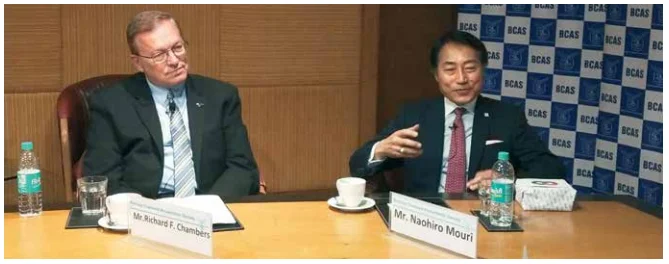
5 Sections 2(24), 28 – Subsidy in the nature of entertainment tax / duty collected, but not to be paid, constitutes capital receipt as it is meant for promotion of new industries by way of multiplex theatres.

  DCIT vs. Cinemax Properties Ltd. (Mumbai)

   Members : P. K.
Bansal (VP) and Pawan Singh (JM)

    ITA No.
5227/Mum/2015

     A.Y.: 2011-12. 
    
Date of Order: 09th August, 2017

     Counsel for revenue
/ assessee: Saurabh Deshpande / None

FACTS 

The
Assessing Officer, while assessing the total income of the assessee, disallowed
the claim of entertainment tax of Rs. 6,45,79,148 collected and claimed as
capital subsidy.

Aggrieved,
the assessee preferred an appeal to the CIT(A) who allowed the appeal filed by
the assessee.

Aggrieved,
the revenue preferred an appeal to the Tribunal.

HELD 

The
Tribunal noted that the similar issue arose in the case of the assessee in the
assessment years 2007-08, 2008-09, 2009-10 and 2010-11.

The
Tribunal in ITA No. 394/Mum/2012 dated 24.01.2014 for AY 2008-09 while dealing
with the same issue held the amount under consideration to be capital in
nature. The Tribunal had while deciding the appeal noted that the Bombay High
Court has in the case of CIT vs. Chaphalkar Brothers (ITA Nos. 1342
& 1443 of 2006), order dated 08.06.2011, held that the subsidy of this kind
constitutes capital receipt as it is meant for promotion of new industries by
way of multiplex theatres. The Tribunal also noted that in the case of
assessee’s sister concern namely Vista Entertainment Pvt. Ltd. (ITA No.
8402/Mum/2011) for AY 2008-09, it has been held that similar additions are not
sustainable, since the same amount is capital in nature. Following these
decisions, the Tribunal had dismissed the revenue’s appeal for AY 2008-09 and
had decided the issue in favour of the assessee. This order for AY 2008-09 was
followed while deciding appeals for AY 2009-10 and AY 2010-11.

Facts
being the same, the Tribunal did not find any illegality or infirmity in the
order of the CIT(A) deleting the addition of Rs. 6,45,79,148.

The
appeal filed by the revenue was dismissed.

4 Section 37 – Expenditure incurred by the assessee in connection with the issue of FCCB is revenue in nature.

 DCIT vs. Reliance
Natural Resources Ltd.
(Mumbai)

Members : B. R. Baskaran (AM) and Ravish Sood (JM)

ITA No. 6712/Mum/2012

A.Y.: 2009-10.         Date
of Order: 11th August, 2017

Counsel for revenue / assessee: Darse S. / Jitendra Sanghavi


FACTS 

The
assessee was engaged in the business of providing fuel and facilitation
services in various forms to power plants and also engaged in the joint venture
operations for exploration and production of coal based Methane blocks.  The assessee incurred expenses aggregating to
Rs. 13,85,96,004 in connection with the issue of foreign currency convertible
bonds (FCCB). These expenses comprised of – Agency Fees (Barclays Bank) : Rs.
10,58,188; Commission & Fronting Fees (Paid to Barclays Bank) : Rs.
13,73,38,456; and   Trustee   Maintenance  
Fees    (Deutsche Bank) :Rs.
1,99,360.

The
Assessing Officer (AO) disallowed the expenses on the ground that identical
expenses incurred in earlier years were treated as capital expenses by the AO.
He held that the expenses have been incurred in connection with increasing the
capital base of the company and not for carrying on day-to-day business
activities. He treated the expenditure of Rs. 13,85,96,004 so incurred by the
assessee as capital expenditure.

Aggrieved,
the assessee preferred an appeal to the CIT(A) who, following the orders passed
in earlier years, allowed the appeal filed by the assessee.

Aggrieved,
the assessee preferred an appeal to the Tribunal.

HELD 

The
Tribunal noted that the co-ordinate Bench had considered identical issue in ITA
No. 1425/Mum/2011 dated 08.07.2016 relating to AY 2007-08 and also in ITA No.
6711/Mum/2012 dated 24.08.2016 relating to AY 2008-09. It observed that while
deciding the appeal filed by the revenue for AY 2007-08, the co-ordinate bench
has followed the decision rendered by the Tribunal in the case of Prime
Focus Ltd. vs. DCIT
(ITA No. 836/Mum/2011 dated 04.02.2016). In the case of
Prime Focus Ltd., the Tribunal observed that the FCCB is akin to borrowings
made by issuing debentures and both of them are different types of debt
instruments only.

Accordingly,
in the case of Prime Focus Ltd, the Tribunal held that the expenses incurred in
connection with FCCB are revenue in nature. Further, in the instant case, the
FCCB holders never had any voting rights as the same were not converted into
equity shares during that year.

Since
there was no change in facts as regards claim of the assessee and also
considering that none of the FCCB has been converted into shares during this
year also, the Tribunal, following the view taken in earlier years, held that
the CIT(A) was justified in holding that the expenditure incurred in connection
with the issue of FCCB is deductible as revenue expenditure.

As
regards the second ground of the revenue that the assessee had issued FCCB for
the purpose of meeting its working capital requirement, but the same has been
issued in a manner contrary to the permitted use, the Tribunal held that since
it has already held that the expenses incurred in connection with the issue of
FCCB is revenue in nature, it is not necessary to adjudicate the alternative
contention of the revenue.

This
ground of appeal filed by the revenue was allowed.

Maintenance Under Hindu Law

Introduction

The codified Hindu Law consists of four main Acts which deal with different aspects of family law, such as, succession, adoptions, guardianship, marriage, etc. One such important  Act is the Hindu Adoptions and Maintenance Act, 1956 (“the Act”).  As the name suggests, this Act deals with two diverse topics – Adoptions by a Hindu and Maintenance of a Hindu. Let us consider some of the facets of the Maintenance part of this Act.

Maintenance of Different Persons

The Act provides for the maintenance of four different categories of persons, namely:

(a)   maintenance of a wife by her husband;

(b)   maintenance of a widowed daughter-in-law by her father-in-law;

(c)   maintenance of children and aged parents by their parents and children respectively; and

(d)   maintenance of dependants by the heirs of a deceased Hindu.


What is Maintenance?

The Act defines the term maintenance in a wide and inclusive manner to include in all cases, provision for food, clothing, residence, education and medical attendance and treatment. Thus, even the right to residence is treated as a part of maintenance – Mangat Mal vs. Smt Punni Devi, (1995) 6 SCC 88.

Further, in the case of an unmarried daughter (included in the category of children), it also includes the reasonable expenses of and incidental to her marriage. What is reasonable would depend upon the facts of each case and the financial status of each family. No hard and fast rule could be laid down in this respect and it would be a qualitative answer which would vary from family to family.

The Act provides that it is the discretion of the Court to determine whether and what maintenance would be awarded. In doing so, it would consider various factors. For instance, in the case of an award to a wife, children or aged parents, it would consider the position / status of parties, reasonable wants of the claimant, value of the claimant’s property, income of the claimant, number of persons entitled to maintenance under the Act. Similarly, while determining the maintenance of dependants, it would consider the net value of the estate of the deceased, degree of relationship between the deceased and dependants, reasonable wants of dependants, past relations, value of property of the dependant and their source of income, number of persons entitled to maintenance under the Act. The Court is granted very wide discretion. In Kulbhushan Kumar vs. Raj Kumari, 1971 SCR (2) 672, income-tax was allowed as a deduction in computing the income of the husband for determining the maintenance payable to his wife.

Maintenance of Wife

A Hindu wife is entitled to be maintained by her Husband during her life-time. Of course, this is subject to the marriage subsisting. Once a marriage is dissolved on account of a divorce, then an order for maintenance / alimony would be u/s.25 of the Hindu Marriage Act, 1925 and not under this Act. In Chand Dhawan vs. Jawaharlal Dhawan, 1993 (3) SCC 406, it was held that the court is not at liberty to grant relief of maintenance simplicitor obtainable under one Act in proceedings under the other. Both the statutes were codified as such and were clear on their subjects and by liberality of interpretation, inter-changeability could not be permitted so as to destroy the distinction on the subject of maintenance.

In Kirtikant D. Vadodaria vs. State of Gujarat, (1996) 4 SCC 479, it was held that there is an obligation on the husband to maintain his wife which does not arise by reason of any contract – expressed or implied – but out of jural relationship of husband and wife consequent to the performance of marriage. The obligation to maintain is personal, legal and absolute in character and arises from the very existence of the relationship between the parties. The Bombay High Court in Bai Appibai vs. Khimji Cooverji, AIR 1936 Bombay 138, held that under the Hindu Law, the right of a wife to maintenance is a matter of personal obligation on the husband. It rests on the relations arising from the marriage and is not dependent on or qualified by a reference to the possession of any property by the husband. The Supreme Court in BP Achala Anand vs. S Aspireddy, AIR 2005 SC 986 held that the right of a wife for maintenance is an incident of the status or estate of matrimony and a Hindu is under a legal obligation to maintain his wife.

A Hindu wife is also entitled to live separately from her husband without forfeiting her claim to maintenance in several circumstances, namely ~ if he is guilty of desertion, i.e., abandoning her without reasonable cause and without her consent; if he has treated her with cruelty; if he is suffering from virulent leprosy; if he has any other wife alive; if he keeps a concubine; if he has converted to a non-Hindu or if there is any other cause justifying her living separately. However, the wife loses her right to separate residence and maintenance if she is unchaste or converts to a non-Hindu.

Maintenance of Daughter-in-law

A Hindu widow is entitled to be maintained by her father-in-law provided the following circumstances exist:

(a)   She has not remarried and is unable to maintain herself out of her own earnings or property; or

(b)   She has not remarried, has no property of her own and she cannot obtain maintenance from the estate of her husband or her father or mother or from her son or daughter or their estate.

In either case, the obligation on the father-in-law is not enforceable if he does not have the means to maintain her from the joint property in his possession. If he has no coparcenery property, then a claim cannot lie against him. Of course, it is trite, that this provision cannot have force when a Hindu lady’s husband is alive, it is only a widow who can avail of this protection. Further, this right ceases when she remarries.

 An interesting question would be whether this right would lie against her mother-in-law?

In Vimalben Ajitbhai Patel vs. Vatslaben Ashokbhai Patel, Appeal (Civil) 2003 / 2008 (SC), it was held that the property in the name of the mother-in-law can neither be a subject matter of attachment nor during the life time of the husband, his personal liability to maintain his wife can be directed to be enforced against such property.

Maintenance of Children and Parents

A Hindu male/female has an obligation to maintain his/her children and aged /infirm parents. Children can claim maintenance till they are minor. However, the Act also provides that the obligation to maintain parents or unmarried daughter extends if the parent/unmarried daughter is unable to maintain himself/herself from own earnings/other property. Hence, a conjoined reading of the different provisions of the Act would indicate that minority is relevant only for maintenance of sons but for daughters, the obligation continues till they are married whatever be her age – CGT vs. Bandi Subbarao, 167 ITR 66 (AP). However, it has been held in CGT vs. Smt.  G. Indra Devi, 238 ITR 849 (Ker) that gifts to daughter after her marriage would not fall within the purview of maintenance.

Maintenance of Dependants

The Act has an interesting provision where it states that the heirs of a deceased Hindu (male or female) are bound to maintain the dependants of the deceased out of the estate inherited by them from the deceased. If a dependant has not obtained (under a Will or as intestate succession) any share in the estate of a deceased Hindu, then he is entitled to maintenance from those who take the estate. The liability of each of the persons who take the estate, shall be in proportion to the value of the estate’s share taken by him. The list of dependants is as follows:

(a)   father

(b)   mother

(c)   widow who has not remarried

(d)   son/son of predeceased son/son of predeceased grandson, till he is a minor

(e) unmarried daughter/unmarried daughter of pred-eceased son/unmarried daughter of predeceased grandson

(f)   widowed daughter

(g)   widow of son/widow of son of predeceased son

(h)   illegitimate minor son

(i)    illegitimate unmarried daughter. 

For certain types of dependants, the claim for maintenance is subject to they not being able to obtain maintenance from certain other sources.

Maintenance under Domestic Violence Act

In addition to maintenance under Hindu Law, it also becomes essential to understand maintenance payable to a wife under the Protection of Women from Domestic Violence Act, 2005 (“the 2005 Act”). It is an Act to provide for more effective protection of the rights, guaranteed under the Constitution of India, of those women who are victims of violence of any kind occurring within the family. It provides that if any act of domestic violence has been committed against a woman, then such aggrieved woman can approach designated Protection Officers to protect her. An aggrieved woman under the 2005 Act is one who is, or has been, in a domestic relationship with an adult male and who alleges to have been subjected to any act of domestic violence by him. A domestic relationship means a relationship between two persons who live or have, at any point of time, lived together in a shared household, when they are related by marriage, or through a relationship in the nature of marriage or are family members living together as a joint family. A live-in relationship is also considered as a domestic relationship. In D. Velusamy vs. D. Patchaiammal, (2010) 10 SCC 469, it was held that in the 2005 Act, Parliament has taken notice of a new social phenomenon which has emerged in India, known as live-in relationships. According to the Court, a relationship in the nature of marriage was akin to a common law marriage.

Under this Act, the concept of a “shared household” is very important and means a household where the aggrieved lady lives or at any stage has lived in a domestic relationship with the accused male and includes a household which may belong to the joint family of which the respondent is a member, irrespective of whether the respondent or the aggrieved person has any right, title or interest in the shared household. Section 17 of the 2005 Act provides that notwithstanding anything contained in any other law, every woman in a domestic relationship shall have the right to reside in the shared household, whether or not she has any right, title or beneficial interest in the same. Further, the Court can pass a relief order preventing her from being evicted from the shared household, against others entering / staying in it, against it being sold or alienated, etc. The Court can also pass a monetary reliefs order for maintenance of the aggrieved person and her children. This relief shall be adequate, fair and reasonable and consistent with her accustomed standard of living.

An interesting decision was rendered by the Bombay High Court in the case of Roma Rajesh Tiwari vs. Rajesh Tiwari, WP 10696/2017. This was a case of domestic violence in which the wife had alleged that she was driven out of her husband’s home, but she was willing to go back to that home. She filed a petition before the Family Court for allowing her to stay in her husband’s home. This petition was rejected as it was held that the flat exclusively belonged to her father-in-law and there was nothing to show that her husband had any interest or title in the property, hence, she had no right to claim any relief in respect of the property, which stood in the name of her husband’s father. On appeal, the Bombay High Court set aside the Family Court’s order and analysed the definition of the term shared household under the 2005 Act. It also analysed section 17 which stated that every woman in a domestic relationship shall have the right to reside in the shared household, whether or not she has any right, title or beneficial interest in the same. It held that since the couple were living in the father-in-law’s flat, it became a shared household under the 2005 Act. It was irrelevant whether the husband had an interest in the same and title of the husband or that of the family members to the said flat was totally irrelevant. The question of title or proprietary right in the property was not at all of relevance. It held that the moment it was proved that the property was a shared household, as both of them had resided together there up to the date when the disputes arose, it followed that the wife got a right to reside therein and, therefore, to get the order of interim injunction, restraining her husband from dispossessing her, or, in any other manner, disturbing her possession from the said flat.

Contrast this decision of the Bombay High Court with that of the Delhi High Court in the case of Sachin vs. Jhabbu Lal, RSA 136/2016 (analysed in detail in this Feature in the BCAJ of January 2017). In that case, the Delhi High Court held that in respect of a self acquired house of the parents, a son and his wife had no legal right to live in that house and they could live in that house only at the mercy of the parents up to such time as the parents allow. Merely because the parents have allowed them to live in the house so long as his (son’s) relations with the parents were cordial, does not mean that the parents have to bear the son and his family’s burden throughout their life. A conclusion may be drawn that in cases of domestic violence, a wife can claim shelter even in her in-laws’ home, but in a normal case she and her husband cannot claim a right to stay in her in-laws’ home.

Conclusion

Right to claim maintenance has been provided to several persons under the Act. Codification of this important part of Hindu Law has resolved a great deal of ambiguities, but considering the complex nature of this Act dealing with personal law, it does have its fair share of controversies and litigations.