Subscribe to the Bombay Chartered Accountant Journal Subscribe Now!

68th Annual General Meeting on 6th July 2017

The 68th Annual General
Meeting of the Society was held at the Garware Club, Churchgate, Mumbai on
Thursday, 6th July 2017.

CA. Chetan Shah, President of the
Society, took the Chair. Since the required quorum was present, he called the
meeting in order. All businesses as per the agenda given in the notice were
conducted, including adoption of accounts and appointment of auditors.

Mr. Suhas Paranjpe, Treasurer
announced the results of the election of the President, Vice President, two
Secretaries, Treasurer and eight members of the Managing Committee for the year
2017-18. The names of members as elected unopposed for the year 2017-18 were
announced. He also announced the names of the co-opted members for the year
2017-18.


Later, the “Jal Erach Dastur
Awards” for best feature and best article appearing in BCAS Journal during
2016-17 were announced. The winners were: Dr. Anup P. Shah for the best
feature, and CA. Gautam Nayak/ CA. Pradip N. Kapasi for best article.

The Special GST issue of the
Journal of July 2017 exclusively on “GST Features” and BCAS Publication Audit
Checklist- 7th Enlarged Edition-July, 2017 were released at the
hands of Hon’ble Minister of State (IC) for Power & Renewable Energy Mr
Piyush Goyal at the 69th Foundation day of the Society celebrated after the
Annual General Meeting of the Society.

At the end, guests including Past
Presidents of BCAS were invited on the dais to share their views and
experiences about the Society.

Outgoing President’s Speech

My colleagues on the dais, Past
Presidents, Ladies and Gentlemen, Good
Evening members!

This is Spencer West.

There aren’t many people in the
world like him. At the age of five, he tragically lost both his legs. But the
Canadian-born 31-year-old defied all the odds and climbed Mt. Kilimanjaro! This
is a story of determination, courage, focus, perseverance and hard work. A
story of months of intensive training to overcome extreme physical pressure.


What caught my eye is the message
on his T-Shirt – “Redefine Possible.” At BCAS, as we gather here on our
Founding Day, I believe we too have lived this motto. As a group of dedicated
volunteers, driven by a vision, have travelled a long way to reach this …
Founding Day. So many people here, including my colleagues on the Dias, have
overcome situations when we were up against the wall and we persevered, when
there were moments of frustration and we showed temperance, things often seem
to take longer than they should have but we firmly stayed the course. So many
have given their personal and family time and made these years and particularly
the last one year fruitful for members. As I stand here on my last day as the
President I can say that as we surmount we now have the confidence to DREAM
BIGGER!

Having said that I would like to
walk you through “The News this Year,” and to make it a little more
interesting I am going to give it a sports flavor.

So,
let’s start at the beginning of the 67th Annual General Meeting in July last
year…when I was handed OVER the torch, I chose to adopt a theme which was close
to my heart to be our guiding light for the year ahead. The theme was “Today’s
Vision, Tomorrow’s Reality.” The wisdom contained in these four words were
influenced by the famous twentieth-century poet, painter and philosopher Khalil
Gibran. He said, “We are not limited by our abilities, but by our vision.” And
I realized that we need to focus on developing a powerful, telescopic vision at
BCAS, rather than merely looking at our combined abilities.

To best understand how we
proceeded with the task ahead, let us look at the athlete who throws the
javelin. After scanning the vast sky above and the distant horizon, he throws
the javelin with all his arm and body muscles working seamlessly.

At BCAS, we embarked on the task
of discovering where we want to go…and identifying what route should we take to
get there. We met on many occasions in managing committee, other core
committees and with past torch bearers to draw up a suitable game plan. In the
process of planning, we gauged several untapped potentials and even pinpointed
any possible pitfalls. Some of the key points that emerged at this stage were:

•    Harness technology to enhance
access to BCAS

•    Explore new opportunities for
members to learn

•    Consolidate presence on
national front

•    Organize programs at the
doorsteps of  outstation members

•    Engage with related bodies to
multiply reach

•    Encourage and Empower students
to be future leaders and

•    Make crisp and effective
representations to ensure our voice is heard in the decision makers’ corridors.

With these findings, we moved to
the next phase where we gained insights from the world of basketball. We needed
to proceed ahead dodging several obstacles such as other commitments and
numerous time constraints. We also practiced more teamwork as we ‘passed’ the
assignment at hand to other members who were also better ‘positioned’ to take
it ahead. At this stage, we learned how to seize opportunities and move towards
implementation of the plans by getting logistics in place.

We
were now perfectly poised to take the LEAP (high jump) … SPRINT AHEAD (100
meters)…or take the PLUNGE (swimming)! And that’s what we did, moving swiftly
from one program to another is quick succession with high-quality deliverables.
And as you will shortly see they were all gold performances…and some more
golden!
Now let’s take a look at the
winners in no particular order!

Quantum Leap – Technology Edge

BCAS
took a quantum leap akin to long jump into the digital arena which was an
enabler to provide easy access to all members. Live streaming technology for
live webcast and posting of our programs on YouTube channel has been a boon to
our outstation and distant suburb members to view at their convenience.
Facebook and LinkedIn are increasingly used as a face of the  society for important updates. Payments can
be made online and our website has been revamped. An e-learning portal will be
launched shortly to extend training beyond geographic and time boundaries.

Hitting Bulls’ Eye – Experts
Chat

The
target questions by the moderators were pointed as in the game of Archery.
Experts Chat was a new game at the Society but Panelists, were veterans in
their knowledge reservoir, which was evidenced in their profound replies and it
developed into an excellent knowledge sharing platform. Six Experts Chat
sessions held this year command equal marks as they all drew increasing
attendance and viewership.

BCAS RRCs – Each RRC is like
20-20 Cricket Tournament where you learn so many subjects in a short span of
time.

The T20 matches was played at
various locations domestic and international. The Seminar Committee played at
Jaipur where the fiftieth edition of the RRC, the flagship program of the
society was conducted. It drew a record 275 participants from across India. The
International Taxation Committee played at Sri Lanka. The first time at an
international location was the ITF Conference. The Indirect Tax committee
played it at Pune with more than 330 participants. The Accounting and Auditing
committee played IndAS RSC at Silvassa. The MPR Committee played the Youth RRC
at Alibaug jointly with ICAI.

Each game was individually very
well played by all committees

Union Budget Lecture – Marathon
Run

The
Marathon run this year too was led by Senior Advocate Shri S.E. Dastur who
continued to wow the crowds with his powerful presentation. His detailed
analysis of the “Direct Tax Provisions of the Finance Bill, 2017” was a
remarkable run witnessed by 3,000 avid listeners at the auditorium, while over
10,000 watched it live from across India.

Besides
the RRC being played at various locations we chose not to play football within
BCAS but jointly with various other related organisations. Many joint programs
were conducted with other organizations to reach out to a larger audience in
Mumbai. Forum of Free Enterprise, Chamber of Tax Consultants, AIFTP, Indo-
American, ISME…were some of the organizations we worked with on these programs.
The game brought in a lot of cohesiveness in the game of the profession.

The reach of the Olympics was far
and wide this year. Members at various locations invited us to conduct programs
for the benefit of locals. To be more inclusive, BCAS reached out to its
outstation members with programs in Ahmedabad, Kanpur, Indore, Aurangabad and
Kolkata. Medals were in the form of increased membership and enrolment for
RRCs.

The novel concept of Inter
Committee Cricket Tournament was executed with thorough excitement and fun this
year.

To improve skill sets of its
members the society took up new initiatives. These are akin to introducing new
games to the Olympics. CAMBA a dedicated CA-MBA Course jointly with ISME was
launched to sharpen management skills and call the shots at par with MBAs in
the Society.

A Coach acts as a guide for every
sportsman (Virat Kohli may be an exception), anyway in the true spirit
of sportsmanship we continued the Mentorship program. 

As
the Society succeeded in playing different games and enhanced its reach, it
created its visibility which made Organisations to join as FRIENDS of BCAS. A
new concept where various benefits are extended
to members.

Role in Governance

The interaction by profession with
the government is like a game of tennis. There is always a rally between the
players which is healthy for developing good governance

The society made 16
representations to various authorities…some were made jointly with other
organizations. IDS, ICDS, Rotation of Audit Firms and GST were some of the key
issues the society took up with the government.

Welcoming Students

Sprint
run by the Society was for the benefit of students. The run involved in
mentoring and motivating students and felicitating newly qualified CAs. The
final dash was 10th Jal Erach Dastur Students Annual Day where
talent bloomed at its best and brought together over 250 students.

BCAS disseminated knowledge to
students at the NM College and HR college.

Useful Publications

BCAS brought out a record number
of 17 publications this year. Referencer was the bestseller with over 5,000
copies. But the blockbuster is the BCAJ July special issue with a print run off
over 16,000 copies which will be 
released today. There are two e-publications in Flipbook format that are
free for the members.

Education at BCAS

BCAS imparted knowledge through 40
Lecture Meetings with a total participation of 9,084 people, 58
Seminars/Courses/Workshops with a total participation of 7,065 people and a
record 110 study circle/study group meetings with a total participation of
2,552. These figures exclude thousands who have seen the videos online. This
enabled to add 943 new members and our social media presence augmented. More
statistics are in the Annual Report.

On attending many of these
meetings was itself a learning curve for me. But the Flip side is that by
attending so many meetings I have formed a habit of eating chocolates and
sweets sitting behind the desk.

BCAS Foundation

The
BCAS Foundation is the philanthropic expression of the society. Thank you,
members, for your large heartedness which enabled BCAS to collect more than Rs.
20 lakhs for the noble cause of improving pediatric cancer care to Tata
Memorial Hospital! With their generosity, we could contribute to the wellbeing
of 120 children suffering from this dreaded disease. However, we cannot rest on
the past laurels, and there is a lot we can do for such cause. I again exhort
all my fellow professionals to come forward and contribute each one’s might to
such a noble cause.

I now pass the baton to Narayan
Pasari, the new President of BCAS and the new core group members and office
bearers.  I will definitely continue to
stand and cheer for Team BCAS, in fact run along as we keep raising the bar and
setting new records.

It is time to say a big thank you to the entire
team that has worked so tirelessly and painstakingly to make this year’s
performance so eventful and if I might add…successful too!

Let me begin this ode of gratitude
by expressing my sincere thanks to the Past Presidents a few of whom were at
the helm of our nine sub committees. Their invaluable insights and vast reservoir
of experience are what keeps driving the committees to push the limits…and
excel. As Chairmen and Co Chairmen of the sub committees they have been a
beacon of inspiration, enabling the committees to grapple with many challenges;
and win!

Let us have a round of
applause for our hardworking though silent Chairmen and their amazing teams.

Next, I must thank my Managing Committee and the
Office Bearers who have diligently shared vital expertise and invested long
hours in planning and facilitating the smooth flow of programs and events of
the society. With all my heart, I thank ……

Narayan who has an eagle’s
eye for details that compliments his exemplary admin skills in ensuring our
numerous programs run flawlessly.

Sunil has demonstrated
credentials in the sphere of IT besides GST and has played a pivotal role in
the Society’s IT initiatives, particularly now he is engaged in the launching
of e-learning platform.

Suhas who as Joint
Secretary willingly devoted his time and eagerly participated with many
innovative suggestions.

Manish who as treasurer,
kept an eye on the numbers and helped all of us to stay in balance and
perspective.

Please join me in thanking them
with a round of applause.

Then
there is the incredible BCAS Team comprised of Jyoti Malkani who was with us
until April as GM; Shreya, Javed, Upendra, Nikhil, Rathi, Kamaljeet, Bilal,
Reema, Sachin, Baboo, Harish, Prakash, Mamta, Rajaram, yes, the entire team and
not to forget my office boys. A big thank you for your unfailing and unstinted
support in keeping the wheels of BCAS turning smoothly.

Last but not the least, I would like to thank all
my partners and my firm for backing me in my journey especially Abhay, whose
abundant wisdom and good judgment helped me to chart new routes in the face of
obstacles. And how I can forget to thank my wife for bearing my early exit and
late entry to our abode, but she was adequately cautioned by the PPs…

And
special thanks to all the conveners, coordinators, contributors, speakers, our
publishers Finesse and Spenta, sister organisations and asociations and well-wishers
who have together made BCAS shine bright this year too.

It
would be most inappropriate for me to end this speech by saying goodbye…because
goodbye sounds so final, almost like closing a door…or escaping to some remote
place never to see each other again. Instead, I would like to say Fare Well,
not as in one word, but as two words – Fare Well! Because I believe the road
for BCAS stretches a long way ahead…Yes, there will be bumps and curves to
navigate, but more importantly, there will be many milestones to cross and many
mountains to conquer. And so, to everyone at BCAS, starting with President
Narayan, the Chairmen & the managing committees and members, I wish you all
a heartfelt Fare Well!

Thank
You!

Incoming
President’s Speech


My President Chetan, Vice
President Sunil, Joint Secretaries Manish and Abhay, Treasurer Suhas, Respected
Past Presidents present and in absentia, Members of the Managing Committee,
Core Group Members and my dear friends

Let me start my innings by
remembering my father Late CA. R. G. Pasari whom I lost 5 years ago. He would
have been a really happy man today as he always pushed me into the BCAS
activities. This was because he had worked with the likes of S. P. Mehtaji, B.
L. Kabraji and others who always had the highest respect for BCAS. He also read
the BCA Journal regularly till his demise.

I recognize the presence of my
mother Smt. Parvati Devi who is the source of my strength after my father and
also other members of my family.

To reach at this prestigious
position, I also thank my principal Late CA. Mangalbhai Vatsaraj under whom I
completed my articleship, CA Pravinbhai Dharia 
(our auditor) and CA. B. L. Sardaji under whom I also took training post
my articles. Thanks is also due to the firms and the partners with whom I
worked during the last 2 and half decades. 

As far as BCAS is concerned, a
small peep into my journey so far would be in order today. I became a LIFE
MEMBER in 1990 and started participating in the activities thanks to two of our
Past Presidents CA Harish Motiwalla and CA Pradip Thanawala. I was inducted
into the Core Group of the Society in 1994-95 
and became a Committee Member in the Seminar Committee. I was appointed
a Convenor of this Committee in 1996-97 for the first time and have been an
integral part of this Committee for a fairly long time till I became a Office
Bearer under CA. Nitin Shingala. I served CA. Raman Jokhakar and CA. Chetan
Shah also during their Presidentship.
 

Before
I leap into the future with some of the many plans I have chalked out, I would
like to take time out to thank Chetan for his sincere and dedicated service as
President during the past year. It has been a tremendous learning experience
for me as I learnt not to get fettered or limited by a lack of experience or
ability. Instead Chetan always encouraged us all to think beyond and allow
vision to be the defining force in all our endeavors. In supporting Chetan over
the last many months I got invaluable exposure to multi-tasking and problem
solving.

So once again, let me welcome
and thank you all for coming here in such large numbers, and giving me this
opportunity to serve you as the 69th President of the BCAS.

We
are living in exciting times with considerable change happening both in India
and in the global arena. And these numerous changes provide an array of
challenges and incredible growth opportunities for all of us.

In
analyzing the Indian population we find it is comprised largely of young people
who are getting more and more literate and educated. They are also earning a
lot more than in earlier years and have greater disposable incomes. Their
buying power and consumption are playing a vital role in stimulating the
markets and growing the economy.

The Indian economy has defied many hurdles to cross
growth of over 7%. Stock exchanges have registered soaring indices and high
volumes of trading activity. Foreign Direct Investment is pouring in…in fact we
are the number one destination for FDI in the world, beating both United States
and China. Confidence in India’s economy is surging, thanks to the numerous
programs and reforms undertaken by the NDA Government with Prime Minister
Narendra Modi as its driving force.

Keeping pace with the phenomenal growth in the
Indian market are the vast array of services and products. And to ensure a
level playing field that’s fair and free, Indian companies have several new
laws and compliances to meet translating into enhanced business for all of us.
Globalization too is another stepping stone for all Indian companies keen on
getting more lucrative returns and a package of benefits. Here again as volumes
and diversity of exports grow, we have vast potential to harness greater
business.

As President, I have given myself
the task and responsibility of facilitating BCAS’ growth. I believe that if all
of us put an arm to the wheel, we can make BCAS a society that’s will be far
more recognized and respected within our profession and in financial circles.

Keeping this in perspective, I
have drawn up a plan that focuses on “Building Bridges”.

A bridge is a structure that is
built over an obstacle to provide connectivity. And building bridges is the
underlying theme of how I plan, with all of you, to take BCAS ahead!

Bridges connect us and help us to
understand each other’s challenges… they also enable us to figure out how we
can help each other and show that we appreciate one another. Building bridges
also helps to prevent isolation. Because isolation can breed prejudice,
misunderstanding, mistrust; and impede effectiveness of working together.

I propose four main bridges
and hope you will help me in building them and BCAS!

1. TRANSFORMATION

High on my list of priorities is
task of increasing the resources of BCAS and growing the membership list. I
believe the Society needs to be more visible in order to attract more members.
On the resources front too, we have to look at all possibilities of
capitalizing on the reputation and goodwill we already have. There is plenty of
knowledge and expertise within, which I think can be leveraged to enhance the
image of BCAS. With the shrinking of the world to a global village we need to
explore options to benefit from this trend.

Let’s move to a sincere wish I
have!

2. YUVA SHAKTI

The youth! They are our future and
they can be the catalyst of evolution in our Society. I look forward to
encouraging new blood to take up key roles. And to ensure that happens I would
like to implement special incentive schemes to get more youth to join BCAS.
Having done that I would also like to ensure they get more opportunities and
platforms to express their ideas and vision. Recently, I heard about the
concept of “Shadow Committees” and I would like to set up Yuva Shadow
Committees. These groups of young minds will think aloud fresh ideas and approaches
on the same challenges faced by the managing committee…and I hope it will lead
to some positive change. 

3. DIGITIZATION

Digitization is not a fad or a passing trend that
some companies or individuals flaunt. Digitization is essential…it has become the
need of the hour! With digitization we will be better empowered to manage our
resources and conduct our business. I look forward to digitizing as much as I
can of BCAS’ operations and resources. A good start has already been made in
this direction and I would like to add momentum to the entire process. In
addition to being able to disseminate knowledge, we would be able to translate
information into action more effectively.

Finally I
would like to tackle a relatively ignored activity of our Society…

4.
NETWORKING

Networking
is a mantra that is much advocated by many of the management gurus. At BCAS, I
feel we should work harder in this area. Be it the government, corporate or
fraternity level, we need to step up our efforts. I hope we will be able to
take some giant strides in this area by organizing some events to reflect the
“Start Up India and Digital India” initiatives undertaken by the government. We
could even re-look at some of events and tweak the format to include moments of
interaction and networking. Using our digitized resources and media, we could
reach out to a wider audience and serve the members better. BCAS could provide
more platforms in the form of events for networking among accounting firms.
Networking Power Summit is one format which could be organized more frequently
or modified to pave the way for greater networking.

These
are just some of my ideas that I have put together to set the ball rolling.
While I and my colleagues remain open to various suggestions and infact welcome
it, I would like to call upon each one of you to join us in this process of
transformation
of society to the needs of the present times by
mobilizing the power of yuva-shakti & digitization to build
bridges for expansion by creating robust networks.  I am sure I will continue to receive the same
love and affection from you in this very important journey of life.

Thank
You

Society News

Human Development Study Circle Meeting on
“Business Environment in India – Evolution, Opportunities, Challenges” held on
10th January, 2017

Human Development and Technology Initiatives Committee  (HDTI) of BCAS conducted a Human Development
Study Circle Meeting on “Business Environment in India – Evolution,
Opportunities, and Challenges” on 10th January, 2017 at BCAS
Conference Hall. 

Dr. Anil Naik, a Management Consultant, MBA from IIM Calcutta
and winner of many prestigious awards, having wide experience in Industry and
also visiting faculty at top Management Institutes in India and Abroad, gave
the presentation and covered the following topics- .

1.  Evolution of Business Environment in India
since 1991.

2.  Challenges of the Indian businesses to be seen
for :

• Family Owned & Family Managed Businesses

• Family Owned Professionally Managed Businesses

• Corporate Sector consisting of Indian
Companies, Foreign Companies operating in India and Collaborations of Indian
& Foreign Companies.

3.  He also cited the examples of companies
operating in India like Tata Motors, Kodak, Shapoorji Pallonji, Ballarpur
Industries and Kirloskar, etc.

The major basic issues discussed were:

·        
Major changes in Transportation Industry and
many others.

·        
Factors for success i.e. Adaptability to new
technology, Personality Skills, Pursuing Aspirations etc.

·     Stark realities of dynamic environment – No more
secrets, security is uncertain, Allegiance, Time is short – we need to run fast
to take up right opportunities at right time at great speed, Order of today’s
time is not clear – international business, supremacy of product plays vital
role.

·    India has 16 cultures. Cultural Differences.
Internal Culture of the organisation matters. Asian culture v Globalised
scenario. Adopting right mix of culture is challenge of today’s times.

·        
Business environment is Dynamic, turbulent and
unstable. How to become flexible. Opportunities for organic flexibility,
adaptability, innovation, accepting change and uncertainty are natural state of
things in the current environment.

·        
Ensure that institutions have capacity to serve.
Employees’ skills, motivation and capabilities play an important role.

Inescapable reality of new economy – 1) Seek and create
breakthrough changes. 2) Outsiders see it first 3) Right balance between
incremental improvement and radical innovation 3) Shortage of resources is not
necessarily serious, but shortage of imagination is certainly fatal 4) Nothing
lasts forever under its original momentum 5) Success contains the seed of its
own destruction 6) Primary challenge of leadership today is to create adaptive
organisation which has a built in capability to renew itself over and over
again.

The meeting was very fruitful and the participants benefitted
a lot from the Speaker’s rich experience.

Workshop on Merger & Acquisition held on 27th & 28th
January 2017

Corporate & Allied Laws Committee [‘C&ALC’] organised
a two days’ Workshop on Mergers & Acquisition at Hotel St. Regis, Lower
Parel, Mumbai. The event received an overwhelming response.

86 participants attended the workshop out of which almost 30
participants were from industry. Further, around 32 were outstation
Participants from cities like Ahmedabad, Vadodara, Hyderabad, Chennai and
Nagpur.

CA. Chetan Shah, President, welcomed the participants. CA.
Kanu S. Chokshi, Chairman of C&ALC gave a brief idea on the necessity of
such programme.

The Workshop was inaugurated by Dr. Lalit Kanodia, Chairman,
Datamatics Group. Eminent faculties addressed the participants on the relevant
topics along with their presentations. A 
booklet of the presentations made by various speakers at the workshop was
provided to the participants.  The event
was conceptualised by CA. Naushad Panjwani, Past President of BCAS, with the
help of Dr. Anup Shah. CA. Naushad Panjwani also shared his thoughts on certain
mergers at the said workshop. Advocate Praveen Veera chaired the session on
‘Stamp duty’ and CA. Shrenik Baid shared the dais along with CA. Kanu S.
Chokshi during the session on ‘Accounting Implications’.

The sessions of the said workshop on Merger & Acquisition
are summarised below:

Session I: Keynote Address – “Key negotiating
techniques used by buyers and sellers in a Merger & Acquisition
transaction” by Dr.Lalit Kanodia – Chairman, Datamatics Group
.

Dr. Lalit Kanodia

He inaugurated the workshop and shared his practical
experiences in Merger and acquisition.

Session II: Alternative Disputes Resolution in
Merger & Acquisition by CA. Suresh Kotak –Chairman, Kotak Group.


CA. Suresh Kotak

He addressed the participants.& talked about steps taken
in area of ADR

Session III: Stamp Duty by Dr. Anup Shah, CA.
Pravin P. Shah & Co.


CA. Anup P. Shah

He covered various implications of  stamp duty under different modes of mergers
& acquisition. He also analysed stamp duty on CD, Debentures, Gift etc.

Session IV: Companies Act & Bankruptcy Law by
Adv. Sharad Abhyankar – Sr. Partner, Khaitan & Co.
 

Adv. Sharad Abhyankar

He analysed
transaction charges, some of the procedural aspects and gave a mapping in
Merger & Acquisition. He also gave an overview of Insolvency and bankruptcy
code in relation to Merger & Acquisition.

Session V: SEBI Takeover Regulations by Adv. Akil Hirani –
Managing Partner, Majumdar & Co.


Adv. Akil Hirani

He took the participants through takeover code and insider
trading regulations with respect to, an open offer, in case of Merger &
Acquisition.

Session VI: Legal Due Diligence by Adv. Tushar Ajinkya.

Adv.Tushar Ajinkya

He highlighted the Due Diligence aspects with the typical
structure requirement, key areas to be checked, IPR and litigation issues.

Session VII: Financial due Diligence by CA. Rajesh
Khairajani – KNAV.


CA. Rajesh Khairajani

He touched upon various facets of financial due diligence on
both, buyer and seller side, inter alia, emphasising upon physical verification
of assets in  Merger & Acquisition
deal.

Session VIII: FEMA & Cross Border by CA. T. P. Ostwal,
T. P. Ostwal & Associates.


CA.T. P. Ostwal

He explained salient
features of various treaties of India & Mauritius /Cyprus/Switzerland; and
choice of jurisdiction. He also took 
participants through Automatic route vis-à-vis Approval route;

Session IX: Strategy & Value Creation by
Mr. Sudhir Valia – Executive Director, Sun Pharma.


Mr. Sudhir Valia

He shared his rich experience  in guiding participants as to how to proceed
for Merger & Acquisition.

Session X: Income Tax-Domestic/ International (in case of
cross border) by
CA. Hiten Kotak & CA. Falguni Shah.


CA. Hiten Kotak


CA. Falguni Shah

The speakers explained the funding structures – Key
consideration, recapitalisation and repatriation and indirect transfer and tax
thereon with practical examples.

Session XI: Accounting
Implications by CA. Himanshu Kishnadwala, CNK & Associates.


CA. Himanshu Kishnadwala

He gave an overview of provisions relating to M & A
contained in Companies Act 2013 and SEBI Regulations. He also dealt with the
applicability of Accounting Standard and Ind AS to Merger & Acquisition and
explained Accounting in Merger & Acquisition with an illustration.

Session XII: A typical Merger & Acquisition
process by CA. Sridhar Swamy
.

CA. Sridhar Swamy

He explained the nitty-gritty of the Merger & Acquisition
process including identification and understanding buyer, process documents and
presentation to the Management. He also briefly explained legal documentation
in Merger & Acquisition.

Session XIII: Post Merger Integration by CA. Mitil
Chokshi.


CA. Mitil Chokshi

He drew attention of the participants to the difficulties
faced in integration Post Merger, some of the important factors peculiar to
each industry which could result in a possible threat to success of a Merger
& Acquisition deal. He also shared his experience regarding solution on
some of difficulties in Merger & Acquisition deals handled by him.

CA. Manish Reshamawala, Convener, with his untiring efforts
coordinated the programme with the support of CA. Preeti Oza, Convener. The
participants benefitted from the rich experience of the Speakers.

Experts chat @ bcas on “Internal audit 2017: global trends
and outlook” held on 30th January, 2017

An experts chat on “Internal Audit: Global Trends and
Outlook” was held at the BCAS Conference Hall on 30th January, 2017.

The program commenced with the signing of a Memorandum of
Understanding (MOU) between BCAS and the Institute of Internal Auditors –
Bombay Chapter (IIABC). This MOU will enable BCAS and IIABC to jointly
collaborate and develop mutually beneficial programs in the field of internal
audit, projects and activities for its members in the field of internal audit,
as well as to offer members of both parties to attend programs of each other.

President CA. Chetan Shah,
on behalf of BCAS and President CA. Sunil Gaitonde, on behalf of the Institute
of Internal Auditors – Bombay Chapter (IIABC) did the honours.

President CA. Chetan Shah then welcomed Mr. Richard F.
Chambers, the President and Chief Executive Officer of The Institute of
Internal Auditors (IIA), the global professional association and
standard-setting body for internal auditors. The IIA serves more than 1, 85,000
members in over 170 countries and territories and is the internal audit
profession’s most widely recognised advocate, educator, and provider of
standards, guidance, and certifications.

L to R : Mr. Richard F. Chambers in the fireside chat with CA. Nandita Parekh

Mr. Chambers made a detailed presentation on the emerging
trends in internal audit, more particularly, the reporting structure, critical
focus areas, need to understand the audit culture of the organisation,
cyberspace audit, audit of big data. His talk was generously interspersed with
interesting statistics and results of survey done by Internal Audit Foundation,
across various continents and organisations.

Mr. Chambers shared a list of five strategies for every
internal auditor to equip himself with:

·        
Respond to the voice of the customer

·        
Strive for agility

·        
Transform your talents

·        
Revolutionise your processes

·        
Elevate your image’

Mr. Chambers’ presentation was followed by an engaging
fireside chat, which was moderated by CA Nandita Parekh, a senior member of the
Core group with expertise in the area of internal audit.

Mr. Chambers candidly answered questions on matters including
how to earn a seat at the (management) table, need for an internal auditor to
adjust the sails (i.e. the audit scope) to steer through the external and
internal changes, etc.

Questions posed by participants were also answered by Mr.
Chambers.  

The event witnessed an impressive turnout and was also
available for viewing through live streaming. The live streaming facility was
made available to members of IIA and IIABC.

“Public Lecture Meeting on Direct Tax Provisions of the
Finance Bill 2017” held on 7th February, 2017

The 52nd Lecture Meeting of the Society on the
Direct Tax Provisions of the Finance Bill 2017 by Senior Advocate Shri S.E.
Dastur was held at Yogi Sabhagruha, Dadar. This was 29th consecutive
year of address by Shri. S. E. Dastur.

Mr. S. E. Dastur (Speaker)

The lecture meeting was streamed live and was witnessed by
more than 15,000 persons including online viewers. President CA. Chetan Shah
welcomed and introduced the speaker Shri S. E. Dastur citing that his
intellectual charm is what makes this session special. He Shah also touched
upon the concept of liberalisation and digital revolution.

Shri Dastur started his speech by detailing the memories of
the previous budgets since 1948-49. He talked about the Finance Minister’s
speech having laid emphasis on the digital economy. He discussed the various
new insertions in areas of capital gains, changes in assessment and
reassessment procedures. He also explained the concept of primary and secondary
adjustment under transfer pricing.

After covering all significant provisions the eminent speaker
dealt with other amendments. He also covered provisions under the Companies Act
and Accounting Standards, the taxability of carbon credits. He commented on the
amendments to the Search provisions under section 132.

The audience was spell bound by his speech. His lucid
analysis of the provisions benefitted all those who witnessed his presentation.
The meeting ended with a huge round of applause and appreciation by the
participants.

FEMA Study Circle Meeting held on 8th February,
2017

FEMA Study Circle Meeting was held on the topic of
“Investment by Foreign Venture Capital Investor (FVCI) and in Real Estate
Investment Trust (REIT)” on 8th February, 2017 at BCAS Conference
Hall. The meeting was chaired by CA Shabbir Motorwala and led by CA Amit Dhoot,
CA. Monica Wadhwa and CA. Rashmi Shetty. It was great to have such
knowledgeable bench of leaders.

The speakers took participants not only through important
FEMA provisions applicable to Investment by FVCI and REIT but also issues
related to structuring, SEBI registration, important conditions etc.
which gave participants a 360 degree perspective of the subject. They also
explained the advantage of FVCI over FDI.

For investment in REIT, the speaker explained the challenges
why REIT is not yet picking up pace in India and how can India learn from other
countries.

The chairman shared his practical experience which was an
icing on the cake!

CPR workshop with medical camp held on 11th February, 2017

CPR (Cardio Pulmonary Resuscitation) training workshop with
medical camp was held jointly with Asian Heart Institute ( which stood as the
‘India’s Best Private Cardiac Hospital’ for two years in a row) on 11th
February, 2017 at BCAS conference Hall. Around 65 participants including members
and their families availed benefit of the workshop. The medical camp covered
the health checkup for random blood sugar, blood pressure, ECG and consultation
by doctor from Asian Heart Institute.


Participants in the CPR Workshop

The doctors conducted CPR workshop for the participants
enrolled and provided practical training for CPR in case of medical emergency
arising out of cardiac arrest which was very useful for understanding the
subject.

The doctors involved in the workshop were experts in their
field which helped in conducting the workshop successfully.

Report on Three Days 7th Residential Study Course
(RSC) on IndAS held on 16th -18th February, 2017

IndAS is being implemented in India in phases. FY 2016-17 is
the first year of applicability for phase I companies with comparatives for FY
2015-16. Several challenges are being faced by companies in this implementation
effort, more particularly on fair value, financial instruments, business
combinations and so on.

BCAS has always been in the forefront to assist professionals
to face challenges and be equip them to implement such changes. The 7th
BCAS IndAS Residential Study Course was planned by the Accounting and Auditing
Committee to address the implementation challenges being faced as well as to
impart knowledge of implementing IndAS to the professionals to have a smooth
transition for the corporate sector.

The RSC was organised from 16th to 18th
February, 2017 at Ras Resorts, Silvassa. This year’s RSC was structured with
three sessions based on case studies prepared by three eminent professionals
covering different aspects of IndAS implementation. These case studies based
papers involved group discussions through three groups formed amongst the
participants, led by knowledgeable group leaders. There were two more papers
for presentation by eminent faculty which were on other accounting standards
applicable to corporate and non-corporate entities viz. Accounting Standards
for non-IndAS companies and ICDS vs. IndAS. Another unique feature of this
year’s RSC was a Panel Discussion on Ind AS 109 – Financial Instruments –
Implementation Issues.

Immediately after the reporting of the delegates in the
morning, there was a group discussion on the first paper by CA. Arvind Daga on
“Case Studies on Business Combinations/Consolidation”. The case studies were
highlighting the various complexities involved in carrying out accounting for
business combinations and consolidation as well as the evaluation of the
relevant consolidation standard in specific circumstances.

CA. Arvind Daga

Later, post lunch, there was the inaugural session. The
session commenced with the inaugural address by the President of BCAS, CA.
Chetan Shah. He conveyed his satisfaction about the response received to the
course from all over India and was particularly happy to have a strong
participation from industry. Later, the Chairman of the Committee CA. Himanshu
Kishnadwala gave introductory remarks on the design and structure of the course
and the purpose of selection of the topics for group discussion as well as
presentation and panel discussion.

CA. Paresh Clerk

Immediately after the inaugural session, there was the
presentation on the first paper by CA. Arvind Daga, who aptly dealt with the
case studies and also covered the issues raised during the group discussion in
very immaculate manner. Thereafter, CA. Paresh Clerk took the participants
through a Presentation paper on “Accounting Standards for Non-IndAS Companies”,
where he dealt with the major changes in some of the standards to bring them
ont par with IndAS for recognition and measurement.

CA. Anand Subramanian

Second day started with group discussion on paper by  CA. Anand Subramanian on “Case Studies on
Real Estate/Infrastructure Companies”. The case studies highlighted the
intricate issues arising from Service Concession Arrangements as well as
Construction Contracts which is of utmost importance for recognition of revenue
for such companies. Later, he, made a presentation on his paper and shared his
vast experience, which was of immense value to the participants.


CA. Sudhir Soni

Post lunch there was group discussion on paper by CA. Sudhir
Soni on “Case Studies on Revenue Recognition – Impact on Different Sectors”.
The case studies dealt with typical situations in retail and pharma sectors and
also some other related issues.

During the evening at the request of BCAS, the newly elected
President of ICAI, CA. Nilesh Vikamsey addressed the participants’ through
skype, as,  though he would have wished
to, time constraints did not make it feasible for him to be physically present.
The three way Skype call wherein CA. Nilesh Vikamsey, President of BCAS CA.
Chetan Shah and the participants participated live was the first such effort by
BCAS. CA. Chetan Shah welcomed CA. Nilesh Vikamsey and CA. Himanshu Kishnadwala
also updated him about the conference. Later, CA. Nilesh Vikamsey addressed the
participants and briefed them about some IndAS implementation issues and how
ICAI is addressing them.

He also updated the participants regarding the efforts of
ICAI to be partners in nation building and also commended BCAS for its
activities which are complementing the efforts of ICAI towards the profession.

In the evening, there was a brief and crisp presentation on
the case studies by CA. Sudhir Soni which also provided expert insights to the
case studies.


CA. Gautam B. Doshi

Last day commenced with a Presentation on “ICDS Vs IndAS” by
CA. Gautam Doshi. In his immaculate style he provided bird’s eye view of the
major differences between ICDS and IndAS. Though not included in the original
schedule, at the request of the organisers, he also dealt with the impact of
MAT on IndAS financials on the basis of the proposed amendments to Income Tax
Act as per Budget 2017 for corporate preparing IndAS financials for the FY
2016-17.

Last session was a unique one, introduced for the first time
in IndAS RSC, which was Panel discussion on “IndAS 109- Financial Instruments –
Implementation Issues”. The panelists were CA. Gautam Doshi and CA. Charanjit
Attra. The discussion was ably moderated by Ashutosh Pednekar. The session was
appreciated by many participants as the posers which were discussed were very
relevant for banking, finance as well as insurance companies.

The concluding session was presided over by CA. Himanshu
Kishnadwala and he acknowledged contribution of the faculty as well as active
participation of all for the success of the RSC. Some of the participants gave
their views on the course and conveyed their satisfaction at the format and
structure of the course.

Interactive Session with Students for Success in CA Exams
held on 18th February, 2017

HDTI committee jointly with Rajasthan Vidhyarthi Gruh (RVG
Hostel) organised half day programme for students on 18th February
2017 at RVG Hostel, Andheri. Joint Secretary Sunil Gabhawalla welcomed the
participants.


L to R: CA. Sunil Gabhawalla, CA. Mukesh Trivedi and CA. Srinivas Joshi

In the first session, CA. Srinivas Joshi discussed about ICAI
Exams with the help of PowerPoint presentation, which included expectation from
students’ and their performance. Being past Central Council member of ICAI, and
having vast first-hand experience as a Member of Examination committee, he
shared in detail, information with insights as to how ICAI exams are conducted,
how confidentiality and professionalism is maintained, what quality and level
of knowledge is expected from students, balanced, consistent and 100 percent
advance study, writing habit, group discussion, problems solving, overcoming
and controlling time wasters, etc. were important guidance factors.

He also guided students on various important topics viz. how
to study, prepare, plan and manage time before the exams, how to actually write
papers, how to ensure success while writing papers and many other important
issues. Students received his presentation very well. Many doubts and incorrect
impressions were cleared.

Second session commenced with personal experience and tips
shared by three successful CAs. Piyush Lohia, Chinmay Dharap and Harshal Gupta
passing with 2nd, 5th and 34th rank
respectively in final exam of ICAI.

Young CA. Mudit Yadav, a success coach, TEDx speaker and a
motivator shared his personal journey from ordinary school and college career
to qualified CA effectively, with emotions and humour. He encouraged all students
to appear and prepare for CA exams with mindset, resolution and planning.

Convenor CA. Mukesh Trivedi proposed vote of thanks and CA.
Bharat Oza presented memento to the speaker.

Overwhelmingly satisfied and better guided, all Students
carried home clarity and insights with positive resolution to succeed in CA
exams.

About 70 students attended the programme.

BCAS joined hands as a knowledge partner with the Finance
and Investment Cell of Narsee Monjee College of Commerce and Economics for
their event “Insight Conclave 2017” held on the 18th & 19th
February 2017.

Insight Conclave 2017, NM College’s first ever business,
finance and economics meeting was held on 18th and 19th
of February 2017. Though it was the first year of the fest, it turned out to be
a huge success on account of its innovative events and outstanding speaker
sessions. BCAS joined hands as a knowledge partner for the Event.

The first day, 18th February, started with
Parliamentary Debate, which was based on the format of the Asian Parliamentary
Debate.This was followed by the main highlight of the day, THE PANEL
DISCUSSION, which was covered by CNBC Awaaz’s show “Pehla Kadam” and anchored
by the host of the show himself, Mr. Anil Singhvi, a CA himself. As the day
progressed, various events based on the lines of Finance and Business like
Moneyball, Newton’s Cradle, Empire and Corporate Restructuring took place.
Alongside, a special session in association with BCAS was organised which was
very well hosted by CA. Ameet Patel, Chairman of Taxation Committee at BCAS.
Apart from this there were eminent speakers from various fields. CA. Vaibhav
Manek talked upon the future of the profession.

The participants was really excited about the event ‘Coffee
with Luminary’, where Mr. Ambareesh Murty, founder and CEO of the online
furniture retail company, Pepper fry and Mr. Mahesh Murthy, the founder of
Pinstorm were invited. The most awaited event THE YOUTUBER’S WAY, had Mr. Sahil
Shah, member of the very famous East India Comedy that was a great end to the
day one of the event.

The second day was amazing, with exciting personalities and
series of Conclave along with brainstorming events awaiting the students. The
events targeted various sectors like the event Airwars which was based on the
pricing strategy of the airline sector. Other than this, an event named
Gaflawas also hosted where the participants had to defend themselves and their
company from the false allegations made against them.The Business Conclave had various
interesting and engrossing segments of which Pioneering Professions was one. It
saw speakers like Mr. Trishneet Arora, CEO of TAC Securities, Mr. Dhruv
Sitwala, two times Asian Billiards Champion and Mr. Neil D’Silva, the global
storyteller. Other segments had the speaker’s discussion on Disruption-is it
the new normal? which was conducted by Mr. Nayan Shah, founder Mayfair Housing
& Jitendra Gupta, founder Citrus Pay.

The day ended with a motivational speech by Ms.
Arunima Sinha, World’s First Amputee to climb Mt. Everest and has also climbed
the seven highest peaks. She described about her ill-fated train trip, the hell
that followed, why she decided to climb the Everest and how it is in the worst
tragedies that the human spirit learns to soar. It was a great motivation for
the students to learn about such life lessons from the heroine herself.

Golden Jubilee Residential Refresher Course Technical Sessions


A Report

Golden Jubilee Residential
Refresher Course (GJRRC) of Bombay Chartered Accountants’ Society (BCAS) was
held at ITC Rajputana Palace Hotel, Jaipur from 19th January 2017 to
22nd January 2017. In all, 278 members from 40 cities of India
participated to witness this Golden Event.

On the First day, CA. Chetan Shah, President BCAS
welcomed the participants of GJRRC. He introduced CA. Pinakin Desai,
Past President of BCAS who enriched many members with his profound knowledge
and has presented 28 papers in RRCs. He acknowledged the efforts of Seminar
Committee for raising number of participants from 225 to 270 to accommodate
maximum members. He highlighted the VISION of the Society to make optimum use
of technology and innovation to reach out to members across India. He also
informed that BCAS has been selected to impart training on GST with NACEN, as
an “Accredited Training Partner” to the Government of India.

CA. Uday Sathaye, Chairman Seminar Committee welcomed everybody and
explained the importance of RRCs. He compared RRC to a Guru. He acknowledged
contribution of Paper writers, Group Leaders and Members in making RRCs a
success and highlighted the relationship that has been developed over many
years particularly with participants from cities other than Mumbai. He
appreciated the response from outstation members which is increasing every
year. He also shared his thoughts about CA. Pinakin Desai’s contribution
in RRCs.

CA. Pinakin Desai, Past President of BCAS inaugurated
GJRRC. He mentioned that in the past, Group Discussion alone used to expose
what is happening around. Now the scenario has changed. There is a change in
subjects, method of Auditing and Complex Laws are in force. It has become a
necessity that professionals must be techno savvy. Tax department is tightening
the controls, resulting in the task of professionals becoming difficult.
Compliance of tax laws is becoming burdensome. He concluded with a clear
message that there is a need to be updated on every front in profession
including technology.

The first technical session was chaired by CA. Mayur
Nayak,
Past President of BCAS. CA. T. P. Ostwal answered issues
raised by members during Group Discussion on his paper titled Case Studies
on Recent Developments and Issues in Cross border Taxation.

In his inimitable style covering day to day issues in the
fields of Equalization Levy, Transfer Pricing, Indirect Transfers, Residential
Status, Place of Effective Management and Taxability of the Overseas Dividends
in the hands of the Indian shareholders, he dealt with the questions raised in
the case studies along with issues communicated by group leaders and provided
solutions to the problems.

On the Second day, 20th January, 2nd technical
session was chaired by CA. Raman Jokhakar, Past President of BCAS. CA.
Himanshu Kishnadwala
presented paper titled Ind-AS Implementation
Issues.

The speaker after initially giving a background on
applicability of IndAS in India and carve-outs from IFRS, dealt with some
issues on IndAS implementation faced by Phase I companies. He also covered the
notification issued by MCA for companies not covered under IndAS and who need
to follow the ‘upgraded’ standards from 1st April 2016 onwards.

The Third technical session was chaired by CA. Ashok
Dhere,
Past President of BCAS. CA. Pinakin Desai answered issues
raised by members during Group Discussion on his paper titled Significant
Recent Controversies/Developments under the Income Tax Act – Case Studies.

The paper writer in his inimitable style explained the
various nuances in interpretation of tax laws. The case studies were extremely
relevant in everyday practice, and the presentation was extremely useful to all
the participants. In all, the paper as well as the lucid explanations of the
paper writer, was a rich and rewarding experience for the delegates.

In the evening, all participants visited Chokhi Dhani, a
theme village resort in the outskirts of Jaipur city.Everybody enjoyed the
activities in Chokhi Dhani followed by sumptuous and tasty Rajasthani dinner.
It was really a memorable evening.

On the Third day, 21st January, the fourth
technical session was chaired by CA. Govind Goyal, Past President of
BCAS. CA. Madhukar Hiregange presented paper titled Role &
Responsibilities of CAs in GST Regime.

He enlightened the participants on the opportunities
available to the chartered accountants in the pre and post implementation of
GST, in the fields like Operational Consultancy, Network Support and
Infrastructure, Accounting, Compliance, Transitional Support including
Audits/Assurance areas. He felt that Chartered Accountants are in a better
position to assess the impact of GST on their clients. He enlightened the
members as regards various efforts and initiatives taken by ICAI by
contributing in the law making process. He said this is a Golden Opportunity
for professionals by tracking development at Industry level and creating
awareness by advising their clients.

The Fifth technical session was chaired by CA. Anil Sathe,
Past President of BCAS. CA. Saurabh Soparkar answered issues raised by
members during Group Discussion on his paper titled Re-opening and Revision
of Assessments.

The learned speaker, through various case studies, explained
that while the assessment was a concept that was not new to tax practitioners,
it had attained significant importance in the last decade. He mentioned that
earlier, assessments were the norm and reassessments were an exception. However
in the recent past, the Income tax Department embarked on reassessments in a
large number of cases, either on account of the scrutiny being inadequate at
the time of assessment or on account of receipt of information,
post-assessment. Judicial forums, particularly the high Courts and the apex
court, looked at reassessments very seriously and unless the threshold
conditions were satisfied, did not permit the Department to have a second
innings. The Speaker mesmerised the audience with his command over the subject.
His analysis of the various judicial pronouncements was also extremely useful.

Golden Jubilee Function

On 21st evening, everyone was waiting eagerly for
the special celebration of the Golden Jubilee RRC. The function was organised
in a different way this year as compared to similar evening functions at the
RRCs in the past. CA. Nandita Parekh & CA. Ameet Patel, past president of
the BCAS jointly compered the event. They began by welcoming the Chief Guest Mr.
T. N. Manoharan, Past President of ICAI and Guest of Honour Mr. Nilesh
Vikamsey, Vice President of ICAI.
Both the guests addressed the gathering.
Mr Manoharan spoke about his experiences at the past RRCs and he also spoke
about the special qualities of the RRCs organised by the BCAS. He also spoke
about the role played by bodies like BCAS in the development of the CA
profession. Mr Nilesh Vikamsey too complimented the BCAS on the golden jubilee
of the RRC. He spoke about the recent initiatives taken by the ICAI for its
members. He also cautioned the delegates about the threat of disruption that
technology is likely to cause amongst the professionals in the country. He also
gave examples of how the ICAI has quickly responded to the expectations from
the Government on various fronts. Both the guests set the right tone for a
memorable celebration of the GJRRC.

Thereafter, the past chairmen of the Seminar Committee –
CA. Pranay Marfatia
, CA. Govind Goyal & CA. Rajesh S. Shah
were felicitated for their contribution to the RRC. The delegates also
remembered the contribution of Nayan Parikh, another past chairman who could
not remain present on account of health reasons. Rajeev Shah, convenor of the
committee was felicitated for being a convenor of the committee for 10 years.
Vice President of the Society  CA.
Narayan Pasari
presented his views.

CA. Uday Sathaye, Chairman, Seminar Committee was then
felicitated for his contribution in all RRCs. He has been chairman for 10 RRCs
including GJRRC which is the highest number of chairmanship of Seminar
Committee. He mentioned that the members of the Seminar Committee take each RRC
as a separate programme with a mission and challenge. He elaborated that the
success of RRCs is achieved with effective Team Management, Planning,
Assessment of Risk, Crisis Management and Negotiation skills. He gave many
examples from earlier RRCs where members of the Seminar Committee have overcome
various difficulties to provide comfort to the participants. He acknowledged
valuable support of all previous chairmen of seminar committee namely Late CA.
Shailesh Kapadia, CA. Nayan Parikh, CA. Pranay Marfatia, CA. Govind Goyal and
CA. Rajesh Shah. All of them had always provided guidance and had actively
participated in all RRCs. He also highlighted the changing face of RRC over
last 30 years in terms of Group Discussion, Participation of Members etc. He
concluded his views on a positive note that this wonderful relationship will
continue with the support of the members attending RRCs in future.

Thereafter, several members were called upon to share their
experiences of the past RRCs. Some who had come for the first time also spoke
about their experience of the GJRRC.

Past Presidents and Office Bearers at GJRRC

The event was made all the more memorable by an Army Band
which marched into the hall in full splendour and performed some tunes which
were enjoyed by all. The delegates were awed by the ceremonial band.

The event was interspersed with humour and wit and all the
delegates had an enjoyable time.

This celebration function was very ably hosted by CA. Nandita
Parekh and CA. Ameet Patel, Past President of BCAS.

The finale of the GJRRC was the Panel Discussion on last day
i.e. 22nd January. This was the first time that such a session was
held at the RRC. The experiment was highly successful. The session was chaired
by CA. T. N. Manoharan. The panelists were CA. Pradip Kapasi,
Past President of BCAS, CA. Gautam Doshi, Past Chairman of WIRC of ICAI, CA.
Dinesh Kanabar
and CA. Sunil Gabhawalla, Joint Secretary of BCAS.
The discussion was moderated by CA. Shariq Contractor, Past President of
BCAS and CA. Jayant Gokhale, Past Central Council member of ICAI.

The panelists discussed five case studies which covered a
wide range of topics. The large number of issues from the field of Accounting,
Direct Tax, Indirect Tax, International Tax, FEMA, Stamp Duty etc. were
covered extensively by the panelists.

In the concluding session, CA. Uday Sathaye,
Chairman Seminar Committee and CA. Chetan Shah, President BCAS thanked
everybody for making GJRRC a great success. GJRRC concluded with a commitment
to meet again next year.


Seminar Committee and Office Bearers at GJRRC

Society News

BEPS Study Circle Meetings held
on 7th and 22nd December 2016

International Taxation Committee of BCAS organized 2 BEPS
Study Circle Meetings on 7th and 22nd December, 2016 at
BCAS Conference Hall. CA. Rashmin Sanghvi led the discussion on BEPS Action
Plan 1 thereby addressing the Tax Challenges of the Digital Economy.

The first meeting of BEPS Study Circle was held on 7th December,
2016 to explain the objective of the meeting. President CA. Chetan Shah,
Chairman of International Taxation Committee CA. Gautam Nayak, CA. Rashmin
Sanghvi and CA. T. P. Ostwal explained the motive and importance of study
circle in studying the subject of future importance.

OECD/G20 have brought out BEPS Action reports. Countries are
obligated to take measures considering that the erstwhile ways of International
tax practice will not hold good. The Multilateral instrument to amend the DTAs
is expected to be ratified by the countries by June 2017. It is better to plan
with the objective to study the BEPS reports and understand what will be the
implications. 

The 2nd meeting was held on 22nd
December to take the discussions forward on BEPS Action Plan-1. In both the
meetings, CA. Rashmin Sanghvi made the presentation and explained the
provisions of the challenges existing in Taxation of Digital Transactions and
the Equalisation Levy being levied by Indian Government to tackle the same. He
further emphasised that current International Tax rules require the presence in
the country of source, to enable that country to tax the income. E-commerce
companies do not pay tax in country of source as they do not have their
presence in the country of source. Due to sophisticated tax planning, they also
do not pay tax in country of residence. Mr. Sanghvi also informed that the
world is debating on how to tax such companies and that the Digital Economy is
the only report where there are no specific recommendations. The report gives
three alternatives – bringing in the concept of Significant Economic Presence,
TDS and Equalisation Levy. India has adopted Equalisation Levy and other
countries are also studying the Indian law.

Members debated the basic principles for equitable taxation
of Digital transactions between country of residence of entity and country of
revenue. Equalisation Levy by India has some difficulties as tax is being
collected from Indian residents and not from non-residents. Members discussed
the alternatives to reduce the difficulties.

The meeting was very informative, participative and was
appreciated by members.

Direct Tax Law Study Circle
Meeting on “Appellate Proceedings & Penalty Pro-ceedings”

The Taxation Committee of BCAS conducted Direct Tax Law Study
Circle Meeting on “Appellate Proceedings & Penalty Proceedings” on 5th
January 2017 at BCAS Conference Hall.

The meeting was chaired by CA. Ronak Doshi. The Group leader,
CA. Jhankhana Thakkar meticulously explained the procedural aspects during
appellate proceedings.

During the course of discussion, emphasis was placed on
practical aspects while drafting appeal including stay application before each
level of appellate authorities mentioned below:

    Appeal to Commissioner of Income-tax
(Appeals)

    Dispute Resolution Scheme, 2016 (since
filing date was extended to 31 January 2017)

    Dispute Resolution Panel

    Income-tax Appellate Tribunal

    Proceedings for stay of demand.

She reiterated that due care needs to be taken while drafting
appeal, covering technical issues as well the merits of the case, based on
authorities’ impression on submissions filed by assessee.

However, due to paucity of time, Penalty Proceedings were not
taken up for discussion which would be covered up in the next study circle
meeting.

The members benefitted from the meeting and thanked Taxation
Committee for organising the meeting on such interesting subject.

Lecture Meeting on “Important
Case Laws of 2016 on Service Tax”

Bombay Chartered Accountants’ Society organised a lecture
meeting on “Important case laws of 2016 on Service Tax” on 11th January
2017 at BCAS Conference Hall which was addressed by the speaker CA. A. R.
Krishnan. 

CA. A.R. Krishnan

It was the first lecture meeting of the year 2017.The Speaker
stressed upon the importance of understanding the facts of the case properly
for representing before the tax authorities. He began his lecture with case
laws related to “Cross Border Transactions”. Various case laws on this subject
namely Tech Mahindra vs. CCE, Genom Biotech Pvt. Ltd. vs. CCE&C etc.
and their decisions were very well explained by the speaker.

Then he moved on to “Currency Conversion Transaction” (use of
credit/debit cards) wherein the case laws namely SBI Cards and Payment
services Pvt. Ltd. vs. CST
and Citibank N.A. vs. CST were elaborated
with the help of chart which was very helpful for the participants’
understanding.

It was followed by case laws based on “freight forwarder
(airline & shipping industry)”. Few case laws under this subject which were
Greenwich MedrianLogistics(I) Pvt. Ltd., Global Transportation Services Pvt.
Ltd. and DHL Lemuir Logistics Pvt. Ltd. etc. along with a circular
No.197/7/2016-ST dated 12.08.2016 were also taken up by Mr. Krishnan.

The next topic presented was “Freight Forwarder Ocean Freight
Surplus” where cases of logistics and transport service providers were
deliberated in details.

Thereafter, Mr. Krishnan elucidated the case laws related to
“CENVAT Credit” and talked about various issues related to availing credit and
payment methods. He also described other important case laws on the CENVAT such
as Jawahar SSK Ltd. vs. CCE, Tata Technologies Ltd vs. CCE etc. with
numerical illustrations for easy grasping of the attendees.

The speaker also enlightened those present about the case
laws relating to “Cost Sharing Arrangements” including judgment of the Supreme
Court in the case of Gujarat State Fertilizer & Chemicals (GSFC). At the
end, miscellaneous case laws i.e. N. Bala Baskar vs. UOI and Sumeet C.
Tholle vs. CCE
were discussed.

The participants had a very enriching experience as all the
relevant and important case laws and the principles of service tax law were
brought out with the help of analytical and lucid presentation.

FEMA Study Circle Meeting

International Taxation Committee of BCAS conducted a FEMA
Study Circle Meeting on 12th January, 2017 at BCAS Conference Hall
on the topic of “Foreign Direct Investment in Construction & Development”
and “Investment in Immovable Property In and Outside India” where CA. Niki Shah
& CA. Natwar Thakrar led the group for a very interactive discussion. It
was a wonderful beginning of the year 2017 and the FEMA study circle began with
a bang.

As India started gaining popularity among other emerging
economies, 2016 offered a few major Liberalisations in the overall FDI segment.
Construction and Development sector saw a major overhaul with many conditions
like “minimum capitalisation” and “minimum built up area” made redundant. CA.
Niki Shah led a power packed session and enlightened the group.

The participants were also greatly benefitted by one of the
most consistent and oldest group member CA. Natwar Thakrar. He shared his rich
experience on the subject and briefed the members on how Foreign Residents
misused FEMA provisions to acquire Immovable Property in India and how RBI
tackled the issue.

Experts Chat @BCAS on “Effective
Professionalization of Family Managed Business – Opportunities &
Challenges”


Mr. Jalaj Dani in the fireside chat with CA. Shariq Contractor

An Expert Chat @BCAS was  
organised  on the subject  on 23rd January, 2017 at BCAS
Conference Hall wherein a fireside chat was arranged between  the industrialist Mr. Jalaj Dani, Executive
Director, Asian Paints Limited and CA. Shariq Contractor, Past President, BCAS.
The programme commenced with the welcome address by BCAS Vice President CA.
Narayan Pasari who introduced the session with entrepreneurial and professional
aspects of family run businesses in India. The session was made available
online for our members. Mr. Dani enlightened the audience in regard to the
progression of Asian Paints Limited starting from a very small set of 4
families to a large number of shareholders and creating huge wealth for the
investors with current market capitalisation of Rs. 90,000 crores. The pillars
on which  the business stood were innovation,
team building, shareholder value, professionalization, responsibility and
empowerment. He emphasised that patriarchs and professionals must act in
synergy and are a part and parcel for the success of any family managed
business.  

Mr. Shariq initiated the Experts Chat with Mr. Dani on his
expert views on the opportunities and challenges in professionally managed
family businesses in India and abroad. He also posed various interesting
questions to Mr. Dani on the challenges in managing the conflict of interests
in personal and professional lives within the partnering families and also with
hired professionals at the helm of affairs of the company, for sustainable
growth in the present competitive environment. They also discussed about the
Social, Economic and Financial Impact of the large family run businesses on the
economy as a whole. At the end, the floor was opened for a Q & A Session.

The programme was an interactive one with active
participation from all participants. CA. Shariq Contractor thanked Mr. Jalaj
Dani for responding to all the queries candidly and also enlightening the
partticipants on the subject in depth.

Lecture Meeting on “Global
Developments in International Taxation-Impacting India”

A  lecture meeting  on “Global Developments in International
Taxation-Impacting India” was held on 25th January, 2017 at BCAS
Conference hall which was addressed by CA. T. P. Ostwal. The session was
chaired by the past president of the society CA. Mayur Nayak.

Mr. Ostwal, in the technical session, dealt with the subject
of “Case Studies on Recent Developments and Issues in Cross-border Taxation” in
his inimitable style covering day to day issues in the fields of Equalisation
Levy, Transfer Pricing, Indirect Transfers, Residential Status, Place of
Effective Management and Taxability of the overseas dividends in the hands of
the Indian shareholders. While dealing with case studies on different topics,
he covered various jurisdictions and examined the taxability under both the
domestic tax laws as well as applicable tax treaties. He also answered various
queries raised by the participants on these case studies.

The meeting got an encouraging response and the
participants benefitted a lot from the session.

Society News

Human Development Study Circle Meeting
on “Introduction to Management Concepts in
Acharya Chanakya’s Arthashastra” held on
24th October, 2016

Human Development Study Circle organised a meeting
on “Introduction to Management Concepts in “Acharya
Chanakya’s Arthashastra” on 24th October, 2016 at
BCAS Conference Hall which was addressed by Mr.
Mahendra Garodia.

Mahendra Garodia is the Author of “Chanakya Business
Sutras” & “What’s Stopping your Growth”. He spoke about
Chanakya Pandit’s Artha Niti. He simplified management
concepts in 4 steps which are called as T.I.M.E. (Think,
Ink, Map and Execute).

Everyone should learn the crux delivered by the Speaker
in these 4 steps along with 14 principles of management
concised in Chanakya Business Sutras.

The talk was well received by all participants and was
followed by question & answer session.

Human Development Study Circle Meeting
on “Ahimsak Lifestyle” held on 8th November,
2016

Human Development Study Circle Meeting on “Ahimsak
Lifestyle” was conducted on 8th November, 2016 at BCAS
Conference Hall where CA. Atul Doshi presented the
various facets of lifestyle in a challenging environment.

The Speaker Mr. Doshi explained through many videos
and picture clips on how Animals need our Love and Care
and how we can be healthy and enjoy our life by adapting
Ahimsak Lifestyle to live in such a manner that we do not
harm other human, any living beings or environment.

“Ahimsa Paramo Dharma” (Non-violence is supreme
religion) is the foundation of humanity. Knowingly or
unknowingly, we consume or use lot of things which
causes harm to other living beings and environment as
well. India, a country of origin of word –‘ahimsa’ is the
highest meat exporter in world. India is also a large
producer & exporter of leather and dairy products which
are supporting slaughter houses. This is worst for both
animals and humans. India has highest numbers of
diabetes patients and facing sever diseases like cancer,
heart attacks and obesity.

As per affidavit filed by Government of India in theSupreme
Court, 68% of milk is adulterated in the country. Thus, the
milk we consume may not be pure.

Veganism is a buzz across globe. Vegan people do not
consume any products which contain animal ingredients.
Globally, people are giving up meat and dairy products for
health and environment reasons and its negative impact.
The presentation created awareness about cruelty free and
healthy living and the videos made the presentation lively.

Full day Seminar on Alternative Fund Raising
Options for Corporates held on 25th November
2016

A Full day Seminar on Alternative Fund Raising Options
for Corporates was held on 25th November 2016 at
Babubhai Chinai Hall, IMC, Jointly by the Corporate &
Allied Laws Committee of BCAS and the Chamber of Tax
Consultants.

CA. Kanu Chokshi, Chairman
of Corporate & Allied Laws
Committee of the Society
inaugurated the Seminar and was
then joined by the Vice President
CA. Narayan Pasari. Mr. Manish
Gunwani, the Guest Speaker
spoke about his analysis on Macro
economic Outlook and impact
of Demonetisation on various
financial markets.

The other speakers at the seminar
were:

CA. Abizer Diwanji who took participants through current scenario of Bank credit in
India. He dwelt on various types of financing prevailing
in India which can be used by corporates for various
purposes like Acquisitions, Infrastructure as well as
restructuring of assets.

Mr. Bhavesh Shah explained
the role of Private Equity and
advantages and disadvantages in
PE funding. He also touched upon
the process and documentation of
PE funding, global scenario of PE
funding and challenges faced by
PE industry.

Mr. Shameek Ray talked about
bond and debenture markets and
the current situation of efflux for
fixed income securities with the
declining interest rates in India.
He also dwelt upon the need for
dynamic and liquid bond markets.
Mr. N. S. Venkatesh explained the
overall impact of Demonetisation
on the Indian Economy in general
and the Banking & Financial sector
in specific. He also explained the
various instruments and options for
raising funds in foreign currency.
He touched upon the advantages
and disadvantages of various
options and also emphasised the
importance of hedging contracts
as safeguard to currency fluctuation with various real life
case studies.

The queries of the participants were answered by the
speakers and the seminar was very well received by the
delegates.

Lecture Meeting on Prevention of Money
Laundering Act (PMLA) and its implication on
Assurance and Advisory services provided
by Chartered Accountants held on 29th
November 2016

BCAS, Jointly with Corporate & Allied Laws Committee,
organised a lecture meeting on Prevention of Money
Laundering Act (PMLA) and its implication on Assurance
and Advisory services provided by Chartered Accountants,
on 29th November 2016 at BCAS Conference Hall.
CA. Chetan Shah, President BCAS welcomed the
participants and set the tone for the meeting by
highlighting the relevance of the topic in the current
regulatory perspective.

The Speaker – Mr. Satyabrata
Kumar (IRS), Joint Director –
Enforcement Directorate (Western
Region), explained the important
provisions of Prevention of Money
Laundering Act. He explained the
concept of money laundering and
modus operandi used to launder
the money viz, layering, placement and integration. The
Speaker dealt with the investigation process generally
adopted by investigating agency while investigating the
offence of money laundering.

He also shared his experience about the cases where
Chartered Accountants were prosecuted for offence
relating to money laundering and also the safeguards to
be adopted by Chartered Accountants while rendering the
assurance and consultancy services to their clients.

The speaker shared various case studies and satisfactorily
replied to the queries raised by the participants. There was
an overwhelming response to the meeting both through
personal attendance as well as online viewership.

Study Circle Meeting on Ind-AS held on 30th
November 2016.

The third Meeting of the Company Law, Accounting
& Auditing Study Circle on Ind AS was held on 30th
November 2016 at the BCAS Conference Hall.

CA. Kishor Parikh led the discussion on the topic Ind AS
12 – Taxes on Income. He covered the major issues of
the accounting standard like recognition of current tax
assets and liabilities, recognition of deferred tax assets
and liabilities with particular reference to taxable and
deductible temporary differences, unused tax losses
and unused tax credits, measurement, presentation and
disclosure. He also covered the various types of events
and transactions that normally give rise to deferred tax
adjustments with regard to business combinations that are
accounted for acquisitions such as fair value adjustments,
tax deductible goodwill, etc.

He explained the key differences between Ind AS and
Indian GAAP and then ended the session with multiple choice questions and case studies which were discussed
and solved by the participants.

Study Circle Meeting on “Draft GST Rules”
held on 3rd December, 2016

The Suburban Study Circle jointly with Indirect Tax Laws
Study Circle organised the Study Circle Meeting on “Draft
GST Rules” on 3rd December, 2016 at Directiplex, Andheri
(E).

The group leader CA. Darshan Ranavat explained the
Draft GST Rules in regard to Registration and Returns.
The group leader discussed the flow of migration of
existing assesses and rules for fresh registration. He
further explained the types of returns, flow of generic
returns and pre-requisites for filing the returns. The
speaker also informed the group about the rules for
Refunds and Invoices.

CA. Samir Kapadia, Chairman of the Meeting provided
his insights and analysis of the draft rules. He also
deliberated on the issues that could arise out of the draft
rules and difficulties faced by assessees in migration from
existing registrations.

The participants benefited from the presentation and
experiences shared by the chairman and the group leader.

Interactive Lecture meeting on “Issues
and Impact of Demonetisation” held on 5th
December 2016 at Santokba Hall, Near N. M.
College, Vile Parle (West), Mumbai

After the great viewership of Expert Chat session on
“Issues and Impact of Demonetisation”, the students
of NM College enthusiastically approached the BCAS
for conducting a similar session with them. The BCAS
interactive lecture meeting was held on 5th December 2016
at Santokba Hall which was fully packed by around 200
students of the college. The students of the Finance and
Investment Cell of N. M. College welcomed the President,
Vice President and the Speakers for the meeting CA.
T. P. Ostwal and CA. Ameet Patel. The session started
with opening remarks by President Chetan Shah informing
the students about the BCAS and educating them on the
benefits what they can gain from the Society. This was
followed by session by CA. Ameet Patel who touched
upon the various aspects of Demonetisation, its benefits
to the society, the tax implications and the importance
of digitization involved in the process. This was further
followed by session of CA. T. P. Ostwal who expressed his
thoughts on the various issues faced by the common man
on demonetisation. He touched upon the global impact of
Demonetisation and how the Modi government is bringing
about simple and good tax administration.

The students heard them with great enthusiasm which
was followed by a series of overwhelming and intelligent
Q&A session. The students attending posed various
questions to which both the speakers responded with
great in-depth detailing.

Study Circle Meeting on “Income-tax
implications due to Demonetization of High
Denomination Currency Notes” held on 6th
December 2016.

The captioned meeting by Direct Tax Study Circle was
held at BCAS Conference hall where the Chairperson
CA. Gautam Nayak gave his introductory remarks and
explained as to how the Government has planned and
brought out amendments in the income tax laws pre
and post demonetisation scheme. He pointed out the
important amendments in the penalty provisions.

The group leader, CA. Darshana Deshmukh, gave an
overview of the provisions of Second Amendment Bill
2016 which consist of amendments in sections 115EE,
271AAB, 271AAC and insertion of new Chapter IXA
‘Pradhan Mantri Garib Kalyan Yojana 2016’. She then
moved onto case studies whereby the group discussed
the possible tax implications in case of various scenarios
such as cash deposits in the bank accounts, holding of
jewellery, disclosure of income in the income tax return,
search proceedings, agricultural income, household
savings and charitable trusts. Attention was drawn to few
old case laws which have dealt with issues relating to
demonetization of the currency notes. The meeting was
interactive and the participants benefitted a lot.

FEMA Study Circle Meeting held on 8th
December 2016

The second FEMA Study Circle Meeting was held on 8th
December, 2016 at BCAS Conference Hall on the topic
of “Foreign Direct Investment in India” where CA. Rutvik
Sanghvi & CA. Naziya Siddiqui led the discussion. The
session was chaired by CA. Naresh Ajwani.

The Group Leaders discussed FDI in Single Brand Retail
Trade (SBRT) & e-commerce. In SBRT, various topics such as ownership of brand, E-commerce, sourcing
norms, exemption from the sourcing norms, Indian
branded products, FDI in Multi Brand Retail Trade were
discussed. The Group Leaders deliberated on market
place model of E-commerce and business model of an
existing e-commerce player in India. They also discussed
about the provisions related to transfer of shares and the
valuation methods. Chairman CA. Naresh Ajwani shared
his experience on various issues and that was a valuable
takeaway for the participants who benefited from his rich
experience on the subject.

Lecture Meeting on “Cyber Crime, Cyber
Security and Cyber Laws” held on 9th December
2016 Jointly with Corporate & Allied Laws
Committee

BCAS organised a Lecture Meeting on Cyber Crime,
Cyber Security and Cyber Laws on 9th December 2016
at BCAS Conference Hall, Jointly with Corporate & Allied
Laws Committee.

CA. Narayan Pasari, Vice-President, BCAS welcomed
the participants and set the tone for the meeting by
highlighting the relevance of the topic in the current
perspective, post demonetisation, where the masses
shall encounter quantum jump in digital transactions.

The Speaker – CA. Sachin Patil
(IPS), Deputy Commissioner
of Police, Cyber Crime Branch
(EOW) – Mumbai Police explained
the concept of cyber frauds and
explained various kinds of cyber
frauds like Credit Card Frauds,
Email Spoofing, Nigerian Lottery
fraud, fake profile, matrimonial frauds, cyber terrorism
etc. The speaker gave live demonstrations of recorded
mobile phone conversations of some credit card and
internet banking frauds.

He shared some useful tips and safeguards to prevent
online frauds, Dos and Don’ts for young citizens while
sharing personal information on social medial like
facebook, precaution to increase the safety of personal
computers, Wifi, routers etc. He explained the modus
operandi for frauds relating to stealing of personal
information stored on mobile phones (Smart Phones) and
tips to increase Mobile Security.

He also deliberated upon various types of cyber crimes and
prosecution provisions enumerated under the Information
Technology Act and the Indian Penal Code respectively.
The Speaker dealt with the investigation process for
investigating cybercrimes and various hindrances/
limitations faced by law enforcement agencies due to
inherent limitation of cyber space.

Through various case studies, he shared his experience
about precautions to be taken by a Chartered Accountant
(CA) to protect and safeguard the client’s data especially
in view of the recent cases of ransomware used by cyber
criminals to extract money from CA.

The meeting received an encouraging response from the
participants who found the lecture useful as to how to
avoid such cyber-criminal elements.

Report on Full Day Seminar on GST at Kolkata
on 10th December 2016.

It is said that GST will be a game changing reform for
Indian economy by developing a common Indian market
and reducing the cascading effect of tax on the cost of
goods and services. It will impact the Tax Structure, Tax
Incidence, Tax Computation, Tax Payment, Compliance,
Credit Utilization and Reporting leading to a complete
overhaul of the current indirect tax system. GST will
have a far reaching impact on almost all aspects of the
business operations in the country, for instance, pricing
of products and services; supply chain optimization; IT,
accounting and tax compliance systems.

Having acknowledged the significance of GST, your
Society, under its initiative to expand its horizons and
reach out to professional members across the country,
extended support through its Indirect Tax Committee
to DTPA Chartered Accountants Study Circle – EIRC,
Kolkata in organizing a full day seminar on Goods and
Service Tax at Kolkata on 10th December 2016.

The session was inaugurated by
Chief Commissioner of Service
Tax, Kolkata, Mr. S. K. Panda,
who in his opening remarks gave
brief overview about compliances
under registration and significance
of anti-profiteering clause. The
President of the Society, CA.
Chetan Shah gave a homely welcome to all the participants
and shared with them various initiatives that BCAS has
taken up and would be taking up in law making process and in spreading awareness about
GST. Chairman of Indirect Tax
Committee of the Society, CA.
Govind Goyal along with CA. Sunil
Gabhawalla, CA. Mandar Telang
and CA. Udayan Choksi acted as a
faculty for four technical sessions
in the said seminar and addressed
more than 350 participants. Vice
President of the Society, CA. Narayan Pasari in his
address covered various activities undertaken by BCAS
in general and appealed to members to strengthen BCAS
initiatives by becoming a part of it.

During the technical sessions,
CA. Sunil Gabhawalla explained
to the participants, the framework
of GST and concept of supply.
CA. Mandar Telang dealt with
provisions relating to time and
value of supply and Input Tax
Credit. CA. Udayan Choksi took
up various case-studies and
examples and elaborated the
provisions governing Imports/
Exports/Inter-State transactions
and Place of Supply of Goods
and Services. CA. Govind Goyal
enlightened the members about
the procedural aspects dealing
with registration, payment, filing of
returns and also various critical issues which the industry
as well as tax practitioners would have to face.

The program was attended 400 members from Kolkata
and adjoining areas.

ITF Study Circle held on 13th December, 2016

International Taxation Committee of BCAS conducted
its ITF Study Circle meeting on 13th December, 2016 at
BCAS Conference Hall. The study group discussed the
charge and scope sections under the Income-tax Act. CA.
Bhaumik Goda gave an overview of the provisions and
then dealt with some case studies on salaries received in
India for services rendered outside India, deemed transfer
provisions, inadequate consideration through gifting
of shares by non-residents and presumptive taxation
under section 44BB. The interactive session brought out
several issues and nuances in the law and case law on
the subject.

Seminar on “Estate Planning, Wills & Family
Settlement” held on 14th December 2016

A Seminar was organised by our Corporate & Allied Laws
Committee at BCAS Conference Hall to throw light on
importance of Estate Planning, Wills & Family Settlement
and to create awareness about some of the critical
aspects thereof.

CA. Chetan Shah, President of the Society welcomed
the delegates and CA. Kanu S. Chokshi, Chairman of
the Corporate & Allied Laws Committee introduced the
subject. The Seminar was inaugurated by the speaker of
the first session CA. Dileep Choksi.

CA. Dileep Choksi inter alia highlighted the emerging
need for Estate Planning & Family settlement / Family
Arrangements (Through Trust / Companies).

Dr. Anup Shah took the members
through intricacies of Wills,
including Hindu Succession
Law, Indian Succession Law,
various types of trusts etc. He
also touched upon the relevant
provisions of Special Marriage
Act, Adoption and Succession law
in other religions such as Muslims
/ Christians / Parsis etc.

Mr. Mahesh Shah, Solicitor,
enlightened the participants on
the clause-wise drafting of Will as
well as stamp duty, registration &
documentation aspects. He also
explained the intricacies of family
arrangements / family settlements
relating to properties held in joint family or joint business and related documentation
aspects.

CA. Yogesh Thar dealt with the
taxation issues in estate planning
/ Family Settlements / Family
Arrangements / Wills / Private
Family Trusts etc., Taxation of HUF
/ Partitions etc., Filing of returns of
deceased, Returns of Executors of
Estate.

The speakers responded to the queries of the participants.
The Seminar received an overwhelming response.

Study Circle Meeting on Ind-AS held on 14th
December 2016.

The fourth Meeting of the Company Law, Accounting
& Auditing Study Circle on Ind AS was held on 14th
December 2016 at the BCAS Conference Hall.

The discussion on Ind AS 9 – Revenue Recognition
and Ind AS 7 – Construction Contracts was led by
CA. Sachin Khopde. In the first part of the meeting he
covered key definitions, timing of revenue recognition
and measurement of revenue with respect to sale of
goods and rendering of services. He also explained some
important concepts like Agency Agreements, Gross v/s
Net Reporting, Multiple Element Transactions and Barter
Transactions.

In the second part of the meeting, he covered various
industry specific issues with regard to Service Concession
Agreements, Real Estate Transactions and also shared
insights as to how certain E-commerce companies and
Telecom companies recognise sales and revenue. The
discussion during the meeting was very interactive.

Human Development Study Circle Meeting on
‘Introduction into the World of Handwriting
and Signature Analysis” held on 15th
December, 2016.

HRD Study Circle organized a meeting on ‘Introduction
into the World of Handwriting and Signature Analysis” on
15th December, 2016 at BCAS Conference Hall.

The discussion was led by Mr. Navin Thantri (Graphologist)
Mr. Navin is a Professional Consultant and Trainer in the
field of Graphology, Numerology, Vaastu and many such
allied alternative sciences having close to 10 years of
experience.

He discussed about the scope and utility of the subject
for CAs and their Families i.e. Recruitment, Professional
Success and Health amongst others. He also explained
about the relevance and importance of the signature of a
person and emphasised as to what the signature reveals
about a person signing.

The participants expressed a desire for such workshops
and presentations in future.

Lecture Meeting on “Crude Diplomacy and
Global Economy and Q & A” held on 21st
December, 2016

A Lecture Meeting on “Crude Diplomacy and Global
Economy and Q & A” was held on 21st December, 2016
at BCAS Conference Hall which was addressed by the
Speaker Mr. Kushal Thaker, an Investment Strategist
and Consultant.

President Chetan Shah welcomed the speaker.

Mr. Thaker made a straight forward analysis on crude oil,
its products, uses, strategies in pricing, costs, production,
technology, financials, hedging tendencies, issues which
affect the economy. He made an in-depth study of many
countries in this regard and shared his research and
statistical analysis. He also touched upon some vital data
that can enable right speculation and investment.

The audience came up with good questions that made the
discussion interesting.

Society News

FEMA STUDY CIRCLE MEETING

“Analysis of Select Compounding Orders
passed by the RBI – Part II” held on
14th September 2017 at BCAS Conference Hall

FEMA Study Circle Meeting on “Analysis of select
Compounding Orders passed by the RBI – Part II” was
held at BCAS Conference Hall where CA. Harshal Bhuta
& CA. Tanvi Vora led the discussion. The session was
chaired by CA. Rajesh P. Shah.

The Group leaders discussed various Compounding
Orders passed by RBI touching upon contraventions
relating to Outbound Investments involving round tripping
cases, Reporting Contraventions, ODI by Individuals, etc.
This Study Circle Meeting followed the 1st meeting held
on 21st August 2017 which covered cases on Current
Account Transactions, Section 3 Violation and External
Commercial Borrowings. The systematic analysis of these
orders with facts helped the participants to understand
the law and gain insight into how to avoid contravention
of FEMA provisions.

CA. Rajesh P. Shah shared his experience on various
issues and that was a valuable takeaway for the
participants. The participants benefitted a lot and
appreciated the efforts put in by the group leaders.

STUDENTS STUDY CIRCLE MEETING

Meeting on “Returns under GST” held on
16th September 2017 at Directiplex, Andheri

The Students Forum under the auspices of HDTI
Committee of the Society organised a Students’ Study
Circle Meeting on “Returns under Goods & Services Tax
(GST)” at Directiplex, Andheri. The discussion was led by
student speaker Mr. Deepak Pachar under the guidance
of CA. Jigar Shah.

The motive of the study circle meeting was to make the
students aware of the practical intricacies of the monthly
return filing process under GST. The speaker Mr. Deepak
Pachar covered the topic in detail and also demonstrated
‘live’ methodology of filing returns. He resolved all the
queries raised by student members satisfactorily. Overall,
the study circle meeting was a perfect blend of technical
depth and practical insight and proved to be a wonderful
experience for the student members and a platform to
resolve even the smallest of their queries.

The Chairman of the HDTI Committee CA. R.R. Muni
encouraged students to participate in the activities of
the Students Forum and come forward to lead the study
circles. The convenors of the Students Study Circle
Mr. Parth Patani & Mr. Prathamesh Mhatre urged the
student members to stay connected with Students Forum
through social media and send their feedbacks and
suggestions about the study circle.

COMPANY LAW, ACCOUNTING &
AUDITING STUDY CIRCLE

Meeting on “Service Concession Arrangement
(SCA) – Issues and Treatment” held on 22nd
September 2017 at BCAS Conference Hall

The Company Law, Accounting & Auditing Study Circle
meeting was held at BCAS Conference Hall. The Topic
of discussion was ‘Appendix of Ind AS 11 on Service
Concession Arrangement’ with focus on explaining
the concept of SCA & then taking up case studies on
identifying the arrangement which falls under SCA &
once identified, whether it is creating financial asset or
intangible asset.

The group leader CA. Santosh Maller who has extensive
exposure in handling Ind AS & IFRS assignments dealt
with the concept of SCA elaborately and also covered all
the case studies with practical real-life examples. He also
covered the disclosure requirements with examples from
published accounts.

The Study Circle Meeting was well planned and
participants benefitted a lot from the Group Leader.

Tribute Meeting in memory of Past
President Shri Pradeep A. Shah held on
26th September, 2017 at BCAS Conference
Hall jointly with Dharam Bharti Mission and
Chamber of Tax Consultants

BCAS organised a meeting on 26th September 2017 at
BCAS Conference Hall to pay tribute to Shri Pradeepbhai
Shah, Past President of BCAS who passed away on
10th September 2017. This meeting was held jointly with
Dharam Bharti Mission and Chamber of Tax Consultants.

Shri Pradeepbhai Shah was a Chartered Accountant
in practice for more than 6 decades. He was involved
in a number of socially oriented projects with various
organisations and was also instrumental in encouraging
various charitable activities through BCAS Foundation.
The meeting was attended by over 75 members, many of
whom attended with their spouses as their lives in some
aspects were influenced by him. Family members of Shri
Pradeepbhai Shah were also in attendance. The tribute
meeting was anchored by two people who were close to
him, CA. Ameet Patel and CA. Mihir Sheth.

Rich tributes were paid to him by many members,
remembering his unforgettable contribution to BCAS. As
Chairman of Human Resource Committee, he enhanced
leadership skills and helped in developing communication
skills of many members which helped them to become
today’s leaders. President CA. Narayan Pasari
remembered the humility with which he served a good
cause. He also remembered how passionate Pradeepbhai
was about helping the cancer afflicted children even in the
twilight of his life which left a profound impact on BCAS
Foundation to commit donations for the cause.

Most members who paid tributes at the meeting recalled
the multifaceted personality of Shri Pradeepbhai who
was their respected mentor. They remembered his love
for singing, mountain trekking and keenness to make a
difference in someone’s life. They also appreciated his
great sense of humour and smiling face which taught
one of the biggest lessons of life, to create a “win – win”
situation even under most trying circumstances. With deep
sentiments every speaker expressed his/her gratitude for
the way his/her life was touched by the departed soul.

On behalf of his entire family, CA Nandita Parekh,
daughter of Shri Pradeepbhai thanked BCAS / other
organisations and all members for the kind words they
shared at the meeting.

Shri Pradeep Shah lived his life with zeal, zest and
spirit that inspired every member of BCAS who came
in his contact. He believed in giving back to the
society. He gave abundant love to all those who came
in his contact and donated significantly at regular
intervals to the needy. He found joy in wiping tears
of the underprivileged and bringing smile back on
the face of a poor child deprived of hope. Fragrance
of the contribution made by Shri Pradeep Shah will
never fade. May his soul rest in peace.

“Experts Chat – NIFTY – 10,000 and Beyond”
held on 27th September 2017 at RVG
Educational Foundation Hall, Andheri (West)
supported by RVG Education Foundation &
Vile Parle CPE Study Circle of WIRC

An Experts Chat was organised by BCAS supported
by RVG Educational Foundation and Vile Parle CPE
Study Circle of WIRC on 27th September 2017 at RVG
Conference Hall, Andheri West. This was an initiative by
the Society to reach out to the members in the suburban
areas. The subject of the Chat was “NIFTY- 10000
and Beyond”. Experts participating in the chat were
CA. Vijai Mantri, Co-Promoter and Chief Mentor at
Buckfast Financial Advisory and Mr. Deven Choksey,
Managing Director of K. R. Choksey Shares and
Securities with CA. Anil Singhvi, India – Markets Editor
at CNBC TV18 anchoring the programme.

The chat started with a question raised by the Anchor
whether “number” really matters and whether the
NIFTY has reached its peak or there is a further scope
of escalation. Both speakers opined that the “number”
does not matter really because one needs to put that in
perspective of time and fundamentals. Echoing concerns
about investment potential, both speakers mentioned
about some fundamental thoughts as given below.

a) Investor should never attempt to “time” the Sensex.
This would never succeed. A common investor would
be left with panic selling and frantic buying at worst
prices in such attempts.

b) One should not try to invest in stocks on “tips” about
the particular stock. This would certainly leave them
with losses as stock market does not pay on the tips
but on the fundamentals.

c) An individual investor should not venture to invest on
his own unless he makes deep study of the industry
and the strategic perspective of the company from
long term point of view. Hence, investment should be
left to the experts through Mutual Funds or Portfolio
Management Scheme (PMS).

d) No industry is free from uncertainty of disruption which
is presently so frequent due to change of technology,
government regulations and global compliances.
Concept of long term investment in today’s blue chip
companies is irrelevant in current times. That is where
collective wisdom of experts will help to make decision
on entry or exit of the investment.

The audience posed interesting questions to experts
on future of newer technologies like electric car, bitcoin
etc. All the three experts opined in unanimity that while
each technology brings new opportunities, it also brings
new threats which may not be perceived by an individual
investor.

Overall, the Experts Chat turned out to be very enlightening
with interesting insights into investment strategy given by
the experts with their in-depth knowledge and experience.

INTERNATIONAL ECONOMIC STUDY
GROUP MEETING

Meeting on “Taking Stock of Demonetisation
and Economic impact of some Geo Political
hot spots such as India-China, USA-North
Korea” on 28th September, 2017 at BCAS
Conference Hall.

International Economic Study Group of BCAS conducted
the captioned meeting under the mentorship of
CA. Rashmin Sanghvi wherein the following topics were
discussed:

Demonetisation: The Group discussed and analysed
various public announcements made by the Government in
terms of Targets set by the Government and actual results
thereof i.e. Eliminating black money, Fake currency, Terror
funding, and creating a Cashless Society. While RBI has
reported to have received Rs 15.28 trillion or 99 percent
of the specified currency, very small/negligible amount of
fake currency has been identified, which is the primary
source of terror funding. However the Demonetisation
exercise has effectively presented the policy makers with
a data trove of individuals’ financial transactions which
can be leveraged to improve tax compliance. However,
there was definite impact on terror activities, which came
down during the period.

Economic impact of Geo Political hot spots India-
China & USA-North Korea: The Group felt that Geo
political standoff between India-China was ably handled
by the Government, leading China to withdraw from
the spot mainly for the reason that though China has
a powerful military, it will never attack India. China has
disputes with most neighbouring countries and China is
interested in economic dominance & not political or even
military control.

The Group also discussed USA-North Korea standoff
and felt that both the countries have inexperienced new
leadership which has led to war of words through media
and social media. Ultimately USA Establishment will be
able to diplomatically sort this out given the consequences
of nuclear war.

The participants were abundantly benefitted from the rich
experience and knowledge of the group leader.

Lecture Meeting on “ICDS Reporting u/s.
44AB of the Income Tax Act, 1961” held on
5th October 2017 at BCAS Conference Hall

A Lecture Meeting on “ICDS Reporting u/s. 44AB
addressed by CA. Nihar Jambusaria was held at BCAS
Conference Hall. President CA. Narayan Pasari gave the
opening remarks.

In the initial part
of his talk, CA.
J a m b u s a r i a
mentioned about
the representations
which were filed
by various forums
against the
application of ICDS and even scrapping it. He particularly emphasised on
the difficulties that one could face in complying with the
reporting requirements under Form 3CD and the care and
caution required to be exercised while complying with the
same in accordance with the ICDS.

The Speaker also discussed in detail the issues in
complying with the reporting requirements of ICDS on
Valuation of Inventories, Construction Contracts and
Revenue Recognition etc. by giving illustrations under
different scenarios. While discussing the issues, he also
mentioned various landmark decisions which could be
followed in case of conflicting treatment provided under
the ICDS. Issues emanating while conducting tax audit in
compliance with each of the ICDS were highlighted and
the Speaker expressed his views on those issues.

The lecture meeting saw an attendance of over 75
participants and around 400 viewers online. The
participants benefitted a lot from the meeting.

“2 Days Seminar on Transfer Pricing” held
on 6th & 7 th October, 2017 at M. C. Ghia Hall,
Fort, Mumbai

International Taxation Committee of BCAS organised the
2-Day Seminar on 6th and 7th October, 2017 to enable the
participants to prepare for Transfer Pricing compliances
through the practical approach. The objective of the
Seminar was to have a re-look at the provisions and
procedures and to discuss key issues so as to gear up
for the AY 2017-18. Along with basics, the seminar also
focused on advanced issues such as those relating to
special provisions, e.g. Safe Harbour Rules, Advance
Pricing Arrangements, Secondary Adjustments and Thin
Capitalisation Rules.

On Day 1, President CA. Narayan Pasari welcomed
the delegates. CA. Mayur Nayak, Chairman of the
International Taxation Committee, introduced the theme of
the Seminar and emphasised the importance of Transfer
Pricing in the light of recent developments in the arena of
International Taxation.

CA. Namrata Dedhia explained the ‘Scope of International
transaction(s) and Associated Enterprises under the
Income Tax Act, 1961’ with the definition of International
Transaction and Associated Enterprise in depth.

The session was followed by clause by clause analysis
of Form 3CEB by CA. Ankush Mehta and CA. Shraddha
Bathija who took up the topic of
‘Reporting requirement u/s. 92E –
Form 3CEB’. They also covered
the possible penalties of non-filing
and incorrect filing of the form and
documentation. This was followed
by a session on ‘Documentation
including benchmarking analysis
with practical case studies and live
database search and adjustments’ by
CA. Siddharth Banwat, who took the
delegates through a search process
on Ace TP database. Thereafter,
CA. Vaishali Mane covered the
much needed discussion on ‘Recent
development – relevance of CBCR’
which was very well received by the
participants.

On Day 2, the Seminar began with CA. Bhupendra Kothari
covering the topic ‘Safe Harbour Rules – procedures
and compliance’. In his presentation, he covered the
recent amendments on the Safe Harbour Rules and also provided a detailed explanation on the procedures
and compliances thereunder. Further he compared
and contrasted the provisions of Safe Harbour Rules
vis-à-vis Advance Pricing Agreements. It was followed by
an excellent session on ‘Advance Pricing Arrangements
– Procedure and requirements’ by CA. Amod Khare.
He guided the participants with his practical experience
on implementation of Advanced Pricing Arrangements.
CA. Bhavesh Dedhia covered the recent amendments
on ‘Practical case studies on secondary adjustments &
thin-capitalisation’. The case studies made the session
very interactive and interesting. The last session – the
Brains Trust Session was ably led by the Chairman,
CA. Samir Gandhi with the panelists, CA. Darpan Mehta and
CA. Paresh Parekh. The panelists dealt with very
interesting case studies on topics such as impact of Ind-
AS and GST, TP issues in Automation industry, Block
chain technology etc. Finally, the Chairman shared a
comprehensive case study with the participants to apply
their learning over the past two days.

The Seminar was well received by more than 55
participants out of which few travelled from out of
Mumbai. All the speakers answered queries of the
participants in depth which made the seminar lively and
equally interactive. The participants benefitted a lot from
the Seminar.

“Blood Donation Drive” organised on 7th
October, 2017 at BCAS Conference Hall

BCAS continued with its initiatives of connecting with /
contributing to the Society for a non-professional, social
cause. By organising a Blood Donation Drive for the 2nd
consecutive year, BCAS encouraged a sense of ‘Personal
Social Responsibility’ (PSR) amongst its members,
their relatives and friends. BCAS Foundation along with
Membership & Public Relations (MPR) Committee of
BCAS organised a full day Blood Donation and Health
Check-up Camp on 7th October 2017 at BCAS Conference
Hall, in collaboration with Kokilaben Dhirubhai Ambani
Hospital (KDAH), one of the renowned hospitals in
Mumbai, having the sophisticated blood bank facilities
and laboratories.

The event was spread over 4 zones (i) Blood Donation;
(ii) Health check-up other than ECG; (iii) ECG; and (iv)
Knowledge desk for organ donation.

Free routine health check-up covered Blood Pressure,
Diabetes, Bone Density, Thalassemia Test and ECG etc.
Knowledge desk for organ donation at the event created
awareness about the basics of organ donation and many
took pledge for the same

It was a great team effort of 21 volunteers from KDAH,
and others from Yuva Shakti of BCAS and BCAS staff,
who actively extended their support for magnificently
organizing and managing the event.

For Blood Donation, the donors had to follow a step by
step procedure covering various parameters before
actually donating blood. A specialised team of doctors
and supervisors from KDAH was very accurate with
respect to the health and physical conditions of the donor
to ensure that the donor was fit for donating blood and
also completely fit and fine after donating blood.

Awareness and messages were widely spread by
the BCAS team for this Drive. CA. Narayan Pasari,
President of BCAS, and CA. Chetan Shah, Chairman of
MPR Committee led the drive from the front along with
CA. Bhavesh Gandhi, CA. Saket Sanganeria and CA.
Maitri Naik and encouraged and inspired more and more
people to participate especially the youth. BCAS got an
overwhelming and encouraging response for this blood
donation drive, as is evident from the data below:

Blood Donation Count Health Check-up Count
Details Count Details Count
Blood Donated 64 Gone through 127
Rejected 30
Grand Total 94 Grand Total 127

The blood donors were given the Blood Donation
Certificate and a token gift in appreciation of their
participation by KDAH.

It was truly a memorable experience, providing an
opportunity by BCAS, to inculcate / nurture a sense of
PSR amongst members as well as non-members.

SUBURBAN STUDY CIRCLE MEETING

“Important Amendments in Companies Act,
2013 regarding Auditors and Accounts of
Private Limited Companies (SME) and reporting
under CARO” held on 7th October 2017.

The Suburban Study Circle organised its third meeting
of FY 2017-18 at Office of Bathiya & Associates LLP at
Andheri (E). The group leader CA. Abhay Arolkar gave an
insight on various amendments in Companies Act, 2013
covering the following areas in detail:

a) Definitions & Scope – Small & Medium Enterprises

b) Audit Report – Main Audit Report and Report under
CARO, 2016

c) Audit Process – Audit Acceptance, Audit Continuance,
Audit Acceptance/ Continuance Documentation and
Audit planning with detailed discussion on Internal
Control over Financial Reporting

d) Reporting under other laws Micro, Small & Medium
Enterprises Development Act, 2006 ii) FEMA iii)
Specified Bank Notes Reporting.

CA. Abhay Arolkar also shared his personal experience of
conducting audits and highlighted the areas which should
be kept in mind while selecting an Audit Engagement.

Large number of participants benefited from the
presentation and experience shared by the group leader.

DIRECT TAX STUDY CIRCLE MEETING

Meeting on “Taxation of Gifts u/s. 56(2)(x)” held
on 9th October 2017 at BCAS Conference Hall

The Chairman of the session, CA. Ameet Patel gave his
opening remarks. The Group leader, CA. Krutika Fadnis gave
a brief introduction of the taxation of gifts over the years.
Thereafter, the group leader briefly explained the intent of
the Finance Act 2017 for introducing section 56(2)(x) and
explained its salient features. Numerous examples and
case laws were discussed and explained by the Group
Leader. Questions were also taken from the group with
respect to applicability of section 56(2)(x) in case of gift
received from the Government on different occasions.

The group leader also touched upon the consequences of
gift tax in case of family settlement in cash/ kind. Further,
the definition of ‘relative’ was interpreted and taxation
of settlement trust was discussed considering various
judicial precedents.

Subsequently, the group leader briefly explained the
rules for determining ‘fair value’ under Rule 11UA of the
Income-tax Rules, 1962. The interplay of section 56(2)
(x) and 50CA of the Income-tax Act, 1961 was discussed
with illustrations. The session concluded by discussing
four case studies. The participants benefitted a lot from
the Study Circle.

HUMAN DEVELOPMENT STUDY CIRCLE
MEETING

Meeting on “Coping with the Change (Transformation
towards Leadership Behaviour
in the era of Constant Change)” held on
10th October, 2017 at BCAS Conference Hall

HDTI Committee organised the above Study Circle
Meeting at BCAS Conference Hall which was addressed
by Mr. Gopal Sehjpal, a Marshall Goldsmith Certified
Coach and accredited Leadership Coach by ICF (ACC).

Mr. Sehjpal explained that Managing Change is a step
towards transformation which is also one of the theme
of BCAS this year. One must identify triggers. Change is
nature’s challenge. To change or not-to-change is based
on triggers/stimuli which come from outside but decision
to change comes from within. Change is dynamic. For
successful change, individuals are required to have
commitment, co-ordination and competency. He also
quoted Philip B. Crosby, a Quality guru, who said that
quality is free. However, we must make the required
investment to make a positive difference so that we remain
effective and efficient. Participants present benefited from
the rich experience of the Speaker.

Lecture Meeting on “Recent Developments in
Transfer Pricing” by CA. Vispi Patel held on
11th October 2017 at BCAS Conference Hall

BCAS organised a lecture meeting on “Recent
Developments in Transfer Pricing “on 11th October 2017
at BCAS Conference Hall. The meeting was addressed
by CA. Vispi Patel.

At the start of the meeting, BCAS released its latest publication – Indian Reprint of
the “OECD Transfer Pricing
Guidelines for Multinational
Enterprises and Tax
Administrations”- at the hands
of guest speaker of the evening
CA. Vispi Patel. Through this
publication, BCAS aims to provide
the very useful OECD book at a much lower price for the
Indian professionals.

After the release of the publication, the Speaker lucidly
explained the most relevant concepts in the Transfer
Pricing arena. He covered the most fundamental concepts
through some of the most important judicial precedents
and advocated that one must not lose sight of these
concepts while dealing with other matters.

CA. Vispi Patel also gave an outline of the provisions
related to Advance Pricing Arrangements and the recently
amended Safe Harbour Rules. He also dealt with the new
provision of Limitation on Interest Deduction u/s. 94B
with illustrations and provided a real-world perspective of
how the provisions may not be in line with the reality on
ground, with the help of RBI statistics. He also explained
in detail the concept of Secondary Adjustment through
section 92CE and listed several issues that still remain
unresolved. Lastly, he took the audience through the Draft
Rules on Master File and Country-by-Country reporting
which were issued only a few days ago.

Apart from providing clarity on the legal aspects, the
learned speaker also enlightened the members on
the developments in the international tax landscape –
especially BEPS. He also provided a between-the-lines
perspective on these developments and expressed
caution over the Government’s haste in applying the new
BEPS measures.

His lecture was well appreciated and all members left with
a deeper understanding of the subject.

Society News

Study Circle Meeting on Real
Estate Regulation and Development Act (RERA) held on 27th  July, 2017

Suburban Study Circle of BCAS organised a Meeting on RERA on
27th July, 2017 at N. M. College which was addressed by CA. Jayesh
Karia and CA. Vyomesh Pathak.

The Speakers explained the entire framework of RERA, the key
changes, its impact and powers with particular reference to Maharashtra Real
Estate and Development (MahaRERA) Rules and Regulations, keeping in view the
changing trends and environment in the Real Estate Sector. They also emphasised
on the 5 pillars of Real Estate Act such as Financial Discipline, Transparency,
Accountability, Customer Centricity and Compliance to make the Act enforceable
under the provisions of the Law.

The following topics were interalia discussed in
the meeting:

Registration of the project with Issues and
Nuances associated with First Time Registration.


Functions and duties of the
Promoters.


Rights and Duties of Allottees and
Redressal Mechanism for their Grievances


Constitution, Administration,
Functions and Powers of RERA Authority and RERA Tribunal

Penalties
and Offences on Non registration, Non Compliance
with RERA Authority/RERA Tribunal

Role of Chartered Accountants in MahaRERA i. e. issuance of
Certificates by CAs particularly at the time of registration of project and
Statutory Audit Certificate etc. and professional opportunities for CAs
under RERA.

In addition to the above, the Speakers deliberated on the
Miscellaneous Provisions such as Bar of Jurisdiction, power to make Rules &
Regulations  Act to have overriding
effect over other Acts, Repeal of MOFA 2012 etc.

It was an interactive session and participants benefitted a
lot from the meeting.

Technology Initiative Study
Circle Meetings on “Implementation of GST in Tally ERP 9” held on 18th
July and 11th August, 2017 at BCAS

Human Development and Technology Initiatives Committee
organised two Study Circle Meetings on the “Implementation of  GST in Tally ERP 9” on 18th July
and 11th August at BCAS Hall. The Study Circles were led by CA.
Punit Mehta, Director  with Aimtech
Business Solutions Private Limited who has conducted various training and implementation
programs in Tally for professionals at various forums.

CA. Punit Mehta dealt with various aspects of Implementation
of GST in Tally ERP 9 by giving live practical examples and meticulously
covered important features in Tally ERP 9 like activation of GST in current
company, setting up new GST invoices, generation of advance receipts,
accounting for purchases liable for payment of tax under reverse charge
mechanism and generation of GST returns from Tally ERP 9 by giving a
step-by-step live demo with respect to each feature.

The participants were truly enriched and enthralled with the
learned Speaker’s presentation skills and appreciated the in-depth insight
given by him on the subject.

Lecture Meeting on “Learnings
from Implementation of Ind AS – Phase I” held on 2nd August 2017 at
BCAS Hall

A Lecture Meeting on “Learnings from Implementation of Ind AS
– Phase I” was held on 2nd August 2017 which was addressed by CA.
Sudhir Soni & CA. Suresh Yadav. President CA. Narayan Pasari in his opening
remarks briefed about the Ind AS and that the adoption of Ind AS has been the
widely discussed topic across Board Rooms in India for a while & Corporates
have invested significant efforts & resources to ensure compliance with Ind
AS.

Both the speakers shared their experiences & analysis of
what happened during the implementation in the Phase I Companies. They
discussed transition issues where NBFC (presently not allowed for conversion by
RBI) having subsidiary companies (where IndAS conversion is applicable) &
vice versa, because of which they were required to maintain two sets of books
of accounts, existing contracts & its impact on conversion etc. They
also emphasised that IndAS involves a lot of fair value exercises.

  CA. Sudhir Soni    CA. Suresh Yadav

CA. Sudhir Soni explained that in the implementation,
preparation of opening Balance Sheet is very important and it is a one-time
exercise in the life time of the company before conversion to IndAS and its tax
implications on transition date. He also discussed key challenges in restating
Business Combinations. CA. Soni further elaborated the term right to “Control”
which was extensively discussed like participative right, protective right,
wherein a few companies and some of its subsidiaries were treated as joint
ventures too.

CA. Suresh Yadav discussed the impact of Ind AS on the
companies listed on BSE and the various relaxations made by SEBI in the first
year of IndAS implementation. He further explained the first-time adoption
options of Deemed cost of Plant, Property, Equipment & Intangible i.e.
Retrospective Ind AS cost and Fair Value as deemed cost & Previous GAAP
carrying amount and the presentation of fixed asset schedule. He also
deliberated on the impact of net worth of Investments in subsidiaries,
associates & joint ventures in standalone financials where the investment
is to be carried at cost as per IndAS 27 or Deemed cost as per Ind AS101. CA.
Suresh also highlighted that accounting of financial guarantee contracts shall
be carried out in the parent company. Interpretation of Valuing ‘drawn and
withdrawn commitment’ depends on judgement.

The following issues pertaining to implementation of Ind
AS-Phase-1 were also taken up for discussion: 
Under Classification of Debt vs. Equity, two criteria i.e. fixed amount
and fixed no of shares shall be fulfilled.

The rule test on de-recognition of financial assets i.e. Risk
& Reward before Securitization and after Securitization need to be passed.
Impact of Deferred Tax follows Balance sheet approach rather than Income
approach. Recognition of Government Grant of EPCG is done, based on useful life
of assets or on the fulfillment of related export obligation. Extensive
presentation & disclosures are required under Ind AS such as Net worth
Reconciliation, Business Combination and Consolidation, Effective Tax Rate,
Operating Segments and Related Party Transactions etc.

The meeting concluded with a Q&A session on various
issues related to Ind AS. Members benefitted from the detailed analysis of the
subject.

“Seminar on Developments in Audit
Reporting etc. for Audits for 2016-17” held on 3rd August,
2017 at BCAS

A full day Seminar was held on 3rd August, 2017,
covering various components relating to Auditing and Audit Reports like
Accounting Standards (non Ind AS) Revised and made applicable for FY 2016-17,
Additional reporting requirement of Specified Bank Notes on account of
demonetisation, Reporting compliances relating to ICFR, Fraud Reporting and
CARO Reporting. This was followed by FRRB observations on non-compliances in
audited accounts so as to help professionals to improve the quality of their
reporting.

The Chairman of the Accounting and Auditing Committee CA.
Himanshu Kishnadwala gave an insight on the importance of reporting and
Independence of the auditor and shared some insights of PCAOB (US) findings.
Speakers CA. Abhay Mehta, CA. Chirag Doshi, CA. Nikhil Patel and CA. Paresh
Clerk also shared their knowledge and rich experience. Each topic was well
covered and explained to the participants by way of discussions and examples
well designed to understand the nuances of the new amendments in the Accounting
and Auditing Standards and its reporting requirements.


  CA. Abhay Mehta       CA. Chirag Doshi       CA. Paresh
Clerk        CA. Nikhil Patel

The Seminar was attended by 80 participants from the
profession, Industry and Practice arena. The Seminar was very interactive and
there were positive feedbacks.

Students Study Circle on “Transition Provisions in the Goods
& Services Tax” held on 4th August, 2017 at BCAS

BCAS Students Forum organised a study circle on the topic
“Transition Provisions in the Goods & Service Tax” on 4th
August, 2017 at BCAS Hall.

The Study Circle was led by student Speaker Mr. Jaydeep Vora
under the guidance of CA. Chirag Mehta who chaired the session. Mr. Vora
covered the topic very well and gave insights into the provisions like carry
forward of credit, migration of existing registrations, and some practical
issues faced by the industry. Thereafter, Mr. Chirag enlightened the students
with his thoughts and deep knowledge on the subject. The programme was
organised on the back drop of the recently implemented Goods and Services Tax,
with the objective to make the students aware of the intricate issues in the
transition provisions under GST.

The convenors of the Students Study Circle Mr. Parth Patani
and Mr. Prathamesh Mhatre encouraged students to participate actively in the
activities of the Students Forum and come forward to lead the study circles.

It was a great learning experience for the student members
and they learned a lot on the subject.

Study Circle Meeting on “GST & Tally.Erp9 – Features,
Setup and Returns” held on 5th August, 2017.

The Suburban Study Circle organised a meeting on “GST &
Tally.Erp9 – Features, Setup and Returns” at the office of Bathiya &
Associates LLP on 5th August, 2017. The group leader CA. Anand
Paurana gave a practical demonstration on Tally.Erp9, about the features, setup
procedures and generating various returns and reports. The following areas were
covered in detail by the Speaker:

a) Activation and Setup of GST in Tally

b) Master Accounts Creation

c) Treatment for Advance Receipts and Adjustments

d) Invoicing

e) Treatment of Purchases from Unregistered
Dealers

f)   Preparation and finalisation of GST returns in
Tally

g)  Reconciliation of tax liabilities

CA. Anand Paurana gave hands on experience and practical tips
of working in Tally for compliances under GST.

The participants benefited from the presentation and
experiences shared by the group leader.

BEPS Study Circle Meeting on “BEPS Action Plan 7: Preventing
the Artificial Avoidance of Permanent Establishment (PE) Status” held on 05th
August, 2017 at BCAS

The presentation on the captioned subject was made by the
team of CA. Satish Kanodia, CA. Kartik Badiani and CA. Abhishek Bhatharade.
They explained how “Commissionaire Arrangement” is being used for tax abuse. In
the “Commissionaire Arrangement”, the agent does not have to disclose the name
of the principal on whose behalf he is transacting. While in substance it would
amount to a PE, it is not being considered as a PE. A tax heaven entity is used
as principal entity and no permanent establishment is created in source
country. However, now it has been suggested to incorporate Commissionaire
Arrangement in the definition of PE even if contracts are not entered in the
name of enterprise in source country. This situation is more relevant in civil
law countries. In India, this situation does not arise as the agent is required
to disclose the name of the principal. However, in case of Indian residents
having such arrangements, there will be implications.

Further, it was discussed that there are certain exceptions
where some places are not considered as Permanent Establishment. The exceptions
are for maintenance of stock for Storage, Display and Delivery of goods or for
purchase, collecting information, etc. These activities are considered
to be preparatory and auxiliary (insignificant) to attribute any profits.
Hence, these were not considered as PE. However in some cases, such activities
(e.g. delivery of goods by e-commerce companies) are important functions and
not just preparatory and auxiliary. Now, the action plan has suggested that
each of these activities must be by themselves in the nature of preparatory and
auxiliary activity. Only then these will be covered under exceptions of PE.

The action plan also talks about options suggested for tax
abuse being in the nature of fragmentation of activities and splitting up of
contracts to avoid PE status.

The participants benefitted a lot from the meeting.

Lecture Meeting on “Beyond
Profession – Impacting Lives, Shaping Destinies” held on 9th August,
2017 at BCAS

For most of us, ‘success’ is
defined by how we live up to the expectations of the society in material terms.
In the process of this ‘aspiration’, we merely pass through the motions of life
rather than living the purpose of life which should be much more. But, in some
personal brooding moments, a thought strikes: what I have really done so far
for the purpose for which I was chosen to be on this earth?

The meeting was addressed by the Speaker Mr. Dhananjay T.
Desai popularly known as Mr Bharatbhai. Shri Desai is a Chartered Accountant
and during his articleship, he helped other students of CA Course for their
examinations. At a very young age, he loved helping underprivileged, poor and
weaker sections of the society. He has mentored close to 200 NGOs that include
eye hospital, blood bank and school for blind, deaf, dumb and tribal children etc.

He explained the purpose of life that could impact or change
the lives of others. He also shared the glimpses of his life i.e. the journey
from an accomplished Rank Holder Practicing Chartered Accountant to the Social
Service enthusiast dedicated to the Tribals and Downtrodden, Healthcare and
Education. He relentlessly serves the tribal population of Dang near Valsad in
Gujarat, a 100 % tribal area.


Mr. Dhananjay T.
Desai

In Healthcare, he has worked for Eyecare, Skincare,
Disabilities, Malnutrition sickle disease and Accidental Injuries etc.,
thereby reaching out to the rural segments (Anganwadis). He emphasised on the
setting up of Social Responsibility Foundations rather than be a Philanthropic.
In the field of education, his focus areas are primary education, teaching life
skills, civic sense, vocational training and sign language for disabled etc.He
cited the example of Mr. Azim Premji of Wipro giving Rs. 5,000 crore through a
Trust for Primary Education. He opined that it is not just the funding, but
being there with the needy to satisfy their needs and ease their pains.

He also advocated that prevention is better than cure and one
must take proactive preventive steps in the area of one’s health.

The participants were mesmerised with his speech and also got
inspired with his social cause initiatives. 

21st “ITF Conference 2017” held from 10th
to 13th August at Conrad, Pune

The International Tax and Finance Conference was conducted
from 10th to 13th August at Conrad, Pune with a robust
attendance of 201 members from around 19 cities across India. The Conference
was top-lined by experts from respective fields who dealt with their subject
matter with in-depth clarity. The 4-day Conference was marked with 6 technical
sessions which included 3 group discussion papers, 1 presentation and 2 panel
discussions. In addition, there were quite a few non-technical but equally
enriching personal development programmes.

The Conference was inaugurated with a keynote address by Shri
Ravi Pandit, Co-founder, Chairman and Group CEO of KPIT Technologies Ltd. who
dealt in a very succinct manner on “Impact of Disruptive Technologies on
Professionals”. Mr. Pandit who is also a CA, made his speech quite impactful
and opened the eyes of the professionals to the future expected ahead on
account of disruptive technology.

CA. Padamchand Khincha dealt on “Permanent Establishment
& Attribution of Profits – Issues & Recent Developments” and the recent
Supreme Court decision in Formula One World Championship Limited with his
characteristic style of dealing with the most tough concepts at a fundamental
level and explaining them in a very enriching manner. The paper provided by him
is a detailed exposition on the subject and has given justice to all important
areas of the topic.

CA. Vishal Gada also provided an exhaustive paper on “General
Anti Avoidance Rules – An Analysis” and dealt with the case studies put forward
by him in the paper in detail. Many new issues were brought out by him and
concepts which are yet to be tested in courts were explained by him thoroughly.


CA. Padamchand Khincha                  CA. Vishal Gada                         CA. Pranav Sayta                         Dr. Waman Parkhi

CA. Pranav Sayta dealt with “Case Studies on International
Taxation” where major issues not covered by the other paper-writers were taken
up by him, including issues related to Place of Effective Management(POEM),
Indirect Transfer provisions, etc. As usual, his analytical skills were
at display when he dissected each issue and provided the participants with
clear and precise answers.

All three paper-writers dealt with the issues highlighted to
them by the group leaders based on discussions that were conducted before their
respective presentations.

Dr. Waman Parkhi’s presentation on “GST on Cross Border
transactions” was well received as it provided the much-required clarity on
several contentious issues.

The first panel discussion was on “Multilateral Instrument
(MLI) – Impact on India” where Mr. Rahul Navin, CIT (TP-1), explained the
biggest change in international tax arena in recent times – the signing of the
Multilateral Instrument by around 68 countries – to stop Base Erosion and
Profit Shifting. Following his elaborate presentation, he was joined by CA. T.
P. Ostwal and CA. Shefali Goradia to discuss several issues that come out of
the MLI. It was an enriching experience to hear the stalwarts from both revenue
and profession on this new topic.

Mr. Rahul Navin graciously agreed to also take up a separate
session on “Exchange of Information” wherein he dealt with the changed paradigm
of information sharing that is now a reality. It was an eye-opener session. He
also fielded several queries from the delegates.

On the last day, there was an illustrious panel which dealt
with “Transfer Pricing – Current Issues”. CAs Rahul Mitra, Rohan Phatarphekar
& Sanjay Tolia formed the panel which was ably chaired by CA. T. P. Ostwal.
All three panellists took up case studies which dealt with the latest and most
important concerns regarding the Transfer Pricing Regulations in India,
including the impact of latest changes which are introduced as a part of the
BEPS Project.


Mr. Rahul Navin             CA. Shefali Goradia            CA. T. P. Ostwal              CA. Rahul Mitra

Apart from these technical sessions, the Conference provided
unique opportunities to the delegates. A 
special Ted-talk session by CA. Rashmin Sanghvi highlighted the “Future
of the CA Profession” and what one should be careful about. This was followed
by a session on “Decode Your Personality through your Handwriting” by Mr.
Milind Rajore which left everyone spell-bound. To top off the evening, Mr.
Mahesh Dube tickled everyone’s funny bone through his stand-up comedy show. The
organisers also conducted team-building games which received enthusiastic
participation from delegates. An industrial visit to the Volkswagen Car Plant
at Chakan also formed part of the Conference where delegates had the first-hand
experience of witnessing cars rolling out from the assembly chain besides
robots carrying out many activities in production.


CA. Sanjay Tolia               CA. Rohan Phatarphekar         CA. Rashmin Sanghvi

The Conference thus achieved its objective of affording the
best of International Tax deliberations and learnings interspersed with useful
non-technical sessions.

The participants benefitted a lot from the sessions taken at
the Conference.

Full Day  “Workshop on NBFC” held on 16th August,
2017

Accounting & Auditing Committee of BCAS conducted a
workshop on NBFC at Hotel Novatel, Juhu, Mumbai on 16th August,
2017. NBFCs play a vital role in the Financial Services sector. In view of the
regulatory norms being notified on a regular basis and other factors such as
changes in Statutory Audit requirements, applicability of Ind-AS and GST,
increased scope of Internal Audit, it was felt imperative to conduct a Workshop
on NBFC.

The Workshop started with the inaugural address by President
CA. Narayan Pasari who provided his view points on the importance of NBFCs in
the overall development of the financial sector in India followed by CA.
Himanshu Kishnadwala, Chairman of the A & A Committee, introducing the
structure of the Workshop.

The Workshop was structured into five sessions which dealt
with important aspects viz. Prudential Norms & Compliances, Internal Audit
Perspective for NBFCs, GST implications for NBFCs, Statutory Audit Aspects
under the Companies Act, 2013 and applicability of Ind-AS and its implications
to NBFCs.

The first session was taken up by CA. B. Renganathan, who
lucidly dealt with the Important Aspects of Prudential Norms & Compliances.
While dealing with the same, he also took participants through the overall
maturing of the NBFC sector over the last three decades and gave valuable
insights on the functioning of the various categories of NBFCs.

The second session was on Internal Audit perspective for
NBFCs which was addressed by CA. Himanshu Vasa. He shared his experience of
internal audit of banks and provided practical insights on how to conduct
internal audits of NBFCs.


CA. B. Renganathan            CA. Himanshu Vasa        CA. Sunil Gabhawalla

The third session was on GST implications for NBFCs addressed
by CA. Sunil Gabhawalla. He explained how GST was going to impact the NBFCs and
the issues and challenges involved.

The fourth session dealing with Statutory Audit aspects under
the Companies Act, 2013 was addressed by CA. Manoj Kumar Vijai. He dealt
elaborately with the unique requirements while conducting audit of NBFCs and
shared his vast experience with the participants.


CA. Manoj Kumar Vijai     CA. Rukshad Daruvala

The last session was addressed by CA. Rukshad Daruwala, on
applicability of IndAS and its implications. He dealt with the potential IndAS
impact areas, classification and measurement of financial assets /liabilities,
impairment and shared his experience on the subject.

Overall, the Workshop was an enriching and interactive
experience for the participants.

Lecture Meeting on “Filing of Returns under GST and
Associated IT challenges” held on 17th August, 2017 at BCAS Hall

The meeting was addressed by CA. Rajat Talati.  President CA. Narayan Pasari in his opening
remarks introduced the Speaker and highlighted the vision of BCAS and the four
pillars i.e. Transformation, Yuva Shakti, Digitization and Networking that BCAS
will focus upon for the Annual Plan 2017-18.

CA. Rajat Talati made a detailed presentation on the topic of
Filing of Returns under GST, covering all the returns and guidelines to be
complied while filing the return. He shared about the practical difficulties in
filing Table-12 & 13 of GSTR-1 and also elaborated Table-11 giving
information of advances received and adjusted and the amendments information to
be furnished for earlier months. The topic was diligently covered by the
learned Speaker and he answered the queries raised by the members based on his
practical experience and in depth knowledge of the subject.

CA. Rajat Talati

The Lecture meeting was attended by around 100 participants
and more than 340 viewers joined online through live streaming. The meeting
concluded with a huge round of applause and participants benefitted a lot.

Interactive Session on “Success in
CA Exams” Jointly with RVG held on 19th August 2017 

HDTI Committee jointly with RVG Educational Foundation
organised a motivational and guidance programme titled `Success in CA Exams’
for students pursuing Chartered Accountancy course at RVG Hostel, Andheri. The
eminent speakers CA. Shriniwas Joshi (Past Chairman of WIRC, and a past member
of Examination Committee, ICAI), CA. Nikunj Shah and CA. Mayur Nayak addressed
the students. CA. Lalchand Chaudhary, President of RVG Educational Foundation
was the key note speaker.

L to R – CA. Lalchand Chaudhary (Keynote Speaker), CA. Shriniwas Joshi,
CA. Rajesh Muni, CA. Mukesh Trivedi, and CA. Nikunj Shah

Chairman of HDTI Committee CA. Rajesh Muni welcomed students
and complimented them for choosing a career to be Chartered Accountant. He also
shared information about activities of HDTI Committee for the benefit of
Students Viz. Study Circles, Orientation and Motivational Training Programs and
Students’ Annual Day Programme.

L to R – CA. Shriniwas Joshi (Speaker), CA. Nikunj Shah, CA. Rajesh Muni, CA.
Narayan Pasari (President), CA. Mukesh Trivedi, and CA. Mayur Nayak

In his key note address, CA. Lalchand Chaudhary advised
students to put in their best efforts in studies with thorough practice.
Advising the students, not to fear the failure, he nicely explained the word
FAIL as the ‘first attempt In Learning’ and wished them success in the exams.
He also invited Bombay Chartered Accountants Society to organise many more
educational programs in fully refurbished auditorium of RVG Educational
Foundation premises which has a capacity of 250 participants.

President of BCAS CA. Narayan Pasari shared his views and
emphasised that Technology and Yuva Shakti are two of the thrust areas of BCAS
for the year.  Encouraging all students,
he appealed to them to become student members and avail excellent benefits of
educational and other activities of the society.

In the programme, 5 students (including 3 alumni of RVG
Educational Foundation) were felicitated for their excellent performance in CA
final exams held in May 2017. These were Krishna Gupta (3rd Rank),
Ronak Palod (23rd Rank), Vaibhav Agarwal (27th Rank),
Suyash Jain (31st Rank) and Radhika Agarwal (36th Rank).
Krishna Gupta also shared his views on how he prepared for his remarkable achievement
in the exams.

Student Participants

In this interactive session, the speakers’ views and
presentations were well received. They enlightened the students with the key
factors for success i.e. strong self-belief, planning, time management,
discipline, goal setting, mental and physical strength, writing and
communication skills and positive attitude amongst others. In the concluding
session, participants were given benefit of guided meditation. It was a
beautiful experience for all to calm their minds and improve concentration.

Students benefitted from the rich experience of the learned
speakers.

Full day Seminar on “Tax Audit” held on 19th  August 2017 at BCAS Hall

Taxation Committee organised a full day Seminar on Tax Audit
on 19th August, 2017 at BCAS Hall which was addressed by CA. Raman
Jokhakar, CA. Devendra Jain, CA. Bhadresh Doshi and CA. Ganesh Rajgopalan. The
Seminar was attended by over 100 participants including many from outstation.
President CA. Narayan Pasari gave the opening remarks.

CA. Raman Jokhakar

Following topics were covered by the learned Speakers:

  Overview of Tax Audit Provisions
including applicability in presumptive cases and calculations of limits;
Reporting Requirements; Audit Quality; Documentation in light of ICDS;
obtaining and relying on management representations; reliance on test checks,
Issues in e-filing etc. by CA. 
Raman Jokhakar.

  Reporting in Form 3CD – Certain clauses
and issues arising from them (8, 9, 10, 11, 18, 24, 25, 27, 30, 31, 33, 34, 35,
37, 38, 39, 40, 41) by CA. Devendra Jain.

  Reporting in Form 3CD – Certain clauses
and issues arising from them (15, 16, 19, 20, 21, 22, 23, 28, 29, 32, 36)  by CA. Bhadresh Doshi.

  Reporting in Form 3CD – Certain clauses
and issues arising from them. Clause 12 (presumptive income), 13 (which
includes ICDS), 14 (inventory), 17 (transfer of land building less than value
adopted referred to in section 43CA or 50C), 26 (Sec 43B) and issues arising
with tax audit of companies following Ind AS by CA. Ganesh Rajgopalan.

CA. Raman Jokhakar started the session by giving an overview
of Tax Audit provisions and took the participants through various nuances of
tax audit that an auditor should keep in mind while conducting the tax audit,
especially in light of changes made in the Form 3CD. He also discussed various
precautions to be taken while filling up of ITR-6.

CA. Devendra Jain took the participants through various
clauses of reporting in Form 3CD. He also discussed issues raised by the
participants both from technical as well as practical perspective.

CA. Bhadresh Doshi started his presentation by highlighting
anomalies in the notified Form 3CD and the excel utility of Form 3CD. He also
explained various clauses with judicial precedents and case studies.


   CA. Devendra Jain              CA. Bhadresh Doshi          CA. Ganesh Rajgopalan

CA. Ganesh Rajgopalan gave a detailed presentation on the
various clauses, especially the impact of ICDS on the tax audit and the
challenges thereof. He explained various changes which would take place while
undertaking Tax Audit in post ICDS scenario compared to earlier one. He also
brought out the differences which will be encountered between Ind AS and
ICDS.   

The sessions in the Seminar were highly interactive and the
speakers shared their insights on the allocated subjects and responded to the
queries of the participants.

The participants benefitted immensely with the
detailed analysis of each provision of Form 3CD by the respective speakers.

Society News

Human Development Study
Circle Meeting on “Interview Demo Pack“ held on 16th August, 2017 at
BCAS.

The meeting organised by
HDTI Committee at BCAS Conference Hall was addressed by Mr. Rahul Majumdar, an
IIT Bombay – IIM Lucknow alumnus and one of the co-founders of “Know Lens”.

He discussed the importance
and relevance of soft skills in the Chartered Accountancy profession and
informed that recent research indicated that 65% of the people are visual
learners. Therefore, today’s learning is more effective by way of visual
knowledge sharing through videos. While there is a lot more rigour in the
management of knowledge, it lacks sufficient focus on skills. To enhance skill
sets, video based learning is more useful, practical and quick to grasp.
Aspiring CAs or article clerks can build their key soft skills to develop their
careers more effectively through video based learning.

The Speaker was of the
opinion that today CAs broadly have their own practices or work in larger
organisations. They have a range of practices including taxation, audit and
even strategic advisory services for some aspects of business. Also,
professionals are exposed to a rapidly changing regulatory framework along with
a fluid client landscape and work culture.

Mr. Rahul also deliberated
upon the case studies on sales interaction and job interviews to make the
participants understand the need to develop soft skills. The meeting was very
interactive and participants benefitted a lot.    


“2nd Narayan
Varma Memorial Lecture” held on 18th August, 2017

The
Greatness of one’s life depends not on the number of years lived but rather on
the effect one leaves on the minds of one’s generation.

The 2nd Narayan
Varma Memorial Lecture & Narayan Varma Memorial Awards was organised
jointly by Bombay Chartered Accountants’ Society, Public Concern for Governance
Trust (PCGT) and Dharma Bharathi Mission(DBM)

The Programme was organised
in the memory of Late Narayan Varma who was closely associated with these
organisations and mentored & nurtured many members of these organisations
with his values, ideology & hard work. It was an occasion to salute and
remember him & also pay tribute to his spirit of giving, professionalism,
commitment towards service to humanity, relentless quest for truth &
justice, wit & wisdom, vision & planning and determination to make a
difference to Society. He always inspired many with his simplicity and humility
by setting an example.


Dr. Shashikala Gurpur

The Memorial Lecture was delivered
by Dr. Shashikala Gurpur, who is a distinguished academician and orator having
presented more than 200 lectures, workshops and seminars across India and
abroad. She has an outstanding career with a wide range of experience in
teaching, research and industry. In her address, she described Late Narayan
Varma’s life and his message to humanity. Dr. Gurpur also mentioned about the
role of giving by a responsible person in the society i.e. to connect with the
people, plunge into the movement for people and utilise resources for the good
of everybody. She described that human life is a gift of goodness without any
expectation and is a spontaneous but satisfying experience in the wonderful
journey of life. She explained that both passion and compassion make a person
innovative to do something new in life. Dr. Gurpur also referred to
intellectual and participative skills and managing conflict to achieve one’s
goal and mission in life. She further emphasised on the responsible citizenship
and patriotic belongingness to India.

In the meeting, three
distinguished persons were awarded for their humanitarian services namely Shri
Pankaj Udhas by DBM, Shri Pradeep Shah by BCAS and Shri Anand Bhandare by PCGT.

The meeting ended with
heart-warming memories and inspiration to work for the Society at large as a
real tribute to Shri Narayan Varma.

FEMA Study Circle Meeting
held on 21st August, 2017 at BCAS Hall

FEMA Study Circle Meeting
was held on the topic of “Analysis of select Compounding Orders passed by RBI”
at BCAS Conference Hall where CA. Harshal Bhuta & CA. Tanvi Vora led the
discussion. The session was chaired by CA. Rajesh P. Shah.

The Group leaders discussed
various Compounding Orders passed by RBI touching upon contraventions relating
to “Restrictions on dealing in Foreign exchange”, “Current Account
Transactions”, “ECB”, “Outbound Investment by Individuals”, “Outbound
Investment by LLP”, “Method of funding overseas direct investment”, etc. The
systematic analysis of these orders helped the participants to understand the
law and gain insights on ‘how to not contravene the same’.

CA. Rajesh P. Shah shared
his experience on various issues and that was a valuable takeaway for the
participants.

The participants gained a
lot and appreciated the views put in by the group leaders and the chairman.

Experts Chat on
Concept & Issues in “Place of Effective Management (POEM)” held on 1st
September 2017 at BCAS    

One thing certain about
life is its manifold uncertainties and the same can be aptly equated with the
newly introduced nascent concept of POEM- ‘Place of Effective Management.’ In
pursuance of the knowledge sharing on this subject, BCAS arranged an expert’s
chat where Mr. Kamlesh Varshney, CIT (International Taxation 2), New Delhi was
hosted by CA. Dinesh Kanabar on 1st September 2017 at BCAS
Conference Hall.  

The session encompassed
multiple aspects ranging from elementary concepts akin to primary intent,
genesis and comparative global practices, to complex conundrums pertaining to
e-presence in board meetings, threshold turnover calculation mechanism, DTAA
& Transfer Pricing implications, GAAR & MAT applicability.

L to R – Mr. Kamlesh Varshney and CA. Dinesh Kanabar

CA. Dinesh Kanabar proposed
poignant posers on wide-ranging matters such as (i) pre-POEM revenue leakage,
(ii) cost-benefit analysis of POEM implementation, (iii) effect on Indian
inbound-outbound investment ratio, (iv) CFC vis-a-vis POEM, (v)
practical existence of overseas business structures for non-tax objectives,
(vi) subjectivity in proceedings and confidentiality concerns in the Income Tax
department, (vii) availability of foreign tax credit, (viii) requirement of
clear-cut guidelines, (ix) FAQs, (x) circulars from Government, etc. Further,
practical impediments, excessive compliances resulting in genuine industry
grievances and necessity to safeguard bonafide entities were duly emphasised.

Several noteworthy points
highlighted in the Chat included – intent of POEM to curb Intentional Tax
Avoidance because profit shifting in tax havens by artificial restructuring,
emphasis on substance over legal form, minimal deep dive on satisfaction of
active business test and supporting documentation required for entities mainly
earning passive income. P/E peculiar issues, adequate documentation for Board
meetings and establishing controlling personnel were also explained.
Thereafter, Mr. Varshney remarked on assurance of confidentiality of disclosed
information pursuant to section 138 of IT Act and endeavour of overall
improvement & reduced litigation in Income Tax Department. He also touched
upon liberalisation and transitional issues.

The  pertinent point pertaining to unaltered
applicability of IT Act provisions specifically applicable to foreign companies
and a foreign company reclassified as resident by POEM drew a fine distinction
between residential status of a company and type of company. Discussions were
also carried out on provisions of draft notification u/s. 115JH of the IT Act
covering eligibility of resident entitled to specific benefits, tax rates for
reclassified foreign companies and implications on other person transacting
with reclassified foreign companies.

The above insightful and
thought-provoking deliberations were followed by Q&A session where queries
were meticulously answered by Mr. Varshney. The participants got highly enthralled
and enriched by the session.

Direct Tax Laws Study
Circle Meeting on “Implications of Ind-AS on MAT” held on 6th
September 2017 at BCAS Hall

The Chairman of the
session, CA. Sanjeev Lalan gave the opening remarks and pointed out some issues
relating to Ind-AS which could face litigation in the long run. The Group
leader, CA. Darshak Shah gave an overview on Ind-AS and its applicability to
companies, NBFCs and Insurance companies.

Thereafter, the group
leader briefly explained the impact of the provisions of MAT under Ind-AS
framework where in order to convert the books of accounts to Ind-AS, the
transition balance sheet has to be prepared from FY 2015-16. The same has been
clarified in the FAQs issued by the Indian Revenue authorities.

CA. Darshak Shah also
touched upon the adjustments under MAT where in case of items accounted under
‘OCI not re-classifiable to P&L’ i.e. revaluation of PPE and Intangible
assets and gains/ losses from investment in equity instruments designed at
FVOCI would be taxed under MAT on disposal only. Also, in case of items
considered as ‘Other Equity’ such as Investments in subsidiaries, JVs and AE
recorded at FMV and cumulative translation, differences of foreign operations
will be taxed under MAT on disposal.

Subsequently, he briefly
explained the provisions in case of certain items that would be offered to tax
equally over the period of 5 years like receivables provided based on expected
credit loss, fair value gains on derivative assets, gains/ loss on fair value
recognition on investments in MFs etc. The team leader then went through
certain case studies to explain various principles impacting the MAT
computation.

The participants got enriched through the
insights provided by the learned Speaker.

Society News

Four Days Orientation Course on Foreign Exchange Management
Act (FEMA) held on 17th, 18th, 24th and 25th
March, 2017 at BCAS Hall, JollyBhavan, Churchgate

Four Days Orientation Course on FEMA was successfully
conducted at the BCAS hall on 17th, 18th, 24th and 25th
March, 2017. In all there were 15 presentation sessions and one session
of Panel Discussion.  The Course started
with the topic “Understanding of FEMA” and it went on to cover various other
topics such as Facilities for Resident Individuals and Non Resident
Individuals, Immovable Property in India & Outside India, Export of Goods
& Services, Setting up of a Liaison Office, Branch Office & Project
Office in India & outside India, FDI, Outbound Investment, Borrowing(ECB),
Compounding of offence etc. and concluded with a Panel Discussion under
the chairmanship of CA. Shri Dilip Thakkar wherein the participants got answers
to various tricky questions.

Total of 120 participants enrolled for the Course and many of
them had travelled from other parts of India.

Eminent faculties shared knowledge and personal experience
generously. The Course was very well received and appreciated by the
Participants.

Expert Chat on “Prohibition of
Benami Property Transactions Act, 1988” held on 5th April 2017 at
BCAS Conference Hall

Expert Chat on “Prohibition of Benami Property Transactions
Act, 1988” was held at BCAS Conference Hall on 5th April 2017
wherein a fireside chat was arranged between Dr. (CA) Dilip K. Sheth and CA.
Anil Sathe, Past President, BCAS.

The program commenced with a welcome address by CA. Chetan
Shah, President – BCAS. CA. Anil Sathe initiated the talk with a request to Dr.
(CA) Dilip K. Sheth to share the historical background of the Act. Dr. (CA)
Dilip K. Sheth started his talk since the conceptualisation of the law against
benami transactions, appointment of Law commission in 1973, enactment of the
Act in 1988, various amendments thereafter till the amendment Act was passed by
the parliament in 2016. He also provided a comparative analysis of the
provisions of the Old Act of 1988 vis-à-vis the provisions of new Act
passed in 2016. He discussed the lacuna in the old Act and the reason for it
being ineffective to curb benami transactions.


His presentation covered the important definitions enumerated
in the Act, essential ingredients of benami transactions, various types of
benami transactions and the exceptions to benami transactions. CA. Anil Sathe
posed interesting questions regarding the safeguards provisions in the Act to
avoid harassment to citizens by law enforcement agencies due to stringent
provisions and retrospective amendments effective from 1988.

Dr. (CA) Dilip K. Sheth discussed the Three Formidable weapons
available to law enforcement agencies

-Prohibition – Section 3, 4, 6

Punishments – Section 3(2), 53(2), 54

Confiscation – Section 5, 27

He also discussed other rigorous provisions in the Act –
Section 50, 51, 61 and 67 and discussed the importance of drafting the
agreements/ contracts diligently.

At the end, the floor was opened for Q & A session. The
program was an interactive one with active participation from members present
in the auditorium as well as online members.

CA. Kinjal Shah proposed vote of thanks to Dr. (CA) Dilip K.
Sheth for responding to all the queries candidly and also to CA. Anil Sathe for
making the session lively and interactive.

ITF Study Circle Meeting  
on “GAAR – It’s Concepts & Examples” held on 6th April
2017 at BCAS Hall, Jolly Bhavan, Churchgate

It is rightly said that, GAAR is one of the game changer tax
reforms in India, which is applicable from 1st April, 2017.
Acknowledging the above mentioned fact, our society had organised the ITF Study
Circle Meeting  on the topic “GAAR – It’s
Concepts & Examples”, which was held on 6th April, 2017 at BCAS
Conference Hall, led by Group Leader CA. Siddharth Banwat.

The Group Leader commenced the meeting by explaining the
concepts like tax planning, tax evasion, tax avoidance, Specific Anti Avoidance
Rules, Targeted Anti Avoidance Rules & General Anti Abuse Rules. He gave an
overview of the provisions of sections 95 to 102 of the Income Tax Act. He also
discussed about applicability of GAAR, grand fathering provisions,
Impermissible Avoidance Agreements, Rule 10U of the Income Tax Rules,
Assessment Procedure u/s. 144BA of the Income-tax Act and concepts like
arrangements to lack commercial substance, bona fide purpose during the course
of the meeting.

The members of the Study
Circle shared their rich experiences on various issues and all the 52
participants were benefitted from their varied experience on the subject.

As the subject of GAAR was vast,  the Group Leader was requested to throw light
on the examples in the next ITF Study Circle Meeting to be held on 24th
April 2017.

Human Development Study Circle Meeting on “Management
Lessons from Ramayana” on 11th April, 2017  at BCAS Conference Room by Presenter : CA.
Chandrashekhar N. Vaze

The Speaker CA. Chandrashekhar Vaze is a multifaceted
personality.

He is the chairman of a cooperative bank. A talented orator,
able to grasp complete attention of the audience throughout his speech.He is
the  recipient of ‘Yoga Mitra Award’ from
Yoga Vidya Niketan for 2012 and the Best Social Worker Award from Senior
Citizen’s Association at Mulund in 2014.

He explained to the audience how today Ramayana is playing a
significant role  in shaping the mindset
and the culture of not only Indians, but also of many scholars the world over.

Ramayana deals with management of personal life, spiritual
life; and also the management of any activity of an organisation. It concerns
itself with Organisation, Administration and Co-ordination.

It deals with Personnel policy, Defense Judiciary Time
management  and other facets of
management.

The speaker explained that 
one needed to learn not only from Rama’s behaviour but also from many
others – like, Dasharatha, Bharata, Laxmana, Hanumana, Bibhishana and even
Ravana.

He dwelt upon Rama’s culture and explained that Shree Rama
took cognisance of the opinion of even a very insignificant washerman (dhobi).

While in exile, Rishis approached him with a request to save
them from demons. Shree Rama said it was a shame on his part; his lapse in
duty, if the subjects had to beg for protection. The audience appreciated the
learned speaker’s presentation on a totally offbeat subject.

7th Intensive Study Course on Advanced Transfer
Pricing – 2017-18

The Seventh Intensive Study Course on Adv.
Transfer Pricing was successfully conducted at the BCAS on 7th, 8th
and 15th April, 2017. The course was aimed at imparting advanced
knowledge on the practical aspects of understanding and implementing the
benchmarking study. The sessions began with theoretical aspect of benchmarking
and thereafter deep-dived into the aspects of identifying the functions
performed, assets utilised and risks assumed by the comparable companies. It
also touched upon the importance of designing an efficient and effective
transfer pricing system with the importance of when and how to apply various
transfer pricing adjustments that is defensible before tax authorities and in
court.

The
sessions focused on data mining for fact determination and correct application
of adjustments, wherever applicable. The topics were explained along with
presentations, practical examples and case studies.   Additionally, international and Indian court
rulings were also discussed.

Total of 80 participants enrolled for the Course. Out of
these, 62 participants were from Mumbai and the remaining participants were
from Ahmedabad, Bangalore, Goa, Gurgaon, Hyderabad, Kolhapur, New Delhi, Ponda
& Pune. Of the total 80 participants, 40 participants were members of the
BCAS.

BCAS had honorary participation of 12 Eminent Faculties who
delivered lectures at the Course. The faculty members were renowned Chartered
Accountants /Advocates in their chosen field of expertise for past many years
and generously shared their knowledge and experience with the participants. The
Course was very well received and appreciated by the Participants on the
academic as well as organisational counts.

Lecture Meeting on Practical
Issues in Implementation of ICDS held on 19th April, 2017 at BCAS
Hall, Jolly Bhavan, Churchgate

Lecture Meeting on Practical Issues in implementation of ICDS
by Shri. Yogesh Thar was held at BCAS Office. The event saw attendance by over
100 participants. President Chetan Shah gave the opening remarks.

Mr. Thar started by highlighting that while ICDS was sought
to be scrapped and representations to that effect were made before various
forums, the same still continues to see the light of the day and that it
becomes necessary to understand various standards to effectively apply the
same.  

He then explained that various forms for filing return of
income notified so far only have one sheet for computing the effect of each
standard but the same does not get linked to calculation of total income.  

The Speaker then proceeded to give a detailed analysis of
impact of certain areas under Ind-AS, its treatment under ICDS and possible
legal view that could be taken on the same. He used lots of examples of
situations that could arise in applying ICDS e.g. valuation of inventories
which has specific treatment under section 145A and effect of the same in
applying ICDS which prescribes treatment different from 145A. 

Likewise, issues emanating in application of each standard
were highlighted and the Speaker gave his views on those issues.

It was a very informative and insightful learning experience
for all the participants. The session ended with vote of thanks to the Learned
Speaker.

Direct Tax Study Circle Meeting
on ‘Recent updates and judgments under Direct Tax held on 20th April 2017 at
BCAS Hall, Jolly Bhavan, Churchgate

The group leader, CA. Suraj Nair had circulated a few case
studies based on recent decisions. He discussed the first case study which was
relating to addition made by the Income Tax Department under section 68 in
relation to share premium collected by a private limited company while issuing
shares. After narrating the facts of the case, he described the decision of the
Bombay High Court in case of Gagandeep Infrastructure Pvt. Ltd. The Second case
study pertained to long term capital gain earned on the sale of penny stock.
The group discussed the recent decision of Ahmedabad Tribunal in case of Smt.
Sunita Jain (ITA No. 501 & 502/AHD/2016). Thereafter, the Supreme
Court’s  decision in the case of Siemens
Public Communication Network (P) Ltd. (390 ITR 1) was discussed whereby it was
held that subvention grant received by the assessee from its parent company is
a capital receipt and not revenue in nature since the parent company had paid
the amount in order to protect its capital investment. Subsequently case
studies relating to the decisions of the Mumbai Tribunal in case of JSW Steel
Ltd. (taxability of remission of loan principal and interest), the Mumbai
Tribunal in case of Bharat Serums & Vaccines Ltd. 78 taxmann.com188
(consideration received on assignment of patent) and decision of Karnataka High
Court in case of Flipkart India (P.) Ltd. 79 taxmann.com 159 (stay of demand,
operational validity of circular no.1914 and CBDT circular dated 29th
February 2016) were discussed.

Thereafter, the group
leader gave a brief overview of the recent circulars and notifications released
by the CBDT.

Society News

BEPS Study Group

Meeting on “Exchange of Information and Tax
Transparency” held on 16th September 2017 at BCAS Conference Hall

The meeting was held to discuss the steps
taken by the Government on Exchange of Information to curb tax avoidance and
tax evasion. Mr. Rahul Navin, CIT (TPI) explained the trigger for the steps
i.e. how the global consensus has been achieved, various kinds of information
exchange agreements and how they will be implemented.

The economic crisis of 2009 brought the tax
avoidance by global firms into focus. US Government issued FATCA rules. These
rules require foreign banks doing business in the US and foreign Governments to
provide details of the bank accounts and financial assets of US persons, to the
US Government. This became the standard followed by the G20 / OECD. Now the
Governments have entered into agreements to exchange information on automatic
and simultaneous basis about each other’s residents.

The underlying instrument for Exchange of
Information (EOI) is the article in the DTA (Article 26 of the OECD Model DTA).
Wherever there is no DTA, countries have entered into Tax Information and
Exchange Agreements. There is a further Multilateral Convention on EOI. SAARC
countries also have entered into agreement for EOI. The agreements are on
reciprocal basis – i.e. two countries will share information with each other of
each other’s residents. However, FATCA agreements of US are not on reciprocal
basis. The agreement with India is not on reciprocal basis. The information to
be exchanged will be the beneficial ownership and identity information of
entities, bank accounts, beneficiaries, persons having control over bank
accounts, power of attorney holders, etc. The information should be shared
within 90 days, or updates should be provided to the other Government. The
agreements provide for information being held confidentially. However if
prosecution is launched, or if the Court requires the same, then information
can be made public. Indian tax return requires information to be disclosed of
foreign assets. Every foreign entity in which an Indian resident has an
interest has to be disclosed. In summary, banking and asset holding secrecy has
been abolished.

All the members were very appreciative of
the presentation and benefitted a lot from the session.

 BEPS Study Group

Meeting on “BEPS Action plan –
implementation and issues; and Developments in APA and Transfer Pricing” held
on 23rd September 2017 at IMC, Churchgate

The meeting was held to discuss Multilateral
Instrument under BEPS Action Plan – Implementation and Issues; and Developments
in APA and Transfer Pricing. The Speaker, Mr. Sanjeev Sharma CIT (APA-2) gave
the background about the BEPS measures and the ways Governments are tackling
Black Money. He also discussed about the disclosures required for the Advance
Pricing Agreements (APAs) and how countries negotiate the agreements.

He further explained how the countries have
agreed on BEPS Action reports on tax avoidance, information exchange and
co-operation and also to take action on preferential regimes by tax havens. All
this has resulted in a Multilateral Instrument being signed by various countries.
The MLI contains several provisions to amend the DTA. There are alternatives in
various clauses for the countries to choose from. Some minimum standards on Tax
avoidance are however non-negotiable and all countries have agreed to implement
the same. At the G20 / OECD forum, all countries have an equal say. The large
developing countries actively participated like India, China, and Brazil. India
has signed several Advance Pricing Agreements. Almost all big MNCs in India
have an APA with India. For a successful APA, it is essential that all
information be disclosed to the authority. The Speaker also highlighted how
India is helping other countries to develop its capabilities for tax laws and
its implementation. He then deliberated on several practical issues on the
negotiation of MLIs – judicial systems in different countries, administrative
systems, etc. In a nutshell, the coming years will witness a sea change in the
manner of tax structures and advice. One will have to pay taxes in some country
or the other.

The meeting was quite interactive and
participants benefitted a lot.

Direct Tax Study Circle

Meeting on “Deemed Income u/s. 68, 69, 69A,
69B and 69C” held on 2nd November 2017 at BCAS Conference Hall

Taxation Committee of BCAS organised the
meeting where Chairman of the session CA. Bhadresh Doshi gave his opening
remarks and explained the theory of peak credit which is crucial when additions
are made u/s. 68 or 69. 

The Group leader CA. Prerna Peshori briefly
explained the ingredients of section 68 (cash credit) and the conditions
attached to it. She also discussed over the issue as to whether section 68 is
applicable to an assessee not maintaining books of accounts. In this regard,
Chairman referred to the decisions of the Bombay High Court in the case of
Bhaichand H. Gandhi and Arunkumar Muchhala.

Thereafter, CA. Prerna described the issue
relating to share application money and share premium wherein the Assessing
Officers have made additions u/s. 68. In this context, decision of the Supreme
Court in Lovely Exports was discussed followed by the decision of Royal Rich
Developers Pvt. Ltd vs. DCIT (ITAT Mumbai)
wherein it was observed that
sections 68 and 56(2)(viib) can never simultaneously operate.

The group leader then briefly explained the
provisions of sections 69, 69A, 69B, 69C and 69D. The Chairman, CA. Bhadresh
Doshi explained the minor differences amongst sections 69, 69A and 69B. Few
judicial decisions pertaining to bogus purchase were also taken up.

Lastly, the group leader deliberated upon
the amendment made in section 115BBE by Finance Act, 2016. As per section
115BBE, income tax shall be calculated at 60% where the total income of
assessee includes Income under sections 68, 69, 69A, 69B, 69C, 69D and
reflected in the return of income furnished u/s. 139; or if any additions are
made under these sections by the Assessing Officer. The tax rate of 60% will be
further increased by 25% surcharge, 3% education cess, 6% penalty, i.e.,
effective tax rate comes out to be 83.25% (including cess).

The meeting was very enlightening and the
participants benefitted a lot from the session.

Indirect Tax Study
Circle

Meeting on
“Significant Issues in GST” held on 6th November 2017 at BCAS
Conference Hall.

The Indirect Taxation Committee of BCAS
organised a meeting on “Significant Issues in GST” at BCAS Conference Hall
which was addressed by CA. Aumkar Gadgil. The related issues discussed and
debated upon by/with the participants included matters relating to Reverse
Charge Mechanism, Input Tax Credit and Place of Supply Provisions amongst
others.

The meeting was quite interactive and the
participants benefitted a lot from the session.

ITF Study Circle

Meeting on “Indirect Transfer Provisions
under Income tax Act, 1961” held on 7th November 2017 at BCAS
Conference Hall

ITF Study Circle Meeting on Indirect
Transfer Provisions under Income tax Act, 1961 was held at BCAS Conference Hall
where CA. Kartik Badiani led the discussion. The session was chaired by CA.
Siddharth Banwat.

The Group leader briefly discussed the
history behind introduction of the provisions of indirect transfer by Finance
Act, 2012 and explained the provisions of indirect transfer through various
examples. The thorough analysis of each part of the provision through structure
and examples helped the participants to understand the nuances of the indirect
transfer provisions and its applicability in certain scenarios.

The discussion also included brief analysis
of OECD’s models on ‘Tax Treatment of offshore indirect transfers’ and its
correlation with the Indian approach and analysis on the decision in case of
Sanofi Pasteur Holdings SA and Cairn UK Holdings Ltd.

The participants benefitted a lot and
appreciated the efforts put in by the group leader.

FEMA Study Circle

Meeting on “Key changes in FDI Policy” held
on 9th November, 2017 at BCAS Conference Hall

International Taxation Committee of BCAS
organised FEMA Study Circle Meeting on “Key changes in FDI Policy” where CA.
Rajesh L. Shah led the discussion.

The Group leader discussed various changes
brought out by FDI Policy on topics such as Cash and Carry Wholesale Trading,
Downstream investment, FDI in LLP and FDI in Single Brand retailing etc. 

The participants appreciated the hard work
put in by the group leader and benefitted a lot from the discussion.

“Finserv Conclave” held on 10th November 2017

 Finserv Conclave covering tax, regulatory
and accounting aspects of financial service sector was held by the Taxation
Committee on 10th November 2017 at the St. Regis, Lower Parel,
Mumbai. The event was attended by 70 participants many of whom were from the
banking / custodian / private wealth management sector. President Narayan
Pasari gave the opening remarks followed by introduction from the Chairman of the
Taxation Committee, CA. Ameet Patel.

 The topics and speakers were as under:


Advocate Ashwath Rau

Overview of Financial Services Sector: The Speaker, Advocate Ashwath Rau took the participants through the
financial services landscape for pooling vehicles. He also touched upon various
sources that are used for raising of funds.


Advocate Sandeep
Parekh

SEBI Regulations concerning AIF,
Securitisation Trusts, REITS, InvITs
: Advocate
Sandeep Parekh discussed SEBI regulations for REIT, InvIT. with practical
insights about the REIT and InvITs.


CA. Subramaniam
Krishnan

Direct Tax Regulations concerning AIFs: CA. Subramanian Krishnan explained the direct tax provisions
applicable to trusts. He discussed how trust taxation has evolved over the
years and the impact of the same on AIFs. He also mentioned the disclosure
requirements in the return of income and the applicable forms.


CA. Bhavin Shah

Direct Tax Regulations applicable to
Securitisation Trusts, REITS and InvITs
: CA. Bhavin
Shah discussed the evolution of REITs / InvITs and the typical structure of
REIT/InvIT. He briefly explained pros and cons of setting up of REIT / InvIT,
overview of REIT / InvIT regime and also various tax implications relating to
REITs and InvITs. He also touched upon the tax implications applicable to
Securitisation Trust.


CA. Venkatramanan
Vishwanath

Accounting issues under Indian GAAP and
Ind AS
: CA. Venkatramanan Vishwanath initiated his
presentation with various issues faced by AIFs and other entities engaged in
the financial service sector. He also discussed audit consideration and
challenges under Ind AS (including the challenges faced by the entities
operating in financial service sector) and answered various queries from the
participants.


CA. Parind Mehta

Indirect tax issues under GST: CA. Parind Mehta gave a brief overview of key provisions of GST.
Post that, he discussed in detail the GST impact on every leg of a typical REIT
/ InvIT transaction. He also talked about the GST implication in case of AIFs
and Securitisation Trusts and compliances that should be adhered to.

Fireside chat between CA. Gautam Doshi,
CA. Anish Thacker and CA. Ameet Patel:
The final
session of Finserv Conclave was a fireside chat amongst CA. Gautam Doshi, CA.
Ameet Patel and CA. Anish Thacker. In this chat, CA. Gautam Doshi gave his
views and insights on various issues faced by financial services sector at
present and the challenges ahead in future. He also explained how technology is
going to impact the industry going forward and also expressed views on how the
various issues emerging from legal and tax regulations can be eased or
clarified by the government and the institutions governing them. CA. Anish
Thacker also chipped in with his valuable views on the topics discussed. The
chat was excellently moderated by CA. Ameet Patel. Thereafter he responded to
questions raised by various participants.

The sessions were highly interactive and the
speakers shared their insights on the subject. The participants benefited
immensely with the interactive sessions.

HRD Study Circle

Meeting on “Challenges, A Learning Curve to
Emerge Stronger” held on 14th November, 2017 at BCAS Conference Hall

HDTI Committee of BCAS organised the meeting
addressed by Mr. Shyam Lata who gave the presentation and explained why we fear
challenges and how Challenges can turn out to be the opportunities to scale up
in life. He also enlightened as to what one should do to learn from a
challenge, by accepting the challenge and turning it into a boon for one’s
life. Mr. Shyam highlighted the main factors that need to be kept in mind to
discipline, monitor and improve by facing day to day challenges and succeeding
to achieve in life by setting SMART goals.

The session was very interactive and
participants were trained in problem solving techniques in an efficient and
time bound manner and thus benefitted a lot from the meeting.

Lecture Meeting on “Developments in
Insolvency   &   Bankruptcy  
Code”   held   on 15th November, 2017 at BCAS
Conference Hall


Advocate Kumar
Saurabh Singh

A Lecture meeting on “Developments in
Insolvency & Bankruptcy Code” addressed by Advocate Kumar Saurabh
Singh was held on 15th November, 2017 to discuss the learnings from
the implementation of Insolvency & Bankruptcy Code (IBC) and some of the
recent changes. President CA. Narayan Pasari in his opening remarks briefed the
participants about the legislative history of the IBC and the challenges faced
by the entrepreneurs and financial institutions at the time of recovery in pre
IBC era due to multiple laws and regulations. The President also stated that
along with the GST, the IBC is also one of the emerging areas of practice for
the Chartered Accountant Community.

The Speaker started the meeting by stating
the objective of the IBC and mentioned that the new law brings the balanced
rights between the secured creditor and corporate debtor earlier not present in
the pre IBC era. “Shape up or Ship Out” was the theme emphasised by both
the President as well as the Speaker in their address to the participants.

Advocate Saurabh explained the IBC Trigger
point and also the entire IBC process i.e. 180-270 days Framework in which the
Insolvency Professional (IP) takes the control of the entire business
operation. This model is referred as “Creditor in Control” or “Committee of
Creditors”.

The Speaker also opined and debated on
various imperative issues such as allowing the existing promoter to participate
in bidding process. He also emphasised that under IBC the intent is to continue
the business as a going concern and not the liquidation.

He also talked about some of the critical
and important cases which are under IBC, such as ICICI vs. Innovative
Industries, Essar Steel India Limited vs. Reserve Bank of India
etc. He
further deliberated on the IBC case which involved the common man i.e. Home
Buyer which is IDBI Bank Limited vs. Jaypee Infratech Limited. He also
mentioned the key take away from each one of these cases and few issues which
still need to be addressed by the Insolvency Board. Thereafter, the Speaker
briefly explained various issues and concerns of the Shareholders of the
company during the entire IBC process. He also touched upon the various issues
relating to the listed companies once covered under IBC.

This being a very interactive meeting, the
participants were truly enriched with the presentation and the in-depth
insights given by the Speaker. The meeting concluded with Q & A session on
various issues relating to implementation of IBC.

Workshop on Foreign Tax Credit held on 16th
November 2017 at BCAS Conference Hall


CA. Himanshu Parekh

International Taxation Committee conducted a
workshop on Foreign Tax Credit at BCAS Conference Hall which was addressed by
CA. Himanshu Parekh by explaining the concept in a very lucid manner. He took
the participants through the framework under the treaties and the Income-tax
Rule 128 which has become effective recently. He dealt with the various types
of foreign tax credit mechanisms and highlighted the unique positions under
different treaties that India has entered into. The presentation was well
supported by a number of examples. He also listed down the issues which are
unresolved by the introduction of the new rules.


CA. P. V. Srinivasan

Thereafter, it was followed by CA. P. V.
Srinivasan’s incisive exposition on controversies surrounding Foreign Tax
Credit. His personal experience in dealing with the subject helped the
participants in understanding the nuances of the subject and his analysis of
judicial precedents on this subject also enlightened the participants. The
workshop ended with a panel discussion wherein both the learned speakers
answered all the questions provided to them before-hand and also those from the
floor.

Overall, the workshop matched the
participants’ expectations and was very well received. This is the first BCAS
workshop on Courseplay. Participants not attending the workshop could view the
course in real time. 


Society News

FEMA Study Circle Meeting held on 17th April 2017
at BCAS Hall

On April 17th, a FEMA Study Circle Meeting was
held on the topic of Compounding Issues under FEMA. The group was led by
learned speaker CA. Rajesh P. Shah.

Mr Shah not only took participants through important FEMA
provisions applicable to compounding procedures and guidelines, but also
discussed practical issues relating to the subject matter and RBI views on the
same.

The speaker also resolved the queries of the participants.

CRASH COURSE ON ISCA FOR CA FINAL held on 21st
April 2017 at BCAS Hall

A Crash Course on Information Systems Control & Audit
(ISCA) for CA Final Group-II aspirants appearing in May 2017 Exams was
conducted on Friday, 21st April 2017 at BCAS Conference Hall. The
Speaker CA. Kartik Iyer shared his knowledge and experience in the most
practical manner on various topics like amendments for May 2017 exams, how to
Revise ISCA? etc. Memory Techniques for Easy Last Minute Revision,
Overview of all the Chapters, Exam Day Schedule and many more critical areas
were covered and explained to the attendees. The speaker gave practical
examples to understand the complexities of the subject. The session was very
interactive and participants benefitted from the course.

ITF Study Circle Meeting on “GAAR – It’s Concepts &
Examples” (Part II) held on 24th April 2017 at BCAS Hall

Acknowledging the importance and depth of the topic “GAAR –
It’s Concepts & Examples” and in continuance of the ITF Study Circle
Meeting held on 6th April 2017, the society organised another
enthusiastic meeting of the ITF Study Circle on the topic “GAAR – It’s Concepts
& Examples” – Part II on 24th April, 2017 at BCAS Conference
Hall, led ably by Group Leader CA. Siddharth Banwat.

Mr. Banwat commenced the meeting by revisiting the provisions
of sections 95 to 102 of the Income-tax Act. This meeting focused the
discussion on the examples on various issues pertaining to GAAR. He went on to
cover examples like GAAR v. POEM, Reverse Merger, Capital Gain avoidance in
LLP, Dividend v. Buyback, Off-market sale v. On-market sale, Salary Structuring,
Conversion of company into LLP, Shell/conduit company, Bank Financing, Treaty
Benefit, Taxation on payment basis in treaty, Capital Reduction v. Dividend,
Issuing OCPS to residents, Issuing CCD to Residents, Business Restructuring etc.

The members of the Study Circle discussed their experiences
on the above issues and the participants immensely benefitted from the
discussion on the subject.

Half Day Workshop on Fraud Prevention held on 28th April
2017 at BCAS Hall

HDTI Committee of BCAS
organised the workshop on Fraud Prevention on 28th April, 2017,
where defying the GST wave, a group of over 30 young as well as experienced CAs
met to get a deeper perspective on how organisations can improve their
immunity, and prevent frauds.

Vice-President CA. Narayan Pasari set the right tone in his
keynote opening remarks as he put before the participants the distinction
between Fraud Prevention and Fraud investigations; the former being proactive
effort while the latter a post-Mortem exercise. CA. Nikunj Shah highlighted and
discussed in detail the two major frameworks that are world-class bench marks
in fraud prevention. His discussion based approach and MCQs at the end of the
session ensured that the participants remain engaged throughout the session.

The 2nd half witnessed CA. Ashish Athalye
stimulating the minds of the participants in implementing the right tools,
techniques and controls to prevent frauds by making them work on various case
studies. At the end, Question-answer session addressed by both the faculties
ensured that participants left satisfied and their doubts cleared.

Full day Seminar on “Finance Act, 2017” held on 29th April,
2017 at BCAS Hall

A Full day Seminar on the Finance Act, 2017 was held by the
Taxation Committee of the BCAS at BCAS Hall, Churchgate on 29th
April, 2017. President CA. Chetan Shah gave the opening remarks followed by
introductory remarks by the Chairman of the Taxation Committee, CA. Ameet
Patel.

Various provisions of the Finance Act, 2017 were explained
ably by the following Speakers:


CA. Namrata Dedhia

CA. Namrata Dedhia 
spoke on the amendments carried out on provisions of the Income-tax Act
in respect of Income from other sources, TDS (except section 194-IB), Returns
and assessments, Authority for Advance Rulings, Fees for default in furnishing
return of income and Income on refund to deductor. The session was chaired by
CA. Kishor Karia who expressed his views on certain provisions.The Speaker and
the Chairman answered all the queries raised on the subject.

CA. Gautam Nayak

CA. Gautam Nayak threw light and explained the
intricacies of the amendments in respect of Taxation of Non-residents, Transfer
pricing, Chapter VI-A deductions, Special income, MAT and related sections. The
session was chaired by CA. Dilip Thakkar who expressed his views on
implications of the amendments from FEMA perspective. 


CA. Devendra Jain

CA. Devendra Jain
dealt with the provisions relating to Maintenance and audit of books, Promoting
digital economy, Taxation of house property, Section 194-IB, Penalties, Carry
forward and set off for start-up companies, Miscellaneous amendments in
business income and Exemptions. This session was chaired by CA. Ameet Patel who
suggested that the profession should support the Government’s intention to
promote digitisation and a hyper technical interpretation of the provisions
enacted to promote digitisation should be avoided.

CA. Anil Sathe

CA. Anil Sathe
discussed the provisions dealing with capital gains and related sections,
Search, seizure and survey related provisions and taxation of charitable
institutions. This session was also chaired by CA. Ameet Patel.

Two young speakers CA. Namrata Dedhia and CA. Devendra Jain
deliberated the topics on the BCAS platform for the very first time. The
sessions in the Seminar were very informative and analytical and the speakers
answered the queries raised by the participants. The participants immensely
benefitted from the seminar.

Direct Tax Study Circle Meeting on ‘Income Computation
Disclosure Standards; ICDS – 1 Accounting Policies, ICDS – 2 Valuation of
Inventories  and ICDS – 8 Securities’
held on 4th May 2017 at BCAS Hall

The Chairman of the session, CA. Sanjeev Pandit gave his
introductory remarks regarding the manner in which ICDS had been previously
notified by the CBDT and also on revised ICDS and FAQ’s issued by the CBDT
recently.

The group leader, CA. Nimesh Jain briefly explained the
conditions for applicability of ICDS and the clarification issued by CBDT in
relation to applicability of ICDS, to persons covered by presumptive scheme of
taxation. (eg. section 44AD, 44AE, 44ADA, 44B, 44BB, 44BBA). Thereafter, the
FAQ’s released by CBDT in relation to Applicability to companies which adopted
Ind-AS, applicability to computation under MAT and AMT, Applicability to Banks,
Non-banking financial institutions, Insurance companies, Power sector etc.,
Applicability of ICDS III and IV to real estate developers and Build-Operate-Transfer operators and applicability of ICDS to leases, were
discussed by the group.

Mr. Jain also explained in brief the provisions of ICDS I –
Accounting policies, disclosure requirements contained in ICDS I and the
transitional provisions. He highlighted a few issues such as non-recognition of
the concepts of prudence and materiality, conflict between the provisions of
ICDS and SC rulings and allowance of MTM loss on interest rate swaps.
Subsequently, the provisions of ICDS II Valuation of Inventories were discussed
and issue of their applicability to service providers was deliberated upon.

He further opined that ICDS II may get entirely overruled by
section 145A which contains a non-obstante clause. Then he discussed the
revisions made in ICDS VIII Securities, the standard which has been divided
into 2 parts – Part A and B. Part A applies to Securities held as stock in
trade and Part B applies to Securities held by Scheduled Banks and public
financial institutions. He described the treatment to be given in case of
pre-acquisition interest and bucket approach by way of illustrations.

The participants benefitted enormously from the meeting.

Human Development Study Circle Meeting on “Chanakya’s
Business Sutras” held on 9th May, 2017 at BCAS Hall

The meeting was conducted by HDTI Committee for the key
purpose to assess the progress of the participants of the Leadership Camp held
on 24th and 25th February, 2017. This meeting helped the
participants to understand the effectiveness of the implementation of
Chanakya’s Business Sutras in their Profession/Business to enable business
growth.

The session also helped those who had missed out the
Leadership Camp and gave them an insight into the learning at the leadership
camp, as the presenter recapitulated and summarised the learnings of the
Business Sutras of Chanakya.

The participants got mesmeried with the insights from the
meeting. 

BEPS Study Circle Meeting held on 13th May 2017
at BCAS Hall

International Taxation Committee of BCAS organised a meeting
to discuss the BEPS Action Plan 6 read with Plan 15: Preventing the granting of
treaty benefits in inappropriate circumstances & Multi-lateral Instrument
(‘MLI’). The panel of discussion comprised of CA. D S Sharma, CA. Rutvik
Sanghvi  & CA. Monika Wadhani. They
made their respective presentations on the captioned BEPS Action Plan 6 read with
Plan 15 and explained the provisions of some minimum standards like Principle
Purpose Test, Limitation of Benefits provisions etc. which all countries
have to agree.  They also discussed the
MLI and the explanatory statement and explained that the remaining provisions
(e.g. Hybrid instrument provisions, PE provisions) are not mandatory.

Each country has an option to adopt the provision, or can
choose various options given for the respective provision. It is possible that
some countries will opt for one option and the others will opt for another
option. Hence one will have to consider the DTA, the MLI, the option adopted by
the countries and then take a legal view. It will be a complicated exercise.
The background, overview, functionality, structure and possible implications of
the MLI including the way forward were discussed and deliberated in detail.

It was also informed that negotiation concluded on MLI
between more than 100 countries including India has been released by the
Organisation for Economic Co-operation and Development (OECD) on 24th November
2016. It is expected to be ratified by various countries by June 2017. Once the
MLI is ratified, it would become effective from 1st January of the
calendar year following the date of ratification. Thus, it is expected to be
effective from FY 2018-19 as far as India is concerned. The MLI provides for
anti-avoidance provisions agreed to by the countries under the BEPS programme
of the G20 /OECD. After ratification, each country will deposit the ratified document
with OECD. The MLI will not replace the DTA, it will supplement it. It will
also override the DTA on those aspects which are mandatory, and those which the
countries adopt.

The conclusion was that given the number of bilateral
decisions that are involved in designing a detailed LOB rule (including
decisions related to the content of the CIV subparagraph of the definition of
“qualified person”), the multilateral instrument was not an appropriate
instrument for the implementation of the detailed LOB rule. This removed the
pressure to design a multilateral solution to the issue of the treatment of
non-CIV funds in the detailed LOB provision.

The participants benefitted immensely from the concept and
overview of the BEPS explained by the learned speakers.

BCAS Foundation update

BCAS Foundation decided to
support– “Needy Child Project (Cancer Afflicted)” as reported last month. The
Foundation is donating Rs.25000 per month since October 2016 for the cancer
treatment of children at Tata Memorial Hospital (TMH) from its fund. The donation
is given through ImpaCCT (Improving Paediatric Cancer Care and Treatment), a
unit of TMH to monitor donations to paediatric patients.

Further, an appeal was
made to the BCAS members who donated generously for the project. Members also
managed to collect further funds for the project from the trusts they are
associated with. The Foundation arranged visits to the TMH of BCAS members in
batches to get a firsthand experience of the situation and what their generous
donation can achieve.

BCAS Foundation also
committed to sponsor diagnostic equipment of about Rs 5.25 lakh for the same
hospital. This equipment is designed to handle multiple diagnostic analysis and
reduces substantially the time taken for diagnosis. The equipment would
increase the speed, quality and efficiency of diagnosis thereby increasing
patients’ recovery rate. An appeal was circulated to BCAS Core Group members
for the equipment who have generously donated to meet that target. BCAS Core
Group are the set of volunteers who serve on the 9 committees of BCAS.

The total collection for
Tata Hospital has crossed Rs. 20 lacs. BCAS Foundation has disbursed Rs.13.88
lakh to ImpaCCT and balance will soon be disbursed to them for the medical
equipment.

BCAS Foundation will
support the “Needy Child Project (Cancer Afflicted)” on an ongoing basis. We
are grateful to the members for their generous response to the call of donating
towards alleviating one of the worst forms of human suffering.

Society News – II

GST Seminar at Ahmedabad
jointly with CA  Association of Ahmedabad
held on 23, June, 2017

BCAS held a one day seminar on GST jointly with Chartered
Accountants’ Association of Ahmedabad (CAA). The object of the conference was
to disseminate the views of eminent faculties who have carried out in depth
study of newly enacted law of GST together with their vide experience in
profession. CA Puloma Dalal, CA Chirag Mehta and CA Dushyant Bhatt, faculties
from our Society spoke on various areas of GST at length at the full day
seminar. The seminar was attended by 85 participants.  

CA. Puloma Dalal

CA. Chirag Mehta

CA. Dhushyant Bhatt

In the first session CA
Puloma Dalal gave the participants an overview of GST law including the concept
of Supply under GST and provisions relating to liability to pay Tax and Time
and Value of Supply

CA Chirag Mehta gave a
detailed presentation on provisions relating to return filing and took the
participants through the process of filing of returns. He also discussed the
statutory provisions relating to Input Tax Credit under the GST Law and the
concept of matching of ITC under the GST Law

CA Dushyant Bhatt
discussed the provisions relating to job work and dealt with various issues to
be addressed by the entity carrying out job work as well as by the entity
sending material for job work, payment of tax, TDS and E-Commerce provisions
including TCS.

A one and half hour long
interactive panel discussion was held where various questions of the
participants were taken up by the three speakers. Participants benefitted a lot
from the meeting.

GST Workshop with IMA Indore held on 24th June,
2017 at Indore

BCAS jointly with Indore Management Association (IMA)
organized Exclusive Workshop on Saturday, June 24, 2017 at Brilliant Convention
Centre, Indore titled “Fasten Your Seat Belt-GST ready for take off”.

Faculty for this workshop
representing BCAS comprised of CA. Rajat Talati, and CA. Deepak Thakkar. CA.
Santosh Muchhal, President, IMA welcomed the delegates and thanked BCAS for
this workshop. President (Elect) of BCAS CA. Narayan Pasari in his welcome
speech introduced BCAS to the gathering. He also mentioned that GST is a
win-win reform for everyone and will have lasting benefits for businessmen,
Government, consumers and professionals.

CA Rajat Talati started the first session by stating that GST
is an Integrated Tax Regime which will reduce Policy Paralysis in Indian
Economy. It will also avoid Double Taxation problem which of late is posed as a
major threat for the Indian Economy.

CA. Talati explained that
Goods and Service Tax (GST) is a destination based tax on consumption of goods
and services. It is proposed to be levied at all stages right from manufacture
up to final consumption with credit of taxes paid at previous stages available
as setoff. In a nutshell, only value addition will be taxed and applicable tax
is to be borne by the final consumer.

CA Deepak Thakkar took the
2nd Session and explained that Goods and Services Tax (GST) will be
levied at multiple rates ranging from 0 per cent to 28 per cent. GST Council
finalized a four-tier GST tax structure of 5%, 12%, 18% and 28%, with Zero to
lower rates for essential items and the highest for luxury and de-merit goods
that would also attract an additional cess. Goods and Service Tax on services
will go up from 15% to 18%. The services being taxed at lower rates, owing to
the provision of abatement, some services such as train tickets etc will fall
in the lower slabs.

It would be a dual GST with the Centre and States
simultaneously levying it on a common tax base. The GST to be levied by the
Centre on intra-State supply of goods and / or services would be called the
Central GST (CGST) and that to be levied by the States would be called the
State GST (SGST). Similarly Integrated GST (IGST) will be levied and
administered by Centre on every inter-state supply of goods and services. The
GST will be shared by the Centre and the respective State equally.

CA. Rajat Talati

CA. Deepak Thakker

He also mentioned that
there are many benefits available to small tax payers under the GST regime. The
two speakers answered the many questions raised by the participants at the end
of their sessions.

The joint workshop was a very enriching experience for the
140 participants.

Two days seminar on GST
for Trade, Industry and Professionals held on 24th& 25th
June 2017 at Ghatkopar

This two day seminar was held at
Zaverben Auditorium, Ghatkopar where 725 participants attended comprising of
chartered accountants and members of trade and industry.


CA. Sunil Gabhawalla


CA.Mandar Telang


CA. Shreyas Sangoi


CA. Ashit Shah

The Seminar covered almost
all aspects of Final GST law comprising of Integrated Goods and Service Tax
Act, Central Goods and Service Tax Act and State Goods and Service Tax Act
along with the rules enacted by the Government. The eminent Speakers explained
the salient features of the law including the concept of supply, classification
of goods and services, time and place thereof, value of supply, charging
provision, threshold exemption, transition provisions, composition scheme,
registration, maintenance of records, tax invoice, payment of GST including
under reverse charge, returns and other compliances, input tax credit including
Input Service Distribution Mechanism, export and import of goods and services
including SEZ, job work under GST, etc. The learned Speakers from BCAS included
CAs Sunil Gabhawalla, Samir Kapadia, Rajkamal Shah, Naresh Sheth, Jayesh Gogri,
Mandar Telang, Ashit Shah and Shreyas Sangoi. Advocate Shailesh Sheth also gave
his valuable inputs on GST at the Seminar. At the end of the seminar, there was
specific industry wise panel discussion covering, textile and garment
manufacturers, gem and jewellery, stock brokers, mutual fund and insurance
agents, transport and logistics, C & F agents, tour operators and travel
agents, builders & developers, works contractor, co-operative housing
societies, caterers, hotels & restaurants, SMEs, retailers, traders and
small scale manufacturers, leasing and right to use goods, job worker and
service providers. The overview of the new indirect tax law replacing plethora
of numerous laws and detailed discussion on each subject and dissemination of
latest knowledge alongwith industry specific panel discussion generated lot of
interest amongst the participants making the seminar interactive to a large
extent. All participants were fully enriched by the deliberations at the
Seminar.

CA. Naresh Sheth

CA. Rajkamal Shah

CA. Samir Kapadia

Lecture Meeting on GST
& CAs – Impact on Compliance & Practice held on 27th June,
2017

Indirect Taxation
Committee of BCAS organised a lecture meeting on “GST & CAs – Impact on
Compliance & Practice” on 27th June, 2017 at K. C. College Auditorium,
Churchgate which was addressed by CA. Sunil Gabhawalla.


CA. Sunil Gabhawalla

With GST becoming a reality,
there were many issues which were faced by the practising chartered accountants
like the impact on billing under the Service Tax law and receipt under the GST
regime, paying tax on procurements from unregistered vendors, concept of supply
and place of supply with respect to clients being located in other states, a
multi-locational firm etc. CA, Gabhawalla explained about the new GST Law, its
challenges and compliances and how it is going to impact practicing Chartered
Accountants. He also enlightened on the Composition Tax and monthly return
filing process under GST. 

The speaker explained in detail and in candid way the
challenges that a practising chartered accountant would face, He also answered
a few queries raised by the members.

The participants benefitted a lot from the meeting.

‘New Curriculum of CA
Course – Has the bar been raised? organised on 5th July, 2017 at
BCAS.

HDTI Committee had organised a talk on ‘New Curriculum of CA
Course – Has the bar been raised?’ by Member of Central Council of ICAI, CA
Nihar Jambusaria.

The talk was organised for students who are eligible to
appear for CA exams under new syllabus and having their doubts regarding the
same.

CA Nihar Jambusaria meticulously explained each and every
aspect of the new curriculum and also provided a comparative analysis between
the old and new curriculum. The talk was followed by an extensive ‘Q&A’
session wherein students sought clarifications for their doubts and the speaker
positively answered all their queries.

The talk received overwhelming response from the student
fraternity. Further, quite a lot of students also took the benefit of live
streaming of the seminar at their respective places or CA firms.

The talk provided valuable
guidance to all students and was widely appreciated. 

Study Circle Meeting on
Technology Trends: Impacts of Artificial intelligence, Machine learning,
Drones, Big Data held on 5th July, 2017 at BCAS Conference Hall.

At this study circle meeting, Mr. Nikunj Sanghvi, a Mobile /
Digital Professional from USA, shared his insights on the upcoming technology
trends and their probable impact on businesses going forward. He started by
explaining the trend of expectations towards new technologies – how they
initially reach a peak followed on by disillusionment as the technologies are
not as good as expected and later on get slowly accepted by public at large. He
covered many different innovations including drones, augmented reality, digital
twins, big data, artificial intelligence & machine learning, intelligent
apps, autonomous vehicles, speech recognition and voice interfaces, block chain
and crypto currencies.

Mr Sanghvi also explained these innovations and their impact
which are already seen in some business areas. For example, using drones,
auditors are doing a physical check of goods in large warehouses in a day which
otherwise would take them weeks! On giving such other examples, the immediate
query from the group was what will happen to many existing jobs. Mr Nikunj
mentioned that while there may be jobs which are lost as and when these
technologies become mainstream, he was positive that there will be many newer
jobs which people will be able to fill in. His point was that Man’s wants are
unlimited and even if a few wants are met by these new technologies, there will
be many more which will remain unfulfilled. Therefore, there may be no need to
worry unnecessarily for job losses.

The meeting ended on this positive note and participants
benefitted a lot.

69th
Foundation Day Lecture Meeting on “ENERGising India-Changing Paradigm for
Professionals” held on 6th July, 2017 at Garware Club House,
Churchgate, Mumbai

A lecture meeting on “ENERGising India-Changing Paradigm for
Professionals” was held on 6th July, 2017 on the occasion of 69th
Foundation Day of the Society which was addressed by our Hon’ble Union Minister
of State (IC) for Power & Renewable Energy CA. Piyush Goyal.  President CA. Chetan Shah briefly touched
upon the GST regime and also shared the profile of Mr Goyal while welcoming the
Chief Guest and then requested him to address the august audience.

CA. Piyush Goyal – Minister
of State for Power, Coal, New
and Renewable Energy and
Mines (Independent charge)

Mr Goyal started his oration with the past memories of his
BCAS membership and appreciated the caricature of the cover design of GST issue
of July Journal stating that the cover design is very well presented. He then
talked about the GST Bill and explained how GST Council has been empowered to
function without any interference from the Government. Mr Goyal also emphasized
that GST is a great testimony with the culmination of 17 taxes into one tax
“GST” where the Traders, Businessmen, Manufacturers and others will get the
Input Tax Credit when goods move from one place to another. This transformation
would help to curb inflation, bring transparency, eradicate the atmosphere of
uncertainties and corruption, eliminate black money etc. This revolutionary
step has been taken by the Government in the national as well as public
interest without any political opportunism. 


BCA Journal – GST Special Issue Release
L to R : CA. Sunil Gabhawalla, CA. Narayan Pasari, Shri Piyush Goyal (Speaker), CA.
Chetan Shah (President), CA. Manish Sampat, CA. Suhas Paranjpe, CA.Abhay Mehta.

On the topic of the Lecture Meeting “ENERGising
India-Changing Paradigm for Professionals”,
he cited Mahatma Gandhi Quote
that we are the trustees of the Planet and it is our collective responsibility
to keep the environment clean, abolish pollution and adapt to healthy and
hygienic climate changes for better quality of life for 1.25 billion Indians.
Our inhabitants especially in the rural areas cannot afford to live without
electricity, shelter, transportation, medical facilities etc and Government has
taken strong steps to provide these amenities to majority of the villages and
would reach the zero defect in a phased manner. Mr Goyal also informed the
gathering that at present, India is energy surplus and self-sufficient in Power
Distribution. As per the world standards, we are contributing to clean energy
and reducing pollution levels. He also urged upon the citizens to use LED bulbs
to conserve the energy and contribute in Nation Building. Besides, Mr Goyal
also remembered our armed forces and assured to provide them with the most
modern equipment and technology to fight any internal and/or external threat.


Audit Checklist Publication Release
L to R : CA. Raman Jokhakar, CA. Sunil Gabhawalla, CA. Narayan Pasari, Shri
Piyush Goyal (Speaker), CA Chetan Shah (President), CA. Manish Sampat, CA.
Suhas Paranjpe, CA Abhay Mehta

He thereafter appealed to the Chartered Accountants
Fraternity to strengthen and upgrade the audit standards to curb the Tax
evasion/avoidance and further transform the future of India, because CAs are
the force to reckon with in the professional industry.

At the end, he expressed confidence that Chartered
Accountants can do a lot for the public good and make India again.

The audience got mesmerized with Mr Goyal’s presentation
skills and gained a lot from the insights straight from the heart and from his
spellbinding Speech.

Lecture Meeting on “Recent Developments in Taxation of
Capital Gains” held on 11th July, 2017.

Taxation Committee of BCAS organized a Lecture Meeting on
Recent Developments in Taxation of Capital Gains on 11th July, 2017
at IMC, Churchgate, Mumbai. The first meeting of the year at BCAS which
commences from the Founding Day, 6th July, was addressed by CA.
Pinakin Desai wherein he explained about the Notional Taxation w. r. t. Fair
Market Value (FMV) of unlisted equity shares under Sec 50CA, shift of base year
for indexation from 1981 to 2001 to compute the cost of bonus shares and
amendment to Sec 10 (38) with background and notification on 3rd proviso
to Sec 10(38). He also discussed about the Protocol to India – Mauritius Treaty
with emphasis on Mauritius and Multilateral Treaty (MLI) and protocol amending
India-Singapore Treaty. CA. Pinakin Desai further explained about the valuation
of shares under Normative Valuation with draft valuation rule notified u/s. 50
CA and issues under normative valuation. He also deliberated on Sec 195 –
withholding actual or notional consideration for Sec 50 CA. 


CA. Pinakin Desai

Mr Desai also explained the
above topics with case studies on (i) resolving normative valuation of shares
as per draft notification, (ii) valuation of unquoted equity shares, (iii)
acquisition in IPO, (iv) acquisition pursuant to merger, (v) gift of shares,
(vi) Inter-se promoter transfer, (vii) direct transfer vs. indirect transfer,
(viii) impact of dividend distribution and (ix) case study under
India-Mauritius Treaty.

The hall was packed with
the audience and it was a very fulfilling and enriching experience for the
participants to benefit immensely from the meeting.

GST Training Seminar Jointly with NACIN held from 13th
July to 15th July, 2017 at BCAS Hall

With the roll out of GST on
1st July, 2017, the 3rd batch of GST Training Seminar for
Trade, Industry & Profession was organised by Indirect Taxation Committee
of BCAS jointly with the National Academy of Customs, Indirect Tax and
Narcotics (NACIN), to make understand the intricacies and the importance of GST
laws & provisions.

CA. Mandar Telang

CA. Shreyas Sangoi


CA. Chirag Mehta

CA. Govind Goyal

The purpose of holding such training workshop
was dual – one to educate the trade and industry about the new legislation and
more importantly, partnering Government in disseminating information about this
landmark “One Nation One Tax”.

 The speakers at the Seminar were BCAS members
accredited by the NACIN as GST Trainers, and a few officials from the GST
department. The faculty from BCAS included CAs Chirag Mehta, Dushyant Bhatt,
Govind Goyal, Mandar Telang, Naresh Sheth, Rajkamal Shah, Shreyas Sangoi and Ms
Vishaka Borse, & Mr, Shrikant Shaligram from the GST Department.

CA. Naresh Sheth

CA. Dushyant Bhatt


CA. Shrikant Shaligram


CA. Rajkamal Shah

The participants immensely benefited from the training
programme.

Dharampur Noble Social Cause Visit – on 15th &
16th July, 2017

The visit to Dharampur was
organised for two days by the Human Development and Technology Initiative


Dharampur Noble Social Cause Visit

Committee of BCAS jointly
with BCAS Foundation, for Tree Plantation, Eye Camp project and visit to
various NGOs, at Dharampur. These NGOs are engaged in the various social
welfare activities for Holistic growth of Tribals located in the remote
interiors. A Team of 24 enthusiastic volunteers including students who were
willing to take active participation in this noble mission joined the trip.

Sarvoday Parivar Trust (SPT)

The SPT is a NGO, following
Gandhian philosophy and engaged in various tribal welfare activities in the
field of Education / Health / Agriculture / Water management / Environment,
etc. The BCAS Foundation committed for plantation of 3,000 trees to SPT. The
team also visited the Residential School run by the SPT which is home to more
than 350 children from nearby villages.. This residential school has encouraged
poor labourers and farmers in the tribal areas to send their children for
further studies. It has helped in reducing child labour, child marriage and
other social evils which takes place mainly due to illiteracy and poverty.
Members had good interactions and time with them. The School premises are old
and needs to be renovated and upgraded to provide better amenities to children.
BCAS Foundation has committed its full support for the redevelopment and
upgradation of school/ hostel.

Avalkhandi Kelavani Trust (AKT)

The AKT is an NGO which
carries out various activities in Education & Water Management in the
villages of the most backward forest of Dharampur, running a government School
where approximately 300 students are studying & has one Chhatralaya whereby
180 children are accommodated for stay from other villages who would have
otherwise been deprived of education. The BCAS Foundation committed for
plantation of 2,500 trees to AKT. On behalf of BCAS Foundation, team
distributed kits for outdoor games like cricket / Football/ Badminton  / Flying Dish etc  and many educational games at AKT for their
children. The BCAS Foundation contributed Rs. 30,000/- for setting up a library
in the Chhatralaya.

The team viewed the various
check dams created on mountains in the process of water management.

Dhanvantri Trust (DT)

The trust is founded and
managed by Dr. Kirtikumar Vaidya, from Mumbai who left Mumbai at a young age
& has dedicated his life for socio economic rural development of tribal
villages of South Gujarat. With divine blessings he started an Eye Hospital in
Vansda. Our team member had contributed Rs. 63 lakh for setting up Hospital
with latest Equipment & Technology for treating and curing all types of Eye
Surgeries.

BCAS Foundation sponsored 201 Eye Surgeries for poor Tribals & has
dedicated support for 50 more, thanks to contribution & support of Esteemed
Donors, amounting to Rs.2.01 lakh.

Dr. Vaidya proposed to set up a school in Vansda. BCAS Foundation has
committed their support for the same.

The   trip for Tree plantation
drive and the Eye Camp was truly enriching, enlightening and educational too
for the visiting members and students. The memories treasured from the trip,
would always encourage and motivate them to participate more in such events
which would be beneficial to the society at large.

Direct Tax Study Circle Meeting on ‘Income Computation
Disclosure Standards; ICDS V Tangible Fixed Assets, ICDS IX Borrowing Costs
& ICDS X Provisions, Contingent Liabilities & Contingent Assets’ on 15th
July 2017

The Chairman of the
Meeting, CA. Anil Sathe gave his opening remarks and raised some issues
relating to ICDS which could face litigation in the long run. The Group leader,
CA. Dhaval Desai drew attention to an extract from the Supreme Court decision
in Woodward Governor 312 ITR 254 wherein the Hon’ble Supreme Court observed
that for income tax purposes, profits are to be computed in accordance with the
ordinary principles of commercial accounting unless, such principles stand
superseded or modified by legislative enactments and this is where section
145(2) comes into play.

Thereafter, the group
leader briefly explained the provisions of ICDS IX ‘Borrowing Cost’-
recognition principle, definitions of borrowing cost and qualifying assets. He
explained the provisions of capitalisation in respect of specific borrowings
and general borrowings and the provisions relating to commencement and
cessation of the capitalisation. He mentioned that as per Accounting Standard
16, an asset qualifies to be a Qualifying Asset only if it takes substantial
period of time to get ready for its intended use or sale, however ICDS has done
away with the criteria of ‘substantial period of time’ (except for inventories)
and this would lead to a huge difference between the capitalisation of
borrowing costs as per books and capitalisation as per ICDS.

The group leader further
touched upon the provisions of ICDS X ‘Provisions, Contingent Liabilities and
Contingent Assets’. He mentioned the yardstick for recognition of a provision
‘probable’ as per Accounting Standard 29 has become stricter under ICDS wherein
the term ‘probable’ has been substituted with ‘reasonably certain’. Similarly,
in case of contingent assets, the term ‘virtual certainty’ used for recognition
as per AS 29 has been substituted with ‘reasonably certain’ under ICDS. He
commented that such provisions would certainly lead to preponement of income
and postponement of deduction of expenses. The group leader touched upon
transitional provisions contained in ICDS X.

Subsequently, CA. Dhaval
briefly explained the provisions of ICDS V ‘Tangible Fixed Assets’. He
highlighted one of the differences between existing AS and ICDS with regard to
treatment of expenditure between trial run and commercial production. In this
context, Revised AS 10 mandates such expenditure to be revenue in nature
whereas CBDT clarification on ICDS states that such expenditure should be
treated as capital expenditure.

The participants benefitted a lot from the
meeting.

Society News

Seminar on Advanced Excel held on 25th & 26th November 2016 at BCAS Hall, Jolly Bhavan, Churchgate

Advanced Excel Workshop held on 25th and 26th November, 2016 was aimed at giving the participants a hands-on at sharpening their MS Excel skills. The faculty was CA. Nachiket Pendharkar, who is a microsoft certified trainer and Excel expert.

The faculty covered topics like Pivot Tables, What-if Analysis, Array Formulas, Fuzzy Lookup etc. which were well received by the participants. The participants were given study material for future reference.

The workshop received a very good response. There were in all 34 participants from various locations like Ahmedabad, Bharuch, Goa and Pune.

17th Certificate Course on DTAA-2016-17 held from 3rd December 2016 to 28th January 2017 at BCAS Hall, Jolly Bhavan, Churchgate

The 17th batch of Certificate Course on DTAA, the flagship program of the Society was successfully conducted at the BCAS Hall from 3rd December, 2016 to 28th January, 2017. The course was held over 7 Saturdays with 4 sessions each. The course was aimed at imparting middle-level knowledge on conceptual aspects and interpretation of Tax Treaties. All the Articles of UN Model Convention were explained to the participants along with presentations, practical examples and case studies. Additionally, relevant and contemporary subjects such as BEPS and provisions of Section 195 relating to TDS on income of Non-residents were also covered.

A total of 73 participants enrolled for the Course. Out of this, 56 participants were from Mumbai and the remaining participants were from Ahmedabad, Ajmer, Goa, Hyderabad, Kolkata, Navi Mumbai, Pune, Thane and Ulhasnagar. The course received an over whelming response from 25 BCAS members and 48 non-members. BCAS had 25 Eminent Faculties who delivered lectures at the Course. The faculty members were renowned Chartered Accountants/Advocates in their chosen field of expertise for past many years and generously shared their knowledge and experience with the participants. The Course was very well received and appreciated by the participants on the academic as well as organizational counts.

At the end of the Course, for the first time, Multiple Choice Questions Test was held at the end of the course and the successful candidates have been awarded the Certificate of Passing. The Faculties along with 3 top scoring participants were felicitated by the International Taxation Committee meeting held on 15th March, 2017.

Panel Discussion on Finance Bill, 2017 for students of N. M. College held on 1st February 2017 at N. M. College

After demonetisation, the next significant event was the Union Budget 2017 preponed this year to February 1, 2017 and for the very first time the Railway Budget was merged with the Union Budget. This year, the Finance Bill 2017 came with more focus on international taxation and transfer pricing norms. The Modi Government seems to make a budget in a view of “Rob Peter to pay Paul”. The bill proposed changes in tax structures for the low-income categories, boost to affordable housing and higher surcharge for the higher income sectors.

A session on the amendments by the Finance bill, 2017 was scheduled for the students of N. M. College. The session began with the students of Finance & Investment Cell of N. M. college introducing the speakers with the details of the discussion. The Session was inaugurated by Vice President, BCAS CA. Narayan Pasari. The students gave a warm welcome to the speakers CA. Ameet Patel and CA. Sushil Lakhani.

CA. Ameet Patel articulated with examples the details and intricacies of direct tax. He enthralled the students with his lucid style, talking about demonetisation and how digital economy is  coming to the forefront today. The changes made in TDS regulations and changes in areas of capital gains were widely covered. The benefits that would be extended to business in a digital economy was also well articulated.

Thereafter, there was a presentation by CA Sushil Lakhani who gave the students an insight into the area of international taxation. He detailed the areas of changes in BEPS, Equalization Levy with case studies of Apple and Google. He covered various areas of different treaties entered into and the way and reasons why countries enter into such treaties. He also touched upon the various changes made in the Finance Bill, 2017 in simple and explanatory format for the students to relate to international taxation.

The floor was then open for Q&A and students raised questions on various aspects of both direct and international taxation. The session ended with a vote of thanks to the speakers.

Lecture Meeting on Indirect Tax Provisions proposed by Finance Bill, 2017 including Constitutional Aspects of GST held on 9th February 2017 at BCAS Hall, Jolly Bhavan Churchgate

The Lecture meeting on indirect tax provisions proposed by Finance Bill, 2017 along with certain Constitutional Aspects of GST was held on 9th February 2017. Mr. Vikram Nankani, Senior Advocate analysed not only the Budget proposals but also a few of the recent amendments in service tax like taxation of prepaid import freight, B2C online information and database access services, etc. Thereafter, the speaker expressed his views on the proposed GST Regime and touched upon some issues likely to arise in view of the Constitution Amendment Act, taxation on intangibles, inclusions and exclusions of certain items in the new GST. He discussed about the interpretation of the Article 366(29A) pertaining to deemed sales in the context of GST. He elaborated on the tax treatment of works contracts under GST. Advocate Vikram Nankani also addressed participants’ queries with respect to GST and the implementation. The eager participants had many queries on the practical applicability of GST on various products and services. The speaker responded to each in detail.


Adv. Vikram Nankani

The Q&A session was well received and various issues related to GST were discussed. The session ended with a vote of thanks.

Lecture Meeting addressed by CA. T. P. Ostwal on Budget 2017 and Recent Announcements on Provisions Relating to International Taxation held on 13th February, 2017 at IMC jointly with International Fiscal Association – India Branch and Chambers of Tax Consultants.

The Lecture meeting was addressed by CA. T. P. Ostwal, who gave a presentation discussing the various amendments with regards to International Taxation. This included the insertion of new section 92CE bringing in the concept of secondary adjustments to Indian Transfer Pricing regime. He further discussed on the insertion of new section 94B to introduce Thin capitalisation regime in Indian Taxation context. The meeting also covered a brief overview of various other amendments such as clarification on Indirect Transfer Provisions, changes in Taxation of “Masala Bonds”, and clarifications introduced with respect to interpretation of terms used in Tax Treaties.
The Lecture was very well received by the participants.

Human Development Study Circle Meeting to watch the DVD – Video Talk on “Thought Leadership” held on 14th February, 2017 at BCAS Conference Hall

The discussion was led by CA. Vinod Jain. He gave a small introduction before the DVD was screened. The talk was so absorbing that it was an undisturbed screening of 120 minutes.

The Lessons learnt from this video talk are discussed hereunder:

Good people have to learn to come together and work together, may be from the bad people since bad people are more organised, motivated and have better team spirits.

Though we are not born great, greatness can be achieved. One has to achieve first, self-leadership than external leadership. If you cannot lift yourself, you cannot lift others.

Speed of the train mainly depends upon the speed of the engine. Hence, business cannot grow, if the businessmen at the helm of the business do not continue to grow. In many cases, we ourselves become a bottleneck in our own organisation. Without getting ourselves right, we cannot achieve anything.

The Demand of Our Roles is growing faster than demand of us as an individual. As such one needs to continue to develop ourselves, in this fast changing world. Even method of parenting between two children need to be changed, since the way first child is successfully brought up, same method of parenting would not help in bringing up the second child. 

We should be careful about our thinking. “What you think you become” said Buddha. “Mind in itself can make a heaven of hell or a hell of heaven.” said poet John Milton. “If you think you can or think you can’t, either way you’re right.” – Henry Ford – “Whatever the mind can conceive and believe; the mind can achieve” Napoleon Hill – “God never gives us an idea, without power to achieve it”.

We should be careful about our words and should replace word “Problem” with “Challenge”.  We should drop filthy words from our vocabulary.

We should become an opportunist in thinking. Acid destroys the vessel that contains it. We should not keep bad thoughts about people in our mind. Never hold any blemish close to our eyes.

We should choose to see, what we want to see.  We should focus on the magnificence of beautiful things.

Our mind is divided in 1/8th as conscious and 7/8th as subconscious mind. Subconscious mind does not understand positive emotions and negative emotions. It understands deep emotions and shallow emotions.   Anything positive in your life, speak 5 sentences. Anything negative in your life, speak just in one sentence. Do not miss celebration of positive happening in life. The participants were interested in more such movie screenings for Study Circle Meetings.

Panel Discussion on the Finance Act, 2017 held on 20th February, 2017 at BCAS Hall, Jolly Bhavan, Churchgate

Panel Discussion on Finance Act, 2017 was held by the Taxation Committee of the BCAS at BCAS Gulmohar Hall. The event saw attendance by over 100 participants and more than 300 members viewed it live on BCAS YouTube Channel. President CA.Chetan Shah gave the opening remarks followed by introductory words from the Chairman of the Taxation Committee, CA. Ameet Patel. The distinguished panel consisted of CA. Pinakin Desai, CA. Hitesh Gajaria, CA. Deven Choksey and was moderated by CA. Ameet Patel.


L to R – CA. Pinakin Desai, CA. Hitesh Gajaria, CA. Deven Choksey and CA.
Ameet Patel

Various questions were posed to all the three panelists by CA. Ameet Patel.

–    CA. Pinakin Desai gave his views with an in-depth analysis on questions related to amendments proposed to Joint Development Agreements, Charitable Institutions, Measures to discourage cash transactions, Long term Capital Gain on non – STT paid shares and many others.
–    CA. Hitesh Gajaria gave his views with statistics on various questions related to change in rates of Income Tax, Thin Capitalisation, Secondary Adjustments and other provisions.
–    CA. Deven Choksey gave his views on the overall impact and reactions of capital markets on the budget. He also talked on the various  amendments with respect to penny stocks and FII/FPIs.

Overall, the Panel Discussion was well received and the participants benefited immensely with the expert analysis of the panel on the proposed amendments in the Finance Bill, 2017.

Budget & Economic Survey 2017 held on 22nd February, 2017 at BCAS Hall, Jolly Bhavan, Churchgate

CA. Harshad Shah and CA. Kapil Sanghvi (Jamnagar) presented finer economic aspects of Budget & Economic Survey 2017 to members at the International Economics Study Group meeting held on 22nd February, 2017.

The refreshing feature was specific commitments by government in terms of values and dates.
The Budget proposals were divided in 10 distinct themes under the overarching agenda of “Transform, Energise and Clean India” (TEC India).

Farmers: To double the income in 5 years; Credit fixed at record level of Rs. 10 lakh Cr.; Model law on contract farming, Agriculture sector is estimated to grow at 4.1% in 2016-17 as opposed to 1.2% in 2015-16; Govt. to set up mini-labs for Soil Health. Rural Population: providing employment and basic infrastructure; Mission Antyodaya to bring Rs. 1 Cr. households out of poverty by 2019, MGNREGA: Rs. 48,000 Cr., Prime Minister Gram Sadak Yojana: Rs. 19,000 Cr. (Rs.27, 000 Cr incl. State Share), PM AwasYojana: Rs. 23,000 Cr, 100% village electrification by May 2018, Rs. 1, 87,223 Cr. allocated for rural programmes (24% Higher). Youth: energising them through education, skills and jobs. Poor and the Underprivileged: strengthening the systems of social security, health care and affordable housing. Infrastructure: for efficiency, productivity and quality of life; Total allocation for infrastructure: Rs. 3.96 lakh Cr.  Financial Sector: Growth and stability through stronger institutions. Digital Economy: for speed, accountability and transparency. Public Service: effective governance and efficient service delivery through people’s participation. Prudent Fiscal Management: to ensure optimal deployment of resources and preserve fiscal stability. Tax Administration: Direct tax collection not commensurate with income/expenditure pattern of India, We are largely a tax non-compliant society.

Economic Survey 2016-2017
This year’s Survey comes in the wake of a set of tumultuous international developments – Brexit, political changes in advanced economies (Germany, France, and Netherland, Italy) – and two radical domestic policy actions: the GST and Demonetisation. Demonetisation has hit India’s growth by 0.25-0.5% of GDP. GDP growth is estimated at 6.75-7.5% next year, well below the “sweet spot” of over 8%, the rupee has strengthened by 8.3-10.4% in the last two years. India’s growth rate is set to accelerate to 8-10% in 2-5 years.Risks to Indian Economy-Oil Prices, Rising Dollar Value, Volatile Commodity Prices.

The Economic Survey brought out 8 Interesting Facts about India

(A)    India on the Move and Churning: About 9 million people, almost double what the 2011 Census suggests are migrating.

(B)    Biases in Perception: China’s credit rating was upgraded from A+ to AA- in December 2010 while India’s has remained unchanged at BBB.

(C)    Income, Health, and Fertility:

(D)    Convergence Puzzles: India does well on life expectancy, not-so-well on infant mortality rate, and strikingly well on fertility rate and India’s low level of expenditures on health (and education) have been the subject of criticism Infrastructure and Connectivity, Redirecting flows to households. Political Democracy but Fiscal Democracy? – India has 7 taxpayers for every 100 voters ranking us 13th amongst 18 of our democratic G-20 peers. Demographic India’s Soon-to-Recede Demographic Dividend. Working age to non-working age population will peak later and at a lower level than that for other countries but last longer. Demography provides potential and is not destiny.  India Trades More Than China and a Lot Within Itself. One Economic India (GST) – Why Does India Trade so Much? Divergence within India, Big Time.

(E)    The ‘Other India’: Two Analytical Narratives (Redistributive and Natural Resources) on States’ Development. (Unconditional Convergence in GDP per capita), Economic Vision for Precocious, Cleavaged India. Absenteeism, corruption, clientism and red tape dominate our system. One consequence is inefficient redistribution to the poor. Hundreds of welfare schemes fail to reach the masses.

(F)    Clothes and Shoes: Can India Reclaim Low Skill Manufacturing. Meeting the challenge of jobs may require paying attention to labour-intensive sectors such as Leather & Textiles.

(G)    Tax Potential Unexploited: Evidence from satellite data indicates that Bengaluru and Jaipur collect only between 5% to 20% of their potential property taxes.

(H)    Demonetisation: To Deify or Demonise? Demonetisation has been a radical, unprecedented step with short term costs and long term benefits and could have particularly profound impact on the real estate sector.

CA. Kapil presented Twin Balance Sheet Problems of Corporate & Banking Sectors, Fiscal Frame work and Universal Basic Income.

Panel Discussion on the Finance Bill, 2017 held on 22nd February, 2017 at HR College, Churchgate.

Discussion on Finance Bill, 2017 was held by BCAS as invited by HR College to talk to their students. The event saw attendance by over 50 students. Chairman of the Taxation Committee, CA. Ameet Patel gave the opening remarks followed by introductory words highlighting the first combined budget presented on 1st February 2017 after the merger of Railway Budget with the Union Budget. A prominence of Union Budget was in the memory of “demonetisation” efforts of the government which provides for growth in a very difficult environment.

The speakers consisted of CA. Ameet Patel, CA. Samir Kapadia (on GST & Other Indirect Taxes) and CA. Siddharth Banwat.

Proposed amendments in Union Budget – Direct taxes and Indirect taxes were covered with most of practical live examples faced by the industry. The following features and key steps initiated by the government which plugged to abuse tax provisions were discussed:

1.    Proposed amendment – Direct Taxes, broader aspects covered
–    Tax rates
–    Capital gains
–    Restrictions on cash transactions
–    Threshold limit under section 44AA – maintenance of books of account
–    Rebate under section 87A of the Act
2.    Indirect taxes – Rationalisation under GST provisions
3.    Abolition of Black money
4.    Prohibition of Benami Transactions
5.    Income disclosure scheme of 2016
6.    Demonetisation of high-value currency notes
7.    Electoral reforms
8.    High level discussion on Investment strategies and tax saving benefits
9.    Digital India
10.    Cashless economy

Various questions were posed to all the three speakers by some students.

–    CA. Ameet Patel gave his views with in-depth analysis on questions related to investment strategies and tax saving benefits.

–    CA. Samir Kapadia gave his views (on GST & Other Indirect Taxes) with statistics and practical examples or issued faced by various industries on classification of products and applicable rates of tax prior to GST. Further, benefits under GST were highlighted.

–    CA. Siddharth Banwat gave his views on the overall impact and reactions on the budget.

Overall, the Budget Discussion was well received and the students benefited immensely with the expert analysis on the proposed amendments in the Finance Bill, 2017.

Leadership Workshop on Chanakya Business Sutra held on 24th & 25th February 2017 at BCAS Hall, Jolly Bhavan, Churchgate
Human Development and Technology Innitiatives Committee organised the 15th Leadership Workshop. In contrast to the residential camps organised in earlier years this year it was a non-residential camp held at BCAS Conference Hall of the Society on Friday & Saturday, 24th and 25th February 2017. About 54 Participants registered for the leadership workshop titled ‘Chanakya Business Sutra’. Mr. Mahendra Garodiya, an avid reader of scriptures including Srimad Bhagavatam, Mahabharat, Ramayan, Bhagavad Geeta and Chanakya’s various commentaries including ArthaShashtra was the trainer. He had also inspiration influence from the life of Mahatma Gandhi, and writings of Stephen Covey, Napolean Hill, Jim Collings and Robert Kiyosaki.

President CA. Chetan Shah welcomed the participants. He described Chanakya  as a great strategist,, kingmaker, and author on the variety of subjects like Economics, Politics, Leadership, Governance, Warfare, military tactics, accounting systems etc. and appreciated his vision for Akhand Bharat, United  India.

Past President and also Past Chairman CA. Pradeep Shah complimented all participants. He motivated them to leave all worries. He also shared the information about leadership camps held in the past. He posed pertinent questions and motivated them to introspect as to what one would do if this was the last year of one’s life.

Past President and Chairman of HDTI Committee CA. Nitin Shingala shared a beautiful definition of a complete professional as the one who implements whatever he/she learns.

CA. Mihir Sheth introduced the speaker and CA. Mukesh Trivedi proposed vote of thanks.

Few of the important points discussed during the workshop were:

–    Entire workshop was based on T.I.M.E. i.e. Thinking, Inking, Mapping and Executing.

–    WHY: Ask as to why you are doing what you are doing. Is it for dharma, artha, Kama, Moksha?
    For the Growth, Life of Contribution or money or Life of Significance.

–    How do we earn money? By Employment 80%,Self Employment 10%, Business 10%. How to earn passively from Investment of your established assets like goodwill, reputation.

–    RAS: Reticular Access syndrome: Clear Cut emotional Goal in Mind.

–    Essential are skill, People, system.

–    Live the life of contribution by generating employment, opportunities etc. constantly introspect as to when you are doing something is it for contribution to the mankind, or nation, or for significance i.e. recognition ? or for personal luxuries or comforts?

–    Know your capability before you start the work.

–    Anything begins with thought or story in mind, followed by words, state, emotion, action and Result.

–    OQP: Only quality people. Always Select  quality people for the right job. The mentors should have promise, thought and action (MVK – Manah, Vachanam, and Karma ) well aligned.
–    Manage the time: Important, urgent, not important and not urgent.

–    Learn what to measure?

–    Seven important aspects of Business: Production, finance, Relationship, Star, Reference Generation and Sales.

–    Use effective communication: OFNR .e. Observation, Feelings, Needs and Request.

–    IDP: Incorporate Individual  Development plans, always maintain humility. Reward the deserving, reprimand underperformer.

All these and many other concepts were discussed interactively with many inspirational videos.

Seminar on GST held on 25th and 26th February 2017 at the Navinbhai Thakkar Auditorium, Vile Parle (E), Mumbai
                                                                                                                                   
Looking at the pace of the developments in the road map to the GST roll out by 1st July, 2017 it was imperative for all to understand the intricacies of the proposed law and its implications on trade and industries. The Indirect Taxation Committee of BCAS designed a comprehensive program spread over two days (25th and 26th February, 2017) at the Navinbhai Thakkar Auditorium.


CA. Sushil Solanki


CA. Sunil Gabhawalla


CA. Parind Mehta


CA. Amitabh
Khemka


CA. Rajiv Lithia


CA. Govind Goyal


CA. Udayan
Choksi


CA. Jayraj Sheth

The program witnessed excellent participation from members, trade and industry. Over 350 people attended the program. Various eminent faculties delivered their expert views on important statutory provisions contained in the model GST law including CA. Sushil Solanki, CA. Sunil Gabhawalla, CA. Parind Mehta, CA. Amitabh Khemka, CA. Rajiv Luthia, CA. Govind Goyal, CA. Udayan Choksi and CA. Jayraj Sheth.

As we draw close to the appointed day, it would be the society’s objective to disseminate maximum knowledge on this reform. In this way, we would surely contribute towards smooth transition of the proposed law which intends to create a single national market.  

Lecture Meeting on “The Road Less Travelled” under auspices of Amita memorial Trust held on 1st March 2017

The annual talk held under the auspices of Amita Memorial Trust jointly with Bombay Chartered Accountants’ Society and Chamber of Tax Consultants was held on 1st March 2017 at Walchand Hirachand Hall, IMC, Churchgate.


Smt. Mittal Patel

The Speaker of the evening, Smt. Mittal Patel is a young social worker working for the rights of the Nomadic tribes. She has chosen to take a difficult path in her life which is rarely taken by the others. She took us on a journey along this path and gave a talk which held the audience spellbound and touched the hearts of all the listeners. She is working for the human rights of the Nomadic tribes, who in Gujarat alone number more than 45 lakh.

Her work is not only difficult but dangerous too, as there are forces which want to continue to exploit these wandering tribes. Smt. Mittal explained that even today these tribes are being treated worse than untouchables, and have no identity, no voting rights, no ration cards, no permanent houses, and no address. She is fighting to get these basic rights for these downtrodden people. The talk aroused compassion in the hearts of the listeners and a desire to join and help in this struggle to get the basic rights for the nomadic tribes.

The inspired talk ended with remembering CA. Amita (Shah) Momaya, a young member of the BCAS family, who also spread the message of Universal Love during her short but inspiring life. She left this world on January 31, 1987 but continues to spread messages of peace and purpose after 30 years of her departure.

The meeting was very useful and inspiring for the participants.

Human Development Study Circle Meeting on “Man Woman Relationships” held on 7th March, 2017 at BCAS Conference Hall

The Study Circle Meeting discussion was led by CA. Deepak Bagla on “Man and Woman relationship and their development”.

CA. Deepak Bagla has studied various scriptures like Ramayan, Mahabharat, Srimad Bhagavatam and Bhagavad Gita. He also practices Meditation for the last two decades. He likes to share his learning as a counsel. He has specialised in mentoring to cope up with challenges on relationship, parenting, employer employee relationship etc.

The story of ‘Ardhanarishvara’ as a symbol of Shiva and Shakti, Purusha and Prakriti is very inspiring, to feel two dimensions of life. Perhaps, the world would not have either been created or nurtured without Man and Woman. Physically, emotionally and genetically, both are different. Their needs, strength and weakness are different.  Men & Women complement each other and together they can create synergy.

This interactive meeting was held to discover and explore the differences between man and woman and their relationship. The topics discussed were as follows:

1)    Understand the major reasons leading to problems in man woman relationship
2)    Understand and appreciate different facets of relationship
3)    Importance of healthy relationship and its impact on children in digital age

There are differences between Man and Women  in the way of thinking, in beliefs, in style of behaviour, etc. and one should appreciate that. One must accept the differences and use each one’s talents for the benefit of the Family Health, peace, progress.

He spoke on a five point development for man and woman:
–    Purpose – in life, we need not prove ourselves and compete with each other with motive to defeat each other. Instead find each one’s purpose and support each other and give each other space.

–    Relationships – within the family, neighbours, relatives, friends, superiors is important. Value Relationships.

–    Interdependance – we are all connected within and outside the family – this needs to be understood. Men or women are not meant to be alone.
–    Dependable – We have to be dependable and responsible.

–    Empathy and exercise are very important. We need to understand others in order that others understand us. Also exercise is important for health.

The participants were very happy to be present and learn simple but unique aspects about Man-Woman relationships.

Indirect Tax Study Circle Meeting held on 8th March 2017 at BCAS Conference Hall

GST is soon to become a reality. Information technology (‘IT’) would be a one of the determining factor for making this reform a success. In view of the relevance of IT in the GST regime a brief demonstration was held by NSDL executives. Members were explained the role of GSP’s and ASP’s in the entire compliance process. The same as appreciated by the members present.

In the second half of the meeting few amendments proposed by the Finance Bill, 2017 relating to Indirect Tax was taken up for discussion.

Felicitation of President and Vice President of ICAI on 9th March 2017.
 
On 9th March 2017, it was a privilege of the BCAS to welcome and felicitate the ICAI President, Mr. Nilesh Vikamsey, also a Core Group member of BCAS. The Society also congratulates ICAI Vice-President Mr. Naveen N. D. Gupta, who could not make it for the felicitation. The President was also accompanied by Central Council Members Mr. Prafulla Chhajed and Mr. Nihar Jambusaria.


L to R – CA. Sunil Gabhawalla, CA. Narayan Pasari, CA. Nilesh Vikamsey
(Honorable President of ICAI), CA. Chetan Shah (President) & CA.Manish Sampat

The discussion was an informal and an interactive one. It focused on the various matters that can be taken up by one or both the organisations, some of which can be outlined as follows:

GST, the President mentioned, is a God-sent opportunity for the profession and we all should look forward as a potential area of practice.

The developments in the area of GST was discussed and suggested for some joint publication on the topic shortly.

The ICAI President stated that the government appreciated and welcomed the support extended by our professionals for the support extended in the Income Disclosure Scheme. However, post that, there has been not much visibility for the profession.

Thus, we all should collectively highlight the positive aspects of the profession to the government and the Society at large in whatever way possible.

The ICAI President shared the steps taken for drafting the new syllabus for CA students and the way the entry to the CA course will be made slightly difficult.  The course now will be made available post completion of HSC (Std XII). The CA Syllabus is revisited every 8 to 10 years.

The ICAI President suggested that Insolvency law is the upcoming new area which professionals can look as a new area of practice.

The Railways accounting, he said under the leadership of  a member of our profession Mr. Suresh Prabhu  is seeking to change the method of accounting from cash to accrual which was another potential area of practice.

The ICAI President felt that as professionals we should partner with the government in educating the people in the country thereby increasing the tax base.

The Past Presidents of BCAS and other members present welcomed all the suggestions and extended support towards the activities of ICAI.

Central Council members present assured those present that the BCAS members could write to them and seek support or any co-ordination for the benefit of the profession. The Session ended with a warm vote of thanks by CA. Manish Sampat.

The 4th Youth Residential Refresher Course held on 10th March to 12th March 2017 at Fountainhead Leadership Centre, Alibaug

The 4th YRRC was jointly organised by Bombay Chartered Accountants’ Society under the Membership and Public Relations Committee and The Institute of Chartered Accountants of India under the Youth Members Empowerment Group of CCBMP from 10th to 12th March 2017 at Fountainhead Leadership Centre, Alibaug.

“Nostalgia”, the theme of the event was to reconnect the memories from childhood and school days and the participants forged long term bonds and made more memories than they recollected at the event. The participants were grouped in four houses; Zeus, Morpheus, Electra and Poseidon, and a competition for earning points for their house and the Best House trophy began.

As every school has a uniform, this year at the YRRC all the participants turned up in their suits and ties, adding the perfect professional touch at the excellent venue and facility.

A  perfect blend of learning through technical, non-technical sessions and educative extracurricular activities, the YRRC provided a great opportunity to all the participants to polish their personality and knowledge.

The “New Youth Times”, the daily news quotient, kept the participants abreast with the happenings of the YRRC at all times.

Covering a wide range, the YRRC covered topics ranging from Ind-AS, International Tax, Direct Tax to Entrepreneurship, Leadership and even a Mock Stock Market. The speakers shared their professional journey and personal experiences with the participants. The group discussions were very productive and knowledgeable providing insights into various controversies and issues faced today. Not to forget, the chance to earn points did turn the discussions a bit intense and animated to an extent that at some places it flared up to heated arguments.
The content covered and presentations made by all the Speakers were a class apart, delivering their points and ideas with great clarity. None of the speakers returned home without a standing ovation from the enthusiastic crowd.

The participants learned about overcoming challenges individually and as a group from the extra-curricular activities like the Activity Marathon and Open MicEvents.
A true theatrical experience was created while watching the enriching movie “Chale Chalo”, a national award winning inspirational film starring Aamir Khan directed by a lawyer Satyajit Bhatkal.

Today’s youth cannot be defined without some “NachGana”, the youth showcased their talent on the DJ night and also broke the myth that CAs are only studious and boring, during a Flash Mob in middle of a session wherein the surprised speaker couldn’t help but shake a leg along with them.

House Zeus was able to lift the trophy of the best house outperforming in the group discussions, mock stock trading session and activity marathon amid the tough competition put up by the other houses.

The return journey with the ferry dancing on high waves under a full moon turned into a Pre-Holi Bash where spontaneous participants burst into a Karaoke session. An event which was truly “By the Youth, Of the Youth and For the Youth” concluded with the now enriched and happy participants bidding farewell until the next YRRC.

The event wouldn’t have been successful but for CA. Nilesh Vikamsey, President – ICAI, CA. Chetan Shah, President – BCAS, and CA. Mukesh Singh Khuswah, Chairman – CCBMP ICAI. Post the event, the advance enquiries for the next YRRC and the joyous feedback received from the speakers and their sheer experience of the wonderful novelty and energy of the event marked a beautiful end to the 4th YRRC.

Human Development Study Circle Meeting held on 14th March, 2017 at BCAS Conference Hall

The Study Circle Meeting discussion was led by Mrs. Reyna Rupani.

Reyna K. Rupani has a dream – Living a Life with no Medications. This desire got her in touch with SHARAN (Sanctuary for Health & Reconnection to Animals & Nature). She had thought she knew everything about Health until she heard Dr. Nandita Shah speak. Since it all appealed to reason and logic, she decided to give the whole plant-based diet a chance, and there has been no turning back since.

Her severe acidity issues disappeared within 3 days. She lost 17 kilos in eight months, and it has been over two years and she has only put on two kilos! She feels energetic, looks much younger and most of all she has sensed clarity in her thinking.

The whole plant-based diet is the ONLY solution to our Health problems and for the environment too. This truth is exactly what keeps her going. Avoid processed and packaged foods. Keep away from oil and milk.

Deodarants, pesticides, insecticide sprays used in the surroundings can harm our health as it makes us breathe chemicals.

The participants were very happy to be present and learn some frightening realisations on pollution of environment and how health can be improved by taking care of what you consume. We are what we eat.

Participants were glad to be aware of useful tips to improve health.

Workshop on Audit in IT Empowered held on 16th March 2017 at BCAS Hall, Jolly Bhavan, Churchgate


CA. Manoj Jain


CA. Madhav Kulkarni


CA. Kartik Radia

A crisp Thursday morning 16th March, 2017 saw over 40 participants seated before time, waiting for the workshop on “Audit in an IT Empowered World – Techniques for Effectiveness and Efficiencies” to begin. Aligned with the culture to start right on time, President CA. Chetan Shah introduced the participants to the objective of the workshop and encouraged them to freely interact with the faculties during the course of the workshop.

The participants had an enriching experience as the learned faculties CA. Manoj Jain, CA. Madhav Kulkarni and CA. Kartik Radia who shared their insights and experiences on the allotted topics viz. ‘Audit Planning & COSO framework’, ‘ITGC and Application controls’ and ‘IFC Evaluation & COBIT framework” based on the case study approach.

A dedicated Q&A session after every presentation gave further opportunities to participants to seek replies to their practical challenges in planning and executing assurance engagements in IT environment.

Society News -I

Full day seminar on
“Income Computation and Disclosure Standards” held on 19th May, 2017

This seminar was held by
the Taxation Committee at Navinbhai Thakkar Hall at Vileparle (East). President
Chetan Shah gave the opening remarks followed by introduction from the Chairman
of the Taxation Committee, Mr. Ameet Patel. The event was attended by 235
participants. Topics taken up and Speakers were as under:

    Overview of ICDS:- Mr. Pawan Kumar, CIT
(Jalandar)

    ICDS III & VIII:- Constructions
Contracts & Government Grants :  CA.
Paresh Vakharia

    ICDS I & ICDS X:- Accounting Policies
& Provisions, Contingent Liabilities & Contingent Assets: CA. Vishesh
Sangoi

    ICDS IV & IX:- Revenue Recognition &
Borrowing Costs: CA. Vinita Krishnan

    ICDS VI & VIII:- Foreign Exchange
Fluctuations & Securities: CA. Kushal Jain

  ICDS II & V:- Valuation of Inventories
& Tangible Fixed Assets: CA. Nihar Jambusaria

Mr. Pawan Kumar, CA.
Vishesh Sangoi and CA. Kushal Jain spoke on the BCAS platform for the very
first time. 

Mr. Pawan Kumar gave an
overview of the ICDS. He also shared with the participants on why ICDS were
needed and how it came into existence. He being one of the members of Expert
Committee for drafting of ICDS shared his experiences with the participants
which was appreciated by all.

CA. Paresh Vakharia gave
his opening remarks on ICDS and explained the purpose of the said legislation.
He dealt with both the ICDS allotted to him in detail and explained nuances and
issues arising from them.

CA. Vishesh Sangoi started
his presentation by explaining the basic issues arising from ICDS I and X. He
explained various changes which would take place while undertaking Tax Audit in
post ICDS scenario compared to earlier ones with the help of various case
studies. He also touched upon disclosure requirements in Form 3CD for both
ICDS. He also responded to queries from various participants.

CA. Vinita Krishnan gave a
detailed presentation on ICDS IV & IX. She explained the basic
considerations arising out of them and also discussed the issues which one may
face while applying them. She discussed ICDS on revenue recognition with
respect to different type of incomes like dividend, royalties, interest etc.
She also answered queries from the participants.

CA. Kushal Jain explained
ICDS on securities with the help of case studies and also examples on how it
would be applied. He also explained various terms which are used in both the
ICDS. He also dealt with how the accounting entries would be affected in case
of ICDS on foreign exchange fluctuations.

CA. Nihar Jambusaria
explained the background and general principles of ICDS. He highlighted the
journey of evolution of ICDS. He also brought out the differences which will be
encountered between Ind AS and ICDS. He compared ICDS of Valuation of
Inventories with AS 2 and brought the changes between them. He also compared AS
10 with ICDS on Tangible Fixed Assets and explained the treatment under ICDS V.
He enlightened the participants with the disclosure requirements under both
ICDS and also addressed various questions from the participants. 

The sessions in the Seminar
were interactive and the speakers shared their insights on the subject and
guided the participants on how to approach the subject of ICDS while performing
a Tax Audit. The participants benefited immensely with the interactive sessions
and detailed analysis of each ICDS by the faculties.

Full day seminar on
“Practical issues in TDS” held on 20th May, 2017 at BCAS

The Full day seminar on
Practical issues in TDS was held by the Taxation Committee at BCAS Conference
Hall on 20th May, 2017. The event was attended by over 80 participants.
President Chetan Shah gave the opening remarks followed by introductory words
from the Chairman of the Taxation Committee, Mr. Ameet Patel.

Various topics were taken
up at the Seminar by the following Speakers:

    Sections 194C, 194DA, 194EE, 194F and 194J :
CA. Saroj Maniar

    Sections 195, 206AA, Rules 37BB and 37C :
CA. Ritu Shaktawat

    Sections 192, 194H, 194LB, 194LBA, 194LBB,
194LBC : CA. Anita Basrur

    Sections 194A, 194I, 194IA, 194IB, 194IC and
recent case laws on TDS : CA. Nitin Shingala

    Issues in e-filing of TDS statements,
Sections 200A, 201 and 205 : CA. Avinash Rawani

CA. Ritu Shaktawat and CA.
Anita Basrur spoke on the BCAS platform for the first time.

CA. Saroj Maniar gave an overview of the various sections,
the case laws and circulars applicable and relevant in their context. The
speaker elaborated on the provisions of Sections 194C and 194J and covered some
industry specific issues as well as the interplay of these sections with other
sections of the Act.

CA. Ritu Shaktawat
explained the applicability of section 195. She highlighted the risk arising
out of non-compliance of applicable sections as well and provided insight on
issues surrounding Forms 15CA and 15CB. She also touched upon issues under
Section 206AA, Rules 37BB and 37C. The Speaker elaborated on contractual
remedies that one could pay attention to and should incorporate in the
agreements such as indemnity, representations and warranties, escrow,
insurance. She also explained the provisions and their application through case
studies.

CA. Anita Basrur started
her presentation by explaining the provisions of section 192 and 194H,
practical issues arising thereunder using relevant case laws and recent
circulars. This was followed by in depth discussion on sections governing TDS
on income received by securitisation trusts, business trusts and units of
Investment Funds.

CA. Nitin Shingala gave a
detailed presentation on various aspects governing sections 194A, 194I, 194IA,
194IB and 194IC. He explained the applicable provisions, issues under each of
them, supporting them by relevant case laws and circulars.  The Speaker touched upon a wide number of
judgments during the course of his talk on various sections pertaining to
deduction of tax at source.

CA. Avinash Rawani highlighted
the practical issues that arise in e-filing of various TDS statements such as
returns, correction statements, challan corrections, replies to be filed to
online communication from the TDSCPC amongst others. In addition to
highlighting the issues, the Speaker shared a lot of practical dos and don’ts
in relation to the filing of these statements.


CA. Saroj Maniar


CA. Ritu Shaktawat


CA. Anita Basrur


CA. Nitin Shingala


CA. Avinash Rawani

The sessions in the Seminar
were very interactive and the Speakers answered a lot of queries that were
received from the participants. The participants benefited immensely with the
interactive sessions and detailed discussions.

Half
day seminar on “Digital Transformation and GST – Opportunities and Challenges
in ERP environment” on 26th May, 2017 at BCAS

A half day seminar on
Digital Transformation and GST was organised by Human Development &
Technology Initiative Committee jointly with Indirect Tax Committee at BCAS
Conference Hall on 26th May 2017. CA. Nikunj Shah, Convenor, HDTI
Committee introduced the speakers to the participants.

The speakers – Mr. Richard
D’Souza (Vice President & Head Business Solutions-Corporate IT Mahindra
& Mahindra Group ) & Mr. Rakesh Pawaskar (General Manager Business
Solutions – Corporate IT Mahindra & Mahindra Group) made an excellent presentation
on the Technology transformation undertaken by them in their organisation. They
also explained and demonstrated through audio visual presentation, the nuances
of GST implementation, the GST implementation process at their group and how
the said group is supporting their vendors for GST implementation using state
of the art technology platform.

The seminar witnessed
excellent participation from members in practice as well as from Industry. The
objective of the seminar was to understand the innovation in technology leading
to change in accountants role from pure accounting to analytics and decision
making & to highlight how GST implementation could be achieved leveraging
technology.


Mr. Richard D’Souza

 Mr. Rakesh Pawaskar

The participants were
immensely benefitted from the Seminar.

GST Training for Trade,
Industry & Profession held on 29th, 30th & 31st
May 2017 & 19th, 20th & 21st June
2017 at BCAS

The Government’s decision
to roll out the GST Law on 1st July, 2017 made it all the more
important that BCAS organise more programs so as to educate and train as many
people on the intricacies and the importance of these laws.

BCAS organised two such
programs one in May from 29th to 31st and the other in
June from 19th to 21st at BCAS Conference Hall. The
purpose of holding such training workshops was dual – one to educate the trade
and industry about the new legislation and other, more importantly, being a
partner of the Government in disseminating the information about this One
Nation One Tax One Market.

These programs were conducted jointly with the National
Academy of Customs, Indirect Taxes and Narcotics (NACIN) and the sessions were
taken by members of BCAS who were accredited by the NACIN as GST Trainers and a
few officials from the Sales Tax department and NACIN also. The faculty from
BCAS included CAs Chirag Mehta, Dushyant Bhatt, Govind Goyal, Jayesh Gogri,
Mandar Telang, Naresh Sheth, Rakjamal Shah, Samir Kapadia, Shreyas Sangoi and
Sunil Gabhawalla. 

CA. Rajkamal Shah

CA. Samir Kapadia

CA. Chirag Mehta


CA. Shreyas Sangoi


CA. Sunil
Gabhawalla

The participants immensely
benefited from both the programmes.

BEPS Study Circle Meeting
held at BCAS Conference Hall on 3rd June 2017

BEPS Action Plan 6 read
with Action Plan 15 (Multilateral Instrument i.e. ‘MLI’): Preventing the
Granting of Treaty Benefits in Inappropriate Circumstances was held on 3rd
June, 2017 at BCAS Conference Hall.

Discussion was led by CA. D
S Sharma, CA Monika Wadhani and CA. Rutvik Sanghvi

This was the third meeting
on Action Plan 6: The group leaders covered overview of Article 6 to 8 of the
MLI and detailed comparison of LOB clause.

In the meeting, the group
leaders had taken up detailed discussion on following Articles of MLI read with
Article X of Action Plan 6 and had concluded discussion with emphasis on the
following:

  Article 8 of MLI  Dividend transfer transaction intends
to introduce a minimum shareholding period of 365 days to be entitled to
beneficial rate of taxation on dividend.

  Article 9 of MLI – Capital Gains from
alienation of shares or interests of entities deriving their value principally
from immovable property intends to give taxing rights to the Contracting State
where immovable property situated, if at any time during the 365 days preceding
the alienation of shares, such shares derived value principally from such
immovable property.

  Article 7(1) of MLI – Principal Purpose
Test (‘PPT Clause’): It intends to introduce a minimum standard in form of PPT
clause to be adopted by the Contracting States. The group leaders discussed the
meaning and possible interpretations of various words contained in the PPT clause
(like meaning of “benefit”, “one of the principal purposes”, etc.) and
explained each and every example given in the commentary to Action plan 6. The
group leaders also highlighted the difference and the interplay between the
Indian GAAR provisions and the PPT clause. For example, under the Indian GAAR
provisions, requirement is “if main purpose is tax benefit”vis-à-vis the PPT
clause, requirement under the MLI being “one of the principal purposes is tax
benefit”, etc. It was also discussed that PPT clause will be relevant to
consider the applicability of a tax treaty and if PPT clause is invoked then
treaty benefits shall not be available and many transactions could get
impacted. It was also discussed whether GAAR provisions can be invoked where
transaction is covered by a tax treaty.

The meeting got
enthusiastic response and the participants benefitted a lot from the
discussions

10th Jal Erach
Dastur CA Students Annual Day held on 3rd June 2017

The Jal Erach Dastur CA
Students’ Annual Day this year reached a new scale as it celebrated its 10th
Edition captioned under tagline ‘Tarang 2K17 – Tarasho Apne Talent Ke Rang.’ at
Navinbhai Thakkar Auditorium, Vile Parle on 3rd June 2017.


Students lining up to witness the most
awaited event of the year

This event was organized by
the Human Development and Technology Initiatives Committee of the BCAS for the
CA students. The event was truly an event ‘OF CA students, FOR CA students and
BY CA students’. It showcased their mesmerizing talents and creativity on
variety of extra-curricular activities such as elocution, debate, sketch and
slogan, photography, short film making and other talents such as singing, music
etc.

Then Vice President CA. Narayan Pasari
felicitating the Chief Guest of Tarang –
Mr. Dhaval Bathia

President Chetan Shah, Vice President
Narayan Pasari along with members of
HDTI Committee witnessing the lighting
of auspicious lamp to commence the
event

The six finalists of the Chandanben Maganlal
Bhatt ‘Elocution Competition’ were the first to witness the stage. The topics
this time were both challenging as well as riveting. This enabled a level
playing field for all participants who gave their impressive performances on
their respective topics.

CA. Nitin Shingala & CA. Meena Shah
presenting the award to the winner of
Elocution Competition ‘Speak Up’ – Miral
Majmundar

Then BCAS President CA. Chetan Shah
presenting the award to the winner of
‘CA’s Got Talent’ – Deevesh Chudasama

Post Elocution, the
winners of Photography Competition ‘Khinch Le’ were announced. This being the
second year of the competition, received unprecedented response from students.
They were given themes on which they had to click creative photographs and
mention an innovative tagline based on the theme selected.

CA Ryan Fernandez moderating the
debate competition – ‘War of Words’

Students Committee performing the flash mob

Chief Guest Mr. Dhaval Bathia giving the
keynote address

As a part of continuous improvement and innovation, this
year, a new event ‘The Screenmasters – Short-film making competition’ was also
introduced. The competition received good response from the students with 9
entries in the very first year itself. The students had to a shoot a short-film
of not more than five minutes on the given theme. The entire audience was
amazed by the professionalism and meticulousness of CA students, even in the
arena of film-making.

Mesmerising display of talent – Spray
Painting

Audience enjoying light hearted games during the break time

BCAS Students Committee, Tarang
Volunteers along with members of HDTI Committee

The final round of the
Debate Competition ‘War of Words’ followed the Photography Competition. The debate
was moderated by CA. Ryan Fernandes with two teams of four students each. The
debate had the undivided attention of the audience as each finalist defended
their case with enthralling wit and vigour. Adding some spice to the event,
this year a fourth round was introduced wherein the teams had to interchange
their erstwhile position vis-à-vis the topic. The participants as well as the
audience enjoyed the debate to the core.

After this, the students presented a 3 minute “flash mob”
which was choreographed by CA Hrishikesh Joshi. This short stint kept the
audience alive and cheering.

After the flash mob, the charged up audience were enchanted
by the Keynote address of the Chief Guest Mr. Dhaval Bathia, a well-known
author and speaker as well as Guinness Record Holder. His speech was both
motivational and thought provoking as he used day-to-day anecdotes and examples
to convey his message. He emphasized on the need to think out-of-the-box and
‘go deep’ into the realm of your work to carve out definite success. He also
touched upon finer aspects of ‘Digital India’ and how it has revolutionized the
style of working, even for the CA fraternity.

Immediately after that,
the stage was set for the flagship and most awaited competition the ‘The Talent
Show’. To kick-start the event, a ‘Students Band’ comprising of Tej Bhatt,
Sridisha De, Aagam Jain and Jigar Jain rocked the stage. These students
volunteered for this special performance to strike the chord for the upcoming
competition.

Finally the guitars were
tuned, the keyboard was ready, the dancers were tapping their feet, and the
stage was then taken over by young and talented CA students who showcased their
talent ranging from dance, singing, instrumental, mimicry and spray painting.
All 9 finalists gave amazing performances and the audience were left spell
bound. The cheering of the crowd with claps and whistles increased with each
performance as the finalists kept on raising the bar. The judges who were
captivated by the charm of the performances had a Himalayan task in choosing
the winners.

With the clock-ticking,
the winners of the competition representing their firms were finally announced as under:

The entire evening was
hosted fabulously by Mr. Pushkar Adhikari, Ms. Tanvi Parekh, Ms. Miral Majumdar,
Ms. Aadhira Dinesh and Mr. Manthan Rawat with their astounding performances,
display of energy and loads of wit and humour. 

Mr. Prathamesh Mhatre
proposed the well-deserved vote of thanks to each and everyone involved in the
success of the event. A total number of 492 students registered for the 10th
Jal Erach Annual Day, setting an overwhelming benchmark.

Essay Writing Competition ‘Awaken the Writer Within’

Prize

Name of Student

Name of Firm

1st Prize Winner

Salonee Kabra

SRBC & Co LLP

2nd Prize Winner

Kanika Mangal

Dinesh & Agarwal

3rd Prize Winner

Anisha Talesara

Kailash Chand & Co

Rotating Trophy
went to Salonee Kabra

Elocution Competition ‘Speak Up’

1st Prize Winner

Miral Majumdar

CNK & Associates LLP

2nd Prize Winner

Tanvi Parekh

Sanjay & Snehal

3rd Prize Winner

Apurva Wani

Aneja & Associates

Rotating Trophy
went to Miral Majumdar

Talent Show ‘CA’s Got Talent’

1st Prize Winner

Deevesh Chudasama

Khandelwal Jain & Co

2nd Prize Winner

Tej Bhatt

CNK & Associates LLP

3rd Prize Winner

Vivek Rajpurohit

Sara & Associates

Rotating Trophy
went to Deevesh Chudasama

Debate Competition ‘War of Words’

Winning Team

Tanvi Parekh (Best Team Member )

Sanjay & Snehal


Hardik Adenwala (Best Team Member)

KNAV & Co


Sonal Agrawal (Best Team Member )

R M Ajgaonkar & Co


Salonee Kabra (Best Team Member )

SRBC & Co LLP

Best Debater

Tanvi Parekh

Sanjay & Snehal

Rotating Trophy
went to Tanvi Parekh.

Sketch & Slogan Competition ‘Leave your Mark’

1st Prize Winner

Chandrika Chaudhari

Khimji Kunverji 
& Co

2nd Prize Winner

Eashan Gokhale

Gokhale & Sathe

3rd Prize Winner

Vishishta Goyal

N P Shah & Associates LLP

Photography Competition ‘Khinch Le’

1st Prize Winner

Deevesh Chudasama

Khandelwal Jain & Co

2nd Prize Winner

 Neel Khimasia

GBCA & Associates.

3rd Prize Winner

Aurobindo Chatterjee

R R Muni & Co

Short Film Making Competition ‘The Screenmasters’

1st Prize Winner

Anirudh Parthasarathy

R T Jain & Co

Hearty Congratulations to all the
winners and their firms.

Judges for the Various
Competitions were as follows:

Competition

Elimination Round

Final Round

Essay Writing

CA Mukesh Trivedi
& CA Gracy Mendes

Elocution Competition

CA Meena Shah & CA Mihir Sheth

CA Mayur Nayak & CA Divya Jokhakar

Talent Show

Devansh Doshi & Kartik Srinivasan

Pallavi Choksi & Neetu Shah

Debate Competition

CA KK Jhunjhunwala & CA Ryan Fernandes

CA Narayan  Pasari
& CA. Shalin Divatia

Sketch & Slogan Competition

CA Chirag Doshi
& CA Divya Jokhakar

Photography Competition

CA Anand Kothari
& CA Nikunj Shah

Short Film Making Competition

CA.  Mihir Sheth & Mr Pratik Palan

The entire evening was
hosted fabulously by Mr. Pushkar Adhikari, Ms. Tanvi Parekh, Ms. Miral
Majumdar, Ms. Aadhira Dinesh and Mr. Manthan Rawat with their astounding
performances, display of energy and loads of wit and humour. 

Mr. Prathamesh Mhatre
proposed the well-deserved vote of thanks to each and everyone involved in the
success of the event. A total number of 492 students registered for the 10th
Jal Erach Annual Day, setting an overwhelming benchmark.

Study Circle Meeting on
“Build Brand U for
Professional
Success” at BCAS on 13th June, 2017

Human Development and Technology Initiatives Committee of
BCAS conducted a Study Circle Meeting on “Build Brand U for Professional
Success” (Enhancing your Image as Professional) on June 13, 2017

The meeting was addressed by Mr Sunil Kini, Managing Director
& Principal Trainer; Gurukul Training & Consulting Pvt Ltd. Mr Kini in
his presentation on the subject in a very succinct but effective manner
explained that “Managing one’s image is the key to success in any walk of
life”. Your Image says a lot about you. A right Image can go a long way in your
life.

Each one of us presents an
image on the basis of which people form impressions about us. These impressions
pave the way in our professional growth path.

Whether as a self-employed professional or working with an
organization presenting ones best is an important ingredient for professional
accomplishments

The Workshop deliberated upon the following basic synopsis of
life:

    Develop Self-Image for Superior Perception
Management

    4 A model for Professional  Growth

    Look the part

    Appearance Management-Gateway to creating an
Impact

    Importance of Professional Decorum and
Kinesics

    Build Brand You.

    Everyone needs image management, only the
intelligent realize in time.

The session ended with a quote: Do not underestimate the
Power of your Appearance, Build your Personal Brand for SUCCESS

The participants felt enriched with request for more such
programmes in future.

FEMA Study Circle Meeting held on 15th June, 2017
at BCAS

FEMA Study Circle Meeting was held on 15th June,
2017 on the topic “External Commercial Borrowing (ECB)”.

The group was led by CA Palav
Shah Parekh.

The depth of the
presentation was excellent with members’ interactions on various case studies
presented. The case studies were very engaging and informative. This gave
participants a 360 degree perspective of the subject.

The speaker covered updates
which were as recent as 8th June.

The participants also
benefited due to the practical exposure of the speaker who shared many insights
about Authorised Dealer’s interaction with the RBI on ECB matters.

Direct Tax Study Circle
Meeting on ‘Income Computation Disclosure Standards; ICDS VI “Effect of changes
in Foreign Exchange rates” on 20th June 2017 at BCAS Conference
Hall.

The group leader, CA.
Abhitan Mehta briefly explained the scope of ICDS VI ‘Effect of changes in
foreign exchange rates’ and the definitions of important terms mentioned in the
standard. He explained the concept of ‘foreign currency transaction’ and the
provisions pertaining to initial recognition of these transactions. The
Chairman of the session, CA Gautam Nayak commented upon the anomalies created
due to introduction of ICDS wherein the law makers have merely picked up the
language of the accounting standards and inserted them in the form of ICDS
without realising the difference between the recognition of items in books of
accounts and computation of income.

Thereafter, CA. Mehta
touched upon the provisions contained in Rule 115 of Income Tax Rules which
talks about the rate of exchange for conversion into rupees, of income
expressed in foreign currency. He also highlighted that in case of difference
between the provisions of ICDS and Income Tax Rules, the Income Tax Rules would
prevail.

CA. Mehta then explained
the difference between monetary and non-monetary items and highlighted a
practical issue which one may face when debentures / preference shares
(optionally convertible) need to be classified either as monetary or
non-monetary assets. Thereafter, he gave an overview of the year end valuation
rules for assets and liabilities and provisions of section 43A of the Income
Tax Act. 

The group leader also
discussed various SC and HC decisions such as Shell Company of China Ltd.
(22 ITR 1) (CA), CIT vs. Tata Locomotive And Engineering Co. Ltd (60 ITR 405
(SC), Sutlej Cotton Mills Ltd. vs. CIT (116 ITR 1)(SC), State Bank of India vs.
CIT, CIT vs. Jagatjit Industries Ltd. (337 ITR 21) (Delhi HC)
and CIT
vs. PVP Ventures Ltd (211 Taxman 554) (Madras HC)
whereby the Courts in the
context of allowability of foreign gain / loss as expenditure, have held that
nature of gain/loss – capital or revenue needs to be identified.

CA. Mehta also explained
the provisions relating to foreign operations and treatment of opening balance
of foreign currency translation reserve (FCTR) existing on 01.04.2016 as
clarified by CBDT in the FAQ’s. Lastly, he touched upon provisions regarding
forward exchange contract and the differential treatment for premium/discount
under Accounting Standards and ICDS.

The participants were
thoroughly enlightened by the presentation on the subject.

Yoga Day Celebrations held on 21st June, 2017 at
BCAS

Human Development and Technology Initiatives Committee had
organised a yoga session jointly with Indian Spiritual Healing (ISH) Foundation
on Wednesday 21st June 2017 at BCAS Conference Hall, to commemorate
the International Yoga Day.

Mr. Pradeep Thakkar, a Professional Yoga teacher and an
active member of the ISH Foundation guided the participants who attended this
programme.

He demonstrated and guided
participants to perform different asanas with ease and comfort for a healthy
body and mind relaxation.

Participants were also
taught various pranayama to cure diseases. The session ended with positive
affirmations, energy balancing and Omkar Sadhana. Many participants requested
for a regular/long duration yoga course. It was a good learning of Yogasana and
Pranayam for healthy body and peaceful mind.

Allied Laws

14. 
Duty to Court – Advocates not to cite wrong judgments & mislead the
Court – No excuse for lawyers for not cross-checking status of judgments – Task
of an advocate is perhaps more onerous – Duty to the court, duty of fidelity to
the law, if anything, it is higher now. [Principles of Law, Code of Ethics for
Professionals]

Heena Nikhil Dharia vs. Kokilaben Kirtikumar Nayak NOTICE
OF MOTION (L) NO. 3117 of 2016 (Bom) (HC) (unreported)

The learned judge has cited several instances where the
learned counsel appearing for one of the parties cited judgements as being
binding authority even though the said judgements had been overruled.

The learned Judge records with “profound sadness” that before
pronouncing the judgement, he specifically asked the counsel whether he still
maintained that the judgements cited by him were good law and that the counsel
confirmed that he did and that both are binding precedents. “It was clear that
Mr. Shah was completely unaware of the appeal court orders, and, too, the
subsequent orders in Sajanbir Singh Anand,”

As Lord Denning MR in Randel vs. W. (1996) 3 All E. R. 657
observed:

“The Code which obligates the Advocate to disregard the instructions
of his client, if they conflict with his duty to the Court, is not a code of
law — it is a code of honour. If he breaks it, he is offending against the
rules of the profession and is subject to its discipline.”

The Judge made it clear that whatever may have been the
position in the past, there is today no excuse for the casual and careless
approach of Advocates given the fact that all judgements are available in
online databases.

Conveying the message that, Don’t make the Court lose its
way, the Court stated :

“Judges need the Bar and look to it for a dispassionate
guidance through the law’s thickets. When we are encouraged instead to lose our
way, that need is fatally imperilled,”

15. 
Family – Does not include mother of unmarried deceased employee – Entire
pension to be payable to widow of employee – However, the assets may be
distributed amongst mother and widow, if employee died intestate [Employees
Provident Fund and Miscellaneous Provisions Act, 1952; Section 6A – Family
Pension Scheme, 1964; Cl. 4(ii)].

Nitu vs. Sheela Rani And Ors AIR 2016 SUPREME COURT 4552

The learned counsel appearing for the appellant-widow
submitted that the appellant-widow is the only person who is entitled to the
pension as per the provisions of the Family Pension Scheme. It was also
submitted that pension is paid in pursuance of the afore-stated Scheme and
therefore, pension cannot be treated as other assets of the deceased and
according to the provisions of the Scheme, only the appellant-widow is entitled
to the pension.

On the other hand, the learned counsel appearing for the
respondent-mother submitted that she being a class-I heir of a Hindu of the
deceased who died intestate, she is entitled to one-half share of the
properties of the deceased, as he was survived by his widow and the mother.

The learned counsel appearing for the State supported the
case of the appellant-widow and submitted that in the Scheme, the term “family”
has been defined and in the instant case, the widow of the deceased is the only
person who is entitled to pension and therefore, the impugned order deserves to
be quashed and set aside so that the entire amount of pension can be paid to
the appellant.

Clause 4(ii) of the Scheme defines the term “family”, which
reads as under :-

4(ii). “Family” for the purpose of this scheme includes the
following relatives of the officer:-

    wife, in the case of a male officer;

    husband, in the case of a female officer;

    minor sons;

    unmarried minor daughters;

    widowed/legally divorced daughters; and the
parents of an unmarried officer.”

So far as the respondent mother is concerned, she has not
been included in the definition of the term “family” for the reason that as per
the provisions of sub-clause (f), parents of an unmarried officer would be a
part of the family and therefore, the respondent mother would not be included
in the family of deceased as he was married.

So far as the provisions of the Hindu Succession Act, 1956,
are concerned, it is true that the properties of a Hindu, who dies intestate
would first of all go to the persons enumerated in class I of the schedule as
per the provisions of Section 8 of the said Act and therefore, so far as the
properties of the deceased are concerned, they would be divided among the
respondent mother and the appellant wife, provided there is no other family
member of late Shri Yash Pal alive, who would fall within class 1 heirs, but
the position in this case, with regard to pension, is different.

16. 
Legal Practitioners – Publicity for Judges and Legal Practitioners must
not be encouraged – Amounts to breach of Professional Ethics and Professional
Conduct – Only the name of High Court should be used by Print Media and not the
names of Judges or the legal Practitioners. [Constitution of India – Art 217,
Advocates Act, 1961, Section 35; Law Reports Act, 1875, S.4]

S. Baskar Mathuram vs. The State of Tamil Nadu and Ors.
AIR 2016 MADRAS 178

The whole basis for seeking extravagant reliefs through
filing a Writ Petition appears to be an act of obtaining gaining popularity and
publicity, so that the law practitioner filing such a writ, could attract more
number of clients.

Such a practice would amount to an unethical practice of
soliciting one’s work. If the code of conduct prescribed by the Bar Counsel is
not adhered to, whether directly or indirectly, it must attract corrective actions.

Hence, the Registrar was directed to initiate necessary
action for breach of Code of Ethics and Professional Behaviour.

The court also directed the Registrar (Administration) to
request the Print, Electronic and Media House, not to publish the individual
names of the Judges, unless it is so essentially required. The reason being,
every Judge of the High Court is carrying on with his work sitting in a
particular division/roster as assigned by the Hon’ble Chief Justice. The Judges
do perform their duties dispassionately and to the extent possible by not
allowing their individual notions and philosophies to be a guiding factor in
deciding the causes brought before them. Therefore, we feel that the names of
the Judges should not be published and on the other hand, the name of the High Court alone should be published.

17. 
Limitation on filing suit – Suit instituted within 3 years of attaining
majority – Not barred by limitation – Plaintiffs even though majors were not
managers/karta of Joint
family – Not capable of discharging without concurrence of other members of the
family [Hindu Minority and Guardianship Act, 1956; Section 8, Limitation Act,
1963; Section 7, Constitution – Article 60, 109, 110, 113]

Narayan vs. Babasaheb and Ors. AIR 2016 SUPREME COURT 1666

The Hon’ble Court was of the considered opinion that a quondam
minor
Plaintiff challenging the transfer of an immovable property made by
his guardian in contravention of section 8(1)(2) of the Hindu Minority and
Guardianship Act 1956 which states the powers of a natural guardian, and who
seeks possession of property can file the Suit only within the limitation
prescribed under Article 60 of the Limitation Act and Articles 109, 110 or 113
of the Limitation Act are not applicable to the facts of the case.

In view of the above discussion, the limitation to file the
present Suit is governed by Article 60 of the Limitation Act and the limitation
is 3 years from the date of attaining majority. When once the Court arrives at
a conclusion that Article 60 of the Act applies and the limitation is 3 years,
the crucial question is, when there are several Plaintiffs, what is the
reckoning date of limitation?

A reading of section 7 of the Limitation Act, 1963, makes it
clear that when one of several persons who are jointly entitled to institute a
suit or make an application for the execution of the decree and a discharge can
be given without the concurrence of such person, time will run against all of
them but when no such discharge can be given, time will not run against all of
them until one of them becomes capable of giving discharge.

In the case on hand, the 1st Plaintiff was 20
years old, the 2nd Defendant was still a minor and the Plaintiffs 3,
4 and 5, who are married daughters, were aged 29, 27 and 25 respectively on the
date of institution of the Suit in the year 1989. As per Explanation 2 of
section 7 of the Limitation Act, 1963, the manager of a Hindu undivided family
governed by Mithakshara law shall be deemed to be capable of giving a
discharge without concurrence of other members of family only if he is in
management of the joint family property. In this case, Plaintiffs 3 to 5 though
major as on the date of institution of Suit will not fall under Explanation 2
of Section 7 of the Limitation Act as they are not the manager or Karta
of the joint family.

The 1st Plaintiff was 20 years old as on the date
of institution of the Suit and there is no evidence forthcoming to arrive at a
different conclusion with regard to the age of the 1st Plaintiff. In
that view of the matter, the Suit was instituted well within three years of
limitation from the date of attaining majority as envisaged under Article 60 of
the Limitation Act.

Hence, in view of the above discussion, the Court held that
the appeal was devoid of merits and it deemed it appropriate to dismiss the
appeal.

18. 
Registered Document – Operates from date of its execution – Not from the
date of its Registration  [Registration
Act, 1908; Section 47]

Principal Secretary, Government of Karnataka and Ors. vs. Ragini Narayan and Ors. AIR 2016 Supreme Court 4545

One of the Disputes which arose was with respect to the date
from which the document is said to start to operate when the document
registration was on a date subsequent to date of execution.

It was contended that the
Deed of Nomination dated 16.01.1995 was not a valid document. It was pointed
out that the amended deed based on Resolution dated 10.12.1994 was not
registered, by the date 16.01.1995 as the registration is said to have been
done only on 30.01.1995. As such, delegation of power in favour of the
Plaintiff on 16.01.1995 is not valid. It was vehemently argued that since the
amendment registered on 30.01.1995 was a non-starter as such the same was non-effective.

Section 47 of Registration Act, 1908 reads as under:

Time from which registered document operates. – A registered
document shall operate from the time at which it would have commenced to
operate if no registration thereof had been required or made, and not from the
time of its registration.

In view of the above provision of law, the
Hon’ble Court held that if there is a document registered on a subsequent date,
it starts to operate from the date of execution and not from the date of
registration.

Miscellanea

3. Fed rate hike restricts India’s policy space

Indian policymakers should prepare for higher inflation,
following the decision of America’s Federal Open Market Committee (FOMC) to
raise policy rates by 25 basis points (or 0.25%). This is the first such move
since December 2015 and the second in a decade. It reflects its assessment that
growth is entrenched, employment strong and prices buoyant in the US.
President-elect Donald Trump is expected to try and pump up growth through
various measures, including fiscal stimuli. So, all 12 members of the FOMC
voted for the hike and prepared markets for at least three more rate increases
in 2017.

Indian markets saw foreign institutional investors (FIIs)
take out nearly Rs 20,000 crore in November, after the government’s
demonetisation announcement. The outflow has continued: FIIs have sold more
than Rs 2,500 crore in December. Capital flight can accelerate after the FOMC
announcement as money flows to safe havens like US Treasury bonds. The rupee
has weakened against the dollar, our main trading currency.

This will boost import costs, bad news for India, a net
importer. Worryingly, crude oil prices have doubled over the year, from around
$27 per barrel in February to $54 now. Part of this is because of signs of
economic recovery in the US, Europe and East Asia, but the real reason lies in
the 13-nation cartel OPEC’s decision to cut production. OPEC sells 42% of the
world’s oil and holds 70% of proven reserves. On December 11, another 11 oil
producers, outside OPEC, including Russia, made a similar pact. This bodes ill
for India, which imports 80% of its oil requirements. Higher crude and a weaker
rupee could widen our trade deficit, kept artificially low when crude prices
crashed.

Given these trends, policymakers must take measures to
counter capital flight and a further, rapid depreciation. Foreign exchange
reserves are adequate, but there is no room for complacency. Interest rates have
little room to move down, if capital flight is to be avoided. And there is no
scope for lax fiscal discipline, as that could trigger macroeconomic
instability.

(Source : The Economic Times dated 16.12.2016)

4.  Winter session
wasted by petty politics, parties must debate and conduct business in
Parliament

Senior BJP leader LK Advani’s anguish over disruption
politics taking centre stage is justified as the winter session of Parliament
ends today without much business being transacted. Both government and
opposition are equally to blame, especially in the backdrop of the NDA
government having conducted a major exercise like demonetisation that affects
every aspect of society. Earlier, opposition parties had closed ranks to force
the government into a debate on demonetisation that would entail voting. By the
time they came around to debate the issue without any rule this week, the
government seemingly didn’t oblige.

This is reminiscent of 2010 when the entire winter session
was washed out over the 2G spectrum allocation scam during UPA-II. Now the
opposition, led by Congress, claims this is the first time in history that
treasury benches have disrupted Parliament proceedings, while government has
blamed opposition for running away from debates. Both sides need to heed elder
statesman Advani’s advice, especially when he invoked Atal Bihari Vajpayee.
Prime Minister Narendra Modi too should take inspiration from Vajpayee who
thrived on engaging debate in Parliament. If Modi had spoken in Parliament on
demonetisation, that would have given opposition one less reason to disrupt it.
His predecessor Manmohan Singh sat through debates on 2G spectrum and coal
allocation scams and sometimes even participated in them.

There was a glimmer of hope when the Rights of Persons with
Disabilities Bill, 2014 was passed in Rajya Sabha, but subsequently more than
80% of time has been lost to partisan bickering this winter session. Both
government and opposition parties agree that GST will be beneficial for the
economy. Centre and states now need to finalise three GST legislations – CGST,
IGST and compensation law – so that they can be introduced and passed in
Parliament early in the next session if GST is to become a reality by the next
financial year.

The government cannot afford disruptions of such magnitude
which have dealt a severe blow to the institution of Parliament. Government’s
crisis managers need to reach out to the opposition and have better floor
management in the House. Both sides must realise that debate is the only
democratic way of making the government accountable for its actions. If
opposition wants to create a favourable public opinion on their view of
demonetisation, the best way would be to get the better of the government in a
parliamentary debate.

(Source: The Times of India dated 16.12.2016)

5. Tax and other enforcement authorities must not abuse big
data to bring back inspector raj

The year’s second voluntary income disclosure scheme was
approved by Lok Sabha and operationalised. Along with it were reports of
bankers being sacked or suspended for complicity in attempts to launder
unaccounted money, and an invitation to citizens to lodge anonymous complaints
if they notice suspicious activity. The weeks following demonetisation have
been accompanied by growing intrusiveness of the state. Big government seems to
be back with a vengeance. But India’s earlier experiment in this area led to an
inspector raj and created opportunities for corruption to flourish. It must not be repeated.

A legitimate expectation of demonetisation was that it would
leave trails which could be used to bring tax evaders to book. This was in line
with a series of steps taken over the last decade to create an audit trail in
myriad areas to allow tax authorities to mine data. This is a sound way of
widening the tax net. In addition to tax authorities, agencies such as the
Financial Intelligence Unit processed information related to suspicious
financial transactions. India was switching to a more sophisticated way of
enforcing tax rules.

It is important that government now build upon a decade’s
work. Threats of tax raids and allowing bureaucrats to exercise excessive power
will be counterproductive. The return of an inspector raj will have a chilling
effect on economic activity. It will only prolong the ongoing economic
disruption. Government must send the right message to all economic agents.
Legitimate economic activity ought to be encouraged and needless impediments
removed. Exhorting people to use digital modes of payment is not enough.
Different arms of the government should make better use of technology to do
their work.

(Source: Times of India dated 19.12.2016)

6. Lead by example: To curb black money at its root, make all
political funding cashless and digital

As citizens are subjected to the unrelenting grind of
demonetisation, they are told this is in the interest of digitising India and
ridding it of black money. To make this argument more convincing than it is
currently, the Modi government must address the very fount of corruption and
black money in our society: political funding. As an Election Commission
background paper points out, money used to fund political parties or candidates
in a non-transparent manner undermines the core principles of democracy. The
rot begins here. It follows, therefore, that digital sanitisation must begin
here too. 

For stemming the flow of black money into politics, a most
recent EC recommendation is to lower the cap for anonymous donations from Rs
20,000 to Rs 2,000. This will help only at the margins, because the current
practice is to subdivide unaccounted funds into units below Rs 20,000 and claim
anonymity for them. The same sharp practice can be followed if a window of
anonymity is allowed below Rs 2,000: it’s just that one will have to claim ten
times more anonymous donations. To give an example of how preposterous current
claims are, in the election year 2013-14 BJP reported donations in excess of Rs
20,000 at just Rs 167 crore, Congress Rs 66 crore and BSP zero.

To end this charade and walk the talk of building a cashless
society, the laws must be amended to mandate that all donations to political
parties can only be in digital format. Prime Minister Narendra Modi has
appealed to 125 crore Indians, small traders and businessmen, farmers,
washermen, vegetable vendors, milk suppliers, newspaper vendors, tea stall
owners and chanaa sellers to bear with the hardships of transitioning to
cashless transactions because that will take India to new economic heights. In
that case, why should only political parties be exempt and continue to wallow
in cash? 

With 80% of the 1,800 parties registered in India not having
contested any election in the last few years, many of them look like setups to
launder money. Mandating a digital trail will put paid to this rot. More
broadly the political class cannot be shielded from the tribulations and trends
of the rest of society. If it claims to want to rid society of black money, it
should lead by example.

(Source: Times of India dated 21.12.2016).

From The President

Dear Members,

The
countdown is over! The fireworks have lit up the sky, and 2017 is here! My
colleagues at the BCAS join me in Wishing You All a Very Happy and
Prosperous New Year.
With each New Year, we get a fresh, clean page to
start over. Here’s hoping that life writes a beautiful new chapter for you this
year.

Hits & Misses – 2016 – The year has gone by

It
is said, don’t forget the past, learn from it! Seldom one witnesses such an
eventful year. Let’s begin with the Olympics at Rio where India sent its
largest contingent of 100 athletes. Pushing the limits many of them qualified
but failed in nail-biting finishes. In the end, it was Sindhu and Sakshi who
beat the odds to win two medals for India. Another dismal performance for India
but an apt demonstration that Indian women are winners!

Sixteen
years in the making and finally in the first week of August both houses clear
the Goods & Services Tax. A major tax reform and a game changer, GST which
is slated to be rolled out in April (may be July) next year, calls for a total
revamp of systems and will be a huge opportunity for the government, companies
and all of us.

Then
there was the Income Declaration Scheme which offered tax evaders an
opportunity to come clean after paying 45% of the undisclosed amount. It got
off to a slow start but at the end turned in some impressive figures that
enabled the government to toot its flute.

On
the international front, we have the BREXIT which made it abundantly clear that
nationalism is on the rise. Winning with a wafer-thin margin, the people of
Britain opted out of the European Union, highlighting the disadvantages of globalization.

Donald
Trump’s sweeping victory is another endorsement that is blindly embracing
globalization is not the best policy. Countries are looking at ways how they
can harness the ‘take’ of globalization without too much ‘give’ going out.
Inward looking and capitalizing on local is becoming the norm.

On
November 5, there was the 2016-17 Mid-Year Review of the Indian Economy by the
National Council of Applied Economic Research (India’s oldest and largest
independent think-tank). The figures were looking good; the economy was
buoyant, and there was distinct optimism in the air.

The
overall GDP growth was a healthy 7.6%. The agricultural sector fared well with
normal rainfall enhancing crop output 11% to touch 124 million tonnes. More
importantly, rural demand was strong too. The manufacturing sector displayed
growth with the Purchasing Managers’ Index and the Index of Industrial
Production inching north. The service index indicators continued to be muted
while urban demand was predicted to remain strong.

On
the global front, demand continued to be volatile. India’s merchandise exports
turned positive in June 2016, with exports rising in June to $ 22.57 billion.
India was on a good wicket with inflation too. After an upswing, it fell
sharply in September 2016 to 4.31%, as measured by the Consumer Price Index
(CPI). After declining for 17 months, the Wholesale Price Index (WPI) inflation
turned positive in April 2016, hovering at 3.5-3.7%. Tax collections were
better at 42.5% of the budget estimate with the escalation in both direct and
indirect taxes.

It
was amidst this relatively rosy scenario that the demonetization bomb dropped.
A second explosion hit India with the shock election of Donald Trump’s
widespread victory, sinking all benchmarks instantly. Targeting counterfeiting,
black money and terror funding, Notification No. 2652 nullified 86% of the
value of all cash in the market. It was a bold move that was hailed by many
within India and across the world. The secrecy and suddenness were calculated
to be effective in combating the shadow economy and corruption that was
plaguing India’s real growth.

But
the great expectations from the culling of the currency seem to have
evaporated. Out of the 15.4 trillion rupees that were voided, about 13 trillion
have already been deposited in the banks, reducing substantially the huge
windfall the government expected. The monumental mismanagement of replacing the
currency has severely impacted the economy and the image of the government.
Over 90 people have lost their lives, and the key indices of the economy have
all plummeted!

The
long-term gain from the short-term pain that the government is harping about
appears remote and of little consolation to the innocent common man and the
rural poor who have had to bear the brunt of the currency purge. The drought of
currency has caused immense losses to agriculture…crops rot unharvested and
wholesale markets have collapsed without cash.

The
unorganized sector which generates 30% of the national income is among the most
severely affected. This sector constitutes the majority of the economy in terms
of investments, savings and value addition. A whopping 90% of the Indian labour
force powers this sector. Largely rural, it lacks proper documentation as it is
unable to access banking or credit facilities. Its oxygen which is cash has been
thoroughly throttled.

Corporate
and consumer confidence have both slumped. The cash crunch has decelerated
sales to a trickle, disrupting manufacturing plans completely. The MSME sector
that feeds large companies is crippled with huge inventories and their
production is thrown out of gear.

The
only silver lining is the banking arena which has received a huge quantum of
deposits. Serpentine queues outside the banks have swelled the coffers and have
helped alleviate the bank’s NPA woes. Interest rates have dropped but credit
offtake however is down with both consumers and corporates staying away.

Cashless
payments have been given a huge impetus. E-wallets, net banking, debit/credit
cards, mobile banking, NEFT/RTGS…are all witnessing phenomenal growth trajectories.
The banks and payment companies are going all out to woo customers with high
decibel promotions reiterating the benefits of going cashless. Even the
government has joined the bandwagon by offering a spectrum of incentives for
cashless payments.

So,
is demonetization really working? Will it succeed in tackling the bane of black
money? Will there be sustained efforts to eradicate black money? Or was it all
just a ploy to choke funds to the opposition in the forthcoming elections? Will
the long-term gain actually translate into achhe din? Only time will tell!

Looking ahead

Now
all expectations are on the Budget 2017 which will be delivered for the very
first time on 1st February. The Government will surely look at
soothing the wounds of the common man either by reducing the tax rates or
increasing the basic taxation limits or may be both. The FM remarked, “What you
need is a broader base of the economy, for which you need a lower level of
taxation”. Only 3.3% of the population pays tax in India, which is very low
compared to 39% in Singapore, 46% in the US, and 75% in New Zealand – even if
the number here could be doubled to 7%, it will amount to a windfall of tax
collections. With GST around the corner, the stage is set to bring in all the
unorganized sector into the tax system by increasing compliance and vigilance.

The
government seems to be all ready for the GST rollout and has already trained
three-fourth of the targeted 60,000 field officers who would be instrumental in
implementing the new GST regime. But it seems that the industry is falling
behind. It will be a herculean task to train the unorganized sector in this new
law, many of whom probably may for the very first time pay any taxes. BCAS is
gearing up to take this challenge of training the industry and soon will
rollout a schedule in this regard.

With
the tax scrutiny season and the last date of depositing demonetized currency
into the bank coming to an end, we may be witness to a slew of notices being
issued inquiring about the source of the cash deposits. Though it is within the
power of the Income Tax department to ask questions, unless and until the
officers are made accountable for unnecessary harassment and without any proper
direction, this can be a new avenue of corruption. It is high time that there
is transparency and accountability of those governing the law and respect given
to the honest tax payers.

They are listening

The
Expert Group formed to consider issues related to Audit Firms appreciated the
representation made by BCAS and were receptive. I had an occasion to personally
interact with the committee and explain the issues faced by Indian Audit Firms.
We are hopeful that the interest of the profession is taken care of and our
suggestions are considered in the right spirit.

Goods And Services Tax (GST)

4.  2017-TIOL-1679-HC-DEL-MISC – Kundan Care
Products Ltd. & various others vs. Union of India & Anr.

Facts

Various petitioners challenged Notification
No.22/2012-CGST dated 17/08/2017 which inserted Rule 44A in CGST Rules, 2017
requiring reversal of 5/6th of CENVAT credit which had accrued on
account of payment of additional duty of customs made at the time of gold dore
bar import.  The said CVD was allowed by
way of transitional measure u/s. 140 of CGST Act, 2017. Considering the move of
the Government discretionary and unreasonable, writs were filed by various affected
parties.

Held

Considering a prima facie case and
balance of convenience in favour of petitioners, the Hon. High Court granted
interim relief. Further, the Court directed the revenue to refrain from taking
any coercive steps to recover credit already availed by petitioners.

[Also in 2017-TIOL-11-HC-MAD-GST – Salsar
Synthetics MD Overseas Ltd. vs. UOI & ANR
on the same ground, the Hon.
Madras High Court provided interim relief and direction for refrainment from
coercive action for recovery].

5.  2017-TIOL-22-HC-DEL-GST
– Jindal Dyechem Industries (P) Ltd. vs. UOI & ORS

Facts

Even post press release dated 06/10/2017
issued by the finance ministry for exporters after the 22nd Meeting
of GST Council, the petitioner was not permitted to clear gold bars without
payment of IGST of over 58 lakh rupees in respect of Bill of Entry dated
October 10, 2017.

Held

The Court directed petitioner to place the
facts on an affidavit to be filed within 3 days and as an interim measure
directed that in view of the said press release, which prima facie makes
no distinction between an Advance Authorization (AA) issued prior to or after
July 01, 2017, the petitioner would not be required to pay IGST in respect of
gold bars made by it in terms of AAs issued to it. This was granted subject to
the petitioner furnishing letter of undertaking to the authorities that
clearance of the imported goods in terms of AA will be subject to final results
in this petition.

[Note: Subsequent to the above,
Notification No.48/2017-Central Tax dated 18/10/2017 was issued by the
Government].

6. 
[2017] 86 taxmann.com 183 (Rajasthan) – Rajasthan Tax Consultants
Association vs. UOI

Facts

A writ petition was filed before the Hon’ble
High Court as applicants could not apply for “composition scheme” u/s. 10 of
CGST Act, 2017 before 16/08/2017 i.e. stipulated due date because the GST
portal/system was not working.

Held

The High Court directed department to accept
the “applications for composition scheme” from those who could not apply upto
16/8/2017 to be effective from 01/07/2017 as composition scheme was extended
upto 30/09/2017. The High Court also directed that when applicant tries to
log-in to system, but the system/GST portal does not respond, applicant would
inform the concerned District Information Officer immediately by email and he
should resolve problems expeditiously.   

7.  2017-TIOL-1969-HC-KAR-MISC – M/s. MJS
Enterprises

Facts

Various petitioners, mainly auction
purchasers of the scrap/bidders approached the Karnataka High Court to provide
direction in the nature of writ on an issue of whether sale of scrap buses
would attract GST rate of 28% or the rate of 18% applicable to ferrous waste
and scrap, re-melting scrap ingots of iron or steel. The question emerged
because the Respondent KSRTC had issued tender notice of auction of old and
junk buses wherein applicable rate of 28% was notified.

The prayer was made to the Court that since
the buses were not pliable on the road as normal buses and they would be
auctioned only after obtaining certificate from concerned RTO authorities to
the effect that the buses cannot be plied on road and they can only be
scrapped. In view therefore, they cannot attract 28% rate and hence, the Court
may interfere and direct the Respondent KSRTC to collect the GST at only 18%
under Schedule III heading No.7204.

Held

The Court found the petitions premature and
misconceived to deal with an academic question at the stage of initial tender
process and therefore, refusing to invoke writ jurisdiction, it dismissed all
the petitions. _


From The President

Dear Members,

November has been an eventful month with lots of events both within India and on the global front too. In contrast to the not so pleasant memories of the 26/11 attack; we have had several happy moments where India has scored and fared well. Let us look at some of them.

Moody’s upgrade was possibly the most eagerly anticipated and positive news. After 14 long years, Moody’s revised India’s sovereign rating to Baa2 from Baa3, putting it ahead of Russia, Brazil and South Africa; but behind China.The new rating – India’s highest ever will pave the way for capital inflows into the country and will provide a tremendous boost to the Modi government. The Sensex spiralled upwards and the rupee strengthened reflecting the upgrade.

Kumar M. Birla, Chairman of the Aditya Birla Group and also a Chartered Accountant says, “Moody’s upgrade is a hugely welcome endorsement of the government’s reform policies and the economy’s enormous potential.” The Government’s aggressive and impressive track record in devising and implementing tough economic initiatives is finally paying off. Demonetisation, GST, direct transfer bank accounts, insolvency & resolution laws and recapitalising the banks have all been stepping stones to achieving the new upgrade.

However, Standard & Poor’s maintained a more cautious approach than Moody’s, having kept India at the current rating of BBB-minus. S&P would need to see more evidence that the ongoing reforms would “markedly improve” the government’s finances and reduce its net general government debt to justify an upgrade.

Ease of Doing Business is another benchmark in which India has surprised the world, declining 30 places to reach the top 100 club. Last year, India moved just one spot reaching the 130th position. Realising the importance of scoring in the ease of doing business arena, the government rolled up its sleeves and faced the challenge. The spectacular ascent up the list has now caught the attention of governments and multinational corporations.

The GST Council has been responsive to the difficulties faced by the tax payers in implementation of GST by bringing in the necessary measures. However, many of these including transitional provisions, clarity of provisions, preparedness of IT infrastructure among others could have been envisaged by the Council and even postponed for implementation thereby helping the index of ease of doing business in India.

The Ease of Doing Business Report 2018 is now in its 15th year and currently ranks 190 nations on various parameters. The report mentions that since 2003, India has adopted 37 reforms, out of which nearly half have been implemented in the last four years. On the ten parameters considered, India improved on eight, helping propel its rank upwards. The Insolvency & Bankruptcy Code, 2016 which accelerates the process of winding up loss-making companies has been pivotal to India’s ranking this year. Starting a business, dealing with construction permits, getting credit, protecting minority investors, paying taxes and trading across borders were areas in which India showed great commitment and reform. Enforcing contracts, labour market regulation and getting electricity too were areas in which India made considerable headway and sustained improvement.

Russia tops the BRICS countries ranking 35th, while China retains its 78th place on the list. India has surprised the authors of the list, who say it’s very rare that a major economy makes a massive jump in a single year. India has done it, but Prime Minister Modi is not yet satisfied…he has set a goal of achieving the 50th rank!

Interestingly, recently India got the 1st rank in the Miss World Contest. Manushi Chhillar was recently crowned as Miss World after a gap of 17 years which brought glory to the Nation.

Non-Performing Assets (NPAs) have become a buzz word in Indian banking. The sky-rocketing NPAs have turned the banking industry into a giant problem and the rot is so deep it threatens the buoyancy of the economy. Estimates peg the NPAs at around Rs. 8-10 lakh crore with the biggest defaulters being in the power, steel, infrastructure and textile industry.

In a bid to jumpstart the industry, the government has approved Rs 2.11 lakh crore plans to recapitalise public sector banks. Rs.1.35 lakh crore would come from recapitalisation bonds and 76,000 crore would come from the government or by banks tapping the financial markets. The news sent the public sector banks stock prices shooting up. Moody’s and Fitch hailed the move…so did many corporate veterans.

The big challenge ahead is which of the 22 public sector banks are going to be recapitalised. And more importantly, from where is the money going to come. It will be tough to raise capital for banks that have been for long projected as loss-making and sinking. The other big question is, who will issue the bonds…who will subscribe to these bonds and who will pay the interest on the bonds.

In addition to recapitalising the banks, major reforms are the essential need of the hour, particularly in governance and accountability. The ‘extend and pretend’ policy practised by the banks over so many years has today snowballed into a giant problem because of a lack of accountability. Also most of the loan defaulters – the creators of the NPAs are politically connected individuals who could not be refused! Independence and accountability should become the thrust of reform for a healthy public sector banking industry.

The government’s decision to set up a Committee to review the Income Tax Act, 1961, is unexceptionable. The current statute is bulky, and with multiple court rulings over the past five decades have made Indian tax law confusing and opaque. In any case, direct taxes do need a dosage of reforms to bring them in line with current needs and international best practices. This could include incorporating the latest provisions of base erosion profit shifting (BEPS) and clarity on taxation of new types of business models and digital transactions. Apart from rates and rules, the critical demand from trade and industry is for a sea change in the nature of tax administration, from being enforcement oriented to focusing on simplicity and clarity. The focus should be to address the concerns of uncertainties and needless tax litigation rather than going through another elaborate exercise. The Committee is expected to submit its report within six months.

Last but not the least, I would like to compliment the Income Tax Department for their concerted and well-planned efforts in effectively managing “Operation Clean Money” The key steps taken in the wake of demonetisation were strengthening of data collection and focussed enforcement actions. The mission was to “create a tax compliant society, through a fair, transparent and non-intrusive tax administration, where every Indian takes pride in paying taxes.” I think they have started well and wish them all success in executing their endeavour.

Wishing You All a Merry Christmas and A Happy and Joyous New Year-2018! I urge members to take a well-deserved break and spend quality time with their near and dear ones to start afresh with renewed vigour for the New Year.

Feel free to write to me on president@bcasonline.org

With kind regards

CA. Narayan Pasari

President

Glimpses of Supreme Court Rulings

1.   
Business Income – Set of
accumulated losses of amalgamating company by the amalgamated under section 72A
to be allowed after adjusting the remission of cessation of interest liability
of amalgamating company which are chargeable to tax under section 41(1)

 McDowell and Company Ltd. vs. CIT (2017)
393 ITR 570 (SC)

There was a
company known as M/s. Hindustan Polymers Limited (HPL) which had become a sick
industrial company. Proceedings in respect of the said company were pending
before the Board for Industrial and Financial Reconstruction (BIFR) under Sick
Industrial Companies Act (SICA). At that stage, petitions under sections 391
and 392 of the Companies Act, 1956, were filed in the High Court of Bombay and
Madras for amalgamation of HPL with the Assessee-Appellant, i.e., M/s. McDowell
and Company Limited. Both the High Courts approved the scheme of amalgamation
as a result of which, w.e.f. 01.04.1977, HPL stood amalgamated with the
Assessee/Appellant-company.

HPL owed a lot
of money to banks and financial institutions. In its books of accounts, the
interest which had accrued on the loans given by such financial companies was
shown as the money payable on account of interest to the said banking companies
and was reflected as expenditure on that count. As the interest payable was
treated as expenditure, benefit thereof was taken in the assessment orders
made. The Assessee had approached the Central Government, before moving the
High Court, with the scheme of amalgamation for getting benefits of section 72A
of the Act. This section makes provisions relating to carry forward and set off
accumulated loss and unabsorbed depreciation allowance in certain cases of
amalgamation or demerger etc. Under certain circumstances and on
fulfillment of conditions laid down therein, the company which takes over the
sick company is allowed to set off losses of the amalgamating company as its
own losses. The Central Government had made a declaration to this effect u/s.
72A of the Act granting the benefit of the said provision to the Assessee.

Under the
scheme of amalgamation that was approved by the High Court, after following the
procedure in terms of sections 391 and 392 of the Companies Act, which included
the consent of the secured creditors as well, the banks which had advanced
loans to HPL agreed to waive off the interest which had accrued prior to
01.04.1977. This interest was claimed as expenditure by HPL in its returns. On
the waiver of this interest, it became income in terms of section 41(1) of the
Act. In the return filed by the Assessee for the Assessment Year 1983-1984, the
Assessee claimed set off of the accumulated losses which it had taken over from
HPL by virtue of the provisions contained in section 72A of the Act. This was
allowed. However, later on, it came to the notice of the Assessing Officer that
while allowing the aforesaid benefit to the Assessee, the income which had
accrued u/s. 41 of the Act had not been set off against the accumulated loses.
It so happened that on certain grounds, the assessment was reopened by the
Assessing Officer and while undertaking the exercise of reassessment, the
Assessing Officer also noticed that the aforesaid fact, viz., the income which
had accrued within section 41(1) of the Act as mentioned above, was not set off
while giving benefit of accumulated losses u/s. 72A of the Act to the Assessee.
The Assessing Officer, therefore, treated the aforesaid income at the hands of
the Assessee and adjusted the same from the accumulated losses. The assessment
order was drawn accordingly. This reassessment was challenged by the Assessee
by filing appeal before the Commissioner of Income Tax (Appeals), which was
dismissed. However, in further appeal before the ITAT, the Assessee succeeded
inasmuch as the ITAT held that the aforesaid income u/s. 41(1) of the Act was
not at the hands of the Assessee herein but it may be treated as income of the
HPL and since HPL was a different Assessee and a different entity, the Assessee
herein was not liable to pay any taxes on the said income. Feeling aggrieved
thereby, the Revenue sought reference u/s. 256 of the Act and ultimately, the
reference was made on the following questions of law:

“Whether on the
facts and in the circumstances of the case, the Tribunal was justified in law
in upholding that the over due interest waived by the financial institutions
amounting to Rs. 25.02 lakhs is not assessable in the hands of the Assessee?”

This question
of law was decided in favour of Revenue by the impugned judgment.

The Supreme
Court held that the Assessee was given the benefit of accumulated losses of the
amalgamating company. The effect thereof was that though these losses were
suffered by the amalgamating company they were deemed to be treated as losses
of the Assessee company by virtue of section 72A of the Act. In a case like
this, it cannot be said that the Assessee would be entitled to take advantage
of the accumulated losses but while calculating these accumulated losses at the
hands of amalgamated company, i.e., HPL, the income accrued u/s. 41(1) of the
Act at the hands of HPL would not be accounted for. That had to be necessarily
adjusted in order to see what are the actual accumulated losses, the benefit
whereof is to be extended to the Assessee.

According to
the Supreme Court, this appeal was without any merit and was, accordingly,
dismissed.

Note:
Interestingly, the above case arose as a result of amalgamation which was
effective from 1/4/1977, but the issue came-up in relation to Asst. Year.
1983-84. In the above case, the Apex Court distinguished its earlier judgement
in the case of Saraswati Industrial Syndicate Ltd. [186 ITR 278] on the ground
that in the instant case the assessee had the benefit of carry forward losses
of the sick company [amalgamating company] u/s. 72A and the assessee company
[amalgamated company] had, in fact, availed the benefit of the waiver of
interest [which accrued to the assessee after the sick company had ceased to
exist due to amalgamation] and therefore, the same should be adjusted against
such losses and in that case, the Court dealt with the provisions of section
41(1) per se where section 72A was not the subject matter of the
decision. Therefore, the facts of the two cases are different. The judgment in
the case of Saraswati Industrial Syndicate Ltd. has been analysed in the column
“Closements” in the December, 1990 issue of the BCAJ. It may also be
noted that subsequently, section 41(1) has been substituted by the Finance Act,
1992 [w.e.f. Asst. Year. 1993-94] which effectively nullified the effect of the
ratio of the judgment in the case of Saraswati Industrial Syndicate Ltd.

 2. Exemption – Compensation
received on compulsory acquisition of agricultural land – The acquisition
process is initiated by invoking the provisions of Land Acquisition Act, 1894
by the State Government is completed with the award and the only thing that
remains thereafter is to pay the compensation as fixed under the award and take
possession of the land in question from the owner and to avoid litigation if
such owner enters into negotiations and settles the final compensation with the
buyer, the character of acquisition would not change from that of compulsory
acquisition to the voluntary sale

 Balakrishnan
vs. UOI and Ors. (2017) 391 ITR 178 (SC)

The Appellant
was the owner of 27.70 acres of land in Sy. No. 18.60 hectares of paddy field
in Block No. 17 of Attippra village in Thiruvananthapuram District comprised in
Sy. No. 293/8. This was agricultural land. The Appellant was using the same to
grow paddy.

The Government
of Kerala sought to acquire the aforesaid property of the Appellant for the
public purpose namely, ‘3rd phase of development of Techno Park’. For this
purpose, Notification u/s. 4(1) of the Land Acquisition Act, 1894 (hereinafter
referred to as the ‘LA Act’) was issued on 01.10.2005. An opportunity was given
to the Appellant to file his objections, if any, u/s. 5A of the LA Act. Record
does not reveal as to whether such objections were filed or not. However
admittedly, thereafter, declaration u/s. 6 of the LA Act was issued on
02.09.2006 wherein the Government had declared that it was decided to acquire
the land for the aforesaid purpose. After this acquisition, the Land
Acquisition Collector (Special Tahsildar), after following the due procedure,
even passed the award on 15.02.2007. As per this award, compensation was fixed
at Rs. 14,36,616/-. The amount of compensation fixed by the Land Acquisition
Collector was not acceptable to the Appellant. At that stage, some negotiations
started between the parties on the amount of compensation and ultimately it was
agreed by the Techno Park, for whom the property in question was acquired, to
pay a sum of Rs. 38,42,489/-. After this amount was agreed upon between the
parties, the Appellant agreed to execute a sale deed of the property in
question in favour of Techno Park. Such sale deed was executed on 08.05.2008
and duly registered with the Sub-Registrar, Kazhakoottam. While disbursing the
aforesaid amount of sale consideration, the Techno Park deducted 10% of the
amount of TDS and it was later refunded to the Appellant herein by the Income
Tax Department on completion of the assessment for the assessment year 2009-10,
taking a view that no capital gain was payable on the aforesaid amount received
by the Appellant as the same was exempted u/s. 10(37) of the Income-tax Act,
1961 (hereinafter referred to as ‘ the Act’).

However,
thereafter on 30.05.2012, a notice was issued to the Appellant u/s. 148 of the
Act whereby the Income Tax Department decided to re-open the assessment on the
ground that income which was assessable to income tax escaped assessment during
the year 2009-10. The stand which was taken by the Revenue in this notice was
that the amount of compensation/consideration received by the Appellant against
the aforesaid land was not the result of compulsory acquisition and on the
contrary it was the voluntary sale made by the Appellant to the Techno Park
and, therefore, the provisions of section 10(37) of Act were not applicable.

The Appellant
objected to the re-opening of the said assessment by filing his reply dated
30.11.2012. However, the Joint Commissioner, Income Tax Range-I, Kawadiar,
Thiruvananthapuram, took the view that the case did not come under compulsory
acquisition and directed the Assessing Officer to compute the income
accordingly. This direction dated 11.03.2013 of the Joint Commissioner was
challenged by the Appellant by filing a Civil Writ Petition in the High Court
of Kerala. The learned Single Judge, however, dismissed the said writ petition
vide judgement dated 11.07.2013 relying upon the earlier judgement of the same
High Court in case of Info Park Kerala vs. Assistant Commissioner of Income
Tax
(2008) 4 KLT 782. The writ appeal preferred by the Appellant met
the same fate as it was dismissed affirming the view of the learned
Single Judge.

It is in the
aforesaid backdrop, the following question arose before the Supreme Court for
its consideration.

“Whether, on
the facts and circumstances of the case, the High Court was justified in
denying the claim for exemption u/s. 10(37) of the Income-tax Act, 1961 to the
Appellant?”

The Supreme
Court observed that on the transfer of agricultural land by way of compulsory
acquisition under any law, no capital gain tax is payable. The Supreme Court
noted that the initial view of the Income Tax Department, while refunding the
aforesaid TDS amount to the Appellant, was that the land in question was
compulsorily acquired under the LA Act and, therefore, capital gain tax was not
payable.

According to
the Supreme Court, from the facts mentioned above, it was apparent that the
acquisition process was initiated by invoking the provisions of LA Act by the
State Government. For this purpose, not only Notification u/s. 4 was issued, it
was followed by declaration u/s. 6 and even Award u/s. 9 of the LA Act. With
the award the acquisition under the LA Act was completed. Only thing that
remained thereafter, was to pay the compensation as fixed under the award and
take possession of the land in question from the Appellant. No doubt, in case,
the compensation as fixed by the Land Acquisition Collector was not acceptable
to the Appellant, the LA  Act provides
for making a reference u/s.18 of the Act to the District Judge for determining
the compensation and to decide as to whether the compensation fixed by the Land
Acquisition Collector was proper or not. However, the matter thereafter is only
for quantum of compensation which has nothing to do with the acquisition. The
Supreme Court held that it was clear from the above that insofar as acquisition
was concerned, the Appellant had succumbed to the action taken by the
Government in this behalf. His only objection was to the market value of the
land that was fixed as above. To reiterate his grievance, the Appellant could
have either taken the aforesaid adjudicatory route of seeking reference under
section18 of the LA Act leaving it to the Court to determine the market value.
Instead, the Appellant negotiated with Techno Park and arrived at amicable
settlement by agreeing to receive the compensation in the sum of Rs.
38,42,489/-. For this purpose, after entering into the agreement, the Appellant
agreed to execute the sale deed as well which was a necessary consequence and a
step which the Appellant had to take.

The Supreme
Court reiterated that insofar as acquisition of the land was concerned, the
same was compulsorily acquired as the entire procedure prescribed under the LA
Act was followed. The settlement took place only qua the amount of the
compensation which was to be received by the Appellant for the land which had
been acquired. According to the Supreme Court, had steps not been taken by the
Government under sections 4 and 6 followed by award u/s. 9 of the LA  Act, the Appellant would not have agreed to
divest the land belonging to him to Techno Park. He was compelled to do so
because of the compulsory acquisition and to avoid litigation entered into
negotiations and settled the final compensation. Merely because the
compensation amount is agreed upon would not change the character of acquisition
from that of compulsory acquisition to the voluntary sale. It may be mentioned
that this is now the procedure which is laid down even under the Right to Fair
Compensation and Transparency in Land Acquisition, Rehabilitation and
Resettlement Act, 2013 as per which the Collector can pass rehabilitation and
resettlement award with the consent of the parties/land owners. Nonetheless,
the character of acquisition remains compulsory.

The Supreme
Court doubted the correctness of the judgment in the case of Info Park
Kerala vs. Assistant Commissioner of Income Tax
(2008) 4 KLT 782.
The Court in the said case took the view that since the title in the property
was passed by the land owners on the strength of sale deeds executed by them,
it was not a compulsory acquisition. The Supreme Court did not subscribe with
the aforesaid view. According to the Supreme Court, it was clear that but for
Notification u/s. 4 and Award u/s. 9 of the LA Act, the Appellant would not
have entered into any negotiations for the compensation of the consideration
which he was to receive for the said land. As far as the acquisition of the
land in question was concerned, there was no consent. The Appellant was put in
such a condition that he knew that his land had been acquired and he could not
have done much against the same. The Appellant, therefore, only wanted to
salvage the situation by receiving as much compensation as possible
commensurate with the market value thereof and in the process avoid the
litigation so that the Appellant is able to receive the compensation well in
time. If for this purpose the Appellant entered into the negotiations, such
negotiations would be confined to the quantum of compensation only and cannot
change or alter the nature of acquisition which would remain compulsory. The
Supreme Court, therefore, overruled the judgment of the Kerala High Court in Info
Park Kerala vs. Assistant Commissioner of Income Tax
(2008) 4 KLT 782.

The Supreme
Court allowed the appeal of the Appellant and quashed the proceedings u/s.148
of the Act.

Note: The above
judgment is very useful in the context of current scenario of emphasis on
infrastructure development by the government and consequent need for land
acquisition with the resultant issue of taxation of capital gain arising on
compulsory acquisition of urban agricultural land, which may arise very often.
In such cases where the assessee receives higher compensation on negotiations
with the concerned party in the process of such acquisition, the benefit of
exemption u/s. 10(37) will be crucial and this judgement will become beneficial
in that context and may also help in reducing the litigation on contesting the
acquisition proceeding under the LA  Act.
Furthermore, in this case, the issue arising out of re-assessment proceedings
initiated in the year 2012 got finally resolved in 2017 [i.e. in a short period
of 5 years] at the level of the Apex Court. This shows clear advantage of
adopting the route of filing Writ Petition challenging such re-assessment
proceedings, especially involving a clear point of law. In normal course, the
matter generally would not have got resolved at that level in a period of less
than two decades.

 3.
Exemption/Deduction – Though
Section 10A, as amended, is a provision for deduction, the stage of deduction
would be while computing the gross total income of the eligible undertaking
under Chapter IV of the Act and not at the stage of computation of the total
income under Chapter VI

 C.I.T. and Ors. vs. Yokogawa India
Ltd. (2017) 391 ITR 274 (SC)

The Supreme
Court formulated the following specific questions arising in the group of cases
before it for consideration.

(i)   Whether
section 10A of the Act is beyond the purview of the computation mechanism of
total income as defined under the Act. Consequently, is the income of a section
10A unit required to be excluded before arriving at the gross total income of
the Assessee?

 (ii)  Whether
the phrase “total income” in section 10A of the Act is akin and pari
materia
with the said expression as appearing in section 2(45) of the Act?

 (iii)  Whether
even after the amendment made with effect from 1.04.2001, section 10A of the
Act continues to remain an exemption section and not a deduction section?

 (iv) Whether
losses of other 10A Units or non 10A Units can be set off against the profits
of 10A Units before deductions u/s.10A are effected?

 (v)  Whether
brought forward business losses and unabsorbed depreciation of 10A Units or non
10A Units can be set off against the profits of another 10A Units of the
Assessee.

The Supreme
Court clarified that the decision of this Court with regard to the provisions
of section 10A of the Act would equally be applicable to cases governed by the
provisions of section 10B in view of the said later provision being pari
materia with section 10A of the Act though governing a different situation.

The Supreme
Court considered the submissions advanced and the provisions of section 10A as
it stood prior to the amendment made by the Finance Act, 2000 with effect from
1.4.2001; the amended section 10A thereafter and also the amendment made by the
Finance Act, 2003 with retrospective effect from 1.4.2001.

The Supreme
Court observed that retention of section 10A in Chapter III of the Act after
the amendment made by the Finance Act, 2000 would be merely suggestive and not
determinative of what is provided by the section as amended, in contrast to
what was provided by the un-amended Section. The true and correct purport and
effect of the amended section would have to be construed from the language used
and not merely from the fact that it had been retained in Chapter III.
According to the Supreme Court, the introduction of the word ‘deduction’ in
section 10A by the amendment, in the absence of any contrary material, and in
view of the scope of the deductions contemplated by section 10A, it had to be
understood that the section embodied a clear enunciation of the legislative
decision to alter its nature from one providing for exemption to one providing
for deductions.

The Supreme
Court held that the difference between the two expressions ‘exemption’ and
‘deduction’, though broadly may appear to be the same i.e. immunity from
taxation, the practical effect of it in the light of the specific provisions
contained in different parts of the Act would be wholly different. The above
implications could not be more obvious than from the cases which had been filed
by assessee having loss making eligible units and/or non-eligible units seeking
the benefit of this section.

The Supreme
Court noted that sub-section 4 of section 10A which provides for pro-rata
exemption, necessarily involving deduction of the profits arising out of
domestic sales, was one instance of deduction provided by the amendment.
Profits of an eligible unit pertaining to domestic sales would have to enter
into the computation under the head “profits and gains from business”
in Chapter IV and denied the benefit of deduction. The provisions of
sub-section 6 of section 10A, as amended by the Finance Act of 2003, granting
the benefit of adjustment of losses and unabsorbed depreciation etc.
commencing from the year 2001-02 on completion of the period of tax holiday
also virtually worked as a deduction which had to be worked out at a future
point of time, namely, after the expiry of period of tax holiday. The absence
of any reference to deduction u/s.10A in Chapter VI of the Act could be
understood by acknowledging that any such reference or mention would have been
a repetition of what has already been provided in section 10A. The provisions
of sections 80HHC and 80HHE of the Act providing for somewhat similar
deductions would be wholly irrelevant and redundant if deductions u/s. 10A were
to be made at the stage of operation of Chapter VI of the Act. The retention of
the said provisions of the Act i.e. section 80HHC and 80HHE, despite the
amendment of section 10A, indicated that some additional benefits to eligible
section 10A units, not contemplated by sections 80HHC and 80HHE, was intended
by the legislature. Such a benefit could only be understood by a legislative
mandate to understand that the stages for working out the deductions u/s. 10A
and 80HHC and 80HHE are substantially different.

The Supreme
Court held that from a reading of the relevant provisions of section 10A it was
more than clear that the deductions contemplated therein were qua the
eligible undertaking of an Assessee standing on its own and without reference
to the other eligible or non-eligible units or undertakings of the Assessee.
The benefit of deduction is given by the Act to the individual undertaking and
resultantly flows to the Assessee. This was also clear from the contemporaneous
Circular No. 794 dated 09.08.2000 which stated in paragraph 15.6 that,

“The export
turnover and the total turnover for the purposes of sections 10A and 10B shall
be of the undertaking located in specified zones or 100% Export Oriented
Undertakings, as the case may be, and this shall not have any material
relationship with the other business of the Assessee outside these zones or
units for the purposes of this provision.”

If the specific
provisions of the Act provide [first proviso to Sections 10A(1); 10A (1A) and
10A (4)] that the unit that is contemplated for grant of benefit of deduction
is the eligible undertaking and that is also how the contemporaneous Circular
of the department (No. 794 dated 09.08.2000) understood the situation, it was
only logical and natural that the stage of deduction of the profits and gains
of the business of an eligible undertaking has to be made independently and,
therefore, immediately after the stage of determination of its profits and
gains. At that stage the aggregate of the incomes under other heads and the
provisions for set off and carry forward contained in sections 70, 72 and 74 of
the Act would be premature for application. The deductions u/s. 10A therefore
would be prior to the commencement of the exercise to be undertaken under
Chapter VI of the Act for arriving at the total income of the Assessee from the
gross total income. The somewhat discordant use of the expression “total
income of the Assessee” in Section 10A could be reconciled by
understanding the expression “total income of the Assessee” in section
10A as ‘total income of the undertaking’.

The Supreme
Court answered the appeals and the questions arising therein, as formulated
above, by holding that though section 10A, as amended, is a provision for
deduction, the stage of deduction would be while computing the gross total
income of the eligible undertaking under Chapter IV of the Act and not at the
stage of computation of the total income under Chapter VI. All the appeals were
disposed of accordingly.

 4.  Assessment – Prima facie
adjustment – Capital or revenue – Even though it is may be a debatable issue
but where the jurisdictional High Court has taken a particular view,
authorities under its jurisdiction are bound by it and it could not be said that the issue was a debatable one in that State

 DCIT vs.
Raghuvir Synthetics Ltd. (2017) 394 ITR 1 (SC)

The
Respondent-Assessee, a public limited company, filed its return for the
assessment year 1994-95, wherein it had claimed revenue expenditure of Rs.
65,47,448 on advertisement and public issue. However, in the return of income,
the company made a claim that if the aforesaid claim could not be considered as
a revenue expenditure then alternatively the said expenditure may be allowed
u/s. 35D of the Income-tax Act, 1961 (hereinafter referred to as “the
Act”) by way of capitalising in the plant and machinery obtained.

The Assessing
Officer issued an intimation u/s. 143(1)(a) of the Act disallowing a sum of Rs.
58,92,700 out of the preliminary expenditure incurred on public issue. He,
however, allowed one-tenth of the total expenses and raised demand on the
balance amount.

The intimation
was challenged before the first appellate authority which allowed the appeal by
holding that the concept of “prima facie adjustment” u/s.
143(1)(a) of the Act could not be invoked as there could be more than one
opinion on whether public issue expenses were covered by section 35D or section
37 of the Act.

Feeling
aggrieved by the order passed by the first appellate authority, the Revenue
preferred an appeal before the Income-tax Appellate Tribunal. The Tribunal
upheld the order of the Commissioner of Income-tax (Appeals) and dismissed the
appeal filed by the Revenue.

The Appellant
preferred an appeal u/s. 260A of the Act before the High Court of Gujarat at
Ahmedabad. The Division Bench of the High Court by the impugned order dismissed
the appeal on the ground that a debatable issue cannot be disallowed while
processing return of income u/s. 143(1)(a) of the Act.

The Supreme
Court noted that there was a divergence of opinion between the various High
Courts; one view being that the preliminary expenses incurred on raising a
share capital is revenue expenditure and a contrary view that the said expenses
are capital expenditure and cannot be allowed as revenue expenditure.

The Supreme
Court held that even though it was a debatable issue but as the Gujarat High
Court in the case of Ahmedabad Mfg. and Calico (P.) Ltd. (1986) 162 ITR 800
(Guj) had taken a view that it is capital expenditure which was subsequently
followed by Alembic Glass Industries Ltd. vs. CIT (1993) 202 ITR 214 (Guj)
and the registered office of the Respondent-Assessee being in the State of
Gujarat, the law laid down by the Gujarat High Court was binding. Therefore, so
far as the present case was concerned, it could not be said that the issue was
a debatable one.

According to the Supreme
Court, the order passed by the Commissioner of Income-tax (Appeals), the
Income-tax Appellate Tribunal and also the order of the Gujarat High Court were
not sustainable and were therefore set aside as they had wrongly held that the
issue was debatable and could not be considered in the proceedings u/s. 143(1)
of the Act. The Supreme Court allowed the appeal of the Revenue.

From the President

Dear Members,

We witnessed an
innovative Navratri celebration in Mumbai this year. Enthusiastic dandiya
raas
dancers decked in all their colourful attire were swaying to music
till the early hours in the morning. What’s unique is that they are all wearing
cordless headphones – so now they can celebrate without disturbing anyone! An
ingenious mind and a little technology have saved the day…or rather the
night. This is silent garba beating the noise deadlines !! I hope other
communities may take cue from this and pursue their celebrations without
creating any nuisance or heartburn for others.

Let me also in advance take this opportunity to extend to all of you and
your families my sincere greetings for a truly Happy Diwali and a Prosperous
New Year. May the triumph of light and truth illuminate our lives and the
future of India. And may our festive celebrations overflow with colourful
rangolis, sweet temptations, surprise gifts and a sky ablaze with sparkling
sound proof fireworks of many hues.

Across the
Pacific, there are fireworks between the US and North Korea sparked off by
North Korea’s missile and H-Bomb testing and UN sanctions. Tensions have
escalated with a petulant North Korea Foreign Minister declaring that the US
President had made “their rockets’ visit to the entire US mainland inevitable”
by calling the North Korean leader a “rocket man”. The war of words accompanied
by threats and a show of military strength from both sides have sent stock
exchanges across the world tumbling. The prospect of an all-out nuclear
confrontation looks remote but nevertheless the markets are still on
tenterhooks.

Indian markets
too have been impacted by the geopolitical pressure, but have also taken a
beating for several other reasons. India’s GDP growth rate has slipped to 5.7%
in the June quarter and demonetisation and the GST seems to have been partly
responsible. Both economic measures were very much needed but possibly their
unplanned and hurried implementation has caused the markets toreact sharply.

The proactive
government has already announced a stimulus package to arrest any further
market descent. But it is in a quandary…should it choose to spend and risk
overshooting its fiscal target which it has so carefully maintained. Or should
it reduce expenditure and add to the ferment and pessimism in the market. Both
the avenues have the potential to further unnerve both domestic and foreign
investors.

Against the
dismal economic stagnation, the Indian e-commerce market, which is slated to
touch $100 billion by 2020, is clearly the silver lining. Flagging off the
festival season, the giants in the business Flipkart and Amazon held their big
annual sales. Piggybacking on the buzz generated, several smaller e-commerce
companies too joined the sales bandwagon. The response to the sales has been
phenomenal.

Flipkart claims
that it has doubled sales over the previous year and hopes to touch Rs. 6,000
crore. The high point of their Big Billion Sale is that they sold 1.3 million
smartphones in just 20 hours of the sale. Amazon too scored high saying that it
was their biggest shopping event…the largest in terms of units, sales value,
sellers, customers and pin codes they served. What’s notable is that they
garnered 85% of their new customers from tier 2 & 3 cities. Amazon claims
sales were spectacular with 50% of the 32 categories on offer doubling in value
terms over last year.

What’s
significant is that these e-commerce companies attract a lot of funding which
goes into creation of jobs and infrastructure. E-commerce has disrupted
traditional business models and has turned into a money spinner for all and a
money saver for millions of customers. May their tribe increase!

The journey began
a long time ago…on 18 April 1966, the first protest march against triple
talaq was held. And only in 2017, the Supreme Court has finally decreed it as
unlawful. Post the verdict, activists have now swivelled their attention
towards decriminalising homosexuality and marital rape. Today the focus has
widened considerably and the debate now centres on developing and introducing a
Uniform Civil Code.

Is it possible or
practical to reconcile divergent laws and formulate a common code that is
acceptable to all communities? Those in favour believe a common code will
provide a potential platform to unite India. A stronger argument is being made
that a common code will ensure gender justice and discourage gender bias. But
after a thorough comparative study of personal laws of India’s many
communities, the sheer diversity of laws and the zeal with which they are
adhered to defies any possibility of uniformity.

Those against,
argue that there already exists an optional civil code with several acts that
may be used by those who wish to avoid the religion and custom based laws.
There is also a suggestion, which I like, that instead of trying to force a
common code it would be better to take a few key aspects such as marriage,
adoption, succession and maintenance and progressively work them into a common
code.

Before I conclude
this message, I would like to make this earnest request to all of you to join
me in the BCAS membership drive. The Society needs to increase its membership,
specially the youth. This will help us to generate more revenues, besides the
Society will be taken more seriously when it comes to interaction at all levels
of the Government. After all, numbers do matter. If all of us adopt the
initiative of “Each one brings one”, we can target to double our membership,
which will be a big step forward.

I would like to
end by paying tribute to our Past President Shri Pradeepbhai Shah who left us
this month. As a Trustee of the BCAS Foundation, he was actively involved in charity
and had organised many campaigns for the needy. The drive for cancer afflicted
children at Tata Memorial this year was one of his initiatives. A walking
encyclopaedia of jokes and anecdotes, he helped inspire people and transform
difficult situations with his effervescent optimism. We pray that Shri
Pradeepbhai may reap the abundant rewards he sowed and enjoy eternal rest.

Feel free to
write to me on president@bcasonline.org

With kind regards

CA. Narayan Pasari

President

Direct Taxes

1.    CBDT issues Guiding Principles for determination of Place of Effective Management of a Company

Circular No. 6 dated 24th January 2017

2.    Place of Effective Management guidelines shall not apply to a company having turnover or gross receipts of Rs. 50 crores or less in a financial year

Circular No. 8 dated 23rd February 2017

3.    Amendment to Rule 114(1) and Rule 114A(1) to provide for a common application form for allotment of PAN/TAN for certain classes of persons to be notified. Income -tax (2nd Amendment) Rules, 2017

Notification No. 9 dated 9th February 2017

4.    Newly incorporating company electronically can apply for PAN in form INC 32 using digital signature as specified by Ministry of Corporate affairs. After generation of Corporate Identity Number, MCA will forward data in prescribed Form 49A to Income tax Authorities using digital signature

Notification No. 2 dated 9th March 2017

5.    India and Belgium sign Protocol amending the India-Belgium Double Taxation Avoidance Agreement and Protocol

-Press Release dated 9th March 2017

6.    Protocol amending the DTAA between India and Israel to come into effect from 14th February 2017

Notification no. 10/2017 dated 14.2.2017

7.    Standard Operating Procedures prescribed by CBDT for verification of cash transactions vis-à-vis Demonetisation 

8.    Under revised India – Korea DTAA – CBDT has clarified that applications for bilateral APA involving international transactions with AE in Korea for the APA period beginning Fiscal Year 2017¬ 18 can be filed along with request for rollback provision in prescribed form – Press Information Bureau dated 17th March 2017

9.    CBDT issues clarification on taxation and investment regime under the Pradhan Mantri Garib Kalyan Yojana, 2016

Circular no. 8/201/ dated 14th March 2017

Glimpses of Supreme Court Rulings

7.  Non-resident – Permanent Establishment – As
per Article 5 of the DTAA with UK, the PE has to be a fixed place of business
‘through’ which business of an enterprise is wholly or partly carried on. Some
examples of fixed place are given in Article 5(2), by way of an inclusion.
Article 5(3), on the other hand, excludes certain places which would not be
treated as PE, i.e. what is mentioned in Clauses (a) to (f) as the ‘negative
list’. A combined reading of sub-articles (1), (2) and (3) of Article 5 would
clearly show that only certain forms of establishment are excluded as mentioned
in Article 5(3), which would not be PEs. Otherwise, sub-article (2) uses the
word ‘include’ which means that not only the places specified therein are to be
treated as PEs, the list of such PEs is not exhaustive. In order to bring any
other establishment which is not specifically mentioned, the requirements laid
down in sub-article (1) are to be satisfied. Twin conditions which need to be
satisfied are: (i) existence of a fixed place of business; and (b) through that
place business of an enterprise is wholly or partly carried out.


Formula
One World Championship Ltd. vs. Commissioner of Income Tax, International
Taxation-3, Delhi and Ors. (2017) 394 ITR 80 (SC)


Brief background of the
factual matrix of this case is: Federation Internationale de l’ Automobile
[FIA], a non- profit association, was established to represent the interest of
motoring organisations and motor car users globally. It is a principal body for
Rules and Regulations for all major international four- wheel motorsports
events and accordingly, was a regulatory body which regulates FIA Formula- One
World Championship [F-1 Championship]. “Formula One” [F-1] is with reference to
set of rules that all participants’ cars must confirm to. This has been the
premier form of motor racing since its inception in 1950. The F-1 Championship
is an annual series of motor racing conducted in the name and style of Grand
Prix over three day duration at purpose-built circuits, etc., in
different countries around the world. The F-1 season consists of series of
races, known as Grand Prix, held across the world on specially designed and
built F-1 circuits. Formula-One World Championship Ltd [FOWC], a UK resident,
entered into an agreement with FIA and Formula-One Asset Management Ltd [FOAM]
under which the FOWC was licensed all commercial rights in the F-1 Championship
for 100 years term and accordingly, FOWC became Commercial Right Holder [CRH]
in respect of F-1 Championship events.


Furthermore, in F-1
Championship events, about 12 to 15 teams typically compete in any one annual
racing season. The teams assemble and construct their vehicle, which complies
with defined technical specifications and engage drivers who can successfully
manoeuvre the F-1 cars in the racing events. All teams are known as
“Constructors” and enter into a contract with FOWC and FIA, known as “Concorde
Agreement”. They also bind themselves in a covenant with FOWC that they would
not participate in any other similar motor racing event what-so-ever nor would
they promote in any name any other rival event. The F-1 racing teams
exclusively participate in about 19 to 21 F-1 annual racing events fixed by the
FIA. As such, on the one hand, participating teams have to enter into Concorde
Agreement with FOWC & FIA and on the other hand, promoters, like Jaypee,
also have to enter in to RPC with FOWC for hosting, promoting and staging F-1
racing events. This is, in effect, a closed circuit event, since no team other
than those bound by a contract with FOWC is permitted participation. Every F-1
racing event is hosted, promoted and staged by a promoter with whom FOWC enters
into contract and whose events is nominated by CRH (i.e. FOWC) to the FIA for
inclusion in the official F-1 racing events calendar. In other words, the FOWC
is the exclusive nominating body at whose instance the event promoter is
permitted participation. Grant of a right to host, stage and promote the F-1
racing event also carries with it a covenant or representation that F-1 racing
teams with their cars, drivers and other ancillary and support staff will
participate in the motor racing event hosted at the promoter’s motor-racing
circuit displaying the highest level of technical skill etc. These teams
and FOWC also represent that the highest level of skill in racing management
and maintenance of cars would be on display in the events. All these would
generally be revealed in the relevant Race Promotion Contract entered into by
promoter with FOWC.


FOWC had entered into a
‘Race Promotion Contract’ (RPC) dated September 13, 2011 with Jaypee Sports
International Ltd, Indian Resident, (Jaypee) granting Jaypee the right to host,
stage and promote the Formula One Grand Prix of India event for a consideration
of US$ 40 million. There was also a prior agreement [RPC] in 2007 between them
[prior RPC] which was replaced by this RPC. Some other agreements were also
entered into between FOWC and Jaypee as well as group companies of FOWC and
Jaypee.


As per the arrangement, the
promoter [Jaypee] was to construct the necessary circuit, as per the
specifications approved by FOWC and FIA, which will meet all the requirements
of the regulations and for which, the final inspection was to be completed by
FIA before the agreed time. In terms of the prior RPC, Buddh International Circuit
in Greater Noida [in National Capital Region (NCR)] was constructed [Buddh
Circuit] and current RPC replaced that RPC. Under the agreement, the promoter
is the owner of the motor racing circuit [in this case Buddh Circuit], which is
capable of hosting various motor racing events. The promoter who wishes to host
various motor racing events at such circuit is bound to include the hosting of
F-1 Grand Prix events. The Jaypee had secured the privilege to host such events
under the RPC. The rights and obligations of both the parties were elaborately
mentioned in the RPC, including the right of access to the circuit by FOWC, as
well as its group concerns, with which also the Jaypee had entered into
separate agreements. Pursuant to this RPC and these agreements, the races were
held in India in 2011, 2012 and 2013.


The applications were filed
by FOWC and Jaypee before the Authority for Advance Rulings (AAR), in which
advance ruling of AAR was solicited on two main questions/queries:


(i) whether the payment of consideration
receivable by FOWC in terms of the said RPC from Jaypee was or was not royalty
as defined in Article 13 of the ‘Double Taxation Avoidance Agreement’ (DTAA)
entered into between the Government of United Kingdom and the Republic of
India?; and


(ii)  whether FOWC was having any ‘Permanent Establishment’ (PE) in India
in terms of Article 5 of DTAA?


      Another
related question was also raised, viz.,


(iii)  whether any part of the consideration
received or receivable by FOWC from Jaypee outside India was subject to tax at
source Under section195 of the Indian Income Tax Act, 1961 (hereinafter after
referred to as the ‘Act’).”


AAR answered the first
question holding that the consideration paid or payable by Jaypee to FOWC
amounted to ‘Royalty’ under the DTAA. Second question was answered in favour of
FOWC holding that it did not have any PE in India. As far as the question of
subjecting the payments to deduction of tax at source u/s. 195 of the Act was
concerned, AAR ruled that since the amount received/receivable by FOWC was
income in the nature of Royalty and it was liable to pay tax thereon to the
Income-tax department in India, it was incumbent upon Jaypee to deduct the tax
at source on the payments made to FOWC.


FOWC and Jaypee challenged
the ruling on the first issue by filing writ petitions in the Delhi High Court
contending that the payment would not constitute Royalty Under Article 13 of
the India-UK Double Tax Avoidance Agreement (DTAA). Revenue also filed the writ
petition challenging the answer of the AAR on the second issue by taking the
stand that FOWC had ‘permanent establishment’ (PE) in India in terms of Article
5 of the DTAA and, therefore, tax was payable accordingly.


All these writ petitions
were decided by the High Court vide common judgement dated November 30, 2016
[390 ITR 199]. The High Court reversed the findings of the AAR on both the
issues. Whereas it held that the amount paid/payable under RPC by Jaypee to
FOWC would not be treated as Royalty, as per the High Court FOWC had the PE in
India and, therefore, it is taxable in India. The High Court also held, as the sequitur,
that Jaypee was bound to make appropriate deductions from the amount payable to
FOWC u/s.195 of the Act.


The Court also noted that
the bone of contention before this Court pertains to PE of FOWC in India and
the arguments advanced by both parties before this court was virtually the same
which were advanced before the High Court as well.


Therefore, their main
contentions before the High Court may be worth noting in brief. These are
summarised hereunder.


The broad contentions of
the assessees before the High Court, interalia, include that the FOWC
has only one place of business in its office in UK and did not have any fixed
place of office or business in India. By granting the right to host, stage and
promote the race to Jaypee, it did ‘business with a party that is resident of
India’, it did not undertake any business operations in India. Its business was
limited to a grant outside India of the right to Jaypee and after such grant of
the right, the Jaypee could host, stage and promote the F-1 events in
accordance with F-1 regulations. If limited access at the circuit granted to
FOWC by Jaypee accounted a fixed place, it would come into existence only at
the time when the race is held which is after the grant of right by FOWC: A
mere provision in the RPC for Jaypee to allow access to FOWC  for a very short duration and its affiliates
to the circuit for a very short duration prior to and during the F-1 event
could not make the Buddh Circuit [ which belongs to Jaypee] as a place at the
FOWC’s disposal. There was also uncertainty as to staging of event on a regular
basis which could not result in bringing into existence a fixed place PE of
FOWC. Merely because Jaypee had entered into agreement with FOWC’s affiliates,
which were conditions precedent to RPC, it did not extend the scope of its role
nor did it result in its possession or operating from a fixed place of business
in India. The circuit and other rights arose by virtue of the ownership of the
circuit which was that of Jaypee, those rights could be exploited only when
granted by it. The activities were undertaken by each of the affiliates
independently and on their own account and did not constitute its PE.


The broad contentions of
the Revenue before the High Court, interalia, included: for deciding
fixed place of business in terms of Article 5, it is adequate if the place of
business is at the disposal of the enterprise to be used in business. Such
place need not be owned by the enterprise, it could be rented or otherwise
available at the disposal of the enterprise. The mere fact that an enterprise
has certain amount of space at its disposal, which is used for business
activities, is sufficient to constitute a place of business and no formal
/legal right to use the place is necessary. A place of business could
constitute a PE, even if it exists only for a very short period of time because
the nature of the business is such that it will be carried on for that short
period of time. FOWC’s business is to exploit commercial rights arising from
races and this business is carried on through exploitation of these commercial
rights, either by itself or through any one or more of its affiliates as
mentioned in ‘Concorde Agreement’. The fixed place is Buddh Circuit in Greater
Noida, which is owned by Jaypee and which was designed and constructed in terms
of prior RPC of 2007, which was replaced and continued by the current RPC of
2011. The said Buddh Circuit includes not only racing circuit but all the
attached buildings in the complex, including vending areas, hosting and
broadcasting facilities, media centres, etc., as widely defined in the
RPC itself and was available to FOWC and its affiliates (including their
employees and third party contractors appointed by them) for carrying on their
business operations. Under the RPC, Jaypee was obliged to allocate promotional
area in such a manner as FOWC shall specify and access to restricted area is
regulated by passes and tickets issued by FOWC. The FOWC and its affiliates
have complete access to the circuit in all its dimensions for a period
beginning 14 days prior to the event and 7 days after the event. Under the
terms of RPC, the fixed place was available to FOWC for carrying out its
business functions for a period of 5 years, extendable by another period of 5
years. In effect, FOWC had complete control over entire area during the event which
is apparent from the wholesome reading of the RPC and other agreements with
affiliates. Considering the overall arrangement under RPC and agreement with
the affiliates and the actual conduct the FOWC has fixed place of business at
its disposal through which it has carried out business operations and as such
it has a PE in India. For this purpose, the Revenue also relied on various
parts of the commentary of OECD on Article 5.


The judgement of the High
Court was challenged before the Supreme Court.


As per FOWC and Jaypee, no
tax was payable in India on the consideration paid under RPC as it was neither
Royalty nor FOWC had any PE in India. The Revenue did not challenge the
findings of the High Court that the amount paid under RPC does not constitute royalty.
Therefore, that aspect of the matter attained finality. The main question in
the appeals before the Supreme Court, therefore, pertained to PE.


The Supreme Court noted the
scheme of the Act as well as relevant provisions of DTAA on the subject. For
this the Court considered the basic scheme of taxation under sections 4 and 5.
The Court also considered the scope of taxation for non-resident under the Act
and noted that the income tax on non-resident is source based, i.e., source of
such income is India and, therefore, even a non-resident is liable to pay tax
on incomes earned in India. ‘Resident in India’ and ‘Not-ordinarily Resident in
India’ are covered by the provisions contained in section 6.


The Supreme Court further
noted that in the present case, it was concerned with the consideration
received by FOWC as a result of Agreement signed with Jaypee Sports. FOWC,
being a UK Company, was admittedly the non-resident in India. Since the
question was whether the aforesaid consideration/income earned by FOWC was
subject to tax in India or not, it had to be decided as to whether that income
accrued or arose in India. Section 9 contains varied situations where income is
deemed to accrue or arise in India.


The Supreme Court observed
that it was clear from the reading of Clause (i) of sub-section (1) of section
9 of the Act that it includes all those incomes, whether directly or
indirectly, which are accruing or arising through or from any business
connection in India is deemed to accrue in India. Therefore, an income which is
earned directly or indirectly, i.e. even indirectly, is to be deemed to accrue
or earned in India. Further, such an income should have some business
connection in India. Clause (a) of Explanation (1) stipulates that where all
the business operations are not carried in India and only some such operations
of business are carried in India, the income of the business deemed under this
clause to accrue or arise in India shall be only such part of the income as is
reasonably attributable to the operations carried in India. Explanation (2)
makes certain further provisions in respect of ‘business connection’. The
meaning of the expression ‘through’ is again clarified in Explanation (4).


If a non-resident has a PE in India, then
business connection in India stands established. Section 92F of the Act
contains definitions of certain terms, though those definitions have relevance
for the purposes of computation of arms length price, etc. Clause (3) thereof
defines ‘enterprise’ and such an enterprise includes a PE of a person. PE is
defined in Clause (iiia) in the following manner:


 (iiia)
“permanent establishment”, referred to in Clause (iii), includes a
fixed place of business through which the business of the enterprise is wholly
or partly carried on;


The Supreme Court also
noted Article 5 of DTAA between India and United Kingdom which lays down as to
what would constitute a PE. As per sub-article (1) of Article 5, a fixed place
of business through which the business of an enterprise is wholly or partly
carried on, is known as ‘permanent establishment’. It requires that there has
to be a fixed place of business. It also requires that from such a place
business of an enterprise (FOWC in the instant case) is carried on, whether
wholly or partly. Sub-Article (2) gives the illustrations of certain places
which will be treated as PEs. Sub-Article (3) excludes certain kinds of places
from the term PE. Sub-Article (4) enumerates the circumstances under which a
person is to be treated as acting on behalf of non-resident enterprise and
shall be deemed to have a PE under sub-article (4) of the enterprise.
Sub-Article (5) excludes certain kinds of agents of enterprise, namely, broker,
general commission agent or agent of an independent status, by clarifying that
if the business is carried on through these persons, the enterprise shall not
be deemed to be a PE. However, one exception thereto is carved out, namely, if
the activities of such an agent are carried out wholly or almost wholly for the
enterprise, or for the enterprise and other enterprises which are controlled by
it or have a controlling interest in it or are subject to same common control,
then, such an agent will not be treated as an agent of an independent status.
It means that if the business is carried out with such a kind of agent, the
enterprise will be deemed to have a PE in India.


The Supreme Court further
stated that as per Article 5 of the DTAA, the PE has to be a fixed place of
business ‘through’ which business of an enterprise is wholly or partly carried
on. Some examples of fixed place are given in Article 5(2), by way of an
inclusion. Article 5(3), on the other hand, excludes certain places which would
not be treated as PE, i.e. what is mentioned in Clauses (a) to (f) is the
‘negative list’. A combined reading of sub-articles (1), (2) and (3) of Article
5 would clearly show that only certain forms of establishment are excluded as
mentioned in Article 5(3), which would not be PEs. Otherwise, sub-article (2)
uses the word ‘include’ which means that not only the places specified therein
are to be treated as PEs, the list of such PEs is not exhaustive. In order to
bring any other establishment which is not specifically mentioned, the
requirements laid down in sub-article (1) are to be satisfied. Twin conditions
which need to be satisfied are: (i) existence of a fixed place of business; and
(b) through that place business of an enterprise is wholly or partly carried
out.


The Supreme Court was of
the firm opinion that it could not be denied that Buddh Circuit is a fixed
place. From this circuit different races, including the Grand Prix is
conducted, which is undoubtedly an economic/business activity. The core
question was as to whether this was put at the disposal of FOWC? Whether this
was a fixed place of business of FOWC was the next question. For this, the
Court first discussed on a crucial parameter, viz., the manner in which
commercial rights which are held by FOWC and its affiliates, have been
exploited in the instance case. In this context, according to the Court, the
entire arrangement between the FOWC and its affiliates on the one hand and
Jaypee on the other hand is to be kept in mind. Various agreements cannot be
looked into by isolating them from each other. Their wholesome reading would
bring out the real transaction between the parties. Such an approach is
essentially required to find out as to who is having the real and dominant
control over the event to determine as to whether Buddh Circuit was at the
disposal of FOWC and whether it carried out any business therefrom or not.
There is a inalienable relevance of witnessing the wholesome arrangement in
order to have a complete picture of the relationship between FOWC and Jaypee.
That would reveal the real essence of the FOWC’s role. Effectively, according
to the Court, in a case like this, what is to be seen is the substance of the
arrangement and not merely the form.


The Apex Court then
observed that a mere running of the eye over the flowchart of these commercial
rights, produced by the Revenue, bring about the following material factors
evidently discernible:


”(i) 
FIA had assigned commercial rights in favour of FOAM vide agreement
dated April 24, 2001 and on the same day another agreement was signed between
FOAM and FOWC vide which these rights were transferred to FOWC. Vide another
agreement of 2011, these rights stand transferred in favour of FOWC for a
period of 100 years. Vide Concorde Agreement of 2009, FOWC is authorised to
exploit the commercial rights directly or through its affiliates only.
Significantly, this agreement defines “F-1 Business” to mean exploitation of
various rights, including media rights, hospitality rights, title sponsorship, etc.


(ii)  Armed
with the aforesaid rights, FOWC signed first agreement with Jaypee on October
25, 2007 whereby it granted right to promote the event to Jaypee. This is
replaced by race promotion contract dated September, 13, 2011. Under this
agreement, right to host, stage and promote the event are given by FOWC to
Jaypee for a consideration of US $ 40 million. On the same day, another
agreement is signed between Jaypee and three affiliates of FOWC whereby Jaypee
gives back circuit rights, mainly media and title sponsorship, to Beta Prema 2
and paddock rights to Allsports. FOAM is engaged to generate TV Feed. All the
revenues from the aforesaid activities are to go to the said companies, namely,
Beta Prema2, Allsports and FOAM respectively. 
These three companies are admittedly affiliates to FOWC.


Though Beta Prema 2 is
given media rights, etc., on September 13, 2011, it had entered in to
title sponsorship agreement dated August 16, 2011 with Bharti Airtel(i.e., more
than a month before getting these rights from Jaypee) whereby it transferred
those rights to Bharti Airtel for a consideration of US$ 8 million.


Service agreement is signed
between FOWC and FOAM on October, 28, 2011 (i.e., on the date of the race)
whereby FOAM engaged FOWC to provide various services like licensing and
supervision of other parties at the event, travel and transport and data
support services. The aforesaid arrangement clearly demonstrates that the
entire event is taken over and controlled by FOWC and its affiliates. There
cannot be any race without participating/competing teams, a circuit and a
paddock. All these are controlled by FOWC and its affiliates. Event has taken
place by conduct of race physically in India. Entire income is generated from
the conduct of this event in India. Thus, commercial rights are with FOWC which
are exploited with actual conduct of race in India.


(iii) Even
the physical control of the circuit was with FOWC and its affiliates from the
inception, i.e. inclusion of event in a circuit till the conclusion of the
event. Omnipresence of FOWC and its stamp over the event is loud, clear and
firm. Mr. Rohatgi is right in his submission that the undisputed facts were
that race was physically conducted in India and from this race income was
generated in India. Therefore, a commonsense and plain thinking of the entire
situation would lead to the conclusion that FOWC had made their earning in
India through the said track over which they had complete control during the
period of race. The appellants are trying to trivialise the issue by harping on
the fact that duration of the event was three days and, therefore, control, if
at all, would be for that period only. His reply was that the duration of the
agreement was five years, which was extendable to another five years. The
question of the permanent establishment has to be examined, keeping in mind
that the aforesaid  race was to be
conducted only for three days in a year and for the entire period of race the
control was with FOWC.


(iv) Even
when we examine the matter by examining the race promotion contract agreement
itself, it points towards the same conclusion. The High Court in its judgement
has reproduced relevant clauses of the agreement which we have already
reproduced above. “


The RPC is analysed by the
High Court which brings out the real position and after referring to High
Court’s analysis of various clauses of RPC, the Court stated that it is an
agreement with the same which correctly captures the substance of the relevant
clauses of the RPC. From this, it appears that this seems to be in line with
the above referred material factors brought out by the Court from the flowchart
of commercial rights, produced by the Revenue.


The Supreme Court, after
considering various agreements and nature of business activity involved in this
case, also held that the High Court had rightly concluded that having regard to
the duration of the event, which was for limited days, and for the entire
duration FOWC had full access through its personnel, number of days for which
the access was there would not make any difference. In this context, after
referring to the discussion of the High Court on this aspect, the Court noted
that a stand at a trade fair, occupied regularly for three weeks a year,
through which an enterprise obtained contracts for a significant part of its
annual sales, was held to constitute a PE (Joseph Fowler vs. MNR (1990) 2
CTC 2351
(Tax Court of Canada). Likewise, a temporary restaurant operated
in a mirror tent at a Dutch flower show for a period of seven months was held
to constitute a PE (Antwerp Court of Appeal, 2001 WTD 106-11).


The Supreme Court also
noted the following two judgements referred to by High Court:


(i)  In Universal Furniture Ind. AB vs.
Government of Norway
, a Swedish company sold furniture abroad that was
assembled in Sweden. It hired an individual tax resident of Norway to look
after its sales in Norway, including sales to a Swedish company, which used to
compensate him for use of a phone and other facilities. Later, the company
discontinued such payments and increased his salary. The Norwegian tax
authorities said that the Swedish company had its place of business in Norway.
The Norwegian court agreed, holding that the salesman’s house amounted to a
place of business: it was sufficient that the Swedish Company had a place at
its disposal, i.e. the Norwegian individual’s home, which could be regarded as
‘fixed’.


(ii)  In Joseph Fowler vs. Her Majesty
the Queen 1990 (2) CTC 2351
, the issue was whether a United States tax
resident individual who used to visit and sell his wares in a camper trailer,
in fairs, for a number of years had a fixed place of business in Canada. The
fairs used to be once a year, approximately for three weeks each. The court
observed that the nature of the individual’s business was such that he held
sales in similar fares, for duration of two or three weeks, in two other
locales in the United States. The court held that conceptually, the place was
one of business, notwithstanding the short duration, because it amounted to a
place of management or a branch having regard to peculiarities of the business.


Coming to the second aspect
of the issue, namely, whether FOWC carried on any business and commercial
activity in India or not, the Supreme Court held that FOWC is the Commercial
Right Holder (CRH). These rights could be exploited with the conduct of F-1
Championship, which is organised in various countries. It was decided to have
this championship in India as well. In order to undertake conducting of such
races, the first requirement was to have a track for this purpose. Then, teams
would be needed who would participate in the competition. Another requirement
was to have the public/viewers who would be interested in witnessing such races
from the places built around the track. Again, for augmenting the earnings in
these events, there would be advertisements, media rights, etc. as well.
It was FOWC and its affiliates which have been responsible for all the
aforesaid activities. The Concorde Agreement is signed between FIA, FOA and
FOWC whereby not only FOWC became Commercial Rights Holder for 100 years, this
agreement further enabled participation of the teams who agreed for such
participation in the FIA Championship each year for every event and undertook
to participate in each event with two cars. FIA undertook to ensure that events
were held and FOWC, as CRH, undertook to enter into contracts with event
promoters and host such events. All possible commercial rights, including
advertisement, media rights, etc. and even right to sell paddock seats,
were assumed by FOWC and its associates. Thus, as a part of its business, FOWC
(as well as its affiliates) undertook the aforesaid commercial activities in
India.


According to the Supreme
Court, it was difficult to accept the arguments of the Appellants that it was
Jaypee who was responsible for conducting races and had complete control over
the event in question. Mere construction of the track by Jaypee at its expense
would be of no consequence. Its ownership or organising other events by Jaypee
was also immaterial. The examination in the present case was limited to the
conduct of the F-1 Championship and control over the track during that period.


The Supreme Court observed
that, no doubt, FOWC, as CRH of these events, was in the business of exploiting
these rights, including intellectual property rights. However, these became
possible, in the instant case, only with the actual conduct of these races and
active participation of FOWC in the said races, with access and control over
the circuit.


According to the Supreme
Court, the test laid down by the Andhra Pradesh High Court in Visakhapatnam
Port Trust case (1993) 144 ITR 146 (AP) was fully satisfied. Not only the Buddh
Circuit was a fixed place where the commercial/economic activity of conducting
F-1 Championship was carried out, one could clearly discern that it was a
virtual projection of the foreign enterprise, namely, Formula-1 (i.e. FOWC) on
the soil of this country. As per Philip Baker, a PE must have three
characteristics: stability, productivity and dependence. All characteristics
were present in this case. Fixed place of business in the form of physical
location, i.e. Buddh Circuit, was at the disposal of FOWC through which it
conducted business. The taxable event had taken place in India and non-resident
FOWC was liable to pay tax in India on the income it has earned on this soil.


The Supreme Court also
dealt with incidental issues raised by the assessees during the hearing. First
was on the interpretation of section 195 of the Act. It could not be disputed
that a person who makes the payment to a non-resident is under an obligation to
deduct tax u/s.195 of the Act on such payments. The Supreme Court held that the
High Court rightly relying on the judgement in the case of GE India Technology
Centre Private Limited (2010) 327 ITR 456 (SC), held that payments made by
Jaypee to FOWC under the RPC were business income of the FOWC through PE at the
Buddh Circuit, and, therefore, chargeable to tax and Jaypee was bound to make
appropriate deductions from the amounts paid u/s.195 of the Act.


The Supreme Court, however,
accepted the submission of assessee that only that portion of the income of
FOWC, which was attributable to the said PE, would be treated as business
income of FOWC and only from that part of income deduction was required to be
made u/s.195 of the Act. The Supreme Court observed that in GE India Technology
Centre Private Limited, it has been clarified that though there is an
obligation to deduct tax, the obligation is limited to the appropriate portion
of income which is chargeable to tax in India and in respect of other payments
where no tax is payable, recourse is to be made u/s. 195(2) of the Act. It
would be for the Assessing Officer to adjudicate upon the aforesaid aspects
while passing the Assessment Order, namely, how much business income of FOWC
was attributable to PE in India, which was chargeable to tax. At that stage,
Jaypee could also press its argument that penalty etc. be not charged as the
move on the part of Jaypee in not deducting tax at source was bona fide. The
Supreme Court however, made it clear that it had not expressed any opinion on
this either way.


The Court also clarified
that so far as appeal filed by the Revenue is concerned, it was submitted by
the learned counsel appearing for the Revenue that the issue of dependent agent
PE had now become academic. This was in view of the fact that the Court had
already held that the FOWC had a fixed place PE through which it was carrying
on business in India. As such, the Court did not examine that issue and
disposed of the appeal of the Revenue accordingly.


Notes:

i)   
In the above case, the Apex Court has accepted the basic principle that
determination of existence of a PE of an enterprise should be based on actual
facts of the relevant case. The above judgements are primarily based on complex
arrangements and factual matrix of the case from which the Court ascertained
the real position relevant for determination of PE etc. [and rendered
its judgement running into more than 50 printed pages of ITR] which has been
briefly digested. In the process, the Court has made various observations
confirming certain internationally accepted principles and tests (such as test
of fixed place of business, disposal test, duration test, virtual projection of
foreign enterprise test, etc.) relating to determination of fixed place
PE under Article 5 of the relevant DTAA. These principles and tests have been
applied to the real facts emerging in this case to come to the conclusion that
the FOWC has PE in India through which it was carrying on business in India.
Effectively, the Court has gone by the substance of the arrangement rather than
merely its form. The Court, in the process, has also referred to relevant
commentaries on this Article given by OECD as well as by learned authors Philip
Baker and Klaus Vogel and also referred to various judicial precedents
including the celebrated judgements of the Apex Court in the cases of Azadi
Bachao Andolan [(2003) 263 ITR 706], Transmission Corporation [(1999) 239 ITR
587] and GE Technology Center [(2010) 327 ITR 456]. All these three judgments
were analysed by us in the column ‘Closements’ (in the months of December,
2003/ January, 2004, October, 1999 and December, 2010 respectively) of this
journal.


ii)    The
assessees should become wiser from the approach of the Court in applying those
principles and tests to such complex arrangements and should be cautious in
arranging their factual affairs in such cases. This judgement should be mainly
viewed from this perspective and now, more so with the GAAR provisions becoming
effective from 01.04.2017. In future, in this respect, global developments in
the area of BEPS should also be borne in mind, more particularly, in this
context, Anti-abuse Rules for PEs situated in third Jurisdiction contained in
Article 10 of MLI [Multilateral Convention to Implement Tax Treaty Related
Measures to Prevent Base Erosion and Profit Sharing (BEPS)], which is expected
to become effective for certain Indian covered tax agreement [DTAAs] within
about the next two years.


iii)   In this column, generally, as a policy
(decided for various justifiable reasons in the past), the judgements reported
in ITRs are digested. Currently, for this column, we are considering 394/395
ITRs. Whenever it is felt that a particular judgement of the Apex Court lays
down some important relevant principles relating to tax matter, which is of a
general interest for larger readership of the journal, the same is picked up
(on a case to case basis) for analysis in greater detail in our another column
‘Closements’ (which now does not feature every month) even before it is so
reported, like the one relating to ‘deemed dividend’ analysed in that column in
this issue of the journal and Part II thereof will appear in the next issue.


iv)   Recently,
another judgement of the Apex Court has also been delivered in the case of
E-funds IT Solution Inc. [which is decided, based on its facts, in favour of
the assessee]. In this also, principles and tests for determination of
existence of PE, in the context of India-USA DTAA, have been considered. In
this, the above judgement has also been considered. The same will be digested
in this column in due course.


 8.  Closing
Stock-Valuation-With dissolution of the firm, if the business comes to an end,
the cost method of valuing closing stock is not permissible and has to be
valued at the market rate but where the dissolution is by operation of law and
the business does not come to an end, it is not necessary to value the stock in
trade at market prices and could be valued at cost method of valuation.


Revision-Erroneous
and prejudicial to revenue- If the view taken by the Assessing Officer is
plausible view, the CIT cannot exercise his power u/s. 263.


Commissioner
of Income Tax-Gujarat-II vs. Kwality Steel Suppliers Complex (2017) 395 ITR 1
(SC)


The Respondent-Assessee was
a registered firm engaged in the business of sale of scrap of ship materials.
The firm was constituted with two partners, i.e., mother and son. During the
period under consideration, the firm was dissolved on 01.02.1993 on account of
the death of one of the partners. At the time of dissolution, the firm had
valued the closing stock at cost price.


The Respondent-Assessee
filed return of income showing total income of Rs. 16,41,760/- for assessment
year 1993-1994. The relevant previous year is financial year 1992-1993. On this
return, the assessment order was passed by the Assessing Officer on 24.02.1995
u/s. 143(3) of the Act accepting the method of valuation adopted by the
Respondent-Assessee.


Subsequently, the
Commissioner of Income Tax (CIT) in exercise of his revisional jurisdiction
u/s. 263 of the Act issued show cause notice dated 27.02.1997 and directed the
Assessing Officer to value the closing stock at the time of dissolution at the
market price. He further observed in his order that the Assessing Officer had
erred while passing the assessment order for the year 1993-1994. According to
him, during the accounting year under consideration, the firm was dissolved,
and therefore, the closing stock was to be valued at market rate in view of the
decision of the Supreme Court in the case of A.L.A. Firm vs. Commissioner of
Income Tax [(1991) 189 ITR 285]
. So, he added the average gross profit of
15 per cent to the disclosed value of the closing of Rs. 12 crore and the same
resulted in addition of Rs. 1.82 crore.


The Respondent-Assessee
questioned the validity of the order passed u/s. 263 of the Act taking the plea
that revisional jurisdiction could not be exercised in this manner. However,
the CIT by his order dated 20.03.1997 rejected the contention of the Assessee
and set aside the assessment order with a direction to the Assessing Officer to
pass fresh order in accordance with the direction given in the order passed by
CIT.


The  Assessee 
challenged  the said order dated
20.03.1997 by filing appeal before the Income Tax Appellate Tribunal (ITAT),
ITAT dismissed the appeal on 28.04.2000.


This order of ITAT was
challenged before the High Court in the form of statutory appeal u/s. 260A of
the Act. The High Court has accepted the contention of the Assessee and,
thereby, set aside the revisional order dated 20.03.1997 passed by CIT. For
this, the High Court referred to various judgments of the Apex Court dealing
with cases of dissolution of the firm including the judgement in the case of
Shakhti Trading Co. [(2001) 250 ITR 871] in which it was effectively held that
if post dissolution the business is continued, the closing stock could be
valued at cost.


The Revenue challenged the
order of the High Court before the Supreme Court.


According to the Supreme
Court, the moot question was as to whether the view taken by the Assessing
officer in accepting the valuation of the closing stock at cost price was a
plausible view in the circumstances of this case. If it was so, then CIT could
not have exercised his revisionary jurisdiction u/s. 263 of the Act.


The Supreme Court observed
that the judgement in ALA Firm’s case proceeded on the basis that with the
dissolution of the firm, the business of the firm comes to an end and in that
situation, the cost method of valuing the stock was not permissible.


The Supreme Court wondered
as to whether this situation would apply in the instant case where the
partnership firm stood dissolved by the operation of law in view of the death
of one of the partners, i.e., the mother, but the business did not come to an
end as the other partner, viz., son, who inherited the share of the mother,
continued with the business. According to the Supreme Court, in a situation
like this, there was no question of selling the assets of the firm including
stock-in-trade and, therefore, it was not necessary to value stock-in-trade at
market price.


The Supreme Court on
consideration of the judgement in Chainrup Sampatram vs. CIT (1953) 24 ITR
481 (SC)
observed that the position which emerges from the said judgement
is that when a business continues, it may not be necessary to follow the market
rate to value the closing stock as the reasons, because of which the same is to
be done are not available.


According to the Supreme
Court when this position becomes clear, it follows that in the instant case the
view taken by the Assessing Officer in accepting the book value of the
stock-in-trade was a plausible and permissible view. In this scenario, the CIT
could not have exercised his powers u/s. 263 of the Act.


The Supreme Court dismissed
the appeal of the Revenue with costs.


Note:


The judgements of the Apex
Court in the cases of A.L.A Firm and Shakhti Trading Co. (in which the
judgement of the Apex Court in Chainrup Sampatram was also relied) have been analysed
by us in the column ‘Closements’ (in the months of July, 1991 and September,
2001 respectively) of this journal. It may also be noted that para 24 of ICDS
II (Valuation of Inventories) now specifically provides that in the event of
dissolution of a firm, the inventory on the date of dissolution shall be valued
at Net Realizable Value, notwithstanding the fact whether the business is
discontinued or not. It is also worth noting that recently, the Delhi High
Court in the case of the Chamber of Tax Consultants (vide order dated
11.11.2017) has struck down some of the provisions of certain ICDSs as ultra
vires
the Act and this includes the said para 24 of ICDS II.


9.  Export markets development allowance –
Weighted deduction – Agreement stated that Mr. Jack Barouk had agreed to work
as an agent of the assessee on payment of the commission and RBI had approved
the same as ‘Selling Agency Agreement’ – Entitled to weighted deduction u/s.
35(1)(b)(iv)


Velvet
Carpet and Co. Ltd. vs. Commissioner of Income Tax (2017) 395 ITR 515 (SC)


In the return filed by the
Assessee for the assessment year 1983-84, it had stated that a sum of Rs.
4,60,433 was paid by the Assessee to one Mr. Jack Barouk of Brussels who was
appointed by the Assessee as its commercial agent in the said country for the
sale of the Assessee’s goods. Section 35B(1)(b)(iv), provides for weighted
deduction that is in addition to the actual amount spent, one-third thereof as
an additional expenditure in case the expenditure is incurred wholly and exclusively
on maintenance outside India of a branch, office or agent for the promotion of
the sale outside India of such goods, services or facilities.


The Appellant had filed
appeal against the order of the Assessing Officer refusing to give benefit of the
aforesaid provision, with the Commissioner of Income-tax (Appeals), which was
dismissed. However, in further appeal preferred before the Income-tax Appellate
Tribunal [ITAT], the Appellant succeeded. The ITAT, looking into the agreement
that was entered into between the Assessee and the aforesaid Mr. Jack Barouk,
found that the agreement was an agency agreement. The ITAT also took into
consideration another supporting fact that as per the legal requirement, the
said agreement was approved by the Reserve Bank of India and the Reserve Bank
of India in its approval had treated this agreement to be an agency agreement.


The High Court while
allowing the appeal of the Department and rejecting the claim of the Assessee,
observed that at no stage, the Assessee had put up a case that it had maintained
branch or agency outside the country.


The Supreme Court observed
that what was not in dispute was that the expenditure was in fact incurred. It
was also incurred wholly and exclusively outside India as the payment was made
to Mr. Jack Barouk a resident of Brussels. It was also not in dispute that this
payment was made against some sales of carpets belonging to the Assessee, made
by the said Mr. Jack Barouk. The only dispute was as to whether he could be
treated as “agent” of the Assessee.


The Supreme Court went
through the agreement that was entered into between the Assessee and Mr. Jack
Barouk. It was in the form of communication dated October 24, 1977 addressed by
Mr. Jack Barouk to the Assessee, stating therein the terms and conditions on
which two parties agreed to work together. In this communication, Mr. Jack
Barouk agreed to keep the goods of the Assessee in his godown, show the said
products to the visiting customers personally and secure orders from the territories
mentioned therein namely, Benelux and France.


This communication further
stated that he will be given 5 % 
commission on all goods shipped by the Assessee to the aforesaid
territories on the orders procured by the said Mr. Jack Barouk. The Assessee
had accepted and agreed on the aforesaid terms contained in the said
communication and there was a specific endorsement to this effect by the
Assessee that the said communication, on acceptance by the Assessee, became a
valid and enforceable agreement between the parties.


The aforesaid terms clearly
stated that Mr. Jack Barouk had agreed to work as an agent of the Assessee and
on the orders procured he was to get 5 % commission. The Supreme Court held
that this aspect that the agreement was in fact an agency agreement which stood
conclusively established by the registration given by the Reserve Bank of India
vide its letter dated October 29, 1977. Captioned communication of the Reserve
Bank of India reads as “Registration of Selling Agency Arrangement”.


The Supreme Court observed that the Reserve Bank of India while
giving its accord to the arrangement established between the parties it was
termed as an agency arrangement. The Supreme Court therefore held that Mr. Jack
Barouk was an agent of the Assessee and, therefore, all the conditions
stipulated in section 35B(1)(b)(iv) for giving weighted deduction of
expenditure incurred by the Assessee stood established. The Supreme Court
allowed the appeal and set aside the impugned order of the High Court and
restored the order of the Income-tax Appellate Tribunal. _

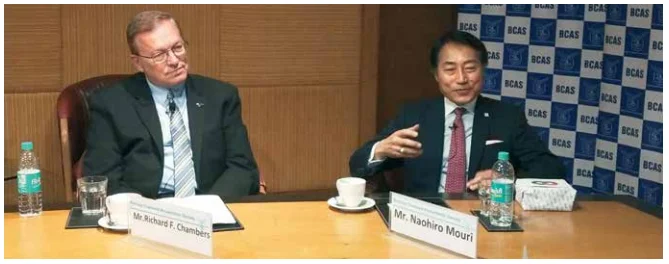


Miscellanea

1. Economy

7. With 109 Chinese firms making
it to the Fortune Global 500-2017, where does India Stand?

While Walmart topped the Fortune
Global 500 list, China’s State Grid, oil giant Sinopec Corp and China National
Petroleum were ranked second, third and fourth. Seven Indian firms made it to
the list.

While India, as well as numerous
other nations, believe that the United States tops the list of the global
economic powers, not many realise the kind of impact China has been making. The
Fortune Global 500 list for the year 2017 was released on Thursday, July 20,
and 109 Chinese firms have made it to the list.

While US retail giant Walmart
topped the list, China’s State Grid, oil giant Sinopec Corp and China National
Petroleum were ranked second, third and fourth.

Among the 109 firms that have made
it to the list, 10 are debutants. These 10 names include e-commerce brand Alibaba,
internet giant Tencent, Anbang Insurance Group and real estate developer
Country Garden.

In
comparison, only seven Indian firms have made it to the Fortune Global 500 list
this year. India’s economic expansion is expected to have accelerated in the
April-June quarter and is likely to grow in the second quarter as well.

(Source: International Business
Times dated 21.07.2017)

8. India has a Leader Who Believes
in Disruption 

In his latest avatar as the
Chairman of US Chairman of US India Business Council, John Chambers is
convinced that India is at an inflection point. In a chat with ET’s TV
Mahalingam, Chambers, who is also Cisco’s executive chairman, spoke about his
reading of the Modi-Trump dynamics & how India has changed in the last three
years.

Excerpts:

What’s your reading of the
recent meeting between President Trump & PM Modi?

I turned positive on India three
years ago & I volunteered to be Chairman of US India Business Council
(USIBC). Even though I have been involved with India for 20 years with Cisco, I
think the inflection point in India is a record in terms of this opportunity.
The meeting between the two leaders could not have gone better.In the CEOs
session with him, the PM was incredibly effective in listening to each of the
20 business leaders in the room & coming back on key issues. On a scale of
1 to 10, how did the meetings go? It was 11.

This target of $500 billion of
two-way trade between the two countries that USIBC has set, how achievable is
that & what needs to be done?

I was the one to bet on China in
1995 when almost nobody else did. When I forecast a few years ago that France
would be a start-up nation due to digitisation, nobody believed me. Guess which
was the top startup nation in Europe last year? France.When it comes to India,
I think we have not seen anything yet. This is a win-win. If you look at going
from the current level of $115 billion to $500 billion -the amount of jobs this
will create is massive.If you look back at 2000, we were just at $20 billion.
Now these are doable goals based on the confidence of the Indian & American
business leaders.

(Source:
ET Q&A – The Economic Times dated 12.07.2017)

2.  Sports

9. IPL broadcast rights war: Can
Jio topple Facebook, Twitter for digital space?

18 big names from across the globe
bought tender documents last year. With most of them likely to enter the fray
again, the Invitation to tender is all set to be available from 21st July
2017.

There was a jump of 454% in the
fee to retain Indian Premier League (IPL) title rights when Chinese mobile
manufacturing brand Vivo extended its deal for the next five years (2018-2022)
for whopping sum of  Rs. 2199 crore.

The Board of Control for Cricket
in India (BCCI) is expecting another such windfall as it is set to open the
Invitation to Tender (ITT) for IPL broadcast & media rights on 21 July
2017.

Sony Pictures Network India (SPN)
hold the television rights (2008-2017) while Star India has been in charge of
digital broadcast of the cash-rich 20-20 tournament for the last few seasons.

However, the competition for the
next term is going to be intense as quite a few big names including Discovery,
Facebook, Jio & Twitter are expected in the race.

(Source: International Business
Times dated 21.07.2017)

3. Industry

Why this is Indian IT
Industry’s Kodak Moment?

Once-great companies like Kodak,
Digital and Nokia with capable CEOs and vast resources come to an ignominious
end not because they do not see the tsunami coming — they die or fade into
irrelevance because they are unable to respond forcefully. Kodak invented the
digital camera as early as 1975. It had all the technology, resources, brand,
and distribution to prevail. Yet it failed.

A major reason why once-dominant
firms like Kodak fade away like old photos is culture. Culture trumps strategy.
A combination of complacence & overconfidence (“this cannot happen to
us”) prevented Kodak from adapting quickly. Its leadership was indecisive
and changed strategy many times. Despite having a venture capital arm, it took
years to make its first acquisition and never made any bets big enough to
create breakthroughs. Kodak offered the first service that allowed customers to
post and share pictures online but failed to follow through forcefully to
create what might have become Instagram or Snapchat. It diversified into
chemicals and pharmaceuticals but without much conviction; these businesses
fizzled and were sold off. Unlike Fuji, Kodak obsessed about its core developed
markets and did not seize the opportunity in emerging markets, especially a
rising China. Having failed to become a printing powerhouse, Kodak is now
trying to license its rich portfolio of patents.

There are a set of reasons that
make it difficult for even well managed companies to navigate industry
disruptions the way Fuji did or Microsoft has. High on the list is complacence,
even arrogance. When a company is sitting on lots of cash, fat margins & a
good market share, it is hard to create a sense of urgency in the organization
& among its shareholders.Today, India’s IT companies are struggling to
navigate a tectonic industry shift. Its leaders have seen the technological
& regulatory shifts coming for the last decade. They have recognized the
limits of wage arbitrage and understood the need to shift from renting IQ to
creating IP, and becoming more global. They see the giant new opportunities
afforded by the digital revolution. But as the story of Kodak shows, seeing is
not enough. Acting decisively and forcefully is crucial. More than ever,
India’s IT companies need the same caliber of courageous and entrepreneurial leadership
that created them in the first place.

‘The
snake that cannot shed its skin must die’ — Friedrich Nietzsche.

(Source: Extracts from an
Article by Shri Ravi Venkatesan, Co-chairman of Infosys in the Times of India
dated 02.07.2017)

4. Others

10. Skill, re-skill and re-skill again. How to keep up with
the future of work?

“Every
five years, your skills are about half as valuable as they were before”

The jobs market is well into the
21st century. So why isn’t our education system?

Today’s jobs are vastly different
than they were a generation ago. All of us, from Gen Zers to Boomers, are
facing a working world that is more changeable and unpredictable than ever.

The days of working for 40 years
at one job and retiring with a good pension are gone. Now the average time in a
single job is 4.2 years, according to the US Bureau of Labor Statistics. What’s
more, 35% of the skills that workers need — regardless of industry — will have
changed by 2020.

That rapid pace of change in jobs
and skills means there is a growing demand to update skills as well. According
to a new report on workforce re-skilling by the World Economic Forum, one in
four adults reported a mismatch between the skills they have and the skills
they need for their current job.

Skills for the wrong century

Here is the problem briefly: the
job opportunities that are available today are 21st century jobs.
However, the way most people perform these jobs is still stuck in the previous
century. As is the way, our society is training and educating people.

In the 19th century, there was a
massive movement of the population from rural to urban centres. The primary and
secondary education system was created to train the workforce for the “new”
world of manual and clerical work in cities.

In the 20th century,
work was dominated by factory jobs. The education system that was built in the
previous century was, with some modifications, still suited to training good
factory workers and their managers. Management focused on a series of tools to
optimize this kind of work: operational efficiency, something called Taylorism,
and eventually some management philosophies called Six Sigma. Management was
mostly done face to face, while health insurance, a social safety net, and
other benefits were bundled into inflexible labour contracts.

Today, in the 21st
century, we are seeing the rise of new work models such as freelancing and
remote work. In the most advanced companies, teams are learning to be more
agile, to work with distributed and remote teams, and to scale up and down to
adapt to ever-changing conditions. This is the future of work.

Yet education has not kept pace.
We still send our children through a fixed set of primary and secondary
education steps, only now a college degree has been added on as a virtual
prerequisite for the best jobs. The model does not actually prepare anyone well
for a flexible world, in which skills are typically outdated by the time you
finish a four-year degree.Further, on-the-job training is not enough to close
the gap. The World Economic Forum report found that 63% of workers in the US
say they have participated in job-related training in the past 12 months. Yet
employers are reporting the highest talent shortages since 2007.

What individuals can do

Given this situation, people in
the workforce should proactively steer their own ongoing skills development. In
other words, recognize that you need ongoing training, and realize that you
hold the responsibility for your own education. Do that and you can improve
your marketability for years to come?

The first step is to ask yourself:
Are my skills still in demand? What is the outlook for these skills? In
addition, what skills could I work on today that would increase my income
potential in the coming years?

Do this exercise every few years?
If the half-life of a job skill is about five years (meaning that every five
years, that skill is about half as valuable as it was before), you want to get
ahead of that decline in value. Assess your own skills every two or three years,
and get started learning new skills sooner rather than later.

For example, if you are a truck
driver, you can see that autonomous vehicles are a likely threat to your
employment — maybe not this year or next year, but certainly within 5 or 10
years. Do not wait until self-driving trucks are a common sight on the highways
to start building skills for your next job. Start doing it this year, so you
will be ready when the time comes.

Do not feel like you have to
retrain yourself completely, all at once. First, as pointed out by the New York
Times this week, many of the skills needed to do fading jobs are applicable to
growing jobs. For skills, you do need to acquire, consider step changes. In
computer science, we are trained to break down large problems into smaller
chunks that can be more easily solved, one at a time. You are not going to turn
yourself from a coal miner into a data miner overnight. Nevertheless, you can
acquire basic skills leading in the direction you want to go.

As your career progresses, make
decisions about which work to take based on how much you will learn. Prioritize
jobs where you will learn valuable new skills.

(Source: World Economic Forum
dated 31.07.2017)

11. Indian Scientist wins Marconi Lifetime prize

Thomas Kailath, who grew up in
Pune and is now an emeritus professor at Stanford, has been conferred the
lifetime achievement award by the US-based Marconi Society. This is only the
sixth time the lifetime award has been given by the prestigious society in its
43-year history.

Kailath has been recognized for
his contributions to information and system science over six decades, as well
as his sustained mentoring and development of new generations of scientists.
Among his many significant contributions is a classic textbook in linear
systems that changed the way that subject was taught.

Kailath and his doctoral student
Arogyaswami Paulraj, currently emeritus professor in the electrical engineering
department at Stanford University, are joint holders of the original US patent
for MIMO (multiple input, multiple output) technology which underpins the
technology that drives every Wi-Fi, 4G, and 5G network today and helps to make
them more efficient. 

The scientist was born in 1935 in
Pune, to a Malayalam speaking family, according to Wikipedia. He studied at St.
Vincent’s High School, Pune, and received his engineering degree from the
Government College of Engineering, University of Pune, in 1956. He received his
Master’s degree in 1959 and his doctoral degree in 1961, both from the
Massachusetts Institute of Technology (MIT). He was the first Indian student to
receive a doctorate in electrical engineering from MIT, says Wikipedia.

The Marconi prize has been
instituted by the Marconi Society, which was established in 1974 by the
daughter of Guglielmo Marconi, the Nobel laureate who invented radio. Previous
winners of Indian origin have been educationist and former UGC chairman Yash
Pal in 1980 and Stanford University emeritus professor and wireless antennae
pioneer Arogyaswami Paulraj in 2014. In June, the Marconi Society announced
that Arun Netravali, the engineer- scientist who grew up in Mumbai and
pioneered work on video compression standards, is the awardee for this year.
Kailath and Netravali will be awarded their respective prizes in October.

(Source: The Times of India
dated 15.08.2017)

12. Leadership Quotes

   Jeff Bezos –

     When It’s Tough, Will You
Give Up, Or Will You Be Relentless?”

   Donald Trump

     Think Big and Make It
Happen”

   Larry Page –

If you’re changing the World, You’re working
on Important Things. You’re excited to get up in the Morning”

Indirect Taxes

Service Tax Updates

42. Amendment under 
Exemption Notification 25/2012 dated 20.06.2012

Notification No. 17/2017-ST dated 04. 05. 2017

CBEC expanded the list of exemption granted life insurance
schemes so as to include “Pradhan Mantri Vaya Vandana Yojana” as a scheme
on which no service tax would be payable. 

Circular No. 206/4/2017-Service Tax dated

13.04.2017

CBEC has clarified on the issue of levy of service tax on the
services provided by a person located in non-taxable territory to a person
located in non-taxable territory by way of transportation of goods by a vessel
from a place outside India to the customs station in India. It has been
clarified that –

a.  Service tax @ 1.4% (alongwith applicable
Swachh Bharat Cess and Krishi kalyan Cess) on value of imported goods as
determined u/s. 14 of the Customs Act, 1962 and the rules made thereunder;

b.  The option of payment of service tax by
availing abatement benefit @ 70% value of services of transportation of goods
as specified under notification 26/2012 dated 20.06.2012 is not available as
the conditions cannot be fulfilled by the foreign shipping lines.

MVAT Updates

43. Distribution of GST Provisional Ids and Access Tokens of
Phase 4 dealers

Trade Circular 12T of 2017 dated 25. 04. 2017

GST Provisional Ids and Access Tokens for dealers who are
newly registered before 31.03.2017, dealers whose RCs are restored before
31.03.2017, dealers whose PANs amended in Mahavikas database before 31.03.2017  are made available. Details and steps are
explained in this Circular.

44. Amendments to Profession Tax Act, Rules and Notifications
issued thereunder

Trade Circular 13T of 2017 dated 26. 04. 2017

   Employers who file returns along with payment
of tax for any of the periods upto the 31. 03. 2017 on or before 30. 09. 2017
are exempt from whole of late fees.

  New Schedule Entry  1A is inserted for insurance company
registered under IRDA  and is liable to
deduct the profession tax of Rs.2,500/- per anum per person from the commission
payable to chief agents, principal agents, insurance agents  and surveyors 
and loss assessors registered  or
licensed under the Insurance Act,1938. 

  Interest rate revised from 105 2017 is
prescribed.

45. Corrigendum to Trade Circular 9 T of 2017  dated 01. 04. 2017

Trade Circular 14T of 2017 dated 26. 04. 2017

Exemption from payment of late fees u/s. 20(6) of the MVAT
Act, 2002  :

New dates mentioned to file returns: For the month of March,
2017 upto 03. 05. 2017, For quarter Oct-2016 to Dec-2016 upto 29. 04. 2017
and  For quarter Jan-2017 to March-2017
upto 15. 05. 2017 without late fees.

46. Remission of Interest u/s. 30(1) for the dealers who have
failed to obtain registration within time

Notification VAT-1517/C.R43(C)/TAXATION 1 dated 19. 04. 2017
and

47. Conditional remission in interest payable as per section
30(1) by un-registered dealers 

Trade Circular 15T of 2017 dated 26. 04. 2017

Notification issued for Interest waiver for late payment of
tax due to technical problems in the MSTD’s automation system and the dealers
who have obtained registration late. Procedure explained in detail in the Trade
Circular.

48. Guidelines regarding Cross Checking of Input Tax Credit
(ITC)

Trade Circular 11A of 2017 dated 03. 05. 2017

Guidelines regarding cross checking of Input Tax Credit (ITC)
for FY 2013-14, 2014-15, 2015-16 issued and procedure explained in this
Circular.

49. Exemption  from
late fee for filing the returns for FY 2016-17

Trade Circular 16T of 2017 dated 17. 05. 2017

The whole of late fee is exempt to the dealer
who files returns for the periods of any month or quarter for 2016-17 on or
before 15. 06. 2017.

Indirect Taxes

Service Tax Updates

110. Withdrawal of exemption – online information and
database access or retrieval services 

Notification No. 5/2017-ST dated 30. 01. 2017

CBEC has withdrawn the exemption
for services by way of online information database access or retrieval services
which is being provided by a person located in a non-taxable territory and
received by an entity providing charitable activities and  registered u/s. 12AA of the Income-tax
Act,1961.

111. Relaxation for deposit of tax – services provided by way
online information and database access or retrieval services

Notification No. 6/2017-ST dated 30. 01. 2017

CBEC has provided relaxation on
due date for payment of service tax payable on services provided by any person
located in a non-taxable territory and received by non-assessee online
recipient, for the month of December, 2016 & January 2017, so as to deposit
the same by the 6th day of March, 2017 to the credit of Central
Government.

112. Budget Notification enabling various changes under the
present exemption structure

Notification No. 7/2017-ST dated 02 02 2017

Manufacturing related
exemption:

Hitherto,
manufacturing related activities are 
excluded from the scope of service tax. However, the proposed amendment
omits the same from negative list and the exemption to the same is being placed
here. The amendment provides categorical exemption to any intermediate
production process as job work not amounting to manufacture or production in
relation to agriculture, printing or textile processing etc. [Effective from date of enactment of Finance Bill,
2017]

The term
“process amounting to manufacture or production of goods” has been defined in
Notification 25/2012 dated 20.06.2012 to mean a process on which duties of
excise are leviable u/s. 3 of the Central Excise Act, 1944 (1 of 1944), or the
Medicinal and Toilet Preparation (Excise Duties) Act, 1955(16 of 1955) or any
process amounting to manufacture of opium, Indian hemp and other narcotic drugs
and narcotics on which duties of excise are leviable under any State Act for
the time being in force.

Transport related exemptions:

Exemption
scope widened under the said sector to provide relief to Government employees.
Accordingly, services of transport of passengers, with or without accompanied
belongings, by air embarking from or terminating at Regional Connectivity
Scheme and consideration received in form of Viability Gap Funding is exempted
from payment of service tax. [Applicable from 02.02.2017]

Education related exemptions:

  Education
being a primary role for country’s development, broadens the scope of exemption
which is as under:

    Services provided by the Indian
Institutes of Management, as per the guidelines of the Central Government, to
their students, by way of the following educational programmes, except
Executive Development Programme –

     (a) two year full time Post
Graduate Programmes in Management for the Post Graduate Diploma in Management,
to which admissions are made on the basis of Common Admission Test (CAT),
conducted by Indian Institute of Management;

     (b) fellow programme in
Management;

     (c) five year integrated
programme in Management.

[Applicable from 02.02.2017]

    The word “residential” is
deleted from the above mentioned exemption entry which substantiates that fees
collected for both residential and non-residential or online Post Graduate
Programmes in Management for the Post Graduate Diploma in Management, to which
admissions are made on the basis of Common Admission Test (CAT), conducted by
Indian Institute of Management are exempted from payment of service tax. 

Insurance related exemption:

   Services of life insurance
business provided or agreed to be provided by the Army, Naval and Air Force
Group Insurance Funds to members of the Army, Navy and Air Force, respectively,
under the Group Insurance Schemes of the Central Government are  exempted from payment of service tax.
[Applicable from 02.02.2017]

113.  Exemption –
services provided by operators of Common Effluent Treatment Plant

Notification No. 8/2017-ST dated 20. 02. 2017

CBEC has provided relaxation by
way of exemption on services provided by operators of Common Effluent Treatment
Plant by way of treatment of effluent for the period from 1st July,
2012 to 31st March 2015.

114.  Introduction of
Minor head code for accounting of Refund

Circular No: 203/1/2017 – Service Tax dated 02.02.2017

CBEC has introduced minor head
code for accounting of refund to identify the appropriate head of account under
which the service wise refunds are to accounted for eventually leading to
better compliance with respect to accounting of refunds.

115.  Clarification on
applicability of service tax on services by way of transportation of goods by a
vessel from a place outside India to the customs station in India w.r.t. goods
intended for transhipment to any country outside India

Circular No: 204/1/2017 – Service Tax dated 16.02.2017

CBEC has clarified the long
lasting issue w.r.t. applicability of service tax on services provided to goods
intended for transhipment to any country outside India. Thus, the said
clarification is in line with position under the Customs Act, 1962 which states
that no customs duty is payable in cases where the goods entered into
territorial waters for transhipment and the destination of goods which is other
than India is mentioned in the import manifest/import report.

Accordingly, in case of
transhipped goods, services by way of transportation of goods by a vessel from
a place outside India to the customs station in India are not taxable in India
as the destination of such goods is a country other than India.

MVAT UPDATE 

116. Go live of :  1)
Improved functionality of new registration with integrated payment gateways. 2)
Functionality of amendment and cancellation of registration certificate.

Trade Circular 4T of 2017 dated  02.02.2017

The SAP based system for online
registration has been upgraded with effect from 19.12.2016 with additional
features of Integration of Payment Gateways for payment of fee or Deposit or
both along with application for new registration as well as online facility of
application for  amendment or
cancellation of registration certificate.

Detailed Instructions given in the circular
regarding applicants who have already paid deposit and fee prior to this new
system but not able to obtain registration certificate.

Direct Taxes

106. CBDT issues clarification on implementation of GAAR
provisions under the Income-tax Act

Circular No. 7/2017 dated 27th January 2017.

107. Circular No. 1/2017 on TDS on salaries contained mistake
in the table of due dates for furnishing of the e-TDS statements for the last
quarter of the year 

CBDT has issued a corrigendum on 24thJanuary 2017
to rectify the mistake.

108. Explanatory Notes to the Provisions of the Finance Act,
2016

Circular No. 3/2017, dated 20th January, 2017

109. Instructions laying down standard operating procedures
to investigate the cash deposits above prescribed limits post demonetization
period-

Instruction no. 03/2017 dated 21.02.2017

Glimpses of Supreme Court Rulings

14.  Question of Law –
Whether the trading activity in the nature of re-export of imported goods
carried on by the SEZ unit of the assessee is to be considered as ‘services’
eligible for exemption u/s. 10AA of the Income-tax Act in view of the
definition of ‘services’ in Special Economic Zones Rules, 2006 though there is
no such provision in section 10AA of the Act, is a question of law.

CIT vs. Bommidala Enterprises Pvt. Ltd. (2016) 389 ITR 1
(SC)

In an appeal filed before the Andhra Pradesh High Court, the
Department had raised the following questions of law:

1.  In the facts and circumstances of the case,
whether the Tribunal was correct in upholding the finding of the Commissioner
of Income-tax (Appeals) that the trading activity carried on by the SEZ unit of
the assessee was to be considered as ‘services’ eligible for exemption u/s.
10AA of the Income-tax Act by relying on the definition of “services” as per
Special Economic Zone Rules, 2006 when there was no such provision in section
10AA of the Act?

2.  In the facts and circumstances of the case,
whether the Tribunal was justified in relying on the instructions issued by the
Ministry of Commerce regarding the applicability of exemption u/s. 10AA of the
Income-tax Act to the trading activity in the nature of re-export of imported
goods though there was no subsequent amendment made to the provisions of the
Income-tax Act to give effect to the clarification contained in the
instructions in spite of the mention in the said instructions that appropriate amendments are being issued?

3.  In the facts and circumstances of the case,
whether the Tribunal was correct in law in upholding the exemption claimed u/s.
10AA of the Income-tax Act when the respondent assessee was not involved either
in manufacture or production of article/or/thing or provide any services as
required in the said statutory provision but was engaged in trading activity
only?

The Revenue’s Counsel contended before the High Court that
the assessee was carrying on trading business and not the manufacturing
business. The High Court however held that this was a factual aspect and it had
been taken care of by the authorities below (both CIT(A) and ITAT held that the
assessee was entitled to exemption u/s. 10AA) and that the fact finding could
not be interfered with, unless it was found perverse. The High Court dismissed
the appeal of the Revenue.

On further appeal, the Supreme Court observed that the
question of law that was raised by the Appellant-Revenue herein before the High
Court was as to whether trading activity carried on by the SEZ unit of the
Respondent-Assessee was to be considered as ‘service’ eligible for exemption u/s.
10AA of the Income-tax Act. The Supreme Court noted the submission of the
Appellant that for this purpose, the Income-tax Appellate Tribunal could not
have relied upon the definition of ‘services’ as per SEZ Rules when there was
no such provision u/s. 10AA of the Act.

The Supreme Court observed that a perusal of the order of the
High Court showed that this aspect was not considered and brushed aside by
merely saying that the Tribunal had held it to be a ‘service’ and that it was a
question of fact. The Supreme Court held that no doubt, insofar as activity
carried on by the Respondent-Assessee was concerned, factual aspects were not
in dispute.

However, whether that would constitute ‘service’ within the
meaning of section 10AA of the Act would be a question of law and not a
question of fact. The High Court was, therefore, in error in not entertaining
the said plea and dismissing the appeal of the Revenue by labelling it as a
question of fact. The Supreme Court, therefore, set aside the order of the High
Court and remanded the case to the High Court to decide the aforesaid question
of law.

15. Deduction of tax at source – Assessee not heard by the
High Court and the review petition also dismissed – Supreme Court set aside the
orders and remanded the matter for decision afresh

Novo Nordisk Pharma India Ltd. vs. CIT (2016) 389 ITR 134
(SC)

The High Court allowed the appeal filed by the Revenue. The
question was as to whether the transaction between the assessee and the person
to whom certain payments were made was one attracting the provisions of section
194C of the Act.

The assessee sought review because: (i) the Counsel of the
assessee was unable to appear on the day of hearing and argue the case as he
was engaged in other court; (ii) the Court had not examined the relevant board
circular, (iii) that the deductee having paid the tax, there was no loss to the
Revenue, and as such the situation did not warrant levy of interest.

The High Court dismissed the review petition holding that:
(i) inability to appear due to other engagement could hardly constitute a
ground for review; (ii) the Board Circular was not relevant as the matter was
decided considering the three inter-linking agreements; and (iii) whether the
deductee had paid its tax or not was not a relevant question in so far the
provisions of section 194C was concerned as section 201 was only consequential.

On appeal, the Supreme Court noted that it was a fact that
the assessee was not heard when the impugned judgment was delivered. Even the
review petition filed by the Appellant before the High Court was also rejected.

In the circumstances, the Supreme Court set
aside the impugned judgment and the matters were remitted to the High Court for
hearing afresh.

From The President

Dear Members,

Open
any newspaper today, and you are bound to be bombarded by news about the
elections. Five states in India: Goa, Uttarakhand, Punjab, Manipur and Uttar
Pradesh are gripped by the fever of assembly elections, and it has spread
across the country. Slated to conclude on 8th March, the nation has
its fingers crossed, tensely awaiting the results.

Ballot ‘box offices’

This
is more so since this election has witnessed record crowds at the ballot ‘box
offices’. Goa tops with 83% polling, Punjab follows with 75% turnout and
Uttarakhand finishes with 65%. The elections are on in UP where the turnout is
over 60% and is yet to start in Manipur. With huge implications at the centre,
parties seem to have gone all out with alliances, rallies, advertising and
social media to sway the masses.

Mumbai
had been dragged into the election maelstrom too. BMC — Asia’s largest and
richest municipal corporation with 91.8 lakh voters decided the fate of 2,275
candidates from 7 political parties as they battled for 227 wards. Alliance
partners BJP and Shiv Sena, now bitter rivals both won voters’ confidence with
82 and 84 seats respectively. With no clear majority, horsetrading is in full
‘gallop.’ Meanwhile, a cartoonist has aptly depicted two potholes celebrating
their existence for another five years… I HOPE NOT!

But
the big question today is that after being urged to cast our vote…what next?
The politicians that come into power more often than not continue to do their
own thing. Five years are seen as an opportunity to indulge in practices which
are ideal examples of ‘form over substance’. From ill-spent public money to
both overt and covert corruption, from being not accountable for promises to
breaking commitments made to voters and from covering up the stream of reason
with that of allegations and excuses. After all, as Jonathan Swift once said, “Promises
and pie-crust are made to be broken.
” I believe unless there are some
serious and periodic accountability and appraisal mechanism, we can expect
another five-year ride!

Economic health barometer – Are we really healthy?

On
the last day of January, the finance minister tabled the economic state of the
Union through the Economic Survey. Authored by India’s Chief Economic Advisor,
Arvind Subramanian, the survey has been hailed as a magnum opus on development.
This economic report card is a reservoir of the key statistics of various
elements of the economy and also contains some interesting ideas to make India
better…a lot faster!

The
survey addressed the impact of demonetization claiming that it will be
transitional, with real GDP expected to be from 6.75 to 7.5% in 2017-18. It
also stressed on the importance of quick monetization along with a slew of
initiatives like pushing digitization, bringing land and real estate under GST,
reducing taxes and stamp duties and improving the tax administration system.

In
fact, three exclusions from GST viz. electricity, real estate and petroleum
products reflects the re-thinking on the part of GST Council. It has been
agreed to bring petroleum products into GST ambit after 5 years. A similar
agreement is necessary for electricity and real estate. In fact, by bringing
real estate into GST fold would encourage investment, since real estate
development is a critical part of fixed capital formation.

The
survey, however, was strong in its criticism of the excessive regulation that
continues to plague the agricultural sector. It expressed disapproval that
farmers in many states were forced by an Act to sell only to specified
intermediaries in authorized mandis – thus depriving them of better returns.

Non
Performing Assets in PSU Banks is another cause for concern. At 12% of the
gross advances, this level has choked the credit flow to industry especially
the MSME. This dismal situation calls for some urgent corrective action, like
setting up of a central public sector asset rehabilitation agency to tackle
this growing challenge.

The
survey also proposed a new idea of Universal Basic Income (UBI) for all, in place
of existing welfare schemes and subsidies. In essence, an amount of Rs.7,620/-
would be deposited into Aadhaar linked bank accounts annually which would
drastically cut absolute poverty from 22% to less than 0.5%. The funding for
this UBI would come from recycling funds from around 950 existing welfare
schemes; which add up to roughly 5% of GDP. The survey believes that “UBI is
a powerful idea whose time even if not ripe for implementation, is ripe for
serious discussion
.”

Budget 2017-18

This
year’s Budget can be termed as a TRULY UNION Budget – one BUDGET for the entire
Union – as after decades someone thought of discarding Railway Budget as a
separate element of parliamentary business. The Budget gives a DISHA, that will
determine the DASHA of the country in the year ahead. Having said that, we do
acknowledge the problems with the government, politicians and tax laws. It is
always possible to do more and some of it is of urgent necessity. But that
applies to our society too and perhaps to each one of us here. If
transformation and innovation can touch the core of all four – citizens,
government, politicians and tax laws, the positive impact of change could be so
much more that it can be miraculous in its effect. BCAS has the benefit of
Senior Advocate Shri S. E. Dastur for last 28 years for unraveling the hidden
amendments in the Finance Bill. This year was special due to the sheer size of
people taking advantage of his spectacular analysis, in person and virtually.
Rumours are that even the Finance Ministry was tuned in when Shri Dastur was
delivering his speech. I only hope that the Ministry takes into cognizance the
various anomalies pointed out by Mr. Dastur and takes appropriate action. BCAS
had advocated strongly for scrapping the Income Computation and Disclosure
Standards, but was grossly disappointed that the bureaucracy has again won over
advocacy. So we have one more legislation to understand, implement and
litigate. All the best!

The
Finance Minister has announced a new programme consisting of ten distinct
themes which would “Transform, Energize and Clean India” (TEC). This
broad agenda is to be executed through several welfare initiatives concerning
farmers, the rural population, youth and the underprivileged.

To
project India as an attractive investment destination, the budget abolished the
Foreign Investment Promotion Board, exempted FPI investors from indirect
transfer provision and lowered corporate tax for MSME to 25%. Personal income
tax rates have been rationalized and digitization promoted with a ban on cash
transactions above Rs. 3 lakh while cash donations have been capped at
Rs.2,000.

Much
is expected to be achieved while containing the fiscal deficit at 3.2% of the
GDP in FY18, which would be further curtailed to 3% by FY19. This fiscal prudence is aptly reflected in the
pragmatic budget which is bereft of any populist largesse.

Change is welcome

After
a span of 7 years, we again have the President of our alma mater, from Western
Region. My heartiest congratulations to CA. Nilesh Vikamsey and CA. Naveen N.
D. Gupta for their ascension to the coveted post of President and Vice
President of the ICAI. It is all the more proud moment for BCAS that one of our
core group members is now the torch bearer of this esteemed profession. CA.
Nilesh Vikamsey, as we at BCAS know him can be described as a person committed
to excellence, massively innovative and wears passion for the profession on his
sleeve. I am reminded of a quote which CA. Nilesh Vikamsey aptly follows; “Leadership
is action, not position.”

Through
this message, I would also like to convey to the torch bearers of the
profession that we at BCAS are always at the forefront to take up the cause of
the profession and ICAI can very well bank upon us to further the cause of our
profession.

Warm
Regards,

Chetan Shah

Miscellanea

1. Economy

 1.      
US defence firms want control
over tech in Make-in-India plan

The US- India
Business Council (USIBC) wrote to India’s defence minister last month seeking a
guarantee that US firms would retain control over sensitive technology — even
as joint venture junior partners.

 (Source:
International Business Times dated 19.09.2017)

 2.      
Crypto crash: Bitcoin nosedives
50% in India in just 13days

Bitcoin and newer
rivals like Ethereum and Litecoin have in recent times been fighting a losing
battle against regulators.

 (Source:
International Business Times dated 19.09.2017)

 3.   KitKat Bets on Weird and Wonderful
Flavor’s in Japan – Cough-medicine-flavored KitKat anyone?

It may not be to
everyone’s taste, but this is just one of 300 weird and wonderful flavor’s
flying off the shelves in Japan, which has become the world’s biggest market
for the four-fingered snack. In true Japanese style, human workers are a rare
sight at one Kitkat factory in Kasumiguara, around 100Km east of Tokyo.
Instead, dozens of robots manufacture four million bars a day at breakneck
speed, from mixing the chocolate paste to wrapping them ready for sale. Kitkats
have been around in Britain since 1935 and only arrived in Japan in 1973. But
the Japanese market has a crucial unique selling point – a huge variety of
different flavours. It all started with a strawberry flavoured Kitkat in 2000
and the range expanded quickly – from flavours aimed at local taste buds such
as sake, green tea and wasabi – to more exotic combinations like melon and
mascarpone.

 (Source:
Economic Times dated 07.09.2017)

 4.      
AI system writes next Game of
Thrones novel

Can’t wait to
find out what happens next in the Game of Thrones? A new artificial
intelligence (AI) system has written the first five chapters of the next book
of the popular fantasy series.

The TV show Game
of Thrones, which is based on the George R R Martin book series A Song of Ice
and Fire, has gained widespread popularity worldwide.

The show’s
seventh season recently aired its last episode, and fans will now have to wait
till 2019 to know what happens to their favourite characters next.

Martin is
currently working on the sixth novel of the book series, The Winds of Winter.

 Zach Thoutt, a
software engineer in the US, trained an AI system to predict the events of the
sixth novel using the characters from the fictional Seven Kingdoms of Westeros.

 “I start each chapter by giving it a prime
word, which I always used as a character name, and tell it how many words after
that to generate,” Thoutt said.

 “I wanted to do
chapters for specific characters like in the books, so I always used one of the
character names as the prime word. There is no editing other than supplying the
network that first prime word,” he said.

  (Source: Business Line dated 15.09.2017)

 5. 
Leadership thoughts

 5.      
 Why wisdom can’t be taught?

 “I cannot teach
anyone anything, I can only make them think” – Socrates

In the pursuit of
wisdom, executives may find themselves taking off their masks to become truly
authentic and reflective leaders.

The day after
becoming the CEO of a company facing turbulent times, David had a dream. In it,
while walking on a beach he discovered a bottle. On opening, a genie appeared
offering him a wish in exchange for her freedom. Eschewing riches, fame or a
long life, David opted for the one thing he knew he needed to help him guide
his people in the best way possible. He chose the gift of wisdom.

In today’s
hyperactive digital age, attaining wisdom is a challenge. With tablets and
phones and their various apps constantly vying for our immediate attention, it
is increasingly difficult to find the time and mental space for making
meaningful connections or engaging in the deep conversations, reflection,
emotional awareness, empathy and compassion, necessary in its pursuit.

Indeed, it is an
unfortunate fact for many leaders in David’s position, that while wisdom
requires education, education does not necessarily make people wise. As
Professor Charles Gragg noted in his classic case study “Because Wisdom Can’t
Be Told”, the mere act of listening to wise statements and sound advice doesn’t
necessarily ensure the transfer of wisdom.

What does it mean to be wise?

People often
equate wisdom with intelligence or being knowledgeable; but all too often, it
becomes apparent that being intelligent and being wise are quite different
things. The world is full of brilliant people who intellectualise without
really understanding the essence of things. In contrast, wise people try to
grasp the deeper meaning of what is known and strive to better understand the
limits of their knowledge.

Wisdom implies
more than merely being able to process information in a logical way. Knowledge
becomes wisdom when we have the ability to assimilate and apply this knowledge
to make the right decisions. As the saying goes, ‘knowledge speaks but wisdom
listens’. Wise people are blessed with good judgement. In addition, they possess
the qualities of sincerity and authenticity, the former implying a willingness
to say what you mean, the latter to be what you are.

Wise people are
also humble; their humility deriving from a willingness to recognise the
limitations of their knowledge. They accept that there are things they will
never know. By accepting their ignorance, they are better prepared to bear
their own fallibility. People who are wise know when what they are doing makes
sense, but also when it will not be good enough. Ironically, it is exactly this
kind of self-knowledge that pushes them to do something about it.

Wisdom can be
looked at from both a cognitive and emotional perspective. Cognitively, wise
people have the ability to see the big picture. They are able to put things in
perspective; to rise above their personal viewpoint and observe a situation
from many different angles (thus avoiding simplistic black-and-white thinking).
From an emotional perspective, people acknowledged for their wisdom are
reflective, introspective and tolerant of ambiguity. They know how to manage
negative emotions, and possess both empathy and compassion; qualities that
differentiate them in an interpersonal context.

Ironically, what
makes wisdom more important than success and riches is that it enables us to
live well. Our mental and physical health flourishes when we are congruent with
our beliefs and values. As Mahatma Gandhi once said, “Happiness is when what
you think, what you say, and what you do are in harmony.” Wise people are
attuned to what constitutes a meaningful life. They know how to plan for and
manage such a life. This implies self-concordance, behaving consistently with
their values, a journey that requires self-exploration, self-knowledge and
self-responsibility.

Age doesn’t make us wiser

So, how can we
acquire wisdom and can we expedite its acquisition? Becoming wise is a very
personal quest. It is only through our own experiences, learning how to cope
with the major tragedies and dilemmas embedded within life’s journey, that we
will discover our own capacities and learn how to create wisdom.

Setbacks are
memorable growth experiences contributing to a deeper understanding of the
vicissitudes of life. Overcoming difficult situations contributes to an
increased appreciation of life and the recognition of new possibilities. These
experiences enable us to rise above our own perspectives and see things as they
are.

Unfortunately,
wisdom is not something that automatically comes with the passing of years.
While older people may be more capable than their younger counterparts, many
never put their life experiences to good use. To acquire the required sense of
reflectivity may necessitate the help of others. Educators, coaches,
psychotherapists and mentors can play a significant role, not only by assisting
with the dissemination of knowledge but by helping those searching for wisdom
work through challenging experiences and encouraging them to work on emotional
awareness, emotional self-regulation, relational skills and mindfulness.

Wisdom and authenticity

A learning
community is also a great place to practice open-mindedness. Encouraging
participants to step out of their comfort zone and to deal with people who are
very different from themselves, leads to a deeper understanding and acceptance
of the ambiguous nature of things. If designed in a holistic manner, these
communities are a great exercise in humility, giving participants a better
awareness of their limitations as well as a greater ability to integrate their
knowledge and experiences when dealing with the challenges ahead.

In their pursuit
of wisdom, group members will be encouraged to learn from their mistakes, to
think before acting and, by taking off their masks, to become more authentic in
living their values.

 (Source: Insead Knowledge – The Business School
for the world)

Corporate Law Corner

 1.      
Deccan
Chronicle Holdings Ltd. (DCHL) vs. ROC [2017] 83 taxmann.com 315 (NCLT – Hyd.) Date of Order: 5th July, 2017

Section 297 read
with section 621A of Companies Act, 1956 – Money was advanced to a related
party without any interest without obtaining prior approval of concerned
authority – Even though the amount was returned by such a related party; the
same still violated section 297 – Offence could be compounded subject to
payment of hefty fees.

FACTS

“D Ltd.” a listed company, filed an
application for compounding an offence committed u/s. 297 of Companies Act,
1956 (“the Act”). Section 297 prohibited related party transaction except with
the consent of the Board of Directors and in case the company had a paid up
share capital of not less than Rs. 1 crore, prior approval of Central
Government was required. D Ltd. had transferred Rs. 99 crores to a company ‘F
Ltd.’ towards aircraft maintenance and other fund transfers. ROC issued a notice
demanding an explanation for violation of section 297. D Ltd. submitted that
the transactions with F Ltd. were out of purview of section 297 and also that
owing to some other reasons, F Ltd. was asked to repay all the sums transferred
to it and F Ltd. had duly complied with such request. In view of these facts,
proceedings, if any should be dropped. D Ltd filed an application with NCLT
which was dismissed by it. The Applicants therefore filed an appeal and
Appellate Tribunal directed the NCLT to examine the case in terms of section
621A of the Act which provides for compounding of offences.

Before the Tribunal, D Ltd. urged that the
transactions had been fairly concluded and all amounts remitted to F Ltd. had
been received back. As the offence did not continue, the same qualified for
compounding.  

HELD

The Tribunal observed that although the
amounts advanced to F Ltd. were recovered in full, there was no payment of any
interest by F Ltd. Such advancing of money without payment of interest caused
loss to the shareholders of D Ltd. The Tribunal observed that transparency in
operations is one of the key elements of listed company and appropriate
disclosures of related party transactions are very essential to various
stakeholders and as such, the same is the duty of the Company/Board of
Directors to give true and fair picture of the functioning of the Company to
its shareholders especially any decision having adverse financial impact on the
Company which in turn will have an impact on the shareholders whether directly
or indirectly.

The Tribunal held that D Ltd. was guilty of
violation of section 297 of the Act and directed that offence may be compounded
u/s. 621A upon payment of heavy charges in respect thereof.

2.             Chartered Accountants Act, 1949, In
re

[2017]
84 taxmann.com 175 (All)  Date of Order: 2nd
August, 2017

Sections 21 and
22 of Chartered Accountants Act, 1949 – Chartered Accountant had resigned from
Board of company prior to the opening of its public issue but signed the
prospectus for the same – The Chartered Accountant was held to be guilty of
other misconduct.

 FACTS

Mr. ‘S’ was a member of the Institute of
Chartered Accountants of India (ICAI) and a director of B Co. S had resigned
from the company before opening of its public issue, but his resignation was
accepted on 09.09.1997 which was after the close of issue. Public issue of BCo
opened on 25.07.1996 and closed on 05.08.1996. Mr. S signed the prospectus of
this public issue on 17.06.1996 which named him as a director of BCo. Mr. S did
not object to the inclusion of his name in the prospectus of BCo.

The disciplinary committee of the ICAI found
him guilty of “other misconduct”. The Council of ICAI considering the said
findings recommended the removal of his name as a member for a period of three
months to the High Court.

Mr. S argued that although he resigned prior
to opening of public issue, his resignation was accepted only on 09.09.1997. He
further submitted that since no public money was received by BCo; there was no
question of misleading investors and inducing them to subscribe to the shares
of the said company.

Counsel appearing for the ICAI urged that
under the Companies Act, 1956, resignation of a director comes into effect the
moment it is tendered. As Mr. S accepted that he in fact resigned from the
company before the opening of the public issue, his name should not have
appeared as a director in the prospectus.

HELD

The High Court observed that the Companies
Act, 1956 did not have any specific provision relating to resignation of
director from the company. Neither of the parties produced the Memorandum Of
Association and Articles Of Association of the company to show anything in this
regard. Accordingly, it was held that common law principle would apply in so
far as resignation of directors was concerned.

The Court having relied on various judgements,
came to a conclusion that resignation of a director of a company was a
unilateral act that came into effect as soon as the resignation was tendered by
the director of the company. The directors were merely agents of the company
and agents were competent to determine the agency at their own end.

As Mr. S had resigned before the opening of
the public issue, his name should not have appeared in the prospectus as a
director of the company which was in fact there. The Court held that such an
act amounted to lending of name to the prospectus and misleading the investors.
It was immaterial whether any investor was actually mislead. The act of
misconduct was nonetheless completed.

The High Court accordingly upheld the
finding of disciplinary committee that held Mr. S guilty of other misconduct
under sections 21 and 22 of the Chartered Accountants Act and accepted the
recommendation of Council on removal of name of Mr. S from the register of
members of Chartered Accountants for a period of three months. 

3.             APC Credit rating (P.) Ltd. vs. ROC

[2017]
84 taxmann.com 75 (NCLT – New Delhi)       Date
of  Order: 19th July, 2017

Section 420 of
Companies Act, 2013 – NCLT does not have an inherent power to review its own
decision – NCLT can only rectify its decision.

FACTS

ACo had violated various provisions of the
Companies Act, 1956 and filed applications with the Tribunal u/s. 441 of the
Companies Act, 2013 for compounding the same. The Tribunal dismissed the
applications vide order dated 26.09.2016 for reasons mentioned therein.
Subsequently, ACo preferred application under Rule 154 of National Company Law
Tribunal Rules, 2016 (“Rules”) for review of the orders in light of certain
decisions which were not considered by the Tribunal. The Tribunal, vide order
dated 28.04.2017, dismissed the applications by holding that review was
different from appeal and it was not possible to replace one order with
another. 

ACo challenged
this order before the Tribunal and also filed an application for condonation of
delay in filing the appeal.

HELD

The Tribunal examined the provisions of
section 420 of Companies Act, 2013 along with Rules 11 and 15. The Tribunal
observed that it has limited power to rectify any mistake apparent from the
record and to amend the order accordingly, but there is no inherent power to
review its own order.

It held that the present case did not fall
within the meaning of ‘mistake apparent on the face of the record’ of appellant
and therefore, there was no occasion for the Tribunal to exercise power
conferred by section 420 (2) of the Act. Further, non-reference to previously
rendered judgement did not constitute an “omission”.


As more than 9 months had elapsed from the order
dated 26.09.2016, the Tribunal held that it could not condone the delay in
filing appeal as law capped the power to condone the delay for a maximum of 90
days from the date of order.

From Published Accounts

Section B:

Disclaimer of Opinion on
account of impact on financial statements due to errors, incorrect accounting
or falsification, fictitious sales, etc.

Ricoh India Ltd. (31-3-2016)
(report dated 18th November 2016)
 

From Notes to Financial
Statements

Note 45

Background of Significant
events

(a)   The
Company in compliance with the provisions of the Companies Act, 2013 appointed
BSR & Co., LLP, Chartered Accountants as the statutory auditors of the
Company on 24th September, 2015. In compliance with the provisions
of Regulation 33 of the SEBI (Listing Obligations and Disclosure Requirements)
Regulations, 2015 (“Listing Regulations”), the Company prepared its financial
results for quarter and half year ended 30th September 2015. The
statutory auditors as a part of limited review process for the above quarter
raised various suspicions with respect to certain transactions between the
company and its customers and vendors.

      On 14th
November 2015, the statutory auditors met the Audit Committee of the Company
(“Audit Committee”) and communicated their observations to the Audit Committee.
To seek to expedite the filing of the financial result with the Bombay Stock
Exchange Limited (“BSE”) in accordance with the Listing Regulations, the Audit
Committee decided to engage the services of S. S. Kothari & Mehta,
Chartered Accountants (“SSKM”) to conduct another review of the financial
statements on an agreed upon procedure basis. SSKM submitted its report to the
Audit Committee on 2nd February 2016 (“SSKM Report”). However, the
statutory auditors did not agree to the scope of the agreed upon procedures and
hence no progress was made.

       Following
the concerns raised by the statutory auditors, the Audit Committee in order to
better understand certain areas where the statutory auditors has raised
concerns decided to appoint Shardul Amarchand Mangaldas & Co., Advocates
& Solicitors (“SAM”) who in turn appointed PricewaterhouseCoopers Private Limited,
India (“PwC”) to conduct an independent investigation into the concerns raised.

        Pending
the investigation by SAM and PwC, the following key managerial personnel of the
Company were sent on paid leave by the Board on 29th March 2016: Mr.
Manoj Kumar, the Managing Director and Chief Executive Officer; Mr. Arvind
Singhal, the Chief Financial Officer; and Mr. Anil Saini, the Senior Vice
President and Chief Operating Officer. Following the above, on 2 April 2016,
Mr. Manoj Kumar, the Managing Director and Chief Executive Officer resigned
from the board of the directors.

       PwC
issued a “Report on Preliminary Findings’ (“Preliminary Report”) dated 20th
April 2016. From this Preliminary Report, it was apparent that the concerns
identified and the consequent falsification of the account comprised the
following areas” Out of book adjustments; Revenue recognition issues; Suspect
transactions and Personal type expenditure.

       Upon
receipt of the Preliminary Report, the Company made disclosures and filings
with various regulatory authorities including the BSE, The Securities &
Exchange Board of India (“SEBI”), Ministry of Corporate Affairs (“MCA”) and
also filed a criminal complaint with the Delhi Police to investigate into the
suspected wrongdoings.

       On 18th
May 2016, the Company published its financial results for the quarter and
half year ended 30th September 2015. In the disclosures accompanying
the financial results, the Board of Directors stated that the financial results
did not represent a true and fair view of the state of affairs of the Company
and the reasons therefor. The statutory auditors did not provide an opinion in
their limited review report.

       The
Company, with the support of the Audit Committee and the Board of Directors,
continued to address the concerns raised in the financial statements for the
quarter and half year ended 30th September 2015. It was recognised
that the Company was falling further behind the filings. With the quarter ended
30th September 2015 accounts only being finalised for filing in May
2016, and with the inability of the Board of Directors to approve these
accounts without significant caveats and concerns, they realised the need for a
change in process. Moreover, given the passage of time and the potential losses
in the accounts it was concluded that there was an urgent need to obtain up to
date reliable financial statements which would be of value to all stakeholders.

        It
was recognised that many of the matters identified in the Preliminary Report
could best be addressed by a team with Ricoh specific knowledge, engaging PwC
where appropriate, so that efficiency and effectiveness was achieved. It was
therefore concluded that an internal investigation (staffed and led
independently of Ricoh India Limited) could be used to complete certain of the
activities.

       The
Company also realised that having already filed a complaint with the Delhi
Police against the suspected wrongdoers (whether known or unknown) who were
already investigating the matter, the investigation with regard to the
individual culpability of the alleged wrongdoers should be best left to
regulatory authorities and the Company should focus on restoration of the
economic value of the shareholders and producing reliable financial results.

    Accordingly,
in early June 2016 a team comprising various Ricoh group representatives, all
of whom were independent of Ricoh India Limited, was established to continue the investigations alongside PwC.

      On 19th
July 2016 the internal investigation team and the Company presented the
estimated unaudited loss for the year ended 31st March 2016 of
Rs.112,300 lakh to the Audit Committee. This estimated result was approved and
filed with BSE.

       On 19th
July 2016, the Promoter Ricoh Company, Limited filed a petition with the
Hon’ble National Company Law Tribunal (“NCLT”) seeking various reliefs but in
particular the re-capitalisation of the Company.

       On 24th
August 2016 the NCLT issued an Order granting the cancellation of the
shares of either Ricoh Company Limited, or the Co-Promoter NRG Group Limited,
and the preferential issue of the same number of shares for an amount
equivalent to the estimated unaudited loss announced on 19th July
2016 i.e. Rs.112,300 lakh.

        On 14th
October 2016, an Extraordinary General Meeting was held that approved the
re-capitalisation by way of cancellation of the shares of NRG Group Limited,
and preferential issue of the same number of shares to NRG Group Limited. On 15th
October 2016 the board approved the cancellation, issue and allotment for the
consideration of Rs.112,300 lakh.

       On 17th
November 2016 PwC presented their final report (“the PwC Report”) and the
independent team presented their findings to the Audit Committee. The PwC
Report will be shared with the relevant regulatory authorities including the
NCLT, BSE, SEBI, MCA and the Delhi Police Economic Offences Wing.

       On 18th
November 2016, the result along with the auditor’s report for the quarter ended
31st December 2015 and the quarter and year ended 31st
March 2016 were presented to the Audit Committee. These were subsequently
approved by the board and filed with BSE.

(b)   As a
result of the investigations and the matters identified the Company concluded
that it was impractical, because of limitations in the available documentation,
because of the inability to conclude on the nature of certain transactions and
because of time and cost, to seek approval to restate all financial periods
during which the falsification of accounts had taken place.

        Hence,
the Company has reported the final loss for the quarter and year ended 31st
March 2016 and separately identified, where possible, the loss relating
to previous periods. Given the nature of the falsification of accounts it is
not possible to fully allocate the falsifications or errors since to do so would
require significant assumptions that would be subjective.

        As a
result of the PwC Report and the internal investigation team analysis, it is
clear that some of the loss for the year ended 31st March 2016
relates to previous years. Accordingly, in the results for the quarter and year
ended 31st March 2016 and as detailed in the analysis at note (f)
below reference is made to items where it is clear that the previous year was
impacted. Given that it is not possible to fully allocate the falsifications or
errors due to subjectivity it is possible that further losses may be
attributable to the previous year.

(c)    The
auditors have disclaimed from an opinion on the profit and loss account for the
year ended 31st March 2016. Therefore, within these financial
statements the directors have sought to explain the falsifications identified
and the periods to which they relate. Such analysis is unaudited but in the
opinion of the Directors is critical to an understanding of the matters
included in these financial statements.

(d)    The
auditors have disclaimed from an opinion on the balance sheet at 31st March
2016. The Company has sought to satisfy the auditors that the balance sheet
represents a true and fair view but has been unable to do so. The Directors
will file the appropriate statement with BSE stating there is no difference
between the results reported and the results with the impact of the disclaimer
of opinion.

(e)  On the
basis of the matters detailed in point (d) above, and based on the
investigations carried out by PwC and the independent investigation team, and
based on the information available to the directors, the directors believe that
the balance sheet statement as at 31st March 2016 materially
represents a true and fair view and will form the basis for future reporting.

       The
loss for the year ended 31st March 2016 and the impact of
falsification of accounts

(f)    The
loss for the year ended 31st March 2016 can be analysed as follows:


NotNote

(Amount in Rs. lakhs)

One off adjustments that related to the year ended 31st  March 2015 and prior

A

(17,400)

Cumulative value of one off adjustments that relate to the year
ended 31st  March 2016 and
have been included in the results for the year ended 31 March 2016

B

(31,300)

Cumulative value of one off adjustments that cannot be allocated
by year and hence are included in the year ended 31st  March 2016

C

(19,600)

Loss for the year ended 31st  March 2016 before one off adjustments


(43,500)

Total loss for the year


(111,800)

Notes:

(A) One off
adjustments that relate to the year ended 31st March 2015 and prior
are accounting errors/falsifications that can be attributed to those periods.
These included two main categories: (i) incorrect revenue recognition and
profit recognition on contracts; and (ii) unsupported adjustments that have
been made to inflate profits.

(B) One off
adjustments that specifically relate to the year ended 31st March
2016 are errors and accounting falsifications that relate to that financial
year. These include unsupported adjustments that have been made to inflate
profits and also provisioning for doubtful debt which can be attributable to
the financial year.

(C) One off
adjustments that cannot be allocated by period are accounting
errors/falsifications that due to their nature cannot be retrospectively
analysed by period. Whilst it is possible that some element of these relate to
previous periods any allocation would be subjective. These include categories
such as: (i) inventory where the Company has had to make significant
corrections and provisions. Whilst it is possible that similar issues existed
at 31st March 2015, and the ensuing quarter ends, without having
access to detailed inventory verification and records at each of those dates it
is not possible to determine what errors, if any, existed at those date and
hence in which period the inventory errors arose; and (ii) reconciliation and
accounting adjustments where again without being able to recreate all of the
reconciliations and reliable accounting data at each balance sheet date it is
not possible to determine in which period such errors arose.

(g)    Items
included as one off adjustments in the year ended 31st March 2016
comprise: 

(Amount in Rs. lakhs)


Year ended 31st March 2016


Revenue

Loss

Apparently fictitious sales that inflate revenues

   Reported within other income net of costs

(68,300)

Bad debts that relate to fictitious sales where the Company is
pursuing legal recovery

(17,600)

Other doubtful debts

(6,100)

Unsupported adjustments that have inflated
profits

(26,800)

Inappropriate revenue recognition and
profit recognition

(14,500)

3,100

Balance sheet items for which inadequate
accounting or controls or falsifications has resulted in irrecoverable
balance
s

(11,800)

Inventory provisions and adjustments

(7,300)

Other

(1,800)

One off adjustments included in the year
ended 31st March 2016

(Note (f)A (f)B and (f)C above)

(82,800)

(68,300)

(h)    As indicated, these one off adjustments
and/or accounting falsifications have had a significant impact on the Company.
Given the significance of these matters the Company will work with the relevant
authorities to take action against those responsible. At this time, all such
matters are subject to legal process and consequently it is inappropriate for
the Company to comment and potentially prejudice such action.

From Auditors’ Report

4.    Basis
for Disclaimer of Opinion

A.   Scope of
investigation and impact on opening balances

       Attention
is invited to Note 45 of the standalone financial statements which describes in
a general and overall manner the irregularities and suspected fraudulent transactions
noted during the year. In view thereof, the Company appointed an external firm
along with an internal team (comprising representatives of other Ricoh
companies) to carry out the investigation. Reports of the aforesaid
investigations have been made available for our sighting (on a non-copy basis).

     As a
result of the external and the internal investigation, the Company has recorded
significant adjustments in the current year financial statements as referred to
in Note 45. These relate to recognition of adjustments/transactions which had
remained out of books in earlier periods, disclosure of bank borrowings/bills
discounted, reversal of circular sale and purchase transactions with certain
parties with minimal value addition considered fictitious by the management,
correction of inventory values and provisions of receivable balances considered
doubtful of recovery.

       Investigations
mentioned above have concluded that revenue and cost have been overstated by
Rs.130,476 lakh (including Rs.65,495 lakh pertaining to the current year) and
by Rs.110,544 lakh (including Rs.58,983 lakh pertaining to the current year)
respectively from the inception of business with identified suspected parties.
The difference between revenues and costs of the current year has been
presented on a net basis as a part of other income of current year. Further,
uncollected account receivable balances amounting to Rs.17,542 lakh pertaining
to these parties have been considered doubtful of recovery and provided for as
on 31st March 2016. Attention is also invited to Note 45 which
summarise the overall impact of findings/adjustments as a result of
investigations.

       Based
on our initial findings, our reading of the Report on preliminary findings
dated 20th April 2016 of the external investigation team and
communications sent by the Company to various regulatory authorities, we have a
reason to believe that suspected offence involving a violation of applicable
law, which may tantamount to fraud, may have been committed. Accordingly, we
made the necessary reporting to Central Government of suspected offence
involving fraud being committed or having been committed as required by Rule
13(1)(ii) of the Companies (Audit and Auditors) Rules, 2014 [as amended by the
Companies (Audit and Auditors) Amendment Rules, 2015] on 30th June
2016.

      The
Company has also requested Securities Exchange Board of India (SEBI) to
consider conducting an investigation to ascertain if the incorrect standalone
financial statements had any impact on the securities market and the investors,
particularly under the Securities and Exchange Board of India (Prohibition of
Insider Trading) Regulations, 2015 and the Securities and Exchange Board of
India (Prohibition of Fraudulent and Unfair Trade Practices relating to the Securities
Market) Regulations, 2003.

In view of the limitations
pertaining to investigations elaborated in Note 45 of the financial statements
read with our comments mentioned below in para 4.B to 7, we are unable to
comment on the appropriateness of amounts pertaining to each period,
consequential impact thereof on the opening balances as at 1st April
2015, the persons involved and the amount of fraud/misappropriation, and
consequential impact on these standalone financial statements and
appropriateness of related disclosures.

B.   Non-availability
of information/ documentation/ satisfactory explanations/ justification

B.1  For most
of the documents, originals were not available and hence we had to carry out
our audit procedures on photo copies of those documents, to the extent made
available to us.

B.2  In
relation to Statement of Profit and Loss, we were not able to complete our
audit procedures due to non-availability of required information/documentation/
satisfactory explanations. This includes non-availability of audit evidence to
support certain sale and purchase transactions such as carriers’ receipts,
goods received notes, proof of delivery, customer acknowledgment, effective
cut-off and sales return procedures; and non-availability of significant
information pertaining to other income, employee benefit expenses, other
expenses, related disclosers in notes to accounts etc.

       Further,
in respect of revenue contracts due to non-availability of complete
documentations / sufficient information, the management has accounted for such
contracts on the basis of significant assumptions Accordingly, in view of
aforementioned limitations, we are unable to comment on appropriate accounting
of revenue recognised for these contracts, completeness of provision towards
onerous contracts, evaluation of potential impact of the irregularities and
suspected fraudulent transactions of such contracts.

B.3  In
respect of inventories:

i)   the
Company has not maintained proper records including reconciliation of goods
purchased/sold in terms of quantity and value. Further, the reasons for
material discrepancies noted during the physical verification have not been
investigated.

ii)  confirmation
for inventories lying with third parties and documentation for movement of
goods from one location to another currently valued at Rs.4,761 lakh was not
available;

iii)  Net
Realizable value (NRV) analysis in respect of goods valued at Rs.8,608 lakh has
not been provided.

     Therefore,
we are unable to comment on possible adjustment of these, if any, to the
carrying value of inventories.

B.4  In
respect of receivables for machines given on lease, we were not able to
complete our procedures due to non-availability of complete
documentation/details e.g. absence of lease contracts/details and reconciliation
of amount collected till 31st March 2016 / amount due as at year-end
and analysis of nature of lease such as operating lease vs finance lease etc.
Further, basis checking of limited number of samples made available to us, we
have observed inaccuracies/ inconsistencies in details used for computation of
lease receivable as at year end such as fair value of lease, lease terms,
computation of interest rate implicit in the lease etc.

       In
view of abovementioned observations, we are unable to comment on the carrying
value of lease receivables balances sand appropriateness of lease income
recognised for the year.

B.5  During
the current year, the Company has performed physical verification of certain
fixed assets. As per the physical verification report provided to us, fixed
assets of gross value of Rs.2,661 lakh against total gross value of Rs.13,914
lakh have been physically verified. Further, basis this physical verification
report, the Company has written off assets having carrying value of Rs.700 lakh
(Gross value Rs.2,988 lakh) to the Statement of profit and loss. Similarly,
assets physically found and not appearing in FAR, have been recorded at zero
value in the fixed assets register. In the absence of complete reconciliation
of assets physically verified with fixed assets register, we are unable to
comment on appropriateness of amounts written off and carrying value of assets
recorded at zero value. Further, as the management has not performed a complete
physical verification of all fixed assets, we are unable to comment on the
existence of such assets and consequential adjustments, if any, and the impact
thereof on the carrying value of such fixed assets.

B.6  We were
not able to complete our balance confirmation procedures in relation to
customers and vendors due to incomplete / incorrect addresses resulting in
non-delivery for balance confirmation letters for certain selected parties,
non-receipt of responses from most of the parties and unreconciled/unexplained
differences for confirmations received. In view of these read along with our
comments mentioned in para B.2 above and considering that the Company does not
have process in place to perform periodical reconciliation of balance with
customers and vendors, we are unable to comment on recoverability of account
receivable balances and advance given to suppliers and completeness of account
payable balances.

B.7  In
respect of following account balances, we were not able to complete our audit
procedures due to non-availability of information/ documentation/ satisfactory
explanations:

Account balance

NoIncluded under

Amount in

Rs. lakhs

Dealer Deposits

Other long-term liabilities

339

Provision for sales commission

Short term
provisions

546

Provision for dealer
commission

Short term
provisions

730

Security Deposits

Long term loans and advances

6,897

Accrued revenue

Other current assets

1,385

Deposit/balance with Excise and Sales tax authorities

Short-term loans and advances

2,510

Advance tax (Net of Provision for income tax)

Long term Loans and Advances

776

      In
view of above, we are unable to comment on appropriateness of these balances.

B.8 The
Company has not made the following disclosures required by the Schedule III of
the Companies Act, 2013 and those required by the applicable accounting
standards:

i)   Warranty
expense, provision for warranty and related disclosure

ii)  Components
of Deferred tax

iii)  Consumption
of stores and spares

iv) Specific
disclosures required by AS-7 Construction contracts

v)  Complete
disclosure for Operating leases

     In
view of our observations in paras A to B.8 above, we are unable to determine
the adjustments, if any, that are necessary in respect of the Company’s assets,
liabilities as on balance sheet date, income and expenses for the year, the
elements making up the Cash Flow Statement and disclosures in the notes to
accounts.

5.    Disclaimer
of Opinion

        Because
of the significance of the matter described in the Basis of Disclaimer of
Opinion paragraph, we have not been able to obtain sufficient appropriate audit
evidence to provide a basis for an audit opinion. Accordingly, we do not
express an opinion on the standalone financial statements.

7.    Report
on Other Legal and Regulatory Requirements

(ii)    As
required by section 143(3) of the Act, we report that:
 

a.  as
described in the Basis for Disclaimer of Opinion paragraph, we were unable to
obtain all the information and explanations which to the best of our knowledge
and belief were necessary for the purpose of our audit;
 

b.  due to
the possible effects of the matters described in the Basis for Disclaimer of
Opinion paragraph, we are unable to state whether proper books of account as
required by law have been kept by the Company so far as appears from our
examination of those books;
 

c.  the
Balance Sheet, the Statement of Profit and Loss and the Cash Flow Statement
dealt with by this Report are in agreement with the books of account as
maintained;

d.  due to
the possible effects of the related matters described in the Basis for
Disclaimer of Opinion paragraph, we are unable to state whether the Balance
Sheet, Statement of Profit and Loss and Cash Flow Statement comply with the
Accounting Standards specified u/s. 133 of the Act, read with Rule 7 of the
Companies (Accounts) Rules, 2014;

e.  on the
basis of written representations received from the directors as on 31st
March 2016, and taken on record by the Board of Directors, none of the
directors is disqualified as on 31st March 2016 from being appointed
as a director in terms of section 164(2) of the Act. However, as informed to
us, the aforementioned representation has not been received from the
ex-Managing Director of the Company. 
Accordingly, we are unable to comment as to whether such director is
disqualified as on 31st March 2016 from being appointed as a director
in terms of section 164(2) of the Act; and

f.   with
respect to the adequacy of the internal financial controls over financial
reporting of the Company and the operating effectiveness of such controls,
refer to our separate report in “Annexure B”, and

g.  with
respect to the other matters to be included in the Auditor’s Report in
accordance with Rule 11 of the Companies (Audit and Auditors) Rules, 2014, in
our opinion and to the best of our information and according to the
explanations given to us:

i)   In view
of the related matters described in para 4 Basis for Disclaimer of Opinion, we
are unable to state whether Note 28 to the standalone financial statements
discloses the complete impact of pending litigations on the financial position
in the standalone financial statements of the Company;

ii)  In view
of the related matters described in para 4 Basis for Disclaimer of Opinion, we
are unable to state whether the Company has made provision, as required under
the applicable law or accounting standards, for material foreseeable losses, if
any, on long-term contracts including derivative contracts;

iii)  There
has been no delay in transferring amounts, required to be transferred, to the
investor education and protection fund by the Company.

From Directors’ Report

Disclosures

(iv)  DETAILS
IN RESPECT OF FRAUD REPORTED BY THE AUDITORS U/S. 143(12) OF THE COMPANIES ACT
2013 OTHER THAN THOSE REPORTABLE TO CENTRAL GOVERNMENT

      On 5th
May 2016, BSR & Co. LLP, Chartered Accountants, the statutory auditors of
the Company reported to the Audit Committee u/s. 143(12) of the Companies Act,
2013. This report of the statutory auditors was made on the basis of the review
of BSR & Co. LLP of the report of preliminary findings by
PricewaterhouseCoopers Private Limited, India (PwC) dated 20th April
2016. The Audit Committee responded to BSR & Co. LLP on 15th
June 2016 confirming their understanding that the concerns raised were in
accordance with the issues identified in the PwC report of preliminary
findings.

       Following
the conclusion of the Company investigations (as fully detailed in Note 45) of
the financial statements, the Company has filed its financial statements for
the year ended 31st March 2016. Set out in Note 45(f) and 45(g) of
the financial statements are details of the one-off adjustments that the
Company has identified as being attributable to accounting errors and or
falsifications.

    Given
the significance of the one-off adjustments and/or accounting falsifications
the Company will work with the relevant authorities to take action against
those responsible. At the date of this Report all the matters are subject to
legal process and consequently it is inappropriate for the Company to comment
and potentially prejudice such action.

(vii) EXPLANATIONS
OR COMMENTS BY THE BOARD ON EVERY QUALIFICATION, RESERVATION OR ADVERSE REMARK
OR DISCLAIMER MADE BY THE STATUTORY AUDITOR IN HIS REPORT AND BY THE COMPANY
SECRETARY IN PRACTICE IN HIS SECRETARIAL AUDIT REPORT

       As
included in pages 74 to 82 the statutory auditors have issued a disclaimer of
opinion on the financial statements for the year ended 31st March
2016 on the basis that they have not been able to obtain sufficient appropriate
audit evidence.

     The
Directors have filed on 18th November 2016 with BSE Limited a statement
of impact of audit qualification. In this statement management, have confirmed
that they believe that there is no impact and that, based on their analysis and
assumptions, the balance sheet at 31st March 2016 is materially
correct.

       The
Directors acknowledge that the circumstances for the statutory auditors are
challenging, in particular as a result of the falsification of accounts during
the year ended 31st March 2016. The Directors would draw the
followings points to your attention:

a)    Whilst
the auditors have had to rely in part on photocopies the directors have no
reason to believe that such copies are not a true reflection of originals. The
Company has instituted improved document retention strategies, and in line with
the core business offering of the Company, will increasingly move to scan and
or copy documents to minimise the cost and impact of document management.

b)    Whilst
the auditors have raised documentation concerns on the profit and loss
statement, the approach taken by the Company has been to ensure that the
balance sheet at 31st March 2016 is materially correct. As a result
the profit and loss account is the cumulative difference between the audited
balance sheet at 31st March 2015 and the balance sheet at 31st March
2016. The Directors concluded that this was the most reliable way of moving
their investigations forward and would allow the Company to produce reliable
profit and loss statements going forward. It would also enable to scale of
losses and actions required to be identified as quickly as possible.

c)    The
Directors acknowledge that their accounting for major contracts is based on
their discussions with the contracted parties and assumptions regarding the
outcome of such contracts. This is normal business practice. The Directors are
aware of the need to improve the contractual documentation and are working to
ensure that this is addressed.

d)    The
Directors have valued inventories in accordance with physical stocktakes rolled
back to 31st March 2016. It is the Directors view that the overall
level of inventory provisioning is adequate.

e)    For
finance lease contracts the Directors acknowledge the need to improve document
retention (see above) and are working on this. Based on the calculations
performed the Directors are of the view that the material balances contain
within finance lease contracts are adequately confirmed and accounted for.

f)    The
Directors have corrected the fixed assets register. In the period, we have not
carried out a 100% verification but have confirmed the existence of material
assets.

g)    In
respect of Debtors, Creditors and various account balances, the Directors
recognise that the auditors have not received all of their confirmations.
However, based on the management analysis and documentation, the Directors are
of the view that such balances are materially correctly stated.

h)    The
Company have invested significant time in confirming the balance sheet at 31st
March 2016. In the period from 19th July 2016 when the
estimated unaudited loss for the year ended 31st March 2016 was
announced as Rs.1,123 crore to the date of the financial statements on 18th
November 2016, significant reconciliation and verification was undertaken. The
impact was a reduction in the reported loss of Rs.5 crore i.e. the reported
loss for the year ended 31st March 2016 was Rs.1,118 crore.

       The
Directors are of the view that the Balance Sheet as at 31st March
2016, is materially true and fair and forms the basis for future reporting.

      The
Directors will ensure that the accounting policies are followed consistently
such that the results reported, regardless of the audit disclaimer, will going
forward be a reflection of the Company’s operating performance.

      The statutory auditors have also raised
matters in their report on Internal Financial Controls. These are summarised
with our comments as follows:

a)    Deficiencies
in maintenance of books of accounts and documentation including
non-availability of original documents, recording of unsupported and back dated
transactions, out of books adjustments entries etc.

      These
issued primarily related to the falsification of accounts. Specific controls
have been put in place to ensure backdating is no longer possible and that out
of book entries (journals) are minimised and, if necessary, are fully
validated, properly documented and approved. The Company is also improving its
documentation management and retention processes. Significant progress has been
made in this regard though inevitably gaps for prior periods will take time to
close.

b)    Recording
of circular sales and purchase transactions considered fictitious by the
Management, non-maintenance of appropriate inventory records including
quantitative reconciliation of goods purchased and sold and physical
verification of inventory at regular interval.

       This
issue primarily relates to the falsification. Controls are now in place to
ensure the independence of sales, finance and account administration.  Inventory controls have also been enhanced
and regular verification processes implemented.

c)    Non-maintenance
of complete records and documentation for machines given on lease at
transaction level and fixed asset records.

The majority of the Company’s sales are on lease
transactions. All major leases have been validated. The Company is continuing
to gather the records for all historic transactions.  This is linked closely to the document
retention and management improvements referred to above.

Glimpses of Supreme Court Rulings

7.  Capital gains –
Exemption u/s. 54E is available to the depreciable assets which is a long term
capital asset and cannot be denied by referring to the fiction created u/s.50.

CIT vs. V.S. Dempo Company Ltd. (2016) 387 ITR 354 (SC)

In the return filed by the assessee for the Assessment Year
1989-90, the assessee had disclosed that it had sold its loading platform M.V.
Priyadarshni for a sum of Rs.1,37,25,000/- on which it had earned some capital
gains. On the said capital gains the assessee had also claimed that it was
entitled for exemption u/s. 54E of the Income Tax Act. The asset was purchased
in the year 1972 and sold sometime in the year 1989. Thus, the asset was almost
17 years old. Going by the definition of long term capital asset contained in
section 2(29B), it was admittedly a long-term capital asset. The Assessing
Officer however rejected the claim for exemption u/s. 54E on the ground that
the assessee had claimed depreciation on this asset and, therefore, provisions
of section 50 were applicable. Though this was upheld by the Commissioner of
Income Tax (Appeals), the Income Tax Appellate Tribunal allowed the appeal of
the assessee herein holding that the assessee was entitled for exemption under
Section 54E of the Act. The High Court dismissed the appeal of the Revenue.
While doing so the High Court relied upon its own judgment in the case of CIT
vs. ACE Builders Pvt. Ltd. [(2006) 281 ITR 210 [Bom]
. The High Court
observed that section 50 of the Act which is a special provision for computing
the capital gains in the case of depreciable assets was not only restricted for
the purposes of section 48 or section 49 of the Act as specifically stated
therein, the said fiction created in sub-section (1) & (2) of section 50
had limited application only in the context of mode of computation of capital
gains contained in sections 48 and 49 and would have nothing to do with the
exemption that is provided in a totally different provision i.e. section 54E.
Section 48 deals with the mode of computation and section 49 relate to cost
with reference to certain mode of acquisition. This aspect was analysed by the
judgment of the Bombay High Court in the case of CIT vs. ACE Builders Pvt.
Ltd. (supra)
in the following manner:

In our opinion, the assessee cannot be denied exemption
u/s. 54E, because, firstly, there is nothing in section 50 to suggest that the
fiction created in section 50 is not only restricted to sections 48 and 49 but
also applies to other provisions. On the contrary, section 50 makes it
explicitly clear that the deemed fiction created in sub-section (1) & (2)
of section 50 is restricted only to the mode of computation of capital gains
contained in Section 48 and 49. Secondly, it is well established in law that a
fiction created by the legislature has to be confined to the purpose for which
it is created. In this connection, we may refer to the decision of the Apex
Court in the case of State Bank of India vs. D. Hanumantha Rao reported in 1998
(6) SCC 183. In that case, the Service Rules framed by the bank provided for
granting extension of service to those appointed prior to 19.07.1969.

The respondent therein who had joined the bank on 1.7.1972
claimed extension of service because he was deemed to be appointed in the bank
with effect from 26.10.1965 for the purpose of seniority, pay and pension on
account of his past service in the army as Short Service Commissioned Officer.
In that context, the Apex Court has held that the legal fiction created for the
limited purpose of seniority, pay and pension cannot be extended for other
purposes. Applying the ratio of the said judgment, we are of the opinion, that
the fiction created u/s. 50 is confined to the computation of capital gains
only and cannot be extended beyond that.

Thirdly, Section 54E does not make any distinction between
depreciable asset and non-depreciable asset and, therefore, the exemption
available to the depreciable asset u/s. 54E cannot be denied by referring to
the fiction created u/s. 50. Section 54E specifically provides that where
capital gain arising on transfer of a long term capital asset is invested or
deposited (whole or any part of the net consideration) in the specified assets,
the assessee shall not be charged to capital gains. Therefore, the exemption
u/s. 54E of the I.T. Act cannot be denied to the assessee on account of the
fiction created in Section 50.”

The Supreme Court held that it was in agreement with the
aforesaid view taken by the High Court.

The Supreme Court noted that the Gujarat High Court as well
as Guahati High Court had also taken the same view in the following cases:

1.  CIT 
vs. Polestar Industries [(2014) 221 Taxman 423 (Guj)];

2.  CIT vs. Tax vs. Assam Petroleum Industries
(P.) Ltd. [(2003) 262 ITR 587 (Guj.)].

The Supreme Court also noted that against the aforesaid
judgments no appeal had been filed.

In view of the foregoing, the Supreme Court did not find any
merit in the instant appeal which was accordingly, dismissed.

8. Business Expenditure – Amortisation of expenditure for
issue of share u/s. 35D – Amortisation allowable over a period of 10 years –
Where benefit is allowed for the first two assessment years, it cannot be denied
in the subsequent balance period.

Shasun Chemicals and Drugs Ltd. V. CIT (2016) 388 ITR 1
(SC)
 

Business Expenditure – Bonus – Dispute with workmen – Payment
made to Trust to comply with the requirement of section 43B but the dispute was
settled and the payment was made before the expiry of time permissible u/s. 36
– Deduction was allowable and the provisions of section 40A(9) were not
attracted.

The assessee went in for public issue of shares in order to
raise funds to meet the capital expenditure and other expenditure relating to
expansion of its existing units of production both at Pondicherry and Cuddalore
and for expansion of its Research and Development Activity. The assessee issued
to public 15,10,000 equity shares of Rs.10/- each for cash at a premium of
Rs.30/- per share aggregating to Rs.6,04,00,000/-.

The aforesaid issue was opened for public subscription during
the financial year ending 31.03.1995 relevant to the Assessment Year 1995-96.
The assessee had, in the prospectus issued, clearly stated under the column
projects that the production capacity of its existing products, more
particularly Ibuprofen and Ranitidine was proposed to be increased.

The assessee incurred a sum of Rs.45,51,890/- towards the
aforesaid share issue expenses and claimed 1/10th of the aforesaid share issue
expenses each year u/s. 35D of the Act from the Assessment Years 1995-96 to
2004-05. The Assessing Officer on the same set of facts allowed the claim of
the assessee (1/10th of the share issue expenses u/s. 35D of the Act) for the
initial Assessment Year being the Assessment Year 1995-96 after examining the
materials produced. However, the Assessing Officer disallowed the expenses for
the Assessment Year 1996-97 on the ground that the share issue expenses were
not eligible for deduction in view of the decision of the Supreme Court in the
case of Brooke Bond India Ltd. vs. CIT [(1997) 225 ITR 798 (SC)],
stating that the expenditure incurred was capital in nature and hence not
allowable for computing the business profits.

Aggrieved against the aforesaid disallowance made by the
Assessing Officer for the Assessment Year 1996-97, the assessee filed an appeal
before the Commissioner of Income Tax (Appeals), [hereinafter referred to as
CIT(A)] who vide his order directed the Assessing Officer to verify
physically the factory premises of the assessee and find out, whether there
were any additions to the plant and machinery at the factory and whether there
were any additions to the buildings at the factory whereby any expansion has
been made to the existing industrial undertaking to justify the claim made by
the assessee.

In furtherance to the aforesaid direction, the Assessing
Officer after making due physical verification of the factory premises and on
being satisfied with the expansion of the facilities to the industrial
undertaking duly allowed the claim of share issue expenses. While doing so, the
Assessing Officer, for the assessment year 1996-97, passed a detailed and
elaborate order after scrutinising all the materials made available to him and
recorded a positive finding of fact that there was an expansion to the existing
units of the industrial undertaking and after being satisfied of the same duly
allowed the claim of share issue expenses u/s. 35D.

In the return by the assessee for the assessment year
2001-02, it was mentioned by the assessee that it had paid bonus to its
employees to the tune of Rs.96,08,002/- in the said Financial Year and,
therefore, it claimed deduction. However, invoking the provisions of section
40A(9), the said expenditure was disallowed on the ground that it was not paid
in cash to the concerned employees. CIT(A) allowed the expenditure and the same
view was taken by the ITAT but the High Court has reversed the view of ITAT on
this ground also.

In the aforesaid backdrop, two questions were raised before
the Supreme Court by the assessee.

As regards to the issue amortisation u/s. 35D of the
expenditure incurred on issue of shares, the Supreme Court noted that in the
Income Tax Return which was filed for the Assessment Year 1995-96, the assessee
had claimed that it had incurred a sum of Rs.45,51,890/- towards the share
issue expenses and had claimed 1/10th of the aforesaid share issue expenses
u/s. 35D of the Act from the Assessment Year 1995-96. This claim of the
assessee was found to be justified and allowable under the aforesaid provisions
and on that basis 1/10th share issue expenses was allowed u/s. 35D of the Act.
When it was again claimed for the Assessment Year 1996-97, though it was
disallowed and on directions of the Appellate Authority, the Assessing Officer
made physical verification of the factory premises. He was satisfied that there
was expansion of the facilities to the industrial undertaking of the assessee.
It was on this satisfaction that for the Assessment Year 1996-97 also the
expenses were allowed. The Supreme Court held that once this position is
accepted and the clock had started running in favour of the assessee, it had to
complete the entire period of 10 years and benefit granted in first two years
could not have been denied in the subsequent years as the block period was 10
years starting from the Assessment Year 1995-96 to Assessment Year 2004-05. The
Supreme Court observed that the High Court, however, disallowed the same
following the judgment of the Supreme Court in the case of Brooke Bond India
Ltd (supra)
. In the said case it was held that the expenditure incurred on
public issue for the purpose of expansion of the company is a capital
expenditure. However, in spite of the argument raised to the effect that the
aforesaid judgment was rendered when section 35D was not on the statute book
and this provision had altered the legal position, the High Court still chose
to follow the said judgment. According to the Supreme Court it was here where
the High Court went wrong as the instant case was to be decided keeping in view
the provisions of section 35D. The Supreme Court held that in any case, it
warrants repetition that in the instant case under the very same provisions
benefit was allowed for the first two Assessment Years and, therefore, it could
not have been denied in the subsequent block period. The Supreme Court thus,
answered the question in favour of the assessee holding that the assessee was
entitled to the benefit of section 35D for the Assessments Years in question.

So far as the other question regarding deduction on account
of payment of bonus to the employees of the assessee was concerned, the Supreme
Court noted that in the Assessment Years in question the workers of the
assessee had raised a dispute of quantum of bonus which had led to the labour
unrest as well. Because of this the workers had finally refused to accept the
bonus offered to them. Faced with this situation, the assessee had made the
payment to the Trust to comply with the requirement of section 43B, as the said
provision makes it clear that deduction in respect of bonus would be allowed
only if actual payment was made. Pertinently, the dispute could be settled with
the workers well in time and for that reason payment of bonus was made to the
workers on the very next day of deposit of the said amount in the Trust by the
assessee. This happened before the expiry of due date by which such payment was
supposed to be made in order to claim deduction u/s. 36 of the Act. However,
since the payment was made from the Trust, the Assessing Officer took the view
that as the payment was not made by the assessee to the employees directly in
cash, it was not allowable in view of the provisions of section 40A(9). Though
this view was not accepted by the CIT(A) as well as ITAT, the High Court had
found justification in the stand taken by the Assessing Officer. According to
the Supreme Court, here also the High Court had gone wrong in relying upon the
provisions of section 40A(9) of the Act.

The provisions of section 36 which enumerate various kinds of
expenses which are allowable as deduction while computing the business income
u/s. 28. The amount paid by way of bonus is one such expenditure which is
allowable under clause (ii) of sub-section (1) of section 36. According to the
Supreme Court there was no dispute that this amount was paid by the assessee to
its employees within the stipulated time. Embargo specified u/s. 43B or
40A(9)  did not come in the way of the
assessee. Therefore, the High Court was wrong in disallowing this expenditure
as deduction while computing the business income of the assessee and the
decision of the ITAT was correct.

On both counts, the order of the High Court was set aside by
the Supreme Court and the appeals were allowed.

Note: In the above case, in the context of the second
issue relating to deductibility of bonus payment, some of the observations of
the apex court relating to sections 40A(9) and 43B lack clarity and do not seem
to be in line with the provisions and hence, they are ignored.

9  Appeal to the High
Court – High Court must frame the substantial question(s) of law arising in the
appeal before answering the same.

Jai Hind Cycle Company Ltd. vs. CIT (2016) 388 ITR 482
(SC)

The only point canvassed at the hearing before the Supreme
Court was that the income tax appeal u/s. 260A 
had been decided by the High Court without framing any substantial
question of law. This, according to the Appellant was impermissible on the
basis of several decisions of the Supreme Court including the one in M.
Janardhana Rao vs. Joint CIT
reported in [(2005) 273 ITR 50 (SC)].

The Supreme Court after perusing the said order of the Court,
was of the view that the High Court ought to have framed the substantial
question(s) of law arising in the appeal before answering the same. The High
Court having not done that, the Supreme Court set aside the order passed by the
High Court and remanded the matter to the High Court for a de novo
consideration after formulating the substantial question(s) of law arising, if
any.

The Supreme Court clarified that it had
expressed no opinion on the merits of the case.

RBI /FEMA

Given below are the highlights
of certain RBI Circulars & Notifications

85. FED Master Direction No. 9/2015-16 dated January 1, 2016

Master Direction – Insurance

This Notification contains the
updated Master Direction 9 on Insurance. The Master Directions have been
updated up to November 17, 2016 and are Annexed to this Notification. The
Master Direction prescribes the manner in which insurance business, in foreign
exchange, has to be conducted and deals with the following topics: –

1.  Introduction.

2.  Foreign Exchange Regulations
relating to General / Health / Life Insurance from Insurers outside India.

3.  Foreign Exchange Regulations
relating to General/ Health Insurance from insurers in India.

4.  Foreign Exchange Regulations
relating to Life Insurance from insurers in India.

86. Corrigendum dated November 25, 2016

Notification No. FEMA.362/2016-RB dated February 15, 2016

This corrigendum replaces
paragraph 2(C) (iv), S. No. 9.3 and 9.3.1 of Notification No. FEMA.362/2016-RB
dated February 15, 2016 as under: –

9.3

Air Transport Services


(1)   (a) Scheduled Air Transport Service /   Domestic Scheduled Passenger Airline

      (b) Regional Air Transport Service


49%

(100% for NRIs)

Automatic


(2) Non-Scheduled Air
Transport Service

100%

Automatic


(3) Helicopter services/
seaplane services requiring DGCA approval

100%

Automatic

9.3.1

Other Conditions


(a) Air Transport Services would include Domestic Scheduled
Passenger Airlines; Non-Scheduled Air Transport Services, helicopter and
seaplane services.

(b) Foreign airlines are allowed to participate in the equity of
companies operating Cargo airlines, helicopter and seaplane services, as per
he limits and entry routes mentioned above.


9.3.1

Other Conditions


(c) Foreign airlines are also allowed to invest in the capital
of Indian companies, operating scheduled and non-scheduled air transport
services, up to the limit of 49% of their paid-up capital. Such investment
would be subject to the following conditions:

(i)    It would be made under the Government approval route.

(ii)   The 49% limit will subsume FDI and FII/FPI investment.

(iii)  The investments so made would need to
comply with the relevant regulations of SEBI, such as the Issue of Capital
and Disclosure Requirements (ICDR) Regulations/ Substantial Acquisition of
Shares and Takeovers (SAST) Regulations, as well as other applicable rules
and regulations.

(iv)   A Scheduled Operator’s Permit can be
granted only to a company:

      a) that is registered and has its
principal place of business within India;

      b) the Chairman and at least two-thirds
of the Directors of which are citizens of India; and

        c) the substantial ownership and
effective control of which is vested in Indian nationals.

(v)    All foreign nationals likely to be
associated with Indian scheduled and non-scheduled air transport services, as
a result of such investment shall be cleared from security view point before
deployment; and

(vi)   All technical equipment that might be
imported into India as a result of such investment shall require clearance
from the relevant authority in the Ministry of Civil Aviation.


Note: (i) The FDI
limits/entry routes, mentioned at paragraph 9.3(1) and 9.3(2) above, are
applicable in the situation where there is no investment by foreign airlines.

(ii) The dispensation for
NRIs regarding FDI up to 100% will also continue in respect of the investment
regime specified at paragraph 9.3.1(c) (ii) above.

(iii) The policy mentioned
at 9.3.1(c) above is not applicable to M/s Air India Limited

87.  A. P. (DIR Series)
Circular No. 20 dated November 09, 2016

Issue of Pre-Paid Instruments to foreign tourists

This circular: –

1.  Supersedes A. P. (DIR Series) Circular No. 16
dated November 11, 2016 regarding Withdrawal of the legal tender character of
the existing and any older series banknotes in the denominations of ? 500 and ?
1000.

2.  Provides that foreign citizens (i.e. foreign
passport holders) are permitted to exchange foreign exchange for Indian
currency notes up to a limit of ? 5,000/- per week until December 15, 2016. The
foreign tourist will have to give, at the time of exchange, a self-declaration
that he / she has not availed of this facility during the week and also provide
a copy of their passport.

3.  Provides that foreign tourists can continue to
avail facility of Pre-Paid Instruments as mentioned A. P. (DIR Series) Circular
No. 17 dated November 11, 2016.

88.  A. P. (DIR Series)
Circular No. 22 dated December 16, 2016

Exchange facility to foreign citizens

This circular provides that the facility for
exchange of foreign exchange for Indian currency, available to foreign citizens
(i.e. foreign passport holders) whereby they were permitted to exchange foreign
exchange for Indian currency notes up to a limit of Rs. 5,000/- per week will
continue up to December 31, 2016. The foreign tourist will have to give, at the
time of exchange, a self-declaration that he / she has not availed of this
facility during the week and also provide a copy of their passport.

Indirect Taxes

Service Tax Updates

18. Amendment under Service Tax (Advance Rulings) Rules, 2003

Notification No. 12/2017-ST dated 31. 03. 2017

For the purpose of cases in
relation to service tax, CBEC has classified advance ruling authority as the
authority established under the Customs Act which mainly deals with the matters
in relation to the central excise & customs.

19. Amendment under Service Tax (Settlement of Cases) Rules,
2012

Notification No. 13/2017-ST dated 12. 04. 2017

CBEC has amended the form of
application for settlement of cases for service tax. The said amendment is
effective 12.04.2017.

20. Determination of point
of taxation in case of services provided by a person located in non-taxable
territory to a person in non-taxable territory

Notification No. 14/2017-ST dated 13. 04. 2017

The point of taxation in respect
of services provided by a person located in non-taxable territory to a person
in non-taxable territory by way of transportation of goods by a vessel from a
place outside India up to the customs station of clearance in India, shall be
the date of bill of lading of such goods in the vessel at the port of
export.  The same is effective
retrospective from 22.01.2017.

21. Amendments under Reverse Charge Mechanism

Notification No. 15/2017-ST dated 13. 04. 2017 [Effective
from 23.04.2017]

The business entity located in the
taxable territory who is litigant, applicant or petitioner who receives legal
services shall be treated as the person liable for payment of service tax.
Further, non-assessee online recipient has been defined. Further, importer is
liable for payment of service tax for services provided by a person located in
non-taxable territory to a person in non-taxable territory by way of
transportation of goods by a vessel from a place outside India up to the
customs station of clearance in India.

22. Amendments under Service Tax Rules, 1994

Notification No. 16/2017-ST dated 13. 04. 2017 [Effective
from 23. 04. 2017]

The definition of “person liable
to pay service tax” has been amended to include importer as such person for
services provided by a person located in non-taxable territory to a person in
non-taxable territory by way of transportation of goods by a vessel from a
place outside India up to the customs station of clearance in India.

Further, such importer shall have
the option to pay an amount calculated at the rate of 1.4% of the sum of cost,
insurance and freight (CIF) value of such imported goods.

23. Order No: 1/2017 dated 25th April, 2017

Extension of due date for filing Service Tax Returns

The due date for filing service
tax returns for the period from October 2016 
to March 2017 is  extended by 5
days and therefore the revised due date for filing service tax returns for the
above mentioned period is 30th April, 2017.

MVAT Updates

24. Exemption from payment of late fee u/s 20(6) of the MVAT
Act, 2002

Trade Circular 9T of 2017 dated 01.4.2017

The whole of the Late Fee is
exempt if it is filed as per revised dates which  for 
Monthly returns from April-2016 to February -2017 is up to 10.4.2017;
for quarterly returns April to June-2016 & July to September-2016 is up to
10.4.2017 and for monthly return March-2017 is up to 30.4.2017.

Quarterly return also made
available for October to December 2016 and may be filed up to 21.4.2017.
Quarterly return also made available for January to March  – 2017 and may be filed up to 10.5.2017.

25. Changes in the rate of tax, extension to exempted
commodities and changes in taxation of liquor under the Maharashtra Value Added
Tax Act, 2002

Trade Circular 10T of 2017 dated 06. 04. 2017

Giving effect to the budget
proposal for the year 2017-18 amendments to Schedules A, C & D have been
explained in this Circular.

26.  Maharashtra Act
No. XXXI of  2017

Notification No. VAT-1517/CR-10/Taxn-1 dated 28.2.2017

Amendments to Maharashtra Value Added Tax Act, Sugarcane
Purchase Tax Act, Profession Tax Act and Entry Tax Rules

Trade Circular 11T of 2017 dated 20. 04. 2017

To amend the above referred Acts/Rules A Bill
(L. A . Bill No. XVIII of 2017) has been passed by the legislature and has
received assent of the Governor on 15.4.2017.The Act (Maharashtra Act No. XXXI
of 2017) is published in the Maharashtra Government Gazette dated 15.4.2017.

Direct Taxes

14.  Salary income
accrued by a seafarer for services rendered outside India is not taxable in
India merely because it is received in a NRE account maintained with a bank in
India

Circular No. 13/2017 dated 11. 04. 2017

15. Finance Bill 2017 received Presidential Assent on
31.3.2017

16.  Guidelines for
waiver of interest u/s. 201(1A) of the Act 

Circular No. 11/2017 dated 24. 03. 2017

CBDT has prescribed certain guidelines to be followed by
CCITs and DGITs while considering the applications for waiver of interest u/s.
201 (1A) of the Act in following cases:

   Search and seizure cases where the assessee
was unable to ascertain the TDS liability to deduct and pay it.

   As on date of deduction of TDS, the law
prevailing was favouring the assessee and the demand has arisen due to change
of law retrospectively or due to larger bench of jurisdictional Court’s /
Supreme Court’s order against the case of the assessee.

   Default on account of non-deduction or lower
deduction of tax payment to non resident under prescribed circumstances.

It has been clarified that the waiver application would be
considered even if the assessee has paid the interest.

17.  CBDT issues FAQs
to clarify issues relating to ICDS 

Circular No. 10/2017 dated 23. 03. 2017

Allied Laws

1. Advocate – Professional Misconduct – Advocate cannot file an affidavit in his own name on behalf of his client. [Advocates Act, 1961, Section 30, S ection 35]

Baljeet Singh vs. Pratap Singh and Others. AIR 2017 ALLAHABAD 165

The simple issue before the Hon’ble court was whether the counsel for the appellant before the lower appellate court could have filed the affidavit in support of the present appeal as a family friend?

It was observed that an advocate gets his right to practise in a court only u/s. 30 of the Act. ‘Practise’ in itself means to appear on behalf of his client before a Court or Tribunal in the best interest of his client. Practise, however, certainly does not give liberty to an advocate to identify himself with his client and step into the shoes of his client, so far as the rights of his client are concerned.

It was held by the Hon’ble Court that the said counsel who filed the affidavit is guilty of professional misconduct in identifying himself with his client and filing an affidavit in support of the appeal, but considering that he himself expresses that he had acted under naivety and has submitted an unconditional apology, the matter may not be referred to the Disciplinary Committee of the State Bar Council.

2. Evidence – Admissibility of evidence during the appellate proceedings. [Evidence Act, 1872, Section 65B(4)].

Sonu alias Amar vs. State of Haryana AIR 2017 SUPREME COURT 3441

An objection w.r.t. electronic record being not admissible unless it was accompanied by a certificate was raised in the appellate proceedings.

The only issue is the permissibility of an objection regarding inadmissibility of evidence at the Appeal stage. Admittedly, no objection was taken when the CDRs were adduced in evidence before the Trial Court. It does not appear from the record that any such objection was taken even at the appellate stage before the High Court.

It was observed that objections as to admissibility of documents in evidence may be classified into two classes: (i) an objection that the document which is sought to be proved is itself inadmissible in evidence; and (ii) where the objection does not dispute the admissibility of the document in evidence but is directed towards the mode of proof alleging the same to be irregular or insufficient.

It was held by the Hon’ble Court that it is clear that an objection relating to the mode or method of proof has to be raised at the time of marking of the document as an exhibit and not later. Objections regarding admissibility of documents which are per se inadmissible can be taken even at the appellate stage. Admissibility of a document which is inherently inadmissible is an issue which can be taken up at the appellate stage because it is a fundamental issue. The mode or method of proof is procedural and objections, if not taken at the trial, cannot be permitted at the appellate stage.

3. HUF – Ancestral property – Deemed to be joint – Unless proved otherwise. [Hindu Law]

Adiveppa & Ors. vs. Bhimappa & Anr. CIVIL APPEAL No. 11220 OF 2017 SUPREME COURT (www.itatonline.org)

The disputes were regarding ownership and extent of the shares held by the Appellants (Plaintiffs) in the agricultural lands.

It was alleged that while some properties were ancestral while others were self-acquired and hence the Plaintiffs (Appellants) have 4/9th share in the ancestral properties as members of the family. The Respondents (Defendants) denied the plaintiffs’ claim and averred inter alia that all the suit properties were ancestral properties. It was alleged by the Respondents that during the lifetime of the father of the plaintiff, an oral partition had taken place amongst the family members in relation to the all the suit properties pursuant to which all family members were placed in possession of their respective shares.

It was held by the Hon’ble Court that it is a settled principle of Hindu law that there lies a legal presumption that every Hindu family is joint in food, worship and estate and in the absence of any proof of division, such legal presumption continues to operate in the family. The burden, therefore, lies upon the member who after admitting the existence of jointness in the family properties asserts his claim that some properties out of entire lot of ancestral properties are his self-acquired property. Since the Plaintiffs themselves had based their case by admitting the existence of joint family nucleus and also could not prove with any documentary evidence that the suit properties described were their self-acquired properties, the appeal was dismissed.

4. Search/Survey – Undated cheques for collection of differential duty – Illegal. [Central Excise Act, 1944, Section 12F]

Digipro Import & Export Pvt. Ltd. vs. Union of India & Ors. 2017 (350) E.L.T. 145 (Del.).

Five undated cheques totalling to Rs. 1.25 crore were collected from the Petitioner by the officers of the Anti-Evasion Wing, Commissioner of Central Excise, Delhi-I during a Search/Survey conducted under the Central Excise Act, 1944.

The only issue was whether such an act of the department of collecting ‘undated cheques’ constituting the differential duty liability during the process of a visit/search or survey was sustainable.

The Hon’ble Court relying on various decisions held that there was no provision of law or any notification or any circular that permitted the officers who visited the Petitioner’s business premises to collect undated cheques which purportedly constitute the differential duty. It must be realised that the officers of the Anti-Evasion Wing of the Central Excise Department have to function within the four corners of the law. They are bound by not only the Central Excise Act and the Rules made thereunder but all the notifications/circulars/instructions issued from time to time including those issued by the CBEC. There is no scope at all to collect duty and that too without even quantifying the extent of duty evasion.

5. Rectification of mistake apparent – Within 6 months – Date of Order not to be seen. [Central Excise Act, 1944 –Section 35C, Section 37C]

Liladhar T. Khushlani vs. Commissioner of Customs 2017 (351) E.L.T. 36 (Guj.)

The short question, which was posed for consideration was, whether for the purpose of filing the rectification application, period of limitation of six months would commence from the date of the order, which is sought to be rectified or from the date of receipt of the order sought to be reviewed/rectified by the concerned assesse under the Central Excise Act, 1944?

It was held by the Hon’ble court that unless and until a party to the appeal is in a position to go through and study the order it would not be possible, nor can it be envisaged, that a party can claim to be aggrieved by the mistake apparent from the record. Hence, even on this count, the period of limitation has to be read and understood so as to mean from the date of the receipt of the order. In the result, the impugned order passed by the learned CESTAT was quashed and set aside.

From Published Accounts

Accounting for composite scheme of
amalgamation and arrangement as per accounting standards applicable as on the
appointed date and not as per IndAS as applicable for the financial year

Suzlon Energy Ltd. (Year ended 31st March
2017)

 From Notes
to Financial Statements

 Composite scheme of amalgamation and
arrangement

On April 27,
2016, the Board of Directors of the Company had approved a composite scheme
which comprised of merger of its three wholly owned subsidiaries, namely, SE
Blades Limited (‘SEBL’), SE Electricals Limited (‘SEEL’) and Suzlon Wind
International Limited (‘SWIL’) in the Company, with effect from January 1, 2016
(being the appointed date for merger) and demerger of tower business from
wholly owned subsidiary, Suzlon Structures Limited (‘SSL’) (now known as Suzlon
Global Services Limited) (‘Scheme’) from the Company, with effect from April 1,
2016 (being the appointed date for demerger).

This Scheme has been approved by the
Honourable National Company Law Tribunal, Ahmedabad Bench on May 31, 2017 and
the Company has incorporated the accounting effects in its books of accounts as
per the accounting treatment prescribed in the Scheme which is in compliance
and accordance with the accounting standards applicable to the Company as of
the appointed date of the Scheme. Accounting standards currently applicable to
the Company are Ind AS. Had the Company applied the accounting treatment in accordance
with Ind AS 103, Business Combination, the following would have been the
accounting treatment:

 a)  The assets and liabilities
of transferor companies would have been taken over at carrying amount in the
books of transferor company and not at fair value;

 b)  Retained earnings appearing
in the books of transferor companies would have been aggregated with the books
of the Company. The total amount of retained earnings would have been Rs.
11,236.30 Crore.

 c)  No new assets / liabilities
would have been recognised and no adjustments would have been made to reflect
fair values of assets or liabilities of the transferor companies. As a result
of acquisition of transferor companies, the Company has recognised Goodwill of
Rs 1,059.80 Crore which shall be amortised over five years in accordance with
the Scheme.

 d)  Financial statements in
respect of prior period would have been restated as if business combination had
occurred from the transition date. The Company has accounted for the business
combination of transferor companies as well as demerged business from the
appointed dates defined in the Scheme.

 e)  Business combinations which
are effected after the balance sheet date but before approval of financial
statements, are not incorporated in the financial statements but only
disclosures required by Ind AS 10 Events after the reporting period are made.
In the current case, the Company has recorded the business combination on the
appointed date defined in the Scheme.

 f)   The Company has not
recognised deferred tax asset or liabilities arising out of assets acquired or
liabilities assumed.

Accounting for
composite scheme of amalgamation and arrangement

On April 27, 2016, the Board of Directors of
the Company had approved a Composite Scheme (‘Scheme’) which comprised of:

 a)  Merger of its three wholly
owned subsidiary companies, namely, SE Blades Limited (‘SEBL’), SE Electricals
Limited (‘SEEL’) and Suzlon Wind International Limited (‘SWIL’) in the Company,
with effect from January 1, 2016 (being the appointed date for merger);

b)  Demerger of tower business
from wholly owned subsidiary, Suzlon Structures Limited (‘SSL’) (renamed as
Suzlon Global Services Limited (‘SGSL”)) from the Company, with effect from
April 1, 2016 (being the appointed date for demerger).

SEBL, SEEL, SWIL are hereinafter referred to
as the ‘transferor companies’ and tower business of SSL is referred to as
‘demerged business’.

Prior to merger, the transferor companies
and tower business of SSL, were engaged in manufacturing components of wind
turbine generators (WTGs). The Scheme defined following accounting treatment
for recording this transaction with transferor companies in the books of the
Company:

 a)  Transfer of all assets and
liabilities appearing in the books of transferor companies to the Company at
their fair values as on the appointed date;

b)  The cost of equity and
preference shares issued by transferor companies and held by the Company, shall
be treated as consideration paid for acquisition of business of transferor
companies;

c)  The Reserves (whether
capital or revenue or on revaluation) of transferor companies should not be
recorded in the financial statements of the Company;

d)  Loans and advances inter-se
between the transferor companies and the Company, if any shall stand cancelled;

e)  Differences in accounting
policy between the transferor companies and the Company will be quantified and
adjusted in the balance in the statement of the profit and loss of the Company;
and

f)   Difference between net
assets value taken over from transferor companies and the cost of investments
defined in (b) above, shall be debited to Goodwill account / credited to
capital reserve account. Goodwill, if any, shall be amortised on a
straight-line basis over period of full five years (i.e. 60 months) and shall
accordingly be amortised proportionately for a part of any financial year, if
so required.

The Scheme defined the following accounting
treatment for recording this transaction with demerged business in the books of
the Company:

a)  Transfer of all assets and
liabilities in the books of demerged business to the Company at their
respective book values, as appearing in the books of SSL immediately preceding
the appointed date

b)  Intercompany balances, if
any between the demerged business and the Company shall stand cancelled

c)  Amount of net assets /
(liabilities) of demerged business transferred to the Company, shall be
recorded as Capital Reserve / Goodwill respectively. This Goodwill / Capital
Reserve shall be independent of Goodwill / Capital Reserve arising on merger of
transferor companies defined above.

This Scheme has been approved by the
Honourable National Company Law Tribunal, Ahmedabad Bench on May 31, 2017 and
the Company has incorporated the accounting effects in its books of accounts as
per the accounting treatment prescribed in the Scheme which is in compliance
and accordance with the accounting standards applicable to the Company as of
the appointed date of the Scheme. Accounting standards currently applicable to
the Company are Ind AS.

The details of Fair values of assets and
liabilities taken over from transferor companies and book value of assets and
liabilities taken over from demerged business in accordance with the Scheme are
as follows:

Rs. In crores


Sebl

Swil

Seel

Tower
business  Of ssl

Assets

91.60

67.76

134.51

20.38

Property,
plant and equipment

0.67

0.43

0.65

2.71

Trade
receivables

134.93

20.61

188.45

63.89

Inventories

81.68

23.83

102.79

69.57

Other
financial assets

51.31

245.85

7.06

5.04

Other
non-financial assets

1.46

6.02

7.01

2.16

Total
Assets (A)

361.65

364.50

440.47

163.75

Liabilities

Trade payables

209.88

332.28

106.24

51.34

Provisions

7.42

32.61

2.38

2.91

Borrowings

109.01

224.45

215.09

85.22

Deferred tax

12.61

Inter Division Balance

22.14

Other Financial Liabilities

21.85

55.87

24.56

1.84

Other Non-Financial Liabilities

10.02

19.71

4.26

0.30

Total Liabilities (B)

358.18

664.92

365.14

163.75

Net Assets Taken Over C=(A-B)

3.47

(300.42)

75.33

Gross Value Of Investment

538.98

203.30

95.90

Goodwill Arising on Acquisition

535.51

503.72

20.57

Purchase Consideration *refer Note (b) below


Equity Share Capital

15.00

10.00

10.00

Preference Share Capital

523.98

193.30

85.90

Contribution
to amounts reported in year ended March 31, 2017 (before elimination)

Revenue

295.04

2.78

534.70

278.33

Profit
before tax

(66.14)

(128.34)

27.87

1.30


None of the trade receivables is credit
impaired and it is expected that the full contractual amounts can be collected.


The above mentioned fair valuation is based
on valuations performed by an accredited independent valuer and the valuation
model is in accordance with that recommended by the International Valuation
Standards Committee.

 Notes:

a)  Other financial liabilities
of SSL include an amount of Rs. 22.14 Crore, relating to amount payable by the
tower business to other businesses included in SSL. As this in the nature of
other financial liability, the same has been included in the computation of net
assets of tower business.

b)  The Scheme states that
since the entire share capital of transferor companies being SEBL, SEEL and
SWIL is held by SEL, being wholly owned subsidiaries of SEL, no shares of SEL
shall be allotted in respect of its holding in the transferor companies
pursuant to amalgamation due to operation of law. The value of investment in
the shares of transferor companies held by SEL shall stand cancelled in the
books of SEL, without further act or deed. The cost of acquisition of such
equity and preference shares in the hands of SEL shall be treated as the
consideration for the acquisition of business of transferor companies. As
regards the de-merger of tower manufacturing division of SSL, the Scheme states
that since the entire share capital of demerged company is held by SEL and its
nominees, no shares of SEL shall be allotted in respect of its holding in the
demerged company pursuant to demerger, due to operation of law.

** As a result of the merger, the Company
has recognised adjustment of Rs. 69.15 Crore on account of cancellation of
RCPs, Rs. 111.90 Crore on account of accounting policy alignment including Ind
AS adjustments.

From
Auditors’ Report

Emphasis of Matter

We draw attention to Note 7 of the accompanying
standalone Ind AS financial statements, whereby the Company has recognised
goodwill on amalgamation aggregating to Rs. 1,059.80 Crore and amortised the
same in accordance with the composite scheme of amalgamation and arrangement
approved by the National Company Law Tribunal. This accounting treatment is
different from that prescribed under Indian Accounting Standard (Ind AS) 103 –
Business Combinations in case of common control business combinations as is
more fully described in the aforesaid note. Our opinion is not qualified in respect
of this matter.

RBI /FEMA

Given below are the highlights of certain RBI Circulars & Notifications

12.    FED Master Direction No. 1/2016-17 dated February 22, 2017

Master Direction – Money Transfer Service Scheme (MTSS)

This Notification contains the updated Master Direction 1 on MTSS. The Master Directions contains a list of Circulars and Notifications that have been consolidated vide this Direction and are Annexed to this Direction. Reporting instructions with respect to this Direction are mentioned in the Master Direction on Reporting.

13.    Notification No. FEMA.385/2017-RB dated March 03, 2017

Foreign Exchange Management (Transfer or Issue of Security by a Person Resident outside India) (Second Amendment) Regulations, 2017

This notification contains two amendments to Notification No. FEMA 20/2000-RB dated 3rd May 2000 – Foreign Exchange Management (Transfer or Issue of Security by a Person Resident outside India) Regulations, 2017. Both the amendments pertain to FDI in an Indian LLP.

1.    Sub-Regulation (9) of Regulation 5 is substituted as follows: –

    “5 (9) A person resident outside India (other than a citizen of Pakistan or Bangladesh) or an entity incorporated outside India (other than an entity in Pakistan or Bangladesh), not being a Foreign Portfolio Investor or Foreign Institutional Investor or Foreign Venture Capital Investor registered in accordance with SEBI guidelines, may contribute foreign capital either by way of capital contribution or by way of acquisition / transfer of profit shares in the capital structure of an LLP under Foreign Direct Investment, subject to the terms and conditions as specified in Schedule 9”

2.    Schedule 9 is substituted by a new Schedule 9.

    The new Schedule 9 will be known as – The Scheme for Foreign Direct Investment (FDI-LLP) in Limited Liability Partnerships (LLP) formed and registered under the Limited Liability Partnership Act, 2008.

    The details as to eligible investors, eligible investment, eligibility of LLP, pricing, mode of payment and reporting are given this Notification.

Glimpses of Supreme Court Rulings

6. Appeal to the Supreme Court – Dismissed as it was against
the order of remand

Addl. CIT vs. Vidarbh
Irrigation Department Corporation (2017) 
392 ITR 1 (SC)

The issue that arose
before the Supreme Court was as to whether the Respondent, namely, Vidarbh
Irrigation Department Corporation (VIDC) was a local authority within the
meaning of section 10(20A) of the Act.

The Supreme Court noted
that though this provision stood omitted vide section 4(m) w e f
1-4-2003 by the Finance Act 2002 but as the assessment year in question was
prior thereto and therefore was relevant.

The Supreme Court found
that the High Court referring to the judgement of the Supreme Court in Gujarat
Industrial Development Corporation vs. CIT [(1997) 227 ITR 414(SC)]
had
observed that if the authority is constituted under the enactment either for
satisfying the need for housing accommodation or for planning, development or
improvement of cities, towns and villages or for both, income of such authority
was exempt from tax u/s. 10(20A). 

The Supreme Court noted
that according to the High Court the Tribunal had not considered the issue in
the light of the provisions of VIDC as well as the Maharashtra Irrigation Act,
1976 and the Bombay Canal Rules, 1934 and hence it had remanded the case back
to the Tribunal for fresh consideration.

The Supreme Court declined
to interfere with the judgment of the High Court and dismissed the appeal of
the Income-tax Department because the High Court had only remanded the issue to
the Tribunal for fresh consideration.

7.
Depreciation – The construction was made by the firm though the assessee
company had reimbursed the amount but the fact remained that the construction
was not carried out by the assessee himself and therefore, Explanation 1 to
section 32  would not come to the aid of
the assessee – Assessee not entitled to depreciation

Mother Hospital Pvt.
Ltd. vs. CIT (2017) 392 ITR 628 (SC)

A partnership firm Mother
Hospital had been constituted by Dr. M. Ali, Dr. Ayesha Beevi and their three
children. 4.3 acres of land belonged to the firm. The purpose of the
partnership firm was to run a super speciality hospital in Thrissur Town in
Central Kerala and, accordingly, the firm started construction of the hospital
building. Since it was felt expedient to form a private limited company to run
and manage the hospital (then under construction), a company, Mother Hospital
Private Ltd., was formed for the said purpose and was incorporated on
30.12.1988. The shares which are held by seven persons are closely related to
each other, viz., (1) Dr. M. Ali; (2) Dr. Ayesha Beevi (wife of Dr. M. Ali);
(3) Nisha, (4) Shabna and (5) Sharmini (all children of Dr. M. Ali and Dr. Ayesha
Beevi); (6) Khadeeja Beevi (mother of Dr. M. Ali); (7) and Akbar Ali (father of
Ayesha Devi). Out of the total capital of Rs.1,33,63,520/- of the company, the
value of the shares held by Khadeeja Beevi and Akbar Ali were Rs.5,000/- each.

Thereafter, an agreement
was entered into between the firm and the company by which it was agreed that
the firm will complete the construction of the building and hand over
possession of the same on completion, on the condition that the entire cost of
construction of the building should be borne by the company. The relevant
clause in the agreement read as under:

“The hospital building
shall belong to the company on the company taking possession thereof; but
however that the firm has and will have a lien on the hospital building and on
any improvements or additions thereto until the money owing by the company to
the firm by virtue of this agreement is fully paid off.”

The company took
possession of the building on its completion on 18.12.1991 and was running the
hospital therein with effect from 19.12.1991. The accounts of the company were
debited with the cost of construction of the building, i.e., Rs.1,37,83,149.83.
The accounts of the firm had also been credited with the payments of
Rs.1,06,78,456/- made by the company to the firm for completion of the
construction. The balance amount payable by the company to the firm had been
carried as the company’s liability in its Balance Sheet, for which the firm had
a lien on the building.

This amount was later paid
to the firm. The one time building tax payable by the owner of a building under
the Kerala Building Tax Act was also paid by the company.

Since the ownership of the
land had to remain with the firm, it was also agreed that the land would be
given on lease by the firm to the company and agreement dated 01.02.1989
provided for the said contingency as well in clause 4(g) which read as under:

“(g) In consideration of
the FIRM agreeing with the COMPANY to permit situation of the hospital building
or any additions thereto belonging to the FIRM as aforesaid, the COMPANY shall
pay to the FIRM a ground rent of Rs.100/- per month, but however that the
liability to pay such ground rent shall be on and from the 1st day
of April 93 only.”

The first assessment year
of the company was 1992-1993. The company filed its return for the said year in
which it claimed depreciation on the building part of the said property u/s. 32
of the Income-tax Act. The assessment officer, after construing the provisions
of the aforesaid agreement came to the conclusion that the assessee had not
become the owner of the property in question in the relevant assessment year
and, therefore, rejected the claim of depreciation. Appeal preferred by the
assessee-company before the Commissioner of Income Tax (Appeals) met with the
same fate. However, in further appeal before the Income Tax Appellate Tribunal
(ITAT), the appellant succeeded. This success, however, was proved to be only
of temporary nature inasmuch as the appeal of the Revenue against the order of
the ITAT filed u/s. 260A of the Income-tax Act before the High Court was
allowed setting aside the aforesaid order of ITAT.

The High Court held that
the assessee had not become the owner of the property in question in the
relevant assessment year and clause 4(g) could not confer any ownership rights
on the assessee.

On an appeal by the
assessee-company against the order of the High Court, the Supreme Court agreed
with the view taken by the High Court. The Supreme Court held that the building
which was constructed by the firm belonged to the firm. Admittedly it was an
immovable property. The title in the said immovable property cannot pass when
its value is more than Rs.100/- unless it is executed on a proper stamp paper
and is also duly registered with the sub-Registrar. Nothing of the sort took
place. In the absence thereof, it could not be said that the assessee had
become the owner of the property.

Before the Supreme Court,
another argument was raised by the learned counsel appearing for the appellant.
It was submitted that having regard to clause 4(g), the appellant had become
the lessee of the property in question and since the construction was made by
the appellant from its funds, by virtue of Explanation (1) to section 32 of the
Income-tax Act, the assessee was, in any case, entitled to claim depreciation.
This explanation read as under:

“32(1)
……………………

Explanation 1. Where the
business or profession of the assessee is carried on in a building not owned by
him but in respect of which the assessee holds a lease or other right of
occupancy and any capital expenditure is incurred by the assessee for the
purposes of the business or profession on the construction of any structure or
doing of any work in or in relation to and by way of renovation or extension of
or improvement to the building, the provisions of this clause shall apply as if
the said structure or work is a building owned by the assessee.”

According to the Supreme
Court, from the plain language of the aforesaid explanation it was clear that,
it is only when the assessee holds a lease right or other right of occupancy
and any capital expenditure is incurred by the assesee on the construction of
any structure or doing of any work in or in relation to and by way of
renovation or extension of or improvement to the building and the expenditure
on construction is incurred by the assessee, that assessee would be entitled to
depreciation to the extent of any such expenditure incurred.

The Supreme Court held
that in the instant case, the record showed that the construction was made by
the firm. It was a different thing that the assessee had reimbursed the amount.
The construction was not carried out by the assessee himself. Therefore, the
explanation also would not come to the aid of the assessee. The Supreme Court,
thus, dismissed the appeal being without any merit.

8. Non-resident – Shipping Business – Fees for technical
services – Maersk Net System was a facility which enabled the agents to access
several information like tracking of cargo of a customer, transportation
schedule, customer information, documentation system and several other
informations – Expenditure which was incurred for running this business was
shared by all the agents – By no stretch of imagination, payments made by the
agents could be treated as fee for technical service, it was in the nature of
reimbursement of cost whereby the agents paid their proportionate share of the
expenses incurred on these said systems and for maintaining those systems –
Also, Maersk Net System was an integral part of the shipping business and the
business could not be conducted without the same and ‘profit’ from operation of
ships under Article 19 of DTAA would necessarily include expenses for earning
that income and cannot be separated

DIT (International
taxation) vs. A. P. Moller Maersk A/S

(2017) 392 ITR 186 (SC)

The Respondent Assessee, a
foreign company engaged in the shipping business and was a tax resident of
Denmark, with whom India has entered into a Double Taxation Avoidance Agreement
(hereinafter referred to as the ‘DTAA’). The Assessing Officer (AO) assessed
the income in the hands of the Assessee and allowed the benefit of the said
DTAA. However, while making the assessment, the AO observed that the Assessee
had agents working for it, namely, Maersk Logistics India Limited (MLIL),
Maersk India Private Limited (MIPL), Safmarine India Private Limited (SIPL) and
Maersk Infotech Services (India) Private Limited (MISPL). These agents booked
cargo and acted as clearing agents for the Assessee. In order to help all its
agents, across the globe, in this business, the Assessee had set up and was
maintaining a global telecommunication facility called Maersk Net System which
was a vertically integrated communication system. The agents were paying for
said system on pro-rata basis. According to the Assessee, it was merely a
system of cost sharing and the payments received by the Assessee from MIPL,
MLIL, SIPL and MISPL were in the nature of reimbursement of expenses. The AO
did not accept this contention and held that the amounts paid by these three
agents to the Assessee was consideration/fees for technical services rendered
by the assesses and, accordingly, held them to be taxable in India under
Article 13(4) of the DTAA and assessed tax @ 20% u/s. 115A of the Income-tax
Act, 1961.

The Assessee preferred an
appeal against the Assessment Order before the Commissioner of Income Tax
(Appeals) (for short, ‘CIT (A)’). The CIT(A) dismissed the appeal. Aggrieved by
the order passed by the CIT(A), the Assessee preferred further appeal before
the Income Tax Appellate Tribunal (ITAT). Here, the Assessee succeeded as the
ITAT, allowed the appeal of the Assessee.

Aggrieved by the order
passed by the ITAT, the department filed an appeal before the High Court of
Bombay. The High Court, dismissed the Revenue’s appeal holding that the ITAT
had correctly observed that utilisation of the Maersk Net Communication System
was an automated software based communication system which did not require the
Assessee to render any technical services. It was merely a cost sharing
arrangement between the Assessee and its agents to efficiently conduct its
shipping business. The High Court further held that the principles involved in
the decision of The Director of Income Tax (International Taxation)-1 vs.
M/s. Safmarine Container Lines NV  (2014)
367 ITR 209
would also govern the present case and that the Maersk Net used
by the agents of the Assessee entailed certain costs reimbursement. It was part
of the shipping business and could not be captured under any other provisions
of the Income Tax Act except under DTAA. While arriving at the aforesaid
decision, the High Court specifically observed that there was no finding by the
AO or the Commissioner that there was any profit element involved in the
payments received by the Assessee from its agents.

The Supreme Court noted
that the facts which emerged on record were that the Assessee was having its IT
System, which was called the Maersk Net. As the Assessee was in the business of
shipping, chartering and related business, it had appointed agents in various
countries for booking of cargo and servicing customers in those countries, preparing
documentation etc. through these agents. Aforementioned three agents were
appointed in India for the said purpose. All these agents of the Assessee,
including the three agents in India, used the Maersk Net System. This system
was a facility which enabled the agents to access several information like
tracking of cargo of a customer, transportation schedule, customer information,
documentation system and several other informations. For the sake of
convenience of all these agents, a centralised system was maintained so that
agents were not required to have the same system at their places to avoid
unnecessary cost. The system comprised of booking and communication software,
hardware and a data communications network. The system was, thus, integral part
of the international shipping business of the Assessee and ran on a combination
of mainframe and non-mainframe servers located in Denmark. Expenditure which
was incurred for running this business was shared by all the agents. In this
manner, the systems enabled the agents to co-ordinate cargos and ports of call
for its fleet.

The Supreme Court held
that aforesaid were the findings of facts. It was clearly held that no
technical services were provided by the Assessee to the agents. Once these were
accepted, by no stretch of imagination, payments made by the agents could be
treated as fee for technical service. It was in the nature of reimbursement of
cost whereby the three agents paid their proportionate share of the expenses
incurred on these said systems and for maintaining those systems. It was
re-emphasised that neither the AO nor the CIT (A) had stated that there was any
profit element embedded in the payments received by the Assessee from its
agents in India. Record showed that the Assessee had given the calculations of
the total costs and pro-rata division thereof among the agents for
reimbursement. Not only that, the Assessee had even submitted before the
Transfer Pricing Officer that these payments were reimbursement in the hands of
the Assessee and the reimbursement was accepted as such at arm’s length. Once
the character of the payment is found to be in the nature of reimbursement of
the expenses, it could not be income chargeable to tax.

The Supreme Court further
noted that, the Revenue itself had given the benefit of Indo-Danish DTAA to the
Assessee by accepting that under Article 9 thereof, freight income generated by
the Assessee in these Assessment Years was not chargeable to tax as it arose
from the operation of ships in international waters. The Supreme Court held
that once that was accepted and it was also found that the Maersk Net System
was an integral part of the shipping business and the business could not be
conducted without the same, which was allowed to be used by the agents of the
Assessee as well in order to enable them to discharge their role more
effectively as agents, it was only a facility that was allowed to be shared by
the agents. By no stretch of imagination it could be treated as any technical
services provided to the agents. In such a situation, ‘profit’ from operation
of ships under Article 19 of DTAA would necessarily include expenses for
earning that income and cannot be separated, more so, when it was found that
the business could not be run without these expenses.

9. Prevention of Corruption Act – Returns and the orders in
the I. T. proceedings would not by themselves establish that such income had
been from lawful source

State of Karnataka vs.
Selvi J. Jayalalitha & Ors. (2017) 392 ITR 97 (SC)

Cash credits – The process
undertaken by the Income Tax authorities u/s. 68 of the Act is only to
determine as to whether the receipt is an income from undisclosed sources or
not and is unrelated to the lawfulness of the sources or of the receipt.

In a case of a person
having disproportionate assets to his known sources of income under the
Prevention of Corruption Act, 1988, the Supreme Court has made the following
observations:

1. Though
the I.T. returns and the orders passed in the I.T. proceedings in the instant
case recorded the income of the Accused concerned as disclosed in their
returns, in view of the charge levelled against them, such returns and the
orders in the I.T. proceedings would not by themselves establish that such
income had been from lawful source as contemplated in the Explanation to
section 13(1)(e) and that independent evidence would be required to account for
the same.

2. Even if
such returns and orders are admissible in evidence, the probative value would
depend on the nature of the information furnished, the findings recorded in the
orders and having a bearing on the charge levelled. In any view of the matter,
however, such returns and orders would not ipso facto either
conclusively prove or disprove the charge and can at best be pieces of evidence
which have to be evaluated along with the other materials on record.

3.  Neither
the income tax returns nor the orders passed in the proceedings relatable
thereto, either definitively attest the lawfulness of the sources of income of
the Accused persons or are of any avail to them to satisfactorily account the
disproportionateness of their pecuniary resources and properties as mandated by
section 13(1)(e) of the Act.

4.  The
property in the name of the income tax Assessee itself cannot be a ground to
hold that it actually belongs to such an Assessee and that if this proposition
was accepted, it would lead to disastrous consequences. In such an eventuality
it will give opportunities to the corrupt public servant to amass property in
the name of known person, pay income tax on their behalf and then be out from
the mischief of law.

5.  In the
tax regime, the legality or illegality of the transactions generating profit or
loss is inconsequential qua the issue whether the income is from a
lawful source or not. The scrutiny in an assessment proceeding is directed only
to quantify the taxable income and the orders passed therein do not certify or
authenticate that the source(s) thereof to be lawful and are thus of no
significance vis-à-vis a charge u/s. 13(1)(e) of the Act.

6.  The
submission of income tax returns and the assessments orders passed thereon,
does not constitute a full proof defence against a charge of acquisition of
assets disproportionate to the known lawful sources of income as contemplated
under the PC Act and that further scrutiny/analysis thereof is imperative to
determine as to whether the offence as contemplated by the PC Act is made out
or not.

 7. If the Assessing Officer on the consideration
of the materials sought for is not satisfied with the explanation provided by
the Assessee qua an income determined by undisclosed sources, in terms
of section 68, such income can be made subject to income tax.

8. Even if
such transaction is evidenced by banking operations as well as contemporaneous
records pertaining thereto, the same ipso facto would not be
determinative to hold that the transaction was a genuine transaction.

9.    The process undertaken by the Income Tax authorities u/s.
68 of the Act is only to determine as to whether the receipt is an income from
undisclosed sources or not and is unrelated to the lawfulness of the sources or
of the receipt. Thus even if a receipt claimed as a gift is after the scrutiny
of the Income Tax Authorities construed to be income from undisclosed sources
and is subjected to income tax, it would not for the purposes of a charge u/s.
13(1)(e) of the Act be sufficient to hold that it was from a lawful source in
absence of any independent and satisfactory evidence to that effect.

From The President

Dear Members,

It’s amazing! It’s versatile! And
it’s also scary! At the recently concluded Google developer conference, CEO
Sundar Pichai prowled around a giant stage revealing the awesome capabilities
of its latest offering – Google LENS. Essentially a piece of software, LENS
leverages Google’s expertise in computer vision and artificial intelligence to
make your smartphone…much, much smarter!

LENS helps your smartphone to read
and understand text and images, so as to enable you to take action. Click a
strange insect or a rare car and your phone will pull out complete background
information. Check out restaurants and cuisine with a snap…Or get translations
on the go! Working in tandem with Google Assistant you could book tickets to a
movie with just a snap. What’s more, Google’s algorithms can help you edit and
enhance your snaps effortlessly. Are you ready for more and more; by doing less
and less? In a lighter vein, I am sure some members are wondering can LENS read
the mind of their spouse by pointing the smartphone towards them or if only the
students can get all their answers to the question paper…. 

Performance
Appraisal

Three years in office and the Modi
Government has impressed people across India, and the world…he has also managed
to silence the opposition and critics. Prime Minister Modi follows a punishing
schedule and expertly juggles numerous meetings, global trips, and visits to
far-flung parts of India with effortless charm.

Riding to power on the promise of
development, he certainly has very impressive credentials – Inflation has been
curtailed at 3.89%; the fiscal deficit to GDP has been prudently trimmed to a
manageable 3.50%; while GDP growth has spiraled to 7.10% and forex reserves
have inched up to $370 billion. The stock exchanges have been reflecting the
confidence of a healthy economy, soaring and setting new benchmarks. However,
the jewel in the crown is that India has retained its title as the world’s
numero uno FDI recipient for the second year, attracting $62.3 billion in 2016.
What’s significant about this FDI Report put together by Financial Times is
that India has surged ahead of long term favourites – China and the US.

Numerous well-branded initiatives
by the Modi Government have been hailed across the world. Jan-Dhan Yojana, Make in India, Swachh Bharat Abhiyan, Digital India, Startup
India, Stand-Up India… have all made an impact and the momentum continues.
Among the boldest decisions were the demonetisation to tackle the deep-rooted
problem of black money and the surgical strikes across the LoC that sent a
strong message to Pakistan and the world.

But tempering the thunder made by
the government is the stubborn reluctance of the international rating agencies.
The report card from the rating agencies and World Bank tell a different story
and spell a difficult reality. As per World Bank, India is a lowly 130th
in ease of doing business, 155th at starting a business, 185th
in dealing with construction permits, 138th in registering property,
166th in enforcing contracts and 108th in trading across
the border. India’s economy is currently rated at BBB- which is just a notch
above junk level by both Fitch and Standard & Poor. Moody’s too have
assigned a ‘Baa3’ rating which reflects India’s poor fiscal and institutional
strength.

For the professional also these
last three years have been very eventful. With a deluge of new laws and
compliances, there have been tremendous new professional opportunities getting
generated. It is very evident that the Government is putting faith in the CA
fraternity for aiding compliance of the new law in letter and spirit. 

FIPB –
Shutters down

Set up in the nineties, FIPB has
been the single window for allowing foreign direct investment. The ‘single
window’ description did not live up to its expectations – investments proposals
languished instead of being expedited. File movement and decision-making took
eons frustrating the enthusiasm of the investors.

FDI into India continues to
escalate, clocking an impressive growth of 9% in 2016-17. In a determined
effort to slash red tape and enhance ‘ease of doing business,’ FIPB is now
abolished. Now all proposals will be vetted and cleared by the relevant
departments. Timelines are being imposed to ensure no endless waiting for
clearances. Rejections will be more difficult requiring a clear-cut
explanation.

To further open the floodgates to
FDI, more sectors are expected to be put under the automatic route. It is
interesting to note that in the last three years, almost 95% of FDI came in
through the automatic route – only 11 sectors still require government
approval.

Global
Tax Treaty

The well-known and widely
practiced tax planning strategy of shifting profits to low or no-tax locations
is set to be plugged. Multinationals have for decades exhibited astute
opportunism by channeling profits to low-tax countries, resulting in a very low
level of corporate tax payment.

A multilateral Convention has been
painstakingly drafted to implement tax treaty-related measures to prevent Base
Erosion and Profit Shifting (BEPS). This Multilateral Convention will address
BEPS concerns in a very comprehensive way, modifying and replacing over 3,000
bilateral tax treaties which would otherwise have to be changed in a cumbersome
and time-consuming manner. 

This Multilateral Convention is
open for signing, and the ceremony is slated for June 2017. This prudent step
will effectively block any multinational organisation from engaging in any tax
avoidance initiatives. Now with GAAR and this Multilateral Instrument, it is
going to make it almost impossible for any entity to engage in adventurous tax
planning. As CAs it becomes our duty to educate our clients and encourage them
to desist  from any tax structuring since
now the thin line between tax planning and tax avoidance no longer exists, and
everything may be treated as tax avoidance leading to severe consequences. 

Gateway
to Operation Clean Money

As one more step of the Government
to eradicate Black Money, the government has launched a new portal – Operation
Clean Money. The portal has been designed to ensure transparency and
facilitates the two-way flow of information. Comprehensive and user-friendly,
it provides a single source for step by step guides, FAQs, reference guides and
training toolkits. The portal will also act as a bridge to citizens enabling
them to get tax compliant and to share their experiences and feedback. With the
sharing of status reports, including explanations of verification cases and
thematic analysis reports, tax administration will become more transparent.

The Income Tax Department now has
two data analytics agencies and a business process agency to sift through large
volumes of data and zero in on cases where tax compliance is suspect. This new
initiative is yet another nudge from the department to come clean and be an
honest taxpayer.

BCAS –
GST Training:

As vast swathes of the country are
reeling under scorching heat and with average and minimum temperatures above
normal, all eyes are on the skies eagerly awaiting the godly rains. Another
area where tremendous heat is being generated is GST. GST is to be a real game
changer and the biggest reform of Independent India on the taxation front. It
is the responsibility of the intelligentsia of India to garner their combined
resources and spread the knowledge for smooth implementation of the greatest
initiatives of our times to achieve its desired results and to launch India
into the next orbit of Developed Nation from Developing Nation.

BCAS being one of the torch
bearers of CA profession has been identified as one of the responsible and
capable organisations which can contribute through its collective professional
wisdom for the successful implementation of GST regime. With the deadline (in
fact the start line) nearing 1st July, BCAS has launched a slew of
training programs for its members, trade, industry and stakeholders. Request
you all to make the most of this opportunity.

The way I see it, if you want the
rainbow, you got to put up with the rain…

Warm Regards,

Chetan Shah

Corporate Law Corner

Editor’s note: For a long time, the flavour of company
law has been missing from the journal. From this issue, we recommence digesting
decisions on Company Law. We hope readers will find these useful.

1.  Esquire Electronics
vs. Netherlands India Communications Enterprises Limited

(2017) 1 CompLJ 131 (NCLT)  

Date of Order: 6th October, 2016

Sections 241 And 242 of Companies Act, 2013 – Order passed
by NCLT is a decree – Proceedings under sections 241 and 242 are in the nature
of the suit – Petition can be filed under sections 241 and 242 only if the same
is not barred by period of limitation as is prescribed under Limitation Act.

FACTS

Petitioners along with a company (SCo) and 2 other companies
entered into a Joint Venture Agreement dated 29.12.1995 wherein they decided to
establish a company in the name and style of NCo. Subsequently, all the parties
to the JV Agreement agreed to subscribe to the shares of SCo in the same
proportion as was agreed in the JV Agreement and the idea of formation of NCo
was supposedly dropped.

Petitioner alleged that NCo was secretly established in the
year 1996 with the same name as was agreed to in the JV Agreement. It was
further stated by the Petitioners that existence of this company was not
disclosed to them. Amongst other things, the Petitioners alleged various
irregularities on part of NCo such as non-conduct of Annual General Meeting
(AGM) from 2002 to 2010, non-existence of any office of NCo (violating
provisions of sections 17, 18 and 19 of Companies Act, 1956), illegal holding
of AGM in the year 2012, oppression and mismanagement by few directors of NCo,
amongst others.

Petitioners, filed a petition under sections 241 and 242 of
Companies Act, 2013 (the Act) with the National Company Law Tribunal (NCLT or
the Tribunal) against 5 respondents being NCo and its 4 directors on 25th July,
2016. The petition claims that the directors of NCo should be removed from the
company and its board be reconstituted excluding the aforesaid directors. They
have further prayed that all resolutions passed by NCo allotting shares to
various shareholders between 2000 and 2012 be declared as null and void. 

The Petitioners however, did not agitate any cause against
NCo prior to this petition.

HELD

The Tribunal observed that the last AGM of NCo was conducted
on 29.09.2012. Upon perusing the filings made to the Registrar of Companies,
the Tribunal noted that the Petitioners were neither shareholders nor directors
of NCo.  The Tribunal dismissed the
petition filed on two counts:

The Tribunal observed that section 433 of the Act makes it
patent that the Limitation Act would apply to the proceedings or appeals before
the Tribunal or the Appellate Tribunal. Referring to sections 424 and 425 of
the Act it held that it has powers vested in a Civil Court under the Code of
Civil Procedure while trying a suit in respect of specified matters and that
the orders passed by it are executable as a decree of Court. Once it is
established that the order passed by it is a decree then it follows that the
proceedings under sections 241 and 242 of the Act are necessarily proceedings
in a suit. It has all trappings of a suit. Therefore, the period of limitation
provided for suits would, ipso facto, be applicable as the Limitation
Act has been specifically made applicable by section 433 of the Act.

The Tribunal observed that since the last AGM of NCo was
conducted on 29.09.2012, in terms of Article 113 of Limitation Act, the period
of limitation would be three years from the date the right to sue accrues. The
cause of action, if any, arose to the Petitioners on 30.09.2012 and the instant
petition having been filed on 25.07.2016 was clearly beyond the period of three
years provided by Article 113 of the Limitation Act.

Further, since the Petitioners were neither directors nor
shareholders of NCo at any point of time, there was no locus standi available
for them to file the aforesaid petition.

The Tribunal, therefore, dismissed the petition with cost of
Rs. 25,000.

2.  West Hills Realty
Private Ltd. vs. Neelkamal Realtors Tower Pvt. Ltd.

[2017] 200 CompCas 179 (Bom)

Date of Order: 23rd December, 2016 

Section 433(e) of Companies Act, 1956 read with Rule 5 of
Companies (Transfer of Pending Proceedings) Rules, 2016 – Winding up petitions
which are pending before the High Court would not be transferred to NCLT if the
notice has already been served on the Respondent irrespective of whether they
have been admitted by the High Court or not

FACTS

Two company petitions were filed before the Hon’ble Bombay
High Court u/s. 433(e) r.w. section 434 of Companies Act, 1956 in April 2016
seeking winding up of respondent companies on account of inability to pay its
debts. In terms of notification dated 07.12.2016, issued by the Central
Government, all petitions relating to winding up u/s. 433(e) pending before
High Courts, and which have not been served on the Respondent as required by
Rule 26 of the Companies (Court) Rules, 1959, stand transferred to the
appropriate Bench of the National Company Law Tribunal (NCLT) exercising
territorial jurisdiction over the mater.

Respondent urged that the petitions were covered in the
mandate of the notification and stand transferred thereunder, whilst the
Petitioners submitted that the petitions having been served on the Respondent
as required by Rule 26, the transfer notification does not apply to them and
accordingly, the High Court retains its jurisdiction over them.

Since the issue would arise in several cases pending before
the Court, any interested party whose petition was pending before the Court
were allowed to appear and file submissions in this regard.

HELD

The crucial question before the Court was whether or not the
petition has been served on the Respondent “as required under Rule 26 of the Companies (Court) Rules, 1959”.

Counsel for the Respondents urged that service of petition
contemplated by Rule 26 was a post-admission service. It was submitted that the
service of a petition under Rule 26 contemplates a simultaneous service of the
notice of the petition, which, as Rule 27 provides, must be in Form No. 6 given
under the Rules. That form was to be served after the petition was admitted by
the court. It was further contended that there was no rule under the Companies
(Court) Rules, 1959, which required a pre-admission notice of the petition to
the Respondent.

Petitioner on the other hand urged that requirement under
Rule 26 was without any reference to the admission of the petition. It was
stated that service of the petition under Rule 26 and notice of the petition
under Rule 27 are two entirely different matters.

For ease of reference the said rules have been reproduced as
under:

“26. Service of petition – Every petition shall be
served on the respondent, if any, named in the petition and on such other
persons as the Act or these rules may require or as the Judge or the Registrar
may direct. Unless otherwise ordered, a copy of the petition shall be served
along with the notice of the petition.

27. Notice of petition and time of service – Notice of every
petition required to be served upon any person shall be in Form No. 6, and
shall, unless otherwise ordered by Court or provided by these Rules, be served
not less than 14 days before the date of hearing.”

The Court observed that

(i)  service of petition implied service on the
respondent or other person, as the case may be, of a copy of the petition,
whereas notice of the petition connoted notice of the hearing of the petition
before the court. Rule 26 provides for service of petition, whilst Rule 27
provides for notice of petition. 

(ii) if a respondent was named in the petition, the
requirement of service of the petition on such respondent is the requirement of
Rule 26 itself. One does not have to go to the other provisions of the Act or
the Rules or the orders of the Judge or the Registrar for such requirement.
Rule 26 has no reference to the order of admission of the petition.

Those petitions, which are pending admission and which have
been served on the respondent as required under Rule 26, shall continue to
remain in the High Court pending their admission, whilst the petitions pending
admission, which have not been served on the Respondent as required under Rule
26, shall be transferred to, and considered for admission by NCLT.

As the notice of the petitions had already been served upon
the Respondents, it held that the same were to be dealt with by the Court only.

3.  (2017) 77 taxmann.com
210 (NCLT – New Delhi)

JVA Trading (P.) Ltd., In re

Date of Order: 13th January, 2017

Sections 230, 231 and 232 of the
Companies Act, 2013 and Rules 3 and 5 of Companies (Compromise, Arrangement and
Amalgamation, Rules, 2016) – Compromise and arrangement – Tribunal does not
have the power to dispense the conduct of meeting of members / shareholders

FACTS

JCo (being a transferor) is engaged in business of trading in
electric and electronic goods whereas CS Co (being a transferee) is engaged in
the business of manufacturing the same. The Board of Directors of both the
companies had passed a resolution approving of the merger.

JCo  and CS Co  filed an application to the Tribunal under
sections 230 to 232 of the Act read with the Companies (Compromises,
Arrangements and Amalgamation) Rules, 2014 in relation to a scheme of
amalgamation proposed between JCo and CS Co 
requesting it to dispense the requirement to convene meeting of equity
shareholders of JCo and issue necessary orders / directions for conducting
meetings of creditors of JCO, equity shareholders and creditors of CS Co
amongst others. A scheme of Amalgamation was also filed with the Tribunal.

The companies also filed with the Tribunal their combined
capital structure; list of equity shareholders, secured and unsecured creditors
of both the companies; respective Memorandum and Articles of Association,
Certificate of Incorporation, provisional financial statements up to a cut off
date.  

HELD

The Tribunal upon perusing the necessary facts held that it
did not have the power to dispense with the requirement of convening the
meeting of shareholders / members under the provisions of the Companies Act,
2013.

It did proceed to give directions in respect of conduct of
meetings in respect of both the companies, appointment of Chairperson for the
aforesaid meetings, manner in which the notices would be sent, manner of
voting, amongst others.

4.  Sanjay Sadanand Varrier
vs. Power Horse India (P.) Limited [2017] 80 taxmann.com 47 (Bombay) Date of
Order: 22.03.2017

Section 433, read with sections
434 and 439 of the Companies Act, 1956 – An unpaid employee being a creditor of
the company can file a petition for winding up of the company – A winding-up
petition at instance of trade union for recovery of dues payable to its members
was maintainable

FACTS:

Petitioner (S), an employee of the Respondent Company (PCo)
was initially appointed as a Regional Sales Manager and thereafter as the
Manager, Key-Accounts and Trade Marketing. S alleged that since October 2009
till he resigned in March 2012, his entire salary was outstanding. S therefore
issued a statutory notice to PCo u/s. 434 of the Companies Act, 1956 for payment
of his dues, failing which he would initiate winding up proceedings. Since PCo
did not make the said payment, S filed a winding up petition before the High
Court. PCo relying on decision of Mumbai Labour Union vs. Indo French Time
Industries Ltd. [2002] 38 SCL 924 (Bom.)
contended that S was not a
creditor of the company and therefore, petition u/s. 439 cannot be
maintained. 

The decision rendered in the case of Mumbai Labour Union was
overruled in the case of Khandelwal Tube Mill Kamgar Sangh vs. Government of
Maharashtra [2006] 1 CLR 51
wherein it was held that workman or an
individual employee, being a creditor within the meaning of the relevant
statutory provisions of the Companies Act, can institute or file a Petition for
winding up of a Company.

The only surviving issue before the Court was whether a Trade
Union could file a Petition so as to espouse the cause of workmen who are members of such a Trade Union.

HELD:

Court examined the provisions of the Companies Act, 1956 as
well as Trade Unions Act, 1926. It was noticed that Registered Trade Unions can
prosecute or defend any legal proceeding to which the Trade Union or member
thereof is a party. The Court held that a Trade Union, though having a
legitimate claim, cannot be shut out from approaching the appropriate forum for
winding up the Company on the ground that its members have not been paid their
wages and/or salaries.

It was therefore held that an employee can maintain a
petition for winding up of a company u/s. 439 r/w sections 433(e) and 434 of
the Companies Act, 1956 as a creditor based on the claim of the recovery of his
unpaid salary and wages. Further, a winding up petition at the instance of a
Trade Union and for the dues that are payable to its members is maintainable as
it clearly fell within section 439 of the Companies Act, 1956.

5.  Shabbir Ahmed vs.
Safedabad Cold Storage and Allied Industries (P.) Ltd.

[2017] 80 taxmann.com 46 (NCLT – Kolkata)            Date of Order: 1st March,
2017

Section 13, read with sections 12 and 241, of the Companies
Act, 2013 – company having its registered officer in West Bengal had shifted
its registered office from West Bengal to state of Uttar Pradesh without
issuing any notice to a shareholder – Company had acted in a manner prejudicial
to the interest of shareholders – The shifting of office was illegal – Prayer
to shift the petition to Uttar Pradesh was not allowed

FACTS:

Directors of Respondent Company (SCo) convened an Extra
ordinary general meeting (EOGM) for shifting its registered office from the
State of West Bengal to the State of Uttar Pradesh and in the said meeting, a
special resolution was passed by the members. Petitioner (S) holding 21.76%
shares in SCo alleged that due process was not followed in convening the
meeting and that they were not served any notice of the meeting.

SCo however did not produce any proof of service of notice
upon S. S accordingly pleaded that such resolution passed should be declared as
null and void and also filed Company Petition for mismanagement and oppression
challenging the shifting of registered office amongst other things.

HELD:

SCo failed to show or prove the service of notice upon the S
or upon any other members/shareholders as was required under Rule 30 of the
Companies (Incorporation) Rules, 2014. SCo relied only on the order of Regional
Director who allowed the application for change in its registered office from
state of West Bengal to state of Uttar Pradesh.

The Tribunal also observed that office of the company was
shifted locally within Kolkata and the same was reflected in the Master data
obtained from the MCA portal. However, SCo did not produce any document to show
that due procedures were complied, in regard to the shifting of the registered
office locally within the State.

The Tribunal found that the equity was in favour of S. It
held that the conduct of the SCo and its directors was prejudicial to the
interest of the S and it would be highly unjust to allow the prayers sought by
the director of company to transfer the Company Petition to Safedabad in Uttar
Pradesh.

The Tribunal, rejecting the grant of relief stated that
relief if allowed would be highly oppressive to S as SCo had acted in the
manner not only prejudicial to the interest of the S but also acted in
violation of the established principles/procedures of law while shifting the
registered office of the company.

Company Law

1.   MCA is actively considering Aadhaar
Integration for availing various MCA21 related services. As a preparatory step,
all individual stakeholders viz. DIN holders/Directors/Key Managerial
Personnel/Professionals of the Institute of Company Secretaries of
India-Institute of Chartered Accountants of India-Institute of Cost Accountants
of India (whether in employment or in practice) are requested to obtain Aadhaar
as early as possible for integrating their details with MCA21 and also ensure
that the information in Aadhaar is in harmony with PAN. When implemented, all
MCA21 services shall be available based on Aadhaar based authentication ONLY.
The date of Aadhaar integration with MCA21 would be announced shortly.
Stakeholders are requested to plan accordingly on PRIORITY so as to avoid
future inconvenience.

2.   Form STK-2 –Form for application by company
for removing its name from register of companies is now available on the MCA
Portal.

3.   The Companies ( Registration of Charges)
Amendment Rules 2017

      The Ministry of Corporate Affairs has vide
Notification dated 7th April 2017 revised the Forms CHG-1, CHG-4 and
CHG-9. The following details are also required to be filled:

(i)   ranking of charges,

(ii)  particulars of the principal terms and
conditions of the charge,

(iii)  particulars of the property or asset(s)
charged (including complete address and location of the property),

(iv) description of document by which the
borrower/third party acquired the title etc.

(v)  If the ‘Type of Charge’ is ‘immovable property
or any interest therein’, the location parameters (Latitude and Longitude)
shall be mandatory

   The full notification can be accessed at
http://www.mca.gov.in/Ministry/pdf/companiesRegistrationofChargesAmendmentRules_08042017.pdf

4.   Form 3 (Information with regard to Limited
Liability Partnership agreement and changes, if any, made therein) has been
mandatorily filed for initial agreement before filing of Form 8 (Statement of
Account & Solvency) and Form 11 (Annual Return of Limited Liability
Partnership (LLP).

5.   The Companies ( Removal of Names of
Companies from the register of Companies ) Amendment Rules 2017

    The Ministry of Corporate Affairs has vide
Notification dated 12th April 2017 inserted the following Proviso
after the proviso to Rule 7 (1) which provides for the  publication of the Public notice pursuant to
it and  Section 248(1) and 248 (4) of the
Companies Act 2013 in the format as per Form No STK-5A

  The full notification can be accessed
athttp://www.mca.gov.in/Ministry/pdf/CompRemovalofNamesRules_13042017.pdf

6.   Companies (Meetings of Board and its Powers)
Amendment Rules, 2017.

     The Ministry of Corporate Affairs has vide
Notification dated 30th March 2017 amended the Companies (Meetings
of Board and its Powers) Rules, 2014. In rule 15, in sub-rule (3), in clause
(a)—

     in item (i), item (ii), item (iii) and
item (iv), for the words “exceeding ten per cent.” Whereverthey occur, the
words “amounting to ten per cent. or more” shall be substituted;

      and(b) in item (iii), for the words “ten
per cent. of turnover” the words “ten per cent. or more ofturnover” shall be
substituted.

   The full notification can be accessed at
http://www.mca.gov.in/Ministry/pdf/CompaniesMeetingsofBoard_31032017.pdf

7.   The Companies (Indian Accounting
Standards)(Amendment) Rules, 2017

      The Central Government, in consultation
with the National Advisory Committee on Accounting Standardshas vide
Notification dated 17th March 2017 amended the the Companies (Indian
Accounting Standards) Rules, 2015

      The full notification can be accessed at

       http://www.mca.gov.in/Ministry/pdf/CompaniesIndianAccountingStandards_21032017.pdf

8.   Section 234 of the Companies Act 2013
pertaining to Merger and Amalgamation of company with Foreign Company notified

      The Ministry of Corporate Affairs has vide
Notification dated 13th April, 2017 informed that Section 234 of
Companies Act 2013 pertaining to Merger and Amalgamation of company with
Foreign Company is effective w.e.f 13th April 2017.

      The full notification can be accessed at

      http://www.mca.gov.in/MinistryV2/companiesact2013.html

9. The Companies (Compromises, Arrangements and
Amalgamations) Amendment Rules, 2017

      The Ministry of Corporate Affairs has vide
Notification dated 13th April 2017, inserted Clause 25A pertaining
to Merger or Amalgamation of a foreign Company with a Company and vice
versa.

   The full notification can be accessed at
http://www.mca.gov.in/Ministry/pdf/CompaniesCompromises_14042017.pdf

10. Amendments to Schedule III of the Companies Act
2013

      The Central Government has vide
Notification dated 30th March 2017 
no G.S.R. 308(E) issued the following 
amendments to Schedule III of the said Act with effect from the date of
publication of this notification in the Official Gazette, namely:-

      In the Companies Act, 2013 in Schedule
III, in Division I, in Part I under the heading “General instructions for
preparation of Balance Sheet” in paragraph 6, after clause ‘W’, the following
clause shall be inserted namely:-

“X.
Every company shall disclose the details of Specified Bank Notes (SBN) held and
transacted during the period from 8th November, 2016 to 30th
December, 2016 as provided in the Table below:-


SBNs

Other
denomination

Notes


Total

Closing cash in hand as on
08.11.2016


(+) Permitted receipts


(-) Amount deposited in
Banks


Closing cash in hand as on
30.12.2016


Explanation : For the purposes of this clause, the
term ‘Specified Bank Notes’ shall have the same meaning provided in the
notification of the Government of India, in the Ministry of Finance, Department
of Economic Affairs number S.O. 3407(E), dated the 8th November, 2016.”

In the Companies Act, in Schedule III, in Division II, in
Part I under the heading “General instructions for preparation of Balance
Sheet” in paragraph 6, after clause ‘J’, the following clause shall be inserted
namely:-

“K. Every company shall disclose the details of
Specified Bank Notes (SBN) held and transacted during the period 08/11/2016 to
30/12/2016 as provided in the Table below:- 


SBNs

Other
denomination

Notes


Total

Closing cash in hand as on
08.11.2016


(+) Permitted receipts


(-) Amount deposited in
Banks


Closing cash in hand as on
30.12.2016


 Explanation : For the purposes of this clause, the
term ‘Specified Bank Notes’ shall have the same Meaning provided in the
notification of the Government of India, in the Ministry of Finance, Department
of Economic Affairs number S.O. 3407(E), dated the 8th November, 2016.”.

Full Notification can be
accessed at 
http://www.mca.gov.in/MinistryV2/companiesact2013.html

RBI /FEMA

Given below are the highlights
of certain RBI Circulars & Notifications

17.  Notification No.
FEMA.387/2017-RB dated March 09, 2017

Foreign Exchange Management
(Transfer or Issue of Security by a Person Resident outside India) (Fourth
Amendment) Regulations, 2017

This notification contains two
amendments to Notification No. FEMA 20/2000-RB dated 3rd May 2000 –
Foreign Exchange Management (Transfer or Issue of Security by a Person Resident
outside India) Regulations, 2017.

The amendments are as under: –

1.    Insertion of new sub-regulations in
Regulation 2: –

(ii E) E-commerce:

a. ‘E-commerce’ means buying and selling of goods and services including
digital products over digital & electronic network.

b. ‘E-commerce entity’ means a company incorporated under the Companies
Act, 1956 or the Companies Act, 2013 or a foreign company covered under section
2 (42) of the Companies Act, 2013 or an office, branch or agency in India as
provided in Section 2 (v) (iii) of FEMA 1999, owned or controlled by a person
resident outside India and conducting the e-commerce business.

c. ‘Inventory based model of e-commerce’ means an e-commerce activity
where inventory of goods and services is owned by e-commerce entity and is sold
to the consumers directly.

d. ‘Market place model of e-commerce’ means providing of an information
technology platform by an e-commerce entity on a digital & electronic
network to act as a facilitator between buyer and seller.

2.    Substitution of existing entry 16.2 in Annex
B to Schedule 1:
    (Table given below)

16.2

E-Commerce

%
of equity/FDI Cap

Entry
Route

16.2.1

B2B
E-commerce activities

100%

Automatic


Such
companies would engage only in Business to Business (B2B) e-commerce and not
in retail trading, inter alia implying that existing restrictions on
FDI in domestic trading would be applicable to e-commerce as well.

16.2.2

Market
place model of e-commerce

100%

Automatic

16.2.3

Other
Conditions


a)
  Digital & electronic network will
include network of computers, television channels and any other internet
application used in automated manner such as web pages, extranets, mobiles
etc.

b)
  Marketplace e-commerce entity will be
permitted to enter into transactions with sellers registered on its platform
on B2B basis.

c)
   E-commerce marketplace may provide
support services to sellers in respect of warehousing, logistics, order
fulfilment, call centre, payment collection and other services.

d)
  E-commerce entity providing a
marketplace will not exercise ownership over the inventory i.e. goods
purported to be sold. Such an ownership over the inventory will render the
business into inventory based model.

e)
  An e-commerce entity will not permit
more than 25% of the sales value on financial year basis affected through its
marketplace from one vendor or their group companies.

f)
   Goods/services made available for
sale electronically on website should clearly provide name, address and other
contact details of the seller. Post sales, delivery of goods to the customers
and customer satisfaction will be responsibility of the seller.

g)
  Payments for sale may be facilitated
by the e-commerce entity in conformity with the guidelines of the Reserve
Bank of India.

h)
  Any warranty /guarantee of goods and
services sold will be responsibility of the seller.

i)
    E-commerce entities providing
marketplace will not directly or indirectly influence the sale price of goods
or services and shall maintain level playing field.

j)     Guidelines
on cash and carry wholesale trading as given in S.No. 16.1.2 (stated above)
shall apply to B2B e-commerce activities.

Note:
FDI is not permitted in inventory based model of e-commerce.

16.2.4

Sale
of services through e-commerce shall be under automatic route subject to the
sector specific conditions, applicable laws/regulations, security and other
conditionalities.

28. A. P. (DIR Series) Circular No. 41 dated March 21, 2017 Notification
No. FEMA No.384/2017-RB dated March 17, 2017

Risk Management and Inter-bank
Dealings: Operational flexibility for Indian subsidiaries of Non-resident
Companies

This circular has amended the
provisions of Notification No. FEMA.25/RB-2000 dated May 3, 2000 dealing with
Foreign Exchange Derivatives Contracts.

This circular now permits, subject
to certain terms and conditions, a non-resident to enter into a foreign
exchange derivative contract with a bank in India to hedge an exposure to
exchange risk of and on behalf of its Indian subsidiary in respect of the said
subsidiary’s transactions.

The detailed terms and conditions,
etc. are contained in 2 Annex’s to this circular.

29. A. P. (DIR Series) Circular No. 42 dated March 30, 2017

Purchase of foreign exchange from
foreign citizens and others

This circular has withdrawn the
restrictions on purchase of foreign exchange from customers by authorised
persons and restored the position as contained in paragraph 4.4 (e) (iii) of
Annex to A.P. (DIR Series) Circular No.17 dated November 27, 2009.

The said paragraph provides as
under: –

iii) (a) Requests for payment in
cash in Indian Rupees to resident customers towards purchase of foreign
currency notes and / or Travellers’ Cheques from them may be acceded to the
extent of only US $ 1000 or its equivalent per transaction.

(b) Requests for payment in cash
by foreign visitors / Non-Resident Indians may be acceded to the extent of only
US $ 3000 or its equivalent.

(c) All purchases within one month
may be treated as single transaction for the above purpose and also for
reporting purposes.

(d) In all other cases, APs should
make payment by way of ‘Account Payee’ cheque / demand draft only.

30. A. P. (DIR Series) Circular No. 43 dated March 31, 2017

Investment by Foreign Portfolio
Investors in Government Securities

This circular has increased the
limits for investment by FPI in Central Government Securities and State
Development Loans (SDL) for the quarter April-June 2017 by Rs. 110 billion and
Rs. 60 billion respectively.

The details of the revised limits
are as under: –

Rs. Billion


Central Government securities

State
Development Loans

Aggregate


For all FPI – General Category

Additional for Long Term FPI

Total

For all FPI (including Long Term FPI)


Existing Limits

1,20

680

2,200

210

2,410

Revised limits for quarter April-June, 2017

1,565

745

2,310

270

2,580

Allied Laws

5. Precedent –
Contrary decisions of co-ordinate benches – Decision with better of reasoning
to be chosen [Central Excise Act, 1944; Section 11AC].

CCE vs. Otis Elevator Co. (I) Ltd. 2017(345) E.L.T. 512
(Bom.)(HC)

The issue in the case was with respect to application of a
provision retrospectively or prospectively. While resolving the issue, several
case laws were quoted where contrary views were expressed. However, one of the
case laws did not have threadbare discussion or reasoning.

Relying on the decision of the Court in the case of Kamleshkumar
Ishwardas Patel vs. Union of India, 1994 Mh.L.J. 1669 (FB)
, it was held
that when the Court is confronted with contrary decisions of higher courts,
both being binding on the subordinate courts by reason of their hierarchy, the
courts have to undertake the unpleasant task of choosing that one which appears
to be one with better reasoning.

6. Advocate, no
Objection Certificate of earlier Advocate not required – Appointment of New
Advocate – Party to litigation has absolute right to appoint advocate of
choice. [Constitution of India; Art.225, Advocate Act, 1961. Section 35]

Karnataka Power Transmission Corporation Ltd. Mysore vs.
M. Rajashekar and others. AIR 2017 Kar. 1

The issue in question was whether a new Advocate’s
Vakalatnama can be accepted in the absence of a no objection certificate from
the earlier advocate?

It was held that a party to the litigation has an absolute
right to appoint an advocate of his choice, to terminate his services and to
appoint a new advocate. A party has the freedom to change its advocate at any
time and for whatever reason.

However, fairness demands that the party should inform his advocate
already on record, though this is not a condition precedent to appoint a new
advocate. There is nothing known as an irrevocable Vakalatnama. The right of a
party to withdraw the authorisation given is an absolute one. On discharging
the advocate, the party has the right to have the case file returned to him.
However, if the advocate, on being discharged, has a genuine claim against the
client relating to the fee payable to him, the appropriate course for him is to
return the brief and to agitate his claim in an appropriate forum, in
accordance with law.

Hence the Registry will not ask for ‘No Objection’ of an
advocate already on record, to accept the Vakalatnama filed by a new advocate.

7. Evidence –
Newspaper Report – Only hearsay Evidence – Editor to be examined. [Evidence
Act, 1872; Section 3]

Govind Rhukhdu Ji Sirvi vs. Ranjana Baghel (Smt.) AIR 2017
Madhya Pradesh 41.

The election result of the Respondent was called in question
on several grounds w.r.t. malpractices before the Court. One of the ground was
that the respondent visited a village where she, by way of gratification of
voters, distributed currency notes of Rs.1,000/-. Photographs of the incident
were taken and distributed to various daily newspapers.

In the matter at hand, it was alleged that the respondent had
distributed currency notes which amounted to corrupt practices. The Petitioner
adduced the newspaper reports, ocular evidence and the photographs.

However, this allegation was denied by the respondent’s
Counsel on the ground that a news item as such is no evidence in the eyes of
law. Hence, the evidence should not be admissible.

It was held that a newspaper report by itself is no evidence
of its contents and that such evidence is only hearsay evidence. To prove the
contents of the newspaper reports, the reporter, editor or the publisher who
can testify as to how, when, from where and in what manner the material
published in the newspaper was collected should be examined.

8. Power of
Attorney executed outside India – Power of Attorney notarised in accordance
with law – Document to be admissible and not impoundable [Registration
Act,1908; Section 85].

Active Promoters Pvt. Ltd. vs. Assotech Reality Pvt. Ltd.
& Another AIR 2017 Punjab and Haryana 41

A Revision petition was filed before the court in a suit for
specific performance of the sale agreement. The Petitioner had moved an
application for the impounding of the special power of attorney, having been
executed outside India.

Plaintiff-Respondent filed
a suit for specific performance of the sale agreement under which the
Defendant-petitioner had agreed to sell his land. A written agreement was
executed between the parties for which the defendant-petitioner received
earnest money as well.

When the Defendant failed
to execute the sale deed, the Plaintiff filed Civil suit seeking specific
performance of the agreement to sell. Suit was at the stage of the Plaintiff’s
evidence. When the evidence of a special power of attorney was furnished, no
objection was raised for months and an issue was raised thereafter for
impounding the special power of attorney.

It was held that since the document, which was notarised by
the Notary Public of State of Florida, strictly in accordance with the laws of
America, met the requirements of law contained in section 85 and section 32 of
the Indian Evidence Act, and since no objection had been raised by the
opposition w.r.t the admission of the evidence at the inception, the evidence was
admissible.

However, any plea w.r.t. the evidentiary value could be
raised at the appropriate stage. Hence, the Special Power of Attorney was not
to be impounded by the Court.

9. Judgment – To
be pronounced in open Court, signed and dated – Mere declaration does not
amount to judgment. [Criminal Procedure Code, 1974; Section 353]

Ajay Singh and Another vs. State of Chhattisgarh and
Another AIR 2017 Supreme Court 310.

The issue was whether the Trial Court could pass an order
acquitting the accused as per a judgment typed separately.

The issue in the Trial Court was with respect to dowry death,
cruelty, etc., wherein finally the Judge passed a judgment stating in
the Order sheet that recorded that the accused persons had been acquitted as
per the judgment separately typed, signed and dated.

A complaint was filed before the Registry of the High Court,
appropriate action was taken and all the cases before the concerned Trial Judge
were transferred before the High Court for re-hearing.

Hence, two issues cropped up namely, whether the Trial Judge
had really passed an order for acquittal and whether the High Court had the
power to transfer the cases adjudicated upon by the Trial Court already, for
rehearing.

On verification, it was held that the Trial Court had not
pronounced any judgment in the open court.

According to section 353, the process and method of passing a
judgment is defined, wherein it specifies that a judgment has to be pronounced
in the Open Court, either immediately after the trial or at some subsequent
day, with prior notice given to the Parties. Section 363 provides that a copy
of judgment should be given to the accused and the other persons.

It was held that, the provisions clearly spelt
out that it was imperative on the part of the learned Trial Judge to pronounce
the judgment in the open court by delivering the whole of the judgment or by
reading out the whole the judgment or by reading out the operative part and
explaining the substance of the judgment.

From Published Accounts

Section A: 

Disclosures and reporting in financial statements for the year
ended 31st March 2017 for ‘Specified Bank Notes’ (SBN)

Compilers’ Note

The Ministry of Corporate Affairs vide notifications dated
March 30, 2017 notified the Companies (Audit and Auditors) Amendment Rules,
2017 and Amendment to Schedule III to the Companies Act, 2013. Pursuant to
these notifications, a new clause (d) has been inserted in Rule 11 of the
Companies (Audit and Auditors) Rules, 2014 requiring auditors to report on
whether the company had provided requisite disclosures in its financial
statements as to holdings as well as dealings in Specified Bank Notes during the
period from 8th November, 2016 to 30th December, 2016 and
if so, whether these are in accordance with the books of accounts maintained by
the company. Amendment has also been made to Schedule III to the Companies Act,
2013 to require that every company shall disclose the details of Specified Bank
Notes held and transacted during the period from 8th November, 2016
to 30th December, 2016 in the specified format.

The ICAI, looking to the urgency to provide guidance to
members for the disclosure and reporting as per the above MCA notifications,
has on 15th April 2017 issued an implementation guide for the
same. 
 

Given below is an illustration of disclosure and reporting
for the above in the financial statements for 2016-17.

Infosys Ltd. (financial statements dated 13th April
2017)

From Notes to Accounts

Disclosure on Specified Bank Notes (SBNs)

During the year, the company had specified bank notes or
other denomination note as defined in the MCA notification

GSR 308(E) dated March 31, 2017 on the details of Specified
Bank Notes (SBNs) held and transacted during the period from 8th November,
2016 to 30th December, 2016, the denomination wise SBNs and other
notes as per the said notification is given below:

In Rs.

Particulars

SBNs*

Other denomination notes

Total

Closing cash in hand on
November 8, 2016

232,000

352,117

581,117

(+) permitted receipts

561,236

561,236

(-) permitted
payments

(98,000)

(765,438)

(863,438)

(-) Amount deposited
in banks

(134,000)

(134,000)

Closing cash in hand as on
December 30, 2016

147,915

147,915

*For the purpose of this
clause, the term ‘Specified Bank Notes’ shall have the same meaning provided in
the notification of the Government of India, in the Ministry of Finance,
Department of Economic Affairs number SO 340E, dated the 8th
November, 2016. 

From Auditors’ Report

With respect to the other matters to be included in the
Auditor’s Report in accordance with Rule 11 of the Companies (Audit and
Auditors) Rules, 2014, in our opinion and to the best of our information and
according to the explanations given to us:

i.   

ii.  

iii.  

iv.           the
Company has provided requisite disclosures in its standalone Ind AS financial
statements as to holdings as well as dealings in Specified Bank Notes during
the period from 8th November, 2016 to 30th December, 2016
and these are in accordance with the books of accounts maintained by the
Company. Refer Note 2.27 to the standalone Ind AS financial statements.

Direct Taxes

89.  CBDT issues
clarification for Assessing Officers to keep the proceeedings of collection of
taxes under abeyance for Residents of Sweden who have invoked the Mutual
Agreement Procedure through the Competent Authority under the DTAA between
India – Sweden for up to two years subject to fulfillment of prescribed
conditions. – Instruction No. 01/2017 dated 04.01.2007.

90.  Circular on TDS on
salaries u/s. 192 for financial year 2016-17 – Circular No. 01/2017 dated
02.01.2017

91.  Circular providing
clarifications on taxation of indirect transfers (Circular no 41/2017) has been
kept in abeyance I in light of various representations received from various
entities including FIIs, FPIs, VCFs and other stake holders – Press release
dated 17th January 2017

92. 
Clarifications  on various
taxation and related issues for the Pradhan Mantri Garib Kalyan Yojana, 2016 –
Circular No.2 of 2017 dated 18.01.2017

From Published Accounts

Section B:

–  Report under CARO, 2016  

  Adverse Report on Internal
Financial Controls (IFC)

in a case where main
report u/s. 143 of the Companies Act, 2013 is a ‘disclaimer’ report

Ricoh India Ltd (31-3-2016) (report dated 18 November 2016)

Compilers’ Note: The main
report u/s. 143 has been reproduced in January 2017 issue of BCAJ.
 

From Report on CARO

(Only clauses with adverse
reporting are reproduced)
 

The Annexure A referred to in Independent Auditor’s Report to
the members of Ricoh India Limited on the financial statements for the year
ended 31st March 2016, we report that:

(i)     (a)   As
described in the basis of disclaimer of opinion para 4.B.5 of main report, the
fixed assets records of the Company have been updated as at 31st
March 2016 based on partial physical verification. Therefore, the Company has
maintained proper records showing full particulars, including quantitative
details and situation of fixed assets in respect of assets physically verified.
However, fixed asset records are not updated for adjustments, if any, in
respect of assets not physically verified.

        (b)  During
the current year, the Company has performed physical verification of certain
fixed assets. In our opinion, the Company needs to strengthen its process for
conducting physical verification of fixed assets at reasonable intervals. As
explained and represented to us, the Company is considering ongoing fixed asset
verification processes on a sample basis. As described in the basis of
disclaimer of opinion para 4.B.5 of main report, the shortages have been
written-off and the excesses have been recorded as zero value. Since all the
fixed assets were not covered by the exercise and the shortages and excesses
were not mutually reconciled, we are unable to comment as to whether the
material discrepancies noted on such verification have been properly dealt with
and on the reasonableness of such verification.

        (c)   Photocopies
of title deeds of immovable properties have been examined by us (other than
five properties – having a net book value of Rs.14 lakh as at 31st
March 2016 for which even the photocopies have not been made available).
Accordingly, we are unable to comment as to whether the immovable properties
are held in the name of the Company or not.

(ii)    Not reproduced

(iii)   Except for the effects of the matters
described in the basis of disclaimer of opinion para 4A main report, according
to the information and explanations given to us, the Company has not granted
any loans, secured or unsecured to companies, firms, limited liability
partnerships or other parties covered in the register maintained u/s. 189 of
the Act.

(iv)   Except for the effects of the matters
described in the basis of disclaimer of opinion para 4A main report, according
to the information and explanation given to us, the Company has not given any
loans, or made any investments, or provided any guarantee, or security as
specified u/s. 185 and 186 of the Companies Act, 2013.

(v)    Except for the effects of the matters
described in the basis of disclaimer of opinion para 4A of main report, as per
the information and explanation given to us, the Company has not accepted any
deposits as mentioned in the directives issued by the Reserve Bank of India and
the provisions of section 73 to 76 or any other relevant provisions of the
Companies Act, 2013 and the rules framed there under.

(vi)   Not reproduced.

(vii)   (a)   According
to the information and explanations given to us; on the basis of our
examination of the records of the Company; and appearing in the books of the
accounts as statutory dues paid/payable, except for the effects of the matters
described in the basis of disclaimer of opinion paragraph of main report,
amounts deducted/accrued in the books of account in respect of undisputed
statutory dues including provident fund, employees’ state insurance,
income-tax, sales tax, service tax, duty of customs, value added tax, cess and
other material statutory dues have not generally been regularly deposited with
the appropriate authorities though the delays in deposit have not been serious.
As explained to us, the Company did not have any dues on account of duty of
excise.

              According to the information and
explanations given to us; on the basis of our examination of the records of the
Company; and appearing in the books of the accounts as statutory dues
paid/payable, except for the effects of the matters described in the basis of
disclaimer of opinion paragraph of main report, no amounts payable in respect
of undisputed statutory dues including provident fund, employees’ state
insurance, income-tax, sales tax, service tax, duty of customs, value added
tax, cess and other material statutory dues were in arrears as at 31st March
2016 for a period of more than six months from the date they became payable.

        (b)  Except
for the effects of the matters described in the basis of disclaimer of opinion
paragraph of main report, in particular para 7(g)(i) and according to the
information and explanations given to us, there are no dues of income tax,
sales tax, service tax and value added tax which have not been deposited with
the appropriate authorities on account of any dispute except as mentioned
below. As explained to us, the Company did not have any dues on account of duty
of excise.

(viii)  Not reproduced

(ix)    Not reproduced

(x)    Attention is invited to note 4A in main
audit report wherein it is stated that we have a reason to believe that
suspected offence involving a violation of applicable law, which may tantamount
to fraud, may have been committed. However, due to the limitations pertaining
to investigations elaborated in note 45 of the financial statements read with
our comments mentioned in para 4.B to 7 of main report, we are unable to
comment on the appropriateness of amounts pertaining to each period over which
such transactions continued, the persons involved and the amount of
fraud/misappropriation. According to the information and explanations given to
us, no other material fraud by the Company or on the Company by its officers or
employees has been noticed or reported during the course of our audit.

(xi)   according to the information and explanations
give to us and based on our examination of the records of the Company, the
Company has paid/provided for managerial remuneration in accordance with the
requisite approvals mandated by the provisions of section 197 read with
Schedule V to the Act. However, this is subject to the potential financial
impact of findings of investigations which has not been considered for
computing the overall limits for payment of managerial remuneration.

(xii)  Not reproduced

(xiii)  Except for the effects of the matters
described in the basis of the disclaimer of opinion paragraph of the main
report, particularly the impact, if any, of the irregularities and suspected
fraudulent transactions which at present is not fully ascertainable, in our
opinion and according to the information available as at present and
explanations given to us and on the basis of our examination of the records of
the Company, the transactions with the related parties are in compliance with
sections 177 and 188 of the Companies Act, 2013 where applicable and the
details have been disclosed in the financial statements as required by the
accounting standards.

(xiv) Not reproduced

(xv)  Except for the effects of the matters described
in the basis of the disclaimer of opinion paragraph of the main report,
particularly the impact, if any, of the irregularities and suspected fraudulent
transactions which at present is not fully ascertainable, according to the
information available as at present and explanations given to us and based on
our examination of the records of the Company, the Company has not entered into
non-cash transactions with directors or persons connected with him.

(xvi) Not reproduced

From Report on IFC

Report on the Internal
Financial Controls under Clause (i) of sub-section 3 of section 143 of the Act

We were engaged to audit the internal financial controls over
financial reporting of the Company as of 31st March 2016 in
conjunction with our audit of the financial statements of the Company for the
year ended on that date.

Management’s
Responsibility for Internal Financial
Controls

Not reproduced

Auditor’s Responsibility

Not reproduced

Meaning of Internal
Financial Controls Over Financial Reporting

Not reproduced

Inherent Limitations of
Internal Financial Controls Over
Financial Reporting

Not reproduced

Adverse Opinion

As described in para 4 of our main report, a large number of
irregularities and suspected fraudulent transactions were noted during the
year. As described in detail in the aforesaid para these irregularities and
suspected fraudulent transactions clearly illustrate that the Company has not
established adequate internal financial controls and that whatever financial
controls have been established were not operating effectively. While reference
may be made to the aforesaid paragraph, the following significant aspects of
material weaknesses in internal control system are particularly noteworthy as
identified in the investigation reports and by our audit procedures:

a)   Deficiencies in maintenance of books of
accounts and documentation including non-availability of original documents,
recording of unsupported and back dated transactions, out of book adjustment
entries etc.

b)   Recording of circular sale and purchase
transactions considered fictitious by the management, non-maintenance of
appropriate inventory records including quantitative reconciliation of goods
purchased and sold and physical verification of inventory at regular interval.

c)   Non-maintenance of complete records and
documentation for machines given to lease at transaction level and fixed asset
records.

d) Absence of an appropriate internal control
system to perform periodical reconciliations of advances/balances of customer
and vendors.

A ‘material weakness’ is a deficiency, or a combination of
deficiencies, in internal financial control over financial reporting, such that
there is a reasonable possibility that a material misstatement of the company’s
annual or interim financial statements will not be prevented or detected on a
timely basis.

In our opinion, because of the matters described in the basis
of disclaimer of opinion paragraph of main report and in view of the material
weaknesses described above, the Company has not maintained adequate and
effective internal financial controls over financial reporting as of 31st
March 2016.

We have considered the material weaknesses
identified and reported above in determining the nature, timing, and extent of
audit tests applied in our audit of the 31st March 2016 standalone
financial statements of the Company and theses material weaknesses have inter-alia
affected our opinion on the financial statements of the Standalone company and
we have issued a disclaimer of opinion on the financial statements.

Indirect Taxes

Service Tax Updates

93.  Online Invoices
can be issued without digital signature by person located in non taxable
territory providing “Oidar” Services upto January 31, 2017

Notification No. 53/2016-ST dated 19.12.2016

Vide this Notification, the
Central Government has made Service Tax (Fifth Amendment) Rules, 2016 to insert
a proviso to Rule No. 4C(1) of the Service Tax Rules, 1994 to provide
that a person located in non-taxable territory providing online information and
database access or retrieval services to a non-assessee online recipient
located in taxable territory may issue online invoices not authenticated by means of a
digital signature for a period upto 31st January, 2017.

94.  Amendment in Mega
Exemption Notification

Notification No. 1/2017-ST dated 12.01.2017

By this Notification, Central
Government has amended Mega Exemption Notification No. 25/2012-Service Tax by
substituting Entry No. 29 by which services provided by business facilitator or
a business correspondent to banking company with respect to accounts in rural
area branch has been exempted from Service tax.

Further, the Central Government
has substituted proviso to Entry no. 34 by which following service tax
exemptions are withdrawn effective from January 22, 2017 :

(a) online information and
database access or retrieval services received by Government, local authority,
governmental authority, or an individual in relation to any purpose other than
commerce, industry or profession;

(b) services by way of
transportation of goods by a vessel from a place outside India up to the
customs station of clearance in India.

95.  Amendment in
definition of aggregator & person liable to tax on goods transport by a
vessel

Notification No. 2/2017-ST dated 12.01.2017

The Central Government by this
notification has excluded such person from the definition of aggregator who
enables a potential customer to connect with persons providing services by way
of renting of hotels, inns, guest houses, clubs, campsites or other commercial
places meant for residential or lodging purposes subject to the conditions
that:

Person providing services by way
of renting of hotels etc. has a Service tax registration; and the whole
consideration for services provided is received directly by service provider
and no part of consideration is received by the aggregator directly from either
recipient or his representative.

Notification further provides that
the person complying with the sections 29, 30 or 38 read with section 148 of
the Customs Act, 1962 is required to pay Service tax in relation of services
provided or agreed to be provided by a person located in non-taxable territory
to a person located in non-taxable territory by way of transportation of goods
by a vessel from a place outside India up to the customs station of clearance
in India.

96.  Amendment in
reverse charge mechanism notification

Notification No. 3/2017-ST dated 12.01.2017

By this Notification, CBEC has
amended Reverse Charge Mechanism Notification No. 30/2012 dtd 20th June
2012, by inserting sub-clause regarding services provided or agreed to be
provided by a person located in non-taxable territory to a person located in
non-taxable territory by way of transportation of goods by a vessel from a
place outside India up to the customs station of clearance in India shall be
subject to reverse charge and the person in India who complies with sections
29,30 or 38 read with section 148 of the Customs Act, 1962 i.e. the person in
charge of vessel or authorised agent, with respect to such transported goods
shall be liable to pay Service tax.

97.  Rationalisation of
abatement for tour operator

Notification No. 4/2017-ST dated 12.01.2017

Vide this Notification,
CBEC has rationalised the abatement provision w.e.f. 22.01.2017 for all classes
of tour operator services by reducing the abatement rate to 40%. For availing
the abatement, the CENVAT credit of inputs and capital goods used for providing
the said taxable service would not to be allowed and the bill issued should
indicate that it is inclusive of charges of accommodation and transportation
required for such a tour and the amount charged in the bill is the gross amount
charged for such a tour including the charges of accommodation and
transportation required for
such a tour.

MVAT UPDATE

98.  Grant of
administrative relief for dealers registered after 25.05.2016

Trade Circular 38T of 2016 dated 30.12.2016

A new SAP based system for online
registration has been implemented by the Maharashtra Sales Tax Department from
25.5.2016 and earlier system of online registration was closed from 4.5.2016.
So, during this period, dealer who either became eligible for registration
because of crossing of threshold limit of turnover or who desirous of obtaining
voluntary registration could not apply for registration and even from
25.5.2016, some of the applicants could not submit their applications because
of

technical reasons. Hence, such
applicants could not obtain registration certificate with the appropriate date
of effect. In order to grant appropriate date of effect for such

applicants, administrative relief
is granted. To avail administrative relief, class of dealer and other
conditions and relief are specified in this Circular.

99. 
Full/Partial exemption of late fee under section 20(6) of MVAT Act, for
late returns

Notification No. VAT.1516/C.R.178/Taxation-1 dated
28.12.2016 & Trade Circular 1T of 2017 dated 2.1.2017

A limited period opportunity is
being given for the defaulters in filing returns to upload returns for any
period up to 31.3.2016 if filed during 1.1.2017 to 31.1.2017; no late fee
payable and if filed during 1.2.2017 to 28.2.2017, Rs.2,000/- late fee payable.

100. 
Distribution of Provisional Log in Ids and Passwords to Log-on the GST
Common Portal for GST enrolment

Trade Circular 2T of 2017 dated 6.1.2017

Phase wise distribution of GST
login id and password has started. List of dealers covered under Phase I &
Phase II is made available in ‘What’s New’ section on departmental portal www.mahavat.gov.in.

101.  Filing of VAT
Audit Report in Form 704 for the year 2015-16

Trade Circular 3T of 2017 dated 11.1.2017

Commissioner of Sales Tax has
issued Trade circular whereby uploading of the Audit Report in Form e-704 for
the year 2015-16 is allow up to 9.2.2017
and physical copy of the acknowledgment and the statement of submission of
Audit Report shall be submitted up to 20.2.2017.

Letter To The Editor

Dear Editor,

Recent article on
‘Reporting in Form 3CD for Assessment year 2017-18 – New elements’ published in
October issue of the Journal was timely and informative.  I would like to add the following points:


   Income Computation and Disclosure Standards
(‘ICDS’) are applicable to only those assessees who follow mercantile method of
accounting. Thus, if an assessee who maintains his books of account on cash
method of accounting then the ICDS are not applicable to him.  Accordingly, such assessees are not required
to adjust their returned income if the same is not strictly  in conformity with the ICDS;


   ICDS IX on Borrowing Cost, requires amongst
others, capitalization of borrowing cost under certain circumstances.  As per the Standard, the borrowings would be
of two types viz., specific and general. 
As per para 5 of the Standard, funds borrowed specifically for
the purposes of acquisition, construction or production of a qualifying asset,
the amount of borrowing costs to be capitalised on that asset shall be the
actual borrowing costs incurred during the period on the funds so borrowed.


   In case of borrowings other than specific
i.e. general borrowings, the amount of borrowing costs to be capitalised
is in proportion to the cost of qualifying assets to average cost of total
assets (See formula as per Para 5 of the Standard). However, for the purpose,
qualifying asset has been defined as the one that necessarily requires a period
of twelve months or more for the acquisition, construction or production (See
Explanation below para 6 of the Standard). The similar condition of 12 months
period does not exist in case of the specific borrowing.

In my view – the above
points are also important and relevant while applying the principles of ICDS, hence, the same are brought to the notice of the readers by this letter.

Ethics And U

Arjun (A) — (Chanting
bhajan) Hare Rama hare Rama, Rama Rama Hare Hare!

Hare
Krishna Hare Krishna, Krishna Krishna Hare Hare!

Shrikrishna (S) — Arey.
Arjun! What makes you chant so ardently? Any serious problem?

A —    I have learnt that in this kaliyug,
Namasmaran
is the only remedy. Finding it difficult to survive.


S —    What
happened? This is your normal grumbling.


A —    This
profession is so demanding and absorbing that you can’t think of anything else.
Compliance! Compliance!! and compliance!!! – or else, penalty and prosecution.
There is no other thought in mind!


S —    I
had told you, change of work is the best relaxation. That keeps your creativity
alive.


A —    But
what else to do? We don’t get time to come out of the work.


S —    You
should have developed some hobby. That would keep you mentally at peace.


A —    CA
pass hote hote jaan nikal gayi. Hobby ke liye time kidhar tha!


S —  You
have to take out some time. Have some social life. Come out of this obsession
of practice.


A —    Social
work? That reminds me. My friend is in deep trouble because of this social
work!


S —    How?
What happened?


A —    He
was helping a social organisation of which he was a member. They were doing
purely social work.


S —    Very
good.


A —    No.
That only brought him into trouble.

S —    How?


A —    Since
he is a CA professional, they expected him to streamline the administrative
things. He was neither a trustee nor an office bearer.


S —    Then
what was the problem?


A —   In
their constitution, there was a mention that the Trust may appoint an
administrator and a token remuneration was also allowed in the bye-laws.


S —    Oh!
Then what?


A —   They
started calling him `Administrator!’ But he was working purely honorarily. He
did not even think of the remuneration. He never received any such honorarium.


S —    Then
where is the problem?


A —   Earlier,
there was an office bearer who had committed many irregularities. My friend
exposed his mis-deeds. So he had to leave. He was waiting for vengeance.


S —    But
what wrong did your friend commit?


A —    Actually,
my friend was a partner in a CA firm. The audit of the trust was pending due to
the disorganised functioning of that old office-bearer. So my friend, with good
intentions, got the audit completed in his firm. The partner did it. My friend
was never involved in the process of audit. As an administrator, he guided and
helped the staff of the institution in complying with the audit requirements.
He was like a friend and guide.


S —    Finally
what happened?


A —  The
old office-bearer has filed a complaint to ICAI that my friend did the audit of
an organisation of which he was himself the Administrator! They say it is
conflict of interest.


S —    Very
sad. One needs to be very cautious.


A —    Actually,
he was not a part of decision making nor had any executive powers. He was
described as Administrator merely because he was helping them out to clean up
the old mess.


S —    Poor
fellow! I feel, he will be absolved if one considers the scenario in totality.
Things happen inadvertently.


A —    It
is a big lesson to all such ‘social workers’ who are practicing as CAs.


S —    I
agree with you. But don’t worry. Your friend should come out clean if what you
say is true. If his karma is bonafide, it is my duty to give the fruit
accordingly.


A —    Let’s
hope, he will be absolved. He is very nervous now. The ultimate result may be
favourable; but the process of enquiry is very cumbersome. The mental agony in
itself is a punishment.


S —    But
that should not deter you from doing good social work. Only a little more
caution is required. For this, these should be a constant hammering of the code
of ethics.


A —    True.
I must thank BCAS for making us aware of all such realities of life. I will
certainly think of taking up some good social work.


S —    Good.
You are blessed!


          Om
shanti.


The purpose of this dialogue is to bring out some real life
situations where things happen inadvertently.
_


Corporate Law Corner

7.  Navbharat Gasflame Pvt. Ltd. vs. ROC

[2017] 87 taxmann.com 160 (NCLT – New Delhi) Date of Order: 27th October,
2017

Section 560 of Companies Act, 1956 –
Company failed to file its annual return from 1998 to 2014 – There was no proof
of any activities carried out by the company in the said period – ROC’s action
in striking off the name was upheld by the Tribunal.

Section 3(3) of Companies Act, 1956 – No
effort was made by a private company to increase its paid up capital to minimum
amount of Rs. 1 lakh in the time stipulated by Companies (Amendment) Act, 2000
– Company was deemed to be a defunct company.

FACTS

NCo. was a private company incorporated on
24.11.1997 engaged in the business of trading of fabrics, textiles goods and
other related activities. The subscribed capital of NCo was Rs. 300/- divided
into 30 equity shares of Rs. 10/- each. NCo had failed to file its annual
return right from 1998 up to 2014 as per the reply filed by the Registrar of
Companies (ROC). Name of the company was struck off vide notification dated
23.06.2007 published in the official gazette. NCo filed an application for
restoration of its name u/s. 560 of Companies Act, 1956 (the Act). ROC
submitted that company had not filed any annual return or income-tax return
right since its incorporation till 2014.

NCo submitted that it had carried out its
operations and that it had filed its income-tax return for assessment year
2014-15. ROC submitted that there was no acknowledgement of any tax paid or
return filed by NCo. NCo had merely submitted its accounts which was not a
conclusive evidence of any operations being carried out by it.

HELD

The Tribunal examined the provisions of
section 560 of the Act which required that in order to pass the direction for
restoration of name with ROC, the Tribunal needs to be satisfied that the
company at the time of striking off had been carrying on business or in
operation or otherwise it is just that the company be restored to the register
of the Registrar of Companies.

The Tribunal observed that the company did
not give any proof of its operations in the year 2007 when its name was struck
off. Also, there was no explanation furnished as to why the company did not
respond from 2007 to 2014 and the nature of its business activity in the said
period.

Further, the Tribunal examined section
3(1)(iii) of the Act which defined a private company as a company which has a
minimum paid-up capital of one lakh rupees or such higher paid-up capital as
may be prescribed by its articles. The consequence of not enhancing the paid-up
capital was that such a company shall be deemed to be a ‘defunct company’
within the meaning of section 560 and the Registrar would be under a legal
obligation to strike off the name of such a company from its register.

The Tribunal observed that NCo had failed to
increase its paid up capital in the time stipulated under Companies (Amendment)
Act, 2000. Accordingly, it upheld the action of striking off of the name of
company by the ROC and dismissed the petition with a cost of Rs. 20,000.

8.  N.
C. Karany & Co. vs. New Timonhabi Tea Co. Pvt. Ltd.

C. P. No. 19/140(1)/140(4)/GB/ 2017                           

Date of Order: 22nd November, 2017

Sections 101, 139 and 140 of Companies Act,
2013 – Non-ratification of appointment of an auditor gives rise to a casual
vacancy envisaged u/s. 139 – Auditor should however, be given an opportunity of
being heard – Removal of auditor without applying this principle was held to be
bad in law.


FACTS

N Co was appointed as statutory auditor of
NT Pvt. Ltd. (Respondent) in the AGM held on 26.09.2014. The re-appointment was
confirmed for a block of four years in the AGM held on 26.09.2015. The notice
of said appointment was filed in form ADT-1 with the ROC in due course.
Respondent then proceeded to appoint A Co as the statutory auditor prior to the
term of N Co getting over without any prior intimation of such appointment. On
13.02.2017, NCo received a letter from one of the directors of the Respondent
company stating that A Co had been appointed as its auditor and requested it to
furnish its resignation at the earliest. N Co also received a letter from A Co
on 03.04.2017 seeking its NOC for appointment of A Co. Subsequently, on
08.05.2017, N Co received an email from one of directors of respondent that his
appointment was not ratified in the AGM and therefore, his appointment stands
vacated from the company.

Respondent submitted that appointment of A
Co was arising out of a casual vacancy in light of N Co’s non-reappointment at
the AGM of the company. Accordingly, the subsequent appointment of A Co was in
accordance with section 139(8) of the Companies Act, 2013 (the Act). Accordingly,
the Respondent was not required to follow the procedure laid down u/s. 140 of
the Act. N Co submitted that its removal and subsequent appointment of A Co was
illegal and in violation of provisions of section 101 and 140 of the Act.

HELD

The Tribunal examined the provisions of
sections 139(8), 140(1) and 140(4)(i) of the Act. Section 140(1) provides that
a statutory auditor appointed u/s. 139 can be removed from his office before
the expiry of the term provided a special resolution is passed at the general
meeting and prior approval of Central Government is obtained. Additionally, the
auditor concerned is given an opportunity of being heard.

However, section 139(8) provides that the
procedure laid down u/s. 140(1) need not be followed where a casual vacancy
arises in the office of an auditor.

Respondent submitted that non-ratification
of appointment of N Co gave rise to a casual vacancy; a claim which was
strenuously disputed by N Co; and therefore, the same was duly filled by the
Board of Directors in accordance with section 139(8) of the Act.

The Tribunal examined the meaning of the
term “casual vacancy” using various dictionaries which suggested that “Casual”
means something which occurs without being foreseen or expected. What required
attention of the Tribunal was whether non-ratification of appointment of the
auditor at the AGM constituted casual vacancy. The Tribunal held that
resignation of the auditor was tantamount to a casual vacany arising in the
office of the auditor as a company always expects the auditor to complete his
term of appointment. Non-ratification of appointment of auditor stood on a
similar footing as the company would expect the shareholders to ratify the
appointment already made. Such non-ratification therefore, did give rise to a
casual vacancy.

The Tribunal held it was sine-qua-non
for a company to give an opportunity of being heard to its Auditor who is
sought to be removed from his office prior to the expiry of his term. A
conjoint reading of sections 101 and 146 of the Act makes it imperative that an
auditor is required to be given an opportunity of being heard in case his
appointment is not being ratified by the shareholders in the AGM. A removal
without following the aforesaid procedure would make such an act unsustainable
in law.

In the facts of the present case, the
Respondent did not give a notice of the AGM to its statutory auditor N Co which
is the mandate of section 101 of the Act. The Tribunal observed that
Respondents stand that there was a casual vacancy in the office of auditor did
not hold good on several grounds. Firstly, respondents submitted that they sent
letter dated 13.02.2017 seeking resignation of N Co and notice dated 03.04.2017
seeking NOC of N Co.

This conduct, as per the Tribunal, was
against the stand that casual vacancy arose owing to non-ratification of
appointment of the auditor at the AGM. Secondly, the Act or the Rules do not
give any authority to the Board of directors to seek resignation of the auditor
before the expiry of its term unless procedure laid down u/s. 140 of the Act
has been duly complied with.

The Tribunal further held that N Co had
filed the petition in the time frame stipulated under the Limitation Act, 1963
which was applicable in respect of proceedings under the Act. Claim of the
respondents that conduct of N Co was barred by principle of delay and latches
was wholly without any substance.

Accordingly, the Tribunal held that removal
of N Co was illegal and consequent appointment of ACo as the auditor was
equally illegal and therefore unsustainable in law. The position – N Co was
reinstated as the auditor of the company till expiry of its term, unless it was
removed following due procedure of law.

9.  Ramesan Maithiyeri vs. UOI

[2017] 85
taxmann.com 19 (Kerala)                            
Date of Order: 19th July, 2017

Section 234 of
Companies Act, 1956 – No action can be taken against a person who was
wrongfully named as a director of the company in the annual returns filed by it
until scrutiny and enquiry by ROC is complete.

 FACTS

An individual R
was named as a director in the annual returns of company (B Ltd.) from 2005 to
2014 where in fact he was neither a shareholder nor a director. His name was suo
motu
deleted as the director from the year 2015 onwards. R contended that
inclusion of his name as director was illegal and he apprehended that he will
be liable for any misdemeanour of the Board of the company for this period. He
therefore filed a writ petition praying that ROC be directed to initiate
proceedings u/s. 234 of the Companies Act, 1956 (the Act) for correction of the
books of the company.

Central
Government accepted that as per the inquiry and investigation conducted by
them, R had never been a director or a shareholder of B Ltd. R further informed
the court that he made investments in B1 Ltd. and purchased a flat in the
property being developed by B1 Ltd. B Ltd and B1 Ltd. had common directors. And
there were separate allegations of manipulation and misappropriation on part of
directors of B Ltd.

 HELD

The High Court
examined the provisions of section 234 of Companies Act, 1956 and held that ROC
had powers to cause a scrutiny into books and documents maintained by the
company. These provisions are intended and designed to vest with ROC, the power
of inspection, enquiry and investigation into the affairs of the Company and to
rectify mistakes or deliberate entries in the books and documents maintained by
it. Regulation No. 17 of the Companies Regulations, 1956 also empowers ROC to
examine the documents and to direct the company to rectify the defects and
additionally mandates that no document of the company can be taken on record
unless the defects are rectified.

In light of the
facts, the High Court directed the ROC to carry out scrutiny and investigation
into the books and documents maintained by the company and follow it up with
such action as is warranted and mandated by law.

 It was further
held that as name of R was wrongfully inserted as a director from 2005 to 2014,
no action shall be taken against him until the scrutiny by the ROC was
complete.
_

Corporate Law Corner

1.  Jella Jagan Mohan
Reddy, In re

(2017) 82 taxmann.com 422 (NCLT – Hyd.)               

Date of Order: 5th June, 2017

Sections 211, 621A of Companies Act, 1956 read with Schedule
VI – Incorrect disclosure of Issued Capital in the Balance Sheet of the Company
was in violation of section 211 – The submission that there was no prejudice
caused to the members, creditors or public did not hold good – The application
for compounding was accordingly dismissed

FACTS

JCo was incorporated on 14.11.2006 as a private limited
company and was converted to a public company on 12.01.2009 under Companies
Act, 1956 (the Act). The Office of Regional Director carried out an inspection
of books of accounts of JCo for the years 2006-07 to 2012-13 and found that it
had violated provisions of section 211(1) read with Schedule VI of the Act. The
Balance Sheet of JCo as at 31.03.2009 disclosed the Issued Capital as Rs. 84.41
crore instead of Rs. 100 crore. The same allegedly resulted in a disclosure of
false particulars in the said Balance Sheet.  

JCo admitted to the default and submitted that the same was
not intentional and that it was of a nature that did not prejudice interest of
members, creditors or others dealing with the company. JCo further pleaded that
the default did not in any way affect the public interest. JCo therefore filed
an application u/s. 621A for compounding of offence.

ROC highlighted that JCo did not mention how the offence was
made good and therefore be put to strict proof of
the same.   

HELD

The Tribunal observed that it had the necessary power to
compound the offence as was established under Cambridge Technology Enterprises
Ltd., In re (2017) 77 taxmann.com 270 (NCLT – Hyd.). The Tribunal
observed that the Balance Sheet of JCo as at 31.03.2008 disclosed its Issued
capital as Rs. 106.41 crore whereas the same was reflected as Rs. 84.41 crore
in the Balance Sheet as at 31.03.2009. There was no mention of any reduction
being carried out in any of the Balance Sheets of JCo. Both the Balance Sheets
were signed by two whole-time directors of the Company, its Company Secretary
and reputed firm of Chartered Accountants.

The Tribunal further observed that the Balance Sheet was an
important financial statement used by the stakeholders for various purposes.
The factual error therein was not in accordance with section 211(1) of the Act
in as much as “True & Fair view” was not depicted in the Balance
Sheet, thereby resulting in disclosure of false particulars of Issued Capital.
In light of the aforesaid observations, it was held that the submission that
the error did not cause any prejudice to the creditors or members does not hold
good and the Tribunal proceeded to dismiss the application for compounding.

2. Hasmukh Bachubhai Baraiya
vs. Symphony Ltd.

(2017) 82 taxmann.com 420
(NCLT – Ahd.)                               

Date of Order: 26th April,
2017

Sections 56, 58 and 59 of Companies Act, 2013 – Tribunal
does not have power to issue directions for issue of duplicate share
certificate – The dispute as to title of shares has to be heard by a Civil
Court and the National Company Law Tribunal (NCLT) does not have the authority
to decide upon the same.

FACTS

H, a shareholder of SCo, a listed public company, alleged
that he misplaced the share certificates of the company. H made a request to
the share transfer agent of SCo for issue of duplicate share certificates
through a letter dated 11.09.2015. Subsequent letters were written to the Share
transfer agent on 07.10.2015 and 02.11.2015 for the same purpose. H visited the
office of Share transfer agent on 15.10.2015 and the office of SCo on
16.10.2015 and produced the relevant documents for verification in respect of
application for issue of duplicate share certificates. Upon failure of SCo and
Share transfer agent to issue the duplicate share certificate, H filed an
application before the NCLT under sections 56, 58 and 59 pleading it to issue
directions for issue of duplicate share certificate.

There was another Party who contested the ownership of the
shares in question stating that the same were acquired by him in the year 1997.
The said Party also sent the transfer deeds to the Share transfer agent but was
not issued the share certificates because there was a deficit in payment of
stamp duty. This claim of ownership by the Party has been disputed by H.

The Party had filed a civil suit to establish its case for
ownership and the said suit was pending in the Civil Court. SCo directed H and
Party to settle their dispute or produce an order from a Competent Court of
law.

HELD

Tribunal held that relief u/s. 58 was not available to H
since it was not his case that SCo refused to register his name in the register
of members.

Section 59 deals with rectification of Register of Members if
the name of any person is without sufficient cause entered into the Register of
members of a Company or without sufficient cause omitted the name of a Member
from the Register of Members or in case where a default was made or unnecessary
delay was made in making entry in the Register of Members. As the case of H did
not fall under any of the said categories, relief u/s. 59 was also held to be
not available to H.

Upon examining the provisions of section 56, the Tribunal
observed that where the instrument of transfer had been lost, the power to
issue duplicate shares was available with the Board of the Company. There was
nothing in section 56 which indicated that the Tribunal can give a direction to
the Company to issue duplicate shares.

The Tribunal proceeded to state that there was no specific
provision under the Companies Act, 2013 or rules framed thereunder which gave
it the authority to issue directions to a company for issue of duplicate
shares. When the Statute creates a right to obtain duplicate shares upon
satisfying the Board of a company about loss of shares and when the Board did
not exercise its discretion in the manner in which it is expected to exercise,
then the judicial authorities or quasi- judicial authorities are certainly
entitled to give appropriate directions.

It however observed that although H alleged that shares were
misplaced, he did not specify when they were misplaced. H did not inform the
Police about misplacement of shares either at the time when they were misplaced
nor when the Party contested his claim for ownership of the shares.

Also, in the aforesaid case, the challenge involved a dispute
as to title of the shares. The Tribunal dismissed the Petition by observing
that such title disputes could not be decided by it and only a Civil Court had
the jurisdiction to decide upon the same.

3.  Himalay Dassani vs.
Isolux Corsan India Engineering & Construction (P.) Ltd.

(2017) 82 taxmann.com 143 (NCLT-Chd.)

Date of Order: 8th May, 2017

Section 9 of Insolvency and Bankruptcy Code, 2016 – Where an
application was already filed u/s. 9 against the subsidiary of Corporate Debtor
for recovery of debt, parallel proceedings on the same cause of action could
not be initiated against the Corporate Debtor.

FACTS

ICo being the respondent was incorporated on 25.06.2008. ICo
availed consultancy service of H (being the operational creditor) in respect of
awarding of a project for developing and executing the transmission system at
Mainpuri and associated works on a build, own, operate and transfer (BOOT)
basis. ICo entered into a Service Agreement for the same with H on 08.07.2010
by virtue of which it agreed to pay a consultancy fee of Rs. 84 crore plus
applicable taxes in respect of the services to be rendered by H. The amount was
payable within 120 days of signing the agreement or upon financial closure of
project; whichever was later. H alleged that final financial closure of the
project took place on 1.5.2014.

On 15.03.2016, ICo entered into a Final Settlement and
Consultancy Agreement dated 15.03.2016 (Final Settlement Agreement) in order to
fully and finally settle its claims and dues with H. H alleged that the same
was done fraudulently and without an intention to honour the obligations. In
terms of Final Settlement Agreement, SCo, a subsidiary of ICo had undertaken to
pay H a sum of Rs. 38 crore along with applicable taxes in full and final
settlement of amount due by ICo. H filed a petition before Allahabad Bench of
NCLT in order to take recourse against SCo u/s. 9 of the Code for payment of
sum of Rs. 59.2 crore due in terms of Final Settlement Agreement. H
subsequently filed an application before this Tribunal u/s. 9 of the Code for
recovering an amount of Rs 96.6 crore.

HELD

The Tribunal observed that there were two different amounts
recorded as payable in respect of the same service rendered by H. The date of
default in the present application was stated to be 1.5.2014, whereas before
the Allahabad Bench, the date of default against SCo was 15.03.2016. Thus, the
Tribunal held that there was a dispute so far as the ICo is concerned, and
hence, the present petition u/s. 9 could not be admitted.

The Tribunal further held that as H had alleged fraud and
inducement on part of ICo and there was a counter defence to the same by ICo;
the existence of dispute could not be ruled out. Final Settlement Agreement did
not have a provision that if the payment was not honoured, H would be entitled
to fall back on the original agreement of the year 2010.

The said recourse was further denied as H had already
commenced the proceedings against SCo.

As the Final Settlement Agreement was already in
place with SCo and proceedings for default under the same were already
initiated, the application was dismissed by the Tribunal and a cost of Rs.
50,000 was imposed upon H.

Glimpses of Supreme Court Rulings

10.  Transfer of case – Where the
Income-tax/assessment file of the Assessee is transferred from one Assessing
Officer to another Assessing Officer and the two Assessing Officers are not
subordinate to the same Director General or Chief Commissioner or Commissioner
of Income-tax, u/s. 127(2)(a) of the Act an agreement between the Director
General, Chief Commissioner or Commissioner, as the case may be, of the two
jurisdictions is necessary.

Noorul Islam
Educational Trust vs. CIT (2016) 388 ITR 489 (SC)

The challenge before the
Supreme Court in the present appeal was against the order of the High Court of
Madras, Madurai Bench, dated March 20, 2015 passed in W.A. No. 98 of 2010 CIT
vs. Noorul Islam Educational Trust [2015] 375 ITR 226 (Mad)
by which the
transfer of the income-tax/assessment file of the Appellant from Tamil Nadu to
Kerala as made by the jurisdictional Commissioner of Income-tax (CIT-II,
Madurai, Tamil Nadu) had been upheld.

According to the Supreme
Court, for the purpose of the appeal, it was necessary to note the provisions
of section 127(2)(a) of the Income-tax Act, 1961 (for short “the
Act”) which reads as under:

127. Power to transfer
cases.–(1) …

(2) Where the Assessing
Officer or Assessing Officers from whom the case is to be transferred and the
Assessing Officer or Assessing officers to whom the case is to be transferred
are not subordinate to the same Director General or Chief Commissioner or
Commissioner,–

(a) Where the Directors
General or Chief Commissioners or Commissioners to whom such Assessing Officers
are subordinate are in agreement, then the Director General or Chief
Commissioner or Commissioner from whose jurisdiction the case is to be
transferred may, after giving the Assessee a reasonable opportunity of
being-heard in the matter, wherever it is possible to do so, and after
recording his reasons for doing so, pass the order;

The Supreme Court held
that as the Income-tax/assessment file of the Appellant-Assessee had been
transferred from one Assessing Officer in Tamil Nadu to another Assessing
Officer in Kerala and the two Assessing Officers were not subordinate to the
same Director General or Chief Commissioner or Commissioner of Income-tax, u/s.
127(2)(a) of the Act an agreement between the Director General, Chief
Commissioner or Commissioner, as the case may be, of the two jurisdictions was necessary.

The Supreme Court noted
that the counter affidavit filed on behalf of the Revenue did not disclose that
there was any such agreement. In fact, it had been consistently and repeatedly
stated in the said counter affidavit that there was no disagreement between the
two Commissioners. The Supreme Court held that absence of disagreement could
not tantamount to agreement as visualised u/s. 127(2)(a) of the Act, which
contemplated a positive state of mind of the two jurisdictional Commissioners
of Income-tax which was conspicuously absent.

In the above
circumstances, the Supreme Court held that the transfer of the
Income-tax/assessment file of the Appellant-Assessee from the Assessing
Officer, Tamil Nadu to Assessing Officer, Kerala was not justified and/or
authorised u/s. 127(2)(a) of the Act. The order of the High Court was,
therefore, interfered with by the Supreme Court and the transfer was
accordingly set aside. The appeal was allowed in the above terms.

11.  Reassessment – Notice u/s. 147 issued on
ground that no material to show debts written off as required under provisions
of section 36 was valid.

DDIT vs. Sumitomo
Mitsui Banking Corporation (2016) 387 ITR 164 (SC)

The High Court allowed the
petition of the assessee challenging the notice dated March 30, 2010 issued
u/s. 148 of the Act seeking to reopen the assessment for assessment year
2004-05 for the reason that the assessment was sought to be reopened only on
the ground that bad debts had not been proved to have become irrecoverable
which issue had been decided by the Supreme Court in TRF Ltd. vs. CIT
[(2010) 323 of ITR 397 (SC)]
against the revenue.

The Revenue challenged the
order of the High Court dated February 22, 2011 passed in Writ Petition (L) No.
140 of 2011 by which the reopening of the assessment of the Respondent-Assessee
sought to be made by issuing a notice u/s. 148 of the Income-tax Act, 1961 had
been interfered with.

The Supreme Court having regard to the fact that though the
Respondent- Assessee had disclosed that the bad debts were transferred to Kotak
Mahindra Bank Ltd. for realisation, the authority recording the reasons prior
to issuance of notice u/s. 148 of the Income-tax Act, 1961 had specifically
recorded that there was no material available on record to indicate that the
bad debts had been written off as mandatorily required u/s. 36(1)(vii) of the
Income-tax Act, 1961 as amended with effect from April 1, 1989. The Supreme
Court held that if that be so, no fault could be found with the notice issued.
Consequently, the Supreme Court allowed the appeal by setting aside the order
of the High Court and dismissing the writ petition filed by the
Respondent-Assessee challenging the said notice. The Supreme Court, however,
made it clear that it had expressed no opinion on the merits of the
reassessment, which had been made on December 24, 2010, and it would be open
for the Respondent-Assessee to urge all questions as may be open, in law, in
the event the Respondent-Assessee seeks to challenge the reassessment order
dated December 24, 2010.

12.  Offences and prosecution – The Deputy
Director of Income Tax, cannot be construed to be an authority to whom appeal
would ordinarily lie from the decisions/orders of the I.T. Os. involved in the
search proceedings so as to empower him to lodge the complaint in view of the
restrictive preconditions imposed by section 195 of the Code of Criminal
Procedure – The Supreme Court on a cumulative reading of sections 177, 178 and
179 of the Code of Criminal Procedure in particular and the inbuilt flexibility
discernible in the latter two provisions, where a single and combined search
operation had been undertaken simultaneously both at Bhopal and Aurangabad for
the same purpose, held that the alleged offence could be tried by courts
otherwise competent at both the aforementioned places.

Babita Lila & Anr v UOI (2016) 387
ITR 305

The Appellants, who are husband and
wife, were residents of both Bhopal and Aurangabad. A search operation was
conducted by the authorities under the Income-tax Act, 1961 (for short,
hereinafter referred to as “the Act”) on 28.10.2010 at both the
residences of the Appellants, in course whereof their statements were recorded
on oath u/s. 131 of the Act. In response to a query made by the authorities, it
was alleged that they made false statements denying of having any locker either
in individual names or jointly in any bank. It later transpired that they did
have a safe deposit locker with the Axis Bank (formerly known as UTI Bank) at
Aurangabad which they had also operated on 30.10.2010. The search at Aurangabad
was conducted by the Income Tax Officer, Nashik and Income Tax Officer, Dhule
and the statements of the Appellants were also recorded at Aurangabad.

Based on the revelation
that the Appellants, on the date of the search, did have one locker as
aforementioned and that their statements to the contrary were false and
misleading, a complaint was filed under provisions of the Indian Penal Code by
the Deputy Director of Income Tax (Investigation)-I, Bhopal (M.P.) on 30.5.2011
in the court of the Chief Judicial Magistrate, Bhopal, (M.P.) and the same was
registered as R.T. No. 5171 of 2011.

The Trial Court on
9.6.2011, took note of the offences imputed and issued process against the
Appellants. In doing so, the Trial Court, amongst others, noted that the search
proceedings undertaken by the authorities u/s. 132 of the Act were deemed to be
judicial proceedings in terms of section 136 and in course whereof, as alleged,
the Appellants had made false statements with regard to their locker and that
on the basis of the documents and evidence produced on behalf of the
complainant, sufficient grounds had been made out against them to proceed u/s.
191, 193, 200 of the Indian Penal Code.

The Appellants challenged
impugned this order of the Trial Court before the High Court u/s. 482 Code of
Criminal Procedure (for short hereinafter to be referred to as “the
Code”) and sought annulment thereof primarily on the ground that the
search operations having been undertaken by the I.T. O’s of Nashik and Dhule,
the complaint could not have been lodged by the Deputy Director of Income Tax
(Investigation)-I, Bhopal (M.P.) who was not the appellate authority in terms
of section 195(4) of the Code and further no part of the alleged offence having
been committed within the territorial limits of the Court of the Chief Judicial
Magistrate, Bhopal, it had no jurisdiction to either entertain the complaint or
take cognisance of the accusations. The High Court has declined to interfere in
the proceedings on either of these contentions.

Being aggrieved by the
rejection of their challenge to the initiation of their prosecution under
sections 109/191/193/196/200/420/120B/34 of the Indian Penal Code on the basis
of a complaint made by the Deputy Director of Income Tax (Investigation)-I,
Bhopal (M.P.), both on the ground of lack of competence of the complainant and
of jurisdiction of the Trial Court at Bhopal, the Appellants sought the
remedial intervention of the Supreme Court under Article 136 of the
Constitution of India.

Referring to section 195
of the Code as a whole, it has been urged on behalf of the Appellants that the
Deputy Director of Income Tax (Investigation)-I, Bhopal (M.P.), in the facts of
the case was not competent to lodge the complaint, he being not the authority
to whom appeals would ordinarily lie from the orders or actions of the I.T.
Os., Nashik and Dhule.

It was further urged on
behalf of the Appellants that having regard to the place of search, the
recording of their statements as well as of the location of the locker, no
cause of action for initiation of the criminal proceedings had arisen within
the jurisdiction of the court of the Chief Judicial Magistrate, Bhopal in terms
of sections 177 and 178 of the Code and thus the High Court had grossly erred
in deciding contrary thereto.

In refutation of the
arguments advanced on behalf of the Appellants, the learned Solicitor General
maintained that having regard to the scheme of Chapters XIII and XX and the
underlying legislative intent ascertainable therefrom, the Deputy Director of
Income Tax (Investigation)-I, Bhopal (M.P.) had the competence and jurisdiction
to lodge the complaint at Bhopal.

Vis-a-vis the competence of the court of the Chief Judicial
Magistrate, Bhopal, the learned Solicitor General insisted that as the
Appellants were the residents, both of Bhopal and Aurangabad and search
operations were conducted simultaneously at both the places, and further as
they had been filing their income tax returns at Bhopal, the Trial Court before
which the complaint had been filed, was competent to take cognisance of the
offences alleged in terms of section 178 (b) and (d) of the Code.

According to the Supreme
Court, the rival submissions stirred up two major issues pertaining to the
maintainability and adjudication of the complaint lodged before the Chief
Judicial Magistrate, Bhopal, (M.P.) by the Deputy Director, Income Tax
(Investigation)-I, Bhopal, (M.P.) in the face of the prescription of section
195(1)(b) of the Code, in particular read with the other cognate sub-sections
thereof as well as the limits of the territorial jurisdiction of the court
before which the prosecution of the Appellants had been initiated in the
context of section 177 of the Code.

The Supreme Court noted
that section 195(1)(b) of the Code, which was relevant for the instant pursuit,
prohibited taking of cognisance by a court vis-a-vis the offences
mentioned in the three Clauses (i), (ii) and (iii) except on a complaint in
writing of the Court when the offence(s) is/are alleged to have been committed
in or in relation to any proceeding before it or in respect of a document
produced or given in evidence in such a proceeding or by such officer of that
court as it may authorise in writing or by some other court to which the court
(in the proceedings before which the offence(s) has been committed) is
subordinate.

The Supreme Court held
that the search operations did constitute a proceeding under the Act before an
income tax authority and that therefore, the same was deemed to be a judicial
proceeding within the meaning inter alia of sections 193 and 196 of the
Indian Penal Code and that every income tax authority for the said purpose
would be deemed to be a civil court for the purposes of section 195. The
Supreme Court however noted that it was held that that was not an issue between
the parties.

The Supreme Court after
considering the relevant provisions and the cited judgments held that, neither
the hierarchy of the income tax authorities as listed in section 116 of the Act
nor in the notification issued u/s. 118 thereof, nor their duties, functions,
jurisdictions as prescribed by the cognate provisions, permit a deduction that
in the scheme of the legislation, the Deputy Director of Income Tax has been
conceived also to be an appellate forum to which appeals from the orders/decisions
of the I.T. Os./assessing officers would ordinarily lie within the meaning of
Section 195(4) of the Code. The Deputy Director of Income Tax (Investigation)-I
Bhopal, (M.P.), therefore could not be construed to be an authority to whom
appeal would ordinarily lie from the decisions/orders of the I.T. Os. involved
in the search proceedings in the case in hand so as to empower him to lodge the
complaint in view of the restrictive preconditions imposed by section 195 of
the Code. The complaint filed by the Deputy Director of Income Tax,
(Investigation)-I, Bhopal (M.P.), thus on an overall analysis of the facts of
the case and the law involved had to be held as incompetent.

According to the Supreme
Court, the objection on the competence of the Court of the Chief Judicial
Magistrate, Bhopal to entertain the complaint and take cognisance of the
offences alleged, though reduced to an academic exercise, required to be dealt.

The Supreme Court held
that the Appellants as assessees, had residences both at Bhopal and Aurangabad
and had been submitting their income tax returns at Bhopal. The search
operations were conducted simultaneously both at Bhopal and Aurangabad in
course whereof allegedly the Appellants, in spite of queries made, did not
disclose that they in fact did hold a locker located at Aurangabad. They in
fact denied that they held any locker, either individually or jointly.

The locker, eventually
located, though at Aurangabad, had a perceptible co-relation or nexus with the
subject matter of assessment and thus the returns filed by the Appellants at
Bhopal which in turn were within the purview of the search operations. The
search conducted simultaneously at Bhopal and Aurangabad had to be construed as
a single composite expedition with a common mission. Having regard to the
overall facts and the accusation of false statement made about the existence of
the locker in such a joint drill, it could not be deduced that in the singular
facts and circumstances, no part of the offence alleged had been committed
within the jurisdictional limits of the Chief Judicial Magistrate, Bhopal.

The Supreme Court held
that Chapter XIII of the Code sanctions the jurisdiction of the criminal courts
in inquires and trials. Whereas Section 177 of the Code stipulates the ordinary
place of inquiry and trial, Section 178 enumerates the places of inquiry or
trial. In terms of Section 179, when an act is an offence by reason of anything
which has been done and of a consequence which has ensued, the offence may be
inquired into or tried by a court within whose local jurisdiction such thing
has been done or such consequence has ensued.

The Supreme Court on a cumulative
reading of sections 177, 178 and 179 of the Code in particular and the inbuilt
flexibility discernible in the latter two provisions, held that in the
attendant facts and circumstances of the case where to repeat, a single and
combined search operation had been undertaken simultaneously both at Bhopal and
Aurangabad for the same purpose, the alleged offence could be tried by courts
otherwise competent at both the aforementioned places. To confine the
jurisdiction within the territorial limits to the court at Aurangabad would
amount to impermissible and illogical truncation of the ambit of sections 178
and 179 of the Code. The objection with regard to the competence of the Court
of the Chief Judicial Magistrate, Bhopal was hence rejected.

Thus, though the territorial
jurisdiction at the Bhopal Trial Court was held to be valid, in view of the
complainant not being competent, the proceedings were quashed by the Supreme
Court.

13.  Appeal to the High Court – Review petition
filed against the order dismissing the tax appeal on the grounds that the tax
in dispute was less than Rs.2 lakh contending that the tax effect was more than
Rs.2 lakh was dismissed by the High Court as not maintainable – Orders of the
High Court set aside holding review petition was maintainable and requesting to
decide the review petition and thereafter the appeal itself, if so required, on
the merits.

CIT vs. Automobile
Corp. of Goa (2016) 387 ITR 140 (SC)

The High Court by the
order dated August 25, 2010 has disposed of the appeal filed by the Revenue
without entering into the merits on the ground that the tax demand which formed
the subject matter of the appeal was less than Rs. 2,00,000. Thereafter, the
High Court by the order dated March 28, 2012 had dismissed the review petition
filed by the Revenue holding the same to be not maintainable against the order
passed under the provisions of section 260A of the Income-tax Act, 1961.

Before Supreme Court, an
affidavit was filed by the Revenue explaining how the notional tax effect was
far beyond the amount of Rs. 2,00,000. The Supreme Court further noted that in CIT
vs. Meghalaya Steels Ltd. [2015] 377 ITR 112 (SC)
, decided on August 5,
2015, a view had been taken by it that the review would be available in respect
of the orders passed u/s. 260A of the Income-tax Act, 1961.

In view of the above, the
Supreme Court allowed the appeals and set aside both the orders dated August
25, 2010 and March 28, 2012 passed by the High Court in Tax Appeal No. 7 of
2004 and Civil Application (Review) No. 26 of 2010 respectively and requested
the High Court to decide the review petition and thereafter the appeal itself,
if so required, on the merits. The Supreme Court, however, made it clear that
it had expressed no opinion on the merits of any of the contentions of the
parties.

From The President

Dear Members,

America
has ‘turned out’ some great people, but there are others not so great that
ought to be ‘turned out’. This clearly seems, to sum up, the sentiment
as Donald Trump stormed into the White House. On inauguration day, the aerial
pictures revealed the real picture – few turned up for the swearing-in
ceremony, but millions took to swearing in the street in protest. On his first
day in office, Trump exited the Trans-Pacific Partnership, a trade agreement
that took years of negotiation. He has signed documents for the 3,200 km
Mexican Wall and is tightening visa norms. The world is watching with crossed
fingers. Back home, seat sharing agreements and election rallies are being
watched closely, while the media is all abuzz with the budget expectations.
Here in India too people are anticipating the future with crossed fingers.

Tax Reform – Are we expecting too much?

Before
we speculate about the impending budget, let us first examine a very core issue
that plagues India. Tax Reforms, is a crying need in India today. The nebulous
world of Indian taxation is a major impediment in opening the floodgates of
investment, both by Indian companies and multinational giants. Gauging the
pulse of the situation Prime Minister Modi has asked officials to “move towards
digitization” in a bid to make tax administration better and more efficient. He
also stressed the need to build a “bridge of confidence” between taxpayers and
officials so that taxes are paid without fear or harassment. He urged tax
officials to act as “mentors of taxpayers” and not treat them as tax evaders.

So,
what is really happening at the grassroots level? Are individuals and corporate
India enjoying a better tax experience? Is there an eagerness or great
reluctance towards the task of paying tax? The real truth is nothing much has
been done. As Arvind Panagariya, Vice Chairman of NITI Aayog has admitted,
“We need to simplify our tax system and codify rules with precision, so that
room for interpretation by tax officials is minimized.”
He advocated the
usage of data analytics for audits, instead of letting officials taking a
call…the elimination of the interface between officials and the tax payer would
minimize the scope of corruption.

The
key thrust of tax reform should be on re-drafting the tax statutes with utmost
clarity leaving minimum room for misinterpretation. Taxpayers interpret the tax
statutes to minimize their tax liabilities while tax officials focus on
maximizing revenue generation. Needless to say, this has resulted in disputes
and litigation – the Finance Minister in his budget speech in 2016 declared
that there are about three lakh cases pending with the first appellate
authority with tax liability amounting to a whopping Rs.5.5 lakh crore!

It
was Nani Palkhiwala, the eminent lawyer who once remarked: “Don’t call me an
expert in income tax laws. Indian income tax laws are drafted in much of a
subjective manner that no one can be expert in that.”
Thirty years have
elapsed, but the situation is very much the same, if not worse! The subjective
and arbitrary interpretation of tax laws is just one side of the coin. In
India, tax officials are not penalized for misinterpretation of tax statutes.
On the contrary, they are protected even though they are responsible for
incorrect and undue demands. This lack of accountability has emboldened tax
officials, leading to much corruption at many levels. Remedial action in the
form of an appeal is available against the order, but not against the tax
officer. Moreover, the taxpayer must endure interest, penalty, and prosecution
all because a tax official decided to read between the lines!

Taxtortion
flourishes in India! There are so many examples of misinterpretations of
sections by the assessing officer, leading to a legal logjam. Predictably there
are lakhs of cases…but interestingly most of the disputes were settled in
favour of the tax payers. It is a known fact that nearly 80% of the assessments
get reversed either at the first appellant level or the second appellant level.

Minimum
Alternate Tax (MAT) is another classic case of how the government is demanding
a tax in an extremely arbitrary manner. MAT was devised to tax companies that
took advantage of the numerous exemptions leading to little or no tax
liability. The predominant view was that this provision did not apply to
foreign companies. Then in 2012, the Authority for Advanced Rulings made MAT
applicable to all companies. In 2014 tax notices have been slapped on companies
to cough up around Rs. 40,000 crore. Many more demand notices are being issued.
Is the government serious about attracting international investment with such
haphazard, arbitrary tax claims? We now have GAAR and government is aware what
effect it can have on investment sentiments. But it has still thought it fit to
go ahead by issuing set of 16 clarifications to allay investor fears over GAAR
regime. But subjectivity and powers of officers still remain without
accountability
. What is the guarantee that GAAR will not be misused?

A
senior leader of a traders’ association strongly felt that businesses currently
were harassed and victimized by the cascading demands of multiple tax
authorities. He said: “Most of the time we are busy in complying with tax
formalities, collecting taxes, depositing taxes, submission of forms, pursuing
money stuck in the system…that we don’t find time to do business!” Sachin
Bansal, co-founder of Flipkart – India’s number one e-commerce site echoes the
same thinking. He believes the idiosyncratic tax codes that his company must
work around are a serious bottleneck to doing business…there’s double taxation
at Karnataka warehouses, a $75 limit on shipments to UP and confiscation of
goods and cash in Kerala.

This
chaotic situation is set to change with the Goods and Services Tax which is
expected to be implemented in the second half of this year. It is clearly a
winner in clearing the tangled thicket of tedious state after state tax codes.
It has been rightly hailed as “India’s reverse Brexit moment” as
it replaces 15 existing state and central taxes, paving the way for India to
become a single economic zone. It is slated to attract foreign investment,
reduce capital goods cost, boost manufacturing and exports and create
employment. But as Arvind Subramanian, the government’s chief economic advisor
warns that GST will be “fiendishly, mind-bogglingly complex to administer.”

It
is my hope, an ardent hope that the government will diligently re-look at tax
statutes and embark upon a concerted plan to fine-tune them so that they are
neutral, precise and completely objective. Introducing an amendment that
will ensure accountability of tax officials will be a step I think in the right
direction.
This I believe is as important as the many sops, exemptions,
and concessions that I expect will be dished out in the coming budget to soothe
the wounds of demonetization.

Golden Jubilee RRC – What a celebration!

It
was Henry Ford who once said, “Coming together is a beginning; keeping
together is progress; working together is success.”
This 50th
Residential Refresher Course was a testimony of those words. Let me thank all
the speakers, team leaders, animators and participants of the recently
concluded Residential Refresher Course in Jaipur. The level of participation
was excellent and it was more like a National Conference with 145 out of 270
members from various cities other than Mumbai. I am sure we have all benefited
in different ways from the invaluable insights and learning that came up in the
many interactions. The highlight was the celebrations evening where Padma Shree
CA T. N. Manoharan and Vice President of ICAI CA Nilesh Vikamsey enlightened
the participants with their wisdom and experience. I can surely say that they
poured their heart out through their eloquent speeches, reminiscing their
association with BCAS and the RRCs. It was an ideal opportunity for us all to
learn and relearn and to grow our professional network all across the country.
Being the golden anniversary of the course, I hope it continues to sparkle in
our minds and spark many innovative ideas and practices.

On
successful completion of a momentous event at BCAS, I would like to end my
communication with following lines by renowned spiritual mentor Mahatria Ra:

“In the journey of success, every finishing line is the new starting
line. In your career, year after year, you have to prove once again. You’ve to
challenge yourself once again. After every accomplishment, the heartbeat of
success remains, ‘What next? What else? What more? How else?.”
 

Warm
Regards,

Chetan Shah

Indirect Taxes

Service Tax Updates

81.  Jurisdiction for
online services from non taxable territory

Notification No. 50/2016 – ST
dated 22.11.2016

This Notification seeks to amend
notification No. 20/2014-ST dated 16th September, 2014 so as to
provide exclusive jurisdiction to LTU-Bangalore with respect to online
information and database access or retrieval services provided or agreed to be
provided by a person located in non-taxable territory and received by a
‘non-assessee online recipient’.

82.  Online information
and database access or retrieval services excluded from the definition of
“telecommunication Services”

Notification No. 51/2016 – ST
dated 30.11.2016

This Notification seeks to amend
Place of Provision of Services Rules, 2012 so as to exclude ‘online information
and database access or retrieval services’ from the definition of
‘telecommunication services’. 

83.  No service tax on
card transactions of upto Rs. 2,000/-

Notification No. 52/2016 -ST
dated 08.12.2016

This Notification seeks to amend
exemption notification No. 25/2012-ST dated 20.06.2012 so as to exempt services
by an acquiring bank, to any person in relation to settlement of an amount upto
two thousand rupees in a single transaction transacted through credit card,
debit card, charge card or other payment card service.

MVAT UPDATES

84.  Computerisation
Desk Audit (CDA) for the period 2013-14

Trade Circular 37T of 2016 Dated
25.11.2016

The MVAT Department has generated
Computer Desk Audit Report for the period 2013-14 which is accessible to dealer
on website www.mahavat.gov.in and dealer can submit compliance electronically
before 20.12.2016. Detailed procedure is explained in this circular.

Direct Taxes

67.  Sub-rule (3)
inserted in rule 8AA to determine the date of acquisition of capital asset
declared under the Income Declaration Scheme, 2016. – Income–tax (34th  Amendment) Rules, 2016 


Notification No. 108 dated 29th November 2016

68.  Revenue subsidies
received from the Government towards reimbursement of cost of
production/manufacture or for sale of the manufactured goods are part of
profits and gains of business derived from the Industrial Undertaking/eligible
business, and are thus, admissible for applicable deduction under Chapter VI-A
of the Act


 Circular No. 39 dated 29th
November 2016

69.  Clarifications
with respect to the permissible quantity of Gold Jewellery held by an
individual

Press Release dated 1st December 2016

70.  Procedure for the
purposes of furnishing and verification of Form 26A for removing of default of
Short Deduction and/or Non Deduction of Tax at Source

 Notification No. 11
dated 2nd December 2016

71.  Procedure for the
purposes of furnishing and verification of Form 27BA for removing of default of
Short Collection and/or Non Collection of Tax at Source

Notification No. 12 dated 8th December 2016

72.  Reopening u/s. 147
of the Act is feasible only when the Assessing Officer “has reason to
believe that any income chargeable to tax has escaped assessment” and not
merely on the basis of any reason to suspect. Mere increase in turnover,
because of use of digital means of payment or otherwise, in a particular year
cannot be a sole reason to believe that income has escaped assessment in
earlier years. Hence, Assessing Officers are advised not to reopen past assessments
merely on the ground that the current year’s turnover has increased

Circular No. 40 dated 9th December 2016

73.  Return of income
can be revised u/s. 139(5) of the Act for rectifying any omission or wrong
statement made in the original return of income and not for resorting to make
changes in the income initially declared so as to drastically alter the form,
substance and quantum of the earlier disclosed income. Any instance coming to
the notice of Income-tax Department which reflects manipulation in the amount
of income, cash-in-hand, profits etc. and fudging of accounts may necessitate
scrutiny of such cases so as to ascertain the correct income of the year and
may also attract penalty/prosecution in appropriate cases as per provision of
law. –

Press Release dated 14th December 2016

74.  Pradhan Mantri
Garib Kalyan Deposit Scheme, 2016 notified

Notification No. S.O.4061 (E) dated 16th December 2016

75.  Taxation and
Investment Regime for Pradhan Mantri Garib Kalyan Yojana Rules, 2016 notified

Notification No. 116 dated 16th December 2016

76.  Rate of deemed
profit provided u/s 44AD of 8% of Total turnover or gross reduced to  6% in respect of the amount of total turnover
or gross receipts received through banking channel/digital means for the
financial year 2016-17. Legislative amendment in this regard shall be carried
out through the Finance Bill, 2017

Announcement by the Government on 19th December,
2016

77.  Clarifications on
Indirect Transfer provisions under the 
Act-

Circular No. 41 dated 21st December 2016

78.  Up to 30 December
2016 payment towards tax, surcharge, penalty and deposit under the Pradhan
Mantri Garib Kalyan Yojana can be made in old Bank Notes of Rupees 500 and
Rupees 1000 denomination 

Press Release dated 22nd December 2016.

79.  Reporting of
transaction  for  serial no. 11 of Rule 114E(2) is required
only if  cash payment is received  for sale of goods or services in excess
of  Rupees two lakh per transaction

Press release dated 22nd December, 2016

80.  Certain
clarifications have been issued on Direct Tax Dispute Resolution Scheme, 2016-

Circular no. 42 dated 23rd December 2016

Allied Laws

11.  Evidence – Doubt that the exported goods were
overpriced cannot be sustained – No business interests between the parties
hence held to be at arm’s length price – Monies received through banking
channel – Cannot be held as hawala. [Customs Act, 1962 – Sections 114, 114A,
127A, 127B, 14, 17, 156, 28]

UOI vs. Padmini Polymers Ltd. and Ors.
2017 (353) E.L.T. 25 (Del.)

The ground on which the impugned order was
challenged is that the settlement commission had erred in overlooking the fact
that during settlement proceedings, it is not for the petitioner to establish
respondent’s guilt beyond reasonable doubt; instead it was for the license
holder to establish its innocence apropos the issues raised in the show
cause notice.

It was held that in the absence of
sufficient proof being led, Revenue’s doubt about the FOB value of the goods
cannot be sustained. It has not substantiated its contention that the exported
goods were overpriced. Furthermore, there was nothing on record to conclude
that there were business interests between Respondent and its importers in
Singapore, United States and USA so as to doubt that the transactions between
them were not in the normal course of trade or that it was not a transaction at
arms’ length. Hence, the declared FOB would have to be accepted.

Since Revenue has not led any evidence to
indicate either a ‘Hawala’ transaction or a back flow of money to Respondent
through illegal means regarding the value of the exported goods, the export
transaction cannot be viewed with suspicion. In any case, all monies were received by
Respondent through the banking channels as have been so certified by its
bankers through remittance certificates. In view of the same, the petition was
dismissed.

12. Interest – No
provision in Act to pay – Govt. to pay interest on currency seized at the time
of
refund of such amount. [Central Excise Act]

R.H.L. Profiles Ltd. vs. Commr. of Cus.,
Ex. and Service Tax, Kanpur 2017 (352) E.L.T. 349 (All.)

The only issue was whether the Tribunal was
justified in rejecting the claim of interest on the amount refunded on the
ground that there was no provision for paying interest on such amount?

 It was observed that nowhere the Government
can enrich itself at the cost of the others. The Government cannot deny payment
of interest merely for the reason that there is no express statutory provision
for payment of interest on the refund of excess amount/tax collected by the
Revenue.

It was held that the amount which was
illegally confiscated by the Revenue and was ultimately refunded, the
assessee-appellant was entitled to interest and that the department is under
obligation to pay the same.

13.
Money Laundering – Attachment of money alleged to be proceeds of illegal
transactions – No link between sum of money attached and the alleged proceeds
of crime – Fixed deposit receipt to be returned together with the accretions.
[Section 5, PMLA, 2002]

 Satish Estate Pvt. Ltd. vs. Union of
India 2017 (353) E.L.T. 21 (P & H)

The Petitioner owns a piece of land which it
sought to sell to TI Ltd. TI Ltd. advanced a sum of Rs. 25 lakh towards earnest
money by two cheques. Disputes and differences arose between the petitioner and
TI Ltd. TI Ltd. filed an FIR against the petitioner for offences inter alia
u/s. 420 of the Indian Penal Code. However, the suit and the FIR filed by TI
Ltd. came to an end and the petitioner forfeited the earnest money of Rs. 25
lakh.

TI Ltd. had entered into another agreement
with a third party for the sale of an entirely different property for a total
consideration of Rs. 3.61 crore and advance/earnest money was paid by third
party of a sum of Rs.11 lakh and Rs. 3.50 crore, respectively, where also,
differences and disputes arose due to which the third party filed an FIR
against TI Ltd. and for the sale of an entirely different property and charges
were framed pursuant to that FIR against the respondent under Sections 420,
467, 468 and 471 of the Indian Penal Code.

The petitioners had forfeited an amount of
Rs.25 lakh, in respect of which the Enforcement Directorate had passed a
provisional attachement order against the director of the petitioner and not
against the petitioner directly.

It was stated that the amount of Rs. 25 lakh
paid to the petitioners by TI Ltd. was from the proceeds of crime i.e. from the
sale of the land to the third party consequent to which the an FIR had been
filed by the third party against TI Ltd., and hence, such amount of Rs. 25 lakh
was to be attached.

The petitioner sought an order for the
return of the sum of Rs. 25 lakh which stood attached by the Directorate of
Enforcement in exercise of powers under the Prevention of Money Laundering Act,
2002.

It was held that the director was not a
party to the transaction in his personal capacity but only as a Director of the
petitioner. The maintainability of such proceedings itself is doubtful.
Secondly, there was no connection between the land which was a subject matter
of the agreement between the petitioner and the Respondent on the one hand, and
the land that was a subject matter of the agreement between the Respondent and
the third party entered on the other hand. Since there was no link between the
said sum of Rs. 25 lakh and the alleged proceeds of crime namely the sum of Rs.
3.61 crore received by Respondent from third party. In the circumstances, the
petition was allowed.

 The FDR was directed to be returned together
with the accretions thereto, if any. It was clarified that in the event of any
evidence being obtained by the respondents in respect of the said sum of Rs. 25
lakh, they are always at liberty to take necessary action in accordance with
law.

14. Money
Laundering – Person in possession of proceeds of crime – Not charged with
offence of crime [PMLA, 2002; Sections 3, 
24]

 Jafar Mohammed Hasanfatta and Ors. vs.
Deputy Director and Ors. 2017 (353) E.L.T. 55 (Guj.)

The allegation against each of the
petitioner is of commission of offence u/s. 3 of PMLA, which is punishable u/s.
4 of PMLA. Section 3 describes the offence of money-laundering where whosoever
directly or indirectly attempts to indulge or knowingly assists or knowingly is
a party or is actually involved in any process or activity connected with the
proceeds of crime including its concealment, possession, acquisition or use and
projecting or claiming it as untainted property shall be guilty of offence of
money-laundering.

It was held
that section 24 shows legislative intent of attachment and confiscation of
proceeds of crime by presuming involvement of proceeds of crime in money
laundering irrespective of whether the person concerned is or not charged with
the offence of money laundering. Thus, there shall be a legal presumption in
any proceeding relating to proceeds of crime under PMLA that such proceeds of
crime are involved in money-laundering. Burden would be on the person concerned
to show to the contrary.

However, section 24 clearly indicates that
even a person in possession or connected with any proceeds of crime may or may
not be charged with the offence of money laundering. Whether a person shall be
charged with money laundering or not shall thus depend only upon satisfying the
requirements of Section 3 of PMLA.

In the instant
case, neither there was anything to raise a presumption of fact or law that any
of the petitioners was aware that the monies received in their bank accounts
through banking channels were ‘proceeds of crime’ derived from any ‘scheduled
offence’, nor is there anything to further presume that the petitioners were
intentionally projecting or claiming any proceeds of crime as untainted one. In
absence of the same, offence of money laundering u/s. 3 of PMLA even on prima
facie
basis would not be attracted.

15. Tenancy – Devolution – Brother – Not
family nor heir. [Hindu Succession Act, 1956, S.3(a), S.15(2)(b)].

Durga Prasad vs. Narayan Ramchandani (D)
thr. AIR 2017 SUPREME COURT 915

In the present case, the suit property was
taken on rent by the father-in-law of deceased tenant-Lalita that is Hem Ram
Sharma and after his death, his son Baldev (husband of Lalita) became tenant of
the suit property. Upon his death, Lalita became the tenant of the suit
property. The Appellant is the brother of deceased Lalita, who was the tenant
of the Respondent herein. Upon death of Lalita, in terms of section 15(2)(b) of
the Hindu Succession Act, in the absence of any son or daughter of deceased
Lalita, the tenancy would devolve upon the heirs of her husband. Since the
Appellant is the brother of deceased Lalita and does not fall under the
category of ‘heir’ of Lalita’s husband, the tenancy of the suit property will
not devolve on him nor can he be called as an ‘heir’ u/s. 3(a) of the U.P. Act
XIII of 1972.

Section 3(g) defines ‘family’, in relation
to landlord which includes the spouse that is husband or wife of a person, male
lineal descendants which means his or her son, son’s son, son’s son’s son and
so on, parents, grandparents, unmarried, widowed, divorced daughter or
granddaughter, etc.

The definition given in the Clause is an
inclusive one and is supposed to be construed in its technical meaning which
implies that,what is not given has to be excluded as not forming part of the
family of landlord or tenant.

Therefore, sisters and brothers of landlord
and tenant are excluded from his/her family. In the facts of the present case,
the Appellant being brother of deceased tenant cannot be held to be the
‘family’ as the inclusive list given under the Act clearly omits “brother
and sister” and the same cannot be read therein as the list has to be read
and interpreted strictly.
_

From Published Accounts

Miscellaneous

I) Financial statements prepared on ‘Going Concern’ basis on net worth becoming positive post use of fair value option on adoption of Ind AS

Jindal Stainless Ltd. (31-3-2017)

 From Notes to Financial Statements

34.  Post adoption of Ind AS and due to adoption of fair valuation of assets (including property, plant and equipment as allowed in Ind AS and liabilities) the net worth of the company became positive (refer note no.56). Further, to strengthen its net worth, the Company is taking necessary steps towards full implementation of AMP including conversion of Funded Interest Term Loan (FITL) by the Lenders of the Company into Equity Shares / Optionally Convertible Redeemable Preference Shares (refer note no.32 (A)(ii). Thus, these accounts have been prepared on a going concern basis.

56.   Transition to Ind AS

 Exemptions availed

As permitted by Ind AS 101, the company has availed following exemptions from the retrospective application of certain requirements under Ind AS. These exemptions are:

–   The company has chosen to measure all items of PPE on transition date i.e. 1st April 2015 at fair value as their deemed cost.

–   The company has elected to adopt the fair value as a deemed cost of investments (Other than its subsidiaries, associates and joint ventures).

–   The company has chosen to continue recognising Exchange difference of other long term outstanding loan/liability (against which there is no depreciable fixed assets that exists) as Foreign Currency Monetary Item Transition Difference Account and amortised over period/remaining period of loan/liability.

–   The company has chosen to consider the cumulative transition difference for all foreign operations that existed at the date of transition at zero.

–  The company has opted to apply business combination Ind AS 103 post transition date and not retrospectively.

 From Auditors’ Report

 Emphasis of Matter

(a) to (d) … not reproduced

(e) Net Worth post considering the fair value became positive as stated in Note No. 34 of the financial statements.

II)    Life of Goodwill reconsidered from definite to indefinite on adoption of IndAS

Jindal Stainless (Hisar) Ltd.(31-3-2017)

From Note below schedule on Property, Plant and Equipment

Goodwill and Intangible assets

Goodwill was initially recognised and decided by the management to amortise over a period of two years, accordingly Rs. 10.34 Crore was amortised during the earlier year (2014-15). During the year 2016-17, life of goodwill was reconsidered from definite to indefinite as per Ind AS, and accordingly the Goodwill was restated at Rs. 10.34 Crore as at 1st April 2015. (Refer Note No.54)

 From Notes to Financial Statements

54   Assets are tested for impairment whenever there are any internal or external indications of impairment. Impairment test is performed at the level of each Cash Generating Unit (‘CGU’) within the Company at which the goodwill or other assets are monitored for internal management purposes, within an operating segment. The impairment assessment is based on higher of value in use and fair value less costs of disposal. During the year, the testing did not result in any impairment in the carrying amount of goodwill and other assets. The measurement of the cash generating units’ value in use is determined based on financial plans that have been used by management for internal purposes. The planning horizon reflects the assumptions for short to mid-term market conditions.


Assumption

Approach
used to determine values

Sales
volume

Average
annual growth rate over the five-year forecast period; based on past
performance and management’s expectations of market development.

Sales
price

Average
annual growth rate over the five-year forecast period; based on current
industry trends and including long term inflation forecasts for each
territory.

Budgeted
gross margin

Based
on past performance and management’s expectations for the future.

Other
operating costs

Fixed
costs of the CGUs, which do not vary significantly with sales volumes or
prices.  Management forecasts these
costs based on the current structure of the business, adjusting for
inflationary increases but not reflecting any future restructurings or cost
saving measures.  The amounts disclosed
above are the average operating costs for the five-year forecast period.

Annual
capital

Expected
cash costs in the CGUs. This is based on the historical experience of
management, and the planned refurbishment expenditure. No incremental revenue
or cost savings are assumed in the value-in-use model as a result of this
expenditure.

Long-term
growth rate

This
is the weighted average growth rate used to extrapolate cash flows beyond the
budget period. The rates are consistent with forecasts included in industry
reports.

Pre-tax
discount rates

Reflect
specific risks relating to the relevant segments and the countries in which
they operate.

 III)   Factors considered to assess carrying values and impairment loss for investments in and loans and advances to subsidiaries / JVs (as per Ind AS)

 JSW Steel Ltd. (31-3-2017)

 From Significant Accounting Policies

First time adoption – mandatory exceptions and optional exemptions (extract)

(c)    Deemed cost for investments in subsidiaries, associates and joint ventures.

The Company has elected to continue with the carrying value of all of its investments in subsidiaries, joint  ventures  and  associates   recognised   as   of 1st April, 2015 (transition date) measured as per the previous GAAP as its deemed cost as at the date of transition.

 From Notes to Financial Statements

48.   In assessing the carrying amounts of Investments in and loans / advances (net of impairment loss / loss allowance) to certain subsidiaries and a JV and financial guarantees to certain subsidiaries (listed below), the Company considered various factors as detailed there against and concluded they are recoverable.

(a)  Investments aggregating to Rs. 294.63 crore (Rs. 814.30 crore as at March 31, 2016, Rs. 727.53 crore as at April 1, 2015) in equity and preference shares of NBV, loans of Rs. 105.20 crore (Rs. 70.73 crore as at March 31, 2016, Rs. Nil as at April 1, 2015), Rs. 1,921.70 crore (Rs. 683.39 crore as at March 31, 2016, Rs. 3,063.65 crore as at April 1, 2015) and Rs. 839.92 crore (Rs. 252.41 crore as at March 31, 2016, Rs. 646.18 crores as at April 1, 2015) to NBY, PHL and JPHC respectively and the financial guarantees of Rs. 3,177.08 crore (Rs. 3,900.37 crore as at March 31, 2016, Rs. 3,429.98 crore as at April 1, 2015) and Rs. 198.57 crore (Rs. 319.23 crore as at March 31, 2016, Rs. Nil crore as at April 1, 2015) on behalf of PHL and JSU respectively – Estimate of values of the businesses and assets by independent   external valuers based on cash flow projections/implied multiple approach. In making the said projections, reliance has been placed on estimates of future prices of iron ore and coal. mineable resources, and assumptions relating to operational performance including significant improvement in capacity utilisation and margins based on forecasts of demand in local markets, and availability of infrastructure facilities for mines.

(b)  Equity shares of JSW Steel Bengal Limited, a subsidiary (carrying amount Rs. 438.34 crore (Rs. 436.04 crore as at March 31, 2016, Rs. 427.98 crore as at April 1, 2015) – Evaluation of the status of its integrated Steel Complex (including power plant) to be implemented in phases at Salboni of district Paschim Medinipur in West Bengal by the said subsidiary, and the projections relating to the said complex considering estimates in respect of future raw material prices, foreign exchange rates, operating margins, etc. and the plans for commencing construction of the said complex.

(c)  Equity shares of JSW Jharkhand Steel Limited, a subsidiary (carrying amount of Rs. 80.27 crore as at March 31, 2017; Rs. 76.71 crore as at March 31, 2016, Rs. 76.71 crore as at April 1, 2015) – Evaluation of the status of its integrated Steel Complex to be implemented in phases at Ranchi, Jharkhand by the said subsidiary, and the projections relating to the said complex considering estimates in respect of future raw material prices, foreign exchange rates, operating margins, etc. and the plans for commencing construction of the said complex.

(d)  Equity shares of Peddar Realty Private Limited (PRPL)    (carrying    amount   of     investments:      Rs. 24.04 crore as at March 31, 2017; Rs. 56.72 crore as at March 31, 2016. Rs. 56.72 crore as at April 1, 2015, and loans of Rs. 156.79 crore as at March 31, 2017 Rs. 158.18 crore as at March 31, 2016, Rs. 185.83 crore as at April 1, 2015) -Valuation by an independent valuer of the residential complex in which PRPL holds interest.

(e)  Investment on Rs. 3.93 crore (Rs. 3.93 crore as at March 31, 2016, Rs. 3.93 crore as at Aprii 1, 2015) and loan on Rs. 116.70 crore (Rs. 112.42 crore as at March 31, 2016, Rs. 95.25 crore as at April 1, 2015) relating to JSW Natural Resources  Mozambique Limitada and JSW ADMS Carvo Limitada (step down subsidiaries) – Assessment of minable reserves by independent experts and cash flow projections based on the plans to commence operations after mining lease arrangements are in place for which application has been submitted to regulatory authorities, and infrastructure is developed.

(f)  Equity shares of JSW Severfield Structures Limited, a joint venture (carrying amount Rs. 115.44 crore as at March 31, 2017; Rs. 115.44 crore as at March 31, 2016, Rs. 115.44 crore as at April 1, 2015) – Cash flow projections approved by the said JV which are based on estimates and assumptions relating to order book, capacity utilisation, operational performance, market prices of materials, inflation, terminal value, etc.

From Auditors’ Report

Emphasis of Matter

Attention is invited to note 48 to the standalone Ind AS financial statements regarding the factors considered in the Company’s assessment that the carrying amounts of the investments aggregating to Rs. 956.66 crore in and the loans and advances aggregating to Rs. 3,140.31 crore to certain subsidiaries and a joint venture are recoverable and that no loss allowance is required against the financial guarantees of Rs. 3,375.65 crore.

Our opinion is not modified in respect of this matter.

Corporate Law Corner

4.  M.D.
Frozen Foods Exports (P.) Ltd. vs. Hero Fincorp Ltd.

[2017] 86 taxmann.com 92 (SC)  Date of Order: 21st
September, 201
7

Securitisation and Reconstruction of
Financial Assets and Enforcement of Security Interest Act, 2002 (SARFAESI) –
Proceedings under SARFAESI and Arbitration Act can be conducted simultaneously
– Provisions of SARFAESI Act would become applicable in respect of all debts owing
and live when the Act became applicable to NBFC.


FACTS

MCo borrowed
money for its business from lenders against security of immovable properties by
the creation of an equitable mortgage by deposit of title documents (seven such
properties) on 30.09.2015 and 21.10.2015. Due to financial indiscipline, the
account of MCo soon turned into a ‘Non-Performing Asset’ (‘NPA’) within the
meaning of section 2(1)(o) of the SARFAESI Act on 06.07.2016 itself. Lender
invoked the arbitration clause on 16.11.2016. Pursuant to notification dated
05.08.2016, the lender NBFC was covered in the ambit of SARFAESI as well. NBFC
issued a notice u/s. 13(2) of the SARFAESI Act on 24.11.2016 for one of the
seven properties. The statement of claim was filed by the respondent before the
Arbitrator on 14.12.2016 and interim orders were granted by the Arbitrator on
05.01.2017, restraining MCo from creating any third party interest over the
properties. On 16.02.2017, the lender issued another notice u/s. 13(2) of the
SARFAESI Act for two more of the seven properties. MCo filed an appeal against
the final arbitration order which was dismissed by the High Court on
13.07.2017.

The following
issues came up for determination before the Supreme Court in light of these
facts –

 (i)  Whether
the arbitration proceedings initiated by the lender can be carried on along
with the SARFAESI proceedings simultaneously?

(ii) Whether
resort can be had to section 13 of the SARFAESI Act in respect of debts, which
have arisen out of a loan agreement/mortgage created prior to the application
of the SARFAESI Act to the NBFC?

 (iii) A
linked question to question (ii), whether the lender can invoke the SARFAESI
Act provision where its notification as financial institution u/s. 2(1)(m) has
been issued after the account became an NPA u/s. 2(1)(o) of the said Act?


HELD

The Supreme
Court heard the extensive arguments and examined the divergent decisions laid
down by various High Courts. The Court observed that arbitration is an
alternative to the civil proceedings. The provisions of the SARFAESI Act are a
remedy in addition to the provisions of the Arbitration Act. Liquidation of
secured interest through a more expeditious procedure, is what has been
envisaged under the SARFAESI Act and the two Acts are cumulative remedies to
the secured creditors. SARFAESI proceedings are in the nature of enforcement
proceedings, while arbitration is an adjudicatory process. In the event that
the secured assets are insufficient to satisfy the debts, the secured creditor
can proceed against other assets in execution against the debtor, after
determination of the pending outstanding amount by a competent forum. The Court
upheld the judgements in case of Orissa High Court in Sarthak Builders Pvt.
Ltd. vs. Orissa Rural Development Corporation Limited 2014 SCC OnLine Ori 75
,
the Full Bench of the Delhi High Court in HDFC Bank Limited vs. Satpal Singh
Bakshi (supra)
and the Division Bench of the Allahabad High Court in Pradeep
Kumar Gupta vs. State of U.P AIR 2010 All 3.

In respect of the
second issue, the Supreme Court proceeded to hold that SARFAESI Act applies to
all the claims which would be alive at the time when it was brought into force.
Thus, in respect of the lender or the other NBFCs, it would be applicable
similarly from the date when it was so made applicable to them. The scheme of
the SARFAESI Act was to provide a procedural remedy against security interest
already created. Therefore, an existing borrower, who had been granted
financial assistance was covered u/s. 2(f) of the said Act as a ‘borrower’. The
right to proceed under SARFAESI Act accrued once the Notification was issued.

The scheme of
the SARFAESI Act sets out an expeditious, procedural methodology, enabling the
bank to take possession of the property for non-payment of dues, without
intervention of the court. The mere fact that a more expeditious remedy is
provided under the SARFAESI Act did not mean that it was substantive in
character or created an altogether new right. The Court held that argument of
MCo that substantive law cannot be made retrospective was bad in law and could
not be upheld for reasons specified above. The provisions of the SARFAESI Act
would become applicable qua all debts owing and live when the Act became
applicable to the NBFC.

The Supreme
Court observed that since the appeal was devoid of merit and an endeavour to
prolong the date of judgment, it dismissed the appeal and imposed cost of Rs.
20,000 on MCo.

5. 
Arvind Aggarwal vs. Trinetra Cements Ltd.

[2017] 86 taxmann.com 53 (NCLAT – New Delhi)     Date of Order: 12th September,
2017

Section 232 read with section 230 of
Companies Act, 2013 – Minority shareholder failed to show any irregularity in
the valuation report made by the valuer in a scheme of amalgamation – Plea for
modification of scheme was therefore rejected.

FACTS

Scheme of
Amalgamation of TCo1 and TCo2 with ICo was filed before the Madras High Court.
After the first motion, this scheme was transferred to the Tribunal at the
stage of second motion. Shareholders holding 2.37% stake in TCo1 (the
Appellants) sought modification of the Scheme of amalgamation and the same was
rejected by NCLT vide order dated 13.04.2017. Aggrieved, the Appellants have
preferred an appeal to the Appellate Tribunal.

The Appellants
filed objections under Rule 34 of the Companies (Court) Rules, 1959 challenging
the valuation arrived at by the Valuer on the ground that it was unfair and
non-transparent.

The Appellants
urged that the Tribunal had disregarded the fact that Valuation report and
Fairness opinion issued by the Valuer and Merchant Banker respectively carried
the same date, being 26.02.2014, which implied that they were working in tandem
and not independently as required under the law. It was further urged that the
Scheme could not be approved as the unaudited balance sheet for the nine months
as on 31.12.2013 relied on and referred to by TCo1, was not on record. It was
submitted that the Tribunal also failed to consider the surplus land available
with TCo1 and the ‘market deal of barring private equity’.

TCo1 and TCo3
argued that the objectors were not present, either in person or by proxy,
during the shareholders’ meeting held on 25.03.2015, when no objection to the
Scheme was raised by the shareholders and the resolutions were passed
unanimously. It was further submitted that no objections were raised by the
shareholders of TCo1 and that belated objections of the Appellants could not
have been taken into consideration after more than two years, as the decision
was taken on 25.03.2015 (inadvertently stated as 25.03.2013 in the order) and
as the scheme became effective on 28.04.2017.

HELD

The Appellate Tribunal
observed that the multiple steps for the ‘Scheme’ taken on a single day
(26.02.2014 herein) would not render the reports invalid. Validity of one or
other report can be looked into if specific illegality is brought to the notice
of the Hon’ble High Court/Tribunal. The external institutions engaged for
providing the valuation and fairness opinions were all professionals and
reputed institutions. It is usual practice by companies across India that the
reports are provided to the Board for approval on the same day.

It was held
that mere allegation made by the ‘minority shareholders’ (Appellants) that the
valuation was not properly made will not hold good, till certain illegalities
in the matter of valuation are highlighted. As the Appellants failed to show
any such illegality in the valuation made by the Valuer, the said reports could
not be interfered with.

With respect to
the surplus assets, it was held that the same were not valued separately
because the Company had to be treated as ‘going concern’. It was on this
premise, that valuation of both TCo1 and ICo, the ‘Net Asset Value’ method was
not used. TCo1 and ICo, both had power plants, mining leases etc., which
were their business assets. Adding the market value of business assets to the
enterprise value would be grossly erroneous, as the very cash flows were
generated using those business assets.

The Tribunal
thus dismissed the petition filed by the Appellant.

 6. 
Reebok India Co., In re

[2017] 79 taxmann.com 35 (NCLT – New Delhi)        Date of Order: 6th February,
2017

Section 621A read with sections 193, 211,
217, 255, 256, 295 and 297 of the Companies Act, 1956 – Compounding of offences
– The Tribunal cannot compound the offences where defaults committed by the
Managing Director (MD) were not due to any bonafide omission.


FACTS

R Ltd. was a
company incorporated in India, the holding company of which was a foreign
company. The main objects of the company were to design, style, manufacture,
produce, merchandise, buy, sell, export and import all types of footwear, parts
and components thereof, and accessories thereto. ‘S’ was appointed as Managing
Director of the company on 01.10.2003 and resigned from the company on
28.03.2012. In August 2009, R Ltd. received notices from ROC for violating provisions
of sections 295, 297, 255 & 256, 193(2), 217(4) & 211(1) of Companies
Act, 1956 (the Act).

Office of ROC
initiated prosecution and certain offences were referred to SFIO which in turn
launched criminal prosecution for serious offences under sections 477A, 464,
471, 405 r/w 406, 418, 107, 409, 120A r/w 120B of the Indian Penal Code. The
investigation carried out by the office of SFIO established that the sale of
products of R Ltd. were grossly inflated by S in connivance with other
executives by raising fictitious invoices and manipulating other documents.
These activities were carried out with criminal intention and in conspiracy
with selected vendors and channel partners of R Ltd. Bills were discounted on
fictitious basis. Further, in violation of the provisions of section 58A of the
Companies Act, 1956, deposits were also accepted under the guise of a franchise
referral programme.

R Ltd. filed an
application seeking compounding of various offences under Companies Act, 1956.


HELD

The Tribunal
observed that discretion to compound an offence under the Act was with the
Tribunal and should primarily be exercised in cases of inadvertent technical
aberrations. The technicalities under the Act are vast, complicated, time bound
and tend to often escape the notice of even professionals. The provisions for
compounding primarily exist to impose fines for such inadvertent defaults with
a gateway to escape the trauma of a protracted trial for a bonafide mistake.
The discretion to compound the offence has therefore to be considered on the
merits of each case, whether such a mistake was inadvertent and bonafide or
deliberate.

The Tribunal
held that non-adherence to statutory compliances was both deliberate and
malafide. Defaults in this case were incurable and could not have been
rectified. Compounding of these offences would demolish and prejudice the
prosecution under the penal provisions as well.

The Tribunal
further held that the prayer to compound could not be granted since the
offences were not due to any bonafide omission or a delayed rectification of a
statutory requirement. Compounding of the offences under the Act would hamper
the criminal prosecutions. The Tribunal was of the view that no accused should
be allowed to get away with deliberate large-scale bungling and fabrication of
documents carried out with criminal intention and accordingly dismissed the
application for compounding filed by R Ltd.

Allied Laws

Contempt –
Protecting fair name of judiciary also extends to protecting registry from
false and unfair allegations. [Contempt of Courts Act, 1971 – Section 2(c), 14]

 Suo Motu Contempt Petition AIR 2017
SUPREME COURT 3836

 The advocate on record contended in an
extremely agitated manner that a great manipulation had occurred in the
Registry of the Court, in order to favour the opposite party with the objective
of “Bench Hunt”. Alleging that unscrupulous litigants aimed to bench
hunt, the Advocate on record also alleged the involvement of the registry
stating that in deviation from normal Rule of listing the matter before regular
bench, and indulging in constituting a special bench at the eleventh hour is
non-conventional and mischievous act on part of Registry.

It was observed that the contemnor was an
Advocate-on-Record, practicing in that capacity since the year 2009 – not a
novice in the field. He had been representing prestigious institutions, State
Government and Authorities and is obviously quite familiar with the practices
of the Court. He cannot be said to be oblivious to the fact that no bench is
constituted by the Registry, but by the Chief Justice of this Court. Thus, in
an indirect manner, an imputation was impliedly made even against the Chief
Justice, though in the garb of a virulent attack on the Registry.

The contempt jurisdiction is not only to
protect the reputation of the concerned Judge so that he can administer Justice
fearlessly and fairly, but also to protect “the fair name of the
judiciary”. The protection, in a manner of speaking, extends even to the
Registry in the performance of its task, and false and unfair allegations which
seek to impede the working of the Registry and thus the administration of
Justice, made with oblique motives, cannot be tolerated.

It was held that the allegations sought to
be made against the Registry with insinuations directed even against the
Judges, led to the prima facie satisfaction, that the Advocate-on-Record
had committed contempt in the face of the Court, by making such insinuations
and allegations and hence the contemnor was not permitted to practice as an
Advocate-on-Record, for a period of one month from the date of the order.

Joint Property –
Income from joint property used for purchasing property – Joint property.
[Hindu Law]

Pana Devi and Ors. vs. Ayodhaya Prasad
and Ors. AIR 2017 PATNA 145

A partition 
suit  was filed to claim a share
in the property.

The issue was whether the property was
purchased out of the income of the joint property or from the individual’s own
income, since if the property was from the income of individual’s own income,
the plaintiffs would be entitled to get a larger share in the property.

The Honourable Court held that since there
was no reliable evidence to show that there was separate source of income as
claimed by the plaintiffs, the property was considered to be acquired out of
the income of the Joint Property and hence, such property would also be treated
as the joint property.

License to drive
Light Motor Vehicle – Can also drive transport vehicle – Should be of same
class. [Motor Vehicles Act, 1988, Sections 
2(10), 2(21), 2(15), 2(47), 2(48), 3, and 10]

Mukund Dewangan vs. Oriental Insurance
Company Limited AIR 2017 SUPREME COURT 3668

The issue was, what was the meaning to be
given to the definition of “light motor vehicle” as defined in
section 2(21) of the Motor Vehicles Act? Whether transport vehicles were
excluded from it?

It was held by the Honourable Court that
‘Light motor vehicle’ as defined in section 2(21) of the Act would include a
transport vehicle as per the weight prescribed in section 2(21) read with
sections 2(15) and 2(48). Such transport vehicles are not excluded from the
definition of the light motor vehicle. There is no requirement to obtain
separate endorsement to drive transport vehicle, and if a driver is holding
licence to drive light motor vehicle, he can drive transport vehicle of such
class without any endorsement to that effect.

Power of Attorney
holder can appear as witness [Evidence Act, 1872 –Section 118]

Radha Sharan Dubey and Ors. vs. Ram Niwas
and Ors. AIR 2017 (NOC) 828 (ALL.)

The founder trustees had created trust
through their Power of Attorney. The power of attorney was present in the
office of the sub-registrar and had admitted execution of the trust deed. The
trustees had executed separate power of attorneys in favour of the power of
attorney holder which were duly registered, before execution of the trust deed.
Thus, the Power of Attorney had power to depose, having personal knowledge of
the affairs of the trust. His oral deposition cannot be ignored for the fact of
being Power of Attorney holder of the trustees.

The question which arose for determination
before the Court was, as to whether the oral deposition of Power of Attorney
can be ignored only on the ground that he was only Power of Attorney Holder of
the plaintiff trust and, therefore, he had no personal knowledge of the facts
deposed.

It was held that a comprehensive reading of
the procedure as provided under Order III Rule 1 and 2 of Civil Procedure Code
indicates that it does not deal with the merit of the evidence to be adduced in
a civil proceeding as to who may testify or depose. A careful reading of the
Order III Rule 1 CPC further shows that it does not deal with the power of the
General Power of Attorney to depose or the right of the Principal to authorise
his Power of Attorney to depose in his favour. There was also no prohibition
under the Evidence Act for a Power of Attorney to appear and depose on behalf
of his principal. The Power of Attorney Holder is a competent witness and is
entitled to appear as such. His evidence cannot be refused to be taken into consideration
merely on the ground that the parties to the suit i.e. the plaintiff or
defendant choose not to appear in the witness-box. Section 118 of the Evidence
Act provides the category of persons who are incapable of being witness in a
legal proceeding. The Power of Attorney does not fall in any of the said
categories. By cross-examination of the Power of Attorney, it can be seen
whether he has personal knowledge about the facts in controversy. The
evidentiary value of his deposition may be determined after due consideration
of his answer in the cross-examination.

It was thus concluded that the Power of
Attorney Holder was a competent witness and was entitled to appear as such, his
deposition will be read in evidence on record.

Surety – Liability
of surety co-extensive – Prerogative of decree holder as to against which
judgment debtors he should proceed against. [Chit Funds Act 1982, Section 25;
Contract Act 1872, Section 128].

Punyamurthula Venkata Viswa Sundara Rao
vs. Margadarsi Chit Fund Pvt. Ltd. and Ors. AIR 2017 (NOC) 774 (HYD.) (HC)

Civil revision petitions were filed to
execute an order passed against all the judgement debtors in the Arbitration
proceedings. The decree holder represented by its Principal Officer obtained
the award against the principal debtor and all the judgement debtors.

The simple issue which came up for
consideration was whether the decree holder has to proceed against all the
judgement debtors, who are guarantors, by claiming proportionate amount
decreed.

The
Honourable Court held that the law is well settled i.e. the decree holder has
an option to proceed against either the principal debtor or any of the
guarantors or against all of them. The liability of a surety is co-extensive
with that of the principal debtor, unless it is otherwise provided by the
contract, as section 128 of the Indian Contract Act is clearly worded. Hence,
it was concluded that it is completely the prerogative of the decree holder, as
to against whom he should proceed, for realising the debt.
_

From Published Accounts

Accounting
and Disclosure under Ind AS for financial guarantees given by Holding company
for its subsidiaries, etc. (in standalone financial statements for year ended
31st March 2017)


Suzlon Energy Limited

From Notes to Accounts

SBLC
facility and security given to AE Rotor Holding B.V. (’AERH’)

Suzlon Energy Limited and
its identified domestic subsidiaries (collectively ‘the Group’) and Suzlon
Generators Limited, a jointly controlled entity (‘SGL’) are obligors under the
Onshore Stand by letter of credit (‘SBLC’) Facility Agreement and have provided
security under the ‘Offshore SBLC Facility Agreement in connection with a SBLC
issued by State Bank of India of USD 655 Million for securing the credit
facility and covered bonds availed by AE Rotor Holding B.V. (AERH), a step-down
wholly owned subsidiary of the Company. The Group has classified the Onshore
facility availed amounting to USD 538 million as a financial guarantee
contract. AERH has a borrowing of USD 626 million as at March 31, 2017, which
is due for repayment in March 2018, as per original schedule. The Group has
obtained a No Objection Certificate from the SBLC lenders as well as approval
from Reserve Bank of India for extension of SBLC from April 2018 to April 2023.
The Group believes that based on the strength of extended SBLC, the outstanding
borrowing of AERH can be extended/refinanced by the existing lenders or by new
lenders. AERH and its subsidiaries are engaged in dealing of WTGs in
international markets and the cash-flows generated from these business
activities will be used for serving the finance cost as well as towards part
repayment of outstanding debt of AERH. The ability of AERH to repay the
outstanding debt is primarily dependent on generation of cash-flows from
business operations in overseas market. The Company management believes that
AERH has reasonable business forecast over the next few years and estimates
that AERH will be able to refinance the outstanding debt, if required and meet
the debt obligations as and when they fall due and hence they believe that the
financial guarantee obligation of USD 538 million is not required to be
recognised in financial statements and it has been disclosed as contingent
liability.

From Auditors’ Report

Emphasis
of Matter

We draw attention to Note 6
of accompanying standalone Ind AS financial statements, in relation to
accounting of financial guarantee provided by the Company (along with its three
Indian subsidiaries and a jointly controlled entity) in respect of borrowing
availed by one of its subsidiary based in The Netherlands and disclosure of the
same as contingent liability as more fully described therein. Our opinion is not
qualified in respect of this matter.


Oil and Natural Gas Corporation Limited
(ONGC)

 From Notes to Accounts

 Investments
in subsidiaries, associates and joint ventures

When the Company issues
financial guarantees on behalf of subsidiaries, initially it measures the
financial guarantees at their fair values and subsequently measures at the
higher of:


i.   the
amount of loss allowance determined in accordance with impairment requirements
of Ind AS 109 ‘Financial Instruments’; and

ii.  the
amount initially recognized less, when appropriate, the cumulative amount of
income recognised in accordance with the principles of Ind AS 18 ‘Revenue

The Company records the
initial fair value of financial guarantee as deemed investment with a
corresponding liability recorded as deferred revenue under financial guarantee
obligation. Such deemed investment is added to the carrying amount of
investment in subsidiaries. Deferred revenue is recognized in the Statement of
Profit and Loss over the remaining period of financial guarantee issued as
other income.

 Investments                                                                   (Rs. in million)

Particulars

As at 31st March, 2017

As at 31st March, 2016

As at 1st April, 2015

Other
Investments (Note 10.3)

24,029.50

73,572.84

66,702.89


 Other
Investments         
                                               (Rs. in million)

Particulars

As at 31st March, 2017

As at 31st March, 2016

As at 1st April, 2015

(i)
Investments Deemed Equity –

    Subsidiaries

     Mangalore Refinery and    Petrochemicals Limited

30.53

26.05

26.05

The amount of Rs.30.53 million
(Previous year Rs.26.05 million) shown as deemed equity investments denotes the
fair value of fees towards financial guarantee given for Mangalore Refinery and
Petrochemicals Limited without any consideration.

Vedanta Limited

 From Notes to Accounts

 Financial
Guarantees

Financial guarantees issued
by the Company on behalf of group companies are designated as ‘Insurance
Contracts’. The Company assess at the end of each reporting period whether its
recognized insurance liabilities (if any) are adequate, using current estimates
of future cash flows under its insurance contracts. If that assessment shows
that the carrying amount of its insurance liabilities is inadequate in the
light of the estimated future cash flows, the entire deficiency is recognised
in profit or loss.

The Company has issued
financial guarantees to banks on behalf of and in respect of loan facilities
availed by its group companies. In accordance with the policy of the Company
(refer note 3(j) the Company has designated such guarantees as ‘Insurance Contracts’.
The Company has classified financial guarantees as contingent liabilities.

Refer below for details of
the financial guarantees issued:

(Rs.in
Crore)

(list not
reproduced)


Wabag Limited

From Notes to Accounts

Financial guarantee
contracts issued by the Company are those contracts that require a payment to
be made to reimburse the holder for a loss it incurs because the specified
debtor fails to make a payment when due in accordance with the terms of a debt
instrument. Financial guarantee contracts are recognized initially as a
liability at fair value, adjusted for transaction costs that are directly
attributable to the issuance of the guarantee. Subsequently, the liability is
measured at the higher of the amount of loss allowance determined as per impairment
requirements of Ind-AS 109 and the amount recognized less cumulative
amortisation.


Other
Financial Liabilities     
                                                 (Rs.  in lakhs)

Particulars

As at 31st March, 2017

As at 31st March, 2016

As at 1st April, 2015

Current

Financial
guarantee obligation

1,446

1,398

1,398


Financial guarantee
obligation represents the loss allowance for expected credit losses on
financial guarantee provided by the Company to financial institutions for
banking facilities of its subsidiaries and joint venture.

Godrej Consumer Products Ltd.

From Notes to Accounts

Financial
Liabilities

Financial
guarantee contracts

Financial guarantee
contracts issued by the Company are those contracts that require specified
payments to be made to reimburse the holder for a loss it incurs because the
specified debtor fails to make a payment when due in accordance with the terms
of a debt instrument. Financial guarantee contracts are recognised initially as
a liability at fair value, adjusted for transaction costs that are directly
attributable to the issuance of the guarantee. Subsequently, the liability is
measured at the higher of the amount of loss allowance determined as per
impairment requirements of Ind-AS 109 and the amount recognised less cumulative
amortization. Where guarantees in relation to loans or other payables of
subsidiaries are provided for no compensation, the fair values are accounted
for as contributions and recognised as fees receivable under “other financial assets” or as a part of the cost of the
investment, depending on the contractual terms.

 Contingent
Liabilities    
                                                          (Rs. in Crores)

Particulars

As at 31st March, 2017

As at 31st March, 2016

As at 1st April, 2015

Guarantees
given on behalf of Subsidiaries

(list
not reproduced)


 DLF Ltd.

 From Notes to Accounts

 Financial
guarantee contracts

Financial guarantee
contracts are those contracts that require a payment to be made to reimburse
the holder for a loss it incurs because the specified party fails to make a
payment when due in accordance with the terms of a debt instrument. Financial
guarantee contracts are recognised as a financial liability at the time the
guarantee is issued at fair value, adjusted for transaction costs that are
directly attributable to the issuance of the guarantee. Subsequently, the
liability is measured at the higher of the amount of expected loss allowance
determined as per impairment requirements of Ind AS 109 and the amount
recognised less cumulative amortisation.

 Contingent
Liabilities and commitments    
                   (Rs.  in lakhs)

Particulars

As at 31st March, 2017

As at 31st March, 2016

As at 1st April, 2015

Guarantees
issued by the Company on behalf of:

Subsidiary
companies


9,86,232

1,121,001

8,98,735


Glimpses of Supreme Court Rulings

10 Search and seizure – The Supreme Court declined to interfere
in the order of the High Court after finding that the Assessing Officer had
examined some of the borrowers mentioned in the pronotes and they had
categorically stated that the amount advanced was 50 per cent, or less which
explanation had been accepted by the first appellate authority and confirmed by
the Tribunal and held that when all of them were carrying on same business from
the same premises, it is but natural that if any concealed income have been
found at the time of search and survey, it has to be distributed among all the
family members who were carrying on business.

CIT vs. Rekha Bai (2017) 393 ITR 22 (SC)

The assessee, an individual, was carrying on the business of
financier by giving her husband a power of attorney. On August 9, 1989, a
search was conducted under section 132 of the Income-tax Act in the premises of
the assessee and several incriminating documents were seized. The pronotes to
the value of Rs. 28,16,900, the note books containing entries of amounts
advanced and repayments received back, the details of amounts advanced to
various parties and the details of date wise interest receipts were seized.

While making the assessment, the Assessing Officer made an
addition of Rs.15,21,120, Rs.6,05,163 and Rs.10,22,082 for the three assessment
years i.e. 1988-89 to 1990-91 under the head “Income from other sources”.

The Commissioner of Income-tax (Appeals) allowed the appeals
by a common order holding that the concealed income should not be entirely
assessed in the hands of the assessee and should be divided among the assessee,
her husband, her husband’s Hindu undivided family and her son. He further held
that the face value of the pronotes cannot be taken as the amounts actually lent
and fixed the concealed income at a much lower figure.

The Tribunal held that the order of the Commissioner of
Income-tax (Appeals) was reasonable in all respects and confirmed the same.

The High Court held that there was a clear finding given by
the Tribunal that the amount reflected in the seized pronotes were inflated and
actual amount of advance made by the assessee-respondent were less than the
amounts shown in the respective pronotes. The Tribunal noted that the Revenue
had not produced any further evidence or material to show that what was stated
in the pronote was the actual amount advanced. The High Court also did not find
any error in the order of the Tribunal and their finding was that the income
computed in these cases was to be attributed to the assessee-respondent, her
husband, Hindu undivided family and her son. The High Court further held that
the authorities below rightly pointed out that it was not so probable that the
entire income was earned by the assessee-respondent at a particular assessment
year or assessment years. A reasonable conclusion was made that the income had
been earned over a period of time.

Before the Supreme Court the Learned Counsel appearing for
the Appellant Revenue submitted that the full value of the pronotes seized at
the time of survey should have been taken into account.

From the order of the first appellate authority, the Supreme
Court noted that the Assessing Officer had examined some of the borrowers
mentioned in the pro-notes and they had categorically stated that the amount
advanced was 50 per cent, or less which explanation had been accepted by the
first appellate authority and confirmed by the Tribunal.

The Supreme Court held that the Department had failed to
bring on record any material to the contrary except the seized documents which,
according to the Supreme Court, could not absolve the Department or give any
right to negate the view taken by the first appellate authority and the
Tribunal. So far as the income divided among the family members of the
Respondent-Assessee was concerned the Supreme Court noted that all of them were
carrying on same business from the same premises. Therefore, it was but natural
that if any concealed income had been found at the time of search and survey,
it had to be distributed among all the family members who were carrying on
business.

The Supreme Court accordingly dismissed the appeal of the
Revenue.

11 Search and seizure – Block Assessment – As the issue of
invalidity of the search warrant was not raised at any point of time prior to
the notice u/s. 158BD and having participated in the proceedings of assessment
initiated under Section 158BC, the information discovered in the course of the
search, if capable of generating the satisfaction for issuing a notice u/s.
158BD could not altogether become irrelevant for further action u/s. 158BD

Gunjan Girishbhai Mehta vs. Director of Investigation
(2017) 393 ITR 310 (SC)

Notice u/s. 132 of the
Income-tax Act, 1961 (the Act) was issued in the name of a dead person. The
said notice was duly received by the Petitioner as the legal heir of the dead
person. Notice of assessment u/s. 158BC of the Act was issued and in the
assessment proceedings, where the income was declared to be “nil”,
the Petitioner as the legal heir had participated. Thereafter, notice u/s.
158BD of the Act was issued to the Petitioner on the basis of information
coming to light in the course of search. Aggrieved, the Petitioner moved the
High Court and on dismissal of the writ petition, filed the special leave
petition.

The point urged before the
Supreme Court was that if the original search warrant is invalid, the
consequential action u/s. 158BD would also be invalid. The Supreme Court did
not agree with the Petitioner. The Supreme Court held that the issue of
invalidity of the search warrant was not raised at any point of time prior to
the notice u/s.158BD. In fact, the Petitioner had participated in the
proceedings of assessment initiated u/s.158BC of the Act. The information
discovered in the course of the search, if capable of generating the
satisfaction for issuing a notice u/s.158BD, could not altogether become
irrelevant for further action u/s. 158BD of the Act.

The Supreme Court further
held that the reliance placed on the decision of the High Court of Punjab and
Haryana in CIT vs. Rakesh Kumar [2009] 313 ITR 305 (P & H) against
which special leave petition [SLP(C) No. CC 3623/2009] was dismissed by it and
its decision in Asst. CIT vs. A.R. Enterprises [2013] 350 ITR 489 (SC)
was on entirely different facts.

The Supreme Court observed
that in Rakesh Kumar (supra) the challenge was to the proceedings of
assessment u/s. 158BC of the Act on the basis of a search warrant issued in the
name of a dead person. The issue in A.R. Enterprises (supra) had no
similarity to the issue in hand, namely, the validity of the proceedings u/s.
158BD of the Act. For the aforesaid reasons, according to the Supreme Court
there was no merit in the special leave petition and thus the same was
dismissed.

12 Business Expenditure – Amortisation of preliminary expenses –
The “premium amount” collected by the Company on its subscribed
issued share capital was not and could not be said to be the part of
“capital employed in the business of the Company” for the purpose of
section 35D(3)(b) of the Act and hence is not entitled to claim any deduction
in relation to the amount received towards premium from its various shareholders
on the issued shares of the Company.

Berger Paints India Ltd vs. CIT (2017) 393 ITR 113 (SC)

The Appellant, a Limited Company, was engaged in the business
of manufacture and sale of various kinds of paints. For the Assessment Year
1996-97, the Appellant (Assessee) filed their income tax return and declared
the total income at Rs. 3,64,64,527/-, which was revised to Rs. 3,58,92,771/-
and then again revised to Rs. 3,57,26,644/-.

A notice was issued by the A.O.
to the Appellant (Assessee) u/s. 143(2) of the Act which called upon the
Appellant to explain as to, on what basis the Appellant had claimed in the
return a deduction under the head “preliminary expenses” amounting to
Rs. 7,03,306/- being 2.5% of the “capital employed in the business of the
company” u/s. 35D of the Act.

In reply, the Appellant (Assessee) contended therein that it
had issued shares on a premium which, according to them, was a part of the
capital employed in their business. The Appellant, therefore, contended that it
was on this basis, it claimed the said deduction and was, therefore, entitled
to claim the same u/s. 35D of the Act.

The A.O. did not agree with
the explanation given by the Appellant. He was of the view that the expression
“capital employed in the business of the company” did not include the
“premium amount” received by the Appellant on share capital. The A.O.
accordingly calculated the allowable deduction u/s. 35D of the Act at Rs.
1,95,049/- and disallowed the remaining one by adding back to the total income
of the Appellant for taxation purpose.

The Appellant, felt
aggrieved, and filed an appeal before the Commissioner of Income Tax (Appeals).
The Commissioner was of the view that since the “capital employed”
consisted of subscribed capital, debentures and long term borrowings, any
“premium” collected by the Appellant-Company on the shares issued by
it should also be included in the said expression and be treated as the capital
contributed by the shareholders. The Commissioner also was of the view that the
share premium account, which was shown as reserve in the balance sheet of the
Company, was in the nature of the capital base of the Company and hence
deduction u/s. 35D of the Act was admissible with reference to the said amount
also. Accordingly, the Commissioner allowed the appeals, set aside the order of
A.O. and disallowance of Rs. 5,08,257/- made by the A.O. and, therefore,
deleted the said sum.

The Revenue felt aggrieved
and filed an appeal before the Tribunal. The Tribunal allowed the appeal and
reversed the view taken by the Commissioner of Income Tax (Appeals). The
Tribunal held that the premium collected by the Appellant-Company on the share capital
did not tantamount to “capital employed in the business of the
Company” within the meaning of section 35D(3) of the Act.

The Company-Assessee felt aggrieved and filed appeal u/s.
260A of the Act before the High Court. The High Court dismissed the appeal and
affirmed the order of the Tribunal.

Feeling aggrieved, the Assessee-Company filed an appeal
before the Supreme Court.

According to the Supreme Court, the short question that fell
for consideration was whether “premium” collected by the Appellant-Company
on its subscribed share capital is “capital employed in the business of
the Company” within the meaning of section 35D of the Act so as to enable
the Company to claim deduction of the said amounts as prescribed u/s. 35D of
the Act?

The Supreme Court agreed
with the view of the High Court that the capital employed in the business of
the Company is restricted to the issued share capital, debentures and long term
borrowings, and that there was no room for holding that the premium, if any,
collected by the Company on the issue of its share capital would also constitute a part of the capital employed in the business of the Company
for purposes of deduction u/s. 35D.

According to the Supreme Court also, the “premium
amount” collected by the Company on its subscribed share capital was not
and could not be said to be the part of “capital employed in the business
of the Company” for the purpose of section 35D(3)(b) of the Act and hence
the Appellant-Company was rightly held not entitled to claim any deduction in
relation to the amount received towards premium from its various shareholders
on the issued shares of the Company.

According to the Supreme Court, there was more than one
reason to hold so. First, if the intention of the Legislature were to treat the
amount of “premium” collected by the Company from its shareholders
while issuing the shares to be the part of “capital employed in the
business of the company”, then it would have been specifically said so in
the Explanation (b) of sub-section (3) of section 35D of the Act. It was,
however, not said. Second, on the other hand, non-mentioning of the words does
indicate the legislative intent that the Legislature did not intend to extend
the benefit of section 35D to such sum. Third, these two reasons were in
conformity with the view taken by it in the case of Commissioner of Income
Tax, West Bengal vs. Allahabad Bank Ltd. (1969) 2 SCC 143,
wherein the
question arose as to whether an amount of Rs. 45,50,000/- received by the
Assessee (Bank) in cash as “premium” from its various shareholders on
issuing share on premium was liable to be included in their paid up capital for
the purpose of allowing the Assessee to claim rebate under Paragraph D of Part
II of the first Schedule to the Indian Finance Act 1956. The Supreme Court
after examining the issue in the context of Para D read with its Explanation
held that “share premium account” was liable to be included in the
paid up capital for the purposes of computing rebate. One of the reasons to
allow such inclusion with the paid up capital was that such inclusion was
permitted by the specific words in the Explanation. Such was, however, not the
case here.

Its conclusion was further supported by the fact that the
Companies Act provides in its Schedule V-Part II (Section 159) a Form of Annual
Return, which is required to be furnished by the Company having share capital
every year. Column III of this Form, which deals with capital structure of the
company, provides the breakup of “issued shares capital breakup”.
This column does not include in it the “premium amount collected by the
company from its shareholders on its issued share capital”. This was
indicative of the fact that such amount was not considered a part of the
capital unless it was specifically provided in the relevant section.

Further, section 78 of the Companies Act which deals with the
“issue of shares at premium and discount” requires a Company to
transfer the amount so collected as premium from the shareholders and keep the
same in a separate account called “securities premium account”. It
does not anywhere say that such amount be treated as part of capital of the
company employed in the business for one or other purpose, as the case may be,
even under the Companies Act.

The appeal was accordingly dismissed.

13 Capital Gains – Amount paid by the subsidiary to its parent
company, in a scheme of settlement between two groups of shareholders whereby
ownership of the holding company remained with the majority shareholders and
the subsidiary was transferred to the minority shareholders, could not be
charged to capital gains tax in the hands of the holding company.

CIT vs. Annamalaiar Mills (2017) 393 ITR 293 (SC)

M/s. Annamalaiar Mills (P.) Ltd., Respondent herein was a
holding company of M/s. Annamalaiar Textiles (P.) Ltd. Hundred percent shares
of M/s. Annamalaiar Textiles (P.) Ltd. were held by the Respondent-company. In
the Respondent-company, there were two groups of shareholders; the majority
shareholder called Group A was having 61.26 % shares whereas the minority
shareholders called Group B were holding 38.74 %, shares.

An agreement was entered
into between the two groups on June 24, 1985 by which Group A came to hold all
the shares in the holding company, i.e., the Respondent herein and Group B was
given 100 % shares in the subsidiary company, i.e., M/s. Annamalaiar Textiles
(P.) Ltd. However, M/s. Annamalaiar Textiles (P.) Ltd. also paid a sum of Rs.
42.45 lakh to the Respondent-company.

Proceedings under the Gift-tax Act were initiated in respect
of payment of Rs. 42.45 lakh received by the Respondent-company.

The Assessing Officer treated the amount of Rs. 42.45
lakhspaid by the M/s. Annamalaiar Textiles (P.) Ltd. to the Respondent-company
as capital gains on the footing that since both the companies were now 100
%  owned by Group A or Group B, as the
case may be, payment of Rs. 42.45 lakh was to offset valuation of the shares of
M/s. Annamalaiar Textiles (P.) Ltd.

The order of the Assessing Officer was upheld in the appeal
before the Commissioner of Income-tax (Appeals). However, the Income-tax
Appellate Tribunal, Madras, in appeal preferred by the Respondent herein
accepted the pleas put forth by the Respondent herein, set aside the assessment
and restored the matter to the Income-tax Officer so that the assessee may
approach the Central Board of Direct Taxes. The Income-tax Officer was further
directed to finalise the assessment in accordance with the directions that may
be given by the Central Board of Direct Taxes.

The matter was taken up before the High Court of Madras and
the order of the Tribunal was upheld by the Madras High Court.

The sole question which arose for
our consideration before the Supreme Court was therefore as to whether the sum
of Rs. 42.45 lakh paid by M/s. Annamalaiar Textiles (P.) Ltd. to the
Respondent-company was liable to any capital gains or not.

The Supreme Court noted that it was not in dispute that M/s.
Annamalaiar Textiles (P.) Ltd. did not pay any amount to the shareholders who
ultimately got the shares transferred in their names. The Respondent was
holding 100 percent shares of M/s. Annamalaiar Textiles (P.) Ltd., before it
was transferred to Group B. No payment was made to the shareholders belonging to
Group B and, therefore, the question of there being any capital gains at the
hands of the Respondent herein does not arise.

The
Supreme Court also noted that the transaction of payment of Rs. 42.45 lakh had
been subjected under the Gift-tax Act and the Department could not claim both
under the Gift-tax Act and also levy tax under the Income-tax Act.

In view of the above, the Supreme Court did not
find any merit in the Civil Appeal and the same was dismissed.

From The President

Priyanka Chopra, the
internationally acclaimed actress recounted how an American Indian once
remarked to her “Thank you for making us relevant”. I take this opportunity to
extend my deep gratitude to all members for electing and accepting me as the 69th
President of the BCAS…but more importantly I want you all to assist me in being
relevant and useful in my role as President. I count on all of your support and
suggestions to make the Society more visible and an opinion leader that’s more
audible and respected in financial, economic and political circles.

For the benefit of the many
thousands of members who could not make it to the Society’s AGM, I would like
to share some thoughts from my incoming speech (printed elsewhere in this
journal). The theme was on “Building Bridges”, as a way to go ahead
successfully. We need, as members of BCAS, to constantly keep building
bridges…not only internally with different members and committees, but also
externally with other associations, bodies, organizations and the government at
all levels. 

A bridge is a structure built over
an obstacle to provide connectivity and accessibility. Bridges unite us and
bring us together on the same page; enabling us to understand each other’s
challenges. With bridges, come two way exchange of ideas and thoughts…a
dialogue to help us to figure out how we can collaborate with each other and
grow mutually.

Having worked extensively within
the society at different levels over the last two decades, I suggest that we
concentrate our efforts in building four key bridges. I believe as we
transform, we grow! So TRANSFORMATION is high on my list of priorities.
I want to focus on increasing the resources of BCAS and one way is by expanding
the membership of our Society. Let’s target to reach the10000 mark in this
year, then to add greater momentum to our transformation and growth, we need to
have more youth in the BCAS. I think YUVA SHAKTI will be the key to
invigorating the Society. We must encourage young talent to participate and
take up larger responsibility in the functioning of the Society.

DIGITIZATION has been happening across the world, in India and
even in the BCAS. We need to step up the pace of digitization so that we are
better empowered to manage our resources and conduct our business. In addition
to being able to disseminate knowledge faster, we would be able to translate
information into action more effectively. In today’s highly competitive
business environment
, NETWORKING
is the oxygen for success! Networking is an avenue that I feel we should use
more often; be it the government, corporate or fraternity level, we need to
step up our efforts.

These are just some of the ideas
that I have put together to get started. I appeal to all members to freely
offer your suggestions, so that collectively we can transform BCAS for renewed
growth.

The
68th Annual General Meeting of 
BCAS was made special by the Guest Speaker, Shri Piyush Goyal, Union
Minister of State for Power, Coal, New & Renewable Energy and Mines. In his
talk titled “Energising India – Changing Paradigm for Professionals”, he
invited Chartered Accountants to participate actively in the successful
implementation of the Goods & Services Tax (GST) by ensuring that their
clients do not engage in profiteering.

In his talk, liberally punctuated
with anecdotes and humour, he referred to GST as the “biggest transformation
that our nation has seen in our 70 years of independence”. He added that it was
redeeming for the CA community that it was introduced on July 1, which is also
celebrated as ‘CA Day’.

Shri
Goyal, a top ranked Chartered Accountant gently warned his fellow professionals
against tax evasion. “I request you not to evade taxes yourself and not to help
your clients evade tax. Every time you do that, remember you are depriving the
poor and needy of that resource,” the minister cautioned the CAs.

I believe there is considerable
merit in what our Prime Minister Shri Narendra Modi said at the Foundation Day
of the ICAI on July 1, after launching a new course. After defining the scenario
in India with figures, he appealed to the conscience of CAs, earnestly
requesting them not to support the menace of black money. He urged them to give
the right advice to their clients so that black money and corruption are kept
in check. Shri Modi went on to tell CAs that their signature is more powerful
than the PM’s; and that the government believes in the accounts signed by them.
“Your signature” he added, “carries immense faith, please do not break that
trust that is placed in you.” 

The Prime Minister lamented the
fact that among the Big Four accounting firms in the world there is no Indian
firm. He urged the CAs to think big; saying that he hoped by 2022, there will
be a Big Eight, where four of the firms will be Indian. As a follow-up to his
address, Prime Minister Modi also sent out personalized emails to over two lakh
chartered accountants exhorting them “to pull their weight in combating
corruption and black money.” The networking platform which BCAS provides to its
members has earlier enabled many a professionals and firms to come together.
This year “Networking” is one of the agenda which we have set to exactly
promote this idea of enabling collaboration amongst the various professionals
which can ultimately help us realise the dream of some large Indian Firms.
Earlier also at BCAS we have experimented with this idea of networking
conclaves and time is now ripe to carry out such activities with more vigour.

Shri Ram Nath Kovind has emerged
victorious to become the 14th President of India. The NDA candidate, Shri
Kovind had the support of forty political parties winning 65% of the votes. The
71-year old President is the second Dalit to get a five year term at
Rashtrapati Bhavan, the country’s highest office. Hailing from Paraunkh village
in Bihar, a farmer’s son, President Kovind’s journey to Raisina Hill has been
quiet and unexpected.

Unassuming Shri Kovind is a law
graduate and has even cleared the civil services exam but did not join. He
practiced as a lawyer in the High Court and later in the Supreme Court and has
been the government’s standing counsel for over a decade. He is well equipped
to be President having vast experience of the inner workings of the Indian
democracy as a two-term Rajya Sabha MP and Governor of Bihar. He has a
spotlessly clean record and is known for his impeccable integrity.

He has devoted his life to public
service, working for the poor and marginalized. In his first speech after being
elected President, Kovind recalled his impoverished childhood and pledged to
represent all those struggling to make a living. On behalf of the BCAS, I
congratulate President Ram Nath Kovind and assure him of all our support in the
years ahead.

In
yet another well-thought out strategy to ensure tax compliance, the IT
Department declared u/s. 139AA of the IT Act that linking the PAN and Aadhaar
is mandatory for filing tax returns. The Supreme Court threw its weight behind
this move, upholding this section. This linkage aims at de-duplication, as many
unscrupulous people have multiple PAN cards. Predictably, there was an outcry
with many protests citing privacy issues. As a result the Supreme Court has set
up a nine judge bench to examine whether the right to privacy is a fundamental
right under the Indian Constitution. Let us wait for the decision.

Resenting the measure to link
numbers, a large section of the public has remained defiant and has not done
so. Only 25% of citizens have linked their PAN and Aadhaar…out of 32.41 crore
PAN Cards only 8.19 crore have been linked. Some have dug in their heels and
have decided to wait it out till the court delivers its judgement. Others have
declared they will snail mail their returns to the Central Processing Unit
instead of filing it online.

The good news is that the tax base
has widened to 62.6 million at the end of the last financial year from almost
40 million. This is the result of demonetisation and the numerous measures and
schemes offered by the government to come clean and avoid sleepless nights.
Speaking at the Income Tax Day celebrations in New Delhi, Finance Minister
Jaitley said that a deterrent had to be used to prevent anonymous people from
hiding ill-gotten wealth; and that the PAN-Aadhaar linkage was one such an
anti-evasion measure. He also added that tax rates need to become more
reasonable, but for that to happen the tax base needs to be expanded.

Before I sign off, I would like to
thank you all once again and look forward to your suggestions and support. Feel
free to write to me on president@bcasonline.org

Wishing you and your near and dear
ones a Happy 71st Independence Day !!

With kind regards

CA
Narayan Pasari

President

Direct Taxes

31.
Notification No.86/2013 has been rescinded with effect from the date of issue
of the said notification, thereby, removing Cyprus as a notified jurisdictional
area with retrospective effect from 1st November 2013. 

Circular
No.15 of 2017 dated 21st April, 2017

32.
If due tax, surcharge and penalty under PMGKY, has been received on or before
the 31st March, 2017, and deposit in the Bond Ledger Account under
the Deposit Scheme has been received on or before the 30th April,
2017, the declaration in Form No.1 under PMGKY can be filed by 10th May,
2017. 

Circular
No.14 of 2017 dated 21st April, 2017

Income
earned by an undertaking which develops, develops and operates or maintains and
operates an Industrial park/SEZ notified in accordance with the scheme framed
and notified by the Government, from letting out of premises/developed space

along with other facilities in an industrial park/SEZ is to be charged to tax
under the head ‘Profits and Gains of Business.’

Circular No. 16 of 2017 dated 25th April , 2017

33. Amendment to Rule 19AB and Form no. 10DA 

( Rule and form of report for claiming deduction u/s. 80JJAA)

Income-tax (6th Amendment), Rules, 2017 dated 3rd
April, 2017 Notification No. 26 dated 3rd April 2017.

34. Amendment to Rule 114B extending the time-limit to
provide PAN details to the Bank to 30th 
June, 2017. 

Income-tax (7th Amendment) Rules, 2017 -Notification No. 27 dated 5th
April 2017

35. Provisions of section 269ST will not apply to receipt of
cash by any person from any bank and post office.

Notification No. 28 dated 5th April 2017

36. Mandatory quoting of Aadhaar shall apply only to a person
who is eligible to obtain Aadhaar number. As per the Aadhaar Act, 2016, only a
resident individual is entitled to obtain Aadhaar. Resident as per the said Act
means an individual who has resided in India for a period or periods amounting
in all to one hundred and eighty-two days or more in the twelve months immediately
preceding the date of application for enrolment. Accordingly, the requirement
to quote Aadhaar as per section 139AA of the Income-tax Act shall not apply to
an individual who is not a resident as per the Aadhaar Act, 2016.

Press Release dated 5th April 2017

37. Insertion of Rule 17CB – Method of valuation for the
purposes of sub-section (2) of section 115TD – Income-tax (8th
Amendment) Rules, 2017

Notification No. 32 dated 21st April 2017

38. Insertion of Rule 21AD and Form 10-IB for companies
claiming  benefit u/s. 115BA- Income-tax
(9th Amendment) Rules, 2017.

Notification No. 36 dated 2nd May 2017

39. Draft rules relating to valuation of unquoted equity
share for the purposes of section 56 and section 50CA released for stakeholders
comments.

Press Release dated 5th May 2017

40. Draft Income Computation and Disclosure Standards on Real
Estate Transactions released for stakeholders comments. 

Press Release dated 12th May 2017

41. Exemption provided for certain persons from Quoting
Aadhaar/Enrolment ID

Notification No. S.O. 1513 (E) dated 11th May
2017

From Published Accounts

Section B:

Jindal Stainless Steel Ltd.

(31-3-2016)

   Composite scheme of Arrangement: Revision of
Financial Statements pursuant to section III and IV of the scheme becoming
effective (section I and II given effect earlier in same FY)

From Notes to Financial
Statements

27. Composite Scheme of Arrangement

1.  A   Composite 
Scheme  of Arrangement
(hereinafter referred to as “Scheme”) amongst Jindal Stainless Limited (the
Company/Transferor Company) and its three wholly owned subsidiaries namely
Jindal Stainless (Hisar) Limited (JSHL), Jindal United Steel Limited (JUSL) and
Jindal Coke Limited (JCL) under the provision of section 391-394 read with
section 100-103 of the Companies Act, 1956 and other relevant provision of
Companies Act, 1956 and/or Companies Act, 2013 has been sanctioned by the
Hon’ble High Court of Punjab & Haryana, Chandigarh vide its Order
dated 21st September, 2015, as amended vide order dated 12th
October, 2015.

     Section
I and Section II of the Scheme became effective on 1st November,
2015, operative from the appointed date i.e. close of business hours before
midnight of 31st March, 2014.

     Section
III of the scheme comprising Transfer of the Business undertaking 2 (as defined
in the scheme) of the Company comprising, inter-alia, of the Hot Strip
Plant of the Company located at Odisha and vesting of the same in Jindal United
Steel Limited (JUSL) on Going Concern basis by way of Slump Sale w.e.f.
appointed date i.e. close of business hours before midnight of 31st March,
2015 and section IV of the Scheme comprising Transfer of the Business Undertaking
3 (as defined in the Scheme) of the Company comprising, inter-alia, of
the Coke Oven Plant of the Company Located at Odisha and vesting of the same
with Jindal Coke Limited (JCL) on Going Concern basis by way of Slump Sale
w.e.f. appointed date i.e close of business hours before midnight of 31st
March, 2015. Section III and section IV of the Scheme has become effective on
24th September, 2016 [i.e. on receipt of approvals from the Orissa
Industrial Infrastructure Development Corporation (OIIDCO) for the
transfer/grant of the right to use in the land on which Hot Strip (HSM Plant)
& Coke Oven Plants are located to JUSL & JCL respectively as specified
in the Scheme].

2.  Pursuant
to the section I and section II of the Scheme becoming effective:

a)  Against
amount of Rs. 36,618.67 lakh, the company is required to issue and allot
equity shares to JSHL at a price to be determined in accordance with chapter
VII of SEBI (ICDR) regulations 2009, with the record date jointly to be decided
by the board of directors of the Company and JSHL being considered as relevant
date as specified in the Scheme. The board of the Company and JSHL have, in
their respective meetings held on 6th November, 2015, fixed 21st
November, 2015 as the record date. However, since the price worked out for
issue of equity shares by the Company to JSHL, in terms of the provisions of
chapter VII SEBI (ICDR) was not reflective of the actual price of the equity
shares of the Company on EX-JSHL basis, therefore the allotment of equity shares
based on the aforesaid record date has not been pursued. Hence, pending
allotment by the Company of the aforesaid equity shares to JSHL as on 31st
March, 2016, the same has been shown as “Share Capital Suspense Account”.
Subsequent to the Balance Sheet date, the company has allotted 16,82,84,309
nos. fully paid up equity shares of Rs. 2/- each @ 21.76 per share (including
premium of Rs.19.76 per share) on 3rd July, 2016.

b)  Out of Rs.
2,60,000.00 lakh payable by JSHL, Rs. 1,18,493.00 lakh
has been received upto 31st March, 2016 and also balance amount of Rs.1,41,507.00
lakh has been received subsequent to balance sheet date.

c)  In terms
of the Scheme, all the business and activities of Demerged Undertakings and
Business Undertaking 1 carried on by the Company on and after the appointed
date, as stated above, are deemed to have been carried on behalf of JSHL.
Accordingly, necessary effects had been given in the previous year accounts and
in these accounts on the Scheme becoming effective (read with note no.5 below).

3.  Pursuant
to the section III and section IV of the Scheme becoming effective:

a)  Business
undertaking 2 & Business undertaking 3 have been transferred to and vested
in JUSL & JCL respectively with effect from the Appointed Date i.e. close
of business hours before midnight of March 31, 2015 and the same has been given
effect to in these accounts.

b)   (i)   Business Undertaking 2 has been transferred at
a lump sum consideration of Rs. 2,41,267.33 lakh; out of this Rs.
2,15,000.00 lakh
shall be paid by JUSL and against the balance amount of Rs.
26,267.33 lakh
, the JUSL is to issue & allot to the Company
17,50,00,000 nos. 0.01% non-cumulative compulsorily convertible preference
shares having face value of Rs.10 each and 8,76,73,311 nos. 10%
non-cumulative non-convertible redeemable preference shares having face value
of Rs.10 each as specified in the Scheme, AND

      (ii) Business undertaking 3 has been transferred at
a lump sum consideration of Rs. 49,264.71 lakh; out of this Rs. 37,500.00
lakh
shall be paid by JCL and against the balance amount of Rs.
11,764.71 lakh,
the JCL is to issue & allot to the Company 2,60,00,000
nos. 0.01% non-cumulative compulsorily convertible preference shares having
face value of Rs. 10 each and 9,16,47,073 nos. 10% non-cumulative non-convertible
redeemable preference shares having face value of Rs. 10 each as
specified in the Scheme. Pending allotment as stated above the same have been
shown as “Investment-pending Allotment”

      c)   On transfer of Business Undertaking 2 &
Business Undertaking 3, the differential between the book values of assets
& liabilities transferred and the lump sum consideration received as stated
above amounting to Rs. 36,259.75 lakh has been credited in the Statement
of Profit & Loss and included under Exceptional Item (Note no.30).

      d)  In terms of the Scheme, all the business and
activities of Business Undertaking 2 & Business Undertaking 3 carried on by
the company on and after the appointed date, as stated above, are deemed to have
been carried for and on behalf of JUSL & JCL respectively. Accordingly,
necessary effects have been given in these accounts on the Scheme becoming
effective.

4.  The
necessary steps and formalities in respect of transfer of the properties,
licenses, approvals and investments in favour of JSHL, JUSL & JCL and
modification of charges etc. are under implementation.

5.  While
according its approval for transfer/right to use of the land in the name of
JUSL & JCL Government of Odisha, Department of Steel & Mines vide
letter dated 16th August, 2016, had put a condition that sections I
& II of the Scheme will not be carried out in so far as the mining lease of
the Company is concerned; accordingly transfer of the Mining Rights to Demerged
Undertakings (as referred in the Scheme) (Demerged undertaking transferred to
JSHL) is not been given effect, consequently:- (i) all mining activities in
relation to the Mining Rights continue to be carried out by the company (JSL);
and (ii) all assets (excluding fixed assets) and liabilities (including
contingent liabilities) in relation to the Mining Rights continue to be
recorded in the books of JSL; and (iii) all revenue and net profit: post 1st
November 2015 on sections I & II of the scheme becoming effective are
recorded in the books of the company.

6.  Post
Section III of the Scheme becoming effective, the Company has entered into an
agreement for Trolling of slabs got done from JUSL (Business Undertaking 2)
effective from 1st April 2015, accordingly impact of the same amounting
to Rs. 35,262.50 lakh has been given under manufacturing expenses in
these accounts.

7.   (A) Pursuant to the Scheme the effects on the
financial statements of operations carried out by the company for on behalf of
JUSL & JCL post the said appointed date have been given in these accounts
from the effective date (for the close of business hours before midnight of 31st
March, 2015) are as summarised below:

Revenue items

Particulars (Post Appointed Period)

(Rs. in lakh)

2014-2015

Revenue

Nil

Expenses

Nil

Profit (Loss) before exceptional and
extraordinary items and tax

Nil

Exceptional Items – Gain/(Loss)

36,259.75

Profit before Tax

36,259.75

Tax Expenses (including deferred tax)

Nil

Profit after Tax

36,259.75

(B) As stated
in note no.1 above, the section III and section IV of the Scheme became
effective on 24th September 2016, accordingly interest on amount
receivable will be accounted for.

8.  The
financial statement of the Company for the year ended 31st March,
2016 were earlier approved by the Board of Directors at their meeting held on
28th May, 2016 on which the Statutory Auditors of the Company had
issued their report dated 28th May, 2016. These financial statements
have been reopened and revised to give effect to the Scheme as stated in note
no.1 & 3 herein above.

From Auditors’ Report

Report
on the Standalone Financial Statements

We
have audited the accompanying REVISED standalone financial statements of JINDAL
STAINLESS LIMITED (“the Company”), which comprise the REVISED Balance Sheet as
at 31st March, 2016, the REVISED Statement of Profit and Loss, the
REVISED Cash Flow Statement for the year then ended, and a summary of the
significant accounting policies and other explanatory information in which
impact of the Scheme (as stated in Note No.27) have been incorporated.

From Directors’ Report

Asset
Monetisation and Business Reorganisation Plan (AMP) and Composite Scheme of
Arrangement

The
Company, after having various rounds of discussions with the CDR Lenders, had
finalised a comprehensive plan of Asset Monetisation cum Business
Reorganisation Plan (“AMP”), which entailed monetisation of identified
business undertaking(s) of the Company through demerger/slump sale(s) and
utilisation of the proceeds of the slump sale(s) in reduction of debt of the
Company.

As
a part of the above said AMP, a Composite Scheme of Arrangement among the
Company and its three wholly owned subsidiary companies viz. Jindal Stainless
(Hisar) Limited (“JSHL”), Jindal United Steel Limited (“JUSL”)
and Jindal Coke Limited (“JCL”) and their respective creditors and
shareholders was undertaken which was approved by the Hon’ble High Court of
Punjab and Haryana at Chandigarh, vide its order dated 21st September,
2015 (as modified on 12th October, 2015), Certified true copy of the
said Order was filed on 1st November, 2015, with the office of
Registrar of Companies, NCT of Delhi and Haryana. Consequently, Section I
(pertaining to demerger of Mining Division and Ferro Alloys Division and
vesting the same in JSHL) and section II (pertaining to slump sale of
manufacturing facility at Hisar from the Company to JSHL) of the Scheme became
operative from the Appointed Date 1 i.e. close of business hours before
midnight of 31st March, 2014. The Scheme envisaged demerger of
Mining Division including the Chromite Mines located at Sukinda and vesting the
same in JSHL, however, the Company did not receive approval from the Ministry
of Mines, Government of Odisha for transfer of the said Mines to JSHL,
therefore, the Board of Directors of the Company in its meeting held on 23rd
November, 2016, in terms of clause 1.10 of section V of the Scheme, decided not to transfer the Mines of JSHL.

Section
III and IV of the Scheme with respect to JUSL and JCL respectively became
operative from Appointed Date 2 i.e. close of business hours before midnight of
31st March, 2015, upon receipt of approval from Orissa Industrial
and Infrastructure Development Corporation Limited (OIIDCO), on 24th
September, 2016, with respect to the transfer/right to use the land on which
Hot Strip Mill and Coke Oven Plant is located, from the Company to JUSL and JCL
respectively.

Post implementation of the
Scheme, the Company has already received an amount of Rs. 2,600 crore as
consideration for slump sale from JSHL, which has been utilised to prepay the
debts of the Company and accordingly the debt of the Company as on date has
been reduced to that extent. The Company will further receive an amount of Rs.
2,400 crore from JUSL and `Rs. 500 crore from JCL towards consideration of
slump sale and interest free security deposit for sharing infrastructure
facilities in due course and that amount shall also be utilised to prepay the
debts of the Company.

RBI /FEMA

Given below are the highlights
of certain RBI Circulars & Notifications

117.  A. P. (DIR
Series) Circular No. 23 dated 27th December, 2016

Purchase and sale of securities
other than shares or convertible debentures of an Indian company by a person
resident outside India

This circular permits Foreign
Portfolio Investors to undertake transactions of non-convertible debentures /
bonds issued by Indian companies either directly or in any manner as per the
prevalent / approved market practice.

118.  A. P. (DIR
Series) Circular No. 24 dated 3rd January,  2017

Exchange facility to foreign
citizens

This circular provides that the
facility for exchange of foreign exchange for Indian currency, available to
foreign citizens (i.e. foreign passport holders) whereby they were permitted to
exchange foreign exchange for Indian currency notes up to a limit of Rs.
5,000/- per week will continue up to 31st January, 2017. The foreign
tourist will have to give, at the time of exchange, a self-declaration that he
/ she has not availed of this facility during the week and also provide a copy
of their passport.

119.  Notification No.
FEMA. 377/2016-RB dated 10th January, 2017

Foreign Exchange Management
(Transfer or Issue of Security by a Person Resident outside India) (Fifteenth
Amendment) Regulations, 2016

This
notification has made the following two changes Notification No. FEMA.
20/2000-RB dated 3rd May 2000): –

1.  A new definition ‘convertible
note’ has been inserted vide clause (iiA), as under, in Regulation 2: –

“(iiA) ‘convertible note’ means an
instrument issued by a startup company evidencing receipt of money initially as
debt, which is repayable at the option of the holder, or which is convertible
into such number of equity shares of such startup company, within a period not
exceeding five years from the date of issue of the convertible note, upon
occurrence of specified events as per the other terms and conditions agreed to
and indicated in the instrument;”

2.  A new Regulation 6D which deals
with Issue of Convertible Notes by startup companies has been added.

120.  Notification No.
FEMA. 383/2016-RB dated 10th January, 2017

Foreign Exchange Management
(Transfer or Issue of Security by a Person Resident outside India) (Amendment)
Regulations, 2017

This notification has made the
following changes in Schedule 1, in Annex B of Notification No. FEMA.
20/2000-RB dated 3rd May 2000): –

A.  The existing Paragraph F.4 shall
be substituted by the following namely: –

F.4

Infrastructure Company in the Securities Market


F.4.1

Infrastructure companies in Securities Markets,
namely, stock exchanges, commodity derivative exchanges, depositories and
clearing corporations, in compliance with SEBI Regulations.

49%


Automatic

F.4.2

Other Conditions:


(i)    Foreign
investment, including investment by FPIs, will be subject to the Guidelines/
Regulations issued by the Central Government, SEBI and the Reserve Bank from
time to time.

(ii)   Words
and expressions used herein and not defined in these regulations but defined
in the Companies Act, 2013 (18 of 2013) or the Securities Contracts
(Regulation) Act, 1956 (42 of 1956) or the Securities and Exchange Board of
India Act, 1992 (15 of 1992) or the Depositories Act, 1996 (22 of 1996) or in
the concerned Regulations issued by SEBI shall have the same meanings
respectively assigned to them in those Acts / Regulations.


B.  The existing Paragraph F.6 shall be deleted.

C.  The existing Paragraphs F.7, F.8, F.9 and F.10
shall be re-numbered as F.6, F.7, F.8 and F.9
respectively.

121.  A. P. (DIR
Series) Circular No. 27 dated 12th January, 2017

Evidence of Import under Import Data Processing and
Monitoring System (IDPMS)

This circular: –

1. States that the procedure for submission of
hardcopy of Evidence of Import documents i.e. Bill of Entry, has been
discontinued with effect from 1st December, 2016, as the same is
available in IDPMS.

2.  Lays
down the revised procedure to be followed by Banks with respect to evidence of
import under IDPMS.

122.  A. P. (DIR
Series) Circular No. 28 dated 25th 
January, 2017

Notification No. FEMA 382/2016-RB dated 2nd
January, 2017

Prohibition on Indian Party
from making direct investment in countries identified by the Financial Action
Task Force (FATF) as “Non Co-operative countries and territories”

Presently, an Indian Party, in terms of FEMA Notification No.
FEMA.120/RB-2004 dated 7th July, 2004, can undertake investment in
any country.

This circular prohibits an Indian Party from undertaking ODI,
in terms of FEMA Notification No. FEMA.120/RB-2004, in an entity, either
directly by setting up or acquiring a JV/ WOS or indirectly by way of a step
down subsidiary, which is located in countries identified as “non co-operative
countries and territories” by the FATF.

The list is available on the FATF website –
www.fatf-gafi.org.

123.  A. P. (DIR
Series) Circular No. 29 dated 2nd February, 2017

Foreign Exchange Management Act, 1999 (FEMA) Foreign
Exchange (Compounding Proceedings) Rules, 2000 (the Rules) – Compounding of
Contraventions under FEMA, 1999

This circular states that the powers to compound the
contraventions pertaining to delay in filing the Annual Return on Foreign
Liabilities and Assets (FLA return), by all Indian companies which have received
Foreign Direct Investment in the previous year(s) including the current year,
have been delegated to the Regional Offices of RBI.

All Regional Offices except the Regional Offices at Kochi and
Panaji can compound the contraventions without any limit as to the amount of
contravention.

The Regional Offices at Kochi and Panaji can compound the
contraventions up to Rs. 10,000,000. Contraventions in excess of Rs. 10,000,000
will be compounded by the Central Office at Mumbai.

124.  A. P. (DIR
Series) Circular No. 30 dated 2nd February, 2017

Notification No. FEMA 378/2016-RB dated 25th
October, 2016

Risk Management and
Inter-bank Dealings: Permitting Non Resident Indians (NRIs) access to Exchange
Traded Currency Derivatives (ETCD) market

This circular now permits NRI, subject to certain terms and
conditions, to hedge their currency risk arising out of their investments in
India by using the products available on the exchange traded currency
derivatives market in India. This facility is in addition to the existing
hedging facilities that are available to NRI.

125.  A. P. (DIR
Series) Circular No. 31 dated 17th February, 2017

Issuance of Rupee denominated bonds overseas – Multilateral
and Regional Financial Institutions as Investors

Presently, Rupee denominated bonds can be issued only in a
country and to a person resident in a country: –

1.  That is a member of Financial Action Task
Force (FATF) or a member of a FATF Style Regional Body; and

2.  Whose securities market regulator is a
signatory to the International Organization of Securities Commission’s
(IOSCO’s) Multilateral Memorandum of Understanding (Appendix A Signatories) or
a signatory to bilateral Memorandum of Understanding with the Securities and
Exchange Board of India (SEBI) for information sharing arrangements; and

3.  That should not be a country identified in the
public statement of the FATF as: –

(i)  A jurisdiction having a strategic Anti-Money
Laundering or Combating the Financing of Terrorism deficiencies to which
counter measures apply; or

(ii) A jurisdiction that has not made sufficient
progress in addressing the deficiencies or has not committed to an action plan
developed with the Financial Action Task Force to address the deficiencies.

This circular now, in addition to the above, now
permits Indian entities to issues Rupee denominated bonds to Multilateral and
Regional Financial Institutions in which India is a member country.

Allied Laws

24. Family & Personal Laws –
Family arrangement /settlement in respect of immovable property worth more than
Rs. 100, when orally made, no registration is required and is admissible in
evidence but when reduced in writing same has to be registered- but even if
unregisterd, same can be used as corroborative evidence. [Sections 17 & 49
of the Registration Act, 1908.]

Subraya M.N. vs. Vittala M.N. And Others (2016) 8 scc 705 (sc).

The Appellant-Defendant and the Respondents- Plaintiffs are
the sons of one late Narayana. The suit scheduled property comprises of item
No. 1 measuring 1.00 acre; item No. 2 measuring 0.25 acre. Appellant-Defendant
claimed that so far as item Nos. 1 and 2 are concerned, Plaintiffs have sold
their shares – 0.50 acre of land to the Defendant and the third Plaintiff as
per sale deed dated 28.04.1976 and Plaintiffs have no right to claim partition
in respect of item Nos. 1 and 2. It is further averred that there was a
panchayat in the village on 18.03.1995 wherein Plaintiff Nos. 3 and 4 and Defendant
participated and it was agreed between the parties that the Defendant will give
Rs. 50,000/- to the Plaintiff Nos. 3 and 4 and Defendant will have all rights
over item Nos. 1 and 2. The trial court as well as the High Court held that in
the absence of any conveyance deed, it cannot be established that Plaintiff
Nos. 3 and 4 have forfeited their rights in respect of item Nos. 1 and 2 of the
suit scheduled property. The Supreme court reversing the order of trial court
and high court held that in the facts and circumstances of this case and the
conduct of the parties, Panchayat resolution appears to record the family
settlement already arrived at between the parties. There is no provision of law
requiring family settlements to be reduced to writing and registered, though
when reduced to writing the question of registration may arise. Binding family
arrangements dealing with immovable property worth more than rupees hundred can
be made orally and when so made, no question of registration arises. If,
however, it is reduced to the form of writing with the purpose that the terms
should be evidenced by it, it required registration and without registration it
is inadmissible; but the said family arrangement can be used as corroborative
piece of evidence for showing or explaining the conduct of the parties. In the
present case, panchayat resolution reduced into writing, though not registered
can be used as a piece of evidence explaining the settlement arrived at and the
conduct of the parties in receiving the money from the Defendant in lieu of
relinquishing their interest in item Nos. 1 and 2.

25. Nomination under Companies Act,
1956 will not override succession [Sections 109A and 109B of Companies Act,
1956].

Shakti Yezdani & Ors vs. Jayanand Jayant Salgaonkar and
Ors. Appeal No. 313 Of 2015 & Appeal No. 311 of 2015 dtd 1.12.2016
(Bom,)(HC)

The questions to be decided by the division bench of the
Bombay High Court were as under:

(i)    Whether a nominee of a holder of shares or
securities appointed u/s. 109A of the Companies Act, 1956 read with the
Bye-laws under the Depositories Act, 1996 is entitled to the beneficial
ownership of such shares or securities to the exclusion of all other persons
who are entitled to inherit the estate of the holder as per the law of succession?

(ii)   Whether a nominee of a holder of shares or
securities on the basis of the nomination made under the provisions of the
Companies Act, 1956 read with the Bye-laws under the Depositories Act, 1996 is
entitled to all rights in respect of such shares or securities to the exclusion
of all other persons or whether he continues to hold the securities in trust
and in a capacity as a beneficiary for the legal representatives who are
entitled to inherit securities or shares under the law of inheritance ?

(iii)  Whether a bequest made in a Will executed in
accordance with the Indian Succession Act, 1925 in respect of shares or
securities of the deceased supersedes the nomination made under the provisions
of Sections 109A and Bye-Law No. 9.11 framed under the Depositories Act,
1996?.”

The Bombay High court held as under:

(i)    The Apex Court in the case of Indrani
Wahi vs. Registrar of Co-op. Societies and Others (2016) 6 SCC 440

considered the provisions of nomination under Sections 69 and 70 of the West
Bengal Co-operative Societies Act, 1983 and came to the conclusion that where a
member of a Co-operative Society nominates a person in consonance with the
provisions of the Rules framed under the West Bengal Act of 1983, the
Co-operative Society is mandated to transfer all the shares or interest of such
member in the name of the nominee. This view was taken by the Apex Court in the
light of the express provisions of section 80 of the said Act of 1983 read with
Rule 127 of the Rules of 1987 framed under the West Bengal Act of 1983.
Sections 79 and 80 of the said Act of 1983 appear to be different from the
provisions relating to the nomination in the Maharashtra Cooperative Societies
Act, 1960. After issuing the directions to the Co-operative Society to transfer
the shares of the deceased member in the name of the Appellant who was a
nominee, the Apex Court specifically observed that it will be open for other
members of the family of the deceased member to pursue their case of succession
or inheritance in consonance with law. Thus, the conclusion drawn by the Apex
Court was that a Cooperative Society is bound by the nomination made by the
member. In case of such nomination, the Society has no option except to
transfer the shares in the name of the nominee after the death of the member.

     However, those who are claiming
inheritance will be entitled to pursue their remedies and claim title in the
shares on the basis of inheritance. Thus, the conclusion drawn by the Apex
Court was not that the nomination binds the legal representatives of the
deceased shareholder or a member of the Society or that it overrides the law of
succession.

(ii)   Even assuming that the format of the
nomination requires attestation as required by a will under the Indian
Succession Act, 1925, the nomination does not become a testamentary
disposition.

(iii)  The provisions relating to nominations under
the various enactments have been consistently interpreted by the Apex Court by
holding that the nominee does not get absolute title to the property subject
matter of the nomination.

     The reason is by its very nature, when a
shareholder or a deposit holder or an insurance policy holder or a member of a
Co-operative Society makes a nomination during his life time, he does not
transfer his interest in favour of the nominee. It is always held that the
nomination does not override the law in relation to testamentary or intestate
succession. The provisions regarding nomination are made with a view to ensure
that the estate or the rights of the deceased subject matter of the nomination
are protected till thelegal representatives of the deceased take appropriate
steps.

None of the provisions of the aforesaid Statutes providing
for nominations deal with the succession, testamentary or non-testamentary.

(iv)  The object of the provisions of the Companies
Act is not to either provide a mode of succession or to deal with succession.
The object of the Section 109A is to ensure that the deceased shareholder is
represented by someone as the value of the shares is subject to market forces.

      Various advantages keep on accruing to
shareholders. For example, allotment of bonus shares. There are general
meetings held of the companies in which a shareholder is required to be
represented. The provision is enacted to ensure that the commerce does not
suffer due to delay on the part of the legal heirs in establishing their rights
of succession and claiming the shares of a company.

(v)   The so called vesting u/s. 109A does not
create a third mode of succession. It is not intended to create a third mode of
succession. The Companies Act has nothing to do with the law of succession.

(vi) The
first question is answered in the negative and the third question in the
affirmative. The second question is answered accordingly.

Editor’s Note – A reference may be made to the Feature Laws
and Business published in the May 2015 issue of the BCAJ in which this subject
is analysed.

26. Sales Tax – Minor admitted to
benefits of partnership not liable for dues of the firm. [Sections  25, 30 of Indian Partnership Act, Section 21
of Kerala General Sales Tax Act, 1963]

J. Rajmohan Pillai vs. District Collector, Kollam &
Ors (2016) 93 vst 397(ker)

The petitioner, while he was a minor was inducted as a
partner of the firm M/s. Malabar Cashew and Allied Products with effect from
01/01/1975. The partnership was reconstituted on 01/01/1976 by which the
petitioner and three other minors were excluded from the partnership. The firm
was liable to pay sales tax dues and accordingly, revenue recovery proceedings
were initiated by the 1st respondent. The 1st respondent
proceeded on the basis that the petitioner, being a partner, was also liable
for the arrears of sales tax dues and accordingly, steps were taken against the
petitioner u/s. 65 of the Revenue Recovery Act.

The Kerala High Court held that when a firm is liable, each
of the partners in the firm are jointly and severally liable for the amount due
until he retires. It is very clear from the provisions of the Act, that a minor
can only be admitted to the benefits of the partnership and cannot become
liable to the debts or the loss of the partnership. It is trite, that a minor
cannot be made liable for the liability of the firm. The District Collector had
referred to sections 30(7), 35 and 25 of the Partnership Act to impose a
liability on the petitioner. Section 30 of the Partnership Act, relates to
admitting a minor to the benefits of partnership. The Statute indicates that
though a minor may not be a partner of the firm, he may be admitted to the
benefits of the partnership. Though the minor’s share is liable for the acts of
the firm, but the minor is not personally liable for any such act.

27. Investigation and Enquiry –
Summons under Customs Act – Presence of counsel during interrogation of
Petitioner – To be within visible range but beyond hearing range – Counsel must
be prepared to be present for every summons made. [Customs Act, 1971; Section
108]

Vijay Sajnani vs. Union
Of India 2017 (345) E.L.T. 323 (S.C.)

Section 108 of the Custom’s Act gives the power
to summon any person to give any evidence or produce documents. The section
also states, that the person so summoned, is bound to state the truth upon any
subject, on inquiry. The section had no mention of whether the counsel of the
person so summoned would be able to witness such inquiry/interrogation.
However, in the present case, the Supreme Court had allowed the Counsel of the
petitioners to be present during the interrogation of the petitioners. But this
allowance was subject to the counsel being present at a reasonable and visible
distance, beyond hearing range, during such interrogation It was also directed
that the petitioner’s counsel should always be prepared to be present whenever
the petitioners are called upon to attend such interrogation.

From The President

Dear Members,

It is that wonderful time of the
year when the sizzling summer sun gets subdued by the dark moisture-laden
clouds. A cool refreshing breeze blows in from over the sea and swirls away
from the sweaty stillness of summer. To the shrill trill of the cuckoo, the
rains pour down in full gusto. The layers of dust and pollution get washed away
from the buildings and trees, and the air smells ‘clean.’ The parched yellow
landscape is now carpeted with lush green foliage.

When you are finished
changing, you are finished

Yes, there is CHANGE all around us
and not only because of the arrival of the monsoon. There have been sweeping
changes on various fronts, and their impact is now being felt in ever widening
circles and in a positive manner. It’s often been said that change is the only
constant in life, yet we are sometimes so averse to change and the hidden risks
that come with it. Let’s face and embrace change with a spirit of challenge and
adventure or else… as Benjamin Franklin once said, “When you are finished changing,
you are finished!”

For the last three years, India
has been experiencing a ‘season’ of change. The NDA government propelled by the
seemingly inexhaustible energy and enthusiasm of the Prime Minister has ushered
in numerous programs and laws. The many initiatives have met with widespread
criticism and appreciation and have in some measure transformed India. Jan Dhan
Yojana, Make in India, Digital India, Stand-Up India, Startup India and Swacch
Bharat Abhiyan have strived to empower Indians and add greater momentum to our
economy and society at large. India’s gift to the world, yoga, was celebrated
throughout the globe on June 21 as International Yoga Day.

We have also seen swift and bold
strikes against the perpetrators of the black money economy and counterfeiting,
with demonetization and income declaration schemes. Consciously indifferent to
the strident calls to defer the implementation of GST, the government has
pushed ahead but has decided to be lenient with procedural non-compliance in
the first few months. Ensuring that GST is properly implemented will be a huge
challenge for the government keeping in mind a large number of small businesses
which are scattered in the rural hinterland that are plagued by infrastructural
constraints and low awareness.

Change before you have to

Jack Welch, who led General
Electric to this scale of success, once said, “Change before you have to.”
This wisdom is visible on the numerous changes that you now see at BCAS.
Keeping pace with geographically scattered and technologically savvy members,
the activities of the society can now be easily accessed in the digital arena.
Investments have been prudently poured into live streaming technology
especially for the many outstation members. YouTube, Facebook, and LinkedIn are
actively used to ensure anytime, anywhere access to the many activities of
BCAS. Online payment facility has been activated for greater convenience, and a
knowledge portal with multi-device connectivity is being set up. Even the
website has been revamped to make it more user-friendly. BCAS is also tying up
with regional institutions to offer more local events to its outstation
members. Even in Mumbai, it is stepping out by having joint programs with other
organizations. With its strong commitment to disseminating knowledge, BCAS is
organizing many more programs by reaching out to fulfill the diverse needs of
its many members.

Publications are the agents of any
knowledge based organization and BCAS publications are always cut above the
rest and much sought after. During the year there was a renewed thrust for
quality publications on diverse topics. BCAS committees brought out sixteen
publications, a record of sorts, on varied subjects of interest to the
profession, industry, and public at large which received an overwhelming
response. It is indeed a matter of pride that some of the publications are
already out of print. This prestigious publication, BCAJ, will be entering its
50th year and this itself speaks volumes of the quality and
technical contents of the Journal over the years. I  am 
sure that this Journal (which is also having a change of guard from 6th July 2017) will
reach many more milestones in terms of quality and its reach.

To improve is to change; to be perfect is
to change often

Now that we have witnessed a
change in India and the BCAS; it’s time to share some thoughts on how we as CAs
can change to effectively capitalize on the changing national and global
scenario.

In the recent past, the government
has come with a wide spectrum of laws and compliances to streamline business
operations and control. The single most game changer GST itself is an ocean of
opportunity as corporates, SME businesses and traders all are looking upon
professionals to navigate them through the fine print and provisions. Clearly,
with the burgeoning of the Indian economy, there is a new paradigm of
sophistication and complexity in our quiver of services. In this newly defined
arena, we are now called to deliver incredible and awesome services.

Small practices will increasingly
find themselves fighting for survival. We will all need to think big and even
bigger! It’s time to scale up! To consolidate operations and boldly venture
into unchartered territories. In addition to up-scaling operations, we will also
need to up-skill human resources to tackle the comprehensive new laws and
compliances with all their intricate details. Mindsets too would need to be
changed so that we are motivated and enabled to deliver consistently to higher
standards with more demanding deadlines.

Chartered Accountants need to
graduate to take up the mantle of trusted business advisors to their clients.
Staffed by committed, enthusiastic professionals with a high level of energy
and integrity, we should be able to suggest constructive ideas within the
realms of the legal framework and meticulous plans that will revitalize our
clients’ business. And at the end, we should get a merciless performance
appraisal from our clients. How did we perform? Are we pushing the limits? Are
our suggestions path-breaking or middle-of-the-road?

I truly believe that we need to
re-invent ourselves as Chartered Accountants. We need to be able to see beyond
today’s horizons and stay one step ahead. We should assimilate and actualize
what Winston Churchill said, “To improve is to change; to be perfect is to
change often
.”

Change is a new beginning

When I penned my first thoughts in
this prestigious Journal and took over the reins as the President, I was aware
that my journey would be exciting, invigorating and stimulating. Yet, at the
end of the journey, I can only confess that BCAS has given me much more in
return than what I could possibly do during my tenure. The positive responses
that I have received from my members on the various initiatives taken during
the year are the testament of the committed core group who worked so
dedicatedly as a team. During the year, we have strived to work towards
fulfilling the Vision of the Society. The 69th Annual Report, which
details the various activities of the Society, is already in your hands, and I
do not intend to reiterate the same. The Report is a testimony to the amazing
level of work done by all sub-committees. In the end, BCAS is a clear winner
because it has been uncompromising in maintaining the quality of its programs.

It has been
an eventful and very pleasant tenure as BCAS President, and before I sign off,
I would like to take this opportunity to express my deep gratitude to the
Chairmen, Past Presidents, Core group members, faculties, authors, BCAS staff,
members and various associations. Thank you all very much for the unstinted
support you have extended to me and all the confidence you have had in me. And
last but not the least my office bearers who untiringly worked alongwith me to
keep the flag of this great institution BCAS flying high. I look forward to
continuing serving you all in the years ahead in different capacities. Let me
end with this very relevant sloka which personifies team BCAS;

Trees
stand in the sun and give shade to others. Their fruits are also for others.
Similarly, good people go through all hardships for the welfare of others.

I had started this message with
stating that change is in the air, at BCAS also there is a change of guard at
the helm and my colleague Narayan Pasari takes up the coveted position as
President of BCAS from 7th July 2017. I am sure that this change
will also take BCAS to newer heights of excellence and he shall bring the fresh
thoughts to fruition. I convey my best wishes to him and the new team of Office
Bearers for the ensuing year.

Thank You once again

Warm Regards,

Chetan
Shah

ETHICS AND U

Vulnerability of the profession:

Shrikrishna
(S) — Arjun, you are looking very much upset today.

Arjun
(A) — Not only upset; but terribly afraid.

S —    Your BCAS’s motto is ‘Na Bhayam Chaasti Jaagratah’
He who is awake has nothing to fear about.

A —  That is alright in a motto. One can give a
big sermon on that. But what actually happens in practice?

S —    What happened?

A —  My friend has been trapped very badly. He
was unnecessarily dragged into disciplinary proceedings.

S —    But why? Has he done everything right?

A —    No. Actually, he was an auditor of an
executor and trustee company. In that audit, certain disclosures on a few
accounting standards remained to be made.

S —    Then what is wrong if he is faced with
disciplinary case?

A —    The reason why and how his lapses came to
surface are very strange.

S —    That does not matter. How he got exposed is
not relevant.

A —    But nobody is aggrieved by his lapses.

S —    That is also not material. Whether anybody
suffered or not is of no consequences.

A —    That is true. But the aggrieved party had
nothing to do with the audit. The real dispute was something else. Altogether
different.

S —    What was that?

A —    This executor and trustee company executed
the will of somebody. That is their normal business.

S —    Yes. What about that?

A —    One lady felt that in the process of
execution of the will, there was some injustice to her.

S —    Then why didn’t she write to the company?

A —    She did. But the company did not heed to her
complaints. So she wanted to teach a lesson to the company.

S —    Then what did she do?

A —    She made complaints to all possible forums;
and kept on following up vigorously.

S —    Oh!

A —    And she engaged some CAs to find out the
flaws in the financial statements of the company. Actually, that had nothing to
do with the company’s act of executing the will.

S —    Bad luck!

A —    My friend who was the auditor, was called by
ROC’s office. So were the directors.

S —    What then?

A —    Regional Director pointed out the flaws.
There was nothing wrong in financials; but a few disclosures had been omitted.

S —    So what did he do?

A — He agreed that the lapses were very
technical in nature. He suggested for compounding of offence. So, my friend
paid composition money of Rs.5,000/- and got the matter closed. Directors also
were summoned.

S —    Actually, when you compound an offence,
indirectly you admit the lapse.

A —    Agreed. But my friend felt that was the end
of the matter. ROC’s office forwarded the matter to our institute.

S —    Arere!

A —    Poor fellow! The directors also paid their
composition money and are now free! That lady got nothing in her hands. But
this friend of mine is facing the music of disciplinary action. This is unfair!

S —    Cool! Arjun, cool down. You may feel it is
unfair. I also feel sorry for your friend. But unfortunately, this is not a
case of ‘complaint’ against him. And the fact remains that there were flaws.

A —    If it is not a complaint, what is it?

S —    It is an ‘information’ case. The lady is out
of the picture. Due to some reason or the other, the institute has received the
information. They have to take it to the logical end.

A —    How vulnerable our profession is! Even a
person unconcerned with our work can create problems for us! He may not be even remotely affected by our work.

S —    That’s right, Arjun. Your Council feels that
a CA’s work should be perfect in absolute terms. Not in relative terms.

A —    This is a good lesson to all of us. But what
will happen in this case?

S —    He may be held guilty under clause (7) of
Part 1 of Second Schedule. ‘Gross negligence or lack of due diligence’. 

A —    Oh! That is very serious. Then there may be
a punishment!

S —    Since you aspire for independence, the
eternal vigilance is its cost. You have to be on your toes all the time. A
little laxity may expose you to so many risks.

A —    I agree with you. The new Company Law is
also like a nightmare to auditors! We are so vulnerable that we cannot even
imagine what will happen; when and how!

S —    So Arjun, just as I am holding the reigns of
this chariot tightly, you also have to do like that. A little looseness may
cost your dearly!

A —    Yes, My Lord! This is nothing but your
message of karmayga from Geeta! I bow before you. Pranaam!

Om Shanti.

(The purpose of this
dialogue was to underline the importance of perfection in our work and point
out the vulnerability).

Corporate Law Corner

6.   Vaibhav Goyal Ltd., In
re

(2016) 76 taxmann.com 249 (Rajasthan)                    Dated:
18.11.2016

Section 100 of the Companies Act, 1956 read with section 52
of the Companies Act, 2013 – Whether a company could utilise the balance held
in Securities Premium Account to adjust the accumulated losses – Held yes,
provided the same was permitted under its Articles and adjustment was approved
by requisite majority of equity shareholders

FACTS

Petitioner company (VCo) was engaged in the business of
dealing in gems and jewellery. The Incidental or ancillary objects clause of
the Memorandum of Association (MOA) of the company provided for activity of
investment. As per the Balance sheet as at 31.03.2015, VCo had a balance of Rs.
589.72 crore in its securities premium account and accumulated losses of Rs.
264.27 crore in its reserves and surplus. The accumulated losses were on
account on diminution in the value of investments made in the subsidiary
companies. The shareholders of VCo in a meeting held on 16.01.2016 passed a
special resolution approving the adjustment of such accumulated losses against
balance held in securities premium account. Articles of Association (Articles)
of VCo permitted reduction of share capital of the company.

The Registrar of Companies (ROC) challenged the reduction on
the grounds that company did not comply with provisions of section 149(2A) and
372A of the Companies Act, 1956 (1956 Act). ROC further argued that diminution
in the value of investments was not a permitted purpose for use of securities
premium in terms of section 52 of the Companies Act, 2013 and accordingly, the
special resolution passed was ultra vires. It also raised objections on
non-registration of VCo under RBI Act, 1934 in the context of investments made
in its subsidiaries. 

HELD

The High Court examined the provisions contained in section
52 of the Companies Act, 2013 as well as section 100 of the 1956 Act (which
were applicable for reduction of share capital). It was held section 52 equates
the securities premium account of a company to its paid up share capital.
Balance in share premium account could be used for purposes specified therein
without any approval of Court. For other purposes, the provisions of sections
100-104 of the 1956 Act applied and approval of the court was to be sought for
the reduction of paid up share capital of the company. 

It was observed that if the reduction of share capital of a
company u/s. 100(1) of the 1956 Act was authorised by its Articles of
Association and supported by a special resolution of equity shareholders, the
court of which approval is sought should merely evaluate whether it is
reasonable, just and fair and not prejudicial to the interest of the
shareholders, creditors or any other stakeholders of the company.

In the facts of the present case, Court observed that
contemplated adjustment would not entail any outflow of funds or assets and the
same was a commercial decision taken by the company with approval of
shareholders. Also, the said adjustment would not prejudice any creditor of VCo
or entail a reduction in the value of its shares. Court thus, upheld the
validity of resolution which permitted the utilisation of balance held in
securities premium account for adjustment of accumulated losses. It relied on
judgements rendered by various other High Courts in respect of utilisation of
securities premium account beyond the purposes specified u/s. 78 of the 1956
Act as long as the same was permitted by the Articles of the Company and
approved by requisite majority of equity shareholders.

Argument of ROC that VCo was not permitted to make
investments was not maintainable owing to the fact that the Incidental and
ancillary objects of VCo permitted the activity of making investments. Section
17 read with section 149(2) of the 1956 Act were also held to be inapplicable
for the same reason. Further, the Court observed that ROC did not have anything
on record to show that the investments in question beginning 2004-2005 were at
any point of time objected to by any statutory authority.

The Court also dispensed the procedure required u/s. 101(2)
of the 1956 Act as well as the formality of using the words “And reduced” while
describing its capital structure.

7.  SPC & Associates, Chartered Accountants
vs. DVAK & Co.

[2017] 80 taxmann.com 48
(NCLT – Hyd.)                  Dated:
17.03.2017

Sections 139 and 140 of the Companies Act, 2013 –CA firm was
appointed as auditor for 5 years – The appointment was not ratified at the
succeeding AGM – The only reason for the same was a nominal hike in audit fees
– CA firm was not given any opportunity before the decision of non-ratification
was taken – Whether such an act was bad in law – Held yes 

FACTS

Respondent company (NCo) appointed the Petitioner (SCo) as
its statutory auditor for a block of 5 years in its 17th Annual
General Meeting (AGM) held on 28.08.2015 till the conclusion of AGM in the year
2020. However, NCo proceeded to appoint Respondent No. 2 (DCo) as its statutory
auditor for a period of five years from the 18th AGM till the
conclusion of AGM in the year 2021. Two partners working in SCo had resigned
and established a new firm in the name and style of DCo. 

NCo alleged that it had an understanding with SCo that audit
fees would remain fixed for the tenure of 5 years. NCo admitted that the
ratification for appointment of SCo was not carried out because of a 10%
increase in the audit fees charged by SCo. NCo urged that SCo was not removed,
only its appointment was not ratified by the members of the company.

SCo thus approached the Tribunal with the prayer that removal
of SCo and appointment of DCo be declared as illegal and that Tribunal direct
NCo to appoint SCo as its auditor.

HELD

Although an auditor is appointed for a block of 5 years in
terms of section 139(1) of the Act, its appointment is required to be ratified
by the members in every AGM.  Section
140(5)(1) requires a company to pass a special resolution and obtain the
approval of Central Government before it removes the existing auditor. The
Tribunal observed that said approval was not obtained by NCo. The only ground
for non-ratification of appointment of SCo was the proposed fee hike. The
Tribunal noted that there was no documentary evidence furnished by NCo to
establish the alleged understanding that audit fees would remain fixed for 5
years. It was of the view that 10% rise in fees was reasonable.

The Tribunal noted that SCo should have been provided with a
sufficient opportunity before its non-ratification. It was directed that DCo
would be removed as auditor of NCo and that its appointment was improper. The
Tribunal also held that SCo would continue to be the auditor till the next AGM
and that NCo may take necessary course of action in accordance with law.

8.  Bimla Kothari vs.
Unitech Ltd.

(2016) 75 taxmann.com 151 (NCLT – New Delhi)      Dated: 06.10.2016

Section 73 of the Companies Act, 2013 – Law does not
distinguish between deposits accepted prior to commencement of 2013 Act and
ones accepted after it – Remedy to approach NCLT upon failure of company to
repay them was available to both the set of depositors. 

FACTS

A company (UCo) accepted deposits from public prior to
01.04.2014. It was not able to repay the same upon their maturity. UCo filed an
application with the erstwhile Company Law Board seeking an extension of time
to repay the deposits which was rejected. Various investors approached NCLT
u/s. 73(4) of the Companies Act, 2013 for redressal of their grievances. It was
also alleged that UCo had siphoned off the money raised from public deposits.

UCo urged that since the deposits in question were accepted
under Companies Act, 1956 it would not be covered by the term “deposits” as
referred u/s. 73 of the Companies Act, 2013. UCo argued that investors could
not approach NCLT as they were not “depositors” within the meaning of the
Companies Act, 2013 and that the only available recourse to them was filing a
suit with the Civil Courts.

HELD

The Tribunal observed that it had trappings of a Court with
adjudicatory rights for exercising all equitable jurisdiction. It was further
held that Legislature did not intend to differentiate between depositors prior
to 01.04.2014 or thereafter. The remedies available cannot be any different.
Rule 19 of the Companies (Acceptance of Deposits) Rules, 2014 clarifies the
applicability of sections 73 and 74 of Companies Act, 2013 to deposits accepted
from public by eligible companies, prior to or after coming into force of the
2013 Act.

It was held that the term every deposit would mean and
include all previous deposits accepted by a company. Petition u/s. 73(4) was
accepted by the Tribunal for recovery of the deposits. UCo assured the Tribunal
to sell six parcels of land owned by it and use the proceeds for repayment of
deposits. Separately, ROC had started proceedings for prosecution and was
directed by the Tribunal to investigate into the allegations of siphoning off
of funds.

9.  Rupak Gupta vs. U.P.
Hotels Ltd., In re

(2016) 71 taxmann.com 158 (NCLT – New Delhi)      Dated:
22.06.2016

Section 173 of the Companies Act, 2013 read with Rule 3 of
Companies (Meetings of Board and its Powers) Rules, 2014 – Directors are
entitled to use video conference facility to participate in Board Meetings even
if the intimation for such use has not been furnished at the beginning of the
calendar year.

FACTS

Applicant and his mother (A) were directors on the Board of a
company (UCo) along with R2 and one other independent director (G). R2 and A
were joint Managing Directors. A received a notice on 28.05.2016 for attending
a board meeting scheduled to be held on 04.06.2016. Since A and his mother were
travelling overseas on that date, it was agreed to re-schedule the same on
01.06.2016. A received another notice on 30.05.2016 which further re-scheduled
the meeting to its original date being 04.06.2016. R2 assured that A and his
mother could participate in the Board Meeting through a video conference. On
03.06.2016, A and his mother were denied the permission to attend the meeting
through the video conference and meeting was conducted as per the schedule
without A and his mother being present there.

R2 submitted to the Tribunal that the video conferencing
facility was denied with a view to comply with provisions of Rule 3(3e) of
Companies (Meeting of Board and its Powers) Rules, 2014 (Rule) which requires a
director to intimate his intention of participating in a Board meeting through
video conference facility at the beginning of the calendar year.

In addition to the items specified in the agenda, R2 proposed
to appoint B as an additional director of UCo. G had objected the denial of
video conference to A and his mother as well as appointment of B. Another Board
meeting was scheduled on 22.06.2016 to confirm the minutes of meeting held
previously, as well as to appoint B as a non-executive independent Chairman of
UCo.

A approached the Tribunal to order a stay on the meeting to
be held as well as on operation of resolution passed in the meeting of
04.06.2016.

HELD

The Tribunal noted that R2 had assured to provide the video
conference facility to A and his mother on 30.05.2016 and on the basis of this
assurance, they left for overseas. The said Rule which was cited as a reason
for denial was also in force on the date of providing the assurance. The
Tribunal held that if at all any person backed out from the assurance given,
and if the assured proceeded on that assurance, then such statement was hit by
doctrine of estoppel.

The Tribunal further held that Rule 3 was meant for providing
video conferencing. It was the obligation of the directors convening the
meeting to provide every facility to the directors asking video conference and
enable them to participate in the Board meeting. Sub-rule 3(e) merely provided
that intimations given at the beginning of the calendar year would continue to
remain valid for the entire calendar year. It did not in any way intend that in
absence of such intimation at beginning of the calendar year, directors would
not be entitled to use video conference facility during the year. Owing to the
unfairness in the manner of holding the Board meeting on 04.06.2016, the
Tribunal stayed the operation of resolutions passed therein. 

The Tribunal noted that there was a separate
petition challenging the appointment of B and therefore did not direct anything
in that regard.

Ethics and You

Arjun (A) — Hey Bhagawan, I always envy you. You are always
enjoying without any worries !

Shrikrishna (S) — Why? What did I do to enjoy?

A —  See, we are slogging here on GST; struggling
to somehow push the returns; and you played ‘Govinda’ dancing on music
with people !

          This year you enjoyed the independence
day by breaking the Dahihandi.

S —  What you are saying is right ! But it is not
that I enjoyed because it was my birthday. It is my very nature to be cheerful.
That is Karmayoga with detachment that I preached through Geeta to you.
Did you forget it?

A — It is very easy to say so; but you don’t
know our plight in complying with the tax laws. It is a nightmare !

S —  I appreciate that. But see my case. I was
born in prison at midnight. If king Kansa had known about my birth, he would
have killed me. Then it was heavily raining. There was a flood in river Yamuna.
In that situation, my father took me across the river and left me at Gokul.

A —  Yes, I am aware.

S —  Further, right in my early childhood, there
were attacks on my life, from cruel demons! I had a hard life.

A —   I know, you had to fight with many Rakshasas
throughout your life.

S —   So enjoyment and cheerfulness is my very
nature – ‘Swabhaava’. It does not depend on external factors. You have
to do your karma religiously.

A —  That is OK. But here the Government has made
it a total mess ! They are pushing the GST when their own machinery is not
geared up.

S —   Arjuna, you have faced many more challenging
situations when you were in exile for 12 years, and when you fought at Kurukshetra
in Mahabharata !

A — That is true; but our Government authorities
are more dangerous and fierceful than those Kauravas. Here, there is
nothing but confusion.

S —  Cool, Arjun. Cool down. Things will be
settled soon. You only put in sincere efforts. Start in time.

A —  But simultaneously, we have to do tax
audits. That deadline is also approaching. There are festivals in between.
Articles are on leave. I wonder how we are going to manage all this !

S —  They will give you enough time. Don’t worry.

A —  Don’t tell me. Nowadays, they have stopped
giving extension !

S —   Never give up hope. Think positive.

A — Actually, I forgot to tell you one incident
of one lady CA. She is a very average practitioner mainly into traditional
work.

S —  What happened to her?

A —  She had two new clients. One wanted some big
amount of loan. By coincidence, the other client claimed to be rendering
financial services; arranging for bank-loans and so on.

S —  Good. So she introduced one to the other.
Right?

A — Yes. And that person asked for advance fees
by cheque as well as cash for expenses. The client who wanted loan insisted
that he would do this only through this CA lady.

S —  Oh ! That’s dangerous.

A — You guessed it right. She collected fees,
issued her receipt; and passed on the amount to the other person through bank.

S —  Even cash ?

A — No. That she delivered physically.

       She sent email to him saying that she
has passed on to him the full amount. He confirmed it by return email; but with
a little vague wording.

S —  That person must have let her down.

A — Absolutely ! He ditched both – the lady as
well as that other client. And both the clients have filed criminal complaints
against each other, dragging the CA also into it.

 S —  So sad !

A — And on the top of it, he also filed a
complaint to our Institute! Poor lady. She just allowed the amount to be routed
through her hands and is now in deep trouble !

S —  That is because she issued a receipt as if
she was going to render the service ! I know, she did it innocently, with
honest intention.

A —  So vulnerable our profession is !

S —  So, again I tell you; Be very cautious. You
will be signing many audit reports this month. Be proactive. Be clear in
communicating. Don’t risk your own image while accommodating a client. Do
proper documentation. Keep all working papers. Don’t have too much good faith
in others. If there are new assignments, write to the previous auditor
immediately. Ensure, by careful verification and in writing that previous
auditors’ audit fees have been really paid – Get proper appointment letter and
engagement letter.

           And………

A —  Oh Lord ! You are telling me the entire Code
of Ethics now perhaps for the 50th time! I know it by heart.

S —  But unfortunately, you don’t follow it and
then succumb to remorse ! It is my duty to tell you, advise you till you get
it. Just as I did it in Geeta.

A —  And Bhagawan, I do put your advice in
action most dutifully !

S — True ! But you must follow it more
skillfully for yoga is skill in action! Do your Karma diligently;
perform your part of duty diligently; and the fruit will follow. That is my
duty !

          Om Shanti.

            The purpose of this
dialogue was to underline the importance of documentation in our work and point
out the vulnerability. Acts done in good faith and to accommodate others may
sometime backfire very badly.

Glimpses of Supreme Court Rulings

14. Capital Gains – Cost of Acquisition – Value as on
1-4-1974 – High Court not to interfere with the finding of fact by the Tribunal
unless the same is palpably incorrect and therefore perverse – Assessing
Officer and Commissioner of Income Tax valued the land at Rs. 2 or 3 per sq.
yard while the Tribunal determined the value at Rs.150/- per sq. yard which
finding was reversed by the High Court.

Ashok Prapann vs. CIT (2016) 389 ITR 462 (SC)

The assessment year in question was 1989-90. The Assessee has
been subjected to payment of income-tax on capital gains accruing from land
acquisition compensation and sale of land. It was not in dispute that the land
in question was sold for Rs.150/- per sq. yard. The dispute was as to how the
cost of acquisition was to be worked out for the purposes of deduction of such
cost from the receipts so as to arrive at the correct quantum of capital gains
exigible to tax under the Income-tax Act, 1961 (for short “the Act”).
The Assessing Officer as well as the first appellate authority took into
account the declaration made in the return filed by the Assessee under the
Wealth-tax Act (Rs. 2 per square yard) in respect of the very plot of land as
the cost of acquisition. Some instances of comparable sales showing higher
value at which such transactions were made (Rs. 70 per square yard) were also
laid by the Assessee before the Assessing Officer. The same were not accepted
on the ground that such sales were subsequent in point of time, i.e., 1978-79
whereas u/s. 55(2) of the Act the crucial date for determination of the cost of
acquisition was April 1, 1974.

The learned Tribunal took the view that the comparable sales
could not altogether be ignored. Therefore, though the comparable sales were at
a higher value of Rs. 70 per square yard, the learned Tribunal thought it
proper to determine the cost of acquisition at Rs. 50 per square yard. In the
second appeal, the High Court exercising jurisdiction u/s. 260A of the Act
reversed the said finding.

The Supreme Court observed that a declaration in the return
filed by the Assessee under the Wealth-tax Act would certainly be a relevant
fact for determination of the cost of acquisition which u/s. 55(2) of the Act
to be determined by a determination of fair market value. Equally relevant for
the purposes of aforesaid determination would be the comparable sales though
slightly subsequent in point of time for which appropriate adjustments can be
made as had been made by the learned Tribunal (from Rs. 70 per square yard to
Rs. 50 per square yard). The Supreme Court held that comparable sales, if
otherwise genuine and proved, could not be shunted out from the process of
consideration of relevant materials. The same had been taken into account by
the learned Tribunal which is the last fact finding authority under the Act.
Unless such cognizance was palpably incorrect and, therefore, perverse, the
High Court should not have interfered with the order of the Tribunal. According
to the Supreme Court, the order of the High Court overlooked the aforesaid
severe limitation on the exercise of jurisdiction u/s. 260A of the Act.

The Supreme Court further noted that apart from the above, it
appeared that there was an on-going process under the Land Acquisition Act,
1894 for determination of compensation for a part of the land belonging to the
Assessee which was acquired [39 acres (approx.)]. The reference court enhanced
the compensation to Rs. 40 per square yard. The above fact, though subsequent,
would not again be altogether irrelevant for the purposes of consideration of
the entitlement of the Assessee. However, as the determination of the cost of
acquisition by the learned Tribunal was on the basis of the comparable sales
and not the compensation awarded under the Land Acquisition Act, 1894 (the
order awarding higher compensation was subsequent to the order of the learned
Tribunal) and the basis adopted was open for the learned Tribunal to consider,
the Supreme Court was of  the view that
in the facts of the present case, the High Court ought not to have interfered
with the order of the learned Tribunal.

Consequently and taking into account all the reasons stated
above, the Supreme Court allowed the appeal. The order of the High Court was
set aside and that of the learned Tribunal was restored.

15. Cost of Construction – Reference to the Department
Valuation Officer though made in 1997 was valid in view of insertion of section
142A by Finance (No.2) Act, 2014 w.r.e.f. 15-11-1972 and subsequent amendments,
as the assessment had not become final and conclusive because appeal filed by
Revenue u/s. 260A was pending before the High Court but the order of the High
Court not interfered with in view of the finding recorded by the Tribunal that
local Public Work Department rates are to be applied and adopted in place of
Central Public Works Departments rates.

CIT vs Sunita Mansingha (2017) 393 ITR 121

The proceedings for block assessment year 1997-98 were
initiated against the Respondents as a result of search conducted at the
residence of assessee u/s. 132 of the Act on 24.3.1997. The Assessing Officer inter
alia
found that the assessee had half share in a farm house cum swimming
pool and she owned a residential House at 13-37, Shastri Nagar, Bhilwara. The
said properties were referred to the Departmental Valuation Officer (DVO) for
valuing the cost of construction. By a report dated 2.6.1997, the cost of farm
house was determined at Rs.23,54,200 as against Rs.5,82,600 declared as cost of
construction. The 50% difference in the cost of construction, which worked out
at Rs.8,81,300 was added to income of the assessee as income from undisclosed
sources. Similarly, an addition of Rs.12,19,145 was made on account of
undisclosed investment in cost of construction of house at Shastri Nagar as per
the report of DVO.

The Commissioner of Income-tax (Appeals) sustained the
addition to the tune of Rs.2,56,691 on account of alleged unexplained
investment in the construction of residential house at Shastri Nagar, Bhilwara.
The Tribunal deleted the entire amount added by the Assessing Officer.

A question was raised before the High Court regarding
deletion of addition on account of unexplained investment in construction of
house property on the basis of reference to Departmental Valuation Officer. The
High Court noted that no question was raised regarding deletion of addition of
Rs.8,81,300 though the same had been deleted for the same reason.

The High Court, following the decision of Supreme Court in Smt.
Amiya Bala Paul vs. CIT
(2003) 262 ITR 407 (SC), held that the Assessing
Officer could not have made addition of certain amount by way of unexplained
investment in construction of immovable property namely residential house
situated at Bhilwara and farm house situated at Atun on the basis of valuation
report obtained by referring the issue to DVO, as no power existed under the
Act of making such a reference. 

The Supreme Court observed that even though the Tribunal had
held that the reference to the Departmental Valuation Officer in question was
not valid, in view of the decision of the Supreme Court in the case of Smt.
Amiya Bala Paul vs. CIT (supra),
it had also held that it was a settled
principle of law that in place of Central Public Works Department rates, local
Public Works Department rates were to be applied and adopted to determine the
cost of construction.

The Supreme Court held that in view of the fact that section
142A was inserted by the Finance (No. 2) Act, 2004 (23 of 2004) w.r.e.f. 15th
November, 1972 and subsequently again substituted by the Finance Act, 2010 (14
of 2010) w.e.f. 1st July, 2010 and the Finance (No. 2) Act, 2014 (25
of 2014) w.e.f. 1st October, 2014, as the proviso to sub-section (3)
of section 142A as it existed during the relevant period, reference to the
Departmental Valuation Officer could have been made because assessment in the
present case had not become final and conclusive because the appeal preferred
by the Revenue u/s. 260A of the Income-tax Act, 1961 was pending before the
Rajasthan High Court.

However, in view of the finding recorded by the Tribunal that
the local Public Works Department rates were to be applied and adopted in place
of Central Public Works Department rates, the Supreme Court did not find any
good ground to interfere in the impugned judgment on this issue on merits. The
appeal was thus dismissed.

16. Capital or Revenue Expenditure – Interest and other
expenditure towards creation of assets is revenue expenditure and is to be
allowed as deduction in the year it is incurred though capitalized in the
books.

CIT vs. Shri Rama Multi Tech Ltd. (2017) 393 ITR 371 (SC)

For the assessment year 2000-01, the Respondent, a public
limited company, had incurred an expenditure of Rs.3,37,84,348 towards payment
of interest on loans taken and other items for setting up the industry. Even
though it had capitalised the said amount and claimed depreciation before the
assessing authority, however, in appeal, the Respondent raised additional
ground claiming deduction of the aforesaid amount on interest paid with some
other expenditure on other items connected therewith as revenue expenditure.

The Commissioner of Income-tax (Appeals) vide order dated
March 5, 2004, allowed the claim of the Respondent-Assessee only to the extent
of interest amount of Rs. 2,92,45,670 paid on loans taken by it for
establishing the industry. He, however, disallowed the other expenditures,
namely, financial charges, professional expenses, upfront fee, etc.

The Revenue, feeling aggrieved by the said allowance,
preferred an appeal before the Income-tax Appellate Tribunal which vide order
dated December 2, 2004 upheld the order of the Commissioner of Income-tax
(Appeals) in so far as it related to the allowance of the expenditure claimed
towards payment of interest and also allowed expenditure on other items connected
therewith. The High Court did not interfere in the appeal preferred by the
Revenue on the ground that the Tribunal has followed the decision of the
Gujarat High Court in the case of Deputy CIT vs. Core Healthcare Ltd.
[2001] 251 ITR 61 (Guj).

Feeling aggrieved, the Commissioner of Income-tax has
preferred appeal before the Supreme Court.

The Supreme Court noted that it had in the case of Deputy
CIT vs. Core Health Care Ltd.
[2008] 298 ITR 194 (SC) had affirmed the view
taken by the Gujarat High Court.

In this view of the matter, the Supreme Court held that the
Income-tax Appellate Tribunal was justified in allowing the expenditure of Rs.
3,37,84,348 towards the interest paid on the loans taken and expenditure on
other items connected therewith for establishment of the unit, while affirming
the order of the Commissioner of Income-tax (Appeals).

Learned Counsel for the Revenue-Appellant submitted before
the Supreme Court that the Respondent cannot claim depreciation on the amount
of interest which has been allowed as revenue expenditure and therefore, the depreciation referable to such interest expenditure be reversed.

Learned Counsel for the Respondent however, submitted that
there was nothing on record to show that depreciation on this amount had been
taken by the Respondent.

The Supreme Court, in view of the aforesaid contentions,
directed that if as a fact the Respondent has taken any depreciation on the
amount of interest and other items which has been allowed as revenue
expenditure, that much depreciation should be reversed by the assessing
authority.

Subject to the aforesaid observations, the appeals were
dismissed.

17.  Capital Gains –
Slump Sale – Section 50 (2) applies to a case where any block of assets are
transferred by the Assessee but where the entire running business with assets
and liabilities is sold by the Assessee in one go, such sale could not be
considered as “short-term capital assets”.

CIT vs. Equinox Solution Pvt. Ltd. (2017) 393 ITR 566 (SC)

The Respondent-Assessee was engaged in the business of
manufacturing sheet metal components out of CRPA & OP sheds at Ahmedabad.
The Respondent decided to sell their entire running business in one go. With
this aim in view, the Respondent sold their entire running business in one go
with all its assets and liabilities on 31.12.1990 to a Company called
“Amtrex Appliances Ltd.” for Rs. 58,53,682/-.

The Respondent filed their income tax return for the
Assessment Year 1991-1992. In the return, the Respondent claimed deduction u/s.
48 (2) of the Act as it stood then by treating the sale to be in the nature of
“slump sale” of the going concern being in the nature of long term
capital gain in the hands of the Assessee.

The Assessing Officer did not accept the contention of the
Assessee in claiming deduction. According to the Assessing Officer, the case of
the Assessee was covered u/s. 50 (2) of the Act because it was in the nature of
short term capital gain as specified in section 50 (2) of the Act and hence did
not fall u/s. 48 (2) of the Act as claimed by the Assessee. The Assessing
Officer accordingly reworked the claim of the deduction treating the same to be
falling u/s. 50 (2) of the Act and framed the assessment order.

The Assessee, felt aggrieved, filed appeal before the CIT
(Appeals). The Commissioner of Appeals allowed the Assessee’s appeal insofar as
it related to the issue of deduction. He held that when it was an undisputed
fact that the Assessee has sold their entire running business in one go with
its assets and liabilities at a slump price and, therefore, the provisions of
section 50 (2) of the Act could not be applied to such sale. He held that it
was not a case of sale of any individual or one block asset which may attract
the provisions of section 50 (2) of the Act. He then examined the case of the
Assessee in the context of definition of “long term capital gain” and
“short term capital asset” and held that since the undertaking itself
is a capital asset owned by the Assessee nearly for six years and being in the
nature of long term capital asset and the same having been sold in one go as a
running concerned, it cannot be termed a “short terms capital gain”
so as to attract the provisions of section 50 (2) of the Act as was held by the
Assessing Officer. The CIT (Appeals) accordingly allowed the Assessee to claim the deduction as was claimed by them before the Assessing Officer.

The Revenue felt aggrieved of the order of the CIT (Appeal),
and filed an appeal before the Income Tax Appellate Tribunal. The Tribunal
concurred with the reasoning and the conclusion arrived at by the Commissioner
of Appeal and accordingly dismissed the Revenue’s appeal.

The Revenue, felt aggrieved of the order of the Tribunal, and
carried the matter to the High Court in further appeal u/s. 260-A of the Act.
By impugned order, the High Court dismissed the appeal holding that the appeal
does not involve any substantial question of law within the meaning of section
260-A of the Act.

It was against this order that the Revenue felt aggrieved and
carried the matter to the Supreme Court in appeal by way of special leave.

The Supreme Court held that no fault could be found in the
reasoning and the conclusion arrived at by the CIT (Appeals) in his order
which, according to the Supreme Court was rightly upheld by the Tribunal and
then by the High Court and called for no interference by it.

According to the Supreme Court, the case of the Respondent
(Assessee) did not fall within the four corners of section 50 (2) of the Act.
Section 50 (2) applies to a case where any block of assets are transferred by
the Assessee but where the entire running business with assets and liabilities
is sold by the Assessee in one go, such sale could not be considered as
“short-term capital assets”. In other words, the provisions of
section 50 (2) of the Act would apply to a case where the Assessee transfers
one or more block of assets, which he was using in thw running of his business.
Such was not the case here because in this case, the Assessee had sold the
entire business as a running concern.

The Supreme Court drew
support with the law laid down by it in Commissioner of Income Tax, Gujarat
vs. Artex Manufacturing Co
. 1997 (6) SCC 437 and in Premier Automobiles
Ltd. vs. Income Tax Officer and Anr.
264 ITR 193

The Supreme Court did not find any merit in the
appeal and was accordingly dismissed.

From The President

Dear Members,

“The achievement we celebrate today
is but a step, an opening of opportunity, to the greater triumphs and
achievements that await us. Are we brave and wise enough to grasp this
opportunity and accept the challenge of the future?”
These words
of Jawaharlal Nehru at midnight on 14th August 1947 still hold
tremendous truth and remain valid even today. As India celebrated its 70 years
of Independence, the citizens have much to be proud of and can look to a future
that is radiant with opportunity.


Prime Minister Narendra Modi
re-echoed this optimism as he spoke from the ramparts of the 17th
century Red Fort in New Delhi. In his fourth Independence Day address to the
Nation, he called upon the citizens of India to build a New India that
will be free from the shackles of caste and religion…where terrorism and
corruption will be defeated and people will have access to better standard of
living. His speech reflected his vision for a New India…where people
will come together to realize the dreams of youth, women and farmers…where shanti,
ekta
and sadbhavana shall flourish.


The PM stressed that we need to
work with determination, in an environment where all are equal…no one is big
or small. To accelerate ahead on the path of development, he said we need to
give up the “chalta hai” attitude and be driven by “badal
sakta hai”
. He emphasized in the past it was the “Bharat Chhodo”
for freedom…today it is “Bharat Jodo” for a New India!


From enumerating his high
expectations from the people of India, PM Modi went on to explain what the
government and he were working on to transform India. Good governance
remains a priority but with greater speed and simplification of processes. The
fight against corruption has been initiated and is expected to continue relentlessly.
Technology, he promised is increasingly being used to harness and track
corruption as well as to facilitate greater transparency in all government
actions. The PM explained how his government is working with universities to
expand their operations. In the last three years his government has been
instrumental in setting up six IITs, seven IIMs and eight IIITs. In addition to
education, the focus is also on more affordable and widespread availability of
critical medical facilities besides capping of prices of vital drugs. 


At the macro level too, there is
change. The PM talked of cooperative federalism and competitive federalism in
which the Centre and the State now work more closely together. The Centre is
now lending a helping hand to the States in implementing policies such as: GST,
Swachh Bharat Abhiyaan, Smart Cities and Ease of Doing Business.


The PM’s speech clearly mirrors
India – a young nation, comprised of yuva shakti that is already
growing fast, but poised to grow a lot faster. The government has embarked on
several initiatives to step up the pace of the economy.


Ganesh Chaturthi is an auspicious
time when the Lord removes obstacles and paves the way for progress and
happiness. And by a happy coincidence, the Supreme Court delivered a landmark
ruling which elevates privacy to a fundamental right and declares that it is
intrinsic to right of life and personal liberty. What’s remarkable is this that
the largest bench of the SC was ever constituted…and that the nine-member
bench was unanimous in their verdict. This ruling is probably the finest in the
history of the Court but is likely to set open a Pandora’s box of cases and
legislations.


The absolute right to privacy
resides in Article 21 and other fundamental freedoms contained in the Constitution.
But for long they have remained obscured from public attention. It was the
petition challenging the Aadhaar project that provided the spark for this
judgement. Overturning a 63-year old verdict, this historic 547 pages ruling
boldly demarcates the limits of the state’s intervention in the lives of
citizens. Coming on the back of India’s 71st Independence Day, the
Right to Privacy, I hope, will open a new era of freedom and well-being for the
citizens of India.


Disruption appears to be a negative
word, but in the world of technology it appears to be the guiding force.
Researchers are constantly seeking ways to innovate by upsetting the applecart.
Participants at the ITF Conference in Pune last month organised by the Society,
were taken down the ‘road not taken’ and shown how technology is re-inventing
our world and lives. Keynote speaker, Mr. Ravi Pandit, CEO, KPIT Technologies
and a CA too, shared how cutting-edge technologies in robotics, nanotech,
genetics, software, computers and sensors are disrupting the normal.


Another vital facet was the rapid
proliferation of technology. He traced how it took 119 years for spindles to
reach the 50 million mark, TV happened a lot faster with 50 million users in
just 30 years. Internet spread much faster, getting 50 million users in just 4
years. Jio was exceptional, got 50 million users in 83 days! Clearly change is
here to ‘stay’ so let’s keep pace!


“Champions of Change” is a novel
initiative of NITI Aayog, the government’s think tank to spark innovative ideas
of change. This two-day deliberation of around 200 young CEOs from all corners
of India was a platform for brainstorming; to chart out a blueprint for “New
India”
and drive Transformation across sectors. The young CEOs had a
unique opportunity to interact with each other as well as with secretaries and
cabinet ministers of various ministries. Among their many concerns were the
high number of regulators…they also questioned as to who evaluates the
performance of the regulators.


The young minds were divided into
six groups and were assigned an issue which is a challenge for policy making.
The issues included: world-class infrastructure, reforming financial sector,
doubling farmer’s incomes, smart cities, Make in India and New India 2022. They
made their presentations to PM Modi, who told them, “You are my team, and we
need to work together to take India forward.” He urged them to adapt to change
as they work for the welfare of the people and the nation.


Clearly, the nation is heading for
even better times with abounding opportunities and enhanced stability. World
leaders, renowned economists and multinational heads have all reiterated the
vast potential and immense optimism they believe India possesses. To help us
chart our way ahead we return to the question that Pandit Nehru posed at the
dawn of India’s independence…“Are we brave and wise enough to grasp this
opportunity and accept the challenge of the future?”


The festive
season has set in. Hope you enjoyed the Ganpati Festival. Wishing you a Happy
Dussehra in advance!!


Feel free to write to me on
president@bcasonline.org


With kind regards,


CA. Narayan Pasari

President

Allied Laws

10. Books of Accounts – Entries in
loose papers – Incriminating materials seized in raids conducted on industries
– Not maintained in the regular course of business – Not admissible [Evidence
Act (1 of 1872), Section 34; Criminal Procedure Code (2 of 1974), Section  156].

Common Cause (A Registered Society) and Ors. vs. Union of
India (UOI) and Ors. AIR 2017 SUPREME COURT 540

There was a raid on some industries by the C.B.I., followed
by another raid by the Income tax Department, which reportedly led to recovery
of incriminating documents.

The Court stated that loose sheets of papers should be in the
form of “Books of Account”. While defining the term ‘books of account’, it
stated that entries in loose papers/sheets are irrelevant and not admissible
u/s. 34 of the Evidence Act, and that, a book is a book of account and such a
book of account should be regularly kept in the course of business.

The Court also stated that the value of entries in the books
of account shall not alone be sufficient evidence to charge any person with
liability, even if they are relevant and admissible. They are only
corroborative evidence. It is incumbent upon the person relying upon those entries
to prove that they are in accordance with the facts.

It was held that loose sheets of papers are wholly irrelevant
as evidence being not admissible u/s. 34 so as to constitute evidence with
respect to the transactions mentioned therein having no evidentiary value.

11. Consumer – Trust not a Person
and hence not a Consumer – Complaint filed under Consumer Protection Act – Not
maintainable. [Consumer Protection Act (68 of 1986); Section 2]

Pratibha Pratisthan and Ors. vs. Manager, Canara Bank and
Ors. AIR 2017 SUPREME COURT 1303

The issue in question was whether a complaint can be filed by
a trust under the provisions of Consumer Protection Act, 1986?

Section 2 (c) of the Act provided for the various reasons why
anyone could file a complaint.

However, a Complainant is defined u/s. 2 (b) of the Consumer
Protection Act, 1986, which states that a complainant could be a consumer, any
voluntary consumer association registered under the Companies Act, 1956, the
Central Government or the State Government, one or more consumers or the legal
heirs of a Consumer.

The inclusion of a trust was not apparent from the bare
reading of the text of the Section.

Section 2(d) defines consumer, where it describes the
activities performed by a ‘Person’, which would term him/her as a consumer. No
mention of a Trust or any other form of person is mentioned.

To have complete understanding, even the definition of
‘Person’ u/s. 2(m) of the Act was considered where it is declared that Person
does not include Trust.

It was then held by the Supreme Court that on perusal of the
above mentioned provisions, it is clear that a Trust is not a person and
therefore not a consumer. Consequently, it cannot be a complainant and cannot
file a consumer dispute under the provisions of the Act.

12. Evidence – Subsequent events
during litigation – Having direct bearing on the issue can be considered by the
Court even if it is brought before the Court for the first time[Evidence Act,
1872; Section 56].

Dinshaw Rusi Mehta vs. State of Maharashtra AIR 2017
Supreme Court 1557

The appeal came up before the Supreme Court out of the Writ
petition filed before the Hon’ble High Court. The brief facts of the issue to
appreciate the matter at hand will show that there was one Public and Charitable
Trust called the ‘Parsi Lying in Hospital’ (PLIH) located in Fort, Mumbai. PLIH
owned a land which had been allotted by the Secretary of State for India, for a
period of 99 years by executing an indenture of Lease, for setting up a
charitable hospital in Bombay.

In the year 1924, PHIL resolved to transfer the said land to
another Public Trust called the ‘Bombay Parsi Punchayat’ (BPP) vide High Court
Order. Insofar as the management of the hospital was concerned, a management
committee used to look after its day to day management. Some Trustees of BPP
were also the Trustees of PLIH.

The hospital continued for a few years and remained closed
for various years for various reasons. The Trust decided to re-start the
hospital in collaboration with one company called the ‘Krimson Health Ventures
Private Limited’(KHPL), which is an expert at running and managing hospitals.

The Trustees applied to the Charity Commissioner, the
approval for which was granted to execute the lease deed and the work to be
started by KHPL.

The Hon’ble High Court dismissed the Writ petition filed
against the approval granted.

The appeal filed before the Supreme Court was against the
order of the High Court.

During the pendency of the
litigation before the Supreme Court, KHPL, in whose favour the land had been
transferred for setting up a new hospital, vide their letter to
BPP/PLIH, informed them of the disinterest of KHPL in continuing the project
for the reasons mentioned in the letter.

It was held by the Court that, since, the subsequent events
brought to the notice of the Court, have a direct bearing over the controversy
involved in the case, they deserve to be taken note of for deciding the appeal
before them.

13.
Property Inheritance – Property from husband or father in law cannot be
alienated by unregistered compromise decree in favour of sister’s son –
Property to revert back to husband’s legal heirs. [Hindu Succession Act, (30 of
1956), Section 15(2)(b); Registration Act, (16 of 1908), Section 17]

Hari Ram and Another vs. Madan Lal and AnotherAIR 2017
PUNJAB AND HARYANA69

An ancestral property which was inherited by 4 sons having
1/4th share  each. One of the son’s wife
(Defendant no.2), after the death of her husband, voluntarily executed a decree
in favour of her sister’s son (Defendant no.1) transferring the property to
him.

The other 3 sons (Plaintiffs) contested the said transfer on
the ground that the compromise decree was supposed to be registered u/s. 17 of
the Registration Act, 1908, which was not done. Secondly, in view of section
15(2)(b) of the Hindu Succession Act, the property, after the death of
defendant no.2 (wife), would revert back to the legal heirs of her husband,
since the wife’s sister’s son would not even have the remote chance of
succession and only the successors of the Husband would be entitled to receive
the property in question.

The High Court held that the decree having purportedly
created a legal right in defendant no.2 for the first time. Defendant no.2 did
not have any pre-existing right in the property. The right created for the 1st
time was of a value of more than Rs.100 and hence was legally required to be
registered, which was not done in the present case. Connectivity of Defendant
no.1 vis-a-vis defendant no.2 being sister’s son having no such remote
chance of succession to the property left by defendant no. 2 was also
established. Hence the order was passed in favour of the plaintiffs.

14. Power of Attorney – No existing
obligation nor any obligation created in favour of agent by the principal – Can
be revoked by principal even if the title suggests document to be irrevocable.
[Power of Attorney Act, (7 of1882, Section 2; Contract Act, (9 of 1872),
Section 202]

Siddareddy Venkatanagaraja Reddy vs. Shahamat Ali Khan AIR
2017 HYDERABAD 59.

The principal (defendant), in order to meet his necessities
and to discharge the liabilities, intended to sell dwelling units including
land apurtenant. The principal being pre-occupied, requested the General Power
of Attorney holder (GPA-Plaintiff) to act for him and on his behalf, to do all
the acts, deed and things necessary and as stipulated under the General Power
of Attorney.

However, the GPA nowhere mentioned that the same is supported by
consideration or with reciprocal remunerative obligation of anything incurred
by the agent. Section 201 of the Contract Act states that an agency is
terminated by the principal by revoking his authority, etc. Section 202
states that, if the agent himself has an interest in the property which forms
the subject matter of the agency, the agency cannot, in the absence of express
contract, be terminated to the prejudice of such interest.

The High Court held that in the present case, as
per the facts, it falls u/s. 201 and not section 202 of the Contract Act, since
there is nothing to show the interest of the agent in the subject matter, i.e.
there was nothing to show any consideration or obligation of the agent involved
to be fulfilled by the principal with any express contract therefrom to make it
irrevocable. Even though the nomenclature mentions it to be irrevocable, the
wording does not make the GPA irrevocable for the principal got always absolute
power to revoke.

Glimpses of Supreme Court Rulings

3.  Capital or Revenue receipt – The principle
that unless the grant-in-aid received by and assessee is utilied for
acquisition of an asset, the same must be understood to be in the nature of
revenue receipt, is not applicable to all situations – Subvention monies paid
by a parent company to its loss making Indian company are to be understood to
be payments made in order to protect capital investment of the assessee-company
and could not be treated as revenue receipts

Siemens Pub.
Communication Network P. Ltd. vs. CIT[(2017) 390 ITR 1 SC)]

The  assessee 
was engaged in the business of manufacturing digital electronic
switching systems, computer software and also software services. The return of
income for the assessment year 1999-2000 was filed declaring a loss of
Rs.9,08,30,417. In the statement of computation, the assessee had shown a sum
of Rs.21,28,40,000 as monies received from Siemens AG Germany, its principal
shareholder. In the course of the assessment proceedings the assessee explained
the said sum, as “subvention payment” from principal shareholder, made for two
reasons, namely, the company was potentially sick company, and that its
capacity to borrow had reduced substantially leading to shortage of working
capital. Siemens AG in its letter explained that as a parent company it had
agreed to infuse further capital by reimbursing the accumulated loss. The assessee
contended that the subvention monies were capital receipt and could not be
treated as income.

The Assessing Officer
rejected the contention of the assessee. The first appellate authority however
allowed the appeal holding the said monies as capital receipt. The Tribunal, in
the appeal filed by the Revenue, upheld the findings of the first appellate
authority. On a further appeal by the revenue, the High Court restored the
order of the Assessing Officer by relying on the two decisions of the Supreme
Court in Sahney Steel and Press Works Ltd vs. CIT [(1997) 228 ITR 253 (SC)]
and CIT vs. Ponni Sugars and Chemicals Ltd [(2008) 306 ITR 392 (SC)] in
which it was held that unless the grant-in-aid received by the assessee is
utilised for acquisition of an asset, the same must be understood to be in the
nature of revenue receipt.

On an appeal by the
assessee, the Supreme Court held that the understanding of the High Court that
the principle of law laid down in the aforesaid two decisions was applicable to
all situations was not correct. According to the Supreme Court, the aforesaid
view overlooked the fact that in both the above decisions the subsidies
received were in the nature of grant-in-aid from public funds and not by way of
voluntary contribution by the parent company as in the present case. The above
apart, the voluntary payments made by a parent company to its loss making
Indian company could also be understood to be payments made in order to protect
capital investment of the assessee-company. If that was so, the payments made
to the assessee-company by the parent company for the assessment year in
question could not be held to be revenue receipts. The Supreme Court approved
the decision of the Delhi High Court in CIT vs. Handicrafts and Handlooms
Export Corporation of India Ltd [(2014) 360 ITR 130 (Del)]
which had taken
a similar view.

The Supreme Court allowed
the appeal setting aside the order of the High Court.

4.  Writ – Existence of alternative remedy – The
High Court was not justified in dismissing the writ petition filed by and
assessee challenging the issuance of notice u/s. 148 as not maintainable

Jeans Knit Private
Limited v. DCIT [(2017) 390 ITR 10 (SC)]

The High Courts in the
batch of cases that were before the Supreme Court had dismissed the writ
petitions preferred by the assessee challenging the issuance of notice u/s. 148
and the reasons which were recorded by the Assessing Officer for reopening the
assessment. These writ petitions were dismissed by the High Courts as not
maintainable. According to the Supreme Court, the aforesaid view taken by the
High Courts was contrary to the law laid down by the Supreme Court in Calcutta
Discount Co. Ltd. vs. ITO [(1961) 41 ITR 191 (SC)].
The Supreme Court,
therefore, set aside the impugned judgments and remitted the cases to the
respective High Courts to decide the writ petitions on merits.

The Supreme Court however clarified that it had not made any
observations on the merits of the cases, i.e. the contentions which were raised
by the assessee challenging the move of the Income-tax authorities to reopen
the assessment and that each case would be examined on its own merits keeping
in view the scope of judicial review while entertaining such matters, as laid
down by the Supreme Court in various judgments.

The Supreme Court while
coming to the aforesaid conclusion was conscious of the fact that the High
Court had referred to the judgment of the Supreme Court in CIT vs. Chhabil
Dass Agarwal [(2013) 357 ITR 357 (SC)].
According to the Supreme Court the
principle laid down in the said case did not apply to these cases.

The Supreme Court further
directed that the stay of reassessment that was granted during the pendency of
these appeals would continue till the disposal of the writ petitions before the
High Courts.

The Supreme Court allowed the appeals in the aforesaid terms.

5.  Exemption – Residential Palace – Though a
part of the residential palace is found to be in occupation of the tenant and
remaining is in occupation of the Ruler for his residence, the Ruler is
entitled to claim exemption for the whole of his residential palace u/s.
10(19A)

Maharao Bhim Singh of
Kota vs. CIT (2017) 390 ITR 532 (SC)

Principle of Res
judicata
– Though the principle of res judicata does not apply to
income-tax proceedings and each assessment year is an independent year in
itself, yet, in the absence of any valid and convincing reason, Revenue should
not pursue the same issue again to higher Courts. There should be a finality
attached to the issue once it stands decided by the higher Courts on merits.

Rule of interpretation –
If two Statutes dealing with the same subject use different language, then it
is not permissible to apply the language of one Statute to other while
interpreting such Statutes.

Rule of interpretation –
Once the Assessee is able to fulfill the conditions specified in section for
claiming exemption under the Act then provisions dealing with grant of
exemption should be construed liberally because the exemptions are for the
benefit of the Assessee.

The Appellant was the
Ruler of the princely State of Kota, now a part of State of Rajasthan. He owned
extensive properties which, inter alia, included his two residential
palaces known as “Umed Bhawan Palace” and “City Palace”.
The Appellant was using Umed Bhawan Palace for his residence.

In exercise of the powers
conferred by section 60A of the Indian Income-tax Act, 1922 (XI of 1922), the
Central Government issued an order called “The Part B States (Taxation
Concessions) Order, 1950” (hereinafter referred to as “The
Order”). It was issued essentially to grant exemptions, reductions in rate
of tax and the modifications in relation to specified kinds of income earned by
the persons (Ruler and his family members) from various sources as specified
therein. The Order was published in the Gazette of India, extraordinary, on
02.12.1950.

Paragraph 15 of the Order
dealt with various kinds of exemptions. Item (iii) of Paragraph 15, provided
that the bona fide annual value of the residential palace of the Ruler of a
State which is situated within the State and is declared by the Central
Government as his inalienable ancestral property would be exempt from payment
of Income-tax.

In pursuance of the powers
conferred under item (iii) of Paragraph 15 of the Order, the Central
Government, Ministry of Finance (Revenue Division) issued a notification
bearing No. S.R.O. 1619 dated 14.05.1954 declaring the Appellant’s
aforementioned two palaces, viz., Umed Bhawan and City Palace as his official
residences (Serial No. 21 of the Table).

On 20.09.1976, the
Ministry of Defence requisitioned portion of the Umed Bhawan Palace (918.26
Acres of the land including houses and other construction standing on the land)
for their own use and realized Rs. 80,000/- as rent by invoking the provisions
of Requisition and Exhibition of Immovable Property Act, 1952. According to the
Appellant, the period for which the land was requisitioned expired in 1993
though the land still continued to remain in the occupation of the Ministry of
Defence.

A question arose in the
Appellant’s income-tax assessment proceedings regarding taxability of the
income derived by the Appellant (Assessee) from the part of the property
requisitioned by the Defence Ministry, which was a portion of the Appellant’s
official residence (Umed Bhawan Palace). The question was whether the rental
income received by the Appellant from the requisitioned property by way of rent
was taxable in his hands. In other words, the question was as to whether the
Appellant was entitled to get full benefit of the exemption granted to him u/s.
10A(19A) of the Income-tax Act, 1961 (for short, “the I.T. Act”) from
payment of income-tax or it was confined only to that portion of palace which
was in his actual occupation as residence and the rest which was in occupation
of the tenant would be subjected to payment of tax.

The Commissioner of Income
Tax (Appeals) answered the question in Appellant’s favour and held that since
the Appellant was in occupation of part of his official residence during the
assessment year in question, he was entitled to claim full benefit of the
exemption for his official residence as provided u/s. 10(19A) of the I.T. Act
notwithstanding the fact that portion of the residence was let out to the
Defence Ministry. The Revenue, felt aggrieved, carried the matter in appeal
before the Income Tax Appellate Tribunal. The Tribunal affirmed the order of
the Commissioner of Income Tax and dismissed the Revenue’s appeal. The
Tribunal, however, on an application made by the Revenue u/s. 256(1) of the
I.T. Act referred the following question of law to the High Court of Rajasthan
for answer.

“Whether on the facts and
in the circumstances of the case, the Tribunal was justified in holding that
the rental income from Umed Bhawan Palace was exempt u/s. 10(19A) of the IT
Act, 1961?”

The Division Bench of the
High Court while hearing the reference noticed cleavage of opinion on the
question referred in this case in two earlier decisions of the High Court of
Rajasthan. One was in the case of Maharawal Laxman Singh vs. C.I.T. (1986)
160 ITR 103 (Raj.
) and Anr. was in Appellant’s own case, C.I.T.
vs. H.H. Maharao Bhim Singhji (1988) 173 ITR 79 (Raj.)
. So far as the case
of Maharwal Laxman Singh (supra) was concerned, the High Court had
answered the question in favour of the Revenue and against the Assessee,
wherein it was held that in such factual situation arising in the case, annual
value of the portion which was in the occupation of the tenant was not exempt
from payment of Income-tax and, therefore, income derived therefrom was
required to be added to the total income of the Assessee, whereas in case of
H.H. Maharao Bhim Singhji (supra), the High Court answered the question
against the Revenue and in favour of the Assessee holding therein that in such
a situation, the Assessee was entitled to claim full exemption in relation to
his palace u/s. 10(19A) of the I.T. Act notwithstanding the fact that portion
of the palace was let out to a tenant. It was held that any rental income derived
from the part of his rental property was, therefore, not liable to tax. The
Division Bench, therefore, referred the matter to the Full Bench to resolve the
conflict arising between the two decisions and answer the referred question on
merits.

The Full Bench of the High
Court answered the question against the Appellant (Assessee) and in favour of
the Revenue.

It was held that so long as the Assessee continued to remain
in occupation of his official residential palace for his own use, he would be
entitled to claim exemption available u/s. 10(19A) of the I.T. Act but when he
was found to have let out any part of his official residence and at the same
time was found to have retained its remaining portion for his own use, he
becomes disentitled to claim benefit of exemption available u/s. 10(19A) for
the entire palace. It was held that in such circumstances, he was required to
pay income-tax on the income derived by him from the portion let out in
accordance with the provisions of the I.T. Act and the benefit of exemption
remained available only to the extent of portion which was in his occupation as
residence.

The Supreme Court observed
that in order to claim exemption from payment of income-tax on the residential
palace of the Ruler u/s. 10(19A), it is necessary for the Ruler to satisfy that
first, he owns the palace as his ancestral property; second, such palace is in
his occupation as his residence; and third, the palace is declared exempt from
payment of income-tax under Paragraph 15 (iii) of the Order, 1950 by the
Central Government.

According to the Supreme
Court, where part of the residential palace is found to be in occupation of the
tenant and remaining is in occupation of the Ruler for his residence, a
question would arise as to whether in such circumstances, the Ruler is entitled
to claim exemption for the whole of his residential palace u/s. 10(19A) or such
exemption would confine only to that portion of the palace which is in his
actual occupation. In other words, whether the exemption would cease to apply
to let out portion thereby subjecting the income derived from let out portion
to payment of income-tax in the hands of the Ruler.

The Supreme Court noted that this very question was examined
by the M.P. High Court in the case of Bharatchandra Banjdeo [(1985) 154 ITR 236
(MP)] in detail. It was held that no reliance could be placed on section 5(iii)
of the Wealth Tax Act while construing section 10(19A) for the reason that the
language employed in section 5(iii) was not identical with the language of
section 10(19A) of the I.T. Act. Their Lordships distinguished the decision of
Delhi High Court rendered in the case of Mohd. Ali Khan vs. CIT (1983) 140
ITR 948 (Delhi),
which arose under the Wealth Tax Act. It was held that
even if the Ruler had let out the portion of his residential palace, yet he
would continue to enjoy the exemption in respect of entire palace because it is
not possible to split the exemption in two parts, i.e., the one in his
occupation and the other in possession of the tenant.

The Supreme Court held
that in section 10(19A) of the I.T. Act, the Legislature has used the
expression “palace” for considering the grant of exemption to the
Ruler whereas on the same subject, the Legislature has used different
expression namely “any one building” in section 5(iii) of the Wealth
Tax Act. It could not ignore this distinction while interpreting section
10(19A) which, according to the Supreme Court, was significant.

The Supreme Court was of
the view that if the Legislature intended to spilt the Palace in part(s), alike
houses for taxing the subject, it would have said so by employing appropriate
language in section 10(19A) of the I.T. Act. However, no such language was
employed in section 10(19A).

The Supreme Court noted
that section 23(2) and (3), uses the expression “house or part of a
house”. Such expression does not find place in section 10(19A) of the I.T.
Act. Likewise, there is no such expression in section 23, specifically dealing
with the cases relating to “palace”. According to the Supreme Court,
this significant departure of the words in section 10(19A) of the I.T. Act and
section 23 also suggest that the Legislature did not intend to tax portion of
the “palace” by splitting it in parts.

According to the Supreme
Court, it is a settled Rule of interpretation that if two Statutes dealing with
the same subject use different language then it is not permissible to apply the
language of one Statute to other while interpreting such Statutes. Similarly,
once the Assessee is able to fulfill the conditions specified in section for
claiming exemption under the Act then provisions dealing with grant of
exemption should be construed liberally because the exemptions are for the
benefit of the Assessee.

The Supreme Court held
that the view taken by the M.P. High Court in Bharatchandra Banjdeo’s case (supra)
and the Rajasthan High Court in H.H. Maharao Bhim Singhji’s case (supra)
was a correct view.

The Supreme Court further noted that the question involved in
this case had also arisen in previous Assessment Years’ (1973-74 till 1977-78)
and was decided in Appellant’s favour when Special Leave Petition (C) No. 3764
of 2007 filed by the Revenue was dismissed by it on 25.08.2010 by affirming the
order of the Rajasthan High Court referred supra.

In such a factual
situation where the Revenue consistently lost the matter on the issue then,
according to the Supreme Court, there was no reason much less justifiable
reason for the Revenue to have pursued the same issue any more in higher
courts.

The Supreme Court held
that though the principle of res judicata does not apply to income-tax
proceedings and each assessment year is an independent year in itself, yet, in
the absence of any valid and convincing reason, there was no justification on
the part of the Revenue to have pursued the same issue again to higher Courts.
There should be a finality attached to the issue once it stands decided by the
higher Courts on merits. This principle, according to the Supreme Court,
applied to this case on all force against the Revenue. [see Radhasoami Satsang,
Saomi Bagh, Agra’s case (1992) 193 ITR 321 (SC)].

In the light of foregoing
discussion, the Supreme Court held that the reasoning and the conclusion
arrived at by the High Court in the impugned order including the view taken by
the Rajasthan High Court in Maharaval Lakshmansingh’s case (supra) did
not lay down correct principle of law whereas the view taken by the M.P. High
Court in cases of Bharatchandra Bhanjdeo (supra), Commissioner of
Income-Tax vs. Bharatchandra Bhanjdev (1989) 176 ITR 380 (MP)
and H.H.
Maharao Bhim Singhji (supra) laid down correct principle of law.

The appeal was accordingly
allowed. The impugned order was set aside. As a consequence, the question
referred to the High Court in the reference proceedings out of which this
appeal arose was answered in favour of the Appellant (Assessee) and against the
Revenue.

From The President

Dear Members,

March 20, International Day of
Happiness
slipped by like a ship without lights in the night. There was no
deluge of messages on social media or a blast of advertisements trumpeting
‘happiness offers’ as this day has yet to be noticed and commercialized. What
caught my attention was a relatively inconspicuous piece in the newspapers
about the World Happiness Report. Going through it I felt a tinge of
unhappiness as India was poorly rated – plunging four ranks from 118 to 122…and
rubbing salt into the wound was the fact that altogether there were155
countries being ranked. 

Jeffrey Sachs, the report’s
co-editor said, “The World Happiness Report continues to draw global attention
to the need to create a sound policy for what matters most to people – their
well-being.” The happiness ranking is derived from six criteria: GDP per
capita, healthy years of life expectancy, social support, corruption level in
govt and business, freedom to make life decisions and generosity. From the
elaborate analysis, it is clear that happiness is not just about money, though
it is a part of it. This is evident in the fact that oil-rich Norway (which
toppled three-time leader Denmark) zoomed to the top despite depressed oil
prices and a gloomy future for energy.

There is a lot that is going right
with India – we have an economy that’s growing at a healthy pace; strong global
inflows into the financial markets; proven credentials in space; several
successfully implemented programs and reforms that are the envy of the world…We
are even on the verge of rolling out GST which would be another remarkable
achievement for an economy that’s so complex. So with such an upbeat scenario
why is there such a strong disconnect between happiness and Indians? More
importantly, should we sweep the World Happiness Report with all its analysis
and insights under the carpet? Hopefully not! There’s much to be gained from
tackling the demons that plague the well-being of the Indian citizens
especially the rampant corruption, meagre social welfare and ideological
repression that’s sweeping the nation.

It is a little late, but I would
like to celebrate World Happiness Day with all of you by sharing a few of my
favourite quotes that could be beacons of inspiration in riding the ‘downs’ in
our lives.

“Happiness is when what you
think, what you say and what you do are in harmony.” Mahatma Gandhi

“If you want to live a happy
life, tie it to a goal, not to people or objects.” Albert Einstein

“Folks are usually about as
happy as they make their minds up to be.” Abraham Lincoln

“Some cause happiness wherever
they go; others whenever they go.” Oscar Wilde

GST –
Inching Forward

GST is the other news that
dominates the media and is being eagerly anticipated by all – individuals and
businesses of all sizes across India. Ten years in the making, GST is set to
harmonize the indirect tax system by creating one of the largest trade zones in
the world. Prime Minister Narendra Modi is confident that GST implementation
will result in the economy notching at least two percent growth. Finance
Minister Arun Jaitley believes the economic growth in India could escalate to
over eight percent in the immediate future. Defining the immense potential of
the Indian economy, a research paper from the US Federal Reserve projects a
4.2% upswing in real GDP depending upon the tax rates…the lower the rate, the
bigger the boost!

The ball is clearly in the court
of the GST Council to ensure that the supporting rules are framed and the
applicable tax rates for different product classes and sectors are clearly
defined in good time and in a manner which will not leave much ambiguity in
classification. This is essential as both the rules and rates have to be
configured into the systems of the businesses to facilitate the seamless
transition to GST. Some businesses and opinion leaders have suggested differing
the launch to September to enable organizations to re-orient their accounting,
compliance and regulatory processes for GST.

GST is a win-win reform for
everyone. Companies are looking at a simplified tax structure that will boost
productivity and lower costs. The formalization of the economy will minimize
corruption and substantially boost tax compliance; providing larger revenues
for development. In subsuming most of the indirect taxes, GST will eliminate
tax ambiguity and improve the ease of doing business…ultimately attracting even
more investments. With the elimination of the cascading impact of taxes, Indian
exports will become more competitive and be in greater demand across the world.
However, with the states insisting on ePermits for interstate transfer of
goods, the major benefit of borderless states for goods will be lost and the
truck queues at the check nakas will still remain.

Society is going all out in
organizing workshops, seminars and lecture meetings on GST in the coming few
months. It is reaching out to various trade associations to impart systematic
training based on the NACEN guidelines. We are committed to the Government to
shoulder some of its responsibilities of training maximum trade, industry and
stakeholders to be GST ready.

Bulls
on a roll

In a not so surprising
development, a 30 kg cake was cut to celebrate the BSE bellwether index Sensex
successfully scaling the 30,000 mark. The Sensex had earlier crossed the 30,000
milestones in intra-day trading on two occasions but for the first time closed
at this level. The strong perception that the enhanced political stability will
facilitate progressive reforms and in turn channelize investments is one of the
pivotal reasons of the D-Street buoyancy.

The strong cues of a revival in
global economic growth particularly in Europe and Japan have lifted investor
sentiment, ensuring substantial inflows from foreign portfolio investors and
domestic mutual funds. Keeping pace with the Sensex, the Nasdaq Composite too
crossed the 6,000 mark for the first time reflecting Wall Street’s optimism
about President Trump’s much-awaited tax reforms. The first round of the French
presidential elections which hints at a centrist victory too has sent stocks
spiraling upwards across the globe.

Clearly, the bulls are ruling
the market right now and happy times are here again…I hope India will climb in
the World Happiness Report next year.

eLearning
platform

BCAS has initiated a programme on
how to reach out to its members who are located at far off places away from
Mumbai but are so very keen to attend the various workshops, seminars and long
duration courses organised. The Society will soon be launching an eLearning
platform which is cloud-based and works on a “responsive” framework. It will
have an option to allow the members to access content using any device, from
any location and at any time. The possibilities of its training initiative are
limitless. So, you will now be able to see and hear the expert speakers right
at your location. Through this initiative, the Society also intends to reach
out to the CA fraternity and students who are yet not the members of the
Society. I request all my dear readers to popularize this platform once
launched.

Honing
skills of CAs

There is always a comparison
between a CA and a MBA and it boils down to the conclusion that CAs are
academically much more sound and great number crunchers but lack management
skill sets due to which many a times MBAs are preferred as leaders. To put an
end to such a dogma and to equip our members to acquire management and
entrepreneurial skills, a course has been launched by BCAS along with Indian
School of Management and Entrepreneurship (ISME) termed as “Executive MBA for
CAs” – “CAMBA”. I am sure members would avail the benefit of this
course.

Warm Regards,

Chetan Shah

ETHICS AND U

(Timely communication)

Arjun (A) – Oh God! I am really tired. March is a nightmare!

Shrikrishna (S) – YI know. But you are quite used to such pressures.

A –    I agree. But too many things come at a time.  Advance tax, Service tax, time-barring returns and on top of it, gearing up for bank audits! Attend seminars!

S –    Time-barring returns? Why? They remain pending for two years.

A –    Yes. Our clients simply don’t move. They are lethargic and don’t respond to our calls!

S –    But do you write to them in time?

A –    Who has time to write? We make phone calls. Our staff reminds the clients and their staff. Somehow, writing becomes difficult.

S –    Why? You have technology at your command. You must initiate your action in time, by writing to the concerned people. You need to communicate with the client’s staff as well as with the client directly.

A –    What you say is right. Otherwise, clients keep on blaming us only, for their own lapses. They expect too much from us.

S –    Yours is perhaps the only profession that takes the burden on its own head to remind and follow up with the clients.

A –    You said it!

S –    You develop bad habits for the clients and then keep on crying. This is solely because you don’t communicate in appropriate manner and time! And with appropriate person ! It is the key of success in all walks of life; even in personal life.

A –    True. But we are always doing fire-fighting. There is no peace of mind to sit and write.

S –    That reminds me. You were saying, bank audits will be allotted and you need to gear up for it. But do you write to the previous auditor?

A –    It is allotted by the banks who are Government organisations. Where is the need to take NOC from previous auditor?

S –    You are mistaken. Firstly, there is no requirement of obtaining NOC as such. You have to simply communicate with the previous auditor in writing. That too, before accepting the audit. And the Council has recommended that it should be sent by registered post only.

A –    But even for Government audits?

S –    Of course, yes. It is immaterial who appoints you. I understand that bank branch audits are to be completed within a short time. But you can’t escape the requirement of writing. Also verify whether his undisputed audit fees have been paid.

A –    Oh My God ! Many of us don’t do that. They are under an impression that it is not required for Government audits.

S –    Remember, it is required not only for statutory audit; but for all types of audits – be it concurrent, internal, tax-audits and whatever.

A –    Email won’t do? or courier ? or hand delivery ?

S –    Why do you always think of bypassing the norms? Is it so difficult to send by registered post? If you send by hand, there should be clear proof that the previous auditor has received it.

A –    What if his address is changed?

S –    See, you have to send it to the last known address. And there are many ways of finding out the address, if you really wish.
A –    Anyway. Where else we need to be alert?

S –    Good question. See, Finance Bill is presented in February and it takes effect from April. There are many changes directly affecting your clients. Do you ever take the trouble of preparing a list or a note of provisions affecting your clients.

A –    Actually, so much literature is available. Why do the same effort?

S –    My dear Arjun, how many clients will understand what is relevant for them? There is so much of material; but one has to give them tailor-made suggestions. One has to pin-point what action and caution he should take. And also explain the gravity.

A –    I understand. It is always good to educate the clients.

S –    Not only clients; but your own staff and articled trainees. Do you ever take any trouble of training your own team? Otherwise, how will they perform well? How will they deliver what is expected of them?

A –    I agree, Lord !

S –    And remember, you have to do it now. Well in time !
A –    But many of our articles are on leave these days for their exams. That is another trouble.

S –    But you can do it as soon as they resume working.

A –    Good that you told this. I will plan it properly during this May. Ours is a group of CA firms. I will share this idea with them so that there will be many articles who can benefit.

S –    Good. But do it in time. You need to be proactive. Timely planning and communication is in your own interest. And a trained staff can make your life simpler.

A –    Yes, My Lord. I will try to inculcate this habit. Otherwise, things will go beyond our control; and every year, same stress will continue. Namaskar to You.

S –    You are blessed!

Om Shanti.

Note:This dialogue is based on clause 8 of part I of First Schedule to the CA Act; and also underlining the importance of timely communication.

Allied Laws

1.    Advocate – Duty of Advocate – Bring to the notice of the Tribunal, any pendency of appeal filed in the Supreme Court and other material facts – Non-disclosure leads to obtainment of the Tribunal’s order by fraud – Void-ab-initio.[Central Excise Act, 1944, Section 35C(2)]

Dewsoft Overseas (P) Ltd. vs. Commissioner of Service Tax, New Delhi 2016 (341) E.L.T. 321 (Tri – Del.)

As per facts on record, the dispute related to classification of the services provided by the appellant. The Tribunal vide its Final Order, by adopting the Larger Bench decision in the case of Great Lakes Institute of Management Ltd., rejected the appeal on merits. Thereafter, the said order of the Tribunal was appealed against by the appellant before the Hon’ble Supreme Court, who vide their order, granted leave to appeal in the matter. It is seen that the Hon’ble Supreme Court was also pleased to grant stay of recovery of penalty, subject to the appellants depositing the service tax along with interest within a period of two months.

Prior to the filing of appeal before the Hon’ble Supreme Court, the appellant had also moved an application for rectification of mistake before the Tribunal in terms of section 35C(2) of the Central Excise Act, 1944 on the ground that the Tribunal disposed of the appeal only on merits and did not consider the plea of limitation raised before it. It was contended that the non-consideration of limitation issue amounted to mistake on the part of the Tribunal, thus requiring rectification. The fact of filing of application for rectification before the Tribunal was also disclosed before the Hon’ble Supreme Court in the memo of appeal filed before the Hon’ble Apex Court.

The Assessee failed to bring to the notice of the Tribunal during the course of proceedings of the Miscellaneous Application, about the pendency of the appeal filed by the Assessee in the Apex Court. The Assessee had also failed to produce the material fact about the payment of service tax done on the directions of the Apex Court.

The Revenue’s case is limited to the point that the order of the Tribunal was obtained by fraud since the material facts were not disclosed before the Tribunal by the Assessee, even after being aware of the same, since the same law firm was handling the matter in appeal before the Supreme Court.

It was held by the Apex Court that the Advocate was under legal duty to bring to the notice of the Bench, at the time of disposal of Miscellaneous application, the above factual developments irrespective of the fact as to whether the Tribunal in that case would have decided or not decided the Miscellaneous application. It is a well-settled principle that one who comes to the Court seeking justice must come with clean hands. The fraud vitiates everything and the fact of non-disclosure of the order of the Hon’ble Supreme Court has the effect of making the order in Miscellaneous Application void ab initio.

Intentionally or unintentionally, the fact remains that the Bench was not appraised of the order of the Hon’ble Supreme Court. Non-disclosure of the relevant facts and obtaining of a favourable order by not bringing the relevant facts to the notice of the Bench abuses the due process of law and vitiates the very order so obtained. As such, the Court deemed it fit to recall the order passed.

2.    Document – Memorandum of Partition – Creating or affecting the rights of any party – Required to be mandatorily registered – If unregistered – Inadmissible as evidence [Contract Act 1872, Section 8; Registration Act 1908, Section 17; Stamp Act 1899, Section 35]

Bhanwari Devi vs. Arvind Kumar and Ors. AIR 2016 RAJASTHAN 198 (Jaipur Bench)

Brief facts stated that a suit was filed by the petitioner for possession of the property on the ground that a property along with other properties came into the possession of the petitioner’s father-in-law, as a result of a family settlement between her father-in-law and the father-in-law’s son.

However, it was contested by the defendant-respondent that the document in question cannot be presented as evidence as it was not registered and no stamp duty had been paid.

The question to be resolved by the Hon’ble Court was whether the said document was a mere memorandum of the partition already done, stating the events which is factual in its nature, and would be an admissible evidence? Or whether the document was in the nature of giving rise to a title or right or any extinguishment of a right, by itself, hence attracting the provisions of the Registration Act, 1809, whereby the registration was compulsory and in case of non-registration, could not be admissible as evidence in the court of law?

The Court held that from the language used in the document, the court was convinced that the document was not merely a memorandum or record of a prior partition/family settlement/family arrangement but it was an instrument of partition requiring compulsory registration and for want of registration it was inadmissible in evidence and it could not be admitted in evidence.

3.    Ejusdem Generis – Principle cannot be applied ignoring the natural meaning of the words used by the Legislature. [West Bengal Value Added Tax Act, 2003; Section 2(11)]

Tata Motors Finance Limited, ICICI Bank Limited and Family Credit Limited and Another vs. Assistant Commissioner of Sales Tax, Joint Commissioner of Sales Tax and Assistant Commissioner of Sales Tax Salt Lake Charge and Others [2016] 88 VST 227 (Cal) (HC)

Petitioners were a banking company and non-banking finance company. Petitioners granted loans to persons intending to purchase vehicles against hypothecation of vehicles by way of security under loan-cum-hypothecation agreements. The Tribunal held that Petitioners were dealers as per definition u/s. 2(11) of the West Bengal Value Added Tax Act. Hence, the present Petitions.    

The question which required consideration by the court was, whether in respect of disposal of vehicle for recovery of loan, petitioners were liable for tax as dealers as per definition in section 2(11) of Act?

Under section 2(11), the term ‘Dealer’ was defined as under:

“‘Dealer’ means any person who carries on the business of selling or purchasing goods.
(b) Government, a local authority, a statutory body, a trust or other body corporate…etc”

Since the section was clear, the principles of Ejusdem Generis need not be resorted to.

It was held by the Court that the word used in clause(b) particularly the word “a trust” does not appear nor was shown to have anything in common with the preceding word “a statutory body”. Similarly, the word “body corporate” was not shown to have any common characteristic with the preceding word “trust”. The theory of ‘ejusdem generis’ cannot be applied in construing clause(b) of sub-section11 of section 2 of the aforesaid Act.

4.    Precedent – Reference made by the co-ordinate bench to a larger bench – Would not amount to stay of earlier verdict – nor would it amount to the earlier verdict being inoperative. [Constitution of India, Article 141; Section 140, Section 163A, Motor Vehicles Act, 1988]

New India Assurance Co. Ltd. vs. Vinod C.s. & Ors.air 2016 (Noc) 766 (H.p.)

The main issue was whether a person would be entitled to take shelter u/s. 163A of the Motor Vehicles Act, 1988, where the person involved in the accident, was a victim due to his own rash and negligent actions or due to someone else’s acts or some other reason.

Various cases were cited before the Honourable Court wherein the issue that under sub-section (4) of section 140, there is a specific bar, whereby the concerned party (owner or insurance company) is precluded from defeating a claim raised u/s. 140 of the Act, by ‘pleading and establishing’, ‘wrongful act’, ‘neglect’ or ‘default’, but there is no such or similar prohibiting clause in section 163A of the Act. It was mentioned that the earlier verdict was not accepted by the later bench and hence was placed before the learned Chief Justice of India for referring the matter to a larger Bench for a correct interpretation of the scope of section 163A of the Motor Vehicles Act, 1988.

It was held by the High Court that merely because a verdict of the earlier bench is doubted by a subsequent co-ordinate bench, the earlier order does not become inoperative. It would also not amount to stay of the earlier verdict.

Unless and until the earlier decision is varied, it remains intact and the reference made by the subsequent co-ordinate bench cannot have any adverse consequence insofar as the declaration of the law is concerned.

From Published Accounts

Section A: 

Disclosures in financial statements regarding Transition
to IndAS

Tata Consultancy Services Ltd. (31-3-2017)

From  Notes 
forming   part  of 
financial statements (unconsolidated)

3. Explanation of Transition to Ind AS

The transition as at April 1, 2015 to Ind AS was carried out
from Previous GAAP. The exemptions and exceptions applied by the Company in
accordance with Ind AS 101- First-time Adoption of Indian Accounting Standards,
the reconciliations of equity and total comprehensive income in accordance with
Previous GAAP to Ind AS are explained below.

Exemptions from retrospective application:

The Company has applied the following exemptions:

(a) Investments in subsidiaries, joint ventures
and      associates

      The Company has elected to adopt the
carrying value under Previous GAAP as on the date of transition i.e. April 1,
2015 in its separate financial statements.

(b) Business combinations

   The Company has elected to apply Ind AS
103 – Business Combinations retrospectively to past business combinations from
April 1, 2013.

Reconciliations between Previous GAAP and Ind AS    

(Rs. Crore)

(i) Equity reconciliation

Note

As at
March 31, 2016


As at
April 1, 2015

As reported under Previous
GAAP

Adjusted effect of CMC
Merger


58,867


45,416

810


Adjusted equity under Previous GAAP


Dividend (including dividend tax)      Depreciation                      

Change in fair valuation of investments      

Tax adjustments                    

Others


Equity under Ind AS


a

b

c


d


58,867


6,403

(440)

83


101

(1)


65,013


46,226


5,724

(537)

9


133

(6)


51,549


(ii) Total Comprehensive income
reconciliation 


2016


Net Profit under Previous GAAP

Employee benefits

Depreciation

Change in fair valuation of investments

Tax adjustments

Others


Net profit under Ind AS   

Other comprehensive income
Total comprehensive income
under Ind AS


e

b

c


d


22,883


22,883

122

97

(3)

(28)

4


23,075

(132)


22,943

(iii)   Reconciliation of Statement Cash Flow

       There are no material adjustments to the
Statements of Cash Flow as reported under the Previous GAAP.

Notes to reconciliations between Previous GAAP and Ind AS

(a)    Dividend
(including dividend tax)

        Under Ind AS, dividend to holders of
equity instruments is recognised as a liability in the year in which the
obligation to pay is established. Under Previous GAAP, dividend payable is
recorded as a liability in the year to which it relates. This has resulted in an
increase in equity by Rs. 6,403 crore and Rs. 5,724 crore (including dividend
declared by CMC Limited) as at March 31, 2016 and April 1, 2015 respectively.

(b)    Depreciation        

        In April 2014, the Company revised its
method of depreciation from written down value to straight-line basis. This
change in method was retrospectively adjusted in accordance with the Previous
GAAP. Under Ind AS, the Company has elected to apply Ind AS 16-Property, plant
and equipment from the date of acquisition of property, plant and equipment and
accordingly the change in method has been prospectively applied as a change in
estimate. This has resulted in a decline in equity under Ind AS by Rs. 440 crore,
and Rs. 537 crore as at March 31, 2016, and as at April, 2015 respectively, and
increase in net profit by Rs. 97 crore for the year ended March 31, 2016.

(c)    Fair valuation of investments       

        Under Previous GAAP, current investments
were measured at lower of cost or fair value 
and long term investments were measured at cost less diminution in value
which is other than temporary, under Ind AS Financial assets other than
amortised cost are subsequently measured at fair value.

        The Company holds investment in
government securities with the objective of both collecting contractual cash
flows which give rise on specified dates to cash flows that are solely payments
of principal and interest on the principal amount outstanding and selling
financial assets. The Company has also made an irrevocable election to present
in other comprehensive income subsequent changes in the fair value of equity
investments not held for trading. This has resulted in increase in investment
revaluation reserve by Rs. 82 crore, and increase in investment revaluation
reserve by Rs. 4 crore as at March 31, 2016 and April 1, 2015 respectively.

        Investment in mutual funds have been
classified as fair value through statement of profit and loss and changes in
fair value are recognised in statement of profit and loss. This has resulted in
increase in retained earnings of Rs.1 crore, and Rs. 5 crore as at March 31,
2016 and April 1, 2015 respectively, increase in net profit by Rs. 3 crore for
the year ended March 31,2016.

(d)    Tax
adjustments

        Tax adjustments include deferred tax
impact on account of difference between Previous GAAP and Ind AS. These
adjustments have resulted in an increase in equity under Ind AS by Rs. 101
crore and Rs. 133 crore as at March 31, 2016, and April 1, 2015 respectively
and decrease in net profit by Rs. 28 crore for the year ended March 31,2016.

(e)    Employee benefits

Under
Previous GAAP, actuarial gains and losses were recognised in the statement of
profit and loss. Under Ind AS, the actuarial gains and losses form part of
re-measurement of net defined benefit liability/asset which is recognised in
other comprehensive income in the respective years. This difference has
resulted in increase        in net profit
of Rs.122 crore for the year ended March 31, 2016. However, the same does not
result in difference in equity or total comprehensive income.

Glimpses of Supreme Court Rulings

1.    Capital Gains – The sale of the business by the Official Liquidator as ongoing concern of the partnership firm which stands dissolved but continues the business as per court’s order pending completion of winding up could not be treated as slump sale when there is a specific and separate valuation for land and building and of machinery.   Business Income – As per the Court orders in the winding up petition, 40% of the income for the period 1.4.1994 to 20.11.1994 of the partnership firm that stood dissolved was to be retained by the successful bidder as tax component because after dissolution the same was taxed as AOP – The said income subject to tax in the hands of the successful bidder and not in the hands of the outgoing partners

Vatsala Shenoy vs. JCIT (2016) 389 ITR 519 (SC)

One S. Raghuram Prabhu started the business of manufacturing beedies in the year 1939. His brother-in-law joined him in the year 1940 and this sole proprietorship was converted into a partnership firm with the name ‘M/s. Mangalore Ganesha Beedi Works’ (hereinafter referred to as the ‘firm’). It was reconstituted thereafter from time to time and lastly on June 30, 1982. Partnership deed dated June 30, 1982 was entered between thirteen persons with the same name. Duration of this firm was five years, which period could be extended by six months. Thereafter, the affairs of the firm had to be wound up as provided in Clause 16 of the Partnership Deed. The firm was dissolved on December 06, 1987 by afflux of time after extending the life of the firm by a period of six months, as per the terms stipulated in the Partnership Deed. However, because of the difference of opinion among the erstwhile partners, the affairs of the firm could not be wound up.

Therefore, two of the partners of the firm filed a petition before the High Court under the provisions of Part X of the Companies Act, 1956 for winding up of the affairs of the firm in terms of section 583(4)(a) thereof. The said petition was registered as Company Petition No. 1 of 1988. Significantly, though the firm stood dissolved on December 06, 1987, and thereafter Company Petition No. 1 of 1988 for the winding up proceedings after dissolution was filed in the High Court, the business of the partnership firm continued because of the interim order passed by the High Court. This was because of the agreement of the partners, as stipulated in the Partnership Deed itself, providing that on dissolution, the firm was to be sold as a continuing concern to that partner(s) who could give the highest price therefor.

Considering the clauses in partnership deed, specific order dated November 05, 1988 was passed by the High Court permitting the group of partners, seven in number, who had controlling interest, to continue the business as an interim arrangement till the completion of winding up proceedings. Ultimately, the orders dated June 14, 1991 were passed in the said company petition for winding up the affairs of the firm by selling its assets as an ‘ongoing concern’. Though this order was challenged by some of the partners by filing special leave petition in Supreme Court, the same was dismissed as withdrawn in the year 1994. In this manner, orders dated June 14, 1991 became final, which had permitted the sale of the firm, as an ongoing concern, to such of its partner(s), who makes an offer of highest price. Reserve price of Rs.30 crore was also fixed thereby mandating that the price cannot be less than Rs.30 crore. The successful bidder was also required to accept further liability to pay interest @ 15% per annum towards the amount of price payable to partners from December 06, 1987 till the date of deposit. In the order dated June 14, 1991, it was also directed that the successful bidder shall deposit the offer price together with interest with the Official Liquidator within a period of sixty days of the date of acceptance of the offer.

On the aforesaid terms, these partners individually or in groups offered their bids. Bid of Association of Persons comprising three partners (hereinafter referred to as ‘AOP-3’), at Rs. 92 crore, turned out to be the highest and the same was accepted by the High Court vide order dated September 21, 1994. AOP-3 deposited this amount of Rs. 92 crore with the Official Liquidator on November 17, 1994 and with the occurrence of this event, assets of the firm were treated as having been sold to
AOP-3 on November 20, 1994. Even actual handing over of the business of the firm along with its assets by the Official Liquidator to the said AOP-3 took place on January 07, 1995.

Since the firm stood dissolved with effect from December 06, 1987, upto December 06, 1987, it is the firm which had filed the income tax returns in respect of the income which it had earned, for payment of income tax thereupon. However, as mentioned above, though the firm was dissolved, but the business continued because of the orders passed by the High Court keeping in view the provisions contained in the Partnership Deed. The income that was earned from the date of dissolution till the date of winding up and when the firm was sold to AOP-3 was assessed at the hands of dominant partners controlling the business activities (seven in number) as “Association of Persons” (AOP), meaning thereby, the income from the business of the said firm December 06, 1987 till winding up was assessed as an AOP. At the same time, these Assessees were also filing their individual returns as well.

The Assessees filed the return for the Assessment Year 1995-1996. It is in this Assessment Year the assets of the firm were sold as ongoing concern to AOP-3 on September 21, 1994. The Assessing Officer, while making the assessments, bifurcated this Assessment Year into two periods. One period from April 01, 1994 to November 20, 1994 (as AOP of the partners who had continued the business in that capacity in previous years). Second period from November 20, 1994 till March 31, 1995 (as the business was handed over to AOP-3 and the assessment was treated as that of AOP-3). While doing so, the Assessing Officer observed that the entire capital gains on the sale as a going concern of the business of the firm as well as the proportionate profits for the period April 01, 1994 to November 20, 1994, when the controlling AOP was carrying on business as computed in accordance with the order of the High Court in Company Petition No. 1 of 1988, on a notional basis a sum of Rs. 9,57,57,007 should be taxed in the hands of the firm. However, according to the Assessing Officer, to protect interests of the Revenue, the same amounts were included in the assessment of the AOP for the first period.

The income and tax computations were made separately for the two periods in the order of assessment. The Assessing Officer apportioned the consideration among the various assets comprised within the business with further splitting between short term and long term capital gains. While the aforesaid treatment was given to the assessment of the income of the firm, insofar as the Assessees as individuals (partners) were concerned, on the same date the Assessing Officer made assessment in their cases also by including therein the proportionate share from out of Rs. 92 crore (the amount of auction bid) as capital gain at their hands and bifurcated the same into long term and short term gain.

The approach adopted by the Assessing Officer was to take into consideration market value of the assets of the firm, viz. land, building and plant & machinery, which had already been evaluated by the Registered Valuers. The market value of these three assets was Rs. 21,52,90,000. Since total sale consideration at which the firm was sold was Rs. 92 crore, balance amount of Rs. 70,47,10,000 was treated as representing goodwill of the firm which was taxed as long term gain. This mode of arriving at short term and long term capital gain and taxing it accordingly by the Assessing Officer has received the stamp of approval by the Commissioner of Income Tax (Appeals) and the Income Tax Appellate Tribunal, as well as the High Court.

The argument of the learned senior Counsel for the Assessees was that since it was a sale of an ongoing concern, it had to be treated as a slump sale within the meaning of section 2(42C) of the Act and, therefore, it was not permissible for the Assessing Officer to assign the amount of Rs. 92 crore into different heads of land, building and machinery and treating balance amount as goodwill. It was a capital asset as an ongoing concern which was sold at Rs. 92 crore and in the absence of provisions relating to mode of computation and deductions at the relevant time, which were inserted subsequently only with effect from April 01, 2000, as per the decision in the case of PNB Finance Limited [307 ITR 75- SC], the consideration was to be treated as capital receipt and no capital gain was payable thereon.

Second submission of the learned senior Counsel for the Assessees pertained to the payment of tax on the income which the business earned from April 01, 1994 till November 20, 1994. The learned Counsel argued that as per the orders of the High Court in the winding up petition, 40% of this income was retained by AOP-3 as a tax component because of the reason that for business income of the earlier years, after the dissolution, the same was taxed as an AOP. Therefore, the individual partners could not be taxed on the said business income in the year in question, as held in Radhasoami Satsang, Saomi Bagh, Agra vs. Commissioner of Income Tax 193 ITR 321 and Commissioner of Income Tax vs. Excel Industries Ltd. 358 ITR 295. His related submission was that in any case this amount was not received by the Assessees as it was retained by AOP-3 and, therefore, tax was not payable by the Assessees.

The Supreme Court held that on the aforesaid facts, it became clear that asset of the firm that was sold was the capital asset within the meaning of section 2(14) of the Act. Once it is held to be the “capital asset”, gain therefrom is to be treated as capital gain within the meaning of section 45 of the Act.

According to the Supreme Court, the Assessees, however, were attempting to wriggle out from payment of capital gain tax on the ground that it was a “slump sale” within the meaning of section 2(42C) of the Act and there was no mechanism at that time as to how the capital gain is to be computed in such circumstances, which was provided for the first time by Section 50B of the Act with effect from April 01, 2000. However, in the opinion of the Supreme Court this argument failed in view of the fact that the assets were put to sale after their valuation. There was a specific and separate valuation for land as well as building and also machinery. Such valuation had to be treated as that of a partnership firm which had already stood dissolved.

The Supreme Court further held that as per the definition of slump sale in section 2(42C), sale in question could be treated as slump sale only if there was no value assigned to the individual assets and liabilities in such sale. This had obviously not happened. The Supreme Court observed that not only value was assigned to individual assets, even the liabilities were taken care of when the amount of sale was apportioned among the outgoing partners. Once it was held that the sale in question was not slump sale, obviously section 50B also did not get attracted as this section contained special provision for computation of capital gains in case of slump sale. As a fortiori, the judgment in the case of PNB Finance Limited also was not applicable.

The Supreme Court, in the aforesaid scenario, held that when the Official Liquidator has distributed the amount among the nine partners, including the Assessees herein, after deducting the liability of each of the partners, the High Court had rightly held that the amount received by them was the value of net asset of the firm which would attract capital gain.

The partnership firm had dissolved and thereafter winding up proceedings were taken up in the High Court. The result of those proceedings was to sell the assets of the firm and distribute the share thereof to the erstwhile partners. Thus, the ‘transfer’ of the assets triggered the provisions of section 45 of the Act and making the capital gain subject to the payment of tax under the Act.

Insofar as argument of the Assessees that tax, if at all, should have been demanded from the partnership firm was concerned, the Supreme Court held that on the facts of this case that may not be the situation, the firm had dissolved much before the transfer of the assets of the firm and this transfer took place few years after the dissolution, that too under the orders of the High Court with clear stipulation that proceeds thereof shall be distributed among the partners. 

Insofar as the firm was concerned, after the dissolution on December 06, 1987, it had not filed any return as the same had ceased to exist. Even in the interregnum, it was the AOP which had been filing the return of income earned during the said period. In this context, the Court also noted the detailed observations of the High Court which, interalia, explained the effect of sale of business conducted by the court among the partners under clause 16 of the partnership deed as : “once the partnership is dissolved, the partners would become entitled to specific share in the assets of the firm which is proportionate to their share in sharing the profits of the firm and they are placed in the same position as the tenants in common and for the purpose of dissolution and u/s. 47 of the Indian Partnership Act, 1932…”…”.. it is clear that the order passed by the assessing authority confirmed in the first appeal and by the Income-tax Appellate Tribunal (Special Bench) holding that the appellants as erstwhile partners are liable to pay capital gain on the amount received by them towards the value of their share in the net assets of the firm are liable for capital gains u/s. 45 of the Act. The said finding is justified..”

Advert to the second argument, the Supreme Court noted that it had been argued that insofar as income of the firm in the Assessment Year in question was concerned, it could not be taxed at the hands of the Assessees. According to the Supreme Court, there was merit in this submission.

First, and pertinently, it was an admitted case that 40% of the said income was allowed by the High Court to be retained by the successful bidder (AOP-3) precisely for this very purpose. This 40% represented the tax which was to be paid on the income generated by the ongoing concern being run by the Association of Persons, as authorised by the High Court. Secondly, in the previous years, the Department had taxed the AOP and this procedure had to continue in the Assessment Year in question as well.

According to the Supreme Court, the High Court had dealt with this aspect very cursorily, without taking into consideration the aforesaid aspects. The High Court dealt with the issue as to how the business income/revenue income was to be treated/calculated, but the question of taxability at the hands of the Assessees has not been touched upon at all.

The Supreme Court allowed the appeals partly only to the extent that business income/revenue income in the Assessment Year in question was to be assessed at the hands of AOP-3, in terms of the orders of the High Court, as AOP-3 retained the tax amount from the consideration which was payable to the Assessees and it was AOP-3 which was supposed to file the return in that behalf and pay tax on the said revenue income.

Insofar as the appeals preferred by the Revenue were concerned, they arose out of the protected assessment which was made at the hands of the partnership firm. As the Supreme Court upheld the order of the Assessing Officer in respect of payment of capital gain tax by the Assessees, these appeals were rendered otiose and were disposed of as such.

Note: The above judgment is based on the peculiar facts of that case and specific provisions of the partnership deed as well as earlier orders of the High Court and the Apex Court. As such, this should be read and understood in that context.

2.    Advance Tax – In cases where receipt is by way of salary, deduction u/s. 192 is required to be made and no question of payment of advance tax could arise in such cases and thus provisions for interest for default of advance in payment of advance tax (section 234B) and for deferment of advance tax (section 234C) would have no application

Ian Peter Morris vs. ACIT (2016) 389 ITR 501 (SC)

The Appellant-Assessee along with three others had promoted a company, namely, “Log in Systems Innovations Private Limited” (the acquiree company) in the year 1990. The said company was acquired by one Synergy Credit Corporation Limited (the acquirer company). The Appellant was offered the position of executive director in the acquirer company for a gross compensation of Rs. 1,77,200 per annum. This was by a letter for an offer of appointment dated October 8, 1993. On October 15, 1993, an acquisition agreement was executed between the acquirer company and the acquiree company on a going concern basis for a total consideration of Rs. 6,00,000. On the same date, i.e., October 15, 1993, a non-compete agreement was signed between the Appellant-Assessee and the acquirer company imposing a restriction on the Appellant from carrying on any business of computer software development and marketing for a period of five years for which the Appellant-Assessee was paid a sum of Rs. 21,00,000. The question that arose in the proceedings commencing with the assessment order was whether the aforesaid amount of Rs. 21 lakh was on account of “salary” or the same was a “capital receipt”.

The Assessing Officer held it to be an addition to salary for the Assessment Year 1994-95. The Commissioner of Income-tax (Appeals) held it to be a capital receipt not exigible to tax. The Tribunal reversed the order of the first appellate authority and held it to be revenue receipt covered by the provisions of section 17(1)(iv). The Tribunal sustained the levy of interest u/s. 234B and 234C as consequential in nature. The High Court upheld the order of the Tribunal.

The Appellant-Assessee filed a Special Leave Petition before the Supreme Court. A limited notice was issued confining the scrutiny of the court to correctness of levy of interest as ordered/affirmed by the High Court.

The aforesaid limited notice, therefore, had to be understood to have concluded the issue with regard to the nature of the receipt, namely, that the same was salary.

The Supreme Court held that a perusal of the relevant provisions of Chapter XVII of the Act (Part A, B, C and F of Chapter XVII) would go to show that against salary a deduction, at the requisite rate at which income tax is to be paid by the person entitled to receive the salary, is required to be made by the employer failing which the employer is liable to pay simple interest thereon.

The provisions relating to payment of advance tax is contained in Part “C” and interest thereon in Part “F” of Chapter XVII of the Act. In cases where receipt is by way of salary, deduction u/s. 192 of the Act is required to be made. No question of payment of advance tax under Part “C” of Chapter XVII of the Act can arise in cases of receipt by way of “salary”. If that is so, Part “F” of Chapter XVII dealing with interest chargeable in certain cases (section 234B – Interest for defaults in payment of advance tax and section 234C–Interest for deferment of advance tax) would have no application to the present situation in view of the finality that has to be attached to the decision that what was received by the Appellant-Assessee under the non-compete agreement was by way of salary. The Supreme Court allowed the appeals for the aforesaid reasons. The Supreme Court set aside order of the High Court so far as the payment of interest u/s. 234B and section 234C of the Act was concerned.

Note: The above judgment should now be read with the proviso to section 209(1) inserted by the Finance Act, 2012 w. e. f 1/4/2012.

Glimpses of Supreme Court Rulings

5.  Business expenditure – Disallowance – A tax
at source is to be deducted at the time of credit of such sum to the account of
the contractor or at the time of payment thereof, whichever is earlier – One
consequence for default in compliance with these provisions provided u/s.
40(a)(ia) of the Act is that the payments made by such a person to a contractor
shall not be treated as deductible expenditure – The word ‘payable’ occurring
in section 40(a)(ia) refers not only to those cases where the amount is yet to
be paid but also covers the cases where the amount is actually paid

Palam Gas Service vs. Commissioner of
Income Tax (2017) 394 ITR 300 (SC)

The Appellant-Assessee was engaged in the
business of purchase and sale of LPG cylinders under the name and style of
Palam Gas Service at Palampur. During the course of assessment proceedings, it
was noticed by the Assessing Officer that the main contract of the Assessee for
carriage of LPG was with the Indian Oil Corporation, Baddi. The Assessee had
received the total freight payments from the IOC Baddi to the tune of Rs.
32,04,140/-. The Assessee had, in turn, got the transportation of LPG done
through three persons, namely, Bimla Devi, Sanjay Kumar and Ajay to whom he
made the freight payment amounting to Rs. 20,97,689/-.

The Assessing
Officer observed that the Assessee had made a sub-contract with the said three
persons within the meaning of section 194C of the Act and, therefore, he
was  liable  to 
deduct  tax  at source from the payment of Rs.
20,97,689/-. On account of his failure to do so, the said freight expenses were
disallowed by the Assessing Officer as per the provisions of section 40(a)(ia)
of the Act.

Against the order of the Assessing Officer,
the Assessee preferred an appeal before the Commissioner of Income Tax
(Appeals), Shimla who vide his order dated August 17, 2012 upheld the
order of the Assessing Officer.

The matter thereafter came up in appeal
before the Income Tax Appellate Tribunal which too met with the same fate.

In further appeal to the High Court u/s.
260A of the Act, the outcome remained unchanged as the High Court of Himachal
Pradesh also dismissed the appeal affirming the order of the ITAT.

The Supreme Court noted that section 40 of
the Act enumerates certain situations wherein expenditure incurred by the
Assessee, in the course of his business, will not be allowed to be deducted in
computing the income chargeable under the head ‘Profits and Gains from Business
or Profession’. One such contingency is provided in Clause (ia) of sub-section
(a) of section 40. As per Clause (ia), certain payments made, which include
amounts payable to a contractor or sub-contractor, would not be allowed as
expenditure in case the tax is deductible at source on the said payment under
Chapter XVIIB of the Act and such tax has not been deducted or, after
deduction, has not been paid during the previous year or in the subsequent year
before the expiry of the time prescribed under sub-section (1) of section 200
of the Act.

The Supreme Court further noted that in the
instant case, certain payments were made by the Appellant Assessee, in the
Assessment Year 2006-2007, but the tax at source was not deducted and deposited.
Also, as per section 194C of the Act, payments to contractors and
sub-contractors were subject to tax deduction at source. The Income Tax
Department/Revenue had, therefore, not allowed the amounts paid to the
sub-contractors as deduction while computing the income chargeable to tax at
the hands of the Assessee in the said Assessment Year.

The Supreme Court observed that section
40(a)(ia) uses the expression ‘payable’ and on that basis the question which
was raised for consideration was:

“Whether the provisions of section 40(a)(ia)
shall be attracted when the amount is not ‘payable’ to a contractor or
sub-contractor but has been actually paid?”

The Supreme Court observed that the question
was, as noted above, when the word used in section 40(a)(ia) is ‘payable’,
whether this section would cover only those contingencies where the amount is
due and still payable or it would also cover the situations where the amount is
already paid but no tax was deducted thereupon.

The Supreme Court noted that as per section
194C, it is the statutory obligation of a person, who is making payment to the
sub-contractor, to deduct tax at source at the rates specified therein. Plain
language of the section suggested that such a tax at source is to be deducted
at the time of credit of such sum to the account of the contractor or at the
time of payment thereof, whichever is earlier. Thus, tax has to be deducted in
both the contingencies, namely, when the amount is credited to the account of
the contractor or when the payment is actually made. Section 200 of the Act
imposes further obligation on the person deducting tax at source, to deposit
the same with the Central Government or as the Board directs, within the
prescribed time.

According to the Supreme Court, a conjoint reading
of these two sections would suggest that not only a person, who is paying to
the contractor, is supposed to deduct tax at source on the said payment whether
credited in the account or actual payment made, but also deposit that amount to
the credit of the Central Government within the stipulated time. The time
within which the payment is to be deposited with the Central Government is
mentioned in Rule 30(2) of the Rules.

The Supreme Court held that section
40(a)(ia) covers not only those cases where the amount is payable, but also
when it is paid. In this behalf, one has to keep in mind the purpose with which
section 40 was enacted. Once it is found that the aforesaid sections mandate a
person to deduct tax at source not only on the amounts payable but also when
the sums are actually paid to the contractor, any person who does not adhere to
this statutory obligation has to suffer the consequences which are stipulated
in the Act itself. Certain consequences of failure to deduct tax at source from
the payments made, where tax was to be deducted at source or failure to pay the
same to the credit of the Central Government, are stipulated in section 201 of
the Act. This section provides that in that contingency, such a person would be
deemed to be an Assessee in default in respect of such tax. While stipulating
this consequence, section 201 categorically states that the aforesaid sections
would be without prejudice to any other consequences which that defaulter may
incur. Other consequences are provided u/s. 40(a)(ia) of the Act, namely,
payments made by such a person to a contractor shall not be treated as
deductible expenditure. When read in this context, it is clear that section
40(a)(ia) deals with the nature of default and the consequences thereof. Default
is relatable to Chapter XVIIB (in the instant case sections 194C and 200, which
provisions are in the aforesaid Chapter). When the entire scheme of obligation
to deduct the tax at source and paying it over to the Central Government is
read holistically, it cannot be held that the word ‘payable’ occurring in
section 40(a)(ia) refers to only those cases where the amount is yet to be paid
and does not cover the cases where the amount is actually paid. If the
provision is interpreted in the manner suggested by the Appellant herein, then
even when it is found that a person, like the Appellant, has violated the
provisions of Chapter XVIIB (or specifically sections 194C and 200 in the
instant case), he would still go scot free, without suffering the consequences
of such monetary default in spite of specific provisions laying down these
consequences.

The Supreme Court accordingly dismissed the
appeal with costs.

6. 
Income – Disallowance of expenditure in relation to income not forming
part of total income – If the income in question is taxable and, therefore,
includible in the total income, the deduction of expenses incurred in relation
to such an income must be allowed, however, such deduction would not be
permissible merely on the ground that the tax on the dividend received by the
Assessee has been paid by the dividend paying company and not by the recipient
Assessee, when u/s. 10(33) of the Act, such income by way of dividend is not a
part of the total income of the recipient Assessee – In the earlier assessment
years when the Revenue had failed to establish any nexus between the
expenditure disallowed and the earning of the dividend income in question, no
disallowance could have been for assessment year 2002-03

Godrej and Boyce Manufacturing Company
Limited vs. Dy. Commissioner of Income Tax and Ors. (2017) 394 ITR 449 (SC).

For the Assessment Year 2002-2003, the
Appellant-Company filed its return declaring a total loss of Rs. 45,90,39,210/-. In the said return, it had shown income by way of dividend
from companies and income from units of mutual funds to the extent of Rs.
34,34,78,686. Dividend income to the extent of 98% of the said amount was
contributed by the Godrej group companies, whereas only 0.05% thereof amounting
to Rs.1,71,000/- came from non-Godrej group companies. A sum of Rs.66,79,000/-
constituting 1.95% of the aforesaid dividend income, came from mutual funds.
Admittedly, a substantial part of the Appellant’s investment in the group
companies was in the form of bonus shares, which did not involve any fresh
capital investment or outlay.

The other relevant fact was that on the
first day of the previous year relevant to the Assessment Year 2002-2003 i.e. 1st
April, 2001, the investment in shares and mutual funds of the Appellant
company stood at Rs. 127.19 crore whereas at the end of the previous year i.e.
as on 31st March, 2002, the investment was Rs. 125.54 crore. The
above figures would go to show that there were no fresh investments made during
the previous year relevant to the Assessment Year 2002-2003. In fact, the
investments had come down to the extent noticed above.

Furthermore, as against the investment of
Rs. 125.54 crore as on 31st March, 2002, on the said date, the
Appellant had a total of Rs. 280.64 crore by way of interest free funds in the
form of share capital (Rs. 6.55 crore) as well as Reserves and Surplus (Rs.
274.09 crore). On the other hand, as against the investment of Rs. 127.19 crore
on the first day of the previous year i.e. 1st April, 2001, the
Appellant had a total of Rs. 270.51 crore by way of interest    free  
funds   in   the   form   of   
share   capital  (Rs. 6.55 crore) and Reserves and Surplus (Rs.
263.96 crore). The above facts showed that the Appellant had sufficient
interest free funds available for the purpose of making investments.

For the Assessment Year 1998-1999, the
Appellant’s dividend income was Rs. 11,41,34,093/-. The Assessing Officer
notionally allocated Rs. 1,47,40,000/- out of the total interest expenditure of
Rs. 34,64,89,000/- as referable to the earning of the said dividend income and
had disallowed such interest expenditure and consequently reduced the exemption
available u/s. 10(33) of the Act to the net dividend. In appeal, the
Commissioner of Income Tax (Appeals) allowed exemption of the entire dividend
income on the ground that the Assessing Officer had failed to show any nexus
between the investments in shares and units of mutual funds on the one hand and
the borrowed funds on the other. The learned Income Tax Appellate Tribunal which was moved by the Revenue confirmed the
appellate order. The said order had attained finality.

For the Assessment Years 1999-2000 and
2001-2002, the issue with regard to exemption u/s. 10(33) of the Act was
similarly held in favour of the Assessee by the Commissioner of Income Tax
(Appeals) and the learned Tribunal, once again. Initially, the Assessing
Officer, in both the Assessment Years, had disallowed notionally computed
interest expenditure as being relatable to the earning of dividend income. The
said appellate order(s) had also attained finality. For the intervening
Assessment Year 2000-2001, there was no scrutiny of the Appellant’s return of
income. Consequently, the exemption for dividend income was allowed in full,
without disallowing any expenditure incurred in relation to earning such income.

However, for 
the Assessment Year 2002-2003, the 
Assessing Officer did not allow interest expenditure to the extent of
Rs. 6,92,06,000/- holding the same to be attributable    to   
earning    the    dividend   
income    of Rs. 34,34,78,686/-. The said figure of
interest expenditure disallowed was worked out from the total interest
expenditure for the year on a notional basis in the ratio of the cost of the
investments in shares and units of mutual funds to the cost of the total assets
appearing in the balance sheet. Though the aforesaid order of the Assessing
Officer was reversed by the Commissioner of Income Tax (Appeals) following the
earlier orders pertaining to the previous Assessment Years, the learned
Tribunal, in appeal, took a different view by its order dated 26th August,
2009. The learned Tribunal held that sub-sections (2) and (3) of Section 14A of
the Act (inserted by the Finance Act, 2006 with effect from 1st April,
2007) were retrospectively applicable to the Assessment Year 2002-2003 and, therefore,
the matter should be remanded to the Assessing Officer for recording his
satisfaction/findings in the light of the said sub-sections of section 14A of
the Act. This was notwithstanding the fact that the only disallowance made by
the Assessing Officer which was reversed in appeal by the Commissioner of
Income Tax (Appeals) was in respect of interest expenditure that was worked out
on a notional basis.

The High Court by the judgement dated 12th
August, 2010, inter alia, held that section 14A of the Act has to
be construed on a plain grammatical construction thereof and the said provision
is attracted in respect of dividend income referred to in section 115-O as such
income is not includible in the total income of the shareholder. Sub-sections
(2) and (3) of section 14A of the Act and Rule 8D of the Income Tax Rules, 1962
(hereinafter referred  to as
“the   Rules”)      would,  
however,    not    apply  
to    the  AY 2002-03 as the said provisions do not have
retrospective effect. Notwithstanding the above, the High Court upheld the
remand as made by the Tribunal to the AO though for a slightly different
reason. The High Court in its judgment also held that the tax paid u/s. 115-O
of the Act is an additional tax on that component of the profits of the
dividend distributing company which is distributed by way of dividends and that
the same is not a tax on dividend income of the Assessee.

Aggrieved, the Assessee filed an appeal
before the Supreme Court raising the following two questions:

(a) Irrespective of the factual position and
findings in the case of the Appellant, whether the phrase “income which
does not form part of total income under this Act” appearing in section
14A includes within its scope dividend income on shares in respect of which tax
is payable u/s. 115-O of the Act and income on units of mutual funds on which
tax is payable u/s. 115-R.

(b) Whatever be the view on the legal
aspects, whether on the facts and in the circumstances of the Appellant’s case
and bearing in mind the unanimous findings of the lower authorities over a
considerable period of time (which were accepted by the Revenue), there could
at all be any question of the provisions of section 14A in the Appellant’s
case.

The Supreme Court held that the object
behind the introduction of section 14A of the Act by the Finance Act of 2001 is
clear and unambiguous. The legislature intended to check the claim of allowance
of expenditure incurred towards earning exempted income in a situation where an
Assessee has both exempted and non-exempted income or includible and
non-includible income. While there can be no scintilla of doubt that if
the income in question is taxable and, therefore, includible in the total
income, the deduction of expenses incurred in relation to such an income must
be allowed, such deduction would not be permissible merely on the ground that
the tax on the dividend received by the Assessee has been paid by the dividend
paying company and not by the recipient Assessee, when u/s. 10(33) of the Act,
such income by way of dividend is not a part of the total income of the
recipient Assessee. A plain reading of section 14A would go to show that the
income must not be includible in the total income of the Assessee. Once the
said condition is satisfied, the expenditure incurred in earning the said
income cannot be allowed to be deducted. The section does not contemplate a
situation where even though the income is taxable in the hands of the dividend
paying company and the same to be treated as not includible in the total income
of the recipient Assessee, yet, the expenditure incurred to earn that income
must be allowed on the basis that no tax on such income has been paid by the
Assessee. Such a meaning, if ascribed to section 14A, would be plainly beyond
what the language of section 14A can be understood to reasonably convey.

The Supreme Court further held that
irrespective of the question of sub-sections (2) and (3) of section 14A being
retrospective, what could not be denied was that the requirement for attracting
the provisions of section 14A(1) of the Act was proof of the fact, that the
expenditure sought to be disallowed/deducted had actually been incurred in
earning the dividend income.

According to the Supreme Court, insofar as
the Appellant-Assessee was concerned, the issues stood concluded in its favour
in respect of the Assessment Years 1998-1999, 1999-2000 and 2001-2002. Earlier
to the introduction of sub-sections (2) and (3) of section 14A of the Act, such
a determination was required to be made by the Assessing Officer in his best
judgement. In all the aforesaid assessment years referred to above, it was held
that the Revenue had failed to establish any nexus between the expenditure
disallowed and the earning of the dividend income in question. In the appeals
arising out of the assessments made for some of the assessment years, the
aforesaid question was specifically looked into from the standpoint of the
requirements of the provisions of sub-sections (2) and (3) of section 14A of
the Act which had by then been brought into force. It is on such consideration
that findings have been recorded that the expenditure in question bore no
relation to the earning of the dividend income and hence, the Assessee was
entitled to the benefit of full exemption claimed on account of dividend
income.

The Supreme
Court held that in the aforesaid fact situation, a different view could not
have been taken for the Assessment Year 2002-2003. Sub-sections (2) and (3) of
section 14A of the Act read with Rule 8D of the Rules merely prescribe a
formula for determination of expenditure incurred in relation to income which
does not form part of the total income under the Act, in a situation where the
Assessing Officer is not satisfied with the claim of the Assessee. Whether such
determination is to be made on application of the formula prescribed under Rule
8D or in the best judgment of the Assessing Officer, what the law postulates is
the requirement of a satisfaction in the Assessing Officer that having regard
to the accounts of the Assessee, as placed before him, it is not possible to
generate the requisite satisfaction with regard to the correctness of the claim
of the Assessee. It is only thereafter that the provisions of section 14A(2)
and (3) read with Rule 8D of the Rules or a best judgement determination, as
earlier prevailing, would become applicable.

In the present case, there was no mention of
the reasons which had prevailed upon the Assessing Officer, while dealing with
the Assessment Year 2002-2003, to hold that the claims of the Assessee that no
expenditure was incurred to earn the dividend income could not be accepted and
why the orders of the Tribunal for the earlier Assessment Years were not
acceptable to the Assessing Officer, particularly, in the absence of any new
fact or change of circumstances. Neither any basis had been disclosed
establishing a reasonable nexus between the expenditure disallowed and the
dividend income received. That any part of the borrowings of the Assessee had
been diverted to earn tax free income despite the availability of surplus or
interest free funds available (Rs. 270.51 crore as on 1.4.2001 and Rs. 280.64
crore as on 31.3.2002) remained unproved by any material whatsoever. While it
was true that the principle of res judicata would not apply to
assessment proceedings under the Act, the need for consistency and certainty
and existence of strong and compelling reasons for a departure from a settled
position had to be spelt out which conspicuously was absent in the present
case.

In the above circumstances, the Supreme
Court held that the second question formulated must go in favour of the
Assessee and it must be held that for the Assessment Year in question i.e.
2002-2003, the Assessee was entitled to the full benefit of the claim of
exemption in relation to dividend income without any deductions.

The Supreme Court allowed the appeal and the order of the High Court was set aside subject to the conclusions, as above, on the
applicability of section 14A with regard to dividend income on which tax is
paid u/s. 115-O of
the Act. _

Book Review

Title     : ‘Happiness is all we want’

Author :  Ashutosh Mishra

Happiness is a journey, not a destination.

Seldom do we find books that revolve around how to
practise the art of living a simple happy life. 
Quotes like ‘Happiness can be found’ or ‘Do more of what makes you
happy’ more often than not find a place only on our mobile wallpapers or
Whatsapp statuses.  Are we really
fetching things and moments that make us happy or are we just hurrying to
strike things off our ‘to do lists’ that we prepare for ourselves every night?
And even if we are getting things off our bucket list, are we taking a moment
out of our lives to introspect through the journey and feel content of the
same?

In today’s mad 
rush of materialism and the glamour of ‘modern living’, each one of us
invite unwanted complications  and fail
to pay heed to our mental and physical well-being.  And till the time we realise that it’s
probably the time to take care of our health, it is either very late or it’s
the time when we are already facing an existential crisis. This need not
necessarily be the case with a CEO of a multinational company or a struggling
artist in the Entertainment Industry. Cases as naïve as those of teenagers
trying to juggle academics and social life at the same time or cases as
delicate as retired senior citizens trying to find ways to pass their time,
would all find simple techniques to seek answers to their dilemmas through the
reading of this book.

‘Happiness is all we want’ is one of those that
would prove to be a good read for people across all generations for the simple
fact that it would either leave a smile on your face or would help you smile a
little more in your life.

‘Happiness is all we want’ not only convinces you
to start living your life a little more meaningfully than you already are, but
also shows and tells you how.

In the very beginning of the book, the author
makes a sincere effort to define Happiness in the most untainted and
unpretentious form. ‘Happiness is staying in the moment and utilising
opportunities to be happy from all that we do in our daily lives’, he says. He
compels us to ponder on why we have structured the goals of our life in a way,
where we have given material success the highest priority and mental wellbeing
the lowest, while in reality the former is achievable only if the latter is
attained.

Having said a lot about what the book preaches,
it’s mandatory to mention the one thing that differentiates this book from most
of the others in its genre. It is undoubtedly the intricate explanations on how
to, not just relate, but to also use this book and make the best out of it.
Also it makes it all the more easy to use the book via the concise ‘Things to
do’ and ‘Things to ponder’. It shows how to add a little bit of sane method to
the madness in our lives. It concentrates on the three pillars of our
existence. It tells us how to train, tame and tackle our mind, body and soul.
Though, prima facie the context and subject may seem to be a very heavy
read, especially after a busy day at work. More often than not, it would be a
leisure read, for there are instances from our lives that would make us smile
and grin at more times than we imagined it to.

The author, 
Ashutosh Mishra, an MBA from XLRI Jamshedpur and Mechanical Engineer
from IIT Delhi, through his abundant experience of corporate life, shares his
personal experiences that make us realise that there is much more to life that
can make us content, than the luxuries which give us temporary pleasures which
neither add value to our lives nor to our well-being. The book gives elaborate
illustrations on various techniques like Yoga, Physical Exercises and a Healthy
Diet, that would bring peace and relaxation in our stressful lives.

Having applauded the content of the book, the
language fails to compel the reader to hold on to the book for a very long
time. A little bit of beating around the bush provokes you to jump to the ‘Wake
Up Stories’ and ‘Practical Tips’ directly, instead of giving the book a
thorough read.

In a nutshell, the book would definitely help us
in redefining the idea of happiness in our lives and also change our
perspectives about success. But in the end, everything boils down to how much
of a religious effort we put to better our minds and souls and not leave it to
a casual read.  The best way to
acknowledge the author and celebrate the book, would be to regularly implement
the recommendations given in the book to which we can relate the most at
appropriate times in our lives. And that is when the success of the book would
be measured in the true sense.

Light Elements

Hope is indeed a great
motivator. One should always be optimistic. The Hon’ble Prime Minister has
given us the hope of “Achhe Din”. Howsoever difficult a situation may be, one
should never give up hope. Otherwise, we can’t survive. Hope, in Sanskrit,
means ‘Asha’. There is a very good subhashit (thought) that reads
like this:-


Meaning – hope is a
mysterious chain for men. Those who are bound by this chain keep on running;
but those without this chain get paralysed!

There are numerous
instances in history as to how brave people have come out of grave situations
of absolute darkness where there was no hope for escape.

A village potterman had a
donkey with him. The potterman was not a kind-hearted person. He used to
ill-treat the donkey by keeping him starved, slogging him every now and then
and extracting a lot of work from him.

The donkey had a friend –
obviously, another donkey. That friend asked this donkey – ‘Arey, your
boss is so cruel. He beats you, does not give you food and gets so much work
done from you. Then why do you continue with him?

The donkey said “friend,
what you say is right. My owner is not at all a good person. But I stay with
him with
one hope.


  What is that?


  See, my boss has a small daughter – just 5
years old.  She is very naughty.

   So what?


  The boss keeps on shouting at her every now
and then.  He scolds her and sometimes
even beats her gently.


  But what is your hope?


   She doesn’t stop her ‘masti’.  She keeps on being naughty.  She jumps from a tall stool, breaks the cups,
throws her things everywhere, spoils her clothes by dancing in the mud – and
what not!


  But how does it help you, my dear friend?


   Listen. 
When she does too much of masti, he shouts, “Baby, now if you do
any more masti, I will get you married to this donkey!! 


With this hope, I am
continuing with this boss.


I
think, this story has a great lesson to all of us CAs.  We also get promises that our laws will be
simplified, regulation will be reduced, administration will be humane and
citizen-friendly, there will be ‘ease of doing business’. – so on and so
forth.  Situation is worsening
day-by-day.  Bureaucracy will never allow
good things to happen smoothly.  We are
also taught a myth that a chartered accountant should have ‘independence’ – to
act without fear or favour!

Now, if we give up hope,
how can we survive?  This hope alone may
bring us together and unite us to be more assertive!

So, never give up
hope.  _

Miscellanea

1. Economy

6. 
Trump administration makes renewal of H1B visas more difficult

The H1-B and L1 work visas
are majorly used by Indian IT professionals. Currently, the cap on H1-B visas
stands at 65,000, out of which 25,000-35,000 are issued to Indian nationals.

The Donald Trump
administration has reportedly made renewal of non-immigrant visas like H-1B and
L1 more difficult. The new directive from the United States says that the
burden of proof lies on the applicant of the visa even when an extension is
sought.

The US H1-B visa is a
non-immigrant visa, which allows firms to hire foreign workers in specialised
occupations. The H1-B and L1 work visas are majorly used by Indian IT
professionals. Currently, the cap on H1-B visas stands at 65,000, out of which
25,000-35,000 are issued to Indian nationals.

The new restrictions were
made even as External Affairs Minister Sushma Swaraj on Wednesday said that she
had raised the H-1B visa issue with US Secretary of State Rex Tillerson during
their meeting in New Delhi. Swaraj had reportedly asked the US to not do
anything that would adversely affect India’s interests.

(Source:
International Business Times dated 26.10.2017)

7. 
Indian Railways to get 7 lakh metric tonnes of rails to renew old tracks

The decision comes after
reports suggested earlier this month that Indian Railways will spend Rs 1,000
crore over the next six months to replace old and outdated tracks with new
ones.

Indian Railways has sent
out a global tender to get seven lakh metric tonne of rails for revamping old
tracks to ensure safety after several accidents in the recent past.

“So, seven lakh metric
tonne of additional rail (track) is sought to be procured for which a global
tender is already been out on the 12th of October,” said Union
Railways Minister Piyush Goyal.

(Source:
International Business Times dated 26.10.2017)

8.  India projected to
become the third largest aviation market by 2025

IATA expects India to
surpass the UK in 2025. It is projected to add 337 million new passengers in
2036 for a total of 478 million.

All indicators lead to
growing demand for global connectivity. The world needs to prepare for a
doubling of passengers in the next 20 years. It’s fantastic news for innovation
and prosperity, which is driven by air links,” said International Air
Transport Association (IATA) Director General and Chief Executive Officer
Alexandre de Juniac.

The trade association of
the world’s airlines expects India to surpass the UK and become the third
largest airline market with 337 million new passengers for a total of 478
million. China is projected to remain at the top with 921 million new
passengers for a total of 1.5 billion.

(Source:
International Business Times dated 25.10.2017)

2. Technology

 9. 
Samsung Galaxy S8, S8+ Android Oreo update; here’s when Beta Program is
expected go live in US

Samsung is expected to
release Android Oreo Beta Program for Galaxy S8 and the Galaxy S8+ users in the
US next week.

(Source:
International Business Times dated 27.10.2017)
 _

Company Law

1. The Companies (Registration Offices and Fees) Second Amendment Rules, 2016.

The Ministry of Corporate Affairs has vide Notification dated 7th December 2016 amended the Companies ( Registration Offices and Rules), 2014 whereby the Form AOC-4 ( Filing of Balance Sheet) can be certified by the Chartered Accountant or the Company Secretary or as the case may be by the Cost Accountant, in whole- time practice.

Filing Fees for Allotment of a Director’s Identification Number (DIN) is Rs. 500/- and for surrender of DIN is Rs. 1,000/-

The full Notification can be accessed at http://www.mca.gov.in/Ministry/pdf/CompaniesRegistrationOffices2ndamdRules_08112016.pdf

2. Clarification regarding due date of transfer of shares to IEPF Authority

The Ministry of Corporate Affairs has vide Notification dated 7th December 2016 has issued clarification regarding the due date of transfer of shares to Investor Education & Protection Fund (IEPF) informing that the simplification of transfer process and extension of due date for the transfer are under consideration and are likely to be revised.

The full Notification can be accessed at http://www.mca.gov.in/Ministry/pdf/Gcircular15_08122016.pdf

3. Commencement of Certain Sections of Companies Act 2013 Notification :

The Ministry of Corporate Affairs has vide Notification dated 7th December 2016 notified that the following sections of the Companies Act 2013, as listed in the table, shall come into force with effect from 15th December 2016:

Section

Pertains to

1.    Section 2(23)

Definition of Company
Liquidator

2.    Clause (c) and (d) of sub-section (7) of section 7

Pertain to affidavit and
registered office address while Incorporating a Company

3.    Sub-section (9) of section 8

Pertains to assets remaining
on winding up / dissolution of Companies formed for Charitable objects etc

4.    Section 48

Pertains to Variation of
Shareholders’ Rights

5.    Section 66

Pertains to Reduction of
Share Capital

6.    Section 224 (2)

Actions to be taken in
pursuance of Inspectors Report

7.    Section 226

Voluntary Winding Up of
Company etc, not to stop investigation proceedings

8.    Section 230 [except sub-section (11) and (12)], and Sections
231 to 233

Power to compromise or make
arrangements with creditor and members, mergers and amalgamation and other
related matters

9.    Sections 235 to 240

Power to acquire shares of
shareholders dissenting from scheme or contract approved by majority and
other matters for compromise, merger and amalgamation

10.  Sections 270 to 288

Winding up and matters
related thereto

11.  Sections 290 to 303

Powers and duties of Company
Liquidator and other matters related thereto and to winding up

12.  Section 324

Provisions for all types of
winding up –debts of all description to be admitted to proof

13.  Sections 326 to 365

Other Provisions for all
types of winding up

14.  Proviso to section 370

Continuation of pending
legal proceedings for Part 1 Companies

15.  Sections 372 to 373

Power of court to stay or
restrain proceedings and suits stayed on winging up order for Part 1
companies

16.  Sections 375 to 378

Winding up of Unregistered
Companies

17.  Sub-section (2) of section 391

In case of Companies
incorporated outside India, provisions of Chapter XX (winding Up) would apply
for closure of its business place in India

18.  Clause (c) of sub-section (1) of section 434 

Transfer of pending
proceedings under Companies Act 1956 would stand transferred to Tribunal from
the stage before the transfer

The full Notification can be accessed at http://www.mca.gov.in/Ministry/pdf/commencementnotif_08122016.pdf

4. Companies (Removal of Difficulties) Fourth Order, 2016.

The Ministry of Corporate Affairs has vide Order No 3676 (E ) dated 7th December 2016 issued the Companies (Removal of Difficulties) Fourth Order, 2016. It has inserted the following provisos to after the proviso to section 434(1)(c ) pertaining to Transfer of certain proceedings:

“Provided further that only such proceedings relating to cases other than winding-up, for which orders for allowing or otherwise of the proceedings are not reserved by the High Courts shall be transferred to the Tribunal: Provided further that –

(i) all proceedings under the Companies Act, 1956 other than the cases relating to winding up of companies that are reserved for orders for allowing or otherwise such proceedings; or

(ii) the proceedings relating to winding up of companies which have not been transferred from the High Courts; shall be dealt with in accordance with provisions of the Companies Act, 1956 and the Companies (Court) Rules, 1959”

The full notification can be accessed at http://www.mca.gov.in/Ministry/pdf/CompaniesROD_08122016.pdf

5. Companies (Transfer of Pending Proceedings) Rules, 2016.

The Ministry of Corporate Affairs has vide Notification dated 7th December 2016 under sub-sections (1) and (2) of section 434 of the Companies Act, 2013 (18 of 2013) read with sub-section (1) of section 239 of the Insolvency and Bankruptcy Code, 2016 (31 of 2016) issued the Companies (Transfer of Pending Proceedings) Rules, 2016.

The full Notification can be accessed at http://www.mca.gov.in/Ministry/pdf/CompaniesTransferofPending_08122016.pdf

6. Companies (Compromises, Arrangements and Amalgamations) Rules, 2016 :

The Ministry of Corporate Affairs has vide Notification dated 14th December 2016 issued the Companies (Compromises, Arrangements and Amalgamations) Rules, 2016 which have come into force with effect from 15th December, 2016.

The full Notification can be accessed at http://www.mca.gov.in/Ministry/pdf/compromisesrules2016_15122016.pdf

7. National Company Law Tribunal (Procedure for Reduction of Share Capital of a Company ) Rules 2016 :

The Ministry of Corporate Affairs has vide Notification dated 15th December 2016 notified the rules for National Company Law Tribunal (Procedure for Reduction of Share Capital of a Company) u/s. 66 of the Companies Act, 2013

The full Notification can be accessed at http://www.mca.gov.in/Ministry/pdf/NCLTRules2016.pdf

8. National Company Law Tribunal (Amendment) Rules, 2016.

The Ministry of Corporate Affairs has vide Notification dated 20th December 2016 issued the National Company Law Tribunal (Amendment) Rules, 2016.

The full notification can be accessed at http://www.mca.gov.in/Ministry/pdf/NCLT(Amendment)Rules_21122016.pdf

9. Companies (Removal of Names of Companies from the Register of Companies) Rules, 2016.

The Ministry of Corporate Affairs has vide Notification dated 26th December 2016 issued the Companies (Removal of Names of Companies from the Register of Companies) Rules, 2016. The rules provide that

i. the Registrar of Companies may suo moto remove the name of a company from the register of companies in terms of section 248(1) of Companies Act 2013 or

ii. an application for removal of name of the company u/s. 248 (2) of Companies Act 2013 shall be made in Form STK-2 for a fee of Rs. 5,000/-

Every application shall accompany a no objection certificate from concerned Regulatory Authority, if any and the application is to be in Form STK 2. Attachments to the Form are

a. indemnity bond duly notarised by every director in Form STK 3;

b. a statement of accounts containing assets and liabilities of the company made up to a day, not more than thirty days before the date of application and certified by a Chartered Accountant;

c. An affidavit in Form STK 4 by every director of the company;

d. a copy of the special resolution duly certified by each of the directors of the company or consent of seventy five per cent of the members of the company in terms of paid up share capital as on the date of application;

e. a statement regarding pending litigations, if any, involving the company.

Any application or pending proceeding for striking off or Form-FTE filed with the Registrar of Companies prior to the commencement of these rules but not disposed of by such authority for want of any information or document shall, on its submission, to the satisfaction of the authority, be disposed of in accordance with the rules made under the Companies Act, 1956.

The Ministry of Corporate Affairs has clarified vide General Circular 16/2016 dated 26th December 2016 that the Form STK-2 would be available soon.

The full notification can be accessed at http://www.mca.gov.in/Ministry/pdf/Rules_28122016.pdf

10. The Companies (incorporation) Fifth Amendment Rules 2016

The Ministry of Corporate Affairs has vide its Notification dated 29th December 2016 issued The Companies (incorporation) Fifth Amendment Rules 2016 which have come into effect on 1st January 2017. The application for incorporation of a Company is required to be made in Form INC-32 (SPICe) alongwith e-Memorandum of Association in Form INC-33 and e-Articles of association in Form INC-34. In case of incorporation of a section 8 Company (Companies with Charitable Objects) the Form INC-32 (SPICe) alongwith e-Memorandum of Association in Form INC-13 and e- Articles of association in Form INC-31.

The eform INC-2 has now been removed and Form INC-7 is only for incorporation of Companies under Part 1 and Companies with more than 7 subscribers.

Full notification can be accessed at http://www.mca.gov.in/Ministry/pdf/5th_Amendment_Rules_29122016.pdf.

RBI /FEMA

Given below are the highlights
of certain RBI Circulars & Notifications

102. FED Master Direction No. 9/2015-16 dated January 1, 2016

Master Direction – Insurance

This Notification contains the
updated Master Direction 9 on Insurance. The Master Directions have been
updated up to November 17, 2016 and are Annexed to this Notification. The
Master Direction prescribes the manner in which insurance business, in foreign
exchange, has to be conducted and deals with the following topics: –

1.  Introduction.

2.  Foreign Exchange Regulations
relating to General / Health / Life Insurance from Insurers outside India.

3.  Foreign Exchange Regulations
relating to General/ Health Insurance from insurers in India.

4.  Foreign Exchange Regulations
relating to Life Insurance from insurers in India.

103. Corrigendum dated November 25, 2016

Notification No. FEMA.362/2016-RB dated February 15, 2016

This corrigendum replaces
paragraph 2(C) (iv), S. No. 9.3 and 9.3.1 of Notification No. FEMA.362/2016-RB
dated February 15, 2016 as under: –

9.3

Air Transport Services


(1)   (a) Scheduled Air Transport Service / Domestic Scheduled
Passenger Airline

       (b) Regional Air Transport Service

49%

(100% for NRIs)


Automatic


(2) Non-Scheduled Air
Transport Service

100%

Automatic


(3) Helicopter services/
seaplane services requiring DGCA approval

100%

Automatic

9.3.1

Other Conditions


(a) Air Transport Services
would include Domestic Scheduled Passenger Airlines; Non-Scheduled Air
Transport Services, helicopter and seaplane services.

(b) Foreign airlines are
allowed to participate in the equity of companies operating Cargo airlines,
helicopter and seaplane services, as per the limits and entry routes
mentioned above.

(c) Foreign airlines are
also allowed to invest in the capital of Indian companies, operating
scheduled and non-scheduled air transport services, up to the limit of 49% of
their paid-up capital. Such investment would be subject to the following
conditions:

 (i)   It
would be made under the Government approval route.

(ii)   The 49% limit will subsume FDI and FII/FPI investment.

(iii) The investments so made would need to comply
with the relevant regulations of SEBI, such as the Issue of Capital and
Disclosure Requirements (ICDR) Regulations/ Substantial Acquisition of Shares
and Takeovers (SAST) Regulations, as well as other applicable rules and
regulations.

(iv) A Scheduled Operator’s Permit can be granted only to a company:

          a) that is registered and has its
principal place of business within India;

          b) the Chairman and at least
two-thirds of the Directors of which are citizens of India; and      

9.3.1

Other Conditions


        c) the substantial ownership and
effective control of which is vested in Indian nationals.

(v)   All foreign nationals likely to be associated with Indian
scheduled and non-scheduled air transport services, as a result of such
investment shall be cleared from security view point before deployment; and

(vi) All technical equipment that might be imported into India as a
result of such investment shall require clearance from the relevant authority
in the Ministry of Civil Aviation.


Note: (i) The FDI
limits/entry routes, mentioned at paragraph 9.3(1) and 9.3(2) above, are
applicable in the situation where there is no investment by foreign airlines.

(ii) The dispensation for
NRIs regarding FDI up to 100% will also continue in respect of the investment
regime specified at paragraph 9.3.1(c) (ii) above.

(iii) The policy mentioned
at 9.3.1(c) above is not applicable to M/s Air India Limited


104.  A. P. (DIR
Series) Circular No. 20 dated November 09, 2016

Issue of Pre-Paid Instruments to foreign tourists

This circular: –

1.  Supersedes A. P. (DIR Series) Circular No. 16
dated November 11, 2016 regarding Withdrawal of the legal tender character of
the existing and any older series banknotes in the denominations of ? 500 and ?
1000.

2.  Provides that foreign citizens (i.e. foreign
passport holders) are permitted to exchange foreign exchange for Indian
currency notes up to a limit of ? 5,000/- per week until December 15, 2016. The
foreign tourist will have to give, at the time of exchange, a self-declaration
that he / she has not availed of this facility during the week and also provide
a copy of their passport.

3.  Provides that foreign tourists can continue to
avail facility of Pre-Paid Instruments as mentioned A. P. (DIR Series) Circular
No. 17 dated November 11, 2016.

105.  A. P. (DIR
Series) Circular No. 22 dated December 16, 2016

Exchange facility to foreign citizens

This circular provides that the facility for exchange of
foreign exchange for Indian currency, available to foreign citizens (i.e.
foreign passport holders) whereby they were permitted to exchange foreign
exchange for Indian currency notes up to a limit of Rs. 5,000/- per week will
continue up to December 31, 2016. The foreign tourist will have to give, at the
time of exchange, a self-declaration that he / she has not availed of this
facility during the week and also provide a copy of their passport.

ETHICS AND U

Arjun (A) — Hey
Shrikrishna, all these years I believed that YOU make sure that there is rule
of justice in the world! But…….

Shrikrishna (S) — Yes, Arjun.
‘But’ what?

A —    Now,
I have grave doubts about it! You had said everybody gets the fruits of his
deeds – his karmas.

S —    Yes.
That’s right.

A —    And
you also said that a person is himself responsible for his own progress or
downfall.

S —    Correct.

A —    And
further; I also remember you saying – a person is his own friend and his own
foe! Right?

S —    Absolutely!
Hundred per cent marks to your memory!

A —    But
then, I find that our CA friends are suffering due to misdeeds of others.

S —    Why?
What happened?

A —    See,
my friend is practicing for the past 20 years. Totally unblemished track
record!

S —    This
is a bold statement. It only means that his lapses have not been exposed so
far!

A —    Whatever
you may say. But so far he never had any problem.

S —    Good.

A —    He
signed one company’s audit for one year in good faith.

S —    What
do you mean by good faith? One should never certify any accounts merely on
faith; unless one verifies it.

A —    Actually,
his friend said, he has exhausted the limit of number of companies that one can
audit. He said, this was a group company and he had seen everything.

S —    Oh!

A —    Now,
the directors of that company misused his signature. No doubt, he signed for
one year; but directors uploaded the balance sheets of 3 or 4 subsequent years
to ROC as if my friend had signed them.

S —    Strange!

A — And
later on it was revealed that the management was totally fraudulent. They had
formed many companies, got them listed on stock exchanges and did a lot of
financial irregularities. All documents were fabricated!

S —    So,
what happened to your friend?

A — Somebody
made a complaint to our Institute saying that he relied on these balance sheets
and was duped!

S —    Naturally.
Anybody would do that if he has suffered.

A —    No.
The funny part is that the complainant also turned out to be a fraudulent
person. Both the complainant as well as the chairman of the company were behind
bars!

S —    Good.
I told you that everybody gets the fruits of his karma. Each one of them
became the enemy of himself. So, what I told you in Mahabharata was true!

A —    Yes.  But why should my friend suffer? He was
unnecessarily dragged into the disciplinary case. He did not even receive his
fees!

S —    How
do you say ‘unnecessarily’?

A —    Of
course! Both the parties were criminal. How is auditor answerable? What is his
mistake?

S —    Arjun,
just think for a while. Is it not a fact that he signed the audit papers?

A —    Yes.
But only for one year.

S —    OK.
But for that year, had he checked the books and records properly?

A —    But
it was fraud!

S —    So
what? Did he write to the previous auditor? Did he check up validity of his
appointment? Did he upload necessary forms like form ADT 1 to ROC? Did he
obtain management representation letter? Clause 7 of Second Schedule clearly
covers both – gross negligence and lack of due diligence.

A —    No.

S —   
Then! See my dear, God helps the diligent.

A — That
means he was duped by his friend. I believe, that friend is also facing
complaints.

S —  I
told you many times. Your Council is concerned with your conduct; not anybody
else’s. Have you acted diligently as a professional? What prevented you from
refusing to sign?

A —  Temptation!
And also the faith in the friend!

S —   That
is very common among all professionals. Rather, it is human instinct.

A — Actually,
the management promised to help him in the proceedings. They said they would
take care. But now they backed out. They are themselves in difficulty! It had
come in the press also.

S —    That’s
what I am saying. Your friend may not be involved in the fraud. But did he
inform police about forgery or all these happenings?

A —    He
was so afraid! He said both the parties are criminal.

S —    Whatever
it is. But he has to face the music. It will be better if he pleads guilty. At
least, his case may be considered sympathetically. Confession often helps.

A —    Can
he be absolved?

S —    Difficult.
He may be held guilty of misconduct; but punishment may be soft if he comes out
clean.

A —  Yes,
Lord! I take back my words. This is a good lesson to all of us. We cannot claim
to be totally innocent. It is a breach of duty as a CA. There is no point
blaming others.

S —    So
then, I am sure, you will take care.

A —    Yes
Lord! Please protect me.

S —    Tathastu.

Om Shanti.

Note:

The above dialogue is based on Clause (7) of
Part I of Second Schedule. Once again, it emphasises how we professionals take
certain assignments only on good faith and take various aspects for granted.
Shri Krishna, in the above dialogue has rightly pointed out – ‘God helps the
diligent
’.

Allied Laws

19. 
Appellate Tribunal – Reasoned Order – Order should refer to all factual
aspects, rival contentions and legal provisions – Reasons to be assigned for
the basis of any conclusion reached. [Section 254(1)]

Gandhar Oil Refinery vs. Commissioner of Customs (Import)
2016 (342) E.L.T. 31 (Bom.) (HC)

The Tribunal, in the present case had, not beyond one
paragraph, adverted to factual exercise and no details had been mentioned.

The High Court held that the Tribunal should focus on the
core issue, must refer to all factual matters, including any findings by the
laboratories after a test of the samples, the rival contentions and whether the
legal provisions, including, the Rules having a bearing or impact on the same
should be clearly indicated. The Tribunal must assign reasons for the
conclusion it reaches either way.       

20. 
Contempt of Court – Serious and unsubstantiated allegations of
corruption and bias against Judiciary – Cannot be termed as Fair Criticism –
Affidavits filed for apology not deemed bonafide – Imprisonment upto 6 months
and upto Rs. 2,000 fine for contempt. [Contempt of Courts Act, 1971; Sections
2(c), 5, 12]

Het Ram Beniwal And Others vs. Raghuveer Singh And Others
Air 2016 Supreme Court 4940

The 4 appellants, of whom 2 were advocates, addressed a huge
gathering of their party workers in front of the Collectorate, when some of the
accused were granted anticipatory bail, who were allegedly involved in the
murder of a prominent trade union activist.

While addressing the gathering, the appellants made
scandalous and derogatory statements against the High Court and its Judges
stating how the system of Judiciary failed in rendering justice and people have
lost their faith and confidence in the Judiciary, the rule was of the Rich
People in the Judiciary and that there was the influence of money behind the
anticipatory bail of the accused.

The appellants, when questioned in Court by filing a
petition, contented that the statements only attributed to ‘Fair Criticism’
which would not amount to Contempt of Court as mentioned in section 5 of the
Contempt of Courts Act, 1971, which states that Fair Criticism of Judicial act
was not contempt. It was also contended that Criticism of class bias and
improper administration of justice cannot be considered to be contempt.

The Ld. Amicus Curiae, assisting the Court, submitted
that vituperative comments undermining the Judiciary would amount to contempt
and that, an apology through an Affidavit was made only for the purpose of
avoiding punishment and was not bonafide.

The Supreme Court in the current case held that Judges need
not be protected and that they can protect themselves but it is the right and
interest of public in the due administration of justice that have to be
protected. Vilification of Judges would lead to the destruction of the system
of administration of justice. The statements of the appellants are not only
derogatory but also have the propensity of lowering the authority of the Court.
Accusing Judges of corruption results in denigration of the institution which
has an effect of lowering the confidence of the public in the system of
administration of justice. Hence, the appellants are not entitled to take
shelter u/s. 5.

The Court also states that every citizen has a fundamental
right to speech, guaranteed under Article 19 of the Constitution of India.
Contempt of Court is one of the restrictions of such right.

Dismissing the appeal, the court subjected the appellants to
an amount of Rs.2,000/- only as fine without any imprisonment.

21. 
Family – The term ‘family’ includes a married daughter for her to have a
right to evict the tenant from the building [Regulation of Letting, Rent and
Regulation Act, 1972; Section 3(g)].

Gulshera Khanam vs. Aftab Ahmad Air 2016 9 Supreme Court
414

Dr. Ahsan Ahmad was the
original owner of the building who died intestate. On his death, the entire
estate devolved upon his wife(appellant), 2 sons and 4 daughters as per the
shares defined in the Hanafi Law of Inheritance. Dr. Naheed Parveen being the
daughter, received her share accordingly and became the co-owner along with
other co-sharers.

Section 3(g) of the Regulation of Letting, Rent and
Regulation Act, 1972 clearly states in sub-section(iii) that “family includes
any unmarried or widowed or divorced or judicially separated daughter or
daughter of a male lineal descendent as may have been normally residing with
him or her” which clearly shows the intention of the legislation to exclude a
married daughter from the purview of the definition of ‘Family’ as defined under
the Act.

However, the Supreme Court took a different view by
interpreting the lines included in section 3(g) which are stated in the end as,
“and includes, in relation to a landlord, any female having a legal right of
residence in that building”. It was held that since the daughter got a legal
right in the building in the form of a share devolved on her as per the
Mohamedan law i.e. the Hanafi Law of Inheritance, the term ‘Family’ includes a
Married daughter.

22.  Interpretation-Binding precedents – If two
decisions of Supreme Court, being contrary to each other, are passed – The
later decision will be binding. [Sick Industrial Companies (Special Provisions)
Act, 1985; Section 22]

A.K. Mohta vs. Karnataka State Financial Corpn. [2016] 198
Comp Cas 286 (Karn.)(HC)

The issue was w.r.t. whether guarantors can be protected from
legal ‘proceedings’ whereas the section clearly mentions the word ‘suit’
against which the guarantors could claim protection u/s. 22 and not against
‘proceedings’.

Relevant portion of the section states, “and no suit for the recovery of money or for the
enforcement of any security against the industrial company or of any guarantee
in respect of any loans or advance granted to the industrial company”.

The court had placed reliance on one Supreme Court case law
(2003) where it stated that Legislature appeared to have knowingly used two
differently expressions in section 22(1) w.r.t. ‘proceeding’ and ‘suit
wherein the expression ‘proceeding’ would not include the expression ‘suit’ and
vice versa w.r.t to protection of Guarantors under the said Act.

The counsel however,
relied upon one Supreme Court Judgment (2007) which held that section 22(1)
would have to be interpreted to include the expression ‘proceeding’ also in
view of the legislature’s intention to protect the sick industries.

A peculiar fact was that, the earlier decision had not been
taken into consideration for the purpose of arriving at the judgment passed by
the Supreme Court in the later year (2007) and a larger bench did not have an
occasion to lay down the correct position of law.

The High Court in the current case held that if two decisions
of the Supreme Court on a question of law cannot be reconciled and if both
Benches of the Supreme Court consist of equal number of Judges, the later of
the two decisions should be followed by the lower Courts/Authorities.

23. Interpretation – Binding
precedents – Binding  effect of order –
Order even if void, would continue to be in force until set aside by court of
competent jurisdiction.

Anita International vs. Tungabadra Sugar Works Mazdoor
Sangh and Ors. (2016) 9 Supreme Court Cases 44

It was held that parties to lis(a suit pending) or any
third party cannot themselves determine the voidness of any order without
approaching a competent court for setting it aside since not following the same
would amount to disobedience of court’s order which would entail punishment.

The Hon’ble Supreme Court held that even if the
order/notification is void/voidable, the party aggrieved by the same cannot
decide that the said order/notification is not binding upon it. It has to
approach the competent court for seeking such declaration. The order may
hypothetically be a nullity and even if its invalidity is challenged before the
court in a given circumstance, the court may refuse to quash the same on
various grounds including the standing of the petitioner or on the ground of
delay or on the doctrine of waiver or any other legal reason.

Miscellanea

7.  Re-promulgation of ordinances is ‘fraud’ on
Constitution, says Supreme Court

The Supreme Court on
Monday held that re-promulgation of ordinances by government was
constitutionally impermissible as it amounted to bypass the legislative body
which was a primary source of law making authority in a parliamentary
democracy.

A seven judge constitution
bench held by majority that government’s decision to bring ordinance can be
reviewed by judiciary and said that it was obligatory for the government to
place the ordinance before the legislative body for its approval and
non-placement of ordinances before the Parliament and the State legislature
would itself constitute a fraud on the constitution.

The majority verdict by
Justices A. K. Goel, U. U. Lalit, D. Y. Chandrachud and L. Nageswara Rao held
that “Re-promulgation defeats the constitutional scheme under which a
limited power to frame ordinances has been conferred upon the President and the
Governors.”

“The danger of
re-promulgation lies in the threat it poses to the sovereignty of Parliament
and the state legislatures which have been constituted as primary law givers
under the Constitution. Open legislative debate and discussion provides
sunshine which separates secrecy of ordinance making from transparent and
accountable governance through law making,” it said.

Chief Justice T. S.
Thakur, who was heading the bench, also agreed with majority verdict on the
issue but differed on other aspect. “I am in complete agreement with the
view expressed by my esteemed brother Chandrachud, J. that repeated
re-promulgation of the ordinances was a fraud on the Constitution especially
when the Government of the time appears to have persistently avoided the
placement of the ordinances before the legislature.”

Justice Madan B. Lokur,
however, differed sating “There could be situations, though very rare,
when re-promulgation is necessary”.

The majority verdict,
delivered by Justice Chandrachud said, “The failure to place an ordinance
before the legislature constitutes a serious infraction of a constitutional
obligation which the executive has to discharge by placing the ordinance before
the legislature”

“The laying of an
ordinance facilitates the constitutional process by which the legislature is
enabled to exercise its control. Failure to lay an ordinance before the
legislature amounts to an abuse of the constitutional process and is a serious
dereliction of the constitutional obligation,”it said.
 

The court said that apex
court’s ‘hope and trust’ that law making through re-promulgated ordinances
would not become the norm had been belied by the governments through succession
of re-promulgated ordinances.

It also ruled the
satisfaction of the President under Article 123 and of the Governor under
Article 213 is not immune from judicial review.

“The test is whether
the satisfaction is based on some relevant material. The court in the exercise
of its power of judicial review will not determine the sufficiency or adequacy
of the material. The court will scrutinise whether the satisfaction in a
particular case constitutes a fraud on power or was actuated by an oblique
motive. Judicial review in other words would enquire into whether there was no
satisfaction at all,” it said.

(Source: The Times of
India dated 03.01.2017)

8.  Here’s how to rationalise capital gains tax

A major spin-off a
significantly lower rate of tax on income hinted at by the finance minister
would be the possibility to reorganise the taxation of savings and capital
gains on a rational basis. That basis is to treat as current income liable to
bear tax at the rate appropriate for the relevant income bracket that part of
any capital gain, after indexation in the case of non-financial assets, which
does not get redeployed in new assets. Such a method of taxation would not
penalise portfolio churning across assets, essential for intelligent savings.
Such a reform was proposed in the original Direct Taxes Code of 2009, which had
sought to scrap the distinction between longterm and short-term capital gains
on shares based on the holding period, scrap the securities transaction tax,
and include only that slice of capital gains which is not deployed in any other
capital asset, as part of taxable income.

Indexation benefits, meant
mainly to compute capital gains, are fine. Simply put, there would be no tax on
the gains, say, from the sale of a house if the money is reinvested in shares
and vice versa. The basic principle — to spare the saving asset from tax and
charge a tax only on the income from the asset — is perfect and will make
savings efficient. The government should adopt the so-called exempt-exempt-tax
system wherein all savings will be exempt from taxation at the time of
contribution and accumulation, and taxed at maturity, if not ploughed into
another asset.

For example, the
income-tax law allows investors who make capital gains to invest in NHAI and
REC bonds. The entire gain is exempt if the equivalent amount is invested in
these bonds, subject to an upper limit of Rs. 50 lakh every financial year.
This principle is sound. The EET method is beneficial to investors, given that
it does away with artificial distortions, and raises efficiency and equity in
the tax system. It would also help the government garner more revenues. But for
this to work, the rate of tax has to be low. Taxation should be uniform across
savings products, to prevent inefficient distortions that could lead to say,
housing bubbles.

(Source: The Economic
Times dated 28.12.2016)

9.  Tax dividends in the shareholders’ hands

Taxation of dividends has
become a vexatious issue, needlessly. It should be taxed in the hands of the
investor at the rate applicable to the investor’s income bracket. The finance
minister has indicated that the rate would be lowered in the interest of
economic efficiency and that is welcome. The dividend distribution tax should
be scrapped. To make sure that dividend income does not go under-reported,
companies can be mandated to deduct tax at source at the highest marginal rate
of 30%, leaving it to individuals whose incomes warrant a lower rate of tax to
claim a refund while filing returns. The government has to make the processing
of claims and refunds fast and efficient, that is all.

At present, companies pay
a dividend distribution tax at the rate of 15%. Individuals who receive
dividend income in excess of Rs.10 lakh pay a dividend tax of 10%. So dividends
bear a tax of 25% at most. This is not an equitable way of taxing people.
Company promoters who get the bulk of their income as dividends pay a lower
proportion of their income as tax as compared to employees who receive the bulk
of their income as salaries taxable at the highest marginal rate. Taxing
dividends in the hands of the shareholder would both be fairer and more
revenue-efficient than the current arrangement.

The debate that should
begin on taxing dividends is whether to allow the cost of equity capital the
same deductible expense status as interest, the cost of debt capital. This
would do away with artificial demand for debt — borrowing is tax-efficient,
even if you do not really need that loan — and encourage companies to retain
only as much earnings as they have use for. Uninvested cash surpluses on
company books are a drag on the economy. This, of course, is a global debate..

(Source: The Economic
Times dated 28.12.2016)

10.  Supreme Court lens on funds of over 30 lakh
NGOs

The Supreme Court ordered
the Centre and state governments to scrutinise the accounts of lakhs of NGOs
and voluntary organisations, which together received thousands of crores of
rupees of public funds, and take civil and criminal action against all
organisations misusing the grants.

Taking umbrage at years of
inaction on the part of governments in seeking accountability from NGOs on fund
utilisation, a bench comprising Chief Justice J. S. Khehar, Justice N. V.
Ramana and Justice D. Y. Chandrachud said: “The governments are not aware
of their responsibility to audit the NGOs as provided under the General Finance
Rules, 2005.

We direct the respondents
to complete the exercise of audit and submit a report to the court by March 31
under all circumstances.” The bench authorised the governments to take
punitive action against NGOs and voluntary organisations which failed to provide
proper accounts of public funds received by them.

“In case an NGO is
found to be non-compliant after auditing, it is imperative for the authorities
to initiate civil and criminal action so as to enable the government to recover
the money, apart from punishing those who misappropriated the funds,” the
bench said.

CBI, through additional
solicitor general Tushar Mehta, informed the court that it had so far detected
32.97 lakh registered NGOs and voluntary organisations but less than 10% of
them (3.07 lakh) filed their audited accounts with the Registrar of Cooperative
Societies. CBI was directed to undertake the NGO fund monitoring exercise on a
PIL filed by advocate M. L. Sharma who had accused Anna Hazare’s NGO of
misappropriating funds allotted by Council for Advancement of People’s Action
and Rural Technology (Capart). But the court said the problem of NGOs with no
accountability seemed to be a much larger issue than the Rs. 5 crore grant
given to Hazare’s NGO.

Amicus curiae Rakesh
Dwivedi, with advocate Sansriti Pathak, startled the court by quoting an
independent study by Asian Centre for Human Rights (ACHR). Dwivedi said RTI
replies collated by ACHR revealed that various departments of the Centre had
released Rs 4,756.71 crore as grants to NGOs during 2002-09 and during the same
period, states and Union territories had released   Rs. 1,897.64 crore.

This meant that a total of
Rs. 6,654.35 crore was released to NGOs and voluntary organisations during
2002-09, or an average of Rs. 950.62 crore a year. This figure was worked out
despite key states like Madhya Pradesh, Uttar Pradesh, Odisha, Jammu &
Kashmir, Arunchal Pradesh, Mizoram and Union territories not providing any
information. Dwivedi said it indicated that the actual amount released to NGOs
would be higher. Surprisingly, the Centre did not provide any statistics on the
amount of money it had given to NGOs from the public exchequer.

The bench wanted to put an
end to this lack of financial accountability by NGOs. It ordered the Centre to
frame and submit for the court’s scrutiny a guideline on the procedure for
accreditation of NGOs and voluntary organisations, the manner in which they
should maintain regular accounts and the mechanism to recover misused or unused
funds.

The petition by advocate
M. L. Sharma had been pending in the court for the last five years, a major
part of which was taken by the CBI to gather data on registered NGOs and those
which had complied with the statutory requirement of furnishing audited
accounts. The bench took a decisive action saying: “We cannot allow the
matter to remain in a flux. We must take the case forward as it has remained
stagnant for years”.

(Source: The Times of India
dated 11.01.2017).

From the President

Dear Members,

Imagine you want to buy a new laptop. You are a little nervous because it’s your first time and you are not a tech geek. So, you connect to your e-commerce store and a chatbot comes to your rescue. What…chatbot? Chatbot is a computer program which conducts a conversation via auditory or textual methods. You share your needs with a chatbot and instead of tediously searching the vast selection; it will suggest a few solutions perfectly matched to your specifications. And if you have a problem understanding some terms, the chatbot will be also ready to explain it to you.

Welcome to the world of chatbots! It’s a service that’s powered by rules and artificial intelligence where you interact via a chat interface. And making purchases is not the only function of chatbots. Used in conjunction with many messenger platforms, chatbots are proving their worth in providing accurate and specific information, entertainment, customer service, lead generation and sales. Chatbots are replacing people in call centres and are increasingly present in toys providing an educational experience. It can guide you in buying a diamond, making investments, booking flights & hotels and even being a life coach!

With more people using messenger apps than social networks, chatbots are growing at a phenomenal rate. Today there are chatbots that teach you how to design and develop chatbots! In China there is a bot called Xiaoice, developed by Microsoft that’s a friend to 20 million people. Bots are changing the human resources landscape too – Engazify bot enables a person to appreciate their teammates…it captures team wins and turns the entire celebration into a game. Micromax has introduced AISHA which is a voice assistant very much like SIRI from Apple. It can initiate a Google search, give movie reviews, make calls and even give stock exchange news. Powered by artificial intelligence it has emerged as one of the most popular bots in India.

Predictably chatbots are revolutionising workplaces and business environments right here in India. They are inexhaustible and eliminate errors when it comes to managing tedious jobs like filling out formatted forms in the fields of medicine, insurance and finance. They can sift through details, undertake cross referencing and provide solutions at incredible speed. Many banks and financial organisations already offer bots, and many are in the process of introducing them to enhance customer experience.

Clearly chatbots are happening and are the future of many exciting opportunities and solutions in the years ahead. Professionals like us need to keep a track of its developments. The growing popularity of chatbots is the direct result of the vast number of mobile phone users in India along with the low data rates. According to the TRAI, there are near to 1020 million active mobile connections in India in May 2017. The sure versatility and convenience of the mobile is now turning us into unashamed addicts.

Opportunity – one of the best professional employment and business networking sites on the web surveyed its two million members worldwide to reveal some interesting trends. Phone addiction among professionals is real and is also one of the disadvantages of technology including chatbots. On a scale of 1 to 10 (10 being highly addicted) the average professional rated themselves with a level of 6.26. Most (around 60%) rated themselves as moderately addicted; while 20% claimed that they were highly addicted. Interestingly iOS users had a higher level of addiction vis a vis the more widespread Android users. What’s a bit alarming is that 42% of respondents said that they were getting more addicted to their mobile phones with each passing year.

Another interesting trend is that 34% checked their phone around 50 times a day while 10% checked their phone 6-10 times a day. And what were the most popular uses of the phone? Social media, checking mails and phone calls topped the list, with texting, checking news and business processes coming in next. What’s interesting is that the use of WhatsApp was nearly triple the next most popular app which was emails. Clearly mobile addiction is fast becoming a problem for people of all ages. We will need to learn how to disconnect and start communicating with people face to face without a technology interface. Our obsession with the phone is boxing us in and making us more robotic and less human…surely we can be successful and enjoy life without being chained to the mobile phone.

In the beginning of October, Brand Finance released its Nation Brand 2017 report which like a ship without lights slipped by with little media attention. India was ranked as the 8th most valuable nation brand with a total value of US$2.04 trillion. The recent slowdown in economic growth is considered the key reason behind India dropping one place from last year.

India improved its brand rating from ‘AA-’ to ‘AA’ but it failed to make it to the top ten best performing or strongest brands. Brand analysts have identified democracy, diversity, young population and technological receptivity as the pillars of India’s brand value. To ascend the rankings, India needs to introduce reforms to maximise job creation, provide fiscal support and boost economic growth. US retained its top spot as the most valuable nation brand growing a meagre 2% while China took the second spot notching an impressive growth of 44%. The interesting trend was that established European nation brands recorded negligible growth or a decline; while Asian nation brands have raced ahead at high speed.

The Ministry of Finance in early August had extended the ‘due-date’ for filing Income Tax Returns and various reports of audit prescribed under the Income-tax Act,1961 from 30th September 2017 to 31st October 2017 for all taxpayers who were liable to file their Income Tax Returns by 30th September 2017.Tax payers whose returns were required to be audited for fiscal year 2016-17 got an extra month in their hands to file their returns.

But the pressure of GST filings and other compliances in October led to heavy load of work in this month. It became the month of ITRs, Balance Sheets and Audit Reports. No matter how much you plan through the year and extensions you get, one still ends up racing towards meeting the due date. Your breakfasts, lunches and dinners, all take place in office. While the boss hopes for an extension of due date, the staff and articles pray for things to end as soon as possible. Lack of sleep may leave you with red eyes, the work pressure makes you go crazy. The best way to mitigate all this is to take concrete efforts to educate the clients not to be ready at the last moment in order to meet the various deadlines comfortably. This will ensure that a practicing CA can also find to spend quality time with his family even during the pressure months.

As we come to the end of this month of very hectic compliances, various programs are being planned and organised by several Committees of the Society in the  coming few months. We have the “Finserv Conclave” on 10th November followed by the “Allied Laws Seminar” on 17th November, both at Mumbai. In December we have 2 joint programs. One at Bengaluru on 1st / 2nd on “Start-up Conference – Challenge Perspective” with KSCAA and the other at Kolkata on various subjects with DTPA on 8th. Our 51st Residential Refresher Course will be held between 11th to 14th January 2018 at our evergreen venue- Mahabaleshwar. Request members to enrol for these programs and enrich their knowledge besides build new networking among the fraternity.

Few of the valued members of the Society may have missed out to pay their renewal fees for the current year 2017-18. We request them to pay the same at the earliest and continue to be our worthy members and enjoy all benefits of BCAS membership.

Feel free to write to me on president@bcasonline.org

With kind regards,
 

CA. Narayan Pasari

President

Allied Laws

15 Arbitral Tribunal –
Arbitration clause can be read separately from the Agreement – Agreement should
at least be stamped. [Arbitration and Concilliation Act, (26 of 1996); Section
16(1)(a)]

Baleshwar Sharma vs. Nageshwar Pandey AIR 2017 DELHI 84

The issue involved in the matter was whether an arbitrator
can be appointed as per the clause mentioned in the MOU involving a property
situated in Goa. However, the validity of the MOU along with the legality
w.r.t. the MOU being non-registered was challenged by the Respondent.

The Delhi High Court held that the issue to be considered by
the Court was whether the MOU dated 24th May, 2014, is required to
be duly stamped and registered for the Court to further proceed in the matter.
If the document is not required to be compulsorily registered, then the Court
can proceed to appoint an Arbitrator and leave all the questions regarding the
validity of the MOU to be decided in the arbitral proceedings. If, on the other
hand, the Court is of the view that the document is required to be compulsorily
registered, then clearly the Court will have to insist with the requirement of
the law being complied with.

First, there has to be a determination as to the stamp duty
payable on the MoU in question. Thereafter, the question of registration of
that document would arise.

It was held that having regard to
section 16(1)(a) of the Arbitration and Conciliation Act, the Court can delink
the arbitration agreement from the main document as an agreement independent of
the other terms of the document. The only exception would be if the Respondent
in the application demonstrates the agreement itself is void and unenforceable.
It is at that stage that the Court will consider the objection before
proceeding to appoint an Arbitrator. In the facts of the present case, it was
held that the MOU be sent to the Collector of Stamps of Goa for a proper
determination of the stamp duty payable thereon. Once the stamp duty and
penalty so determined is paid by the Petitioner to the concerned authority in
Goa in the manner as prescribed, the Court will take up further issues
including whether the said document is forged or fabricated as contended by the
Respondent, and further whether, if the answer to the said question is in the
negative, the said document requires compulsory registration. The petitions
were accordingly adjourned sine die.

16
Ex-Parte
decision – Factual Position not considered – Original Authority
has decided ex-parte cannot operate as estoppel and the
Department cannot refuse to consider the factual position. [Constitution of
India, Art. 226]

Raagam Exports vs. Assistant
Commissioner of Customs, Tirupur 2017 (347) E.L.T. 249 (Mad.)

The issue faced by the
Hon’ble Madras Court was whether the dismissal of the petitioner’s appeal as
not maintainable by the Commissioner (Appeals) would disentitle the petitioner
to the relief sought for. Secondly, whether the Department could refuse to consider
the petitioner’s case when admittedly the Original Authority did not examine as
to whether the Bank Realization Certificate (BRC) was submitted within the time
permitted.

Even though the show cause
notices were received, the petitioner did not respond to the show cause
notices, resulting in an order of recovery of drawback in Order-in-Original.

Challenging the said order, the
petitioner preferred an appeal before the Commissioner (Appeals) and in the
memorandum of grounds of appeal, the petitioner specifically contended that
they had submitted all the original BRC to the Deputy Comm. and therefore the
entire demand is not sustainable.

However, it was contended that the appeal preferred was
time-barred and hence not maintainable. The net result being the order of the Original Authority having been confirmed, the
petitioner is not entitled to the relief sought for.

It was held commenting upon the non-submission/belated
submission of the BRC, that it should be held to be without jurisdiction, since
the Commissioner (Appeals) could not have rendered the findings on merits when
the appeal itself is held to be not maintainable.

Secondly, since the Original Authority proceeded ex parte and
concluded that the petitioner has not produced the BRC, it is clear that at no
point of time, the petitioner’s case was adjudicated by the authority to
ascertain as to whether the BRC was produced by the petitioner. Therefore,
merely because the Original Authority has decided ex-parte cannot
operate as estoppel and the Department cannot refuse to consider the
factual position, especially when the petitioner has prima facie
established before this Court that they have produced the BRC before the
concerned authority. Hence, the High Court held that the finding rendered by
the Commissioner(Appeals) as well as the respondent, the petitioner’s request
for considering their drawback claim should be independently adjudicated by the
authority.

17 Gift Deed – Transfer
without prior partition through valid documents – Invalid and void [Hindu Law,
Registration Act 1908; Section 17].

Sabitri Devi and Ors. vs. Lakhan and Ors AIR 2017 PATNA 85

The only issue that arose was whether a Joint family property
can be transferred via a gift deed, when there is partition done through
an unregistered document.

The plaintiff filed the simple suit for partition claiming
half share in the suit property. The defendant’s case is that there had been
partition between the parties earlier during the lifetime of Laldas (Defendant).

It was held by the Patna High Court that so far as genealogy
is concerned, there is no dispute. According to Hindu law, the family will be
presumed to be joint unless it is proved that there was partition. Since the
presumption is in favour of the plaintiff, it is for the defendants to adduce
reliable evidence in support of their case that there had been partition
between the parties by metes and bounds. Both the parties have adduced their
respective evidences in support of their cases.

Considering the documentary evidences i.e. the Dajbandi,
it is recited that the parties by the following Dajbandi i.e., separate takhta
came in possession and they are entitled to get their names mutated. Therefore,
the Dajbandi clearly speaks that partition was effected by separating
the lands by Dajbandi and the parties came in possession and this
document is evidencing this Dajbandi i.e. partition. The parties got
their separate possession and are entitled to mutate their names, it cannot in
any way be termed as memorandum of partition. Rather, it is a partition deed
and by this deed i.e. Dajbandi, the partition was effected by metes and
bounds. It is a settled principle of law that a document by which partition is
effected is compulsorily registrable and if it is not registered, then it is
inadmissible in evidence.

Now, if the Dajbandi i.e. documentary evidence adduced
by the defendants goes i.e. inadmissible and, therefore, cannot be looked into
nor can be considered, there is no other evidence to prove that there had been
previous partition. Moreover, as stated above, no other mode of partition has
been pleaded by the defendant.

So far as the gift deed is concerned, it was held by the
Hon’ble Court that, since there had been no partition between the parties and
there is unity of title and possession, so, the coparcener cannot transfer by
way of gift his share without the consent of the other coparcener. Since there
was unity of title and possession between the parties and there had been no
partition, the so-called gift deed, even if executed by Laldas, is a
void document and no valid title, interest and possession will pass on the
defendants.

18 Tribunal – Manner of
Disposal – Not to be in a manner to have more disposal but to have better
adjudication. [Central Excise Act, 1944; Section  35B, Section 35C]

Madhusudan Industries Ltd.
vs. Union of India 2017 (347) E.L.T. 249 (Mad.)

The only issue was whether the
Tribunal could dismiss the appeal on the ground that the annexures accompanying
the Memorandum of Appeal were not legible.

It was pointed out by the Petitioner that in the facts of the
present case, at the relevant point of time, the petitioner had submitted all
the relevant documents on which it proposes to rely upon. However, due to lapse
of time the documents have faded. It was submitted that fading up of the
documents on account of lapse of time would not be tantamount to the petitioner
not having produced the documents on which it places reliance.

It was submitted that in any case, on account of
non-production of the documents, at best, the Tribunal can draw an adverse
inference but the appeal cannot be dismissed on the ground of
non-maintainability.

The Hon’ble Court, while
holding that the interim relief granted by the Customs, Excise and Service Tax
Appellate Tribunal shall continue, the Hon’ble Court also stated that it is
hoped that the Tribunal shall keep in mind the fact that the Courts and the
Tribunals are respected for the matters which they adjudicate and not the
matters which they dispose of. While the Tribunal is required to endeavour to
decide as many cases as possible, disposal of appeals in such a cavalier
fashion would only give rise to more litigation and would not bring an end to
the same.

Video Conference – Permissibility – Request for video conference
by witness or party. [Code of Civil Procedure, 1908 – Rule 3, Rule 4]

International Planned Parenthood Federation (IPPF) vs.
Madhu Bala Nath AIR 2016 DELHI 71

In the present case, an application was filed under Order
XVIII Rules 3 & 4 of the Code of Civil Procedure for permitting the
recording of the statement of a witness through video conferencing.

This application was
rejected by the learned Single Judge on the reason that a witness who is a
resident of U.K simply feels that witness need not come to India in judicial
proceedings for recording of evidence. This is an unacceptable practice, more
so when admittedly the witness as per the statement made today before this
Court on behalf of counsel for the defendant is travelling over the world to many
countries/locations.

It was argued by the opposing counsel that video-
conferencing could not be allowed as the rights of an accused, under Article 21
of the Constitution of India, cannot be subjected to a procedure involving
“virtual reality”. Such an argument displays ignorance of the concept
of virtual reality and also of video-conferencing. Virtual reality is a state
where one is made to feel, hear or imagine what does not really exist.
Video-conferencing has nothing to do with virtual reality.

It was held by the Hon’ble
Court that the learned Single Judge, in the impugned order, has taken a very
narrow view of the matter. Merely because a witness is travelling over the
world and/or may have the financial resources to travel to India does not necessarily
imply that the Court must insist upon the witness personally coming to the
Court for the purpose of deposing before the Court and/or her
cross-examination.

The term
“personally”, if given a strict and restrictive interpretation would
mean that the accused had to be physically present in court. In fact, the
minority judgement in this case so holds. It has, however, been held by the
majority that the section had to be considered in the light of the
revolutionary changes in technology of communication and transmission and the
marked improvement in facilities for legal aid in the country. It was held, by
the majority, that it was not necessary that in all cases the accused must
answer by personally remaining present in court.

There may be circumstances or situations where physical presence of a
witness may be necessary and required by the Court. In such situations, it
would be obligatory on the witness to be present in Court. Where a witness or a
party requests that the evidence of a witness may be recorded through video
conferencing, the Court should be liberal in granting such a prayer. There may
be situations where a witness even though within the city may still want the
evidence to be recorded through video conferencing in order to save time or avoid
inconvenience, and the Court should take a pragmatic view.

In the present case, the request was felt to be
reasonable and the the view that the learned Single Judge erred in dismissing
the application.

From Published Accounts

SECTION A:  

REPORTING AS PER REVISED INTERNATIONAL AUDITING STANDARDS (ISAS) ON AUDIT REPORTING
   
Compilers’ Note
The International Auditing and Assurance Standards Board (IAASB) has issued revised and new International Standards on Auditing (ISAs) for audit reporting. These audit reporting ISAs are applicable for all reports issued after 15th December 2016 onwards.

With a view to align the Standards on Auditing (SAs) in India, ICAI has also issued revised reporting standards which are effective for audits of financial statements for periods beginning on or after April 1, 2018.

One of the key features of the revised audit reports is the inclusion of a paragraph called “Key Audit Matters” (KAM). KAM are defined as those matters that, in the auditor’s professional judgment, were of most significance in the audit of the financial statements of the current period. KAM are selected from matters communicated with TCWG.

Given below are some illustrations of the KAM paragraph included in the audit reports of some listed entities in the UAE for audit reports issued after 15th December 2016 for the year 2016.

EMIRATES ISLAMIC BANK PJSC

Key audit matters
Key audit matters are those matters that, in our professional judgment, were of most significance in our audit of the consolidated financial statements of the current period.  These matters were addressed in the context of our audit of the consolidated financial statements as a whole and in forming our opinion thereon, and we do not provide a separate opinion on these matters. For each matter below, our description of how our audit addressed the matter is provided in that context.
We have fulfilled the responsibilities described in the Auditors’ responsibilities for the audit of the consolidated financial statements section of our report, including in relation to these matters. Accordingly, our audit included the performance of procedures designed to respond to our assessment of the risks of material misstatement of the consolidated financial statements. The result of our audit procedures, including the procedures performed to address the matters below, provide the basis of our audit opinion on the accompanying consolidated financial statements.

(a)    Impairment of financing and investing receivables
    Due to the inherently judgmental nature of the computation of impairment provisions for financing and investing receivables, there is a risk that the amount of impairment may be misstated. The impairment of financing and investing receivables is estimated by management through the application of judgment and the use of subjective assumptions.  Due to the significance of financing and investing receivables and related estimation uncertainty, this is considered a key audit risk. The corporate financing and investing receivables portfolio generally comprise larger receivables that are monitored individually by management. The assessment of financing and investing receivables loss impairment is therefore based on management’s knowledge of each individual borrower. However, retail financing and investing receivables generally comprise much smaller value receivables to a much greater number of customers. Provisions are not calculated on an individual basis, but are determined by grouping product into homogeneous portfolios. The portfolios are then monitored through delinquency statistics, which drive the assessment of financing and investing receivables loss provision. The portfolios which give rise to the greatest uncertainty are typically those where impairments are derived from collective models, are unsecured or are subject to potential collateral shortfalls.

The risks outlined above were addressed by us as follows:
–    For corporate customers, we tested the key controls over the credit grading process, to assess if the risk grades allocated to the counterparties were appropriate. We then performed detailed credit assessment of all financing and investing receivables in excess of a defined threshold and financing and investing receivables in excess of a lower threshold in the watch list category and impaired category together with a selection of other financing and investing receivables.

–    For retail customers, the impairment process is based on projecting losses based on prior historical payment performance of each portfolio, adjusted for current market conditions. We have tested the accuracy of key data from the portfolio used in the models and reperformed key provision calculations.

–    We compared the Group’s assumptions for collective impairment allowances to externally available industry, financial and economic data. As part of this, we critically assessed the Group’s estimates assumptions, specifically in respect to the inputs to the impairment models and the consistency of judgement applied in the use of economic factors, loss emergence periods and the observation period for historical default rates. We have made use of specialists to assess the appropriateness of the collective impairment calculation methodology.

Other information
Management is responsible for the other information. Other information consists of the information included in the Group’s 2016 Annual Report, other than the consolidated financial statements and our auditors’ report thereon. We obtained the report of the Bank’s Board of Directors, prior to the date of our auditors’ report, and we expect to obtain the remaining sections of the Group’s 2016 Annual Report after the date of our auditors’ report.

NATIONAL GENERAL INSURANCE CO (PSC)
Key Audit Matters
Key audit matters are those matters that, in our professional judgment, were of most significance in our audit of the financial statements of the current period. These matters were addressed in the context of our audit of the financial statements as a whole, and in forming our opinion thereon, and we do not provide a separate opinion on these matters.

1.    Insurance contract liabilities

Refer to note 5 and 13 of the financial statements.

Valuation of these liabilities involves significant judgement, and requires a number of assumptions to be made that have high estimation uncertainty. This is particularly the case for those liabilities that are recognised in respect of claims that have occurred, but have not yet been reported (“IBNR”) to the Company. IBNR and life assurance fund is calculated by an independent qualified external actuary for the Company.

Small changes in the assumptions used to value the liabilities, particularly those relating to the amount and timing of future claims, can lead to a material impact on the valuation of these liabilities and a corresponding effect on profit or loss. The key assumptions that drive the reserve calculations include loss ratios, estimates of the frequency and severity of claims and, where appropriate, the discount rates for longer tail classes of business.

The valuation of these liabilities depends on accurate data about the volume, amount and pattern of current and historical claims since they are often used to form expectations about future claims. If the data used in calculating insurance liabilities, or for forming judgements over key assumptions, is not complete and accurate then material impacts on the valuation of these liabilities may arise.

Our response: Our audit procedures supported by our actuarial specialists included:

–    evaluating and testing of key controls around the claims handling and case reserve setting processes of the Company. Examining evidence of the operation of controls over the valuation of individual reserve for outstanding claims and consider if the amount recorded in the financial statements is valued appropriately;

–    obtaining an understanding of and assessing the methodology and key assumptions applied by the management. Independently re-projecting the reserve balances for certain classes of business;

–    assessing the experience and competence of the Company’s actuary and degree of challenge applied through the reserving process;

–    checking sample of reserves for outstanding claims through comparing the estimated amount of the reserves for outstanding claims to appropriate documentation, such as reports from loss adjusters; and

–    assessing the Company’s disclosure in relation to these liabilities including claims development table is appropriate.

2.    Insurance and other receivables

Refer to note 4, 5 and 11 of the financial statements.

The Company has significant premium and insurance receivables against written premium policies. There is a risk over the recoverability of these receivables. The determination of the related impairment allowance is subjective and is influenced by judgements relating to the probability of default and probable losses in the event of default.

Our response:
–    our procedure on the recoverability of insurance and other receivables included evaluating and testing key controls over the processes designed to record and monitor insurance receivables;

–    testing the ageing of trade receivables to assess if these have been accurately determined. Testing samples of long outstanding trade receivables where no impairment allowance is made with the management’s evidences to support the recoverability of these balances;

–    obtaining balance confirmations from the respective counterparties such as policyholders, agents and brokers;

–    verifying payments received from such counterparties post year end;

–    considering the adequacy of provisions for bad debts for significant customers, taking into account specific credit risk assessments for each customer based on period overdue, existence of any disputes over the balance outstanding, history of settlement of receivables liabilities with the same counterparties; and

–    discussing with management and reviewing correspondence, where relevant, to identify any disputes and assessing whether these were appropriately considered in determining the impairment allowance.

3.    Valuation of investment properties

Refer to note 5 and 9 of the financial statements.

The valuation of investment properties is determined through the application of valuation techniques which often involve the exercise of judgement and the use of assumptions and estimates.

Due to the significance of investment properties and the related estimation uncertainty, this is considered a key audit matter.

Investment properties are held at fair value through profit or loss in the Company’s statement of financial position and qualify under Level 3 of the fair value hierarchy as at 31st December 2016.

Our response:
–    We assessed the competence, independence and integrity of the external valuers and read their terms of engagement with the Company to determine whether there were any matters that might have affected their objectivity or may have imposed scope limitations on their work:

–    We obtained the external valuation reports for all properties and confirmed that the valuation approach is in accordance with RICS’ standards and is suitable for use in determining the fair value in the statement of financial position;

–    We carried out procedures to test whether property specific standing data supplied to the external valuers by management is appropriate and reliable; and

–    Based on the outcome of our evaluation, we determined the adequacy of the disclosure in the financial statements.
MASHREQBANK PSC
Key Audit Matters
Key audit matters are those matters that, in our professional judgment, were of most significance in our audit of the consolidated financial statements of the current period. These matters were addressed in the context of our audit of the consolidated financial statements as a whole, and in forming our opinion thereon, and we do not provide a separate opinion on these matters.

Key Audit
Matter

How our
Audit Addressed the Key Audit Matters

Impairment
of loans and advances and islamic financing

The management
exercises significant judgment when determining both when and how much to
record as loan impairment provisions. 
Because of the significance of these judgements and the size of loans
and advances and Islamic financing, the audit of allowance for related
impairment provisions is a key area of focus. At 31st December
2016, the total of gross loans and advances and Islamic finance was AED 64
billion (2015: AED 63 billion) against which allowance for impairment
provisions of AED 3.3 billion were recorded (2015: AED 2.8 billion).
Judgement is applied to determine appropriate parameters and assumptions used
to calculate impairment.


The accounting
policies and critical judgments relative to the calculations of the
impairment provisions on loans and advances and Islamic financing are
summarised in Note 3.14 and Note 4.1 to the consolidated financial statements
respectively.


The Group uses two
methods in its calculations of impairment provisions on loans and advances
and Islamic financing:


Individually assessed facilities

These represent
mainly corporate facilities which are assessed individually by the Group’s
Credit Risk Unit in order to determine whether there exists any objective
evidence that a loan is impaired.


Impaired
facilities are measured based on the present value of expected future cash
flows discounted at the original effective interest rate or at the observable
market price, if available, or at the fair value of the collateral if the
recovery is entirely collateral dependent.


Impairment loss is
calculated as the difference in between the facilities carrying   value and its present value or recoverable
amount calculated as above.


Collectively assessed facilities

The management of
the Group assesses, based on historical experience and the prevailing
economical and credit conditions, the magnitude of performing retail and   wholesale facilities which may be impaired
but not identified as of the reporting date.


Allowances against
performing loans and advances are reassessed on a periodical basis using
modelled basis for different portfolios with common features and   allowances are adjusted accordingly based
on the judgment of management and  
guidance received from the Central Bank of the UAE.

Our audit
procedures included the assessment of controls over the approval, recording
and monitoring of loans and advances, and evaluating the methodologies,
inputs and assumptions used by the Group in calculating collectively assessed
impairments, and assessing the adequacy of impairment   allowances for individually assessed loans
and advances.


We tested the
design, implementation and operating effectiveness of the key controls to
determine which loans and advances are impaired and provisions against those
assets. These included testing:


u    System-based and manual
controls over the timely recognition of impaired loans and advances;

u    Controls over the impairment
calculation models including data inputs;

u   Controls  over 
collateral valuation estimates

u    Controls over governance and
approval process related to impairment provisions, including continuous
reassessment by the management.


We also assessed
whether the financial statement disclosures appropriately reflect the Group’s
exposure to credit risk.


Individually  assessed facilities

We tested a sample
of individual facilities (including loans that had not been identified by
management as potentially impaired) to form our own assessment as to whether
impairment events had occurred and to assess whether adequate impairments
provisions had been recorded in a timely manner.


Where impairment
had been identified, we tested the estimation of the future expected cash
flows prepared by management to support the calculation of impairment,
challenging the assumptions, including realisation of collateral held. This
work involved assessing the work performed by external experts used by the
Group to value the collateral.


We examined a
sample of facilities which had not been identified by management as   potentially impaired and formed our own
judgment as to whether that was appropriate to support management’s
conclusion.


Collectively assessed facilities

For the collective
impairment models used by the Group, we tested a sample of the data used in
the models as well as evaluating the model methodology and re-performing the
calculations. For the key assumptions used in the model, we challenged
management to provide objective evidence that they were appropriate and
included all relevant risks. Further, we considered our industry experience
and knowledge to consider the appropriateness of the provision.


We recalculated
the collective impairment provision as per the Bank’s policies and IFRS and
compared it with the calculations as per UAE Central Bank to ensure adequacy
of the provision.


We performed
certain test procedures to ensure past due payments are reflected in the
right bucket. We have also involved our IT auditors to provide us assurance
on the accuracy of the ageing reports generated by the system and its related
configuration.


Valuation
of financial instruments including derivatives

The fair value of
financial instruments is determined through the application of valuation
techniques which often involve the exercise of judgement by management and
the use of assumptions and estimates. Due to the significance of financial
instruments (financial instruments measured at fair value represent 3% of
total assets) and the related estimation uncertainty, this is considered a
key audit risk. Fair values are generally obtained by reference to quoted
market prices, third party quotes, discounted cash flow models and  recognised pricing models as appropriate.

Our audit
procedures included the assessment of controls over the identification,
measurement and management of valuation risk, and evaluating the
methodologies, inputs and assumptions used by the Group in determining fair
values. For the Group’s fair value models, we assessed the appropriateness of
the models and inputs. We compared observable inputs against independent
sources and externally available market data.


For a sample of
instruments with the assistance of our own valuation specialists, we
critically assessed the assumptions and models used, by reference to what we
considered to be available alternative methods and sensitivities to key
factors.


We have also
assessed the adequacy of the Bank’s disclosures including the accuracy of the
categorisation into the fair value measurement hierarchy and adequacy of the
disclosure of the valuation techniques, significant unobservable inputs,
changes in estimate occurring during the period and the sensitivity to the
key assumptions.

Valuation of Insurance contract liabilities

As at 31st December 2016,
net insurance contract liabilities amounted to AED 1.5 billion, as detailed
in note 18 to these  consolidated
financial statements.


As set out in note 3.l8 and note 4.6,
valuation of these liabilities requires professional judgment and also
involve number of assumptions made by management.


This is particularly the case for
those liabilities that are based on the best-estimate of technical reserves
that includes ultimate cost of all claims incurred but not settled at a given
date, whether reported or not, together with the related claims handling
costs and related technical reserves. A range of methods are used by
management and the   internal actuary /
independent external actuary to determine these provisions. Underlying these
methods are a number of explicit or implicit assumptions relating to the
expected settlement amount and settlement patterns of claims.


Furthermore, valuation of life
insurance contract liabilities involves complex and subjective judgement made
by  management and the internal actuary
/ independent external actuary about variety 
of uncertain future outcomes, including the estimation of economic
assumptions,   such as investment
return, discount rates,  and operating
assumptions, such as expense, mortality and persistency. Changes in
these  assumptions can result in
material impacts to the valuation of these liabilities.


The valuation of these liabilities
also  depends on accurate data about
the volume, amount and pattern of current and historical claims since they
are often used to form expectations about future claims. As a result of all
of the above factors, insurance contract liabilities represent a significant risk
for the Group.


Our audit procedures included:


u    Testing the underlying Group
data to source documentation.

u    Evaluating and testing of
key controls around the claims handling and case reserve setting processes of
the Group.

u    Evaluating and testing of
key controls designed to ensure the integrity of the data used in the
actuarial reserving process.

u    Checking samples of claims
case reserves through comparing the estimated amount of the case reserve to
appropriate documentation, such as reports from loss adjusters.

u    Re-performing
reconciliations between the claims data recorded in the Group’s systems and
the data used in the actuarial reserving calculations.


In addition, with
the assistance of our actuarial specialists, we:

u    performed necessary reviews
to ascertain whether the results are appropriate for financial disclosure.

u    reviewed the actuarial
report compiled by the independent external actuaries of the Group and
calculations underlying these provisions, particularly the following areas;

    appropriateness
of the calculation methods and approach (actuarial best practice)

    review
of assumptions

    sensitivities
to key assumptions

    risk
profiles

    consistency
between valuation periods

    general
application of financial  and mathematical
rules


IT systems and controls over financial reporting

We identified IT systems and controls
over financial reporting as an area of focus because the Bank’s financial
accounting and reporting systems are vitally dependent on complex technology
due to the extensive volume and variety of transactions which are processed
daily and there is a risk that automated accounting procedures and related
internal controls are not accurately designed and operating effectively. A
particular area of focus related to logical access management and segregation
of duties. The incorporated key controls are essential to limit the potential
for fraud and error as a result of change to an application or underlying
data. Our audit approach relies on automated controls and therefore
procedures are designed to test access and control over IT systems.

We assessed and
tested the design and operating effectiveness of the controls  over the continued integrity of the IT
systems that are relevant to financial reporting. We examined the framework
of governance over the Group’s IT organisation and the controls over program
development and changes, access to programs and data and IT operations,
including compensating controls where required. We also tested the accuracy and
completeness of key computer generated reports heavily used in our testing
such as aging report of overdue loans and advances.


In events
deficiencies are noted during our testing affecting applications and
databases, we performed a combination of controls testing and substantive
testing in order to determine whether we could place reliance on the
completeness and accuracy of system generated information. In addition and
where appropriate, we extended the scope of our substantive audit procedures.


Allied Laws

Doctrine of Merger – Dismissal of
appeal by High Court – Thereafter, Tribunal’s order merged with High Court’s
Order.

Ratnadip Shipping Pvt.
Ltd. vs. Commr. of Cus. (General) 2017 (345) E.L.T. 148 (Trib. – Mum)

The only issue in the
present case was whether the Revenue could file a Miscellaneous application for
the implementation of the Tribunal’s order after it had filed an appeal to the
High Court which was dismissed.

The Tribunal held that the
Tribunal’s order stood merged with the Hon’ble High Court’s order. After the
Hon’ble High Court’s order, this Tribunal cannot pass any order for
implementation as the Hon’ble High Court’s order is
in force and this Tribunal has no jurisdiction to pass any order after the
Hon’ble High Court’s order. Therefore, the present miscellaneous application
has become infructuous, hence dismissed.

Foreign Court – Order executable
under the Civil Procedure Code. [Code of Civil Procedure, 1908 – Sections 13,
35(3), and 44A]

Alcon Electronics Pvt.
Ltd. vs. Celem S.A. of FOS 34320 Roujan, France and Ors. AIR 2017 SUPREME COURT
1

In the present case, the
English Court dismissed the claims of the Appellant w.r.t. the ground raised of
infringement of rights of the Appellant and further directed it to pay the
costs of application to the Respondents. The Appellant agreed to pay the costs
and sought for some time.

When the Respondents filed
a petition for execution of the decree of the Foreign Court in India, the
Appellant opposed it in an application on the ground that the order of English
Court was not executable. The executing Court dismissed the same which was
confirmed by the High Court. Hence, the Appellant filed the present appeal before
the Supreme Court.

The Court analysed whether
an order passed by a foreign court fell within Exceptions to Section 13 of
Code. It observed that a “foreign judgement” is defined under section
2(6) as judgment of a foreign court. “Judgement” as per section 2(9)
of Code of Civil Procedure means the statement given by the Judge on the
grounds of a decree or an order. Order is defined u/s. 2(14) of Code of Civil
Procedure as a formal expression of any decision of the Civil Court which is
not a ‘decree’. Explanation 2 to section 44A(3) says “decree” with
reference to a superior Court means any ‘decree’ or ‘judgment’. As per the
plain reading of the definition ‘Judgement’ means the statement given by the
Judge on the grounds of decree or order and order is a formal expression of a
Court. Thus, “decree” includes judgement and “judgement”
includes “order”. On conjoint reading of ‘decree’, ‘judgement’ and
‘order’ from any angle, the order passed by the English Court falls within the
definition of ‘Order’ and therefore, it is a judgement and thus becomes a
“decree” as per Explanation to section 44A(3) of Code of Civil
Procedure.

It was held by the Supreme Court that in the case of the
judgment passed by the foreign court, Indian Courts are very much entitled to
address the issue for execution of the interest amount. The right to 8%
interest as per the Judgments Act, 1838 of UK can be recognised and as well as
implemented in India. Therefore, the Execution Petition filed by the
Respondents for execution of the order passed by the English Court was
maintainable under the relevant provisions.

Fundamental Duty – To safeguard the
public properties from illegalities – By every citizen. [Constitution of India;
Art. 51A; Bombay Police Act, 1951 – Section 33; Maharashtra Municipal
Corporations Act, 1949, Section 244; Maharashtra Prevention of Defacement of
Property Act, 1995, Sections 2, 3]


Suswarajya Foundation
vs. The Collector, Satara AIR 2017 (NOC) 521 (Bom.)(HC)


A PIL was filed w.r.t.
every town and city in the State of Maharashtra having a large number of
illegal banners/hoardings/posters, etc., displayed mainly by political
leaders/workers.


The definition of
‘Defacement’ as contained in the Maharashtra Prevention of Defacement of
Property Act, 1995 (The ‘Act’) to better understand the act is as under:

“S.2(b): ‘defacement’
includes impairing or interfering with the appearance or beauty, damaging
disfiguring, spoiling or injuring in any way whatsoever and the word
“deface” shall be construed accordingly;”

Section 3 of the Act also
provides for imprisonment of 3 months in case a person defaces any place open
to public view.

The Court held that the
citizens including political workers and leaders follow the mandate of Article
51A of the Constitution of India by safeguarding the public properties from
such illegalities.

Commenting on the duties
of citizens and political parties, the Court laid down the directions to be
followed as under:

  There
shall be a senior inspector who shall be responsible for the implementation of
the provisions of the Act.

  The
Officers or the Committees, as the case may be, shall be responsible for
expeditious removal of illegal hoardings, banners, flexes, temporary arches,
posters etc.

  The Senior Inspector of Police or the Officer
In-charge of the concerned local police station shall extend adequate police
protection and police help to the Municipal staff and Municipal officials while
taking action of removal of the illegal hoardings, banners etc.

  Minimum two armed constables shall accompany
the municipal officials and the staff at the time of removal of illegal
hoardings, banners, flexes, temporary arches, posters etc.;

  Even on receiving any oral information, the
officer-in-charge shall be under an obligation to take appropriate action.

  Anonymous complaints shall be entertained on
the toll free numbers. If the citizens find that no action is being taken on
the basis of the complaints made on toll free numbers, it will be open for them
to make a complaint in writing to the Nodal Officers of the Municipal
Authorities as well as the Nodal Revenue Officers of the State Government who
shall take action on the basis of such complaints;

The court thus provided
interim relief in the manner above in the case.

Gift Deed – Subsequent revocation of
the deed is void and invalid [Transfer of Property Act, 1882; Section 126].

Syamala Raja Kumari and
Ors. vs. Alla Seetharavamma and Ors.AIR 2017 HYDERABAD86

The only issue was whether
a gift deed transferred unconditionally in favour of someone can be revoked
subsequently?

One Mr. Narapa Reddy
executed a gift settlement deed in favour of the plaintiffs (his daughters) and
his wife out of love and affection. Under the said document, life interest
right was retained by the donor and after the death of donor, his wife was to
enjoy the property without any right of alienation till her death and
thereafter, the donees-plaintiffs could enjoy the property with absolute
rights. But subsequently, the donor executed a revocation deed by giving the
reason that the plaintiffs were not taking care of him and his wife and they
were not visiting his house and they had lost his confidence and so, he revoked
the gift settlement deed executed. The donor executed another revocation deed
wherein he mentioned that the plaintiffs obtained the gift settlement deed by
misrepresenting him. But the said fact is not mentioned in the earlier
revocation deed. Thereafter, the donor’s wife died.

Section 126 of the
Transfer of Property Act was reproduced to show that the donor and donee may
agree that on the happening of any specified event which does not depend on the
Will of the donor, a gift shall be suspended or revoked; but a gift, which the
parties agree shall be revocable wholly or in part, at the mere will of the
donor, is void wholly or in part, as the case may be.

The Court held that the
plaintiffs would get absolute rights in respect of the property. By executing
the said gift settlement deed, the donor had divested his right in the property
so he could not unilaterally execute any revocation deed for revoking the gift
settlement deed executed by him in favour of the plaintiffs.

The revocation deeds
executed by the donor were not binding on the plaintiffs as the said deeds were
not valid. Once the donor had no right to revoke the gift settlement deed
validly executed by him in favour of the plaintiffs, he cannot alienate the
property.

Succession – Class I legal heir to
have a better title than the nominee – Absence of Will paved way for following
the course of succession over the rules of nomination. [Hindu Succession Act,
Chapter IV, Schedule u/s. 8]

Sham Singh vs. Kashmir
Kaur and Ors. AIR 2017 (NOC)473(P.&H.)

The husband of the plaintiff
namely Darshan Singh (deceased) had deposited a sum of Rs. 50,000/- in the post
office of Village Tibber, under Kisan Vikas Patra Scheme. Appellant-defendant
No. 1 (Sham Shingh), who was the son of the real sister of Darshan Singh
(deceased) had withdrawn Rs. 1 lakh on maturity of the said Kisan Vikas Patra
scheme from the post office. It was pleaded by the plaintiff-respondent i.e.
widow of the depositor, that Sham Singh was not entitled to and had no right to
withdraw the amount.

The court observed that
where the Will propounded by the appellant is concerned, the same has not been
brought on record of this case by the appellant nor any evidence to prove the
execution of the said Will, has been produced.

The Court ultimately held
that even though appellant-defendant was appointed as a nominee by
deceased-Darshan Singh, it is a settled principle of the law that the
nomination cannot alter the course of succession as per the provisions of Hindu
Succession Act.

The nomination only
indicates the hand which is authorised to receive the amount on payment of
which the post office was to get a valid discharge of its liability but the
legal heirs of deceased are entitled to claim the said amount in accordance
with law of succession governing them.

The fact that the
plaintiff-respondent is the widow of deceased-Darshan Singh is not disputed
that, so she being his widow was his class I legal heir and was certainly
entitled to the amount received by Sham Singh from the post office on maturity
of the Kisan Vikas Patras purchased by her deceased husband Darshan Singh.

From Published Accounts

Option at transition date available in Ind AS 101 “First
time Adoption of Indian Accounting Standards”, used to substitute fair value as
deemed cost for Property, Plant and Equipment and Investments with
corresponding impact of retained earnings on transition date

Reliance Industries Ltd. (Year ended 31st  March
2017)

Transition to Ind AS:

The Company has adopted
Ind AS with effect from 1st April 2016 with comparatives being
restated. Accordingly, the impact of transition has been provided in the
Reserves as at 1st April 2015 and all the periods presented have
been restated. The reconciliation between Ind AS and the previous Indian GAAP
for profits and reserves was first presented in Q1 FY 2016-17, under limited
review by the auditors. The audited reconciliation of convergence to Ind AS is
presented below along with the additional details.

RECONCILIATION OF PROFIT AND OTHER EQUITY BETWEEN Ind AS AND PREVIOUS INDIAN GAAP FOR
EARLIER PERIODS AND AS AT MARCH 31, 2016

(Rs. Crore)

Sr. No.

Nature of adjustments

Note ref.

Profit
reconciliation

Year ended

31-Mar-16

Other Equity

As at

31-Mar-16


Net profit/Other Equity as per Previous Indian GAAP


27,417

236,944*

1

Change in accounting policy for Oil
& Gas Activity – From full Cost Method (FCM) to Successful Efforts Method
(SEM)

I

279

(20,217)

2

Fair valuation as deemed cost for
Property, Plant and Equipment

II

41,292

3

Fair Valuation for Financial Assets

III

167

4,110

4

Deferred Tax

IV

(349)

(10,588)

5

Others

V

(130)

(783)


Total


(33)

13,814


Net profit before OCI/Other Equity as per Ind AS


27,384

250,758

*Including share application
money pending allotment.

Notes:

I.   Change in accounting policy for Oil & Gas
Activity – From Full Cost Method (FCM) to Successful Efforts Method (SEM):

The impact on account of change in accounting policy from FCM to SEM is
recognised in the Opening Reserves on the date of transition and consequential
impact of depletion and write-offs is recognised in the Profit and Loss
Account. Major differences impacting such change of accounting policy are in
the areas of;

   Expenditure on surrendered blocks, unproved
wells and abandoned wells, which has been expensed under SEM.

   Depletion on producing property in SEM is
calculated using Proved Developed Reserve, as against Proved Reserve in FCM.

II.  Fair valuation as deemed cost for Property,
Plant and Equipment:
The Company have considered fair value for properties,
viz, land admeasuring over 30,000 acres, situated in India, with impact of Rs.
41,292 crore in accordance with stipulations of Ind AS 101 with the resultant
impact being accounted for in the reserves.

III. Fair valuation for Financial Assets: The
Company has valued financial assets (other than investment in subsidiaries,
associate and joint ventures which are accounted at cost), at fair value.
Impact of fair value changes as on the date of transition, is recognised in
opening reserves and changes thereafter are recognised in Profit and Loss
Account or Other Comprehensive Income, as the case may be.

IV. Deferred Tax: The impact of transition
adjustments together with Ind AS mandate of using balance sheet approach
(against profit and loss approach in the previous GAAP) for computation of
deferred taxes has resulted in charge to the Reserves, on the date of
transition, with consequential impact to the Profit and Loss Account for the
subsequent periods.

V.  Others: Other adjustments primarily
comprise of:

a.  Attributing time value of money to Assets
Retirement Obligation: Under Ind AS, such obligation is recognised and measured
at present value. Under previous Indian GAAP, it was recorded at cost. The
impact for the periods subsequent to the date of transition is reflected in the
Profit and Loss Account.

b.  Loan processing fees / transaction cost: Under
Ind AS, such expenditures are considered for calculating effective interest
rate. The impact for the periods subsequent to the date of transition is
reflected in the Profit and Loss Account.

Tata Steel Ltd. (Year ended 31st March 2017)

Reconciliation between
Standalone/Consolidated financial results as reported under erstwhile Indian
GAAP (referred to as ‘I GAAP’) and Ind AS are summarised as below:

(a) Profit reconciliation

Rs. Crores

Particulars

Standalone Financial Year ended on 31.03.2016

Consolidated Financial year ended on 31.03.2016

Net profit as per I GAAP

4,900.95

(3,049.32)

Reversal
of gain on sale of equity instruments classified as fair value through OCI

(3,570.51)

(3,570.39)

Additional
depreciation and amortisation on fair value as deemed cost of property, plant
and equipment

(967.46)

7,207.40

Increase/(decrease)
in defined benefit cost

5.01

(1,707.18)

Others

(50.22)

(110.02)

Tax
effect on above adjustments

637.88

732.42

Net Profit as per Ind AS

955.65

(497.09)

Other
Comprehensive Income as per Ind AS

(3,407.13)

(1,898.17)

Total Comprehensive Income as per Ind AS

(2,451.48)

(2,395.26)

Other Comprehensive Income primarily includes impact of fair
valuation of quoted non-current investments and re-measurement gains/losses on
actuarial valuation of post-employment defined benefits. The consolidated other
comprehensive income also includes effect of foreign currency translation on
consolidation.

(b) Equity Reconciliation

Rs. Crore


Standalone

Consolidated

Particulars

As on 31.03.2016

As on 01.04.2015

As on 31.03.2016

Equity as per I GAAP

70,476.72

31,349.41

28,478.86

Fair
valuation / Amortised cost of Financial Assets / Liabilities

3,929.62

10,458.08

3,904.78

Deemed
cost of Property, plant and equipment and Investments [Note (i)]

(24,582.16)

13,956.40

21,012.11

Re-classification
of perpetual securities

2,275.00

2,275.00

2,275.00

Reversal
of proposed dividend and tax thereon

935.15

943.15

946.37

Fair
valuation of business combinations

(7,229.09)

(7,677.03)

Others


(421.70)

2,614.85

1,836.36

Tax impact on above adjustments

(3,700.25)

(6,399.99)

(6,262.96)

Equity as per Ind AS

48,912.38

47,967.81

44,513.49

Note (i): In accordance with Ind AS 101 “First time
Adoption of Indian Accounting Standards”, the Company has elected to treat fair
value as deemed cost for certain items of its property, plant and equipment and
investments held in certain subsidiaries as at 
April 01, 2015.

The net changes on account of the election in
the stand-alone consolidated financial statement resulted in an increase in
deemed cost of property, plant and equipment and a decrease in the deemed cost
of investments.

From The President

Dear Members,

“What I object to, is the craze for machinery, not machinery as such. The craze is for what they call labour-saving machinery. Men go on ‘saving labour’ till thousands are without work and thrown on the open streets to die of starvation.” These words of Mahatma Gandhi mirror his frustration with mechanization that swept through factories way back in 1924. Today the world and India are stuck in the quagmire called ‘technological unemployment.’

Technology is constantly re-inventing the world, and now it appears to be doing it at an incredibly accelerated pace. Today there are robotic arms that perfectly prepare Michelin starred recipes and pilot programs for self-driving cars, buses, trucks, and trains all across the world. Artificial Intelligence is blurring the line between rule and process driven tasks and creative jobs. It is already making its presence felt in the world of commercial music, like jingles and background scores for events. It is only a matter of time a higher quality of music will be composed by more complicated algorithms. Basic journalism and putting together legal briefs are some of the other areas being invaded by artificial intelligence. It is expected that biggest tech-driven disruption will be in the banking sector.

An excited doctor friend was telling me how wearable medical devices are teaming up with machine learning to save lives. Machine learning, also referred to artificial intelligence, he explained allows us to see patterns in data that were invisible before. And with high-speed data analytics and complex algorithms at work, this distilled data can be used to diagnose earlier and intervene faster to prevent suffering and save lives.

Undoubtedly, technology is a very fascinating topic, but what is more interesting is the repercussions it can have on the Indian economy. Technology is a two-edged sword – it can cut time and obstacles and dramatically multiply productivity and abundance. Technology also cuts a substantial quantum of costs and human labour. So, we have greater efficiency at reduced costs, but it also means widespread loss of jobs! In India where there is no welfare system that could mean well-stocked shelves but no people to buy them.

Numerous techno breakthroughs are rapidly shrinking the job market. The writing is on the wall! Industry veterans have warned that automation and artificial intelligence are rapidly displacing people and causing large-scale job losses. This situation is only set to get further aggravated in the near future. By 2025, 200 million young people in India are expected to be unemployed.

Technology has already demonstrated that cars can be assembled and surgeries performed by robots. Yes, technology proliferation will lead to widespread loss of jobs across all strata…from equity analysts to lower paid and less skilled workers. Even audit is prone to tech-driven disruption. So, what is the way ahead? Should India just avoid certain technologies and focus on the ones with the greater application? Or should we keep our R&D centers going full speed ahead and capitalize on marketing the patents and breakthroughs to a globally receptive market? These questions will keep bothering us and time will only tell…

Disruption also in Elections

March was a month that had us gripped by election results. What a finale it was with the BJP getting a sweeping majority in UP and Uttarakhand. It did not end here but continued its magic by grabbing both Manipur and Goa where it did not get a clear majority. One wonders whether Artificial Intelligence could have predicted this outcome. After crunching the data and trends, it is clear that the high voter turnout was the result of strong and continuous communications, particularly through rallies and social media. Voter mobilization was also undertaken in a more systematic manner with greater planning. Finally, it was the promise of a bundle of benefits that swayed voter direction. Now the key question is whether UP can shed its shady past and be re-invented to become a preferred destination for individuals, companies, tourists…

GST- knocking at our doors

The much awaited GST is progressing at a brisk pace and is very much on track to be rolled out from July 1. Designed to replace a slew of central and state taxes, GST is all set to transform Asia’s third largest economy into a single market for the first time. The GST Council, the driving force and apex decision making body for GST (with representation from the central govt. and all the state govts.) has met twelve times and ironed out many contentious issues.

Finance Minister Arun Jaitley was very appreciative of the operating style of the council when he remarked, “…not a single decision had been taken by voting…it was a deliberative democracy and federalism in action that all decisions have been taken by consensus.” As you read this, Lok Sabha too has cleared all four GST bills now all the action in State assemblies.

The GST regime will have a set of nine rules, out of which the council has already approved five – pertaining to registration, payment, refunds, invoices and returns. The remaining four rules, viz. composition, valuation, input tax and credit transitions are in the process of being formulated. Early April, the council will undertake the key task of assigning various commodities to the different tax slabs – 5%, 12%, 15% and 28%.

GST Training at BCAS

It is estimated that there are some 22-lakh indirect tax assessees currently in India, a number which will balloon to 70 lakh with the implementation of GST. The government is roping in various bodies to help in the task of familiarizing and training people in the basics of GST. BCAS has been recognized as an Accredited Training Partner by the Government for imparting GST training to the trade and industry. A team of ten volunteers from the Indirect Taxation Committee has agreed to devote their time and efforts for this mission and to work with the Government in Nation building. My sincere regards to them. A two-day GST Workshop with 380 participants from all over India has just concluded, and there will be many more in the months to come. Indirect Tax RSC has been planned in the month of June with GST as the focus. I request you all to keep a check on the announcement and enroll at the earliest to avoid disappointment.

YRRC – an event to remember

10th to 12th March 2017 marked the 4th Year of the flagship BCAS Youth Event – the Youth Residential Refresher Course, organized jointly with the YMEC of ICAI this year. This year’s YRRC was a trend-setter from which a cue shall be taken for all future Youth events across the profession. The days were loaded with top-of-the-line speakers across various professions with topics ranging from tax and accounts to leadership and entrepreneurship to workshop on mock stock markets and nights packed with fun activities like treasure hunt and movie night; the YRRC was everything it promised to be and more. It was heartening to see the participants attend 100% and participate 110% in each and every session. The sincerity, commitment, dedication, intelligence, capabilities, excitement and energy of this new breed of Chartered Accountants gives me hope that the future of our profession is in able hands.

Felicitation and Interaction with President of ICAI – Shri Nilesh Vikamsey

Another landmark event was felicitation of Shri Nilesh Vikamsey – President of ICAI on 9th March 2017 and very candid interaction on the future of the profession. Shri Nilesh Vikamsey outlined his approach of showcasing the efforts of the profession for the society at large and towards nation building through contribution at various ministry levels on the upgrading of their accounting systems. He also lauded the efforts of BCAS for its contribution in upgrading the knowledge base of the professionals and also in providing pro active suggestions at the economy level. Vice President Mr. Naveen N. D. Gupta though not able to attend due to his pre-occupation at New Delhi, conveyed his sincere thanks for organizing the meeting. We also acknowledge the active participation of Central Council Members Shri Nihar Jambusaria and Shri Prafulla Chhajed, who interacted actively. There was presence of managing committee members, many past presidents, and active core committee members, who aired their views.

“Great minds discuss ideas. Average minds discuss events. Small minds discuss people.” – Mahatria Ra

9 Section 2(14) of the Act – Sub-license of patented technical know-how does not result in extinguishment of right but sharing of rights, Income from such sub-licensing is taxable as business income.

TS-513-ITAT-2017(Bang)

Bosch Limited
vs. ITO

A.Ys: 2007-08
& 2008-09                                                                

Date of Order:
6th November, 2017

Section 2(14)
of the Act – Sub-license of patented technical know-how does not result in
extinguishment of right but sharing of rights, Income from such sub-licensing
is taxable as business income.

FACTS

Taxpayer, an
Indian company, entered into technical collaboration agreement with its foreign
parent company (FCo). Under the agreement Taxpayer was granted non-exclusive,
non-transferable right to use patents owned by FCo for manufacturing automobile
equipment products for sale.

 After obtaining
approval of FCo, Taxpayer granted sub-license of the patents to another company
situated in Iraq (FCo1) for manufacture and assembly of automotive generators
using design and know-how of FCo for lump sum consideration. While granting the
permission, FCo stipulated that Taxpayer will share sub-license feewith FCo.

During the
relevant year, Taxpayer received sub-license fee from FCo1. Taxpayer contended
that the fee was in the nature of capital gains. The Assessing Officer (“AO”)
assessed the fee as business income. Aggrieved by the order of AO, Taxpayer
appealed before CIT(A) who upheld the order of AO.

Aggrieved, the
Taxpayer appealed before the Tribunal.

 HELD

 –   The right
to use patented technical know-how/ technology of FCo granted to Taxpayer was
non-transferable and non-exclusive. Since the right was non-transferable,
Taxpayer had to obtain permission of FCo to sub-license the right to use
patented technology to FCo1. Sub-licensing to FCo1 did not result in
extinguishment of rights of the Taxpayer to use the patented technology, but it
merely resulted in sharing of the use of technology by the Taxpayer with FCo1.

 –   Transfer
of capital asset involves extinguishment of ownership or right in the property
of the transferor and its vesting in the hands of the transferee. Since
sub-license did not result in extinguishment of any right of the Taxpayer,
income from such sub-license cannot be classified as capital gains in the hands
of the Taxpayer.

Practical Issues Relating To Foreign Tax Credit

In September, 2017 we dealt with various
methods of elimination of double taxation and salient feature of the Foreign
Tax Credit Rules in this column. This article covers some of the practical
issues that may arise in claiming FTC1.

 Q.1    Rule 128(1) provides
that “An assessee, being a resident shall be allowed a credit for the amount
of any foreign tax paid by him in a country or specified territory outside
India, by way of deduction or otherwise, in the year in which the income
corresponding to such tax has been offered to tax or assessed to tax in India,
in the manner and to the extent as specified in this rule
:

 Issue for consideration

         What do you mean by
the words “deduction or otherwise”? What proof one needs to submit for claiming
the credit?

 A.1 An assessee can pay
taxes either by way of withholding tax (WHT) (i.e. Tax Deducted at Source, TDS,
e.g. in case of salaries, professional fees etc.) or by way of an advance tax
or self assessment tax. WHT/TDS would be regarded as payment by deduction
whereas any other method of payment would be regarded as payment of taxes
“otherwise”.

        The  assessee 
needs to submit an acknowledgement of online payment or bank counter
foil or challan for payment of tax or proof of tax deducted at source, as the
case may be, along with his FTC claim in form 67 before the due date of filing
Income-tax return.

_____________________________________________________________

1    Recently
BCAS had organised a workshop on FTC which was addressed by CA. P. V.
Srinivasan and CA. Himanshu Parekh. Several issues were discussed at that
workshop. This article covers some of the important issues discussed therein as
well as some other issues that may arise in claiming FTC. Views expressed in
this article are of authors of this column only and have not been endorsed by
the workshop speakers.

             Readers
are also advised to read the Article published in the August 2015 issue of the
BCAJ on “Issues in claiming Foreign Tax Credit in India”.

Q.2   Sub-rule (4) of Rule 128
of FTC provides that no credit under sub-rule (1) shall be available in respect
of any amount of foreign tax or part thereof which is disputed in any manner by
the assessee.

Issue for consideration

       Whether credit shall
be available if the dispute is initiated by the revenue authorities in source
country? Whether issuance of Show Cause Notice (SCN) by revenue authorities to
challenge the rate of withholding in source country be said to be the
initiation of dispute by the revenue authority?

A.2   Once the tax is in
dispute (whether the dispute is initiated by the assessee or the tax official),
the credit may be denied and/or postponed to the year of settlement of such
dispute. Issuance of SCN is a matter prone to dispute and therefore credit may
be denied. However, in genuine cases one can approach CBDT to provide relief
u/s. 119 of the Income-tax Act, 1961 (the Act).

Q.3   Rule 128(1) provides
that FTC is allowable in the year in which the income corresponding to such tax
has been offered to tax or assessed to tax in India.

 Issue for consideration

       At what point in time
the income needs to be offered – Whether method of accounting is relevant or
provisions of DTAA are relevant?

A.3  DTAA provisions do not
provide for computation of income. Computation of income is always left to the
provisions of domestic tax laws. Assessee is subject to computational
provisions as per the local laws. Also the method of accounting should be as
per the provisions of the domestic tax laws. For instance, in India, the
assessee is supposed to compute his income as per the method of accounting
prescribed in section 145 of the Act read with the Income Computation and
Disclosure Standards2 .

        The provision for
claiming FTC is very clear and that is FTC will be available in the year in
which the corresponding income is offered for taxation in India.

Q.4    Sub-rule 7 of Rule 128 provides that “if
foreign tax credit available against the tax payable under the
provisions of section 115JB or 115JC exceeds the amount of tax credit available
against the normal provisions, then while computing the amount of credit u/s.
115JAA or section 115JD in respect of the taxes paid u/s. 115JB or section
115JC, as the case may be, such excess shall be ignored
.”

          There are three limbs
in this sub-rule

 i)   foreign tax credit
available

ii)  tax payable under the
provisions of section 115JB or 115JC

iii)  The amount of tax credit
available against the normal provisions.

        From the provisions,
it can be seen that one has to work out whether there is an excess of (i) over
(iii). If yes, then such an excess has to be ignored while computing credit
u/s. 115JAA or section 115JD in respect of the taxes paid u/s. 115JB or section
115JC. However, sections 115JAA and 115JD nowhere suggest that foreign tax
credit is not the tax paid under MAT.

    Issue for consideration

         Can Rule 128 override
provisions of section 115JAA/JD?

 A.4  Before we proceed to
answer the question, let us understand with the help of an example, the provisions
of denial of carry forward of the excess FTC in case of MAT or AMT provisions.

________________________________________________________-

 2   Some
of the ICDSs have been struck down by the Delhi High Court in
Chamber of Tax Consultants vs. Union of India [2017] 87 taxmann.com 92.


Particulars

Amount in Rupees

Tax as per normal provisions of the Act

1000

MAT payable as per section 115JB

1500

Foreign Tax Credit

1200

Excess credit against MAT due to FTC Not allowed to be
carried forward

200


       FTC Rules are framed
under delegated powers and hence cannot override provisions of Act.

        The Delhi High Court
in case of National Stock Exchange Member vs. Union of India (UOI) and Ors.
on 7th November, 2005 (Delhi HC) listed following order of hierarchy
in India:

          “In our country this
hierarchy is as follows:-

 (1) The Constitution of India.

 (2)Statutory Law, which may be either Parliamentary Law or law made
by the State Legislature.

(3) Delegated legislation which may be in the form of rules,
regulations etc. made under the Act.

(4) Administrative instructions which may be in the form of GOs,
Circulars etc.”

       In case of Ispat
Industries Ltd. vs. Commissioner of Customs, Mumbai (29th September
2006
) the Supreme Court held that “if there is any conflict between the
provisions of the Act and the provisions of the Rules, the former will prevail.”

Q.5   Some countries follow
financial year which is different from the Indian financial year (i.e. April to
March). For example, USA follows calendar year. Therefore, though the income
will accrue and be chargeable to tax in India the effective rate at which tax
is payable in source country is not determinable at the time of filing of
return in India.

         To illustrate, the
effective rate of tax in respect of income accruing to Mr. B from USA in
calendar year 2017 will be determined only post 31st December 2017
and therefore for there will be problem is applying effective rate of tax for
claiming FTC in India, in respect of income from 1st Jan. 2017 to 31st
March 2017, the return for which will be due on 31st July 2017.

 Issue for consideration

        How would the
statement in Form 67 be filed in such case and how credit for tax payable in
source country be availed?

 A.5   In the above case, the
credit of taxes on the income earned during Jan – Mar 2017 would be calculated
considering the taxes paid before the filing of return. The calculation of
effective tax rate would take into account the taxes deducted at source and
advance taxes paid up to date of filing income-tax return in India. However, in
most of cases the effective tax rate would change especially where there is
other income or income where the tax is not deducted at source. In such
scenario, revised Form No. 67 and revised Income tax return has to be filed by
the assessee calculating the final effective tax rate.

Q.6    It is a settled
position that where there is a DTAA the taxes covered under the said DTAA would
be allowed as a credit. And where there is no DTAA, unilateral credit of
income-tax paid in the foreign country will be allowed as credit u/s. 91 of the
Act. Clause (iv) of Explanation to section 91 of the Act defines the term
“income-tax” as follows: – “the expression income tax in relation to any
country includes any excess profit tax or business profit tax charged on the
profits by the government of any part of that country or a local authority
in that country
”.(emphasis supplied
). What do we mean by the term “any
part of that country or a local authority”? Does that mean income tax levied by
the state government or prefecture would be allowed as a credit u/s. 91 of the
Act?

A.6   In the USA, income-tax
is levied by both, the central government (Federal income-tax) and state
government (state-tax). However, the India-US tax treaty covers only Federal
tax. Therefore a question arises whether an assessee can claim credit of state
taxes in India? In the case of Tata Sons [2011] 43 SOT 27, the Mumbai
Tribunal held that as per provisions of section 90(2) of the Act, the assessee
is entitled to opt for the beneficial provisions between a tax treaty and the
domestic tax law. Since section 91 is more beneficial, assessee can claim
credit of state income tax. Relevant excerpt from the Ruling is reproduced here
in below:

          “Accordingly, even
though the assessee is covered by the scope of India-US and India-Canada tax
treaties, so far as tax credits in respect of taxes paid in these countries are
concerned, the provisions of section 91, being beneficial to the assessee, hold
the field. As section 91 does not discriminate between state and federal taxes,
and in effect provides for both these types of income taxes to be taken into
account for the purpose of tax credits against Indian income tax liability, the
assessee is, in principle, entitled to tax credits in respect of the same.”

        The ratio of the
above decision will apply in relation to any other country where besides
central or federal income-tax, states also have power to levy income-tax.

         However, section 91
covers only income-tax and therefore any other indirect tax such as VAT,
Turnover Tax etc. will not be available for credit. However, Bombay High Court
in the case of K.E.C International Ltd (2000) 256 ITR 354 held that such
indirect taxes are allowed to be deducted as business expenditure without
attracting provisions of section 40(a)(ii) of the Act for disallowance.

 Q.7    Co. “A” incorporated in
Singapore is considered to be a tax resident of India u/s. 6 of the Act as its
Place Of Effective Management (POEM) is situated in India. Company “A” has
royalty income from the USA on which tax has been withheld in USA. Can Company
“A” claim credit of withholding tax in USA in India? Which treaty would be
applicable – India-USA, India-Singapore or Singapore-USA?

A.7     Since Co. “A” is
considered to be a tax resident of India, it would be taxed on its world-wide
income, including royalty income from USA. Therefore, Co. “A” can claim credit
of withholding tax in USA under provisions of the India-USA tax treaty. Even
Article 4 of a tax treaty considers residence based on POEM.

Q.8  As per the FTC Rules,
the credit shall be available against the amount of tax, surcharge and cess
payable under the Act but not in respect of any sum payable by way of interest,
fee or penalty. However, it is not clear that whether interest or penalty paid
in foreign jurisdiction will be allowed as credit. Can one argue that interest
and penalty is at par with tax paid, especially the interest element?

A.8   It seems difficult to
consider interest or penalty at par with income-tax and claim credit. At best
one may try to claim them as business deduction. However, such a claim is
fraught with possibility of litigation.

Q.9    Certain income which may
be exempt in a foreign country may be taxable in India. However, if the DTAA
provides for tax sparing clause, then credit for foreign taxes spared will be
available on deemed payment basis. However, the FTC Rules provide only for the
ordinary credit. How can one reconcile this dichotomy?

A.9     Income-tax Rules cannot
override provisions of the Act (Please refer to answer to Q.4 supra). FTC
Rules restricts the credit of foreign taxes by providing only one mode of
credit and i.e. Ordinary Credit; whereas many tax treaties provide for full
credit or tax sparing method. In case, where tax treaty is applicable, the
assessee will be eligible to opt for treaty provisions (being more beneficial) and
claim credit of foreign taxes on deemed basis. The practical difficulty would
be putting up claim in Form 67 which does not contain any details regarding tax
sparing. The assessee can lodge claim by filing a manual request.

Q.10   How does one compare the
tax rate applicable in India on a foreign sourced income as in India income
from all sources is grouped together and taxed based on applicable slab (for
individuals and HUFs)? Also there may be a situation that there is a loss from
one source or country and profit from another source or a country? Whether one
needs to aggregate income from all sources and different countries or is to be
computed separately vis-à-vis each source and each country?

         In the above
situation what would be the correct method to avail the credit – on the basis
of a) lower/lowest slab rate; b) higher/highest slab rate; and c) average rate?

A.10   In this case, two views
are possible. According to one view, one may compare the foreign source income
with the highest slab rate on the premise that it is open to assessee to take a
beneficial tax provision while claiming a foreign tax credit. As per the other
view, one may aggregate income from all sources, arrive at an average rate of
tax, then compare the same with the foreign tax rate and claim credit of lower
of the two.

          As far as source by
source computation of income is concerned, it is interesting to note the
observation of the Supreme Court in case of K. V. A. L. M. Ramanathan
Chettiar vs. CIT [1973] 88 ITR 169
.
In this case, assessee had earned
business profits from rubber plantation in Malaysia amounting to Rs. 2,22,532/-
and had a business loss in India of Rs. 68,568/- and other income of Rs.
39,142/-. The AO allowed double taxation relief on a sum of Rs. 1,92,816/-
(2,22,532+39,142-68,568). However, Commissioner allowed relief only on Rs.
1,53,674/- (i.e. 2,22,532-68,568) stating that only net business profits
suffered double taxation. Even ITAT and High Court concurred with this view.

        However, the Supreme
Court ruled in favour of the assessee and held that such source by source
computation is not envisaged in the Income-tax Act, 1922.

         Relevant extract of
the decision which is very relevant, is reproduced herein below for ready
reference:

        “The income from
each head u/s. 6 (the reference is to Income-tax Act, 1922) is not under the
Act subjected to tax separately, unless the legislature has used words to
indicate a comparison of similar incomes but it is the total income which is
computed and assessed as such, in respect of which tax relief is given for the
inclusion of the foreign income on which tax had been paid according to the law
in force in that country. The scheme of the Act is that although income is
classified under different heads and the income under each head is separately
computed in accordance with the provisions dealing with that particular head of
income, the income which is the subject matter of tax under the Act is one
income which is the total income. The income tax is only one tax levied on the
aggregate of the income classified and chargeable under the different heads; it
is not a collection of distinct taxes levied separately on each head of income.
In other words, assessment to income-tax is one whole and not group of assessments
for different heads or items of income. In order, therefore, to decide whether
the assessee is entitled to double taxation relief in respect of any income,
the consideration that the income has been derived under a particular head
would not have much relevance.”

         From the above
discussion, it appears that one need to aggregate income from all sources and
find out effective rate of tax in India which then needs to be compared with
the rate at which income is taxed in the foreign jurisdiction and the lower of
the two shall be allowed as foreign tax credit.

       However, specific
language of section 90(2) which gives an assessee right to choose the
beneficial provisions between a tax treaty and the Act, may lead us to a
different result.

      As far as aggregation
of income from different countries is concerned, it is interesting to consider
the observations of the Bombay High Court in the case of Bombay Burmah Trading
– 259 ITR 423. In this case the assessee had business income from the Tanzania
branch and loss from Malaysia branch. The AO wanted to consider FTC based on
net foreign income (i.e. setting off of loss from Malaysia against income from
Tanzania). However, the High Court ruled in favour of the assessee stating that
income from each country needs to be considered separately and that they cannot
be aggregated for claiming FTC in India.

         The Honourable High
Court in this case in the context of section 91 held that “If one analyses
section 91(1) with the Explanation, it is clear that the scheme of the said
section deals with granting of relief calculated on the income country wise
and not on the basis of aggregation or amalgamation of income from all foreign
countries
” (Emphasis supplied)
.

         Though the above
decision is in the context of section 91 (i.e. unilateral tax credit), one can
apply this analogy to a bilateral treaty situation also, as the method of
granting tax credit is within the purview of the domestic tax laws. In this
context, it is interesting to go through the provisions of section 90 of the
Act. Relevant extract of the said section is as follows:

          90. Agreement with foreign countries

          (1) ] The Central
Government may enter into an agreement with the Govsernment of any country
outside India-

        (a) for the granting
of relief in respect of income on which have been paid both income- tax under
this Act and income- tax in that country, or

        (b) for the avoidance
of double taxation of income under this Act and under the corresponding law
in force in that country
,…… (Emphasis supplied)

          From the above
provisions, it is clear that the foreign tax credit is to be granted vis-à-vis
each country as per the specific agreement with that country.

Q.11 Whether credit for the
income tax paid in source country on the basis of presumptive basis (i.e. in
the nature of fixed amount irrespective of income) be available against the
income tax payable in India?

A.11   In case of a country
where no tax treaty exists, the credit will be available u/s. 91, as long as
income has suffered taxation in the source country. However, in case where
India has signed a tax treaty, the FTC will be subject to the provisions of the
concerned tax treaty. Almost all treaties invariably provide that relief from
double taxation will be available only in respect of those incomes which have
been taxed in accordance of the provisions of that agreement. Even though
treaties provide only distributive rights of taxation, maximum rate of tax in
the source state is prescribed in respect of some types of income, e.g.
dividends, interest, royalties and fees for technical services. As long as
presumptive taxation does not increase the respective threshold, the credit
should be available. For example, if the treaty provides that rate of tax on
royalty should not exceed 10% in the state of source, but the assessee has
suffered 15% withholding tax under the domestic tax law of the source state,
then the credit in the residence state may be either denied or restricted to
10%.

Q.12   How does one compute FTC
in case where in a source country (e.g. USA) joint returns are filed by the
taxpayer, whereas in India concept of joint return in not applicable?

A.12   In such as case, the
taxpayer need to find out the effective or average rate in the country wherein
the joint return is filed, and then compare the same with an effective rate in
India, after including the respective share of income. FTC will be allowed for,
at the lower of the two rates.

Q.13   FTC rules are silent on
the methodology of allowing credit due to the difference in characterization of
income between India and other country. How does one classify income for FTC
purposes – As per provisions of the Act or DTAA or source country?

A.13   A situation may arise
where an Indian company deriving Fees for Technical Service (FTS) income from
UK pays 10 per cent withholding tax as per India-UK DTAA. However, as per the
AO, the said income is in the nature of business profits and in absence of PE,
the said income ought not to have been taxed in UK as FTS and therefore deny
FTC in respect of the said income. One of the solutions in such a case may be
invocation of provisions of Mutual Agreement Procedure by the assessee.

         Similarly foreign
country may also deny credit of taxes paid in India which are in accordance
with the treaty provisions. Consider following examples:

 (i)  An Indian company may
withhold tax on payment of export commission u/s. 195 of the Act considering it
as Fees for Technical Services. However, the foreign country may consider that
payment as business income/profits in the hands of the recipient and thereby
deny the credit of taxes withheld by an Indian company. Even if the Indian
company has wrongly applied article on FTS under a tax treaty for withholding
of tax, the other government can deny the credit.

 (ii) Payment for software,
which is considered as a royalty in India is most prone to litigation as most
countries consider software as goods and therefore apply the PE test.

 Q.14   What are the
consequences if a tax payer forgets to upload Form 67? Whether consequence will
change if the same is furnished in the course of assessment before the AO?

 A.14   Rule 128 (8) make it
mandatory to submit a statement of income from a country or specified territory
outside India offered for tax for the previous year and of foreign tax deducted
or paid on such income in Form No.67 and verified in the manner specified
therein.

       CBDT issued a
Notification No. 9 dated 19th September, 2017 containing the
procedure for filing a Statement of income from country or specified territory
outside India and foreign tax credit. The said Notification has made it clear
that “all assesses who are required to file return of income electronically
u/s. 139(1) as per rule 12(3) of the Income tax rules 1962, are required to
prepare and submit form 67online along with the return of income if credit for
the amount of any foreign tax paid by the assessee in a country or specified
territory outside India, by way of deduction or otherwise, is claimed in the
year in which the income corresponding to such tax has been offered to tax or
assessed to tax in India.”

          From the above it is
clear that as of now an assessee has no choice but to file form 67 online.
Failure to file form 67 may result into litigation. However, this requirement
being procedural in nature, Courts may take a lenient view of the matter.

Q.15   Under what circumstances
FTC can be denied?

 A.15   In following
circumstances FTC may be denied:   

 (i)    Non-compliance of any
documentation, procedure or condition of FTC rules;

 (ii)  Non payment of taxes
as per provisions of a tax treaty (Income characterisation issues – Refer
answer to Q.14)

 (iii)  Excess tax paid under
FATCA. The USA is levying 30% withholding tax on US sourced income, in case of
those entities who have failed to comply with provisions of FATCA. Such an
excess amount will not be eligible for FTC in India.

(iv)  Excess taxes paid over
and above treaty rates, for example 20% tax paid u/s. 206AA of the Act for
non-compliance of PAN or other requirements.

(iv)   Local body taxes, city
or church taxes, state level taxes or any other taxes not in the nature of
direct tax and taxes not covered by the bilateral tax treaty. For example,
Equalisation Levy by India. At best, they may be allowed as business
deductions. (Refer answer to Q.6)

Conclusion

Rule 128 (1) provides that FTC shall be
allowed to an assessee in the manner and to the extent as specified in this
rule.
It is perfectly alright for rules to lay down the procedure or
method of claiming FTC. However, can they unilaterally limit the extent of
foreign tax credit dehors provisions of the bilateral tax treaty. Will such a
provision not make rules ultra-vires the Act?

The stringent requirement of online
submission of form 67 should be relaxed and the assessee should be allowed to submit
the same offline and/or even during the course of assessment proceedings. In
any case, the finality of the FTC is determined much later after submission of
the tax return in India.

FTCR have addressed several issues, yet many
have remained unaddressed. It would be desirable if government revisits
provisions of FTCR to make them more robust and comprehensive to reduce
litigations in days to come.

Bravo, Bravi

As you read
this, 2017 will start to slide into memory. The common, indelible and
unquestionable memory of 2017 for professionals, businesses and tax
administrators will be GST. As we say, so long 2017, this editorial is
dedicated to that landmark transition: to say Bravo to every tax professional
and government and Bravi1  to
the millions of tax payers.

Bravo – Governments and Professionals

The governments,
at states and centre, deserve our deep regard for concluding the economic and
tax integration of India after 70 years. Future generations will look back in
disbelief at the type and manner of fragmented taxation systems that thrived
for so long. Let me walk you through it: 1944 (Central Excise) to 1956 (Central
Sales Tax) to 1965 (Octroi) to 1986 (MODVAT Credit) to 1994 (Service Tax) to
2002 (Service Tax Credit) to 2005 (VAT) to 2017 (GST). If there was one synonym
of GOOD in the definition of G(Good)ST, this is it. Bravo!

A supply
of booming round of applause to professionals – for having braved the onslaught
of compliance overdose and GSTN goof ups in first 5 months. If there was one
noun before which the adjective SIMPLE can be placed, it would be –
unbelievable – as in simply unbelievable. Bravo!

Bravi – Taxpayers

Bravi – millions of tax payers! For going through
the scary roller coaster rides by whatever name called: ‘teething troubles’,
‘invoice uploading’, ‘lame excuses’ and more, due to a
substandard compliance protocol. Those traders, manufacturers and the so called
‘informal’ sector2  will prove
that in spite of being subjected to such tax compliance catastrophe, they will
come out and shine bright! While there is noise on return of ‘GDP growth’, the
‘informal’ is what really gives work, dignity and livelihood to the millions
even if they don’t seem to give as much taxes. Bravi!

GST – A five month old baby

The GOOD of GST
is irrefutable, desirable and long overdue! The SIMPLE of GST is unverifiable,
contestable and hazy. GST is another example of an opportunity undermined. GST
could have transformed law making into the greatest enabler of doing business
at every level and create a solid revenue base for our nation. This was shot
down by legislative negligence in bringing out a substandard product and
executive misadventure of unleashing it before testing the GSTN. We can now
hope that both these do not lead us to judicial trauma of litigation3  and target driven revenue collection.
However, let’s not lose hope, for GST is still a baby!

Taking that
analogy, GST is a premature child, born to its ‘biological’ parents
Excise/Service tax and VAT, both having below average antecedents. Its genetic
makeup does mirror its family lineage. Some serious surgeries4 have
already been administered by super specialists5  on this baby. We hope that these surgeries in
the early stages will allow the baby to grow up into a well formed, pleasing
and healthy toddler. Tax compliance professionals had to play the role of baby
sitters and nannies to keep the baby safe and healthy, succumb to its tantrums
and cleaning the mess it made.

However, this
baby is a darling of everyone! We have made suggestions and recommendations for
its sound upbringing. We hope that by its first birthday, when it will start
walking and talking, it will be more cheerful, out of the ICU and will be as
playful as a young one can be! If I can speak for most, we all look forward to
a refined version of GST with excitement and anticipation!

So long 2017

As the year
comes to a close, let me mention that this is the best time ever in the history
of human race. There has never been a time like the one we are living in! I
wish you the best ever 2018! Whatever be your new year resolutions – be it diet
and exercise, to reading books, to taking more time off work, to giving back to
the society, to learning a new skill, … to becoming the person you ever wanted
to be – I wish they all come true!

Raman
Jokhakar

Editor

_______________________________________________________________________

1 Plural of Bravo, often used at the end of musical performances.
2 Informal sector is said to provide 80-90% of all jobs and therefore dignity and economic freedom, while the 10-20% of large tax payers gives 80% of tax revenue but fewer jobs and fast switching to automation, robotics and AI.
3 Government is the largest litigant in the country.
4 Numerous notifications and circulars issued to amend the new law
5 The GST Council