यथा मधु समादत्ते रक्षन् पुष्पाणि षट्पदः। तद्वदर्थान्मनुष्येभ्यः आदद्यादविहिंसया॥
“As the bee gathers honey from the flower without harming its fragrance or its bloom,
so should the king gather wealth from his subjects without causing them injury.”
Kautilya, Arthashastra, Book II
Section 16(2)(c) of the CGST Act conditions Input Tax Credit (ITC) on the supplier’s actual tax payment to the Government. Courts, including the Gujarat High Court in Maruti Enterprise, view ITC as a statutory concession rather than a vested right, necessitating strict compliance. While the Supreme Court’s dismissal in Bhandari Scrap Traders affirmed this, legal debates persist regarding the “impossibility” of recipients verifying supplier payments. Taxpayers face significant risks from supplier defaults and retrospective registration cancellations. Recommended safeguards include invoice-level reconciliation, proactive supplier monitoring, and withholding tax payments until deposit proof is furnished.
INTRODUCTION
Kautilya’s counsel that revenue must be gathered as the bee gathers honey without wounding the flower it draws from is as old as the discipline of public finance itself. The interpretation of section 16 (2) (c) of CGST Act, 2017 as canvassed by the Hon’ble Gujarat High Court in Maruti Enterprise vs. Union of India [(2026) 42 Centax 256 (Guj.)], the SLP against which was dismissed by the Hon’ble Supreme Court in Bhandari Scrap Traders vs. Union of India [(2026) 44 Centax 356 (S.C.)] may require assistance from this principle.
Section 16(2)(c) of the CGST Act, 2017 restricts Input Tax Credit (ITC) to a registered recipient unless the tax charged on the relevant supply has been paid to the Government by the supplier. The recipient ordinarily has no means of compelling or verifying such payment resulting in sustained litigation since 2017, with materially different outcomes depending on the facts of the individual mismatch and the jurisdiction in which it arose. This article traces the issue from first principles, the legal character of ITC itself, the statutory conditions, the department’s enforcement practice, the difficulties it creates for taxpayers and the judicial precedents up to now.
INPUT TAX CREDIT – A RIGHT OR A CONCESSION
The starting point for any analysis of Section 16(2)(c) is the legal character of ITC itself. When GST was introduced, it was marketed to trade and industry on the promise of a “seamless” flow of credit across the supply chain, intended to eliminate the cascading effect of the erstwhile indirect tax regime. That promise, however, did not translate into an enforceable entitlement. The Constitution contains no reference to ITC or to any right to claim it; the entitlement exists only to the extent, and in the form, that the CGST Act itself creates it. Courts have, accordingly, treated the “seamless credit” assurance as a policy aspiration rather than a justiciable right.
It is now a settled law1 that ITC is not a vested or fundamental right, but a statutory concession – available to a taxpayer only to the extent, and subject to the conditions, that the legislature has chosen to allow. In ALD Automotive, examining an analogous credit mechanism under VAT law, the Court held that input credit is “in the nature of a benefit/concession extended to a dealer under the statutory scheme,” and that “the concession can be received by the beneficiary only as per the scheme of the statute.” The Court went on to hold that whenever a concession is granted by statute or notification, its conditions must be strictly complied with in order to avail it – a dealer has no independent right to the benefit outside the four corners of the provision granting it.
1 ALD Automotive Private Limited vs. Commercial Tax Officer, (2019) 13 SCC 225
On the specific question of when a harsh statutory condition may be read down to relieve hardship, the Supreme Court in Authorised Officer, Central Bank of India vs. Shanmugavelu, (2024) 6 SCC 641 held that “harshness of a provision is no reason to read down the same, if its plain meaning is unambiguous and perfectly valid” – reading down is a tool to preserve constitutionality where a provision would otherwise fail, not a general remedy for hardship in an otherwise valid and unambiguous provision.
The above decisions highlight that ITC is a concession, its conditions including Section 16(2)(c) must be interpreted strictly and literally, equitable considerations do not enter the analysis, and hardship alone does not justify reading a clear provision down.
EVOLUTION OF PROVISIONS UNDER GST
Section 16(1) establishes the basic entitlement: a registered person may take credit of input tax charged on a supply used or intended to be used in the course or furtherance of business. Section 16(2) then prescribes cumulative conditions without which that entitlement cannot be exercised, and these conditions have themselves changed materially over time.
At inception, Section 16(2) prescribed four conditions, still in force today:
(a) he is in possession of a tax invoice or debit note issued by a supplier registered under this Act…
(b) he has received the goods or services or both…
(c) subject to the provisions of section 41 [or section 43A], the tax charged in respect of such supply has been actually paid to the Government, either in cash or through utilisation of input tax credit admissible in respect of the said supply; and
(d) he has furnished the return under section 39.”
These conditions operated alongside the original Section 41, which permitted credit “as self-assessed” on a provisional basis, and Section 42, which provided for matching between the recipient’s and supplier’s returns. Both GSTR-2 (the recipient’s return, meant to enable that matching) and GSTR-3 (the consolidated return) were suspended within months of commencement, leaving taxpayers to self-assess through GSTR-3B alone, without any live verification mechanism. The consequence of this gap was addressed by the Supreme Court in Union of India vs. Bharti Airtel Ltd. [2021 (54) G.S.T.L. 257 (S.C.)], discussed in detail later in this article, which held that the taxpayer’s obligation to self-assess correctly was not diminished merely because the Government’s own verification infrastructure was not yet functional.
In the absence of the statutory matching process, Rule 36(4) was introduced to cap ITC claimed on invoices not uploaded by the supplier at a percentage of matched credit – 20% from October 2019, reducing to 10% through 2020, and to 5% through 2021. The original non-operational scheme of provisional self-assessed credit and portal driven matching vide Sections 41 and 42 continued to exist simultaneously, though non-operational. It therefore is evident that for the duration of this Rule, a taxpayer was not required, and had no means, to restrict its claims to matched invoices alone; a defined buffer of unmatched credit was expressly permitted.
Section 16(2)(aa) added a fifth condition w.e.f. 01.01.2022:
the details of the invoice must have been furnished by the supplier in its outward-supply statement and communicated to the recipient.
This converted digital matching from Rule 36(4)’s tolerant buffer into an absolute precondition, independent of clause (c)’s payment requirement.
Soon thereafter, w.e.f. 01.10.2022, Section 38 was substituted to generate FORM GSTR-2B automatically, flagging credit as available or restricted. A sixth condition, clause (ba), was added: credit communicated as “restricted” under Section 38 cannot be claimed. Section 41 was then substituted in its entirety w.e.f. 01.10.2022:
“Where credit of input tax has been availed by a registered person in respect of a supply, but the tax payable thereon has not been paid by the supplier, such credit availed shall be reversed along with applicable interest… Provided that where the said tax is subsequently paid by the said supplier, the registered person shall be entitled to re-avail the amount of credit so reversed.”
Sections 42 and 43 – the original, never-operational matching provisions – were thus formally omitted w.e.f. 01.10.2022.
Rule 37A operationalised the new Section 41(2): where a supplier has not filed GSTR-3B by 30 September of the following financial year, the recipient must reverse the corresponding credit by 30 November to avoid interest, and may re-avail it once the supplier subsequently pays.
As a further taxpayer facilitation, the Invoice Management System was introduced on the portal w.e.f. 01.10.2024. IMS allows the recipient to Accept, Reject, or mark Pending each inward supply, with only Accepted invoices flowing into the GSTR-3B credit claim – the first point at which the recipient exercises active control over the matching process rather than passively receiving its output.
One may observe as a summary that under the current regime, a taxpayer must satisfy six cumulative conditions – clauses (a), (aa), (b), (ba), (c), and (d) – read together, before ITC can be claimed and retained. Four of these six did not exist, in their present form, before October 2022.
INTERPRETATION FROM THE DEPARTMENT’S LENS
The conditions set out above are enforced, in practice, through a combination of automated data-matching and a burden of proof placed squarely on the claimant, underpinned by a rationale the Department itself has articulated in fairly simple terms.
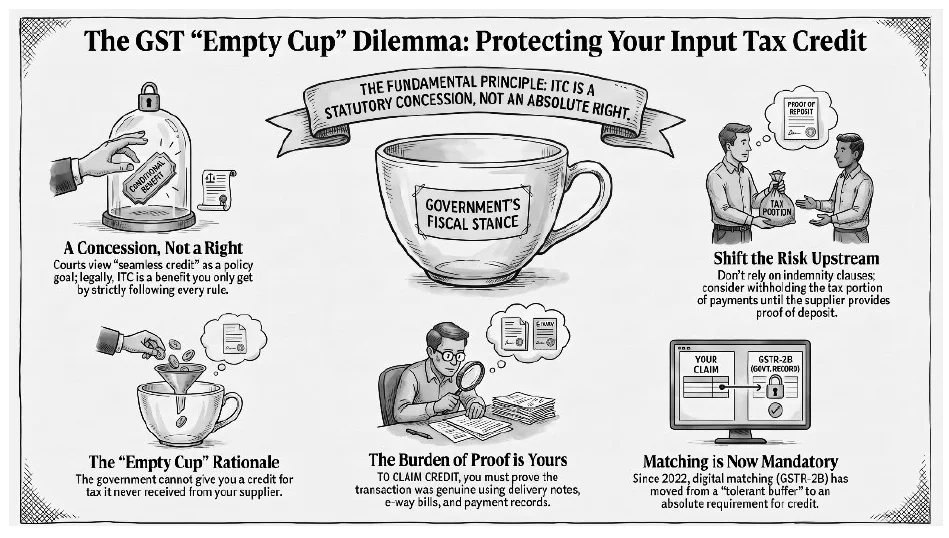
The “empty cup” rationale – The department’s justification for Section 16(2)(c) is not, at its core, a technical one – it is essentially fiscal common sense from the exchequer’s point of view. The Government’s position is that it cannot “pour from an empty cup”: it cannot extend a credit to a recipient against tax it has never actually received from the supplier, regardless of what passed between the recipient and the supplier privately. Whatever hardship this creates for the recipient is treated, from the Department’s side, as a consequence of a risk the recipient chose to take when it transacted with that particular supplier, not a risk the exchequer should absorb. This rationale explains why the Department has been largely unmoved by “blind spot” arguments – the recipient’s inability to see or control whether its vendor actually remitted the tax collected – and why the burden of proof, discussed below, has consistently been placed on the recipient rather than shared with, or shifted first to, the Department.
Automated matching as the first filter – The Department’s primary enforcement tool is the comparison between the credit claimed in a taxpayer’s GSTR-3B and the credit reflected in its auto-generated GSTR-2A/2B, built entirely from the supplier’s own filings. Any variance between the two typically triggers a scrutiny notice – commonly in FORM ASMT-10 or as a pre-consultation intimation in FORM DRC-01A – calling upon the taxpayer to explain or reverse the difference.
Circular-based relief for documented, misclassified payment – Recognising that not every mismatch reflects genuine non-payment, the CBIC issued Circular No. 183/15/2022-GST (in respect of FY 2017-18 and 2018-19) and Circular No. 193/05/2023-GST (extending the same relief to FY 2019-20 and 2020-21). These circulars permit a taxpayer to reconcile a GSTR-3B/GSTR-2A variance – for example, where a supplier mistakenly reported a B2B supply as B2C – by producing a certificate from the supplier’s chartered accountant or cost accountant confirming that the supply was made and the tax was in fact paid, in lieu of a corrected GSTR-1. Where the variance is below a specified monetary threshold, a self-certification by the supplier may suffice; above it, the CA/CMA certificate is treated as mandatory.
The burden of proof standard the department applies – Section 155 of the CGST Act places the burden of proving eligibility for ITC on the person claiming it. The Department, relying on the Supreme Court’s decision in State of Karnataka vs. Ecom Gill Coffee Trading Pvt. Ltd., (2023) 18 SCC 809 (discussed later), routinely takes the position that this burden is not discharged merely by producing a tax invoice and evidence of payment through banking channels. In practice, officers now expect a taxpayer to additionally substantiate the genuineness of the underlying transaction – delivery challans, e-way bills, transporter records (goods receipts, lorry numbers, weighment slips), correspondence with the supplier, and the entry of the transaction in the taxpayer’s own stock and accounting records – treating the invoice and payment trail as necessary but not sufficient.
The practical asymmetry this creates – Where an invoice is missing from GSTR-2A/2B or the supplier has not filed GSTR-3B, the Department’s working assumption is typically that the recipient must first prove entitlement affirmatively – including, in many cases, being expected to demonstrate that it exercised some due diligence in transacting with the supplier – rather than the department first pursuing the supplier for the unpaid tax. This is the enforcement posture that several of the judicial precedents discussed later have pushed back against, holding that recovery against the supplier should ordinarily precede reversal of the recipient’s credit; whether that judicial preference has altered the department’s actual practice is a separate question.
CHALLENGES FACED BY TAXPAYERS
Set against the conditions and the enforcement practice outlined above, taxpayers face different scenarios, each carrying a different practical difficulty. Some common scenarios are explained below:
- Invoice missing from GSTR-2A because the supplier filed it as B2C rather than B2B, but did pay the tax; a CA/CMA certificate has been obtained. The taxpayer’s difficulty here is procedural rather than substantive – the tax reached the Government, but proving this requires the taxpayer to obtain the supplier’s cooperation in procuring a CA certificate, which is not always forthcoming.
- Same facts as Scenario 1, but no certificate has yet been obtained. The underlying transaction is clean; the difficulty is purely one of timing and cooperation from the supplier’s professional advisers. One may be able to actually demonstrate that the supplier has regularly filed and continues to file his returns in GSTR3B.
- Invoice correctly reflected in GSTR-2A, but the supplier has not filed GSTR-3B. Every portal-visible check under clauses (a), (aa), and (b) is satisfied; only clause (c)’s payment condition fails, for a reason entirely outside the recipient’s control.
- Invoice reflected in GSTR-2A, but the supplier filed a nil GSTR-3B. This variant is harder to distinguish, at the time of transacting, from genuine supplier distress on the one hand and deliberate evasion on the other – the recipient has no way of telling the two apart in advance.
- Invoice missing from GSTR-2A, and the supplier has not filed GSTR-3B at all. No disclosure and no payment exist on record. This is the scenario in which the Department’s asymmetric enforcement posture is felt most acutely.
- Supplier’s registration cancelled – prospectively or retrospectively – on the supplier’s own application. In these cases, it is the supplier who approaches the Department for cancellation, and the Proper Officer, after examining the particulars, cancels the registration. Even here, the authorities have frequently gone back to the past outward supply transactions of such suppliers and questioned the recipient’s ITC eligibility, even where the supplier had in fact paid the tax on those very transactions – a fact duly verified by the department at the time of processing the cancellation itself.
- Supplier’s registration cancelled by the Department, of its own motion (suo motu). This is the more troubling variant, and it arises in two distinct forms. Where the cancellation is prospective, the period of the disputed transaction is, in principle, left untouched, though recipients still frequently face scrutiny. Where the cancellation is retrospective – and this is the more common source of dispute – a supplier who disclosed a supply, filed GSTR-1, and even paid tax through GSTR-3B, may nonetheless have its registration cancelled years later, for reasons that are rarely made available to the recipient, and often without effective notice to a supplier who has by then become uncontactable. The recipient is left to answer for a decision taken between the Department and a third party, in which it had no part and no warning.
- Supplier errors, such as an invoice bearing the wrong GSTIN, wrong POS, etc. There could be instances where the supplier, while dealing with a multi-registration entity, reports an invoice against the incorrect GSTIN while the recipient claims it under the correct GSTIN, resulting in a mismatch for the recipient. Similarly, in some cases, the supplier selects reverse charge as applicable though the invoice was actually issued under forward charge. In such cases, despite the supplier having paid GST, the recipient ends up facing scrutiny and litigation.
A further, structural challenge: the Rule 36(4) period. Beyond the above specific scenarios lies a distinct, period-specific difficulty, and one that engages the doctrine of lex non cogit ad impossibilia – discussed in its general form, as argued before and rejected by the Gujarat High Court – in a narrower and more precise sense than the Court actually considered. Between 09.10.2019 and 31.12.2021, Rule 36(4) expressly permitted taxpayers to claim a defined percentage of unmatched credit, while the framework of that period gave the recipient no means of verifying whether the supplier had actually paid the tax on any given invoice – clause (aa) did not yet exist, GSTR-2B in its current form did not exist, and Rule 37A’s reversal-and-re-availment mechanism did not exist. A taxpayer transacting during this window was not merely permitted but structurally invited by the Rules to claim unmatched credit, with no tool available to distinguish, in advance, a genuine unmatched invoice from one that would later prove to involve a defaulting supplier, and no contractual indemnity clause capable of curing the underlying problem, for the reasons given in Part 6. Any demand raised today for reversal of ITC availed within the Rule 36(4) buffer, where the demand rests on a supplier’s subsequent default, arguably asks the taxpayer to have done something the law neither required nor enabled it to do at the relevant time – the precise circumstance the maxim addresses, and one the Gujarat High Court’s general rejection of the doctrine, resting as it does on Rule 37A and contractual indemnity, does not actually reach.
JUDICIAL PRECEDENTS BEFORE MARUTI ENTERPRISE AND BHANDARI SCRAP TRADERS
The case law preceding these two decisions divides broadly into two lines:.
The self-assessment line – In Union of India vs. Bharti Airtel Ltd. [2021 (54) G.S.T.L. 257 (S.C.)], the Supreme Court held, in the context of GSTR-3B rectification during the period GSTR-2/GSTR-3 were non-operational, that the taxpayer’s obligation to self-assess correctly is not excused by gaps in the Government’s own verification infrastructure. This is not a decision about supplier default, but its underlying principle – that the taxpayer bears the risk of imperfect verification tools – recurs throughout the later cases.
The Delhi VAT line, and its extension to GST – In On Quest Merchandising India (P) Ltd. vs. Government of NCT of Delhi, [2018] 10 GSTL 182 (Del), the Delhi High Court read down Section 9(2)(g) of the Delhi VAT Act, 2004, holding that a bona fide purchasing dealer could not be denied credit merely because the selling dealer failed to deposit tax, since the purchaser had no means of verifying or compelling the supplier to pay the taxes. This decision was followed in Shanti Kiran India (P) Ltd. [(2025) 35 Centax 222 (S.C.)] and Arise India Limited [2022 (60) G.S.T.L. 215 (S.C.)], and the Supreme Court subsequently dismissed the Revenue’s special leave petitions against these decisions. The Karnataka High Court applied similar reasoning to Section 70 of the KVAT Act in Tallam Apparels, 2021 SCC OnLine Kar 15785. This entire line was confined to VAT statutes, under which credit, once availed, did not travel beyond the originating State. The extension of this principle to the CGST Act was attempted, and succeeded, in the Tripura High Court’s decision in M/s Sahil Enterprises vs. Union of India [2026-VIL-15-TRI], which read down Section 16(2)(c) itself on the same reasoning.
The burden-of-proof correction – The VAT line was significantly narrowed by the Supreme Court’s decision in State of Karnataka vs. Ecom Gill Coffee Trading Pvt. Ltd., (2023) 18 SCC 809. The Court, highlighting that the burden of proof issue had not been before the Delhi High Court in On Quest Merchandising, distinguished that decision and held that the burden of proving ITC eligibility lies squarely on the claimant, and is not discharged merely by producing a tax invoice or proof of payment through banking channels; the claimant must additionally establish the genuineness of the transaction, including the physical movement of goods.
The purchaser-protective line under GST – Under GST, several High Courts developed a purchaser-protective position under the CGST Act itself, holding that recovery against a defaulting supplier should ordinarily be attempted before the recipient’s credit is disturbed. In M/s D.Y. Beathel Enterprises vs. State Tax Officer [2021-VIL-308-MAD], the Madras High Court quashed a demand against the recipient without the Department having first pursued the supplier, who had collected the tax and not remitted it. In Suncraft Energy Private Limited vs. Assistant Commissioner, State Tax [2023-VIL-487-CAL], the Calcutta High Court reached the same conclusion; the Revenue’s SLP against this decision was dismissed by the Supreme Court in December 2023.
The registration-cancellation line – A further, distinct body of case law addressed the effect of a supplier’s registration being canceled after the disputed transaction, and it distinguishes prospective from retrospective cancellation. On prospective suo motu cancellation, the Allahabad High Court has been consistent: in M/s Singhal Iron Traders vs. Additional Commissioner [2025-VIL-1124-ALH] and M/s Solvi Enterprises vs. Additional Commissioner [2025-VIL-270-ALH], the Court held that no adverse inference arises against the purchaser merely because the supplier’s registration was cancelled after the transaction, where tax was paid and returns were filed at the relevant time. On retrospective cancellation, the case law is more protective of the recipient. In LGW Industries Ltd. vs. Union of India [(2023) 4 Centax 373 (Cal.)], the Court held that a recipient who exercised due diligence at the time of transacting – verifying the supplier’s registration as it then stood, supported by invoices, e-way bills, and banking-channel payment – should not be denied credit solely because of a subsequent cancellation. M/s Gargo Traders vs. Joint Commissioner [2023-VIL-360-CAL] and Shyamalmay Paul vs. Assistant Commissioner [2025-VIL-1315-CAL] both held that retrospective cancellation is not, by itself, a valid ground for denial, and that the authorities must independently verify the physical movement of goods and the banking trail.
By the time Maruti Enterprise came to be decided, the field contained at least three distinguishable threads of precedents:
- a VAT-derived reading-down position, significantly narrowed by Ecom Gill Coffee Trading;
- a GST-specific, sequencing-based position requiring recovery against the supplier first; and
- a registration-cancellation-specific position requiring inquiry beyond the fact of cancellation.
It is against this backdrop that the Gujarat High Court’s judgment has to be read.
WHAT MARUTI ENTERPRISE HELD
Maruti Enterprise dealt with a batch of petitions challenging the vires of Section 16(2)(c) as arbitrary, ultra vires, and violative of Articles 14, 19(1)(g), 265, and 300A, or seeking to read it down to exclude bona fide purchasers. While dismissing the challenge, the Court’s reasoning proceeded in several steps.
- First, it treated ITC as a statutory concession rather than a vested right, relying on ALD Automotive, and held that its conditions must be interpreted literally rather than equitably.
- Second, it held that Section 16(2)’s conditions – clauses (a) through (d), on the Court’s own recitation of the text – must be read conjointly, and that the Revenue could not be required to stop its inquiry at clause (b) once genuineness appeared satisfied; clause (c)’s payment condition was equally part of the composite test.
- Third, and centrally, the Court held that Section 41(2) and Rule 37A cure whatever hardship the provision might otherwise create, since credit denied for a supplier’s default is not permanently lost but merely deferred, to be re-availed once the supplier eventually pays – a mechanism the Court held had no equivalent under the Delhi VAT Act considered in On Quest Merchandising.
- Fourth, the Court placed weight on Section 155’s burden-of-proof provision, holding that it is for the purchasing dealer to prove that tax collected has in fact been remitted, and adopted the Supreme Court’s holding in Ecom Gill Coffee Trading on this point.
- Fifth, the Court declined to follow the Tripura High Court’s decision in Sahil Enterprises, holding that it had proceeded on the On Quest Merchandising reasoning without adequately considering the interplay of Sections 41 and 42 read with Rule 37A.
The Court accordingly declined to read down or strike down Section 16(2)(c), while nonetheless recording, in its concluding paragraphs, that the Government ought to undertake a “comprehensive re-evaluation” of the position of genuine purchasers and consider a more robust, technology-driven verification mechanism. The individual writ petitions were remanded for decision on their own facts, with the question of vires alone having been finally determined.
THE DOCTRINE OF LEX NON COGIT AD IMPOSSIBILIA
A distinct strand of the petitioners’ argument, separate from the Article 14/19(1)(g) constitutional challenge, invoked the maxim lex non cogit ad impossibilia – the law does not compel a person to do that which is impossible to perform – which the petitioners submitted was closely connected to the related maxim impotentia excusat legem (a disability that makes it impossible to obey the law can be excused).
The submission was that Section 16(2)(c) mandates the purchaser to do something beyond its control – namely, ensure that a third party, the supplier, remits tax to the Government – and that the provision should accordingly be declared ultra vires or read down. In support, the petitioners relied on the judgment of the Court of Justice of the European Union in Axel Kittel vs. Belgian State and Belgian State vs. Recolta Recycling SPRL (06.07.2006), which held that VAT deduction can be denied where a participant knew or should have known of fraud, but not where the taxable person neither knew nor could have known that the transaction was connected with fraud committed by the seller.
The Gujarat High Court rejected this submission. It held that the maxim, whatever its general force, “does not strictly attract” the scheme of the GST regime, because Section 41 read with Rule 37A ensures that purchasers are “not unfairly penalized for a supplier’s default” – credit is deferred, not permanently lost, and is restored once the supplier eventually pays. The Court went further, holding that the purchaser is not entirely without means of managing the risk: because the GST regime operates on a contract between two private parties, a purchaser can, at the time of entering into the agreement, include a clause holding the supplier liable to indemnify the purchaser for any loss arising from the supplier’s failure to remit the tax collected.
This reasoning is open to a specific objection that the judgment does not address. An indemnity clause reallocates commercial risk between the purchaser and the supplier as a matter of private contract; it does nothing to make it possible for the purchaser to ensure that the tax actually reaches the Government, which is the act Section 16(2)(c) conditions credit upon. Where the supplier is insolvent, untraceable, or deceased, an indemnity clause is, in practical terms, worthless, since there is no one left to enforce it against. The Court’s answer to the impossibility argument therefore substitutes a private remedy against the wrong party (the supplier, who is often the very source of the difficulty) for the actual impossibility the petitioners identified – the purchaser’s inability to compel or verify payment to the Government. Nor does the Rule 37A safety valve the Court otherwise relies on assist a purchaser whose transaction predates 26.12.2022, since the rule did not exist at the relevant time; the Court’s rejection of the impossibility argument is accordingly strongest for the post-Rule 37A period and weakest for transactions before it, including the entirety of the Rule 36(4) period.
HOW BHANDARI SCRAP TRADERS CONFIRMED IT
The special leave petitions filed against Maruti Enterprise came up for hearing before a two-judge Bench of the Supreme Court on 24.07.2026. The Bench noted that a separate special leave petition against the Tripura High Court’s decision in Sahil Enterprises had been entertained, but observed that the exercise the Gujarat High Court had undertaken – the detailed analysis, from paragraph 42 onwards, of the distinction between the Delhi VAT Act and the CGST Act, together with the scheme of ITC availment set out at paragraph 56 of the impugned judgment – had not been undertaken by the Tripura High Court. The Bench further noted the Gujarat High Court’s reliance on Sections 41, 73, and 74 of the CGST Act in holding that a purchasing dealer under the CGST regime is entitled to re-avail reversed ITC once the supplier discharges the tax liability, a feature the Bench treated as distinguishing the CGST scheme from the Delhi VAT Act’s provisions.
On this basis, the Bench recorded that it found itself “in complete and respectful agreement with the views expressed by the High Court of Gujarat,” affirmed and upheld the impugned judgment, and dismissed the special leave petitions.
IS BHANDARI SCRAP TRADERS THE LAW OF THE LAND?
The answer requires two separate inquiries, not one. The first is the familiar Kunhayammed question – was the dismissal speaking or non-speaking? The second, and the more consequential one on a closer reading of the order, is whether what the Supreme Court actually wrote, even assuming it counts as a speaking order, discloses a ratio decidendi at all, as opposed to a bare conclusion dressed in the language of agreement.
The Supreme Court’s own three-judge bench decision in Kunhayammed v. State of Kerala, (2000) 6 SCC 359, holds that a non-speaking dismissal of a special leave petition attracts no Article 141 effect and produces no merger of the High Court judgment. A speaking dismissal – one giving reasons that engage the substance of the legal question – attracts Article 141, but only to the extent of what is actually reasoned, and still without merger, since leave was never granted. Only where leave is granted and the matter proceeds to disposal as a civil appeal does the High Court judgment merge fully into the Supreme Court’s decision, with Article 141 applying without qualification.
Where Bhandari Scrap Traders falls on this first test. No leave was granted; there is no merger, and Maruti Enterprise remains, formally, a High Court judgment. At first blush, the order appears to clear the second Kunhayammed category – it distinguishes Sahil Enterprises by name, refers to specific paragraphs of the judgment below, and states express agreement with the Gujarat High Court’s reasoning on the DVAT/CGST distinction.
But a closer reading raises a more fundamental difficulty. It is not enough, for a decision to constitute “law declared” under Article 141, that the Supreme Court reaches a conclusion and gestures at the judgment it is affirming. The Supreme Court has itself drawn this distinction. In Secunderabad Club vs. CIT, 2023 INSC 736, it held that a decision binds not because of its conclusion, but because of the principle underlying it – an order unsupported by any deduction, reasoning, or analysis cannot carry precedential value merely because it arrives at a result.
The point was developed further, on facts strikingly close to those here, in Jayant Verma vs. Union of India, (2018) 4 SCC 743. There, the Supreme Court examined an earlier, cryptic order that had reversed a detailed High Court judgment (striking down Section 21A of the Banking Regulation Act) after hearing only one side. It held that where a decision contains no reasoning worth the name, does not engage with the authorities relied upon by the court below, and is arrived at on an ex parte appraisal, it would be hazardous to treat that decision as a declaration of law under Article 141. A bare conclusion, reached without discussion of the relevant statutory provisions or the case law on the point, does not by itself create binding precedent – however firmly the conclusion is stated.
Testing Bhandari Scrap Traders against this standard. The SLP was dismissed at the threshold, without notice to the Union of India as respondent. The order agrees with the Gujarat High Court’s conclusion, but it does not independently formulate the constitutional tests applicable to an Article 14 or Article 19(1)(g) challenge to a taxing provision, does not work through those tests against Section 16(2)(c) on its own terms, and does not offer a distinct line of reasoning of its own explaining why the provision survives constitutional scrutiny. What the order principally does is note that the Delhi VAT Act and the CGST Act are not comparable enactments. But the absence of parity between two statutes is not a constitutional test for validity; it explains why one precedent does not automatically transpose to another statute, but it does not itself demonstrate that Section 16(2)(c) is non-arbitrary, proportionate, or otherwise constitutionally sound. A reference to selected paragraphs of the judgment under challenge, without an independent working-through of the constitutional question, does not disclose a distinct ratio of the Supreme Court.
The parallel to Jayant Verma is closer still on the question of process. The Tripura High Court’s contrary view in Sahil Enterprises was, in substance, reversed without the respondent in that matter being heard, and without the Supreme Court examining the detailed reasoning that had led the Tripura High Court to read down Section 16(2)(c) in the first place. The contrary decisions of the Gauhati and Karnataka High Courts, both relied upon by the Maruti Enterprise petitioners and noted in Part 5 above, do not feature in the Supreme Court’s order at all.
An instructive comparison: the Suncraft Energy dismissal. The Revenue’s SLP against Suncraft Energy – the Calcutta High Court decision requiring recovery against the supplier before the recipient’s credit is disturbed – was also dismissed by the Supreme Court, in December 2023. That order records: “Having regard to the facts and circumstances of this case(s) and the extent of demand being on the lower side, we are not inclined to interfere in these matters in exercise of our powers under Article 136.” This is a dismissal on quantum, not one engaging the merits of the legal question, and falls within Kunhayammed’s first category rather than its second. On this analysis, the Suncraft dismissal – widely treated in practice as Supreme Court endorsement of the purchaser-protective position – does not itself attract Article 141 on the merits, notwithstanding its outcome. The comparison is instructive because it shows that a Supreme Court order can fail to bind for two quite different reasons: because it gives no reasons at all (Suncraft), or, as argued above, because the reasons it gives do not amount to an independent constitutional analysis (Bhandari Scrap Traders, on the Secunderabad Club/Jayant Verma standard).
A stronger comparison – Ecom Gill Coffee Trading. By contrast, State of Karnataka vs. Ecom Gill Coffee Trading Pvt. Ltd., (2023) 18 SCC 809, proceeded as a fully argued civil appeal with leave granted, placing it within Kunhayammed’s third category – full merger, unqualified Article 141 effect – and its reasoning independently works through the burden-of-proof question on its own terms, engaging the authorities on both sides. It is, the least qualified of the three Supreme Court pronouncements discussed, and it is the decision Maruti Enterprise itself relies on most directly for its Section 155 reasoning.
What follows. Two conclusions can be drawn, and they should not be mixed up. First, Bhandari Scrap Traders undoubtedly binds the parties before the Supreme Court in that proceeding, in the ordinary sense that any final order binds the parties to it. Second, and separately, whether the order amounts to “law declared” binding on High Courts and coordinate Benches of the Supreme Court under Article 141 is a materially harder question than its outcome suggests. Applying Secunderabad Club and Jayant Verma, there is a substantial argument that it does not: the order does not disclose the deduction, analysis, or independent constitutional reasoning those decisions require before a conclusion can be treated as a declaration of law, it was arrived at without notice to the Tripura High Court’s successful respondent, and it does not engage the contrary reasoning of the Gauhati or Karnataka High Courts at all.
If this view is correct, it would mean the gate remains open – not merely on the scenario-specific and period-specific points identified elsewhere in this article, but on the constitutional challenge to Section 16(2)(c) itself – for fresh examination before the High Courts, and for independent consideration by a coordinate Bench of the Supreme Court in an appropriate case, including on the DVAT-comparison ground that Bhandari Scrap Traders is, on its face, usually understood to have foreclosed.
A further point follows regardless of which view of the threshold question is correct. Even on the more generous reading of the order – that it does clear the Kunhayammed speaking-order threshold, and binds at least on the narrow DVAT/CGST proposition – it still does not touch the Gujarat High Court’s general rejection of the lex non cogit ad impossibilia argument or the specific points discussed above. The order confines itself to the DVAT/CGST distinction; it does not mention the impossibility doctrine, the Axel Kittel line the petitioners relied on, or the Court’s contractual-indemnity reasoning. On either view of the threshold question, therefore, the Gujarat High Court’s treatment of the impossibility doctrine remains, at present, a High Court finding only.
WAY FORWARD
For the individual writ petitions remanded under paragraph 90 of Maruti Enterprise. A uniform approach across the batched petitions is unlikely to be appropriate. Petitions falling within Scenarios 1 and 3 (documented, misclassified payment) are properly resolved administratively through Circular 183/193’s certification mechanism. Petitions falling within the retrospective suo motu cancellation variant of Scenario 7 warrant the inquiry into physical movement of goods and banking records required by Gargo Traders, Shyamalmay Paul, and LGW Industries. Petitions concerning credit availed within the Rule 36(4) buffer between 09.10.2019 and 31.12.2021 warrant a specific finding on whether the taxpayer could, at the relevant time, have done more than the Rules themselves required.
For the administration. Maruti Enterprise itself calls, at paragraph 88, for a “technology-driven tracking mechanism” to protect genuine purchasers. The Invoice Management System, in its current form, indicates only whether an invoice has been filed by the supplier, not whether the corresponding tax has been paid. Extending IMS to surface payment status at the point a recipient claims credit would meaningfully reduce the incidence of Scenarios 2, 4, and 5 without further litigation.
For future litigation. The conventional reading is that the DVAT-comparison route is closed under Article 141. However, the same is subject to serious challenge, since the order in Bhandari Scrap Traders arguably does not disclose the deduction, analysis, or independent constitutional reasoning that Secunderabad Club and Jayant Verma require before a dismissal can be treated as law declared under Article 141 – meaning a fresh challenge to Section 16(2)(c) remains available before a coordinate Bench in an appropriate case. Independently of that threshold question, and even on the more cautious assumption that the DVAT-comparison route is indeed closed, at least four further arguments remain open, none having been addressed by either Maruti Enterprise or Bhandari Scrap Traders on any reading of the order:
(i) a challenge confined to ITC availed within the Rule 36(4) buffer, engaging lex non cogit ad impossibilia in its precise sense;
(ii) a broader challenge confined to transactions preceding Rule 37A’s introduction in December 2022;
(iii) a challenge premised specifically on the relationship between clauses (aa)/(ba) and clause (c), rather than on Section 16(2)(c) in the abstract; and
(iv) a challenge arising from retrospective cancellation of a supplier’s registration, in respect of which the Calcutta High Court has already required the Department to look beyond the cancellation date to the underlying facts of the transaction.
Litigation confined to any of these grounds, rather than treating Bhandari Scrap Traders as having conclusively settled the field, has a materially better prospect of success than the position currently understood by most practitioners to follow from that decision.
For taxpayers, as a matter of ongoing compliance. Beyond litigation strategy, three practical changes are worth making irrespective of how any pending dispute is resolved. First, recipients should move away from comparing aggregate GSTR-2A/2B and GSTR-3B figures and instead perform invoice-level, transactional reconciliation – an aggregate comparison can mask exactly the kind of misclassification (Scenario 1) or clerical error (Scenario 8) that a certificate or a correction can resolve cheaply if caught early, but which hardens into a full-blown dispute once buried inside a larger, unreconciled variance. Second, recipients should actively track whether their significant suppliers are filing GSTR-3B on time, rather than discovering a default only when a notice arrives years later; several GST-compliance platforms now offer this as a standing feature rather than a one-time reconciliation exercise. Third, and most significantly, the contractual protection the Gujarat High Court gestured toward in Maruti Enterprise – an indemnity clause against the supplier, addressed critically in Part 6 above – is, at best, a remedy of last resort, since it is only as good as the supplier’s continued solvency and traceability. A more robust contractual protection is to withhold a portion of the payment due to the supplier, contractually, until the supplier furnishes proof that the tax component has actually been deposited with the Government – shifting the risk upstream, before payment leaves the recipient’s hands, rather than attempting to recover it downstream from a supplier who may by then be unable to pay either the tax or the indemnity.