Subscribe to the Bombay Chartered Accountant Journal Subscribe Now!

Section 50C – In the course of assessment proceedings if the assessee objects to adoption of stamp duty value as deemed sale consideration, for whatever reason, it is the duty of the AO to make a reference to the DVO for determining the value of the property sold

1. Aavishkar
Film Pvt. Ltd. vs. ITO (Mumbai)
Members:
Saktijit Dey (J.M.) and G. Manjunatha (A.M.)
ITA No.
2256/Mum/2016
A.Y.: 2011-12 Date of order:
21st June, 2019
Counsel for
Assessee / Revenue: Deepak Tralshawala / Jothi Lakshmi Nayak


Section 50C –
In the course of assessment proceedings if the assessee objects to adoption of
stamp duty value as deemed sale consideration, for whatever reason, it is the
duty of the AO to make a reference to the DVO for determining the value of the
property sold


FACTS

During the previous year relevant to the assessment year under
consideration, the assessee sold a residential flat for Rs. 1,75,00,000. The AO
in the course of assessment proceedings called for stamp duty value of the flat
sold by the assessee from the office of the Registrar. The stamp duty value of
the flat was Rs. 2,51,45,500. The AO called upon the assessee to explain why
short-term capital gains should not be computed by adopting the stamp duty
valuation.


The assessee
vide his letters dated 7th March, 2014 and 25th March,
2014 objected to adoption of stamp duty valuation. The assessee had
specifically stated the reasons for which the sale consideration received by
the assessee is reasonable and said that since the property was encumbered it
could not have fetched the value as determined by the stamp valuation
authority.


The AO,
rejecting the arguments of the assessee, proceeded to compute the capital gains
by adopting the stamp duty value to be the full value of consideration.


Aggrieved, the
assessee preferred an appeal to the CIT(A) who confirmed the action of the AO.

The assessee
then preferred an appeal to the Tribunal where it was contended that on the
face of the objection raised by the assessee, the AO should have made a
reference to the DVO for determining the value of the property and the stamp
duty valuation could not be adopted as the deemed sale consideration
considering the fact that the property was encumbered.


HELD

The Tribunal
noted that the issue before it is whether as per section 50C(2) of the Act, it
is mandatory on the part of the AO to make a reference to the DVO to determine
the value of the property. The Tribunal held that since in the course of
assessment proceedings the assessee objected to adoption of stamp duty value as
the deemed sale consideration, for whatever reason, it was the duty of the AO
to make a reference to the DVO for determining the value of the property sold.


The Tribunal
found the contention of the Department, viz., that the reference to DVO was not
made because the assessee raised the objection before the AO purposely at the
fag end to see to it that the proceeding gets barred by limitation, to be
unacceptable. It observed that even the CIT(A) could have directed the AO to
get the valuation of the property done by the DVO and thereafter proceeded in
accordance with law.


The Tribunal noted the ratio of the decisions of the Madras High Court
in the case of S. Muthuraja vs. CIT [(2014) 369 ITR 483 (Mad.)]
and also observed that the Calcutta High Court in Sunil Kumar Agarwal vs.
CIT [(2015) 372 ITR 83 (Cal.)]
has gone a step further to observe that
valuation by DVO is contemplated u/s 50C to avoid miscarriage of justice. The
Calcutta High Court has held that when the legislature has taken care to
provide adequate machinery to give a fair treatment to the taxpayer, there is
no reason why the machinery provided by the legislature should not be used and
the benefit thereof should be refused. The Court observed that even in a case
where no request is made by the assessee to make a reference to the DVO, the AO
while discharging a quasi judicial function is duty-bound to act fairly
by giving the assessee an option to follow the course provided by law to have
the valuation made by the DVO.


The Tribunal held that the AO should have followed the mandate of
section 50C(2) of the Act by making a reference to the DVO to determine the
value of the property sold. The AO having not done so and the CIT(A) also
failing to rectify the error committed by the AO, the Tribunal restored the
issue to the AO with a direction to make a reference to the DVO to determine
the value of the property sold in terms of section 50C(2) of the Act and
thereafter proceed to compute capital gain in accordance with law.


The Tribunal
did not delve into the issue relating to actual value of the property on
account of certain prevailing conditions like encumbrance, etc., as these
issues are available to the assessee for agitating in the course of proceedings
before the DVO.


The Tribunal
set aside the impugned order of the CIT(A) and restored the issue to the AO for
fresh adjudication in terms of its direction.


Section 13(1)(c) – Payments made to trustees in professional capacity cannot be considered as for the benefit of trustees

3. [2019] 71
ITR (Trib.) 687 (Pune)
Parkar Medical
Foundation vs. ACIT
ITA Nos.: 2724
& 2725 (Pune) of 2017
A.Ys.: 2004-05
& 2005-06
Date of order:
20th March, 2019


Section
13(1)(c) – Payments made to trustees in professional capacity cannot be considered
as for the benefit of trustees


FACTS

The assessee
was a hospital registered u/s 12A of the Income-tax Act, 1961. At the time of
reassessment proceedings, the AO disallowed Rs. 6,52,748 being professional
charges paid to two of the trustees. He also disallowed Rs. 1,95,000 being
utilisation charges paid to those trustees. These disallowances were made on
the ground that the assessee had violated the provision of section 13(1)(c)
which provides that where any part of the income of a trust enures or any part
of such income or any property of the trust or the institution is, during the
previous year, used or applied, directly or indirectly, for the benefit of any
persons referred to in section 13(3), then such amounts are not to be allowed
as deduction.


But the
assessee argued that the trustees were doctors and payments were made to them
for rendering their professional services apart from looking after the
day-to-day activities and managing the hospital. Further, the assessee paid
utilisation fees to the trustees because certain equipments were owned by those
trustees but were utilised by the hospital.


These arguments
were rejected by the CIT(A) and now the question before the Hon’ble ITAT was
whether payments made to the trustees were directly or indirectly for the
benefit of those trustees.


HELD

The Hon’ble
ITAT allowed the appeal of the assessee on the following basis:


It was an
undisputed fact that the trustees to whom professional fees were paid were
qualified doctors who, besides looking after the administration and running of
the hospital, were also providing their professional medical services to the
assessee and thus such payments cannot be held to be paid for the direct or
indirect benefit of those trustees.


Similarly,
regarding the disallowance of utilisation fees paid to those trustees, the ITAT
held that there was no finding of the AO that utilisation fees paid were
excessive or were being paid for any direct or indirect benefit of those
trustees and hence cannot be disallowed.


Section 56(2)(viia) – Value of tangible or intangible assets once substantiated would be replaced with the book value for the purposes of FMV regardless of the book entries in this regard

2. [2019] 109 taxmann.com 165 (Ahd. – Trib.) Unnati
Inorganics (P.) Ltd. vs. ITO
ITA No.:
2474/Ahd./2017
A.Y.: 2014-15  Date of order:
11th September, 2019


Section 56(2)(viia)
– Value of tangible or intangible assets once substantiated would be replaced
with the book value for the purposes of FMV regardless of the book entries in
this regard


FACTS

The assessee, a
private limited company, filed its return of income for A.Y. 2013-14 declaring
Nil total income. In the course of assessment proceedings the AO noticed that
the assessee company has, during the previous year, issued 10,16,000 shares of
face value of Rs. 10 each at a premium of Rs. 23 per share. The AO made
inquiries regarding the Fair Market Value (FMV) of the shares allotted, having
regard to the provisions of section 56(2)(viib) of the Act, for the purposes of
ascertaining the correctness of the premium charged.


The assessee
submitted that the company holds certain land parcels in Vadodara and Dahej
whose FMV is substantially high on the date of allotment of shares and
consequently premium charged of Rs. 23 per share is quite commensurate with the
FMV of shares allotted as contemplated in Explanation to section 56(2)(viib) of
the Act. By producing a valuation report of the land, the assessee demonstrated
that the value of land adopted by the assessee for this purpose is only 45% of
the jantri price. However, the AO disputed the FMV of the fresh
allotment and proceeded to apply the prescribed method of valuation as
stipulated in Rule 11UA to determine the FMV of the shares; for this purpose he
adopted the book value of the assets and liabilities including land as on 31st
March, 2013 and determined the FMV of fresh allotment at Rs 12.84 per share in
place of Rs. 33 per share adopted by the assessee. The AO, accordingly, added a
sum of Rs. 2,04,82,560 to the total income, on issue of shares at a price in
excess of the FMV of the shares, u/s 56(2)(viib) of the Act.


Aggrieved, the
assessee preferred an appeal to the CIT(A) who upheld the action of the
assessee by observing that (i) no accounting entry has been passed in respect
of the difference between the FMV of the land at the relevant point of time and
its corresponding actual costs as reflected in the books of accounts; (ii) if
share premium was charged on the basis of jantri price, then it was less
than what was required to be charged, and therefore there is arbitrariness in
deciding the issue price; (iii) the assessee first acquired land at Vadodara
for setting up its plant and thereafter acquired another plot of land at Dahej
since it was not in a position to complete legal formalities qua the
first property acquired by it, and therefore there is an element of ad
hocism
in the actions of the assessee.


Aggrieved, the assessee preferred an appeal to the Tribunal.


HELD

The Tribunal observed that section 56(2)(viib) seeks to enable the
determination of FMV by two methods: (i) prescribed method as purportedly
embedded in Rule 11UA of the Income-tax Rules; and (ii) FMV based on the
intrinsic value of the assets both tangible and intangible on the date of issue
of shares. Thus, the FMV of all the assets (tangibles, intangibles, human
resources, right of management or control or other rights whatsoever in or in
relation to the Indian company), whether recorded in the books or not,
appearing in the books at their intrinsic value or not, is a sufficient warrant
to value the premium on issue of unquoted equity shares by a closely-held
company. Thus, the Explanation (a)(ii) itself implies that book entry for
recognition of intrinsic value is not necessary at all. Moreover, the higher of
the values determined as per the first and second limbs of Explanation shall be
adopted for the purposes of section 56(2)(viib) of the Act.


It also observed that the FMV of the land belonging to the assessee
company was sought to be substantiated by the valuation report. And that the
valuation report has not been controverted by the Revenue. No rebuttal of the
fact towards the value of land is on record. It observed that one of the
grounds taken by the Revenue for rejecting the basis of determination of FMV is
that no accounting entry has been passed in respect of difference between the
FMV of the immovable property at the relevant point of time and its actual cost
as reflected in the books of accounts.


The Tribunal
held that the value once substituted would be replaced with the book value for
the purposes of FMV regardless of the book entries in this regard. What is
relevant is whether at the time of allotment of shares the value of shares as
claimed existed or not. The valuation report is not evidence in itself but
merely an opinion of an independent having regard to totality of expert facts
and circumstances existing on the date of valuation. So long as the facts and
circumstances exist, the presence or otherwise of valuation report per se
has no effect. It observed that the AO has himself, in a subsequent year,
disputed the higher valuation of Rs. 46 and unequivocally adopted Rs. 33 as its
fair value. The assessee has also been able to demonstrate arm’s length
transaction and unison of two different groups bringing different capabilities and
expertise for furtherance of business. Also, the existing promoters, too,
subscribed at a rate similar to the rate at which shares were allotted to the
new group which, according to the Tribunal, further reinforces the inherent
strengths in the valuations of the company as represented by the value of
equity shares.

The Tribunal
set aside the order of the CIT(A) and directed the AO to delete the addition
made u/s 56(2)(viib) of the Act. The appeal filed by the assessee was allowed.


SUPERIOR VOTING RIGHTS SHARES: A NEW INSTRUMENT FOR FUNDING

BACKGROUND

After a short
consultation process, the Ministry of Corporate Affairs and the Securities and
Exchange Board of India have, in quick succession, notified the new regime and regulatory
requirements relating to Superior Voting Rights equity shares (SRs).
Essentially, SRs are a special category of equity shares. They provide for
extra voting rights in comparison with ‘ordinary equity shares’.


Generally, all
equity shares are equal. They have the same right to dividends, the same rights
of voting and other features. To use the common Latin term, they are all pari
passu.


For private
companies, there was considerable flexibility to create several categories of
equity shares, each category having different rights. Typically, the
differences relate to voting and / or dividends. One category of equity shares,
for example, may have multiple voting rights as compared to others. This
enabled the holders to exercise far more control and say, compared to the
‘economic’ interest in the company.


Availability of
such flexibility helped companies and their founders / promoters to negotiate
with investors. Investors may be interested in economic returns while the
promoters / founders may be needed to be given assurance of control over the
running and management of the company.


However, while
this was well accepted in case of private companies, there was divergence of
views relating to listed companies and even unlisted public companies. On the
one hand, it was argued that such matters should be left for internal
negotiations and decisions of the company, its promoters and investors. If they
desire to have such a structure, the law should not meddle. This is, of course,
so long as there is adequate disclosure of the facts. On the other hand, there
was opposition to allowing any such instrument giving differential rights on
the ground that it would allow a small group of shareholders to control the
company even at the cost of shareholders holding otherwise majority of economic
value. It was argued that such instruments went against the principle of
corporate democracy and governance.


SEBI varied its
view over a period of time. It had allowed the issue of one category of such
instruments but there was an approval process that often took months. The
result was that there were barely 4-5 companies that issued such instruments.
Curiously, it was found that in most of the cases, such instruments traded at a
huge discount over the ‘ordinary equity shares’. There was far less trading,
too.


Recently,
however, the debate arose again particularly in case of startups that
extensively use technology (internet, digital, biotech, etc.). Such companies
need capital and flexibility and there has been a history of companies that
have seen very rapid growth. Such categories of companies need to be given a
freer hand and also their promoters given a share disproportionate to the
amount of money that they invest. SEBI had recently initiated a consultation
process wherein the current law and practice in India and abroad was
highlighted.


After debate
and consultation, the Ministry of Corporate Affairs (MCA) and SEBI have both
made changes in their respective regulations / rules to allow for certain types
of instruments. The features of these instruments are briefly discussed here.


What type of
instruments are allowed to be issued?

Equity shares
with extra voting rights than other ‘ordinary’ equity shares are allowed. These
rights are called superior rights and hence such instruments are referred to as
‘Superior Rights’ shares or SRs.


Which type of
companies are allowed to issue SRs?

All companies
are given such powers. The MCA has made generic rules applicable to all
companies. However, SEBI has made further regulations applicable to listed
companies.


WHAT
ARE SR
s?

SRs are a
special category of equity shares with superior voting rights as compared to
other equity shares. No other differential, whether of dividends, share in
property, etc., is permitted. Thus, for example, the SRs – or ordinary equity
shares – cannot be given extra or lesser dividends. It is just that when it
comes to the matter of voting at general meetings, SRs would have extra voting
rights.


Note that the
MCA rules applicable to all companies generally provide for a wider category of
instruments not merely restricted to SRs. However, the focus of this article is
on SRs since SEBI has recognised and permitted only this class of instruments.


Shares with
‘inferior’ rights not allowed

Only shares
with superior voting rights are allowed to be issued. Thus, a company can have
a share with multiple voting rights or one voting right. It cannot have a share
with voting rights less than one vote per share. At present, companies have
issued shares with less voting rights. Such shares cannot be issued any more by
listed companies.


Shares with
other differential rights

Equity shares
with lesser or more dividend rights are not permitted to be issued by listed companies.
No other differential is also possible. The only differential permitted is
issue of shares with superior voting rights.


Who can be
issued SRs?

Unlisted
companies can issue SRs to any person. However, if the company wants to list
its shares on exchanges, the promoters / founders to whom SRs are issued should
be acting in an executive position in the company. Further, such SRs holders
should not be part of a promoter group whose collective net worth is more than
Rs. 500 crores.


How much extra
voting rights can be given to SRs?

SRs can be
given two to ten times extra voting rights as compared to ordinary equity
shares. At the minimum, thus, one SR can have twice the vote of an ordinary
equity share; and at the maximum, ten times. The multiple has to be in whole
numbers and not fractions (e.g., one cannot issue SRs with two and a half times
voting rights of ordinary equity shares).

What are the
procedures and approvals required for issue of SRs?

There are
several conditions for the issue of SRs. The articles of association should
permit such an issue. The companies’ rules require that an ordinary resolution
has to be passed approving such issue and for this purpose, certain disclosures
need to be made. However, the SEBI regulations require a special resolution
with certain further disclosure requirements. Earlier, there was a requirement
of having a three-year profit track record, but this requirement is now
dropped. As far as unlisted companies are concerned, any company can issue SRs.


Classes of SRs

The SEBI
regulations permit only one class of SRs.


‘Coat-tail’
provisions

These refer to
those situations where the SRs will have the same voting rights as ordinary
equity shares. In other words, SRs as well as ordinary equity shares will have
one vote per share. These requirements are prescribed for listed companies by
SEBI. Thus, in respect of the specified situations, which relate to important
matters or where there can be major conflict of interest, etc., the extra
voting rights on SRs are not available.


Sunset
provisions

Sunset in this context means the period of time after which the SRs
become ordinary equity shares. In other words, the extra voting rights of SRs
are removed. Unlisted companies are not mandatorily required to have sunset
provisions. However, listed companies need to provide that the SRs shall be
converted into ordinary equity shares by the fifth anniversary of listing of
the shares in the public issue of such a company. Such period can be extended
by another five years if a resolution is passed by the shareholders other than
SRs holders. The holders of SRs can, however, convert their SRs to ordinary
equity shares earlier.


There are also
mandatory sunset events where on the occurrence of such events the SRs get
converted into ordinary equity shares. These include, e.g., when the SR holder
resigns from the executive position, dies, etc.


Who can hold
SRs? What if they transfer the SRs?

Only those
promoters who have an executive position in the company can hold SRs. If the
holder dies, the person to whom such shares devolve will not have any superior
rights in respect of such shares. Generally, sale of SRs will result in the
superior voting rights lapsing and such shares becoming like other ordinary
equity shares.

Lock-in period

Under the SEBI
regulations, the SRs held by the promoters shall be locked in during the period
they are SRs, or for the period of lock-in in accordance with the ordinary
provisions relating to lock-in for minimum promoters’ contribution, whichever
is later.


Maximum
percentage of voting rights

The SRs cannot
have voting rights above 74% of the total voting rights. Thus, the ordinary
equity shares need to have at least 26% voting rights. For listed companies,
the ordinary equity shares held by SRs holders are also counted for the
purposes of this limit of 74%.


Special
requirements relating to corporate governance for listed companies

A company
having SRs is required to ensure that at least half of its board consists of
independent directors. Its Audit Committee should consist only of independent
directors. And its Nomination and Remuneration Committee, its
Risk Management Committee and its Stakeholders Committee should comprise of at
least two-thirds independent directors.


CONCLUDING
REMARKS

The positive
aspect of the new set of provisions is that now, particularly in case of listed
companies, SRs can be issued without formal approval of regulatory authorities
like SEBI. Approval of shareholders is generally enough. The discretion and
also the delay for such approval is thus eliminated.


However, it can
be seen that a very narrow type of instruments is permitted to be issued and
that, too, having a limited validity period. The superior rights are not
applicable under several situations. Importantly, though the wording is not
sufficiently clear, it appears that listed companies cannot make a fresh issue
of SRs (except as rights / bonus). Shares with inferior voting rights cannot in
any case be issued.


Thus, the
regulators have taken a very conservative position as regards the issue of SRs.
There is of course a worldwide debate on whether such shares with differential
rights be allowed and under what circumstances. While many countries do allow
(and many do not), some countries let companies and their shareholders /
investors decide. There is thus a good argument to allow flexibility to
companies and their investors to decide on what type of instruments can be
issued instead of a blanket ban or very narrow permissibility.


One of the
principal objections is that investors do not understand such instruments and
hence may end up acquiring them to their loss. Alternatively, they may simply
not invest. One would have, though, thought that after so many years of debate
on such instruments, there would be knowledge for those who want to make some
effort. After all, even equity investing is for informed investors, more so
when the focus of regulations these days is on more and more disclosures and
transparency.


Be that as it
may be, there is now a narrow but fairly clear type of instrument that can be
issued. Time will tell how successful it is with companies, their promoters /
founders and, above all, investors.


POWER OF SILENCE

Maun’ in Sanskrit means silence. The
above is a Sanskrit proverb meaning everything can be achieved through silence.
It is a sign of control and tolerance. An underlying meaning of the proverb is
to exercise the wisdom to understand and comprehend when to speak and when to
be silent, given a particular situation.


When wisdom speaks, be silent. Do not
waste your candle when the sun is there – Anonymous


Mahatma Gandhi said silence has an effective
power to ignite the inner strength. According to him, the person who is on the
path of a continuous and effortful search for the truth follows the road-map of
silence. One of the basic and necessary foundations of Gandhiji’s principles of
Ahimsa could be silence.


Let silence be the art you practise


Many a time silence can speak volumes. A
well-known Hindi proverb Samajhnewale ko ishara kaafi hai has the
similar underlying interpretation – that a silent move can be more effective
than the spoken word. Silence has no limitations of communication. In the good
old days, movies used to be silent in the absence of technological advancement.
However, communication was complete and adequate.


The most important thing in communication
is what is not said – Peter Drucker


Silence is a form of meditation and
meditation without silence is almost impossible. Silence is more inner than
outer. It enables one to be calm and composed in the given situation. It has an
ability to increase one’s capacity to listen. It may not be a coincidence that
‘silent’ and ‘listen’ are spelt with the same letters! Silence can result in a
high level of concentration and high performance.


Work hard in silence; let your success
make the noise

In Hindu religion there is a concept of Maun
Vrat
, meaning ‘Vow of Silence’. In the sixth month of the Hindu calendar,
viz. Bhadrapad, 16 days are set aside for those who wish to follow Maun
Vrat.
Jain religion follows a particular day as Maun Ekadashi for
observing silence. It is a process of introspection and Maun Vrat could
have a scientific and medical justification too, so as to achieve conservation
of energy by remaining silent and its better utilisation. Exercising silence
enables one to hear the sounds of silence which are as healing as they are
enlightening.


If you want to make sense it has to come
from silence – Shri Shri Ravi Shankar


It is observed that in meetings and
discussions, the participants may speak when silence is expected and may remain
silent when speaking is necessary. It is said that smart people know what to
say, wise people know whether or not to say anything!


Be silent in two situations:


When you feel one can’t understand your
feelings from words, and

When one can understand without any words


In sports
activities such as tennis, silence is expected so that the players can
concentrate on the game. On the other hand, in cricket cheering the players and
creating a racket is usually expected! However, in a tense situation of winning
or losing, the spectators may observe silence on their own.


The quieter
you become, the more you can hear


In the context of the family scenario if the
members and life partners follow the proverb
to its logical conclusion, the family life can become so peaceful.
The elders’ symbolic silence in place of harsh words in dealing with the
children in the family can many a time work wonders. Moreover, a legacy of
control and tolerance can be passed on its own and naturally to the next
generation.

Silence is one of the hardest arguments
to refute


However, the virtue of silence may have to
be set aside under the situation that one’s silence is interpreted as weakness
or ignorance. In case of a situation of injustice, one may have to make noise
or deal with it in protest with appropriate words. In above situations one’s
silence could be misjudged.


Fools multiply when wise men are silent

The Bhagavad Gita says: Contentment
of the mind, amiable temperament, silence, religious meditation and good
thoughts reflect austerity of the mind.


Let us follow the virtues of silence and
ignite the strength within. Let us strive for the maturity, wisdom and grace to
appreciate that silence can be far more powerful than having the last word.


Namaskaar!

THE ANCESTRAL PROPERTY CONUNDRUM RELOADED

Introduction

Under the Hindu
Law, the term ‘ancestral property’, as generally understood, means any property
inherited from three generations above of male lineage, i.e., from the father, grandfather,
great-grandfather. In August, 2019, this Feature had analysed the confusion
surrounding the issue of ancestral property, more specifically, whether
ancestral property received by a person can be transferred away?


This Feature
had then noted that, as regards ancestral property, two views were prevalent.

View-1: Ancestral property cannot be alienated. According to this view, if the
person inheriting it has sons, grandsons or great-grandsons, then it
automatically becomes joint family property in his hands and his lineal
descendants automatically become coparceners along with him. A corollary of
property becoming ancestral property is that it cannot be willed away or
alienated in any other manner by the person who inherits it.

View-2: Ancestral property becomes self-acquired property in the hands of the
person inheriting it. Thus, he can deal with it by Will, gift, transfer, etc.,
in any manner he pleases.


RECENT DEVELOPMENTS

Subsequent to
the publication of this Feature in August, 2019 the Supreme Court has once
again analysed the issue of ancestral property. What is interesting to note is
that on this burning issue two decisions of the Apex Court were delivered, both
of Co-ordinate Benches and both orders delivered on the same day (without reference
to one another)! These decisions appear divergent but ultimately due to the
facts, the conclusion reached is the same. Let us examine both these decisions.


Case-1:
Arshnoor Singh vs. Harpal Kaul, CA 5124/2019, order dated 1st July,
2019 (SC)

A person had
inherited property from his father who died in 1951 and which he, in turn, had
inherited from his father. This person tried to sell the property but his son
(the appellant before the Supreme Court) petitioned the Court against the same
on the grounds that the property was ancestral property and hence he could not
sell it on his own. Accordingly, the property was coparcenary / joint family
property in which the son had also acquired an interest by birth and hence his
father could not sell it as per his wish.


A two-member
Bench of the Supreme Court analysed various decisions, such as Yudhishter
vs. Ashok Kumar, 1987 AIR 558
on this subject (which were dealt with in
detail in the August, 2019 issue of the BCAJ under this Feature). It
held that after the Hindu Succession Act, 1956 came into force, the concept of
ancestral property has undergone a change. Post-1956, if a person inherited a
self-acquired property from his paternal ancestors, the said property became
his self-acquired property and did not remain coparcenary property.


However, the
Apex Court held that if the succession opened under the old Hindu law, i.e.,
prior to the commencement of the Hindu Succession Act, 1956, the parties would
be governed by Mitakshara law. The property inherited by a male Hindu
from his paternal male ancestor would be coparcenary property in his hands
vis-à-vis his male descendants up to three degrees below him. The nature of
property remained as coparcenary property even after the commencement of the
Hindu Succession Act, 1956. Incidentally, the comprehensive decision of the
Delhi High Court in the case of Surender Kumar vs. Dhani Ram, CS(OS) No.
1732/2012, dated 18th January, 2016
had taken the very same
view.


The Supreme
Court further analysed that in the case on hand, the first owner (i.e., the
great-grandfather of the appellant in that case) died intestate in 1951 and
hence the succession opened in 1951. This was a time when the Hindu Succession
Act was not in force. Hence, the nature of property inherited by the first
owner’s son was coparcenary property and thereafter, everyone claiming under
him inherited the same as ancestral property. The Court distinguished its
earlier ruling in the case of Uttam vs. Saubhag Singh, Civil Appeal
2360/2016, dated 2nd March, 2016
since that dealt with a
case where the succession was opened in 1973 (after the Hindu Succession Act,
1956 came into force), whereas the present case dealt with a situation where
the succession was opened in 1951.


The Supreme
Court reiterated its earlier decision in the case of Valliammai Achi vs.
Nagappa Chettiar, AIR 1967 SC 1153
that once a person obtains a share
in an ancestral property, then it is well settled that such share is ancestral
property for his male children. They become owners by virtue of their birth.
Accordingly, the Supreme Court did not allow the sale by the father to go
through since it affected his son’s rights in the property. Thus, the only
reason why the Supreme Court upheld the concept of ancestral property was
because the succession was opened prior to 1956.


Case-2: Doddamuniyappa vs. Muniswamy, CA No. 7141/2008, order dated 1st
July, 2019 (SC)

This decision of the Supreme Court also pertained to the very same
issue. The Supreme Court held that it was well settled and held by it in Smt.
Dipo vs. Wassan Singh 1983 (3) SCC 376
, that the property inherited
from a father by his sons became joint family property in the hands of the
sons. Based on this principle, the Supreme Court concluded that property
inherited by a person from his grandfather would remain ancestral property and
hence, his father could not sell the same. In this case, neither did the
Supreme Court refer to its earlier decisions in Uttam vs. Saubhag Singh
(Supra) or Yudhishter vs. Ashok Kumar (Supra)
nor did it go into the
issue of whether the succession was opened prior to 1951. It held as a matter
of principle that all ancestral property inherited by a person would continue
to be ancestral property for his heirs.


It is humbly
submitted that in the light of the above decisions, this view would not be
tenable after the enactment of the Hindu Succession Act, 1956. However, based
on the facts of the present case, one can ascertain that the first owner died
sometime before 1950 and hence it can be concluded that the succession opened
prior to 1956. If that be the case, as held in Arshnoor Singh vs. Harpal
Kaul (Supra)
, the property continues to be ancestral in the hands of
the heirs. Hence, while the principle of the decision in Doddamuniyappa’s case
seems untenable, the conclusion is correct!


AUTHOR’S (FINAL) VIEW

A conjoined
reading of the Hindu Succession Act, 1956 and the decisions of the Supreme
Court show that the customs and traditions of Hindu Law have been given a
decent burial by the codified Act of 1956. It is (once again) submitted that
the view expressed by the Delhi High Court in the case of Surender Kumar
(Supra)
is the most comprehensive exposition on the subject of
ancestral property. To reiterate, the important principles laid down by the
Delhi High Court are that:


(i)   Inheritance of ancestral
property after 1956 does not create an HUF property and inheritance of
ancestral property after 1956 therefore does not result in creation of an HUF
property;

(ii)  Ancestral property can only
become an HUF property if inheritance is before 1956, and such HUF property
therefore which came into existence before 1956 continues as such even after
1956;

(iii) If a person dies after
passing of the Hindu Succession Act, 1956 and there is no HUF existing at the
time of the death of such a person, inheritance of an immovable property of
such a person by his heirs is no doubt inheritance of an ‘ancestral’ property
but the inheritance is as a self-acquired property in the hands of the legal
heir;

(iv) After passing of the Hindu
Succession Act, 1956 if a person inherits a property from his paternal
ancestors, the said property is not an HUF property in his hands and the
property is to be taken as a self-acquired property of the person who inherits
the same.


CONCLUSION

In recent
times, some newspapers have also joined the confusion bandwagon and have
started printing articles suggesting that ancestral property continues as ancestral
in the hands of the person inheriting the same. All of these help add fuel to
an already raging controversy.


Considering these latest Supreme Court decisions,
it is evident that the government needs to urgently amend the Hindu Succession
Act en masse and specifically address the burning issue of ancestral
property. A piecemeal approach to amendment should be avoided and the entire
Act should be replaced with a new one. The Act is over 60 years old and should
be substituted by a modern, comprehensive legislation which can prevent
litigation. Precious money and time would be saved by doing so. Till that time,
we will continue witnessing sequels to this puzzle known as ancestral property!


ATTRIBUTION OF PROFITS TO A PERMANENT ESTABLISHMENT IN A SOURCE STATE

The determination of income of a
Multi-National Enterprise (MNE) having operations in various jurisdictions
faces many challenges. It is not easy to attribute profits to various
constituents of an MNE spread over multiple jurisdictions. OECD has so far adopted
a separate entity approach and recommended determination of profits on the
Arm’s Length Principle (ALP) based on a FAR (Functions, Assets and Risks)
analysis. However, of late ALP based on FAR has been challenged by many
developing nations (including India) on the ground that it is more skewed
towards residence-based taxation and does not take into account the place of
value creation, i.e., the market. In a traditional approach, profits are taxed
in a source country only if there is a Permanent Establishment (PE). It is
easier for MNEs to plan their affairs in a manner so as to avoid the presence
of a PE in a source country. Further, in a digitalised economy, it is extremely
difficult to attribute profits to various jurisdictions based on the traditional
approach. Therefore, many countries worldwide have moved away from ALP and
resorted to either the Formulary Apportionment Method (FAM) or a Presumptive
Basis of Taxation. This article compares and contrasts the different methods of
profit attribution and provides a contextual study to understand the proposed
amendments in Rule 10 of the Income-tax Rules, 1962 (the Rules) in respect of
attribution of profits to the operations of an MNE in India.


PRESENT
SYSTEM OF PROFIT ATTRIBUTION

Article 5 of a tax treaty lays down norms
for determination of a PE in the state of source. Article 7 of a tax treaty
stipulates principles of determination of profits attributable to a PE. The
existence of a PE in a source state gives a right to that state to tax profits
which are attributable to its operations. As we know, a treaty only provides
for distributive rules for taxing jurisdictions, leaving detailed computation
of profits to the respective domestic tax laws. For example, once it is
established that there is a PE in India, computation of profits attributable to
that PE will be subject to provisions of the Income-tax Act, 1961 (the Act).
However, Article 7 does provide certain restrictions or guidelines thereof for
computation of profits. A moot issue is to determine how much profits are
attributable to a PE in the source state.


Provisions under the Income-tax Act, 1961

Section 9 of the Act deals with income
deemed to accrue or arise in India. It does provide certain source rules for
determination of such income. However, as far as business income is concerned,
section 9(1)(i) provides that all income accruing or arising whether directly
or indirectly through or from any business connection in India… shall be deemed
to accrue or arise in India. Clause (a) of Explanation 1 to section 9(1)(i)
further provides that in the case of a business of which all the operations are
not carried on in India, the income of the business under this clause deemed to
accrue or arise in India, shall be only such part of income as is reasonably
attributable to the operations carried on in India.


The provision in tax treaties is similar, in
that it provides that if the enterprise carries on business as aforesaid, the
profits of the enterprise may be taxed in the other state; but only to the extent
as are attributable to that PE. There is one exception, i.e., a tax treaty
which follows the UN Model Convention providing for the force of attraction
rule. According to this rule, when an enterprise has a PE in a source state,
then the entire revenue from the source state may get taxed in the hands of
that enterprise, whether or not it is attributable to that PE. Many Indian tax
treaties do have this Rule. However, the force of attraction is restricted to
the revenue derived from the same or similar activities as that of the PE.


Thus, determination of profits attributable
to a PE is crucial for its taxability in the source state. Ideally, the PE
should maintain books of accounts and financial statements in India (for that
matter, any source state) for determination of profit or loss from its business
operations, for it is so mandated in India. However, where such books of
accounts are not maintained (may be due to the head office’s view of
non-existence of PE or for any other reason) or where it is not possible to
ascertain the actual profits from such books of accounts, then the assessing
officer (AO) can invoke the provisions of Rule 10 which provide for
determination of profits as a percentage of the turnover, proportionate profits
or in any other manner as he may be deem appropriate. Thus, Rule 10 gives wide
discretionary powers to the AO in determination of profits attributable to a
PE.


Clauses (b) to (e) of Explanation 1 to
section 9(1)(i) of the Act provide various instances where income of a non-resident
from certain activities will not be deemed to accrue or arise in India.
However, Explanation 2 explicitly includes dependent agent within the scope of
business connection. Again, a question arises as to the role played by the
dependent agent and profits attributable to his activities in the dual
capacity: one, as an agent, and two, as a representative of the foreign
enterprise (as a PE).


Authorised OECD Approach (AOA)

At present, there are three versions of
Article 7 that feature in tax treaties worldwide, namely, (i) article 7 in the
OECD Model Convention (OECD MC) prior to 2010, (ii) article 7 in the revised
OECD Model Convention post-2010, and (iii) article 7 of the UN Model Convention
(UN MC). The distinguishing features of the above versions are given below.


Versions (i) and (iii) are similar in that
the pre-2010 OECD MC and the UN MC contain the provision of considering PE as a
separate and distinct enterprise. The PE, in this case, is considered as being
a separate and independent entity from its head office, such that it would
maximise its own profits. The PE, therefore, would be maintaining separate
books of accounts based on principles of accounting as applicable to a separate
and distinct entity. Klaus Vogel has referred to such a method as ‘separate
accounting’ or ‘direct method’. India supports this view and most of its tax
treaties are based on this principle.


However, in 2010, OECD changed its stance
and amended article 7 based on its report on the ‘Attribution of Profits to
Permanent Establishments’. In the said report and the new article 7 in its
model tax convention, OECD pronounced AOA as a preferred approach for
attribution of profits to a PE. AOA is also based on the ‘separate entity
approach’, though profits are to be determined based on Functions performed,
Assets employed and Risks assumed (FAR).


AOA provides
options for application of the new article 7 introduced in the OECD Model Tax
Convention in 2010 which requires that profits attributable to PE are in
accordance with the principles developed in the OECD Transfer Pricing
Guidelines wherein the PE is first hypothesised as a functionally separate
entity from the rest of the enterprise of which it is a part, and then profits
are determined by applying the comparability analysis and FAR approach.


The AOA recommends a two-step approach for
determination of profits attributable to a PE:


Step 1: A
functional and factual analysis of the PE, aligned with FAR analysis, as
recommended in transfer pricing guidelines;

Step 2: A
comparability analysis to determine the appropriate arm’s length return (price)
for the PE’s transactions on the basis of FAR analysis.


AOA is based on ALP, which in turn is
determined based on FAR analysis under transfer pricing, which essentially considers
the supply side of the transaction and ignores the demand side, i.e., the
market or sales; and, therefore, India has rejected the same.


There is one
more issue in the revised article 7 of the OECD MC. Its pre-2010 version
recognised and acknowledged that apportionment of profits based on one of the
criteria, namely, receipts (or sales revenue), expenses and working capital,
was a reasonable way of apportioning profits to the PE. This was based on
paragraph 4 of the pre-2010 version of the OECD MC which gave an option to
attribute profits by way of an apportionment if it was customary to do so in
the state of PE. However, the revised OECD MC dropped this paragraph. The
impact of this change is that even where accounts are not available or
reliable, one needs to attribute profits to a PE based on FAR without
considering the market or sales. India’s position is very clear in that it
would also take the demand side or sales into consideration for attribution of
profits to a PE.


Shortcomings of ALP

Section 92F(ii) defines the ‘Arm’s Length
Price’ as a price which is applied or proposed to be applied to a transaction
between persons other than associated enterprises, in uncontrolled conditions.

Thus, a transaction between two or more AEs
needs to be compared with a similar transaction between two unrelated parties,
for the same or similar product or service, in the same or similar
circumstances. These two unrelated parties, whose transactions are compared
with that of AEs, must have similar functions, assets or risks as that of the
AEs. It is practically impossible to find such comparable companies or
transactions.


Section 92C prescribes six methods to
determine the ALP. Pricing depends upon many factors other than FAR. ALP fails
to take into account all aspects of a business. One cannot easily find
comparables for many businesses that are engaged in specialised services or
businesses, especially specialised product-lines involving complex intangibles.


Moreover, availability of data in the public
domain at the time of entering into the transaction for comparison purposes is
a big challenge. Public data is available only in cases of commodity trading
through exchanges. Maintenance of contemporaneous documentation and valuation
thereof are another big challenge.


Profit Split Method

The Profit Split Method (PSM) is applicable
when transactions are so interrelated that it might not be logical or practical
to evaluate the same individually. Independent entities in such scenarios may
agree to pool their total profits and distribute them to each of the
participating entities based on an agreed ratio. Thus, PSM uses a logical basis
and divides profits among participating entities to a transaction similar to
what independent entities would have apportioned for arriving at such an
arrangement.


The PSM method first identifies the outcome
of the transaction (i.e., the net profit of the transaction) of the group. The
profit then is to be divided among the entities of the group on an economically
rational basis such that profits would have been distributed in an arm’s length
arrangement. The total profit may be the profit from the transactions or a
residual profit that cannot readily be assigned to any of the entities of the
group, e.g., profits arising from unique intangibles. The contribution of each
entity is based upon a functional analysis of each entity. Reliable external
market data, if available, is always given preference.


The PSM method, although a method under the
arm’s length approach, is in reality based on the principles which are used for
the purpose of ‘Formulary Apportionment’.


The positive aspect of every PSM approach is
that it examines the controlled transactions under review in a prudent manner
as it is a two-sided method where every MNE concerned is evaluated. Thus, the
PSM method will be beneficial if the underlying contribution involves
intangibles owned by two or more MNEs, as no transfer pricing method other than
PSM would be applicable. PSM offers flexibility because it considers the
specific facts and circumstances of MNEs which cannot be found in comparable
independent enterprises. Moreover, a real actual profit is being split which
generally does not leave any of the MNEs concerned with an unreasonably high
profit since each MNE is appraised. It also removes the possibility of double
taxation as the total profit is split and distributed to the various
constituent entities across jurisdictions.


Challenges of PSM – lack of availability
of data and functions

There are two fundamental disadvantages with
the PSM. First, the application of PSM usually includes a weak and sometimes
doubtful connection of external market data with the controlled transactions
under consideration, resulting in a comparison with a certain amount of
subjectivity. Moreover, there is the lack of availability of data; both
taxpayers and tax administrations might find it hard to obtain reliable
information from MNEs in foreign countries. This inconvenience might materially
affect the reliability of the method since the profit should be an economical
assessment based on each and every function undertaken by the MNE, preferably
using external comparables which can support the valuation. (Source: Markham,
Michelle – Transfer Pricing of Intangible Assets in the US, the OECD and Australia:
Are Profit Split Methodologies the Way Forward?
)


FORMULARY APPORTIONMENT METHOD (FA)

The Meaning of FA

As the name suggests, it is the
apportionment of the profits / losses of a corporation based on some
predetermined formula, over its different units or group of companies operating
under common control, across different jurisdictions based on significant
economic presence.


Formulary Apportionment, popularly known as
unitary taxation, allocates profit earned (or loss incurred) by an MNE wherein
its entity has a taxable presence. It is an alternative to the separate entity
approach under which a branch or PE within a jurisdiction is reckoned as a
separate entity, requiring prices for transactions with other parts of a
corporation or a group thereof, according to ALP.


As opposed to this, FA assigns the group’s
total global profit (or loss) to each jurisdiction based on certain variables
such as the proportion of assets, sales or payroll in that particular
jurisdiction. It is thus akin to PSM in a sense.


Under this method, all entities of the group
are viewed as a single entity (unitary combination) and therefore the method is
also known as unitary taxation worldwide. This method requires combined
reporting of the group’s results.


Advantages of FA

A unitary approach would replace the
following major elements which create fundamental problems for taxation of MNEs
under the ALP:


(i)   The need for analysing arm’s length price,
that is, an analysis of internal accounts and transactions for determining the
appropriate arm’s length price;

(ii)   The need to deal with complex anti-avoidance
rules, such as thin capitalisation, controlled foreign corporations, limitation
of benefits et al to prevent base erosion and profit shifting;

(iii) Quantification of contribution of intangibles
in income generation;

(iv) Freedom from
litigation arising from source and residence attribution rules;

(v) Lesser compliance burden on MNEs.


The above would enable simplification of the
international tax system, which shall benefit both taxpayers and tax
administrations.


At present, a majority of the transfer
pricing disputes undergoing several rounds of litigation are generally decided
in favour of the taxpayer. This is so in the U.S., India and other countries.
This is bound to happen in the absence of clear guidance on transfer pricing
issues. Matters pertaining to selection of appropriate comparable(s), usage of
the most appropriate method for benchmarking the transaction, management fees,
cost allocation arrangements, royalty pay-outs, etc., have been and continue to
be under litigation.


On the other hand, the unitary taxation
method, if not totally, would at least reduce and significantly contribute in
settling disputes. Further, in many cases in countries where significant
economic activities are carried out, there may not be any significant
difference in corporate tax rates. Hence, in the absence of wide differences in
corporate tax rates, there may be no significant compulsion or reason to
minimise a firm’s global tax liability by relocating production activities.


Limitations of FA

There are two primary questions that need to
be addressed for successful implementation of FA.


Q1) How and what shall be the basis for
the apportionment formula?


Generally, an overwhelming consensus on the
determination of weights for the factors would be decided by negotiations and
trade-offs. Historical data provides that the factors have been generally given
equal weight, that is, one-third each (sales, labour and assets employed).


Approach of the United States of America

The water’s edge approach of the States in
the US has tilted the balance towards sales. This approach apportions income to
production and sale equally, i.e., 50% of income is apportioned based on sales
and 50% on production (assets and labour quantify production).


[Water’s edge election basically says that
you (as a business or entity) agree to be taxed within the jurisdiction for the
sales that occur within that state, but only within the parameters laid down by
that state.]


Approach of the European Union

On the other hand, in 2012 the EU amended
the proposal drafted by the EU Commission, from equal weights to the three
factors, to 10% for sales, 45% for assets and 45% for labour.


Differences in preferences

Countries where wage rates are higher would
favour payroll rather than headcount in respect of the labour factor. This
would tend to benefit from the inclusion of the assets factor with an equal
weight. Therefore, such countries can concede that the labour factor be based
on the number of employees.


Conversely, although countries which have
attracted large-scale manufacturing activities would benefit in terms of tax
revenues on account of the labour factor, they should also be willing to accept
a significant weightage for other factors. If the same has not been accepted,
there may be MNEs who would relocate their investments because of formula
over-weight tilt towards the labour factor. Therefore, it is essential that a
fine balance between factors of production and sales is achieved. This is
because some part of the income can be said to be attributable to (a) assets
employed for production, (b) number of employees on the payroll, and (c) the
sales function, of course.


Therefore, one may propose a ratio of 1
(assets employed): 1 (number of employees): and 2 (sales function). This is
because it gives equal importance to all factors of production as well as the
sales function. Further, equal importance is also given to the internal two (2)
factors of production as well, namely, capital and entrepreneurship.


Q2) 
Would it be appropriate to apply a general formula for all industries?


Evidently not. This issue has been debated
since the unitary approach was first mooted in the 1930s. The cause for concern
is that some types of industries do have special characteristics in need of a
special formula.


Examples

Transportation industries such as shipping,
aviation, etc., pose an issue because the assets which they are dependent upon
are mobile. In order to address the special nuance of this business, these
could be taxed based on the value of traffic between two contact (entry / exit)
points.


In the case of other nuanced industries,
such as extractive industries, the modern approach of ‘resource rent taxation’
is a more effective mode of taxation. Therefore, the interaction between
resource rent taxation and general corporate taxation would require a special
consideration.


However, for the purpose of achieving
neutrality, a general apportionment formula applied to most types of businesses
would be appropriate for allocating a general tax on income or profits.


Presumptive Taxation (PT)

As stated above, determination or
computation of profits in the source state is not an easy task and therefore there
is always an uncertainty about attribution of income and allowability of
expenses. Moreover, compliance burden is also high. In order to address these
issues, many countries give the option of presumptive taxation to
non-residents. Under this, irrespective of actual profit or loss, a certain
percentage of the gross receipts from the state of source is deemed to be
income and taxed therein. Once a taxpayer is covered by the presumptive tax
scheme, he would be relieved from the rigours of compliances.


The Income-tax Act, 1961 contains provisions
for taxing income of non-residents on presumptive basis. Some illustrative
provisions are given below:


Section

Types of assessees

Particulars of income

Tax rate

44BB

Any non-resident

Profits and gains in connection with or supplying
P&M on hire used, or to be used, in the prospecting for, or extraction or
production of mineral oils and natural gas in case of NR

10% of the gross receipts is deemed to be profits
and gains.

(Surcharge, health & education cess would be
extra)

44DA

Any non-resident

Royalties / FTS arising through a PE or fixed
place of profession in India

Taxable on net basis.

Basic rate 40%.

(Surcharge, health & education cess would be
extra)

44AE

Any assessee

Business of plying, leasing or hiring of goods
carriages owned by the assessee (not owning more than 10 goods carriages at
any time during the previous year)

Deemed profits @ Rs. 7,500 per vehicle, for every
month (or part thereof) or actual profits, whichever is higher.

In case of a heavy goods vehicle, profits are
deemed to be Rs. 1,000 per ton of gross vehicle weight or unladen weight as
the case may be, per vehicle for every month (or part thereof) or actual
earnings, whichever is higher

115A

Any non-residents and foreign company

Taxation in respect of income by way of dividend,
interest, royalty and technical service fee to non-residents and foreign
companies

(i) Interest income received by non- residents
(not being a company) or a foreign company – 20% plus applicable surcharge
and cess

(ii) Infra debt funds as specified u/s 10(47) –
5% plus applicable surcharge and cess

(iii) Dividend received by a non-resident or a
foreign company – 20% plus applicable surcharge and cess

(iv) Royalty or fees for technical services
income received by non-resident or foreign company – 10% plus applicable
surcharge and cess

115VA to V-O

Any company that owns at least one qualifying
ship and the main object of the company is to carry on the business of
operating ships

Computation of profits and gains from the
business of operating qualifying ships

(i) Qualifying ship having net tonnage up to
1,000 – Rs. 70 for each 100 tons

(ii) Qualifying ship having net tonnage up to
1,000 but not more than 10,000 – Rs. 700 plus Rs. 53 for each 100 tons
exceeding 1,000 tons

(iii) Qualifying ship having net tonnage up to
10,000 but not more than 25,000 – Rs. 5,470 plus Rs. 42 for each 100 tons
exceeding 10,000 tons

(iv) Qualifying ship having ship tonnage
exceeding 25,000 – Rs. 11,770 plus Rs. 29 for each 100 tons exceeding 25,000
tons

172

Any non-resident

Shipping business of non-residents

For the purpose of the levy and recovery of tax
in the case of any ship, belonging to or chartered by a non-resident, which
carries passengers, livestock, mail or goods shipped at a port in India –
7.5% of the amount paid or payable on account of such carriage to the owner
or charterer

Equalisation levy

Any non-resident

Charge of equalisation levy

Equalisation levy shall be charged @ 6% of the amount
of consideration payable, for any specified service received or receivable
from a non-resident, by –

i. A person resident in India carrying on any
business or profession; or

ii. A non-resident having permanent establishment
in India


Distinction between PSM / FA / PT

The stark difference between the Profit
Split Method (PSM), the Formulary Apportionment Method (FA) and the Presumptive
Taxation Method (PT) is the manner of calculation of profits.


Profit Spilt Method: In this method, total profits earned by related entities in
different jurisdictions is determined and then the same are attributed to each
one of them on a separate entity approach (following the arm’s length
principle), based on FAR analysis. In this case, usually the market or demand
side is overlooked or given less importance. This method is criticised in that
it is more skewed towards the country of residence of the enterprise.

Formulary Apportionment Method: Here, the actual profits of the MNE at the global level are
distributed to the participating entities. However, the distribution is based
on a predetermined formula with or without weightage. This method does take
care of demand side arising from ‘sales’, which is usually one of the factors
of profit allocation in the FA. This method considers all entities across the
globe under a single MNE as a single unit and consequently it is known as
‘Unitary Method’ as well.


Presumptive Taxation: This method rests on an altogether different footing. It does not
take into account the actual profit or loss of the business undertaking.
Instead, it presupposes a certain element of profit in the source state and
levies taxes based on a notional estimation. Normally, presumptive taxation is
given as an option to the taxpayer to have a tax certainty and reduce
litigation. If the actual profits are lower or there are losses, then the
taxpayer may opt for regular computational provisions along with related
compliances. Safe-harbour provisions under the TP Regulations are akin to
presumptive taxation.


PROPOSED PROFIT ATTRIBUTION RULE (COMBINATION
OF FA AND PT)

The CBDT Committee has recommended amendment
of Rule 10 of the Income-tax Rules to provide for detailed profit attribution
rules. It rejected the AOA for profit distribution, which is based on ALP
taking into account FAR analysis. It may be noted that AOA does not take into
account the demand side of a transaction.


The committee
suggested distribution of profits based on three factors carrying equal
weightage, namely, (a) sales (b) manpower and (c) assets. It is claimed that
the combination of these three factors would take into consideration both the
demand and the supply side of a transaction.


The draft report on Profit Attribution
outlines the formula for calculating ‘profits attributable to operations in
India’, giving due weightage to sales revenue, wages paid to employees and
assets deployed.


(Please refer to the July, 2019 issue of
the BCAJ for a detailed discussion on the proposed Profit Attribution Rules.)


CONCLUSION

Attribution of profits is a complex
exercise, more so when such attribution is related to complex intangibles or a
PE. The Arm’s Length Principle looks good in theory, but impracticable in real
ground situations. Therefore, even after decades of its existence, there are
litigations galore. Further, FAR analysis takes into account only the supply
side, giving less or no weightage to the demand side. On the other hand,
presumptive taxation, which uses estimation, may result in double taxation as
the residence country may deny the credit of taxes paid on presumptive basis.
The plausible solution seems to be a distribution of profits based on a
predetermined formula, i.e., the Formulary Apportionment Method.


However, unless there is a universal
consensus this method also is not practicable. Moreover, availability of data
at a global level or the willingness of a Multi-National Enterprise to share
such data could be a challenge. Difference in accounting treatment, difference
in taxable year, fluctuating exchange rates, changes in domestic tax laws, tax
incentives in different jurisdictions, etc., are all issues for which there are
no answers. This only proves that we are living in an imperfect world and that
we need to accept the imperfect tax system as the hard reality of life in an
era of cross-border transactions and the continuing emergence of giant
multinationals that rule the roost, with law-makers lagging far behind.


DETERMINING INCREMENTAL BORROWING RATE UNDER Ind AS 116

BACKGROUND

Ind AS 116 requires a
lessee to discount the lease liability using the interest rate implicit in the
lease if that rate can be readily determined. If the interest rate implicit in
the lease cannot be readily determined, then the lessee should use its incremental
borrowing rate. The interest rate implicit in the lease is likely to be similar
to the lessee’s incremental borrowing rate (IBR) in many cases. This is because
both rates, as they have been defined in Ind AS 116, take into account the
credit standing of the lessee, the length of the lease, the nature and quality
of the collateral provided and the economic environment in which the
transaction occurs. However, the interest rate implicit in the lease is
generally also affected by a lessor’s estimate of the residual value of the
underlying asset at the end of the lease and may be affected by taxes and other
factors known only to the lessor, such as any initial direct costs of the
lessor. It is likely to be difficult for lessees to determine the interest rate
implicit in the lease for many leases, particularly those for which the
underlying asset has a significant residual value at the end of the lease.
Consequently, the standard requires use of the IBR in these situations.


The lessee’s IBR is the rate that the lessee
would have incurred on debt obtained over a similar term for the specific
purpose of acquiring the leased asset. The lessee’s IBR may be equivalent to a
secured borrowing rate if that rate is determinable, reasonable and consistent
with the financing that would have been used in the particular circumstances.
The lessee’s IBR should reflect the effect of any compensating balances or
other requirements present in the lease that would affect the lessee’s
borrowing cost for similar debt. The IBR should also reflect the effect of any
third party guarantees of minimum lease payments obtained by the lessee, to the
extent that similar guarantees of debt payments would have affected the
borrowing costs. However, the lessee’s IBR should not include any component
related to the lessee’s cost of capital (i.e., the IBR should not reflect the
effect of lessee’s use of a combination of debt and equity to finance the
acquisition of the leased asset).


If the lessee’s financial condition is such
that third parties generally would be unwilling to provide debt financing, the
IBR of the lessee might not be readily determinable. In these rare cases, the
lessee should use the interest rate for the lowest grade of debt currently
available in the market place as its IBR.


Three steps are critical in determining the
IBR, namely: (a) the reference rate, (b) the financing spread adjustment, and
(c) lease-specific adjustment. These aspects are discussed below.


REFERENCE RATE

This will generally be the relevant
government bonds or currency swap rates (e.g., LIBOR) reflecting a risk-free
rate. The borrowings should be matched with the currency of the cash outflows
on the lease so that foreign exchange risk is removed. For example, lease cash
flows denominated in USD or GBP (or any other currency) should be matched with
the appropriate risk-free rates, such as those determined from US Treasury
Bills or UK Gilts.


The repayment profile should be considered
when aligning the term of the lease with the term for the source of the reference
rate. Risk-free rates exist for different durations. Therefore, the chosen rate
should be matched with the lease term, as defined by Ind AS 116. The relevant
duration of government bonds to consider is not the total lease term but a
weighted average lease term. While a risk-free rate determined from government
bonds or interest rate yield curves assumes repayment of the capital at
maturity, for an operating lease the repayments are typically spread over the
lease period.


Example: Foreign currency leases

Ez Co, an Indian airline company with INR
functional currency, leases aircrafts; the lease payments are specified in USD
and the interest rate implicit in the lease is not readily determinable. For
making the lease payments, Ez has borrowed in USD and taken a forward contract
to hedge against INR / USD exchange fluctuation risks. The USD loan interest
rate is 4% per annum and the hedge cost is 2% per annum. The currency in which
the lease is determined forms part of the economic environment for which the borrowing
rate is assessed. It is the US dollar incremental borrowing rate that has to be
determined. In this case, the IBR is 4% (subject to any further adjustments
required by the Standard) and not 6%.


FINANCING SPREAD ADJUSTMENT

For determining the spread, lessees should
use credit spreads from debt with the appropriate term. If the same is not
available, it will have to be estimated. The data available to entities to
determine their financing spread adjustment will depend on the type of company
and their financing structures.


Nature of debt financing

Type of entity

Data points available

Multiple debt financing arrangements

Large listed entities

Multiple data points

A bank loan

Small companies

Single data point

No significant debt financing arrangements

Cash surplus company

None


For entities with zero debt and / or net
cash balances, consideration should be given to both historical as well as
future debt facilities. The historical position may not be representative of
the current position of the company. It is incorrect to assume that companies
in this situation will have a zero spread, as Ind AS 116 requires the discount
rate to reflect the rate of interest the lessee would have to pay to borrow.
Companies with few data points on their credit spread should seek indicative
pricing from several banks or look to comparable data points available, such as
similar sized companies in a similar industry.


Ind AS 116 is very clear that the IBR is
lessee-specific. Therefore, it is important to evaluate what rate the lessee
would achieve on his own even if theoretically all funding would ultimately be
achieved through a group debt structure. Depending on who is the issuer, and
whether there are written guarantees from the group for the lease payments in
place, it may mean that in some cases a group credit spread that is applicable
to all lessees in a group may be more relevant. In determining an IBR, the
overall level of indebtedness of the entity (i.e., leverage) and whether the
value of the lease results in a change to the leverage ratio such that it
warrants a higher IBR, should be considered.


LEASE SPECIFIC ADJUSTMENT

The key requirement of Ind AS 116 is that the
IBR is directly linked to the asset itself, rather than being a general IBR. To
an extent, the lease is a secured lending arrangement as the lessor can reclaim
the underlying property. The security of the underlying asset should
potentially reduce the credit spread charged by a lender. If there are no data
points with respect to secured borrowing rates the lessee may consider asking
banks or lenders, or use valuation specialists. While all leases will reflect a
secured borrowing position, in practice certain assets may be more valuable to
a lessor and easier to redeploy. For example, the costs of repossessing an
asset of low value (e.g., a Xerox machine) or low duration relative to its cash
flow would be high. Consequently, the security would be largely irrelevant. On
the other hand, in larger value assets with a longer duration (e.g., office
space), the benefit of having security is more valuable because the lessor will
not be at a significant loss in the event of default by the lessee.


PROPERTY YIELDS

In the basis for conclusions of IFRS 16,
property yields are specifically identified as a potential data point for
companies to consider: ‘The IASB noted that, depending on the nature of the
underlying asset and the terms and conditions of the lease, a lessee may be
able to refer to a rate that is readily observable as a starting point when
determining its incremental borrowing rate for a lease (for example, the rate
that a lessee has paid, or would pay, to borrow money to purchase the type of
asset being leased, or the property yield when determining the discount rate to
apply to property leases). Nonetheless, a lessee should adjust such observable
rates as is needed to determine its incremental borrowing rate as defined in
IFRS 16.’


The valuation typically is determined by a
multiplier being applied to the rental income to be received, with the
multiplier representing 1/Yield. Using property yield is more suitable to
valuing commercial property where all likely buyers in the market view the
asset as an investment, for example, valuing
commercial properties. Using property yield is less suitable for owner-occupied
property (e.g., residential properties). Property yields are determined by
assessing the yield profile from recent, comparable sales of similar assets
with similar characteristics. The ‘equivalent yield’ reflected by comparable
sales represents the weighted average of current and future rental income,
smoothing out the effect of rent-free periods or vacancy. In determining the
property yield, the risk to be considered includes location, quality of
property, specification, future rental and capital growth prospects, the
tenants’ credit profile and local supply / demand dynamics. For companies
wanting to use property yields to help them determine lease specific
adjustments, the following assumptions are relevant:


(i)   The currency of property
lease cash flows is aligned with the currency in which the property is valued;

(ii)   The duration of the property
yield data points available are aligned to the weighted average term of the
lease; and

(iii)  The property yields are
aligned to the characteristics of the property lease being assessed (quality,
sector and location of the property).


Practical questions and answers

Query

Ind AS 116 defines the lessee’s incremental
borrowing rate as ‘The rate of interest that a lessee would have to pay to
borrow over a similar term, and with a similar security, the funds necessary to
obtain an asset of a similar value to the right-of-use asset in a similar
economic environment.’ What does ‘similar term’ mean in the context of a lease
with a non-cancellable period followed by one or more optional periods? Does
similar term imply:


(a)  A debt for a period equal to the
non-cancellable term?

(b) A debt for a period equal to the maximum term
(including the periods covered by the options to renew)?

(c)  A debt for a period equal to the
non-cancellable term with extension options?

(d) A debt for a period equal to the lease term as
determined in accordance with Ind AS 116 (i.e., taking into account whether or
not it is reasonably certain to exercise the option/s to renew).


Response

The discount rate should be consistent with
the cash flows that are to be discounted and since those cash flows take into
account only the rentals over the lease term as determined according to Ind AS
116, (d) is the right answer.

Query

Ind AS 116
defines the lessee’s incremental borrowing rate as ‘The rate of interest that a
lessee would have to pay to borrow over a similar term, and with a similar
security, the funds necessary to obtain an asset of a similar value to the
right-of-use asset in a similar economic environment.’ What does ‘similar
security’ mean in the context of a lease that grants to the lessee the
right-of-use (ROU) for the underlying asset for a period of time? Sometimes,
there could be some guarantees by the parent company or another company in the
group. Can the parent company’s IBR be used?


Response

If parent
provides guarantee on the subsidiary’s debt the pricing of the lease would be
more influenced by the credit risk associated with the parent. The rate used by
the subsidiary should reflect the IBR of the parent, unless the subsidiary is
able to obtain financing on a stand-alone basis without the parent or other
related entities guaranteeing the debt. If that is not the case, the parent’s
IBR would be a more appropriate rate to estimate.


However,
allowing a subsidiary to look up at the parent’s borrowing rate without looking
at anything else, such as the currency exchange rates, may not be appropriate.
Even with a guarantee from the parent company, there are other factors that
could influence the pricing (and the implicit rate) offered by the lessor (such
as tax and other local regulations for example). The lessee should always look
at its own borrowing rate and take into account the impact of any guarantees
provided by the parent company to the lessor. This could be done by soliciting
quotes from local lenders for similar conditions and guarantees. Corporate
borrowing rates may be used as a starting point. However, appropriate
adjustments are usually necessary to take into account specific facts and
circumstances of the lease. The inter-company rate on loans from the parent to
the subsidiary generally should not be used as the lessee’s incremental
borrowing rate.


Query

Ind AS 116
defines the lessee’s incremental borrowing rate as ‘The rate of interest that a
lessee would have to pay to borrow over a similar term, and with a similar
security, the funds necessary to obtain an asset of a similar value to the
right-of-use asset in a similar economic environment.’ What does ‘similar
value’ mean?


Response

The
right-of-use (ROU) asset rather than the underlying asset shall be considered
as a security with similar value.
The value of the ROU
asset does not include payments that are not lease payments (e.g., variable
payments not based on an index or rate). Similarly, the lease payments relating
to optional periods that are not included in the lease term should also be
excluded.


Query

A company is able to estimate the IBR at
which it would borrow to buy a truck (10 years’ useful life) or property.
Whether the same IBR can be applied if the asset is not the truck but rather a
5-year right of use (ROU) or the asset is not property but an ROU of the
property, or say only two floors of a building are leased?


Response

Whilst there is a practical difficulty in
determining the IBR in the case of an ROU, it is necessary to do so and it will
not be the same as the IBR of the truck or the property.


A lessee should start with the rate it would
incur to purchase the underlying asset, but that rate would require adjustment
to reflect ‘an asset of similar value to the ROU asset’. Adjustments may be
both negative and positive depending on the type of asset and risks associated
with the residual value of the asset.


ACIT-2(3) vs. M/s Tata Sons Ltd.; date of order: 9th December, 2015; [ITA. No. 1719/Mum/2012, A.Y.: 2004-05; Mum. ITAT]

3.      
The Pr. CIT-2 vs. M/s Tata Sons
Ltd. [Income tax Appeal No. 639 of 2017]
Date of order: 19th August, 2019 (Bombay High Court)


ACIT-2(3) vs. M/s Tata Sons Ltd.; date of
order: 9th December, 2015; [ITA. No. 1719/Mum/2012, A.Y.: 2004-05;
Mum. ITAT]


Section 147 – Reassessment – The reopening
notice was issued before the reasons were recorded for reopening the assessment
– Reopening notice is bad in law [S. 148]


On 6th
March, 2009 the AO issued a notice u/s 148 of the Act seeking to re-open the
assessment. The assessee company contended that the reopening notice was issued
much before the reasons for doing so were recorded, thus the reopening notice
was without jurisdiction. However, the AO did not accept the assessee’s
contention and passed an order of assessment u/s 143(3) r/w/s 148 of the Act.


Being aggrieved with the order, the assessee
company carried the issue in appeal to the CIT(A). The CIT(A) held that the
reopening notice had been issued without having recorded the reasons which might
have led the AO to form a reasonable belief that income chargeable to tax had
escaped assessment. The reasons were recorded on 19th March, 2009
while the impugned notice issued is dated 6th March, 2009. The
CIT(A) held that the entire proceeding of reopening is vitiated as notice u/s
148 of the Act is bad in law.


Aggrieved with this, the Revenue filed an
appeal before the Tribunal. The Tribunal specifically asked the Revenue to
produce the assessment record so as to substantiate its case that the impugned
notice u/s 148 of the Act was issued only after recording the reasons for
reopening the assessment. The Revenue produced the record of assessment for
A.Y. 2004-05 before the Tribunal. The Tribunal on facts found from the entries
made in the assessment record produced an entry as regards issue of notice u/s
148 dated 6th March, 2009.


However, no
entries prior to 6th March, 2009 were produced before the Tribunal
so as to establish that the reasons were recorded prior to the issue of notice
dated 6th March, 2009 u/s148 of the Act. Thus, the Tribunal
concluded that there was nothing in the records which would indicate that any
reasons were recorded prior to the issue of notice. Therefore, the order of the
CIT(A) was upheld.


Still aggrieved, this time with the order of
the Tribunal, the Revenue carried the issue in appeal to the High Court. The
High Court held that both the CIT(A) and the Tribunal had concurrently come to
a finding of fact that no reasons were recorded by the AO prior to issuing the
reopening notice dated 6th March, 2009.


Further,
section 292B of the Act would have no application in the present facts as the
condition precedent for issuing of the reopening notice, namely, recording of
reasons, has not been satisfied by the AO. Thus, it is not a case of clerical
error but the substantial condition for a valid reopening notice, viz.,
recording of reasons to form a reasonable belief, is not satisfied. Accordingly
the appeal was dismissed.


Sandu Pharmaceuticals Ltd. vs. Asst. CIT-10(2); date of order: 23rd March, 2016; [ITA. No. 2087/Mum/2012; A.Y.: 2009-10; Mum. ITAT] Section 194H – Tax deduction at source – Manufacture the goods as per the specification – Discount vis-a-vis commission – No principal-agent relationship, hence not liable to deduct tax at source – Consistent view accepted over years

2.      
Pr. CIT-14 vs. Sandu
Pharmaceuticals Ltd. [ITA No. 953 of 2017]
Date of order: 27th August, 2019 (Bombay High Court)


Sandu Pharmaceuticals Ltd. vs. Asst.
CIT-10(2); date of order: 23rd March, 2016; [ITA. No. 2087/Mum/2012;
A.Y.: 2009-10; Mum. ITAT]


Section 194H – Tax deduction at source –
Manufacture the goods as per the specification – Discount vis-a-vis commission
– No principal-agent relationship, hence not liable to deduct tax at source –
Consistent view accepted over years


The assessee company is engaged in the
manufacture of Ayurvedic medicines. During the assessment proceedings the AO
noted that on the sales turnover of Rs.14.25 crores, the assessee had given
discount of Rs. 7.27 crores. The AO called upon the assessee to furnish details
of the discount given. In response, the respondent pointed out that it was
selling its Ayurvedic medicines to a company called Sandu Brothers Private
Limited (SBPL) at a discount of 51%. This, after taking into account the cost
of distribution, field staff salary, travelling expenses, incentives,
marketing, etc. However, the AO held that 10% was on account of discount and
the balance 41% was the commission involved in selling its product through
SBPL. He therefore held that tax had to be deducted on the commission of Rs.
5.84 crores u/s 194H of the Act. This not being done, the entire amount of Rs.
5.84 crores being the commission at 41% was disallowed in terms of section
40(a)(ia) of the Act.


Being aggrieved, the assessee filed an
appeal before the CIT(A). But the CIT(A) dismissed the appeal.


Being aggrieved by the order, the assessee
filed an appeal to the Tribunal. The Tribunal observed that the assessee had
entered into an agreement with SBPL on 1st April, 1997 for the sale
of its products. As per clause 1 of the agreement, the assessee is to
manufacture and process certain Ayurvedic drugs and formulations by utilising
the secret formulation given by SBPL and pack them in bulk or in such other
packs as may be stipulated or specified by SBPL to enable them to market the
same by buying the said products on its account. Clause 11 of the agreement
stipulates that the sale of goods to SBPL is on principal-to-principal basis
and none of the parties to the agreement shall hold oneself as agent of the
other under any circumstances. It further stipulates that SBPL shall sell the
products on its own account only and not as an agent or on behalf of the
assessee.


Clause 10(a) of the agreement provides that
the assessee shall manufacture the goods as per the specifications of SBPL and
if the products are not in accordance with the standard, SBPL shall have the
right to reject the products. However, clause 10(b) provides that once SBPL
accepts certain products manufactured by the assessee, any loss suffered by
SBPL subsequently, due to handling, transportation of storage shall be borne by
SBPL itself. Thus, on overall consideration of the agreement between the
parties, it becomes clear that once certain goods are sold to SBPL after
certification by them, ownership of such goods is transferred from the assessee
and vests with SBPL. Thus, once the goods are certified by SBPL and sold to
them the contract of sale concludes as far as the assessee is concerned, as
goods cannot be returned back to the assessee. Therefore, examined in the
aforesaid perspective, it has to be concluded that it is a transaction of sale
between the assessee and SBPL on principal-to-principal basis and there is no
agency between them. Further, on a perusal of the invoices raised, it is clear
that the assessee has given a discount of 51% on the MRP of the goods sold.


These evidences clearly demonstrate that
there is no relationship of principal and agent between the assessee and SBPL.
The Departmental authorities have failed to demonstrate that SBPL was acting as
an agent on behalf of the assessee to satisfy the condition of section 194H. It
is also relevant to note, though, that the agreement with SBPL is subsisting
from the year 1997 and similar trade discount has been given to SBPL on sales
effected over the years; but the Department has not made any disallowance
either in the preceding assessment years or in the subsequent assessment years.
This fact is evident from the assessment orders passed for A.Ys. 2005-06 and
2006-07 u/s 143(3) of the Act. That being the case, when the Department is
following a consistent view by not treating the discount given in the nature of
commission over the years under identical facts and circumstances, a different
approach cannot be taken in the impugned A.Y.


Being aggrieved
by the order, the Revenue filed an appeal before the High Court. The Court
observed that the Tribunal has on facts come to the conclusion that the sale of
goods to Sandu Brothers Private Limited was on principal-to-principal basis and
not through an agent. Thus, no amount of the discount aggregating to Rs. 7.27
crores can be classified as commission. Therefore, section 194H of the Act
calling for deduction of tax of such a commission would have no application to
the present facts. The Revenue has not been able to show that the finding of
fact arrived at by it on the basis of the terms of the agreement is in any
manner perverse, or capable of a different interpretation. Therefore, the
department appeal was dismissed.


M/s Siemens Nixdorf Information Systemse GmbH vs. Dy. Dir. of Income Tax (Int’l Taxation) 2(1); [ITA No. 3833/M/2011; date of order: 31st March, 2016; A.Y.: 2002-03; Mum. ITAT] Section 2(14) – Capital asset – Advance given to subsidiary – Loss arising on sale of said asset was held to be treated as short-term capital loss [S. 2(47)]

1.      
The CIT (IT)-4 vs. M/s Siemens
Nixdorf Information Systemse GmbH [Income tax Appeal No. 1366 of 2017
Date of
order: 26th August, 2019
(Bombay
High Court)


M/s Siemens Nixdorf Information Systemse
GmbH vs. Dy. Dir. of Income Tax (Int’l Taxation) 2(1); [ITA No. 3833/M/2011;
date of order: 31st March, 2016; A.Y.: 2002-03; Mum. ITAT]


Section 2(14)
– Capital asset – Advance given to subsidiary – Loss arising on sale of said
asset was held to be treated as short-term capital loss [S. 2(47)]


The assessee company has a subsidiary by the
name Siemens Nixdorf Information Systems Limited (SNISL) to which it had lent
an amount of Euros 90 lakhs under an agreement dated 21st September,
2000. When SNISL ran into serious financial troubles and was likely to be wound
up, the assessee company sold this debt of Euros 90 lakhs to one Siemens AG.
This was done on the basis of the valuation carried out by M/s Infrastructure
and Leasing Finance Ltd. The assessee company claimed the difference in the
amount which was invested / lent to SNISL and the consideration received when
sold / assigned to Siemens AG as a short-term capital loss.


However, the AO disallowed the short-term
capital loss, pointing out that the amount lent by the assessee company to its
subsidiary was not a capital asset u/s 2(14) of the Act and also that no
transfer in terms of section 2(47) of the Act took place on the assignment of a
loss.


Being aggrieved, the assessee company
carried the issue in appeal to the CIT(A). But even the CIT(A) did not accept
the contention that the amount of Euros 90 lakhs lent to SNISL was a capital
asset and upheld the order of the AO. However, it also held that although the
assignment of a loss was a transfer u/s 2(47) of the Act, but it is of no avail
as the loan being assigned / transferred is not a capital asset.


On further appeal, the Tribunal held that
section 2(14) defines the term ‘capital asset’ as ‘property of any kind held by
an assessee, whether or not connected with his business or profession’, except
those which are specifically excluded in the said section. It further records
the exclusion is only for stock-in-trade, consumables or raw materials held for
purposes of business. It thereafter examined the meaning of the word ‘property’
to conclude that it has a wide connotation to include interest of any kind. It
placed reliance upon the decision of the Bombay High Court in the case of CWT
vs. Vidur V. Patel [1995] 215 ITR 30
rendered in the context of the
Wealth Tax Act, 1957 which, while considering the definition of ‘asset’, had
occasion to construe the meaning of the word ‘property’. It held the word
‘property’ to include interest of every kind. On the aforesaid basis, the
Tribunal held that in the absence of loan being specifically excluded from the
definition of capital assets under the Act, the loan of Euros 90 lakhs would
stand covered by the meaning of the word ‘capital asset’ as defined u/s 2(14)
of the Act. It also held that the transfer of the loan, i.e., capital asset,
will be covered by section 2(47) of the Act. The Revenue had not filed any
appeal on this issue, thus holding that the assessee company would be entitled
to claim loss on capital account while assigning / transferring the loan given
to SNISL to one to Siemens AG.


Being aggrieved with the order of the ITAT,
the Revenue carried the issue in appeal to the High Court. The Court observed
that section 2(14) of the Act defined the word ‘capital asset’ very widely to
mean property of any kind. However, it specifically excludes certain properties
from the definition of ‘capital asset’. The Revenue has not been able to point
out any of the exclusion clauses being applicable to an advancement of a loan.
It is also relevant to note that it is not the case of the Revenue that the
amount of Euros 90 lakhs was a loan / advance income of its trading activity.
The meaning of the word ‘property’ as given in the context of the definition of
asset in the Wealth Tax Act is that ‘property’ includes every interest which a
person can enjoy. This was extended by the Tribunal to understand the meaning
of the word ‘property’ as found in the context of capital asset u/s 2(14) of
the Act. The High Court in the case of Vidur Patel (Supra) has
observed
as under:


‘…So far as the meaning of “property” is
concerned, it is well settled that it is a term of widest import and, subject
to any limitation which the context may require, it signifies every possible
interest which a person can hold or enjoy. As observed by the Supreme Court
in Commissioner, Hindu Religious Endowments vs. Shri Lakshmirudra Tirtha Swami
of Sri Shirur Mutt (1954) SCR 1005
, there is no reason why this word should
not be given a liberal or wide connotation and should not be extended to those
well-recognised types of interests which have the insignia or characteristic of
property right.’


The only objection of the Revenue to the
above decision being relied upon was that it was rendered under a different
Act. In this context, the Court relied on another decision in case of Bafna
Charitable Trust vs. CIT 230 ITR 846
. In this case, the Court observed
as under:


‘Capital asset has been defined in clause
(14) of section 2 to mean property of any kind held by an assessee, whether or
not connected with his business or profession, except those specifically
excluded. The exclusions are stock-in-trade, consumable stores or raw materials
held for the business or profession, personal effects, agricultural land and
certain bonds. It is clear from the above definition that for the purposes of
this clause property is a word of widest import and signifies every possible
interest which a person can hold or enjoy except those specifically excluded.’

The Bombay High Court noted that the Revenue
had not been able to point out why the above decision of this Court rendered in
the context of capital assets as defined in section 2(14) of the Act was
inapplicable to the present facts; nor, why the loan given to SNISL would not,
in the present facts, be covered by the meaning of ‘capital asset’ as given u/s
2(14) of the Act. In the above view, as the issue raised herein stands
concluded by the decision of this Court in Bafna Charitable Trust (Supra),
and also by the self-evident position as found in section 2(14) of the Act, the
Revenue appeal accordingly stands dismissed.

Refund of tax wrongly paid – Income-tax authorities – Scope of power u/s 119 of ITA, 1961 – Tax paid by mistake – Application for revision u/s 264 not maintainable – Income-tax authorities should act u/s 119

8.      
Karur Vysya Bank Ltd. vs.
Principal CIT; [2019] 416 ITR 166 (Mad.)
Date of order: 12th June, 2019 A.Y.: 2007-08


Refund of tax
wrongly paid – Income-tax authorities – Scope of power u/s 119 of ITA, 1961 –
Tax paid by mistake – Application for revision u/s 264 not maintainable –
Income-tax authorities should act u/s 119

The assessee is a
bank. For the A.Y. 2007-08, the assessee paid fringe benefits tax in respect of
contribution to an approved pension fund. For the A.Y. 2006-07, the Tribunal
held that fringe benefits tax was not payable on such contribution. Therefore, for
the A.Y. 2007-08, the assessee filed an application u/s 264 of the Income-tax
Act, 1961 for refund of the tax wrongly paid. The application was rejected on
the ground of delay.


The Madras High
Court allowed the writ petition filed by the assessee and held as under:


‘(i) The Income-tax
Department represents the sovereign power of the State in matters of taxation.
Whether the Department had illegally collected the tax from the citizen or
whether the assessee mistakenly paid the tax to the Department, the consequence
is one and the same. If the assessee had mistakenly paid, it is a case of
illegal retention by the Department.


(ii) It is
well-settled principle of administrative law that if the authority otherwise
had the jurisdiction, mere non-quoting or misquoting of provision will not
vitiate the proceedings.


(iii)   Section 264 was clearly not applicable in
this case. But section 119 could have been invoked. The authority ought to have
posed only one question to himself, i.e., whether the assessee was liable to
pay the tax in question or not. If he was not liable to pay the tax in
question, the Department had no business to retain it even if it was wrongly
paid.


(iv)  In this view of the matter, the order impugned
in this writ petition is quashed and the respondent is directed to pass orders
afresh u/s 119 of the Act within a period of eight weeks from the date of
receipt of this order.’

Refund – Interest on refund – Section 244A of ITA, 1961 – Amount seized from assessee in search proceedings shown as advance tax in return – Return accepted and assessment made – Assessee entitled to interest u/s 244A on such amount

7.      
Agarwal Enterprises vs. Dy.
CIT; [2019] 415 ITR 225 (Bom.)
Date of order: 24th January, 2019 A.Y.: 2015-16


Refund – Interest on refund – Section 244A
of ITA, 1961 – Amount seized from assessee in search proceedings shown as
advance tax in return – Return accepted and assessment made – Assessee entitled
to interest u/s 244A on such amount


In the course of
the search proceedings u/s 132 of the Income-tax Act, 1961 conducted in the
office premises of the assessee on 9th October, 2014 cash of Rs. 35
lakhs was seized. The assessee applied for release of the seized cash after
adjusting tax liability due on the amount but the same was not accepted by the
AO. The assessee filed its return of income for the A.Y. 2015-16, declaring
total income of Rs. 39.15 lakhs, which included the cash of Rs. 35 lakhs seized
during the course of the search. The assessee showed the seized cash of Rs. 35
lakhs as advance tax and claimed a refund of Rs. 27.50 lakhs. The AO passed an
assessment order u/s 143(3) of the Act including the said cash of Rs. 35 lakhs
in the total income. However, the amount of Rs. 35 lakhs which was shown as
advance tax was not accepted and an independent demand of Rs. 9.18 lakhs was
raised on the assessee u/s 156 of the Act. The demand was paid by the assessee.
Subsequently, on application for refund of seized cash of Rs. 35 lakhs, the AO
refunded Rs. 31.5 lakhs after deducting the outstanding penalty demand of Rs.
3.5 lakhs. However, the AO refused to pay interest on the refunded amount.


The assessee filed
a writ petition and challenged the order. The Bombay High Court allowed the
writ petition and held as under:


‘(i)   It was an undisputed position that Rs. 35
lakhs was seized when the officers of the Revenue searched the assessee’s
premises. It was also undisputed position that consequent to the seizure of Rs.
35 lakhs, the assessment was done not u/s 153A of the Act, but u/s 143(3) of
the Act in respect of the A.Y. 2015-16.


(ii) The assessee in its return of income filed on 22/09/2015 had shown
Rs. 35 lakhs being the seized cash, as advance tax. While passing the
assessment order, the Assessing Officer did not adjust the seized cash as
advance tax paid on behalf of the assessee. This non-adjustment by the
Assessing Officer of the amount being offered as advance tax by the assessee
was unjustified and without reasons. Under the circumstances, the character of
the seized cash underwent a change and became advance tax. This was more
particularly so as for the subject assessment year, it had been accepted as
income. Though the Revenue did not accept the declaration made by the assessee
in its return of advance tax, the fact was that the assessee claimed it to be
tax.


(iii) Therefore, on the date the demand notice u/s 156 of the Act was
issued, there was an excess amount with the Revenue which the assessee was
claiming to be tax. Therefore, in terms of the Explanation to section
244A(1)(b) the amount of Rs. 35 lakhs was excess tax (on change of its character
from seized amount to tax paid) and the assessee was entitled to interest on
Rs. 35 lakhs w.e.f. 16/12/2016 on the passing of the assessment order. The
Assessing Officer had to give interest at 6% per annum from 16/12/2016 up to
31/05/2017 on Rs. 35 lakhs (i.e. before the adjustment of penalty of Rs. 3.5
lakhs of Rs. 35 lakhs) and on Rs. 31.50 lakhs from 01/06/2017 to 07/03/2018
when the sum of Rs. 31.5 lakhs was paid to the assessee.’

Industrial undertaking – Deduction u/s 80-IB of ITA, 1961 – Condition precedent – Profit must be derived from industrial undertaking – Assessee manufacturing pig iron – Profit from sale of slag, a by-product in manufacture of pig iron – Profit entitled to deduction u/s 80-IB

6.      
Sesa Industries Ltd. vs. CIT;
[2019] 415 ITR 257 (Bom.)
Date of order: 18th April, 2019 A.Y.: 2004-05


Industrial undertaking – Deduction u/s
80-IB of ITA, 1961 – Condition precedent – Profit must be derived from
industrial undertaking – Assessee manufacturing pig iron – Profit from sale of
slag, a by-product in manufacture of pig iron – Profit entitled to deduction
u/s 80-IB


For the A.Y.
2004-05, the assessee claimed deduction u/s 80-IB of the Income-tax Act, 1961
for one of its industrial undertakings which was engaged in the manufacture of
pig iron. The AO computed the deduction u/s 80-IB only on the profits arising
from the sale of pig iron, without considering the profits arising on sale of
‘slag’ which, according to the assessee, was a by-product in the manufacture of
pig iron.


The Commissioner
(Appeals) allowed the assessee’s claim. The Tribunal held that the Commissioner
(Appeals) had taken the correct view holding that profits from sale of slag
generated out of the manufacturing process were a part of the profits derived
from the industrial undertaking engaged in the manufacturing of pig iron, but
allowed the appeal of the Revenue.


The Bombay High
Court allowed the appeal filed by the assessee and held as under:


‘(i)   The conclusion drawn by the Tribunal was
contrary to the finding rendered by it and perverse. The slag generated during
the process of manufacturing activity of pig iron was part of the manufacturing
process and was a by-product of pig iron and an integral part of the
manufacturing activity conducted by the assessee and thus the profits earned
from the sale of such by-product would have to be considered as part of the
profits derived from the business of the industrial undertaking.


(ii)   The slag generated during the manufacturing activity
satisfied the test of first degree source and, thus, the assessee was eligible
to seek deduction u/s 80-IB for the profits earned out of the sale of slag, in
addition to the deduction already availed of by the assessee on the profits
earned on sale of pig iron.’


Capital gains – Exemption u/s 54EC of ITA, 1961 – Investment in notified bonds within time specified – Part of consideration for sale of shares placed in escrow account and released to assessee after end of litigation two years later – Amount taxable in year of receipt and invested in specified bonds in year of receipt – Investment within time specified and assessee entitled to exemption u/s 54EC

5.      
Principal CIT vs. Mahipinder
Singh Sandhu; [2019] 416 ITR 175 (P&H)
Date of order: 12th March 2019 A.Y.: 2008-09


Capital gains – Exemption u/s 54EC of ITA,
1961 – Investment in notified bonds within time specified – Part of
consideration for sale of shares placed in escrow account and released to
assessee after end of litigation two years later – Amount taxable in year of
receipt and invested in specified bonds in year of receipt – Investment within
time specified and assessee entitled to exemption u/s 54EC


On 28th
November, 2007, the assessee sold certain shares and received a part of sale
consideration during the previous year relevant to the A.Y. 2010-11. The
assessee made investment in Rural Electrification Corporation bonds on 6th
August, 2010 and claimed exemption u/s 54EC of the Income-tax Act, 1961 in the
A.Y. 2010-11. The AO held that such income was to be taxed in the A.Y. 2008-09
and that since the assessee had made investment in REC bonds on 6th
August, 2010, i.e., after a period of six months from the date of transfer of
the shares, irrespective of when the whole or part of sale consideration was
actually received, the assessee was not entitled to deduction u/s 54EC of the
Act.


The Tribunal, inter
alia
, held that the amount of Rs. 18 lakhs was deposited in an escrow
account as a security in respect of future liabilities of the company /
transferor, that since there was no certainty of the time of release of the
amount or part of the amount to either of the parties as dispute between the
parties had occurred and the litigation was going on, it could not be said that
the assessee had a vested right to receive the amount in question and that it
was only at the end of the litigation that the rights and liabilities of the
transferor and the transferee were ascertained and thereupon the share of the
assessee was passed on to the assessee for which the assessee had offered
capital gains in the immediate assessment year 2010-11. The Tribunal held that
the assessee was entitled to the benefit of exemption u/s 54EC as the amount
was invested by him in REC bonds in the year of receipt which was also the year
of taxability of the capital gains.

On appeal by the
Revenue, the Punjab and Haryana High Court upheld the decision of the Tribunal
and held as under:


‘There was no error in the findings recorded by the Tribunal which
warranted interference. No question of law arose.’


Section 43CA applies only when there is transfer of land or building or both – In a previous year, when an assessee engaged in the business of construction of a commercial project entered into agreements to sell flats / offices (which were under construction) and there was no transfer of any land or building or both in favour of buyers, provisions of section 43CA would not apply

1. [2019] 108
taxmann.com 195 (Mum. – Trib.) Shree Laxmi Estate (P.) Ltd. vs. ITO ITA No.:
798/Mum/2018 A.Y.: 2014-15 Date of order: 5th July, 2019


Section 43CA
applies only when there is transfer of land or building or both – In a previous
year, when an assessee engaged in the business of construction of a commercial
project entered into agreements to sell flats / offices (which were under
construction) and there was no transfer of any land or building or both in
favour of buyers, provisions of section 43CA would not apply


FACTS

The assessee,
engaged in the construction of a commercial project following the project
completion method of accounting, entered into seven agreements to sell flats /
offices. In each of these cases there was a huge difference between the
consideration as per the agreement entered into by the assessee and the stamp
duty value of the units agreed to be sold. Further, there were a further seven
agreements entered into during the previous year in respect of which the
allotments were made prior to 31st March, 2013. In these seven cases
also there was a huge difference between the agreement value and stamp duty
value.


The AO asked
the assessee to explain the difference between the agreement value and the
stamp duty value. In response, the assessee submitted that the two values were
different because (i) the stamp valuation authorities have charged stamp duty
by considering the project to be situated in an area different from the area
where the project is situated; (ii) in respect of seven agreements which were
registered during the year but the allotments were made in the earlier year,
the stamp duty value was greater because the allotments were made in an earlier
year whereas the stamp duty was levied on the basis of value prevailing on the
date of registration; (iii) the sale value of properties is based on various
market conditions, location, etc., whereas the stamp duty valuation is based on
thumb rule without taking into account various market conditions, location,
etc.


For these
reasons, the assessee pleaded, the agreement value is the correct value and the
buyers were not willing to make any payment over and above the amount stated in
the agreement. The assessee pleaded that in the alternative the provisions be
made applicable in A.Y. 2015-16 when, following the project completion method,
the assessee has offered profits for taxation. The AO added a sum of Rs.
3,41,41,270 being the difference between stamp duty value and the agreement
value of all the 14 flats to the total income of the assessee.


Aggrieved, the
assessee preferred an appeal to the CIT(A) who upheld the action of the AO. He
then preferred an appeal to the Tribunal.


HELD

The Tribunal
noted that during the year under consideration the assessee had not reported
any sales of units since it was following the project completion method. The
project under consideration was completed and profits offered for taxation in
A.Y. 2015-16 by considering agreement value as sale consideration. The Tribunal
observed that it is not in dispute that the assessee had not sold any land or
building or both in respect of any of the units during the year under appeal.
The assessee had only registered the agreement during the year under appeal
wherein it is clearly stated that the subject mentioned property was still
under construction and that the ultimate flat owners shall allow the assessee
to enter upon the subject premises to complete the construction of the flats as
per the said agreement which was subject matter of registration with the stamp
duty authorities. The Tribunal held that what was registered was the ‘property
under construction’ and not the ‘property’ per se. Therefore, the question
was whether in these facts the provisions of section 43CA could at all be
applied.


Observing that the provisions of section 43CA are applicable only when
there is transfer of land or building or both, the Tribunal stated that in the
present case neither of these had happened pursuant to the registration of the
agreement. In respect of the seven allotments made prior to 31st March,
2013, the Tribunal observed that the assessee and the prospective purchaser had
specifically agreed that till such time as the agreement to sell is executed
and registered, no right is created in favour of the purchaser and that
allotment is only a confirmation of booking subject to execution of the
agreement which is to be drafted at a later point of time. The said allotment
letter also specifies that the relevant office has been allotted to the buyer
with the rights reserved to the assessee to amend the building plan as it may
deem fit and that the buyer is bound to accept unconditionally and confirm that
any kind of increase or decrease in the area of the said office or shift in the
position of the said office, due to amendment in plan, etc., and in case of
variation of the area, the value of the office shall be proportionately
adjusted.


The Tribunal
held that, during the previous year under consideration, the construction of
the property was not completed and that the registration of the agreement
resulted in a transfer of rights in the office (which is under construction)
and not the property per se. It held that there was no transfer of any
land or building or both by the assessee in favour of the flat buyers pursuant
to registration of the agreement in the year under appeal. The Tribunal held
that the provisions of section 43CA cannot be made applicable during the year
under consideration. The Tribunal supported its conclusion by placing reliance
on the decisions of the Tribunal in the case of ITO vs. Yasin Moosa Godil
[(2012) 20 taxmann.com 425 (Ahd. Trib.)]
and Mrs. Rekha Agarwal
vs. ITO [(2017) 79 taxmann.com 290 (Jp. – Trib.)].


The Tribunal
allowed the appeal filed by the assessee.


Timeless Words of Bapu

Government

Good government is no substitute for
self-government. Men often become what they believe themselves to be. If I
believe I cannot do something, it makes me incapable of doing it. But when I
believe I can, then I acquire the ability to do it even if I didn’t have it in
the beginning. Corruption and hypocrisy ought not to be inevitable products of
democracy, as they undoubtedly are today.


Finding yourself

The best way to find yourself is to lose
yourself in the service of others.


Action

It’s the action, not the fruit of the
action, that’s important. You have to do the right thing. It may not be in your
power, may not be in your time, that there’ll be any fruit. But that doesn’t
mean you stop doing the right thing. You may never know what results come from
your action. But if you do nothing, there will be no result.


Democracy

Democracy demands patient instruction on it
before legislation.


My notion of democracy is that under it the
weakest should have the same opportunity as the strongest.


People in a democracy should be satisfied
with drawing the government’s attention to a mistake, if any.


In true democracy every man and woman is
taught to think for himself or herself.


Happiness

Happiness is when what you think, what you
say, and what you do are in harmony.


Change

You must be the change you wish to see in
the world.


Non-violence

Non-violence is the greatest force at the
disposal of mankind. It is mightier than the mightiest weapon of destruction
devised by the ingenuity of man.


Whenever you are confronted with an
opponent, conquer him with love…Non-violence is a weapon of the strong…Strength
does not come from physical capacity. It comes from an indomitable will.


Schools

All our national schools ought to be
converted into factories of our national ammunition, namely, constructive work.


The Lawyer

I had learnt the true practice of law. I had
learnt to find out the better side of human nature and to enter men’s hearts. I
realized the true function of a lawyer was to unite parties riven asunder.

Renunciation

Again, let no one consider renunciation to
mean want of fruit for the renouncer. The Gita reading does not warrant such a
meaning. Renunciation means absence of hankering after fruit. As a matter of
fact, he who renounces reaps a thousandfold. The renunciation of the Gita is
the acid test of faith. He who is ever brooding over result often loses nerve
in the performance of his duty.


Swaraj

Swaraj of a
people means the sum total of the Swaraj (self-rule) of individuals.

It is Swaraj when we learn to rule
ourselves.

Conservation of national sanitation is Swaraj
work and it may not be postponed for a single day on any consideration
whatsoever.

The get rid of the infatuation for English
is one of the essentials of Swaraj.


Swadeshi

I must not serve a distant neighbour at the
expense of the nearest.

India must protect her primary industries
even as a mother protects her children against the whole world without being
hostile to it.


Success

A burning passion coupled with absolute
detachment is the key to all success.

First they ignore you, then they laugh at
you, then they fight you, then you win.


Triumph

Man’s triumph will consist in substituting
the struggle for existence by a struggle for mutual service.


State

The state is the sum total of the sacrifice,
on its behalf, of its members.


One of the last Notes left by Gandhiji in
1948

I will give you a talisman. Whenever you are
in doubt, or when the self becomes too much with you, apply the following test.
Recall the face of the poorest and the weakest man [woman] whom you may have
seen, and ask yourself, if the step you contemplate is going to be of any use
to him [her]. Will he [she] gain anything by it? Will it restore him [her] to a
control over his [her] own life and destiny? In other words, will it lead to swaraj
[freedom] for the hungry and spiritually starving millions? Then you will find
your doubts and your self melt away.


Journalism & Role of Newspaper

The newspaperman has become a walking
plague. He spreads the contagion of lies and calumnies.


One of the objects of a newspaper is to
understand popular feeling and to give expression to it; another is to arouse
among the people certain desirable sentiments; and the third is fearlessly to
expose popular defects.


Justice

Justice should become cheap and expeditious.
Today it is the luxury of the rich and the joy of the gambler.


Truth

Truth and untruth often co-exist; good and
evil often are found together.


Devotion to Truth is the sole justification
for our existence.


When you want to find Truth as God, the only
inevitable means is love, that is non-violence.


Ahimsa and
Truth are so intertwined that it is practically impossible to disentangle and
separate them.

IlI -Advised SEBI Move to Separate Chairman-CEO’s Post in Companies

Background

A recent amendment to the SEBI LODR
Regulations 2015 requires that Chairperson of a listed company shall not
be an executive director or related to the Managing Director/CEO. This applies
to top 500 listed companies in terms of market capitalisation. Such companies
will have to ensure the change is made not later than 31st March
2020.


This change looks good on paper as in
principle, it is wrong to concentrate power in one person / family in large
quoted companies in India. However, I submit that this particular requirement
does not make sense in Indian context as many large companies are family
controlled. It will disrupt board structure of such companies and is actually
counter productive. It could also harm the company’s business and public image.


While the genesis of this can be traced back
to norms of corporate governance in the West, the immediate trigger for this
amendment is a recommendation of the Kotak Committee’s report on corporate
governance released in October 2017. The Companies Act, 2013, has certain
provisions governing this, but they are not as restrictive and absolute as
these new provisions under the SEBI Regulations. Let us thus review the
provisions under Companies Act, 2013, what the Kotak Committee has recommended
and finally what are the new provisions and their implications.


Provisions regarding split of post of
Chairman/CEO under the Companies Act, 2013

Section 203 of the Act, which applies to
certain specified companies, provides certain restrictions on appointing a
Chairperson who is also the MD/CEO. The proviso to this section, which contains
this provision, reads as under:


“Provided that an individual shall not be
appointed or reappointed as the chairperson of the company, in pursuance of the
articles of the company, as well as the managing director or Chief Executive
Officer of the company at the same time after the date of commencement of this
Act unless,—
?


(a) the articles of such a company
provide otherwise; or
?


(b) the company does not carry multiple
businesses:
?


Provided further that nothing contained
in the first proviso shall apply to such class of companies engaged in multiple
businesses and which has appointed one or more Chief Executive Officers for
each such business as may be notified by the Central Government.”


However, as can be seen, this restriction is
not absolute. A company, can, for example, provide a relaxation in its articles
permitting such a dual post.


Kotak Committee on corporate governance

The Kotak Committee has recommended several
changes in the provisions relating to corporate governance.


The Committee gives elaborate reasons why
the post of Chairman and CEO should be segregated. Referring to a global trend
on this, the report talks of the advantages of this in the following words:


“The separation of powers of the
chairperson (i.e. the leader of the board) and CEO/MD (i.e. the leader of the
management) is seen to provide a better and more balanced governance structure
by enabling better and more effective supervision of the management, by virtue
of:


a) 
providing a structural advantage for the board to act independently;


b) 
reducing excessive concentration of authority in a single individual;


c) 
clarifying the respective roles of the chairperson and the CEO/MD;


d) 
ensuring that board tasks are not neglected by a combined
chairperson-CEO/MD due to lack of time;


e) 
increasing the possibility that the chairperson and CEO/MD posts will be
assumed by individuals possessing the skills and experience appropriate for
those positions;


f) 
creating a board environment that is more egalitarian and conducive to
debate. “


The Report of the Cadbury Committee is also
quoted where it was stated, “…given the importance and the particular nature
of the chairmen’s role, it should in principle be separate from that of the
chief executive. If the two roles are combined in one person, it represents a
considerable concentration of power”
.


However, no comparative study has been made
in the Indian context. It is presumed that what is good for the West, is best
for the rest!


The Report, however, provides for a phased
out implementation of this recommendation.


Amendments to the SEBI LODR Regulations
2015

SEBI has, after due consideration, amended
the Regulations by inserting clause (1B) to Regulation 17. This new clause
reads as under:


“(1B) With effect from April 1, 2020, the
top 500 listed entities shall ensure that the Chairperson of the board of such
listed entity shall—


(a)   be a non-executive director;


(b)   not be related to the Managing Director or
the Chief Executive Officer as per the definition of the term
“relative” defined under the Companies Act, 2013:


Provided that this sub-regulation shall not be applicable to the listed
entities which do not have any identifiable promoters as per the
shareholding pattern filed with stock exchanges.


Explanation.—The top 500 entities shall
be determined on the basis of market capitalisation, as at the end of the
immediate previous financial year.”


As can be seen, the new provision goes
beyond the recommendation of the Kotak Committee and it is now an absolute
requirement that this post should be segregated, and the chairperson should not
be related to the Managing Director/CEO.


Implications of new provision

The Chairman should not be an executive director,
nor should he be related to the Managing Director or CEO. Effectively, this
means that the Chairperson and the MD/CEO will not be from the same family.
Thus, for example, it would not be possible, for the father to be the Chairman
and the son to be the Managing Director. This will have implications for Indian
companies which are basically family controlled and / or family managed.


Do these new provisions make sense for
India?

The significant feature of companies in the
West is that the shareholding is widely held and the CEO is a professional
manager. Persons in control including the Board members normally have
insignificant holding even if their holdings are taken together. A widely held
shareholding could make it difficult for shareholders to get together and
exercise close control over the management. Thus, it matters how the Board of
Directors is structured. In such a situation for the more the checks and
balances, the better it is, for corporate functioning. Having the same person
as chairperson and CEO does result in concentration of power considering that,
as chairperson – CEO controls operations and influences. The issue is: Does
this provision have any relevance in Indian conditions? The answer, it is
submitted, is in the negative as most of large listed companies in India are
controlled by `promoter family’. The family normally has significant holding
and hence full operational control. The public shareholders know it and even
prefer it. Usually, it is the head of the promoter group (typically, the family
patriarch) who is the chairperson and thus the face of the group. For example,
the Bajaj group has Mr. Rahul Bajaj as the chairperson and Reliance group has
Mr. Mukesh Ambani. However, in India, the chairperson is also the CEO. This
really helps in giving a realistic picture of who is / or are the persons in
control of the company. Again, if the company is a first generation promoter
company, the chairperson and managing director is often the Founder – thus
segregating the posts of chairperson and managing director does not make sense
in India. Further the restriction that the relative of the managing director
cannot be chairperson is not relevant in view of fact that the Promoter Group
exerts control over the company. Moreover the family members of the Promoter
Group usually make up a significant part of the Board. The financial
institutions at times prefer this as they seek personal guarantees of the
promoters.


Hence, the principle that there should not
be concentration of power in the promoter family goes against the culture,
tradition and reality in India of how companies are founded and have been
governed over generations, for example, Birlas, Goenkas and many others. What
is needed in India is ensuring checks and balances over unbridled control by
the promoter group.


Strangely, though, the new requirement does
not apply to companies who do not have identifiable promoters. I feel in
companies which have no identifiable promoter the management should stand split
between the chairperson and the CEO. Further the provision should be in
consonance with section 203 of the Companies Act. It would be relevant to have
a chairperson who is not a relative of the CEO or the executive directors who
are actively managing the company.


Does the
Chairman really have any substantial powers under law in India?

Thus the real question then is whether the
chairperson who is not a relative will have any real power in the corporate
setup in India. The answer, I submit, is in the negative. Further the Companies
Act, 2013, and the SEBI Regulations that govern 500 top companies do not give
any real power to the chairperson. Normally a chairperson cannot and does not
take any significant/substantive decision.


The chairperson has limited administrative
powers of, say, chairing and conducting meetings, signing minutes book, etc.
Address the shareholders’ meeting. Even in family companies if the chairperson
is a patriarch he is a guide and has a balancing influence. Even the casting
vote, whereby he can break a deadlock, is rarely used.


In contrast, in public perception, the
chairperson is the corporate brand ambassador of the company. It makes sense if
the chairperson is from the founder/and or lead promoter group who actually
run, control and manage the operations. Insisting that the chairperson should
neither be the CEO, nor related to him, will result in making a chairperson who
has no real say in the company.


This would not make any difference in
corporate governance. Hence, the Kotak Committee rightly stops at recommending
that the post of CEO and chairperson should be split.


Conclusion

It is surprising that the corporate circle
has not reacted. However, it will not be surprising that these provisions will be
complied merely in letter, (box ticking), without any substantive benefit.
  

Registration of Wills

Introduction

One of the
modes of succession is through a will, also known as testamentary
succession
. A will is a document which contains the last wishes of a
person as regards the manner and mode of disposition of his property. The
making of wills in India is governed by the provisions of the Indian
Succession Act, 1925
(“the Act”). While intestate succession is
different for different religions, the law governing the making of wills is the
same for people of all religions except Muslims. The Act does not apply to
wills made by Muslims as they are governed by their respective Shariat Laws.
Succession, whether through wills or otherwise, always has some interesting
issues, one such being whether a will should be registered and if yes, does it
have any special advantages?


Meaning

As the
term `will’ indicates, it signifies a wish, desire, choice, etc., of a person.
A person expresses his will as regards the disposition of his property. The Act
defines a will to mean “the legal declaration of the intention of the
testator with respect to his property which he desires to be carried into effect
after his death”. The General Clauses Act, 1897, defines the term will to
include “a codicil and every writing making a voluntary posthumous disposition
of property”. The Indian Penal Code defines a will to denote any testamentary
document.


One of the
important facets of a will is that the intention manifests only after the
testator’s (person making the will) death, i.e., it is a posthumous disposition
of his property. Till the testator is alive, the will has no force. He can
dispose of all his properties in a manner contrary to that stated in the will
and such action would be totally valid. E.g., A makes a will bequeathing all
his properties to his brother. However, during his lifetime itself, he
transfers all his properties to his son with the effect that at the time of his
death he is left with no assets. Such action of the testator cannot be
challenged by his brother on the ground that he was bound to follow the will
since the will would take effect only after the death of the testator. In this
case as the property bequeathed would not be in existence, the bequest would
fail.


Disputes

Making a
will does not mean a blanket insurance against succession disputes. A will may
be challenged on various counts. Some of the common grounds on which a will is
challenged include:


(a)   The will does not comply with
the rules laid down under the Indian Succession Act in respect of a valid will.


(b)   The will is not genuine,
i.e., it has been obtained by fraud, forgery, undue influence, coercion, under
duress, etc.


From time
immemorial, wills have been and will continue to be a source of family
disputes. This is true not just in India but also in the west, e.g., USA,
England, etc. It is often said that “where there is a will, there is a
legal dispute” or that “where there is a will, there is a disgruntled relative
”.
In order that these legal disputes are minimised and the claims by disgruntled
relatives set aside, it is necessary that the will is a valid will and one
which can stand scrutiny in a court of law. One such precaution which is often
suggested to reduce disputes is to register the will.


Registration of a will

The
testator of a will or the executor, after him, may register the will with the
Registrar of Sub-Assurances under the Registration Act, 1908. However, it is
not compulsory to register a will. Even if a will bequeaths immovable property,
registration is not compulsory. In fact, section 17(1) of the Registration Act
which prescribes those instruments which require compulsory registration,
expressly states that only non-testamentary instruments are required to be
mandatorily registered.


Procedure

The procedure
for registering a will is as follows:


(a)   The will is to be registered with the
appropriate Registrar of Sub-Assurances. 


(b)   In case a person other than the testator
presents a will for registration, then such other person must satisfy the Registrar
that the will was executed by the testator who has since expired, and that the
person registering the will is authorised to do so.


(c)   The other procedures which are applicable for
the registration of any document would equally apply to a will also. For
instance, after the amendment in the Registration Act inserted in 2001, every
document which is to be registered requires the person presenting the document
to affix his passport size photograph and also his finger-print. It may be
noted that as is the case with any will, no stamp duty is payable even if it is
registered. There is no difference on this count.


(d)   Persons who are exempted from personally
appearing before the Registrar, include:


(i)    A person who is unable to come without risk
or serious inconvenience due to bodily infirmity;


(ii)    A person in jail under civil or criminal
process;


(iii)   Persons who are entitled to exemption under
law from personal attendance in Court. 


In such
cases, the Registrar shall either himself go to the house of such person or the
jail where the person is confined and examine him or issue a commission for his
examination.


A testator may also deposit
his will for safekeeping with the Registrar by depositing it in a sealed
envelope which contains the name of the testator and a statement about the
nature of the document. Once the registrar receives the cover he would enter the
name of the testator in his register book along with the date of presentation
and the receipt. Thereafter, he is required to place the envelope in his
fireproof safe. Such a deposited will can be withdrawn by the testator or by
his duly authorised agent. On his death, an application can be made to the
registrar to open the cover and cause the contents of the will to be copied
into his register book.


Mulla
in his commentary on the Indian Registration Act, 10th
Edition, Butterworths
, states that the applicant need not be a claimant
or executor under the will and may be anyone who is prepared to pay the
requisite copying and other fees. Hence, the will would become a public
document open to inspection. This is one disadvantage of registering a will.


Another
option one may consider to registration is notarising the will since even this
could help prove that the will is not forged.


Benefits of registration

Registration
of a will by the testator prior to his demise raises a strong presumption in
favour of the genuineness of the will but the same cannot be said of a will
which is registered after his death, or without his knowledge– Guru Dutt
Singh vs. Durga Devi, AIR 1966 J&K 75.
  Registration of a will helps in establishing
the date of execution or signing beyond a doubt. Also, registration establishes
the genuineness of identity of the testator and the witnesses. However, the
Delhi High Court in Thakur Dass Virmani vs. Raj Minocha AIR 2000 Del 234
has held that where the will was registered and the signatures of the testator
were similar to her regular signatures, due execution of the will may be
presumed. 


In Rabindra
Nath Mukherjee vs. Panchanan Banerjee by LRs(1954) 4 SCC 459
it has
been held that in a case where a will is registered and the Sub-Registrar
certifies that the same had been read over to the executor who, on doing so,
admitted the contents, the fact that the witnesses to the documents are
interested lost significance. The documents at hand were registered and it was on
record that the Sub-Registrar had explained the contents to the testator.
Hence, the Supreme Court did not find this as suspicious on the facts of the
case.


What registration does not prove

A will
need not be compulsorily registered; the fact that a will is not registered is
not a circumstance against the genuineness – Basaut vs. Brij Raj, A.I.R.
1935 (PC) 132.


Merely
because a will has not been registered by the testator, an adverse inference
cannot be drawn that the will is not genuine – Ishwardeo Narain Singh vs.
Kamata Devi AIR 1954 SC
280. In this case, the Supreme Court held that
there was nothing in law which required the registration of a will and wills
are in a majority of cases were not registered at all. To draw any inference
against the genuineness of the will merely on the ground of its
non-registration appeared to be wholly unwarranted.


Again in Rani
Purnima Devi vs. Kumar Khagendra Narayan Dev, 1962 SCR Supl. (3) 195
,
the Apex Court held as follows while examining the genuineness of a registered
will:


“There is no doubt that if a will has been registered, that is a
circumstance which may, having regard to the circumstances, prove its
genuineness. But the mere fact
that a will is registered will not by
itself be sufficient to dispel all suspicion regarding it where suspicion
exists
, without submitting the evidence of registration to a close
examination. If the evidence as to registration on a close examination reveals
that the registration was made in such a manner that it was brought home to the
testator that the document of which he was admitting execution was a will
disposing of his property and thereafter he admitted its execution and signed
it in token thereof, the registration will dispel the doubt as to the
genuineness of the will. But if the evidence as to registration shows that
it was done in a perfunctory manner
, that the officer registering the will
did not read it over to the testator or did not bring home to him that he was
admitting the execution of a will or did not satisfy himself in some other way
(as, for example, by seeing the testator reading the will) that the testator
knew that it was a will the execution of which he was admitting, the fact that
the will was registered would not be of much value. It is not unknown that
registration may take place without the executant really knowing what he was
registering
. Law reports are full of cases in which registered wills have
not been acted upon (see’ for example, Vellasaway Sarvai v. L. Sivaraman
Servai, (1) Surendra Nath Lahiri v. Jnanendra Nath Lahiri ( 2 )and Girji Datt
Singh v. Gangotri Datt Singh)(3). Therefore, the mere fact of registration
may not by itself be enough to dispel all suspicion that may attach to the
execution and attestation of a will; though the fact
that there has been
registration would be an important circumstance in favour of the will being
genuine
if the evidence as to registration establishes that the testator
admitted the execution of the will after knowing that it was a will the
execution of which he was admitting.”


Registration
of a will would go a step in proving whether or not the will is the last will
of the deceased since the date of the execution of the will would get
established beyond a doubt. 


A will,
which requires probate, is of no effect unless probated. The mere fact of its
registration makes no difference. Thus, a Court when called upon to probate a
will would look into the fact of its registration only as one of the several
circumstances when deciding whether to grant probate or not. 


The registration of will is not the proof of the testamentary capacity
of the testator, as the Sub-Registrar is not required to make an enquiry about
the capacity of the testator.


Can a registered will be superseded by an
unregistered will?

The
question whether a registered Will can be superseded by an unregistered will
had also been a matter of consideration before the court of law, wherein the
Delhi High Court has held that there is no law that a registered will cannot be
superseded by an unregistered will. A will does not operate in praesenti.
Its operation is contingent upon the death of the testator. Till alive, the
testator can always revoke the will because a will is an instrument of trust by
a living person addressed in rem to be operative after his death. A will, be it
registered or be it unregistered can be revoked by defacing the will,
destroying the will or otherwise superseding the same. – Sunil Anand vs.
Rajiv Anand, 2008(103) DRJ 165
.The following passage from the judgment
is relevant:


“….the
will Ex.PW-1 is a registered will. Secondly, there is no law that a
registered will
cannot be superseded by an unregistered will.
A will does not operate in praesenti. Its operation is contingent upon
the death of the executor. A will creates no right, title or interest when it
is executed. The right is created under a will on the death of the testator.
Till alive, the testator can always revoke the will because a will is an
instrument of trust by a living person addressed in rem to be operative after
his death. A will, be it registered or be it unregistered can be revoked
by
defacing the will, destroying the will or otherwise superseding
the same
.”


Again, in Amara
Venkata Subbaiah and Sons and ors. vs. Shaik Hussain Bi, 2008(5)ALD547
,
the Andhra Pradesh High Court has held that the law was well settled that even
an unregistered codicil in relation to a registered will, would have to be read
as amending the will. Thus, this also supports the view that a registered will
can be superseded by an unregistered will.

Conclusion

While
registration of a will may not be a panacea for the ills of probate disputes,
it certainly is a strong anti-biotic as compared to an unregistered will! It
helps dispel the element of doubt associated with a will.


Ind AS vs. ICDS Differences

The author Dolphy D’Souza has
provided a detail list of differences between Ind AS and ICDS.  ICDS are closer to Indian GAAP than Ind
AS.  The differences between ICDS and Ind
AS have further exacerbated due to introduction of new standards, such as, Ind
AS 115 Revenue from Contracts with Customers. 
These differences will further increase over time. Consequently, an Ind
AS company will be required to track these differences to enable tax
computation.  If the differences are
numerous, it is best that the tracking is done in the system rather than
outside the system such as on excel spread-sheets.


Point of Difference

Ind AS

ICDS

Ind AS 1 vs. ICDS I

Changes in accounting policies –
accounting of the impact

Change in accounting policy allowed only
when required by an Ind AS or results in more reliable and relevant
information. Requires retrospective application of changes in accounting
policies.

Change in accounting policy allowed only
when there is reasonable cause. ICDS does not provide any guidance on how to
account for the impact. Impact of change generally debited or credited to
current P&L.

Correction of prior period errors

Requires correction to be made for the
retrospective period.

Correction is made for the relevant
period, and previously filed ITR’s are revised.

Change in Mark to markup losses / gain

MTM loss/gain on derivative is
recognised in P&L unless designated as hedge.

Losses shall not be recognised unless
recognition is in accordance with provision of other ICDS. Instances of
losses permitted under ICDS are;


??Inventory valuation loss


???Loss on construction contract on POCM basis


??MTM forex loss on monetary item (include forward and option
for hedging)


??Provision for liability on reasonable certainty basis


Losses which may not be allowed as
deduction are as given below;


??Foreseeable loss on construction contract


??MTM on derivative (for example, commodity contracts) other
than forward and option for hedging covered by ICDS VI


CBDT FAQ dt 23rd March, 2017
clarified that same principle will apply to MTM gain as well.

Ind AS 2 vs.
ICDS II

Change in cost formula

Considered as change in an accounting
policy

Cannot be changed without reasonable
cause.

Inclusion of statutory levies in value
of inventory

Inventory to be valued net of creditable
statutory levies (like GST)

Inventory to be valued inclusive of
creditable statutory levies (like GST). 
However, this is just a matter of semantics, and the net profit as per
ICDS and Ind AS on this account will not be different.

Ind AS 115
vs. ICDS III and ICDS IV

Scope

Ind AS 115 deals with revenue arising
from contract with customers

ICDS III (Construction Contracts) and
ICDS IV (Revenue) are similar to erstwhile Indian GAAP AS 7 and AS 9.

Revenue recognition principle

Revenue is recognised based on five step
model on transfer of control to customer

For goods, revenue is recognised on
transfer of risk and rewards. For services, revenue is recognised to the
extent of stage of completion of contract

Identification of performance obligation

Detail requirements apply for
identifying and recognising revenue on multiple-element contracts

Do not require or prohibit
identification of performance obligation.

Allocation of transaction price

Allocated to performance obligation
identified based on relative standalone selling price.

Not covered in ICDS

Variable consideration

Methodology for estimating and
recognising variable consideration is set out in detail in the standard.

Currently, entities may defer measurement
of variable consideration until uncertainty is removed. For e.g. claims in
construction contracts are recognised on final certainty.

Sales return

Revenue is recognised after deducting
estimated return. Sales returns result in variable consideration.

No guidance is provided in ICDS

Significant financing

Revenue is adjusted for significant
financing and presented separately as finance cost/income

Revenue is not adjusted for time value
of money

Non-cash consideration

Measured at fair value

No guidance provided

Onerous contract

Expected losses are recognised as an
expense immediately.

Losses incurred on a contract will be
allowed only in proportion to the stage of completion

Real estate revenue

If the entity has a right to receive
payment for work completed to date, POCM is applied. Else completed contract
method needs to be followed.

Exposure draft issued. Requires POCM.

Early stage contract

Revenue recognised to the extent of cost
if there is no reasonable certainty.

Reasonable certainty threshold of 25% is
specified.


Revenue is recognised to the extent of
costs incurred when up to 25% of the work is completed otherwise
proportionate method will apply.

Service contract

Revenue is recognised on transfer of
control.

POCM applied. Straight-line method, if
service contract involves indeterminate number of acts over specific period
of time.


Completed contract, if duration < 90
days

Retention money

Retention monies are a deduction from
the revenue bill, which is paid by the customer on satisfactory completion of
contract or warranty period. The retention monies are treated as normal
revenue.

Same as Ind AS. Retention is part of
overall contract revenue and is recognised subject to reasonable certainty of
its ultimate collection.

Ind AS 16 vs. ICDS V

Major spare parts

Recognised as Inventory if do not meet
Ind AS 16 criteria. As per Ind AS 16 property plant and equipment are items
that;

??Are held for use in production or supply of good, and


??
Are expected to be used during more than
one period.

Machinery spares which can be used only
in connection with a Tangible fixed asset and where use is irregular, have to
be capitalised.


E.g., Spares which can be used with
multiple machine will be considered as inventory under ICDS whereas these
will be capitalised and depreciated in Ind AS.

Major inspections

They are capitalised. Remaining amount
from previous inspection is derecognised.

No guidance.

Ind AS 21 vs. ICDS VI

Foreign currency

Functional currency is currency of
primary economic environment in which company operated. Foreign currency is
currency other than functional currency.

Reporting currency is INR except for
foreign operation. Foreign currency is currency other than reporting
currency.

Scope exception

Foreign exchange gain/loss regarded as
adjustment to interest cost is scoped out.

The adjustment is considered as
borrowing cost under
Ind AS.

No such scope exclusion.

Capitalisation of exchange differences
on long term foreign currency monetary item for acquisition of fixed assets

Exchange difference is debited/credited
to P&L

? On imported assets S43A allows capitalisation


??With respect to local assets all MTM exchange differences are
included in taxable income

Forward exchange contracts on balance
sheet items, such as forward contract for debtor or creditor

Derivatives are measured at fair value
through P&L, if hedge accounting is not applied.

Any premium or discount shall be amortised
as expense or income over the life of the contract. Exchange difference on
such a contract shall be recognised as expense/income in the period in which
the exchange rate changes.

Forward exchange contract to hedge
foreign exchange risk of firm commitment or highly probable forecast
transaction

Derivatives are measured at fair value
through P&L, if hedge accounting is not applied.

Section 43AA introduced by Finance Act
2018 requires exchange differences on forward exchange contracts to be
recognised as per ICDS. Premium, discount or exchange difference, shall be
recognised at the time of settlement as per ICDS VI.

Foreign exchange contract for trading or
speculative purposes

Derivatives are measured at fair value
through P&L

Section 43AA introduced by Finance Act
2018 requires exchange differences on forward exchange contracts to be
recognised as per ICDS. Premium, discount or exchange difference, shall be
recognised at the time of settlement as per ICDS VI.

Foreign currency translation reserve
(FCTR)

Accumulated in reserves. Recognised in
P&L on disposal, deemed disposal or closure of branch.

FCTR taxed similar to FX
assets/liabilities; ie, monetary items are restated at closing exchange rates
but non-monetary items are stated at historical rates. FCTR balance (excludes
impact on non-monetary items) as on 1 April, 2016 shall be recognised in the
previous year relevant to assessment year 2017-18 to the extent not
recognised in the income computation in the past.

Ind AS 20
vs. ICDS VII

Government Grant – recognition

Not recognised unless there is a
reasonable assurance that the entity shall comply with the conditions
attached to them and the grants will be received.


Mere receipt of grant is not criteria of
recognition.

Similar to Ind AS, except recognition is
not postponed beyond the date of actual receipt.

Ind AS 20
vs. ICDS VII

Export Incentive

When it is reasonably certain that all conditions
will be fulfilled and the collection is probable.

In the year in which reasonable
certainty of its realisation is achieved.

Grant in the nature of promoters
contribution

No such concept.

No such concept.

Sales tax deferral benefit

Grant benefit imputed based on time
value of money. Benefit capitalised, if related to acquisition of asset. Else
credited to P&L.

No benefit imputed

Ind AS 109 /
ICDS VIII

Securities (quoted) – held for trading

Mark to market gain/loss recognised in
the P&L

Lower or cost or NRV to be carried out
category-wise.


Securities held by banks and Public
Financial Institutions to be valued as per extant RBI Guidelines.

Ind AS 23
vs. ICDS IX

Qualifying asset

Assets which takes substantial period of
time to get ready for its intended use.

No condition w.r.t substantial period of
time except inventory ( 12 months).

Capitalisation of general borrowing cost

Weighted average cost of borrowing is
applied on funds that are borrowed generally and used for obtaining a
qualifying assets.

Allocation is based on average cost of
qualifying asset to average total assets.

Borrowings – Income on temporary
investments

Reduced from the borrowing costs
eligible for capitalisation

Not to be reduced from the borrowing
costs eligible for capitalisation.

Commencement of capitalisation

Capitalisation of borrowing cost
commences, when the construction activity commences.

In case of specific borrowings, from the
date on which funds were borrowed. In case of general borrowings, from the
date on which funds were utilised.

Suspension of capitalisation

Capitalisation of borrowing cost
suspended during extended period in which active development is interrupted.

No guidance.

Ind AS 37
vs. ICDS X

Recognition of contingent assets
/reimbursement

Virtual certainty is required for
recognition.

Reasonable certainty is required for
recognition. Test of ‘reasonable certainty’ is not in accordance with section
4/5 of Income-tax Act. Hypothetical income not creating enforceable right
can’t be taxed.

Discounting of long term provision

Required

Not allowed.  


Decoding The Consequences of POEM in India

The Finance Act, 2016 substituted section
6(3) of the Income-tax Act, 1961 (the Act), w.e.f. 1st April 2017.
The “Place of Effective Management” (POEM) was introduced as one of the tests
for determination of the residential status of a company. Various stakeholders
raised concerns that a foreign company which is treated as a “POEM resident” in
India may not be able to comply with the provisions of the Act applicable to a
resident as the determination of POEM transpires during the assessment
proceedings that are usually years after the relevant tax year for which the
foreign company is treated as “POEM resident” in India. To mitigate such
concerns, the Finance Act, 2016 introduced section 115JH which gave the Central
Government power to notify exceptions, modifications and adaptations.
Therefore, laws and regulations applicable to an Indian company for computing the
tax liability would apply to a foreign company, which is a “POEM resident” in
India subject to such exceptions, modifications and adaptations notified by the
Central Government. On 15th June 2017, the CBDT issued a draft
notification for implementing the provisions of the section 115JH of the Act.
The Central Government has now published the final notification u/s. 115JH of
the Act on 22nd June 2018, specifying the consequences in respect of
a foreign company treated as “POEM resident” in India for the first time. This
write-up dissects and decodes the transitory consequences for a foreign
company.


1. 
Backdrop:

Prior to the
introduction of Place of Effective Management (POEM), a company was considered
as a resident of India only if its control and management were “wholly
situated in India”. An absolute threshold meant that companies could avoid
being classified as a resident by merely holding one key board meeting outside
India.


Therefore, to
protect India’s tax base and to align provisions of the Income-tax Act, 1961
(‘the Act’) with the Double Taxation Avoidance Agreements (DTAAs) entered into
by India with other countries1, India introduced the concept of POEM2
vide amendment3 to section 6(3)(ii) of the Act:


Section
6(3):
For the purpose of the Act, a company is said to be a resident
in India in any previous year, if—


(i)  it is an Indian company; or


(ii)  its place of effective management, in that
year, is in India.


Explanation.—For
the purposes of this clause “place of effective management” means a
place where key management and commercial decisions that are necessary for the
conduct of business of an entity as a whole are, in substance made.”


However, the use of
POEM as a test for residency was made applicable from assessment year 2017-18 onwards4.


As noted in the
Explanation to section 6(3), POEM is defined as the place where the “key
management and commercial decisions that are necessary for the conduct of
business of an entity as a whole are, in substance made.”

Therefore, the
definition of POEM has four limbs:-

___________________________________________________________

1   However, as per the 2017 update to the
OECD Model Tax Convention, the OECD has moved away from “POEM” to a
case-by-case resolution using Mutual Agreement Procedure (MAP) for determining
conflicts of dual residency.

2   According to the Explanatory Notes to the
provisions of the Finance Act, 2015. Circular No.- 19 /2015 dated 27th
November 2015. F. No. 142/14/2015-TPL.

3.  Refer section 4 of Finance Act 2015.

4.    Refer section 4 of
Finance Act 2016.


i.    Key Managerial and Commercial decisions

ii.    Necessary for the Conduct of Business

iii.   Of an entity as a whole

iv.   In substance made.


Since the
introduction of POEM in India, the CBDT has issued three circulars providing guidelines
with respect to POEM. The three circulars can be broadly classified as follows:


Circular No.

Date of Circular

Description

6

24th January 2017

Guidelines on determination of POEM.

8

23rd February 2017

Clarification on the turnover threshold for
applicability of POEM.

25

23rd October 2017

Clarification on applicability of POEM
for regional headquarters and applicability of General Anti-Avoidance Rule
(GAAR) for abuse of this Circular.


The first circular
(i.e. Circular No. 6) issued by the CBDT introduced following:


i.   An objective test –To determine whether a
foreign company has active operations outside India (formally known as “active
business outside India” test)5


ii.  Subjective Guidelines – To provide important
factors that may be considered while determining POEM.


A company is
considered to have an “active business outside India” when (a) its passive
income (An aggregate of sale and purchase transactions between related parties,
dividend, interest, royalty and capital gains) is less than 50 per cent of its
total income, and (b) the number of employees in India, value of assets in
India and payroll expenses relating to Indian employees is less than 50 per
cent of the company’s total employees, assets and payroll expenses,
respectively. The determination of these factors is based on an average of the
data pertaining to the relevant financial year and two previous years.

______________________________________________________

5   The “active business outside India” test and
‘passive income’ clause are akin to provisions or objectives of a Controlled
Foreign Corporation (CFC) Rule. It is pertinent to note that no country in the
world has such conditions for determination of POEM that tries to achieve dual
purposes.


A company having an
active business outside India is presumed to be non-resident as long as
majority of its board meetings are held outside India.


For companies that
fail the active business outside India test, the determination of residence
would involve identification of (a) persons who are responsible for management
decisions, and (b) place where decisions are actually made.


If a foreign
company gets hit by the POEM provisions, it becomes a resident and all
provisions of a resident company would apply to it. However, various
stakeholders raised concerns that a foreign company which is treated as a “POEM
resident” in India may not be able to comply with the provisions of the Act
applicable to a resident as the determination of POEM transpires during the
assessment proceedings that are usually years after the relevant tax year for
which the foreign company is treated as “POEM resident” in India. To mitigate
such concerns, the Finance Act, 2016, amongst other things, introduced special
provisions in respect of a foreign company said to be “POEM resident”6  in India by way of insertion of a new Chapter
XII-BC consisting of section 115JH in the Act with effect from 1st
April 2017. Section 115JH of the Act, inter alia, provides that the
Central Government may notify exception, modification and adaptation subject to
which, provisions of the Act relating to computation of total income, treatment
of unabsorbed depreciation, set off or carry forward and set off of losses,
etc., shall apply.


On 15th
June 2017, the CBDT issued a draft Notification for implementing provisions of
the section 115JH of the Act. The draft Notification invited comments from
stakeholders and the public. The Central Government, vide Notification dated 22nd
June 2018, released the final Notification7 under section 115JH(1)
of the Act. The final guidelines take forward the concept laid down in the
draft guidelines. It further provides clarification on other areas which were
not mentioned in the draft guidelines such as deemed computation of Written
Down Value (WDV) when WDV is not available in tax records, allowing carry
forward of unabsorbed depreciation on a proportionate basis when the accounting
year followed by the foreign company is different, explicitly defining “foreign
jurisdiction” etc. The consequences of a foreign company attracting POEM
provisions for the first time have been summarised below.

___________________________________________________–

6   “POEM resident” is a term coined by the
authors for companies that become “resident” as per the Income Tax Act, 1961
due to the attraction of the “POEM” provisions.

7     Notification No. S.O. 3039(E) dated 22nd
June 2018. The Notification is applicable from 1st April 2017.


2.  Key
takeaways from the Final Notification

The key takeaways
of the Notification are summarised below and a hypothetical case study of Ace
Ltd., is used to elucidate the takeaways in a more comprehensive manner.


2.1 Determination of WDV, brought forward
losses and unabsorbed depreciation for the relevant year


When the
foreign company is assessed to tax in the foreign jurisdiction

a)  The WDV of the depreciable asset shall be
determined as per the company’s tax records in the foreign jurisdiction.


b)  When WDV of the depreciable asset is not
available in tax records, the WDV is to be calculated as per the provisions of
the laws of that foreign jurisdiction.


c)  The brought forward loss and unabsorbed
depreciation shall be determined (year wise) on the basis of the foreign tax
records of the company.


When the
foreign company is NOT assessed to tax in the foreign jurisdiction

a)  The WDV of the depreciable asset, the brought
forward loss and unabsorbed depreciation (year wise) is to be determined on the
basis of the books of account maintained in accordance with the laws of the
foreign jurisdiction.


Other
miscellaneous provisions

a)  The brought forward losses and unabsorbed
depreciation determined above shall be allowed to be set-off and carry forward
in accordance with the provision of the Act for the remaining period,
calculated from the year in which brought forward loss and unabsorbed
depreciation occurred for the first time.


b)  The brought forward losses and unabsorbed
depreciation will be allowed to set off only against such income that has
become chargeable to tax in India on account of the foreign company becoming a
“POEM resident” in India.


c)  If there is a revision or modification in the
amount of brought forward loss and unabsorbed depreciation in the foreign
jurisdiction, then such revisions will also be made in India for set-off and
carry forward.


Case Study:

Ace Ltd., a foreign
company, was incorporated on 1st April 2016. It follows the same
financial year as India i.e. 1st April-31st March. It
acquired a fixed asset worth Rs 10 crores on 1st April 2016 itself.
The company attracts POEM provisions in India for financial year 2017-18. The
facts of the company are summarised below:


Depreciation as per
tax law – 10%.

WDV as per tax law
– 9 crores


Depreciation as per
company law – 20%.

WDV as per company
law – 8 crores


Business Loss as
per tax law – Rs 1,00,000/-

Business Loss as
per company law – Rs 1,50,000/-


Q1) What would be
the WDV of Ace Ltd.’s fixed assets as on 1st April 2017?


Scenario 1: Ace
Ltd. is incorporated in Singapore and the Singapore tax laws provide 10 rate of
depreciation.


Scenario 2: Ace
Ltd. is a Singapore company; however, the Singapore’s tax laws don’t provide
any specific rates for depreciation.


Scenario 3: Ace
Ltd. is incorporated in UAE.


Q2) What loss Ace
Ltd. can set off in the previous year 2017-18 in India?


Scenario 1: Ace
Ltd. is incorporated in Singapore.


Scenario 2: Ace
Ltd. is incorporated in UAE.


Solutions:

Answer 1:

Scenario 1: Since
Ace Ltd. is assessed to tax in Singapore and the Singapore tax laws specify the
rate of depreciation for the fixed asset, the WDV of such asset as on 1st
April 2017 will be Rs 9 crores (computed as per Singapore’s tax law).

Scenario 2: Since
Ace Ltd. is assessed to tax in Singapore and the Singapore tax laws do not
specify the rate of depreciation for the fixed asset, the WDV of such asset as
on 1st April 2017 will be Rs 8 crores (computed as per
Singapore’s company law).


Scenario 3: Since
Ace Ltd. is not assessed to tax in UAE, the WDV of such asset as on 1st
April 2017 will be Rs. 8 crores (determined on the basis of the books of
account maintained in accordance with UAE’s company law).


Answer 2:

Scenario 1: Since
Ace Ltd. is assessed to tax in Singapore, the loss in accordance with
Singapore’s tax law will be considered.
Therefore, the brought forward loss
of Rs. 1,00,000/- will be allowed to be set off for eight consecutive years.


Scenario 2: Since
Ace Ltd. is not assessed to tax in UAE, the loss as determined in the books
of account maintained in accordance with the company law will be considered.
Therefore,
the brought forward loss of Rs. 1,50,000/- will be allowed to be set off for
eight consecutive years.


Note: The loss calculated in both scenarios was from the year in which
brought forward loss occurred for the first time (i.e. previous year 2016-17).
It is important to always calculate the remaining period of set off from the
year the loss first occurred and not from the year in which the foreign company
becomes “POEM resident” in India.


2.2   Preparation of Profit and Loss and Balance
Sheet

a)  The foreign company will have to prepare
financial statements8
for the period immediately following its accounting year to the period in which
the foreign company becomes “POEM resident” in India.


b)  The foreign company shall also be required to
prepare financial statements for succeeding periods of twelve months till the
year the foreign company remains resident in India on account of POEM.


In other words, the
foreign company needs to prepare its financial statements for India on a
financial year basis consistently till it remains a “POEM resident” in India.

c)  For carry forward of loss and unabsorbed
depreciation, the following provision will apply:


   If the “split period” is
less than six months, then such loss and unabsorbed depreciation will be
included in the year in which the foreign company becomes “POEM resident” in
India. Additionally, the financial statements will be extended to include the
split period.

____________________________

8   Profit and Loss Account & Balance Sheet.


For example:
Assuming Ace Ltd. is following a calendar year, then with a “split period” of
three months it does not have to prepare a “split” financial statement of three
months and financial year 2017-18 financial statement of twelve months
INDIVIDUALLY. It can combine both the financial statements and prepare a
fifteen month statement from 1st January 2017 to 31st
March 2018.


Furthermore, the
loss of previous year 2016-17 (Rs 1,00,000/- or Rs 1,50,000/- as the case may
be) will be now considered as current year business loss for the previous year
2017-18 in India.


    If the “split period” is
equal to or greater than six months, then the split period would be classified
as a separate accounting year and consequently, the financial statements for
such split period need to be prepared.


For example: If Ace
Ltd. was incorporated in Australia where the previous year is from 1st
July – 30th June, then the split period for Ace Ltd would be nine
months  (1st July 2016 to 31st
March 2017).


Therefore, in such
a case, Ace Ltd. would have to file two separate financial statements i.e. (a)
split financial statement of nine months, and (b) previous year 2017-18
financial statement of twelve months.


It is pertinent to
note that the loss of previous year 2016-17 (Rs 1,00,000/- or Rs 1,50,000/- as
the case may be) will be allowed as a carry forward of business loss for eight
years in the previous year 2017-18 in India.


d)  Further, the Notification provides that in
case when separate split period accounts are prepared, the loss and unabsorbed
depreciation as per tax records or books of account, as the case may be, shall
be allocated on a proportionate basis.


2.3 Applicability of TDS Provisions (Chapter
XVII-B)

a)  Prior to becoming “POEM resident” in India, if
the foreign company has complied with the relevant provisions of Chapter XVII-B
of the Act, then it is considered to be compliant with the provisions of the
said Chapter.


b)  If more than one provision of Chapter XVII-B
of the Act applies to such foreign company as a:

   resident, and

    foreign company


then the provisions
applicable to a foreign company shall apply.


c)  Any payment to a foreign company who is “POEM
resident” in India – section 195(2) will still be applicable.


For example: If Ace
Ltd., a foreign company who is “POEM resident” in India, entered into a
management consultancy contract with an Indian entity, Soham Pvt. Ltd., then,
Soham Pvt. Ltd. (the payer) can make an application to the AO to determine an
appropriate sum chargeable to tax and to determine the liability for
withholding tax.


Since section
195(2) explicitly mentions that the payee i.e. Ace Ltd must be a
“non-resident”, (in the instant case Ace Ltd., being a “resident” due to the
POEM in India), the Notification specifically clarifies that the beneficial
provisions of section 195(2) will be applicable to the foreign company which is
resident in India due to its POEM in India.


Interestingly, it
is pertinent to note that the provisions of section 195 specifically mention
applicability to a foreign company. Therefore, any person making payment to Ace
Ltd. would be covered by the provisions of section 195 notwithstanding the fact
that Ace Ltd. has become resident of India by virtue of its POEM in India.


2.4  
Rate of Tax

a)  The rate of tax in case of the foreign company
shall remain the same even though the residential status of the foreign company
changes from non-resident to resident on the basis of POEM.9  


Therefore, Ace Ltd.
would be taxed at 40 per cent plus surcharge and cess. POEM, being in the
nature of
anti-avoidance to prevent base erosion, the high tax rates acts as a deterrent.


_____________________________________________

9   This is a derivation of key takeaways
explained in paragraphs 2.7 and 2.8.


2.5  
Foreign Tax Credit

a)  A foreign company will be eligible to avail
the benefits of India’s DTAA after it becomes “POEM resident” in India.


b)  In a case where income on which foreign tax
has been paid or deducted, is offered to tax in more than one year, credit of
foreign tax shall be allowed across those years in the same proportion in which
the income is offered to tax or assessed to tax in India in respect of the
income to which it relates and shall be in accordance with the provisions of
Rule 128 of the Rules.


2.6  
Limitation on setting off against India sourced Income

a)  The exceptions, modifications and adaptions
referred to in Para A of the Notification shall not apply to India sourced
income of a foreign company. Therefore, brought forward loss, unabsorbed
depreciation and foreign tax credit will not will available for India sourced
Income of a foreign company.


For example: Ace
Ltd, a Singapore entity, follows calendar year (1st January – 31st
December), and the income earned and tax paid by Ace Ltd. in Singapore and in
India is summarised below:


Singapore

Source

Financial Year 2017-18

(January-December)

Financial Year 2018-19

(January-December)

Amount
(Rs  in crores)

Tax (Rs 
in crores)

Amount
(Rs  in crores)

Tax (Rs 
in crores)

Business

1,200

240

2400

480


India

Source

Financial Year 2017-18 (April-March)

Amount (Rs in crores)

Tax (Rs in crores)

Business

10,000

3,000


How much foreign
tax credit can Ace Ltd. claim, assuming that Ace Ltd. gets hit by POEM
provisions in financial year 2017-18?


Solution:

Sine Ace Ltd. is
struck by POEM provisions in financial year 2017-18, it will be considered as a
resident in India and consequently, its global income will be taxed in India.

Furthermore, it
will be taxed at the rate applicable for foreign companies.


Computation of Income and tax paid for

financial year 2017-18 in India

Particulars

Amount (Rs in crores)

India sourced Income (A)

10,000

Singapore Income:


9 months Income of financial year
2017-18
(1 March 2017 to 31 December 2017) (B)


900

3 months income of financial year
2018-19

(1 January 2018 to 31 March 2018) (C)


600

Total Global Income (A+B+C) = (D)

11,500

Taxed at the Rate – 43.26 per cent  (E)

4974.9

Less: Proportionate Foreign Tax
Credit: 


9 months tax of financial year 2017-18

(1 March 2017 to 31 December 2017) (F)


(180)

3 months tax of financial year 2018-19

(1 January 2018 to 31 March 2018) (G)


(120)

Net Tax Liability (E-F-G) = (H)

4674.9


Note for determining Source wise
Foreign Tax Credit


2.7  
Transacting with a foreign company who is “POEM resident” in India

Any transaction of the foreign company with any other person or entity
under the Act shall not be altered only on the ground that the foreign company
has become Indian resident.


For Example: Ace Ltd. has an associated enterprise Beta Private Limited
in India. Will transfer pricing provisions apply to “international
transactions” between Ace Ltd. and Beta Ltd.?


As per section 92B,
an “international transaction” means a transaction between two or more
associated enterprises, either or both of whom are non-residents. Therefore, it
is important for one of the associated enterprises to be a non-resident.


In the instant
case, since Ace Ltd. has become a “resident” in India due to the applicability
of POEM provisions, ideally, transfer pricing provisions should not be
applicable. However, the language of the Notification creates confusion and
needs clarity.


2.8   
Conflict between Provisions

a)  Subject to the paragraph 2.7 above, a foreign
company shall continue to be treated as a foreign company even if it is said to
be “POEM resident” in India and all provisions of the Act shall apply
accordingly.


b)  It is pertinent to note that the provisions of
the Act which are specifically applicable to either a foreign company or a
resident assessee will apply to such companies. The provisions relating to
non-resident assessees will not apply to such companies. It has been further
clarified that any conflict between provisions of the Act applicable to it as a
foreign company and provisions of the Act applicable to it as a resident
assessee, the former shall prevail.


For example: Act
Ltd., a foreign company, who is “POEM resident” in India, is taxed on:


Particulars

Ace Ltd.

Reason

Scope of 
Tax

Global Income

Provisions specifically applicable to
resident shall apply to Ace. Ltd.

Rate of Tax10

40%

Conflict between Foreign company as
Resident (30%) and Foreign Company (40%) – provision applicable to foreign
company will apply.


3. 
Issues

The final
Notification has provided much-needed clarity regarding the consequences of
POEM for foreign companies who are “POEM resident” in India for the first time.
However, there remains ambiguity in the applicability of POEM for cases where
POEM is applied for the second or more time. Determination of POEM is an annual
exercise which needs to be conducted for every assessment year. Therefore, it
is always possible that the facts of the case may reveal that a foreign company
might attract POEM provisions in Year 1, not attract POEM provisions in Year 2
and again attract POEM provisions in Year 3. In such a case, there are no
guidelines about the consequences of POEM for foreign companies who are “POEM
resident” in India for multiple times.


Furthermore, there are some issues which have not been addressed by the
final Notification such as the applicability of advance tax, transfer pricing,
etc. For example, according to Para D of the Final Notification, transactions
of a foreign company with any other person or entity under the Act shall not be
altered only on the ground that such foreign company has become a “POEM
resident” in India. This Para implies that transfer pricing provisions will
continue to apply even if a foreign associated enterprise has become “POEM
resident” in India. Therefore, such a foreign company will have to comply with
transfer pricing provisions while transacting with its Indian associated enterprise.
This concept is irrational because transfer pricing provisions were introduced
in India to prevent shifting of profits from India to another tax jurisdiction.
Transfer pricing should not apply when both the entities are taxed in India, as
there is no opportunity for tax arbitrage.


4. 
Conclusion

Section 4 of the Act empowers the Central Government, to specify the
rate of tax. As per the Act, a company is differentiated either as a “domestic
company”11 or a “foreign company”12.  A higher rate of tax is provided for the
foreign company as its scope of tax is limited to Indian sourced income only. A
domestic company, however, is liable to tax on its worldwide (global) income
and therefore subject to a reduced tax rate. Thus, the principle seems to be
that as the scope of tax widens, the rate of tax reduces.13  However, in the case of a foreign company who
is “POEM resident” in India, not only is its scope of tax broader but also its
rate of tax.

Particulars

Domestic Company

Foreign

Company

Foreign Company

being “POEM resident”

Scope of 
Tax

Global Income

India sourced

Income

Global Income

Rate of Tax14

30%15

40%

40%


The consequences of
POEM of a foreign company in India are harsh and punitive. Since the
Explanatory Memorandum to the Finance Bill 2015 provides that the POEM rule is
targeted towards shell companies which are incorporated outside but controlled
from India, POEM should be used as an anti-avoidance tool and be resorted only
in exceptional cases. It is hoped that this provision will be used in the
spirit of the Explanatory Memorandum.
 

________________________________________________________

10  Excluding surcharge and cess

11  Read section 2(22A).

12  Read section 2(23A).

13  This principle might be based on the principle
of equity.

14  Excluding surcharge and cess.

15   A domestic company is taxable at 30 per cent.
However, the tax rate is 25 per cent if turnover or gross receipt of the
company does not exceed Rs. 50 crore.


Set Off vis-a-vis Gross Receipts for Rule 53(6)(B) of The MVAT Rules

Introduction

The grant of set off is
prerogative of the legislature. In other words, set off is not right of the
dealers. The set off is to be given as per Scheme, Rules and conditions
attached therewith.


Under MVAT Act, there is
broad scheme of granting set off including almost on all goods like Capital
goods, trading goods and expenses are eligible for set off. However, there are
certain conditions where set off can be reduced or it can be denied.


There is Rule 53(6)(b)
which has attracted long litigation. The rule is reproduced below for ready
reference.


53. Reduction in
set-off


The set-off available under
any rule shall be reduced and shall accordingly be disallowed in part or full
in the event of any of the contingencies specified below and to the extent specified.


(6) If out of the gross
receipts of a dealer in any year, receipts on account of sale are less than
fifty per cent. of the total receipts, –


(b) in so far as the dealer
is not hotel or restaurant, the dealer shall be entitled to claim set-off only
on those purchases effected in that year where the corresponding goods are sold
or resold within six months of the date of purchase or are consigned within the
said period, not by way of sale to another State, to oneself or one’s agent or
purchases of packing materials used for packing of such goods sold, resold or
consigned:


Provided that for the
purposes of clause (b), the dealer who is a manufacturer of goods not being a
dealer principally engaged in doing job work or labour work shall be entitled
to claim set-off on his purchases of plant and machinery which are treated as
capital assets and purchases of parts, components and accessories of the said
capital assets, and on purchases of consumables, stores and packing materials
in respect of a period of three years from the date of effect of the
certificate of registration.


Explanation.-For the
purposes of this sub-rule, the “receipts” means the receipts pertaining to all
activities including business activities carried out in the State but does not
include the amount representing the value of the goods consigned not by way of
sales to another State to oneself or one’s agent.”


It can be seen that if the
receipts from sale are less than 50% of gross receipts, than set off is restricted
to the purchases which are sold within six months. If such condition is
applicable, then the dealer has to give the data about purchase and sale of
corresponding goods and then claim set off.


The major issue arises
about interpretation of “gross receipts”. One of the issues is what is the
scope of gross receipts?


Case of Mutual Funds

In case of Mutual Funds,
they run various different schemes. Separate accounts are kept for each scheme.
If receipts of all the schemes are considered then the mutual funds attract
above rule. However, if the scheme relating to particular commodity like gold
is considered separately then the above rule may not apply.  


There was controversy about
the scope of gross receipt in relation to mutual fund i.e. whether to take
receipts from all the schemes to compute the gross receipts or to take only
receipts of each scheme. The matter has reached to Hon. Bombay High Court in
case of Axis Mutual Fund (WP No. 710 of 2018 dt.6.8.2018).


The brief facts narrated by
Hon. Bombay High Court are reproduced below.


“3.  By the Deed of Trust dated 27.06.2009 made by
and between Axis Bank Limited, a settlor, and Axis Mutual Fund Trustee Company
Limited, trustee, an irrevocable trust/trusts called Axis Mutual Fund was
created.


4.  Axis Mutual Fund Trustee Company Limited
(“Trustee Company”), incorporated under the provisions of the Companies Act,
1956, was approved by Securities and Exchange Board of India (“SEBI”) to act as
a Trustee of the various scheme(s) of the Axis Mutual Fund.


5. Axis Asset Management
Company Limited (“Axis AMC”), incorporated under the provisions of the
Companies Act, 1956, was approved by SEBI to act as the Asset Management
Company for the scheme(s) of the Axis Mutual Fund.


6.  By the Deed of Trust dated 27th
June, 2009, the settlor, inter-alia, declared and agreed that the Trustee
Company shall manage the mutual fund in accordance with the  applicable regulations. Further, as per para
6.1.1 of the Deed of Trust dated 27th June, 2009, the Trustee
Company is allowed to float one or more schemes for the issue of units to be
subscribed by the public.


7.  The responsibility for the daily operations
of the scheme(s) of Axis Mutual Fund has been delegated to the Axis AMC through
an investment Management Agreement dated 27th June, 2009 executed
between the Trustee Company and Axis AMC. As enumerated in Clause 3 of this
Agreement dated 27th June, 2009, the delegated responsibilities,
inter alia, include the maintenance of accounts and records, evaluation of investment
operations, carrying out credit assessments in relation to proposes
investments.


8.  It is the contention of the Petitioner that
by the Deed of Trust dated 27th June, 2009, multiple trust(s), i.e. scheme(s), were created as and when floated. The various clauses of the
Deed of Trust indicating independent existence of each scheme is provided in
the table below:-


Para

Text

4.3.1

Entrustment
of property


The
liabilities of a particular Scheme shall be met out of assets of the same
scheme and shall in no way attach to or become a liability of any other
scheme.

4.3.2

Entrustment
of property


The
Trustee Company shall ensure that proper and separate accounting records are
maintained for each scheme.

6.1.14

Functions
of Trustee Company


Distribute
dividend and income of the relevant Scheme, as and when the same may become
due and payable.”


The contention of the
dealer was that though there is one trust deed, there are actually multiple trusts
as per the schemes. It was submission that a trust is an obligation annexed to
the ownership of property. It was also submitted that as clearly evident from
Deed of Trust, such obligations are towards the beneficiaries of each scheme
and not towards the beneficiaries of all the schemes put together. Accordingly,
it was argued that the receipts of each scheme to be seen separately. If it so
seen then for Axis Gold ETF Scheme, the condition of 50% of sale of the gross
receipts gets fulfilled and Rule 53(6)(b) will not apply. The reliance was
placed on the judgment of the Hon. Supreme Court in case of Commissioner
of Income Tax, Andhra Pradesh and Anr. vs. Trustees of H. E. H. the Nizam’s
Family Trust (1986) 4 SCC 352.


On behalf of revenue the
above submission was opposed on the ground that trust is registered as dealer
and hence it is one dealer and the rejection of set off applying Rule 53(6)(b)
is correct.


The Hon. High Court
discussed various aspects including the judgment cited in case of Nizam’s
Family Trust. However, under the scheme of the Rule 53(6)(b), the Hon. High
Court upheld the action of the revenue.

The observations of the
Hon. High Court are as under;


“46. Such is not the case
before us. There is a single Deed of Trust. There may be separate schemes, but
there was never any intent as is now sought to be culled out and to create
separate Trust. This is not a case where separate Trusts were created and
hence, the principle relied upon by Mr. Sridharan from several works on Law of
Trust and to the effect that receipts from Axis Mutual Fund ETF alone have to
be considered for there is formation of more than one trust by the Deed of
Trust and that is permissible, has no application. This has no application here
because the earlier principle and based on the case of Commissioner of Income
Tax, Bombay City 1, Bombay vs. Manilal Dhanji, Bombay 3 is inapplicable. This
is not a case where the settlor has created more trusts under a single Trust
Deed. This is a clear case where the Deed of Trust permits floating one or more
schemes. That is not equivalent to creation of separate Trusts. It is in these
circumstances that the assessing officer, the first appellate authority and the
Tribunal all rightly concluded that the set-off available under Rule 53 has to
be reduced. It shall be accordingly in part or full in the event of any of the
contingencies specified and to the extent specified in sub-rule (6) of Rule 53.
Pertinently, the set-off has not been disallowed in full. It is hold that in
the case clearly specified of gross receipts of a dealer in any year and if
from that, receipts on account of sale are less than 50% of the total receipts,
then, insofar as the dealer, who is not a hotel or restaurant, the set-off is
permissible only on those purchases effected in that year where the
corresponding goods are sold or resold within six months from the date of
purchase. There is no creation of separate Trusts, but separate schemes under a
single Trust Deed are floated.”

Thus, the application of
Rule 53(6)(b) was justified.


Conclusion

The above judgment will be
guiding judgment to interpret the scope of Rule 53(6)(b). However, leaving
aside the legality, the effect is that there will be double taxation in as much
as the set off is denied though on the sale of same goods, tax is collected. It
is for the policy makers to reconsider the issue and to give necessary relief
considering the scheme and object of the VAT system.


Job-Work : Old Wine In Better Bottle? (Part-1)

Job Workers are generally understood as
persons who perform a part of a manufacturing process on goods belonging to another.
Traditionally, job workers performed outsourced manufacturing/ processing
activities by receiving goods belonging to their principal and returning the
same after due processing. The arrangements are usually made for certain
commercial reasons, such as:


1.   Work requires special skilled labour


2.   Work can performed only with specialised
machinery


3.   Infrequent requirement not requiring a
full-fledged set-up


4.   Job worker can perform same/ similar tasks at
lower operating costs


5.   Paucity of space for job work activity


The objective of this article is to discuss
the concept of job work from the perspective of its scope and the general
procedures involved in a job work arrangement.


Job Work – A specie of a Contract

Job work contracts are usually a combination
of a service contract coupled with bailment. The owner of the goods delivers or
transfers possession over his goods to another person with a condition of
returning the goods or disposing them under the directions of the owner. The
essentials of a contract of job work would be as follows:


1.   The objective of the contract is to perform a
process/ treatment over the goods


2.   For the purpose of its fulfilment, the owner
of goods (generally called the principal) delivers/ transfers the possession of
goods with a specific mandate to the transferee (called the job worker) under a
contract of bailment


3.   Ownership continues to rest with the
principal awarding the job work


4.   The job worker performs his process on the
goods received and on completion delivers the goods back to the principal or
any other place as designated by the principal


5.   Job worker would have to account for the
consumption of goods/ scrap and wastage


6.   Job worker would ensure that the goods are
not merged / mixed with own goods or any other principals’ goods


7.   Job worker is required to take reasonable
steps for the safety of the goods in capacity as a bailee of these goods


Job Work – Its relevance and history

The concept of Job work was originally
contained in the Excise law. Excise law was an activity driven law in the sense
that the manufacturing process in a factory formed the basis of imposition of
duty. The ownership over goods was not relevant for deciding the taxable person
(1988 (38) E.L.T. 535 (S.C.) Ujagar Prints, etc. vs. UOI). It laid
emphasis on the physical location, movement and identity over the goods and
considered the terms of contract between the parties as an inessential element.
Therefore, every removal of goods, whether in processed or unprocessed form,
whether under a contract of sale, bailment or otherwise, had excise
implications either as duty payment or Cenvat Credit reversal. In order to
overcome the procedural difficulties of an intermittent duty payment or credit
reversal, the Government extended certain benefits to job workers and reduced
multiplicity of tax implications and compliance under job work transactions.
The benefits can be put into two baskets:


i.    Notification 214/86-CE dated 25-03-1986
granted duty exemption in case a job worker was engaged in manufacturing
activity as long as the principal undertook to discharge the applicable duty on
the finished goods.  Notification
83/94-CE and 84/94-CE exempted job worker manufacturer and supplier
manufacturer under the SSI scheme from payment of duty.


ii.    Rule 4(5) of Cenvat Credit Rules, 2004
allowed the manufacturer/ service provider to retain the Cenvat Credit availed
on inputs/ capital goods where such goods were sent for the purpose of job work
and returned within the prescribed time limit.


The important point that needs to be
observed is that both these benefits operated under different domains. The
former granted a duty benefit which was otherwise applicable in case of a
manufacturing activity undertaken by a job worker and the latter granted the
benefit of retaining Cenvat Credit inspite of goods being physically removed
for a specific purpose. Yet, the common intent behind this was to relax the
complexities in view of physical movement of goods and ensuring that the goods
are duly accounted at the original location after the job work.


On the other hand, the Sales tax / VAT law
did not contain specific provisions in respect of job work. Infact, one may say
that this was not essential because the levy was a transaction based levy with
the sole emphasis on the ‘transfer of ownership’ over the goods. As long as the
principal retained its ownership over the goods, any manufacturing activity on
such goods did not lead to tax implications. Pure job work being a contract for
service and bailment did not fall within the ambit of VAT (except for some
stray works contract cases). The movement of goods (inter-state or intra-state)
for job work coupled with transport documents did not generally have any
sales/VAT tax implications. At most, the law prescribed certain documentation
for movement of goods in order to protect the interest of revenue and tap any
diversion of goods.


One may say that excise is a ‘boundary’
based law whereas sales tax is a ‘transaction’ based law. Therefore, concept of
job work had prominence under the excise law rather than the sales tax
law. 


Concept of Job work under GST

The GST law is considered a pseudo-sales tax
law with its peripheries made from the excise law. Two important facets of the
law are (a) it’s a contract based transaction law; and (b) it’s a multi-point
levy on both goods and services. Every form of value addition, whether on goods
or of service is taxed under the GST law at the transaction level and not at
the unit level. Job work itself being a value-added activity is a ‘taxable
service’ and did not require any special treatment.


Yet, the GST law has introduced the concept
of job work.  The only possible reason
attributable to such a move could be that job work arrangements would involve
significant to and fro movement of goods between the principal and the job
worker. Hence from a revenue perspective it was important to ensure that the
inventory of goods (esp. tax credited goods) are duly accounted for by the
principal after completion of job work. Reporting of outward and inward
movement of goods for job work enables the revenue to ascertain the end-use of
the goods.


Framework of Job work under GST

Job work provisions are contained u/s. 19
and 143 with certain transitional provisions u/s. 141. Job work has been
defined u/s. 2(68) to mean any treatment or process undertaken by a person on
goods belonging to another registered person and the term job worker should be
construed accordingly. Section 19 is titled ‘Taking input tax credit in respect
of inputs and capital goods sent for job work’ and placed under the Input tax
Credit chapter (Chapter V). Section 16, 143, 141 use terms such as ‘inputs’ and
‘capital goods’ rather than ‘goods’ in general implying that the job work
provisions should be understood to extend only to those goods which are
availing the benefit of ITC. This indicates that job work provision were
intended to operate in the lines of Rule 4(5) of Cenvat Credit Rules, 2004 and
not as an exemption from payment of tax.


An examination of the general provisions and
the waiver conditions in section 19 and 143 further substantiate this
conclusion. Section 19 provides a relaxation to one of the primary conditions
of availing input tax credit i.e. the receipt of goods u/s. 16(2)(b). The
section state the following:


    Credit on Inputs / capital
goods is permitted even in cases where such goods are directly sent to the
job-workers premises for job work without first being brought to the premises
of the principal provided they are returned in the specified period;


   the goods are returned to
the principal within a period of one year or three years; and


   in case of any violation,
the inputs/ capital goods originally sent out would deemed to be supplied by
the principal to the job worker on the day they were originally removed


Section 143 under Chapter XXI –
Miscellaneous contains procedural provisions to be followed in job work
transactions which state the following:


     The principal is permitted
to send inputs/ capital goods to a job worker without payment of tax provided
they are returned within the prescribed period of one/ three years


    It is permitted to supply
these goods directly from the job workers premises without bringing the same
back to the principal’s place of business if the job worker is registered or
the job workers place of business is included in the certificate of
registration of the principal


     The principal is
accountable for the goods sent on job work


     Waste and scrap generated
during job work is permitted to be supplied by a job worker directly from his
place of business on payment of tax


     An extended meaning to the
term input has been provided which states that intermediate goods would also be
termed inputs – implying that intermediate goods would be permitted to remove
without payment of tax to a job worker.


Section 19 and 143 contain similar
provisions i.e. permitting zero-tax movement of goods back and forth between
the principal and job worker. The content of both the sections overlap each
other except on three points (a) treatment of scrap/ wastage; (b) inclusion of
intermediate goods for job work activity and (c) permitting clearance of goods
from job worker premises. Yet, one noticeable difference between section 19 and
143 is that while section 19 talks about ‘retention of the input tax credit
in the hands of the principal, section 143 grants the benefit of removal of
goods to a job worker ‘without payment of tax’.


Rate of Tax/
Classification under GST

Job work activity has been deemed as a
supply of services under Schedule II of the GST Act (Entry 3). Notification
11-2017- Central Tax (Rate) (as amended) has provided the rates of tax for job
work activities. The said activity has been classified under HSN 9988 &
9989. Explanatory note to HSN 9988 states that it covers services performed on
physical inputs owned by others and are generally characterised as outsourced
manufacturing units, etc. The value of the service is based on the service fee
and not the value of goods manufacturer. HSN 9989 provides for classification
of other manufacturing services and cases which involve intangible inputs and
not necessarily physical inputs. The service rate schedule prescribes the
following rates for job work activities:


HSN/SAC

Scope of activity

Rate of Tax

9988

Printing of news-papers, book, etc;
Textile processing activities; job work for jewellery; food processing
activities; tanning and leather processing activities

5%


Manufacturing of clay bricks, handicraft
goods, etc

5%


Manufacturing of umbrella and Printing
of paper products attracting 12% tax

12%


Other Manufacturing services

18%

9989

Printing of all paper products (under
Chapter 48 or 49) where only content is supplied by the publisher and the
paper belongs to the printer

12%


Other manufacturing services including
publishing, printing, reproduction material recovery activities

18%


Issues under the GST law

A) 
What is the scope of the term ‘job work’?

The fundamental question arising under job
work is the extent of value addition that is permissible under a job work
arrangement. Is there any outer limit on the value addition (say the entire/
substantial part of the manufacturing activity)? Can a job worker be the owner
of the principal raw material itself while performing job work? These questions
are to be viewed independently – the former question is on substantial value
addition on account of the ‘processes’ performed by the job work and the latter
question is on value addition on account of the ‘type of inputs’ used by
the job worker?


Addressing the first aspect, it may be
relevant to examine the issue based on a controversy raised by a recent advance
ruling. The Maharashtra Advance Ruling Authority in re: JSW Energy Limited
(GST-ARA-05/2017/B-04)
had the occasion to examine whether coal converted
into electrical energy on job work basis would fall within the definition of
job work. The Advance Ruling authority held that the job work was not on
coal rather the coal was consumed in the process of generation of
electricity resulting in a manufacturing activity and hence beyond the scope of
the term job work. The Advance Ruling authority suggested that job work and
manufacturing activity are mutually exclusive and the presence of the term
manufacture limits the scope of the term job work. On appeal, the appellate
advance ruling authority (MAH/AAAR/SS-RJ/01/2018-19) held that the
definition does not permit complete transformation of tangible inputs into intangible
inputs – only minor additions are permitted in a job work arrangement (relying
on Prestige Engineering case discussed below). The AAAR stated that
though processing of inputs resulting in manufacture is permitted under job
work arrangements, the section requires the principal to bring back the inputs
and in the absence of a one-to-one correlation between the inputs and the
processed output, the activity is not within the scope of job work.


We need to analyse the definition of job
work a little more intricately. The term job work is defined to mean a
treatment or process undertaken on goods belonging to another registered
person. The emphasis of the definition is on two things (a) ownership of
goods
and (b) treatment/ process being performed on those goods. The
term treatment and process are very generic terms without any limits. In this
context, the term treatment generally means giving some properties (either
chemical, physical or biological) to another item. The term process has been
very widely understood by the Supreme Court in the past. In CCE vs.
Rajasthan State Chemical Works 1991 (55) E.L.T. 444 (SC)
it was held that
the natural meaning of process would refer to any treatment of certain
materials in order to produce a good result, a species of activity performed on
the subject-matter in order to transform or reduce it to a certain
stage.  The definition of job work reads
as follows:


2(68) “job work” means any treatment or
process undertaken by a person on
goods belonging to another registered person and the expression “job worker”
shall be construed accordingly


In comparison, job work was defined in the
CE notification 214/86 as follows:


“Explanation I. – For the purposes of
this notification, the expression “job work” means processing or
working upon of raw materials or
semi-finished goods supplied to the job worker/ so as to complete a part or
whole of the process resulting in the manufacture or finishing of an article or
any operation which is essential for the aforesaid process”


The AAR held that the treatment or process
should be performed upon the goods
for it to be termed as job work. Grammatically speaking, the term ‘on’ is used
as preposition1 to establish a relationship between a pronoun and
the rest of a sentence. Preposition generally have an object for which it
establishes a relationship. The legislature have used to term ‘on’ in order to
make goods as the object of the entire
statement. The said preposition is establishing a relationship between the
person and the goods and does not establish a relationship between the
process and the goods
. It proves that the term process in the definition is
unqualified and should be understood in its natural and complete sense. Unlike
the central excise definition which requires working upon raw materials,
current definition in GST is limited to performing the treatment on goods.
Since the definition is completely silent on the result of the treatment or
process, the definition should be widely construed.


Now referring to section 19 and 143, we can
infer that both sections require the principal to bring back the inputs and
capital goods within a specific time frame. The AAAR & AAR have commented
that the meaning of job work should also be gathered from section 19 and 143.
Since the provision require the principal to bring back the inputs, the term
job work should be understood as only limited to cases where the identity of
the goods is retained and as such returned to the principal. The AAAR failed to
appreciate that section 143 also permits the principal to ‘supply or export’
such inputs with or without payment of tax from the job-workers premises. Any
interpretation should be made based on contemporaneous circumstances. If such
narrow interpretation is made, principal manufacturers would also be barred
from sending raw materials to job work and clearing the finished products after
the manufacturing activity to end customers. Where the provision itself permits
onward clearance of finished products subsequent to a manufacturing activity,
the requirement of retention of the original identity of goods is an apparent
conflict with the term manufacture. The entire provision would become
unworkable with this absurd interpretation of the AAAR.

_____________________________________________________________

1     The term preposition is a word governing, and
usually preceding, a noun or pronoun and expressing a relation to another word
or element in the clause. 


Moreover, when 143(5) itself speaks about
generation of scrap and wastage and use of intermediate goods ‘arising’ from
inputs, it is necessarily referring to a manufacturing activity. This conveys
the intention that job workers are permitted to carry out manufacturing
activity including the fact that the existence of the original input is not
visible in the final product.  The AAR
failed to understand that the section does not contemplate that the inputs or
capital goods should be brought back in its original condition – such an
interpretation would defeat the concept of job work itself. It should be
interpreted to mean that inputs should either be contained in final products
after job work in some form or the other or the inputs should cause the further
generation of the new product emerging from the job work process. The important
aspect is that the original input should identifiable (either by its cause,
content, character) with job work process and the final product. The Supreme
Court in Prestige Engineering (India) Ltd. vs. CCE Meerut Samples – 1994
(73) E.L.T. 497 (S.C.)
while explaining the scope of the definition of job
work under an exemption notification stated that job work should not be
narrowly understood as requiring the job worker to return the goods in the same
form, this would render the notification itself redundant (since the definition
specifically contemplated ‘a manufacturing process’) but it also cannot be so
widely interpreted to allow an arrangement where the process involves
substantial value addition. 


The AAAR commented that coal converted into
electrical energy has not been brought back. The condition of bringing back
should be understood from the original intent under Rule 4(5) of Cenvat Credit
Rules i.e. ensuring tax credited inputs do not escape the taxation net while
the goods leave the premises of the taxable person. As long as they have been
used for a value added activity for the taxable person, the condition should be
understood as satisfied and the benefit should be granted. The narrow
interpretation adopted in the AAR only stifles the intent of the law.


One may also observe that the original
ITC-04 tool on the GSTN portal (form for reporting outward and inward movement
of goods under job work activity) required that quantity code of the original
inputs match with the quantity code of the processed item after job work. This
was a challenge as in many cases manufacturers would receive the processed item
in a different form/ quantity. After representations the revised ITC-04
(amended vide Notification 39/2018 dt. 04-09-2018) has suggested that the
original challan date and number need not be given if one-to-one correspondence
between the original goods send for job work and the returned goods is not
possible. This adds credence to the above conclusion that establishing identity
or existence of the original product is clearly not a requirement of the law
and the term job work should not be narrowed down by the requirement of
bringing back the inputs. This leads to an inescapable conclusion that a job
worker can perform any value added activity on the goods.


B) Are the terms manufacture and job work
mutually exclusive?

The AAR concluded that manufacture is
excluded from the definition of job work in view of a separate definition. This
was part of the ruling modified by the AAAR on appeal by stating that job work
activity may or may not result in manufacture. The term manufacture refers to
processing of raw materials or inputs resulting in emergence of a new products
having a distinct name, character and use. On scanning the entire law, the term
manufacture has been used with limited reference: composition scheme, transitional
credit, deemed export.  The term
manufacture is used in completely independent context and does not even
remotely narrow down the scope of the term job work.


In other words, the job work is understood
from a contractual sense while manufacture was understood from the physical
properties of the product. In terms of a contract, if a bailor-baliee
relationship is established between the contracting parties with specific
directions for performing a treatment/ process, it would necessarily be a job
work activity. There could be cases which are job work but do not result in a
manufacturing process and there could also be cases were a manufacturing
activity is not a job work transaction in a contractual sense. It is in view of
this independent concepts that under excise, job worker declaration was
required only where the job worker performed a manufacturing activity. Where
the job worker performed limited testing activities, it was not essential for
the job worker to comply with the exemption conditions of Notification 214/86.


The CBEC in its flyer have stated as
follows:


“Job work sector constitutes a
significant industry in Indian economy. It includes outsourced activities that
may or may not culminate into manufacture. The term Job work itself explains the
meaning. It is processing of goods supplied by the principal. The concept of
job work already exists in Central Excise, wherein a principal manufacturer can
send inputs or semi-finished goods to a job worker for further processing. Many
facilities, procedural concessions have been given to the job workers as well
as the principal supplier who sends goods for job work. The whole idea is to
make the principal responsible for meeting compliances on behalf of the job
worker on the goods processes by him (job worker), considering the fact that
typically the job workers are small persons who are unable to comply with the
discrete provisions of the law.”


The flyer clearly states that job work
activity may or may not result in manufacture. The idea behind the concept of
job work is to facilitate the tax free movement of goods and making the
principal responsible for goods under job work. The explanatory notes to the
HSN/SAC chapter headings also provide explain job work as involving an
outsourced manufacturing activity. Further, the notification prescribing the
rates also specify both manufacturing and processing activities to be included
under the SAC for job work. All these clearly indicate that the concept of job
work overlaps with the concept of manufacture and both need not be considered
as mutually exclusive concepts.


C) Whether
job worker can introduce substantial raw materials in its job work process?

A parallel question is whether the
definition prohibits a job worker from introducing substantial/ critical raw
materials in relative comparison to that received from the principal
manufacturer. A plain reading of the section certainly does not bar this
activity. The definition is open ended and left these matters to the mutual
contractual terms between the principal and job worker. Prima-facie, is
appears that law does not prohibit the introduction of substantial / high value
inputs or critical inputs being used by the job worker during the entire
processing. As an example there is no restriction for a goldsmith to use its
own gold where the solitaire diamond is being supplied by the principal
manufacturer. 


However, the Supreme Court in Prestige
Engineering (supra)
does not permit an open-ended definition of the term
job work. It stated that the definition should not be widely understood to
permit the job worker from performing substantial value added activity. This
understanding of the law was made while interpreting an exemption notification.
As discussed, the concept of job work is being introduced as a facility for
retaining the Cenvat credit rather than as an exemption provision. The
interpretation should be such that the facility made available is effective
rather than a dead letter. The Madras High Court in 2015 (316) E.L.T. 209
(Mad.) CCE vs. Whirlpool of India ltd
held that the definition of Prestige
engineering case is limited to that notification and does not extended over the
Cenvat Credit Rules. Therefore, one can certainly take a stand that the excise
understanding of value added activity should not narrow down the scope of the
prevailing definition.


The CBEC Circular No. 38/12/2018, dated
26-3-2018 has clearly permitted the job worker to use his own goods apart from
the goods received from the principal and has not restricted the type/ nature
of goods to be used by the job worker:


“5. Scope/ambit of job work : Doubts have
been raised on the scope of job work and whether any inputs, other than the
goods provided by the principal, can be used by the job worker for providing
the services of job work. It may be noted that the definition of job work, as
contained in clause (68) of section 2 of the CGST Act, entails that the job
work is a treatment or process undertaken by a person on goods belonging to
another registered person. Thus, the job worker is expected to work on the
goods sent by the principal and whether the activity is covered within the
scope of job work or not would have to be determined on the basis of facts and
circumstances of each case. Further, it is clarified that the job worker, in addition
to the goods received from the principal, can use his own goods for providing
the services of job work.”


Moreover, from
an economics perspective, one would be neutral to the fact that critical inputs
being used by the job worker. Being a value added tax law with job work
services also being taxed under its ambit, it is really immaterial on who
introduces the raw material since commercial terms would automatically
determine the transaction value of the each leg of the supply (incl. job work)
and taxes would be appropriately recovered. From a revenue administration
perspective, the benefit of job work was to tide over the compliance of input
tax credit reversal and availment during the intermediary phase. Revenue would
monitor the job work movement primarily to ensure that the input tax credit
availed on such goods is used for the intended objects only. Where substantial
value / critical raw materials are purchased by the job worker itself, the risk
exposure of granting the benefit u/s. 19 is correspondingly reduced. The input
tax credit on the bullion purchased has been now been availed by the goldsmith
and section 19 operates only the domain of inputs sent by the principal to the
job worker and not on the self-purchased inputs.


Rationally, this credit of bullion does not
jeopardise the input tax credit claim on the diamond purchase and sent by the
principal. Hence revenue authorities should not question the quantum / nature
of inputs being used by the job worker as it not result in any additional revenue.


The above conceptual understanding of job
work can be tabulated with some practical examples:


Sl No

Type of Work

Ownership of Raw material

Job work Process

Whether Job work?

1

Forging
of metal blocks into specific castings

Metal
Blocks supplied by principal

Foundry
activities

Yes
even though there is a manufacturing activity

2

Supply
of Coal which is used in power plant for generation of electricity

Coal
owned by principal

Power
generation, conversion of coal into steam is also a process

Yes,
even though tangible inputs convert into intangible output

3

Supply
of Customised Printed Paper

Paper
and Ink owned by printer

Printing/
publishing activity

May
not be classifiable as job work but as supply of goods but HSN 9989 and
notification permits such activity as job work

4

Retreading
of Tyres

Old
tyres supplied by the Principal and the retreading material owned by job
worker

Retreading

Yes
– CBEC Circular No. 34/8/2018-GST, dated 1-3-2018 gives a view that where
supplier of retreated tyres own the old tyres, it is a supply of goods

5

Manufacturing
of bearings with own raw material but based on moulds, dies, etc received
from principal

Ownership
of raw material with job worker and ownership of dies with principal

Manufacturing
activity

Yes
to extent of moulds, dies, etc even though no process or treatment of moulds
since there exists a bailor-bailee relationship over the moulds/ dies, etc

6

Bus-Body
Building Activity

Chassis
owned by principal

Body
built on chassis

Yes
as per Circular No. 52/26/2018-GST, dated 9-8-2018

7

Bottling
plants receiving concentrate for processing

Concentrates
usually purchased by bottlers

Contract
manufacturer

No
May not be a job work if there is a principal-principal relationship

8

Brand
owners merely lending brand for manufacturing activity: Pharma/ FMCG industry

Intangibles
owned by brand owner but all raw materials owned by manufacturer

Licensed
manufacturing / loan licensee

May
not be a job work activity but stated in HSN9989 as any manufacturing
activity involving supply if intangible inputs

9

Printing
of Paper/ Photographs based on intangible material (such as designs) supplied
by Customer on tangible material

Intangible
materials owned by principal

Printing
activity

May
not be a job work but included in HSN9989 as outsourced manufacturing
activity

10

Extraction
of paraffin from crude material

Crude
material owned by principal

Extraction/
purification

Yes,
treatment includes extraction

11

Repairing
a transport passenger vehicle

Vehicle
owned by manufacturer

Repairing/
painting, etc

No
compliance of job work provisions required if not an ITC eligible item


In summary, the concept of job work has not
undergone a substantial change from its parent law. There is no reason to limit
its scope with reference to some terminologies as is being attempted by the
AAR. In fact, the concept of job work has widened in relative comparison to
from its excise origin. Its full effect should be given especially in a value
added system. The AAAR have deviated from the essence of job work and this
needs to be examined by a higher forum. The other procedural issues on job work
can be undertaken in a subsequent article. 


Charity and Donations

Ours is a charity minded society. ‘Giving’
is an important ‘sanskara’ in our culture. My parents used to give ‘dakshina
to the priests or alms to the beggars through our hands, so that the habit is
inculcated in early childhood.


The rationale behind tax exemptions to
charitable trusts is interesting. The Kings used to rule over a large
territory.  During famines or other
natural calamities, it was the king’s duty to provide food grains to the
affected subjects.  The distances from
capital city were quite long. Therefore, local godowns were maintained at
various places spread across the kingdom. Local religious temple – trusts were
entrusted with the task of looking after the warehouses and arranging for
distribution in appropriate situations. 
Since the trusts were performing the king’s task, they were granted
exemption from paying taxes. The taxes used to be normally equivalent to one
sixth of the crop, as agriculture was the main source of income.


Unfortunately, in the present era of
degenerating values, such exemptions are being misused by both – the
institutions as well as the donors while claiming tax benefits. Therefore, it
is now experienced the world over that the Government’s or regulator’s approach
towards the charitable institutions or NGOs has not remained very healthy.


Nevertheless, charity still continues and
will continue for ever. Here are two anecdotes:-


There was a housing society. Once, the
children in the society formed their club or ‘mandal’. It was decided to
raise funds by collecting contributions from the residents. There were many
buildings and each building was allotted to one or two children. An innocent
but smart boy collected some contribution from a gentleman. The person was a
little witty. He asked the boy –”Now that I have become a member of your mandal,
what will I get?”.


The kid was fumbled. He never knew what for
the funds were being collected. He thought for a moment and said, “Uncle,
perhaps you can again give such contribution next year!”. The real secret and
purpose of doing a good thing lies in doing it repeatedly and selflessly.


In an organisation of dedicated social
workers, the mentor was giving “useful tips for collection of funds. “One
should be begging ‘shamelessly’ for a good charitable cause”.  By shamelessly he meant, ‘without any ego’.
He narrated a real story of Pandit Madanmohan Malaviya, the founder of Banaras
Hindu University. He was a scholar and freedom fighter and left his well-paid job
under the British rule. He was posthumously conferred with Bharat Ratna in the
year 2014. He travelled all over the country to raise funds. Once he thought,
why not ask the Nizam for a donation to this cause!


“Are you mad?”. His colleagues
asked him. He said, “what worst can happen? He will insult me and drive me
away. I don’t mind that”.


He went before the Nizam in open court and
requested for a contribution to the Banaras Hindu University. As expected,
Nizam got wild and threw his mojri on Panditji! Panditji coolly with a
smiling face picked up those mojris and went away. Then he stood in the
market yard on a raised platform and started ‘auctioning’ the Nizam’s mojris!.


The news went to Nizam. He was baffled by
this unforeseen development. He called Panditji and gave him some funds!


I believe, our BCAS Foundation is working
with the same motivation and zeal!

4 Article 12 & Article 14 of India-Germany DTAA – Article 14 applies to payments made for obtaining scientific services from a non-resident individual; Article 14 being more specific provision applicable to professional services rendered by individuals shall prevail over Article 12

TS-492-ITAT-2018

Poddar Pigments Limited vs. ACIT

A.Y: 2008-09; Date of Order: 23rd
August, 2018


Article 12 & Article 14 of
India-Germany DTAA – Article 14 applies to payments made for obtaining
scientific services from a non-resident individual; Article 14 being more
specific provision applicable to professional services rendered by individuals
shall prevail over Article 12


Facts

The Taxpayer, an
Indian company, was engaged in the business of manufacturing master batches and
engineering plastic compounds. During the year, the Taxpayer entered into a
technical services agreement with a German scientist (Mr. X). As per the
agreement, Mr X was required to invent different processes of polymers by
applying different chemistry to raw materials used by the Taxpayer.


The Taxpayer
contended that payments made to Mr X was in the nature of independent
scientific services and hence, it qualified as independent personnel services
(IPS) under Article 14 of India-Germany DTAA. Since Mr X did not have a fixed
base in India and his stay in India did not exceed 120 days, payments made to
Mr X were not taxable in India as per Article 14 of India –Germany DTAA.


The AO rejected the
Taxpayer’s contention and held that the payments were in the nature of ‘fees
for technical services’ under Article 12 of DTAA as well as ITA. Hence, they
were subject to withholding of tax. Since the Taxpayer made payments to Mr X
without withholding tax, AO disallowed such expense u/s. 40(a)(i) of the Act.

The CIT (A) upheld
AO’s contention. Aggrieved, the Taxpayer filed an appeal before the Tribunal.


Held

     As per Article 14 of
India- Germany DTAA, income derived by an individual resident of Germany from
the performance of professional services or other independent activities is
chargeable to tax only in Germany, if the individual German resident does not
have any fixed base regularly available to him in India for performing his activities
and further, if he has not stayed in India for a period or period exceeding 120
days in the relevant previous year. Also, professional services for the
purposes of Article 14 includes ‘independent scientific services’.


     ITAT noted the documentary
evidence submitted by the Taxpayer and held that the services rendered by Mr X
were in the nature of scientific services. Hence, they would qualify as
professional services under Article 14 of the DTAA.


     ITAT also noted that such
services would also qualify as technical services under the FTS Article of the
DTAA which would trigger source taxation in India. The issue, therefore was,
which of the two Articles governed taxability of Mr. X.


     In the facts of the case,
Article 14 is applicable and not Article 12 for the following reasons:


     Article 14 deals with income from
professional services of an “individual” taxpayer whereas Article 12 deals with
all the taxpayers (including individuals)


     Article 12 is broader in scope and general
in nature as compared to Article 14 of DTAA. Accordingly, Article 14 would
apply on the facts of the case.


     It is a general rule of interpretation that
specific or special provisions prevail over and take precedence over the
general provisions.


     Thus,
in absence of a fixed base of the Taxpayer in India, and since the Taxpayer was
not present in India for a period exceeding 120 days, income from such services
was not taxable in India by virtue of Article 14 of the DTAA.


3 Article 11(3) of India-Mauritius DTAA – clarification issued by CBDT; Circular No. 789; Tax Residency Certificate can be the basis for determining beneficial ownership of interest income

TS-460-ITAT-2018

HSBC Bank (Mauritius) Limited vs. DCIT

A.Y: 2011-12; Date of Order: 2nd
July, 2018


Article 11(3) of India-Mauritius DTAA –
clarification issued by CBDT; Circular No. 789; Tax Residency Certificate can
be the basis for determining beneficial ownership of interest income


Facts

The Taxpayer was a
limited liability company incorporated, registered and tax resident, in
Mauritius and was engaged in banking business. During the year under
consideration, the Taxpayer earned interest from investments in debt securities
in accordance with the SEBI Regulations. The Taxpayer claimed that its income
was exempt in India in terms of Article 11(3)(c) of the India-Mauritius DTAA.


The AO, in
conformity with the directions of DRP, denied the exemption on the ground that
the Taxpayer did not fulfil the following three conditions prescribed in
Article 11(3)(c) of the India-Mauritius DTAA.


(i)   the interest was not “derived” by the
Taxpayer;

(ii)   interest was not “beneficially owned” by the
Taxpayer; and

(iii)  the Taxpayer did not carry on bonafide
banking business.


Aggrieved, the
Taxpayer appealed before the Tribunal. The Tribunal held that the Taxpayer
derived interest income and that it was carrying on bonafide banking
business. As regards the third condition pertaining to ‘beneficial ownership’,
the Tribunal remanded the matter to AO.


The Taxpayer
agitated the issue through miscellaneous application before the Tribunal.
Thereafter, the Tribunal recalled its order insofar as it pertained to
‘beneficial ownership’. To support its proposition of being beneficial owner of
interest, the Taxpayer primarily relied on the Tax Residency Certificate (TRC)
issued by the Mauritian Revenue authorities.


Held

     Clarification issued by
CBDT on circular no. 789 dated 13.04.2000 states that wherever a Certificate of
Residency is issued by the Mauritian authority, such Certificate will
constitute sufficient evidence for accepting the status of residence as well as
the beneficial ownership for applying the provisions of the India-Mauritius
DTAA.


    While the aforesaid CBDT
Circular was issued specifically in the context of income by way of dividend
and capital gain on sale of shares, same shall also be applicable in the
context of interest income under Article 11(3)(c) of the India-Mauritius Tax
Treaty. Reliance was placed on Bombay HC in case of Universal International
Music B.V (TS-56-HC-2013)
wherein HC had relied upon the aforesaid Circular
in the context of royalty income.


    Basis the Circular, TRC
obtained by the Taxpayer from Mauritian tax authority was sufficient evidence
that the ‘beneficial ownership’ of the impugned interest income was of the
Taxpayer.


Benami Act – No Longer A Paper Tiger ! – Part II

(continued
from page 38 of september 2018 bcaj)


5.     HOW WILL THE ACT BRING OUT ILLICIT MONEY?

Illicit money is parked to a substantial extent in benami properties.
The benefits of such properties are now effectively nullified by the Government
in the following manner.

     Firstly, the real owner is disabled
from claiming any right on benami property.

    Secondly, the benamidar is prevented
from re-transferring the benami property to the real owner.

     Thirdly, by including sale proceeds
of benami property in the definition of ‘benami property’, benamidar is
prevented from enjoying the sale proceeds of such property.

     Finally, the benami property is
confiscated and the same vests in the Central Government. Thus, the illicit
money parked in benami properties is eventually sent to Government coffers.


Thus, the Act provides teeth to the law and thereby enables
Government to deal with the holders of the illicit money parked in benami
properties. This is visible in the new preventive and punitive provisions which
did not exist in the Act prior to its amendment in November 2016. The
three preventive provisions which act as effective deterrents are reviewed, as
follows.


5.1      The
Owner deprived of the right to recover the benami property


Position of law prior to 1988 in respect of the prohibition of the right
to recover benami property was explained by the Supreme Court[1]
in the following words.

“prior to the coming into operation of the Benami
Transactions (Prohibition) Act, 1988, benami transactions were a recognised
specie of legal transactions pertaining to immovable properties. It was a legal right of the plaintiff to contend in
those days that even though the transfer of the property had been effected in
the name of defendant benamidar for the plaintiff from whom the consideration
had moved, the plaintiff was the real owner and, therefore, the defendant was
bound to restore such property to the real owner.
If the benamidar took up
a defiant attitude, then the law provided a substantive right to the plaintiff
to come to the court for an appropriate declaration and relief of possession on
that ground. For the purpose of prohibiting such benami transactions, the
Benami Transactions (Prohibition of the Right to Recover Property) Ordinance,
1988, was promulgated by the President and it was followed by the Act.”
(Emphasis supplied)


5.1.1     The Act reaffirms the Owner’s deprivation


The abovementioned position prevailing prior to 1988 pertaining to the
real owner’s rights in respect of Benami property, was altered by
promulgation of the Ordinance[2]  on 19 May 1988. The Ordinance eventually
resulted in the enactment of section 4 which disabled the real owner in two
ways.


Section 4(1)barred the enforcement of the real owner’s claim on the benami
property
. Thus, now, the real owner cannot bring any suit, claim or action
to enforce his right as the real owner on the plea that the ostensible owner is
merely a benamidar. Section 4(1), thus, disables the real owner from
enforcing his right against the benamidar.


Likewise, section 4(2) is the other disabling provision in respect of benami
property. When the benamidar brings a suit to enforce his right in the
property, section 4(2) disables the real owner from enforcing his right of
defence to claim that he is the real owner.


5.2     Confiscation
of Benami Property


Under the old section 5, there was no provision for confiscation of
benami property and its vesting in the Central Government. This infirmity is
now sought to be remedied by providing confiscation of the benami property and
its vesting in the Government. Upon such vesting, all rights and title in the
confiscated property vest in the Central Government absolutely free from all
encumbrances and that, too, without paying any compensation.


5.2.1 Confiscation
of sale proceeds


The Act defines “benami property” to mean any
property which is the subject-matter of a benami transaction. The term
also includes the proceeds from such property. The order of confiscation is in
respect of benami property which also includes the proceeds from sale of
such property. Hence, the sale proceeds of benami property are also
liable to confiscation.


5.3     Bar
on re-transfer of benami property


The Act provides that benamidar shall not re-transfer the Benami
property to the beneficial owner or his nominee.


5.3.1 Re-transfer–
null and void


The Act provides that any re-transfer of property by benamidar to
the real owner or his nominee in violation of the abovementioned prohibition is
null and void.


5.3.2     Prohibition
on re-transfer

  not
applicable to IDS cases


Where the beneficial owner has made a declaration of benami property under
Income Declaration Scheme (“IDS”) pursuant to which benamidar
re-transfers the benami property, such re-transfer does not attract the
prohibition and voiding of the retransfer.


6.     ADMINISTRATION OF THE ACT

The administration of the Act is done by various authorities and
officers.

6.1     Adjudicating
Authority


The Central Government is empowered to appoint Adjudicating Authorities
to exercise the jurisdiction, powers and the authority conferred by the Act.

Two notifications were issued by the Central Government on 25-10-2016
for appointment of Adjudicating Authorities.


6.1.1 Composition
of the Authority


The Adjudicating Authority comprises –

    Chairperson

    At least two other members


Thus, the minimum number of members of the Adjudicating Authority is
three.


6.1.2 Adjudicating
Authority to regulate its own procedure


The Act provides that the Adjudicating Authority is not
bound by the procedure specified in the Code of Civil Procedure, 1908.


The Authority has powers to regulate its own procedure, subject to the
other provisions of the Act.


The Adjudicating Authority is, however, to be guided by the principles
of natural justice.


6.1.3   Central
Government to provide staff


The Act requires the Central Government to provide each
Adjudicating Authority with officers and employees.


6.1.4 Superintendence
over the staff


The officers and employees of the Adjudicating Authority are required to
discharge their functions under the general superintendence of the Adjudicating
Authority.


The word “superintendence” signifies exercise of some authority or
control over the person or thing subjected to oversight[3].


6.2     Authorities


The Act provides the following authorities.

     The Initiating Officer (i.e. Assistant
Commissioner of Income-tax or a Deputy Commissioner of Income-tax);

     The Approving Authority (Additional
Commissioner of Income-tax or Joint Commissioner of Income-tax);

    The Administrator (Income-tax Officer); and

     The Adjudicating Authority.


The roles of the abovementioned authorities are as follows.


6.2.1 Initiating
Officer


On the basis of the information in his possession, if the Initiating
Officer has reason to believe that any person holds a property as benamidar,
he initiates the process by issuing notice to the benamidar to show
cause within the time specified in the notice why such property should not be
treated as Benami property. A copy of the notice is served on the
beneficial owner.


Thereafter, with the previous approval of the Approving Authority, the
Initiating Officer provisionally attaches the property if, in his opinion, the
person in possession of the Benami property is likely to alienate such
property during the period specified in the notice. After making such inquiries
and calling for reports or evidence and taking into account all relevant
materials, the Initiating Officer takes the following actions within 90 days
from the date of issue of notice with the prior approval of the Approving
Authority.


(a)  Where the provisional
attachment was made:

(i)   pass order continuing
the provisional attachment of the property till the date of the order made by
the Adjudicating Authority; or

(ii)   revoke the
provisional attachment of the property;

(b)  Where provisional attachment
is not made:

(i)   pass order
provisionally attaching the property till the date of order made by the
Adjudicating Authority; or

(ii)   decide not to attach
the property specified in the notice.


Where the Initiating Officer passes the order continuing the provisional
attachment or passes the order provisionally attaching the property, he is
required to draw up a Statement of the Case within 15 days from such
attachment, and refer it to the Adjudicating Authority.


6.2.2   Approving
Authority


The Approving Authority may give or deny the prior approval to the
orders of the Initiating Officer which approve-

     the provisional attachment of the property
held by benamidar.

     the revocation of the provisional
attachment.

     the order continuing the provisional
attachment

    the decision not to attach the property
specified in the notice.

6.2.3   Adjudicating
Authority


On receiving the Statement of Case from the Initiating Officer, the
Adjudicating Authority takes the following actions.

     adjudicates whether property is Benami
property,after hearing the affected persons, and pass an order.

     Hears the affected persons after
passing the adjudicating order, and pass the confiscation order.


6.2.4     Administrator 


His role is to take possession of the confiscated Benami property
and manage the same.


6.2.5     Assistance
of other departments


In the enforcement of the Act, the authorities are assisted by
the following officers:

     Income-tax authorities;

     officers of the Customs and Central Excise
Departments;

     officers of the Narcotic Drugs and
Psychotropic Substances Act, 1985;

     officers of the stock exchange recognised
under Securities Contracts (Regulation) Act, 1956;

     officers of the Reserve Bank of India;

    police officers;

     officers of the Enforcement Directorate;

    officers of the SEBI;

     officers of any other body corporate
constituted or established under a Central or a State Act; and

     such other officers of the Central
Government, State Government, local authorities or banking companies as the
Central Government may, by notification, specify, in this behalf.


6.3     Scope
of the powers of the Authorities


The powers of the abovementioned four authorities are not unfettered.


The authorities are required to exercise the powers and perform all or
any of the functions conferred on, or assigned to them under the Act or
the prescribed rules.


6.3.1   Authorities
to have powers of a Civil Court


The Authorities have the powers vested in a Civil Court under the Code
of Civil Procedure, 1908
, while trying a suit in respect of the following
six matters:

    discovery and inspection;

     enforcing attendance of any person,
including any official of a banking company or a public financial institution
or any other intermediary or reporting entity, and examining him on oath;

     compelling the production of books of
account and other documents;

    issuing commissions;

     receiving evidence on affidavits; and

     any other prescribed matter.


7.     SCOPE OF PRACTICE FOR CHARTERED ACCOUNTANTS

Section 48 of the Act deals with “Right to representation”.
A person preferring an appeal to the Tribunal may choose to appear in person.
He is also free to take assistance of an authorised representative of his
choice to present his case before the Tribunal.


It is provided that any of the following persons may be authorised by
the appellant to appear on his behalf –

     a relative or employee.

     any officer of a scheduled bank with which
the appellant maintains an account or has other regular dealings.

    any legal practitioner who is entitled to
practice in any civil court in India.

     any person who has passed
theCBDT-recognised accountancy examination

    any person who has acquired the
CBDT-prescribed educational qualifications.


8.     CASE STUDY: HOME LOAN – WHETHER BENAMI
TRANSACTION

In case of home loan, the following facts are observed:

    The lender provides funds to the home-owner
and debits the account of the borrower.

     The borrower (buyer) does not hold the
property “for the immediate or future benefit, direct or indirect,” of
the lender.

     It is not intended that the lender will be
the real owner while the borrower will be mere name-lender.

     Lender’s intention is only to get the
repayment of loan in scheduled instalments (including interest).

     Lender will have charge on the property
till the loan is repaid with interest.


The moot issue is: whether the fact that the consideration for the
property is provided by the lender (who is a person other than the person in
whose name property is registered), will make the property the benami property?


The abovementioned facts show that the case of home loan will not fall
within the definition of ‘benami transaction’ under the Act.This
proposition is supported by the Supreme Court[4].


The legal position will not be any different where the loan is given for
purchase of a house under construction. For such loan, tripartite agreement is
entered into by the parties viz., lender, borrower, builder/developer/seller.


9.     PUNITIVE PROVISIONS OF THE ACT

One may now review the rigorous punitive provisions of the Act
reflected in imprisonment and fine for certain offences [sections 3, 53 and
54
of the Act].The implications of these punitive provisions are
reviewed, as follows.


9.1     Section
3


Section 3(2) provides punishment for breaching the prohibition on benami
transactions. Punishment for entering into any benami transaction is
imprisonment uptothree years or with fine or both.


9.1.1     Punishment for transaction after 1st
November 2016


Section 3(3) provides different punishment for the benami
transaction entered into after 1st November, 2016.


Whosoever enters into any benami transaction on or after 1st
November 2016 is punishable u/s. 53, 54 and 55 which deal with the following
three aspects.

    53: Penalty for benami
transaction

    54: Penalty for false
information

    55: Previous sanction


9.1.2     Overriding
nature of this punishment


Section 3(3) overrides section 3(2) [see the non-obstante expression in
section 3(3), viz., “notwithstanding anything contained in sub-section (2),
….
]

Thus, in respect of the benami transactions entered into after 1st
November, 2016, the punishment mentioned in section 3(2) will not apply. The
punishment for such transactions will be determined in accordance with the
provisions of sections 53, 54 and 55.


9.1.3     Enquiry
by tax department into the source of

purchase of benami property – not barred


Punishment u/s. 3 does not prevent the tax department from enquiring
into the real ownership of property for tax purposes. Section 4 of the Act
merely nullifies the possibility of setting up of a claim of Benami in
any suit, claim or action between the real owner and the benamidar. A
proceeding for the purpose of tax assessment in which the question of benami
arises, however, does not partake of such claim, action, etc.


The tax department is concerned mainly with inquiring into the source of
investment in property for the purpose of assessment of income under the Income-tax
Act,
and ascertaining the person who made such investment: the assessee or
the benamidar.


Accordingly, prohibitions in sections 3 and 4 of the Benami Act
do not bar the enquiry by the tax officer into the source of investment in benami
property. The enquiry by the tax officer is to ascertain whether the investment
was made by the assesse. The benami character of the acquisition of the
property is merely secondary aspect in such inquiry. Any finding on such
secondary aspect is merely incidental[5].


9.2     Section
53


For convenience of reference, section 53 is extracted here.


53.  Penalty for benami
transaction


(1)  Where any person enters into a
benami transaction in order to defeat the
provisions of any law or to avoid payment of statutory dues or to avoid payment
to creditors,
the beneficial owner, benamidar and any other person who
abets or induces any person to enter into the benami transaction, shall be guilty of the offence of benami transaction.

(2)  Whoever is found guilty of the
offence of benami transaction referred to in sub-section (1) shall be
punishable with rigorous imprisonment for a
term which shall not be less than one year, but which may extend to seven years
and shall also be liable to fine which may
extend to twenty-five per cent of the fair market value of the property.(Emphasis
supplied)


Section 53 (1) which is deemed to have come into force on 19th
May 1988, provides penal consequences where any person enters into a benami
transaction for any of the following three purposes.

    to defeat the provisions of any law;

     to avoid payment of statutory dues; 

    to avoid payment to creditors


9.2.1   Persons guilty of the offence

According to section 53(1), three persons are guilty of the offence of
Benami transaction, viz,

     the beneficial owner,

     benamidar, and

    any other person who abets or induces any
person to enter into Benami transaction.


9.2.2     Quantum
of punishment


Section 53(2) provides punishment for the offence of benami
transaction, viz, rigorous imprisonment for a term ranging from one year to
seven years.


The person guilty of the offence of benami transaction will also be
liable to fine which may extend to 25% of the fair market value of the
property. For this purpose, “fair market value” is the price that the
property would ordinarily fetch on sale in the open market on the date of the
transaction. Where the benami property is unquoted equity shares, their
market value will be determined in accordance with Rule 3(1) of the Prohibition
of Benami Transactions Rules, 2016
.


9.2.3     Difference
in the quantum of punishment:

Section 53(2) vs. Section 3(2):


Punishment for entering into benami transaction is by way of imprisonment for a
term that may extend to three years. Violation of section 3(1) may be
additionally punishable with fine. However, levying fine is optional.

When we look at the punishment provided in section 53(2) for benami transaction
entered into for any one or more of the three purposes mentioned in section
53(1), the following rigours of section 53(2) become apparent when compared
with the penalty u/s. 3(2).

    Firstly, section 53(2) provides
punishment of rigorous imprisonment for a term of one to seven years. However,
in section 3(2), it is simple imprisonment that may extend upto three years.

     Secondly, additional punishment
under section 53(2) by way of fine up to twenty-five percent of fair market
value of the property is mandatory and not optional. On the other hand, in
section 3(2), fine is optional.

9.2.4   Overriding
nature of section 53


According to section 3(3), in respect of Benami transactions
entered into on or after 1st November 2016, section 53 shall apply
not withstanding anything contained in section 3(2). Accordingly, Chapter VII
(Sections 53, 54 and 55) overrides only section 3(2) and not sections 3(1), 4,
5 and 6.


Thus, the rigorous imprisonment and fine specified in Chapter VII are
attracted only to the benami transactions entered into on or after 1
November, 2016 to defeat the provisions of any law or to avoid payment of
statutory dues or to avoid payment to creditors. However, the legal
consequences specified in sections 3, 4, 5 and 6 in respect of benami
transactions or benami properties will operate irrespective of the motive for
entering into the transaction.


9.2.5     Prosecution
of transferor – only in specified cases


A moot question that needs to be addressed is: can the transferor of a
benami property be prosecuted u/s. 53 of
the Act?


The transferor would be prosecuted only if he has abetted or induced any
person to enter into Benami transaction for any of the following three
purposes.

     to defeat the provisions of any law

    to avoid payment of statutory dues

    to avoid payment to creditors.


This is indicated by the words in section 53(1) “beneficial owner,
benamidar and any other person who abets or induces any person to enter into
benami transaction, shall be guilty of the offence”.


In the context of the abovementioned three purposes, one may also note
the relevance of the following provisions of the Indian Penal Code, 1860.


Section

Subject

415

Cheating

421

Dishonest or
fraudulent removal or concealment of property to prevent distribution among
creditors

422

Dishonestly or
fraudulently preventing debt being available for creditors

423

Dishonest or
fraudulent execution of deed of transfer containing false statement of
consideration

424

Dishonest or
fraudulent removal or concealment of property


9.2.6     Fraudulent
Transfers punishable


Now, fraudulent transfers are made specifically punishable u/s.
53 of the Act. Indeed, the Transfer of Property Act, 1882 empowers
the Court to set aside transfers in fraud of creditors and transfers in fraud
of subsequent transferees[6].


9.3     Penalty
for furnishing false information


Any person who is required to furnish information under the Act knowingly
gives any false information to any authority or furnishes any false document in
any proceeding under the Act is punishable with rigorous imprisonment
for a term ranging from six months to five years and shall further be liable to
fine that may extend to ten percent of the fair market value of the property.


“Fair market value” is the price that the property would ordinarily
fetch when sold in open market on the date of the transaction. If Benami
property is unquoted equity shares, their fair market value will be determined
in accordance with rule 3 of Prohibition of Benami Property Transactions
Rules, 2016
.


9.4    Previous sanction for prosecution


Previous sanction of the Board is mandatory for instituting prosecution
against any person in respect of any offence u/s. 3, 53, or 54.


10.   CONCLUSION

In past, the debates in Parliament and the observations in the Law
Commission Reports always lamented that the then law was toothless. The
administration of the old Benami Law was found ineffective. There were no
deterrents to the persons indulging in benami transactions.


All shortcomings of the erstwhile benami legislation have been taken
care of in the Act that came into force on 1st November 2016.
The Government is determined to remove the evil of the benami transactions by
implementing provisions of the Act with all its deterrent and penal
remedies.


It is reported that so far, investigation has led to discovery of substantial
illicit money parked in benami properties valued at several hundred crores.
Show cause notices have been issued in a number of cases. Provisional attachments
have been made of benami properties totalling Rs 1,500 crores and the matters
are being pursued vigorously.  


[1] Rajagopal Reddy (R)
vs. Padmini Chandrasekharan (1995) 213 ITR 340 (SC)

[2] See: Section 2, The
Benami Transactions (Prohibition of the Right to Recover Property) Ordinance,
1988

[3] P RamanathAiyer’s
Law Lexicon, 2nd Edition (2001)

[4] Pawan Kumar Gupta
vs. RochiramNagdeo (1999) 4 SCC 243; AIR 1999 SC 1823

[5] CIT vs. K Mahion
(1995) 213 ITR 820 (Ker)

[6] See Law Commission
of India 57th Report: 7 August 1973, Paragraph 5.8

1 Article 5(2)(g) of India-Cyprus DTAA – auxiliary and preparatory activity undertaken prior to awarding of the contract cannot be reckoned for computing threshold for existence of PE.

TS-426-ITAT-2018

Bellsea Ltd vs.
ADIT

A.Y: 2008-09, Date
of Order: 6th July, 2018


Article 5(2)(g) of
India-Cyprus DTAA – auxiliary and preparatory activity undertaken prior to
awarding of the contract cannot be reckoned for computing threshold for
existence of PE.


Facts

The Taxpayer was a
company incorporated in Cyprus mainly engaged in the business of dredging and
pipeline related services for oil and gas installations. During the year under
consideration, Taxpayer was awarded a contract by another foreign entity (FCo)
for placement of rock in seabed for protection of gas pipelines and umbilical1 of subsea structures in oil and gas field developed in
India.


On the basis that
construction work had started on 4th January 2008 as per the
contractual terms, and was completed on 30th September 2008 (i.e the
date of issuance of completion certificate as per the contract), the taxpayer
contended that it did not have any PE in India. Accordingly, it did not meet
the 12-month threshold for creation of installation PE under Article 5(2)(g) of
India- Cyprus DTAA.


However, the AO
contended that 12-month threshold should be computed from September 2007, when
one of the employees of the Taxpayer visited India for the purpose of
collecting information, until November 2008 (as the formalities of final
completion certificate had extended upto November 2008, even though the date
mentioned in the completion certificate is 30th September 2008).
According to the AO, the presence was for a project which lasted for more than
12 months and triggered Installation PE.

_______________________________________________________-

1     A subsea umbilical is a bundle of cables and
conduits that transfer hydraulic, and electric power within the field (long
distances), or from topsides to subsea. They also carry chemicals for subsea injection,
and gas for artificial lift.


The Dispute
Resolution Panel (DRP), confirmed AO’s order and held that Taxpayer’s
activities triggered an installation PE in India. Aggrieved, Taxpayer appealed
before the Tribunal.


Held

On date of
commencement of activities for computation of 12-month threshold


     Article 5(2)(g) ostensibly
refers to activity-based PE. Hence, the duration of 12 months per se is
activity specific qua the site, construction, assembly or installation
project.


     Auxiliary and Preparatory
work like pre-survey engineering, investigation of site, etc., for tendering
purpose without actually entering into the contract and without carrying out
any activity of economic substance or active work qua that project
cannot be construed as carrying out any activity of installation or
construction. Any kind of active work of preparatory or auxiliary nature could
be counted for determining the time period only if such work is undertaken
after the contract has been awarded/ assigned.


     Further, no evidence was
placed on record to suggest that the Taxpayer had installed any project office
or developed a site for carrying out the preparatory work before entering into
the contract with FCo.


    The performance of the
activities in connection with installation project or site, etc., commences
when the actual purpose of the business activity had started (which happened to
be 4th January, 2008 in the present case) and not before that as the
preparatory work if any, was for tendering purpose and to get the contract.


    Reliance was placed on
decision of National Petroleum Construction Company (386 ITR 648) wherein,
the Delhi HC analysed similar provision appearing in Article 5(2)(h) of
Indo-UAE DTAA and held that any activity which may be related or incidental,
but was not carried out at the site in the source country would clearly not be
construed as a PE. Albeit, preparatory work at the site itself can be counted
for the purpose of determining duration of PE. However, in the present case,
there is no such allegation or material on record that any kind of preparatory
work had started at the installation sites prior to January 2008.


On date of
completion of activities for computation of 12 month threshold


     The activity qua
the project comes to an end when the work gets completed and the responsibility
of the contractor with respect to that activity comes to end. The following
facts suggest that activity of the Taxpayer qua the project as per the
terms of contract had come to an end on or before 30th September,
2008;


     Last sail out of barge/vessel was on 25th
September 2008 and Customs authorities also certified the demobilisation by
this date


     All the payments relating to contract work
were received by the Taxpayer much before the closing of September, 2008


     Even though final completion certificate
was issued in November 2008, the completion certificate itself mentioned the
date of completion as 30th September, 2008.


     Also, there was nothing on record to
suggest that any activity post-completion was carried on or the project was not
completely abandoned before the completion of the period of 12 months.


     Thus, 12-month threshold
period was not exceeded in the present case. Consequently, no PE can be said to
have been established under Article 5(2)(g).

2 Sections 2(47) and 54 – Condition regarding purchase of new property within one year of transfer of old property – Date of agreement to sale was considered as the date of transfer and not the date of conveyance deed.

Gautam Jhunjhunwala
vs. Income-tax Officer (Kolkata)

Members:  A. T. Varkey, (J. M.) and Dr A. L. Saini (A.
M.)

ITA No.:
1356/Kol/2017

A. Y: 
2012-13  Dated: 7th
September, 2018

Counsel for Assessee / Revenue:  P. R. Kothari / Rabin Choudhury


Sections 2(47) and 54 – Condition regarding
purchase of new property within one year of transfer of old property – Date of
agreement to sale  was considered as the
date of transfer and not the date of conveyance deed.


Facts

The assessee is an individual, who had sold
a flat vide deed of conveyance dated 26/27.12.2011. The sale deed was executed
in pursuance of an agreement to sale which was executed on 16.09.2011. The deed
of conveyance was registered while the agreement to sale was not
registered. 


The assessee had purchased a new residential
flat on 04.10.2010.  The AO took the date
of registration of the property sold as the date of transfer i.e. 26/27.12.2011
and since the new property was purchased on 04.10.2010, which, according to the
AO, was not within the period of one year from the date of transfer of the old
asset, he denied the benefit of section 54. 
On appeal, the CIT(A) confirmed the AO’s order.


Held

Relying on the Supreme Court decision in Sanjeev
Lal vs. CIT (Civil Appeal No. 5899-5900 of 2014 dated 01.07.2014))
, the
Tribunal observed that by entering into an agreement to sale, some right which
the assessee had in respect of the capital asset in question had been
extinguished, because after execution of the agreement to sale, it would not be
open to the assessee to sell the property to others in accordance with the law.


The vendee gets a right to get the property
transferred in his favour by filing a suit under Specific Performance Act.
Thus, according to the Tribunal, a right in respect of the capital asset (old
residential property in question) had been transferred by the assessee in
favour of the vendee/transferee on 16.09.2011. 
And since purchase of the new property was on 04.10.2010, it was held
that the purchase of the property was well within one year from the date of
transfer as per section 2(47) of the Act.


As regards a question as to the
admissibility or otherwise of the agreement to sell as an evidence in a suit
for specific performance, relying on the decision of the Supreme Court in the
case of S. Kaladevi vs. V. R. Somasundaram & others (Civil Appeal No.
3192 of 2010 dated 12.04.2010)
, the Tribunal noted that  the agreement to sell can be a basis for a
suit for specific performance in view of section 49 of the Registration
Act.  Thus, though the agreement to sell
was not registered, the vendee can seek decree of specific performance on the
basis of unregistered agreement to sell.


1 Section 206C – Assessee defaulted in collection of tax at source for which AO took action after seven years – When no limitation is provided in the statute for initiation of action and passing the order, held that the same has to be done within a reasonable time which according to the Tribunal was four years.

Eid Mohammad Nizamuddin vs.
Income Tax Officer (Jaipur)

Members:
Vijay Pal Rao (J. M.) and
Vikram Singh Yadav (A. M.)

ITA NO.
248 and 316 /JP/2018

A. Y:
2009-10. Dated: 29th August, 2018

Counsel
for Assessee / revenue: Mahendra
Gargieya and Fazlur Rahman /  J.C.
Kulhari


Section 206C – Assessee defaulted in collection
of tax at source for which AO took action after seven years – When no
limitation is provided in the statute for initiation of action and passing the
order, held that the same has to be done within a reasonable time which
according to the Tribunal was four years.


Facts

The assessee is a partnership firm, engaged
in the business of manufacturing and trading of Bidi. During the course of
survey proceedings, it was detected that for the F.Y. 2008-09 relevant to
assessment year 2009-10, the assessee firm was liable to collect tax at source
(TCS) @ 5% on sale of tendu leaves as per provisions of section 206C(1) but it
defaulted for non-collecting of TCS. Accordingly, the Assessing Officer
proceeded to pass order u/s. 206C(6)/206C(7) on 30/03/2016 whereby the assessee
was held as “assessee in default” within the meaning of section 206C(6) read
with section 206C(7) for non-collection of tax of Rs. 98.84 lakhs, including
interest. The assessee challenged the order passed by the Assessing Officer
before the CIT(A) and also raised objection against the validity of the said
order on the ground of limitation. The CIT(A) rejected the ground of limitation
however, granted part relief to the assessee to the extent of return of income
filed by the purchaser of tendu leaves, for which they issued Form No. 27BA.
Hence, the assessee as well as the revenue, being aggrieved by the order of the
CIT(A), filed the appeal and the cross appeal. One of the grounds of appeal by
the assessee was about the validity of the order passed by the Assessing
Officer.  According to it, the order
passed by the Assessing Officer was barred by limitation. The Tribunal decided
to take the said ground first as it was the root of the matter.


The assessee’s contention was that the order
passed by the Assessing Officer on 30/3/2016 was barred by limitation even
though the provisions contained u/s 206C did not prescribe any time limit for
initiation of proceedings or for passing order. However, according to the
revenue, when no limitation is provided in the statute for initiation of action
and passing the order u/s. 206C, then there was no bar on the jurisdiction and
power of the Assessing Officer to pass the order.


Held

According to
the Tribunal, non-providing the limitation in the statute would not confer the
jurisdiction/powers to the Assessing Officer to pass order u/s. 206C at any
point of time. As otherwise, the Assessing Officer would get an unfettered
powers to take action at any point till an indefinite period which would defy
or defeat the very purpose and scheme of the statute. According to the
Tribunal, the analogy and reasoning given in the decisions of various High
Courts (listed below) in respect of the limitation for passing the order u/s.
201 was also applicable for considering the reasonable time period for passing
the order u/s. 206C. According to the Tribunal, the provisions of sections 201
and 206C have the same scheme and object, being the measures against the
avoidance of tax by the opposite parties with whom the assessee had the
transactions. Hence, applying the reasonable period of limitation as four years
within which the Assessing Officer should pass the order u/s. 206C(6)/206C(7),
the Tribunal held that the order passed by the Assessing Officer on 30/3/2016
was beyond the said reasonable period of limitation and consequently invalid,
being barred by limitation.


Cases relied on by the tribunal:

CIT vs. NHK Japan Broadcasting 305 ITR
137 (Delhi);

Vodafone Essar Mobile Services Ltd. vs.
Union of India & ors. (2016) 385 ITR 436 (Del);

Tata Teleservices vs. Union of India
& Anr. (2016) 385 ITR 497 (Guj);

CIT (TDS) vs. Anagram Wellington Assets
Management Co. Ltd. (2016) 389 ITR 654 (Guj);

CIT vs. U.B. Electronics Instruments Ltd.
(2015) 371 ITR 314 (AP);

CIT(TDS) & Anr. vs. Bharat Hotels
Limited (2016) 384 ITR 77 (Karn.)
.

6 Section 37(1) – In the absence of any evidence brought on record by the AO to substantiate that the payment of insurance premium of employees’ family members in terms of employment rules framed by the assessee company had no nexus with business of the assessee, it could hardly be said that the impugned expenditure was not incurred wholly and exclusively for the purposes of business, which is the real intent of section 37(1).

[2018] 96 taxmann.com 483
(Delhi)

Loesche
India (P.) Ltd. vs. ACIT

ITA No. :
295/Delhi/2016

A. Y:
2010-11    
Dated: 13th August, 2018


Section 37(1)
– In the absence of any evidence brought on record by the AO to substantiate
that the payment of insurance premium of employees’ family members in terms of
employment rules framed by the assessee company had no nexus with business of
the assessee, it could hardly be said that the impugned expenditure was not
incurred wholly and exclusively for the purposes of business, which is the real
intent of section 37(1).


FACTS

The assessee company engaged in business of
Design & Engineering, manufacturing and trading of vertical roller grinding
mill systems & components thereof for cement, steel, power plants and other
mineral based industries filed its return of income declaring total income of
Rs. 19,12,54,863.  In the course of
assessment proceedings, the Assessing Officer (AO) noticed that amount of Rs.
15,48,654 has been claimed on account of medical insurance.  He called upon the assessee to furnish
details of relations of employees in respect of whom insurance premium has been
paid and also to show cause why it should not be disallowed on the ground that
it is gratuitious and not on commercial lines since obligation of the employee
has been met by the employer.  Upon
perusal of the list of relatives who had been insured, the AO noticed that
medical insurance premium has been paid to insure health of mother-in-law of
the Managing Director apart from his independent children and also towards
married sisters of other directors of the assessee company. He held that the
assessee had adopted an inequitable and unreasonable system by bearing the
medical insurance expenses of only the relatives of key managerial persons and
their distant family members.  Relying on
the decisions of Madras High Court in the case of CIT vs. Indian Express
Newspapers (Madurai) (P.) Ltd. [1999] 104 Taxman 578
and Calcutta High
Court in M D Jindal vs. CIT [1986] 28 Taxman 509 (Delhi), he held that
he was entitled to lift the veil of corporate entity in order to ascertain the
actual intention. He distinguished the case law of Bombay High Court in the
case of Mahindra & Mahindra on which reliance was placed by the
assessee since the instant benefit was not for achieving the purpose of
corporate social responsibility but in the instant case it was to benefit a few
selected employees.  Even otherwise,
since the employees had not offered what amounted to be perquisites in their
hands u/s. 17(2)(iv), he was of the view that these were not business expenses
qualifying for deduction u/s. 37(1).


Aggrieved, the assessee preferred an appeal
to the CIT(A) who confirmed the action of the AO.


Aggrieved, the assessee preferred an appeal
to the Tribunal.


HELD

The Tribunal observed that the record
reveals that the assessee had paid the insurance premiums of the employees’
family members in terms of employment rules framed by the assessee-company
therefor.  Therefore, it can hardly be
said that the impugned expenditure were not incurred wholly and exclusively for
the purpose of business, which is the real intent of section 37(1).  The Tribunal further observed that the
authorities below have not brought any evidence on record to substantiate that
the payments so made by the assessee-company had no nexus with the business of
the assessee.  Even otherwise, it is not
necessary that all the payments/expenditure incurred by the assessee should
have a direct bearing on earning of income, but some payments are also made
under certain business expediency.  It
noted that the payments claimed to have been made for insurance premium of such
members who have attained the age of 21 years or more or who are the remote
relations of the assesse have already been offered by the assessee to tax
before the CIT(A).  It observed that the
authorities below appear to have rejected the claim of the assessee that these
payments were in the nature of perquisites to the employees as contemplated
u/s. 17(2)(iv), according to which any obligation which, but for such payment,
would have been payable by the assessee, shall be included in perquisites.
However, in view of proviso (iii) & (iv) appended to this section clearly
prohibit application of section 17(2) in certain eventualities contained in
these provisos. The Tribunal held that in view of the attending facts and
circumstances of the case and the provisions of law, noted above, there is no
justification in the findings reached by the authorities below for rejecting
the deduction of impugned expenditure claimed by the assessee. Therefore, there
is no justification to discard the impugned claim of the assessee u/s.
37(1). 


The Tribunal allowed the appeal filed by
the assessee.

5 Section 23 – In case of a property construction whereof is not fully in accordance with the sanctioned plan and some alteration is required to bring it under proper plan, benefit of vacancy allowance u/s. 23(1)(c) of the Act needs to be allowed in respect of the period taken for carrying out necessary alterations.

[2018] 96 taxmann.com 476
(Mumbai)

Saif Ali
Khan Pataudi vs. ACIT

ITA No.:
5811/Mum/2016

A. Y:
2012-13  
Dated: 21st August, 2018


Section 23 – In case of a property
construction whereof is not fully in accordance with the sanctioned plan and
some alteration is required to bring it under proper plan, benefit of vacancy
allowance u/s. 23(1)(c) of the Act needs to be allowed in respect of the period
taken for carrying out necessary alterations.


Facts

The assessee owned a residential flat in a
society. The assessee considered the annual value of this flat to be Rs.
4,00,000. The Assessing Officer (AO) while assessing the total income of the
assessee held that considering the size of the flat and its location, the
amount of rent estimated by the assessee to be its annual value was low. The AO
adopted 7% of the value of the investment in the flat to be its annual value.
Accordingly, he computed Rs. 81,08,802 to be the annual value of the flat under
consideration.


Aggrieved, the assessee preferred an appeal
to the CIT(A) where the assessee argued that the building in which the house
was situated has been constructed unauthorisedly as per letter dated 9.2.2012
of Executive Engineer, Building Proposal (WS), `H’ Ward, Municipal Corporation
of Central Mumbai. It contended that the annual value shown by the assessee be
accepted and addition made by the AO deleted. He noted that as per the
valuation report filed by the assessee, the annual value of the property has
been estimated to be Rs. 11,86,723. The CIT(A) held that the alteration
required to be done to remove the unauthorised construction was minor.
Referring to the rent of another flat in the same building, the CIT(A) computed
the annual value to be Rs. 50,40,000.


Aggrieved, the assessee preferred an appeal
to the Tribunal where on behalf of the assessee it was contended that the
assessee was not able to let out the property and hence vacancy allowance be
granted. It was also submitted that there were some inherent defects in
construction of the property. The deficiency was pointed out by the authorities
and it was necessary to remove the deficiencies in order to bring the property
in accordance with the approved plan. Since defects were subsisting there was
reasonable cause why the flat would not be let out. It was also pointed out
that subsequently substantial expenditure was incurred by the assessee in order
to bifurcate the property into 3 flats in order to rent the same. In order to
avoid litigation the assessee was agreeable to offer Rs. 11,83,723 as annual
value, as computed by the assessee’s valuer.


HELD

The Tribunal noted that the CIT(A) has
partly rejected the assessee’s plea that the assessee was under an obligation
to remove certain unauthorised construction / defects done by the builder in
order to bring the construction under appropriate permission and sanction.  It observed that the CIT(A) has admitted that
certain defects were there but he has found the same to be minor.  No details whatsoever has been brought by the
CIT(A) in considering the defects to be dissected between major and minor.  Once when it is accepted that the construction
was not fully in accordance with the plan and some alteration was required to
bring it under proper plan, it has to be accepted that the flat was not in a
position to be let out dehors the removal of the defects.


The Tribunal held that there were certain
defects in the construction of the flat under the sanctioned plan, the removal
of which was necessary. Letting out a house which is not constructed as per an
approved plan cannot be forced upon an assessee.  Furthermore, subsequently the assessee has incurred
over Rs. 50 lakh for alteration of the flat which resulted in the bifurcation
of the flat into three parts. This oxygenates the assessee’s claim that the
premises required alteration in order to be properly let out.  It held that the plea made on behalf of the
assessee cannot be said to be spurious, vexatious, mere bluster or frivolous.
It held that the assessee deserves vacancy allowance u/s. 23(1)(c). 


Considering the ratio of the decision of the
Mumbai Bench of ITAT in the case of Premsudha Exports (P.) Ltd. vs. ACIT
[2008] 110 ITD 158 (Mum.)
, the Tribunal held that the assessee should be
granted vacancy allowance.  However,
since the assessee had in its grounds of appeal agreed to offer Rs. 11,83,723
to be the annual value of the property, the proposal of the assessee was
accepted and the order of CIT(A) was held to be modified accordingly.


The Tribunal allowed the appeal filed by the
assessee.

4 Section 23(1)(a) – Provisions of section 23(1)(a) cannot be applied to a property constructed by the assessee, construction whereof was completed in the month of February and property remained unsold and vacant, as it is not possible to let out property just after its completion i.e. only after one month.

[2018] 97 taxmann.com 214 (Jaipur)

Raj
Landmark (P.) Ltd. v. ITO

ITA No.:
242/Jp/2018

A. Y:
2013-14
Dated: 24th August, 2018


Section 23(1)(a) – Provisions of section
23(1)(a) cannot be applied to a property constructed by the assessee,
construction whereof was completed in the month of February and property
remained unsold and vacant, as it is not possible to let out property just
after its completion i.e. only after one month.


FACTS

The assessee, a private limited company,
engaged in the business of real estate development constructed a commercial
complex, construction whereof was completed in February 2013 and which remained
unsold and vacant for one month during the previous year 2012-13. The Assessing
Officer (AO) computed the annual value of this property to be Rs. 9 lakh for
the month of March 2013. Since the construction of the property was completed
only in February 2013, the AO determined estimated rental income only for a
period of one month. 


Aggrieved, the assessee filed an appeal to
the CIT(A) who confirmed the action of the AO.


Aggrieved, the assessee preferred an appeal
to the Tribunal.


HELD

The Tribunal noted that the commercial
complex under consideration was held by the assessee as its stock-in-trade. It
noted that it was not the allegation of the AO that the assessee has
deliberately not let out the property in question under consideration. The
Tribunal, observed that without going into the controversy as to applicability
of section 23 in respect of a property held as stock-in-trade, it came to the
conclusion that it is not a case of keeping the property vacant from year after
year but the project was completed in Feb 2013. It observed that reasonably
expected rent envisaged by section 23(1)(a) itself signifies the possibility of
letting out of the property and also that there is a time lag between the
completion of construction of the property and letting out the property
thereafter. It is not practically possible to let out the property on the next
day of completion of construction or acquisition of the property. It held that
in a case when there is no possibility of any deliberate or unreasonable delay
in letting out the property then it is not expected to fetch a reasonable rent
just after completion of the project in question. Moreover, the present case
was not one of letting out a small space of the house but the entire project
was completed by assessee in the month of Feb 2013 and therefore the provisions
of section 23(1)(a) itself would not be workable in such a case for want of
immediate letting out the property just after its completion.


The Tribunal noted that the Legislature has
also recognised this aspect while inserting section 23(5) by Finance Act, 2017
w.e.f. 1.4.2018 allowing vacancy allowance of one year from the end of the
financial year in which certificate of completion of construction of the
property is obtained from the competent authority.


Though s/s. (5) is not applicable for
assessment year under consideration, however, it is not a case of allowing the
vacancy allowance in respect of the property held as stock-in-trade but it is
the fundamental issue of determination of notional annual letting value just
after completion of construction of the property held as stock-in-trade. The
Tribunal noted that without allowing a reasonable period or time gap from the
completion of construction of property held as stock-in-trade to let out the
same, the property cannot reasonably be expected to be let from year to year
and fetch fair market rent just after completion of construction.


The Tribunal held that in the facts and
circumstances of the case, section 23(1)(a) cannot be applied to the property
in question due to the peculiar reason that the completion certificate was
obtained only in Feb 2013 and it is not expected to let out the property just
after completion of the project and, therefore reasonable expected rent to be
fetched by the property in question is not possible immediately after the
completion without allowing a reasonable period, which is also recognised by
the Legislature.


The Tribunal deleted the addition made by
the AO on this account.


The appeal filed by the assessee were
allowed.


3 Section 271(1)(c) –Where satisfaction of AO while initiating penalty proceedings u/s. 271(1)(c) is with regard to alleged concealment of income by assessee, whereas imposition of penalty is for ‘concealment/furnishing inaccurate particulars of income’, levy of penalty is not sustainable

 
[2018] 195 TTJ (Asr)(TM) 1

HPCL Mittal Energy Ltd. vs. ACIT

ITA No.: 
554 & 555/Asr/2014

A. Ys.: 
2008-09 & 2009-10  Dated: 20th
June, 2018


Section 271(1)(c) –Where satisfaction of AO
while initiating penalty proceedings u/s. 271(1)(c) is with regard to alleged
concealment of income by assessee, whereas imposition of penalty is for
‘concealment/furnishing inaccurate particulars of income’, levy of penalty is
not sustainable


FACTS

During the year under consideration, the AO
made disallowance of business loss; non-declaration of interest income from
deposits with banks and non-declaration of interest income on Fixed Deposit
Receipts (FDRs) as security given to the trial court. The additions were
confirmed by the CIT(A) and the Tribunal.


The penalty notice u/s. 274 was issued by
stating that the assessee ‘concealed the particulars of income’ with respect to
the above three disallowance/additions. However, the penalty order was passed
holding that ‘the assessee concealed the particulars of income/furnished
inaccurate particulars of such income’.


On appeal to CIT(A), the penalty order was
affirmed.


On further
appeal to the Tribunal, the assessee contended the penalty was not sustainable,
on the ground that the Assessing Officer levelled charge of ‘concealment of
income’ and also issued penalty notices on the same charge, but found the
assessee guilty in the penalty orders on a different and vague default of ‘concealment
of the particulars of income/furnishing of inaccurate particulars of income’.


The Judicial
Member concurred with the submissions advanced on behalf of the assessee on
this preliminary legal ground and ordered deletion of penalty in his proposed common
order. On the other hand, Accountant Member passed order sustaining the penalty
on merits. On difference of opinion, matter was referred to the Third Member.

HELD

The Third Member held that the penalty
proceedings were separate from assessment proceedings, which got started with
the issue of notice u/s. 274 and concluded in the penalty order u/s. 271(1)(c).
Many a times, penalty initiated in the assessment order on one or more counts
by means of notice u/s. 274, was not eventually imposed by the AO on getting
satisfied with the explanation tendered by the assessee in the penalty
proceedings.


In any case,
confronting the assessee with the charge against him is sine qua non for
any valid penalty proceedings. It is only when the assessee was made aware of
such a charge against him that he could present his side.


It was evident that when the AO was
satisfied at the stage of initiation of penalty proceedings of a clear-cut
charge against the assessee in any of the three situations (say, concealment of
particulars of income), but imposed penalty by holding the assessee as guilty
of the other charge (say, furnishing of inaccurate particulars of income) or an
uncertain charge (concealment of particulars of income/furnishing of inaccurate
particulars of income), the penalty could not be sustained.


In the present
case, the Third Member held that the penalty was wrongly imposed and confirmed
and Judicial Member was justified in striking down all the penalty orders.


2 Section 11 & 13(1)(d) – It is only the income from such investment or deposit which has been made in violation of section 11(5), that is liable to be taxed; violation of section 13(1)(d) does not result in the denial of exemption u/s. 11 to the total income of the assessee.

[2018] 194 TTJ (Del) 715

ITO vs. The Times Centre for Media and
Management Studies

ITA No.: 
1389/Del/2015

A. Y.: 
2010-11    Dated: 31st
May, 2018

Section 11 & 13(1)(d) – It is only the
income from such investment or deposit which has been made in violation of
section 11(5), that is liable to be taxed; violation of section 13(1)(d) does
not result in the denial of exemption u/s. 11 to the total income of the
assessee. 


FACTS

The assessee was a charitable institution in
terms of section 25 of the Companies Act, 1956 and also registered u/s. 12AA(1)
of the Income-tax Act, 1961. During the year under consideration the assessee
had received a donation of 50,000 shares worth Rs.2,00,000 from Angelo Rhodes
Ltd. (United Kingdom) way back in 1996 and had received dividend income of
Rs.2,36,000.


The AO proceeded to deny the exemption u/s. 11(1) of the Income-tax Act, 1961
for violation of provision of section 13(1)(d) r.w s. 11(5) of the Income-tax
Act, 1961 pertaining to mode of investment.


Aggrieved by the assessment order, the
assessee preferred an appeal to the CIT(A). The CIT(A) granted the assessee the
benefit of exemption on all income except the impugned amount of Rs.2,36,000.


HELD

The Tribunal held that it was well settled
that where investments or deposits had been made by a charitable trust which
were in violation of section 11(5), the benefit of exemption u/s. 11 would not
be denied on the entire income of the assessee and only the
investments/deposits made in violation of provisions of section 11(5) would
attract maximum marginal rate of tax.


The Tribunal followed the ratio of the
Hon’ble High Court decision in the case of CIT vs. Fr. Mullers Charitable
Institutions (2014) 102 DTR (Kal) 386
wherein while dealing with an
identical issue it was held that a reading of section 13(1)(d) made it clear
that it was only the income from such investment or deposit which had been made
in violation of section 11(5) that was liable to be taxed and that the
violation u/s. 13(1)(d) did not tantamount to denial of exemption u/s. 11 on
the total income of the assessee.


The Tribunal relying upon the judgement of
the Hon’ble High Court, held that in the present case the maximum marginal rate
of tax would apply only to the dividend income from shares held in
contravention of section 13(1)(d) and not to the entire income.  

1 Section 56(2)(viia) – Provisions of section 56(2)(viia) are attracted only in case of “shares of any other company”

[2018] 194 TTJ (Mumbai) 746

Vora Financial Services (P.) Ltd. vs. ACIT

ITA No.: 532/Mum/2018

A. Y.: 2014-15     Dated: 29th June, 2018


Section 56(2)(viia) – Provisions of section
56(2)(viia) are attracted only in case of “shares of any other company” and
could not be its own shares as own shares cannot become property of the
recipient company; buy-back of own shares by a company cannot attract the
provisions of section 56(2)(viia) as the same does not satisfy the tests of
“becoming property” and “shares of any other company”


FACTS

During the year under consideration the
assessee made an offer to existing shareholders for buy-back of 25% of its
existing share capital at a price of Rs.26 per share. One of the directors of
the company offered 12,19,075 shares under the buy-back scheme for a
consideration of Rs.3,16,95,950 on 24.05.2013. The AO noticed that the book
value of shares as on 31.03.2013 was Rs.32.80 per share, whereas the
assessee-company had bought back the shares at Rs.26 per share.


The AO observed
that consideration of Rs. 3,16,95,950 had been reinvested in the company in the
form of loan. Hence, the AO took the view that the entire exercise was carried
out to reduce the liability of the company by purchasing shares below the fair
market value. Accordingly, the AO assessed the difference between the book
value of shares and purchase price of shares amounting to Rs.82,89,710 lakhs as
income of the assessee company u/s. 56(2)(viia) of the Income-tax Act, 1961.

Aggrieved by the assessment order, the
assessee preferred an appeal to the CIT(A). The CIT(A) confirmed the action of
the AO.


HELD

The Tribunal held that a combined reading of
section 56(2)(viia) and the memorandum explaining the provision of it would
show that the section 56(2)(viia) would be attracted when “a firm or
company (not being a company in which public are substantially
interested)” receives a “property, being shares in a company (not
being a company in which public are substantially interested)”.


Therefore, the shares should become
“property” of recipient company and in that case, it should be shares
of any other company and could not be its own shares. Own shares could not
become the property of the recipient company.


Accordingly, section 56(2)(viia) would be
applicable only in cases where the receipt of shares became property in the
hands of recipient and the shares would become property of the recipient only
if they were “shares of any other company”.


In the instant case, the assessee had
purchased its own shares under buyback scheme and the same had been
extinguished by reducing the capital and hence the tests of “becoming
property” and also “shares of any other company” failed in this
case. Accordingly, the Tribunal took a view that the tax authorities were not
justified in invoking the section 56(2)(viia) for buyback of own shares.

In the result, the Tribunal set aside the
order passed by CIT(A) on this issue and directed the AO to delete the addition
made u/s. 56(2)(viia) of the Income-tax Act, 1961.

4 Section 36(1)(vii): Bad debt- Write-off of bad debts were held to be allowable – and there is no obligation on the assessee to establish that debt had became bad.

1.     Hinduja Ventures Ltd vs.
DCIT [ Income tax Appeal no 270 of 2008, Dated: 2nd August, 2018
(Bombay High Court)]. 


[Hinduja
Ventures Ltd vs. DCIT; dated 24/08/2006; Mum. 
ITAT ]


After
the  close of accounting year, the
assessee had received money which it had written off as bad debts in its
accounts. Thus claim for deduction u/s.36(1)(vii) of the Act was disallowed. It
is an agreed position between the parties that after the Amendment with effect
from 1.4.1981 to section 36(1)(vii) of the Act, there is no requirement in law
that the Assessee must establish that the debt infact has become irrecoverable.


This as
requirement of section 36(1)(vii) of the Act to claim deduction on account of
bad debts is for the Assessee to write off the debt as irrecoverable in its
account. This is as held by the Supreme Court in TRF Ltd. vs. CIT (2010)
323 ITR 397
. 


In this
case, it is undisputed position that the assessee had written off bad debts in
its account for the previous year relevant to the subject assessment year and
claimed deduction u/s. 36(1)(vii) of the Act. Thus, the fact that the amounts
written off as bad debts were recovered subsequent to the end of the accounting
year would not justify the Revenue to disallow the deduction on the ground that
the debt written off was not infact bad debt. In a similar circumstance, this
Court in CIT vs. Star Chemicals (Bombay) P. Ltd. [2009] 313 ITR 126 (Bom)
placed reliance upon Circular No.551 dated 23.1.1990 issued by the CBDT to
conclude that once the Assessee has written off debts as bad debts then the
requirement of section 36(1)(vii) of the Act are satisfied. There is no
requirement  to establish that the debt
was infact bad.


The tax on
the amount written off as bad debts in the previous year subject to relevant
Assessment Year has been offered to tax in the year the amounts were recovered
i.e. in the subsequent Assessment Year. The assessee  appeal was 
allowed.


3 Section 264 : Revision– fresh claim of the deduction can be entertained – delay in filing the Revision Application – for reasonable cause it should have been condoned – order rejecting the revision application was set aside.


1.    Dwarikesh Sugar Industries
Ltd vs. DCIT [ Writ Petition no 1206 of 2018, Dated: 12th July, 2018
(Bombay High Court)]. 


The
assessee is engaged in manufacture of sugar. It purchases sugarcane from
farmers through various Societies established by the State Government under the
U.P. Sugarcane (Regulation of Supply & Purchase) Rules, 1954. The assessee
is required to pay commission to the above Societies from whom sugarcane is
procured. During the year, the assessee paid the Societies, the Commission
under the Sugarcane Act upto January, 2012. However, the assessee was under a
belief that the State Government would announce waiver of commission to be paid
to the Society under the Sugarcane Act for the months of February and March,
2012. In the above view, the assessee did not claim deduction on account of the
above accrued liability in its assessment for A.Y. 2012-13. However, the waiver
as expected from the State Government did not come. On the contrary, on 19th
June, 2012 the State Government called upon the assessee to pay the Commission
of Rs.4.25 crores payable to the sugarcane Societies for having acquired
sugarcane from them during February and March, 2012. In the aforesaid
circumstances, during the previous year relevant to A.Y 2013-14, the assessee
paid the commission of Rs.4.25 crores to the Societies under the Sugarcane
Act. 


The
assessee claimed a deduction of Rs.4.25 crores in its return for the previous
year relevant to the A.Y. 2013-14. However, the A.O, did not accept the
assessee’s claim for deduction of Rs.4.25 crores being commission paid to the
Societies under the Sugarcane Act. This on the ground that the payment relates
to the A.Y. 2012-13 and therefore could not be allowed as a deduction in the
A.Y. 2013-14. 


Consequent
to the above, the assessee filed an Appeal before the CIT(A). At the same time,
the assessee also filed a Revision Application u/s. 264 of the Act before Pr.
CIT alongwith an application for condonation of delay. The Pr. CIT rejected the
Assessee’s application for condonation of delay. This on the ground that the
assessee could have made this claim in a revised return for the A.Y 2012-13,
which infact it filed on 8th June, 2013. This without claiming this
deduction. Thus, the impugned order found, there is no cause for the delay and
rejected the condonation of delay application. Further, on merits also, Pr. CIT
rejected the claim. 


Consequent to the above,
the assessee filed an Writ Petition before the High Court. The Assessee relied
the decisions of the Delhi High Court in Rajesh Kumar Aggarwal vs.
CIT[2017] (78) taxmann.com 265
and the decision of the Kerala High Court in
Transformers & Electricals Kerala Ltd. Vs. DCIT[2016] 75 taxmann.com 298
wherein a view has been taken that the powers of revision u/s. 264 of
the Act are very wide and is not restricted to only consideration of claims
made before the A.O. Therefore, it is submitted that it would be appropriate
that, Pr. CIT passes a fresh order after hearing the parties and considering
the above decisions relied upon by the parties .


The
Revenue submits that restoring the Revision Application would be a futile
exercise as the Revision Application itself is not maintainable. It is pointed
out that the claim of deduction of Rs.4.25 crores being the payment made to the
Societies was not a claim made either in the original or revised return of
income before the A. O. Thus, relying upon the decision of the Apex Court in Goetze
(India) Ltd. vs. CIT, 2006 (284) ITR 323
, it is submitted that such a claim
could not be made before the CIT in Revision u/s. 264 of the Act.


The Hon.
Court find that the delay in filing the Revision Application u/s. 264 of the
Act is concerned, it is the assessee’s case that as payments of commission to
Societies under the Sugarcane Act was made in previous year relevant to A.Y
2013-14. This was consequent to the order dated 19th June, 2012 of
the State Government. Therefore, they took a view that, the deduction was
allowable in A.Y 2013-14. It was in the above context, that though the assessee
had filed a revised return of income, in the year 2013 for A.Y 2012-13, it did
not claim the deduction of Rs.4.25 crores being the amount paid to the
Societies. It was only after A.O, by his order dated 25th March,
2016 held that, this deduction of Rs.4.25 crores relates to A.Y 2012-13 and
therefore could not be allowed in the A.Y 2013-14 that the assessee was
compelled to file the Revision Petition so as to claim the deduction. This to
ensure that, in atleast one of the two assessment years it gets the benefit of
deduction.


It is to
be noted that the assessee filed its Revision Application on 22nd
April, 2016 i.e. within a month of the order of the A.O  relating to A.Y 2013-14. In the aforesaid
circumstances, the reason in filing the Revision Application is for reasonable
cause and should have been condoned by the Pr. CIT. In the above circumstances,
delay was condoned and revision application was restored to the Pr. CIT for
disposal of the application on merits. Petition was allowed.


2 Section 45 : Capital gains vis a vis Business income – sale of property held as investment – Rental income disclosed as business income – gains arising on sale of property held in investment to be treated as capital gains.

1.      
 Pr. CIT-31 vs. Shree Shreemal Builders [ Income tax Appeal no 205 of
2016, Dated: 31st July, 2018 (Bombay High Court)]. 


[DCIT
vs. Shree Shreemal Builders; dated 14/11/2014, Mum.  ITAT ]

The
assessee sold a building which was acquired in 1978. It offered the gain made
on the sale of the building for tax under the head “capital gains”. However,
the A.O held that as the assessee was in business of development of real estate
and the fact that rental income received from building was offered to tax as
business income in the earlier years. The profit/gain on sale of the building
was in nature of business profit/gain. Therefore, chargeable to tax under the
head profit/gain of business or purchases and not under the head “capital
gains”.


Being
aggrieved, the assessee filed an appeal to the CIT (A). The CIT(A) on the facts
found that the assessee had been showing the building as part of its assets in
the balance sheet and it has never been shown as stock in trade till date. The
CIT(A) further held that merely because a person is engaged in business of
development of real estate he is not barred by holding any property as and by
way of investment. It was further found that interest paid on borrowed funds
was being capitalised and not claimed as an expenditure in the regular course
of business to arrive at the taxable income. So far as classifying the rental
income under the head “business income” is concerned, it held that by itself it
alone would not change the character of an investment into stock in trade. In
these circumstances the appeal of the assessee was allowed.


Being aggrieved the Revenue filed an appeal to the Tribunal. The
Tribunal find that the said building had been acquired in the year 1978 and
ever since that date the property has been shown as an asset/investment and not
as stock in trade. Further, it held that profit/gain on sale of the building is
classifiable under the head capital gains. Support was also drawn from the fact
that interest paid on the funds borrowed were not debited to the Profit and
Loss Account but were capitalised. So far as classifying the rental income from
the said building as business income is concerned, the ITAT helds that, by
itself, this would not change the character of the investment in the building
into a stock in trade. The appeal of the Revenue was dismissed.


Being aggrieved the Revenue
filed an appeal to the High Court. The Court find that the both CIT(A) and the
Tribunal on consideration of all facts has concluded that the building which
was acquired in 1978 and sold in previous year relevant to the subject
assessment year was an investment. This finding was on the basis that the
assessee had all along shown the building as its investment and not as its
stock in trade in its Balance Sheet and Profit and Loss Account. Further, the
interest paid on the amounts borrowed for acquisition of the building has been
capitalised since beginning and no amount of interest was claimed as an
expenditure in its profit and loss account. The first objection on behalf of
Revenue is that as the assessee is in the business of real estate development
all its income relating to real estate can only be taxed as business income.
This submission on behalf of the Revenue is contrary to the directions in the CBDT
circular No.4/2007 dated 15th June, 2007 wherein in paragraph 10
thereof it is stated that it is possible for a tax payer to have two portfolios
at the same time i.e. Investment portfolio (investment) and trading portfolio
(stock in trade).


Further
this Court in Commissioner of Income Tax vs. Gopal Purohit (2010) 188 Taxman
140
has also held to the same effect. The second objection on behalf
of the Revenue is that as the assessee had classified its rental income from
the said building as business income that would by itself be evidence of it
being stock in trade. In any case in such matters the totality of the facts are
to be taken into account as done by the CIT(A) and the Tribunal. Therefore the
profit/gain on sale of the investment is taxable under the head “capital
gains”. Accordingly, Revenue appeal dismissed. 

1 Section 68: Cash credits-Share application money-Permanent account numbers, bank details of share applicants and affidavits of share applicant company was furnished – share application money cannot be considered as unexplained cash credits.

1.        Pr. CIT-4 vs. Acquatic
Remedies Pvt. Ltd [ Income tax Appeal no 83 of 2016, Dated: 30th
July, 2018 (Bombay High Court)]. 

[DCIT
vs.  Acquatic Remedies Pvt. Ltd; dated
17/04/2015, Mum.  ITAT ]


A survey
was conducted on GP  by the Investigation
Wing of the Revenue. During the course of the survey, it was found that GP  was issuing bogus accommodation bills to
various concerns including the assessee and its sister companies. Consequently,
a search operation was conducted on the premises of the assessee and its sister
companies.


Thereafter,
assessment orders were passed u/s. 153(3) r.w.s 153A of the Act by the A.O for
A.Ys 2005-06 to 2009-10 making additions under the following heads :-


(a) on account
of introduction of share capital as unexplained cash credit u/s. 68 of the Act
;


(b) on
account of bogus purchases;


(c) on
account of commission paid at 2% for accommodation bills ; and


(d) on
account of cash discount at 5% on cash purchases.


The CIT(A)
for subject AYs confirmed the addition on account of unexplained cash credit
u/s. 68 of the Act relating to introduction of share capital. However, the
CIT(A) by common order partly allowed the Appeal to the extent of deleting
commission of 2% in respect of the share capital and on account of 5% discount
on purchases in respect of share capital.


Being
aggrieved, both the Revenue, as well as, the assessee filed appeals to the
Tribunal. The Tribunal, allowed the Appeal of the assessee on issue of cash
credit and also in respect of commission and cash discount as held by the CIT
(A) while dismissing the Revenue’s Appeal.


The
Revenue  in appeal before High Court  challenges the order of the Tribunal that the
identity and creditworthiness of the shareholders is not established and the
genuineness of the transaction not being established, the Tribunal ought not to
have allowed the assessee’s appeals.


The Hon.
High Court finds that the persons who invested in the shares of the assessee
had PAN numbers allotted to them which was made available by the assessee to
the A.O. Besides, the shareholders had also filed Affidavits before the A.O
pointing out that they had invested in the shares of the assessee out of their
own bank accounts. Copies of acknowledgement of Return of Income of the
shareholders was also filed. The assessee also requested the A.O to summon the
shareholders. These evidences have not been shown to be incorrect. Therefore,
the objection with regard to identity of the shareholders not being established
does not survive. So far as, the creditworthiness of the investors is
concerned, these Appeals are of AYs prior to AY: 2013-14. It was only with
effect from 1st April, 2013 i.e. from the Assessment Year 2013-14
that a proviso was added to section 68 of the Act which required the person
investing in shares of any Company to satisfy, if required by the A.O, the
source of the funds which enabled the investments in shares.


So far as
the genuineness of the investment by the shareholders is concerned, Revenue
placed reliance upon the statement of Kamlesh Jain who was an employee, as well
as, the shareholder of the assessee and that during the course of the search,
certain blank transfer forms were found in the possession of the assessee.
Besides, it is submitted that the shares were supposed to be finally
transferred to the family members of the Directors of the assessee company at a
discounted price.


The
Tribunal records the fact that copies of the share application form, share
allotment Register and Bank Statements showing receipt of funds were on record.
Moreover, all the shareholders had filed Affidavits declaring the fact that
they are investing in the assessee company by issuing of cheques from their
Accounts. Infact, the statement very categorically states that, he did not
intend to purchase any shares of Aqua Formulations (P) Ltd., but no such
declaration is made in respect of the investment made by him in the assessee
Company. Thus, there is no conclusive evidence in support of the above
submission in the context of the assessee. It records, that the entire basis of
the Revenue’s case is based on surmise that the assessee was taking bogus
purchase bills and cash was introduced in the form of share capital without any
evidence in support.


Regarding  cash discount at 5% on cash purchases  and commission paid at 2% for obtaining
accommodation bills treating the same as unexplained expenditure. The court
held that there is no unexplained expenditure nor any bogus purchases.
Accordingly, the  Appeals were dismissed.


10 Section 69C – Unexplained expenditure (Work-in-progress)

CIT vs. B. G. Shirke Construction
Technology (P.) Ltd.; [2018] 96 taxmann.com 608 (Bom):
Date of the order: 8th August, 2018

A. Y. 2009-10


Search was conducted at
assessee-civil contractor’s premises on 18/12/2008 – Value of work-in-progress
as done by its site engineer on 30/11/2008 was done only on provisional basis –
Addition was sought to be made u/s. 69C on ground that figures indicated in
valuation report of site engineers were higher than work-in-progress recorded
in books – However, no verification was ever done by search party – Return
filed for relevant year showing closing work-in-progress as per books had been
accepted by Assessing Officer – There was no occasion to apply section 69C
since there was finding of fact that there was no excess work-in-progress than
that declared by respondent-assessee, and valuation done of work-in-progress as
on 31/11/2008 was only on provisional basis – Addition rightly deleted

The
respondent-assessee was a company engaged in the business of civil
construction. There was search and seizure operation conducted in the
respondent’s premises. During the course of search, valuation report of the
site engineers of the projects regarding Work in Progress (WIP) as on 30/11/2008
were found. It was noticed the figures indicated in the valuation report of the
site engineers were higher than the work-in-progress recorded in the books of
the respondent as on 30/11/2008. As per the provisional profit and loss
account, this difference was Rs. 9.30 crores. Thus, the respondent had agreed
to addition of Rs. 10 crores being made. However, at the end of subject
assessment year in its return of income the respondent had not offered the
additional income of Rs. 10 crores. Nevertheless, the Assessing Officer
proceeded to add Rs. 10 Crores being the additional income on account of excess
work-in-progress, which was financed out of unexplained source of income.
Resultantly, the Assessing Officer made an addition of Rs. 10 crores u/s. 69C of
the Act.


The
Commissioner (Appeals) deleted the addition of Rs. 10 crores holding that the
Assessing Officer did not controvert statement of the appellant that he had
correctly taken value of work-in-progress. Further, it held the Assessing
Officer had not brought on record any evidence to show that the appellant had
not recorded sales, purchase, other expenses properly in its books of account.
The Tribunal recorded the fact that the Assessing Officer had not disputed the
valuation of closing work-in-progress as on 31/03/2009. This figure had been
arrived on actual verification. There was also no disallowance of any
expenditure or suppression of income detected by the revenue. In the aforesaid
facts, the Tribunal held that in the absence of any material being brought on
record to show that the valuation done as on 31/03/2009 was incorrect, no
occasion to apply section 69C could arise. The Tribunal upheld the decision of
the Commissioner (Appeals).


On appeal
by the Revenue, the Bombay High Court upheld the decision of the Tribunal and
held as under:


“i)    Both the Commissioner (Appeals) as well as
the Tribunal have rendered a finding that work-in-progress as indicated in its
return of income for the year ending 31/03/2009 correctly reflects the closing
work-in-progress determined on physical verification. On facts both the
Commissioner (Appeals) as well as the Tribunal have rendered a finding that the
value of work-in-progress as done by its site engineers in November, 2008 was
only on provisional basis. No verification was ever done by the search party.
The return filed on 31/03/2009 showing its closing work-in-progress has been
accepted by the Assessing Officer. In the aforesaid facts, unless it is first
established by the revenue that there is unexplained expenditure, no occasion
to apply section 69C can arise.


ii)    The revenue has not challenged the
concurrent findings of the Commissioner (Appeals) as well as of the Tribunal
that the work-in-progress as disclosed during the time of search was on
provisional basis and it was taken into consideration while determining the
work-in-progress as on 31/03/2009. The proposed question that the Tribunal held
that there is a difference in the book value and the physical value of the
work-in-progress is factually not correct. The revenue was not able to
substantiate the above presumption in the question as framed.


iii)    In view of the above, the question as
proposed does not give rise to any substantial question of law.”

9 Section 43(5) – Speculative loss – Difference between speculation and hedging – Loss in hedging transaction – Deductible

ACIT vs. Surya International (P) Ltd.; 406
ITR 274 (All): Date of order: 6th September, 2017

A.
Y. 2009-10


The assessee was engaged in the business of production, refining and
sale of edible oil and its by-products. For the A. Y. 2009-10, the assessee
claimed that the market related to purchase of raw materials, for improvement
and manufacture of refined oil was highly volatile and it had entered into
contracts for purchase of raw materials, mainly crude oil, which was the raw
material for refined oil on “high seas sale” basis and many times, looking to
the market trend, the assessee had to cancel such contracts for sale of raw
materials (crude oil). In the relevant year, it had resulted in a loss of Rs,
1,07,88,693/- which the assessee claimed as the business loss. The Assessing
Officer disallowed the claim holding it to be speculative loss.


The
Tribunal allowed the claim in respect of 32 transactions.


On appeal
by the Revenue, the Allahabad High Court upheld the decision of the Tribunal
and held as under:


“i)    Section 43(5) of the Income-tax Act, 1961,
provides that speculative transaction means a transaction in which a contract
for the purchase or sale of any commodity including stocks and shares, is
periodically and ultimately settled otherwise than by the actual delivery or
transfer of the commodity or scrips.


ii)    Clause (a), however, provides that a
transaction of this nature will not be deemed to be a speculative transaction
if the contract in respect of raw material or merchandise had been entered into
by a person in the course of his manufacturing or merchanting business to guard
against loss through future price fluctuations in respect of his contracts for
actual delivery of goods manufactured by him. Such contracts entered into by a
merchant or manufacturer to safeguard against loss through future price
fluctuation are in a commercial world known as hedging contracts. This clause
contemplates contracts entered into by two classes of persons namely (a) a
person who manufactures goods from raw materials, and (b) a merchant who
carries on merchanting business. Whereas in the case of a manufacturer it is
the contract entered into by him in respect of raw materials used in the course
of his manufacturing business to guard against loss through future price fluctuations
in respect of his contracts for actual delivery of goods manufactured by him,
that are taken out of the ambit of speculative transactions, the contracts
taken out of the scope of such transactions in the case of merchants are those
which he enters into in respect of his merchandise with a view to safeguard
loss through future price fluctuation in respect of contracts for actual
delivery of merchandise sold by him.


iii)    It is significant to note that section 43
nowhere provides that such hedging contracts must necessarily be purchasing
contracts. It will depend upon the facts of each case whether a particular
transaction by way of forward sale, which is mutually settled otherwise than by
actual delivery of the said goods has been entered into with a view to
safeguard against loss through price fluctuation in respect of the contract for
actual delivery of the goods manufactured.


iv)   The Tribunal was correct in allowing the
claim of the assessee in respect of 32 transactions.”

8 Sections 179(1), 220, 222, 281 and Schedule II, rr 2, 16 – Recovery of tax – Attachment and sale of property – Private alienation to be void in certain cases – Condition precedent for declaring transfer void – Issuance of notice to defaulter – Failure by Department to bring on record service of notice under Rule 2 –Charge registered by Sub-Registrar six and a half years after sale deed registered in favour of purchaser – Order declaring transfer null and void and notice for auction of property set aside

Rekhadevi
Omprakash Dhariwal vs. TRO; 406 ITR 368 (Guj): Date of order: 2nd
July, 2018

A.
Y. 1998-99


The
petitioner acquired the property in question under a sale deed dated 11/12/2008
for consideration through the power of attorney of the original owner VCT. The
transaction was carried out after due diligence like public advertisement and
title clear certificate. The property had been attached on 28/09/2006, towards
the outstanding tax dues of VCT, the original owner but the petitioner had no
knowledge of such attachment and came to know about the attachment subsequently
on 29/09/2011. Thereafter the petitioner made efforts to find out the details
with regard to such attachment, but ultimately, an order dated 26/05/2015 was
passed by the Tax Recovery Officer under rule 16 of Schedule II to the Act
declaring the sale to the petitioner null and void. The petitioner communicated
with the Department on various occasions with a request to withdraw the order
declaring the sale null and void. On the basis of the order dated 26/05/2015,
which was affixed on the property along with information that the charge of the
Department had been registered on 08/12/2017, on 19/12/2017, a notice of
auction was issued to satisfy the outstanding demand of the original owner VCT.


The
petitioner filed writ petition challenging the said action by the Department.
The petitioner submitted that the order declaring the sale null and void after
a delay of six and half years and not within a reasonable period was arbitrary
and illegal and without jurisdiction and that therefore, the subsequent
communication for auction of the property was also illegal. Criminal
proceedings u/s. 276B of the Act were initiated against a company for
non-payment of tax deducted at source. Notice was issued to the petitioner who
was the non-executive chairman of the company treating him as the principal
officer of the company and an order was also passed.


The
Department contended that the property in question originally belonged to VCT,
that the order u/s. 144/147 for the A. Y. 1998-99 was passed on 23/03/2006,
that the demand was certified by the Assessing Officer on 22/08/2006 and the
tax recovery certificate was issued on 06/09/2006, and that on account of
default by the assessee VCT, the original owner of the immovable property, it
was attached by the Tax Recovery Officer on 28/09/2006 and copies were sent to
the Sub-Registrar. The notice of demand, the certificate, the order of
attachment of the property as well the panchnama by which the property was attached
were produced. The Sub-Registrar submitted that the order of attachment was
received on 26/06/2015 and subsequent thereto the charge was registered.


The
Gujarat High Court allowed the writ petition and held as under:


“i)    The petitioner being a bonafide purchaser
for consideration after due diligence could not be made to suffer on account of
the tax dues that ran in the name of the original owner. The sale deed was for
a consideration and the index copy was also issued in connection with the
transaction. The public notice for executing the sale deed was issued in
vernacular newspaper on 26/10/2007 and thereafter, a search was carried out.
The search report dated 01/10/2008 was also on record along with the title
clearance certificate of the advocate. It was evident from the documents that
the property in question was free from all encumbrances having clear title and
was available for transaction.


ii)    The documents produced along with the additional affidavit being
order u/s. 179(1), the certificate u/s. 222, the order of attachment and
panchnama drawn were all against the defaulting assesee VCT, and the petitioner
was not in the picture. The proviso to section 281 provided that such transfer
or charge might not be declared void if such a transfer or charge was made for
adequate consideration and without notice of pendency or completion of such
proceeding or without the notice of any tax liability or other sum payable by
the assessee.

According to the procedure for recovery of tax, Rule 16 of Schedule II to the
Act provides for issuance of notice for recovery of arrears by the Tax Recovery
Officer upon the defaulter requiring the defaulter to pay the amount specified
in the certificate within fifteen days from the date of the service of the
notice and intimating that in default, steps would be taken to realise the
amount.


iii)    Rule 16 of Schedule II to the Act provides
for private alienation to be considered void in certain cases and requires
service of notice on the defaulter under Rule 2. In the affidavit as well as in
the additional affidavit the Department had not brought on record service of
notice under Rule 2 of Schedule II.


iv)   Moreover, it was evident from the affidavit
filed on behalf of the Sub-Registrar that for the first time the order of
attachment was given effect to by him only on 26/06/2015, when the charge was
registered which was six and a half years after the sale deed was registered in
favour of the petitioner.


v)    The order of the Tax Recovery Officer
declaring the transfer null and void and the subsequent communication for
auction of the property were to be set aside.”

2 Section 92B(2) of the Act – TP provisions cannot impute notional income. Existence of a prior agreement with AE of the Taxpayer is a pre-requisite for the transaction to qualify as a deemed international transaction

(2018) 96 taxmann.com 443 (Mum-Trib)
Shilpa Shetty vs. ACIT
A.Y: 2010-11; Dated: 21st August, 2018

Section 92B(2) of the Act – TP provisions
cannot impute notional income. Existence of a prior agreement with AE of the
Taxpayer is a pre-requisite for the transaction to qualify as a deemed
international transaction


Facts

The Taxpayer, an individual resident in India, was engaged in the
profession of acting in films and functioning as the brand ambassador for
various products.


During the year
under consideration, the Taxpayer was one of the parties to Share Purchase
Agreement (SPA) executed between FCo, a company incorporated in Bahamas, and
the shareholders of a Mauritius Company (MCo). FCo was owned by Mr A who was a
relative of the Taxpayer.


As per the SPA, the
shareholders of MCo agreed to transfer a portion of their shareholding in the
MCo to FCo.  Taxpayer was neither a buyer
nor a seller of shares of MCo under the SPA but the Taxpayer undertook to provide
brand ambassadorship services to an Indian company (ICo), which was the wholly
owned subsidiary of MCo. The brand ambassadorship services were to be provided
in relation to the promotion of an Indian premiere league (IPL) team owned by
ICo.  As per the SPA, such services were
to be provided by the Taxpayer without payment of any consideration by ICo.
However, ICo was not a party to SPA.


AO treated the
Taxpayer and MCo as Associated Enterprises (AEs) and held that the services
rendered by the Taxpayer to ICo by virtue of the SPA involving the shareholders
of MCo constituted an international transaction. The AO computed the ALP of the
brand ambassadorship services and imputed such ALP as additional income of the
Taxpayer.


Aggrieved, the
Taxpayer filed an appeal before the CIT(A) who held that Taxpayer’s
professional activities, constituted an ‘enterprise’ (distinct from Taxpayer
herself) u/s. 92F(iii). Further, since Mr. A controlled both FCo as well the
professional activities of Taxpayer (through the Taxpayer who was a relative),
there existed a AE relationship between the two enterprises u/s. 92A(2)(j).


CIT(A) also held
that the brand ambassadorship services were rendered by the Taxpayer to ICo on
the basis of a prior agreement (i.e the SPA) entered into by the AE of the
Taxpayer (i.e FCo). Hence, such services resulted in a deemed international
transaction u/s. 92B(2).


Aggrieved, Taxpayer
appealed before the Tribunal.


Held

On existence
of control u/s. 92A(2)(j)


     Section 92A(2)(j) deems
the two ‘enterprises’ as AEs if one of the enterprises is controlled by an
individual and the other ‘enterprise’ is also controlled by such individual or
his relatives.


    Although Mr A controlled
FCo, nothing was brought on record to show that Mr A or any of his relatives
controlled the Taxpayer. Hence there is no AE relationship between the Taxpayer
and FCo u/s. 92A(2)(j)2 .


On deemed
international transaction


    Section 92B(2) of the Act
cannot be applied to hold that transaction between Taxpayer and ICo was an
‘International transaction’ for the following reasons:


     None of the parties to the SPA qualified as
AE of the Taxpayer.


     As ICo was not a party to the SPA, there
was no ‘prior agreement’ between ICo and the AE of the Taxpayer.


On whether TP
can apply when there is no consideration


     Chapter X pre-supposes
existence of ‘income’ and lays down machinery provisions to compute ALP of such
income, if it arises from an ‘international transaction’.


     Section 92 is not an
independent charging section to bring in a new head of income or to charge tax
on income which is otherwise not chargeable under the Act.


     Accordingly, since no
income had accrued to or received by the Taxpayer u/s. 5, notional income
cannot be brought to tax by applying section 92 of the Act.

________________________________________________________________

2       
The Tribunal did not rule on whether the CIT(A) was right in concluding
that the professional activity of the Taxpayer constituted a distinct
‘enterprise’
.

7 Section 263 – Revision – Validity – Merger of assessee-company with another entity – Assessee-company non-existant on date of issue of notice and order u/s. 263 – Notice and order void ab initio

Principal
CIT vs. Kaizen Products (P) Ltd.; 406 ITR 311 (Del): Date of order: 25th
July, 2017

A.
Y. 2009-10


There was
merger of the assessee with an entity V by an order of the Court dated
08/10/2010 and the merged entity was named A. For the A. Y. 2009-10, the
assessee filed the return of income on 19/09/2009. The Assessing Officer issued
a notice dated 09/04/2013 u/s. 148 of the Act and passed assessment order u/s.
147 on 23/07/2014 accepting the return filed by the assessee. The Principal
Commissioner issued a notice dated 23/03/2016 u/s. 263 and consequent thereto,
passed an order on 31/03/2016.


The
asessee contended before the Tribunal that the order u/s. 263 had been passed
against an entity which did not exist in the eye of law and therefore, the
proceedings were vitiated. The Department’s contention was that during the
proceedings u/s. 147, the assessee did not raise any objection on that ground
and therefore, it should not be permitted to raise the objection before the
Tribunal. The Tribunal held that the notice and order were both in the name of
a non-existent entity and therefore, void ab initio.


On appeal
by the Revenue, the Delhi High Court upheld the decision of the Tribunal and
held as under:


“The
assessee had ceased to exist as a result of the order of the Court approving
its merger with another company and the issuance of the notice u/s. 263 and the
consequent order were in respect of a non-existent entity and void ab initio.”

6 Section 263 – Revision – Powers of Commissioner u/s. 263 – Commissioner (Appeal) passed order in appeal – Assessment order merges in appellate order – Commissioner has no jurisdiction to set aside such order – Order passed by AO and Commissioner (Appeals) after due consideration – Commissioner cannot set aside such order

Principal
CIT vs. H. Nagraj; 406 ITR 242 (Karn): Date of order: 29th May, 2018

A.
Y. 2008-09 and 2009-10


The
assessee firm was in the business of purchasing agricultural lands, converting
them for non-agricultural purposes and selling them. In the relevant years, the
assessee had claimed expenditure for developing lands. The assessee had
furnished names and addresses of parties to whom the amounts had been paid
along with permanent account numbers, bills and vouchers. Considering the
details furnished in support of the development expenses, the Assessing Officer
made addition of Rs. 2,38,16,700/- and Rs. 4,25,72,383/- for the A. Ys. 2008-09
and 2009-10 respectively. The Commissioner (Appeals) confirmed the additions to
the extent of Rs. 12,50,000/- for A. Y. 2008-09 and allowed the appeal in
respect of the balance. As regards A. Y. 2009-10, an addition of Rs. 2 crores
was confirmed and balance of Rs. 1,92,72,383/- was deleted.


By
exercising his powers of revision u/s. 263 of the Act, the Commissioner
proceeded to hold that the properties purchased by the assessee and the
subsequent sale made in favour of B did not tally in respect of both the
assessment orders and therefore, directed reconsideration of the entire
material. The Commissioner further found that the development expenses
consisting of labour charges and work-in-progress had to be added for the A. Y.
2008-09. Similarly, in respect of payment towards commission, the Commissioner
found that the cheque payments and the tax deducted at source made for claiming
expenditure had to be verified. The Tribunal set aside the order of the
Commissioner. 


On appeal
by the Revenue, the Karnataka High Court upheld the decision of the Tribunal
and held as under:


“i)    The revisional authority cannot, by acting
u/s. 263, interfere and upset the order passed by the Appellate Commissioner.


ii)    When the development expense as considered
by the Assessing Officer were the subject matter of appeal and the Commissioner
(Appeals) had found that for both the assessment years, the expenses incurred
had to be accepted disallowing the claim of Rs. 50 lakhs for the A. Y. 2008-09
and Rs. 2 crores for the A. Y. 2009-10, the question of the Commissioner
(Administration) exercising revisional jurisdiction u/s. 263 to once again
examine the very same issue so as to disallow the labour charges and
work-in-progress did not arise, as the order of assessment made by the
Assessing Officer merged with the order of the Appellate Commissioner.


iii)    When the Assessing Officer scrutinised the
returns for the A. Ys. 2008-09 and 2009-10, he considered the purchase of lands
from villagers and thereafter sale of the same to B. He had dealt with the same
in the assessment order and had proceeded to arrive at a conclusion that for
the A. Y. 2008-09, there was unexplained income of Rs. 1,25,66,700/- and for
the A. Y. 2009-10, there was unexplained income in a sum of Rs. 1,92,72,383. He
had thus proceeded to treat these two items as undisclosed profit for the
respective years.


iv)   The order passed by the Assessing Officer
merged with that of the Appellate Commissioner for both the assessment years.
Therefore, there was no scope for the Commissioner to exercise jurisdiction
u/s. 263 to reexamine the purchase made by the assessee in respect of the lands
in question. Similar was the factual matrix involved in respect of commission
expenses claimed by the assessee for the two assessment years. The assessee had
submitted full details regarding payment of commission. After considering the
material, the Assessing Officer chose not to make any addition on the item
pertaining to commission.


v)    The Tribunal was right in holding that the
Commissioner was not justified in exercising the revisional powers u/s. 263 to
upset the order passed by the Assessing Officer which stood merged with the
order passed by the Commissioner (Appeals).”

5 Sections 10AA and 144C – Draft assessment order – Section 144C – Power of AO – Additions not proposed in draft assessment order cannot be made by AO in final order – AO making disallowance of deduction u/s. 10AA in final order not proposed in draft order – Breach of provisions of section 144C – Not permissible

Pr. CIT vs. WOCO Motherson Advanced
Rubber Technologies Ltd.; 406 ITR 375 (Guj):
Date of order: 20th February, 2017

A. Y. 2011-12


The
assessee was a joint venture company of a company in Germany and another in
India. For the A. Y. 2011-12, in the draft assessment order issued by the
Assessing Officer u/s. 143(3) read with section 144C of the Act, the Assessing
Officer proposed only an arm’s length price adjustment of Rs. 1,48,43,000/- and
did not propose any disallowance in the draft assessment order. The draft
assessment order was carried before the Dispute Resolution Panel (DRP) but the
assessee did not succeed. Thereafter, while passing the final assessment order
the Assessing Officer not only made addition of the arm’s length price
adjustment of Rs. 1,48,43,000/-, but also disallowed 50% of the deduction
allowed u/s. 10AA on the ground that it was claimed in excess by the assessee.


The
Tribunal held that the disallowance made u/s. 10AA was in breach of section
144C and set aside the disallowance.


On appeal
by the Revenue, the Gujarat High Court upheld the decision of the Tribunal and
held as under:


“i)    Considering the entire scheme of section
144C, in conformity with the principals of natural justice, the assessee is
required to be given an opportunity to submit objections with respect to the
variations proposed in the income or loss returned. Therefore, while passing
the final assessment order, the Assessing Officer cannot go beyond what is
proposed in the draft assessment order.


ii)    When the Assessing Officer forwarded a draft
of the proposed assessment order to the assessee, he had not proposed to make a
disallowance of Rs. 7,64,15,421/- u/s. 10AA of the Act. The Tribunal was right
in deleting the disallowance made by the Assessing Officer in respect of the
claim made by the assessee u/s. 10AA on the ground that the disallowance was in
breach of section 144C in as much as it was not proposed by the Assessing
officer in the draft assessment order.”

4 Section 32 – Depreciation – Rate of depreciation – Computer – Printer part of computer – entitled to depreciation at 60%

CIT vs. Cactus Imaging India Pvt. Ltd.;
406 ITR 406 (Mad); Date of order: 16th April, 2018

A. Ys. 2003-04 and 2004-05


For A. Ys.
2003-04 and 2004-05, the assessee had claimed depreciation at the rate of 60%
on its computers. The computers included printers. The Assessing Officer held
that the printers were not normal printers, but high value printers used for
printing banners and advertisement materials of large sizes and could not be
treated as a peripheral to a computer and the printer purchased by the assessee
could not perform any other function as performed by a normal computer.
Accordingly, the claim for depreciation at 60% was denied.


Before the
Commissioner (Appeals), a video demonstration was conducted and upon going
through the technical manual of the printers, he found that the printer could
not be used without the computer and concluded that it was a part of the
computer system. Accordingly, the appeals filed by the assessee were allowed.
These orders were affirmed by the Tribunal.


On appeal
by the Revenue, the Madras High Court upheld the decision of the Tribunal and
held as under:


“i)    Item III(5) of the old Appendix I to the
Income-tax Rules, 1962 stated “computers including computer software” and the
notes under the Appendix defined “computer software” in clause 7 to mean any
computer programme recorded in disc, tape, perforated media or other
information storage device. In the notes contained in the Appendix, the term
“computer” has not been defined.


ii)    A printer cannot be used without a computer
and should be treated as part of the computer and an accessory to the computer.


iii)    Since in respect of the very same machinery,
depreciation at the rate claimed had been permitted for the earlier years and
affirmed by the Division Bench, depreciation at the rate of 60% was allowable
on the printers.”

3 Section 32 – Depreciation – Additional depreciation – Condition precedent – Manufacture of article – Assessee need not be principally engaged in manufacture – Assessee entitled to additional depreciation on plant and machinery used in manufacture of ready mix concrete

Cherian Varkey Construction Co. (P) Ltd.
vs. UOI; 406 ITR 262 (Ker): Date of order:
19th December, 2017

A.
Y. 2006-07


For the A.
Y. 2006-07, the assessee procured three vehicles, specifically for the
transport of ready mix concrete for use in the construction site, from its own
manufacturing unit. The procurement of the vehicles was in the relevant year.
The assessee claimed additional depreciation u/s. 32(1)(iia) of the Act to the
extent of 20% of the actual cost of such vehicles which, according to the
assessee qualified as plant and machinery used in manufacture. The claim was allowed
by the Assessing Officer, but later disallowed in reassessment u/s. 147/148 of
the Act.

The
Tribunal held that there was no manufacture involved in the making of ready mix
concrete and upheld the disallowance.


On appeal
by the assessee, the Kerala High Court reversed the decision of the Tribunal
and held as under:


“i)    It cannot be held on a reading of section
32(1)(iia) of the Act, that the additional depreciation permissible to the
extent of 20% of the actual cost of plant and machinery, would be permissible
only in the case of an assessee engaged principally in the business of
manufacturing or production. This would be doing violence to the provision
since then it would amount to introducing the word “principally” to read “ an
assessee engaged in the business principally of manufacture and production of
any article or thing; then a claim u/s. 32(1)(iia) would be permissible to the
extent allowed as depreciation.


ii)    Considering the high degree of precision and
stringent quality control observed in the selection and processing of
ingredients as also the specific entry in the Central Excise Tariff First
Schedule, heading 3824 50 10 which deals with “Concrete ready to use known as
“Ready mix concrete”, though the ready mix concrete did not have a shelf-life,
the final mixture of stone, sand, cement and water in a semi-fluid state,
transported to the construction site to be poured into the structure and
allowed to set and harden into concrete was a thing or article manufactured.


iii)    The assessee, though engaged principally in
the business of construction, was entitled to additional depreciation u/s.
32(1)(iia) for the plant and machinery used in the manufacturing activity being
the production of ready mix concrete.”

2 Section 68 – Cash credit (Shares, allotment of) – Where assessee allotted shares to a company in settlement of pre-existing liability of assessee to said company, since no cash was involved in transaction of said allotment of shares, conversion of these liabilities into share capital and share premium could not be treated as unexplained cash credits u/s. 68

V. R. Global Energy (P) Ltd. vs. ITO;
[2018] 96 taxmann.com 647 (Mad): Date of order:
6th August, 2018 A. Y. 2012-13


The
assessee-company allotted 1,19,000 shares with face value of Rs. 10 at a
premium of Rs. 5400 to one VR and the allotment of shares by the assessee to VR
was in settlement of the pre-existing liability of the assessee to said VR. The
Assessing Officer added the share premium and the share capital for the fresh
allotment of shares and treated the same as unexplained cash credits u/s. 68 of
the Act, while holding that the method of valuation was not acceptable and that
the share premium of Rs. 5400 was unreasonable.


In appeal,
the Commissioner (Appeals) and the Tribunal upheld the decision of the
Assessing Officer.


On appeal
by the assessee, the Madras High Court reversed the decision of the Tribunal
and held as under:


“i)    The cash credits towards share capital were
admittedly only by way of book adjustment and not actual receipts which could
not be substantiated as receipts towards share subscription money.


ii)    The appeal is, thus, allowed and the
judgment and order of the Tribunal is set aside, for the reasons discussed
above. Additions u/s. 68 are also set aside.”

1. Section 2(28A) and 40 (a)(i) – Business expenditure – TDS – Disallowance u/s. 40(a)(i)

Principal CIT vs. West Bengal Housing
Infrastructure Development Corpn. Ltd.; [2018] 96 taxmann.com 610 (Cal):
Date of order: 9th August, 2018

A. Y. 2005-06

Interest
(Compensation for belated allotment of plot) – As per agreement, under Housing
Scheme, for failure to make plots available to allottees within stipulated
time, assessee housing/infrastructure development corporation paid
damage/compensation on amount allottees paid at rate equivalent to SBI interest
rate of FDs – Payments so made would not make payment on interest as defined
u/s. 2(28A) since there was neither any borrowing of money nor was there
incurring of debt on part of assessee – Tax not deductible – No disallowance
u/s. 40(a)(i)


The
assessee, was engaged in development of land, housing and infrastructural
facilities. A sum of Rs. 9.71 crore was found debited in the profit and loss
account of the assessee. This sum was claimed as deduction in computing the
income of the assessee under the head ‘income from business‘. The nature
of this expenditure was explained by the assessee before the Assessing Officer
as ‘compensation for delay, delivery of plots‘. The explanation given
was that as per the offer of allotment of plot of land developed by the
assessee, the assessee was under an obligation to hand over physical possession
of the plot to the allottees on payment of the entire cost of the land. If
possession of handing over of the plot was delayed for more than six months
from the scheduled date of possession, the assessee had to pay interest on
installments already paid by the allottee during such extended period at the
prevailing fixed term deposit rates for similar period offered by the State
Bank of India. According to the assessee, the actual nature of payment was in
the nature of damages for delayed allotment of a plot and thus, the assessee
had no TDS obligation. The Assessing Officer viewed the payment to be in the
nature of payment of interest and held that by reason thereof, the assessee
should have deducted tax at source u/s. 194A of the Income tax Act, 1961
(hereinafter for the sake of brevity referred to as the “Act”) at the
time of payment or credit. The Assessing Officer further held that since the
assessee failed to deduct tax at source on the amount, the claim of the
assessee for deduction of the said sum cannot be allowed by reason of section
40(a)(ia).


The
Tribunal held that the amount in question cannot be characterised as interest
within the meaning of section 194A and hence, there was no obligation on the
part of the assessee to deduct tax at source and allowed the assessee’s claim.


On appeal
by the Revenue, the Calcutta High Court upheld the decision of the Tribunal and
held as under:


“i)    From the definition of interest as occurring
in section 2(28A), it appears that the term ‘interest’ has been made entirely
relatable to money borrowed or debt incurred and various gradations of rights
and obligations arising from either of the two. The parenthesis in the section
is in the nature of a qualification of the borrowing of money/incurring of debt
and what it includes.


ii)    In CIT vs. H.P. Housing Board [2012] 18
taxmann.com 129/205 Taxman 1/340 ITR 388 (HP)
the High Court held that the
money was paid on account of damages suffered by the allottee for delay in
completion of the flats.


iii)    Reference may be made to the Apex
Court in Central India Spg. & Wvg. & Mfg. Co. Ltd. vs. Municipal
Committee, Wardha AIR 1958 SC 341
. Besides agreeing with the reasons given
by the Himachal Pradesh High Court for holding that payment for delayed
allotment of flats cannot be brought u/s. 2(28A) the said decision is of a
co-ordinate Bench.


iv)   The payment made by the assessee to the
allottee was in terms of the agreement entered between them where the liability
of the assessee would arise only if it failed to make the plots available
within the stipulated time. Hence, the payment made under the relevant clause
was purely contractual and as rightly held by the Tribunal, in the nature of
compensation or damages for the loss caused to the allottee in the interregnum
for being unable to utilise or possess the flat: The Flavour of compensation
becomes evident from the words used in the particular clause. The expression
‘interest’ used in the relevant clause of the Housing Scheme may be seen merely
as a quantification of the liability of the assessee in terms of the percentage
of interest payable by the State Bank of India. Since there is neither any
borrowing of money nor incurring of debt on the part of the assessee, in the
present factual scenario, interest as defined u/s. 2(28A) can have no application
to such payments. Consequently, there was no obligation on the part of the
assessee to deduct tax at source and consequently no disallowance could have
been made u/s. 40(a)(ia).


v)    In view of the above, the decision of the
Tribunal is to be confirmed.”

One Nation One Reporting


Last few weeks of September are like last overs of a 20-20 match –
tension, exhilaration and victory. Many Chartered Accountants had serious
issues with the tax filing utilities. It seems that the “empty screen” virus
which attacked GSTN made its appearance on the “incometaxindiaefiling” portal
also. If not the departments, the portals are certainly in touch with each
other!


Throughout the month I received reminder messages to file my tax returns
on or before 30th September 2018 or face penalty of Rs. 5000. Yet,
when I signed into the portal to upload, like thousands of others – the site
went blank – into an empty screen – perhaps representing the empty words of the
government.


From a high level, the Social Contract between the State and
Taxpaying Citizens is breaking down. One-word summary of its cause: Disregard.


Like many professionals, I wonder:


a.    Has the Finance Ministry set
a new record of poor taxpayer services?


b.    Have they breached their
obligation to make adequate arrangements to enable taxpayers to
discharge their obligations with ease1 ?


c.    What is the accountability
of Netacracy and Babucracy
when compliance enabling mechanism does not
work?


d.    Does tinkering Forms and
Utility
(at random frequencies) corroborate the mission of the Department 2?


e.    What should be the consequences
of not adhering to the stated Mission and Vision3 of Income Tax
Department?

I don’t know which emoji will come to your mind after reading Citizen’s
Charter, but many seem to have lost
the script. 


________________________________________________________

1   Income Tax Department Mission, Point No 2: To
Make Compliance Easy

2  Income
Tax Department Mission, Point No 3: To be accountable and transparent

3   Income Tax Department Mission, Point No 4: To
deliver Quality Services 


Design of Forms & Duplication: Income tax forms are a testimony to
design malfunction – in functionality and aesthetics, dated content, obsession
for excessive information, random placement of clauses, tinkering, focus on the
trivial and low sense of proportion.


Case in point: ITR to Form 29B to Form 3CD. Asking 8-10 registration
numbers in Form 3CD in Digital India – can I not put it in the master? MAT Form
29B asks for business code, which is already in ITR? Reproduction of details
from financials – when they could be attached or uploaded or picked up from MCA
(and let me tell you that when I incorporated a company in September I got
sales calls from five bankers before receiving certificate of incorporation –
how did they get that information?)? Asking for bifurcation of GST registered
and GST unregistered dealers – have GST returns stopped? 50 plus clauses/sub
clauses in a Tax Audit Report? … The only reason could be that someone didn’t
hear about ease of doing business!


In addition, multiple government agencies ask for same data for their
consumption although they are paid by the same taxpayers to talk to each other
and work in tandem. Can PF Department website not throw up a certificate to the
tax office about timely filings? What we need is – ONE NATION ONE REPORTING.
The State needs to get its act together and consolidate what it wants from
taxpayers and offer a single window to file everything! Instead of obfuscating,
blokes in North Block need to dumb down and utterly simplify everything.


How about:

1.    Not seeing the nation as
‘largely tax non-compliant society4’ (effectively calling us tax
evaders) and treat them as partners in nation building!

_____________________________________________________________________________________

4  Finance
Minister Arun Jaitley in his Union Budget Speech, February 2017 – The same
minister who made political party funding opaque. 


2.    Not inflicting the taxpayers
with quagmire5  of compliances
and providing seamless ease of compliance (and this is not as easy as
sloganeering)!


3.    A Ban on flip-flop law
tweaking and emphasis on discipline and care for taxpayers – it better be
demonstrable!


4.    Ending multiplicity and
duplication of filings and have departments talk to each other! Taxpayers are
not government servants, it’s the other way round!


5.    Justifying purpose, need and
quantum of reporting and why it cannot be served from fetching data from places
where it is already available! This means government has to be smarter and work
harder.


6.    Not punishing people who
comply and support compliance with outright coercive and thankless
‘provisions’? Slash and burn large parts of the Act, that will be a good
act. 


7.    Inserting a new chapter in
every tax law on “Rights of Taxpayers”, “Government Obligation to Tax Payer
Services”
and “Penalties for not serving the tax payers”.


8.    Including the ‘public
servants’ under Consumer Protection Act or similar and report performance of
circles / wards on a quarterly basis – like we pay advance taxes – show us that
advance taxes are working to serve the
tax payer!


Most taxpayers risk a lot and some everything, to earn their livelihood
from which taxes are paid. Taxes should be like fees paid – governments owe one
to the people who do pay taxes. The Finance Ministry should be glad that people
are not studying the CAG Reports on the performance of the government/s’ in
spending their hard-earned taxes. Rather than using smoke and mirrors,
it is time to look in the mirror Mr Minister!

__________________________________________________________

5  The
word refers to a swamp, marsh, quicksand, complex, hazardous, muddled, mixed up


Raman Jokhakar

Editor


Scope of The Definition of The Term ‘Interest’ – Section 2(28a)

Issue for Consideration

The term ‘interest’ has been defined in section 2(28A) of the Income
tax Act as under:


“interest” means interest payable in
any manner in respect of any moneys borrowed or debt incurred (including a
deposit, claim or other similar right or obligation) and includes any service
fee or other charge in respect of the moneys borrowed or debt incurred or in
respect of any credit facility which has not been utilised.


The term has been exhaustively defined and in its scope it includes the
service fee or other charges in respect of the borrowings, debts and even
unutilized credit facilities. It not only includes interest, as understood
generally, which is payable on any kind of borrowing or debt, but also includes
payment on a deposit, claim or other similar right or obligation. This
extensive definition of ‘interest’ has been a subject matter of controversy,
more particularly from the point of view of the applicability of section 194A
to various types of payments for deduction of tax at source.


By applying the extensive definition, the Madras High Court considered
the payment of guaranteed return at a particular percentage to the investors,
under an investment scheme, to be an ‘interest’, though not captioned as
interest otherwise by the parties. On the other hand, the Calcutta High Court
took a view that the payment of an amount due to delay in delivering the plots,
though termed as interest in the letter of allotment, did not fall within the
ambit of the definition of ‘interest’. Though the facts of the cases before the
Madras High Court and the Calcutta High Court were materially different, the
issue arising therefrom was similar i.e. when does a payment made in respect of
a particular ‘obligation’ constitute interest. 


Viswapriya Financial Services & Securities Ltd.’s case:

The issue regarding the interpretation of the definition of the term
‘interest’ first came up, before the Madras High Court, in the case of Viswapriya
Financial Services & Securities Ltd. vs. CIT 258 ITR 496.


In this case, the assessee had floated an innovative scheme of
investment which enabled individual investors to entrust their funds for
management to the assessee, with a guarantee from the assessee that it would so
manage the funds as to ensure a minimum return of 1.5 percent per month to the
investor. The salient features of the scheme operated by the assessee were as
follows:


    The offer memorandum was issued inviting the
investors to contribute and to entrust their money to the assessee for what had
been referred to as fund management. The offer memorandum formed the contract
between the investors and the assessee for the management on the investors’
behalf of the funds provided by the investors under the memorandum for
deployment in any investment.


    The investor, under that memorandum, was to
pay the amount to the assessee by cheques or drafts drawn in the name of
“Viswapriya Funds Management Account-Bank Guaranteed Investments”.
The investors’ money were not made part of the funds of the assessee-company’s
accounts but were kept in a separate account.

   A firm of chartered accountants had
been appointed to function as fiduciary and custodian of the scheme and the
accounts of that fund were also separately audited.


    The investments made in the course of the
management were fully secured and were backed by bank guarantees. However, the
money entrusted under the scheme was to be managed by the assessee, and the
investor was not required to be informed as to the specific investments made
from the fund and the particular investment in which the investor’s amount was
utilised.


    The investors were assured a guaranteed
return of 1.5 percent per month of the amount invested.


   The assessee was entitled to a management
fee of 6 percent per annum from all the funds invested on behalf of the
investors, but with a condition to forgo a part of that management fee if the
returns on the investment were insufficient to ensure the stipulated distribution
at the rate of 1.5 percent per month to the investors.


    If the return from the investments was in
excess of the amount of management fee and the minimum guaranteed return for
the investor, the assessee would become entitled to a performance incentive of
10 percent of such excess.


    The investor had been promised the return of
his investment at the end of the agreed period of three years.


    The investment made by the investor was
transferable. It was possible to be assigned or pledged with prior intimation
to the assessee. In the event of the death of the investor, the amount was to
be transferred to his nominee, if any, and in the absence of nomination, to his
legal heirs.


In the backdrop of these facts, for the assessment years 1993-94 and
1994-95, the assessing officer had passed an order u/s. 201(1) holding that the
assessee was liable to deduct tax at source u/s. 194A on the payments made to
the investors. The Tribunal upheld the order of the assessing officer and held
that the money received by the assessee from the investors created an
‘obligation’ and that the return on that investment at the guaranteed minimum
payment of 1.5 percent per month was covered by the definition of ‘interest’ as
provided in section 2(28A).


Before the High Court, on behalf of the assessee, it was submitted that
the income received by the assessee from the investments made by it did not
attract the liability for deduction of tax at source. Therefore, when the
amounts were distributed among the investors, no tax was deducted at source, as
the returns of the investments made from the fund were received by the
fiduciary and the custodian. It was also submitted that the scheme did not
bring about a relationship of debtor and creditor or borrower and lender and,
therefore, the definition of ‘interest’ in section 2(28A) did not apply to the
facts of the scheme.


The High Court held that the definition of interest, after referring to
the interest payable in any manner in respect of any money borrowed or debt
incurred, included the  deposits, claims
and ‘other similar right or obligation’ and observed that the statutory
definition included amounts which might not otherwise be regarded as interest
for the purpose of the statute. Even amounts payable in transactions where
money had not been borrowed and debt had not been incurred were brought within
the scope of the definition, as in the case of a service fee paid in respect of
a credit facility which had not been utilised. Even in cases where there was no
relationship of debtor and creditor or borrower and lender, if payment was made
in any manner in respect of any money received as deposits or on money claims
or rights or obligations incurred in relation to money, such payment was, by
the statutory definition, regarded as interest.


The scheme operated by the assessee imposed an obligation on the
assessee to repay the investor at the end of the period of 36 months, and also
to ensure a monthly payment of 1.5 percent to the investor during that period.
This obligation to repay, in the opinion of the High Court, was an obligation
akin to a claim or a deposit, to which reference was made in the definition of
interest. The payment made by the assessee being a payment made in respect of
an obligation incurred under the terms of the offer memorandum, was regarded as
interest falling within the scope of section 2(28A). The fact that the assessee
did not choose to characterise such payment as interest was not considered as
relevant by the High Court.


West
Bengal Housing Infrastructure Development Corpn. Ltd.’s case

The issue of the interpretation of the definition of the term
‘interest’, in the contest of section 194A, again came up before the Calcutta
High Court in the case of Pr. CIT vs. West Bengal Housing Infrastructure
Development Corpn. Ltd. 96 taxmann.com 610.


The assessee was a
company engaged in the business of development of land, housing and
infrastructural facilities in New Town Projects, Kolkata. For assessment year
2005-06, it claimed a deduction of expenditure amounting to
` 9,71,17,977 which was in the nature of compensation for delay in
delivery of plots. As per the offer for allotment of plot of land developed by
the assessee, the assessee was under an obligation to hand over physical
possession of the plot to the allottees on payment of the entire cost of the
land and registration of sale deed.


If possession of
the plot was delayed for more than six months from the scheduled date of
possession, the assessee had to pay interest on installments already paid by
the allottee during such extended period, at the prevailing fixed term deposit
rates, for similar period offered by the State Bank of India. According to the
assessee, although the relevant clause of the allotment letter used the
expression “interest”, the actual nature of payment was in the nature
of damages for delayed allotment of a plot and not in the nature of interest.


Rejecting the explanation of the assessee, the assessing officer viewed
the payment to be in the nature of interest, and disallowed the expenditure
claimed by the assessee u/s. 40(a)(ia), on account of the failure of the
assessee to deduct tax at source u/s.194A. The CIT (A) confirmed the order of
the assessing officer. Upon further appeal, the Tribunal held that the amount
in question could not be characterised as interest within the meaning of
section 194A, and hence there was no obligation on the part of the assessee to
deduct tax at source. Accordingly, it deleted the disallowance made by the
assessing officer and confirmed by the CIT(A).


Before the High Court, on behalf of the revenue, it was argued that the
amount in question was covered by the definition of interest as provided in
section 2(28A). Reliance was placed on the decision of the Madras High Court in
the case of Viswapriya Financial Services & Securities Ltd. (supra). Reliance
was also placed on the decision in the case of CIT vs. Dr. Sham Lal Narula
50 ITR 513 (Punj),
for the proposition that the amount paid in lieu of
delayed payment of compensation to which a person was entitled on the
acquisition of his land was in the nature of interest1.


On behalf of the
assessee, it was argued that the amount payable by the assessee on account of
delay in delivering the plots was not interest within the meaning of section
2(28A), since the contract, in the instant case, was for sale of land by the
assessee to the allottee; the assessee did not borrow any money or incur any
debt; and no money was due by the assessee to the allottee. There was no
debtor-creditor relationship between the parties. The ‘right’ must be to a sum
of money and the ‘obligation’ must also be in respect of a sum of money. The
right of an allottee to obtain possession of land and the obligation of the
assessee to deliver possession therefore did not fall within the purview of the
definition. Reliance was also placed on the decision of the Himachal Pradesh
High Court in the case of CIT vs. H.P. Housing Board 340 ITR 388
wherein, on an almost identical set of facts, it was held that the amount paid
by the assessee (H.P. Housing Board, in that case) was not payment of interest,
but payment of damages to compensate the allottee for the delay in the
construction of his house and the harassment caused to him.


Additionally, the assessee also contended that taxing statutes must be
strictly construed and any doubt must be construed against the taxing
authorities and in favour of the taxpayer.


As far as the definition of ‘interest’ was concerned, the High Court
held that the term ‘interest’ had been made entirely relatable to money
borrowed or debt incurred, and various gradations of rights and obligations
arising from either of the two. The parenthesis in the section was in the
nature of a qualification of the borrowing of money/incurring of debt and what
it included.


On the facts of the case, the High Court held that the payment made by
the assessee to the allottee was in terms of the agreement entered between
them, where the liability of the assessee would arise only if it failed to make
the plots available within the stipulated time. Hence, the payment made under
the relevant clause of the letter of allotment was purely contractual and in
the nature of compensation or damages for the loss caused to the allottee in
the interregnum for being unable to utilise or possess the flat. It had the
flavour of compensation and the expression ‘interest’ used in the concerned
clause might be seen merely as a quantification of the liability of the
assessee in terms of the percentage of interest payable by the State Bank of
India. Since there was neither any borrowing of money nor incurring of debt on
the part of the assessee, it was held that the interest as defined u/s. 2(28A)
had no application to such payments.


__________________________________________________

1   Though the
revenue relied upon this decision and claimed that such amount paid in lieu of
delayed payment of compensation was regarded as interest, the High Court in
that case refrained itself from dealing with the question as to whether the
said amount was “interest” or “compensation”. The High Court in that case had
considered the essence of the transaction more than the nomenclature and dealt
with the issue as to whether the said amount was a “capital receipt” or
“revenue receipt”.


While holding so, the High Court preferred to rely upon the decision of
the Himachal Pradesh High Court in the case of H.P. Housing Board (supra) over
the decision of the Madras High Court in the case of Viswapriya Financial
Services & Securities Ltd (supra).


Observations

From the features of the scheme operated in Viswapriya’s case as
presented before the High Court, it appears that the scheme was similar to the
portfolio management scheme. In the case of portfolio management scheme, the
fund manager invests the funds of the investors and the gains generated by it
accrue to the investors. The fund manager receives the management fees for
managing the portfolio.


In Viswapriya’s case, the assessee had guaranteed a minimum
return with the condition that its management fees would get reduced to the extent
it failed to provide the guaranteed return. Therefore, as per the facts as
presented before the High Court, the only consequence of inability to provide
the guaranteed return was forgoing of the management fee to the extent of
shortfall and nothing more. Had it been the obligation of the assessee to
compensate the shortfall out of its own capital, then perhaps the view taken by
the High Court would have been justified.


In a similar case of chit funds, where the funds belong to the
contributors, various High Courts have taken a view that the bid discount and
dividend to contributors does not amount to interest. The logic is that bid
amount which is distributed among all the subscribers/members is not in respect
of any money borrowed by the chit fund company or any debt incurred by it.


Reference may be made to the following decisions in this regard:


CIT vs. Sahib Chits (Delhi) Pvt Ltd 328 ITR 342
(Del)

CIT vs. Avenue Super Chits (P) Ltd 375 ITR 76
(Kar)

CIT vs. Panchajanya Chits (P) Ltd 232 Taxman 592
(Kar)


The similar logic should have applied equally in Viswapriya’s
case. It appears that these cases have not been cited before the Madras High
Court nor the distinction between the interest, a definite liability, and the
return of gain to the one on whose behalf it was earned has been appropriately
highlighted.


A careful analysis of the definition of ‘interest’ as provided in
section 2(28A) reveals that, in order that a particular payment is regarded as
‘interest’ the following conditions should be satisfied –


1.  The payment should be
interest, service fee or other charge.


2.  It should be in respect of any
money borrowed or debt incurred including a deposit, claim or other similar
right or obligation and credit facility which has not been utilised.


3.  It is payable in any manner.


Not all payments can be considered as ‘interest’, unless the payment
can be termed as the interest, service fee or other charge. The legislature in
its wisdom has used the words “interest” and not just “any amount”.
Therefore, an amount paid, which is not an interest in form and in substance,
cannot be brought into the definition of the term to deem it as interest. The
very fact that the definition, in its second limb, has specifically included
‘any service fee or other charge’ within its scope suggests that the ‘interest’
in its extended meaning includes service fee and other charge and nothing else.
If the first limb was capable of including any type of payment within its
scope, which is in respect of money borrowed or debt incurred, then the second
limb would become otiose. Such an interpretation is against the basic rule of
harmonious construction, whereby an interpretation which reduces one of the
provisions to a dead letter should be avoided. In short, unless the payment can
be classified as an ‘interest’ in its ordinary meaning of the term, it would
not be termed as ‘interest’ u/s. 2(28A) unless of course, the payment
represents the service fee or charge of the specified kind. 


In the case of Viswapriya Financial Services & Securities Ltd.,
the amount paid by the assessee under the investment scheme floated by it can
also not be characteriSed as interest as per its general meaning. Interest is
something which is paid from one’s own income or capital. In the kind of
investment scheme operated by the assessee, the money was received from the
investors and retained by it in its fiduciary capacity. The assessee did not
become the owner of that money. The accumulated money was invested by the assessee
on behalf of the investors and the return earned by investing such money had
been distributed back to the investors who were entitled to it.


The Madras High Court was also swayed by the fact that the assessee had
guaranteed a certain percentage of return on investment made by the investors.
However, there may be several such arrangements under which the minimum return
has been guaranteed. For instance, a builder may assure a guaranteed repurchase
price to the investors. A life insurance policy may also have a minimum sum
assured on maturity to the policyholder. The differential amount in such cases
cannot be considered as an ‘interest’ merely because there is an obligation to
pay the amount with a pre-determined rate of return.


In the context of the certificates of deposit and the commercial paper
which are issued at a discount, the CBDT vide its Circular No. 647 dated
22-3-1993 has clarified that the difference between the issue price and the
face value is to be treated as ‘discount allowed’ and not as ‘interest paid’
and, therefore, the provisions of section 194A are not applicable to it. Thus,
the payment, even though in respect of the borrowing, has not been treated as
interest, as it is understood to be the discount and not the interest.


Guidance can be obtained from the decision of the High Court of Punjab
in the case of CIT vs. Sham Lal Nerula 50 ITR 5132 for
understanding the general meaning of interest as quoted below:


Interest” in general terms is the return or compensation
for the use or retention by one person of a sum of money belonging to or owed
to another. In its narrow sense, “interest” is understood to mean the
amount which one has contracted to pay for use of borrowed money.
“Interest” in this sense may be placed broadly in three categories.
The first kind is interest fixed by the parties to the bargain or contract,
that is, “interest'” ex pacto or ex contractu. The second kind of
“interest” is conventional interest, determined by the accepted
usage, prevalent in a trade or a mercantile community. This is also called ex
mora. In the third category may be placed the legal interest allowed by law or
where the court is empowered by the statute to grant interest generally or at a
fixed rate, that is, ex lege.

_______________________________________________

2     This decision is pertaining to the assessment
years prior to 1-6-1976 the date from which the definition of the term
‘interest’ was inserted in the Act.


The High Court of Punjab relied upon the decision of the House of Lords
in Westminster Bank Ltd. vs. Riches [1947] A.C. 390 / 28 Tax Cas. 159.
It was a case where a decree was passed against the Westminster Bank for £
36,255 as representing a debt due to Riches. In the exercise of its statutory
powers, the court also awarded a further sum of £ 10,028 as representing
interest due on the debt from the date when the cause of action arose. The
issue before the House of Lords was whether the additional sum of £ 10,028 was
taxable, being in the nature of income. The appellant contended that the
additional sum of £ 10,028, though awarded under a power to add interest to the
amount of the debt, and though called interest in the judgment, was not really
interest attracting income tax, but was damages.


In this context, Lord Wright observed:


“The appellant’s contention is in any case
artificial and is, in my opinion, erroneous, because the essence of interest is
that it is a payment which becomes due because the creditor has not had his
money at the due date. It may be regarded either as representing the profit he
might have made if he had had the use of the money, or conversely the loss he
suffered because he had not that use. The general idea is that he is entitled to
compensation for the deprivation. From that point of view it would seem
immaterial whether the money was due to him under a contract express or
implied, or a statute, or whether the money was due for any other reason in
law. In either case the money was due to him and was not paid or, in other
words, was with-held from him by the debtor after the time when payment should
have been made, in breach of his legal rights, and interest was a compensation,
whether the compensation was liquidated under an agreement or statute, as for
instance under section 57 of the Bills of Exchange Act, 1882, or was
unliquidated and claimable under the Act as in the present case. The essential
quality of the claim for compensation is the same, and the compensation is
properly described as interest.”

Though interest has been interpreted as including the damages or
compensation for deprivation in the aforesaid decision, it may not be true in
every case, in view of the subsequent insertion of the specific definition in
the Act. As per the definition, the interest should be one which is payable in
respect of –

   any moneys borrowed

   debt incurred

    deposit

    claim

   other similar right or obligation

   Credit facility, utilised or not.


Something which is not payable in respect of any of the above, cannot
be regarded as interest for the purpose of the Act, though can be regarded or
called as interest otherwise as per the principles laid down in the aforesaid
decisions.


The first item in the above list is borrowing of money, which is simple
to understand, and there cannot be any debate with regard to it. The second
item refers to the ‘debt incurred’ and the term ‘debt’, though not defined
further in this section, has been defined in section 94B as follows:


“debt” means any loan, financial instrument,
finance lease, financial derivative, or any arrangement that gives rise to
interest, discounts or other finance charges that are deductible in the
computation of income chargeable under the head “Profits and gains of
business or profession”.


The term ‘deposit’ is defined in section 269T as follows:


“loan or deposit” means any loan or
deposit of money which is repayable after notice or repayable after a period
and, in the case of a person other than a company, includes loan or deposit of
any nature.


Though both the above definitions have limited applicability to the
relevant Sections, it will have a persuasive value in order to understand their
meaning in the context of the definition of the term ‘interest’.


It can be seen that the common feature of all of the above items is
that there should be an involvement of money. As far as the borrowing is
concerned, the reference to ‘any moneys’ makes it clear that it cannot include
borrowing of non-monetary assets, for instance, borrowing of securities under
Securities Lending and Borrowing Scheme. As far as incurring of debt is
concerned, it can be a monetary debt or even a non-monetary debt. However, in
the context of this definition and considering the other preceding and
succeeding terms, it should be read in the narrow sense by applying the
principles laid down by the Supreme Court in the case of CIT vs. Bharti
Cellular Ltd. 330 ITR 239
. In this case, the words “technical
services” have been interpreted in the narrower sense by applying the rule
of Noscitur a sociis, because the words “technical services”
in section 9(1)(vii) read with Explanation 2 comes in between the words
“managerial and consultancy services”. Therefore, incurring of a debt
not having monetary involvement should not be considered for the purpose of
interpreting the definition of the term ‘interest’.


Apart from borrowing of money and incurring of debt, the definition
also includes “deposit, claim or other similar right or obligation” in
parenthesis. As involvement of money is regarded as essential criteria, the
right must be to a sum of money and the obligation must also be in respect of a
sum of money. The Madras High Court has interpreted the term ‘obligation’ as
including the obligation to repay the money received. However, the definition
refers to a ‘similar’ right or obligation. Therefore, any and every obligation
in respect of money does not get covered unless it is similar to the borrowing
of money or incurring of debt. For instance, preference share capital cannot be
considered as a ‘similar obligation’. 


Reference can also be made to CBDT’s Instruction O.P. No.
275/9/80-IT(B) dt. 25-1-1981 which dealt with the issue of applicability of
s/s. 94A to the hire purchase instalment paid by a hirer to the owner under a
hire purchase contract. The relevant portion of the circular is reproduced
below:


4. It has to be considered whether the payment of any instalment or
instalments under a hire purchase agreement can be said to be by way of
interest in respect of any moneys borrowed or debt incurred. In this context,
it has to be borne in mind that a hire purchase agreement is a composite
transaction made up of two elements bailment and sale. In such an agreement,
the hirer may not be bound to purchase the thing hired. It is a contract
whereby the owner delivers goods to another person upon terms on which the
hirer is to hire them at a fixed periodical rental. The hirer has also the
option purchasing the goods by paying the total amount of the agreed hire at
any time or of returning before the total amount is paid. What is involved in
the present reference is the real nature of the fixed periodical rental payable
under a hire purchase agreement.


5. It may be pointed out that part of the amount
of the hire purchase price is towards the hire and part towards the payment of
price. The agreed amount payable by the hirer in periodical instalments cannot
be characterised as interest payable in any manner within the meaning of
section 2(28A) of the Income-tax Act. It is in the nature of a fixed periodical
rental under which the hire purchase takes place.


6. It is true that the definition of the hire
purchase price in section 2(d) of the Hire Purchase Act, 1972, also refers to
any sum payable by the hirer under the hire purchase agreement by way of
deposit or other initial payment or credit or amounts to be credited to him
under such agreement on account of any such deposit or payment. But such
deposit or payment is not in respect of any money borrowed or debt incurred
within the meaning of section 2(28A) of the Income-tax Act.


7. In view of the above, it would appear that the
provisions of section 194A will not be attracted in the case of payment of
periodical instalments under a hire purchase agreement
.


Thus, deposit not in the nature of
money borrowed or debt incurred has been considered to be not relevant for the
purpose of interpreting the definition of the term ‘interest’. It strengthens
the view that “deposit, claim or other similar right or obligation” in
parenthesis should also have the element of borrowing of money or incurring of
debt. Similarly, in the case of bill discounting and factoring, where the bill
or debt is assigned to the bank/financial entity, various High Courts have
taken the view that the discount or factoring charges in such cases does not
amount to interest, given that such transactions amount to assignment of the
bill or debt, and discounting or factoring charges paid were not in respect of
any debt incurred or money borrowed. Reference may be made to the following
cases:


CIT vs. MKJ Enterprises Ltd 228 Taxman 61
(Cal)(Mag)

Principal CIT vs. M Sons Gems N Jewellery (P.)
Ltd 69 taxmann.com 373 (Del)

CIT vs. Cargill Global Trading (P) Ltd 335 ITR 94
(Del) – affirmed by the Supreme Court in 21 taxmann.com 496


Attention is also invited to the decision of the Allahabad High Court
in the case of CIT vs. Oriental Insurance Co. Ltd. 211 Taxman 369. The
High Court was dealing with the applicability of section 194A on delayed
payment of compensation for accident under the Motor Vehicle  Act.
The relevant observations of the Court are
reproduced here:

37. The necessary ingredients of such interest are
that it should be in respect of any money borrowed or debt incurred. The award
under the Motor Vehicle Act is neither the money borrowed by the insurance
company nor the debt incurred upon the insurance company. As far as the word
“claim” is concerned, it should also be regarding a deposit or other
similar right or obligation. The definition of Section 2(28A) of the Income Tax
Act again repeats the words “monies borrowed or debt incurred” which
clearly shows the intention of the legislature is that if the assessee has
received any interest in respect of monies borrowed or debt incurred including
a deposit, claim or other similar right or obligation, or any service fee or
other charge in respect of monies borrowed or debt incurred has been received
then certainly it shall come within the definition of interest.


38. The word “claim” used in the
definition may relate to claims under contractual liability but certainly do
not cover the claims under the statutory liability. The claim under the Motor
Vehicle Act regarding compensation for death or injury is a statutory
liability.


In the case of West Bengal Housing Infrastructure Development Corpn.
Ltd. 96 taxmann.com 610
, the Calcutta High Court was dealing with
altogether different facts as compared to Viswapriya’s case. The High
Court rightly held that the rights and obligation referred in the definition
should be arising either from borrowing of money or incurring of debt.
Therefore, the interest payable on account of failure to deliver a particular
asset on the scheduled date as per the agreed terms does not fall within the
definition of the term ‘interest’ under the Act. Though such compensatory
payment could have been regarded as interest as per the principles laid down in
the case of CIT vs. Sham Lal Nerula and Westminster Bank Ltd. vs. Riches,
the statutory definition does not recognise it as interest in the absence of
any borrowing of money, incurring of (monetary) debt or other such similar
arrangements having monetary involvement in respect of which the payment has
been made. Perhaps for similar reasons, the interest payable under the Real
Estate (Regulation and Development) Act, 2016 on account of the failure of the
promoter as envisaged in Section 18 of that Act may also not be regarded as
interest for the purpose of the Act.


This
analysis is restricted to the interpretation of the term ‘interest’ mainly from
the point of view of applicability of section 194A.


Rainmaking – In The Monsoon Of Our Time


In traditional parlance, a rainmaker has been a
term used to allude to the Native American practice of dancing to encourage
deities to bring forth the rain necessary for crops. In summertime during a
drought, for instance, the rainmaker would dance and sing songs on the plains,
and this activity was believed by others in the tribe to magically cause clouds
to come and bring the life-giving rain.


In today’s environment, a rainmaker is someone
with a Midas touch who ‘magically’ brings new business and clients to a firm or
generates more revenue from existing customers and donors, and rain is a
metaphor for money.


Having a rainmaker on your team can be a huge
asset, as well as a liability. As assets, there is the obvious: rainmakers can
bring in unprecedented amounts of revenue into your practice, making money flow
through your firm like actual rain in a Mumbai monsoon. Typically, they are
confident individuals whose optimism is infectious, making sure your firm is
constantly high on positivity. Because they are very good at positioning you in
front of clients, rainmakers can raise the image of your firm, and make sure
that they close deals.


Unfortunately, rainmakers have a downside as well:
they are typical good at doing the job, not so much as explaining how they got
it done, which makes them poor mentors and teachers. They can be high
maintenance and arrogant, and find it difficult to work with people in
authority. The biggest disadvantage of rainmakers however, is that they are
well aware of their own importance to the firm, and can hold it hostage, making
outrageous demands and throwing huge tantrums. 


Rainmakers are outgoing, social and well-connected
individuals, always looking to make connections and open new avenues for fresh
business opportunities. While all of us may not be Harvey Specter (the
rainmaker on the popular Netflix show ‘Suits’), over 20 years in the profession
have taught me that we all need to ignite the rainmaker within us in order to
survive and stay relevant in today’s hyper-competitive market.


With the exponential growth of the Indian economy
in the past 20 years, there has been a corresponding increase in demand for
legal, accounting, trusteeship secretarial and administrative services. The
impact of this has been two-fold: on one hand, there has been a further
expansion of the Big 4 firms and their service offerings. Conversely, there has
been a break-away of the old guard and a mass migration of rainmaker
professionals who take with them, highly experienced leadership teams and go on
to set up boutique Indian firms (with a pan-India presence), and in some cases,
Indian tax advisory firms with global offices. This surge in entrepreneurship
has caused a huge disruption in the way in which larger, more established firms
attract new business and retain existing client relationships.


In the legal services market there has been
consolidation of some of the national legal firms with footprints across India.


Parallelly, the emergence of young entrepreneurial
firms, many of which are break-aways from old firms who start their independent
practices which offer a one-stop solution to their clients, has caused a
fragmentation in the market.


The traditional approach in business development
of professional services firms has had an unwritten rule: a strong aversion to any form of promotion, marketing or any other form of
solicitation of new clients or work.


In fact, the term ‘business’ was seldom used by
seasoned tax and legal professionals in the course of describing the nature of their work. Most professionals have held on to an image of being ‘service
providers’ who are sought after and approached by clients for their expertise
and advise.


The evolution of the legal and regulatory
landscape, along with increased transparency in procedures and initiatives by
the government resulting in “ease of doing business in India”, has impacted the
traditional sources of (bread and butter) work and revenue for
professionals.The professional services industry has also witnessed rapid
changes and development in the regulatory landscape with the introduction of a
new Companies Act and Good & Services Tax. New areas of practice such as
forensic accounting, competition law and trade law have developed, creating
additional opportunities for super-specialisation and novel service offerings
such as pre-emptive and strategic advice to clients. Artificial Intelligence
and technology have mechanised and caused the commoditisation of several
service offerings, forcing firms to cut fees and costs charged to clients.
There is innovate software available in the market that has automated the work
that was previously achieved by human effort. To further compound the
situation, the number of chartered accountants, lawyers and company secretaries
that have entered the profession over the past decade is also rising
exponentially, and all this while the pie of work has not grown proportionally.


The costs of doing business by professionals
(office rent and overheads, salaries, etc.) have also increased substantially.
The escalation in costs have well exceeded the growth of businesses and there
is a huge gap between the two. All these factors have resulted in a
hyper-competitive environment with price wars between firms and significant
undercutting of fees to capture market share and clients. There is no longer
any rationality between the fees that can be charged for a piece of work and the effort taken by the professional to perform the work.


Given the compounded effect of business disruption
by technology and automation, increase in competition and price wars amongst
professionals, it is imperative for professionals to adopt marketing strategies
to develop their practice, remain relevant and stay ahead of the curve.


This can be achieved in relatively simple ways and
with proper planning does not necessarily require significant time and effort.


Contribution of Articles: There is nothing as ego-boosting as a
by-line! The law and all legal matters have moved beyond the realm of purely
legal journals and sections dedicated to law and all things legal, and into the
regular broadsheets of almost all publications. Contributing articles and
opinion pieces to mainstream newspapers and magazines helps members of our
reticent community get into the public eye. The challenge is to make sure that
you avoid legalese and technical jargon, and write your pieces in a way that
appeal not just to your legal brethren but also to the public at large.


Quotes: A great way to make yourself visible is to
establish yourself as an ‘expert’ or ‘go-to’ person for journalists on legal
and tax issues and topics. All this would involve is the journalist calling or
emailing you for your comments on any issues that form the subject of your
article. It is a much simpler and more effective way of making yourself known,
with very little effort on your side. You would need to cultivate a few
journalists however, and make sure that you are available to them whenever they
need a quote.


Conducting Workshop for Clients: Clients look to you as experts who know
of the latest developments in the field. While the nitty-gritty of the legal
and tax world does not have to concern them, it is always useful to share basic
knowledge with your clients on these matters. When the Goods & Services Tax
was introduced across India in 2017, a number of professional services firms
organised workshops and seminars for their clients to explain the workings and
impact of this new tax regime to them. Most firms use these workshops as an
opportunity to network and touch base with clients, and hence they are invitee
events. A quicker, more cost-effective way to conduct such workshops is to host
webinars. All you need is a stable Internet connection, a webinar platform and
prior intimation to potential attendees.


Speaking at Conferences and Seminars: Speaking as opposed to attending
conferences and seminars, adds a lot more value to the brand equity of a
professional. This is one of the most effective, yet under-rated ways of
marketing oneself and ones’ services. Professionals who excel at this have got
their name on the speaker circuit and are often invited to prestigious events
as a keynote speaker or part of a panel, or even as moderator for a panel
discussion. Whichever role you get invited for, conferences and seminars are a
great way to get in the limelight and network with a large audience who could
translate into clients. The best way to organise this is to liase with event
organisers specialising in legal and tax conferences and seminars, and become
an indispensable part of their list of speakers.


Newsletter: Sending out a newsletter to clients is a great
way to be in regular touch with them. The newsletter needs to be attractively
presented, contain short snippets and articles and need not be more than 1-2
pages long. Alternatively, the newsletter could be a shorter update on recent
developments in the field or event alerts.


Change is the only constant in life, and as legal
and tax professionals, it is imperative that we let go of the old guard and
embrace new ways to networking and creating business for ourselves. ‘Those who
snooze, lose’, as the saying goes, so it is time we woke up, smell the coffee
and jumped on the marketing bandwagon so that we continue to stay relevant in
this dynamic and rapidly changing world. 


Economic War

1. Preface

This is a simple
and short article explaining ‘what is an economic war’. The term: “Trade War”
has become current term. Earlier popular term was “Currency War”. Economic War
is a broader term covering all these smaller wars.


Some common queries
may be: “Why this War?” “What may be the impact of a global economic war on
India/ on global economy?” “Can we protect India from the ill effects of a war
amongst other nations?” “How is it that President Trump imposed sanctions on
Turkey (In August 2018) and Indian Rupee went down?”


This article
presents:


(i)    Historical reasons leading to current
Trade War; and


(ii) A few probabilities as results of war. These are considered guesses.
I don’t know actually how future will unfold.


Global events like
Economic Wars are like “elephants”. Writers and observers are like “the
six blind men
”. Everyone looks at one or two aspects. Warring parties
involved also create deliberate confusions. I am presenting my views. There are
several other views simultaneously prevalent. Some philosophical thoughts on
Wars are given in notes at the end of the article.


1.2  Definition: An
Economic War
is fought mainly for economic benefits using economic instruments
as weapons. Its economic impact can be more devastating than a weapons war. And
yet, there may be no loss of life – at least directly due to war.


1.3  When the war is between a
giant like USA and a smaller country like Venezuela; the smaller nation may get
economically destroyed. When the war is between two giants like USA &
China, both may be damaged. If a full scale Economic World War erupts,
global economy can be seriously damaged. Whole world will be poorer.

Share markets should normally be the first victim. Yet, even now the market
indices have not fallen. This may be because: (i) the cartel of share market
giants may be convinced that all these “War Cries” are just Trump’s typical
style of negotiating. Once the declared opponents concede, there will be no
war. Or (ii) they may be offloading their stocks to the gullible retail
investors. Or (iii) the Cartel may have some other strategy.


1.4  Different economic
weapons
are:


i)     Currency exchange rate manipulation or
currency dumping (also called Currency War);


(ii)   Globalisation & imposition of a particular
currency at the cost of others (Dollarisation);


(iii)   Tariffs (Custom duties);


(iv) Import restrictions of the licensing type &
others;


(v)   Nationalisation of assets & businesses
belonging to enemy Government and citizens of enemy country. US government has
done this repeatedly.


(vi) Sanctions; rhetoric & threats; etc.


(vii) Finally when
nothing works, weapons wars have been unleashed in the last few decades. The threat
of real weapons war makes rhetoric work. North Korean dictator Kim Jong-un knew
well that his fate will not be different from the fate of Iraq’s Saddam Hussein
and Libya’s Gaddafi. Hence, Kim came to the negotiating table.


1.5  Almost all wars
are fought for economic reasons (Greed of exploiting other nations’
resources for own benefit) and/or for ego issues. Even in today’s modern
world, large nations may go to war largely for ego. Generally many issues are
mixed up as the cause for a war. Mahabharat war was fought largely for
economics & ego. Duryodhan was greedy & egotist. He would not fulfil
his promise. War became necessary. Hitler started 2nd world war for
redeeming the German pride & for economic reasons. USA has started current
trade war with China & several other countries mainly for economic reasons.


1.6  Many people are
greedy
. This applies to individuals, societies, corporates and countries.
They want economic benefits at the cost of others. Generally they will start
with exploitations. If the exploited person, group, market does not
understand, fine. If, even after understanding, the exploited group cannot
fight back, there is apparent peace – which in economics may be called “Equilibrium”.
When someone resists, the equilibrium is disturbed. Systems are established
to frustrate resistance. When systems do not work and exploited people/
countries fight back; there may be a weapons war. Generally the exploited lobby
is further destroyed. Rarely the exploited sections win & exploiters lose the
war. Historians
praise victors.


Two illustrations
of economic exploitation within a country are given below: paragraphs 1.7 &
1.9.


1.7  Illustration 1: In
India the “Upper Caste” developed an entire caste system of exploiting the
“Lower Castes
”. Religion & mythology have been used to confuse &
confound the poor people; and to establish & continue the exploitative
caste system. Similarly, religion & gender bias have been used by men to
exploit women. They (‘lower’ caste people & women) were deprived of even
education beyond their occupation by birth. It worked for thousands of years.
No amount of social reforms by several reformers including Gandhiji has
effectively removed Casteism from our society. (People living in big cities may
not have the idea of deep rooted caste prejudices in smaller towns &
villages.) Indian Constitution gave equal rights to women; and to every
individual irrespective of caste. Every Indian has a right to education. This
single step has maximum positive impact.


Indian Supreme
Court
has now given equal rights to LGBT community & declared
individual freedom as corner stone of our constitution. But even these have
still not completely removed caste based prejudices and exploitations from our
society.


This is an
explosive subject & can provoke heated discussions on several issues.

1.8  My purposes for giving illustrations here are
to
show that:


(a)   Economic exploitation is all pervasive in
human life. Greed is almost like gravity
– pulling every one down. Both
(Greed & Gravity) are not noticed in everyday life. Most people never
realise that they are: (i) exploiting others; and/or (ii) they are being
exploited. We Indians exploit others when we get opportunity. Exploitation is
not special to some people.


(b)   At the same time, there can be NO
generalisations.
Most social reformers have come from men and ‘upper
castes’.


(c)   Exploitations have reversed also. As held by
Honourable SC in India, some backward caste people have abused the provisions
of The Scheduled Castes and Tribes (Prevention of Atrocities) Act, 1989. In
life there are several cross-currents.


1.9  Illustration 2:  In USA, whole population is exploited
by business lobbies. Pharmaceutical Lobby and Insurance
lobby – to name two. For anyone in doubt, ask for costs of medicines and
medical services in USA; and compare with the costs in India. You will realise
how US residents are being exploited by Pharma lobby & Insurance lobby.


Banking Lobby

In the past, US
Government tightly regulated banks & financial institutions which
used public money. They were not allowed to indulge in speculation & in
derivatives with depositors’ money. The banking lobby got the regulations modified
and openly used public savings for dangerous speculation including derivatives.
Banks & Financial Institutions together brought about the Great American
Economic Crisis of the years 2007 & onwards.
Economists of the world
know that ‘greed of banks and financial institutions’ was the primary cause for
the crisis. Nothing happened to bankers or to banking laws. Whole focus as
“Cause for Crisis” was shifted to tax planning; and BEPS programme was started
by G20 & OECD.


In USA, the weapons
lobby
(Pentagon) is of course most powerful. Whole of USA is being
exploited for continuing wars and weapons productions. In fact, world has
financed American wars. This statement may look unbelievable. I have explained
it in some of my past articles. For a short statement, listen to CNBC interview
of Jack Ma – chairman of Alibaba at:


https://www.cnbc.com/video/2017/01/25/alibaba-chairman-jack-ma-on-meeting-donald-trump.html?__source=sharebar%7Cemail&par=sharebar


Current US initiated Trade War


2.    Current
Trade War – started in July, 2018:


2.1  We come to current US
initiated Trade War. The Trade War has already started. So we are not
discussing empty theories. It is also possible that by the time, BCAS Journal
is printed and you read this article; a lot of developments would have taken
place.


2.2  To understand the
reason why Trump has started this trade war, we may consider several matters.


2.3  Trump’s theories:  Trump claims that USA is the most liberal
country and rest of the world is taking undue advantage of USA. This is at the
cost of GDP, trade deficits and employment in USA. Since other countries are
not responding to his appeals; war is necessary. He also claims that USA is the
most powerful economy as well as army. So the war will be won by USA.


2.4  Trump has conveniently forgotten
past strategies
implemented by USA. Today, when those strategies have
resulted in unemployment in USA, Trump loves to blame China & others. (See
Jack Ma’s interview on link given under paragraph 1.9 above and also see
paragraphs 5 & 6 below.)


2.5  War mongering:   Every warrior – whether Individual or
Government – spreads several theories including incorrect theories that justify
the war. World has neither forgotten nor forgiven the campaign that US & UK
had spread when they decided to attack Iraq. They alleged after September 2001
(World Trade Centre attack by Al Qaeda) that Iraqi dictator Saddam Hussein had
accumulated “Weapons Of Mass Destruction” (WMD) which could be used
against..(?). It was known that Iraq neither had WMD nor the capability to
strike USA. It was later that the world realised that real purpose of attack
was – to punish Saddam Hussein – who defied US order to ‘sell oil only in US$’.
Saddam sold oil in Euro and got killed. Iraq got economically destroyed for not
obeying USA.


This is a clear
illustration of the hypothesis (Please see paragraph 1.6 above.) that: “when
economic exploitation is resisted, the victim is destroyed by weapons war”
.
For eg., Saddam Hussein  resisted US
Dollarisation of Iraqi crude oil exports. And Iraq was attacked by US. And
the world remained a silent spectator
.


2.6  Even a strong army
may not open war on all fronts. But initially it seemed that Trump
opened up war on several fronts. He blamed almost all – (i) known adversaries
of USA as well as (ii) countries that considered themselves as strong allies of
USA. (Please see Note 1 below.) This second category includes Mexico, Canada,
UK & European Union (EU). After a lot of war rhetoric against EU; on 24th
July, 2018, EU president Jean Claude Juncker met Trump and a temporary truce
has been signed. (Please see note No. 5 below.)


India has been
warned by Trump. But India is an insignificant trade partner of USA and hence
is on the low burner. (Don’t feel bad. We, Indians are still insignificant in
world economy.) There is also another equation of – using India to fight China.
So how USA behaves with India – is yet to be seen.


2.7  Some History: After 2nd
world war
, USA turned benevolent to all war victim countries including the
countries attacked by USA – Germany and Japan. To protect Western Lobby from
Russian threat, NATO was formed. Under NATO and similar other
agreements, the US army is present in every West European country and many
others. 72 years after the end of World War II, and 26 years after
dismemberment of USSR, US army is still present in Europe and several other
countries. Hence even Germany observes restrain while protesting against US
policies. Others have to simply toe the line.


2.8  Truth under the surface:
In USA, the President is most conspicuous person. He is the spokesman
for the whole Government. But his real power and impact may be far less than
apparent. There is an Establishment of think tanks, bureaucrats & lobbies
that works. They continue to work irrespective of the President for the time
being.


Illustration: When, in 1981, Ronald Reagan became the President, many
observers wrote him off as an ineffective failure from film industry. In 1982,
preparations for an Economic War against USSR started. (For some
details, see Note 2 below.) Reagan retired in 1988. The Economic attack on USSR
was made in the year 1992. Credit for the great event – destruction of USSR –
is being given to Reagan. However, who actually fought the war? The Establishment
which remains behind curtains fought the real economic war.


US policies (Paragraphs 3 to 6 below):


3.    Super
Power No.1


3.1  It is US policy that US
should always remain Super Power No.1. All other countries should start from
No. 11 & onwards. If any country becomes so strong that it can challenge;
or does challenge US authority in some serious manner; it will be destroyed by
several alternatives available with USA. One of the alternatives is: Economic
War. Economic wars may take ten years preparations also.


3.2  I believe that an
action plan to hit China’s powers was already prepared long before Trump
decided to stand in election. Now that the Establishment has got a suitable
President, the war is started.


3.3  China has started
serious process to make Chinese Yuan a currency of international
trade.
It has asked Russia, India and several countries to start their
bilateral trade in bilateral currencies. This is a challenge to the
Dollarisation of global trade.


China has started
serious endeavour to reduce its holding of US treasury bonds. China is
developing international foreign exchange markets in Yuan. This is a direct
challenge to Dollarisation of the international trade & investment.


China is today 2nd
largest economy. Chinese military and mind-set are the only powers on
earth that can say “No” to USA. (Apart from President Putin of
Russia.)  The “One Belt One Road”
project by China is an audacious plan to increase Chinese influence globally.
Expanding Chinese bases in South China Sea; building a chain of ports in
countries like Srilanka, Pakistan, Djibouti etc., is a threat to American ego
for its largest military presence all over the world.


These are more than
enough causes for USA to set in motion a plan to destroy China. The plan may or
may not be similar to the plan for USSR. The Establishment waited for
suitable opportunity and struck when suitable president was in chair. Further
plans will unfold as the days go by.


4.  Dollarisation of Global Trade:

It is another
unwritten order that whole world should do its international trade in US $.
When this order is not obeyed, see what happens:


4.1 Iran & Venezuela are facing allegations of being
terrorist nations. Severe sanctions are imposed on them crippling common life.
Their offense: exporting crude oil in currencies other than US$.


4.2  South East Asian
countries – Indonesia, Thailand, South Korea, Malaysia, Philippines – went
insolvent in the year 1997 because they started exporting their goods to Japan
in Japanese Yen instead of US $. President Suharto of Indonesia committed
another offense of disobeying US order of allowing independence to East Timor.
(Population 12,00,000.) Suharto lost his power and Indonesia lost East Timor.


4.3  Iraq was attacked
and destroyed because it was selling oil in Euro. European Union understands
fully well that this is an indirect attack on EURO. However, EU can’t do much
except being a silent spectator.


4.4  EU launched Euro on 1st
January, 1999. This was a challenge to Dollar  
monopoly of international currency. Hence EURO suffered a massive
economic attack. Its exchange rate dropped from “1 Euro = $ 1.2” to “1 Euro = $
0.8”.


These are just some
illustrations of how US enforces Dollarisation of global trade &
investments – by fighting economic wars on the world.


4.5  Having Dollarised
global financial settlements, now US has Weaponised Dollar. She is using
$ as a weapon. If any nation, any bank or financial institution disobeys US
dictates, its international payments will be crippled.  That entity’s international business will
almost be stopped.


5.    Using World for
outsourcing labour:


Outsourcing is done
for many decades. Computer software outsourcing through the internet made it
famous. However, outsourcing manufacturing functions is far older tradition.


5.1  There was a time
when the US Establishment adopted a policy. “Reserve US manufacturing for high
tech products and for weapons. Even for high tech items US MNCs need to own
only the technology. Manufacturing was shifted abroad and commoditised. All low
value manufacturing should be outsourced.” First outsourcing started with Japan.
Then major supplier of labour was China. The Establishment’s theory was
as under. Manufacturing within USA has high labour cost. China can provide
cheap labour. So let China manufacture goods. US want only sales and
distribution of cheap goods from abroad. This way, US consumers would get goods
at cheaper prices. And MNCs will make higher profits. Around 1980, China was
‘advised’ to devalue its currency. Chinese currency was devalued from Two
Yuan per $ to Four Yuan per $.
By the year 1993, Yuan depreciated to Eight
Yuan per Dollar.


5.2  A devaluation of Chinese
currency means:
(i) US gets same goods for much less dollars. (ii) Chinese
individual exporter –who counts his profits in Yuan, feels that he is still
making good profits. (iii) China as a whole suffers massive losses. In fact
devaluation meant poor Chinese people subsidising rich Americans.


American MNCs would
go to China and set up factories there. China would feel happy as “foreign
direct investment” was flowing into the country bringing precious dollars.
However, all low value products and environmentally harmful production was
being shifted to China.


5.3  This was an
elaborate plan. Explaining it in easier terms would mean several pages of
article. I would end this second US strategy in short here.


6.    Results of outsourcing were:


6.1  Americans were getting goods
at low prices. Inflation within USA was always under control.
American consumer was happy. American business made good profits in marketing
and distribution.


6.2  American labour
jobs were exported
abroad. This was planned by US establishment. It was not
an unknown development. In a super capitalist country, it is a declared policy
that “there is no job security in USA.” Business creates several entry barriers
for competition and secures its safety. But as far as labour is concerned, it
has to simply hope. Simultaneously, even education is fully commercialised in USA.
It is very costly. Middle class and poor cannot afford higher education. Hence
supply of blue collar labour kept on increasing and employment opportunities
kept on going down.


6.3  This outsourcing
policy has gone on for a few decades. Whole generations of middle class have
become poorer than their parents. Trump realised this gap in US economic
system. He used it for his political advantage. Now, to fulfil his election
promise to bring jobs back to USA, he has to start a Trade War. This is what
the Establishment wants.


This is the
reason why USA has started a Trade War.

See preface
paragraph 1(i).


Summary so far: There is a serious challenge to USA’s Super Power status and
monopoly of Dollar. USA has started a pre-emptive strike before the challenge becomes
serious.


Note: US economic policies require decades of study to understand. It is
difficult to explain in one article. I have tried to simplify and summarise.
Another way of understanding real life economics is personal discussions at
BCAS study circle for International Economics.


7.   Indian Government:

Very few Indians
give due importance to Economics Wars. Fewer still understand it. In these
chaotic and dangerous times we need a Government that fully understands the
risks to which whole world is now exposed; and implements plans to protect
Indian economy. In my humble submission our present Prime Minister understands
these matters far better than most other PMs. He has the will power and the
capability to protect Indian economy.


We may remember
that in 1992 & 1997 a cartel did attack primarily USSR and South East Asia.
Attacks on Indian economy were incidental. The 2007 American Economic Crisis
spread over almost entire globe. In all three instances, it was primarily GOI
and RBI which managed and protected Indian economy. Government bureaucracy
continues to be same – probably, now more competent and empowered. We should be
able to sail through.


Sadly, we do not
have any private sector think tanks that can help GOI.


8.   Indian share market:

For a long period
Indian share market has behaved as if it has no connection with Indian economy.
In a war, such myths get exposed and destroyed. If the war is prolonged, Indian
share market can be badly affected.


9.  Can we estimate how the Trade War will proceed
further?

What will be the
results for Global economy?


See preface
paragraph 1(ii).


The war can go any
which way. It is difficult to guess how it will go. And yet, there are people
with huge investments in global markets. Apart from investors in shares and
securities, there are large industrial investments that can be seriously
affected. They would want considered estimates of the consequences of the
current Trade War. Can anyone advise them? I cannot advise. But I am presenting
some extreme opposite probabilities.


Some probable
results:

9.1  Trump made all
kinds of noises, insults and threats against several countries. But he settled
without firing a single bullet – with North Korea and Mexico. There is a
compromise of sorts with EU. Canada may soon fall. It is possible that Trump
may win the “War on the World” simply by threats. Only China refuses to
succumb.


9.2  Past Economic Wars – Instruments used:


Some of the past
Economic Wars have shown that these wars are fought by US Government using
following instruments:


(i) media for
public mind manipulation; (ii) IMF, UN & World Bank; (iii) cartel of banks
& financial institutions (iv) American Think Tanks (v) fact that Dollar is
the global currency.


We may refer to all
these together as Economic War Group. Note that only USA has all these
war instruments.


Secrecy of their strategy is their strength. They will never tell “what” is
their target; and “how” and “when” they will try to achieve the target.

The issue of “When”
is answered as the Trade War with China has already started.


Let us assume that
Chinese Government is fully aware of this strategy of economic wars. To fight
this strategy, China needs similar group of international institutions under
its control; control over global media; global currency; and so on. It is well
known that no country other than USA has this strength. So, how can China win
the war? Make your own guess.


9.3  China’s possible alternative response:


In absence of a
comparable Economic War Group, what can China do? What can be the consequences?


Consider the war
background
before proceeding.


1.    USA is the largest debtor country.
Borrowing is now a compulsion. She needs to borrow every day $ 2 Bn. If the
world stops subscribing to US treasury bonds; US Government will stop
functioning.


2.    Several countries around the world are fed
up of US hegemony. But “Who will bell the cat?” Who will throw the first
salvo? Once a nation strikes against US Economic war; many nations may join.


3.    Trump is unpopular within and outside
USA. Long hand of law may catch up with Trump. Whether the next president will
be friendly with the “Establishment” or not; is an issue.


Possible
Response:
Let us say, China takes following steps
& US responds step by step or at one stroke. (Note: This is pure
hypothesis. And yet, it is possible.) China owns largest quantity of US
treasury bonds and currency as its foreign exchange reserve.


CHINA

China dumps US
treasury
bonds & currency worth one trillion Dollars in the market in
one day for cash settlement. Then China refuses to buy any further US treasury
bonds. China refuses to sell any goods to USA on credit or for $ payment. She
demands either gold or Yuan or commodities in payment for any export to USA.


USA

US Treasury bond
market can crash.

Or

US Government &
Economic War Group can try to buy entire stock on the same day. This may not be
practical because China would demand cash payment. This would not be a
“futures” transaction. This would be sale by China “in Cash” for immediate
payment.


EU, Canada &
Mexico may follow China and refuse to sell goods on credit to US customers.


US need to borrow
every day. If the funds are not available, Government machinery will stop. It
has now happened several times that US Govt. could not pay its expenses &
non-essential services had to be stopped. Then the Govt. increased borrowing
limits & paid its expenses out of borrowings. Fiscal Cliff has been
discussed several times. It is a serious reality for which no American
Government has any solution. Real financial position of USA is weaker than what
is made out.


Now, if the world
stops lending to USA, what can US do? She will have to finance expenses by
simply printing notes. If there is no outside taker of US notes, deficit
financing will cause immediate and significant inflation. A country that
has not seen more than 2% inflation, will be shocked by 10% inflation.


More important, a
lot of commodities that US public takes for granted, will simply not
be available.
US talks of shifting production from China to USA. Can it
start fresh factories in a short time? There can be huge uproar within USA
making US Government fall. So far, all wars have been fought beyond American
land. This war will be fought within USA. For the first time Americans
may suffer consequences of the war.


China’s response to
Economic War – by an attack on US $ – may work better if Japan, EU, Canada
& Mexico etc., join in the Economic World War. Normally US would succeed in
divide & rule policy” & won’t allow all of them to join
together. However, the way Trump behaves, probability of a combined front
against USA has improved. Against a combined front USA is doomed. In absence of
a combined front, ‘who will win’ becomes uncertain. Only certainty will be –
world economy will be damaged.


9.4  How long the world will go
on fighting?

How can world
avoid all wars?


One solution
appears. If there were a World Government, all wars would be
unnecessary. We have a good experience also. In India, at some time, there were
more than seven hundred kingdoms. Huge amount of their resources were spent on
war & defence. Now India is one country. All Kingdoms have merged into one.
There is no war within India. Of course, there are differences and troubles.
But these can’t be compared with wars.


Another solution
may be: At the root of all wars, there are greed and ego. Consider –
hypothetically, a solution where greed and ego are replaced by love &
spirituality. There would simply be no wars of any kind. Not a single soul
would go without food, medical services, education & home. Then the form of
Government would be irrelevant.


May God Bless human
kind.


Notes:


Note 1.             Allies:  (See para No. 2.4) India, Pakistan, Britain or
any other country may consider itself to be a friend of USA. However, in
economics as in politics; no one is a permanent enemy and no one is a permanent
friend. Britain and European Union (EU) realised this fact when US cartel
attacked Euro on 1st January, 1999 – the day of Euro’s launch.
Trump’s accusations against EU have made this fact abundantly clear.


Note 2.             Outsourcing & Exchange Rates:
Japan:


In the year 1940,
Japanese Yen to US $ rate was 4 yen = $1. After 2nd
world war defeat of Japan huge inflation took place in Japan. US occupied Japan
& controlled its economy. It is then that US outsourcing to Japan started.
Yen was depreciated to 360 Yen = $1.


After a few
decades, Japan grew in manufacturing strength. Japanese cars started winning
the competition with American cars. This is when Japan was asked to revalue its
currency. Eventually, it appreciated to 140 yen to a dollar in the year 1990.
And Japan went into deep recession. 1990s was called the lost decade for Japan.
By now rate has gone up to 112 yens per dollar.


US Strategy is: when a country is pure commodity supplier, its currency must be
down. When it starts competing with US manufacturers, its currency must
appreciate.


My observations: Japan is excellent in manufacturing and poor in international
economics. It followed the dictates of US Establishment in exchange rate policy
and suffers. China is refusing to obey the orders by the Establishment. Hence
the Trade War.


Note 3. An Illustration of past
Economic War: 1992 economic war on USSR
.


In the year 1982
under president Reagan, US Establishment started preparations for economic war
against USSR. For the public & media consumption, “Star Wars” were started
to maintain US superiority in air war over USSR. Real strategy was – massive
expenditure in developing missiles and counter missiles made USSR insolvent, US
printed dollars & world grabbed dollars as $ was global currency. World
was financing US Star War
. No one was buying USSR Rouble & hence no one
financed USSR in her Star War. Result was – USSR insolvency.


Reagan retired in
1989. In the year 1992 USSR was economically destabilised because of sudden
change from communist regime to democratic regime installed by President
Mikhail Gorbachev. KGB arrested Gorbachev and nation was thrown in chaos. At
that time the G4 – US, UK, France and Germany together with their cartel of
banks and financial institutions struck. USSR got divided into fifteen
countries and economically went insolvent
. It got reduced from the position
of Super Power No. 2 to 11. USA won the Cold War without losing men or money.


Note 4. Strategies like outsourcing
may not be a Government of USA decision. Nor a one man decision. Initially,
businesses found it profitable to shift labour abroad. Then Government
supported it. Eventually it developed into a full national strategy.


Note 5. Trump’s negotiating
strategy
is now famous. “First threaten the opponent with dire
consequences. When the opponent is mentally broken, negotiate on your own
terms.” This is what he did with North Korea and Mexico. This is how he
negotiated a temporary truce with European Union.


This truce has
given USA tremendous benefit. Consider the news that China was making overtures
with EU to make a joint attack on USA. EU was scared but was considering
joining hands with China. Now Trump has ensured that EU will stay with US.
China is the lonely warrior.


Note 6.             More and more
nations are disillusioned about US hegemony. Finance Minister of Germany
– Mr. Heiko Maas came out with clear statement that – US is
using $ monopoly for suppressing other nations. Even the global Swift Payment
system based in Belgium is using US$ for settlements. EU must come out with its
own international settlement system independent of US $. Prime Minister Ms.
Merkel of Germany quickly contradicted. She said: US defence deal with Germany
is far more important. See the link –
https://www.politico.eu/article/angela-merkel-quashes-german-foreign-minister-heiko-maas-anti-american-dream/.


Soon French
President stated that US defence deal is no longer reliable. EU must not depend
exclusively on US for its defence.


Note 7. Ego:     It is said: “Eleven Sadhus can stay in one
hut. But two Samrats cannot stay in one Samrajya”.


Note 8.  Advait:

1.    Indian philosophy of Advait has taught me
that “We are all one”. “
?? ?? ?? ??” is a famous Indian slogan.


2.    Hence no one is my enemy. When “We are all
one”; the concept of enemy is void ab initio.


3.    We have to live in this practical Sansar
knowing the philosophy and yet being alert about people who, under the
influence of greed, are out to harm us. Protect ourselves. Protect the weak.
Hate none.


Note 9.  Geeta: 

Consider what Trump
representing US Government thinks: “I am the Super Power No. 1. I must get what
I demand. I can & will destroy all competition. Who can fight me?”


See here Geeta
chapter 16 shlok 14 as translated by Swami Chinmayanandji: (Without any
modification.)


“Businessmen in
the world, unknown to themselves, constantly chant this stanza in their heart
of hearts. “I destroyed one competitor in the market, and now I must destroy
the remaining competitors also.” …”In fact, what can those poor men do to stop
me from doing what I want?”… “Because there is none equal to me in any
respect…I am the Lord. I enjoy, I am the most successful man. I am strong in
influence, among political leaders, in my business connections, and in my bank
balance. I am strong and healthy….” This, in short, is the ego’s SONG OF
SUCCESS that is even hummed in the heart of a true materialist. Under the spell
of this Satanic lullaby, the higher instincts and the divine urges in man go
into a sleep of intoxication.


Most people keep
Geeta on one side while analysing commercial/ economic/ war matters. I
personally submit: Geeta is a way of life. Without incorporating principles of
Geeta in life, it (life) has no meaning at all. Consequences of a person’s
actions will be as projected in Geeta.

Nature has its own
way of dealing with any person (Individual, company or Government) who
continuously abuses others. Nature’s ways are unpredictable and beyond our
logic.


10. In my reading,
it is possible that the Trade wars started by USA – together will several other
factors; will bring about the downfall of USA. Then what? Some other greedy
people will exploit the world. Men have been fighting wars for thousands of
years. When will it stop?


Wars will stop when
people become free from forces of Maya – Greed and Ego. In other words, wars
will stop when people become spiritual.


Corporate Social Responsibility

1.     Introduction

1.1    I
initiate the subject of Corporate Social Responsibility (CSR) with a sutra
written by Chanakya

Dharma – religion (ethics or commitment
to duty as a human being) is the nucleus of happiness. The core of dharma is
wealth or Artha. The stability of the state is the precondition for Artha
(wealth) in the state. The primary duty of the rulers/government is to be in
command over senses and emotions (perennially until they are ruling)


Corporate Social Responsibility (CSR)
is an evolving concept and represents the collective culmination of fundamental
desire of every human being to be happy and to direct the efforts of all to
make it happen.


1.2    General Aspects

Corporate Social Responsibility (CSR)
can be explained as the initiative of a company to assess and take
responsibility for the company’s effects on the environment and impact on
social welfare. The term, generally, applies to company’s efforts that go
beyond what may be required by regulators. Corporate social responsibility is a
form of corporate self-regulation integrated into a business model. CSR
functions as a built-in, self-regulating mechanism whereby a business monitors
and ensures its active compliance with the spirit of the law and its response
to societal needs.


1.3    The term
“corporate social responsibility” came into common use in the late
1960s and early 1970s after certain corporations formed the term stakeholder,
meaning those on whom an organisation’s activities have an impact. It was used
to describe corporate owners beyond shareholders.


1.4    A single
globally accepted definition of CSR does not exist. However, various
organisations have developed formal definitions of CSR, some of them are:


1.4.1   Corporate
Social Responsibility is the continuing commitment by business to behave
ethically and contribute to economic development while improving the quality of
life of the workforce and their families as well as of the local community and
society at large. – World Business Council for Sustainable Development.


1.4.2   Corporate
Social Responsibility is essentially a concept whereby companies decide
voluntarily to contribute to a better society and a cleaner environment. – European
Commission; Employment & Social Affairs.


1.5    Corporate
social responsibility offers manifold benefits both internally and externally
to the companies. Externally, it creates a positive image amongst the people
for its company and earns a special respect amongst its peers. Internally, it
cultivates a sense of loyalty and trust amongst the employees in the
organisational ethics. It can improve operational efficiency of the company and
can be accompanied by increase in quality and productivity.


1.6    The
essence of CSR comprises philanthropic, corporate, ethical, environmental and
legal as well as economic responsibility. In India, the evolution of CSR refers
to changes over time in cultural norms of corporations’ engagement and the way
businesses managed to develop positive impacts on communities, cultures,
societies, and environment in which those corporations operated.


1.7    In the
last decade, CSR has rapidly evolved in India with some companies focusing on
strategic CSR initiatives to contribute toward nation building. Gradually, the
companies in India started focusing on need-based initiatives aligned with the
national priorities such as public health, education, livelihoods, water
conservation and natural resource management.


2.     CSR
in India – Legal Position

2.1    The
government introduced mandatory CSR requirements in Companies Act 2013. The
2013 Act mandates companies to spend on social and environmental welfare,
making India perhaps one of the very few countries in the world to have such a
requirement embedded in a corporate law. The CSR provision became effective
from 1st April 2014. Significant amendments have been made to CSR
provisions through issuance of various notifications, clarifications (including
Frequently Asked Questions (FAQs)), Guidance Note on accounting for expenditure
on CSR (GN on CSR) by The Institute of Chartered Accountants of India.


2.2    As per
rule 2(c) of Companies (Corporate Social Responsibility Policy) Rules 2014 CSR
means and includes but it is not limited to –


i. Projects or programs relating to
activities specified in Schedule VII to the Act; or


ii. Projects or programs relating to
activities undertaken by the board of directors of a company in pursuance of recommendations
of the CSR committee of the Board as per declared CSR Policy of the Company
subject to the condition that such policy will cover subjects enumerated in
Schedule VII of the Act.


2.3  Applicable to certain companies

Section 135 (1) provides that every
Company having –


i. Net worth of rupees five hundred
crore or more; or


ii. Turnover of rupees one thousand
crore or more; or


iii. Net profit of rupees five crore or
moreduring the immediately1 preceding financial year shall
constitute a Corporate Responsibility Committee of the Board.


As per rule 3 (1) of Companies
(Corporate Social Responsibility Policy) Rules 2014 every company including its
holding or subsidiary and a foreign company defined under clause (42) of
section 2 of the Act, having its branch office or project office in India which
fulfils the criteria specified in section 135(1) shall comply with the
provisions of section 135 of the Act and The Rules.


2.3.1   Net
Worth
” means the aggregate value of the paid-up share capital and all reserves
created out of the profits and securities premium account, after deducting the
aggregate value of the accumulated losses, deferred expenditure and
miscellaneous expenditure not written off, as per the audited balance sheet,
but does not include reserves created out of revaluation of assets, write-back
of depreciation and amalgamation.


2.3.2   Turnover
means the aggregate value of the realisation of amount made from the sale,
supply or distribution of goods or on account of services rendered, or both, by
the company during a financial year.


2.3.3Net Profit” means the net profit of a
company as per its financial statement calculated as per section 198 of the
Companies Act 2013, but shall not include the following: i. any profit arising
from any overseas branch or branches of the company whether operated as a
separate company or otherwise; and


ii. any dividend received from other
companies in India, which are covered under and complying with the provisions
of section 135 of the Act.


2.3.4   average
net profits
” shall be calculated in accordance with the provisions of
section 198 of the Companies Act 2013.


2.3.5   The net
worth, turnover or net profit of a foreign company shall be computed in
accordance with the balance sheet and profit and loss account of such company
prepared in accordance with the provisions of clause (a) of sub-section (I) of
section 381 and section 198 of the Act.


2.3.6      It has been provided that the net profits in
respect of a financial year for which the relevant financial statements were
prepared in accordance with he provisions of the Companies Act 1956, shall not
be required to recalculate the same in accordance with the provisions of
Companies Act 2013.


2.4  Constitution of the CSR Committee

2.4.1   Section
135 (1) provides that every Company covered by section 135(I) shall constitute
Corporate Social Responsibility committee with 3 or more directors, out of
which at least one director shall be independent director. In case where
company is not required to appoint an independent director under sub-section
(4) of section 149, it shall have in its CSR committee two or more directors.

A private company having only two
directors on its Board shall constitute its CSR Committee with two such
directors.

A foreign company shall constitute CSR
Committee comprising of atleast two persons of which one person should be
resident in India authorised to accept on behalf of the company service of
process any notices or other documents served on the company and another person
shall be nominated by the foreign company.

The composition of the Corporate Social
Responsibility Committee is required to be disclosed in the Board’s report
prepared under the Act.


2.4.2   The
2013 Act mandates that every company (including its holding or subsidiary, as
well as foreign companies having project office/branch in India) to undertake
CSR activities if they meet certain thresholds. One question which arises is
whether a holding or a subsidiary of a company (which fulfils the criteria for
CSR applicability under the 2013 Act) also has to comply with CSR provisions,
even if such holding or subsidiary itself does not fulfil those criteria. The
FAQs issued by the MCA clarify that a holding or a subsidiary of a company is
not required to comply with CSR provisions unless the holding or subsidiary
itself fulfils the CSR criteria.

2.4.3    
It has also been clarified in the rules that every company which ceases
to satisfy the criteria mentioned above for three consecutive financial years
shall not be required to- a. constitute a CSR Committee; and

b. comply with the provisions contained
in section 135, till such time it meets the criteria specified in sub section
(1) of section 135.


2.5    Functions of CSR Committee


Section 135 (3) provides that the CSR
committee shall –

a.  formulate and recommend to
the Board, a CSR Policy which shall indicate the activities to be undertaken by

the company as specified in Schedule VII; of Companies  Act 2013

b.  recommend
the amount of expenditure to be incurred on the CSR activities. 

c.   monitor
the Corporate Social Responsibility Policy of the company from time to time.


The Board shall take into account the
recommendations made by the CSR Committee and approve the CSR Policy of the
company.


2.6    CSR Policy and Report

Section 135 (4) provides that the Board
after taking into account the recommendations of CSR Committee, approve the CSR
policy for the Company and disclose the content of such policy on the Company’s
website.


The Board’s report to shareholders
pertaining to a financial year shall include an annual report of CSR containing
particulars specified in the Annexure to Companies (CSR Policy) Rules 2014.


2.7    Contribution under CSR


2.7.1   Section
135 (5) provides that every company referred in s/s. (1) shall ensure that the
company spends in every financial year at least 2% of the average net profits
of the Company made during the three immediately preceding financial years, in
pursuance of its Corporate Social Responsibility Policy.

If the Company fails to spend such
amount the Board shall in its report made under clause (o) of sub-section (3)
of section 134, specify the reasons for not spending the amount.

2.7.2   Contribution
of any amount directly or indirectly to any political party u/s.182 of the Act
shall not be considered as CSR activity.


3.     CSR
ACTIVITIES

3.1    As per
rule 4 of Companies (Corporate Social Responsibility Policy) Rules 2014 CSR
activities includes activities undertaken by the Company as per its policy as
projects or programs either new or ongoing excluding activities undertaken in
pursuance of its normal course of business.


3.2   Activities which are included in CSR – As
per Schedule VII of Companies Act 2013


Activities relating to –


i. 
eradicating hunger, poverty and malnutrition, promoting health care
including preventive health care and sanitation (including contribution to the
Swachh Bharat Kosh set up by the Central Government for the promotion of
sanitation) and making available safe drinking water;


ii. 
promoting education, including special education and employment
enhancing vocation skills especially among children, women, elderly, and the
differently abled and livelihood enhancement projects;


iii.  
promoting gender equality, empowering women, setting up homes and
hostels for women and orphans; setting up old age homes, day care centres and
such other facilities for senior citizens and measures for reducing
inequalities faced by socially and economically backward groups;


iv. ensuring environmental
sustainability, ecological balance, protection of flora and fauna, animal
welfare, agro forestry, conservation of natural resources and maintaining
quality of soil, air and water; (including contribution to the clean Ganga Fund
set up by the Central Government for rejuvenation of river Ganga)


v.   
protection of national heritage, art and culture including restoration
of buildings and sites of historical importance and works of art; setting up
public libraries; promotion and development of traditional arts and
handicrafts;


vi.  
measures for the benefit of armed forces veterans, war widows and their
dependents;


vii.  
training to promote rural sports, nationally recognised sports, para
Olympic sports and Olympic sports;


viii. 
contribution to the Prime Minister’s National Relief Fund or any other
fund set up by the Central Government for socio-economic development and relief
and welfare of the Scheduled Caste, the Scheduled Tribes, other backward
classes, minorities and women;


ix. contributions or funds provided to
technology incubators located within academic institutions which are approved
by the Central Government;


x.  
rural development projects;


xi. 
slum area development.

3.3    The CSR
projects or programmes or activities undertaken in India only shall amount to
CSR Expenditure. Companies should give preference to the local area and areas
around it where it operates, for spending the amount earmarked for CSR
activities. The MCA has also clarified that CSR activities enumerated in the
Schedule VII of the 2013 Act are broad-based and are intended to cover a wide
range of activities. Thus, these prescribed activities should be interpreted
liberally to capture
their essence.


3.4    Rule 4 of
the Companies (Corporate Social Responsibility Policy) Rules, 2014, requires
that the CSR activities that shall be undertaken by the companies for the
purpose of section 135 of the Act shall exclude activities undertaken in
pursuance of its ‘normal course of business’. The Rules also specify that CSR
projects or programmes or activities that benefit only the employees of the
company and their families shall not be considered as CSR activities in
accordance with the requirements of the Act. Such programmes or projects or
activities, that are carried out as a pre-condition for setting up a business,
or as part of a contractual obligation undertaken by the company or in
accordance with any other Act, or as a part of the requirement in this regard
by the relevant authorities cannot be considered as a CSR activity within the
meaning of the Act.


3.5    Similarly,
the requirements under relevant regulations or otherwise prescribed by the
concerned regulators as a necessary part of running of the business, would be
considered to be the activities undertaken in the ‘normal course of business’
of the company and, therefore, would not be considered CSR activities.


4.     Implementing
CSR activities


4.1   A Company
can undertake CSR activities in one or more of the following ways:

i)     The Company itself can do these activities
ii)    A company established u/s. 8 of the
Act or a registered trust or a registered society, established by:-

a)    the
company, or

b)    the
company alongwith any other company, or

c)    the
Central Government or State Government or any entity established under an act
of Parliament or a State legislature, or

d)    Any
other person or persons, where such company or trust or society have an
established track record of three years in undertaking similar programs or
projects and the company has specified the projects or programs to be
undertaken, the modalities of utilisation of funds of such projects and
programs and the monitoring and reporting mechanism.


iii)    A
company can collaborate with other companies for undertaking projects or programs
or CSR activities in such a manner that the CSR Committees of respective
companies are in a position to report separately on such projects or programs
in accordance with these rules.


4.2    Companies
may build CSR capacities of their own personnel as well as those of their
implementation agencies through Institutions with established track records of
atleast three financial years but such expenditure including expenditure on
administrative overheads shall not exceed five per cent of total CSR
expenditure of the company in one financial year.


5.     CSR
– Accounting and related disclosures

5.1    The
Institute of Chartered Accountant of India has issued Guidance Note on
Accounting for expenditure on CSR activities which provides accounting
guideline for CSR expenditure.


5.2    The amount
of contribution made towards CSR would generally, be treated as an expense and
charged to the statement of profit and loss, unless it gives rise to an asset.
According to the Guidance Note on Accounting for CSR, an asset would be recognised
on the basis of an evaluation of control over the asset and accrual of future
economic benefits to the company.

5.3    Section
135 (5) of the Companies Act, 2013, requires that the Board of every eligible
company, “shall ensure that the company spends, in every financial year, at
least 2% of the average net profits of the company made during the three
immediately preceding financial years, in pursuance of its Corporate Social
Responsibility Policy”. A proviso to this Section states that “if the company
fails to spend such amount, the Board shall, in its report specify the reasons
for not spending the amount”.

Further, Rule 8(1) of the Companies
(Corporate Social Responsibility Policy) Rules, 2014, prescribes that the Board
Report of a company under these Rules shall include an Annual Report on CSR,
containing particulars specified in the Annexure to the said Rules, which
provide a format in this regard. The above provisions of the Act clearly lay
down that the expenditure on CSR activities is to be disclosed only in the
Board’s Report in accordance with the Rules made thereunder.

In view of above, no provision for the
amount which is not spent, i.e., any shortfall in the amount that was expected
to be spent as per the provisions of the Act on CSR activities as compared to
the amount actually spent at the end of a reporting period, may be made in the
financial statements.

The proviso to section 135 (5) of the
Act, makes it clear that if the specified amount is not spent by the company
during the year, the Directors’ Report should disclose the reasons for not
spending the amount.

However, if a company has already
undertaken certain CSR activity for which a liability has been incurred by
entering into a contractual obligation, then in accordance with the generally
accepted principles of accounting, a provision for the amount representing the
extent to which the CSR activity was completed during the year, needs to be
recognised in the financial statements.

Where a company spends more than that
required under law, a question arises as to whether the excess amount ‘spent’
can be carried forward to be adjusted against amounts to be spent on CSR
activities in future period. Since ‘2% of average net profits of immediately
preceding three years’ is the minimum amount which is required to be spent u/s.
135 (5) of the Act, the excess amount cannot be carried forward for set off
against the CSR expenditure required to be spent in future.

Further, the Board of Directors of the
Company are free to decide whether any unspent amount from the minimum required
CSR expenditure is to be carried forward to the next year. However, the carried
forward amount should be over and above the next year’s CSR allocation
equivalent to atleast 2% of the average net profit of the Company of the
immediately preceding three years.

Additionally, a company should also
disclose related party transactions e.g. contribution to a trust controlled by
the company in relation to CSR expenditure.

5.4 In some cases, a company may supply goods
manufactured by it or render services as CSR activities. In such cases, the
expenditure incurred should be recognised when the control on the goods
manufactured by it is transferred or the allowable services are rendered by the
employees. The goods manufactured by the company should be valued in accordance
with the principles prescribed in Accounting Standard (AS) 2, Valuation of
Inventories. The services rendered should be measured at cost. Indirect taxes
(like excise duty, service tax, VAT or other applicable taxes) on the goods and
services so contributed will also form part of the CSR expenditure.

Where a company receives a grant from
others for carrying out CSR activities, the CSR expenditure should be measured
net of the grant.

5.5       Item 5 (A)(k) of the General Instructions for
Preparation of Statement of Profit and Loss under Schedule III to the Companies
Act, 2013, requires that in case of companies covered u/s. 135, the amount of
expenditure incurred on ‘Corporate Social Responsibility Activities’ shall be
disclosed by way of a note to the statement of profit and loss. From the
perspective of better financial reporting and still be in line with the
requirements of Schedule III in this regard, it is generally recommended that
all expenditure on CSR activities, that qualify to be recognised as expense
should be recognised as a separate line item as ‘CSR expenditure’ in the
statement of profit and loss. Further, the relevant note should disclose the
break-up of various heads of expenses included in the line item ‘CSR
expenditure’.

5.6    In case a
contribution is made to a fund specified in Schedule VII to the Act, the same
would be treated as an expense for the year and charged to the statement of
profit and loss. In case the amount is spent through a registered trust or a
registered society or a company established u/s. 8 of the Act the same will be
treated as expense for the year by charging off to the statement of profit and
loss.

5.7    In cases,
where an expenditure of revenue nature is incurred on any of the activities
mentioned in Schedule VII to the Act by the company on its own, the same should
be charged as an expense to the statement of profit and loss. In case the
expenditure incurred by the company is of such nature which may give rise to an
‘asset’, a question may arise as to whether such an ‘asset’ should be
recognised by the company in its balance sheet. In this context, it would be
relevant to note the definition of the term ‘asset’ as per the Framework for
Preparation and Presentation of Financial Statements issued by the Institute of
Chartered Accountants of India. As per the Framework, an ‘asset’ is a “resource
controlled by an enterprise as a result of past events from which future
economic benefits are expected to flow to the enterprise”. Hence, in cases
where the control of the ‘asset’ is transferred by the company, e.g., a school
building is transferred to a Gram Panchayat for running and maintaining the
school, it should not be recognised as ‘asset’ in its books and such
expenditure would need to be charged to the statement of profit and loss as and
when incurred. In other cases, where the company retains the control of the
‘asset’ then it would need to be examined whether any future economic benefits
accrue to the company. Invariably future economic benefits from a ‘CSR asset’
would not flow to the company as any surplus from CSR cannot be included by the
company in business profits in view of Rule 6(2) of the Companies (Corporate
Social Responsibility Policy) Rules, 2014.

Where a company receives a grant from
others for carrying out CSR activities, the CSR expenditure should be measured
net of the grant.

5.8    Recognition of income earned from CSR
projects/programmes or during the course of conduct of CSR activities

Rule 6 (2) of the Companies (Corporate
Social Responsibility Policy) Rules, 2014, requires that “the surplus arising
out of the CSR projects or programs or activities shall not form part of the
business profit of a company”. Thus, in respect of a CSR project or programme
or activity, it needs to be determined whether any surplus is arising
therefrom. A question would arise as to whether such surplus should be
recognised in the statement of profit and loss of the company. It may be noted
that paragraph 5 of Accounting Standard (AS) 5, Net Profit or Loss for the
Period, Prior Period Items and Changes in Accounting Policies, inter alia,
requires that all items of income which are recognised in a period should be
included in the determination of net profit or loss for the period unless an
Accounting Standard requires or permits otherwise. As to whether the surplus
from CSR activities can be considered as ‘income’, the Framework for
Preparation and Presentation of Financial Statements issued by the Institute of
Chartered Accountants of India, defines ‘income’ as “increase in economic
benefits during the accounting period in the form of inflows or enhancements of
assets or decreases of liabilities that result in increases in equity, other
than those relating to contributions from equity participants”. Since the
surplus arising from CSR activities is not arising from a transaction with the
owners, it would be considered as ‘income’ for accounting purposes. In view of
the aforesaid requirement any surplus arising out of CSR project or programme
or activities shall be recognised in the statement of profit and loss and since
this surplus cannot be a part of business profits of the company, the same
should immediately be recognised as liability for CSR expenditure in the balance
sheet and recognised as a charge to the statement of profit and loss.
Accordingly, such surplus would not form part of the minimum 2% of the average
net profits of the company made during the three immediately preceding
financial years in pursuance of its Corporate Social Responsibility Policy.

5.9    Presentation and disclosure  in financial statements

The General Instructions for
Preparation of Statement of Profit and Loss under Schedule III to the Companies
Act, 2013, requires that in case of companies covered u/s. 135, the amount of
expenditure incurred on ‘Corporate Social Responsibility Activities’ shall be
disclosed by way of a note to the statement of profit and loss.

The notes to accounts relating to CSR
expenditure should also contain the following:

a. Gross amount required to be spent by
the Company during the year;

b. Amount Spent during the year;

c. Details of related party
transactions eg; contribution to a trust controlled by the Company in relation
to CSR expenditure as per AS -18 – Related Party Disclosures;

d. Where provision is made in case of
CSR activity for which a liability has been incurred by entering into a
contractual obligation the same should be presented as per requirements of
Schedule III to the Companies Act, 2013. Further movements in the provisions
during the year should be shown separately.

6.     CSR
– Tax implications

6.1    Before
Companies Act, 2013 and Finance Act, 2014, the expenditure on CSR was not
mandatory and there was no direct provision under Income Tax Act dealing with
CSR expenditure. Therefore, all the voluntary expenditures incurred on CSR were
claimed either u/s. 35(2AA) or 35AC or u/s. 80G of the Income Tax Act and in
most of the cases the CSR expenditures were claimed to be allowed u/s. 37(1) of
the Income Tax Act, 1961. However, after Companies Act 2013, CSR expenditure
became mandatory and the tax treatment of CSR spends became contingent upon the
Income Tax Act, 1961 and amendments thereof.

The Finance Act, 2014 had brought a
very radical and far reaching amendment, as far as CSR expenditures are
concerned. The Finance Act had proposed that CSR expenditure shall not be
allowed as expenditure u/s. 37 of Income Tax Act, 1961. However, any CSR
expenditure which is allowed as deduction under other sections such as section
30, 32, 35, 35AC, 80G etc., should be possible.

6.2    Historically
it is well established by various judicial pronouncement that the CSR
expenditures were allowed u/s. 37 (1) of the Income Tax Act, 1961, only on the
background that these expenditures were considered to be for the purpose of
business or for advancement of the business of the assessee. However, now Rule
4 of CSR Rule specifically provides that CSR activities will not include any
activities undertaken in pursuance of normal course of business and therefore,
to constitute a valid CSR expenditure, the expenditure cannot be in relation to
or for advancement of business of the company. Under this background, the
amendment in the Finance Act, 2014 seems to be clarificatory in nature as
expenditure can be allowed to be deducted u/s. 37(1) only when it is incurred
for the purpose of business.

6.2.1   If the
company directly undertakes CSR expenditures there will be no tax deduction and
therefore, the company cannot claim the tax benefits when it spends the amount
directly.

6.2.2   If the
company undertakes CSR expenditures through 80G registered NGOs (including its
own foundation) then the company can claim some tax benefit as such
contribution provide 50% tax benefit.

 6.2.3  Further,
if a corporate undertakes CSR activities through Institutions registered u/s.
35CCA, 35AC, 35CCC, 35CCD of the Income Tax Act, 1961 or through funds like
Prime Minister Relief Fund, National Defence Fund having 100% tax benefit u/s.
80G then it will get 100% tax advantage.

6.2.4   Further, if
a corporate undertakes CSR activities through Institutions registered u/s. 35
for scientific research or social research then it may get 125% to 175% tax
advantage and will be most advantages for CSR, but the choice of activities will
be reduced and the money will go towards research and not towards direct field
level programmes.

6.2.5      Thus,
the present tax provisions of differential tax statement of CSR expenditure may
shift focus of the company to have a CSR policy on the basis of tax efficiency
also.

6.3    The present laws dealing with CSR, i.e.
Companies Act 2013 and Income Tax 1961, thus are going in 2 different
directors. The Companies Act requires a company to spend certain amount towards
C.S.R. and lays down elaborate mechanism in respect of the same. The Income Tax
Act very clearly states that the C.S.R. expenditure would not be allowed as
business expenditure. However, in case the company spends the amount of CSR
through a section 8 Company, Trust or Society, it can legitimately claim this
as a deduction under relevent provisions of the Income Tax Act. Thus, it
appears that there is a need to have a co-ordinated approach in these two laws,
in respect of CSR activities.

7.     CSR
– Implementation issues

7.1    Certain
issues have been surfaced during the implementation of the CSR rules and they
can be addressed by setting up appropriate mechanisms. First, if a company has
to spend relatively large sums on CSR year after year, because its profits are
huge, it will face the challenge of identifying appropriate projects on a
sustained basis. It is important to realise that companies need to pump in 2
per cent of their net profits every year. This can put a strain on the
company’s management to search, select, implement and monitor new projects
every year. The task is likely to cumulatively build up both in terms of scale
and scope over time. For large companies the issue of identifying appropriate
projects on a sustained basis is even more challenging. Spending of such large
amounts may require large companies to have dedicated centres that identify,
implement, and monitor large scale projects or a large number of smaller
projects. This entails additional costs for a company that need to be factored
in. The Rules foresee this to some extent and allows companies to carry out
their CSR activities through registered trusts set up by the companies or
outside trusts with good track records; but the activities of these trusts
would in turn become challenging and will possibly need monitoring.

7.2    Another
issue relates to the treatment of CSR kind of expenditure that companies may
already be incurring. Would reclassifying them as CSR expenses meet the
requirements of law? For example, can companies that are operating educational
institutions or running major hospital facilities for their employees beyond
what the law requires, claim the excess facilities as CSR expenditure u/s. 135?

Will this be allowed if such facilities
are also open to nonemployees as well? Some questions have already been raised
as to whether certain types of expenditure which companies have been incurring
will qualify as items towards meeting the specified CSR target. In response to
this, the Ministry of Corporate Affairs issued a circular dated June 18th,
2014 (MCA, 2014b) specifying that “the activities undertaken in pursuance of
the CSR policy must be relatable to Schedule VII of the Act and the activities
mentioned in the Schedule VII must be interpreted liberally capturing the
essence of the subjects enumerated therein.” As stated earlier, the circular
also lists certain specific types of expenditures that will count as CSR
expenditure for meeting the provisions of section 135 and those that will not.
More such explanations and clarifications are likely to be made over time.

7.3    Another
problem relates to coordination among companies in choosing their respective
CSR activities. This is a concern, particularly because the Rules recommend
that the companies give preference to local areas in their CSR spending. To
prevent duplication in particular types of CSR projects by companies within a
particular region, formal partnerships or consortiums can be set up to achieve
better coordination of CSR activities among companies within that region. In
instances where large investments are necessary, such as in hospitals and
schools, smaller companies may be better off by pooling their CSR resources
through such consortiums.

7.4    Many
companies give donation to Trust or Societies for the purpose of CSR and claim
it as CSR expenditure. In such cases, it is necessary for the company to obtain
a certificate from the Trust or Society that the requisite amount has been
actually spent for the purpose for which it was received by the Trust. The
Trust/ Society should produce some documentary evidence for the company to show
that the actual work is done and the amount is spent on such work.

7.5    The Trust
or Societies which receive money form companies towards CSR need to follow a
proper method of accounting whereby they should be able to show to the
companies that the money received is actually spent for the specified purpose.
The company may even ask for a certificate from the auditor of such
Trust/Society for this purpose and even ask for a copy of the financial
statement of the Trust/Society for its records.

7.6 Companies need support from Non-Profit
Organisations (NPO) in various area of CSR activities such as identification
implementation and perseverance in undertaking such activities. People need a
different mindset when they do social work. This is an area where people
working in social sector through NPO need to guide and support the people form
the corporate sector in respect of various skills required for doing such work.
The combination of perseverance of persons doing social work coupled with the
effective and efficient way of handling the matter can give better results from
CSR activities.

7.7    The
N.P.Os need to prepare proper project reports and present their ideas in an
organised manner before the corporates so that the Companies get the required
confidence before they commit their money and time for such projects. This is
one area which needs substantial improvement since a large number of N.P.Os do
not have the necessary expertise and skills to make proper presentation even
when they are actually doing good work at ground level.

7.8    There is a
need to carry out social audit of many of the CSR projects so as to identify
and measure the impact of such work on the various sections of the Society.
There is a need for more agencies who can do such work. Mere spending of money
is not sufficient for achieving the desired social results and this aspect
needs to be brought to the notice of the corporates in proper manner.

7.9    Registrar
of Companies has issued Notices to many companies to explain as to why the
companies have not spent the necessary amount towards CSR. There is no penalty
provided in the Companies Act 2013 for non-payment or less payment towards CSR.
However, the collection of such data and explanations form companies by
Registrar of Companies indicate that the Govt. might soon come out with some
more stringent provisions in this matter.

8.     Way
Forward

8.1    CSR is a
social movement wherein the companies are contributing their money and time in
fulfilling certain social objectives which help the members of the society. It
would be more useful if the top management of the companies put their heart and
soul into it and spend some more time for these activities. This would achieve
better effective and efficient use of economic resources for the betterment of
the Society. This would be also a good step in the right direction to ensure
sustainability of the business of the company.

8.2    Corporate
Social Responsibility should now move on to Individual Social Responsibility
whereby each individual feels the necessity of doing something for the society
Of course doing your own job with full integrity and honesty itself is a
positive contribution to the Society. However, if every individual decides to
spend atleast 5% of his/her time for some social work, it will make great
difference to the society. Everyone can choose the area of work as per his
choice, but such commitment of time will make all the difference to the area of
work selected. This will support many good initiatives taken by N.P.Os since
the social work actually needs involvement of many people in addition to the
monetary contribution. Such social work will also enhance the work experience
and reputation of people doing it and make them more happy.

The purpose of this article would be
achieved if more readers decide to do something for others and move on to
fulfil Individual Social Responsibility.

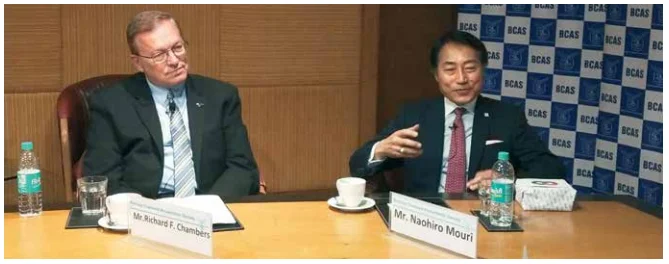
 

Transfer of intangible rights: Sale or service?

fiogf49gjkf0d

In a recently reported
case of Mahyco Monsanto Biotech (India) Pvt. Ltd. vs. Union of India 2016 (44)
STR 161 (Bom) whereunder two writ petitions, one filed by the captioned company
(referred to as the Monsanto) and the other filed by Subway Systems (India)
Pvt. Ltd. (Subway), Hon. Bombay High Court painstakingly examined whether each
of the transactions involved were liable for VAT or service tax.  Although the facts in both the petitions were
totally different, interestingly the petitions were tagged together on finding that
the issue involved was similar.  Facts in
both the cases are briefly summarized below:

Monsanto’s
case:

The petitioner, Monsanto
supplied to third parties certain type of hybrid cotton seed which was infused
with a proprietary technology that protects it against a known menace to cotton
corp.  From these hybrids, these parties
generate large quantities of sowable seeds which are in turn sold to cotton
farmers.  The end product seeds thus have
the benefit of menace protection technology. 
The parties to whom the technology is provided in the form of seeds, (known
as donor seeds) make commercial use of the technology.  In the backdrop of these facts, Monsanto has
claimed that this is a case of offer of technology through container seeds.  The party pays for technology and not
container.  They do not sell any goods to
the end user.  Therefore, there being no “transfer
of right to use”, they should be exigible to service tax.  Central to their claim was
non-exclusivity.  Monsanto licensed to various
third parties the said technology.  Those
developers in turn cannot sub-license the technology.  They use it to produce sowable seeds.  Therefore the recipients of technology obtain
right to use the technology but there is no transfer of that right.  The container seed is the only means by which
technology can be transferred.  Provision
of technology was followed by training for using donor seeds and developing
foundation seeds and training for undergoing regulatory tests before the
licensee could produce foundation seed. For this, a one-time fixed fee plus a
trait fee was received by Monsanto under the agreement with third parties.  Petitioner’s plea was that service tax and
VAT are mutually exclusive and well settled relying inter alia on BSNL 2006 (2) STR
161 (SC)
, Imagic Creative Pvt. Ltd.
vs. CTO 2008 (9) STR 337
and Association
of Learning and Finance Companies vs. UOI 2010 (20) STR
417
.  The petitioner’s main
contention was that there did not involve “transfer
of right to use goods”
in the transaction of providing donor seeds.  This was pleaded mainly on the ground that
there is absence of ‘exclusivity’ and inability of the transferor to transfer
the same right to another in terms of twin
tests
comprised in the five attributes required to be satisfied as laid
down in the case of BSNL (supra).  In
this judgment to constitute a transaction as one of “transfer of right to use the goods”, 5 attributes are required to
be satisfied viz. there are goods available for delivery, there is consensus ad
idem as to the identity of the goods, the transferee must have a legal right to
use the goods and the twin tests of temporary ‘exclusion’ of the transferor to
have the said right i.e. during the period the transferee has such right and
incapacity of transferor to again transfer the same rights to others.  According to the petitioner, the said test
applies to tangible and intangible goods equally and therefore the law laid
down in Duke & Sons (1999) 1 Mah LJ
26,
Tata Sons Ltd. vs. State of Maharashtra
(2015) 80 VST 173 (Bom)
and Nutrine
Confectionary Co. Pvt. Ltd. vs. State of Andhra Pradesh (2011) 40 VST 327 (AP)

did not represent correct position in law as certain facts were not made available
to the Court at the time these cases were decided. For instance, when Duke
& Sons’ case (supra) was decided, judgment of Supreme Court interpreting
Article 366 (29A)(d) was not available.  Further,
in Nutrine’s case (supra), BSNL’s test was not correctly applied and it was contrary
to BSNL.  Based on these submissions
among others, it was pleaded that their case is one of permissive use only and
not a sale or deemed sale. Since such transaction of permissive use is covered
under service tax law, it is one of service.

Subway’s
case:

In this case, the
transaction is a franchise agreement. Subway has claimed that franchise
agreement is a pure service.  Its
franchisees in Mumbai have obtained right to display Subway’s trademarks.  The franchisees enjoy no title to these trademarks.  This is therefore neither a sale nor a deemed
sale.  Subway’s business consists of possessing
non-exclusive sub-license from Subway International B.V., a Dutch LLC (which in
turn received in a second layer from an American company owning proprietary
rights) to establish, operate and franchise others to operate SUBWAY branded
restaurants, serving sandwiches and salads under the service mark, SUBWAY in
India.  Under franchise agreements
entered into with third parties, specified services are listed to enable
franchisee to operate sandwich shops in Subway’s name.  The rights are limited and they are non-transferable
or non-assignable.  Further, Subway
reserves the right to compete with its franchisees.  Consideration from the franchisees is received
by way of one-time franchise fee and royalty payable weekly based on weekly turnover.  The petitioner paid service tax since 2003 on
these fees.  The State Government however
contended that since the franchisee has acquired right to use trademarks, there
is a transfer of right to use those trademarks and therefore claimed VAT on
this in 2014 and issued notice to this effect and subsequently several show
cause notices as well as exparte assessment order.  The petitioner pleaded that the franchise
agreement was not one for sale or transfer of right to use but merely
permitting the franchisee to display certain marks and use certain technologies
and methodology to prepare salads and sandwiches for sale and this was a
permissive use.  Subway could enter into
as many / as few agreements with other franchisees even simultaneously and
could compete with its franchisees.  The
license provided thus is limited.  Apart
from this factual aspect, it was also pleaded for Subway that in the light of
several decisions of the Supreme Court on various composite contracts, Article
366(29A) was amended in 1983 whereby only under six specific situations,
transactions could be considered deemed sale and the amendment allowed specific
composite contracts to be divisible and by separating element of ‘sale’ it
could be taxed.  Subway’s agreement could
not be split and sale was not distinctly discernible.  However, the revenue contended that
‘franchise’ and ‘trademarks’ are expressly covered under MVAT Act since 2005 as
‘goods’ and therefore liable for VAT. 
Both revenue and the petitioner relied on Tata Sons Ltd. vs. State of Maharashtra (2015) 80 VST 173 (Bom). The
petitioner chiefly relied on Asian Oilfield
Services vs. State of Tripura (2015) SCC (online Tai 483
and BSNL (Supra) 
and Imagic Creative (supra).

Findings
of the Court:

The Court on a very
careful consideration in Monsanto’s case found that although ld. Counsel for
the petitioner commended that the transaction of transferring technology was
one of “permissive use”, in view of the Court, the said interpretation was not
supported by law.  The Court observed
that the seeds transferred were fully vested in the transferee.  On the issue of effective control, the Court
observed that effective control over the said seed and therefore that portion
of the technology embedded in the seeds was also transferred to the transferee.  The transferee could do whatever it wished
and Monsanto had no control left after the transfer.  Hence the transfer was to the exclusion of
Monsanto India and this satisfied the twin test laid down in BSNL.  The Court, in this context categorically observed
that BSNL’s judgment noted various factual aspects and the test was therefore
set out in those circumstances. Thus Hon. Supreme Court in that case did not
have occasion to consider its applicability to intangible property like
intellectual property.  The Court thus
also observed that Tata Sons (supra) was interpreted accordingly whereas Kerala
High Court in Malabar Gold (para 35), 2013 (32) STR
3 (Ker) took a contrary view.  It took
BSNL test to be applicable as a general proposition.  The Court expressed that they had serious
reservation about its universal applicability by stating, “we do not think this can ever be a correct reading of BSNL”.  Further that the Bombay High Court in Duke &
Sons (supra) held that test would not be applicable in the case of
trademarks.  According to the Court
therefore the law laid down in Duke & Sons is a good law.  The Court thus considered the instant case to
be the case of a transfer of the right to use goods while inter alia also
referring to various clauses in the agreement pointed out by the revenue in
support thereof.  For instance under a
specific clause 7.1, the sub-licensee could assign the agreement and its rights
and obligations under the agreement to its wholly-owned subsidiaries without
permission of Monsanto.  This according
to the Court would not happen if there was only permissive use as claimed by
the petitioner. Revenue’s reliance on the case of G. S. Lamba & Sons vs. State of Andhra Pradesh (2011) 43 VST 323
was viewed as well-founded by the Court while observing that in the instant
case, sub-licensing actually amounted to passage of effective control.  The Court also drew analogy in fair detail
with downloading of software by purchasing license.  The Court observed that when a license is
purchased, it is still a sale although what the user has purchased is a right
to use software.  Proprietary rights to
the software do not have to be transferred or sold.  On identical lines in the instant case
identified technology, the one which was infused in seeds were transferred to
use as the transferee wished.  The
intellectual property may continue to be owned by Monsanto.

Finding this case to be diametrically
opposed to model in the case of Subway, the Court observed that primarily
reliance on the case of Asian Oilfield and BSNL by the petitioner was correct
as Subway’s transaction could not be split into two distinct or severable
components.  If State was to be permitted
to tax the whole transaction, it would mean extending upon the power of the
Centre under the Union List.  The Court
noted that agreement between Subway and its franchisee is a bare permission to
use as there is no passage of any kind of control or exclusivity to the
franchisees and for all the reasons in law and fact that licensing of
technology in Monsanto is held to be transfer of right to use, the franchise
agreement in Subway’s case must be held permissible use only. 

The Court however noted
with caution to state that this did not mean that every franchise agreement
will necessarily be outside the purview of amended MVAT Act.  However, merely because of inclusion of
franchisees under MVAT Act would not automatically make all franchise
agreements liable to VAT.  There may be
class of agreements of franchise that would have all incidents of a ‘sale’ or a
“deemed sale” i.e. transfer of the right to use to attract VAT and not
otherwise.  However, limiting its view on
the agreement under the case of Subway, the Court opined that the facts of the
case does not constitute a sale exigible to VAT.  Equally it rejected a proposition that the
transaction which is nothing but a service could be converted as sale merely because
an entry is inserted in the State statute. 
Subway agreements are purely licensing agreements consisting of permissive
right to franchisees to use defined intangible rights, therefore not amenable
to VAT but a service liable for service tax.

Conclusion:

The above decision in
particular in the case of Subway relying on the decision of Tata Sons Ltd. vs. State of Maharashtra
(2015) 80 VST 173 (Bom)
based on an altogether different aspect reached a
verdict that the franchise agreement involved is exigible to service tax than
one reached in the  case of Malabar Gold Pvt.
Ltd. (supra).  In Subway’s case above, it
is found that only “permissive use” is granted under the agreement and
therefore it cannot be interpreted as “transfer of right to use goods” whereas
Kerala High Court decided “franchise agreement” as one of service simply based
on interpreting the tests provided in BSNL’s case (supra) as having general
proposition even vis-à-vis intangible goods like intellectual property. It is
important to note that in this case, the Court has categorically made a point
in the context of Monsanto’s case that in the case of BSNL (supra), Hon.
Supreme Court did not have occasion to examine the aspects of transfer of
intangible goods such as intellectual property. Therefore the tests laid down
therein for determining a transaction of “transfer of right to use goods”
should not be followed as having universal application and especially in the
context of transactions involving transfer of use of intangible goods.  A thin line divides a transaction of service
from that of sale.  The controversy soon
is likely to be part of history with the onset of GST regime coming into force
in a short while.  Yet, one cannot ignore
the hardship faced in this regard by a large number of tax compliant entities
which have paid tax under one law and has  to face wrath of the other for want of
appropriate law and mechanism to resolve the manmade issue.

(Readers may read the
above with March, 2016 issue of BCAJ article on transfer of use of intangibles
under service tax feature).

[2016] 73 taxmann.com 91 (Kol – Trib.) Bombay Plaza (P.) Ltd. v. ACIT ITA Nos. 1641 & 1203 (Kol) of 2014 A.Ys.: 2006-07 and 2007-08, Dated: 02.09.2016

fiogf49gjkf0d

S. 22 r.w.s.
27(iiib)  – The provisions of section 22
read with section 27(iiib) are not attracted in the case of an assessee who is
a licensee and not a lessee.  

FACTS: 

The assessee company, formed with the
main object of acquiring on license or by purchase, etc premises in India and
also to license or sub-license or lease or sub-lease such lands, or property or
premises, had entered into an agreement 
dated 16.4.1991 with East India Hotels Ltd. under which it got on leave
and license basis 9000 sq. feet in Hotel Oberoi Towers, Bombay for the purpose
of using it as a shopping centre.  The
tenure of the leave and license was for a period of 50 years at a fixed monthly
license fee agreed between the parties. 
After acquiring the said shopping space the assessee utilized it in
granting different portions of the shopping space to various parties who were
interested in setting up shops there with the condition that shopkeepers had to
subscribe to a specific number of shares of the assessee apart from payment of
monthly charges.  The assessee also
provided various services to the licensees like air-conditioning, telephone
services, maintenance, electricity, water, sanitary, security, etc.  The assessee was basically involved in the
business of providing the said shopping space on license along with various
services.  The consideration from this
activity was shown as business income. 
The assessee claimed license fee paid to East India Hotels as a
deduction.

While assessing the total income of the
assessee under section 143(3) of the Act, the Assessing Officer (AO), in view
of the provisions of section 22 r.w.s. 27(iiib) of the Act, charged the said
income under the head `Income from House Property’.

Aggrieved, the assessee preferred an
appeal to the CIT(A) who confirmed the action of the AO.

Aggrieved, the assessee preferred an
appeal to the Tribunal.

HELD:

The Tribunal noted that the license was
not only for use of the shop area but also for the use of facilities like
air-conditioners, use of elevators, etc. 
It noted various clauses of the leave and license agreement with a view
to ascertain whether the subject matter of agreement was a lease or a
license.  It noted the definition of
`lease’ under Transfer of Property Act and the definition of `license’ under
the Indian Easements Act and keeping in mind these definitions it laid down the
distinction between the lease and the license. 
Applying the tests so laid down it came to the conclusion that the
parties intended it to be a license and the agreement did not create any
interest in the property owned by the licensor and that the licensee did not
have exclusive possession of the property. 
The assessee, as a licensee, had granted sub-license to various parties
and derived income therefrom.  It held
that once it is concluded that the assessee is only a licensee, then it can
safely be said that the provisions of section 22 read with section 27(iiib) of
the Act are not attracted.  Accordingly,
it held that the income in question cannot be assessed under the head `Income
from House Property’. 

The Tribunal also observed that keeping
in mind the objects of the assessee and the facts and circumstances of the
assessee’s case, it can be safely concluded that the assessee carried on a
systematic and regular activity in the nature of business and therefore the
income from granting the premises on sub-license was to be assessed under the
head `Income from Business’.  It observed
that the latest decision of the Apex Court in the case of Chennai Properties
and Investments Ltd. (373 ITR 673)(SC) was not available to the Tribunal when
it passed the order in case of another group company based on which decision of
the Tribunal the CIT(A) confirmed the action of the AO. 

The Tribunal held that in view of the
decision of the Apex Court in the case of Chennai Properties and Investments
Ltd. (supra) the question whether the assessee is a deemed owner under section
22 r.w.s. 27(iiib) of the Act, no longer assumes importance.

The Tribunal allowed the appeal filed by
the assessee.

Mohamed Taslim Shaikh v. Addl. CIT ITAT Mumbai `B’ Bench Before Shailendra Kumar Yadav (JM) and Rajesh Kumar (AM) ITA No. 7259/Mum/2012 A.Y.: 2009-10. Dated: 04.08.2016. Counsel for assessee / revenue: Dr. K. Shivram, Ms. Nilam Jadav / Randhir Gupta

fiogf49gjkf0d
S. 271D – Penalty under section 271D cannot be levied in a case where assessee was prevented by reasonable cause to accept money from his close relative like father for making payment for immovable property.

FACTS:  

The assessee filed his return of income declaring total income of Rs.1,87,750.  In the course of assessment proceedings it was noticed that the assessee’s father made a payment of Rs.10,69,000 on behalf of the assessee for purchase of property which amount was treated as a loan in the books of account of the assessee.  The Assessing Officer initiated proceedings for levy of penalty under section 269SS read with section 271D of the Act.  After considering the reply of the assessee, the AO levied a penalty of Rs. 10,69,000.

Aggrieved, the assessee preferred an appeal to the CIT(A) who upheld the action of the AO.
Aggrieved, the assessee preferred an appeal to the Tribunal.

HELD: 
The Tribunal, upon going through the material on record, observed that a similar addition was deleted by ITAT, Ahmedabad `A’ Bench in the case of ITO v. Dattuprasad Manharlal Dave in ITA No. 1816/Ahd/2013, wherein on a similar issue, relief was granted to the assessee.  It also observed that similar view has been taken by Allahabad High Court in the case of CIT v. Smt. Dimpal Yadav & Akhilesh Kumar Yadav (2015) 379 ITR 177 (All.)(HC) wherein the Hon’ble High Court upheld the order of the Tribunal interalia holding that loan transaction was genuine and there was reasonable cause for cash loan in similar situation.  The Tribunal directed the AO to delete the penalty levied under section 271D because assessee was prevented by reasonable cause to accept the money from his close relative like father for making payment for immovable property.

The appeal filed by the assessee was allowed.

[2016] 73 taxmann.com 36 (Mum – Trib.) Kamlesh M. Kanungo HUF v. DCIT- TDS ITA Nos.: 4045 & 4046 (Mum) of 2015 A.Ys.: 2011-12 and 2012-13, Dated: 19.09.2016

fiogf49gjkf0d

S. 221 r.w.s.
201  – For the purposes of Explanation
below section 221(1) which prescribes that an assessee shall not cease to be
liable to penalty under sub-section (1) of section 221 merely by reason of the
fact that before levy of such penalty, he has paid tax a distinction has to be
made between  a case where the TDS is
deposited suo motu before any proceedings are initiated by the AO and a case
where the deposit of the TDS is made after initiation of proceedings by the AO
but before levy of penalty.  

FACTS:

The assessee HUF deducted income-tax
amounting to Rs. 1,71,88,352 under section 194A of the Act but did not deposit
it by due date which was 31.5.2011 but deposited it only on 30.6.2011 along
with interest. 

The Assessing Officer (AO) levied
penalty of Rs. 5,10,000 which was equivalent to 3% of the defaulted amount of
TDS. 

Aggrieved, the assessee preferred an
appeal to CIT(A) who upheld the action of the AO by noticing that non-deposit
of requisite TDS to the Government Treasury was an admitted position.

Aggrieved, the assessee preferred an
appeal to the Tribunal.

HELD: 

The Tribunal observed that the proviso
to section 221(1) clearly suggests that the levy of penalty under section
221(1) is not automatic and that the AO is empowered to use his discretion not
to levy penalty if the default is for good and sufficient reasons. It noted
that the bonafides of the assessee in complying with the requirements of
depositing the tax into the Government Treasury stood established in as much as
the tax had been deposited even before the corresponding interest amounts were
paid to the respective creditors and also before any proceedings were initiated
by the AO. 

The Tribunal held that the Explanation
below section 221(1) refers to a situation where the tax has been paid “before
the levy of such penalty”, whereas in the facts of the present case the
assessee had deposited the requisite TDS along with applicable interest into
the Government Treasury even before any proceedings under section 201(1) of the
Act were initiated by the AO. 
Considering the penal nature of section 221 it would be in the fitness
of things to make a distinction between a case where the TDS is deposited suo
motu before any proceedings are initiated by the AO and a case where the
deposit of TDS is made after initiation of proceedings by the AO but before
levy of penalty.  It held that the
Explanation will not militate against the assessee because of this
distinction.   The Tribunal held that
there existed ‘good and sufficient reasons’ to mitigate the default in
question, and thus, the proviso to section 221(1) of the Act clearly comes to
the rescue of the assessee.

The Tribunal deleted the penalty levied
under section 221(1) r.w.s. 201(1) of the Act by the AO.

The Tribunal allowed the appeal filed by
the assessee.

[2016] 72 taxmann.com 91 (Kol – Trib.) Union Bank of India v. ACIT ITA Nos. 7589 (Mum) of 2014 A.Y.: 2008-09, Dated: 11.08.2016

fiogf49gjkf0d

S. 244A  – While granting refund in pursuance to the
appeal effect order, the amount of refund granted earlier should be adjusted
first against the interest component of the earlier refund and thereafter the
balance amount should be adjusted against the principal component of tax in the
refund order granted earlier.  

FACTS:

The Assessing Officer (AO) while
computing the amount of refund arising as a result of passing an order giving
effect to the order of CIT(A) granted interest of Rs. 64,53,58,824 as against
the amount of Rs. 65,73,42,440 claimed by the assessee.  The discrepancy, according to the assessee,
arose because the AO adjusted the refund granted to the assessee first against
principal amount of tax due instead of adjusting it first against the amount of
interest and thereafter against the principal amount of tax.

Aggrieved, the assessee filed an appeal
to the CIT(A) who distinguished the order of the Tribunal, in the assessee’s
own case, for earlier year on the ground that the said order of the Tribunal
has not considered the decision of the Apex Court in the case of Gujarat Fluoro
Ltd. (358 ITR 291).

Aggrieved, the assesse preferred an
appeal to the Tribunal.

HELD: 

The Tribunal noted that the issue under
consideration was decided by the Tribunal, for AY1998-99, 2001-02 &
2005-06, in favour of the assessee.  It
noted that the earlier orders of the Tribunal were based on decision of the
Delhi High Court in the case of India Trade Promotion Organisation wherein it was
inter alia held that in a situation where only part amount is refunded by the
Department, then payment of interest on the balance amount due from the
Department to the assessee, on a particular date, does not amount to payment of
interest on interest.  The Delhi High
Court, while arriving at this decision, had taken support from the judgment of
the Supreme Court in the case of CIT v. HEG Ltd. (2010) 324 ITR 331 (SC). 

The Tribunal observed that the facts
before it were similar to the facts of the case before the Delhi High Court in
the case of India Trade Promotion Organisation (supra) since in the present
case also only part amount was refunded in the first phase by the department
and when the balance amount was paid by the department in the second phase, the
assessee was entitled for interest on the balance amount of refund due.  It held that, in view of the observations of
the Delhi High Court, it can be said that it is not a case of payment of
interest on interest.  It also noted that
the Delhi High Court has held that the department ought to follow the same
procedure and rules while collecting tax and while issuing refunds. 

The Tribunal held that since the statute
itself has already prescribed a particular method of adjustment in Explanation
to section 140A(1), then justice, fairness, equity and good conscience demands
that same method should be followed while making adjustment for refund of
taxes, especially when no contrary provision has been provided. 

Following the order of the Tribunal of earlier
years, the Tribunal directed the AO to re-compute the amount of interest under
section 244A by first adjusting the amount of refund already granted towards
interest component and balance left, if any, shall be adjusted towards the tax
component.

The Tribunal allowed the appeal filed by
the assessee.

ACIT v. K. S. Constructions ITAT Mumbai `A’ Bench Before Shailendra Kumar Yadav (JM) and Rajesh Kumar (AM) ITA No. 7660/Mum/2014 A.Y.: 2010-11. Dated: 12.08.2016. Counsel for revenue / assessee: Vijay Kumar Bora / Ms. Aarti Vissanji

fiogf49gjkf0d
S. 28 – Addition for suppressed sale cannot be made on the ground that the flat was sold at a rate lower than the rate at which other flats in the building were sold specially when the sale was at a price above the stamp duty value.

FACTS:  

The assessee firm carried on business as builders and developers.  During the year under consideration it had declared income from business and income under the head other sources.  In the course of assessment proceedings the Assessing Officer (AO) noticed that the assessee had offered profits in respect of 6 commercial units sold during the year.  Of the six units sold the sale deeds in respect of the 5 units were registered in the financial year 2009-10.

The relevant details in respect of units sold can be tabulated as under –


Unit

Rate /
sq. mt

Rupees

Date of
registration of sale agt

Date of

First

payment

303

33,333

3.3.2006

30.12.2005

301

34,871

18.12.2009

7.2.2006

101

2,94,485

18.12.2009

19.8.2009

302

78,327

4.10.2009

24.11.2009

4th
floor

2,38,576

18.11.2009

13.7.2009

5th
floor

2,38,576

18.11.2009

13.7.2009

The AO asked the assessee to explain the difference in rate charged for unit no. 302 as compared to that charged for unit no. 101.  The assessee explained that the unit no. 302 suffered from design disadvantages and therefore it could not get customers to purchase unit no. 302 whereas the unit no. 101 commanded a price higher than the other units because it had a locational advantage of entire floor suitable for car show room as compared to unit no. 302.

The AO considering the date of first payment as well as date by which total payment was received by the assessee in respect of unit no. 101 and 302 held that the two transactions are comparable. He observed that it is a prevalent practice in real estate dealings; underhand transactions of on money cannot be denied specially in view of the fact that the difference in rate was more than three times.  He applied the rate at which the first floor premises were sold for the purposes of determining the actual sale rate for unit no. 302.  He, accordingly, added Rs. 4,16,70,874 to the total income of the assessee as unaccounted income from sale of unit no. 302.

Aggrieved, the assessee preferred an appeal to CIT(A) who granted relief to the assessee.

Aggrieved, the revenue preferred an appeal to the Tribunal.

HELD: 

The Tribunal observed that

(i)    apart from Unit No. 302, date of agreement of unit no. 301 and that of units on 4th & 5th floors also fell in the same financial year;
(i)    the sale price of unit no. 302 is higher than its stamp duty valuation;
(ii)    the AO had accepted the variation in rates for sale of unit nos. 301, 302 and 4th & 5th floor vis-à-vis the rates for sale of unit no. 101.
(iii)    the AO has not brought any evidence on record  to show as to how the explanation of the assessee that there are locational disadvantages in case of Unit no. 302 is not correct;
(iv)    the AO has not brought any evidence to establish that there has been on money transaction for sale of said Unit no. 302;
(v)    it is not the case of the AO that the transaction is between related parties.
In the light of the above factual position, it observed that the addition made by the AO was simply on the basis of difference in booking of unit no. 101. It noted that CIT(A) had relied on the decision of Mumbai Bench of ITAT in the case of Neelkamal Realtors & Erectors India(P.) Ltd (2013) 38 taxman.com 195 (Mum-Trib) and held that AO had not controverted the explanation furnished by the assessee during the course of assessment proceedings to explain the reasons for charging lower price in respect of unit no. 302 sold vis-à-vis rate / price for unit no. 101.

The Tribunal held that the CIT(A) had rightly deleted the addition of Rs. 4,16,70,874.

The appeal filed by the revenue was dismissed.

[2016] 73 taxmann.com 68 (Mum-Trib)(SMC) Smt. Manasi Mahendra Pitkar v. ACIT ITA No. 4223 & 4224/Mum/2015 A.Y.: 2011-12, Dated: 12.08.2016

fiogf49gjkf0d

S. 68 – The
bank pass book or bank statement cannot be construed to be a book maintained by
the assessee for any previous year as understood for the purposes of section
68.

FACTS: 

These were two appeals preferred by
husband and wife.  In both the appeals,
the common dispute was that the cash deposits made in the joint bank account to
the extent of Rs. 27,36,500 were treated as unexplained cash credits within the
meaning of section 68 of the Act. Substantive addition was made in the case of
Mahindra Chintaman Pitkar, the husband, and protective addition was made in the
case of Manasi Mahendra Pitkar, wife. The Tribunal in its order dealt with the
appeal in the case of husband as the lead appeal.

The assessee, an individual was employed
with Municipal Corporation of Greater Mumbai. The Assessing Officer (AO)
noticed that during the year under consideration cash aggregating to Rs.
29,53,500 was deposited in the joint bank account of the assessee and his wife
with Thane Janata Sahakari Bank. 

On being asked the assessee explained
that the amounts were received from his father, father-in-law, son and various
other relatives & friends and that these amounts were used by him for
treatment of his wife who was bedridden and was suffering from the disease of
multiple sclerosis which required costly medical treatment.  It was explained that expenditure of Rs. 30
lakh a year was required to be incurred for medical treatment of his wife and
since the assessee was a salaried employee with limited resources he had
received amounts from family members, relatives and friends for the medical
treatment of his wife.

The AO added the sum of Rs. 29,53,500 to
the total income of the assessee on a substantive basis and also made similar
addition on protective basis in the case of his wife.

Aggrieved, the assessee preferred an
appeal to CIT(A) who gave relief to the extent of Rs. 2,70,000 with respect to
withdrawals found in the bank account of assessee’s father and confirmed the
addition of Rs 27,36,500 as unexplained cash credit under section 68 of the
Act.

Aggrieved, the assessee preferred an
appeal to the Tribunal.

HELD:

In the course of hearing
before the Tribunal, affidavit of the assessee narrating the factual position
about the disease of his wife and the utilization of funds for the medial
treatment was filed and the documents in support of the facts narrated in the
affidavit were also filed. The Tribunal considered the ratio of the judgment of
Bombay High Court in the case of Bhaichand N. Gandhi (1983) 141 ITR 67
(Bom).  It noted that the assessee did
not maintain any books of account and section 68 of the Act had to fail because
as per the judgment of the Hon’ Bombay High Court in the case of Shri Bhaichand
N. Gandhi (supra), the bank pass book or bank statement cannot be construed to
be a book maintained by the assessee for any previous year as understood for
the purposes of section 68 of the Act. 
It held that on this account itself the addition deserves to be deleted.

The Tribunal also observed
that the circumstances in which the cash deposits were made and the purpose for
which such monies were utilized was emerging from record and no material was
found by the AO to disprove the same.  It
noted that the assessee could not produce any formal corroborative evidence of
having received respective amounts from friends, relatives, however, it
observed that section 68 is a rule of evidence, and, the AO is expected to
consider the explanation rendered in the context of the circumstances of each
case.

The Tribunal held that the
addition is unsustainable in view of the ratio of the Bombay High Court in the
case of Shri Bhaichand N. Gandhi (supra). 

The order of CIT(A) was set
aside and the AO was directed to delete the addition of Rs. 27,36,500 made
under section 68 of the Act.

Since the substantive
addition in the case of the husband was deleted, the Tribunal held that the
protective addition in the hands of the wife was also unsustainable.

The appeals filed by the
assessee were allowed.

Lintas India Pvt. Ltd. v. ACIT(TDS) ITAT Mumbai `A’ Bench Before R. C. Sharma (AM) and Ram Lal Negi (JM) ITA No. 3504/Mum/2014 A.Y.: 2010-11. Dated: 02.08.2016. Counsel for assessee / revenue: Prakash Jotwani / Morya Pratap

fiogf49gjkf0d
S. 194J – Internet charges for use of internet connectivity are not covered by section 194J.

S. 194J – Payment for computer software development does not qualify for deduction under section 194J.

FACTS-I:  

The assessee, during the year, paid internet charges for use of internet connectivity and deducted tax thereon under section 194C of the Act.  The Assessing Officer (AO) held that the payment so made qualifies for deduction of tax under section 194J as “fees for technical services”.  He, accordingly, held the assessee to be an assessee-in-default under section 201(1) / 201(1A) of the Act.

Aggrieved, the assessee preferred an appeal to CIT(A) who upheld the action of the AO and held that as per the amendment, the domestic payments are now covered under section 194J and therefore the ratio of the decision relied on by the assessee in the case of Skycell Communications Ltd. (251 ITR 53)(Mad HC) is not applicable in the instant case.

Aggrieved, the assessee preferred an appeal to Tribunal.

HELD:  

The Tribunal held that the issue under consideration is squarely covered by various decisions of High Court and Tribunal.  It noted that –
(i)    the Delhi High Court had an occasion to examine a similar issue in the case of CIT v. Estel Communications (P.) Ltd. (217 CTR 102)(Del) wherein the Court held that mere payment by assessee for an internet bandwidth to a US company did not mean that technical services were rendered by the US company to the assessee and, therefore, provisions of section 9(1)(vii) did not apply so as to warrant any deduction of tax from payment made by the assessee to the US company;
(ii)    the Madras High Court in Skycell Communications Ltd and another v. DCIT & Others (2011) 251 ITR has considered the provisions fo section 9(1)(vii);
(iii)    Chandigarh Bench of ITAT in the case of HFCL Infotel Ltd. v. ITO (99 TTJ 440)(Chand. ITAT) referred to the decision of Madras High Court in Skycell Communications Ltd.;
(iv)    Mumbai Bench of ITAT has in the case of Pacific Internet (India) Pvt. Ltd. v ITO 318 ITR 179 (Mum)(AT) has relied upon the observations rendered in Estel Communications Pvt. Ltd. (supra) and Communications Ltd. (supra) and held that payment for use of internet is not covered by the provisions of section 194J;
(v)    Hyderabad Bench of the Tribunal has in the case of Ushodaya Enterprises P. Ltd. v. ACIT (2012) 53 SOT 193 (Hyd.) has held that payment made towards internet charges are similar in nature to bandwidth charges and are similar to the use of telephone lines, payments made for circuit charges to VSNL, bandwidth charges do not come under TDS provision and therefore no deduction is required under section 194J.
Relying on the ratio of the above, the Tribunal held that the assessee cannot be held to be in default for non-deduction of tax on internet charges under section 194J of the Act.

This ground of appeal filed by the assessee was allowed.

FACTS-II:

The AO held the assessee to be in default for not having deducted tax on payment of Rs. 14,96,240 towards purchase of computer software development. The AO was of the view that payment for purchase of software qualifies as a “technical service” and requires deduction of tax under section 194J of the Act.  He, accordingly, held the assessee to be an assessee-in-default under section 201(1) and levied interest under section 201(1A).

Aggrieved, the assessee preferred an appeal to CIT(A) who confirmed the action of the AO.

Aggrieved, the assessee preferred an appeal to the Tribunal.

HELD – II:

Explanation 2 of section 9(1)(vii) defines the words “Fees for technical services” as any consideration (including any lumpsum consideration) for rendering any managerial, technical or consultancy services.  It noted that the perusal of the aforesaid definition clarifies that the term FTS would include service of the following three types : Managerial, Technical and Consultancy.  Therefore, in order to decide whether the service will fall within FTS or not, it is necessary to determine the scope of these three terms.  Considering the scope of these terms as defined by the Mumbai Bench of the Tribunal in the case of TUV Bayren (India) Ltd. dated 6.7.2012 in ITA No. 4994/Mum/2002 it held that the computer software purchased would not fall within the definition of “Fees for technical services” and therefore the provisions of section 194J are not applicable.

The Tribunal held that tax is not required to be deducted at source in respect of payment made for purchase of computer software development.

This ground of appeal was decided in favour of the assessee.

ITO v. Uma Developers ITAT Mumbai `F’ Bench Before Jason P. Boaz (AM) and Sandeep Gosain (JM) ITA Nos.: 7718/Mum/2014 A.Y.: 2012-13. Dated: 10.08.2016. Counsel for revenue / assessee: A K Dhondial / Vijay Mehta

fiogf49gjkf0d
Ss. 80AC, 80IB(10), 139(1), 139(4), 143(1) – In a case where the return of income is filed beyond the period stipulated under section 139(1) but within the period stipulated in section 139(4), it is beyond the scope of section 143(1) to disallow the assessee’s claim for deduction under section 80IB(10) of the Act.

FACTS:  

For assessment year 2012-13, the assessee firm filed its return of income on 31.3.2013 claiming deduction of Rs. 3,53,17,770 under section 80IB(10) of the Income-tax Act, 1961 (“the Act”). The Assessing Officer (AO) while processing the return on 10.5.2013, in view of the provisions of section 80AC of the Act disallowed the claim of deduction under section 80IB(10) for the reason that the assessee had filed its return of income beyond the time limit specified under section 139(1) of the Act.

Aggrieved with the order dated 10.5.2013, the assessee preferred a rectification appeal under section 154 of the Act contending that the disallowance of assessee’s claim for deduction under section 80IB(10) was beyond the scope of provisions of section 143(1) of the Act.  ACIT(CPC) vide order dated 16.3.2013 passed under section 154 of the Act rejected the application of the assessee.

Aggrieved, the assessee preferred an appeal to the CIT(A) who observed that the Bombay High Court and Benches of ITAT at Mumbai, Bangalore and Ahmedabad have even in cases where return of income was filed beyond due date specified under section 139(1) of the Act, either allowed the deduction under section 80IB(10) or have set aside the issue to the file of the authorities below for consideration of the eligibility of the claim with the direction that the claim for deduction should not be denied merely on the ground that the return of income was filed beyond the time specified under section 139(1) of the Act. He also observed that the provisions of section 80AC of the Act were subject matter of discussion and interpretation in various judgments.  He, accordingly, held that the disallowance made by the AO is beyond the scope of the provisions of section 143(1) of the Act.

Aggrieved, the Revenue preferred an appeal to the Tribunal.

HELD:  

Considering the ratio of the decisions of the Bombay High Court in the case of Trustees of Tulsidas Gopalji Charitable & Chaleshwar Temple Trust (207 ITR 368)(Bom) and of the co-ordinate Bench in the case of Yash Developers (ITA No. 809/Mum/2011) even in cases where the return of income is filed beyond the due date stipulated under section 139(1) of the Act, the deduction should not be disallowed under section 143(1) merely in view of the provisions of section 80AC of the Act.  It held that the action of the AO in disallowing the assessee’s claim for deduction under section 80IB(10) of the Act, since the return of income was filed beyond the period stipulated under section 139(1) of the Act in view of the provisions of section 80AC is beyond the scope of section 143(1) of the Act since there is neither an arithmetical error nor an incorrect claim apparent from the record.

The Tribunal upheld the order of the CIT(A) and directed the AO to delete the disallowance made under section 143(1)(a) / 143(1) of the Act.

The Tribunal dismissed the appeal filed by the Revenue.

[2016] 159 ITD 743 (Mumbai Trib.) ITO (TDS) (OSD) vs. Fino Fintech Foundation A.Y.: 2011-12 – Dated: 22.06.2016.

fiogf49gjkf0d

Section
194J read with Section 194C of the Income-tax Act, 1961- An assessee is
required to deduct tax under section 194J if it acquires or uses technical
knowhow which is provided by a human element. Mere use of technology by
contractors who provide services to the assessee would not make those services
technical services and hence when assessee makes payments to such contractors,
tax is required to be deducted under section 194C and not under section 194J.

FACTS:

The assessee Company was
involved in providing banking services through its network of agents in
extremely rural areas by use of a device called “Point of Transaction Machine
(POT)”.

The transactions of the
beneficiary/customers were settled at the end of the day by connecting the POT
to the Bank Server and the transactions of the beneficiary got reflected in the
beneficiary’s bank account.

In the relevant
assessment year, the assessee company had deducted tax u/s 194C on the payments
made to contractor towards the major expenses incurred under the heads – enrollment
charges, AMC charges, POT usage charges and rent for POT machines.

The AO observed that the
assessee was providing services for opening bank accounts to different banking
institutions in rural areas and that for opening bank accounts it was taking
help of other service-providers who would mobilise technical manpower for
opening the bank accounts. The service providers would prepare bio-metric and
demographic particulars of the customers and put the same in bank network for
the assessee.

The AO held that the
services of capturing photos and finger-prints by web camera and scanner
required highly technical skill and specified software and that the procedure
could not be performed by non-technical person. Hence, for such services,
payments made by the assessee under the heads enrollment expenses and AMC
charges would attract tax deduction under section 194J of the Act. Hence the AO
held that the assessee was in default under section 201(1) for the shortfall of
tax deduction and under section 201A for interest on the shorfall.

Aggrieved by the order of
the AO the assessee preferred an appeal before the First Appellate Authority
(FAA). The assessee argued that it had hired services of service provider as a
contractor and that mere use of technology and/or technical equipments by
service providers while doing the said composite work for assessee would not
make it as a technical service and hence the tax was rightly deducted u/s. 194C
of the Act.

The FAA held that
provisions of 194C were applicable as there was no acquisition / use of
technical know-how by the assessee.

On revenue’s appeal –

HELD:

In case of CIT v.
Delhi Transco Ltd. [2015] 380 ITR 398 the Hon’ble Delhi High Court has defined
the word technical services while dealing with the section 194 J of the Act, in
the following manner-

Section 194J of the Income-tax Act, 1961, provides
for deduction of tax at source from fees for technical services. Technical
services consist of services of technical nature when special skills or
knowledge relating to technical field are required for their provision,
managerial services are rendered for performing management functions and
consultancy services relate to provision of advice by someone having special
qualification that allow him to do so. What constitutes technical services
cannot be understood in a rigid formulaic manner. It will vary from industry to
industry. There will have to be a specific line of enquiry for determining what
in a particular industry would constitute rendering of a technical service.

In the case under
consideration, the FAA has rightly held that the provisions of section 194J
would not be applicable based on the following observation –

The services provided to the assessee were manual in
nature and no specific skills were required to provide the said services. The
services rendered by the parties to the assessee were neither in the nature of
fee for professional services, nor in the nature of managerial, technical or
consultancy services. Mere use of technology would not make it technical
services. For provisions of section 194J to be applicable, it is necessary that
there must either be acquisition or use of technical knowhow which is provided
by a human element. There was no acquisition of technical expertise/knowhow by
the assessee and the service providers were contractors executing contracts for
projects undertaken and hence the provisions of section 194C were applicable.

In the case under
consideration there is a use of technology, but, it does not mean that it is
not a contract. There is no legal or factual infirmity in the order of the FAA
and the assessee has rightly deducted tax as per the provisions of section 194C
of the Act.

Note – Relying on
the decision in case of CIT v. Bharti Cellular Ltd. [2009] 319 ITR 139 it was
also held that, the expression “fees for technical services” in
section 194J of the Income-tax Act, 1961 has the same meaning as given to the
expression in Explanation 2 to section 9(1)(vii) of the Act. In the said explanation
the expression “fees for technical services” means any consideration
for rendering of any “managerial, technical or consultancy services”.
Applying the rule of noscitur a sociis, the word “technical” would
take colour from the words “managerial” and “consultancy”,
between which it is sandwiched. Since both the words “managerial” and
“consultancy” involve a human element, the word “technical”
would also have to be construed as involving a human element.

TDS- Technical services- S. 194J of I. T. Act, 1961- A. Ys. 2007-08 to 2010-11- Transmission of electricity- No technical services- Tax not deductible on payment for such transmission

fiogf49gjkf0d
CIT Vs. Hubli Electricity Supply Co. Ltd.; 386 ITR 271 (Karn)

The assessee, an electricity supply company, was a state owned company engaged in the business of buying and selling electricity. Power was transmitted from the generation point to consumers through the transmission network of the Karnataka Power Transport Corporation Ltd. The Assessing Officer found that the assessee had not deducted tax at source on charges paid to Karnataka Power Transport Corporation Ltd. for transportation of electricity. He therefore treated the assessee as an assessee in default and raised demand u/s. 201(1) and (1A) of the Income-tax Act, 1961. Commissioner(Appeals) found that the assessee had successfully demonstrated that the taxes were already paid by the payee and accordingly cancelled the demand. This was upheld by the Tribunal.

On appeal by the Revenue, the Karnataka High Court upheld the decision of the Tribunal and held as under:

“i)    There was neither an offer nor an acceptance of any “technical service”, inter se between the parties. Admittedly, the Karnataka Power Transport Corporation Ltd. was a State owned company and the only power transmitting agency. There was neither transfer of any technology nor any service attributable to a technical service offered by the Karnataka Power Transport Corporation Ltd and accepted by the assessee.

ii)    Therefore, section 194J was not applicable. Moreover, it was not in dispute that the payee the Karnataka Power Transport Corporation Ltd had offered the income to tax and paid it. In the circumstances, there was no loss of revenue.

iii)    In the result, the appeals fail and accordingly stand dismissed.”

TDS: Ss. 10(23C)(iv), 194A, 194H, 201(1),(1A) of I. T. Act, 1961- A. Y. 2012-13- Payment of interest to entities exempted from tax- No tax need be deducted at source

fiogf49gjkf0d
CIT Vs. Canara Bank; 386 ITR 229 (P&H)

The assessee had paid interest without deduction of tax at source to Punjab Infrastructure Development Board whose income was exempt u/s. 10(23C)(iv) of the Income-tax Act, 1961. The Assessing Officer held that the assessee should have deducted tax at source and since tax was not deducted the assessee was treated as an assessee in default and raised demand u/ss. 201(1) and (1A) of the Act. The Commissioner(Appeals) deleted the demand and the same was upheld by the Tribunal.

On appeal by the Revenue, the Punjab and Haryana High Court upheld the decision of the Tribunal and held as under:

“i)    The Commissioner(Appeals) and the Tribunal, on appreciation of material on record had concurrently recorded that if an organization was exempted from payment of tax there was no need for deduction of tax at source by the assessee.

ii)    The Department was not able to demonstrate that the approach of the Commissioner(Appeals) and the Tribunal was erroneous or perverse or that the findings of fact recorded were based on misreading or misappreciation of evidence on record. No question of law arose.”

[2016] 159 ITD 255 (Pune Trib.) S.R.Thorat Milk Products (P.) Ltd. vs. Asst. CIT A.Ys.: 2004-05, 2005-06, 2007-08 to 2009-10, Date of Order: 20.05.2016

fiogf49gjkf0d

Section
37(1) read with Section 36(1)(iii) –
The share application money
pending allotment per se cannot be characterized and equated with share capital
as the obligation to return the share application money is always implicit in
the event of non-allotment of shares and consequently if the assessee incurs
interest expense on the share application money pending allotment, the said
interest expense can be claimed as revenue expenditure by the assessee.

FACTS:

During the various years
under appeal, the assessee had claimed deduction of interest paid, at the rate
of 12% per annum, on share application money pending allotment, while computing
business income.

The AO was of the opinion
that conditions laid down under section 36(1)(iii) are not fulfilled because ingredients
of borrowing as a positive act of lending by one and expense thereof by the
other, coupled with an obligation of refund or repayment thereof are not
present when the interest is paid on receipts in the nature of share
application money. Further the AO held that expenditure on account of interest
paid on share application money is not revenue but capital expenditure in
nature and therefore is not allowable under section 37(1) of the Act. He
accordingly disallowed the interest claimed by the assessee.

The CIT-(A) concurred
with the view of the AO and disallowed the claim of the said interest expense by
stating that when the money had been received with the intention of allotment
of shares, it could not subsequently acquire the colour of borrowed funds even
though it might have been utilized for business purposes.

Aggrieved by the order of
the CIT-(A), the assessee filed appeal before the Tribunal.

HELD:

Even though the share
application money has been pending allotment for a substantial period of time,
the revenue has not disputed the contention of the assessee that the share
application money was utilized for business purposes.

In our opinion, the share
application money per se cannot be characterized and equated with share
capital. The obligation to return the money is always implicit in the event of
non-allotment of shares in lieu of the share application money received.
Allotment of shares is subject to certain regulations and restrictions as provided
under the Companies Act and receipt by way of share application money is not
receipt held towards share capital before its conversion. Therefore, payment of
interest on share application money cannot be treated differently in the
Income-tax Act.

Relevant extract of the
observation made in case of ACIT v. Rohit Exhaust Systems (P.) Ltd. in IT Appeal
No.686 / 687 of 2011-

The
Hon’ble ITAT, Pune in the case of Western India Forging Ltd. ITA No.
419/PN/2002 dated 24-07-2007 (PCAS journal February, 2008 Page No. 49 to 52)
has held that following the principle of commercial expediency, interest paid on
share application money pending allotment utilized for business purpose is an allowable
expense.

On
perusal of the said case of Western India Forging Ltd (supra), it has also been
noticed that as per provisions of section 69(5) of the Companies Act, 1956 a
company has to pay interest @6% per annum and as per provisions of section
73(2) of the Companies Act, 1956 the maximum interest rate prescribed is 15% on
return of share application money.

Accordingly, the claim of
interest expenditure on share application money pending allotment was allowed
as revenue expenditure.

Shipping Company- S. 172 of I. T. Act, 1961- DTAA between India and Singapore- Where freight receipts in question derived by assessee, a Singaporean shipping company, was taxable at Singapore on basis of accrual and not on basis of remittance, benefit of article 8 of DTAA between India and Singapore could not be denied to assessee on ground that fright receipts were remitted to London and not to Singapore

fiogf49gjkf0d
M.T. Maersk Mikage & 4 Vs. DIT; [2016] 72 taxmann.com 359 (Guj):

The assessee, a Singapore shipping company, had through ships owned or chartered by it, undertaken voyages from various Indian ports and earned income from exporters and out of other such business. The assessee, through present petitioner, filed a return of income u/s. 172(3) of the Income-tax Act, 1961, declaring the gross profit calculations, but claiming Nil income by relying on Article 8 of DTAA between India and Singapore. The Assessing officer denied benefit under article 8 to the assessee on the ground that freight receipts were remitted to London and not to Singapore. In his opinion, as per Article 24 of DTAA, the funds have to be remitted where the residents of the country is claiming benefit of the agreement which conditions in the present case was not satisfied. Revision application u/s. 264 of the Act made by the petitioner was dismissed by the CIT.

The Gujarat High Court allowed the writ petition filed by the petitioner and held as under:

“i)    The certificate dated 09.01.2013 issued by the Inland Revenue Authority of Singapore certified that the income in question derived by ST Shipping(assessee) would be considered as income accruing in or derived from the business carried on in Singapore and such income therefore, would be assessable in Singapore on accrual basis. In other words, the full income would be assessable to tax on the basis of accrual and not on the basis of remittance.

ii)    This clause1 of Article 24 does not provide that in every case of non-remittance of income to the contracting state, Article 8 would not apply irrespective of tax treatment such income is given.

iii)    When in the present case, we hold that the income in question was not taxable at Singapore on the basis of remittance but on the basis of accrual, the very basis for applying clause1of Article 24 would not survive.

iv)    In the result, petition is allowed. Impugned order dated 25.03.2014 passed by the Commissioner is set aside. Resultantly, order of assessment dated 26.12.2011 is also quashed. Petition disposed of accordingly.”

PART A: Decision of Supreme Court

fiogf49gjkf0d
CBSE asked to provided answer sheets and scrupulously observe the directions of Supreme Court in C.A. No. 6454 of 2011

Even after the historic 2011 judgment of the Supreme Court, where procuring copies of answer sheets by students came under the Right to Information (RTI) Act, the Central Board of Secondary Education (CBSE) continued to defy it. In a reply to a RTI query, posed by Whistle for Public Interest (WHIP), comprising of a group of law students, the CBSE replied on 28 December 2015, that, it charges Rs700 per subject for providing copy of answer sheets. In addition, students were compulsorily required to go through the process of ‘Verification of Marks’ for which the CBSE has prescribed fee of Rs.300 per subject. This meant that a student had to pay Rs1,000 per subject, if she applied for a copy of the answer sheet.
This was in gross violation of the SC order of 2011, which held that “Answer-Sheet is an Information and therefore, examinees shall have the right to inspect their Answer-Sheets under RTI Act, 2005 and its Rules made there under which prescribes Rs10 as application fee for getting the information and Rs2 per page for the copies of such information.”
 
The Supreme Court directed the CBSE to “scrupulously observe” the directions made by the Court in 2011. The CBSE has been asked to provide evaluated answer-sheets to candidates under RTI Act in compliance with the Supreme Court’s Ruling in the matter of CBSE & Anr. Vs. Aditya Bandopadhyay & Ors – Civil Appeal No. 6454/2011.

All the state run institutions falling under the meaning of Public Authority defined under section 2(h) of the RTI Act are also obliged to provide answer-sheets under this transparency law.

E-Waste Disposal

fiogf49gjkf0d
Introduction
There’s a new smart phone in the market and we buy it. A new laptop is introduced and we grab it. Ever wondered what happens to the old models which we sell, scrap or simply trash (in cases where they are no longer working)? How do these electronic items ultimately get disposed off? E-Waste or electronic waste is one of the largest sources of waste being generated in today’s waste. With newer models and variants of all gadgets being launched every day, the useful life of a technological gadget has reduced drastically thereby significantly increasing the e-waste generated everyday. For instance, did you know that a study states that India is the 5th largest producer of e-waste internationally. According to the Ministry of Environment, Forest and Climate Change, Government of India, India generates over 17 lakh tonnes of e-waste very year with an annual growth rate of 5% every year. India has over a billion mobile phones  and over 25% end up in e-waste every year.  Recognising this, the Central Government has recently framed the E-Waste (Management) Rules, 2016.  

Act
The mother statute for all things connected with the environment is the Environment (Protection) Act, 1986.  It is a Central Act for the protection and the improvement of the environment. It defines environment pollution  as the presence of any solid, liquid  or gaseous substance in the environment in such concentration as may be injurious to the environment.  Under s.3 of this Act, the Government has power to take all such measures as is necessary for protecting and improving the quality of the environment and for preventing environment pollution. This includes laying down Rules, procedures and safeguards for the handling of hazardous substances, i.e., any substance which by reason of its chemical properties is liable to cause harm to humans /  living  beings / environment, etc. Consequently, the  Central Government has notified the amended  E-Waste (Management) Rules, 2016(“the EWM Rules”) which shall come into force from the 1st October, 2016. The EWM Rules define e-waste to mean electrical and electronic equipment, in whole or in part discarded as waste by the consumer or bulk consumer as well as rejects from manufacturing, refurbishment and repair processes.

Coverage
The EWM Rules apply to various types of entities involved in the  manufacture, sale, transfer, purchase, collection, storage and processing of e-waste or specified electrical and electronic equipment, including their components, consumables, parts and spares which make the product operational. Some of these entities are as follows:

(a)Manufacturer – a manufacturer of electrical and electronic equipment
(b)Producer – any person who sells (in any manner) manufactured / assembled / imported electrical and electronic equipment
(c)Bulk Consumer – Bulk users of electrical and electronic equipment, e.g., Governments departments, Public Sector Undertakings, banks, educational institutions, MNCs, partnership firms and companies that are registered under the Factories Act, 1948 and the Companies Act, 2013 and health care facilities which have a turnover of more than Rs. 1 crore or employ more than 20 employees.  Althoughthis definition is not very happily worded, it appears that in order to be covered, firms and companies must satisfy the turnover or employee threshold. Registration under both Factories Act and Companies Act is not possible because in that case all firms would be excluded. Further, all IT companies which are the biggest generator of e-waste would be excluded, which cannot be the intention. This is an important definition since it casts certain reporting requirements on all bulk  consumers.
(d)Dealer – buyer or seller of specified electrical and electronic equipment. The definition is wide enough to include offline and online dealers.
(e)Recycler – any person engaged in recycling and reprocessing of e-waste as per guidelines  laid down by the Central Pollution Control Board.
(f)Consumer – one of the more important entities covered by the EWM Rules is a consumer which is defined to mean any person using any (and not just specified) electrical and electronic equipment but excludes bulk consumers. Hence, any individual or small office would also be covered if he/it is involved in manufacture, sale, transfer, processing or storage of specified electrical and electronic equipment. This is a very important step toward environment protection since it spreads the net very wide.  

However, the Rules do not apply to a micro enterprise as defined in the Micro, Small and Medium Enterprises Development Act, 2006. This is interesting since while a micro enterprise is exempted, an individual end user is not!

The specified electrical and electronic equipment enlisted in the EWM Rules are computers, laptops, mobile phones, refrigerators, washing machines, air conditioners, televisions, printers, lamps containing fluorescent and other mercury.  It even covers their components, consumables, parts and spares. Conspicuous by their absent from this list are several popular consumer electronic / electric equipment, such as,  music systems, heating systems, irons, DVD players, cameras, etc. Whether this omission is intentional or an oversight is something which time will tell?

Responsibilities of various entities
The Rules lay down responsibilities for different entities in relation to e-waste:

(a)Manufacturer – must collect e-waste generated during manufacturing of any electronic / electrical equipment and channelise it for recycling or disposal.  It must also maintain and file prescribed information returns. The Return includes information on category and quantity of e-waste generated / stored/ recycled/transported /refurbished /dismantled /treated and disposed.   The channelisation could be to authorised dismantlers or recyclers.
(b)Producers – must provide an Extended Producer Responsibility (EPR) for  equipment produced by them covering the channelisation of e-waste generated by their products. This could also be through dealers, collection centres, buyback arrangements, etc. EPR means a responsibility of any producer of electrical or electronic equipment, for channelisation of e-waste to ensure environmentally sound management of such waste. EPR may comprise of implementing take back system or setting up of collection centres or both and having agreed arrangements with authorised dismantler or recycler either individually or collectively through a Producer Responsibility Organisation. The Central Pollution Control Board will grant an EPR Authorisation for managing EPR with implementation plans and targets outlined therein.

Every producer must make an application to the Central Pollution Control Board for EPR Authorisation within a period of 90 days from 1st October, 2016.  Any producer who has been refused an EPR cannot sell any electronic or electric equipment.  This is a very important requirement for producers.

The producer must also create mass awareness of recycling. The Deposit Refund Scheme is another way of doing so in which the producer charges an additional deposit at the time of sale and returns the money back with interest when the product is returned for recycling. Various returns are to be filed by a producer also.
(c)Dealers – they can act as collection centres for producers’ products. They must ensure that e-waste generated is safely transported to recyclers or dismantlers. 
(d)Refurbishers / Dismantlers / Recyclers – Their facilities must be in accordance with guidelines laid down by the Central Pollution Control Board. They must maintain records and also obtain an authorisation from the State Pollution Control Board.
(e)Bulk Consumers –  bulkconsumers of specified electrical and electronic equipment shall ensurethat e-waste generated by them is channelised through collection centre or dealers of authorised producer or dismantler or recycler  and they shallmaintain specified records of e-waste generated by them. Further,  they must ensure  that such end-of-life electrical and electronic equipmentare not admixed with e-waste containing radioactive material as are covered under theprovisions of the Atomic Energy Act, 1962.
(f)Consumers – the responsibilities for consumers of specified electrical and electronic equipment are the same as those enlisted above for bulk consumers, except that they do not have to maintain any records.
(g)Storage Responsibility – Every manufacturer, producer, bulkconsumer, collection centre, dealer, refurbisher, dismantler and recycler may store thee-waste for a maximum of 182 days and shall maintain arecord of collection, sale, transfer and storage of e-wastes and make these recordsavailable for inspection. The State Pollution Control Board can extend this period to 365 days if the waste needs to be stored for recycling or reuse. Transportation of e-waste must be carried out after maintaining the prescribed documentation.

Penalties
No specific penalties are provided under the Rules but they do provide that the manufacturer, producer, importer, transporter, refurbisher, dismantler and recycler shall be liable for all damages caused to the environment or third party due to improper handling and management of the e-waste. They further provide that the manufacturer, producer, importer, transporter, refurbisher, dismantler and recycler shall be liable to pay financial penalties as levied for any violation of the provisions under these rules by the State Pollution Control Board with the prior approval of the Central Pollution Control Board.

The Environment (Protection) Act, 1986 provides a general penalty for anyone who fails to comply with or contravenes any of the provisions of the Act, or its rules. The penalty is, in respect of each failure or contravention, an imprisonment of up to 5 years and / or a fine of up to Rs. 1 lakh. In case the failure or contravention continues, then there would be an additional fine which may extend to Rs. 5,000 / day during which such failure or contravention continues after the conviction for the first such failure or contravention. If the failure or contravention continues beyond a period of 1 year after the date of conviction, the offender shall be punishable with imprisonment for a term which may extend to 7 years.

Responsibilities of Companies
Companies would be either bulk consumers or consumers. Depending upon their classification they need to comply with the provisions of the Rules.  

Conclusion
This is one more Regulation which businesses need to comply with. However, this is a welcome legislation which would help reduce the environmental pollution. One only hopes that this does not turn out into another means of red tapism and corruption.

Importance of Unity

fiogf49gjkf0d


Arjun (A)

Shrikrishna Bhagwan, in Bhagwad Geeta,
you had told me about re-birth.


Shrikrishna
(S)

Yes dear.  I had mentioned that so far, you and I, and
all these people have taken innumerable rebirths.


Arjun

And whatever good or bad we do, we get
the fruit in the same birth or in next birth.


Shrikrishna

Yes. 
That is true.  But what makes
you ask this question?


Arjun

My friend is very innocent person,
very God-fearing.  Now practising in a
rural area.


Shrikrishna

What about him?


Arjun

He had done the audit of some company
5-6 years ago.  He left that work since
the company shifted elsewhere.


Shrikrishna

Ok. Then?


Arjun

A few months ago, all of a sudden,
survey party from income tax came to his office.  They harassed him for 3 days – asking
questions about that old client.


Shrikrishna

Oh! Why?


Arjun

They said they found two different
balance sheets signed by him for the 
same year – the last year of his audit.


Shrikrishna

Surprising!  But you said he is very innocent!


Arjun

Yes. 
I have no doubt about his innocence. 
Gentleman to the core!


Shrikrishna

What did they find?


Arjun

Actually, in village places, most of
the professionals work from residence only. 
They keep some room for office. 
So they searched the records in his house also.


Shrikrishna

But what did they get?


Arjun

Absolutely nothing.  Not even the remotest evidence.


Shrikrishna

So what did they finally do?


Arjun

They were completely satisfied.  But they said they had instructions to
investigate thoroughly.  They regretted
inconvenience caused to him!


Shrikrishna

Good. 
But there must be something else in the story.


Arjun

Yes. 
He showed them that he signed the same and the only balance-sheet that
was submitted to ROC and IT!  And the
alleged balance sheet which they got somewhere else was only photocopy.


Shrikrishna

They have to produce original.  But what was their grievance – when correct
balance sheet was filed with ITR?


Arjun

That’s precisely why I mentioned about
re-birth.  He must have committed some
sin in last birth.


Shrikrishna

Why?


Arjun

Actually, for subsequent years, there
were multiple financial statements for every year.  Different for ROC, different for IT and
something else to the Bank!


Shrikrishna

It was then a blatant fraud!


Arjun

Yes; true.  So subsequent years’ auditor is also in
trouble.


Shrikrishna

But where is the client?  What does he say?


Arjun

That’s another story.  The main director of that company is now
absconding.  That prompted them to go
to the CA’s office! He is the real culprit.


Shrikrishna

They must have recorded the statements
of both of them.


Arjun

Yes, obviously.  My friend flatly denied the
allegation.  But the subsequent auditor
succumbed to the pressure of survey people. 
But then immediately retracted it.


Shrikrishna

You mean to say your friend suffered
unnecessarily.  There was no fault on
his part.


Arjun

Exactly.  In the hospital, we see many small innocent
children suffering from terminal diseases. 
What sin they have committed?


Shrikrishna

You are right.  Your friend did not perhaps do anything
wrong; but somebody did it and the poor fellow suffered because of someone
else’s wrong deeds!


Arjun

And the irony is that the client is
very resourceful and influential.  He
will settle it with IT.  But the IT
people have forwarded the information to our Institute and my friend will
have to face the music for a few years!


Shrikrishna

I have sympathy for your friend.  But I had also explained to you the role of
fate or destiny in Bhagwad Geeta. Even Lord Shree Ram had to undergo hardship
for no fault on his part!


Arjun

I am more worried because in our
profession, there is hardly any opportunity to do a straight thing!  Everything is manipulation.  So what will happen in our next birth.


Shrikrishna

Dear Paartha, don’t be so negative.


Arjun

What shall we do?  Neither the clients whom we serve are clean
nor the authorities before whom we represent the clients are straight!


Shrikrishna

The only solution is the unity amongst
you all.  If you act collectively with
positive thinking and good leadership, you can improve the things.  You are educated professionals.  You should provide leadership to the
society.


Arjun

But what exactly we can do
collectively?


Shrikrishna

You can be more assertive.  You can afford to say ‘No’ to wrong
things.  Today, you have a fear that if
you refuse to oblige a client, some other CA will do it.  He will compromise on the standards.

Arjun

That’s true.  We can even develop good culture and
discipline iin the finance sector.

Shrikrishna

And you can establish the image and
credibility of the profession, so that no once can point a finger at you.

Arjun

I see a point in what you are
saying.  Since we are not united, no
one heeds to our feelings and suggestions. 
I think, all of us should seriously think on these lines.


Shrikrishna

I had already said in puranas that in Kaliyug, the real strength
lies in unity.  Please act unitedly and
you can change the world.


Arjun

Yes, My Lord!

Om Shanti.

Note:

The above
dialogue emphasises on importance of collective strength and how it is lacking
in our profession. The only solution to remain clean in the profession is to
have a good unity.

Precedent – Judicial Discipline – Departmental authorities bound by the judicial pronouncements of the Statutory Tribunals even if the decision of the Tribunal was not carried further in appeal on account of low tax effect [Central Excise Act, 1944 S. 35 and 35E].

fiogf49gjkf0d
Lubi Industries LLP vs. Union of India (2016) 337 E.L.T. 179 (Guj.)(HC)

The petitioner manufactures and supplies submersible pumps to Government agencies. The contracts envisage pre-delivery inspection charges by third party agency at the cost of the buyer . However, initially the payment would be made by the petitioner and would be claimed from the Government. The contest between the petitioner and the Department is with respect to the inclusion of these charges towards the assessable value of the goods. This precise question in identical circumstances in case of this very petitioner came to be decided by CESTAT by judgement dated 16/06/2014, ruled in favour of the assessee.

When such a question arose again, the AO issued a show cause notice as to why the pre-delivery inspection charges should not be included in the assessable value and resultantly unpaid dues of Rs.1.37 lacs not be recovered. The petitioner heavily relied on its case decided in the Tribunal. The AO however confirmed the additions and relied on the judgement of the Supreme Court in the case of Commissioner of Central Excise, Tamil Nadu vs. Southern Structures Ltd. 2008 (229) E.L.T. 487.
The High Court held that, the Assistant Commissioner committed a serious error in ignoring the binding judgement of the superior Court that too in case of the same assessee. Even if the decision of the Tribunal in the present case was not carried further in appeal on account of low tax effect, it was not open for the adjudicating authority to ignore the ratio of such decision. An order that the adjucating authority may pass is appealable, even at the hands of the department. This is clearly provided in Section 35 read with section 35E of the Central Excise Act. Therefore, even if the adjucating authority passes an order in favour of the assessee on the basis of the decision of the Tribunal, it is always open to the Department to file appeal against such judgement of the adjucating authority.

Family Arrangement – Panchayat Resolution reduced in writing – Resulting in relinquishment of rights – could be taken as Family Arrangement – though not registered can be used as a piece of evidence for showing or explaining the conduct of the parties. [Registration Act, 1908, S. 49, 17; Evidence Act, 1872, S.91]

fiogf49gjkf0d
Subraya M.N. v. Vittala M.N. & Others AIR 2016 Supreme Court 3236.

A suit for partition was filed. The defendants opposed the same on the ground that plaintiffs had relinquished their rights for consideration and this was recorded in Panchayat Resolution. The Trial Court as well as the High Court held that Panchayat Resolution cannot be construed as a Family Arrangement and was inadmissible in evidence as the same was not registered. On appeal, the Supreme Court held that, the Trial Court and the High Court were not right in brushing aside the oral and documentary evidence adduced by the defendant to prove that the plaintiffs had relinquished their right in the immovable property. There is no provision of Law requiring family settlements to be reduced to writing and registered though when reduced to writing the question of registration may arise. Binding family arrangements dealing with immovable property worth more than rupees hundred can be made orally and when so made, no question of registration arises. If, however, it is reduced to writing with the purpose that the terms should be evidenced by it, it requires registration and without registration it is inadmissible; but the said family arrangement can be used as corroborative piece of evidence for showing or explaining the conduct of the parties.

Accident claim – Can be filed by non-dependant legal representative of the deceased. [Motor Vehicles Act, 1988, S.166, 140]

fiogf49gjkf0d
Dr. Gangaraju Sowmini v. Alavala Sudhakar Reddy & Another, 2016 AIR Hyderbad 162 (FB)

The reference was filed by the claimant (non-dependent of the deceased) seeking enhancement of compensation awarded by the chairman, Motor Vehicles Accidents Claims Tribunal. The said reference was opposed by the Insurance Company on the ground that amount of compensation would not be granted to a claimant who is not dependant on the deceased.  

It was held by the Full Bench of the Hyderabad High Court that in view of the plain language under Section 166 of the Motor Vehicles Act, 1988, which is a substantive provision for making application for compensation, it is clear that either the injured person or the legal representatives of the deceased are entitled to make an application for award of compensation. Dependency is a matter, which will have a bearing on the issue with regard to fixation of compensation and apportionment of compensation if there are more than one claimant, but at the same time, in view of the plain and unambiguous language used under Section 166 of the Motor Vehicles Act, the term ‘legal representative’ does not mean only a dependant. It is fairly well settled that the legal representative is one who can represent the estate of the deceased.

In the judgment of Hon’ble Supreme Court in Montford Brothers of ST. Gabriel and Another v. United India Insurance & Another, (2014) 3 SCC 394, it was held that it is common in the Indian society, where, the members of the family who are not even dependant also can extend their support monetarily and otherwise to the victims of accidents to meet the immediate expenditure for hospitalisation etc., in such cases, unless the legal representatives are allowed to continue the proceedings initiated by the person who succumbs to injuries subsequently, such claims will be defeated and that will also defeat the very object and intent of the Act. Any such measure would be wholly unequitable and unjust. Plainly, that would never be the intent of any piece of legislation. For the aforesaid reasons and in view of the language under Section 166 of the Motor Vehicles Act, 1988 r/w. Rule 2(g) of the A.P. Motor Vehicles Rules, 1989, we are of the view that even the legal representatives who are non-dependants can also lay a claim for payment of compensation by making application under Section 166 of the Motor Vehicles Act.

Appellate Tribunal – Registrar cannot refuse to accept the appeal though not maintainable – Order of Non-Maintainability to be passed by the Tribunal itself and not the registrar even if the petition was prima facie not maintainable. [Tripura Value Added Tax Act 2004, S.71]

fiogf49gjkf0d
New Medical (Agartala) Pvt. Ltd. vs. Superintendent of Taxes, Charge-VI, Agartala & Ors. (2015) 82 VST 238 (Tripura) (HC).

The petitioner had filed 2 separate appeals before the Tripura Value Added Tax Tribunal, Agartala, Tripura, but these appeals were returned to the petitioner without passing an order by the Registrar of the Tripura Value Added Tax Tribunal on the ground that since the appeals filed before the Commissioner were dismissed in limine without issuing notice, no revision was maintainable before the Tribunal.

It was held that, the Registrar of the Tribunal may form a prima facie view and raise an objection that an appeal is maintainable or not and it will be for the assessee or the counsel to satisfy the Registrar that such revision is maintainable. Even if the Registrar holds against the assessee, the assessee will still have the right to claim it in the Tribunal which should decide that issue in accordance with Law.
Any Judicial or Quasi-Judicial action has to be based on reasons therefore whenever in future any such order has to be passed even by the Registrar or his subordinates, that order must be in writing and must be conveyed to the assessee so that the assessee knows why the appeal or revision is being returned by the Tribunal.

Can a trust be a beneficiary in another trust?

Sometime back a CA friend of mine
specializing in tax planning, who normally consults me on legal issues before
formulating any tax saving plan, casually asked me whether I had an occasion to
consider the question as to whether a trust can be named to be one of the
beneficiaries of another trust.


My friend being conscientious and
thorough does not recommend to any client of his any tax saving plan unless he
is fully satisfied with all applicable legal and other issues.  He had some reservation on this question and
added that a particular Big Four CA firm was 
using this idea in its tax saving recommendations.  As I needed research to answer the point, I
could not respond to the inquiry spontaneously. 
The result of the research undertaken by me was quite interesting.  The purpose of this article is to share with
the readers of your esteemed journal the result of my research on the issue.


Section 9 to the Indian Trusts Act,
1882 provides that every person capable of holding property may be a
beneficiary.  Therefore, the two basic
requirements of being a beneficiary is that (i) the beneficiary should be a
person and (ii) should also be capable of holding property.


The term “person” is not defined in the
Indian Trusts Act.  It is therefore,
necessary to look at the definition of the term under the General Clauses Act,
1897.  The said Act defines a large
number of words and expression and such definitions apply to all Central Acts
and Regulations thereunder. The said Act defines the term ‘a person’ to include
any company or association or body of individuals, whether incorporated or
not.  Even the Indian Penal Code, 1860
which also defines the term “person” gives same definition of the term to
include any company or association or a body of persons whether incorporated or
not.  It may be noted that both these
definitions are inclusive definitions and not exclusive. 

Therefore, to answer the question it is
necessary to determine whether a trust can be considered a “person”.


In the case of Abraham Memorial
Educational Trust  vs. C. Suresh Babu
reported in [2012] 175 Comp Cas 361 (Mad) the Madras High Court had occasion to
consider the meaning of the term “person”. 
It was a criminal case arising under Section 138 of the Negotiable
Instruments Act, 1881 and the court was required to interpret the meaning of
the term ‘company’ used in the Act. 
Section 141 of the said Act defines the word to mean ‘any body corporate
and includes a firm or other association of individuals’.   In that case the Court has held that
applying the doctrine of “ejusdem generis” and going by the purpose and
context, while interpreting the definition clause, a Public Charitable Trust
falls within the definition of the term “company”.  This definition will also apply in the
interpretation of the term ‘person’ in Section 11 of the Indian Penal Code and
Section 3(42) of the General Clauses Act.


In that case, the Hon’ble Court, inter alia, referred to
a passage from the decision of the Supreme Court in case of Shiromani Gurdwara
Prabandhak Committee  vs. Som Nath Dass
(reported in (2000) 4 SCL 146 para 19) as under:

19.     Thus,
it is well settled and confirmed by the authorities on jurisprudence and courts
of various countries that for a bigger thrust of socio-political-scientific
development evolution of a fictional personality to be a juristic person became
inevitable.  This may be any entity,
living, inanimate, objects or things.  It
may be a religious institution or any such useful unit which may impel the
courts to recognise it.  This recognition
is for subserving the needs and faith of the society.  A juristic person, like any other natural
person is in law also conferred with rights and obligations and is dealt with
in accordance with law.  In other words,
the entity acts like a natural person but only through a designated person,
whose acts are processed within the ambit of law.


After considering some other Supreme Court case law, the
Hon’ble Court held as follows:

26.     From
the foregoing discussions, it is manifestly clear that the moment a Trust
(organisation) is formed with an obligation attached to the same, an artificial
person is born and because such artificial person is recognised by law,
conferring upon such artificial person right to own property, to enjoy certain
other rights and also to discharge certain obligations, it attains the status
of a “juristic person”.  Thus, a Trust,
whether private or public, is a juristic person who can sue / be sued or
prosecute / be prosecuted.


The Court further considered the point whether omission
of the word ‘trust’ within the meaning of term ‘company’ had any effect and
held that:

64.     When
there is omission to expressly mention the expression ‘Trust’ within the
meaning of the term ‘company’, by applying the principle of casus omissus,
whether this Court could fill up the said gap by reading the expression ‘Trust’
into the interpretation clause of Section 141 of the Act.  In this regard, I may refer to the
Constitution Bench Judgment of the Hon’ble Supreme Court in Punjab Land
Development and Reclamation Corporation Ltd., Chandigarh  Vs. 
Presiding Officer, Labour Court, Chandigarh reported in 1990 (3) SCC 682,
wherein the Hon’ble Supreme Court has held as follows:-

            However,
a judge facing such a problem of interpretation cannot simply fold his hands
and blame the draftsman.  Lord Denning in
his Discipline of Law says at p.12: “Whenever a statute comes up for
consideration it must be remembered that it is not within human powers to foresee
the manifold sets of facts which may arise, and, even if it were, it is not
possible to provide for them in terms free from all ambiguity.  The English language is not an instrument of
mathematical precision.  Our literature
would be much the poorer if it were. 
This is where the draftsman of Acts of Parliament have often been
unfairly criticised.  A judge, believing
himself to be lettered by the supposed rule that he must look to the language
and nothing else, laments that the draftsmen have not provided for this or
that, or have been guilty of some or other ambiguity.  It would certainly save the judges trouble if
Acts of Parliament were drafted with divine prescience and perfect clarity.  In the absence of it, when a defect appears a
judge cannot simply fold his hands and blame the draftsman.   He must set to work on the constructive task
of finding the intention of Parliament, and he must do this not only from the
language of the statute, but also from a consideration of the social conditions
which gave rise to it, and of the mischief which it was passed to remedy, and
then he must supplement the written word so as to give ‘force and life’ to the
intention of the legislature.


Based on this discussion the Court held that:

65.     Applying
the above law laid down by the Constitution Bench of the Hon’ble Supreme Court,
as I have already concluded, considering the intention of the Legislature while
bringing in Chapter – XVII of the Negotiable Instruments Act and the fact that
a Trust having two or more trustees will squarely fall within the ambit of
‘association of individuals’ which in turn will fall within the meaning of the
term ‘company’, I am of the view that a Trust having a single trustee should
also be brought within the definition of the term ‘company’.
” 


Thus, based on the decision, a trust
(public or private) held to be a person and the first requirement condition of
being a beneficiary as required under Section 9 of the Indian Trusts Act is
satisfied.

Even otherwise, the Supreme Court had
many occasions to consider the meaning of the term ‘person’ under a number of
Central and State laws and has given very wide and extended meaning to the term
‘person’.  Illustratively, in Agarwal
Trading Corporation  v. Collector of
Customs, the word ‘person’ is held to include a company or association or body
of individuals whether incorporated or not. 
(See (1972) 1 SCC 553).  Again in
M M Ipoh v. CIT (1968) ISCR 65, it is held to include a firm so also in CIT v.
S.C. Angidi Chettiar (AIR 1962 S.C. 970). 
Moreover, while interpreting the word ‘person’ in Section 154(1) of U.P.
Zamindari Abolition and Land Reforming Act, 1950 the Supreme Court has held
that keeping in view the object of legislation and by applying the rule of
contextual interpretation it becomes clear that the same would include human
being and a body of individuals which have juridical or non-juridical status. (
See Oswal Fats & Oils Ltd. v. Commr. (Admn.), (2010)4SCC728. )


Therefore, the first requirement of the
legal provision being satisfied, we have to consider the second condition.  As far as the second requirement is
concerned, it does not need any elaboration to say that a trust is capable of
holding property.


Therefore, both the requirements to be
a beneficiary under Section 9 of the Indian Trusts Act are satisfied and a
trust can be a beneficiary in another trust.


Our trust laws mostly follow the
principles of English trust laws. 
Interestingly, however, the English Law does not recognise this
principle.  The general rule under
English Law is that a trust must have a ‘cestui que trust’.  A (private) trust to be valid must be for the
benefit of individuals …. or must be in that class of trusts for the benefit of
the public which the courts recognise as charitable in the legal sense of the
term (see Lewin on Trusts, 2008 edition, page 102 para 4.38).  The term ‘cestui que trust’ is defined to
mean ‘a beneficiary under / of a trust; one entitled to the income and profits
of trust funds; a person in whose favour the trust is created’ (see P. Ramanathan
Aiyar’s Law Lexicon 4th Edition Volume 2  page 1079). 
Halsbury’s Laws of England also provides that a trust may be created in
favour of any person to whom a gift can legally be made and a trust may also be
created for charitable purposes but not in general for a non-charitable purpose
or object or a non-human beneficiary … in general equity will refuse to
recognise a trust other than a charitable trust unless it is for benefit of
ascertained or ascertainable beneficiaries. 
Therefore, it is clear that under English Law a private trust has to be
for the benefit of individuals and that another trust cannot be named as a
beneficiary under a trust.


Accordingly, it is established that under Indian Law a
trust can be named as a beneficiary under another trust.


Acquisition date v Appointed date

fiogf49gjkf0d

Acquisition
date v Appointed date

In India, merger and acquisition schemes that require a court/ tribunal
approval will have an appointed date, mentioned in the scheme, which is the
date from which the merger and acquisition is accounted.  The scheme becomes effective when the court
order is passed and the order is filed with the Registrar of Companies.  The appointed date is a very important date,
since from an income-tax legislation perspective, that is the date when the
amalgamation or acquisition accounting is done and the carry forward of any
business losses is allowed to the transferee.

The Indian GAAP accounting standards were also aligned to this
concept.  AS-14, Accounting for Amalgamations, itself did not expressly contain any
discussion around the difference between the appointed date and effective
date.  However, an EAC opinion required
the accounting of the combination from the appointed date mentioned in the
court scheme, once the court approval was received.  From an income-tax perspective, the company
would need to file revised returns to reflect the combination from the
appointed date.

With the introduction of Ind AS, the Indian GAAP position is no longer
valid for companies that apply Ind AS. 
As per paragraph 8 of Ind AS 103 Business
Combinations
, the acquirer shall identify the acquisition date, which is
the date on which it obtains control of the acquiree
.

An investor controls an investee when it is exposed, or has rights, to
variable returns from its involvement with the investee and has the ability to
affect those returns through its power over the investee.
 An investor shall consider all facts and
circumstances when assessing whether it controls an investee and the date of
obtaining control.

The date on which the acquirer
obtains control of the acquiree is generally the date on which the acquirer
legally transfers the consideration, acquires the assets and assumes the liabilities
of the acquiree—the closing date
. However, the acquirer might obtain
control on a date that is either earlier or later than the closing date. For
example, the acquisition date precedes the closing date if a written agreement
provides that the acquirer obtains control of the acquiree on a date before the
closing date.  An acquirer shall consider
all pertinent facts and circumstances in identifying the acquisition date.

Determination of acquisition date
under Ind AS may not always be straight-forward, particularly in a transaction
that involves a court scheme.  Such court
schemes may involve common control transactions involving entities under common
control or acquisition that involves independent or non-related parties.  Careful analysis of the facts and
circumstances and judgement would be necessary to determine the date of
acquisition.

When an independent party is
acquired, determining the acquisition date is important because at that date
the assets and liabilities are fair valued and goodwill and minority interest
is determined.  From the acquisition date
the acquired entity results are included in the financial statements of the
acquirer.

Business combinations
involving entities or businesses under common control shall be accounted for
using the pooling of interests method. The pooling of interest method is carried
out as follows:

i.  The
assets and liabilities of the combining entities are reflected at their
carrying amounts.

 
ii.
No
adjustments are made to reflect fair values, or recognise any new assets or liabilities.
The only adjustments that are made are to harmonise accounting policies.
   

iii.
The
financial information in the financial statements in respect of prior periods
should be restated as if the business combination had occurred from the
beginning of the preceding period in the financial statements, irrespective of
the actual date of the combination.

When a business
combination is effected after the balance sheet but before the approval of the
financial statements for issue by either party to the business combination,
disclosure is made in accordance with Ind AS 10 Events after the Reporting
Period,
but the business combination is not incorporated in the financial
statements.

 From an Ind AS perspective,
the business combination date in a common control transaction determines two
things:

i.      The
year in which the combination is accounted. 
Therefore, assuming the combination date is financial year 17-18, the
accounting will be done in the financial year 17-18.  However, the financial information for the
financial year 16-17, will be restated as if the business combination had
occurred from the beginning of the financial year 16-17.

 
ii.      
If
the business combination date falls after the balance sheet but before the
approval of the financial statements for issue by either party to the business
combination, disclosure is made in accordance with Ind AS 10 Events after
the Reporting Period,
but the business combination is not incorporated in
the financial statements.

Agreements or court schemes may
provide a retrospective date of business combination.  Irrespective of such date, the date for
business combination under Ind AS 103 is the date on which the control is
actually obtained.  This may or may not
correspond to the date specified in the agreement or the appointed date in a
court scheme.

Some business
combinations cannot be finalized without a regulatory approval or a court
approval.  An investor controls an investee when it is exposed,
or has rights, to variable returns from its involvement with the investee and
has the ability to affect those returns through its power over the
investee.  It is necessary to consider
the nature of regulatory approval in each case, to determine the date when
control is passed.

 To illustrate, consider a business
combination involving three telecom companies, under a court scheme.  Though the court may approve the scheme, it
does not become effective till the transaction is approved by the Department of
Telecom (DOT)/ TRAI and the Competition Commission and the final order is filed
with ROC.  In this scenario, the last of
the date of final approval from DOT/ TRAI and the Competition Commission may be
the acquisition date.  Consider another business
combination, involving entities under common control.  Essentially two 100% subsidiaries of the
parent are merging to form one company. 
The shareholder of the companies, which is the parent company, has
approved the merger in the annual general meetings.  There are no creditors and no minority
shareholders.  No approval is required of
the Competition Commission or any other regulator, and there are no
complexities in the transaction. 
Essentially in such circumstances, the court order may be deemed to be a
formality, and the date of shareholders resolution approving the combination
may be the date of business combination
. 

In a transaction between two
independent parties, the date the control passes is the date when the
unconditional offer is accepted.  When
the agreement is subject to substantive preconditions, the date of acquisition
will be the date when the last of the substantive precondition is fulfilled.

The Madras High Court by way of its
order dated 6 June, 2016 in the case of Equitas
passed a very interesting order.  In
the said case, the holding company had applied to the RBI for in-principle
approval to establish a Small Finance Bank (SFB).  The RBI granted an in-principle approval
subject to the transfer of the two transferor companies into the transferee
company, prior to the commencement of the SFB business. 

The Regional Director (RD) raised a
concern that the scheme did not mention an appointed date, and that the
appointed date was tied to the effective date. 
Further, even the effective date was not mentioned and it was defined to
be the date immediately preceding the date of commencement of the SFB
business.  The court observed that under
section 394 of the Companies Act such a leeway was provided to the
Company.  Further, section 394 did not
fetter the court from delaying the date of actual amalgamation/merger.  This judgement would provide a leeway to the
Company to file scheme of mergers/amalgamation with an appointed date/effective
date conditional upon happening or non-happening of certain events.

The two examples below explain how
the requirements of Ind AS and the court scheme can be aligned.

Acquisition of an
Independent Party

 Company
A (Acquisitive) wants to acquire Company B (Willing).  Acquisitive and Willing are involved in
running some business.  The acquisition
requires several important formalities to be completed including the approval
of the court.  One of the pre-condition
of the acquisition is the completion of all formalities and the receipt of
court approval.  Acquisitive follows
the financial year.  Acquisitive and
Willing enter into a binding agreement (subject to the above pre-condition) on
1 April 2016.  The appointed date
mentioned in the court scheme is 1 April 2016.  The formalities and the final court approval
for Willing to be subsumed in Acquisitive are received on 1 September 2016.

 Under
Ind AS 103, the acquisition date is 1 September 2016.  This is the date when Acquisitive will do a
fair value accounting and determine goodwill and minority interest.  Acquisitive will fair value the assets and
liabilities of Willing at 1 September 2016. 
Legally, for normal income tax computation, Acquisitive will consider
the profits of Willing for the full financial year 16-17.  However, in Ind AS financial statements,
Acquisitive will not account for Willings profits from 1 April 2016 to 31
August 2016 as its own profits; rather the profits for that period would
increase the fair value of net assets of Willings and reduce the amount of goodwill
recognized by Acquisitive.

 In
order to comply with the requirements of Ind AS, Acquisitive may consider the
following two options:

  •  Acquisitive
    relies on the Madras High Court judgement in Equitas.  Consequently, the
    appointed date and the effective date could be set out in the court scheme,
    as the date when the court passes the final order approving the acquisition,
    1 September 2016. The appointed date cannot be 1 April, 2016, because it
    would not be in compliance with Ind AS.
  •  Appointed
    date for tax purposes and tax financial statements can be 1 April 2016.
    However, the scheme should clearly provide that for accounting purposes in
    Ind AS financial statements, date determined under Ind AS 103 will be used.  In this fact pattern, the said date would
    be 1 September, 2016.  Some legal
    luminaries have opined that it is possible to follow this path and that the
    courts have an unfettered power to do so.

The
author believes that in general, the first alternative should be preferred as
it ensures consistency between tax and accounting treatment. Also, there will
be no need to file revised tax return for past periods or maintain two set of
financial statements, one for tax purposes and another for Ind AS purposes.

It
may be noted that for MAT purposes, the financial statements are required to
be in compliance with accounting standards. 
Therefore, for MAT purposes the financial statements should be
prepared with 1 September 2016 as the date of acquisition.  In other words, the Ind AS compliant
financial statements will be the relevant financial statements for the
purposes of MAT.  From an income tax
computation perspective for the carry forward of losses or acquisition
accounting, the tax financial statements prepared with an appointed date 1
April, 2016 may be acceptable. 

For
normal income tax computation purposes, legal merger is from 1 April 2016.
Profits from 1 April 16 to 31 August 16 has to be offered to tax in hands of Acquisitive
even though it reflects as goodwill in Acquisitives’ Ind AS financial
statements. Specific provisions of the Income tax Act will govern tax
treatment of items like tax WDV of assets, allowance of certain expenses on
actual payment basis, disallowance for TDS default, etc. Transition of
business loss/unabsorbed depreciation will be of amounts as determined till
31 March 16. Normal income tax computation is generally not impacted by
accounting treatment in Ind AS financial statements.

However,
if the court scheme contains any unusual adjustments that are not consistent
with tax policies, those may not be acceptable.  For example, if the court scheme allows
derivative profits to be recognized by Acquisitive directly into reserves in
the tax financial statements, and the auditor has modified the audit report,
the derivative profits will be taxable under income-tax laws.

Business Combination
between Common Control Entities

 Company
A (Acquisitive) and Company B (Willing) are in the business of manufacturing
and selling cement.  Both Acquisitive
and Willing have a common parent.  The combination
of Acquisitive and Willing requires several important formalities to be
completed such as approval from the competition commission, clearance from
minority shareholders and creditors, other regulatory approvals, and the
final approval of the court. 
Acquisitive follows the financial year.  Acquisitive and Willing enter into a
binding agreement on 1 April 2016, subject to completion of all
formalities.  A resolution has been
passed by shareholders of both the companies, prior to that date, for
approving the transaction.  The
appointed date mentioned in the court scheme is 1 April 2016.  The formalities are completed and the final
court approval is received on 1 April 2017.

 Under Ind AS 103, the combination
date is 1 April, 2017.  This is the
date when Willing will merge into Acquisitive.  The combination is accounted by Acquisitive
in the financial year 2017-18, using the pooling of interest method.  However, the financial information of
Acquisitive for the financial year 16-17, will be restated as if the business
combination had occurred from the beginning of the financial year 16-17, ie
from 1 April 2016.

 If the formalities are
completed and the final court approval is received on 1 April 2018, the
combination is accounted by Acquisitive in the financial year 2018-19.
However, the financial information of Acquisitive for the financial year 17-18,
will be restated as if the business combination had occurred from the beginning
of the financial year 17-18, ie from 1 April 2017.

 In
order to comply with the requirements of Ind AS and ensure tax consistency as
discussed in previous example, Acquisitive would need to rely on the Madras
High Court judgement in Equitas.  Essentially the appointed date and the
effective date could be set out in the court scheme, as the date when the
court passes the final order approving the combination transaction.  The appointed date may not be 1 April,
2016, because it would not be in compliance with Ind AS
.

 However,
Acquisitive may consider an option whereby it prepares separate accounts for tax purposes with an appointed
date of 1 April, 2016.  For MAT
purposes, Ind AS compliant financial statements will be the relevant
financial statements.  These aspects
are discussed in the previous example.

 Conclusion

The ICAI should
provide appropriate clarification on the above subject.  However, in the meanwhile, the principles
established in this article may be used to ensure compliance with Ind AS and
also fulfill the requirements of section 394 of the Companies Act.

TS-479-AAR-2016 Mahindra-BT Investment Company (Mauritius) Limited, In re Dated: 08.08.2016

fiogf49gjkf0d
Section 6(3) of the Act; Article 13 of India Mauritius DTAA – since Mauritius company had commercial purpose and the nature of decisions taken by the Board of Directors in Mauritius showed that the control and management was not situated wholly in India, it qualified as treaty resident of Mauritius – Consequently capital gain from transfer of shares of Indian company was exempt under Article 13 of the DTAA.

Facts:
The Taxpayer, a Mauritius company, was held by another Mauritius company (Mau Holding Co) and a UK company (UK Co). The Taxpayer’s board of Directors (BoD) comprised five directors, of which three directors were resident in Mauritius, one was a resident of the UK and one was a resident of India. The Taxpayer’s control and management was exercised by its BoD whose meetings were conducted in and chaired from Mauritius. The Taxpayer acquired certain shares (approximately 8.12%) in I Co, an Indian listed company through the stock exchange. I Co was a joint venture between Taxpayer, other promoters (Indian company and a UK company).

Taxpayer entered into an option agreement (Agreement) with a US Company (US Co), I Co and other promoters, as per which US Co was granted options over the Taxpayer’s shares in ICo representing 8.12 % of the total share capital, if US Co provided a certain level of business to I Co, which was set as a milestone.
In the year under consideration, US Co achieved the specified milestone and exercised its option to purchase shares of I Co from the Taxpayer in March 2010.
The Taxpayer approached the AAR to adjudicate on the issue of whether capital gains arising to the Taxpayer on transfer of I Co’s shares were exempt from tax in India under the capital gains article of the DTAA.

Held:
•The purpose of the arrangement was to motivate US Co, to give a certain level of business to I Co, by giving US Co an opportunity to acquire shares of ICo. Such conditions are not unusual or abnormal in the business agreement. Thus, contention that the Taxpayer had no commercial purpose but to transfer shares to US Co, and the real transaction was between I Co and US Co, was rejected by AAR.

•For a company to be treated as being resident in India as per the then applicable S. 6(3) the control or management was required to be wholly situated in India.

•However, in the facts of the case, having regard to the facts of the case, control and management of the Taxpayer was situated wholly in Mauritius.

  •      The minutes of the BoD meetings reflected that decisions related to financial matters, such as budgets, dividend declaration, buy-back of shares, approval of the Agreement etc., were taken by the BoD in Mauritius.

  •      The SC’s rulings, in the cases of Nandlal Gandalal  and V.V.R.N.M. Subbayya Chettiar , support that the expression “control and management” means de facto control and management, and not merely the right or power to control and manage. The BoD also included representatives from UK Co. The board meetings and the nature of decisions taken clearly indicate that control and management of the affairs of the Taxpayer, particularly financial affairs, were situated only in Mauritius.

  •     No additional facts were submitted to substantiate that any important affairs of the Taxpayer, for the purpose of the Act, were being controlled or managed  from India.

•Thus Taxpayer was a resident of Mauritius, and, accordingly in terms of Article 13(4), the capital gains arising to the Taxpayer was not taxable in India.

[2016] 72 taxmann.com 198 (Delhi – Trib.) New Delhi Television Ltd v ACIT A.Y. 2007-08, Dated: 17.08.2016

fiogf49gjkf0d
S.- 92B of the Act – (i) Managerial services provided prior to incorporation of proposed overseas subsidiary cannot be classified as an international transaction under section 92B despite the fact that the overseas subsidiary made reimbursement for the same post-incorporation. (ii) Fact that in the transfer pricing study submitted, transaction was classified as an international transaction is not determinative.

Facts:   

The Taxpayer was engaged in the business of television broadcasting. To expand its business internationally, it proposed to establish a subsidiary in UK (UK Subsidiary). During the relevant assessment year, the Taxpayer performed certain management services in relation to its establishment of the UK subsidiary. Such services were undertaken prior to its incorporation in the capacity of a shareholder. Post incorporation of the UK subsidiary, the Taxpayer received reimbursement for the management services (including salary and other expenses incurred on its managerial personnel) from the UK subsidiary.
In the transfer pricing study submitted by the Taxpayer such reimbursed amount was classified as international transaction. AO made transfer pricing adjustments in respect of the reimbursed amount.
Taxpayer contended that the management services were provided prior to incorporation in order to conceptualise and give effect to an efficient group structure and hence such services cannot be considered as an international transaction.

Held:


•As per the OECD Transfer Pricing Guidelines, shareholder activity means an activity which is performed by a Member of an MNE group (usually the parent company or a regional holding company) solely because of its ownership interest in one or more group members i.e. in its capacity as a shareholder.
•Since the UK subsidiary had not come into existence at the time of rendering of services, the expenditure incurred on such services could be classified as expenditure for shareholder activity. Moreover, the Taxpayer had incurred the expenditure solely because of its ownership interest.
•The pre-incorporation provision of managerial services is a different transaction from the post-incorporation provision of managerial services since expenditure incurred when an AE was not in existence, cannot be classified as an international transaction.
•Merely because the UK subsidiary reimbursed expenditure post-incorporation, it cannot be the ground for triggering transfer pricing provisions.
•This holds good, notwithstanding that the Taxpayer itself had classified it as an international transaction in transfer pricing study.

[2016] 73 taxmann.com 14 (Mumbai – Trib.) Praful Chandaria v ADIT A.Y.: 2002-03, Dated: 26.08.2016

fiogf49gjkf0d
Article 13 of India-Singapore DTAA – (i) while a call option simplicitor is not a capital asset, a perpetual call option coupled with grant of enjoyment of shareholder rights under a Power of Attorney results in transfer of capital asset in form of valuable right, which is distinct from shares; (ii) Capital gain arising on transfer of such asset is not chargeable to tax in India by virtue of Article 13(6) of India-Singapore DTAA.

Facts:    
The Taxpayer, a non-resident Indian and a tax resident of Singapore, held majority of shares in ICo. The Taxpayer entered into an agreement, whereby the Taxpayer granted option to MauCo to buy the shares in ICo at a strike price of USD1 within a period of 150 years. Furthermore, the Taxpayer executed an irrevocable Power of Attorney (PoA) in favor of a bank, confirming that he would not revoke the same. Taxpayer also gave an undertaking that he would not transfer the shares in any other manner.

The Taxpayer received certain consideration for grant of call option under the agreement during the relevant year. The Taxpayer did not offer such income to tax in India. The AO contended that the Taxpayer had effectively alienated his shares in ICo by way of an irrevocable PoA. Accordingly, the AO held that the income from grant of call option resulted in income through or from a capital asset in India and hence sought to tax the same as income from other sources under the Act.
Upon appeal, the CIT(A) confirmed the order of the AO . Aggrieved by the order of CIT(A), the Taxpayer preferred an appeal before the Tribunal.

Held:

•Rights arising pursuant to grant of call option may not be treated as a ‘capital asset’ because, without exercising the option, no actual asset is acquired by the option holder. However, in the present case, the period of option in the agreement was fixed for an incredibly large period of 150 years. Also, an irrevocable PoA, in respect of ICo shares, was executed in favor of a bank, confirming that the Taxpayer would not, at any time, revoke the same. This suggests that the call option was granted for perpetuity. Further the rights which were enjoyed by the Taxpayer as a shareholder were exercised by the PoA holders to participate in the affairs of the company.
•Such a bundle of substantive rights would generally not be given under normal call option agreements. Thus taxpayer has in effect alienated a substantive and valuable right as an owner of the shares without alienating the shares itself.
•Such valuable rights/interest in shares qualifies as a “capital asset” and transfer of such results in “capital gain” chargeable to tax in India under the Act. However, as per Article 13 of the India-Singapore DTAA applicable for the relevant year, such gains are taxable only in Singapore.

[2016] 72 taxmann.com 360 (AAR – New Delhi) Banca Sella S.P.A., In re Dated: 17.08.2016

fiogf49gjkf0d
Section 47(vi) of the Act; Articles 14 and 25 of India-Italy DTAA – (i) In absence of consideration flowing to the amalgamating company, no capital gains in India; (ii) S. 47(vi) of the Act, exempting capital gains in the hands of amalgamating company is also applicable on amalgamation of Italian companies by applying the nationality non-discrimination clause of the DTAA; (iii) Capital gains on transfer of Italian company shares is taxable only in Italy under the India- Italy DTAA

Facts:
The Applicant was a banking company incorporated in Italy (“BSS”) and a member of a banking group in Italy. BSS, held 15% shares in an Italian company, SSBS while the balance shares were held by other Group entities.

In 2010, one of the group entities transferred the information technology business to the Indian branch of SSBS, for a fair consideration and on a going concern basis. Subsequently, SSBS merged into BSS. Consequently, SSBS ceased to exist and the Indian branch of SSBS vested in BSS. BSS paid the consideration to other shareholders of SSBS by way of fresh issue of shares, while shares which BSS held in SSBS were extinguished.
The pictorial representation of facts is as follows:

The Applicant sought ruling from AAR on the following questions.

•Upon amalgamation, whether SSBS would be taxable in India, as there is transfer of a capital asset, being the branch in India.
•If the above is answered in the affirmative, whether Article 25(3) of the DTAA on Nationality Non Discrimination Clause (NNDC) can be invoked to claim the exemption on amalgamation under S. 47(vi) of the Act, which is available only if the amalgamated company is an Indian company.
•Whether BSS and other shareholders would be liable to capital gains on extinguishment of its shareholding in SSBS.
•Whether amalgamation attracts transfer pricing (TP) provisions of the Act.

Held:
•In the absence of any consideration flowing to the amalgamating company i.e., SSBS, the computation mechanism would fail and hence income from “transfer” cannot be taxed as capital gains. Reliance in this regard was placed on SC decision in CIT v. B. C. Srinivasa Setty.

•Although, there is a transfer of shares by BSS, in absence of consideration, no capital gains accrued to BSS.
•Article 25(3) of the DTAA on NNDC provides  that there  should be no  discrimination  between  locals and  foreigners  in  the  matter  of taxation. The only exception to Article 25(3) is grant of personal allowances, reliefs, reductions etc. The word ”personal”  denotes that the allowances are those that are available to individuals only. Thus the exception is not applicable to companies.

S. 47(vi) of the Act provides exemption to a local amalgamating company, on transfer of assets on amalgamation. By virtue of NNDC of DTAA, similar exemption is available to SSBS. 

•Transfer of shares by other shareholders of SSBS results in capital gains. However, such capital gain is taxable only in Italy by virtue of Article 14(5) of India-Italy DTAA.

•TP provisions are not applicable in the absence of any charge of tax in India

Transfer Pricing Documentation – Country by Country Reporting – An Overview

fiogf49gjkf0d

To
address the problems of Base
Erosion and Profit Shifting [BEPS] in the context of international taxation of
MNE Groups, the OECD had in response to the G20 countries adoption of a
15-point Action Plan, released its 15 final reports on the Action Plans in
October 2015.

One
of the most important report is Action 13 – Transfer Pricing Documentation and
Country-by-Country Reporting, which in the process of implementation requires
suitable legislative changes in the domestic law of various countries. In
addition, final report on Action 8-10
Aligning Transfer pricing Outcomes with Value Creation, is equally important in
this regard.

India
has been one of the active members of BEPS initiative and part of international
consensus and accordingly has acted very swiftly in this matter by inserting
section 286 and 271GB and making suitable amendments in section 92D, 271AA
& 273B of the Income-tax Act, 1961 [the Act] by the Finance Act, 2016 which
are effective from 1-4-2017 i.e. AY 2017-18.

The
purpose of this article is to bring awareness amongst the tax payers and their
consultants about the changes which are taking place in this regard in the global
and domestic front.

The
reader would be well advised to study final report on ‘
Action 13 –
Transfer Pricing Documentation and Country-by-Country Reporting’ and ‘Guidance on the
Implementation of Country-by-Country Reporting’
issued by OECD in August,
2016, for an in depth study of understanding of the subject.

Synopsis
1. Introduction
2. Objectives of transfer pricing documentation requirements
3. A three-tiered approach to transfer pricing documentation
4. Country-by-Country Reporting Implementation Package
5. Recent Developments in India
6. Conclusion

1.       Introduction

1.1 International tax issues have never been as high on the political agenda as they are today. The integration of national economies and markets has increased substantially in recent years, putting a strain on the international tax rules, which were designed more than a century ago. Weaknesses in the current international taxation rules create opportunities for BEPS, requiring bold moves by policy makers to restore confidence in the system and ensure that profits are taxed where economic activities take place and value is created.

Following the release of the report Addressing Base Erosion and Profit Shifting in February 2013, OECD and G20 countries adopted a 15-point Action Plan to address BEPS in September 2013. The Action Plan identified 15 actions along three key pillars:

a) introducing coherence in the domestic rules that affect cross-border activities,

b) reinforcing substance requirements in the existing international standards, and

c) improving transparency as well as certainty.

1.2 So far, prior to the release of reports on Action 8-10 Aligning Transfer pricing Outcomes with Value Creation and Action 13 – TP Documentation and Country-by-Country, the OECD TP Guidelines for MNEs and Tax Administrations issued in July 2010, has been a major source of guidance on the TP issues to the MNEs and Tax Administrations.

1.3 Significant changes are proposed in OECD TP Guidelines, 2010, by Action 8-10 Aligning Transfer pricing Outcomes with Value Creation and Action 13 – TP Documentation and Country-by-Country Reporting, the summarised details of which are as follows:

Chapter of OECD TP

Description

I

Deletion of Section D of Chapter I in entirety and
replacement by new para 1.33 to 1.173 respect of Guidance for Applying Arm’s
Length Principle

II

Additions to Chapter II of the TP Guidelines by addition
of new para 2.16A to 2.16E in respect of Commodity Transactions

Elaboration of Scope of revisions of the guidance on the
transactional profit split method

Additional Guidance in Chapter II of the TP Guidelines
resulting from the Revisions of Chapter VI by insertion of para 2.9A

V

Deletion of text of Chapter V of the TP Guidelines in entirety
and replacement by new para 1 to 62 and Annexes I to IV in respect of TP
Documentation and Country-by-Country Reporting

VI

Deletion of current provisions of Chapter VI in entirety
and replacement by new para 6.1 to 6.212 in respect of intangibles

Deletion of current provisions of Annex to Chapter VI in
entirety and replacement by new Examples 1 to 29 in para 1 to 111 in respect
of intangibles

VII

Deletion of current provisions of Chapter VII in entirety
and replacement by new para 7.1 to 7.65 in respect of Low value-adding
Intra-Group Services

VIII

Deletion of current provisions of Chapter VIII in entirety
and replacement by new para 8.1 to 8.53 in respect of Cost Contribution
Arrangements

Insertion of Annex to Chapter VIII – Examples 1 to 5, to
illustrate the guidance on cost contribution arrangements


It is expected that a new version of OECD TP Guidelines for MNEs and Tax Administrations would be issued by
OED before the end of the year 2016, incorporating the changes suggested in the
BEPS Reports on Action 8-10 Aligning Transfer pricing Outcomes with Value
Creation and Action 13 – TP Documentation and Country-by-Country Reporting.

1.4  
Implementation
therefore becomes key at this stage. The BEPS package is designed to be implemented
via changes in domestic law and practices, and via treaty provisions, with negotiations
for a multilateral instrument are under way and expected to be finalised in 2016.
OECD and G20 countries have also agreed to continue to work together to ensure a
consistent and co-ordinated implementation of the BEPS recommendations. Globalisation
requires that global solutions and a global dialogue be established which go beyond
OECD and G20 countries. To further this objective, in 2016 OECD and G20 countries
are preparing an inclusive framework for monitoring, with all interested countries
participating on an equal footing.

A better understanding
of how the BEPS recommendations are implemented in practice could reduce misunderstandings
and disputes between governments. Greater focus on implementation and tax administration
should therefore be mutually beneficial to governments and business. Proposed improvements
to data and analysis will help support ongoing evaluation of the quantitative impact
of BEPS, as well as evaluating the impact of the countermeasures developed under
the BEPS Project.

BEPS Action 13 report
contains revised standards for TP documentation and a template for Country-by-Country
[CbC] Reporting of income, taxes paid and certain measures of economic activity.

1.5 Action
13 of the
Action Plan on Base Erosion and Profit Shifting requires the development of “rules
regarding TP documentation to enhance transparency for tax administration, taking
into consideration the compliance costs for business. The rules to be developed
will include a requirement that MNEs provide all relevant governments with needed
information on their global allocation of the income, economic activity and taxes
paid among countries according to a common template”
. In
response to this requirement, a three-tiered standardised approach to TP
documentation has been developed.

First, the
guidance on TP documentation requires MNEs to provide tax administrations with high-level
information regarding their global business operations and TP policies in a “master file” that is to be available to
all relevant tax administrations.

Second, it
requires that detailed transactional TP documentation be provided in a “local file” specific to each country, identifying
material related party transactions, the amounts involved in those transactions,
and the company’s analysis of the transfer pricing determinations they have made
with regard to those transactions.

Third,
large MNEs are required to file a CbC Report
that will provide annually and for each tax jurisdiction in which they do business
the amount of revenue, profit before income tax and income tax paid and accrued.
It also requires MNEs to report their number of employees, stated capital, retained
earnings and tangible assets in each tax jurisdiction. Finally, it requires MNEs
to identify each entity within the group doing business in a particular tax jurisdiction
and to provide an indication of the business activities each entity engages in.

Taken together, these
three documents (master file, local file and CbC Report) will require taxpayers
to articulate consistent transfer pricing positions and will provide tax administrations
with useful information to assess TP risks, make determinations about where audit
resources can most effectively be deployed, and, in the event audits are called
for, provide information to commence and target audit enquiries.

1.6  This
information should make it easier for tax administrations to identify whether companies
have engaged in transfer pricing and other practices that have the effect of artificially
shifting substantial amounts of income into tax-advantaged environments. The countries
participating in the BEPS project agree that these new reporting provisions, and
the transparency they will encourage, will contribute to the objective of understanding,
controlling, and tackling BEPS
behaviours.

The specific content
of the various documents reflects an effort to balance tax administration information
needs, concerns about inappropriate use of the information, and the compliance costs
and burdens imposed on business. Some countries would strike that balance in a different
way by requiring reporting in the CbC Report of additional transactional data (beyond
that available in the master file and local file for transactions of entities operating
in their jurisdictions) regarding related party interest payments, royalty payments
and especially related party service fees. Countries expressing this view are primarily
those from emerging markets (Argentina, Brazil, People’s Republic of China, Colombia,
India, Mexico, South Africa, and Turkey) who state they need such information to
perform risk assessment and who find it challenging to obtain information on the
global operations of an MNE group headquartered elsewhere. Other countries expressed
support for the way in which the balance has been struck in BEPS Action 13
report. Taking all these views into account, it is mandated that countries participating
in the BEPS project will carefully review the implementation of these new standards
and will reassess no later than the end of 2020 whether modifications to the content
of these reports should be made to require reporting of additional or different
data.

1.7  
Consistent and effective implementation of the TP documentation standards
and in particular of the CbC Report is essential. Therefore, countries participating
in the OECD/G20 BEPS Project agreed on the core elements of the implementation of
TP documentation and CbC Reporting. This agreement calls for the master file and
the local file to be delivered by MNEs directly to local tax administrations. CbC
Reports should be filed in the jurisdiction of tax residence of the ultimate parent
entity and shared between jurisdictions through automatic exchange of information,
pursuant to government-to-government mechanisms such as the multilateral Convention
on Mutual Administrative Assistance in Tax Matters, bilateral tax treaties or tax
information exchange agreements (TIEAs). In limited circumstances, secondary mechanisms,
including local filing can be used as a backup.

These new CbC Reporting
requirements are to be implemented for fiscal years beginning on or after 1 January
2016 and apply, subject to the 2020 review, to MNEs with annual consolidated group
revenue equal to or exceeding EUR 750 million. It is acknowledged that some jurisdictions
may need time to follow their particular domestic legislative process in order to
make necessary adjustments to their local law.

1.8 In
order to facilitate the implementation of the new reporting standards, an implementation
package has been developed consisting of model legislation which could be used by
countries to require MNE groups to file the CbC Report and competent authority agreements
that are to be used to facilitate implementation of the exchange of those reports
among tax administrations. As a next step, it is intended that an XML Schema and
a related User Guide will be developed with a view to accommodating the electronic
exchange of CbC Reports.

It is recognised that
the need for more effective dispute resolution may increase as a result of the enhanced
risk assessment capability following the adoption and implementation of a CbC Reporting
requirement. This need has been addressed when designing government-to-government
mechanisms to be used to facilitate the automatic exchange of CbC Reports.

Jurisdictions endeavour
to introduce, as necessary, domestic legislation in a timely manner. They are also
encouraged to expand the coverage of their international agreements for exchange
of information. Mechanisms will be developed to monitor jurisdictions’ compliance
with their commitments and to monitor the effectiveness of the filing and dissemination
mechanisms. The outcomes of this monitoring will be taken into consideration in
the 2020 review.

2.       Objectives
of transfer pricing documentation requirements

2.1 Three objectives of TP documentation are:
1. to ensure that taxpayers give appropriate consideration to TP requirements in establishing prices and other conditions for transactions between associated enterprises and in reporting the income derived from such transactions in their tax returns;

2. to provide tax administrations with the information necessary to conduct an informed TP risk assessment; and

3. to provide tax administrations with useful information to employ in conducting an appropriately thorough audit of the TP practices of entities subject to tax in their jurisdiction, although it may be necessary to supplement the documentation with additional information as the audit progresses.

2.2 Each of these objectives should be considered in designing appropriate domestic TP documentation requirements. It is important that taxpayers be required to carefully evaluate, at or before the time of filing a tax return, their own compliance with the applicable TP rules. It is also important that tax administrations be able to access the information they need to conduct a TP risk assessment to make an informed decision about whether to perform an audit. In addition, it is important that tax administrations be able to access or demand, on a timely basis, all additional information necessary to conduct a comprehensive audit once the decision to conduct such an audit is made.

3.       A
three-tiered approach to transfer pricing documentation

3.1   This approach to TP
documentation will provide tax administrations with relevant and reliable information
to perform an efficient and robust TP risk assessment analysis. It will also provide
a platform on which the information necessary for an audit can be developed and
provide taxpayers with a means and an incentive to meaningfully consider and describe
their compliance with the arm’s length principle in material transactions.

    
(i)           
Master file

The master file should
provide an overview of the MNE group business, including the nature of its global
business operations, its overall TP policies, and its global allocation of income
and economic activity in order to assist tax administrations in evaluating the presence
of significant TP risk. In general, the master file is intended to provide a high-level
overview in order to place the MNE group’s TP practices in their global economic,
legal, financial and tax context. It is not intended to require exhaustive listings
of minutiae (e.g. a listing of every patent owned by members of the MNE group) as
this would be both unnecessarily burdensome and inconsistent with the objectives
of the master file. In producing the master file, including lists of important agreements,
intangibles and transactions, taxpayers should use prudent business judgment in
determining the appropriate level of detail for the information supplied, keeping
in mind the objective of the master file to provide tax administrations a high-level
overview of the MNE’s global operations and policies. When the requirements of the
master file can be fully satisfied by specific cross-references to other existing
documents, such cross references, together with copies of the relevant documents,
should be deemed to satisfy the relevant requirement. For purposes of producing
the master file, information is considered important if its omission would affect
the reliability of the TP outcomes.

The information required
in the master file provides a “blueprint” of the MNE group and contains relevant
information that can be grouped in five categories:

            a)   The
MNE group’s organisational structure;

            b)  A
description of the MNE’s business or businesses;

            c)  The
MNE’s intangibles;

            d)  The
MNE’s intercompany financial activities; and

            e)  The
MNE’s financial and tax positions.

Taxpayers should present
the information in the master file for the MNE as a whole. However, organisation
of the information presented by line of business is permitted where well justified
by the facts, e.g. where the structure of the MNE group is such that some significant
business lines operate largely independently or are recently acquired. Where line
of business presentation is used, care should be taken to assure that centralised
group functions and transactions between business lines are properly described in
the master file. Even where line of business presentation is selected, the entire
master file consisting of all business lines should be available to each country
in order to assure that an appropriate overview of the MNE group’s global business
is provided.

  
(ii)           
Local file

In contrast to the master
file, which provides a high-level overview, the local file provides more detailed
information relating to specific intercompany transactions. The information required
in the local file supplements the master file and helps to meet the objective of
assuring that the taxpayer has complied with the arm’s length principle in its material
TP positions affecting a specific jurisdiction. The local file focuses on information
relevant to the TP analysis related to transactions taking place between a local
country affiliate and associated enterprises in different countries and which are
material in the context of the local country’s tax system. Such information would
include relevant financial information regarding those specific transactions, a
comparability analysis, and the selection and application of the most appropriate
TP method. Where a requirement of the local file can be fully satisfied by a specific
cross-reference to information contained in the master file, such a cross-reference
should suffice.

 (iii)           
Country-by-Country Report

The CbC Report requires
aggregate tax jurisdiction-wide information relating to the global allocation of
the income, the taxes paid, and certain indicators of the location of economic activity
among tax jurisdictions in which the MNE group operates. The report also requires
a listing of all the Constituent Entities for which financial information is reported,
including the tax jurisdiction of incorporation, where different from the tax jurisdiction
of residence, as well as the nature of the main business activities carried out
by that Constituent Entity.

3.2  
The
CbC Report will be helpful for high-level TP risk assessment purposes. It may also
be used by tax administrations in evaluating other BEPS related risks and where
appropriate for economic and statistical analysis. However, the information in the
CbC Report should not be used as a substitute for a detailed TP analysis of individual
transactions and prices based on a full functional analysis and a full comparability
analysis. The information in the Country-by- Country Report on its own does not
constitute conclusive evidence that transfer prices are or are not appropriate.
It should not be used by tax administrations
to propose TP adjustments based on a global formulary apportionment of income.

4.       Country-by-Country
Reporting Implementation Package

4.1   Countries participating in the
OECD/G20 BEPS Project have therefore developed an implementation package for
government-to-government exchange of CbC Reports.

More specifically:

Model legislation requiring the ultimate parent entity of an MNE group to file the CbC Report in its jurisdiction of residence has been developed. Jurisdictions will be able to adapt this model legislation to their own legal systems, where changes to current legislation are required. Key elements of secondary mechanisms have also been developed.

Implementing arrangements for the automatic exchange of the CbC Reports under international agreements have been developed, incorporating the suggested conditions. Such implementing arrangements include competent authority agreements (“CAAs”) based on existing international agreements (the Multilateral Convention on Mutual Administrative Assistance in Tax Matters, bilateral tax treaties and TIEAs) and inspired by the existing models developed by the OECD working with G20 countries for the automatic exchange of financial account information.

4.2  
Participating
jurisdictions endeavour to introduce as necessary domestic legislation in a
timely manner. They are also encouraged to expand the coverage of their
international agreements for exchange of information. The implementation of the
package will be monitored on an ongoing basis. The outcomes of this monitoring
will be taken into consideration in the 2020 review.

5.       Recent Developments in India –
Amendments by the Finance Act, 2016

5.1   The Finance
Act, 2016 has inserted section 286 relating to furnishing of report in respect
of international group by every parent entity or the alternate reporting entity
resident in India, on or before the due date specified u/s 139(1) of the
income-tax act, 1961, in the Form and manner, yet to be prescribed. This
section is effective from 1-4-17 i.e. assessment year 2017-18 and subsequent
years.

Further, new section 271GB has
been inserted wef 1-4-17 i.e. assessment year 2017-18 and subsequent years
relating to penalty for failure to furnish report or for furnishing inaccurate
report u/s 286.

In addition, section 271AA of the
Act relating to penalty for failure to keep and maintain information and document
etc. has been amended to provide that
if any
person being constituent entity of an international group referred to in
section 286 fails to furnish the information and document in accordance with
provisions of section 92D, then, the prescribed authority may direct that such
person shall be liable to pay a penalty of Rs. 5,00,000/-.

5.2   Background as
explained in Explanatory memorandum explaining provisions of the Finance Bill,
2016, is as follows:

BEPS action plan –
Country-By-Country Report and Master file

Sections
92 to 92F of the Act contain provisions relating to transfer pricing regime.
Under provision of section 92D, there is requirement for maintenance of
prescribed information and document relating to the international transaction
and specified domestic transaction.

The OECD report on Action 13 of
BEPS Action plan provides for revised standards for transfer pricing
documentation
and
a template for country-by-country reporting of income, earnings, taxes paid and
certain measure of economic activity. India
has been one of the active members of BEPS initiative and part of international
consensus.
It is recommended in the BEPS report that the countries should
adopt a standardised approach to transfer pricing documentation. A three-tiered
structure has been mandated consisting of:-

(i)     a master file containing
standardised information relevant for all multinational enterprises (MNE) group
members;

(ii)    a local file referring
specifically to material transactions of the local taxpayer; and

(iii)   a country-by-country report
containing certain information relating to the global allocation of the MNE’s
income and taxes paid together with certain indicators of the location of
economic activity within the MNE group.

The
report mentions that taken together, these three documents (country-by-country
report, master file and local file) will require taxpayers to articulate
consistent transfer pricing positions and will provide tax administrations with
useful information to assess transfer pricing risks. It will facilitate tax administrations
to make determinations about where their resources can most effectively be
deployed, and, in the event audits are called for, provide information to
commence and target audit enquiries.

The
country-by-country report requires multinational enterprises (MNEs) to report
annually and for each tax jurisdiction in which they do business; the amount of
revenue, profit before income tax and income tax paid and accrued. It also
requires MNEs to report their total employment, capital, accumulated earnings
and tangible assets in each tax jurisdiction. Finally, it requires MNEs to
identify each entity within the group doing business in a particular tax
jurisdiction and to provide an indication of the business activities each
entity engages in. The Country-by-Country (CbC) report has to be submitted by
parent entity of an international group to the prescribed authority in its
country of residence. This report is to be based on consolidated financial
statement of the group.

The
master file is intended to provide an overview of the MNE groups business,
including the nature of its global business operations, its overall transfer
pricing policies, and its global allocation of income and economic activity in
order to assist tax administrations in evaluating the presence of significant
transfer pricing risk. In general, the master file is intended to provide a
high-level overview in order to place the MNE group’s transfer pricing
practices in their global economic, legal, financial and tax context. The
master file shall contain information which may not be restricted to
transaction undertaken by a particular entity situated in particular country.
In that aspect, information in master file would be more comprehensive than the
existing regular transfer pricing documentation. The master file shall be
furnished by each entity to the tax authority of the country in which it
operates.

In order to implement the
international consensus, it is proposed to provide a specific reporting regime
in respect of CbC reporting and also the master file. It is proposed to include
essential elements in the Act while remaining aspects can be detailed in rules.
The elements relating to CbC
reporting requirement and matters related to it proposed to be included through
amendment of the Act are:

          (i) the
reporting provision shall apply in respect of an international group havingconsolidated revenue above a threshold to be prescribed.

            (ii) the
parent entity of an international group, if it is resident in India shall berequired to furnish the report in respect of the group to the prescribed
authority on or before the due date of furnishing of return of income for the
Assessment Year relevant to the Financial Year (previous year) for which the
report is being furnished;

               (iii)  the
parent entity shall be an entity which is required to prepare consolidated
financial statement under the applicable laws or would have been required to
prepare such a statement, had equity share of any entity of the group been
listed on a recognized stock exchange in India;

              
(iv) 
every
constituent entity in India, of an international group having parent entity
that is not resident in India, shall provide information regarding the country
or territory of residence of the parent of the international group to which it
belongs. This information shall be furnished to the prescribed authority on or
before the prescribed date;

               
(v)
the
report shall be furnished in prescribed manner and in the prescribed form and
would contain aggregate information in respect of revenue, profit & loss
before Income-tax, amount of Income-tax paid and accrued, details of capital,
accumulated earnings, number of employees, tangible assets other than cash or
cash equivalent in respect of each country or territory along with details of
each constituent’s residential status, nature and detail of main business
activity and any other information as may be prescribed. This shall be based on the template provided in the OECD BEPS report on
Action Plan 13;

             
(vi) 
an
entity in India belonging to an international group shall be required to furnish
CbC report to the prescribed authority if the parent entity of the group is
resident;-

(a)   in a country with which India does
not have an arrangement for exchange of the CbC report; or

(b)   such country is not exchanging
information with India even though there is an agreement; and

(c)    this fact has been intimated to
the entity by the prescribed authority;

            
(vii) 
If
there are more than one entities of the same group in India, then the group can
nominate (under intimation in writing to the prescribed authority) the entity
that shall furnish the report on behalf of the group. This entity would then
furnish the report;

          
(viii)
If
an international group, having parent entity which is not resident in India,
had designated an alternate entity for filing its report with the tax jurisdiction
in which the alternate entity is resident, then the entities of such group
operating in India would not be obliged to furnish report if the report can be
obtained under the agreement of exchange of such reports by Indian tax
authorities;

             
(ix) 
The
prescribed authority may call for such document and information from the entity
furnishing the report for the purpose of verifying the accuracy as it may
specify in notice. The entity shall be required to make submission within
thirty days of receipt of notice or further period if extended by the
prescribed authority, but extension shall not be beyond 30 days;

               
(x) 
For non-furnishing of the report
by an entity which is obligated to furnish it, a graded penalty structure would
apply:-

(a)   if default is not more than a
month, penalty of Rs. 5000/- per day
applies;

(b)   if default is beyond one month, penalty of Rs. 15000/- per day for the
period exceeding one month applies;

(c)    for any default that continues
even after service of order levying penalty either under (a) or under (b), then
the penalty for any continuing default beyond
the date of service of order shall be @ Rs.
50,000/- per day;

             
(xi)
In case of timely non-submission
of information before prescribed authority
when called for, a penalty of Rs.
5,000/- per day
applies. Similar to the above, if default continues even
after service of penalty order, then penalty of Rs. 50,000/- per day applies for default beyond date of service of
penalty order;

             
(xii)
If
the entity has provided any inaccurate information in the report and,-

(a)   the entity knows of the inaccuracy
at the time of furnishing the report but does not inform the prescribed
authority; or

(b)   the entity discovers the
inaccuracy after the report is furnished and fails to inform the prescribed
authority and furnish correct report within a period of fifteen days of such
discovery; or

(c)    the entity furnishes inaccurate information or document in response to notice
of the prescribed authority, then penalty
of Rs. 500,000/- applies;

         (xiii)The
entity can offer reasonable cause defence for non-levy of penalties mentioned
above.

The proposed amendment in the Act
in respect of maintenance of master file and furnishing it are: –

(i)   
the
entities being constituent of an international group shall, in addition to the
information related to the international transactions, also maintain such
information and document as is prescribed in the rules. The rules shall
thereafter prescribe the information and document as mandated for master file
under OECD BEPS Action 13 report;

(ii)  
the
information and document shall also be furnished to the prescribed authority
within such period as may be prescribed and the manner of furnishing may also
be provided for in the rules;

(iii)  for non-furnishing of the
information and document to the prescribed authority, a penalty of Rs. 5 lakh
shall be leviable. However, reasonable cause defence against levy of penalty
shall be available to the entity.

As indicated above, the CbC
reporting requirement for a reporting year does not apply unless the
consolidated revenues of the preceding year of the group, based on consolidated
financial statement, exceeds a threshold to be prescribed
. The current international
consensus is for a threshold of € 750 million equivalent in local currency.
This threshold in Indian currency would be equivalent to Rs. 5395 crores (at
current rates). Therefore, CbC reporting for an international group having
Indian parent, for the previous year 2016-17, shall apply only if the
consolidated revenue of the international group in previous year 2015-16
exceeds Rs. 5395 crore (the equivalent would be determinable based on exchange
rate as on the last day of previous year 2015-16). …..”

5.3   Section
286 of the Act relating to furnishing of report in respect of international
group provides for furnishing of a report in respect of an international group,
if the parent entity of the group is resident in India.

Sub-section (1)
provides that constituent entity in India of an international group, not
having a parent entity resident in India shall notify the prescribed authority
regarding the parent entity of the group to which it belongs or an alternate
reporting entity which shall furnish the report on behalf of the group in the
prescribed manner.

Sub-section (2)
provides that the parent entity of an international group, which is
resident in India, shall furnish a report in respect of the international group
on or before due date specified under sub-section (1) of section 139 for
furnishing of return of income of the relevant accounting year.

Sub-section (3)
provides for the details to be contained in the report to be furnished. It,
inter alia, provides that the report shall contain aggregate information
in respect of amount of revenues, profit and loss, taxes accrued and paid,
number of employees, details of constituent entities and the country or
territory in which such entities are resident or located.

Sub-section (4) provides
for furnishing report by entities resident in India and belonging to an
international group not headed by Indian resident entity.

Sub-section (5) provides
for circumstances under which the constituent entities referred to in
sub-section (4) shall not be required to furnish the report.

Sub-section (6) provides that the prescribed
authority may, by issuance of notice for the purpose of verifying the accuracy
of the report furnished by any entity, require submission of information and
document as specified in the notice.

Sub-section (7) provides
that the reporting requirement under this section shall not apply to an
accounting year, if the total consolidated group revenue for the accounting
year preceding it, does not exceed the prescribed threshold.

Sub-section (8) provides
for application of the section in accordance with such guidelines and subject
to such conditions as may be prescribed.

Sub-section (9) of the
proposed new section, inter alia, defines various terms for the purposes
of the new section.

5.4  
The new section at 5 places makes
reference to ‘as may be prescribed’ in respect of form, manner and date of
notification, form and manner of report to be submitted, other information to
be included in the report, threshold limit of
total consolidated group revenue
for application of section and other guidelines and conditions for application
of section. However, so far no rules have been prescribed in respect of section
286.

5.5   However, as
mentioned in the Explanatory Memorandum,
CbC reporting for an international group having Indian parent, for the
previous year 2016-17, shall apply only if the consolidated revenue of the
international group in previous year 2015-16 exceeds Rs. 5,395 crore (the
equivalent would be determinable based on exchange rate as on the last day of
previous year 2015-16).

6.       Conclusion

6.1  
So
far 44 countries have signed the
Multilateral Competent Authority Agreement (MCAA) on CbC
reporting including India.

In addition, on
16 August 2016 OECD has issued further Guidance on the Implementation of
Country-by-Country reporting. This guidance covers the following issues:

               (i)  Transitional
filing options for MNEs (“parent surrogate filing”).

             
(ii)
The
application of CbC reporting to investment funds.

              (iii)The
application of CbC reporting to partnerships.

             
(iv)
The
impact of currency fluctuations on the agreed EUR 750 million filing threshold.

6.2  
Countries have agreed that implementing CbC
reporting is a key priority in addressing BEPS risks, and the Action 13 Report
recommended that reporting take place with respect to fiscal periods commencing
from 1 January 2016. Swift progress is being made in order to meet this
timeline, including the introduction of domestic legal frameworks and the entry
into competent authority agreements for the international exchange of CbC reports.
MNE Groups are likewise making preparations for CbC reporting, and dialogue
between governments and business is a critical aspect of ensuring that CbC
reporting is implemented consistently across the globe. Consistent
implementation will not only ensure a level playing field, but also provide
certainty for taxpayers and improve the ability of tax administrations to use
CbC reports in their risk assessment work.

[We have extensively relied upon final
report on ‘
Action 13 – Transfer Pricing Documentation and
Country-by-Country Reporting’ and ‘Guidance on the Implementation of Country-by-Country
Reporting’
issued by OECD in August, 2016, and the Memorandum
Explaining the Finance Bill, 2016, in preparing the above article giving an
overview of the subject.]

***

M/S Kataria Automobiles Limited&Anr.V. State of Gujarat, Appeal No. 535 of 2010, dated 18th July, 2016, (Guj).

fiogf49gjkf0d
Central Sales Tax- Exemptionfrom Payment of Tax -In Excess of 4%-Without C Form -UnderNotification Dated 12.09.1995- Issued U/S 8(5) of The Act– Even After Amendment to Section 8(5) from 11.05.2002- Is valid, S. 8(5)of The Central Sales Tax Act, 1956.

Facts:

The appellant is an authorized distributor of Maruti cars and is a registered under the Gujarat Sales Tax Act and the CST Act. The Gujarat Government had issued a notification dated 12.09.1995 under section 8(5) of the CST Act to exempt from payment of tax in excess of 4% in respect of all inter-state sales effected from the State of Gujarat which was later on rescinded from 31.03.2006.

Accordingly, the appellant had paid tax @ 4% on its inter-state sales affected without C forms. The revenue did not accept the claim in view of the amendment to section 8(5) of the CST Act from 11.05.2002. The Tribunal also dismissed the claim and the appellant filed appeal before the Gujarat High Court against the said decision of Tribunal.

Held:

For applying the rate of tax on inter-State sales, two conditions have been laid down in Section 8. Section 8(1) lays down the condition that if sales are supported by ‘C Forms’, then concessional rate is supposed to be applied and Section 8(2) lays down that if sales are not supported by ‘C Forms’, then higher rate is applicable.

The amendment dated 11.05.2002 has inserted the condition in Section 8(5) that the State Government can exercise the powers vested in them subject to conditions laid down in Section 8(4). Section 8(4) states that benefit of concessional rate as provided for u/s 8(1) is allowable subject to the submission of ‘C Forms’.

In other words, the conditions laid down in Section 8(4) are in relation to Section 8(1) meaning thereby that on fulfillment of conditions, laid down in Section 8(4), the sale would be accepted and treated as sale under Section 8(1) otherwise, it would be considered as sale covered and governed by Section 8(2). Thus, the amendment in anyway, does not affect Section 8(2) as it is in connection with Section 8(1). The State Government had issued several Notifications u/s 8(5) with respect to Section 8(1) until 11.05.2002, which is the date on which the amendment was brought in. By the said amendment, the Legislature intended to restrict the issuance of Notifications with respect to conditions laid down in Section 8(1) and 8(4). If the amendment is treated to be affecting Section 8(2) then the said section would become redundant, which is not the intention of the Legislature.The amendment dated11.05.2002 does not affect or restrict the powers of State Government to issue Notifications u/s 8(5) with respect to Section 8(2).
Therefore, the State Governments can issue Notifications u/s 8(5) reducing the rate of tax with respect to transactions falling u/s 8(2) even after this amendment. In any case, the amendment does not affect the Notifications issued prior to amendment. It is settled position of law that Notifications hold the field unless they are specifically rescinded and the Notification in question, has been rescinded w.e.f. 31.03.2006 and so, it holds the field till then.
Hence, the authorities are bound to follow the same.

Accordingly, the High Court allowed the appeal and held that the rate of CST would be 4% in respect of all inter-state sales affected without C forms under the said notification till it was rescinded.

Commissioner of Commercial Taxes V. M/S A.R. Thermosets (Pvt.) Ltd., Civil Appeal No. 2650 of 2016, dated 6th September, 2016, SC

fiogf49gjkf0d
VAT- Classification of Goods – Bitumen Emulsion- Is Bitumen- Taxable at 4%, Entry 22 of Part A of Schedule II of the Uttar Pradesh Value Added Tax Act, 2008.

Facts:
Respondent company manufactures “bitumen emulsion”. It filed an application before the Commissioner, Commercial Taxes, Lucknow, U.P., under Section 59 of the VAT Act seeking a clarification about the rate of tax applicable to the sale of bitumen emulsion. The Commissioner of Commercial Taxes, vide order dated 23.1.1999, opined that bitumen emulsion is an unclassified commodity and, therefore, is excisable to tax at the rate of 12.5% as it would fall under the residuary Entry. The Company filed appeal before the Tribunal where it was dismissed. The High Court, in appeal filed by the company, allowed the appeal. The revenue filed appeal before the SC against the decision of High Court allowing appeal of the respondent company.

Held:

The principal controversy, involved is “whether “bitumen emulsion” is covered within Entry 22 of Schedule II of the VAT Act which only refers to “bitumen”.

The bitumen, in its original form, is solid but melts when heated, for it is used in molten stage. There is no difficulty to appreciate that bitumen emulsion comes into existence when bitumen is treated with emulsifiers and other chemicals to attain a liquid form. It has a huge advantage and added benefit because it is not to be heated and detained in its liquid form and has better stability and thus, saves time and cost components. That apart, it ensures its use at the stage of application. Needless to say it is comparatively less hazardous. Bitumen consists of four forms of variants namely solid bitumen, polymer bitumen, crumble rubber modified bitumen and bitumen emulsion. The stand of the Revenue is that the word “bitumen” must be conferred a narrow meaning for the reason that the legislature has not thought it appropriate to use the prefix or suffix like “all”, in all forms or of all kinds. To this the SC clarified that bitumen is a generic expression which would include different types of bitumen. Revenue, however, intends to apply it restrictively. The said submission has a fundamental fallacy. Entry 22 does not exclude or specify that it would not include bitumen of all types    and varieties. This is not the principle or precept applied to interpret the entries under the Schedule of the Act.
The nature and composition of the product or the goods and the particular entry in the classification table is important. Matching of the goods with the Entry or Entries in the Schedules is tested on the basis of identity of the goods in question with the Entry or the contesting entries and by applying the common parlance test, i.e., whether the goods as understood in commercial or business parlance are identical or similar to the description of the Entry. Where such similarity in popular sense of meaning exists, the generic entity would be construed as including the goods in question. Sometimes on certain circumstances the end use test, i.e., use of the goods and its comparison with the Entry is applied.
The Entry in question uses the word “bitumen” without any further stipulation or qualification. Therefore, it would include any product which shares the composition identity, and in common and commercial parlance is treated as bitumen and can be used as bitumen. Applying the three tests, namely, identity, common parlance and end use of the goods and the Entry in question, bitumen emulsion would be covered by the Entry bitumen. It is worthy to note that bitumen emulsion matches the Entry as it is only one of the varieties of bitumen. Bitumen emulsion is processed bitumen, but the process has not changed its composition, commercial identity or its use. Bitumen emulsion is regarded and performs the same function as bitumen. As a result of processing, neither the primary character nor the composition is lost. Emulsification only eases and provides proficiency to the use of application of bitumen. Hence, in popular and commercial sense, bitumen emulsion is nothing but bitumen, which is in liquid form and is user friendly.
It is perceivable that the legislature has used the word “bitumen” and treated it as a separate entity. It has not indicated that this was done with the intention and purpose to exclude some type or variety of bitumen. All bitumen products, which share and have common composition and commercial entity, and meet the popular parlance test, is, therefore, meant to be covered by the said Entry. In the instant case, even the end use test is satisfied. There is nothing in the Entry to suggest and show that the Entry is required to be given a restrictive and a narrow meaning.The two varieties and types carry the same composition, do not differ in character and have the same commercial identity i.e. bitumen. That apart, the use or end use test is also satisfied.
Accordingly, the SC dismissed the appeal filed by the revenue and up held the judgment of High Court holding bitumen emulsifier is bitumen within the meaning of the entry 22 of part A of Schedule II of the act and taxable at 4%.

M/S|Larsen & Toubro Limited V. Additional Deputy Commissioner of Commercial Taxes &Anr., Civil Appeal No. 2956 of 2007, 2318 OF 2013 and 7241 of 2016, dated 5th September, 2016 (SC)

fiogf49gjkf0d
Sales Tax- Works Contract- Total Turnover- Does Not Include Turnover of Sub Contract, S. 6B of The Karnataka Sales Tax Act, 1957.

Facts:
The petitioner company, registered under the Karnataka Sales Tax Act and engaged in works contract had executed works contract and part of it or whole of it was given to another contractor as sub-contract and claimed deduction from total turnover for the purpose of levy of tax under section 6B of the Act in respect of value of contracts executed by sub-contractors. The department did not accept the claim of the company. The High Court in two periods denied the claim but in another appeal allowed the claim. The company filed appeal before the SC against the High Court judgment disallowing the claim and department filed appeal before the SC against the judgment of High Court allowing the claim. The SC by common judgment decided all three appeals involving identical issue for deduction of sub-contract value for levy of tax.

Held:
What is significant is that total amount paid or payable to the dealer as a consideration for ‘transfer of property in goods’, which is involved in execution of the works contract, is to be treated as ‘total turnover’.The Rule, thus, specifically restricts the total turnover in respect of those goods alone, where the property has been transferred. Thus, transfer of property in goods, becomes necessary event and unless there is a transfer of property, the amount paid is not to be included in the total turnover. The amount paid to the sub-contractor is not for transfer of property in goods. Accordingly, the SC held that the value of thework entrusted to the sub-contractors or payments made to them shall not be taken into consideration while computing total turnover for the purposes of Section6-B of the Karnataka Act. As a consequence, the two appeals which were filed by the company were allowed and the appeal preferred by the Revenue was dismissed by the SC.

[2016-TIOL-26-ARA-ST] M/s Steps Therapeutics Ltd

fiogf49gjkf0d
Clinical pharmacology and Clinical research undertaken of the formulations viz. tablets, capsules etc. on the volunteers is covered by Rule 4(a) of the Place of Provision of Service Rules, 2012.

Facts:
The Applicant is in the process of establishing, developing and carrying on research in basic and applied sciences in relation to all kinds of drugs, pharmaceuticals and formulations, health care and bio-technology. The services to be provided include Clinical Pharmacology which is a study carried out for generic drugs. The study is proposed to be undertaken using formulations in the form of tablets, capsules, syrups, inhalers etc. Further they would undertake clinical research which involves project management, monitoring, medical writing etc. In terms of a sample agreement, clinical trials are to be undertaken for the drugs of the customers situated outside India on volunteers in India. These volunteers are kept under observation and their blood samples are tested for identification of various parameters as required by the customer and a consideration is charged on a project to project basis. This is the main activity of providing research assistance services to its customers. The question before the authority is whether the services provided are covered by Rule 3 of the Place of Provision of Services Rules, 2012.

Held:
The Authority noted that the issue to be decided is whether the services of clinical pharmacology and clinical research are covered by Rule 3 viz. location of service recipient or Rule 4 viz. the location where the services are actually performed of the Place of Provision of Services Rules 2012. The service is covered by Rule 4(a) if the service is provided in respect of goods which are required to be made physically available by the recipient of service to the provider of service. In the present case, the study is undertaken using formulations, tablets, inhalers etc. provided by customers outside India on eligible volunteers in India. Therefore it is clear that the goods are required to be made physically available by the customers located outside India to the applicant and therefore the service of clinical pharmacology is covered by Rule 4(a) of the Rules. It was argued that the Education Guide issued by the CBEC categorically mentions that the service of market research is not covered by the said Rule 4. The authority noted that the guide at para 1.2 categorically provides that it is neither a departmental circular nor a manual of instructions and does not command the required legal backing to be binding on either side and in any case the provisions of Rule 4 are clear and therefore the Education Guide cannot take precedence over it. Further if the service of clinical pharmacology is not provided and only the service of clinical research is provided, the said service being in the nature of monitoring, project management etc. the authority held then it will not be in relation to the formulations provided by the service receiver and nor will it require physical presence of any representative of the drug company and therefore such service will not fall in the ambit of Rule 4 and will be covered by Rule 3 of the Place of Provision of Service Rules, 2012.
Note: Readers may note, that Rule 4 of the Place of Provision of Service Rules, 2012 requires the services to be provided in respect of goods. Examples provided in the Education Guide at para 5.4.1. include repairs, reconditioning, cargo handling etc. Accordingly the service is essentially any physical service carried out on another person’s goods. However in the present case the drugs are the object of research whereas the service involves various aspects of research viz. study of the blood samples, the minute observation of the physical changes in the volunteers consuming the drugs, its analysis and then drawing an inference on the basis of their skill/knowledge/expertise etc. on the basis of which a report is sent outside India which is directly consumed outside India.  There is no physical service or manipulation performed on the drugs of the service receiver and therefore its inclusion in the said Rule 4 appears questionable.

[2016-TIOL-20-ARA-ST] M/s Global Transportation Services P. Ltd.

fiogf49gjkf0d
III   Authority of Advance Ruling (AAR)

Facts:
The Applicant a provider of logistic solutions provides a number of services which are mutually exclusively viz. transportation of goods by road, loading/unloading of goods, air/ocean freight etc. on various outbound and inbound shipments. They enter into a contract with the airline for transportation of consignment who issues an Airway Bill which governs the terms of contract between them on a principal-to-principal basis. The Applicant in turn in a majority of cases issues a House Airway Bill upon its customers. The earning for all the services rendered is the difference between the amount charged to the customer and paid to the airlines/shipping lines/transporters etc. They also enter into reciprocal freight business arrangements with freight forwarders in other jurisdictions. The questions raised before the authority were whether the freight margin recovered from their customer/freight partner in case of outbound shipments is not taxable in light of Rule 10 of the Place of Provision of Service Rules, 2012 and whether in case of inbound shipments the same is covered under section 66D(p)(ii) of the Finance Act, 1994-Negative list which provides an exemption to transportation of goods by aircraft/vessel from a place outside India upto the customs station. Further questions of valuation and CENVAT availability were also raised in case the above transactions were held to be taxable.

Held: 
The Authority noted that the relationship between the airline/shipping line and applicant is separate and distinct from the relationship between the applicant and its customer. The contract with the customer is to provide the service of transportation of cargo. In case of any damage or destruction, the applicant has an independent right against the airline/shipping line and the customer also has a right to recover damages from the applicant independently.  Therefore they are acting on a principal-to-principal basis providing the main service and are thus excluded from the definition of intermediary provided in Rule 2(f) of the Place of Provision of Services Rules, 2012 . Accordingly the place of provision of the said service will not be location of the service provider. The place of provision of transportation of goods is the destination of goods as per Rule 10 of the said rules and therefore in case of an outbound shipment the destination is outside India and accordingly the freight margin is not liable for service tax. Similarly in case of inbound shipments the service is covered by the Negative List – section 66D(p)(ii) and therefore is not exigible to service tax. However with effect from 01/06/2016, the said section has been omitted and therefore the said service of transportation is made taxable. However the exemption to transportation of goods by aircraft continues under the mega exemption notification vide notification 9/2016-ST dated 01/03/2016.
[Note: Readers may note the decision of Greenwich Meridian Logistics (India) P. Ltd [2016-TIOL-869-CESTAT-MUM] on similar facts reported in the May 2016 issue of BCAJ dealing with the period prior to July 12. Reference can also be made to the decision of Phoenix International Freight Services P. Ltd vs. Commissioner of Service Tax, Mumbai-II [2016-TIOL-2353-CESTAT-MUM] wherein the Tribunal relying on the decision of Greenwich Meridian (supra) has dropped the demand prior to July 2012.]

2016] 71 taxmann.com 92 (New Delhi – CESTAT) – Swastik Wires vs. CCE

fiogf49gjkf0d
Rule 6(3)(b) of CENVAT Credit Rules is not applicable if there is no levy of duty on goods cleared on account of absence of manufacture. Hence, where assessee availed the entire CENVAT credit and paid 8% at the time of clearance of such goods, the procedure was held to be in contravention of the law. However, demand is reduced to the extent of amount of 8% already paid by way of utilizing CENVAT credit.     

Facts:
The appellant a manufacturer of wires falling under chapter 72 and 85 of the first Schedule to the Central Excise Tariff Act registered with the Central Excise and cleared final product on payment of duty after availing Cenvat Credit of duty paid on inputs. The appellant was also doing galvanization on H B wire procured from other manufacturers. Since the process did not amount to manufacture there was no duty incidence on such product. For the period under consideration, the appellants availed cenvat credit on the entire common inputs used in the manufacture of dutiable products as also the products which did not attract duty. Such non-dutiable products were being cleared by them on payment of 8% of the value of the same in terms of provisions of Rule 6(3)(b) of Cenvat Credit Rules. Revenue, denied the CENVAT credit on the ground that, in as much as the appellants final product i.e. galvanized wire and the other wires which emerges by the process of wire drawing are not process amounting to manufacture and hence not liable to excise duty, the provisions of Rule 6(3) (b) of Cenvat Credit Rules is not applicable to them. Appellant contended that, the fact that the said goods are specified in the schedule to the Central Excise Tariff, they are required to be held as excisable goods, and although emerging as a result of non-manufacturing activity, the provisions of Rule 6(3)(b) would fully apply.

Held:
Tribunal observed that, said goods are admittedly specified in the tariff and in terms of Rule 2(d) and hence they have to be held excisable goods. The same attract duty at the rate of 16% ad valoram and there is no exemption notification in respect of said goods. It was further observed that admittedly, the said product did not attract duty at all on account of being a non-manufactured product. It was observed that on one hand, the appellant is taking a stand that no duty is required to be paid on the galvanized wire inasmuch as there was no manufacturing activity involved and thus reason that he is not paying full rate of duty of 16% on the said goods at the time of clearance of the same and on the other he is claiming the applicability of Rule 6(3)(b) on the ground that said goods are dutiable but exempted. Referring to the definition of “exempted goods” under rule 2(d) of Central Excise Rules, Tribunal held that if no duty of excise is leviable on account of non-manufacture, the question of exemption of same does not arise. As such, goods cannot held to be exempted goods, thus making the applicability of Rule 6(3)(b) as nil. It further held that, Rule 3 of Central Credit Rules allows a manufacturer or producer of final product to avail the credit of duty paid on the inputs, which are to be used by them in the manufacture of final product. If there is no manufacturing activity involved, the said Rule debars the availment of credit at the ab initio stage itself. It was however held that the Appellant has already reversed 8% of the cenvat credit for the purpose of payment of 8% of duty and hence to that extent payable duty demand has to be neutralized against the same.

[2016] 71 taxmann.com 133 (Bangalore-CESTAT) Dell India (P) Ltd. vs. Commissioner of Service Tax

fiogf49gjkf0d
When excess payment is made due to charging service tax at higher rate, by way of credit note adjustment of such excess payment is allowed against liability of subsequent period as per Rule 6 of Service Tax Rules, 1994.

Facts:
The Appellant continued to pay service tax at old rate although there was reduction in service tax rate.  This resulted in excess payment of service tax. Later, appellant issued credit notes to customers and issued fresh invoices by applying correct rate of service tax. However, the Appellant revised their ST-3 returns for the said period by showing this adjustment by way of reduction in valuation, though strictly speaking, this was not reduction in value, but applicability of correct rate of tax. Revenue did not allow the suo motu adjustment of excess payment of service tax as it was contended that this was neither strictly covered under Rule 6(3) of the Service Tax Rules 1994 (Rules) nor under Rule 6(1A) of the Rules. Therefore, issue involved was whether appellant could claim refund of excess payment by following procedure governing refund claim or whether they could claim the credit of excess payment by way of adjustment as per Rule 6 of the Rules.

Held:
Liberal interpretation and generous view of provisions of service tax rules was required to be adopted. Though the appellant’s case was not strictly covered by provisions of different sub-rules of Rule 6 of Service Tax Rules, 1994, admittedly appellant was entitled to benefit of adjustment of excess service tax paid by them. Reliance was placed upon decision in the case of General Manager (CMTS) v. CCE [Final Order No. ST/A/52446/2014-CU (DB), dated 8-5-2014], wherein it was held that when an assessee during certain months, for reasons other than interpretation of law, taxability, classification, valuation or applicability of exemption, has paid service tax in excess of his actual tax liability, the Government cannot retain the excess tax paid by the assessee by refusing its adjustment against his tax liability during other months and refusing adjustment of such excess tax payment during a month against tax liability during other months and appropriation and retention of the same would amount to collection of tax without the authority of law which is contrary for the provisions of Article 265 of the Constitution of India.  
[Note: Readers may note that in case of Schwing Stetter India (P.) Ltd. vs. Commissioner of Central Excise, LTU, Chennai [2016] 71 taxmann.com 228, Chennai Tribunal held that in terms of Rule 6(4A) of STR, 1994, assessee is entitled to adjust excess payment against any of the subsequent months/quarters and department is not permitted to retain such excess payment by stating a reason of mere procedural lapse.]

[2016] 71 taxmann.com 68 (Hyderabad CESTAT) Xilinx India Technology Services (P) Ltd. vs. Commissioner

fiogf49gjkf0d
Refund of CENVAT Credit –Tribunal allowed refund of CENVAT Credit in respect of various services received by the Appellant in the light of definition of ‘input service’ amended w.e.f. 01.04.2011 – Rent paid for ‘fit out’ was held as part of the renting of immovable property service applying principles of  bundled services contained in section 66F.

Facts:
The Appellant a 100% EOU and provider of information technology and software service filed refund application under Rule 5 of Cenvat Credit Rules, 2004 r/w Notification No.5/2006 CE(NT) dated 14-03-2006 for the period October, 2011 to December, 2011 in respect of various input services. Department denied the refund claimed relying upon decision of Maruti Suzuki Ltd. v. CCE [2009] 22 STT 54 (SC) observing that appellant has failed to establish that the input service has direct nexus with output services provided by appellant. The Appellant submitted that all the services in respect of which refund claim is denied are very much essential for providing the output services. It was also submitted that the view taken in the said case was doubted and referred to larger Bench of Supreme court in Ramala Sahkari Chini Mills Ltd. v. CCE [Civil Appeal No. 3976/2007, dated 19-2-2016] and further that the said decision dealt with interpretation of inputs and not input services, and therefore not applicable.    

Held:
Hon’ble Tribunal allowed refund claim in respect of each of the services by holding as under:


Air Travel Agent:  These services were used for booking air ticket for the employees to travel abroad to attend seminar and other meetings. Tribunal noted that, the invoices are accompanied by other documents (e-mail communications) which evidence that the employee has travelled to attend seminar.

Club or Association Services – Services is in respect of the membership fee paid to the Chamber of Commerce. Services were availed for augmenting business and it is the organization which acquires the membership in such associations. It is not for personal consumption or use of employee and therefore is not excluded.

Renting of ‘fit-out’ – The original Authority had partly allowed the credit on renting and disallowed credit on fit out. However considering the components of rent, maintenance and fit out as part of the same agreement for rent, it was considered naturally bundled and full credit was allowed.
Other than the above services, credit in respect of banking and financial services, support services for Xeroxing documents CA service, courier service, custom house agents service, IT Software and Telecommunication service, manpower recruitment service, management and business consultant, commercial coaching and training service also has been allowed fully considering them essential for providing output services.
[Note: Readers may note that decision is important in view of the fact that it takes a view on eligibility of various input services in the light of amended definition of input services w.e.f.01.04.2011.]

[2016] 71 taxmann.com 293 (Mumbai-CESTAT) Decos Software Development Pvt. Ltd. vs. Commissioner of Central Excise, Customs & Service Tax, Pune-III

fiogf49gjkf0d
“Net CENVAT credit” under Rule 5 of CENVAT Credit Rules means the CENVAT credit availed during the relevant period irrespective of the date of invoice or when services were received or used for the purpose of export. Further, when records maintained by assessee clearly shows the actual date of availment of CENVAT credit, denial thereof on sole basis of clerical error in ST-3 returns is not valid.

Facts:
While filing ST-3 return, appellant mistakenly showed CENVAT credit in respect of certain invoices against April-June 2012 period although such credits were actually availed during July 2012–September 2012. The credit pertained to invoices dated prior to July 2012. By the time appellant realized this mistake in ST-3 return, time limit for filing revised return for “April-September 2012” had elapsed. However, from CENVAT account details maintained by the appellant, it was amply clear that the CENVAT credit (mistakenly shown in ST-3) was actually availed by the appellant during “July 2012-September 2012”. Accordingly, while filing refund claim for period “July 2012-September 2012” in terms of Rule 5 of CCR, 2004, the CENVAT credit in respect of the said invoices issued prior to 01/07/2012 was also included in “Net Cenvat Credit”. In spite of appellant informing the authorities about the mistake in filing ST-3 returns, refund claim to the extent of above component of CENVAT credit, was rejected by the revenue on the ground that invoices pertained to period prior to 01/07/2012 and appellant declared the same in ST-3 return for period “April 2012-June 2012” and ST-3 return, being statutory return should be taken as correct position of availment of CENVAT credit and in absence of revised return, the original return cannot be ignored.

Held:
Referring to Rule 5 of CENVAT Credit Rules, the Tribunal held that while deciding the claim for July – September 2012, whatever CENVAT credit is ‘availed’ in the quarter July to September, 2012 shall be taken as Net CENVAT credit. If the CENVAT credit is availed in any period prior to 01/07/2012, the same cannot be taken into Net CENVAT credit for the quarter July to September, 2012. In other words, even if services which were received and ENVAT credit taken prior to 01/07/2012, were used for export of service for the quarter July to September 2012, the same cannot be included in the net credit for the quarter July to September 2012. While arriving at such conclusion, Tribunal placed reliance on decision of Gujarat High Court in case of Commissioner vs. Man Industries (I) Ltd. 2015 (321) ELT 442 wherein it was held that when inputs were received in different period and credit was availed in subsequent period, the relevant period would be the one in which credit was availed and not the period in which input/input services were received.
As regards the facts of the case, Tribunal held that, just because the appellant has filed ST-3 return and shown the CENVAT credit availed in the April to June 2012 quarter cannot be the sole basis to conclude that the CENVAT credit was availed in that quarter. Appellant made categorical statement in their submissions that the CENVAT credit shown in the quarter April to June, 2012 is due to clerical error and in support of this statement they also produced the CENVAT credit account maintained on the computer which shows that the CENVAT credit was availed in the quarter July 2012 to September, 2012. Tribunal therefore remanded the matter with a specific direction that appellant’s claim be verified on the basis of CENVAT credit account produced by them as well as any other corroborative evidences, if required and if it is found that the CENVAT credit was availed in July to September 2012, even though on the invoices pertaining to the period prior to 01/07/2012, the refund shall be admissible.

[2016] 71 taxmann.com 69 (Hyderabad CESTAT) GE India Exports (P) Ltd. vs. Commissioner of Customs, Central Excise & Service Tax, Hyderabad-II

fiogf49gjkf0d
Invoice issued to unregistered premises of service recipient is valid for claiming input tax credit as Rule 4A of Service Tax Rules does not require to issue invoice only at registered premises.   

Facts:
Appellant obtained a centralized registration and filed a refund claim of CENAVT credit which included certain input services for which service provider issued invoices to the unregistered premises under service tax. Refund claim in respect of such invoices was rejected by revenue. It was argued that in terms of Rule 4A of Service Tax Rules, 1994, invoice bearing service tax registration number of service provider and disclosing the name, address and details of service recipient is valid enough to claim input tax credit and there is no such requirement of stating registered address of service recipient on the invoice.

Held:
Hon’ble Tribunal noted that when the invoice gives detailed description of services performed, when service tax is correctly paid by the service provider and in absence of any express requirement in Rule 4A of Service Tax Rules, 1994 stating that premises of service recipient has to be registered, department’s act of denying CENVAT credit was invalid and accordingly, appeal was allowed.

[Note: Readers may note that while deciding on similar issue, in case of [2016] 71 taxmann.com 251 Prasad Corporation Ltd. vs. Commissioner of Service Tax-II, Hon’ble Chennai Tribunal held that CENVAT credit cannot be denied merely on the ground that service provider has mentioned incorrect address of service recipient on the invoice.]

[2016] 71 taxmann.com 188 (New Delhi-CESTAT) – Commissioner of Central Excise, Bhopal vs. Diamond Cement

fiogf49gjkf0d
Where assesse filed refund claim in the year 2002 within one month of the rejection of Revenue’s appeal to the Tribunal, in respect of amount debited to Cenvat account in 1996, refund claim not time-barred.

Facts:
Prior to adjudication proceedings, the assessee debited their CENVAT credit account on various dates, by following Revenue’s view. However, proceedings were initiated resulting in confirmation of demand by the Adjudicating Authority. The said order was set aside by Commissioner (Appeals). Revenue’s appeal against the order of Commissioner (Appeals) was rejected by the Tribunal and resultantly, the assessee was entitled to refund of amount debited from CENVAT account. A refund claim was filed within a period of one month of the rejection of Revenue’s appeal by the Tribunal. This refund claim was rejected on the ground of time-bar. Commissioner (Appeals) allowed assessee’s appeal relying upon CCE vs. BCL Forgings Ltd. 2005 (192) E.L.T. 922 (Tri. – Mumbai), Hutchisom Max Telecom Pvt. Ltd. vs. CCE, Mumbai 2004 (165) E.L.T. 175 (Tri. – Del) and Shree Ram Food Industries vs. Union of India 2003 (152) E.L.T. 285 (Guj) wherein it was held that payments made pursuant to department’s threats are not voluntary payment and hence limitation under section 11B is not applicable in that case. Further, the appeal against an assessment order or demand order amounts to protest and a formal letter of protest is not necessary.

Held:
Tribunal held that apart from reiterating that debit entries were made by assessee without any threat or coercion, the revenue has only contended that the decisions relied upon by the Commissioner (Appeals) are not applicable, without giving any details as to how the said decisions involving the same legal issue, are not applicable to the facts of the case. Merely because department has filed appeal against Tribunal’s judgment in the case of  BCL Forgings Ltd. (supra), before Bombay High Court, Tribunal’s decision do not become inapplicable. It was noticed that Commissioner (Appeals) recorded observations and findings that the debit entry was countersigned by Superintendent (Preventive) and the show cause notice itself mentions that the debit was made on pursuance of the officers of the Central Excise. Accordingly, the Revenue’s appeal was dismissed.

2016 (43) STR 634 (Tri. –Mum.) Rent Works India Pvt. Ltd. vs. CCE, Mumbai V

fiogf49gjkf0d
Different departments of Government of India cannot take different stands on same transactions.

Facts:  
Appellants paid salary to a foreign national person being the director of the company. Service tax was demanded under reverse charge mechanism on such payments. Relevant agreement, minutes of board meetings, records available at the website of Ministry of Company Affairs as well as income tax decision were produced holding that the amount paid was nothing but salary to director. Revenue stated that these evidences were not produced before lower authorities and argued that though the person was director, invoices indicated that the payment was made towards consultancy charges.

Held:
The agreement was for providing services for monthly remuneration and additional amount at the discretion of board of directors. The director had signed the Balance Sheet of the period under consideration. Therefore, the amount paid was towards remuneration. If the amount is considered as salary by income tax department, one branch of Ministry of Finance, the other branch viz. service tax department cannot hold it to be consultancy charges. The same department of Government of India cannot take different stand on the amount paid to the very same person and treat it differently.

2016 (43) STR 601 (Tri. –Hyd.) Amara Raja Electronics Ltd. vs. CCE, Tirupathi

fiogf49gjkf0d
If service tax is paid on sharing of common expenses which is not objected by department, CENVAT credit thereof cannot be denied to service receiver.

Facts:
Appellants received invoices from its group company relating to common expenses incurred at branch. CENVAT credit was denied on the ground that it was merely sharing of common expenses. Relying on various judicial pronouncements, it was contested that the requisites for running a branch office was provided by group company which had nexus with manufacture of final product. However, department contended that it was not a case of rendition of services and in order to distribute common credits, the Appellants ought to be “Input Service Distributor”.

Held:
Since department was collecting service tax from group companies which was never objected, allegation cannot be made against service receiver that no services were rendered. In absence of any evidence by revenue that services were not rendered, appeal was allowed.

[Note:- Readers may note the decision in the case of Commr. Of ST vs. Arvind Mills Ltd. 2014 (35) STR 496 (Guj.), wherein the activity of deputation of employees to subsidiary company and recovery of cost thereon was held as not liable to service tax. Reference can also be made to a similar decision of the Delhi CESTAT in the case of ONGC vs. Comm. Of ST, Delhi 2016 (8) TMI 500 – CESTAT Delhi. In sum and substance, in cases of sharing of common expenses, in absence of service, service tax shall not be paid. However, if paid, CENVAT credit thereof shall not be denied.]

[2016-TIOL-2171-CESTAT-MUM] Tata Quality Management Services vs. Commissioner of Central Excise, Pune-III

fiogf49gjkf0d
Actual expenditure incurred for rendering services can be taxed only as per the provisions of Rule 5(1) of the Service Tax Valuation Rules but the said rules are struck down as ultra vires by the Hon’ble High Court of Delhi in the case of Intercontinental Consultants and Technocrats Pvt. Ltd.

Facts:
Appellant engaged services of foreign service providers and paid service tax under reverse charge mechanism on the amounts paid to them. Further, amount on their stay and other out of pocket expenses during their visit in India was also paid.  The department contended that these expenses are required to be included in the value of the service rendered by the foreign party as the same is incurred in relation thereto. It was argued that these amounts were paid to various service providers who have charged service tax on the bills raised by them and therefore adding these amounts for payment of service tax under reverse charge mechanism will result in double taxation. Further the decision of Intercontinental Consultants and Technocrats Pvt. Ltd. vs. Union of India & Anr. – 2012-TIOL-966-HC-DEL-ST was relied upon.

Held:
The Tribunal noted that due service tax is discharged on the entire amount paid to the foreigners. The amount paid for stay and travel are incidental expenses paid directly to the vendors who have paid applicable service tax and cannot be considered as amounts paid or payable to the foreigners. Further it was held that the said amount can be taxed only as per Rule 5(1) of the Service Tax (Determination of Value) Rules, 2006 which is struck down as ultra vires by the Hon’ble High Court of Delhi in the case mentioned above and therefore is not liable for service tax under reverse charge mechanism and the appeal was allowed.

[2016-TIOL-2223-CESTAT-HYD] M/s. Hindustan Coca Cola Beverages Pvt. Ltd. vs. CCE, Hyderabad-I

fiogf49gjkf0d
II.   Tribunal
Catering services provided in terms of the requirement under the Factories Act, 1948 is allowable as CENVAT credit post April 2011.

Facts:
The Appellant manufacturer availed CENVAT credit on outdoor catering services post April 2011. The department contended that post the said date these services are excluded from the definition of input service and therefore the credit is inadmissible. It was argued that only services which are used primarily for personal use or consumption of any employee are excluded whereas in the present case the services are provided within the factory premises as per the statutory requirement imposed by the Factories Act, 1948 and further the unit is located away from the city and therefore non-provision of food will directly impact the production.
         
Held:
The Tribunal observed the term ‘primarily’ in the exclusion clause and noted that the word means most proximate or important. However in the present case the service is most importantly used to comply with the requirements under the factories act failing which they will not be able to engage in production/manufacture of final products. Accordingly it was held that services are used in relation to the business of manufacture and not for any personal use or consumption of the employee and therefore the credit is allowed.  

[Note: Readers may note a similar decision in the case of Gateway Terminals (I) P. Ltd vs. Commissioner of Central Excise, Raigad [2015-TIOL-1471-CESTAT-MUM] digest provided in August 2015 wherein the Tribunal noted that provision of canteen facilities being a statutory obligation is a part of the business need and accordingly credit was allowed.]

2016 (43) STR 542 (Kar.) Commr. of ST, Bangalore vs. Kyocera Wireless (India) Pvt. Ltd.

fiogf49gjkf0d
I.High Court
Registration not a pre-requisite for claiming refund of CENVAT Credit

Facts:
The Respondent is an exporter of services and claimed refund of CENVAT credit. Department rejected the claim on two grounds; namely; absence of service tax registration and non-production of sufficient documents for input services and output services.

Held:
Relying upon the decision of mPortal India Wireless Solutions Pvt. Ltd. vs. CST, Bangalore [2012 (27) STR 34 (Kar.)], it was held that registration was not required to claim CENVAT credit and refund thereof. In absence of clear findings from original adjudicating authority as well as Tribunal, matter was remanded to adjudicating authority for verification of records within 3 months from the date when the order of the said decision is received.