Subscribe to the Bombay Chartered Accountant Journal Subscribe Now!

Book profit must be computed strictly in accordance with the audited accounts prepared under the Companies Act, and no adjustment beyond those expressly specified in Explanation [1] of section 115JB is permissible; accordingly, the addition of CSR expenditure to book profit was unjustified and directed to be deleted.

59. [2025] 125 ITR(T) 556 (Amritsar – Tribunal)

DCIT vs. Jammu and Kashmir Power Development Corporation Ltd.

I.T.A. NOS. 364, 385 & 386/ASR/2023

A.Y.: 2016-17 to 2018-19

Section 115JB DATE: 15.05.25

Book profit must be computed strictly in accordance with the audited accounts prepared under the Companies Act, and no adjustment beyond those expressly specified in Explanation [1] of section 115JB is permissible; accordingly, the addition of CSR expenditure to book profit was unjustified and directed to be deleted.

FACTS

The assessee-company was engaged in the generation and sale of power mainly to Government, in the State of Jammu and Kashmir. It filed its return of income and also filed two sets of computations of total income, one under normal provisions and another under MAT provisions.

The amount of CSR under section 37(2) (i.e. 2 per cent of average net profit of preceding three years) was computed at ₹5.99 crores and had remained as a provision in the balance sheet.

The Assessing Officer held that since the CSR expenditure related to expenditures to be incurred by the assessee on the activities relating to CSR as per section 135 of the Companies Act, 2013, the same was not an expenditure incurred wholly and exclusively for the purpose of business and it was just an application of income. Accordingly, the said provision was set aside for meeting liabilities other than ascertained liabilities, the book profits as per explanation [1] of the said section needed to be increased (or added back) to arrive at the correct profits for the purpose of computation of MAT under section 115JB.

On appeal, the Commissioner (Appeals) deleted the addition. Aggrieved by the CIT(A)’s order, the Revenue preferred a further appeal before the Tribunal.

HELD

1. CBDT Circular No. 1/2015, in relation to non-allowability of deduction of CSR expenditure, only applies to income computation under normal provisions and not to MAT/book profit under Section 115JB.

2. Book profits under MAT must be determined based on audited accounts prepared as per Companies Act and generally accepted accounting principles.

3. CSR expenditure is not listed among the specific adjustments permitted under Section 115JB for altering book profits.

4. AO has no power to recompute the book profits and has to rely on the statement of accounts of the company compiled under the Companies Act 2013.

5. Accordingly, the Revenue’s appeals for AYs 2016–17 to 2018–19 were dismissed as being without merit.

Even if assessee did not pay STT at the time of acquisition of shares which were unlisted then, it would still be eligible for tax exemption under section 10(38).

58. [2025] 123 ITR(T) 252 (Mumbai Trib.)

Deputy Commissioner of Income-tax vs. Business Excellence Trust

ITA -2879 (Mum.) of 2023 and

CO. No. 15 (Mum.) of 2024 AY 2018-19

Section 10(38) Date: 26.07.2024

Even if assessee did not pay STT at the time of acquisition of shares which were unlisted then, it would still be eligible for tax exemption under section 10(38).

HELD

The assessee, a trust registered as a Venture Capital Fund, earned Long-Term Capital Gain (LTCG) of ₹247,67,03,531/- from the sale of shares of M/s Dixon Technologies Limited. The said shares were purchased while the company was unlisted and sale of the shares took place after listing of the said company. Initially, the assessee claimed exemption for this LTCG under section 10(23FB) of the Act. The Ld. AO rejected the claim for exemption under section 10(23FB) of the Act.

The assessee made an alternative plea that the LTCG should be exempted under section 10(38) of the Act. The AO rejected the alternative claim for exemption under section 10(38), reasoning that firstly the assessee being Venture Capital Fund, was not eligible to claim exemption under section 10(38) since as per section 115U the investors alone were entitled to claim said exemptions, and crucially, because the assessee had not paid Securities Transaction Tax (STT) at the time of acquisition of shares.

Accordingly, the AO completed the assessment by assessing the LTCG and also rejecting the assessee’s claim for exemption of dividend income of ₹3,97,300/- under section 10(35) of the Act.

On assessee appeal, the CIT(A) upheld the AO’s finding that the assessee was not eligible for exemption under section 10(23FB). However, the CIT(A) accepted the alternative plea of the assessee and held that the assessee was eligible to claim exemption of LTCG under section 10(38) of the Act. The CIT(A) referred to Notification No. SO 1789(E) dated 5-6-2017.

On Revenue’s appeal before the ITAT, the ITAT rejected the Revenue’s contention that the claim under section 10(38) was an unjustified fresh claim, stating it was merely a change of the exemption section.

The ITAT held that the shares acquired by the assessee were unlisted. Since STT was only payable on transactions entered into through a recognised stock exchange at the relevant time, the
acquisition of unlisted shares could not have been chargeable to STT.

The ITAT found that clauses (a), (b), and (c) of the relevant Notification [i.e., No. SO 1789(E)] dealt with ‘existing listed equity shares’ or delisted shares, and thus were not applicable to the present facts of the case. The shares acquired by the assessee were covered by the main part of the Notification, which exempts transactions of acquisition not chargeable to STT (provided they are not covered by the exceptions). Consequently, even if the assessee did not pay STT at the time of acquisition of shares, it was still eligible for exemption under section 10(38) of the Act.

An alumni association formed for the benefit of students of two educational institutions can be regarded as for benefit of public at large for the purpose of registration under section 12A. For the purpose of examining genuineness of activities, it is irrelevant that the mobile number of the beneficiaries is not provided to the CIT or that the association had not incurred any expenses.

57. (2025) 178 taxmann.com 377 (Jaipur Trib)

ICG-IISU Alumnae Association-bandhan vs. CIT(E)

A.Y.: N.A. Date of Order: 11.09.2025

Section : 12AA

An alumni association formed for the benefit of students of two educational institutions can be regarded as for benefit of public at large for the purpose of registration under section 12A.

For the purpose of examining genuineness of activities, it is irrelevant that the mobile number of the beneficiaries is not provided to the CIT or that the association had not incurred any expenses.

FACTS

The assessee was a company incorporated under section 8 of the Companies Act, 2013. It was an alumni association which was for the students passing out from International College for Girls (ICG) as well as from IIS (Deemed to be University) (IISU), Jaipur.

It filed an application for registration under section 12AA in 2020 which was rejected by CIT(E). Upon appeal to ITAT, in 2021, the Tribunal remanded the matter back to CIT(E) to examine whether certain objects of the company had an element of commercial / business and whether the benefit of alumnae of ICG-IISU could be regarded as benefitting the public.

CIT(E) once again rejected the application under section 12AA in 2024 on broadly the same grounds as in first round of appeal, that is, the assessee was meant for the benefit of its members and not for public at large, it conducted business / commercial activities, and the activities were not genuine.

Aggrieved, the assessee once again filed an appeal before ITAT. It also filed an application for admission of additional evidences, being approval of ISS (deemed to be University) and copy of audited financial statements for the year ended 31.3.2024.

HELD

Rejecting the contention of the CIT that the assessee was not meant for public at large, citing Girijan Co-operative Corpn. Ltd. vs. CIT, (1989) 44 Taxman 60 (Andhra Pradesh) and Parul University Alumni Association vs. CIT (Exemption), (2024) 162 taxmann.com 98 (Ahd Trib), the Tribunal observed that the expression ‘public’ includes cross section of public and it is well settled that for satisfying the requirements of section 2(15), it is not necessary that the benefit should reach each and every poor person in the state or country.

On the question of commercial / business activities of the assessee, the Tribunal noted that no fees were charged from the members by the assessee and the activities were carried out in the premises of the two educational institutions using their infrastructure. It also noted that the volume of activities was also very minimal and out of the four preceding years there had been deficit in two years. Therefore, the Tribunal held that there was no element of business/commercial nature in the activities of the assessee.

On the issue of the non-genuineness of the activities of the assessee, the Tribunal noted that the assessee had placed sufficient evidences before CIT(E) to explain its activities and that requiring the mobile number of the beneficiaries was not an appropriate way to ascertain the genuineness of the activities especially when other evidences were produced. It further noted that since the activities were in the nature of connecting old students with the present students as well old students of different batches, such meetings were meant for exchange of experiences so that theoretical knowledge can be combined with practical experiences to make the education wholesome and such activities did not require incurring of expenses because infrastructure of the parent educational institutions was used. Therefore, it observed that merely because no expenses were incurred could not be fatal to the case of the assessee.

Accordingly, the Tribunal restored the matter back to the file of the CIT(E) with a direction to consider all the additional evidences filed by the assessee and the judicial precedents cited in the order and thereby decide the issue of whether the object of the assessee was charitable in nature or not after giving proper opportunity of being heard to the assessee.

In the result, the appeal of the assessee was allowed for statistical purposes.

Where the assessee-charity accumulated income under section 11(2) by filing Form No. 10 mentioning the purpose as “for objects of the trust”, the vagueness of purpose would not be fatal to the claim of benefit under section 11(2) if the assessee supported the claim with a Board resolution listing the specific purpose as “scholarship (educational purpose)” and the funds were actually utilised for the said purpose in subsequent years.

56. (2025) 178 taxmann.com 411 (Mum Trib)

Imperial College India Foundation vs. ITO

A.Y.: 2016-17 Date of Order: 10.09.2025

Section: 11(2)

Where the assessee-charity accumulated income under section 11(2) by filing Form No. 10 mentioning the purpose as “for objects of the trust”, the vagueness of purpose would not be fatal to the claim of benefit under section 11(2) if the assessee supported the claim with a Board resolution listing the specific purpose as “scholarship (educational purpose)” and the funds were actually utilised for the said purpose in subsequent years.

FACTS

The assessee was a company registered under section 8 of the Companies Act, 2013 and was engaged in the educational activities which included granting of scholarships to the students. During assessment proceedings for AY 2016-17, the AO disallowed the income amounting to ₹62,28,989 which was accumulated under section 11(2) on the ground that that the purpose mentioned in Form 10 i.e. “towards the object of the trust”, was generic and it was mandatory requirement of the law that the purpose should be specific.

Aggrieved, the assessee filed an appeal before CIT(A) who confirmed the disallowance. Aggrieved, the assessee filed an appeal before ITAT.

HELD

The Tribunal noted that Form No. 10 filed by the assessee stated the purpose of accumulation as “for the objects of the trust”. However, the said Form 10 was supported by the Board Resolution dated 20.09.2016 which showed that the accumulated amount was to be utilized for providing “scholarship (educational purpose)”. It was contended by the assessee before the ITAT that in the subsequent years the funds have been utilised for the purpose stated in the aforesaid Board Resolution. The same submission was also put forth before CIT(A).

Holding that the vagueness of the purpose of accumulation as stated in Form 10 would not be fatal, the Tribunal remanded the issue back to the AO with the following directions-

(a) to verify Board Resolution dated 20.09.2016 (for this purpose, a certified copy of the resolution should be filed by the assessee before AO);

(b) to verify the utilization of accumulation amounting to ₹62,28,989 in subsequent years by the assessee as per the Board Resolution;

(c) If the accumulated amount has been utilised for the aforesaid purpose, the disallowance to the extent the accumulated amount shall be deleted by the AO.

In the result, the Tribunal allowed the appeal of the assessee for statistical purposes.

A private trust set up for identified persons is entitled to claim exemption under section 54F upon investment of proceeds into a residential house.

55. (2025) 178 taxmann.com 355 (Delhi Trib)

ACIT vs. Merilina Foundation

A.Y.: 2011-12

Date of Order : 9.9.2025

Section: 54F

A private trust set up for identified persons is entitled to claim exemption under section 54F upon investment of proceeds into a residential house.

FACTS

The assessee was a private trust. It sold a flat and claimed exemption under section 54F in respect of capital gains arising from sale of flat. During reassessment proceedings under section 147. The Assessing Officer disallowed the claim of exemption on ground that section 54F was applicable only to individual and HUF and not to a trust.

On appeal, the Commissioner (Appeals) allowed the claim of the assessee.

Aggrieved, the tax department went in appeal to the Tribunal.

HELD

The Tribunal observed as follows:

(a) It is the fact that the assessee was a private trust and it was set up for some identified persons and it was not a case of a charitable trust where beneficiaries are public at large.

(b) A charitable trust is treated as AOP because of the reason that the beneficiary of the charitable trust are public at large. In fact, if the beneficiary of charitable trust is identified, the trust loses its character of being charitable.

(c) If the assessee trust was not in existence at the time of sale and investment, the same transaction would have been carried out in the name of beneficiaries therein and the benefit would certainly be given to those beneficiaries under section 54 as claimed.

Therefore, the Tribunal held that the order passed by CIT(A) in granting relief under section 54F was just and proper and accordingly, the appeal filed by the tax department was dismissed.

Alternative Investment Framework for Mobilising Private Capital

THE RISE OF ALTERNATIVE ASSET CLASS

The Alternative Investment Fund (AIF) industry in India has emerged as a dynamic and fast-evolving segment of the financial market, playing an increasingly critical role in channelling long-term capital into high-growth sectors and alternative asset classes. Over the past few years, this segment has gained prominence as a preferred investment vehicle for institutional and high-net-worth investors seeking diversification beyond traditional avenues. Backed by regulatory support, rising investor appetite, and growing sophistication in fund management practices, it has witnessed consistent growth in both participation and capital deployment.

In line with this trend, the AIF industry continued its strong upward trajectory with number of AIF’s sharply rising to 1,526 by March 31, 2025, from 1,283 in the previous year, reflecting a notable expansion in fund registration across all categories. Category III AIFs led this growth with a 33% rise, followed by Category II at 17% and Category I at 11%. On the capital front, the total commitments raised across all categories increased by 18.9% to r13,49,051 crore, up from r11,34,900 crore a year earlier. This was accompanied by a 24.7% increase in funds raised and a substantial 32.2% rise in investments made during the year, highlighting the growing deployment capacity of AIFs.

Category II AIFs maintained their dominance in the market, attracting the highest commitments and deploying the largest share of capital. Within Category I, Venture Capital Funds (VCFs) remained the most active, while Special Situation Funds and SME Funds recorded steady gains in both fundraising and capital deployment. The cumulative net investments made by AIFs, reflected in Assets Under Management (AUM), stood at ₹5,38,161 crore at the end of FY 2024–25.

Overall, gross cumulative funds raised by AIFs reached r7,95,143 crore as of March 31, 2025, while cumulative capital distributions to investors stood at r2,31,713 crore. These figures not only highlight the continued growth and resilience of the AIF ecosystem but also emphasize its increasing role in supporting India’s alternative financing landscape and driving capital towards emerging and other segments of the economy. (Source: SEBI Annual Report 2024-25)

UNDERSTANDING AIFs: THE REGULATORY FRAMEWORK

AIFs in India are governed by the SEBI (Alternative Investment Funds) Regulations, 2012. These funds are private pooled investment vehicles that collect money from investors to invest in line with defined strategies. SEBI classifies AIFs into three distinct categories:

  •  Category I AIFs – Promote early-stage ventures, social ventures, SMEs, infrastructure, and distressed asset strategies.
  • Category II AIFs – Invest in unlisted entities and private capital strategies without leveraging (except for operational needs).
  •  Category III AIFs – Employ complex or leveraged trading strategies to generate short-term, market-linked returns.

i. Category I AIFs: Capital for Innovation, Inclusion, and Impact

Category I AIFs are development-focused vehicles aimed at investing in sectors that are socially or economically beneficial. These include start-ups, SMEs, infrastructure, social ventures, and stressed assets. Due to their role in nation-building, these funds may receive government incentives or regulatory relaxations.

Venture Capital Funds (VCFs) are designed to invest in early-stage startups that exhibit high growth potential, particularly in innovative and disruptive sectors such as technology, healthcare, and consumer services. These funds typically take equity positions in emerging businesses, providing not just capital but also strategic guidance, mentorship, and access to networks. The aim is to nurture these startups through their formative stages and benefit from substantial value creation as they scale.

Angel Funds are a specific sub-class of VCFs that pool capital from accredited individual investors commonly known as angel investors to support seed-stage startups. These funds are geared towards very early-stage companies, often pre-revenue, and typically require a minimum investment commitment of r25 lakh per investor. Angel Funds allow for direct investment into specific portfolio companies, offering greater flexibility and alignment with investor preferences.

Special Situation Funds (SSFs) focus on distressed and non-performing assets, investing in opportunities such as security receipts issued by asset reconstruction companies, stressed loans, or companies undergoing insolvency proceedings under the Insolvency and Bankruptcy Code (IBC). These funds aim to unlock value through asset recovery, financial restructuring, and operational turnaround strategies, often operating in high-risk, high-reward scenarios.

SME and Social Venture Funds are structured to support small and medium enterprises (SMEs) as well as ventures that generate measurable social impact. These funds channel capital into underserved sectors and communities, facilitating inclusive growth through impact-oriented financing. Investments often target businesses involved in education, healthcare, financial inclusion, sustainable agriculture, or clean energy—where both financial returns and positive social outcomes are prioritised.

ii. Category II AIFs: Private Market Debt and Long-Term Capital

Category II AIFs represent the most active segment of the AIF space, comprising private equity funds, debt funds, and real estate or infrastructure-focused vehicles. These funds invest in unlisted companies and private instruments without employing leverage, except for operational requirements. Their close-ended structure and long holding periods make them suitable for medium to long-term growth strategies.

Private Equity Funds (PEFs) focus on investing in unlisted companies that are either in their growth phase or are mature businesses requiring capital for expansion, operational improvements, or restructuring. These funds often take significant or controlling stakes in the investee companies, enabling them to influence strategic decisions, drive value creation, and ultimately exit through IPOs, mergers, or secondary sales.

Debt Funds operate by extending structured debt or mezzanine financing to companies, particularly those seeking capital without diluting ownership. These funds play a crucial role in meeting the financing needs of businesses that may not have ready access to traditional bank loans or equity markets. By focusing on credit risk and collateral structures, debt funds generate returns primarily through interest income and fees, often with lower volatility compared to equity investments.

Fund of Funds (FoFs) take a multi-manager approach by investing in a portfolio of other Alternative Investment Funds (AIFs) rather than directly into individual companies or securities. This structure offers investors broad diversification across strategies, sectors, and asset managers through a single investment vehicle. FoFs are particularly attractive for those looking to access a wide range of AIF exposure while mitigating risk through professional manager selection and portfolio construction.

In FY 2024–25, Category II AIFs accounted for the largest capital base and continued to dominate overall industry deployment, particularly in sectors like real estate, NBFCs, and private credit.

iii. Category III AIFs: Complex Strategies and Long-Term Equity

Category III AIFs are designed for professional investors seeking short-term alpha through trading strategies, derivatives, leveraged positions at the same time favourable for long only equity strategies. These funds can be open-ended or close-ended, offering greater flexibility and liquidity, and are the only category permitted to use leverage extensively.

Within the Category III space, several distinct sub-categories of funds have emerged, each employing specialised strategies to generate returns irrespective of broader market conditions.

Hedge Funds are known for their pursuit of absolute returns using a variety of complex strategies. These may include long-short equity positions, arbitrage opportunities, global macroeconomic plays, and market-neutral techniques. By taking both bullish and bearish positions and actively managing risk, hedge funds aim to outperform traditional benchmarks, especially during periods of market volatility.

Quantitative or Algorithmic Funds (Quant/Algo Funds) rely on sophisticated, data-driven models to identify trading opportunities. These funds use algorithms, artificial intelligence, and statistical techniques to execute high-frequency trades or capitalize on market inefficiencies. Their decisions are often devoid of human emotion, focusing instead on real-time data patterns and predictive analytics.

Tactical Allocation Funds take a dynamic approach to portfolio management by actively shifting capital across different asset classes such as equities, bonds, commodities, or currencies based on evolving macroeconomic trends, geopolitical events, or market momentum. These funds aim to optimize returns by anticipating market cycles and adjusting exposure accordingly, rather than adhering to a fixed asset allocation strategy.

Category III funds saw a 33% increase in registrations in FY 2024–25, the highest among all categories, with the top 10 funds accounting for 61% of total investments—highlighting growing institutional interest in these high-risk, high-reward strategies.

SEBI’S 2025 REFORMS: A NEW ERA FOR ANGEL FUNDS IN INDIA

In a landmark move to bolster India’s early-stage investment landscape, the Securities and Exchange Board of India (SEBI) introduced a revised regulatory framework for Angel Funds in 2025 under the AIF Regulations, 2012. These reforms aim to enhance transparency, improve governance, and encourage broader investor participation, all while simplifying the operational structure of angel investing.

Under SEBI’s revised regulations effective September 10, 2025, Angel Funds can raise capital only from Accredited Investors, tightening eligibility norms. Existing funds may continue onboarding up to 200 non-accredited investors until September 8, 2026. A minimum of five Accredited Investors is required before the first close, to be achieved within 12 months of Private Placement Memorandum (PPM) acknowledgment. The framework allows direct investments into startups without launching separate schemes and removes the obligation to file term sheets with SEBI, though internal records must be maintained. Follow-on investments are permitted post-startup stage, capped at ₹25 crore, with no increase in original shareholding and only on a pro-rata basis by existing investors. The lock-in remains one year, reduced to six months for third-party exits. Angel Funds may also invest up to 25% of their corpus overseas, subject to SEBI’s NOC. Investment allocation must be transparently disclosed in the PPM, with rights and distributions aligned pro-rata. Sponsor and manager commitments have been reduced to 0.5% of each investment or ₹50,000, whichever is lower, replacing the earlier 2.5% of corpus or ₹50 lakh requirement.

By limiting participation to Accredited Investors, who meet SEBI’s defined financial thresholds, the framework ensures that Angel Funds engage with experienced and capable investors. This allows for greater operational flexibility and innovation while providing these investors exclusive access to early-stage, high-potential startup opportunities under a regulatory environment suited to their expertise.

SEBI’S 2025 OVERHAUL OF CO-INVESTMENT FRAMEWORK FOR AIFs

i. In a progressive move aimed at enhancing operational flexibility and broadening investor participation, the Securities and Exchange Board of India (SEBI) has introduced the SEBI (Alternative Investment Funds) (Second Amendment) Regulations, 2025, along with a circular permitting co-investment through Co-Investment Vehicles (CIVs). This amendment significantly expands the co-investment framework for Category I and II Alternative Investment Funds (AIFs), enabling them to offer co-investment opportunities through dedicated CIV schemes established under the AIF Regulations. This is in addition to the existing Co-Investment Portfolio Manager (CPMS) route governed by the SEBI Portfolio Managers Regulations, 2020. The initiative aims to simplify fund structuring, reduce regulatory redundancies, and facilitate streamlined investor participation, particularly in transactions involving unlisted securities of investee companies already backed by the AIF.

ii. A CIV scheme refers to a new scheme launched under a Category I or II AIF, exclusively designed for accredited investors of a particular AIF scheme to co-invest in unlisted securities of the same investee company. Unlike the CPMS route, which involves separate registration and individual-level documentation, CIV schemes consolidate co-investments under a unified structure, reducing complexity for both investors and investee companies. Each CIV scheme must be separately filed with SEBI through a SEBI-registered merchant banker using a shelf placement memorandum and must remain ring-fenced from other AIF and CIV assets. Co-investments via the CIV route are restricted to accredited investors and are capped at three times the investor’s commitment to the main AIF scheme, subject to certain exemptions. Importantly, excused or defaulting investors from the main AIF are prohibited from participating in the related CIV scheme.

iii. To ensure regulatory consistency, SEBI has mandated that co-investments through CIVs must be made on terms no more favourable than those offered to the main AIF, with exits occurring simultaneously. Rights, obligations, and distributions are to be executed on a pro-rata basis, and CIV schemes are strictly prohibited from employing leverage. All co-investment-related expenses must be proportionately shared between the AIF and the CIV scheme. Despite the operational flexibility introduced, CIVs are accessible only to accredited investors, limiting broader
market participation. Fund managers are also subject to additional compliance requirements, including the need to file a separate placement memorandum and maintain distinct accounts for each CIV.

iv. To participate in a CIV scheme, an investor must qualify as an accredited investor, as defined under SEBI regulations. Accreditation is granted by a SEBI-recognised agency based on financial thresholds. For individuals, HUFs, family trusts, or sole proprietorships, eligibility is based on either a minimum annual income of r2 crore, a net worth of r7.5 crore (with at least r3.75 crore in financial assets), or a combination of r1 crore income and r5 crore net worth (with r2.5 crore in financial assets). For body corporates and non-family trusts, a net worth of at least r50 crore is required. In the
case of partnership firms, each partner must individually meet the accreditation criteria. These thresholds ensure that only financially sophisticated and capable investors gain access to the streamlined co-investment framework offered through CIVs.

v. In recent years, SEBI has adopted a more facilitative and differentiated regulatory approach towards accredited investors, acknowledging their financial sophistication, risk-bearing capacity, and ability to make informed investment decisions. This category of investors has been increasingly viewed as capable of participating in complex or higher-risk investment structures without requiring the same level of regulatory protection afforded to retail investors. Consequently, SEBI has introduced several relaxations and privileges specifically for accredited investors across various regulatory frameworks.

vi. For instance, accredited investors are permitted to invest in products that are otherwise restricted to retail participants, such as certain complex Alternative Investment Funds (AIFs), segregated portfolios under Portfolio Management Services (PMS), and now, the Co-Investment Vehicle (CIV) framework. They are exempted from minimum investment ticket sizes applicable to standard AIF and PMS investments, allowing greater flexibility in portfolio allocation. SEBI has also relaxed disclosure requirements and compliance timelines for investment vehicles dealing exclusively with accredited investors. For example, fund managers catering solely to accredited investors may be exempt from detailed client-level reporting or from maintaining standard fund tenure and corpus norms.

vii. Moreover, accredited investors can enter into customised investment agreements, benefit from reduced scrutiny in private placements, and gain access to faster onboarding processes under simplified KYC norms through accreditation. By offering these benefits, SEBI aims to promote new investor class without compromising on the core foundation of AIFs. The CIV regime is a further embodiment of this “lighter-touch” regulatory model, designed to facilitate efficient co-investment structures tailored to the needs and capabilities of accredited investors.

CONCLUSION AND WAY FORWARD

India’s AIF landscape has evolved into a pivotal pillar of the country’s capital markets, mobilising substantial private capital toward sectors that drive economic transformation, financial innovation, and inclusive growth. With continued investor interest, regulatory stewardship, and a deepening pool of fund management expertise, AIFs are increasingly positioned as strategic vehicles for channelling long-term, patient capital into critical and underserved segments of the economy.

The robust performance in FY 2024–25, marked by record growth in fund registrations, capital commitments, and deployment signals not only brings confidence in alternative investment strategies but also the maturing sophistication of the ecosystem. Category II AIFs continue to anchor the market with long-horizon investments in private equity, debt, and infrastructure, while Category I funds are reinforcing innovation, entrepreneurship, and impact-led development. The surge in Category III funds reflects growing institutional appetite for agile, market-linked strategies.

SEBI’s 2025 reforms underscore a decisive regulatory pivot enhancing transparency, aligning investor interests, and expanding participation pathways. The revised angel fund framework strikes a balance between governance and agility, while the introduction of Co-Investment Vehicles (CIVs) represents a calibrated response to the demand for greater structuring flexibility and investor alignment, particularly in high-conviction deals.

With the foundations now firmly in place, India’s AIF industry is well-equipped to serve both roles as a catalyst as well as a conduit for strategic, long-term capital supporting innovation, resilience, and inclusive prosperity in the evolving financial architecture.

Recent Developments in GST

A. CIRCULARS 

i)  Communication through e-Office – ‘Issue Number’ Will Serve as DIN 

Circular no.252/09/2025-GST dated 23.09.2025

By the above circular, clarification is provided that e-Office ‘Issue Number’ will be treated as a valid Document Identification Number (DIN), removing the need for a separate DIN on such communications.

(ii) Information of withdrawal of circular 

Circular no.253/10/2025-GST dated 1.10.2025.

By the above circular, it is informed that circular no. 212/6/2024-GST dated 26.6.2024 regarding deduction towards discount is withdrawn.

B. ADVISORY 

i)  Vide GSTN Advisory dated 23.9.2025, information is provided regarding new changes in Invoice Management System (IMS) to simplify the taxation system and reduce the compliance burden on the taxpayers.

ii)  Vide GSTN Advisory  dated 25.9.2025, information regarding is provided regarding filing of pending returns before expiry of three years from the due date of furnishing the said return under Section 37 (Outward Supply), Section 39 (payment of liability), Section 44 (Annual Return) and Section 52 (Tax Collected at Source).

iii)  Vide GSTN Advisory dated 26.9.2025, information is provided regarding Invoice-wise Reporting Functionality in Form GSTR-7 on portal.

C. INSTRUCTIONS

(i)  The CBIC has issued instruction No.6/2025-GST dated 3.10.2025 by which instructions about risk-based system to grant provisional GST refunds are mentioned.

D. ADVANCE RULINGS

Classification – Plant Growth Regulator (PGR) Jivagro Limited

(AAAR Order No.GUJ/GAAAR/APPEAL/2025-15(IN APPLICATION NO. Advance Ruling/SGST&CSGT/2025/AR/07) dt.22.9.2025)(GUJ)

The present appeal was filed against the Advance Ruling No. GUJ/GAAR/R/2023/24, dated 30.6.2023 – 2023-VIL-150-AAR.

Amongst others, the appellant is engaged in manufacturing of “Rapigro Liquid” as well as “Rapigro Granules” (collectively “Rapigro”).

Though appellant was classifying above product under HSN  3507 of CETA 1985, appellant felt that the product merits classification under CTH 3101/3105 as fertilizer and on said premise, approached the Gujarat AAR seeking classification of Rapigro and Rate of tax payable on Rapigro under GST.

The ld. AAR held the product as ‘plant growth regulator’ and taxable at 18% as per sl. No.87, Schedule III, notification No.1/2017-CT(Rate) dated 28.6.2017, being classifiable under CTH 38089340.

The appeal was against such classification.

Appellant took various grounds to oppose the given AR and also produced various test reports.

The ld. AAAR summarised the dispute in following words:

“M/s. Jivagro Limited has stated that that they are manufacturing &supplying the product Rapigro under TI 3507 since December 2021. The applicant now feels that their product falls under 31010099. An interesting observation that needs a mention is the rate of GST under the various competing entries viz.

Sl. No Tariff Item (TI) Rate of GST Remarks
1 3101 5% The applicant now wants Rapigro to be classified under this TI.
2 3507 18% The applicant and its predecessor M/s. Isagro, was classifying the product Rapigro under this TI.
3 3808 18% Department in the earlier rounds of classification dispute had ordered classification of Rapigro under this TI.”

The ld. AAAR has observed that in case of application for AR for classification, the onus is on applicant to come with clean hands.

The ld. AAAR relied on CBES’s Circular No.1022/1/2016-CX, dated 6.4.2016 which is on the issue of classification of micronutrients, multi-micronutrients, plant growth regulators and fertilizers wherein at para 4.2, it is held that “It may also be noted that notifications issued under Fertilizer Control Order are not relevant for deciding classification under the Central Excise Tariff.”

The appellant was also arguing that a product to be covered as PGR it need to have at least promoters or other hypothetical growth substances & inhibitors.

However, referring to circular No. 1022/10/2016-CX, dated 06.04.2016, in which analysis is made  about differences in fertilizer and PGR, the ld. AAAR rejected this argument also. For this purpose, the ld. AAAR extensively reproduced relevant part of  circular as well as conclusion drawn by the AAR. The ld. AAAR held that the classification is correctly made by AAR.

With elaborate analysis of arguments of appellant, the ld. AAAR held that it concurs with the findings of the AAR and upheld the impugned ruling dated 30.6.2023. The appeal was rejected.

Redemption of Securities vis-à-vis Common ITC  

Zydus Lifesciences Ltd.

(AAAR Order No. GUJ/GAAAR/APPEAL/2025/18 (IN APPLICATION NO. Advance Ruling/SGST&CSGT/2025/AR/04) dt.22.9.2025)(GUJ)

The present appeal was filed against the Advance Ruling No. GUJ/GAAR/R/2025/09, dated 25.3.2025 – 2025-VIL-38-AAR. In above ruling the ld. AAR had held that the redemption of mutual fund is synonymous to ‘sale’ and it will be considered as exempt supply for applying conditions of section 17(2) in respect of common ITC.

The question put before ld. AAR was as under:

“Whether the applicant is eligible to avail ITC of tax paid on common inputs & input services used in relation to the subscription and redemption of mutual funds?”

The ruling given by AAR is as under:

“The applicant can avail ITC on common inputs and input services used in relation to the subscription and redemption of mutual funds subject to the condition mentioned in section 17(2) of the CGST Act, 2017. Further, value of exempt supply in terms of section 17(3), ibid, shall include the value of transactions in securities, in terms of the explanation as reproduced supra.”

In appeal, the submission of appellant was that;

(a)  the activity of investment in mutual fund i.e. subscription & redemption, is in the course of furtherance of business and that there is no purchase or sale transaction involved;

(b)  that the requirement of reversal of ITC arises only when any inputs & input services are used for effecting exempt supplies and redemption of mutual fund units does not fall within the scope of exempt supplies & hence section 17(2) is not applicable; and

(c) that though the term ‘securities’ is excluded from the definition of goods [section 2(52)] and services [section 2(102)], the expression services include facilitating & arranging transactions in securities etc.

The AAAR referred to Section 17(3) and from conjoint reading of the provisions observed that the averment that there is no requirement to reverse ITC of tax paid on common inputs & input services in relation to transactions in subscription/investment and redemption of mutual funds is not legally tenable due to the fact of deeming fiction which forms a part of section 17(3). Regarding further argument of appellant that redemption of mutual funds is distinct from sale of security and none of the existing rules outline a specific mechanism for determining the value of ‘redemption of mutual funds’ and incorporating it into the value of exempt supply; the ld. AAAR observed that AAR has given sufficient reasons for rejecting the said argument.

The ld. AAAR held that intention of Legislature is to consider redemption as equivalent to sale falling under exempt supply is clear from specific mention of “the value of security shall be taken as one per cent. of the sale value of such security” in section 17(3) and hence the CGST Rules,2017 have to be interpreted accordingly, to ensure that the provisions of Section 17(3) of the CGST Act,2017 are not rendered otiose.

In view of above, the order of AAR confirmed, rejecting the appeal of appellant.

Buy back of Shares vis-à-vis ITC 

Gujarat Narmada Valley Fertilizers & Chemicals Ltd. 

(AAAR Order No. GUJ/GAAAR/APPEAL/2025/17 (IN APPLICATION NO. Advance Ruling/SGST&CSGT/2025/AR/03) dt.22.9.2025) (GUJ)

This appeal was against the Advance Ruling No. GUJ/GAAR/R/2025/11 dated 25.3.2025- 2025-VIL-32-AAR.

The appellant incurred various expenses for share buyback which were essential & they were of the opinion that they are eligible to avail the ITC in respect of expenses so incurred.

The appellant approached the ld. AAR, seeking a ruling on the below mentioned question:

“Whether the expenditure incurred by the applicant, a listed entity, for the buyback of its shares in the course of furtherance of business, is eligible for ITC under GST regime?”

The ld. AAR held as under:

“The applicant is not eligible to avail the ITC involved in the expenditure incurred for buyback of its share and is also required to reverse the ITC on common inputs and input service used in relation to the expenditure incurred for buyback of share.”

Aggrieved by above ruling, the appellant filed appeal as above.

The core of arguments of appellant was that the scope of ‘business’ covers activity of buy back of shares and the expenses like professional fees, legal expenses, consultancy charges etc. are directly connected to business as buy back ultimately increases capacity for more taxable supply and benefits to company.

The ld. AAAR analysed the arguments vis-à-vis provisions of Act.

Ld. AAAR held that every activity used in the furtherance of business is not eligible for credit. Section 16(1), while laying down the eligibility of input tax credit also makes it subject to conditions and restrictions imposed vide Section 16(3), Section 16(4), Section 17 and Section 18. Section 17(2) categorically denies input tax credit on goods or services or both which are used for effecting exempt supplies. Even though there may be various goods and services which are used in the furtherance of business, the credit of the input tax paid on each of these goods or services will be subject to the restrictions mentioned in above sections, observed the ld. AAAR.

The ld. AAAR observed that shares being securities, are neither goods nor services. Therefore, it is not a supply in GST and not taxable. Section 17(2) allows ITC in respect of taxable supplies and any tax paid on goods or services or both used for transaction in securities, which is not supply under GST, is not eligible for input tax credit. The ld. AAAR also observed that the value of transaction in securities is included in the value of exempt supply which shows intention of the legislature to not allow the ITC of the various costs incurred in the transaction of securities. Accordingly, the ld. AAAR held that ITC on the expenses like professional fees, legal expenses, consultancy charges etc., relating to buy back of shares, even if used in the course of furtherance of business, cannot be eligible for ITC.

Regarding reversal of common ITC, the ld. AAAR again referred to provision of section 17(3) and held that ITC of tax paid on common inputs & input services, in relation to buy back of shares is required be reversed owing to the deeming fiction forming part of section 17(3).

The ld. AAAR held that even if the given expenses are related to furtherance of business, the ITC would not be available as the securities are neither goods nor services and therefore, reversal of common ITC will be required.

Thus, the ld. AAR rejected appeal confirming AR order given by AAR.      

Cable/Wires outside Premises – Eligibility to ITC

The Assistant Commissioner, CGST and Central Excise, Division-VII, Bharuch, Vadodara-II, Commissionerate vs. Elixir Industries Pvt. Ltd.  

(AAAR Order No. GUJ/GAAAR/APPEAL/2025/16 (IN APPLICATION NO. Advance Ruling/SGST&CSGT/2024/AR/04) dt.22.9.2025) (GUJ)

The present appeal was against the Advance Ruling No. GUJ/GAAR/R/2024/18 dated 2.7.2024 – 2024-VIL-114-AAR. The appeal is filed by Revenue. The Respondent (Elixir Industries Private Limited) is 100% EOU engaged in manufacture of hydro entangled (spun lace) non-woven products. For electricity/HT power connection for their production they require 1000 KVA power on 66 KV system voltage for which they need to install a 66 KV feeder bay at substation of GETCO [Gujarat Energy Transmission Corporation Ltd] under deposit scheme & also lay a 750 meters new 66 KV S/cable (3 + 1), 630 mm square aluminium corrugated sheath U/G cable line from 66 KV Palej substation of GETCO to their switchyard at Palej factory.

The Respondent purchased materials for installation & handed over the same to GETCO, who provided installation and supervision service. The line so erected will be handed over to GETCO through an agreement on a ₹300 stamp paper at zero value and it will be a property of GETCO & will be maintained by GETCO.

The Respondent contended that they have satisfied all the four conditions in terms of section 16 of the CGST Act, 2017, viz (i) that they are in possession of the tax invoice issued by the supplier; (ii) that they have received the goods and service; (iii) that the tax charged has been paid to the Government & that the return has been furnished u/s 39, ibid, (iv) that the payment [i.e. value and GST] has been made to the supplier within 180 days and therefore ITC is eligible.

The had posed following question for ruling by ld. AAR.

“Whether or not a manufacturer is eligible to take ITC on the capital goods in the form of wires/cables electrical equipment etc. used for transmission of electricity from power station of the DISCOM to the factory premises of the registered person which are installed outside factory premises, as per rules and policy of GETCO, Government of Gujarat Electricity distribution company.”

The ld. AAR held as under:

“The applicant is eligible to take ITC on the capital goods in the form of wires/cables electrical equipment etc [viz 750 meters new 66 KV S/Cable (3+1), 630 mm square aluminium corrugated sheath/G cable line for installation of 66 KV feeder bay at sub-station of GETCO] used for transmission of electricity from power station of the DISCOM to the factory premises of the applicant.”

The Revenue filed appeal on ground that the installation of 66KV feeder bay is outside the factory, ownership of which lies with GETCO and cannot be categorised as plant and machinery and therefore ITC remains blocked under section 17(5) of the CGST Act, 2017.

The ld. AAAR concurred with findings of the AAR as well as relied upon circular no.219/13/2024-GST dt.26.6.2024 and observed that when Board has clarified that ITC is not restricted even in respect of ducts and manhole used in OFCs under section 17(5) of the CGST Act, 2017, the question of restricting the ITC on capital goods in the form of wires/cables electrical equipment etc. used for transmission of electricity from power station of the DISCOM to the factory premises of the respondent, simply does not arise.

The ld. AAAR also observed that nothing is produced before them by the Revenue, compelling them to interfere with the impugned ruling dated 02.07.2024. Thus, the ld. AAAR rejected the department appeal and confirmed the ruling of AAR.

Classification of imported goods vis-à-vis Advance Ruling  Sundaram Industries P. Ltd.

(AAR Order No. 25/ARA/2025 dt.4.8.2025) (TN)

The applicant is engaged in the manufacture of equipment meant for transmission of load to defence.

The facts explained by the applicant were that they supply equipment meant for transmission of Load to Defence, for which they are required to import inputs and also procure them from the local market. It was further stated that this application is filed in order to ascertain the classification with regard to HSN code of input goods used in their manufacturing process. The seeking of classification was restricted to imported goods alone, and not for the inputs procured from the domestic market.

The ld. AAR opined to applicant that in respect of imported products, the assessment to duties of Customs including the IGST on import, vest with the Customs Department, and accordingly Authority for Advance Ruling in relation to Customs, would be the apt forum to address this query. It was explained that the Authority for Advance Ruling, Tamilnadu, which addresses queries relating to GST is not appropriate authority to pronounce a ruling in this regard.

Subsequently the applicant furnished a copy of the Advance Ruling order passed by the Customs Authority for Advance Rulings, Mumbai vide Ruling No. CAAR/Mum/ARC/43/2025-26 dated 04.07.2025 which specifies the classification codes for all the parts/components imported by applicant.

The ld. AAR gone through section 95(a) which determines the scope of AR under GST and  observed that it is restricted to examination of classification about supply of goods and services and not inputs. Therefore, the ld. AAR held that present application for advance ruling seeking a ruling as to the classification of goods imported by them, is non-maintainable. The application was thus rejected.

Super – Bakasur

In Mahabharata, there is a story of a demon called Bakasur. He was known for his extra ordinary eating capacity. His diet was, for example, equivalent to the total diet of more than 100 wrestlers. When Pandavas were in exile, Bhima killed this demon.

A few years ago, there was a famous circle called ‘Fantom Circus’. It had all the normal contents like monkey show, beers, elephants, lion, clowns and so on. Some of the items were really exciting and the circus was very popular. Getting an entry pass was a challenge.

In that circus, the main attraction was a man called ‘Super Bakasur’. Spectators were allowed to bring tiffin for him, which was of course, optional. He used to eat the food brought by first hundred spectators. For examples. He could eat 3 to 4 hundred chapatis, 20 kg of rice and corresponding quantity of soups, vegetables, ketchups etc and also a few tins of sweet like Shrikhand, Basundi….

People wondered how he could do so. Thanks to media publicity, the Super Bakasur became a celebrity. Naturally, the demand for shows increased. The owner of the circus made good money as those first 100 persons whose tiffin was accepted had to pay a premium!

In due course, a press conference was arranged to interview this Super Bakasur. Thousands of people attended the public interview on a large lawn and lakhs of people watched it on Television.

Many questions were put as to how he acquired so much capacity, what does he do to digest it, and so on. Lot of appreciation was showered on him by his fans.

At the end, however, he made a disappointing announcement – that after this particular season, he would retire. People wondered why? He was making good money by way of prizes in addition to his special remuneration. People asked him the reason for his retirement.

He said “The circus owner has become very greedy for money. He has started arranging 3 to 4 shows every day! Upon this, people expressed sympathy and awe – that every day he was required to eat so much 3 to 4 times! They said “Naturally, it must be taxing your stomach”.

The Super Bakasur humbly disclosed the true reason. He said “That is not a problem. Due to these many shows, he could not find time for his normal breakfast, and two meals every day!!

(Based on a story written by well-known Marathi humoristic- Mr. C. V. Joshi – Chimanrao fame)

Goods And Services Tax

HIGH COURT

62. [2025] 179 taxmann.com 18 (Delhi) Ajay Gupta vs. Sales Tax Officer dated 22-09-2025

Retrospective cancellation of GST registration is impermissible where the show cause notice does not propose such a retrospective effect. The cancellation shall be effected from the date of the issuance of SCN.

FACTS

The petitioner was granted GST registration with effect from 1st July, 2017 and filed its last GST returns in June, 2022. After filing the returns, petitioner applied for cancellation of GST registration in July 2022; however, no action was taken on the same for almost 2 years. Subsequently, in May 2024, a Show Cause Notice was issued by the Tax Officer, seeking additional information, including stock ledgers and other relevant data. Thereafter, the said application was rejected in June 2024. Immediately thereafter, a show cause notice was issued to the petitioner, alleging that the GST Registration was liable to be cancelled for non-furnishing of GST returns for a continuous period of six months. The petitioner furnished no reply to such notice and hence, the GST Registration was cancelled retrospectively.

HELD

The Hon’ble Court referred to the decision in the case of Riddhi Siddhi Enterprises vs. Commissioner of Goods and Services Tax (CGST) [2024] 167 taxmann.com 302/90 GSTL 257 (Delhi) wherein the Hon’ble Delhi High Court held that the power to cancel retrospectively can neither be robotic nor routinely applied unless circumstances so warrant and it is necessary to observe that the mere existence of such a power would not in itself be sufficient to sustain its invocation. It was further held that given the deleterious consequences which would ensue and accompany a retroactive cancellation, it’s all the more vital that such an order must be reasoned and demonstrative of due application of mind.  Relying upon the said decision, the Hon’ble Court held that the impugned order is contrary to law.

The Hon’ble Court also referred to various other decisions to reiterate that where the show cause notice does not propose retrospective cancellation, the cancellation shall be effected from the date of the issuance of show cause notice. Accordingly, the impugned order was to be set aside with a direction to the petitioner to file a reply to show cause notice-1 and show cause notice-2 and to reactivate the GST portal for the said purpose.

63. [2025] 179 taxmann.com 2 (Delhi) Sharma Trading Company vs.  Union of India 

dated 23-09-2025

When there is a reduction in GST rates, schemes like an increase in the quantity of the product, giving another product free, etc. in lieu of a reduction in MRP, without providing any choice to the customer, are not justifiable, but are mere deceptions, where the ultimate rationale of reducing the rates of GST to pass the benefit to the consumers is defeated. 

FACTS

The petitioner is a partnership firm engaged in the business of selling goods as a distributor. It is a stockist of HUL products and deals with various products, one of which is Vaseline VTM 400 ML (hereinafter, “the subject product”). Regarding the subject product, initially, the GST payable from July 01, 2017 was 28%. Thereafter, Notification No. 41/2017-Central Tax (Rate) was issued on 14th November, 2017 amending the rate of GST from 28% to 18%. A complaint was filed against the petitioner in respect of the subject product, stating that the petitioner continued to charge the same amount (MRP), despite the reduction in the rate of GST. This complaint was considered by the National Anti-Profiteering Authority (NAPA), and it was observed that the petitioner has admittedly not reduced the MRP after the GST rate change.  Before Hon’ble High Court, the petitioner argued that the grammage / quantity of the subject product was increased by 100 ml after the change in GST Rates on 14th November, 2017 and there were schemes wherein the subject product was given with a Dove soap bar as a free product and therefore, the amount charged by the petitioner would be justified, inasmuch as if the quantity of the subject product increases, the price can also be increased.

HELD

The Hon’ble Court observed that there is an undisputed observation in the impugned Order of NAPA that held that the MRP of the subject product continued to remain the same. Thus, the benefit of the 10% reduction in the GST rate was not passed on to consumers and the base price was in fact, increased by ₹14.11. The Court held that while commercial realities have to be taken into consideration in such matters, the benefits extended to the consumer are also of utmost importance. The purpose of the reduction in GST is to make products and services more cost-effective to the consumers. The said purpose would be defeated if the price is kept the same and some unknown quantity is increased in the product, even without the consumer requesting the increased quantity of the product.

The Court further held that the rationale behind the reduction in GST rates is to ensure that the consumer gets the benefit of the said reduction. A deadline, once fixed by way of notifications, cannot be sought to be violated merely on the ground that some special scheme is being launched or the product is being sought to be given free with some other product or the grammage or the quantity of the product is being increased. To ensure that the GST benefit is not passed on, increasing the quantity of the product unknowingly and charging the same MRP is nothing but deception. The consumer’s choice is being curtailed. The non-reduction of price cannot be justified on the ground that the quantity has been increased or that there was some scheme which justifies the increase in price. The Hon’ble Court thus held that such an approach would defeat the entire purpose of the reduction of GST rates, and the same cannot be permitted. The Hon’ble Court accordingly upheld the order of NAPA.

64. [2025] 179 taxmann.com 238 (Delhi) A.L. Exports vs. Union of India dated 26-09-2025

The Hon’ble Court held that the Appellate Authority should have uploaded the notice of personal hearing on the GST portal, even if they were sent to the appellant through registered post.  

FACTS

Petitioner filed a claim for refund on account of ITC on exports of goods and services, without payment of integrated tax. The refund claim was rejected because the documentary evidence, including E-way bills, shipping bills, and BRCs, etc. was not submitted by the petitioner. Thereafter, the petitioner challenged the order dated 24th January 2025 by way of an appeal. In the appeal, three personal hearing notices were by speed-post. However, it appears that the petitioner did not attend the hearings and the reason for not attending is not clear. Subsequently, the petitioner received another notice of personal hearing on 1st July, 2025 on the GST portal, scheduling the personal hearing on 2nd July, 2025. According to the petitioner, it appeared before the Appellate Authority on 2nd July, 2025. However, he was informed that the appeal had already been decided on 30th June, 2025. A copy of the impugned Order-In-Appeal was also served upon the petitioner’s representative along with copies of the notices issued in February and March.

HELD

The Hon’ble Court held that the petitioner has not been afforded an opportunity of being heard. It noted that in such appeals, the hearing notices are not uploaded on the GST portal and are only sent by speed post. It is also unclear if they are sent through email.  The Hon’ble Court noted that when the hearing notice was uploaded on 1st July, 2025 on the GST portal, fixing the date of hearing on 2nd July, 2025, the petitioner diligently appeared before the Appellate Authority and held that the Appellate Authority ought to have uploaded the notices for personal hearing on the GST portal.  Accordingly, the impugned Order-In-Appeal is set aside with a direction to hear the appeal afresh.

65. (2025) 31 Centax 305 (Mad.) Tamilnadu State Transport Corporation (Villupuram) Ltd. vs. Additional Commissioner of Central Tax, Chennai dated 14.03.2025

Mere uploading of the Order on the GST portal amounts to service of notice under section 169 of the CGST Act, but will not amount to ‘communication’ for the purpose of computing the period of limitation for filing of appeal against section 107 of the CGST Act, as there is no obligation cast on the assessee to access the portal. 

FACTS

In this case, the issue before the Hon’ble Court was whether uploading the impugned order in the GSTN portal alone is sufficient and whether the limitation for filing an appeal under section 107 of the Act would start running from the date of uploading.

HELD

The Hon’ble Court referred to section 169 and Rule 142 of the CGST Act / Rules. The Hon’ble Court also referred to various decisions of the Hon’ble Madras High Court and other Courts to conclude that there is a cleavage of opinion on an identical issue even among the Judges of the Madras High Court. Relying upon the decision in the case of A. Sanjeevi Naidu vs. Dy. CTO 1972 SCC Online Mad 347, the Hon’ble Court held that section 169 of the Act, no doubt, prescribes various modes of service, which are alternative and cumulative, and hence the department has a choice. It, however, held that the right to choose any one of the modes of service is itself a power and hence it will have to be exercised in a manner which is fair in all the circumstances. It further opined that an interpretation which upon application of the provisions at the ground reality, would frustrate the very law should not be accepted against the common sense view which will further such application. In this context, the Hon’ble Court observed that when it comes to small businesses, which constitute the overwhelming majority, the returns are usually filed by consultants hired by the assessee at a nominal fee, who may have no occasion to access the portal regularly.

The Hon’ble Court noted that section 169 of the Act deals with service, whereas for section 107, the limitation will start running from the date on which the order or decision is communicated to the assessee and not from the service thereof. The Hon’ble Court held that the expressions ‘served’ and ‘communicated’ are not synonymous and that ‘service’ will become ‘communication’ if the authority reaches out to the assessee. This can be done by giving or tendering the document directly or by a messenger, including a courier, to the addressee or by sending it by
registered post or speed post. If the authority sends the order to the last known address of the
assessee, it would suffice. If the assessee cannot be found or refuses to accept service, the authority need not take any further action. The expression ‘communication’ should be understood in this sense.

In this background, the Hon’ble Court held that mere uploading to the portal would, by no stretch of imagination, satisfy the requirement of communicating to the assessee as there is no obligation cast on the assessee to access the portal.

Regarding the facts of the case, the Hon’ble Court held that the impugned order had only been uploaded to the portal and not communicated to the assessee; therefore, the limitation had not started running for the writ petitioner. In the case at hand, the assessee appears to have recently downloaded the impugned orders from the portal for the purpose of filing this writ petition. But that would not constitute communication of the order to the writ petitioner. Since the order has not been communicated as per law, it cannot be enforced until such communication is made.

66. (2025) 34 Centax 130 (A.P.) Veera Mohana Krishna Engineering Works vs. Assistant Commissioner dated 22.08.2025.

Assessment order uploaded electronically without a Document Identification Number is not void ab initio but merely invalid which continues to remain effective until set aside by a competent Court.

FACTS

Assessment Orders confirming demand as per show cause notice were passed against the petitioners for various tax periods. The said orders were uploaded electronically only on the portal primarily in 2023 and did not contain a Document Identification Number (DIN) as mandated under Circular No. 122/41/2019-GST dated 05.11.2019 and Circular No. 128/47/2019-GST dated 23.12.2019 issued by the CBIC under section 168(1) of the CGST Act, 2017. After the time limit for filing an appeal had lapsed, the petitioners belatedly challenged the legality of assessment orders passed without inclusion of a DIN, by approaching the Hon’ble High Court.

HELD

The Hon’ble High Court held that the circulars issued by the CBIC under section 168(1) of CGST Act are binding on the respondent but do not have the effect of rendering an order void ab initio in case of non-compliance. The absence of a DIN on an assessment order makes the order invalid but not void, and such an order continues to remain effective until it is set aside by a competent Court. The Court further highlighted that, a writ petition challenging such an order must be filed within a reasonable time, and unexplained delay or laches would disentitle the petitioner to relief. The Court further observed that service of orders through the GST portal constitutes valid service under the Act, and the plea of non-receipt of physical copies or lack of knowledge of such orders cannot be accepted as a ground to condone delay. Accordingly, the writ petitions were dismissed against petitioners in favour of revenue.

67. (2025) 34 Centax 184 (Del.) Shree Shyam Polymers vs. Additional Commissioner, CGST, Delhi North dated 20.08.2025.

Consolidated show cause notices for multiple years are valid under CGST Act when allegation pertains to fraudulent availment of ITC.

FACTS

Petitioner claimed ITC for supplies made during the financial years 2017 to 2021. The petitioner was served with a show cause notice and subsequently Order-In-Original relating to alleged wrongful availment and utilization of ITC amounting to more than Rs.41 crores. The proceedings were initiated under sections 73 and 74 of the CGST Act, 2017, covering multiple financial years and notices were issued calling upon the petitioner to respond and appear before the proper authorities. Being aggrieved by such consolidation of show cause notice for multiple financial years, the petitioner approached the Hon’ble High Court.

HELD

TThe Hon’ble High Court held that a consolidated show cause notice and Order-In-Original spanning multiple financial years is permissible under the CGST Act, 2017. It further relied upon its earlier decision Ambika Traders vs. Additional Commissioner (2025) 33 Centax 189 (Del.) where it was specifically highlighted that this is particularly applicable in cases of alleged fraudulent availment or utilisation of Input Tax Credit, as sections 73 and 74 contemplate notices “for any period” or “for such periods”. The Court further observed that fraudulent ITC transactions often span multiple years and can only be established by analysing the pattern over a period. Since the impugned order was appealable under section 107 of the CGST Act, the petitioner was granted liberty to file an appeal along with the requisite pre-deposit, and accordingly writ petition was dismissed.

68. (2025) 34 Centax 296 (Bom.) Provident Housing Ltd. vs. Union of India dated 21.08.2025.

Tax liability on construction services under a Joint Development Agreement arises not at the time of the agreement’s execution but only upon the conveyance of the property. 

FACTS

Petitioner, a real estate developer, entered into a Joint Development Agreement (JDA) with a landowner. Respondent initiated an investigation contending that GST was payable on the construction services provided to the landowner at the time of the JDA’s execution. Under pressure, the petitioner deposited Rs.7 Crores under protest. Subsequently, Notification No.04/2018 – Central Tax (Rate) dated 25-1-2018 clarified that the tax liability for such agreements arises only upon the conveyance of the property. Furthermore, the landowner later sold the entire property to the petitioner via a sale deed, extinguishing all rights and liabilities under the original JDA. Being aggrieved by the demand and seeking a refund of the amount deposited, the petitioner approached the Hon’ble High Court.

HELD

The Hon’ble High Court held that no GST liability arises for a real estate developer at the time of entering into a JDA. This position was affirmed by a 2018 Notification, which clarified that the tax liability on such construction services is triggered only upon the conveyance of the property. The Court further observed that the subsequent execution of a sale deed, transferring full ownership of the property to the petitioner, extinguished the original JDA-based transaction. Consequently, the Court directed that the amount deposited by the petitioner under protest be refunded along with interest at the rate of 6% per annum from the date of deposit.

69. (2025) 34 Centax 406 (All.) Lotus Valley Resort vs. Union of India dated 08.09.2025.

Penalty under section 129(3) of the CGST Act cannot be levied for a technical failure to generate Part-B of an E-way bill in the absence of any intent to evade tax.

FACTS

Petitioner made an outward supply of goods accompanied by a tax invoice and an e-way bill. However, due to a technical glitch on the GST portal, Part-B of the e-way bill could not be saved and remained unfilled. The goods were intercepted during transit and a penalty was imposed under section 129(3) of the CGST Act. The petitioner’s appeal was rejected by the respondent. Being aggrieved by the levy of penalty for a technical omission with no alleged intent to evade tax, the petitioner approached the Hon’ble High Court.

HELD

The Hon’ble High Court stated that for non-filing of Part-B of the e-way Bill due to technical glitches in the GST portal, penalty could not be levied under section 129(3) when there was no intention to evade tax. The record revealed that the failure was due to a technical error, a fact not disputed at any stage. In the absence of any intent to evade tax, the non-filing would not attract penalty. Accordingly, the impugned penalty orders were quashed.

70. (2025) 34 Centax 339 (Jhar.) G.T.L. Infrastructure Ltd. vs. State of Jharkhand dated 20.08.2025.

Refund of pre-deposit cannot be rejected on the ground of limitation as per section 54 of CGST Act since such retention by the State GST Authorities is without authority of law and amounts to undue enrichment.

FACTS

Petitioner had filed an appeal challenging the Order-In-Original by making a mandatory pre-deposit of 10% of tax demand under section 107 of the CGST Act, 2017. The demand was dropped, and matter was decided in favour of petitioner. Subsequently, an application made for refund of pre-deposit was rejected through an automated order citing limitation under section 54 of the CGST/Jharkhand GST Act. Being aggrieved, petitioner filed a writ petition seeking direction for refund of the pre-deposit, along with statutory interest before this Hon’ble High Court.

HELD

The Hon’ble High Court held that the retention of a pre-deposit by the State GST Authorities is without authority of law as per Article 265 of the Constitution of India and the same would result in undue enrichment, which is impermissible. It further observed that the term ‘may’ in section 54 of the CGST Act prescribing the time limit to apply for refund is directory and refund application cannot be rejected once the matter has been decided in favour of the petitioner. The Court relied on the precedent of BLA Infrastructure (P) Ltd. vs. State of Jharkhand, 2025 (96) G.S.T.L. 23 (Jhar.),  which emphasized the directory nature of statutory provisions and the requirement of fairness in refund claims. The respondents were directed to process the refund along with interest at 6% per annum. Accordingly, writ petition was dismissed in favour of the petitioner.

Tech Mantra

Ditto – Clipboard Manager

Ditto Clipboard Manager is an elegant replacement for the standard Windows Clipboard.

The standard Windows Clipboard has certain limitations: it can store limited number of entries and gets completely erased on restart of your computer. Ditto can not only store unlimited entries in the Clipboard but also retains them on a restart!

First Download the Ditto Clipboard Manager from the Microsoft Store for free and run it. Once it runs, the Clipboard Manager sits quietly in the background. Whenever you Copy something ( Ctrl+C ) it will be added to the Clipboard Manager. For pasting a clip which was earlier copied, just press Ctrl + ` (Ctrl + Tilde key) and you will be shown all the stuff that was copied automatically to the clipboard. Just choose the stuff you want and press enter or double click the item and it will be pasted on your current position. You can do this for text as well as images.

Since it stores the entire clipboard history, there is also an option to search for a particular item, which makes it easy to be recalled instantly. You can even edit items before pasting to correct typos, create groups for organizing clips and sync your clipboard across multiple computers.

It is extremely simple to use and is not heavy on your resources. Using this, you will be able to recall any item from the Clipboard, even if it is several days old.

https://sabrogden.github.io/Ditto/

WiFi Router Manager (Pro)

This is an excellent WiFi manager which helps you manage everything about your WiFi Router.

You can identify the WiFi signal strength in different parts of your house by moving around. This will identify the hot spots and weak spots and even help you relocate the WiFi router for optimal signal in all areas.

It also helps in identifying multiple connections to your WiFi router, so that you can identify if some stranger from outside your home is using your WiFi. If you find any suspicious or unknown device, you can even block the same.

If you need to login as an administrator onto your router and quickly change the settings, this app will help you do so instantly. But beware that you need to be technically competent to change your settings or have your service provider handy if something goes wrong.

Test the speed of your WiFi signal immediately by just clicking on SpeedTest. Other tools include WiFi List, Ping, Wake On Lan, etc.

A must for your day to day WiFi needs.

Android : https://tinyurl.com/wfrmp

Remodel AI – Interior Home Design

Reimagine Your Home with Remodel AI!

Discover the future of home renovation with RemodelAI Interior Home Design. The cutting-edge AI technology allows you to reimagine your home with ease and precision. Whether you’re looking to remodel your living room, kitchen, or entire house, this app provides a seamless architectural designing experience right at your fingertips.

– Explore various design styles: Transform your space with a variety of design options depending on your individual taste

– Cost-effective solutions: Save money by visualizing different home remodel ideas before committing to expensive renovation projects.

– Room and kitchen design: RemodelAI covers all aspects of interior design. The app also includes cabinet design and ai interior design free tools to make your dream home a reality.

– Exterior design options: The exterior home design and exterior paint visualizer features to perfect your home’s appeal.

Download Remodel AI App today and take the first step towards a beautifully reimagined home with ai-powered home renovation. Transform your space with ai home design and home ai innovations that make interior and exterior design effortless.

Android : https://tinyurl.com/remodai

Sesame Search & Shortcuts

Sesame is a powerful universal search on Android. It integrates with your launcher, learns from you, and makes hundreds of personal shortcuts. With Sesame universal search, everything is 1 or 2 taps away!

Once installed, just tap on the Search Icon and you can search your contacts or apps or just anything on your phone. Once you find your contact, you can dial, SMS or Whatsapp your contact from right there or even launch your app instantly!

Although it is tightly integrated with NOVA launcher, it works with all launchers. Just add it to your home screen or launch with a gesture. You can
make your own shortcuts to quickly launch your apps or contacts speedily giving you total control over your phone.

In short, Sesame will change how you use your phone – A must have app!

Android : https://tinyurl.com/sesamesearch

Article 5 of India-Ireland DTAA – If the core activity of assuming risk related to reinsurance was undertaken outside India, the non-core activities undertaken by an affiliate in India cannot constitute DAPE.

12. [2025] 176 taxmann.com 409 (Mumbai – Trib.)

RGA International Reinsurance Company Designated Activity Company vs. DCIT (IT)

IT APPEAL NO. 1092 (MUM.) OF 2025

A.Y.: 2022-23 Dated: 25 June 2025

Article 5 of India-Ireland DTAA – If the core activity of assuming risk related to reinsurance was undertaken outside India, the non-core activities undertaken by an affiliate in India cannot constitute DAPE.

FACTS

The Assessee was a tax resident of Ireland. It was engaged in the business of reinsurance services. RGA Services India Pvt Ltd (“RGA India”) was an Indian affiliate entity of the Assessee. The Assessee had entered into business support services with RGA India. During the relevant year, the Assessee earned reinsurance premium. The Assessee claimed that since it did not have any Permanent Establishment (“PE”) in India, reinsurance premium earned by it was not taxable in India.
The AO alleged that the services rendered by RGA India to the Assessee were in the nature of complementary activities, as envisaged under Article 13 of the Multilateral Instruments (“MLI”) and therefore, RGA India constituted Dependent Agent PE (“DAPE”) of the Assessee in India. Relying on OECD Report on Attribution of profits to PE, 2008, the AO held that further profits can be attributed to DAPE over and above the FAR Analysis. Accordingly, the AO attributed 50% of the revenue to operations in India and estimated a profit of 10% under Rule 10 of the Income-tax Rules. The DRP upheld the order of the AO.

Aggrieved by the order, the Assessee appealed to ITAT.

HELD

The ITAT relied on its earlier rulings in Assessee’s own case and held as follows:

1. To constitute a fixed place PE, the foreign entity must have a place at its disposal in India. It was found that RGA India had its own premises and operations, and the Assessee had no effective control or presence over such place.

2. The core activity of a reinsurer was assumption of risk. This activity was effected and managed entirely outside India. RGA India was not registered with the regulator to conduct reinsurance or brokerage activities. Hence, there was no question of it assuming any risk related to reinsurance activities.

3. The activities of RGA India were in nature of preparatory or auxiliary functions. Further, RGA India did not conclude contracts or negotiate terms on Assessee’s behalf. It also did not bear underwriting risks.
4. Even if a DAPE existed, if the Indian affiliate was remunerated at arm’s length, no further attribution of profit was warranted.

5. To trigger MLI, the Assessee and RGA India must carry out activities in India, and these activities must form part of a cohesive business. Since the Assessee has not carried out any activity in India, anti-fragmentation rules cannot be invoked.

Based on the above, the ITAT held that Assessee does not have a PE in India and the premium receipts were taxable only in Ireland.

Article 12 of India-USA DTAA – Broadcasting Right is a separate right from copyright, and consideration received towards live feeds cannot constitute royalty.

11. [2025] 175 taxmann.com 703 (Delhi – Trib.)

Trans World International LLC vs. DCIT

ITA NO. 1960, 1961 AND 2146 (DELHI) OF 2024

A.Y.: 2013-14 to 2015-16 Dated: 18 June 2025

Article 12 of India-USA DTAA – Broadcasting Right is a separate right from copyright, and consideration received towards live feeds cannot constitute royalty.

FACTS

The Assessee was a tax resident of USA. The Company entered into licensing agreements for broadcasting rights in respect of live and recorded events with various broadcasters. The Assessee offered income in respect of recorded feeds as royalty and claimed that income in respect of live feeds was not in nature of royalty. The Assessee claimed that recorded feed amounts to 5% of the overall consideration and offered such amount to tax as royalty.

Based on perusal of the agreement, the AO noted that the Assessee was granted rights for exploitation of feeds, including trademarks, logos, etc., and observed that granting of live feeds was for the creation of new copyrights and their exploitation. The AO rejected the bifurcation of receipts between live vs recorded feeds, since it was based on a standard ratio. Relying on decision of Mumbai ITAT in Viacom 18 Media (P.) Ltd. vs. ADIT [2014] 44 taxmann.com (Mumbai), the AO held that broadcasting rights fall under the ambit of Explanation 6 to Section 9(1)(vi) and, accordingly, assessed the entire receipts as royalty. The DRP upheld the order of the AO.

Aggrieved with the final order, the Assessee appealed to ITAT.

HELD

Relying on decision of Delhi High Court in Delhi Race Club [2014] 51 taxmann.com 550, the ITAT held that a live broadcast or telecast does not constitute copyright under the Copyright Act, 1957. Therefore, payments made merely for live broadcast were distinct from copyright.

The ITAT held that in absence of any amendment to DTAA, amendments to domestic law i.e., Explanation 6 to Section 9(1)(vi) of the Act, broadening “process” to include satellite transmissions, cannot be unilaterally read into India-USA DTAA. The ITAT followed the principles laid down in the High Court ruling in New Skies Satellite BV (382 ITR 114) and the Supreme Court ruling in Engineering Analysis Centre of Excellence Private Limited (432 ITR 471).

The ITAT accepted that bundled contracts include distinct elements of other rights as observed by the AO, and these are attributable only to the recorded events. The ITAT observed that in such contracts, the element of live coverage is greater than that of recorded feeds. Considering various ITAT orders on the attribution rate, the ITAT agreed that attributing 5% of receipts to recorded feed may not be appropriate.

Basis the above, the ITAT held that receipts towards live broadcasting rights cannot be regarded as royalty. The ITAT attributed 10% of total receipts towards recorded feed and taxed it as royalty.

Fast Tracking Mergers

INTRODUCTION

Mergers are governed by the provisions of the Companies Act, 2013 (“the Act”). A traditional merger of two or more companies involves obtaining permission from the National Company Law Tribunal (“the NCLT”). However, the Companies Act also contains a provision for fast-track mergers that shortens the approval process for mergers. This Article examines these provisions and the recent developments that have taken place in this respect.

PROVISION FOR MERGERS

Sections 230 to 232 of the Act deal with compromises, arrangements and amalgamations between a company and its members/creditors. These constitute the provisions governing traditional mergers and require the companies to obtain permission of the NCLT for the merger. The Companies (Compromises, Arrangements and Amalgamations) Rules  2016 (“the Rules”) have prescribed the procedure under the Act. The Finance Minister in her Budget Speech for 2025–2026 stated that “Requirements and  procedures for speedy approval of company mergers will be rationalised. The scope for fast-track  mergers will also be widened and the process made simpler”.

However, consider a case where a Hindu male/female dies intestate and leaves behind no heirs at all to succeed to his property. In such a case, s.29 of this Act provides that such property shall devolve upon the Government and the Government would take such property subject to all obligations and liabilities to which an heir would have been subject.

FAST-TRACK MERGERS

Section 233 of the Act prescribes an alternative route to the traditional merger for certain eligible companies. Instead of obtaining permission of the NCLT, this class of eligible companies can opt for a fast-track merger. Such a merger shall comply with the following conditions:

(a) A notice of the proposed scheme inviting objections or suggestions, if any, from the RoC and Official Liquidators or persons affected by the scheme within 30 days is issued by the transferor and transferee company.

(b) The objections and suggestions received are considered by the companies in their respective general meetings and the scheme is approved by at least 90% of their respective members.

(c) Each of the companies involved in the merger files a declaration of solvency with the RoC.

(d) The scheme is approved by majority representing 90% in value of the creditors or class of creditors of respective companies indicated in a meeting convened by the company by giving a notice of 21 days along with the scheme to its creditors.

(e) The Transferee shall file a copy of the scheme so approved with the Regional Director (RD), the RoC and the Official Liquidator.

(f) If the RoC or the Official Liquidator has no objections, the RD shall register the same. The RoC or the Official Liquidator may communicate the objections within 30 days to the RD.

(g) If the RD after receiving the objections or suggestions or for any reason is of the opinion that such a scheme is not in public interest or not in the interest of the creditors, he may file an application before the NCLT within a period of 60 days of the receipt of the scheme stating his objections and requesting that the Tribunal may consider the scheme under section 232. The section also provides that if the RD does not have any objection to the scheme or he does not file any application under this section before the Tribunal, it shall be deemed that he has no objection to the scheme, and the scheme will be considered as approved.

(h) On receipt of an application from the RD, if the NCLT is of the opinion that the scheme should be considered as per the merger procedure laid down in section 232, the NCLT may direct accordingly or it may confirm the scheme by passing such order as it deems fit.

(i) A copy of the order confirming the scheme shall be communicated to the RoC and the RoC shall register the scheme.

Once the scheme is registered, it would mean that the Transferor Company has been wound-up without liquidation and all its assets and liabilities have become those of the Transferee Company. Thus, this route prescribes a highway to mergers compared to the traditional route that requires a substantial amount of time for approval of merger by the NCLT.

Another significant difference between a regular NCLT process and the fast-track route is that the former requires approval of  75% of shareholders and value of creditors whereas the fast-track merger route requires approval  of 90% of the total shareholders and value of creditors. Thus, a significantly higher approval threshold has been prescribed under the fast-track route.

ELIGIBLE COMPANIES 

Rule 25 of the Rules prescribes a list of companies that are eligible for the fast-track merger route. Vide Notification NO. G.S.R. 603(E) [F. NO. 2/31/CAA/2013-CL.V PART] dated 04-09-2025, the Government has widened the class of companies eligible for fast-track mergers under section 233. The revised list of eligible companies prescribed under Rule 25 reads as follows:

(i) Two or more start-up companies – a “start-up company” means a private company incorporated under the Companies Act, 2013 or Companies Act, 1956 and recognised as such in accordance with notification number G.S.R. 127 (E), dated the 19th February, 2019 issued by the Department for Promotion of Industry and Internal Trade.

(ii) One or more start-up company with one or more small company.

(iii) One or more unlisted company, (not being a section 8 Company) with one or more unlisted company, (not being a section 8 company), where every company involved in the merger, –

(a) has, in aggregate, outstanding loans, debentures or deposits not exceeding ` 200 crores, and

(b) has no default in repayment of loans, debentures or deposits referred to above.

These conditions must be satisfied within 30 days prior to the date of inviting objections from regulatory authorities as well as on the date of filing the scheme. Further, a certificate from the auditor of the company that the company meets the conditions referred to in this clause must also be filed in Form No. CAA-10A along with a copy of the approved scheme.

(iv) A holding company (whether listed or unlisted) and a subsidiary company (whether listed or unlisted). However, the transferor cannot be a listed company. Thus, a listed holding or subsidiary can be a transferee company. A major amendment is that earlier only merger with or into a wholly-owned subsidiary was permissible. Now, any subsidiary is permissible. Here it should be noted that even if a listed transferee company is involved, the voting threshold required is 90% of its members. This could become a difficult requirement for a listed company.

(v) Merger of fellow subsidiary companies of the same holding company, provided the transferor company is not listed. Thus, again the transferee can be listed.

(vi) Merger of a foreign holding company into a transferee Indian company which is its wholly owned subsidiary company incorporated in India. While cross-border mergers were always permissible under Rule 25A of the Rules and also permissible under FEMA vide the Foreign Exchange Management (Cross Border Merger) Regulations, 2018, this is the first time that such a merger has been made possible under the fast-track route.

(vii) The amendment also now specifies that the above provisions will also apply to a demerger of an undertaking. Thus, fast-track demergers are now expressly permissible.

TAX NEUTRALITY

S.2(1B) of the Income-tax Act, 1961 defines an amalgamation. This definition does not prescribe that the amalgamation must be one under sections 230-232 of the Act. Hence, even fast-track mergers would be treated as an amalgamation under the Act. S.47 prescribes additional conditions for an amalgamation when a transfer of capital asset, issue of shares would not be treated as a taxable transfer for computing capital gains. Even these do not prescribe that the merger must be one approved by the NCLT.  S.2(6) of the Income tax Act, 2025 is also on similar lines as the aforesaid s.2(1B).

However, in the case of a demerger, s.2(19AA) of the 1961 Act states that it must be a demerger pursuant to a scheme of arrangement under ss.391-394 of the Companies Act, 1956 (now ss. 230-232 of the Companies Act 2013). Hence, the 1961 Act specifically requires that the demerger must be NCLT approved. Similarly, s.2(35) of the Income tax Act 2025 also specifically refers to a demerger under ss.2302-232 of the Companies Act 2013. Hence, both the Acts require that a demerger must be a traditional NCLT approved one. With the recent amendment to the Rules expressly permitting a fast-track demerger, it would be desirable that this restriction in the Income tax Act is removed. However, the Ministry of Finance Response to the Select Committee stated that fast-track mergers are non-court monitored and therefore the valuations thereof can result in tax implications or avoidance. Hence, tax neutrality was never provided to such demergers both under the 1961 Act as well as under the 2025 Act.

STAMP DUTY

The Maharashtra Stamp Act, 1958 levies duty on an instrument executed in the State of Maharashtra. Article 25(da) of Schedule I to this Act prescribes the stamp duty in case of an order of the NCLT in respect of a merger or demerger. However, this Article specifically refers to Sections 230 to 234 of the Companies Act, 2013. Hence, the concessional duty allowed for NCLT approved mergers/demergers would be applicable even to fast-track mergers and demergers.

SEBI TAKEOVER CODE EXEMPTION

The SEBI (Substantial Acquisition of Shares & Takeover Regulations) 2011 provides a general exemption from making an open offer for any acquisition of shares/voting rights pursuant to a Scheme of amalgamation /merger /demerger pursuant to an order of a Tribunal under any law. Even in case of a fast-track scheme, the ultimate order is passed by the NCLT. Thus, it is possible to contend that the exemption is wide enough to cover fast-track schemes also.

SEBI LODR REGULATIONS

Regulation 37 of the SEBI (Listing Obligations and Disclosure Requirements) Regulations, 2015 prescribes that every listed company that is undergoing a scheme of arrangement must file its scheme with BSE/NSE for their approval once it is approved by the shareholders and before submitting the same to the NCLT. Thus, if the transferee company is a listed company and is a party to the fast-track merger/demerger, then it must comply with these provisions once the scheme is approved by its shareholders.

FEMA REGULATIONS

The Foreign Exchange Management (Cross Border Merger) Regulations, 2018 deal with both inbound and outbound cross border mergers. These Regulations are wide enough to cover the fast-track merger of a foreign holding company into a transferee Indian company which is its wholly owned subsidiary company incorporated in India.

ACCOUNTING

Ind AS 103 lays down the accounting treatment for Business Combinations. The phrase business combinations has been defined to mean a transaction or other event in which an acquirer obtains control of one or more businesses. Thus, it is wide enough to cover accounting for fast-track schemes.

AS 14 on Accounting for Amalgamations is also wide enough to cover such schemes. It defines an Amalgamation to mean an amalgamation pursuant to the provisions of the Companies Act, 2013 or any other statute which may be applicable to companies and includes ‘merger’. Thus, fast-track mergers would be covered under AS 14.

GST IMPLICATIONS

Section 87 of the Central GST Act, 2017 deals with the GST applicability on supplies between the Appointed Date and the Date of the Order of the NCLT. Section 22 deals with the requirement of GST registration of the transferee. Section 18(4) deals with transfer of unutilised input tax credit of the transferor involved in a scheme of merger/demerger. All these provisions are wide enough to apply even to a fast-track merger / demerger.

TO SUM UP

Expanding the scope of fast-track mergers is a step in the right direction. NCLTs across are burdened with insolvency cases under the IBC 2016. This has led to limited time being available for schemes of mergers. Fast-tracking this to RDs might be a good move. However, one needs to consider whether the RDs would have the bandwidth to adjudicate such schemes. Nevertheless, this is a good move to unclog the judicial system!

Eligibility of LLCs to Claim Benefit under A Tax Treaty

In the Indian context, Tax authorities often challenge the benefits under a Double Taxation Avoidance Agreement (“DTAA” or “tax treaty”) to fiscally transparent entities (“FTEs”) such as foreign partnership firms, trusts, foundations, limited liability company (“LLC”) etc. on the premise that such entities do not qualify as a tax ‘resident’ of that country and are not ‘liable to tax’ in their home country. Whether an FTE can access the tax treaty has been a contentious issue. In this Article, we are analysing some recent judicial developments in this context.

INTRODUCTION

In order to mitigate double taxation in case of cross-border transaction(s), countries have entered into DTAA or tax treaty, which allocates the taxing rights among the Treaty Countries. One of the main conditions that need to be satisfied to access a tax treaty is that the taxpayer should be a tax ‘resident’ (i.e. taxable unit) of either or both the Treaty Countries and is ‘liable to tax’ therein. An exception to this in certain cases is where it appears that the condition of ‘liable to tax’ is subsumed in determining if the taxpayer is resident and once he is resident, whether liable or not does not matter. For example under the India – UAE DTAA, a person is ‘resident’ of UAE if he stays for 183 days in the calendar year concerned and no relevance is provided to being ‘liable to tax’. For illustrative purposes, in this Article, we have considered the provisions of the India-US DTAA.

Article 1 – Personal Scope (in case of India-US DTAA ‘General Scope’) of a Tax Treaty typically provides that ‘This convention shall apply to persons who are residents of one or both of the Contracting States.’ 

Article 3(1)(e) defines the term ‘person’ as follows – “the term “person” includes an individual, an estate, a trust, a partnership, a company, any other body of persons, or other taxable entity.’

Article 4 – Resident (in case of India-US DTAA ‘Residence’) typically provides that for the purposes of a convention, the definition of the term “resident of a Contracting State”.

Article 4(1) of the India-US DTAA reads as follows:

“For the purposes of this convention, the term “resident of a Contracting State” means any person, who under the laws of that State, is liable to tax therein by reason of his domicile, residence, citizenship, place of management, place of incorporation, or any other criterion of a similar nature, provided, however, that:

(a) This term does not include any person who is liable to tax in that State in respect only of income from the sources in that State; and 

(b) In the case of income derived or paid by a partnership, estate, or trust, this term applies only to the extent that the income derived by such partnership, estate, or trust is subject to tax in that State as income of a resident, either in its hands or in the hands of its partners or beneficiaries.”

FTEs such as partnerships, LLCs and trusts are popular across the world considering the legal requirements for certain professions (such as law firms) as well as the ease of doing business without having to undertake significant compliances (as is required to be undertaken in a corporate structure). For tax purposes, these FTEs allow income to ‘pass through’ them i.e. income is taxed at the level of their partners / members / beneficiaries and there is no taxation at the entity level. Given the pass-through status for tax purposes, this has raised the contentious issue as to whether such entities can claim benefits under tax treaties. Tax authorities contend that such entities do not fall under the definition of ‘person’ under tax treaties and that they are not a ‘resident’ in its state of incorporation / location as they are not ‘liable to tax’ in that country and that it is the partners / members / beneficiaries who are taxed in that country.

In the context of Partnerships, certain countries (like Singapore, China, Netherlands etc.) consider partnerships as FTE whereas some countries (like India, Mexico, Hungary etc.) consider partnership as a taxable unit.

Over the years, jurisprudence has developed on whether FTEs can claim benefits under Indian tax treaties. The SC in Azadi Bachao Andolan case ((2003) 263 ITR 706 SC) laid down the principle that liability to taxation is a legal situation and payment of tax is a fiscal fact. Essentially, the SC held that actual payment of tax is not necessarily needed in order to be ‘liable to tax’. In context of partnerships, the ITAT in case of Linklaters LLP ((2010) 40 SOT 51 Mum) held that considering that one of the fundamental objectives of tax treaties is to provide relief to economic double taxation, even when a partnership firm is taxable in respect of its profits, not in its own hands but in the hands of the partners, as long as the entire income of the partnership firm is taxed in the residence country, treaty benefits cannot be denied.

In context of trusts, the Authority for Advance Ruling (AAR), in case of General Electric Pension Trust ([2005] 280 ITR 425), denied tax treaty benefit to the foreign trust considering that the trust was not subject to tax on account of an exemption under the US tax law.

Thus, while judicial precedents exist on the eligibility of tax transparent partnerships being eligible to avail DTAA, similar guidance on the applicability of similar principle to an LLC, was hitherto not available.

Eligibility of a LLC incorporated in USA to claim benefit under India-US DTAA

The Delhi ITAT’s decision in the case of General Motors Company USA vs. ACIT, IT [2024] 166 taxmann.com 170 (Delhi-Trib.), is the first case where the ITAT has upheld the ability of an LLC to claim treaty benefit under the India-US DTAA.

In this case, the taxpayer, an LLC incorporated in Delaware, US, was classified as a disregarded entity; that is, not regarded to be separate from its owner for US tax purposes. For AY 2014-15 and 2015-16, the taxpayer earned income in the nature of ‘Fees for Included Services’. The taxpayer offered this income to tax in India at the rate of 15% under Article 12 of the India-US DTAA instead of 25% (i.e. the tax rate under section 115A of the Income-tax Act, 1961 (“the Act”) during the relevant assessment years). A tax residency certificate (“TRC”) issued by the US tax authorities was furnished by the taxpayer along with the Form 10F to meet the requirements for availing the benefits under India-US DTAA. The Assessing Officer (“AO”) passed an order denying the India-US DTAA benefits to the taxpayer on the ground that it was an FTE and not subject to tax in the US. Accordingly, the AO levied a tax rate of 25% under section 115A of the Act.

The Dispute Resolution Panel upheld the AO’s order, after which the matter went to Delhi bench of the ITAT.

TAX DEPARTMENT’S VIEW

The Revenue contended that based on the taxpayer’s own claim, the taxpayer is an FTE under US tax laws and accordingly, its income is not subject to tax in its own hands in the US.

The Revenue denied the India-US DTAA benefits to the taxpayer for two reasons. The First reason the Revenue contended is that such LLCs do not qualify as ‘Resident’ for the purpose of Article 4 of the India-US DTAA. Only persons who are ‘liable to tax’ in their country according to the laws of that country can be considered to be a ‘resident’ for the purpose of the India-US DTAA. In the instant case, since the income earned by the taxpayer is not liable to tax in the US in their own hands, as per the arguments put forth by the Revenue, it does not qualify as a person ‘resident’ in the US according to the Article 4 of the India-US DTAA.

Secondly, LLCs are not covered under the ambit of the special clause in Article 4(1)(b) of the India-US DTAA, which provides guidance on tax residency related to tax transparent entities such as partnerships, estates and trusts.

The Revenue also relied on paragraph 8.4 of Article 4 of the Organisation for Economic Cooperation and Development (OECD) commentary on Model Convention, which states that where a country disregards a partnership for tax purposes and treats it to be fiscally transparent, and taxes the partners on their share of the partnership income, the partnership itself is not ‘liable to tax’. Therefore, it may not be considered to be a resident of that country.

Accordingly, it was argued that the income earned by the taxpayer should be subjected to tax at 25% under the Act.

ASSESSEE’S CONTENTION

a) The taxpayer contended that under the US domestic tax law, an LLC has an option to either be taxed as a corporation or be considered as a disregarded entity wherein the LLC’s income is clubbed in the hands of its owner who discharges the tax that is assessable in the hands of the LLC in the US. Hence, while the LLC itself is not paying tax, its tax liability is discharged by its owners in the US.

b) The taxpayer contended that the term ‘liable to tax’ has not been defined under the India-US DTAA, and thus, referred to –

i. OECD Commentary 2017 on Article 4, which states that a person is considered to be liable to comprehensive taxation even if the country does not impose a tax.

ii. The commentary of Professor Philip Baker, which states that a person does not have to be actually paying the tax to be liable to tax.

It contended that being ‘liable to tax’ connotes that a person is subject to tax in a country, and whether the person actually pays the tax or not is immaterial.

c) Reliance was also placed on various judicial authorities:

i. UoI vs. Azadi Bachao Andolan [2003] 253 ITR 706 (SC) wherein it noted that for the purposes of the application of Article 4 of a DTAA, the legal situation is relevant—i.e. the liability to taxation—and not the fiscal fact of payment of tax.

ii.Linklaters LLP vs. ITO (ITAT-Mum) [2010] 40 SOT 51 wherein it concluded that while the modalities of taxation may vary from jurisdiction to jurisdiction, what really matters is that income is taxed in the residence jurisdiction. With reference to a fiscally transparent UK partnership firm, it was held that as long as its entire income is taxed in the residence country, the DTAA benefits cannot be denied.

iii. TD Securities (USA) LLC vs. Her Majesty the Queen 12 ITLR 783 of the Tax Court of Canada, Toronto, wherein it was held that an LLC incorporated in Delaware, US, and classified a disregarded entity to be considered as resident of US for the DTAA purpose.

d) Regarding the second aspect raised by the Revenue that Article 4(1)(b) of the India-US DTAA provides specific guidance on the residency of tax transparent entities which covers partnerships, estates and trusts, but does not cover LLCs, the taxpayer made following arguments:

i. the India-US DTAA (executed in 1989) is based on the 1981 US model convention when
the US laws did not recognise single member LLCs as a disregarded entity for the purpose of tax. The concept of disregarded  LLCs was introduced into the US tax laws only in 1996. Hence, disregarded LLCs were not envisaged at the time of entering into the India-US DTAA.

ii. The technical explanation to the US Model Convention issued by US Internal Revenue Services (IRS) has explained that this provision prevents fiscally transparent entities from claiming the DTAA benefits where the owner of such an entity is not subject to tax on the income in its state of residence.

This suggests that, ordinarily, a fiscally transparent entity will be eligible to be treated as a resident who is eligible to claim the benefit under India-US DTAA.

iii. Based on the above guidance from the IRS, it was contended that an ambulatory approach must be adopted while interpreting the India-US DTAA; that is, the meaning of the term prevailing under the US tax laws at the time of applying the India-US DTAA should be adopted and not that at the time when the India-US DTAA was signed. Hence, a disregarded US LLC should be held to be eligible to claim the benefit under India-US DTAA.

e) Basis the above, as the taxpayer is a US tax resident, it should be eligible to claim the benefits under the India-US DTAA.

ITAT DELHI RULING

The ITAT Delhi while deciding the appeal in favour of the taxpayer i.e. permitting the US LLC to access the India-US DTAA and thereby granting the beneficial DTAA rate, inter alia, relied on IRS Publications and Instructions and made below mentioned observations.

US IRS PUBLICATION AND INSTRUCTIONS: 

Publication 3402 on Taxation of LLCs, of the US IRS explains that an LLC is a business entity organized in the United States under state law and may be classified for US federal income tax purposes as a partnership, corporation, or an entity disregarded as separate from its owner by applying the rules in Regulations section 301.7701-3.

Default classification: An LLC with at least two members is classified as a partnership for federal income tax purposes and an LLC with only one member is treated as an entity that is disregarded as separate from its owner for income-tax purposes.

An LLC can elect to be classified as an association taxable as corporation or as an S corporation.

If an LLC has only one member and is classified as an entity disregarded as separate from its owner, its income, deductions, gains, losses, and credits are reported on the owner’s income tax return.

Instruction for Form 8802 (Application for US Residency Certification in Form 6166) issued by US IRS provides that in general, under an income tax treaty, an individual or entity is a resident of the US if the individual or entity is subject to US tax by reason of residence, citizenship, place of incorporation, or other similar criteria. US residents are subject to tax in the US on their worldwide income. It further provides that in general, an FTE organized in the US (that is, a domestic partnership, domestic grantor trust, or domestic LLC disregarded as an entity separate from its owner) and which does not have any US partners, beneficiaries, or owners then such an entity is not eligible for US residency certification in Form 6166.

The Instruction for Form 8802 also provides that the Form 6166 having residency certification is in the form of a letter of US residence certification only certify that, for the certification year (the period for which certification is requested), the applicant were resident of US for purposes of US taxation or, in the case of a FTE, that the entity, when required, filed an information return and its partners/ members/owners/beneficiaries filed income tax returns as resident of United States.

VALIDITY OF TRC 

The ITAT held that the TRC as received from the US IRS in accordance with the requirement of the law as applicable to the assessee, being an LLC, which is organised as body corporate as it fulfills all the requirements of a body corporate in the form of legal recognition of a separate existence of the entity from its Member and a perpetual existence distinct from its Members. Thus, the assessee being a resident under Article 4 of the India-US Tax Treaty by virtue of incorporation and its recognition as a separate existence from its Members qualifies as a ‘person’.

LIABLE TO TAX

The ITAT held that the taxpayer is liable to tax in the resident State by virtue of US Income-tax Law as an LLC is given an option to either be taxed as a corporation or be taxed as a disregarded entity or partnership (depending on number of members) wherein the income of the LLC is clubbed in the hands of its owner who merely discharges the tax that is assessable in the case of the LLC.

The ability of the LLC to elect its classification as well as where the LLC is disregarded as separate from its tax owner and the payment of tax is by the owner(s) of the LLC, supports the legal situation of an LLC being ‘liable to tax’.

The ITAT further held that the phrase ‘liable to tax’ has to be interpreted in the way that the assessee is liable to tax under the authority of the US Income-tax law. The intent of the Indo-US Treaty has to be given precedence wherein the concept of a FTE is recognized for recognizing the phrase ‘liable to tax’.

Accepting the reliance on the decision of the ITAT Mumbai in case of Linklaters LLP vs. ITO [2010] 40 SOT 51, wherein in case of a UK-based limited liability partnership firm which was treated as a FTE in the UK, it was held that while the modalities or mechanism of taxation may vary from jurisdiction to jurisdiction, what really matters is whether the income, in respect of which treaty protection is being sought, is taxed in the treaty partner country or not and thus held that even when a partnership firm is taxable in respect of its profits not in its own right but in the hands of the partners, as long as the entire income of the partnership firm is taxed in the residence country, treaty benefits cannot be declined.

The ITAT also held that Article 4(1)(b) imposes a limitation on eligibility of a partnership to avail the benefits of India-US tax treaty as prescribed, i.e., it seeks to exclude from the eligibility of provisions of India-US tax treaty such income of the partnership which is not ‘subject to tax’ in the US (either in the hands of partnership or partners). Relying on the AAR ruling in case of General Electric Pension Trust (supra) it observed that in this consideration of the matter, it can be concluded that an exclusion provision can only exclude something if it was included at the outset. Hence, a fiscally transparent partnership was already regarded as ‘liable to tax’ for the purposes of India-US tax treaty and this provision determines the scope of eligibility of such fiscally transparent partnership by excluding income which is not ultimately ‘subject to tax’ in the US.

THE OTHER VIEW

In this connection, it is very pertinent to note the recent decision of the Irish Court of Appeal – Civil, dated 27th May, 2025 in the case of Susquehanna International Securities Ltd. & Others vs. The Revenue Commissioners [2025] 175 taxmann.com 1054 (CA – UK) (“the Susquehanna case”). In this case, with respect to Ireland-US DTAA, in the context of entitlement to group relief under section 411 of the Irish Taxes Consolidation Act, 1997 (“TCA”), on the specific and somewhat unusual / peculiar facts of the taxpayer’s group structure, the court concluded that the Taxpayers’ parent company Susquehanna International Holdings LLC (“SIH LLC”), by reason of its fiscal transparency, was not ‘liable to tax’ in the US and accordingly was not resident in the US within the meaning of Article 4 of the Double Taxation Treaty and that the Taxpayers were not entitled to group relief under section 411 of the TCA.

The Court of Appeal ultimately held that SIH LLC was not itself ‘liable to tax’ in the US and consequently, did not meet the definition of “resident of a contracting state” under Article 4.1. In this regard Justice Allen noted that “If – as it is – the purpose of the treaty is to avoid double taxation, it seems to me that it stands to reason that it should only apply to persons who otherwise would be exposed to a liability to pay tax. SIH LLC had no such exposure.”

On the basis that SIH LLC did not satisfy the definition of “resident of a contracting state”, the Court of Appeal held that SIH LLC was not entitled to rely on the anti-discrimination provisions contained in Article 25 of the DTAA.

TD Securities Case: While arriving its conclusion, the court considered the decision of the Tax court of Canada in the case of TD Securities (USA) LLC (supra) in the context of Canada US DTAA and distinguished the same on the basis that the LLC in TD Securities was ultimately held by a corporation which was subject to US tax (as opposed to SIH LLC which was held by other disregarded entities and ultimately US individuals). The Court of Appeal was of the view that TD Securities was based on US and Canadian interpretation of the US-Canada double tax treaty and consequently, its findings were not persuasive in an Irish court.

In para 87 of the decision, the Irish Court of Appeal also referred to the ITAT Delhi’s decision in the case of General Motors Company, USA vs. ACIT (supra) but the Judge did not dwell on it.

The Susquehanna Case is the first Irish case to consider the tax residence of a US LLC. The case confirmed that a disregarded US LLC ultimately owned by individuals who are liable to tax in the US on the income of the LLC should not be regarded as a resident of the US for the purposes of the DTAA. It appears the Susquehanna Case ultimately turned on the specific and somewhat unusual facts of the taxpayer’s group structure.

It remains to be seen whether an Irish court would reach a different conclusion if a US disregarded LLC was held by a corporation who is subject to US tax.

Applicability to other pass-through entities from other jurisdictions

While the General Motors (supra) ruling has focused on the US treatment of LLCs, the question arises is whether one can apply the principle set in the said decision along with other decisions such as Linklaters (supra), etc could apply to other pass-through entities based out of jurisdictions wherein the treaty with India is silent about treatment of partnerships or other pass-through entities. The key difference is that DTAAs such as India – US or India – UK specifically provide treatment for partnerships in Article 3 (dealing with definition of person) and Article 4 (dealing with residence). In the past, the courts have upheld the entitlement to treaty benefits to pass-through entities from other jurisdictions such as Germany as well. Further, it is important to once again point out that the Delhi ITAT in the case of General Motors (supra) held that the reference to partnership in the India – US DTAA is not to provide benefit to partnerships but is to limit the allowability of benefit to partnerships in cases where all the partners are not residents of that jurisdiction. Further, this ruling also follows the general principle of interpretation of treaty that one should not misuse the benefit of a treaty but at the same time if one is paying tax in that jurisdiction either directly or through partners, members or other entities, then one should be able to claim the benefit of the treaties entered into by that jurisdiction. Therefore, in the view of the authors, one may be able to argue that treaty benefits are available to the extent that the partners / members are tax residents of that jurisdiction.

CONCLUSION

Whether an FTE can access a tax treaty has been a contentious issue and in the Indian context the General Motor Company’s ruling strengthen / support the contention that the tax treaty benefit  should not be denied to an FTE especially when its owners / partners / shareholders are from the same country.

While this ruling lays down a precedent on this issue, the same has been challenged before the high court and the final position would depend upon the outcome at the higher appellate level. However, it is also important to obtain appropriate documentation in addition to the TRC to substantiate the share of profit of the partners/members who are residents of the same jurisdiction as the FTE.

From the above discussion, a view can it be taken that the treaty benefit should be given to the “pass through entity”, where all partners / members are residents of the treaty partner country or if some of the partners / members are residents of the treaty partner country, to the extent of partners/members who are resident of the treaty partner country.

The Accounting Dilemma of Extended Producer Responsibility: Indian Battery Waste Regulations

The Battery Waste Management Rules (“Rules”), as amended, impose Extended Producer Responsibility (EPR) obligations on producers that place battery in the market. These obligations require producers to ensure collection, recycling, or refurbishment, of waste batteries equivalent to a fixed percentage of batteries placed by them in market in prior years, based on the prescribed life of different types of batteries. EPR obligations may be discharged either through in-house recycling (where registered) or by purchasing EPR certificates from authorised recyclers.

If a producer fails to meet its EPR targets, it must pay environmental compensation, typically linked to the maximum notified rates of EPR certificates. The Rule 4(6A) provides that, “ In case the Producer stops its operations, the Producer shall have to discharge its Extended Producer Responsibility obligation in respect of Batteries already made available in the market till closure of operations, in accordance with provisions of these rules” This is a key legal feature that significantly drives the accounting analysis.

This regulatory design raises an important question, should producers recognise obligation only toward recycling/ refurbishment required in the current year (linked to the look-back for that year) (for ease referred to as ‘current year obligation’ in this Article), or should they recognise the cumulative liability for all past batteries placed in the market?

The purpose of this article is not to dive deep into the EPR rules, but to explain the accounting consequences with a simplified example.  We use a very simple example, to demonstrate the accounting, and do not delve into the complexities of the underlying regulations.

ILLUSTRATIVE EXAMPLE

ABC Ltd is a battery manufacturer. EPR regulations require recycling calculated as 70% of batteries placed in market in the fifth preceding financial year. Assumed cost to meet the obligation ₹12000/ tonne, whether via purchase of EPR certificates or equivalent in-house recycling cost (discounting ignored). ABC is going to discharge its obligation by purchasing EPR certificates from recyclers.  A simplified obligation schedule may look like the following:

Recycling/ Obligation year

(FY)

Batteries placed in the market in 5th preceding financial year (in tonnes) Minimum Collection Target Expected cost

(₹million)

Year Quantity (in tonnes) %* Obligated Quantity (in tonnes)
2025-26 2020-21 10,000 70% 7,000 84
2026-27 2021-22 10,500 70% 7,350 88.2
2027-28 2022-23 11,020 70% 7,714 92.56
2028-29 2023-24 11,570 70% 8,099 97.19
2029-30 2024-25 12,150 70% 8,505 102.06
2030-31 2025-26 12,760 70% 8,932 107.18
Sub-total 571.19
2031-32 2026-27 13,400 70% 9,380 112.56
2032-33 2027-28 14,070 70% 9,849 118.19
2033-34 2028-29 14,770 70% 10,339 124.07
2034-35 2029-30 15,510 70% 10,857 130.28

Note:

(i) At the end of 2025-26, the entity must recycle 70% of 2020-21 batteries placed in the market, i.e., 7,000 tonnes costing to ₹84 million at ₹12,000/tonne.

(ii) All EPR target percentages used in above example are for illustrative purpose only. Actual targets applicable to producers vary by battery type, compliance year, and specific provisions under Rules. Further, obligations are based on batteries placed in the market, & targets differ per battery type (portable, automative, industrial, EV batteries).

The critical question is should the entity recognise  a provision of ₹84 million (current years obligation only), or cumulative liability covering all batteries placed in the market, up to the reporting date that eventually need to be recycled (i.e., 2020-21 to 2025-26; ₹571.19 million), assuming financial year ending 31 March, 2026?

COMPETING VIEWS

View 1: Cumulative recognition (all batteries already placed in the market), i.e. ₹571.19 million

A present legal obligation based on past event arises when the battery is placed in the market. Settlement of the obligation then occurs either progressively via ‘5th preceding year’ schedule or in full on closure of the business. Once the product is placed in the market, the producer cannot escape liability. Rule 4(6A) specifically states that even if operation cease, producers must discharge all obligations for products already placed in the market.  Because the producer cannot avoid settling the obligation for batteries already placed in the market till date, the obligation exists independently of future actions of the entity and should be recognised for the cumulative liability.

Under the Battery Rules, the closure clause removes the “exit” escape; if a producer stops operations, the producer must discharge all EPR for products already placed in the market. That means the obligation is inescapable once a sale/placement occurs; later events only affect timing (5th preceding year or accelerated on closure).

Ind AS 37 Provisions, Contingent. Assets and Contingent Liabilities anchors-

Paragraph Principle
Paragraph 14(a) A provision shall be recognised when an entity has a present obligation (legal or constructive) as a result of a past event The past event is placement of battery in market, this creates the legal obligation to ensure collection and recycling of batteries.
Paragraph 17 The entity has no realistic alternative to settling the obligation created by the event Because of the closure clause, the producer has no realistic alternative but to settle obligation for batteries already placed in market.
Paragraph 19 The obligation exists independently of future actions Continuing market participation does not create the liability; it merely schedules settlement or accelerates it on closure.

Basis above, the Indian Battery Rules legally and inescapably bind the producer to settle the obligation for all past placements of batteries.  Though the settlement of the liability is accelerated on closure, it is the  past placement of batteries in the market that triggers the recycling liability. Thus, the obligating event is the past placement of batteries in the market itself, not continuing or future participation in the business.

Since, the obligation arises at sale and cannot be avoided, recognition should be cumulative. Using the illustration above, the provision at March 31, 2026 (FY 2025-26) is ₹571.19 million for all batteries placed to date rather than only ₹84 million, that reflects a liability for the batteries placed in the market five year prior.

Views 2: One year recognition -linked to current market participation, i.e. ₹84 million

The main argument for supporting a provision of ₹84 million is that the obligating event is the participation in the market for the financial year 2025-26 (the measurement period). Each year’s obligation is separately determined by applying the prescribed percentage to placement of batteries made five years earlier. Future obligations are contingent on continued participation in the market. Closure of operations is a separate obligating event, not relevant unless and until it occurs. This view aligns with a situation, where the obligating event was participation in the market during the measurement period, not past placement of batteries in the market.

Further, obligating event is defined under Ind AS 37, as “An obligating event is an event that creates a legal or constructive obligation that results in an entity having no realistic alternative to settling that obligation.”  In the instant fact pattern, can it be said that the obligating event is the cessation of the business that accelerates the liability? This aspect is discussed under final thoughts.

The other argument supporting View 2, are the provisions relating to the Technical Guide referred to below.

Technical Guide on Accounting for Expenditure on Corporate Social Responsibility Activities (Revised July 2025 Edition)

Whether Provision for Unspent Amount is required to be created?

“Other than on going project”

9. Sub-section (5) of section 135 of the Act has been amended by the Companies (Amendment) Act, 2019 whereby, any amount remaining unspent under sub-section (5), pursuant to an activity other than any ongoing project as per section 135(6), the company has to transfer such unspent amount to a Fund specified in Schedule VII, within a period of six months of the expiry of the financial year.

10. As per the said amendment, the company will have an obligation to transfer the unspent amount of “other than relating to an ongoing project” to a specified fund. Accordingly, a provision for liability for the amount representing the extent to which the amount is to be transferred, needs to be recognised in the financial statements. As the obligation to transfer unspent amount arises only at the financial year end and, during the year CSR spends can be incurred anytime. It may not be necessary that a provision being made towards such unspent amounts on pro-rata basis in interim / quarterly financials.

“On going project”

11. In case of any amount remaining unspent under section 135(5) pursuant to any ongoing project, undertaken by a company in pursuance of its Corporate Social Responsibility Policy, shall be transferred by the company within a period of thirty days from the end of the financial year to a special account to be opened by the company in that behalf for that financial year in any scheduled bank to be called the Unspent Corporate Social Responsibility Account, and such amount shall be spent by the company in pursuance of its obligation towards the Corporate Social Responsibility Policy within a period of three financial years from the date of such transfer, failing which, the company shall transfer the same to a Fund specified in Schedule VII, within a period of thirty days from the date of completion of the third financial year.

12. As there is an obligation to transfer the unspent amount to a separate bank account within 30 days of the end of financial year and eventually any unspent amount out of that to a Fund specified in Schedule VII, a provision for liability for the amount representing the extent to which the amount is to be transferred within 30 days of the end of the financial year needs to be recognised in the financial statements. As the obligation to set aside the unspent amount arises only at the financial year end, and during the year CSR spends can be incurred anytime. It may not be necessary that a provision being made towards such unspent amounts on pro-rata basis in interim / quarterly financials.

Basis paragraphs 9, 10, 11 and 12 of the above referred Technical Guide, as the obligation to transfer the unspent amount to a government fund or to set aside the unspent amount in Unspent CSR account arises only at the financial year end, and during the year CSR spends can be incurred anytime, it may not be necessary that a provision is made towards such unspent amounts on pro-rata basis in interim / quarterly financials.  In other words, the provision need not be made on day one or pro-rata each quarter, and therefore the debit to profit or loss occurs on a cash outflow basis.  Thus, as per the Technical Guide if all of the CSR obligation is spent on the last day of the financial year, or remains unspent, the provision is made on the last day of the financial year.

FINAL THOUGHTS

In our view, the argument for recognising only current year’s obligation (View 2) has little substance. The regulation clearly ties the obligation to all of the past placement of batteries, and not to market participation in a later year. The obligating event is the past placement of batteries and not the closure or liquidation of the business.  Closure merely accelerates the settlement of a liability that already exists. Furthermore, the Technical Guide is specific to the creation of a CSR obligation and may not be relevant to interpret the instant facts. Also, one may argue that the Technical Guide view is based on legal position that the entity need not transfer unspent amount if it ceases operation during the year. However, the same is not possible for EPR obligation. Hence, the two positions are not comparable. More importantly, the provisions relating to Ind AS 37 are more authoritative than the Technical Guide. Therefore, the cumulative recognition approach (View 1) is the only appropriate view. The total obligation should be measured with reference to all placement of batteries made in past periods, and a provision (to be discounted as required) recognised accordingly basis the measurement principles in Ind AS 37.

Given the explicit-closure settlement requirement and cycle end 100% rule, Indian Battery EPR is in substance a cumulative obligation. Once batteries are placed in the market, the EPR obligation arises and cannot be avoided. Recognising only one year’s obligation understates the liability and fails to reflect the substance of the rules. By contrast the E-waste regulations, did not contain any specific requirement regarding the closure of the business or liquidation, therefore, the provision to be made with regard to E-waste is restricted only to the period of market participation in a prior year.

Learning Events at BCAS

1. FEMA Study Circle – Draft Borrowing and Lending Regulations Issued by RBI held on 17th October, 2025@ Virtual

The FEMA Study Circle organized a meeting on 17th October 2025 to deliberate on the Draft Borrowing and Lending Regulations issued by the RBI. The session was chaired by CA Natwar Thakrar and led by CA Smeet Naren Madlani.

The discussion covered several key aspects:

  • Clarification on Eligibility Nexus
  • Scope of the Term ‘Eligible Borrower’
  • Use of ECB Proceeds for Acquisitions
  • Ambiguity in Regulation 3A(f)(iii)
  • Lenders from FATF/IOSCO Non-Compliant Jurisdictions
  • Borrowing Limit – Period of Maintenance
  • Currency of Borrowing
  • Arm’s Length Pricing of Borrowings
  • Credit of ECB Proceeds to FCY Accounts
  • Applicability of Revised Parameters to Existing ECBs
  • Reporting Requirements under Form ECB-2.

The session provided valuable insights into the evolving FEMA framework and its implications for cross-border borrowing and lending transactions.

2. India IPO Conclave held on Thursday, 9th October 2025 @ Ginger by Taj, Mumbai Airport

The India IPO Conclave 2025, organised by the Finance, Corporate & Allied Laws Committee of the Bombay Chartered Accountants’ Society (BCAS), was held on 9th October 2025 at Ginger by Taj, Mumbai Airport, in collaboration with NISM, with the Bombay Industries Association (BIA) as the Industry Partner. The theme of the Conclave was “Readiness, Challenges & Opportunities.” The event was spearheaded by Co-Chairman CA Anand Bathiya and led by Convenor CA Rimple Dedhia, supported by CA Sahil Parikh and CA Simran Vishwakarma, under the able stewardship of Chairman CA Naushad Panjwani.

The Conclave witnessed participation from around 150 professionals, with 30% of attendees joining from cities beyond Mumbai and nearly half being non-members, reflecting a diverse and pan-India engagement.

The event commenced with an inaugural session, followed by an address from Mr Jeevan Sonaparote, Executive Director, SEBI, who highlighted the critical role of auditors as gatekeepers in the capital-market ecosystem and SEBI’s reliance on them as first-level regulators. Mr Rajeev Thakkar, Chief Investment Officer, PPFAS, delivered the keynote address on the “Current State of Indian Primary Capital Markets.”

Throughout the day, sessions delved into various facets of India’s IPO landscape, including legal and regulatory preparedness, promoter mindset, investor expectations, and the roles of auditors and merchant bankers in the listing process. Esteemed speakers and moderators included Adv. Janak Bathiya, Adv. Yash Ashar, CA Bhavik Shah, Dr Rachana Baid, Dr Jinesh Panchali, and CA Sahil Parikh, while panellists Mr Arvind Agrawal, Mr Jigar Shah, Dr Lalit Kanodia, Mr Deven Choksey, Mr Nimish Shah, Mr Umesh Agarwal, Mr. Pinak Bhattacharyya, Mr V. Prashant Rao, and Mr Vivek Vaishnav shared their valuable insights and perspectives.

Key takeaways included actionable insights on IPO readiness and compliance, encompassing legal, audit, and regulatory perspectives, as well as real-world lessons from promoters, investors, and industry leaders on successful listing strategies, market timing, and investor expectations.

The Conclave successfully provided a comprehensive platform for knowledge-sharing, discussion, and networking.

BCAS Academy link: https://academy.bcasonline.org/courses/india-ipo-conclave-2025/

3. Daughters’ Rights in Succession Laws held on Thursday, 25th September 2025 @ BCAS (Hybrid)

On International Daughters’ Day, the Finance Corporate and Allied Laws Committee of BCAS organized a special session on “Daughters’ Rights in Succession Laws”, led by renowned family law expert Adv. Mrunalini Deshmukh. The session aimed to raise awareness about the legal rights of daughters in inheritance and succession, a topic of growing relevance in India’s evolving socio-legal landscape.

Adv. Deshmukh covered key legal provisions, landmark Supreme Court rulings, and the impact of the Hindu Succession (Amendment) Act, 2005, highlighting the equal rights of daughters in ancestral property. The talk also touched on practical challenges and societal attitudes that often hinder the implementation of these rights.

The hybrid event drew strong engagement from both in-person and virtual attendees from across the country, making it a truly inclusive and enlightening experience.

BCAS Academy link: https://academy.bcasonline.org/courses/daughters-rights-in-succession-laws/

4. ITF Study Circle Meeting on “Future of MLI Post Mumbai Tribunal Ruling in Sky High” held on 23rd September, 2025@ Virtual.

The International Tax and Finance Study Circle organized a meeting on 23 September 2025 to discuss the future of the Multilateral Instrument post the Mumbai Tribunal’s ruling in the case of Sky High.

Chairman of the session – CA Ganesh Rajagopalan

Group Leaders CA Abhitan Mehta and CA Nemin Shah

  • The session opened with remarks from the chairman on his initial views of the Mumbai Tribunal ruling.
  • Post that, the group leaders began with a quick look at the basic concepts of BEPS and MLI and various steps taken by the Government.
  • Next, the group leaders discussed the facts of the case, the contentions of the taxpayers and the tax authorities and the ruling by the Mumbai Tribunal.
  • Then the group leaders discussed the nuances and implications of the ruling. The chairman of the session also added key points at critical points in the discussion. The chairman opened the floor for discussion on the key implications of the ruling.
  • Many participants shared their views on a number of implications of the ruling, and divergent views were expressed on a lot of issues. The discussion was lively and enriching for the participants. The session was attended by a number of senior members, and the participants benefited from their expert views on the ruling.

The session closed with concluding remarks by the chairman.

5. Direct Tax Laws Study Circle Meeting on “Applicability of Valuation Provisions under Income Tax Act” held on 18th September2025@ Virtual.

Speaker: Mr. Raghav Bajaj

The speaker began by emphasizing the critical role of valuation in ensuring fair taxation and its relevance across advisory, restructuring, and litigation contexts. He then examined key valuation provisions of the Act, illustrating them with practical examples and interpretative insights.

The following major areas were discussed during the session:

1. Section 9(1)(i): Indirect transfer provisions and their valuation implications in cross-border transactions.

2. Section 17(2)(vi): Determination of perquisite value in the case of ESOPs, including nuances in valuation methodology.
3. Section 28(via): Tax treatment on conversion of inventory into capital assets and its valuation considerations.

4. Sections 9B and 45(4): Capital gains taxation arising on dissolution or reconstitution of firms and valuation of distributed assets.

5. Section 50B: Valuation in slump sale transactions and computation of capital gains in scenarios involving negative net worth.

6. Sections 50C and 50CA: Valuation disputes in the transfer of immovable property and unquoted shares vis-à-vis stamp duty and fair market values.

7. Section 56(2)(x): Determination of fair market value for receipt of property and shares, particularly in related-party or group transactions.

8. Sections with no explicit FMV mechanism: Practical issues in adopting alternative valuation methodologies and dealing with the absence of prescribed rules.

Overall, the discussion offered valuable insights into the interplay between valuation and taxation, equipping participants with practical knowledge to navigate evolving tax and regulatory landscapes effectively.

6. One-Day Seminar on NBFCs – Challenges, Opportunities and the Road Ahead held on Friday, 12th September 2025 @ Babubhai Chinai Hall IMC.

To dive deep into governance, RBI compliance, digital disruptions, fintech innovations and sustainable financing, the BCAS organized a full-day seminar on NBFCs.

The NBFC Seminar has become a regular feature on the BCAS calendar, providing members with an important platform to stay abreast of evolving trends in the financial services sector. With Ind AS stabilising in the industry, economic growth gaining momentum, technological disruptions reshaping business models, and RBI guidelines constantly evolving, this year’s seminar proved to be both a refresher on established principles and a window into emerging opportunities.

The seminar opened with remarks from CA. Zubin Billimoria, President of BCAS, and CA. Abhay Mehta, Chairman of the Accounting and Auditing Committee. Both highlighted the significance of knowledge-sharing and the society’s role in equipping members for the future of the profession.

The technical sessions covered a wide spectrum of contemporary issues and were delivered by an eminent panel of speakers:

NBFC Universe & RBI Compliance – CA. Bhavesh Vora offered an insightful overview of the role of NBFCs in India’s growth trajectory, touching on regulatory developments and key market undercurrents. He highlighted how NBFCs complement the banking system and bridge the last-mile credit gap in the economy.

From Legacy to Digital: FinTech Disruptions – CA. Keshav Loyalka explained how AI and technology are reshaping the credit landscape, enabling new business models and driving economic expansion. He emphasised how fintech players are transforming customer experience and risk assessment frameworks.

Sustainable Financing by NBFCs – Ms Namita Vikas presented thought-provoking insights on the emerging field of climate finance, illustrating its transformative impact with practical examples, including initiatives supporting salt farmers in Gujarat. She stressed that sustainability is not just a social responsibility but also a strategic business imperative.

Auditing Digital Lenders & FinTech NBFCs – CA. Murtuza Vajihi addressed the challenges faced by auditors in a rapidly digitising environment, emphasising the need to be well-versed both technically and technologically. He pointed out that audit approaches must evolve to deal with data-driven business models and high transaction volumes.

Enterprise Risk Management in Fintech & LSPs – Dr Gautam Sanyal introduced important concepts such as risk culture, risk appetite, control frameworks, and risk-based governance, enriching his session with real-life case studies. He underlined that proactive risk management is central to building resilience and investor confidence.

Ind AS vs. Ind Guess? Decoding ECL, Fair Value & Audit Judgment – CA. Manan Lakhani shared practical insights into the complexities of Ind AS, with a special focus on Expected Credit Loss, fair value assessments, and the role of professional judgment in audits. He also explained common pitfalls observed in practice and how auditors can exercise balanced judgment.

BCAS Academy link: https://academy.bcasonline.org/courses/seminar-on-nbfcs-challenges-opportunities-and-the-road-ahead/

7. FEMA Study Circle meeting on “Residence of Individuals under FEMA – Issues and implications out of recent SAFEMA Tribunal decision” held on 4th September 2025@, Virtual.

The FEMA Study Circle held a meeting on the recent SAFEMA Tribunal decision pronounced in the case of Pradeep Mishra vs. Special Director, ED, which dealt with the interpretation of the definition of “person resident in India” as defined under Section 2(v) of FEMA.

The session was chaired by Chairman, CA Rashmin Sanghvi and led by group leader, CA Bhavya Gandhi.

The chairman provided a deep insight into the history and background of the definition provided under Section 2(v) of FEMA, the two possible interpretations that can be made and their associated complexities.

The group leader explained the significance of determining the residential status under FEMA while dealing with foreign exchange transactions and assessing FEMA implications thereon. Practical examples were discussed to demonstrate the challenges associated with adopting a literal interpretation of the definition instead of a purposive interpretation. Light was also thrown on different RBI Regulations/Master Directions or Government press releases, which indicate how the residency definition should be interpreted.

Elaborate discussions were held on the implications of the interpretation adopted by the SAFEMA Tribunal in pronouncing the decision. The group members also participated by asking queries, giving their views and experiences on the matter.

The meeting was concluded by summarising what are the best practices while dealing with controversial provisions of FEMA.

II. REPRESENTATIONS

The Bombay Chartered Accountants’ Society (BCAS) has made two important representations to the GST authorities during the period under review, highlighting practical difficulties faced by professionals and taxpayers.

1. Representation for Extension of Due Date for Filing GSTR-3B for September 2025

On 8th October 2025, BCAS has requested an extension of the statutory due date for furnishing Form GSTR-3B and discharging tax liability for the month/quarter ending September 2025. The request was made considering that the original due date coincides with a weekend and major festival days across several regions, which could lead to operational and logistical constraints for taxpayers and professionals. The Society has urged the authorities to grant a reasonable extension to ensure smooth compliance and avoid hardship.

2. Representation for Dedicated Login and Dashboard Facility for Authorised Representatives on the GSTAT e-Filing Portal

On 29th September 2025, BCAS has requested the introduction of a dedicated login and dashboard facility for Authorised Representatives (ARs) on the GSTAT e-Filing Portal. Currently, the portal allows access primarily to appellants and respondents, creating challenges for ARs who manage multiple cases. A separate login for ARs would facilitate efficient case tracking, hearing management, and document access. The Society has emphasized that such functionality, similar to that available in other judicial forums like the ITAT and NCLT, would enhance overall efficiency and ensure better compliance management.

Through these initiatives, BCAS continues to promote a more efficient, practical, and taxpayer-friendly GST administration.

Readers can read the full representation by scanning the QR code or visiting our website www.bcasonline.org

III. BCAS IN NEWS & MEDIA

BCAS has been featured in several news and media platforms, showing our active involvement, professional contributions, and commitment to the field. This reflects the growing recognition of BCAS in the public and professional space.

Link: https://bcasonline.org/bcas-in-news/

Regulatory Referencer

I. FEMA

1. RBI extends time for foreign exchange outlay in Merchanting Trade Transactions from four to six months

The Reserve Bank of India (RBI) has revised the guidelines relating to Merchanting Trade Transactions (MTT). On review, it has been decided to extend the permissible time period for outlay of foreign exchange from four months to six months. All other provisions of Circular dated January 23, 2020 remain unchanged.

[A.P. (DIR Series) Circular No. 11, dated 1st October 2025]

2. Amendment to Foreign Exchange Management (Debt Instruments) Regulations 2019

The RBI has amended the Debt Instruments regulations expanding and clarifying the scope of investment for persons resident outside India (PROI) holding rupee accounts under Deposit Regulations. Sub-para (E) of Para 1 of Schedule I has been amended, allowing them to purchase or sell dated Government securities, treasury bills, non-convertible debentures/bonds and commercial papers issued by Indian companies subject to conditions laid by RBI.

Further, Para 2(4A) of Schedule I has been replaced to specify that consideration for such purchases must be paid exclusively from the funds held in the investor’s rupee account maintained under Regulation 7(1) of Deposit Regulations.

[Notification No. FEMA.396(4)/2025-RB, dated 29th September 2025]

3. RBI allows PROIs holding Special Rupee Vostro Accounts to invest surplus balances in NCDs and commercial papers

As per existing norms, persons resident outside India (PROIs) are permitted to invest their rupee surplus balance in Central Government Securities (including Treasury bills). It has been decided to permit investment of these balances in non-convertible debentures/ bonds and commercial papers issued by an Indian company.

[A.P. (DIR Series 2025-26) Circular No. 13, dated 3rd October 2025]

4. RBI eases EDPMS/IDPMS closure norms for small export & import bills up to ₹10 lakhs, with declaration-based process

The RBI has come up with easy EDPMS/IDPMS closure norms for small export and import bills up to ₹10 lakhs. The AD bank shall follow the below mentioned directions for the same:

a. Such entries shall be reconciled and closed based on a declaration provided by the concerned exporter that the amount has been realised or by the importer that the amount has been paid.

b. Any reduction in declared value or invoice value of the shipping bills / bills of entry shall also be accepted, based on the declaration by the concerned exporter or importer.

c. The declarations referred above may also be received on a quarterly basis from the exporters and importers in a consolidated manner (by combining several bills in one declaration) for bulk reconciliation and closing of EDPMS/IDPMS entries.

[A.P. (DIR Series) Circular No.12, dated 1st October 2025]

5. RBI proposes simplified regulations for External Commercial Borrowings

In order to rationalise regulations pertaining to External Commercial Borrowings (ECBs) under FEM (Borrowing and Lending) Regulations, 2018, RBI has issued Draft Amendment to Borrowing and Lending Regulations, 2018. Salient features of the regulations are:

a. The borrowing limits are proposed to be linked to a borrower’s financial strength and ECB are proposed to be raised at market determined interest rates.

b. The end-use restrictions and Minimum Average Maturity requirements are proposed to be simplified.

c. The borrower and lender base eligible for ECB transactions is proposed to be expanded to enhance opportunities of credit flow.

d. Reporting requirements are being simplified to ease compliance obligations.

The draft is available on the RBI website for public comments and feedback till 24th October 2025. One may follow the following link:

https://www.rbi.org.in/Scripts/bs_viewcontent.aspx?Id=4736

[Press Release 2025-2026/1235, dated 3rd October 2025]

6. RBI proposes to rationalise norms for establishing a branch or office in India

The RBI has issued Draft FEM (Establishment in India of a branch or office) Regulations, 2025. On a review, it has been decided to amend the extant regulations [FEM (Establishment in India of a Branch Office or a Liaison Office or a Project Office or any other place of business) Regulations, 2016] along the following lines:

a. The eligibility criteria for establishment of a place of business in India, are proposed to be relaxed.

b. The draft proposals offer greater operational freedom by shifting from prescriptive to a principle-based framework, which is expected to result in greater operational freedom.

c. The process for closure of non-compliant and inactive branch/office, are proposed to be simplified.

The draft is available on the RBI website for public comments and feedback till 24th October 2025. One may follow the following link:

https://www.rbi.org.in/Scripts/bs_viewcontent.aspx?Id=4735

[Press Release: 2025-2026/1232, dated 3rd October 2025]

7. RBI relaxes repatriation norms for exporters maintaining foreign currency accounts held in IFSCs

RBI has notified Foreign Exchange Management (Foreign Currency Accounts by a Person Resident in India) (Seventh Amendment) Regulations, 2025. Now, the foreign currency accounts permitted to be opened ‘outside India/abroad’ can also be opened in IFSC. Further, the RBI has revised the repatriation timeline for funds held by exporters in foreign currency accounts maintained outside India. Exporters with accounts maintained at banks in IFSCs can retain funds for up to 3 months (instead of previous 1 month) from the date of receipt. For accounts in other jurisdictions, the existing 1-month limit remains unchanged.

[Notification No. FEMA 10(R)(7)/2025-RB, dated 6th October 2025]

8. RBI permits AD banks to lend in INR to residents of Bhutan, Nepal and Sri Lanka for cross-border trade transactions

The RBI has notified the Foreign Exchange Management (Borrowing and Lending) (Amendment) Regulations, 2025. An amendment has been made to Regulation 7 relating to ‘Lending in Indian Rupees by a Person Resident in India’. A new clause has been inserted which states that an AD bank may lend in Indian Rupees to a person resident outside India being a resident in Bhutan, Nepal, or Sri Lanka, including a bank in these jurisdictions, for cross-border trade transactions.

[Notification No. FEMA 10(R)(7)/2025-RB, dated 6th October 2025]

2. IFSCA

9. Extension of deadline for implementing revised norms for principal officer and compliance officer for capital market intermediaries and Extension of deadline for compliance with revised Net worth requirements

IFSCA had issued Regulations on Capital Market Intermediaries on 16th April 2025. The deadline to meet the below mentioned compliances was 1st October 2025. Pursuant to representations received from market participants, the deadline for both the following compliance activities has been extended till 31st December 2025:

a. Appointment of Principal officer and compliance officer

b. Compliance with revised minimum net worth requirements

[Notification No. IFSCA-PLNP/80/2024, dated 4th September 2025]

[Notification No. IFSCA-PLNP/80/2024, dated 12th September 2025]

10. IFSCA amends Regulatory Framework for Global Access in the IFSC

IFSCA issued Regulatory Framework for Global Access in the IFSC on 12th August 2025. Representations have been made for permitting services offered by Payment service providers for facilitating movement of funds for global access activities in IFSC. Accordingly, it is decided that Global Access providers and Introducing Brokers will have an option to either open bank account(s) with a licensed IFSC Banking Units or open account(s) with a PSP authorised under IFSCA (Payment Services) Regulations, 2024. This would enhance efficiency and competitiveness in cross-border payments in a regulated manner.

[Notification No. IFSCA-PLNP/80/2024, dated 12th September 2025]

11. IFSCA notifies Payments Regulatory Board Regulations, 2025 for oversight of payment and settlement systems in IFSCs

The IFSCA has established a governance framework for a new board responsible for payment systems. These regulations define the composition, eligibility criteria, tenure, and code of conduct for board members. The board will meet twice a year and can delegate power to ensure efficient operations. This notification repeals previous regulations from 2024, with the new rules taking effect upon official publication.

[Notification No. IFSCA/GN/2025/008, dated 12th September, 2025]

12. IFSC Authority prescribes norms for appointment, reappointment, and review of Public Interest Directors in MIIs

IFSCA has issued a circular specifying the governance framework for Market Infrastructure Institutions (MIIs) in IFSCs under the IFSCA (MII) Regulations, 2021. It lays down eligibility, appointment, and reappointment procedures for Public Interest Directors (PIDs), mandates performance review policies, and provides for their knowledge upgradation.

[Notification No. IFSCA/CMD-DMIIT/PID-MII/2025-26/001, dated 13th October 2025]

13. IFSC Authority amends definition of ‘Board’ under Payment and Settlement Systems Regulations, 2024

The IFSC Authority has notified the International Financial Services Centres Authority (Payment and Settlement Systems) (Amendment) Regulations, 2025. The amendment revises Regulation 3(1)(d) of the 2024 Regulations, redefining ‘Board’ to mean the Payments Regulatory Board constituted under sub-section (2) of section 3 of the Act.

[Notification No. IFSCA/GN/2025/010, dated 13th October 2025]

Miscellanea

1. SCIENCE

#NASA Says Earth Has a New ‘Quasi-Moon’ Shadowing Our Orbit Until 2083

Key Points:

  • 2025 PN7 is a small asteroid that has been traveling alongside Earth for roughly six decades.
  • A quasi-moon is an object that orbits the Sun but moves almost exactly in sync with Earth’s orbit.
  • Researchers say the asteroid poses no threat to Earth and offers a unique opportunity to study near-Earth object dynamics.

2025 PN7 is a newly discovered mini asteroid, behaving like a ‘quasi-moon’ as it orbits the Sun in sync with Earth. First spotted by the University of Hawaii on August 2, 2025, and confirmed by researchers in September, it has likely been accompanying Earth for about 60 years. Measuring between 18 and 36 meters in diameter, it comes within 4 million kilometers of Earth at its closest approach.

Unlike our Moon, which is gravitationally bound to Earth, 2025 PN7’s orbit closely matches Earth’s, allowing it to effectively shadow our planet. It is part of the Arjuna class of near-Earth objects and is expected to remain in this configuration until around 2083. While it poses no threat to Earth, its discovery provides valuable insights into orbital dynamics and the behaviour of small bodies in our solar system.

(Source: International Business Times – By Annalyn Zoglmann – 22 October 2025)

2. ECONOMY & MARKETS

#Crude Oil Slides to Five-Month Lows Amid Supply Concerns and Weak Demand

Crude oil prices fell on 15 October 2025, with West Texas Intermediate (WTI) down 0.27% to $58.54 and Brent down 0.34% to $62.18, hitting five-month lows.

The decline is driven by warnings of a potential supply glut, with the International Energy Agency (IEA) forecasting a surplus of up to 4 million barrels per day by 2026 due to rising production, amid sluggish demand.

Concerns over U.S.–China trade tensions are also affecting sentiment. In the U.S., analysts expect a slight decline in crude inventories, while the EIA raised production forecasts to 13.5 million barrels per day for 2025 and 2026.
Oil markets are expected to remain volatile, with traders closely watching upcoming inventory reports and OPEC+ statements.

(Source: International Business Times – By IBT Newsroom – 15 October 2025)

3. OPINION

#We Treat Cancer and Overlook the Damage to Others: Why Childhood Cancer and Autism Are Rising and What We Must Do Now

The author, with over three decades of experience in the hazardous waste industry, expresses concern over the rising rates of autism and childhood cancer, suggesting a link to the excretion of cytotoxic chemotherapy drugs from cancer patients. These drugs, which are known to cause birth defects and cancer, can contaminate family members and the environment through bodily fluids like sweat, urine, and faeces.

Despite existing regulations such as USP 800, which address the handling of hazardous waste in healthcare settings, there is a significant gap in managing outpatient excreta. Families caring for cancer patients often unknowingly come into contact with these toxic substances when performing routine tasks like cleaning or laundry. The wastewater systems are also ineffective at removing these chemicals, leading to a silent spillover into homes and communities.

The author argues that while the healthcare system celebrates the survival of childhood cancer patients, it fails to protect caregivers and the environment from the harmful byproducts of treatment. They advocate for a comprehensive approach that includes capturing, destroying, and safely disposing of patient excreta before it contaminates families and wastewater systems.

The call to action emphasizes the need for federal funding, oversight, and the implementation of effective disposal solutions. The author believes that addressing this issue is crucial to prevent further health crises, as ignoring the downstream effects of chemotherapy could lead to a new generation of victims suffering from birth defects and cancer. The overarching message is that in the fight against cancer, we must not create new health risks for families and communities.

(Source: International Business Times – Created By Jim Mullowney – 21 October 2025)

Refund — Denial on the ground that TDS not reflected in 26AS — Responsibility of the AO to verify from Form 16A — Taxpayer should not be at the mercy of an officer who delays the payment of genuine refund — Assessee is entitled to refund after verification of Form 16A certificates.

46 . U.P. Rajya Nirman Sahakari Sangh Limited vs. UOI

2025 (10) TMI 537 (All.)

A.Ys. 2009-10 to 2012-13 & 2015-16: Date of order 08/10/2025

Refund — Denial on the ground that TDS not reflected in 26AS — Responsibility of the AO to verify from Form 16A — Taxpayer should not be at the mercy of an officer who delays the payment of genuine refund — Assessee is entitled to refund after verification of Form 16A certificates.

The assessee is a co-operative society claiming exemption u/s. 80P of the Act. Since the assessee’s income is exempt, refund on account of tax deducted at source along with interest was due to the assessee. Despite several applications and reminders, the Department was not issuing the refund to the assessee on the ground that the amount of TDS was not reflected in Form 26AS.

The Assessee filed a writ petition before the High Court seeking refund of the amount due to the assessee from the Department and allowing the to the assessee, the credit of TDS for the AYs 2009-10 to 2012-13 and AY 2015-16. The Allahabad High Court allowed the petition and held as follows:

“i) The Delhi High Court in Its Motion v. Commissioner of Income Tax (Writ Petition (CIVIL) No. 2659 of 2012, decided on 14/03/2013) and in Rakesh Kumar Gupta vs. Union of India and Another (Civil Misc. Writ Petition (Tax) No. 657 of 2013, decided on 06/05/2014) held that in the event the TDS amount is not reflected in Form 26AS, refund must still be provided if the petitioner is able to furnish the Form 16A certificates.

ii) A taxpayer should not be left at the mercy of an Assessing Officer who chooses to delay the payment of genuine refunds. Furthermore, as long as the assessee is able to provide documents proving that tax has been deducted at source, the same has to be accepted by the Assessing Officer, who cannot insist that the amount match the figures in Form 26AS. It is the responsibility of the Assessing Officer to verify the amounts provided by the assessee through the proof of Form 16A.

iii) The assessee in the present case is entitled to receive a refund of the amounts once the 16A forms are accepted by the Income Tax Authority.”

Penalty u/s. 271(1)(c) — Addition made on the basis of ad hoc estimate — No clear finding that there was concealment of income or furnishing of inaccurate particulars of income — Penalty u/s. 271(1)(c) cannot be imposed.

45. Pr.CIT vs. Colo Colour Pvt. Ltd.

2025 (9) TMI 1041 (Bom.)

A. Y. 2011-12: Date of order 16/09/2025

S. 271(1)(c) of ITA 1961

Penalty u/s. 271(1)(c) — Addition made on the basis of ad hoc estimate — No clear finding that there was concealment of income or furnishing of inaccurate particulars of income — Penalty u/s. 271(1)(c) cannot be imposed.

The assessee was engaged in the business of operating a photo studio and trading in photographic material. The assessee filed its return of income declaring total income at ₹4,32,530. Subsequently, the case was re-opened and the assessment was completed u/s. 143(3) r.w.s. 147 of the Income-tax Act, 1961 assessing the total income at ₹12,32,570 after making an addition of ₹7,40,776 on account of bogus purchases on an estimate basis and addition of ₹59,262 was made towards unexplained commission expenditure on bogus purchases. The assessee did not file an appeal against the said order and agreed to the addition to buy peace and to avoid litigation.

Thereafter, penalty proceedings were initiated u/s. 271(1)(c) of the Act on the ground that the assessee had furnished inaccurate particulars of income and/or had indulged in concealment of income. The Assessing Officer thus levied penalty at 100% of the tax sought to be evaded in respect of the addition made towards bogus purchase and commission on such bogus purchase.

The CIT(A), allowed the appeal of the assessee and it was held that the penalty was not warranted when the addition was made on the basis of ad hoc estimate and further since the assessee had provided details and furnished necessary documents, there was no case of concealment of income or furnishing inaccurate particulars of income. The Department’s appeal before the Tribunal was dismissed as the penalty was levied on the basis of an addition which was made on ad hoc estimate basis.

The Bombay High Court dismissed the appeal of the Department and held as follows:

“i) The condition precedent for levy of penalty u/s. 271(1)(c) is only when the Assessing Officer, in the course of proceedings, is satisfied that an assessee has concealed the particulars of his income or has furnished inaccurate particulars of income. Thus, in applying the penalty provisions u/s. 271(1)(c), it was necessary for the assessing officer to reach to a conclusion, that the assessee had consciously concealed the particulars of his income and/or had deliberately furnished inaccurate particulars of income to gain an undue advantage of not offering the real income to tax. A clear subjective satisfaction of these essentials is a sine qua non for the assessing officer to levy a penalty. Penalty proceedings are penal in nature, as the intention of such provisions is to create an effective deterrent, which will restrain the assessee from adopting any practices detrimental to the fair and realistic assessment as the law would mandate.

ii) The approach of the assessee was certainly, not of the nature which can be recognized to involve any concealment of particulars of income and/or furnishing inaccurate particulars of income. The reason being that the penalty could not have been levied when an ad-hoc estimation of the assessee’s income was made by the assessing officer who restricted the profit element in the purchases at 12.5%.

iii) There was no allowance or a basis for the Assessing Officer to reach to a conclusion that this was a case where the provisions of section 271(1)(c) were required to be invoked, to levy a penalty on the ground that the assessee had furnished inaccurate particulars or had concealed its income.

iv) In the assessment proceedings leading to the assessment order passed u/s. 143(3) read with Section 147 of the Act, in so far as the bogus purchases were concerned, the assessee had taken a clear position that the assessee had agreed for the addition to buy peace of mind and to avoid a protracted litigation. Hence, the assessee agreeing with such addition, did not mean that the assessee had accepted, that the assessee had concealed income or furnished inaccurate particulars of income, so as to take a position contrary to the invoices/bills submitted by the assessee supporting its returns. This position not only on the part of the assessee but also on the part of the assessing officer formed the basis of the assessment, leading to the additions as made by the Assessing Officer. Thus, in our clear opinion, there was no warrant for invoking the penalty provision u/s. 271(1)(c) of the Act, as rightly observed in the concurrent findings of the CIT(A) and the Tribunal. It is also a settled position of law that penalty proceedings and assessment proceedings are independent of each other, hence the parameters which are applicable for passing assessment orders are completely distinct from those applicable not only to initiate penalty proceedings but also in passing a penalty order under the provisions of section 271(1)(c) of the Act.

v) In the light of the above discussion, no interference is called for in the orders passed by the Tribunal.”

Miscellaneous Application — Mistake apparent on record — S. 254(2) — Appeal of the assessee was allowed by the Hon’ble Tribunal on the basis of the judgment of the High Courts prevailing at that time — Subsequently, the Hon’ble Supreme Court reversed the view taken by the High Courts — Subsequent decision of the Hon’ble Supreme Court cannot be the basis to invoke section 254(2).

44. Vaibhav Maruti Dombale vs. Asst. Registrar, ITAT

(2025) 178 taxmann.com 447 (Bom)

A. Y. 2019-20: Date of order 12/09/2025

Ss. 36(1)(va), 43B and 254 of ITA 1961

Miscellaneous Application — Mistake apparent on record — S. 254(2) — Appeal of the assessee was allowed by the Hon’ble Tribunal on the basis of the judgment of the High Courts prevailing at that time — Subsequently, the Hon’ble Supreme Court reversed the view taken by the High Courts — Subsequent decision of the Hon’ble Supreme Court cannot be the basis to invoke section 254(2).

The return of income filed by the assessee was processed u/s. 143(1) of the Act wherein an adjustment was made towards the amount received from the employees as contribution to any provident fund, superannuation fund etc. and not paid within the due dates prescribed u/s 36(1)(va) of the Act.

The CIT(A) dismissed the appeal of the assessee on the ground that Explanation 5 inserted u/s. 43B vide Finance Act 2021 was applicable retrospectively and therefore the addition deserved to be sustained. The Tribunal allowed the appeal filed by the assessee. It was held by the Tribunal that the amendment by way of inserting Explanation 5 to section 43B was prospective in nature. Further, the Tribunal held that the controversy was settled by the decision of the Hon’ble Supreme Court in Alom Extrusions 319 ITR 306 and the Hon’ble Bombay High Court in the case of Ghatge Patil Transport Ltd. 368 ITR 749.

Subsequently, the Department filed a Miscellaneous Application by relying on the decision of the Hon’ble Supreme Court in the case of Checkmate Services P. Ltd. and contended that the issue was settled in favour of the Department. It was the case of the Department that the order passed by the Tribunal was rectifiable u/s. 254(2) on the basis the decision of the Hon’ble Supreme Court in the case of Saurashtra Kutch Stock Exchange wherein it was held that non-consideration of subsequent decision of Supreme Court was a rectifiable mistake and the provisions of section 254(2) could be invoked on the basis of subsequent decision of the Supreme Court. The Tribunal allowed the Miscellaneous Application filed by the Department and recalled its order.

Against this order, the assessee filed a writ petition before the High Court. The assessee also filed appeal against the order of the Tribunal where under the appeal filed by the assessee was dismissed.

The Bombay High Court allowed the petition of the assessee and held as follows:

“i) The judgement of the Hon’ble Supreme Court in Saurashtra Kutch Stock Exchange Ltd.( [2008] 173 Taxman 322/305 ITR 227 (SC)) is not an authority for the proposition that the power under Section 254(2) of the IT Act can be invoked on the ground of “mistake apparent from the record” on the basis of a subsequent decision of the Superior Court.

ii) The Hon’ble Supreme Court in the case of Reliance Telecom Ltd. (2021) 133 taxmann.com 41 (SC) holds that the powers u/s. 254(2) of the IT Act are akin to Order 47 Rule 1 of the CPC. The Explanation to Order 47 Rule 1 of the CPC clearly provides that the fact that a decision on a question of law on which the judgement of the Court is based has been reversed or modified by a subsequent decision of a superior court in any other case was not a ground for review of such judgement. Hence, the said Explanation under Order 47 Rule 1 of the CPC expressly bars a review on the ground that there is a mistake apparent on the face of the record on the basis of a subsequent decision of a Court.

iii) A subsequent ruling of a Court cannot be a ground for invoking the provisions of Section 254(2) of the IT Act. Section 254(2) of the IT Act can be invoked with a view to rectify any mistake apparent from the record. Admittedly, on the date when the original order was passed by the ITAT on 5th September 2022, it followed the law as it stood then. This was overruled subsequently by the Hon’ble Supreme Court in Checkmate Services ([2022] 143 taxmann.com 178 (SC)). Hence, we are of the view, that, on the date when the ITAT passed its original order dated 5th September 2022, it could not be said that there was any error or mistake apparent on the record, giving jurisdiction to the ITAT to invoke Section 254(2) of the IT Act.”

Charitable Institution — Exemption u/s. 10(23C)(iv) — Assessee a Institution for promoting trade, commerce and industry — Rejection of application for exemption invoking s. 2(15) for A. Y. 2014-15 — Appeal pending against rejection order — On similar facts and circumstances Tribunal granted exemption u/s. 10(23C)(iv) to assessee for A. Y. 2016-17 and 2017-18 — Matter remanded to the Tribunal for reconsideration — Not challenging order of rejection for A. Y. 2013-14 is assessee’s discretion.

43. Indian Merchants Chamber vs. CIT

(2025) 478 ITR 599 (Bom): 2024 SCC OnLine Bom 4281

A. Y. 2014-15: Date of order 08/03/2024

Ss. 2(15), 10(23C)(iv), 253 and 254 of ITA 1961

Charitable Institution — Exemption u/s. 10(23C)(iv) — Assessee a Institution for promoting trade, commerce and industry — Rejection of application for exemption invoking s. 2(15) for A. Y. 2014-15 — Appeal pending against rejection order — On similar facts and circumstances Tribunal granted exemption u/s. 10(23C)(iv) to assessee for A. Y. 2016-17 and 2017-18 — Matter remanded to the Tribunal for reconsideration — Not challenging order of rejection for A. Y. 2013-14 is assessee’s discretion.

The petitioner is an institution formed and established with the primary object of promoting, advancing and protecting trade, commerce and industry in India. It has been regularly filing return of income since its inception. The Central Government had notified the petitioner as an institution qualifying for this exemption for the A. Ys. 1977-1978 to 2000-2001. Thereafter, up to the A. Y. 2008-2009, the Revenue has granted it exemption u/s. 11 of the Income-tax Act, 1961 as a charitable institution.

According to the assessee, it qualifies for claiming exemption u/s. 10(23C)(iv) of the Act. The Chief Commissioner rejected the assessee’s application for grant of approval u/s. 10(23C)(iv) of the Act for the A. Y. 2014-2015 primarily by invoking the provisions of the proviso to section 2(15) of the Act. According to Chief Commissioner, the assessee is not a charitable institution because it carries on the activities mentioned in the impugned order.

The assessee filed writ petition challenging the order of rejection. The Bombay High Court allowed the writ petition and held as under:

“i) For the A. Y. 2016-2017 and the A. Y. 2017-2018, by an order dated September 27, 2022, the Tribunal has set aside the order of rejection passed by CIT (Exemptions) and has held that the petitioner was entitled to exemptions u/s. 10(23C)(iv) of the Act. The petitioner’s application for the A. Y. 2015-2016 is yet to be disposed of by the CIT (Exemptions).

ii) Since the order of the Income-tax Appellate Tribunal for the A. Ys. 2016-2017 and 2017-2018 has been passed after the impugned order was passed, in our view, CIT (Exemptions) should be given an opportunity to apply the law as laid down by the Income-tax Appellate Tribunal.

iii) Mr. Gulabani submitted that the order of the Income-tax Appellate Tribunal for the A. Ys. 2016-2017 and 2017-2018 has been challenged in this court by way of an appeal which is still pending. Mr. Gulabani submitted that, therefore, the Revenue has not accepted the findings of the Income-tax Appellate Tribunal. The apex court in Union of India vs. Kamlakshi Finance Corporation Ltd. [1992 Supp (1) SCC 443.] held that the mere fact that the order of the appellate authority is not “acceptable” to the Department—in itself an objectionable phrase—and is the subject matter of an appeal can furnish no ground for not following it unless its operation has been suspended by a competent court. The court further observed that if this healthy rule is not followed, the result will only be undue harassment to assessees and chaos in administration of tax laws.

iv) Mr. Gulabani states that a similar order, as impugned in this petition, was passed for the A. Y. 2013-2014 which has not been challenged by the petitioner. In our view, that would make no difference and it is for every assessee to decide whether to accept the order or not to accept. Mr. Mistri submitted that the petitioner is an institution that has been formed and established for promoting, advancing and protecting trade, commerce and industry in India and has been in existence for over 100 years and was established in the year 1907 and the petitioner might have chosen not to contest the order for the A. Y. 2013-2014. But that cannot alter the fact that the law, as laid down by the Income-tax Appellate Tribunal, is the law on the subject.

v) In the circumstances, we hereby quash and set aside the impugned order dated September 23, 2015 and remand the matter to CIT (Exemptions) for de novo consideration. CIT (Exemptions) shall consider and apply the law as laid down by the Income-tax Appellate Tribunal unless CIT (Exemptions) is able to distinguish on the basis of facts. All rights and contentions are kept open.”

Charitable purpose — Exemption u/s. 11 and 12 — Disqualification for exemption where activities in the nature of trade or business carried out — Income from ticket sales by organizing dance events and food stalls — Decision of court in favour of assessee in appeal for earlier assessment years on identical facts and circumstances —Held that organizing cultural events did not constitute business activity to deny exemption and dismissed the appeal filed by the Department.

42. CIT (Exemption) vs. United Way of Baroda

(2025) 478 ITR 530 (Guj): 2024 SCC

OnLine Guj 4431

A. Y. 2015-16: Date of order 22/01/2024

Ss. 2(15), 11, 12 and 13(8) of ITA 1961

Charitable purpose — Exemption u/s. 11 and 12 — Disqualification for exemption where activities in the nature of trade or business carried out — Income from ticket sales by organizing dance events and food stalls — Decision of court in favour of assessee in appeal for earlier assessment years on identical facts and circumstances —Held that organizing cultural events did not constitute business activity to deny exemption and dismissed the appeal filed by the Department.

For the A. Y. 2015-16, the assessee, a trust, which organized dance events during festivals, earning income from ticket sales and food stalls filed a nil return claiming exemption u/s. 11 and 12 of the Income-tax Act, 1961. The Assessing Officer denied exemption treating these activities as business under the proviso to section 2(15) and accordingly made disallowances.

The CIT(Appeals) partly allowed the assessee’s appeal. The Tribunal confirmed the order of the CIT(Appeals).

The Gujarat High Court dismissed the appeal filed by the Department and held as under:

“The assessee’s own case for the A. Y. 2014-15, on identical facts and circumstances concurrently found by the appellate authorities, had already been dismissed by the court in the appeal of the Department u/s. 260A holding, inter alia, that organizing dance events could not be termed as a business there were no distinguishing facts to take a different view for the subsequent A. Y. 2015-16.”

Capital Gains — Immovable Property — S. 50C — Sale of immovable property at or above Stamp Duty Value (SDV) — Subsequent increase in SDV — SDV at the time of agreement to sell has to be considered — Subsequent increase in SDV at the time of execution of Sale Deed not to be considered — Proviso to section 50C applicable retrospectively.

41. Pr.CIT vs. Thompson Press (India) Ltd.

(2025) 176 taxmann.com 237 (Del)

A. Y. 2014-15: Date of order 02/07/2025

S. 50C of ITA 1961

Capital Gains — Immovable Property — S. 50C — Sale of immovable property at or above Stamp Duty Value (SDV) — Subsequent increase in SDV — SDV at the time of agreement to sell has to be considered — Subsequent increase in SDV at the time of execution of Sale Deed not to be considered — Proviso to section 50C applicable retrospectively.

One LMIL, sold land to one MIPL which belonged to the Maccons Group. The agreement to sell was entered amongst the parties on 30/05/2013 and on the same day stamp duty of ₹72 lakhs was paid by the purchaser, that is, MIPL. The said land admeasuring about 20,000 square meters was sold by LMIL at the rate of ₹18,000 per square meter viz. for total consideration of ₹36 crores. Thereafter, LMIL merged into the assessee company.

Subsequently, a search was conducted at the residential and business premises of the Maccons Group on 27/11/2014. During search, sale deed dated 11/10/2013 executed by LMIL was found. The Stamp Duty Value of the property on the date of execution of sale deed was traced to ₹28,000 per square feet and therefore, it was the view of the Department that the consideration should have been ₹56 crores as against ₹36 crores offered by the assessee. This information was received by the Assessing Officer and notice was issued to re-open the assessment. The proceedings were completed vide order dated 05/12/2018 wherein addition u/s. 50C of the Act was made on account of the difference in the sale consideration taken into account by the assessee and the SDV on the date of execution of the agreement.

On appeal, both, the CIT(A) as well as the Tribunal decided the issue in favour of the assessee, and held that the addition made by the Assessing Officer was not warranted since the assessee had entered into transaction prior to the increase in the circle rates and that the assessee had paid the stamp duty on the date of entering into agreement to sell.

The Delhi High Court dismissed the appeal of the Department and held as under:

“i) It is at once clear that no substantial questions of law arise in the facts of the present case. The issue sought to be raised on behalf of the revenue is whether the proviso to section 50C is applicable retrospectively. However, in view of the express finding that the transaction was at the value which is commensurate with the circle rate at the material time, the fact that the circle rate had been increased subsequently would have little effect for the purposes of section 50C.

ii) The issue involved in the present case is also covered by an earlier decision of this Court in Pr. CIT vs. Modipon Ltd. [IT Appeal No.543 of 2015, dated 30/01/2017]. In the said case, the parties had entered into an agreement to sell, which was duly registered prior to 16/09/2004. The said agreement stipulated a schedule for payment of consideration of the subject immovable property. The parties had adhered to the said schedule and had thereafter entered into a sale deed on 16/09/2004. However, on 16/09/2004, the circle rate was revised upwards. In the aforesaid context, the revenue had contended that the circle rate, as on the date of the sale deed, was required to be considered for the purposes of section 50C. This Court had rejected the said contention holding that where there is adequate external evidence supporting the assessee’s case that the transaction has been recorded and been reflected objectively in the form of a registered instrument (agreement to sell dated 27/05/2004), and all subsequent payments made have adhered to the time schedule agreed upon in respect of the amounts, the application of section 50C would be unwarranted.

iii) The Tribunal’s conclusion that the transaction was covered by two deeds, both of which characterised as sale deeds though not strictly correct in one sense, describes the nature of the agreements between the parties. Quite possibly there can be a situation like the present one where transaction recorded in the agreement to sell are acted upon over a period of time and in the interregnum the circle rates are increased. Application of section 50C in such cases would result in extreme hardship.

iv) Parliament has recognized this mischief and has added proviso to section 50C(i) with effect from 01/04/2017. Having regard to the forgoing reasons, no question of law arises; the appeal is accordingly dismissed.

Section 254(2) – Rectification – Miscellaneous Applications before ITAT – ITAT the last fact finding authority under the Act – Non consideration of the judgments, which, at least prima facie were relevant, would certainly amount to a mistake apparent from the record.

Gulermak TPL Joint Venture vs. Income Tax Appellate Tribunal & Ors. WITH Gulermak TPL Joint Venture vs. Income Tax Appellate Tribunal & Ors.

[WRIT PETITION (L) NO.27895 OF 2025 dated 30th September 2025 (Bombay) (HC)] Assessment year 2017-18 and 2018-19

Section 254(2) – Rectification – Miscellaneous Applications before ITAT – ITAT the last fact finding authority under the Act – Non consideration of the judgments, which, at least prima facie were relevant, would certainly amount to a mistake apparent from the record.

The Petitioner is an un-incorporated joint venture between Gulermak Agir Sanayi Insaat Ve Taahhut Sirketi, a company incorporated under the laws of Turkey, and registered in India under Section 380 of the Companies Act, 2013, and Tata Projects Limited, a company incorporated under the Companies Act, 1956. The joint venture was formed by the parties to obtain and execute a contract with Lucknow Metro Rail Corporation Limited (“LMRCL“), a nodal agency established for the purpose of administering and regulating the Lucknow Metro Rail to be constructed in the city of Lucknow.

On 27th May 2016, the Petitioner had entered into a contract with LMRCL under which the Petitioner was to design and construct an underground tunnel and 3 underground metro stations for fixed consideration. The agreement entered into by the Petitioner, inter alia, imposed various obligations upon it regarding designing, procurement of labour and material, testing of the work, obtaining necessary permissions, employing its materials, plant and labour to complete execution of the construction of the tunnel/metro stations, taking financial risk and guaranteeing the quality of its work, providing/obtaining insurance, warranties etc.

For the Assessment Year 2017-18, the Petitioner had filed its return of income claiming a deduction under Section 80-IA of the Act for developing an infrastructure facility on the profits earned from the aforesaid contract with LMRCL. The Assessing Officer denied the deduction under Section 80-IA of the Act on various grounds, two of which are relevant, viz. that (a) the Petitioner was only a contractor and not a developer of the infrastructure facility; and (b) the condition set out in Section 80-IA(4) (i)(b) of the Act was not satisfied as the agreement was not entered into with Central Government, State Government, Statutory Authority or a Local Authority.

The Petitioner had challenged the denial of deduction under Section 80-IA by filing an Appeal before the Commissioner (Appeals). The first Appellate Authority, confirmed the disallowance made by the Assessing Officer under Section 80-IA of the Act. The Petitioner therefore approached the Tribunal challenging the order of the Commissioner (Appeals) approving the disallowance under Section 80-IA of the Act.

During the course of the hearing of the Appeal before the Tribunal, the Petitioner pointed out the various clauses in the agreement entered into with LMRCL, analysed the facts of the case, and urged, inter alia, that various binding decisions of the High Courts and Co-ordinate benches of the Tribunal had settled the tests to be considered when deciding the issue of whether a person was a developer entitled to deduction under Section 80-IA, or a mere contractor. The Petitioner had filed a detailed and comprehensive note setting out the various clauses of the agreements and facts, as well as the binding decisions on the issue, which, accordingly to the Petitioner, would irrefutably lead to the conclusion that the Petitioner was a developer entitled to the deduction under Section 80-IA of the Act. The Petitioner also pointed out (and cited authority on the subject) that the statute had been amended w.e.f. 1st April 2002 and it had been made clear that an assessee was entitled to a deduction under Section 80-IA, even if its business was merely developing an infrastructure facility, as opposed to developing operating and maintaining the said facility.

The Petitioner contented that the Tribunal was satisfied with these contentions and required the Petitioner’s counsel to move on to other grounds in the cross appeals before it. The said note also set out the various decisions including the decision of the Gujarat High Court in CIT vs. Ranjit Projects Pvt Ltd [(2018) 94 taxmann.com 320 (Guj)], SLP dismissed in CIT vs. Ranjit Projects Pvt Ltd [(2019) 105 taxmann.com 126 (SC)], which had held that a contract executed with a Special Purpose Vehicle (SPV) / Nodal Agency, whose entire share capital was held by a State Government [like LMRCL] would be entitled to a deduction under the said section, and was not in contravention of the condition specified in Section 80-IA(4)(i)(b) of the Act. As required by the Tribunal, during the hearing of the appeal the Petitioner also set out in the form of another note a detailed reply to the arguments of the Revenue’s counsel which once again set out the nature of contracts, which were the subject matter of the binding precedent, and the fact that they had also been entered into with SPV’s / Nodal Agencies and replied to all other arguments of the Revenue.

The Tribunal in a cursory manner, by order dated 29th January 2025 dismissed the Appeal of the Petitioner and confirmed the disallowance of deduction under Section 80-IA of the Act, purportedly on the grounds that (a) the Petitioner was not developing the infrastructure facility and was only a contractor; and (b) the agreement with LMRCL does not satisfy the requirement of having an agreement with the Central Government, State Government, Statutory Authority or a local Authority under Section 80-IA(4)(i)(b) of the Act. While setting out the aforesaid conclusions, the Tribunal did not refer to the 2 detailed notes filed by the Petitioner during the course of the hearing which captured various contentions, did not refer to the material on record, or even the terms of the contract, and simply did not deal with the binding judgments of the co-ordinate benches of the Tribunal and the High Courts. Merely bare conclusions were recorded, based on, inter alia, erroneous factual assumptions and presumptions. On the other issues raised in the Appeal the Tribunal has not recorded any finding against the contentions urged by the Petitioner.

Since the order dated 29th January 2025 [passed under Section 254(1) of the Act] did not deal with the various contentions of the Petitioner, did not refer to or consider the evidence on record including the binding judgments on the subject, and suffered from various other mistakes apparent from the record, the Petitioner filed a Miscellaneous Application under Section 254(2) of the Act for rectification of the order dated 29th January 2025. The said Miscellaneous Application exhaustively set out the mistakes apparent from record. However, the Tribunal, vide order dated 30th July 2025, dismissed the Miscellaneous Application on, inter alia, the ground that it was not necessary to deal with each and every clause of the contract entered into with LMRCL or the judicial decisions relied upon by the Petitioner, which were all ignored stating that the same were “fact specific” without in any manner setting out how this conclusion was arrived at. The Tribunal further held that merely because it has not specifically discussed various clauses of the agreement or the judicial precedents cited in the body of the order, there was no mistake apparent from the record. In this regard, the Tribunal relied on the judgement of this Court in CIT vs. Ramesh Electric and Trading Co. [(1994) 203 ITR 497 (Bom.)] and the judgment of the Supreme Court in case of CIT vs. Reliance Telecom Limited [(2022) 440 ITR 1 (SC)].

The Hon’ble Court re-iterated that the Tribunal is the last fact-finding authority under the Act. Therefore, it is necessary that the Tribunal while deciding an Appeal, considers the entire material on record and thereafter decides the factual and legal issues that arise in an Appeal. It is the duty of the Tribunal to examine the evidence which is brought on record by the parties and render findings of facts and law, as an Appeal before the High Court is entertained only on a substantial question of law. The Court referred to the Supreme Court decision in the case of Omar Salay Mohammed Sait vs. CIT [(1959) 37 ITR 151 (SC)] ; Esthuri Aswathiah vs. CIT [(1967) 66 ITR 478 (SC)] ; Killick Nixon & Co. vs. [CIT (1967) 66 ITR 714 (SC)]

Applying the principles laid down by the Hon’ble Supreme Court in the aforesaid judgments, the Court held that the order dated 29th January 2025 passed by the Tribunal falls short of the requirements set out by the Supreme Court in the abovementioned judgments. The Tribunal had not considered the evidence on record and had merely recorded bare conclusions without setting out any reasons in support thereof. The Tribunal, while coming to the conclusion that the Petitioner was a mere contractor and not a developer, had failed to consider various clauses of the agreement with LMRCL. It was incumbent upon the Tribunal to consider various clauses in the agreement with LMRCL .

The Hon’ble High Court observed that the aforesaid clauses in the agreement with LMRCL were material to determine whether the Petitioner was acting as a mere contractor or, it was a developer of the infrastructure facility undertaking operational, financial and entrepreneurial risk in execution of the aforesaid contract. The conclusion of the Tribunal that the Petitioner was a mere contractor without considering the various clauses of the agreement and other material placed on record clearly rendered the order of the Tribunal as one which suffered from a mistake apparent from the record.

The Court further observed that the Petitioner during the course of the hearing had filed a note which referred to the aforesaid clauses in the agreement and had also relied upon the judgments of the co-ordinate benches of the Tribunal and the High Courts to support its contention that it was a developer of the infrastructure facility. However, (apart from a single decision noted by the Tribunal in an erroneous context), none of the judgments relied upon by the Petitioner were referred to, much less considered, by the Tribunal in the order dated 29th January 2025. In fact, when the Petitioner in the Miscellaneous Application [filed under section 254(2) of the Act] pointed out that the Tribunal has failed to consider the various clauses in the agreement and the judicial pronouncements on the subject, the Tribunal dismissed the Application of the Petitioner holding that it was not necessary to refer to each and every clause of the agreement and that judgments filed by the Petitioner were fact specific without pointing out as to what are the distinguishing facts. Therefore, the order of the Tribunal dated 29th January 2025 passed under section 254(1) of the Act clearly suffered from a mistake apparent from the record.

The Court observed that the Tribunal in the order dated 29th January 2025 had not considered the ratio laid down by the aforesaid judgments relied upon by the Petitioner during the course of the hearing. The Court noted that the Tribunal has instead incorrectly referred to the judgment of Gujarat High Court in case of Ranjit Projects (supra) to decide the issue of “contractor or developer”. The aforesaid judgment was not cited by the Petitioner for that purpose as was evident from the note submitted before the Tribunal. The Tribunal therefore, had failed to properly consider the judgment of the Gujarat High Court in case of Ranjit projects (supra). Non consideration of the judgments, and which, at least prima facie were relevant, would certainly amount to a mistake apparent from the record.

The failure of the Tribunal to consider the contentions urged before it, the material on record, and failure to consider the judgments cited before it, amounted to a mistake apparent from record, is supported by the judgment of the Court in the case of Amore Jewels Pvt. Ltd. vs. DCIT (WP No. 1833 of 2018 decided on 3rd August 2018) wherein a similar issue arose for consideration.

Similarly, in the case of Sony Pictures Networks India (P.) Ltd. vs. ITAT [(2023) 156 taxmann.com 443 (Bom.)], the Court had held that the failure of the Tribunal to decide a fundamental submission of an assessee in an appeal is a mistake apparent from record.

Further, the Hon’ble Supreme Court, in the case of CCE vs. Bharat Bijlee Limited [(2006) 198 ELT 489 (SC)], had also held that the failure of the Tribunal to consider material evidence on record is a mistake apparent rectifiable under section 35C(2) of the Central Excise Act, 1944, which provisions are in pari materia with the provisions of section 254(2) of the Income-tax Act, 1961.

The Court further held that the reliance placed by the counsel for the Revenue on the judgments in the case of Ramesh Electric (supra) and Reliance Telecom (supra) was wholly misconceived.

The Impugned Order dated 30th July 2025 and also the order dated 29th January 2025 passed under section 254(1) of the Act suffered from mistakes apparent from the record and the Tribunal was directed to decide the appeals of the Petitioner afresh in accordance with law.

Section 119(2)(b) – Application for condonation of delay in filing Form No. 10B – the delay was neither deliberate nor mala fide but was on account of inadvertence of the accountant of the auditor – technical lapse.

16. Vesava Koli Samaj Shikshan Sanstha, Mumbai vs. Commissioner of Income (Exemption), Mumbai & Ors [WRIT PETITION NO. 2906 OF 2025 dated 17th September 2025 (BOM) (HC)] (Assessment Year 2019-20.)

Section 119(2)(b) – Application for condonation of delay in filing Form No. 10B – the delay was neither deliberate nor mala fide but was on account of inadvertence of the accountant of the auditor – technical lapse.

The Petitioner is a registered Public charitable trust running an educational institution, consisting of Pre-primary, Primary and secondary classes upto 10th Standard. For A.Y. 2019-20, the Petitioner filed its return of income on 30th September, 2020 declaring NIL income. The audit report in Form No. 10B had been obtained on 30th September, 2019, but the same was uploaded on the portal only on 30th March, 2021. The delay occurred as the auditor’s accountant, while filing the return of income, inadvertently failed to upload the audit report, though reference thereto was made in the return itself.

The CPC, Bengaluru thereafter, on 23rd November 2021, passed an intimation under section 143(1) of the Act determining the total income of the Petitioner as ₹2,52,88,547 and raised a demand of ₹1,30,48,480. The Petitioner then moved an application before Respondent No. 1 on 30th December, 2022 seeking condonation of delay of 181 days in filing Form No. 10B, supported by explanations, affidavit of the Trustee, and other documents.

Respondent No. 1, by the impugned order dated 26th March, 2025, rejected the condonation application on the ground that no “reasonable cause” was shown for the delay, holding that the audit report was not furnished within the extended due date of 30th September, 2020.

The Hon’ble High Court held that the delay was neither deliberate nor mala fide but was on account of inadvertence of the accountant of the auditor. The Petitioner, a charitable educational trust, had otherwise complied with the statutory requirements, obtained the audit report in time, and filed it immediately upon noticing the lapse. The explanation offered has not been found to be false, and the Petitioner has annexed documentary proof including the affidavit of the Trustee confirming the circumstances.

Further, the Hon’ble High Court held that, refusal to condone the delay results in grave financial hardship to the Petitioner, which runs only an educational institution, especially when the demand has arisen solely on account of a technical lapse. Considering the beneficial object of section 119(2)(b) and the CBDT circulars empowering condonation in genuine cases, the Court was satisfied that the Petitioner is entitled to relief. Therefore, the Hon’ble High Court quashed and set aside the impugned order dated 26th March, 2025 passed by Respondent No. 1 under section 119(2)(b) of the Act. Also, the Court condoned the delay of 181 days in filing Form No. 10B for A.Y. 2019-20.

ICAI and Its Members

I. ICAI PUBLICATIONS

1.  ISSUANCE OF CERTIFICATES BY CHARTERED ACCOUNTANTS

This publication addresses the critical role of certificates issued by Chartered Accountants in today’s complex regulatory and business landscape. Recognizing that CA certificates have evolved beyond mere compliance attestations to become vital instruments of trust that influence decisions of regulators, financial institutions, investors, and other key stakeholders, this comprehensive guide provides essential guidance to the profession.

The publication offers systematic and practical direction on the audit procedures required for certificate issuance while prescribing the fundamental elements that must be incorporated in every certificate. It thoroughly examines various types of certificates, their requisite contents, applicable standards, and ethical considerations, thereby enabling practitioners to fulfill their responsibilities with clarity, confidence, and due diligence. It provides various illustrative certificates like Net worth certificate for Visa, share capital and shareholding pattern, certificate on ITR Acknowledgment, Computation of Annual Turnover etc.

2. TECHNICAL GUIDE ON DISCLOSURE AND REPORTING OF KEY PERFORMANCE INDICATORS (KPIs) IN OFFER DOCUMENTS (REVISED 2025)

This Revised Technical Guide, issued by the Auditing and Assurance Standards Board, serves as a comprehensive reference for disclosing and reporting Key Performance Indicators (KPIs) in offer documents during securities issuances.

KEY COMPONENTS

For Issuer Companies

The guide provides detailed instructions on:

  • How to disclose KPIs in offer documents
  • Compliance with ICDR (Issue of Capital and Disclosure Requirements) Regulations
  • Adherence to ISF (Industry-Specific Framework) KPI Standards
  • Proper presentation and formatting of KPI information

For Practitioners (Auditors / Assurance Professionals)

The guide offers comprehensive guidance on:

  • Reporting requirements for KPI assurance engagements
  • Professional responsibilities when examining KPIs
  • Illustrative report formats for standardised KPI reporting
  • Technical aspects of verification and validation procedures

ROLE CLARIFICATION

The guide clearly delineates responsibilities among three key parties:

  • Bankers – Their role in the offer document process
  • Issuer Companies – Primary responsibility for KPI disclosure accuracy
  • Practitioners – Independent verification and reporting obligations

Link: https://resource.cdn.icai.org/88743aasb-aps2729.pdf

3.  BASICS OF INTERNATIONAL TAXATION – A GUIDE

The guide systematically covers critical areas including double taxation avoidance, tax treaties, taxation of non-residents, transfer pricing mechanisms, base erosion and profit shifting (BEPS), and contemporary challenges in e-commerce taxation. Structured across eight detailed sections, the book progresses from foundational economic principles of international trade and tax treaty frameworks to more complex technical aspects of cross-border taxation.

This edition has been thoroughly updated to reflect amendments introduced by the Finance Act, 2025, ensuring alignment with the latest provisions of the Income-tax Act, 1961. The guide serves as an essential resource for practitioners seeking to understand and navigate the evolving landscape of international tax law and practice.

Link: https://resource.cdn.icai.org/88232cit-aps2322-basic-int-guide.pdf

II. EXPERT ADVISORY COMMITTEE OPINION

Accounting for GST Component Paid on Lease Payment under Ind AS 116, “Leases”

Background:

A public sector power generation company had leased its Delhi corporate office premises from one of its joint venture partners. The lease was for three years (Nov 2023–Oct 2026) with monthly rent of plus 18% GST, and annual escalation of 5%. Since the company’s output (electricity) is exempt under GST, it could not claim input tax credit on GST paid on lease rentals.

During C&AG’s supplementary audit, the auditors observed that the company had incorrectly included GST in the computation of the right-of-use (RoU) asset and lease liability under Ind AS 116. C&AG referred to the ICAI’s Educational Material (January 2020), which clarifies that GST should not form part of lease payments.

COMPANY’S VIEW:

The company argued that since it could not claim input credit, the GST paid was a real, non-recoverable cost. Excluding it would distort the presentation of lease expenses, as expensing it separately in the Profit & Loss account might misleadingly appear as an additional lease. It contended that the Educational Material is only recommendatory.

EAC’S ANALYSIS:

The Expert Advisory Committee (EAC) examined the issue solely from an accounting perspective and referred to the following principles under Ind AS 116:

  • Paragraph 23–26: The RoU asset equals the initial measurement of lease liability, based on the present value of lease payments made to the lessor.
  • Definition of “Lease Payments”: Payments relate to the right to use the asset—fixed payments, variable payments linked to an index or rate, etc.

The EAC also examined the nature of GST under Indian law:

  • GST is a consumption-based levy imposed by the Government on the recipient of services.
  • The lessor merely acts as a collection agent for the Government.
  • Hence, GST is not a payment made to the lessor for the right to use the asset, but a statutory levy payable to the Government.

As per Appendix C to Ind AS 37 (“Levies”), GST constitutes an outflow imposed by law and not a lease payment. Therefore, it does not meet the definition of a component of the lease liability or RoU asset.

EAC’s Opinion:

GST payments made by the lessee cannot be included in the measurement of the right-of-use asset or lease liability under Ind AS 116.

Even if the lessee cannot claim input tax credit (as in this case of exempt electricity supply), the GST is still a government levy, not a lease payment. Consequently, the GST component should be charged to Profit & Loss when incurred.

The Chartered Accountant, October 2025, p. 117–120 (Opinion of the Expert Advisory Committee, ICAI

Link: https://resource.cdn.icai.org/88520cajournal-oct2025-31.pdf

III.  ICAI DISCIPLINARY COMMITTEE ORDERS

1. Case: ROC, Mumbai vs. CA. A.J.

File No. PR/G/87C/22-DD/441/2022/DC/1801/2023

Date of Order: 23.09.2025

Particulars Details
Complainant Registrar of Companies, Ministry of Corporate Affairs, Mumbai
Nature of Case Professional Misconduct – signing audit report without directors’ approval/signature on financial statements
Background The complaint arose from a larger MCA investigation where dummy directors and forged incorporation documents were used by several companies. The respondent, as statutory auditor of M/s C for FY 2018–19, was alleged to have signed the audit report on financial statements that were not signed or approved by any directors, violating Section 134 of the Companies Act, 2013.
Key Allegations The respondent signed the financial statements of the company without approval/signature of the board or directors.

– The uploaded financials on MCA portal contained only the auditor’s signature.


The respondent later produced another set of financials with
director signatures, which were found to be fabricated to cover up the defect.

Respondent’s Defence Claimed that financials were handed to company officials for obtaining directors’ signatures and his firm was not responsible for MCA filing.

– Alleged that his signature on the uploaded version was forged, but admitted he filed no police complaint.

– Submitted that any omission was clerical and unintentional; assured the committee it would not recur.

Findings – The committee found contradictory statements by the respondent and inconsistencies in documents produced.

– Comparison of financial statements revealed differences in the audit stamp size and layout, confirming post-facto fabrication.

– Held that he failed to ensure compliance with Section 134 of the Companies Act, 2013, by signing unauthorised financial statements.

– Found guilty under Item (7) of Part I of Second Schedule – failure to exercise due diligence and gross negligence.

Punishment Reprimand and fine of ₹25,000 to be paid within 60 days (Section 21B(3) of the CA Act, 1949).


2. Case: ROC, Mumbai vs. CA. D.S.

File No.: PR/G/88A/2022-DD/446/2022/DC/1701/2022

Date of Order: 21.09.2025

Particulars Details
Complainant Registrar of Companies, Mumbai
Nature of Case Alleged lack of due diligence in certifying Form INC-32 (SPICe Form) – incorporation of M/s A
Background The ROC alleged that during physical verification in January 2022, the company was not found operating at its registered office address, though the respondent had certified the incorporation Form INC-32 on 22.03.2017 declaring that he had personally verified the premises. The complaint alleged false declaration and lack of due diligence.
Key Allegations The respondent falsely certified physical verification of the registered office.

– Claimed the premises belonged to the director’s mother but failed to prove ownership.

– ROC inspection (after 5 years) found the office non-existent, alleging a false declaration in Form INC-32.

Respondent’s Defence Claimed he had personally visited and verified the premises, supported by photographs, affidavit from the owner (director’s mother), and witness confirmations.

– The property was residential but genuine and suitable for registered office use.

– Stated the company continued to exist at the same address as per MCA records.

– Alleged misunderstanding in his earlier statement recorded by ROC.

Findings – The company was incorporated in 2017 and the ROC inspection occurred five years later in 2022.

– Evidence including society confirmation, owner’s affidavit, photographs, and witness letters corroborated the existence of
the premises at the time of certification.

– The company’s MCA records still showed the same address and active status.

– The Committee held that the respondent had exercised reasonable due diligence as expected while certifying Form INC-32.

Decision None – respondent exonerated. Not Guilty of Professional Misconduct under Item (7), Part I, Second Schedule of the CA Act, 1949.


3. Case: ROC, Kanpur vs. CA. M.G.

File No.: PR/G/113/2024/DD/187/2024/DC/1913/2024

Date of Order: 21.09.2025

Particulars Details
Complainant

Registrar of Companies, Kanpur (MCA)

Nature of Case Alleged lack of due diligence while certifying e-Form DIR-12 for appointment of a Chinese national as Director without mandatory security clearance
Background The case arose out of a larger government investigation into incorporation and operation of companies linked to Chinese nationals. The respondent had certified Form DIR-12 for appointment of a Chinese national, as Director of M/s F on 6 September 2023. As per Rule 10(1) of the Companies (Appointment and Qualification of Directors) Amendment Rules, 2022, nationals of countries sharing land borders with India require security clearance from the Ministry of Home Affairs (MHA). The ROC alleged the respondent failed to ensure such clearance was obtained before certifying the  form.
Key Allegations Certified Form DIR-12 without ensuring MHA security clearance for a Chinese national.

– Relied on company’s written statement that no clearance was required as the director already had DIN and was residing in India with PAN and Aadhaar.

– Failed to exercise due diligence under Item (7), Part I, Second Schedule of the CA Act, 1949.

Respondent’s Defence – The director’s DIN was issued on 7 December 2021, before the 2022 amendment mandating security clearance; hence Rule 10(1) was inapplicable.

– Sought clarification from the company via letter dated 1 September 2023; company replied on 5 September 2023 confirming exemption based on  prior directorship and valid Indian documents.

– Certified DIR-12 relying on company’s response; no false data was entered by him.

– Argued that the obligation to obtain clearance rested with the appointee director and company, not the certifying CA.

Findings – The Committee confirmed that Mr. D already possessed a DIN allotted in 2021, before Rule 10(1) came into force.

– Rule 10(1) applies only to DIN applications (DIR-3), not subsequent appointments (DIR-12).

– The respondent verified supporting documents — passport, PAN, Aadhaar, visa — and raised a written query on security clearance.

– No amendment existed in Form DIR-2 to require attaching MHA clearance at that time.

– Hence, the respondent had exercised reasonable diligence and no false certification was made.

Decision

Not Guilty of Professional Misconduct under Item (7), Part I, Second Schedule, Chartered Accountants Act, 1949.

From The President

My Dear BCAS Family,

Diwali – the festival of lights, is just behind us. I would like to take this opportunity to wish all a Very Happy Diwali. Traditionally, Diwali falls just before the onset of winter and marks the beginning of the new year for many of us. It also symbolises the spirit of spring cleaning, by discarding old or unused items and acquiring new items with the ultimate hope of ushering prosperity. This year, the celebration started early with the ushering in of path breaking changes and reforms in GST popularly known GST 2.0 effective from 22nd September, 2025. The most significant change is in the duty structure with fewer tax slabs resulting in reduction in rates to as low as 5% from the existing 12% or 18% for items like personal care and hygiene products, packaged food and everyday staples and health and medical items reducing prices of day to day items bringing cheer to a vast majority of consumers. Further, the reduction in the rates of consumer appliances and electronic items and vehicles from 28% to 18% will also bring a lot of cheer since these items are generally bought during Diwali as part of the spring cleaning exercise. Accordingly, I feel it is apt to reflect on the concept of celebration and its role for professionals and institutions like us.

The word celebration evokes joy, festivities, milestones and collective victories. It is not merely a festive occasion, but a deeper expression of purpose and professional pride.

LINKAGE BETWEEN PROFESSIONALS AND CELEBRATION

Celebration is intrinsically linked with our professional journey as Chartered Accountants, both individually and collectively.

Individual Celebration

It manifests itself in different forms and stages in one’s professional journey as under:

Initial Stages– The day we qualify invokes the initial celebration amongst family and friends since the CA exam is one of the toughest professional exams not only in India but also universally, with the passing percentage generally below 20% with wide fluctuations. After the initial euphoria dies down, the professional journey begins in various ways which call for celebration in some form or the other. The first job, the first pay check, the first professional assignment, the first signing of a financial statement, the first litigation victory for clients are all events which trigger feelings of joy and celebration.

Onward Professional Journey – During the course of our professional journey, whilst we strive for excellence by focussing on performance, targets, regulations and other responsibilities, we also need to appreciate certain softer aspects. In this context, celebration enables us to set the right tone by allowing us to pause and reflect on individual efforts, sacrifices made and progress achieved.

Celebration during the course of our professional journey is not always about grand occasions. It is also about recognizing the small, consistent steps that make big impacts which also warrant a celebration, examples of which include:

  • A successful audit closed with due professional care and integrity;
  • A successful mentoring session;
  • A new Accounting Standard applied with due professional care;
  • A new legislation complied with not only in letter but also in spirit;
  • A value-added advisory opinion provided to a client;
  • A pro bono effort that helped a not-for-profit organisation.

Collective Celebration

The Chartered Accountancy profession in India has evolved significantly over the past seven decades by widening its ambit from traditional accounting and audit to being partners in strategic decision-making, from handling compliance to enabling governance, from financial reporting to sustainability and integrated assurance. It is imperative that we celebrate this evolution not with complacency, but with gratitude and pride. We must acknowledge the tireless hours of study, the rigor of training, and the ethical framework that binds us. Accordingly, we need to collectively celebrate the resilience of our members who adapt to changing laws, embrace technology and uphold the dignity of our profession even in challenging circumstances.

CELEBRATING BCAS AS AN INSTITUTION

The formation and evolution of BCAS seven decades ago reflects celebration through the community spirit represented through its members; diverse in experience – young and old, practitioners and industry professionals, researchers and teachers; but united by a shared identity. Our events, whether technical or social, are an opportunity to celebrate relationships. The friendships forged at study circles, the mentorship conducted and the collaborations forged at RRCs all have celebration of knowledge and relationships as the underlying theme. These celebrations and connections assume added importance in a world which is increasingly digitized and isolated through virtual events. At BCAS, whilst our forte is knowledge dissemination via different formats we do not lose sight of networking and leisure opportunities during the course of our long duration flagship events like RRCs by organizing entertainment programmes and social outings which promote camaraderie and celebration. Also, recent initiatives like felicitation of fresh CAs, organising the CAthon, arranging movie screenings and other similar events foster a spirit of celebration.

Whilst it is important that we celebrate our past, celebration is not just about looking back but a moment to reflect, renew and reimagine what lies and needs to be done ahead. It is our constant endeavour to introspect and recommit ourselves to the ideals we hold dear — independence, objectivity, and service to society. It is also a moment to reflect on the following as we prepare to celebrate our existence and relevance towards our centenary:

  •  How can we elevate our impact?
  • How can we empower the next generation of professionals?
  • How can we make ourselves more inclusive, our practices more sustainable and our voices more relevant?

LIFE IS A CELEBRATION

I would like to conclude with a quote by the author Amit Kalantri in his book “Wealth of Words”, whereby he reminds us that our life on this planet is a reminder to celebrate as well as keep on updating and upgrading ourselves, which is equally true of institutions like the BCAS, where change is the only constant!

“A birth date is a reminder to celebrate the life as well as to update the life”

A big thank you to one and all!

Warm Regards,


CA Zubin F. Billimoria

President

The Regulatory Conundrum: Balancing Control and Freedom in a Globalized Economy

When a Tamil Nadu-based logistics firm, Wintrack Inc., abruptly halted operations in October 2025 alleging harassment by Customs officials, it exposed more than an isolated grievance — it rekindled India’s perennial “regulatory conundrum.” Customs authorities predictably cited statutory violations, but the clash underscored a deeper dilemma between regulation and deregulation, between control and freedom.

The issue is not whether to regulate but how much and how intelligently. Beyond taxation, this dilemma cuts across all spheres of governance — trade, finance, technology, and environment. The challenge lies in designing rules that safeguard public interest without suffocating enterprise. The search for this dynamic equilibrium should define modern policymaking.

Historical Evolution of Regulatory Policy

The tension between state control and market freedom is as old as civilization. From Hammurabi’s Code to Kautilya’s Arthashastra, regulation has long been the tool to preserve fairness and stability. The Great Depression birthed the modern regulatory state, grounded in Keynesian principles of intervention to curb market excesses.

Neoliberal reforms in the 1970s and 80s swung the pendulum toward deregulation and privatization. Globalization expanded prosperity but also widened inequality. The 2008 financial crisis and the COVID-19 pandemic re-exposed the perils of under-regulated systems.

Today, as digital technologies dismantle borders and redefine value creation, the pendulum is swinging again — toward smarter control. Regulation must become a compass guiding progress, not a destination that immobilizes it.

Global Trade: Strategic Nationalism Replaces Consensus

Once steered by multilateral harmony under the WTO, global commerce increasingly mirrors geopolitical rivalries. The United States’ tariff wars with China and India, Europe’s sanctions on Russia, and restrictions on trade in semiconductors reveal how trade now doubles as diplomacy. Europe’s Carbon Border Adjustment Mechanism (CBAM), while driven by environmental goals, is viewed by developing nations as green protectionism.

India, too, walks a tightrope. Post-1991 reforms tripled its trade-to-GDP ratio, but the new phase is one of calibrated openness. Tariff hikes and withdrawal from the Regional Comprehensive Economic Partnership (RCEP) coexist with free trade agreements with the UAE, UK, and EU. India’s assertion of digital sovereignty — opposing the WTO e-commerce moratorium while globalizing its UPI platform — signals a doctrine of strategic self-reliance within open markets.

The Digital Frontier

If trade nationalism is the old battlefield, the digital economy is the new frontier. In August 2025, Microsoft suspended cloud services (e.g. Outlook, Teams access) to Nayara Energy (which has Russian ownership ties) after the EU placed it under sanctions, prompting Nayara to file suit in the Delhi High Court. Microsoft subsequently restored services ahead of the hearing, and the court disposed the petition in Nayara’s favour. However, the incident brings to light the importance of independence on the aspect of digital data and IT services. The recent thrust towards moving from Whatsapp to Arattai may also be viewed in this perspective.

India’s Domestic Reforms: From Red Tape to Red Carpet

India’s march toward a USD 5-trillion economy by 2030 hinges on regulatory reform. The obstacle is not absence of law but its overabundance. With 1,536 Acts and over 69,000 compliances, India suffers from chronic “regulatory cholesterol.” Its’ not only the number of laws, but also the manner in which the law is implemented. Most laws lend discretion to the officials, thus implementation is based on individual whims and fancies of the officials who lack accountability.

Manufacturing, barely 14% of GDP, remains mired in approvals and paperwork. Starting a factory can take months, winding up a company can take years, if not decades. The need for faceless, paperless, single window clearance is pressing. Encouragingly, the faceless tax assessment model demonstrates how technology can build both trust and transparency. The same principle must extend to environmental, labour, and licensing regimes. The goal is to shift from permission-based control to principle-based governance — focusing less on procedural compliance and more on measurable outcomes.

The NITI Aayog report “Towards India’s Tax Transformation: Decriminalisation and Trust-Based Governance” proposes fully decriminalising 12 minor tax offences, retaining criminal liability for 17 offences only in cases of fraudulent or wilful intent, and preserving criminal sanctions for just six severe misconducts — thereby shifting India’s tax enforcement philosophy from coercion to trust. As and when implemented, this would be one positive step in a series of such steps required across the entire spectrum of cleansing the‘regulatory cholesterol’

From Control to Confidence

The way forward lies in making regulation responsive, technology-driven, and participatory—a framework that balances risk with innovation. Governance must integrate digital tools, periodic review, and global cooperation, while ensuring that laws are drafted with due consultative process, proportionate, and rooted in local sovereignty. Governance in the 21st century must convert control into confidence — designing systems that protect the vulnerable while nurturing innovation. For India, this means shifting from red tape to red carpet, from rigid enforcement to adaptive stewardship.

From Published Accounts

COMPILER’S NOTE

Going Concern is one of the basic assumptions for preparation of financial statements. In case there are circumstances where the auditor believes that the continuation of the activities of the company on Going Concern basis is subject to certain events, industry status, business decisions, continued financial support, etc., he has to include a paragraph on ‘Material Uncertainty over Going Concern” (MUGC). Given below are few instances of large companies where the auditor has reported on MUGC for the year ended 31st March 2025 along with related disclosures in Notes to the financial statements and Directors’ Report

SPICEJET LIMITED

A. Independent Auditor’s Report on Audit of the Standalone Financial Statements

i. Material Uncertainty Related to Going Concern:

Para 5:

We draw attention to Note 2A(a)(iii) to the accompanying standalone financial statement which describes that the Company has earned a net profit (after other comprehensive income) of ₹477.66 million for the year ended March 31, 2025, and, as of that date, the Company’s accumulated losses amount to ₹77,648.13 million and the current liabilities have exceeded its current assets by ₹38,450.67 million. These conditions together with other matters as described in Note 2A(a)(iii), indicates the existence of material uncertainties that may cast significant doubt about the Company’s ability to continue as a going concern. However, based on management’s assessment of future business projections and other mitigating factors as described in the said note, which, inter alia, is dependent on improvement in operational performance of the Company and settlement of dues with vendors and lenders of the Company, the management is of the view that the going concern basis of accounting is appropriate for preparation of accompanying standalone financial Statement.

In relation to the above key audit matter, our audit work included, but was not restricted to, the following procedures:

  • Obtained an understanding of the management’s process for identification of events or conditions that may cast significant doubt over the Company’s ability to continue as a going concern and the process to assess the corresponding mitigating factors existing against each such event or condition;
  • Evaluated the design and tested the operating effectiveness of key controls around aforesaid identification of events or conditions and mitigating factors, and controls around cash flow projections prepared by the management;
  • Obtained the cash flow projections for the next twelve months from the management, basis their future business plans;
  • Held discussions with the management personnel to understand the assumptions used and estimates made by them for determining the cash flow projections for the next twelve months;
  • Evaluated the reasonableness of the key assumptions such as expected growth in the revenue, expected optimisation in the costs etc. based on historical data trends, future market trends, existing market conditions, business plans and our understanding of the business and the industry;
  • Tested the arithmetical accuracy of the calculations and performed sensitivity analysis around possible variation in the above key assumptions; and
  • Evaluated the appropriateness and adequacy of disclosures in the standalone financial statements with respect to this matter in accordance with the applicable accounting standards.

Our opinion is not modified in respect of this matter.

Key Audit Matters

Para 8:

In addition to the matters described in the Basis for Qualified Opinion and Material Uncertainty Related to Going Concern section…

Report on Other Legal and Regulatory Requirements

Para 20:

Further to our comments in Annexure A, as required by section 143(3) of the Act, based on our audit, we report, to the extent applicable, that:

(e) The matters described in paragraph 3 of the Basis for Qualified Opinion section, paragraph 5 of the Material uncertainty related to Going concern section and paragraph 6 of the Emphasis of Matter section, in our opinion, may have an adverse effect on the functioning of the Company;

B. Notes to Standalone Financial Statements Note 2A – Summary of material accounting policies

(a)(iii) – Going concern assumption:

The Company has earned a net profit (after comprehensive income) of ₹477.66 million during the year ended 31 March 2025, and as of that date, the Company has negative retained earnings of ₹77.648.13 million, and the current liabilities have exceeded its current assets by ₹38,450.67 million. The Company has a positive net worth of ₹6,830.22 million as at 31 March 2025.

On account of its operational and financial position, the Company has not been able to operate its entire fleet of aircrafts and a large part of the same has become non-operational due to non-maintenance. Underutilisation of the fleet during the period has further affected the profitability of the Company. Over this period, the Company has deferred payments to various parties, including lessors and other vendors and its dues to statutory authorities and certain litigations.

The Company continues to implement various measures such as return to service of its grounded fleet, enhancing customer experience, improving selling and distribution, revenue management, fleet rationalization, optimizing aircraft utilization, redeployment of capacity in key focus markets, renegotiation of contracts and other costs control measures, to help the Company establish consistent profitable operations and cash flows in the future. The Company had also issued fresh equity shares and equity warrants on preferential basis in the current year to various investors under non-promoter category with an issue size of ₹10,600 million and qualified institutional buyers by way of qualified institutional placement amounting to ₹30,000 million. During the current year, the Company has also entered into settlements with certain aircraft/engine lessors. The Company is also in the process of regularising payments due to its vendors and is engaged in ongoing discussions with other vendors/lessors and expects some relief from settlement of their outstanding dues. Based on the foregoing business plans and its effect on cash flow projections, the management is of the view that the Company will be able to meet its liabilities as they fall due.

Accordingly, these financial statements have been prepared on the basis that the Company will continue as a going concern for the foreseeable future. The auditors have included ‘Material Uncertainty Related to Going Concern’ paragraph in their audit report in this regard.

C. Board’s Report

Directors’ Responsibility Statement:

In terms of Section 134(5) of the Companies Act, 2013, in relation to the audited financial statements of the Company for year ended March 31, 2025, the Directors of the Company state that:
(iv) the Directors have prepared the Annual Accounts of the Company on a ‘going concern’ basis.

VODAFONE INDIA LIMITED

A. Independent Auditor’s Report on Audit of the Standalone Financial Statements

i. Material Uncertainty Related to Going Concern:

We draw attention to Note 5 to the standalone financial statements, which describes the Company’s financial condition as of March 31, 2025 including its debt obligations due for the next 12 months. The Company’s financial performance has impacted its ability to generate cash flows that it needs to settle/refinance its liabilities as they fall due. The Company’s ability to continue as a going concern is dependent on support from the DoT on the AGR matter, successfully arranging funding and generation of cash flow from its operations that it needs to settle its liabilities as they fall due. Our opinion is not modified in respect of this matter.

ii. Key Audit Matters

In addition to the matter described in the ‘Material Uncertainty Related to Going Concern’ section, we have determined the matters described below to be the key audit matters to be communicated in our report……

iii. Report on Other Legal and Regulatory Requirements

(2) As required by Section 143(3) of the Act, we report, to the extent applicable, that:

(e) The matter described in Material Uncertainty Related to Going Concern paragraph above, in our opinion, may have an adverse effect on the functioning of the Company.

iv. Annexure 1 to the Independent Auditor’s Report – Companies (Audit and Auditors) Rules, 2020
Clause xix:

As referred to in ‘Material uncertainty related to Going concern’ section in our main audit report and as disclosed in Note 5 and 63(A) to the financial statements which also includes the financial ratios and ageing and expected dates of realization of financial assets and payment of financial liabilities, other information accompanying the financial statements, our knowledge of the Board of Directors and management plans and based on our examination of the evidence supporting the assumptions, there exists a material uncertainty that the Company may not be capable of meeting its liabilities, existing at the date of balance sheet, as and when they fall due within a period of one year from the balance sheet date.

We, further state that this is not an assurance as to the future viability of the Company and our reporting is based on the facts up to the date of the audit report and we neither give any guarantee nor any assurance that all liabilities falling due within a period of one year from the balance sheet date, will get discharged by the Company as and when they fall due.

B. Notes to Standalone Financial Statements

i. Note 5

The Company has incurred a loss of ₹274,421 Mn for the year ended March 31, 2025 and net worth stands at negative ₹698,562 Mn at that date.

– As at March 31, 2025, the Company’s outstanding debt from banks (including interest accrued but not due) is ₹23,451 Mn and Deferred payment obligation (including interest accrued but not due) towards Spectrum which is payable over the
years till FY 2044 and towards AGR which is payable over the years till FY 2031 aggregates to ₹1,949,106 Mn.
– The AGR instalment on which moratorium was availed as per the Telecom Reforms Package 2021, falling due during FY 2026 is ₹164,280 Mn (subject to engagement with the GoI as discussed in Note 3 above). Instalments related to deferred payment obligations towards spectrum payable during FY 2026 is ₹25,385 Mn.

– Debt from banks payable during FY 2026 is ₹16,000 Mn (excluding interest and amount reclassified as current on account of not meeting certain covenant clauses).

– The debt from banks include an amount of ₹7,260 Mn reclassified from non-current borrowings to short-term borrowings for not meeting certain covenant clauses under the financial agreements. The Company has exchanged correspondences and continues to be in discussion with the lenders for next steps/waivers.

– As of date, the Company has met all its debt obligations payable to its lenders / banks and financial institutions along with applicable interest. The Company is in discussion with banks to raise additional funds as required.

The Company’s ability to settle the above liabilities is dependent on further support from the DoT on the AGR matter as explained in note 3, fund raise through equity and debt and generation of cash flow from operations. Based on current efforts, the Company believes that it would be able to get DoT support, successfully arrange funding and generate cash flow from operations. Accordingly, these financial statements have been prepared on a going concern basis.

ii. Note 3 – AGR Matter

The Honourable Supreme Court on October 24, 2019 along with supplementary order dated July 20, 2020 delivered its judgement relating to the definition of Adjusted Gross Revenue. The order upheld the principal demand, levy of interest, penalty and interest on penalty as per DoT demands. In its final order of September 1, 2020 (all orders collectively referred as the AGR judgement), the Honourable Supreme Court has inter-alia directed that telecom operators shall after making payment of the first instance, make payment of 10% of the total dues as demanded by the Department of Telecommunications (‘DoT’) by March 31, 2021 and shall thereafter make payment in ten instalments commencing from April 1, 2021 to March 31, 2031, payable by 31st March of every succeeding financial year.

The Union Cabinet on September 15, 2021 announced major structural and process reforms in the telecom sector (“Telecom Relief Package 2021”) and approved deferment up to four years for AGR dues and spectrum auction instalments payable from October 1, 2021 to September 30, 2025 excluding the instalments due for spectrum auction conducted post 2021, without any change in the overall tenure. On October 14, 2021, DoT issued the required notifications giving an option for moratorium of Spectrum instalment and AGR dues to be confirmed by the Company. The Company conveyed its acceptance for the deferment of Spectrum auction instalments & AGR dues by a period of four years. Resultantly, the next AGR instalment of ₹164,280 Mn is due on March 31, 2026.

During the year, the Company’s review petition and a curative petition filed before the Hon’ble Supreme Court in FY22 and FY24 respectively have been dismissed.

Subsequently, in April 2025, the Company represented to the Department of Telecommunications (DoT) seeking certain relief on the AGR matter. Post disposal of the representation, the Company had filed a Writ Petition on May 13, 2025 seeking appropriate relief/direction in the matter before the Hon’ble Supreme Court, which has been dismissed on May 19, 2025. In the Company’s view, this dismissal does not preclude it from further engaging with the Government of India based on its foreseeable cashflows for arriving at an appropriate solution on the AGR matter before the next instalment date including amount disclosed in Contingent liability note 46(A)(ii)(b).

As at March 31, 2025, the net liability towards the AGR judgement amounting to ₹759,452 Mn [net of payment and conversion] of which ₹655,927 Mn is disclosed as deferred payment obligation (DPO) under long term borrowings and the balance of ₹103,525 Mn as short-term borrowings in the financial statements.

iii. Note 46(A)(ii)(b) – Capital and other commitments

Other Licensing Disputes – ₹105,800 Mn (March 31, 2024: ₹97,805 Mn):

Additional demands towards AGR dues till FY 2018-19 (mainly including amounts for the period till FY 16-17 not forming part of the affidavit submitted by the DoT to SC) which are subject to correction/revision on account of disposal of representations and any other outcome of litigations as finally determined by December 31, 2025 (refer note 3).

C. Directors’ Report & Management Discussion and Analysis

Auditors and Audit Reports:

Auditors’ Report and Notes to Financial Statements

The Board has duly reviewed the Statutory Auditors’ Report on the Financial Statements at March 31, 2025. The report does not contain any qualification, disclaimer or adverse remarks.

The Board has duly reviewed the Statutory Auditors’ Report on the Financial Statements including the Para of Material Uncertainty Related to Going Concern relating to the Company’s financial condition as at March 31, 2025 and its debt obligation due for the next 12 months, which has impacted the Company’s ability to generate the cash flow that it needs to settle/refinance its liabilities as they fall due. The Company’s ability to continue as a going concern is dependent on support from DoT on the AGR matter, successfully arranging funding and generation of cash flow from its operations that it needs to settle its liabilities as they fall due.

Note 5 to the financial statements cover the Material Uncertainty Related to Going Concern issue and the comments under para xix of Annexure 1 to the Independent Auditors’ Report, the clarification of which is self-explanatory. The Board believes that the Company’s ability to settle the liabilities is dependent on further support from the DoT on the AGR matter, fund raise through Equity & Debt and generation of cashflow from operations. Based on the current efforts, the Company believes that it would be able to get DoT support, successfully arrange funding and generate cashflow from operations. Hence, these financial statements have been prepared on a going concern basis.

OLA ELECTRIC MOBILITY LIMITED

A. Independent Auditor’s Report on Audit of the Standalone Financial Statements

i. Key Audit Matter

Key audit matters are those matters that, in our professional judgment, were of most significance in our audit of the standalone financial statements of the current period. These matters were addressed in the context of our audit of the standalone financial statements as a whole, and in forming our opinion thereon, and we do not provide a separate opinion on these matters.

The Appropriateness of Management’s Use of The Going Concern Basis of Accounting:

See Note 2.6 to standalone financial statements

The key audit matter

The Management and Board of Directors of the Company have evaluated the Company’s ability to continue as a going concern in the foreseeable future. This is based on various factors including, inter alia, past history of losses, projections of future operating cash flows, available credit limits with banks, available cash and bank balances and its ability to raise funds.

The Company has incurred losses and has cash outflows for operations during the year. These events and conditions require the Company to consider mitigating circumstances in support of Company’s ability to continue as going concern.

The Company has used certain estimates and judgements to forecast its future cash requirement and its ability to generate future cash flows on a timely basis. These estimates and judgements include expected future operating cash flows of a material subsidiary based on its business projections from expansion of its business operations, projected market share of the Group, improved gross margins, launch of new products and expected operational efficiencies. These are fundamental for us to obtain sufficient appropriate audit evidence regarding the appropriateness of the use of going concern basis of accounting.

The Company has relied on existing liquidity, sufficient future operating cash flows and ability to raise funds to prepare the standalone financial statements on a going concern basis. Due to the judgement involved in this assessment made by the Management and Board of Directors, we have identified the appropriateness of management’s use of the going concern basis of accounting as a key audit matter.

How the matter was addressed in our audit

In view of the significance of the matter, we applied the following audit procedures in this area, amongst others, to obtain sufficient appropriate audit evidence:

  • Evaluating the design and operating its effectiveness of relevant control over the Company’s forecasting process.
  • Obtaining an understanding of the estimates and judgements made by the Management in preparing the cash flow projections for next twelve months from the end of the reporting period. Testing the underlying data and evaluating reasonableness of the assumptions used. For this, we compared the estimates with the industry reports. We also assessed consistency thereof with our expectations based on our understanding of the Company’s business.
  • Comparing the assumptions used in the forecasted statement of profit and loss and cash flows for the twelve months period ending 31st March 2026 with the Group’s business plan approved by the Board of Directors.
  • Applying sensitivities on the forecasts by considering plausible changes to the key assumptions used in the business plan.
  • Assessing the reliability of the cash flow forecasts through a retrospective analysis of actual performance subsequent to year-end in comparison to budgets.
  • Assessing the subsequent funding plan considered by the Management.
  • Assessing the adequacy of related disclosures in the standalone financial statements.

ii. Annexure A to the Independent Auditor’s Report on the Standalone Financial Statements

Clause xix

We draw attention to Note 2.6 to the standalone financial statements which explains that the Company has incurred a loss of ₹40 crore (31 March 2024: loss of ₹27 crore) resulting in accumulated losses of ₹468 crore as at 31 March 2025 (31 March 2024: ₹402 crore). Further, the Company has negative cash flow from operations during the current year amounting to ₹117 Crore (31 March 2024: ₹312 crore). Further, the Company has provided letters of support to all its subsidiaries indicating the Company’s intent to provide necessary financial support.

Notwithstanding above, the Company’s management believes that the Company will be able to continue to operate as a going concern for the foreseeable future and meet all its liabilities as they fall due for payment based on a) available cash and bank balances; b) available credit limits; c) ability to raise borrowings from the bank and d) expected future operating cash flows of a material subsidiary based on its business projections from expansion of its business operations, increase in gross margins, launch of new products and expected operational efficiencies.

On the basis of the above and according to the information and explanations given to us, on the basis of the financial ratios, ageing and expected dates of realisation of financial assets and payment of financial liabilities, our knowledge of the Board of Directors and management plans and based on our examination of the evidence supporting the assumptions, nothing has come to our attention, which causes us to believe that any material uncertainty exists as on the date of the audit report that the Company is not capable of meeting its liabilities existing at the date of balance sheet as and when they fall due within a period of one year from the balance sheet date.

We, however, state that this is not an assurance as to the future viability of the Company. We further state that our reporting is based on the facts up to the date of the audit report and we neither give any guarantee nor any assurance that all liabilities falling due within a period of one year from the balance sheet date, will get discharged by the Company as and when they fall due.

B. Notes to Standalone Financial Statements

Note 2.6 – Going Concern

The Company has negative cash flow from operations during the current year amounting to ₹117 Crore (31 March 2024: ₹312 crore) which is primarily on account of continued operating losses. Further, the company has provided letters of support to all its subsidiaries indicating the company’s intent to provide necessary financial support, which requires the Company to consider mitigating circumstances, in order to support its operations and meet its continuing obligations.

Accordingly, the Company’s management has carried out an assessment of its going concern assumption and believes that the Company will be able to continue to operate as a going concern for the foreseeable future and meet all its liabilities as they fall due for payment. To arrive at such judgement, the management has considered a) available cash and bank balances; b) expected future operating cash flows of a material subsidiary based on its business projections from expansion of its business operations, increase in gross margins, launch of new products, and expected operational efficiencies; c) available credit limits; and d) ability to raise borrowings from the bank. Further, the Board of Directors of the Company in their meeting dated 22 May 2025 have approved a resolution to raise funds up to ₹1,700 crores through issuance of non-convertible debentures and other eligible debt securities.

Accordingly, these standalone financial statements have been prepared on a going concern basis.

C. Board’s Report

Directors’ Responsibility Statement:

In accordance with the provisions of Section 134(5) of the Act, the Board of Directors to the best of their knowledge and belief confirm and state that:

(d) The directors have prepared the annual accounts on a going concern basis.

JSW BENGAL STEEL LIMITED

A. Independent Auditor’s Report on Audit of the Standalone Financial Statements

i. Material Uncertainty Relating to going concern:

We draw attention to Note 23.14, 23.14(a) and 23.14 (b) in the standalone Ind AS financial Statements, which indicates that there are material uncertainties relating to the allocation of coal and iron ore mines to the Company including its subsidiaries and its consequential impact on the implementation of the project. The events described in the said Note to the financial statements indicate that a material uncertainty exists that may cast a significant doubt on the Company’s ability to continue as a going concern. However, for reasons stated in the said note, the financial statements of the Company have been prepared on a going concern basis.

Our opinion is not modified in respect of this matter.

ii. Report on Other Legal and Regulatory Requirements

(2) As required by Section 143(3) of the Act, we report that:

(e) The matters described above in “Material uncertainty relating to going concern” para, in our opinion, may have an adverse effect on functioning of the Company.

iii. Annexure 1 to the Independent Auditor’s Report on the Standalone Financial Statements

Clause xix:

On the basis of the financial ratios disclosed in note 23.10 to the financial statements, the ageing and expected dates of realization of financial assets and payment of financial liabilities, other information accompanying the financial statements, our knowledge of the Board of Directors and management plans and based on our examination of the evidence supporting the assumptions, the Company has obtained the letter of financial support from the Holding Company, nothing has come to our attention, which causes us to believe that Company is not capable of meeting its liabilities, existing at the date of balance sheet, as and when they fall due within a period of one year from the balance sheet date.

We, further state that this is not an assurance as to the future viability of the Company and our reporting is based on the facts up to the date of the audit report and we neither give any guarantee nor any assurance that all liabilities falling due within a period of one year from the balance sheet date, will get discharged by the Company as and when they fall due.

B. Notes to Standalone Financial Statements

i. Note 23.10

Disclosure of Ratios

Sl. No. Ratio 31st March 2025 31st March 2024 % change from March 31,  2024 to March 31, 2025 Remark (Reasons for more than 25% variation in above ratio)
1 Current Ratio 1.76 1.45 31% Due to receivable from Related party. Viz JSW Cement and JSW Steel. Payment of security deposit amounting ` 2 crores to JSW Cement.
2 Debt Equity ratio 0.01 0.01 0%
3 Debt service coverage ratio 0.14 (0.03) 18%
4 Return on equity ratio (0.01) (0.02) 1%
5 Inventory turnover ratio N/A N/A
6 Trade receivable turnover ratio N/A N/A
7 Trade payable turnover ratio N/A N/A
8 Net capital turnover ratio N/A N/A
9 Net profit ratio N/A N/A
10 Return on capital employed (0.01) (0.01) 0%
11 Return on investment N/A N/A

ii. Note 23.14

Status of the Project

In 2007, the company (together with its subsidiaries) entered into a Development Agreement with the Government of West Bengal and West Bengal Mineral Development and Trading Corporation (WBMDTC) to set up a 10 MTPA integrated steel plant with 1620 MW captive power plant at Salboni in Paschim Medinipur district of West Bengal and accordingly Government of West Bengal agreed to provide necessary assistance and cooperation for implementation of the project, including arrangement and supply of resources. In first phase, the Company obtained various approvals for setting up 3 MTPA steel plant and 300 MW coal-based power plant (Project). The State Government allocated 4102 acres of land necessary for the project on a long-term lease, with all the required approvals e.g., 14Y in place.

The Company had also entered into a long-term coal supply agreement for the Project with West Bengal Mineral Development and Trading Corporation Limited (WBMDTC). However. subsequently, three coal blocks allocated in favor of WBMDTC was cancelled pursuant to the judgment passed by the Hon’ble Supreme Court of India (Writ Petition (Criminal) No. 120 of 2012), vide order dated September 24, 2014 and since then the Company is exploring various alternatives to tie-up long-term coal supply linkages for the Project. The Company has also taken up matter with Government of West Bengal to secure coal supply linkages as per their commitments in the Development Agreement executed on January 11, 2007 for setting up of the Project.

In view of the above, the Project has been put on hold till the Company secure long-term coal and iron ore linkages/ resources required for the Project. However, The Company is committed towards implementing the Project with support of Central and State Governments and hopeful that it will be able to secure coal and iron ore linkages in due course of time. Also, the company is exploring the options for operating the plant based on bought out coal and iron ore, if the long-term linkage of resources form domestic market is not feasible.

Apart from the above efforts, the company as part of its commitment to state government and the local people to set up Project at Salboni and there by opening up avenues of large-scale economic activities amongst the surrounding communities. has subleased/transferred 133 acres of land to JSW Cement Limited, a JSW group company, for setting up of 2.4 MTPA cement plant with a 18 MW coal based Captive Power Plant and also received permission from Government of West Bengal dated 28.02.2022 for assignment of 14.4 acres of land to JSW Energy Ltd. for setting up 3.5 MW Solar Plant.

As a part of the initiative of opening up of the coal sector for commercial coal mining in the country, the Government of India had successfully auctioned 19 coal blocks for commercial mining under 1lth tranche of auction under the Coal Mines (special Provision) Act 2015 and first tranche of auction under Mine and Minerals (Development & Regulation) Act, 1957, auction conducted in November,2020. In light of the New Policy on Commercial Mining of coal blocks and option for coal linkages from Coal India Ltd, the Company is hopeful of securing coal linkages with support of GoWB.

In FY 2023-24, the company has proposed in the plan for conversion of leased property to free hold property and use of its significant portion for establishment of industrial park and commercial properties along with plan for setup of steel manufacturing plant. The company has also proposed an 880 X 4 megawatt Thermal Power Plant during 2024-25. This will foster economic growth for the state. For such conversion and developments there would be infusion of capital by JSW Steel Limited i.e., parent company, through private participation. However, there is a delay in processing the order from the Government of West Bengal and this entire process is anticipated to be completed in FY 2025-26.

JSW Steel Limited, the holding company, vide its letter dated 7th April 2025 confirmed its unconditional financial support to the company to enable it to continue as a going concern till such time the implementation of the project commences.

Considering the above, the Board of Directors are of the opinion that none of its assets is impaired as at 31st March 2025 and the going concern assumption is appropriate.

iii. Note 23.14(a)

Status of project of subsidiary Company -JSW Natural Resources India Ltd. (JSWNRIL)

JSWNRIL has been in the process of setting up coal mines project at Kulti Sitarampur coal blocks in West Bengal, under sole and exclusive Coal Raising Agreement entered with WBMDTC dated March 31, 2010, for raising the coal to be “exclusively used in Integrated Steel Plant Complex at Salboni of district Paschim Medinipur in West Bengal”, being set up by its Holding Company (JSW Bengal Steel limited). However, since the allotment of this coal blocks have been cancelled by order of the Supreme Court read with Schedule I of The Coal Mines (Special Provision) Act 2015, the above-mentioned agreement would no longer be valid. The Company is in the process of exploring certain alternatives to resource the long-term coal supply linkages and has also taken up with Government of West Bengal (GOWB) to resource long-term coal supply linkages as per its commitment in the Development Agreement dated 11th Jan 2007 signed for the Project. In view of the new Policy of Government of India (GOI) on allocation of Coal Blocks and Coal linkages from Coal India Ltd, the Company is hopeful of establishing fresh coal linkages with support of Govt of West Bengal. In view of given circumstances, at this juncture, there is no necessity of impairing the assets and investments as per provisions of Ind AS 36. Pursuant to clause V(l) of the said agreement, the Company had paid interest free Security Deposit of ₹ (Previous Year ₹ 18,750,000 for WBMDTC). However, since the allotment of this coal blocks has been cancelled by order of the Supreme Court, the Coal Raising Agreement for mining of coal from Kulti & Sitarampur Coal Blocks is no more valid and it has been refunded by WBMDTC vide letter dated 31.10.2018. WBMDTC has assured that, once the fund is released by Ministry of Coal on allocation of these coal blocks to successful bidder, they will refund the expenses incurred by the JSWNRIL related to coal blocks.

iv. Note 23.14 (b)

Status of project of subsidiary Company -JSW Energy (Bengal) Ltd. (JSWEBL)

JSW Energy (Bengal) Limited has been in the process of setting up a Captive Power plant for Integrated Steel Plant (ISP) of its Holding Company JSW Bengal Steel Limited at Salboni of district Paschim Medinipur in West Bengal. However, since the Long term linkages of Iron ore & Coal supplies, essential prerequisites for the ISP are still in process, the main erection work of ISP is yet to commence. But field survey of the ROW (Right of Way) for the purpose of identification of the landowners holding such plots of land within the alignment of ROW (water pipeline route) is in progress, for putting up 68 km cross country water pipeline for the project. As advised by Ministry of Environment, Forest and climate change, Government of India, the company has applied for renewal of its Environment Clearance (EC) which has since expired, due to unavoidable delays in the project. The recent proposal to set up the 1 x 660 MW super critical Power Plant (IPP) within the already acquired Project Lands has also not been found feasible with the Govt of West Bengal (GOWB) due to technical reasons. The Company had entered into a Long-Term Coal Supply Agreement for its Power plant project with (WBMDTC). However, since the allotment of this coal block has been cancelled by order of Supreme Court read with Schedule I of The Coal Mines (Special Provisions) second ordinance, 2014, the above-mentioned coal supply agreement would no longer be valid. The Company, along with GOWB, is in the process of exploring certain alternatives to resource the long-term coal supply linkages for the proposed power plant project.

Why Lord Shiva Drank Poison!

Friends, we are in kaliyuga. The predominant factor in kaliyuga is ‘kalaha’. – quarrels and disputes. Two nations, two regions, two communities, two lobbies, two political parties, keep on fighting among themselves. Members in a co-operative housing society also keep on quarrelling. Two brothers, two sisters, even two friends have differences or disputes. Similar is the case with business partners, directors and so on.

Now, these disputes have reached micro level. Members of even one family have internal disputes. Today, we have nuclear families with only one kid! Even there, husband and wife may not get along well! There are rampant separations and divorces.

One Sanskrit poet has very interestingly described this observation by linking such disputes to the mythological beliefs. In our ancient scriptures, there is a story of Samudra Manthan (churning of the ocean) out of which 14 jewels (Ratnas) emerged. One of them was very disastrous poison which would have destroyed the whole world. Lord Shiva came to the rescue and swallowed that poison. That made his neck blue in colour! That is why he is called ‘Neelkantha”. The poison also has many medicinal qualities. Hence, it is also one of the jewels.

The poet thought about all the family members of Lord Shiva: Wife Parvati’s vehicle is Lion (She is Durga). Son Kartikeya’s vehicle is peacock, Second son Ganesha’s vehicle is mouse while Lord Shiva’s vehicle is Nandi (bullock). Lord Shiva holds Ganga and Moon on his head. Shiva’s forehead also has ‘fire’ – Agni. Shiva has snakes around his neck, like garlands.

Now, imagine the scenario. Shiva’s snake (फणी) is hungry. So, he wants to swallow Ganesha’s mouse (आखु) Kartikeya’s peacock is keen to eat up the snakes! Durga’s lion wants to eat the peacock (नागाशनम्).

Gauri (Parvati) is jealous of Ganga (जह्नुसुता) and the fire (अग्नी) hates the moon. (कलानाथ) The moon pacifies the fire. Due to these disputes in the family, Lord Shiva got fed up. Out of frustration he resorted to the poison!

Such situations, are not very uncommon in today’s society. The love and affection between two individuals is disappearing. Two persons or groups are finding it difficult to stay together with peace, harmony and co-operation. Selfishness is at its peak. People have lost patience and tolerance. There is hunger, greed, jealousy, hatred every-where. People have become too individualistic and their co-existence is almost impossible.

The poet suggests that even Mahadev (God of Gods) cannot escape this ‘reality of present life’.

अत्तुं वाञ्छति वाहनं गणपतेराखुम् क्षुधार्थ: फणी !

तं च क्रौञ्चपते: शिखी च गिरिजासिंहोSपि नागाशनम्!

गौरी जह्नुसुता मसूयति कलानाथम् कपालोSनलो !

निर्विण्ण:स पपौ कुटुम्बकलहाद् ईशोSपि हालाहलम् !

The verse teaches that conflicts are natural, but wisdom lies in maintaining balance, like Shiva who ultimately bears the poison to save the world (and perhaps, his own household).

SEBI’s 2025 Overhaul: A New Era for Related Party Transactions in India

SEBI’s 2025 overhaul of Related Party Transactions (RPTs) marks a shift toward a risk-based, transparent, and scalable compliance framework. The new regime under Regulation 23 of the SEBI (LODR) Regulations replaces the earlier uniform materiality limit with scale-based thresholds linked to company turnover, easing compliance for large entities while maintaining oversight on significant transactions. The Industry Standards Forum (comprising ASSOCHAM, FICCI, and CII) introduce uniform disclosure formats effective September 2025, standardizing information to Audit Committees and shareholders. The October 2025 circular simplifies disclosure for transactions below ₹10 crore and exempts those under ₹1 crore. Clarified validity for omnibus approvals and targeted exemptions further streamline governance. Auditors now play an enhanced role in validating RPT disclosures, supported by SA 550 and NFRA guidance. Overall, SEBI’s reforms strengthen transparency and minority protection while reducing compliance friction for listed companies.

INTRODUCTION

Related Party Transactions (RPTs) have always been a focus area of the regulators, considering the potential for conflicts of interest, financial misreporting, and disproportionate advantage. The regulatory bodies, such as the Securities and Exchange Board of India (SEBI), have identified RPTs as an important area for governance due to possible effects on minority shareholder rights and financial transparency. The regulatory framework governing RPTs in India has changed considerably, with the SEBI introducing new reforms in 2025. These changes are designed to enhance transparency, streamline compliance, protect the interests of minority shareholders and ensure that oversight is focused on transactions that truly warrant shareholder scrutiny. This article explores the latest amendments in RPTs, their rationale, and their practical impact on listed companies and their subsidiaries.

MODERNISING THE RPT FRAMEWORK

SEBI’s recent initiatives reflect a broader push to simplify and strengthen the governance of RPTs. The launch of the RPT Analysis Portal1 in February 2025 marked a major step forward, offering stakeholders unprecedented access to
governance data. In parallel, the Industry Standard Forum (ISF), working closely with SEBI, developed new industry standards for approval of RPTs that require listed companies to provide detailed information about RPTs to both their Audit Committees and shareholders. Although these standards were initially set for implementation in early 2025, their effective date was postponed to July, with further simplifications introduced in September 2025.


1. Refer SEBI | Speech of Shri Ashwani Bhatia, Whole Time Member, SEBI at the Launch of 
Related Party Transactions Analysis Portal

Regulation 23 of SEBI Listing Obligations and Disclosure Regulations, 2015, governs Related Party Transactions (RPTs) for listed entities in India. Its primary aim is to ensure transparency, accountability, and fairness in dealings between entities and their related parties, thereby strengthening corporate governance.

SEBI recently approved in its Board Meeting dated 12th September, 2025, the proposals enunciated in the consultation paper dated 4th August, 2025, to amend the provisions relating to RPTs under the LODR Regulations.

SCALE-BASED THRESHOLDS FOR RELATED PARTY TRANSACTIONS

The Old Regime

Previously, the materiality of an RPT was determined by a uniform threshold: the lower of ₹1,000 Crore or 10% of the annual consolidated turnover of the listed entity. This “one size fits all” approach often resulted in routine, high-value transactions in large companies being classified as material, triggering shareholder approval and extensive disclosures—even when such transactions posed little risk to minority shareholders.

The New Scale-Based Approach

The new approach introduces a scale-based mechanism, which aligns the threshold with the size of the company:

  • Turnover up to ₹20,000 Crore: Materiality is set at 10% of annual consolidated turnover.
  • Turnover between ₹20,001 and 40,000 Crore: The threshold is r2,000 Crore plus 5% of turnover above ₹20,000 Crore.
  • Turnover above ₹40,000 Crore: The threshold is ₹3,000 Crore plus 2.5% of turnover above ₹40,000 Crore, capped at ₹5,000 Crore.

This threshold-based approach ensures that the compliance burden is proportionate to the scale of the business, reducing unnecessary approvals for routine, high-value transactions in large organisations. The following paragraphs further explain how this will lead to ease of doing business for the approval of RPTs.

How Scale-Based Thresholds Ease Doing Business

  • Proportional Compliance: By aligning materiality thresholds with company size, the new regime ensures that only genuinely significant transactions are subject to the most stringent scrutiny. Large-listed entities, which routinely engage in high-value intra-group transactions, will no longer need to seek shareholder approval for every such transaction. This reduces unnecessary compliance and allows management to focus on transactions that truly warrant oversight.
  • Reduced Administrative Burden: The scale-based approach minimises the number of transactions classified as “material” for large companies, thereby reducing the frequency of shareholder meetings and the volume of documentation required. This streamlining is particularly beneficial for conglomerates and business groups with multiple subsidiaries and frequent inter-company dealings.
  • Enhanced Efficiency: With fewer routine transactions requiring shareholder approval, companies can execute business decisions more swiftly. This agility is crucial in today’s fast-paced business environment, where delays in approvals can impact competitiveness and operational efficiency.
  • Focused Oversight: The new thresholds ensure that the Audit Committee and shareholders can devote their attention to transactions that are truly material and potentially impactful, rather than being overwhelmed by the sheer volume of approvals for routine matters.

SUBSIDIARY TRANSACTIONS: ENHANCED SCRUTINY

The amendments also address transactions involving subsidiaries. For subsidiaries with at least one year of audited financials, the materiality threshold is the lower of 10% of standalone turnover or the scale-based threshold. For newly formed subsidiaries, the threshold is the lower of 10% of paid-up capital and securities premium or the parent’s scale-based threshold. Importantly, these thresholds only apply to RPTs exceeding ₹1 Crore, ensuring that minor transactions are not unduly burdened by compliance requirements.

STREAMLINED DISCLOSURE REQUIREMENTS

SEBI has also rationalised the information that must be provided to Audit Committees and shareholders for RPT approvals. For transactions below 1% of annual consolidated turnover or INR 10 Crore, only minimal disclosures are required. RPTs under ₹1 Crore are exempt from these requirements altogether, while those between ₹1 Crore and ₹10 Crore are subject to a circular with lighter disclosure obligations. SEBI has issued a circular dated 13th October 20252 which modifies previous requirements by allowing transactions that do not exceed 1% of the annual consolidated turnover or ₹10 crore (whichever is lower) to follow a simplified disclosure format (Annexure-13A to the circular), and exempts transactions not exceeding ₹1 crore from these requirements altogether. These changes aim to facilitate ease of doing business while maintaining transparency and governance standards. The circular also reiterates that listed entities must comply with the revised format and industry standards for RPT disclosures as prescribed under the SEBI LODR Regulations.


2. Refer SEBI Circular - 13th October 2025

Annexure-13A of the circular details the specific information to be provided for Audit Committee and shareholder approvals. For the Audit Committee, disclosures must include the type and terms of the transaction, names and relationships of related parties, transaction value, tenure, justification, and—where applicable—details of loans or advances, including source of funds, terms, and intended use by the ultimate beneficiary. For shareholders, the notice must summarise the information provided to the Audit Committee, justify the transaction’s interest to the entity, and disclose relevant details of loans or investments. The circular takes effect immediately and is intended to streamline compliance while ensuring that all material RPTs are subject to appropriate scrutiny and disclosure.
Transactions above ₹10 Crore must comply with the full Industry Standards for RPTs.

VALIDITY OF OMNIBUS APPROVALS

To further ease compliance, SEBI has clarified the validity of omnibus approvals for material RPTs. Approvals granted at an Annual General Meeting (AGM) are valid until the next AGM, not exceeding 15 months. Approvals from other general meetings are valid for up to one year. This clarification aligns the regulatory framework with the Companies Act, 2013, and provides greater certainty for companies planning their RPTs.

CLARIFICATIONS AND EXEMPTIONS

The other exemptions include the following:

  • Retail Purchases: Transactions involving retail purchases by employees or directors from the company or its subsidiaries are generally exempt from RPT classification, except where relatives of directors or key managerial personnel (KMPs) are involved.
  • Holding Company Transactions: Exemptions for transactions between a holding company and its wholly owned subsidiary apply only to listed holding companies, excluding unlisted structures.

INDUSTRY STANDARDS ON RPTs: ROLE OF ASSOCHAM, FICCI, AND CII

Collaborative Development

Recognising the need for uniformity and clarity, SEBI tasked the Industry Standards Forum (ISF)—comprising representatives from ASSOCHAM, FICCI, and CII—to develop standardised disclosure requirements for RPTs. These standards were finalised in consultation with SEBI and are now mandatory for all listed entities from September 2025 onwards.

KEY FEATURES OF THE INDUSTRY STANDARDS FOR APPROVAL OF RPTs

  • Standardised Disclosure Format: The standards specify the minimum information that must be provided to the Audit Committee and shareholders for RPT approvals. The information includes the nature of the transaction, terms, rationale, pricing, and potential impact on the company.


  • Three-Part Structure:
  • Part A: Minimum information for all RPTs.
  • Part B: Additional details for specific types of RPTs (e.g., loans, guarantees, asset transfers).
  • Part C: Further disclosures for material RPTs, as defined under the new scale-based thresholds.


  • Uniform Application: The standards are applicable to all listed entities and their subsidiaries, ensuring consistency across the market.


  • Procedural Clarity: The standards clarify that information must be included in the agenda for Audit Committee meetings and, for material RPTs, in the explanatory statement to shareholders.

The involvement of ASSOCHAM, FICCI, and CII ensures that the standards reflect industry realities and best practices. Their collaborative input has helped create a disclosure regime that is both robust and workable, reducing ambiguity and facilitating compliance for companies and their advisors.

FREQUENTLY ASKED QUESTIONS (FAQS) AND PRACTICAL GUIDANCE

SEBI and the ISF have also issued detailed FAQs to clarify the application of the new standards. Key points include:

  • The ₹1 Crore threshold applies to the aggregate value of all RPTs with a related party in a financial year.
  • Transactions with foreign subsidiaries are covered if they require Audit Committee or shareholder approval under the LODR Regulations.
  • If an RPT is not approved, the rationale must be documented in the Audit Committee’s  minutes.
  • Information provided to shareholders for approval of material RPTs can be redacted, subject to Audit Committee and Board approval.

AUDITORS’ ROLE IN AUDIT OF RELATED PARTY TRANSACTIONS

Recent amendments to SEBI’s RPT framework have further elevated the auditor’s responsibilities. The revised Industry Standards, effective from September 2025, mandate a tiered disclosure format—Parts A, B, and C—where auditors must ensure that minimum and material information is accurately presented to audit committees and shareholders. These standards aim to simplify compliance while enhancing transparency, and auditors are now expected to validate disclosures, assess valuation reports, and confirm that approvals align with regulatory thresholds. In this evolving landscape, auditors are not just compliance gatekeepers but strategic partners in upholding governance and protecting minority shareholder interests.

The corporate scandals over a period of time have indicated that related parties are often involved in cases of fraudulent financial reporting. The RPTs may provide scope for distorting financial information in financial statements and not presenting accurate information to the decision makers and stakeholders. SA 550, Related parties issued by the ICAI, deals with auditors’ responsibilities regarding related party relationships and transactions. Under the current auditing framework, auditors are required to focus on three areas:

  • Identification of previously unidentified or undisclosed related parties or transactions.
  • Significant related party transactions outside the normal course of business. Related parties may operate through an extensive and complex range of relationships and structures, with a corresponding increase in the complexity of related party transactions.
  • Assertions that related party transactions are at arm’s length.

The National Financial Reporting Authority (NFRA) has also issued Audit Committee- Auditor Interactions Series 33 which deals with audit of Related Parties – Ind AS 24, Related Party Disclosures, AS 18 – Related Party Disclosures and SA 550, Related Parties. This Auditor-Audit Committee Interactions Series 3 draws the attention of the auditors to the potential questions the Audit Committees/Board of Directors may ask them in respect of related party relationships, transactions and disclosures.


3. Refer to NFRA's official Series 3 publication.

Auditors are required to evaluate whether the effects of related party transactions are such that they prevent the financial statements from achieving a true and fair presentation.

With the given plethora of amendments in SEBI regulations, the responsibilities of auditors have been enhanced further. The auditors need to understand the implications of the amendments on the company’s systems and processes of identification and disclosure of related party transactions.

WAY FORWARD

SEBI’s 2025 reforms represent a significant step towards a more efficient, risk-based approach to RPT governance. By introducing scale-based thresholds, streamlining disclosure requirements, and clarifying exemptions, the new framework reduces unnecessary compliance burdens while maintaining robust oversight of material transactions. Listed companies should review their internal policies to ensure alignment with both SEBI regulations and the latest industry standards, thereby fostering a culture of transparency and accountability.

For companies as well as auditors, these changes mean a more rational, risk-based approach to RPT compliance—one that supports business growth while safeguarding stakeholder interests. Companies should review their internal policies and processes to ensure alignment with these new requirements and leverage the clarity and efficiency they bring to RPT governance.

Company Law

16. In the matter of:

Naman Gurumurthi Joshi

Before NCLAT PRINCIPAL BENCH,

NEW DELHI

Company Appeal No. 155 of 2025

Date of Order: 26th September 2025

Selective Reduction of Capital is valid if fair value is paid: NCLAT reiterates that the list given in Section 66 (1) (a) and (b) are merely examples and not the only ways share capital may be decreased.

FACTS 

  • This appeal is filed against an impugned order dated 5th January 2024 passed by NCLT under Section 66 of the Companies Act, 2013.
  • The appellant is a shareholder of RR Ltd: The Respondent and held 129 shares, constituting 0.0000014% of the issued paid up capital of the Company. He as an intervenor had objected to the reduction of share capital alleging inter alia such reduction is against the minority interest and is not permitted under Section 66 of the Companies Act, 2013 since the Respondent company is forcefully removing its shareholders and that the promoters are increasing their stakes by using this process.
  • It is argued that on 4th July 2023 the Board of Directors of RRL, by a special resolution had approved the proposal to reduce and cancel 78,65,423 equity shares of Respondent company, being the shares held by the shareholders, other than the promoters/holding company of the Respondent company.
  • The special resolution for reduction of the share capital was passed with 99.99% approval. The summary of the voting as set out says that the percentage of identified shareholders voting in favour of the reduction was to an extent of 84.65%.
  • Admittedly under the Scheme, the Respondent is paying a consideration of r1,380/- per share, which is at a premium of 56% to its fair value as is determined by two independent valuers. Admittedly, NCLT while approving the scheme categorically held the scheme to be fair and reasonable and in the interest of minority shareholders.
  • The impugned order notes the rational for capital reduction as under:

Rationale for Capital Reduction: (a) The equity shares of the Petitioner Company are not listed on any stock exchanges and there is no recognised market available to the shareholders of the Petitioner Company to buy and sell the shares held by them in the Petitioner Company. The Petitioner Company submits that its equity shares are being traded privately at random prices quoted by some brokers/ intermediaries on their websites without any fair price discovery and that, the number of equity shares traded are increasing month-on month viz. 2,45,229 equity shares in June 2023 as against 43,740 equity shares traded in January 2023 , with new investors becoming shareholders of the Applicant Company month-on-month by purchasing equity shares of the Applicant Company. The Petitioner Company therefore contends that such trading, without fair price discovery, is not in the interest of the investors in securities market and is thus detrimental to their interests. (b) The Petitioner Company does not have any plan to list its equity shares on the stock exchanges. The Petitioner Company thereby contends that, at a certain stage the said equity shares will lose their marketability and liquidity pursuant to which the Identified Shareholders, majority of whom are small shareholders holding less than 100 equity shares, will not be able to monetise their investment(s) effectively. (c) Further the Petitioner company contends that the proposed capital reduction will help structure the Petitioner Company’s business in compliance with the requirements under the Act, it becomes a 100% subsidiary of RRVL.

  • Admittedly the Regional Director and ROC have not objected to the reduction of share capital, though the Regional Director remarked, that the proposed reduction is a selective reduction. The NCLT found that selective capital reduction allowable under Section 66 of the Act and held that the shareholders are getting consideration of ₹1,380/- per share i.e. at a premium of 56% of the fair value, hence determined the reduction appears to be fair and reasonable and in the interest of minority shareholders.
  • In appeal too, the appellant had raised an objection that the reduction is not in the manner as suggested in Section 66(1) of the Companies Act, 2013 and it has not been proved by the Respondent company that it had the paid up share capital in excess of wants of the company.

EXTRACT FROM THE RELATED PROVISIONS OF THE ACT IN BRIEF:

Section 66(1) of the Companies Act, 2013 read as under: –

(1) Subject to confirmation by the Tribunal on an application by the company, a company limited by shares or limited by guarantee and having a share capital may, by a special resolution, reduce the share capital in any manner and in particular, may— (a) extinguish or reduce the liability on any of its shares in respect of the share capital not paid-up; or (b) either with or without extinguishing or reducing liability on any of its shares,— (i) cancel any paid-up share capital which is lost or is unrepresented by available assets; or (ii)pay off any paid-up share capital which is in excess of the wants of the company, alter its memorandum by reducing the amount of its share capital and of its shares accordingly:

Provided that no such reduction shall be made if the company is in arrears in the repayment of any deposits accepted by it, either before or after the commencement of this Act, or the interest payable thereon.

FINDINGS:

  •  The crux of the argument of the appellant is that since there is no proof on record that the paid-up capital is in excess of the want of the company, there cannot be a selective reduction. However, a bare reading of clauses (a) and (b) of sub-section (1) of Section 66, it was noted that these are merely few instances of reduction of shares. The section itself suggests the company may reduce its share capital in any manner though in particular, as suggested by Clauses (a) and (b) of sub-section (1) of Section 66 (Supra).
  • Moreso, admittedly the appellant held mere 129 shares, constituting 0.0000014% of the shareholding of the Respondent company. Admittedly no other shareholder has filed any appeal against the impugned order. Admittedly the argument that reduction is against the minority interest, has since been rejected by the NCLT, in its impugned order. Further, admittedly the appellant has raised no grievance to the value given viz an amount of ₹1,380/- per share, being offered is either unfair or unreasonable. The only ground alleged by him is that the reduction is against the purpose envisaged under Section 66 of the Companies Act. This argument has been dealt with above by mentioning that the list given in clauses (a) and (b) of sub-section 1 of section 66 of the Companies Act, 2013 is not exhaustive.
  •  Further, it is settled law that the question of reduction of share capital is treated as a matter of domestic concern, i.e., it is the decision of the majority which prevails. In considering a petition for reduction of share capital, the Tribunal has to be satisfied the transaction is fair and reasonable. In any case the selective reduction is permissible if objecting shareholders are paid a fair value of their shares, as held in Reckitt Benckiser (India) Ltd, (2005) 122 DLT 612, Brillio Technologies P Ltd Registrar of Companies and Anr, 2021 SCC Online NCLAT 508 and Elpro International Ltd. In Re: 2007 SCC Online Bom 1268.
  •  Thus, once it is established that non-promoter shareholders are being paid a fair value of their shares and at no point of time it was suggested that the amount paid was less and where an overwhelming majority voted in favour of resolution, there is no reason to upset a reasoned order passed by the NCLT.

CONCLUSION:

In view of the above there was no ground to accept the appeal and accordingly it was dismissed.

17. Mr. Dilipraj Pukkella & Mr. Muhammed Imthiyaz vs. Union of India &

Regional Director (South East Region) & Registrar of Companies

High Court of Karnataka at Bengaluru

Writ Petition No. 3465 of 2021 (under Article 226 & 227 of Constitution of India)

Date of Order: 25th July,2025

The High Court upheld provisions of Sections 164 and 167 of the Companies Act, 2013 with regards to Disqualification as Directors and also stated that provisions do not violate the “fundamental right to practice any profession or carry on any occupation, trade or business” guaranteed by Article 19(1)(g) of the Constitution of India.

The court’s decision was revolved around interpretation of Sections 164 read with Section 167 of the Companies Act, 2013 on a question:

“Whether a director, disqualified under Section 164 of the Companies Act, 2013, can be disqualified from the defaulting company and any other company in which they are a director”?

The High Court had responded to the question raised via Writ Petition and states the followings in its order:

  •  The court held that the Disqualification under Section 164(2) (for failures like not filing financial statements or annual return for three continuous years or failing to repay deposits) are depended on the Director’s actions or inactions and not just the company.
  •  Section 167(1)(a), read with its proviso, clarifies that if a director incurs a disqualification under Section 164(2), their office becomes vacant in all other companies except on the Company or Companies in which default occurred i.e. Director office does not become vacant in the defaulting company. This is with intent that the director who remains in the Company are liable for the violation and to prevent the Company from easily appointing a new director in place of defaulting directors, while the default continues.
  • The court found that Sections 164 and 167 are reasonable restrictions on the fundamental right under Article 19(1)(g) and are therefore within the constitutional framework.

Disallowance of Chapter via – Part C Deductions U/S 143(1) In Case Of Belated Return

ISSUE FOR DISCUSSION

Section 80AC of the Income Tax Act, 1961 (“the Act”) provides that, from assessment year 2018-19 onwards, where any deduction is admissible under Part C of Chapter VI-A (including section 80P), the deduction shall not be allowed unless the assessee furnishes a return of income on or before the due date specified under section 139(1) of the Act.

Section 143(1)(a) provides for certain adjustments when processing the return of income. Clause (v) of that section, as it stood from AY 2018-19 to AY 2020-21, provided for disallowance of deduction claimed under sections 10AA, 80-IA, 80-IB, 80-IC, 80-ID or 80-IE, if the return was furnished beyond the due date prescribed under section 139(1). With effect from AY 2021-22, the scope of the disallowance is widened. It now provides for disallowance of deduction claimed under section 10AA or Part C of Chapter VI-A under specified circumstances.

The issue has arisen before the Tribunal for the periods from AY 2018-19 to AY 2020-21, whether belated filing of return of income could attract disallowance of deduction claimed under any of the sections of Part C of Chapter VI-A, such as under section 80P, while processing the return of income under section 143(1)(a). In other words, whether an adjustment can be made by disallowing a deduction claimed, under one of the sections of chapter VI-A, which is otherwise not specified explicitly in section 143(1)(a). While the Mumbai bench of the Tribunal has taken the view that such adjustment could be made by the AO, the Rajkot, Chandigarh and Nagpur benches have taken a contrary view, holding that such adjustment could not be made under section 143(1)(a) while processing the return of income.

JANKI VAISHALI CO-OP HOUSING SOCIETY’S CASE

The issue first came up before the Mumbai bench of the Tribunal in the case of Janki Vaishali Co-op Housing Society Ltd, in ITA No 944/MUM/2024, order dated 31.10.2022.

The assessee filed its return of income for AY 2018-19, which was due on 31st October 2018, on 24th December 2018, claiming deduction under section 80P(2)(d) of ₹ 2,96,681, in respect of interest earned from co-operative banks. The assessee’s return was processed under section 143(1), disallowing the assessee’s claim of deduction under section 80P(2)(d) by invoking the provisions of sub-clause (v) of clause(a) of s. 143(1) of the Act .

The CIT(A) dismissed the assessee’s appeal, on the ground that since the income tax return was filed beyond the due date under section 139(1), the benefit of deduction under section 80P could not be allowed to the assessee.

Before the Tribunal, on behalf of the assessee, it was argued that section 80AC as applicable for assessment year 2018-19 had no application in respect of deduction claimed under section 80P. It was also claimed that the provisions of section 80AC were only applicable in respect of deductions claimed under sections 80IA, 80IB, 80IC, 80ID and 80IE. The provisions of section 80AC were amended by the Finance Act 2018 with effect from 1 April 2018 to include all deduction claims under part C of Chapter VI-A. It was therefore claimed (though incorrectly) that deduction under section 80P was not covered by section 80AC.

On behalf of the Department, it was argued that the assessee had filed its return of income beyond the due date, and hence was not eligible for deduction under section 80P, in light of the provisions of section 80AC.

The Tribunal observed that it was undisputed that the assessee had filed its return of income beyond the due date of filing the return of income under section 139(1) for the assessment year 2018-19. The solitary reason for denying benefit of deduction under section 80P was that the return filed by the assessee for the relevant assessment year was beyond the due date.

The Tribunal examined the provisions of section 80AC prior to the amendment made by the Finance Act 2018, and post such amendment. It observed that perusal of the unamended provision would show that there was no restriction for claiming deduction under section 80P. The restriction was then limited only to the specified sections mentioned in section 80AC. It further observed that the scope of the section was enlarged by the Finance Act of 2018 to include all deductions admissible under part C of Chapter VI-A – Deduction in Respect of Certain Incomes.

The Tribunal noted that the substituted section with effect from 1 April 2018 would be applicable to assessment year 2018-19, and in respect of deductions claimed under section 80P as well. Since the substituted provisions of section 80AC would be applicable for the relevant assessment year, the Tribunal held that the CIT(A) had rightly rejected the appeal of the assessee.

The Tribunal accordingly rejected the appeal of the assessee, holding that the disallowance of deduction under section 80 P was justified.

AMBARADI SEVA SAHKARI MANDAL’S CASE

The issue came up again before the Rajkot bench of the Tribunal in the case of Ambaradi Seva Sahkari Mandali Ltd vs. Dy CIT, ITA No 186/RJT/2022 decided on 10 February 2023, along with Dhareshwar Seva Sahakari Mandali Ltd vs. Dy CIT, ITA No 197/RJT/2022, Shree Sanaliya Seva Sahakari Mandli Ltd vs. Addl DIT, ITA N0 204/RJT/2022, and Amrutpur Seva Sahakari Mandali Ltd vs. Addl DIT, ITA N0 203/RJT/2022 all cases pertaining to assessment year 2019-20.

The assessee was a co-operative society registered under the Mumbai Co-operative Societies Act, 1925, with the object and activities of providing credit facilities to its members, as well as providing facilities to members for purchase of agricultural implements, seeds, livestock or other articles for agricultural activities.

The original return of income for the year was filed on 30 November 2020, declaring total income of ₹ NIL, after claiming deduction of ₹ 18,20,276 under section 80P. The assessee received a communication under section 143(1)(a) from CPC dated 8th December 2020, proposing adjustment under section 143(1)(a) to the returned income, for denial of deduction of ₹ 18,20,276 claimed under section 80P. It was stated in the notice by the CPC that the assessee had made an incorrect claim by way of deduction under section 80P, which was capable of adjustment under section 143(1)(a)(ii), as the return of income was not filed within the due date.

The assessee filed a response in reply to the communication under section 143(1)(a), stating that the return of income was filed under section 139(4), and that the provisions of section 143(1)(a)(b) did not provide for denial of deduction under section 80P, even when the return of income was not filed within the time limit as per section 139(1). Therefore, the assessee claimed that the denial of deduction under section 80P vide intimation under section 143 (1) was not valid in law. The assessee also submitted that the said adjustment could not be called a prima facie adjustment. The assessee thereafter received an intimation under section 143(1) dated 22nd December 2020, denying deduction under section 80P, and determining total income at ₹18,20,276.

The CIT(A) upheld the prima facie adjustments applying the provisions of section 80AC(ii). He held that since the above amended provisions were effective from 1st April 2018, and as the return was filed beyond the due date mentioned in section 139(1), the disallowance of deduction under section 80P was correctly made. He therefore dismissed the appeal of the assessee.

Before the Tribunal, on behalf of the assessee, it was submitted that the return was not filed as per section 139(1), but was within the time limit of due date under section 139(4). Therefore, the rejection of return could not be the criteria. It was further argued that a debatable issue in respect of prima facie adjustment could not be considered by disallowing the claim under section 80 P, which was available to the assessee.

It was submitted on behalf of the assessee that the decision of the Madras High Court in the case of Veerappampalayam Primary Agricultural Co-operative Credit Society Ltd vs. DyCIT 321 CTR (Mad) 163, which was relied upon by the CIT(A), was not applicable in the present case as the Kerala High Court, in the case of Chirakkal Service Co-operative Bank Ltd vs. CIT 384 ITR 490, specifically stated that in cases where returns had been filed, the question of exemption or deductions referable to section 80P would definitely have to be considered and granted if eligible. In that case, the Kerala High Court specifically observed that the Tribunal was not justified in denying deduction under section 80P. Reliance also placed on behalf of the assessee on the decisions of the Tribunal in the cases of Lanjani Co-operative Agri Service Society Ltd vs. DyCIT 146 taxmann.com 468 (Chd) and Medi Seva Sahakari Mandali Ltd vs. Addl DIT, ITA No 38/RJT/2022, order dated 31st October 2022.

On behalf of the revenue, it was argued that the Madras High Court had given a categorical finding that it was an administrative order, and the adjustment was properly done by the AO, as the return was filed beyond the due date under section 139(1). It was submitted that the returns in all the four cases had been filed beyond the due date of their filing as per the date specified in section 139(1). It was further submitted that the CPC was justified in processing the returns of income under section 143(1)(a)(ii), disallowing the claim of deduction under section 80P, as the returns were not filed within the due date.

It was further contended on behalf of the revenue that the only remedy to the solution lay in the machinery provisions of the Act, rather than seeking regular remedy, through resort to section 119(2)(b), which enabled an assessee to approach the CBDT for seeking relief in such matters. Section 119 did not give powers to appellate authorities in such cases.

Reliance was further placed on behalf of the revenue on the decision of the Madras High Court in Veerappampalayam Primary Agricultural Co-Operative Society Ltd (supra), where the court had decided the matter in favour of the revenue holding that prima facie adjustment under section 143(1)(a) was possible. The High Court had observed that the provisions of section 80AC(ii) were very clear in the sense that any deduction claimed under Part C of Chapter VIA would be admissible only if the return of income was filed within the prescribed due date, that the date of filing of the return of income would be apparent from the return itself, that the AO could draw an inference whether the return was filed within the statutory limit prescribed under section 139(1), which was basically a mechanical exercise and within the scope of section 143(1)(a)(ii). Reliance was also placed on the decision of the Mumbai Tribunal in the case of Janki Vaishali Co-operative Housing Society Ltd (supra).

Reliance was also placed by the revenue on the decision of the Supreme Court in the case of Prakash Nath Khanna vs. CIT 135 Taxman 327 (SC), wherein the Supreme Court had held that the time within which the return was to be furnished was indicated only in sub-section (1) of section 139 and not in sub-section (4), and therefore a return filed under section 139(4) would not dilute the fact that the return was filed after the due date. It was argued that the Kerala High Court had not considered this Supreme Court decision, nor had it considered the machinery provisions of section 119(2)(b).

The Tribunal noted the fact that though the return was not filed before the due date specified under section 139(1), it was filed prior to the due date under section 139(4). It noted the decision of the Kerala High Court in the case of Chirakkal Service Co-operative Bank Ltd (supra), where the Kerala High Court had observed that denial of exemption under section 80P merely on the ground of belated filing of return by the assessee was not justified.

The Tribunal observed that the decision of the Madras High Court in the case of Veerappampalayam Primary Agricultural Co-Operative Society Ltd (supra) would not be applicable in the case before it, as whether the assessee therein had filed the return of income beyond the due date under section 139(4) or not had not been taken into account by the Court. According to the Tribunal, the issue was squarely covered by the decision of the Kerala High Court.

The Tribunal therefore allowed the appeals of the assessees.

This decision of the Rajkot bench of the Tribunal has been followed by the same bench in Lunidhar Seva Sahkari Mandali Ltd vs. AO (CPC) 200 ITD 14, by the Chandigarh bench of the Tribunal in the case of Chaplah Co-operative Agricultural Service Society Ltd vs. ITO, 38 NYPTTJ 1292 (Chd) and by the Nagpur bench of the Tribunal in the case of Somalwar Academy Education Societies Employees Co-op. Credit Society, ITA No 17/Nag/2023 dated 18.9.2025.

OBSERVATIONS

The issue moves in a narrow compass. While s. 80AC provides for disallowance of a deduction claimed under any of the sections of chapter VIA of the Act w.e.f A.Y. 2018-19, the provisions of s. 143(1)(a) permit adjustment to the returned income for the relevant period only in respect of those deductions specified in s. 143(1)(a) namely, s. 10AA, 80-IA, 80-IB, 80-IC, 80-ID or 80-IE, and not all those which are specified in chapter VI–A. There is no dispute that a claim made under a belated return of income would be disallowed in an assessment if made under s. 143(3) or any other applicable provisions; the dispute is limited to the issue whether such a deduction claimed in a belated return of income during the relevant period, can be disallowed in processing the return of income under the powers of the AO vested at the relevant time under s. 143(1)(a) permitting him to make the authorised adjustments. The larger issue about the possibility of disallowance at all even in cases of regular assessment where the return of income is belatedly filed under s.139(4) is not tested or examined here.

An important aspect of the decision of the Mumbai bench requires to be noted that the Mumbai bench, in deciding the issue before it, examined the provisions of s. 80AC without examining he applicability of the provisions of s. 143(1(a)(v) at all. Had it done so, or had the distinction between the two been brought to its notice, we are sure that the decision could not have been what has been delivered. Even where it is granted that the provisions of s. 80AC did permit the disallowance by an AO, the issue that was before the bench was whether the said provisions of s.80AC could be applied in determining the total income under s.143(1) by making adjustments that were limited to those specified in sub-clause(v) of clause(a).

Before the Rajkot bench, the revenue had placed significant reliance on the Madras High Court decision in Veerappampalayam’s case(supra). This was a writ petition, where the Madras High Court, while dismissing the writ petition, observed:

“The conduct of the petitioners is also relevant. Not only have the returns been filed belatedly but the petitioners have also chosen not to co-operate in the conduct of assessment. They are admittedly in receipt of the defect notices from the CPC, but have not bothered to respond to the same. The writ petitions have themselves been filed belatedly and after the elapse of more than six to eight months from the dates of impugned orders, in all cases. It is only when the Revenue has initiated proceedings for recovery by attachment of bank accounts have the petitioners approached this Court. This factor also strengthens my resolve that these are not matters warranting interference in terms of Article under section 226 of the Constitution of India, quite apart from the decision that I have arrived at on the legal issue.”

Therefore, that decision of the Madras High court was found by the Rajkot bench to be significantly influenced by the inaction of the petitioners in Veerappaamalayam’ case, and the petitioner in that case belatedly approaching the Court. Besides, as observed by the Rajkot bench of the Tribunal, from the facts before the Madras High Court, it was not clear whether the returns were filed within the time specified under section 139(4). The Rajkot bench chose to hold that the ratio of the Madras High court decision was applicable to the peculiar facts of the case before the court.

On the other hand, the Rajkot bench derived support from the decision of the Kerala High Court in the case of Chirakkal Service Co-operative Bank Ltd (supra) that dealt with the period prior to amendment of section 80AC itself. The Kerala High Court observed as under:

“18. Questions B and C relate to denial of exemption on ground referable to belated filing of return, that is to say, returns filed beyond the period stipulated under section 139(1) or section 139(4), as the case may be, as well as section 142(1) or section 148, as the case may be. There are no cases among these appeals where returns were not filed. There are cases where claims have been made along with the returns and the returns were filed within time. Still further, there are cases where returns were filed belatedly, that is to say, beyond the period stipulated under sub-section 1 or 4 of section 139; and, there are also returns filed after the period with reference to sections 142(1) and 148 of the IT Act.

19. Section 80A(5) provides that where the assessee fails to make a claim in his return of income for any deduction, inter alia, under any provision of Chapter VIA under the heading “C.-Deductions in respect of certain incomes”, no deduction shall be allowed to him thereunder. Therefore, in cases where no returns have been filed for a particular assessment year, no deductions shall be allowed. This embargo in section 80A(5) would apply, though section 80P is not included in section 80AC. This is so because, the inhibition against allowing deduction is worded in quite similar terms in sections 80A(5) and 80AC, of which section 80A(5) is a provision inserted through the Finance Act 33/2009 with effect from 1.4.2013 after the insertion of section 80AC as per the Finance Act of 2006 with effect from 1.4.2006. This clearly evidences the legislative intendment that the inhibition contained in sub-section 5 of section 80A would operate by itself. In cases where returns have been filed, the question of exemptions or deductions referable to section 80P would definitely have to be considered and granted if eligible.

20. Here, questions would arise as to whether belated returns filed beyond the period stipulated under section 139(1) or section 139(4) as well as following sections 142(1) and 148 proceedings could be considered for exemption. If those returns are eligible to be accepted in terms of law, going by the provisions of the statute and the governing binding precedents, it goes without saying that the claim for exemption will also stand effectuated as a claim duly made as part of the returns so filed, for due consideration.

21. When a notice under section 142(1) is issued, the person may furnish the return and while doing so, could also make claim for deduction referable to section 80P. Not much different is the situation when pre-assessment enquiry is carried forward by issuance of notice under section 142 (1) or when notice is issued on the premise of escaped assessment referable to section 148 of the IT Act. This position notwithstanding, when an assessment is subjected to first appeal or further appeals under the IT Act or all questions germane for concluding the assessment would be relevant and claims which may result in modification of the returns already filed could also be entertained, particularly when it relates to claims for exemptions. This is so because the finality of assessment would not be achieved in all such cases, until the termination of all such appellate remedies. Under such circumstances, the Tribunal was not justified in denying exemption under section 80P of the IT Act on the mere ground of belated filing of return by the assessee concerned. A return filed by the assessee beyond the period stipulated under section 139(1) or 139(4) or under section 142(1) or section 148 can also be accepted and acted upon provided further proceedings in relation to such assessments are pending in the statutory hierarchy of adjudication in terms of the provisions of the IT Act. In all such situations, it cannot be treated that a return filed at any stage of such proceedings could be treated as non est in law and invalid for the purpose of deciding exemption under section 80P of the IT Act.”

The Mumbai bench of the Tribunal, while dealing with the provisions of section 80AC, did not consider the aspect of whether the disallowance of the deduction under section 80P was permissible under section 143(1)(a), particularly the fact that sub-clause (v) of clause(a) of sub-section(1) of section 143, as it then stood, permitted the adjustments only in respect of those specifically referred sections 10AA, 80IA, 80IB, 80IC, 80ID and 80IE, for disallowance of deduction if the return was filed beyond the due date specified under section 139(1). The provisions of section 143(1)(a) were specifically modified only with effect from AY 2021-22, to amend clause (v) to include all deductions under part C of Chapter VIA – disallowance of deduction claimed under section 10AA or under any of the provisions of Chapter VIA under the heading C- Deductions in respect of Certain Incomes, if the return is furnished beyond the due date specified under sub-section (1) of section 139. This amendment in s. 143(1)(a)(v), to match the language of section 80AC, was made by the Finance Act 2021 with effect from AY 2021-22. The amendment is not made retrospectively applicable. Therefore, it appears that the intention before the amendment was only to cover the then specified sections for adjustment under section 143(1)(a) till AY 2020-21, and not to include deduction under section 80P for such adjustment.

It may be noted that subsequently the CBDT issued circular No. 13 of 2023 dated 26 July 2023, directing the Chief Commissioners of Income Tax/Directors-General of Income Tax to admit and deal on merits with applications for condonation of delay from co-operative societies claiming deduction under section 80P, for assessment years from AY 2018-19 to AY 2022-23. The circular laid down criteria for dealing with such applications, which required verification of whether the delay was caused due to circumstances beyond the control of the assessee, whether there was a delay in getting the accounts audited by statutory auditors appointed under the respective state law, and whether there was any other issue indicating tax avoidance or tax evasion.

In our opinion had the Mumbai bench examined the apparent contrast between the provisions of s. 80AC and the provisions of s. 143(1)(a)(v), as then applicable for assessment year 2018-19, it would have surely appreciated the glaring difference between the language and the scope of the two provisions and would have held that the power of the AO under s. 143(1)(a) to make adjustment was limited to the sections specified in clause(v) thereof and not to all the claims made under part C of the Chapter VI-A of the Act. Therefore, the better view of the matter seems to be the one taken by the Rajkot, Chandigarh and Nagpur benches of the Tribunal, that the deduction under section 80P could not have been disallowed while processing the return under section 143(1)(a) for the assessment years up to 2021-22, in spite of the amendment in s. 80AC made w.e.f assessment year 2018-19. Even for the subsequent assessment years, the better and beneficial view would be to not deny and disallow the deduction claimed under any of the provisions of chapter VI-A where the return of income is filed belatedly but before the due date specified under section 139(4).

Fast-Track Mergers in India: Recent Amendments

The Ministry of Corporate Affairs’ notification dated 4 September 2025 marks a significant reform in India’s corporate restructuring regime by expanding the scope of fast-track mergers under Section 233 of the Companies Act, 2013. Earlier confined to small companies and wholly owned subsidiaries, the provision now includes mergers between unlisted companies, holding–subsidiary entities, fellow subsidiaries, and certain inbound foreign mergers. It also extends to divisions and demergers, introducing procedural relaxations such as longer filing timelines and mandatory auditor certification (Form CAA-10A). Judicial precedents emphasise balancing efficiency with fairness and stakeholder protection, limiting the Regional Director’s discretion and ensuring public interest oversight. While the amendments simplify processes and decongest tribunals, practical challenges remain – especially in obtaining high shareholder and creditor approvals, managing cross-border compliance, and ensuring valuation transparency. The success of this framework will hinge on harmonized regulation, digital integration, and preservation of stakeholder trust.

INTRODUCTION

Mergers and acquisitions represent some of the most significant transformations in the corporate world, fundamentally altering ownership structures, redefining strategic direction, and often determining the long-term viability of enterprises. In India, the regulatory framework governing mergers has evolved thoughtfully, seeking to harmonize international best practices with the unique challenges of the domestic market. The enactment of fast-track merger provisions under Section 233 of the Companies Act, 2013, including its further enhancement, is one such step towards simplifying the merger process for certain classes of companies, while maintaining essential protections for stakeholders. As Prof. K.T. Shah aptly observed, the Law must serve the people, adapting to changing needs without losing sight of justice. The ongoing evolution of merger regulations, emphasizing both efficiency and equity in corporate restructuring, reflects this very principle.

LEGISLATIVE GENESIS (Evolution of Section 233 and its limited original scope)

Why did India, a jurisdiction long accustomed to court-driven merger approvals, choose to carve out a tribunal-free path for certain companies? The answer lies in the shifting priorities of regulatory reform: streamlining corporate processes, decongesting the judiciary, and aligning with global best practices—without sacrificing stakeholder protection.

Here are some key reasons that set the fast track in motion:

1. Ease of Doing Business (EoDB)

The Ministry of Corporate Affairs (MCA) wanted to align Indian corporate law with the global thrust for simplification of corporate processes. The corporate law regime under the Companies Act, 1956, required all schemes of arrangement under Sections 391 and 394 to obtain High Court sanction, regardless of scale or simplicity, imposing delays and costs. Recognizing these inefficiencies, the J.J. Irani Committee (2005) recommended simplified merger pathways for intra-group and small company restructurings. Consequently, Section 233 of the Companies Act, 2013, along with Rules prescribed later, introduced a fast track route for certain eligible companies that, under specific conditions and subject to rules, allows mergers without first going to the NCLT.

2. Reducing Tribunal Burden

With NCLTs replacing High Courts in 2016, the government anticipated heavy caseloads. To free up judicial bandwidth, simple, non-controversial mergers were carved out into a fast-track route (no NCLT approval unless objections arise).

GLOBAL BENCHMARKS: (Viewing through global lenses)

Several jurisdictions already had streamlined merger processes. Section 233 was India’s attempt to import global best practices while tailoring them to Indian realities. Like Delaware’s short-form mergers or Singapore’s intra-group mechanism, the Indian provisions were crafted to deal with ‘non-contentious, low-risk mergers’ in an efficient manner—ensuring speed and simplicity without overburdening the courts.

Singapore – Short form amalgamation

Singapore’s Companies Act (Cap. 50) provides a ‘short-form amalgamation’ under Section 215D to streamline intra-group mergers where no minority interests are involved. The provision allows a holding company to merge with one or more of its wholly-owned subsidiaries, or for two or more wholly-owned subsidiaries of the same holding company to merge among themselves. In such cases, the process bypasses the more detailed requirements of Sections 215B and 215C, provided that the members of each amalgamating company approve the amalgamation by special resolution. The surviving entity may be either the holding company or one of the subsidiaries. While certain formalities are dispensed with, the procedure still requires directors to provide solvency assurances and, where applicable, notices to secured creditors.

Delaware- Short-Form Mergers

Under Section 253 of the Delaware General Corporation Law (DGCL), a parent corporation that owns at least 90% of the shares of a subsidiary may merge the subsidiary into itself without a vote by minority shareholders. The parent’s board must adopt a resolution approving the merger and file a Certificate of Ownership and Merger with the state. Minority shareholders are notified of the transaction and may exercise appraisal rights under Section 262, enabling them to seek a judicial determination of the fair value of their shares.

These global benchmarks underscore a common objective—streamlining intra-group mergers while safeguarding stakeholders—an approach that India has now reinforced through its recent September 2025 amendments.

RECENT AMENDMENTS (Expanding the doorway: more companies, more possibilities, same safeguards.)

The Ministry of Corporate Affairs (MCA) notification dated 4 September 2025 marks a decisive step in expanding the scope of fast-track mergers under Section 233. While the original provision was limited to small companies and wholly-owned subsidiaries (WOS), the amendment broadens its applicability, signalling a significant evolution in India’s corporate restructuring framework.

What are the significant revisions in Section 233, and how do they enhance the framework for fast-track mergers in India?

1. Expanded Eligible Classes of Companies

  • Unlisted Companies:

Fast-track mergers are now allowed between two unlisted companies, provided

a. None of the Companies involved in the merger is a Company under Section 8 of the Companies Act.

b. The aggregate borrowings (loans, debentures, deposits) of each company involved in the merger do not exceed ₹200 crore, and

c. There is no default in repayment of such borrowings.

The qualification (as mentioned in b and c above) must be satisfied both on a date not more than 30 days before the notice inviting objections and on the date of scheme filing. An auditor’s certificate in Form CAA-10A is required to confirm compliance with these criteria.

  • Holding–Subsidiary Mergers:

Mergers between a holding company (listed or unlisted) and its subsidiary (listed or unlisted) are now allowed. Previously, the fast-track route was limited to wholly owned subsidiaries only.

Notably, the fast-track route will not be available in cases where the Transferor company or companies (whether holding company or subsidiary) is a listed company.

Illustration

Provide, Transferor Company (ies) ≠ Listed Company.

  • Fellow Subsidiaries:

Two or more subsidiaries under the same parent company can now merge through the fast-track process. However, here too, the transferor company or companies must not be listed.

Example Illustration:

Subject to the conditions stated in the clause, any scheme of merger, amalgamation, transfer, or division between Company ‘A’, Company ‘B’, Company ‘C’, and Company ‘D’, or any combination thereof, would be covered under this clause, where the Transferor Company (ies) ≠ Listed Company

  • Foreign / Inbound (Reverse-Flip) Mergers:

A foreign holding company incorporated outside India may merge into its wholly owned Indian subsidiary under the fast-track route.

2. Procedural and Filing Relaxations / Clarifications

  • Notice to Regulators and Stock Exchanges

Companies regulated by a sectoral regulator such as Reserve Bank of India (RBI), Securities and Exchange Board (SEBI), Insurance Regulatory and Development Authority of India (IRDA) or Pension Fund Regulatory and Development Authority (PFDA), as the case may be, must issue notices to the concerned regulatory authorities for their objection(s) or suggestion(s). Listed companies must also notify their respective stock exchanges.

Any objections or suggestions received from the sectoral regulator and the stock exchanges must be addressed in the scheme.

  • Extended Timelines

Following the conclusion of meetings of members or class of members or creditors or class of creditors, the transferee company must file the approved scheme and meeting result reports within 15 days (previously 7 days) using Form CAA-11 (attached to Form RD-1), along with a report from a registered valuer.

3. Extension to Demergers / Transfer of Undertakings

The fast-track provisions now explicitly apply, mutatis mutandis, to schemes involving the division or transfer of undertakings under Section 232(1)(b), providing a statutory pathway for certain demerger cases that were earlier subject to NCLT supervision under Sections 230–232.

This amendment represents a qualitative shift in corporate restructuring procedures. By broadening eligibility, introducing procedural relaxations, and explicitly including certain demergers and transfer of undertakings, it streamlines the approval process while maintaining robust safeguards for creditors, minority shareholders, and regulators.

As these procedural reforms take effect, courts will play a key role in interpreting how efficiency and oversight intersect in the broader public interest.

JUDICIAL INTERPRETATION (When efficiency meets oversight — How courts redefine ‘Public Interest’.)

While corporate laws allow companies to restructure and streamline operations, courts have repeatedly emphasized that efficiency must not compromise fairness, stakeholder rights, or the public interest. These cases show how judicial oversight translates these principles into real-world decisions.

Case example 1: Emphasizing – Purpose and Fairness of the scheme

Gabs Investments Pvt. Ltd. v. Union of India (NCLT, Mumbai, 2017)

Background

Gabs Investments Pvt. Ltd. (Gabs), a promoter holding company, proposed a merger with Ajanta Pharma Ltd. (Ajanta) to streamline the promoter group’s shareholding structure.

Regulatory Objection

The Income Tax Department objected, asserting that the merger was primarily a tax avoidance mechanism under the General Anti-Avoidance Rules (GAAR), potentially leading to significant revenue loss.

Tribunal’s Analysis and Decision

The NCLT rejected the merger after reviewing the financials, finding that it disproportionately benefited promoters while offering minimal advantage to public shareholders. The scheme also enabled the avoidance of significant tax liabilities, indicating it was not in the public interest. The Tribunal stressed that its role goes beyond procedural checks to ensuring the purpose and fairness of the scheme.

Key takeaway

The NCLT emphasized that its role extends beyond procedural compliance. While Sections 230–232 (and by analogy, Section 233 fast-track mergers) permit restructuring, they cannot be misused to evade tax obligations or undermine public interest.

Case example 2: Interesting understanding– Power of the Regional Director

Asset Auto India Pvt. Ltd. & Ors. vs. Union of India (Bombay High Court, 2018)

Background

Asset Auto India Pvt. Ltd. and its wholly owned subsidiaries sought approval for a scheme of amalgamation under the fast-track merger route provided by Section 233 of the Companies Act, 2013. The petitioners confirmed that they had complied with all statutory requirements under subsections (1)–(4) of Section 233.

Action by Regional Director (RD)

The Regional Director, Western Region (Mumbai), rejected the scheme on 12 November 2018, citing concerns about the solvency of the companies based on their balance sheets.

Legal Issue

Whether the Regional Director has the authority to outright reject a fast-track merger scheme under Section 233, when the statutory conditions appear to have been fulfilled.

Court’s Findings

The Bombay High Court held that the RD exceeded his authority by rejecting the scheme outright. The Court relied on Section 233(5), which provides that if the Central Government (through the RD) believes the scheme is not in the public interest or prejudicial to creditors, it may apply to the Tribunal within 60 days for the scheme to be considered under Section 232.

The Court examined and clarified that the word “may” in Section 233(5). The Court clarified that the RD’s role is limited to forming an opinion; any adverse view must be referred to the Tribunal. Allowing direct rejection would violate principles of natural justice and the legislative intent of Section 233.

Conclusion

The High Court held that the Regional Director cannot outright reject a fast-track merger scheme. Adverse opinions must be referred to the NCLT under Section 232, curtailing administrative discretion and ensuring adherence to due process.

Significance

By channelling contentious matters to the Tribunal, the ruling balances efficiency with oversight, strengthens confidence in the fast-track merger framework, and encourages eligible companies to use it while safeguarding stakeholder interests.

While fast-track provisions aim to simplify mergers, the judicial scrutiny in these cases shows that practical and procedural challenges still shape how these schemes operate in reality.

FAST-TRACK MERGER PROCESS (From boardroom to regulatory nod — procedural roadmap.)

The fast-track merger under Section 233 of the Companies Act, 2013, offers a simplified route for mergers between eligible entities. Designed to reduce procedural delays and regulatory burden, this mechanism bypasses the full NCLT approval process.However, companies must carefully navigate statutory requirements, prescribed forms, and stakeholder approvals to ensure a smooth merger process.

FAST TRACK MERGER
PROCESS TIME LINES
A Applicability of fast-track merger
Confirm the applicability as per
section 233 of the Companies Act.
B MOA and AOA review
Before initiating the merger, review their MOA and AOA to ensure that the objects clause permits amalgamation and that the Articles authorize the Board to approve such a scheme; amendments may be required if these provisions are absent.
C STEPS FOR FAST TRACK MERGER
1. Approval of the Board of Directors for the Fast Track merger
Both the transferor and transferee companies shall hold the Board
Meeting to approve the draft scheme of merger.
2. Issue a notice of merger –
 

Issue notice FORM CAA-9 for inviting objects/ suggestions from:


a)            Jurisdictional Registrar of Companies – (In from GNL 1);


b)            Official Liquidator (OL) – (Physical
copy);


c) Persons affected by the scheme of merger of the company (respective Income tax authorities)-  (Physical copy);

d)            Sectoral regulator such as Reserve Bank of India, Securities and Exchange  Board, Insurance Regulatory and Development Authority of India or Pension Fund Regulatory and Development Authority, as the case may be (Physical copy);


e)            Respective stock exchanges  (for listed companies)- (Physical copy).

Within 30 days
3. Declaration of Solvency
Each company involved in the
scheme of merger has to file their
respective Declaration of Solvency Statement in Form CAA-10 with the ROC in Form GNL-2.
Within 7 days of the conclusion of the meeting
4. Any Objection/ Suggestion received
The objections and suggestions received are considered by the companies in their respective general meetings.
5. Approval of Members and Creditors
The scheme must be approved by:

Members holding at least 90% of the total shares, and Creditors representing 9/10th in value..

Both the Transferor and Transferee Companies are to file the special resolution as approved by the members and creditors in E-form MGT-14 with the ROC.
6. Notice of meeting of members and creditors
Notice given to the shareholders/creditors to be accompanied by;


a) Copy of the proposed scheme;


b) Statement disclosing the details of the merger;


c) Copy of the latest audited/provisional financial statements:


d) Copy of valuation report, if any;


e) Explanation stating the effect of the scheme on creditors, KMPs, Promoters and Non-promoter members and debenture holders and the effect on any material interests of the directors or the debenture trustees;


f) Copy of Declaration of Solvency;


7. Filing of scheme with the RD, ROC and OL

The transferee company is to file the approved scheme, notice, along with the result of the members’ meeting and approval by creditors:


– With the RD in Form CAA-11, through hand delivery or registered post or speed post.


– With ROC in Form GNL-1,


– With the Official Liquidator, through hand delivery or by registered post or speed post.


– With the Income Tax department, through hand delivery or by registered post or by speed post.


Note: Form GNL-1 to be accompanied by FormCAA-11 filed with the RD

Within 15  days from the date of the meeting
8. Approval of Scheme
ROC and OL may give objections or suggestions, if any, to the RD within 30days.


Post that if no objection is received and if RD is of the opinion that the scheme is in the public interest or in the interest of creditors, the scheme will be confirmed in Form CAA-12.

If no objections or suggestions are received within 30 days from ROC and OL, it shall be presumed that they have no objections and within a period of 15 days after the expiry of said thirty days, a confirmation order shall be issued.


If objections are received from ROC or OL or both, and RD is of the opinion that the scheme is not in public interest, it may file an application with the NCLT in Form CAA-13. Within 60 days from the date of receipt of the scheme
9. Filing of approved scheme and confirmation order
The order of RD approving the scheme to be filed in Form INC- 28 with the ROC within 30 days With 30 days from the date of receipt of the order

Additional Consideration – The Regional Director may request for following additional documents. Keeping these ready in advance facilitates smoother and faster processing.

1. Certified Copy of the list of Directors, shareholders and creditors of both the transferor and transferee companies.

2. Verified Facts regarding the subject companies having a relationship of Holding and wholly owned subsidiary company.

3. Shareholding Pattern of pre- and post-merger of the Transferee Company.

4. Audited Financial Statements and Directors’ reports of both the transferor and transferee companies for the preceding three years.

5. Memorandum and Articles of Association of both companies containing a clause empowering merger and amalgamation.

6. Details of Related Party Transactions entered into by both companies.

7. Undertaking from the directors of the Transferee Company that no employees shall be adversely affected, and accounting policies will not be altered.

8. A Certificate issued by the Auditor of the Company to the effect that accounting treatment, if any, proposed in the scheme of merger is in conformity with the Accounting Standards prescribed under section 133 of the Companies Act, 2013.

9. Proof that the Authorised capital of the Transferee Company is sufficient to allot shares to the shareholders of the Transferor Company.

a) Present Paid-up Share Capital of the Company.

b) Cross Holdings to be cancelled.

c) Remaining paid-up Capital of the Company.

d) Amount of shares to be allotted to the members of the Transferor Companies by the Transferee Company.

e) Consolidated Statement of Authorised Capital and Paid-up Capital of Transferee Company after issuing shares to the members of Transferor Company.

f)

(Disclaimer: The documents mentioned above are indicative and may vary on a case-by-case basis.)

Pre-merger consideration and implementation issues:

Before initiating a fast-track merger, companies must carefully evaluate strategic, legal, and compliance aspects to ensure eligibility, smooth execution, and regulatory alignment. Early planning mitigates procedural delays and potential objections. Key points that need consideration before initiating the process of fast-track merger:

1. Creditor Approvals: Obtaining consent from 90% of creditors can be a major operational hurdle. Non-participation may cause delays or force the company to restart the fast-track merger or switch to the standard NCLT process. While written consents are permitted, coordinating responses from a large creditor base can be cumbersome. Companies should assess creditor positions in advance and seek preliminary indications of no-objection before commencing the formal process.

2. Shareholder Approvals: Securing 90% approval from shareholders, especially in public or widely held entities, can be difficult. The framework does not explicitly allow written consent from shareholders, which could simplify the process in closely held companies. Early engagement with shareholders is recommended to anticipate challenges and streamline approvals.

3. Documentation Preparedness: The Regional Director or ROC may request additional documents, including auditor certificates on accounting treatment, updated financial statements, and NOCs from secured creditors. Requirements may vary across jurisdictions, and some ROCs may mandate physical filings. It is advisable to confirm the procedure and customary practice with the relevant authority in advance to avoid delays.

4. Pending Compliance Issues: Unresolved ROC filings, statutory defaults, or litigation may hinder approval. Ensuring that all regulatory requirements are up to date before initiating the merger is critical.

5. Regulatory and Interpretational Considerations: While the statutory procedure for fast-track mergers is prescribed under Section 233 of the Companies Act, 2013, review practices by Regional Directors may vary, and issues such as treatment of pending liabilities, accounting practices, or cross-border elements can give rise to queries. Companies should anticipate potential questions, clarify ambiguities, and provide detailed disclosures in the scheme to facilitate smooth regulatory approval.

6. Intellectual Property and Regulatory Approvals: If either company holds IP, licenses, or regulatory approvals, ensure that these can be transferred or revalidated under the merger scheme.

7. Stamp Duty on Asset Transfer: The transfer of assets from the transferor to the transferee company may attract stamp duty under state-specific laws. Companies should assess applicable rates and understand the implications before initiating the merger process.

8. Solvency Requirement: Only companies that are solvent are eligible for a fast-track merger. Prior verification of solvency is thus essential.

9. Clubbing of Authorised Share Capital: In a fast-track merger, the authorized share capital of the transferor company is combined with that of the transferee. Companies should ensure the post-merger capital structure is properly reflected and represented in the scheme to maintain compliance and ease approval.

10. Taxation Implication: While the Income Tax Act grants tax-neutral treatment to mergers and demergers fulfilling specific conditions under Section 47, it does not explicitly recognize fast-track mergers under Section 233 of the Companies Act. This legislative gap creates uncertainty over the availability of tax benefits such as exemption from capital gains, carry-forward of losses, and transfer of tax credits. Companies should therefore seek tax advice and evaluate potential liabilities in advance to ensure proper structuring and compliance.

TECHNICAL & PRACTICAL CHALLENGES (Challenges Unveiled: The Dynamic between Rules and Realities in Fast-Track Mergers)

The fast-track merger provision offers a streamlined process, allowing companies to undergo mergers or demergers with reduced regulatory hurdles and shorter procedural timelines. However, while designed for efficiency, the mechanism can give rise to several challenges in practice when applying Section 233.

Here are some of the challenges under the current law:

1. Regulatory Coordination Challenges

While notifying sector-specific regulators and stock exchanges enhances oversight, it may also create procedural uncertainty. In practice, delays in feedback or prolonged clarifications from regulatory bodies can undermine the intended efficiency of the fast-track route. To minimize potential setbacks, companies should plan sufficient lead time and engage early with relevant authorities to ensure smoother progression.

2. Complexity in Shareholder Consent

The shareholder and creditor approval requirements under Section 233 can pose practical challenges, particularly due to the high consent thresholds. Obtaining approval from 90% of the value of shareholders may be especially difficult for widely held or listed companies, where aligning diverse interests is inherently complex. By comparison, the regular merger process under the NCLT requires only a 75% majority of voting shareholders present at convened meetings, making the fast-track route comparatively less feasible in certain scenarios.

3. Legal and Structural Challenges

The fast-track merger mechanism still demands full legal and regulatory compliance. Pending disputes, statutory non-compliance, or structural inefficiencies can create significant hurdles. The perception that this route is easier or less demanding is misleading and increasingly risky. With the recent amendment expanding Section 233 to cover certain public company mergers, the bar for legal and operational readiness has been raised.

4. Public Perception and Market Reactions

Fast-track mergers are highly sensitive to investor sentiment and creditor confidence. Limited transparency around strategic objectives or financial health can provoke resistance, especially given the 90% approval threshold for creditors. With the amended framework now covering a broader class of entities, clear communication and proactive stakeholder engagement are more important than ever—particularly in complex or widely held ownership structures.

5. Cross-Border Mergers

Cross-border mergers introduce additional legal and regulatory layers, including compliance with FEMA, RBI guidelines, international tax and investment laws. The recent inclusion of inbound cross-border mergers under the fast-track route heightens the need for careful navigation of multi-jurisdictional requirements.

6. Contingent Delays in the Fast-Track Mechanism

Although the fast-track route is designed to streamline mergers by removing the need for NCLT approval, its efficiency is conditional. If statutory authorities—such as sectoral regulators, the Registrar of Companies, or the Official Liquidator—raise concerns, the Regional Director may escalate the matter to the NCLT. This escalation triggers a fresh tribunal application, nullifying time savings and potentially extending the merger timeline significantly.

With these practical and legal realities in view, we turn our gaze to how merger law in India is poised to adapt and transform in the years ahead.

FUTURE OF MERGER LAW IN INDIA  (The road ahead — reforms, evolving practices, and new opportunities)

Key developments likely to shape the future of India’s merger law:

1. Harmonization Requirement: SEBI LODR and Section 233:

Listed companies must seek prior approval from stock exchanges for schemes of arrangement filed before a court or tribunal under Sections 230–234 of the Companies Act, per regulation 37 of SEBI (LODR) Regulations. However, schemes under Section 233 (fast-track mergers) are not presented before a tribunal, creating a technical gap. While an exemption exists for holding–subsidiary mergers, the drafting does not explicitly extend this relief to fast-track mergers. This misalignment generates compliance uncertainty for listed companies, making SEBI guidance or a clarificatory amendment essential to harmonize the fast-track framework with LODR requirements.

2. Scrutiny of Fellow Subsidiary Merger:

Post-2025, courts are expected to adopt a more rigorous approach to mergers between fellow subsidiaries, particularly to safeguard minority shareholders’ rights. Increased scrutiny will ensure these transactions serve the interests of all shareholders, with courts examining whether mergers are genuinely fair. Minority shareholders may invoke Section 241 of the Companies Act to challenge unfair treatment, potentially adding complexity. This challenge could prompt the development of best-practice protocols for intra-group mergers to ensure transparency and fairness.

3. Further Eligibility Expansion:

Extending fast-track mergers to listed companies under strict disclosure and minority protection frameworks. This expansion would align India with certain other global practices, where listed intra-group mergers are facilitated under controlled conditions.

4. Digital Transformation:

Moving toward end-to-end digital filings, e-consents by shareholders/creditors, and regulator  dashboards to track progress. This transformation would minimize delays caused by physical filings and inter-agency coordination, making “fast-track” truly fast.

5. Valuation Complexities

The extension of fast-track mergers to divisions, undertakings, and demergers introduces valuation challenges. Independent valuers are required, but their methodologies (DCF, NAV, market multiples) can produce divergent outcomes. Disputes over the fairness of swap ratios or book values are likely, especially where promoter interests are perceived to dominate. Professional independence of valuers and transparent disclosures will be the real test of integrity in this regime.

6. Minority Rights Evolution:

As dissent risks increase, India may adopt  mechanisms like “exit rights” at fair value, mandatory valuation fairness opinions, or statutory  appraisal remedies (similar to Delaware’s Section 262). This would strengthen minority confidence in the process.

7. Institutional Bandwidth Constraints:

The effective rollout of the revised fast-track merger regime may be hindered by limitations in regulatory capacity. With Regional Directors managing a diverse set of statutory functions, the additional workload could challenge timely and consistent approvals. Strengthening institutional readiness through additional dedicated teams, procedural clarity, targeted capacity building, setting standard protocols, and inter-agency coordination will be essential to support the intended efficiency of the framework.

CONCLUSION (Fast-track success will be measured not in speed alone, but in trust sustained.)

The Section 233 fast-track merger process offers clear advantages in speed and reduced bureaucracy, yet challenges persist around shareholder and creditor consent, valuation, compliance, and post-merger integration. Meanwhile, the broader regulatory landscape still grapples with uncertainty, enforcement delays, and policy inconsistency — factors that can influence investor confidence. Still, the deeper success of this mechanism will depend not merely on timelines or approvals, but on how faithfully equity among all stakeholders — shareholders, creditors, and the public alike is preserved.

As the ancient Sanskrit maxim reminds us, “Dharmaḥ rakṣati rakṣitaḥ”  — the law protects those who uphold it. When law is honoured, trust follows; and with trust comes the strength to build systems in business and governance that endure.

Cybercrime: Threats, Warning Signs, And Practical Remedies

Cybercrime in 2025 poses severe financial and reputational risks, with Indian entities projected to lose ₹20,000 crore. AI has revolutionised both attack and defense — enabling phishing, ransomware, and deepfake frauds, while also strengthening cybersecurity through real-time anomaly detection. India records 369 million security incidents annually, making awareness essential. Key laws like the DPDP Act 2025, Telecom Cyber Security Rules 2024, and IT Act provisions enhance accountability. Common frauds include phishing, BEC, ransomware, SIM swaps, and crypto scams. Victims must act swiftly—contact banks, report to NCRP (1930), and involve law enforcement. Prevention, vigilance, and education remain the strongest defense.

Indian entities are projected to lose nearly ₹20,000 crore to cybercrimes in 2025. The most significant new threats in 2025 include AI-driven ransomware, large-scale use of infostealers, deepfake-enabled frauds, and event-based attacks. AI has become a game-changer in the cyber threat landscape, serving both as a powerful tool for attackers and a critical defense for security professionals. In 2025, cybercriminals use generative AI to automate phishing, break through traditional defenses and scale social engineering attacks. Deepfakes on social media surged to over 8 million videos and audio in 2025 due to affordable and accessible tools, leading to identity and reputational attacks.

On the defensive front, AI technologies are increasingly used to protect individuals and organizations. State-of-the-art AI cybersecurity systems analyze billions of data points in real time, detect anomalies, reverse-engineer advanced malware, and automate threat response, leading to faster, more accurate detection and mitigation. AI-based security solutions continue to gain ground in India, especially for financial services and critical infrastructure, with adaptive learning and predictive analytics preventing attacks before they escalate.

Digital transformation in India has accelerated cybercrime at an unprecedented rate. In 2025, India has already recorded over 369 million security incidents so far according to the latest India Cyber Threat Report. On an average, 702 cyber threats are detected every minute, impacting businesses, professionals, and citizens across multiple sectors.

Organizations are advised to deploy AI-driven tools for behavior-based detection, automating routine security workflows, and building resilience against rapidly evolving threats. The responsible use of AI combined with timely human intervention remains pivotal to overcoming AI-powered cybercrime in 2025.

The Telecommunications (Telecom Cyber Security) Rules, 2024, require operators to have robust cybersecurity policies and incident reporting within 6 hours. The Digital Personal Data Protection (DPDP) Act is expected to be fully implemented in 2025, mandating stricter data governance. Section 43 and 65 of the IT Act, 2000 and new provisions under the Bhartiya Nyaya Sanhita also strengthen legal prosecution of cybercrimes such as hacking and data theft. Underreporting remains a challenge in certain geographies.

Cybercrime today is no longer confined to the IT department. It directly impacts businesses, professionals, and individual citizens, often resulting in substantial financial and reputational loss. With India’s rapid adoption of digital payments and online services, incidents have multiplied. In 2024, the Indian Cyber Crime Coordination Centre (I4C) reported millions of complaints, while the Federal Bureau of Investigation’s Internet Crime Complaint Center (IC3) in the United States noted losses exceeding USD 16 billion.

For Chartered Accountants, whether in advisory or operational roles, awareness is crucial. This article outlines the main forms of cybercrime and provides actionable steps before, during, and after an incident.

TYPES OF CYBERCRIME

Phishing (email / SMS fraud): Phishing is the fraudulent attempt to obtain sensitive information (passwords, OTPs, account details) by disguising as a trusted entity. For example, a Mumbai-based professional received an email that appeared to be from his bank, urging him to ‘update KYC details.’ The email carried a link to a fake site. The victim entered his internet banking credentials, leading to unauthorised transfers within minutes. Prevention: Verify links, enable multi-factor authentication (MFA), and never share OTPs.

Business Email Compromise (BEC): Business Email Compromise is a sophisticated scam targeting companies, especially their finance departments. Attackers impersonate CEOs or suppliers through compromised or look-alike email accounts. A Delhi-based SME received an invoice from what seemed like a regular supplier, but with slightly altered bank account details. The accounts team transferred ₹25 lakh before realising the fraud. Prevention: Introduce call-back verification for new or changed payment details. Train staff to double-check sender addresses.

Ransomware: Ransomware is malicious software that encrypts data and demands payment for release, often in cryptocurrency. A healthcare facility in Pune found its patient records locked with a ransom note demanding Bitcoin. Since backups were outdated, the hospital had to pay to regain access. Prevention: Maintain offline backups and patch systems regularly.

SIM Swap Fraud: Fraudsters duplicate a victim’s SIM card by tricking telecom operators, allowing them to intercept OTPs. An NRI businessman lost access to his Indian mobile number while abroad. Fraudsters used the duplicate SIM to reset banking passwords and transferred funds from his NRE account. Prevention: Use authenticator apps or hardware tokens instead of SMS OTPs.

Investment and Cryptocurrency Scams: Fraudsters lure victims with promises of high returns on fake platforms. An IT employee in Bengaluru invested through a trading app recommended by a social media contact. The app showed ‘profits,’ but withdrawals were blocked until further payments were made. Eventually, the app vanished. Prevention: Verify regulatory registration of financial platforms. Be wary of unsolicited investment advice.

Travel Booking, Hotel Booking, Action against Money Laundering, Payment Link from Traffic Police for fines, Offers and Free Gifts etc Scams are few more examples of mode adopted by Fraudsters to lure the victims.

Prevention: Verify regulatory registration of financial platforms. Be wary of free gifts and free offers. Be alert when any email/sms/link is received from any government agency entity. Check emails/phone numbers etc. from where the sender is located, don’t click on any link received from any unknown number or from any unknown source, don’t be afraid of any fines/penalties, but check vigilantly, don’t be attracted by any free offers. Nothing is free in this life.

STEP-BY-STEP RESPONSE FOR VICTIMS

Victim has to take following action as applicable: Contact the bank, request freezing of the account, call the cybercrime helpline 1930, and file a report on the National Cyber Crime Reporting Portal (NCRP), inform law enforcement, and alert vendors and auditors, disconnect infected systems, engage CERT-IN (Indian Computer Emergency Response Team), and avoid negotiating directly with attackers, contact the telecom provider to block the duplicate SIM, alert the bank, and file a police complaint, preserve transaction records, and inform SEBI (Securities and Exchange Board of India) if financial markets are involved. This is segregated based on time and importance as under:

Immediate Actions (First Hour):

  • Contact the bank or payment service provider to request a freeze.
  • Call 1930 (India’s cybercrime helpline) and report the incident to NCRP.
  • Disconnect affected devices from the internet.

Within 24 Hours:

  • File an FIR with local cyber police.
  • Notify CERT-IN (for corporate victims).
  • Change passwords and review security measures.

Post-Incident:

  • Hire forensic experts to determine how the breach occurred.
  • Inform clients, auditors, and regulators if any data was compromised.
  • Revise security policies and train staff based on lessons learned.

CONCLUSION

Cybercrime is borderless, opportunistic, and constantly adapting. For accountants, the dual responsibility lies in protecting their firms and guiding clients. The golden rules remain: anticipate, educate, and escalate quickly. Awareness of the prevalent scams, combined with structured pre- and post-incident responses, can drastically reduce financial and reputational losses.

The Importance of a Risk Assessment Framework in Corporate Social Responsibility

Corporate Social Responsibility (CSR) in India has matured into a statutory obligation and a strategic opportunity. With crores being channelled annually into development programmes, the scale of impact is vast — but so are the risks of fund diversion, weak governance, and regulatory non-compliance.

A Risk Assessment Framework is therefore indispensable. It enables companies to identify vulnerabilities, ensure compliance with Section 135 of the Companies Act, 2013 and CSR Rules, and safeguard both corporate reputation and community trust. Beyond regulatory intent, the framework ensures that CSR investments are transparent, well-governed, and directed to their intended beneficiaries.

This article explains how such a framework can be structured and applied in practice. It highlights the key pillars of financial, operational, compliance, and governance risks, and demonstrates how tools like a risk scoring matrix, due diligence protocols, monitoring schedules, and red flag indicators can transform CSR from reactive compliance into proactive risk management.

The core message is clear: CSR risk oversight is no longer optional. It is a moral and strategic imperative for every company aiming to achieve meaningful, measurable, and compliant social impact.

BACKGROUND

As companies increasingly embrace their social mandates and channel significant resources into development programmes across India, the promise of Corporate Social Responsibility (CSR) is immense—yet so are the associated risks. Picture a well-intentioned organisation investing in community development, only to discover that the funds have been misdirected, or worse, misused. This is where a robust Risk Assessment Framework emerges, not merely as a best practice, but as a moral imperative. In the dynamic landscape of CSR, the need for vigilant oversight is essential. Such a framework serves as a compass, guiding resources toward their intended impact while protecting against frauds, mismanagement, and compliance1 failures.

While relevant to all CSR funders, the strategic importance of a structured risk framework is particularly critical for large corporates with CSR obligations of ₹100 crore or more. Given the scale of deployment, the margin for error is slim, and the consequences of oversight lapses far greater.

By identifying vulnerabilities, ensuring compliance, and promoting transparency, a well-structured risk framework enables funders to align their social investments with both regulatory expectations and sustainable impact goals. This article explores how such a framework functions in practice, and why its adoption is central to building responsible, and resilient CSR funding models.


1. Compliance in this context refers to mandatory Corporate Social Responsibility (CSR) 
obligations under Section 135 of the Companies Act, 2013, the Companies (CSR Policy) 
Rules, 2014, and Schedule VII.

UNDERSTANDING THE LANDSCAPE OF CSR RISKS

India’s Corporate Social Responsibility ecosystem operates within a complex web of legal structures, governance models, and implementation vehicles. While the regulatory intent is clear i.e. to promote sustainable development and ensure accountability, the ground-level implementation exposes a spectrum of risks that differ across organisational forms;

Public Charitable Trusts in India face regulatory fragmentation, for example, the state of Maharashtra enforcing strict oversight under the Maharashtra Public Trusts Act, 1950, while several other states operate under the old Indian Trusts Act, 1882— creating inconsistent governance standards and increasing the potential for financial opacity and accountability risks in CSR fund utilisation.

Cooperative societies, often engaged as grassroots CSR implementers, can face significant governance challenges stemming from weak financial controls and limited transparency.

Section 8 companies, though bound by stringent compliance under the Companies Act, 2013 remain vulnerable to governance lapses, as many fail to meet CSR-1 registration norms, lack the required three-year relevant experience record, or risk penalties for retaining surpluses or misaligning with Schedule VII objectives.

Further, beyond risk frameworks, companies must also comply with statutory CSR provisions covering thresholds for CSR Committees, treatment of ongoing vs non-ongoing projects, unspent CSR accounts, treatment of surplus, limits on administrative overheads, set-off of excess spending, impact assessment triggers, annual disclosures, and eligibility norms for implementing agencies.

Compliance issues further compound the problem. Violations of key statutes such as the Companies Act, 2013, FCRA, Maharashtra Public Trusts Act (MPTA), and the Income Tax Act, 1961 not only attract legal scrutiny but also erode public trust. This complexity is further deepened by operational risks arising from weak governance in some NGOs, including inadequate documentation, issues of collusion, failure to uphold the arm’s length principle in commercial transactions, and insufficient disclosures in related party dealings, which heighten the risk of mismanagement and reputational damage.

These realities emphasize the urgency of a robust risk assessment framework, one that enables corporations to evaluate partnerships meticulously, ensure adherence to regulatory norms, and channel resources effectively. In an environment where intent alone isn’t enough, vigilance and structured evaluation become essential tools for responsible and impactful CSR.

DEVELOPING A STRUCTURED APPROACH

Before embarking on CSR partnerships, funders must move beyond surface-level evaluations and adopt a structured and holistic approach to risk assessment. This process begins by identifying critical risk domains—financial, operational, compliance, and governance—and defining clear specific indicators for each. Risk assessments should be grounded in both quantitative metrics (such as liquidity ratios and funding diversification) and qualitative factors (such as leadership stability and adherence to the arm’s length principle in transactions). Tools like risk scoring matrices, regulatory checklists, and tiered due diligence protocols help funders assess the readiness and reliability of NGOs, with the depth of assessment matching the scale of CSR deployment. For large corporates, more rigorous frameworks are essential, and together these dimensions provide a foundation for evaluating vulnerabilities and ensuring accountable fund deployment.

A practical due diligence review must be backed by a checklist of documents such as registration certificates, governing bylaws, board/trustee details, 12AB/80G approvals, FCRA status, audited financials, donor concentration reports, conflict-of-interest declarations, related-party reviews, procurement and vendor policies, and safeguarding/child protection frameworks where relevant.

Sample Due Diligence Checklist for CSR Partnerships:

  • Verify CSR-1 registration and NGO Darpan ID
  • Review audited financial statements for the last three years
  • Confirm FCRA registration and dedicated bank account (if applicable)
  • Check compliance with Schedule VII objectives
  • Assess leadership track record and board independence
  • Obtain registration certificate and governing bylaws
  • Review list of board members or trustees
  • Verify 12AB and 80G approval certificates
  • Review donor concentration details
  • Collect conflict of interest declarations
  • Check related-party transaction disclosures
  • Review procurement and vendor empanelment policy

CORE ELEMENTS OF RISK AND COMPLIANCE ASSESSMENT

An effective CSR risk framework rests on four key pillars: financial sustainability, operational efficiency, compliance, and governance. Many NGOs operate with limited financial buffers and rely heavily on CSR grants, raising concerns about long-term viability and autonomy. Funders must assess liquidity, funding diversification, and corpus reserves, while ensuring that NGOs demonstrate transparent fund utilisation and maintain robust internal controls. Equally important is the ability to measure program impact, supported by accurate reporting, active board oversight, and mechanisms to prevent conflicts of interest. These dimensions collectively help identify vulnerabilities before they evolve into reputational or financial liabilities.

On the compliance front, the stakes are even higher. NGOs must navigate a dense regulatory landscape—including the Companies Act, 2013, FCRA, and state-level trust laws—while meeting administrative benchmarks like CSR-1 registration, NGO Darpan ID, and multi-year project governance requirements. For entities receiving foreign contributions, FCRA compliance demands special safeguards such as maintaining a dedicated bank account, using separate utilisation accounts, tagging foreign donor funds, monitoring geo-restricted spends, and preventing commingling with domestic CSR monies. To mitigate fraud and governance risk, operational controls such as audit trails, and vendor due diligence and dedicated FCRA checks are critical. Additionally, growing scrutiny around documentation, geo-tagged impact tracking, and desk reviews necessitates a sharper focus on digital readiness and transparent record keeping.

Sample Red Flag Indicators in CSR Evaluation:

  • Lapsed FCRA or CSR-1 registration.
  • Over 80% dependence on a single CSR funder.
  • Retention of surplus funds without disclosure.
  • Related-party transactions without transparency.
  • Failure to geo-tag project sites or submit utilisation certificates.

Sample Governance Roles and Responsibilities in CSR Risk Management

Role Key Responsibilities
Board of Directors Overall accountability for CSR policy, approval of annual CSR plan, ensuring alignment with Section 135 and Schedule VII.
CSR Committee Recommends CSR policy, approves projects, monitors implementation, and ensures compliance with statutory thresholds and reporting.
Implementing Agency (NGO/Trust/Section 8 Company) Executes CSR programmes, maintains statutory registrations (CSR-1, 12AB, 80G, FCRA if applicable), and provides utilisation certificates and impact reports.
Internal Audit / Independent Assurance Conducts reviews of fund utilisation, compliance with CSR Rules, checks for fraud risk, and validates monitoring data.

QUANTIFYING RISK THROUGH A SCORING MATRIX

For CSR funders operating at scale, especially those managing high portfolios a qualitative risk review is no longer sufficient. Implementing a structured risk scoring matrix allows funders to evaluate NGOs across weighted dimensions—financial, compliance, operational, and governance. Each domain is scored using a 5×5 severity grid, where risk is measured by likelihood and impact, and weighted according to its relevance to CSR success. For instance, an NGO with heavy CSR dependence and lapsed FCRA registration could be flagged as high risk, requiring corrective action before further disbursements. This matrix serves as both a pre-funding filter and a dynamic monitoring tool that can be recalibrated as regulatory landscapes evolve.

An Illustrative Risk Grading Matrix:

Likelihood ↓ / Impact → Low (1) Medium (2) High (3) Critical (4) Severe (5)
Rare (1) 1 2 3 4 5
Unlikely (2) 2 4 6 8 10
Possible (3) 3 6 9 12 15
Likely (4) 4 8 12 16 20
Almost Certain (5) 5 10 15 20 25

EMBEDDING RISK INTELLIGENCE INTO CSR MONITORING

Once the risk profile is established, it must be embedded into real-time monitoring and evaluation systems. Today’s leading CSR platforms offer MIS dashboards that combine geo-tagged tracking, milestone-based fund release triggers, and automated alerts tied to key compliance checkpoints (like FCRA lapses). Modern CSR frameworks must also safeguard data protection and beneficiary privacy, ensuring that digital records, geo-tagging, and monitoring systems do not compromise individual rights. Risk scores feed into these dashboards to enable differentiated oversight: high-risk partners receive weekly reviews and audits, while low-risk ones follow automated quarterly reporting. Complementing these tools are tiered evaluation frameworks—ranging from monthly formative reviews to post-project impact assessments2—which not only validate outcomes but also directly influence disbursement schedules. This level of real-time visibility is vital in ensuring accountability and responsiveness, especially for long-term or high-value CSR engagements. An assurance layer further strengthens CSR oversight, through internal audits, third-party monitoring agencies, structured sampling methods, site visit protocols, and readiness for forensic reviews.


2. Companies with an average CSR obligation of `10 crore+ over the past three years must 
conduct impact assessment by an independent agency for CSR projects with outlay of `1 crore+ 
completed at least a year prior; expenditure is capped at 5% of CSR spend or `50 lakh, 
whichever is lower. Voluntary assessment for other projects is optional, not mandatory.

Illustrative CSR Monitoring Matrix:

Risk Tier Review Frequency Oversight Actions
High-Risk Weekly Detailed fund utilisation audit + site visit
Medium-Risk Monthly MIS dashboard review + sample verification
Low-Risk Quarterly Automated compliance checks + desk review

THE CASE FOR A FOLLOW-UP: DEEP DIVE INTO DUE DILIGENCE PROTOCOLS

The sophistication of today’s risk intelligence tools and monitoring strategies stresses the growing complexity of CSR governance in India. From block chain enabled audit trails to AI-assisted impact verification and compliance velocity benchmarking, the landscape is rich with evolving technologies and practices. Additionally, due diligence now includes granular assessments like Aadhaar-linked beneficiary verification, independent whistle blower audits, and compliance capacity scoring. Given the depth and importance of these elements, a full exploration of risk matrix construction, digital integration, and the audit-response cycle is beyond the scope of this article. It merits a dedicated follow-up that unpacks these mechanisms in detail, offering funders a comprehensive roadmap to navigate CSR funding with foresight, precision, and regulatory confidence.

THE ROLE OF TECHNOLOGY IN MODERN CSR RISK MANAGEMENT

In an era where regulatory scrutiny is intensifying and stakeholder expectations are rising, technology has emerged as a game-changer in the CSR risk management toolkit. Advanced tools like AI-driven anomaly detection, block chain based fund traceability, and real-time KPI dashboards have revolutionized how companies track, evaluate, and report on their CSR initiatives. Machine learning platforms analyze spending patterns to flag irregularities before they escalate, while predictive models and tools like Benford’s Law are increasingly used to uncover manipulation risks in financial disclosures. Simultaneously, block chain applications now automate milestone-linked fund disbursements and ensure that vendor payments and procurement trails are transparent and tamper-proof. These innovations don’t just boost compliance—they actively prevent fraud, reduce fund leakage in high-value projects, and align seamlessly with audit mandates under India’s CSR regulations.

WHY THE TECHNOLOGY CONVERSATION MERITS A STANDALONE FOCUS

While these digital interventions are already reshaping how CSR is implemented, their full potential—and associated operational complexities—are too vast to cover within this article alone. From automated reporting systems that ensure adherence to CSR Section 135 mandates, to integrated platforms that link corporate dashboards with NGO Darpan and MCA data, the architecture of tech-enabled governance is both deep and fast-evolving. The emergence of unified CSR ecosystems—combining block chain, AI, geo-tagged monitoring, and real-time audits—signals a paradigm shift from reactive compliance to proactive risk mitigation. As such, a comprehensive exploration of these technologies, their interoperability, and implementation challenges deserves dedicated treatment focussed solely on tech-powered CSR governance.

CONCLUSION: FROM OBLIGATION TO STRATEGIC IMPERATIVE

Finally, CSR risk frameworks should not exist in isolation but align with broader ESG and BRSR Core disclosures—ensuring transparency, avoiding over-claiming impact, and preventing double-counting across sustainability reporting. As India’s CSR landscape matures, moving beyond mere compliance to strategic impact, a structured risk assessment framework is no longer optional—it is a cornerstone of responsible corporate governance. For Chartered Accountants and finance leaders, navigating this terrain requires a multi-faceted approach that integrates rigorous financial due diligence, quantitative risk scoring, and real-time monitoring. By leveraging modern tools—from AI-driven anomaly detection to block chain-based audit trails—organisations can effectively mitigate the risks of fund misuse and regulatory non-compliance. Ultimately, embedding a culture of risk intelligence into CSR ensures that every rupee deployed not only adheres to the letter of the law under Section 135 but also achieves its intended social impact, safeguarding both corporate reputation and community trust in an increasingly complex world.

Allied Laws

34. Sanjabij Tari vs. Kishore S. Borcar & Anr.

2025 INSC 1158

September 25, 2025

Dishonour of Cheque – Presumptions of Financial Capacity – Probation allowed for offenders – There is no legal bar to granting probation in Section 138 cases – Not a serious criminal offence. [S. 118 and 139 Negotiable Instruments Act, 1881 (NI Act) S. 269SS of the Income Tax Act, 1961]

FACTS

The Appellant – Complainant, Sanjabij Tari, alleged that he had advanced a friendly loan to Respondent No. 1 – Accused and towards the repayment of the said loan, Respondent No. 1 issued a cheque which, on presentation, was dishonoured due to insufficiency of funds. The Trial Court held that Respondent No. 1 had admitted his signature on the cheque, and the statutory presumption under Sections 118 and 139 of the NI Act stood unrebutted and accordingly found Respondent No.1 guilty under Section 138 of the NI Act. On Appeal, the Appellate Court rejected the contention of Respondent No. 1 that the Appellant had no means to advance such a loan and accordingly dismissed the Appeal and upheld the conviction. In a Revision Petition, the High Court acquitted Respondent No. 1 ex parte, holding that the Appellant lacked financial capacity to advance such a large sum. The Appellant’s subsequent application for recall was further dismissed on the ground that the court had become functus officio. Hence, an Appeal was filed before the Hon’ble Supreme Court.

HELD

The Hon’ble Supreme Court held that it is essential to first outline the scope and intent of Sections 138 to 148 of the NI Act. It was held that if the accused admits signing the cheque, a presumption under Sections 118 and 139 of the NI Act arises. Respondent No. 1 led no independent evidence to show that the Appellant couldn’t have lent the money. Non-reply to the statutory notice under Section 138 allows an adverse inference against Respondent No. 1. The Supreme Court held that there is no legal bar to granting probation in Section 138 cases, it ruled that a convict for cheque bounce under Section 138 of NI Act can be released on probation instead of being jailed, as these are not serious criminal offences.

The Court further held that Section 269SS of the Income Tax Act merely restricts large cash transactions; it does not make such transactions illegal, invalid or statutorily invalid and provides only for a penalty under Section 271D.

Accordingly, the High Court’s acquittal was set aside, and the Trial and Sessions Courts’ convictions were restored.

35. Delhi Development Authority vs. Corporation Bank & Ors.

Civil Appeal No. 11269 of 2016 / 2025 INSC

1161 September 25, 2025

Mortgage of Leasehold Property – Without Consent – Invalidity of Action – Restitution to Innocent Auction Purchaser – Strict procedural compliance is mandatory in public auctions to safeguard fairness and public trust in the debt recovery process. [S. 29, Recovery of Debts Due to Banks Act, 1993]

FACTS

The Delhi Development Authority (DDA) allotted land to one Sarita Vihar Club on leasehold basis. The lease deed expressly required prior written consent of the Lieutenant Governor for any mortgage. The Club obtained a loan of from the Corporation Bank, deposited the original lease deed, and mortgaged the plot without express consent from the Lieutenant Governor. On default, the Bank approached the Debt Recovery Tribunal and the Recovery Officer ordered an auction despite Delhi Development Authority’s objections that the mortgage was illegal and it had rights of unearned increase and pre-emptive purchase. The property was e-auctioned and sold to Jay Bharat Commercial Enterprise Pvt. Ltd. (JBCEPL), the Auction Purchaser.

The Delhi Development Authority filed a Writ Petition in the High Court and the petition was dismissed. Hence, leading to an appeal before the Hon’ble Supreme Court.

HELD

The Hon’ble Supreme Court held that the e-auction conducted by the Bank was invalid and void because the Bank failed to disclose material encumbrances and liabilities attached to the auction property, specifically the DDA’s claim for unearned increase and the lease conditions. The Court further held that this non-disclosure is not permissible and requires full and honest disclosure of all encumbrances in any sale proclamation. The Court emphasised that strict procedural compliance is mandatory in public auctions to safeguard fairness and public trust in the debt recovery process.

Accordingly, the Appeal was allowed and the High Court’s order was set aside, and the Auction proceedings were quashed.

36. Kamlakant Mishra vs. Additional Collector & Ors

Special (Civil) D. No. 42786 of 2025

September 12, 2025

Maintenance of Senior Citizens – Eviction of Parents – Jurisdiction of Tribunal – Maintenance Tribunal had no jurisdiction to direct eviction – Order of High Court set aside. [S. 22, 23 and 24, Maintenance and Welfare of Parents and Senior Citizens Act, 2007 (Act)].

FACTS

The Appellant is an 80-year-old Senior Citizen living with his wife and owns two properties in Mumbai. Respondent No. 3 is the eldest son, financially secure and well-established and capable of supporting his aged parents. Due to old age and health concerns, the Appellant and his wife shifted to Uttar Pradesh, leaving properties in Mumbai. During this time, the Respondent No. 3 took possession of both the properties instead of safeguarding them for his parents. Effectively, the Appellant and his wife were rendered homeless and dependent, while Respondent No. 3 enjoyed the benefits of the properties. The Appellant filed an application before the Maintenance Tribunal under Sections 22, 23, and 24 of the Act seeking eviction of Respondent No. 3. The Tribunal ordered eviction of Respondent No. 3 and maintenance. The Respondent no. 3 filed an appeal before the High Court, where the Court ruled in favour of the Respondent No. 3, stating that the Maintenance Tribunal had no jurisdiction to direct eviction, since Respondent No. 3 himself was a senior citizen, and the order for maintenance and eviction was set aside. Hence, the Appellant approached the Supreme Court.

HELD

The Supreme Court held that the High Court erred in holding that the Respondent No. 3 was a senior citizen merely because he had crossed 60 years of age by the time the writ petition was decided. The Supreme Court clarified that the relevant date is the date of filing of the application before the Tribunal; therefore, Respondent No. 3 could not claim the statutory protections available under Section 2(h) of the Act. The Supreme Court emphasised that the Maintenance Tribunal has wide jurisdiction under Section 22 – 24 of the Act to pass necessary and appropriate orders not only for maintenance, but also for the protection of the life and property of senior citizens. The High Court wrongly concluded that the Tribunal lacked jurisdiction to pass an eviction order and held that such reasoning turned the object of the Act upside down, as the statute is designed primarily for the welfare of aged parents and senior citizens, not to shield defaulting children. The Supreme Court set aside the order of the High Court and restored the orders of the Maintenance Tribunal.

37. Shivranjan Towers Sahakari Griha Rachana Sanstha Maryadit vs. Bhujbal Constructions & Ors

2025:BHC-AS:37175 September 04, 2025

Arbitration – Arbitrability of Disputes – Co-operative Society bound by Arbitration Clause in Members Agreement. (S. 16 – Arbitration and Conciliation Act, 1996 (Act); S. 36 – Maharashtra Co-operative Societies Act, 1960; S.11 – Maharashtra Ownership Flats Act, 1963)

FACTS

The disputes arose out of a development project, where Respondent No. 2 to 8 were the owners of the land at Pune, and granted development rights to Respondent No. 1, the builder. The builder constructed five buildings and sold flats to individual purchasers through an Agreement for Sale governed by the Maharashtra Ownership Flats Act, 1963 (MOFA). The builder failed to form a society and execute a conveyance in favour of flat purchasers as required under MOFA. The purchasers subsequently formed a society and sought a deemed conveyance before the competent authority under Section 11 of MOFA. The builder invoked Clause 38 of the Agreement for Sale and filed an Arbitration Petition under Section 11 of the Act. The Arbitrator was appointed, granting liberty to the society to raise objections under Section 16 of the Act. The Petitioner Society filed an application under Section 16 of the Act that no arbitration agreement existed between the society and the builder. The arbitrator rejected the application, holding that society’s title flowed through the same sale agreement and it was therefore bound by its terms, including the arbitration clause.

HELD

The Bombay High Court held that the orders under Section 16 of the Act can only be challenged under Section 34 of the Act after the final award. Writ jurisdiction under Articles 226/227 lies only in cases of patent lack of inherent jurisdiction or exceptional rarity. The Court relied on Section 36 of the Maharashtra Co-operative Societies Act, 1960, which grants a society independent juristic personality but also recognises that members act collectively through the society. The deemed conveyance, being unilateral, could not contain an arbitration clause, but did not preclude arbitration since the underlying rights and obligations stemmed from the earlier Agreements for Sale. The society was not a third party to the arbitration, and having derived rights from the individual purchasers, it stepped into their shoes for all purposes, including dispute resolution through arbitration.

Accordingly, the Bombay High Court found no patent lack of jurisdiction or perversity in the arbitrator’s order and upheld the decision of the arbitrator.

38. Sangeeta Gera vs. Sanjeev Gera

2025:DHC:8356-DB

September 22, 2025

Matrimonial Law – Cruelty and Desertion – Joint Ownership and Benami Transaction Prohibition – Maintenance pendente lite – The title was in both names, the wife was entitled to a 50 per cent share in the sale proceeds of the property – The order of the family court was upheld. (S.13(1) (ia) & (ib), 23(1)(a), 24 and 27, Hindu Marriage Act, 1955; S. 4 Prohibition of Benami Property Transactions Act, 1988)

FACTS

The marriage between the parties was solemnized according to Hindu rites and registered in Noida and they lived together in Mumbai until they began to live separately. The husband filed a petition in the Bandra Family Court seeking divorce on the grounds of cruelty. The wife moved a transfer petition before the Supreme Court, which transferred the case to the District Judge, Tis Hazari Courts Delhi. Meanwhile the wife filed application for maintenance Pendente lite and litigation expenses. In a separate proceeding under the Protection of Women from Domestic Violence Act, 2005, she had already been granted interim maintenance, and later the Mahila Court, Delhi, awarded her interim maintenance. During the marriage, the parties purchased a Flat in their joint names. The entire purchase consideration and EMIs were admittedly paid by the Husband. Subsequently, due to default in repayment, the bank auctioned the flat, adjusted the dues, and deposited the surplus amount in a joint account with HSBC Bank. The Family Court dismissed the husband’s petition, holding that cruelty and desertion were not proved. Hence, an appeal was filed in the Delhi High Court.

HELD

The Delhi High Court held that a husband cannot claim exclusive ownership of a property jointly held with his wife, even if he alone paid the entire purchase price or EMIs (Equated Monthly Instalments). Once a property is registered in the joint names of both spouses, any claim by the husband that it solely belongs to him would violate Section 4 of the Benami Transactions (Prohibition) Act, 1988, which bars enforcement of rights over property held benami. The court also held that a jointly acquired owned property cannot be treated as the wife’s Stridhana, as Stridhana only includes property gifted to her, before or after marriage, for her exclusive ownership. However, since the title was in both names, the wife was entitled to a 50 per cent share in the sale proceeds of the property.

Accordingly, the order of the Family Court was upheld, and the appeal was dismissed.

Learning Events at BCAS

1. Non-Profit Organisation Conclave held on 9th October, 2024, Venue: Walchand Hirachand Hall IMC, Churchgate.

This event was s organised by the Finance, Corporate, and Allied Laws Committee along with the Internal Audit Committee of the Bombay Chartered Accountants’ Society (BCAS) jointly with The Chamber of Tax Consultants and supported by the Rotary Club, which was attended by approximately 125 participants.

The Conclave encompassed a series of interactive sessions that provided a comprehensive view of managing and administering a Non-Profit Organization. A brief summary of the sessions is as under.

Topic Session Summary Faculty
Keynote Discussion Enlightening discussion focusing on Mr. Rajiv Mehta’s journey as an inspiring trustee spearheading multiple charitable projects and simultaneous impact generated for charitable purposes. Mr. Rajiv Mehta

( Managing Trustee, Ratna Nidhi Charitable Trust )

in conversation with

CA Shariq Contractor


Corporate Social Responsibility – A practical guide Informative lecture on the rules and practices affecting the Corporate Social Responsibility sector Ms. Savitri Parekh

(Company Secretary, Reliance Industries Ltd.)

Panel 1: Sharing Best Practices A thought-provoking discussion connecting professionals from diverse NPO backgrounds to share their views and experiences. Panelist 1: Mr. F.N. Subedar

(Trustee, Lady Meherbai D. Tata Education Trust)

Panellist 2: DG Chetan Desai

(Governor, Rotary District 3141)

Panellist 3: Mr. Satyajit Bhatkal

(Chief Executive Officer, Paani Foundation)

————————————————

Moderator: CA Naushad Panjwani

Compliances for NPOs under myriad laws Instructive session highlighting the multiple compliances and relevant issues faced by an NPO. CA Dr. Gautam Shah
Practical Challenges affecting our FCRA Registrations  An illuminating talk that provided a knowledgeable insight into the nuances of FCRA Laws. CA Anjani Sharma
Panel 2: The Change in Laws and how Internal Audit can step in to A contemporary session highlighting the need and importance of introducing Internal Audit Panelist 1: Mr. Noshir Dadrawalla

(Trustee, Centre of Advancement of Philanthropy)

meet up with the compliances into the regulatory purview of NPOs. Panelist 2: Mr. Anil Nair

(CEO & ED, St Jude India Child Care Centers)


Panelist 3: CA Atul Shah

————————————————

Moderator: CA Nandita Parekh

Critical Issues relating to Income Tax Laws affecting NPOs A descriptive lecture providing issues faced by NPOs under Income Tax Laws CA Anil Sathe

2. Student Study Circle on Transfer Pricing Audit from an Article’s Perspective held on 7th October, 2024, via Zoom.

The Human Resource Development Committee of BCAS organized a Students’ Study Circle on “Transfer Pricing Audit from an Article’s Perspective” on Monday, 7th October, 2024. The session was led by Mr Heet Jain, a CA Final student, who delivered a comprehensive presentation on the fundamentals and key regulations governing Transfer Pricing in India. His presentation covered a wide range of topics, including essential definitions, various transfer pricing methods, and an overview of the audit processes and their approach. He also shared practical experiences to help beginner article students navigate the complexities of Transfer Pricing Audits.

CA Niraj Chheda, the mentor for the session, provided valuable insights and guidance throughout, offering expert interventions as needed. The study circle saw active participation from students across India.

50 participants attended the discussion, and it was well received.

YouTube Link: https://www.youtube.com/watch?v=-IkvILZgRmY&t=2s

3. Seminar on ‘The New Criminal Laws — Experts’ Overview’ held on 27th September, 2024, Venue: Runanubandha Hall, Yashwantrao Chavan Centre, Mumbai.

The Finance, Corporate and Allied Laws Committee of BCAS organised a seminar titled “The New Criminal Laws — Experts’ Overview”, which was attended by approximately 50 participants.

The event featured an in-depth discussion of three recently introduced legislations: the Bharatiya Nyaya Sanhita (BNS), Bharatiya Nagarik Suraksha Sanhita (BNSS), and Bharatiya Sakshya Adhiniyam (BSA). Senior Counsel Adv. Amit Desai presented a comprehensive analysis, focusing on the implications of the new provisions on the criminal justice system and advocating for a balanced approach.

Adv. Ekta Tyagi and Adv. Vikrant Negi followed with a legal overview of these laws that addressed various procedural aspects like filing police complaints, evidence scrutiny, etc. They emphasized the need for clarity to safeguard victims’ rights while maintaining the integrity of law enforcement. The seminar concluded with a discussion between Adv Anand Desai and Shri D. Sivanandhan, former Police Commissioner of Mumbai, exploring the relationship between legal reforms and effective policing. They underscored the importance of collaboration and adequate training in implementing these laws successfully. Overall, the seminar provided a crucial platform for understanding the complexities of the BNS, BNSS, and BSA and the collaborative efforts necessary for their effective application.

4. Indirect Tax Laws Study Circle Meeting was held on 27th September 2024 via Zoom.

Group leader, CA Tanvi Gupta, in consultation with Group Mentor, Adv Harsh Shah, prepared 5 case studies covering various contentious issues around block credits under GST [excluding clauses (c) & (d) of Section 17(5)], which was attended by approximately 70 participants.

The presentation covered a detailed discussion on the following aspects:

i. Availability of ITC on motor vehicles under various scenarios.

ii. Availability of ITC on employee welfare expenses.

iii. ITC eligibility of sales promotion expenses.

iv. Availability of ITC on CSR spending is over and above the mandatory 2% as per the Companies Act, 2013.

v. Availability of ITC on RCM payments/payments made pursuant to investigation/adjudication proceedings u/s 74 of CGST Act

vi. Availability of ITC on payments to be made u/s 74A of CGST Act, especially for fraud cases.

vii. Reversal of ITC on account of normal loss, abnormal loss, goods lost in transit, goods written off, etc.

5. International Economics Study Group — Economic & Security challenges to India from recent Geopolitical events held on 11th September, 2024 Via Zoom.

Group Leader CA Harshad Shah discussed about India’s strategic and economic landscape being reshaped by recent geopolitical developments in its neighborhood, such as instability in Bangladesh, marked by political strife and the rise of Islamist factions which potentially threatens India’s security, particularly in West Bengal & Assam.

He also touched upon escalating tensions between Iran & Israel, which complicate India’s foreign policy due to its energy ties with Iran and growing defense cooperation with Israel, which could disrupt India’s energy security and challenge its diplomatic balance in the Middle East. Further, the Ukraine-Russia war has impacted India by disrupting global supply chains, affecting key imports like oil & fertilizers. Additionally, the outcome of the U.S. elections could significantly affect India’s economic and security landscape, with potential shifts in U.S. foreign policy, Indo-Pacific strategy, trade relations, visa and immigration policy, and technology partnerships adding uncertainty to India-U.S. ties.

6. Webinar on Tax Audit was held on 9th September, 2024 via Zoom.

The Direct Tax Committee of the BCAS organized a webinar on recent changes relating to Tax Audits causing immense confusion in reporting to address the various nuances, including a —practical way to handle clauses 21, 22, 34, and 44 of Form 3CD. Approximately 250 participants attended this webinar.

In the first session, Adv Krupa Gandhi addressed the issue of expenditure incurred to provide any benefit or perquisite. She gave lucid examples of freebies given by Pharma companies, differentiated between Club expenses incurred for personal purposes and expenditures at Belvedere Club/ Taj Club, etc. She clarified the provisions relating to expenditure incurred for any offence or purpose which is prohibited by law or penalty or fine for violation of any law and compounding.

In the second session, CA Yogesh Amal explained major issues with respect to the bifurcation of expenditure as per GST — Expenditure relating to goods or services exempt from GST, entities falling under the composition scheme, etc. He also touched upon the various clauses of Form 3CD and explained the applicability of Form 3CA-3CB. He shared practical insights on a few issues faced by the participants and also replied to various queries raised by the participants, clearing doubts on section 40A(7), GST, Offence, penalties, MSME, and MRL.

7. Webinar on Computation of Total Income of Charitable Trusts and Filing of ITR 7 held on 21st August 2024 via Zoom.

The The Taxation Committee of Bombay Chartered Accountants’ Society, jointly with the IMC Chamber of Commerce & Industry, organised a Webinar on the Computation of Total Income of Charitable Trusts and Filing of ITR-7, which approximately 380 participants attended.

CA Gautam Nayak began the session by outlining the key provisions governing the computation of total income for charitable trusts and institutions. He highlighted the importance of understanding the exemption under Sections 11 and 12 of the Income Tax Act, which apply to charitable and religious trusts. He discussed the specific conditions that must be met for these exemptions to be valid, such as proper utilization of funds and the maintenance of books of accounts. He also touched upon recent amendments and clarifications issued by the CBDT, stressing the need for charitable trusts to remain compliant with evolving tax laws to avoid penalties or disqualification from availing exemptions.

Following this, CA Ashok Mehta gave a comprehensive overview of ITR 7, the income tax return form used by charitable trusts and other institutions. He explained the step-by-step process involved in filing the form and highlighted common challenges faced by trustees and chartered accountants in the process. He emphasized that it is crucial to ensure accuracy in reporting sources of income, application of funds, and other statutory details to avoid complications and also discussed several nuances, such as the reporting of exempt income, donations, and the requirement for filing audited financial statements.

The webinar provided attendees with an in-depth understanding of the intricacies involved in the computation of income and the filing of tax returns for charitable institutions and underscored the importance of compliance to maintain the trust’s exemption status.

YouTube Link: https://www.youtube.com/watch?v=Ahe3ZcciOAw


Miscellanea

1. TECHNOLOGY

#Google turns to nuclear to power AI data centres

Google has signed a deal to use small nuclear reactors to generate the vast amounts of energy needed to power its artificial intelligence (AI) data centres. The company says the agreement with Kairos Power will see it start using the first reactor this decade and bring more online by 2035.

The companies did not give any details about the deal’s value or where the plants would be built. Technology firms are increasingly turning to nuclear energy sources to supply the electricity used by the huge data centres that drive AI.

“The grid needs new electricity sources to support AI technologies,” said Michael Terrell, senior director for energy and climate at Google. “This agreement helps accelerate a new technology to meet energy needs cleanly and reliably, and unlock the full potential of AI for everyone.”

The deal with Google “is important to accelerate the commercialisation of advanced nuclear energy by demonstrating the technical and market viability of a solution critical to decarbonising power grids,” said Kairos executive Jeff Olson.

The plans still have to be approved by the US Nuclear Regulatory Commission as well as local agencies before they are allowed to proceed. Last year, US regulators gave California-based Kairos Power the first permit in 50 years to build a new type of nuclear reactor.

In July, the company started construction of a demonstration reactor in Tennessee. The start-up specialises in the development of smaller reactors that use molten fluoride salt as a coolant instead of water, which is used by traditional nuclear plants.

Nuclear power, which is virtually carbon-free and provides electricity 24 hours a day, has become increasingly attractive to the tech industry as it attempts to cut emissions even as it uses more energy. In March, Amazon said it would buy a nuclear-powered data centre in the State of Pennsylvania.

(Source: bbc.com dated 15th October, 2024)

#Influencers risking death in hurricanes for clicks and cash

While millions of people in Florida fled Hurricane Milton, Mike Smalls Jr ventured into the violent winds in Tampa, Florida, holding a blow-up mattress, an umbrella and a pack of ramen noodles.

He went outside Wednesday evening as the storm pounded the US state and live-streamed on the platform Kick. He told his online audience if he reached 10,000 views, he would launch himself and his mattress into the water.

Once he hit the threshold, he took the plunge. Then he got worried: “The wind started picking up and I don’t know how to swim…so I had to grab onto the tree.”

The area was under an evacuation order, meaning residents had been advised by local officials to leave their homes, for their safety.

Mike’s hour-long stream from Tampa Bay has more than 60,000 views on the streaming platform Kick and has been seen by millions after being clipped up and posted on other social media platforms, including X.

Live streaming — filming yourself in real-time — has become increasingly lucrative for content creators looking to make quick money. But these streams can involve dangerous stunts, as content creators try to stand out in an increasingly competitive environment.

Many people have criticised Mike’s behaviour on social media, suggesting he’s risking his life for clicks. He made it safely — and told me he’d do the risky stunt again, “if the price is right”.

When asked about the backlash, he admits what he did was “controversial” and acknowledges that some might think he is risking not just his life, but the lives of those who might have to save him. But, he added: “From a content creator standpoint, people like to see kind of edgy things.”

The Tampa Police Department said in a statement: “Ignoring mandatory evacuation orders puts lives at risk. When individuals disregard these warnings, they not only jeopardise their own safety but also create additional challenges for first responders who are working tirelessly to save lives.”

“Intentionally placing oneself in harm’s way could divert critical resources and delay vital rescue operations for others.” Hundreds of people have died during this year’s hurricane season, which has devastated parts of the US south-eastern coast.

(Source: bbc.com dated 10th October, 2024)

2. ENVIRONMENT

#Earth ‘vital signs’ reach critical extremes, climate experts warn of unpredictable future

Earth’s vital signs have reached critical levels, warns a 2023 report from Bioscience. Of the 35 key indicators studied, 25 have declined drastically, including CO2 levels and population growth, with record-high temperatures and extreme weather events.

A new report from leading climate scientists has issued a new warning that Earth’s ‘vital signs’ have reached ‘critical levels,’ with the ‘the future of humanity’ hanging on a delicate rope. This comes from a 2023 assessment published in the journal Bioscience, which analysed 35 key indicators of planetary health and found that 25 have already declined by record levels, including rising carbon dioxide levels and rapid population growth.

According to the scientists, the world is entering a new, unknown territory of a ‘critical and unpredictable new phase of the climate crisis.’ The scientists call for immediate transformative measures to combat the climate crisis and emphasise on restoring the ecosystem

Earth’s temperature hits record highs

Driven by record fossil fuel consumption, Earth’s surface and ocean temperatures reached all-time highs in 2023. The report reveals that the global population is increasing by approximately 2,00,000 people each day, along with 1,70,000 new cattle and sheep.

These trends are contributing to record greenhouse gas emissions, further intensifying global warming. The scientists identified 28 feedback loops, such as emissions from thawing permafrost, which could trigger catastrophic tipping points, including the collapse of Greenland’s icecap.

Extreme weather events and rising heat

Global warming is accelerating extreme weather events across the world. Hurricanes in the U.S. and heatwaves exceeding 50°C in India are exposing billions of people to dangerous levels of heat. The experts emphasise that without rapid, decisive action, the human toll will be catastrophic.

“We’re already in the midst of abrupt climate upheaval,” said Professor William Ripple from Oregon State University, who co-led the report. “Ecological overshoot — taking more than the Earth can sustain — has pushed the planet into dangerous conditions, unlike anything humans have ever witnessed.”

Climate change and societal instability

Climate change is already displacing millions of people, and the report suggests that hundreds of millions or even billions could be forced to migrate in the future. Such displacement could lead to geopolitical instability, and in the worst case, partial societal collapse.

The report also notes that the concentration of carbon dioxide and methane, a potent greenhouse gas, has reached record levels. Methane is 80 times more powerful than CO2 over a 20-year period and is emitted by fossil fuel operations, waste dumps, cattle, and rice fields. The accelerating growth of methane emissions is particularly concerning, according to co-author Dr Christopher Wolf.

Resistance to change and the role of renewables

Despite a 15 per cent increase in wind and solar energy use in 2023, coal, oil and gas remain the dominant sources of energy. The report attributes this to the strong resistance from industries that benefit financially from the fossil fuel-based system.

The report also referenced a Guardian survey of hundreds of climate experts conducted in May 2023. The survey found that only 6 per cent believe the world will keep global warming below the internationally agreed limit of 1.5°C. The researchers stress that avoiding even the smallest increases in temperature is crucial, as each tenth of a degree of warming could expose an additional 100 million people to unprecedented heat.

A broader ecological crisis

The climate crisis, the report argues, is part of a larger ecological and social breakdown, driven by pollution, the destruction of nature and rising inequality. The scientists emphasise that climate change is a symptom of deeper systemic issues, namely ecological overshoot — where humanity is consuming resources faster than the Earth can replenish them. Without transformative changes, these systemic issues could lead to widespread human suffering and the degradation of ecosystems across the planet.

Urgent action needed

The scientists call for bold, transformative changes to combat the climate crisis. Among the policies they recommend are reducing the human population through education and empowerment for girls and women, restoring ecosystems and integrating climate change education into global school curriculums. As nations prepare for the UN’s COP29 climate summit in Azerbaijan in November, the report concludes with a final warning: only through decisive action can we avert severe human suffering and protect future generations

(Source: timesofindia.com dated 11th October, 2024)

#UN Report Says 1.1 Billion People in Acute Poverty

More than one billion people are living in acute poverty across the globe, a UN Development Program report said Thursday, with children accounting for over half of those affected.

The paper published with the Oxford Poverty and Human Development Initiative (OPHI) highlighted that poverty rates were three times higher in countries at war, as 2023 saw the most conflicts around the world since the Second World War.

The UNDP and the OPHI have published their Multidimensional Poverty Index annually since 2010, harvesting data from 112 countries with a combined population of 6.3 billion people. It uses indicators such as a lack of adequate housing, sanitation, electricity, cooking fuel, nutrition and school attendance.

“The 2024 MPI paints a sobering picture: 1.1 billion people endure multidimensional poverty, of which 455 million live in the shadow of conflict,” said Yanchun Zhang, chief statistician at the UNDP.

The report echoed last year’s findings that 1.1 billion out of 6.1 billion people across 110 countries were facing extreme multidimensional poverty. Some 584 million people under 18 were experiencing extreme poverty, accounting for 27.9 per cent of children worldwide, compared with 13.5 per cent of adults.

It also showed that 83.2 per cent of the world’s poorest people live in Sub-Saharan Africa and South Asia. Sabina Alkire, director of the OPHI, told AFP that conflicts were hindering efforts for poverty reduction.

“At some level, these findings are intuitive. But what shocked us was the sheer magnitude of people who are struggling to live a decent life and at the same time fearing for their safety — 455 million,” she said.

“This points to a stark but unavoidable challenge to the international community to both zero in on poverty reduction and foster peace, so that any ensuing peace actually endures,” Alkire added.

India was the country with the largest number of people in extreme poverty, which impacts 234 million of its 1.4 billion population. It was followed by Pakistan, Ethiopia, Nigeria and the Democratic Republic of the Congo. The five countries accounted for nearly half of the 1.1 billion poor people.

(Source: NDTV.com dated 10th October, 2024

Hanuman’s Intelligence

In Indian scriptures, Shri Hanuman is depicted as swift as the mind, extraordinarily intelligent, and mighty beyond measure. It is said that when He was a child, He was blessed by the leading gods, making him immortal. However, there was a catch—He could only use His immense power, only if reminded of it by someone else. Like how Jambavan reminded Hanuman of his extraordinary strength and powers which otherwise He had forgotten.

This story isn’t about a religion, but rather about Hanuman’s remarkable intelligence and wit.

In Pune, there are temples where the deities have some rather strange titles. Take, for instance, “Khunya Muralidhar” (meaning “Murderer Krishna”) or the even more peculiar “Bhikardas Maruti.” The word “Bhikardas” is intriguing —”Bhikar” means a beggar, and “das” means a servant or attendant. So, essentially, Hanuman, the “Bhikardas“, is seen as a servant of a beggar. How odd! But is it really?

Think about it. Lord Ram was exiled for 14 years. He was penniless, poorly dressed, and deprived of his kingdom. In a way, he resembled a beggar. Yet, Hanuman recognized his divinity and devoted himself to Ram without hesitation. Now, an ordinary person today might look for a well-established employer — maybe a reputable corporate job with a fancy title. But Hanuman saw past all that, serving Ram out of pure love and wisdom.

When Hanuman first met Ram and Lakshman, he appeared in disguise as a simple villager. Ram, noticing Hanuman’s impeccable grammar and clear pronunciation, turned to Lakshman and said, “Although this Brahmin seems to be from a rural place, he speaks like a learned scholar.” Little did they know this “villager” would soon become Ram’s greatest devotee.

Later, Hanuman took on a gigantic form and carried both Ram and Lakshman on his shoulders. After the victory over Ravana, Ram, curious, asked Hanuman, “Why did you carry us on your shoulders when you could have easily held us in your arms?”

Hanuman smiled and replied, “When you hold a child in your arms, you are responsible for keeping them secure. But when the child sits on your shoulder, the child holds onto you, making it their responsibility to stay balanced. It wasn’t me carrying you—it was you holding onto me, Lord.”

This is where Hanuman’s intelligence truly shines. In our ancient scriptures, employees are categorized into three grades:

Grade I: Those who obey and go beyond, benefiting their employer.

Grade II: Those who simply execute orders.

Grade III: The disobedient, who neither obeys nor benefits the employer.

Hanuman was a Grade I employee — he not only  located Sita but also intimidated Ravana by damaging Ashokavana and saying, “I am just a mere servant of Ram. Imagine what will happen when you face Ram himself!”

Regulatory Referencer

I. DIRECT TAX : SPOTLIGHT

1. Extension of time lines for filing of various reports of audit for the Assessment Year 2024-25 – Circular No. 10/2024 dated 29th September, 2024

CBDT has extended the date of furnishing of report of audit under any provision of the Act for the Previous Year 2023-24, which was 30th September, 2024 to 7th October, 2024.

2. Order authorizing Income-tax authorities to admit an application or claim for refund and carry forward of loss and set off thereof under section 119(2)(b) of the Income-tax Act — Circular No. 11/2024 dated 1 October 2024

The circular provides detailed guidelines, authorizing different authorities to accept or reject such claims based on monetary limits involved.

3. Guidance Note 1/2024 on provisions of the Direct Tax Vivad se Vishwas Scheme, 2024 — Circular No. 12/2024 dated 15th October, 2024

CBDT has issued FAQ to clarify various issues relating to Vivad se Vishwas Scheme, 2024.

4. Vivad se Vishwas Rules, 2024 notified – Notification No. 104/2024 dated 20th September, 2024

5. Procedure for making declaration and furnishing undertaking in Form-1 under Rule 4 of The Direct Tax Vivad Se Vishwas Rules, 2024. — Notification No. 4/2024 dated 30 September 2024

6. Rule 21AA, Rule 26B, Form 16 and Form 24Q amended. Form 12BAA introduced – Income-tax (Eighth Amendment) Rules, 2024 — Notification No. 112/ 2024 dated 15th October, 2024

Rule 26B now permits assessees to provide details of income from sources other than salaries and any tax deducted or collected at source during the financial year using a newly introduced Form No. 12BAA. Form No. 16 and Form No. 24Q have been updated to include adjustments for tax deducted or collected as per Form No. 12BAA.

II. COMPANIES ACT, 2013

1.Merger rules amended; norms prescribed for cross-border deals between foreign holding company and Indian WOS: Companies (Compromises, Arrangements and Amalgamations) Amendment Rules, 2024 are amended. A new sub-rule has been inserted into Rule 25A, regarding merger or amalgamation of a foreign company with an Indian company and vice versa. Where transferor foreign company incorporated outside India, is a holding company, and transferee Indian company, is a wholly-owned subsidiary company incorporated in India, enter into a merger or amalgamation, both companies must obtain prior approval of the RBI [Notification No. G.S.R 555(E), dated 9th September, 2024]

2. MCA includes legal heir certificate as proof to register transmission of securities up to ₹5,00,000: MCA has notified the Investor Education and Protection Fund Authority (Accounting, Audit, Transfer and Refund) Second Amendment Rules, 2024. An amendment has been made to Schedule II. As per amended norms, a legal heir certificate issued by a revenue authority, not below the rank of Tahsildar, having jurisdiction is included as an additional document to register transmission of securities valued up to ₹5,00,000 per issuer company. These rules shall be effective from 9th September, 2024. [Notification No. G.S.R 552(E), dated 9th September, 2024]

3. Companies can hold AGMs through VC/OAVM till 30th September 2025; In continuation to this General Circulars dated 5th May, 2020, 5th May, 2022, 28th December, 2022 and 25th September, 2023, after due examination, MCA has now decided to allow companies whose AGMs are due in the Year 2024 or 2025, to conduct their AGMs through VC or OAVM on or before 30th September, 2025. Also, Ministry clarified that General Circular shall not be construed as conferring any extension of statutory time for holding of AGMs by the companies under the Companies Act, 2013. [General Circular No. 09/2024, dated 19th September, 2024]

4. MCA amends Prospectus and Allotment Rules; MCA has notified the Companies (Prospectus and Allotment of Securities) Amendment Rules, 2024. An amendment has been made to Rule 9B(2), which states that a private company, which is not a small company as of the financial year ending on or after 31st March , 2023, must dematerialise its securities within 18 months of closure of the financial year A new proviso has been inserted to Rule 9B(2), stating that a producer company must comply with dematerialisation provisions within a period of 5 years from closure of such financial year. [Notification No. G.S.R 583(E), dated 20th September, 2024]

5. Due date for filing Form CSR-2 for FY 2023–24 is 31st December, 2024 post filing of Form AOC-4: MCA has amended the Companies (Accounts) Rules, 2014. A proviso has been inserted after the third proviso to Rule 12(IB), providing that for the financial year 2023–2024, companies are required to file Form CSR-2 separately by 31st December, 2024. This filing must follow the submission of Form AOC-4, Form AOC-4-NBFC (Ind AS), or Form AOC-4 XBRL as applicable, based on the Companies (Filing of Documents and Forms in Extensible Business Reporting Language) Rules, 2015, as the case may be. [Notification No. G.S.R. 587(E), dated 24th September, 2024]

III. SEBI

6. SEBI allows securities funded by cash collateral to be considered as maintenance margin for Margin Trading Facility: SEBI has allowed securities funded by cash collateral to be considered as maintenance margin for Margin Trading Facility (MTF) to promote ease of doing business. This move helps to ease the burden of providing additional collateral towards the maintenance margin for the margin trading facility. This change comes after SEBI received requests from market participants through the Industry Standards Forum to relax margin trading requirements. The circular shall come into effect from 1st October, 2024. [Circular No. SEBI/HO/MRD/MRD-POD-2/P/CIR/2024/118, dated 11th September, 2024].

7. SEBI speeds up bonus-issue process; As apart of its continuing endeavour to streamline the process of issuing bonus equity shares, SEBI has decided to reduce the time taken for the credit of bonus shares and the trading of such shares from the record date of the bonus issue. The issuer, while fixing and intimating the record date (T day) to the stock exchange, shall also take on record the deemed date of allotment on the next working day after the record date. Further, shares will now be available for trading on a T+2 day. [Circular No. CIR/CFD/POD/2024/122, dated 16th September, 2024]

8. SEBI amends NCS norms, reduces draft offer document review period to 5 days: SEBI has notified the SEBI (Issue and Listing of Non-Convertible Securities) (Second Amendment) Regulations, 2024. An amendment has been made to Regulation 27 relating to ‘filing of draft offer document’. As per the amended norms, the draft offer document filed with stock exchange must now be made public by posting on the website of stock exchanges for seeking public comments for a period of 5 working days from date of filing draft offer document. Earlier, the period was 7 working days. [Notification No. SEBI/LAD-NRO/GN/2024/205, dated 17th September, 2024].

9. SEBI modifies framework for valuation of investment portfolio of AIFs: SEBI has modified the framework for the valuation of investment portfolios of Alternative Investment Funds (AIFs). Under this framework, securities other than unlisted, non-traded, or thinly traded securities will now be valued in accordance with mutual fund Regulations. This change comes after SEBI received feedback from the AIF industry, which highlighted issues with certain aspects of the valuation framework for AIFs. The circular shall be effective immediately. [Circular No. SEBI/HO/AFD/POD-1/P/CIR/2024/123, dated 19th September, 2024].

IV. FEMA

RBI mandates AD Banks to exercise diligence for overseas guarantees availed by residents

The RBI has issued a circular directing AD Category-I banks may ensure that guarantee contracts advised by them to, or on behalf of, their resident constituents are in accordance with the FEMA regulations. This is on account of RBI coming across instances of guarantees, including Standby Letters of Credit [SBLCs] and/or performance guarantees, which are issued by persons resident outside India, favouring persons resident in India, which are not permitted as per the present FEMA regulations. [A.P. (DIR SERIES 2024-25) Circular No. 18, dated 4th October, 2024]

IFSCA amends IFSC Insurance Office Regulations

IFSCA has notified the Investment by International Financial Services Centre Insurance Office (Amendment) Regulations, 2024. Regulation 5(9) has been amended and new regulations 9A and 9B have been inserted. Regulation 9A relates to investment that can be made by an IFSC Insurance Office (IIO) for funds of certain Unit Linked Insurance Products. Regulation 9B regulates IIO’s investment in Domestic Tariff Area of its retained premiums and states that ‘Admissible pattern of investment’, which also provides for a Matrix, needs to be adhered to. [Notification No. IFSCA/GN/2024/008 dated 14th October, 2024].

IFSCA notifies ‘Payment and Settlement Systems Regulations’

The IFSCA has notified the IFSCA (Payment and Settlement Systems) Regulations, 2024. The regulations lay down the process of application for authorisation; grant of authorisation certificate; etc. It also provides for compliance with prescribed and to be prescribed Principles and Standards; as also for submission of returns and documents; etc; for every person carrying on a Payment System in IFSC. [Notification No. IFSCA/GN/2024/009 dated 14th October, 2024]

IFSCA amends Re-Insurance Business Regulations

The IFSCA has amended the IFSCA (Registration of Insurance Business) Regulations, 2021 and omitted certain forms in the First and Fourth Schedule and replaced with Forms as would be as prescribed by the IFSCA. Further, the applicant under Regulation 10 must now opt for category as per Regulation 5(2)(A) of the IRDAI (Re-insurance) Regulations, 2018. [Notification no. IFSCA/GN/2024/010 dated 14th October, 2024]

Tech Mantra

Pinnit

Normally, we receive several notifications in a day on our phones. Many of them vanish at predetermined intervals. And we may miss some important notifications sometimes.

Pinnit solves this problem. You can Pin any Notification that is important to you and it remains in the Notification List until you Unpin it! This way, you will never lose a notification again.

You can create your own Notifications to remind you of certain tasks, schedule them, and set recurring reminders for yourself

Within the app, you can search and track all your notifications — sort and filter them and also jump to a future date — where you may have set a Notification Reminder.

It’s a very simple app that helps you manage your Notifications easily. There is a 14-day trial, after which you may have to pay a nominal amount of subscription.

Android: https://bit.ly/4dUwEw3

NotiNotes

This is another simple note-taking app that sits in your quick settings and notification panel.  You can quickly add, view, and edit your notes and show them as notifications. All you need to do is add the tile in your quick settings panel and you’re ready to note!

The beauty of this app is its simplicity and easy access anywhere on your phone. Just swipe down tap on NotiNotes and save your note as a Notification.

Android: https://bit.ly/3NwCf0M

Dismail – Temporary Emails

DisMail is your go-to app for creating temporary email addresses with speed, security, and convenience. Whether you need a disposable email address for online registrations, to avoid spam, or to keep your personal inbox free of clutter, DisMail offers an array of features designed to make your online experience safer and more efficient.

You can easily generate a temporary email address with just a few taps. This helps you to stay safe without revealing your personal email. You can quickly Copy and Paste your temporary email address with ease, for fast and convenient use across websites and apps.

Once your email id is created, you can receive emails in your temporary inbox and manage them efficiently – read, reply, or delete emails directly within the app. Dismail works across platforms on any website or app that insists on asking you for your email address – it is compatible with most browsers and mobile devices.

Experience the ultimate solution for creating temporary email addresses with DisMail. Whether you need a disposable email for one-time use or ongoing protection against spam, DisMail is the reliable and convenient app you can trust. Download DisMail today and take control of your online privacy and email management!

Android: https://bit.ly/3UeWOlU

Sortd.

Sortd is a Chrome extension that transforms Gmail into an all-in-one workspace to manage sales, service, and delivery with astounding efficiency. With Sortd. You can effortlessly manage your emails, customers, tasks, and team workflow, without ever leaving your inbox. You will never miss an email again.

You can turn your sales inquiries, orders, and customer service requests into simple workflows that are visible to the entire team. It helps you to boost team productivity and deliver on time, every time.

Setting up may need some help and understanding of how the workflow works, but once you have set it up, the flow is seamless and super-efficient.

So, if you are working in teams and need everyone on the same page, Sortd. is the tool for you!

https://www.sortd.com/

Part A | Company Law

9. M/s Martin Realty Private Limited

Registrar of Companies, Coimbatore

Adjudication Order No. ROC/CBE/A.O/ 179/13718/2024

Date of Order: 28th March 2024

Adjudication order for violation of Section 179 of the Companies Act 2013 read with Companies (Adjudication of Penalties) Rules 2014:

Company and its Directors fail to exercise power of the Board at the meeting of the Board by way of passing a resolution thereto for grant of loans or give guarantee or provide security in respect of loans.

FACTS

A transaction was done by M/s MRPL (Company) amounting to ₹1,30,15,000 with M/s ABT. However, the payment was wrongly done by the Company instead of transaction to be done by Mrs LR. The amount was repaid by Mrs LR on the same day to M/s MRPL when the error was observed. However, as per the provisions of section 179(3)(f) of the Companies Act 2013, M/s MRPL was required to obtain specific resolution of the Board before entering into such transaction at its Board Meeting. However, M/s MRPL had failed to obtain such specific approval. Upon realisation, M/s MRPL filed a suo-moto application for adjudication.

Thereafter, Adjudication Officer (AO) in exercise of the powers conferred upon him under sub-section (4) of section 454 of the Companies Act 2013 (with a view to give a reasonable opportunity of being heard before imposing the penalty) fixed a personal hearing on 20th March, 2024 for adjudicating the penalty for violation of the provisions of section 179(3)(f) of the Companies Act 2013.

Ms MJ, Chartered Accountant, authorised representative of the Company, appeared on behalf of M/s MRPL before the AO and admitted the fact that M/s MRPL did not obtain specific Resolution of the Board of Directors for the said loan transaction.

RELATED PROVISIONS OF THE COMPANIES ACT, 2013:

Section 179(3)-The Board of Directors of a company shall exercise the following powers on behalf of the company by means of resolutions passed at meetings of the Board, namely:

179 (3) (f) to grant loans or give guarantee or provide security in respect of loans.

Penal section for non-compliance / default if any

Section 450- Punishment where no specific penalty or punishment is provided.

If a company or any officer of a company or any other person contravenes any of the provisions of this Act or the rules made thereunder, or any condition, limitation or restriction subject to which any approval, sanction, consent, confirmation, recognition, direction or exemption in relation to any matter has been accorded, given or granted, and for which no penalty or punishment is provided elsewhere in this Act, the company and every officer of the company who is in default or such other person shall be punishable with fine which may extend to ten thousand rupees, and where the contravention is continuing one, with a further fine which may extend to one thousand rupees for every day after the first during which the contravention continues.

ORDER

The AO, after considering the circumstances of the case and the submissions made by the authorise drepresentative on behalf of the company and its directors, the company being a small company, imposed the penalty under the provisions of section 446B of the Companies Act 2013 on the company and its director of ₹1,75,000 for violation of section 179(3)(f) of the Companies Act 2013.

The AO directed that the penalty be paid by the company and its directors as per law and directed to submit the copies of challans once the payment was made. The order also instructed the company to file the form INC-28 with attachment of this order along with the copies of the challans.

Prevention Of Market Abuse In The Securities Market

BACKGROUND

“Prevention of market abuse and preservation of market integrity is the hallmark of securities law” which was noted by the Honourable Supreme Court of India in its judgment N Narayanan v/s Adjudicating Officer way back in 2013.

SEBI has noted that while the Indian capital market has witnessed tremendous growth and by increased participation of the public, ‘market abuse’ is a common practice in the securities market. In the aforesaid judgement, the court has defined ‘Market abuse’as the use of manipulative and deceptive devices, giving out incorrect or misleading information, so as to encourage investors to jump conclusions, on wrong premises, which is known to be wrong to the abusers. In general parlance, Market abuse is generally understood to include market manipulation and insider trading and such activity erodes investor confidence and impairs economic growth. The SEBI (Prohibition of Fraudulent and Unfair Trade Practices relating to Securities Market) Regulations 2003 (PFUTP Regulations) deals with market abuse such as manipulative, fraudulent, and unfair trade practices.

The Court also went on to succinctly outline the duties and responsibilities of SEBI in regulating and ensuring market security and protecting investors from fraud and market abuse.

DEALING WITH MARKET ABUSE

The regulator’s journey for dealing with market abuse in the securities market has been an ongoing process with the emergence of markets, development of technology, information flow, and access to markets, which led to the need to review the securities law dealing with market abuse and the methods used for detecting, investigating and carrying out enforcement against such market abuse.
One such initial initiative was constituting a “Fair Market Conduct Committee” in 2017 to review the existing legal framework to deal with market abuse to ensure fair market conduct in the securities market especially the surveillance, investigation, and enforcement mechanisms being undertaken by SEBI to make them more effective in protecting market integrity and interest of investors from market abuse.

Their recommendations were in four separate parts dealing with:

i. market manipulation and fraud,

ii. insider trading,

iii. code of conduct relating to insider trading regulations and

iv. recommendations relating to surveillance, investigation, and enforcement process.

Such recommendations led to review and changes to relevant regulations including PFUTP and SEBI (Prohibition of Insider Trading) Regulations, 2015 framed by SEBI to deal with market abuse and to review the surveillance, investigation, and enforcement mechanisms being undertaken by SEBI to make them more effective in protecting market integrity and the interest of investors from market abuse.

Pursuant to this, moving forward in 2021, SEBI issued a Code of Conduct & Institutional mechanism for the prevention of Fraud or market abuse for Market Infrastructure Institutions (MII) such as Stock Exchanges, Clearing Corporations & Depositories obligating the MIIs for Issuing a Code of Conduct including;

i. To formulate a Code of Conduct to achieve Compliance with SEBI (Prohibition of Insider Trading) Regulations, 2015

ii. MD/CEO to frame the referred Code of Conduct.

iii. Identify & designate a Compliance Officer to administer the aforesaid Code of Conduct.

iv. Specify designated persons to be covered under the Code of Conduct.

MIIs shall put in place an institutional mechanism  for the prevention of fraud or market abuse including the following:

i. Adequate & effective implementation of internal control and administration of the same by Compliance officer.

ii. Annual Review by Regulatory Oversight Committee.

iii. Written Policies & Procedures for Inquiry including adequate protection to any employee reporting instances of fraud/suspicion of fraud or market abuse.

Thereafter, various measures have been introduced by SEBI from time to time to instill confidence among investors and retain trust in the securities market.

One of the many recent changes in July 2024, requires stock brokers to put in place an institutional mechanism for the prevention and detection of fraud or market abuse which has been introduced through the Stock Broker (Amendment) Regulations, 2024 giving the power to Brokers Industry Forum to frame the implementation standards including operational modalities. The effective date of implementation is different for various stock brokers, however, for Qualified Stock brokers it has been put into effect from 1st Aug, 2024.

RECENT ISSUES ON FRONT RUNNING

For ease of understanding, Front running is defined as an unethical and illegal practice where a broker, trader, or fund manager uses advanced knowledge of pending large transactions to gain a profit. For instance, if a mutual fund intends to purchase a significant number of shares in a company, a broker privy to this information might buy shares beforehand, selling them at a profit once the fund’s transaction influences the stock price.

There have been many instances of front-running in the past that have come to the notice of the regulators wherein broker-dealers, certain employees, and connected entities were found to have front-run the trades of the AMCs, Listed Companies, and FPIs. In one such case, SEBI has observed during its investigation that various entities connected to the Dealer have traded in different securities ahead of the impending orders placed on behalf of the Mutual Fund. Subsequently, soon after the Mutual Fund’s order was placed, these connected Noticees squared off their positions taken on the Exchange platform. In the process, substantial proceeds of profit were generated in the trading accounts of these connected entities, by placing orders ahead of and in anticipation of the price movement of scrips in a certain direction on account of the impending large buy / sell orders of the Mutual Fund. Such trades were executed from the trading accounts of the connected entities in a similar manner on numerous occasions during the Investigation Period.

Further, a recent case of front running of shares of an entity where the Employee (working in the Investment Department) was involved. The trading pattern of the alleged front runners during the investigation Period shows that orders for the first leg of their intraday trades were placed and executed just prior to the impending order(s) of entity and the orders for squaring off their trades i.e., second leg sell/ buy order(s) were placed at a limit price which is less/ more than the buy/ sell order limit price of the entity, ensuring that such sell/ buy order(s) would get matched with the buy/ sell order(s) of the company. It has also been prima facie observed that such trades were executed in a Buy-Buy-Sell (“BBS”) and/ or Sell-Sell-Buy (“SSB”) pattern.

In order to address such instances of market abuse including front-running and fraudulent transactions in securities, the consultation paper proposed to put in place a structured institutional mechanism at the end of AMCs, which can proactively identify and deter instances of such market abuse. It was noted that that there are no specific regulatory provisions that cast responsibility on the AMCs or their senior management personnel to put in place systems for deterrence, detection, or reporting of market abuse or fraudulent transactions. The possible instances / indicators of market abuse or fraudulent transactions in securities related to AMC’s transactions for Mutual Fund schemes are front-running, Insider Trading, Misuse of information by the AMC, its employees, distributors, broker-dealers, etc.

The regulatory framework for the institutional mechanism by AMCs for identification and deterrence of potential market abuse including front-running and fraudulent transactions in securities was issued vide Circular dated 05 August, 2024 for AMCs.

This mechanism shall consist of enhanced surveillance systems, internal control procedures, and escalation processes such that the overall mechanism is able to identify, monitor, and address specific types of misconduct, including front running, insider trading, misuse of sensitive information, etc. Accountability for implementing this framework is assigned to the Chief Executive Officer (CEO) or Managing Director (MD) of MFs, or the Chief Compliance Officer (CCO) of AMCs.

Broad Requirements for AMCs to Implement Institutional Mechanisms

To effectively implement the required mechanisms, AMCs must ensure the following:

a) Develop and implement systems to generate and process alerts in a timely manner.

To develop robust surveillance systems, AMCs should begin by defining specific alert types that indicate potential misconduct, such as unusual trading patterns or communication anomalies. Back-testing these systems with historical data will help refine the parameters and minimize false positives.

b) Review all recorded communications, including chats, emails, access logs, and CCTV footage during alert processing, while maintaining entry logs for their premises.

Implementing a review of recorded communications requires the establishment of a secured, centralized repository for storing all relevant materials, including emails, chats, access logs, and CCTV footage. Automated monitoring tools can flag communications that trigger alerts for further investigation while maintaining detailed entry logs for accountability. Despite these measures, challenges arise in balancing employee privacy rights with the need for surveillance. Managing and analyzing large volumes of communication data can become resource-intensive, and compliance with data protection regulations is essential to avoid potential legal pitfalls.

c) Formulate SOP’s

To address potential market abuse, mutual funds should create comprehensive written policies that clearly define what constitutes market abuse and outline investigation procedures. Gaining board approval for these policies ensures alignment with organizational goals and regulatory requirements.

d) Action on Suspicious Alerts

Establishing clear protocols for investigating alerts and potential market abuse is essential for effective response. This includes developing investigation timelines, responsible parties, and guidelines for disciplinary actions such as suspensions or terminations based on findings. Thorough documentation of investigations and outcomes is critical for transparency.

e) Escalation Process

Establish an escalation process to inform the Board of Directors and Trustees about potential market abuse instances and the results of subsequent examinations.

A structured reporting framework for escalating potential market abuse cases to the Board of Directors and Trustees is crucial for oversight. This includes establishing regular updates on the status of investigations to keep the Board informed and engaged. Training Board members to effectively understand and respond to potential market abuse instances is also important.

f) Whistleblower Policy

Maintain a documented whistleblower policy in line with sub-regulation (29) of regulation 25 of the SEBI (Mutual Fund) Regulations, 1996.

Developing a clear and accessible whistleblower policy is essential for encouraging employees to report misconduct without fear of retaliation. This policy should outline reporting mechanisms and protections for whistleblowers, along with conducting awareness campaigns to educate staff about its importance. Establishing secure channels for anonymous reporting can further enhance participation.

g) Periodic Review

To ensure ongoing effectiveness, mutual funds should schedule regular reviews of their policies and systems, incorporating feedback from staff and audit results. Benchmarking against industry best practices and adapting to regulatory updates is also necessary for maintaining compliance. Fostering a culture of continuous improvement helps organizations adapt to new challenges.

h) Reporting to SEBI

AMCs shall report all examined alerts to SEBI along with the action taken, in the Compliance Test Report (‘CTR’) and the Half-yearly Trustee Report (‘HYTR’) submitted to SEBI.

WAY FORWARD

Regulations can set forth rules and impose penalties, yet they may not deter individuals whose intent is to engage in fraudulent activities. To truly mitigate the risk of unethical conduct, it is essential to address the motivations and attitudes that drive potential fraudsters. A regulatory framework alone cannot suffice; it must be accompanied by a profound cultural transformation that prioritizes honesty, integrity, and ethical decision-making.

This shift involves fostering an environment where ethical behavior is not merely a compliance obligation but a core value embraced in its systems and processes by all stakeholders. By cultivating such a culture, the financial sector can ensure that its actions resonate with the principles of trust and responsibility. Fair market conduct can be ensured by prohibiting, preventing, detecting, and punishing such market conduct that leads to ‘market abuse’. With the changing dynamic of the securities market, this will be an ongoing and evolving responsibility of the regulator to be vigilant and address the issues on an immediate basis by adopting the best of both worlds’ i.e., Rule-based and Principle-based regulations. The Regulator’s hands-on and vigilant approach has helped in immediately fixing the problem while also understanding the larger concerns. Several Reg Tech measures have been introduced to address these concerns as regulators have proactively increased their enforcement action. Early adoption of Artificial Intelligence can help in the early detection of such instances of market abuse, and prevention mechanisms can be built into the surveillance systems which shall identify and prohibit probable fraud and introduce early corrective actions. In India, SEBI being the key financial sector regulator, is duty-bound to protect the interest of the investors in securities and to promote the development of and regulate the securities market.

“Authority can be delegated but responsibilities cannot be diluted.”

Would IBC Prevail Over The PMLA?

INTRODUCTION

One of the recent issues which has gained prominence under the Insolvency & Bankruptcy Code, 2016 (“the Code”) is that in case of a company undergoing a Corporate Insolvency Resolution Process (“CIRP”), would the Prevention of Money Laundering Act (PMLA) or an attachment under it have priority over the Code? Both the PMLA and the Code are special statutes that operate in the financial domain. The PMLA is an Act to prevent money-laundering and to provide for confiscation of property derived from, or involved in, money-laundering and for matters connected therewith or incidental thereto. The IBC, on the other hand, is an Act to amend the laws relating to reorganisation and insolvency resolution of corporate persons, partnership firms and individuals in a time-bound manner for maximisation of value of assets of such persons, and balance the interests of all the stakeholders. Of late, these two Statutes have been at loggerheads and an interesting battle is brewing between them.

PRIOR OFFENCES

The issue comes into focus if the violations were committed by the previous management of the corporate debtor which is undergoing insolvency resolution. Once a resolution applicant has submitted a resolution plan and the same has been blessed by the NCLT under the IBC, can the past offences of the corporate debtor continue to haunt the new management? If the IBC is a single-window clearance, then would not the acquirer not be liable for any offences to which it was not a party? Similarly, if under the PMLA, there is an attachment of assets of the corporate debtor, can such attachment continue once the CIRP is successful?

S.238 OF THE CODE

S.238 of the Code contains a non-obstante clause which states that the provisions of the Code shall have effect, notwithstanding anything inconsistent therewith contained in any other law for the time being in force or any instrument having effect by virtue of any such law. The Supreme Court in PCIT vs. Monnet Ispat& Energy Ltd., [2019] 107 taxmann.com 481 (SC) has categorically held that:

“Given Section 238 of the Insolvency and Bankruptcy Code, 2016, it is obvious that the Code will override anything inconsistent contained in any other enactment…..”.

DOCTRINE OF CLEAN SLATE

The doctrine of a “clean” or a “fresh slate” as was originally propounded by the Supreme Court in Committee of Creditors of Essar Steel Ltd. vs. Satish Kumar Gupta (2020) 8 SCC 531. Itheld that a successful resolution applicant could not suddenly be faced with “undecided” claims after the resolution plan submitted by him had been accepted as this would amount to a hydra head popping up which would throw into uncertainty amounts payable by a prospective resolution applicant who would successfully take over the business of the corporate debtor. All claims must be submitted to and decided by the resolution professional so that a prospective resolution applicant knew exactly what had to be paid in order that it may then take over and run the business of the corporate debtor. This the successful resolution applicant did on a fresh slate.

MORATORIUM

Once the insolvency resolution petition against the corporate debtor is admitted by the National Company Law Tribunal (NCLT) and after the corporate insolvency resolution process commences, the NCLT declares a moratorium prohibiting the institution or continuation of any suits against the debtor; execution of any judgment of a Court / authority; any transfer of assets by the debtor; recovery of any property against the debtor. The moratorium continues till the resolution process is completed. Thus, total protection is offered to the debtor against any suits / proceedings. The Supreme Court in P. Mohanraj vs. Shah Brothers Ispat P Ltd, [2021] 125 taxmann.com 39 (SC) has explained that the object of a moratorium provision such as s.14 of the Code was to see that there was no depletion of a corporate debtor’s assets during the insolvency resolution process so that it could be kept running as a going concern during this time, thus maximising value for all stakeholders.

INSERTION OF S.32A IN THE CODE

Inspite of the above non-obstante clause, an additional non-obstante clause was added in the form of s.32A in the Code, by the Amendment Act of 2020 w.e.f. 28th December, 2019. The said section deals with Liability of the corporate debtor for Past Offences.

The section provides that notwithstanding anything to the contrary contained in this Code or any other law for the time being in force, the liability of a corporate debtor for an offence committed prior to the commencement of the CIRP shall cease, and the corporate debtor shall not be prosecuted for such an offence from the date the resolution plan has been approved by the NCLT, if the resolution plan results in the change in the management or control of the corporate debtor to a person who was –

(a) Not a promoter or in the management or control of the corporate debtor or a related party of such a person; or

(b) Not a person with regard to whom the relevant investigating authority has, reason to believe that he had abetted or conspired for the commission of the offence, and has submitted or filed a report or a complaint to the relevant statutory authority or Court:

It further provides that if a prosecution had been instituted during the CIRP it shall stand discharged from the date of approval of the resolution plan.

No action shall be taken against the property of the corporate debtor in relation to an offence committed prior to the commencement of the CIRP, where such property is covered under a resolution plan approved by the NCLT, which results in the change in control of the corporate debtor / sale / liquidation assets to anunconnected person (as defined above).

The Standing Committee on Finance while dealing with that Bill and the proposed Section 32A noted that this amendment was to safeguard the position of the resolution applicants by ring-fencing them from prosecution and liabilities under offences committed by erstwhile promoters. There was a need for treating the company or the Corporate Debtor as a cleansed entity for cases which resulted in change in the management or control of the corporate debtor to anunrelated person. The Committee felt that a distinction must be drawn between the corporate debtor which may have committed offences under the control of its previous management, prior to the CIRP, and the corporate debtor that is resolved, and taken over by an unconnected resolution applicant. While the corporate debtor’s actions prior to the commencement of the CIRP must be investigated and penalised, the liability must be affixed only upon those who were responsible for the corporate debtor’s actions in this period. However, the new management of the corporate debtor, which has nothing to do with such past offences, should not be penalised for the actions of the erstwhile management of the corporate debtor.

The Supreme Court in Manish Kumar vs. UOI, [2021] 225 COMP CASE 1 (SC) has explained that that section is intended to give a clean break to the successful resolution ~ while, on the one hand, the corporate debtor is freed from the liability for any offence committed before the commencement of the CIRP, the statutory immunity from the consequences of the commission of the offence by the corporate debtor is not available and the criminal liability will continue to haunt the persons, who were in in-charge of the assets of the corporate debtor, or who were responsible for the conduct of its business or those who were associated with the corporate debtor in any manner, and who were directly or indirectly involved in the commission of the offence, and they will continue to be liable. The provision is carefully thought out. It is not as if the wrongdoers are allowed to get away. They remain liable. The extinguishment of the criminal liability of the corporate debtor is apparently important to the new management to make a clean break with the past and start on a clean slate.. The provision deals with reference to offences committed prior to the commencement of the CIRP.

ISSUE OF PRIMACY

The issue of primacy between the PMLA and IBC was well discussed by the Delhi High Court in its judgment in the case of Nitin Jain Liquidator PSL Limited Versus Enforcement Directorate, 2022 (287) DLT 625. It held that both the PMLA as well as IBC employed non- obstante clauses by virtue of Sections 71 and 238 respectively. Both enactments underwent amendments with PMLA seeing the passing of Finance (No. 2) Act, 2019 and the IBC which was amended by virtue of the Act of 2020 pursuant to which Section 32A came to be included in the statute book. The Court held that the two statutes essentially operated over distinct subjects and subserved separate legislative aims and policies. While the authorities under the IBC were concerned with the timely resolution of debts of a corporate debtor, those under the PMLA were concerned with the criminality attached to the offence of money laundering and to move towards confiscation of properties that may be acquired by commission of offences specified therein. Where in the exercise of their respective powers a conflict arose, it was for the Courts to discern the legislative scheme and to undertake an exercise of reconciliation enabling the authorities to discharge their obligations to the extent that the same did not impinge or encroach upon a facet which stood reserved and legislatively mandated to be exclusively controlled and governed by one of the competing statutes. The Court concluded that the power to attach as conferred by Section 5 of the PMLA would cease to be exercisable once any one of the measures specified in the Code came to be adopted and approved by the NCLT. It held that the bar that stood created under s.32A operated and extended only insofar as the properties of the corporate debtor were concerned. This injunctiondid not apply or extend to the persons in charge of the corporate debtor or the rights otherwise recognised to exist and vested in the respondent to proceed against other properties.

IBC OVERRIDES THE POWER TO ATTACH UNDER PMLA

The Gujarat High Court in AM Mining India P Ltd vs. UOI,R/Special Civil Application No. 808 of 2023, Order dated 24th August, 2023,has held that s.32A constituted the pivot by virtue of being the later act and thus governed the extent to which the non-obstante clause enshrined in the IBC would operate and hence, excluded the operation of the PMLA. When faced with a situation where both the special legislations incorporated non-obstante clauses, it was the duty of the Court to discern the true intent and scope of the two legislations. Even though the IBC and Section 238 constituted the later enactment when viewed against the PMLA which came to be enforced in 2005, the Court was of the opinion that the extent to which the latter was intended to capitulate to the IBC was an issue which must be answered on the basis of Section 32A. Through Section 32A, the Legislature has authoritatively spoken of the terminal point whereafter the powers under the PMLA would not be exercisable.The protection granted under the IBC would override the power of the Enforcement Directorate to attach the properties under the PMLA Act. Further Section 238 of the Act provided that the provisions of IBC would override anything inconsistent with any other law. Though the PMLA had similar provision under Section 71, the same was subservient to the provisions of IBC Act, since IBC Act was enacted after PMLA Act. When there were two enactments of non-obstante clauses, the enactment which was subsequent in time overruled the other in line with the ratio as laid down in Bank of India vs. Ketan Parekh and Ors., reported in (2008) 8 SCC 148. A decision similar to that of the Gujarat High Court has been rendered by the Delhi High Court in Rajiv Chakarborty Resolution Professional of EIEL vs. Directorate of Enforcement, W.P.(C) 9531/2020, Order dated 11th November, 2022.

OFFENCES COMMITTED PRIOR TO CIRP

The decision of the Bombay High Court in the case of Shiv Charan vs. Adjudicating Authority, WP (L) No. 9943 of 2023 & WP (L) No. 29111 of 2023, decided on 1st March, 2024 is quite interesting. In this case, four years prior to the commencement of the CIRP, various First Information Reports alleging, among others, offences of cheating and criminal breach of trust had been filed against the Corporate Debtor and its erstwhile promoters. The offences alleged, being “Scheduled offences” under the PMLA, an Enforcement Case Information Report (ECIR) was filed by the ED. Four bank accounts of the Corporate Debtor and 14 flats constructed by it were attached. The attachment continued even after the commencement of the CIRP, and further continued even after approval of the resolution plan. It was the continuation of such attachment which was disputed before the Bombay High Court.

The Bombay High Court upheld the supremacy of the Code and held that in view of s.32A, the liability of the corporate debtor for an offense committed prior to commencement of the CIRP shall cease. The corporate debtor is explicitly protected from being prosecuted any further for such an offense, with effect from the approval of the resolution plan. Once the ingredients of Section 32A(1) be met, it enables an automatic discharge from prosecution, for the corporate debtor alone. The provision takes care to ensure that the immunity is available only to the corporate debtor and not to any other person who was in management or control or was in any manner, in charge of, or responsible to, the corporate debtor for conduct of its business, or was associated with the corporate debtor in any manner, and directly or indirectly involved in the commission of the offense being prosecuted. Such others who are charged for the offense would continue to remain liable to prosecution. Effectively, all other accused remain on the hook and it is the corporate debtor who alone gets the statutorily-stipulated immunity, and that too only when a resolution plan is approved under Section 31, and such resolution plan entails a clean break from those who conducted the affairs in the past at the time when the offense was committed.

The Court laid down that the Code protected the property of the corporate debtor from any attachment and restraint in proceedings connected to the offence committed prior to the commencement of the CIRP. The provision explicitly stipulated that an “action against the property” of the corporate debtor, from which immunity would be available, “shall include the attachment, seizure, retention or confiscation of such property under such law” as applicable. It held that as a matter of law, once the resolution plan is approved with the attendant conditions set out in s.32A being met, further prosecution against the corporate debtor and its properties, would cease.

It laid down that the NCLT had all powers to direct the ED to raise its attachment in relation to the attached properties of the corporate debtor once a resolution plan that qualified for immunity under Section 32A was approved, and those very properties were the subject matter of the resolution plan. Once a resolution plan with the ingredients that qualified for immunity under Section 32A was approved, quasi-judicial authorities including the Adjudicating Authority under the PMLA, 2002 must take judicial notice of the development and release their attachment on their own. This was the only means of ensuring that the rule of law as stipulated in Section 32A of the IBC, 2016 ran its course. It had no hesitation in holding that there was no scope whatsoever for the attachment effected by the ED over the Attached Properties to continue once the Approval Order came to be passed.

MORATORIUM DOES NOT IMPACT ATTACHMENT

However, the Delhi High Court in Rajiv Chakarborty Resolution Professional of EIEL (supra)and the Madras High Court in Joint Director, Directorate of Enforcement Vs. Asset Reconstruction Company India Ltd, Writ Petition No.29970 of 2019 have held that it would be incorrect to state that the moratorium under s.14 of the Code would shut out an attachment under PMLA. A moratorium is on a different footing as compared to a resolution plan approved under the Code. Attachment under the PMLA was not an attachment for debt but principally a measure to deprive an entity of property and assets which comprised proceeds of crime.The passing of attachment orders neither result in confiscation of those properties nor do those properties come to vest in the Union Government upon such orders being made. The attached property comes to vest in the Union Government only upon the passing of such an order as may be passed by the Special Court under the PMLA. The Court concluded that the provisional attachment of properties would in any case not violate the primary objectives of Section 14 of the IBC. However, it added that through Section 32A of the Code, the Legislature had authoritatively spoken of the terminal point whereafter the powers under the PMLA would not be exercisable. It led to the erection of an impregnable wall which cannot be breached by invocation of the provisions of the PMLA.

CONCLUSION

The Courts have made an attempt to interpret both Statutes harmoniously. Holding a new acquirer guilty of offences which he was not party to would defenestrate the very objective of the Code. As observed by the Courts, this was a cleansing machine in which the corporate debtor began on a clean slate and hence, the PMLA would have to yield to the Code!

Allied Laws

34. OPG Power Generation Pvt. Ltd. vs. Enexio Power Cooling Solution India Pvt. Ltd.

Civil Appeal No. 3981, 3982 of 2024 (SC)

20th September, 2024

Arbitration — Method of calculating period of limitation — Possible view taken by the Tribunal — No patent illegality found in the award — Award does not violate fundamental public policy. [S. 34, 37, Arbitration and Conciliation Act, 1996; S. 18, A. 58, Limitation Act, 1963]

FACTS

The Appellant had entered into a contract with the Respondent for the construction of a power plant. Thereafter, a dispute arose over the Appellant’s unpaid amount of ₹6.75 crores to the Respondent. The Respondent invoked the arbitration clause, while the Appellant filed counterclaims. The Appellant alleged that ₹6.75 crores were deducted from the Respondent on account of liquidated damages, delayed project completion and towards customs duty paid by the Appellant. However, the Arbitral Tribunal rejected most of the Appellant’s counterclaims, ruling that they were barred by the statute of limitations. Aggrieved, the Appellant challenged the award of the Arbitral Tribunal before the Hon’ble Madras Hogh Court (Single Bench) under section 34 of the Arbitration and Conciliation Act, 1996 (Act). The Hon’ble Court held, inter alia, that the award passed by the Arbitral Tribunal suffered from patent illegality and was against the public policy of India since it adopted different dates to calculate the period of limitation for the claim and the counterclaim, which was not justified, given that both issues stemmed from the same contractual relationship. Aggrieved, an appeal was preferred before the Hon’ble Madras High Court (Division Bench). The Hon’ble Court (Division Bench) observed that the view taken by the Tribunal with regard to the dates for a period of limitation was a possible view. Therefore, there was no patent illegality in the award passed by the Tribunal. Thus, as per section 34 of the Act, the Hon’ble Court refused to interfere with the award passed by the Tribunal. The award of the Tribunal was accordingly restored.

Aggrieved, a Special Leave Petition was preferred before the Hon’ble Supreme Court.

HELD

The Hon’ble Supreme Court held that an arbitral award, even if inadequately reasoned, need not be set aside under Section 34 of the Act, provided it does not display any perversity. The Court emphasised that as long as there is no irrationality or serious legal flaw, the award should stand, with courts having the discretion to clarify or elaborate on the reasoning rather than dismiss it altogether. Further, with respect to the issue of the award being violative to the public policy of India [section 34(2)(b)(ii) of the Act], the Hon’ble Supreme Court held that for an award to be set aside, the violation must affect a fundamental policy of Indian law. Further, minor infractions of the law are not sufficient to render an award invalid.

Thus, the award of the Arbitral Tribunal was upheld.

35. Directorate of Enforcement vs. Rahil Chovatia

CRL.M.C. 5482/2022 (Delhi)

18th September, 2024

Money Laundering — Alleged massive scam in the country — Proceeds of crime / money routed through various layers of entities- Arrest on the ground of mere assumption — Bail granted. [S. 439(2), 482, Code of Criminal Procedure, 1973]

FACTS

A First Information Report (FIR) was filed against unidentified persons, marking the beginning of an investigation that allegedly unearthed a massive scam operating in the country. It revealed an extensive scheme of money laundering involving money being looted from the public through various mobile applications on the pretext of high returns on investments. According to the Petitioner, the money received from the public (i.e., Proceeds of Crime (PoC)) of approximately 250 crores were collected in the shell companies (first layer of entities). Thereafter, the money was layered and routed to several other companies (second layer of entities). Ultimately, the money was transferred out of the country under the guise of payments for imports before passing through a third layer of money laundering. During the investigation, the Respondent was arrested. It was alleged that the Respondent, director of a company (third layer of entity), had received funds from the first and second layer of entities. The Respondent had filed a bail application, which was granted by the learned Trial Court. Aggrieved, a petition was filed before the Hon’ble Delhi High Court for the cancellation of bail of the Respondent.

HELD

At the outset, the Hon’ble Delhi High Court highlighted the distinction between setting aside an unjust or illegal order and the cancellation of bail. Further, relying on the decision of the Hon’ble Supreme Court in the case of Madanlal Chaudhary vs. Union of India [(2022) SCC OnLine (SC) 929], the Hon’ble Delhi High Court reiterated that the ingredients constituting an offence of money laundering are to be strictly construed. Furthermore, the Hon’ble Court noted that the proceeds of crime which were allegedly received by the Respondent was merely an assumption made by the Petitioner. Therefore, the order of the Trial Court was upheld. The Petition was thus, dismissed.

36. Pramod vs. The Secretary, The Sultanpet Diocese Society and Anr.

2024 LiveLaw (Ker) 597

25th September, 2024

Eviction — Unpaid Rent — Fundamental duty — Cannot seek the protection of law from eviction — Rent must be duly paid. [S. 151, Code for Civil Procedure, Code, 1908]

FACTS

The Petitioners (Original Defendants) are the tenants of the Respondent. A suit was instituted for eviction and realization of unpaid rent from the Petitioners. The suit was admitted by the Trial Court. Thereafter, an interim application was filed by the Respondent (landlord) for payment of unpaid rent. The Court, under section 151 of the Code for Civil Procedure, 1908, accepted the interim application and directed the Petitioner to deposit the unpaid rent. Aggrieved by the interim application, a Petition (OP) was filed before the Hon’ble Kerala High Court (Ernakulam).

HELD

The Hon’ble Kerala High Court noted that the Petitioners had failed to discharge their fundamental obligation as tenants, i.e. paying rent to the Respondent. Further, the Hon’ble Court held that, a tenant who neglects this essential duty cannot expect the protection of the courts in matters of eviction. Furthermore, the Court also noted that a landlord holds the ultimate title to the property, and the tenant’s right to remain in possession hinges entirely on the payment of rent. Furthermore, the Court emphasised that permitting the tenant to prolong legal proceedings in such a scenario would amount to nothing less than an undue burden and harassment of the landlord.

Therefore, the Petition (OP) was dismissed.

37. The Catholic Diocese of Gorakhpur through its President vs. Bhola Deceased and Ors.

Second Appeal No. 461 of 2014 (Allahabad)

10th September, 2024

Transfer of property — Affidavit — No transfer of land through affidavit — Transfer only through recognised modes such as sale, gift, lease, mortgage and exchange. [S. 2(l), 8, 10, 26, The Urban Land (Ceiling and Regulation) Act, 1976; S. 118, Transfer of Property Act, 1882]

FACTS

The Respondent (Original Plaintiff) had instituted a suit for claiming his ‘bhumidari’ (ownership) rights over the disputed property against the Appellants, namely the Catholic Diocese (lessee) and the State of Uttar Pradesh (lessor). The State of Uttar Pradesh had leased the disputed property to the Catholic Diocese for the construction of a hospital. It was contended by the Plaintiff that the property was illegally acquired by the State of Uttar Pradesh, and hence, the consequent lease deed in favour of the Catholic Diocese was also illegal. Further, in support of the same, it was stated that the said property was never declared as surplus / vacant as per the provision of the Urban Land (Ceiling and Regulation) Act, 1976 (Urban Land Act). The Learned Trial Court, however, held that the Plaintiff had himself relinquished his title by submitting an affidavit before the Learned District Magistrate, and it was only thereafter, that the property was handed over to the State of Uttar Pradesh. Aggrieved, an appeal was preferred before the First Appellate Authority. The First Appellate Authority allowed the appeal and held that the Plaintiff was the owner of the property. Further, any constructions made by the Catholic Diocese (lessee) were directed to be removed at once.

Aggrieved, a second appeal was preferred before the Hon’ble Allahabad High Court.

HELD

The Hon’ble Allahabad High Court outrightly dismissed the contention of the Appellants that the property was transferred or the rights in the property were relinquished based on admissions made in affidavits by the Plaintiff. The Hon’ble Court held that rights in property can only be transferred as per the procedure established in the Transfer of Property Act, 1882, or under the Registration Act, 1908. Therefore, the Hon’ble Court held that the State of Uttar Pradesh had never acquired the title of the property legally, and had deprived the Plaintiff of his land for more than 32 years. The appeal was, therefore, dismissed with a cost of RTen lakhs on the Appellant. The order of the First Appellate Authority was upheld.

Goods And Services Tax

I SUPREME COURT

59. Chief Commissioner of Central Goods and Service Tax vs. Safari Retreats (P.) Ltd.

[2024] 167 taxmann.com 73 (SC)

Dated: 3rd October, 2024

The term “plant or machinery” in section 17(5)(d) is distinct from “plant and machinery” in section 17(5)(c) and explanation, and hence, in absence of statutory definition, the word “plant” will be interpreted in its ordinary meaning in commercial terms. Consequently, whether a building qualifies as a plant depends on its role in the business and the “functionality test”. The Court upheld the constitutional validity of sections 17(5)(c), 17(5)(d), and 16(4) of the CGST Act.

FACTS

In this case, the issue before the Court was whether restrictions on ITC contained in section 17(5)(d) are applicable to the construction of immovable property intended for letting out on rent and whether provisions of sections 17(5)(c) and 17(5)(d) are violative of Articles 14 and 19(1)(g) of the Constitution of India. There was also challenge made to provisions of section 16(4) of the CGST Act.

HELD

The Court held as under:

(a) The challenge to the constitutional validity of sections 17(5)(c) and 17(5)(d) and section 16(4) is not upheld. This appears to be done to ensure the object of not encroaching upon the State’s legislative powers under Entry 49 of List II. Therefore, it is not possible to accept the submission that the difference is not intelligible and has no nexus with the object sought to be achieved.

(b) The right of ITC is conferred only by the Statute; therefore, unless there is a statutory provision, ITC cannot be enforced. It is a creation of a statute, and thus, no one can claim ITC as a matter of right unless it is expressly provided in the statute.

(c) The expression “plant or machinery” used in section 17(5)(d) cannot be given the same meaning as the expression “plant and machinery” defined by the explanation to section 17. The cases covered by clauses (c) and (d) of section 17(5) are entirely distinct from the other cases.

(d) The question as to whether a mall, warehouse or any building other than a hotel or a cinema theatre can be classified as a plant within the meaning of the expression “plant or machinery” used in section 17(5)(d) is a factual question which has to be determined keeping in mind the business of the registered person and the role that building plays in the said business. The “functionality test” will have to be applied to decide whether a building is a plant. If the construction of a building was essential for carrying out the activity of supplying services, such as renting or giving on lease or other transactions in respect of the building or a part thereof, which are covered by clauses (2) and (5) of Schedule II of the CGST Act, the building could be held to be a plant. Then, it is taken out of the exception carved out by clause (d) of section 17(5) to sub-section (1) of section 16. Hence the matter is remanded back to the High Court to determine whether the mall in question qualifies as a ‘plant’ or otherwise and to also determine the application of restrictions under section 17(5)(d).

II HIGH COURT

60. Commissioner of Central Tax, GST, Delhi (West) vs. Adesh Jain

(2024) 22 Centax 328 (Del.)

Dated: 30th August, 2024

Departmental Custody beyond the period of 60 days is unlawful where no complaint was filed against accused.

FACTS

Respondent was arrested with an allegation of his involvement in generating fake invoices and passing on ITC without actual supply of goods. Respondent had applied for bail which was granted by the Chief Metropolitan Magistrate (‘CMM’), Patiala House Courts, New Delhi. On further challenge by petitioner before Additional Sessions Judge, Patiala House Courts, New Delhi denied the bail granted to respondent. Investigation was neither completed nor any complaint was filed even after a lapse of 60 days. Consequently, respondent applied for statutory bail under section 167(2) of CrPC, which was granted. Being aggrieved by the order granting bail, petitioner preferred this writ petition before this Hon’ble High Court.

HELD

High Court in its observation expressed shock at the approach and rationale behind petitioner challenging the bail granted, especially where even though grave allegations pertaining to tax evasion and fake invoicing are made still no complaint is filed beyond 60 days of custody. Court further held that petitioner was not interested in reaching to a logical conclusion but was only interested in keeping respondent under custody. Accordingly, petition was meritless and dismissed and matter was decided in favour of respondent.

61. Krishna Chaurasia vs. Additional Director General, Directorate General of GST Intelligence

(2024) 23 Centax 73 (Del.)

Dated: 6th September, 2024

Seizure of cash during GST search operations is without authority of law. The same ought to be returned with interest.

FACTS

Respondent during search operations found cash of ₹27,00,000. On inquiry with respect to source of cash, petitioner did not provide satisfactory explanation about the same, and hence, respondents seized ₹27,00,000. Being aggrieved, petitioner preferred this writ petition before High Court, challenging the legality of seizure of cash.

HELD

Respondent accepted and agreed with the submissions made and reliance placed by petitioner in the case of Deepak Khandelwal Proprietor M/s. Shri Shyam Metal vs. Commissioner of CGST, Delhi West &Anr. 2023:DHC:5823-DB where it was held that cash cannot be seized during search. Accordingly, the High Court directed that the seized cash, which had been placed in a fixed deposit account, be returned to the petitioner along with accrued interest, and thus, writ was allowed.

62. Elitecon International Ltd. vs. Union of India

(2024) 22 Centax 549 (Bom.)

Dated: 5th September, 2024

Order for provisional attachment of bank account under section 83(1) of CGST Act, 2017 does not sustain where no reasons were recorded for forming an opinion.

FACTS

Respondent passed an order of provisional attachment under section 83(1) without recording any reasons. Further, copy of the original file also does not even contain any reasons for forming an opinion being essential for the purpose of protecting interest of the Government revenue. Being aggrieved by such an order, petitioner preferred this petition before the Hon’ble High Court.

HELD

The High Court held that the language of section 83(1) of CGST Act is quite clear which mandates Commissioner to record reasons in writing for forming an opinion to pass an order for the provisional attachment of bank account for protecting the interest of revenue. Accordingly, the impugned order was quashed and remanded back to the Commissioner for recording reasons in writing. Accordingly, writ petition was allowed.

63. Deepak Singhal vs. Union of India

(2024) 22 Centax 407 (M.P.)

Dated: 30th August, 2024

Penal action under Indian Penal Code cannot be initiated without invoking specific provisions pertaining to penalty and prosecution under GST Law as well as obtaining permission from Commissioner under section 132(6) of CGST Act, 2017.

FACTS

Petitioner, a proprietor of M/s. Agrawal Soya Extracts, engaged in the business of Soya beans seeds and cakes. Summon was issued to the petitioner and a statement was recorded. Further, no action was taken against the petitioner. Subsequently, search and seizure operation was conducted by the respondent on the premises of one M/s. Shreenath Soya Exim Corporate, alleging that vide inspection report stating that it was a bogus firm involved in issuing invoice without supply of goods leading to wrongful availment or utilisation of input tax credit / refund of tax. Further, an FIR was registered under Indian Penal Code against the proprietor of M/s. Shreenath Soya Exim Corporate whereby petitioner was implicated. Being aggrieved by the same, the petitioner preferred this writ before Hon’ble High Court.

HELD

High Court held that GST is a special legislation and the penal provisions of the Indian Penal Code (IPC) cannot be invoked on part of the respondent by bypassing the procedure for prosecution and without invoking the penal provisions, the CGST Act or obtaining permission of the Commissioner as required under section 132(6) of CGST Act. The Court further stated that it would defeat the purpose of GST Act, 2017 if the power of search and seizure is delegated to local police officers. The Court further referred to the judgement of the Apex Court in Sharat Babu Digumarti vs. Government (NCT of Delhi) 2017 (2) SCC 18 where it was held that once the special provisions having the overriding effect do cover a criminal act and the offender, he gets out of the net of the IPC. Thus, FIR and consequential proceedings under IPC against the petitioner were quashed.

64. Cable and Wireless Global India Private Limited vs. Assistant Commissioner, CGST

[2024] 167 taxmann.com 288 (Delhi)

Dated: 26th September, 2024

 Refund of export of service cannot be denied merely on the receipt of payment by the supplier in his different branch bank account.

FACTS

The petitioner has its registered office in Karnataka and branch offices in Delhi and Maharashtra. It provided business support services to a company abroad from its branch office in Delhi. The petitioner filed an application claiming a refund of ITC in respect of various input services utilised in the course of the export of services. The GST authorities denied the claim on the grounds that the remittances concerned with those services were paid by foreign customers to the bank account of the Bangalore office, and hence, as far as Delhi office is concerned, it is a case of non-receipt of consideration. Aggrieved by the above rejection of the refund order, the petitioner preferred an appeal; however, the Order-In-Appeal also upheld the decision.

HELD

The Hon’ble Court noted that section 2(6)(iv) of IGST Act does not specify a particular bank account where payment must be received but only requires that it should be received by the supplier. It, therefore, held that merely because payment of service provided by the assessee was received in a bank account situated in Bangalore, same would neither warrant the location of the supplier identified in accordance with section 2(15) being altered nor would impact the determination of actual supplier of service. The Hon’ble Court found the revenue’s objections based on bank account remittance overly technical and unsustainable, and accordingly, it quashed the impugned order rejecting refund.

65. VeremaxTechnologie Services LTD. vs. Assistant Commissioner of Central Tax

[2024] 167 taxmann.com 332 (Karnataka)

Dated: 4th September, 2024

Consolidation of multiple assessment years into one single show cause notice under section 73 of the CGST Act is impermissible and is fundamentally flawed. Authorities should issue a separate notice for each assessment year.

FACTS

Petitioner was in receipt of impugned show cause notice dated 3rd May, 2024 and the order dated 21st November, 2023 issued by the GST authorities for the tax periods 2017–18, 2018–19, 2019–20 and 2020–21. The petitioner’s case was that under section 73 of the CGST Act, a specific action must be completed within the relevant year, and the limitation period of three years applies separately to each assessment year. Consequently, clubbing multiple tax periods in a single notice is impermissible and separate notices should have been issued for each assessment year under section 73(1) of the CGST Act. The petitioner relied on the judgment of the Hon’ble Madras High Court in the case of M/s. Titan Company Ltd. vs. Joint Commissioner of GST W.P.No.33164 of 2023. The Madras High Court, while addressing a similar issue, relied on the Hon’ble Supreme Court’s decision in the State of Jammu and Kashmir and Others vs. Caltex (India) Ltd., AIR 1966 SC 1350. The Hon’ble Apex Court held that where an assessment encompasses different assessment years, each assessment order can be distinctly separated and must be treated independently.

HELD

The show cause notices issued by the respondent were held to be fundamentally flawed on the grounds that the practice of issuing a single, consolidated show cause notice for multiple assessment years contravenes the provisions of the CGST Act.

66. New Jai Hind Transport Service vs. Union of India

[2024] 167 taxmann.com 133 (Uttarakhand)

Dated: 27th September, 2024

The cost of fuel used by the recipient of service cannot be added to the value of supply (i.e.,freight charges) by the Goods Transport Agency (GTA).

FACTS

The petitioner M/s. New Jai Hind Transport Service provided services of GTA to its customers. The petitioner filed an application before the GST Advance Ruling Authority (AAR) seeking the advance ruling on the following question:

“Whether the value of free diesel filled by service recipient under the accepted terms of contractual agreement in the fleet(s) placed by GTA service provider will be subject to the charge of GST by adding this free value diesel in the value of GTA service, under the Central Goods and Services Tax Act, 2017 & Uttarakhand Goods and Service Tax Act, 2017?”

The ld. AAR ruled that the value of diesel filled by the service recipient in the vehicle(s) provided by the petitioner, on an FOC basis as per the terms of the agreement, will be subject to the charge of GST by adding the free value of diesel to arrive at the transaction value of GTA service. The petitioner challenged the said order which was upheld by the Appellate Authority for Advance Ruling Uttarakhand. Aggrieved by the same, the petitioner filed an appeal before the court of law.

HELD

The Hon’ble Court referred to the decision of the Hon’ble Apex Court in the matter of Commissioner of Service Tax & others vs. Bhayana Builders (P) Ltd. (2018) 3 SCC 782 and held that as per the agreement, the cost of fuel was to be borne by the service recipient and therefore, it cannot be added in the transaction value of goods transport agency service
under sections 15(1) and 15(2)(b) of the CGST Act, 2017.

67. Bajaj Herbals (P.) Ltd vs. Deputy Commissioner of Customs

[2024] 167 taxmann.com 390 (Gujarat)

Dated: 26th September, 2024

Where the assessee inadvertently did not include the export invoice in GSTR-1 and was subsequently precluded by the Computer System from amending the same, the High Court directed the department to process the refund claim manually after noting that the eligibility of the refund is not in dispute.

FACTS

The petitioner exported the goods but inadvertently did not include the amount of IGST paid by the petitioner in Form GSTR-1 for the relevant month. However, the petitioner included the amount of IGST paid in Form GSTR-3B as well as Form GSTR-9 filed under the relevant rules of the CGST Act, 2017. The petitioner on coming to know that it did not receive the refund tried to amend the Form GSTR-1 but the same was not allowed by GSTN. The petitioner, thereafter, by various communications, representations and letters requested the GST authorities to permit the petitioner the refund of the IGST paid on the “Zero Rate Supplies” and also filed a CA Certificate in terms of Circular no.12 of 2018-Cus dated 29th May, 2018. However, the Customs Department responded that there is no mechanism for the Customs Department to rectify the errors committed by the appellant. Aggrieved by the same, the petitioner approached the Court.

HELD

The Hon’ble Court noted that the department has admitted that but for the computer system not permitting the refund to the petitioner, the petitioner is otherwise eligible for the refund for the two shipping bills for which the petitioner has paid the IGST as per the provisions of the Act and the Rules and the respondent authorities to immediately act and manually process the refund payable to the petitioner.

Recent Developments in GST

A. NOTIFICATIONS

i) Notification No.17/2024-Central Tax dated 27th September, 2024

Above notification seeks to notify dates for applicability of the provisions of Finance (No. 2) Act, 2024.

ii) Notification No.18/2024-Central Tax dated 30th September, 2024

Above notification seeks to notify Principal Bench of GST Appellate Tribunal to hear cases of anti-profiteering, effective from 1st October, 2024.

iii) Notification No.19/2024-Central Tax dated 30th September, 2024

Above notification under section 171 of CGST Act (which deals with Anti Profiteering measure) is to provide for making above section ineffective from 1st April, 2025.

iv) Notification No.20/2024-Central Tax dated 8th October, 2024

Above notification seeks to make amendments in CGST Rules, 2017. Most of the changes are consequential in light of changes in Principal Act. There are also changes relating to issue of invoices, GST Amnesty (Section 128A) and others.

v) Notification No.21/2024-Central Tax dated 8th October, 2024

Above notification seeks to notify certain dates for compliance of GST Amnesty, as per section 128A of CGST Act.

vi) Notification No.22/2024-Central Tax dated 8th October, 2024

Above notification seeks to notify special procedure, under section 148 of the CGST Act, for rectification of demand orders issued for contravention of section 16(4) of the said Act, but now eligible as per newly inserted section 16(5) and 16(6).

vii) Notification No.23/2024-Central Tax dated 8th October, 2024

Above notification seeks to provide waiver of late fees for late filing of NIL FORM GSTR-7, which is in relation to TDS.

viii) Notification No.24/2024-Central Tax dated 9th October, 2024

Above notification seeks to amend Notification No. 5/2017-Central Tax dated 19th June, 2017 by amending the exemption from getting Registration, which is denied to dealers in metal scrap.

ix) Notification No.25/2024-Central Tax dated 9th October, 2024

Above notification seeks to amend Notification No. 50/2018-Central Tax dated 13th September, 2018 to introduce TDS in relation to Metal scrap.

B. NOTIFICATIONS RELATING TO RATE OF TAX

i) Notification No.5/2024-Central Tax (Rate) dated 8th October, 2024

Above notification seeks to amend entries in Schedules I, II, III and IV in respect of certain products with effect from 10th October, 2024.

ii) Notification No.6/2024-Central Tax (Rate) dated 8th October, 2024

Above notification seeks to amend Notification No.4/2017 – Central Tax (Rate) dated 28th June, 2017. The amendment is to cover metal scrap in the scope of RCM.

iii) Notification No.7/2024-Central Tax (Rate) dated 8th October, 2024

Above notification seeks to amend Notification No 11/2017-Central Tax (Rate) dated 28th June, 2017. The changes are related to rate of tax on services like Transportation of Passengers, etc.

iv) Notification No.8/2024-Central Tax (Rate) dated 8th October, 2024

Above notification seeks to amend Notification No 12/2017-Central Tax (Rate) dated 28th June, 2017. The changes are to include further services in exempted category like metering equipment on rent, etc.

v) Notification No.9/2024-Central Tax (Rate) dated 8th October, 2024

Above notification seeks to amend Notification No 13/2017-Central Tax (Rate) dated 28th June, 2017. The amendment is to include renting of property by unregistered person in RCM.

C. CIRCULARS

Following circulars have been issued by CBIC.

(i) Clarification regarding applicability of GST on certain services — Circular no.234/28/2024-GST dated 11th October, 2024.

By above circular, clarification regarding the applicability of GST on certain services is given.

(ii) Clarification regarding GST rates & classification of goods — Circular no.235/29/2024-GST dated 11th October, 2024.

By above circular, clarifications regarding GST rates & classification (goods) based on the recommendations of the GST Council in its 54th meeting held on 9th September, 2024 are given.

(iii) Clarification regarding scope of “as is / as is, where is basis” — Circular no.236/30/2024-GST dated
11th October, 2024.

By above circular, clarification regarding the scope of “as is / as is, where is basis”, mentioned in the GST Circulars, is given on the basis of recommendation of the GST Council.

D. ADVISORY

1) Vide GSTN, dated 17th September, 2024, information is given about certain changes in Table 4 of GSTR-3B regarding availment& reversal of ITC along with reporting of reclaiming and ineligible ITC.

2) By the GSTN, dated 17th September, 2024, draft manual on Invoice Management System is issued.

3) By GSTN, dated 29th September, 2024, the advisory for bio-metric based Aadhaar authentication for GST registration for application, in Odisha, is issued.

4) By Advisory, dated 29th September, 2024, information about restoration of returns data on portal is given.

5) By GSTN, dated 4th October, 2024, an advisory on Proper Entry of RR No. Parcel Way Bill (PWB) Numbers in EWB system Post EWB-PMS Integrated is issued.

E. INSTRUCTIONS

The CBIC has issued instruction No.4/2024-GST dated 4th October, 2024 by which instruction about systemic improvement with respect to mapping/de-mapping of the officers on the GSTN portal is given.

F. ADVANCE RULINGS

33. Supply from FTWZ — No GST.

M/s. Sunwoda Electronic India Pvt. Ltd. (AR Order No.06/ARA/2024 dated 30th April, 2024 (TN)

The applicant is engaged in the business of importing and trading Portable Lithium System Batteries classifiable under 85076000 and registered under GST.

The Applicant enters into a contract with an Original Equipment Manufacturer (OEM) licensed under Section 65 of the Customs Act, 1956, read with Manufacture and Other Operations in Warehouse (No.2) Regulations, 2019 (MOOWR) for supply of imported Portable Lithium System Batteries. In order to perform the contract, the said goods are imported by the Applicant from abroad to a third-party Free Trade Warehousing Zone (3P FTWZ) in India. The goods are sold to the OEM’s MOOWR unit while lying in the 3P FTWZ and are cleared under bond by the OEM’s MOOWR unit, on need basis. Under these circumstances, the applicant filed an application seeking Advance Ruling on the following question:

“Whether, in the facts and circumstances of the case, GST is leviable on the sale of Applicant’s goods warehoused in a third-party Free Trade Warehousing Zone (‘3P FTWZ’) on ‘as is where is’ basis to customer who clears the same to bonded warehouse under MOOWR Scheme?”

The applicable steps involved in the said business-model like the placing of the order for import of Portable Lithium System Batteries on its overseas group company and at the same time entering into a warehousing agreement with M/s. DHL Supply Chain India (P) Ltd., (DHL) for storage of imported goods in the 3P FTWZ situated at Nandiambakkam Village, Thiruvallur District, Tamil Nadu, on its behalf were explained. The goods are billed to the applicant and shipped directly to the 3P FTWZ for storage, and accordingly, the ‘Bill to’ party is applicant and the ‘Ship to’ party is DHL. DHL files the Bill of Entry for Warehousing on behalf of the applicant, and upon clearance, the same are stored in 3P FTWZ until further sale of such goods by the applicant.

The applicant sales goods on ‘as is where is’ basis to OEM’s MOOWR unit. ‘Bill from’ party is applicant and ‘ship from’ party is DHL (3P FTWZ).

Further, the ‘Bill to’ party is OEM customer name and address, and the ‘Ship to’ party would be the OEM Customer’s MOOWR unit and its address. Essentially, applicant sells the goods lying in FTWZ warehouse to OEM’s MOOWR unit by transfer of title.

After sale, as above, for effecting the movement of goods, the OEM’s MOOWR unit provides the authorisation to file Bill of Entry, IEC/GST/AD Code, Warehouse license and WH code to DHL.

It is clarified by applicant that this type of movement is permissible in terms of CBIC’s Circular No.48/2020-Customs dated 27th October, 2020.

The applicant also follows further procedure about such sale.

Appellant contended that activities or transactions specified in Schedule III of the CGST Act, 2017 shall be treated neither as a supply of goods nor a supply of service. Applicant cited Paras. 7 & 8 of Schedule III.

Accordingly, it was contended that impugned supply being covered under Schedule III, no tax is attracted.

Applicant, in alternative, also submitted that its sales is outside GST even under Para. 7 of the Schedule III of the CGST Act, 2017, which covers the supply of goods from a place in the non-taxable territory to another place in the non-taxable territory without such goods entering into India.

The learned AAR referred to above provisions and facts of transaction.

The learned AAR concurred with applicant that the Free Trade Warehousing Zone (FTWZ) gets covered as a Special Economic Zone (SEZ), within the meaning of the term “SEZ”.

The ld. AAR also observed that Special Economic Zones are deemed to be considered as ports, airports, inland container depots, land stations, outside the Customs territory of India, under Section 7 of the Customs Act, 1962, which deals with the appointment of ports, airports, etc.

The ld. AAR also noted the Circular No.04/01/2019-GST dated 1st February, 2019.

The ld. AAR, noting Schedule III, observed that, the ‘warehoused goods’, as specified in clause 8(a) of the Schedule III, covers the warehouses / warehoused goods in FTWZ / SEZ.

The ld. AAR observed that when the imported goods are warehoused, as long as the said goods are not cleared for home consumption, duties under Customs, including IGST are not required to be discharged, more specifically, as per the legal position in clauses 7 and 8 in Schedule III of the CGST Act, 2017.

The ld. AAR held that GST is not leviable on the sale of goods warehoused in 3P FTWZ on “as is where is” basis to customers who clear the same to bonded warehouse under the MOOWR Scheme.

34. “Pre-Packaged and Labelled Commodity” — Scope.

M/s. Asvini Fisheries Pvt. Ltd. (AR Order No.03/ARA/2024 dated 27th March, 2024 (TN)

The applicant is engaged in the business of exporting processed shrimps for over three decades and registered under GST Act. Appellant filed an application seeking Advance Ruling on the following issues:

“1) Whether the export of processed frozen shrimps (HSN: 0306) packed in individual printed pouch / box, further packed inside a printed master carton (of up to 25 legs each), containing the design, label and other particulars provided by the buyer, attracts GST.

2) Whether the export of processed frozen shrimps (HSN: 0306) packed in individual plain pouch / box, further packed inside a plain master carton (of up to 25 kgs each), attracts GST.”

Applicant explained that the applicant sources shrimps locally from farmers, which undergo further processing in the factory such as receiving, washing, de-veining, peeling, de-heading, tail removal, sorting, grading and freezing. The scope of processing depends on the customer’s requirements / order.

Applicant submitted that it is classifying the above commodities under chapter 3 under sub heading 0306 and discharging tax as per S.No.4 of Schedule 1 of Notification 02/2017 – Central Tax (Rate) dated 28th June, 2017 up to 12th July, 2022.

Referring to Provision in Legal Metrology Act, 2009, the applicant submitted that Legal Metrology Act will apply to the commodities packed in India where the ultimate consumer details are not available at the time of sale, irrespective of the fact whether the goods are sold in India or exported outside India.

Applicant stated that in the instant case, the applicant is pre-packing the products as per the customer requirements ranging from 1/2 kg to 2 kgs in primary packs by printing the customer brand name and other details as provided by the customer for the export sale.

The ld. AAR made reference to entries under IGST Act and noted that supply of Shrimp (Crustaceans), which falls under HSN 0306, other than fresh or chilled, pre-packaged and labelled is taxable at 5 per cent under IGST, vide entry no 2, Schedule I of the principal Notification No.1/2017-Integrated Tax (Rate) dated 28th June, 2017.

The ld. AAR observed that impugned commodity falling in entry at Sl. No. 21 of the Exemption Notification 2/2017 Tax (Rate), dated 28th June, 2017, is ruled out as the said Entry is meant for all goods, fresh or chilled, and not for frozen goods.

Based on above, it was held that the bifurcation is to be seen as to whether it is “pre-packaged and labelled”, or “other than pre-packaged and labelled”.

For above purpose, the ld. AAR referred to definition of said item in Legal Metrology Act, 2009 and observed that a commodity to be considered as ‘Pre-packed and labelled’ shall associate with the following features as under:

“a. that which comprises a pre-determined quantity as circumscribed under the meaning of “pre-packaged commodity” vide Section 2(1) of the Legal Metrology Act, and

b. that which is required to bear the declarations under the provisions of the Legal Metrology Act, 2009 (1 of 2010) and the rules made thereunder.”

The ld. AAR, considering fact of packing requirement, observed that since the inner packing is printed and is having predetermined quantity, it immediately attains the characteristics of ‘pre-packaged and labelled’ category, meant for retail sale, irrespective of the fact whether the outer packaging is printed or not. Accordingly, it is held that the inner packaging, which ranges from 250 grams to 2 kgs becomes liable to GST, as the same shall fall within the ambit of ‘pre-packaged and labelled’ category. Similar position was also held in relation to plain pouch / box / master carton.

Accordingly, the ld. AAR ruled that GST would be applicable on the supply of pre-packaged and labelled shrimps up to 25 kgs, irrespective of the fact whether it is meant for domestic supplies or for export, as long as they are specified commodities that are pre-packaged.

35. Export on FOB basis — RCM on Freight.

M/s. DCW Ltd. (AR Order No.04/ARA/2024 dated 28th March, 2024 (TN)

Applicant is engaged in the manufacture of chemical products like ‘Caustic Soda’, PVC resin, etc. They are registered under the GST Acts. They have filed an application seeking Advance Ruling on the following questions:

“1) Whether the exporter (M/s. DCW Ltd.) is liable under RCM basis to pay GST on the export freight on the FOB basis of exports;

2) Whether the shipping line who accepts the goods from the exporter (M/s.DCW Ltd.) is liable to pay GST on RCM basis;

3) Whether the ‘export freight involved’ is liable to GST on RCM basis for the goods exported (on which GST is liable and permitted to be exported under LUT) on FOB basis (Free on Board);

4) Whether the ‘export freight involved’ above constitutes an inter-state supply subject to IGST; and
5) If liable to GST, what is the taxable value to be adopted as freight is not known to the exporter.”

Applicant has export of goods and export was on FOB basis. In case of FOB basis of export, the freight is paid by the overseas buyer to the freight forwarder / shipping line. The exporter hands over the export goods, either factory stuffed or port loaded, in the container to the shipping line at the customs port. The exporter files shipping bill which is assessed by the customs, and the export order is issued by customs after the containers are loaded onto the ship and it sails the port on the basis of export general manifest filed by the shipping line.

The ld. AAR observed that determining ‘place of supply’ is necessary and referred to provisions in IGST Act relating to said term like, sections 10, 11, 12, 13 and 14 of IGST Act.

The ld. AAR noted changes in sections 12(8) and 13(9) and observed that from 1st October, 2023 onwards, with the omission of Section 13(9), the ‘place of supply’ under Section 13 (where location of supplier or location of recipient is outside India) gets fixed by default as the ‘location of the recipient of service’, vide Section 13(2) of IGST Act.

Similar changes made in section 12 also noted (where location of supplier and recipient is in India) when provided to a ‘registered person’, shall be the location of such person, which in turn happens to be the ‘recipient of service’.

The ld. AAR also made reference to notification relating to RCM. It is noted that by virtue of power u/s. 9(1) of CGST Act, notification no.13/2017-Central Tax (Rate) dated 28th June, 2017 is issued enumerating certain items on which tax is payable on RCM basis. The ld. AAR also referred to similar Notification no.10/2017 issued under IGST Act.

The ld. AAR, on perusal of both the notifications referred above, observed that no entries relating to ‘export freight’ find place in the said notifications.

On above legal position and considering facts, the ld. AAR found that in case of exports on FOB basis, the exporter (applicant) is not at all involved in any way with the ‘export freight’, as the same is to be arranged by the overseas buyer themselves, or through his agent. The ld. AAR observed that the exporter is neither the provider nor the recipient of service relating to ‘export freight’. Accordingly, the ld. AAR ruled that the question of payment of GST on RCM basis on the export freight on the FOB basis of exports by the applicant does not arise.

Relating to the remaining questions, the ld. AAR held that they are not related to the liability of applicant and hence, declined to answer the same.

36. Second hand goods — Scope of Rule 32(5)

Kundan Kumar Prasad (AR Order No.07/WBAAR/2024-25 dated 10th September, 2024 (WB)

The applicant has submitted that it proposes to be a manufacturer and general order supplier of gold and diamond ornaments. The applicant proposes to be a karigar and wants to provide order-based services required by the customer.

Applicant has different business modes like:

(a) The applicant purchases second-hand gold or diamond jewellery from unregistered individuals and, thereafter, repairs or reshapes these items by melting the old jewellery items and transforming those into new pieces.

(b) The applicant purchases old / second-hand gold or diamond jewellery from unregistered individuals without GST. The applicant then reshapes the old jewellery as provided by the buyer into a new one, which is considered a change in shape rather than a change in the nature of the goods.

(c) The applicant purchases second-hand gold or diamond jewellery from unregistered individuals and transforms them into new or refurbished pieces, charging only for the making process.

Based on above, the following questions were raised:

“(1) Whether the applicant falls under the category of a person dealing in buying and selling of second-hand goods where tax is to be paid on the difference between the selling and purchase price as stipulated in Rule 32(5) of the CGST Rules, 2017.

(2) Whether the transaction of purchases of old / second hand gold jewellery / ornaments or diamond jewellery / ornaments from individuals who are not dealers / registered under GST would tantamount to supply of goods or supply of services and whether the applicant is liable to pay tax on reverse charge basis against such purchases?
(3) Whether the transaction would be classified as supply of goods and/or services under the act?

(4) Whether it shall be classified as supply of goods and chargeable to tax @ 3% under HSN: 7108/7113 or whether it shall be classified as supply of service and chargeable to tax @ 5% under SAC: 9988?

(5) Whether the applicant is liable to pay GST on the goods received from the buyer?”

It is explained by the applicant that he does not pay GST on RCM on the purchase of these old jewellery / parts as per Notification No. 10/2017-Central Tax (Rate) dated 28th June, 2017 although he pays the GST on outward supplies of customised ornaments supplied to the buyers as per their requirements under Rule 32(5). No ITC is claimed by applicant.

The applicant sought to argue that he fulfills condition of Rule 32(5), which provides for payment of tax on margin in relation to second-hand goods.

The attempt was to show that the Tariff heading 7113 of Customs covers Article of Jewellery and parts thereof and when the applicant converts the old gold jewellery into a new one, the nature of goods as well as the characteristic and classification of the goods does not change. It was submitted that the Tariff heading of the goods also remains the same, i.e., 7113 and thus, the processing done by the applicant satisfies the required condition. It was clarified that the applicant is not claiming ITC and, therefore, fulfils all conditions of Rule 32(5). Accordingly, the applicant made a submission that he is liable to pay tax on margin as per above Rule.

The ld. AAR observed that Rule 32(5) refers to minor processing. The ld. AAR observed that the applicant purchases second-hand gold or diamond jewellery from unregistered individuals and thereafter repairs or reshapes these items by melting it and transforming it into new pieces, such as changing a gold bangle into a bracelet or an earring into a locket. The ld. AAR held that in the instant case, the purchased gold is used as a raw material or input to make a new commodity.

Noting above position, the ld. AAR held that in case where the applicant, after making purchases of old / second-hand jewellery / ornaments, carries out the process of melting it to manufacture a new / different ornament, the applicant cannot adopt the valuation method as prescribed in Rule 32(5). The ld. AAR also held that where the old gold ornaments / jewellery is purchased and subsequently supplied after minor processing that does not change the nature of the ornaments so purchased, the applicant can pay tax on the value as determined under Rule 32(5).

The ld. AAR further observed that Rule 32(5) is available when a registered person is dealing in buying and selling of second-hand goods only, and where the registered person deals with different business activities, such as engaged in supply of services, manufacturing or selling new articles, apart from dealing with buying and selling of second-hand goods, it cannot avail the benefit of Rule 32(5). The ld. AAR held that in such a case, GST is payable at the applicable rate on the actual value of the commodity and not on the margin value.

RCM Provisions – Recent Developments

Indirect tax laws as transaction taxes are generally designed to be collected from the initiator/ originator of the transaction (say supplier / seller service provider). Reverse charge provisions (‘RCM’) flip this default rule and shift the tax liability onto the receiver of the supply. The provisions emerge from the ‘tax collection’ powers granted under Article 246A of the Constitution. Since the levy continues to be governed by the provisions of section 7, 9(1)/5(1), all levy parameters (such as supply, business, consideration, etc) must be independently satisfied as a prequel to the RCM provisions. This article revolves around this fundamental principle and decodes the recent legal developments in this light.

LEVY & SCOPE OF SUPPLY — SUPPLIER AND TAXABLE PERSON CONUNDRUM

Section 9 levies a tax on the transaction of ‘supply’ of goods or services and such tax is to be ‘collected in the manner prescribed’ and ‘paid by the taxable person’. Section 7 (except 7(1)(aa) and (b)) enumerates that supplies have to be ‘in the course of furtherance of business’. Undoubtedly, the sine-qua-non for an activity to be termed as supply u/s 7(1)(a) is it should meet the business test. Now the question arises on the application of this ‘business test’ — whether it should be applied at the supplier’s end or recipient’s end. To decide on the vantage point of supply (whether it’s from the supplier’s or recipient’s perspective) we inter-mingle the provisions of sections 7(1)(a) and 9. Clearly, supply u/s 7(1)(a) is curated from the perspective of a supplier ‘making’ a supply in the course or furtherance of business. Only a supplier ‘makes’ a sale or service or lease and hence scope of supply u/s 7(1)(a) should be understood from his/her viewpoint. Thus, levy under the section would be triggered only when a supplier makes a supply in the course of his business though the tax will be collected from a ‘taxable person’ who may not be a supplier.

We can infer this from the distinction in the definition of supplier and taxable person. A ‘taxable person’ u/s 2(107) has been defined as ‘any person’ who is registered or liable to be registered under section 22/24: it includes (a) suppliers crossing the 20-lakh turnover threshold; and also (b) other specified persons who may or may not be in business but are liable for compulsory registration irrespective of having any turnover (say person affixed with RCM liability). Therefore, a taxable person may not always be the supplier and hence need not be in business, but the converse is not true, and the supplier would in all cases have to be in business for the levy to be applicable. One may comfortably state that the levy of GST on supply u/s 7(1)(a) is to be understood primarily from a supplier’s perspective (as being part of business activity) though the collection of the tax, as part of the legislative choice, is from a ‘taxable person’ who need not be in business.

This also becomes prominent on comparing RCM provisions with aggregator provisions (e-commerce operators governed u/s 9(5)), where such aggregators are specifically treated as suppliers liable to tax even though they only mediate the transactions between a de-facto supplier and recipient. The e-commerce operator is affixed with all statutory responsibilities for payment of tax as applicable to a supplier and includes ascertaining the nature of supply, rate of tax, type of tax, invoice generation, time of supply, etc. Section 9(5) literally supplants the e-commerce operator as a supplier for the purpose of collection of tax irrespective of the business and registration status of the de-facto supplier. Unlike RCM, an E-commerce aggregator is obligated to discharge the tax by himself by raising the outward supply invoice on behalf of the service provider and remitting the same to the Government.

To further buttress the ‘business test’ principle stated above, we can fall back upon the Government’s Press release1 in the context of section 9(4) which clarifies that the sale of old jewelry by an individual consumer is not emerging his / her business activity, rather a personal activity, and the registered jeweler as a recipient cannot be imposed with RCM merely because the buying activity is in course of his business. It is only when an unregistered seller is engaged in business (say unregistered on account of turnover thresholds, etc.) can be said to be liable to RCM u/s 7(1)(a). This principle can now be extended even to services/ functions performed by Governments & municipalities. We have some of the government functions already being enlisted as part of section 7(2) and termed as being neither supply of goods nor services. In many other instances, Government(s) are performing the service / activity as part of statutory obligations and not as part of a supply or service. While we are not referring to Government monopolies (such as Indian Railways), certain licenses or approval fees granted for statutory permissions and other functions devolve onto the authority by enacted legislations and not be pursuant to trade or commerce. They operate under the obligations of a statute and are not bound by commercial / contractual negotiations. The activity may not be treated as a supply of service u/s 7(1)(a) and accordingly RCM notifications (which are merely collection tools) cannot by virtue of an entry treat the activities as liable to tax in the hands of the recipient. The entries need not be necessarily struck down. It must be narrowly interpreted to be applicable only to those cases where the Government/ municipality is in business and performing a commercial activity. One may also consider applying this principle to RCM imposed on development rights in case of a supply of TDRs/FSIs by ‘any person’ to a ‘Promoter’. The phrase ‘any person’ should be understood as any land-owner promoter who is engaged in business activity. Where the landowner engaged in real estate development of his personal asset distinct from his regular income activity, an argument can still be canvassed that the land-owner is not engaged in a trade/ commerce, etc., and arguably the transaction is not a supply in terms of section 7(1)(a). Consequently, one need not even go down the path of examining the RCM provisions u/s 9(3) for TDR taxation.


1 No. 78/2017, dated 13th July, 2017

The only flip side to this argument is that the revenue will always claim that the term ‘business’ is so wide that any income-generating activity (including Government functioning as a public authority, land development activity) would be liable to be part of trade or commerce. Moreover, the very purpose of RCM may be defeated if supply is understood from the supplier’s perspective and not from the perspective of the recipient. The above proposition would be faced with subjectivity and unfortunately, the facts for establishing that the RCM supplier (say landowner) is not is business is not generally available with the recipient (developers) who have been characterized as taxable persons in respect of the DRs. In other words, the RCM scheme operates only on the taxable person and does not mandate the unregistered landowner to come forward and establish whether they are in business or not. So, let’s examine if some respite can be obtained from other tax liability provisions of section 13 below.

TIME OF SUPPLY & INVOICING — SECTION 12(3) AND 13(3)

We all know that the time of supply and invoicing provisions have been specifically crafted for RCM supplies and are distinct from regular forward charge supplies (FCM). While FCM u/s 12(2)/13(2) provide for tax liability on the supply of goods/services at the earliest of (a) issuance of invoice (b) provision of service where the invoice is not issued within 30 days of completion or (c) the receipt of payment; RCM u/s 12(3)/13(3) is imposed at the earliest of (a) date of payment or (b) date of receipt of goods or (c) 30/60 days from the date of issue of any invoice or document by the supplier. It is only where supply is indeterminable by virtue of the above criteria would ‘the date of entry in books of accounts’ is treated as the date of tax liability. We need to keep in mind that entry in books of account can be resorted to only in cases of in-determinability and cannot be invoked merely on account of a delayed occurrence of the other events specified in 12(3)/13(3).

To further appreciate the liability provisions, invoicing provisions are to be examined.

– In respect of the supply of goods registered suppliers, 31(1) provided for raising the tax invoice before removal of the goods (with RCM tick);

– In respect of services by registered supplier, section 31(2) provides for raising a tax invoice (with RCM tick) within 30 days from completion of service; and

– In both the above cases where the RCM supplier is unregistered, 31(3)(f) mandates raising a self-invoice for goods or services by the recipient himself.

Interestingly, section 31(3)(f) which applied to unregistered RCM supplies did not clearly spell the outer time limit of raising the self-invoice. Pre-amendment, the provisions read as follows:
31(3)(f) a registered person who is liable to pay tax under sub-section (3) or sub-section (4) of section 9 shall issue an invoice in respect of goods or services or both received by him from the supplier who is not registered on the date of receipt of goods or services or both;

In the absence of punctuation after the phrase ‘supplier who is not registered’, it was interpreted that the date was with reference to the registration status of the supplier and was not intended to specify the due date for raising the self-invoice and hence technically there did not exist any due date for raising the invoice. The department however read the provision as specifying the date of raising the self-invoice and not with reference to the date of registration status of the supplier as the registration status was anyways implicitly understood to be examined on the
date of supply. The provisions should not be rendered otiose and read not in conformity with the overall section.

Applying the above to the time of supply provisions, RCM liability for goods or services was understood as distinct from the invoicing provisions, giving rise to practical difficulties.
Therefore, in cases of RCM supplies by registered persons, the registered person is statutorily required to communicate the RCM liability through its ‘RCM-tax-invoice’ which is also uploaded in GSTR-1 and communicated to the recipient in GSTR-2A (with RCM tick). The recipient based on such RCM-tax-invoice discharges the said liability u/s 12(2)/ 13(2). However, in cases where the supplier is unregistered, the supplier is not under a GST obligation to raise a tax invoice and in many cases, even a ‘commercial invoice/document’ is not raised (say Government departments, Artists, Recovery agents, Landowner promoters, etc), and as a practice, the recipient would discharge the tax liability on the date of payment or recording of a ‘Self-tax-invoice’ in the books of accounts admitting the inward supply. But when provisions were strictly applied, the due date was not ascertainable on the application of provisions of section 13(3). Is this practice an appropriate approach and does it discharge the recipient from any assessment challenges?

There is a critical difference between FCM and RCM liability for services which needs to be appreciated. The FCM scheme has included ‘service completion’ as one of the criteria for imposing the tax liability on the supplier and hence even in the absence of a tax invoice being raised on service completion, FCM liability can still be fastened onto the supplier. In the case of RCM, the liability is fastened based on only two variables i.e. payment or invoice raised by the supplier and delinked from the service completion. It is only on happening of any of these two events i.e., payment or invoice/ commercial document raised by the supplier (both registered and unregistered) would RCM be imposed under section 13(3). 31(3)(f) was previously interpreted as not prescribing any due date for raising commercial documents and even if due dates were prescribed the law relies upon the actual date of issuance of these documents for fixing the liability – i.e. even if the invoice is belatedly raised tax liability arises only on date of issuance and not before that.

This RCM controversy can be understood in multiple heads:

a) In respect of services from registered suppliers

The recipient availing services from registered suppliers should ideally await the tax invoice (RCM tick) for discharge of liability under section 9(3) r/w 13(3). Where RCM invoices were raised by registered suppliers, recipients were liable to discharge the tax. But in many cases recipients were not aware of the registration status of the supplier and whether he should await the RCM tax invoice. Because of a likely delay/ failure in raising an invoice by RCM suppliers, as a practice, recipients would treat the transaction as an unregistered RCM supply at their end and raise a self-tax-invoice for discharge of the RCM liability (irrespective of the actual date of issuance of RCM-tax-invoice by the registered supplier). Confusion arose on account of the discharge of RCM liability in a particular year and the reporting of the same by the RCM supplier in a different year.

b) With respect to services from unregistered suppliers including the import of services

In other instances, recipients availing services from unregistered suppliers have even failed to raise the self-tax-invoice either on account of being unaware of the tax liability or on account of interpretational issues (such as GST on mining royalties, secondment arrangements, license fees, etc.). In such cases, the department has issued notices proposing tax liability based on entry in books of accounts in terms of section 13(3). The recipients on the other hand were in a dilemma on whether at all tax liability had been triggered in the absence of an invoice or any commercial document from the unregistered suppliers and believed that section 31(3)(f) did not prescribe any due date. This was not a case of in-determinability but a case of delayed raising of self-tax-invoice and hence recipients claimed that RCM liability stands triggered only on the day the self-tax-invoice is actually raised.

c) In respect of Schedule I supplies from associated enterprises

Import of services between related entities which were deemed as taxable in terms of Schedule I r.w. 7(1) of CGST Act, 2017 r.w. IGST Act, 2017 faced a completely absurd issue. In such cases, the related entities being non-residents did not having any establishments in India and hence were generally unregistered. The provisions of section 13(3) r.w 31(3)(f) would operate and the liability to tax on the registered recipient would be the earliest of (a) date of payment or (b) date of issue of commercial invoice by the supplier. Schedule I transactions between associated enterprises are notional transactions and are not backed by commercial documents or accounting entries. On a strict application of sections 13(3) and 31(3)(f), in the absence of any payment (as no consideration is involved), commercial invoice / document, and entry in books, technically no tax liability can be fixed on such transactions. Academically speaking, the Indian registered entity had the choice to ascertain the due date of its own tax liability and was not subjected to any statutory due date. Moreover, 31(3)(f) was being interpreted as not specifying any date for raising the self-invoice. The levy itself could have been said to have failed in the absence of a self-tax-invoice raised by the recipient.

AMENDMENT VIDE FINANCE ACT, 2024

The above controversy orchestrated the amendment to section 13(3) which is underlined below:

“(3) In case of supplies in respect of which tax is paid or liable to be paid on a reverse charge basis, the time of supply shall be the earlier of the following dates, namely:

(a) the date of payment ……….; or

(b) the date immediately following sixty days from the date of issue of invoice or any other document, by whatever name called, in lieu thereof by the supplier, in cases where the invoice is required to be issued by the supplier

(c) the date of issue of invoice by the recipient, in cases where the invoice is to be issued by the recipient

Provided that where it is not possible to determine the time of supply under clause (a) clause (b) or clause (c), the time of supply shall be the date of entry in the books of account of the recipient of supply:

Provided further that in case of supply by associated enterprises, where the supplier of service is located outside India, the time of supply shall be the date of entry in the books of account of the recipient of supply or the date of payment, whichever is earlier.

Section 31(3)(f) a registered person who is liable to pay tax under sub-section (3) or sub-section (4) of section 9 shall, within the period as may be prescribed, issue an invoice in respect of goods or services or both received by him from the supplier who is not registered on the date of receipt of goods or services or both;

Rule 47A. The time limit for issuing tax invoices in cases where the recipient is required to issue an invoice.– Notwithstanding anything contained in rule 47, where an invoice referred to in rule 46 is required to be issued under clause (f) of sub-section (3) of section 31 by a registered person, who is liable to pay tax under sub-section (3) or sub-section (4) of section 9, he shall issue the said invoice within a period of thirty days from the date of receipt of the said supply of goods or services, or both, as the case may be”

This amendment now addresses the scenarios as follows — in the case of supplies from registered persons, the recipient should await the RCM tax invoice and only then discharge the RCM liability and ought not to raise the self-invoice by treating the same as an unregistered supplier; and similarly in case of unregistered RCM suppliers, invoice would liable to the raised only on completion of 30 days from receipt of goods / services and only on the date of actual issue of self-tax-invoice by the recipient would the tax liability ultimately arise.

While the amendment provides clarity by splitting scenarios for registered and unregistered suppliers and clarifying the relevant document that triggers the liability, it still stops short of addressing the impact of delayed invoicing by suppliers/ recipients on time of supply provision. As an eg, a registered transporter who belatedly raises the invoice for the RCM supply would be covered by clause (b). Despite the delay in raising the invoice by the transporter, the RCM tax on the same would be paid by the recipient in the tax period on which the invoice is raised and not the date of completion of service by the transporter, leading to an interest loss to the exchequer. Similarly, in cases of renting services of commercial buildings from unregistered suppliers, the RCM would be payable by the registered recipient only on the date of issuance of the self-tax invoice and not prior to that. This is because the time of supply after the amendment continues to revolve on the “date of issue” and not the “due date of issue” of the respective invoice. The due date of issuance which is governed by section 31(2) or 31(3)(f) continues to be de-linked from the provisions of section 13(3). Accordingly, Circular No. 211/5/2024-GST dt 26th April, 2024, which claims that interest is liable to be paid by a taxable person on account of delayed self-invoicing seems to be missing this interpretation based on first principles. It states as follows:

“2.3 Further, clause (f) of sub-section (3) of Section 31 of CGST Act provides that a registered person, who is liable to pay tax under sub-section (3) or sub-section (4) of Section 9, shall issue an invoice in respect of goods or services or both received by him from the supplier who is not registered on the date of receipt of goods or services or both. Accordingly, where the supplier is unregistered and the recipient is registered, and the recipient is liable to pay tax on the said supply on an RCM basis, the recipient is required to issue an invoice as per Section 31(3)(f) of CGST Act and pay the tax in cash on the same under RCM………

2.6 A combined reading of the above provisions leads to a conclusion that ITC can be availed by the recipient only on the basis of invoice or debit note or other duty-paying document, and as in the case of RCM supplies received by the recipient from an unregistered supplier, the invoice has to be issued by the recipient himself, the relevant financial year, to which invoice pertains, for the purpose of time limit for availing of ITC under Section 16(4) of CGST Act in such cases shall be the financial year of issuance of such invoice only. In cases, where the recipient issues the said invoice after the time of supply of the said supply and pays tax accordingly, he will be required to pay interest on such delayed payment of tax.”

The above clarification fails to appreciate that the liability to pay tax is ascertainable from 13(3) and not prescribed in section 31(3)(f). Section 13(3) hitherto did not clearly specify the due date of raising the self-tax-invoice and assuming it prescribed a due date, RCM liability still emerged on the actual date of raising the invoice. The position continues even after the amendment
as it has only split the scenarios for tax liability between registered and unregistered cases but has not fixed the tax liability to the due date or date of receipt of service.

INTERPLAY WITH THE TIME LIMIT OF SECTION 16(4)

We now move forward for an interesting interplay with input tax credit provisions u/s 16(4) which place an outer time limit for ITC claim as 30th November following the relevant financial year. Section 16(5) has now been inserted vide the Finance Act, 2024 to allow input tax credit retroactively for the financial year 2017–18, 2018–19, 2019–20, and 2020–21 up to 30th November, 2021. While the statute provides for the outer time limit, a more critical aspect that needs attention is when the time to avail of input tax credit actually commences. We would be tempted to scuttle this debate by applying the CBIC Circular 211/5/2024-GST, but a critical analysis will lead to fruitful results. As a first step, let’s lay down the relevant provisions and then map their application in multiple scenarios that have been crafted with small changes in facts.

  • Section 16(2) provides a set of conditions for availment of input tax credit. One of the conditions is that the taxpayer ought to be in possession of a prescribed tax-paying document (Rule 36) and the tax charged in respect of such supply is actually paid to the Government;
  • Rule 36(1)(a) read with section 31(2) makes the Suppliers-RCM-tax-invoice as the relevant tax-paying document in case of RCM supplies from registered persons; Rule 36(1)(b) read with section 31(3)(f) makes the recipients-self-tax-invoice as the relevant tax payment document in respect of RCM supplies from unregistered persons;
  • The condition of payment of tax is subject to section 41 which permits input tax claim on a self-assessment basis and provides for reversal of the same in case the tax is not subsequently paid.
  • However, Rule 36(1)(b) which applies to unregistered RCM supplies states that the self-tax-invoice would be considered as a tax-paying document only ‘subject to payment of tax’ charged on such invoice; Unlike 36(1)(a), RCM-self-invoice is validated only on tax payment;
  • Section 16(4) provides for the time limit upto November 30th following the financial year to which the invoice pertains; Section 16(5) now been permits ITC claims of invoices pertaining to
    2017–18, 2018–19, 2019–20, and 2020–21 up to 30th day of November of 2021;
  • CBIC Circular 211/5/2024-GST has clarified, in the context of an input tax credit on RCM supplies from an unregistered person, that the time limit of section 16(4) should be understood from the financial year in which the self-tax-invoice has been issued by the recipient, even if the said invoice has been raised after its due date i.e. receipt of services. The Circular does not apply to RCM paid against the RCM-tax-invoice issued by registered suppliers in terms of section 13(3) r.w. 31(2).

Now let’s look at the various scenarios with subtle changes to facts:

(a) Case 1 – Recipient voluntarily discharges RCM from registered suppliers pertaining to 2017–18 in 2019–20 (say annual return) and claims the credit before November 2021 (RCM-tax-invoice uploaded in GSTR-1)

ITC was sought to be denied on the ground that the supplier’s invoice date pertains to 2017-18 and the delay in payment of output tax by a recipient cannot entitle the recipient to the benefit of the input tax credit. The time limit u/s 16(4) ought to be calculated from the date of raising the supplier’s RCM-tax-invoice and reporting in terms of Rule 36(1)(a) and hence time-barred. Section 16(4) was being interpreted as linked to section 13(3). While section 16(4) would pose a significant challenge since the invoice was reported in 2017–18, recipients can take shelter u/s section 16(5) and regularize their credit by following the recently issued procedures.

(b) Case 1A – What if the very same Recipient wishes to claim the credit in November 2024?

This is a very weak case, and the recipient may have to develop the argument that the input tax credit time-limit is to be ascertained based on entries in the accounts and the mere delay in reporting the credit in GSTR-3B cannot be termed as time-barred. It would also have to be contended that conditions of section 16(2) for RCM are conditions precedent (subject to Rule 37A) and hence the time limit under section 16(4) cannot be merely extracted based on the date of issue of tax invoice. Extending the rationale adopted in the Board Circular (supra) for RCM belatedly paid in respect of unregistered suppliers, RCM from registered suppliers should also be permitted a similar treatment despite the belated payment by the recipient. Timelines for input tax credit u/s 16(4) are independent of the
timelines in the raising of tax invoices and discharge of RCM tax liability by a registered recipient u/s 13.

(c) Case 2 – Recipient voluntarily discharges RCM from un-registered suppliers pertaining to 2017–18 in 2019-20 (annual return) and claims the credit in November 2021

ITC was sought to be denied on similar grounds above. However, unlike Case 1, the claim of input tax credit is based on the self-tax-invoice which can be raised even in November 2021. Despite the tax payment already being made in 2020, rule 36(1)(b) requires both the invoice and tax payment to be made for the document to be termed as a tax-paying document. Since the invoice ‘pertains’ to the year 2021–22, credit is rightly claimed within the said year.

(d) Case 2A — What if the very same Recipient wishes to claim the credit in November 2024?

The answer would be the same since the ITC claim above emerged from sections 16(4) and 16(5) and need not be relied upon for the input tax credit claim i.e. the relevant year for the ITC claim would be the year of issuance of self-tax-invoice which is issued in November 2024.

(e) Case 3 — Recipient discharges RCM from Registered suppliers (who fail to issue an RCM-tax-Invoice) pursuant to audit/ adjudication (u/s 73) of 2023-24 and claims the credit in November 2024

While the grounds for denial of ITC are the same, the recipient would need to argue that in the absence of a tax-paying document from the registered supplier, the case should be treated in part with a supply from unregistered supplier. In the absence of an RCM-tax-invoice, there is a bonafide belief that the supplier is unregistered and the arguments put forth in Case 2 would then apply to the said case.

(f) Case 3A — What if said recipient is being subjected to 74 proceedings?

Assuming, the proceedings are on account of suppression, etc Section 17(5)(i) would disbar this credit. Since the said section is not applicable for 2024–25 onwards, input tax credit can be claimed on the basis of a self-invoice by treating the same as an RCM from unregistered persons in the year 2024–25.

(g) Case 4 — Recipient discharges RCM of 2017-18 from unregistered suppliers pursuant to audit/ adjudication (u/s 73) and claims the credit in November 2024

Similar to case 2 above, the answer would not change and credit would be available on the basis of section 16(4) read with rule 36(1)(b).

(h) Case 4A — What if the audit/ adjudication has been subjected to 74 proceedings?

The answer would be similar to Case 3A and after omission of section 17(5)(i), the credit would be permissible from 2024–25 based on the generation of a self-tax-invoice in 2024–25 itself.

The above position would continue to be relevant even after the amendments since the time of supply, invoicing, and input tax credit provisions still operate in silos, and due dates specified in invoicing provisions do not have a direct bearing on the time of supply and ITC provisions. Moreover, the relevant year for the issuance of self-invoice u/s 31(3)(f) need not be the same relevant year for a claim of input tax credit on the said self-invoice u/s 16(4).

VALUATION & EFFECTIVE RATE OF TAX

Section 11 (Effective Rate of tax) and 15 (Valuation) have been drafted vis-à-vis a supply. The supplies under RCM provisions would be subject to similar treatment as applicable to regular supplies and liable to the same effective rate of tax and valuation. Typically, going by the parent enactment, one would expect the taxing entries to be a vanilla list of goods or services akin to the HSN schedule. However, there are some aberrations while drafting the taxing entries in Rate/Exemption Notification 11/2017 which as a description of the service includes liability under RCM u/s 9(4) as a pre-condition for the taxing of the said service. But this apart, the law on valuation and rate of tax is similar for both FCM and RCM supplies.

An interesting aspect emerges for the valuation of import of service transactions between related persons under the RCM provisions. Section 15(1) adopted the transaction value (i.e. price paid or payable) where the transacting parties were unrelated. Section 15(4), however, operates independently of section 15(1) in so far as prescribing values for cases that are rejected by section 15(1) (i.e. application of Rule 28). Rule 28 contained a crucial exception that permitted supply of any value to be adopted in cases where the recipient was eligible for full input tax credit. In such cases, the value ‘declared in the invoice’ was the open market value for such supply. Two important questions emerged (a) What if the value itself was not declared in the invoice? (b) Whose invoice was relevant for the purpose of valuation (supplier’s or recipient’s) (c) What if the supplier or recipient declared a value in a different document (say agreement, transfer pricing report, tax audit report, books of accounts, etc) and not on the invoice?

The first aspect has been clearly dealt with by Rule 28 which states that the value declared in ‘invoice’ would be accepted and hence a taxpayer raising a zero-invoice would also be a value. With the support of revenue neutrality principles and CBIC Circular No. 210/4/2024-GST read with 199/11/2023-GST, the valuation could not be questioned. The second aspect involved cases where the related entity would generally be an unregistered supplier (located outside India) and raise a commercial/ transfer price invoice. In terms of section 2(66) r/w 31(3)(f), the relevant ‘invoice’ would be the self-tax-invoice as raised by the recipient. Therefore, it is the declaration in the recipient’s self-tax-invoice that would need to be adopted and tested for the purpose of Rule 28 and not any other commercial document issued by the supplier as they do not have legal recognition. On a close reading of the proviso and aforesaid CBIC Circular, the declaration on the invoice raised by the recipient is important for the purpose of valuation and not the declaration on the invoice raised by the unregistered supplier. This also aligns with the now amended provisions of section 13(3) read with section 31(3)(f) which recognizes only the self-tax invoice as the statutory document and not the supplier’s commercial/transfer price invoice. In this scenario, the department may then take the argument that valuation rules are oriented towards ‘susceptible undervaluation’. Accordingly, where section 15(1) specifies a price that is charged by the foreign unregistered supplier, then the rules cannot undermine the said price. However, this argument fails to appreciate that in the case of related party transactions, the price specified in section 15(1) is totally rejected. Section 15(4) operates in a different domain and does not factor the price as the relevant criteria at all. It only takes into consideration the ‘open market value’ or the ‘comparable price’ which is then subject to the beneficial proviso. The scheme of valuation under the erstwhile Central Excise regime is distinct and the earlier principle of ‘testing’ price infirmities has been discarded. Rule 28 is a declaratory provision and fixes a taxable value dehors the price between related party transactions. As a corollary, values as recognized in other legal documents (such as transfer pricing reports, tax audit reports, etc.) have no consequence on the value as declared in the self-tax invoice raised by the recipient for discharge of the RCM liability on import of service transactions. Can this proposition be tested for secondment arrangements where a cross-charge invoice is raised by the supplier and the recipient is yet to raise a self-tax-invoice for discharge of its RCM liability? Certainly, this is a proposition worth examining as many of these companies are in a cash trap of first discharging RCM in cash and then claiming the very same amount as a refund from the department.

NATURE OF TAX — CGST/SGST OR IGST

IGST enactment identifies the geographical nexus and the type of tax (CGST/SGST or IGST) based on the location of the supplier and the place of supply/location of the recipient. Since section 20 of IGST mandates mutatis mutandis application CGST law, RCM provisions apply in tandem in case of inter-state supplies. The principles of levy stated above apply even in the context of IGST RCM – for eg, a supplier appointing a transporter for the movement of freight from State A to State B could be receiving an inter-state supply and accordingly liable to IGST-RCM u/s 5(3) of IGST Act. In such scenarios, the recipient would have to ascertain the location of the supplier and discharge the appropriate IGST in the state of its registration. The registration status would have to be examined from the state of supply and not in the state of receipt of the services. This assessment must take place independent of the RCM provisions and only after this assessment would one arrive at the conclusion of the Applicable act and accordingly discharge the RCM based on the prevailing enactment and its notification.

WAY FORWARD

RCM has emerged as a detailed subject itself. In comparison to the erstwhile law, the provisions have been well crafted but would need some more nurturing to arrive at the desired result. The provisions should also consider the ever-increasing RCM list and be future-proof for all possible RCM scenarios which taxpayers may be subjected to in the years to come.

From Published Accounts

COMPILERS’ NOTE

Standard on Auditing (SA) 600 ‘Using the work of another Audior’ (issued in 2002 by ICAI) and revision thereof in view of changes in ISA 600 has been a matter of hot debate in last few weeks. NFRA has, besides issuing a consultation paper on 17th September, 2024 for proposed revision of SA 600 (with detailed reasons for the change), also issued a circular on 3rd October, 2024 for ‘Responsibilities of Principal Auditor and Other Auditors in Group Audits’. The circular is applicable on immediate basis and debate is on whether the same would apply to audits / reviews already completed / in progress.

In India, auditors have, so far, applying the existing SA 600 and SA 706, included an “Other matters” paragraph in their report, where reference is given to reliance placed on work of other auditors and details of the assets, revenues and cash flows for such reliance.

The compiler believes that based on the aforesaid NFRA circular and the revised SA 600 (when promulgated), the audit planning and reporting by the auditors can undergo a drastic change.

Given below are few instances of audit reporting on consolidated financial statements for the year ended 31st March, 2024 in large companies having multiple subsidiaries, associates and join ventures. For ease of understanding, a summary table is given at end of each company (which is not part of the audit report).

TATA STEEL LIMITED

We did not audit the financial statements / financial information of fifteen subsidiaries, whose financial statements / financial information reflect total assets of ₹80,061.72 crores and net assets of ₹13,061.31 crores as at 31st March, 2024, total revenue of ₹88,124.27 crores, total net (loss) after tax of ₹(19,506.59) crores, total comprehensive income (comprising of net loss and other comprehensive income) of ₹(22,934.77) crores and net cash flows amounting to ₹(7,738.62) crores for the year ended on that date, as considered in the consolidated financial statements. The consolidated financial statements / financial information of these subsidiaries also includes their step-down associate and companies jointly controlled entities constituting ₹15.66 crores and ₹28.58 crores respectively of the Group’s share of total comprehensive income for the year ended 31st March, 2024. The consolidated financial statements also include the Group’s share of total comprehensive income (comprising of profit and other comprehensive income) of ₹75.05 crores for the year ended 31st March, 2024, as considered in the consolidated financial statements, in respect of one associate company and three jointly controlled entities, whose financial statements / financial information have not been audited by us. These financial statements/financial information have been audited by other auditors whose reports have been furnished to us by the other auditors/Management, and our opinion on the consolidated financial statements insofar as it relates to the amounts and disclosures included in respect of these subsidiaries, associate company and jointly controlled entities and our report in terms of sub-section (3) of Section 143 of the Act including report on Other Information insofar as it relates to the aforesaid subsidiaries, associate company and jointly controlled entities, is based solely on the reports of the other auditors.

We did not audit the financial statements / financial information of thirteen subsidiaries, whose financial statements/financial information reflect total assets of ₹10,151.93 crores and net assets of ₹5,339.33 crores as at 31st March, 2024, total revenue of ₹635.91 crores, total net profit after tax of ₹62.89 crores, total comprehensive income (comprising of net profit and other comprehensive income) of ₹182.74 crores and net cash flows amounting to ₹1.54 crores for the year ended on that date, as considered in the consolidated financial statements. The consolidated financial statements also include the Group’s share of net (loss) after tax and total comprehensive income (comprising of loss and other comprehensive income) of ₹(0.28) crores and ₹(0.28) crores respectively for the year ended 31st March, 2024 as considered in the consolidated financial statements, in respect of three associate companies and one jointly controlled entity respectively, whose financial statements/financial information have not been audited by us. These financial statements / financial information are unaudited and have been furnished to us by the Management, and our opinion on the consolidated financial statements insofar as it relates to the amounts and disclosures included in respect of these subsidiaries, associate companies and jointly controlled entity and our report in terms of sub-section (3) of Section 143 (including Rule 11 of the Companies (Audit and Auditors) Rules, 2014) of the Act including report on Other Information insofar as it relates to the aforesaid subsidiaries, associate companies and jointly controlled entity, is based solely on such unaudited financial statements/financial information. In our opinion and according to the information and explanations given to us by the Management, this financial statements / financial information are not material to the Group.

In the case of one subsidiary, three associate companies and one jointly controlled entity, the financial statements / financial information for the year ended 31st March, 2024, is not available. In absence of the aforesaid financial statements/financial information, the financial statements / financial information in respect of aforesaid subsidiary and the Group’s share of total comprehensive income of these associate companies and jointly controlled entity for the year ended 31st March, 2024, have not been included in the consolidated financial statements. Accordingly, we do not report in terms of sub-section (3) of Section 143 (including Rule 11 of the Companies (Audit and Auditors) Rules, 2014) of the Act including report on Other Information insofar to the extent these relate to the aforesaid subsidiary, associate companies and jointly controlled entity. In our opinion and according to the information and explanations given to us by the Management, this financial statements / financial information are not material to the Group. Our opinion on the consolidated financial statements, and our report on Other Legal and Regulatory Requirements below, is not modified in respect of the above matters with respect to our reliance on the work done and the reports of the other auditors and the financial statements / financial information certified by the Management or not considered for the purpose of preparation of these consolidated financial statements.

Summary of above paras:

(₹in Crores)

Relationship with Holding Company Audited/

unaudited

Number of entities Total Assets Total revenue Net cash inflows/ (Outflows)
Subsidiaries  

Audited


15 80,061.72 88,124.27 -7,738.62
Associate 1
Jointly controlled entity 1
Subsidiaries  

Unaudited

13 10,151.93 635.91 1.54
Associates 3
Jointly controlled entity 1
Subsidiary  

Data not available

1  

Not available


Associates 3
Jointly controlled entity 1
As per consolidated financial statements of Holding Company
(31st March, 2024)
2,73,423.50 2,29,170.78  -5,047.76


RELIANCE INDUSTRIES LTD

The Consolidated Financial Statements include the financial statements / financial information of 197 subsidiaries, whose audited standalone / consolidated financial statements / financial information reflect total assets of ₹8,55,098 crore as at 31st March, 2024, total revenues of ₹2,40,609 crore and net cash inflows amounting to ₹2,863 crore for the year ended on that date. The Consolidated Financial Statements also include the Group’s share of net profit of ₹37 crore for the year ended 31st March, 2024, as considered in the Consolidated Financial Statements, in respect of 10 associates and 14 joint ventures. This financial statements / financial information have been audited by one of us either individually or jointly with other auditors.

We did not audit the financial statements / financial information of 143 subsidiaries, whose standalone / consolidated financial statements / financial information reflect total assets of ₹383,059 crore as at 31st March, 2024, total revenues of ₹627,516 crore and net cash inflows amounting to ₹11,360 crore for the year ended on that date, as considered in the Consolidated Financial Statements. The Consolidated Financial Statements also include the Group’s share of net profit of ₹91 crore for the year ended 31st March, 2024, as considered in the Consolidated Financial Statements, in respect of 77 associates and 19 joint ventures, whose financial statements / financial information have not been audited by us. These financial statements / financial information have been audited by other auditors whose reports have been furnished to us by the Management and our opinion on the Consolidated Financial Statements, in so far as it relates to the amounts and disclosures included in respect of these subsidiaries, joint ventures and associates, and our report in terms of sub-section (3) of Section 143 of the Act, in so far as it relates to the aforesaid subsidiaries, joint ventures and associates is based solely on the reports of the other auditors.

We did not audit the financial statements / financial information of 9 subsidiaries, whose standalone / consolidated financial statements / financial information reflect total assets of ₹43 crore as at 31st March, 2024, total revenues of ₹35 crore and net cash outflows amounting to ₹98 crore for the year ended on that date, as considered in the Consolidated Financial Statements. The Consolidated Financial Statements also include the Group’s share of net profit of ₹259 crore for the year ended 31st March, 2024, as considered in the Consolidated Financial Statements, in respect of 38 associates and 28 joint ventures, whose financial statements / financial information have not been audited by us. This financial statements / financial information are unaudited and have been furnished to us by the Management and our opinion on the Consolidated Financial Statements, in so far as it relates to the amounts and disclosures included in respect of these subsidiaries, joint ventures and associates, is based solely on such unaudited financial statements / financial information. In our opinion and according to the information and explanations given to us by the Management, this financial statements / financial information are not material to the Group.

Our opinion on the Consolidated Financial Statements above and our report on Other Legal and Regulatory Requirements below, is not modified in respect of the above matters with respect to our reliance on the work done and the reports of the other auditors and the financial statements / financial information certified by the Management.

Summary of above paras:                                                       

(₹in crores)

Relationship with Holding Company Audited/

unaudited

Number of entities Total Assets Total revenue Net cash inflows/ (Outflows)
 

Subsidiary


Audited by
Principal Auditor
197 8,55,098.00 2,40,609.00 2,863.00
Audited 143 3,83,059.00 6,27,516.00 11,360.00
Unaudited 9 43.00 35.00 -98.00
           
Associates Audited 77  


Not available


Joint Ventures 19
     
Associates Unaudited


38
Joint Ventures 28
As per consolidated financial statements of Holding Company
(31st March, 2024)
 
17,55,986.00  9,14,472.00 27,841.00


MAHINDRA & MAHINDRA LTD

We did not audit the financial statements of 109 subsidiaries, whose financial statements reflect total assets (before consolidation adjustments) of ₹146,449 crores as at 31st March, 2024, total revenues (before consolidation adjustments) of ₹40,502 crores and net cash inflows (before consolidation adjustments) amounting to ₹406 crores for the year ended on that date, as considered in the consolidated financial statements. The consolidated financial statements also include the Group’s share of net profit after tax (and other comprehensive income) (before consolidation adjustments) of ₹391 crores for the year ended 31st March, 2024, in respect of 24 associates and 18 joint ventures, whose financial statements have not been audited by us. These financial statements have been audited by other auditors whose reports have been furnished to us by the Management and our opinion on the consolidated financial statements, in so far as it relates to the amounts and disclosures included in respect of these subsidiaries, joint ventures and associates, and our report in terms of sub-section (3) of Section 143 of the Act, in so far as it relates to the aforesaid subsidiaries, joint ventures and associates is based solely on the reports of the other auditors. Our opinion on the consolidated financial statements, and our report on Other Legal and Regulatory Requirements below, is not modified in respect of the above matter with respect to our reliance on the work done and the reports of the other auditors.

The financial statements of 15 subsidiaries, whose financial statements reflect total assets (before consolidation adjustments) of ₹3,255 crores as at 31st March, 2024, total revenues (before consolidation adjustments) of ₹2,777 crores and net cash outflows (before consolidation adjustments) amounting to ₹0 crores for the year ended on that date, as considered in the consolidated financial statements, have not been audited either by us or by other auditors. The consolidated financial statements also include the Group’s share of net profit after tax (and other comprehensive income) (before consolidation adjustments) of ₹90 crores for the year ended 31st March, 2024, as considered in the consolidated financial statements, in respect of 8 associates and 6 joint ventures, whose financial statements have not been audited by us or by other auditors. These unaudited financial statements have been furnished to us by the Management and our opinion on the consolidated financial statements, in so far as it relates to the amounts and disclosures included in respect of these subsidiaries, joint ventures and associates, and our report in terms of sub-section (3) of Section 143 of the Act in so far as it relates to the aforesaid subsidiaries, joint ventures and associates, is based solely on such unaudited financial statements. In our opinion and according to the information and explanations given to us by the Management, these financial statements are not material to the Group. Our opinion on the consolidated financial statements, and our report on Other Legal and Regulatory Requirements below, is not modified in respect of this matter with respect to the financial statements certified by the Management.

Summary of above paras:                                                                                           

(₹in crores)

Relationship with Holding Company Audited/

unaudited

Number of entities Total Assets Total revenue Net cash inflows/ (Outflows)
Subsidiary


Audited by
Principal Auditor
197 8,55,098.00 2,40,609.00 2,863.00
Audited 143 3,83,059.00 6,27,516.00 11,360.00
           
Associates Audited


77 Not available


Joint Ventures 19
     
Associates Unaudited


38
Joint Ventures 28
As per consolidated financial statements of Holding Company
(31st March, 2024)
17,55,986.00  9,14,472.00 27,841.00

GRASIM INDUSTRIES LTD

a) The consolidated financial statements include the audited financial statements of:

i. 53 subsidiaries whose financial statements / financial information reflect total assets (before consolidation adjustments) of ₹2,82,585.45 crore as at 31st March, 2024, total revenue (before consolidation adjustments) of ₹40,748.16 crore, and net cash outflow (before consolidation adjustments) of ₹158.42 crore for the year ended on that date, as considered in the consolidated financial statements, which have been audited singly by one of us or other auditors whose reports have been furnished to us by the management and our opinion on the consolidated financial statements, in so far as it relates to the amounts and disclosures included in respect of these subsidiaries, and our report in terms of sub-section (3) of Section 143 of the Act, in so far as it relates to the aforesaid subsidiaries, is based solely on the report of other auditors.

ii. 8 joint ventures and 8 associates whose financial statements / financial information include the Group’s share of total net profit after tax (before consolidation adjustments) of ₹250.43 crore for the year ended 31st March, 2024, as considered in the consolidated financial statements, which have been audited singly by one of us or other auditors whose reports have been furnished to us by the management and our opinion on the consolidated financial statements, in so far as it relates to the amounts and disclosures included in respect of these joint ventures and associates, and our report in terms of sub-section (3) of Section 143 of the Act, in so far as it relates to the aforesaid joint ventures and associates, is based solely on the report of such auditors.

Our opinion on the consolidated financial statements, and our report on Other Legal and Regulatory Requirements below, is not modified in respect of above matters with respect to our reliance on the work done and the reports of the one of the joint auditors of the Parent and other auditors.

b) 2 of the joint venture is located outside India whose financial statements / financial information have been prepared in accordance with accounting principles generally accepted in their respective countries and which have been audited by other auditors under generally accepted auditing standards applicable in their respective countries. The Parent Company’s management has converted the financial statements of such joint ventures located outside India from accounting principles generally accepted in their respective countries to accounting principles generally accepted in India. We have audited these conversion adjustments made by the Parent Company’s management. Our opinion in so far as it relates to the balances and affairs of such joint venture located outside India is based on the report of other auditor and the conversion adjustments prepared by the management of the Parent and audited by us.

c) The consolidated financial statements include the unaudited financial statements / financial information of:

i. 6 subsidiaries, whose financial statements/ financial information reflect total assets (before consolidation adjustments) of ₹14.49 crore as at 31st March, 2024, total revenue (before consolidation adjustments) of ₹Nil crore and net cash flows (before consolidation adjustments) of ₹1.92 crore for the year ended on that date, as considered in the consolidated financial statements.

ii. 5 joint ventures and 4 associates whose financial statements/ financial information reflect Group’s share of total net loss after tax (before consolidation adjustments) of ₹147.27 crore for the year ended 31st March, 2024, as considered in the consolidated financial statements.

d) These unaudited financial statements/financial information have been furnished to us by the Management and our opinion on the consolidated financial statements, in so far as it relates to the amounts and disclosures included in respect of these subsidiaries, joint ventures and associate and our report in terms of sub-section (3) of Section 143 of the Act in so far as it relates to the aforesaid subsidiaries, joint ventures and associate, is based solely on such unaudited financial statements / financial information. In our opinion and according to the information and explanations given to us by the Management, this financial statements / financial information are not material to the Group. Our opinion on the consolidated financial statements, and our report on Other Legal and Regulatory Requirements below, is not modified in respect of above matter with respect to the financial statements/financial information certified by the Management.

Summary of above paras:                                                                               
(₹in crores)

Relationship with Holding Company Audited/ Unaudited Number of entities Total Assets Total revenue Net cash inflows/ (Outflows)
Subsidiaries Audited 53 2,82,585.45 40,748.16 158.42
Unaudited 6 14.49 1.92
Associates Audited


8      
Joint Ventures 8      
           
Associates Unaudited


4      
Joint Ventures 5      
         
As per consolidated financial statements of Holding Company
(31st March, 2024)
4,12,539.08 1,30,978.48 75.65

ITC LTD

We did not audit the financial statements and other financial information, in respect of twenty-four subsidiaries, whose financial statements include total assets of ₹8,009.91 crores as at 31st March, 2024, and total revenues of ₹3,666.49 crores and net cash inflows of ₹43.60 crores for the year ended on that date. These financial statement and other financial information have been audited by other auditors, which financial statements, other financial information and auditor’s reports have been furnished to us by the management. The consolidated Ind AS financial statements also include the Group’s share of net profit of ₹27.61 crores for the year ended 31st March, 2024, as considered in the consolidated Ind AS financial statements, in respect of nine associates and three joint ventures, whose financial statements, other financial information have been audited by other auditors and whose reports have been furnished to us by the management. Our opinion on the consolidated Ind AS financial statements, in so far as it relates to the amounts and disclosures included in respect of these subsidiaries, joint ventures and associates, and our report in terms of sub-section (3) of Section 143 of the Act, in so far as it relates to the aforesaid subsidiaries, joint ventures and associates, is based solely on the reports of such other auditors.

Certain of these subsidiaries are located outside India whose financial statements and other financial information have been prepared in accordance with accounting principles generally accepted in their respective countries and which have been audited by other auditors under generally accepted auditing standards applicable in their respective countries. The Holding Company’s management has converted the financial statements of such subsidiaries located outside India from accounting principles generally accepted in their respective countries to accounting principles generally accepted in India. We have audited these conversion adjustments made by the Holding Company’s management. Our opinion in so far as it relates to the balances and affairs of such subsidiaries located outside India is based on the report of other auditors and the conversion adjustments prepared by the management of the Holding Company and audited by us.

Summary of above paras:                                                                               
(₹in crores)

Relationship with Holding Company Audited/ unaudited Number of entities Total Assets Total revenue Net cash inflows/ (Outflows)
Subsidiary Audited


24 8,009.91 3,666.49 43.60
Associate 9 Not Available


Joint Ventures 3
As per consolidated financial statements of Holding Company
(31st March, 2024)
91,826.16 76,840.49 190.67


Our opinion above on the consolidated Ind AS financial statements, and our report on Other Legal and Regulatory Requirements below, is not modified in respect of the above matters with respect to our reliance on the work done and the reports of the other auditors.


INFOSYS LIMITED

The company has several subsidiaries and associates. There is no ‘other matters’ para in the Auditors’ report on Consolidated Financial Statements.

Accounting for Coaching Fees

Educational institutions receive fees from students for an entire financial year, though the coaching is imparted over an academic year, which may be shorter, let’s say, 10 months, followed by a two-month vacation. An interesting question arises, whether the student fees are recognised equally over 10 months or 12 months. It appears there are mixed practices on how the fees are recognised. Whilst the fact pattern discussed herein relates to coaching or tuition fees, similar question arises in numerous other service industries, for example, sports and broadcasting services or provision of maintenance services in IT and construction industries. Both the views are discussed herein, followed by author’s view on the more appropriate view.

QUERY

With respect to an educational institution:

(a) Students attend the educational institution  for approximately 10 months of the year (academic  year) and have a summer break of approximately two months;

(b) During the summer break, the school’s academic staff take a four-week holiday and use the rest of the time:

(i) to wrap-up the school year just ended (for example, marking tests and issuing certificates); and

(ii) to prepare for the next school year (for example, administering re-sit exams for students who failed in the previous school year and developing schedules and teaching materials); and

(c) during the four-week period in which academic staff are on holiday:

(i) the academic staff continue to be employed by, and receive salary from, the educational institution but they provide no teaching services and do not undertake other activities relating to the provision of educational services;

(ii) non-academic staff of the educational institution provides some administrative support, for example, responding to email enquiries and requests for past records; and

(iii) the educational institution continues to receive and pay for services such as IT services and cleaning.

What should be the period over which the educational institution recognises revenue — that is, evenly over the academic year (10 months), evenly over the financial year (12 months) or a different period?

RESPONSE

Accounting Standard References

(These are provided in Annexure 1)

DISCUSSION

There are two differing views on the matter:
(View 1) General education revenue should be recognised over an academic year that starts and ends on dates determined by the school calendar (approximately 10 months).

Revenue from general education services should be recognised in accordance with Ind AS 115 Revenue from Contracts with Customers, paragraph 2, which requires an entity to “recognize revenue to depict the transfer of promised goods or services to customers in an amount that reflects the consideration to which the entity expects to be entitled in exchange for those goods or services.” In the case under consideration, the promised service to be transferred to customers is the general education, and the consideration to which the entity expects to be entitled in exchange for this service is the tuition fees receivable from students. Ind AS 115, para. 31, states that “An entity shall recognize revenue when (or as) the entity satisfies a performance obligation by transferring a promised good or service to a customer.” Since the general education service is transferred over school semesters, related revenues should be recognised over that period (i.e., 10 months), as required by paragraphs 35–37.

The educational institution does not transfer to customers a significant good or service that is distinct or that can be integrated with other services as required by Ind AS 115 that are directly related to the contracted general education services during the summer vacation. The fact that a student remains enrolled in the school during the summer vacation or that a school maintains student files during that vacation does not constitute a performance.

The entity does not deliver during the summer vacation significant education services closely related to the general education service promised and delivered during the academic year. Further, an entity satisfies its promise to transfer the education service during the academic year independently of the services delivered during the summer vacation (if any); no part of the transaction price should be allocated to the vacation.

For the obligation of an entity to administer a re-sit exam for a student who fails in final exams, it is a rare case and is de minimis relative to the education service arrangement as a whole, and it may be ignored. Alternatively, an entity should be able to estimate the number of those students based on historical information and can allocate a portion of the transaction price received from contracts in respect of those students who are required to re-sit examinations, in proportion to its efforts to satisfy the performance obligation of administering the re-sit exam, normally at the beginning of the next school year.

The delivery of the general education service necessitates preparation activities before students coming back from their vacation and starting the school year (for example, preparation of classrooms and development of school schedules and work papers at the beginning of the school year). It, also, necessitates closing activities of the school year (for example, examination paper marking, determining results and preparing academic certificates). Hence, these activities can be seen as an integral part of the performance obligation (general education service) stated in the contract that is satisfied during the academic year. Consequently, they are not distinct and should not be treated as separate performance obligations.

Since the academic staff is contracted only to deliver the general education service over the school year, their remuneration during their vacation should be considered as a cost to be charged to the same period in which revenue from the related general education service is recognised (i.e., over the academic year, i.e., 10 months).

(View 2) General education revenue should be recognised on a straight line basis over the financial year, including the summer vacation after related academic year (12 months).

Para. 16 of Ind AS 115 requires an entity to recognise the consideration received from a customer as a liability until one of the events in paragraph 15 occurs; i.e., the contract has been terminated or the entity has no remaining obligations to the customer. In the case under consideration, the contract with the customer has not been terminated at the end of the school year. In addition, the contractual relationship and provided services are not restricted to teaching activities that are carried out inside classrooms and concluded at the end of the academic year. Rather, they include following services that are provided after the end of the academic year (throughout the financial year):

(a) Marking examinations
(b) Administering re-sit exams,
(c) Issuing certificates and announcing results
(d) Delivering certificates
(e) Delivering student (customer) files when requested

An entity is obligated to provide to customers above services throughout the financial year, not just by the end of the academic year. Hence, the contractual relationship and obligations of the entity towards a customer exist during the whole financial year. Para. 27(a) defines a good or service that is promised to a customer as a good or service that “the customer can benefit from on its own or…”. In the case under consideration, the assumption that the provided service is restricted to teaching activities that are concluded by the end of the academic year and the customer can benefit from such service on its own is not correct since the customer needs to receive, among other services, certificates and files which are delivered after the end of the academic year and throughout the whole financial year.

Applying paras. 29–30, the provided service is not restricted to teaching activities and it is inseparable from other services (certificates, examinations, etc.). Consequently, requirement in para. 30 applies (the entity accounts for all the goods or services promised in a contract as a single performance obligation).

Applying paras. 31–33 that require an entity to recognise revenue when the customer obtains control of the asset, the customer in the general education industry should receive the academic certificate and student files and move on to the following grade in the same or another educational institution, failing which the customer would not be able to obtain the service (control) in full.

In accordance with para. 33 that explains the use of an asset by and the transfer of benefits to a customer, to obtain benefits from the asset in the case under consideration, the student (customer) should receive the academic certificate and student file to deliver them to another education entity or use them in joining the labour market or enrolling in a university.

For all reasons above, teaching activities are not separable from subsequent services (certificates and files) and, consequently, teaching activities alone, without such services, do not enable the customer to obtain control of the asset.

CONCLUSION

Both Views 1 and 2 appear to be based on certain arguments that may find support in the standard. However, View 1 appears to be a more appropriate view, keeping in mind that the main service provided in the contract is the coaching of the students, and other things, such as correcting the papers, and providing a mark sheet, are incidental to the coaching services provided. Therefore, the author supports View 1 only.

ANNEXURE 1

Paragraph 2
…the core principle of this Standard is that an entity shall recognise revenue to depict the transfer of promised goods or services to customers in an amount that reflects the consideration to which the entity expects to be entitled in exchange for those goods or services.

Paragraph 15
…the entity shall recognise the consideration received as revenue only when either of the following events has occurred: (a) the entity has no remaining obligations to transfer goods or services to the customer and all, or substantially all, of the consideration promised by the customer has been received by the entity and is non-refundable; or (b) the contract has been terminated and the consideration received from the customer is non-refundable.

Paragraph 16
An entity shall recognise the consideration received from a customer as a liability until one of the events in paragraph 15 occurs….

Paragraph 27
A good or service that is promised to a customer is distinct if both of the following criteria are met: (a) the customer can benefit from the good or service either on its own or together with other resources that are readily available to the customer (i.e., the good or service is capable of being distinct); and (b) the entity’s promise to transfer the good or service to the customer is separately identifiable from other promises in the contract (i.e., the good or service is distinct within the context of the contract).

Paragraph 29
Factors that indicate that an entity’s promise to transfer a good or service to a customer is separately identifiable (in accordance with paragraph 27(b) include, but are not limited to, the following: (a) the entity does not provide a significant service of integrating the good or service with other goods or services promised in the contract into a bundle of goods or services that represent the combined output for which the customer has contracted. In other words, the entity is not using the good or service as an input to produce or deliver the combined output specified by the customer; (b) the good or service does not significantly modify or customise another good or service promised in the contract; (c) the good or service is not highly dependent on, or highly interrelated with, other goods or services promised in the contract. For example, the fact that a customer could decide to not purchase the good or service without significantly affecting the other promised goods or services in the contract might indicate that the good or service is not highly dependent on, or highly interrelated with, those other promised goods or services.

Paragraph 30
If a promised good or service is not distinct, an entity shall combine that good or service with other promised goods or services until it identifies a bundle of goods or services that is distinct. In some cases, that would result in the entity accounting for all the goods or services promised in a contract as a single performance obligation.

Paragraph 31
An entity shall recognise revenue when (or as) the entity satisfies a performance obligation by transferring a promised good or service (i.e., an asset) to a customer. An asset is transferred when (or as) the customer obtains control of that asset.

Paragraph 33
…Control of an asset refers to the ability to direct the use of, and obtain substantially all of the remaining benefits from, the asset. Control includes the ability to prevent other entities from directing the use of, and obtaining the benefits from, an asset. The benefits of an asset are the potential cash flows (inflows or savings in outflows) that can be obtained directly or indirectly in many ways, such as by:

(a) using the asset to produce goods or provide services (including public services); (b) using the asset to enhance the value of other assets; ….

Paragraph 35
An entity transfers control of a good or service over time and, therefore, satisfies a performance obligation and recognises revenue over time if one of the following criteria is met: (a) the customer simultaneously receives and consumes the benefits provided by the entity’s performance as the entity performs (see paragraphs B3–B4); (b) the entity’s performance creates or enhances an asset (for example, work in progress) that the customer controls as the asset is created or enhanced (see paragraph B5); (c) or the entity’s performance does not create an asset with an alternative use to the entity (see paragraph 36) and the entity has an enforceable right to payment for performance completed to date (see paragraph 37).

Paragraph 36
An asset created by an entity’s performance does not have an alternative use to an entity if the entity is either restricted contractually from readily directing the asset for another use during the creation or enhancement of that asset or limited practically from readily directing the asset in its completed state for another use. The assessment of whether an asset has an alternative use to the entity is made at contract inception. After contract inception, an entity shall not update the assessment of the alternative use of an asset unless the parties to the contract approve a contract modification that substantively changes the performance obligation. Paragraphs B6–B8 provide guidance for assessing whether an asset has an alternative use to an entity.

Paragraph 37
An entity shall consider the terms of the contract, as well as any laws that apply to the contract, when evaluating whether it has an enforceable right to payment for performance completed to date in accordance with paragraph 35(c). The right to payment for performance completed to date does not need to be for a fixed amount. However, at all times throughout the duration of the contract, the entity must be entitled to an amount that at least compensates the entity for performance completed to date if the contract is terminated by the customer or another party for reasons other than the entity’s failure to perform as promised. Paragraphs B9–B13 provide guidance for assessing the existence and enforceability of a right to payment and whether an entity’s right to payment would entitle the entity to be paid for its performance completed to date.

Transfer of Capital Asset to Subsidiary / Holding Company

ISSUE FOR CONSIDERATION

Any transfer of a capital asset by a company to its subsidiary company, subject to compliance of the specified conditions, is not regarded as a “transfer” under section 47(iv) of the Income Tax Act (“ACT”). Likewise, a transfer of a capital asset by a subsidiary company to the holding company is not regarded as a transfer under section 47(v). A company is defined by section 2(17) and includes an Indian company and a company in which, the public are substantially interested is defined by section 2(18) of the Act and includes the subsidiary company of a company in specified cases. An Indian company is defined by section 2(26) of the Act. The terms or expressions ‘subsidiary company’ or ‘holding company’ are not defined under the Income Tax Act. These terms, however, are defined under sections 2(46) and 2(87) of the Companies Act, 2013. (Section 4 of the Companies Act, 1956). The definition of a subsidiary company under the Companies Act includes a step-down subsidiary or sub-subsidiary, ie. a subsidiary of a subsidiary company.

An issue has arisen under the income tax law as to whether a step-down subsidiary is a subsidiary for the purposes of sections 47(iv) and (v) of the Act, and therefore, whether the transfer to or from such a subsidiary is regarded as a case of ‘no transfer’ for the purposes of section 2(47) of the Act; in other words, whether the capital gains on such a transfer is exempt from taxation.

The Gujarat High Court has held that a transfer of capital asset by a holding company, to its step-down subsidiary, is not covered by the provisions of section 47(iv) of the Act while the Bombay High Court, in the context of erstwhile section 108 r.w.s. 104 of the Act has held that a subsidiary included the subsidiary of a subsidiary. Recently, the Kolkata bench of the Income Tax Appellate Tribunal, following the decision of the Bombay High Court, has held that a transfer by a holding company to its step-down subsidiary is a case of transfer that is not regarded as a transfer. The Gujarat High Court in deciding the issue has specifically dissented from the decision of the Bombay High Court.

PETROSIL OIL CO. LTD.’S CASE

The issue under consideration first arose in the case of Petrosil Oil Co. Ltd. vs. CIT, 236 ITR 220 before the Bombay High Court in the context of the erstwhile section 108 r.w.s 104 of the Act.

In the said case, the assessee-company incorporated under the Companies Act, 1956 in India was a wholly owned subsidiary of a company incorporated in United Kingdom (UK company), which itself was also a subsidiary of another company based and registered in the United States of America holding its 100 per cent shares (US Company was one in which the public were substantially interested). Section 104 of the Act provided for the levy of additional tax on undistributed income of a closely held company under certain circumstances. Section 108 provided for the relief from such tax (a) to any company in which the public are substantially interested; or (b) to a subsidiary company of such company if the whole of the share capital of such subsidiary company has been held by the parent company or by its nominees throughout the previous year.”

In the course of assessment, a controversy arose in regard to the appropriate tax rate of income-tax applicable to the assessee-company. The question arose whether the company could be considered a domestic company in which the public are substantially interested. The AO did not accept the contention of the assessee that the assessee-company, being a wholly owned subsidiary of another company which in turn was a subsidiary of another company in which the public were substantially interested, then by virtue of section 108, having been incorporated by reference in definition of ‘a company in which public were substantially interested’ in then s.2(18), it should be deemed to be a company in which public were substantially interested.

The Appellate Commissioner decided in favour of the assessee holding that a subsidiary of a subsidiary also fell within the ambit of clause (b) of section 108 if it satisfied the requirements prescribed therein. The Tribunal was however, of the view that section 108, did not cover a case of sub-subsidiary and decided the appeal before it against the assessee.

On reference, there being a point of difference between the two judges of the Division Bench – one judge holding that to qualify as a ‘company in which the public are substantially interested’ not only the assessee-company but also its parent company / companies must also be domestic company, while the other judge held that the assessee in question was a company in which public was substantially interested in as much as the holding company was the subsidiary of a company which was a company in which public was substantially interested, the case was referred to the Third Judge.

In response, the company, in the context of the relevant issue, submitted that;

  •  The U.S. company fell within section 2(18)(b)(B)(i)(d); as 100 per cent of the shares of the U.K. company were held by the U.S. company, the U.S. company and U.K. company were one and the same; then the assessee would fall within section 2(18)(b)(B)(i)(c); a 100 per cent owned subsidiary of a 100 per cent owned subsidiary should be considered as a subsidiary.
  •  Under section 4(1)(c) of the Companies Act, a company was deemed to be a subsidiary of another if it was a subsidiary of any company which was the subsidiary of the other; a sub-subsidiary which fulfilled the requirement of section 108(b) would be a subsidiary under section 108(b); in that case 100 per cent of the shares of the assessee were held by the U.K. company whose shares were held by the US holding company, and the assessee, thus, fulfilled the requirement of section 108(b).
  •  Reliance was placed upon the case of Howrah Trading Co. Ltd. vs. CIT 36 ITR 215 (SC), wherein the question was whether a person, who had purchased shares in a company under blank transfer forms and in whose name the shares had not been registered in the books of the company, was or was not a shareholder within the meaning of section 18(5). The Supreme Court, whilst deciding this question, held that under the Indian Companies Act, the expression ‘shareholder’ denoted no other person except a member. The Supreme Court held that no valid reason existed why the word ‘shareholder’ as used in section 18(5) should mean a person other than the one denoted by the same expression in the Indian Companies Act. The Supreme Court was, thus, importing the definition of the term ‘shareholder’ as used in the Companies Act into the Income-tax Act.
  •  The definition under section 4(1)(c) of the Companies Act must be imported into section 108; even on the doctrine of lifting of corporate veil, it would be found that 100 per cent of the shares of the assessee-company were held by the U.K. company and 100 per cent of the shares of the U.K. company were held by a U.S. company; it must, therefore, be held that the sub-subsidiary was also a subsidiary of the U.S. company and fell within section 108(b).

On behalf of the revenue department, in the context of the relevant issue, it was submitted that section 108(b) applied only to such companies whose entire share capital was held by a company falling under section 108(a); the definition of the expression ‘subsidiary company’ under the Companies Act could not be incorporated into section 108; neither of the two conditions prescribed under section 108(b) were satisfied by the assessee-company; the assessee was not a subsidiary of the U.S. company and, therefore, was not a subsidiary of a company falling within section 108(a); a sub-subsidiary could not be treated as a subsidiary for the purposes of section 108(b); the assessee was, thus, not a company in which the public were substantially interested.

On due consideration of the rival submissions, the court held that;

  •  The Income-tax Act nowhere defined what was a ‘subsidiary company’. The Finance (No. 2) 1971 Act also did not define what was a ‘subsidiary company’
  •  There would be a dichotomy if the assessee-company were to be a subsidiary company of the U.S. company for the purposes of the Companies Act but were deemed not to be a subsidiary of the U.S. company for the purposes of the Act.
  •  The meaning given to the term ‘subsidiary company’ under section 4(1)(c) of the Companies Act must be imported into section 108. Of course, the further condition laid down under section 108(b) must also be fulfilled. Thus, a sub-subsidiary would be a subsidiary under section 108(b) if the whole of its share capital had been held by the parent company or its nominees throughout the previous year.
  •  If that meaning was incorporated, then it was very clear that the assessee was a subsidiary within the meaning of section 108(b). This was so because, admittedly, the U.S. company was a company in which the public are substantially interested and fell within section 108(a). A 100 per cent owned sub-subsidiary of a 100 per cent owned subsidiary would be a subsidiary within the meaning of section 4(1)(c) of the Companies Act and also within the meaning of section 108(b) of the Companies Act. The assessee fulfilled the condition of section 108(b) in as much as, throughout the previous year, 100 per cent of its share capital was held by the U.K. company. Throughout the previous year, 100 per cent of the share capital of the U.K. company was held by the U.S. company. The U.K. company was, thus, a nominee of the U.S. company. The assessee would, thus, be a subsidiary within the meaning of section 108(b).
  •  Once the definition of the expression ‘subsidiary company’ appearing in section 4(1) of the Companies Act was imported to find out the true meaning of the word ‘subsidiary company’ in clause (b) of section 108, it would have to be read in the context of the requirements of clause (b) of section 108. In other words, ‘subsidiary company’ in section 108 could be understood to mean a subsidiary company as defined in section 4(1) of the Companies Act, which met the further requirements of clause (b) of section 108, viz., if the whole of the share capital of such subsidiary company had been held by the parent company or by its nominees throughout the previous year. If company ‘A’ held 100 per cent of the shares of a subsidiary company ‘B’ which held 100 per cent of the shares of another company ‘C’, under the Companies Act, Company ‘A’ could be said to be holding 100 per cent of the shares of company ‘C’ also. In conclusion section 2(6)(a) of the Finance Act, read with section 108(b), covered the case of a subsidiary company which was a subsidiary of a subsidiary company falling therein, if it also met the requirements mentioned in that clause.

KALINDI INVESTMENT (P.) LTD.’S CASE

The issue again came up for consideration before the Gujarat High Court in the case of Kalindi Investment (P.) Ltd. vs. CIT, 256 ITR 713 in the context of section 47(iv) of the Act.

In the said case, the facts were that one Kaveri Investments (P.) Ltd. was a wholly-owned  subsidiary of the assessee company. Ambernath Investments (P.) Ltd. was a wholly-owned subsidiary of Kaveri Investments (P.) Ltd. As such, Ambernath Investments (P.) Ltd. was a step-down subsidiary of the assessee company.

The assessee, a private limited holding company, was earning dividend and interest income from its activities of making or holding investments and financing industrial enterprises. It maintained its books of account on mercantile system of accounting. For the assessment year under consideration, i.e., 1975-76, for which the accounting period ended on 31st March, 1975, the assessee-company filed its return of income declaring total loss of ₹3,02,858. The total loss included an amount of ₹1,26,201 claimed by the assessee to have been incurred on account of short-term capital loss.

At the assessment proceedings, the ITO noted that during the accounting period the assessee had sold its 2,300 shares of Sarabhai Management Corpn. Ltd., a private limited company, on 20th January, 1975, to its subsidiary company, viz., Ambernath Investments (P.) Ltd. Co. for ₹13,600 only at the rate of ₹6 per share. The said shares had been purchased by the assessee-company on 30th July,1973, for ₹1,38,345 at the rate of ₹60.15 per share. The difference of ₹1,24,545 was claimed by the company as short-term capital loss occasioned as a result of transfer of the said shares by it to Ambernath Investments (P.) Ltd. The ITO rejected the assessee’s claim on the ground that the transferee-company, i.e., Ambernath Investments (P.) Ltd. was a subsidiary company of the assessee-company and, therefore, the case was clearly covered by the provisions of section 47(iv) of the Income-tax Act, 1961 (‘the Act’).

The CIT(A) and the tribunal confirmed the finding of both the lower authorities that the provisions of section 47(iv) were attracted. For this purpose, the Tribunal relied on the definitions of ‘holding company’ and ‘subsidiary company’ as given in section 4 of the Companies Act, 1956.

At the instance of the assessee company the following question was referred by the Tribunal for opinion of the Gujarat Hogh Court:

“1…………….

2. Whether the Tribunal was justified in interpreting various relevant provisions of various Acts such as sections 45, 47(iv)(a), 2(17), 2(26) of the Act as well as section 4, etc., of the Companies Act, 1956, while arriving at the conclusion that the loss in question was incurred on account of transaction between the parent company and the subsidiary company and, hence, the same was disallowable under section 47(iv)(a) of the Act in spite of the fact that the assessee-company did not hold all the share capital of Ambernath Investments (P.) Ltd. ?”

The company contended before the court that:

  •  Section 47(iv) contemplated transfer of a capital asset by a holding company to its subsidiary company and that since Ambernath Investments (P.) Ltd. was not a subsidiary company of the assessee-company, there was no question of applying section 47(iv). The assessee-company did not hold the whole of the share capital of Ambernath Investments (P.) Ltd. and, therefore, clause (a) of section 47(iv) was also not attracted. Of course, there was no dispute about the fact that Ambernath Investments (P.) Ltd. was an Indian company.
  •  The Tribunal erred in invoking the provisions of the Companies Act, for applying section 47(iv) to the facts of the instant case. Section 4(1) of the Companies Act, commenced with the words ‘For the purposes of this Act’, and therefore the definition of ‘holding company’ contained in the aforesaid provision could not be applied for the purposes of section 47(iv) which is a different enactment altogether.
  •  Because the transaction in question resulted into capital loss, the revenue had held that it was not a transfer, but if the transaction had resulted into capital gain, the revenue would have canvassed the other way around to rope in the income as taxable, by treating it as a transfer of capital asset outside the purview of section 47(iv). For that purpose, the revenue would have contended that Ambernath Investments (P.) Ltd. was not the immediate subsidiary of the assessee-company.

On the other hand, the Revenue, submitted that:

  •  When the Act itself did not contain any definitions of ‘holding company’ and ‘subsidiary company’, and the Companies Act was a special enactment for companies, there was nothing wrong on the part of the Tribunal in relying on the definition of ‘holding company’ contained in section 4 of the Companies Act, more particularly, when the assessee held the entire share capital of Kaveri Investments (P.) Ltd. and Kaveri Investments (P.) Ltd., in turn, held the entire share capital of Ambernath Investments (P.) Ltd. The provisions of section 4(1)(c), read with illustration thereof were clearly applicable in the facts of the instant case.
  •  In any event of the matter, the Commissioner (Appeals) had also given another ground for holding that there was no capital loss and, therefore, also the finding given by the Tribunal is not required to be disturbed.

Having heard the learned counsels for the parties, the court observed that;

  •  although revenue’s first submission appeared to be prima facie attractive, there was no justification for transplanting the definition of ‘holding company’ under the Companies Act into the provisions of section 47 automatically. The Companies Act had been enacted to consolidate and amend the law relating to companies and certain other associations.
  •  Various regulatory provisions contained in the Companies Act were meant to make the companies accountable for their activities to the authorities as well as to the shareholders and creditors.
  •  In order to ensure that a company having controlling interest in another company did not escape the liabilities of the other company, section 4(1) gave an expanded definition of a ‘holding company’.
  •  On the other hand, the Income-tax Act was a taxing statute for taxing the Income under various heads and subject them to levy of tax. Capital gains was one such head. Section 45 provided that any profits or gains arising from the transfer of a capital asset effected in the previous year shall be chargeable to income-tax under the head ‘Capital gains’ and shall be deemed to be the income of the previous year in which the transfer took place. Since there could be borderline transactions, the Legislature has taken care to provide in section 47 that certain transfers shall not be considered as transfers for the purpose of levy of capital gains. For instance, any distribution of capital assets on the total or partial partition of an HUF was not to be treated as a transfer for the purpose of capital gains. So also, any distribution of capital assets on the dissolution of a firm, or an AOP was not to be treated as a transfer for the purpose of capital gains. Similarly, any transfer, in a scheme of amalgamation of a capital asset by the amalgamating company to the amalgamated company was also not be treated as a transfer for the purpose of capital gains, subject to compliance with certain conditions.
    • The same section provided that, transfer of a capital asset by a holding company to its Indian subsidiary company or by a subsidiary company to its Indian holding company was not to be treated as a transfer for the purposes of capital gains.
  •  The words ‘any transfer of a capital asset by a company to its subsidiary company’ would, as per the ordinary grammatical construction, contemplate only the immediate subsidiary company of the holding company as the holding company held the share capital only of its immediate subsidiary company.
  •  If the Legislature, while enacting the Act, intended that the provisions of section 4 of the Companies Act should apply to a holding or a subsidiary company under section 47, there was nothing to prevent the Legislature from making such an express provision. The question was when that was not done, whether the provisions of section 4(1)(c) of the Companies Act were required to be read into section 47(iv) and (v) by necessary implication.
  •  Section 4 of the Companies Act made it clear that the expanded definition of ‘holding company’ was applicable for the purposes of the Act. The Legislature gave an expanded definition of ‘holding company’ for the purposes of the Companies Act with the object to make the companies more accountable to the authorities, shareholders and creditors, With emphasis on ‘control’ of one company over another, the definition of ‘holding company’ under the Companies Act clearly indicated control over the composition of the Board of Directors or holding more than half in nominal value of equity share capital of the other company, which was sufficient to treat the two companies in question as a holding company and a subsidiary company.
  •  On the other hand, the Legislature has provided different criteria for dealing with a holding company and a subsidiary company in the matter of tax in capital gains on transfer of assets between such companies. The Act has carved out a smaller number of holding and subsidiary companies for the purposes of section 47(iv) and (v). The wider definition of a ‘holding company’ with emphasis on ‘control’ as the guiding factor was not adopted in clauses (iv) and (v) of section 47. It was specifically provided that the parent company or its nominees must hold the whole of the share capital of the company.
  •  The Legislature while enacting the Act, therefore, made a clear departure from the definition of ‘holding company’ as contained in the Act. In this view of the matter, there was no justification for invoking clause (c) of sub-section (1) of section 4 while interpreting the provisions of clauses (iv) and (v) of section 47, which laid down two specific conditions for applicability of the said clauses, and which were quite different from the criteria laid down in sub-section (1) of section 4 of the Companies Act, 1956, for giving a more expanded definition of a ‘holding company’ to subject more companies to regulatory control under the Companies Act. On the other hand, the object underlying section 47 was to lay down exceptions to the legal provision (section 45) for taxing gains on transfer of capital assets. The general rule was to construe the exceptions strictly and not to give them a wider meaning.

In this view of the findings, the Gujarat High Court had no hesitation in expressing the view that the Tribunal was not justified in law in treating Ambernath Investments (P.) Ltd. as a subsidiary company of the assessee-company for the purposes of clause (iv) of section 47 of the Income-tax Act.

OBSERVATIONS

The relevant provisions of the Income-tax Act are sections 2(17), 2(18), 2(26), 2(47), 45 and 47. Sections 47(iv) and (v) read as: “47. Transactions not regarded as transfer. –Nothing contained in section 45 shall apply to the following transfers:-

(i) …

(ii) …

(iii) …

(iv) any transfer of a capital asset by a company to its subsidiary company, if-

a. the parent company or its nominees hold the whole of the share capital of the subsidiary company, and

b. the subsidiary company is an Indian company;

(v) any transfer of a capital asset by a subsidiary company to the holding company, if-

a. the whole of the share capital of the subsidiary capital is held by the holding company, and

b. the holding company is an Indian company:”

The relevant provision of the Companies Act, 1956 is section 4(1) which reads as;

“Meaning of ‘holding company’ and ‘subsidiary’:

“4(1). For the purposes of this Act, a company shall, subject to the provisions of sub-section (3), be deemed to be subsidiary of another if, but only if,-

a. that the other controls the composition of its Board of Directors; or

b. that other-

(i) ******

(ii) . . . holds more than half in nominal value of its equity share capital; or

c. the first-mentioned company is a subsidiary of any company which is that other’s subsidiary.”

The Illustration below sub-section (1) of section 4 reads as under:

“Company B is a subsidiary of company A, and company C is a subsidiary of company B. Company C is a subsidiary of company A, by virtue of clause (c) above. If company D is a subsidiary of company C, company D will be a subsidiary of company B and consequently also of company A, by virtue of clause (c) above, and so on.”

The terms “subsidiary company” and “holding company”, as noted earlier, are not defined in the Income Tax Act. These terms are, however, defined under section 4(1)(c) of the Companies Act 1956, now sections 2(46) and 2(87) of the Companies Act, 2013. On a bare reading of the definitions provided by the Companies Act, it is clear that 100 per cent subsidiary company of a 100 per cent subsidiary company of a holding company is also regarded as a subsidiary of the holding company. In other words, a step-down subsidiary is treated as a subsidiary of the holding company for the purposes of the Companies Act.

The Gujarat High Court, while examining the issue in the context of section 47 has held that the meaning of the term “subsidiary” for the purposes of section 47 of the Income Tax Act should be gathered from the ordinary understanding of the term and the provisions of the Companies Act should not be imported for assigning the meaning to a subsidiary under the Income Tax Act. In view of the Gujarat High Court, the meaning provided by the Companies Act should not be relied upon in interpreting the provisions of Income Tax Act.

A subsidiary company and a holding company are companies incorporated and registered under the Companies Act and derive their existence from the Companies Act. In the circumstances, it is natural and logical to rely on the meaning supplied by the Companies Act, especially where the term subsidiary company is not defined under the Income Tax Act. It is a settled position in law, to gather the meaning of an undefined term used in the Income Tax Act from any other enactment where such term is defined, more so where the definition is under an enactment under which the entity is born, and is the principal enactment that governs and regulates such an entity. In modern days, it is usual for the legislature, while enacting a new law, to specifically clarify the situation, by providing for a clear right to refer to another enactment for gathering the meaning of an undefined term. The rule of harmonious construction also supports an interpretation that avoids absurdity of limiting the understanding of the term subsidiary company to the Income Tax Act alone. It would create an absurdity where a step-down subsidiary is treated as a subsidiary under the parent enactment governing the companies but is not treated so under the Income Tax Act. The provisions of the General Clauses Act also support such a view. In fact, the legislature was aware that the terms under consideration are not defined under the Income Tax Act and therefore intended that the meaning of such terms would be gathered from the Companies Act that regulates the functioning of such companies.

The Supreme Court in the case of Paresh Chandra Chatterjee vs. State of Assam, AIR 1962, SC 167 confirmed this Rule of Interpretation in the following words;

“Sections 23, 24 and 25 [of the Land Acquisition Act, 1894], lay down the principles for ascertaining the amount of compensation payable to a person whose land has been acquired. We do not see any difficulty in applying those principles for paying compensation in the matter of requisition of land. While in the case of land acquired, the market value of the land is ascertained, in the case of requisition of land, the compensation to the owner for depriving him of his possession for a stated period will be ascertained. It may be that appropriate changes in the phraseology used in the said provisions may have to be made to apply the principles underlying those provisions.” (p. 171).”

It was further observed: “If instead of the word ‘acquisition’ the word ‘requisition’ is read and instead of the words ‘the market value of the land’ the words ‘the market value of the interest in the land’ of which the owner has been deprived are read, the two sub-sections of the section can, without any difficulty, be applied to the determination of compensation for requisition of a land. So too, the other sections can be applied”. (p. 171)

In the case of Howrah Trading Co. Limited vs. CIT 36 ITR 215, the Supreme Court held that in gathering the meaning of the word ‘shareholder’ not defined u/s 18(5) of the Indian Income Tax Act 1992, a complete reliance should be placed on the definition of the term ‘shareholder’ under the Indian Companies Act 1913. It held that “no valid reason existed why “shareholder” as used in section 18(5) of the Act should mean a person other than the one denoted by the same expression in the Indian Companies Act 1913.

Again, the same court in the case of CIT vs. Shantilal (P.) Ltd., 144 ITR 57 (SC) held that “there is no reason why the sense conveyed by the law relating to contract should not be imported into the definition “speculative transaction” under Income Tax Act.”

No particular benefit is sought to be provided by adopting this Rule of Interpretation, which, in any event, cuts either way, as has happened in some of the cases where the loss arising on transfer of capital asset to the subsidiary company was not allowed for set-off, in as much as the income, if any, on such a transfer would have been exempt from tax.

Recently, in the case of Emami Infrastructure Ltd vs. ITO, 91 taxmann.com 62 (Kolkata), the ITAT held that a transfer to a step-down subsidiary by a holding company was a case of a transfer not regarded as a transfer u/s 2(47) of the Act.

The better view, therefore, is that the meaning of the terms ‘subsidiary’ and ‘holding’ companies should be gathered from the Companies Act, as long as they are not defined under the Income Tax Act, more so where the meaning supplied is contextual.

Glimpses of Supreme Court Rulings

12. Shriram Investments vs. The Commissioner of Income Tax III, Chennai (Civil Appeal No. 6274 of 2013 dated 4th October, 2024- SC)

Revised return of income — The Assessing Officer has no jurisdiction to consider the claim made by the Assessee in the revised return filed after the time prescribed by Section 139(5) for filing a revised return had already expired.

The Appellant-Assessee filed a return of income on 19th November, 1989 under the Income Tax Act, 1961 (‘IT Act’) for the assessment year 1989–90. On 31st October 1990, the Appellant filed a revised return.

As per intimation issued under Section 143(1)(a) of the IT Act on 27th August 1991, the Appellant paid the necessary tax amount.

On 29th October, 1991, the Appellant filed another revised return. The Assessing Officer did not take cognizance of the said revised return.

The Appellant, therefore, preferred an appeal before the Commissioner of Income Tax (Appeals) (‘CIT (Appeals)’). By the order dated 21st July, 1993, the CIT (Appeals) dismissed the appeal on the ground that in view of Section 139(5) of the IT Act, the revised return filed on 29th October, 1991 was barred by limitation.

Being aggrieved, the Appellant-Assessee preferred an appeal before the Income Tax Appellate Tribunal (for short, ‘the Tribunal).

The Tribunal partly allowed the appeal by remanding the case back to the file of the Assessing Officer. The Assessing Officer was directed to consider the Assessee’s claim regarding the deduction of deferred revenue expenditure.

The Respondent Department preferred an appeal before the High Court of Judicature at Madras. By the impugned judgment, the High Court proceeded to set aside the order of the Tribunal on the ground that after the revised return was barred by time, there was no provision to consider the claim made by the Appellant.

Before the Supreme Court, the Appellant relied upon a decision in the case of Wipro Finance Ltd. vs. Commissioner of Income Tax (2022) 137 taxmann.com 230 (SC). It was contended that the Tribunal did not direct consideration of the revised return but the Tribunal was rightly of the view that the assessing officer can consider claim made by the Appellant regarding deduction of deferred revenue expenditure in accordance with law. It was submitted that the Appellant was entitled to make a claim during the course of the assessment proceedings which otherwise was omitted to be specifically claimed in the return.

Revenue relied upon decisions in the case of Goetze (India) Ltd. vs. Commissioner of Income Tax (2006) 157 Taxman 1 (SC) and Principal Commissioner of Income Tax &Anr. vs. Wipro Limited (2022) 446 ITR 1. It was submitted that after the revised return was barred by limitation, there was no question of considering the claim for deduction made by the Appellant in the 2 revised returns. It was submitted that the High Court was absolutely correct in concluding that after the revised return was barred by limitation, the Assessing Officer had no jurisdiction to consider the case of the Appellant.

According to the Supreme Court, the issue which arose before the Supreme Court in Wipro Finance Ltd 2022 (137) taxmann.com 230 (SC) was not regarding the power of the Assessing Officer to consider the claim after the revised return was barred by time. In that case, the Court considered the appellate powers of the Tribunal under Section 254 of the IT Act. Moreover, it was a case where the department gave no objection for enabling the Assessee to set up a fresh claim.

The Supreme Court noted that in the case of Goetze (India) Ltd (2006) 157 Taxman 1 (SC), it had held that the Assessing Officer cannot entertain any claim made by the Assessee otherwise than by following the provisions ofthe IT Act.

The Supreme Court noted that in the present case, there was no dispute that when a revised return dated 29th October, 1991 was filed, it was barred by limitation in terms of section 139(5) of the IT Act.

The Supreme Court after noting the provisions of section 139(5) of the IT Act and the decision in Wipro Limited (2022) 446 ITR 1, held that the Tribunal had not exercised its power under Section 254 of the IT Act to consider the claim. Instead, the Tribunal directed the Assessing Officer to consider the Appellant’s claim. The Assessing Officer had no jurisdiction to consider the claim made by the Assessee in the revised return filed after the time prescribed by Section 139(5) for filing a revised return had already expired. Therefore, according to the Supreme Court, there was no reason to interfere with the impugned judgment of the High Court. The appeal was, accordingly, dismissed.

Section 119(2): Condonation of delay — delay of two days in filing the Return of Income for Assessment Year 2021–22 — Allowed.

18. M/s. Neumec Builders Pvt. Ltd. vs. The Central Board of Direct Taxes, New Delhi & Others

WP(L) No. 30260 OF 2024

Dated: 8th October, 2024. (Bom) (HC)

Assessment Years: 2021–22

Section 119(2): Condonation of delay — delay of two days in filing the Return of Income for Assessment Year 2021–22 — Allowed.

The Petitioner had made an application for condonation of delay on 13th August, 2022, for condoning the delay of two days in filing the Return of Income for Assessment Year 2021–22. Despite repeated reminders, the same had not been decided by the Assessing Officer/Respondent.

The period for filing the Return of Income for the Assessment Year in question was extended up to 15th March, 2022. It was submitted that the Return of Income was filed on 17th March, 2022, i.e., there was a delay of two days due to various reasons which were beyond the control of the Petitioner as also its Chartered Accountant. It was stated that Form 10-IC was filed on 24th March, 2022, also in respect of which delay is required to be condoned, considering the facts of the present case.

In so far as the reason for the delay, as contended by the Petitioner, it was submitted that the Chartered Accountant had made efforts to file a Return of Income and Form 10-IC within the prescribed time limit, however, due to technical difficulties on the Income Tax Portal, the same could not be filed. A screenshot of the technical issues faced by the Chartered Accountant in the filing of Form 10-IC was placed for consideration by the Assessing Officer along with the delay condonation application. It was contended that the Chartered Accountant had made a grievance setting out that sufficient efforts were made to file Form 10-IC, however, despite best efforts, the Form could not be uploaded. Such grievance application was filed by the Chartered Accountant on behalf of the Petitioner on 22nd March, 2022. Further in the office premises of the Chartered Accountant, an incident of fire took place leading to the stoppage of electricity supply to the entire building. It was submitted that the Chartered Accountant has a database, and due to a sudden electricity stoppage, the entire computer system, including the server, was required to be shut-down. It was submitted that after the computer system was restarted, the Chartered Accountant tried to operate his computer system, however, the problems faced by the server led to further delay. The Chartered Accountant could resume the work only after the computer server was fully repaired. A copy of the Affidavit of the Chartered Accountant was also submitted to the Assessing Officer along with the delay condonation application. It was in these circumstances the Petitioner, by its Application dated 13th August, 2022, sought condonation of delay of two days in filing the Return of Income and Form 10-IC.

In support, the Petitioner has also relied on the Circular No.19 of 2023 (F No.173/32/2022-ITA-I) dated 23rd October, 2023 issued under Section 119, read with Section 115 BAA of the Income Tax Act, 1961 and Rule 21AE of the Income Tax Rules, 1962, which issues instructions to the subordinate authorities on condonation of delay in filing Form 10-IC for the AY 2021– 2022, and, more particularly, to Clause 3 thereof. Clause 3 (iii) provides that the delay in filing Form 10-IC be condoned where Form 10-IC is filed electronically on or before 31st January, 2024 or 3 months from the end of the month in which the Circular is issued, whichever is later. It was submitted that, although in the present case, the delay is of two days in filing of the Return, however, since the Petitioner had filed its Form 10 IC on 22nd February, 2022, the Petitioner was entitled to the benefit of Clause 3 (iii) of the said Circular in condoning the delay for filing Form 10-IC.

Section 68: Bogus Purchase — the onus of bringing the purchases by the Assessee under the cloud was on the Revenue.

17. Ashok Kumar Rungta vs. Pr. Income Tax Officer 24(1)(1) &Ors.

ITXA No. 1753, 1759 & 2780 of 2028

Dated: 15th October, 2024 (Bom) (HC)

Income Tax Appellate Tribunal order dated 9th August, 2017

Assessment Years 2009–10 to 2011–12

Section 68: Bogus Purchase — the onus of bringing the purchases by the Assessee under the cloud was on the Revenue.

Originally, the Assessing Officer had passed an order dated 21st March, 2014 (“AO Order”) on reassessment of returns for three Assessment Years, disallowing all the expenses incurred towards purchase from certain entities, and thereby adding such expenses to the income of the Appellant-Assessee. The CIT(A) restricted the disallowance @ 10 per cent of certain suspect purchases on the premise that they are bogus purchases. The ITAT upheld the findings of the CIT(A), by disallowing 10 per cent of the total purchases alleged to have been bogus and adding such sum to the income of the Appellant-Assessee for the relevant Assessment Years.

The Appellant-Assessee challenged the order of the ITAT and contended that all the purchases were genuine and must be allowed as legitimate expenses. The Respondent-Revenue wanted the Court to hold that all the expenses ought to have been treated as bogus and that the ITAT was wrong in disallowing only 10 per cent of such expenses vide Income Tax Appeal No. 1349 of 2018, filed by the Revenue against the very same Impugned Order, which was not entertained by a Division Bench of the Court by an order dated 24th April, 2024.

The Hon. Court observed that the grievances of the Revenue being different from the grievances of the Assessee, the dismissal of the Revenue’s appeal is not conclusively determinative of the status of the Assessee’s grievances.

The Hon. Court observed that the ITAT has returned firm findings that the Respondent-Revenue had accepted the sales effected by the Appellant. The ITAT has also returned a finding that the sales are backed by compliance with indirect tax requirements such as sales tax returns and VAT audit reports. The ITAT has also held that it cannot be said that goods have not been sold by the Assessee. Most importantly, the ITAT has returned a firm finding that the adverse findings contained in the AO Order were not based on any cogent and convincing evidence. The court observed that once such a view has been arrived at by the ITAT, which is the last forum for finding of fact, the AO Order disallowing 100 per cent of the purchases under a cloud, is not based on any cogent and convincing evidence, it would follow that the AO Order has been judicially found to be untenable. Therefore, the foundation on which these proceedings were based stands completely undermined. However, the ITAT went on to state that the Appellant-Assessee has also failed to produce the parties from whom the alleged purchases were made and documents to prove the movement of goods (such as lorry receipts). The ITAT came to the view that goods would have indeed been purchased in the grey market. On this basis, it appears that the ITAT took an easy way out by simply upholding the order of the CIT(A) — by disallowing only 10 per cent of the purchases and adding that amount to the income of the Appellant-Assessee.

The Hon. Court examined the judgment of a Division Bench of this Court in the case of The Commissioner of Income Tax-1, Mumbai vs. M/s. NikunjEximp Enterprises Pvt. Ltd. wherein the Court ruled that merely because the suppliers had not appeared before the Assessing Officer or the CIT(A), one cannot conclude that the purchases in question had never been made and that they are bogus. In the case at hand, indeed, the sales are not under a cloud. The only ground for suspecting the purchases is that they were from suspect persons on the basis of input from the investigation wing and sales tax authorities. The ground in the instant case too is that the persons from whom the purchases were made had not been produced before the Assessing Officer. The ITAT has endorsed the CIT(A)’s acceptance of the sales tax returns and the VAT audit report. The ITAT has returned a firm finding that there is no cogent or convincing evidence in the AO Order. Against such a backdrop, the ITAT believed that the factual pattern of the matter at hand is similar to the factual context of Nikunj. That being the case, the outcome too ought to have been similar to Nikunj, where the disallowance was entirely rejected by the ITAT. In the instant case, the ITAT appears to have found it convenient that the CIT(A) had chosen to disallow 10 per cent of the expenses and it appears to be an acceptable consolation to strike a balance. However, the Court observed that once there is a quasi-judicial finding that there is no cogent and convincing evidence at all on the part of the Revenue in leveling an allegation, it would be wrong to expect that the Assessee would still have to prove its innocence. The ITAT ought to have gone into this facet of the matter and dealt with why the 10 per cent disallowance was plausible, reasonable, and necessary in the context of the facts of the case. Such an analysis is totally absent in the Impugned Order.

The Court observed that ad hoc rejection of 10 per cent of the expenses, found in the order of the CIT(A), appears to have been convenient via media that has been endorsed by the ITAT. In the instant case, the onus of bringing the purchases by the Appellant-Assessee under the cloud was on the Respondent-Revenue, which has not discharged this burden in the first place. Apart from the inputs being received from the investigation wing, there is nothing concrete in the material on record that was used to confront the Appellant-Assessee. If the counterparties in these purchases could not be produced years later, simply adopting a 10 per cent margin for disallowance, without any cogent or convincing evidence, would be unreasonable and arbitrary. It is repugnant for the ITAT to uphold such an addition of 10 per cent of the allegedly bogus purchases to the income of the Appellant-Assessee, despite returning a firm finding that the AO Order was untenable and not being backed by cogent and convincing evidence.

Therefore, the ITAT Order was set aside and the assessee’s appeals were allowed.

TDS — Rent — Transit rent — Payment made by developer or landlord to a tenant who suffered hardship due to dispossession — Transit rent not taxable as revenue receipt — No liability to deduct tax at source.

59. Sarfaraz S. Furniturewalla vs. AfshanSharfali Ashok Kumar

[2024] 467 ITR 293(Bom):

Date of order 15th April, 2024:

S.194-Iof the ITA 1961

TDS — Rent — Transit rent — Payment made by developer or landlord to a tenant who suffered hardship due to dispossession — Transit rent not taxable as revenue receipt — No liability to deduct tax at source.

On the question of whether there should be a deduction of tax at source u/s. 194-I of the Income-tax Act, 1961 on the amount paid by the assessee as “transit rent”, by the developer or builder, the Bombay High Court held as under:

“The ordinary meaning of rent would be an amount which the tenant or licensee pays to the landlord or licensor. The “transit rent”, which was commonly referred to as hardship allowance rehabilitation allowance, or displacement allowance, which was paid by the developer or landlord to the tenant who suffered hardship due to dispossession was not revenue receipt and therefore, not liable to tax. Hence there was no liability to deduct tax at source u/s. 194-I from the amount payable by the developer to the tenant.”

Search and seizure — Survey — Assessment in search cases — Grant of approval by the competent authority — Approval to be granted for each assessment year — Single approval u/s. 153D granted by competent authority for multiple assessment years — Grant of approval cannot be merely ritualistic formality or rubber stamping by authority — Tribunal not erroneous in setting aside assessment order.

58. Principal CIT vs. Shiv Kumar Nayyar

[2024] 467 ITR 186 (Del)

A. Y. 2015–16: Date of order 15th May, 2024

Ss. 132, 133A, 143(3), 153A and 153D of ITA 1961

Search and seizure — Survey — Assessment in search cases — Grant of approval by the competent authority — Approval to be granted for each assessment year — Single approval u/s. 153D granted by competent authority for multiple assessment years — Grant of approval cannot be merely ritualistic formality or rubber stamping by authority — Tribunal not erroneous in setting aside assessment order.

The Tribunal set aside the assessment order passed u/s. 153A of the Income-tax Act, 1961 read with section 143(3) as invalid and bad in law on the ground that the approval granted by the Range’s head under section 153D was void since it was granted in a mechanical manner without application of mind.

On appeal by the Revenue the Delhi High Court upheld the decision of the Tribunal and held as under:

“i) The approval, for assessment in cases of search or requisition u/s. 153D of the Income-tax Act, 1961 has to be granted for “each assessment year” referred to in clause (b) of sub-section (1) of section 153A. Grant of approval u/s. 153D cannot be merely a ritualistic formality or rubber stamping by the authority. It must reflect an appropriate application of mind.

ii) The order of approval u/s. 153D for assessment u/s. 153A clearly signified that a single approval had been granted for the A. Ys. 2011–12 to 2017–18. The order also failed to make any mention of the fact that the draft assessment orders were perused, much less perusal with an independent application of mind. The concerned authority had granted approval for 43 cases in a single day which was evident from the findings of the Tribunal, succinctly encapsulated in the order. We are unable to find any substantial question of law which would merit our consideration.”

Revision — Application for revision u/s. 264 — Power of Commissioner to condone delay — Power should be exercised in a liberal manner — Delay should be condoned where there is sufficient cause for it.

57. Jindal Worldwide Ltd. vs. Principal CIT

[2024] 466 ITR 472 (Guj)

A. Y. 2015–16: Date of order 29th April, 2024

S. 264of ITA 1961

Revision — Application for revision u/s. 264 — Power of Commissioner to condone delay — Power should be exercised in a liberal manner — Delay should be condoned where there is sufficient cause for it.

The petitioner is a limited company incorporated under the provisions of the Companies Act, 1956, and is engaged in the business of weaving, manufacturing, and finishing textiles. The petitioner is also engaged in the business of manufacturing and dealing in denim and other textile activities. For the A. Y. 2015–16, the petitioner filed a return of income on 31st October, 2015 declaring a total loss of ₹8,54,09,913 including the interest subsidy of ₹10,83,16,142 received by the petitioner under the Technology Upgradation Fund Scheme (TUFS) for textile and jute industries, a State interest subsidy of ₹2,27,09,183 and electricity subsidy of ₹1,71,06,082. According to the petitioner the aforesaid subsidies were erroneously treated as revenue receipts instead of capital receipts and the return of income was processed u/s. 143(1) of the Act on 17th January, 2017 without framing any assessment u/s. 143(3) and intimation to that effect issued.

It is the case of the petitioner that for the A. Y. 2012–13, the petitioner had received similar subsidies, and the same was treated as revenue receipts instead of capital receipts during the appeal before the Income-tax Appellate Tribunal, the additional ground was taken by the petitioner and the same was allowed by the Tribunal while disposing of the appeal being I. T. A. No. 1843/Ahd/2016 by order dated 20th February, 2019 (CIT vs. Jindal Worldwide Ltd.). Therefore, according to the petitioner, the issue of the nature of the subsidy was judicially decided that it would be capital receipts and not revenue receipts.

The petitioner therefore, on the basis of the aforesaid order passed by the Tribunal filed a revision application u/s. 264 of the Act on 1st July, 2019, to revise the loss return for the A. Y. 2015–16 and treat the various subsidies as capital receipts instead of revenue receipts as erroneously offered in the return of income. The petitioner also requested the respondents to condone the delay in filing the revision application as per the provisions of section 264(3) of the Act. However, the respondent-Principal Commissioner of Income-tax by the impugned order dated 20th March, 2020 rejected the revision application of the petitioner on the ground of limitation by not entertaining the application to condone the delay in preferring the revision application.

The Gujarat High Court allowed the writ petition filed by the assessee petitioner and held as under:

“i) Section 264 of the Income-tax Act, 1961, confers wide jurisdiction on the Commissioner. Proceedings u/s. 264 are intended to meet the situation faced by an aggrieved assessee who is unable to approach the appellate authority for relief and has no other alternate remedy available under the Act. The Commissioner has the power to condone the delay in filing an application for revision in case of sufficient cause while considering the question of condonation of delay u/s. 264 of the Act, the Commissioner should not take a pedantic approach but should be liberal. The words “sufficient cause” should be given a liberal construction so as to advance substantial justice when no negligence nor inaction nor want of bona fide is imputable to the assessee.

ii) The application for revision had been filed on the ground that certain subsidies received by the assessee were erroneously treated as revenue receipts instead of capital receipts. The judgment of the Supreme Court in the case of CIT vs. Chaphalkar Brothers [2018] 400 ITR 279 (SC); was pronounced on 7th December, 2017 wherein the character of subsidies was decided. The Supreme Court in the case of CIT vs. Chaphalkar Brothers [2018] 400 ITR 279 (SC); held that the subsidies received by the assessee would be capital receipts and not revenue receipts. This aspect had been considered by the Tribunal in the case of the assessee while allowing the additional ground raised by the assessee for the A. Y. 2012–13. The order of the Tribunal was pronounced on 20th February, 2019 and the assessee had filed the revision application on 1st July, 2019, i. e., within five months from the date of receipt of the order of the Tribunal.

iii) Hence the order dated 20th March, 2020 passed by the Commissioner u/s. 264 of the Act was liable to be quashed and set aside and the delay in preferring the revision application had to be condoned and the matter was remanded back to the respondent to decide the same on the merits after giving an opportunity of hearing to the petitioner.”

Return of income — Charitable purpose — Revised return of income — Delay — Condonation of delay — Genuine hardship — Power to condone delay to be exercised judiciously — Plea that deficit inadvertently not claimed in original return — Excess expenditure incurred in earlier assessment year can be set off against income of subsequent years — Assessee would be entitled to refund if allowed to file revised return — Establishment of genuine hardship — Bona fide reasons to be understood in context of circumstances — Application for condonation of delay to be allowed — Directions accordingly.

56. Oneness Educational and Charitable Trust vs. CIT(Exemption)

[2024] 466 ITR 654 (Ori)

A. Y. 2021–22: Date of order 9th March, 2024

Ss. 11(1), 119(2)(b) and 139(5)of ITA 1961

Return of income — Charitable purpose — Revised return of income — Delay — Condonation of delay — Genuine hardship — Power to condone delay to be exercised judiciously — Plea that deficit inadvertently not claimed in original return — Excess expenditure incurred in earlier assessment year can be set off against income of subsequent years — Assessee would be entitled to refund if allowed to file revised return — Establishment of genuine hardship — Bona fide reasons to be understood in context of circumstances — Application for condonation of delay to be allowed — Directions accordingly.

The assessee was an educational and charitable trust constituted for educational and charitable purposes registered u/s. 12A(1)(aa) of the Income-tax Act, 1961and was entitled to exemptions u/s. 10(23C), 11 and 12. For the A. Y. 2021–22, the assessee’s claim for exemption u/s. 11 was disallowed on the grounds of delay in filing the audit report in form 10B. The Assessing Officer in his order u/s. 143(1) raised a demand. At the beginning of the F. Y. 2020–21, the assessee had an accumulated deficit and there was a one-time settlement of the loan availed of from its bank. The assessee showed the amount sacrificed by the bank as income although it never claimed the loan principal amount as income or the repayment as application. The accumulated interest also remained unabsorbed and was duly reflected as a deficit in the balance sheet and the past accumulated deficit was not adjusted which resulted in excess of income over expenditure. According to the assessee, it inadvertently failed to claim the deficit in the return of income filed for the A. Y. 2021–22 and filed an appeal before the Commissioner (Appeals) challenging the intimation order u/s. 143(1). It also filed an application u/s. 154 for rectification of the order. Though the Assessing Officer rejected the rectification application, he did not dispute the claim of the assessee regarding the non-adjustment of accumulated deficit.

In the meantime, the Commissioner (Exemption) condoned the delay in filing form 10B and consequently, the Assessing Officer reduced the demand raised in the intimation under section 143(1). The assessee took additional grounds before the Commissioner (Appeals) regarding the rejection of the rectification application, disallowance of the set off of past deficit as the application of income, and its inadvertent mistake in claiming the past deficit in the A. Y. 2021–22 u/s. 11(1). The Commissioner (Appeals) observed that the claim of the assessee that in its return it had not set off the past year’s deficit on account of interest waiver under the one-time settlement by the bank, could only be considered in a revised return claiming such set-off and that if the time limit for filing the revised return had lapsed, the only remedy was to make an application u/s. 119(2)(b) for condonation of delay. The application filed by the assessee for condonation of delay in filing the revised return was rejected stating that the assessee having filed the original return of income after due consideration with an undertaking that the information therein was correct and in spite of enough time, no revised return of income having been filed, the genuine hardship for not filing the revised return of income was not justified.

The Orissa High Court allowed the writ petition filed by the assessee and held as under:

“i) The assessee has made out a case of genuine hardship in its favor, rejection of the application filed for condonation of the delay u/s. 119(2)(b) in filing the revised return of income u/s. 139(5) had no justification. The authority had neither in the rejection order u/s. 119(2)(b) nor in the counter affidavit, denied the entitlement of the assessee to claim set off of past years’ deficit u/s. 11. Rather, the Commissioner (Appeals) in his order had acknowledged the entitlement of the assessee to such a claim. The assessee had established the requirement of “genuine hardship”, as enumerated u/s. 119(2)(b). Therefore, the finding of the Commissioner (Exemption) that the assessee had failed to demonstrate “genuine hardship”, was misconceived, and unsustainable. The assessee had filed its return for the A. Y. 2021–22 on the due date of 15th March, 2022. The time limit for filing the revised return of income u/s. 139(5) was 31st December, 2022. On the observation of the Commissioner (Appeals) and finding no other alternative, the assessee filed an application u/s. 119(2)(b). The assessee had clearly stated in its application filed u/s. 119(2)(b) that it had inadvertently erred in claiming the past years’ deficit. Its claim was genuine and unless the time limit for filing a revised return making such a claim was extended, the assessee would be in genuine hardship. The authority without taking into consideration the genuine hardship of the assessee had mechanically rejected the application which was unsustainable.

ii) In view of the provisions of section 119(2)(b) read with the circular dated 9th June, 2015 ([2015] 374 ITR (St.) 25) issued by the Central Board of Direct Taxes, which stipulated that an application for claim of refund or loss was to be made within six years from the end of the relevant assessment year for which such application or claim was made, the last date for filing of revised return for the A. Y. 2021–22 was 31st December, 2022 and the assessee had made the application u/s. 119(2)(b) on 16th October, 2023 which was within six-year time limit, as stipulated in the circular for condonation of delay in filing the revised return u/s. 139(5). When the assessee had filed the application indicating its genuine hardship, it should have been considered in the proper perspective and not rejected. Accordingly, the order rejected the application for condonation of delay in filing the revised return u/s. 139(5) was quashed and set aside. The authority concerned was to take follow-up action in accordance with the law.

iii) That in view of the law laid down by the Supreme Court, the reasons which had been assigned by the concerned authority in the counter affidavit for rejection of the application for condonation of delay under section 119(2)(b) were contrary to the order in question and therefore, unsustainable.”

Reassessment — Notice — New procedure — Limitation — Bar of limitation — Prescription of new procedure governing initiation of reassessment proceedings from 01-04-2021 — Notice issued beyond the period of limitation of six years in pre-amended provision unsustainable — Order and consequential notice set aside.

55. Manju Somani vs. ITO

[2024] 466 ITR 758 (Del.)

A. Y. 2016–17: Date of order 23rd July, 2024

Ss. 147, 148 and 148A(d) of ITA 1961

Reassessment — Notice — New procedure — Limitation — Bar of limitation — Prescription of new procedure governing initiation of reassessment proceedings from 01-04-2021 — Notice issued beyond the period of limitation of six years in pre-amended provision unsustainable — Order and consequential notice set aside.

On a writ petition challenging the validity of the reassessment proceedings u/s. 147 of the A. Y. 2016–17, on the statutory prescription of limitation u/s. 149 (as amended by the Finance Act, 2021) by issuance of notice dated 29th April, 2024 u/s. 148, pursuant to the Supreme Court decision in UOI vs. Ashish Agarwal [2022] 444 ITR 1 (SC); the Delhi High Court held as under:

“i) The proviso to section 149 of the Income-tax Act, 1961 embodies a negative command restraining the Revenue from issuing a notice u/s. 148 for reopening the assessment u/s. 147 in respect of an assessment year prior to 1st April, 2021, if the period within which such a notice could have been issued in accordance with the provisions as they existed prior thereto had elapsed. This is manifest from the provision using the expression “no notice u/s. 148 shall be issued” if the time limit specified in the relevant provisions “. . . as they stood immediately prior to the commencement of the Finance Act, 2021” had expired. A reassessment which is sought to be commenced after 1st April, 2021 would therefore, have to abide by the time limits prescribed by section 149(1)(b), 153A or 153B as may be applicable.

ii) Section 149(1)(b) as it stood prior to the introduction of the amendments by way of the Finance Act, 2021 prescribed that no notice u/s. 148 shall be issued if four years “but not more than six years” have elapsed from the end of the relevant assessment year. Thus the period of six years stood erected as the terminal point which when crossed would have rendered the initiation of reassessment u/s. 147 impermissible in law.

iii) The decision in Twylight Infrastructure Pvt. Ltd. vs. CIT [2024] 463 ITR 702 (Delhi); does not empower the Revenue to reopen assessments u/s. 147 contrary to the negative covenant which forms part of section 149.

iv) The notice issued u/s. 148 in order to be sustained when tested on the anvil of the pre-amendment to section 149(1)(b), would have to meet the prescription of six years period of limitation and that period in respect of the A. Y. 2016–17 had ended on 31st March, 2023. Therefore, the reassessment proceedings which was commenced pursuant to the notice u/s. 148, dated 29th April, 2024, was unsustainable. The Assessing Officer did not attempt to sustain the initiation of action on any other statutory provision which could be read as extending the time limit that applied. The order u/s. 148A(d) dated 29th April, 2024 and the consequential notice issued u/s. 148 dated 29th April, 2024 were quashed and set aside.”

Reassessment — Notice — Jurisdiction — Faceless assessment scheme — Issue of notices by jurisdictional AO — Procedure adopted by the department in contravention of statutorily prescribed procedure u/s. 151A — Office memorandum cannot override mandatory specifications in Scheme — Notices set aside — Department given liberty to proceed in accordance with amended provisions.

54. Jatinder Singh Bhangu and JyotiSareen vs. UOI

[2024] 466 ITR 474 (P&H)

A. Y. 2020–21: Date of order 19th July, 2024

Ss. 147, 148 and 151A of ITA 1961

Reassessment — Notice — Jurisdiction — Faceless assessment scheme — Issue of notices by jurisdictional AO — Procedure adopted by the department in contravention of statutorily prescribed procedure u/s. 151A — Office memorandum cannot override mandatory specifications in Scheme — Notices set aside — Department given liberty to proceed in accordance with amended provisions.

For the A. Y. 2020–21, the jurisdictional Assessing Officer issued a notice u/s. 148 of the Income-tax Act, 1961 to reopen the assessment u/s. 147 on the ground that there was escapement of income on account of the compensation received by the assessees on the acquisition of their agricultural land.

The assesee filed a writ petition and challenged the notice contending that the procedure of faceless assessment prescribed u/s. 144B was not followed and section 151A required for issuance of notices by the Faceless Assessing Officer. The Punjab & Haryana High Court allowed the writ petition and held as under:

“i) The Central Government in the exercise of powers conferred by section 151A of the Income-tax Act, 1961 by Notification No. S. O. 1466(E), dated 29th March, 2022 ([2022] 442 ITR (St.) 198) has introduced the e-Assessment of Income Escaping Assessment Scheme, 2022. Under section 151A, the scheme of faceless assessment is applicable from the stage of show-cause notice u/s. 148 as well as section 148A. A detailed procedure of faceless assessment has been prescribed u/s. 144B and section 151A require for issuance of notice and assessment by the Faceless Assessing Officer. Clause 3(b) of the notification clearly provides that the scheme would be applicable to notices u/s. 148. Even otherwise, it is a settled proposition of law that assessment proceedings commence from the stage of issuance of show-cause notice. It is axiomatic in tax jurisprudence that circulars, instructions and letters issued by the Central Board of Direct Taxes or any other authority cannot override statutory provisions. The circulars are binding upon authorities but courts are not bound by circulars. The mandate of sections 144B and 151A read with the notification dated 29th March, 2022 ([2022] 442 ITR (St.) 198) issued thereunder is lucid. There is no ambiguity in the language of statutory provisions and therefore, the office memorandum or any other instruction issued by the Board or any other authority cannot be relied upon. Instructions or circulars can supplement but cannot supplant statutory provisions.

ii) In the wake of the above discussion and findings, we find it appropriate to subscribe to the view expressed by the Bombay, Telangana and Gauhati High Courts. The instant petitions deserve to be allowed and accordingly allowed.

iii) The notices issued by the jurisdictional Assessing Officer u/s. 148 are hereby quashed with liberty to the respondent to proceed in accordance with procedure prescribed by law.”

Educational trust — Exemption — Corpus fund — Corpus donations whether for material gains or charitable purpose — Absence of material to establish that corpus donations given for securing admission – Cannot be treated as donations towards charitable purposes — Tribunal not justified in holding assessee ineligible for exemption on corpus fund.

53. N. H. Kapadia Education Trust vs. ACIT (Exemption)

[2024] 467 ITR 278 (Guj)

A. Y. 2013–14: Date of order 4th March, 2024

S. 11(1)(d)of ITA 1961

Educational trust — Exemption — Corpus fund — Corpus donations whether for material gains or charitable purpose — Absence of material to establish that corpus donations given for securing admission – Cannot be treated as donations towards charitable purposes — Tribunal not justified in holding assessee ineligible for exemption on corpus fund.

The assessee was an educational trust. For the A. Y. 2013–14, the Assessing Officer found in the scrutiny assessment u/s. 143(3) of the Income-tax Act, 1961, the copies of the receipts issued to students for the payment of the one-time admission fees mentioned that the amount paid was for the one-time admission fees. The Assessing Officer held that such a fee was not a voluntary contribution given with a specific direction to treat it as corpus donation, which could be claimed as exempt u/s. 11(1)(d). Therefore, he disallowed the exemption claimed on the corpus donation and treated it as income of the assessee.

The Commissioner (Appeals) relied on the decision of the Tribunal in the assessee’s case for the A. Ys. 2004–05, 2005–06 and 2009–10 and deleted the addition made by the Assessing Officer. On appeal by the Revenue, the Tribunal held that the admission fee could not be treated as “corpus donation” and, that on the facts on record, neither the admission fee charged from the students qualified as a “voluntary” donation, nor there was a specific direction that the amount would be used only for the purpose of the corpus of the trust. The fees charged by the students were neither voluntary nor were directed to be used solely for the purpose of the corpus and therefore, the development fund amount could not be treated as corpus donation. Accordingly, the assessee was not eligible for the benefit of exemption u/s. 11(1)(d) on the corpus donation. However, if the amount was treated as the income of the assessee-trust, then the assessee was eligible for deduction or allowance of expenses incurred against those receipts towards objects of the trust.

The Gujarat High Court allowed the appeal filed by the assessee and held under:

“i) The amounts paid by the parents of the students admitted to the educational institution of the assessee-trust were payments towards corpus donation and were not collected by way of capitation fees. The Assessing Officer had not conducted any inquiry with regard to the examination of parents who had admitted the students in school as to whether the payment was made towards the corpus fund or capitation fee. Though it was true that the donation was bound to have been given for material gain in securing admission, it could not be characterized as a donation towards charitable purpose and the assessee would not be entitled to have the benefit, but in the absence of any material on record, such view could not be taken.

ii) Therefore, the Tribunal had committed an error by treating the admission fees charged from the students as not forming part of the corpus fund of the trust. Therefore, the Tribunal was not justified in confirming the addition of the corpus fund to the income of the assessee by holding that the receipts could not be treated as corpus donation and not eligible for exemption u/s. 11(1)(d).”

Appeal to Commissioner (Appeals) — Discretion to admit additional evidence — Sufficient cause to accept additional evidence in appellate proceedings — Additional evidence admitted by Commissioner (Appeals) considering assessee’s illiteracy and unawareness of notices due to language problem — Appellate proceedings continuation of assessment proceedings — Commissioner (Appeals) rightly permitted assessee to produce additional evidence in consonance with Rule 46A.

52. Principal CIT vs. DineshbhaiJashabhai Patel

[2024] 467 ITR 238 (Guj)

A. Y. 2014–15: Date of order 16th January, 2024

Ss. 246A and 251(1)(a) of the ITA 1961; 46A of ITR 1962

Appeal to Commissioner (Appeals) — Discretion to admit additional evidence — Sufficient cause to accept additional evidence in appellate  proceedings — Additional evidence admitted by Commissioner (Appeals) considering assessee’s illiteracy and unawareness of notices due to language problem — Appellate proceedings continuation of assessment proceedings — Commissioner (Appeals) rightly permitted assessee to produce additional evidence in consonance with Rule 46A.

The assessee was the proprietor of an enterprise in the waste craft paper business. Though the assessee was given various opportunities, he did not respond to the notices and the Assessing Officer could not verify the genuineness of the sundry creditors. The Assessing Officer treated the sundry creditors as bogus and accordingly made additions in his ex-parte order u/s. 143(3) read with section 144 of the Income-tax Act, 1961.

The assessee submitted before the Commissioner (Appeals) that he was an illiterate person and was not aware of the notices issued by the Assessing Officer and explained the increase in sales, debtors, closing stock, and creditors as per the balance sheet. The assessee contended that the Assessing Officer did not consider the increase in sales, and closing stock but only picked up the creditor’s amounts and made additions as bogus creditors without any justification. The assessee also furnished the copies of accounts of each creditor from his books of account and contra accounts with their addresses and permanent account numbers, which were duly reconciled by the Commissioner (Appeals) who admitted these documents to go to the root of the controversy involved and called for a remand report from the Assessing Officer. In the remand report the Assessing Officer objected to the acceptance of the additional evidence and also stated that the assessee failed to produce supporting bills or vouchers for the purchases made from the various parties and did not file bank details and proof of payments. In the rejoinder, the assessee furnished copies of audited accounts, sample purchase bills, and contra accounts with bank statements, and the Commissioner (Appeals) after considering this evidences deleted the addition. The Tribunal upheld the order of the Commissioner (Appeals).

On appeal, the Department contended that the Commissioner (Appeals) could not have admitted the additional evidence in terms of the provisions of rule 46A(2) of the Income-tax Rules, 1962 since the assessee did not furnish any sufficient cause for not submitting the evidence and had remained absent in the assessment proceedings though the sufficient opportunity was given.
The Gujarat High Court dismissed the appeal filed by the Revenue and held as under:

“i) The Commissioner (Appeals) had considered the aspect of additional evidence as objected to by the Assessing Officer after considering the explanation of the assessee that the assessee was an illiterate person and had studied up to fourth standard and he was not able to read in English, and therefore, the provisions of rule 46A(1) more particularly clause (b) thereof was complied with as the assessee was prevented by sufficient cause from producing the evidence which he was called upon to produce by the Assessing Officer.

ii) The Commissioner (Appeals) had stated in his order to the effect that the assessee had in his possession the report u/s. 44AB, a copy of the return of income filed by the creditors, the permanent account number and full addresses of the creditors, copies of accounts of creditors in his books of account, and the proof that the assessee had a continuous trading relationship with the creditors. All such evidence was corroborative and could not have been manipulated at that stage. The Assessing Officer had the opportunity to cross-verify any information during remand proceedings but he had sent the remand report in a very routine manner. The independent corroborative evidence placed on record during the remand proceedings could not be ignored. There was no discrepancy in the sundry creditor’s accounts that could be added to the income of the assessee and hence the addition was deleted.

iii) The assessee being an illiterate person could not appear before the Assessing Officer and the appellate proceedings being the continuation of the assessment proceedings, the Commissioner (Appeals) had rightly permitted the assessee to produce the additional evidence in consonance with rule 46A.”

S. 12A — Where the assessee was granted registration under section 12AB during pendency of assessment proceedings and audit report in Form 10B was also available with CPC at the time of processing of the return of income, exemption under section 11 should not be denied to the assessee-trust vide intimation under section 143(1)(a).

56. SirurShikshanPrasarak Mandal vs. ACIT

(2024) 166 taxmann.com 525 (PuneTrib)

ITA No.: 609(Pun.) of 2024

A.Y.: 2021–22

Dated: 4th September, 2024

S. 12A — Where the assessee was granted registration under section 12AB during pendency of assessment proceedings and audit report in Form 10B was also available with CPC at the time of processing of the return of income, exemption under section 11 should not be denied to the assessee-trust vide intimation under section 143(1)(a).

FACTS

The assessee was a charitable trust formed in 1946 and registered under Bombay Public Trusts Act, 1950 and was engaged in education activities by running various schools / colleges in and around Pune district. It was also holding registration under section 12A / 80G for past many years. For A.Y. 2021–22, the assessee filed its return of income along with audit report in Form 10B on 30th March, 2022 claiming exemption under section 11. The assessee obtained provisional registration under section 12AB on 7th April, 2022.

An intimation under section 143(1) dated 27th October, 2022 was passed, disallowing exemption under section 11 on two grounds, namely, (i) the detail of registration under section 12AB was not mentioned in the return of income; and (ii) trust had not e-filed the audit report in Form 10B one month prior to the due date for furnishing of return under section 139.

While the appeal was pending before Addl. / JCIT(A), the assessee was also approved by CIT(E) under section 12AB for five assessment years, that is, from assessment year 2022–23 to 2026–27. Yet, Addl. / JCIT(A) dismissed the appeal of the assessee.

Aggrieved, the assessee filed an appeal before ITAT.

HELD

The Tribunal observed that:

(a) Where the delay of 43 days in filing audit report inForm 10B was due to the covid pandemic and such report was available at the time of processing of return by CPC, such delay should have been condoned, as held by co-ordinate bench in ITO vs. P.K. Krishnan Educational Trust, ITA No.3533/Mum/2023 (order dated 7th May, 2024).

(b) Where provisional registration under section 12AB for three years was granted to the assessee on 7th April, 2022 and the return of income was thereafter processed by CPC on 27th October, 2022, in light of erstwhile second proviso to section 12A(2), the assessee was entitled to get the benefit of exemption under section 11.

(c) Following the decision of the co-ordinate bench in Shri Krishnabai Ghat Trust vs. ITO, ITA No.44/PUN2019 (order dated 3rd May, 2019), since the assessee was also granted final registration under section 12AB while matter was pending before the CIT(A), it was entitled for exemption under section 11 for such previous assessment year also.

Thus, the Tribunal held that where on the date of intimation under section 143(1)(a), Form 10B was already filed and was available along with return of income and also the assessee had obtained provisional registration under section 12AB, exemption under section 11 should not have been denied to the assessee.

S. 10(1) — Where the assessee submitted copies of sales bills for agricultural produce, provided justification for not claiming any expenses and consistently declared agricultural income over the years, his claim for exemption under section 10(1) could be regarded as genuine. S. 44AA — An agriculturist is not required to maintain books of accounts under section 44AA in respect of the agricultural activities carried on by him.

55. Ishwar Chander Pahuja vs. ACIT

(2024) 167 taxmann.com 41(Del Trib)

ITA No.: 2560(Del) of 2023

A.Y.: 2015–16

Date of Order: 6th September, 2024

S. 10(1) — Where the assessee submitted copies of sales bills for agricultural produce, provided justification for not claiming any expenses and consistently declared agricultural income over the years, his claim for exemption under section 10(1) could be regarded as genuine.

S. 44AA — An agriculturist is not required to maintain books of accounts under section 44AA in respect of the agricultural activities carried on by him.

FACTS

The assessee was deriving salary income as a director, income from house property and income from other sources. He had claimed exemption on agricultural income under section 10(1).

During assessment proceedings, the Assessing Officer (AO) noticed that the assessee had not claimed any expenses for earning agricultural income. As required, the assessee filed submissions / evidence to support the claim of exemption under section 10(1). However, the AO rejected the submissions and disallowed the claim on the grounds that the assessee did not furnish any reasonable explanation and computation of agricultural income along with books of account maintained for the agricultural activities.

CIT(A) sustained the addition made by the AO.

Aggrieved, the assessee filed an appeal before ITAT.

HELD

The Tribunal observed that:

(a) The assessee was a graduate in agricultural science from Agricultural University, Ludhiana and had a vegetable seeds business. He was holding agricultural land in different places and the details of the sales were also
submitted before the AO. It was also submitted that the agricultural expenses were met out of sale of seedlings to farmers.

(b) Considering the regularity and consistency of declared income over the past years and subsequent assessment years, the income declared by the assessee appeared to be in order.

(c) Since the assessee was an agriculturist whose income fell under section 10(1), he was not required to maintain books of account under section 44AA.
Accordingly, the appeal of the assessee was allowed.

Ss. 194-I, 194C — Where Common Area Maintenance (CAM) charges are for separate and distinguishable services, the applicable rate of TDS is 2 per cent under section 194 C, and not 10 per cent under section 194-I.

54. Benetton India (P.) Ltd. vs. JCIT

(2024) 167 taxmann.com 76 (DelTrib)

ITA No.:5774 (Del) of 2019

A.Y.: 2011–12

Date of Order: 28th August, 2024

Ss. 194-I, 194C — Where Common Area Maintenance (CAM) charges are for separate and distinguishable services, the applicable rate of TDS is 2 per cent under section 194 C, and not 10 per cent under section 194-I.

FACTS

The assessee was in the business of manufacturing and trading of readymade garments. For the purpose of carrying out its business, it had taken on lease a unit / shop in a mall. During FY 2010–11, it had paid rent, Common Area Maintenance (CAM) and miscellaneous amenity charges to the payee. Value of the services for the aforesaid charges had been separately quantified under the different agreements, and the payment had been made pursuant to separate specific invoices raised by the payee. The assessee had deducted TDS on payments for (a) lease of business premises at the rate of 10 per cent under section 194-I; and (b) CAM services at the rate of 2 per cent under section 194C.

Vide an order under section 201(1) / (1A), the AO held that TDS should have been deducted on payment of CAM charges under section 194-I, treating the same as payment of rent.

CIT(A) confirmed the order of the AO.

Aggrieved, the assessee filed an appeal before ITAT.

HELD

Following a series of decisions given by co-ordinate benches of ITAT, the Tribunal held that CAM charges paid are for separate and distinguishable services and cannot be said to be for use of building, and therefore, such charges paid were not covered by section 194-I and TDS was deductible under section 194C only.

Allotment letter issued by developer constitutes an agreement for the purpose of proviso to section 56(2)(vii)(b).

53. Tamojit Das vs. ITO

ITA No. 1200/Kol/2024

A.Y.: 2015–16

Date of Order: 3rd October, 2024

Section:56(2)(vii)

Allotment letter issued by developer constitutes an agreement for the purpose of proviso to section 56(2)(vii)(b).

FACTS

The assessee has filed his return of income declaring total income of ₹7,27,020. In the course of assessment proceedings, the Assessing Officer (AO) noticed that the assessee has purchased a residential flat jointly with his wife Smt. Gargi Das through Deed of Conveyance, which was registered on 28th October, 2014 before District Sub-Registrar-II, South 24-Parganas. The value of the said transaction was declared by the assessee at ₹24,05,715 as against stamp duty valuation of ₹38,74,500.

When the assessee was confronted with, the assessee submitted that he had booked this flat with Greenfield City Project LLP and the first payment was made on 8th June, 2010. In support of his contention, he filed (i) copy of receipt from Greenfield City Project LLP, (ii) letter of allotment by Greenfield City Project LLP dated 10th June, 2010, and (iii) copy of typical floor plan purported to be allotment of flat to the assessee.

The AO did not equate this allotment letter and payment of the instalment by the assessee through account payee cheque as an agreement contemplated in proviso appended to section 56(2)(vii)(b) of the Act. The AO made the addition of ₹14,68,785 being the difference of both these amounts (₹38,74,500 and ₹24,05,715) to the total income of the assessee u/s 56(2)(vii) of the Act.

Aggrieved, the assessee filed an application under section 154 of the Act and emphasised that the letter given by the developer demonstrating the booking of the flat amounts to an agreement. The AO rejected the application for rectification.

Aggrieved, the assessee has filed an appeal before the ld. CIT(A), which was dismissed.

Aggrieved, the assessee preferred an appeal to the Tribunal.

HELD

The Tribunal observed that the dispute in the present case is whether the allotment letter by the developer is to be construed as an agreement or not. The Tribunal noted that several payments were made from 1st June, 2010 onwards by various account payee cheques. The Tribunal held the interpretation of the revenue authorities to be an incorrect interpretation. It held that the allotment letter is be equated to an agreement to sale. The agreement is not required to be a registered document. The only requirement in the law is that the agreement should be followed by payments through a banking channel, so that its veracity cannot be doubted. In the present case, the assessee has established the genuineness of the allotment letter by showing that the payments were made through account payee cheques. Therefore, the valuation date for the purpose of any deemed gift is the date when first payment was made; in this case, it happened around June 2010. The Tribunal held that the AO erred in taking the valuation of the property as on 28th October, 2014.

The Tribunal proceeded to mention that it would like to draw attention to the CBDT Circular No. 872 dated 16th December, 1993. The issue under this Circular was whether allotment of flats / houses by cooperative societies and other institutions whose scheme of allotment and construction are similar to that of DDA should be treated as the cases of construction for the purpose of section 54 and 54F. Earlier, there was a Circular bearing No. 471 dated 15th October, 1986, wherein it was provided that cases of allotment of flats under the self-financial scheme of the Delhi Development Authority should be treated as cases of construction for the purpose of section 54 & 54F of the Act. The scope of this Circular was enlarged to cover other institutions and cooperative societies, meaning thereby that allotment letter by the developer was always recognised as an agreement to purchase the house. Thus, these are also considered as a construction activity where benefit of set off of capital gain could be granted to the purchaser. Applying that very analogy in the present case, it would reveal that the allotment letter given by the developer to the assessee way back in 2010 would be construed as an agreement of purchase between the developer and the assessee.

The Tribunal held that benefit of proviso appended to section 56(2)(vii)(b) would be available in the present case. The AO has committed an error by ignoring this aspect. If this starts from June 2010 for which the assessee has made payments through account payee cheque is being construed as an agreement, then additions under section 56(2)(vii)(b)(ii) will not survive.

The Tribunal allowed this ground of appeal.

Section 200A before its amendment by the Finance Act, 2015, w.e.f. 1st June, 2015 did not permit levy of fee under section 234E, for delay in filing quarterly statements, while processing the quarterly statements.

52. Dream Design and Display India Pvt. Ltd. vs. DCIT

TS-776-ITAT-2024(Delhi)

ITA Nos. 634 to 639/Del/2024

A.Y.:2013–14

Date of Order: 11th October, 2024

Section: 234F

Section 200A before its amendment by the Finance Act, 2015, w.e.f. 1st June, 2015 did not permit levy of fee under section 234E, for delay in filing quarterly statements, while processing the quarterly statements.

FACTS

In this case, admittedly, the assessee filed quarterly TDS / TCS statements belatedly, i.e., beyond the time limit prescribed under sections 200(3) or 206C(3) as the case may be. The CPC while processing the TDS statements issued intimation / order to the assessee under section 200A of the Act and levied late fees of different amounts computed with reference to section 234E of the Act.

Aggrieved, by levy of late filing fees under section 234E, the assessee challenged the action of the Assessing Officer (AO) before the CIT(A) and contended that the demand by way of late fee under section 234E can be raised only by virtue of the amendment carried out in S. 200A by Finance Act 2015 w.e.f 1st June, 2015 and prior to the amendment, S. 200A of the Act does bear any reference to fee computed under S. 234E. The amendment seeking to levy fee under S. 234E is penal in nature and would thus apply prospectively for the quarters ending after 1st June, 2015 and not to earlier quarters.

The CIT(A), however, dismissed the appeals on the grounds that the appeals filed before him are belated for which no sufficient cause has been shown for condonation. He, thus, dismissed all the appeals in limine without going into the merits of the case.

Aggrieved, the assesssee preferred an appeal to Tribunal.

HELD

The Tribunal noted that the late filing fee under section 234E has been imposed for delay in filing the relevant TDS statements but, however, all such Quarterly TDS statements relate to the period prior to amendment in S. 200A of the Act by Finance Act, 2015. S. 200A specifically provides for computing fee payable under Section 234E w.e.f. 1st June, 2015. It is thus the case of the assessee that section 234E being a charging provision, creating a charge for levying fee for certain defaults in filing statements and fee prescribed under section 234E cannot be levied without a regulatory provision found in section 200A for computation of fee prior to 1st June, 2015. The Tribunal stated that the question which arises is whether late fee can be imposed for default under Section 234E of the Act. It observed that there are many decisions covering the field. Some decisions are in favour of the assessee while others are against. Having noted that the CIT(A) has not adjudicated the issue on merits, the Tribunal, in the interest of justice, proceeded to adjudicate the issue on merits.

The pre-amended section 200A of the Act as of 31st March, 2013, i.e., F.Y. 2012–13 relevant to A.Y. 2013–14 in question, did not permit processing of TDS statement for default in payment of late fee under section 234E of the Act. Hence, the late fee charged for the belated filing of TDS quarterly return could not be recovered by way of processing under section 200A of the Act. The Co-ordinate Bench of Tribunal in Karnataka Grameen Bank vs. ACIT (2022) 145 taxmann.com 192 (Bangalore) observed that the amendment under section 200A providing imposition of fee under section 234E could be computed at the time of processing of return and issue of intimation had come into effect only from 1st June, 2015 and had only prospective effect and therefore, levy of late fee under section 234E would be illegal for statement of TDS in respect of the period prior to 1st June, 2015. In light of the decision of the Coordinate Bench, the late fee for TDS quarterly statement under challenge in captioned appeals cannot be recovered by way of processing under section 200A of the Act.

The Tribunal held that the demand raised with reference to section 234E of the Act cannot be countenanced in terms of the pre-amended provision of S. 200A and hence, requires to be quashed. Consequential interest charges on fee levied under the provisions of the Act also requires to be quashed.

The Tribunal allowed the appeal filed by the assessee.

The maximum marginal rate is to be computed by taking the maximum rate of income-tax and maximum rate of surcharge applicable in the case of an individual. It is this rate which applies to a private discretionary trust as well. The levy of maximum marginal rate on trust is thus specific anti avoidance rule and therefore, should be given a strict interpretation.

51. Aradhya Jain Trust vs. ITO

TS-741-ITAT-2024(Mum.)

ITA No. 2197/Mum./2024

A.Ys.: 2022–23

Date of Order: 7th October, 2024

Sections: 2(29C), 167B

The maximum marginal rate is to be computed by taking the maximum rate of income-tax and maximum rate of surcharge applicable in the case of an individual. It is this rate which applies to a private discretionary trust as well.

The levy of maximum marginal rate on trust is thus specific anti avoidance rule and therefore, should be given a strict interpretation.

FACTS

The assessee, a private discretionary trust, filed its return of income declaring total income to be Nil. The return of income was revised to declare a total income of ₹55.75 lakh. In the revised return of income, the assessee computed the tax liability by applying surcharge @ 10 per cent being the rate applicable to the total income declared in the revised return of income.

The return of income was processed under section 143(1) of the Act. In the Intimation generated upon processing of return of income, the amount of total income returned as also the amount of tax computed thereon was accepted. However, surcharge was levied @ 37 per cent on the entire amount of tax of ₹16,72,710 computed by the assessee and accepted in the Intimation.

Aggrieved, the assessee preferred an appeal to the CIT(A) where it was contended that the assessee is liable to surcharge at the rate applicable to the total income of the assessee and not at the maximum rate of surcharge. Also that in an intimation under section 143(1), the Assessing Officer (AO) cannot recompute the rate of income-tax or the rate of surcharge thereon. For this proposition, the assessee placed reliance on the decision of Rajasthan High Court in JKS Employees Welfare Fund vs. ITO [199 ITR 765].

The CIT(A) upheld the computation and levy of surcharge @ 37 per cent.

Aggrieved, the assessee preferred an appeal to the Tribunal where the assessee contended that the rate of surcharge applicable to the assessee should be according to the income slab of the assessee and should not be at the highest rate of surcharge provided in the Finance Act. It was contended that the issue is covered squarely in favour of the assessee by the decisions of the co-ordinate bench in ITO vs. Tayal Sales Corporation [2003] 1 SOT 579 (Hyd.) and decision of ITAT, Hyderabad Bench in the case of Sriram Trust, Hyderabad vs. ITO in ITA No. 439/Hyd/2024 dated 19th June, 2024.

HELD

The Tribunal noted that according to section 2(29C), when assessee is to be taxed at maximum marginal rate, same is to be arrived at by taking highest slab of tax and highest slab of surcharge applicable in case of an individual. This view is already expressed in the commentary on Income Tax by Chaturvedi and Pithisaria as well as of the book published by Vinod Singhania. The Tribunal observed that, even otherwise, language of law is clear that maximum marginal rate shall be maximum rate of tax and surcharge of the highest rate in case of an individual. It observed that if the surcharge was to be levied according to the slab rate of the assessee, it was not required to be mentioned in section 2(29C) of the Act that rate of income tax (including surcharge of income tax, if any) applicable in relation to the highest slab of income in case of an individual. According to the Tribunal, purpose of mentioning surcharge in that section is to compute maximum marginal rate as high rate of tax and also highest rate of surcharge and that if one reads the provisions as suggested on behalf of the assessee then the word surcharge becomes redundant.

The Tribunal held that:

i) the definition is not capable of any doubt and only meaning that it admits is that the rate on the maximum slab of income and maximum rate of surcharge is to be treated as the maximum marginal rate;

ii) the Finance Act for each year prescribes various slabs for each category of the assessee and the corresponding rates applicable. This view is also supported by the decision of the Hon’ble Kerala High Court in the case of CIT vs. C.V. Divakaran Family Trust [2002] 254 ITR 222 (Ker.);

iii) it is also true that the Policy of Law as suggested in section 2(29C) of the Act is to discourage discretionary trust by charging the income of such trust in the hands of the trustee at the maximum marginal rate except in certain specified situation. Thus, such a policy is defeated if we hold that the beneficiary of a trust is chargeable to tax and also surcharge at the highest slab, but the assessee trust is charged to tax at the highest slab but lower rate of surcharge. We also draw support from the decision of the Hon’ble Supreme Court in the case of Gosar Family Trust, Jamnagar etc vs. CIT dated 28th April, 1994 (MANU/ SC/0316/1995);

iv) the levy of maximum marginal rate on trust is thus specific anti Avoidance rule and therefore should be given a strict interpretation. Law prescribes that tax shall be charged on income in respect of which such person is so liable at the maximum marginal rate. There is no provision in the law to charge specific discretionary trust bit lower than the rates of tax and surcharge applicable to a beneficiary individual. The Tribunal mentioned that it draws strength from the decision of the Hon’ble Bombay High Court in the case of CIT vs. JK Holdings [2003] 133 Taxman 443 (Bombay).

As regards the contention of the assessee that CPC does not have any power to vary the rate of surcharge by processing the return of income u/s. 143(1) of the Act, the Tribunal held that CPC has power to compute the correct amount of tax and sum payable by the assessee in terms of provisions of section 143(1)(b) and (c) of the Act. Therefore, on this ground also, the Tribunal did not find any reason to interfere with the order of the learned CIT(A).
The appeal filed by the assessee was dismissed.

Chamber Research By The Judges Post Conclusion Of Hearing – Whether Justified?

Recently, it has been observed that some Judges undertake Chamber Research after the conclusion of the hearing but before the pronouncement of the final order. This may have an impact on the outcome of the case. Whilst it may be justified in some genuine cases, as highlighted in the conclusion, it may seriously vitiate the principle of natural justice, if the affected parties are not given an opportunity of being heard again. This article throws light on the tenability or otherwise, of such research and various aspects of this issue with the relevant judicial pronouncements.

When the hearing of a case has been concluded before a Tribunal or a Court, sometimes the parties to the dispute are shocked when they see in the final order that certain issues, factual or legal, including certain decisions, are contained in the order, which were neither discussed nor cited by any of the parties to the dispute nor were they put forward before the parties by the Judges during the course of hearing of the case. These factual or legal issues may have proven to be the turning point of the case heard by the Judges, causing serious prejudice to one of the parties to the dispute, who did not get an opportunity of being heard in respect of the said factual or legal issue, including any decision, coming to the mind of the Judges after the conclusion of the hearing.

In this article, an attempt is made to highlight the tenability and legality of chamber research conducted by the Judges after the conclusion of a hearing before the Tribunal or the Court before the final order is pronounced by them. Such chamber research by the Judges undoubtedly violates the principles of natural justice and is not a fair practice. Therefore, the principles of natural justice are discussed hereafter with special emphasis on case laws under the Income-tax Act, 1961, before arriving at the conclusion.

I. BACKGROUND

1. Principles of Natural Justice

While deciding a case by the Judges, if the principles of natural justice are not followed, one of the parties to the dispute against whom the case is decided will be adversely affected as severe prejudice and injustice will be caused to him. The said principles are briefly summarised as under citing the relevant case laws.

i. In Mukhtar Singh v/s. State of Uttar Pradesh, AIR 1957 All 297, the Allahabad High Court observed as under:

“The principles of natural justice are those rules which have been laid down by the courts as being the minimum protection of the rights of the individual against the arbitrary procedure that may be adopted by a judicial or quasi-judicial authority while making an order affecting those rights. These rules are intended to prevent such authority from doing injustice. These principles are now well-settled and are as under:

a. That every person whose civil rights are affected must have a reasonable notice of the case he has to meet.

b. That he must have reasonable opportunity of being heard in his defence.

c. That the hearing must be by an impartial tribunal, i.e. a person who is neither directly or indirectly a party to the case or who has an interest in the litigation, is already biased against the party concerned.

d. That the authority must act in good faith, and not arbitrarily but reasonably.”

The said principles of Natural Justice are discussed as under:

A. The First Principle is: “Nemo debet esse judex in propria causa”: This means that no person shall be a judge in his own cause or a judge should be impartial and without any bias.

The above principle lays down that the judge should be free from the following bias:

a. Pecuniary bias means that the judge should not have any financial interest in the matter in dispute.

b. Personal bias will disqualify the judge if it is a relative, friend or close associate of the Party.

c. Official bias means the bias with regard to the subject matter in dispute or the total absence of preconditioned mind of the judge or prejudice with regard to the subject matter in dispute.

B. The Second Principle is: “Audi alteram partem”: This means that no person shall be condemned unheard or both the parties to the dispute must be heard before deciding the case.

2. The Principles Of Natural Justice to be followed by whom?

In the case of Frome United Breweries Co. v/s. Bath Justice, 1926 App Cas 586, the following proposition was laid down:

“The rule of natural justice has been asserted, not only in the case of Courts of Justice and other Judicial Tribunals, but in the case of authorities which, though in no sense to be called Courts, have to act as judges of the rights of others.”

Thus, rules of natural justice are to be followed by all authorities who act as judges of deciding the rights of others.

3. No person shall be condemned unheard, presupposes sending him a show cause notice

The object of giving notice to the affected party is to give an opportunity to him to present his case and to apprise him of the charges levelled against him.

i. In the case of Swadeshi Cotton Mills v/s. Union of India (AIR 1981 SC 818 SC), the management of the company was taken over by the National Textiles Corporation by exercise of the power by the Government under section 18AA of the Industrial (Development and Regulation) Act, 1951 without any notice. The company challenged the said takeover by filing a Writ Petition in the Delhi High Court on the ground of not following the principle of audi alteram partem. The Delhi High Court held that prior notice and hearing were excluded by the statute. The Supreme Court however allowed the appeal and held that such takeover of management of the company without notice was bad in law and invalid, as the rules of natural justice had been violated.

ii. In the case of Institute of Chartered Accountants of India v/s. L. K. Ratna, (AIR 1987 71 SC), a member of the Institute was removed on the ground of misconduct without giving him any prior notice. The Supreme Court held that such removal of the member of the Institute was invalid as no opportunity of being heard was ever given to him.

iii. In Dhakeswari Cotton Mills v/s. CIT, West Bengal, AIR 1955 SC 65, the Court observed as under :
“In this case, we are of the opinion that the Tribunal violated certain fundamental principles of justice in reaching its conclusions. Firstly, it did not disclose to the assessee what information had been supplied to it by the departmental representative. Next, it did not give any opportunity to the company to rebut the material furnished to it by him, and lastly, it declined to take all the material that the assessee wanted to produce in support of its case. The result is that the assessee had not had a fair hearing. The estimate of the gross rate of profits on sales, both by the Income Tax Officer and the Tribunal seems to be based on surmises, suspicions and conjectures.”

iv. In Sangram Singh v/s. Election Tribunal, AIR 1955 SC 425, the Court observed as under:

“Next, there must be ever present to the mind that our laws or procedure are grounded on a principle of natural justice which requires that men should not be condemned unheard, that decisions should not be reached behind their backs, that proceedings that affect their lives and property should not continue in their absence and that they should not be precluded from participating in them. Of course, there must be exceptions and, where they are clearly defined, they must be given effect to. But taken by and large, and subject to that proviso, our laws of procedure should be construed, wherever that is reasonable possible, in the light of that principle.”

v. In the case of Kishinchand Chellaram v/s. CIT (125 ITR 713 SC), the employee of one office of the assessee, made a telegraphic transfer of a certain amount to his counterpart at another office. The Assessing Officer, on the basis of letters from the manager of the bank, without confronting the same to the assessee, treated the said amount remitted as undisclosed income. The Tribunal and the Bombay High Court confirmed the said addition. The Supreme Court reversed the decision of the Bombay High Court on the ground that there was a heavy burden of proof on the Department to inform the assessee that the amount remitted through telegraphic transfer belonged to the assessee by showing the letters from the manager of the bank to the assessee.

vi. The Supreme Court in the case of Uma Nath Pandey and Others V/s. State of Uttar Pradesh and another AIR 2009 SC 2375 held as under:

“The adherence to principles of natural justice as recognized by all civilised States is of supreme importance when a quasi-judicial body embarks on determining disputes between the parties, or any administrative action involving civil consequences is in issue. These principles are well settled. The first and foremost principle is what is commonly known as audi alteram partem rule. It says that no one should be condemned unheard. Notice is the first limb of this principle. It must be precise and unambiguous. It should apprise the party determinatively the case he has to meet. Time given for the purpose should be adequate so as to enable him to make his representation. In the absence of a notice of the kind and such reasonable opportunity, the order passed becomes wholly vitiated. Thus, it is but essential that a party should be put on notice of the case before any adverse order is passed against him. This is one of the most important principles of natural justice. It is after all an approved rule of fair play. The concept has gained significance and shades with time.”

vii. In the case of Biecco Lawrie Ltd. and another v/s. State of West Bengal and another AIR 2010 SC 142, the Supreme Court held as under:

“It is fundamental to fair procedure that both sides should be heard, audi alteram partem, i.e., hear the other side and it is often considered that it is broad enough to include the rule against bias since a fair hearing must be an unbiased hearing. One of the essential ingredients of fair hearing is that a person should be served with a proper notice, i.e., a person has a right to notice. Notice should be clear and precise so as to give the other party adequate information of the case he has to meet and make an effective defence. Denial of notice and opportunity to respond result in making the administrative decision as vitiated. The adequacy of notice is a relative term and must be decided with reference to each case. But generally, a notice to be adequate must contain the following:

a. time, place and nature of hearing;

b. legal authority under which hearing is to be held;

c. statement of specific charges which a person has
to meet.”

4. Rules of natural justice must be followed even though there is no specific provision in that regard in the enactment

i. In Ramnath v/s. Collector of Darbangha, AIR 1955 Patna 345, a case under the Excise Act, with regard to an issue of a license the Court held as under :

“Even if the statute is silent, there is an obvious implication that some sort of enquiry must be made for the section requires the Collector to satisfy himself that there has been a breach of the conditions of the license by the holder or any of his servants. The Collector is under a duty to hear the matter in a judicial spirit for the question at issue is a matter of proprietary or professional right of an individual.”

ii. In Vinayak Vishnu v/s. B. G. Gadre, AIR 1959 Bom 39, the Court held as under :

“It is true that the Arbitration Act does not provide for the procedure to be followed by the arbitrators. Even so, it is well settled that the arbitrators are bound to apply the principles of natural justice. One of these principles is that nothing prejudicial to a party shall be done behind its back or without notice to that party”.

iii. In the case of C. B. Gautam v/s. Union of India 1993 (1) SCC 78 it has been held by the Supreme Court that the Rule of Natural Justice must be read into the provisions of an enactment.

iv. In the case of Meneka Gandhi v/s. Union of India 1978 AIR 599 the Supreme Court held as under :

“It is well established that even where there is no specific provision in a statute or rules made thereunder for showing cause against action proposed to be taken against an individual, which affects the rights of that individual, the duty to give reasonable opportunity to be heard will be implied from the nature of the function to be performed by the authority which has the power to take punitive or damaging action.”

5. The rules of natural justice can not be dispensed with on the ground that notice and hearing will serve no useful purpose

In the case of Board of High School v/s. Kum. Chitra AIR 1970 SC 1039, the Supreme Court observed that the rules of natural justice cannot be dispensed with on the ground that notice and hearing will serve no useful purpose.

6. Rules of natural justice must be followed even though facts are admitted and there are no disputes about facts

The Supreme Court, in the case of S. L. Kapoor Jagmohan 1981 AIR 136, has held that the person against whom any action is proposed to be taken has furnished the information, and hence facts are admitted even then the principle of natural justice of giving notice must be followed.

II. CHAMBER RESEARCH BY THE JUDGES AFTER THE CONCLUSION OF HEARING OF A CASE

1. In the backdrop of the background described above highlighting the principles of natural justice, it is evident that after the conclusion of the hearing, either before the Tribunal or the Court, if the Judges resort to chamber research, whether factual or legal, with regard to the case heard by them, and then they pass the order based on such research, then the said research is vitiated on the following grounds:

i. The said research by the Judges after the conclusion of the hearing can raise a reasonable apprehension of official bias with regard to the subject matter in dispute, thereby preventing the affected party from putting up his defence.

ii. During the said research, if the Judges come across any decision or formulate an opinion with regard to the matter in dispute, such decision found by them or opinion formed by them during chamber research would vitiate the order passed by the Judges as the rules of “audi alteram partem” have been violated, i.e. a show cause notice has not been given as contemplated by this rule so as to given an opportunity to the affected party to put up his defence or counter-argument. In the catena of judgements referred to above, it has been held that the opportunity of hearing by show cause notice is a sine qua non of the rules of natural justice. In the judgements of the Supreme Court referred to above, the giving of notice to the affected party to put up its defence cannot be dispensed with even in cases where the Judges believe that the notice and hearing will not serve any useful purpose and even in cases where the facts are admitted and not disputed.
2. It needs to be appreciated that in the case of JCIT V/s. Saheli Leasing & Industries Ltd. 324 ITR 170 (SC), the Supreme Court has formulated the guidelines to be followed by the courts while writing orders and judgements. Clause (a) and Clause (f) of the said guidelines, which are relevant, are reproduced as under :

“(a) It should always be kept in mind that nothing should be written in the judgement / order which may not be germane to the facts of the case. It should have a co-relation with the applicable law and facts. The ratio decidendi should be clearly spelt out from the judgement/order.”

“(f) After arguments are concluded, an endeavour should be made to pronounce the judgement at the earliest and, in any case not beyond a period of three months. Keeping it pending for a long time, sends a wrong signal to the litigants and the society.”

From the aforesaid paras of the guidelines, it is clear that there is no scope for chamber research by the judges after the conclusion of the hearing, as the guidelines also do not provide for the same as para (f) of the said guidelines clearly state that after the arguments are concluded, an endeavour should be made to pronounce the judgement at the earliest.

3. The following case laws under the Income Tax Act, 1961 are worth mentioning.

a. In the case of Jain Trading Co. v/s. Union of India 282 ITR 640 (Bombay High Court), the Tribunal decided the appeal of the assessee, relying on certain factual aspects which were not put up before the assessee during the course of the appeal hearing. Against the said order of the Tribunal, the assessee filed a Miscellaneous Application challenging the order of the Tribunal on the ground that the Tribunal relied upon certain factual aspects of the matter and there were errors committed by the Tribunal while dealing with such factual aspects. The said Miscellaneous Application was dismissed by the Tribunal. Against the dismissal of the Miscellaneous Application, the assessee filed a Writ Petition before the Bombay High Court contending that as various factual errors were there in the Tribunal’s order, the Miscellaneous Application was filed and the dismissal of said Miscellaneous Application by the Tribunal was unjustified. The Bombay High Court held as under:

“After hearing both the sides and considering the facts and circumstances, we are clearly of the view, that the Tribunal ought to have heard the petitioner and also ought to have dealt with the specific contentions regarding factual errors, by giving proper findings. Hence, we do hereby, quash and set aside the said impugned order dated 28th August, 2003, and remand back the matter to the Tribunal to consider the said Miscellaneous Application for rectification of mistakes, to be decided strictly on its own merits in accordance with law after affording an opportunity of hearing to the Petitioner. Writ Petition stands disposed of accordingly, however, with no order as to costs”.

b. In the case of Naresh Pahuja v/s. ITAT (2009) 224 CTR 284 (Bombay High Court), while passing the order, the Tribunal relied on certain judgements, including that of the Supreme Court in the case of CIT v/s. P. Mohankala & Others 291 ITR 271 (SC). The Tribunal also upheld the addition of gifts without taking into consideration the donor’s statement. Against the said order of Tribunal, the assessee filed a Miscellaneous Application, contending that the reliance on the judgements by the Tribunal which were not cited by either party was not proper, and further that the addition of gifts without taking into consideration the donor’s statement was not tenable. The said Miscellaneous Application was dismissed by the Tribunal. The assessee filed a Writ Petition in the Bombay High Court challenging the dismissal of Miscellaneous Application by the Tribunal. The Bombay High Court set aside the order passed on the Miscellaneous Application and remanded the Miscellaneous Application to the Tribunal to decide the same afresh after hearing the parties in accordance with the law.

c. In the case of DCIT v/s. Manu P. Vyas (2013) 32 taxmann.com 176 (Gujarat High Court) the case of the assessee was that only one question discussed at the time of oral submissions before the Tribunal was as to whether the Tribunal had the power to consider the assessee’s challenge to the validity of search itself and therefore, the Tribunal should not have considered the issues of additions on merits. In the order of the Tribunal, it considered the controversy with regard to the validity of the search and ruled in favour of the revenue. The Tribunal also examined the merits of various additions made. Against the Tribunal’s order, the assessee filed a Miscellaneous Application, contending that the Tribunal should have decided the issue of validity of the search only and should not have decided additions on merits. The Tribunal allowed the Miscellaneous Application by recalling its earlier order. Thereafter, the Revenue challenged the order passed by the Tribunal allowing Miscellaneous Application by filing a Writ Petition before the Gujarat High Court. However, the Gujarat High Court dismissed the Writ Petition of the Revenue, holding that the Tribunal had rightly recalled its order when it proceeded to decide certain issues on merits without giving full opportunity to the assessee to make submissions thereon.

d. In the case of Inventure Growth & Securities Ltd. v/s. ITAT 324 ITR 319 (Bombay High Court), the issue before the Tribunal was as to whether the cost of a membership card of the Bombay Stock Exchange was a plant within the meaning of section 32 (1) of the Income Tax Act, 1961 and alternatively whether the same could be allowed as a deduction under section 37 (1) of the said Act.

The Tribunal held that membership card could not be considered as a plant for allowing depreciation. On the alternative contention of the assessee, the Tribunal, without giving any notice to the assessee, following another decision in the case of DCIT v/s. Khandwala Finance Ltd. (2009) 309 ITR (AT) 8 (Mumbai), held that expenditure incurred to acquire the membership card could not be allowed under section 37 (1) of the Act. The assessee filed a Miscellaneous Application before the Tribunal on the ground that the Tribunal, by relying upon the decision of a co-ordinate bench, had not furnished an opportunity to the assessee to deal with the same, as the said decision had not been cited by either side during the course of the hearing. The said Miscellaneous Application was dismissed by the Tribunal. The assessee filed a Writ Petition before the Bombay High Court challenging the dismissal of Miscellaneous Application, contending that there were distinguishing features in the case which came up before the Tribunal in the case of DCIT v/s. Khandwala Finance Ltd. (supra), and if an opportunity were granted to the assessee, the distinguishing features would have been brought to the notice of the Tribunal. Surprisingly, it was held by the Bombay High Court as under :

“We have adverted to this submission since we had called upon the counsel appearing on behalf of the assessee to at least prima facie indicate to this court as to whether there were grounds for urging that the decision in Khandwala Finance Limited is distinguishable. We do not propose to render any conclusive finding or even an opinion of this count on that aspect of the matter. However, it would be necessary to note that the distinguishing features in the case of Khandwala Finance Ltd., which have been pointed out during the course of submissions by counsel for the assessee, are sufficient for this Court to hold that an opportunity should be granted to the Petitioner to place its own case on the applicability or otherwise of the decision in Khandwala Finance Ltd. before the Tribunal.

It is in these circumstances that we are inclined to allow the Miscellaneous Application and to restore the appeal and the cross–objections for fresh consideration before the Tribunal. We clarify that it cannot be laid down as an inflexible proposition of law that an order of remand on a Miscellaneous Application under section 254 (2) would be warranted merely because the Tribunal has relied upon a judgment which was not cited by either party before it. In each case, it is for the Court to consider as to whether a prima facie or arguable distinction has been made and which should have been considered by the Tribunal. It is in this view of the matter that we had called upon Counsel appearing on behalf of the assessee to at least prima facie indicate before this Court the grounds on which the decision in Khandwala Finance Ltd.’s case was sought to be distinguished. If we were to be of the view that the decision in Khandwala Finance Ltd.’s case was squarely attracted to the facts of the present case, we may not have been inclined to remand the proceedings. An order of remand cannot be an exercise in futility. However, for the reasons which we have already indicated, we find prima facie that prejudice would be sustained by the petitioner by denying him an opportunity to deal with the distinguishing features in the case of Khandwala Finance Ltd.”

In the above case, even though prior notice of the co-ordinate decision of the Tribunal, which the Tribunal followed, was not given to the assessee, the High Court allowed the Writ Petition of the assessee only on the ground that the assessee was able to demonstrate before the High Court, the distinguishing features of the said case with the assessee’s case. In other words, had the co – ordinate bench decision of the Tribunal relied upon by the Tribunal applied to the facts of the assessee’s case, the High Court would not have intervened in the matter.

As the Tribunal had not confronted the decision of the co-ordinate bench in the case of Khandwala Finance Ltd. to the assessee, so that the assessee could explain the distinguishing features of the said case with the facts of the assessee’s case and justify that the said decision did not apply to the facts of the assessee’s case, the rules of natural justice were clearly violated. In spite of the fact that there was a clear violation of the principle of audi alteram partem, the High Court called upon the assessee’s counsel to satisfy itself that the facts in the case of Khandwala Finance Ltd. did not apply to the facts of the assessee’s case. Instead, the High Court could have simply restored the Miscellaneous Application to the file of the Tribunal, because it is the Tribunal which has to be satisfied about the distinguishing features of the decision in Khandwala Finance Ltd. with the facts of the assessee’s case. It is surprising that the High Court apparently ignored the principle of audi alteram partem.

e. In the case of Rama Industries Ltd. v/s. DCIT (2018) 92 taxmann.com 289 (Bombay) the Mumbai Tribunal allowed the Revenue’s appeal, following the Delhi High Court decision in the case of Logitronics (P.) Ltd. v/s. CIT 333 ITR 386 (Delhi), without the same being cited by any of the parties, nor the Tribunal making the reference to it during hearing before it. The assessee filed a Miscellaneous Application before the Tribunal, seeking to rectify the order passed by it, on the ground that the Tribunal relied on the aforesaid decision of the Delhi High Court after the conclusion of the hearing, as the same was not cited by any of the parties, nor did the Tribunal make reference to it during the course of hearing before it. The said Miscellaneous Application was rejected by the Tribunal. The assessee filed a Writ Petition in the Bombay High Court challenging the rejection of Miscellaneous Application by the Tribunal on the ground that, while passing the order, the Tribunal relied upon the Delhi High Court decision after the conclusion of the hearing. Again, surprisingly, the Bombay High Court held as under :

“We have considered rival submissions. From the extract of the order dated 19th May, 2017 reproduced hereinabove, we note that having directed the restoration of the matter to the Assessing Officer, it goes on to extract certain observations of the Delhi High Court in Logitronics (P.) Ltd. and only thereafter i.e. considering the above decision, decides Ground No. 2 in the Appeal, in favour of the Revenue. In the aforesaid facts, we cannot with certainty state that the decision in Logitronics (P.) Ltd. had not even remotely influenced the decision taken. In this case, the manner in which the order dated 28th March, 2016 is structured and in the final view / direction given after considering the decision of the Delhi High Court in Logitronics (P.) Ltd., it does prima facie appear to us, have been influenced by it. Therefore, in the present case, Tribunal while dealing with the rectification application, must deal with the Petitioner’s grievance that the Delhi High Court’s decision in Logitronics (P.) Ltd. does not apply to the present facts. We are satisfied that the above aspect has to be considered while disposing of the rectification application in the present facts.

In the above view, we set aside the common impugned order of the Tribunal dated 19th May, 2017 and restore each of the Petitioner’s rectification application dated 6th September, 2016 to the Tribunal for fresh consideration. This restoration is only to reconsider the Petitioner’s grievance in respect of reference / reliance upon the Delhi High Court decision in Logitronics (P.) Ltd. in the common impugned order dated 28th March, 2016 and pass appropriate order on the rectification application.”

In the above case, even though prior notice of the decision of the Delhi High Court was not given to the assessee, the High Court restored the Miscellaneous Application of the assessee to the Tribunal for fresh consideration to give an opportunity to the assessee to distinguish the said case by observing that “we cannot with certainty state that the decision in Logitronics Pvt. Ltd. had not even remotely influenced the decision taken”. Had the decision of the Delhi High Court applied to the facts of the assessee’s case, the High Court would not have intervened in the matter.

As the decision of the Delhi High Court in the case of Logitronics (P.) Ltd. v/s. CIT 333 ITR 386 (Delhi) was relied upon by the Tribunal without any of the parties citing it nor the Tribunal making reference to it during the hearing before it, the rules of natural justice were clearly violated. In spite of the fact that there was a violation of the principle of audi alteram partem, the High Court went on to consider as to whether the above decision of the Delhi High Court in the case of Logitronics (P.) Ltd. (supra) had influenced the decision taken by the Tribunal. Instead, the High Court could have simply restored the Miscellaneous Application to the file of the Tribunal, as the assessee had no opportunity to distinguish the said Delhi High Court decision from the facts of his case. Here, too, it is surprising that the High Court apparently ignored the principle of audi alteram partem.

III. CONCLUSION

From the aforesaid discussion, it is clear that the chamber research by the judges, after the conclusion of the hearing before the Court or the Tribunal, clearly violates the above Principles of Natural Justice, i.e. Nemo debet esse judex in propria causa and Audi alteram partem. However, surprisingly in the case of Geofin Investment (P.) Ltd. v/s. CIT (2013) 30 taxmann.com 73 (Delhi High Court) the High Court observed as under :

“It is not unusual or abnormal for judges or adjudicators to refer and rely upon judgements / decisions after making their own research.”

In the said case, the Delhi Tribunal allowed Revenue’s Appeal relying on another decision of the Tribunal in the case of Macintosh Finance Estates Ltd. v/s. Addl. CIT (2007) 12 SOT 324 (Mumbai), which was noticed by the Bench after the conclusion of the hearing. The assessee filed a Miscellaneous Application against the order of the Tribunal, contending that the Tribunal relied upon another decision of the Tribunal, which was not cited by either party during the course of the hearing. The said Miscellaneous Application was dismissed by the Tribunal. Against the dismissal of the Miscellaneous Application, the assessee filed a Writ Petition before the Delhi High Court, which was also dismissed by the Delhi High Court, observing as above. It is surprising that even though the Tribunal had not confronted the decision of the co-ordinate bench of the Tribunal in the case of Macintosh Finance Estates Ltd. v/s. Addl. CIT to the assessee so that the assessee could explain the distinguishing features of the said case with the assessee’s case and justify that the said decision did not apply to the facts of the assessee’s case, the rules of natural justice were clearly violated. Instead, the High Court dismissed the Writ Petition filed by the assessee against the dismissal of Miscellaneous Application by holding that it is not unusual or abnormal for judges or adjudicators to refer and rely upon judgements/decisions after making their own research.

It is submitted that if the chamber research is made by the judges after the conclusion of the hearing of the case before them, the result would be alarming. For example, during the course of the hearing of a case, the assessee’s counsel cites case law X and Y before the Judges and the hearing gets completed by hearing the other side. Thereafter, the Judges embark upon chamber research and come to the conclusion that instead of case law X and Y cited by the assessee’s Counsel, case law Z is applicable to the facts of the case and decides the case against the party whose counsel cited case laws X and Y. According to the Delhi High Court, in the case of Geofin Investment (P.) Ltd. (supra), the chamber research by the Judges can be conducted. In the illustration given above, the parties whose counsel did not get an opportunity to express his view on the case law Z relied upon by the Judges, the party represented by him will be severely prejudiced and irreparable injustice will be caused to the said party.

If chamber research by the judges is permitted after the conclusion of the hearing, the above two principles of natural justice will not be followed, as also the catena of judgements of various High Courts and Supreme Courts, laying emphasis on the observance of these two principles of natural justice will be ignored, causing possible detriment to the faith of the public in the judicial system.

However, it is submitted that there may be genuine cases under which the chamber research brings to the notice of judges a particular decision, which, though was in the public domain, went unnoticed by both the parties or any decision pronounced subsequent to the conclusion of hearing which comes to light during conducting chamber research and therefore it is submitted that chamber research by the Judges after the conclusion of hearing is not cast in stone. In such cases, it is suggested that the matter be refixed to give a fair hearing to the affected party so that the principles of natural justice are not violated.

Packaged Tours and Place of Supply Provisions under GST

In this article, the author has discussed the place of supply provisions applicable to tour operator’s services of providing “packaged tours”. The legislative history of the amendment to the definition of ‘tour operator’ and changes in the provisions relating to the situs of the service are relevant in interpreting the GST Law, and hence the same are also discussed. Packaged Tours are those tours where the entire tour arrangement, viz planning, organising, scheduling, booking of accommodation, sightseeing, traveling, etc., is done by the tour operator. There can be a “domestic tour” (i.e., Tour in India) or “a foreign tour” (Tour outside India). This article also highlights key observations on extraterritorial jurisdiction in taxing tours conducted outside India.

PLACE OF SUPPLY — INTRODUCTION

The “place of supply” plays a crucial role in deciding the taxability of the supply for the purposes of goods and services tax. As per section 2(86) of the CGST Act, “place of supply” means the place of supply referred to in Chapter V of the IGST Act. The Levy of GST is on the intra-state supply and inter-state supply of goods or services or both. The provisions as to what constitutes intra-state supply or inter-state supply are contained in Chapter IV of the IGST Act, and the ‘place of supply’ is a key element in such a determination. Simply put, in the case of domestic supplies, the ‘place of supply’ decides the appropriate State, and in the case of cross-border transactions, it decides the appropriate country that is entitled to the amount of tax in respect of the subject transaction.

Coming to the service transactions, both the definitions viz. “import of services” [Section 2 (11)] and “export of services” [Section 2(6)] under the provisions of the IGST Act have a reference to ‘place of supply’, and hence taxability of service transaction cannot be completed without examining the place of supply provisions.

Chapter V of the IGST Act, sections 10 and 11 deal with the supply of goods, and sections 12 and 13 deal with the supply of services. Section 12 is applicable when the location of the supplier and recipient is in India (i.e., domestic supply), and Section 13 is applicable when the location of the supplier or location of the recipient is outside India. (i.e., cross-border supply). In this background, let’s discuss the place of supply provisions in the case of Tour Operator Services.

LEGISLATIVE HISTORYTOUR OPERATOR

The tour operator service was brought into service tax net on 1st September, 1997, where the scope of service was limited to providing the service of ‘touring’ (i.e., undertaking a journey from one place to another irrespective of the distance) that is conducted in a tourist vehicle covered by a tourist permit granted under the Motor Vehicle Act. In the year 2004, the scope of service was enhanced to cover two types of services: (i) business of planning, scheduling, organizing or arranging tours (which may include arrangements for accommodation, sightseeing, or other similar services) by any mode of transport and (ii) person engaged in the business of operating tours in a tourist vehicle covered by a tourist permit. Later on, in 2008, the scope of the second part was expanded to include a tour by any contract carriage.

In the year 2012, with the introduction of negative list-based taxation, the ‘reference to type of vehicle’ in the second part of the definition was altogether deleted, and hence, the second part simply read as a person engaged in the business of operating tours. A broad comparison of Tour operator services under Positive List based taxation, Negative List based taxation, and GST regime is given below:

Positive List-based Taxation Negative List-based Taxation GST

[(115) “tour operator” means any person engaged in the business of planning, scheduling, organizingor arranging tours (which may include arrangements for accommodation, sightseeing or other similar services) by any mode of transport, and includes any person engaged in the business of operating tours in a tourist vehicle or a contract carriage by whatever name called, covered by a permit, other than a stage carriage permit, granted under the Motor Vehicles Act, 1988 (59 of 1988) or the rules made thereunder.

Explanation. — For the purposes of this clause, the expression “tour” does not include a journey organized or arranged for use by an educational body other than a commercial training or coaching center, imparting skill or knowledge or lessons on any subject or field;]

arranging tours (which may include arrangements for accommodation, sightseeing or other similar services) by any mode of transport and includes any person engaged in the business of operating tours.

Para 2(c) of Notification No.26/2012-ST

arranging tours (which may include arrangements for accommodation, sightseeing or other similar services) by any mode of transport and includes any person engaged in the business of operating tours.

Entry 23 of Notification No.8/2017-IT(R)


In COX & KINGS INDIA LTD. vs COMMISSIONER OF SERVICE TAX, NEW DELHI 2014 (35) STR 817 (Tri. — Del. [10th December, 2013], Hon’ble Tribunal took the view that the definition of Tour Operator in 2004 onwards has two facets:

(i) the generic facet of engagement in the business of planning, scheduling, organizing or arranging tours (which may include arrangements for accommodation, sightseeing or other similar services) by any mode of transport; and

(ii) the specific component, brought into the definition by the inclusionary clause where a person engaged in the business of operating tours in tourist vehicles, covered by a permit granted under the Motor Vehicles Act, 1988 or the rules made thereunder, would also be a “tour operator”.

It further held that the generic facet of the definition does not, however, include the business of operating tours by any mode (i.e., all modes) of transport. Contours of the expression (in the generic facet) are clearly limited to the business of planning, scheduling, organizing or arranging, etc., but exclude the operation of tours. The Hon’ble Court inferred this to be the only permissible meaning of the amended definition since if the generic facet of the definition includes operating tours as well; there was no necessity for the second and specific facet spelled out in the definition, namely operating tours in a tourist vehicle covered by a permit granted under the Motor Vehicles Act, 1988, or the rules made thereunder.

As regards what constitutes the operating of tours, the Hon’ble Tribunal observed that when the facilities provided by tour operators include providing a tour leader to accompany the touring party throughout the tour, besides scheduling the tour package, operating the packaged tour, fixing the probable dates and venues, the itinerary; booking accommodation in hotels at foreign locations; planning and arranging travel through various modes in foreign locations; sightseeing, boarding and lodging abroad; providing foreign guides, air ticketing and arranging visa and travel insurance, etc. — such activities clearly comprise operating the tour, in addition to planning, scheduling, organizing or arranging the tour.

In light of the above legislative history, the author is of the view that the definition of Tour Operator under the GST regime also contains the aforesaid two facets viz (i) arranging or facilitating the tour and (ii) operating the tour. In Heena Enterprises vs. CCE & S.T.-SURAT-I [ 2024-VIL-1177-CESTAT-AHM-ST], the Hon’ble Tribunal, while examining the provisions under positive list-based taxation regime, has considered the activities of Planning, Scheduling, Organising And Arranging a tour are in the nature of ‘intermediary services’ and hence the destination of ‘tour’ is not relevant. The argument of the appellant that since the tour is conducted in J&K, the activities are performed in J&K was not accepted by the Tribunal, stating that the tax is not on tour but on the activities and the activities of arranging and organizing are performed outside J&K. The Tribunal concluded that the appellant is not performing the second part of undertaking the tour in a tourist vehicle.

The author is of the view that the activities contemplated in the former part are more in the nature of intermediary services, whereas the activities contemplated in the latter part are broader in scope and are activities conducted on a principal-to-principal basis. Thus, when the activities mentioned in the first part are combined with the obligation of operating the tour, the status of such composite activities carried out by the tour operator changes from intermediary activities to activities carried on one’s own account.

SITUS OF SERVICES

POSITIVE LIST-BASED TAXATION REGIME

In the positive list-based taxation regime (i.e., prior to 1st July, 2012), ‘tour operator services’ fell under Rule 3(1)(ii), i.e., performance-based services. As per Export of Service Rules, where the taxable service is partly performed outside India, it shall be treated as performed outside India. Similarly, Taxation of Services (Provided from Outside India) Rules 2006 provided that where such services are partly performed in India, they shall be treated as performed in India, and the value of such taxable service shall be determined u/s 67 and rules made thereunder. In this regard, Rule 7(2) of the Service Tax (Determination of Value) Rules, 2006, provided that total consideration paid by the recipient for such services, including the value of services partly performed outside India, will be treated as the value of taxable services. Thus, prior to 1st July, 2012, the situs of ‘tour operator services’ was based on the “performance of services”, i.e., “from where the services are provided” and “where the services are used/ received”.

In COX & KINGS INDIA LTD.’s case (supra), the issue involved before the Tribunal was with respect to the taxability of outbound tours (i.e., tours arranged for Indian tourists outside India and performed entirely outside India). The case of the assessee was that Service Tax is a destination-based consumption tax, and consumption of service in respect of outbound tours being outside India, no Service Tax is leviable. Hon’ble Delhi Tribunal, without going into the provisions of Export of Service Rules, took the view that services provided and consumed outside taxable territory would not amount to a taxable service under the provisions of the Act. It was further stated that when the tour is conducted partly in India and partly outside India, there is an obligation to apportion the consideration to that part of the service which is provided and consumed outside the territorial limits.

NEGATIVE LIST-BASED TAXATION REGIME

In the negative-list-based taxation regime (i.e., from 1st July, 2012), Section 66C was enacted to decide the ‘place of provision of services’. Accordingly, the Place of Provision of Service Rules, 2012 (PoPS Rules) were enacted. Rule 4 dealt with the Place of provision of performance-based services. Rule 4(b) read as under:

The place of provision of the following services shall be the location where the services are actually performed, namely:
(b) services provided to an individual, represented either as the recipient of service or a person acting on behalf of the recipient, which requires the physical presence of the receiver or the person acting on behalf of the receiver, with the provider for the provision of the service.

However, Rule 7 provided that where any service referred to in Rules 4, 5, or 6 is provided at more than one location, including a location in the taxable territory, its place of provision shall be the location in the taxable territory where the greatest proportion of the service is provided. Further, Rule 8 provided that where the location of the provider of service, as well as that of the recipient of service, is in the taxable territory, the place of provision shall be the location of the recipient of service. Rule 14 further provided that where the provision of a service is, prima facie, determinable in terms of more than one rule, it shall be determined in accordance with the rule that occurs later among the rules that merit equal consideration.

Rule 9 provided that the place of supply of intermediary services shall be the location of the service provider. The term “intermediary” is defined in Rule 2(f) of the POPS Rules as under:

“intermediary” means a broker, an agent, or any other person, by whatever name called, who arranges or facilitates a provision of a service (hereinafter called the ‘main’ service) or a supply of goods, between two or more persons, but does not include a person who provides the main service or supplies the goods on his account;]

According to the author, Rule 9 would become applicable only where the tour operator is not engaged in the business of operating tours and is only engaged in arrangements and facilitation services. However, in the case of composite tours, where operation is an integral part, Rule 9 would not become applicable, and Rule 4, i.e., performance-based services, will cover the activities.

In the Service Tax Education Guide Issued by CBE & C. dated 19th June, 2012, while giving illustrations of intermediary services, reference was made to “Tour Operator services”. The author is of the view that the education guide did not eliminate the possibility of Tour operators falling into performance-based services but merely expressed the other possibility of qualifying them as intermediary services based on the facts of the case. The characterization of Tour Operator Services as ‘performance-based services’ finds its authority in the decision of the Hon’ble Apex Court in the case of ALL INDIA FEDN. OF TAX PRACTITIONERS vs. Union of India 2007 (7) STR 625 (SC) [Para 8]. The Education Guidance Note, while explaining the scope of Rule 4(b) of the POPS rules, emphasized the two crucial aspects viz:

(i) The nature of services covered here is such as are rendered in person and the receiver’s physical presence, i.e., service in this category is capable of being rendered only in the presence of an individual

(ii) the individual can be either the service receiver himself or a person other than the receiver who is acting on behalf of the receiver.

The business of operating tours satisfies the above conditions. The place of performance and place of consumption, in this case, is the same.

As per Rule 6A of the Export of Service Rules (inserted from 1st July, 2012), for a service to qualify as ‘export of service’, it was necessary that the place of supply of the said service falls outside India. Besides, the concept of ‘location of service provider’ and ‘location of service receiver’ was introduced. Hence, in the case of falling under Rule 7 (where part performance was in India ) or Rule 8 (where both service provider and service receivers were in India) and under Rule 9, where the Tour Operator was located in India, the outbound tours (i.e., tours conducted outside India) became taxable. This was contrary to principles of export contained in a positive-based taxation regime, where performance outside India and part-performance outside India were both treated as exports of services. The matter, therefore, came up before the Hon’ble Delhi High Court in the case of INDIAN ASSOCIATION OF TOUR OPERATORS vs UOI 2017(5) GSTL 4 (Del) [31st August, 2017] seeking a declaration that Rule 6A of the Service Tax Rules, 1994 concerning ‘Export of services’ is ultra vires the Finance Act 1994 (‘FA’). The validity of Section 94(2)(f) of the FA was also challenged on the ground that it gives unguided and uncontrolled power to the Central Government to frame rules regarding ‘provisions for determining export of taxable services’. The Hon’ble Court held as under:

“46. As already noticed, Rule 6A(1)(d) treats even services provided outside the taxable territory, i.e., where the place of provision of service is outside India, as an export of ‘taxable’ service. Since such service by virtue of Section 66B read with Section 65(51) and (52) read with Section 64(1) and (3) of the FA is not amenable to Service Tax in the first place and is therefore not ‘taxable’ service, Rule 6A is ultra vires the FA. Even Section 94(2)(hh) of the FA permits the central government to determine when there would be an export of ‘taxable service’ and not ‘non-taxable service.’ Something which is impermissible under the FA cannot, by means of the rules made thereunder, be brought within the net of service tax.”

Having regard to the composite nature of services provided by Tour Operators, the Hon’ble Court in Para 51 and 52 of the judgment emphasized the need for having machinery in the statute itself, in case of taxability of composite services, by which it can be determined with some certainty as to how much of the composite service can be said to be rendered in the taxable territory and of what value for the purposes of levy and collection of tax. It further held that If there is no such machinery provided, that would be an additional ground for invalidation of the levy itself.

Later on, by virtue of Notification No.6/2014-ST dated 11th July, 2024, the amendment was made to the Mega Exemption Notification No.25/2012-ST dated  20th June, 2012, and the following entry was inserted.

“42. Services provided by a tour operator to a foreign tourist in relation to a tour conducted wholly outside India.”

Consequently, the outbound tours provided to foreign tourists were exempted.

As regards service provided by any person located in non-taxable territory to a person located in the taxable territory (i.e., inbound tours), Rule 2(1)(G) read with Para (I)(B) of Notification No.30/2012-ST dated 20th June, 2012 provided that if services provided are ‘taxable services’, then the liability to pay 100 per cent service tax shall be on the service receiver. Thus, in the case of inbound tours, where the performance of the tour was in India, but the service provider was located outside India, the intermediary services were outside the purview of service tax. As regards performance-based services for tours conducted in India and service providers located outside India, the exemption was provided under Entry 34 of the Mega Exemption Notification if such services are provided to the following persons:

(a) Government, a local authority, a governmental authority or an individual in relation to any purpose other than commerce, industry, or any other business or profession;

(b) an entity registered under section 12AA of the Income-tax Act, 1961 (43 of 1961) for the purposes of providing charitable activities; or

(c) a person located in a non-taxable territory:

In other cases, liability under RCM was triggered.

GST PROVISIONS

(a) Section 12 — When the service provider and Service Receiver both are in India.

The provisions of POPS Rules are parimateria with the place of supply provisions contained in Section 12 and Section 13 of the IGST Act. Rule 7 is parimateria with Section 12, which provides that when both the service provider and service receiver are in India, there is no escape from taxation. Section 12 has further developed it to determine the right of a particular State to claim the tax. However, in section 12, only the following services are treated as performance-based services

– restaurant and catering services

– personal grooming, fitness, beauty treatment, and health service including cosmetic and plastic surgery

Further, no specific provision is made to cover ‘intermediary services’. Thus, when it comes to ‘tour operator services’ falling under section 12 of the IGST Act (i.e., where both service provider and service receiver are in India), in the absence of applicability of sub-section (3) to (14) of section 12 of the IGST Act, the general provision under section 12(2) becomes applicable.

(b) Section 13 When a service provider or service receiver is outside India.

In respect of tour operator services covered under Section 13 of the IGST Act, performance-based services are covered under Section 13(3)(b) and Intermediary Services are covered under Section 13(8) (b) of the IGST Act. The provisions of Section 13(3)(b) are parimateria with provisions of Rule 4(b) of the POPS Rules, and provisions of Section 13(8)(b) are parimateria with Rule 9 of the POPS Rules. However, it’s necessary to discuss what constitutes performance, especially in the case of a composite supply of services, for it may be the case where activities like planning, scheduling, arranging, booking, etc., may be performed by the Indian tour operator from India, the actual tour may be conducted abroad.

The recent Notification No.4/2022 — ITR dated 13th July, 2022 gives us some guidance in this matter. It provides that Tour operator service, which is performed partly in India and partly outside India, supplied by a tour operator to a foreign tourist, is exempt to the extent of the value of the tour operator service which is performed outside India. It further provides that the value of the tour operator service performed outside India shall be such proportion of the total consideration charged for the entire tour which is equal to the proportion which the number of days for which the tour is performed outside India has to the total number of days comprising the tour, subject to 50 per cent of the total consideration charged for the entire tour. Hence, the author is of the view that in the case of composite services, the performance of the tour is to be seen from the number of days the tour is conducted abroad or in India. In Para 54 and 54A, the expression ‘tour conducted wholly outside India’ and the ‘number of days for which the tour is performed outside India’ are used in the same sense.

Thus, depending upon the nature of services — ‘intermediary services’ or ‘performance-based service’, and the location of the service provider and receiver, the situs is determined as under:

Section Location of Service Provider Location of Service Receiver Destination of Tour Place of Supply
Note 1
13(3)(b) — Inbound Tour India Outside India India India
13(8)(b) — Inbound Tour India Outside India India India
Note 2
13(3)(b) — Inbound Tour Outside India India India India
13(8)(b) — Inbound Tour Outside India India India Outside India
Note 3
13(3)(b) — Outbound Tour India Outside India Outside India Outside India
13(8)(b) — Outbound Tour India Outside India Outside India India
Note 4
13(3)(b) — Outbound Tour Outside India India Outside India Outside India
13(8)(b) — Outbound Tour Outside India India Outside India Outside India


Note 1: When a Tour operator in India is providing services to Foreign tourists in respect of Tours conducted in India, the place of supply u/s 13(3)(b) as well as u/s 13(8)(b) will be India. Such services will be liable to tax in India as there is no exemption in respect of such tours. Similarly, if a Tour operator in India is providing services to a Foreign Tour Operator ( FTO) in respect of tours conducted in India, his services would attract GST in India. In the opinion of the author, applying section 13(2) of the IGST Act may not be correct in such a case, as there is no legislative intention to exclude tours conducted in India outside the purview of GST merely because service recipients are located abroad. The exemption Entry no. 54 and 54A fortifies this view as the exemption granted under these entries is only limited to tours conducted/ performed abroad.

Note 2: It’s rare to expect a Foreign Tour Operator (FTO) to provide service to Indian Tourists in connection with Tours conducted in India that would fall under section 13(3)(b) of the IGST Act. It may, however, happen that FTO may take bookings from foreign Tourists in connection with Tours conducted by an Indian Tour Operator in India and are paid a commission by an Indian Tour Operator (as service receiver). In such cases, the services provided by FTO will be in the nature of intermediary services, and hence the place of supply would be outside India u/s 13(8)(b).

Note 3: In case the Indian Tour Operator has foreign tourists as a customer for tours conducted abroad, services provided to them would be regarded as “export of services” as a place of supply of services would be abroad both u/s 13(3)(b). However, u/s 13(8)(b), the place of supply would be India. In such a case, the services will be exempted from GST by virtue of Entry No.54 and 54A of Notification No.9/2022-ITR, being tour operator services provided to foreign tourists in respect of tours conducted abroad.

Note 4: In the case of outbound tours, Indian Tour Operators often enter into contracts with FTOs for the purpose of making tour-related arrangements for conducting foreign tours abroad. The contract can be of two types, viz (i) where the FTO merely acts as an intermediary by arranging the bookings of accommodation, local travel, arranging local guide, sightseeing etc, leaving the responsibility of operating the tour with Indian Tour Operator by deputing his own people or by hiring third party services (ii) where entire foreign tour operations are outsourced to FTO and FTO operates the foreign tour by providing composite services to Indian Tour Operator (by attending to latter’s customers when they come on tour abroad). The former case falls u/s 13(8)(b), and the latter falls u/s 13(3)(b) of the I.G.S.T. Act. However, in both cases, the place of supply will be outside India for both the performance as well as the location of the service provider will be outside India. Therefore, in the opinion of the author, such services, therefore, would not be regarded as “import of services” u/s 2(11) of the IGST Act to attract GST under reverse charge in the hands of Indian Tour Operator. It’s understood that in such cases, the GST department in some cases has issued show cause notices to Indian Tour Operators by treating the place of supply as India in terms of section 13(2) — i.e., location of the service recipient. The author is of the view that applying provisions of section 13(2) to tour operator service would give absurd results as the cases covered under Note 1 would be regarded as ‘export of service’, although the whole tour is conducted in India, which is contrary to the legislative intent if the entire history of tour operator service is taken into account.

CONCLUDING THOUGHTS

Lastly, when one argues that the tour operator services are performance-based services or intermediary services, the reference is drawn to the decision of the Hon’ble Supreme Court in the case of ALL INDIA HAJ UMRAH TOUR ORGANIZER ASSOCIATION MUMBAI vs. UOI 2022 (63) GSTL 129 (SC) [26th July, 2022] wherein the Hon’ble Court expressed a view that services provided by HGOs in India to Huj Pilgrims in India would not be covered into performance-based services so as to apply rule 4(b) of the POPS Rules. In the opinion of the Author, this cannot be treated as an authority or ratio decidendi for the determination of place of supply in the case of tour operator service, especially since the issue before the Court in the said case was the applicability of Exemption Entry 5A of Mega Exemption Notification No.25/2012-ST (or as the case may be Entry 63 of the IGST Exemption Notification) relating to Services by a specified organization in respect of a religious pilgrimage and its vires in the light of Article 14 of the Constitution of India. The issue before the Court was not regarding the determination of the place of supply. Further, from the scope of services examined in Para 38 of the said judgment, the Hon’ble Court observed that the services were more in the nature of making arrangements, and it’s in that context the Court expressed a view that such services cannot be treated as performance-based services. It’s also apposite to note that the Hon’ble court was considering a case where Indian HGOs were service providers in India and Haj pilgrims were recipients in India; hence, the location of the service provider as well as the location of the service recipient was in India. The Hon’ble Court, therefore, referred to rule 8 of the POPS Rules and held that the place of provision of service is the location of the recipient of service. It may be relevant to note that the Court specifically recorded that it is not going into the issue of extra-territorial operations of the laws relating to service tax, and the said issue is left open. The Court also did not go into the question of the validity of POPS rules. In this background and having regard to the decisions of COX & KINGS INDIA LTD and INDIAN ASSOCIATION OF TOUR OPERATORS, it would be interesting to see whether imposing tax in respect of services provided to Indian customers for tours conducted outside India in terms of section 12(2) of the IGST Act, can be said to be having extra-territorial jurisdiction.

Gifts and Loans – By and To Non-Resident Indians: Part I

Editor’s Note on NRI Series:

This is the 8th article in the ongoing NRI Series dealing with Income-tax and FEMA issues related to NRIs. This article is divided in two parts. The first part published here deals with important aspects of Gifts by and to NRIs. The second part will deal with important aspects of Loans by and to NRIs. Readers may refer to earlier issues of BCAJ covering various aspects of this Series: (1) NRI — Interplay of Tax and FEMA Issues — Residence of Individuals under the Income-tax Act — December 2023; (2) Residential Status of Individuals — Interplay with Tax Treaty – January 2024; (3) Decoding Residential Status under FEMA — March 2023; (4) Immovable Property Transactions: Direct Tax and FEMA issues for NRIs — April 2024; (5) Emigrating Residents and Returning NRIs Part I — June 2024; (6) Emigrating Residents and Returning NRIs Part II — August 2024; (7) Bank Accounts and Repatriation Facilities for Non-Residents — October 2024.

INTRODUCTION

The Foreign Exchange Management Act (FEMA) of 1999 is a significant piece of legislation in India that governs foreign exchange transactions aimed at facilitating external trade and payments while ensuring the orderly development of the foreign exchange market.

Enacted on 1st June, 2000, FEMA replaced the earlier, more restrictive Foreign Exchange Regulation Act (FERA) of 1973, reflecting a shift toward a more liberalized economic framework. The Act establishes a regulatory structure for managing foreign exchange and balancing payments, providing clear guidelines for individuals and businesses engaged in such transactions.

It designates banks as authorized dealers, allowing them to facilitate foreign exchange operations. FEMA distinguishes between current account transactions and capital account transactions. Current account transactions, which include trade in goods and services, remittances, and other day-to-day financial operations, are generally permitted without prior approval, reflecting a more open approach to international commerce. In contrast, capital account transactions, which encompass foreign investments and loans, are subject to specific regulations. Furthermore, the Act includes provisions for enforcement through the Directorate of Enforcement, establishing penalties for violations.

This article will delve into the provisions governing gifting and loans involving Non-Resident Indians (NRIs), including the relevant implications under the Income Tax Act, 1961 (ITA) as applicable. Understanding these provisions is crucial for NRIs, as they navigate financial transactions across borders while remaining compliant with Indian tax laws. Further, within the gifting and loan sections, respectively, we will first deal with the FEMA provisions and, after that, Income Tax provisions dealing with gifting or loans as the case may be.

To start, it’s essential to understand the definition of NRIs. The term NRI has been defined in several notifications issued under the Foreign Exchange Management Act (FEMA), as outlined in the table below:

In essence, the term NRI is defined in several notifications issued under the Foreign Exchange Management Act (FEMA) to refer specifically to an individual who holds Indian citizenship but resides outside of India. This definition captures a broad range of individuals who may live abroad for various reasons, including employment, business pursuits, education, or family commitments.

Further, kindly note that we are not dealing with the provisions concerning the overseas citizen of India cardholder (‘OCIs’) in this article. Overseas Citizen of India means an individual resident outside India who is registered as an overseas citizen of India cardholder under section 7(A) of the Citizenship Act, 1955.

FEMA ASPECT OF GIFTING

A. Gifting to and from NRIs

Let us briefly delve into whether the gifting transaction is a capital or a current account transaction. A capital account transaction means a transaction that alters the assets or liabilities, including contingent liabilities, outside India of persons resident in India or assets or liabilities in India of persons resident outside India and includes transactions referred to in sub-section (3) of section 61. A current account transaction means a transaction other than a capital account transaction and includes certain specified transactions. In our view, gifting transactions can be classified as either capital or current account transactions, depending on the specific circumstances. For instance, when an Indian resident receives a gift as bank inward remittance from a non-resident, this transaction does not change the resident’s assets or liabilities in any foreign jurisdiction nor alters the assets or liabilities of a non-resident in India. As a result, it can be viewed as a current account transaction, primarily affecting the resident’s income without altering any existing financial obligations abroad. On the other hand, if an Indian resident gifts the sum of money in the NRO account in India of a non-resident, this situation will be categorized as a capital account transaction since this impacts the non-resident’s assets in India.


  1. Though the definition refers to section 6(3) of FEMA, section 6(3) of FEMA is omitted asof the date of this article. Instead, Section 6(2) and Section 6(2A) are amended to covertheerstwhile provisions of Section 6(3) of FEMA.

Now that we have clarified the meaning of the term NRI, we can proceed to explore the provisions under FEMA related to gifting various assets by individuals residing in India to NRIs, whether those assets are located in India or abroad. Understanding these provisions is essential for both residents and NRIs, as they outline the legal framework governing the transfer of gifts across borders. Under FEMA, certain guidelines specify how and what types of assets can be gifted, along with the necessary compliance requirements to ensure that these transactions adhere to regulatory standards.

A.1 FEMA Provisions — Gifting from PRI to NRI

a. Gifting of Equity Instruments of an Indian company

i. The expression equity instruments have been defined in Rule 2(k) of FEM (Non-debt Instruments) Rules, 2019 (‘NDI Rules’) as equity shares, compulsorily convertible preference shares, compulsorily convertible debentures, and share warrants issued by an Indian company.

ii. NDI Rules categorically include the provision concerning the transfer of equity instruments of an Indian company by or to a person resident outside India (‘PROI’)/ NRIs.

iii. Specifically, Rule 9(4) of NDI Rules provides that a person resident in India holding equity instruments of an Indian company is permitted to transfer the same by way of gift to PROI after seeking prior approval of RBI subject to the following conditions:

  •  The donee is eligible to hold such a security under the Schedules of these Rules;
  •  The gift does not exceed 5 per cent of the paid-up capital of the Indian company or each series of debentures or each mutual fund scheme [Paid-up capital is to be calculated basis the face value of shares of an Indian company.]
  • The applicable sectoral cap in the Indian company is not breached;
  • The donor and the donee shall be “relatives” within the meaning in clause (77) of section 2 of the Companies Act, 2013;
  •  The value of security to be transferred by the donor, together with any security transferred to any person residing outside India as a gift during the financial year, does not exceed the rupee equivalent of fifty thousand US Dollars [For the value of security, the fair value of an Indian company is required to be taken into consideration;]
  • Such other conditions as considered necessary in the public interest by the Central Government.

iv. Consequently, it is clear that when a Person Resident in India (PRI) intends to gift equity instruments to a Non-Resident Indian (NRI), this action is permitted only after obtaining prior approval from the Reserve Bank of India (RBI) and subject to satisfaction of terms and conditions as mentioned in Rule 9(4) of NDI Rules.

v. This leads us to a critical question under FEMA: does gifting equity instruments on a non-repatriable basis also necessitate prior approval from the RBI, considering the fact that non-repatriable is akin to domestic investment?

  •  Rule 9(4) of the Non-Debt Instruments (NDI) Rules does not clearly specify whether prior approval from the Reserve Bank of India (RBI) is required for either repatriable or non-repatriable transfers of equity instruments. Hence, the first perspective is that since Rule 9(4) of NDI Rules does not distinguish between repatriable and non-repatriable investments, even gifting of shares on a non-repatriable basis should be subjected to the terms and conditions specified in Rule 9(4) of NDI Rules.
  •  The second perspective is that non-repatriable investments are viewed as analogous to domestic investments, suggesting that they operate similarly to transactions conducted between two resident Indians. In this light, the gifting of equity instruments of an Indian company should be permitted under the automatic route, thereby eliminating the need for prior RBI approval. This interpretation aligns with the notion that since the funds remain within India’s borders and are not intended for repatriation, the transaction should not pose risks to the foreign exchange regulations.

vi. Additionally, it is to be noted that LRS provisions do not apply in the case of gifting of equity instruments of Indian companies by PRI to NRI.

b. Gifting of other securities such as units of mutual fund, ETFs, etc

i. Schedule III of the NDI Rules addresses the sale of units of domestic mutual funds, whereas the FEMA (Debt Instruments) Regulations, 2019, focuses specifically on the purchase, sale, and redemption of specified securities. Neither of these regulations explicitly mentions the gifting of such units or securities. Further, the term ‘transfer’ is also not used under these provisions to permit the gifting of such assets. As a result, a question arises regarding whether these securities can be gifted to Non-Resident Indians (NRIs) under the automatic route.

ii. Given that the rules and regulations do not explicitly outline the provisions for gifting, it is prudent to seek prior approval from the Reserve Bank of India (RBI) before proceeding with such transactions. This approach helps mitigate the risk of violating FEMA provisions, ensuring compliance and legal clarity in the transaction process.

c. Gifting of immovable property in India

i. Acquisition and transfer of immovable property in India by an NRI is governed by the provisions of the NDI Rules.

ii. Rule 24(b) of NDI Rules permits NRI to acquire any immovable property in India (other than agricultural land or farmhouse in India) by way of a gift from a person resident in India who is a relative as defined in section 2(77) of Companies Act, 2013. Thus, NRI cannot receive agricultural land or farm house by way of a gift from PRI even if it is from a relative.

iii. The relative definition of the Companies Act, 2013 covers the following persons:

iv. As a consequence, gifting by only relatives as covered above is permitted in the case of immovable property in India. Thus, if the resident grandfather wishes to gift immovable property to his NRI grandson, such gifting will not be permitted under the contours of FEMA.

v. This limitation on gifting can have significant implications for families, particularly when it comes to wealth transfer and estate planning. For instance, if the resident grandfather wants to ensure that his grandson benefits from the property, he will not be able to gift property to his grandson.

vi. Additionally, it is to be noted that LRS provisions do not apply in the case of gifting of immovable properties by PRI to NRI.

d. Gifting of immovable property outside India

i. The acquisition and transfer of immovable property outside India are governed by the provisions set forth in the Foreign Exchange Management (Overseas Investments) Rules, 2022 (‘OI Rules’).

ii. This brings up an important question: are resident individuals permitted to transfer immovable property outside India to Non-Resident Indians (NRIs)?

iii. Rule 21 of the OI Rules specifically addresses the provisions related to the acquisition or transfer of immovable property located outside India. Within this rule, Rule 21(2)(iv) explicitly states that a person resident in India can transfer immovable property outside the country as a gift only to someone who is also a resident of India. This means that the recipient of the gift must reside in India to qualify for such a transfer. Consequently, gifting immovable property outside India by a resident individual to an NRI is not permitted within the framework of FEMA regulations.

e. Gifting of foreign equity capital

i. To determine whether gifting of foreign equity capital from a PRI to an NRI is allowed, it is essential to consider the provisions outlined in the OI Rules and the Foreign Exchange Management (Overseas Investment) Regulations, 2022 (‘OI Regulations’). Additionally, RBI has also issued Master Direction on Foreign Exchange Management (Overseas Investment) Directions, 2022, specifying/detailing certain provisions concerning overseas investments.

ii. Rule 2(e) of the OI Rules defines equity capital as equity shares, perpetual capital, or instruments that are irredeemable, as well as contributions to the non-debt capital of a foreign entity, specifically in the form of fully and compulsorily convertible instruments. Therefore, it primarily includes equity shares, compulsorily convertible preference shares, and compulsorily convertible debentures.

iii. Schedule III of the OI Rules addresses the provisions related to the acquisition of assets through gifts or inheritance. However, it does not explicitly mention the scenario where a Person Resident in India (PRI) gifts foreign securities to a Non-Resident Indian (NRI). This implied that PRI is not permitted to gift foreign equity capital to NRI under the automatic route. This interpretation is also supported by the Master Direction, which clearly states that resident individuals are prohibited from transferring any overseas investments as gifts to individuals residing outside India. The definition of the term ‘overseas investment’ includes financial commitment made in foreign equity capital.

f. Gifting through bank / cash transfers

i. Master Direction on Liberalised Remittance Scheme (‘LRS Master Direction’) outlines the provisions concerning gifting by PRIs to NRIs through bank transfers.

ii. As per the LRS Master Direction, a resident individual is permitted to remit up to USD 250,000 per FY as a gift to NRIs. Whereas, for rupee gifts, a resident individual is permitted to make a rupee gift to an NRI who is a relative (as defined in section 2(77) of the Companies Act) by way of a crossed cheque/ electronic transfer. However, it is to be noted that the gift amount should only be credited to the NRO account of the non-resident.

iii. A significant question arises regarding whether a resident individual who has opened an overseas bank account under LRS is permitted to gift funds from that account to a person residing outside India. This question involves two differing interpretations of the regulations. One perspective posits that when a resident individual gifts money from an overseas LRS bank account, it alters their overseas assets. This change is seen as a capital account transaction, which is subject to stricter regulations under FEMA. Since gifting is not explicitly allowed under FEMA for capital account transactions, this view concludes that such gifts cannot be made. Additionally, the LRS Master Direction states that funds in the LRS bank account should remain available for the resident individual’s use, suggesting that any transfer of those funds, including gifting, would not be permissible. Conversely, another view is that LRS intends to allow the utilization of funds for both permitted capital account transactions and current account transactions. Thus, gifting being a permitted transaction under LRS, it should be permitted from overseas bank accounts too. For example, since residents are allowed to use their overseas LRS bank accounts to cover travel expenses, it stands to reason that gifting funds from these accounts should also be acceptable.

iv. Furthermore, concerning the gifting of cash to any person resident outside India by the PRI, it is crucial to that emphasize PRI is not permitted to give cash gifts to individuals residing outside India while the PROI is present in India or abroad. This prohibition stems from Section 3(a) of FEMA, which specifically forbids any person who is not an authorized person from engaging in transactions involving foreign exchange. The term ‘transfer’ under FEMA encompasses a wide range of transactions, including gifting. This means that any act of gifting cash or other forms of foreign exchange to a non-resident is treated as a transfer and is, therefore, subject to the same restrictions.

v. Thus, in a nutshell, while gifts in foreign currency can be sent to any person resident outside India, irrespective of their relationship with the donor, rupee gifts are strictly limited to those individuals defined as relatives. Also, cash gifting is prohibited.

g. Gifting of movable assets such as jewelry, paintings, cars, etc

i. Given that the FEMA regulations do not clearly outline provisions for gifting such movable assets located either in India or outside India, it is prudent to seek prior approval from the Reserve Bank of India (RBI) before proceeding with such transactions. This approach helps mitigate the risk of violating FEMA provisions while ensuring compliance at the same time.

A.2 FEMA Provisions — Gifting from NRI to PRI

a. Gifting of Equity Instruments of an Indian Company

i. Rule 13 of NDI Rules, which specifically covers the provisions concerning the transfer of equity instruments by NRIs, does not contain any specific provision wherein NRIs are permitted to transfer by way of gift equity instruments of Indian companies to a person resident in India. However, Rule 9 of NDI Rules, which covers the transfer of equity instruments of an Indian company by or to a person resident outside India, covers the provision concerning the transfer of equity instruments of an Indian company by way of a gift from a person resident outside India to a person resident in India. Since NRIs are categorized as a person residing outside India, Rule 9 can also be said to apply to the aforesaid situation.
ii. Specifically, Rule 9(2) of NDI Rules provides that a person resident outside India holding equity instruments of an Indian company is permitted to transfer the same by way of sale or gift to PRI under automatic route subject to fulfillment of certain conditions such as pricing guidelines, compliance if repatriable investment, SEBI norms as applicable, etc.

iii. As a consequence, NRI is freely permitted to
transfer equity instruments of an Indian company by way of a gift to PRI in accordance with FEMA rules and regulations.

b. Gifting of other securities such as units of mutual fund, ETFs, etc

i. As discussed in paragraph A.1.b, Schedule III of NDI Rules, as well as FEMA (Debt Instruments) Regulations, 2019, do not clearly outline provisions for gifting of these instruments. Hence, it is advisable to seek prior approval from the Reserve Bank of India (RBI) before proceeding with such transactions.

c. Gifting of immovable property in India

i. The acquisition and transfer of immovable property in India by non-resident Indians (NRIs) are regulated by the NDI Rules.

ii. According to Rule 24(d) of these rules, NRIs can transfer any immovable property in India to a resident person or transfer non-agricultural land, farmhouses, or plantation properties to another NRI.

iii. However, an important point of consideration is that Rule 24(d) does not explicitly mention whether transfers can occur through sale or gift. This ambiguity necessitates a closer examination of the term ‘transfer’ to determine if it encompasses gifts.

iv. Although the term ‘transfer’ is not defined in Rule 2 of the NDI Rules, Rule 2(2) states that terms not defined in the rules will carry the meanings assigned to them in relevant Acts, rules, and regulations. Thus, we need to check if ‘transfer’ is defined in the Foreign Exchange Management Act (FEMA). Section 2(ze) of FEMA defines ‘transfer’ to encompass various forms, including sale, purchase, exchange, mortgage, pledge, gift, loan, and any other method of transferring rights, title, possession, or lien. Therefore, gifts are included within the definition of ‘transfer’ under FEMA.
v. As a result, NRIs are allowed to transfer immovable property in India to any resident person in accordance with Rule 24(d) of the NDI Rules, along with Rule 2(2) and Section 2(ze) of FEMA.

d. Gifting of immovable property outside India

i. The acquisition and transfer of immovable property outside India are governed by the Foreign Exchange Management (Overseas Investments) Rules, 2022 (referred to as the OI Rules).

ii. Rule 21 of the OI Rules specifically addresses the acquisition and transfer of immovable property outside India. Notably, Rule 21(2)(ii) permits PRIs to acquire immovable property outside India from persons resident outside India (PROIs). However, this rule does not explicitly allow for acquisition through gifting from NRIs; it only permits acquisition through inheritance, purchase using RFC funds, or under the Liberalized Remittance Scheme (LRS), among other methods. Rule 21(2)(i) allows PRIs to acquire immovable property by gift, but only from other PRIs.

iii. Thus, it emerges that PRIs are not permitted to receive immovable property as a gift from NRIs.

e. Gifting of foreign equity capital

i. To determine whether gifting foreign equity capital from a person resident in India (PRI) to a Non-Resident Indian (NRI) is allowed, it is essential to consider the provisions outlined in the OI Rules and the Foreign Exchange Management (Overseas Investment) Regulations, 2022 (‘OI Regulations’).

ii. Rule 2(e) of the OI Rules defines equity capital as equity shares, perpetual capital, or instruments that are irredeemable, as well as contributions to the non-debt capital of a foreign entity, specifically in the form of fully and compulsorily convertible instruments.

iii. Schedule III of the OI Rules outlines the provisions regarding how resident individuals can make overseas investments. It specifically allows resident individuals to acquire foreign securities as a gift from any person residing outside India. However, this acquisition is subject to the regulations established under the Foreign Contribution (Regulation) Act, 2010 (42 of 2010) and the associated rules and regulations.

iv. As a result, PRIs are permitted to receive foreign securities as a gift from NRIs.

f. Gifting through bank/ cash transfers

i. Under FEMA, there are no restrictions on receiving gifts via bank transfer by PRI from NRI. However, it is to be noted that PRI is not permitted to accept gifts from a person resident outside India/ NRI in their overseas bank account opened under the Liberalised Remittance Scheme since the LRS account can only be used for putting through all the transactions connected with or arising from remittances eligible under the LRS.

ii. Similar to what has been discussed in paragraph A.1.f.iv, gifting cash by NRI to PRI is not permitted.

g. Gifting of movable assets such as jewelry, paintings, cars, etc

i. Given that the FEMA regulations do not clearly outline provisions for gifting such movable  assets located either in India or outside India, it is advisable to seek prior approval from the  Reserve Bank of India (RBI) before proceeding with such transactions.

A.3 FEMA Provisions — Gifting between NRIs

a. Gifting of Equity Instruments of an Indian Company

i. Rule 13 of NDI Rules, which specifically covers the provisions concerning the transfer of equity instruments by NRIs, contains the provisions for gifting equity instruments to another NRI.

ii. Rule 13(3) of NDI Rules specifically permits NRI to transfer the equity instruments of an Indian Company to a person resident outside India (on a repatriable basis) by way of gift with prior RBI approval and subject to the following terms and conditions:

  • The donee is eligible to hold such a security under the Schedules of these Rules;
  • The gift does not exceed 5 per cent of the paid-up capital of the Indian company or each series of debentures or each mutual fund scheme [Paid-up capital is to be calculated basis the face value of shares of an Indian company.]
  • The applicable sectoral cap in the Indian company is not breached;
    • The donor and the donee shall be “relatives” within the meaning in clause (77) of section 2 of the Companies Act, 2013;
  • The value of security to be transferred by the donor, together with any security transferred to any person residing outside India as a gift during the financial year, does not exceed the rupee equivalent of fifty thousand US Dollars [For the value of security, the fair value of an Indian company is required to be taken into consideration;]
  •  Such other conditions as considered necessary in the public interest by the Central Government.

iii. Further, as per Rule 13(4) of NDI Rules, NRI is permitted to transfer equity instruments of an Indian company to another NRI under the automatic route provided such NRI would hold shares on a non-repatriation basis.

iv. Hence, in a nutshell, for repatriable transfer of shares by way of gift, prior RBI approval is required whereas, in the case of non-repatriable transfers, RBI approval is not required.

b. Gifting of other securities such as units of mutual fund, ETFs, etc

i. As discussed in paragraph A.1.b, Schedule III of NDI Rules, as well as FEMA (Debt Instruments) Regulations, 2019, do not clearly outline provisions for gifting of these instruments. Hence, it is advisable to seek prior approval from the Reserve Bank of India (RBI) before proceeding with such transactions.

c. Gifting of immovable property in India

i. According to Rule 24(e) of NDI Rules, NRI is permitted to transfer any immovable property other than agricultural land or a farmhouse or plantation property to another NRI. However, an important point of consideration is that Rule 24(e) does not
explicitly mention whether transfers can occur through sale or gift.

ii. As discussed in paragraph A.1.c, section 2(ze) of FEMA defines ‘transfer’ to encompass various forms, including sale, purchase, exchange, mortgage, pledge, gift, loan, and any other method of transferring rights, title, possession, or lien. Therefore, gifts are included within the definition of ‘transfer’ under FEMA.
iii. As a result, NRIs are allowed to transfer immovable property in India to another NRI in accordance with Rule 24(e) of the NDI Rules read with Rule 2(2) of NDI Rules and Section 2(ze) of FEMA. It is to be noted that the transfer of agricultural land or a farmhouse or plantation property by way of gift to another NRI is prohibited.

d. Gifting of immovable property outside India

i. This transaction falls outside the regulatory framework of FEMA, meaning it is not subject to its restrictions or requirements. As a result, it is permitted and can be carried out without any regulatory concerns or limitations imposed by FEMA.

e. Gifting of foreign equity capital

i. This transaction falls outside the regulatory framework of FEMA, meaning it is not subject to its restrictions or requirements. As a result, it is permitted and can be carried out without any regulatory concerns or limitations imposed by FEMA.

f. Gifting through bank/ cash transfers

i. Under FEMA, NRI can freely gift money from their NRO bank account to the NRO bank account of another NRI, as transfers between NRO accounts are considered permissible debits and credits. Similarly, gifting money from one NRE account to another NRE account belonging to another NRI is also allowed without restrictions.

ii. However, the question comes up regarding whether it is allowed to gift money from an NRO account to the NRE account of another NRI or from an NRE account to the NRO account of another NRI. In our view, this may not be permissible, as the regulations regarding permissible debits and credits for NRE and NRO accounts do not explicitly cover this type of gifting transaction and restrict it to the same category of accounts.

iii. Furthermore, concerning the gifting of cash to any person resident outside India, as discussed in paragraph A.1.f.iv, gifting cash by NRI to NRI is not permitted.

g. Gifting of movable assets such as jewelry, paintings, cars, etc

i. Given that the FEMA regulations do not clearly outline provisions for gifting such movable assets situated in India, it is advisable to seek prior approval from the Reserve Bank of India (RBI) before proceeding with such transactions.

A.4 Applicability of the Foreign Contribution (Regulation) Act, 2010

The Foreign Contribution (Regulation) Act, 2010 (‘FCRA’) governs the acceptance and utilization of foreign contributions by individuals and organizations in India. As per the Foreign Contribution (Regulation) Act, 2010, foreign contribution means the donation, delivery, or transfer made by any foreign source of any article, currency (whether Indian or foreign), or any security as defined in Securities Contracts (Regulations) Act, 1956 as well as foreign security as defined in FEMA. Thus, receipt of the above assets by PRI from foreign sources will trigger the applicability of FCRA. Hence, it is pertinent to analyze the definition of the term ‘foreign source’ as specified in FCRA.

It is important to highlight here that NRIs are not classified as a ‘foreign source’ under the provisions of FCRA. This distinction is crucial because it implies that gifts received from NRIs are not subjected to the stringent regulations that govern foreign contributions. Consequently, PRIs can freely acquire such gifts without falling under the scrutiny of FCRA.

INCOME TAX ASPECTS OF GIFTING

A.5 Applicability of Section 56 of the Income Tax Act, 1961

The framework of Section 56:

Section 56 of the Income-tax Act, of 1961, is primarily concerned with income that does not fall under other heads of income, such as salaries, house property, or business income. This section covers “Income from Other Sources” and serves as a residual category for various types of income that cannot be specifically classified under other heads.

This section deals, inter alia, with the taxability of gifts and the transfer of property under specific “conditions.This section was introduced to prevent tax avoidance by transferring assets or property without proper consideration (gifting) as a method to evade taxes.

Applicability:

As per this section, any person who receives income from any individual or individuals on or after 1st April, 2017, will have that income chargeable to tax. The ‘income’ types are outlined in the table below:

*Proviso to section 56(2)(x)(b)
** The Finance Act 2018 introduced a safe harbor limit set at 5 per cent of the actual consideration. However, the Finance Act 2020 increased this limit to 10 per cent of the actual consideration.

Exemption:

Though the list of exemptions is exhaustive, we have included key exemptions that are specifically pertinent concerning the gifting aspects only.

1. Any sum of money or any property received from any relative

The term “relative” shall be construed in the same manner as defined in the explanation to clause (vii) of Section 56(2), which delineates the definition of “relative” as follows:

Relative means:

i. In the case of an individual—

(A) spouse of the individual;

(B) brother or sister of the individual;

(C) brother or sister of the spouse of the individual;

(D) brother or sister of either of the parents of the individual;

(E) any lineal ascendant or descendant of the individual;

(F) any lineal ascendant or descendant of the spouse of the individual;

(G) spouse of the person referred to in items (B) to (F); and

ii. in the case of a Hindu undivided family, any member thereof,

2. Any sum of money or any property received on the occasion of the marriage of the individual

a. Scope of Exemption: Money or property received by the individual on their marriage is exempt under Section 56(2)(x), excluding gifts to parents. Further, the gifting of money or property, etc. will eventually be subjected to FEMA applicability as well in cross-border transaction cases.

b. No Monetary Limit: No limits on the value of gifts.

c. Sources of Gifts: Gifts can come from anyone, not just relatives.

d. Timing of Gifts: Gifts received before or after the wedding are exempt if related to the marriage.

A.6 Applicability of Clubbing Provisions under the Income Tax Act, 1961

Section 64 of the Income Tax Act, 1961, (ITA) addresses the taxation of income that arises from the transfer of assets to certain relatives, specifically focusing on preventing tax avoidance strategies that involve shifting income-generating assets. It aims to ensure that income from such assets is ultimately taxed in the hands of the original owner, thereby maintaining fairness in the taxation system.

The provisions of Section 64 concerning the clubbing of income is summarised in the table below:

Particulars Provisions
Income of Spouse Transfer of Assets:

If a non-resident individual (let’s say Mr. A) transfers an asset such as an immovable property located outside India or equity shares of Apple Inc. to his Indian resident spouse (Mrs. A) without adequate compensation, any income generated from that asset — such as rental income from the house or dividends from shares — will be treated as Mr. A’s income.


Whether capital gains pre-exemption or post-exemption to be clubbed:

The High Court of Kerala, in the case of Vasavan2, while interpreting Section 64 of ITA, held that the assessing authority was bound to treat the ‘capital gains’ which, but for Section 64 should have been assessed in the hands of the wife, as the capital gains of the assessee was liable to be assessed in his hands in the same way in which the same would have been assessed in the hands of the wife”.

Therefore, based on the above judicial pronouncements, one may claim that the capital gain income first needs to be computed in the hands of the spouse, and thereafter, capital gain income remaining net of allowable exemptions under Section 54/ Section 54F needs to be clubbed in the hands of husband for computing his total income in India.

Income of Minor Child Clubbing of Income:

Any income earned by a minor child, including income from gifts received, will be clubbed with the income of the parent whose total income is higher. This applies to all minor children of the individual.

Exemption:

There is a specific exemption of up to ₹1,500 per child for income derived from the assets of the minor. If the income exceeds this limit, the excess amount is clubbed with the income of the parent.

Income of Disabled Child Separate Assessment:

If a minor child is physically or mentally disabled, their income is not subject to clubbing provisions, allowing the child’s income to be assessed separately. This recognition acknowledges the unique circumstances and financial burdens that may arise from disability.

Income from Assets Transferred to Daughter-in-Law If an individual transfers assets to his daughter-in-law, any income generated from those assets will also be clubbed with the income of the transferor.
Transfer of Assets and Adequate Consideration The clubbing provisions apply specifically to transfers made without adequate consideration. If the transferor receives fair value in exchange for the asset (like selling an asset), the income generated from that asset will not be subject to clubbing.


2   [1992] 197 ITR 163 (Kerala)

A.7 Applicability of Section 9(i)(viii) of the Income Tax Act, 1961

1. Introduction:

Till AY 20–21, no provision in the Act covered income of the type mentioned in section 56(2)(x) if it did not accrue or arise in India (e.g. gifts given to a non-resident outside India). Such gifts, therefore, escaped tax in India. To plug this gap, the Finance (No. 2) Act, 2019 inserted section 9(1)(viii) with effect from the assessment year 2020–21 to provide that income of the nature referred to in section 2(24)(xviia) arising outside India from any sum of money paid, on or after 5th July, 2019, by a person resident in India to a non-resident or foreign company shall be deemed to accrue or arise in India.

2. Key Provisions:

a. Conditions for Deeming Income:

i. There is a sum of money.

ii. The sum of money is paid on or after 5th July, 2019.

iii. The money is paid by a person resident in India.

iv. The money is paid to a non-resident3, not a company or to a foreign company.


3. We have not mentioned applicability to resident and not ordinarily resident since we are 
dealing with provisions concerning NRIs in this article.

b. Exclusions from Coverage:

i. Gifts of property situated in India are expressly excluded from the purview of this section: Section 56(2) refers to the sum of money as well as property. However, section 9(1)(viii) reads as ‘income … being any sum of money referred to in sub-clause (xviia) of clause (24) of section 2’. Thus, it refers only to the sum of money. Hence, a gift of property is not covered by section 9(1)(viii).

ii. The provision does not apply to gifts received by relatives or those made on the occasion of marriage, as specified in the proviso to section 56(2)(x) of the Income Tax Act.

iii. Gift of the sum of money by NRI to another NRI.

c. Threshold Limit:

i. Any monetary gift not exceeding ₹50,000 in a financial year remains exempt from classification as income under section 9(1)(viii).

A.8 Applicability of Section 68 of the Income Tax Act, 1961

Section 68 of the Income Tax Act imposes a tax on any credit appearing in an assessee’s books when the assessee fails to satisfactorily explain the nature and source of that credit. This provision operates as a deeming fiction, treating unexplained credits as income if the explanation provided is inadequate.

Under Section 68, the initial burden is on the assessee to demonstrate the nature and source of the credit. Judicial precedents have established that to satisfactorily explain a credited amount, the assessee must prove three key elements:

  •  Identity of the payer: The assessee must provide clear identification of the person or entity that made the payment. This includes details such as the payer’s name, address, and any relevant identification numbers.
  •  Payer’s capacity to advance the money: The assessee must show that the payer had the financial capacity to provide the funds. This could involve demonstrating that the payer had sufficient income, savings, or assets that would allow them to make such a payment.
  •  Genuineness of the transaction: Finally, the assessee needs to prove that the transaction was genuine and not a façade to disguise income. This could include providing documentation such as bank statements, agreements, or other relevant evidence supporting the legitimacy of the transaction.

It is also critical to understand that just because a transaction is taxable under Section 56(2)(x), it does not exempt it from consideration under Section 68. For example, consider Mr. A, who receives a gift of Rs. 1 crore from his non-resident son. This amount will not be taxable under Section 56(2)(x) because it falls within the definition of a relative, exempting it from tax. However, Mr. A will still have an obligation to prove the identity, capacity, and genuineness of this gifting transaction under Section 68 to ensure compliance with tax regulations.

When it comes to taxation, there are significant differences between these sections. If an addition is made under Section 56(2)(x), the income will be taxed at the individual’s applicable slab rate, allowing the taxpayer to claim deductions for any losses incurred as well as set-off of losses. In contrast, if the addition is made under Section 68, Section 115BBE applies, imposing a much higher tax rate of 60 per cent on the added income, with no allowance for any deductions or set-offs for losses.

A.9 Applicability of TCS Provision under the Income Tax Act, 1961

In order to widen and deepen the tax net, the Finance Act 2020 amended Section 206C and inserted Section 206(1G) to provide that an authorized dealer who is receiving an amount for remittance out of India from the buyer of foreign exchange, who is a person remitting such amount under LRS is required to collect tax at source (‘TCS’) as per the rates and threshold prescribed therein. Gifting to a person resident outside India either in foreign exchange or in Indian rupees is very well covered within the purview of LRS remittances.

As per the TCS provision as applicable currently, at the time of gift by PRI to NRI either in foreign exchange or in Indian rupees, the authorized dealer bank of PRI will collect the tax at source @ 20 per cent in case the gift amount is in excess of ₹7 lakh. The second part of this Article will deal with important aspects of “Loans by and to NRIs”.

Interview – Dr Nishith Desai

IF YOUR PRINCIPLES OF MATHEMATICS ARE CLEAR, YOU WILL GET THE RIGHT ANSWER: 1 + 1 = 2. IF YOUR PHILOSOPHICAL BASE IS CLEAR, THEN YOUR DECISIONS WILL ALWAYS BE RIGHT — YOU WILL KNOW WHAT IS THE RIGHT THING TO DO, AND WHAT ISN’T.

BCAS and the CA profession have completed 75 years. In order to commemorate this special occasion, the BCAJ brings a series of interviews with people of eminence from different walks of life, the distinct ones whom we can look up to, as professionals. Readers will have an opportunity to learn from their expertise and experience, as well as get inspired by their personal stories.

Here is the text (with reasonable edits to put it into a text format) of an interview with Dr Nishith Desai, international tax and corporate lawyer, researcher, author, innovator, thought leader and lecturer.

Dr Nishith Desai is the founder of Nishith Desai Associates (NDA), a research and strategy-driven international law firm. The firm has been recognised as one of Asia-Pacific’s most innovative Law Firms by the Financial Times, London. NDA is committed to shaping the future of law and fostering the next generation of socially conscious lawyers.

Dr Desai’s interests span a wide spectrum of law, society and ethics. He has argued many famous cases before the Advance Ruling Authority, laying down new age jurisprudence and also appeared before the Indian Supreme Court along with Shri Harish Salve KC in the celebrated Azadi Bachao Andolan.

In the year 2023, for his contribution to the jurisprudence of international tax in India, Amity University awarded him an Honorary Doctorate. In 1983, he suggested that the Indian government develop Andaman Nicobar Island as a free trade zone. In or about 1992, he assisted the Mauritius government in developing the country as a reputed offshore financial centre. He helped conceptualise the idea of Gujarat International Financial and Technology City (GIFT City) in 2007, when he travelled with the then Gujarat State Chief Minister and now Prime Minister Shri Narendra Modi.

The Indian Government has recently appointed him as an expert committee member with a mandate to onshore the India innovation to GIFT IFSC. Further, the National Startup Advisory Council has appointed him as a non-official member of the committee with a focus on nurturing innovation and startups to drive sustainable economic growth.

With a keen interest in technology, Dr Desai actively drives legal and ethical research into emerging areas such as blockchain, autonomous vehicles, flying cars, IoT, AI and robotics, medical devices, and genetic engineering, amongst others. In January 2024, NDA became the first Indian law firm to formally develop and implement an AI-ChatBot for their lawyers.

To nurture imagination, innovation, research and impactful thinking, Dr Desai has set up the research campus, Imaginarium Aligunjan1 in Alibaug, near Mumbai. This space brings together prominent leaders and researchers to collaborate and create a positive change in the world.


1 http://aligunjan.com/

In this interview, Dr Desai talks to The BCAJ Editor Mayur Nayak and past Editor Raman Jokhakar about his career, mentors, tax laws, gaps in lawmaking, bottlenecks in ease of doing business in India, his message to youngsters and much more….

Q. (Mayur Nayak): Good morning, Dr Desai, and thank you very much for accepting our invitation for this interesting interview about your life journey, the legal systems in India and the Indian tax scenario. To start with, tell us something about your personal life journey. How did you end up taking up law as a career?

A. (Nishith Desai): Thank you so much for inviting me. Firstly, I would like to compliment the Bombay Chartered Accountants’ Society on completing 75 years. In the 1980s, I learned a lot by attending its refresher courses.

As far as my life is concerned, I have had a very checkered kind of history. You could say I had a bit of a troubled childhood. I was about 3.5–4 years old when my father passed away. My mother remarried, and I spent a few years with my stepfather before I came down to Mumbai in 1963 with my phuphi (paternal aunt). The next 16 years were tricky for me. I learnt to live with a lot of things that are slightly difficult in life. These challenges though shaped me and made me robust. My phuphi’s family had a family store — a chemist shop, and I started helping out there.

On my maternal side, my nana (maternal grandfather) was a renowned lawyer in Dahod near Vadodara, where I was born. He was well-known, very knowledgeable and yet modest. So, it was an interesting background — on one side, I had a troubled childhood; on the other, I had an excellent life with my nana — he taught me the first principles of practice of law.

Those days, we did a lot of work with VinobaBhave, who is my icon even today. He was by far the saintliest of all the politicians I have ever known. He knew about 40 different languages. I was also involved in the Bhoodan Movement in those days. VinobaBhave led me to think globally. In 1955, in an article which he used to write for Sarvodaya Patrika, he wrote (and I am paraphrasing here), “Forget about the slogan, ‘Jai Hind’, talk about ‘Jai Jagat’ – Jai Hind was good for independence, but now we have to think of growth not just for our country alone, we have to think about the growth of the entire world”. This approach of his helped me broaden my mind as well and think globally.

I was not sure whether I would pass my SSC, which was then the 11th standard. But I did and went on to complete my Bachelor of Arts. Studying liberal arts played a very important role in my life because it made my thinking lateral and liberal.

(Mayur Nayak): Working in a CA firm — I understand you also had a stint of working with a Chartered Accountancy firm. Talk us through that experience.

A (Nishith Desai): My kaka (father’s brother) got me a job with an accountancy firm, Thakkar Butala. When I went to the office the first day, I found my biggest problem was that I did not know Accounts. Someone asked me to look at a Balance Sheet. I asked them what that is (chuckles). The first thing they told me to do was to go to the ICAI office and get a booklet, ‘How to read a Balance Sheet’. It was like going back to school — this booklet helped me a lot.

I also learned that accountants are very disciplined people, unlike lawyers. Often I say creative people are not very disciplined and disciplined people are not very creative. If you combine creativity and discipline, it is a powerhouse. Then over time, I did LL.M with International Law.

Q (Mayur Nayak): Law Degree — When did you decide to pursue a Law Degree? Why the interest in International Taxation?

A (Nishith Desai): My kaka was also a lawyer in Mumbai. As I said, my nana was also a lawyer — so, Law was there somewhere in my DNA, but I began to pursue it more when I joined Law College. I did my LL.B. and then LL.M. in International Law, which is where my interest lay. I also now have something called an Honorary Ph.D. in International Tax (chuckles).

I always give some credit to Vinoba Bhave, who made my mindset global, for my interest in International Tax. When I did my Law, I was interested in Employment Law. When I started my Labour Law practice, as it was called then, there used to be many strikes, lockouts and unions. Today’s kids won’t know what a strike means, or what a lockout is, right?

Then, one of my neighbours got me a job with the Solicitors’ firm, Bhaishanker Kanga and Girdharlal (BKG). I could not afford to do the two-year Solicitors Course as I had financial limitations.

Then a senior partner of BKG, M MThakore, got me an opening with the Tax Lawyer, Sanatbhai Mehta or SP Mehta as he was popularly known. I was a standing counsel with him (chuckles) because his chamber in the Great Eastern Building was so small, and at that time, Vasantbhai Mehta, Vijay Patil, Sudhirbhai Mehta, IndrajeetMunim and others were also there. There was no place for me to sit. So, I was always standing. All the young people were literally standing counsels (chuckles). I learnt from Sanatbhai that one could conduct tax practice honestly.

Further, in the Bombay High Court, I came in contact with various counsels — the then legends. I had the opportunity to work with Palkhivala, Kolah and others.

But first and foremost, I was a counsel, and I would go to court. My first appearance was before Justice S K Desai and Justice M N Chandurkar. S K Desai was one of the smartest judges in those days. I remember my first appearance before him —- I was a little petrified, but he said to me, ‘Mr. Desai, tell us the facts; we know the law.’ These kind words gave me a lot of confidence. Ultimately, you know, juniors, at the minimum, must know the facts. Sometimes, they may not be fully aware of the interpretational aspects; it takes some time — typically five–seven years.

Looking at the whole ecosystem, I realised that nobody focused much on the international aspects of Indian taxation. So, I decided to do my Ph.D. on the subject, but I could not find any guide. I decided to do my own research and comparative tax study of various jurisdictions. That took me two–three years.

Q (Mayur Nayak): Nani Palkhivala — Can you tell us about your association with Nani Palkhivala?

A (Nishith Desai): The office of Thakkar and Butala was next to Bombay House; that’s how I got closer to Palkhivala — it’s a long story. He was very fond of me, and I learnt a lot from him. One of the things l learned, besides the professional work was the art of effective delegation. He explained to me, ‘Nishith, when you delegate something to somebody, spend some time explaining to him the background and what you expect and by when, rather than telling him to just do it’. He was my icon, and I wanted to be like him. I thought to myself, I may not reach his stature, but it will at least get me somewhere.

Q (Mayur Nayak): Young householder — While all this was happening, what was the situation at home? Do share a little about your life as a young householder.

A (Nishith Desai): Well, my work was going on. We had a tiny apartment in Khira Nagar — a one-room kitchen. My kids were born there. We were four people, and in those days, a lot of guests used to come over to stay with us as we were close to the Santacruz airport. Everybody who had to travel abroad would need to come to Mumbai. At one time, I remember we had 14 people staying in the house with their bags. But my wife had a big heart.

My wife created a dining table which could be converted into a study table for me to sit and read at night after I came back from work. After three–four years, I got a grip on international law, treaties, and that kind of thing, but there was not much work.

Q (Raman Jokhakar): First international break — How did you get your first international client / break?

A (Nishith Desai): In 1981, one of the world’s largest privately owned construction companies, Bechtel, was looking to come to India for a project. They wanted somebody who understood international construction contracts and international taxation of international construction contracts — both complicated subjects. They went around the country but couldn’t find anybody. Those days, everybody was into domestic tax, and none of the tax lawyers had any idea about construction law. While doing my LL.M., I had studied both of these, and I had some understanding.

They came across an article of mine which had been published in the US and came to see me. There I was, a lanky young guy with long black hair. They looked me up and down and were not sure if I was the right lawyer. But they asked me many complex questions and told me their requirements. I said I have all the theoretical understanding, but no practical experience. However, they were very happy with my theoretical answers on construction law and international taxation of international construction contracts. So, they engaged me.

I think that gave me a real breakthrough because it was one of the largest construction companies — I had no idea how large it was; it was like an ocean. I was absolutely clueless about their reach because we were then a closed economy. I had not travelled abroad at all. They appreciated my work for them. The relation with Bechtel continued for decades — I worked on Bechtel’s famous advance ruling case –Bechtel S.A.

For their work, they invited me to their offices in the US. They were based in San Francisco but invited me to their legal office in Los Angeles. In those days, I would stay with friends and relatives because I couldn’t afford a hotel stay. Bechtel’s name got me instant credibility. Everywhere I went, when I would tell people that I was a lawyer to Bechtel, they would say, ‘Is it? My cousin/ brother/ friend works there’. In those days, most people who went from India were engineers, and the US was building its infrastructure, so the majority of Indians worked for companies like Bechtel, Google or Amazon did not exist then.

Q (Raman Jokhakar): Global reach — How did you go about increasing your international clientele?

A (Nishith Desai): There was a delegation from Dupont coming to India in 1982–83 as they were interested in India. I was part of the Indo-American Chamber of Commerce. When you are a young professional, you take part in these associations to develop your practice — so I was very active there. I was asked to organise a meeting of management consultants for them. When I met them, I started discussing philosophy as I had no background in management. I told them:

Law is nothing else but a philosophy that is codified, and religion is nothing else but a philosophy that is ritualised. People pay more attention to code, sections and rituals than the philosophy behind it. The leader of the delegation got very interested in Indian philosophy and invited me to visit their headquarters in Delaware on my next trip to the US. When I went there, I thought I would meet a few in-house lawyers; instead, besides two–three in-house lawyers, there were about five–six international business strategists. Everyone there was flashing around their visiting cards. I didn’t know what to say about strategies, so I requested their time (adjournment) for a meeting a week later. After all, lawyers are good at taking adjournments (chuckles).

Once I left there, I called up a Chartered Accountant friend who had done his MBA in the US and requested him to recommend some books on strategy for me to buy. He suggested that instead of buying, I go to Barnes & Noble, a large bookstore in NY and I sit and read there. For one week, I visited the store every single day and sat on a side bench to read all the latest books available on management and strategy — it was like doing a crash course. Thankfully, lawyers are trained to do rapid reading (chuckles). A week later, when I went for the meeting, I was very well prepared — I dropped some authors’ names, quoted from some books in my conversation and looked like an expert (chuckles). I told them:

“Everything starts and goes back to philosophy. From philosophy emerges your mission, vision, goals, etc. and then comes strategy; structure follows strategy, the strategy doesn’t follow structure.”

I asked them, what is your philosophy towards India? Do you treat India as a partner in prosperity or as a market to sell your machines? Have you understood various philosophies pursued by different MNCs towards India and other countries? They got very excited with my questions and asked me whether I would be willing to do a corporate philosophy study for them — unusual for a lawyer to end up in a paid project (chuckles). I got paid US$4,500 for this in 1982 — at that time, it was good money. It was a primary study, so I had to go and meet retired CEOs of different companies which had operated in India, such as Coca Cola, Pepsi, Monsanto Chemicals, Dow Chemicals, IBM, etc. to ask them about their experience in India and their philosophy behind coming here, and also why they had left. These conversations helped me learn a lot about organisational behaviour and corporate strategies. Dupont was very happy with my report, and they developed their India strategy on it.

And since Bechtel was San Francisco-based, I also got clients like Clorox, Levi Strauss. All these made me a strategic lawyer.

Q (Raman Jokhakar): Setting up practice — How did you go about setting up your law firm?

A (Nishith Desai): My solo practice began to grow in the US and in 1985–86, I focused and got more involved with Wall Street, mainly investment banking. If you take the top 5 investment banking companies then, such as Goldman Sachs, Merrill Lynch, Lehman Brothers, etc., — the 5th largest was Bear Sterns. The Managing Director of Bear Sterns, an Indian, Anil Bhandari, became a close friend and suggested I set up a law firm. Counsels were not known to set up law firms in India. The law does not stop them from setting up a law firm. It was a complete antithesis to the environment then. I found there were many counsels who specialised in various matters but could not institutionalise their practice.

My main question to myself was, why should I set up one more law firm on the street? What difference can I make, or what value can I add to the professional world?

So, from 1985–86 to 1989–90, I studied about 100 professional services organisations — that included senior partners of law firms, accounting firms and consulting firms. One of the partners at McKinsey NY extended friendly help to me to build a firm, and educated me on the whole ecosystem of global law firms. He suggested there is a Harvard case study on Wachtell Lipton, Rosen & Katz, a law firm, which makes for an interesting read for all professionals.

Being small is not bad. Today, everybody wants to say they are a full-service firm. McKinsey indicated that I could design my firm on the lines of Wachtell Lipton, if I wished to, but I should stay very focused. And interestingly, McKinsey was built by a lawyer — it was an accounting and engineering firm in around 1925. During the 1930s recession, it was struggling to survive — a lawyer named Marvin Bower was brought in from the law firm called Jones, Day, Reavis& Pogue. He changed the whole philosophy and instituted law firm practices into McKinsey. So, even today, McKinsey is structured more like a law firm. I thought I could combine features of Wachtell Lipton and McKinsey, and build a new law firm model by adding futuristic features to it. That’s how NDA was designed.

Q (Raman Jokhakar): Idea of success — Has your idea of success — from when you started off as a young professional to now — changed?

A (Nishith Desai): I was always on the lookout for those who inspire. It was a process of evolution rather than systematic visioning. The legendary Nani Palkhivala was so inspiring and yet so humble. Similarly, Sanatbhai Mehta was another inspirational figure in my life. R J Kolah was a firebrand counsel. So, my vision was to become a good counsel. I have evolved over the years. I remain very open-minded. One must be disciplined; remember, reputation is the most important asset one can have. Similarly, respect is very important.

It was Jonathan Swift who said, “Vision is the art of seeing what is invisible to others.” In my opinion, there are two types of vision: physical vision and intangible vision. Physical vision is all about tangibles — how many millions you have made, how many buildings you own, etc. The second is the intangible vision — the culture of the firm, what do I want to contribute to society, etc. You have to combine both the physical  and the intangible parts. Today, everyone focuses only on the physical — we want to be a 1,000-crore company, etc.

I often give this example: there are two ways to be powerful. One, become bigger and bigger like the elephant who dominates, or two, become smaller and smaller like an atom which is so powerful. Size doesn’t matter; position matters. Don’t worry too much about being big. Doing the right thing is what is important.

With the help of Suril, my son, we are now building a purpose-driven firm. We are not a uni-dimensional commercial law firm, we are a three-dimensional firm. The first dimension is to do innovative, complex cross-border transactions and litigations – this is the commercial part; the second dimension is to foster the next generation of socially conscious lawyers, and the third dimension is to shape the future of law. I believe we shape the world we want. So, we look to 10/15/20 years ahead, foresee the technologies of the future, the new business models, the imminent socio-political development and then visualise today — the future strategic and ethical issues.

We have to be able to understand the future. The role of law and lawyers will shift from compliances and actions to strategic management, crisis management and ethics.

Compliance is heavily automated now — both for the lawyer and the Chartered Accountant. Similarly, in the next 5–7 years, deal negotiation will also be automated through Blockchain and AI. You don’t have to negotiate; 90 per cent will be done by technology, so the role of a professional will be reduced to that extent. Smart contracts, self-enforcing contracts will be in place, with only 10–20 per cent of the terms being left for lawyers to negotiate. The other role is crisis management, which will, to a certain extent, continue, and then there will be ethical issues. The advent of new technologies will bring its own set of ethical issues The same issues will also come up for accountants.

Q (Raman Jokhakar): Style of management — Please shed some light on your style of management.

A (Nishith Desai): I am not a command-and-control type of person. In this new world, the command-and-control system always crashes and invariably leads to politics. I believe in freedom with responsibility and accountability — that is the new model we are working on. It is very difficult to monitor individuals; if they are not responsible, they fall into the trap. Being responsible or discharging responsibility alone is not enough; you have to be accountable.

In our firm, we have a measurement system called Balance Score Card. It is not a strategy but a measuring system. Many law firms work till 2:00–3:00 am; people take pride in saying they work till 1:00–2:00 am; once in a while, that’s okay, but not always. Remember, life is never straightforward; there are always ups and downs.

Balancing life or harmonising work and life is very important to us. In our firm, 80–90 per cent of our people leave at 5:30–6:00 pm. A typical day starts at 9:00 am, with one hour of Continuing Education Program. Everyone attends this, no exceptions — I attend too. From 10:00 am, for the next six–seven hours, we do billable work; the remaining hours are devoted to research.

Our career growth path is based on visible expertise. We have no titles — fresher, junior associate, senior associate, director, principal, etc. Once you introduce titles, it creates entitlement. We have broadly two levels: members up to five years, and then leaders. We define a leader as someone who is competent and inspirational. Leaders should behave in a way that others want to follow.

Under visible expert theory, the first level of growth or visible expertise is to be known as an expert within the firm. The second level is to be known within professional circles. The third level is to be known within the industry. The fourth level is to be known nationally. The fifth level is to be known globally.
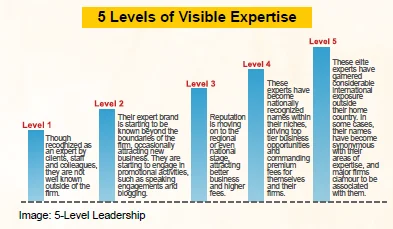
One article which I always give people when they join is ‘Level 5 Leadership: The Triumph of Humility & Fierce Resolve’ by Jim Collins. Once you develop the expertise or leadership, the most important thing you have to develop is to be humble. Humility and empathy must drive leaders’ behaviour.

We are now trying to develop a model called Driverless Organisation, something along the lines of a driverless car. How does a driverless car work? Every piece or part — be it hardware, software, sensor or dashboard — does its job. We give our people a dashboard week-on-week, and we review their Balance Score Card. In a profession or business, there are four dimensions: 1) your clients — you take care of them; 2) your people — clients are served by people, so you take care of people; 3) your processes — you have good clients and good people, but if you do not have good processes, things will fail; 4) your finances — unless you harmonise clients, people and processes, finance will not be right. That is the philosophy behind the Balance Score Card. What you want to balance in your business (or profession) is your prerogative alone.

For us, purpose is very important. Billable hours have to translate into value creation. Value creation also includes article writing, research, thought leadership, podcasts, etc. — these can be objectively measured – this is Part A of Balance Score Card. Part B is subjective — month-on month, the mentor–mentee sit together and discuss.

Conversations (while evaluating) should be more about potential rather than only criticism. It gives a different dimension to the conversation. Rather than setting targets, we indicate their potential (to the team). We have a trust-based environment — trust people as much as you can but blind trust is also not good. There are certain policies we follow, like anyone in the firm can travel anywhere in the world without approval; there is no leave policy. We trust our people that they will judiciously travel and be accountable for expenses.

 

Q (Mayur Nayak) How did you get an idea of the research campus “Ali Gunjan”? Tell us something about Ali Gunjan.

A (Nishith Desai): In the US, I saw law firms housed in these fancy buildings, and I thought — why can’t we have something like this in India; why not make it purpose-driven and not just business-driven? The idea of a research centre (Ali Gunjan) germinated from there.

My wife bought a piece of land in Alibaug without telling me (chuckles). I thought, let us put this to use for the greater good. I was very clear that the property had to be socially useful. Right from an early age, I have always been interested in learning new things. Even today, I have a childlike attitude when it comes to looking at something new. When you spend time thinking, you can do wonders. But I don’t get some quiet time to think.

So, we decided to create an ecosystem for ideation and thinking, where one can sit, ruminate, ideate, deliberate (first within a smaller group and then, as the idea starts taking shape, discuss it within a larger group) and debate. Basically, provide an environment which nurtures the individual thinker —helps him to think big and harness the advantages of collective thinking; or a place where someone can incubate the idea you come up with.

Ali Gunjan is probably the only ‘Blue Sky Thinking and Research Campus’ in the world which is offered to professionals by invitation, without any charge or fee. Ali Gunjan is private property meant for the public good.

Q (Mayur Nayak): How did you come in contact with the BCAS?

A (Nishith Desai): It was during my stint with the CA firm that I had the opportunity to read the BCA Journals, which are most educative. I attended your Residential Refresher Courses in Mahabaleshwar, Matheran and Mount Abu in those days and made friends with accountants. I became a super Chartered Accountant without doing a CA course (chuckles). It was a great learning.

Indian Laws and Judiciary System:

Q (Raman Jokhakar): India Tax System — What is plaguing the Indian tax system?

A (Nishith Desai): At a macro level, things are good in India. But at a micro level, the system is difficult to deal with; everything still operates on the basis of suspicion and unclear regulations. Language creates the biggest problem. The drafting (of the laws) needs to substantially improve.

Q (Raman Jokhakar): Tax as Enabler — Do you feel tax aspects can be enablers instead of being a cost or impediment?

A (Nishith Desai): I believe we focus more on tax collection; less time is spent on discussing how to spend the tax money. Today, if I am not mistaken, we spend roughly US$65–70 billion on defence, US$15 billion on education, and US$20 billion on healthcare. If you ask me, defence is a bottomless pit — we need to revisit how to spend the tax money.

On the revenue side, what is important is to make laws written in a manner that (they) are understood by the common man. How can a person decide their behaviour without reading the letter of the law? The intent of the law must be expressed in clear language. Else, it becomes very difficult to bring in foreign investments. It requires a lot of effort to convince a foreign investor but more time is spent on the implementation of a project.

Another problem is now civil laws are getting converted into criminal laws. Penalties and prosecutions are disproportionate to the crime committed. GIFT City is my favourite project, as I have been associated with it from conception, but I also believe that domestic regulators and the GIFT City regulators are at a disconnect. In the last few years, many changes have happened and excitement is in the air. Sure, it will fast forward.

Q (Raman Jokhakar): Ease of Doing Business — If India were in a race of “Ease of Doing Business’, what should be done URGENTLY to elevate India to the top 10 league in terms of ease of doing business?

A (Nishith Desai): Abolish exchange controls — TODAY!

Q (Raman Jokhakar) What is one change you would like to see in the global tax system?

A (Nishith Desai): I have been championing the case for ease of doing business at a global level. For the longest time now, ‘One World, One Tax’ has been my dream. More than a decade ago, in March 2014, I made a presentation on ‘One World, One Tax’ at the Global Tax Policy Conference held in Amsterdam.

Today, a global company (aka a multinational corporation) has to comply and deal with hundreds of different countries. Why can’t we have one single global tax system with one single base and one rate of tax, say 15 per cent? We need to focus on defining a base, i.e., how income should be computed. What we did with GST, or (what) the EU did with VAT, should be done for the world.

While it is understandable that everyone should pay tax, on the other hand, governments should adhere to and guarantee that nobody is taxed twice.

Q (MayurNayak): New Laws — What are your views on the New Laws, namely, The Bhartiya Nyaya Sanhita, 2023 [replacing Indian Penal Code, 1860] and The BharatiyaNagarik Suraksha Sanhita, 2023 [replacing Code of Criminal Procedure, 1973 (CrPC)]?

A (Nishith Desai): Each legislation is framed with a certain purpose. Some of our laws are more than 100 years old. Over time, there have been changes — systemic, technological, etc. Laws need to change with time, taking in the changed scenarios. At the end of the day, what remains to be seen is whether these new laws have served the purpose for which they were framed. Some reforms are necessary but the new sanhitas are substantially the same version of the old sanhitas. I also maintain that we should not change just for the sake of change.

For me, it is about the judicious use of technology, which will create a larger and faster impact. The use of technology at every level will help to contain crime and immediate justice can be done. The use of technology in the judicial system will help deliver speedy justice. Today, e-hearings have happened — these have eased the process. Whether virtual hearings are effective will be known as time goes by, but by and large, they are (effective).

My vision for the future of justice is: Justice at the speed of thought, without any injustice. Actually, I have written a paper on that.

Q (Mayur Nayak): Appointment of Judges — What are your views on the Collegium System to appoint judges in India?

A (Nishith Desai): Appointment of judges involves a lot of subjectivity. Subjectivity in the hands of people who are competent is important. One generally assumes that Supreme Court judges are competent. There is a degree of trust. For example, perception of honesty, creativity and innovation in meting out justice when the law is ambiguous, and quality of judgement writing — are some of the things needed to be factored into.

At the same time, everything cannot be so subjective that it leads to injustice. Objectivity is also required, but bear in mind that it could be manipulated. So, it has to be a combination of both — it is like any other evaluation. Some objectivity is needed, at the same time, some subjectivity is also necessary. In general, the collegium system has worked reasonably well. I believe that the collegium system, along with some degree of objectivity, would be a good model. Remember, justice must not only be done but seem to be done also.

Q (Mayur Nayak): Arbitration in Tax Treaties — Do you think India should adopt arbitration in its tax treaties?

A (Nishith Desai): Arbitration is a necessity. Arbitration exists in investment treaties. It exists in the World Trade Organization. I agree that this requires us to surrender our sovereignty to a certain extent. However, it is not uncommon, otherwise, international systems will not work. All treaties have that. There are complicated cases or other kinds of situations where you need to appoint an arbitrator and come to an understanding.

Q (MayurNayak): Challenges by AI — Do you think the present laws are equipped to deal with new-age challenges posed by AI and other technologies? If not, what should be done?

A (Nishith Desai): Apart from legal issues, there will be ethical issues. Today, AI has already exceeded human intelligence. It is doing business at a speed faster than your thought.

AI and Robotics will soon get integrated. Once AI gets integrated with Robotics, robots will make their own decisions and act on their own. I may own a robot, but it will be independent. AI will control it.

As regards the legal aspect, I believe that there will soon be a separate ministry of AI. We will have to provide a limited liability kind of a structured company for robots. Robots may be considered a person. There will be a system for registration. Robots will be required to pay tax. They will become part of life. Tomorrow, our competitors will also include robots.

Q (Raman Jokhakar): Education and Training — What does our education and professional training lack?

A (Nishith Desai): As I said earlier, doing a Bachelor of Arts made my thinking lateral and liberal. What typically happens today is that subjects like Logic, Philosophy, etc., are not taught to other students. Everybody wants to become a Chartered Accountant (which is very good) or MBA, but subjects of Philosophy and Ethics are not taught. Consciously understanding their principles helps one make an informed decision. Philosophy is the greatest decision-making tool. It is like Mathematics. Philosophy and Mathematics at an esoteric level are similar if not identical. If your principles of Mathematics are clear, you will get the right answer, 1 + 1 = 2. If your philosophical base is clear, then your decisions will always be right — you will know what is the right thing to do, and what isn’t.

The first paragraph of a company’s annual report is the Chairman’s Statement which captures the corporate philosophy. About 60 per cent of global CEOs have a Liberal Arts background, especially in the US.

Rapid Fire Round

1. One person you admire as a role model outside the family?

Nani Palkhivala

2. Music: Hindustani or Western Classical?

A mix of both — Fusion

3. Books you have read more than once?

Discipline of Market Leaders

4. Favourite sport?

Walking, cricket

5. Your hobby, outside books, music and work?

Thinking

6. Vision for India in a few words?

Move up from Democracy to Netocracy — a Digital nation with responsible and ethical people accountable to each other with minimum hierarchy and disintermediation of agents of the people such as MPs and MLAs. They should serve as  Servant Leaders. The job of technology is to disintermediate.

7. Your favourite movie?

Padosan

8. Three qualities a professional must demonstrate to himself and his clients?

Technical competency, inspirational, willing to allow other professionals to succeed

9. Skills you could have more of in hindsight?

How to make PowerPoint presentations

10. Law firm you admire?

Wachtell Lipton, Rosen & Katz

11. Favourite travel spot?

Switzerland

12. Has the profession become a business, or was it always one?

It has become more of a business now; we need to revisit that approach. In business, money comes first, and service comes next. In a profession, service comes first, and then the money comes.

13. Indispensable quality you want in new hires at your firm?

Professionalism

14. One piece of advice to young professionals?

Be of service to the society at large.

15. Secret sauce of your success?

The excitement of learning new things.

16. Purpose of wealth?

To be happy. Wealth without happiness is poverty.

17. One boon that you would ask from God?

Sarvodaya — growth of everyone in one-world family.

From The President

The third-most important challenge facing our profession: ‘Regulatory Considerations’

On 4th October, 2024, our Society had the pleasure of hosting Dr. Ajay Prasad Bhushan Pandey, Chairman of the National Financial Reporting Authority (‘NFRA’), along with other NFRA officials for an interactive session on the evolving assurance landscape. The discussion was particularly timely, following the NFRA circular issued on 3rd October, 2024, which provided interpretations of SA 600 regarding auditors’ responsibilities for group entities.

The Chairman compellingly articulated the imperative for India to establish a world-class audit framework in light of the anticipated growth of the Indian economy as well as the role of Chartered Accountants and Indian firms towards this national cause. This was followed by a panel discussion featuring two past presidents of the ICAI and two seasoned audit partners, along with the Chairman. The insightful dialogue provided numerous takeaways, highlighting an evident shift in the regulatory landscape impacting our profession. Notably, the BCAS Membership Survey also identified ‘Regulatory Considerations‘ as the third-most significant challenge facing our profession, following the challenges of ‘Impact of Technology‘ and ‘Attracting and Retaining Talent.’

A defining characteristic of a Professional is the capacity to deliver high-quality work, unsupervised, which may explain the historical basis for ‘professions’ being initiated through ‘self-regulation’. However, with the passage of time and evolving expectations, ‘independent regulation’ is seen by many as a logical progression from ‘self-regulation’. The Indian auditing profession appears to have progressed from debating the need for independent regulation, to concentrating the debate on its effective implementation. It is towards this cause of effective implementation that a constructive framework of discussion, coupled with consideration of Indian context alongwith following due process of change management, is desirable. As integral components of the ecosystem, both professionals and regulators must collaborate effectively to achieve the shared goal of ensuring and enhancing the financial fabric of our economy.

It is not often that a profession undergoes such a fundamental transformation, but such a phenomenon would expectedly be followed by periods of disruption and altered survival landscape. Although this transformation is most apparent in the audit sector, the evolving regulatory dynamics and expectation gaps are also evident in other practice areas. The concerns around multiplicity of regulators, lack of concerted legal views on contentious matters, trigger-happy law-enforcement machinery and high monetary penalties, make for an onerous occupational hazard. In this backdrop, it is believed that the ICAI has on 18th October, 2024 issued a ‘standard operating procedure to be adopted by police and other law enforcing agencies for investigation, search, seizure, interrogation, detention and arrest of chartered accountants.’

While our exceptional technical expertise and comprehensive training background provide us with a significant advantage in addressing these challenges, aligning our abilities further with contemporary times and needs would clearly be beneficial.

As we spoke about ‘key challenges’ over the last few messages, our Society remains committed to concentrating its efforts on tackling these contemporary challenges, aiding our community in enhancing its relevance. As the saying goes, ‘God gives challenges to those capable of handling it’, and as Chartered Accountants we will adapt, engage and evolve to meet these few worthy challenges.

Meanwhile, the professional development juggernaut at BCAS continues to host contemporary learning events, promoting good policies through advocacy and working towards the interest of our community. Some notable developments include:

i.  Representation on SA 600: The Accounting and Auditing Committee of BCAS provided comprehensive feedback to the NFRA regarding the proposed changes to SA 600. During a personal interaction with NFRA officials in Delhi, BCAS delegates had the opportunity to elaborate on the rationale behind some of their suggestions and the thought process underlying these recommendations. We extend our gratitude to the NFRA team for their patient reception and engaging discussion.

ii.  IIM-Mumbai + BCAS Research kick-off: Extending on our collaboration with IIM-M, the first research project with IIM-M has been successfully green-flagged by BCAS. Led by the Finance, Corporate and Allied Laws Committee at BCAS, the six-month funded-research project will involve dedicated research effort on certain blue-sky concepts under Direct Tax, alongwith their adaptability to the Indian taxation ecosystem. Stay tuned for more updates on this project.

iii. International Tax Think-Tank initiative: Enhancing our efforts towards structured research in International Tax, the International Tax Committee of BCAS has commenced the International Tax Think-Tank initiative. Through this initiative, research fellows under the guidance of subject-matter experts will engage on assorted topics of research interest to churn meaningful research output with diverse applications. This initiative holds a lot of promise to transform our abilities at BCAS to conduct authentic research-backed thought-leadership.

iv. BCASNxt — A Formal Students’ Sub-Group: Chartered Accountancy students form an essential component of the BCAS ecosystem. Throughout the year, BCAS organizes numerous events designed to meet the learning, networking, and career guidance needs of these aspiring professionals. It is therefore fitting to formalise this initiative into a structured, student-led format. With the dedicated efforts of the Human Resources Development Committee at BCAS, we are pleased to introduce the ‘BCAS Nxt’ platform for CA students. I extend my best wishes to the newly appointed student leaders of BCAS Nxt as they assume this significant responsibility.

v.  Bonhomie Events: As the compliance-intensive months of September to November conclude, a series of non-technical events are scheduled for our members in the upcoming months. The Seminar, Membership, and Public Relations Committee is organizing the inaugural ‘CAthon’ on 1st December, 2024 — a marathon effort in every respect. Additionally, BCAS Cricket 2025 will be held on 5th January, 2025, to foster camaraderie and encourage sportsmanship among us. Grab your place in the team soon.

vi.  58th Members’ Residential Refresher Course (‘RRC’): The flagship Members’ Residential Refresher Course in its 58th avatar is scheduled to be held at the culturally rich city of Lucknow. With top-notch speakers and contemporary topical coverage, this edition highlights darshan at the Ram Mandir temple at Ayodhya! With registrations having opened from Dusshera, this limited-seats annual pilgrimage of knowledge is a must attend event.

So, while you consider registering yourself for the Members’ RRC and a visit to Ram Mandir – Ayodhya, may I take this opportunity to wish you and your loved ones a very Happy Diwali and best wishes for a healthy, safe and prosperous new year ahead.


Kind Regards,


CA Anand Bathiya

President

Editorial

Overdose of Laws and Regulations?

[Need of the Hour: Less Government, More Governance]


An interesting statistic is found in Wikipedia1 about the number of Acts in India. Apart from the Finance Acts, there are 891 Central Acts which are still in force as of 15th October, 2024, of which 108 Acts are of the 19th Century (1836–1900), 571 Acts are of the 20th Century (1901–2000), and 212 Acts are of the 21st Century (2001–2024). Apart from the above, there are a number of Acts passed by each State Government, Municipal Corporation and other Government bodies. The oldest Act in force is the Bengal Indigo Contracts Act, 1836, and the latest being the Public Examination (Prevention of Unfair Means) Act, 2024. It is heartening to note that 1,486 obsolete and redundant laws have been repealed by the Government of India since 2014 till date2.


1   https://en.wikipedia.org/wiki/List_of_acts_of_the_Parliament_of_India and https://cdnbbsr.s3waas.gov.in/s380537a945c7aaa788ccfcdf1b99b5d8f uploads/2023/10/202408221608906963.pdf

2   Refer the Editorial of June 2024 for more details

Many countries have far more Laws as compared to India, and as such, the number of Laws in a country depends upon its needs, complexities and various other factors; hence not comparable. What is important is to see that the law is an enabler and not a roadblock in progress.

Laws should not be made for exceptions, as often happens in India. There will always be some people who find ways to circumvent well-intended provisions of law. For a few deceitful people, the majority of law-abiding citizens should not be punished. A number of amendments in the tax laws and their complexity, relating to the provisions concerning Charitable Trusts, is a case in point. To quote Geoffrey de Q. Walker3, “the people (including, one should add, the government) should be ruled by the law and obey it, and that the law should be such that people will be able (and, one should add, willing) to be guided by it4.”


3   The Rule of Law: foundation of constitutional democracy (1st Ed., 1988)

4   https://www.ruleoflaw.org.au/principles/

Over-regulation gives a feeling of suffocation, and one would like to escape to freedom. Operational freedom is a must for businesses to flourish. For example, we had a stringent law called the Foreign Exchange Regulation Act, 1973 (FERA), which strictly regulated foreign exchange transactions. This resulted in the throttling of Indian entrepreneurship and arresting the growth of the Indian economy. With the results, we found people leaving India and settling in business friendly jurisdictions like UAE, Singapore, etc. With the enactment of the Foreign Exchange Management Act, 1999, (FEMA) with a focus on facilitating external trade and payments and management of foreign exchange rather than controlling it, we find Indian businesses and the economy flourishing. Liberalisation of various laws, removal of the “licence – permit – quota” regime and controls, along with the enactment of FEMA, resulted in an increase in India’s Foreign Exchange Reserves from USD 5.8 billion in 1991 to USD 688 billion as of 18th October 20245. Thus, we find that Indians can do wonders if there are fewer controls and more freedom.


5   https://tradingeconomics.com/india/foreign-exchange-reserves

Interestingly, the Ministry of Personnel, Public Grievances & Pensions issued a Print Release on 13th August, 2024 on “Less Government More Governance6. Recognising the need for a citizen friendly and accountable administration, a series of steps have been initiated by the Government. These include simplification of procedures, identification and deletion of archaic laws / rules, identification and shortening of various forms, leveraging technology to bring transparency to the public interface and a robust public grievance redress system. Promotion of Self-Certification in place of affidavits and attestation by Gazetted Officers will greatly reduce the time and effort on the part of both the citizen as well as the Government officials. The Government has launched a website titled mygov@nic.in to provide a citizen-centric platform to empower people to connect with the Government and contribute towards good governance. Suggestions are also invited on the PMO website, which also seeks expert advice from the people, thoughts and ideas on various topics that concern India. We all should participate in this nation building activity by giving constructive suggestions.


6 https://pib.gov.in/newsite/PrintRelease.aspx?relid=108623#:~:text=13%3A48%20IST ,Less%20Government%20More%20Governance,this%20goal%20have%20been%20initiated.

The rule of law is the hallmark of a civilised society, and therefore, laws cannot be done away with. We need to enact laws which are equal for all, fair and simple to understand, and without the presumption of “mens rea” (guilty mind), meaning thereby that one is presumed to be innocent until proven otherwise. Compliances and filings under various laws should be a bare minimum. Today, a practising CA has to comply with almost 25 to 30 different laws and a host of compliances for his own firm. This puts enormous pressure on him, as he also has to help his clients comply with a plethora of regulations of different Regulators and Government agencies. It is observed that the Government is placing more and more burden on the public for compliances and reporting, for example, compliances under GST, TDS, TCS, etc.

To streamline the Direct Tax Laws, the Central Board of Direct Taxes (CBDT) has formed an internal committee to conduct a comprehensive review of the Income Tax Act, 1961.

This initiative aims to make the Act concise, clear, and easy to understand, fostering reduced disputes, litigation, and increasing tax certainty for taxpayers.

The committee has invited public inputs and suggestions in four categories:

1. Simplification of Language – Making the legal language more user-friendly.

2. Litigation Reduction – Identifying areas to reduce disputes and conflicts.

3. Compliance Reduction – Easing procedural complexities for taxpayers.

4. Redundant / Obsolete Provisions – Eliminating outdated provisions.

Suggestions can be submitted on a dedicated webpage created on the e-filing portal of the Income-tax Department.

Additionally, a task force from the Direct and International Taxation Committees of the BCAS is actively compiling recommendations. Readers can send their suggestions by 10th November, 2024 to vp@bcasonline.org or editor@bcasonline.org.

Excessive regulations are counterproductive and kill creativity and entrepreneurial spirit. On the other hand, lack of or insufficient regulations can lead to anarchy and disorder in society. So, we need to strike a balance.

Many qualified CAs are not taking up ICAI Membership, may be for the fear of being regulated. Generation Z (born between 1997 to 2012) and Alpha (born between 2013 and present) value their freedom more than anything else. They refuse to get regulated or controlled. In 2018, the two-member bench of the Supreme Court held that “action can be taken against CAs if their conduct brought ‘disrepute’ to the profession — even if such an action was not related to his / her professional work.” For example, if a CA drinks and drives or creates a scene in a public space that can bring disrepute to the profession, action may be taken against him, whether it was in his professional capacity or not.” While reporting this news item, The Economic Times7 gave a catchy title: “Donning CA’s hat means being an accountant & be accountable 24×7”. Thus, CAs are regulated 24×7. Should such a code of conduct not be expected from all professionals / degree holders all the time?


7   Dated 27th November, 2018

Friends, ICAI elections are around the corner, and we must vote without fail. Let’s vote for the pragmatic 26th Central Council and 25th Regional Councils, which can lead the profession from the front and take it to new heights. In this era of turmoil and turbulence, members look up to their Alma Mater for guidance, leadership, protection and growth.

I wish you all a happy Diwali and a Prosperous New Year – Vikram Samvat 2081.


Dr CA Mayur Nayak

Editor

मुखरस्तत्र हन्यते

This is a very interesting subhashit that cautions people while becoming a leader. Its apparent meaning is that one should avoid accepting leadership. However, the real implication is not at all negative. It only says that while becoming a leader, one should bear in mind certain realities of human psychology. The text is as follows:

न गणस्याग्रतो गच्छेत्
सिद्धे कार्ये समं फलम् |
यदि कार्यविपत्ति: स्यात्
मुखरस्तत्र हन्यते ||

Verbatim meaning —

One should avoid leading a group. If the task is successful, everybody comes forward to share the credit. However, if there is a failure, if the task is not performed properly, the leader gets a beating!

‘Beating’ here may be in the form of criticisms not only from outsiders but also from the members of the group.

We come across such examples in day-to-day life — be it politics, social work, or sports.

If a cricket match is won, they say, it is the victory of team spirit, everybody contributed well. On the other hand, if it is lost, the captain gets the blame. The same is the case with political elections.

If a party wins, everybody comes forward to claim credit and a corresponding reward! However, if a party loses the elections or gets defeated, everybody demands for resignation from the party chief or other leaders. They say that he lacks foresight, he could not rouse the morale of party workers, he selected the wrong candidates, he adopted the wrong strategies, and so on and so forth.

The positive message from this shloka is important. When you become (or you want to be) a leader, you should keep this psychology in mind. To achieve success, you should voluntarily give credit to others. That enhances your grace. The others then reciprocate by praising your leadership skills. If you claim all the credit for yourself, the team members may brand you as selfish and may wish for your failure.

On the other hand, if there is a failure, you should show boldness in owning up to the responsibility. This will induce the team members to introspect and perhaps admit and confess the lack of adequate efforts from their side.

When Shri Lal Bahadur Shastri was the Railway Minister, there was a major accident somewhere. He owned up to the responsibility and tendered his resignation, although as a minister, he may not have been directly responsible. His resignation upheld his grace and was highly admired by people. The same party later, after the demise of Pt. Nehru, made Shastri Ji as Prime Minister.

People appreciate the fact that as a leader, you are willing to take up the responsibility and that to avoid failure, you will perform honestly and sincerely. They understand that you will not stick to the position in a possessive manner.

This should be borne in mind, particularly by those who get leadership by mere inheritance! They cannot tolerate or digest the idea that the top position should be handed over to someone else. This is observed even in industrial groups. Tatas, for example, right from the beginning, have adopted the policy of installing professionals at the top positions in their corporates. This made their group unique and distinct from other industrial houses. A true leader should be willing to step down, honouring the people’s sentiments and assessing their own performance. This will avoid the last limb of the shloka.

Taxation of ‘Fees for Technical Services’ : Application of the concept of ‘Make Available’

In this article the concept of ‘Make Available’ used in the Article in the Tax Treaties relating to ‘Fees for Technical Services (FTS)’ or ‘Fees for Included Services’ has been discussed and analysed. In the second part of the Article to be published next month we shall deal with the Indian Judicial decisions dealing with the subject.

A. Concept of ‘Make Available’ and historical background :The expression ‘make available’ used in the Article in the Tax Treaties relating to ‘Fees for Technical Services (FTS)’ has far reaching significance since it limits the scope of technical and consultancy services in the context of FTS.

India has negotiated and entered into tax treaties with various countries where the concept of ‘make available’ under the FTS clause is used. India’s tax treaties with Australia, Canada, Cyprus, Finland, Malta, Netherlands, Portuguese Republic, Singapore, UK and USA contain the concept of ‘make available’ under the FTS clause. Further, the concept is also applicable indirectly due to existence of Most Favored Nation (MFN) clause in the protocol to the tax treaties with Belgium, France, Israel, Hungary, Kazakstan, Spain, Switzerland and Sweden.

It is interesting to note that India-Australia tax treaty does not have separate FTS clause but the definition of Royalty which includes FTS, has provided for make available concept. An analysis of the countries having the concept of make available directly or indirectly in their tax treaties with India reveals that almost all of these countries are developed nations and they have successfully negotiated with India the restricted scope of the definition of FTS as almost all of them are technology exporting countries.

In view of the above, while deciding about taxability of any payment for FTS, the reader would be well advised to examine the relevant article and the protocol of the tax treaty to examine whether the concept of make available is applicable to payment of FTS in question and accordingly whether such a payment would be not liable to tax in the source country. He would also be well advised to closely examine the relevant judicial decision to determine the applicability of the concept of ‘make available’ to payment of FTS in question.

B. Explanation of the concept in the MOU to the India-US Tax Treaty :

Article 12(iv)(b) of the India US tax treaty reads as follows :

“4. For purposes of this Article, ‘fees for included services’ means payments of any kind to any person in consideration for the rendering of any technical or consultancy services (including through the provision of services of technical or other personnel) if such services :

(a) . . . .

(b) make available technical knowledge, experience, skill, know-how, or processes, or consist of the development and transfer of a technical plan or technical design.”

As per Article 12(4)(b) of the India US tax treaty, payment of any kind in consideration for rendering of services results in FTS if :

(a) Such services are technical or consultancy services;

(b) They ‘make available’ knowledge, experience, skill, know how, or processes or alternatively, consist of development and transfer of a plan or design; and

© Such knowledge, experience, plan, design etc. is technical.

The three conditions above are cumulative and not alternative. In order to fall under the Article 12(4)(b) of the India US tax treaty, it is essential that services should make available knowledge, experience, skill, know-how, or processes.

The Memorandum of Understanding (MoU) to the India-US Tax Treaty, Technical Explanation to India-US Tax Treaty, Technical Explanation to India-Australia Tax Treaty, and various Indian Judicial Pronouncements, have laid down different tests for considering whether or not services ‘make available’ knowledge, experience, skill, know-how, or processes.

The concept of ‘make available’ is interpreted and explained with concrete illustrations in the ‘Memorandum of Understanding concerning Fees for Included Services in Article 12’ appended to the said India-US DTAA. The concept is explained as under in the Memorandum of Understanding :

“Paragraph 4(b) of Article 12 refers to technical or consultancy services that make available to the person acquiring the service technical knowledge, experience, skill, know-how, or processes, or consist of the development and transfer of a technical plan or technical design to such person. (For this purpose, the person acquiring the service shall be deemed to include an agent, nominee, or transferee of such person.) This category is narrower than the category described in paragraph 4(a) because it excludes any service that does not make technology available to the person acquiring the service. Generally speaking, technology will be considered “made available” when the person acquiring the service is enabled to apply the technology. The fact that the provision of the service may require technical input by the person providing the service does not per se mean that technical knowledge, skills, etc., are made available to the person purchasing the service, within the meaning of paragraph 4(b). Similarly, the use of a product which embodies technology shall not per se be considered to make the technology available.” (Emphasis supplied)

“Typical categories of services that generally involve either the development and transfer of technical plans or technical designs, or making technology available as described in paragraph 4(b), include :

1 Engineering services (including the sub-categories of bio-engineering and aeronautical, agricultural, ceramics, chemical, civil, electrical, mechanical, metallurgical, and industrial engineering);

2 Architectural services; and

3 Computer software development.

Under paragraph 4(b), technical and consultancy services could make technology available in a variety of settings, activities and industries. Such services may, for example, relate to any of the following areas :

1 Bio-technological services;

2 Food-processing;

3 Environmental and ecological services;

4. Communication  through  satellite or otherwise;

5. Energy  conservation;

6. Exploration or exploitation of mineral oil or natural gas;

7. Geological  surveys;

8. Scientific services;  and

9. Technical  training.”

This concept is further explained by Examples 3 to 7 in the MoU which are as follows:

Example (3) :

Facts:

A U.S. manufacturer has experience in the use of a process for manufacturing wallboard for interior walls of houses which is more durable than standard products of its type. An Indian builder wishes to produce this product for his own use. He rents a plant and contracts with the U.S. company to send experts to India to show engineers in the Indian company how to produce the extra-strong wall-board. The U.S. contractors work with the technicians in the Indian firm for a few months. Are the payments to the U.S. firm considered to be payments for ‘included services’ ?

Analysis:

The payments would be fees for included services. The services are of a technical or consultancy nature; in the example, they have elements of both types of services. The services make available to the Indian company technical knowledge, skill, and processes.

Example  (4) :

Facts:

A U.S. manufacturer operates a wallboard fabrication plant outside India. An Indian builder hires the US. company to produce wallboard at that plant for a fee. The Indian company provides the raw materials and the US. manufacturer fabricates the wall-board in its plant, using advanced technology. Are the fees in this example payments for included services?

Analysis:

The fees would not be for included services. Al-though the U.S. company is clearly performing a technical service, no technical knowledge, skill, etc., are made available to the Indian company, nor is there any development and transfer of a technical plan or design. The U.S. company is merely performing a contract manufacturing service.

Example  (5) :

Facts:

An Indian firm owns inventory control software for use in its chain of retail outlets throughout India. It expands its sales operation by employing a team of travelling salesmen to travel around the countryside selling the company’s wares. The company wants to modify its software to permit the salesmen to access the company’s central computers for information on products available in inventory and when they can be delivered. The Indian firm hires a U.S. computer programming firm to modify its software for this purpose. Are the fees which the Indian firm pays to be treated as fees for included services?

Analysis:

The fees are for included services. The U.S. company clearly, performs a technical service for the Indian company, and transfers to the Indian company the technical plan (i.e., the computer program) which it has developed.

Example  (6) :

Facts:

An Indian vegetable oil manufacturing company wants to produce a cholesterol-free oil from a plant which produces oil normally containing cholesterol. An American company has developed a process for refining the cholesterol out of the oil. The Indian company contracts with the US. company to modify the formulae which it uses so as to eliminate the cholesterol, and to train the employees of the Indian company in applying the new formulae. Are the fees paid by the Indian company for included services?

Analysis:

The fees are for included services. The services are technical, and the technical knowledge is made available to the Indian company.

Example  (7) :

Facts:

The Indian vegetable oil manufacturing firm has mastered the science of producing cholesterol-free oil and wishes to market the product worldwide. It hires an American marketing consulting firm to do a computer simulation of the world market for such oil and to advise it on marketing strategies. Are the fees paid to the U.S. company for included services?

Analysis:

The fees would not be for included services. The American company is providing a consultancy service which involves the use of substantial technical skill and expertise. It is not, however, making available to the Indian company any technical experience, knowledge or skill, etc., nor is it transferring a technical plan or design. What is transferred to the Indian company through the service contract is commercial information. The fact that technical skills were required by the performer of the service in order to perform the commercial information service does not make the service a technical service within the meaning of paragraph 4(b).

It is important to note that in the protocol to the said DTAA the Government of India has also accepted the interpretation of Article 12 (Fees for included services) in the following words:

“This memorandum of understanding represents the current views of the United States Government with respect to these aspects of Article 12, and it is my Government’s understanding that it also represents the current views of the Indian Government.” (emphasis supplied)

C.  Application of concept of ‘make available’ – Relevant  and  irrelevant  tests:

In ‘The Law and Practice of Tax Treaties: An Indian Perspective’ (2008 edition), the learned authors Shri Rajesh Kadakia and Shri Nilesh Modi, have culled out the relevant and irrelevant tests (on pages 569-571) as under  :

Relevant  tests:

1. The expression ‘make available’ is used in the sense of one person supplying or transferring technical knowledge or technology to another.

2. Technology is considered to be ‘made available’ when the service recipient is enabled to apply the technology contained therein. [Bharat Petroleum Corporation v. DfT, (200) 14 SOT 307(Mum.)]

3. If the services do not have any technical knowledge, the fees paid for them do not fall within the meaning of FTS as per Article 12(4).

4. The service recipient is able to make use of the technical knowledge, skill etc. by himself in his business or for his own benefit and without recourse to the performer of the services, is able to make use of the technical knowledge, etc. by himself in his business or for his own benefit and without recourse to the performer of the services in future. The technical knowledge, experience, skill, etc. must remain with the person utilising the services even after the rendering of the services has come to an end. A transmission of the technical knowledge, experience, skill, etc. from the person rendering the services to the person utilising the same is contemplated by the article. Some sort of durability or permanency of the result of the ‘rendering of services’ is envisaged which will remain at the disposal of the person utilising the services. The fruits of the services should remain available to the person utilising the services in some concrete shape such as technical knowledge, experience, skill, etc.

5. The service recipient is at liberty to use the technical knowledge, skill, know-how and processes in his own right.

6. The technical knowledge, experience, skill, know-how, etc. must remain with the service recipient even after the rendering of the service has come to an end.

ii) Irrelevant  tests:

1. Provision of service may require technical input by the service provider;

2. Use of a product  which  embodies  technology;

3. The service recipient gets a product and not the technology itself;

4. Merely allowing somebody to make use of services, whether actually made use of or not;

5. Service recipient acquires some familiarity or in-sights into the manner of provision of services.

D. Concept of ‘make available’ as explained in various judicial pronouncements:

The concept of make available has been examined, explained and applied by various judicial authorities in India in the following cases (which shall be summarised in the next part of the Article) :

E. Application of explanation and examples given in MoU to the India-US Treaty to other Treaties:Although the abovementioned interpretation is given in the context of the DTAA between India and the USA, considering that identical terminology is used in other DTAAs between India and other countries, the Government can be considered to have contemplated the same meaning to be assigned to the .same term in the other DTAAs. This proposition, has found judicial recognition.

E.1 The above interpretation of the concept of ‘make available’ has now gained acceptance even with the Indian judicial authorities in the context of a variety of DTAAs India has entered into with different countries. In Raymond Ltd. v. Deputy CIT, [2003] 86 ITD 791 (Mum.), the assessee made an issue of Global Depository Receipts (GDRs) to in-vestors outside India, and it paid, inter alia, com-mission to the managers to the GDR issue, who were residents outside India, for rendering a vari-ety of services outside India for the successful completion of the GDR issue. The question before the Tribunal, among others, was whether the com-mission paid for such services rendered outside India could be taxed in India as ‘fees for technical services’ in the light of the provisions of S. 9(1)(vii) of the Act read with Article 13(4) of the DTAA with the UK. It is noteworthy that the terminology used in Article 13(4)(c) of the DTAA with the UK is the same as that used in Article 12(4)(b) of the DTAA with the USA. Although in this case the Tribunal was concerned with the interpretation of Article 13(4)(c)of the DTAA between India and the UK, the Tribunal made a reference to the identically worded Article 12(4)(b) of the DTAA between India and the USA, took into consideration the interpretation and the illustrations given in the Memorandum of Understanding appended to the said DTAA, and observed that the same can be used as an aid to the construction of the DTAA with the UK because they deal with the same subject (namely, fees for technical services). The Tribunal also observed that merely because these treaties are with different countries does not mean that different meanings are to be assigned to the same words, especially when both have been entered into by the same country on one side, namely, India. It it is difficult to postulate that the same country (India) would have intended to give different types of treatment to identically defined services rendered by entrepreneurs from different countries. On the facts of the case, the Tribunal held that the commission paid by the assessee for the various services rendered by the non-resident manager to the GDR issue did not fall within the definition of ‘fees for technical services’ given in Article 13(4) of the DTAA between India and the UK because no technical knowledge, experience, skill, know-how or process, etc. was ‘made available’ to the assessee by the managers to the GDR issue. After referring to the grammatical purpose of the word ‘which’ used in Article 13(4)(c) of the DTAA with the UK, the Tribunal gave its inter-pretation of the expression ‘make available’ in the following clear-cut words (paragraphs 92 and 93) :

“92. We hold that the word ‘which’ occurring in the article after the word ‘services’ and before the words ‘make available’ not only describes or defines more clearly the antecedent noun (‘services’) but also gives additional information about the same in the sense that it requires that the services should result in making available to the user technical knowledge, experience, skill, etc. Thus, the normal, plain and grammatical meaning of the language employed, in our understanding, is that a mere rendering of services is not roped in unless the person utilising the services is able to make use of the technical knowledge, etc. by himself in his business or for his own benefit and without recourse to the performer of the services in future. The technical knowledge, experience, skill, etc. must remain with the person utilising the services even after the rendering of the services has come to an end. A transmission of the technical knowledge, experience, skill, etc. from the person rendering the services to the person utilising the same is contemplated by the article. Some sort of durability or permanency of the result of the ‘rendering of services’ is envisaged which will remain at the disposal of the person utilising the services. The fruits of the service should remain available to the person utilising the services in some concrete shape such as technical knowledge, experience, skill, etc.

93.  In the present case, … after the services of the managers . . . came to an end, the assessee-company is left with no technical knowledge, experience, skill, etc. and still continues to manufacture cement, suitings, etc. as in the past.” (emphasis supplied)

The Tribunal also noted the language employed in the definition of ‘fees for technical services’ in Article 12(4)(b) of the DTAA between India and Singapore to the effect “if such services … make available technical knowledge, experience, skill, know-how or processes, which enables the person acquiring the services to apply the technology contained therein”, and opined that these words, though not found in the DTAAs with the UK and the USA, merely make explicit what is embedded in the words ‘make available’ appearing in the DTAAs with the UK and the USA.

E.2 In the decision    in CESC  Ltd. v. Deputy CIT [2005] 275 ITR (AT) 15 (Kol) (TM) this interpretation of the concept of ‘make available’ used in Article 13(4)(c) of the DTAA between India and the UK got the stamp of judicial approval. In this case, a UK company acted as a technical adviser to cer-tain financial institutions in India and the assessee, CESC, paid some fees to the UK company for the services rendered in respect of the technical appraisal of the assessee’s power project. One of the questions before the Tribunal was whether the fees paid to the UK company fell within the sweep of the expression’ fees for technical services’ as understood in Article 13(4)(c) of the DTAA between India and the UK. As noted earlier also, the terminology used for defining the expression’ fees for technical services’ in the DTAA between India and the UK is the same as that used in, among many others, the DTAA between India and the USA. The Tribunal held that the fees paid by the assessee to the UK company did not fall within the expression ‘fees for technical services’ as it did not result in making available to the assessee any technical knowledge, skill, etc. The Tribunal made a reference to Article 12 of the DTAA between India and the USA and to the Memorandum of Understanding appended thereto, discussed above, as also to the Protocol attached thereto wherein it is stated, inter alia, that the Memorandum of Understanding with regard to the interpretation of Article 12 (Royalties and fees for included services) also represents the views of the Government of India, and observed that under Article 12(4)(b) of the DTAA between India and the USA, which is pari materia with Article 13(4)(c) of the DTAA with the UK, technology would be considered made available when the person acquiring the services is enabled to apply the technology; that the mere fact that the provision of services may require technical input to the person providing the services does not per se mean that technical knowledge, skill, etc. are made available to the person purchasing the services. Since in this case the role of the engineers providing the services was of mere reviewing and opining rather than designing and directing the project, the Tribunal held that no technical knowledge, etc. was made available to the assessee and therefore the fees paid to the UK company did not fall within the scope of ‘fees for technical services’ under Article 13(4)(c) of the DTAA with the UK. It is pertinent to note that the Tribunal made certain observations at page 25, which, in effect, mean that the interpretation adopted by the Tribunal of the term ‘fees for technical services’ with reference to the DTAA between

India and the UK, particularly of the concept of ‘make available’, relying upon the definition and interpretation of the term ‘fees for included services’ used in the DTAA with the USA, should apply to several subsequent DTAAs India has entered into using the same phraseology, including specifically the DTAA between India and the UK.

E.3 In NQA Quality Systems Registrar Ltd. v. Deputy CIT, (2005) 92 TTJ (Del.) 946, wherein the above-referred decision in Raymond Ltd. v. Deputy CIT (supra) is followed and similar views are expressed in the context of the DTAA with the UK. In this case, the assessee, an Indian company, made payments to certain non-resident companies in the UK for certain services rendered by those UK companies. The assessee was in the business of ISO audit and certification. The nature of services provided by the UK companies to the assessee included providing the assessee with assessors to assess the quality assurance systems existing with the assessee’s customers, visits to the assessee’s customers, providing of training, etc. The question was whether while remitting the fees to the UK companies the assessee was required to deduct tax at source there from. The Tribunal analysed the definition of the term ‘fees for technical services’ given in Article 13 of the DTAA with the UK, noted the similar provisions of Article 12 of the DTAA with the USA, the Memorandum of Understanding appended thereto, and concluded that the nature of services provided by the UK companies to the assessee did not make available any technical knowledge, experience, skill, etc. to the assessee and therefore the fees paid by the assessee to the UK companies do not fall within the definition of the term ‘fees for technical services’ and that, therefore, the assessee was under no ob-ligation to deduct tax therefrom u/s.195 of the Act.

E.4 In National Organic Chemical Industries Ltd. v. Deputy CIT, (2005) 96 TT] (Mum.) 765, this interpretation of the concept of ‘make available’ is reiterated by the Tribunal in the context of Article 12(4) of the old DTAA between India and Switzerland. It is in effect observed by the Tribunal that when there is mere rendering of services without the transfer of technology it cannot be said that technology, etc. are ‘made available’ within the meaning of Article 12(4) of the DTAA between India and Switzerland and therefore payment for such services is not liable to tax in India.

E.5 In Dy. CIT v. Boston Consulting Group Pte. Ltd., [2005] 94 ITD 31 (Mum.) reiterates similar views. In this case, the non-resident company, a resident of Singapore, was in the business of ‘strategy consulting’. One of the issues before the Tribunal was whether the fees paid for such services fell within the term ‘fees for technical services’ under Article 12(4)(b) of the DTAA between India and Singapore where more or less the same language is employed as in the DTAA with the USA, the UK, etc. Noting the above-referred decision in Raymond Ltd. v. Deputy CfT (supra), the language of Article 12 of the DTAA with the USA, the Memorandum of Understanding appended to the said DTAA and the illustrations given therein, the concept of ‘make available’, etc., discussed above, the Tribunal concluded that the fees paid for such strategy consulting do not fall within the scope of ‘fees for technical services’ used in Article 12(4)(b) of the DTAA with Singapore. However, interestingly, it seems that the Tribunal has given an altogether different dimension to this issue by making a very broad observation at page 57 that so far as the DTAA with the USA is concerned, consultancy services which are not technical in nature cannot be treated as fees for included services. Though not clear, perhaps this view is influenced by a more general or profound statement made in the Memorandum of Understanding appended to the DTAA between India and the USA, under the paragraph titled ‘Paragraph 4 (in general)’, regarding the interpretation of the term ‘fees for included services’ given in Article 12(4)(b) of the said DTAA, which statement runs as follows:

“Thus, under paragraph 4(b), consultancy services which are not of a technical nature cannot be included services.”

F. Indian Treaties where the concept of ‘make available’ is used and differences in the wordings used in the relevant Articles:

Detail of DT AA with different countries having ‘make available’ phrase in FTS clause or indirectly made applicable through Protocol

REPRESENTATION

Bombay Chartered Accountants’ Society

7, Jolly Bhavan No. 2,

New Marine Lines, Mumbai-400020.

Tel. : 61377600 to 05 / Fax : 61377666
E-mail : bca@bcasonline.org;

Website : www.bcasonline.org

WebTV : www.bcasonline.tv

September 27, 2011

Shri Shobhit Jain
OSD (TRU)
Central Board of Excise and Customs (CBEC)
Government of India, North Block,
Parliamentary Street, New Delhi-110001.
Respected Sir,

Subject: Representation of our Views on the Concept Paper for
Public Debate Taxation of Services based on a Negative List of Services

We have seen with interest the Concept Paper for Public Debate and on behalf of the Bombay Chartered Accountants’ Society, and would like to humbly submit our representation on various aspects.

We hope that our representation will receive due consideration. We would be most willing to put forward our views in person should this be required. Thanking you,

We remain,

Yours truly,
For Bombay Chartered Accountants’ Society

Pradip K. Thanawala

President

Govind G. Goyal

Chairman,

Indirect Taxes & Allied Laws Committee

Representation of our Views on the Concept Paper for Public Debate Taxation of Services based on a Negative List of Services

1.0 Background Pursuant to the announcement made by the Honourable Finance Minister while presenting the Union Budget 2011, a concept paper on taxation of services based on negative list of services has been issued for public debate and views are solicited from all stakeholders before 30-9-2011. Accordingly, we present our views on the said concept paper.

2.0 Recommendations in brief The concept paper introduces the justification for the negative list on the grounds of administrative challenge, stability and comprehensiveness and proceeds to place certain questions for public debate and feedback. The questions placed and our summarised feedback on those questions is tabulated below:


3.0 The country should not adopt a negative list
The concept paper in paras 2, 3 and 4 highlights in detail the issues surrounding the positive and negative lists. While it does accept that the currently existing positive list has certain advantages in terms of definitiveness, it seeks to justify the introduction of the negative list by citing certain limitations of the current mechanism of positive list. We are of the view that most of the said limitations can be either removed even in positive list approach or are so inherent that they would exist even in the negative list approach. The following table explains the same :

On a perusal of the above table, it is evident that the reasons cited in favour of the transition appear to be more a mirage. The same issues can be addressed in the positive list or would likely to be continued in the negative list as well.

It may be noted that though the consolidated Excise Act was enacted in 1944, the residuary entry under Excise Law (converting the law from the negative list to positive list) was introduced only in 1975 i.e., more than 30 years after the introduction of the law. As compared to that time frame, the service tax law is merely 17 years old. Further, it is much easier to provide a comprehensive definition of ‘goods’ as compared to ‘services’. Therefore, the challenges of introducing a negative list in services can be compounded.

4.0    Even if it is felt that we need to adopt the negative list, the same should be adopted only at the time of GST and not earlier than that

The nation is on the verge of introducing a major indirect tax reform by introduction of comprehensive Goods and Service Tax (GST). The introduction of GST will obviate the need to classify transactions between goods and services to a great extent. Further, the Constitutional Amendments required for introducing GST will obviate many of the challenges faced currently in defining the scope of services. Therefore, it is felt that even if we need to adopt the negative list, the same should be adopted only at the time of GST and not earlier than that.

5.0    If the negative list is introduced prior to the introduction of the GST, the definition as recommended below should be adopted Service means any obligation undertaken by the assessee for a monetary consideration pursuant to a contract or agreement, whether written or not, (other than a contract or agreement for supply of goods, money or immoveable property) between two or more consenting parties and includes:

A.    right to use an immovable property;

B.    construction of a complex, building, civil structure or a part thereof, including a complex or building intended for sale to a buyer, wholly or partly, except where the entire consideration is received after issuance of certificate of completion by a competent authority;

C.    temporary transfer or permitting the use or enjoyment of any intellectual property right;

D.    obligation to refrain from an act, or to tolerate an act or a situation, or to do an act;

E.    service in relation to lease or hire of goods; and

F.    right to enter any premises

But excludes a supply —

A.    by an employee to an employer in the course of or in relation to the employment of the person;

B.    by a constitutional authority under the Indian Constitution or a member of an Indian Legislature or a local self-government in that capacity;

C.    that amounts to manufacture of excisable goods or is chargeable as part of the value of goods to a duty in terms of the provisions of Central Excise Act, 1944;

The above amended definition is preferable since the proposed definition states that service means ‘anything’. The word ‘anything’ does not convey any meaning. No statute defines the charging provision to be ‘anything’. There needs to be a certainty to what is proposed to be taxed. Anything conveys vagueness rather than certainty or definitiveness. Further, generally the term ‘thing’ is used for tangible products like book, CD, etc. However, a lecture delivered by a professor or song performed by a singer (some examples of services) cannot be said to be ‘things’ in general parlance. Therefore, in trying to define service as ‘anything’, the soul of service is missed out.

6.0 In addition to the negative list of services, another list of services eligible for zero rating should also be introduced
The concept paper includes a negative list of services. However, it does not include services which should be zero- rated. It is therefore important that another list consisting of zero-rated services (i.e. services which are not liable for tax on the output but at the same time eligible for input credit) should be included. The said list should include exports and supplies to SEZ units and developers.

Society News

GST series lectures by Indirect Tax Committee held jointly
with Indirect Tax Study Circle on 20th August, 10th   September, 17th   September and 1st October, 2016

A
batch  of 
3  lecture  series 
on  GST   model 
law  was organised  on 20th August, 10th September  and 17th September, 2016 at BCAS
Conference Hall,  to discuss the
significant provisions of  Model GST law
and related literature available in the Public domain. Considering the nature
of the subject on hand, the maximum enrolment under each meeting was restricted
to 60 members and the enrolment was closed few days before the scheduled start
date. The above series was welcomed by members and was fully enrolled.

Owing
to the nature of the subject and encouraging response on GST, another lecture
for discussing the provisions relating to “Input Tax Credit under the GST Model
Law” was also organised on 1st October, 2016 at BCAS.

Each
session was taken up by CA Shashank Kumar in depth under the mentorship of CA
Bharat Shemlani.

The
contribution by the group leaders especially in terms of the presentations was
highly appreciated. The sessions witnessed excellent participation amongst
members and interactive discussions on the subject.

As
the seats were limited, a total of 60 members could attend each meeting.

Lecture meeting on Place of Supply Rules under GST by CA
Bhavna Doshi held on 3rd October, 2016

In
view of the importance of the proposed GST Reform, the  Society 
organised  an  interactive 
lecture  meeting on Place of
Supply Rules by CA Bhavna Doshi at K. C. College Auditorium, Churchgate,
Mumbai.

The
learned Speaker explained in detail the various provisions under the Place of Supply Rules, both

L to R – CA Bhavna Doshi
(Speaker), CA Narayan Pasari, CA Chetan Shah (President), CA Sunil Gabhawalla

pertaining
to goods as well as services. She highlighted the same through various
illustrations and explained how the rules helped in maintaining the credit
chain and also explained the concept of IGST. She addressed various
queries  raised  by 
the  participants.  The   meeting
was very well received and the video recording of the same is available on WebTV.
Around 176 participants attended the meeting.

Direct Tax Law Study Circle Meeting on “Settled position for Disallowance of Expenses and Additions of Income” held on 6th October 2016

Direct
Tax Law Study Circle Meeting on “Settled position for Disallowance of Expenses
and Additions of Income” was held on 6th October 2016 at BCAS Conference Hall, New Marine Lines, Mumbai

The
meeting was chaired by CA Ameet Patel where Group leader  CA 
Hetal  Gala  meticulously 
discussed a settled position for disallowance of expenses and additions
of income, covering plethora of Supreme Court and High Court decisions on
important issues on each head of income which is briefly outlined hereunder:

a)  Factors to determine Capital vs. Revenue

b)  Subsidy from government or government grant

c)  Non-Compete fees

d)  Preliminary Expenses

Further,
with respect to subsidy from government or government grant, following aspects
were discussed.

The
Finance Act, 2015, has amended the definition of income and widened the scope
to include subsidy or government grant under the definition of income. The Finance Act, 2015, has aligned the aforesaid provision with Income Computation and Disclosure Standards- VII which provided for subsidy to account as income in
the books of accounts, if not deductible from cost of fixed assets.

The
Finance Act, 2016 provided an exception from income for subsidy which is taken
into account for determination of value of capital assets.

However, ICDS  VII
(issued vide notification dated 31st March 2015) relating to government grants
is in line to matching concept of accounting and year in which such Government
Grant is to be taxed, as income is to be decided keeping in mind the provisions
of Paras 6, 8 and 9 of ICDS-VII

A
total of 17 participants attended the meeting.

Crash Course
on â€œInformation Systems Control and Audit (ISCA)”held on 9th October,
2016

The  Human Development and Technology Initiatives Committee
of the Society organised a half day crash course on Information Systems Control
and Audit (ISCA) for CA final  Students
on Sunday, 9th  October,  2016 at the BCAS Conference Hall, where CA
Kartik Iyer took the session to guide students on how to study for ISCA and
score good marks.

Vice
President CA Narayan Pasari gave his opening remarks and spoke about the
purpose behind organizing this crash course. CA Raj Khona, the Course
Co-ordinator introduced the speaker CA Kartik Iyer who addressed the
participating students and gave a brief overview of the all chapters in the
ISCA portion for CA final students.

He
covered the key amendments in the ISCA Portion applicable to the students
appearing for CA final exams in November 2016. He also gave useful tips to the
students on how to revise the subject and suggested a model exam day schedule
which students can follow.

The
event was highly successful with around 90 students in attendance.

ITF Study Circle – “Benchmarking under Transfer Pricing
Regulations” held on 10th October, 2016

ITF
Study Circle – “Benchmarking under Transfer Pricing Regulations” was held on
10th October, 2016 at BCAS Conference Hall.

As
30th November, 2016 is the due date of Income Tax order for the tax payer to
have their Transfer Pricing Audit Reports filed by Chartered Accountants and
also get their TP Study completed, the ITF Study Circle was led by CA Namrata
Dedhia, Chartered Accountant having expertise and experience in Transfer Pricing
and wide knowledge on how to appropriately benchmark International Transactions.

The
study circle was mainly focused on the steps involved in Benchmarking analysis,
use of multiple year data, application of range concept and practical
demonstration of the search conducted on database.

There
was an elaborate discussion on how to accept/reject comparable using filters
from the TP software. Also, participants asked questions on practical issues
including as to how, if the comparables changed during assessments, it would
affect the earlier benchmarking done during preparing the Study Report.

A
total of 25 participants attended the study circle.

FEMA   Study Circle Meeting held on 18th October 2016

A   FEMA 
Study   Circle   Meeting  
was   held   on  
18th October,  2016 at BCAS  Conference Hall,  on the topic of “Establishment of  Place of  Business in India-Branch, Liaison Office,
Project Office & Agency” where CA Hinesh Doshi led the discussion and
shared his rich experience. The group leader deliberated upon ways of doing
Business in India through Branch, Liaison Office, Project Office and agency in India.
He explained various conditions and compliance to be undertaken to do business
in India through above referred place of business in India.

The
presentation was very thorough and many important aspects were highlighted, a
compliance checklist was also shared with the members which will serve as a
handy guide in future.

Members
learnt that the regional office in Delhi gives approval for LO/BO. A very
informative discussion took place on ROC registration and filing of various
forms with ROC. Certain difficulties in filing ROC forms were discussed. CA
Hinesh Doshi also informed that now NOC from income tax office is not required
to close LO/BO. Besides above, he shared complete formalities for setting up
office in India.

More
than 40 members  attended  the 
meeting  and were benefited from
the rich experience shared by the learned speaker.

Experts Chat @ BCAS-Is BEPS Answer To Tax Planning?

BCAS 
organised  a  programme 
on  Experts  Chat  @
BCAS -“Is BEPS an answer to Tax Planning?” on 19th October,   2016 
at  BCAS  Conference  Hall, 
in  a  chat of CA Rashmin Sanghvi with CA Sushil Lakhani.
The programme commenced with the welcome address by BCAS President CA Chetan
Shah with a brief introduction of the subject and the speakers participating in
the chat. The event was put on Live Streaming to enable our members to join
online, to benefit from the on screen chat between two eminent personalities
from CA fraternity. Many members who could not attend in person availed the
opportunity to see the event live and put forth their views by actively
participating in the debate.

L to R – CA Rashmin
Sanghvi in fireside chat with CA Sushil Lakhani

The Experts Chat started with the presentation by CA Rashmin Sanghvi wherein he
explained various concepts of BEPS.

(a)
He discussed  about  the 
BEPS  meaning,  issues, causes,   tax  
planning consequences   and  
also how the individual countries pass the law. He also described about
the difference between BEPS and earlier 
actions  along  with 
macro-long   term  view on BEPS. He cited the Base Erosion
Illustration on Apple Computers having global business shifted their tax base
from USA to one or more tax heavens by incorporating subsidiaries abroad. He
also broadly covered  the  BEPS 
core  recommendations,  effects and tax recovery techniques to plug
black money. He touched upon the respective aspects of Country of Residence
(COR),  Country of Source (COS), Country of
Market (COM)  and Country of Payment
(COP)  in tax planning through BEPS
concept.

(b)
He further explained the tax planning by Apple Computers and the importance of
understanding tax heavens and their emergence to avoid COR and COS tax.

(c) 
He discussed Equalisation Levy or E-Commerce Taxation, criticisms of Equalisation
Levy including conceptual criticisms, conceptual BEPS issues and responses to
conceptual criticisms followed by out of box thinking.

At
the end, he addressed the issues related to BEPS Action Reports and OECD Myths.

After
the presentation, the dais was set for an interactive chat between CA Rashmin
Sanghvi and CA Sushil Lakhani, before the audience and online viewers. CA Sushil
Lakhani raised some key issues relating to BEPS for tax planning in the context
of domestic and international taxation which were well addressed by CA Rashmin
Sanghvi. Thereafter, the floor was opened for Question and Answer Session
(Q&A) and the queries raised and questions asked were duly answered by CA
Rashmin Sanghvi.

The
programme was interactive with active participation of the attendees and other
members who joined live on the stream. CA Sushil Lakhani thanked CA Rashmin
Sanghvi for responding to all the queries candidly and also enlightening on the
subject in depth.

160
participants attended the programme. 80 participants attended in person and 80
through live web streaming. The programme concluded with a well-deserved vote
of thanks by CA Divya Jokhakar.

Society News

fiogf49gjkf0d
Workshop on NBFC Regulations on 26th September, 2014


L to R : Mr. Raman Jokhakar, Mr. Renganathan Bashyam (Speaker), Mr. Rajesh Muni, Mr. Abhay Mehta.

The Accounting & Auditing Committee of the Society organised this Workshop at the Society’s Office. The objective of this Workshop was to sharpen the skills of participants in this specialised area of NBFCs. Besides this, the Workshop created awareness amongst the young entrants to the profession regarding the professional opportunities available in the NBFC sector.

The following topics were covered at the Workshop:

59 participants attended and benefited from the Workshop.

Lecture Meeting on Success in CA Exams by CA. Mayur Nayak on 1st October 2014

Mr. Mayur B. Nayak (Speaker)

Lecture Meeting on “Related Party Transactions– harmonising and reporting under various statutes” by CA. Gautam Doshi on 8th October, 2014


L to R : Mr. Gautam Doshi (Speaker), Mr. Raman Jokhakar, Mr. Nitin Shingala (President), Mr. Mukesh Trivedi.

Advanced Workshop on Professional Writing Skills on 11th October, 2014

The Infotech & 4i Committee of the Society organised this Workshop at the Society’s Office. The objective of the Workshop was to enhance the writing skills for aspiring writers with a focus on professional writing.


L to R : Mr. Nitin Shingala (President), Mr. Anil Sathe (Speaker), Mr. Ameet Patel, Mr. Shreyas Trivedi.

The following topics were covered at the Workshop:


35 participants attended and benefited from the Workshop.

Half-day Workshop on SEBI/Securities laws for Chartered Accountants – Introduction to Basic Concepts, important Regulations, Penalties/ Settlement and Clause 49 on 17th October 2014.


Mr. Jayant Thakur (Speaker), Mr. Sharad Abhyankar (Speaker)

The Corporate and Securities Laws Committee of the Society held its maiden workshop at Babubhai Chinai Hall, IMC, Churchgate, Mumbai on Securities Laws to present Chartered Accountants in practice and industry to this rapidly developing field.


Mr. Shailesh Bathiya (Speaker), Ms. Shailashri Bhaskar (Speaker)

Mr. Jayant Thakur presented a detailed overview of the law, regulations, guidelines, etc., highlighting recent developments. He drew attention to many recent court/SAT/ SEBI decisions and issues of concern to CAs and listed companies. Mr. Sharad Abhyankar took participants through the history of Takeover and Insider Trading Regulations. He explained important concepts in the regulations, relevant milestones, compliance and substantive issues and certain recent developments. Mr. Shailesh Bathiya provided a meticulous analysis of the new Clause 49. Highlighting the old clause, the amendments made to it in April 2014 and also the most recent amendments of September 2014, he also explained how the compliances of listed companies generally and the job of independent directors specifically has become very difficult. Ms. Shailashri Bhaskar provided a detailed analysis of the latest Regulations of 2014 relating to settlement of penalties and compounding. She led the participants through the whole procedure in detail giving practical tips and areas of concerns.


Mr. Nitin P. Shingala (President) Mr. Kanu S. Chokshi Mr. Paras Savla

60 participants attended and benefited from the Workshop.

Society News

fiogf49gjkf0d
Workshop on Impact Analysis Under Proposed GST Regime on 12th September 2015

The Indirect Tax Committee of the Society conducted a workshop on 12th September 2015 on “How to assess the impact of proposed GST law” on two major business sectors. Mr. Divyesh Lapsiwala dealt with possible impact on pharmaceutical sector. He explained in a very lucid manner and citing various examples as to how the new concepts in GST are likely to impact business processes and distribution models of pharma companies. Parind Mehta demonstrated before members the likely impact of GST on construction sector by discussing a case study. Participants also discussed various legal issues which may crop up while solving the case study.

The workshop was attended by more than 80 participants including members from industry, each of whom gained around 180 minutes of professional learning experience.

Lecture Meeting – ICDS: Overview and Challenges in Application on 4th September 2015

Mr. Yogesh Thar addressed the august gathering on “ICDS: Overview and Challenges in Application”. The highlights of his talk are summarised below:

ICDS Notified u/s. 145(2) –

ICDS drafted by a Committee constituted in 2010 by the CBDT and not by the Government or the Parliament.

ICDS applies to all assesses without any minimum threshold.

Adjusted income as per ICDS is the starting point for making adjustments under the various provisions of the Act. Can ICDS modify the basis of taxation hitherto upheld by the SC? The Speaker believed ICDS is a delegated legislation and cannot override the statute. ICDS cannot bring to charge any item which is not income as per the provisions of the Act. This is borne out by the Notification which states that if there is anything in the ICDS that is inconsistent with the Act, the Act shall prevail.

A delegated legislation is to be limited by controlling consideration and legislative policy. Section 145(2) does not contain any such policy or parameter or guideline which is another reason ICDS may not pass the test of constitutionality.

ICDS does not apply for MAT computation or for computing turnover/gross receipts for presumptive taxation. ICDS will not affect financial accounts except AS 22 –Accounting for Taxes.

Principle of “prudence” done away with in ICDS. Mark to market expected losses not to be recognised unless allowed specifically by any ICDS.

Principle of “Materiality” not specifically adopted though may be implied from the requirement for “true and fair” (and not “true and correct”) result of accounting policies.

Specific ICDS – discussion
ICDS I – appears to be a legislative misfire. Talks about accounts and accounting policy though ICDS is not for maintaining accounts.

ICDS II – Valuation of Inventories
• Distribution costs to be excluded under AS-2. Though not specifically excluded under ICDS II, there is no difference.

• Inventory not wide enough to cover WIP of service providers.
• Inventory to be valued at Net Realisable Value (NRV) in case of dissolution of firm under ICDS. AS2 is silent on the issue

ICDS VIII – Securities
• Valuation to be category-wise not asset-wise as required by AS-2.

• Section 145A begins with the non-obstante clause and overrides section 145(2) under which ICDS is notified.
• Valuation of goods as per method of accounting regularly followed by the assessee and subject to further adjustments in section 145A

ICDS III – Construction contracts
• Does not apply to real-estate developers
• Retention monies not accrual under AS 7; ICDS III specifically includes the same as income overriding rulings by some High Courts.

2nd Workshop on Impact Analysis Under Proposed GST Regime held on 10th October 2015

The 2nd Series of the Workshop on “How to assess the impact of proposed GST law” was held by the indirect tax committee of society on 10th October 2015. In this workshop the impact of GST on Entertainment and Retail were the topic of discussion. Mr. Nishant Shah explored the impact on Entertainment sector. He compared the existing provisions under various Indirect tax laws applicable to the industry with the probable effects under GST regime. Mr. Kirti Oswal discussed and elaborated the likely impact of GST on Retail sector. He covered the subject with very relevant presentation. Both the sessions were interactive. The workshop was attended by more than 65 participants including members from the industry.

FEMA Study Circle held on 6th October 2015

The Study Circle meeting on “Overview and Issues – External Commercial Borrowing (ECB)” was held on 6th October 2015. The Group Leader was Ms. Mitali Pakle. She took the participants through the basics of the ECB such as Statutory Framework , key concepts. She highlighted certain issues such as, whether LLP/Partnership Firm are eligible to borrow, what software sector means where ECB is now permitted, whether purchase of business on slump-sale basis is permitted end use and many other relevant issues. She explained at length how to calculate ECB Liability Equity Ratio taking various illustrations and also discussed ambiguity in interpreting certain components therein. The meeting generated lot of discussion and it was decided to hold one more meeting on 6th November 2015.

Company Law, Accounting and Auditing Study Circle series on Indian Accounting Standard (IN D-AS)

The second Study Circle meeting as a part of series of meetings on IND-AS was held on 7th October, 2015. The meeting was addressed by Mr. Sanjay Chauhan. He covered discussions on the following IND-ASs:

(I) IAS / IND AS 16 – Property Plant & Equipment;
(II) IAS / IND AS 38 – Intangible Assets; and
(III) IAS / IND AS 40 – Investment Property

Sanjay Chauhan initiated the discussion regarding the scope of above IND-ASs. He briefed the members on the comparison of these IND-ASs with the present Accounting Standards on the subject. He covered all the important elements of these IND-ASs with the practical examples and Case Studies. The meeting was very interactive and level of participation and deliberation was good.

The third Study Circle meeting as a part of series of meetings on IND-AS was held on 15th October, 2015. The meeting was addressed by Mr. Abuali Darukhanawala. He covered the discussion on the following IND-ASs:

(i) IAS/IND AS 17- Leases and
(ii) IAS/IND AS 23- Borrowing Costs

The discussion on IAS/IND AS 17 (Leases) started off by discussing the definition and indicators of Finance and Operating Lease. The speaker further covered accounting treatment with examples and discussed the disclosure requirements under the standard. He also covered special transaction of sale and leasebacks. The session concluded by discussing carve outs in IND AS 17 and its key differences with IAS 17 and AS 19.

The discussion on IND AS 23 (Borrowing Cost) covered scope, meaning and discussion on Qualifying Asset. The speaker further covered recognition, measurement and disclosure requirements of borrowing costs with suitable example. The session concluded with a Q & A round.

Overall, the meeting was fruitful and of value to the participants.

Lecture Meeting – Is Commodities Going to Bring Down Global Economics” held on 21st October, 2015

President Raman Jokhakar welcomed the speaker Mr. Kushal Thaker as an Investment Strategist and Consultant in Commodities Trading. The speaker interlinked commodities with equities and discussed how the same can be used, or was rather essential, to maximise returns unlike the usual financial forecasts that are practised by conventional analysts. He, with the help of his own research team,considered into all the stages of the commodity cycle and its alternatives. From crop surveys to geological mapping gave him an edge in not only predicting the commodities right but also picking up the equities at the right time.

He then went on to define the word ‘to invest’ as, to place money in any commercial venture with inclination to make profits.Commodities are not only linked with Equity Markets but all Equity Stocks have a base with Commodity. If one followed the commodities movement then a person would be able to identify the related company and have a head start in predicting the price movement and invest accordingly. It was necessary that along with Annual Audit Reports and Financials of Companies, subsequent quarterly reports needed to be tabulated and analysed. For better understanding of a Company, in-depth research needed to be done by visiting its website, company visit, analysis of related companies, management integrity, etc. Also the Government policies played an important role in selecting the right commodity/company to invest. He said that there is never a zero sum game. He spoke about being bearish and bullish depending on the research and analysis on various aspects of the commodities.

He gave a detailed analysis on one of the most important commodity-Crude Oil and spoke about the Current value of Crude Oil and expectation of the future value. According to him nearly 30% of the listed equities are either directly or indirectly affected by the crude oil prices. The world was going to be less and less dependent on crude oil with substitutes like gas and lithium attaining prominence.

The audience was bubbling with questions that made the discussion interesting and useful. The speaker answered all questions precisely creating a thirst for more from him. There was demand to arrange a sequel.

Students Study Circle held on 9th October, 2015 on Black Money Law

The Students Forum of the Society organised a study circle on the topic “Black Money Law” on Friday, 9th Octo-ber, 2015 from 6.30 pm at the Society Office.

The study circle was led by student speaker and co-convenor Mr. Viren Doshi under the guidance of an expert on the topic Mr. Hardik Mehta.

The motive of organising this study circle was to make the future Chartered Accountants proactive and aware of fresh piece of legislation. The study circle was well at-tended by 20 students and it was a great learning experience for the student members.

The chairman of the session Mr. Hardik Mehta ignited the students with his deliberate talk and deep knowledge on the subject. The speaker Mr. Viren Doshi covered the topic and gave an insight of the act.

The convenor of the Students Study Circle Mr. Viren Doshi encouraged students to participate actively in the activities of the Students Forum and come forward to lead study circles.

Lecture Meeting – Life at Google, Innovation and Silicon Valley held on 14th October 2015

President Raman Jokhakar, welcomed the speaker Mr. Bradley Horowitz, VP, Google Inc. USA who joined us over a web call through Skype from California. President Raman Jokhakar introduced Mr. Horowitz by sketching his life journey from the time he received a Bachelors in computer science from the University of Michigan in 1989. He pursued his graduate studies at the MIT Media Lab, in the Vision and Modeling Group, under Professor Sandy Pentland and received a Masters in Media Science in 1991. In short, the journey from where he started his graduation to Yahoo then Google and where he is today. After the well-defined welcome, Mr. Horowitz started his conversation of how he started his life at work from Michi-gan in 1989 where he studied and moved on to start his own company. Mr. Horowitz was CTO and a co-founder (with Jeff Bach, Chiao-feShu and Ramesh Jain) of Virage, Inc. He shared his experience on how he started and worked towards building this company. Finally, Virage went public on the NASDAQ in 2000, and was acquired by Autonomy in 2003.

Mr. Horowitz moved to Yahoo in 2004 where he joined as Director of Media Search. Gradually he was promoted to Vice President of Advanced Development, and his team created both Yahoo Research Berkeley and the Brickhouse incubator.

On this journey so far, he shared his experiences and the learning he build on with the people and areas around him. He left Yahoo and joined Google in 2008 as Vice President of product for consumer applications, eventually leading the product management organisations for Gmail, Google Docs, Calendar, Google Talk, Google Voice, Picasa, Orkut and Blogger.

Life at Google, he mentioned, was an experience totally different. He detailed the recruitment process at Google and how the entire appraisal process worked. The immediate superior does not rate the employee however it is decided by a panel of different teams. The immediate superior can only facilitate the process with the employee in submission of the content for the work done. He mentioned about the great food that Google provides to its staff and how the entire culture is an employee motivating one. Further he went to add that this does not mean that they do not face iterations however employee satisfaction plays an important role in the great work that they do.

He shared his experiences on how the Google Search Engine generates high revenues.

In 2011, Mr. Horowitz and Mr.Vic Gundotra conceived of and led the Google+ Project. In March 2015, he became the lead for the Google Photos and Streams products.

Finally the session was left open for questions from the audience. The enthralled audience had lots on mind. As questions came up the entire session became an interactive one. People asked various questions including the failure of Orkut, the number of employee iteration at Google, what if the Google Search Engine did not work as it does today. The audience were eager to know about India and the Google growth in India. What sort of investment will Google do in India and what Indians have in store for them. All were well addressed by the speaker.

Mr. Horowitz also shared his experience and learning as a start-up and the fact that great ideas and great founders together make a good blend for the success of a start-up.

Finally, the session concluded with a formal vote of thanks given by President Raman Jokhakar and a huge round of applause.

International Economic Study Circle, GEO Politics Implication For Indian Economy held on 8th & 12th October 2015

GEOPOLITICS evolved around its two parts, “geo” and “politics.”, “geo” can denote various geographic aspects, such as space, soil, or territory “Politics” generally concerns factors that are related to power, such as foreign policy, international relations, and military strategy. Global Risks arising from the Accelerated Interplay between Geopolitics and Economics.

The relative decline of the West, the process of globalisation, and the emergence of new powers is creating a world with several interconnected poles. In the international arena, the universal values and capabilities of the old powers are competing with emerging economies and their various idiosyncrasies. The process of economic convergence or catching up – whose future is not assured – has up to now relied on the tacit support of the emerging powers for the current system of global governance. These emerging powers believe that the current regime is in their interests, but with regard to free trade, rule of law, or human rights, their support is not guaranteed in the future. Mr. Bill Gross of Janus Capital says that one of the trigger to the looming financial crisis is “Geopolitical risks—too numerous to mention and too sensitive to print”.

The group discussed Geopolitics Risks in various countries and the impact it has on Global Economics. The Group had a very interactive session.

Society News

FEMA STUDY CIRCLE MEETING

“Analysis of Select Compounding Orders
passed by the RBI – Part II” held on
14th September 2017 at BCAS Conference Hall

FEMA Study Circle Meeting on “Analysis of select
Compounding Orders passed by the RBI – Part II” was
held at BCAS Conference Hall where CA. Harshal Bhuta
& CA. Tanvi Vora led the discussion. The session was
chaired by CA. Rajesh P. Shah.

The Group leaders discussed various Compounding
Orders passed by RBI touching upon contraventions
relating to Outbound Investments involving round tripping
cases, Reporting Contraventions, ODI by Individuals, etc.
This Study Circle Meeting followed the 1st meeting held
on 21st August 2017 which covered cases on Current
Account Transactions, Section 3 Violation and External
Commercial Borrowings. The systematic analysis of these
orders with facts helped the participants to understand
the law and gain insight into how to avoid contravention
of FEMA provisions.

CA. Rajesh P. Shah shared his experience on various
issues and that was a valuable takeaway for the
participants. The participants benefitted a lot and
appreciated the efforts put in by the group leaders.

STUDENTS STUDY CIRCLE MEETING

Meeting on “Returns under GST” held on
16th September 2017 at Directiplex, Andheri

The Students Forum under the auspices of HDTI
Committee of the Society organised a Students’ Study
Circle Meeting on “Returns under Goods & Services Tax
(GST)” at Directiplex, Andheri. The discussion was led by
student speaker Mr. Deepak Pachar under the guidance
of CA. Jigar Shah.

The motive of the study circle meeting was to make the
students aware of the practical intricacies of the monthly
return filing process under GST. The speaker Mr. Deepak
Pachar covered the topic in detail and also demonstrated
‘live’ methodology of filing returns. He resolved all the
queries raised by student members satisfactorily. Overall,
the study circle meeting was a perfect blend of technical
depth and practical insight and proved to be a wonderful
experience for the student members and a platform to
resolve even the smallest of their queries.

The Chairman of the HDTI Committee CA. R.R. Muni
encouraged students to participate in the activities of
the Students Forum and come forward to lead the study
circles. The convenors of the Students Study Circle
Mr. Parth Patani & Mr. Prathamesh Mhatre urged the
student members to stay connected with Students Forum
through social media and send their feedbacks and
suggestions about the study circle.

COMPANY LAW, ACCOUNTING &
AUDITING STUDY CIRCLE

Meeting on “Service Concession Arrangement
(SCA) – Issues and Treatment” held on 22nd
September 2017 at BCAS Conference Hall

The Company Law, Accounting & Auditing Study Circle
meeting was held at BCAS Conference Hall. The Topic
of discussion was ‘Appendix of Ind AS 11 on Service
Concession Arrangement’ with focus on explaining
the concept of SCA & then taking up case studies on
identifying the arrangement which falls under SCA &
once identified, whether it is creating financial asset or
intangible asset.

The group leader CA. Santosh Maller who has extensive
exposure in handling Ind AS & IFRS assignments dealt
with the concept of SCA elaborately and also covered all
the case studies with practical real-life examples. He also
covered the disclosure requirements with examples from
published accounts.

The Study Circle Meeting was well planned and
participants benefitted a lot from the Group Leader.

Tribute Meeting in memory of Past
President Shri Pradeep A. Shah held on
26th September, 2017 at BCAS Conference
Hall jointly with Dharam Bharti Mission and
Chamber of Tax Consultants

BCAS organised a meeting on 26th September 2017 at
BCAS Conference Hall to pay tribute to Shri Pradeepbhai
Shah, Past President of BCAS who passed away on
10th September 2017. This meeting was held jointly with
Dharam Bharti Mission and Chamber of Tax Consultants.

Shri Pradeepbhai Shah was a Chartered Accountant
in practice for more than 6 decades. He was involved
in a number of socially oriented projects with various
organisations and was also instrumental in encouraging
various charitable activities through BCAS Foundation.
The meeting was attended by over 75 members, many of
whom attended with their spouses as their lives in some
aspects were influenced by him. Family members of Shri
Pradeepbhai Shah were also in attendance. The tribute
meeting was anchored by two people who were close to
him, CA. Ameet Patel and CA. Mihir Sheth.

Rich tributes were paid to him by many members,
remembering his unforgettable contribution to BCAS. As
Chairman of Human Resource Committee, he enhanced
leadership skills and helped in developing communication
skills of many members which helped them to become
today’s leaders. President CA. Narayan Pasari
remembered the humility with which he served a good
cause. He also remembered how passionate Pradeepbhai
was about helping the cancer afflicted children even in the
twilight of his life which left a profound impact on BCAS
Foundation to commit donations for the cause.

Most members who paid tributes at the meeting recalled
the multifaceted personality of Shri Pradeepbhai who
was their respected mentor. They remembered his love
for singing, mountain trekking and keenness to make a
difference in someone’s life. They also appreciated his
great sense of humour and smiling face which taught
one of the biggest lessons of life, to create a “win – win”
situation even under most trying circumstances. With deep
sentiments every speaker expressed his/her gratitude for
the way his/her life was touched by the departed soul.

On behalf of his entire family, CA Nandita Parekh,
daughter of Shri Pradeepbhai thanked BCAS / other
organisations and all members for the kind words they
shared at the meeting.

Shri Pradeep Shah lived his life with zeal, zest and
spirit that inspired every member of BCAS who came
in his contact. He believed in giving back to the
society. He gave abundant love to all those who came
in his contact and donated significantly at regular
intervals to the needy. He found joy in wiping tears
of the underprivileged and bringing smile back on
the face of a poor child deprived of hope. Fragrance
of the contribution made by Shri Pradeep Shah will
never fade. May his soul rest in peace.

“Experts Chat – NIFTY – 10,000 and Beyond”
held on 27th September 2017 at RVG
Educational Foundation Hall, Andheri (West)
supported by RVG Education Foundation &
Vile Parle CPE Study Circle of WIRC

An Experts Chat was organised by BCAS supported
by RVG Educational Foundation and Vile Parle CPE
Study Circle of WIRC on 27th September 2017 at RVG
Conference Hall, Andheri West. This was an initiative by
the Society to reach out to the members in the suburban
areas. The subject of the Chat was “NIFTY- 10000
and Beyond”. Experts participating in the chat were
CA. Vijai Mantri, Co-Promoter and Chief Mentor at
Buckfast Financial Advisory and Mr. Deven Choksey,
Managing Director of K. R. Choksey Shares and
Securities with CA. Anil Singhvi, India – Markets Editor
at CNBC TV18 anchoring the programme.

The chat started with a question raised by the Anchor
whether “number” really matters and whether the
NIFTY has reached its peak or there is a further scope
of escalation. Both speakers opined that the “number”
does not matter really because one needs to put that in
perspective of time and fundamentals. Echoing concerns
about investment potential, both speakers mentioned
about some fundamental thoughts as given below.

a) Investor should never attempt to “time” the Sensex.
This would never succeed. A common investor would
be left with panic selling and frantic buying at worst
prices in such attempts.

b) One should not try to invest in stocks on “tips” about
the particular stock. This would certainly leave them
with losses as stock market does not pay on the tips
but on the fundamentals.

c) An individual investor should not venture to invest on
his own unless he makes deep study of the industry
and the strategic perspective of the company from
long term point of view. Hence, investment should be
left to the experts through Mutual Funds or Portfolio
Management Scheme (PMS).

d) No industry is free from uncertainty of disruption which
is presently so frequent due to change of technology,
government regulations and global compliances.
Concept of long term investment in today’s blue chip
companies is irrelevant in current times. That is where
collective wisdom of experts will help to make decision
on entry or exit of the investment.

The audience posed interesting questions to experts
on future of newer technologies like electric car, bitcoin
etc. All the three experts opined in unanimity that while
each technology brings new opportunities, it also brings
new threats which may not be perceived by an individual
investor.

Overall, the Experts Chat turned out to be very enlightening
with interesting insights into investment strategy given by
the experts with their in-depth knowledge and experience.

INTERNATIONAL ECONOMIC STUDY
GROUP MEETING

Meeting on “Taking Stock of Demonetisation
and Economic impact of some Geo Political
hot spots such as India-China, USA-North
Korea” on 28th September, 2017 at BCAS
Conference Hall.

International Economic Study Group of BCAS conducted
the captioned meeting under the mentorship of
CA. Rashmin Sanghvi wherein the following topics were
discussed:

Demonetisation: The Group discussed and analysed
various public announcements made by the Government in
terms of Targets set by the Government and actual results
thereof i.e. Eliminating black money, Fake currency, Terror
funding, and creating a Cashless Society. While RBI has
reported to have received Rs 15.28 trillion or 99 percent
of the specified currency, very small/negligible amount of
fake currency has been identified, which is the primary
source of terror funding. However the Demonetisation
exercise has effectively presented the policy makers with
a data trove of individuals’ financial transactions which
can be leveraged to improve tax compliance. However,
there was definite impact on terror activities, which came
down during the period.

Economic impact of Geo Political hot spots India-
China & USA-North Korea: The Group felt that Geo
political standoff between India-China was ably handled
by the Government, leading China to withdraw from
the spot mainly for the reason that though China has
a powerful military, it will never attack India. China has
disputes with most neighbouring countries and China is
interested in economic dominance & not political or even
military control.

The Group also discussed USA-North Korea standoff
and felt that both the countries have inexperienced new
leadership which has led to war of words through media
and social media. Ultimately USA Establishment will be
able to diplomatically sort this out given the consequences
of nuclear war.

The participants were abundantly benefitted from the rich
experience and knowledge of the group leader.

Lecture Meeting on “ICDS Reporting u/s.
44AB of the Income Tax Act, 1961” held on
5th October 2017 at BCAS Conference Hall

A Lecture Meeting on “ICDS Reporting u/s. 44AB
addressed by CA. Nihar Jambusaria was held at BCAS
Conference Hall. President CA. Narayan Pasari gave the
opening remarks.

In the initial part
of his talk, CA.
J a m b u s a r i a
mentioned about
the representations
which were filed
by various forums
against the
application of ICDS and even scrapping it. He particularly emphasised on
the difficulties that one could face in complying with the
reporting requirements under Form 3CD and the care and
caution required to be exercised while complying with the
same in accordance with the ICDS.

The Speaker also discussed in detail the issues in
complying with the reporting requirements of ICDS on
Valuation of Inventories, Construction Contracts and
Revenue Recognition etc. by giving illustrations under
different scenarios. While discussing the issues, he also
mentioned various landmark decisions which could be
followed in case of conflicting treatment provided under
the ICDS. Issues emanating while conducting tax audit in
compliance with each of the ICDS were highlighted and
the Speaker expressed his views on those issues.

The lecture meeting saw an attendance of over 75
participants and around 400 viewers online. The
participants benefitted a lot from the meeting.

“2 Days Seminar on Transfer Pricing” held
on 6th & 7 th October, 2017 at M. C. Ghia Hall,
Fort, Mumbai

International Taxation Committee of BCAS organised the
2-Day Seminar on 6th and 7th October, 2017 to enable the
participants to prepare for Transfer Pricing compliances
through the practical approach. The objective of the
Seminar was to have a re-look at the provisions and
procedures and to discuss key issues so as to gear up
for the AY 2017-18. Along with basics, the seminar also
focused on advanced issues such as those relating to
special provisions, e.g. Safe Harbour Rules, Advance
Pricing Arrangements, Secondary Adjustments and Thin
Capitalisation Rules.

On Day 1, President CA. Narayan Pasari welcomed
the delegates. CA. Mayur Nayak, Chairman of the
International Taxation Committee, introduced the theme of
the Seminar and emphasised the importance of Transfer
Pricing in the light of recent developments in the arena of
International Taxation.

CA. Namrata Dedhia explained the ‘Scope of International
transaction(s) and Associated Enterprises under the
Income Tax Act, 1961’ with the definition of International
Transaction and Associated Enterprise in depth.

The session was followed by clause by clause analysis
of Form 3CEB by CA. Ankush Mehta and CA. Shraddha
Bathija who took up the topic of
‘Reporting requirement u/s. 92E –
Form 3CEB’. They also covered
the possible penalties of non-filing
and incorrect filing of the form and
documentation. This was followed
by a session on ‘Documentation
including benchmarking analysis
with practical case studies and live
database search and adjustments’ by
CA. Siddharth Banwat, who took the
delegates through a search process
on Ace TP database. Thereafter,
CA. Vaishali Mane covered the
much needed discussion on ‘Recent
development – relevance of CBCR’
which was very well received by the
participants.

On Day 2, the Seminar began with CA. Bhupendra Kothari
covering the topic ‘Safe Harbour Rules – procedures
and compliance’. In his presentation, he covered the
recent amendments on the Safe Harbour Rules and also provided a detailed explanation on the procedures
and compliances thereunder. Further he compared
and contrasted the provisions of Safe Harbour Rules
vis-à-vis Advance Pricing Agreements. It was followed by
an excellent session on ‘Advance Pricing Arrangements
– Procedure and requirements’ by CA. Amod Khare.
He guided the participants with his practical experience
on implementation of Advanced Pricing Arrangements.
CA. Bhavesh Dedhia covered the recent amendments
on ‘Practical case studies on secondary adjustments &
thin-capitalisation’. The case studies made the session
very interactive and interesting. The last session – the
Brains Trust Session was ably led by the Chairman,
CA. Samir Gandhi with the panelists, CA. Darpan Mehta and
CA. Paresh Parekh. The panelists dealt with very
interesting case studies on topics such as impact of Ind-
AS and GST, TP issues in Automation industry, Block
chain technology etc. Finally, the Chairman shared a
comprehensive case study with the participants to apply
their learning over the past two days.

The Seminar was well received by more than 55
participants out of which few travelled from out of
Mumbai. All the speakers answered queries of the
participants in depth which made the seminar lively and
equally interactive. The participants benefitted a lot from
the Seminar.

“Blood Donation Drive” organised on 7th
October, 2017 at BCAS Conference Hall

BCAS continued with its initiatives of connecting with /
contributing to the Society for a non-professional, social
cause. By organising a Blood Donation Drive for the 2nd
consecutive year, BCAS encouraged a sense of ‘Personal
Social Responsibility’ (PSR) amongst its members,
their relatives and friends. BCAS Foundation along with
Membership & Public Relations (MPR) Committee of
BCAS organised a full day Blood Donation and Health
Check-up Camp on 7th October 2017 at BCAS Conference
Hall, in collaboration with Kokilaben Dhirubhai Ambani
Hospital (KDAH), one of the renowned hospitals in
Mumbai, having the sophisticated blood bank facilities
and laboratories.

The event was spread over 4 zones (i) Blood Donation;
(ii) Health check-up other than ECG; (iii) ECG; and (iv)
Knowledge desk for organ donation.

Free routine health check-up covered Blood Pressure,
Diabetes, Bone Density, Thalassemia Test and ECG etc.
Knowledge desk for organ donation at the event created
awareness about the basics of organ donation and many
took pledge for the same

It was a great team effort of 21 volunteers from KDAH,
and others from Yuva Shakti of BCAS and BCAS staff,
who actively extended their support for magnificently
organizing and managing the event.

For Blood Donation, the donors had to follow a step by
step procedure covering various parameters before
actually donating blood. A specialised team of doctors
and supervisors from KDAH was very accurate with
respect to the health and physical conditions of the donor
to ensure that the donor was fit for donating blood and
also completely fit and fine after donating blood.

Awareness and messages were widely spread by
the BCAS team for this Drive. CA. Narayan Pasari,
President of BCAS, and CA. Chetan Shah, Chairman of
MPR Committee led the drive from the front along with
CA. Bhavesh Gandhi, CA. Saket Sanganeria and CA.
Maitri Naik and encouraged and inspired more and more
people to participate especially the youth. BCAS got an
overwhelming and encouraging response for this blood
donation drive, as is evident from the data below:

Blood Donation Count Health Check-up Count
Details Count Details Count
Blood Donated 64 Gone through 127
Rejected 30
Grand Total 94 Grand Total 127

The blood donors were given the Blood Donation
Certificate and a token gift in appreciation of their
participation by KDAH.

It was truly a memorable experience, providing an
opportunity by BCAS, to inculcate / nurture a sense of
PSR amongst members as well as non-members.

SUBURBAN STUDY CIRCLE MEETING

“Important Amendments in Companies Act,
2013 regarding Auditors and Accounts of
Private Limited Companies (SME) and reporting
under CARO” held on 7th October 2017.

The Suburban Study Circle organised its third meeting
of FY 2017-18 at Office of Bathiya & Associates LLP at
Andheri (E). The group leader CA. Abhay Arolkar gave an
insight on various amendments in Companies Act, 2013
covering the following areas in detail:

a) Definitions & Scope – Small & Medium Enterprises

b) Audit Report – Main Audit Report and Report under
CARO, 2016

c) Audit Process – Audit Acceptance, Audit Continuance,
Audit Acceptance/ Continuance Documentation and
Audit planning with detailed discussion on Internal
Control over Financial Reporting

d) Reporting under other laws Micro, Small & Medium
Enterprises Development Act, 2006 ii) FEMA iii)
Specified Bank Notes Reporting.

CA. Abhay Arolkar also shared his personal experience of
conducting audits and highlighted the areas which should
be kept in mind while selecting an Audit Engagement.

Large number of participants benefited from the
presentation and experience shared by the group leader.

DIRECT TAX STUDY CIRCLE MEETING

Meeting on “Taxation of Gifts u/s. 56(2)(x)” held
on 9th October 2017 at BCAS Conference Hall

The Chairman of the session, CA. Ameet Patel gave his
opening remarks. The Group leader, CA. Krutika Fadnis gave
a brief introduction of the taxation of gifts over the years.
Thereafter, the group leader briefly explained the intent of
the Finance Act 2017 for introducing section 56(2)(x) and
explained its salient features. Numerous examples and
case laws were discussed and explained by the Group
Leader. Questions were also taken from the group with
respect to applicability of section 56(2)(x) in case of gift
received from the Government on different occasions.

The group leader also touched upon the consequences of
gift tax in case of family settlement in cash/ kind. Further,
the definition of ‘relative’ was interpreted and taxation
of settlement trust was discussed considering various
judicial precedents.

Subsequently, the group leader briefly explained the
rules for determining ‘fair value’ under Rule 11UA of the
Income-tax Rules, 1962. The interplay of section 56(2)
(x) and 50CA of the Income-tax Act, 1961 was discussed
with illustrations. The session concluded by discussing
four case studies. The participants benefitted a lot from
the Study Circle.

HUMAN DEVELOPMENT STUDY CIRCLE
MEETING

Meeting on “Coping with the Change (Transformation
towards Leadership Behaviour
in the era of Constant Change)” held on
10th October, 2017 at BCAS Conference Hall

HDTI Committee organised the above Study Circle
Meeting at BCAS Conference Hall which was addressed
by Mr. Gopal Sehjpal, a Marshall Goldsmith Certified
Coach and accredited Leadership Coach by ICF (ACC).

Mr. Sehjpal explained that Managing Change is a step
towards transformation which is also one of the theme
of BCAS this year. One must identify triggers. Change is
nature’s challenge. To change or not-to-change is based
on triggers/stimuli which come from outside but decision
to change comes from within. Change is dynamic. For
successful change, individuals are required to have
commitment, co-ordination and competency. He also
quoted Philip B. Crosby, a Quality guru, who said that
quality is free. However, we must make the required
investment to make a positive difference so that we remain
effective and efficient. Participants present benefited from
the rich experience of the Speaker.

Lecture Meeting on “Recent Developments in
Transfer Pricing” by CA. Vispi Patel held on
11th October 2017 at BCAS Conference Hall

BCAS organised a lecture meeting on “Recent
Developments in Transfer Pricing “on 11th October 2017
at BCAS Conference Hall. The meeting was addressed
by CA. Vispi Patel.

At the start of the meeting, BCAS released its latest publication – Indian Reprint of
the “OECD Transfer Pricing
Guidelines for Multinational
Enterprises and Tax
Administrations”- at the hands
of guest speaker of the evening
CA. Vispi Patel. Through this
publication, BCAS aims to provide
the very useful OECD book at a much lower price for the
Indian professionals.

After the release of the publication, the Speaker lucidly
explained the most relevant concepts in the Transfer
Pricing arena. He covered the most fundamental concepts
through some of the most important judicial precedents
and advocated that one must not lose sight of these
concepts while dealing with other matters.

CA. Vispi Patel also gave an outline of the provisions
related to Advance Pricing Arrangements and the recently
amended Safe Harbour Rules. He also dealt with the new
provision of Limitation on Interest Deduction u/s. 94B
with illustrations and provided a real-world perspective of
how the provisions may not be in line with the reality on
ground, with the help of RBI statistics. He also explained
in detail the concept of Secondary Adjustment through
section 92CE and listed several issues that still remain
unresolved. Lastly, he took the audience through the Draft
Rules on Master File and Country-by-Country reporting
which were issued only a few days ago.

Apart from providing clarity on the legal aspects, the
learned speaker also enlightened the members on
the developments in the international tax landscape –
especially BEPS. He also provided a between-the-lines
perspective on these developments and expressed
caution over the Government’s haste in applying the new
BEPS measures.

His lecture was well appreciated and all members left with
a deeper understanding of the subject.