Subscribe to the Bombay Chartered Accountant Journal Subscribe Now!

[2014] 41 taxmann.com 259 (Ahmedabad – CESTAT) Indofil Chemicals Co vs. CCE.

fiogf49gjkf0d
Refund claim by SEZ Unit – What constitutes sufficient evidence for establishing services received and consumed in SEZ?

Facts:
The Appellant in SEZ received GTA services during the period April to September, 2009 and filed a refund claim. The adjudicating authority as well as the first appellate authority rejected the refund claim only on the ground that the Appellant did not produce documentary evidences in respect of taxable services provided to SEZ and consumed partially or wholly outside the SEZ.

Held:
Tribunal observed that the refund application is supported with the bills of transport companies, which indicate the consignors or beneficiary of the services as the Appellant in a particular Clause which is in SEZ. From the records, the Tribunal also observed that the said transport company is for transportation of the goods into the SEZ unit and also taking up the goods from the SEZ unit. These documents were held as sufficient evidence before the lower authorities to justify his refund claim and accordingly the claim was allowed.

levitra

[2014] 41 taxmann.com 318 (Gujarat) CCE vs. Neel Pigments (P.) Ltd

fiogf49gjkf0d
The claim of rebate be allowed even if duty-paid goods are not exported ‘directly’ from the factory/ warehouse, provided documentary evidence establishing direct co-relation between duty-paid goods manufactured/cleared by assessee and those exported by assessee is placed on record.

Facts:
The Assessee – a manufacturer from Gujarat, filed different rebate claims in terms of Rule 18 of the Central Excise Rules, 2002 and Notification No.19/2004 dated 06-09-2004. Rebate claims were granted as such claims were found allowable. The department filed appeal before the Appellate Commissioner, which was rejected. Aggrieved by the order, the department preferred writ before the High Court.

The primary objection of the department for not allowing claim was that, manufacturer had breached condition 2(a) of the Notification dated 06-09-2004, by not directly exporting the goods from factory or warehouse at Gujarat, but first by supplying the same to a trader exporter and thereafter, exporting from Maharashtra.

Held:
The High Court observed that the revenue authorities as well as the revisional authority have concurrently come to the conclusion that there was a direct corelation between goods manufactured in the factory with the goods exported and when such fact was established through reliable, undisputed and contemporaneous documentary evidence, there was no infirmity in granting refund.

levitra

[2014] 41 taxmann.com 377 (New Delhi – CESTAT) Delhi Public School Society vs. CST, New Delhi.

fiogf49gjkf0d
Merely calling an agreement as “Joint Venture Agreement” would not make the parties joint ventures or partners unless there is sharing, both in profit and losses and a community of interest among the parties.

Facts:
The assessee entered into agreements with distinct entities which intended to establish schools in different areas (within India and overseas as well) in collaboration with the assessee. The assessee was experienced in establishing and managing schools that provided quality education and had a brand image in the area. The agreements were named as “Education Joint Venture”. As per the agreement, the schools were to be established, run and managed by Board of Management comprising of nominees of assessee and the other entity in each case. The Assessee provided academic, operational and managerial expertise for establishing and running the school and allowing the use of the name DPS, its motto/ logo, subject to assessee retaining right, interest and title therein and other reasonable restrictions. The obligation of the other party was to provide land, buildings and all infrastructural amenities like furniture, laboratory, library and sports materials etc. for the school including residential accommodation for the principal, teachers and staff including meeting the revenue deficit, budgeted expenditure, to raise loans for all running expenditure and to meet the consequent financial liability. The assessee was specifically indemnified from any claims in this regard. The assessee, under the terms of the agreements was to receive an annual fee from the other entity.

The department contended that, the services provided by the assessee to the other party constitute a franchisee service. The assessee contended that, since the agreements between the assessee and the other parties are “education joint ventures”, the services provided by the assessee thereunder would not constitute taxable services.

Held
The Tribunal held that, on a true and fair analysis of the agreements between the parties, it is clear that the assessee is wholly immune from any losses arising out of the enterprise i.e., the educational institution to be established pursuant to the agreement and also no entitlement to any share in the profits arising therefrom, hence the normative ingredients of a partnership or a joint venture are absent. Hence, in the totality of circumstances neither the indicia of a partnership or a joint venture is discernable from the terms and conditions of the agreements between the parties. The participation of the assessee in the management of the schools is calibrated only for effectuation of the assessees perceived expertise and experience, in establishing and running quality English Medium Schools and is in furtherance of effective execution of the franchise service provided by it for which the assessee receives remuneration as clearly indicated in Clause 3 of the agreement and therefore, would not tantamount to the assessee being a joint venturer. The Tribunal therefore held that, since all the ingredients of ‘franchisee services’ are fulfilled, the service is taxable under the category of franchisee service.

levitra

[2014] 41 taxmann.com 260 (Bangalore – CESTAT) Inox Air Products Ltd. vs. CCE, Hyderabad

fiogf49gjkf0d
In absence of specific allegation in the SCN for levy of penalty for a specific purpose, no penalty can be levied.

Facts:
The
appellant had one manufacturing unit (Unit-I) and one service providing
unit (Unit-II). During the period from April 2007 to April 2008, Unit-I
took the CENVAT credit on certain input services though it was not
eligible to do so. This credit was, in fact, meant for Unit-II. The
irregular availment of CENVAT credit by Unit-I was noticed by the
department in October 2008, whereupon the credit was reversed forthwith
on 16-10-2008. For this, a Show Cause Notice was issued in April 2009.
The Appellant paid interest in February 2010. In the Show Cause Notice, a
penalty of Rs. 2,000/- was imposed under Rule 15(3) of the CCR, which
was also paid by the Appellant.

Subsequently, order was reviewed
by the department for non-imposition of penalty under sub-rule (4) of
Rule 15 of the CCR, 2004 read with section 78 of the Finance Act, 1994
and accordingly an appeal was filed with the Commissioner (Appeals) who
allowed the same and imposed penalty under 15(4) of CCR.

This
higher penalty was challenged by the Appellant contending that, no
ground for imposing penalty under Rule 15(4) was alleged in the Show
Cause Notice.

The department contended that, such penalty could
not be resisted by the appellant by mere reason of non-mentioning of
sub-rule (4) of Rule 15 or of section 78 of the Finance Act, 1994 in the
Show Cause Notice. Further, the wrong mentioning of section 11AC of the
Central Excise Act is also not fatal to the Revenue. It was further
contended that the demand confirmed against the appellant by the
original authority by invoking the extended period of limitation was not
challenged by it, it was precluded from resisting penalty under Rule
15(4) read with section 78.

Held:
It was held that
Para 5 of the Show Cause Notice contained an allegation to the effect
that the appellant contravened certain rules with intention to evade
payment of duty, but such allegation was made for the specific purpose
of invoking the extended period and not for imposing a penalty under
Rule 15(4). It further observed that irregular availment of the CENVAT
credit as alleged for invoking Rule 15(3) and not for invoking Rule
15(4) and that though the Show Cause Notices invoked Rule 15 of the
CENVAT Credit Rules, 2004, any sub-rule was not specified therein. The
Tribunal held that, since the different sub-rules of Rule 15 covered
different factual situations and, it was incumbent on the department to
specify the particular sub-rule which they wanted to invoke in a
particular Show Cause Notice. Relying upon Amrit Foods vs. CCE 2005
(190) ELT 433 (SC), the penalty under Rule 15(4) was set aside.

levitra

[2014] 41 taxmann.com 254 (Mumbai – CESTAT) Jaika Motors Ltd. vs. CCEST, Nagpur

fiogf49gjkf0d
Valuation –Cost of spare parts sold by an Authorised Service Station, whether as sale simplicitor or under the composite contract, is not to be included in taxable value, if sale price of sales tax/Vat is separately shown.

Facts:
The Appellant, an authorised service agent for Hyundai Motor cars undertook maintenance/service of motor cars. It also supplied spare parts of these vehicles. During the course of scrutiny of the records, it was noticed that the Appellant was selling spare parts for motor vehicles during the course of providing repair services on which it was paying VAT. However, the value of these spare parts was not included in the consideration received for repair services and Service tax liability was not discharged on the value of such spare parts.

The department demanded Service tax on sales portion on the grounds that, any goods used in the course of providing service has to be treated as inputs used for providing the service and accordingly, the cost of such inputs formed integral part of the value of taxable service. The Appellant contended that the sale figure in the balance sheet included sale of spare parts simplicitor as well as sale of spare parts that may occur in the course of repair of motor vehicles. It also relied upon Circular No. B. 11/1/2001-TRU, dated 09-07-2001, wherein it was clarified that the cost of parts and accessories supplied during the course of repair and servicing of vehicles would not be includable in the taxable value if such cost was shown separately in the bills/ invoices. Further, they discharged Sales tax/VAT liability on the sale of spare parts.

Held:
The Tribunal referring to above circular held that, if a transaction involves only sale of spare parts, the question of levying Service tax would not arise at all. It further held that, even in a case of composite transaction involving sale of goods and rendering of service, if the bill/invoice issued clearly shows payment of Sales tax/VAT on the spare parts, then the value of such spare parts would not be included in the gross consideration for the service.

levitra

2014 (33) STR 372 (Bom) Space Age Associates vs. UOI

fiogf49gjkf0d
Whether in order to claim deduction for sale/supply of goods under Notification No. 12/2003 –ST dated 20-06-2003, only sale invoices are to be considered? Matter remanded.

Facts:
The Appellant provided services of erection, commissioning and installation of power stations to various electricity boards. The contract entered with customers were composite contracts where supply of goods and services were involved. The Appellant was registered with the Service tax department and discharged Service tax liability. The revenue confirmed the demand on account of mismatch between the figures reflected in the ST-3 Returns and those in the P & L A/c. also invoking longer period of limitation. The plea that supply of goods was part of sale figure was not taken cognizance of.

In the Appeal before the Tribunal, the Tribunal dropped demand beyond the period of limitation but upheld the demand for normal period on account of  non-availability of deduction under Notification No. 12/2003 –ST on account of the Appellant’s failure to produce sale invoices and directed to pre-deposit Rs. 1 crore. The Appellant contended that it had already produced sample copies of running bills, its sales tax returns etc. which were sufficient for claiming deduction under the said Notification.

Held:
Notification No. 12/2003 is a conditional notification which extends the benefit only upon the Appellant producing the documentary proof, indicating the value of goods supplied while rendering the service. The above condition does not mean that the goods have to be necessarily shown separately under the invoices. If the Appellant is able to show from the documents such as running bills, contract copies, returns filed with Sales tax authorities, it would be held that it is complying with the conditions. The Tribunal committed a fundamental error in insisting only upon the production of invoices as evidence of goods sold and ignoring the running bills, sales tax returns, contract terms etc. to arrive at value of goods. The High Court, accordingly, set aside the Order and remanded the matter to consider the petition afresh and pass the appropriate order on merits.

levitra

2014 (33) STR 357 (Kar) United Telecom Limited vs. CCEx, Bangalore –I

fiogf49gjkf0d
Whether the share broker’s service used by a manufacturer of telecom equipments for sale of its investment in shares of another company is an input service?

Facts:
The Appellant was engaged in the manufacture and sale of telecom equipments and was paying excise duty on the same. In the month of November 2008, the Appellant had availed the services of a Stock Broker for selling its investment in the other company’s shares. The Appellant availed Service tax paid on said stock broker’s service treating the same as input service. The Revenue authorities and Tribunal disallowed the claim of the Appellant by contending that the same was not integrally connected to the business of the Appellant.

Before the High Court, the Appellant contended that the stock broker’s service was used for the purpose covered by the inclusive part of the definition of “input service”.

Held:
The High Court observed that, though the Appellant’s activity of investing in the shares was one of the incidental objects as per its Memorandum of Association, the claim for CENVAT Credit of Service tax paid on stock broker’s service was not against any liability arising out of the business activity of the Appellant and not relatable to the business activity and hence the High Court found no scope for making any interference with the Tribunal’s Order and as such, the appeal was dismissed.

levitra

2014 (33) STR 153 (Guj) Commissioner of Central Excise & Customs vs. Ashish Anand & Co.

fiogf49gjkf0d
No powers to reduce penalty below minimum prescribed limit by invoking section 80 of the Finance Act, 1994.

Facts:
The short question under consideration was whether penalty u/s. 76 of the Finance Act, 1994 (the Act) be reduced below the minimum limit prescribed by invoking section 80 of the Act. The department argued that the Commissioner (Appeals) and CESTAT had no authority to reduce the penalty as provided in the law.

Held:
Applying the decision of the Gujarat High Court in Port Officer 2010 (19) STR 641 (Guj), it was observed that section 80 of the Finance Act, 1994 had an overriding effect over sections 76, 77, 78 and 79 of the Act (the Act) and no penalty was imposable in case of reasonable cause for failure to comply with laws as provided in respective sections. The authorities, Commissioner (Appeals) and CESTAT however, do not have powers to levy penalty below minimum prescribed limit and therefore, it was held that penalty u/s. 76 could not be reduced below the minimum prescribed limit by invoking section 80 of the Act.

levitra

2014 (33) STR 142 (All) K. Amand Caterers vs. Union of India

fiogf49gjkf0d
If the assessee was eligible for VCES and had taken benefit of VCES, recovery proceedings cannot be initiated until application under VCES is decided.

Facts:
On 31st May, 2013, a search was conducted wherein it was detected that the petitioners were liable to pay service tax. Consequently, an order was passed on 7th June, 2013 u/s. 87 of the Finance Act, 1994 which was challenged on the ground that they had filed declaration of such tax dues under Service Tax Voluntary Compliance Encouragement Scheme, 2013 (VCES) on 20th June, 2013. Having regard to section 106 of the Finance Act, 1994, it was pleaded that they were eligible for VCES since the date of notice or order of determination was not prior to 1st March, 2013 and therefore, the order was illegal and arbitrary without deciding the application. The department claimed their right to initiate recovery proceedings and argued that unless the application under VCES was found valid and in time, the petitioners were not entitled to any relief in the writ petition.

Held:
The petitioners had prima facie demonstrated that they were eligible to take benefit of VCES u/s. 106 and 107 of the Finance Act, 1994 and unless application under VCES was decided, proceeding u/s. 87 shall not be continued. The object of VCES would be defeated if the recovery was allowed to proceed. An interim order was passed directing Competent Authority to decide the application under VCES within 60 days of passing the Order.

levitra

2014 (33) STR 137 (Mad) Commissioner of S. T., Chennai vs. Sangamitra Services Agency.

fiogf49gjkf0d
Reimbursable expenses not in the nature of remuneration/ commission cannot form part of gross amount for clearing and forwarding agent’s services.

Facts:
The substantial question put forth before the High Court was whether reimbursable expenses such as freight, labour, electricity, telephone etc. received by the assessee at actuals should not be added to the taxable value related to clearing and forwarding agent’s services in view of Rule 6 (8) of the Service Tax Rules, 1994, providing for service tax levy on gross amount of remuneration.

Held:
In the absence of any material to show the understanding between the principal and the client that the commission was all inclusive, it was difficult to hold that the gross amount/commission would include expenses for providing services and all incidental charges for running of business. Receipts in the nature of reimbursements would not take colour of remuneration or commission. Rule 6(8) of the Service Tax Rules, 1994 referred to gross amount i.e. receipts in nature of remuneration or commission.

levitra

2014 (33) STR 124 (Guj) Commissioner of C. Ex. & Customs vs. Stovec Industries Ltd.

fiogf49gjkf0d
The Department has to follow prescribed monetary limits for filing appeal in various Courts having regard to the Circulars in place which are binding on the department.

Facts:
The respondents were engaged in the manufacture and export of Rotary Screen Printing Machines and parts thereof. Aggrieved by the order of the CESTAT with respect to rejection of CENVAT Credit of around Rs. 2,02,472/-, the department was in appeal. The appeal was filed on 5th August, 2011. The respondents contested that vide Circular dated 20th October, 2010, the Central Excise department was not allowed to file an appeal if the duty involved was less than or equal to Rs. 2 lakh with equal mandatory penalty and any other penalty. The limit of Rs. 2 lakh was increased to Rs. 10 lakh vide Circular dated 17th August, 2011.

Held:
In view of Circular dated 17th August, 2011 taking effect from 1st September, 2011, the appeal could not be preferred by department in the High Court. The appeal, therefore, was dismissed without going into the substantial question of law since the department was bound by its own Circulars.

levitra

Liability of Builders and Developers vis-à-vis New Rules

fiogf49gjkf0d
Introduction
Whether builders are liable to tax under MVAT Act, 2002 has been a burning issue since 20th June, 2006. The matter has been ultimately decided by the Hon’ble Supreme Court by way of judgment in case of Larsen & Toubro & others (65 VST 1). In the said judgment, the Hon’ble Supreme Court observed that the tax can be levied from the stage of agreement and thereafter. The Hon’ble Supreme Court also observed that the tax can be levied on the value of the goods only and no tax can be levied on the value of immovable property. So far as Maharashtra is concerned Hon’ble Supreme Court has directed to align the provisions in tune with above observations.

Amendment to MVAT Rules, 2005
As a follow-up to the above Supreme Court judgment, the Government of Maharashtra issued notification dated 29-01-2014 by which certain rules are amended. The short gist of amended rules is as under:

i) In Rule 58(1) an amendment is made so as to provide that the deduction as per the table will be available after the reduction of land value from the contract price.

ii) Rule 58(1A), which is related to the calculation of land value, is amended and a proviso is added. It has now been provided that if a higher value is proved before the Department of Town Planning and Valuation then the dealer can take that higher value instead of ready reckoner value.

iii) Rule 58(1B) is inserted to provide that if the agreement is entered into where some work is already done, then the value of the goods, after taking deduction for labour and land, will be as per the following calculation:

(b) For determining the value of goods as per the above Table, it shall be necessary for the dealer to furnish a certificate from the Local or Planning Authority certifying, the date of completion of the stage referred above and where such authority does not have a procedure for providing such certificate then such certificate from a registered RCC consultant.

(1C) If the dealer fails to establish the stage during which the agreement with the purchaser is entered into then the entire value of goods as determined after deductions under sub-Rules (1) and (1A) from the value of the entire contract, shall be taxable.

Certain issues

In light of the above new rules and the Supreme Court judgment, various issues arise. Some of them are discussed below:

In the above judgment, the Hon’ble Supreme Court held that the Constitution of amendment bringing works contract in the sales tax net did not prohibit that if in addition to labour and material, if a third element like land is involved, there cannot be a taxable works contract. In other words, the Supreme Court has decided that even if in a contract, a third element like immovable property is involved, it can still be a taxable works contract under Sales Tax Laws. Accordingly, liability in case of builders can be attracted from the date of amendment in constitution, i.e., 1983, though in Maharashtra it will be enforced from 20th June, 2006.

The other fall out is that the contract with the builder is also to be treated as a normal contract. A normal contract can take place even by a mutual understanding and without a written document. Similarly, in the case of builders, a contract may arise by any action for the effecting transaction, though the actual agreement for sale may be registered subsequently. For example, the builder may issue an allotment letter, though agreement may be registered subsequently. In light of the interpretation made by the Hon’ble Supreme Court, the works contract will take place from the date of allotment letter itself.

An issue may also arise about the deduction for cost of land. In addition to the purchase cost, there are other expenditures like registration fees, TDR purchase cost etc. The issue will be whether, in addition to working as per Rule 58 (1A), such additional expenses will also be allowable. It is to be noted that Rule 58(1A) provides for deduction for probable sale value of the land involved in the contract. The value is to be worked out as per the ready reckoner rate.

Therefore, there cannot be further deductions on account of TDR etc. If at all, because of TDR etc., land value is increasing, the builder will be required to get a certificate from the Department of Town Planning and Valuation. Without such certificate, it will be difficult to get the extra deduction.

An issue may also arise for set-off. Although, tax is payable as per slabs given in Rule 58(1B), i.e., as per the completion stage, there is no provision requiring reduction of set-off in any given proportion. Therefore, as per the Rules that are in force today, the set off will be allowable fully, though tax may be payable on given percentage. To avoid litigation it is better that the department clarifies the above issue at the earliest.

It is also be noted that the builder now becomes a normal dealer. Therefore, he can claim set-off as any normal dealer. As per the normal provisions, set-off is allowable on effecting purchase and entering it in the books. The restrictions and negative list will be operative as applicable to a normal dealer. If Rule 53(6) is not applicable to the builder, he can claim set-off on all purchases. If at all ultimately, part of the premises are sold as immovable property, i.e., after completion of the building/unit in the building, there will still not be any adverse effect on the set off already taken.

As per Rule 58(1B), tax is payable according to the completion stage. One of the issues will be that even if the cost of work completed prior to agreement is higher, the tax will still be payable as per the given percentage. In other words, tax will get paid even on the completed portion.

In case of K. Raheja Development Corporation vs. State of Karnataka (141 STC 168)(SC), the Hon. Supreme Court has observed that if the sale agreement is after completion of the premises, then Sales Tax cannot apply. From the new Rule 58(1B) it appears that even if the building is fully complete, but occupation certificate is not received, the builder will be liable to pay tax on 55% value of the goods. This is contrary to the above judgment delivered by the Supreme Court. Thus, there will be a situation where tax will get attracted on sale of immovable property portion also, because of above mentioned Rule.

This will be unconstitutional. It is expected that an alternative scheme to grant higher deduction, as per completion stage, should be framed based on the records of the builder. Further the taxation after completion of building, but before getting occupation certificate, should be revisited by the Government.

Conclusion
There may be many further issues in respect of the taxation of builders. As per the ordinance dated 03-03-2014, the time limit for assessment for the year 2006-07 for the builders is extended to September, 2015. We hope that before such completion date, the above referred issues will be clarified by the department.

levitra

2014-TIOL-150-ITAT-MUM Sudhir Menon HUF vs. ACIT ITA No. 4887/Mum/2012 Assessment Year: 2010-11. Date of Order: 12-03-2014

fiogf49gjkf0d
Section 56(2)(vii)(c) – Provisions of section 56(2) (vii)(c) do not apply to a bonus issue. The provisions are not attracted in case of an issue of shares by a company to its existing shareholders on a proportionate basis.

Facts:
As on 01-04-2009, the assessee held 15,000 shares in Dorf Ketal Chemicals Pvt. Ltd. which represented 4.98% of the share capital (3,01,316 shares). The assessee was offered 3,13,624 additional shares, on a proportionate basis, at the face value of Rs. 100 per share. The assessee subscribed to and was allotted 1,94,000 shares on 28-01-2010. The other shareholders were allotted shares, on the same terms, not only the shares similarly offered to them on a proportionate basis, but also those not subscribed by the other shareholders as 1,19,624 (3,13,624 minus 1,94,000) shares by the assessee. The shares were received by the assessee on 10-02-2010. The book value of the shares so allotted/ received was Rs. 1,538 as on 31-03-2009.

Since the book value of the shares so received by the assessee was more than the face value thereof, the Assessing Officer held that the shares were received by the assessee for an inadequate consideration. He treated the difference between the fair market value of the shares and their face value as being chargeable to tax u/s. 56(2)(vii)(c) read with applicable rules.

Aggrieved, the assessee preferred an appeal to CIT(A) who upheld the action of the AO.

Aggrieved, the revenue preferred an appeal to the Tribunal.

Held:
The provision, firstly, would not apply to bonus share Issue of bonus shares is by definition, a capitalisation of its profits by the issuing-company. There is neither any increase nor decrease in the wealth of the shareholder (or of the issuing company) on account of a bonus issue, and his percentage holding therein remains constant. What in effect transpires is that a share gets split (in the same proportion for all the shareholders), as for example by a factor of two in case of a 1:1 bonus issue. There is no receipt of any property by the shareholder, and what stands received by him is the split shares out of his own holding. It would be akin to somebody exchanging a one thousand rupee note for two five hundred or ten hundred rupee notes. There is, accordingly, no question of any gift of or accretion to property; the shareholder getting only the value of his existing shares, which stands reduced to the same extent. The same has the effect of reducing the value per share, increasing its mobility and, thus, liquidity, in the sense that the shares become more accessible for transactions and, thus, trading, i.e., considered from the holders’ point of view.

The premise on which we found the issue of bonus shares as not applicable would, to the extent pari materia, apply in equal measure to the issue of additional shares, i.e., where and to the extent it is proportional to the existing shareholding.

Therefore, as long as there is no disproportionate allotment, i.e., shares are allotted pro-rata to the shareholders, based on their existing holdings, there is no scope for any property being received by them on the said allotment of shares; there being only an apportionment of the value of their existing holding over a large number of shares. There is, accordingly, no question of section 56(2)(vii)(c), though per se applicable to the transaction, i.e., of this genre, getting attracted in such a case.

A higher than proportionate or a non-uniform allotment though would, and on the same premise, attract the rigour of the provision. This is only understandable in as much as the same would only be to the extent of the disproportionate allotment and, further, by suitably factoring in the decline in the value of the existing holding. We emphasise equally on a uniform allotment as well. This is as a disproportionate allotment could also result on a proportionate offer, where on a selective basis, i.e., with some shareholders abstaining from exercising their rights (wholly or in part) and, accordingly, transfer of value/property. Take, for example, a case of a shareholding distributed equally over two shareholder groups, i.e., at 50% for each. A 1 : 1 rights issue, abstained by one group would result in the other having a 2/3rd holding. A higher proportion of `rights’ shares (as 2:1, 3:1, etc.) would, it is easy to see, yield a more skewed holding in favour of the resulting dominant group. We observe no absurdity or unintended consequences as flowing from the per se application of the provision of section 56(2)(vii) (c) to right shares, which by factoring in the value of the existing holding operates equitably. It would be noted that the section, as construed, would apply uniformly for all capital assets, i.e., drawing no exception for any particular class or category of the specified assets, as the `right’ shares.

The Tribunal held that no addition u/s. 56(2)(vii)(c) would arise in the facts of the present case.

The appeal filed by assessee was allowed.

levitra

Recovery of tax: PPF account is immune from attachment and sale for recovery of Income-tax dues: Dineshchandra Bhailalbhai Gandhi vs. TRO:

fiogf49gjkf0d
[2014] 42 taxmann.com 300 (Guj)

The petitioner is an individual assessee. The Tax Recovery Officer issued a notice dated 25-02-2005 u/s. 226(3) attached the assessee’s PPF account and also recovered an amount of Rs. 9,05,000/- from the said account.

The Gujarat High Court allowed the writ petition filed by the assessee challenging the recovery of the said amount from the PPF account and held as under:

“i) Rule 10 of the Second Schedule to the Income- Tax Act, 1961 provides that All such property as is by the Code of Civil Procedure, 1908, exempt from attachment and sale in execution of a decree of a civil court shall be exempt from attachment and sale under this Schedule. Proviso to section 60(1) of Code of Civil Procedure contains list of properties which shall not be liable to attachment or sale which inter alia covers in Clause (ka) “(ka) all deposits and other sums in or derived from any fund to which the Public Provident Fund Act, 1968 (23 of 1968), for the time being applies, in so far as they are declared by the said Act as not to be liable to attachment.”

ii) Therefore, any amount lying in the PPF account of a subscriber is immune from attachment and sale for recovery of the Income-tax dues. As long as an amount remains invested in a PPF account of an individual, the same would be immune from attachment from recovery of the tax dues. The situation may change as and when such amount is withdrawn and paid over to the subscriber.

iii) CBDT circular dated 07-11-1990 clarifying that “Section 9 of the Public Provident Fund applies only to attachment under a decree/order of a Court of Law and not to attachment by the Income-tax Authorities is contrary to the above statutory provisions.”

levitra

Reassessment: S/s. 147, 148 and 149: A. Y. 2003-04: Extended time limit of 6 years u/s. 149(1)(b) requires data for prima facie computation of income escaping assessment at more than Rs. 1,00,000/-:

fiogf49gjkf0d
BBC World News Ltd. vs. ADIT; (2014) 42 taxman. com 456 (Del):

For the A. Y. 2003-04, the assessment was completed by an assessment order u/s. 143(3) dated 24-03-2006. Subsequently, the assessment was reopened by a notice u/s. 148 dated 30-03-2010. The reasons for reopening are stated to be:

“The assessment order in the case was passed on 24-03-2006 wherein the Assessing Officer has held that the assessee has an agency PE in India in the form of BBC Worldwide (India) Private Limited (BWIPL). And attributed a loss of Rs. 69,42,475 to Indian activities. While perusing the records of the case, it is noticed that during the assessment proceedings the actual expenditure incurred on the activities related to the Indian operations were not submitted by the assessee. In the orders for A.Ys. 2004-05 to 2006-07, in the case of the assessee, it has been held that the global loss, if any, is not on account of activities of the assessee in India and such loss cannot be attributed to the PE of the assessee in India. It is therefore held that the statements furnished by the assessee showing loss from Indian activities do not represent the correct position and the same has been found not reliable.

The office believes that in the absence of such crucial information assessment of the income of the assessee for the A.Y. 2003-04 could not be completed properly….”

The Delhi High Court allowed the writ petition filed by the assessee and quashed the notice issued u/s. 148, inter alia for the reasons as under:

“i) There is a third reason why we think that the petitioner must succeed. Reasons to believe must have nexus and live link with the formation of opinion by the Assessing Officer that taxable income had escaped assessment. We have noted the reasons to believe mentioned above. As per mandate of section 149(1)(b), income escaping assessment should be or likely to exceed Rs. 1 lakh. This required prima facie computation of income escaping assessment. This in turn required examination of data or figures relating to “Indian operations”.

ii) If we accept the stand of the Revenue, then the said data and details were not available in the records for the assessment year 2003-04. It is not the contention of the Revenue that figures for the assessment year in question for the “Indian operation” were available in the records for subsequent or other years and were examined. Figures and data for every assessment will alter and change. This being the position and stand of the Revenue, the Assessing Officer could not have formed any prima facie or tentative opinion that income had escaped assessment as the petitioner had positive income from “Indian operations”, if we take into account “actual expenditure” incurred relating to Indian operations.

iii) In the absence of the said details, the averment made in the reasons to believe will be only a guess work or surmise and not cogent or reliable material to form a prima facie view. We understand that the Assessing Officers may be handicapped in such cases but there are sufficient provisions in the Act to get hold of the said data before proceedings are initiated or reasons are recorded. There is nothing to indicate and show the data and figures of the year in question were ascertained or gathered from records for other assessment years or otherwise.

iv) In view of the aforesaid, we allow the present writ petition and quash the reassessment proceedings initiated by issue of notice u/s. 148 dated 30th March, 2010 relating to assessment year 2003-04.

v) Copy of this order will be sent to the Chairman of Central Board for Direct Taxes for appropriate and necessary action to ensure proper record maintenance and issuance of suitable directions.”

levitra

Industrial undertaking: Deduction u/s. 80-IB: A. Y. 2001-02: Production of article: Bottling of gas into cylinders amounts to production: Assessee entitled to deduction u/s. 80-IB:

fiogf49gjkf0d
Puttur Petro Products P. Ltd. vs. ACIT; 361 ITR 290 (Karn):

The assessee had claimed deduction u/s. 80-IB contending that bottling of LPG gas in the cylinders amounts to production/manufacturing activity. The Assessing Officer disallowed the claim. The Tribunal upheld the disallowance.

On appeal by the assessee, the High Court reversed the decision of the Tribunal and held as under:

“i) The process of bottling of gas into gas cylinders, which requires a very specialised process and independent plant and machinery, amounts to production of “gas cylinders” containing gas for the purpose of claiming deduction u/s. 80-IB.
ii) In the circumstances, the question framed by us is answered in favour of the assessee and against the Revenue.”

levitra

Exemption: Share of profit of partner from firm: Section 10 (2A): A. Y. 2010-11: Partners are entitled to claim exemption u/s. 10(2A) on the share of profit received from the firm even if it includes that income also which was exempted in the hands of the firm under various provisions of section 10.

fiogf49gjkf0d
Vidya Investment & Trading Co. (P.) Ltd. vs. UOI; [2014] 43 taxmann.com 1 (Karn)

The assessee, a private ltd. company, was a partner in a partnership firm. In the assessment order u/s. 143(3) of the Income-tax Act, 1961, for the A. Y. 2010-11, the Assessing Officer granted exemption to the assessee u/s. 10(2A) of the Act, in respect of its share of profits from the partnership firm except to the extent of the income which was exempt in the hands of the firm under other provisions of section 10.

The assessee filed a writ petition and challenged the Explanation to section 10(2A) on the ground that it was discriminatory and in violation of Articles 14 and 265 of the Constitution. Further, a declaration was sought by the assessee that it was entitled to claim exemption u/s. 10(2A) in respect of its total share of profit received as partner of the firm which would include the income exempted from tax in the hands of the firm.

The Karnataka High Court allowed the writ petition and held as under:

“i) Although the dividends income and income derived from mutual funds were not includible in the taxable income of the firm yet they were nevertheless part of its profits;

ii) The expression total income of a firm in the Explanation to section 10(2A) would not mean taxable income of the firm but gross total income of a firm which included exempted income as well;

iii) The Assessing Officer had lost sight of this aspect and had held that ‘total income’ for the purpose of Explanation to section 10(2A), as defined in section 2(45), would mean the total amount of income as referred to in section 5, computed in the manner laid down in the Act; Therefore, the Assessing Officer was not right in holding that the income which was excluded from the total income of the firm u/s. 10, would have to be taxed in the hands of the partners on the reasoning that only income which was taxed in the hands of the firm would be exempted from tax in the hands of the partner;

iv) The Explanation to section 10(2A) would not call for any striking down in the hands of this Court. The Explanation could not be given a literal interpretation, so as to defeat the object of the amendment made to the Act. The object of the amendment was to make it clear that the distribution of profits and gains of a firm in the hands of the individual partners shall not be considered to be income of the partners and therefore, not includible while computing the total income of the partner under the Act;

v) Thus, the assessee was entitled to claim exemption u/s. 10(2A), on the share of profit of the firm, inclusive of the income, which is exempted under s/s. (34), (35) and (38) of section 10, as the total income referred to in section 10(2A), includes exempted income of the partnership firm.”

levitra

Charitable purpose: Exemption u/s. 11: A. Y. 2008-09: Accumulation of income: Notice u/s. 11(2)(a) to be furnished in Form 10: Information furnished in form of letter with full detail as required in Form 10: Sufficient compliance: Assessee entitled to exemption u/s. 11:

fiogf49gjkf0d
CIT vs. Moti Ram Gopi Chand Charitable Trust; 360 ITR 598 (All):

The assessee, a charitable Trust was registered u/s. 12A. For the A. Y. 2008-09, the Assessing Officer disallowed the claim for exemption u/s. 11 of the Act in respect of the accumulated income inter alia on the ground that the notice u/s. 11(2)(a) was not in the specified Form 10 as prescribed by Rule 17. The Tribunal found that the information with full details as required in Form 10 was furnished by the assessee by a letter. The Tribunal held that the assessee had made an investment in the next year amounting to Rs. 1,25,17,086/- and thus the purpose of the provisions of the Act had been achieved. The Tribunal accordingly allowed the claim of the assessee.

On appeal by the Revenue, the Allahabad High Court upheld the decision of the Tribunal and held as under:

“i) We do not find any error of law in the order of the Tribunal. When a request by way of a letter, which complies with the requirement and furnishes all the information required in Form 10 was made available on record and there was sufficient proof before the Assessing Officer that the amount was not only kept apart but was also spent in the next year, the adherence to the form and not substance was not valid exercise of power by the Assessing Officer.

ii) The questions of law are decided in favour of the assessee and against the Department.”

levitra

Capital gain: Cost of acquisition: Market value as on 01-04-1981: Section 55A: Reference to DVO only when value of capital asset shown by assessee less than its FMV:

fiogf49gjkf0d
CIT vs. Daulal Mohta (HUF); 360 ITR 680 (Bom):

In the relevant year, the assessee had sold a property called Laxmi Niwas which was owned by it since prior to 01-04-1981. For computing the capital gain, the assessee got the value of the property as on 01-04-1981 determined at Rs. 2,13,31,000/- from a Government approved valuer. The Assessing Officer referred the case to the DVO u/s. 55A who determined the value at Rs. 1,35,40,000/-. The Assessing Officer adopted the value determined by the DVO and computed the capital gain. The Tribunal allowed the assessee’s claim and held that the cost of acquisition should be taken at Rs. 2,13,31,000/- as determined by the Government approved valuer.

On appeal by the Revenue, the Bombay High Court upheld the decision of the Tribunal and held as under:

“i) Reference to the DVO can only be made in cases where the value of the capital asset shown by the assessee is less than its fair market value as on 01-04-1981. Where the value of the capital asset shown by the assessee on the basis of the approved valuer’s report was more than its fair market value, reference u/s. 55A of the Income-tax Act, was not valid.

ii) The Tribunal was right in law in reversing the decision of the Commissioner (Appeals) on valuation of the property at Rs. 1,35,40,000/- made by the DVO as against the valuation done by the Government approved valuer at Rs. 2,13,31,000/-.”

levitra

Business expenditure: Section 37: A. Y. 2006- 07: Tribunal noticing assessee’s books of account as well as sales tax records of seller and finding purchase genuine transaction: No rejection of books of account: Deletion of addition on account of purchase transactions justified:

fiogf49gjkf0d
CIT vs. Sunrise Tooling System P. Ltd.; 361 ITR 206 (Del):

For the A. Y. 2006-07, the assessee had claimed deduction of Rs. 43,34,496/- towards the purchases from S. On the basis of the statement of a director of the assessee in the course of survey that the amount represented a non-existent or bogus transaction, the Assessing Officer disallowed the claim for deduction and made the addition. The Tribunal took note of the statement of the director and the retraction of that statement on 21st February, 2008. The Tribunal noticed that the statement was recorded in the course of survey u/s. 133A and did not have any evidentiary value. The Tribunal also took note of the fact that no copy of the statement was given to the assessee to enable it to cross-examine the director and accordingly deleted the addition.

On appeal by the Revenue, the Delhi High Court upheld the decision of the Tribunal and held as under:

“i) The Tribunal could not be faulted in its approach in rendering the findings of fact. Although the Revenue endeavoured to submit that the Tribunal fell into error in overlooking and discounting the statement of the director on the ground that it was retracted, the discussion in the order of the Tribunal would show that the Tribunal took note of the materials before the Assessing Officer and the Commissioner (Appeals), which included the assessee’s books of account as well as the sales tax records of S. This established firmly and conclusively that the claim of the assessee that it had purchased goods from S were borne out.

ii) The Tribunal also noted that the Income-tax Authorities had not even rejected the books of the assessee even while finding the claim bogus.

iii) The impugned order of the Tribunal does not disclose any error, warranting framing of substantial questions of law.”

levitra

Assessment: S/s. 143 and 144: A. Y. 2002-03: Assessment order passed without serving notice on the assesee is not valid: Burden of Revenue to prove service of notice: No evidence of service by Revenue: Assessment not valid:

fiogf49gjkf0d
CIT vs. Gita Rani Ghosh; 361 ITR 17 (Gau):

For the A. Y. 2002-03, the Assessing Officer passed best judgment assessment order u/s. 144 claiming that the assessee did not respond to the notices issued u/s. 143(2) and 142(1) of the Act. The assessee challenged the validity of the assessment order on the ground that no such notices were served on the assessee in respect of the assessment proceedings of the assessee for the relevant year. The Tribunal allowed the assessee’s appeal and held that the assessment order was illegal and void ab initio as no notice u/s. 143(2) or section 142(1) was served on the assessee. The Tribunal accordingly cancelled the assessment order.

On appeal by the Revenue, the Gauhati High Court upheld the decision of the Tribunal and held as under:

“i) It is settled law that to establish service of a notice upon the assessee, the initial onus is on the Revenue and unless and until this onus is discharged, the service of a notice simply, on the basis of presumption and assumption, cannot be accepted, so as to justify an ex parte best judgment assessment u/s. 144 of the Act.

ii) When the assessee had denied the receipt of the notices u/s. 142(1) and section 143(2) for the A. Y. 2002-03, it was for the Revenue to prove, by bring ing materials on record including witnesses, if any, that the notices sent to the assessee were for the A. Y. 2002-03. This was, however, not done.

iii) It was not the case that after the Assessing Officer had come to know of having issued notices in the wrong name, he had corrected the same by issuing a second set of notices. Similarly, the fact of service of notice had also not been mentioned in the order-sheet, meaning thereby that there was no evidence with the Revenue to establish its case that it was the second set of notices which were served upon the assessee as per acknowledgment.

iv) The Tribunal is correct in cancelling the best judgment assessment passed u/s. 144.”

levitra

Appeal to CIT(A): Condition precedent to pay admitted tax before filing appeal: Section 249(4)(a): A. Y. 1996-97: Amount belonging to assessee available with Revenue far in excess of admitted tax: Requirement of section 249(4)(a) met: Appeal should be admitted:

fiogf49gjkf0d
CIT vs. Pramod Kumar Dang; 361 ITR 137 (Del):

The Commissioner (Appeals) dismissed the appeal filed by the asessee relying on the provisions of section 249(4)(a) on the ground that the assessee appellant has failed to pay admitted tax. The Tribunal found that Rs. 4.6 lakh seized from the assessee was lying with the Department. The Tribunal held that the amount of Rs. 4.6 lakh should be treated against the payment of due tax on the returned income and directed the Commissioner (Appeals) to decide the appeal on merits.

On appeal by the Revenue, the Delhi High Court upheld the decision of the Tribunal and held as under:

“i) The rationale behind section 249(4) is that where an assessee has filed a return, the tax which is admittedly payable by the assessee should be paid prior to the hearing of any appeal filed by the assessee. The rationale is very logical for the reason that no assessee can be heard in an appeal where the tax which is admittedly payable by the assessee is outstanding. It is to enforce payment of tax on the admitted income.

ii) When an assessee files the return of income then at least the tax which is payable on the returned income should be paid by the assessee. But where the assessee either has paid the tax on the returned income or sought adjustment admittedly lying with the Revenue towards the tax payable on the returned income, the assesee cannot be denied a hearing.

iii) The amount of Rs. 4.6 lakh belonging to the assessee which was admittedly available with the Department was far in excess of the amount of tax payable in terms of the returned income and even in excess of the demand of Rs. 2,15,926 created u/s. 143(1)(a). The assessee could not have been denied a hearing merely on the ground of non-payment of tax due on the returned income. Therefore, the requirements of section 249(4)(a) of the Act, were duly complied with.”

levitra

Economic Governance Needs A Lighter Touch

fiogf49gjkf0d
There is much lamentation in India about the lack of governance in general, and about poor economic governancein particular. It is important to place things in context as we try to evaluate how we have fared in this regard.

Economic governance cannot be disassociated from political governance. In his 1989 essay, Francis Fukuyama argued that while there might be many competing forms of social and political organisation, none could claim to be superior or more durable than the idea of a liberal democracy. He went further to make the case that liberal democracy works better with, and is bolstered by, free markets. Since then the global economy has suffered the Asian financial crises of 1997 and the so-called global financial crisis of 2008. This has reignited the debate about the role of markets, their efficacy, and their contribution to growing inequality. In parallel, the world has seen the spectacular economic success of the Chinese model of state capitalism. Was Fukuyama not premature in declaring the “End of History”?

Turning to India, let us first ask the question: are we a successful democracy? Whether it is life expectancy, health, nutrition, poverty or any other metric, India has not delivered as effectively as China. Does this mean that Indian democracy has failed? If China, without a free political system, can deliver substantially greater economic prosperity than India, does this mean that democracy has not been good for India? This line of reasoning may be logical, but it is troublesome. Our notion of what is good for our society must surely be anchored in some moral and philosophical value system, one in which we as Indians attach value to freedom of choice. In fact, the importance of being able to choose who governs us cannot be measured. The success or failure of governance in India cannot and must not be gauged only in terms of our economic performance. Such an evaluation must also take into account what else we have achieved.

Now let us come to the question of economic governance. Although we started our post- Independence political journey wholeheartedly embracing liberal democracy, we did not start our economic journey with the same enthusiasm for markets. On the economic front, we started with the so-called “mixed economy” model. During the first 45 years after Independence, we created a most elaborate system for managing and administering the economy, one that relied very much on state intervention. Over the years, our bureaucracy and judiciary became conditioned to that way of functioning. As a result since we started the economic reform process in 1991, we have not been very successful in changing the paradigm of state engagement with the private sector from how it was in the era of “command and control” to what it should be in the era of deregulated markets.

Twenty years after “liberalisation” the extent of state participation in the economy remains stubbornly large. In infrastructure, the entire electricity supply chain, with the exception of generation, remains dominated by government companies. In agriculture, the pricing of sugar, the procurement and exports of food grains, the marketing of agricultural commodities, are all still subject to pervasive state controls. The state continues to play an invasive role in land markets and PSU institutions still account for more than three-quarters financial sector assets. This widespread government participation in economic activity has been used to pursue the state’s political agenda in a manner that has distorted markets and undermined economic governance. Directed lending to agriculture from PSU banks, free electricity through state electricity boards, subsidised petroleum products through the oil distribution companies are but some examples.

As elsewhere, economic policy in India is hugely influenced by special interest groups. But in part, because of the widespread footprint of government in economic activity, lobbying has deteriorated into “crony capitalism”. While our politics has become more fiercely contested over time, increasing fragmentation of political power has made the Centre-state dynamic harder to harness in service of economic reforms of national importance, and pressures of coalition politics have contributed to greater populism in economic policy-making.

That economic decision-making in our country is heavily politicised may not be good from an economist’s perspective of delivering optimum economic outcomes. But this is in a sense the price we pay for democracy, the value of which cannot be measured in economic terms. The bottom line is that we cannot improve our economic governance by wishing away its underlying political drivers. To improve the quality of our economic management our bureaucracy particularly, but also our judiciary and other institutions, must evolve to higher levels of sophistication, competence and autonomy such that they facilitate, regulate and adjudicate economic activity, rather than supervise it or participate in it.

(Source: Extract from an article by Rajiv Lall in Business Standard, dated 14-02-2014 – The Writer is Executive chairman in IDFC)

levitra

The Sorry State PSU Banks

fiogf49gjkf0d
The recent qualified institutional placement issue by State Bank of India (SBI) was unfortunately a flop. The bank raised $1.2 billion as against the target of $1.5 billion. Less than $250 million was taken up by foreign institutional investors (FIIs). The post-issue price action was also dismal, with the stock tanking immediately.

This lack of foreign interest was a surprise, since SBI is undoubtedly the best of the public sector banks. It accounts for about 20 per cent of the banking system and has dominant market shares in government business and foreign exchange as well as strong corporate relationships. Historically, it has had the best management team among state-controlled banks; its chairman was normally appointed from within the bank itself. There was a time when SBI stock always traded at an FII premium, given foreign ownership limits, and was seen as the single best proxy for the Indian economy.

The recent lack of interest has nothing to do with SBI in particular; it reflects a general disenchantment with public sector banks. First of all, investors have by now figured that the public sector banks are seriously under capitalised. Most credible market analysts estimate that the public sector banks will need at least $35 billion to $40 billion of new capital just to fund risk asset growth of 15 to 18 per cent and meet the new tougher capital norms being put in place by the Reserve Bank of India, or RBI (Basel-III, counter-cyclical buffers and systematically important institutions). This capital requirement would rise to almost $80 billion, according to Credit Suisse, if you wanted to repair the balance sheets of these banks and take impaired asset coverage up to 70 per cent. All this capital has to be raised in the coming three or four years.

There is no way the government can fund this; there is simply no fiscal capacity. Nor do investors want to stand in front of this freight train, since the capital needs for most banks are greater than their current market capitalisation. Since these banks are mostly trading below their book value, any capital raise will dilute book value and earnings. The more the capital that is raised, the more book value will get diluted and decline in per share terms – and thus the more expensive these banks will look. Why would an investor want to own these stocks today when they are almost guaranteed to be diluted in the coming years?

However, if this capital is not found, who will fund the Indian economy? The internal capital generation of these banks will not support credit growth of more than 10 per cent – and we are talking about 70 per cent of the Indian banking system. The large Indian companies may access international capital markets and disintermediate the banks, but the small and mid-sized companies will see their credit supply choked. It is precisely these smaller companies that underpin our exports, employment generation and economic growth. Even if animal spirits revive after the elections, we do not seem to have the capacity to fund a revival.

In the last cycle of weak asset quality and capital shortage (1998-2003), a sharp decline in bond yields helped repair balance sheets. Government bond yields fell from 11.7 per cent in 2001 to five per cent in 2004. Sitting on a statutory liquidity ratio book of over 35 per cent of assets, these public sector banks booked bond gains of more than Rs 35,000 crore (70 per cent of the year 2000 system book value, according to Morgan Stanley). This windfall allowed the public sector banks to recapitalise. Such bond gains are very unlikely this time around since yields are lower, bond portfolios are smaller and the duration is truncated. Thus, we will have to raise capital from the market.

Moreover, the public sector banks have serious profitability issues. Their return on assets for this year is unlikely to cross 0.7 per cent, which means return on equity of less than 10 per cent. Given the headwinds on wages, pensions and provisioning requirements, there is no visibility on either return on assets crossing one per cent or return on equity reaching 15 per cent anytime soon. Even the poor numbers being reported today are probably overstated. For instance, about 35 per cent of SBI’s profit before taxes comes from accrued interest on both power loans and restructured loans, according to Morgan Stanley. The numbers for other public sector banks are even higher. This is non-cash earnings and something that may have to be reversed if these loans slip.

Public sector banks in India account for more than 70 per cent of the country’s banking system. We cannot fund our growth without them. They are capital-deficient and do not have the ability to earn their way out of their capital hole. Someone will have to provide them upwards of $30 billion of capital, RBI Governor Raghuram Rajan’s biggest challenge will be to put in place the systemic changes needed to attract this amount of capital.

The purpose of this piece is not to bash India’s public sector banks. They have some very good people, but are being choked by the government in terms of both capital and operational freedom. We have seen across sectors that public sector undertakings ultimately succumb to private sector competition if they are not allowed to compete on a level playing field. This cannot be allowed to happen to public sector banks. They are too important to the economy.

(Source: The Economic Times, dated 14-02-2014)

levitra

Ending the Implementation Paralysis

fiogf49gjkf0d
Politicians make policy, bureaucrats implement them. Trust and harmony between the two can produce amazing results. If trust and harmony decline, so do decision-making and economic performance.

Bureaucrats can function brilliantly if they get clear signals from their political bosses, and assurance that being decisive (which typically includes shortcuts through a jungle of rules) will further their careers. This explains success in states as varied as Bihar, Gujarat, Madhya Pradesh, and Chhattisgarh. Strong chief ministers with clear policies empower bureaucrats to implement those approaches.

But the same bureaucrats freeze into inaction when they receive mixed signals, as has been the case in New Delhi. The law today makes bureaucrats liable for corrupt outcomes even if there is no evidence of their benefiting personally. If political protection is not guaranteed, they stop moving files. Finance minister Chidambaram says, rightly, that India’s problem is implementation paralysis more than policy paralysis.

The bureaucracy has gone through four phases since 1991. In 1991-2004, bureaucrats got the signal “what do we liberalize next?” In 2004-08, this changed to “don’t liberalize more.” After 2009, the signal was “what do we regulate next?” After the anti-corruption anger in 2012, this changed to “run for cover; nobody can guarantee you safety”. This explains the rise and fall of the economy. A fifth phase is needed to lift the economy again.

When economic reforms began in 1991, bureaucrats questioned its sustainability. Many suspected that the reforms were ploys to satisfy the IMF, and might be reversed soon. Opposition parties swore to reverse the reforms if they came to power. But soon GDP growth took off, averaging a record 7.5% in 1994-97. This made the reforms irreversible. Narasimha Rao was followed by Gowda, Gujral and Vajpayee, but the direction of reform continued. Every civil servant was encouraged to ask, “What do we liberalize next?”

This phase ended in 2004. Sonia Gandhi came to power. Far from viewing liberalization as a major success, she portrayed India as tarnished, not shining, under Vajpayee. Her focus shifted from liberalization to welfarism. Bureaucrats got the signal, “Don’t liberalize more”. Thanks to earlier reforms and global buoyancy, GDP growth soared to a record 8.5%/year, but Sonia de-emphasized this.

Next came the financial crash of 2008-09 widely blamed on excessive deregulation and corporate greed. The world over, an outcry began for stiffer regulation and more controls. This had strong echoes in India too. Liberalization was seen as having gone too far, even though it was half-baked in India compared with the Asian tigers.

Bureaucrats struggling to cope with a plethora of old regulations faced an avalanche of new ones. The most onerous related to the environment, forests, tribal areas, and land acquisition. These were well intentioned, but created a new licence-permit raj. Honest business became impossible in several areas, notably natural resources and land. Dishonest business was still possible through kickbacks. However, this eventually caused popular outrage, led by the CAG, courts and Anna Hazare. The courts went after not only corrupt politicians but also bureaucrats, including those that had retired.

This guaranteed bureaucratic paralysis. The system imposes no penalty on those sitting on files, but penalizes those involved in decisions later denounced by the courts or CAG. Earlier, ministers guaranteed political protection to bureaucrats following their orders. But after the new anti-corruption mood, and activist courts, political guarantees become impossible. The new signal to bureaucrats was, “Run for cover.”

Chidambaram and Manmohan Singh endeavoured mightily to revitalize decision-making since late 2012. They devised the Cabinet Committee on Investment to spread the responsibility for decisions among relevant ministries, reducing risks for any one minister or bureaucrat. But though they cleared a mammoth Rs 6 lakh crore worth of projects, there is still no boom in capital goods or construction. Implementation paralysis continues because bureaucrats still find political signals mixed and political protection inadequate.

(Source: Extract from an article by Swaminathan Anklesaria Aiyar in The Economic Times of India, dated 09-03-2014)

levitra

UPA hurts India as it exits

fiogf49gjkf0d
The only plausible interpretation of the actions by Congress in the last several months is that it has adopted this scorched earth strategy as it retreats from government. Its recent actions seem to serve one principal purpose: make the restoration of growth and the task of rebuilding the nation as difficult as possible for the successor government.

The greater the failure of the successor government, the better would the outgoing government look by comparison. Ironically, the most pernicious act of the Congress-led United Progressive Alliance (UPA) government is related directly to land: the new land acquisition act.

The latter administers an all-round preemptive blow to efforts of a future government to put India back on its feet. For most public projects, the act makes land acquisition such a long-drawn-out affair and land prices so high that only a handful of projects will remain economically viable and capable of being implemented.

A recent report in this newspaper has this to say about the act: “The new land acquisition law that came into force this January, touted as one of the signal achievements of the UPA government, is turning into a major obstacle in the way of a key infrastructure project being pushed keenly by the Prime Minister’s Office.

The government is now back to the drawing board to figure how the project can be made viable. Even building rural roads under Pradhan Mantri’s Gram Sadak Yojana (PMGSY), a programme expressly meant to aid India’s rural poor, will turn into a nightmare.

And this will be in the name of protecting ‘poor’ landowners, notwithstanding the fact that land reform has had little success in India. Except in a handful of states, much of the land is actually owned by large and wealthy farmers.

The new land acquisition act will also make already hard to implement large-scale private projects yet harder to implement. All the provisions of the new act on compensation apply to all private acquisitions of 50 acres of land in urban and 100 acres in rural areas.

According to some calculations, this would render land an order of magnitude more expensive in almost all locations in India than in any other country on the face of the earth. This is why entrepreneurs looking for land will first look on Mars before doing so in India. Rarely has a democratic government consciously inflicted such damage on the nation at its exit.

(Source: Extract from an article by Arvind Panagariya in the Times of India, Dated 11-03-2014 –The Writer is professor of Indian political economy at Columbia University)

levitra

Competition panel to probe ICAI’s continuing education policy

fiogf49gjkf0d
The CA Institute’s continuing professional education (CPE) policy is under the scanner of the Competition Commission of India (CCI).The CCI has directed its investigative arm to probe an allegation that the Institute of Chartered Accountants of India (ICAI) was abusing its dominant position by imposing discriminatory conditions on CPE.

The Institute declined to comment on this development even as the CCI probe may affect its revenues from organising seminars and conferences. It is probably for the first time that a nonregulatory function carried out by a regulator (ICAI is the accountancy profession regulator) is under the scanner of another regulator (CCI-competition regulator).

The complainant – Arun Anandagiri – has alleged that the CPE policy was discriminatory as it does not allow any other organisation to provide the service of organising CPE seminars. The CPE policy allowed only the institute’s recognised programme organising unit (POU) to conduct the seminars that carry CPE credits.

There seems to be force in the allegations that the restriction put by the CA institute in not allowing any other organisation to conduct the CPE seminars for CPE credits, the CCI has said in a recent order.

The allegation is that such an approach has created an entry barrier for the other players in the relevant market – “organising recognised CPE seminars/workshops/conferences in India”.

The concept of CPE was introduced by the CA institute for its members to maintain high standards of excellence in the professional activities. According to the CPE policy, chartered accountants (CAs) in practice have to annually attain 20 hours of structured CPE credits and 10 hours of unstructured CPE credits. CAs not holding certificate of practice have to attain 15 hours of unstructured CPE credits annually.

The present case focuses upon the structured CPE credits and organisation of the seminars/conferences/ workshops for obtaining these credits.

(Source: The Hindu dated 12-03-2014)

levitra

A. P. (DIR Series) Circular No. 111 dated 13th March, 2014

fiogf49gjkf0d
Rupee Drawing Arrangement – Increase in trade related remittance limit

At present, the limit for undertaking permitted transactions under the Rupee Drawing Arrangements (RDA), as mentioned in the Memorandum of Instructions for Opening and Maintenance of Rupee/ Foreign Currency Vostro Accounts of Non-resident Exchange Houses, is Rs. 2,00,000.

This circular has, with immediate effect, increased the said limit for undertaking permitted transactions under the Rupee Drawing Arrangements (RDA) from Rs. 2,00,000 to Rs. 5,00,000. Press Note No. 2 (2014 Series) D/O IPP File No: 12/10/2011-FC.1 dated 4th February, 2014

Policy on Foreign Investment in the Insurance Sector – Amendment of Paragraph 6.2.17.7 of ‘Circular 1 of 2013 – Consolidated FDI Policy’

This Press Note has, with effect from 5th April, 2013, replaced Paragraph 6.2.17.7 with respect to FDI in the Insurance Sector as under:

levitra

A. P. (DIR Series) Circular No. 110 dated 4th March, 2014

fiogf49gjkf0d
Money Transfer Service Scheme – ‘Direct to Account’ facility

This circular permits recipient banks to credit foreign inward remittances received under MTSS directly to the bank accounts of beneficiaries that are KYC compliant, subject to certain terms and conditions, through electronic mode, such as NEFT, IMPS, etc. The partner bank must clearly mark the direct-toaccount remittances to indicate to the Recipient Bank that it is a foreign inward remittance.

In cases where the bank accounts of the beneficiaries are not KYC compliant, the Recipient Bank has to carry out KYC/CDD before the remittance can be credited the bank account or allowed to be withdrawn.

levitra

A. P. (DIR Series) Circular No. 109 dated 28th February, 2014

fiogf49gjkf0d
Export of Goods and Services: Export Data Processing and Monitoring System (EDPMS)

This circular states that new EDPMS has been operationalised with effect from 28th February, 2014 and the same will be available to banks from 1st March, 2014. Accordingly, banks must use the web link https://edpms.rbi.org.in/edpms for accessing the system. The user credentials for accessing the system have already been given to the banks.

As a result, entire shipping documents have to be reported in the new system. However, the old shipping documents will continue to be reported in the old system till the completion of the cycle. Both, the old and new systems will run parallel to each other for some time and the date of discontinuance of the old system will be communicated to the banks.

levitra

SAT Discusses the Concept of “Due Diligence” – Decision Relevant to Merchant Bankers, Intermediaries, Directors and Other Professionals

fiogf49gjkf0d
Background
A recent decision of the Securities Appellate Tribunal (SAT) discusses in detail as to what constitutes “due diligence” (Keynote Corporate Services Ltd. vs. Securities and Exchange Board of India, Appeal No. 84 of 2012, dated 19th February 2014). Intermediaries, including merchant bankers, are required to be diligent in the performance of their duties and this decision is of relevance to them. For Chartered Accountants in general and Auditors in particular too, this decision has relevance for at least two reasons. Firstly, professionals like CAs are required to carry out their duties exercising care of a level higher than the “due diligence” test. Hence, what constitutes “due diligence” should be of use. Secondly, CAs connected with listed companies and the SEBI registered intermediaries, though are not being regulated directly by the SEBI, do find their work reviewed by the SEBI. Hence, generally the standards laid down in this decision have relevance to intermediaries registered with SEBI.

Brief facts
In this case, to summarise the facts as reported, a merchant banker managed a public issue. As the readers would know, the manager to a public issue (“IPO”) has the highest and broadest of responsibilities, not only in managing the issue generally but coordinating with other intermediaries. In particular, it is his prime responsibility as regards the quantity and quality of information of disclosures made in the prospectus. It was found that in an issue managed by it, certain material disclosures were not made. The Company had, immediately before the IPO, borrowed monies from certain entities and used the same for advances for capital assets and other matters. The genuineness of such outgoing/ expenditure was not accepted by Securities and Exchange Board of India. The Company, after the IPO, repaid such loans from the IPO proceeds. The SEBI alleged that this amounted to siphoning off of funds. Further, it seems that the SEBI believed that the fact that the IPO proceeds were really meant to pay off such existing liabilities would have been a material consideration for the investors. Thus, disclosure of such facts would have affected their decision in investing.

The basic facts that the amounts were borrowed, then used for certain purposes and then the IPO proceeds were utilised for repayment of such borrowings do not seem to be in dispute. Also, nondisclosure of such pre-existing borrowings was also not in dispute. The issue in question was whether the merchant banker had carried out his duty with diligence that was expected of him.

Decision and principles laid down

The SAT laid down the law relating to the duties of the merchant banker as regards due diligence. Clause 64 of the SEBI (ICDR) Regulations 2009, reads as under:

“Due diligence.

64. (1) The lead merchant bankers shall exercise due diligence and satisfy himself about all the aspects of the issue including the veracity and adequacy of disclosure in the offer documents…..”

The SAT relied on the decision of the Supreme Court in the matter of Chander Kanta Bansal vs. Rajinder Singh Anand [(2008) 5 SCC 117] where due diligence was explained in the following words:

“The words “due diligence” have not been defined in the Code of Civil Procedure, 1908. According to Oxford Dictionary (Edn. 2006), the word “diligence” means careful and persistent application or effort. “Diligent” means careful and steady in application to one’s work and duties, showing care and effort.”

The SAT then reviewed the Memorandum of Understanding between the merchant banker and the Company and the rights of the merchant banker stated in the following clause was highlighted:

“The BRLM shall have the right to call for any reports, documents or information necessary from the Company to enable them to verify that the statements made in the Draft Red Herring Prospectus or the final Prospectus are true and correct and not misleading, and do not contain any omissions required to make them true and correct and not misleading.”

The statement in the prospectus that was found to be incorrect read as under:

“Bridge Loan: We have not entered into any bridge loan facility that will be repaid from the Net Proceeds.”

The merchant banker raised several pleas in its defence, all of which (except one, which is not relevant for this discussion) were rejected.

Firstly, the merchant banker stated that it was not informed by the company about the borrowings and that such information was indeed withheld from them. The SAT did not accept this as a valid defense. It said that the merchant banker could not expect the company to provide its information on its own with the merchant banker not taking any initiative. The SAT observed, :-

“Appellant’s plea that the information regarding ICDs was withheld from Appellant by ESL cannot be accepted. BRLM, in carrying out its functions is generally expected to act in an independent and professional manner and should not rely only on issuer company to provide them with updates, if any. Due diligence on part of Merchant Banker does not mean passively reporting whatever is reported to it but to find out everything that is worth finding out.”

The merchant banker said that it had obtained undertakings from the directors of the Company that the statements made in the prospectus are true. This too was rejected as being an insufficient defense. The SAT stated that accepting statements from the Company was no substitute for proper due diligence.

Then the merchant banker explained the manner in which he carried out his duties. He said that “when he handles IPO, he carries out random checks to verify authenticity of entities mentioned in the prospectus and has submitted documents in support of same”. In particular, the verification is “with reference to objects of issue and quotations, and in respect of IPO of ESL such checks were made in respect of major quotations submitted by ESL and, in support, Appellant submitted copies of few quotations along with nothings from concerned executive at its end, confirming veracity of offer document.”.

However, the SAT did not accept this and found that the manner in which such checks were carried out was insufficient. The Investigation had revealed that a sum of Rs. 4.75 crore from the IPO proceeds was allegedly siphoned off.

The SAT also explained the manner in which an intermediary such as a merchant banker in the present case should act while carrying out its duties with due diligence:-

“It is about making an active effort to find out material developments that would affect interest of investors. It is on faith that intermediary has conducted due diligence with utmost sincerity that investing public goes forward and decides to invest in a particular company. In present case Appellant had failed to exercise due diligence in carrying out its duties as BRLM in IPO of ESL.”

The SAT observed that the merchant banker had merely relied on certain statements provided by the Company and others. Moreover, even some of such statements were misleading or not in context of the issue before it. In any case, the SAT observed that this approach did not amount to carrying out its duties with due diligence. The SAT observed, :-

“Reliance of such documents, which in effect do not convey anything material or are misleading, infact, strengthens the case of Respondent that Appellant has done nothing to carry out due diligence and has been a passive actor, waiting for documents/information to come to him, whereas he should have been active in looking into various aspects of functioning of ESL, scrutiny of functioning of ESL, scrutiny of all relevant documents- including bank statements and order book position etc., before certifying correctnes of various statements in prospectus and issue of due diligence certificate at various stages of IPO”.


Curiously, the merchant banker pleaded that he had
a wide experience, knowledge and recognition in
the field. It had 35 years of experience in the field
and had managed more than 100 IPOs. He was a
regular speaker at various forums on the field. It
appears that this defence was raised to imply that
the merchant banker was well versed with his duties
and thus he would not have committed any
violation. However, this was actually went against
him. It was held that this past experience actually
raised the benchmark with which he ought to have
performed its duties and the facts did not evidence
‘due care’. The SAT observed,:-

“Appellant’s pleadings in Memorandum of Appeal
that the is highly experienced, and is a regular
speaker on subject of capital markets at various
forums and that he had carried out due diligence at
every stage, of issue of IPO and that he had fulfilled
all requirements of his responsibilities as BRLM/
Merchant Banker and some material disclosures
were not in issue documents, since these were done
at his back and not brought to his notice by ESL,
come to nothing, when he himself is not serious or
vigilant and is awaiting relevant information coming
to him and he then taking action on same, this
Tribunal has no hesitation is stating that Appellant
has failed in his duty to carry out due diligence, at
any stage of IPO of ESL and had failed not only the
investors in this issue but has done considerable
harm to security markets, at large.”

“….a professional person having wide knowledge
and experience in bringing out 125 IPOs during
its existence, is expected to show better professionalism
than was shown by Appellant. In the circumstances,
this Tribunal expects better standards
of performance from professionals, who charge
reasonably good fee from clients and who bring
out documents (prospectus in this case), which are
relied on by investors, at large, to take informed
decisions regarding investments in scrips/IPO and
this standard of professionalism should be higher
than a reasonable man with ordinary prudence will
demonstrate in the matter of due diligence but in
present case no mark of professionalism can be
seen from Appellant, who was merely a certificate
issue machine on dates when it was due, without
undertaking any due diligence whatsoever.”

The SAT, thus upheld the penalty levied on the
merchant banker. 

Other aspects/laws/developments


The original SEBI order, that levied the penalty
on the merchant banker, is also worth reviewing.
The SEBI reviewed several other past cases where
it was alleged that an intermediary did not carry
out its duties with due diligence. A review of such
decisions is useful to understand this concept better.
The Auditors of a listed company, apart from
of course carry out statutory audit, also carries out
limited review of financial results for disclosure. The
manner in which such limited review is carried out
can be considered by the SEBI.

All the directors of the company
(including
independent directors) shall exercise their duties with
due and reasonable care, skill and diligence;”.

The implications of this decision thus is wide and
the principles laid down by the SAT will be useful
for intermediaries including merchant bankers,
chartered accountants and others associated with

 The SEBI also expects a common and high standard
of diligence from intermediaries generally. Clause 1.3
of the Code of Conduct, which is part of the SEBI
(Intermediaries) Regulations, 2008, reads as under:- 

“1.3 Exercise of Due Diligence and no Collusion
An
intermediary shall at all times render high standards
of service, exercise due skill and diligence over persons
employed or appointed by it, ensure proper care and
exercise independent professional judgment and shall
not at any time act in collusion with other intermediaries
in a manner that is detrimental to the investor(s).” 

Further, while the SEBI (Intermediaries) Regulations
do provide for a common duty of due diligence by
intermediaries generally as stated above, individual
regulations too, provide make specific or general
requirements of performance of duties by the
respective intermediaries with due diligence. The
SEBI (Debenture Trustees) Regulations, for example,
require that the Trustees shall exercise due diligence
to ensure compliance of various laws, the Trust
Deed, etc.
The SEBI (SAST) Regulations 2011 require
that the manager to the open offer “shall exercise
diligence, care and professional judgment to ensure
compliance with these regulations”.

The Companies Act 2013 also provides in section
149(12) that an Independent Director, a non-executive
director or a key managerial personnel would be
held liable only “where he had not acted
diligently”.
Not carrying out his role with diligence would thus
subject him to severe adverse consequences under
the Act. Schedule IV of that Act further lays down
the Code for Independent Directors and a fairly
high standard of performance of duties is expected
from the Independent Directors. The explanation
of the duties in this decision of the SAT would be
of guidance.

Clause 49 of the Listing Agreement which lays
down requirements of corporate governance also prescribes duties of the directors in general and of
the Independent Directors and the members of the
Audit Committee in particular. Here too, though not
stated explicitly, similar standards may be applied.
Indeed, SEBI’s concept paper which proposes to
substantially expand the standards of corporate
governance specifically states as follows:-

“All the directors of the company (including independent directors) shall exercise their duties with due and reasonable care, skill and diligence;”. The implications of this decision thus is wide and the principles laid down by the SAT will be useful for intermediaries including merchant bankers, chartered accountants and others associated with listed companies.

Sexual Harassment Law-I

fiogf49gjkf0d
Synopsis

The Law for prevention of sexual harassment of women at workplace has now become an Act. Up until now it was in the form of Guidelines laid down by the Apex Court. The Act is very important since it applies to all organisations, public or private, small or big and even applies to houses in certain cases. What constitutes sexual harassment is also very widely worded. Business entities should choose to ignore this Law at their own peril! We will examine this Act through a two-part Feature.

Introduction

A major landmark was achieved when the Indian Government notified, on 9th December, 2013, the Sexual Harassment of Women at Workplace (Prevention, Prohibition and Redressal) Act, 2013 (“the Act”). The Act’s preamble states that it is to provide protection against sexual harassment of women at the workplace and for the prevention and redressal of complaints relating to sexual harassment. The Constitution of India guarantees every citizen a right to life and dignity and freedom to practice any profession/business. These are fundamental rights which are available equally to men and women. A safe working environment for women is one such fundamental right. Gender equality includes protection from sexual harassment and right to work with dignity. This Act seeks to achieve the same. Recent infamous events in corporate India have highlighted the urgent need for a Legislation such as this.

The roots of this Act may be traced to the pathbreaking judgment of the Supreme Court in Vishaka vs. State of Rajasthan (1997) 6 SCC 241 which was followed up by an equally important decision in Medha Kotwal Lele vs. Union of India, (2013) 1 SCC 297. Inspite of clear directions to the Government by the Apex Court to pass a Law on this subject, the Act saw the light of the day 16 years after Vishaka’s case. Let us examine this important piece of Law which, as we will see, impacts not only workplaces but also some households.

Vishaka’s Case
Vishaka’s judgment, for the first time, dealt with the hitherto untouched subject to women’s safety at work. In an unusual judgment, in the absence of any enacted law, the 3 Member Bench took it upon themselves to frame Guidelines to prevent sexual harassment of women at workplaces. The Court held that these Guidelines should be strictly observed in all working places by treating them as the Law of the land under Article 141 of the Constitution. It further held that the Court’s Guidelines and norms would be binding and enforceable in law until suitable legislation is enacted to occupy the field.

Inspite of the Court’s clear directions, some States were not complying with Vishaka’s Directions. Hence, the Supreme Court in Medha Kotwal Lele’s case, again issued further directions. It held that the Guidelines should be implemented in its true spirit. The Court passed a speaking Order wherein it directed all Government Organisations, Bar Associations, Medical Clinics/Hospitals, Offices of Engineers/Architects, etc., which employed women, to implement the Guidelines. It also instructed the Medical Council, Council of Architecture, our ICAI, ICSI, and other statutory institutes to ensure that organisations, bodies, persons, affiliated with them follow the Vishaka Directions. Further, for any noncompliance with Vishaka’s Guidelines, the aggrieved persons should approach respective High Courts.

It is in the light of this judicial activism that the Act has been passed. Now that this Act has been passed, Vishaka’s Directions would no longer apply. Let us now examine the Act’s salient features.

Application
The Act applies to the whole of India. It applies to every workplace owned by an employer where an employee, who is a lady, is employed and who is sexually harassed. The meaning of each of these four terms is very crucial since it forms the heart of the Act. This Act provides for civil remedy for sexual harassment of a lady.

Section 354 of the Indian Penal Code, 1860 (IPC) provides punishment for a harassment which is criminal in nature, i.e., if it is an assault or criminal force on the woman with intent to outrage her modesty.

Workplace
The Act applies to harassment at the Workplace and hence, it is very important to understand what constitutes a workplace? The term is defined in an inclusive manner and Table-1, given below, enlists the inclusions referred to in the definition:

Employee
Next let us understand who is an employee under the Act. The persons covered under the definition of the term employee are given below in Table-2:

It may be noted that although there is a definition of the term employee, it is not necessary that the complainant lady should be an employee of the workplace where the incident occurred. She could be any lady who was harassed at that workplace as would be evident when we see the definition of the term “aggrieved woman” given below.

Aggrieved Woman
It is important to understand who is an aggrieved woman under the Act. In relation to a workplace, it means any woman of any age, whether employed or not, who alleges to have been sexually harassed by a respondent. A respondent is a person against whom a complaint is lodged. Thus, any lady who comes to a workplace (e.g., a client, a consultant, an auditor, a patient, a student, etc.,) could allege harassment at that workplace by a respondent working there. She need not be an employee of that workplace.

However, there is some disconnect when viewed along with the definition of the term workplace. Considering again the example of the auditor-auditee, in relation to an articled clerk who alleges harassment at the auditee’s workplace by the auditee’s employee, the aggrieved woman definition is wide enough to cover an auditor who has come into an organisation. However, the definition of the auditor’s workplace includes any workplace visited by his employee. The correct forum to complain should be the ICC of the auditee since that is the workplace where the alleged incident occurred. How can the auditor’s ICC have any control over an employee of the auditee? A better clarity on this very important issue is desirable.

Employer
The obligations under the Act are cast upon the Employer. In case of a private/NGO sector, it is defined to mean one responsible for the management, supervision and control of the workplace. The term management includes the person or the Board or the Committee responsible for the formation and administration of policies for such organisation. Thus, the Board of Directors in the case of a Company, Designated Partners in case of an LLP, Partners in case of a Firm, etc., would be treated as Employers.

Sexual Harassment This brings us to the all important question, what constitutes a sexual harassment under the Act? The term “sexual harassment” is defined in a very wide and all-encompassing manner. Several people who may be under an impression that a particular act of theirs cannot constitute harassment would be in for a rude shock. It is defined to include any one or more of the following unwelcome acts or behaviour, whether directly or by implication:

a) Physical contact and advances;
b) Demand or request for sexual favours;
c) Making sexually coloured remarks;
d) Showing pornography;
e) Any other unwelcome physical, verbal or nonverbal conduct of sexual nature.


While, for some of the above acts, it is quite apparent
that they constitute sexual harassment, it
is important to fully understand the meaning of
making sexually
coloured remarks
” and “any
other
unwelcome verbal or non-verbal conduct of sexual
nature”.
Circulating
lewd text/WhatsApp messages
to female colleagues,, reading aloud vulgar jokes
to female colleagues, passing abusive remarks in
the presence of women, offensive screensavers on
laptops, commenting on women, staring, stalking,

etc.
, may all be
covered. Even something like asking
a lady colleague out for a drink may be covered
within this definition. The list cannot be exhaustive
and needs to be considered based on the facts and
circumstances, but one important parameter for an
act/behaviour to constitute harassment is that it
must be unwelcome.


In addition, the Act also states that one or more
of the following circumstances, if they occur or
are present in relation to or connected with any
act of sexual harassment, may amount to sexual
harassment:
• Implied/explicit promise of preferential or detrimental
treatment in her employment
• Implied/explicit threat of her employment status
• Interfering with her work

• Creating a hostile/offensive work environment
for her
• Humiliating treatment likely to affect her health/
safety

(…. to be continued)

PART A: ORDERS OF CIC

fiogf49gjkf0d
Section 8(1) (j) of the RTI Act 2005:

Information sought-

The certified true copies of the original application filed by Mr. Pradeep Kumar (Director Postal Services, Mumbai Region) at the time of seeking a job at the Department of Post along with all the necessary documents attached to the original application. The information sought was from the date of appointment till date.

Decision notice-
It is fairly obvious that the information which the appellant has sought after in respect of the officer (viz. the application/documents on the basis of which he has been appointed) is in the nature of ‘personal information about third party.’ The employee might have filed these documents before the appointing authority for the purpose of seeking employment, but that is no reason enough for this information to be brought into the public domain to which anybody could have access.

It is also seen that the Hon’ble Supreme Court in its decision dated 13-12-2012 [Civil Appeal No. 9052 of 2012, Bihar Public Service Commission vs. Saiyad Hussain Abbas Rizvi & Anrs, [RTIT IV (2012) 307 (SC)]] has, inter alia, held as under:

“Certain matters, particularly in relation to appointment are required to be dealt with great confidentiality. The information may come to knowledge of the authority as a result of disclosure by others who give that information in confidence and with complete faith, integrity and fidelity. Secrecy of such information shall be maintained, thus, bringing it within the ambit of fiduciary capacity”.

“The appellant has not established any public purpose which the disclosure of this information would serve. Hence, we concur with the submissions of the CPIO that the information is exempt.”

[Pradeep Ambadas Ingole vs. CPIO & Director Postal Services, Mumbai Region, decided on 26-12-2013: RTIR I (2014) 42 (CIC)]

Section 2(f)of the RTI Act,2005 “Information”:

1. Appellant submitted RTI application dated 8th November, 2012 before the CPIO, Govt., Medical College & Hospital, Sector 32, Chandigarh; seeking information relating to break up of the class IV staff (Ward Staff) with each officer and each branch of the GMCH-32 through multiple points.

2. Vide CPIO Order dated 7th December, 2012, CPIO denied the requisite information on the ground that the requisite information is not covered u/s. 2 (f) of the RTI Act, 2005 which provides the definition of information. However, he wrote that the Applicant may get the requisite documents after inspecting the record on any working day.

Decision Notice:
“Both parties have been heard. Commission observes that the CPIO has not applied his mind while disposing the RTI application and in no way it can be construed that the information sought by the appellant is not covered under the definition of information given u/s. 2(f) of the Act. Simultaneously, CPIO has also stated that the appellant can inspect the requisite documents holding the information. Both these statements are contradictory and reflect the intention of the CPIO to avoid providing the requested information to the appellant. At the hearing also, Commission observed the reluctance of the CPIO in imparting the information which is held on record and is squarely disclosable as per the provisions of the Act. Now, CPIO is directed to provide points-wise information to the appellant within two weeks of receipt of order. Through this order, ‘Show Cause Notice’ is issued to the CPIO for attempting to obstruct the disclosure of the requested information. Date for personal hearing will be provided to him through separate notice.”

[Harmeet singh vs. Government Medical College & Hospital, UT Chandigarh: Decided on 11-12-2013: RTIR I (2014) 47(CIC)]

levitra

Release Deed – Chargeability : Stamp Act, 1899:

fiogf49gjkf0d
M. Suseelamma & Ors vs. The Chief Controlling Revenue Authority Chennai and Anr. AIR 2014 Madras 43.

The Late M. Krishnaiah Chetty had purchased the subject property from one, Sheela Devi. Subsequently, after the demise of M. Krishnaiah Chetty, who died intestate on 16-04-2000, leaving behind the appellants 1 to 7, wife, sons and daughters, as his class I legal heirs, a document, dated 09-10-2003, has been presented and numbered as 50 of 2003, on the file of the sub registrar (District Registrar Cadre), captioned as Deed of Release.

Where the husband of the appellant had purchased the subject property from its original owner by virtue of registered sale deed and husband died intestate leaving behind wife (appellant), sons and daughter as Class I heirs, then the wife, sons and daughter would inherit the property as Class I heirs in terms of the Hindu Succession Act. However, since the parties do not belong to HUF, the grandsons, when their father is alive would have no pre-existing right over property. Therefore, the release deed by appellant alongwith her sons, daughters and grandson in favour of another son was rightly treated as conveyance under Article 23 of Schedule.

In the light of section 8 of the Hindu Succession Act, the releasees 2 to 4 do not have any preexisting right over the subject property. They have not inherited any property, as per section 8 of the Hindu Succession Act. The value of the property shown in the document is Rs. 2 lakh. As per section 5 of the Indian Stamp Act, any instrument comprising, or relating to several distinct matters shall be chargeable with the aggregate amount of the duties, with which separate instruments, each comprising or relating to one of such matters, would be chargeable under the Indian Stamp Act.

levitra

Precedent – Ratio decidendi – Must be understood in the background of the facts of the case – Judgements are not to be read as a statute: Constitution of India.

fiogf49gjkf0d
Arasmeta Captive Power Company P. Ltd. & Anr vs. Lafarge India Pvt. Ltd. AIR 2014 SC 525

The judgments rendered by a court are not to be read as statutes. In Union of India vs. Amrit Lal Manchanda and another (2004) 3 SCC 75, it has been stated that observations of courts are neither to be read as Euclid’s Theorems nor as provisions of a statute. The observations must be read in the context in which they appear to have been stated. To interpret words, phrases and provisions of a statute, it may become necessary for Judges to embark into lengthy discussions but the discussion is meant to explain and not to define. Judges interpret statutes, they do not interpret judgments. They interpret words of statutes; their words are not to be interpreted as statutes.

Words used in a judgment should be read and understood contextually and are not intended to be read literally. Many a time a judge uses a phrase or expression with the intention of emphasising a point or accentuating a principle or even by way of writing style. Ratio decidendi of a judgment is not to be discerned from a stray word or phrase read in isolation.

In this context the following words of Lord Denning are significant.

“Precedent should be followed only so far as it marks the path of justice, but you must cut the dead wood and trim off the side branches, else you will find yourself lost in thickets and branches. My plea is to keep the path to justice clear of obstructions which could impede it.”

levitra

Partnership firm – Unregistered – Not be barred from enforcing their rights under Transfer of Property Act: Partnership Act 1932 Section 69(2):

fiogf49gjkf0d
Sandhya Anthraper & Anr vs. Manju Kathuria & Ors AIR 2014 Karnataka 21

Appellants who are plaintiffs/partners of an unregistered firm of M/s. Windsor Wings Developers, filed a suit against the defendants , for the relief of declaration that the registered Sale deed dated 26.04.2003 executed by defendant No. 1 is invalid, illegal and not binding on the plaintiffs, for cancellation of the sale deed and for permanent injunction restraining the defendants 2 to 5 from selling, leasing, mortgaging or otherwise alienating and interfering with their peaceful possession of the property. It is the case of the plaintiffs that the suit property was purchased in the name of the Firm. The plaintiffs suspected the conduct of the 1st defendant and they made enquiries about the suit property in the Office of the Sub-Registrar and discovered that the 1st defendant, who had no authority to sell the immovable property belonging to the Firm, without their consent had executed a sale deed dated 26-04-2003 on behalf of the Firm, in favour of the 2nd defendant for a consideration of Rs. 16,66,620/- though the property was worth more than Rs. 30,00,000/-. It is contended that the sale deed is invalid, void, fraudulent and the same is executed clandestinely with an intention of cheating the plaintiffs.

The defendants contented that the Suit is barred u/s. 69(2) of the Partnership Act. The trial Court, after hearing on the preliminary issue, answered the same in the affirmative in favour of the defendants and dismissed the Suit as not maintainable u/s. 69(2) of the Act.

Sum and substance of s/s. (1) of section 69 of the Act is that no suit to enforce a right arising from a contract or conferred by this Act shall be instituted in any Court and the person suing as a partner in a firm against the firm or any person alleged to be or to have been a partner in the firm unless the firm is registered and the person suing is or has been shown in the Register of Firms as a partner in the firm.

The defendants have not pleaded that the suit is barred under s/s. (1) of section 69, but it is contended that the suit is not maintainable both under s/s. (1) and (2) of Section 69 of the Act.

The Hon’ble Court observed that the plaintiffs who are partners of the unregistered firm are neither enforcing their right arising from a contract nor the right conferred by the Act. The plaintiffs are enforcing their right under the contract of partnership deed dated 29-12-1995 and specifically Clause 25(d) which says that no partner of the firm shall, without the consent in writing of the other partners, be entitled to transfer immovable property belonging to the Firm, but the defendant No.1, as a partner of the partnership firm, has sold the suit land in favour of defendants 2 to 5. Though it is stated in sub-Clause (d) of Clause 25 of the partnership deed that no partner of the firm shall without the consent in writing of the other partner, be entitled to transfer immovable property belonging to the firm, the appellants/ plaintiffs seek to enforce their right conferred upon them under the Transfer of Property Act. It is well settled principle that a ‘partnership firm’ has ‘no separate legal entity’. It is always understood that ‘firm’ means ‘partners’, ‘partners’ means collectively a ‘firm’. Thus the property belonging to a partnership firm is the property of the partners of the firm.

In view of the above, under the Transfer of Property Act, each of the partner is entitled to claim his right to the immovable property of the firm, as co-owner. Under such circumstances, the contention that the suit filed by the plaintiffs enforcing their right under the contract of partnership deed, holds no water

As regards to s/s. (2) of section 69 no suit to enforce a right arising from a contract shall be instituted in any Court by or on behalf of a firm against any third party unless the firm is registered and the persons suing are or have been shown in the Register of Firms as the partners in the firm. In the instant case, there is no contract between the plaintiffs on one side and defendants 2 to 5 on the other and thus, there is no question of plaintiffs enforcing a right arising from a contract and thus the Suit is not hit under s/s. (2) of section 69 of the Act.

As per section 69(1) of the Act, an unregistered partnership firm or partners are prohibited from enforcing a right arising from a contract or the right conferred by the Partnership Act, 1932, but the provision does not take away the right of the partners of an unregistered firm to enforce their right under other enactments. According to Article 300-A of the Constitution of India, no person shall be deprived of his property save by authority of law. The property of the partnership firm, was purchased under three registered Sale deeds dated 20-01-1996 by the partnership firm, viz., M/s.Windsor Wings Developers, out of the funds of the firm. Thus, the property becomes the property of the partners and they are co-owners. Therefore, the plaintiffs are entitled for the relief sought for. Defendant No.1 has committed breach of trust, which is an offence under the Indian Penal Code. The plaintiffs are enforcing their right as co-owners of the suit property conferred under the Transfer of Property Act and the Partnership Act does not bar the partners of an unregistered firm from enforcing their right conferred under the other enactments. In other words, at the cost of repetition, it must be mentioned that what is prohibited u/s. 69 of the Act is enforcement of contract of partnership, provisions of the Partnership Act, 1932 and enforcement of right arising from a contract (between the firm and third party) and not the rights conferred under the other enactments. Therefore, the trial Court erred in dismissing the suit as barred by s/s. (2) of section 69 of the Partnership Act, 1932.

levitra

Lease – Amount of security deposit – No stamp duty on security deposit. Stamp Act 1899, Article 35(c):

fiogf49gjkf0d
Moideen Koya vs. K. Girish Kumar & Anr. AIR 2014 Kerala 30

A lease agreement was executed between the landlord and the tenant on 29-09-2010, in which the monthly rent payable was fixed as Rs.3,500/. An amount of Rs. 50,000/- was given by the tenant as security deposit which was refundable on termination of the lease. The Rent Control Court refused to mark the lease agreement for the reason that the same was under stamped and the court ordered payment of the stamp duty alongwith penalty for security and the rent payable as per the lease agreement.

The legal question therefore arose as to whether Article 33(c) will cover a refundable security provided in a lease agreement, even though the same is adjustable towards the rent in arrears.

The Government letter dated 24-02-1983 addressed to the Inspector General of Registration reads as follows:

“In supersession of the instruction issued in Govt. letter No. 18769/E2/75/TD, dated 15-12-1975 and in accordance with the decision of the Delhi High Court in AIR 1980 Delhi 249, the following principles may be observed while classifying lease deeds.

(1) Duty is not chargeable under Article 35(c) of Schedule IA of the Indian Stamp Act, 1899 on the amounts of security/deposit/advance, which is refundable on determination of the lease, in addition to the duty paid on the rent reserved under Article 35(a) of the Schedule.

(2) It will not make any difference in the changeability of duty, if such deposit/advance is adjustable in rent/other charges dues payable under the lease.

(3) The amount of security deposit paid for the due performance of the contract of lease is chargeable under Article 57 of the Schedule read with section 5 of the Act.

Amount of security deposit – cannot be treated as “money advanced” in terms of Article 33(c) – Fact that it is adjustable to – wards unpaid rent – Immaterial – since it paid for due performance of obligations of lease and on termination of lease, it is refundable, such an amount which is refundable will not get character of `money advanced’ – Lessor consequently not bound to pay stamp duty on security deposit.”

A reading of Article 33(a), will show that it covers cases where the rent is fixed and no premium is paid or delivered. Going by Article 33(c), the provision is attracted where the lease is granted for a premium or for money advanced and the same will be in addition to rent reserved. Apparently, the Rent Control Court has treated the security deposit as money advanced for attracting section 33(c) in addition to the rent.

levitra

Circulars – Binding nature – Circulars cannot override statutory provisions: Administrative Law:

fiogf49gjkf0d
Glaxo Smithkline Pharmaceuticals Ltd vs. UOI & Others, AIR 2014 SC 410

The following principles emante out of this decision of the Supreme Court in relation to the Circulars issued by the Government under the fiscal laws (Income-tax Act and Central Excise Act):

1. Although a circular is not binding on a court or an assessee, it is not open to the Revenue to raise a contention that is contrary to a binding Circular by the Board. While a circular remains in operation, the Revenue is bound by it and cannot be allowed to plead that is not valid nor that it is contrary to the terms of the statute.

2. A show cause notice and demand contrary to the existing Circulars of the Board are ab initio bad.

3. It is not open to the Revenue to advance an argument or file an appeal contrary to the Circulars.

The above legal position is re-emphasised in Commissioner of Customs vs. Indian Oil Corporation (AIR 2004 SC 2799: 2004 AIR SCW 1310) has been followed in UOI vs. Arviva Inds. (I) Ltd.: (2007) 209 ELT 5 (SC)

4. It is well settled that if the departmental Circular provides an interpretation which runs contrary to the provisions of law, such interpretation will not bind the Court.

levitra

Private Companies under the Companies Act, 2013

fiogf49gjkf0d
Synopsis

The regime of the Companies Act, 1956 has come to an end, with the notification of a majority of the sections of the Companies Act, 2013 . Significant changes have been brought/new concepts have been introduced like withdrawal of several relaxations enjoyed by the private Companies with added compliance burden, introduction of new concepts like OPC (One Person Company), etc. The article discusses in detail the key changes notified/ proposed with respect to Private Limited Companies and will be of relevance to a large number of readers.

Background

The Companies Act, 2013 (‘New Act’) received the assent of the President on 29th August, 2013 and was notified in the Gazette on 30th August, 2013. Of the 470 sections in the New Act, 98 sections or part thereof have been brought into force from 12th September 2013. Further, the Government has clarified that the relevant provisions of the Companies Act, 1956 (‘existing Act’) which correspond to the provisions of those 98 sections of the New Act shall cease to have effect from the said date.

The New Act has made material changes to the provisions under the existing Act. In this article the various privileges and exemptions which are available to a private company under the existing Act and the status thereof, under the New Act are discussed. The said analysis is irrespective of the fact whether all the said provisions have been notified by the Central Government or not.

1. Definition of Private company:

Under the New Act a private company is defined u/s. 2(68) as under:

“private company” means a company having a minimum paid-up share capital of one lakh rupees or such higher paid-up share capital as may be prescribed, and which by its articles,-

(i) restricts the right to transfer its shares;

(ii) except in case of One Person Company, limits the number of its members to two hundred: (emphasis supplied)

Provided that where two or more persons hold one or more shares in a company jointly, they shall, for the purposes of this clause, be treated as a single member:

Provided further that:

(A) persons who are in the employment of the company; and
(B) persons who, having been formerly in the employment of the company, were members of the company while in that employment and have continued to be members after the employment ceased, shall not be included in the number of members; and

(iii) prohibits any invitation to the public to subscribe for any securities of the company; (emphasis supplied)

The following changes in the definition of a private company may be noted:

a) Except in the case of One Person Company: maximum number of members, which a private company can have, is increased to 200 from the existing limit of 50;

b) Under the existing Act, a private company by its Articles is prohibited from inviting the public for subscription of shares and debentures. Under the New Act the prohibition applies to securities as defined u/s. 2(h) of the Securities Contracts (Regulation) Act, 1956 which includes not only the shares and debentures but also other securities prescribed therein;

c) Under the existing Act, in order to form a private company it is essential that its Articles contain a Clause that prohibits a company from accepting deposits from persons other than its members, directors or their relatives. The New Act does not prescribe a similar condition and thus, under the New Act, a private company can be formed without inserting in its Articles, a Clause prohibiting invitation or acceptance of deposits from persons other than its members, directors or their relatives. This however does not imply that a private company can invite or accept deposits from any person since the said restrictions are contained in section 73 (and draft Rules thereon) which deal with the provisions for acceptance of deposits.

2. Restriction on commencement of business:

As per the New Act, a private company cannot commence business or exercise borrowing powers:

• till every subscriber to the memorandum has paid the value of shares taken by him and the directors of the company have filed declaration to that effect; and
• the Company has filed with the Registrar a verification of its registered office.

Under the existing Act, a private company could commence business or exercise borrowing powers immediately on being formed/incorporated.

3. Share Capital:

a) Under the existing Act, a company is prohibited from issuing classes of shares other than equity or preference shares. Further, the Act provides that the shareholder’s voting rights should be in the same proportion to his share of the paid up equity capital of the company. However, these provisions do not apply to a private company which is not a subsidiary of a public company [section 90(2) of the existing Act]. Thus, under the existing Act, a private company not being a subsidiary of a public company is permitted to issue types of shares other than the equity share or the preference share. It can also issue shares with disproportionate rights in regard to dividend, participation in any surplus on liquidation and with disproportionate voting rights.

However under the New Act, similar exemption is not given to a private company.

b) Under the existing Act, a private company can issue further share capital to any person or in any manner as it thinks best in its own interest. Its Articles may or may not provide for pre-emptive rights of the shareholders.

Under the New Act, however, all companies including a private company, are required to offer shares to persons who, on the date of the offer, are holders of equity shares of the Company in proportion, as nearly as circumstances admit, to the paid up share capital on those shares. Thus the current practice in private companies of freely issuing shares to any outsider will be restricted.

4. Providing financial assistance for purchase of its own/holding company’ s shares:

Under the existing Act, a public company or a private company which is a subsidiary of a public company is prohibited from giving a loan, a guarantee, a security or any other kind of financial assistance to any person for the purpose of purchase of shares in the company or in its holding company.

Under the New Act, such prohibition is restricted to public company only. Accordingly, private companies, including those which are subsidiaries of a public company would be able to offer financial assistance to any person for purchase of shares in the company or in its holding company.

5. Appointment of Directors:

a) Where a person other than a retiring director stands for directorship:

U/s. 160 of the New Act, a person who is not a retiring director and desires to stand for directorship is required to give 14 days’ notice in writing and a deposit of Rs. 1 lakh or such higher amount as may be prescribed. The deposit amount would be refunded provided he gets elected or gets at least 25% vote. A private company is not excluded from the applicability of the said provisions.

U/s. 257 of the existing Act, such person was required to deposit a sum of Rs. 500 only. However, it seems that the existing provision was complied more in breach – the same may become more difficult to comply in view of the increase in the amount of deposit to Rs. 1 lakh.

b) Number of directorships:

U/s. 275 of the existing Act, a person cannot become a director in more than 15 companies. For the purpose, a person holding directorship in a private company which is neither a subsidiary nor a holding company of a public company is not considered.


U/s. 165 of the New Act the said limit is increased
to 20 but it further provides that in the
said limit of 20, the number of public companies
cannot exceed 10. Further it is clarified that for
reckoning the limit of public companies, directorship
in a private company which is either a
holding or a subsidiary of a public company is
to be included. Thus under the New Act, since
directorships in private companies will also
need to be considered, it will require several
persons to reduce their number of directorships
in private companies.


c) Appointment of
directors to be voted on individually: 

U/s. 162 of the New Act where a company including
a private company, desires to appoint 2 or more persons
as directors by a single resolution, it is necessary
first to pass a resolution authorising their appointment
in that manner without even one dissentient
vote being cast against such resolution.

Under the existing Act, a private company which is
not a subsidiary of a public company is permitted to
appoint two or more persons as directors even by a
single resolution with no pre-conditions attached to it.


d)
Consent to act
as a director: 

U/s. 152 of the New Act where a person is proposed
to be appointed as a director by a company including
a private company, he is required to furnish a declaration
that he is not disqualified to become a director
under the Act. It is further provided that a person
appointed as a director shall not act as a director unless
he gives his consent to hold the office as director
and such consent has been filed with the Registrar.


Similar provisions under the existing Act were not
applicable to a private company (unless it is a subsidiary
of a public company).

6.
Appointment of Managerial Personnel:


a) As per section 269 of the existing Act, every
public company or a private company which
is a subsidiary of a public company, having a
paid up share capital of Rs. 5 crore, is required
to have a managing or whole time director or
manager.


As per section 203 of the New Act, every company
belonging to such class or classes of
companies, as may be prescribed by the Central
Government, is required to have the following
whole-time key managerial personnel:

• Managing director or Chief Executive Officer or
Manager or Whole-time director;


• Company secretary; and

• Chief financial officer.

Thus, if the specified class of companies includes
private companies above the specified threshold,
they will need to comply with the above.

b) Under the New Act, it is further specified that
a person who is the Managing director or Chief
Executive Officer cannot be appointed as the
Chairperson of the company unless Articles
of such company provide for the same or the
company carries on multiple businesses.

c) A whole-time key managerial personnel cannot
hold office in more than one company except
in its subsidiary company, though he can be a
director of any company with the permission
of the Board.

Under the existing Act a person can be appointed
as a managing director in two companies
and for the purpose, managing directorships in
a private company which is not a subsidiary of
public company is not considered;

d) As per section 196(3) of the New Act, which
applies to all types of companies, a person
cannot be appointed to the post of managerial
personnel who is below the age of 21 years or
has attained the age of 70 years.

Under the existing Act, no such age criteria
were prescribed in relation to a private company.
e) Under the existing Act, a private company (not
being a subsidiary of a public company) is not
prohibited from appointing a managing director
or a manager for a term which may exceed 5
years at a time.

Under the New Act, all types of companies, including
a private company, are prohibited from appointing
managing director or whole time director or manager
for a term exceeding 5 years at a time.

7.
Restrictions on Powers of Board: 

As per the New Act, the Board of a company, including
of a private company can exercise the following
powers only with the consent of the company by a
special resolution:


a) Sale, lease or otherwise disposal of the whole
or substantially the whole undertaking. The
term ‘substantial’ means where not less than
20% of the value of the undertaking is being
disposed off;

b) To invest, otherwise in trust securities, the
amount of compensation received by it as a
result of any merger/amalgamation;

c) To borrow money, where the money to be
borrowed, together with the money already
borrowed exceed the aggregate of its paid
up share capital and free reserves;

d) To remit, or give time for the re-payment of,
any debt due from a director;

Under the existing Act, there were no such requirements
or restrictions on a private company which is
not a subsidiary of a public company.

8. Loan to
directors:


As per section 185 of the New Act no company,
including a private company, can advance any loan
to any of its directors or to any other persons in
whom the director is interested or give guarantee
or provide any security in connection with any loan
taken by him or such other person.


The corresponding provisions of section 295 of the
existing Act were not applicable to a private company
(unless it is a subsidiary of a public company).

Section 185 has also become operative since 12th
September, 2013. Hence, in case of any fresh loans
given or renewal of loans after that date, the provisions
of the section would need to be complied with. 

9. Loans and investments by a company:


The New Act provides for the manner in which and
the limits up to which a company, including a private
company can give loan or give guarantee or provide
security in connection with a loan to any other body
corporate or person or acquire any securities of any
other body corporate. As per section 186 of the Act,
unless authorised by a special resolution passed at a
general meeting, such loans, investments,

etc.,
made
by any company cannot exceed 60% of its paid up
share capital, free reserves and securities premium account
or 100% of free reserves and securities premium
account, whichever is lower. It further provides that
the loan cannot be given at a rate of interest lower
than the prevailing yield of 1 year, 3 year, 5 year or
10 year Government security closest to the tenor of
the loan. It also empowers the Central government to
prescribe limits up to which the companies registered
u/s. 12 of the Securities and Exchange Board of India
Act, 1992 can take intercorporate loan or deposit.

Section 372A of the existing Act also restricts loans
and investments by the company. However, the
provisions under the New Act are more stringent and
restrictive. The material differences between the two
provisions are as under:

a) Section 372A is not applicable to a private
company not being a subsidiary of a public
company while section 186 applies to private
companies also;


b) New section not only covers inter-corporate
loans and investment but also to loans and
investment given to non-corporates;

c) As per section 372A, a loan cannot be made at
the rate of interest lower than the prevailing
bank rate made public u/s. 49 of the Reserve
Bank of India Act, 1934 – u/s. 186 of the New
Act, the rate of interest is linked to the prevailing
yield of Government securities;

d) Following transactions not covered (or exempted)
under the provisions of section 372A of the existing
Act gets covered u/s. 186 of the New Act:

• Investments in right issue of shares made in
pursuant of section 81(1)(a);

• Loan by a holding company to its wholly owned subsidiary;

• Guarantee given or security provided by a holding
company in respect of loan to its wholly
owned subsidiary;


• Acquisition of securities by a holding company
of its wholly owned subsidiary;

e) A new provision is inserted to prohibit investment
through more than 2 layers of investment
companies.

10. Interested director not to participate or vote in
Board’s proceedings:


As per section 184 of the New Act, every director
of a company, including of a private company, who
is concerned or interested in a contract or arrangement
entered into or proposed to be entered into
is required to disclose the nature of his concern or
interest at the meeting of the Board and he cannot
participate in proceedings of such meeting.
Similar provisions under the existing Act were not
applicable to a private company.


11. Administration related:

a) Time and Place of the Annual General Meeting:

Under the existing Act, a private company has the
option to fix the time for its annual general meeting
by its Articles or by a resolution passed in one
annual general meeting wherein time for holding
subsequent meeting is fixed/decided. In case of a
private company (unless it is a subsidiary of a public
company), it also has the option of fixing the place
of its annual general meeting in the like manner.

The New Act does not provide for similar options and
as provided in section 96(2), all companies, including
a private company, is required to hold its annual
general meeting between 9 a.m. and 6 p.m. on a day
that is not on a National holiday, at the registered
office of the company or at some other place within
the city, town or village in which the registered office
of the company is situated.


b) Meetings and Proceedings:


By virtue of the provisions of section 170 of the
existing Act, a private company by its Articles can
frame its own Rules as regards the length of notice
for calling meeting, contents and manner of service
of notice and person on whom it is to be served,
Explanatory statement to be annexed to notice,
Quorum for meeting, Chairman of meeting, Proxies
and manner of Voting on resolutions.

The New Act does not grant similar exemptions
hence, a private company is required to follow the
same rules and procedures as are applicable to a
public company.

c) Filing of the Financial Statements with the Registrar:

Proviso to section 220 of the existing Act permits a
private company to file copy of Statement of Profit
and Loss separately with the Registrar and the same
is not available to general public for inspection.

Under the New Act no such exemption is available
to a private company and all Financial Statements
filed u/s. 137 including the Statement of Profit and
Loss, would be available to the general public for
inspection.

d) Register of directors:

Under the existing Act, all companies, other than a
private company, which is not a subsidiary of a public
company are required to enter date of birth of a
director in the Register maintained. The exemption
granted to a private company has been withdrawn
under the New Act, and accordingly, the Register
maintained even by a private company shall contain
information about the date of birth of a director.

12. The following exemptions and privileges available
under the existing Act are also available under the
New Act:


(A) In the case of all types of private companies:

• Filing of statement in lieu of prospectus before
allotment of shares is not required;

• A private company need not have more than
2 directors;

(B) In the case of a private company not being
a subsidiary of a public company:


• The provisions relating to the managerial remuneration
like the extent and manner of
payment, fixing of overall maximum remuneration,
limit of minimum managerial remuneration
in the event of no profits or inadequate
profits, etc., are not applicable and such company
can remunerate its managerial personnel
by such higher percentage of profits or in any
manner as it may think fit;
• The provisions relating to the appointment,
retirement, reappointment, etc., of directors
who are to retire by rotation and the procedure
relating thereto, are not applicable and
the company can frame its own Rules for the
purpose in the Articles;
• The provisions relating to the manner of filling
up casual vacancy among the directors are not
applicable and the company can frame its own
Rules for the purpose in the Articles;
• The company can by its Articles, provide for any
disqualification for appointment as a director
in addition to those specified in the Act;
• The company may provide any other ground
for the vacation of the office of a director in
addition to those specified in the Act;

13. One Person Company (OPC):
The concept of One Person Company has been introduced
under the New Act. Section 2(62) of the Act
defines the OPC to mean a company which has only
one person as a member and as per section 3, a company
formed by one person would be a private limited
company. Thus, the OPC would enjoy all the exemptions
and privileges enjoyed by any private company. In addition,
OPC enjoys following exemptions and privileges:
a) It is not mandatory for the OPC to prepare
the cash flow statement;
b) In the absence of company secretary, the Annual
Return filed u/s. 92 can be signed by the
director;
c) The OPC is not required to hold an Annual
general meeting;
d) The provisions of section 100 to 111 which
provides for matter regarding extraordinary
general meeting, the length of notice for
calling general meeting, contents and manner
of service of notice and person on whom it
is to be served, Explanatory statement to be
annexed to notice, Quorum for the meeting,
Chairman of the meeting, Proxies and manner
of Voting on resolutions, etc., do not apply to
the OPC;
e) The financial statement need not be signed
amongst others, by the Chief Financial Officer
and the Company secretary. It is sufficient
compliance if the same is signed by one director;
f) It is sufficient compliance if the OPC has only 1
director instead of minimum 2 required in the
case of a private limited company;
g) In case of the OPC it is sufficient if at least 1 meeting of the Board of
Directors is held in each half of a calendar year.
14. Conclusion
As seen above,
the New Act has brought in many changes in the existing Act and various new
concepts have also been introduced. To some extent, the Clauses in the Articles
of the existing private companies may not be in sync with the provisions of the
New Act. The Articles of the existing private companies are based on Table A of
the existing Act which corresponds to Table F of the New Act. It will be
advisable for all private companies to compare the existing Clauses in its
Articles with Table F of the New Act and making the necessary changes as
required.
In conclusion, it may be said that the Private Limited Company is one
of the most widely used legal forms by many businessmen in India. In fact, many
of the successful business group had begun their first venture by forming a
private company, the reason being it was relatively easy to form and lesser
regulations applicable. As seen above, a number of privileges enjoyed by the
private company under the existing Act have been withdrawn under the New Act.
Due to this, a lot of companies (especially family owned) would need to
expeditiously explore whether they can really cope with the new requirements or
that they need to change to some other form of entity like Limited Liability
Partnership (LLP).

Gaps in GaAp – Core Inventories

fiogf49gjkf0d
In a certain manufacturing or a distribution process a certain amount of core inventory is required to run the plant, transport the raw material or finished goods. Examples of core inventories are cushion gas in cavern storage facilities, crude oil used as line fill and minimum levels of some materials in non-ferrous metal refining. The essential features of core inventory are:

(a) Use: are necessary to permit a production facility to start operating and to maintain subsequent production;

(b) Physical form: not physically separable from other inventories and interchangeable with them;

(c) Removal: can be removed only when production facilities are abandoned, decommissioned or overhauled or at a considerable financial charge. Sometimes the quality of what can be removed may not be the same as the original inventory, for example, on decommissioning there could be a lot of sludge or waste material.

The issue could be material for some companies, such as in the case of an oil pipeline company where the pipeline runs into several kilometres. In such cases, the impact of the manner in accounting for the initial fill could be very significant.

Query
Whether core inventories should be classified as inventories or fixed assets? How are they subsequently measured?

View 1:
Classification under AS-2 Valuation of Inventories

Inventories are defined in AS-2 as (a) held for sale in the ordinary course of business; (b) in the process of production for such sale; or (c) in the form of materials or supplies to be consumed in the production process or in the rendering of services. Core inventories meet that definition of inventories. The rationale for classification as inventories is that core inventories are ordinarily interchangeable with other inventories, and thus, core inventories held at a particular reporting date will be either consumed or sold in the next period.

On the other hand, AS-10 Accounting for Fixed Assets, defines fixed assets as “Fixed asset is an asset held with the intention of being used for the purpose of producing or providing goods or services and is not held for sale in the normal course of business.” Core inventories do not meet this definition because they are held for sale in the normal course business. On the assumption that the unit of account is the smallest unit of the material concerned (ultimately individual atoms), core inventories are classified as inventories because they represent materials that are consumed in the production process

The two different views on subsequent measurement of core inventories are:

(a) Core inventories are measured collectively with other inventories using FIFO or a weightedaverage cost formula. These methods are supported in AS-2.

(b) Core inventories are measured separately from other inventories. The rationale for this accounting treatment is that the accounting transaction does not take place at the time of each inventory’s swap and therefore their value is not stepped up. Support for this may be found in paragraph 14 of AS-2 which states that “The cost of inventories of items that are not ordinarily interchangeable and goods or services produced and segregated for specific projects should be assigned by specific identification of their individual costs.” However, a more appropriate view may well be that measuring core inventory separately is similar to applying the base stock method which is prohibited in AS-2.

A matter of concern is that if core inventories are accounted for as inventories, an entity would in many cases, need to recognise an immediate loss on writing off to net realisable value, if the inventory is not expected to be fully recoverable when the plant is ultimately decommissioned. Either full quantity is not recovered or some recovery may be in the form of sludge. Also, the net realisable value would factor the cost incurred for recovering the inventory. At other times, such as the initial fill in the case of an oil pipeline company, the net realisable value on account of price changes could fluctuate significantly, and create volatility in the P&L A/c.

View 2: Classification under AS-10 Accounting for Fixed Assets

The rationale for classification as fixed asset is that core inventories are not held for sale or for consumption; instead, their intended use is to ensure that a production facility is operating. Even though core inventories are commingled with ordinary inventories, the characteristics and intended use of a particular part of the inventories remain the same at each individual reporting date. Thus these core inventories need to be accounted for separately.

Core inventories should be classified as fixed asset because they are necessary to bring a fixed asset to its required operating condition. Paragraph 9.1 of AS-10 states that “The cost of an item of fixed asset comprises its purchase price, including import duties and other non-refundable taxes or levies and any directly attributable cost of bringing the asset to its working condition for its intended use; any trade discounts and rebates are deducted in arriving at the purchase price. Examples of directly attributable costs are:

i. site preparation;
ii. initial delivery and handling costs;
iii. installation cost, such as special foundations for plant; and
iv. professional fees, for example fees of architects and engineers.”

If core inventories are carried as inventories, it would not properly reflect the fact that core inventories are necessary to operate another asset over more than one operating cycle. On the assumption that the unit of account is the minimum amount of material as a whole, core inventories are classified as fixed asset because they are neither held for sale nor consumed in the production process.

The classification of core inventories should be based on their intended primary use because:

(a) A part of inventories of the same quantity, characteristics and use for an entity is always in the production facility, whether this part is commingled with other inventories or not. Core inventories need to be accounted for separately from ordinary inventories.

(b) The classification based on the intended primary use, rather than on their physical form, would provide more relevant information for the users of financial statements.

The primary use of core inventories is to be held for use in the production or supply of goods or services (meets the definition of a fixed asset), rather than to be sold or consumed in the production process or in the rendering of services (does not meet the definition of inventories).

The loss of core inventories over-time should be recognised as an expense over the useful life of a fixed asset, based on the following:

(a) economic benefits associated with core inventories are consumed over the entire useful life of the fixed asset.

(b) in the case of a systematic allocation, the costs would match with the associated revenues.

Both the above would meet the spirit of the Conceptual Framework on the basis of which Indian accounting standards are drafted.

Some are of the view that only core inventories that could not be substantially recovered from the production facility form an element of fixed asset cost. Otherwise, they may be carried as inventories. The author believes that assets’ recoverability should not change their classification. The classification of core inventories should not be based on their recoverability, because this guidance is not explicitly stated in Indian GAAP. Instead, the depreciation mechanism described in AS 6 addresses accounting in such cases; i.e., core inventories that can be recovered would be depreciated to the extent of their residual value. However, due to price increases over time in core inventories, the residual value would go up significantly, leading to low or no depreciation.

The historical cost measurement is a common approach for non-current assets. However, if an entity believes that the current cost of core inventories would provide more relevant financial information to the users, a revaluation model in AS-10 may also be applied.
Overall Conclusion
The accounting practice prevalent globally on this matter is mixed. However, the predominant view, globally, is that core inventories are fixed assets.
The Expert Advisory Committee (EAC) of the Institute of Chartered Accountants of India, have opined that core inventories should be classified as Inventories under AS-2. However, the author believes that there are enough provisions within Indian GAAP, that lend core inventories to be either classified as fixed assets or inventories. This choice can be eliminated only through appropriate amendment of the scoping paragraphs in the standards rather than through an interpretation by the EAC.

INDEPENDENT DIRECTORS UNDER THE COMPANIES BIL, 2012

“Freethinkers are those who are willing to use their minds without
prejudice and without fearing to understand things that clash with their
own customs, privileges or beliefs. This state of mind is not common,
but it is essential for right thinking…”

— Leo Tolstoy

Introduction

 Leo
Tolstoy captures the essence of independent thinking and maybe, it is
this essence which led companies across the globe to adopt and
incorporate the concept of appointment of independent directors on their
Boards. This concept was first introduced in the United States of
America and slowly spread across the globe, both in developed and
developing countries. The recent Companies Bill, 2012 (Bill) has made an
attempt to match the current global standard vis-à-vis appointment and
role of independent directors. This article makes an attempt to briefly
discuss the provisions relating to independent directors in the Bill and
provide a perspective on the laudatory efforts as well as the
shortcomings of the provisions.

Brief history of independent directors in India

The
importance and role of independent directors in the Indian scenario was
brought to the forefront by the Kumarmangalam Birla Committee (KBC) in
the year 1999. The recommendations of the KBC Report lead to the
introduction of Clause 49 of the Listing Agreement (which deals with
appointment and role of independent directors of listed companies) by
the Securities and Exchange Board of India (SEBI) in the year 2000.
Subsequently in 2003, another committee chaired by Mr. Narayan Murthy
suggested further changes to Clause 49 of the Listing Agreement and the
current clause is mostly based on the recommendations made by the
Narayan Murthy Committee (NMC). Another committee set up by the Ministry
of Corporate Affairs called the JJ Irani Committee in 2005 further
recommended certain changes contrary to those suggested by the NMC,
which were incorporated in the previous bills introduced in the
Parliament, in an attempt to replace the Companies Act, 1956 (Act).
Unfortunately, the Companies Bill, 2009 was not approved by the
Parliament and therefore, another attempt has been made to replace the
Act in 2012. In the meanwhile, the Ministry of Corporate Affairs had
also introduced some voluntary guidelines in 2009 relating to
independent directors, but since it did not have any binding effect,
many of these guidelines are not being followed by most of the
companies.

Companies Bill, 2012

Whilst a detailed
comprehensive analysis of all the provisions in the Bill relating to
independent directors is beyond the scope of this article, an effort has
been made to highlight some of the important provisions and discuss
their implications.

Qualifications and Neutrality

The
Bill has prescribed detailed qualification criteria for independent
directors, which were not set out in so much detail in the Listing
Agreement. It is evident from the provisions in the Bill regarding
independent directors that much emphasis has been placed on ensuring
complete independence of independent directors. The effect of these
provisions is to ensure that an independent director has neither any
relationship with or any interest in the company and/or its group
companies, nor is he incentivised by them in any manner, which may lead
to bias in favour of the company where he is so appointed. Certain
criteria which a person must satisfy in order to be eligible for
appointment as an independent director have been discussed below.

An
existing or past promoter, key managerial personnel, or employee of the
company or its holding/ subsidiary/ associate companies (Group
Companies) cannot be an independent director. Despite the wide
definition of associate companies, an argument may be made that this
restriction is reasonable, since promoters, key managerial personnel and
employees of these associate companies may have vested interests in the
company. However, the Bill also prohibits relatives of promoters and
directors of the company or it’s Group Companies from being independent
directors. Further, persons whose relatives are key managerial persons
or employees of the company or its Group Companies are also not
permitted to be independent directors. Considering the broad scope of
the definitions of the terms “relative” and “associate company”, the
list of people who are barred from being independent directors in listed
companies may become huge, especially if the group structure is
multilayered or complicated.

Another restriction in the Bill is
that the independent director, along with his relatives, may not hold
more than 2 % of the voting power of the company. It is not clear
whether indirect holdings (through companies controlled by the
director/relatives) would be aggregated or only direct holdings would be
considered for this purpose. In case of the former, identification of
all such entities/persons and verification of their shareholding in the
company would be an extremely tedious process and may lead to an
enormous work overload for the compliance/ secretarial teams.

An
independent director must not have had “any pecuniary relationship”
with the company, its Group Companies, or their promoters or directors
for a period of two years prior to appointment, or during his term. This
provision is significantly more restrictive than the requirements under
the Listing Agreement at present, which state that an independent
director must not have any material pecuniary relationship or
transaction, which could affect his independence. Therefore, minor
transactions and pecuniary relationships between the company and an
independent director currently do not disqualify him. The proposed ban
on any pecuniary relationship for independent directors in the Bill may
be unreasonably restrictive, as there are situations where a transaction
or relationship of the director may safely be considered to be of a
nature which cannot affect the director’s independence. For example, a
proposed director may have a standard fixed deposit with a banking
company, on the rates applicable to the general public, which may be
ordinarily considered to be a perfectly mundane and ordinary transaction
which cannot possibly lead to any bias. However, this would be
considered to be a pecuniary relationship with the banking company and
would prevent the person from being appointed as an independent
director. Also, the broad definition of the term “associate company”
further exacerbates the restrictive nature of the provision, which
prohibits pecuniary relationships with such companies as well as their
promoters and directors. A proposed independent director may have some
on-going transactions with a director of an associate company, which may
not contribute significantly to the director’s income, and even
otherwise, may not be very significant for him. However, due to the
provisions of the Bill, which prohibit “any pecuniary relationship”,
such a person is disqualified from being appointed as an independent
director.

Several other restrictions have been built into the
Bill to ensure that there is no financial nexus between the independent
director and the company. For example, the Bill prohibits independent
directors from receiving stock options of the company. This is also a
change from the provisions of Clause 49 of the Listing Agreement, read
with relevant SEBI regulations, under which independent directors are
presently allowed to hold stock options in the company. Apart from the
restriction on stock options, the remuneration of independent directors
has also been limited to sitting fees, reimbursement of expenses for
participation in the Board and other meetings and profit related
commission as may be approved by the shareholders. Independent directors
also cannot be the chief executive or director or hold any other
similar position in any nonprofit organisation that receives twenty-five
percent or more of its receipts from the company, its promoters,
directors, Group Company or that holds two percent or more of the voting
rights of the company.

The fact that nominee directors are
excluded from being independent directors is another example of the
emphasis placed by the Bill on ensuring absolute neutrality of the
independent director. Under the Listing Agreement, nominee directors of
lenders/investors are deemed to be independent directors. However, the
Bill also expands the scope of the term ‘nominee director’ to mean any
director nominated by “any financial institution in pursuance of the
provisions of any law for the time being in force, or of any agreement,
or appointed by any Government, or any other person to represent its
interests”, and states that all such nominee directors may not be
classified as independent directors. It is true that a nominee director
may only be concerned about the decisions of the company which may
affect the interests of the entity/person who has nominated him.
Considering that, it may not be proper to deem such a director to be an
independent director, since the very nature of his position indicates
that he would put the interests of the nominating entity above the
interests of the company. Therefore, in this regard, the changes
introduced by the Bill may be considered necessary and appropriate.

Process of appointment and due diligence
The
Bill mandates that prospective independent directors may be selected
from databanks maintained by institutions to be notified by the ?entral
Government. It is not clear on what basis would people be permitted to
register themselves in this database, although the Bill states that
rules would be prescribed for maintenance of such databases. Further,
the Bill provides that the terms of appointment of an independent
director must be approved by a resolution of the shareholders.

The
Code for Independent Directors in Schedule IV of the Bill (Code) also
prescribes that the terms of appointment of the director must be
formalised through a letter of appointment that inter alia sets out the
fiduciary duties that come with such an appointment along with
accompanying liabilities. The concept of “fiduciary duty” being a broad
and subjective one, it is not clear what duties and liabilities would
have to be set out in the appointment letter. Further, it is also not
clear whether these fiduciary duties are in addition to the duties of
directors already prescribed under Clause 166 of the Bill, which are by
themselves quite burdensome and broad in scope. The fact that several
subjectively worded fiduciary duties have to be reduced to writing in
their appointment letter would not be a very appealing prospect for
independent directors.

The Bill further states that the company
is responsible for conducting due diligence on the candidate to ensure
that such person is not disqualified from being an independent director,
thus putting the onus for selection of a fit and proper person on the
company. There are two aspects to this due diligence exercise that
companies will have to conduct. Firstly, they would have to check
internally and with Group Companies regarding matters such as the
candidate’s shareholding, employment or association with them. This
aspect of the due diligence may be relatively simpler. However, to do a
complete diligence on the candidate, the provisions of the Bill require
the company to source information from several external entities and
sources. Listed companies must identify each auditing, consulting and
legal firm in which the proposed independent director is or was an
employee, or partner or proprietor of, and then ensure that such firms
have had no relationship with the company or its Group Companies.
Further, a comprehensive list of the relatives of the independent
directors, and all companies and other entities controlled by them would
have to be prepared and it must be verified that none of them hold more
than 2% of the share capital of the company, or its Group Companies or
have pecuniary relationships with such companies which go beyond the
prescribed thresholds in the Bill.

It is obvious that these
background checking and verification procedures would be extremely
onerous, resource-intensive and time-consuming for any company to carry
out.

The provisions of the Bill are unclear on whether listed
companies are required to constantly verify on an ongoing basis that the
independent director does not fall afoul of the prescribed criteria.
The Bill merely states that company must conduct the due diligence on a
proposed independent director “before appointment” of such director.
However, the provisions of Clause 149 (8), which state that the company
and independent director must comply with the Code, read with the terms
of the Code itself, may be interpreted to mean that the company and the
director are jointly and severally responsible for ensuring that the
independent director is not disqualified. This view may lead to several
absurd situations, where the company may be held responsible and
penalised for events entirely beyond its control. For instance, an
associate company, over whose decisions or actions a company may not
have control, may appoint a firm of auditors where an independent
director of the concerned company is a partner, thus disqualifying him
from being an independent director. In the ordinary course today, a
company may not even be aware of the auditors of its associate
companies, but the provisions of the Bill may require it to constantly
monitor such matters completely irrelevant to its business for the
purposes of ensuring compliance.

Participation

Certain
provisions of the Bill are aimed at preventing situations existing
presently, where independent directors are often appointed by companies
merely to be a rubber stamp for decisions taken by the Board. One such
provision is the mandatory presence of independent director on a number
of committees of listed companies. One third of the audit committee,
half of the nomination and remuneration committee, and at least one
member of the newly conceptualised corporate social responsibility
committee, must be independent directors.

The Code prescribes
that independent directors are required to hold at least one meeting
each year, without the attendance of non-independent directors and
members of management. In such meetings the independent directors shall
review the performance of the other directors, the Chairman and the
Board as a whole and asses the information flow between the management
and the Board. While there is no obligation on the Board to accept any
recommendations which may emerge from such a meeting, this provision is
welcome as it encourages discussion among the independent directors and
greater awareness of and participation in the functioning of the Board.
Another example of provisions encouraging participation by independent
directors is relating to Board meeting notices. The Bill provides that
Board meetings may be called by notice shorter than seven days only if
at least one independent director (if any) on the Board is present at
such meeting.

With regard to the composition of the Board, the
Bill mandates that one third of the Board of listed companies is
required to be independent directors. It may be pertinent to note that
this obligation is actually less strict than the one currently imposed
by the Listing Agreement, where if the Chairman of a listed company is
an executive director, half of the Board is required to be independent
directors. Finally, the re-appointment of independent directors is
required to be made on the basis of a report of performance evaluation
by the Board. However, the manner and criteria for such evaluation has
not been prescribed in detail.

The aggregate effect of the above
mentioned provisions would hopefully put a stop to the phenomenon of
token independent directors who are appointed by companies merely for
compliance with the Listing Agreement provisions, and who are
essentially proxies for the promoters.

Rotation

As
per the Bill, independent directors are not subject to the annual
rotation procedure applicable to other directors on the Board. They are
permitted to have a term of five years, with a limit of two consecutive
terms. After two such terms, a mandatory break of three years is
prescribed, during which the director again must not have any
association with the concerned company. It appears that the five year
term and exclusion from annual rotation is intended to protect
independent directors and prevent promoters and major shareholders from
forcing retirement onto directors who do not toe the line. Nevertheless,
it does not mean that a non-performing and non-cooperative independent
director can be complacent about his position, as his re-appointment by
the members is subject to the results of a performance evaluation, as
mentioned above. However, on Boards where the majority of directors are
independent, provisions relating to compulsory rotation and fixed term
may prove to be an issue, as the executive directors may need to retire
to meet the quota of directors required to retire by rotation.

Analysis

Upon a reading of the above, it is evident that:

•    There is an expectation that there will be an increased level of active participation by independent directors;

•   
The duties of independent directors are quite onerous, and in certain
cases, rather ill-defined and vague, such as the wide and subjective
nature of the Code;

•    The terms of appointment and penal
consequences for non-compliance with fiduciary duties are reduced to
writing in the terms of appointment of the independent director;

•   
Independent directors are required to constantly monitor their
relationships and transactions, including those of their relatives and
related entities in order to ensure that they don’t fall afoul of the
prescribed qualifications; and

•    There are several
restrictions on the remuneration allowed to be provided to independent
directors, including a prohibition on stock options.

Apart from
the fact that companies are required to test persons against all the
criteria laid down in the Bill to ensure that they qualify as
‘independent directors’, it will be difficult to convince people to
become independent directors on the Boards of companies in light of the
stringent and onerous responsibilities, duties and penalties listed
above. These harsh and inflexible provisions will deter people from
becoming independent directors, creating a scarcity of persons
interested in being appointed on Boards as independent directors.

Conclusion

While
the provisions of the Bill regarding independent directors may have
been drafted with noble and laudable intentions, it is evident that
compliance with such a restrictive regime would prove to be a nightmare
for companies. Indeed, as set out above, in certain situations
compliance may be impossible. The move towards a corporate governance
environment where independent directors are neutral and ‘independent’ in
the true sense of the term, is an effort which needs to be appreciated.
However, the provisions require a fair amount of tweaking in order to
ensure that they are effective without being unduly onerous or in some
cases impossible to achieve.

1st YOUTH RESIDENTIAL REFRESHER COURSE (YRRC) HELD AT THE BYKE RESORT MATHERAN FROM 21st FEBRUARY to 23rd February 2014

fiogf49gjkf0d

4i Committee
Uday V. Sathaye

Chairman
Himanshu V. Kishnadwala
Co-Chairman
Chirag A. Chauhan, Nandita P. Parekh and Pinky H. Shah
Convenors

A REPORT

The 1st YRRC organised by the BCAS was a funfilled learning program for the young Chartered Accountants. The YRRC saw a diverse mix of chartered accountants under-35 years of age, from different areas of practice and industry, from all over India. Designed with the intent to share knowledge in an unconventional manner using a youth friendly approach, the YRRC was structured with group discussions, presentations, workshop, indigenous newspapers, networking and entertainment.

During the group discussions on case studies, the four groups – Game Changers, Orbit Shifters, Ice Melters and Mountain Breakers – were seen involved in deep and intense discussions, result of adequate advance preparations and research by the participants and the group leaders. While the days were filled with technical sessions, the evenings provided some respite by way of sight-seeing, music, networking, singing and dancing.

There was high level of camaraderie seen between the participants and the speakers, who enjoyed each


1st Youth Residential Refresher Course

others’ company till the wee hours of the morning. The bonds formed during the YRRC have lasted even thereafter, through a “WhatsApp” group of the participants, enabling professional as well as personal connect between them.

Summarised below is a snapshot of the technical sessions.

DAY 1: Friday, 21st February 2014

Inauguration Session by President, Mr. Naushad Panjwani, Vice-President, Mr. Nitin Shingala and Chairman of 4i committee, Mr. Uday Sathaye


In his opening remarks, Vice-President, Mr. Nitin Shingala and Chairman, Mr. Uday Sathaye shared with the participants the history and the concept behind holding a Residential Refresher Course and how the participants could gain maximum benefit of the course.

In line with his personality, the President, Mr. Naushad Panjwani inaugurated the course with a unique self realisation game. This set the tone and momentum for all the 3 days of brilliant participation. He involved everybody with to-do game cards aimed at instilling the feeling of gratitude in humans.

SESSION 1 – PRESENTATION – OPPORTUNITIES FOR CAs IN POLITICS
Speaker: Mr. Ravindra P. Singh


The speaker emphasised the requirement of educated people to be more involved in politics and how CAs can participate in areas like preparation of Financial Statements, Managing Funds, taking financial decisions and monitoring finances. He also discussed with the participants on the aspect of how remunerative such activities could be. He further emphasised that when it comes to choosing a particular political party, there may not be a definite black or white, but, one could definitely find “the lightest shade of grey”. The session helped the participants in discovering this unexplored area of the profession.

SESSION 2 – PRESENTATION – FDI AND PE FUNDING
Speaker: Mr. Anup P. Shah


This was a comprehensive session covering all facets of the Private Equity (‘PE’) funding cycle and Foreign Direct Investment (‘FDI’). The speaker presented the features, advantages, types and all the stages of the PE funding/ FDI process – from Information Memorandum/ Business Plan to Negotiations to Term Sheets to Due Diligences and Regulatory Approvals to Definitive Agreements (SHA/SSA) to Modification of Articles and relevant nuances at each stage. He also explained how to resolve valuation differences, use convertibles and earn-outs, have floor and caps, monitor use of proceeds. He then explained the board representation rights, information and veto rights, right of first refusal, tag along and drag along rights and exit rights that PE funds demand. He further spoke about the regulatory aspects of FDI and various instruments as well as differences across geographies such as Mauritius, Singapore and Cyprus. The session was very well received by the participants with high participation.

SESSION 3 – WORKSHOP – NETWORKING
Conducted by: Ms. Vandana Saxena


Ms. Vandana, an acclaimed, well read and successful speaker, conducted the workshop in a highly interactive manner engaging all the participants throughout the session. Citing examples from her life, she demonstrated what networking is all about and how it helped her achieved many things in life, professionally as well as personally. The workshop involved some short exercises to help participants practically understand and experience networking. It also helped the participants get a further understanding of their fellow participants which acted as a good ice-breaker.

DAY 2: Saturday, 22nd February 2014

SESSION 1 – PRESENTATION– CASE STUDIES IN COMPANIES ACT, 2013
Opening remarks by session Chairman: Mr. Kamlesh Vikamsey, Past President, ICAI


The Session Chairman got the ball rolling with his opening remarks on the Companies Act, 2013. He explained how the Satyam fraud and Sahara case have had a significant impact on the policy makers of the new Companies Act. He further shed light on how many substantive provisions have been left to delegated legislation in the form of Rules, National Financial Reporting Authority, Class Action Suits, sweeping changes to the role of Auditors including detecting frauds and detailed role of Independent Directors.

Presentation by Paper Writer & Speaker: Mr. Anand Bathiya


Mr. Anand Bathiya, a participant of the YRRC, presented the subject with the genesis behind the evolution of the Companies Act, 2013 and went on to detail the high impact areas including significant applicability to Private Limited Companies, Consolidation under the new Act, etc. He comprehensively solved the case studies and also involved the group leaders to present their view points on the case studies. Sections 185 and 186 dealing with loans including inter-corporate loans, capital raising and accounting provisions with focus on depreciation were explained in a detailed manner. Queries raised by participants were satisfactorily answered by him.

SESSION 2 – PRESENTATION – CASE STUDIES IN PERSONAL FINANCIAL PLANNING

Presentation by Paper Writer & Speaker, Mr. Ankur Nishar; supplemented by session Chairman, Mr. Kartik Jhaveri


This innovative session kicked off with the speaker and chairman giving a briefing to the participants on the basics of personal financial planning. Subsequently, the 4 groups were given a unique case study to internally discuss, come up with a financial plan and present the same to the assembly. The speakers fine-tuned the financial plan prepared by the groups and further explained the nuances of personal financial planning like goal setting, power of money compounding, iinflation factoring and mix of investment sectors across Equity, Debt, Insurance, Real Estate and other assets. This provided an opportunity to the participants to go about making a financial plan by themselves and there was tremendous knowledge transfer.

SESSION 3 – PRESENTATION – UNDERSTANDING WORLD ECONOMICS
Speaker: Mr. Rutvik Sanghvi

The presentation started with
the speaker highlighting the
significance of economic events
on our careers and the rationale
behind studying economics. He
went on to detail the present,
past and future of world
economics. Very passionate
about the subject, the speaker
touched upon the effect of various countries (USA/
USSR/China, etc.) and currencies (US$, Euro, JPY,
etc.) have on the world economics and the impact
of geo-politics on economics and consequential
effect on India. He also shared great insights on the
economic factors for growth and where we, as CAs,
come in.
SESSION 1 – CASE STUDIES ON VALUATION FOR
M&A

Presentation by Paper Writers & Speakers: Mr.
Gaurav Kedia and Mr. Abhinandan Prasad
After the case study discussion by the 4 group, the
speakers spoke about the different methods of
valuation like:
• Earnings focused (Discounted Cash Flows, Free
Cash Flow, Sum of Parts Valuation),
• Asset Focused (Book Value, Replacement Value,
Liquidation Value),
• Market Focused (Internal Transaction Price,
Market Value Method, Comparable Companies Market Multiples Method, Comparable Transaction Multiples Method), etc.
The speakers explained
the nuances and relevance
of each method and the
approach to each method
with the case study as an
example in the backdrop.
Lastly, the concept of
Mergers versus Acquisitions
was taken up and the
financial impact of synergies
arising out of a merger on a swap ratio was also
discussed including buyer’s and seller’s walk-away
prices. There were discussions on how valuation
as a practice is an area which young CAs should
definitely consider as an area of practice considering
the relative shortage of professionals in that area
and the rewarding promise it holds for young CAs.
Concluding session:

This 1st YRRC was concluded with a very positive
note to meet again next year with many more
subjects of interest to the youth. Mr. Naushad
Panjwani, the President, thanked everybody for
their participation in this YRRC. He also requested
all the young members to give their suggestions for
many more such programmes. Mr. Uday Sathaye-
Chairman 4i Committee thanked all young organisers
Kinjal Shah, Naman Shrimal, Chirag Doshi, Jinal Shah,
Ravi Shah and Mahesh Nayak for ably organising
the 1st YRRC. He also thanked all the members who
participated in the 1st YRRC particularly for being a
part of this new chapter in the history of the BCAS.
Everybody parted with sweet memories of this
YRRC with a commitment to meet again next year.

Letter

fiogf49gjkf0d

The Editor,                                                                                                     24th aMrch, 2014
BCAJ,
Mumbai.

Dear Sir,

Re: Blatantly frivolous & unsustainable Additions to Income

Recently, in the case of Bharti Airtel Limited vs. ACIT, the ITAT Delhi, hauled up the Assessing Officer and the DRP for making and sustaining blatantly frivolous and unsustainable additions.

The Tribunal while allowing the appeal observed:
“If an action of the AO is so blatantly unreasonable that such seasoned senior officers well versed with functioning of judicial forums, as the learned DRs are, cannot even go through the convincing motions of defending the same before us, such unreasonable conduct of the AO deserves to be scrutinised seriously. If it is indeed a case of frivolous addition, someone should be accountable for the resultant undue hardship to the taxpayer -rather than being allowed to walk away with a subtle, though easily discernable, admission to the effect that yes it was a frivolous addition, and, if it is not a frivolous addition, there has to be reasonable defence, before us, for such an addition.

…. The fact that even such purely factual issues are not adequately dealt with by the DRPs raises a big question mark on the efficacy of the very institution of Dispute Resolution Panel. One can perhaps understand, even if not condone, such frivolous additions being made by the AOs, who are relatively younger officers with limited exposure and experience, but the Dispute Resolution Panels, manned by very distinguished and senior Commissioners of eminence, will lose all their relevance, if, irrespective of their heavy work load and demanding schedules, these forums do not rise to the occasion and do not deal with the objections raised before them in a comprehensive and effective manner.

Let us not forget that the majesty of law is as much damaged by not rendering justice to the conduct which cannot be faulted as much it is damaged by a wrongdoer going unpunished; not giving relief in deserving cases is as much of a disservice to the cause of justice and the cause of nation as much a disservice it is , to these causes, by granting undue reliefs. The time has come that a strong institutional check is put in place for dealing with such eventualities and de-incentivising this kind of a conduct.”

The Tribunals and Courts have passed severe strictures against the Tax Officers, DRP and the First Appellate Authorities from time to time, against their high handed actions. However, it appears that the Revenue Officers have become immune and insensitive to such criticism by the Tribunals and the Courts. Many times such high handed actions (including High Pitched Assessments, as in Bharti’s case, repetitive appeals, unjustified reopening of the assessments, grossly wrongful and wilful attachment of bank accounts and other properties and forcible recovery of taxes etc. ) amount to nothing but Fiscal Terrorism, eroding the Citizen’s Trust and faith in the Tax Administration. It appears that some Senior Revenue Officers consider themselves not accountable to any one and to be above the Law.

It is high time that the Finance Minister and the CBDT should institutionalise processes for taking action against such errant Tax Officials, particularly those against whom strictures/adverse comments have been passed by various Appellate Authorities

Yours sincerely,,
Tarun Singhal.

levitra

Arvind Singh Chauhan vs. ITO [2014] 42 taxmann.com 285 (Agra – Trib.) A.Ys.: 2008-09 and 2009-10, Dated: 14 February 2014

fiogf49gjkf0d
S/s.- 6 – (i) Salary earned outside India cannot be said to accrue in India merely because employment letter is issued in India, or salary is received in India; (ii) ‘non-resident’ cannot be deemed ‘resident’ by applying section 6(5) since it has become redundant since 1989-90.

Facts:
The taxpayer was employed by a Singapore company (“SIngCo”) for working on merchant vessels and tankers plying on international routes. Apart from salary income, he received pension and bank interest. During the relevant year, his stay in India was less than 182 days, and he was a ‘non-resident’, which was not disputed. The taxpayer did not offer the salary received from SingCo for tax since salary income in respect of ship crew is accruing and arising outside India.

The AO noted that the taxpayer got right to receive the salary by receiving the appointment letter and details of salary to be paid; appointment letter was issued by foreign employer’s agent in India; the salary was deposited in bank account in India in US dollars; and hence, the salary was deemed to accrue in India. The AO further referred to section 6(5) and noted that if a taxpayer is resident for one of the sources of income, he is deemed to be resident for all the sources of income. Since the taxpayer was ‘resident’ for pension and interest, his status was ‘resident’ for all sources.

Held:
The Tribunal held as follows.

• An employee has to render the services to get a right to receive the salary and not merely by receiving appointment letter. Salary accrues at the place where services are rendered or performed
• It is wholly incorrect to assume that an employee gets right to receive the salary just by getting the appointment letter.
• If non-resident offers income accruing in India to tax, it cannot be said that he has accepted residential status of a ‘resident’.
• Salary earned abroad cannot be taxed in hands of a non-resident by invoking section 6(5) as section 6(5) has become redundant since 1989-90.
• Receipt of income in India refers to the first occasion when the taxpayer gets money in his control, whether real or constructive.
• Where salary accrued outside India and thereafter, by an arrangement, amount is remitted to India, it will not constitute first receipt in India so as to trigger receipt based taxation u/s. 5(2)(a) of the Act.

levitra

Smita Anand, China, In re [2014] 42 taxmann.com 366 (AAR – New Delhi) A.A.R. No. 1091 of 2011, Dated: 19 February 2014

fiogf49gjkf0d
S/s.- Explanation (b) to section 6(1) of the Act – person returning to India after leaving overseas job could not be said to be on “visit” to India and hence, Explanation (b) to section 6(1) was not applicable.

Facts:
The Applicant was working with a Chinese company (“ChinaCo”). The applicant left India in September 2007 and her employment with ChinaCo commenced on 1st October, 2007. While employed in China, she had visited India but her stay in India in a particular year never exceeded 182 days. She resigned from her employment in China with effect from 31st January, 2011 and returned to India on 12th February, 2011. During financial year 2010-11 (being the relevant year), her total stay in India was 119 days.

The Applicant contended that she was only on “visit” to India, and accordingly, in terms of Explanation (b) to section 9(1), she was a non-resident because:

• her employer card was valid upto 31-03-2012;
• she was considerably exploring possibility of job outside India;
• her residential house was let out till June, 2011;
• she visited her friends and relatives in different parts of India and also travelled to different locations on holidays;
• her children continued to stay abroad, etc.

Held:
The AAR held as follows.

• There was no information whether after resigning her employment and coming to India, the applicant again left India for any employment.
• The activities mentioned by the Applicant need not be proof of a “visit” since even a person staying permanently in India also does those activities.
• Since the Applicant returned to India after resigning from her employment in China, the reason does not seem to be only for a “visit”.
• On facts and circumstances of the case, Explanation (b) to section 6(1) is not applicable to the Applicant’s case.

levitra

K. Sambasiva Rao vs. ITO [2014] 42 taxmann.com 115 (Hyderabad – Trib.) A.Y. 2002-03, Dated: 22 January 2014

fiogf49gjkf0d
S/s.- Explanation (a) to section 6(1) of the Act – ‘leaves India for the purposes of employment’ in Explanation (a) to section 6(1) would include travelling abroad to take up any employment or travelling abroad on business visa for any business carried outside India.

Facts:
The taxpayer was engaged to provide technical services for setting-up a hospital in Saudi Arabia. During the relevant year, he had earned consultancy income for such services. He claimed that during the year he was not a resident within the meaning of section 6(1) and hence, the income was not taxable.

On examination, the AO found that taxpayer was not regularly employed abroad, but worked as a consultant for a foreign company and he continued to render technical services in India and also earned income in India. He held that the amount was taxable as:

• The taxpayer was resident of India and was not entitled to benefit of extended stay of 180 days in terms of Explanation (a) to section 6(1) as he did not leave India ‘for the purposes of employment’. The term ‘for the purposes of employment’ should be interpreted in the context of employeremployee relationship and should be given a restrictive meaning. After considering the terms of the offer letter, the AO concluded that there was no employer-employee relationship between the taxpayer and the foreign company and accordingly, Explanation (a) to section 6(1) was not applicable in case of the taxpayer and therefore, the taxpayer was a resident chargeable to tax in respect of global income.
• In any case, the income was earned in India. While the taxpayer claimed that he travelled abroad to provide services, the taxpayer did not establish the nexus between his travels abroad and the consultancy services rendered by him.

Held:
The Tribunal held as follows.
• Section 6 does not require that taxpayer should leave India permanently. Hence, the argument that taxpayer did not permanently leave and was not stationed outside India is not material. Even if the taxpayer had visit outside India such that he was in India for a period or periods of 181 days or less, the condition specified in section 6(1) is satisfied.
• In CBDT vs. Aditya V. Birla [1988] 170 ITR 137, Supreme Court has held that employment does not mean salaried employment but also includes self-employment/professional work. Therefore, the taxpayer’s earning from foreign enterprise and visit abroad for rendering consultation could be considered for the purpose of examining whether he was resident or not.
• Going abroad for the purpose of employment only means that the visit and stay abroad should not be for purpose other than employment or any vocation. The AO can verify the same by examining the visas as also correlating the foreign exchange drawn by the taxpayer and reimbursed by the foreign company. Accordingly, the matter was remanded to the AO.

levitra

Business expenditure: Section 37: A. Y. 2006- 07: Expenditure on foreign education of employee (son of director) is deductible if there is business nexus:

fiogf49gjkf0d
Kostub Investment Ltd. vs. CIT (Del); ITA No. 10 of 2014 dated 25-02-2014:

In the relevant year, the assessee company had claimed the deduction of an expenditure of Rs. 23,16,942/- being expenditure on higher education of an employee, who happens to be the son of directors, for undertaking an MBA course in the UK. The Assessing Officer disallowed the claim for deduction and the Tribunal upheld the disallowance.

The Delhi High Court allowed the appeal filed by the assessee, reversed the decision of the Tribunal and held as under:

“i) Whilst there may be some grain of truth that there might be a tendency in business concerns to claim deductions u/s. 37, and foist personal expenditure, such a tendency itself cannot result in an unspoken bias against claims for funding higher education abroad of the employees of the concern. As to whether the assessee would have similarly assisted another employee unrelated to its management is not a question which this court has to consider. But that it has chosen to fund the higher education of one of its director’s son in a field intimately connected with its business is a crucial factor that the Court cannot ignore.

ii) It would be unwise for the Court to require all assesses and business concerns to frame a policy with respect to how educational funding of its employees generally and a class thereof, i.e., children of its management or directors would be done. Nor would it be wise to universalise or rationalise that in the absence of such a policy, funding of employees of one class – unrelated to management – would qualify for deduction u/s. 37(1). We do not see such a intent in the statute which prescribes that only expenditure strictly for business can be considered for deduction. Necessarily, the decision to deduct is to be case dependent.

iii) In view of the above discussion, having regard to the circumstances of the case, this Court is of the opinion that the expenditure claimed by the assessee to fund the higher education of its employee to the tune of Rs. 23,16,942/- had an intimate and direct connection with its business, i.e., dealing in security and investments. It was, therefore, appropriately deductible u/s. 37(1).

iv) The Assessing Officer is thus directed to grant the deduction claimed.”

levitra

Offences and Prosecution – Section 276CC applies to situations where an assessee has failed to file a return of income as required u/s. 139 of the Act or in response to notice issued to the assessee u/s. 142 or section 148 of the Act.

fiogf49gjkf0d
Sasi Enterprises vs. ACIT (2014) 361 ITR 163(SC)

M/s.
Sasi Enterprises was formed as a partnership firm by a deed dated 6th
February, 1989, with N. Sasikala and T. V. Dinakaram as its partners,
which was later reconstituted with effect from 4th May, 1990, with J.
Jayalalitha and N. Sasikala as partners. The firm did the business
through two units, namely, M/s. Fax Universal and M/s. J. S. Plan
Printers, which, inter alia, included the business in running all kinds
of motor cars, dealing in vehicles and goods, etc.

The
Partnership deed dated 4th May, 1990, stated that the partners, are
responsible and empowered to operate bank accounts, have full and equal
rights in the management of the firm in its business activities, deploy
funds for the business of the firm, appoint staff, watchman, etc., and
to represent the firm before Income-tax, sales tax and other
authorities.

M/s. Sasi Enterprises, the firm, did not file any returns for the assessment years 1991-92 and 1992-93.

J.
Jayalalitha and N. Sasikala filed their individual returns for the
assessment years 1991-92 and 1992- 93, though belatedly on 20th
November, 1994, and 23rd February, 1994, respectively. In those returns
it was mentioned that the accounts of the firm had not been finalised
and no returns of the firm had been filed. J. Jayalalitha and N.
Sasikala did not file returns for the assessment year 1993-94.

In
the complaint E.O.C.C. No. 202 of 1997 filed before the Chief
Metropolitan Magistrate Egmore, M/s. Sasi Enterprises was shown as the
first accused (A-1) and J. Jayalalitha and N. Sasikala were shown as
(A-2) and (A-3), respectively, who were stated to be responsible for the
day-to-day business of the firm during the assessment years in question
and were individually, jointly and severally made responsible and
liable for all the activities of the firm.

The Assistant
Commissioner of Income-tax in his complaint stated that the firm through
its partners ought to have filed its returns u/s. 139(1) of the Act for
the assessment year 1991-92 on or before 31st August, 1991, and for the
assessment year 1992-93 on or before 31st August, 1992, and A-2, in her
individual capacity, also should have filed her return for the year
1993-94 u/s. 139(1) on or before 31st August, 1993, and A-3 also ought
to have filed her return for the assessment year 1993-94 on or before
31st August, 1993, as per section 139(1) of the Act. The accused
persons, it was pointed out, did not bother to file the returns even
before the end of the respective assessment years, nor had they filed
any return at the outer statutory limit prescribed u/s. 139(4) of the
Act, i.e., at the end of March of the assessment year. It was also
pointed out the a survey was conducted in respect of the firm u/s. 133A
on 24th August, 1992, and following that a notice u/s. 148 was served on
the partnership firm on 15th February, 1994, to file the return of
Income-tax for the years in question. Though notice was served on 16th
February, 1994, no return was filed within the time granted in the
notice. Neither the return was filed, nor were particulars of the income
furnished. For the assessment year 1991-92, it was stated that
pre-assessment notice was served on 18th December, 1995, notice u/s.
142(1)(ii) giving opportunities was also issued on 20th July, 1995. The
Department made the best judgment assessment for the assessment year
1991-92 u/s. 144 on a total income of Rs. 5,84,860 on 8th February,
1996, and tax was determined as Rs. 3,02,434 and demand notice for Rs.
9,95,388 was issued as tax and interest payable on 8th February, 1996.

For
the assessment year 1992-93, the best judgment assessment u/s. 144 was
made on 9th February, 1996, on the firm on a total income of Rs.
14,87,930 and tax determined at Rs. 8,08,153, a demand notice was issued
towards the tax and interest payable.

So far as A-2 was
concerned, the due date for filing of return of income as per section
139(1) of the Act for the assessment year 1993-94 was 31st August, 1993.
Notice u/s. 142(1)(i) was issued to A-2 calling for return of income on
18th January, 1994. The said notice was served on her on 19th January,
1994. Reminders were issued on 10th February, 1994, 22nd August, 1994
and 23rd August, 1995. No return was filed as required u/s. 139(4)
before 31st March, 1995. The Department on 31st July, 1995, issued
notice u/s. 142(1)(ii) calling for particulars of income and other
details for completion of assessment. Neither the return of income was
filed nor were the particulars of income furnished. Best judgment
assessment u/s. 144 was made on 9th February, 1996 on a total income of
Rs. 1,04,49,153 and tax determined at Rs. 46,68,676 and demand of Rs.
96,98,801, inclusive of interest at Rs. 55,53,882 was raised after
adjusting pre-paid tax of Rs. 5,23,759. The Department then issued
show-cause notice for prosecution u/s. 276CC on 14th June, 1996. Later,
sanction for prosecution was accorded by the Commissioner of Income-tax
on 3rd October, 1996.

A-3 also failed to filed return of income
as per section 139(1) for the assessment year 1993-94 before the due
date, i.e., 31st August, 1993. Notice u/s. 142(1)(i) was issued to A-3
calling for filing of return of income on 8th November, 1995. Further,
notice was also issued u/s. 142(1)(ii) on 21st July, 1995, calling for
particulars of income and other details for completion of assessment.
Neither the return of income was filed nor the particulars of income
were furnished. Best judgment assessment u/s. 144 was made on 8th
February, 1996, on a total income of Rs. 70,28,110 and tax determined at
Rs. 26,86,445. The total tax payable, inclusive of interest due was Rs.
71,19,527. After giving effect to the appellate order, the total income
was revised by Rs. 19,25,000, resulting in tax demand of Rs. 20,23,279,
inclusive of interest levied. Later, a show-cause notice for
prosecution u/s. 276CC was issued to A-3 on 7th August,1996. A-3 filed
replies on 24th November, 1996, and 24th March, 1997. The Commissioner
of Income-tax accorded sanction for prosecution on 4th August, 1997.

The
final tax liability, so far as the firm was concerned, was determined
as Rs. 32,63,482 on giving effect to the order of the Income-tax
Appellate Tribunal (B-Bench), Chennai dated 1st September, 2006 and
after giving credit of prepaid tax for the assessment year 1991-92. For
the assessment year 1992-93 for the firm, final tax liability was
determined at Rs.52,47,594 on giving effect to the order of the
Income-tax Appellate Tribunal (B-Bench), Chennai dated 1st September,
2006, and after giving credit of pre-paid tax. So far as A-2 was
concerned for the assessment year 1993-94 final tax liability was
determined at Rs. 12,54,395 giving effect to the order of the Income-tax
Appellate Tribunal (B-Bench), Chennai dated 11th October, 2008, after
giving credit to pre-paid tax. So far as A-3 was concerned, for the
assessment year 1993-94, the final tax liability was determined as Rs.
9,81,870 after giving effect to the order of the Income-tax Appellate
Tribunal (B-Bench), Chennai dated 14th September, 2004, and after giving
credit to pre-paid tax.

For not filing of returns and due to
non-compliance with the various statutory provisions, prosecution was
initiated u/s. 276CC of the Act against all the accused persons and the
complaints were filed on 21st August, 1997, before the Chief
Metropolitan Magistrate which the High Court by its order dated 2nd
December, 2006 had permitted to go on by dismissing the revision
petitions filed by the firm and the two partners against the dismissal
of their discharge petitions by the Chief Metropolitan Magistrate.

On appeal, the Supreme Court held that section
276CC applies to situations where an assessee has
failed to file a return of income as required u/s.
139 of the Act or in response to notice issued to
the assessee u/s. 142 or section 148 of the Act.
The proviso to section 276CC gives some relief to
genuine assessees. The proviso to section 276CC
gives further time till the end of the assessment
year to furnish return to avoid prosecution. In
other words, even though the due date would be
31st August of the assessment year as per section
139(1) of the Act, as assessee gets further seven
months time to complete and file the return and
such a return though belated, may not attract
prosecution of the assessee. Similarly, the proviso
in Clause (ii)(b) to section 276CC also provides
that if the tax payable determined by regular assessment
as reduced by advance tax paid and tax deducted at source does not exceed Rs. 3,000,
such an assessee shall not be prosecuted for
not furnishing the return u/s. 139(1) of the Act.
Resultantly, the proviso u/s. 276CC takes care of
genuine assessees who either file the returns belatedly
but within the end of the assessment year
or those who have paid substantial amounts of
their tax dues by pre-paid taxes, from the rigour
of the prosecution u/s. 276CC of the Act.
Section 276CC, takes in s/s. (1) of the section 139,
section 142(1)(i) and section 148. But the proviso
to section 276CC takes in only s/s. (1) of section
139 of the Act and the provisions of section 142(1)
(i) or section 148 are conspicuously absent. Consequently,
the benefit of the proviso is available
only to voluntary filing of return as required u/s.
139(1) of the Act. In other words, the proviso
would not apply after detection of the failure to
file the return and after a notice u/s. 142(1)(i) or
section 148 of the Act is issued calling for filing
of the return of income. The proviso, therefore,
envisages the filing of even belated return before
the detection or discovery of the failure and issuance
of notice u/s. 142 or section 148 of the Act.
The Supreme Court referred to s/s. (4) of section
139 wherein the Legislature has used an expression
“whichever is earlier”, and observed that
both section 139(1) and s/s. (1) of section 142 are
referred to in s/s. (4) to section 139, which specify
time limit, therefore, the expression “whichever is
earlier” has to be read within the time if allowed
under s/s. (1) of section 139 or within the time allowed
under notice issued under s/s. (1) of section
142, whichever is earlier. The Supreme Court held
that so far as the present case was concerned, it
was noticed that the assessee had not filed the
return either within the time allowed under s/s. (1)
of section 139 or within the time allowed under
notice issued under s/s. (1) of section 142.
The Supreme Court noted that on failure to file
the returns by the appellants, the Income-tax Department
made a best judgment assessment u/s.
144 of the Act and later show-cause notices were
issued for initiating prosecution u/s. 276CC of the
Act. The Supreme Court held that the proviso to
section 276CC nowhere states that the offence
u/s. 276CC has not been committed by the categories
of assesses who fall within the scope of
that proviso but it is stated that such a person
shall not be proceeded against. In other words,
it only provided that under specific circumstances
mentioned in the proviso, prosecution may not be
initiated. An assessee who comes within Clause
(2)(b) of the proviso, no doubt he has also committed
the offence u/s. 276CC but is exempted
from prosecution since the tax falls below Rs.
3,000. Such an assessee may file belated return
before the detection and avail of the benefit of
the proviso. The proviso cannot control the main
section, it only confers some benefit to certain
categories of assesses. In short, the offence u/s.
276CC is attracted on failure to comply with the
provisions of section 139(1) or failure to respond
to the notice issued u/s. 142 or section 148 of the
Act within the time limit specified therein.
Applying the above principles to the facts of
the case in hand, the Supreme Court held that
the contention of the learned senior counsel for
the appellant that there has not been any willful
failure to file their return could not be accepted
and on facts, offence u/s. 276CC of the Act had
been made in all these appeals and the rejection
of the application for the discharge called for no
interference by it.
The Supreme Court also found no basis in the
contention of the learned senior counsel for the
appellant that pendency of the appellate proceeding
was a relevant factor for not initiating prosecution
proceedings u/s. 276CC of the Act. According
to the Supreme Court, section 276CC contemplates
that an offence is committed on the non-filing of
the return and it is totally unrelated to the pendency
of assessment proceedings except for the
second part of the offence for determination of
the sentence of the offence, the Department may
resort to best judgment assessment or otherwise
to past years to determine the extent of the
breach. If it was the intention of the Legislature
to hold up the prosecution proceedings till the
assessment proceedings are completed by way of
appeal or otherwise the same would have been
provided in section 276CC itself.
The Supreme Court was also of the view that the
declaration or statement made in the individual
returns by partners that the accounts of the firm
were not finalised, hence no return had been
filed by the firm, would not absolve the firm in
filing the statutory return u/s. 139(1) of the Act. The firm was independently required to file the
return and merely because there had been a best
judgment assessment u/s. 144 would not nullify
the liability of the firm to file the return as per
section 139(1) of the Act.
The Supreme Court further held that, section
278E deals with the presumption as to culpable
mental state, which was inserted by the Taxation
Laws (Amendment and Miscellaneous Provisions)
Act, 1986. The question is on whom the burden
lies, either on the prosecution or the assessee,
u/s. 278E to prove whether the assessee has or
not committed willful default in filing the returns.
The court in a prosecution of offence, like section
276CC has to presume the existence of mens rea
and it is for the accused to prove the contrary
and that too beyond reasonable doubt. Resultantly,
the appellants have to prove the circumstances
which prevented them from filing the returns as
per section 139(1) or in response to notice u/s.
142 and 148 of the Act.

Taxability of Long Outstanding Liability Not Written Back

fiogf49gjkf0d
Synopsis

Section 41(1) applies when an assessee gets a remission or benefit in respect of trading liability cessation thereof,or by a unilateral act by the assessee by way of writing back of such liability in his accounts.

The question that arises is if any benefit has been obtained in respect trading liability by remission or cessation, when a creditor’s balance has remained unpaid for a long period of time, though it has not been written back to the profit and loss account, particularly if the recovery of such amount is barred by the law of limitation.

Issue for Consideration

Section 41(1) of the Income Tax Act, 1961 provides that where an allowance or deduction has been made in the assessment for any year in respect of loss, expenditure or trading liability incurred by the assessee and subsequently during any previous year, the assessee has obtained, whether in cash or in any other manner whatsoever, any amount in respect of such loss or expenditure or some benefit in respect of such trading liability by way of remission or cessation thereof, the amount obtained by such person or the value of benefit accruing to him shall be deemed to be profits and gains of business or profession and accordingly chargeable to Incometax as the income of that previous year.

The provisions of this section, therefore, come into play only when the assessee has “obtained any amount in respect of such loss or expenditure or some benefit in respect of such trading liability by way of remission or cessation of such liability”.

Explanation 1 to this section, inserted with effect from Assessment Year 1997-98, further provides that the expression “loss or expenditure or some benefit in respect of any such trading liability by way of remission or cessation thereof” shall include the remission or cessation of any liability by a unilateral act by the assessee by way of writing off such liability in his accounts.

The question has arisen before the courts as to whether any benefit has been obtained in respect of trading liability by way of remission or cessation when a creditor’s balance has remained unpaid and outstanding for a long period of time, though it has not been written back to the profit and loss account, particularly if the recovery of such amount is barred by the law of limitation.

The Delhi High Court has taken two different views of the matter, one in the case of sundry creditors, and the other in the case of unpaid dues of employees. In one case, it has held that the amount is not taxable u/s. 41(1), while in the other, it is held that such outstanding amount of liability is taxable.

Shri Vardhman Overseas’ Case
The issue first came up before the Delhi High Court in the case of CIT vs. Shri Vardhman Overseas Ltd. 343 ITR 408.

In this case, relating to the Assessment Year 2002- 03, the assessee was a company engaged in the manufacture of rice from paddy. It also sold rice after purchasing it from the local market. The Assessing Officer, while verifying the sales and sundry debtors, decided to verify the sundry creditors shown in the books of account. He asked the assessee to submit confirmation letters from the sundry creditors. The assessee did not submit the confirmation letters, on the ground that it was not aware of the present whereabouts of the creditors after a lapse of 4 years, and whatever addresses were available had been given by the suppliers at the time that the purchases were made from them. The assessing officer added the amount of sundry creditors to the assessee’s income.

On appeal, the Commissioner (Appeals) held that the assessee’s conduct clearly showed that the liability shown in the sundry creditors account in its books did not exist. He, therefore, held that the liabilities had ceased to exist, and therefore, the addition made by the assessing officer was held to be justified, but confirmed as taxable u/s. 41(1).

The Tribunal held that since the amounts payable to the sundry creditors were not credited to the profit and loss account for the year but continued to be shown as outstanding as at the end of the year, the tribunal held that the provisions of section 41(1) were not attracted, in the light of the decision of the Supreme Court in the case of CIT v Sugauli Sugar Works (P) Ltd. 236 ITR 518. According to the Tribunal, this decision of the Supreme Court applied with greater force since, in that decision, the assessee had credited the profit and loss account with the amount standing to the credit of the sundry creditors, whereas in the case before the Tribunal, the amounts payable to the sundry creditors were not credited to the profit and loss account for the year and were still shown as outstanding as at the end of the year. The Tribunal, therefore, deleted the addition made by the assessing officer.

Before the Delhi High Court, on behalf of the revenue, attention was drawn to the fact that the assessee itself had admitted that the amount was outstanding for more than 4 years, and therefore, the assessee had obtained a benefit in the course of its business, which was assessable u/s. 41(1). It was argued that it would make no difference that the liabilities were not written back to the profit and loss account for the year under consideration, because what was to be seen was whether the assessee had obtained a benefit in a practical sense. It was claimed that since the amounts remained unpaid for 4 years, there was a reasonable inference that the assessee was no longer liable to pay those parties. According to the revenue, the benefit arose on account of the fact that the debts were more than 3 years old, and were, therefore, not recoverable from the assessee in view of the law of limitation.

It was argued that Explanation 1 to section 41(1) was not relied upon by the revenue, but the writing back of the accounts of the sundry creditors in the profit and loss account was only one of the many unilateral acts which could be done by the assessee, and even in the absence of such a write back, there could be remission or cessation of the trading liability which resulted in a benefit to the assessee.

The Delhi High Court agreed that the Explanation 1 was not applicable, but observed that it must be established that the assessee had obtained some benefit in respect of the trading liability which had earlier been allowed as a deduction. It noted that there was no dispute that the amounts due to the sundry creditors have been allowed in the earlier assessment years as purchases in computing the business income of the assessee. The question was whether by not paying them for a period of 4 years and above, the assessee had obtained some benefit in respect of the trading liability allowed in earlier years. It observed that the revenue’s argument that, non-payment or non-discharge of liability resulted in some benefit in respect of such trading liability in a practical sense or common sense overlooked the words “by way of remission or cessation thereof”. It observed that it was not enough that the assessee should derive some benefit in respect of such trading liability, but it was also essential that such benefit should arise by way of remission or cessation of the liability.

Analysing the meaning of the terms “remission” and “cessation”, the Delhi High Court noted the decision of the Supreme Court in the case of Bombay Dyeing and Manufacturing Company Ltd. vs. State of Bombay AIR 1958 SC 328, where the Supreme Court held that when a debt becomes time-barred, it does not become extinguished, but only unenforceable in a court of law. The Supreme Court had also held that modes in which an obligation under contract becomes discharged were well-defined, and the bar of limitation was not one of them. This was the view also taken by the Supreme Court in the case of Sugauli Sugar Works (supra), which was a case where the credits were outstanding for almost 20 years and were written back by credit to the profit and loss account. The Delhi High Court noted that in the Sugauli Sugar Works case, a contention was advanced before the Supreme Court on behalf of the revenue that since the liability remained unpaid for more than 20 years, there was practically a cessation of the debt, which resulted in a benefit to the assessee, which should be brought to tax u/s. 41(1). This argument was not accepted by the Supreme Court in that case.

The Delhi High Court, therefore, held that, as there was no write back of the accounts of the sundry creditors to the profit and loss account, the amount of outstanding liabilities was not taxable u/s. 41(1).
This decision was followed by the Delhi High Court on the same date in the case of CIT vs. Hotline Electronics Ltd. 205 Taxman 245, taking an identical view.
Chipsoft Technology’s Case
The issue again came up before the Delhi High Court in the case of CIT vs. Chipsoft Technology (P) Ltd. 210 Taxman 173 (Del)(Mag). In this case, relating to assessment year 2006-07, the assessee had outstanding liabilities on account of employee dues, some of which pertained to salary for the Assessment Year 2005-06, and the balance related to earlier years, extending to as far back as Assessment Year 2000-01.
The Assessing Officer called for confirmations from the employees. The assessee was able to furnish confirmations from only 3 employees out of 170 employees whose dues were outstanding. The Assessing Officer held that there was a cessation of the assessee’s liabilities and that he had obtained benefit in respect of these amounts, and he, therefore, added these amounts to the assessee’s income u/s. 41(1).
The Commissioner (Appeals) allowed the assessee’s appeal, holding that the liability was outstanding in the books of account, and that it did not, therefore, amount to cessation of liability. The Tribunal upheld the Commissioner(Appeals) order.
Before the Delhi High Court, on behalf of the Revenue, it was argued that the amount due to 170 employees remained unchanged and static for about 6 or 7 years and no payment was made during the intervening period. It was pointed out that the assessee did not claim that the employees were actively pursuing their claims and had taken any steps to recover their dues. No correspondence with the employees was filed to substantiate its argument that the amount was still outstanding, and even in the assessment proceedings it was unable to furnish full particulars about its employees. It was, therefore, argued that the liability had ceased. It is further argued that even if it was assumed that at some point the liability existed, the lapse of time and the resultant defence available to the assessee under the Limitation Act justified inclusion of these amounts as the income of the assessee on the ground of cessation of liability. It was claimed that the tribunal had not appreciated that the benefit had accrued to the assessee by virtue of the wage liability becoming time-barred.
The Delhi High Court noted the decisions cited on behalf of the revenue in the case of Kesoram Industries and Cotton Mills Ltd vs. CIT 196 ITR 845 (Cal), and in the case of CIT vs. Agarpara Co. Ltd. 158 ITR 78, where the Calcutta High Court had held, in the context of bonus payable to workmen which had remained outstanding for several years, that once bonus had been offered by the employer, but remained undrawn, it cannot be said that the liability subsisted even after the expiry of the time prescribed by the statute, particularly when there was no dispute pending regarding the payment of bonus. The Calcutta High Court had observed that under these circumstances, it may be inferred that  unclaimed or unpaid bonus was in excess of the requirement of the assessee, and therefore, to that extent, the liability had ceased.
The Delhi High Court observed that the view that the liability did not cease as long as it is reflected in the books and that mere lapse of the time given to the creditor or the workmen to recover the amount due did not efface the liability though it barred the remedy, was an abstract and theoretical one and did not ground itself in reality. According to the Delhi High Court, interpretation of laws, particularly fiscal and commercial legislation, was increasingly based on pragmatic realities, which meant that even though the law permitted the debtor to take all defences and successfully avoid liability, for abstract dualistic purposes, he would be shown as a debtor. According to the Delhi High Court, it would be illogical to say that the debtor or an employer holding
onto unpaid dues should be given the benefit of his showing the amount as a liability, even though he would be entitled in law to say that the claim for its recovery was time-barred, and continue to enjoy the amount.
The Delhi High Court also observed that Explanation 1 to section 41(1) used the term “shall include” and not the term “means”, which meant that there could be other means of deriving benefits by way of cessation or remission of liability. According to the Delhi High Court, even omission to pay over a period of time and the resultant benefit derived by the employer/assessee would qualify as a cessation of liability, though by operation of law. The Delhi High Court rejected the assessee’s argument that no period of limitation was provided for under the Industrial Disputes Act, by referring to the Supreme Court decision in the case of Nedungadi Bank Ltd. vs. K. P. Madhavankutty AIR 2000 SC 839, when the Supreme Court held that even though no period of limitation had been prescribed under that Act, a stale dispute where the employee approached the forum under the said Act after an inordinate delay could not be entertained, or adjudicated.
The Delhi High Court, therefore, held that there was a benefit derived by the employer by cessation or remission of liability and that the amount of outstanding workmen dues was taxable u/s. 41(1).
Observations
Section 3 of the Limitation Act, 1963 provides that every suit instituted, appeal preferred, and application made after the prescribed period shall be dismissed, although limitation has not been set up as a defence. Section 18(1) of that Act provides that where, before the expiration of the prescribed period for a suit or application in respect of any property or right, an acknowledgment of liability in respect of such property or right has been made in writing signed by the party against whom such property or right is claimed, or by any person through whom he derives his title or liability, a fresh period
of limitation shall be computed from the time when the acknowledgment was so signed.
Therefore, the law of limitation merely bars filing of a suit for recovery of debts beyond the period of limitation. It does not bar payment of such amounts, where the debtor is willing to pay the liability.
As rightly observed by the Delhi High Court in Vardhaman Overseas’ case, as well as by other Courts, including the Supreme Court, the mere fact that recovery of a liability has been barred by limitation does not mean that the liability has ceased to exist. The assessee may still have the intention of paying off the liability, as and when demanded. Under such circumstances, taxing such liability would not be justified. Further, if such liability is subsequently paid off, the assessee would not be able to claim a deduction in the year of payment. Therefore, taxation of such outstanding amount, which is not written back, does not seem to be justified.
The Delhi High Court, in Chipsoft’s case, did not consider various other decisions of its own High Court, where the High Court had observed that disclosure of a liability in its Balance Sheet has the effect of extending the period of limitation, since it amounts to an acknowledgement of debt by the company for the purposes of section 18 of the Limitation Act. Further, it’s attention was also not drawn to its own earlier decisions in the case of Vardhaman Overseas and Hotline Electronics, where it had held that such amounts, suits for recovery of which may be barred by limitation, did not result in a benefit due to cessation or remission of liability.
Given the express observations of the Supreme Court in Bombay Dyeing’s and Sugauli Sugar Works’ cases, to the effect that a remission of a liability can only be granted by a creditor, and a cessation of the liability can only occur either by reason of operation of law, or by the debtor unequivocally declaring his intention not to honour his liability
when payment is demanded by the creditor, or by a contract between the parties or by discharge of the debt, the Delhi High Court does not seem justified in preferring to follow decisions of another High Court in preference to the decisions of the Supreme Court.
In Chipsoft’s case, the Delhi High Court relied to a great extent on the decisions of the Calcutta High Court in Agarpara’s and Kesoram’s cases. If one looks at the logic behind Agarpara’s case, it proceeds on the footing that the unpaid provision for bonus was an excess provision than that required under the law, and that it was, therefore, no longer
payable. Kesoram’s case dealt with unpaid wages, which were written back to the Profit & Loss Account. Following Agarpara’s case, the Calcutta High Court in Kesoram’s case held that considering the facts that the employer himself came to the conclusion that the unpaid amount of wages would not be claimed by the concerned employees, that it proceeded to forfeit such amount and wrote it back to the credit of the Profit & Loss Account, the reasonable inference that would follow from these facts and circumstances and the conduct of the assessee was that the amount which was provided for was not necessary and was an excess provision.
These facts were not present in Chipsoft’s case, as neither the employer had credited the amounts to the Profit & Loss Account nor were there any actions of the assessee to indicate that such amounts were no longer payable. In Chipsoft’s case, it was not proved by the revenue that such provision was an excess provision. Therefore, the application of the ratio of Agarpara’s and Kesoram’s cases to Chipsoft’s case does not seem to have been justified.
The decision of the Bombay High Court in the case of Kohinoor Mills Ltd. vs. CIT 49 ITR 578, which was also a case dealing with unpaid wages, though these were written back to the Profit & Loss Account, was not brought to the attention of the Delhi High Court. The Bombay High Court, in that case, held:
“Where wages are payable but they are unclaimed and their recovery is barred by limitation, the position in law is that the debt subsists, notwithstanding that its recovery is barred by limitation. There is in such a case no ‘cessation of trading liability’ within the meaning of section 10(2A) and the amount of such wages cannot be added to the income.”
This view had been also confirmed by the Bombay High Court in the case of J. K. Chemicals Ltd. vs. CIT 62 ITR 34.
It also needs to be kept in mind that Explanation 1 to section 41(1) was inserted to expressly cover amounts written back by credit to the Profit & Loss Account. If the intention was to cover all liabilities outstanding beyond the period of limitation or beyond a particular period of time, whether written back or not, the explanation would have read differently. It would have provided for the specific year in which such debt, barred by limitation, is deemed to be income.
The view taken by the Delhi High Court in Vardhaman Overseas’ case, that such long outstanding amounts continuing as liabilities in the accounts, cannot be taxed u/s. 41(1), therefore, seems to be the better view of the matter.

Ring in the new!

fiogf49gjkf0d
The month of April, the first month of the financial year, will witness events which will bring in significant changes in our lives. The first and foremost is the voting for the 16th Lok Sabha, which will commence this month. The world’s largest democracy is witnessing many firsts. A large number of youth (approximately 10 crore) will vote for the first time to make a difference. These are young citizens who were born at a time ,when, the Indian economy opened its doors to the world. They have not witnessed the freedom struggle or the License Raj that followed and have aspirations of achieving standards of living that match global standards.

The voters have three or four choices, the incumbent 10 year old coalition led by India’s oldest political party, which is challenged by a party whose face is perceived by some, to be that of a firm decision maker with a track record of development in his state while others see him as a force that will divide the nation, and the third choice is from a large number of regional outfits who have the interests of their respective States at heart. However, the most interesting is the fourth, a party who has been born out of a common man’s agitation against corruption, and claims to represent the “Aam Admi.” Another unique feature of this election is an option given to the voters to reject all candidates. I am hopeful that this election will strengthen our vibrant democracy. The only thing that is to be ensured is that all of us participate in this process and discharge our duty. This is the time to ink your finger and let it dry. What needs to rub off is your enthusiasm to vote and not the ink!

The second event is an attempt by the Apex Court to clean up the body that lords over India’s largest religion “cricket”. The court has given a lease of life to cricket’s most entertaining event, and has placed it in charge of a man who has always played with a straight bat. There are many who believe that the orders of the court transgress administrative rules and regulations. However, if these very same rules have been misused by those in charge, the Courts have very little choice. There may be many views on how the game should be played and how spectators should be entertained, but there can be no doubt that the game must be played honestly. Any person not doing so must face punishment. The players may earn as much as they can, but they must play the game with dignity and honour.

The third significant event is that of the notifications of 183 new sections of the Companies Act, 2013. They are to become effective from 1st April, 2014. The provisions and the draft rules substantially affect our profession. While many of us would believe that the responsibility cast is even more ominous than it was earlier, we will have to rise to the challenge. In the coming months, a lot will be written about these amendments.

The last but not the least important event is with respect to this Journal, our Society’s flagship. For 45 years this Journal has been a treasure of knowledge and has earned the respect of its readers. There are eminent professionals who have contributed to this Journal for decades, helping it to attain the stature that it enjoys. The Society has always kept pace with the times. It has recognised that the modes of communication have undergone a substantial change in the last decade. This generation reads newspapers on the net. When tax provisions have to be referred to, I instinctively reach for the Income-Tax Act, while my juniors reach for the mouse.

The decision to publish the BCAJ in the e-form, was taken during the time of my predecessor but the process took some time. The endeavour was that all the capabilities of the electronic medium should be utilised when the Journal is made available on the web. For this purpose, a dedicated website has been created. The issues of the past 10 years were uploaded on that website and a search facility was developed. The Journal website is www.bcajjournal.com .

From the month of April, the BCAJ will be available in e-form on the above website. To all the members of the Bombay Chartered Accountants’ society and the Journal subscribers the Journal will be available both in printed form as well as on the web. In order to give our readers across the globe who have not subscribed to the Journal or those who are only in netizens, a feel of the Journal, the access to the website will be available to all for one month from the publication of the April issue. The modalities will be announced on the Society’s website as well as the Journal website. Like all free things in life, this facility will be available for a limited time. From the month of May onwards, those who find our Journal valuable and I am sure many will, subscription will be available, details of which will be on both the sites referred to above.

Our endeavour is to maintain the highest standards of the journal and strive towards excellence. My appeal to all our readers whether subscribers or not, is to give us their feedback. We at the Society welcome it. So to all the Journal lovers, from the month of April, happy reading and happy viewing!

levitra

The Piecemeal Living

fiogf49gjkf0d
From the moment we are born, Mother Nature readily starts bestowing her grace upon us. Everything necessary for a smooth and healthy start of life is readily made available to us. All necessities are being taken care of with an utmost ease, as if Somebody is perfectly executing a well designed plan. From the very first breath, enlivening sunlight, mother’s feed, nature’s warmth and all other essentials are provided without any hassle. All things are beautifully and perfectly placed as if Someone has meticulously worked out our grand entry on this magnificent stage called world. Has it ever been heard that a baby is born with an anxiety of the source for his first breath? No, because all things generally necessary for a good, healthy, and sustainable living are adequately provided.

A question arises that if all is so skillfully worked out for us, why mankind is in a state of despair? Why are many of us living a life in piecemeal instead of enjoying it to the fullest? The answer to this is simple. As we grow, ignorance creeps in. Everything that is made available in abundance is neglected and attention shifts from “haves” to “have nots”. The feeling of being in a state of emptiness sets in; unaware of the fact that one is full in all respects. The irony is that we want more and more, not knowing that we already have plenty. The appreciation for having this beautiful life, fresh air, sound sleep, good family, caring friends has lost its way to gadgets, big cars and foreign holidays. Materialistic pleasures have taken over ‘true happiness’.

Today, one is not able to control one’s ‘desires’. Craving for material objects is affecting prudent decision making, in other words, prudent living. All actions are performed on selfish interests. There is an emphasis on wealth rather than values. Wealth is accumulating but man is decaying. Luxury is preferred over necessities and priorities are changing. Until a generation back, it was observed that the entire family saved on all fronts, to first own a house before anything else. Instances today are easily observed where even the learned professionals are found of preferring a car over a house. Availability of easy finances to meet indulgences in cars, mobile phones or holidays is changing our priorities. We are forgetting that it is easy to borrow for our comforts, but takes a lot to repay. It is not just the money that gets repaid in installments but life itself gets into an ‘installment mode’ and piecemeal living”.

It is easy to get out of this type of life. As a commerce student and accounting professional one has studied the principle of accounting for personal accounts – Debit the Receiver – Credit the Giver. From the very first day of our birth, there have been innumerable receipts in various forms from the world. Someone, above in the heavens, is debiting the account of every receiver for every single grabbing from the world. What would be the position of our account if we only receive and do not pay back in some form? There would be no credits in the account and one would depart indebted – which should not be the case.

The first step for repaying our debt is to start acknowledging the fact that God has been kind to grant us all that is necessary. It is only when we begin counting our blessings, will we be overwhelmed with gratitude for all that has been bestowed upon us – this would generate a feeling of abundance which would compel us to share with others, and get our account credited in Lord’s book of account s and make us live our life to its fullest potentials. I would conclude by saying:

Without any bounds, it is Lord’s grace,
All in plenty for mankind to embrace,
But mean is the world, thus lacking in His praise,
And searching for more in a strange race.
Forever let down with an attitude to seize,
Beautiful gifted life though, living in a piece,
Just a shift in view to see all’s there
Abundance on offer for a life of flair.

levitra

DCIT vs. Virola International [2014] 42 taxmann.com 286 (Agra – Trib.) A.Y.: 2008-09, Dated: 14 February 2014

fiogf49gjkf0d
S/s. 40(a)(i), 195 of the Act – retrospective amendment to law cannot result in tax deduction default and consequent disallowance u/s. 40(a)(i) as section 40(a)(i) is attracted only to payments subject to tax deduction at the time of payment.

Facts:
The taxpayer was an exporter. During the relevant year, it had made payments to certain non-residents for ‘design and development expenses’ without deducting tax u/s. 195 of the Act. According to the taxpayer, the payments were not in nature of FTS, either u/s. 9(1)(vii) or under the relevant DTAAs. Further, none of the payees had a PE in India. Hence, there was no obligation on the taxpayer to deduct tax. However, invoking section 40(a)(i) of the Act, the AO disallowed the payments.

Held:
The Tribunal held as follows.

• Under Article 141 of the Constitution of India, the law laid down by Supreme Court, in Ishikawajma- Harima Heavy Industries Ltd. vs. DIT was binding. Accordingly, unless the technical services were rendered in India, the fees for such services could not be taxed u/s. 9(1)(vii).

• Tax withholding obligation depends on the law existing at the point of time when payments subject to withholding obligation are made. At the time when the taxpayer made the payments to nonresidents and till 8th May 2010, the law laid down by Supreme Court was binding.

• Disallowance u/s. 40(a)(i) is attracted not per se to payments made to non-residents but for payments which are subject to tax deduction but tax has not been deducted4 .

• There was no material to establish that the services, for which payments were made, were rendered in India. Therefore, there was no obligation on taxpayer to deduct tax u/s. 195 r.w.s. 9(1)(vii).

levitra

Sumitomo Corporation vs. DCIT [2014] 43 taxmann.com 2 (Delhi – Trib.) A.Ys.: 1992-93 to 1996-97, Dated: 27 February 2014

fiogf49gjkf0d
Article 5(4), 7, 12 of India-Japan DTAA; S/s. 115A of the Act – On facts, supervision fee was not effectively connected with LO or other PEs. Also, minimum period for service PE was not met; and hence, supervision fee was taxable as FTS under Article 12 and not as business profit under Article 7.

Facts:
The taxpayer was a Japanese company. The taxpayer had established a Liaison Office (“LO”) in India to facilitate1 imports for certain projects that it has undertaken in India. The taxpayer established three project offices (“POs”) in connection with its three projects in India. The contracts for these projects were secured by the Head Office (“HO”) of the taxpayer. One of the projects was for Maruti Udyog Ltd (“MUL”). While in some of the contracts the taxpayer was to supply and install the equipment, under other contracts, MUL was to install the equipment and the taxpayer was merely to supervise the installation. For such supervision, it received supervision fee for supervising installation of equipment supplied by it.

According to the taxpayer, it did not have PE in India and hence, supervision fee could not be taxed as business profit under Article 7 of India-Japan DTAA but was taxable as FTS under Article 12(2).

However, according to the AO, LO and POs of the taxpayer constituted its PE; it was not necessary to have different PE for each project; and supervision period for all projects was to be aggregated to count the threshold period for a PE. The AO concluded that supervision fee received by taxpayer was effectively connected with PE and was taxable under Article 72 .

Held:
The Tribunal held as follows3.

Existence of PE for supervision activities.

• Article 12(5) is on the line of OECD Model Convention which provides that income should arise as a result of the activities of the PE and that only profits which are economically attributable to a PE are taxable. The state where the PE is located can tax the income only if a connection exists, between the income and the PE. Thus, Article 12(5) of the tax treaty does not have force of attraction principle.

• Article 7 will apply if the beneficial owner of the FTS carries on business in India (in which the FTS arises) through a PE and the contract in respect of which FTS is paid, is effectively connected with that PE. Though the taxpayer had PE in respect of two projects, supervision fee was not attributable to either PE.

• Under Article 12(5), to be ‘effectively connected’, apart from the economic connection with the PE, the connection must be real in substance and income producing activities should be closely connected. LO was only facilitating communication and nowhere involved in supervision. Mere existence of LO cannot result in taxpayer having supervisory PE in India.

Different projects and threshold period for service PE.

• Each purchase order was procured by head office of taxpayer through competitive bidding on global tender floated by MUL under different terms and conditions and none was linked to others.

• Different performance guarantees were given for different work.

• Installation and supervision under each purchase order was done independently. Also, no purchase order was dependent on completion of work under any other purchase order.

• Test of minimum period had to be determined for each site or installation project and period of supervision under each contract was less than the requirement of 180 days under Article 5(4).

• Therefore, no PE of taxpayer existed in India. Accordingly, supervision fee had to be taxed as FTS under Article 12 and not as business profit under Article 7 of India-Japan DTAA.

levitra

Exemption from late fee u/s. 20(6) of the MVAT Act Trade Circular 8T of 2014 dated. 11-03-2014.

fiogf49gjkf0d
By this Circular, the Commissioner has explained different contingencies in which late fee would be exempt.

Notification No. VAT 1513/CR-109/Taxation-1 dated 13-01-2014

By this Notification Schedule Entry D-11 has been amended to add more areas.

Notification No. VAT 1514/CR-8/Taxation-1 dated 20-02-2014

By this Notification Schedule Entry A-9A: paddy rice, wheat, etc.; A-51: papad, gur, etc.; A-59: raisins and currants, C-108: tea in leaf or powdered form etc., have been amended by extending the period up to 31st March, 2015.

Notification No. VAT 1514/CR-10/Taxation-1 dated 20-02-2014

By this Notification Schedule Entry B-1, B-2 has been amended by reducing rate from 1.1% to 1 % again.

levitra

Revised returns to be filed by developers Trade Circular 7T of 2014 dated. 21-02-2014

fiogf49gjkf0d
In terms of amendment in Rule 58 of the MVAT Act, the developers can file revised returns for the period from 20-06-2006 to 31-12-2013 up to 30-04-2014. The developer who have already been assessed can make their claim before the Appellate Authority. In case of cancellation of the assessment u/s. 23(11), they can claim, before the Assessing Authority passing, the fresh assessment order. Developer can revise the returns even in cases where notice of assessment is received.

levitra

Extension for filing Audit Report in Form 704 for F.Y. 2012-13 by developers

fiogf49gjkf0d
Trade Circular 6T of 2014 dated 21-02-2014

In case of the developers (Other than those opting for composition scheme), if MVAT Audit report for the F. Y. 2012-13 is filed up to 31st March, 2014 it is decided administratively not to levy penalty u/s. 61(2) of the MVAT Act.

levitra

Exemption w.r.t. rice

fiogf49gjkf0d
Notification No. 04/2014-ST read with Circular No.177/03/2014 – ST dated 17th February, 2014

This Notification has been issued by CBEC for implementing the changes proposed in the Interim Budget presented by the Finance Minister.

The Notification amends Mega Exemption Notification No. 25/2012-ST to provide that service tax would not be payable on rice from the staple’s loading to the storage stage. It may be noted that rice was originally exempt from service tax. However, later, the Finance Ministry had taken a view that only paddy is an agricultural produce, while rice is a processed item.

This notification also exempts services provided by cord blood banks by way of preservation of stem cells or any other service in relation to such preservation.

levitra

Hotel Ashoka (Indian Tour. Dev. Cor. Ltd) vs. Assistant Commissioner of Commercial Taxes and Another, [2012] 48 VST 443 (SC).

fiogf49gjkf0d
Sale in Course of Import or Export – Sale of
Goods In Air Port – By Duty Free Shop – Is Sale in Course of Imports,
section 5 (2) of The Central Sales Tax Act, 1956.

FACTS:
The
appellant dealer is managed by the Indian Tourism Department
Corporation having duty free shops at all major international air ports
in India. At the duty free shops, the dealer sold several articles
including liquor to foreigners and also to Indians, who are going abroad
or coming to India by air. The dealer claimed the sale of goods to
customers as sale in course of Import and the goods were delivered
before importing the goods or before the goods had crossed the customs
frontiers of India. The Karnataka sales tax authorities levied tax while
passing an assessment order on such sales made by the duty free shop at
Bengaluru. The dealer filed writ petition before the Karnataka High
Court against the said assessment order. The Karnataka High Court
dismissed the Writ Petition on the ground that the dealer had not
exhausted equally efficacious alternative remedy available to it under
the provisions of the Act. The dealer filed a special Leave Petition
before the SC against the said judgment of the High Court.

HELD:
It
is an admitted fact that the goods were imported by the dealer from
foreign countries and were kept in a bonded warehouse and they were
transferred to duty free shops situated at the Bengaluru International
Airport, as and when the stock of goods lying at the duty free shops was
exhausted. When the goods are kept in bonded warehouses, it cannot be
said that the said goods had crossed the customs frontiers of India. The
goods are not cleared from the customs till they are brought in India
by crossing the customs frontiers. When any transaction takes place
outside the customs frontiers of India, the transaction would be said to
have taken place outside India. Though the transaction might take place
within India but technically looking to the provisions of section 2(11)
of the Customs Act and Article 286 of the constitution, the said
transaction would be said to have taken place outside India.

The
SC further held that submissions of the department with regard to the
sale not taking effect by transfer of document of title to the goods are
absolutely irrelevant. The Transfer of document of title to the goods
is one of the methods whereby delivery of goods is effected. The
delivery may be physical also. At the duty free shops, goods are sold to
the customers by giving physical delivery, it would not mean the sales
were taxable under the Act. Accordingly, the SC allowed the SLP filed by
the dealer and quashed the assessment so far as the transactions which
were the subject matter of the litigation.

levitra

Larsen & Turbo Limited vs. State of Orissa And Others, [2012] 48 VST 435 (or Orissa)

fiogf49gjkf0d
Value Added Tax – Works Contract – Taxable Turnover – Deduction Provided For Other Like Charges – No Rules Framed to Prescribed “Other Like Charges” –Provisions Uncertain and Unworkable, section 11(2) ( c) of The Orissa Value Added Tax Act, 2004 and R 6(e) of The Orissa Value Added Tax Rules 2005.

FACTS:
The dealer filed a Writ Petition before The Orissa High Court to declare Provision of section 11(2) (c) of The Orissa Value Added Tax Act, 2004 as well as rule 6(e) of The Orissa Value Added Tax Rules, 2005 unworkable.

HELD:
Section 11(2)( c) of The Act provides for deduction towards labour, service charges and other like charges, the Rule 6(e) provides for deduction of labour and service charges only from the gross turnover to arrive at the taxable turnover in respect of works contract. Thus, even though section 11(2) (c ) provides deduction towards “ Other like charges” besides labour and service charges, the rules do not provide any such deductions. When the statute provides that something is to be prescribed in the rules then that thing must be provided in the rules with a view to making the provision workable and valid. Thus, if the measure of tax is not provided either under the Act or under the rules, the levy itself becomes uncertain and such uncertainty proves fatal to the validity of the taxing statute. To avoid such uncertainty, the State Government was directed by the High Court to amend rule 6(e) to bring in line with judgment of the SC in the Gannon Dunkerley’s case [1993] 88 STC 204 (SC) and the Commissioner of Sales Tax was directed to issue suitable instructions to all the taxing authorities to allow various deductions from the gross turnover to arrive at the taxable turnover in respect of the works contract in terms of decision of the SC in the Gannon Dunkerley’s case. The High Court allowed writ Petitions with the aforesaid directions/observations.

levitra

Commissioner of Trade Tax U. P. Lucknow vs. Project Technologist Pvt. Ltd. [2012] 48 VST 406 (All)

fiogf49gjkf0d
Central Sales Tax – Penalty- Issue of C Form- Representation That Goods Purchased are Covered by Registration Certificate-No Mensrea- Penalty Not Justified, SS 10(b) and 10A of The Central Sales Tax Act, 1956.

FACTS:
The dealer purchased cable and light fittings against Form C, thereby giving a declaration that the goods purchased are covered by a registration certificate. The department imposed penalty u/s. 10A read with section 10(b) of the CST Act on the ground that the goods were not covered by a registration certificate issued to the dealer. In appeal, filed by the dealer, the Tribunal set aside the order levying penalty. The department filed a revision Petition before the Allahabad High Court against the said order of the Tribunal.

HELD:
In view of provisions of sections 10(b) and 10A of the Central Sales Tax Act, 1956, a penalty can be imposed if the dealer has made a false representation. Where there is a bona fide act of the dealer, being under a bona fide belief that the goods in question are covered by the registration certificate then the provision for imposing penalty u/s. 10(b) does not apply. Thus, no penalty can be imposed. Though, under the registration certificate the dealer was authorised to import ‘consumables’, the items “cables and light fittings” were not specifically mentioned in the registration certificate, still the use of the word “ consumables” in the registration certificate showed that the dealer did not import “cables and light fittings” under any mala fide intentions. Accordingly, the High Court dismissed the revisions petition filed by the department and confirmed the order of the Tribunal knocking off the levy of penalty imposed by the lower authority.

levitra

[2014] 42 taxmann.com 396 (New Delhi – CESTAT) – Aksh Technologies Ltd. vs. CCE.

fiogf49gjkf0d
Whether CENVAT credit can be disallowed in the hands of the service receiver on the ground that it was subsequently held that the input services were not liable to tax – Held, No.

Facts:
The three issues involved in this case were, (i) whether the appellant was required to pay Service tax on services received prior to 18-04-2006 when section 66A was introduced in the Finance Act, 1994 (ii) whether Service tax liability in such cases could have been discharged through the CENVAT credit (iii) whether the appellant could have taken credit of the Service tax paid by debiting the CENVAT account (since the services itself were not liable to Service tax).

Held:
The first two issues were decided in favour of the assessee relying upon the decision of Indian National Shipowners Association vs. Union of India [2009] 18 STT 212 (Bom.) and Nahar Industrial Enterprises Ltd. [2012] 35 STT 391 (Punj. & Har) respectively. As regards the third issue, the Hon’ble Tribunal held that, there was no dispute that the impugned services were input services and then in such circumstances, the credit taken under CENVAT Credit Rules cannot be disputed for the reason that later it was decided that the appellant need not have paid the service tax.

levitra

[2014] 42 taxmann.com 51 (Allahabad) – CCE vs. Juhi Alloys Ltd.

fiogf49gjkf0d
Rule 9(3) of CCR- What constitutes reasonable steps to ensure the validity of the CENVAT?

Facts:
The Assessee took credit of duty paid on inputs based on invoices issued by the First Stage Dealer (FSD). Inputs were used for the manufacture of final products which were cleared against the payment of duty. The Department sought to deny credit on the ground that original manufacturer of said goods was found to be non-existent.

The Commissioner (Appeals) observed that in terms of Rule 7(4) read with Rule 9(5) of the CENVAT Credit Rules, 2002 (CCR), the assessee submitted Form 31 issued by Trade Tax Department, the ledger account evidencing payments by cheques made to the FSD and Form RG 23-A, Part-II. It was held that the assessee had received goods against the invoices of FSD for which payment was made by cheque and that the manufactured goods were cleared against the payment of central excise duty. He, therefore, allowed the Appeal on the ground that the transaction was bona fide and a buyer can take only those steps which are within his control and would not be expected to verify the records of the supplier to check whether, in fact, he had paid duty on the goods supplied by him. Tribunal also observed that, the fact that FSD is a registered dealer is undisputed and held that, it would be sufficient for the assessee to buy the goods from the FSD whose status he has checked and verified and dismissed the Revenue’s Appeal.

Before the High Court, the Revenue contended that the assessee ought to have made an enquiry which would have indicated that the original manufacturer that had supplied the raw material was a fictitious entity.

Held:
The Hon’ble High Court while examining the provisions of Rule 9(3) of CCR held that, the Explanation to Rule 9(3) provides a deeming definition as to when a manufacturer or a purchaser of excisable goods would be deemed to have taken reasonable steps. However, even in a situation where the Explanation to Rule 9(3) is not attracted, it would be open to an assessee to establish independently that he had in fact taken reasonable steps. Whether an assessee has in fact taken reasonable steps, is a question of fact. The High Court observed that both fact finding authorities found that assessee have duly acted with all reasonable diligence in its dealings with the first stage dealer and held that, the assessee has taken reasonable steps to ensure that the inputs for which the CENVAT credit was taken were the goods on which appropriate duty of excise was paid within the meaning of Rule 9(3) of CCR.

levitra

[2014] 42 taxmann.com 64 (Jharkand HC) – CCE vs. Tata Motors Ltd

fiogf49gjkf0d
Whether the CENVAT Credit on inputs can be denied to the receiver of input on the grounds that supplier of raw materials did not deposit duty to the Government? Held, No.

Facts:
The assessee claimed the MODVAT credit in respect of the inputs supplied to the assessee on the strength of invoices issued to it. The full amount of invoices was paid by the appellant to the supplier. The inputs supplied were excisable items was also not in dispute. The MODVAT credit was denied only on the ground that the supplier did not actually deposit the excise duty payable on the said inputs supplied to the assessee. The Revenue relying upon Rule 57G contended that, unless the duty was paid on inputs, no MODVAT credit can be availed by the assessee. Reliance was also placed on the decision in the case of IDL Chemicals Ltd. vs. CCE 1996 (88) ELT 710 (Tri – Cal.).

Held:
The Hon’ble High Court held that, once a buyer of inputs receives invoices 17 of excisable items, unless factually established to the contrary, the buyer is entitled to assume that the excise duty has been/ will be paid by the supplier on the excisable inputs. It would be most unreasonable and unrealistic to expect the buyer of such inputs to go and verify the accounts of the supplier or to find out from the department of Central Excise whether duty has actually been paid on the inputs by the supplier. No business can be carried out like this and the law does not expect the impossible. The High Court overruled the decision in the case of IDL Chemicals relied upon by the Revenue holding it as incorrect.

levitra

[2014] 42 taxmann.com 347 (Mumbai – CESTAT) – Umasons Auto Compo (P.) Ltd.

fiogf49gjkf0d
In respect of services covered under RCM, if service tax is undisputedly paid by the service provider, whether it can be once again demanded from service receiver? Held, No.

Facts:
Both the adjudication authority and the Commissioner (Appeals) confirmed the demand on the ground that the appellant being recipient of GTA service is liable to pay Service tax. The Appellant contended that, he has paid Service tax to the service provider and service provider in turn has paid the same to the Government. The revenue submitted that, in such case, service receiver was not discharged of its statutory liability and if the Service tax is paid by service provider he can seek refund thereof.

Held:
The Tribunal observed that there is no dispute regarding payment of Service tax by the provider of GTA service and therefore held that once the amount of Service tax is accepted by the Revenue from the provider of GTA service, it cannot be again demanded from the recipient of the GTA service.

levitra

[2014] 42 taxmann.com 343 (Chennai – CESTAT) (LB)- Hindustan Aeronautics Ltd vs. Commissioner of Service Tax.

fiogf49gjkf0d
Whether the CENVAT Credit can be utilised for payment of Service tax on GTA service under reverse charge for the period post 19-04-2006? Held, Yes

Facts:
The Assessee received goods transport agency’s (GTA) service and paid Service tax thereon under reverse charge utilising the CENVAT credit during the period April 2006-September 2006.

The Revenue’s contention was that since the GTA service were not output service, they are not entitled to use the CENVAT credit for payment of Service tax on such services. The Revenue further contended that since the issue was from April, 2006 to September, 2006 and the legal fiction given to the said service to treat as output service, as defined in Rule 2(p) of the CENVAT Credit Rules, 2004 (CCR) was withdrawn with effect from 19-04-2006 inasmuch as Explanation thereto was deleted, the ratio of Nahar Industrial Enterprises Ltd. [2012] 35 STT 391 (Punj. & Har) (which was in the context of pre-amended period) is not applicable to this case. The Revenue also relied upon the decision of Single Member Decision in the case of Uni Deritend Ltd. vs. CC&CE [2012] 34 STT 356/17 taxmann.com 102 (Mum) rendered in the context of post amendment period in support of its contention.

The Assessee contended that, the fact of withdrawal/ deletion of explanation to Rule 2(p) of CCR did not have much effect inasmuch as no amendment was made in the provisions of Rule 2(r) “provider of taxable service” of CCR which included a person liable to pay Service tax. Assessee submitted that, since the assessee was liable to pay Service tax in respect of GTA service received by him, he is a provider of taxable service and consequently he is covered by the definition of output service. He also relied upon the decision of Division Bench in the case of Shree Rajasthan Syntex Ltd. 2011 (24) STR 670 (Tri-Del).

Held:
Accepting the assessee’s contention and approving the decision in the case of Shree Rajasthan Syntex (supra), it was held that the assessee being recipient of services from the GTA was liable to pay the Service tax and as such, he is provider of taxable Service in terms of Rule 2(r) and consequently gets covered by output service definition as appearing in Rule 2(p) of the Rules. It further held that deletion of explanation with effect from 18-04-2006 from Rule 2(p) of the CCR would not make much difference.

levitra

2014 (33) STR 422 (Tri-Chennai) Uniworld Logistics Private Limited vs. Commissioner of Service Tax, Chennai

fiogf49gjkf0d
Whether profit earned on ocean freight is exigible to Service tax under ‘Business Auxiliary Service’?

Tribunal took a prima facie view that, Service tax is not applicable on the profit earned on ocean freight by Appellant and its foreign counterparts while granting unconditional stay against Order of department demanding Service tax under ‘Business Auxiliary Service’.

levitra

2014 (33) STR 376 (Tri-Delhi) Ester Industries Limited vs. CCE, Meerut –II

fiogf49gjkf0d
Whether shortage of materials in an internal statement of stock taking is a ground for denial of CENVAT credit?

Facts:
The Appellant, a manufacturer of Polyester Films, availed the CENVAT credit on various inputs and capital goods. During the departmental audit, Revenue noticed shortage in raw materials as per internal stock statement and accordingly, demanded the duty to the extent of credit involved in the differential value of materials. The Appellant contended that there were no actual shortage and offered to provide the reconciliation.

Held:
The Tribunal observed that the entire case was on account of shortage of cenvatable inputs as per statement of the Appellant and there was no allegation or evidence that the said inputs were not received or cleared without duty payment, hence the order was set aside.

levitra

[2014] 41 taxmann.com 287 (New Delhi – CESTAT) Roca Bath Room Products (P.) Ltd. vs. CCE, Jaipur

fiogf49gjkf0d
Pre-deposit waiver – Reversal of CENVAT credit in respect of inputs, input services used in manufacture of non-dutiable capital goods used and thereafter sold as scrap.

Facts:
The Appellant, a manufacturer of sanitary-ware made Plaster of Paris (POP) moulds. For the manufacture of POP moulds, it used propane gas and input services in respect of which the CENVAT credit was taken. After its use, the POP moulds were sold as waste. The department was of the view that since, in respect of manufacture of POP moulds, CENVAT credit on inputs and input services has been availed, as per the provisions of Rule 3(5A) of CCR, 2004, at the time of clearance of such scrap, an amount equal to excise duty on transaction value shall be payable. The Appellant contended that, Rule 3(5A) of CCR, 2004 is applicable only where the CENVAT credit taken on capital goods have been cleared after use, as scrap, while in this case, neither any duty has been paid on POP moulds nor credit of that duty has been taken; that POP scrap is non-excisable and hence in any case, no duty is payable on POP scrap.

Held:
Tribunal held that, prima facie, Rule 3(5A) of CCR, 2004 applies to those cases where the CENVAT credit was availed on capital goods after use in the factory are cleared as scrap and waste and only in such situation an amount equal to the duty on transaction value of such scrapped capital goods is required to be reversed. In this case, POP moulds cannot be said to be cenvated capital goods, as the CENVAT credit has been taken of the duty/service tax paid on inputs/input services, not of excise duty on POP moulds. Accordingly pre-deposit of duty, interest and penalty was waived.

levitra

[2014] 41 taxmann.com 311 (Ahmedabad – CESTAT) – Dilip Parikh vs. CST, Ahmedabad

fiogf49gjkf0d
Pre-deposit Waiver – Threshold Exemption is prima facie available to each Co-owner separately.

Facts:
The Appellants were co-owners of a building which was rented out to a person. The said person issued separate cheques to individual Appellant as they were co-owners of the property. The amount received by the individual Appellant was within the threshold exemption limit and therefore no Service tax was paid. The department contended that, for individual purposes and for the purpose of benefit of individual co-owners, the Appellants sought the payment individually, hence the Service tax liability should be considered after taking into account collective rent received by the Appellants.

Held:
The Tribunal after perusing the threshold Exemption Notification and agreements between the parties held that, amount of rent received by individual Appellant is specifically mentioned in the agreement so as to make it specific that individually they are renting out the property to a person. Hence, individually, each of the Appellants would be considered as provider of such service, whose aggregate value did not exceed the threshold limit. Complete waiver of pre-deposit was granted.

levitra

Auditing Opening Balances – How Far Should an Auditor Go?

fiogf49gjkf0d
Synopsis

When you study SA-510 ‘Initial Engagements Opening Balances’as an auditing standard, the critical points that you, as an auditor need to stress upon, is the verification of opening balances. In the given article, the authors stress on the important areas that an auditor should carefully verify, viz. unaudited prior period balances, reliance on the financial statements audited by the previous auditor.

• For an initial audit engagement, where prior period balances were unaudited, should the auditor be held responsible for opening balances which he never audited?
• Why can’t the auditor rely on work performed by the predecessor auditor where the balances of the prior period were audited by the predecessor auditor?
• Can the auditor request for a review of the work papers of his predecessor?
• Should the auditee be made to undergo ‘fatigue’ once again in assisting the incoming auditor reestablishing the veracity of balances which were already audited by the predecessor auditor in the prior period?

One could easily reach these suppositions on a plain reading of SA 510 Initial Audit engagements – Opening balances. These conjectures gain more relevance in current times, particularly with the requirement of auditor rotation seeming to be a reality as envisaged in the Companies Act, 2013.

SA 510 lays down the guiding principles for performing audit procedures on opening balances where financial statements for the prior period were either not audited or were audited by a predecessor auditor. SA 510 underlines the nature and extent of audit procedures necessary to obtain sufficient appropriate audit evidence regarding opening balances which depend on such matters as follows:

a. the accounting policies followed by the entity;
b. the nature of the account balances, classes of transactions and disclosures and the risks of material misstatement in the current period’s financial statements;
c. the significance of the opening balance relative to the current period’s financial statements; and
d. whether the prior period’s financial statements were audited and, if so, whether the predecessor auditor’s opinion was modified.

SA 510 requires the auditor to obtain sufficient appropriate evidence about whether:

1. Opening balances contain misstatements that materially affect the current period’s financial statements.
2. Accounting policies reflected in the opening balances have been consistently applied in the current period’s financial statements
3. Changes in accounting policies have been properly accounted for, adequately presented, and disclosed in accordance with the applicable financial reporting framework.

Procedures to address these requirements could include:

• Determining whether prior period closing balances are brought forward correctly to the current period or when appropriate, any adjustments have been any adjustments have been disclosed as prior period items in the current year’s Statement of Profit and Loss;
• Determining whether opening balances reflect appropriate application of accounting policies
• Evaluating whether current period audit procedures provide evidence about opening balances
• Performing specific audit procedures to obtain evidence regarding opening balances.

We will try to understand the above requirements with the help of a case study.

Case Study
ABC Limited (‘ABC’) was incorporated on 1 April, 20X0 with an initial paid-up capital of Rs. 15 crores for undertaking the business of production and trading of welding equipments.

ABC took a long-term loan of Rs. 20 crores on 1st June, 20X0 from Universal Bank repayable after 3 years. The loan was taken to fund the setting up of plant for manufacturing welding equipments. The completion of plant set up and commencement of commercial operations was achieved within three months, i.e., by 31st August, 20X0. ABC management was of the view that the project was a qualifying asset and interest on borrowed funds was eligible to be capitalised to the cost of the asset. Interest of Rs. 1 crore for the period 1st June, 20X0 until 31st March, 20X1 payable on the loan from bank was capitalised to the cost of assets as follows:

For depreciating plant and machinery and furniture and fixtures, management adopted the straight line method of depreciation and the estimated useful life was considered as 10 years and 5 years respectively.

Purchases of tools and components were made from local vendors and finished welding equipments are sold through a dealer network. Inventory of raw materials as at 31st March, 20X1 was valued on ‘FIFO’ basis whereas finished goods were valued at cost or net realisable value whichever is lower.

During the year, ABC spent Rs. 5 crore on advertising and launch expenses of its brand – ‘BestWeld’. ABC management capitalised the entire amount of Rs. 5 crore as cost of brand development as an ‘intangible asset under development’. ABC has plans to spend a further amount of Rs. 8 crore during 20X2 towards advertising its brand – BestWeld in the print and other media as well in trade fairs.

The state of affairs of ABC as at 31st March, 20X1 is summarised below.

Statement of Profit and Loss for the year ended 31st March, 20X1

Balance Sheet as at 31st March, 20X1

The statement on accounting policies in the audited financial statements articulates the accounting policies for capitalisation of interest on borrowed funds, accounting for costs of brand development, depreciation and valuation of inventories.

The accounts for the year ended 31st March 20X1 were audited by M/s. PQR & Co., (‘PQR’) a proprietor audit firm and an unqualified opinion was issued thereon. PQR were reappointed as auditors for the year ending 31st March, 20X2 in the annual general meeting of ABC held in September, 20X1.

In the month of February, 20X2, PQR expressed their unwillingness to continue as auditors on account of ill health of the proprietor and tendered their resignation. ABC appointed M/s. XYZ & Associates (‘XYZ’) as their auditors in March, 20X2. XYZ attended the physical count of inventories which was conducted by the management of ABC on 31st March, 20X2. XYZ plans to commence the audit of ABC in the month of May, 20X2.

I. What audit procedures should XYZ perform to comply with the requirements of SA 510?

II. Continuing with the case study, how would the audit approach be different had the fact pattern around inventory been the following?

III. Can XYZ request for a review of the workpapers of PQR?

IV. Would the solution be different if the prior period financial statements were unaudited?

We will evaluate procedures the incoming auditor, XYZ needs to perform to comply with the requirements of SA 510.

Analysis – I

1. As the financial statements for the year ended 31st March, 20X1 were audited by PQR, the present auditors, XYZ could obtain comfort over opening balances by perusing the audited financial statements and could also seek and peruse other relevant documents such as supporting schedules to the audited financial statements for year ended 31st March, 20X1.

2. XYZ would need to trace whether the prior period’s closing balances have been correctly brought forward to the current period. While in a smaller and less complex accounting set-up, this could be relatively straightforward, tracing the opening balances in a multi-locational ERP set-up could pose a challenge entailing involvement of IT experts.

3. Accounting policies – SA 510 requires the incoming auditor to evaluate whether the opening balances reflect the application of appropriate accounting policies. The following points of focus in this case study need consideration:

a. Ordinarily, XYZ could place reliance on the closing balances as contained in the financial statements audited by PQR. However, in the present case, while performing audit procedures on the financial statement captions such as tangible fixed assets and intangible assets under development for the current year, XYZ would need to evaluate the possibility of misstatement of the opening balances, in view of the accounting policies followed for these captions. ABC has capitalised cost of brand development as intangible asset. Cost of internally generated brands is specifically prohibited from being recognised as ‘intangible assets’ under AS 26 – Intangible Assets. Similarly, given
that the plant was set up within a period of four months, it cannot be classified as a ‘qualifying asset’ for capitalisation of the interest costs on related borrowings under AS 16 – Borrowing Costs.
b. In the instant case, the accounting policy followed for the capitalisation of borrowing costs and brand development costs is inconsistent with the requirements of Indian GAAP. As such, the opening balances of fixed assets and intangible assets under development contain a misstatement which affects the financial statements for the year

ended 31st March, 20X2. The amount of interest capitalised to tangible fixed assets (net of the amount written off as depreciation in 20X1) and brand development cost would need to be charged off to the statement of profit and loss for the year ended 31st March, 20X2. ABC would also need to make necessary disclosures in the notes explaining the prior period charge and XYZ would need to ensure that these disclosures are appropriate.

c. It may be noted that the restatement of
the prior period financial statements does
not exist in the Indian scenario, hence the
adjustments to opening balances would need
to be disclosed as ‘prior period items’ in the
current year’s statement of profit and loss.

d. Where the management refuses to make
adjustments as stated above, XYZ would
need to consider issuing a qualified or an
adverse opinion even though the predecessor
auditor had issued an unqualified opinion
for the prior period.

4. For current assets and liabilities, XYZ would need
to obtain some evidence about the opening balances
as part of the audit for the year ended 31st
March, 20X2 to get comfort on assertions such
as existence, rights and obligations, completeness
and valuation. For

e.g.
, for debtors, XYZ
would need to obtain evidence around collection
of opening debtors. Similarly, for creditors,
evidence around payments to creditors during
20X2 would need to be examined.

5. Inventories – Physical verification procedures
performed on inventories by XYZ as at 31st
March, 20X2 would provide limited assurance on
the opening inventory as at 31st March, 20X1.
Given that appointment of XYZ was made in
latter part of the year 20X2, it may be difficult
to perform a rollback of quantities physically
verified as on 31st March, 20X2 and reconciling
the same to the quantities as at 31st March,
20X1. In such cases, XYZ could consider the procedures
around valuation of opening inventory,
verification of management papers on physical
verification of inventory and cut-off.

6. For non-current assets such as plant and machinery,
furniture and fixtures, audit evidence
relating to these captions obtained during the
course of audit for the year ended 31st March,
20X2 could provide assurance on underlying
opening balances. The title deeds/agreement
for sale could be examined to obtain comfort
over opening balance for land.


7. For long-term debt, review of loan agreement,
charge documents and trail of receipt of funds
could provide evidence of the existence of
the loan as at 31st March, 20X1. The source
and application of loan amounts would also
be reviewed for the purpose of reporting in
the Companies Auditor’s Report Order, 2003
(CARO).

8. XYZ would need to ensure that the accounting
policies which are appropriate for opening balances
are consistently applied to the current
period financial statements, so in the instant
case, the policy on depreciation and inventory
valuation which was followed for the year ended
31st March, 20X1 should be consistently applied
for the year ended 31st March, 20X2 as well.

9. XYZ may consider stating in an Other Matter
paragraph in the auditor’s report that the corresponding
figures (for the year ended 31st
March, 20X1) were audited by another auditor
whose report expressed an unqualified opinion
on those statements. Such a statement does
not, however, relieve XYZ of the requirement
to obtain sufficient appropriate audit evidence
that the opening balances do not contain misstatements
that materially affect the financial
statements for the year ended 31st March, 20X2.


Analysis – II


1. XYZ was appointed as auditors of ABC in March,
20X2 and thus, did not observe the counting
of the physical inventories at the beginning of
the year. XYZ was also unable to obtain assurance
by alternative means concerning inventory
quantities held at 31st March, 20X1 in view of
the database issue. Since opening inventories
enter into the determination of the results of
operations and cash flows from operating activities,
in the absence of adequate alternative
audit procedures, XYZ would need to consider
whether to issue a qualified/modified opinion
for the year ended 31st March, 20X2. 

Analysis – III


1. In India, the Code of Ethics prohibits a
Chartered Accountant in practice from
disclosing information acquired in the course
of his professional engagement to any 


person other than his client. As such, an auditor
cannot provide access to his working papers
to another auditor. Therefore, keeping in view
the requirements of Code of Ethics, XYZ may
not be able to review working papers of PQR.


2. It may be noted that the draft revised Code of
Ethics finalised by the Ethical Standards Board
(ESB) of the ICAI in January, 2014 proposes that
disclosure of client information by a member
would be appropriate where such disclosure is
required by law and is authorised by the client
or where disclosure is required for compliance
with technical standards.


Analysis – IV

1. The fact that previous period’s figures were unaudited
does not absolve XYZ from its responsibility
of obtaining evidence on opening balances.
XYZ should consider including under an Other
Matter paragraph in the auditor’s report stating 
that the corresponding figures are unaudited.


Concluding remarks

Compliance of SA 510 would enable an auditor
to satisfy himself that the opening balances do
not contain misstatements that materially affect
the current period’s financial statements and appropriate
and consistent accounting policies are
followed in both the prior and current periods.
This would also increase the credibility of the financial
statements by ensuring comparability even
though the auditors may have changed during the
year. As is the practice internationally, review of
work papers of predecessor auditor by successor
auditor is a proposition worth considering, more
so in light of audit rotation requirements stipulated
in the Companies Act, 2013. Such disclosure
of client information could be subject to the adequate
safeguards in terms of prior consent with
the client, hold harmless agreements
etc. This is
a subject matter which may gain more traction
in coming times.

TDS: Jurisdiction of Ao: Sections 201(1) and 201(1A) of Income-tax Act, 1961: Assessee assessed at New Delhi having PAN and TAN allotted by AO at New Delhi: Ao at mumbai has no jurisdiction to pass an order u/s.201 r.w.s. 201(1A), treating the assessee as assessee in default.

[Indian Newspaper Society v. ITO, 247 CTR 193 (Bom.)]

The assessee-company’s operational, administrative and management activities were controlled and directed from New Delhi. The assessee-company has consistently filed its returns of income at New Delhi and has been assessed by the Assessing Officer at New Delhi. The PAN and TAN issued u/s.139A and u/s.203A were allotted by the Assessing Officer at New Delhi. The assessee-company lodged TDS returns at New Delhi. The assessee was allotted certain land in Mumbai by MMRDA for which the assessee had paid lease premium. The Assessing Officer at Mumbai passed order u/s.201(1) r.w.s. 201(1A) dated 29-3-2011 holding the assessee to be an assessee in default.

On a writ petition challenging the order, the Bombay High Court quashed the order and held as under:

 “(i)  Evidently, on the facts and circumstances, it cannot be denied that jurisdiction would lie not with the Assessing Officer at Mumbai, but with the competent authority at New Delhi.

  (ii)  The petitioner’s contention that the jurisdiction lies with the authorities at New Delhi was brushed aside on the ground that the assessment was getting time barred on 31-3-2011 and it is not possible to transfer the case papers to the authorities at New Delhi. This could be no ground whatsoever valid in law to pass an order us.201/201(1A) when there is complete absence of jurisdiction on the part of the Assessing Officer at Mumbai.

  (iii)  The impugned order of 29-3-2011 is set aside only on the aforesaid ground. The order shall not preclude the competent authority having jurisdiction over the case from adopting such proceedings as are available in law.”

(2012) 25 STR 242 (Tri.-Del.) — C. M. Goenka & Co. v. Commissioner of Central Excise, Jaipur-I

fiogf49gjkf0d
Stockbroker — Sub-broker — Sale and purchase of securities listed on stock exchange for their clients — Service tax is leviable considering the activity as that of stockbroker. It is not Business Auxiliary Service provided to the main broker.

Facts:
The appellant was a sub-broker. Prior to April 2005 in all the transactions through sub-broker, sub-broker used to issue bill to the client for their brokerage, stockbrokers used to bill the sub-brokers and as such the brokerage was being charged by both stockbroker as well as sub-broker in their respective bills and both were making separate payment of service tax. Since April 2005, in all the transactions in respect of purchase and sale of securities, it is the main broker who issues the transaction note and charges brokerage, a part of which is shared by him with the sub-broker.

Held:
The appellant was treated as a broker for the period post 2005. The service provided by him is the service of sub-broker of the stockbroker in connection with sale or purchase of securities listed in the stock exchange for their clients and during the period of dispute, it is the main broker who was issuing the transaction note and was receiving the commission from clients, a part of which was received by the appellant i.e., the subbroker. The question therefore related to whether or not the part of brokerage received by the appellant as sub-broker would attract service tax as it could not be held business auxiliary service as the service provided related to sale or purchase of stock. However, according to the Tribunal, this had to be decided in the light of the Larger Bench of Tribunal’s decision in case of Vijay Sharma & Co. v. CCE, Chandigarh (2010) 20 STR 309 (Tri.- LB) after ascertaining whether the main broker had paid service tax on the amount paid to the appellant. Since this judgment was not discussed in the order appealed against, the matter was remanded to the Commissioner (Appeals) for de novo decision in the light of judgment in the case of Vijay Sharma & Co. (supra).

levitra

(2012) 277 ELT 353 (Tri.-LB) — Bharat Petroleum Corporation Ltd. v. CCE

fiogf49gjkf0d
CENVAT credit — Capital goods pending installation, whether 50% credit can be availed in the subsequent year — Assessee held eligible — Goods lying in the factory for installation — The process of erection was carried out — Thus, capital goods were in possession of manufacturer as per Rule 4(2b) of the CENVAT Credit Rules, 2004 (CCR).

Facts:

The question of law referred to the Larger Bench was, whether an assessee is eligible to avail the credit of balance 50% of the credit in respect of capital goods in the subsequent financial year without installing the same and putting it to use as held by Ispat Industries v. Commissioner, (2006) 199 ELT 509 (Tri.) or the assessee cannot avail credit as held by Parasrampuria Synthetics Ltd. v. Commissioner, (2004) 170 ELT 327 (Tri.-Del.). The issue thus involved related to interpretation of provisions of Rule 4(2)(b) of CCR as to whether the situation of goods would be regarded as possession of capital goods and use for the manufacture of final products in such subsequent years. In Ispat’s case (supra), in Revenue’s appeal before the Bombay High Court, reported at (2012) 275 ELT 79 (Bom.), the High Court held that since the Tribunal had held that the expression ‘possession and use of the manufacture of final products’ have to be read together and would denote that the goods were available for use in the manufacture of final products and since the finding of the fact was that capital goods were under erection process, no substantial question of law had arisen and therefore the appeal was dismissed.

Held:

In terms of the above decision of the Bombay High Court, it was held that the condition under the relevant Rule for taking 50% credit in subsequent financial years when capital goods are lying in the factory for installation and under the process of erection has to be interpreted as capital goods in possession and use for manufacture and accordingly the Division Bench was directed to decide the appeal on merits.
levitra

(2011) TIOL 748 HC-Kar.-ST — Commissioner of Service Tax v. Aravind Fashions Ltd.

fiogf49gjkf0d
Service tax — Tax payable under reverse charge on services received from abroad — Tax can be paid from CENVAT credit account.

Facts:
The assessee had paid service tax as a receiver of intellectual property service using CENVAT credit on advertisements, manpower recruitment, repairs and maintenance, construction services, etc. The Tribunal held that though the assessee is a recipient of service in law, as the service provider is outside the country, the tax is levied on him. But to discharge such liability, he can use CENVAT credit which is to his credit. The Revenue filed appeal against the Tribunal’s order.

Held:
In law, though the person is a service recipient, he is treated as service provider and is levied tax. To discharge his liability, he is entitled to use the CENVAT credit available with him. The Tribunal was held justified in holding so. No merit was found in the appeal of the Revenue. The Revenue’s appeal for penalty was also dismissed as substantial question of law was decided in favour of the assessee.

levitra

(2012) 25 STR 231 (M.P.) — Entertainment World Developers Ltd. v. Union of India.

fiogf49gjkf0d
Tax liability — Retrospective effect — Validity of service tax on renting of immovable property — Amended section 65(95)(zzzz) of the Finance Act, 1994 with retrospective effect — Even if the amendment is not clarificatory but creates a substantive liability or right, the Parliament’s right to legislate and create liabilities or rights with retrospective effect can be curtailed only by restriction placed upon the legislative power of Parliament by one or the other provision of Constitution of India — No provision of Constitution of India shown restricting the right of Parliament to legislate retrospectively creating a tax liability.

Facts:
The amended section 65(95)(zzzz) of the Finance Act, 2010 defined taxable service as “any service provided or to be provided to any person, by any other person, by renting of immovable property”. This amendment is not clarificatory, but brings about a substantive liability of taxation upon the service providers. It was also contended that the service provider is liable to pay interest as well as penalty on default in payment of service tax for the past period.

Held:

The Parliament’s right to legislate or create liability of service tax with retrospective effect can be curtailed by a restriction placed upon its legislative powers by one or other provision of the Constitution of India. Hence it was held that the service tax liability arises retrospectively.

levitra

(2012) 25 STR 277 (Guj.) — Commissioner of Central Excise & Custom, Vadodara-II v. Dynaflex Pvt. Ltd.

fiogf49gjkf0d
Interest — CENVAT credit wrongly availed — Entry reversed before its utilisation — It amounted to not taking credit — Department pleas that there was no discretion in authorities for consideration of factors that (i) wrongly taken credit was not utilised or was reversed voluntarily or (ii) there was no mala fide intent on part of assessee — Liability to pay interest was rejected.

Facts:
The respondent is engaged in manufacture of poly bags/flat films. During the course of audit, it was observed that the assessee wrongly availed CENVAT credit. The assessee reversed the said credit account and failed to pay the interest on the credit availed by it. A show-cause notice was issued for the recovery of interest. The adjudicating authority held the show-cause notice as dropped. The Department filed an appeal before the Commissioner (Appeals) who dismissed the appeal. The Department preferred second appeal before the Tribunal which also was dismissed. The adjudicating authority recorded that the assessee has not paid interest on the amount of CENVAT credit which was admittedly availed wrongly, but was subsequently reversed by it on being pointed out during the course of audit by the Departmental officer. It was urged that if the restrictive interpretation adopted by the adjudicating authority is accepted for non-chargeability of interest, then no recovery of interest on erroneous credit taken can be made.

Held:

In both situations i.e., where CENVAT credit has been wrongly taken or wrongly utilised, interest is recoverable. It was held that when the entry has been reversed before utilisation, the same amounts to not taking credit. Comment: The above judgment is in contradiction with a recent judgment of the Apex Court in the case of Ind-Swift laboratories. However, the ratio laid down by the above judgment of the Gujarat High Court is incorporated in law by amending the provisions in the CENVAT Credit Rules with effect from 1-4-2012.

levitra

“Overlap of Indirect Taxes” How far justified?

fiogf49gjkf0d
Introduction

What is overlapping?
Overlapping can be said to take place when service tax and sales tax are both levied on the same amount.

The issue of overlapping arises because the divisions of taxation power in the Constitution are not watertight compartments. A transaction may have many aspects wherein some aspects fall within the domain of the Central list and other aspects fall in the State list. Taking clue of respective aspects involved in a transaction, the Central/State authority try to levy tax on gross/ higher amount of the transaction, which results in levy of both the taxes – Central and State (i.e., service tax and sales tax) on the same amount. Whether, overlapping is permissible or not is a debatable issue. And the issue can be said to be confusing. There are judgments saying service tax and VAT cannot be levied on the same amount. Reference can be made to the judgment of the Supreme Court in the case of Bharat Sanchar Nigam Ltd. (145 STC 91) (SC) in which the Supreme Court has observed as under:

“88. This does not however allow State to entrench upon the Union list and tax services by including the cost of such service in the value of the goods. Even in those composite contracts which are by legal fiction deemed to be divisible under Article 366(29A), the value of the goods involved in the execution of the whole transaction cannot be assessed to sales tax. As was said in Larsen & Toubro v. Union of India, (1993) 1 SCC 365;

“The cost of establishment of the contractor which is relatable to supply of labour and services cannot be included in the value of the goods involved in the execution of a contract and the cost of establishment which is relatable to supply of materials involved in the execution of the works contract only can be included in the value of the goods.”

89. For the same reason the Centre cannot include the value of the SIM cards, if they are found ultimately to be goods, in the cost of the service. As was held by us in Gujarat Ambuja Cements Ltd. v. Union of India, (2005) 4 SCC 214, 228:

“This mutual exclusivity which has been reflected in Article 246(1) means that taxing entries must be construed so as to maintain exclusivity. Although generally speaking, a liberal interpretation must be given to taxing entries, this would not bring within its purview a tax on subject-matter which a fair reading of the entry does not cover. If in substance, the statute is not referable to a field given to the State, the Court will not by any principle of interpretation allow a statute not covered by it to intrude upon this field.”

From the above observations of the Supreme Court of India, it appears that though both service tax and VAT can be levied on the same transaction, there should not be overlapping and amount subjected to respective taxes should not exceed more than the total amount of the transaction.

However reference can also be made to the following observations of the Supreme Court in case of Tamil Nadu Kalyana Mandapam Assn. v. Union of India and Others, (135 STC 480) (SC).

“43. The concept of catering admittedly includes the concept of rendering service. The fact that tax on the sale of the goods involved in the said service can be levied, does not mean that a service tax cannot be levied on the service aspect of catering. Mr. Mohan Parasaran, learned Senior Counsel for the appellant, submitted that the High Court before applying the aspect theory laid down by this Court in the case of Federation of Hotel & Restaurant Association of India v. Union of India ought to have appreciated that in that matter Article 366(29A)(f) of the Constitution was not considered which is of vital importance to the present matter and that the High Court ought to have differentiated the two matters. In reply, our attention was invited to paragraphs 31 and 32 of the judgment of the High Court in which the service aspect was distinguished from the supply aspect. In our view, reliance placed by the High Court on Federation of Hotel & Restaurant Association of India and, in particular, on the aspect theory is, therefore, apposite and should be upheld by this Court. In view of this, the contention of the appellant on this aspect is not well-founded.

44. It is well settled that the measure of taxation cannot affect the nature of taxation and, therefore, the fact that service tax is levied as a percentage of the gross charges for catering cannot alter or affect the legislative competence of Parliament in the matter.”

From the above it appears that the respective authorities can levy taxes on gross amount and it will not be a violation of Constitutional provisions. In fact recently the Karnataka High Court has also dealt with the issue of overlapping in the case of M/s. Sasken Communication Technologies Ltd. v. The Deputy Commissioner of Sales Taxes (Aud-52), DVO-5 (W.A. Nos. 90-101/2011, dated 15-4-2011) and fairly observed that the issue is very vexed and should be resolved by the Court on particular facts of the case. The relevant observations are as under:

“30. Wherever legislature powers are distributed between the Union and the States, situations may arise where the two legislative fields might apparently overlap. It is the duty of the Courts, however difficult it may be, to ascertain to what degree and to what extent, the authority can deal with matters falling within these classes of subjects exists in each Legislature and to define, in the particular case before them, the limits of the respective powers. It could not have been the intention that a conflict should exist; and, in order to prevent such a result the two provisions must be read together, and the language of one interpreted, and, where necessary modified by that of the other.”

From the above observations, it seems that the issue about overlapping will continue to exist till these taxes are merged (like GST) or the Constitution provisions are made absolutely clear.

Whether overlapping affects validity of legislation?

Though overlapping has become an order of day, legislations are held to be valid in spite of overlapping. Reference can be made to the judgment of the Supreme Court in the case of Govind Saran Ganga Saran v. Commissioner of Sales Tax and Others, (60 STC 1) (SC), wherein it is observed that the law to be valid, must fulfil the criteria discussed in the following para of the judgment:

“The components which enter into the concept of a tax are well known. The first is the character of the imposition known by its nature which prescribes the taxable event attracting the levy, the second is a clear indication of the person on whom the levy is imposed and who is obliged to pay the tax, the third is the rate at which the tax is imposed, and the fourth is the measure or value to which the rate will be applied for computing the tax liability. If those components are not clearly and definitely ascertainable, it is difficult to say that the levy exists in point of law. Any uncertainty or vagueness in the legislative scheme defining any of those components of the levy will be fatal to its validity.”

Therefore when measure of tax is not clear, it can be said that there is bad taxation and it can be challenged as invalid. In relation to levy of service tax and sales tax there are so many transactions in day-to-day practice where the measure of tax is not clearly ascertainable. Examples can be about levy of tax on hotels and restaurants, construction activity, repair and maintenance, works contracts, softwares and many others.

Whether overlapping justified
In light of the above judicial pronouncements a mixed picture emerges. Howsoever, avoiding the overlapping is very much necessary. Due to confusion of overlapping it is seen that the concerned dealers/persons charge both service tax and sales tax on full amount. This not only results in unjustified and undue enrichment to respective Governments, but also increases cost to consumers and ultimately leads to inflation. Though we are hopeful that the implementation of GST will resolve the issue, but such a hope is dimming day by day as the implementation itself is under cloud, getting postponed again and again.

Whatever may be the necessities of collecting taxes, the Government at Centre as well as at State level must ensure that consumers should not suffer. It is bounded duty of respective Governments to avoid menace of double taxation and, therefore, to come out with clear guidelines about taxation position for themselves so the tax is not levied on more than total amount of a transaction. In the circumstances, pending implementation of GST, it is desirable that the issue should be resolved by other legal/administrative measures.

May we expect an early resolution of this overlapping position?

Controversy on taxability of cross-border software payments

Introduction:

Section 4 and section 5 r.w.s. 9(1)(vi) of the Incometax Act, 1961 (the Act) provide for taxability of income from royalty in India. Section 9(1)(vi) of the Act by a deeming fiction provides for the taxation of income from royalty in India. Explanation 2 to section 9(1)(vi) of the Act defines the word ‘royalty’, which is wide enough to cover both industrial royalties as well as copyright royalties, both being forms of intellectual property. Computer software is regarded as an ‘industrial royalty’ and/or a ‘copyright royalty’. Industrial properties include patents, inventions, process, trademarks, industrial designs, geographic indicators of source, etc. and are generally granted for an article or for the process of making such article, on the other hand, copyright property includes literary and artistic works, plays, films, musical works, knowledge, experience, skill, etc. and are generally granted for ideas, principles, skills, etc.

Just as tangible goods are sold, leased or rented in order to earn monetary gain, on similar lines, the Intellectual Property laws enable authors of the intellectual properties to exploit their work for monetary gain. The modes of exploitation of intellectual property for monetary gains are different for each type of intellectual property covered in various sub-clauses of the definition of ‘royalty’ under Explanation 2 to section 9(1)(vi) and subjected to tax as per the scheme of the Act.

The controversy on taxability of cross-border software payments basically relates to characterisation of the income in the hands of the non-resident payee. The controversy, sought to be discussed here, revolves around the issue “whether the payment received by non-resident for giving licence of the computer software, popularly known as ‘sale of software’, is chargeable to tax as ‘royalty’, or it is a ‘sale’. The Revenue holds such sales to be royalty on the ground that during the course of sale of computer software, computer program embedded in it is also licensed and/or parted with the end-user of the software, and as against the claim of the taxpayers who treat the transaction as one of transfer of ‘copyrighted article’ and not transfer of the right in the copyright or licence of the software. Typically the tax authorities seek to tax these payments in the hands of non-residents as royalty and subject the same to withholding taxes. The non-resident payees seek to label such receipts as business income not chargeable to tax, in the absence of a Permanent Establishment in India. Taxability of software-related transaction depends upon the nature and extent of rights granted or transferred under the particular arrangement regarding use and exploitation of the program.


Determining the taxability of any cross-border software transaction involves an understanding and analysis of the following aspects:


I. Definition and classification of Computer Software;
II. Definitions of Royalty under the Act and Double Tax Avoidance Agreement (DTAA);
III. Relevant provisions of the Copyright Act, 1957;
IV. OECD Commentary on Software Payments; and
V. Key judicial and advance rulings.


I. Definition and classification of Computer Software

Definition: Income-tax Act: Explanation 3 to Section 9(i)(vi) of the Act defines ‘Computer Software’ to mean any computer program recorded on any disc, tape, perforated media or other information storage device and includes any such program or any customised electronic data.

Copyright Act: Under the Indian Copyright law (Copyright Act, 1957), computer program and computer databases are considered literary works.

Section 2(ffc) defines ‘Computer Programme’ as a set of instructions expressed in words, codes, schemes or any other form, including a machine-readable medium, capable of causing a computer to perform a particular task or achieve a particular result.

Commentary on Article 12 of the OECD Model Convention describes software as a program, or series of programs, containing instructions for a computer required either for the operational processes of the computer itself (operational software) or for the accomplishment of other tasks (application software).

The New Oxford Dictionary for the Business World defines ‘software’ as programs used with a computer (together with their documentation), including program listings, program libraries, and user and programming manuals.
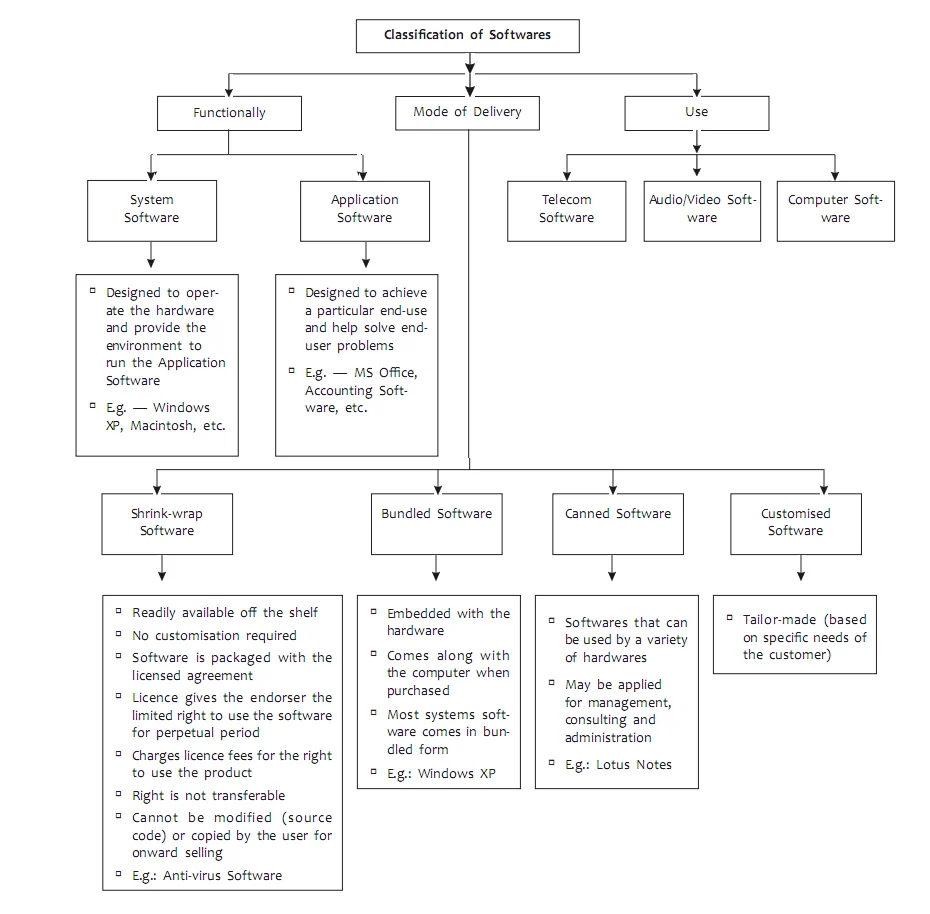
Typical Business Model relating to computer software:

  • Single End-user model — Foreign Company supplies a single copy of the software to the end-user.
  • Distributor Model — Foreign Company either supplies soft copies to an independent distributor in India for onward distribution to Indian customers either directly or through distribution channels or supplies a single copy of the software to a distributor in India who is given the licence to make copies and distribute soft copies to the customers.
  • Multiple-user licence model — Foreign Company supplies a single disk containing the software program to an Indian Company with a right to make copies of the software and distribute to in-house end users.
  • Customised model — Foreign Company customises the software as per Indian buyer’s requirements/ specifications — Enterprise Resource Planning software.
  • Software embedded in hardware — Foreign Company supplies integrated equipment (software bundled with hardware).
  • Cost contribution model — Foreign Company incurs expenditure for installation and maintenance of software system for the benefit of the group companies. It provides access to such Indian group company to use the system and recharges the cost on the basis of use of the system.
  • Electronic model — Payment to Foreign Company for purchase of software through electronic media.
  • Payment to Foreign Company for provision of services for development or modification of the computer program (incl. for upgradation, training, installation, maintenance, etc.).
  • Payment to Foreign Company for know-how related to computer programming techniques.
  1. Definition of Royalty

Under the Act:Explanation 2 to Section 9(i)(vi) of the Act defines the term ‘Royalty’ to mean consideration for:(i) the transfer of all or any rights (including the granting of a licence) in respect of a patent, invention, model, design, secret formula or process or trademark or similar property;

(ii) …………….
(iii) …………….
(iv) …………….
(v) …………….
(vi) the transfer of all or any rights (including the granting of a licence) in respect of any copyright, literary, artistic or scientific work including films or video tapes for use in connection with television or tapes for use in connection with radio broadcasting, but not including consideration for the sale, distribution or exhibition of cinematographic films; or

(vii) the rendering of any services in connection with the activities referred to above in subclauses (i) to (iv), (iva) and (v).

Under the DTAA:
Most DTAAs define the term ‘royalty’ to mean:

(i) payments of any kind received as a consideration for the use of, or the right to use, any copyright of a literary, artistic, or scientific work, including cinematograph films or work on films, tape or other means of reproduction for use in connection with radio or television broadcasting, any patent, trademark, design or model, plan, secret formula or process, or for information concerning industrial, commercial or scientific experience; and

(ii)    payments of any kind received as consideration for the use of, or the right to use, any industrial, commercial, or scientific equipment, other than payments derived by an enterprise of a Contracting State from the operation of ships or aircraft in international traffic.

III.    Relevant provisions of the Copyright Act, 1957

Section 2(o): Literary Work

includes computer programs, tables and compilations including computer databases.

Section 14: Meaning of Copyright:

Copyright means the exclusive right, subject to the provisions of this Act, to do or authorise the doing of any of the following acts in respect of a work or any substantial part thereof, namely;

(i)    in the case of a literary, dramatic or musical work, not being a computer program —

(a)    to reproduce the work in any material form including the storing of it in any medium by electronic means;
(b)    to issue copies of the work to the public and not being copies already in circulation;
(c)    to perform the work in public, or communicate it to the public
(d)    to make any cinematograph film or sound recoding in respect of the work
(e)    to make any translation of the work
(f)    to make any adaptation of the work
(g)    to do, in relation to a translation or an adaptation of the work, any of the acts specified in relation to the work in sub-clauses

(i) to (vi).

(ii)    in the case of computer program —

(a)    to do any of the acts specified in clause (a) above;
(b)    to sell or give on commercial rental or offer for sale or for commercial rental any copy of the computer program
(c)    No copyright except as provided in this Act, i.e., Copyright does not extend to any right beyond the scope of section 14.

Section 52: Certain acts not to be infringement of copyright.

(1)    The following act shall not constitute an infringement of copyright, namely:

(a)    …………

(aa)    The making of copies or adaptation of a computer program by a lawful possessor of a copy of such computer program, from such copy —

a)    In order to utilise the computer program for the purpose for which it was supplied; or
b)    To make back-up copies purely as a tem-porary protection against loss, destruction or damage in order only to utilise the computer program for the purpose for which it was supplied.


IV. OECD on Software Payments

The 1992 OECD Model Convention (MC):

(1)    Following a survey in the OECD member states, the question of classification of computer software was first considered in 1992 and accordingly revision made in the Commentary to the OECD Model Convention on Article 12.
(2)    Software was generally defined as a program, or a series of program, containing instructions for a computer either for the computer itself or accomplishing other tasks. Modes of media transfer were also discussed.
(3)    Acknowledged that OECD member countries typically protect software rights under copyright laws.
(4)    Different ways of transfer of software rights e.g., Alienation of entire rights, alienation of partial rights (sale of a product subject to restrictions on the use).

The taxability was analysed under 3 situations:

First situation: Payments made where less than full rights in the software are transferred:

  •     In a partial transfer of rights the consideration is likely to represent a royalty only in very limited circumstances.
  •     One such case is where the transferor is the author of the software and alienates part of his right in favour of a third party to enable the latter to develop or exploit the software itself commercially — for example by development and distribution of it.
  •     In other cases, acquisition of the software will generally be for personal or business use of the purchaser and will be business income or independent personal services. The fact that software is protected by copyright or there are end use restrictions is of no relevance.


Second situation: Payments made for alienation of Complete Rights attached to the software:

  •     Payments made for transfer of a full ownership cannot result in royalty.

Difficulties can arise where there are extensive transfer of rights, but partial alienation of rights involving:

exclusive right of use during a specific period
or in a limited geographical area.
additional consideration related to usage.
consideration in the form of substantial lump-sum payment.

  •     Subject to facts, generally such payments are likely to be commercial income or capital gains rather than royalties.


Third situation: Software payments under mixed contracts:

  •     Examples include sale of computer hardware with built-in software with concessions of the right to use software with provision for services.
  •     In such a scenario, it was felt that the consideration be split on the basis of information contained in the contract or by a reasonable apportionment with the appropriate tax treatment being applicable to each part.

Thus for the first time these three situations were envisaged by the OECD in its 1992 MC.

2000 OECD MC brought in further refinements to the earlier positions.

It acknowledged that software can be transferred as an integral part of computer hardware or in independent form available for use with various hardware. For the first time, the 2000 MC suggested a distinction between a copyright in the program and software which incorporates a copy of the copyrighted program. The transferee’s rights will in most cases consist of partial rights or complete rights in the underlying copyright or they may be rights partial or complete in a copy of the program. — It does not matter, if such copy is provided in a material medium, or electronically. Payments made for acquisition of partial rights in the copyright will represent ‘royalty’ only if consideration is for granting of rights to use the program that would, without such licence, constitute an infringement of copyright.

The 2000 MC also throws light on  rights to make multiple copies for operation within its own business and these are commonly referred to as ‘site licences’, ‘enterprise licences’, or  ‘network licences’. If these are for the purposes of enabling the operation of the program on the licensee’s computers/network and reproduction for any other purpose is not permitted, payments for such arrangements would not be reckoned as royalty, but may be business profits.

2008 MC to the OECD Model expanded the scope of software payments by including transactions concerning digital products such as images, sounds or text. The downloading of images, sounds or text for the customers own use or enjoyment is not royalty as the payment is essentially for acquisition of data transmitted digitally. However, if the essential consideration for the payment for a digital product is the right to use that digital product, such as to acquire other types of contractual rights, data or services, then the same would be characterised as royalty.

Example a book publisher, who would download a picture and also acquire the right to reproduce that picture on the cover of a book that it is producing.

India’s position on OECD:
 India  reserves its position on the interpretations provided in the OECD MC and is of the view that some of the payments referred therein may constitute royalties.

Issues in the controversy:
(1)  Whether payment for purchase of computer software is payment for  ‘goods’ or payment for ‘royalty’?

(2) Whether payment for computer software can be said to be payment for ‘use of process’ as referred to in clauses (i), (ii) and (iii) of the royalty definition in the Act?

(3) Whether payment for computer software is for ‘right to use the copyright in a program’ or ‘right to use the program only’? [Copyright v. Copyrighted Article]

(4) Whether mere grant of non-exclusive licence would fall within the ambit of ‘royalty’ definition under the Act? [Ref. clause (v) of the royalty definition in the Act which also includes the phrase ‘granting of a licences’]

(5)    Whether payment for computer software can be said to ‘impart information concerning technical, industrial, commercial or scientific knowledge’ and hence falling under clause (iv) of the royalty definition under the Act?

(6)    Section 115A prescribes the rate of tax applicable to a foreign company on income by way of ‘royalty’ or ‘fees to technical services’. Whether as per section 115A(1A) of the Act, it is not necessary that copyright therein should be specifically transferred as consideration in respect of any computer software is stated to be taxable u/s.115A?

V.    Key judicial and advance rulings

CIT v. Samsung Electronics Co. Ltd., 64 DTR (Kar.) 178

Facts:

The assessee was engaged in the development and export of computer program. The assessee imported ‘shrinkwrapped’/‘off-the-shelf’ software from suppliers in foreign countries for use in its business and made payment for the same without deducting tax at source u/s.195.

Ruling of the High Court:

U/s.9(1)(vi) of the Act and Article 12 of the DTAA, “payments of any kind in consideration for the use of, or the right to use, any copyright of a literary, artistic or scientific work” is deemed to be ‘royalty’.

It is well settled that in the absence of any definition of ‘copyright’ in the Act or DTAA with the respective countries, reference is to be made to the respective law regarding definition of Copyright, namely, the Copyright Act, 1957, in India, wherein it is clearly stated that ‘literary work’ includes computer programs, tables and compilations including computer (databases).

On reading the contents of the respective agreement entered with the non-resident, it is clear that under the agreement, what is transferred is a right to use the copyright for internal business by making copies and back-up copies of the program.

The amount paid to the supplier for supply of the ‘shrinkwrapped’ software is not the price of the CD alone nor software alone nor the price of licence granted. It is a combination of all. In substance unless a licence was granted permitting the end-user to copy and download the software, the CD would not be helpful to the end-user.

There is a difference between a purchase of a book or a music CD, because while these can be used once they are purchased, software stored in a dumb CD requires a licence to enable the user to download it upon his hard disk, in the absence of which there would be an infringement of the owner’s copyright. Therefore, there is no similarity between the transaction of a computer program and books.

The decision of the Supreme Court in case of TCS v. State of AP, (271 ITR 404) distinguished as being in the context of sales tax.

Thus, held that the payments made in respect of computer program would constitute ‘royalty’ under the applicable DTAA and would also fall within the ambit of ‘royalty’ under the broader definition in the Act. Thus, the assessee would be required to deduct tax on the payment made in respect of computer programs.

Further, the Karnataka High Court in case of CIT v. M/s. Wipro Ltd., (ITA No. 2804 of 2005) has also held that payment for subscription/access to database is payment for licence to use the copyright hence taxable as ‘royalty’.

Director of Income-tax v. Ericsson Radio System AB, (ITA No. 504 of 2007) (Delhi High Court)

Facts:

The assessee, a Swedish company, entered into con-tracts with ten cellular operators for the supply of hardware equipment and software. The installation and testing were done in India by the assessee’s group entities.

The contracts were signed in India. The supply of the equipment was on CIF basis and the assessee took responsibility thereof till the goods reached India. The assessee claimed that the income arising from the said activity was not chargeable to tax in India.

The Assessing Officer and the Commissioner of Income-tax (Appeals) held that the assessee had a ‘business connection’ in India u/s.9(1)(i) and a ‘permanent establishment’ under Article 5 of the DTAA. It was also held that the income from supply of software was assessable as ‘royalty’ u/s.9(1)(vi) and Article 13. On appeal, the matter was referred to Special Bench of the Tribunal. The Tribunal held that as the equipment had been transferred by the assessee offshore, the profits therefrom were not chargeable to tax. It also held that the profits from the supply of software were not assessable to tax as ‘royalty’ either under the Act or DTAA with Sweden.

Aggrieved by the common order of the Special Bench in case of Motorola Inc. 95 ITD 269 (Del.) (SB), which also covered the case of Ericsson, the Tax Authority filed an appeal before the High Court.

Ruling of the High Court:

The profits from the supply of equipment were not chargeable to tax in India because the property and risk in goods passed to the buyer outside India. The assessee had not performed installation service in India.

The argument that the software component of the supply should be assessed as ‘royalty’ is not acceptable because the software was an integral part of the GSM mobile telephone system and was used by the cellular operator for providing cellular services to its customers.

Software was embedded in the equipment and could not be independently used. It merely facilitated the functioning of the equipment and was an integral part thereof. The Tax Authority accepts that it could not be used independently. The fact that in the supply contract, the lump -sum price was bifurcated is not material. The same was only because differential customs duty was payable.

To qualify as royalty, it is necessary to establish that there is transfer of all or any right (including the granting of any licence) in respect of copy right of a literary, artistic or scientific work. Section 2(o) of the Copyright Act makes it clear that a computer program is to be regarded as a ‘literary work’. Thus, in order to treat the consideration paid by the cellular operator as royalty, it is to be established that the cellular operator, by making such payment, obtains all or any of the copyright rights of such literary work. In the present case, this has not been established. It is not even the case of the Revenue that any right contem-plated u/s.14 of the Copyright Act, 1957 stood vested in this cellular operator as a consequence of Article 20 of the supply contract.

A distinction has to be made between the acquisition of a ‘copyright right’ and a ‘copyrighted article’. The submissions made by the assessee on the basis of the OECD commentary are correct.

Even assuming the payment made by the cellular operator is regarded as a payment by way of royalty as defined in Explanation 2 below section 9(1)(vi), nevertheless, it can never be regarded as royalty within the meaning of the said term in Article 13, para 3 of the DTAA. This is so because the definition in the DTAA is narrower than the definition in the Act. Article 13(3) brings within the ambit of the definition of royalty a payment made for the use of or the right to use a copyright of a literary work. Therefore, what are contemplated are a payment that is dependent upon user of the copyright and not a lump-sum payment as is the position in the present case.

The payment received by the assessee was towards the title of the equipment of which software was an inseparable part incapable of independent use and it was a contract for supply of goods. Therefore, no part of the payment could be classified as payment towards royalty.

Solid Works Corporation, ITA No. 3219/Mum./2010 (Mum. Tribunal), dated 8-2-2012

Recently the Mumbai ITAT on the issue of characterisation of shrinkwrapped computer software in the case of Solid Works Corporation (Taxpayer) has held that the consideration received by the taxpayer for the shrinkwrapped software is not ‘royalty’ under the provisions of the India-USA DTAA, but business receipts.

While arriving at its decision, the ITAT relied on the favourable view taken by the Delhi High Court in the case of Ericsson, after considering the decision of the Karnataka High Court in the case of Samsung (supra).

It may be noted that the ITAT has also accepted the argument of the taxpayer that when two views are available, the one favourable to the taxpayer should be followed. This principle should apply even to a non-resident in view of the non-discrimination article in the DTAA.

This ruling should be helpful, especially to taxpayers coming within the jurisdiction of the Mumbai ITAT, and is likely to have persuasive value in case of other neutral jurisdictions (i.e., other than the jurisdiction of the Karnataka High Court), in defending the tax position that is taken based on whether a transaction is a ‘copyright right’ or a ‘copyrighted article’.

Further, the Mumbai Tribunal in the following cases had ruled the issue in favour of the taxpayer by following the Special Bench decision in case of Motorola Inc.:

  •     Kansai Nerolac Paints Ltd. v. Addl. DIT, 134 TTJ 342 (Mum.)
  •     DDIT v. M/s. Reliance Industries Ltd., 43 SOT 506 (Mum.)
  •    Addl. DIT v. Tata Communications Limited, 2010 TII 157 ITAT-Mum.


Controversy before the AAR:

The Authority for Advance Rulings (‘AAR’) recently in its ruling in the case of Citrix Systems Asia Pacific Pty. Limited (AAR No. 882 of 2009) and Millennium IT Software Ltd., 338 ITR 391 had an occasion to deal with the aforesaid issue under consideration, wherein the AAR while deciding against the taxpayer’s contention, held that the income from the transaction be regarded as a royalty, liable to tax in India. In deciding the issue in this case the AAR gave findings that were contrary to its own findings on the subject given in the earlier decisions in the cases of Dassault Systems K. K., 322 ITR 125 and FactSet Research Systems Inc., 317 ITR 169.

Citrix Systems Asia Pacific Pty. Limited (AAR):

In this case, the AAR held that the payment received from Indian distributor under software distribution agreement is taxable as royalty u/s.9(1)(vi) of the Act as well as Article 12 of the India-Australia DTAA. It also observed that sale/licence to use software entails transfer of rights in copyrights embedded in software. The AAR took a contrary view to its earlier ruling in the case of Dassault Systems and refused to rely on the Delhi HC ruling in the case of Ericsson (supra), thereby following the ruling in the case of Millennium IT Software and the Karnataka HC in the case of Samsung (supra).

It is interesting to note that the Chairman of the AAR has mentioned in the ruling of Citrix that the differing views on the issue can get resolved and the matter can be set at rest only by a decision of the Supreme Court, laying down the law finally, to be followed by all the Courts and Tribunals including the AAR. Only an authoritative pronouncement by the Apex Court can settle this controversy.


Millennium IT Software’s case:

In this ruling, the AAR held that the licence fees paid for use of ‘Licenced Program’ is taxable as ‘royalty’ under clause (v) of Explanation 2 to section 9(1)(vi) of the Act and Article 12 of the India-Sri Lanka DTAA. Thus the provisions of withholding tax u/s.195 are applicable to the applicant. The AAR’s ruling was based on the ruling of the Delhi ITAT in the case of Gracemac Corporation v. DIT, (42 SOT 550).

The said Delhi ITAT ruling has been distinguished by the Mumbai ITAT in the case of TII Team Telecom Inter-national Pvt. Ltd., 60 DTR 177. Also, the Mumbai ITAT has distinguished the AAR ruling of Millennium in the case of Novel Inc. (ITA No. 4368/Mum./2010) where income of non-resident from re-selling of software via Indian distributor was held as not taxable.

Conclusion:

The issue under consideration is otherwise a multi-faceted issue and has several dimensions which are sought to be addressed through a few questions and answers thereon. An analysis of the above-discussed important decisions rendered in the context of software/ use of technology-related payments give rise to the following open-ended questions before the taxpayers:

  •    What is meant by the expression ‘transfer of all or any rights (including granting of licence) and which rights are sought to be covered?
  •     Whether the rights referred in section 14 of the Copyrights Act, 1957 are transferred in sale of computer software to end-users?
  •     Whether ‘computer program’ is copyright and/or industrial intellectual property?
  •    Whether the payment made in relation to shrink-wrapped/off-the-shelf software would constitute payment for a copyright, would need to be determined as per section 14 of the Copyright Act, 1957?
  •     Where there is any distinction between a copyright v. copyrighted article in light of the decision of the Karnataka High Court in the case of Samsung Electronics?
  •     Whether in case of bundled contract i.e., software supplied along with hardware, any bifurcation can be made between the payments made for software and hardware?
  •     Whether every payment made by the taxpayer for use of computer program would constitute ‘royalty’ under the Act and relevant DTAA?
  •     Is the position under the DTAA stronger than un-der the Act as the definition of royalty under the DTAA is restrictive than under the Act?
  •     What would be the position, where the DTAA between two Contracting States specifically cover the payments for computer software program within the ambit of taxation as royalty, vis-à-vis the DTAA where such inclusion is not there.

Key takeaways:

The ruling of the Karnataka High Court in the case of Samsung would have significant tax implications on the industries operating under jurisdiction of the Karnataka High Court dealing in computer software/ other technology. The Delhi High Court in the case of Ericsson Radio System A.B., New Delhi having upheld the decision of the Special Bench on this issue, could help the taxpayers to reinforce its position on this contentious issue before various Tribunals (except Bangalore Tribunal). Although, the AAR rulings in the case of Dassault, Geo quest, Citrix’s and Millennium are applicable only to the applicant and Tax Department, they have persuasive value.

Analysis of Finance Bill, 2012 — Proposals:

Controversy revolving around the tax-ability of software payments, is sought to be resolved by amendment to section 9(1)(vi) of the Act. The Finance Bill, 2012 has proposed to insert Explanation 4 and Explanation 5 to the section 9(1)(vi) with retrospective effect from 1st June 1976. The definition of the royalty in Explanation 2 is sought to be expanded by these two explanations.

Explanation 4 clarifies that the transfer of all or any rights in respect of any right, property or information includes transfer of all or any right for use or right to use a computer software (including granting of a licence), irrespective of the medium through which such right is transferred.

Implications of Explanation 4:

By insertion of proposed Explanation 4 to section 9(1) (vi) the controversy surrounding taxability of software payment by characterising it as royalty is sought to be put at rest. The main issue would be whether by inserting Explaination and expanding the scope of the definition ‘royality’ by way of clarificatory retro-spective amendment, can a payment for software be brought to tax?

The dispute was whether by making a payment for software, the licensee gets rights in the ‘copyright’ of the software. It appears that it is felt by the law-makers that by specifically inserting payment for software itself in the definition of royalty, this purpose will be achieved. The moot question however is, whether it can be done retrospectively from 1 June 1976?

Further, Explanation 5 clarifies that royalty includes consideration in respect of any right, property or information whether or not the payer has the possession or control of it, the payer is using it directly or such right, etc. are located outside India.


Implications of Explanation 5:

Explanation 5 seeks to clarify that once a right, property or information is deemed to be covered under Explanation 2 read with Explanation 4 to the section 9(1)(vi), the interpretation would continue to remain so, irrespective of possession or control of the right, property or information, direct or indirect use of the right, property or information or location of the right, property or information.

While it remains to be seen how Explanation 5 will be interpreted by the Courts. It would not be correct to say that on fulfilment of the situations laid down in Explanation 5, the taxability of sale of software is, per se, attracted.

Existence of beneficial treaty provisions:

As mentioned above, the payment for the sale or licence of software, would now get covered u/s. 9(1) (vi), if provisions of the Act are to be applied. However, if the provisions of the treaty are beneficial than the provisions of section 9(1)(vi), still it will be possible to contend that payment for software as per the provisions of the treaty is not liable to tax in India. Further, out of several treaties signed by India, only in 4 to 5 treaties, namely, Morocco, Rus-sia, Turkmenistan, Malaysia and Tobago specifically payment for software is covered as part of royalty. Therefore, it will still be a good case to argue that in case of, off-the-shelf or standardised software are not chargeable to tax in India except where as per treaty it is specifically covered.

It is, therefore, important to note here that the taxpayers who are entitled to claim benefit of tax treaty will still be able to take shelter under the beneficial treaty provisions as the scope of provisions (generally Article 12) under the treaty is restricted than under the Act.

Way forward:

  •     It is learnt that the taxpayer has filed an SLP against the Karnataka High Court ruling in the case of Samsung Electronics Company Ltd. in December 2011 which is yet to be admitted. The SC has reacted that adjudication on this issue is going to be the next big thing after Vodafone judgment.
  •    The proposed amendment, as mentioned above, may resolve the controversy in respect of future transactions, however, whether the amendment will apply retrospectively or not will be a matter of debate and litigation. So in cases where applicable the treaty does not specifically cover the software, the non-taxability could be claimed.
  •     Hence, till the time, the issue gets settled at the highest level, litigation over taxability of software payments is likely to continue. So let’s WAIT & WATCH.
Year of Decision in the case of Authority Jurisdiction Favourable Against
judgment
2004 Tata Consultancy Services Supreme 3
Court
2004 Wipro Ltd. ITAT Bangalore 3
2005 Motorola Inc. Special Delhi 3
Bench ITAT
2005 Lucent Technologies Hindustan Ltd. ITAT Bangalore 3
2005 Samsung Electronics Company Ltd. ITAT Bangalore 3
2005 Sonata Software Ltd. ITAT Bangalore 3
2006 Hewlett-Packard (India) (P) Ltd. ITAT Bangalore 3
2006 Sonata Information Technology Ltd. ITAT Bangalore 3
2006 IMT Labs (India) Pvt. Ltd. AAR 3
2006 Metapath Software International Ltd. ITAT Delhi 3
2008 Airports Authority of India AAR 3
2009 FactSet Research Systems Inc. AAR 3
2009 Samsung Electronics High Court Karnataka 3
2010 Lotus Development (Asia Pacific) Ltd. Corp. ITAT Delhi 3
2010 Microsoft Corporation and
Gracemac Corporation ITAT Delhi 3
2010 Reliance Industries Ltd. ITAT Mumbai 3
2010 M/s. Tata Communications Ltd. ITAT Mumbai 3
2010 M/s. Daimler Chrysler AG ITAT Mumbai 3
2010 Dassault Systems K.K. AAR 3
Year of Decision in the case of Authority Jurisdiction Favourable Against
judgment
2010 GeoQuest Systems BV AAR 3
2010 Velankani Mauritius Ltd. ITAT Bangalore 3
2010 Kansai Nerolac Paints Ltd. ITAT Mumbai 3
2010 Bharati AXA General Insurance Co. Ltd. AAR 3
2011 Asia Satellite Co. Ltd. High Court Delhi 3
2011 Dynamic Vertical Software India Pvt. Ltd. High Court Delhi 3
2011 Standard Chartered Bank Ltd. ITAT Mumbai 3
2011 ING Vysya Bank Ltd. ITAT Bangalore 3
2011 TII Telecom International Pvt. Ltd. ITAT Mumbai 3
2011 M/s. Abaqus Engineering Pvt. Ltd. ITAT Chennai 3
2011 Millennium IT Software AAR 3
2011 Samsung Engineering Company Limited High Court Karnataka 3
2011 Novel Inc. (Mum.) ITAT Mumbai 3
2011 Lucent Technologies High Court Karnataka 3
2011 Ericsson Radio System AB High Court Delhi 3
2012 Solid Works Corporation ITAT Mumbai 3
2012 Citrix Systems Asia Pacific Pty. Limited AAR 3
2012 Acclerys K. K. AAR 3
2012 People Interactive (I) P. Ltd. ITAT Mumbai 3

Recent Global Developments in International Taxation

fiogf49gjkf0d
In this Article, we have given brief information about the recent global developments in the sphere of international taxation which could be of relevance and use in day-to-day practice and which would keep the readers abreast with various happenings across the globe. We intend to keep the readers informed about such developments from time to time in future.

(1) United States

(i) IRS issues updated Publication 519 — US Tax Guide for Aliens

The US Internal Revenue Service (IRS) has released the 2012 revision of Publication 519 (US Tax Guide for Aliens). The publication is dated 7 February 2012 and is intended for use in preparing tax returns for 2011.

Publication 519 provides detailed guidance for resident and non-resident aliens to determine their liability for US federal income tax. Specifically, Publication 519 discusses:

  • the rules for determining US residence status (e.g., the US green card test and the US substantial presence test);

  • the rules for determining the source of income; ? exclusions from US gross income;

  • the rules for determining and computing US tax liability;

  • US tax liability for a dual-status tax year (i.e., where an individual has periods of residence and non-residence within the same tax year);

  • filing information;

  • paying tax through withholding tax or estimated tax;

  • benefits under US income tax treaties and social security agreements;

  • exemptions for employees of foreign governments and international organisations under US tax treaties and US tax law;

  • sailing and departure permits for departing aliens; and

  • how to get tax help from the IRS.

Publication 519 also includes:

  • filled-in individual income tax returns (IRS Form 1040 and Form 1040NR) as illustrations of dualstatus returns;

  • Table of US tax treaties (updated through 31 December 2011);

  • Appendix A (Tax Treaty Exemption Procedure for Students), which contains the statements non-resident alien students and trainees must file with IRS Form 8233 [Exemption From Withholding on Compensation for Independent (and Certain Dependent) Personal Services of a Non-resident Alien Individual] to claim a tax treaty exemption from withholding of tax on compensation for dependent personal services; and

  • Appendix B (Tax Treaty Exemption Procedure for Teachers and Researchers), which contains the statements non-resident alien teachers and researchers must file for the same purpose as Appendix A.

Revised Publication 519 provides information on relevant tax changes for 2011 and 2012, including:

  • the requirement to file new IRS Form 8938 (Statement of Specified Foreign Financial Assets) to report certain foreign financial assets (for 2011);

  • exclusion of interest paid on non-registered (bearer) bonds from portfolio interest (for 2012); and

  • expiration of the exemptions for certain USsourced interest-related dividends and shortterm capital gain dividends that are received from a mutual fund or other regulated investment company (for 2012).

Additionally, Publication 519 refers to the other IRS publications that are relevant in this context, including:

  • Publication 514 (Foreign Tax Credit for Individuals);

  • Publication 515 (Withholding of Tax on Nonresident Aliens and Foreign Entities);

  • Publication 597 (Information on the United States-Canada Income Tax Treaty); and

  • Publication 901 (US Tax Treaties).

(ii) IRS Notice 2010-62: Application of codified economic substance doctrine

The Internal Revenue Service (IRS) has issued Notice 2010-62 with information on implementation of the economic substance doctrine. This doctrine previously applied under US common law and has now been codified by the Health Care and Education Act of 2010, effective for transactions entered on or after 31 March 2010.

The economic substance doctrine permits the IRS to deny tax benefits from a transaction unless (i) the transaction changes in a meaningful way (apart from Federal income tax effects) the taxpayer’s economic position, and (ii) the taxpayer has a substantial purpose (apart from Federal income tax effects) for entering into the transaction.

Notice 2010-62 provides information on how the IRS intends to apply the newly codified doctrine. Particular guidance is provided with respect to:

  • the application of the two-part conjunctive test of the doctrine;

  • the calculation of net present value of reasonably expected pre-tax profit (which is a necessary requirement for meeting the test); and

  • the treatment of foreign taxes as expenses in appropriate cases.

Application of the US accuracy-related penalties is also discussed.

Notice 2010-62 provides, in general, that the IRS will apply the codified economic substance doctrine in the same manner as the doctrine was applied by the US courts under common law. The IRS states, however, that it does not intend to issue administrative guidance regarding the types of transactions to which the doctrine will or will not be applied.

(iii) Offshore Voluntary Disclosure Program reopened indefinitely

The US Internal Revenue Service (IRS) issued a News Release (IR-2012-5) on 9 January 2012 to announce reopening of the Offshore Voluntary Disclosure Program (OVDP) to allow taxpayers with undisclosed offshore accounts to report such accounts to the IRS and get current with their US taxes. The new OVDP is effective from 9 January 2012 and will remain open for an indefinite period until otherwise announced.

The new OVDP requires participants to pay a penalty of 27.5% of the highest aggregate balance in foreign bank accounts/entities or value of foreign assets during the 8 full tax years prior to the disclosure. That is increased from 25% in the 2011 program. The new OVDP maintains the reduced 5% and 12.5% penalties that applied in limited situations under the 2011 program.

Participants must file all original and amended tax returns and include payment for back-taxes and interest for up to eight years as well as paying accuracy-related and/or delinquency penalties.

The IRS stated that more details will be released within the next month.

The IRS also announced in the press release that more than USD 4.4 billion have been collected so far from the two previous disclosure programs.

(iv) Joint Committee on Taxation issues report on taxation of financial instruments

The Joint Committee on Taxation of the US Congress has released a report on US Federal tax rules relating to financial instruments.

The report is entitled Present Law and Issues Related to the Taxation of Financial Instruments and Products. The report is dated 2 December 2011 and is designated JXC-56-11.

The report is divided into four sections, as follows:

  • Section I describes economic, financial accounting, and regulatory considerations related to holding, issuing, and structuring financial instruments;

  • Section II describes the basic US income tax principles of timing, character, and source that underlie the taxation of financial instruments;

  • Section III provides an overview of the timing, character, and source rules for five types of financial instruments (i.e., equity, debt, options, forward contracts, and notional principal contracts), plus a description of the economic relationships among various financial instruments (including so-called put-call parity) and the financial accounting treatment of financial instruments; and

  • Section IV discusses selected timing, character, source, and categorisation issues in taxation of financial instruments.

The report also includes an appendix with data on holdings and issuance of financial instruments.

(v)    IRS updates annual list of international no-ruling areas

The US Internal Revenue Service (IRS) has issued Revenue Procedure 2012-7 with its updated list of international tax issues on which it will not accept applications for private letter rulings and determination letters.

Revenue Procedure 2012-7 includes two lists of international no-ruling areas, i.e., (i) areas in which rulings or determination letters will not be issued, and (ii) areas in which rulings or determination letters will ‘not ordinarily be issued’.

Inclusion of an item on the ‘not ordinarily be issued’ list means that the IRS will not issue a private letter ruling or determination letter on the issue absent unique and compelling reasons given by the taxpayer that would justify a ruling or determination letter.

The 2012 lists have not changed from the 2011 lists, and include such no-ruling and ordinarily no-ruling areas as, among others:

  •     whether a payment constitutes portfolio interest u/s.871(h) of the US Internal Revenue Code (IRC), regarding the US tax exemption on certain portfolio interest received by non-resident foreign individuals;

  •     whether a taxpayer is eligible to claim benefits under the limitation on benefits provision (LOB) of a US income tax treaty;

  •     whether a foreign individual is a non-resident of the United States;

  •     issues that are the subject of a pending request for competent authority assistance under a US tax treaty;

  •     whether a foreign taxpayer is engaged in a trade or business in the United States, and whether income is effectively connected to a US trade or business;

  •    whether a foreign taxpayer has a permanent establishment in the United States, and whether income is attributable to a US permanent establishment;

  •     whether a foreign levy meets the requirements of a creditable tax or in-lieu-of-tax in the United States; and

  •     specified issues concerning conduit financing arrangements.

Revenue Procedure 2012-7 is effective from 3 January 2012.

(vi)    Final regulations issued for CSAs in transfer pricing

The US Treasury Department and Internal Revenue Service (IRS) have issued final regulations (TD 9568) on the transfer pricing rules for cost-sharing arrangements (CSAs). The final regulations were issued u/s.482 of the US Internal Revenue Code (IRC) and are effective from 16 December 2011.

The final regulations provide guidance on the determination of and compensation for economic contributions by controlled participants in connection with a CSA in accordance with the arm’s-length standard. The final regulations adopt with modifications the 2008 temporary and proposed regulations on this topic, which was published on 5 January 2009. The final regulations provide modifications and clarifications to the 2008 regulations, including:

  •     treatment of research tools as platform contributions;

  •    clarification on updating reasonably anticipated benefit (RAB) shares;

  •     supplemental guidance on transfer pricing methods applicable to platform contribution transactions (PCTs);

  •     supplemental guidance on application of the best method analysis and the income method;

  •     clarifications with regard to the acquisition price and market capitalisation methods;

  •     clarifications with regard to the residual profit split method;

  •     clarifications regarding forms of payment; and

  •     determinations of periodic adjustments.

The Treasury Department and the IRS state in the preamble to the final regulations that they continue to consider the matters regarding the valuation of stock options and other stock-based compensation and intend to address this issue in a subsequent regulations project.

(2)    Germany: Guidance on amended Anti-Treaty Shopping rules published

On 25 January 2012, the Ministry of Finance published official guidance (IV B 3 – S 2411/07/10016) on the application of the anti-treaty-shopping rules embodied in Article 50d(3) of the Income-tax Act as amended in 2011.

Under the revised rules, treaty benefits to a non-resident (intermediate) company are denied if:

  •     as far as its shareholders would not be entitled to the treaty benefits if they would have invested directly; and

  •     as far as the functional requirements of Article 50d(3) are not fulfilled, i.e., the company derives harmful revenue.

The functional requirements are met if:

  •     as far as the company generates its gross income from its own active business activities; or

  •     in regard to the company’s gross income that is not generated from its own business activities:

– there are economic or other important reasons for the use of the intermediate company in view of the respective income; and

– the foreign company is adequately equipped for carrying out its own business activities and for participating in the general commerce.

The amendments brought by the bill on the implementation of Directive 2010/24 and other tax laws were necessary in response to the infringement procedure initiated by the European Commission in 2010. Under the old rules, treaty benefits were denied to an intermediate company, inter alia, if the company did not generate more than 10% of its gross income from its own active business activities. The European Commission considered this all-or-nothing approach as disproportionate and going beyond what is necessary to attain the objective of preventing tax evasion. The amended rules provide for a pro-rata relief, to the extent the functional requirements of Article 50d(3) of the ITA are met and there is non-harmful gross income.

Article 50d(3) of the ITA imposes the burden of proof on the non-resident company in respect of the existence of economic or other important reasons for the interposition of the intermediate company as well as for its adequate business substance. The Guidance defines ‘own business activities’ as activities that exceed the mere management of assets and require a participation in general commerce. Further, the interposition of an EU entity can only qualify if the interposed company participates in general commerce within the Member State of its jurisdiction in an active, permanent and persistent fashion. Services for group companies qualify as business activities if invoiced at arm’s length.

Regarding the notion of ‘economic or other important reasons’ for the use of the intermediate company, the Guidance stipulates that an economic reason is given, if the intermediate company is used in order to start an own business activity and the respective activities can be clearly proven.

Other business reasons, relating to the concerns of the entire group (e.g., coordination and organisation, customer relationship building, cost reduction, location preferences or overriding group business objectives) do not qualify as sufficient economic reason. The Guidance further points out that the mere securitisation of assets or shareholders’ pensions in times of economic crisis, as well as the structuring of ancestral successions, do not qualify as an economic reason in this respect.

The amended rules generally apply as from 1 January 2012. However, the rules shall apply as well to all pending cases in which the application of the amended rules lead to more beneficial results for the taxpayer.

(3)    New Zealand: Exposure draft of interpretation statement on tax avoidance

An exposure draft of an interpretation statement, released by Inland Revenue on 19 December 2011, has invited comments from the public on tax avoidance and Inland Revenue’s interpretation of sections BG1 and GA1 of the Income Tax Act, 2007 (ITA). Following a number of significant court decisions on tax avoidance in recent years, the exposure draft discusses Inland Revenue’s interpretation of tax avoidance.

In Ben Nevis Forestry Ventures Ltd. & Ors. v. Commissioner of Inland Revenue; Accent Management Ltd. & Ors. v. Commissioner of Inland Revenue (2009) 24 NZTC 23, 188, the Supreme Court examined the approach between section BG1 and the rest of the Income Tax Act. Subsequently, the approach adopted in Ben Nevis was endorsed as the correct approach to apply section BG1 in Penny and Hooper v. Commissioner of Inland Revenue (2011) NZSC

95.    The exposure draft sets out the analysis to be undertaken to determine whether an arrangement is a tax avoidance arrangement, viz.:

  •     identify the arrangement;
  •    review all information to ensure all aspects and effects of the arrangement are understood;
  •     identify the provisions of the ITA that were used or circumvented under the arrangement and its outcomes;
  •     identify the commercial reality and economic effects of the arrangement;
  •     ascertain Parliament’s purpose for the provisions of the ITA used or circumvented in the whole arrangement and its outcomes;
  •     decide whether the arrangement, viewed in a commercially and economically realistic way, falls outside Parliament’s purpose; and
  •     exclude any arrangements where the tax avoidance is ‘merely incidental’ to a non-tax purpose.

The deadline for comments on the exposure draft is 31st March, 2012.

Construction — Various business models — Circular No. 151/2/2012-ST, dated 10-2-2012.

fiogf49gjkf0d
In the light of varying business models and business practices prevalent in the construction sector across the country, the CBEC has vide this Circular clarified some of the significant issues pertaining to taxability and collection of service tax on different business models like:

(a) Tripartite Business Model

(b) Redevelopment including Slum Rehabilitation Projects

(c) Investment Model

(d) Conversion Model

(e) Non-requirement of Completion Certificate/ where it is waived or not prescribed

(f) Build-Operate-Transfer (BOT) Projects

(g) Joint Development Agreement Model

levitra

Leviability of Service Tax on toll fees — Circular No. 152/3/2012-ST, dated 22-2-2012.

fiogf49gjkf0d
Board has examined the representation received for leviability of service tax on toll fee paid by users and it is clarified that service tax is not leviable on toll paid by the users of roads including those roads constructed by Special Purpose Vehicle (SPV) created under an agreement between NHAI or State Authority, unless SPV engages an independent entity to collect toll from users on its behalf and part of toll is retained by that independent entity as commission or is compensated in any other manner.

It is also clarified that renting, leasing or licensing of vacant land by the NHAI or State Authority to a SPV for construction of road will not attract service tax.

levitra

Gross amount w.r.t. Works Contract — Circular No. 150/1/2012-ST, dated 8-2-2012.

fiogf49gjkf0d
By this Circular it is clarified that the meaning of the expression ‘Gross Amount’ appearing in Explanation to Rule 3(1) of the Works Contract (Composition Scheme for Payment of Service Tax) Rules, 2007 shall not be applicable where execution of works contract has commenced or where any payment except payment through credit or debit to any account has been made towards works contract prior to 7-7-2009.

levitra

Amendment in Rules — Notification No. VAT 1512/C.R 12/Taxation-1, dated 16-2-2012.

fiogf49gjkf0d
Vide this Notification amendments are carried to Rules 52, 53 and 54.

In Rule 52, for the words ‘the Commissioner shall’ the words ‘the Commissioner shall subject to the provisions of Rules 53, 54 and 55’ are substituted. This amendment is effective from 1st April 2005. This amendment is clarificatory in nature and has no effect on the position of set-off after amendment.

Rule 53 amended to provide that if the dealer manufacturer, of high-speed diesel oil, aviation turbine fuel, aviation gasoline and motor spirit covered under entries 5, 6, 7, 8, 9 and 10 of Schedule D, dispatches the goods by way of branch transfer, reduction in set-off should be calculated @2% of the values of goods dispatched.

Rule 54 amended with effect from 1-4-2005 so that set-off will not be admissible on purchase of the high-speed diesel oil, aviation turbine fuel (duty paid), aviation turbine fuel (bonded), aviation gasoline (duty paid or bonded), and petrol, unless such motor spirits are sold/resold in the course of interstate trade or commerce or in the course of export outside India.

levitra

Submission of certain annexures by the dealers not required to file audit report in Form 704 — Notification No. VAT/AMD-2011 /1B/ADM-6, dated 4-2-2012 and Trade Circular No. 3T of 2012, dated 27-2-2012.

fiogf49gjkf0d
Dealers who are not required to file audit report in Form 704 will now be required to file annexures C, D, G, H, I, J1 & J2 along with the last return of the financial year. The said annexures will have to be filed for the entire financial year commencing from F.Y. 2012-12.

Annexure C: details of TDS certificates received by dealer, Annexure D: details of TDS certificates issued by the dealer, Annexure G: details of the various certificates or declarations as provided under the Central Sales Tax Act, 1956 received by the dealer, Annexure H: details of the declarations in Form H (Local Form H) received by the dealer, Annexure I: details of the various certificates or declarations as provided under the Central Sales Tax Act, 1956 that are not received, Annexure J1: Customer-wise sales, Annexure J2: Customer-wise purchases.

Such dealers will make payments as per earlier provisions i.e., before 21st/30th April for the period ended 31st March, 2012 and for filing return the due date has been extended by 90 days that is before 30th June. Uploading of the said annexures shall be a pre-requisite for uploading the last return. The deemed dealers i.e., Custom Dept., Dept. of Union Govt., Insurance & Finance Corporations, institutions, banks who are not required to file audit report in Form 704 are also required to file the said annexures.

levitra

(2011) 41 VST 9 (Mad.) Audio India Ltd. v. CTO

fiogf49gjkf0d
Sale price — Sale to deemed exporter — Refund of excise duty to the manufacturer by the Government of India — Not recovered from the buyer — Does not form part of sale price — Section 2(h) of the Central Sales Tax Act, 1956.

Facts:
The dealer had sold industrial valves to the deemed exporter and issued sale bills showing price of the goods and CST without recovering excise duty, as under the Excise Act, under the scheme framed by the Government of India, the manufacturer was entitled to refund of excise duty paid on effecting sales to certain specified projects having status of deemed export. Accordingly, no excise duty was charged by the dealer on sale of goods to Oil India Ltd. having status of deemed exporter. The Department levied CST on cash assistance received from the Government of India for refund of excise duty by including it in sale price of goods sold. The dealer filed writ petition before The Madras High Court against the decision of the Tribunal, dated October 3, 2005.

Held:
Under the Scheme of Refund of excise duty, to the manufacturers supplying goods to specified parties had to bear the Central Excise duty and cash assistance is paid later by the Government of India. The benefit by way of cash assistance to the supplier was an exclusive arrangement between the Government of India and the supplier for certain specified reasons. This had no effect on the sale effected between the petitioner and its buyer. Under the agreement with buyer, the petitioner agreed to supply goods without recovering excise duty paid by it on such supply. Accordingly, sale is effected for a price excluding excise duty. The tax is payable on a sale price charged to buyer and would not include refund of excise duty by the Government of India by way of cash assistance to the petitioner. The writ petition filed by the dealer was allowed and the order of the Tribunal was set aside.

levitra

(2011) 40 VST 505 (P&H) Thermade Pvt. Ltd. v. State of Haryana

fiogf49gjkf0d
Rate of tax — Electrical appliances — Laminar flow clean air equipment used in manufacturing of pharmaceutical products — Whether electrical appliances covered by Schedule A — Entry 18 of Haryana General Sales Tax Act, 1973.

Facts:
The dealer referred question of law to the Punjab and Haryana High Court arising out of decision of Tribunal holding against dealer for attracting higher rate of tax on sale of laminar flow clean air equipment being held as electrical appliances.

Held:
The High Court confirmed the decision of the Tribunal and held that no distinction can be made on the basis of domestic or industrial use of any article. The equipment runs with the electrical energy and provides filtered air. Accordingly, it was held that goods sold by the dealer is an electrical appliances and covered by Entry 18 of Schedule A of the Act attracting higher rate of tax and not as industrial machinery (general goods) as claimed by the dealer.

levitra

(2011) 40 VST 249 (Mad) Sri Rajeshwari Agencies v. Additional Deputy Commercial Tax Officer II, Puducherry

fiogf49gjkf0d
C Forms — Cannot be refused for arrears of tax — Section 9(2) of the Central Sales Tax Act, 1956.

Facts:
The dealer filed writ petition before the Madras High Court challenging issue of show-cause notice for refusing to issue C forms for want of payment of arrears of tax.

Held:
The High Court held that there is no provision under the CST Act to refuse to issue C forms pending arrears of tax. Accordingly issued direction for issue of C forms to the dealer.

levitra

(2011) 41 VST 1 (SC) CST v. Chitrahar Traders

fiogf49gjkf0d
Rate of tax — Sale of condemned plant closed as unviable — Machinery dismantled by buyer using explosives and transported as scrap — Sale of scrap of iron and steel — Attracts rate of 4% tax — Schedule-II, Entry 4(1)(a) of the Tamil Nadu General Sales Tax Act, 1959.

Facts:
The Department filed appeal before the SC against the judgment of the Division Bench of the Madras High Court holding sale of plant closed as unviable and dismantled by buyer using explosives and transported as scrap, attracting 4% rate of tax applicable to scrap of Iron Steel under Entry 4(1)(a) of Schedule-II of the Tamil Nadu General Sales Tax Act, 1959.

Held:

The SC after considering terms and conditions of agreement and other documents held that what was sold by the dealer was nothing else but scrap and not the machinery. The appeal filed by the Department was dismissed and the decision of the Division Bench of the Madras High Court was upheld.

levitra

(2012) STR J 157 & 158 — Basti Sugar Mills

fiogf49gjkf0d
Manufacturer of sugar — Took over management of the sugar mill of another entity for a consideration — Levy of tax as management consultancy agreement — Held, it was management function and hence not liable for tax.

Facts:
The appellant was engaged in the manufacture of sugar in its sugar mill and under an agreement with Indo Gulf Industries Limited, it took over the management of Indo Gulf Industries Limited sugar mill in consideration for certain payment. The Service Tax Department treated the above agreement as a Management Consultancy agreement and demanded service tax on this payment.

Held:
The appellant was in-charge of the operation of the factory and thus was performing the management function. The Tribunal held that no service tax would be applicable for rendering these management functions.

levitra

(2012) 25 STR J 157 (Tri.-Chennai) — Macro Marvel Projects Ltd. v. CST.

fiogf49gjkf0d
Service tax — Construction of complex service — Construction of individual houses is not taxable under ‘construction of complex service’ or under ‘works contract’.

Facts:
The appellants constructed individual residential houses, each being a residential unit. The appeal was against demand of service tax under the head ‘construction of complex’ service. The demand was on the amount collected by the appellants from their clients as consideration for construction and transfer of residential houses.

Held:
The construction of residential complex having not more than 12 residential units was not sought to be taxed under the Finance Act, 1994. For the levy, it should be a residential complex comprising more than 12 residential units. Hence the construction of individual residential units was not subject to levy of service tax.

levitra

(2012) 34 STT 592 (Mumbai-CESTAT) — Bharti Airtel v. CCE.

fiogf49gjkf0d
CENVAT credit — Cell towers, prefabricated building (pfb), printer, office chair, etc. — Neither capital goods nor inputs for providing cellular telephone services — Availed CENVAT credit on the towers, pfb, printer and office chairs. Held, CENVAT credit disallowable — The tower being an immovable property, would not qualify as a capital good or an input which was used for providing output service.

Facts:
The assessee was engaged in the business of providing cellular telephone service which was taxable under the Finance Act for provision of services. The appellant availed CENVAT credit on the towers, pfb, printer and office chairs. Revenue disallowed the CENVAT credit on the said goods on the ground that the tower being an immovable property, would not qualify as a capital good or an input which was used for providing output service.

Held:
The Tribunal held as follows:

The towers and pfb were not a part of an integrated system and were not included in the definition of capital goods.

Alternatively, the tower and pfb would not be considered as components since the components are inputs required to make a good a finished item. As the tower was not an input for the antennas, it would not be considered as a component of the antenna.

Also, as the tower being an immovable property did not satisfy the definition of goods, it would not be considered as an input used for providing output service. The same conclusion was drawn in respect of chairs, printer, etc.

levitra

(2012) 25 STR 251 (Tri.-Del.) — Convergys India Services P. Ltd. v. Commissioner of Service Tax, New Delhi.

fiogf49gjkf0d
Rebate of CENVAT credit on exported services — No dispute as regards the services on which rebate claimed were ‘input services’ in terms of Rule 2(l) of CCR — Deficiency in declaration — A technical lapse — Genuine claim not deniable — Provisions of unjust enrichment not applicable to rebate claim.

Facts:
The appellant filed a declaration for claiming rebate on export of service with the Jurisdictional Assistant/Deputy Commissioner of Central Excise within the limitation period. The appellant mentioned some input services specifically and other input services were described as ‘other services’ instead of mentioning each input service separately. No allegations were made that either services not specifically declared had not been received or invoices for all input services had not been submitted. This declaration was accepted. The Commissioner reviewing this order concluded that the declaration filed was incorrect on the grounds that the appellant did not mention all the services but mentioned some input services along with the words ‘other services’. The appellant produced a statement showing the correlation between export invoices and Foreign Inward Remittance Certificate (FIRC) but did not mention the invoice numbers of the export invoices and hence it was not possible to establish that FIRCs pertained to export services. The appellant claimed a rebate for services of Advertisement, Chartered Accountant and Management Consultant Services. The Department did not dispute that the same were covered by the definition of ‘input service’ but they contended that these services were not used for providing the Customer Care Services which were exported. The Commissioner rejected the rebate claim and ordered the same to be credited to Consumer Welfare Fund on the ground of unjust enrichment. The Commissioner alleged that there was willful misstatement and suppression of facts by the assessee. The assessee had submitted rebate claims with all relevant documents to the jurisdictional authority, which sanctioned rebate after being satisfied about its correctness. This sanction did not discover any new document indicating misstatement or suppression of any information.

Held:

Even if certain services were not mentioned in the declaration, it was considered only a technical lapse, for which rebate could not be denied. Since only some input services were not mentioned, it was highly irrational to deny the entire rebate claim. Further, simply because FIRCs did not bear the export invoice numbers, it could not be concluded that the same did not pertain to the service provided by the appellant to their client abroad. It was held that whenever credit was permitted to be taken, the same were permitted to be utilised and when the same is not possible, there is provision for grant of rebate. Hence the Department could not object that these services were not used for providing services exported by the assessee. It was held that the principle of unjust enrichment was not applicable to rebate claims and the rejected refunds/rebates could not be credited to the Consumer Welfare Fund. It was held that penalty could be imposed only if there was evidence of collusion with jurisdictional authorities sanctioning the inadmissible rebate.

levitra

(2012) 25 STR 259 (Tri.–Del.) — Gayatri Construction Co. v. Commissioner of Central Excise, Jaipur.

fiogf49gjkf0d
Cargo handling services — Scope of shifting of goods within factory premises, supply of manpower for manual assistance at various points of loading using conveyer system, and small part of service of manual loading of cargo into railway wagons of trucks — Held, it is not within the scope of cargo handling service — Hence not liable to service tax.

Facts:
The appellant required manpower for managing various points in the mechanised process of loading of cement bags into trucks and railway wagon. The loading job was fully automated and the manpower supplied related only to supplementing the mechanised process of loading of cement bags. The appellant had also shifted the packed cement bags from various places within the factory premises. These goods were not meant for transportation. The appellant also carried out the job of shifting of coal from power plant to cement plant, breaking of big lumps of coal, etc. These activities were carried within the factory premises and were not meant for transportation.

Held:

Since labour supplied by the appellant were only supplementing the job of loading, the services carried out by the appellant did not come under cargo handling services. The job of internal shifting of goods at both the places did not come under cargo handling services.

levitra

(2012) 25 STR 292 (Tri.-Del.) — Commissioner of Central Excise, Indore v. Hindustan Motors Ltd.

fiogf49gjkf0d
Cenvat/Modvat — Inputs sent directly to processor — to save transport cost — Held, assessee is entitled to take credit of duty paid since there was no dispute about their receipt in their factory and use in manufacture of finished goods — Demand — Limitation — Inputs received in factory sent for further processing to save cost — Held, there was no intention to evade payment of duty by taking wrong credit.

Facts:

The respondent purchased the brake assemblies and took the credit on the basis of invoice issued to them. The goods were not sent to the factory of the respondent, but were dispatched to a job-worker processor at Pune from whom the respondent was getting finished goods produced which in turn were used for further manufacturing of excisable goods in the factory of the respondent. The Department was of the view that the respondent was not eligible for CENVAT credit as the brake assemblies had not been physically received in their factory. The Department filed an appeal against the above order on the ground that since brake assemblies purchased by the respondents from the supplier had not been received but dispatched to the processor for being fitted with rear/front axles being supplied to the respondent, hence the respondents were not eligible for CENVAT credit.

Held:
If the respondent had first transported the brake assemblies to their factory and then sent the same to the processor for being fitted with rear/ front axles being supplied by them, they would be entitled to CENVAT credit for brake assemblies on the basis of invoices issued by the supplier. To avoid unnecessary transportation, the brake assemblies were sent to the processor. Hence, the CENVAT credit cannot be denied as there was no intention to evade payment of duty by taking wrong CENVAT credit.

levitra

(2012) 25 STR 304 (Tri.-Del.) — Krishna Export v. Commissioner of Central Excise, New Delhi.

fiogf49gjkf0d
Appeal — Filing in format meant for excise appeal used in appeal involving customs duty — Held, it was a technical and rectifiable mistake for which appeal could not be dismissed — Direction should have been given to remove the defect.

Facts:

The Commissioner of Central Excise rejected the appeal on the ground that the appeal memo filed by the appellant was in the format meant for excise appeal, whereas the duty of customs stood confirmed by the lower authorities.

Held:
It was held that the mistake pointed out by the Commissioner being of technical nature was a rectifiable mistake and therefore appeal was not to be dismissed. The matter was remanded for fresh decision on merits.

levitra

(2012) 25 STR 290 (Tri.-Chennai) — Rajalakshmi Paper Mills Ltd. v. Commissioner of Central Excise, Madurai.

fiogf49gjkf0d
Cenvat/Modvat — Documents for availing credit — Tampering of inputs and capital goods received in Unit-1 while credit availed in unit 2 — Invoices altered by themselves — Both units situated in the same premises — Held, credit was justified but the penalty would not be reduced.

Facts:
The appellant was denied input credit and capital goods credit on the grounds that the impugned goods which were consigned to unit-I of the appellant were utilised in unit-II of the appellant located in the same premises. The appellant themselves altered the excise code number on the relevant invoices and also wrote unit-II on the said invoices. The denial was on the grounds of tampering with the duty-paying documents and not on the grounds of non-receipt or non-utilisation of the impugned goods of the factory of the appellant. There was no allegation of non-receipt or nonutilisation of the impugned duty-paid goods.

Held:

The Tribunal observed that since the appellant themselves had made alterations instead of intimating the Department, the reduced penalty was justified. With regards to the CENVAT credit, the assessee was allowed to avail it.
levitra

Clarifications for Notification on tax-free bonds from Rural Electrification Board — Notification No. 13/2012, dated 6-3-2012.

fiogf49gjkf0d
In corrigendum to Notification No. 7/2012, dated 14-2-2012 it is clarified that QIBs shall have meaning as assigned to it in the SEBI (Issue and listing of Debt Securities) Regulations, 2008 and any individual investor investing above 5 lakh would be considered as a HNI.

levitra

Exemption to certain categories of persons from filing tax returns for A.Y. 2012-13 — Notification No. 9/2012, dated 17-2-2012.

fiogf49gjkf0d

Any salaried employee whose total income does not exceed Rs.5,00,000 and which consist of salary income and interest from savings bank account up to Rs.10,000, is exempted from filing his return of income for A.Y. 2012-13 provided:

He has given his PAN to his employer

He informs employer of his Bank interest income and tax has been appropriately deducted from such interest by the employer and paid. Has received his Form 16 wherein total income, total TDS deducted and paid are mentioned

He has no refund claim for the said year and all his tax liability is duly discharged by way of TDS

He receives his salary income from only one employer

He is not required to furnish his return of income under any other provisions of the Act.

levitra

Rule of Law

fiogf49gjkf0d
India prides itself on being a country where the rule of law prevails.

Mr. Pranab Mukherjee presented before Parliament on March 16 the Budget for the ensuing year and the Finance Bill, 2012. The Finance Bill proposed to amend retrospectively provisions of the Income Tax Act so as to make the transaction between Vodafone and Hutchison for transfer of business in India taxable in India and make Vodafone liable to deduct tax at source. Neither the Finance Bill nor the Budget speech of the Finance Minister makes a reference to the judgment of the Supreme Court, but the provisions are apparently to overturn the decision of the Apex Court in the case of Vodafone.

In effect what has happened is that the Government, having failed at the highest Court of the land in its attempt to tax the transaction, has changed the rule and the law. Can we call this the rule of law?

One is reminded of the decision of the Allahabad High Court setting aside the election of Mrs. Indira Gandhi on account of use of government machinery for her election campaign. The Government then changed the Constitution and validated the election overturning the judgement of the Allahabad High Court.

Many agree that where the whole business is in India and such business is transferred by sale of shares in a company incorporated outside India, by one non-resident to another non-resident, the transaction ought to be taxed in India. But this can be done only when there is such a provision in the Income Tax Act. When you try to tax by making retrospective changes in the law, the faith of taxpayers in India as well as foreign investors is shaken. The question asked is, `Is this the rule of law?’

This is even more pertinent so far as the amendment to section 195 proposing to make Vodafone liable to deduct tax at source is concerned. Vodafone has already acquired the shares and made the payment. The event when tax could have been deducted has already happened. The Supreme Court held that Vodafone was not required to deduct tax at source on the basis of law as it stood then. It is beyond logic to make amendment retrospectively and hold that Vodafone was liable to deduct tax. Is this the rule of law?

While the amendments dealing with Vodafone hogged the limelight, one must not forget that there are about 30 amendments proposing to change the law retrospectively. This is our rule of law!

Recent judgements of the Bombay High Court brought into focus the attempts of the Income Tax Department to recover the tax by coercive measures, throwing out all norms for considering application for stay of demand. All of us are aware of the letter written by the Chairman of the Central Board of Direct Taxes, which openly said that collection of revenue was the single most important criterion for judging the performance of the tax officers and for deciding their postings. Is this the rule of law?

The Finance Bill has proposed General Anti Avoidance Rule (GAAR). Many other countries have GAAR. Apart from the form in which it is coming, there is a genuine fear amongst taxpayers how these provisions will be implemented in the Indian context. The fear is not unfounded considering the transfer pricing assessments and the performance of the Dispute Resolution Panel in that arena. One wonders if the GAAR regime will completely override the rule of law.

It is not only in the field of taxation that the rule of law is given a go-by. Consider the case of terrorist Balwant Singh Rajoana who assassinated Mr. Beant Singh, the former Chief Minister of Punjab. Rajoana has been convicted and sentenced to death. He has not filed any petition for clemency before the President of India. The State of Punjab, which was the prosecutor, is today refusing to carry out the sentence purportedly in the interest of peace and communal harmony. No doubt, there are two views about the death penalty itself. But so long as capital punishment is on the statute book and a person is convicted and awarded the death penalty, the same needs to be implemented. The Government cannot refuse to carry out the sentence. That is not the rule of law. It does not send the right signal to terrorists.

In Uttar Pradesh, Akhilesh Yadav has taken over the reins as the Chief Minister. He won the elections on the promise of good governance. Ironically, he has inducted Raghuraj Pratap Singh alias Raja Bhaiya, a person who has been accused of many serious offences, as a minister – Minister of Jails! One wonders if this augers well for the rule of law?

While we talk about the Tax Department and politicians, we cannot ignore ethics in our own profession. We propose to bring to you articles on ethics and the Code of Ethics by which we are governed. The series will explore the subject and bring to you the nuances of the Code of Ethics and disciplinary proceedings. At least we professionals should follow the rule of law – in letter and spirit.

Sanjeev Pandit
Editor

“I must be cruel only to be kind.” – Shakespeare in Hamlet quoted by Pranab
Mukherjee in the Budget speech.

levitra

I Love You Too

fiogf49gjkf0d
When I ring up any of my grandchildren, Jaanaki, Nishant or Yash, the conversation ends with my saying “I love you”. Invariably the spontaneous response I get from the other side is “Nana, I love you too!” Though this message is not really necessary, I must confess that it is comforting; it is reassuring. It is good to know that your grandchildren care for you and are deeply aware of your love for them.

I got one such call recently. When I finished the call, I started thinking. I was thinking about myself and my response to people, when they convey to me that they love me. Their love was being taken for granted by me. Their loving action, caring behaviour went unacknowledged. Great opportunities of making others feel happy were being lost by my just not expressing gratitude for the love and kindness received from them on so many occasions. I failed miserably in this test. Their goodness was being taken for granted. I took it as part of the other person’s duty to love me, to be kind to me and go on bestowing happiness on me, without my even acknowledging the same.

Though I am late in doing this, I take this opportunity to thank from the bottom of my heart all those who have contributed to my happiness; be it my family members, my parents, my relatives, my friends, my partners, my professional colleagues, my staff members, my articled students, my teachers, all my seniors in the profession, my co-workers, people who have been working shoulder to shoulder in the work of helping the poor and the needy; but for whom my life would not have been so joyful, so rich in relationships and always full of fun and happiness. These are the people who have added colours to my sunset sky. I thank them all for being a part of my life and contributing to my happiness.

I also thank those who have delighted me with their wonderful songs and music which has enriched my life and made my cup of happiness overflow.

My thoughts travelled further and went to the One who always helps me and all of us, day and night, 24×7, unflinchingly, whether we deserve it or not. He helps us even when we have been really bad and are not deserving. Apart from not thanking Him, I did not even recognize His presence! Yes, I am referring to God, to whom we owe so much and seldom express our gratitude. He is the one who looks after us so well, cares for us, gives us wonderful gifts, but hides Himself from us. Lines of a beautiful song sung by Mukesh come to my mind (I request the reader to listen to this and the other song I have referred to).

There is another unforgettable song of bygone eras, which the older generations may remember with nostalgia. This one is sung by K. L. Saigal, the all-time great singer.
How do I thank the One who hides Himself, is never seen, but who always takes my care? One good way would be to remember Him everyday when I open my eyes in the morning and tell Him “Thanks for another beautiful day, I love you”, and also when I go to bed by acknowledging “God, I thank you for one more wonderful day.” May be, I shall then be able to hear Him saying “My child, I love you too.”

But I believe I can do this better by expressing my love to all His creations, by leading an ethical, principled, value-based life, being of help to others for the rest of the life, by wiping a tear and bringing back a smile on those who are needy and poor. This should be the path I must follow. Will you come with me on this path?

I would end with this beautiful quotation:

“Late have I loved thee, beauty so ancient and so new, late have I loved thee! For behold, thou wert within me and I outside; and I sought thee outside and in my unloveliness fell upon these lovely things that thou hast made. Thou wert with me and I was not with thee . . . . .”

levitra