When Words No Longer Reveal The Writer
For centuries, the written word has served as a window into the mind of the writer. The clarity of language suggests good reasoning ability, the structure of an argument reveals intellectual discipline, and the tone of expression hints at maturity and judgment.
Not surprisingly, this assumption has shaped many important decision-making processes in professional life. Employers evaluate candidates as fit for the interview rounds through résumés and cover letters. Academic institutions judge merit through essays, statements of purpose and research papers. Organizations assess performance through reports, presentations, and written self-evaluations. Even outside formal settings, articles, blogs, and public commentary allow readers to infer the depth and authenticity of the writer.
All of these processes rest on an implicit assumption – that the words on the page are the product of the mind behind them. That assumption is now undergoing a significant disruption.
THE DETACHMENT OF WRITING FROM THINKING
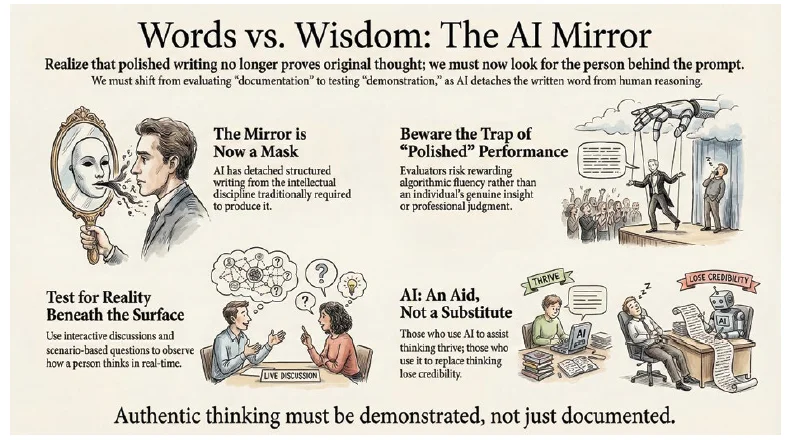
Artificial intelligence has dramatically lowered the effort required to produce a structured article, a professional bio, a thoughtful LinkedIn post, or a carefully worded proposal. Grammar, coherence, and even persuasive tone can be produced instantly. As a result, writing is gradually becoming detached from the thinking that traditionally underpinned it. Quite often, excellent writing may reflect the fluency of an algorithm or efficient prompt writing rather than the clarity of the individual.
This does not mean AI-assisted writing is inherently problematic. In many situations it improves efficiency and communication. The difficulty arises when readers continue to assume that the traditional strong link between writing and thinking still exists. When that assumption persists, the consumer of written material faces a new kind of risk.
THE RISK OF MISPLACED INFERENCE
Employee evaluations illustrate this risk clearly. In many organizations, written self-assessments, project reports, and summaries form a significant part of performance reviews. Traditionally these documents helped managers understand how employees approached problems and articulated insights. Today, such documents may be heavily assisted by AI systems capable of organizing ideas, refining arguments, and enhancing tone. If evaluators rely heavily on the written submission, they may inadvertently reward presentation rather than genuine contribution.
The same challenge arises in recruitment. Résumés, statements of purpose, and cover letters have long been tools for understanding a candidate’s intellectual orientation. Yet these documents can now be drafted and optimized with remarkable ease. The written artifact, once central to evaluation, is gradually losing its diagnostic value as a reliable indicator of original thinking.
The risk exists across other areas as well. In professional services such as auditing, taxation, and advisory, written opinions and reports have traditionally reflected the practitioner’s understanding and judgment. When such documents are increasingly drafted with heavy technological assistance, the ability to distinguish genuine insight from polished language becomes more important than ever.
HOW DO WE SEPARATE THE WHEAT FROM THE CHAFF IN SUCH AN ENVIRONMENT?
At a macro level, as writing becomes easier to generate, deeper capabilities will be the key to differentiate between professionals. At the highest level, the question arises of integrity of the author. AI may generate a perceived reality, which may not be the truth. One will therefore have to rely on other attributes as well.
Some deep questions may help evaluate conceptual clarity. Those who understand underlying principles can apply them flexibly and explain them without relying on prepared language.
Judgment under uncertainty also gains importance. Real professional decisions involve incomplete information and competing priorities. Algorithms can summarize options, but they cannot assume responsibility for choices.
Checking about practical experiences helps since exposure to real-world situations—client interactions, negotiations, and implementation challenges—creates insights that cannot easily be synthesized.
Intellectual humility also becomes a signal of credibility. In an environment where language can appear artificially confident, professionals who acknowledge uncertainty often demonstrate deeper understanding.
Recruitment and evaluation processes will need to focus on these differentiating factors. Instead of treating written output as proof of thinking, evaluators must treat it as the starting point for inquiry. The key question is no longer simply: How well is this written? The more relevant question is: Does the individual genuinely own the thinking expressed here? Written submissions will remain useful, but they should be complemented by methods that test genuine understanding: interactive discussions, scenario-based questioning, and detailed probing of past experiences. Such approaches allow evaluators to observe how individuals think rather than how effectively they can produce polished text. The emphasis must gradually shift from documentation to demonstration. This is most important – can the author say it with the same tone, passion and clarity. These methods will uncover the reality beneath the coverings of writing.
A WORD OF CAUTION FOR PROFESSIONALS
For those seeking AI assistance for writing, a note of caution: while such tools can enhance productivity and improve communication, excessive reliance on them can gradually outsource one’s own thinking process. Maintaining intellectual ownership therefore becomes essential. Professionals must question automated outputs, reflect on their reasoning, and ensure that their understanding extends beyond the words they present. Ultimately, those who use AI as an aid to thinking will benefit. Those who use it as a substitute for thinking may find their credibility increasingly fragile.
CLOSING REFLECTIONS
For centuries, writing was assumed to be a mirror of the mind. Today it may sometimes be a mirror of the machine. In this new environment, the true differentiator will not be the ability to produce impressive language. It will be the ability to demonstrate authentic thought behind that language. And that distinction, unlike good grammar, cannot be automated.