







Infrastructure Investment Trusts (InvITs) are SEBI-regulated vehicles that pool capital to invest in operational infrastructure assets such as roads and power. They allow developers to monetize assets while providing investors with stable, periodic distributions; the regulations mandate the distributing at least 90% of net cash flows. As of March 2026, India has 28 registered InvITs, with assets under management projected to triple by 2030. Governance is ensured through strict leverage limits (70%), mandatory valuations, and unitholder rights. Despite rapid growth, InvITs face sector-specific risks and represent only ~1.5% of India’s GDP compared to mature global markets.
1. INTRODUCTION TO INVIT
Infrastructure Investment Trusts (“InvITs”) are investment vehicles established to facilitate investment in completed and revenue-generating infrastructure assets. Regulated under the SEBI (Infrastructure Investment Trusts) Regulations, 2014, InvITs enable the pooling of capital from institutional and retail investors for investment in infrastructure sectors such as roads, power transmission, renewable energy, telecom, pipelines, and logistics. They provide infrastructure developers with an efficient mechanism to monetize operational assets and recycle capital into new projects, while offering investors an opportunity to participate in long-term infrastructure assets that generate stable and periodic cash flows through distributions.
InvITs in India are broadly classified into publicly listed InvITs and privately listed InvITs. Publicly listed InvITs are listed on recognized stock exchanges and are accessible to both retail and institutional investors, thereby enhancing market participation and liquidity. In contrast, privately listed InvITs are primarily targeted at institutional investors and accredited investors through private placement.
As of 31st March 2026, the Indian InvIT ecosystem comprises 28 registered InvITs1 spanning diverse infrastructure sectors, including roads, power transmission, renewable energy, telecom infrastructure, pipelines, warehousing, and supply chain assets, reflecting the growing adoption of the InvIT structure across India’s infrastructure landscape. The growing diversification of underlying assets reflects the increasing adoption of the InvIT structure as a preferred vehicle for infrastructure financing and asset monetisation.
1Bharat InvIT Association (BIA) Primer, June 2026
2. INVIT STRUCTURE & CASHFLOW MECHANICS
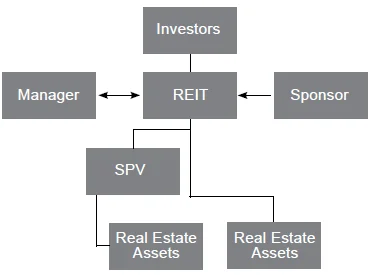
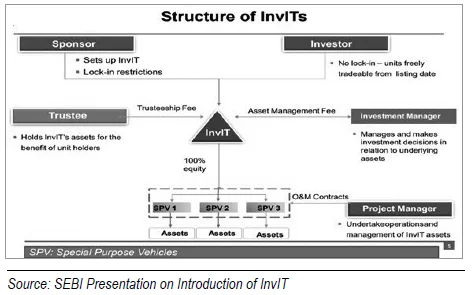
In an InvIT, a party that originates the assets, the party that manages the portfolio, the party that operates the underlying projects, and the party that holds the assets on trust for the unitholders are required to be functionally different and, in the trustee, structurally separate.
A diagrammatic representation of an InvIT structure is set out below: –
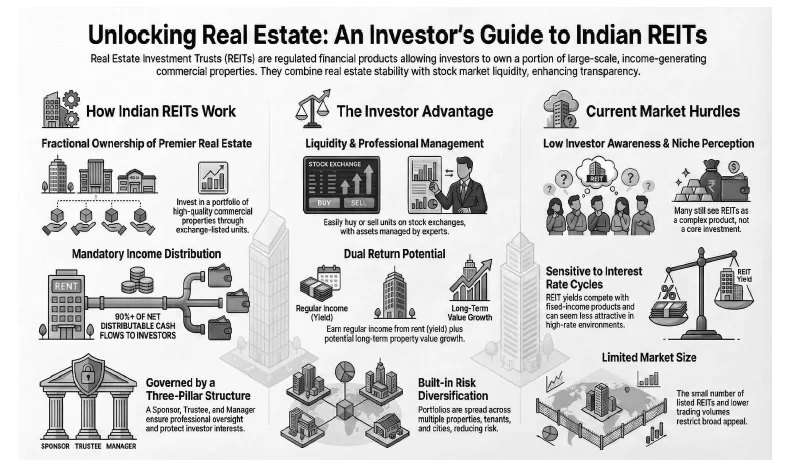
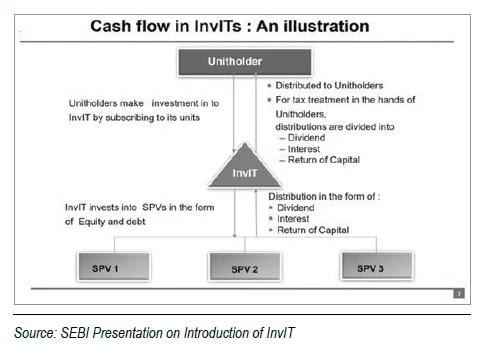
An infographic illustrating the flow of funds from the Unit holder to the SPV through the InvIT structure, and subsequent distribution back to the unitholders in the form of dividend, interest, and capital, is set out as follows:
3. KEY REGULATORY ARCHITECTURE
The SEBI (Infrastructure Investment Trusts) Regulations, 2014 (the “InvIT Regulations”), notified on 26th September 2014, were designed to facilitate the monetisation of operating infrastructure assets through a yield instrument vehicle. This framework enables institutional and retail investors to participate, thereby substantially reducing exposure to construction and promoter-related risk.
SEBI has been progressively aligned the regulatory framework governing InvIT with the disclosure, issuance and listing standards applicable to equity securities under the SEBI (Issue of Capital and Disclosure Requirements) Regulations, 2018 and the SEBI (Listing Obligations and Disclosure Requirements) Regulations, 2015, while simultaneously lowering the thresholds that had earlier confined the instrument to a narrow institutional base.
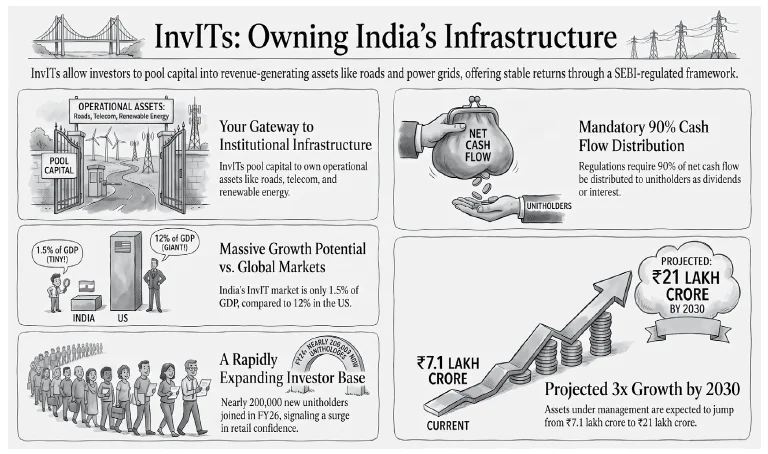
The InvIT Regulations have been amended repeatedly over the past two years and are supplemented by the Master Circular for InvITs, updated on 11th July 2025. Key highlights of InvIT regulatory framework include:
- InvIT Corpus, Offer Size and Composition of Investor Base
A publicly offered InvIT requires a minimum asset value of ₹500 crore, a minimum offer size of ₹250 crore, a minimum public float of 25 per cent, and mandatory listing; The minimum application and trading lot is in the ₹10,000 to ₹15,000 range. Further, the maximum subscription by any investor, other than the sponsor(s), its related parties, and its associates, in initial offer shall not be more than 25 percent of the total unit capital. A privately placed InvIT requires a minimum of five and a maximum of one thousand investors.
- Ticket Size
Recently, the minimum investment by any investor in a privately placed InvIT was reduced from ₹1 crore to ₹25 lakh, and the separate ₹25 crore minimum investment requirement that had applied where such an InvIT invested, or proposed to invest, not less than 80 per cent of the value of its assets in completed and revenue-generating assets was removed. The effect is to align the primary market allotment lot with the ₹25 lakh secondary market trading lot and to open the private channel to a considerably broader base of high net worth and family office capital.
- Investment Restrictions
Investment is permitted only in infrastructure as defined in the Harmonised Master List of Infrastructure Sub-sectors issued by the Ministry of Finance, whether held directly or through holding companies and special purpose vehicles. Of this, not less than 80 per cent of the value of InvIT assets must be invested in completed and revenue generating projects. The residual permitted basket comprises under-construction projects, listed and unlisted debt of infrastructure companies; equity of listed companies deriving at least 80 per cent of their income from the infrastructure sector, as per the audited accounts of the previous financial year; government securities; money market instruments; liquid mutual funds and cash equivalents; and, pursuant to the recent amendment, also includes unlisted equity shares and liquid mutual fund schemes, etc.
- Distribution Waterfall
Regulation 18(6) requires that not less than 90 per cent of Net Distributable Cash Flows (NDCF) be distributed at both the InvIT level and the holding company or SPV level, subject to the provisions of the Companies Act, 2013 or the Limited Liability Partnership Act, 2008 as applicable. Distributions are to be declared half-yearly for publicly offered InvITs and yearly for privately placed InvITs. Amendment and relaxations have been introduced wherein a holding company may now offset its negative net distributable cash flows against cash flows received from its SPVs where its own NDCF is negative, subject to adequate disclosure.
- Leverage and its Monitoring
Aggregate consolidated borrowings and deferred payments, net of cash and cash equivalents, must not exceed 70 per cent of the value of InvIT assets. Borrowings above 25 per cent and up to 49 per cent require a credit rating and unitholder approval. Borrowings above 49 per cent only require credit rating of “AAA” or equivalent. The fund must be utilised only for the acquisition or development of an infrastructure project. In addition, the InvIT must have a track record of six consecutive distributions following listing and obtain unitholder approval. Investments in overnight mutual fund schemes are treated as cash and cash equivalents, and the aggregate of cash and cash equivalents is excluded when computing the value of assets for this purpose.
The Third Amendment introduced a risk-based overlap, wherein an InvIT whose borrowings exceed 49 per cent must undertake a valuation of its assets at the end of every quarter and submit both that valuation report and a quarterly report to the designated stock exchanges along with its quarterly financial results. If an InvIT exceeds this 49% limit, SEBI permits fresh borrowings, but restricts them strictly to capital expenditure for enhancement of assets, major maintenance for road projects, and refinancing of principal debt.
- Valuation of Assets & Disclosure
Regulation 21 requires a full valuation at the end of each financial year, with the report submitted to the designated stock exchanges alongside the annual financial results. Half-yearly valuation reports accompany the quarterly financial results for the quarter ending 30th September, and valuation reports are to be submitted to the trustee simultaneously with their submission to the stock exchanges, within 15 days from receipt. Reporting timelines under Regulation 23 have been aligned with the financial results calendar. The quarterly report on the activities of the InvIT is now due within the period specified by SEBI for quarterly financial results.
- Governance Norms & Control by Unitholders
The audit architecture has been aligned to the norms applicable to listed companies. Regulation 22 confers on unitholders a set of rights, including annual meetings, approval rights over specified matters, and the right to remove the investment manager, the trustee, the auditor or the valuer. This signifies a major shift of control from the sponsor to the unitholder.
- Mandatory Disclosure in offer documents
Schedule III of Regulations mandates comprehensive disclosures in every offer document or placement memorandum of an InvIT. It requires disclosure of the InvIT’s constitution and registration details; particulars of the sponsor, investment manager, project manager, trustee and other key parties, details of the investment strategy and underlying infrastructure assets, financial information, valuation methodology, borrowing arrangements, distribution policy, risk factors, related party transactions, taxation; legal and regulatory matters; governance framework; litigation; and sector-specific information necessary for an informed investment decision.
In addition, the Schedule mandates that the offer document be supported by specified documents, including the full valuation report, auditors’ report, project implementation or project management agreement, due diligence certificate of the lead merchant banker, in-principle approval from the recognised stock exchange(s), and such other material reports. Collectively, these mandatory disclosures and supporting documents establish a robust disclosure framework designed to promote transparency, facilitate regulatory oversight and protect investor interests.
The reduction in the private placement ticket, the recalibration of the public float definition, the alignment of reporting calendars, and the shift to risk-based valuation for leveraged structures have been accompanied by tighter and more frequent disclosure requirements.
4. RISKS INVOLVED IN INVIT
Infrastructure Investment Trusts (InvITs) are often presented as stable, yield-generating investment vehicles backed by operational infrastructure assets. However, their apparent stability should not obscure the complex risk architecture embedded within the structure. While the underlying infrastructure assets may generate relatively predictable cash flows, the ability of those cash flows to reach investors depends upon a series of contractual, statutory and operational mechanisms, each of which introduces its own layer of uncertainty. Consequently, an assessment of InvITs requires a holistic examination of asset-level risks, cash flow risks and structural risks inherent in the trust framework.
Equally significant is the fact that many of the principal risks affecting InvITs are not readily diversifiable. Sector-specific risks—such as fluctuations in traffic volumes for toll roads, payment delays by power distribution companies, or tenant concentration in logistics parks—may vary across different asset classes. However, risks arising from leverage limits, evolving regulatory requirements, governance constraints, distribution mechanisms, and valuation practices are common across the InvIT ecosystem.
5. INVIT OUTLOOK – GLOBAL & INDIA
Globally, InvITs (commonly referred to as REITs in several jurisdictions) have evolved into a mature asset class, with over 1,000 listed REITs/InvITs spread across more than forty countries and an aggregate market capitalization of approximately USD 2 trillion2. Compared to mature markets such as the United States, Australia, Singapore and Japan, India’s InvIT market remains at a relatively early stage of development, despite recording strong growth since the framework was introduced in 2014 and the first listings in 2017.
India vs the World: The Gap3
| Country | REIT and InvIT Market as % of GDP |
| United States | ~12% |
| Australia | ~8–10% |
| Singapore | ~7–9% |
| Japan | ~5–7% |
| India | ~1.5% |
While the Indian market has expanded rapidly in terms of assets under management and the number of InvITs, it continues to face certain structural challenges, including
- relatively lower retail participation,
- limited secondary market liquidity,
- a narrower pool of infrastructure assets concentrated primarily in roads and power transmission; and
- a comparatively smaller institutional investor base.
Continued regulatory reforms, broadening of eligible asset classes, enhanced market liquidity, and greater participation from domestic institutional and retail investors are expected to bridge these gaps and further strengthen India’s position in the global InvIT market.
A notable recent development addressing the liquidity constraints of InvITs is SEBI’s streamlined framework for the conversion of privately placed listed InvITs into publicly offered InvITs. The August 2025 amendments removed conversion-specific sponsor lock-in requirements and aligned the conversion process with the regulatory framework applicable to follow-on public offers, thereby reducing procedural barriers for mature private InvITs seeking access to public markets. Cube Highways Trust is the first InvIT to utilise this framework, having received unitholder approval, filed its offer documents with SEBI, and launched its public offer. This may provide a viable pathway for improving liquidity and expanding institutional participation in the InvIT market without requiring fresh capital to be raised by the trust.
Further, Mutual Funds have also recognised the importance of InvIT as a significant inclusion to their multiasset portfolio & hybrid schemes in order to diversify the investments while providing a relatively stable income stream, thereby also ensuring long term portfolio stability. This move will also contribute to broadening the institutional investor base.
India’s InvIT market is expected to witness a three-fold growth, supported by the Government’s infrastructure development agenda and asset monetisation initiatives. With assets under management of approximately INR 7.1 lakh crore as on 31 March 2026, the industry is projected to expand to nearly INR 21 lakh crore by 2030.
2 https://www.niftytrader.in/markets/reit-invit-aum-20-trillion-sebi-reforms/

3 https://www.niftytrader.in/markets/reit-invit-aum-20-trillion-sebi-reforms/
6. INVIT IN INTEREST OF STAKEHOLDERS
The InvIT market has witnessed increasing investor confidence, reflected in rising assets under management, cumulative distributions exceeding ₹91,000 crore, and a steadily expanding investor base. During FY26 alone, nearly 2 lakh new unitholders joined the InvIT ecosystem, taking the total investor base to approximately 5.58 lakh unitholders, indicating growing retail participation alongside continued institutional interest.4
Supported by stable cash flows from operational infrastructure assets, predictable distribution mechanisms, and a transparent regulatory framework, InvITs are increasingly being recognised by its stakeholders as an opportunity for:
- participation in long term financing for existing infrastructure projects;
- freeing-up developer capital for investing in new infrastructure projects;
- low- risk investments that attract long term investors such as endowment and pension funds’
- facilitation ownership of diversified infrastructure assets by retail investors; and
- implementation higher standards of governance in infrastructure development & management
InvIT, as a structure, have opened up an opportunity for individual participation in infrastructure investments as an asset class by establishing a regulated, professionally-managed structure while ensuring liquidity, stable income from investments, and diversification of overall investment risk.
4 https://www.business-standard.com/finance/investment/invits-cumulative-distribution-since-inception-reaches-91-000-cr-report-126061601308_1.html