







1. CBDT has further extended due dates expiring on 30th April, 2021 by two months on account of the Covid-19 pandemic The Government has extended the various time-barring dates (which were earlier extended to 30th April, 2021) from 30th April 2021 to 30th June, 2021 in the following cases:
(a) The time limit for passing of any order for assessment or reassessment, the time limit for which is provided u/s 153 or section 153B.
(b) The time limit for passing an order consequent to the direction of DRP u/s 144C(13).
(c) The time limit for issuance of notice u/s 148 for reopening assessment where income has escaped assessment.
(d) The time limit for sending intimation of processing of Equalisation Levy.
(e) The last date for making payment without additional charge under Vivad se Vishwas Act. [Press Release dated 24th April, 2021.]
2. Extension of time-lines related to certain compliances under the Income-tax Act, 1961 In view of the pandemic, CBDT has provided that due dates of the following compliances if falling before 31st May, 2021 shall stand extended to 31st May, 2021:
a. Filing of appeal before CIT(A).
b. Filing of objections to Dispute Resolution Panel (DRP).
c. Filing of return of income in response to reassessment notice u/s 148.
d. Filing of belated or revised return of income for A.Y. 2020-21.
e. Furnishing of challan-cum-statement for tax deducted during the month of March, 2021 for sections 194-IA, 194-IB, and 194M.
f. Filing of declaration in Form No. 61 containing particulars of Form No. 60 received during the period from 1st October, 2020 to 31st March, 2021. [Circular No. 8 of 2021 dated 30th April, 2021.]
3. CBDT notifies threshold limits for Significant Economic Presence u/s 9 Income-tax (13th Amendment) Rules, 2021 Section 9 of the Income-tax Act relates to the incomes which are deemed to accrue or arise in India. Section 9(1)(i) provides that income accruing or arising, whether directly or indirectly, through or from any business connection in India shall be deemed as income accruing or arising in India.
Explanation 2A to Section 9(1)(i) provides that the ‘Significant Economic Presence’ of a non-resident in India shall constitute ‘business connection’.
Rule 11UB was inserted to prescribe the threshold limits for ‘Significant Economic Presence’. Rule 11UD provides that for clause (a) the threshold limit shall be Rs. 2 crores, whereas for clause (b) the threshold limit shall be Rs. 3 lakhs. [Notification No. 41 dated 3rd May, 2021.]
4. Income-tax (14th Amendment) Rules, 2021 A non-resident, being an investor who operates in accordance with the SEBI Circular No. IMD/HO/FPIC/CIR/P/2017/003 dated 4th January, 2017, shall not be required to obtain and quote PAN, subject to fulfilment of certain conditions. [Notification No. 42 dated 4th May, 2021.]
5. Income-tax (16th Amendment) Rules, 2021 Rule 2B is amended to provide that where the employee avails any cash allowance from his employer in lieu of any travel concession or assistance for the assessment year beginning on 1st April, 2021, he shall be eligible to claim an exemption for an amount equal to the lower of the following:
i. Rs. 36,000 per person for the individual and the member of his family; or
ii. One-third of expenditure incurred by an individual or a member of his family.
The exemption will be allowed subject to fulfilment of certain conditions. [Notification No. 50 dated 5th May, 2021.]
6. No penalty on cash receipt of Rs. 2 lakhs or more by hospital providing Covid-19 treatment As provided in section 269ST, no one can receive an amount of Rs. 2 lakhs or more in cash. CBDT has issued a Notification to provide that the provisions of section 269ST shall not apply to hospitals, dispensaries, nursing homes, Covid-care centres or similar other medical facilities providing Covid treatment to patients where payment is received in cash from 1st April, 2021 to 31st May, 2021 on obtaining the PAN or AADHAAR of the patient and the payer, and the relationship between the patient and the payer, by such entities. [Notification No. 56 dated 7th May, 2021.]
7. Extension of time-lines related to certain compliances under the Income-tax Act, 1961 In view of the pandemic, CBDT has extended the due dates of various compliances like filing of return of income for A.Y. 2021-22, furnishing of Tax Audit Report, furnishing of Transfer Pricing Certificate, filing of belated return, filing of TDS return of last quarter, etc. [Circular No. 9 of 2021 dated 20th May, 2021.]
COMPANY LAW
I. COMPANIES ACT, 2013
(I) MCA relaxes levy of additional fees in filing of certain forms under the Companies Act (and LLP Act, 2008) – MCA has notified that no additional fees shall be levied on Companies / LLPs up to 31st July, 2021 for delayed filing of forms (other than charge-related forms, namely, e-Forms CHG-1, CHG-4 and CHG-9), which were / would be due for filing during the period 1st April, 2021 to 31st May, 2021. [General Circular No. 06/2021 dated 3rd May, 2021.]
(II) MCA relaxes timeline for filing forms related to creation or modification of charges – MCA has provided relaxation as indicated in the Table below to companies / charge holder in respect of filing of Forms CHG-1 and CHG-9 (and not CHG-4). This Circular shall not be applicable in cases where the said forms have already been filed before 3rd May, 2021 or the timeline for filing has already expired / expires at a future date (despite exclusions of time period mentioned in the Table below) u/s 77 / 78.
|
Criteria |
Relaxation granted |
Applicable fees |
|
Date of creation / modification of charge falling before 1st |
For the purpose of counting the number of days under sections 77 |
If the Form is filed on or before 31st May, 2021, |
|
[Continued] filing such Form has not expired u/s 77
|
such period, then 1st June, 2021 shall be considered |
adding the following: |
|
Date of creation / modification of charge falls on any date |
For the purpose of counting the number of days under sections 77 |
If the Form is filed before 31st May, 2021, then |
[General Circular No. 07/2021 dated 3rd May, 2021]
(III) Extension of the maximum gap required between two consecutive Board Meetings – MCA has extended the maximum gap between two consecutive Board Meetings to 180 days (as against 120 days) during the quarters April-June, 2021 and July-September, 2021. [General Circular No. 08/2021 dated 3rd May, 2021.]
(IV) Clarification on eligible CSR activities in light of Covid pandemic – MCA has clarified that creation of health infrastructure for Covid care, establishment of medical oxygen generation and storage plants, manufacturing and supply of Oxygen concentrators, ventilators, cylinders and other medical equipment for countering Covid-19 or similar such activities undertaken by the companies directly by themselves or in collaboration as shared responsibility with other companies, are eligible CSR activities under Schedule VII. [General Circular No. 09/2021 dated 5th May, 2021.]
(V) Clarification on offsetting excess CSR amount spent for F.Y. 2019-20 under the Companies Act, 2013 and its Rules – MCA has clarified that any excess amount or part thereof can be offset against the requirement to spend u/s 135(5) for F.Y. 2020-21 if a company has contributed any amount to ‘PM CARES Fund’ on 31st March, 2020 which is in excess of the mandated amount as prescribed u/s 135(5) for F.Y. 2019-20. The offset shall be subject to the following conditions:
a. the excess amount that is being offset should factor in the unspent CSR amount for previous financial years, if any;
b. the CFO shall certify that the contribution to ‘PM-CARES Fund’ was indeed made on 31st March, 2020 in pursuance of the appeal dated 30th March, 2020, which was sent to MDs / CEOs of top 1,000 companies in terms of market capitalisation and the same shall also be so certified by the statutory auditor of the company; and
c. the details of such contribution shall be disclosed separately in the Annual Report on CSR as well as in the Board’s Report for F.Y. 2020-21 in terms of section 134(3)(o). [Circular dated 20th May, 2021, E File CSR-01/04/2021-CSR-MCA.]
II. SEBI
(VI) Portfolio manager needs to obtain prior approval of Board in case of change in control – SEBI has notified the SEBI (Portfolio Managers) (Second Amendment) Regulations, 2021 whereby it has clarified that the Portfolio Manager will be required to obtain prior approval of the Board in case of change in control. [Notification No. SEBI/LAD-NRO/GN/2021/16, dated 26th April, 2021.]
(VII) Submission of Internal Audit Report (IAR) by Registrar and Transfer Agents (RTAs) extended to 31st July, 2021 in view of the Covid-19 situation – SEBI has decided to extend the timeline for submission of IAR by RTAs for the half-year ended 31st March, 2021 from 15th May, 2021 to 31st July, 2021 in view of the Covid-19 situation. [Circular No. SEBI/HO/MIRSD/RTAMB/P/CIR/2021/558, dated 29th April, 2021.]
(VIII) SEBI relaxes compliance of certain provisions of LODR Regulations due to Covid-19 pandemic – SEBI has decided to grant relaxations from compliance with certain provisions of the LODR Regulations / other applicable Circulars as under:
|
Compliance requirement and regulation reference |
Requirement |
Due date |
Extended due date for quarter / Half-year ended |
|
Annual Secretarial |
Sixty days from end of |
30th May, 2021 |
30th June, 2021 |
|
[Continued]
[Regulation 24A read with Circular CIR/CFD/CMD1/27/2019 dated 8th |
the financial year |
|
|
|
Quarterly financial results / Annual audited [Regulation 33(3)] |
Forty-five days from the end of the quarter / Sixty days from |
15th May, 2021 / |
30th June, 2021 |
|
Statement of deviation or variation in use of [Regulation 32(1) read with SEBI Circular CIR/CFD/CMD1/162/2019 |
Along with the financial results (within 45 days of end of each |
15th May, 2021 / 30th May, 2021 |
30th June, 2021 |
Further, listed entities are permitted to use Digital Signature Certifications for authentication / certification of filings / submissions made to stock exchanges under the SEBI (LODR) Regulations, 2015 for all filings until 31st December, 2021. [Circular No. SEBI/HO/CFD/CMD1/P/CIR/2021/556, dated 29th April, 2021.]
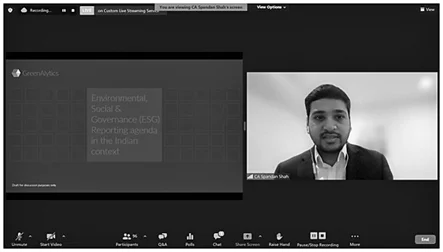
(IX) SEBI unveils format for Business Responsibility and Sustainability Reporting (‘BRSR’) applicable for top 1,000 listed companies – SEBI has prescribed the format for ‘BRSR’ (applicable to top 1,000 listed companies) and the reporting of the same shall be voluntary for F.Y. 2021-22 and mandatory from F.Y. 2022-23. The BRSR is an initiative towards ensuring that investors have access to standardised disclosures on ESG (Environment, Social and Governance) parameters. [Circular No. SEBI/HO/CFD/CMD-2/P/CIR/2021/562, dated 10th May, 2021.]
FEMA
(i) An Indian party acting as a sponsor to an Alternative Investment Fund (AIF) set up in an overseas jurisdiction, including in an IFSC in India, will be treated as Overseas Direct Investment as per FEMA Notification 120/2004-RB (FEMA 120). Accordingly, such Indian party can set up an AIF in these jurisdictions under the Automatic Route provided it complies with Regulation 7 of FEMA 120. [A.P. (DIR Series) Circular No. 4 dated 12th May, 2021.]
IRDAI
Accounts and Audit
(a) IRDAI (Preparation of Financial Statements and Auditor’s Report of Insurance Companies) (First Amendment) Regulations, 2021 – The IRDAI, by substituting extant provisions contained in Paragraph 2 of Part I of Schedule B of the IRDAI (Preparation of Financial Statements and Auditor’s Report of Insurance Companies) Regulations, 2002 notified on 30th March, 2002, has now provided a revised manner in which ‘premium’ and ‘unearned premium reserve’ should be recognised by insurers carrying on general insurance business. [Notification F. No. IRDAI/Reg/5/177/2021 dated 5th May, 2021.]
RBI
Accounts and Audit
(b) Guidelines for appointment of Statutory Central Auditors (SCAs) / Statutory Auditors (SAs) of commercial banks (excluding RRBs), UCBs and NBFCs (including HFCs) – The RBI has notified Guidelines applicable for F.Y. 2021-22 and onwards in respect of appointment / reappointment of SCAs / SAs. The guidelines cover the following: prior approval requirements, branch coverage, eligibility criteria of auditors, auditors’ independence, professional standards, tenure and rotation, audit fees and expenses, and statutory audit policy and appointment procedures. [RBI Notification Ref. No. DoS.CO.ARG/SEC.01/08.91.001/2021-22 dated 27th April, 2021.]
ICAI ANNOUNCEMENT
(A) Extension of validity of Peer Review Certificate in wake of Covid-19 spurt – The Peer Review Board has granted extension to the Peer Review Certificates expiring during the period from 1st April, 2021 to 30th June, 2021 up to 31st July, 2021. Accordingly, the validity of such Certificates shall now be treated as 31st July, 2021. [4th May, 2021.]
ICAI MATERIAL
Accounts and Audit
- FAQ on Accounting for amounts to be incurred towards Corporate Social Responsibility (CSR) pursuant to the Companies (CSR Policy) Amendment Rules, 2021. [10th May, 2021.]
Company Law
- FAQs on Circular on relaxation of time for filing Forms related to creation or modification of charges under the Companies Act, 2013 issued by the MCA on 3rd May, 2021. [4th May, 2021.]









 and indiscretion any one of these can cause destruction. Abuse of power harms the victims. However, it harms the Abuser even more than the Victim.





















 – Season 2




 – educating them on how to think using science. This helped them differentiate between chinta and chintan
  i.e.going to root cause, understanding real problem and find appropriate resolution.
 – The Seven pillars:
 – The King – Leader
 – The Minister
 – The Country – Your Market / Client / Customer
 – Fortified City – The Head Office
 -The Treasury
 – The Army – Your Team
 – The Ally – Mentor / Friend / Consultant