INTRODUCTION
Logistics is one of the most essential sectors of an economy and comprises all supply chain activities, mainly transportation, inventory management, flow of information and customer service. Though primarily concerned with the movement of goods, the sector covers a host of activities apart from transportation of goods, such as clearance with customs authorities, storage of goods, etc., and requires involvement of various stakeholders, such as transporters (road/ rail/ air/ waterways), warehousing service provider, customs house agent/clearing and forwarding agents, etc., The various activities involved in this sector are listed below:
- Transport of goods by road, rail, air and waterways, including multi-modal transport,
- Freight forwarding services,
- Warehousing services, including Free Trade Warehousing Zones,
- Clearing and forwarding services, including services provided within port areas.
In this article, we have discussed the above activities covering the sector along with various GST issues revolving around them.
A. TRANSPORTATION OF GOODS
The core activity undertaken by this sector is the transportation of goods with all other activities being incidental to this. The mode of transportation of goods may be either by road, rail, air or waterways or a combination of more than one. The applicable GST rates for service of transportation of goods, when supplied via a single mode are notified under notification 11/2017-CT (Rate) dated 28th June, 2017 as under:
Description of
Service |
Notified Rate |
Conditions |
Service of GTA in relation to
transportation of goods supplied by a GTA where the GTA does not exercise the
option to itself pay GST on the services supplied by it |
5 per cent |
Credit of input tax charged on goods and
services used in supplying the service has not been taken. |
Service of GTA in relation to
transportation of goods supplied by a GTA where the GTA exercises the option to
itself pay GST on the services supplied by it |
5 per cent (without ITC) /12 per cent (with
ITC) |
Option should be exercised in Annexure V on
or before 15th March of the preceding financial year. Once option is
exercised, the same cannot be changed. |
Transport of goods in container by rail by
any person other than Indian Railways |
12 per cent |
Nil |
Transport of goods by rail, other than
above |
5 per cent |
Credit of input tax charged in respect of
goods in supplying the service is not utilized for paying central tax or
integrated tax on the supply of service. |
Transport of goods in a vessel including
services provided or agreed to be provided by a person located in non-taxable
territory to a person located in non-taxable territory by way of
transportation of goods by a vessel from a place outside India up to the
customs station of clearance in India. |
5 per cent |
Credit of input tax charged on goods (other
than ships, vessels including bulk carriers and tankers) used in supplying
the service has not been taken. This condition shall not apply where the
supplier of service is located in non-taxable territory. |
Transportation of goods, being natural gas,
petroleum crude, motor spirit (petrol), HSD or ATF through pipeline subject
to restriction in claim of input tax credit |
5 per cent |
Credit of input tax charged on goods and
services used in supplying the service has not been taken. |
Transportation of goods, being natural gas,
petroleum crude, motor spirit (petrol), HSD or ATF through pipeline other
than above |
12 per cent |
Nil |
| Multimodal transportation of goods |
12 per cent |
Nil |
| Transport of goods by ropeways |
5 per cent |
Credit of input tax charged on goods used
in supplying the service has not been taken. |
| Goods transport services other than above |
18 per cent |
Nil |
TRANSPORTATION OF GOODS BY ROAD
The levy of indirect tax on services of transport of goods by road has always been litigative and seen its’ fair share of controversy, right from its’ introduction under service tax regime. The same was primarily due to resistance by the transport sector, which predominantly has been an unorganised sector not geared up to comply with the taxation laws. This is why the concept of reverse charge mechanism was introduced for this sector.
The concept of reverse charge continued even under GST when services are provided by GTA with restriction on claim of input tax credit by the suppliers. Entry 1 of notification 13/2017 – CT(Rate) dated 28th June, 2017 provides that the same shall apply in case of services supplied by a Goods Transport Agency (GTA) to
(a) Any factory registered under or governed by the Factories Act, 1948 (63 of 1948); or
(b) Any society registered under the Societies Registration Act, 1860 (21 of 1860) or under any other law for the time being in force in any part of India; or
(c) Any co-operative society established by or under any law; or
(d) Any person registered under the Central Goods and Services Tax Act or the Integrated Goods and Services Tax Act or the State Goods and Services Tax Act or the Union Territory Goods and Services Tax Act; or
(e) Anybody corporate established, by or under any law; or
(f) Any partnership firm whether registered or not under any law including association of persons; or
(g) Any casual taxable person; located in the taxable territory.
In view of representations made by the sector, the rate entries were amended and option to pay tax @ 12 per cent under forward charge was introduced with corresponding credits available to transporter. The entry read as under:
The above indicates that a taxable person may opt to pay tax @ 5 per cent (without ITC) / 12 per cent (with ITC) under forward charge. However, following issues emerge from the above:
Description
of Service |
Rate
(per cent) |
Conditions |
(iii) Services of goods transport agency
(GTA) in relation to transportation of goods (including used household goods
for personal use). Explanation.-“goods transport agency”
means any person who provides service in relation to transport of goods by
road and issues consignment note, by whatever name called. |
2.5 |
Provided that credit of input tax
charged on goods and services used in supplying the service has not been
taken [Please refer to Explanation no. (iv)] |
| Or |
|
6 |
Provided that the goods transport agency
opting to pay central tax @ 6% under this entry shall, henceforth, be liable to pay central tax
@ 6% on all the services of GTA supplied by it. |
a) Can a GTA having multiple GSTIN, exercise different options for different GSTINs?
b) This is because under GST, each registration obtained by a taxable person is treated as distinct person, i.e., separate legal entity for the purpose of GST and therefore, a view was possible that separate options could have been exercised for separate registrations.
c) Once the option was exercised, did the taxable person have an option to revert to the RCM scheme, i.e., whether the option was permanent or temporary or a taxable person could change the option at the start of the next financial year? The notification did not explicitly provide for a change in the option and therefore, a view prevailed that once exercised, the GTA could not have changed the option.
Considering the above ambiguity, the entry was again amended vide notification 3/2022 – CT (Rate) dated 13th July 2022. It is now provided that the option to pay tax at 5 per cent will be the general rule, unless the supplier exercises the option to pay tax at 12 per cent which should be exercised on or before 15th March of the preceding year. The timeline to exercise the option for FY 2023-24 has been extended up to 31st May, 2023. It is for this reason that many suppliers have started obtaining multiple registrations and entities wherein under one registration / entity, the option is not exercised, i.e., under one registration /entity, the tax is paid under reverse charge by the recipient while in another registration/entity, the option is exercised, i.e., GST is charged @ 12 per cent with corresponding input tax credit. This also invariably clears the first confusion, i.e., whether the option to be exercised is vis-à-vis the legal entity or the specific registration as the Declaration is to be given for the GSTIN and there is no specific condition in the notification to the effect that the option exercised shall be uniform across the legal entity.
GTA VS. NON-GTA – RELEVANCE OF CONSIGNMENT NOTE
An important aspect which needs to be noted in the above rate entries is that they apply to services supplied by a Goods Transport Agency or GTA. The term “GTA” has been defined under the rate notification to mean any person who provides service in relation to transport of goods by road and issues a consignment note by whatever name called. This necessarily means that person who provides the service of transportation of goods by road but does not issue a consignment note is not a GTA. In fact, services of transportation of goods when not supplied by a GTA have been exempted vide entry 18 of notification 12/2017 – CT (Rate) dated 28th June, 2017 which exempts services by way of transportation of goods by road except the services of a goods transport agency or a courier agency.
Therefore, it can be said that whether a person supplying the service of transportation of goods by road is a GTA or not is dependent upon whether such person issues a consignment note or not? In this context, one may refer to the decision of Tribunal in the case of Narendra Road Lines Pvt. Ltd. vs. Commissioner [2022 (64) GSTL 354 (Tri-All)] wherein it has been held as under:
14. … … In some of the cases the appellant transported the goods by road without issuance of the consignment note, the said activity prior to June, 2012 was not classifiable under category of services as no consignment note was issued and it is prime requirement to demand service tax under the category of goods transport agency service. … …
Similar view was followed in the case of Mahanadi Coalfields Ltd. vs. Commissioner [2022 (57) GSTL 242 (Tri-Kol)] wherein the demand under GTA was set-aside by holding that issuance of consignment note is non-derogable ingredient for a service transport to fall under GTA.
It therefore becomes important to understand what constitutes “consignment note”. While the notification is silent to that aspect, vide press release (39 dated 1st January, 2018), it has been clarified that guidance can be taken from the meaning ascribed under Rule 4B of Service Tax Rules, 1994. In terms of the said rule, consignment note means a document issued by a goods transport agency containing following details/attributes:
- It should be serially numbered,
- It should contain the name of the consignor and consignee,
- It should disclose the registration number of the goods carriage in which the goods are transported,
- It should disclose details of the goods transported, the place of origin and destination,
- It should disclose person liable for paying service tax, i.e., whether consignor, consignee or the goods transport agency.
Therefore, a supplier issuing a document in the course of supplying service of transportation of goods which contain all the above details can be said to have issued a consignment note and therefore, he will be GTA for the purpose of GST. However, in one particular case (K M Trans Logistics Pvt Ltd [2020 (35) GSTL 346 (AAAR-GST-Raj)]) before the Authority for Advance Ruling, a query was raised regarding the applicability of GST in case where the consignment note was not issued by them. In this case, the supplier was providing the service of transport of manufactured vehicles from factory to authorised dealers. It was their contention that in the course of providing the said service, they do not issue consignment note and therefore, the services provided were exempt from the levy of GST. This was however rejected by the Authority on the grounds that the service supplier was generating EWB which contained all the particulars required to be mentioned in a consignment note and therefore, held that they were not eligible for the above exemption. In the view of the author, this conclusion may not survive judicial scrutiny as an EWB does not contain many of the features which are prescribed u/r 4B of Service Tax Rules, 1994, such as being serially numbered, details of person liable to pay tax, etc.
This takes us to the next question of what happens if a supplier is able to prove that he has not issued a consignment note. The answer to this would be exemption from GST vide entry 18 of notification 12/2017-CT (Rate) dated 28th June, 2017 which exempts service provided by way of transportation of goods other than by a GTA or a courier agency.
GTA – SUB-CONTRACTING
At times it may so happen that a GTA (say “A”) has entered into a contract for providing service relating to transport of goods. However, the GTA may not have the means to execute the said service himself and therefore, he may appoint another GTA (say “B”) to execute the said service under the sub-contracting model. Under this model, both A and B are providing the service of transporting of goods by GTA with service flowing from B to A to client.
There remains an issue of whether B, i.e., sub-transporter can be treated to be GTA. This is because in Liberty Translines [2020 (41) G.S.T.L. 657 (App. A.A.R. – GST – Mah.)], it has been held that there cannot be more than one consignment note in a transaction. Since the contract would be awarded to A, the consignment note would generally be issued by A. The question that therefore arises is how the service by B to A shall be classified? In the above ruling, the Authority has also held that upon sub-contracting, classification of supply changes from the service of transportation of goods by GTA to service of hiring of means of transport. Therefore, the sub-transporter would be eligible to claim exemption under entry 22 of notification 12/2017 – CT (Rate) dated 28th June, 2017. However, this would necessarily mean that the sub-transporter will not be eligible to claim proportionate credit to the extent he has exercised the option of paying tax under forward charge.
However, the conclusion of the above ruling is questionable. So far as the conclusion that there can only be one consignment note in a transaction is concerned, one may refer to the Carriage by Road Act, 2007 which does not provide any exception from issuing the goods receipt note when receiving the goods from another transporter. The format of goods receipt note (provided in Form 8 of Carriage by Road Rules, 2011) to be issued by the transporter on receipt of goods from another transporter contains all the particulars which are required to be contained in consignment note. Hence, a view can be taken that even a sub-transporter can issue consignment note to the transporter.
Similarly, the second conclusion that classification changes upon sub-contracting is not correct in all instances. This is because if A has received a contract for transporting goods of a lesser quantity, say five boxes from Maharashtra to Gujarat (half vehicle load) and transports the goods in his own vehicle, he will end up bearing a loss as full capacity is not utilised. In such case, he might contract with B, who has a half-loaded vehicle going on the same route to also load his goods on his vehicle and deliver them on his behalf. In this case, it cannot be said that B has provided the service of hiring of vehicle to A. Rather, it is clearly a service for transportation of goods and therefore, since B is not a GTA for this leg of transaction (as consignment note is not issued), the service provided by him would be exempt under entry 18 of notification 12/2017-CT (Rate) dated 28th June, 2017.
To summarise, if the element of hiring of vehicles is not brought into picture, there can be following variants in a sub-contracting transaction:
| Transporter |
Sub-transporter |
Implications |
| A – 12 per cent (FCM) |
B – 12 per cent (FCM) |
A and B will claim full input tax credit. |
| A – 12 per cent (FCM) |
B – 5 per cent (FCM) |
A to claim ITC of tax charged by B. No ITC
available to B. |
| A – 12 per cent (FCM) |
B – 5 per cent (RCM) |
A to pay tax on service received from B
under RCM and claim input tax credit. No ITC available to B. |
| A – 5 per cent (FCM) |
B – 12 per cent (FCM) |
A will not be entitled to claim input tax
credit, thus resulting in tax inefficiencies. |
| A – 5 per cent (FCM) |
B – 5 per cent (FCM) |
| A – 5 per cent (FCM) |
B – 5 per cent (RCM) |
A to pay tax on service received from B
under RCM and claim input tax credit. No ITC available to B. |
| A – 5 per cent (RCM) |
B – 5 per cent (RCM) |
Liability on A to pay tax under RCM with no
corresponding input tax credit |
| A – 5 per cent (RCM) |
B – 5 per cent (FCM) |
A will not be entitled to claim input tax
credit, thus resulting in tax inefficiencies. |
| A – 5 per cent (RCM) |
B – 12 per cent (FCM) |
However, if B takes a view and is able to demonstrate that the transaction with A is that of hiring of goods transport vehicle or he is not a GTA (as he is not the one issuing consignment note), he shall be eligible to claim exemption under entry 22 / 18 of notification 12/2017-CT (Rate) dated 28th June, 2017. This will however restrict B’s claim of input tax credit under rules 42 / 43 of the CGST Rules, 2017.
TRANSPORTATION VS. HIRING
There are also instances where instead of providing the transportation services, the service provider gives the entire vehicle at the disposal of the client who can use the vehicle as deemed fit/necessary. Similarly, at times, a transporter having capacity issues may take the vehicle of other transporter on hire.
Such services are distinct from the service of supply of transportation of goods though the end objective
achieved may have been the same. However, the issue remains is whether such supplies will attract classification under chapter 9966 which deals with rental services or 9971 which deals with transfer of right to use any goods. The relevant rate entries are reproduced below for reference:
Chapter 9966:
Description of
Service |
Rate |
Renting of goods carriage where the cost of
fuel is included in the consideration charged from the service receiver |
12 per cent |
Rental services of transport vehicle with operators
other than above |
18 per cent |
Time charter of vessels for transport of
goods provided that credit of input tax charged on goods (other than on
ships, vessels including bulk carriers and tankers) has not been taken |
5 per cent |
Chapter 9971
Description of
Service |
Rate |
Transfer of right to use any goods for any
purpose (whether or not for a specified period) for cash, deferred payment or
valuable consideration |
Same tax rate as applicable on supply of
such goods |
At this juncture, it may be relevant to refer to the decision of the Hon’ble Supreme Court in the case of Great Eastern Shipping Company Ltd. vs. State of Karnataka [2020 (32) GSTL 3 (SC)] wherein in the context of time charter agreements for vessels along with operating staff, the Hon’ble Supreme Court had held that during the period of agreement, the vessel was at the exclusive disposal of the other party and therefore the same constituted “deemed sales” and shall attract levy of sales tax/ VAT.
The time charter of vehicle specifically attracts 5 per cent GST. However, the same also gets covered under 9971 as per which, the applicable tax rate shall be the same tax rate as applicable on supply of goods. This may result in confusion as to which entry shall be applicable. In such a situation, one needs to refer to Rule 3 (a) of the Rules of Interpretation which provides that the heading with most specific description shall be preferred over a more general description. Therefore, one may take a view that entries under chapter 9966 shall have precedence over entries under chapter 9971, which are the residuary entries.
TRANSPORT OF GOODS BY VESSEL
The activity of transport of goods by vessel generally refers to the service of transport of goods by waterways. Traditionally, it referred to the services provided in relation to import / export of goods. However, with the development of infrastructure for transportation of goods within India using inland waterways, the provisions shall also apply to domestic services. However, to promote inland waterways, services by way of transportation of goods by inland waterways have been exempted under entry 18 of notification 12/2017 – CT(Rate) dated 28th June, 2017.
REGISTRATION ASPECT
The person supplying the service, i.e., shipping line may be located in or outside India. It may happen that an exporter of goods from India contracts for receiving the said service from a foreign shipping line. In such a case, the issue arises is whether the shipping line has supplied the service from India or not? This is because the shipping line receives the goods in India for loading on the vessel. Therefore, a view prevails that the shipping line is providing service from India and therefore, they are required to obtain registration and discharge GST on the charges collected from their clients.
Alternately, they also have an option to appoint the agent who will issue the invoice on their behalf and discharge the applicable GST. In such a scenario, the agents will obtain a separate registration for discharging the tax liability on charges collected on behalf of their principals (“principal registration”). The details under this registration will not form a part of the financials of agent as they are not themselves supplying the service, but merely facilitating the process of raising the invoice and collecting the consideration from the clients on behalf of the shipping lines.
However, other services which the agent provides on their own account will be taxed under their regular registration (“agent registration”), i.e., where they supply services on their own account. This would include local charges levied by ports, charges for transport of goods within the port area, etc., which are recovered from the importer/exporters. Similarly, the agents also recover charges from the shipping line for providing the above services on which GST is leviable as “intermediary”.
The consideration collected on behalf of the clients is remitted to the shipping lines abroad after making various deductions. One of the deductions include various expenses incurred by the shipping lines in India for which the invoices are issued by the local suppliers to the principal registration as the representative of the shipping line. There is a question of whether the input tax credit of tax charged on these supplies can be claimed while discharging the GST liability collected on behalf of the shipping lines. This question arises because the shipping lines sell the freight not only through their Indian agents, but at times, also directly through their foreign offices. Therefore, the location of supplier of service is outside India and no GST is leviable on the same. This would mean that the said inward supplies are used for both, taxable as well as non-taxable activities and claim of input tax credit may give rise to the question of levy of tax on such freight sold from outside India.
TYPES OF CHARGES
The supplies are generally structured under two models, i.e., “prepaid” or “to collect” which applies to both, import as well as export shipments. Under the prepaid model, the customer takes upon himself to pay the freight while in case of “to collect”, the liability to pay the freight and the incidental charges is on the consignee or some third party.
In addition to the above, in the course of providing the transport services, the shipping lines also collect various additional charges, such as:
- Bunker adjustment factor
- Bill of Lading Charges
- Fuel Surcharge
- Hazardous Material surcharge
- Low sulphur surcharge
- Emergency Risk Surcharge
- Peak Season surcharge
The above charges are recovered in the course of providing the main supply, i.e., transportation of goods by vessel and therefore, attract same treatment as the freight charges.
EXEMPTION
It may also be noted that upto 30th September, 2022, the place of supply of services of transportation of goods by a vessel from customs station of clearance in India to a place outside India was exempted from the levy of service tax. This exemption was applicable especially when the services were supplied to Indian exporters. However, this exemption has been withdrawn w.e.f. 1st October, 2022 and the said services are now taxable and therefore, instead of outright exemption, the exporters will now have to opt for the refund mechanism to encash the tax charged by the service providers.
TRANSPORT OF GOODS BY AIR
The services of transportation of goods by aircraft are leviable to GST under the residuary rate, i.e., 18 per cent as there is no specific entry for the same in the rate notifications.
There are following exemptions w.r.t the said services:
- Services by way of transportation of goods by an aircraft from a place outside India upto the customs station of clearance in India
- Services by way of transportation of goods by an aircraft from customs station of clearance in India to a place outside India. This exemption (similar to export of goods by vessel) was applicable only upto 30th September, 2022 and has been withdrawn w.e.f 01st October, 2022.
MULTI-MODAL TRANSPORT
At times, it may happen that a supplier provides the service of transportation of goods by multiple modes, i.e., road, air, waterways or rail. This is termed as multi-modal transportation and the rate notification prescribes rate of 12 per cent for the same. However, this applies only to domestic multi-modal transport, i.e., transport of goods from a place in India to a place within India.
For example, an exporter who wants to ship goods to the US may procure the service of a transporter who picks up the goods from his location and ensures delivery till the US by transporting the goods to the customs port, arranging for vessel, etc., Though this supply involves multi-mode transport, for the purpose of GST, it is not classifiable under the said rate. Therefore, the supply should classify as transport of goods by water and attract GST @ 5 per cent.
The question that arises is would the answer differ if the contract identifies separate consideration for each activity, i.e., transport of goods by road, handling customs compliance, ocean freight, etc.? The answer to this question is in the definition of “composite supply” under section 2 (30) of the CGST Act, 2017 which is reproduced below for ready reference:
(30) “composite supply” means a supply made by a taxable person to a recipient consisting of two or more taxable supplies of goods or services or both, or any combination thereof, which are naturally bundled and supplied in conjunction with each other in the ordinary course of business, one of which is a principal supply.
Illustration: Where goods are packed and transported with insurance, the supply of goods, packing materials, transport and insurance is a composite supply and supply of goods is a principal supply;
(90) “principal supply” means the supply of goods or services which constitutes the predominant element of a composite supply and to which any other supply forming part of that composite supply is ancillary;
As can be seen from the above, to determine whether a supply constitutes composite supply, we need to analyse what is the principal supply, i.e., predominant supply. In the above example, undoubtedly, the principal supply is that of transportation of goods by water and therefore, a view can be taken that the entire service supplied is that of transportation of goods by water and shall attract GST @ 5 per cent.
RESTRICTIONS ON CLAIM OF INPUT TAX CREDIT
A perusal of the rate entries applicable to the sector would indicate that a lower tax rate has been notified for certain services along with restrictions on claim of input tax credit and referring to Explanation (iv) of the notification which provides as under:
(iv) Wherever a rate has been prescribed in this notification subject to the condition that credit of input tax charged on goods or services used in supplying the service has not been taken, it shall mean that,—
(a) credit of input tax charged on goods or services used exclusively in supplying such service has not been taken; and
(b) credit of input tax charged on goods or services used partly for supplying such service and partly for effecting other supplies eligible for input tax credits, is reversed as if supply of such service is an exempt supply and attracts provisions of sub-section (2) of section 17 of the Central Goods and Services Tax Act, 2017 and the rules made thereunder.
Therefore, wherever the rate notifications prescribe restriction on claim of input tax credit, the services providers will not be eligible to claim input tax credit on goods or services exclusively used for supplying the service and for the common inputs/ input services, input tax credit will be allowed only on proportionate basis in the method prescribed as per Rule 42/43 of the CGST Rules, 2017.
However, in cases where there is a restriction on the claim of input tax credit only on inputs, whether input tax credit of input services used in supplying the said service can be claimed in entirety? A view can be taken that where the condition relating to non-claim of input tax credit applies only to inputs, input tax credit of input services can be claimed in entirety. This is because if the intention of the legislature was to deny input tax credit of both inputs and input services, the condition would have referred to both. Instead, in some entries, the rate notification refers to restriction of ITC claim on goods, which includes both inputs and capital goods, while in some entries, it refers to inputs and in some, only to input services.
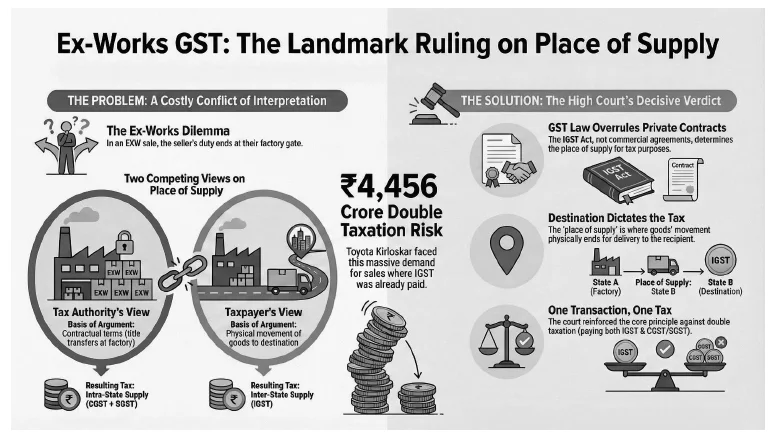
PLACE OF SUPPLY
Place of Supply is an integral part of the GST mechanism as it determines which tax must be paid by the supplier. Under section 12(8) of the IGST Act, 2017 which applies to services where the location of recipient and supplier of services is in taxable territory, the place of supply is determined as under:
- Where the services are supplied to a registered person, the location of such registered person
- Where the services are supplied to a person other than a registered person, the location at which the goods are handed over for transportation shall be the place of supply.
Similarly, for cross-border transactions, i.e., where either the location of supplier of service or recipient of service is outside the taxable territory, the place of supply was determined under section 13(9) of the IGST Act, 2017 which provided that except for courier services, the place of supply of service of transportation of goods shall be the destination of the goods. However, the Finance Act, 2023 has omitted the same (effective date of amendment has not been notified) which necessitates the need to relook at the applicable rule for determination of place of supply.
It is in this context that one needs to look at section 13(3) (a) of the IGST Act, 2017 which provides that in case of services supplied in respect of goods which are required to be made physically available by the recipient of services to the supplier of services, or to a person acting on behalf of the supplier of services in order to provide the services, the place of supply of the following services shall be the location where the services are actually performed. The question that arises is whether it can be said that the services supplied are in respect of goods? This aspect was clarified in the context of Service tax vide the Education Guide as under:
5.4.1 What are the services that are provided “in respect of goods that are made physically available, by the receiver to the service provider, in order to provide the service”? – sub-rule (1):
Services that are related to goods, and which require such goods to be made available to the service provider or a person acting on behalf of the service provider so that the service can be rendered, are covered here. The essential characteristic of a service to be covered under this rule is that the goods temporarily come into the physical possession or control of the service provider, and without this happening, the service cannot be rendered. Thus, the service involves movable objects or things that can be touched, felt or possessed. Examples of such services are repair, reconditioning, or any other work on goods (not amounting to manufacture), storage and warehousing, courier service, cargo handling service (loading, unloading, packing or unpacking of cargo), technical testing/inspection/certification/analysis of goods, dry cleaning etc. ….
As can be seen from the above, the Education Guide also provides that courier services are also covered under the above clause. The courier service is an extension of transportation service, which is also apparent from perusal of section 13(9) which prior to amendment, excluded courier services from its’ scope. Therefore, the possibility of the Authorities proposing to classify transportation services provided to recipient outside India under this clause may not be ruled out.
The above view can be countered with an argument that section 13(3)(a) intends to cover only such activities which are performed on goods. Mere handling of goods per se cannot be treated as being covered under section 13 (3) (a). In this regard, one may refer to the recent decision of the Hon’ble Tribunal in the case of ATA Freightline (I) Pvt Ltd vs. Commissioner [2022 (64) G.S.T.L. 97 (Tri.-Bom)] wherein it has been held as under:
13. … … The objective of separate treatment in Rule 4 of Place of Provision of Services Rules, 2012 is not just about accepting responsibility for goods on behalf of ‘provider’ of service as is evident from the proviso
‘4. Place of provision of performance based services. – The place of provision of following services shall be the location where the services are actually performed, namely:-
‘(a) services provided in respect of goods that are required to be made physically available by the recipient of service to the provider of service, or to a person acting on behalf of the provider of service, in order to provide the service :
Provided that when such services are provided from a remote location by way of electronic means the place of provision shall be the location where goods are situated at the time of provision of service:
Provided further that this clause shall not apply in the case of a service provided in respect of goods that are temporarily imported into India for repairs and are exported after the repairs without being put to any use in the taxable territory, other than that which is required for such repair.
xx xx xx’
therein, that goods concerned with the rendering of service is necessarily to be made available to the ‘provider’ or ‘person acting on behalf of provider’ by the ‘recipient of service’ for being put to use in the course of rendering service – an aspect that appears, and even conveniently, to have been passed over for scrutiny by the adjudicating authority. For so doing, the circular referred to by Learned Counsel would also have to be overcome.
It is therefore important that the CBIC issues a clarification on this issue before the notification making the amendment effective is issued.
DEEMED SUPPLY IMPLICATIONS
Entry 2 of Schedule I of the CGST Act, 2017 provides a deeming fiction to include supply of goods or services or both between related persons or between distinct persons as specified in section 25, when made in the course or furtherance of business as supply even if made without a consideration.
This provision has created a challenge for all sectors and has been discussed in detail in the past as well. This provision poses a similar challenge for the logistic sector as well. Let us try to understand this with the help of following example:
- ABC is a transporter having pan-India presence through its’ branches.
- ABC has a client in Gujarat who requests for service of transport of goods from its’ factory in Gujarat to their client in Tamil Nadu. ABC’s Gujarat branch fulfils the said request of the client and provides the services using its’ truck registered with Gujarat RTO Authorities.
- When the goods are delivered in Tamil Nadu, its’ Tamil Nadu branch has received client request for transfer of goods to Maharashtra.
- Since they already have a truck in Tamil Nadu on its’ way to Gujarat via Maharashtra, the same is used for fulfilling the client request. The Tamil Nadu branch raises the invoice to the customer.
- Similarly, the Maharashtra branch also loads goods of its’ customer in this truck while it is on its’ way back to Gujarat and raises the invoice to the customer.
The above simple and very routine transaction in the industry raises the question of whether the Gujarat branch has supplied any service to the Tamil Nadu branch or Maharashtra branch? There is already a ruling by the AAR to hold that this constitutes hiring of motor vehicle and not GTA service. In such a scenario, the service can be treated as exempted in view of entry 22 of notification 12/2017-CT (Rate) dated 28th June, 2017. However, this might trigger reversal u/r 42/43 of the CGST Rules, 2017.
B. FREIGHT FORWARDING
The activity of freight forwarding is very common in the logistics sector. In this model, the freight is sold by the person to consignors, i.e., persons intending to have goods transported, though they themselves don’t execute the said service. Instead, they in-turn buy freight from the various service providers, i.e., transporters, shipping lines, airlines, etc.
Under the erstwhile regime, there was substantial litigation with respect to activities carried out by freight forwarders, primarily because services of outbound transportation of goods did not attract service tax. Therefore, even the freight forwarders would not charge service tax on the amounts recovered from their clients. Therefore, the Department used to allege that the freight forwarders were acting as agents and the difference in the rate at which they sell and buy freight was taxable as intermediary services provided. The demands made on this allegation were set-aside by the Tribunal in the case of Greenwich Meridian Logistics (I) Pvt Ltd vs. CST, Mumbai [2016 (43) S.T.R. 215 (Tri. – Mumbai)] wherein the Tribunal has held that the surplus earned by the freight forwarders arises from the activity of purchase and sale of freight on a principal-to-principal basis and therefore no service tax is leviable on the same. Simply put, the Tribunal has recognised the concept of trading in services. The principle laid down by the Tribunal in the above decision should apply on all fours to GST as well.
However, with GST being applicable on various transactions, the issue of cross-charge cannot be ruled out as there can be a scenario where the freight is sold by one location whereas purchased by another location. The implications relating to deemed supply would therefore need analysis.
C. WAREHOUSING SERVICES
Warehousing service is an integral part of the logistics sector. At times, the goods are required to be stored before they can be dispatched to their destination. As discussed above, warehousing services are in respect of goods and therefore, the place of supply for services provided in cases the location of recipient of service is outside the taxable territory shall be the place where the services are performed. Therefore, if warehousing services are provided to recipients located outside India, the same will be leviable to GST.
The above interpretation will be of aid when looked at from the perspective of a supply where both supplier and recipient are located in taxable territory. In such cases, there is a view that the place of supply is determinable under section 12 (3) of the IGST Act, 2017 which provides as under:
(3) The place of supply of services,—
(a) directly in relation to an immovable property, including services provided by architects, interior decorators, surveyors, engineers and other related experts or estate agents, any service provided by way of grant of rights to use immovable property or for carrying out or co-ordination of construction work; or … …
However, once it is said that the services are in respect of goods for section 13, it cannot be said that for the purpose of section 12, the same are in relation to immovable property. Therefore, when a person in Gujarat receives service of storage of goods in Maharashtra, the place of supply will be determined u/s 12 (2), i.e., the same will be the location of recipient of service and therefore, the supplier will have to charge IGST and not CGST+SGST.
EXEMPTIONS
It may be noted that an exemption has been given to storage and warehousing services provided in relation to specific goods, such as rice, minor forest produce, cereals, pulses, fruits and vegetables, and lastly agricultural produce.
The exemption relating to agricultural produce is mired with controversies as there is confusion revolving around what constitutes agricultural produce. The term “agricultural produce” has been defined as under:
“agricultural produce” means any produce out of cultivation of plants and rearing of all life forms of animals, except the rearing of horses, for food, fibre, fuel, raw material or other similar products, on which either no further processing is done or such processing is done as is usually done by a cultivator or producer which does not alter its essential characteristics but makes it marketable for primary market;
A reading of the above entry would indicate the following:
- The goods under consideration should be any produce out of cultivation of plants and rearing of all life forms of animals, except the rearing of horses.
- No further processing should be done on the produce or such processing should have been done which is usually done by the cultivator / producer.
- The processing should not have altered its’ essential characteristics.
- The processing should make the produce marketable for primary market.
The above exemption entry has seen its’ fair share of controversy vis-à-vis each of the above conditions. This has been primarily due to the clarifications issued by the Board Circular 16/16/2017-GST dated 15th November, 2017
For instance, there has been confusion over what constitutes produce. In SAS Cargo [2022 (59) G.S.T.L. 424 (A.A.R. – GST – Kar.)], the Authority has held that fresh eggs in shell on which no further processing is done are fully covered in definition of term agricultural produce.
Similarly, while reading the condition of “processing which is usually done by the cultivator / producer”, the phrase “which is usually” has been ignored, i.e., the Authorities have been denying the benefit of exemption by merely stating that since the processing is not being done by the producer/ cultivator, the exemption is not available. What should have been analyzed is whether the producer / cultivator can carry out the said process themselves? Merely because someone else carries out the process will not disentitle benefit of exemption.
- For instance, in Guru Cold Storage Pvt. Ltd. [(2023) 3 Centax 266 (A.A.R. – GST – Chh.)], the Authority has held that the process of de-husking or splitting or both of pulses is not usually carried out by the farmers at farm level but carried out by pulse millers. Therefore, the pulses will not qualify as “agricultural produce”. Similarly, processed dry fruits have also been held to be outside the scope of “agricultural produce”.
- Contrarily, in Lawrence Agro Storage Pvt Ltd [2021 (48) G.S.T.L. 47 (A.A.R. – GST – Haryana)] the Authority has correctly interpreted the condition and held that it is immaterial who carries out processes as long as processes such that usually done by cultivator or producer, not essentially altering essential characteristics of agricultural produce but make it marketable for primary market.
This takes us to the third condition that “the essential characteristics of the produce should not be altered”. In other words, the produce should remain as is and should not change form. For example, if a process of drying is undertaken on the grape to increase its’ shelf life, the grape is still called a grape. However, if the same grape is converted into juice, the resultant product cannot be said to be grape and therefore, there is a change in the essential characteristics of the produce. However, the question that needs focus is whether the first produces’ essential characteristic should not change or if even part of the produce is the intended produce, will the answer change?
For instance, in Sardar Mal Cold Storage & Ice Factory [2019 (23) G.S.T.L. 321 (App. A.A.R. – GST)], the Authority has held that when a tamarind pod is cracked open, string (fibre) removed and kernel is taken out, resultant tamarind (ambali foal) do not fall under definition of agricultural produce as shelling and removal of seeds to obtain pulp usually done by specially designed machines. Similarly, in the context of dried mango, dried gooseberry, etc., it was held that such products are procured by the traders from the cultivators/ producers and then undergo processes such as washing, cutting, shelling, cleaning, drying, packing, etc. which lead to considerable value addition as compared to that of product sold in primary market reflecting change in essential characteristic. Therefore, such items cannot be characterized as Agricultural produce.
Similarly, in Chopra Trading Co [(2023) 3 Centax 266 (A.A.R. – GST – Chh.)], the Authority has held that the process of milling of paddy to extract rice alters the essential characteristics of the produce. In Narsimha Reddy & Sons [(2023) 3 Centax 266 (A.A.R. – GST – Chh.)], it was held that benefit of exemption notification will be available in case of storage services provided in relation to seeds when activities undertaken are restricted to only cleaning, drying, grading etc., without any chemical processing. However, since in the said case, chemical processing was done, exemption will not be available.
However, in the context of milk, the Gujarat HC has in Gujarat Co-op. Milk Marketing Federation Ltd. [2020 (36) G.S.T.L. 211 (Guj.)] held that the activity of chilling of milk to extend its’ shelf life does not result in altering of the essential characteristics of the milk and therefore, exemption will be available.
This takes to the last condition of what constitutes “primary market”. The term has not been defined either under GST or even under service tax regime. However, the Gauhati High Court has dealt with the issue in the case of Apeejay Tea Ltd. vs. UOI [2019 (23) G.S.T.L. 180 (Gau.)] wherein it has been held as under:
31. On a reading of the provisions of Section 65B(5) of the Finance Act of 1994, it is to be understood that the expression primary market mentioned therein apparently refers to the market where the agricultural produce as such are being sold and the process that the cultivator or the producer may undertake is to the extent to make it transportable and presentable in such a market. When the aforesaid situation is compared with that of the manufactured and finished tea, which apparently is being transported by the petitioners, the Court cannot take a different view but to conclude that such transported tea is not for the purpose of being marketed in a primary market where the agricultural produces are being marketed, but on the other hand the transported tea is being marketed as a finished product in the consumer market for its consumption. In view of the above, as to whether the expression agricultural produce appearing in Entry 21(a) of the Notification Nos. 3/2013-S.T., dated 1-3-2013 and 6/2015-S.T., dated 1-3-2015 includes tea or not would have to be understood from the perspective of the definition of the expression agricultural produce as appearing in Section 65B(5) of the Finance Act of 1994 and not from the perspective of the expression agricultural produce as defined and explained in D.S Bist (supra).
The above decision clearly indicates that primary market is the market where the agricultural produce is traded, be it the first sell by the producer/ cultivator or subsequent trade by the traders. Therefore, when the storage services are provided in the context of the agricultural produce which satisfies other conditions of the exemption notification, the benefit of exemption notification would be available.
However, the decisions of the AAR are to the contrary. In Lawrence Agro Storage, the Authority has held that primary market refers to markets where cultivator/ producer makes the first sale of produce.
To summarise, while the notification does provide exemption from GST to storage and warehousing services provided in relation to agricultural produce, what constitutes agricultural produce is itself debatable and therefore, the industry is stuck with the various conflicting ruling by the AAR denying the exemption benefit to the suppliers. It therefore remains to be seen how the Courts look at the exemption entry.
D. CLEARING AND FORWARDING SERVICES (INCLUDING SERVICES PROVIDED WITHIN PORT AREAS)
Clearing and forwarding agents and customs house agents are an important cog in the wheel of the logistics sector which facilitate the activity of import and export of goods. This service provider act as intermediary co-ordinating with various agencies, be it customs, port, etc., facilitating the entire process of receiving the goods in the port area till the time the goods are loaded in the vessel in case of export transaction and from the time the vessel arrives in the port till the goods are cleared from the customs authority in the case of import transaction.
While providing the above services, the service providers incur various expenses acting as agents of their client, i.e., importer / exporter (as the case may be). The expense so incurred by them are recovered from their clients on actual basis as reimbursement and the service providers also recover their service charges for carrying out the said activities. Under the service tax regime, the service providers used to charge service tax only on their service charges while the expense incurred were claimed as reimbursement on actuals. The importer / exporters were eligible to claim the CENVAT credit on the strength of invoices issued by the service providers / the supporting invoices included by them in their reimbursement claim.
Whether the amounts claimed as reimbursement was includible in the value of service provided by the agents was a subject matter of litigation and reached finality with the decision of the Hon’ble Supreme Court in the case of Intercontinental Consultants & Technocrats Pvt Ltd [2018 (10) G.S.T.L. 401 (S.C.)].
However, with the introduction of GST and the input tax credit mechanism, there has been a need to change the structure. This is because the agents engage various service providers in the course of providing their services. This includes port authorities, terminal, transporters, etc., who provide services leviable to GST. It may not be feasible to provide the GSTIN of importer/ exporter to all such service providers and therefore, many agents have stopped the reimbursement model and the invoices are issued by them with GST on the entire amount, i.e., service charge plus reimbursement of expenses. This has however increased their exposure as any mismatch in input tax credit has to be borne by them.
On the contrary, in case of agents continuing under the reimbursement model, the issues have increased for the importer / exporter as they have to follow-up with the vendor who is not in their system.
In the port area, there are many service providers. They levy various charges, which include terminal handling charges, inland handling charges, airway bill charges, etc., The charges are levied by them for services provided in relation to goods and therefore, the place of supply is determined under section 12 (2) or 13 (3) (a) as the case may be and applicable taxes have to be charged. This will apply even in cases where the service recipient is located outside India.
CONCLUSION
The logistic sector forms an integral part of the economy as it keeps the economy running smoothly. However, when studied from the perspective of GST, there are substantial issues involved and it is therefore imperative that all such issues are analysed before any decision / tax position is taken.