

Notified rate of interest on Special Deposit Scheme for Non-Government Provident, Superannuation and Gratuity Funds would be 8.6% p.a. w.e.f. 1st December 2011 — Notification No. 5(4)-B(PD)/2011,
dated 13-3-2012.
dated 13-3-2012.


Stay abreast with the latest developments in the professional domain along with in-depth analysis through the monthly BCA Journal. Get access to an engaging library of researched publications from the BCAS stable.
Learn MoreExplore past issues of BCA Journal & indulge in a treasure trove of high-quality professional content across format of print, videos & learning events from the BCAS stable.
Learn More





This Circular now permits repayment of such loans to be credited to the NRE/Foreign Currency Non- Resident (Bank) [FCNR(B)] account of the lender provided the loan was extended by way of inward remittance in foreign exchange through normal banking channels or by debit to the NRE/FCNR(B) account of the lender and the lender is eligible to open NRE/ FCNR(B) account.
CAs
are often not just close to the Company, but they are close to and
involved with the accounts and finance of the Company where most
pricesensitive information arises first. They are thus close whether as
auditors, working in finance or accounts, advising as merchant bankers,
etc. Furthermore, the financial and analytical skills of CAs make them
more capable in visualising the implications of such information on the
market price than other insiders.
The Securities Appellate Tribunal in Shri E. Sudhir Reddy v. SEBI (decided on 16-12-2011) had observed:
“.
. . . The directors of the company or for that matter even
professionals like CAs and Advocates advising the company on its
business-related activities are privy to the performance of the company
and come in possession of information which is not in public domain.
Knowledge of such unpublished price-sensitive information in the hands
of persons connected to the company puts them in an advantageous
position over the ordinary shareholders and the general public. Such
information can be used to make gains by buying shares anticipating rise
in the price of the scrip or it can also be used to protect themselves
against losses by selling the shares before the price falls. Such
trading by the insider is not based on level playing field and is
detrimental to the interest of the ordinary shareholders of the company
and general public. It is with a view to curb such practices that
section 12A of the SEBI Act makes provisions for prohibiting insider
trading and the Board also framed the Insider Trading Regulations to
curb such practice . . . .”
Oscar Wilde has light-heartedly said
that “The only way to get rid of temptation is to yield to it”, but
yielding to it is what CAs need to strongly resist.
However, the
focus of this article is to highlight that, over a period of time, the
framework of law relating to insider trading has become so strict as to
become even stifling so much so that it may be advisable for CAs
connected with the Company in any manner to simply not carry out any
trades in the shares of that Company. This may be better than facing a
presumptive charge of insider trading and then having to find evidence
to prove it otherwise.
Let us try to understand some aspects of
the law relating to insider trading to understand the difficulties that
the regulator faces in controlling it, the deeming provisions — perhaps
these are regulatory ‘short-cuts’ — adopted by it and the implications
that insiders particularly CAs face.
Insider trading, loosely
and conceptually understood, is misuse of price-sensitive information by
insiders to trade and profit from it. A simple example is, say, the
Company receives a huge profitable contract. When this information is
published, the price of the shares would go up. But the insiders may buy
the shares of the Company before the information is published and,
after publishing the information when the price goes up, they may sell
the shares at the higher price.
While this is easily understood
conceptually, there are difficulties in proving in law whether there was
insider trading and whether a particular insider was guilty of such
offence. Consider some aspects the law will have to provide for
objectively.
(a) What is insider trading? How to define it? Whom
to cover? What type of transactions to cover? Whether and how to cover
sharing of information?
(b) Whether a particular person an insider? Is he in a position to have access to unpublished pricesensitive information?
(c) Whether particular information price-sensitive? Would it affect the market price if it were published?
(d) Was such price-sensitive information published?
(e)
Did the insider deal in the shares directly or indirectly? Did the
insider communicate the unpublished price-sensitive information (UPSI)?
(f) Were the dealings of the insider on the basis of such UPSI? And so on.
It
can be seen even by a cursory glance at such hurdles as also shown by
experience, that they can be difficult to cross and thus insider trading
may be difficult to prohibit and punish. The SEBI characteristically
has used a series of ‘deeming’ provisions whereby a certain state of
affairs is assumed to be true. Consider some examples of this:
(1) Several groups of persons are deemed to be insiders.
(2) Several types of information is deemed to be price-sensitive.
(3)
Information is deemed to be duly published only if it is published in a
particular manner. Even if widely known to the market otherwise, it is
not deemed to be published.
(4) Certain periods before an important
event are assumed to be such where UPSI exists. In effect, as we will
see later, trades during this period are assumed to be insider trading
at least in effect.
(5) Certain transactions of purchase/sale by
specified insiders are deemed to be insider trading and unlike other
deeming provisions such transactions are straight away banned.
(6)
Certain insiders in possession of inside information are deemed to have
acted on the basis of such insider information in carrying out their
trades and thus held guilty of insider trading unless they prove
otherwise.
And so on.
Some of the above
assumptions/deeming provisions are rebuttable in the sense that the
person concerned can demonstrate that, in reality, what is deemed is not
really so. In other cases, the deeming is absolute and non-rebuttable.
The
point being made is that there are numerous provisions whereby a trade
by a person would be deemed to be insider trading and this would be
absolutely held to be so or the person will have to demonstrate that
this is not so. To put it in different words, a person associated with a
listed company may often be held to be guilty unless he proves
otherwise.
It is worth elaborating some of the points made above.
An
insider is defined, in Regulation 2(e) of the SEBI (Prohibition of
Insider Trading) Regulations, 1992 (‘the Regulations’), to begin with,
to include a ‘connected person’. A connected person includes a director.
Thus an Independent Director is an insider. Further, a person holding a
position involving a professional relationship with the Company is a
connected person and thus auditors and lawyers would be connected
persons and thus insiders.
Then there are persons who are deemed to be connected persons. An example is of a merchant banker.
However,
the additional requirement for the offence of insider trading to happen
is that the connected person should reasonably be expected to have an
access to unpublished price-sensitive information. This is to be
determined obviously by evidence.
A transaction is insider trading if it is carried out when in possession of unpublished price-sensitive information (‘UPSI’). While UPSI is defined as information which if published is likely to materially affect the prices of securities of the company, several items of information are deemed to be UPSI. Examples are periodical financial results, any major expansion or execution of new projects, dividends, etc. For such deemed UPSI, the test whether it will materially affect the price of the company is not required to be fulfilled. This may sound strange for financial results where there are no significant changes, where the dividends more or less are as per the past record, etc. A trading on knowledge of such deemed UPSI is insider trading.
If the price-sensitive information is ‘published’, then of course it is no more UPSI. However, information is deemed to be published only if it is published by the Company and is specific in nature. It has been held that the fact that the information may be known to the markets is not generally a valid defence that it is published.
The deeming of certain transactions has been carried to an extreme whereby certain transactions by specified persons in certain situation are straightaway banned clearly on the presumption that these are transactions of insider trading or too near to them.
For example, the concept of trading window is introduced which can be open or closed. It is generally closed in anticipation of certain price-sensitive information being compiled or announced. When it is closed, the employees/directors of the Company are not permitted to trade in the securities of the Company. In this sense, the closed window period is again a period during which it is deemed that transactions that may take place would be insider trading and thus straightaway banned. One cannot carry out a transaction during such period and any attempt to rebut the charge would be virtually impossible.
Further, if an opposite transaction is carried out by directors/officers/designated employees within six months of the earlier transaction, it is effectively deemed to be insider trading and thus absolutely prohibited. Such a transaction too has no rebuttal.
There is a controversy as to whether for a transaction to amount to insider trading, the insider has to merely possess price-sensitive information or the transaction should be on the basis of such price-sensitive informa-tion. The crucial difference is that in the latter case, the onus on SEBI is more as it has to prove a mental element to the transaction. This controversy mainly arises because of mismatch in drafting between the Act and the Regulations. Regulation 3(i) of the Regulations provides that a transaction would be insider trading if an insider carries out while in possession of UPSI. Section 15G of the Act, which levies penalty for insider trading, however, levies penalty if the transaction is carried out on the basis of UPSI. The SAT has held recently in the case of Chandrakala v. SEBI (Appeal No. 209 of 2011 dated 31st January 2012) that once an insider trades while in possession of UPSI, it will be a presumption, albeit rebuttable, that it is ‘on the basis of’ UPSI. It will be up to the insider to prove that it is not so. The SAT observed,:
“The prohibition contained in Regulation 3 of the regulations apply only when an insider trades or deals in securities on the basis of any unpublished price-sensitive information and not otherwise. It means that the trades executed should be motivated by the information in the possession of the insider. If an insider trades or deals in securities of a listed company, it may be presumed that he/she traded on the basis of unpublished price-sensitive information in his/her possession, unless contrary to the same is established. The burden of proving a situation contrary to the presumption mentioned above lies on the insider. If an insider shows that he/she did not trade on the basis of unpublished price-sensitive information and that he/she traded on some other basis, he/she cannot be said to have violated the provisions of Regulation 3 of the regulations.”
The implications of the above decisions are not far to see. Most CAs associated with a company are likely to be insiders or deemed insiders and would have access to UPSI. Their trading would thus be deemed insider trading as a presumption and it would be up to him to prove otherwise.
To conclude, CAs who are associated with listed companies professionally or in employment or in other manner as consultants, etc. may find many of the deeming provisions acting against him. He is likely to be deemed as an insider and his trades deemed to be insider trading. The onus would be on him to prove otherwise and even such opportunity to rebut is not always available. CAs would thus consider whether they should, as a prudent policy, refrain altogether from trading in the shares of such company or ensure that they fall within the clear exceptions, on facts or otherwise.
A transaction is insider trading if it is carried out when in possession of unpublished price-sensitive information (‘UPSI’). While UPSI is defined as information which if published is likely to materially affect the prices of securities of the company, several items of information are deemed to be UPSI. Examples are periodical financial results, any major expansion or execution of new projects, dividends, etc. For such deemed UPSI, the test whether it will materially affect the price of the company is not required to be fulfilled. This may sound strange for financial results where there are no significant changes, where the dividends more or less are as per the past record, etc. A trading on knowledge of such deemed UPSI is insider trading.
If the price-sensitive information is ‘published’, then of course it is no more UPSI. However, information is deemed to be published only if it is published by the Company and is specific in nature. It has been held that the fact that the information may be known to the markets is not generally a valid defence that it is published.
The deeming of certain transactions has been carried to an extreme whereby certain transactions by specified persons in certain situation are straightaway banned clearly on the presumption that these are transactions of insider trading or too near to them.
For example, the concept of trading window is introduced which can be open or closed. It is generally closed in anticipation of certain price-sensitive information being compiled or announced. When it is closed, the employees/directors of the Company are not permitted to trade in the securities of the Company. In this sense, the closed window period is again a period during which it is deemed that transactions that may take place would be insider trading and thus straightaway banned. One cannot carry out a transaction during such period and any attempt to rebut the charge would be virtually impossible.
Further, if an opposite transaction is carried out by directors/officers/designated employees within six months of the earlier transaction, it is effectively deemed to be insider trading and thus absolutely prohibited. Such a transaction too has no rebuttal.
There is a controversy as to whether for a transaction to amount to insider trading, the insider has to merely possess price-sensitive information or the transaction should be on the basis of such price-sensitive informa-tion. The crucial difference is that in the latter case, the onus on SEBI is more as it has to prove a mental element to the transaction. This controversy mainly arises because of mismatch in drafting between the Act and the Regulations. Regulation 3(i) of the Regulations provides that a transaction would be insider trading if an insider carries out while in possession of UPSI. Section 15G of the Act, which levies penalty for insider trading, however, levies penalty if the transaction is carried out on the basis of UPSI. The SAT has held recently in the case of Chandrakala v. SEBI (Appeal No. 209 of 2011 dated 31st January 2012) that once an insider trades while in possession of UPSI, it will be a presumption, albeit rebuttable, that it is ‘on the basis of’ UPSI. It will be up to the insider to prove that it is not so. The SAT observed,:
“The prohibition contained in Regulation 3 of the regulations apply only when an insider trades or deals in securities on the basis of any unpublished price-sensitive information and not otherwise. It means that the trades executed should be motivated by the information in the possession of the insider. If an insider trades or deals in securities of a listed company, it may be presumed that he/she traded on the basis of unpublished price-sensitive information in his/her possession, unless contrary to the same is established. The burden of proving a situation contrary to the presumption mentioned above lies on the insider. If an insider shows that he/she did not trade on the basis of unpublished price-sensitive information and that he/she traded on some other basis, he/she cannot be said to have violated the provisions of Regulation 3 of the regulations.”
The implications of the above decisions are not far to see. Most CAs associated with a company are likely to be insiders or deemed insiders and would have access to UPSI. Their trading would thus be deemed insider trading as a presumption and it would be up to him to prove otherwise.
To conclude, CAs who are associated with listed companies professionally or in employment or in other manner as consultants, etc. may find many of the deeming provisions acting against him. He is likely to be deemed as an insider and his trades deemed to be insider trading. The onus would be on him to prove otherwise and even such opportunity to rebut is not always available. CAs would thus consider whether they should, as a prudent policy, refrain altogether from trading in the shares of such company or ensure that they fall within the clear exceptions, on facts or otherwise.
The requirements of corporate governance has resulted in tens of thousands of persons — most of them highly educated and experienced — being appointed as independent directors of listed companies. By definition, they are generally nonexecutive, since being a paid executive director would mean loss of independence. However, while such an army of independent directors has been created under this requirement, the law governing them remains age-old. Only the nomenclature of Independent Director is new. The role, powers and duties of independent directors are not provided for in the requirements relating to corporate governance framed by the SEBI and placed in the listing agreement as Clause 49. No extra powers or authority is given to the independent directors (though some functions and authority are given to the Audit Committee). Thus, for understanding the powers and duties of an individual independent directors, one has to look at the pre-existing law as contained in the Companies Act, 1956. While this law too does not lay down a specific and detailed framework for non-executive directors, the settled law is that individual non-executive directors are required to be diligent and exercise a level of care than a prudent person may ordinarily exhibit. Further, even these requirements relating to corporate governance have been, curiously, placed not in the SEBI Act or even in any notified regulations or rules, but in the listing agreement between the Company and the stock exchange. This gives these requirements, at best, a semi-statutory cognizance. The violation of these requirements generally results in action against the Company and not against the independent directors.
Expectedly, the other peculiar result is that there are no specific provisions providing for punitive or other adverse consequences for violating the requirements relating to corporate governance. As we will see later, this is perhaps the reason that the SEBI has used its omnibus powers to take action against the independent directors who were allegedly negligent and who even allegedly abetted the fraud.
The preceding paragraphs are not intended to provide for any excuse or leeway for the negligence of any independent directors, particularly a person who is a member of the Audit Committee. It is only to highlight the fairly inadequate manner in which the law has been framed. When a situation has arisen when such law was tested, the SEBI, instead of accepting this inadequate framework and taking corrective action in this regard, resorted to omnibus provisions to take punitive action which most Independent Directors could not even have visualised. Of course, it has to be noted that the facts of the case, if one goes by the SEBI Order, are fairly serious. Let us now consider the details of this case as provided in the SEBI Order.
It has been alleged by the SEBI that Pyramid, the listed company of which the specified persons were independent directors and members of its Audit Committee, overstated its revenues and thus its profits by manipulation of its accounts. The company which is engaged in the business of managing theatres and exhibition of films claimed to have entered into agreements with more than 800 theatres from which revenues flowed into the company. The SEBI recorded a finding that in reality barely about 250 such agreements could be proved and the rest of the agreements did not exist. Hence, it was alleged that the revenues based on such sham agreements were non-existent and through false book entries such revenues were recorded. The accounts based on such overstated revenues and profits were published for the benefit of the public.
SEBI made a finding that the accounts were thus misstated and the question then was, what role did the independent directors play and whether they did not perform their duties as expected of them. This was particularly so, since such Directors were also members of the Audit Committee.
It is worth noting the relevant extracts what SEBI says in its dealing with what it believes to be the role of the Board in general, of independent directors and of members of the Audit Committee :
“5. A company acts through its board of directors. It is the duty and responsibility of the directors to ensure that proper systems and controls are in place for financial reporting and to monitor the efficacy of such systems and controls. While the extent of responsibility of an independent director may differ from that of an executive director, an independent director has the duty of care. This duty calls for exercise of independent judgment with reasonable care, diligence and skill which should be reasonably exercised by a prudent person with the knowledge, skill and experience which may reasonably be expected of a director in his position and any additional knowledge, skill and experience which he has. The audit committee exercises oversight of the company’s financial reporting process and the disclosure of its financial information to ensure that the financial statement is correct, sufficient and credible. It reviews the adequacy of internal control system and management discussion and analysis of financial condition and result of operations. The institutions of independent directors and audit committee have been established to promote corporate governance and enhance the protection of interests of investors. These have a critical role to play in the regulation and development of the securities markets and protection of interests of investors in securities.
6. I note that Mr. K. S. Kasiraman and Mr. K. Natarahjan were independent directors and members of the audit committee at the relevant time. It has been submitted that Mr. G. Ramakrishnan was not an independent director and a member of the audit committee for the entire period. I find that he was an independent director and also a member of the audit committee when quarterly reports of the last two quarters of the year were considered by the Board as well as the audit committee. Further, the quarterly reports of succeeding quarters, when he continued as an independent director and as a member of the audit committee, have indication about the unreliability of the financial statements of the previous quarters.
7. I find that the noticees overlooked numerous red flags in the trend in revenues, profits, receivables, advances, etc. which could not escape the attention of an independent director, who is also a member of the audit committee. For example, profits tripled in the quarter ending June 2007 over the preceding quarter. It doubled in the quarter ending December 2007 over the preceding quarter. The quarter ending March 2008 reported a loss of Rs.3.11 crore compared to a profit of Rs. 29.87 crore in the preceding quarter. Similarly, though the number of screens in theatres increased from 487 as on September 30, 2007 to 655 as on December 31, 2007, security deposits with theatres during the same period increased disproportionately from Rs.36.05 crore to Rs.170.38 crore. Such aberrations in financial figures would alert any person of ordinary prudence. The appropriate questions at the right time from the noticees would have unravelled the fraud being played by the company on the innocent investors. By failing to ask the right questions at the right point of time, I find that the noticees have failed in their duty of care as an independent director. They failed to review, as members of the audit committee, the internal control systems, which generated misleading financial statements. I find that the noticees were either too negligent to notice the aberrations in performance of the company and the fraud behind such aberrations or acted as shadow directors of the board/ members of the audit committee. In either case, they facilitated the company to make false and misleading disclosures and thereby created artificial prices and volumes in the securities of PSTL in the market, to the detriment of innocent investors. I, therefore, conclude that the charge of disclosure of false and misleading statements, as alleged in the SCN against the noticees, is established. Thus, the noticees are guilty of violating Section 12A of SEBI Act, 1992 and Regulation 3(b), 3(c), 3(d), 4(1), 4(2)(e), 4(2)(f), 4(2)(k), 4(2)(r) of the SEBI (Prohibition of Fraudulent and Unfair Trade Practices relating to Securities Market) Regulations, 2003.
8. Such conduct on the part of the noticees is disgrace to the institutions of independent directors and the audit committee of a listed company. This cannot be viewed lightly and warrants regulatory intervention. Therefore, in exercise of the powers conferred upon me u/s. 19 read with Sections 11, 11B and 11(4) of the Securities and Exchange Board of India Act, 1992 and Regulation 11 of the SEBI (Prohibition of Fraudulent and Unfair Trade Practices relating to Securities Market) Regulations, 2003, I hereby restrain Mr. K. S. Kasiraman (Permanent Account Number: AFPPK3572B), Mr. K. Natarahjan (Permanent Account Number: ACJPN0418I), and Mr. G. Ramakrishnan (Permanent Account Number: AAEPR2014F) from being an independent director or a member of audit committee of any listed company for a period of two years from the date of this Order.”
This case is obviously an extreme one where, in a sense, like the Satyam case, serious allegations and findings of fraud were made and expectedly, the question would be how could such serious alleged frauds have escaped the attention of such directors. Or, worse, whether they actively abetted such frauds. This is more so, when they were also on the Audit Committee. However, such an extreme case cannot make and define the law for other cases particularly if there are lesser violations or for areas the facts are less clear.
It is also seen that the SEBI does not have any direct and specific powers to deal with non-performance of duties by the independent directors or for their being negligent. In fact, the SEBI has used its omnibus and comprehensive powers u/s. 11, 11B, etc. to take action against such Independent Directors. The issue is whether it is appropriate to use such powers in this manner creating an impression that the SEBI can act against anyone for anything that it perceives to be wrong or irregular without either defining what is right and wrong conduct and specifying clearly the consequences therefor.
Curiously, the SEBI has held that the Independent Directors are guilty of several provisions of the SEBI FUTP Regulations relating to fraud, price manipulation, etc. The Order, however, does not deal with each such clause separately and establish how it was violated. It is one thing to hold Independent Directors responsible for being negligent or passively not performing their duties and it is totally another thing that they were active participators or abettors of the fraud, etc.
It may be recollected that in an earlier case of an alleged massive fraud, the SEBI had made a similar order debarring the independent directors in that case. However, the Securities Appellate Tribunal (Appeal No. 347/2004, dated 8th December 2005) reduced the period of debarment and found that the SEBI had neither alleged nor established any aiding/abetting by the independent directors to the alleged fraud. It also noted that the independent directors were passive and had no active role in perpetrating the alleged fraud.
Of course, this is not to question the power of SEBI to take such action. As discussed in an earlier article in this column (December 2010 issue of BCAJ), the Bombay High Court in Price Waterhouse & Co. v. SEBI, [(2010) 103 SCL 96 (Bom.)] upheld the power of SEBI to take similar action against auditors and the ratio of that decision should apply directly in facts of the present case. Having said that, recently, questions have been raised (a subject that merits a separate discussion) whether the SEBI indeed has power to ‘punish’ persons under such general and omnibus powers.
To reiterate, a precedent against errant independent directors was needed and this Order does provide one. Having said so, one cannot help observing that the system is skewed against the independent directors. On one hand, by misplacing the requirements of corporate governance in the listing agreement and by not giving any specific right to individual independent director or even to them as a whole, the SEBI has not given them any teeth to really do their jobs well. On the other hand, their obligations, formal and otherwise, are significant. It could thus create difficulties for conscientious Independent Directors in their functions. And since independent directors are really the essential core of good corporate governance, the absence of a proper legal framework for their role, powers and duties is a serious vacuum that, if not filled, will make the requirements of corporate governance ineffective.
Shrikrishna (S) – Dear Arjuna, how was your vacation? Did you enjoy your outing?
Arjuna (A) – Yes, it was fine. But the last time you told me about the disciplinary action; and whenever I thought of it, my mood used to go off!
S – Why? Was it so frightening? I told you only broad principles. And if you are awake and alert, there is nothing to worry about.
A – When I was away, my manager informed me that we got a new audit and it was to be done urgently. I instructed him to start working on it.
S – Good. But did you write to the previous auditor?
A – Actually, I was at the hill station and was not getting the range on my cell. Still, I managed to speak to the previous auditor. He said, ‘Don’t worry; go ahead’. I have to sign the audit next week. Most of it is already done. I will ask the client himself to obtain his NOC.
S – Oh dear! Don’t take it so lightly. You cannot shift the responsibility to the client or anyone else. You and you alone have to write to him.
A – But the client has promised me. If you say, I have to write, I will give my letter to the client who will deliver it to the previous auditor
S – Hey Partha, never commit such a mistake. And remember, you have to do this before accepting the audit and not before signing it.
A – But we have already commenced the audit. It was urgent. Why waste time in such useless formality?
S – You are mistaken. It is not a meaningless formality. It is extremely valuable.
A – What purpose will it serve? It is the client’s prerogative to change the auditor. Why should anybody object?
S – Arjuna, you belong to a graceful profession – a learned profession. You are not a shopkeeper or a mere businessman. All professionals need to be united. Otherwise, client will take advantage and bring both of you in trouble.
A – How? Each year’s audit is a separate contract. What role has the previous auditor to play?
S – It is possible that the client’s dealings are not proper; or he may be lacking discipline. His records may not be straight. Previous auditor may be reluctant to sign.
A – So what? I will take every care and qualify the audit if I feel it necessary.
S – Precisely for this reason the client may have left the previous auditor. You will come to know from him as to whether one would be professionally comfortable signing this audit.
A – But if he objects to my accepting the audit, the client will suffer.
S – Why are you so much worried about the client who approaches you at the eleventh hour? There must be some hitch that the client may be hiding from you. Just ask whether he has paid the fees of previous auditor?
A – How will it matter? I will secure my fees and I know how to recover it.
S – Let me tell you that if you accept the audit when the previous audit fees are unpaid, that in itself is a misconduct. Let alone the other objections.
A – But the previous auditor may have charged exorbitant fees!
S – Remember, it is only the audit fees and not fees for any other services. The Guidelines from Council refers to undisputed audit fees.
A – How can one know whether it is disputed or otherwise?
S – It defines the undisputed audit fees. It means the fees appearing in the balance sheet signed by the auditor. Once it is so, it is deemed to be undisputed.
A – But what if there is cash method of accounting? Nothing will be there in the balance sheet.
S – Then you have to be extra careful. Check the records, write to the client, and write to the previous auditor.
A – What if the previous auditor objects? Or does not issue NOC for a long time?
S – Firstly, remove the wrong notion from your mind that you have to obtain an NOC. The relevant clause nowhere requires that. It only says, you have to communicate with him in writing; before accepting the audit.
A – Can I fax or e-mail? S – Not advisable. Council prefers and recommends a registered post acknowledgment due. RPAD! A – I will hand deliver to him.
S – Then you have to have a proof of delivery. I suggest, even avoid a courier. If RPAD is such a simple thing to do, why do you avoid it? This is typical of you CAs.
A – Wait. I will speak with my audit manager. (Speaks on cell phone). Good Lord! My manager informs me that the previous auditor has already mentioned in his resignation letter that he has no objection to anyone else taking up the audit! Moreover, it is only an internal audit and not statutory audit! I am saved!
S – Blissful ignorance! Mere mention in resignation letter is ‘not sufficient’. There is no substitute to your writing to him. There is no other way.
A – But what about internal audit?
S – Again a wrong notion. The rule applies to all types of audits be it statutory audit, tax audit, VAT audit, Concurrent, Internal, Revenue or Stock audit!
A – That is irritating. That is why our code is a burden.
S – No dear! Why don’t you take it positively? Perhaps, you will get valuable tips; or some advice of caution. Your efforts may be saved if the audit is risky. Or even client will dodge your fees as well! Don’t treat the previous auditor as your enemy.
A – Sometimes, I am confused as to who is a ‘previous auditor’. What if there was no tax audit for last two-three years?
S – Previous auditor does not mean the auditor for the immediately preceding year. It means the auditor who last held the same or similar assignment immediately prior to your appointment. Thus, it could be auditor appointed two-three years ago also.
A – Now that you are telling me all this, tell me, what if the audit is allotted by the Government? By CAG; or by Co-operative Department; or By RBI?
S – Still you are supposed to write. And who told you, you have to actually obtain NOC? You have to simply communicate, wait for a reasonable time.
A – But what if he objects?
S – You have to weigh the objections. If they are valid, you may consider whether or not to accept the audit. Or you may take them into consideration while reporting. But if the objection is regarding non-payment of undisputed audit fees, you are helpless. Otherwise, you will invite trouble for yourself.
A – Why does the Council not compel the auditor to respond quickly?
S – It has! In fact, the Council has advised all the members to respond to such communications quickly.
A – But previous auditor is closely known to me. I don’t think he will take it seriously for such a small fee.
S – I will tell you a real life incident. In one case, both husband and wife were CAs. The wife did the audit of a small housing society for two years. Thereafter the husband signed it. After a couple of years, there was a divorce proceedings between the two and the wife complained to the Council that the husband accepted the audit without communicating with her!
A – Ohh! This is alarming. Good that my Draupadi is not a CA!
S – Therefore, I am telling you, don’t take it lightly; and take it positively. It is in the interest of your profession.
A – Does it apply to tax assignments or certification work as well?
S – Legally speaking, ‘No’. But the Council recommends it as healthy practice.
A – Once a client came to me for advice through another CA. Thereafter, the client approached me directly. What should one do in such a situation?
S – Council recommends that you should ask the client to come through that CA; or at least inform that CA about it. That is a dignified behaviour.
A – I am slowly getting what you are saying. If we ourselves do not respect our profession, who else will respect it? They will take us for a ride.
S – Right. Communication with previous auditor indicates unity among professional brothers. You are well aware of what happens when brothers and cousins are not united.
Note :
The above dialogue is with reference to Clause 8 of the First Schedule which reads as under:
Clause (8): accepts a position as auditor previously held by another chartered accountant or a certified auditor who has been issued certificate under the Restricted Certificate Rules, 1932 without first communicating with him in writing;
Further, readers may also refer to the Chapter VII of Council General Guidelines, 2008 dated 8th August, 2008 for guidelines on undisputed fees (refer page nos. 313 – 323 of the Code of Ethics publication January 2009 edition or the official website of ICAI).

The
Ministry has vide General Circular No.30/2012 Dated 28.09.2012,
extended the due date of filing the e-forms 23AC(Non-XBRL) and 23ACA
(Non XBRL) as per new schedule VI as follows, to ensure smooth filing
and to avoid last minute rush, without any additional fee :-
Entension of time limit for filing form 23B (Form for Intimation of Appointment of Auditors)
The
Ministry of Corporate Affairs has vide General Circular No.31/2012
dated 28.09.2012 extended the filing of e-form 23B without any
additional fee till 23.12.2012 or due date of filing whichever is later.
All are advised to file e-form 23B after 22.11.2012 to avoid system
congestion. For full circular –
MCA Front offices situated at
Delhi, Chennai, Mumbai and Kolkata are being discontinued with effect
from 8th of October, 2012 , and hence, will not be available to offer
any assistance to MCA stakeholders.
Amendment to companies (issue of indian depository receipts) rules
The
Ministry of Corporate Affairs has issued the Companies (Issue of Indian
Depository Receipts) Amendments Rules 2012. The Rule 10 (i) of
Companies (Issue of Indian Depository Receipts Rules, 2004 has been
substituted as follows: “ A Holder of IDR’s may transfer the IDR’s, may
ask the domestic depository to redeem them or, any person may seek
reissuance of IDR’s by conversion of underlying equity shares, subject
to the provisions of the Foreign Exchange Management Act, 1999,
Securities and Exchange Board of India Act, 1992, or the rules,
regulations or guidelines issued under these Acts, or other law for the
time being in force.”
They shall come into force from the date of publication in the Official Gazette.
(i) all companies listed with any Stock Exchange(s) in India and their Indian subsidiaries; or
(ii) all companies having paid up capital of rupees five crore and above; or
(iii) all companies having turnover of rupees one hundred crore and above; or
(iv) all companies covered under rule 3 i.e, all companies who were required to file their financial statements for FY 2010-11 using XBRL.
Provided that the companies in Banking, Insurance, Power Sectors and Non-Banking Financial companies are exempted for Extensible Business Reporting Language (XBRL) filing for the financial year commencing on or after 1st April, 2011.
Final version of the MCA XBRL Validation Tool (for Financial Statements based upon new Schedule VI of the Companies Act, 1956) has been released. XBRL filings of financial statements for accounting year commencing on or after 01.04.2011 have been enabled on MCA website with effect from 14.10.2012. Stakeholders are also advised to refer to the ‘Filing Manual’ available on the XBRL portal for filing the financial statements in XBRL format. Tool available on http://xbrltool.mca.gov.in/XBRL/XBRL_TOOL/ MCAXBRLValidationTool_Version_2.0.zip
All XBRL filing companies are allowed to file their financial statements without any additional fee/ penalty upto 15th November 2012 or within 30 days of the date of their AGM, whichever is later.
In Annexure 1 to the general Circular No 33/2012, the MCA has illustrated the common errors that were observed on a close scrutiny of the XBRL filings for 2011, which need to be taken care of by certifying Chartered Accountants, Cost and Works Accountants and Company Secretaries.
Presently, banks are permitted to grant loans in Indian rupees/foreign currency against NRE/FCNR(B) deposits to the deposit holder/third party up to Rs. 100 lac.
This circular has removed the ceiling of Rs. 100 and provides for grant of loans without any ceiling, subject to appropriate margin requirements. Loans will include all types of fund bases as well as nonfund based facilities. The table reads as follows: –
Information is defined u/s 2(f) as under:
“Information” means any material in any form, including records, documents, memos, e-mails, opinions, advices, press releases, circulars, orders, logbooks, contracts, reports, papers, samples, models, data material held in any electronic form and information relating to any private body which can be accessed by a public authority under any other law for the time being in force.
Four orders on various points connected with “Information” are briefly reproduced hereunder:
The applicant in most of his queries, wanted to know about the reasons why the Central Vigilance Officers (CVOs) of a number of Public Sector Undertakings (PSUs) are not working/ functioning – he has assumed that the CVOs of PSUs are not functioning properly and wants the CPIO of the CVC to provide the reasons – the Commission held that the right to information cannot be used to seek either confirmation or rebuttal of one’s personal assumption, as in this case. Information has been defined in section 2(f) to mean any form, including records, documents, memos, e-mails, opinions, advices, press releases, circulars etc. Wherever a citizen seeks any information, it must be contained in some records or file or documents in the possession of the public authority concerned. Therefore, the response of the CPIO of the CVC and other CPIOs, as well as that of the Appellate Authority appears to be absolutely in order.
[Omprakash Kashiram vs CPIO, Central Vigilance Commission – Order dated 12.03.2012 Citation: RTI III (2012) 140 (CIC)] l
Appellant submitted RTI application dated 14th August 2010 before the CPIO, Prime Minister’s Office, New Delhi, seeking the details of functioning of Punjab and Sindh Bank through 44 points.
Decision Notice
The Commission notices that the Appellant has not asked for any specific information in his RTI Application and/or second appeal to the Commission, to be given by the Respondent Public Authority.
The Appellant was given an opportunity to explain the precise information sought, but has chosen not to attend the hearing. Also, the Appellant has not provided a copy of the Second appeal to the Respondents as per the RTI Act.
Thus, based on the submissions of the Respondents, the Commission is satisfied that information as held by the Respondents has been provided to the Appellant.
The Commission through this Order would also like to highlight the abuse of Transparency Act by the Appellant in asking voluminous questions under the Act (44 questions in this case) from the Public Authority and thereby dissipating the scarce resources of the Public Authority without meeting any larger public interest objective.
The Supreme Court in the case Central Board of Secondary Education & Anr v Aditya Bandopadhyay & Ors/ CIVIL APPEAL NO. 6454 OF 2011 [RTIR II (2011) 242 (SC)], has stated:
“Indiscriminate and impractical demands or directions under RTI Act for disclosure of all and sundry information (unrelated to transparency and accountability in the functioning of public authorities and eradication of corruption) would be counter-productive, as it will adversely affect the efficiency of the administration and result in the executive getting bogged down with the non-productive work of collection and furnishing information. The Act should not be allowed to be misused or abused, to become a tool to obstruct the national development and integration, or to destroy the peace, tranquility and harmony among its citizens. Nor should it be converted into a tool of oppression or intimidation of honest officials striving to do their duty. The nation does not want a scenario where 75% of the staff of public authorities spends 75% of their time in collecting and furnishing information to applicants, instead of discharging their regular duties. The threat of penalties under the RTI act and the pressure of the authorities under the RTI act should not lead to employees of a public authorities prioritizing ‘information furnishing’, at the cost of their normal and regular duties”.
The Commission, in the light of the above observation made by the Hon’ble Supreme Court, would like to inform the Appellant to ask a specific and limited question under the RTI Act, 2005 in the future and to use his cherished right given under the Transparency Act with greater responsibility.
[Kundan Kumar Sinha vs Department of Financial Services, New Delhi – Order dated 26.04.2012: Citation: RTIR II (2012) 185 (CIC)]
Briefly, the fact that emerged during the hearing is that the appellant was in the post of Sr. Assistant in the pay-scale of Rs. 6,300/-. The post of Jr. Engineer was advertised in the scale of Rs. 8,000/-. The appellant was selected for the post of Sr. Assistant. Before he joined, the post was down-graded to the scale of Rs. 6,300/-. The appellant after having joined the new post, has certain issues regarding promotion in that cadre.
Having heard the submissions of the parties, the Commission observes that the appellant has grievances regarding the pay scale. The RTI is not the forum for redressal of grievances. The appellant, in case he so desires, may file his grievance petition before the competent authority. As far as providing information under the RTI Act is concerned, requisite information as per record and permissible under the RTI Act has been provided to the appellant by the respondent.
[Vipin Prakash vs Airports Authority of India – Order dated 23.03.2012: Citation: RTIR II (2012) 150(CIC)]
Decision
The Appellant requested the Commission during the hearing to direct the public Authorities to fix his pay correctly. The Commission, however, holds that the Appellant is not seeking any information as available in the records and therefore the relief being sought by him cannot be granted. It is however, recommended that the PIO clarify to the Appellant about how his pay has been fixed based on the 6th Pay Commission recommendations and also to provide him with a copy of his pay fixation chart preferably by 15th May 2012.
The appeal is disposed of with the above recommendation and the case is closed.
[Rajendra Singh vs Bhavan, New Delhi-Order dated 11.04.2012:Citation: RTIR II (2012) 177 (CIC)]
Applicability
Section 5 is the main operative section of the Act. It provides that no money-lender can carry out the business of money-lending without a licence for the same. Further, the business must only be carried out in the area for which he has been granted a licence and in accordance with the terms and conditions of such licence. Thus, any business of money-lending without a licence is prohibited by the Act. In order to constitute an offence under the Act, the money-lender must carry on business in an area outside of what has been permitted by his licence – Bhavarlal Pruthviraj Jain v State of Maharashtra, 191 Bom CR 878.
A money lender has been defined to mean any individual, HUF, company, AOP, etc., who carries on the business of money-lending in the State of Maharashtra. However, banks, any financial/other institution notified by the State Government are excluded from the definition of a money-lender.
One of the important restrictions under the Act is the maximum rate of interest which a lender is entitled to charge. This rate is notified from time to time by the State Government. Currently, the maximum rate of interest for loans to any person other than an agriculturist is 18% p.a. in case of secured loans, whereas it is 20% in the case of unsecured loans.
Business of Money-lending
The next question which becomes relevant is that what constitutes a business of money-lending under the Act? The Act defines it to mean the business of advancing loans whether in cash or in kind and whether or not in connection with or in addition to any other business. Thus, two important facets are relevant – (a) there must be advancing of loans; and (b) such advancing must constitute a business.
What constitutes a business has not been defined and hence, useful reference may be made to various decisions under the Income-tax on what constitutes a business. The Supreme Court in the case of Distributors Baroda P. Ltd., 83 ITR 237 (SC) has held that when the Legislature speaks of the business of holding of investments, it refers to a real, substantial and systematic or organised course of activity of investment carried on by the assessee for a set purpose, such as earning profits. If the investments are only made for a collateral purpose, then it cannot be considered as the business of the assessee. A similar reasoning may be applied to the activity of giving loans. Of course, it goes without saying that whether or not a lending constitutes a business, would be driven more by the facts and circumstances of each case. However, some of the relevant factors would be the quantum of loans, frequency and number of transactions, type of borrowers, rate of interest charged, security demanded, organisational set-up of lender, etc.
In the case of Gajanan v. Seth Brindaban AIR 1970 SC 2007, the Apex Court considered as to when could a person be considered to be a money-lender:
“The word ‘regular’ shows that the plaintiff must have been in the habit of advancing loans to persons as a matter of regular business. If only an isolated act of money-lending is shown to the court it is impossible to state that it constitutes a regular course of business. It is an act of business, but not necessarily an act done in the regular course of business……….
………….on its plain reading only prohibits the carrying on of the business of money-lending in any district without holding a valid registration certificate in respect of that district. It does not prohibit and, therefore, does not invalidate an isolated transaction of lending money. Such an isolated transaction seems to us to be outside the rigour of the prohibition.”
What is a Loan?
Advancing of a loan is the prime requirement for a money-lender. Hence, let us examine what constitutes a loan? The Act defines it to mean an advance at interest.
The term interest has been defined under the Act to include, any sum, in excess of the principal paid or payable by a money-lender in consideration of or otherwise in respect of a loan. However, interest does not include any sum lawfully charged by a money-lender for or on account of costs, charges, expenses under this Act / any other Law.
The following transactions are excluded from the definition of the term loan and hence, dealing in them would not constitute a business of moneylending for the lender:
(a) A deposit of money in any Bank or in a Company or a Co-operative Society. Thus, a Company accepting Public Deposits under s.58A of the Companies Act or under the NBFC Directions for Public Deposits would not be covered by the definition of loan.
(b) A loan to or by or a deposit with a Society registered under the Societies Registration Act
(c) Loan advanced by Government or by any local authority
(d) A loan advanced to a Government servant from a fund
(e) A loan advanced by a co-operative society
(f) Advance made to a subscriber or a depositor in a Provident Fund from the amount standing to his credit in the fund
(g) A loan to or by an Insurance Company
(h) A loan to or by or deposit with anybody incorporated by any law for the time being in force in the State
(i) An advance of a sum exceeding Rs 3,000 made on the basis of a hundi
(j) An advance made bonafide by any person carrying on any business not having the primary object of lending money. However, such an advance must be made in the regular course of his business. Whether or not an advance has been made bonafide in the regular course of business is a question of fact. (k) An advance of more than Rs 3,000 made on the basis of a negotiable instrument other than a Promissory Note. This is the most important exception.
Hence, every loan is not covered by the provisions of the Act, since an advance of more than Rs 3,000 made on the basis of a negotiable instrument other than a Promissory Note is excluded – Rajesh Varma v Aminexs Holdings, 2008 (3) Mah. L.J. 460. A negotiable instrument means one defined under the Negotiable Instruments Act, 1881. This Act defines a negotiable instrument to mean “a promissory note, bill of exchange or cheque payable either to order or to bearer.” However, a Promissory Note is expressly excluded. Hence, only if the loan is given on the basis of a cheque or a bill of exchange it would be out of the purview of the Act.
Accordingly, any advance of more than Rs 3,000 made on the basis of a post-dated cheque as a security is out of the purview of this Act – Nandram Kaniram v N.B. Raahtekar, 1994 (1) Bom CR 28; Sitaram Laxminarayan Rathi v Sitaram Kashiram Koli, 1984 (2) Bom CR 92.
Consequences of Not Holding Licence
“I find no difficulty in so also construing section 434(1)(c) to hold that a petition for winding up u/s 433(e), r.w.s. 434(1)(a), would lie only if the debt was legally recoverable. The fact that the present is a company petition and under the Bombay Money-Lenders’ Act, no relief will be granted if the suit is filed would also make the debt unenforceable under the Act. It is no doubt true that a company petition is not a petition for recovery of dues from a company. Nevertheless, to wind up a company u/s 434(1) (a), the amount must be a debt which is legally recoverable. If the recovery itself is barred u/s 10 of the Bombay Money-Lenders’, Act, I am of the opinion, therefore, that in such a case the petition filed on the ground that the company is unable to pay such a debt, would also not be maintainable.”
If a money-lender who does not have a valid licence is in possession of the property of a loan debtor as a security, then the same can be requisitioned and delivered to the loan-debtor.
Several decisions have held that if a valid licence is not held by the money-lender, then the loan ceases to be a legally enforceable debt u/s. 138 of the Negotiable Instruments Act, 1881. Hence, if the debtor pays a cheque to such a lender which subsequently bounces, then the lender is not entitled to file a criminal suit for the cheque bouncing u/s 138 – Mulchand Ramji Saiya v Premji Ratanshi Gangar, Cr. A. No. 5397 of 2010 (Bom); Nanda Dharam Nandanwar v Nandkishor Talakram Thaokar, 2010 ALL MR (Cri) 733; Anil Baburao Kataria v Pursuhottam Prabhakar Kawane, 2010 ALL MR (Cri) 802.
Further, the Act prescribes a penalty for carrying on the business of money-lending without a valid licence. For the first offence, the punishment is a term of up to one year and/or a fine of Rs. 1,500. For every subsequent offence, the penalty is a term of at least two years.
Does the Law apply to NBFCs?
Banks have been expressly exempted. However, there is no clarity on whether or not the Act applies to NBFCs. Since money-lending is a State subject, different States and their High Courts have taken divergent views. One of the biggest bones of contention is that the State laws establish maximum rates of interest that can be charged by a money-lender whereas, the RBI has not established a ceiling on the rate of interest that can be charged by an NBFC. Some States such as Karnataka have specifically exempted certain NBFCs from the provisions of the Money Lenders Act, while there is a blanket exemption for all NBFCs in Rajasthan.
In Sundaram Finance Ltd, Special Civil Application No. 13163 of 2008 (Order dated 13th January 2010) and in Radhey Estate Developers v Mehta Integrated Finance Co Ltd, Special Civil Application No. 66 of 2010 (Order dated 26 April 2011) the Gujarat High Court ruled that the Bombay Money Lenders Act, as applicable to the State of Gujarat, does not apply to NBFCs which are regulated by the RBI.
However, the Kerala High Court has consistently been taking a view that even NBFCs are covered by the State money lending Act – Link Hire-Purchase and Leasing Co. (Pvt.) Ltd v State of Kerala, 103 Comp. Cas 941 (Ker).
Muthoot Finance Ltd has filed a Special Leave Petition (SLP. No. 14386/2010 on September 07, 2010) before the Supreme Court challenging the order of the High Court of Kerala approving the Order of the Government of Kerala notifying that provisions of the Kerala Money Lenders Act, 1958 which regulated and controlled money lending business in the state of Kerala, was applicable to NBFCs. The matter is currently pending before the Supreme Court.
Auditor’s duty
The Auditor should enquire of the auditee, whether it has complied with the aforesaid provisions in respect of any money-lending transactions executed into by it. In case the Auditor comes across a transaction which does not comply with any provisions of the above Acts, then he will have to consider whether appropriate disclosures should be made in the Notes to Accounts or whether the non-compliance is so material so as to warrant a qualification in his report.
He may insist upon a legal opinion to support any claim which the auditee is making. He can caution the auditee of likely unpleasant consequences which might arise. It needs to be repeated and noted that an audit is basically under the relevant law applicable to an entity and an auditor is not an expert on all laws relevant to business operations of an entity. All that is required of him is to exercise of ‘due care’ and ‘diligence’.
Text of section 276 B
It is worthwhile examining the wording of the relevant provision closely. The text is as follows:
276B. Failure to pay tax to the credit of Central Government under Chapter XIID or XVIB
“If a person fails to pay to the credit of the Central Government,
(a) the tax deducted at source by him as required by or under the provisions of Chapter XVII B; or
(b) the tax payable by him, as required by or under,
(i) s/s (2) of section 115 – O; or
(ii) the second proviso to section 194B,
he shall be punishable with rigorous imprisonment for a term which shall not be less than three months but which may extend to seven years and with fine.”
Views:
Firstly, the very heading suggests that there should be a failure to pay the tax. Secondly, the placement of clause (a) in the section, makes it clear that it pertains to the tax deducted as per the provisions of Chapter XVII B – and not the ‘payment as per provisions of Chapter XVII B. Thus, failure to pay is on a different footing. Put differently, payment need not be within the time specified in that Chapter.
In short, the section contemplates total failure and not mere delay. As against this, even if the tax is already paid with interest, the notices for prosecution are being issued. The notices also mention the fact of prior payment! This then, is clearly against the wording and spirit of the provision.
It is pertinent to note that CBDT has issued instruction no. 1335 of CBDT, dated 28-5-1980 to the effect that prosecution should not normally be proposed when the amounts involved are not substantial and the amount in default has also been deposited in the meantime to the credit of the Government.
The Hon’ble Punjab and Haryana High Court, taking cognizance of this instruction, has already struck down the prosecution in the case of Bee Gee Motors & Tractors v ITO (1996) 218 ITR 155.
It is necessary to compare the text of section 276B with provisions of section 40(a)(ia). Section 40(a) (ia) contemplates a time limit for the payment of tax as well; and not merely the deduction as per Chapter XVII B. For mere delay, there are already adequate provisions viz. section 40(a) (ia) disallowance; 201(1A) – interest, 271 C and 221 – penalty. Thus, section 276B clearly applies to total failure and not a mere delay.
Incidentally, even under Service Tax, the Central Board of Excise & Customs has issued a circular no. 14/2011 dated 12.05.2011 stating that, “provisions relating to prosecution are to be exercised with due diligence, caution and responsibility after carefully weighing all the facts on record. Prosecution should not be launched merely on matters of technicalities. Evidence regarding the specified offence should be beyond reasonable doubt, to obtain conviction. The sanctioning authority should record detailed reasons for its decision to sanction or not to sanction prosecution, on file.” In its introductory paragraphs, it also mentions the purpose of prosecution stating that, “While minor technical omissions or commissions have been made punishable with simple penal measures, prosecution is meant to contain and tackle certain specified serious violations” It is all the more unfair that in certain jurisdiction, the limit fixed for prosecution is as low as Rs. 25,000/-.
Conclusion:
The harassment by Revenue Authorities has become a rule of the day. Notices contrary to the express provisions of law, spirit behind the law and in disregard of the CBDT instructions are clearly unfair and objectionable. A suitable clarification from CBDT will help avoiding redundant paper work and botheration.
The brief facts of the case are that the petitioner is the elder stepbrother of the first respondentplaintiff. The petitioner herein, his mother and his elder sister filed a suit against the first respondent herein and his elder sister for partition of the family land and the house property, the said suit was decreed. In the Appeal, the District Court allowed the Appeal in part and accordingly final decree was passed and in terms of the said final decree, the properties were partitioned and possession was delivered to each of the parties. Since then, the parties are in possession of their respective allotted shares. The first respondent herein filed a suit alleging that the petitioner herein has been attempting to trespass into the land allotted to him. The petitioner herein has admitted about passing of the decree in earlier suit and also about the execution proceedings, but his main version was that there was no actual delivery of the properties as per the proceedings in execution though it was only a paper delivery. His main case is that after conclusion of the execution proceedings, the parties were not satisfied and the disputes had not ended; hence both the parties approached the elders and as per the advice of the elders, the properties were again partitioned on 14-03-2004 and since then, the petitioner herein is in possession and enjoyment of those properties.
The further case of the petitioner is that, the settlement entered into before the elders was reduced into writing in the month of March, 2004 and signed by both the parties and attested by elders.
The first respondent-plaintiff opposed the marking of the said document. His case is that the parties have partitioned their properties long back and the first respondent-plaintiff is in possession and enjoyment of the plaint schedule properties and that the alleged partition deed, dated 14-03-2004 is a forged one and created for the purpose of this case. It is also his case that the said document requires registration and it is not stamped, so it cannot be looked into.
The Hon’ble Court observed that the document sought to be filed was nothing but a partition deed creating right and title in the lands said to have been allotted to the parties. It is settled law that registration of document which is to be required u/s 17(1)(b) of the Registration Act makes the document inadmissible in evidence. U/s 49(c) of the Registration Act, no document required by section 17 to be registered, shall be received as evidence of any transaction affecting the said property, unless it has been registered. Of course, the proviso says that an unregistered document affecting immovable property and required to be registered, may be received as evidence of a contract in a suit for specific performance or as evidence of part performance of a contract for the purpose of section 53-A of the Transfer of Property Act or as evidence of any collateral transaction not required to be affected by registration of instrument.
The A.P. Amendment Act 17 of 1986 came into force with effect from 16-08-1986 and definition of ‘instrument of partition’ u/s 2(15) of the Indian Stamp Act has been amended. Even a memo recording past partition is also brought within the definition of ‘instrument of partition’ by virtue of the said amendment. Thus, the argument that a document is merely a record of family arrangement, settlement or acknowledgment of prior partition and admissible for collateral purpose is no more available after the above amended provisions of Indian Stamp Act came into force. Section 35 of the Indian Stamp Act is very clear and creates a clear bar and therefore unstamped document is inadmissible in evidence for any purpose. Admittedly the alleged document i.e. partition deed is chargeable with duty. In view of the settled legal position i.e. the bar engrafted u/s 35 of the Indian Stamp Act is an absolute bar and therefore the document cannot be used for any purpose unlike the bar contained in section 49 of the Registration Act.
The court was considering the effect of amended provision section 6 of the Hindu Succession Act (HSA), 1956. The Court observed that until a coparcener dies and his succession opens and a succession takes place, there is no devolution of interest and hence no daughter of such coparcener to whom an interest in the coparcenary property would devolve would be entitled to be a coparcener or to have the rights or the liabilities in the coparcenary property alongwith the son of such coparcener.
It may be mentioned, therefore, that ipso facto upon the passing of the Amendment Act, all the daughters of a coparcener in a coparcenary or a joint HUF do not become coparceners. The daughters who are born after such dates would certainly be coparceners by virtue of birth, but a daughter who was born prior to the coming into force of the amendment Act, she would be a coparcener only upon a devolution of interest in coparcenary property taking place.
The section is required to be interpreted to see whether a daughter of a coparcener would have an interest in the coparcenery property by virtue of her birth in her own right, prior to the amendment Act having been brought into effect. It may be mentioned that prior to the amendment Act (aside from the State Amendment Act of 1995 which amended Section 29 of the HSA) indeed the daughter was not a coparcener; she had no interest in a coparcenery property. She had, therefore, no interest by virtue of her birth in such property. This she got only “on and from” the commencement of the amendment Act i.e, on and from 9th September 2005. The basis of the right is, therefore, the commencement of the amendment Act. The daughter acquiring an interest as a coparcener under the section was given the interest which is denoted by the future participle “shall”. What the section lays down is that, the daughter of a coparcener shall by birth become a coparcener. It involves no past participle. It involves only the future tense. Consequently, by the legislative amendment contained in the amended Section 6 the daughter shall be a coparcener as much as a son in a coparcenery property. This right as a coparcener would be by birth. This is the natural ingredient of a coparcenery interest since a coparcenery interest is acquired by virtue of birth and from the moment of birth. This acquisition (not devolution) which until the amendment Act was the right and entitlement only of a son in a coparcenary property, was by the amendment conferred also on the daughter by birth. The future tense denoted by the word “shall” shows that the daughters born on and after 9th September 2005 would get that right, entitlement and benefit, together with the liabilities. It may be mentioned that if all the daughters born prior to the amendment were to become coparceners by birth, the word “shall” would be absent and the section would show the past tense denoted by the words “was” or “had been”. The future participle makes the prospectivity of the section clear.
A reading of Section as a whole would, therefore, show that either the devolution of legal rights would accrue by opening of a succession on or after 9th September 2005 in case of daughters born before 9th September 2005 or by birth itself in case of daughters born after 9th September 2005 upon them.
The general scope and purview of the Amendment Act of 2006 is to make all daughters coparceners, so as to devolve upon them the share in coparcenery property along with and as much as all the sons. The remedy that it seeks to apply is to remove gender discrimination in such devolution of interest. Further, it makes every daughter by birth a coparcener. The former law was that the daughter was not by birth a copercener and no interest in a coparcenery devolved upon her by succession, intestate or testamentary. The legislation contemplated that on and from 9th September 2005, the daughter would become a coparcener by birth for the devolution of interest in coparcenery property. The Act of 2006 received the assent of President on 5th September 2005 and was published in the Gazette of India on 6th September 2005. The amended section 6 was to come into effect expressly from 9th September 2005.
In the amended HSA, mere protection is not granted to the daughters; they are given a substantive right to be treated as coparceners upon devolution of interest to them and even otherwise by virtue of their birth. This grant would effect vested rights, as in this case, when alienations and dispositions have been made. Hence, retrospectivity such as to make the Act applicable to all the daughters born even prior to the amendment cannot be granted, when the legislation itself specifies the posterior date from which the Act would come into force unlike the anterior date in the Orissa Tenants Protection Act 1948.
The rights of a daughter such as to effect vested rights would be on a wholly different footing and, therefore, cannot be applied retrospectively
The respondent Nos.1 to 5 as plaintiffs had instituted the suit for declaration of right, title and interest over the land. The case of the plaintiffs was that the property originally belonging to Gura Kalita, alias Bora and Lessa Kalita. After the death of Gura Kalita, his share in the property devolved on his three sons, namely, Teen Bora, Gunaram Bora and Deben Bora and on the death of Lessa Kalita, his share in the property devolved on his only son, namely, Dharani Kalita alias Bora and accordingly, all of them have been jointly enjoying the land. According to the plaintiffs, while they were in joint possession, the proforma defendants, namely, the successor-in-interest of Teen Bora and Deben Bora, who are the brothers of plaintiffs’ father Gunaram Bora and Dharani Kalita, the successor-in-interest of Lessa Kalita, had given up their rights in respect of their shares, which land was under possession of the plaintiffs from before, by virtue of amicable partition amongst the members of the joint family, for which a document dated 14.09.1990 was subsequently executed, which however, was not registered.
It is also the case of the plaintiff that on or about 02.03.1992 the principal defendants/appellants encroached on the land. The Trial Court decreed the suit of the plaintiffs/respondents declaring the right, title and interest.
The substantial question of law raised which was relevant for the purpose of the appeal, i.e. whether by virtue of unregistered deed, the plaintiffs could acquire the right, title and interest in respect of Schedule land. It has been submitted that since, by the said document, Dharani Kalita alias Bora, son of Lessa Bora apart from Dombaru Bora and Gorsing Bora, both are sons of Bogiram Bora, relinquished their rights in respect of the land measuring 3 kathas 5 lechas in favour of the plaintiffs, who are sons of Gunaram Bora, who is the brother of Teen Bora, Deben Bora, Dharani Kalita alias Bora and Bogiram Bora, the said document cannot confer any right, title and interest on the plaintiffs, as the said document is not registered, though compulsorily registerable u/s 17(1)(b) of the Registration Act, 1908. Though the said document is titled as “Abandonment of Sharecum- Sale Deed”, the contents of the same reveals recording in writing as a memorandum of what had been agreed upon between the parties in the family arrangement earlier arrived at amongst the heirs so that there is no hazy notions about it in future. It is apparent from the said document that in fact no consideration amount was paid and as such it is not a sale deed requiring compliance of section 54 of the Transfer of Property Act r.w.s. 17(1)(b) of the Registration Act.
The Court held that the family arrangement can be arrived at orally and its terms may be recorded in writing as a memorandum of what had been agreed upon between the parties. Such memorandum need not be prepared for the purpose being used as a document on which future title of the parties to be founded and if such memorandum is prepared as record of what had been agreed upon so that there are no hazy notions about it in future, the same is not required to be registered. On the other hand, it is only when the parties reduced the family arrangement in writing with the purpose of using that writing as proof of what they had arranged and, where the arrangement is brought about by the document as such, that the document would require registration as it is then that it would be a document of title declaring for future what rights in what properties the parties possess. In Kale (AIR 1976 SC 807) the Apex Court following its earlier decision in Tek Bahadur Bhujil (AIR 1966 SC 292) as well as other decisions, has held that a family arrangement may even be oral, in which case there is no requirement of registration of such arrangement. It has also been held that the registration would be necessary, only if the terms and recitals of a family arrangement made under the document and as such registration is not necessary, when the document is a mere memorandum prepared after the family arrangement had already been made either for the purpose of the record or for information of the court for making necessary mutation, as such memorandum itself does not create or extinguish any rights in immovable properties and as such is not required to be compulsorily registerable u/s 17(1) of the Registration Act.
The document as well as the evidence adduced by the plaintiffs, reveal that a family arrangement had already been made and the document is nothing but the memorandum prepared after such family arrangement for the purpose of record and for the purpose of mutation of the names of the plaintiffs, who are the legal heirs of Gunaram Bora. Accordingly, the mutation was initially granted in favour of the plaintiffs over the suit land described in Schedule-A. By the said document the family arrangement has not been made. What it has indicated is only the family arrangement which had already been made and as such is not required to be registered under the Registration Act. The contention of the appellants/ defendant Nos.1 to 5 that the document is compulsorily registerable cannot, therefore, be accepted and hence rejected.
On 15-5-2000, an unauthorised police officer accompanied by the respondent BPCL’s officials conducted a raid at the appellants petrol pump and collected samples. On the very next day, without even giving a show cause notice and/or giving an opportunity of hearing, BPCL terminated the appellants dealership. The appellant had been operating the petrol pump for the respondent for the past 30 years. During that period, on a number of occasions, samples were tested by the respondent and were found to be as per the specifications. After unsuccessfully challenging the termination of its dealership before the High Court, the appellant filed the appeal by SLP.
Before the Supreme Court, the appellant contended that its dealership had been terminated in an arbitrary manner and in violation of the principles of natural justice and also in violation of the Motor Spirit and High Speed Diesel Marketing Discipline Guidelines, 1998, section 1(d)(ii) secondly, the search and seizure was by an unauthorised police official.
The Hon’ble Supreme Court observed that the haste with which a 30 years old dealership was terminated even without giving a show cause notice and/or giving an opportunity of hearing clearly indicates that the entire exercise was carried out by the respondent corporation on non-existent, irrelevant and on extraneous consideration. There has been a total violation of the provisions of law and the principles of natural justice. Samples were collected in complete violation of the procedural laws and in non-adherence of the guidelines of the respondent Corporation.
The Hon’ble Court quashed and set aside the termination order of the dealership. Consequently, the respondent Corporation was directed to hand over the possession of the petrol pump and restore the dealership of petrol pump to the appellant.
The suit property belonged to one Perachan as per kanam assignment deed No.2636 of 1927. On the death of Perachan, the lease hold right devolved on his sons, Lakshmanan and Raghavan. The said Raghavan died a bachelor. Thus, the entire property belonged to Lakshmanan. On the death of Lakshmanan, plaintiffs and other legal heirs acquired right over the property. Plaintiffs claimed that they have 2/6th shares in the suit property. While so, their sister, Syamala assigned her 1/6th share to Prabhakaran Nair and Sathiyamma. That was followed by the mother of appellants/plaintiffs and 6th defendant executing release deed in favour of Prabhakaran Nair. Appellants/plaintiffs say that at the time release deed was executed, themselves and 6th defendant were minors and that apart, 1st appellant/1st plaintiff was insane. But, it is without getting permission of the court that the mother had executed release deed and hence, it is not valid or binding on plaintiffs and 6th defendant. Defendant contended that the suit was barred by limitation. The Trial Court accepted the plea of the Defendant and dismissed the suit.
On appeal, the court held that an alienation of immovable property by the natural guardian without obtaining permission of the Court was only voidable (and not void) and that there should be a prayer to set aside such alienation.
It is not disputed that Meenakshy, mother of appellants 2nd and 3rd was their natural guardian. Hence, assuming that she has alienated the share of appellants 2 and 3/2nd plaintiff and 6th defendant without getting permission of the court, the release deed to the extent it concerned appellants 2 and 3 is only voidable and not void and hence, appellants 2 and 3 were bound to get release deed to the extent it concerned them set aside, for which the period of limitation prescribed is three years from the date on which appellants 2 and 3 attained majority. Admittedly, the suit was filed much beyond the said period of three years in which case Defendant 1 to 5 are justified in their contention that the suit to the extent it concerned appellants 2 and 3 is barred by limitation. The view taken by the first appellate court concerning appellants 2 and 3 was held to be correct.
Presently, 100% foreign owned NBFC with a minimum capitalisation of US $ 50 million can set up step down subsidiaries for specific NBFC activities, without any restriction on the number of operating subsidiaries and without bringing in additional capital.
This circular has relaxed the limit 100% holding and provides that NBFC having foreign investment of more than 75% and a minimum capitalisation of US $ 50 million, can set up step down subsidiaries for specific NBFC activities, without any restriction on the number of operating subsidiaries and without bringing in additional capital.
This article gives a bird’s-eye view of the MALCHA (also ‘the Act’). This Act is relevant to companies since it lays down the ceiling/maximum limit on the holding of agricultural land in the State of Maharashtra. The Act also provides that the excess land can be acquired by the Government and distributed. The idea behind the Act is to ensure equality of agrarian land since agricultural is the main form of livelihood for the rural India. The Act is a part of the Government’s efforts to create social justice.
The Act applies to the whole of the State of Maharashtra.
Family Unit: U/s.4 of the Act the ceiling on the holding of agricultural lands is per ‘Family Unit’. This is a very unique and important concept introduced by the Act. It is very essential to have a clear picture as to who is and who is not included in one’s ceiling computation since that could make all the difference between holding and acquisition of the land. A family unit is defined to mean the following:
A person
His spouse or more than one spouse if that be the case — thus, if a person dies leaving two or more widows, then they would constitute one consolidated family unit for considering the ceiling — State of Maharashtra v. Smt. Banabai and Anr., (1986) 4 SCC 281.
His minor sons
His minor unmarried daughters
If his spouse is dead, then the minor sons and minor unmarried daughters from that spouse.
The definition of the term is exhaustive and hence, only the classes of relatives defined would be covered. Thus, the married daughter of a person, whether minor or major, would constitute a separate family unit and hence, any land held by such a daughter would not be included in computing the ceiling for a person. This is the reason why the simplest form of planning involves transferring land to one’s married daughter so as to exclude it from the ceiling limits. Since a daughter is a relative u/s.56(2)(vii) of the Income-tax Act, the transaction is out of the purview of that Section. Similarly, a daughter is a relative under the Bombay Stamp Act, 1958 and hence, a gift to one’s married daughter attracts a concessional stamp duty @ 2% instead of the standard rate of 5%. However, as in the case of any planning, commercial considerations must take precedence over tax concessions.
Further, it is important to note that a person’s parents are not included in his ceiling and hence, if either or both of one’s parents are alive and holding land, then the same would not be included in the person’s ceiling computation.
Similarly, land held by one’s major son and/or his wife is not included in a person’s ceiling computation.
Even in case of a joint family where a father and his sons and possibly are living and working together, the ceiling would be separate for each major male and his immediate family. For instance, in a joint family where there are two brothers and each of them has two major sons, there would be six separate ceilings and not one consolidated ceiling for the family even though they are joint in residence and business.
A very interesting scenario arises in the case of testate/intestate succession. For instance, there is a person who is holding land up to the maximum limit permissible. His major son is also independently holding another piece of land up to the maximum limit permissible. The father dies and his sole legal heir is his son. On his death, the land becomes that of the son. Can the son contend that since he has received the land by inheritance, the ceiling should not apply to the second land received by him? The Supreme Court had an occasion to consider this issue in the case of State of Maharashtra v. Annapurnabai and Others, AIR 1985 SC 1403. The facts were that the declarant died pending determination of excess ceiling area. A contention was raised that on his death the proceedings stand abated and that therefore, the authorities have no jurisdiction to proceed further with the determination of the excess land under the Act. The Supreme Court held that until the proceedings are completed, there is no abatement and the excess ceiling land has to be computed pursuant to the declaration under the provisions of the Land Ceiling Act and that therefore, the Government continues to have jurisdiction to determine the excess land. It held that the heirs and legal representatives of a deceased holder cannot be treated as independent tenure holders for fixing ceiling. Therefore, each heir would not be treated as independent tenure holders for fixing the ceiling.
Similarly, the Supreme Court in Bhikoba Shankar Dhumal v. Mohan Lal Punchand Tathed, 1982 SCR (3) 218 held that the persons on whom his ‘holding’ devolves on his death would be liable to surrender the surplus land as on the appointed day, because the liability attached to the holding of the deceased would not come to an end on his death. The heirs of the deceased cannot be permitted to contend to the contrary and allowed to get more land by way of inheritance than what they would have got if the death of the person had taken place after the publication of the Notification u/s. 21.
Where the family unit consists of more than five members, the unit would be entitled to hold land in excess of the ceiling area to the extent of 1/5th of the ceiling area for each member in excess of five members. However, the total holding of the family cannot exceed twice the ceiling area.
It may be noted that under the Bombay Tenancy and Agricultural Lands Act, 1948, land is said to be cultivated personally if a land is cultivated by the labour of one’s family members, i.e., spouse, children or siblings in case of a joint family. A joint family under that Act is defined to mean an HUF and in case of other communities, a group or unit the members of which are by custom joint in estate or residence. In one case, even a married sister living with her husband has been regarded as a part of the family — Case No. 8953 O/154 of 1954. Thus, the definition of family is different under different laws.
Ceiling area: No person or family unit can hold land in excess of ceiling area. Any excess is deemed to be surplus land. The Ceiling Area is fixed u/s.5 r.w. First Schedule to the Act. The ceiling varies depending upon the class of the land in question. The five classes of land and their respective ceilings are as given in Table-1:
No person or family unit can hold land in excess of ceiling area. Any excess is deemed to be sur-plus land. The Ceiling Area is fixed u/s.5 r.w. First Schedule to the Act. The ceiling varies depending upon the class of the land in question. The five classes of land and their respective ceilings are as given in Table-1:
|
No. |
Class of land |
Ceiling |
|
|
(in acres) |
|||
|
|
|
||
|
|
|
|
|
|
1. |
Land with assured water supply for |
18 |
|
|
|
irrigation and capable of yielding at |
|
|
|
|
least 2 crops/year |
|
|
|
|
|
|
|
|
2. |
Land (other than land falling in class |
27 |
|
|
|
3) with no assured water supply for |
|
|
|
|
irrigation and capable of yielding only |
|
|
|
|
1 crop/year |
|
|
|
|
|
|
|
|
3. |
Land irrigated seasonally by flow irriga- |
36 |
|
|
|
tion from any source constructed or |
|
|
|
|
maintained by the State Government |
|
|
|
|
or Zilla Parishad or from any natural |
|
|
|
|
source of water with unassured water |
|
|
|
|
supply, i.e., where supply is given under |
|
|
|
|
temporary water sanctions or those |
|
|
|
|
which are dependent upon the avail- |
|
|
|
|
ability of water in the storage |
|
|
|
|
|
|
|
|
4. |
Dry crop land (land other than the |
36 |
|
|
|
above 3 classes of land) in Bombay, |
|
|
|
|
Thana, Kolaba, Ratnagiri, etc., which is |
|
|
|
|
under paddy cultivation for continuous |
|
|
|
|
period of three years from 2nd Octo- |
|
|
|
|
ber 1972, to 2nd October 1975 |
|
|
|
|
|
|
|
|
5. |
Dry crop land other than the |
54 |
|
|
|
above 4 classes of land |
|
|
|
|
|
|
Various classes of land and respective ceilings
The above ceilings are mutually exclusive. Hence, a person can, at the same point of time, hold 54 acres of dry crop land as well as 18 acres of a land with an assured water supply.
The principle is better the irrigation and crop yielding capabilities of a land, the lower the ceiling and vice versa. Land which is totally unfit for cultivation is not to be included while computing the above ceilings. Thus, it becomes very important to ascer-tain the irrigation source of a particular land. For instance, in one case which I have come across the land holder was granted permission by a Collector to operate an electric water pump for irrigation at his own responsibility. The question arose that since the Collector’s permission was required for the pump, could it be said that the land was a Class 3 land and hence, the land was subject to a ceiling of 36 acres or was it a dry crop land and hence, subject to a ceiling of 54 acres. It is essential to note that it is not every case of a sanction which attracts a 36 acre ceiling. Only if the water sanctions are temporary or are linked to the quantity of water availability, the land becomes a Class 3 land. Hence, in this case, the ceiling was 54 acres and not 36 acres.
Restriction on transfer:
Any person holding surplus land cannot transfer the same. Transfer for this purpose means:
Sale
Mortgage with possession
Exchange
Lease
Assignment for maintenance
Surrender of tenancy
Similarly, no person or family unit can acquire land by transfer in excess of the ceiling area. If any person transfers any surplus land, then in computing the ceiling limit of that person, the land transferred would also be considered and the excess would be deemed to be excess land even though he may be divested of its possession. This is true even if after the transfer the transferor’s land holding is lower than the permissible ceiling.
In Kewal Keshari Patil v. State of Mah., 1966 Mah LJ 94 it was held that a Will is not a transfer. When will was executed, it is not a transaction which is contravening the Act.
Surplus land:
If any person is in possession of surplus land in excess of the ceiling area, then he must, within a period of one month from the date of possessing the excess land, furnish a return to the Collector. The Collector would then determine the surplus land by such person or family unit. The Collector can do so even suo moto without a person filing a return. The Collector can acquire the surplus land by determining the compensation in the manner laid down in the Act. While determining the compensation, the Collector would give a notice to interested persons to submit their claims for compensation.
Significance of agricultural land laws:
Over the past few months, we have analysed three laws dealing with agricultural lands. Laws dealing with agricultural land are very important since they provide for acquisition of surplus land by the State Government in case of violation of the laws. Further, in case of acquisition of agricultural land, the buyer of the land should ensure that he is getting a valid title.
An auditor basically conducts audit under the provisions of a statute. His report is also according to the requirements of the relevant statute, e.g., report under Section 227 of the Companies Act, 1956. An auditor is not an investigator and hence, does not make roving enquiries. Hence, in case the auditor comes across documents dealing with agricultural land, he may consider whether or not the auditee should obtain an opinion on the legality of its title.
By broadening his peripheral knowledge, the auditor can make intelligent enquiries and thereby add value to his services. He can caution the auditee of likely unpleasant consequences which might arise. It needs to be repeated and noted that an audit is basically under the relevant law applicable to an entity and an auditor is not an expert on all laws relevant to business operations of an entity. All that is required of him is exercise of ‘due care’ and ‘diligence’.
Economic growth is primarily measured in the value of GDP achieved by the economy over a particular period as compared to the earlier period of similar duration. When the economic expansion is positive, as compared to the previous period, the period is considered as that of a positive growth. However, if growth falters and enters in the negative territory in a period as compared to the immediately preceding period, that period is called as a recessionary period. Most countries in the world, majority of the times, achieve positive growth of GDP, which is generally measured on month-on-month, quarter-on-quarter or year-onyear basis. The recessionary periods, wherein a country is not able to achieve GDP equal to or more than its last comparable period of measurement, generally indicates that there is something seriously wrong in the state of affairs of the economy, as the GDP is not able to grow, which is expected to be its natural movement in today’s world. In a period of recession, as the economy slows down, there is a slowdown of demand due to reduction in disposable income in the hands of the consumers in the economy. This reduction in demand has a negative effect on business activities in the economy. The decrease in the economic activities may lead to increase in unemployment and consequentially, may reduce liquidity and purchasing power in the hands of consumers, which is very essential for sustenance of demand in an economy. A recession can lead to a vicious circle of negative growth and may cause substantial economic misery, on the back of sustained high unemployment, unless intervened by the Government directly. Such intervention can be done by easing liquidity, by increasing money supply, by increasing public spending or by a combination of monetary measures to boost the economy. In the under-developed and even the developing countries, it can be achieved by liberalising trade and promoting foreign investment. Everybody dreads the recession because it brings in dissatisfaction and unhappiness amongst the people affected by it. It generally results in increase in unemployment, liquidity drying off, fall in per capita income, reduction of new investment and clouding of the investment climate in the economy. It may result in an increase in the stress levels in the minds of the people and can cause harm to the morale of the subjects of a country. A prolonged recession may even destabilise the political equation in a country. Therefore, recession is considered as socially and even politically a dangerous phenomenon by one and all across the globe.
A double dip recession is a rare phenomenon, wherein after continuing in recession for a short period, an economy bounces back and there is positive growth for a while. But the economy is not able to sustain the positive tempo of growth. It again buckles under recession and it registers negative GDP growth. Generally, a double dip recession denotes negative growth of an economy for a while, a turn around after the phase with a positive growth for a short while and thereafter another period with negative growth before the economy decisively comes out of recession with positive growth numbers. Typically, the second dip of the recession creeps in suddenly when the economic numbers are looking on an upswing. There occurs a sudden slippage and it is realised only after passage of some time. The second dip of the recession is not as severe as the first one, but the upward movement from the former happens more gradually as compared to the first dip. Further, during the period of the second dip, the sentiment in the economy is more deteriorated as compared to the period during the first dip.
In the case of a double dip recession, movement of the GDP numbers are somewhat like shown in the diagram on the next page. Movement of GDP numbers: The graphical representation of a double dip recession on a chart is like the alphabet ‘W’ with an uneven bottom level, but it can take various shapes depending upon whether the recovery out of the second dip is ‘V’ shaped, ‘U’ shaped, ’J’ shaped or ‘L’ shaped. In the ‘V’ shape, the recovery is swift. In ‘U’ shape, it is slower than that of the ‘V’ shape but which catches momentum after some time. In ‘J’ shape the initial recovery is slow, and the improvement is gradual. In ‘L’ shape, the recovery after the dip is slow and painful. The rate of recovery flattens out at the bottom of recession and the upward movement does not start quickly enough. 
History of double dip recession: A double dip recession is rare. In the 150 years of economic history, it is said that double dip recession has happened three times. In the recent years since World War II, there was a double dip recession during the period 1980-1982 in the US. The economy was in recession in second and third quarter of 1980. It then recovered but fell back into recession in the fourth quarter of 1981 and remained in recession in the first quarter of 1982. Since then, there has not been any double dip recession in the developed world, but the fear of such a phenomenon lingers on even today.
Factors which contribute to a recession and a double dip recession:
1. Inflation: High inflation can erode the investors’ confidence in an economy, which may result in the exodus of funds from the economy, especially those of the foreign investors. It may make even the local investors lose their faith in the economy. Though they may not have many good options for investment of their funds and may be restricted from taking their investible funds out of the country, they would like to reduce their risk. In such a situation, they may prefer to invest more money in debt or fixed income earning instruments as compared to equity or new businesses, though the post of tax returns on investments may be lower than the rate of inflation. High inflation causes uncertainty for investors and increases their risk aversion. Reduction in the rate of fresh investments can slow down an economy. If the economy is already growing at a low rate, a marginal change in the investment sentiment may push it in recessionary conditions.
2. Unemployment: Unemployment can slow down consumption. High level of unemployment is not only politically troublesome, but it can even be economically disastrous. High unemployment reduces the earnings of the subjects of a state and also reduces the consumable money in the hands of the society. Availability of lesser money for consumption can reduce the demand for food and consumer goods. It can also reduce the demand for value added products and services. The reduction in demand may prove to be deterrent for the capital goods industry as well. Sustained high unemployment levels can reduce the consumption in an economy and cause a possibility of recession.
4. Stock Market:
5. Natural catastrophe:
6. Misguided economic regulations:
7. Failure of economic policies:
8. Untimely withdrawal of stimulus or concessions:
Many weak economies and even some developing economies are habituated to various concessions given by their respective Governments and continued over a period. In today’s world, more and more countries are under pressure from the developed countries to create a fair play in their economies by reducing curbs and concessions so that the goods and services can flow easily across economies and give best deals to the consumers. Such changes, when initiated in an economy, can slow down the economy on a temporary basis and they can cause recessionary conditions. Similarly, when an economy which was in recession, is struggling to get out of the recession with the help of stimulus given by its Government, the untimely withdrawal of the stimulus due to inflationary pressure or any other political or socio-economic reasons may push the economy back into recession, thereby causing a double dip recession. When an economy is coming out of recession, the task of the policy-makers is extremely critical and any error of judgment in decision making may prove to be costly for the struggling economy.
The GDP numbers, which decide the growth rate, may fluctuate from period to period. An economy may post higher or lower GDP numbers from period on period as a normal phenomenon. The monthly or quarterly fluctuations are not given so much significance in ordinary situations. However, if the growth number goes into a negative territory or even goes to a low level and fails to bounce back, it is a serious matter of concern for the economy. A failure to hold on to the economic growth after a recession can lead to a double dip recession. A fluctuating chart pattern with double or triple dips much above the baseline of zero rate of growth does not cause any alarm bells in an economy, but its movement just below the par line is described as recession and becomes a major cause of concern. A double dip recession has always to be understood as unique phenomena and should not be confused with the fall in economic growth over a short to medium term.
Occurrence of double dip recessionary conditions in certain sectors of economy is not an uncommon phenomenon. While the economy may grow in totality, certain sectors of it may be in recessionary conditions at various times and for various reasons. Such conditions are usually not glaring as they are restricted to a limited segment of the overall economy and the country is not seriously affected by such situations as the negativity is more than balanced by the positive growth in other sectors. The factors causing such conditions and the remedies to the same are similar to those applicable to a double dip recession. Therefore understanding of the rare phenomenon of double dip recession is important for economists and the policy-makers of a country.
There was a great hue and cry about the impending double dip recession in various economies across the globe in the third quarter of 2010. After a painful recessionary period during 2008-2009, and a fragile recovery in early 2010 this was a dreaded phenomena. Fortunately, the current indicators are that the world has overcome the possibility and fear of a double dip recession for the time being and from here onwards most of the economies are likely to grow in positive territories for some years to come. Country-specific minor recessionary trends such as the one noticed in the UK in the last quarter of 2010, cannot be ruled out, but by and large it seems that the world will not face the phenomena of double dip in the near future. The concentrated efforts of the Governments of all the countries and their central banks have helped the world to surmount this major catastrophe and it is a great achievement.
All these indicate a sea change from our earlier record as
cost-effective manufacturers of basic inputs being exported to feed
large global entities in their manufacture of products that require
further value addition — in the manufacturing as well as marketing
field.
So, I started musing over these reports and asked myself
the question: Is this something that should gladden our hearts or, aside
from our usual national pride, it should provoke deeper thinking about
where are we heading?
I think about Indo-Aryans migrating 3,000
to 4,000 years ago in search of a more hospitable climate, bringing
along with them their advanced techniques and erudition. But my mind
also goes back to what happened to the people of Zoroastrian faith who
were persecuted by the fanatic spread of Islam in their home country —
Persia as it then was. My mind goes back to some newspaper reports that
the largest number of people who illegally sneak into North America from
Mexican borders are people of Indian origin.
Clearly, migration
signifies a kind of restlessness of mankind to be better tomorrow than
what they were yesterday. But the universally acclaimed success of our
software personnel does suggest that, apart from greater economic
success, they have enriched India and they have not been any less
attached to their motherland.
I have heard that one of our most
outstanding intellectuals — alas, no more — was asked by some
interviewers as to what part of his decisions concerning his personal
self and career he would have handled differently, if he was in a
position to do so. The answer was full of melancholic despair when he
said that his earlier steadfast decision to live and work in India could
have been otherwise.
I, therefore, realised that migration is
wholesome when dictated by a desire for enrichment — material and
otherwise — for self without losing faith in and love for one’s own
country. But when it is triggered by disappointment or fear, it is not
necessarily a happy phenomenon.
Take the case of Indian steel
companies seeking mining rights outside India. Perhaps they do so
because of unenlightened local governments whose desire to enrich their
power-brokers overrides that for economic development. And this is
compounded by mindless activism of people lacking knowledge about
economic home-truths, their ignorance being amply compensated by their
foolhardy bravado.
Again, take the case of Indian sugar
companies seeking farm lands elsewhere. Why have they been working in
that direction? I guess, it is because of antiquated agricultural
policies worsened by rampant political opportunism and bribery. The
great enthusiasm of our present Prime Minister about India opening a new
chapter in economic liberalisation through SEZs is all but dead. There
are credible stories about some authority in charge of granting approval
for an applicant for a unit in SEZ asking for bribes and sitting over
the application frustrating the honest efforts of the applicant to
participate in this economic reform.
So, my mind is more
burdened by the thought that this trend of ‘spreading out’ is no less
triggered by the foolish way in which we govern our polity, marked by
sloth, delays, counter-tenor of ‘activism’ and, worst of all,
engulfingly corrupt administration partnering some in the political wing
that are no less venal.
It is, of course, true that Indians by
their upbringing are more venturesome when it comes to spreading out.
Why, Mahatma Gandhi started his legal profession by seeking to work in
South Africa. Our native wit and the spirit of enterprise of our trading
community were responsible for the economic progress in some parts of
South Africa. All this appears to me as matters of pride.
But,
the recent trends do unmistakably point to the Zoroastrian syndrome:
persecution leading to migration. As Mr. Palkhivala used to eloquently
thunder, “In economics there are no miracles: only consequences”.
That is why I am raising the issue that is captured in the title of this article.
The matter, of course, is far more complex than being a linear sequence of orders and appeals. It had several detours to Allahabad and other courts but, in essence, it is sufficient to consider this series of orders only. The decision covers many important areas – powers of SEBI, what constitutes an issue to the public, the sanctity in law of Guidelines of SEBI and so on. Concerns have been expressed about the dubious role that the Registrar of Companies performed. The Supreme Court also appears to have endorsed the possibility of criminal action against the Saharas (the two Sahara group companies against whom the orders were passed). These and other issues may need separate analysis as to its scope and implications. Further, the progress of implementation of the order of the Supreme Court in terms of payment of refund monies into the designated bank, identification of the OFCDs holders, etc. will have to be seen. There are reports that the Saharas may pursue further litigation and hence, this matter may develop even further.
The essential facts – as stated in the decisions – are summarised in a simplified manner below. However, one preliminary thought comes to mind. The facts are quite glaring and extreme. The Saharas offered their Optionally Fully Convertible Debentures (“OFCDs”) to crores of people, hiring lakhs of agents through thousands of branches and raised tens of thousands of crores of rupees. And then they claimed, clearly on technical grounds, that there was no issue of securities to the public that would result in need for compliance of SEBI Regulations and other laws for disclosure, investor protection, etc. Further, they refused to provide information to SEBI and adopted delaying tactics. In the face of such facts, one even wonders whether the decision – which rejects every contention of the Saharas and even removes several creases and gaps in law in the process – could be interpreted to some extent as restricted to the facts of the case.
The Saharas, as the Supreme Court records, sought to raise funds through OFCDs. They filed/circulated an information memorandum/ Red Herring Prospectus with the Registrar of Companies, but no documents with SEBI. It took a view that issue of shares to a group of people – described in an extremely broad manner – did not amount to an issue to the public requiring compliance with the provisions of the Companies Act, 1956, the SEBI Act and Regulations, etc. that dealt with public issues. The Saharas, however, appointed about 10,00,000 agents, opened 2900 branches and offered the OFCDs to crores of people, and issued the OFCDs to some 66 lakh people (it appears that the actual figures may be even higher).
Contrast this with the maximum limit of 49 offerees permitted u/s 67(3) of the Companies Act, 1956, beyond which the offer would become a public offer. When the Sahara Group filed an offer document through a merchant banker for a public issue of shares of another group company, SEBI, having come to know through this offer document of the earlier issues of OFCDs, made preliminary inquiries with the merchant banker. The merchant banker essentially replied, relying on legal opinions, that the earlier issues of OFCDs were in compliance of law but did not provide more details. When SEBI pursued the matter further with the Saharas, they insisted that SEBI had no jurisdiction and that they had complied with the law and would respond only to the Registrar of Companies. In what was seen to be further delaying tactic, they claimed that the issue as to whether they are liable to provide information to SEBI was pending determination before the Law Ministry and SEBI should wait till the matter was resolved. This resulted in gathering of information by SEBI from ROC documents and passing of certain orders by SEBI, petitions before the High Court, etc. and finally, the Order by SEBI which, alongwith the Order on appeal by SAT was upheld by the Supreme Court. Several issues were raised before the Supreme Court. The ruling of the Supreme Court and its implications would need a far more detailed analysis and at this stage, some of the important issues and rulings are highlighted below. Was the offer of OFCDs by the Saharas a “private placement” or an issue to the public? It was noted that the offer was made to “friends, associates, group companies, workers/ employees and other individuals associated/affiliated or connected in any manner with Sahara India Group of Companies”. These persons in reality turned out to be nearly 3 crore in number. When finally the details of the allottees were provided, the Supreme Court was dissatisfied with the details and noted that just the first page of the data was enough to cast doubts on the genuineness of the persons. An allottee was named merely “Kalavati” and the person introducing her was named “Haridwar”. No details were provided on how the allottees formed part of the group described above. The Court held that in view of the first proviso to section 67(3), offer to more than 49 persons would be deemed to be an offer to the public. The fact that the offer was clearly made to more than 49 persons attracted this provision. Apart from the offer to more than 49, another preceding condition, that the offer should have been made as a matter of domestic concern between the persons making and receiving the offer, was also not satisfied in view of the extremely broad description of the offerees. Further, since the OFCDs were transferable, yet another preceding condition – that the offer should not be calculated to be received by persons other than the offerees – was also not satisfied. Thus, the offer was clearly an offer to the public u/s. 67(3) of the Companies Act, 1956.
Whether the OFCDs which admittedly were “hybrids”, were securities and hence amenable to jurisdiction of SEBI? The Saharas contrasted the definition of securities under the SEBI Act/SCRA and the Companies Act, 1956 to submit that the term securities under the SEBI Act/SCRA did not cover hybrids while that under the Companies Act, 1956, covered it. Reliance was placed on the definition under the Companies Act, 1956, which reads:- “2(45AA) “securities” means securities as defined in clause (h) of section 2 of the Securities Contracts (Regulation) Act, 1956 (42 of 1956), and includes hybrids;” (emphasis supplied). Thus, it was argued by Saharas that since hybrids were specifically included as an addition, it showed that the basic definition of securities under SCRA could not have included hybrids. Thus, in short, the OFCDs, being hybrids, were governed only by the Companies Act, 1956, and SEBI – which derives jurisdiction under the SEBI Act/SCRA, could not govern issue of securities.
The Supreme Court first held that since u/s 55A, SEBI had powers to administer various specified provisions of the Companies Act, 1956, in matters of issue of securities and since securities specifically included hybrids, SEBI did have jurisdiction to that extent.
Then, the Supreme Court examined the definition of hybrid under the Companies Act, 1956, and noted that it covered any security that had the character of more than one type of security including their derivatives. The definition under SCRA defines securities inclusively and not exhaustively. Since, by definition, a hybrid is a “security”, it is covered by definition of “securities” under SCRA. Further, securities under SCRA included “other marketable securities of a like nature” and thus hybrids would once again be covered. It was particularly noted that the OFCDs were transferable, i.e., “marketable” as understood in this context.
Thus, hybrids were held to be securities under SCRA too and hence, SEBI was held to have jurisdiction over them.
It is submitted that this does not fully explain why the definition under the Companies Act, 1956, specifically included hybrids.
Whether the listing of OFCDs on stock exchanges was optional or mandatory?
The Saharas argued that u/s. 60B, there was a clear demarcation of listed and unlisted companies and unlisted companies were required to file the RHP only with the Registrar of Companies. The Saharas were neither listed nor intended to be listed. SEBI countered that section 73 clearly requires that a company seeking to offer securities to the public has to apply for listing to the stock exchanges.
The Supreme Court read section 60B and section 73 harmoniously and held that it was concluded by it earlier that the offer was indeed an offer to the public. In view of this, there was no option left in the manner of applying for listing. Listing was an inevitable consequence of such an offer and thus not optional but mandatory. Requirement of listing automatically brings in the jurisdiction of the SEBI, as it transforms a “public company” into a “listed public company” and thus covered by section 60B too.
Whether Section 55A gave powers to SEBI to administer specific provisions on unlisted companies that did not intend to get their securities listed?
Section 55A gives powers to SEBI to administer certain provisions in case of listed companies and unlisted companies that intended to get their securities listed on the recognised stock exchanges. The Saharas were neither listed nor, they claimed, they intended to get listed. This was even clearly specified in various documents.
The Supreme Court held that the intention could not be grasped and determined out of context of the actions of the Saharas. The Saharas did make an issue to the public. Such a public issue necessarily resulted in their being mandatorily required to get such securities listed. Thus, there is a deemed intention, since they could not carry out acts which require listing and then claim that they do not intend to list their securities.
Even otherwise, the Supreme Court held, section 11 of the SEBI Act was wide enough to give powers to SEBI to protect the interest of investors in securities and to regulate the securities markets by such measures as it thinks fit. This is wide enough to give powers to SEBI under the present facts. Later provisions of the Act do state that SEBI has certain powers over “other persons associated with the securities markets” and public companies, which intend to get their securities listed on the recognised stock exchanges. Even if these are taken to be restrictions for those sections and purposes, they do not apply to the former provisions. Thus, SEBI has adequate powers to govern the unlisted Saharas.
Furthermore, section 11A is even more specific in matters of issue of prospectus, etc. Sections 11B/11C reinforce this conclusion that SEBI has powers to govern listed and unlisted companies. Being a stand alone statute, the SEBI Act cannot be limited even by the provisions of the Companies Act, 1956.
Thus, SEBI had the jurisdiction to regulate and administer the unlisted Saharas.
Whether the SEBI DIP Guidelines had statutory force or were mere “departmental instructions”?
The Supreme Court held that the DIP Guidelines did have “statutory force” and that the OFCDs were issued in contravention of the DIP Guidelines as also of the SEBI ICDR Regulations that succeeded them.
Whether there was a pre-planned attempt by the Saharas to bypass the regulatory and administrative authority of SEBI in respect of issue of OFCDs?
It was pointed out by SEBI that the Saharas had modified the explicit format of declaration required to be given in the prescribed format. The prescribed format required the companies issuing a prospectus to state, inter alia, that the guidelines of SEBI have been complied with and no statement is made contrary to the provisions of the SEBI Act or rules made thereunder or guidelines issued thereunder. The Saharas omitted these declarations. There was further attempt to misguide by stating that the offer was by way of private placement when the invitation was extended to approximately three crore persons. The Supreme Court said that it cer-tainly seemed so that there was a pre-planned intention to bypass the regulatory and administrative authority of SEBI.
The manner of issuing the information memorandum/RHP showed that the procedure adopted was “obviously topsy-turvy and contrary to the recognised norms in company affairs”. All this made, the Supreme Court said, the entire approach of the Saharas “calculated and crafty”.
Their repeated refusals to share information and their non-cooperation, the unrealistic and possibly fictitious information provided and other similar factors made the Supreme Court to also state that the whole affair was “doubtful, dubious and questionable”.
Accordingly, the Supreme Court upheld the proceedings initiated by SEBI and the Orders of SEBI and SAT. It upheld the Order of SAT for refund of the amounts collected by issue of OFCDs alongwith interest @ 15% per annum. A mechanism was laid down to ensure this including deposit of the amounts with a nationalised bank, appointment of a retired Judge of the Supreme Court to oversee the process and several other directions for safeguarding various interests.
“Everyone has the right to freedom of information and expression; this right includes freedom to hold opinions without interference and to seek, receive and impart information and ideas through any media and regardless of frontiers.” It may be a coincidence that Article 19 of the Indian Constitution also provides every citizen the right to freedom of speech and expression. However, the word ‘information’ is conspicuously absent. But, as the highest Court has explicated, the right of information is integral to freedom of expression. The Court then dealt with scheme of the Act of 2005 (comparative Analysis of Act of 2002 and Act of 2005) To restrict the length of the Article, though very interesting, the same is not being reported here.
The Court then dealt with the writ matter of validity of the provisions under the RTI Act pertaining to appointment of the Central Information Commissioners (section 12) and of the State Information Commissioners (section 15).
“In order to examine the constitutionality of these provisions, let us state the parameters which would finally help the Court in determining such questions”.
The Court stated:
“The Courts would preferably put into service the principle of ‘reading down’ or ensure the attainment of the object of the Act. These are the principles which clearly emerge from the consistent view taken by this Court in its various pronouncements.”
Four issues framed by the supreme court in para 44 were as under:
a. Whether the law under challenge lacks legislative competence?
b. Whether it violates any Article of Part III of the Constitution, particularly Article 14?
c. Whether the prescribed criteria and classification resulting therefrom is discriminatory, arbitrary and has no nexus to the object of the Act? and
d. Whether a legislative exercise of power which is not in consonance with the constitutional guarantees and does not provide adequate guidance makes the law just, fair and reasonable?
“Besides separation of powers, the independence of judiciary is of fundamental constitutional value in the structure of our Constitution. Impartiality, independence, fairness and reasonableness in judicial decision making are the hallmarks of the Judiciary. If ‘Impartiality’ is the soul of Judiciary, `Independence’ is the life blood of Judiciary. Without independence, impartiality cannot thrive, as this Court stated in the case of Union of India v. R. Gandhi, President, Madras Bar Association {(2010) 11 SCC 17}”
“The above detailed analysis leads to an ad libitum conclusion that under the provisions and scheme of the Act of 2005, the persons eligible for appointment should be of public eminence, with knowledge and experience in the specified fields and should preferably have a judicial background. They should possess judicial acumen and experience to fairly and effectively deal with the intricate questions of law that would come up for determination before the Commission, in its day-to-day working. The Commission satisfies abecedarians of a judicial tribunal which has the trappings of a court. It will serve the ends of justice better, if the Information Commission was manned by persons of legal expertise and with adequate experience in the field of adjudication. We may further clarify that such judicial members could work individually or in Benches of two, one being a judicial member while the other being a qualified person from the specified fields to be called an expert member. Thus, in order to satisfy the test of constitutionality, we will have to read into section 12(5) of the Act that the expression ‘knowledge and experience’ includes basic degree in that field and experience gained thereafter and secondly that legally qualified, trained and experienced persons would better administer justice to the people, particularly when they are expected to undertake an adjudicatory process which involves critical legal questions and niceties of law. Such appreciation and application of legal principles is a sine qua non to the determinative functioning of the Commission as it can tilt the balance of justice either way. Malcolm Gladwell said, “the key to good decision making is not knowledge. It is understanding. We are swimming in the former. We are lacking in the latter”. The requirement of a judicial mind for manning the judicial tribunal is a well accepted discipline in all the major international jurisdictions with hardly any exceptions. Even if the intention is to not only appoint people with judicial background and expertise, then the most suitable and practical resolution would be that a ‘judicial member’ and an ‘expert member’ from other specified fields should constitute a Bench and perform the functions in accordance with the provisions of the Act of 2005. Such an approach would further the mandate of the statute by resolving the legal issues as well as other serious issues like an inbuilt conflict between the Right to Privacy and Right to Information while applying the balancing principle and other incidental controversies. We would clarify that participation by qualified persons from other specified fields would be a positive contribution in attainment of the proper administration of justice as well as the object of the Act of 2005. Such an approach would help to withstand the challenge to the constitutionality of section 12(5)”
“As a natural sequel to the above, the question that comes up for consideration is as to what procedure should be adopted to make appointments to this august body. Section 12(3) states about the High-powered Committee, which has to recommend the names for appointment to the post of Chief Information Commissioner and Information Commissioners to the President. However, this section, and any other provision for that matter, is entirely silent as to what procedure for appointment should be followed by this High Powered Committee. Once we have held that it is a judicial tribunal having the essential trappings of a court, then it must, as an irresistible corollary, follow that the appointments to this august body are made in consultation with the judiciary. In the event, the Government is of the opinion and desires to appoint not only judicial members but also experts from other fields to the Commission in terms of section 12(5) of the Act of 2005, then it may do so, however, subject to the riders stated in this judgment. To ensure judicial independence, effective adjudicatory process and public confidence in the administration of justice by the Commission, it would be necessary that the Commission is required to work in Benches. The Bench should consist of one judicial member and the other member from the specified fields in terms of section 12(5) of the Act of 2005. It will be incumbent and in conformity with the scheme of the Act that the appointments to the post of judicial member are made ‘in consultation’ with the Chief Justice of India in case of Chief Information Commissioner and members of the Central Information Commission and the Chief Justices of the High Courts of the respective States, in case of the State Chief Information Commissioner and State Information Commissioners of that State Commission. In the case of appointment of members to the respective Commissions from other specified fields, the DoPT in the Centre and the concerned Ministry in the States should prepare a panel, after due publicity, empanelling the names proposed at least three times the number of vacancies existing in the Commission. Such panel should be prepared on a rational basis, and should inevitably form part of the records. The names so empanelled, with the relevant record, should be placed before the said High Powered Committee. In furtherance to the recommendations of the High Powered Committee, appointments to the Central and State Information Commissions should be made by the competent authority. Empanelment by the DoPT and other competent authority has to be carried on the basis of a rational criteria, which should be duly reflected by recording of appropriate reasons. The advertisement issued by such agency should not be restricted to any particular class of persons stated u/s. 12(5), but must cover persons from all fields. Complete information, material and comparative data of the empanelled persons should be made available to the High Powered Committee. Needless to mention that the High Powered Committee itself has to adopt a fair and transparent process for consideration of the empanelled persons for its final recommendation.
This approach is in no way innovative but is merely derivative of the mandate and procedure stated by this Court in the case of L. Chandra Kumar (supra) wherein the Court dealt with similar issues with regard to constitution of the Central Administrative Tribunal. All concerned are expected to keep in mind that the Institution is more important than an individual. Thus, all must do what is expected to be done in the interest of the institution and enhancing the public confidence. A three Judge Bench of this Court in the case of Centre for PIL and Anr. v. Union of India & Anr. [(2011) 4 SCC 1] had also adopted a similar approach and with respect we reiterate the same.
Giving effect to the above scheme would not only further the cause of the Act but would attain greater efficiency, and accuracy in the decision-making process, which in turn would serve the larger public purpose. It shall also ensure greater and more effective access to information, which would result in making the invocation of right to information more objective and meaningful.
For the elaborate discussion and reasons afore-recorded, we pass the following order and directions:
1. The writ petition is partly allowed.
2. The provisions of sections 12(5) and 15(5) of the Act of 2005 are held to be constitutionally valid, but with the rider that, to give it a meaningful and purposive interpretation, it is necessary for the Court to ‘read into’ these provisions some aspects without which these provisions are bound to offend the doctrine of equality. Thus, we hold and declare that the expression ‘knowledge and experience’ appearing in these provisions would mean and include a basic degree in the respective field and the experience gained thereafter. Further, without any peradventure and veritably, we state that appointments of legally qualified, judicially trained and experienced persons would certainly manifest in more effective serving of the ends of justice as well as ensuring better administration of justice by the Commission. It would render the adjudicatory process which involves critical legal questions and nuances of law, more adherent to justice and shall enhance the public confidence in the working of the Commission. This is the obvious interpretation of the language of these provisions and, in fact, is the essence thereof.
3. As opposed to declaring the provisions of section 12(6) and 15(6) unconstitutional, we would prefer to read these provisions as having effect ‘post-appointment’. In other words, cessation/termination of holding of office of profit, pursuing any profession or carrying any business is a condition precedent to the appointment of a person as Chief Information Commissioner or Information Commissioner at the Centre or State levels.
4. There is an absolute necessity for the legislature to reword or amend the provisions of section 12(5), 12(6) and 15(5), 15(6) of the Act. We observe and hope that these provisions would be amended at the earliest by the legislature to avoid any ambiguity or impracticability and to make it in consonance with the constitutional mandates.
5. We also direct that the Central Government and/ or the competent authority shall frame all practice and procedure related rules to make working of the Information Commissions effective and in consonance with the basic rule of law. Such rules should be framed with particular reference to section 27 and 28 of the Act within a period of six months from today.
6. We are of the considered view that it is an unquestionable proposition of law that the Commission is a ‘judicial tribunal’ performing functions of ‘judicial’ as well as ‘quasijudicial’ nature and having the trappings of a Court. It is an important cog and is part of the court attached system of administration of justice, unlike a ministerial tribunal, which is more influenced and controlled and performs functions akin to the machinery of administration.
7. It will be just, fair and proper that the first appellate authority (i.e. the senior officers to be nominated in terms of section 5 of the Act of 2005) preferably should be the persons possessing a degree in law or having adequate knowledge and experience in the field of law.
8. The Information Commissions at the respective levels shall henceforth work in Benches of two members each. One of them being a ‘judicial member’, while the other an ‘expert member’. The judicial member should be a person possessing a degree in law, having a judicially trained mind and experience in performing judicial functions. A law officer or a lawyer may also be eligible, provided he is a person who has practiced law at least for a period of twenty years as on the date of the advertisement. Such lawyer should also have experience in social work. We are of the considered view that the competent authority should prefer a person who is or has been a Judge of the High Court for appointment as Information Commissioners. Chief Information Commissioner at the Centre or State level shall only be a person who is or has been a Chief Justice of the High Court or a Judge of the Supreme Court of India.
9. The appointment of the judicial members to any of these posts shall be made ‘in consultation’ with the Chief Justice of India and Chief Justices of the High Courts of the respective States, as the case may be.
10. The appointment of the Information Commissioners at both levels should be made from amongst the persons empanelled by the DoPT in the case of Centre and the concerned Ministry in the case of a State. The panel has to be prepared upon due advertisement and on a rational basis as afore-recorded.
11. The panel so prepared by the DoPT or the concerned Ministry ought to be placed before the High-powered Committee in terms of section 12(3), for final recommendation to the President of India. Needless to repeat that the High Powered Committee at the Centre and the State levels is expected to adopt a fair and transparent method of recommending the names for appointment to the competent authority.
12. The selection process should be commenced at least three months prior to the occurrence of vacancy.
13. This judgment shall have effect only prospectively.
14. Under the scheme of the Act of 2005, it is clear that the orders of the Commissions are subject to judicial review before the High Court and then before the Supreme Court of India. In terms of Article 141 of the Constitution, the judgments of the Supreme Court are law of the land and are binding on all courts and tribunals. Thus, it is abundantly clear that the Information Commission is bound by the law of precedence, i.e., judgments of the High Court and the Supreme Court of India. In order to maintain judicial discipline and consistency in the functioning of the Commission, we direct that the Commission shall give appropriate attention to the doctrine of precedence and shall not overlook the judgments of the courts dealing with the subject and principles applicable, in a given case. It is not only the higher court’s judgments that are binding precedents for the Information Commission, but even those of the larger Benches of the Commission should be given due acceptance and enforcement by the smaller Benches of the Commission. The rule of precedence is equally applicable to intra appeals or references in the hierarchy of the Commission.
The writ petition is partly allowed with the above directions, however, without any order as to costs. [writ & petition (CIVIL) No. 210 of 2012 in the matter of Namit Sharma vs Union of India decided on 13.09.2012. The judgment was dictated by Swatanter Kumar and the other judge was A. K. Patnaik.]
One of the most important and easy sources of raising funds for companies and non-banking financial companies has been public deposits. As per statistics from the RBI, as on March 2010, the aggregate public deposits of the NBFC sector were Rs. 17,247 crore. Add to this the amount raised by companies as public deposits u/s. 58A of the Companies Act, 1956, deposits being accepted by unincorporated entities, and you would have an amount which would be mind boggling. However, since it is very easy to raise these deposits, a very large number of cases of defaults and frauds are also associated with public deposits. Various Central and State Legislations have been enacted to curb the default in repayment of deposits. Some of these Legislations appear to be entrenching each other’s territories and hence, have invited close scrutiny from the Supreme Court and various High Courts. The Supreme Court’s decision in the case of Sahara India Real Estate Corp. v SEBI, C.A. No. 9813 of 2011, Order Dated 31st August, 2012, is an example of Courts taking the matter of investor repayment very seriously. Although that case was not in relation to public deposits, it does show us the importance the Courts place on these matters. Let us look at some of the important and controversial issues connected with repayment of deposits which the Courts have had an occasion to consider.
Laws Governing Raising of Deposits by Companies
Deposits generally mean any deposit of money with a company, subject to exclusions mentioned expressly. What does and does not constitute a deposit can be a subject matter of discussion by itself. However, it would suffice to say that the scope of the term is very large. Deposits can be raised by two types of companies:
(a) Non-banking Financial Companies; and
(b) Companies other than NBFCs
Anup P. Shah Chartered Accountant laws and Business The raising of deposits by NBFCs is governed by Chapter III B of the Reserve Bank of India Act, 1934 (“the RBI Act”). Pursuant to this Act, the RBI has notified the Non-Banking Financial Companies Acceptance of Public Deposits (Reserve Bank) Directions, 1998; Residuary Non-Banking Companies (Reserve Bank) Directions, 1987 and the Miscellaneous Non-Banking Companies (Reserve Bank) Directions, 1977.
In the case of Companies which are not NBFCs (also known as NBNFCs), the raising of public deposits is governed by s/s. 58A to 58AAA of the Companies Act,1956 read with the Companies (Acceptance of Deposits) Rules, 1975. These Laws lay down the meaning of the term deposit as well as various conditions subject to which public deposits can be raised by companies or NBFCs.
Repayment of Deposits by NBFCs S/s.
45Q and 45QQA of the RBI Act provide that every deposit accepted by a NBFC shall be repaid in accordance with the terms and conditions of the deposit. In case the NBFC fails to so repay the deposit, then the Company Law Board is empowered, either suo moto or an application, to order repayment or reschedule the terms and conditions of repayment. The provisions of these sections override all other laws. In case the NBFC fails to comply with the CLB’s Order, then the RBI can launch prosecution in respect of the same. Any person in default is liable to be punished with imprisonment for a term of up to three years and a fine of at least Rs. 50 for every day of noncompliance.
In the case of Piyush Rastogi v Moulik Finance and Resorts Ltd., 88 SCL 104 (All), it was held that RBI had power, jurisdiction and authority to file a criminal complaint against default/contravention made in respect of deposits’ repayment by the company and its directors and, therefore, submission of petitioner that initiation of criminal proceedings was illegal and without any jurisdiction was wholly erroneous. In the case of RBI v Integrated Finance Co. Ltd., 145 Comp. Cases 87 (Mad), the Court held that the repayment of a deposit contemplated under the RBI Act was repayment in cash and not in kind. It further held that the jurisdiction of the CLB to order repayment could not be usurped by any other Court. The CLB has held that there are no fetters on the powers of CLB under the RBI Act and in a particular case, the CLB may order repayment of deposits in modification of the parameters fixed by the RBI – B. Bharathi v Rockland Leasing Ltd., 95 Comp. Cases 471 (CLB).
Repayment by Other Companies
If a company, other than an NBFC, accepts deposits in violation of the Companies (Acceptance of Deposits) Rules, 1975 made u/s. 58A of the Companies Act, 1956, then the same shall be repaid within 30 days. The CLB may, u/s. 58A(9) order the repayment or rescheduling of the repayment of the deposits by companies other than NBFCs. Failure to comply with the CLB’s order may result in an imprisonment of three years and a fine of at least Rs. 500 for every day of non-compliance. Further, in case of defaults in repayment of deposits of small depositors (deposit of Rs. 20,000 or less in a financial year), the company is required to intimate the CLB. The validity of section 58A has been upheld by the Supreme Court in the case of Delhi Cloth & General Mills Co Ltd v UOI, (1983) 4 SCC 166.
Deposits by Individuals, Firms, AOPs
The RBI Act prohibits any individual, firm, AOP, etc., from accepting deposits if that person’s business is that of financing/non-banking financial activities/ receiving deposits/any lending, etc. However, loans raised from certain relatives, partner’s capital, etc., are allowed. The penalty for violation of this provision is punishable with imprisonment for a term of upto two years and/or with a fine higher than Rs. 2,000 or upto twice the deposit received by that person.
The validity of these provisions has been upheld in Kanta Mehta v UOI, 62 Comp. Cases 769 (Delhi) which was affirmed by the Supreme Court in T. Velayudhan Achari v UOI, (1993) 2 SCC 582. The Supreme Court has also held that the provisions of this section are applicable to money-lenders, being individuals/firms, registered under State Moneylending Acts, e.g., the Bombay Money-lending Act, 1946 and the State Laws cannot override the RBI Act – Kerala Small Financiers’ Association v UOI, 116 Comp. Cases 641 (SC). Very recently, the RBI has clamped down on certain sole proprietary firms of the promoters of some large NBFCs, which were raising deposits in violation of this provision.
Maharashtra Protection of Interest of Depositors (in Financial Establishments) Act, 1999 (MPID Act)
In addition to the above two Central Acts, various States, such as, Maharashtra, Gujarat, Bihar, Tamil Nadu, Andhra Pradesh, etc., have enacted Depositor Protection Acts. One such Act is the MPID Act of 1999 applicable in the State of Maharashtra. MPID is an Act to protect the interest of depositors of Financial Establishments and applies to “deposits” raised by a Financial Establishment. Section 014 of this Act provides that this Act overrides all other laws. Section 2(c) of the MPID Act defines the expression “deposit” to include any receipt of money or acceptance of any valuable commodity by any Financial Establishment to be returned after a specified period or otherwise, either in cash or in kind or in the form of a specified service with or without any benefit in the form of interest, bonus, profit or in any other form. Thus, the definition of the term is much wider than the definition found under the Companies Act or the RBI Act. The definition expressly excludes the following:
(i) Amounts raised by way of share capital, debenture, bond, other instruments in accordance with SEBI Regulations. Thus, the public issue of securities is excluded.
(ii) Partners’ capital in a firm.
(iii) Amounts received from a bank.
(v) Amounts received in the ordinary course of business by way of, –
(a) security deposit,
(b) dealership deposit,
(c) earnest money,
(d) advance against order for goods or services;
(vi) Any amount received from an individual or a firm or an association of individuals not being a body corporate, registered under any enactment relating to money lending which is for the time being in force in the State. Thus, money received from a money-lender registered under the Bombay Money-lending Act, 1946 is not a deposit.
(vii) Any amount received by way of subscriptions in respect of a Chit.
A “Financial Establishment” is defined to mean any person accepting deposit under any scheme or arrangement or in any other manner. It does not include a Government company or a bank. The term is very wide and covers within its purview, individuals, firms, NBFCs, companies, etc., which receive deposits.
Section 3 of the MPID Act provides that if any Financial Establishment fraudulently defaults in repayment of a deposit on maturity, then every person, including the promoter, partner, director, any other person, employee, etc., responsible for the management or conducting the business/affairs of the Financial Establishment shall be punished. The penalty is a term of upto six years and fine of upto Rs. 1 lakh. In addition, the Financial Establishment shall be liable for a fine of up to Rs. 1 lakh. The provisions of the MPID Act do not overrule the Criminal Procedure Code and all provisions of arrest, bail, etc., provided in the Code would have to be followed – Uday Mohanlal Acharya v State, (2001) 5 SCC 453.
Section 4 provides an additional recourse to the aggrieved depositor. If the State Government is satisfied that there is a default, it may order attachment of the Financial Establishment’s properties. Only property belonging to the defaulter can be attached. Property taken onleave and licence by the defaulter is not his property and cannot be attached – Chimanlal Modi v State, 2004 (2) Bom. CR. (Cri) 866.
Validity of State Depositor Protection Acts
The validity of the MPID and other similar State Depositor Protection Acts have been the subject matter of great debate. The moot point has been that, when there are Central Statutes in the form of the Companies Act and the RBI Act, how can a State Statute legislate on the very same issue? A Full Bench of the Bombay High Court in the case of Vijay C Puljal v State, 128 Comp. Cases 196 (Bom) (FB), had an occasion to consider this issue in detail. Striking down the validity of the MPID Act as being ultra vires, the Bombay High Court held as follows:
(i) The constitutional validity of s. 58A of the Companies Act, 1956 has been upheld by the Supreme Court. It has also held that the Parliament has legislative competence to enact Sections 58A, 58AA and 58AAA of the Companies Act, 1956.
(ii) The validity of the provisions of the RBI Act and the legislative competence of Parliament to enact Chapter III-C of this Act were upheld by the Supreme Court.
(iv) The legislation enacted by the MPID Act directly conflicted with the provisions contained in the Central Legislation. The MPID Act has created an offence in respect of the same subject matter by providing different punishments;
(v) The law enacted by the MPID Act is, in pith and substance, referable to legislative heads contained in the Central Acts. Hence, the State Legislature has enacted a law which it was not competent to enact.
However, the Supreme Court in the case of K.K. Baskaran v State, (2011) 3 SCC 793 has overruled the aforesaid Bombay High Court decision. Although this was a case in relation to the Tamil Nadu Depositors Act, the Supreme Court expressly overruled the decision in the case of Vijay Puljal. The Madras High Court had upheld the validity of the TN Act, and the case before the Supreme Court was in challenge to this Order. The Apex Court took a socialistic view of the situation and upheld all Depositor Protection Acts. Some excerpts from its judgment are as follows:
“18. Learned counsel for the appellant relied on the Full Bench decision of the Bombay High Court in Vijay C. Punjal’s case (supra) in support of his contention that the Tamil Nadu Act, like the Maharasthra Act, was unconstitutional being beyond the legislative competence of the State Legislature. We do not agree.
19. We have carefully perused the judgment of the Full Bench of the Bombay High Court in Vijay’s case (supra) and we respectfully disagree with the view taken by the Bombay High Court.
……………..
22. We are of the opinion that the impugned Tamil Nadu Act enacted by the State Legislature is not in pith and substance referable to the legislative heads contained in List I of the Seventh Schedule to the Constitution though there may be some overlapping. In our opinion, in pith and substance the said Act comes under the entries in List II (the State List) of the Seventh Schedule.
23. It often happens that a legislation overlaps both Lists I as well as List II of the Seventh Schedule. In such circumstances, the doctrine of pith and substance is applied. We are of the opinion that in pith and substance the impugned State Act is referable to Entries 1, 30 and 31 of List II of the Seventh Schedule and not Entries 43, 44 and 45 of List I of the Seventh Schedule.
24. It is well-settled that incidental trenching in exercise of ancillary powers into a forbidden legislative territory is permissible.
…………
38. The Court should interpret the constitutional provisions against the social setting of the country and not in the abstract. The Court must take into consideration the economic realities and aspirations of the people and must further the social interest which is the purpose of legislation.
…………….
39. We fail to see how there is any violation of Article 14, 19(1)(g) or 21 of the Constitution. The Act is a salutary measure to remedy a great social evil. A systematic conspiracy was effected by certain fraudulent financial establishments which not only committed fraud on the depositor, but also siphoned off or diverted the depositor’s funds mala fide.
……………..
44. We are of the opinion that there is no merit in this petition. The impugned Tamil Nadu Act is constitutionally valid. In fact, it is a salutary mea-sure which was long overdue to deal with these scamsters who have been thriving like locusts in the country.”
Directors’ Duty
Directors of a company/entity accepting public deposits should be extra cautious, because the consequences are quite stringent in nature. In case of any doubt over whether the company is in violation of any Central/State Deposit Law, they should immediately obtain expert advice. Courts, generally, have a sympathetic attitude towards depositors and hence, deposit acceptors should be wary of any non-compliance on their part. The old adage of “better safe than sorry” would work best and hence, they should consider setting a system of checks and balances in place beforehand.
This Circular requires all Indian companies raising the aggregate FII & NRI investment limit to the sectoral cap/statutory limit, to immediately intimate the said increase in limits to RBI along with a Certificate from the Company Secretary stating that all the relevant provisions of FEMA and the Foreign Direct Investment Policy have been complied with.
Where any instance of filing of documents, application or return or petition etc. containing false or misleading information or omission of material fact or incomplete information is observed, the Regional Director or the Registrar as the case may be, shall conduct a quick inquiry against the professionals who certified the form and signatory thereof including an officer in default who appears prima facie responsible for submitting false or misleading or incorrect information pursuant to requirement of above said Rules; 15 days’ notice may be given for the purpose.
The Regional Director or the Registrar will submit his/her report in respect of the inquiry initiated, irrespective of the outcome, to the Governance cell of the Ministry within 15 days of the expiry of period given for submission of an explanation with recommendation in initiating action u/s. 447 and 448 of the Companies Act, 2013 wherever applicable and also regarding referral of the matter to the concerned professional Institute for initiating disciplinary proceedings.
The E-Gov cell of the Ministry shall process each case so referred and issue necessary instructions to the Regional Director/ Registrar of Companies for initiating action u/s 448 and 449 of the Act wherever prima facie cases have been made out. The E-Gov cell will thereafter refer such cases to the concerned Institute for conducting disciplinary proceedings against the errant member as well as debar the concerned professional from filing any document on the MCA portal in future.
This circular states that: –
(a) In cases where the NR investor including an NRI, who has acquired and continues to hold control in an Indian company in accordance with SEBI (Substantial Acquisition of shares and Takeover) Regulations, acquires shares on the stock exchanges under the FDI scheme through a registered broker it is the duty of the investee company to file form FC-TRS with the bank within 60 of the transaction.
(b) Henceforth, banks have to approach the concerned Regional Office of RBI (as against the present system of approaching the Central Office of RBI) to regularise the delay in submission of form FC-TRS, beyond the prescribed period of 60 days.
(c) IBD/FED or the nodal office of the bank has to continue to submit a consolidated monthly statement in respect of all the transactions reported by their branches together with copies of the FC-TRS forms received from their branches to FED, RBI, Foreign Investment Division, Central Office, Mumbai in a soft copy (in MS- Excel).
In an article in this column earlier published in the February 2015 issue of this Journal, recent orders of SEBI debarring hundreds of persons from dealing in securities were discussed. It was alleged in these orders that trades were carried out for the purposes of making illegitimate long term capital gains (LTCG) using the stock market which would be exempt from tax. In other words, the allegation was that massive tax evasion has been carried out by indulging in price manipulation and related activities.
Soon thereafter, there have been two more Orders of SEBI (Mishka Finance, dated 17th April 2015 and Pine Animation, dated 8th May 2015) of similar nature. The earlier article referred to orders of SEBI in the case of First Financial Services Limited (“First Financial”), Radford Global Limited (both orders dated 19th December 2014) and Moryo Industries Limited (dated 4th December 2014).
The amounts continue to be large with alleged tax evasion as LTCG as high as Rs. 87 crore in case of a single individual. The price increase reflected in such profits is nearly 8300% over a period of less than two years.
There are related developments too, which will also be discussed. Apparently, on the basis of guidance by SEBI, the Bombay Stock Exchange suspended 22 companies from trading ostensibly on the ground that these companies too had certain similar suspicious features. One of the companies, however, appealed to the Securities Appellate Tribunal which reversed the SEBI’s order. It appears that now the matter is before the Supreme Court. Some parties raised a grievance that only because the second holder in their demat account was debarred, their demat account has also been frozen.
In light of these and a few other factors, an update is in order.
Review of the Orders
A quick review of what the earlier and latest orders involved is given hereafter, though for a detailed discussion the preceding article of February 2015 can be referred to. SEBI made observations as follows that were common in most companies. SEBI found that there were certain companies that had very low activities and revenues/ profits/losses. They made preferential allotment of shares that was many times its existing paid up capital to a large number of persons. The allotment price was not, according to SEBI, justified by the fundamental of such companies. There were off market transfer of existing shares held by the Promoters. The shares were subdivided and/ or bonus shares issued. The share capital thus underwent a massive expansion in terms of total paid up capital and number of shares.
Following this, the share price was allegedly increased by manipulation by entities related/connected to the Promoters. In a short period of time, the price increased many times. In case of Mishka, the increase in price was more than 60 times the cost of the shares/preferential issue price. In case of Pine, such increase was 85 times.
The persons who acquired shares off market and those who were allotted shares by way of preferential allotment sold the shares at such high price. The shares were allegedly purchased by persons connected with the Promoters. Thus, SEBI alleged that the shares went back to the same group from whom shares were acquired. Since there was a gap of more than one year between the date of purchase and sale (also because of lock in period in case of preferential allotment of shares), the gains were long term capital gains and thus exempt from tax. SEBI alleged that this whole exercise was undertaken to generate such bogus LTCG using the stock market.
SEBI referred the matter, inter alia, to income-tax authorities. It also debarred the Company, its Promoters, the persons who had acquired the shares and the persons who gave the exit route to such persons, from accessing the capital markets and also dealing in the stock markets. The demat accounts of such persons were also frozen.
22 companies have already been identified by the BSE and their trading suspended though in one case, SAT has reversed the order of suspension. However, the matter appears to be in appeal before the Supreme Court now.
Debarring other companies? – directions of BSE and decision of SAT
The issue already involves hundreds of persons facing such a bar and hundreds of crores of allegedly bogus LTCG. From press reports, the total amount of such allegedly bogus LTCG may be Rs. 20,000 crore taking into account further companies being investigated. Thus, it is likely that more such orders involving other companies may be released soon.
The Bombay Stock Exchange (BSE) suspended trading of twenty-two other companies with effect from 7th January 2015 by a notice dated 1st January 2015. One of the companies, viz., 52 Weeks Entertainment Ltd. (formerly known as Shantanu Sheorey Aquakult Ltd.), appealed to SAT against this suspension. It is interesting to study this decision though it relates to the facts of one of the twentytwo companies.
The original notice of BSE did not give any reason for the suspension, nor had it given any opportunity to the companies to be heard. SAT directed BSE to give hearing and record decision, which BSE did on 12th January 2015. The SAT Order contains certain details relating to this company which are given below and then proceeds to set aside the Order of BSE, alongwith certain directions.
The company was suspended from 2001 to 2012 on account of non-payment of listing fees, NSDL charges, etc. The company decided to revive its operations in 2012. The company made three preferential allotment of shares in 2013/2014 after taking due approval from BSE as required by law. The aggregate preferential allotment was of 3,07,55,000 shares, and it appears that this took the share capital from 41,25,000 to 3,48,80,000 shares (i.e., by about 8.50 times). The public holding post the preferential issue was about 91%.
The suspension was made, BSE stated, on account of directions given by SEBI in its meeting with stock exchanges. SEBI gave certain parameters to identify companies for this purpose. These were (a) non-existence of the company at the address mentioned (b) making of preferential allotment with or without stock split and following end of lock in period, rise in volumes in trading and exit of the preferential allottees (c) company having weak financials which did not warrant the rise in price. The company disputed the order giving several reasons. It stated that the company did exist at the address given. It pointed out the existence of a representative there who had offered the BSE representative who had visited there to talk to the concerned person on phone.
The company had many upcoming operations/projects. Though some of the preferential allottees were also such allottees in case of Radford/Moryo orders, this cannot be a ground for suspension of trading. After hearing representatives of SEBI and BSE, SAT , vide its order dated 13th March 2015, set aside the order (the two members gave their reasons separately, and in following paragraphs, reasons given by Presiding Officer, Justice J. P. Devadhar are given).
It was noted that in other cases, SEBI had found market manipulation, etc. and passed formal orders while it had passed no such orders in the present case. it also noted that even the existence of the three parameters specified by SEBI were not established. BSE suspended trading “… even though there is not an iota of evidence to show that the appellant-company or its promoters/ directors have directly or indirectly indulged in market manipulation.” (per justice devadhar). SAT also noted that the price had risen from Rs. 2.67 to Rs. 149 but still, assuming there was market manipulation, no action was taken against the manipulators but trading in the company suspended instead. Justice devadhar observed that “…it is not open to SEBI to direct the Stock exchanges to suspend the trading in the securities of the companies if they satisfy certain parameters fixed by SEBI which have no bearing whatsoever with the alleged market manipulation.”
Justice devadhar further stated that, “..the fact that some of those preferential shareholders have allegedly indulged in market manipulation cannot be a ground to consider that all preferential shareholders are market manipulators.”
The SEBI order was set aside. However, directions were also given that the Promoters of the company shall not buy/sell/deal in the securities of the company till 30th june 2015. further, SEBI/BSE could suspend the trading in the securities of the company and restrain the promoters/directors/preferential allottees if prima facie evidence of manipulation by them is found.
It appears that an appeal has been filed against the order of SAT before the Supreme Court for this matter of 52 Weeks entertainment Limited.
Debarment of Joint Account Holders
There was another interesting decision of SEBI. It appears that SEBI has frozen the accounts of certain persons named in its orders. However, in some cases, those accounts where such persons were second holders were also frozen. the result of this was that even though the first holder may not be a person who has been debarred, simply having a debarred person as a second holder resulted in such account getting frozen. this happened in the case of ms. Sachi agrawal and Ms. Sneha Agrawal. Their parents were debarred from dealing in securities in the matter of moryo industries Limited. However, though each of them had a separate demat account, such account was also frozen because their mother, Ms. Neeli Agrawal, who was second holder, had been debarred by an order. They prayed to SEBI claiming that the securities in such account belonged to them exclusively. They also provided several documents including certificates of Chartered accountant in support of their contention. However, SEBI was not satisfied. It held that in view of section 2(1)(a) of the Depositories Act, joint holders were joint beneficial owners. Taking a view that “…it is likely that the aforesaid beneficiary demat accounts would be used by Ms. Neeli agarwal for sale or purchase of securities thereby defeating the purpose of the interim order and ongoing investigation”, it refused to unfreeze the account.
Conclusion
The facts in such cases are clearly prima facie of serious concern. however, it is also seen that orders have been passed by SeBi till now against 5 companies, their Promoters and hundreds of shareholders. They have been debarred indefinitely from accessing the capital markets and dealing in securities. The orders are ad-interim and eXparte. It appears, from the statements of SEBI itself, that it could be a long period before which the final orders would be passed. Trading in 22 other companies has been suspended by BSE, of which in one matter, SAT has reversed the matter and now the matter is before the Supreme Court. It also is seen that SEBI has not yet given opportunity to most of the persons involved to present their case. In some cases, prima facie, it is submitted that orders are arbitrary and may cause injustice to people who are not involved in the alleged manipulation, etc. also, a common order has been passed against all persons even though the orders themselves describe substantially different alleged roles played by different groups.
Interesting question arises: Can SEBI question the eventual motive of a person trading on stock exchange? Can SEBI, purely on suspicion that the transaction is with an intent to avoid/evade tax, of financing, etc., take action against such persons? Parties may have many reasons for dealing through the stock exchange, not all of which would involve violations of Securities Laws. it appears from past decisions that what was relevant was whether price manipulation was involved.
The next few months, and eventually perhaps at least a couple of years will be interesting to watch. Apart from SEBI passing orders in case of several other companies, it is also likely that there will be appeals to SAT and Supreme Court. There will also be objections raised by parties before SEBI itself who will be obliged to confirm or modify the directions in individual cases. More importantly, these cases may also help clarify the role of SEBI in matters where there may be avoidance or violation of other laws such as income-tax.
It will also be interesting to watch how the income-tax department, with whom the information about such transactions has been shared by SeBi, deals with such transactions. More particularly, whether it disallows outright the claims of the parties to exemption leaving them exposed to interest, penalties and even prosecution. Some cases relate to AY 2013-14/2014-15, the returns for which have already been filed while other cases related to AY 2015- 16 for which there is time to file returns.
From the legal and other perspectives, the coming years will result in interesting developments which will be worth closely watching.

The Petitioner contended that as per the position of law the mother cannot demand a partition but, in the suit filed for partition among the co-parceners, she is entitled to a share, independent of her husband.
The court observed that the wife may be a member of a joint Hindu Family, but by virtue of being a member in the joint Hindu Family, she cannot get any share, right, title or interest in the joint Hindu Family property which that family owns. A wife cannot demand for partition, unlike a daughter. She would get a share only if partition is demanded by her husband or sons and the property is actually partitioned. The claim by a wife during lifetime of the husband in the share and interest which he has as a co-parcener in his Hindu Undivided Family is wholly premature and completely misconceived. This position of law is that though the wife is entitled to interest i.e. share, it is to be along with her husband. Any such decision being taken by the Courts, earmarking separate share for herself and one share in that of her husband’s cannot in any way be recognised.
To clarify this position, here it is to be noted that coparcener refers to a male issue i.e. may be a father or a son. The wives of co-owners do not get any interest by virtue of their marriage. It is only a Hindu widow who gets the interest of her husband in the co-parcenary or in the joint family property upon the death of her husband. That interest enables her to claim maintenance and residence. Only a widow can demand partition of the interest which her deceased husband would have been entitled to. Consequently, a wife has no share, right, title or interest in the Hindu Undivided Family in which her husband is a co-parcener with his brothers, father or sons and after the amendment of section 6 of the Hindu Succession Act, 2005, with his sisters and daughters also. The wife,may be a member of a joint Hindu Family, but by virtue of being a member in the joint Hindu Family, she cannot get any share, right, title or interest in the joint Hindu Family property which that family owns. A wife cannot demand for partition unlike a daughter. She would get a share only if partition is demanded by her husband or sons and the property is actually partitioned. The claim by a wife during lifetime of the husband in the share and interest which he has as a co-parcener in his Hindu Undivided Family is wholly premature and completely misconceived.
This position clarifies that though the wife is entitled to interest i.e., share, it is to be along with her husband.
The assessee had four divisions, namely, Shriram Fertilizers and Chemicals, Shriram Cement Works, Shriram Alkalies and Chemicals and the textile division. In addition, the assessee also had four industrial undertakings which were engaged in captive power generation (hereinafter referred to as “CPP(s)”). Three out of the four CPPs were situated at Kota, which generated power equivalent 10 MW, 30 MW and 35 MW, respectively. The fourth CPP, at Bharuch, which was situated in the State of Gujarat, generated 18 MW power. For the purposes of setting up CPPs the assessee had taken requisite permission from the Rajasthan State Electricity Board (hereinafter referred as “ RSEB”), as well as the Gujarat State Electricity Board (hereinafter referred to as “GSEB”).
On 29th November, 1997, the assessee filed a return declaring a loss of Rs. 43,31,74,077. In a note attached to the return, the assessee had disclosed the profit and loss derived from each of the CPPs, and also indicated the formula adopted for computation of the profit derived from the respective CPPs. Briefly, the method for computation of profit and loss indicated in the note appended to the return was the rate per unit as charged by the respective State Electricity Board for transfer of power, reduced by 7% on account of absence of transmission and distribution losses (wheeling charges). From the figure obtained by applying the reconfigured rate per unit, deduction was made towards specific expenses, as well as common expenses attributable to each CPP so as to arrive at the figure of profit/loss of each CPP. In the note appended to the return of the assessee, the break up of total profit in the sum of Rs. 41,88,50,862 was detailed out in the following manner.

The assessee, however, for the purposes of the provisions of section 115JA of the Act based on its books of account, disclosed income of the sum of Rs.86,33,382. By an intimation dated 7th July, 1998, the Revenue processed the return filed by the assessee under the provisions of section 143(1)(a) of the Act. On 30th March, 1999, the assessee filed the revised return declaring a loss of Rs. 39,36,71,056. For the purposes of section 115JA of the Act, the assessee continued to show its income as Rs. 86,33,382. The case of the assessee was taken up by the Assessing Officer for scrutiny. A notice u/s. 143(2) of the Act was issued. During the course of scrutiny, the Assessing Officer raised a query with regard to the deduction of a sum of Rs. 41,88,50,862 from book profit by the assessee while computing tax u/s. 115JA of the Act. In response to the querry of the Assessing Officer, the assessee informed that the said amount has been reduced from the book profit as this amount was profit derived from CPPs set up by the assessee with the permission of the RSEB and the GSEB.
The Assessing Officer after a detailed discussion, vide order dated 24th March, 2000, rejected the claim of the assessee and added back the deduction claimed by the assessee from book profit, broadly on the following grounds:
(i) the memorandum and articles of association did not permit the assessee to engage in the business of generation of power;
(ii) the permission granted by the State Electricity Boards prohibited sale of energy so generated or supply of energy free of cost to others;
(iii) the sanction give by RSEB was only for setting up of turbo generator and not for parallel generation; and
(iv) the assessee was in the business of manufacturing fertiliser, for which purpose, it had received a subsidy as the urea manufactured was a controlled and consequently, a licensed item being subject to the retention price scheme of the Government of India which, mandated that since sale price and the distribution of urea was fully controlled, the manufacturer would be allowed a subsidy in a manner which permitted him to earn a return of 12 % on his net worth after taking into account the cost of raw material and capital employed, which included both the fixed and variable cost. From this, it was concluded that as the assessee had received a subsidy from the Government of India for manufacture of urea and as was apparent from the balance sheet and profit and loss account filed by the assessee, the CPPs were a part of the fertiliser, cement and caustic soda plants. The CPPs were included in the aforesaid plants and thus it could not be said that the income derived from the said plants, keeping in view the subsidy received by the assessee under the retention price scheme, was in any way, income derived from generation of power; and
(v) lastly, the assessee was not in the business of generation of power and that the assessee is not deriving any income from business of generation of power. A distinction was drawn between an industrial undertaking generating power and one which was in the business of generating power. The assessee’s case was likened to an undertaking which is generating power but is not in the business of generating power and, hence, not deriving income from generation of power.
The assessee being aggrieved, preferred an appeal to the Commissioner of Income-tax (Appeals). By an order dated 21st January, 2001, the Commissioner of Incometax (Appeals) allowed the appeal of the assessee with respect of the said issue.
Aggrieved by the order of the Commissioner of Incometax (Appeals), the Revenue preferred an appeal to the Tribunal. The Tribunal sustained the finding returned by the Commissioner of Income-tax (Appeals) in totality.
On further appeal by the Revenue, the High Court was of the view that the issue which required their determination was whether on a plain reading of the provisions of Explanation (iv) to section 115JA of the Act, the assessee would be entitled to reduce the book profits to the extent of profit derived fromits CPPs, while computing the MAT u/s. 115JA of the Act. According to the High Court, the entire objection of the Revenue to this claim on the assessee was pivoted on the submission that the assessee cannot derive profit from transfer of power from its CPPs to its other units for the following reasons:
(i) Firstly, there was no sale, inasmuch as, the transfer of power was not to a third party and consequently, no profits could have been earned by the assessee;
(ii) Secondly, in any event, the generation of power by CPPs would not constitute business within the meaning of Explanation (iv) to section 115JA of the Act as the main line of activity of the assessee was not the business of generation of power, an expression which finds mention in Explanation (iv) to section 115JA of the Act and;
(iii) Lastly, there was no mechanism for computing the sale price, and consequently, the profit which would be derived on transfer of energy from the assessee’s CPPs to its other units.
According to the High Court, the fallacy in the argument was self-evident, inasmuch as, counsel for the Revenue had proceeded on the basis that the words and expressions used in Explanation (iv) to section 115JA were to be confined to a situation which involved a commercial transaction with an outsider. According to the High Court , if the words and expression used in the said Explanation (iv) were to be given their plain meaning then the claim of the assessee had to be accepted.
The high Court thereafter went on to deal with each of the contentions of Revenue. To answer the first contention as to whether there could be sale of power and the resultant derivation of profits in a situation as the present one, the high Court held that one has to look no further than to the judgment of the Supreme Court in Tata Iron and Steel Co. Ltd. vs. State of Bihar [1963] 48 itr (SC) 123. Based on the ratio of the aforesaid Supreme Court decision, it was clear that in arriving at an amount that was to be deducted from book profits – which was really to the benefit of the assessee as it reduced the amount of tax which it was liable to pay under the provisions of section 115JA of the Act, the principle or apportionment of profits resting on disintegration of ultimate profits realised by the assessee by sale of the final product by the assessee had to be applied. In applying that principle it was not necessary to depart from the principle that no one could trade with himself.
When looked at from this angle, it was quite clear that the profit derived by the assessee on transfer of energy from its CPPs to its other units was “embedded” in the ultimate profit earned on sale of its final products. The assessee by taking resort to explanation (iv) to section 115JA had sought to apportion and, consequently, reduce that part of the profit which was derived from transfer of energy from its CPPs in arriving at book profits amenable to tax u/s. 115JA of the act.
As to the second contention as to whether the assessee was in the business of generation of power, based on the findings returned both by the Commissioner of Income- tax (appeals) as well as the tribunal, the high Court held that it could not be said that the assessee is not engaged in the business. as rightly held by the tribunal, the assessee had been authorised by the State electricity Boards to generate electricity. The generation of electricity had been undertaken by the assessee by setting up a fully independent and identifiable industrial undertaking. these undertakings had separate and independent infrastructures, which were managed independently and whose accounts were prepared and maintained separately and subjected to audit. The term “business” which prefixes generation of power in clause (iv) of the explanation to section 115JA was not limited to one which is carried on only by engaging with an outside third party. The meaning of the word “business” as defined in section 2(13) of the act includes any trade commerce or manufacture or any adventure or concern in the nature of trade, commerce or manufacture. The definition of “business”, which is inclusive, clearly brings within its ambit the activity undertaken by the assessee, which was, captive generation of power for its own purposes. The high Court held that the approach of the Commissioner of income-tax (appeals) and, consequently, the tribunal, both in law and on facts could not be faulted with. The High Court was of the opinion that the Assessing Officer had clearly erred in holding that, since the main business of the assessee was of manufacture and sale of urea, it could not be said to be in the business of generation of power in terms of explanation (iv) to section 115JA of the act.
In view of the discussion above, the high Court held that the assessee was entitled to reduce from its book profits, the profits derived from its CPPs, in determining tax payable for the purposes of section 115JA of the act. It also concurred with the line of reasoning adopted both by the Commissioner of income-tax (appeals) as well as the tribunal as regards the computation of sale price and consequent profits in terms of Explanation
(iv) of section 115JA of the act. the high Court further held that it was unfair to remand the matter for the purposes of computation of profits in terms of Explanation
(iv) u/s. 115JA of the act since the Commissioner of income-tax (appeals) had categorically recorded the facts with regard to computation and, particularly of its judgement that despite being given an opportunity by the Commissioner of income-tax (appeals) nothing had been brought on record by the Assessing Officer, which could persuade them to disagree with the computation filed by the assessee, which had been authenticated by the assessee’s auditors.
The Supreme Court dismissed the appeal filed by the revenue holding that the principle of law propounded in Tata Iron and Steel Co. Ltd. vs. State of Bihar (supra) had rightly been applied by the high Court in the facts and circumstances of the case.
This Notification & circular have made the following two changes in to Notification No. FEMA. 20/2000-RB dated 3rd May 2000 pertaining to FDI in Defence Sector so as to bring it line with the Press Notes issued by DIPP.
The amendments are as under: –
1. I n Regulation 14(3)(iv)(D) the words “Defence Sector” have been deleted.
2. Paragraph 6 of Annexure B pertaining to “Defence Sector” has been substituted as under: –


Section 447 of the Companies Act, 2013 prescribes a separate punishment for fraud, in relation to affairs of any company which is, imprisonment for a term which shall not be less than six months but which may extend to 10 years and shall also be liable to fine which shall not be less than the amount involved in the fraud but which may extend to three times the amount involved in fraud. The explanation to section 447 defines ‘fraud’ as under:
“Explanation.- For the purposes of this section-
(i) “fraud” in relation to affairs of a company or any body corporate, includes any act, omission, concealment of any fact or abuse of position committed by any person or any other person with the connivance in any manner, with intent to deceive, to gain undue advantage from, or to injure the interests of, the company or its shareholders or its creditors or any other person, whether or not there is any wrongful gain or wrongful loss;
(ii) “wrongful gain” means the gain by unlawful means of property to which the person gaining is not legally entitled.
(iii) “wrongful loss” means the loss by unlawful means of property to which the person losing is legally entitled.”
It is clear from the above provisions that any act or omission, concealment of any fact or abuse of position committed by any person with intent to deceive, to gain undue advantage from or injure the interest of any company or its shareholders or its creditors or any other person, is guilty of fraud. Various provisions of the Companies Act, 2013, list out different acts, omissions or other conduct which shall amount to fraud punishable u/s. 447 of the Act and the same are as under:

U/s. 212(6) all the above offences are cognisable offences and no person accused of any offence under above sections can be released on bail without giving opportunity to be heard to the Public Prosecutor.
The Companies Act 2013, provides for establishment of Special Courts to try the offences under the Act and pending such establishment the offences are to be tried by a Court of Session exercising jurisdiction over the area (section 440 of the Companies Act, 2013).
Serious Fraud Investigation Office
The Act also provides for establishment of Serious Fraud Investigation Office (SFIO) and till it is established u/s. 211(1), the present SFIO established under administrative orders, referred to in the Proviso to section 211(1) shall be deemed to be SFIO for the purpose of section 211. The Central Government can assign investigation into affairs of any company to SFIO and if there is any offence under investigation by SFIO no other investigation authority including the State Police, can continue or commence investigation under the Companies Act, 2013. Under the provision of the new law the SFIO has been given a statutory status and powers of investigation under the Code of Criminal Procedure, 1973 have been vested in SFIO. S/s. (17) of section 212 makes a specific provision for sharing of any information or documents available with any other investigating authority or income-tax authorities with SFIO and likewise SFIO can share information or documents available with it with any other investigating authority or income-tax authorities.
It is seen from the definition of fraud contained in the explanation to section 447 that a person will be guilty of offence of fraud under the Act if committed with intent to deceive or gain undue advantage from or injure the interests of –
• the company;
• its shareholders;
• its creditors; or
• any other person
Since offence of fraud under the Companies Act, 2013 is in relation to affairs of a company, fraudulent acts committed by “any other person” amount to fraud under the Act if such acts are in relation to the affairs of the company.
Fraud as a civil wrong
Fraud is defined in the Indian Contract Act, 1872. Section 14 of the Contract Act defines free consent inter alia as consent not caused by fraud as defined in section 17 of the Contract Act. Section 17 provides that:
“17. “Fraud” means and includes any of the following acts committed by a party to a contract, or with his connivance, or by his agent, with intent to deceive another party thereto or his agent, or to induce him to enter into the contract:-
(1) the suggestion, as a fact, of that which is not true, by one who does not believe it to be true;
(2) the concealment of a fact by one having knowledge or belief of the fact;
(3) a promise made without any intention of performing it;
(4) any other fact fitted to deceive;
(5) any such actor omission as the law specially declares to be fraudulent.
Explanation.- Mere silence as to facts likely to affect the willingness of a person to enter into a contract is not fraud, unless the circumstances of the case are such that, regard being had to them, it is the duty of the person keeping silence to speak, or unless his silence is, in itself, equivalent to speech.”
Section 19 further provides that when consent to an agreement is caused by coercion, fraud or misrepresentation, the agreement is avoidable at the option of the party whose consent was so caused. The Indian Contract Act therefore provides that a victim of fraud can avoid the agreement entered into acting on fraudulent acts but there are no provisions making fraud an offence punishable with imprisonment or fine.
CHEATING IS CRIME UDNER IPC:
The Indian Penal Code, 1860 is the law of crimes applicable in India and section 415 of the said Code defines the offence of cheating, as under:
“415. Cheating.- Whoever, by deceiving any person, fraudulently or dishonestly induces the person so deceived to deliver any property to any person, or to consent that any person shall retain any property, or intentionally induces the person so deceived to do or omit to do anything which he would not do if he were not so deceived, and which act or omission causes or is likely to cause damage or harm to that person in body, mind, reputation or property, is said to “cheat”.
Explanation.- A dishonest concealment of facts is a deception within the meaning of this section.”
Fraud is not an offence under the law of crimes.
Offence of cheating under the IPC requires:
“(1) deception of any person; (2)(a) fraudulently or dishonestly inducing that person; (i) to deliver any property to any person; or (ii) to consent that any person shall retain any property; or (b) intentionally inducing that person to do or omit to do anything which he would not do or do or omit if he were not so deceived, and which act or omission causes or is likely to cause damage or harm to that person in body, mind, reputation or property (Hridaya Ranjan Prasad Verma vs. State of Bihar AIR 2000 SC 2341: (2000) 4 SCC 168: 2000 SCC (Cri) 786: 2000 Cr LJ 298).”
Fraud is a deception deliberately practiced in order to secure unfair or unlawful gain and is a civil wrong. fraud in criminal form is cheating or theft by false pretence, intentional deception of victim by false representation or pretense. it needs to be noted that abuse of position with intent to deceive or gain undue advantage does not amount to cheating u/s. 415 iPC. if one compares the words of section 447 of the Companies act, 2013 with the provisions in section 17 of the Contract act and section 415 of iPC, it is clear that offence of fraud under the Companies act is based on the Contract act, which treats fraud as a civil wrong. it is therefore possible that a person guilty of fraud under the Company Law may not necessarily be guilty of cheating under the indian Penal Code. new provisions contained the Companies act, 2013 defining fraud and establishing the Serious Fraud Investigation Office conferring powers of investigation under the Code of Criminal Procedure are intended to ensure that the directors and other persons managing the affairs of a Company act honestly and diligently to protect the interest of the company they represent and the interests of shareholders and creditors of the Company. any act or omission or concealment or abuse of position to gain advantage for themselves or other persons, on the part of persons managing the company will amount to a fraud punishable u/s. 447. it is an accepted fact that there are successful businessmen in the corporate world who possess positive qualities and survive and prosper by doing business honestly in accordance with the rules and regulations and do not derive any benefits for themselves or others except those which are legitimately due to them. But there are many who achieve success and appear to be playing according to rules but are experts in adopting various tactics to deceive and gain undue advantage for themselves and others. it is for dealing with such unscrupulous persons that the law has been amended and the new provisions are intended to ensure compliance and observance of principles of corporate governance by all companies.
Fraud Under The Companies act, 2013 and English law
new provisions in the Companies act, 2013, are comparable to the definition of fraud under English law. In Eng- land, the provisions contained in the theft act, 1968 were replaced by the fraud act, 2006 which provides that any person by making a false representation or failing to disclose information or by abuse of his position makes any gain for himself or anyone else or inflicting a loss on another shall be guilty of fraud. Provisions in english law are more comprehensive defining false representations, concealment or non-disclosure of information and abuse of position. the other major difference between section 447 of the Companies act 2013 and the fraud act, 2006 in england is that the english law is criminal law applicable to any victim of fraud unlike indian law which restrict the law to the victims who are companies or their shareholders or creditors or other persons like investors who are victims of fraudulent acts. Considering the wide ramifications of frauds in the capital market, insurance & banking sector, non-banking entities like chit funds, ponzi schemes for marketing goods and other money circulation schemes, there is a need to amend our criminal law on the lines of the fraud act, 2006 enacted in england. in other words the provisions relating to fraud in the Com- panies act, 2013 need to be converted into general law having universal application like the indian Penal Code.
Widening The Ambit of Fraud
One other significant provision in the definition of fraud is treatment of abuse of position with intent to gain undue advantage from any person as fraud. such a provision in effect amounts to providing punishment for bribery and corruption in the private sector. to illustrate, if a Purchase Officer of a company takes a kickback from a supplier of raw-material to the company, or a director sells his personal property to the Company at inflated price, such persons will be guilty of abusing their position as Purchase Officer or Director for undue advantage for themselves. The general law of Prevention of Corruption act, 1988, is applicable to Public Servants as defined in the said Act which is not applicable to Directors and Officers of Companies in the private sector because they are not public servants. now with enactment of section 447 in the Companies Act, 2013, Directors and Officers of private sector companies abusing their position for personal gain or to give advantage to any other person can be prosecuted and punished for fraud.
The efficacy of the new provisions creating offence of fraud ultimately depends on establishment of special Courts as contemplated under chapter XXViii of the new act for the purpose of trial of offence under the Companies act, 2013, and expeditious trial and punishment of persons guilty of fraud. speedy trial of fraudsters is the key for improved levels of protection of interests of investors and other stakeholders of corporates, as well as observance of principles of corporate governance by the corporates.
Considering the wide spread incidence of frauds in all sectors of the economy there is a need to examine whether indian Penal Code needs to be amended on the lines of the fraud act, 2006 enacted in england.
Fraud and the Auditor
In terms of section 143(12), an obligation has been cast on the auditor of a company to report to the Central government of fraud which has been committed, or is being committed against the company by officers or employees of the company. the manner of reporting has been prescribed in the rule 13, of the Companies (audit and auditors ) rules 2014 .
The responsibility cast on the auditor, is onerous. To what extent auditors are able to discharge this onus remains to be seen.
Conclusion
the enactment of section 447 in the Companies act 2013, is an indicator of the thinking of the authorities. economic frauds have increased a great deal of the recent past. on account of a lacuna in the law and the lengthy legal process, persons committing such frauds have been able to avoid punishment. one hopes that the provisions in the Companies act 2013, will help to bring to book such fraudsters.
The undisputed facts are that, the land appertaining to the plots was the ancestral land of one Krutibas Das and stood recorded in his name. After the death of Krutibas and his wife, the property devolved on his two sons, namely, Banamali and Ramakanta as joint owners thereof, both having 50% share each. Ramakanta being a minor was being looked after by his major brother Banamali, who was managing the joint family properties including the undivided interest of Ramakanta. By registered sale deed, Banamali sold the entire disputed land of 40 decimals on behalf of himself and also as brother guardian in favour of one Agani Dash. Agani in his turn sold the disputed land to one Sanatan and the present petitioner, Kanehei by registered sale deed.
During the consolidation operation, the disputed land was recorded in the name of Sanatan Dash and Petitioner Kanehei. Ramakanta, the present opposite party No.1, filed objection claiming to record his half share in the disputed land in his name on the ground that his brother Banamali had no right to alienate his share.
The Hon’ble Court observed that, where the de facto guardian of a minor is also the Karta or Manager or an adult member of the joint family including the minor himself, for sale by him of the joint family property including the undivided interest of the minor in such property, no permission of the court is necessary. Such sale shall be governed by the uncodified Mitakshara School of Hindu law, according to which sale by the Karta or Manager of the Hindu Joint Family Property without any legal necessity or benefit of estate shall be voidable at the option of the minor with regard to his undivided interest.
Thus, the sale of the minors’ property, in contravention of section 11 of the Hindu Minority and Guardianship Act, 1956 Act, is void and invalid must be applicable to all properties of the minor except where the sale is by a Karta or Manager of a joint Hindu Family of the undivided interest of the minor in the joint family property. The voidability of the sale transaction could only be decided by the Civil Court and not the consolidation Authorities.
The finding of the Consolidation Authorities in the impugned orders that the sale of Ramakanta’s undivided interest in the disputed joint family property by Banamali was void and invalid being in contravention of Section 11 of the Hindu Minority and Guardianship Act, 1956 cannot be sustained.
Part D : company law
Changes relating to Company
Law for the period 15th Dcember, 2010 to 15th January, 2011.
63 Submission of balance
sheet and profit & loss account by NBFCs — Notification No. DNBS.217/CGM
(US)-2010, dated 1-12-2010.
The RBI has issued
Notification amending the non-banking financial (deposit Accepting) companies
Prudential Norms Direction, 2007 and non-banking financial (Non-Deposit
Accepting) companies Prudential Norms Direction, 2007 and providing that every
NBFC shall finalise its balance sheet and profit and loss account as on March 31
every year within a period of 3 months from the date to which it pertains. For
example, balance sheet as on March 31st of a year shall be finalised by June
30th of the year.
Part D : company law
Changes relating to Company
Law for the period 15th Dcember, 2010 to 15th January, 2011.
62 Acceptance of third party
address as correspondence address.
SEBI vide Circular No. CIR/MRD/DP/37/2010,
dated 14-12-2010 based on representations received from intermediaries seeking
guidance and clarifications whether to accept and capture the address of some
person (third party) other than the beneficial owner (BO) as a correspondence
address in the details of the demat account of the BO. SEBI has clarified that
it has no objection to a BO authorising the captureto : of an address of the
third party as a correspondence address, provided that the Depository
Participant (DP) ensures that all prescribed ‘Know Your Client’ norms are
fulfilled for the third party also. The DP shall obtain proof of identity and
proof of address for the third party. The DP shall also ensures that the
customer due diligence norms as specified in the Rule 9 of Prevention of Money
Laundering Rules, 2005 are complied with in respect of the third party. SEBI has
also stated that the depository participant should further ensure that the
statement of transaction and holding are sent to the BO’s permanent address at
least once in a year. It is clarified that the above provision shall not apply
in case of PMS (Portfolio Management Service) clients.
Part D : company law
Changes relating to Company
Law for the period 15th Dcember, 2010 to 15th January, 2011.
61 SEBI Notification No.
LAD-NRO/GN/2010-11/21/29390, dated 10-12-2010.
SEBI vide Notification No.
LAD-NRO/GN/2010-11/21/29390, dated 10-12-2010 has in terms of sub-regulation (1)
of Regulation 3 of the Securities and Exchange Board of India (Certification of
Associated Persons in the Securities Markets) Regulations, 2007 (the
Regulations) notified that the Board is empowered to require, by Notification,
any category of associated persons as defined in the Regulations to obtain
requisite certification(s).
2. Accordingly, it is
notified that with effect from the date of this Notification, the following
category of associated persons, i.e., persons associated with a registered
stock-broker/trading member/clearing member in recognised stock exchanges, who
are involved in, or deal with, any of the following, namely :
(a) assets or funds of
investors or clients,(b) redressal of investor
grievances,(c) internal control or
risk management, and(d) activities having a
bearing on operational risk,
shall be required to have a
valid certification from the National Institute of Securities Markets (NISM) by
passing the NISM-Series-VII : Securities Operations and Risk Management
Certification Examination as mentioned in the NISM communiqué/Press Release NISM/Certification/Series-VII
: SORM/2010/01, dated November 11, 2010, read with Annexures-I and II thereto.
It is provided that the
stock-broker/trading member/clearing member shall ensure that all persons
associated with it and carrying on any activity specified in this paragraph as
on the date of this Notification obtain valid certification within two years
from the said date of Notification.
Provided further that a
stock-broker/trading member/clearing member who employs any associated persons
specified in this paragraph after the date of this Notification shall ensure
that the said associated persons obtain valid certification within one year from
the date of their employment.
Part D : company law
Changes relating to Company
Law for the period 15th Dcember, 2010 to 15th January, 2011.
60 SEBI vide Notification
No. LAD-NRO/GN/ 2010-11/22/30364, dated 21-12-2010, Foreign Venture Capital
Investors (Amendment) Regulations, 2010 has further amended Foreign Venture
Capital Investors, Regulations, 2000, to include after paragraph 9.
SEBI vide Notification No.
LAD-NRO/GN/ 2010-11/22/30364, dated 21-12-2010, Foreign Venture Capital
Investors (Amendment) Regulations, 2010 has further amended Foreign Venture
Capital Investors, Regulations, 2000, to include after paragraph 9 :
10. To furnish firm
commitment letter(s) from investors for contribution of an amount aggregating
to at least US$ 1 million.11. To furnish copies of
the companies’ financial statements as well as those of the investors’ who
have provided firm commitment letter(s), for the financial year preceding the
one during which the application is being made.12. To furnish name,
address, contact number and the e-mail address of all the directors of the
company.
Part D : company law
Changes relating to Company
Law for the period 15th Dcember, 2010 to 15th January, 2011.
59 Amendments to SEBI Equity
Listing Agreement — Circular No. CIR/CFD/DIL/10/2010, dated 16-12-2010.
SEBI has issued a Circular
amending the Equity Listing Agreement with respect to various continuous
disclosures made by listed entities in relation to the following :
1. Amendments to Clause 35
— Disclosure relating to shareholding pattern(a) Disclosure of
shareholding pattern prior to listing of securities(b) Disclosure of
shareholding pattern of listed entities pursuant to material changes in the
capital structure(c) Disclosure in respect
of depository receipts2. Amendments to Clause
40A — Minimum public shareholding3. Amendments to Clause 5A
— Uniform procedure for dealing with unclaimed shares4. Amendment to Clause 20
& 22 — Corporate announcement5. Amendment to Clause 21
— Notice period6. Insertion of Clause 53
— Disclosures regarding agreements with the media companies7. Insertion of Clause 54
— Maintenance of a website
Part C : RBI/FEMA
Given below are the
highlights of certain RBI Circulars.
58 A.P. (DIR Series)
Circular No. 32,
dated 28-12-2010
Comprehensive Guidelines on
Over-the-Counter (OTC) Foreign Exchange Derivatives and Overseas Hedging of
Commodity Price and Freight Risks
Annexed to this Circular are
Comprehensive Guidelines on Foreign Exchange Derivatives and Overseas Hedging of
Commodity Price and Freight Risks. These guidelines will come into effect from
February 01, 2011. In addition, the Comprehensive Guidelines on Derivatives
issued vide Circular DBOD.No.BP.BC. 86/21.04.157/2006-07, dated April 20, 2007
and subsequent amendments thereto would continue to apply to foreign exchange
derivatives.
The guidelines are divided
into the following seven sections :
I. Section A — Overview
of the guidelines
II. Section B —
Guidelines for per sons resident in India
(other than AD Category I banks)
III. Section C—
Guidelines for persons resi dent outside India
IV. Section D—
Guidelines for Authorised Dealers Category I
V. Section E— Guidelines
for Commodity Derivatives
VI. Section F—
Guidelines for Freight Derivatives
VII. Section G— Reports
to the Reserve Bank
Part C : RBI/FEMA
Given below are the
highlights of certain RBI Circulars.
57 A.P. (DIR Series)
Circular No. 31,
dated 27-12-2010
Asian Clearing Union (ACU)
Mechanism — Indo-Iran Trade
This Circular provides that
all eligible current account transactions including trade transactions with Iran
should be settled in any permitted currency outside the ACU mechanism until
further notice. This has been done to mitigate the difficulties being
experienced by importers/exporters in payments to/receipts from Iran.
Part C : RBI/FEMA
Given below are the
highlights of certain RBI Circulars.
56 A.P. (DIR Series)
Circular No. 30,
dated 23-12-2010
Asian Clearing Union (ACU)
Mechanism — Payments for import of oil or gas
Presently, all eligible
current account transactions as defined by the Articles of Agreement of the
International Monetary Fund and the export/import transactions between the ACU
member countries on deferred payment terms, respectively, are to be routed
through the ACU mechanism.
This Circular provides that
henceforth payment for import of oil or gas must be settled in any permitted
currency outside the ACU mechanism.
Part C : RBI/FEMA
Given below are the
highlights of certain RBI Circulars.
55 A.P. (DIR Series)
Circular No. 29,
dated 22-12-2010
Use of International Debit
Cards/Store Value Cards/Charge Cards/Smart Cards by resident Indians while on a
visit outside India
Presently, Banks are
required to submit a yearly statement on December 31 every year containing
details of International Debit Card holders who spend more than US $ 100,000 in
a calendar year.
This Circular informs RBI
decision to discontinue the submission of this Statement. Hence, Banks need not
submit the said Statement for the year ending December 31, 2010.
Part C : RBI/FEMA
Given below are the
highlights of certain RBI Circulars.
54 A.P. (DIR Series)
Circular No. 28,
dated 22-12-2010
A.P. (FL/RL Series) Circular
No. 9,
dated 22-12-2010
Know Your Customer (KYC)
norms/Anti-Money Laundering (AML) standards/Combating the Financing of Terrorism
(CFT)/ Obligation of Authorised Persons under Prevention of Money Laundering
Act, (PMLA), 2002, as amended by Prevention of Money Laundering (Amendment) Act,
2009 — Cross-Border Inward Remittance under Money Transfer Service Scheme
Attached to this Circular is
a Statement dated June 25, 2010 issued by the Financial Action Task Force (FATF)
which identifies certain jurisdictions which have strategic AML/CFT
deficiencies. The Statement calls upon the identified jurisdictions to complete
the implementation of their action plan within the time frame.
This Circular advices
Authorised Persons to consider the information contained the said Statement.
Part C : RBI/FEMA
Given below are the
highlights of certain RBI Circulars.
52 A.P. (DIR Series)
Circular No. 26,
dated 22-12-2010
A.P. (FL/RL Series) Circular
No. 7,
dated 22-12-2010
Know Your Customer (KYC)
norms/Anti-Money Laundering (AML) standards/Combating the Financing of Terrorism
(CFT)/Obligation of Authorised Persons under Prevention of Money Laundering Act,
(PMLA), 2002, as amended by Prevention of Money Laundering (Amendment) Act, 2009
— Cross-Border Inward Remittance under Money Transfer Service Scheme
Attached to this Circular is
a Statement dated June 25, 2010 issued by the Financial Action Task Force (FATF).
This Statement divides the strategic AML/CFT deficient jurisdictions into two
groups as under :
(a) Jurisdictions against
whom countermeasures are required to be applied to protect the international
financial system from the ongoing and substantial money laundering and
terrorist financing (ML/TF) risks — Iran.(b) Jurisdictions with
strategic AML/CFT deficiencies that have not committed to an action plan
developed with the FATF to address key deficiencies as of June 2010 —
Democratic People’s Republic of Korea (DPRK), Sao Tome and Principe.
This Circular advices
Authorised Persons to take into account risks arising from the deficiencies in
AML/CFT regime of these countries, while entering into business relationships
and transactions with persons (including legal persons and other financial
institutions) from or in these countries/jurisdictions.
Part D : company law
Changes relating to Company Law for the period November 15,
2010 to December 15, 2010.
40. New versions of Form 21A, Form 23AC and Form 23ACA
New versions of Form 21A, Form 23AC and Form 23ACA are
available on the MCA portal, effective December 5, 2010 and the same are
required to be used for filing after December 5, 2010.
Part D : company law
Changes relating to Company Law for the period November 15,
2010 to December 15, 2010.
39. Status of action initiated against vanishing companies
and its promoters/directors.
Status of action initiated against vanishing companies and
its promoters/directors under the provisions of the Companies Act, 1956 and
under the Indian Penal Code can be viewed at
http://www.mca.gov.in/Ministry/vanishing.html
Part D : company law
Changes relating to Company Law for the period November 15,
2010 to December 15, 2010.
38. Suggestions on issues related to Convergence of Indian
Accounting Standards with IFRS.
The Ministry of Corporate Affairs has invited suggestions on
issues related to Convergence of Indian Accounting Standards with IFRS to be
submitted by 20th December 2010.
Part D : company law
Changes relating to Company Law for the period November 15,
2010 to December 15, 2010.
36. Reopening/revision of annual accounts after their
adoption in the annual general meeting — General Circular No. 5/2010, dated
2-11-2010.
The Ministry, vide General Circular Number 1/2003 (F.No.
17/75/2002), dated 13-1-2003 had directed the grounds and manner in which
accounts can be re-opened/revised by companies and thereafter adopted by
shareholders.
It has now come to the notice of the Ministry that few
companies have been filing their annual accounts u/s.220 more than once
resulting into filing/availability of more than one such accounts in the
Registry for a particular financial year.
The matter has been examined in the Ministry in detail and it
has been concluded that keeping in view the provisions of S. 220 of the Act read
with the Ministry’s General Circular 1/2003, a Company cannot lay more than one
set of annual accounts for a particular financial year, unless it has
reopened/revised such annual accounts after their adoption in the Annual General
Meeting on the grounds specified in Ministry’s Circular No. 1/2003.
Accordingly, it is hereby directed that ROCs should keep a
watch on such kinds of repeat filings of annual accounts and such accounts
should not be accepted except in accordance with provisions of S. 220 read with
Ministry’s General Circular 1/2003.
Part D : company law
Changes relating to Company Law for the period November 15,
2010 to December 15, 2010.
35. The MCA has revised Form DIN1 and Form DIN3 vide
Notification GSR 849(E) dated 15-10-2010.
Part D : company law
Changes relating to Company Law for the period November 15,
2010 to December 15, 2010.
34. The MCA has revised Form 1 and Form 32 vide Notification
GSR 848(E) dated 15-10-2010.
Part B : INDIRECT
TAXES
SERVICE TAX UPDATE
50 Certain general insurance
business services exempted — Notification No. 58/2010-ST, dated 21-12-2010.
By this Notification,
taxable services in relation to general insurance business provided under the
Weather-based Crop Insurance Scheme or the Modified National Agricultural
Insurance Scheme, approved by the Government of India and implemented by the
Ministry of Agriculture, have been exempted.
Part B : INDIRECT
TAXES
SERVICE TAX UPDATE
49 Transport services
provided by Government Railways exempted — Notifications Nos. 55/2010-ST,
56/2010-ST & 57/2010-ST, all dated 21-12-2010.
By these Notifications, levy
of service tax on taxable services as referred in S. 65(105)(zzzp) provided by
Government Railways to any person in relation to transport of goods by rail has
been deferred to 1st April 2011.
Part B : INDIRECT
TAXES
SERVICE TAX UPDATE
48 Further amendments to
Notification No. 24/2009-ST, dated 27-7-2009 — Notification No. 54/2010-ST,
dated 21-12-2010.
By this Notification,
earlier Notification No. 24/2009-ST, dated 27th July, 2009 has been further
amended whereby the exemption to taxable services of management, maintenance or
repair of roads is extended to management, maintenance or repair of bridges,
tunnels, dams, airports, railways and transport terminals.
Part B : INDIRECT
TAXES
SERVICE TAX UPDATE
47 Taxable service of
packaged or canned software exempted — Notification No. 53/2010-ST, dated
21-12-2010.
By this Notification, the
Central Government has exempted the taxable service referred to in item (v) of
S. 65(105)(zzzze) in respect of packaged or canned software, subject to the
following conditions :
(1) value of the said
goods domestically produced or imported for the purpose of levy of central
excise duty or additional duty of customs as the case may be has been
determined u/s.4A of the Central Excise Act, 1944 and(2) (a) appropriate duties
of excise have been paid by manufacturer, duplicator or the person holding
copyright to software manufactured in India; or(b) appropriate duties of
customs including the additional duty of customs have been paid by the
importer in respect of the software imported into India(3) a declaration is made
by the service provider on the invoice that no amount in excess of the retail
sale price has been recovered from the customer.
Part B : INDIRECT
TAXES
SERVICE TAX UPDATE
46 Notifications Nos.
02/2010-ST and 17/2010-ST, both dated 27-2-2010 rescinded — Notification No.
51/2010-ST and 52/2010-ST, both dated 21-12-2010.
By these Notifications, the
Central Govt. has rescinded the earlier Notifications Nos. 02/2010-ST &
17/2010-ST, both dated 27th February, 2010 which exempted the right to use
packaged or canned software, subject to specified conditions.
Part B : INDIRECT
TAXES
SERVICE TAX UPDATE
45 Hire charges on
installation of electricity meter in consumer’s premises exempted — Notification
No. 131/13/2010-ST, dated 7-12-2010.
By this Notification, it has
been clarified that hire charges collected by electricity
transmission/distribution companies towards installation of electricity meters
at the premises of the consumers are exempt from service tax, since supply of
electricity meters is an essential activity having direct and close nexus with
transmission and distribution of electricity and that such service is covered by
the exemption Notification No. 11/2010-ST, dated 27-2-2010 and/or 32/2010-ST,
dated 22-6-2010.
Part B : INDIRECT
TAXES
MVAT UPDATE
44 Amendment to Central
Sales Tax Act, 1956 —Trade Circular 2T of 2011, dated 17-1-2011.
By this Circular salient
features of the amendments made by the Finance Act, 14 of 2010 to S. 6A of the
CST Act, 1956 have been explained.
Provisions of S. 6A(2) allow
the Assessing Authority to be satisied that no interstate sale has been
effected, apart from verifying the correctness of particulars furnished in Form
F before allowing claims of Branch Transfer.
New Ss.(3) has been added to
provide that the cases of interstate transfer of goods otherwise than by way of
sale can be reopened in the event of discovery of new facts for re-assessment by
the Assessing Authority or for revision by higher authority on the ground that
findings of the Assessing Authority are contrary to the law.
S. 18A of newly inserted
Chapter VA allows a person aggrieved by an order made u/s.6A(2) or (3) to appeal
to the highest Appellate Authority of the State against such an order.
The Ss.(1) of S. 20 has been
amended to provide for appeal to the Central Sales Tax Appellate Authority
against the Tribunal order in respect of issues relating to stock transfer or
consignment of goods insofar as it involves a dispute of inter-state nature.
The Ss.(1A) of S. 22 has
been amended to allow filing of appeal to the Appellate Authority under CST Act,
1956 without pre-deposit of amount that was required under earlier provisions.
New Ss.(1B) is inserted in
S. 22 empowering the Central Sales Tax Appellate Authority to issue directions
for refund of tax not due to that State or alternatively direct the State to
transfer refundable amount to the State to which CST is due.
Proviso to Ss.(2) of S. 25
is deleted so that the highest Appellate Authority shall not forward the cases
to first Appellate Authority.
Part B : INDIRECT
TAXES
MVAT UPDATE
43 Mandatory e-returns for
employers registered under Profession Tax Act, 1975 —Trade Circular 1T of 2011
under Profession Tax, dated 14-1-2011.
By this Circular, e-service
of filing e-returns for registered employers (PTRC holders) has been introduced.
By Notification issued on
26-11-2010 it was provided that from 1-2-2011, every PTRC holder whose tax
liability during the previous year was rupees twenty thousand or more shall
mandatorily file electronic return.
PTRC holders, eligible to
file quarterly or annual returns, may get themselves enrolled and file e-returns
voluntarily.
Detailed procedures for
enrolment for PTRC e-services and procedure for uploading PTRC e-returns are
explained in the Circular.
Part A : Decisions of CIC
Mr. Shailesh Gandhi, Information Commissioner in Central Information Commission has delivered a few very significant decisions covering some of the basic issues under the RTI Act. The said issues have been major areas of conflict in the operation of the RTI Act and which have resulted in denial of information from the public authorities to the citizens. One such issue is the interpretation of section 8(1)(j) dealing with exemption of ‘personal’ information, the disclosure of which has no relationship to any public activity or interest, or which would cause unwarranted invasion of the privacy of an individual.
In this case, the applicant had sought certain information from the PIO of Government of NCT of Delhi, Home (General) Department in connection with issue of armed licences from January 2000 to December 2007. In reply, he was informed that no such records are managed by that department. The Appellate Authority, along with certain other observations, ruled that the information is exempt u/s.8(1)(j).
Before the CIC, the PIO claimed that the information could not be given as it would intrude on the privacy of the applicants and the provisions of section 8(1)(j) exempt providing such information.
CIC’s decision :
Words in a law should normally be given the meanings given in common language. In common language we would ascribe the adjective ‘personal’ to an attribute which applies to an individual and not to an institution or a corporate. From this it flows that ‘personal’ cannot be related to institutions, organisations or corporates. (Hence we could state that Section 8 (1) (j) cannot be applied when the information concerns institutions, organisations or corporates).
The phrase “disclosure of which has no relationship to any public activity or interest” must be interpreted to mean the information must have some relationship to a public activity.
Various public authorities in performing their functions routinely ask for ‘personal’ information from citizens, and this is clearly a public activity. When a person applies for a job, or gives information about himself to a public authority as an employee, or asks for permission, licence or authorisation, all these are public activities. Applying for an arms licence certainly falls in this category. As a matter of fact Section 4 (1) (b) (xiii) requires a suo moto publishing of ‘particulars of recipients of concessions, permits or authorisations granted by it.’
Commenting on the phrase which states that releasing the information would lead to an unwanted intrusion of privacy, the decision states :
“We can also look at this from another aspect. The State has no right to invade the privacy of an individual. There are some extraordinary situations where the State may be allowed to invade on the privacy of a citizen. In those circumstances special provisos of the law apply, always with certain safeguards. Therefore, it can be argued that where the State routinely obtains information from citizens, this information is in relationship to a public activity and will not be an intrusion on privacy.
Certain human rights such as liberty, freedom of expression or right to life are universal and therefore would apply uniformly in all countries. However, the concept of ‘privacy’ is related to society and different societies would look at these differently. India has not codified this right so far, hence in balancing the Right to Information of citizens and the individual’s Right to Privacy, the citizen’s Right to Information would be given greater weightage.
Therefore, we can accept that disclosure of information which is routinely collected by the public authority and routinely provided by individuals, would not be an invasion on the privacy of an individual and there will only be a few exceptions to this rule which might relate to information which is obtained by a Public Authority while using extraordinary powers such as in the case of a raid or phone-tapping. The applicant for a licence or permit or authorisation gives information of his own volition since he does not regard giving of this information as an intrusion on his privacy.”
Based on the above reasoning, the CIC ruled that providing names of persons who applied for arms licences cannot be construed as an invasion of privacy and directed that information sought be provided.
On reading the full decision of this case, I am wondering whether it should be possible to get information on the return of income of any third party under the RTI Act. In Mumbai, in one famous case reported in this column a few years before, the Department had rejected the application/appeal when one Mrs. Hoosenalli sought the information on the returns of income of Applause Bhansali Films Pvt. Ltd, the producer of the film : ‘BLACK’ (see BCAJ, July 2006 and earlier issues).
[Mr. Jagvesh Kumar Sharma vs. Joint Secretary, Home & PIO, Home (General) Department, Government of NCT of Delhi : Decision No.CIC/WB/A/2008/00993/SG/2219, dated 16.03.2009].
Second case on section 8(1) (j) – Personal Information
Mr. Mahesh Kumar Sharma (MKS) sought information to get certified copies of the documents under which NOC had been issued to Zile Singh for getting water connection.
MKS claimed to be the son of said Mr. Zile Singh. Water connection is for the building which at the time of application was owned by Ms. Archana Sharma (Ms. A.S.). She is the daughter of Mr. Zile Singh. The PIO treated it as a third-party information and u/s.11 asked Ms. A.S. whether she has any objection in providing the information sought by Mr. MKS. It was objected by Ms. A.S., besides contesting the claim of Mr. MKS that he is the son of the late Mr. Zile Singh.
Contentions of Ms. A.S. for objecting to the disclosure of the information to Mr. MKS are :
1. The information has been given in a fiduciary relationship [Section 8(1)(e)].
2. Disclosing it would be an intrusion on her privacy [section 8(1)(j)].
3. Third party has the right to refuse to divulge with information relating to him and unless a large public interest can be established, the information will not be disclosed.
She also sought to justify her claim for denial of information by taking support from the judgment of the High Court of Gujarat, in Reliance Industries Ltd. vs. Gujarat State Information Commission & Others (covered in this column in Nov. & Dec. 2007 and January 2008). The Commission dealt with the above 3 grounds of objection as under:
o The information has been given in a fiduciary relationship. The third party is invoking the protection of Section 8(1)(e) of the RTI Act:
A fiduciary relationship is one where the key element is that the relationship is principally characterised by trust and the information is given for use only for the benefit of the giver. Here the information has been given as per the rules to get an authorisation to get a water connection from a public authority. The traditional definition of a fiduciary is a person who occupies a position of trust in relation to someone else, therefore requiring him to act for the latter’s benefit within the scope of that relationship. In business or law, we generally mean someone who has specific duties, such as – those that attend a particular profession or role, e.g., financial analyst or trustee. In the instant case a key element of the relationship between the applicant for a water connection and the Delhi [al Board certainly cannot be said to be primarily of trust by the applicant in the public authority, nor can it be said that the information was given for the benefit of the giver. The information was provided to get an authorisation for a water connection. Accordingly, this submission has no merit.
Disclosing it would be an intrusion on her privacy:
The third party is invoking the protection of Section 8(1)(j) of the RTI Act. On this point, same paras are stated as in the Order in the case reported as above dated 16th March 2009. Accordingly, this submission also has no merit.
Third party has the right to refuse to divulge information relating to him, and unless a larger public interest can be established, the information will not be disclosed :
No legal provision has been cited.
We will now look at the main contentions relied upon by the third party from the judgement of the Hon’ble Gujarat High Court:
a) It is necessary that a larger public interest must be justified and the purpose of the applicant and his profile and credentials looked at.
b) The Public Information Officer is charged with the duty to ensure that the Right does not become a tool in the hands of a busy body.
Right to Information is a fundamental right of citizens. The Act has elegantly and crisply defined its objective in Section 3 where it states “Subject to the provisions of this Act, all citizens shall have the right to information.”
The test of public interest is to be applied to give information, only if any of the exemptions of Section 8 apply. Even if the exemptions apply, the Act enjoins that if there is a larger Public interest, the information would still have to be given. There is no requirement in the Act of establishing any public interest for information to be obtained by the sovereign Citizen, nor is there any requirement to establish larger Public interest, unless an exemption is held to be valid. Insofar as looking at the credentials of the applicant is concerned, the lawmaker has categorically stated in Section 6(2), “An applicant making request for information shall not be required to give any reason for requesting the information or any other personal details except those that may be necessary for contacting him.” Thus, it is clear that the credentials of the applicant are of no relevance, and are not to be taken into account at all when giving the information. Truth remains truth and it is not important who accesses it. If there is a larger public interest in disclosing a truth, it is not relevant who gets it revealed to. Hence, we respectfully disagree with the contention of the Hon’ble Gujarat High Court.
Under this Act, providing information is the rule and denial an exception. Any attempt to constrict or deny information to the sovereign citizen of India without the explicit sanction of the law will be going against the rule of law. The citizen needs to give no reasons nor are his credentials to be checked for giving the information. If the third party objects to giving the information, the Public Information Officer must take his objections and see if any of the exemption clauses of Section 8(1) apply. If any of the exemption clauses apply, the PIa is then obliged to see if there is a larger public interest in disclosure. If none of the exemption clauses apply, information has to be given.
The third party’s objections made before the Commission about the exemptions of Section 8(1)(e)& (j)are disallowed. Hence, the information would have to be given.
[Mr. Mahesh Kumar Sharma vs. PI~, Delhi Jal Board, Govt. of NeT of Delhi: Decision No CIC/ AT / A/ 2008/01262/SG/2109 of 27.02.2009].
Standing Committee of the Parliament on RTI Act, 2005 :
National Campaign for People’s Right to Information (NCPRI) has made a presentation before the above committee. Some of the items of the said presentation are worth noting to understand present deficiencies of the RTI Act.
In previous three issues of BCAJ, 7 items have been reported:
Now three more items are being reported:
We believe that there is an urgent need to set up statutory public grievance commissions across the country, which have powers to redress grievances and to punish errant officials. A working model can be seen in Delhi, though it has limited powers. A draft legislation for such commissions has also been circulated by people’s movements to the Government.
Perhaps equally important, there is urgent need to take cognisance of the fact that RTI applicants, especially those belonging to the poorer and weaker segments of society, are being threatened, beaten and even killed for seeking information. RTI applicants and activists have been beaten up in many parts of the country, including Delhi. Efforts to dissuade people from exercising their fundamental right to information are a violation of both the spirit and the letter of the RTI Act. Therefore, Information Commissions should set up a system by which complaints of threats and violence related to the RTI are received and conveyed to the relevant authorities, and the action taken monitored and reported to the recommended RTI Council.
We believe it is a good idea to have an application fee as it gives a greater sense of ownership to the applicant, and results in better recording of applications by public authorities, because of the necessity of issuing money receipts. However, we do not think that the amount should be raised above Rs. 10 for the moment. It would, along with penalties need to be subsequently revised upwards to reflect inflation.
Raising the fee would adversely affect the ability of the poor, many of whom do not have a BPL card even though they eminently deserve one to exercise their right to information. The belief that a higher fee might deter those who file a large number of applications is misconceived. Our study shows that most of these multiple applicants belong to urban areas and are relatively well off. It is, therefore, unlikely that even doubling or tripling the fee would discourage them, even if discouraging them were a desirable objective. However, raising the fee would certainly make it difficult for many of the poor to seek information.
At this point of the Act the most important step required from the Government is to ensure that there are extensive awareness campaigns and that all PIOs are trained and oriented to servicing the Act. Our study suggests that a large proportion of the PIOs are not trained in the RTI.Even those who have been trained need further training and need support materials like manuals and guides. Our study also revealed that over a third of the PIOsdid not even have a copy of the RTI Act.
There also needs to be regular monitoring of the functioning of the RTI Act. Towards this end, the Government needs to urgently set up a National Council for the Right to Information (along the lines of the NREGA Council). The minister in-charge of the nodal department in the Government of India could chair this council and members could include representatives of RTI movement, other prominent people from outside the Government, and secretaries of some of the critical departments.
The council could also have, as a permanent invitee, the Central Chief Information Commissioner, and as special invitees, other Chief Information Commissioners and Information Commissioners,on a rotation basis, from the Central and State Information Commissions.
This council should meet at least once in three months and review the functioning of the Act and of all its stakeholders. It should look into complaints and suggestions and advise the Government on corrective and additional measures required.
We also feel that little purpose is being served by insisting that a first appeal should be made in the department itself. Therefore, we suggest that the provision for a first appeal be deleted and applicants be allowed to directly appeal to the Information Commission.
The first appeal process should be replaced by a process where any refusal of information should be officially approved by a senior officer, and the senior officershould then also be liable for penalties if an offence is committed in refusing the information.
Also, we feel that nodal officers at various levels must be given the responsibility of monitoring the functioning of the RTI Act and take corrective action, where required. They must also report on the outcome of this monitoring to the Information Commission. Therefore, the Collector of each district and the secretary of each department should be given this role.
If you know the right people, you could get Padma Shri as a gift, it seems.
Above point came out of RTI application filed by a professor of a college to the Ministry of Home Affairs.
It appears that Jaipal Reddy, Union Urban Development Minister had recommended the name Dr. Sankara Reddy, a retired principal of Delhi’s Sri Venkateshwara College, as the said Principal had hired the wife of the Minister’s private secretary as professor of history even though there were other more deserving candidates.
CMS Rawat, President of the Teachers’ Association, said the hiring of professor Namita was a gross violation of university guidelines. “She only had an rMA degree and no teaching experience. There were candidates who were PhDs, but Namita got the job because of her husband’s position. She was initially hired on an ad hoc basis for four months, but she has been here for more than a year now”.
It is also reported that during Sankara Reddy’s tenure, the college had been slapped with fines of over Rs.40 lakh for violating several building norms. Sankara had to oblige [aipal Reddy to get out of this mess. So he got the wife of Reddy’s private secretary a job with the college.
The college was also fined around Rs.27lakh by the ‘Electricity Department for misuse of power.
The Centre has refused to disclose information on PM’s and President’s health status, including details of medical expenses borne for the same, under the RTI Act, terming them as classified documents.
Refusing to divulge information on the health of all PMs to an RTI applicant, the Director, Emergency and Medical Relief said, “As the medical care scheme for the PM is a classified document, it is regretted that the information cannot be provided as per the exemption clause of the RTI Act.”
The President’s secretariat also rejected a similar RTI plea, asking for information on health status of the President.
Vijay Chauhan had asked 14 questions pertaining to housing societies – such as the names of societies where administrators had been appointed, names of deputy registrars who appointed the administrators and the tenure of administrators.
In his order, SIC Ramanand Tiwari said the RTI Act had its limitations. “It guarantees furnishing of available information. But as the appellant has prescribed a 14 point format and wants information of the whole department, this does not seem feasible.”
Surprisingly, State Chief Information Commissioner Suresh Joshi on the same point in January, 09 had ordered that the same information should be provided;
Tiwari relied on Section 7(9) of the Act for denying the information.
Shailesh Gandhi, Central Information Commissioner, is of the view that Section 7(9) does not permit the rejection of the application and only specifies that if the information could not be given in the format sought by the applicant, the PIO can provide the information in another format or give options like inspection of files. Section 7(9) cannot be used for denying information.
In this context, it may be noted that Mr. Tiwari faced a volley of grievances from RTI activists who participated in the discussion on the role of the Act and better governance at a seminar organised by Janhit Manch on 28.3.2009. While some of the queries questioned his Orders, in which he was reportedly soft on the PIOs, others related to his inaction against officers who disregarded SIC orders. Tiwari brushed aside most of the queries, saying they were ‘personal in nature’. Further, he stated: “I know there have been complaints like me being too soft on PIOs, but my disposal rate has been good. For me, the priority lies in providing information, but since the issue has been raised, I will try to improve and impose more penalties in future”.
The Right to Information Act (RTI) received a phenomenal response last year with 4.16 lakh queries being filed by citizens across the State.
The three -and-a-half-year-old Act has now become an effective weapon for lakhs of people who have been fighting to procure information. “Maharashtra has beaten all other States in the country and perhaps even the world, in the number of applications received” an exuberant State Chief Information Commissioner Suresh Joshi told TOL “There was a 33% increase in the number of RTI applications received by various Government organisations and public sector undertakings last year than that in 2007”.
The State Urban Development Department topped the list and received 1.04 lakh RTI queries. The queries usually relate to unauthorised construction permission for building proposals, assessments and establishment regulations. The Revenue Department, with 70,491applications came second on the list. People filed queries to procure details of land records from the Revenue Department as a lot of data still need to be updated and computerised.
The home department with 45,363 queries, came third. People began using the Act to find out the status of their FIRs and police investigations. In many instances, the police were forced to take action after the RTI query was filed.
The BMC received 46,967 applications filed by citizens on various local issues. The State Information Commission has penalised 256officers who had denied information and has levied a penalty of Rs.34.01 lakh over the past one year.
In a reply to an RTIquery, the Lok Sabha Secretariat clearly said MPs travelling on official assignments should not seek five-star hotel comforts. But that is precisely what MPs N. N. Krishnadas (CPM), Jaisingrao Gaikwad Patil (NCP), Lal Mani Prasad (BSP) and Bhupendrasinh Solanki (BJP) were enjoying on November 26, when terrorists struck the Taj Hotel. The law makers were in Mumbai as part of a IS-member Lok Sabha Committee on Subordinate Legislation to hold meetings with the top brass of HPCL and other PSUs.
MPs had the nightmarish experience of the terror attack and had ducked under tables to escape bullets. The cost of board, lodging and transport of the panel during the tour is borne by the LS Secretariat as per the guidelines and not by PSUs, the RTI reply said.
PM Manmohan Singh has run up a travel bill of Rs. 233.8crore for official foreign visits in the last five years, according to data released by the Government in response to an RTI query. His predecesor Atal Bihari Vajpayee spent Rs. 185.60 crore on foreign tours during 1999-2003, as per official data. The PM’s eight-day visit to Brazil and Cuba in Septemeber 2006 cost the exchequer Rs. 15.89crore and tops in foreign tour expenditure.
The seven-day visit to France, the US and Germany in September 2005 comes second with a travel expenditure of Rs. 13.4crore. The eight-day visit to the UK and the US came third with a travel bill of Rs. 11.9 crore.
A quick hop to neighbouring Dhaka for three days in November 2005 for a summit meeting of Saarc nations cost the taxpayers Rs. 3.70crore. The bill for his three-day tour of China last January was Rs. 6.80 crore.
And to think that such extravagant spending takes place in a country which ranks 94th in the Global Hunger Index of 119 countries as per the recent report brought out by the United Nations World Food Programme.
Disclosure of assets of the judges of the Supreme Court
The full bench of the Delhi High Court, in the judgment
pronounced on 12.01.2010 upholding the single bench’s order, has held that the
Chief Justice of India comes within the purview of the Right to Information Act,
and that details of judges’ assets must be disclosed under the RTI Act. It has
gone to the extent of stating that even income-tax returns and medical records
of judges needed to be disclosed, if they serve public interest.
Two clauses of section 8(1) which are dealt with in this
order are: Clause (e) – whether information is held by the Chief Justice of
India in his fiduciary capacity and Clause (j) – whether the information is
personal to be exempt.
The Court held:
The CJI cannot be a fiduciary vis-à-vis the judges of the
Supreme Court. The judges of the Supreme Court hold independent office, and
there is no hierarchy in their judicial functions which places them on a
different plane than the CJI. The declarations are not furnished to the CJI in a
private relationship or as a trust, but in discharge of the constitutional
obligation to maintain higher standards and probity of judicial life, and are in
the larger public interest. In these circumstances, it cannot be held that the
assets information shared with the CJI by the judges of the Supreme Court, is
held by him in a fiduciary capacity, which if directed to be revealed, would
result in breach of such duty.
Accordingly, the court has held that section 8(1)(e) does not
cover asset declarations made by judges of the Supreme Court and held by the CJI.
The CJI does not hold such declarations in a fiduciary capacity or relationship.
In the present case, the particulars sought by the respondent
do not justify or warrant protection under section 8(1)(j), inasmuch as the only
information the applicant sought was whether the1997 Resolution was complied
with. That kind of innocuous
information does not warrant the protection granted by section 8(1)(j). The full
bench concurred with the view of the learned single judge that the contents of
asset declarations, pursuant to the 1997 Resolution, are entitled to be treated
as personal information, and may be accessed in accordance with the procedure
prescribed under section 8(1)(j); and that they are not otherwise subject to
disclosure. Therefore, as regards the contents of the declarations, whenever
applicants approach the authorities under the Act, they would have to satisfy
themselves under section 8(1)(j) that such disclosure is warranted in “larger
public interest”.
Some interesting excerpts from the judgement:
‘The subject matter in
hand involves questions of great importance concerning balance of rights of
individuals and equities against the backdrop of paradigm changes brought
about by the legislature through the Act ushering in an era of transparency,
probity and accountability as also the increasing expectation of the civil
society that the judicial organ, like all other public institutions, will also
offer itself for public scrutiny.
‘Information is the
currency that every citizen requires to participate in life and the governance
of society. In any democratic polity, greater the access, greater will be the
responsiveness, and greater the restrictions, greater the feeling of
powerlessness and alienation. Information is a basis for knowledge, which
provokes thought, and without thinking process, there is no expression.
“Knowledge” said James Madison, “will forever govern ignorance and people who
mean to be their own governors must arm themselves with the power knowledge
gives. A popular government without popular information or the means of
obtaining it is but a prologue to farce or tragedy or perhaps both”. The
citizens’ right to know the facts, the true facts, about the administration of
the country is thus one of the pillars of a democratic State. And that is why
the demand for openness in the government is increasingly growing in different
parts of the world.
‘The source of right to
information does not emanate from the Right to Information Act. It is the
right that emerges from the constitutional guarantees under Article 19(1)(a)
as held by the Supreme Court in a catena of decisions. The Right to
Information Act is not repository of the right to information. Its repository
is the constitutional rights guaranteed under Article 19(1)(a). The Act is
merely an instrument that lays down statutory procedure in the exercise of
this right. Its overreaching purpose is to facilitate democracy by helping to
ensure that citizens have the information required to participate meaningfully
in the democratic process and to help the governors accountable to the
governed. In construing such a statute the Court ought to give it the widest
operation which its language will permit. The Court will also not readily read
words which are not there and the introduction of which will restrict the
rights of citizens for whose benefit the statute is intended.
‘Having posed the question
whether judicial ethics exist as such, Justice J.B Thomas had stated:
“We form a particular
group in the community. We comprise a select part of an honourable profession.
We are entrusted, day after day, with the exercise of considerable power. Its
exercise has dramatic effects upon the lives and fortunes of those who come
before us. Citizens cannot be sure that they or their fortunes will not some
day depend upon our judgment. They will not wish such power to be reposed in
anyone whose honesty, ability or personal standards are questionable. It is
necessary for the continuity of the system of law as we know it, that there be
standards of conduct, both in and out of court, which are designed to maintain
confidence in those expectations.” (Judicial Ethics in Australia, Sydney, Law
Book Company, 1988)
‘The right to information often collides with the right to privacy. The government stores a lot of information about individuals in its dossiers supplied by individuals in applications made for obtaining various licenses, permissions including passports, or through disclosures such as income tax returns or for census data. When an applicant seeks access to government records containing personal information concerning identifiable individuals, it is obvious that these two rights are capable of generating conflict. In some cases, this will involve disclosure of information pertaining to public officials. In others, it will involve disclosure of information concerning ordinary citizens. In each instance, the subject of the information can plausibly raise a privacy pro-tection concern. As one American writer said: one man’s freedom of information is another man’s invasion of privacy.
[Secretary General, Supreme Court of India vs Subhash Chandra Agarwal: LPA No 501/ 2009: judgment pro-nounced on 12.01 2010: Delhi High Court FB]
Public Cause Research Foundation (PCRF) Report:
PCRF (A Parivartan Initiative) is a public trust started by some RTI activists to encourage public information officers to think and act positively while dealing with RTI requests.
If the PIO denies information under the RTI Act because he has done something wrong and wants to hide something, it is understandable. However, a large number of officers are rejecting informa-tion, not because they have something to hide, but because they are culturally oriented to say “No”. Often, one comes across officers who would say, “Why should I give information to him? Why is he asking for information? What will he do with this information? Who is he to question me?” These questions are reflective of a mindset with which our bureaucracy has been working for decades. They are simply not used to being questioned by the public.
Likewise, RTI Awards seek to comparatively assess the performance of all information commissioners, so that the best practices could be highlighted. During 2009, PCRF studied 51,128 orders passed by various information commissions during the calendar year 2008 and received feedback from 8,400 appellants. The performance of each com-missioner was studied in great detail in term of disposals and pendencies, pro-disclosure attitude, compliance to his orders, deterrence impact and satisfaction ratio.
The awards have been instituted in three categories: Information Commissioner (to felicitate an information commissioner who has enabled access to correct and complete information to maximum appellants and strictly enforced the RTI Act); Public Information Officer (to felicitate information officers who have provided complete and correct information with maximum number of RTI applications within the prescribed time limit); and citizens (to felicitate those citizens who created maximum public impact by using the RTI Act).
The following is the executive summary of this awards exercise:
The Right to Information (RTI) Awards was instituted in the year 2009. One of its objectives was to comparatively assess the performance of all information commissioners. For this purpose, the performance of each commissioner was studied in great detail. The study revealed a highly uneven implementation of the RTI Act across the country. It also highlighted the best practices which some commissioners may like to emulate.
1. Methodology: For the purpose of this study, orders passed in 51,128 cases during 2008, by 72 Information Commissioners and 14 combined benches from 25 Information Commissions (barring Uttar Pradesh, Tamil Nadu and Sik-kim), were analyzed. We found that in 35,930 cases (i.e., 68% cases), orders were passed in favour of disclosure. We wrote letters to these 35,930 appellants. We also interviewed many of them on phone. We asked all of them one question: Did they finally get information after approaching the Information Commission? Finally, we received feedback from 8,400 appellants who shared with us their experiences with the Commission.
2. Orders in Favour of Disclosures: Nationally, for every 100 appeals and complaints filed in Information Commissions, orders in favour of disclosure were passed in 68 cases. Information was denied in 22% of the cases and 10% of the cases were remanded back. Mr. Anil Joshi of Chhattisgarh, Mrs. Gangotri Kujur of Jharkhand, and the combined benches of Chhattisgarh passed 100% of the orders in favour of disclosures. A total of 34 commissioners passed more than 90% of the orders in favour of disclosures. Among the states, Assam, Chhattisgarh, Arunachal Pradesh, Punjab and Karnataka passed more than 90% of the orders in favour of disclosure. However, 10 commissioners and four states passed less than 50% of the orders in favour of disclosures, Mr. Naveen Kumar from Maharashtra and Mr. C D Arha from Andhra Pradesh were at the bottom of the list, with less than 20% of the orders in favour of disclosures.
3. Compliance of Orders: However, a favourable order from the Information Commissioner does not translate into information. Nationally, just 38% of the pro-disclosure orders could actually be implemented. In the balance 62% cases, the people did not get information despite a favourable order. Arunachal Pradesh has done quite well on this score. They could get more than 90% of their orders implemented. In addition to Arunachal Pradesh, Mr. A Venkatratnam of Goa, Mrs. Gangotri Kujur of Jharkhand and the combined benches of Assam and Nagaland could get more than 70% of their orders implemented. However, on the lower side, 44 commissioners could get less than 40% of their orders implemented. Mr. R Dileep Reddy and Mr. C D Arha of Andhra Pradesh, Mr. M R Ranga of Haryana and Mr. M M Ansari, Mr. M L Sharma and Mr. S N Mishra of CIC could get less than 20% of their pro-disclosure orders complied with.
4. Non-compliance: Many commissioners close a case after passing orders in favour of disclo-sure— without ensuring compliance thereof. The appellant has to struggle with the concerned public authority for a few months to get the order implemented. After writing several letters and making several visits to the public authority, when the order is still not complied with, he makes a complaint to the commission. Many appellants get tired and do not file complaints again. Even when a complaint is filed, the same comes up for hearing in its due course after a few months, because most of the commissions have huge pendencies, thus causing hardships to appellants. Mostly, the complaint is disposed of without a hearing and with a letter to the public authority to comply with the Commission’s earlier order. The public authority still does not obey the order. Even if a hearing takes place in the Commission, the case is again closed with directions to the officer to provide information rather than taking any penal action. Mostly, the order is again not complied with.
5. Continuing Mandamus: Some states follow the practice of “continuing mandamus”. They do not close a case after passing orders, but post hearings subsequently for compliance thereof. The case is not closed till the appellant reports satisfaction. These are Punjab, Uttarakhand, Bihar, Orissa, Karnataka, Arunachal Pradesh, Gujarat and some commissioners like Mrs. Gangotri Kujur of Jharkhand, etc. Their compliance rates are better than other Commissioners and Commissions. However, the problem with most of them is that barring a few, they have been quite soft with officers. Repeated non-compliance is ignored. As a result, in some cases, several hearings take place spanning over several months which leads to attrition and tires out the appellants. When the appel-lant stops coming, the cases are closed with the assumption that the appellant might have received all information. Therefore, continuing mandamus needs to be coupled with strict enforcement.
6. Arrest Warrants: Arunachal Pradesh is the first and the only Information Commission in the country to have issued bailable arrest warrants under section 18(3) of the RTI Act for non-compliance of the Commission’s orders. Non-compliance of their orders is treated as a complaint under section 18 of the RTI Act. Section 18(3) of the RTI Act empowers the Commission to issue bailable arrest warrants and seek production of documents. Arunachal Pradesh has used this section quite effectively to get its orders implemented. Other commissions across the country may also like to invoke their powers under this section to improve compliance.
7. Disposals: Mr. Vijay Baburao Borge and Mr. Naveen Kumar have disposed the maximum number of cases: 383 and 333 respectively, per month. However, they achieved this disposal by rejecting or remanding back almost 80% of their cases without hearings. Mr. Shailesh Gandhi stood out by disposing 270 cases per month, in the first few months, and more than 400 cases per month later. He could bring down his pendency from 12 months to less than 2 months. At the lower end are the north-eastern states, who disposed very few cases, because they get few appeals. However, there are some commissioners who disposed very few cases despite huge pendencies. Commissioners who disposed less than 10 cases per month, despite huge pendencies, are Mr. Dileep Reddy of Andhra Pradesh, Mr. Arun Kumar Bhattacharya of West Bengal, late Shri G G Kambli of Goa and Mr. R K Angousana Singh of Manipur.
8. Imposition of Penalties: The RTI Act mandates that every violation of the Act “shall” be penalised unless there was a reasonable cause on the part of the PIO. The penalty amount has to be deducted from the PIO’s salary. However, just 2.4% of the recorded violations across the country were penalised. In 74% cases of recorded vio-lations, the Hon’ble Information Commissioners did not even question the PIO as to whether there was a “reasonable cause” or not. The PIOs were questioned in just 26% cases through show cause notices. However, as many as 65% of these show cause notices remained pending at the end of the year. Some 23% notices were dropped because the Commissioners found the explanations and excuses presented by PIOs in these cases as “reasonable”. The combined benches of Orissa imposed penalties in almost 30% of pro-disclosure cases. As an individual Commissioner, Mr. D N Padhi of Orissa was at the top, even though he imposed penalties on less than 11% of pro-disclosure cases. There are six Commissioners who imposed penalties in more than 10% of pro-disclosure cases. Nearly 50 Commissioners and 11 Commissions, including the CIC, imposed penalties in less than 2% pro-disclosure cases. What was alarming was the fact that there were 29 Commissioners and three Commissions who did not impose even a single penalty despite thousands of recorded violations.
9. Pendencies: Huge pendencies have become such a severe problem in some states that it takes more than a year for a case to come up for hearing if it were filed today. Some urgent steps need to be taken to address mounting pendencies. States with more than a year’s pendency are Orissa, Madhya Pradesh, Maharashtra, UP and some of the Commissioners at CIC. Strict imposition of penalties will have a direct bearing on the number of appeals re-ceived at the Commission. When the RTI Act came into effect, officers were scared of violating it because of its strong penal provisions. But when they saw that the penal provisions were not being strictly enforced, they started taking RTI lightly. If PIOs do not take RTI Act seriously, the number of appeals at Commissions will increase exponentially. Therefore, the inflow of cases to the Commission can be reduced with strict enforcement of penal provisions.
10. State of Records: In many Commissions, the state of records is not very healthy. Many Commissions do not even know for sure how many cases they disposed. At different times, they gave us different figures of disposals. Many Commissions do not have copies of all orders. Uttar Pradesh claimed to have passed 22,658 orders during 2008. However, they said that they do not maintain copies of all orders. Tamil Nadu said they had passed more than 40,000 orders but provided us with only 900 orders.
11. Missing Records: The trend of PIOs reporting records to be missing or lost seems to be on the rise. In many cases, this is treated as a legitimate excuse for denial of information. However, in some parts of the country, when the Commissioners threatened police action, suddenly these ‘missing’ records came out, which means that “missing records” was merely an excuse given by the PIOs to deny information. Mr. Vijay Kuvalekar of Maharashtra has been very successful in forcing PIOs to trace out records in many cases when he threatened police action.
12. Arbitrary Commissioner Strength: Commissioners seem to be appointed by state governments without reference to the pendency of that Commission. On one hand, we came across states like Arunachal Pradesh that has five Commissioners for 43 appeals, and on the other hand, we have Gujarat that has one Commissioner for a pendency of almost 5,000 cases. It is important to formulate some guidelines that state how much pendency a Commissioner should be appointed.
Important Pronouncement by the Commission:
(Continuing from January 2010)
When Shailesh Gandhi, CIC, was in the BCAS office addressing RTI activists and journalists, he distributed a compilation of eight important and profound pronouncements by the Central Information Commission.
3. Reasons For Claiming Exemptions
Since Right to Information is a fundamental right of citizens, denial has to be only on the basis of the exemptions under section 8(1); and it is necessary to carefully explain the reasons of how any of the exemptions apply, when a PIO wishes to deny information on the basis of the exemptions. Merely quoting the subsection of section 8 is not adequate. Giving information is the rule and denial is an exception.
In the absence of any reasoning, the exemption under any clause of section 8(1) is held to have been applied without any basis.
4. Fiduciary
The traditional definition of ‘fiduciary’ implies that a person occupies a position of trust in relation to someone else, therefore, requiring him to act for the latter’s benefit within the scope of that relationship. In business or law, we generally mean someone who has specific duties, such as those that attend a particular profession or role, e.g., a financial analyst or trustee. The information must be given by the holder of information when there is a choice – as when a litigant goes to a particular lawyer, or a patient goes to particular doctor. It is also necessary that the principal character of the relationship is the trust placed by the provider of information in the person to whom the information is given. An equally important characteristic for the relation-ship to qualify as a fiduciary relationship is that the provider of information gives the information for using it for his benefit. When a committee is formed to give a report, the information provided by it in the report cannot be said to be given in a fiduciary relationship. All relationships usually have an element of trust, but all of them cannot be classified as fiduciary.
University Grant Commissioner to be penalised!
In a wake of the deemed university controversy, the Central Information Commission has slammed the University Grants Commission (UGC) for lack of transparency in information on deemed universities.
Ruling that the UGC appeared to act as if the RTI Act did not apply to it, the information watchdog has awarded a compensation of Rs. 2,000 to an applicant and issued a show cause notice to the UGC for not responding within the stipulated 30-day period.
The Commission noted: “It is a very sad state of affairs that the UGC appears to be operating with-out any understanding of what is happening. The Commission has earlier also directed the UGC to put up various information under its section 4 obligations. The UGC has failed to comply with it.”
President’s Foreign Tours
President Pratibha Patil managed to pull-off quite an austerity drive! She managed state visits to eight countries on a ridiculous expenditure of just Rs. 1.95 lakh. In response to the RTI application, the reply reveals that on state visits to Brazil-Mexico-Chile, Bhutan, Vietnam-Indonesia and Spain-Poland, Patil spent Rs. 12,878, Rs. 32,670, Rs. 66,364 and Rs. 83,339 respectively. This comes to a total of Rs. 1,95,251. The document said the expenses were incurred under the budget head “tour expenses”.
Chetan Kothari, the applicant, believes that the infor-mation provided is incomplete, false and malafide, and he has lodged a complaint with CIC against the PIO of Rashtrapati Bhavan.
Padma Bhushan Award Challenged
Media persons Pritish Nandy and Vir Sanghvi have filed a RTI application with regard to the inclusion of Sant Singh Chatwal’s name for the Padma Bhushan award.
Freedom of Information (FOI) Act, USA
ABC News filed a FOI application with the National Institute of Standards and Technology (NIST), USA which had investigated the collapse of the World Trade Centre Towers on 9/11, to get aerial photos of the dramatic collapse. The images were taken from a police helicopter — the only photographers allowed in the space near the towers on September 11, 2001. ABC said the NIST gave 2779 pictures on nine CDs. The photos are the core to understanding the visual phenomena of what was happening. ABC Network has posted 12 photos on its website.
Advertisements by DAVP
The Directorate of Visual Publicity (DAVP) has issued 1,231 advertisements over January 1, 2008 to September 28, 2009, costing over Rs. 217 crores on behalf of ministries and government departments.
In a move that could further expose misuse of public funds by politicians for personal publicity, the Central Information Commission (CIC) has allowed disclosure of advertisements issued by the government over one year. The panel has allowed disclosure of details related to the number and cost of advertisements and those that have photographs of politicians.
Part A : ORDERS OF THE COURT & CIC
S. 20 and S. 29 of the RTI Act :
A writ petition was filed before the Orissa High Court by the
PIO on whom the Orissa State Information Commissioner (SIC) had imposed penalty
of Rs.19250.
Under the RTI application, certain information applied for
was not furnished within 30 days. The applicant registered a complaint against
the PIO for this default with SIC. The PIO intimated that “since the information
regarding the rate of VAT on different commodities in Oriya version was not
available in the department, the information could not be supplied being not
available”. However, he admitted that since such information had not been
prepared and not available, it was his duty to at least intimate the applicant
about the fact of non-availability of the information sought for by him within
the stipulated time.
When the matter was taken up for hearing at SIC, the
complainant did not appear, but sent a letter to the State Commissioner to
permit him to withdraw the complaint. Even then, without permitting withdrawal
of the complaint, the Commission came to hold that the petitioner who was the
dealing assistant and one Trilochan Pradhan who was the section officer were
prima facie responsible for the delay. So holding, the Commission directed
issuance of notice only to the petitioner to show cause as to why penalty as per
provisions of S. 20(1) of the Right to Information Act, 2005 should not be
attracted. Pursuant to the notice dated 12-3-2007 issued to the petitioner, she
showed cause stating that though the letter was available to her on 22-5-2006,
the single file in which such applications were dealt with was made available to
her on 17-7-2006. Hence, there was delay. However, SIC imposed the penalty due
to the alleged reason that the petitioner had retained the file from 22-5-2006
to 26-8-2006 and was found responsible for delay of 77 days. The complainant had
sought for the Oriya version of the rate of VAT on different commodities
prevailing in Orissa and if Oriya version of the VAT rate chart was not in
existence with the public authority, a simple reply within the time line would
have sufficed. But in the instant case, a negative answer was given by the
referred PIO after a delay of 77 days, which cannot be lost sight of or
condoned.
Decision of the Court :
S. 20(1) of the Right to Information Act provides that where
the Information Commissioner at the time of deciding any complaint or appeal is
of the opinion that the PIO has, without any reasonable cause,
(1) refused to receive an application for information, or
(2) has not furnished information within the time specified
under Ss.(1) of S. 7, or(3) malafidely denied the request for information, or
(4) knowingly given incorrect, incomplete or misleading
information, or(5) destroyed information which was the subject of the
request, or(6) obstructed in any manner in furnishing the information,
it shall impose a penalty of two hundred and fifty rupees
each day till the application is received or information is furnished, so
however, the total amount of such penalty shall not exceed rupees twenty-five
thousand.
Therefore, this power is to be exercised only at the time of
deciding any complaint or appeal. But in this case since the complainant did not
choose to appear and sought for withdrawal of the complaint, the complaint could
not have been proceeded with. In view of the above, proceeding with the
complaint in the absence of the complainant when he is not interested to proceed
with the same is not warranted under the law and, therefore, the Information
Commission has committed manifest error of law in proceeding with the complaint
after condoning the absence when he had already sought for withdrawal.
(Author’s Note : Readers may consider whether the above is the
correct decision)
[PIO v. Orissa Information Commission, WP(C) No. 1874 of
2008, decided on 22-7-2009]
S. 8(1)(g), (h) and (j) :
Shri N. K. Bhasin made an RTI application to ICAI in respect
of the detailed verbatim proceedings of the Council of ICAI in the matter of
complaint by DGM, Bank of India [Reference No. 25-CA(88)/2002]. The CPIO
provided a reply on 17-9-2007, in which the final decision of the Council was
communicated to the appellant, but not the verbatim proceedings. The Appellate
Authority, in its order dated 12-11-2007, upheld the CPIO’s decision. Initially,
when this matter was heard by the Commission on 16-7-2008, a direction was
issued to the respondents to file their written submissions as well as the
appellant to file the counter, if any, for the Commission to process this matter
further. Accordingly, the CPIO filed his comments on 14-8-2008 and the appellant
his counter on 29-8-2008.
As the Order of the CIC is of interest to the members of our
profession, I reproduce verbatim 7 paras of the Order (as I had done in the
issue of April 2010) :
The main point brought out by the respondents is that ICAI
functions under an Act of the Parliament and the regulations framed under the
said Act specially mention the steps to be followed at every stage as well as
the information to be communicated to the parties concerned to any complaint
which the ICAI Council may be dealing with. These regulations require the
Council to specify/intimate only the prima facie opinion to the parties and not
the grounds on which such opinion is formed. No hearing is provided to the
parties at the time of forming of the prima facie opinion by the Council. The
findings of the Council are also communicated to the parties. It is, therefore,
the submission of the respondents that their statute itself makes a difference
between the prima facie opinion stage and the final stage and has provided for
the appropriate information to be given to the parties at their respective
stages. The application of the present applicant was dealt with under those
provisions.
It is the appellant’s submission that the information he has
sought was in a case which has already concluded and been closed. It is his case
that the information requested by him should be disclosed to him “blocking out
such portions of the document as would attract exemption u/s. 8(1)(g) and
u/s.8(1)(j) of the RTI Act, 2005 . . .” and the requested information could not
impede any process of investigation since no process is currently on.
The respondents were specifically asked to state as to what objection they could have to disclosure of the requested information to the appellant, especially when the matter is acknowledgedly a closed one and no investigation or enquiry is pending. They made reference to the ICAI Act and the regulations and stated that they were disinclined to provide to the appellant any documentation other than what the ICAI Act and the regulations entitled him to.
On consideration of both the submissions, it is my view that the respondents had not been able to specifically state as to how the requested information could be barred from disclosure, especially as no investigation to which it might relate is current. That excludes the purview of exemption — S. 8(1)(h) of the RTI Act. I do not see how S. 8(1)(g) or S. 8(1)(j) of the RTI Act would be applicable in the present case. The appellant has himself suggested that should the respondents consider parts of the disclosed information sensitive in terms of S. 8(1) of the RTI Act, they should be willing to block it out/sever it by invoking the provisions of S. 10(1) of the RTI Act and disclose the balance information to the appellant.
I find myself in agreement with the submission of the appellant. I do not see how any of the exemption Sections of the RTI Act would apply to the present information as requested by the appellant especially because this information pertains to an enquiry/ investigation which is already over and the matter stands closed. There is merit also in the appellant’s submission that the respondents should sever u/s.10(1) such portions of the information, which they might consider sensitive in terms of S. 8(1) of the RTI Act.
The respondents’ pleading that their disclosure of information was conditioned only by the provisions of the ICAI Act and the regulations and could not be decided under the RTI Act, cannot be accepted in view of S. 22 of the RTI Act (override Section).
In view of the above, it is directed that the requested information shall be disclosed to the appellant by the respondents/CPIO within two weeks of the receipt of this order. The respondents/CPIO may sever from the disclosed information such portions, which according to them, was sensitive and was likely to attract any of the provisions of the exemptions under the S. 8(1) of the RTI Act.
[Appellant : Shri N. K. Bhasin — Respondents : The Institute of Chartered Accountants of India, F.No. CIC/ AT/A/2008/00265 of 19-1-2010]
Part B: The RTI Act
On 31-3-2010, Govt. of India, Ministry of Personnel, Public Grievances and Pensions, Department of Personnel & Training (DoPT) had a brainstorming with Civil Society Organisations (CSO). 22 NGOs from all over India were invited. 25 individuals participated : 3 from DoPT, 2 from CIC’s office and 20 representatives of CSOs (including author of this article).
The brainstorming/consultation was to seek inputs from representatives of Civil Society — especially those who had long-standing experience in promoting RTI so that the department could bring about the intended effective improvements in its functioning as well as that of the RTI regime.
As per the presentation of the Secretary of CIC, three basic issues are considered as critical to the successful implementation of the RTI Act and which need to be set right :
Implementation of relevant provisions of S. 4 more seriously, innovatively and efficiently. He referred to a recent report of the Director General of National Archives, from which it can be made out that less than 10% of the public sector entities bothered to even report their compliance with the ‘Public Records Act, 1993’. Having a clear road map for streamlining the implementation of the Public Records Act and its operationalisation is crucial. (Note: Part B of r2i of May 2010 covers this subject).
Meticulous study of the questions/information requests that are usually received by a PA and making all such information available suo motu go a long way in lessening the burden on citizens for getting the information they seek.
Dissemination i.e., the manner in which infor-mation is made available proactively is crucial. Disclosure of information on websites is of limited or no value for the 90% populace which has no access to the Internet. Some out-of-the-box thinking for designing apt formats to address this issue is also called for.
Five members of CSOs (including Narayan Varma) were contacted in advance by the Deputy Secretary, RTI Division, DoPT and were requested to make the presentation of their views. They did so.
Dr. Vijay Kumar (National Law School of India University, Bangalore) presented his views from an academic perspective. One of his suggestions was to set up the Ombudsman in the Information Commission for continuously seeking inputs and studying good practices as also for addressing the problems that Public Authorities may face in implementing the RTI Act, 2005.
Nikhil Dey (MKSS) flagged the issue why the Information Commissions need to be ap-proached on such a large scale. Departments need to look inward to address the issue and overhaul the way they deal with proac-tive disclosure, processing of applications and disposing of first appeals. This would perhaps address the issue of so many of the Government’s own employees filing RTI applications. It will also bring about certain other much-needed reforms in the manner in which governments function.
On the whole, he felt, there was much to celebrate the RTI regime. Its success so far is a good reason to believe that there is no need for amending the Act. It is so important that representatives of the Government and of the CSOs shelve the adversarial positions that they tend to take in this regard and work hand-in-hand. It would be of great mutual help for them to meet more often — on a larger scale — and keep talking to each other.
Dr. Shekhar Singh (NCPRI) stressed the need to spread RTI awareness in rural areas and to use multi-media approaches for the same. DoPT’s funding therefore needs to be streamlined accordingly. Each Public Authority should be asked by DoPT to have a PIO specifically designated to look after the updation of the Public Authority’s pro-active disclosure. Outsourcing the work of streamlining records management needs to be considered.
Arvind Kejriwal (Parivartan) made a strong pitch for the National RTI Council. He also favoured involvement of a wider number of stakeholders and hence he proposed that the said National Council would discuss all problems related to RTI implementation and should be headed by the Minister and have 70% representation from CSOs and 15% each from Governments and Information Commissions.
Narayan Varma (PCGT) urged that DoPT be-come more proactive in its functioning and strengthen the RTI regime. He questioned as to why FAQs from DoPT’s website remains deleted even after the friction on ‘file not-ings’ between DoPT and CIC is resolved. He said that DoPT’s Annual Report should clearly mention its work on RTI in a given year. He suggested that a ‘band of 200 RTI activists’ be constituted under the aegis of the earlier-proposed National Council or otherwise to propagate RTI all over India. There is a need to have very good trainers who can train others — Train the Trainers programme. He concluded saying that there has been good progress in RTI implementation, but what remains to be done is much more.
The vision and mission of the Department of Personnel and Training was placed before the participants. The outline of the workshop was also explained. The participants then split into 4 random groups. Group I and III discussed the vision of the RTI regime and how to achieve that vision. For Group II and IV discussion was on the stakeholders and Governments as facilitators of the RTI regime.
Some of the points made out in the 4 groups were :
The Joint Secretary, DoPT wrapped up the proceedings summarising the presentations/ discussions in the previous sessions and pointed out that there was much agreement on the key issues faced by the RTI implementation regime even though there were variations in the solutions that were suggested. He also emphasised that the Government and the RTI activists were essentially working towards the same goal. He stated that the Government is fully commit-ted to the success of the RTI regime and that it would not do anything that would in any way dilute or weaken the RTI regime. He mentioned that this was a beginning of process of consultation.
PART c : OTHER NEWS
BPL individuals misusing benefit provided to them in the RTI Act :
Proviso to S. 7(5) of the RTI Act states that fee prescribed u/s.(1) of S. 6 and u/s.(1) and (5) of S. 7 shall not be charged from the persons who are of below poverty line as may be determined by the appropriate Government.
In a bid to curb the misuse of free information under the RTI Act, the Maharashtra State Information Commissioner has recommended that not more than 100 page-photocopies should be given free of cost to those below the poverty line.
Chief Information Commissioner Suresh Joshi said the clause under which information is given free of cost to below poverty line persons, was being misused. He cited a case where a person below the poverty line sought information on the Krishna Valley Development Corporation right from its inception. The information ran into five lakh pages.
“We charge Rs.2 per page. In this case, the fee would amount to Rs.10 lakh. I believe that those below the poverty line would not be interested in this kind of information. Someone was using the person to obtain information free of cost.” said Joshi.
He has recommended to the CM that if the information runs into several pages, the applicant be asked to inspect the documents and then ask for pages he wants photocopies of.
UK opens Government data to public :
Britain’s Prime Minister David Cameron has thrown open Government data to the public as part of a radical plan to usher in more transparency in public affairs.
In a letter sent to all government departments, Mr. Cameron set out ambitious plans to open up data and set challenging deadliness to public bodies for publication of information on topics including crime, hospital infection and government spending.
He states : “Greater transparency is at the heart of our shared commitment to enable the public to hold politicians and public bodies to account; to reduce the deficit and deliver better value for money in public spending; and to realise significant economic benefits by enabling businesses and non-profit organisations to build innovative applications and websites using public data.”
Housing for poor !
Aam admi always loses out to corrupt politicians. It is so sad. A whopping 85% of the flats meant for those from the economically weaker section have been usurped by our politicians. TOI has procured data through RTI application from the Urban Development Department that exposes the rampant misuse of the Chief Minister’s 5% discretionary housing quota scheme.
In 1976, the State Government initiated a housing scheme under the Chief Minister’s 5% discretionary quota which allowed citizens from the economically weaker section to apply for flats surrendered by developers in lieu of residential complexes constructed on Government land. According to the rules, each application must be thoroughly vetted by the State Urban Development Department before being approved by the Chief Minister.
Data accessed from the Urban Development Department shows that over the last 16 years, nearly 85% of the apartments have been given to Ministers, MLAs, MPs, their relatives and friends. TOI has in its possession a copy of the list of people who have been allotted flats under the Chief Minister’s discretionary housing quota scheme. Of the total 3,993 recipients, three-fourth (nearly 2,994) are from the Congress, the Shiv Sena, the BJP and the MNS.
Some of the political recipients have taken the flats in the names of their wives and children. Many sold off their apartments even before the completion of the mandatory five-year lock-in period, making a killing on the sale. A total of 142 flats were sold before the end of the lock-in period, in violation of rules framed by the Urban Development Department. Data shows that 1,008 flats have been resold with the allottees pocketing decent profits.
IS THERE NO ONE TO QUESTION SUCH ACTS ?
Gay Professor :
In Indian Institute of Technology (Hyderabad), management sacked gay rights activist and faculty member Ashley Tellis, apparently uncomfortable with his sexual orientation. The academic, with around 20 years of experience, was shown the door recently, less than a year of joining IIT-H.
Tellis has filed a right to information application, seeking the reasons behind his sacking.
Illegal garden in Navi Mumbai :
Civic activist Sandeep Thakur used the RTI Act to get facts from Navi Mumbai Municipal Corporations (NMMC). Facts are that CIDCO which built Navi Mumbai has spent Rs.12 crores to create a holding pond in Sector 10-A. It was because of this pond, Navi Mumbai escaped flooding when large parts of Mumbai went under water on July 26, 2005.
In 2008, NMMC filled up one-fifth of the pond to create a garden. This, despite the fact that there are two large public gardens just across the road.
In reply to the RTI application, the Chief Engineer of NMMC admitted that the garden was illegal. He promised last year that the pond would be restored to its original size in April that year. However, no action was taken. Things started moving only when Thakur filed a PIL in April this year asking the Court to direct the civic chief to restore the holding pond to its original capacity before monsoon.
On May 7, the High Court said it would like to know “who took the decision to develop the garden inside the holding pond” and directed the Commissioner to recover the money spent from that person. The Bench said the Commissioner would be held responsible in the matter. Commissioner Nahata has been ordered to file an affidavit before the hearing on July 20.
Mumbai Mayor’s Fund :
Nobody knew that such a fund existed (Gerson da Cunha, founder of AGNI commented : I have never heard of it. This is one of BMC’s best-kept secret). Existence of such a fund got revealed when an RTI application was made to find out details about it. The Mayor’s fund, as per the RTI records, got a shot in the arm when Mayor R. T. Kadam (1995-1996) organised a programme for fund-raising which resulted in funds of over Rs.1.26 crore. Of this, a crore was kept in fixed deposit and the interest received was used to meet medical aid for the needy. However, the irony is that Mayors who succeeded Kadam only spent the money from the kitty towards medical aid, but did nothing to increase it. When Datta Dalvi, Mayor (2005-’07) exited office, the fund had a balance of over 50.80 lakh, other than the fixed deposit.
Surprisingly, though Dr. Shubha Raul, Mayor, (2007-’09), sanctioned the maximum medical aid of over Rs.50 lakh during her tenure, her contribution to the kitty was zero. At the end of her tenure, the balance corpus was just a paltry sum of over Rs.4 lakh.
The Mayor provides financial assistance to underprivileged patients suffering specifically from heart ailments, dialysis, brain tumor, tuberculosis and kidney ailments.
Shraddha Jadhav, the present Mayor informs that she has over Rs.1 crore in deposit and is utilising the interest received from it to meet public needs. On an average, Ms. Jadhav receives (daily) five to six applications for financial help and has a balance of over Rs.4 lakh in hand. Ms. Jadhav says that she plans to organise a few fund-raising events soon.
Expenditure on newspapers by the Ministers :
An RTI inquiry reveals that the Maharashtra State Government spent over Rs.7.5 lakh from January 2009 to February 2010 on newspapers and magazines provided to the CM and Deputy CM besides various publicity departments of Mantralaya.
As per the information received in RTI reply, the CM’s office receives three copies of 24 newspapers daily including English and vernacular publications, while the Deputy CM’s office gets 19 newspapers in Marathi, Hindi and English. Interestingly, the office of the Director (Publicity) receives 33 sets of newspapers and magazines including Femina, Society and Stardust. Over 44 different newspapers and magazines are distributed in the news sections, making it highest subscriber amongst 16 departments in Mantralaya, followed by 40 publications that are received by Mantralaya library.
Shailesh Gandhi goes digital :
Mr. Gandhi selected by the Central Government as a Central Information Commissioner in September 2008 has gone digital. His communication to me and others is very interesting. He states that digital record-keeping is definitely the way forward in any office — government or otherwise. It would promote transparency and accountability in the office and reduce corruption. Full communication is posted on www.bcasonline.org and www.pcgt.org.
1.1 The Small and Medium Enterprise (‘SME’) sector is the growth engine of the Indian economy. This sector is the fulcrum based on which the Indian economy would leapfrog into the next orbit. It also represents one of the largest employers in the country. As per some estimates, there are more than 12 million SMEs in the country, manufacturing over 8,000 different products and contributing about 9% of the GDP. Further, they also have a 35% share in Indian exports.
1.2 However, inspite of these statistics, one must also bear in mind that the business mortality rate is also the highest amongst this sector. Hence, it is important that they get adequate support from the Government. Recognising their importance, the Government has enacted various legal provisions to safeguard them. This Article examines the different laws/provisions which deal with the SME sector.
2. MSME Act :
2.1 The most important step taken was the enactment of the Micro, Small and Medium Enterprises Development Act, 2006 (‘MSME Act’). The Act was enacted recognising the need for a comprehensive Act to provide an appropriate legal framework to facilitate the growth and development of the SME sector and to enhance their competitiveness. This Act was officially notified in the Gazette on 18th July 2006.
2.2 The Act applies to Micro, Small and Medium Enterprises. Before understanding these three definitions, let us understand the meaning of an ‘enterprise’. It means :
Thus, it can be a manufacturer SME or a service-sector SME. A third type of an SME would not be covered. For instance, would a kirana store (a small-time grocer) be covered under this definition ? In a sector where a vast percentage of the businesses are small-time traders, one wonders why the Act did not think of covering them. There is no definition of the terms service, manufacture and production. Further, the manufacturing activity should only be of those goods which are specified in the First Schedule to the IDRA Act. It is quite strange, that the Act sought to restrict manufacturing only to a limited type of goods and did not think it fit to enlarge the canvass to cover all types of production activity.
However, the legal form of the enterprise is not relevant, i.e., it could be a sole proprietorship, partnership, LLP, company, HUF, society, AOP, any other legal entity, etc.
2.3 Under the MSME Act, the Central Government has, vide Notification dated 29th September 2006, classified enterprises as given in table below :
In calculating the investment in plant and machinery, the Government has notified certain items which should be excluded. Further, in the case of imported machinery, items such as, import duty, shipping charges, customs clearance charges and VAT should be taken into account.


2.6 Disclosure in accounts:
2.6.1 S. 22 of the MSME Act requires every buyer, who is required to get his accounts audited under any law, to furnish the following information in his annual accounts:
a) The principal amount and the interest due thereon (to be shown separately) remaining unpaid to any supplier as at the end of the accounting year.
b) The amount of interest paid by the buyer in terms of S. 18, along with the amounts of the payment made to the supplier beyond the appointed day during each accounting year.
c) The amount of interest due and payable for the period of delay in making payment (which has been made but beyond the appointed day during the year) but without adding the interest specified under this Act.
d) The amount of interest accrued and remaining unpaid at the end of each accounting year.
e) The amount of further interest remaining due and payable even in the succeeding years, until such date when the interest dues are actually paid to the small enterprise, for the purpose of disallowance as a deductible expenditure u/ s.23 of the Act. This clause uses the words small enterprise. Does this mean that payments to a micro enterprise are not covered ‘by this clause?
The penalty for non-compliance is a fine which shall not be less than Rs. 10,000.
3. Schedule VI of Companies Act:
3.1 Schedule VI to the Companies Act, 1956 was also amended by Notification No. GSR 719(E)dated
16-11-2007. Part I dealing with the format of the Balance Sheet requires the following information to be provided under the heading ‘Sundry Creditors’ :
a) total outstanding dues of micro enterprises and small enterprises; and
b) total outstanding dues of creditors other than micro enterprises and small enterprises
3.2 Further, the Schedule also requires the following information (which is also required u/s.22 of the MSME Act) to be disclosed under the Notes to Accounts of the Company:
a) the principal amount and the interest due thereon (to be shown separately) remaining unpaid to any supplier as at the end of each accounting year;
b) the amount of interest paid by the buyer in terms of S. 16 of the Micro, Small and Medium Enterprises Development Act, 2006, along with the amount of the payment made to the supplier beyond the appointed day during each accounting year;
c) the amount of interest due and payable for the period of delay in making payment (which has been made but beyond the appointed day dur-ing the year) but without adding the interest specified under the Micro, Small and Medium Enterprises Development Act, 2006;
(d) the amount of interest accrued and remaining unpaid at the end of each accounting year; and
(e) the amount of further interest remaining due and payable even in the succeeding years, until such date when the interest dues as above are actually paid to the small enterprise, for the purpose of disallowance as a deductible expenditure u/s.23 of the Micro, Small and Medium Enterprises Development Act, 2006.
3.3 Saral Schedule VI:
3.3.1 The Ministry of Corporate Affairs has issued two drafts of revised Schedule VI for comments, namely Saral Schedule VI for Small and Medium Companies (SMCs) and other for Non Small and Medium Companies. ‘Small and Medium Sized Companies’ (SMCs) are defined in Rule 2(f) of Companies (Accounting Standards) Rules, 2006. SMCs are defined to mean a company which fulfills and satisfies the conditions mentioned here-under as at the end of the relevant reporting period:
i) whose equity or debt securities are not listed or are not in the process of listing on any stock exchange, whether in India or outside India;
ii) which is not a bank, financial institution or an insurance c0mpany;
iii) whose turnover (excluding other income) does not exceed rupees fifty crore in the immediately preceding reporting period;
iv) which does not have borrowings (including public deposits) in excess of rupees ten crore at any time during the immediately preceding reporting period; and
v) which is not a holding or subsidiary company of a company which is not a small and medium-sized company.
3.3.2 The proposed ‘Saral Schedule VI’ to the Companies Act, 1956has been proposed to take care of the following needs:
a) make it simple and user friendly for SMCs
b) have minimum disclosure requirements
c) ensure that the accounts have compatibility and convergence with IFRS
d) users needs are limited
4. Income-tax Act :
4.1 5.23 amends the Income-tax Act to provide that the amount of interest payable or paid by any buyer in accordance with the provisions of the Act, would not be allowed as a deduction for computing its income. Thus, in addition to the penal interest payable by the buyer, he will also have to bear the liability to income-tax thereon, as such interest on delayed payments to MSEs (whether already paid or remaining accrued due and payable) will be added to the taxable income of the buyer and subjected to income-tax, year after year, until it is finally paid to the affected supplier. Therefore, the only way for the buyers to avoid such interest and income-tax liability is to pay promptly the supplier’s bills.
4.2 In pursuance of the provisions of the MSMED Act, the CBDT has notified instructions to all assessing officers, vide their Instruction No. 12/2006 dated 14-12-2006, thereby directing them to implement:
a) The provisions u/s.22 of the said Act, which require the aforesaid disclosures, would enable the assessing officers to ascertain the correct amount of disallowance on account of interest payment or paid by the buyer, and
b) S. 23 of said Act lays down that the amount of interest payable or paid by any buyer under or in accordance with the provisions of MSME Act shall not be allowed as deduction in the computation of income.
4.3 Recently, Appendix II, in Form No. 3CD was amended by Notification No. 36/2009, dated 13-4-2009. A new item # 17A has been inserted, which requires the disclosure of the amount of interest inadmissible u/ s.23 of the Micro, Small and Medium Enterprises Development Act, 2006. Thus, by the amendment a duty is now cast also on the auditors of the (buyers) asses sees to reporting of any interest payable to such suppliers and the con-sequential disallowance of the same.
5. Role of CAs:
5.1 Chartered Accountants should bear in mind the requirements under the above laws while auditing the accounts of companies which have dealings with SMEs or which are SMEs themselves (once the Saral Schedule VI) is notified.
Can an LLP be an SEZ Developer under the Special Economic
Zone Act, 2005 ? S. 2(g) of this Act defines the term developer to mean a person
who has been granted a letter of approval. S. 2(v) of the Act defines a person
to include a company, a firm, an association of persons or body of individuals,
whether incorporated or not. An LLP is none of the above but it is a ‘body
corporate’. Again an amendment to the SEZ Act would be highly desirable to
accommodate LLPs.
II. Collector’s NOC
2.1 Some years ago, the collector woke up from slumber and
started demanding that sale of all apartments /offices situated in buildings
constructed on land leased by the collector, should be done only after obtaining
a prior ‘No Objection Certificate’ from him. It went without saying that this
NOC was given only after payment of the ‘Collector’s Charges’ which were based
on the area of the property transferred. Thus, an NOC was required for
transferring a flat on any of the collector’s lands, e.g., at Nariman Point,
Cuffe Parade, etc., and this was proving to be a hurdle for several property
transactions.
2.2 A few months ago, the Revenue and Forest Department
issued a circular which simplified the process of conveyance of immoveable
properties in the state. It stated that it is possible to register a property
without waiting for a no-objection certificate from the various authorities,
e.g., the collector, etc.
2.3 However, the collector’s circular was still valid and
subsisting. A recent Bombay High Court decision in the case of Mr. Aspi Chinoy v
State of Maharashtra, Writ Petition No. 713 of 2001, has quashed the impugned
circular of the collector. The court held that the state government does not
have the right to ask the petitioner to seek its prior approval before entering
into the transaction. Therefore, it does not have any power to demand any
premium before transferring the flat. The petition is allowed. Hence, no
permission, either of the state government or of the collector, is necessary. In
this case, the petitioner had paid the premium which had been demanded.
Accordingly, the amount of the premium was refunded with interest at the rate of
8% per annum from the date of deposit till refund, and payment was to be made
within a period of two weeks from the date of disposal of the writ petition.
This is a very good decision by the Bombay High Court. The court order does not
specify what happens to other flat owners who also have paid such premium; would
their premiums, collected by the collector, also be refunded?
III. Redevelopment of Housing Societies
3.1 A single judge of the Bombay High Court, in a very recent
decision delivered on 5th December, 2009, in the case of Acknur Constructions P
Ltd v Sweety Rajendra Agarwal & Others, Suit 1404 of 2009, held that even if one
member of a co-operative housing society objects to a redevelopment, then the
redevelopment would be stalled. In this case, a majority of the flat owners had
assented to the redevelopment but a small minority had objected to the same.
Actually, four out of its twelve members had objected to the development on
grounds that the redevelopment was not in the society’s interest. The developer
went to court seeking a stay on the objections of the minority and permission to
continue with the redevelopment work.
3.2 The High Court refused to permit the developer to
continue with the work. According to the court, the builder had failed to make
out a prima facie case that he could remove members or that the agreement was
binding on all members. Further, the developer has no higher right than that of
the society. It held that the activity should not compromise the rights of the
members and must always safeguard the existence of the society. It held that it
was difficult to contend that a minority in number cannot obstruct the
implementation of the development agreement. It also held that the co-operative
society movement is a socio-economic and moral movement to fulfill the
constitutional aim of distribution of wealth and is not a profit-making
activity.
3.3 In a subsequent decision of the larger bench (which
included the Chief Justice) of the Bombay High Court, in the case of Girish
Mulchand Mehta v Mahesh M Mehta, Appeal No 338 of 2009, delivered on 10th
December, 2009, the Bombay High Court has taken an exactly contrary view.
In this case, the court held that the general body of the
society is supreme and had taken a conscious decision to redevelop the building.
The general body of the society thus has also resolved to appoint the developer.
The members of the society were bound by the said decisions. The general body of
the society has approved the terms and conditions of the development agreement
by an overwhelming majority. Merely because the terms and conditions of the
development agreement are not acceptable to the appellants, who were a minority
(only two out of twelve members), that by itself cannot be the basis for not
abiding by the decision of the overwhelming majority of the general body of the
society. It further laid down a principle that that once a person becomes a
member of the cooperative society, he loses his individuality with the society
and he has no independent rights except those given to him by the statute and
bye-laws. The member has to speak through the society or rather the society
alone can act and speaks for him qua the rights and duties of the society as a
body. It is not open to the court to sit over the said wisdom of the general
body as an appellate authority. Merely because some a minority of members
disapprove of the decision, cannot be the basis to negate the decision of the
general body, unless it is shown that the decision was obtained by fraud or
misrepresentation or was opposed to some statutory prohibition. In this case,
the general body had taken a decision after due deliberations for over five
years to redevelop its property. Even with regard to the appointment of the
Respondent No.1 as the developer, the decision had been taken by the general
body of the society after examining the relative merits of the proposals
received from the developers and interviewing them. Thus, the court upheld the
majority’s verdict.
3.3 It is being respectfully submitted that the single judge’s decision needs a rethink and that the larger bench’s decision is more rational. Can one individual hold the entire society to ransom? If yes, then what is the meaning of a majority? What if one cankerous individual refuses in the hope of making some extra personal gains? Does not the principle of the socio-economic movement also require that col-lective good should be placed over individual gains and losses?
IV. Demolition of Illegal Construction
4.1 A very important decision was rendered by the Bombay High Court in the case of a writ petition filed by Sudhir M. Khandwala, Writ Petition No 1077 of 2007. The case pertained to the demolition of illegally constructed build-ings and the petition was filed by flat owners seeking respite from the BMC’s orders. The High Court refused to stay the demolition and refused to regularise the unauthorized construction.
4.2 The Division Bench held that while consider-ing such matters, not only the interests of the petitioners but also of those residing in the nearby areas should be taken into account. The court came down harshly on the petitioners and held that “….if they purchase flats without
bothering to make enquiries and seeking details of the construction, then they are themselves to blame. If they are carried away by the brochure and the public advertisements and do not make such inquiries they cannot turn around and seek assistance of the courts.”
4.3 The court further held that every application for regularisation is to be viewed on a case-to-case basis and that there is no blanket rule that allows all applications to automatically accepted and approved. Essential supplies like power, water and infrastructure are scarce and unauthorized construction adds to the burden on these facilities. Hence, the BMC can refuse to regularize a particular application. The court upheld the demolition order for 17 out of 24 floors.
4.4 This decision is a wake-up call for all flat buyers. It is very important for buyers to check whether or not the title documents of the building and various permissions are in order. A reputed solicitor’s certificate would be helpful. Further, while dealing with buildings constructed on forest land, CRZ land, etc., the buyers should be extra cautious.
Registration Fees
5.1 The Maharashtra State Government has issued a notification a few weeks ago which states that the Rs. 30,000 cap on registration fees has been removed. Registration fees in the state were 1% of the fair market value of the property or Rs. 30,000, whichever was lower. Thus, even if the registration fees were coming to Rs. 1,00,000, they would be capped at Rs. 30,000. Accordingly, now, the combined amount of the stamp duty and registration fees would be 6% (5% + 1%) of the fair market value. The FMV would be computed as per the Stamp Duty Ready Reckoner. The state government had earlier issued a similar notification which was subsequently withdrawn.
5.2 Such a move by the government would act as a dampener to flat purchasers. Registration is a service by the government and not a tax. It is unfortunate that the government is us-ing registration of documents as a means of increasing the state’s revenue.
VI. Information about Tenants
6.1 The Thane police has made it mandatory for owners of a home, club, hotel, hospital, etc., to give information about foreign nationals residing in their premises.
6.2 The owner of such premises is required to intimate the nearest police station about any foreigner arriving at their premises within 24 hours of their arrival. The police has issued this notification under Section 144 of the Criminal Procedure Code which empowers the issuance of such orders in urgent cases of nuisance or apprehended danger. Failure to do so may entail prosecution of the owners.
VII. Eviction of Tenant from Commercial Premises
7.1 The Supreme Court, in the case of Ashok Kumar vs. Ved Prakash (CA 8417 of 2009), has held that a tenant can be evicted from not only residential premises but also commercial premises to meet the bona fide requirements of the landlord for self-occupation. This was a case under S.13 of the Haryana Urban (Control of Rent and Eviction) Act, 1973. S.13 of this Act is as hereunder:
“Eviction of tenants-
1) A tenant in possession of a building or rented land shall not be evicted therefrom except in accordance with the provisions of this section.
2) A landlord may apply to the controller for an order directing the tenant to put the landlord in possession-
b) in case of residential building, if-
i) he requires it for own occupation, is not occupying another residential building in the urban area concerned and has not vacated such building without sufficient cause after the commencement of 1949 Act in the said urban area.”
7.2 In this case, the two courts had ordered eviction of the tenant/appellant from a shop constructed on the ground floor at a plot in Gurgaon district in Haryana.
However, the tenant challenged the eviction and the judgments of the two courts on the ground that under Section 13 of the Haryana Urban (Control of Rent and Eviction) Act, 1973, a tenant can be evicted only from residential premises.
7.3 The Supreme Court held that there cannot be any discrimination vis-a-vis residential and non-residential premises for evicting a tenant, as otherwise it would be a violation of Article 14 (equality before law) of the Constitution.
It dismissed the appeal filed by the tenant challenging the eviction order passed by the Rent Controller and affirmed by Punjab and Haryana High Court.
The apex court held that if the landlord is able to prove his bona fide needs, the tenant can be evicted not only from residential premises but also commercial premises.
This judgment would have far reaching con-sequences in all the states which have Rent Control Acts since almost all of them contain provisions similar to S.13 of this Act. S.16(1) of the Maharashtra Rent Control Act, 1999 provides that a landlord may recover possession if the premises are reasonably and bona fide required by the landlord for occupation by himself. The wordings used in this section are much broader than those under S.13 of the Haryana Act. Further, the definition of the word ‘premises’ in S.7 means ‘any building’. Hence, under the Maharashtra Act, a land-lord could have recovered possession even of a commercial property. The position has now become clearer by virtue of the Supreme Court’s decision.
1. Introduction :
Land laws are a species in themselves. Even within land laws,
laws relating to agricultural land can be classified as a separate class. One
comes across numerous terms and concepts while dealing with agricultural land,
e.g., NA Land, Land Ceiling, Land used for bona fide industrial use, etc. It is
quite common for agricultural land to be converted into non-agricultural land
and being used for industrial purposes or being used for real estate
development. However, it is very important that the correct process is followed
while dealing with agricultural land or else there is a risk of land being
acquired by the Government. Several real estate developers have suffered because
the correct process was not followed. Through a series of articles over the next
few months, I propose to explain the important concepts under some of the key
laws relating to agricultural land.
Agricultural land in Maharashtra is governed by several Acts,
the prominent amongst them being the following :
(a) Maharashtra Land Revenue Code, 1966 applicable to the
State of Maharashtra.(b) Bombay Tenancy and Agricultural Lands Act, 1948 —
applicable to the Bombay Area of the State of Maharashtra and State of
Gujarat, i.e., the whole of Maharashtra and Gujarat except Marathwada (Latur,
Nanded, Aurangabad) and Vidarbha (Nagpur, Akola, etc.) regions.(c) Maharashtra Agricultural Lands (Ceiling on Holdings)
Act, 1961.
In this Article, we will look at the Maharashtra Land
Revenue Code, 1966 (‘Code’) which deals with the law relating to
agricultural land and land revenue in the State. Land revenue is an important
source of revenue for State Governments.
2. Revenue areas and officers :
2.1 For ease of administration, the Government has u/s.4 of
the Code divided the State into various revenue areas.
2.2 Under the Act, the State is divided into divisions,
e.g., the city of Mumbai along with its suburbs constitutes one division.
Similarly, there is the Aurangabad Division, Pune Division, Nagpur Division,
etc.
Each division consists of one or more districts,
including the City of Mumbai. Each district may consist of one or more
sub-divisions.
Each sub-division may consist of one or more
talukas.
Each taluka consists of certain villages. A
village includes a town or city and all land belonging to a village, town or a
city.
A group of villages in a taluka constitutes a saza.
The saza may consist of up to eight and in some cases 15 villages. It is a
function of administrative convenience, population, etc.
2.3 Accordingly, the Government has created the following
revenue areas :
(a) Divisions
(b) Districts
(c) Sub-Divisions
(d) Talukas
(e) Sazas
(f) Revenue Circles
2.4 Based on the revenue areas, the Government has created a
hierarchy of various revenue officers for the administration of various matters,
for the assessment and collection of land revenue, for conducting surveys,
maintaining accounts, records, etc. The hierarchy of officers is as follows :
- Divisional Commissioner/Additional/Assistant Divisional Commissioner.
- District Collector/Additional/Deputy Collector which are appointed for
each district and who is in charge of the revenue administration of a
district.
- Taluka Tahsildar/Naib-Tahsildar/Additional Tahsildar in charge of each
taluka and who is the chief officer entrusted with the revenue administration
of a taluka.
- Circle Officers/Inspectors for each Circle
- Talathis for each saza
- Kotwals for each village or group of villages
The Code lays down the powers and functions of each type of
revenue officer.
3. Title of lands :
3.1 U/s.20, all public property, e.g., roads, bridges, etc.,
and land which is not the property of persons legally capable of holding
property is declared to be the property of the State Government and
vests in it. Hence, any land which, under law, is not owned by any person, who
under law can own such property, would be the subject-matter of this Section.
The Collector is empowered to deal with and dispose of all such land in any
manner as he deems fit, subject to the Commissioner’s orders. Thus, any land
held by a person who, by virtue of any statute is capable of holding property in
its own name, e.g., by companies, major individuals, etc., would be excluded
from the operation of this Section. Thus, any land which is not the property of
others would vest in the State Government.
3.2 The Collector may by issuing a notice and following the
due process claim any property by or on behalf of the Government. This order is
subject to one appeal and revision under the Code.
4. Types of land and holders :
4.1 Land can be classified into two types :
(a) Alienated — means that which is revenue-free and
is owned by any person. Thus, no revenue is payable to the Government. This
would include land such as imans and watans.(b) Unalienated — land other than alienated land.
This is the regular land which is subject to land revenue assessment.
4.2 The land holders can be classified as given in Table
below.
5. Land records:
5.1 One of the important provisions dealt with by the Code is the maintenance of the Land Records in respect of various lands.
Table 1: Types of land holders
|
Type |
Govt. Lessee |
Tenant |
Holder |
Occupant |
|
|
|
|
|
|
|
|
|
Meaning |
Unalienated |
Lessee |
Person |
Person |
|
|
|
the Collector to any person |
a mortgagee of tenant’s |
alienated land |
unalienated land and |
|
|
|
on such terms as deemed fit |
rights with possession, |
|
excludes a tenant or |
|
|
|
by the Collector |
but not a lessee holding |
|
a Government lessee |
|
|
|
|
directly under the State |
|
|
|
|
|
|
Government |
|
|
|
|
|
|
|
|
|
|
|
Classes |
Could |
— |
— |
Occupants |
|
|
|
as Class III |
|
|
further divided into |
|
|
|
|
|
|
Class I and Class |
|
|
|
|
|
|
II depending upon |
|
|
|
|
|
|
since when they are |
|
|
|
|
|
|
holding the land |
|
|
|
|
|
|
or the restrictions |
|
|
|
|
|
|
placed upon their |
|
|
|
|
|
|
holding |
|
|
|
|
|
|
|
|
|
Whether- |
Under |
No |
Yes, |
Yes, |
|
|
Heritable |
is inheritable. However, if |
However, in Shriman- |
absolute holder |
Code provides for |
|
|
|
the terms and conditions |
tibai Nargude v. Bhimrao |
|
the same |
|
|
|
provide otherwise, then |
Nargude, 2009 (1) Bom |
|
|
|
|
|
the same would prevail |
CR 265 it was held that it |
|
|
|
|
|
|
is inheritable |
|
|
|
|
|
|
|
|
|
|
5.2 Record of rights:
For every village a record of rights would be maintained which would contain the following particulars:
(a) Names of all persons who are holders, occupants, owners, tenants, owners, mortagees of the land or assignees of the rent or revenue from it
(b) Names of all Government lessees or tenants
(c) Nature and extent of respective interest of such persons and the conditions or liabilities, if any
(d) Revenue or rent payable by such persons
Thus, all rights, interests and liabilities qua a piece of land are recorded in one document. These records are maintained by the Talathi of each village.
5.3 If any person acquires any right by virtue of succession, survivorship, inheritance, purchase, partition, mortgage, gift, lease, etc., in any land, then he must give a notice of the same to the Talathi within three months of such event.
The Talathi would then enter such changes in a Register of Mutations which would alter the original record of rights.
5.4 Any person buying land especially in a rural or semi-urban area would be well advised to do a thorough title search by checking the Record of Rights, Register of Mutations, etc., which would show whether or not the land in question is an agricultural land, who is the owner, what important developments have taken place in respect of the land, etc.
5.5 In the next Article we shall look at the process for converting an agricultural land into a non-agricultural land.
1. Introduction :
1.1 Open a newspaper and you would read about some or the other Private Equity (PE) funding or venture capital investment. PE funding is no longer restricted to unlisted or start-up companies, but even listed, well-established companies get funded by large PEs (e.g., the recent investment in Nagarjuna Construction) or even taken over by PEs (e.g., the acquisition of Gokaldas Exports by Blackstone Fund). The starting point of all such PE fundings, whether large or small, is a Term Sheet.
1.2 A ‘Term Sheet’ records the understanding arrived at between the Company, the Promoters and the PE, on the key decision areas for PE making the investment. A Term Sheet summarises the principal terms and conditions for proposed investment in the Company. It is subject to applicable regulatory requirements, satisfactory completion of due diligence and definitive documentation, and is not intended to be and is not an exhaustive description of the agreement, arrangement or understanding between the parties relating to the matters set out herein. It is succeeded by a due diligence (operational, legal and financial) and then by a Shareholders’ and/or Share Subscription Agreement. Ultimately, the provisions of the Shareholders’ Agreement are incorporated in the Articles of Association of the Company.
1.3 This Article analyses a standard Private Equity ‘Term Sheet’. However, it is clarified that this Term Sheet is by no means exhaustive and there can be several other clauses.
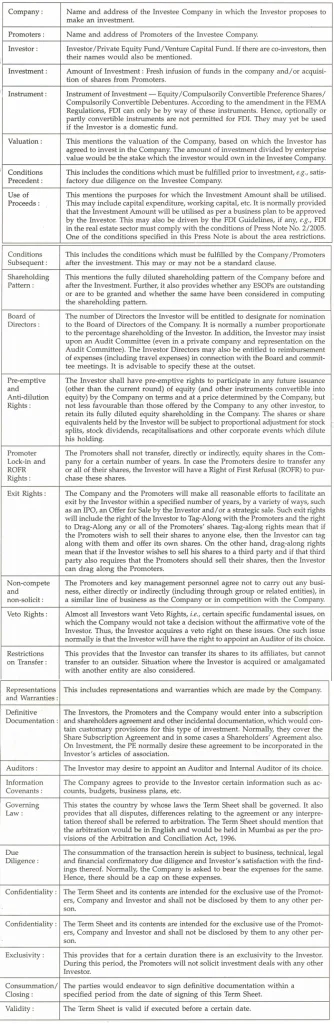
1. Introduction :
The last few months have witnessed a hectic activity on the
real estate front. Several important laws have been amended or enacted and
several crucial decisions have been rendered by the Supreme Court and the Bombay
High Court. Some of these amendments are good and some of these are not so good.
These amendments would have a major bearing on the way immovable property
transactions are carried out in the State of Maharashtra. This Article presents
an overview of these important enactments and cases.
2. MOFA : Deemed conveyance :
2.1 The Maharashtra Ownership Flat Act, 1963 (‘MOFA’) was
recently amended to provide that builders/developers must compulsorily make a
conveyance of the property to the co-operative housing society within a
stipulated period. If they fail to do so within the stipulated time, then the
designated competent authority, i.e., the District Deputy Registrar can
take action against the builder.
2.2 One of the important provisions of the amendment is that
the designated competent authority i.e., the District Deputy Registrar,
can take action against the builder for non-compliance. He can issue an
automatic conveyance (Unilateral Deemed Conveyance), whereby the rights will be
transferred to the society. As per the amendment, the punishment for a builder,
who fails to transfer the plot to the housing society, would be imprisonment for
a term from 6-12 months or a fine of Rs.10,000 to Rs.50,000 or both. He could
also be debarred from any construction project for five years.
2.3 However, certain grey areas remain in the amendment. The
law allows both the competent authority as well as the sub-registrar to issue
show-cause notices to the builder for not having executed conveyance. This
dichotomy of authorities may unnecessarily complicate matters and delay the
proceedings.
A sub-registrar can after giving the promoter a hearing come
to a conclusion contrary to the competent authority and thus refuse to register
the unilateral deemed conveyance. What happens next is unresolved.
2.4 The new law requires the competent authority to dispose
of all cases in six months, but strangely, it does not provide for the time
period within which the sub-registrar must issue the conveyance.
2.5 While it is a welcome step, as with all laws the proof of
the pudding lies in its successful implementation.
3. Registration process simplified :
3.1 A recent Circular of the Revenue and Forest Department
has simplified the process of registering conveyance of immoveable properties in
the State. Now, it is possible to register a property without waiting for a
no-objection certificate from the various authorities, e.g., Collector,
etc.
3.2 This Circular has its genesis in a Supreme Court decision
which has declared Section 22A of the Registration Act, 1908 as
unconstitutional. Section 22A casts an obligation to obtain ‘No Objection’
Certificates from various authorities such as the Collector, etc., to whom the
land belonged before registering a property. The Court also directed that no
registrar or sub-registrar of assurances could refuse registration under any
notifications issued under the provision.
3.3 Thus, now an NOC would not be required for transferring a
flat on collector’s land, e.g., in Nariman Point, Cuffe Parade. This
would speed up the registration process and would lead to greater voluntary
registration of property. This would automatically improve the title to the
property.
3.4 Another effect is that flat buyers requiring home loans
had to get their documents registered before availing the loan. Such buyers were
unable to obtain loans since registration was held up for want of NOCs. Now they
can avail of a loan as registration no longer requires an NOC.
In most cases the NOCs were time-consuming and sometimes led
to cancellation of the deal. This was especially true in the case of
transactions on Collector’s land, in areas like Nariman Point, etc. Other
permissions required were N.A. (Non-Agricultural) Permissions, BMC, etc.
3.5 Besides a speedier registration, one can also look
forward to less bureaucracy, fewer touts and reduced corruption in the
registration process. Such amendments are not only good for the real estate
sector, but good for administration. We often criticise the Government for old
outdated laws, this time kudos to the Government as it eliminates a
‘bottleneck’.
4. Buildings on forest land :
4.1 The Bombay High Court in a recent decision has held that
all development on more than 1,000 acres of land in the certain suburbs of
Mumbai is illegal, since the development was on forest land.
Over 125,000 flats spread over 120 acres are affected by the
Court’s decision. Both the existing developments and under-construction projects
would be affected by this Order. An SLP against the same is expected soon.
4.2 This case was moved by an NGO, Bombay Environmental
Action Group (BEAG), to protect the forest lands encroached upon by the
builders. Most of the disputed flats are in areas Kandivali, Borivali, Ghatkoper,
Bhandup, Mulund, Thane, etc. A Division Bench of Chief Justice Swatanter Kumar
and Justice S. C. Dharmadhikari dismissed about 19 petitions filed by the
builders.
4.3 The Government is now proposing to regularise all such
houses built on illegal lands by levying a one-time penalty. In the meanwhile,
the Registrar has a blacklist of survey numbers which fall within the illegally
developed areas. Registration of any transaction under these survey numbers is
being rejected. The sub-regsitrar’s offices have displayed all these blacklisted
survey numbers. Thus, a lot of flat owners and buyers are being inconvenienced
by this order. As a result, natural corollary property rates in the blacklisted
areas have crashed. The Forest Department is deciding upon its next course of
action, i.e., whether or not it should demolish these illegal
constructions.
4.4 The proposed action of the Government will bring relief to the affected persons.
5. Use of extra FSI by builders:
5.1 A recent Bombay High Court Order has held that builders will no longer need the consent of existing flat owners if they have extra FSI on a plot and are planning to have additional buildings or structures if the new construction has all the necessary approvals from the municipal authorities. The consent of the flat owners would be needed only if the new construction results in alterations to the existing building or the construction as described in the flat purchase agreement executed between the flat buyer and builder.
5.2 This order was passed by Justice A. M.’ Khanwilkar of the Bombay High Court in the case of Mehani Builders v. Jamuna Darshan Co-operative Housing Society Ltd. The society was objecting to the additional construction carried out by the builder by using extra FSI. The Court delivered its judgment under the Maharashtra Ownership of Flat Act (MOFA) 1963.
5.3 As per the judgment, the agreement should-very clearly mention the potential FSI utilisation. Further, developers must now construct their buildings in accordance to the plans and specifications and in accordance with the agreement entered into-by both parties and they should spell out how they propose to use any extra FSI.
5.4 Now construction of additional buildings is permissible so long as it is under the scheme or projects of development in the layout and subject to the relevant building rules or byelaws or development control rules. This is an order which would promote greater transparency in property transactions.
5.5 The Government should also incorporate this order also whilst regularsing development on forest land.
Having considered what acts constitute infringement of a
registered trademark and copyright as also passing off, the next essential
question which arises is which Court would have the jurisdiction to try,
determine and dispose of a suit relating to the said issue. It may be
appreciated that apart from general rules of procedure which lay down the law
for the purposes of determining the jurisdiction of a Court, special provisions
are to be found in the Trade Marks Act, 1999 and the Copyright Act, 1957
(hereinafter referred to as the ‘Trade Marks Act’ and the ‘Copyright Act’,
respectively) which confer jurisdiction on additional fora. This month’s article
seeks to give an overview of the provisions which determine the jurisdiction of
a Court, in matters relating to violation of rights in trademarks and copyright,
with special reference to determining jurisdiction in respect of matters
relating to websites.
Code of Civil Procedure, 1908 :
The general rules for determining the jurisdiction of a Court
are to be found in S. 15 to S. 20 of the Code of Civil Procedure, 1908
(hereinafter referred to as ‘the CPC’). These provisions, inter alia, lay
down that in the first instance, a suit must be filed in the Court of the lowest
grade competent to try it. In suits for land, the same are to be filed where the
immovable property in dispute is situated. In other cases, the suit is to be
filed either where the defendant carries on business and/or actually and
voluntarily resides and/or works for gain or where the cause of action has
arisen. Hence, under the CPC, if an owner of copyright and/or registered
proprietor of a trademark wished to institute proceedings against an infringer,
he would be obliged to follow the infringer to wherever he resides and/or to the
place where the infringing goods are being sold. This would mean that, if
someone were selling goods bearing infringing trademark in a remote part of
Assam and only had an existence in that limited area, the proprietor of the
trade-mark, who may be situated in Kerala, would have to follow the said
infringer all the way to Assam and sue him there.
Special provisions :
In order to overcome this handicap/difficulty, certain
additional provisions for determining the jurisdiction of a Court are to be
found in the Trade Marks Act and the Copyright Act. S. 62 of the Copyright Act
and S. 134 of the Trade Marks Act, inter alia, allow a plaintiff i.e.,
the owner of the copyright and the registered proprietor of a trademark,
respectively, to initiate and file an action for infringement in the District
Court having jurisdiction to try the suit which shall include a District Court
within whose jurisdiction the person instituting the suit or proceeding actually
and voluntarily resides or carries on business or personally works for gain.
It may be noted that even though the provisions of S. 62 of
the Copyright Act have existed since 1957, no such provision was to be found in
the earlier Trade and Merchandise Marks Act, 1958. The Trade Marks Act
introduced such a provision for the first time in 1999. It may also be
appreciated that S. 134 of the Trade Marks Act allows a plaintiff to file a suit
where he actually and voluntarily resides or carries on business or works for
gain only in respect of the cause of action for infringement of registered
trademark and not for passing off. Hence, there could be situations where a
Court may have jurisdiction for the purposes of the cause of action of
infringement, but not for passing off. To illustrate, let us take a situation
where Hindustan Unilever Limited being the registered proprietor of the
trademark ‘DOVE’ having its registered office in Mumbai wants to sue a person
manufacturing and selling soaps, under an identical trademark, only in Ludhiana.
In such a case, since the defendant is neither itself present within the
jurisdiction of the Mumbai Courts, nor are its products available within Mumbai,
the plaintiff would be unable to file a suit for passing off in Mumbai. However,
in light of S. 134 of the Trade Marks Act, Hindustan Unilever Limited would be
entitled to file an action for infringement of its trademark in Mumbai. In such
cases at a practical level, the normal practice followed by lawyers in Mumbai,
would be to file a combined suit for both causes of action in Mumbai and then
seek leave under Clause XIV of the Letters Patent for joinder of causes of
action, thereby giving the Court at Mumbai jurisdiction to try, determine and
dispose of the suit in respect of both the causes of action. Clause XIV of the
Letters Patent is a provision whereby the Bombay High Court is empowered to
combine causes of action so as to, inter alia, avoid multiplicity of
proceedings.
Hence, in a matter relating to infringement of rights in a
trademark or copyright the above principles would apply for the purposes of
determining jurisdiction.
Websites :
The application of the above principles is relatively simple
in the real world, but causes quite a few problems when applied to the virtual
world or in cyberspace. In cases where the defendant is not resident within the
jurisdiction of the Court, but jurisdiction is sought to be fixed on the basis
that the cause of action has arisen within the jurisdiction of that Court,
several difficulties arise. It may be noted that in cases where the infringing
mark or work is found only on a website, the question which arises is under
which circumstances can it be said that a cause of action be said to have arisen
within the jurisdiction of that Court and under what circumstances can a Court
exercise jurisdiction over a website. This question has vexed lawyers and
jurists over the years as to in what circumstances can a Court exercise
jurisdiction over websites published on the worldwide web. Would the mere
accessibility of a website from within the territory of the Court confer
jurisdiction on that Court or is something further required to determine and
establish a cause of action. A website, under normal circumstances, would be
accessible to everyone in all countries. Hence, in such a case can it be said
that a cause of action arises in every jurisdiction, thereby allowing the
plaintiff to sue anywhere where the website is accessible.
This question of seminal importance has recently been
answered by a Division Bench of the Delhi High Court in Banyan Tree Holding
Private Limited v. A. Murali Krishna Reddy1 wherein the matter
had been referred by a Learned Single Judge to the Division Bench to determine
the law applicable for determining jurisdiction over a website.
The facts of the said case were that neither the plaintiff nor the defendant had their offices within the jurisdiction of the Delhi High Court, but the suit for passing off was brought on the basis that the defendant’s website which used the impugned mark ‘Banyan Tree Retreat’ was accessible in Delhi through the website of the defendant which was not a passive website and was an interactive web-page. The concept of a passive website as against an interactive website has been evolved by Courts for the purpose of determining jurisdiction as will be evident from the following.
The Division Bench, in light of the above facts, formulated and answered the following question— What principles would apply to determine jurisdiction in passing off or infringement actions where the plaintiff was not carrying on business within the jurisdiction of the Court, but the defendant was hosting a website within the jurisdiction of that Court?
In order to answer this question, the Division Bench made a detailed analysis of the law as it stood in the U.S.A., U.K., Canada, Australia and India. The Division Bench examined how several theories have been propounded over the years for the purposes of determining jurisdiction in cyberspace.
A vast plethora of judgments of US Courts was considered on the subject and it was found that initially, the Courts in the USA used to apply the ‘Purposeful Availment’ theory which was later modified to the ‘Zippo Sliding Scale Test‘ which was thereafter modified to the ‘Effects Test.’
The Purposeful Availment theory was initially pro-pounded by the U.S. Supreme Court in International Shoe Co. v. Washington2, wherein it was held that in order to establish jurisdiction over a particular defendant the plaintiff had to show that the Defendant had minimum contacts in the forum State, i.e., the State in which the plaintiff desired to institute his action, and that the defendant must have purposefully availed of the privilege of conducting activities in the forum state. Under this theory, it was found that the Courts were tending to exercise jurisdiction over websites merely on the basis that they were accessible within the jurisdiction of the forum court. However, it was later clarified that the effect of creating a site may be felt nationwide or even worldwide but without more, it would not be an act purposefully directed towards the forum State3. This led to the concept of whether a website could be categorised to be a passive website or an interactive website and that the purposeful avail-ment theory would be satisfied only if the website were interactive to a degree that reveals specifically intended interaction with the residents of the forum state4.
Hence, questions then arose as to whether websites were passive or interactive and if interactive, what was the level of interactivity needed to establish jurisdiction. This led to the Zippo Sliding Scale test wherein the Court set out a three-pronged test being that the defendant must have minimum contacts with the forum state, the claim asserted must arise out of those contacts and that the exercise of jurisdiction must be reasonable5. The Courts, however, then felt that since almost all websites are interactive to a certain extent, a shift was necessary so as to examine in each case, the nature of the activity performed using the interactive website.
In light of the above, the effects test was pro-pounded in Calder v. Jones6 wherein it was held that for the purposes of determining jurisdiction, it was essential to identify where the effect of the website would be felt i.e., at whom and/or where was it targeted.
The effects test however, did not find favour in its application to trademark infringement cases since it was felt that the effects test as would be applicable to an individual would not be applicable to a corporation/company, since a company would not suffer harm in a particular geographic location in the same sense that an individual would7.
The Division Bench then summarised the law in the U.S.A. as being that a plaintiff would have to show that the defendant purposefully availed of the jurisdiction of the forum state by specifically targeting the customers within the forum state.
The Division Bench also considered the law in the U.K., Canada and Australia before dealing with the limited Indian law on the subject. A perusal of these foreign judgments explains the fact that mere access to a website would not confer jurisdiction on a Court and that something more would be needed.
It was in light of the above, that the judgment of a Single Judge of the Delhi High Court in Independent news Service Pvt. Ltd. v. India Broadcast Live LLC8 was referred to. The finding in that case was that in order to exercise jurisdiction over a website it was essential to show that the website was interactive and that the level of interactivity involved would also be relevant.
The Division Bench has, however, gone a step further after considering all the law on the subject and has, inter alia, laid down that:
“This Court holds that jurisdiction of the forum court does not get attracted merely on the basis of interactivity of the website which is accessible in the forum state. The degree of the interactivity apart, the nature of the activity permissible and whether it results in a commercial transaction has to be examined. For the ‘effects’ test to apply, the plaintiff must necessarily plead and show prima facie that the specific targeting of the forum state by the Defendant resulted in an injury or harm to the Plaintiff within the forum state. For the purposes of a passing off or an infringement action (where the plaintiff is not located within the jurisdiction of the court), the injurious effect on the plaintiffs business, goodwill or reputation within the forum State as a result of the defendant’s website being accessed in the forum State would have to be shown. Naturally therefore, this would require the presence of the Plaintiff in the forum state and not merely the possibility of such presence in the future. Secondly, to show that an injurious effect has been felt by the Plaintiff it would have to be shown that viewers in the forum state were specifically targeted. Therefore the ‘effects’ test would have to be applied in conjunction with the ‘sliding scale’ test to determine if the forum court has jurisdiction to try a suit concerning internet based disputes.”
Thus, it would be evident that in order to establish that a cause of action has arisen within the jurisdiction of a particular forum, it would be necessary for the Plaintiff to prima facie establish that the defendant’s website which contains the infringing material is specifically targeting customers within the forum state and that the same has caused injury or harm to the Plaintiff within the jurisdiction of that forum not merely whether a website is active or passive.
In my opinion, the above judgment, though lays down certain guiding principles as to how a court can exercise jurisdiction over infringing acts in cyberspace, it still leaves many questions unanswered such as what is the level of injury or harm necessary to establish jurisdiction or how is one to determine and identify cases of specific targeting, what would happen in cases where the targeting is of specific individuals who are normally resident in another forum but have accessed the website within a different forum, etc. These issues still remain unanswered and one can only hope that they will be answered in due course of time. The only solace is that a lamp has been handed down by the Division Bench, which will, hopefully, light the path as we walk along and lay down and make more specific the law on the subject.
Businessmen today may however choose to disagree with this oft-quoted Shakespearian view, for in the current era, a name as in trade marks or brand names is an extremely valuable asset. Companies, in fact, incur huge expenditure to promote, establish and protect their trade marks and also, in turn, reap benefits of the repute of their trade mark. To quote Mr. Pierre Cardin, “My name is more important than myself.”
A trade mark is normally exploited in two ways, firstly by the proprietor using the trade mark himself in respect of his goods or services and secondly, by the proprietor licensing the trade mark to others. For the purposes of this article, I shall be dealing primarily with the latter.
Licensing of Trade marks
A trade mark licence has been defined as ‘a contractual arrangement whereby a trade mark owner permits another to use his trade mark, where but for the licence the other would be a trade mark infringer.’1 Therefore, licensing of a trade mark is a process whereby a trade mark owner allows, permits and/or authorises another entity the right to use the trade mark, subject to the terms and conditions specified in the licence.
A trade mark licence could be exclusive or non-exclusive in nature. An exclusive licence is one where the licensee is allowed to use the trade mark to the exclusion of everyone else, whereas in case of a non-exclusive licensee there could be more than one licensee.
The Trade Marks Act, 1999 (‘the Act’) does not contain a definition of a trade mark licence, however, it defines the term “permitted use”. Section 2(r) de-fines permitted use in relation to a registered trade mark to mean, inter alia, use by a registered user or use by a person other than the registered proprietor or registered user in relation to the goods and services, subject to other conditions mentioned therein.
The Act defines a registered user to mean someone who is registered as such u/s.49 of the Act. A registered user, put simply, is also a licensee of a registered trade mark, but one who has been so registered under the Act. Such registration can give additional benefits to a registered user such as a right to institute infringement proceedings in his own name.
It may be relevant to note that the definition of permitted use under the Act is broader than the definition of permitted use under the Trade and Merchandise Marks Act, 1958, whereunder only a registered user was recognised as being a permitted user. The new Act, however, clearly recognises use by a registered user or use by any person other than the registered user and the registered proprietor. Hence, statutorily a new category of permitted user has now been recognised. Licensing of unregistered trade marks is commonly known as common law licensing and is governed by the general principles of trade mark law and contract.
Thus, in a nutshell a trade mark licence is an agreement whereby a trade mark owner (licensor) agrees and allows a licensee to use the trade mark for either manufacturing, distributing, selling, etc. products under the licensed trade mark. If not for the licence, use by any other person of a trade mark would be in violation of the trade mark owner’s rights in and to the trade mark.
There are several important conditions that are to be considered whilst drafting a trade mark licence such as the specific goods in respect of which the trade mark is to be licensed, the territory of use, etc. One of the essential factors to be considered while licensing a trade mark is to ensure the maintenance of quality control and/or supervision by a licensor over his licensee in respect of the goods and/or services to be manufactured, sold and/or marketed under the licensed trade mark, for in the absence of such a provision and effective exercise thereof, certain adverse consequences, as are explained hereinafter, as to the licensed trade mark could follow.
Concept/Function of a Trade mark
In order to appreciate the relevance and necessity of maintaining quality control and supervision by a licensor over a licensee, it would be helpful to understand the concept of a trade mark.
Trade marks have evolved from being a strict badge of physical origin2 to being quality and source indicators,3 from being non licensable to being extensively licensed, etc.4
The original purpose of trade marks was to indicate ownership. However, with the development of commercial trade, trade marks have come to serve a different function — identification of the source of goods offered for sale in the market place.5 The recognition of a trade mark as a special form of property right, based on the goodwill embodied in the mark, was integrally linked with the notion that the mark served to indicate the source of the goods.6
The Act defines a trade mark, inter alia, as being” a mark capable of being represented graphically and which is capable of distinguishing the goods or services of one person from those of others …. a mark used or proposed to be used in relation to goods or services for the purpose of indicating or so as to indicate a connection in the course of trade between the goods or services, as the case may be, and some person having the right, either as proprietor or by way of permitted use.’7
Thus, it may be appreciated that the primary function of a trade mark is, inter alia, to indicate a connection in the course of trade between the proprietor of the trade mark and his goods or services. Hence, a causal connection must be maintained between the goods or services and the proprietor of the trade mark. The reasoning and/ or rationale for maintaining this causal connection could be attributed to the fact that a trade mark indicates to a consumer the source from which the goods or services emanate and consequently, a certain quality as associated with that source and it is on this basis that the consumer buys certain trade-marked goods as opposed to others.
It may be appreciated that at early common law, trade mark proprietors generally were not permitted to licence their marks to others because trade marks were viewed solely as indicators of physical source of goods.8 However, trade mark licensing was subsequently sought to be permitted so long as the trade mark owner exercised control over the quality of the trade marked goods that were produced by the licensees.9 This is also reflected in a judgment of Lakshmanan J., wherein the Learned Judge has held that,
“These changes have been reflected in our statutory trade mark law in, for example, the broadening of the definition of a trade mark, in the recent provisions of assignment without goodwill and in the recognition in the registered user provisions that a trade mark can be licensed without causing deception or confusion, provided the owner of the trade mark retains control over the character and quality of the goods sold under the mark.”10
It may also be appreciated that the Hon’ble Supreme Court has held that licensing of a trade mark,
“is permissible, provided (i) the licensing does not result in causing confusion or deception among the public; (ii) it does not destroy the distinctiveness of the trade mark that is to say, the trade mark, before the public eye, continues to distinguish the goods connected with the proprietor of the mark from those connected with others; and (iii) a connection in the course of trade consistent with the definition of trade mark continues to exist between the goods and the proprietor of the mark.”11
Quality Control
Quality control and/or supervision of a licensee by a licensor is imperative so as to ensure that there is no confusion amongst the public as to the nature of the goods manufactured, sold and/or marketed under the trade mark. To illustrate, let us take a case where A has licensed his trade mark to Band C to manufacture and sell certain goods under his trade mark. Now, if A were not to maintain quality control and / or supervision over the goods manufactured by either B or C or both, a situation could arise where the goods manufactured by Bare of poorer quality than those manufactured by C or vice versa or that the goods are generally not of the quality which is associated with A. Thus, in such a situation, confusion and/or deception would arise in the market place which could be harmful to the consumers. It is in order to prevent such harm from arising to a consumer that the licensor is required to maintain quality control and/ or supervision over his licensee so as to ensure that a “connection in the course of trade” remains between himself and his goods or services. This protects consumers who rely on the quality statement made by a trade-marked product from being misled as to the quality of the product.
Further, it may be appreciated that in such a case the public would associate goods sold under the trade mark as emanating from A or in any event, as indicating that all the goods sold under the said trade mark since they emanate from a single source as being of identical quality, but since no effective control is being maintained by A i.e., the proprietor of the trade mark, this would result in the trade mark not being able to perform one of its essential r functions. Consequently, the rights in the trade mark would get diluted/ diminished as the trade mark would no longer indicate a connection in the course of trade or provide the assurance of consistent quality. Thus, it could be urged that the licensor has abandoned his trade mark and therefore, the trade mark is no longer distinctive of his goods and hence, may be rectified and/or removed from the Register of Trade Marks.
Quality control must not be understood to mean that the goods or services must be of a high quality but that they must be of a consistent quality, since that is the assurance which a consumer relies on whilst availing himself of a particular trade-marked product or service.
It may also be noted that US Courts have constantly found that licensing without quality control or naked licensing is “a fraud on the public and unlawful”12 and “is inherently deceptive and constitutes an abandonment of all rights in the trade mark and results in cancellation of its registration.”13 Even in U.K., Courts have held that the grant of a bare licence (i.e., a licence without quality control) could result in the proprietor losing his rights in and to the trade mark.
The Act also empowers the Registrar of Trade Marks in this regard to vary or cancel the registration of a registered user on the ground that any stipulation in the agreement between the registered proprietor and the registered user regarding the quality of the goods or services in relation to which the trade mark is to be used is either not being enforced or complied with.14 This power may be exercised even suo mota by the Registrar.
Hence, it is urged that uncontrolled licensing or licensing without quality control also known as naked licensing (USA) or bare licensing (U.K.) can have negative effects on the licensor’s rights in and to the trade mark.
The Scandecor Judgment
It may be appreciated that Courts normally apply a per se rule to cases where absence of quality control is pleaded, that is, once a case is made out of absence of quality control, it is assumed that the trade mark has been abandoned and/or that the trade mark owner ceases to control the trade mark and hence, the same must be rectified and/or removed form the Register of Trade Marks. Thus, whilst applying a per se rule no further factual inquiry is necessary to establish whether the trade mark has actually been abandoned or whether it has lost its distinctiveness after the absence of quality control has been established.
A different view, however, has been taken by the House of Lords in the U.K. in the case of Scandecor Development AB v. Scandecor Marketing AB et al.15 The House of Lords, in the instant case, was dealing solely with use by an exclusive licensee and held in this regard that it was no longer appropriate to apply the per se rule, but that it would be more beneficial to adopt case by case analysis in such matters. Their Lordships held that customers do not rely on a legal guarantee of quality assurance, but rather on the trade mark owner’s economic interest in protecting his trade mark and hence, in the event of absence of quality control by the proprietor of the trade mark, a further enquiry should be made to determine whether or not the trade mark has actually been abandoned and / or lost its distinctiveness. It may be noted that the House of Lords does not hold that quality control is not necessary, but only holds that mere lack of it should not result in a presumptive finding of abandonment and that a further inquiry would be necessary in such case. Also it may be noted that the said judgment only dealt with the case of an exclusive licensee.
In light of the above, it must be appreciated that if effective quality control is not maintained by the licensor, adverse consequences as regards the distinctiveness of the trade mark would follow. Uncontrolled or naked licensing may result in the trade mark ceasing to function as a symbol of quality and may be deemed to be abandoned16 thus, possibly depriving a proprietor of his rights in and to the trade mark.
Developing a trade mark is an expensive and time-consuming process and a proprietor must be extremely weary of losing out on his reputation and goodwill on account of not maintaining the necessary control over a licensee as required by law.
Therefore, it is extremely important to maintain and exercise proper quality control and supervision over a licensee so as to ensure that the proprietor’s rights in and to his trade mark are not diluted nor deemed to be abandoned.
An interesting debate arises in light of the recent
controversy between the Tata Group and Greenpeace, India (‘Greenpeace’). The
facts leading to the controversy and a recent judgment of the Delhi High Court
were that Greenpeace, a non-profit organisation that seeks to promote
environmental causes, had started a campaign protesting the building of a port
in the Bhadruk District in Orissa. It was Greenpeace’s view, that the building
of the port would dishouse the Olive Ridley turtles found in the area as also
disturb the marine life in the vicinity. The Tata Group resisted the said
campaigning and asserted that they had already secured all necessary approvals
and permissions. Hence, in order to raise awareness about the plight of the
turtles, Greenpeace India, inter alia, hosted a game on their website known as
‘Turtle v. Tata1.’ The game is a pac man style game wherein
the role of the pac man is portrayed by a turtle and the demons are the symbol
of Tata chasing the turtle. It was in this context that Tata filed a claim in
the Delhi High Court on two grounds, firstly that the acts of Greenpeace were
defamatory in nature; and secondly, that by using the name Tata and the symbol
of Tata, Greenpeace had infringed the registered trade marks of Tata.
For the purposes of the present article, we are concerned
only with the second aspect of the claim, i.e., trade mark infringement and
whether such ‘parodic’ use of a trade mark would amount to infringement thereof.
The issue is a delicate one since it involves the balancing of two competing
private rights as also two competing public interests. The private rights are
obvious, one being the right to free speech and the other being the right in
property of the trade mark owner. The public interests, though may not be
evident immediately, do exist. The right to free speech is a fundamental right
guaranteed to every citizen under Article 19 of the Constitution of India, and
it is imperative in public interest that this fundamental right is not
restricted except to the limited extent as envisaged under the said Article
itself. On the other hand trade mark law apart from protecting the rights of an
individual in his property, does a more important function that of preventing
public confusion. Trade mark law seeks to protect the general public from the
confusion that may arise in case identical and/or deceptively similar marks are
used by different traders upon their goods in the market. Such confusion, if not
protected against, could lead to disastrous consequences — for example, where a
medicine for lowering blood pressure and a medicine for increasing blood
pressure are sold under identical and/or deceptively similar trade marks. Public
confusion in such a case could even be fatal.
It is in light of the above, that I propose to examine the
law relating to use of trade marks in parodies and to what extent can a
citizen’s right to free speech be extended, can it be allowed even if it
violates someone else’s property rights or must it be curtailed as being a
reasonable restriction and/or to put it differently does a trade mark
registration prevent all further usage of the trade mark by any other person.
In order to examine this issue, reference may be made to
Article 19 of the Constitution of India and section 29 of the Trade marks Act,
1999, each of which, inter alia, provide as under:
Constitution :
“19. Protection of certain rights regarding freedom of
speech, etc.
(1) All citizens shall have the right
(a) to freedom of speech and expression;
(b) – (g) xxxxxx
(2) Nothing in sub-clause (a) of clause (1) shall affect
the operation of any existing law, or prevent the State from making any law,
in-so-far as such law imposes reasonable restrictions on the exercise of the
right conferred by the said sub-clause in the interests of the sovereignty
and integrity of India, the security of the State, friendly relations with
foreign States, public order, decency or morality or in relation to contempt
of court, defamation or incitement to an offence.”
Trade marks Act, 1999:
“29. Infringement of registered trade marks. —
(1) A registered trade mark is infringed by a person who,
not being a registered proprietor or a person using by way of permitted use,
uses in the course of trade, a mark which is identical with, or deceptively
similar to, the trade mark in relation to goods or services in respect of
which the trade mark is registered, and in such manner as to render the use
of the mark likely to be taken as being used as a trade mark.
(4) A registered trade mark is infringed by
a person who, not being a registered proprietor or a person using by way of
permitted use, uses in the course of trade, a mark which —
(a) is identical with or similar to the registered
trade mark; and
(b) is used in relation to goods or services which are
not similar to those for which the trade mark is registered; and
(c) the registered trade mark has a reputation in India
and the use of the mark without due cause, takes unfair advantage of or is
detrimental to, the distinctive character or repute of the registered
trade mark.”
A bare reading of section 29 would show that use of a
registered trade mark as a trade mark by any person other than the registered
proprietor of a trade mark without the consent of the owner would amount to an
infringement thereof. Hence, in the instant case, it was argued by the Tata
Group that use of their registered trade mark and symbol by Greenpeace was in
violation of their rights and amounted to infringement of registered trade
marks. Greenpeace took the defence that the use of the trade marks was merely in
a parodic sense and not for any other purpose. Greenpeace urged that the use of
a trade mark in a parody would fall within section 29(4) of the Trade marks Act,
1999 and hence, would not amount to an infringement. Greenpeace contended that
their use was not ‘without due cause’ and hence, they had not infringed the
registered trade marks.
At this juncture, before alluding to the ratio decidendi of
the Delhi High Court in the above matter, I would like to, as a background,
explain what is a parody and draw attention to a few judgments of the American
Courts, wherein the issue of use of a trade mark in a parodic sense has been
considered and dealt with.
It may be appreciated that in the USA the right to freedom of speech guaranteed under the First Amendment to the American Constitution is absolute as compared to the conditional right to freedom of speech granted under the Indian Constitution2. Hence, the considerations weighing with the American Courts vis-à-vis the freedom of speech would not be entirely analogous.
A parody as defined by Wikipedia is “is a work created to mock, comment on, or make fun at an original work, its subject, author, style, or some other target, by means of humorous, satiric or ironic imitation.3”
The Second Circuit has in the case of Cliff Notes Inc. v. Bantam Doubleday Dell Publishing Group Inc.4 succinctly explained the purpose of a parody as being “A parody must convey two simultaneous and contradictory messages: that it is the original but also that it is not the original and is instead a parody.” The Second Circuit also pointed out that if a parody which only performed the first function, it would be subject to trade mark law since it could lead to consumer confusion. The Court held that the principal issue that ought to be decided in such a case was how to strike a balance between the two competing considerations of allowing artistic expression and preventing consumer confusion.
Music International5, the Ninth Circuit dealt with a claim by Mattel for the use of its trade mark ‘Barbie’ by the music group Aqua in their song entitled ‘Barbie Girl.’ The lyrics of the song made references to the trade mark ‘Barbie’ and it was this use of the trade mark ‘Barbie’ which was considered, inter alia, an infringement by Mattel. The Ninth Circuit, after considering the manner of use and the nature of the use of the trade mark in the song, held that there was no infringement. The Ninth Circuit made several interesting observations with respect to the conflict between the rights granted under the First Amendment (right to free speech) and to the rights of a trade mark owner. The Ninth Circuit observed, inter alia, as under:
“The First Amendment may offer little protection for a competitor who labels its commercial goods with a confusingly similar mark, but trade mark rights do not entitle the owner to quash an unauthorised use of the mark by another who is communicating ideas or expressing points of view. Were we to ignore the expressive value that some marks assume, trade mark rights would grow to encroach upon the zone protected by the First Amendment. When unauthorised use of another’s mark is part of a communicative message and not a source identifier, the First Amendment is implicated in opposition to the trade mark right. Simply put, the trade mark owner does not have the right to control public discourse whenever the public imbues his mark with a meaning beyond its source identifying function. It is the source identifying function which trade mark law protects, and nothing more.”
The Ninth Circuit, in order to adjudicate the dis-pute, applied the test as to whether the use of the trade mark was misleading to the source or content of the work or did it have artistic relevance to the underlying work. The Court held that the use of ‘Barbie’ by the defendants was not misleading as to the source and hence, no case for infringement was made out.
One more interesting judgment of the American Courts in this regard is the case of Mutual of Omaha Insurance Co. v. Novak6 wherein the alleged infringing acts were the use by Novak of the trade marks of Mutual of Omaha Insurance Co. on T-shirts. The registered trade mark of the Mutual of Omaha Co. was ‘Mutual of Omaha’, used in respect of its insurance services. Novak started using a similar design with the trade mark ‘Mutant of Omaha’ and a sign below that which read as ‘Nuclear Holocaust Insurance.’ In this case, the defence of parodic use was negated by the majority on the grounds that the protection af-forded by the First Amendment does not give a licence to infringe someone else’s property rights; and that since there were several other avenues of communication available to Novak, such as an editorial parody in a book, magazine or film, such use in violation of the rights of Mutual of Omaha Insurance Co. must be injuncted. Justice Heaney, however, dissented and considered that the majority judgment had failed to recognise and protect the rights of Novak under the First Amendment.
In India, on the other hand, there have not been too many judicial pronouncements on parody as a defence in a trade mark infringement action. One of the few earlier judgments is in the case of Pepsico Inc v. Hindustan Coca Cola Ltd.7, wherein the Delhi High Court recognised in passing that a parody would not be an infringement and held that, “Similarly, use of the phrase in the commer-cial advertisement “Yeh Dil Mange No More” can at best be mocking or parodying in the context it is used, but does not amount to infringement of trade mark of the appellant.”
However, now Justice Ravindra Bhat has in his judgment in Tata Sons Ltd. v. Greenpeace 8 dealt with and discussed the subject of parodies in some detail. Justice Bhat based his judgment primarily on the judgment of the South African Constitutional Court in case of Laugh It off Promotions CC v. Freedom of Expression Institute9, which was a case where the Defendant had sought to market T-shirts bearing parodied images of trade marks of several corporate giants. This was objected to by South African Breweries, one of the corporate giants whose trade marks had been parodied upon on the defendant’s T-shirts. It was in these facts that the Court was pleased to hold as under:
“76. Parody is inherently paradoxical. Good parody is both original and parasitic, simultaneously creative and derivative. The relationship between the trade mark and the parody is that if the parody does not take enough from the original trade mark, the audience will not be able to recognise the trade mark and therefore, not be able to understand the humour. Conversely, if the parody takes too much it could be considered infringing based upon the fact that there is too much theft and too little originality, regardless of how funny the parody is.
Parody is appropriation and imitation, but of a kind involving a deliberate dislocation. Above all, parody presumes the authority and currency of the object work or form. It keeps the image of the original in the eye of the beholder and relies on the ability of the audience to recognise, with whatever degree of precision, the parodied work or text, and to interpret or ‘decode’ the allusion; in this sense the audience shares in a variety of ways the creation of the parody with the parodist. Unlike the plagiarist whose intention is to deceive, the parodist relies on the audience’s awareness of the target work or genre; in turn, the complicity of the audience is a sine qua non of its enjoyment.
The question to be asked is whether, looking at the facts as a whole, and analysing them in their specific context, an independent observer who is sensitive to both the free speech values of the Constitution and the property protection objectives of trade mark law, would say that the harm done by the parody to the property interests of the trade mark owner outweighs the free speech interests involved. The balancing of interests must be based on the evidence on record, supplemented by such knowledge of how the world works as every judge may be presumed to have. Furthermore, although the parody will be evaluated in the austere atmosphere of the Court, the text concerned (whether visual or verbal or both) should be analysed in terms of its significance and impact it had (or was likely to have), in the actual setting in which it was communicated.
It seems to me that what is in issue is not the limitation of a right, but the balancing of competing rights. The present case does not require us to make any determinations on that matter. But it would appear once all the relevant facts are established, it should not make any difference in principle whether the case is seen as a property rights limitation on free speech, or a free speech limitation on property rights. At the end of the day this will be an area where nuanced and proportionate balancing in a context specific and fact-sensitive character will be decisive, and not formal classification based on bright lines.
In sum, while a defendant’s use of a parody as a mark does not support a ‘fair se’ defence, it may be considered in determining whether the Plaintiff-owner of a famous mark has proved its claim that the defendant’s use of a parody mark is likely to impair the distinctiveness of the famous mark.”
It was based on the above reasoning and in light of the facts that Justice Bhat was pleased to hold that Greenpeace’s actions did not amount to an infringement and held, inter alia, as under:
“42. The above analysis would show that the use of a trade mark, as the object of a critical comment, or even attack, does not necessarily result in infringement. Sometimes the same mark may be used, as in Esso; sometimes it may be a parody (like in Laugh it Off and Louis Vuitton). If the user’s intention is to focus on some activity of the trade mark owners, and is ‘denominative’, drawing attention of the reader or viewer to the activity, such use can prima facie constitute ‘due cause’ u/s.29(4), which would disentitle the Plaintiff to a temporary injunction, as in this case. The use of TATA, and the `T’ device or logo, is clearly denominative. Similarly, describing the Tatas as having demonic attributes is hyperbolic and parodic. Through the medium of the game, the defendants seek to convey their concern and criticism of the project and its perceived impact on the turtles habitat. The Court cannot annoint itself as a literary critic, to judge the efficacy of use of such medium, nor can it don the robes of a censor. It merely patrols the boundaries of free speech, and in exceptional cases, issues injunctions by applying Bonnard principle.”
I firmly believe that Justice Bhat’s judgment is a step forward in the right direction. However, each case would have to be judged on its own merits. A perusal of the above judgments reveals as to how Courts have so far sought to balance the two competing interests in cases of parodies involving registered trade marks. In my opinion, this is a very sensitive matter and the line of distinction very fine between the two competing public interests. Courts will need to exercise their judicial discretion in every case to determine whether the use of a trade mark in a parody is promoting public interest in terms of establishing free speech or would it be reasonable to restrict the same since it is in fact harming public interest by causing public confusion as also violating the rights of an individual trade mark owner.
One cannot overemphasise the importance and relevance of the present issue, since it involves a balancing act between two competing public interests and not just private interests. Admittedly, the case when filed by a trade mark owner would be to protect his own private interest in property but the underlying fact is that Courts will be called upon to consider and/or must consider the public interests involved. The freedom of speech as against the disastrous consequences which could arise out of public confusion need to be assessed and balanced in each case. Hence, it is essential that an effective rule and/or law is developed to guide the Courts in such matters. An official recognition to parodies would also be beneficial. The Copyright Act, 1957 does protect work published for the purpose of fair comment and criticism. I think it would be advisable to introduce a suitably moulded provision in the Trade marks Act, 1999 as well.
This month’s article seeks to explain a fundamental aspect of
the law on trademarks, the distinction between an action for infringement of a
registered trademark and an action for passing off. Whilst the former is a
statutory wrong the latter is a tort under common law. This distinction is
crucial for any trademark owner to strategise the maintenance of their trademark
portfolios.
A trademark is a mark which connects the goods and/or
services of a person with that person in the course of trade and thereby
distinguishes it from the goods and/or services of others. The Trade Marks Act,
1999 (‘the Act’) more specifically defines a trademark, inter alia, as a mark
capable of being represented graphically and which is capable of distinguishing
the goods or services of one person from those of others.1 Therefore,
a mark in order to be a trademark need not necessarily be registered. A
trademark may also either be used or proposed to be used. These factors as to
whether a trademark is used and/or registered are factors relevant for
determining whether an action for infringement of trademark and/or an action for
passing off may be instituted.
I shall initially explain what is meant by infringement of a
registered trademark and passing off, respectively, and then proceed to deal
with the broad distinctions.
Infringement of Registered Trademark :
Chapter IV of the Act deals with the effect of registration
of a trademark. The Act specifically provides that no proceedings for
infringement of an unregistered trademark may be instituted thereby clarifying
that an action for infringement can only be taken in respect of a registered
trademark. In fact, a right granted on registration is the right to take
recourse to infringement proceedings.2 The Act also clarifies that an
action for passing off will not be affected by the Act.3
S. 29 of the Act deals with and identifies the acts that
would constitute infringement of a registered trademark. The Section seeks to
protect a registered trademark and/or a mark deceptively similar thereto from
being exploited and/or used by an unauthorised person so as to defeat the rights
of the registered proprietor of the trademark of being entitled to exclusively
use the registered trademark. The scope and ambit of acts constituting
infringement has been substantially broadened under the present Act by bringing
in concepts like dilution of trademark, erosion of distinctive character of the
trademark, parallel importation and damage to reputation, etc.
The statutory law relating to infringement of trade-marks is
based on the same fundamental idea as the law relating to passing off. But it
differs from that law in two particulars, namely, (1) it is concerned only with
one method of passing off, namely, the use of a trademark and (2) the statutory
protection is absolute in the sense that once a mark is shown to offend, the
user of it cannot escape by showing that by using something outside the actual
mark itself he has distinguished the goods from those of the registered
proprietor.4
In an infringement action, the plaintiff is, ordinarily, only
required to prove that the defendant is using the registered trademark and/or a
mark deceptively similar thereto in respect of the same goods or services cause
that would be enough to show a violation of the rights conferred on the
registered proprietor. Infringement consists in using the mark per se as a
trademark and therefore, any other distinguishing factors that may be employed
by a defendant may not be relevant in an infringement proceeding.
Any person trespassing on the rights conferred by
registration of a trademark infringes the registered trademark. The rights
conferred by registration in a particular case must be determined in the context
of any restrictive conditions or limitations entered on the Register of Trade
Marks at the time of registration of the mark.
Infringement proceedings, thus, enable a registered
proprietor to prevent any unauthorised person from using his trademark and/or
mark deceptively similar thereto in respect of similar goods or services or as
contemplated u/s.29 of the Act.
Passing off :
On the other hand, the object of the law of passing off is to
protect some form of property — usually the goodwill of the plaintiff in his
business or his goods or his services or in the work which he produces. The
trademark represents the reputation and goodwill of a business and/or the goods
and/or the services. For example, the goods sold by ‘Nike’ are considered to be
of superior quality and have an immense reputation in the market. The goods sold
under the trademark ‘Nike’ carry immense value on the basis of the fact that
they bear the ‘Nike’ trademark. If the same goods were sold without the said
trademark thereon, they would not be as valuable.
Passing off is a form of tort of deceit and/or
misrepresentation. To put it in a nutshell, passing off is a tort whereby one
person tries to pass off his goods and/or services as and for the goods and/or
services of another. Passing off in effect is also a form of unfair competition.
It is a common law remedy and has been built entirely on the basis of case law.
In Halsbury’s Laws of England, 4th Edn., Volume 48, para 144
at page 98, the essentials of the cause of action for passing off, as restated
by the House of Lords in Erven Warnink B. V. v. J. Townend & Sons, 1980 R.P.C.
31, are set out as follows :
“(1) a misrepresentation
(2) made by a trader in the course of trade
(3) to prospective customers of his or ultimate consumers
of goods or services supplied by him(4) which is calculated to injure the business or goodwill
of another trader, in the sense that this is a reasonably foreseeable
consequence, and(5) which causes actual damage to a business or goodwill of
the trader by whom the action is brought or, in a quia timet action, will
probably do so.”
The aforequoted dictum of Lord Diplock is the locus
classicus on the subject and succinctly explains what is meant by the tort
of passing off.
Therefore, it may be noted that in order to enable the owner
of a trademark to sue for passing off, he would be required to show in the first
instance that the trademark is associated by members of the trade and public
solely and exclusively with the services rendered and/or goods sold by him and
that some other person by using an identical and/or deceptively similar mark in
respect of similar services and/or goods is trying to pass off his goods and/or
services as and for the goods and/or services of the owner. Confusion and
deception in the course of trade would be essential to an action in passing off.
It is common understanding that an action for passing off cannot be instituted in respect of an unused trademark, however the same is incorrect. For in a given situation passing off may even be instituted in respect of a trademark which has not been used in the market, but which has acquired reputation and goodwill on the basis of other factors such as publicity, advertisements, etc. and has therefore, come to be associated solely with the owner of the trademark.5
Distinction :
The distinction between an infringement action and a passing off action is important. As explained above, both operate in different spheres. Hence, to illustrate there could even be a situation where a registered proprietor (Plaintiff) files a suit for infringement and the defendant files a suit for passing off against the same plaintiff. This would happen in a case the defendant has a prior user of the trademark but a subsequent registration.
The issues involved in an action for infringement and an action for passing off are different and distinct. In an action for infringement the basic issue would generally be whether the registered trademark and the infringing mark are identical and/or deceptively similar and whether or not they are being used in respect of similar goods and/or services. However, in an action for passing off, in the first instance the plaintiff would have to show that the said trademark is associated solely and exclusively with his services and/or goods and that use by the defendant of such mark would cause confusion and/or deception in the course of trade and thereby people would end up buying and/or procuring the goods and/or services of the defendant thinking they were of the plaintiff. Such acts would cause wrongful loss and harm to the plaintiff.
The Supreme Court has succinctly highlighted major differences between the two remedies and the approaches involved in an action for infringement and an action for passing of in the landmark judgment of Ruston Hornsby v. Zamindara Engineering, AIR 1970 SC 1649, wherein it has laid down, inter alia, as under :
“It very often happens that although the defendant is not using the trademark of the plaintiff, the get-up of the defendant’s goods may be so much like the plaintiff’s that a clear case of passing off would be proved. It is on the contrary conceivable that although the defendant may be using the plaintiff’s mark, the get-up of the defendant’s goods may be so different from the get-up of the plaintiffs goods and the prices also may be so different that there would be no probability of deception of the public. Nevertheless, in an action on the trademark, that is to say, in an infringement action, an injunction would issue as soon as it is proved that the defendant is improperly using the plaintiff’s mark.
The action for infringement is a statutory right. . . . .
On the other hand the gist of a passing off action is that A is not entitled to represent his goods as the goods of B, but it is not necessary for B to prove that A did this knowingly or with any intent to deceive. It is enough that the get-up of B’s goods has become distinctive of them and that there is a probability of confusion between them and the goods of A. No case of actual deception, nor any actual damage need be proved.”
Another important factor of distinction is the fact that under the Act, a registered proprietor is granted an additional right to institute an action for infringement of trademark where the plaintiff’s office is situate. This provision was introduced to enable the registered proprietors take appropriate proceedings against infringers without having to follow them to every corner of the country. On the other hand, however, passing off being a common law remedy, the jurisdiction of a Court to take cognizance of the same would be in accordance with the normal rules of jurisdiction as laid down in the Code of Civil Procedure, 1908 and/or the relevant Letters Patent i.e., either where the defendant resides or carries on business or where the cause of action has arisen, etc.
To illustrate the above points of distinction, take a situation where a trader in pens is the registered proprietor of a trademark ‘KODAK’ (word per se) and has been using the same for the last decade on a yellow and red background in respect of his pens. The defendant is using the trademark ‘TODAT’ in respect of his pens on a white and green background. In such a case for the purposes of an infringement action the Court would only consider whether the trademarks KODAK and TODAT are identical and/ or deceptively similar, since the goods are identical. On the other hand, for the purposes of an action of passing off, the Court would have to consider the entirety of the package including the difference in colour schemes, nature of consumers, packaging, etc. and consider whether on an appraisal of the entire evidence it can be proved that the consumers would be confused and/or deceived into buying the pens of the defendant on the belief that they were somehow connected with the plaintiffs.
In the aforesaid illustration let us assume that the pens are sold by both traders on a red and yellow background but the trademarks involved are the registered trademark KODAK (word per se) and the unregistered trademark PILOT. In such a case even though the trademarks per se are different, an action in passing off may still lie if by colour scheme, packaging, trademark being written in small letters, etc. the consumer and general public would be confused and/or deceived into buying the defendants pens on the belief that they emanate from the plaintiff.
A perusal of the above would evince the fact that the two wrongs are different. Therefore, it is essential for owners of trademarks to understand that even if their trademark is not registered, they may still maintain an action in passing off. In fact, in a given case a trader who may not have used the trademark in the Indian market, but whose trademark has acquired a transborder reputation in India may maintain an action in passing off. A situation may also arise where even if a trademark is registered, use of the same may be restrained by a prior user of the trademark.
Therefore, there can be no general answer as to which proceeding is better and/or preferred and the course of action and must be determined on a case-by-case basis.
“Thou shall not steal”
The Eighth Commandment of Christianity but the first of the copyright law. It is believed that the moral basis for copyright law derives its source from this Eighth Commandment1.
Copyright law deals with providing rights in respect of certain works which it recognises as being the intellectual creations of their authors and seeks to protect the rights of the authors and/or the owners in respect of such works. The reason why there is a need for the law of copyright has been succinctly explained by Chinappa Reddy J. in Gramophone Co. v. Birender Bahadur Pandey2, wherein he stated that :
“An artistic, literary or musical work is the brainchild of the author, the fruit of his labour and so, considered to be his property. So highly is it prized by all civilised nations that it is thought worthy of protection by national laws and international conventions.”
Copyright is a statutory right and exists only in the works which qualify for protection under the Copyright Act, 1957 (hereinafter referred to as ‘the Act’). Copyright grants to the owner and/or the author of a work a bundle of rights in respect of the work as are enumerated in S. 14 of the Act.
Relevant provisions of the Act :
At the outset, it would be instructive to note what is meant by the term ‘work.’ As defined in S. 2(y) of the Act, a work means either a literary, dramatic, musical or artistic work or a cinematograph film or a sound recording. Thus, these are the works in respect of which copyright may subsist. It may be noted that each of these kinds of works are further defined and explained in the Interpretation Clause of the Act.
However, not all literary or artistic works can claim to have copyright, but only those which comply with the requirement of S. 13 of the Act.
S. 13 of the Act, inter alia, provides as under :
“Works in which copyright subsist.
(1) Subject to the provisions of this Section and other provisions of this Act, copyright shall subsist throughout India in the following classes of works, that is to say —
(a) original literary, dramatic, musical and artistic works;
(b) Cinematograph films; and
(c) Sound recording.”
In light of the above, it may be appreciated that a literary, dramatic, musical or artistic work to qualify for copyright protection must be original. Originality remains the sine qua non of copyright; accordingly, copyright protection may extend only to those components of a work that are original to the author3.
It is in this scenario, that the question arises as to what is the standard of originality required to obtain copyright protection. This has been a vexed question over the years to which the Courts have applied different standards.
At the outset, it may be appreciated that the said question has been recently considered by the Apex Court in Eastern Book Company v. D. B. Modak4 (hereinafter referred to as ‘the Eastern Book case’) wherein the Apex Court was dealing with the issue of copyright in the text of the copy-edited judgments of the Supreme Court as reported in the law report ‘Supreme Court Cases’ and whether the said copy-edited judgments were original literary works entitled to copyright protection. The Apex Court classified the copy-edited judgments as a form of secondary or derivative works, i.e., those literary works which are based on existing subject matter.
It is in this context, that the tests to judge originality are being outlined, as have been applied over the years and as are identified in the Eastern Book Case and what is the test to be applied to judge originality now, has been laid down by the Supreme Court.
Sweat of the brow :
The first test identified before the Supreme Court with respect to identifying which works are capable of copyright protection was the ‘sweat of the brow’ or the ‘industriousness approach’ test. A plethora of judgments were cited in support of this theory by the petitioners, i.e., the Eastern Book Company to support the proposition that copyright does subsist in the copy-edited text of judgments of the Supreme Court. This approach is based on the proposition that a work that has originated from the author, is more than a mere copy of the original work, would be sufficient to generate copyright5. The underlying notion being to reward the hard work that goes into the creation of the work6.
The United States Supreme Court in the Feist Case7 observed that the classic formulation of the sweat of the brow theory is to be found in the following passage from Jeweler’s Circular Publishing Co.
“The right to copyright a book upon which one has expended labour in its preparation does not depend upon whether the materials which he has collected consist or not of matters which are publici juris, or whether such materials show literary skill or originality, either in thought or in language, or anything more than industrious collection.”
Thus, all that was required under this approach was to examine whether any skill, labour and capital had been expended in the creation of the work and that it was not a copy of another work. Once these two criteria were satisfied the work would be entitled to copyright protection.
Creativity standard/non-obviousness:
The other test identified by the Apex Court in the Eastern Book case is the creativity standard or the non-obviousness standard whereby a Court would be called upon to inquire whether the work possesses a certain degree of creativity and non-obviousness and is therefore novel so as to be entitled to copyright protection.8 This approach, however, seems to raise the bar of originality to an extremely high level, which is more befitting of patent law rather than copyright law.
Skill and judgment test:
In light of the said divergent approaches, the Supreme Court in the Eastern Book 9 case, after analysing, inter alia, the United States Supreme Court’s judgment in Feist Publications Inc. v. Rural Telephone Seroices10 and the Canadian Supreme Court’s judgment in CCH Canadian Ltd. v. Law Society of Upper Canada11 has propounded a middle path, consistent with the view of the Canadian Supreme Court, to judging originality which is not as low as the sweat of the brow standard, nor as high as the creativity standard. The Apex Court held that,
“Thus, the Canadian Supreme Court is of the view that to claim copyright in a compilation, the author must produce a material with exercise of his skill and judgment which may not be creativity in the sense that it is not novel or non-obvious, but at the sametime it is not the product of merely labour and capital.12”
Thus, according to the Supreme Court the test for judging originality would be to enquire whether the work has been created by skill and judgment and has the flavour of the minimum requirement of creativity. The work should not be produced merely by labour and capital but by skill and judgment and must have a minimal degree of creativity. Applying this test the Supreme Court in the instant case, held that the copy-edited judgments did not touch the standard of creativity required for copyright.”
Conclusion:
There was a need to reconsider the tests to be applied since, by applying the sweat of the brow test, Courts were recognising copyright in almost every work. Therefore, a slightly higher standard was required, for in essence, copyright being a part of intellectual property laws seeks to protect the intellectual creations and inputs and not every input. Hence, to that extent replacing of the words ‘skill, labour and capital’ with ‘skill and judgment’ seems to denote a paradigm shift from mere physical or mechanical exercise to a more mental exercise.
However, the test raises several new questions such as what is the minimum level of creativity that is now to be found to show that a work is copyrightable? what exactly is meant by the words skill and judgment, etc. ? The Courts will have to evolve further sub-rules or sub-tests to fortify and clarify the ‘skill and judgment’ test laid down by the Apex Court.
To highlight the Apex Court’s own interpretation of this test, it may be noted that the Apex Court held that the copy-edited judgments did not meet the standard of creativity and hence, were not capable of copyright creation. However, the Apex Court also held that the inputs of segregating paragraphs and numbering them as also indicating which judges have concurred and/or dissented were copy-rightable as these changes required the input of skill and judgment and they had a flavour of a minimum amount of creativity.
However, the Apex Court may want to reconsider some of its findings such as, for example, its finding that insertion of details as to consenting and dissenting judges has a minimum amount of creativity and that copyright would subsist in the same. For in such a case, the creativity could at the most be said to lie in the idea to identify and alter the text of the judgment to show where a judge has dissented or concurred, whereas the expression thereof is in terms of phrases commonly used such as ‘concurring’ or ‘partly concurring’, etc. It is well-settled law as has been laid down since 1978, by the Apex Court in R. G. Anand v. Delux Films14 that copyright only exists in the expression and not in the idea. Therefore, my view would be that the phrases used i.e., the expression of the idea are standard phrases used commonly, which subject to other factors such as whether a word or two words can be a literary work in itself or even qualify as a derivative work, cannot be said to possess any level of creativity and cannot be copyrighted by anyone person.
The phrases ‘concurring’ and/or ‘partly concuring’, etc. would not, despite the possibility of a high level of skill and judgment in deciding where to insert these phrases, meet the test of the minimum amount of creativity, as in judging the originality of a work what must be looked at is the expression and not the idea.
Thus, to conclude, I would submit that the test as laid down is a positive step forward and was required to raise the standard beyond the mere sweat of the brow test. However, it is essential that Courts interpret it in the true sense by applying all the factors involved as have been identified by the Canadian Supreme Court and not in the manner as interpreted by our Apex Court primarily identifying only skill and judgment. In order to enable to the new approach to work effectively, the creases will need to be ironed out.
Part A : ORDERS OF CIC/SICs
S. 2(h) of the RTI Act — Public Authority :
Different High Courts in a number of cases have decided
whether a particular body or institution is a Public Authority or not u/s.2(h)
of the Act. Hereunder are listed some of the decisions :
l
Decision of the High Court of Karnataka :
Textile Co-operative Bank is provided aid or assistance by
the State Government for the benefit of the weavers, who may be members of the
Bank in respect of loans availed by them. On these facts, it could not be held
that the said aid or assistance is provided to the Bank. Accordingly, the Bank
is not a non-Government organisation substantially financed by the State
Government. Hence, it is not covered under clause (d)(ii) of S. 2(h), and is not
a Public Authority. [Textile Co-op. Bank Ltd. v. the Karnataka Information
Commission & Others,
W.P. No. 20004 of 2007 (GM-RES) and C.W.P. No. 18599 of 2007 (GM-RES) decided on
17-2-2010, (2010 (1) ID 521)]
l Single
Bench decision of Bombay High Court :
There is no direct or indirect control by the State
Government over the affairs of Dr. Panjabrao Deshmukh Urban Co-operative Bank
Ltd. The control was not deep or pervasive.
Hence the said Bank was not covered within the meaning of S.
2(h) of the RTI Act. [AIR 2009 Bombay 75, (2009 (2) ID 156)]
l
Division Bench decision of Punjab & Haryana High Court :
The Court held “A perusal of the definition of ‘public
authority’ shows that ‘public authority’ would mean any authority or body or
institution established or constituted apart from other things by the
Notification issued by an order made by the appropriate Government. It is to
include even any body owned, controlled or substantially financed or
non-Government Organisation substantially financed directly or indirectly by the
funds provided by the appropriate Government. It is undisputed that the
petitioners are receiving substantially grant-in-aid from the Chandigarh
Administration. Once a body is substantially financed by the Government, the
functions of such body partake the character of ‘public authority’. The
petitioner has claimed that they are getting only 45% grant-in-aid after
admitting that initially the grant-in-aid paid to them was to the extent of 95%.
If on account of policy of the Government the grant-in-aid to the extent of 95%
which was given initially allowing the petitioner to build up its own
infrastructure and reducing the grant-in-aid later would not result into an
argument that no substantial grant-in-aid is received and therefore it could not
be regarded as ‘public authority’. Therefore, the Court did not find any
substance in the stand taken by the petitioner that it is not a ‘public
authority’ “
[D.A.V. College Trust & Management Society & Ors. v.
Director of Public Instruction & Ors., AIR 2008 (Pb& Hry.) 117; (2008 (2) ID
382)]
l
Single Bench decision of High Court of Allahabad :
The question for consideration was whether the petitioner,
which is a Girls High School, recognised and receiving grant-in-aid from the
State Government, is a ‘public authority’ as defined u/s.2(h) of the RTI Act.
The Court held as follows : “In my opinion, whenever there is
even an iota of nexus regarding control and finance of public authority over the
activity of a private body or institution or an organisation, etc. the same
would fall under the provisions of S. 2(h) of the Act. The provisions of the Act
have to be read in consonance and in harmony with its objects and reasons given
in the Act which have to be given widest meaning in order to ensure that
unscrupulous persons do not get benefits of concealment of their illegal
activities or illegal acts by being exempted under the Act and are able to hide
everything from the public. The working of any such organisation or institution
of any such private body owned or under control of public authority shall be
amenable to the Right to Information Act. The petitioner being an institution
recognised under the provisions of the U.P. High School and Intermediate
Education Act, 1929 and receiving grant-in-aid from the State Government is
therefore, covered under the aforesaid Act.”
[Dhara Singh Girls High School Ghaziabad v. State of Utta
Pradesh & Ors., AIR 2008 Allahabad 92; (2008 (2) ID 179)]
l
The High Court of Orissa :
The Court was considering the case of Southern Electricity
Supply Company of Orissa Ltd. (the Company) which is a subsidiary of Grid
Organisation of Orissa Ltd. (GRIDCO) which is a wholly-owned Government Company.
Submission of the Company was that it is a public limited company and hence it
is not a ‘public authority’ as defined in S. 2(h) of the RTI Act. The Court held
that u/s.2(h) even non-Government organisation substantially financed directly
or indirectly by the funds provided by the appropriate Government would come
within the ambit of Public Authority. Admittedly the petitioner company is a
subsidiary of GRIDCO, wholly-owned Government Company, it is governed by the
different rules and regulations framed by the State Government, the rate of
tariff is regulated by the Orissa Electricity Reforms Act. Moreover, this
distribution company, and three similar other companies, are discharging
governmental function of distribution and supply of electricity to the people of
the State, which is an essential public duty.
All these go to show that the State Government has a deep and
pervasive control over the petitioner company and such control is not mere
regulatory. In view of the above, the Court came to the conclusion that the said
company falls within the definition of Public Authority as defined u/s. 2(h) of
the RTI Act. [Southern Electricity Supply Company of Orissa Ltd v. State of
Orissa and Others, W.P.(C) No. 8698 of 2006 decided on 9-12-2009; (2010 (1)
ID 524)]
S. 2(f) — ‘Information’ :
The writ petitioners, The Institute of Chartered Accountants of India (ICAI), claim to be aggrieved by an order of the Central Information Commission (CIC), dated 23-12-2008 to the extent that the Commission directed disclosure of the applicant complainant’s answer sheet to the information applicant. The applicant had elicited various kinds of information, including a copy of the answer sheet of the examination attempted by him. The Assistant Solicitor General who appeared on behalf of ICAI contended that the question as to the right to information and the right of the class of individuals who attempt examinations to access their answer sheets is squarely covered by the rulings of the Supreme Court in Secretary, West Bengal Council for Higher Secondary Education v. Ayan Das, [2007 (8) SCC 242] and President, Board of Secondary Education, Orissa & Anr. v. D. Suvankar & Anr., [2007 (1) SCC 603].
The argument was that the interpretation placed by the Supreme Court unalterably fixed the character of the right, in the sense that the declarations exclude the right of a candidate participating in the examination process to access information about the examination process by demanding copies of answer sheets. The subsidiary argument made by the ASG was that the right to seek answer sheets, if at all, could be claimed as part of Article 19(1)(a) of the Constitution and since the Supreme Court excluded that possibility, having regard to the objects of the RTI Act, i.e., effectuation of provisions of the right to freedom of expression and information, the possibility of accessing such class of information stands excluded from the right to freedom of expression.
The Court stated that under the scheme of the enactment, all classes of information except those which are explicitly exempted from disclosure u/s.8 have to be revealed. The exemption regime is itself broad and covers various diverse matters, including commercial information, trade secrets and so on. The information authorities set up under the enactment are empowered by S. 10 to sever such information which should not be disclosed from such class of information. The Court then stated as under : “The argument of the petitioner that since the Supreme Court declared the law in such matters, and that candidates who seek copies of answer sheet cannot claim it as a matter of right, is unpersuasive.”
The Supreme Court’s decisions were similar in both the instances; in Ayan Das case and D. Suvankar case, the context was wide directions by the High Court, requiring revaluation/re-verification (in the Suvankar case) and direction to reassess through another examiner in Ayan Das’s case. There is no discussion or mention of the RTI Act. Concededly, the judgments were not examining information application under the RTI Act. Yet, a close scrutiny of the facts mentioned in both the judgments reveals that the claims were not premised on any of the provisions of the enactment. Apparently, they were in the context of writ petitions filed before the High Court. The judgments, therefore, have to be read in their terms, and in the contextual setting. There is no gain saying that the judgments of the Supreme Court on an issue constitute law declared under Article 141 of the Constitution. Yet, the judgments are in the context of what is declared and what is not declared.
The ‘unarticulated’ argument of no right under Article 19(1)(a) by the learned ASG cannot, therefore, be accepted. Doing so would mean that this Court would be reading into the two judgments on the intention to overbear the provisions of the RTI Act; a result too startling to accept. As regards the second contention that since the Supreme Court held that there is no right to claim disclosure of answer sheets or copies, and the same is not part of the Right to Freedom of Expression and, therefore, implicitly excluded from the RTI Act; this contention too cannot be accepted.
The mere fact that the statement of objects of, or the long title to the RTI Act mentions that it is a practical regime of the right to information for citizens, would not mean that a cribbed interpretation has to be placed on its provisions, on the same notion of implicit exclusion of that which would legitimately fall within Article 19(1)(a). No rule of interpretation or judgment of the Supreme Court was discussed or relied on the point that the ruling in Suvankar’s case excluded the right to access answer sheets, which would otherwise fall within the expression and, therefore, would fall within the purview of the RTI Act.
The interpretation canvassed would lead to startling consequences when in the absence of enacted law under Article 19(2), the Court would be legislating, as it were, without the possibility of such exclusion being tested in Courts. A salutary rule of interpreting the Constitution is that fundamental rights should be construed broadly, to enable citizens to enjoy them [Ahmedabad St. Xavier’s College Society v. State of Gujarat, (1974) (1) SCC 717]; Dr. Pradeep Jain v. Union of India, (1984) (3) SCC 654]. In any event, the Act confers positive rights which can be enforced through its mechanism.
This Court should be extremely slow in interpreting such rights, dealing with personal liberties and freedoms on the basis of some inarticulate premise of a judgment. For the above reasons the Delhi High Court dismissed the writ petition and held the same to be misconceived.
[ICAI v. Central Information Commission & Anr., W.P. (C) 8529/2009 decided on 30-4-2009; (2010 (1) ID 587)]
PART B : THE RTI ACT 2005
5th CIC Annual Convention, 2010:
Central Information Commission held a 5th Annual Convention, 2010 on 13th and 14th September 2010 at DRDO Bhavan, New Delhi. I was invited by the Commission to attend the same and have actively participated there. Sessions were very well conducted and provided a tlot of information on the development of RTI in India and the road ahead. Theme of the Convention was: ‘RTI: Challenges and Opportunities’. In coming few issues, I shall provide details thereof. To start with, I reproduce the keynote remarks of Shri Gopalkrishna Gandhi at the inaugural session, some being the highlight of the Convention:
After the IPC, the FIR and PIL, the best known three-letter acronym in Indian Governance is RTI. I think it has overtaken the others in frequency of use outside the agencies of law enforcement. And it engenders as much awe as IPC, FIR and PIL. It also generates, as PIL does, but even more so, two reactions : The first is admiration amongst its users or potential users. Ki aisaa ek baraa hathiyaar hamaare haathon mein aayaa hai.
The second is apprehension amongst those it targets or is likely to target. Ki humen dhake huaa pardaa ab khul gayaa hai. The first reaction, the reaction of admiration, is a good and wholesome reaction. Kyuunki qaanuun barhiyaa hai, bahaadur hai, har pradesh mein laguu ho gayaa hai.
RTI Act ab jan chukaa hai. Aaj uskii pehchaan hai, shaharon mein hi nahiin, chhote nagaron aur dehaat mein bhii. Haalaanki kuchh pradeshon mein vah mazbuti se aage barha hai aur kuchh aur pradeshon mein ab bhi ladkhadaate hue chaltaa hai.
Qaanuun-hukumat-awaam kaa is tarah ek honaa bahut achhi baat hai, which has to be admired. Lekin duusraa reaction jo hai, apprehension vaalaa, vah intahaa ghalat aur buraa hai. The Right to Information must never be allowed to degenerate into the Right to Bully, or into a form of vigilantism. Kyunki vah qanuun jo darr paidaa kartaa hai, vah iktarfaa hotaa hai, vah vishvaas, bharosaa, aitbaar nahiin barhaataa hai. Aur aaj humko vishvaas, aitbaar ki sakht zururat hai.
AAj RTI ko aaye paanch saal ho gaye hain. Humko aaj uske prabhaav oar, uske asar par, ghaur karnaa chaahiye. Kyaa hai uskaa asar ? RTI mein ek bare aandolan ki fateh hui hai. Aur uskaa shreyas sabse pahle jaataa hai Aruna Roy ko, jinhone Rajasthan mein RTI ki zaruurat mahsuus kari aur phir uske liye aandolan shuru kiyaa, aur uske liye logon kaa samarthan praapt kiyaa.
Andolanon ko logon kaa samarthan tab hi haasil hotaa hai jab logon ko us andolan mein tuk, tark, aur tathya dikhe. Varnaa nahin. Is qanuun ne hazaaron ke dil ujaagar kiye hain. Is qanuun ne kaiyon ko insaaf dilaayaa hai, kai ghaflaton, ghalatiyon, ghus aur ghor anyaayon ka is qanun ne muquabilaa kiyaa hai. Lekin phir bhii RTI ko aaj bhii ek smarthan kii, support aur backing ki zaruurat hai.
Aaj bhi RTI ke qaanuun banjaane ke baad bhi usko yah kyuun chaahiye ? Vajah yah hai : Yah qanuun kaiyon ke kaanon tak pahunchaa hai, kai hazaaron, lakhon kaanon tak pahunchaa hai, lekin phir bhi kai auron — karoron — ke kaanon ke upar se sarsaraataa huaa pravesh kar gayaa hai daftaron mein. Is baat mein vaise koi kharaabi nahiin. Daftaron ke binaa koi qanuun nahin chaltaa. Lekin daftaron kaa ek ajib tariqaa hotaa hai. Ve qanuunon ko apne kuuchon mein mehmaan banaa dete hain.
Daftaron ki koshish hoti hai ki qanuunon ko kam se kam taqliif ho, ziyaada se ziyaada aaraam miley. Lekin RTI aaraam ke liye nahiin banaa hai. Vah kaam ke liye banaa hai. Usko mehnat chaahiye, raahat nahiin. Daftaron ko RTI se darnaa nahin chaahiye, us se khisakne kii koshish nahiin karnii chaahiye. Mein sarkaari prabandhakon ko kahungaa ki RTI se ek ho jaayiye, usko apnaayiye, uski madad se haqiqat ko pahchaaniye, usko durust kariye. Jab bhii RTI ki tahat public se koi savaal aataa hai sarkaari daftaron ko uskaa svaagat karnaa chaahiye aur uskaa puraa, sahi, aur sachchaa javaab buland aavaaz mein denaa chaahiye.
It is not just RTI’s great good fortune, but India’s that a person of the veracity of Wajahat Habibullah has been India’s first Chief Information Commissioner. He has set RTI on track, set the RTI-Government equation on track. The Chief Information Commissioners in the States have also been working extremely hard, often with inadequate infrastructure, often as single Commissioners, and often without that continual backing from the State Administration that is required. I would like to congratulate all of them on this occasion for what they have achieved. They, with the Lok Ayuktas, and the State Commissions for Human Rights are Institutions of Conscience, They are, what may be called, the Zameer-e -Hind. Pradeshon mein jo commissioner aur PIOs bane hain, unko Rajya sarkaaron se saari suvidhayen aur sammaan milne chaahiye. RTI ki adhikaariyon ko iske liye intezaar karnaa pare yah sarkaari chhabi ke liye thiik nahiin.
RTI mein gopaniyataa kaa ek aham savaal hai. Is se sarkaaron ko kuchh bechainii hoti hai. RTI Act mein gopaniyataa kii surakshaa hui hai. Honi chahiye. Jaise hum hain, vaisa hi desh hai. Humen hum sab ko — kuchh maamlon mein gopaniyataa kii zuruurat hotii hai. Kuchh rishte aise hote hain, jahaan gopaniyataa zuruuri hoti hai. Sarkar aur desh ke rishton mein bhii kuchh aise lamhe aate hain, jahaan gopaniiyataa aavashyak ban jaatii hai. Vaisii gopaniyata kuchh nazaakaton kii hifaazat ke liye hotii hain. Khulepan— transparency — ka yah matlab nahiin ki hum aisii nazaakaton ko bhuul jaayen.
I would certainly include in these the confidential communications between a head of State and head of Government, both at the Centre and in the State. At the same time I would say that whenever an occasion arises when a head of State and head of Government share thoughts on matters of public importance, they must simultaneously take the public into confidence and place in the public domain, an operative summary of their discussions or correspondence to obviate speculation.
File notings kii baat aatii hai. Is par bhii bechainiyaan rahiin hain aur Chief Information Commissioner sahib kii is par aham ruling bhii aayii hai. Main sirf itnaa kah duun ki afsaron or saare note-writers ko notings likhte vaqt muddon par sochnaa chaahiye, haqiqat ko dhyaan mein rakhnaa chaahiye, qanuun ko dhyaan mein rakhnaa chahiye. Notes yah soch kar na likhiye ki ‘kahiin aage jaa kar RTI vaalii taqlioif na ho jaaye’. Aur na hi aisii notes likhne kii koshish kiijiye jis se ki RTI ke taramandal mein aap ek chamaktaa sitaaraa ban jaaen.
The RTI Act should not make note files monosyllabic or laconic, nor should it encourage prolixity in the hope of ‘RTI immortality’. Bureaucracy RTI ke maamle mein apne puraane mindset se abhi baahar aanaa siikh rahii hai. Sadiyon se afsaron ne thakur-suhaati sunii hai, maai-baapii, hukum-huzuurii dekhii hai. Unhe bataayaa gayaa hai ki savaal afsar baithe hue karegaa, javaab uske samne kharaa huaa insaan degaa. Aaj jab afsar RTI ke learner hai, aur RTI shikshak, to unko yah mat kahiye ‘chal utth, khare ho’. Yaa ‘chal utth, sar par khare ho’. Afsar aaj ek baraa pahluu siikh rahaa hai, vishvasaniya aur transparent RTI-compliant shaasan mein, siirshaasan mein nahiin. Gandhiji in Decemeber 30, 1926 ke din ‘Young India’ mein likhaa thaa: “Those who seek justice must come with clean hands”.
‘Clean hands’ means that those using the Act must use it responsibly. The architects and engineers and the persons running the Act should make users of the Act realise the difference between stressing and straining a point, between portraying and exaggerating a situation and between emphasising and magnifying a problem. RTI adherents and users should encourage serious questions and discourage frivolous or malicious ones. I have heard of persons who have been unsuccessful in interviews promptly doing an RTI to challenge the procedures of the appointing authorities, thereby paralysing the functioning of those bodies. A good instrument can be misused.
RTI’s protectors must not let that happen. The RTI Act is a potential remedy for discontent. It should not become a weapon in the hands of malcontents. Discontent in India is a reality. Malcontents in India are no less so. A strict and disciplinarian head-of-office can be bullied by RTI threats. This bullying can be lethal if it is based on deliberate distortions of facts and if it is based on half truths. Even a ‘truth’, a ‘fact’, can sometimes be misused. William Blake
famously said : ‘A truth told with bad intent beats all the lies you can invent’. RTI protectors and NGOs must be mindful of that. RTI should not be used to hurt anyone or anything, except opaqueness. RTI Act afsaron ko haqiqat kii dhuul se vaaqif karne ko hai, uski naak dhuul mein ragadne ke liye nahiin.
Today, RTI is facing probably its greatest challenge. So effective has it become, so rich in results, so amazingly potent that those with something to hide are afraid of it. Fear is a cousin of panic. And so we hear of those who have had the courage to use RTI against the powerful and the entrenched have had to pay dearly for their courage, even with their lives.
This is intolerable. If it is true that the unnatural death of persons who have filed RTI applications is connected with their RTI action, the law-enforcers have to visit the guilty with the speed of light and, under due process, bring the guilty demonstrably to account. And politics should be allowed to play no role in the proceedings. It is as imperative to keep politics out of RTI as it is to keep it out of the judiciary.
In fact, even more so because over the decades the judiciary has built up systems to safeguard its space; RTI establishments are yet to do so. Those who have died in the course of RTI work are martyrs to more than the Right to Information; they are martyrs to transparent and good governance and the rule of law. They are martyrs to the cause of a civilised and liberal rule of law. RTI Act ne logon ko aavaaz dilaayii hai, divaaron ko sunne par majbuur kiyaa hai. Surdas ke shabdon mein: Jaake kripa, Pangu giri langhai, Andhau ko sab kachhu darisaaii, Bahirau sune, guung puni bolai, Ranka chale sir chhatra dharaayii.
PART C: Informatton on & Around
SIC’s validity under cloud:
S. 15 of the RTI Act provides that every State Government shall by Notification in the Official Gazette constitute a body to be known as State Information Commission to exercise powers conferred, etc. under the RTI Act. Even after 5 years since the RTI Act, 2005 came into existence, the Maharashtra State Government has not issued such Notification. Technically, all the orders by the Information Commission will be illegal and have no force of law. What a state of affairs !
SRA biggest job attraction:
The Slum Rehabilitation Authority, building proposal, vigilance and development planning departments are the most lucrative, hence the most sought-after postings in the Brihanmumbai Municipal Corporation as revealed under the RTI application. According to the information sought by RTI activist Anil Galgali, BMC officials, chiefly engineers are asking for prime postings in these four departments of the Corporation. Further, in order to get postings in these departments, these officials have approached various politicians seeking letters of recommendation from them. According to the RTI reply, the officials seeking the postings have not only got recommendation from state politicians, but also Union Ministers. The SRA, building proposal, vigilance and development planning departments deal with builders who are ready to give big money so that their proposals are passed by the BMC. Further, many transactions take place under the table in these departments.
SIC’s orders being challenged by the Government:
In a first case of its kind after the landmark Right to Information Act came into force five years ago, the Congress-led Democratic Front Government has refused to implement Chief Information Commissioner Suresh Joshi’s order to provide information to controversial bureaucrat V. M. Lal. Lal had filed an application under RTI before the GAD Public Information officer. He sought specific copies of the notings made by the concerned Department on the ongoing probe against him. A probe was conducted against him by veteran bureaucrat Asoke Basak. Lal’s contention was that Basak had given him a clean chit in all the eight charges. He alleged that on the basis of certain notings in his file, GAD did not agree with the findings of Basak and ultimately it recommended a punishment to him. In his application Lal had asked for all relevant notings and documents. The PIO took the view that since no final decision was taken the entire process remains incomplete. According to provisions of the RTI Act it was not binding on the PIO to provide the information sought. We have received CIC Suresh Joshi’s order to provide information to Lal. In our opinion the order is bad in law. If we implement the order, it will have an adverse impact on the administration. “As per the opinion expressed by the law and judiciary department, now we are moving the High Court against the CIC order,” said a senior official.
Mhada’s duties:
The Maharashtra Housing and Area Development Authority (Mhada) is duty-bound under the law to give the owner of a repaired building an opportunity to claim a compensation if the value of the debris (mostly Burma teak) turns out to be more than the cost of repairs. RTI query revealed that the relevant rule providing for this point is mostly not observed. There are around 16,000 buildings in Ctentral Mumbai that are more than 70 years old and in dire need of repairs. However, landlords are generally not interested in spending any money on them. The tenants of such buildings pay Mhada a cess in lieu of which it undertakes repairs through its repairs board. Many of these buildings were built from stone/bricks and wood. The wood is largely in good condition and fetches a very high price in the market. Going by the law, the wood becomes the property of the repairs board. However, after repair it is supposed to give a formal notice to the landlord that he may submit a claim for compensation if he feels that the cost of the wood is more than the cost of repair. RTI activist Milind Mulay found out that though 1,740 buildings were repaired using the cess and MLA/MLC fund between April 1, 2006 and November 14, 2009, not a single landlord was given this notice. It is surprising how senior officers who sign the file before releasing payment to the contractor do not notice the violation of their own rule.
`26 lakh vanished:
Nearly `26 lakh collected by the BEST to provide relief after 1971 Bangladesh war seems to have vanished into thin air. The BEST had collected the amount from bus commuters as the Bangladesh Refugee Relief Surcharge from 1971-73 and the Scarcity Relief Surcharge in 1973-74. However, neither the BEST nor the Transport Commissioner’s office where it claims to have deposited the money has any information on how the money was spent. This was revealed when RTI activist Manoranjan Roy filed an application asking the BEST how much money was collected as surcharge and where it wasspent. The BEST revealed that it had collected `13.85 lakh under the head of ‘Bangladesh Refugee Relief Surcharge’ from December 1971 to March 1973 and a sum of `12.94 lakh under the head of ‘Scarcity Relief Surcharge’ from April 1973 to March 1974. However, the BEST said that it had deposited the money with the transport department as the sum is collected on behalf of the Government of Maharashtra and was being remitted to the office of the Transport Commissioner every month. When Roy filed an RTI with the Transport Commis-sioner’s office, the department admitted that such surcharges imposed by the BEST were deposited with it, but said it had no record of the `26 lakh. Roy has now filed a PIL, demanding an inquiry into the management of funds by BEST.
`45 crore vanished:
Bet you did not know this — every time you pay for your local train ticket fare you end up paying a fraction of the amount as ‘safety charges’. Central Railway (CR) collected `45 crore as safety charges during 2008-2009. However, they have no idea as to how this money has been utilised. The safety charge is collected to provide safety to passengers and other amenities. It includes construction of flyovers at unmanned railway crossings, boundary walls, purchasing safety devices for track maintenance, track replacements, putting posters on railway-crossing gate and signalling equipment. Kalbadevi-based social activist, Pravin Tripathi, had filed a Right to Information application seeking details about the safety charges collection of 2008-2009. CR replied to him saying: “The details of used-up money collected as safety charges `45,45,73,426 (for 2008-2009) is not available in this office, hence cannot be provided.” “Railways should have provided me details about the usage of safety charges collected but they failed to. I think it’s because the amount has not been used for passengers and they should, therefore, return this amount to passengers,” Tripathi told MID-DAY. “If a year’s collection works out to `45 crore, for 10 years it may add up to around `450 crore. The railways should furnish details about our money, there is no passenger safety at stations, no ambulance, no first-aid box at stations”, said Tripathi. Do you know that approximately 37 lakh people commute on the Central Railway every day?
Private schools now fall within RTI Act ambit:
The CIC has ruled that private educational institutions— whether government-funded bodies, and issues related to their management and regulation come under the ambit of the Right to Information.
File notings being shielded:
Bureaucrats manage to hide file notings on all files and petitions processed at Andhra Pradesh State Secretariat. They use stick-notes (post-its) on all files in the State Secretariat as these can be removed in case of an RTI query, leaving no trace of favoritism. There’s colour coding too. A particular colour means a particular minister is perusing the file (with a vested interest). Also, ink colour indicates the sign of approval or otherwise, etc. Any noting in black usually means negative, blue means neutral, green means clear and magenta means relaxation of rules!
Part A : CIC’s decisions
Very interesting and significant issue before CIC :
The applicant, Shri Arun Agrawal, has sought following
information from CPIO, Ministry of Law and Justice :
“Entire file containing papers along with notings, etc.
relating to the appointment and scope of the brief of special envoy Shri
Virendra Dayal to obtain papers relating to Volcker Report and his report to
the Ministry after meeting the UN officials.”
The application was transferred to the Ministry of External
Affairs and then to the Prime Minister’s Office and then to the Ministry of
Finance, Department of Revenue. Everybody denied having such a file in their
office.
The appellant’s prayer before CIC are :
“It appears reasonable to conclude that the Special Envoy
and the Enforcement Directorate deliberately did not collect the documents for
contract M/09/35, M/10/17 and M/11/25 by which allotments were made to
Reliance Petroleum on payment of illegal surcharge.
It is for this reason that the documents are sought and it
is for this reason that the Government has invoked the provisions of Clause
8(1)(a) of the RTI Act 2005.”
On account of the Volcker Report, Shri Natwar Singh had to
resign as the Foreign Minister. Allegation of Shri Arun Agrawal is as follows :
“Documents from the Volcker report establish that Reliance
was a non-contractual beneficiary for lifting five times more oil than shown
to have been lifted by Congress and Natwar Singh combined. It figures in every
table of the oil for food programme report of the U.N., in which the names of
the Congress and Natwar figure (Annexure A — the five tables in which Indian
entity figures). The contract nos. for Reliance Petroleum in which it figured
as non-contractual beneficiary and paid illegal surcharge were M/09/35,
M/10/17 and M/11/25.
The Government deliberately did not refer the said
contracts in which Reliance Petroleum was the non-contractual beneficiary
(according to the Volcker Report) while referring the non-contractual
beneficiary contract No. M/10/57 of Congress Party and contract No. M/09/54 of
Natwar Singh, to the Pathak Inquiry Authority for reasons well known.”
To determine this issue, CIC decided to examine the Virendra
Dayal Report and find out who holds this report. All the three parties have
denied having such report in their records. It was then gathered that probably
the Directorate of Enforcement (DoE) holds this report. The said DoE informed
that they fall under the 2nd schedule of the RTI Act and hence exempt to
disclose information. DoE further volunteered to say that the matter is under
investigation and therefore exempt u/s.8(1)(h) of the RTI Act.
The question that is now to be determined by CIC is as to
whether an exemption claimed u/s.24(1) in this manner can be acceptable by a
quasi-judicial authority acting under a Statute (i.e., CIC).
Under the circumstances, the Commission decided to call for a
report from the Directorate of Enforcement which has to be submitted within 7
days from the date of receipt of the Order affirming :
(i) whether the information asked for by the applicant,
i.e., entire file containing papers along with notings, etc. relating to
the appointment, scope of brief of special envoy, Shri Virendra Dayal, to
obtain papers relating to Volcker Report and his report to the Ministry after
meeting the UN officials is held by them or not ?
(ii) to file their written submissions as to why this
Commission should not order its disclosure under the First Proviso to S. 24(1)
of the Act ?
In (ii) above, if the plea is taken that the information
cannot be disclosed u/s.8(1)(h), the Directorate will submit reasons for the
same as required by the Delhi High Court in cases of this nature in W.P.(C) No.
3114/2007 — Shri Bhagat Singh v. Chief Information Commissioner and Ors.
This decision is made on 15-9-2008. We wait anxiously to find
out what is finally determined in this case — both as to corruption charge on
Reliance Petroleum and the powers of CIC v. the Protection u/s.24(1) of the
RTI Act.
[Shri Arun Agrawal v. PMO, No. 2nd Adjunct to Appeal
No. CIC/WB/A/2007/00417, dated 15-9-2008]
Multiple RTI applications :
The appellant, Shri Ajay Sharma asked for huge information to
Hindustan Petroleum Corporation Limited through different RTI applications
related to sanctioned strength of employees at different levels and the details
of functioning of canteen.
The information asked for has been denied stating that it is
not in public interest.
Decision :
On perusal of the documents submitted by the parties, it is noted that both the parties have erred. The appellant has unnecessarily submitted multiple applications for seeking information relating to canteen and staffing pattern, which are not confidential. The appellant should have asked for the information through a single application and also submitted only one appeal before the Commission against the decision of the respondent, which could have economised the resources in seeking and providing the information. Likewise, the CPIO could have given a comprehensive response in respect of all the appeals, rather then giving an identical reply in all the cases.
In view of the foregoing, the appellant is advised to prepare a comprehensive list of required information and resubmit to the CPIO, who should provide a pointwise response and thus furnish the information on the basis of available records within 15 working days from the date of receipt of fresh application. If any information is to be denied, the reasons for doing so should clearly be indicated for review, if necessary, by the Commission. The applicant should be free to seek inspection of relevant records and files so as to clearly specify the required information.
CIC also made a remark that a large amount of information asked for should be put in public domain in compliance of with S. 4(1) of the RTI Act.
[Shri Ajay Sharma v. HPCL, decision No. 3199/ IC(A)/2008, dated 1-9-2008]
Part B : The RTI Act
Attempt is being made that in this part besides reporting on the development and discussions on RTI Act at various forums, some Courts’ decisions be reported. Herewith that beginning:
S. 8(1)(j) :
Issue:
Whether information disclosing the names of the persons including address and amount, who have received more than Rs.1 lac from the Chief Minister Discretionary Fund can be given to the information seeker or it is an information, which stands exempted u/s.8(1)G) of the Act.
Held:
That the information asked for is not an information which is covered u/s.8(1)(j), nor does it stand exempted otherwise.
S.11:
Issue:
When beneficiary of the grant from Chief Minister’s Discretionary Fund is under an obligation to use the money so paid for the very same purpose, for which it has been paid – with the obligation upon the beneficiary to return the unused money in one go, and that too within the prescribed period, for which utilisation certificate has to be furnished by the District Magistrate after necessary verification – can it be said that it is an information which can seek confidentiality within meaning of S. 11 of the Act or can be treated as confidential by the beneficiary, treating it to be a third-party information.
Held: No
[PlO, Chief Minister Office v. SIC, UP and Others, decided on 1-7-2008 by the High Court of Allahabad]
Part C : Other News
• Seam in PM’s and CM’s special relief packages:
RTI application has revealed that a six-time former MP and relatives of a sitting MLA besides several former MLAs are among the well-off people who have helped themselves to the relief measures meant for poor, bereaved families in Yavatmal district, the epicenter of the farmers’ suicides.
The revelations point to large-scale corruption and irregularities in the implementation of the schemes. The schemes were meant to help the near and dear ones of those indebted farmers who were the sole breadwinners of their families and who had ended their lives, or other BPL families living along the State dairy’s milk procurement route. Its purpose was to enable the distressed families to supplement their income as farming had become uneconomical in this mainly unirrigated cotton-growing region.
• Dwindling number of tigers in Maharashtra’s forests:
The Times of India invoked the Right to Information Act to find out how much time the field directors spent on the field and found out that, on an average, they spent just 50 days a year inside forests. This has had a disastrous effect on wildlife management, say former forest officials and environmentalists, and may be one of the reasons that have led to the dwindling number of tigers in Maharashtra’s forests.
• Medical Insurance card:
Allwyn Ribeiro was most irked when he was turned away for the nth time by the Government Hospital at Byculla, Mumbai. The 43-year-old office superintendent for Central Railways had made three earlier trips to the hospital to collect his medical insurance card.
Frustrated, on the advice of an RTI activist, Ribeiro filed RTI application and asked the Public Information Officer of the Byculla hospital about: (a) the progress of his file, and (b) how many such applications they had processed in the last six months. He hardly expected his application to prompt such efficacy. “The very next day I received a call from the hospital to say ‘Come, pick up your card’,” says Ribeiro, who now swears by the effectiveness of the RTI Act.
• Four new Central Information Commissioners (CIC) :
Present CIC has five Commissioners including the Chief CIC. In this month (September) 4 more CICs are appointed:

Most interesting and unexpected, is the appointment of Shailesh Gandhi. He can be ranked as one of the most senior and effective RTI activists in the country. Entire RTI-activists’ community is looking forward to great performance by him, especially, in reduction of pendency of appeals in CIC office.
• UTI under RTI ?
The Bombay High Court has stayed the Central Information Commission (CIC)’s Order on the applicability of the Right to Information Act, 2005 on UTI Asset Management Company. UTI Mutual Fund and UTI Trustee Company have filed a writ petition challenging the CIC’s Order.
CIC had ruled that “Even though there is no specific provision in the RTI Act that a body owned, controlled or substantially funded by another public authority is also a public authority, yet from the purpose and object of the RTI Act, it is crystal clear that there should be transparency in the functioning of any institution, in which public money is deployed. The four sponsors are public authorities and when they, in turn, own another entity, such an entity has to be treated as a public authority.
Economic Times reports on RTI :
A very well-written article appeared in The Economic Times on 19-9-2008 written by two journalists. Extract from it :
What could a labourer running from pillar to post for his ration card, a student waiting eagerly for his passport, a housewife struggling without water supply or a senior citizen suffering due to pollution caused by an unauthorised factory near his residence have in common? The Right to Information (RTI) Act – the salvation for these diverse problems.
A notable achievement of the UPA Government along with the Rural Employment Guarantee Scheme, this key to information has empowered the aam aadmi to fight the formidable fortress of secrecy that enabled unscrupulous babus to shirk work and breed corruption. RTI is no magic that can make corruption vanish in a jiffy, but it has put the fear of scrutiny firmly in the minds of Government employees. Gone is the air of confidence that enabled the corrupt in the Government to demand ‘speed money’ openly without any apprehension of being caught. The experience till now suggests that most Government departments attempt to clear pending work when they are questioned and responsibility is fixed.
Delay in reply by PIO
and change of stand, etc. :
Three interesting points are decided in CIC’s decision dated
30-4-2008 in the matter of Shri Deepak H. Chhabria of Mumbai v. Ministry of
Overseas Indian Affairs.
In Shri Chhabria’s RTI application, he wanted to know whether
a demand draft of Rs.25,000 sent by the Employment Promotion Council of Indian
Personnel, Mumbai, was encashed by the Ministry for renewal of RC for 25 years,
etc.
1.1 RTI application filed on 8 March, 2007 was first replied
by the PIO on 21 June, 2007, i.e., a delay of more than two months,
beyond the period (one month) stipulated for reply in the RTI Act.
1.2 The Commission, therefore, decided to issue a show-cause
notice as to why penalty should not be levied for this delay under Section 20(1)
of the Act.
2.1 In the first reply given, the respondents informed the
appellant that they were collecting the information which would be supplied to
him. However, later through a letter of 14 August 2007, they informed the
appellant that they regarded the information asked for as third-party
information.
2.2 The Commission was sorry to see this change of stand of
the respondents. The Commission examined the issue and came to the conclusion
that even though the information asked is about others than the appellant who
filed the application, in view of the public interest involved in the case, this
cannot be regarded as third-party information. The matter, obviously, involves
and affects a lot of persons. It, therefore, directed the respondents to
disclose all the documents/files on the subject to the appellant by 21 May 2008.
3.1 The Commission also noticed that the replies received by
the appellant from the respondents were signed neither by the PIO, nor by the
Appellate Authority but other officials in the Department.
3.2 The Commission warned the respondents to henceforth
ensure that provisions of the Act are adhered to in letter and spirit and that
response to the RTI applications and appeals are signed by the PIO and the
Appellate Authority, respectively. They were also directed to mention the name
of the Appellate Authority while making the first response to the RTI
application.
(No. CIC/OK/A/2007/01297 decided on 30-4- 2008)
Inspection of files
where investigation is in process :
This is the case of one Shri Dhirendra Krishna. In this case
the decision was given on 29-2-2008. In the said decision, while quoting from
the judgment of the Delhi High Court in Shri Bhagat Singh v. Chief
Information Commissioner & Ors., (Refer BCAJ, May 08) the Commission had
concluded as follows :
“To enable us, therefore, to examine as to the manner in
which inspection of the concerned file will impede the process of prosecution
in this case, if at all, particularly since this process has been pending for
so long, the concerned file will be submitted to us for our inspection on
2-5-2008 at 4.00 p.m. in the office premises of the CBI.”
The inspection was shifted to the CIC’s office. In the
submissions, CBI’s representative submitted a statement of details of Court
hearings. The same were from 27-1-2000 to 26-3-2008, next hearing fixed on
2-9-2008. As many as 17 hearings had taken place along with number of
adjournments from time to time.
The CBI representative submitted that the failure to frame
charges was not a result of any resistance on the part of the prosecution, he
submitted that in this case the appellant together with other co-accused in the
same case have sought discharge first in the Trial Court and then from the High
Court, but their discharge applications have been dismissed. He further
submitted that whereas they have brought all the relevant records for the
inspection, they have no difficulty in allowing inspection of any record held by
them in relation to the case of appellant Shri Dhirendra Krishna, whether relied
upon and therefore filed before the Trial Court or indeed records that have not
been filed and have not been relied upon, which appellant Shri Dhirendra Krishna
has in his appeal before us and subsequent representations repeatedly claimed to
exist by pleading that such records will assist him in contesting the case.
These are open for inspection by appellant Shri Dhirendra Krishna. With this
therefore, respondents have in fact, withdrawn the exemption from disclosure
sought u/s.8(1)(h), agreeing to inspection which will include any record of
which a list was handed over to the appellant Shri Dhirendra Krishna with a copy
retained on the CIC’s record in the hearing on 22-2-2008.
It is difficult to imagine why the CBI changed its stand, may
be after coming to know of the contents of the judgment of the High Court of
Delhi as reported in May 2008 issue of BCAJ.
Part B : The RTI Act
Part II of Chapter 5 of the Annual Report 2005-06 as
published by the Central Information Commission deals with suggestions for
reforms.
Clause (g) of S. 25(3) mandates that each such report shall
state :
(g) recommendations for reform, including recommendations
in respect of the particular public authorities for the development,
improvement, modernisation, reform or amendment to this Act or other
legislation or common law or any other matter relevant for operating the right
to access information.
In this part, the Commission has listed suggestions received
from different public authorities for reforming the Act to ensure better
implementation. Some of such reforms suggested are :
Time limit for destroying old files be re-evaluated and re-fixed and that clarifications should be issued regarding entitlement of the questioner to very old records, which will not help the public.
A specific amendment may be made in the RTI Act with reference to the period up to which in-formation can be requested/furnished.
The fee be increased for detailed information covering large periods of time, which is sought in a format in which the information is generally not maintained by Ministries/Departments.
This suggestion is given by several public authorities as they feel that this is a lacuna, which needs to be taken care of to discourage frivolous and superfluous requests under the Act.
Several public authorities want some sort of exemption from the purview of the Act. For example, while the Union Public Services Commission (UPSC, Ministry of Personnel, Public Grievances & Pensions) requested exemption from disclosure of information relating to examination and recruitment/ appointment cases, the DMRC requested __ general exemption as it is undertaking a time-bound exercise of completing the Delhi Metro.
The Supreme Court of India (Ministry of Law , Justice) has sought exemption from the Act for any information, which, in the opinion of the Chief Justice of India or his nominee, may adversely affect or interfere or tend to interfere with the independence of the judiciary or administration of justice.
“‘.. The Supreme Court of India has suggested that a decision by the Chief Justice of India under the Act should not be subjected to further appeal. It has suggested adding the following proviso to S. 19(3) :
“Provided further that the second appeal arising out of the Order passed by an officer of the Supreme Court of India inferior in rank to Registrar General of the Supreme Court of India shall lie before the Registrar General of the Supreme Court of India”.
Some public authorities have suggested that provisions of the RTI Act be extended to cover private sector as well or exemption be considered for public sector undertakings in the same field, like banks, insurance companies, Sail v. Tata Steel, RIL v. ONGe, etc.
Canara Bank (Ministry of Finance) has suggested making the application fee mandatory for appeals as well.
The CBI has observed that if the immediate Appellate Authority has also rejected a request for information, it is not fair to penalise the Central Public Information Officer alone for not providing the information.
Many suggestions have been received for safe-guards to be built into the Act, such as :
The time frame of one month for replying to queries may be increased, the number of questions in a single representation may be restricted to only one; suitable amendment may be made in the Act, so as to specify / curtail the number of applications an applicant can make on the same issue.
In conclusion, the report states that the stocktaking of the implementation of the Act reveals that more still needs to be done.
These include:
Government’s apathy for RTI Act:
‘Mint’ under the feature ‘Our View’ has made very revealing remarks on the Government’s apathy to ‘f’ spread awareness of the RTI Act, even though the Act mandates it to do it. ‘Mint’ writes:
“The contrast is a stark one. While cricket fans are endlessly reminded through TV spots about the Governments’ flagship Bharat Nirman programme, there is no attempt to publicise the provisions of the landmark Right to Information Act, 2005. Why? Because the former is a potential vote winner, while the latter is politically useless and a bureaucratic nightmare.”
• Judiciary under RTI Act:
After the speaker of Loksabha (reported in BCAJ May issue) now, the former Chief Justice of India, J. S. Verma has commented on the issue of the coverage of the Courts under the RTI Act.
In reply to the question: How do you view CJI K. G. Balakrishnan’s controversial statement that being a constitutional office holder he was not answerable under RTI ?
He replies: In a democracy, no one is unaccountable. The mode of enforcement of accountability may, can and should vary according to the nature and position of the public functionary. The CJI is no exception to this rule. The Constitution provides for his removal, which is the ultimate form of accountability. He is accountable even for his judicial functioning. He has to hear cases in open Court and give reasoned decisions which are subject to public scrutiny. So, where is the scope to suggest that he can’t be accountable for his administrative functioning?
Further, in reply to the question: Doesn’t the judiciary’s hostility to RTI make a mockery of the three resolutions of judicial accountability passed by the SC Judges under your leadership?
His reply is : When those three resolutions were unanimously adopted on May 7, 1997, I did hope that they would be institutionalised in due course. Much as I admire the SC ruling that every political candidate should disclose his antecedents, I cannot imagine how a judge can hold others to a standard he does not apply to himself.
It appears that CJI, Mr. Balakrishnan, still maintains that CJI is not ‘a public authority’ within the meaning of the RTI Act.
It is now learnt that undeterred by the Chief Justice of India’s assertion that he does not come under the Right to Information (RTI) Act, the Central Information Commission (CIC) has decided to take up the issue in a Full-Bench hearing soon.
The issue is likely to come up before the Supreme Court breaks for recess. The issue comes at a time when the CJI has mellowed down from his earlier stance and said that his office is that of a public servant. “The CJI is a constitutional authority. RTI does not cover constitutional authorities”, the CJI had recently remarked. In a statement later, he clarified that he was a public servant and the issue of being governed under the Act was debatable.
• Interesting incident in SIC’s office:
Hussain, an Indian Forest Service officer of the 1980 batch, was appointed Secretary to the Maharashtra Information Commission a year ago. On one day in May, when Hussain reached the office, he was told that he had already been relieved and that he should get in touch with his parent (forest) department for his new assignment. According to reports, Buldhana collector Vasant Poreddiwar has taken over as the new Secretary of the Commission.
Hussain had been busy organising a one-day meeting of Chief Information Commissioners at Pune. After the meeting, when he reached his office in the New Administrative Building across Mantralaya, he saw Poreddiwar already occupying his office. He was then informed that he had been repatriated to his parent (forest) department. It was a mockery of the Right to Information Act. The CIC, which decides on applications under the RTI, failed to inform Hussain that he had been transferred.
• Does R in RTI mean ‘RedressaI’?:
One RTI activist writes: The Right to Information Act, in its second year, can well be christened the Redressal through Information Act. For, in an un-recorded trend, the 2005 law, meant to empower citizens with details of Government decisions, is now being increasingly used as a means of redressal of grievances.
Chief Information Commissioner Wajahat Habibullah says that the use of RTI as a grievance-redressal mechanism was not totally unexpected, at least by activist groups. It is noticed that RTI now is being largely used for getting details of delayed. passports, ration cards, denial of pensions and son. While the CIC is clear on the purpose of RTI, in such cases where there is a violation of rules or law, citizens certainly can be helped. The pattern of redressal grievances is picking up in the country. Some of the instances are :
RTI exposes nepotism in Kerala Government:
RTI query has put Kerala’s left Government in a spot, inviting charges of promoting nepotism and also raising questions about the CPM’s stand on ethics in public life.
At the centre of the storm is Kerala Health Minister P. K. Sreemathi, who has inducted her daughter-in-law Dhanya M. Nair into her personal staff. This was revealed by the General ;.,Administration Department in response to RTI query seeking details of Sreemathi’s personal staff. The request was filed by AIADMK State Secretary Sreenivasan Venugopal.
In reply, Venugopal got a list of 22 names including Dhanya, who is married to Sreemathi’s son. She had joined the staff as a clerk and was only recently promoted to the post of additional personal assistant. Her salary works out to around Rs. 17,000 p.m. Dhanya will also be eligible for pension once she completes 2 years in her post.
Delays in appeals before Central Information Commission and the State Information Commissions:
Almost everywhere it has been a sorry state of affairs. Recently, it has come to the public notice that in UP, more than half of over 9000 appeals and complaints made are pending. Out of 9946 appeals and complaints received in UP SIC’S office during 2006-07, as at the end of March 2008, 4088 appeals and complaints have remained pending .
CIC’s Press Release:
To foster the spirit of ‘share & care’ amongst the stakeholders, the Central Information Commission has provided a platform on its website
where the public authorities/Central Government Ministries/Departments can post what they consider a ‘Best Practice’ with regard to implementation of the RTI in their set-up. The enlight- I ened citizens among us who want to publicly acknowledge and recognise the ‘heroes’ amongst the public authorities who they consider to have innovated a procedure in their organisations or improved on the existing ones, so as to make the accessibility of information hassle-free to the larger masses may also share their experience and what they liked about the practice in the public authority, so that it could be replicated and/ or further improved.
Introduction :
An arbitration is always a fall out of disputes. Disputes
occur for various reasons and under various laws. Hence, while dealing with an
arbitration, one needs to keep in mind the provisions of the other laws. They
more often than not, would have a bearing upon the arbitration proceedings or
the award or the validity of the same. One must always remember that an
arbitration is not an island by itself. It draws on and feeds on other laws.
2. Arbitration &
Company Law :
One of the foremost questions which arises is the necessity
for a company to have an arbitration clause in its memorandum of association. It
is not an object of a company to refer matters to Arbitration but it is a power.
Hence, it is not necessary for a company to have an arbitration clause in its
memorandum of association, but it is definitely advisable.
The next question which arises is who can refer a matter for
arbitration on behalf of a company. A variety of persons can refer a dispute to
arbitration :
However, this would be subject to any express provisions on
this aspect in of memorandum and articles of association.
2.3 Disputes which are typical to a company and which can be
referred to ‘arbitration’ may include those arising on account of :
Oppression & Mismanagement :
S. 397 and S. 398 of the Companies Act provide for a petition to the Company
Law Board in all cases of oppression of minority by majority and mismanagement
of the affairs of the company by the majority. The question that arises, is can
the agreement between parties provide that the same would be referred to
arbitration ?
S. 8 and S. 45 of the Arbitration and Conciliation Act, 1996
provide that a judicial authority before which an action is brought in a matter
which is the subject of an arbitration agreement shall, if a party so applies
not later than when submitting his first statement on the substance of the
dispute, refer the parties to arbitration. Further, notwithstanding anything
contained in the Code of Civil Procedure, 1908, a judicial authority, when
seized of an action in a matter in respect of which the parties have made an
agreement, shall, at the request of one of the parties or any person claiming
through or under him, refer the parties to arbitration, unless it finds that the
said agreement is null and void, inoperative or incapable of being performed.
The CLB has exclusive jurisdiction for all matters u/s.397 and u/s.398 but that
does not preclude reference to arbitration. Thus, S. 8 and S. 45 are mandatory
provisions and if the petition matters are within the scope of the arbitration
agreement, then the CLB is bound to refer the issues to arbitration.
However, the CLB cannot order a reference to arbitration
unless a party to the proceedings applies for the same — EIH Ltd. v. Mashobra
Resort, 119 Comp. Cases 993 (CLB). If the oppression petition is contested by
the parties on merits without reference to arbitration, then the CLB would not
grant any stay against the petition — Suresh Jain v. Hindustan Ferro, 96 Comp.
Cases 507 (CLB).
The CLB will decide all matters of oppression and
mismanagement even which are outside the scope of the arbitration agreement —
Khandwala Securities Ltd. v. Kowa Spinning Ltd., 97 Comp. Cases 632 (CLB).
Joint venture/Shareholders’ agreement :
JV/shareholders’ agreements provide for the ‘Management and
Conduct of Business’ of a Company. A usual clause found in such agreements is
that all disputes would be referred to arbitration. A question which arises is
that can the company also be made a party to the arbitration along with the JV
partners/shareholders ?
Articles of association are the regulations which bind a
company and its shareholders. Only if the provisions of arbitration are
incorporated in the articles of association, can the company be made a party to
such proceedings :
- Shanti Prasad v. Kalinga Tubes, (1965) 35 Comp. Cases 351 (SC)
- V. B. Rangaraj v. V. B. Gopalkrishnan, (1992) 73 Comp. Cases 201 (SC)
- B. K. Shah v. Magotteaux Int., 111 Comp. Cases 220 (CLB)
A transfer of shares pursuant to an arbitration award is not
a case of a transfer, but it is a transmission of shares by operation of law.
Thus, it falls under the second proviso to S. 108 of the Companies Act and does
not require a transfer form for the company to register the transfer of shares.
The transfer in such a case is not based upon the volition of the parties, but
by operation of law — Dinesh Nagindas Shah v. Pankaj Aluminium Industries P.
Ltd., 102 SCL 161 (Bom.).
A Single Judge of the Bombay High Court in the case of Western Maharashtra Development Corporation v. Bajaj Auto Ltd., reported in (2010) 154 Comp. Cases 593 (Bom.), had ruled that an Arbitration Tribunal had no jurisdiction to give an award on the basis of a Shareholders’ Agreement containing restrictive clauses in the SHA. This was because the SHA itself was invalid, since the articles of a public company could not contain clauses restricting the transfer of shares and it was contrary to S. 108 of the Companies Act, 1956. Hence, the arbitration agreement which was founded on the SHA was void. The Arbitrator had ignored the express provision of S. 108 and lost sight of the very concept of free transferability of shares of a public limited company. Hence, his award was set aside. Very recently, a two-Member Bench of the Bombay High Court, in the case of Messer Holdings Ltd. v. Shyam Ruia and Others, (Appeal No. 855 of 2003) has overruled this decision of the Single Judge of the Bombay High Court. Hence, as the position now stands, an arbitration award dealing with restrictive clauses in a public limited company would be valid. This is a very important judgment since almost all PE/VC/ JV agreements as well as shareholders’ agreements contain such clauses. Thus, if any dispute arises on these clauses, the parties can apply for arbitration.
Winding-up petitions :
Can a petition for winding-up of a company u/s.433 of the Companies Act be referred to arbitration? Various decisions have held that an arbitration clause does not oust jurisdiction of a Court for winding-up petitions. Only disputes are referable to arbitration. A petition for winding-up is not an ‘action’. The power to order a winding-up is only under the Companies Act and only with the High Court. The Supreme Court in the case of Haryana Telecom v. Sterlite Industries Ltd., 97 Comp. Cases 683 (SC), has held that a claim in a petition for winding-up is not for money. Hence, no reference to arbitration can be made for winding-up of a company. Further, arbitration proceedings are not a bar to winding-up petitions — ABG Heavy Ind. v. Hindustan Shipyard, (2001) 105 Comp. Cases 413 (Bom.).
In Hewlett Packard v. BPL Net Com, (2002) 110 Comp. Cases 575 (Kar.), the Court held that if there is an arbitration clause in an agreement, the Court can yet entertain a winding-up petition as per its discretion. There is no automatic stay on winding-up merely because the subject-matter of dispute carries an arbitration clause. An arbitration agreement is binding on a company even after a winding-up petition. The legal status of the company continues till the company is dissolved. The only change is that instead of the Board of Directors the Liquidator steps into its shoes :
446 of the Companies Act provides that once an order for winding-up is made, no suit/legal proceeding can be initiated against the company unless permission of Court is taken. Proceedings would also include ‘arbitration proceedings’. Thus, the leave of the Court would be required to commence arbitration proceedings against such a company — British India Corp. v. S.S. & T. Machinery, (2001) 106 Comp. Cases 467 (Kar.). The Court can declare an arbitration/ award to be null if done without its permission. Permission of the Court ordering winding-up is a must. Even a third party can plead that arbitration is null if no Court permission was obtained — Vasantha Ramanan v. Official Liquidator, (2003) 114 Comp. Cases 747 (Mad.).
VC/Private Equity Agreement :
These agreements always provide for a Deadlock Resolution between the Management Team and Venture Capital Funds. The usual clause provides that :
Arbitration and HUF :
A question which arises is that who has power to refer to arbitration on behalf of an HUF? The father/ manager/karta has power to refer disputes relating to joint family property to arbitration, provided reference is for the benefit of the family — Shantilal v. Munshilal, (1932) 56 AIR 595 (Bom). Other members of the HUF are bound by the reference and the award made thereon — Balaji v. Nana, (1903) 27 Bom 287.
An agreement between HUF members to appoint arbitrators for partition amounts to a severance of the joint status of the HUF from the date of the agreement — Kashinathsa v. Narsingsa, AIR 1961 SC 1077.
An arbitration award is liable to ‘stamp duty’ of Rs.100 under the Bombay Stamp Act, 1958. An award is defined as a decision in writing of an Arbitrator/ Umpire made on reference for submitting differences, not being an award directing a partition.
However, if it is an instrument of partition, then the duty is different. An instrument of partition includes an award by an a arbitrator directing a partition. The duty on the same is levied @ 2% on the market value of the separated share of the property. Thus, the value on which stamp duty is levied is the total market value of the property less the largest share partitioned. If all shares are equal, then deduct any one share.
Arbitration and registration :
Earlier there was a controversy on whether an ‘arbitration award’ needed to be registered under the Registration Act, 1908. However, the Supreme Court’s decisions in Sardar Singh v. Smt. Krishna Devi, AIR 1955 SC 491, Kashinathsa v. Narsingsa, AIR 1961 SC 1077, M. Chelamayya v. M. Venkatratanam, AIR 1972 SC 1121 have clarified the position as follows :
a) If the award creates right, title and interest in immovable property, then registration is compulsory.
b) If it is a mere declaration of a pre-existing rights or reference to past partition and not creating right in praesenti — then ‘no registration’ is required.
c) An ‘unregistered award’ which affects or purports to affect right, title or interest in any immovable property is inadmissible as evidence.
d) However, an unregistered award is a valid award and not a waste paper. It creates rights and obligations between the parties.
In Akbarali v. Mumtaz Hussain, AIR 1987 Bom. 39 it was held that if a right is claimed under the award or is to be enforced by way of a suit, then registration of the award is a must. In Harendra Mehta v. Mukesh Mehta, (1999) 97 Comp. Case 265 (SC), it was held that foreign awards need not be registered.
In Satish Kumar v. Surinder Kaur, AIR 1970 SC 833, the Court held that if the award affects the partition of immovable property, then it requires registration.
Conclusion:
Whether a CA appears as a representative of one of the parties as an advisor, as an arbitrator, as a valuer or as an expert, he must always bear in mind the interplay of other laws on the award. A slip-up on any one law may render the award ineffective/ unenforceable. One is reminded of Humbert Wolfe’s golden quote :
“Making innumerable statutes, men
Merely confuse what God achieved in ten ! !”
I.
Meaning :
“Where
there is a Will, there is a Relative,
Where there is a Relative,
there is a Dispute,
And where there is a
Dispute, there is a Probate“
The above quote is the
reality of several succession/inheritance cases. A probate means the copy of the
will certified by the seal of a Court. Probate of a will establishes the
authenticity and finality of a will and validates all the acts of the executors.
It conclusively proves the validity of the will and after a probate has been
granted, no claim can be raised about the genuineness or otherwise of the will.
A probate is different from a succession certificate. A succession certificate
is issued by a Court when a person dies intestate, i.e., without making a
will. Thus, a probate is granted by a Court only when a will is in place, while
a succession certificate is granted only if a will has not been made.
II.
Necessity :
According to the Indian
Succession Act, no right as an executor or a legatee can be established in any
Court unless a Court has granted a probate of the will under which the right is
claimed. This provision applies to all Christians and to those Hindus, Sikhs,
Jains and Buddhists who are/whose immovable properties are situated, within the
territory of West Bengal or the Presidency Towns of Madras and Bombay. Thus, for
Hindus, Sikhs, Jains and Buddhists who are/whose immovable properties are
situated outside the territories of West Bengal or the Presidency Towns of
Madras and Bombay, a probate is not required. It also applies to Parsis who
are/whose immovable properties are situated within limits of the High Courts of
Calcutta, Madras and Bombay. However, absence of a probate does not debar
the executor from dealing with the estate.
III.
Procedure :
3.1 To obtain a probate, an
application needs to be made to the relevant Court along with the will. The
executor has to disclose the names and addresses of the heirs of the deceased.
Once the Court receives the application for a probate, it would invite
objections, if any, from the relatives of the deceased.
3.2 The Court would also
place a public notice in a newspaper for public comments. The petitioner would
also have to satisfy the Court about the proof of death of the testator and the
proof of the will. Proof of death could be in the form of a death certificate.
However, in the case of a person who is missing or has disappeared, it may
become difficult to prove the death. U/s.108 of the Indian Evidence Act, 1872,
any person who is unheard of or missing for a period of seven years by those who
would have naturally heard of him if he had been alive, is presumed to be dead
unless otherwise proved.
3.3 On being satisfied that
the will is indeed genuine, the Court would grant a probate (a specimen of the
probate is given in the Act) under its seal. The probate would be granted in
favour of the executor/s named under the will. The Supreme Court has held in the
cases of Lalitaben Jayantilal Popat v. Pragnaben J. Kataria, (2008) 15
SCC 365 and Syed Askari Hadi Ali v. State, (2009) 5 SCC 528, that while
granting a probate, the Court must not only consider the genuineness of the
will, but also the explanation given by the parties to all suspicious
circumstances surrounding thereto along with proof in support of the same. The
onus of proving the will is on the propounder. The propounder has to prove the
legality of the execution and genuineness of the said will by proving absence of
suspicious circumstances surrounding the will and also by proving the
testamentary capacity and the signature of the testator. When there are
suspicious circumstances the onus is also on the propounder to explain them to
the Court’s satisfaction and only when such onus is discharged, would the Court
accept the will — K. Laxman v T. Padmini, (2009) 1 SCC 354.
It may be noted that a mere
fact that a nomination has been made would have no impact on the probate since
the nominee is only a stop-gap arrangement till such time as the actual legal
heir is given the estate of the deceased.
IV.
Opposition :
If any relative, heir of the
deceased or other person feels aggrieved by the grant of a probate, then he must
file a caveat before the Court opposing the will. Once a caveat has been filed,
the Courts would hear the aggrieved party and he would have to prove that he
would have a share in the estate of the testator if he had died intestate.
V.
Why does one need a probate ?
5.1 One of the
questions which almost always arises in the case of a will, is ‘why is the
probate required ?’ A probate is a certificate from the High Court certifying
the genuineness and finality of the will. It is the final word on whether the
will is genuine or it has been obtained by fraud, coercion, etc.
5.2 Some of the reasons why
a probate is required are as follows :
(a) It is necessary to
prove the legal right of a legatee under a will in a Court.(b) Some listed/limited
companies insist on a probate for transmission of shares.© Similarly, some
co-operative housing societies insist on a probate for transmission of a flat.
(d) The Registrar of
Sub-Assurances would insist on a probate usually for registration of immovable
properties.
However, it would not be correct to say that no transfer can take place without a probate. There are several companies, societies, etc., which do transfer shares, flats, etc., even in the absence of a probate. They may, as a precaution, insist upon a release deed from the other heirs in favour of the legatee who is the transferee. Sometimes, the company/society also asks for an indemnity from the legatee in its favour against any possible claims/law suits from the other heirs of the deceased.
VI. Special factors:
Some of the rules in respect of obtaining a probate are as under:
a) For obtaining a probate, the applicable court fee stamp would be payable as per the rates prescribed in different states. For instance, for obtaining a probate in the city of Mumbai, the application has to be made to the Bombay High Court and the court fee rates prescribed under the Bombay Court-Fees Act, 1959 would apply which are as follows:
b) A probate cannot be granted to a minor or a person of unsound mind.
c) If there are more than one executors, then the probate can be granted to all of them simultaneously or at different times.
d) If a will is lost since the testator’s death or it has been destroyed by accident and not due to any act of the testator and a copy of the will has been preserved, then a probate may be granted on the basis of such a copy until the original or an authenticated copy has been produced. If a copy of the will has not been made or a draft has not been preserved, then a probate can be granted of its contents or of its substance, if the same can be proved by evidence.
e) A probate petition requires the following contents:
i) A copy of the will or the contents of the will in case the will has been lost, mislaid, destroyed, etc.
ii) The time of the testator’s death — a proof of death would be helpful.
iii) A statement that the will is the last will and testament of the deceased and that it was duly executed.
iv) The amount of assets which may come to the petitioner and the value for the purposes of computing the court fees.
v) A statement that the petitioner is the executor of the will.
vi) That the deceased had a fixed place of residence or some property within the jurisdiction of the judge where the application is moved.
vii) It must be verified by at least one of the witnesses to the will. It must be signed and verified by the petitioner and his lawyer.
VII. Succession certificate:
A succession certificate is a certificate granted by a High Court in respect of any debt due to the deceased or securities owned by him. In case the deceased died living behind a will, which only empowered the beneficiaries to collect his debts and securities, then the courts would grant a succession certificate instead of a probate. It merely empowers the grantee to collect the debts owed to the deceased.
VIII. Chartered Accountant/Auditor’s Duty:
Normally, a CA in his capacity as an Auditor is not directly involved with wills and succession issues. Nevertheless, a CA can provide a lot of value added services to his clients if he is aware of the law in this respect. He can be of great assistance to his clients in cases of succession planning and estate planning. It is an area where he can assist his client and avoid unnecessary litigation amongst heirs. CAs in today’s environment, in addition to being business and financial consultants, are also family advisors.
1.1 Arbitration is one of
the oldest dispute resolution systems across the world. Even in India,
arbitration has been in existence from ancient times. Considering the time it
takes in India for a Court case to be resolved, the importance of arbitration
has increased manifold in the last few years. Almost all types of civil disputes
can be subjected to arbitration, such as disputes in relation to joint ventures,
infrastructure projects, concession agreements with the Government, property
matters, etc.
1.2 The Arbitration and
Conciliation Act, 1996 (‘the Act’) totally revamped the law in relation to
arbitrations in India. The Act replaces the Arbitration Act, 1940. Let us
examine the process in relation to an arbitration under the 1996 Act.
1.3 An arbitration means any
arbitration whether or not administered by permanent arbitral institution.
1.4 This Article gives a
bird’s-eye view of some of the important features of ‘arbitration’.
2.
Arbitration Agreement :
2.1 An Arbitration Agreement
means an agreement by the parties to submit to arbitration all or certain
disputes which have arisen or which may arise between them in respect of a
defined legal relationship, whether contractual or not. An arbitration agreement
should be in writing and signed by both the parties. There is no prescribed form
for the same. It could also be by way of an exchange of letters, telex,
telegram, etc. The reference in a ‘contract document’ containing an arbitration
clause constitutes an arbitration agreement as that arbitration clause is part
of the contract.
2.2 The Arbitration
Agreement is the starting point by which parties refer disputes to arbitration.
Since it is an agreement, the provisions of the Indian Contract Act, 1872 must
also be borne in mind. Thus, provisions, such as capacity of parties to
contract, agreements opposed to public policy, etc., should be considered.
2.3 Salient features of an
Arbitration Agreement :
(a) The intention for
reference to arbitration must be clear and unambiguous.
(b) It should mention :
(i) the place/venue of
arbitration
(ii) the law which would
be followed
(iii) the procedure for
appointing
arbitrators
(iv) the language in
which the arbitration proceedings will be conducted
Full freedom is accorded to
the parties in selecting the above features. In addition, the agreement may also
lay down the procedure for conducting arbitration proceedings, use of experts,
etc.
2.4 An arbitration agreement
is not discharged by the death of one of the parties and his legal
representatives would step into the shoes of the deceased party.
2.5 The arbitration
agreement may also provide that arbitration would be the only dispute resolution
mechanism and none of the parties will approach any Court for resolving the
dispute.
3.
Arbitrators :
3.1 The parties can decide
on the number of arbitrators to be appointed, provided that the number of
arbitrators is not an even number. Thus, they could be 1, 3, 5, etc. If the
agreement is silent, then the Act provides for a sole arbitrator. Usually, an
arbitral tribunal consist of 3 arbitrators with each party appointing one
arbitrator and the two appointed arbitrators jointly appointing the third
arbitrator, who is known as the presiding arbitrator.
3.2 There is no
specification as to who can be appointed as an arbitrator. However, it is
preferable that he should be a man of commerce, law, or having expertise in the
field of dispute resolution and he should be someone who is perceived to be fair
and impartial to all parties. Usually, advocates, chartered accountants,
chartered engineers, bankers, and retired judges, etc. are appointed as
arbitrators.
3.3 If there is a failure to
appoint arbitrators, then the Chief Justice of the High Court has powers to
appoint an arbitrator under the Act.
3.4 Before accepting
appointment, the arbitrator must disclose to the parties any matters which are
likely to give rise to justifiable doubts about his independence or
impartiality. Similarly, the appointment of an arbitrator may be challenged on
grounds that there are circumstances which give rise to justifiable doubts about
his independence or impartiality. A challenge can also be made on grounds that
he does not possess the qualifications agreed to by the parties.
4.
Procedure of arbitration :
4.1 The arbitration tribunal
is not bound by the Code of Civil Procedure, 1908 or the Indian Evidence Act,
1872. The parties are, and failing them the tribunal, is free to determine the
procedure to be followed. In the absence of defined or agreed procedure.
4.2 The arbitral tribunal
would issue notice of hearing to the parties.
4.3 The parties would make their written and/ or oral submissions. The parties must submit their statement of claim and defence. They can also rely on various documents and evidence in support of their claims and defence. They may also rely on and submit expert testimony if so permitted by the tribunal or agreed upon by the parties. The other party may file rebuttal submissions against the expert testimony.
4.4 The arbitrator is bound to observe the principles of natural justice whilst conducting the proceedings. He must give an equal opportunity of being heard to both parties.
4.5 The arbitrator may also prescribe certain deposit for the costs of arbitration which both parties have to pay.
5. Award:
5.1 The award shall be in writing, state its date and place of making. It must be signed by the arbitrator.
5.2 The reasons on the basis of which award was passed, shall be recorded unless the parties agree otherwise. The sum awarded may include ‘interest’ if the claimant is entitled to interest either under the agreement or the arbitration agreement.
5.3 It must provide for the costs and which party would bear them. Costs would include costs relating to fees and expenses of the arbitrators and witnesses, legal fees, administration and other costs in connection with the arbitration proceedings.
5.4 A signed copy of the award must be delivered to each party. Within 30 days from the receipt of an award by a party, the party may request the arbitration tribunal to correct any errors in the award.
5.5 The arbitrator can also make an interim arbitral award.
5.6 The award is final and binding on the parties and it can be enforced under the Code of Civil Procedure, 1908 in the same manner as if it is a decree of the Court. However, this is subject to award not being be challenged and set aside by the Court.
6. Setting aside of an award:
6.1 The Court would set aside an award in the following cases:
a. The party was under some incapacity.
b. The arbitration agreement is invalid.
c. The party was not given proper notice of hearing or was unable to present its case.
d. The award deals with a dispute not contemplated by the agreement or contains matters beyond the scope of the agreement.
e. The award is in conflict with the public policy.
f. The composition of arbitral tribunal was not in accordance with the arbitration agreement.
6.2 An application for setting aside the award may be made to the Court u/s.34 of the Act. It must be made within 3 months from the receipt of the award. The Court may grant an additional 30 days in some circumstances.
7. Role of CAs:
7.1 CAs can play a very important role in arbitration proceedings of their clients. They can make submissions on behalf of their clients or appear as an expert and give testimony on subjects, such as valuation, accounting, etc., or can even preside as an arbitrator. They can get empanelled with Chambers of Commerce, such as IMC, CII, etc., as arbitrators. Considering the slow pace of court litigation, CAs should advise their clients to strongly consider arbitration as a dispute resolution mechanism. They could also advise the clients whilst reviewing contracts during the course of audit to have an ‘arbitration agreement’ unless an arbitration clause is already included in the contract.
Last month we examined the various laws under which a company
can be liable and thus, the directors can also be held responsible. Let us now
examine situations in which directors can be held responsible and the safeguards
they can take.
1. What is the meaning of the terms
‘Connivance, Neglect and Consent’ ?
Since the terms ‘connivance’, ‘neglect’ and ‘consent’ are
very important and often find mention in various statutes while defining
directors’ responsibilities, it is very essential to understand their meaning.
These words are defined by various judicial decisions and dictionaries as
follows :
(a) “A figurative expression, meaning voluntary blindness to some present act or conduct, to something going on before the eyes, and is inapplicable to anything past or future; an agreement or consent, directly or indirectly given that something unlawful shall be done by another; consent; passive consent; voluntary oversight
To constitute ‘connivance’ something more than mere negligence is necessary. Pothi Gollari v. Ghanni Modal, AIR 1963 Ori 60″.
(The Law Lexicon, P. Ramanatha Aiyar, 2nd Edition, Wadhwa & Co.)
(b) “The secret or indirect consent or permission of one person to the commission of an unlawful or criminal act by another. A winking at; voluntary blindness; an intentional failure to discover or prevent the wrong; forbearance or passive consent. Pierce v. Crisp, 260 Ky. 519, 86 S.W. 2nd 293, 296.”
(Black’s Law Dictionary, 6th Edition, West Publishing Co.)
(c) “The Act of conniving — to encourage or assent to a wrong by silence or feigned ignorance; knowledge of a wrongful or criminal act during its occurrence”
(Webster’s Collegiate Dictionary, 2002 Edition, Trident Press Int.)
(d) “Secretly allow a wrongdoing”
(The Concise Oxford Dictionary, 10th Edition, Oxford University Press)
(e) “Pretended ignorance or secret encouragement of wrongdoing; knowledge or encouragement of a wrongdoing without participation in it; avoid noticing something wrong; give aid to wrongdoing by not telling of it;”
(The World Book Dictionary, World Book, Inc.)
1.2 Neglect :
(a) “May mean to omit, fail or forbear to do a thing that can be done or that is required to be done, but it may also import an absence of care or attention in the doing or omission of a given act. And it may mean a designed refusal, indifference or unwillingness to perform one’s duty. In Re. Perkins, 234 Mo. App. 716, 117 S.W. 2d 686, 692.”
(Black’s Law Dictionary, 6th Edition, West Publishing Co.)
(b) “A failure to do what is required; omission, forbearance to do anything that can be done or that requires to be done; the omission to do or perform some work, duty or act; the omission or disregard of some duty; the omission from carelessness to do something that can be done and that ought to be done; negligence. Neglect to do a thing means to omit to do a duty which the party is able to do. King v. Burrell, 12A.&E.468.468.
The word ‘neglect’ is wide enough to cover erosion of the kind indulged in by the petitioner. (It certainly cannot mean that a person on whom a notice has been served can only be prosecuted if he fails to give any reply at all and that any sort of reply to the notice, however inadequate or evasive, is sufficient to avert the prosecution for failure to comply with the terms of the notice.) Pirthi Raj v. The State, AIR 1958 Pun 396, 397.
To disregard; to pay little or no attention to; to fail to perform, render, discharge (a duty) to take (a precaution).
The word ‘neglect’ means ‘gross neglect’, wilful, intentional, culpable or flagrant disregard of duties. Baburao Vishwanath Mathpati v. State, AIR 1996 Bom 227, 231 (DB), Maharashtra Municipal Councils Act Act”
(The Law Lexicon, P. Ramanatha Aiyar, 2nd Edition, Wadhwa & Co.)
(c) “To neglect doing is the omission to do some duty which the party is able to do (per Patterson J. King v. Burrell, 12A & E, 468)”
(Stroud’s Judicial Dictionary, 5th Edition, Sweet & Maxwell Ltd.)
(d) “To disregard; ignore; To fail to give proper attention to or to take proper care of; Habitual want of attention or care”
(Webster’s Collegiate Dictionary, 2002 Edition, Trident Press Int.)
(e) “Fail to give proper care or attention to; fail to do something”
(The Concise Oxford Dictionary, 10th Edition, Oxford University Press)
(f) “To give too little care or attention to”
(The World Book Dictionary, World Book, Inc.)
1.3 Consent :
(a) “(In the Contract Act) Two or more persons are said to consent when they agree upon the same thing in the same sense.”
‘Consent’ is an act of reason, accompanied with deliberation, the mind weighing, as in a balance, the good and evil on each side. Where a consent is given substantially, the Court does not look very minutely into the form in which it is given” (Per Stirling, J., Re Smith, 59 LJ Ch 284.)
“You cannot consent to a thing unless you have knowledge of it” Jessel, M.R., Ex parte Ford; In Re Caughey, (1876) LR 1 CD 528.
‘Consent’ must imply a knowledge of the necessary facts and materials which leads to the consent, consent cannot be given in the abstract or in vacuo : Walchandnagar Industries Ltd. v. Ratanchand Khimchand Motishaw, AIR 1953 Bom 285.
‘Consent’ must imply a knowledge of the necessary facts and materials which leads to the consent, consent cannot be given in the abstract or in vacuo: Walchandnagar Industries Ltd. v. Ratanchand Khimchand Motishaw, AIR 1953 Bom 285.
Consent and assent. ‘Consent’ in law means an affirmative, positive act and ‘assent’ means passivity or inaction: S. Raghbir Singh Sandhawalla v. The Commissioner of Income-tax, AIR 1958 Pun 250, 252.
Connivance is also consent in the legal sense. ‘To consent’ means according to the Concise Oxford Dictionary, ‘to acquiesce’ or ‘to agree’ To connive’ at a thing means, to wink at it. The word’ connive’ is only used in connection with a thing which is, unlawful or immoral which one ought to oppose. It implies knowledge and lack of opposition where there is a duty to oppose. Sheopat Singh v. Narishchandra, AIR 1958 Raj 324, 332. [Representation of the People Act, 1951, S. 100].”
(The Law Lexicon, P. Ramanatha Aiyar, 2nd Edition, Wadhwa & Co.)
a) “Consent. A concurrence of wills. Voluntarily yielding the will to the proposition of another; acquiescence or compliance therewith. Agreement; approval; permission; the act or result of coming into harmony or accord. Consent is an act of reason, accompanied with deliberation, the mind weighing as in a balance the good or evil on each side. It means voluntary agreement by a person in the possession and exercise of sufficient mental capacity to make an intelligent choice to do something proposed by another. It supposes a physical power to act, a moral power of acting, and a serious, determined, and free use of these powers. Consent is implied in every agreement. It is an act unclouded by fraud, duress, or sometimes even mistake.”
(Black’s Law Dictionary, 6th Edition, West Publishing Co.)
c) “Consent is an act of reason, accompanied by deliberation, the mind weighing, as in balance, the good and evil on each side.”
(Stroud’s Judicial Dictionary, 5th Edition, Sweet & Maxwell Ltd.)
d) “A voluntary yielding to what is proposed or desired by another; acquiescence; Agreement in opinion or sentiment”
(Webster’s Collegiate Dictionary, 2002 Edition, Trident Press Int.)
e) “Permission; agree to do something”
(The Concise Oxford Dictionary, 10th Edition, Oxford University Press)
2. Supreme Court decision:
2.1 The Supreme Court has passed a landmark decision under the Negotiable Instruments Act in the case of S.M.S. Pharmaceuticals Ltd. v. Neeta Bhalla, 2005 8 SCC 89. Although this is a judgment under the Negotiable Instruments Act, it has several far reaching consequences and its ratio descendi can be applied under various other statutes which affix a vicarious criminal liability on directors in respect of offences committed by a company.
2.2 In this case, the Court was posed with important questions regarding the criminal liability of directors of a company in case of dishonour of a cheque issued by such company. Ultimately the Supreme Court answered the queries posed to it as under:
(a) It is necessary to specifically aver in a complaint under the Negotiable Instruments Act that at the time the offence was committed, the person accused was in-charge of and responsible for the conduct of business of the company. This averment is an essential requirement of the Negotiable Instruments Act and has to be made in a complaint. Without this averment being made in a complaint, the requirements cannot be said to be satisfied.
(b) Merely being a director of a company is not sufficient to make the person liable under the Negotiable Instruments Act. A director in a company cannot be deemed to be in-charge of and responsible to the company for conduct of its business. The requirement of the Negotiable Instruments Act is that the person sought to be made liable should be in-charge of and responsible for the conduct of the business of the company at the relevant time. This has to be averred as a fact, as there is no deemed liability of a director in such cases.
(c) A Managing Director or a Joint Managing Director would be in-charge of the company and responsible to the company for conduct of its business. Holders of such positions in a company become liable under the Negotiable Instruments Act. Merely by virtue of being a Managing Director or Joint Managing Director, these persons are in-charge of and responsible for the conduct of business of the company. Therefore, they get covered under the Negotiable Instruments Act. So far as signatory of a cheque which is dishonoured is concerned, he is clearly responsible for the dishonour and will be covered.
3. What can Directors do to safeguard their interests?
3.1 The vexed question which thus arises is, what can Directors do to safeguard their interests and ensure that they are not made personally liable for any defaults by the company?
3.2 One of the first things which the Board of Directors must ensure is that the company has a system for compliance with all the applicable laws. The company must have a written Compliance Manual enlisting all the laws applicable to it, which it must comply with and also who from the company is responsible for ensuring compliance with the same.
Further, the laws must be bifurcated into those which are critical to the survival of the company and those which although are not so crucial must be complied with. For instance, compliance with Food & Drug Administration Law is paramount for a pharmaceutical company. Similarly, compliance with the SEBI Merchant Banker Regulations .are critical for the existence of a merchant banker. Any serious lapse in such laws may result in the company’s registration being suspended or even permanently cancelled. There have been several recent instances where certificates of SEBI intermediaries have been suspended for not complying with the Code of Conduct or the conditions of registration.
The Manual may contain the important provisions with a reference to the relevant sections, rules, notifications, circulars, important case laws, etc., so that the user can refer to the same. It may be segregated into various sections, for instance, Corporate laws, SEBI Regulations, etc. It should be updated on a regular basis, so that the users do not refer to outdated material. The Referencer published by the BCAS is a very good starting point for preparing a Compliance Manual.
The optimum utility of the Manual would be if it is prepared by an outsider, i.e., not someone from within the company. A CA or a lawyer can be entrusted with this assignment. This is necessary because in several transactions there is a cross-influence of laws. For instance, in case of a loan given by a company to a related entity, the provisions of the Companies Act (e.g., S. 295), the Income-tax Act [e.g., S. 2(22)(e)], FEMA (if the recipient is a non-resident), etc. would have to be considered. In such situations, it is better if an independent professional prepares a comprehensive Manual. There must also be certain Red Flag Transactions, i.e., before such transactions are to be entered into, the Company Secretary or the Legal head must be consulted. A list of the Red Flag Transactions should also be circulated to the Head of the Accounts, so that his department should not process such transactions without receiving the prior approval of the legal department. A classic example of a Red Flag Transaction would be an inter-company investment within the group. In several cases it is observed that the listed company funds the private limited companies within the group by way of loans or investment. In all such cases, the concurrence of the legal department should be obtained before executing the transaction. Thus, the Accounts department should not write a cheque or pass an entry till it has been cleared by the legal cell.
3.3 The company must appoint a compliance officer to ensure compliance with various applicable laws and regulations. He must be a person who is well-versed with the legal and commercial fields, say, a Chartered Accountant, a Lawyer, a Company Secretary, etc. At every Board Meeting, the Compliance Officer should be asked to table a Compliance Certificate certifying compliance with all laws. This should also be preferably signed by the Managing Director and/ or the Whole-Time Directors and must be backed up with supporting certificates from various departmental heads who are responsible for compliance with individual laws. For instance, the Head of Administration can be asked to certify compliance with the Shops and Establishments Act; similarly, the Factory Head can be asked to certify compliance with pollution/ effluent control regulations, etc. This way the Directors can demonstrate that they have not failed in their duty of setting up a competent system for ensuring legal compliance. Whenever in doubt, the company should not hesitate to obtain an opinion from an appropriate CA or a lawyer. It is better to be cautious than to act in haste and make everyone repent at leisure.
In addition to the Compliance Certificate, the CEO / MD and the various Departmental Heads along with the Legal Head/Company Secretary must be asked to table an Action Taken Report at each Board meeting. This Report must list down regulatory lapses, problems, issues which had arisen at the last meeting and the action taken by the company on the same. Quite often what happens is that niggling issues are swept under the rug and they come to the fore only once they have blossomed into full-fledged calamities. In this way, the Independent Directors can keep a track of the problems as they arise and the actions taken by the company and thereby nip a problem in the bud.
3.4 Another aspect which a good compliance system must have is a mechanism which provides for “what to do in case a default arises ?” Quite often, a small problem snowballs into a major crisis. Hence, if violations and lapses are tackled at an initial stage itself, then there might not be major problems at a later stage. The Compliance Officer and/or the Managing Director or some other Executive Director must be informed about all such compliance lapses and this must be followed up with immediate corrective action and expert professional aid.
Item 15 of Annexure-IA to Cl.49 of the Stock Exchange Listing Agreement, which provides for items which must be placed before the Board of Directors includes, “Non-compliance of any regulatory, statutory nature”.
3.5 It may be a good move to seek expert certifications on all important compliance matters, e.g., a periodic certificate from an outside consultant on matters of pollution control. Several listed companies have started obtaining certificates from practising company secretaries on compliances with various corporate laws. This is a step in the right direction and needs to be beefed-up with similar certificates in other areas of compliance.
3.6 Other important areas which the Directors need to monitor are of protecting and preserving the title of the company’s assets. Especially at the time of acquisition of assets, such as immovable properties, they should ensure the obtaining of a title search, proper conveyance/ adequate documentation, payment of appropriate stamp duty, registration, if required, etc. Similarly, the protection of intellectual capital of the company in the form of patents, copyrights, trademarks, designs, etc. is very essential. Proper steps must be taken in this regard to ensure that these IPRs are valid and subsisting. To ensure preservation of assets, the Directors must ensure that there is an appropriate system which addresses issues, such as payment of taxes, compliance with conditions of lease deeds, adequate insurance, etc.
3.7 Independent Directors have a vital role to play in ensuring that the company complies with all applicable laws. In case of defaults, they may be saddled with penalties and prosecutions for offences which they have never committed or were never even aware about. Hence, they should at every Board Meeting ask intelligent questions about the state of the company’s legal department, the compliance policies and procedures. If they feel that the company is taking a wrong view on certain issues or has wrongly interpreted certain provisions, they may insist upon a second opinion.
4. Epilogue:
4.1 To conclude, it must be remembered that compliance with laws and regulations is a journey and not a destination. It is more a question of a mindset which must percolate through the organisation right from the top, i.e., the Board of Directors all the way down to the lowest rank and file. Once the company imbibes a compliance culture, it would become second nature to the executives. Several companies have an attitude that they would tackle the problem only if and when it arises. Such a shortsighted fire-fighting approach is detrimental to the interests of all the stakeholders in the long run. It may yield some results in the short term, but once the law of averages catches up, there would be serious trouble. Hence, the top management must instill a ‘zero-tolerance’ attitude within the organisation towards legal lapses.
4.2 One can only wish that just as companies strive for prestigious Quality Certifications, such as ISO: 9001, ISO: 9002, etc., they would also strive for similar standards in the field of Regulatory Compliance.
4.3 It must also be reckoned that one of the tenets of ‘Corporate governance’ is to conduct business according to the laws of the land – hence to do this awareness of applicable laws is essential. An attempt has been made in this write-up to bring awareness of the consequences of non-compliance. It is also clarified that the list of laws applicable given here in above is not exhaustive and the directors must obtain from the management the list of applicable laws and record the same in the minutes. This list should be annually reviewed in view of the fact that new laws are being enacted and existing laws amended on a continuous basis at times without realising economic and social consequences.
1. Introduction :
1.1 The erstwhile Press Note 2 of 2005 and para 5.23 of the
current Circular 1 of 2010 on Foreign Direct Investment issued by the Ministry
of Commerce are some of the most contentious Press Notes. S. 80-IB(10) of the
Income-tax Act, 1961 has given rise to some of the most interesting issues.
Article 25 of Schedule I to the Bombay Stamp Act, 1958 witnesses the maximum
debate. What do all these laws have in common ? They all deal with Real
Estate ! ! If there was a competition for the one sector in India which is
regulated by the maximum laws, then Real Estate would win hands down. It is
regulated by several laws, both Central and State and often there is no
co-ordination of definitions used under one law with those under another law.
This leads to confusion, ambiguity and litigation.
1.2 The Development Control Regulations for Greater Bombay,
1991 (‘the DC Regulations’) are one of the several laws which impact real
estate development in Maharashtra. These Regulations have been framed under the
Maharashtra Regional and Town Planning Act, 1966 (‘the MRTP Act’). As the
name suggests, these Regulations are applicable only for the city and suburbs of
Mumbai. The MRTP Act provides for the town planning and the development of land
for public purposes within the State of Maharashtra.
1.3 The importance of these Regulations stems from the fact
that they define several terms which are not defined elsewhere under other laws,
but are nevertheless used under those laws. Thus, the definitions under these
Regulations could serve as a guide in dealing with complexities under those
laws. This Article examines some of the key provisions of the DC Regulations.
2. Important definitions :
2.1 The DC Regulations lay down some important definitions
which one often comes across when dealing with real estate.
2.2 Building — A building means a structure
constructed with any materials for any purpose. The definition also includes a
part of a building. This is the most important definition since a good part of
the DC Regulations revolve around the construction of buildings. Thus, the term
‘building’ includes, those used for residential, office, educational, etc.,
purposes. A high-rise building is defined to mean a building which has a height
of 24 meters or more above the surrounding ground level.
2.3 Built-up area — It means the area covered
by a building on all floors including the cantilevered portion, if any. A
cantilever in common parlance means a projecting structure, such as a beam, that
is supported at one end and carries a load at the other end or along its length,
e.g., a beam supporting a balcony. Areas specifically excluded are not
counted for built-up area calculations.
2.3.1 Some of the exclusions from the definition of built-up
area are :
(b) Covered parking spaces as specified in the DC Regulations.
(c) Balcony areas provided they are not more than 10% of the floor area from which they project.
(d) Areas for recreational open spaces such as elevated/underground water reservoirs, electric sub-stations, pump houses, pavilions, gymnasiums, club houses, other sports and recreation facilities, swimming pools, etc.
(e) Certain types of features permitted in open spaces, such as sanitary blocks, covered parking spaces, pump room, meter room, water tank, dustbins, plant nursery, etc.
(f) Area covered by certain types of stair-case rooms, lift rooms, passages, etc.
2.3.2 The definition of this term is useful not only under
the DC Regulations, but also under the Stamp Act. Stamp duty on a conveyance is
payable on the built-up area of the property transferred. As per the Stamp Duty
Ready Reckoner if the built-up area is unascertainable it is presumed to be 20%
more than the carpet area.
2.3.3 For the purposes of FDI in real estate, the minimum
built-up area must be 50,000 sq. mts. The issue which arises here is that what
is the meaning of the term ‘built up area’ ? The DIPP Circular does not
define this term. One of the conditions under the Circular is that the project
shall conform to the norms and standards, including land use requirements and
provision of community amenities and common facilities, as laid down in the
applicable building control regulations, bye-laws, rules, and other regulations
of the State Government/Municipal/Local Body concerned. Hence, it stands to
reason that the definition of this term should be understood in the context of
which it is approved by the Municipal/Local Authority which sanctions the
building plans. E.g., land development in the city of Mumbai is regulated
by the Development Control Regulations of 1991. Thus, if the DC Regulations
treat something as a part of the built-up area, then it stands to reason that
the same should be so counted even for the purposes of reckoning whether the
project is FDI compliant.
2.4 Carpet area — This is the net usable floor
area within a building excluding area covered by walls. It also excludes any
area specifically excluded from computation of the floor space index. The
Maharashtra Ownership of Flats Act, 1963 requires every Flat Ownership Agreement
and every advertisement for the project to mention the carpet area of the flat
sold.
2.5 FSI — The term FSI means Floor Space Index.
FSI has been defined under the Regulations to mean the quotient of the ratio of
the combined gross floor area of all floors in a building to the total area of
the plot. However, the areas which are specifically exempted under the
Regulations are excluded from the computation of the FSI. Thus, FSI would be
computed as under :
Total Covered Area on all floors
Total Plot Area
Hence, the FSI quotient denotes the total constructed area
which is possible on a given plot of land. For instance, if the area of a plot
of land is 100 sq. mts. and the prevailing FSI quotient for that area is 1.33,
then the total possible constructed area on that plot would be 1,330 sq. mts.
The FSI computation and the permissible FSI varies depending upon the location
of the plot, the nature of intended use, etc. For instance, additional FSI is
allowed for Slum Rehabilitation Projects, redevelopment of cessed buildings,
hotels, etc.
2.6 Plinth — One often comes across this term in the real estate sector. It means the portion of the structure between the surface of the surrounding ground and the surface of the floor immediately above the ground. Plinth area on the other hand means the built-up covered area measured at the floor level of the basement or any other storey.
2.7 Plot means a parcel or piece of land which is enclosed by definite boundaries.
Construction process:
3.1 In a variety of laws, such as S. 80-IB(10), Circular 1/2010 issued by the DIPP, etc., one comes across terms like the commencement of the project, completion of the project, obtaining of all statutory approvals, etc. Hence, it becomes important to understand the process involved in constructing a project, what steps are involved and what approvals are required.
3.2 Given below is a brief description of the processes and the approvals/certificates required for projects in Mumbai:
a) Plan submission: The initial plan is submitted to?the?BMC?to?obtain a No Objection Certificate or approval based on guidelines laid down under the DC Regulations. A notice is to be given to the BMC along with a host of prescribed documents, such as the title documents, site plans, layout plan, building plan, etc.
b) Intimation of disapproval: This permission is an in-principle approval with respect to the plans submitted subject to conditions set out in the plans. The Intimation of Disapproval or IOD is worded in a very unique fashion. It gives an impression that the development has not been approved. However, actually it means that the development would be approved if the objections specified therein are addressed. Following compliance with these conditions, a Commencement Certificate is granted at various stages set out in the conditions. The IOD allows the developer to vacate and rehabilitate existing tenants and demolish existing structures. The developer is required to submit drawings of the proposed building for a project, together with details of the plot survey and survey drawings to the concerned planning authority.
c) Commencement certificate: The CC is required to commence work. The builder submits various documents as evidence of compliance of the conditions set out in the plans delivered with respect to intimation of disapproval at the time of applying for this certificate. Examples of such documents include no objection certificates from relevant authorities for cutting trees, from the Airport Authority of India for height clearance with respect to airport distance, structural design and drawings submissions and temporary structure permissions. Further, approvals for parking layout and a soil investigation report, for example, are also required to be in place at the time this application is made for obtaining a commencement certificate up to the plinth level. The CC is valid for 4 years, but needs to be renewed every year.
d) Further/full commencement certificate: This certificate is an endorsement with respect to the commencement certificate. This endorsement to undertake construction above the plinth level for which there are formal inspections by the officials of the BMC. It may be obtained either in phases or at one time for the entire project.
e) Building Completion/Occupancy certificate: The Occupancy Certificate or OC is granted on the completion of the project and is required for occupants to move into their respective apartments. Some of the documents required to obtain this approval are?: a Structural Completion Certificate, a Lift Completion Certificate, a No Objection from the Fire Department and a Storm Water Drain Compliance Certificate. On receipt of these documents, the BMC inspects the work and issues a Certificate of Acceptance of the Completion of the Work. Once this Certificate is received, the builder submits the Development Completion Certificate along with the completion plan to the BMC. If the BMC is satisfied that there is no deviation from the sanctioned plans, then it grants an OC within 21 days or it may refuse to grant the OC. There are a good number of buildings in Mumbai where even though all flats are sold, the OC has not been obtained. The grant of the OC signifies the completion of the project.
f) Permanent electricity and water connection: This certificate is obtained after the occupancy certificate has been awarded.
Consequences of violation:
4.1 In cases of DC Regulation violations, i.e., where the constructed area exceeds the maximum FSI permissible under the Regulations and/or allowed under the DRC, the BMC has power to demolish the illegal construction. It can also recover the costs of such demolition from the accused. In addition, a penalty for unauthorised development/use of a property otherwise than for the purpose it was planned may be imposed in the form of an imprisonment and a fine.
4.2 A very famous case in this respect is that of Pratibha Co-operative Housing Society Ltd. where the Society violated the FSI laws by constructing an unauthorised additional area of up to 24,000 sq.ft, equivalent to 8 additional areas. Ultimately, the matter went to the Supreme Court which upheld the demolition of the illegally constructed floors. While concluding the Supreme Court observed that “this case should be a pointer to all the builders that making of unauthorised construction never pays and is against the interest of society at large”.
4.3 Recently, an important decision was rendered by the Bombay High Court in the case of a writ petition filed by Sudhir M. Khandwala, writ petition No. 1077 of 2007. The case pertained to the demolition of illegally constructed Gaurav Gagan building and the petition was filed by the flat owners seeking re-spite from the BMC’s Orders. The High Court refused to stay the demolition and refused to regularise the unauthorised construction.
1.1 The Indian Partnership Act, 1932 (‘the Act’) provides for registration of partnership firms with the Registrar of Firms. Registration under the Act is voluntary and not compulsory as in England. However, u/s. 69 of the Act, in the case of firms which are unregistered, the partners of the firm cannot file any suit in a Court. Thus, this is a disability for all unregistered firms.
1.2 In spite of the above disability, the partner of an unregistered firm is entitled to sue for dissolution of the firm. This position was amended in the State of Maharashtra by the introduction of S.69(2A) and S.69(3)(a). Hence, partners of an unregistered firm in the State of Maharashtra, could not even sue for the dissolution of the firm or for realisation of the property of a dissolved firm.
1.3 This amendment in Maharashtra caused a great deal of hurdles for partners of unregistered firms and was challenged as being unconstitutional. The Bombay High Court upheld the validity of this amendment. Recently, the Supreme Court, in the case of V. Subramaniam v. Rajesh Raghuvendra Rao, Civil Appeal No. 7438 of 2000 decided on 20th March, 2009, had an occasion to consider the Constitutional validity of this important amendment. This article analyses this important judgment and the principles laid down therein.
II. Existing Legal Position
2.1 S.69 of the Act provides as under :
“69. Effect of non-registration — (1) No suit to enforce a right arising from a contract or conferred by this Act shall be instituted in any Court by or on behalf of any person suing as a partner in a firm against the firm or any person alleged to be or to have been a partner in the firm unless the firm is registered and the person suing is or has been shown in the Register of Firms as a partner in the firm.
(2) No suits to enforce a right arising from a contract shall be instituted in any Court by or on behalf of a firm against any third party unless the firm is registered and the persons suing are or have been shown in the Register of Firms as partners in the firm.
(3) The provisions of sub-sections (1) and (2) shall apply also to a claim of set-off or other proceeding to enforce a right arising from a contract, but shall not affect —
(a) the enforcement of any right to sue for the dissolution of a firm or for accounts of a dissolved firm, or any right or power to realise the property of a dissolved firm; or
(b) the powers of an official assignee, receiver or Court under the Presidency-towns Insolvency Act, 1909 (3 of 1909), or the Provincial Insolvency Act, 1920 (5 of 1920), to realise the property of an insolvent partner.”
2.2 The Maharashtra Amendment Act of 1984 inserted sub-section 2A in s.69 with effect from 1st January, 1985 which read as follows :
“(2-A) No suit to enforce any right for the dissolution of a firm or for accounts of a dissolved firm or any right or power to realise the property of a dissolved firm shall be instituted in any Court by or on behalf of any person suing as a partner in a firm against the firm or any person alleged to be or to have been a partner in the firm, unless the firm is registered and the person suing is or has been shown in the Register of Firms as a partner in the firm.
Provided that the requirement of registration of firm under this sub-section shall not apply to the suits or proceedings instituted by the heirs or legal representatives of the deceased partner of a firm for accounts of a dissolved firm or to realise the property of a dissolved firm.”
It also replaced the aforesaid clause (a) of subs-section 3 of S.69 of the Act and the amended S.69(3) read as follows :
“(3) The provisions of sub-sections (1), (2) and (2-A) shall apply also to a claim of set-off or other proceeding to enforce a right arising from a contract, but shall not affect —
(a) the firms constituted for a duration up to six months or with a capital up to two thousand rupees; or”
2.3 The net effect of the amendments in the State of Maharashtra were as follows :
(a) A partner in an unregistered partnership firm could not file a suit for :
(i) dissolution of the firm; or
(ii) accounts of a dissolved firm; or
(iii) realising the properties of a dissolved firm.
(b) The only exception when he could do so was where the firm was only 6 months old or its capital was up to Rs. 2,000 only.
Thus, a partnership firm could come into existence without being registered, but it could not go out of existence (dissolved) since it was not registered.
III. Principles laid down by the SC
3.1 The Bombay High Court had upheld the validity of the above provision which prevented a partner of an unregistered firm from suing for dissolution. Aggrieved by this decision, the appellant, V. Subramaniam, preferred an appeal before the Supreme Court. The Supreme Court laid down various important principles in its judgment.
3.2 Firm not a separate legal entity
The Court observed that unlike in the case of a company, a firm is not a separate legal entity and it does not have a personality distinct from its partners. The registration of a firm also does not give it the status of an artificial juridical person. The partners are the real owners of the firm’s property. The property belongs to the partners. This position is distinct from that in the case of a company.
3.3 Constitutional validity
3.3.1 The Supreme Court held that Art. 300A of the Constitution states that no person shall be deprived of his property except by authority of law. Sub-section 2A deprived a partner from his share in the property of the firm and that too without any compensation. The Court observed the various ways in which deprivation of property can take place by :
(a) Destruction of property as held in Chiranjit Lal Chowdhuri vs. UOI, AIR
1951 SC 41.
b) Confiscation of property as held in Ananda Behera vs. State of Orissa, AIR 1956 SC 17.
c) Revocation of a proprietary right granted by a ‘private proprietor’ as held in Virendra Singh vs. State of U.P., AIR 1954 SC 447.
d) Seizure of goods as held in Wazir Chand vs. State of H.P., AIR 1954SC 415 or seizure of immovable property as held in Virendra Singh vs. State of U.P., AIR 1954 SC 447.
e) By assumption of control of a business in exercise of the ‘police power’ of a State as per the decision in Virendra Singh vs. State of U.P.
f) A municipal authority, which, under statutory powers, pulls down dangerous premises as per the decision in Nathubhai Dhulaji vs. Municipal Corporation, AIR 1959 Born. 332.
g) An insolvent being divested of his property as per the decision in Vajrapuri Naidu, N. vs. New Theatres, Carnatic Talkies Ltd., 1959(2) MLJ 469.
3.3.2 The Court also held that the amendment was violative of Art.14 of the Constitution which guarantees the right to equality. Under the present law, partners of an unregistered firm were placed on an unequal footing vis-a-vis partners of a registered firm. Further, the amendment was ultra vires Art, 19(1)(g) which guaranteed all persons the right to practise any profession or trade. The State was empowered to reasonable restrictions on this right. However, a reasonable restriction meant that the limitation should not be arbitrary or unjust or excessive. A proper balance should be struck between the restriction and the fundamental right of freedom granted by Art. 19. A law is invalid if it is arbitrary and of excessive nature and goes beyond what is in public interest as held by the Supreme Court in Maneka Gandhi vs. UOI, AIR 1978 SC 597.
3.3.3 The Court observed that the amendments were crippling in nature. It would have the effect that the partnership cannot be put to an end by filing a suit for dissolution. It may happen that a dishonest partner who was in control of the business or if he is stronger than the rest, can deprive the other partners of their dues from the firm. This would be extremely unjust and unfair. The Court observed that the Section created a situation, where businessmen will be very reluctant to enter into unregistered firms since they would not be able to dissolve the firm and get back the money which they have got in the firm.
IV. Conclusion
The Court ultimately held that the amendment was ultra vires of Art. 14, 19(1)(g) and 300A of the Constitution and hence, it was struck down as being unconstitutional. Accordingly, the Act in Maharashtra should now be read as if it does not contain sub-section (2A) and the revised clause (a). Thus, a partner of an unregistered firm can now sue for dissolution or for accounts or for property of such a firm.
(In this Article, we continue with our study of the
Bombay Tenancy and Agricultural Lands Act, 1948 (‘Act’) which deals with
certain aspects of the law relating to agricultural lands in the State of
Maharashtra.)
Transfers to non-agriculturists :
U/s.63 of the Act, any transfer, i.e., sale, gift,
exchange, lease, mortgage with possession of agricultural land in favour of any
non-agriculturist is not be valid unless it is in accordance with the provisions
of the Act. The terms sale, gift, exchange and mortgage are not defined in this
Act and hence, the definitions given under the Transfer of Property Act, 1882
would apply.
This section could be regarded as one of the most vital
provisions of this Act since it regulates transactions of agricultural land
involving non-agriculturists. Even if a person is an agriculturist of another
State, say Punjab, and he wishes to buy agricultural land in Maharashtra, then
section 63 would apply. An important exception to the provisions of section 63
would be in the case of succession to agricultural land by a non-agriculturist.
Thus, if the legal heirs of an agriculturist are non-agriculturists or if the
legatees under his will are non-agriculturists, even then the succession/bequest
in their favour would be valid. In law, succession to property cannot lie in a
vacuum and the BTALA would not override succession laws [refer Ghanshyambhai
v. State of Gujarat, (1999) 2 Guj. LR 1061].
Similarly, any transfer in favour of an agriculturist of any
land exceeding the ceilings fixed under the Maharashtra Agricultural Lands
(Ceiling on Holdings) Act, 1961 (which we would be examining in subsequent
Articles) is not valid unless it is in accordance with the provisions of the
Act.
The above transfers can be done with the prior permission of
the Collector, subject to such conditions as he deems fit. However, he would not
grant such a permission if the buyer is a non-agriculturist and his income from
other sources is more than Rs.5,000 per year.
Some of the conditions under which the Collector would grant
permission for the transfer of an agricultural land are as follows :
(i) the land is required for non-agricultural purposes; or
(ii) the land is required for the benefit of an
industrial/commercial/educational/charitable undertaking; or(iii) the land is being sold in execution of a decree of a
Civil Court for arrears of land revenue; or(iv) the land is being gifted by way of a trust or
otherwise bona fide by the owner in favour of his family member.
Once the permission has been granted by the Collector it must
be acted upon within one year, unless extended by the Collector up to a maximum
period of five years.
If a land is transferred in violation of section 63, then
u/s.84C the transfer becomes invalid on an Order so made by the Mamlatdar. If
the parties give an undertaking that they would restore the land to its original
position within three months, then the transfer does not become invalid.
Once such an Order is passed by the Mamlatdar, the land vests
in the State Government. The amount received by the transferor for selling the
land shall be deemed to be forfeited in favour of the State. Further, the
Mamlatdar would determine the reasonable price of the land and grant the land on
a new tenure on payment of occupancy price equal to the reasonable price so
determined. The reasonable price would not be lower than 20 times the land
assessment and not more than 200 times the land assessment. Further, it would
include, the value of any structures, wells, permanent fixtures, etc., on the
land.
Transfer of land to non-agriculturists for bona fide
industrial use :
U/s.63-1A of the Act, transfer of land in favour of a
non-agriculturist without the Collector’s permission is permissible in the
following two cases :
(i) it is for a bona fide industrial use; or
(ii) it is for a special township project.
The other conditions for the above are that :
(a) the Development Control Regulations permits such an
industrial use; or
(b) the land is located within an industrial zone under
any plan prepared under the Maharashtra Regional & Town Planning Act, 1966
or any other applicable similar law; or
(c) the land is located within the area taken over by a
private developer for a special township project.
In case the total area of the land so proposed to be used
exceeds 10 hectares/25 acres, then the prior permission of the Development
Commissioner (Industries) would be required. Thus, if the purchaser of the
agricultural land is a company which desires to undertake a special township
project and it wants Foreign Direct Investment (FDI) for the same, then it would
have to ensure that the size of the plot is 25 acres or more. In such a case, it
would need the prior approval of the Development Commissioner of Industries for
first acquiring such an agricultural land.
The purchaser of the land for the above purposes must put it
to the industrial use within 15 years from the date of purchase or else the
seller has the right to repurchase the land at the price at which he sold it.
Till 2004, the limit was five years and it was extended to 15 years by the
Maharashtra Tenancy and Agricultural Laws (Amendment) Act, 2004. If the
purchaser was holding the land in 2004 and had failed to put it to use within
five years of purchase, then he can put it to industrial use within the
remaining period out of 15 years, subject to payment of certain non-agricultural
tax.
Bona fide industrial use :
Agricultural land can be purchased without approval if it is
for a bona fide industrial use which has been defined under the Act to
mean the following :
Special township project:
Agricultural land can also be purchased without the approval of the Collector if it is for constructing a special township project as per the Rules framed under the Maharashtra Regional and Town Planning Act, 1966. Although, in such cases apart from the permission of the Collector, special township projects require a host of other regulatory clearances, as high as 30- 35 approvals. Some of the key requirements for a special township project are as follows:
Construction and real estate development other than what is specified above is not covered. Thus, the Collector’s permission would be required for the same.
A special township project is eligible for various sops and benefits under the Maharashtra Housing Policy. Some of the benefits are as follows:
In addition, special township projects are also eligible for external commercial borrowings under the FEMA Regulations.
Significance of Act:
This Act is very important to industry at large since it lays down the circumstances under which company/non-agriculturist can buy agricultural land. The management of companies dealing with or in agricultural land would be well advised to pay heed to the provisions of this Act or else they face the risk of losing the land altogether.
1. Introduction :
The Code of Criminal Procedure, 1973, (‘the Code’) provides
for the method and manner in which criminal cases, prosecutions, etc. would be
tried in the Courts. The Code also provides for the limitation period after
which the Courts would not entertain any prosecutions in respect of certain
offences (including economic offences) under various Acts. The Code also
provides for certain exceptions to these provisions, i.e., cases in which
the period of limitation does not apply. These provisions are very important,
especially, in light of the fact that recently, the Department of Company
Affairs, the SEBI, etc., have started launching prosecutions on a large scale.
This Article examines these provisions.
2. Limitation Period for certain Offences :
2.1 Under the provisions of Chapter XXXVI of the Code, the
period of limitation in respect of taking action under various enactments has
been provided. The object of enunciating a bar on prosecutions was explained by
the Apex Court in its decision in the case of State of Punjab v. Sarwan
Singh, AIR 1981 SC 722. The Supreme Court held that the object in putting a
time limitation on prosecution is clearly to prevent parties from filing of
vexatious and belated prosecutions.
2.2 Definitions :
2.2.1 S. 467 provides that the ‘period of limitation’
means the period specified in S. 468 for taking cognizance of an offence.
2.2.2 Although S. 190 provides that a Magistrate of the first
class would take cognizance of any offence on receipt of a complaint of facts or
a report from the Police, the Code does not define the term anywhere. The term
‘cognizance’ may be defined to mean the judicial recognition or the
judicial notice of any cause of action. According to the Supreme Court in the
case of Darshan Singh, cognizance takes place at a point when a
Magistrate first takes judicial notice of an offence.
2.3 Specified periods :
S. 468 provides the periods of limitation after the expiry of
which a Court shall not take cognizance of an offence. These periods are :
(a) 6 months, if the offence is punishable with fine only,
e.g., S. 299 of the Companies Act, specifies a fine of up to Rs.50,000.
(b) 1 year, if the offence is punishable with imprisonment
for a term not exceeding 1 year, e.g., S. 292A of the Companies Act
specifies a term of up to 1 year for failure to constitute an Audit Committee.
(c) 3 years, if the offence is punishable with imprisonment
for a term exceeding one year, but not exceeding 3 years, e.g., S. 77A
of the Companies Act specifies a term of up to 2 years for buying back of
securities otherwise than in the manner prescribed u/s.77A.
When two or more offences are tried together, the period of
limitation shall be determined with reference to offence for which punishment is
more severe or where the punishment is most severe. It may be noted that no
provision has been made in case of offences punishable with more than 3 years.
Thus, S. 468 would not apply to such cases of offences.
2.4 Inapplicability of S. 468 :
The above limitation period specified in S. 468 has been made
inapplicable to certain economic offences by the Economic Offences
(Inapplicability of Limitation) Act, 1974. Any offence under an Act or any
provisions thereof, specified in the Schedule to this Act is not affected by the
period of limitation specified in S. 468. Some of the important Acts specified
in the Schedule are as under :
(a) The Income-Tax Act, 1961
(b) The Interest Tax Act, 1974
(c) The Wealth-tax Act, 1957
(d) The Central Sales Tax Act, 1956
(e) The Central Excises and Salt Act, 1944 (now known as
the Central Excise Act, 1944)
(f) The Customs Act, 1962
(g) The Foreign Exchange Regulation Act, 1973 (it may be
noted that the Schedule has not been amended to include the Foreign Exchange
Management Act, 1999). S. 49(3) of the FEMA provided for a limitation period
of 2 years from the date of its commencement for any Court/officer to take
cognizance of an offence committed under FERA. This period expired on 1st May
2002.
(h) The Capital Issues (Control) Act, 1947 (it may be noted
that the Schedule has not been amended to include the Securities & Exchange
Board of India Act, 1992)
(i) The Indian Stamp Act, 1899
(j) The Industries (Development and Regulation) Act, 1951
2.5 Maharashtra State Amendments :
In addition, in the State of Maharashtra, by virtue of the
Maharashtra Taxation Laws Offences (Extension of Period of Limitation) Act,
1977, Chapter XXXVI of the Code has been made inapplicable to any offences
punishable under the following Acts :
(a) The Bombay Sales Tax Act, 1959
(b) The Maharashtra State Tax on Professions, Trades,
Callings and Employments Act, 1975
Further, by virtue of the Maharashtra Taxation Laws
Offences (Extension of Period of Limitation) Act, 1981, the period of
limitation in the State of Maharashtra, in respect of offences under certain
Acts has been extended to the time specified therein instead of the time
specified in S. 468 of the Code. The extended period of limitation for these
offences is as under :
(a) 3 years where the total amount of tax or duty involved
in the case of the said offence is Rs.25,000 or more; and
(b) 1 year in all other cases
An important Act to which this extended period applies is the
Bombay Stamp Act, 1958.
2.6 Computation of the period :
The period of limitation u/s.469 of the Code, commences :
(b) where the commission of the offence was not known to the person aggrieved by the offence or to any police officer or the identity of the offender is unknown :
2.7 Continuing offence:
S. 472 provides that for a continuing offence, a fresh period of limitation begins to run at every moment of the time during which the offence continues. The term continuing offence has not been defined and thus, one must depend upon the language of the Act. In Maya Rani Punj v. CIT, 157 IT 330 (SC), the Supreme Court observed that if a duty continued from day to day, then its non-performance from day to day was a continuing wrong. The Madras High Court’s decision in the case of C. K. Ranganthan v. ROC, 45 SCL 500 (Mad.) has held that an offence u/s.211(7) of the Companies Act, 1956, i.e., relating to non-compliance of the balance sheet and profit loss account with the requirements of S. 211 and Schedule VI, is not a continuing offence. It is a one-time offence and there is a period of limitation which must be filed within one year as per S. 468(2)(b) of the Code. The Court further held that non-compliance of financial statements with the requirements of Schedule VI gives rise to a single default and to a single punishment. The provision does not contemplate that the obligation to secure compliance continues from day-to-day until the compliance is actually met, nor does it provide that continuance of business without securing compliance becomes a continuing offence. The Court also held, relying upon its earlier decision in the case of Asst. ROC v. H. C. Kothari, 75 Compo Cas. 688 (Mad), that the ROC was deemed to have knowledge of the offence when the statements were received by him. Hence, the period of limitation of one year would also commence from such date.
3. Auditor’s duty:
The Auditor can provide value added services to his clients by enlightening them about the periods of limitation in respect of any likely prosecutions against them or any suits which they have preferred against any person. He should enquire during the course of his audit as to whether any prosecution proceedings have been launched against the auditee or its officers and what would be the consequences. This becomes very important when dealing with offences under the Companies Act, Rent Act, Bombay Stamp Act, Registration Act, etc. It needs to be repeated and noted that the audit is basically under the relevant law applicable to an entity and an auditor is not an expert on all laws relevant to business operations of an entity. All that is required of him is exercise of ‘due care’.
1.1 The State Government has issued the Ready Reckoner for
computing the Fair Market Values for immovable property in Maharashtra for the
year 2010. As expected, the property rates in Mumbai have been increased by
10-20% compared to last year. The state government expects to mobilise Rs.
5,075 crore as revenue through stamp duty and registration fee by the end of
2009-10 and hence, it has hiked the rates to achieve its target. Stamp duty is
only second to VAT in terms of revenue earners for the State of Maharashtra.
Even though on one hand, the State has reduced the peak duty rate to 5% when
compared to other States, it has on the other hand, consistently increased the
Reckoner rates which have more than compensated for the fall in duty rates.
Thus, the State has been able to increase its Stamp Duty revenue year after
year. Readers may be interested to know that as far back as in 1993, the State
Government had given an undertaking before the Bombay High Court in the case
of Ashok Bansilal Mutha v State of Maharashtra & Ors. (Contempt Petition No.
28 of 1993), that it will not use the Ready Reckoner for calculating stamp
duty. In spite of this, the Sub-registrars always insist upon payment of duty
as per the Reckoner.
1.2 There are no changes in the Valuation Guidelines. The
rates mentioned in the Reckoner are on a per square metre of built-up area
basis, i.e., the same as previous years. There were news reports that the
Reckoner would be aligned with the amendment to the Maharashtra Ownership Flat
Act and that henceforth the property rates would be on a carpet area basis.
This would have enabled parity between the Flat Ownership Agreement and the
Reckoner rates. However, the 2010 Reckoner continues with the built-up area
pricing only. All other valuation parameters are the same as before.
1.3 When one considers the hike in the registration fee
along with the hike in the Reckoner rates, it is a double whammy for property
buyers. It is high time that the Ministry of Urban Development, along with the
Ministry of Housing and Urban Poverty Alleviation crack the whip by
threatening to refuse disbursement of funds to the State under the Jawaharlal
Nehru National Urban Renewal Mission (JNNURM). Only then can we expect some
relief and rationalisation of stamp duty rates and /or property values.
II.
Property Tax Calculation
2.1 Currently, the BMC levies a property tax based on the
Rateable Value of flats. Under the rateable value system, property tax is
based on the expected rent which a property can fetch. In the case of owner
occupied properties, the rateable value is arrived at on the basis of a
schedule of rates prepared by the BMC for different buildings. In these rates,
what is noteworthy is that newer buildings have a higher rateable value as
compared to older buildings. Accordingly, newer buildings, no matter where
located, would pay a higher tax as compared to older buildings, no matter
where located. Accordingly, a new building in Dahisar would pay higher
property tax as compared to an old building in Cuffe Parade.
2.2 To rectify this anomaly and in a bid to earn more
revenue, the BMC has devised the Capital Value System of levying property tax.
This new method is to be implemented from the next financial year, i.e., from
1st April, 2010. Under the Capital Value taxation, property tax will be levied
based on the current market value of the property and not on the basis of the
erstwhile rateable value.
2.2.1 To arrive at the market value, the rates given in the
Stamp Duty Ready Reckoner are sought to be used. Once the market value is
determined on this basis, it would remain frozen for 5 years. Thus, if the
Reckoner Rates for 2010 are adopted on 1st April 2010, then they would
continue till 31st March 2015.
2.2.2 The rate of property tax would be decided every year
by the BMC in its Annual Budget. It is expected to be 0.30% to 0.45% of the
Capital Value of the Property. for example, if the Capital value of a flat at
Churchgate is Rs. 2,00,00,000, then the property tax @ 0.45% will be Rs.
90,000 per annum.
2.2.3 In computing the property tax, various factors need
to be borne in mind, such as, carpet area, use of the property, etc. In a
subsequent Article, we will examine the Capital Value System in greater depth.
2.2.4 After an increase in Reckoner Rates, removal of the
cap on registration fees, flat buyers / owners in Mumbai have been gifted one
more exploitive tax by the Government in 2010. The New Year could not have
gotten off to a better start for the real estate sector!
III. Stamp Duty on Agreements not provided for
3.1 A few years ago, Schedule I to the Bombay Stamp Act was
amended to introduce Art. 5(h) (A) which provides for a duty on any Agreement
not otherwise provided for under the Schedule and creating any obligation,
right or interest and having a monetary value. The duty was 0.1%.
Thus, all Agreements which created a monetary obligation or
an interest and which were not otherwise covered under the Act were chargeable
with duty under this Article. These included Share Subscription Agreements for
PE Funding, etc.
3.2 The 2009 Amendment Act has increased the duty under
this Article. Accordingly, the stamp duty would be 0.1% in case the value of
the agreement is Rs. 10 lakhs or less. In the case of an agreement which
exceeds Rs. 10 lakhs in value, the duty would now be @ 0.2% of the amount
agreed in the contract. E.g., in case a real estate fund agrees to invest Rs.
100 crores in a real estate project, the Share Subscription Agreement would
now be stamped with a duty of Rs. 20 lakhs.
1. Introduction :
1.1 Accounting frauds and scams, from being rare, are
becoming a norm. India has also had its share of frauds. Corporate India is yet
reeling from the recent case of Satyam Computers, an instance where the
promoters, CFO and auditors have been taken into ‘custody’. At a time like this,
it is relevant to consider penalties prescribed under the Indian laws for such
frauds.
1.2 Punishment for offences relating to accounting fraud,
forgery, etc., in case of companies are prescribed under two Statutes — the
Companies Act, 1956 and the Indian Penal Code, 1860 (‘the Code’).
Criminal Law in India is mainly governed by two major Acts : the Indian Penal
Code, 1860 and the Criminal Procedure Code, 1973. While the Indian Penal Code
deals with what can be considered as an offence and the punishment for various
offences, the Criminal Procedure Code, 1973 prescribes procedures and
formalities which must be followed in trying an offence.
1.3 As chartered accountants we rarely bother about criminal
law . . . However, Satyam’s case indicates that sometimes willingly or
unwillingly, we may become a party to criminal proceedings. Hence, it becomes
necessary to at least have a fair understanding about the basics of criminal
law. Further, even in cases of economic offences, criminal cases may be
initiated against companies, its officers and businessmen. In such an event it
would be of great assistance if we have some knowledge of criminal law. This
article examines some of the punishments prescribed under the Code for
accounting frauds. Some of the sections herein examined are those which form
part of the chargesheet filed by the Police in Satyam’s case.
2. Falsification of Accounts (S. 477-A) :
2.1 S. 477-A of the Code expressly deals with
Falsification of Accounts. It makes falsification of books and accounts
punishable. It also makes the act of making false entries or
omitting or altering any false entry punishable.
2.2 S. 477-A deals with the following two types of distinct
offences :
à
Falsification of accounts
à
Making of false entries
2.3
Falsification of Accounts :
à
The offender must be a clerk, officer or a servant.
à
He must have acted willfully and with an intent to defraud.
à
He must either destroy, alter, mutilate, falsify any book, electronic record,
paper, writing, valuable security, or account.
à
The above-mentioned documents must be of his employer.
2.4
Making False Entries :
à
The offender must be a clerk, officer or a servant.
à
He must have acted willfully and with an intent to defraud
à
He makes/abets any false entry or omits/ alters/abets the making of any
entry from any book, electronic record, paper, writing, valuable security, or
account.
2.5 The punishment for both the above-mentioned type of
offences is an imprisonment up to 7 years and/or a fine. The offence is a
non-cognisable offence under the Criminal Procedure Code. A non-cognisable
offence would mean one where the police can arrest only on the basis of a
warrant issued by a Magistrate. The police cannot arrest an accused merely on
the basis of a complaint, etc., like they can in the case of grievous crimes,
such as murder. The accused can get a bail against this offence.
2.6 For a charge u/s.477-A, it is not necessary to
show the following evidence that :
à
any particular person was defrauded. A general intent to defraud is enough.
à
any specific sum of money was involved.
à
the offence was committed on a particular date.
2.7 The person charged of the offence — the offender — must
be either a clerk, officer or a servant. Any other person is not covered by S.
477-A. The person must be employed by the employer in either of three
capacities. There must be an employer-employee relationship — Hari
Prasad v. State of UP, 1953 Cr. Lj 1496 (All). It has been held that
if a partner of a firm also has dual responsibilities to manage the business, or
write up the firm’s accounts, then he would be covered under this Section and
can be prosecuted for any such offence. A working director/managing director
would be a servant of his employer, i.e., the company.
2.8 Intention to defraud is essential to attract this
Section. Thus, something which is not true must be passed off as true with an
intention to cause some kind of injury to property. Two essential elements are,
deceit and injury. Hence, either there must be a suppression of the
truth or there must be a suggestion of a lie.
2.9 An important principle to note is that the sanction of the Company Court is not needed for prosecuting the managing director of a company in liquidation for an offence u/s.477-A of the Code. The Companies Act does not impact proceedings instituted by the Liquidator – C. Hanumantha Rao v. T. S. Rama Rao, AIR 1961 AP 493.
3. Forgery (S. 465) :
3.1 S. 465 punishes an act of forgery with a term of up to 2 years and/ or fine.
3.2 The term forgery is defined in S. 463 to mean:
3.3 Forgery takes place only when a false document is made with an intent of causing damage or injury to any person. A false document is one where the person making it does so with the intention that it appears to have been made by another person.
4. Forgery of a Valuable Security (S. 467) :
4.1 S. 467 of the Code deals with an offence of a forgery of a valuable security. The important facets of this Section are as follows:
4.2 The punishment for the offence is imprisonment for life or with imprisonment for a term of up to 10 years. It also attracts a fine.
5. Forgery for Cheating (S. 468) :
5.1 S. 468 punishes a ‘forgery’ which is done for the purposes of cheating. It covers a forgery of a document or an electronic record which is done with the intention that such document/record shall be used for cheating. Falsification of books of accounts for the purposes of cheating are covered under this Section – Banessur Biswas (1872) 18 WR (Cr) 46.
5.2 S.415 definesthe term ‘cheating’ as follows:
There must be a deceit of a person by fraudulent or dishonest means.
As a result of such deceit, the other person must either:
The above act or omission must cause damage or harm to mind, body, reputation or property of the person.
In the above case, the offender who deceives is said to cheat the other person.
5.3 It is noteworthy that the Section states the of-fender must have an intention of cheating while committing the forgery. Actual cheating or the fact that someone has indeed been cheated is not material to attract this Section. It is required to prove that the document has been forged by the accused and the accused did so with an intention of cheating.
5.4 The punishment prescribed for such an offence u/s.417 is imprisonment of up to 7 years and also fine. This offence is also a non-cognisable offence punishable by a Magistrate.
6. Using a Forged Document as a Genuine Document (5. 471) :
6.1 According to the provisions of S. 471, if any person fraudulently or dishonestly uses any document or an electronic record as genuine when he knows or believes that the same is actually a forged document/record, then he is punishable as if he had actually forged the same.
6.2 This Section does not prescribe any penalty for the offence, but treats it as a case of a forgery. Thus, it is essential to first see whether the document is indeed a forged document. If yes, then S. 471 can be applied. The onus is on the prosecution to demonstrate that the document is forged and that the offender knew about the forgery and yet used the same as an original document in either a fraudulent or dishonest manner.
7. Cheating to cause wrongful loss (5. 418) :
7.1 S. 418 of the Code is attracted if the following conditions are satisfied:
7.2 S. 418 applies to people who are entrusted with the responsibility of protecting other’s interest under a legal/contractual obligation. These include, bankers, trustees, advocates, etc. In one case the directors and accountant were accused of preparing a false balance sheet to mislead the public to induce them to deposit money with the bank. They were held to be liable of an offence under this Section. In the very old case of Giles Seddon v. S. J. Loane, (1910) 11 CrLj 624, the Madras High Court held that the mere fact that the balance sheet was false was not adequate to attract the provisions of this Section. The guilty knowledge of the director cannot be presumed from the mere fact that he authorised the issue of a balance sheet containing false entries but must be decided on a consideration of all the facts and circumstances, e.g., the nature of the false statements, the materiality of the amounts involved in the false entries, the ease or difficulty with which their truth or falsity could be ascertained, the course of business of the company, the position, individual standing of the directors, etc. The Court further held that mere mistakes in the classification of a debt as doubtful or bad is a matter on which experts might differ and that by itself does not warrant a case for cheating. There must exist some other corroborative evidence to show that all this was intended to be a part of a larger scheme of things conceived to deceive and cheat people. The same would even apply to a misrepresentation by way of an omission. In this case, debts due by directors were not dis-closed separately.
This is a very old judgment, almost 100 years old, and one wonders how the Courts of today would view the principles enunciated therein ?
8. Cheating to induce delivery of property (S. 420):
8.1 If cheating is done with an intention of dishonestly inducing the person deceived to deliver any property to any person, or to make alter or destroy a valuable security, then it is punishable u/s.420 of the Code. S. 420 of the Code is one of the more popular Sections of the IPC and one which is known even by laymen. What is necessary is that the act of cheating (as defined in S. 415) must be done to induce the person cheated to part with his property.
8.2 S. 420 is different in its application from S. 417 simple cheating. In the case of a simple cheating, there is no delivery of property, whereas it is an essential ingredient of S. 420.
8.3 An act of issuing a cheque when there are insufficient funds in the payer’s bank account would also constitute an offence punishable u/ s.420 if it can be demonstrated that the cheque caused deception from inception. In such a case, the act would be punishable under the Negotiable Instruments Act as well as S. 420 of the IPC.
8.4 This offence is punishable with an imprisonment of a term which extends up to 7 years and also fine.
9. Criminal Breach of Trust (5. 409) :
9.1 Certain categories of people are guilty of an offence u/ s.409 of criminal breach of trust if they being entrusted with any property have committed a criminal breach of trust in respect of the same. The categories covered includes 7 classes – public servants, bankers, brokers, factors, merchants, attorneys and agents. Such people are considered to be men of trust in whose control people entrust property. If they commit a criminal breach of trust, they are guilty u/s.409. A criminal breach of trust happens when a custodian of a property converts it to his own use or misappropriates the same for his use or dishonestly uses that property in violation of any law or contract. For example, an agent who is entrusted with his principal’s funds with instructions to only invest them in mutual funds, invests the funds in his family companies, he is guilty of criminal breach of trust. Similarly, if an advocate is an escrow account holder for a transaction and instead of investing the money in instruments instructed by the party, he invests them in his own firm, he would be guilty under this Section.
9.2 A question which arises is whether a director can be covered under this section, i.e., can he be treated as an agent of the company and covered by S. 409 if he misappropriates the property? In the case of R. K. Dalmia v. Delhi Administration, 32 Comp Cas 699 (SC), the Supreme Court held that funds which a company has in its bank account are property of the company within the meaning of the Code and persons having power to operate on that account will be guilty of criminal breach of trust if by operating on that account funds are misappropriated. Further, a director is an agent as well as a trustee of a company within the meaning of S. 409 of the Code and thus, if a director has misappropriated the company’s property, then he too can be covered by this Section.
10. Directors’ responsibilities:
10.1 The number of prosecution cases involving companies has increased recently. There is an increasing need for directors, including independent directors to be aware of the prosecution possible under Criminal Law.
10.2 Being aware of consequences under the law would make them more diligent and vigilant in the discharge of their duties.
1. Introduction :
1.1 The environment in which businesses operate is extremely
important and valuable. If it is not preserved it would be lost forever since it
is rapidly depleting. Pollution of the environment is one of the main culprits.
Pollution could be of air, water, noise and could be caused by sewage,
effluents, waste, bio-medical waste, release of chemicals or smoke, etc. in the
air, noxious chemicals, etc.
1.2 Businesses need to follow the principle of sustainable
development and have legal and moral responsibility towards preserving the
environment. To protect and preserve the environment, the Government has enacted
various laws. Let us briefly examine some of the important Central enactments on
this subject.
1.3 The Courts are also taking a very strict view when it
comes to violation of environmental laws and have not hesitated in prosecuting
directors responsible along with offending companies. A recent judgment of the
Supreme Court in the case of UP Pollution Control Board v. Dr. B. K. Modi,
(2009) 2 SCC 147, has examined this issue in the context of discharge of
pollutants by a company in the river. The company, Modi Carpets was prosecuted
by the Board for discharging noxious effluents in the Sai River. The Pollution
Control Board also filed a criminal complaint against the Directors and MD. The
Allahabad High Court quashed the operation of the complaint against the MD by
holding that there was no material to prove that he was responsible for the
daily conduct of the business or that the offence was committed by his consent
or connivance. The SC referred to its earlier decision in the case of UP
Pollution Control Board v. Mohan Meakins Ltd., (2000) 3 SCC 745. In that case
also, the Directors were sought to be prosecuted for discharge of effluents by
the company in a river. In that case, the SC observed that in view of the
specific averments in the complaint against the Directors, the prosecution of
the Directors was permitted. The SC further observed in the impugned case, that
in matters of public health, the Courts cannot afford to take matters lightly.
All persons big or small should share the parliamentary concern over the
escalating pollution levels. Those who discharge effluents in the environment
should be dealt with sternly, irrespective of technicalities. Hence, the Court
ruled that the Magistrate should proceed with the complaint against the MD and
declined to quash the proceedings against him. Thus, compliance with
environmental laws has become extremely important.
2. Environment
(Protection) Act, 1986 :
2.1 This is a general Act which deals with
the protection and improvement of the environment. Although there were specific
Acts which dealt with air, water, and other pollution, the need was felt for a
general Act which would cover other environmental hazards which were left out.
The Act fixes responsibilities on persons carrying out industrial operations or
those who handle hazardous substances to comply with prescribed safety standards
and also to control and prevent pollution arising from the same. The Government
lays down various standards for the same under the Act and also requires the
filing of information, inspections, etc.
2.2 Definitions :
The Act defines the term environment to include water, air
and land and the inter-relationship which exists among and between water, air
and land and human beings, other living creatures, plants, micro-organisms and
property.
An environmental pollutant is any solid, liquid or
gaseous substance present in such concentration as may be or tend to be
injurious to the environment.
The all important term ‘environmental pollution’ means
the presence of any environmental pollutant in the environment.
A hazardous substance means any substance or
preparation which by reason of its chemical or physico-chemical properties or
handling is liable to cause harm to human beings, other living creatures,
micro-organisms, property or the environment.
2.3 Obligations :
2.3.1 The Act lays down various obligations on industries,
factories, etc. It prohibits the carrying on of any industry, operation or
process which discharges or emits any environmental pollutant in excess of the
prescribed standards. The standards are prescribed under the Environmental
Protection Rules, 1986. Further, no person can handle any hazardous substance
otherwise than in accordance with the prescribed safety standards.
2.3.2 If the discharge of any pollutant is or is likely to be
in excess of the prescribed standards, then the person responsible should take
steps for prevention or mitigation of the pollution and should also furnish
certain prescribed information to the authorities of the same. The authorities
would then take such remedial measures as are necessary, at the cost of the
polluter.
2.3.3 The Act prescribes for powers of entry, inspection,
examination, testing, searching, etc. of any place in connection with the
prevention of environmental pollution. The person so authorised can take samples
of air, water, soil or other substances for this purpose. However, he needs to
comply with the procedure prescribed in this respect.
2.3.4 The Act also empowers the Government to establish
environmental laboratories for carrying out certain inspection, testing,
analysis, functions under the Act.
2.4 Penalties :
Whoever contravenes any provisions of the Act or Rules, is
punishable with imprisonment up to five years or with a fine up to Rs.1 lakh or
both. Continuing defaults attract a fine of Rs.5,000 per day. Where the
contravention continues beyond a period of one year from conviction, the
punishment is an imprisonment of up to seven years.
2.5 Environmental
clearance :
The Government is empowered to prohibit or restrict the
location of industries, operations, in certain areas keeping in mind maximum
allowable limits of concentration of environmental pollutants, the climatic
features, the net adverse environmental impact, the proximity of the proposed
project to protected areas, etc.
2.6 Environmental
audit :
Every person carrying on an industry, operation or process
requiring consent under the Water Pollution Act, Air Pollution Act, and the
Hazardous Wastes Rules must submit an environmental statement for every
financial year to the State Pollution Control Board.
2.7 Rules :
The following Rules have been framed under the Act :
a) Environmental (Protection) Rules, 1986
b) Hazardous Wastes (Management and Handling) Rules, 1989
c) Manufacture, Storage and Import of Hazardous Chemicals Rules, 1989
d) Manufacture, Use, Import, Export and Storage of Hazardous Micro-Organisms/Genetically Engineered Organisms or Cells Rules, 1989
e) Chemical Accidents (Emergency Planning, Preparedness and Response) Rules, 1996
f) Bio-Medical Waste (Management and Handling) Rules, 1998
g) Plastics Manufacture Sale and Usage Rules, 1999
h) Noise Pollution (Regulation and Control) Rules, 2000
i) Ozone Depleting Substances (Regulation and Control) Rules, 2000
j) Municipal Solid Wastes (Management and Handling) Rules, 2000
k) Batteries (Management and Handling) Rules, 2001
l) Hazardous Wastes (Management, Handling and Transboundary Movement) Rules, 2008
3. Air (Prevention and Control of Pollution) Act, 1981 :
3.1 This is a specific Act dealing with prevention, control and abatement of air pollution.
3.2 Definitions :
Air pollutant means any solid, liquid or gaseous substance including noise which is present in the atmosphere in such concentration as may be or tend to be injurious to human beings or living creatures or plants or property or environment.
Air Pollution means the presence of any air pollutant in the atmosphere.
Emission means any solid, liquid or gaseous substance coming out of any chimney duct or other outlet.
3.3 The Act provides for establishing Central and State Pollution Control Boards for prevention of air pollution. The same Boards also serve as Boards for water pollution. The Central Boards can establish or recognise laboratories to assist the Board in carrying out its functions. The State Boards lay down standards for emission of air pollutants into the atmosphere from industrial plants and automobiles or for the discharge of any air pollutant into the atmosphere from any other source.
3.4 Prevention and control of air pollution :
3.4.1 The State Government may, after consultation with the State Board, declare any area or areas within the State as air pollution control areas for the purposes of the Act. If the State Government is of opinion that the use of any fuel, other than an approved fuel, in any air pollution control area may cause air pollution, then it may prohibit the use of such fuel in such area. It can also direct that no appliance, other than approved appliances, shall be used in the premises situated in an air pollution control area.
3.4.2 With a view to ensuring that the standards for emission of air pollutants from automobiles laid down by the State Board are complied with, the State Government shall give such instructions as are necessary to the concerned authority in charge of registration of motor vehicles under the Motor Vehicles Act, 1939.
3.4.3 No person shall, without the previous consent of the State Board, establish or operate any industrial plant in an air pollution control area.
3.4.4 No person operating any industrial plant, in any air pollution control area shall discharge or cause or permit to be discharged the emission of any air pollutant in excess of the standards laid down by the State Board.
3.4.5 If the emission of any air pollutant, is or is likely to be in excess of the standards laid down by the State Board by reason of any person operating an industrial plant or otherwise in any air pollution control area, then the Board may make an application to Court for restraining such person from emitting such air pollutant.
3.4.6 The Act gives powers to the State Board to authorise any person for entry, inspection, examination, testing, searching, etc. of any place in connection with the prevention of air pollution. The person so authorised can also take samples. However, he needs to comply with the procedure prescribed in this respect.
3.5 Penalties :
Failure to comply with the key provisions of the Act attracts a penalty in respect of each such failure, or imprisonment for a term which shall not be less than one year and six months but which may extend to six years and with fine, and in case the failure continues, with an additional fine which may extend to Rs. 5,000 for every day during which such failure continues after the conviction for the first such failure. If the failure continues beyond a period of one year after the date of conviction, the offender shall be punishable with imprisonment for a term which shall not be less than two years but which may extend to seven years and with fine.
4. Water (Prevention and Control of Pollution) Act, 1974 :
4.1 This Act seeks to prevent and control water pollution and for maintaining or restoring the wholesomeness of water.
4.2 Definitions :
‘Pollution’ means such contamination of water or such alteration of the physical, chemical or biological properties of water or such discharge of any sewage or trade effluent or of any other liquid, gaseous or solid substance into water (whether directly or indirectly) as may, or is likely to, create a nuisance or render such water harmful or injurious to public health or safety, or to domestic, commercial, industrial, agricultural or other legitimate uses, or to the life and health of animals or plants or of acquatic organisms.
‘Sewage Effluent’ means effluent from any sewerage system or sewage disposal works and includes sullage from open drains.
‘Sewer’ means any conduit pipe or channel, open or closed, carrying sewage or trade effluent.
‘Trade Effluent’ includes any liquid, gaseous or solid substance which is discharged from any premises used for carrying on any industry, operation or process or treatment and disposal system, other than domestic sewage.
4.3 The Act provides for establishing Central and State Pollution Control Boards for prevention of water pollution. The Central Boards can establish or recognise laboratories to assist the Board in carrying out its functions. The State Boards lay down standards for sewage and trade effluents and for the quality of receiving waters, works for the purification thereof and the system for the disposal of sewage or trade effluents.
4.4 Prevention of water pollution :
The State Government can restrict the application of the Act to certain areas, known as Water Pollution Prevention and Control area. No person shall cause any poisonous, noxious or polluting matter to enter into any stream or well or sewer or on land.
The State Board may make surveys of any area and gauge and keep records of the flow or volume and other characteristics of any stream or well in such area. A State Board may give directions requiring any person who in its opinion is abstracting water from any such stream or well in the area in quantities which are substantial in relation to the flow or volume of that stream or well or is discharging sewage or trade effluent into any such stream or well, to give such information as to the abstraction or the discharge at such times and in such form as may be specified in the directions.
The State Board is empowered to samples of effluents or sewage or trade effluents. The Act gives powers to the State Board to authorise any person for entry, inspection, examination, testing, searching, etc. of any place in connection with the prevention of water pollution.
4.5 No person shall, without the previous consent of the State Board :
a) Establish or take any steps to establish any industry, operation or process, or any treatment and disposal system or any extension or addition thereto, which is likely to discharge sewage or trade effluent into a stream or well or sewer or on land.
b) Bring into use any new or altered outlet for the discharge of sewage.
c) Begin to make any new discharge of sewage.
The Act lays down the procedure for the same.
4.6 Penalties :
Whoever fails to comply with any directions on information about abstraction of water or discharge of effluence or information regarding construction, installation or operation of any establishment of or any disposal system shall, on conviction, be punishable with imprisonment for a term which may extend to 3 months or with fine which may extend to Rs.10,000 or with both and in case the failure continues, with an additional fine which may extend to Rs.5,000 for every day during which such failure continues after the conviction for the first such failure.
Certain other offences are punishable with imprisonment for a period ranging from 18 months to 6 years and with fine. Continuing offences attract a fine of Rs.5,000 per day. Where such a failure continues beyond one year, the offender can be punished with imprisonment for a term of 2 to 7 years.
5. Director’s responsibilities :
5.1 The Board of Directors should enquire of the company’s compliance with the environmental laws. This especially true in the case of industries where environmental law compliance is critical to the survival of the entity. The recent example of the oil spill by British Petroleum in the Gulf of Mexico is an example in this direction. The issue has escalated into a high-profile political issue and could end up causing substantial losses to BP.
5.2 The company must designate a Compliance Officer to ensure compliance with various environmental laws. He must be a person who is well versed with the legal and commercial field. At every Board Meeting, the Compliance Officer should be asked to table a Compliance Certificate certifying compliance with all environmental laws. This should also be preferably signed by the Managing Director and/or the Whole-Time Directors and must be backed up with supporting certificates from various departmental heads who are responsible for compliance at an operational level.
6. Auditor’s duty :
6.1 In case the Auditor comes across a serious violation of environmental laws, then he should consider obtaining an opinion on its validity and/ or appropriate disclosure in the accounts and his report. In case of a hazardous chemical company, a serious lapse of an environmental law can make or mar the future of the company. In some cases, it could affect the ‘going concern concept’ of the company.
6.2 It needs to be repeated and noted that the audit is basically under the relevant law applicable to an entity and an auditor is not an expert on all laws relevant to business operations of an entity. All that is required of him is exercise of ‘due care’. By broadening his peripheral knowledge, the Auditor can make intelligent enquiries and thereby add value to his services.
India has embraced globalisation and liberalisation by throwing open its doors for large corporate houses, both Indian and foreign. Earlier restrictions have been removed, barriers reduced, etc. Even the Monopolies and Restrictive Trade Practices Act which, for quite some time, was the bane of the Indian Industry has been watered down to near insignificance. It is in this background that the Parliament thought it fit to introduce a legislation to curb monopolies and promote competition. Competition is essential for the working of any economy to reduce economic inequalities. The Competition Act, 2002 (‘the Act’) is a step in this direction. The Act contains two aspects, one dealing with anti-competitive agreements, abuse of dominant position, etc., and the other dealing with the regulation of certain business combinations, such as mergers, acquisitions, etc. which have an adverse effect on competition. Recently, the Government has appointed the Chairman and two members of the Commission. The Commission is expected to begin hearings on matters of anti-competitive agreements and abuse of dominant positions soon. This Article deals with some of the salient features of the Act dealing with the regulation of business combinations. The provisions of the Act have overriding effect on any other inconsistent statute, e.g., Companies Act, Stamp Duty, FEMA, etc.
II. Background
2.1 Many countries such as the USA have an Anti-trust Law which aims at preventing monopolies and mega mergers which impede competition. These laws need to be also considered while structuring a cross-border merger. In UK, mergers and acquisitions may need the approval of the Monopolies and Mergers Commission. For instance, in the USA certain business combinations require filings and clearances with the Federal Trade Commission (FTC) or Department of Justice (DOJ) under the Hart-Scott-Rodino Antitrust Improvements Act of 1976 (the HSR Act). The HSR Act requires parties to a merger to file certain information before the FTC and the DOJ before the merger proceeds. There is a minimum waiting period after filing the information with these agencies.
For instance, the acquisition of Honeywell by GE, ran into various problems under the Anti-trust provisions especially with the European Union. It was probably one of the rare acquisitions in which Mr. Jack Welch failed.
2.2 The U.K. Competition Act, 1998 is also a legislation in this direction. Similar provisions exist under the European Commission Regulations.
2.3 The Act seeks to ensure fair competition in India by the creation of a Competition Commission of India. The Commission would have a Principal Bench and several Additional Benches, including Merger Benches.
III. Business Combinations
3.1 Ss. 5 and 6 of the Act deal with the regulation of certain business combinations. While s. 5 defines the combinations which are covered within the purview of the Act, s. 6 lays down the regulations which would apply to such business combinations.
3.2 Combinations covered by s. 5
In certain cases the :
(i) acquisition of any enterprise(s) by any person(s); or
(ii) merger/amalgamation of enterprises
shall be treated as a combination of such enterprises and persons (in case of an acquisition) or enterprises (in case of an merger/amalgamation). These cases are as stated hereunder.
3.3 Acquisitions treated as combinations
Any ‘Acquisition’ where :
(a) the Acquirer and the Target Enterprise (i.e., whose control, shares, voting rights or assets are being acquired) jointly have :
(i) in India assets of a value exceeding Rs.1,000 crores; or
in India a turnover of a value exceeding Rs.3,000 crores; or
(ii) in India or abroad, in aggregate :
(A) assets of a value exceeding US$ 500 million; or
(B) turnover of a value exceeding US$1,500 million
(b) the group to which the Target Enterprise would belong post-acquisition would jointly have :
(i) in India assets of a value exceeding Rs. 4,000 crores; or
in India a turnover of a value exceeding Rs. 12,000 crores; or
(ii) in India or abroad, in aggregate :
(A) assets of a value exceeding US$ 2 billion; or
(B) turnover of a value exceeding US$6 billion
Any acquisition of control by a person over an enterprise in a case where he already has direct or indirect control over another similar enterprise which is engaged in the production, distribution or trading of similar/identical/substitutable goods or services, if :
(a) the Acquirer and the Target Enterprise jointly have :
(i) in India assets of a value exceeding Rs. 1,000 crores; or
in India a turnover of a value exceeding Rs. 3,000 crores; or
(ii) in India or abroad, in aggregate :
(A) assets of a value exceeding US$ 500 million; or
(B) turnover of a value exceeding US$1,500 million
(b) the group to which the Target Enterprise would belong post-acquisition would jointly have :
(i) in India assets of a value exceeding Rs. 4,000 crores; or
in India a turnover of a value exceeding Rs. 12,000 crores; or
(ii) in India or abroad, in aggregate :
(A) assets of a value exceeding US$ 2 billion; or
(B) turnover of a value exceeding US$ 6 billion
Any Merger or Amalgamation in which:
a) the merged enterprise would have:
i) in India assets of a value exceeding Rs. 1,000 crores; or
in India a turnover of a value exceeding Rs. 3,000 crores; or
ii) in India or abroad, in aggregate:
A) assets of a value exceeding US$ 500 million; or
B) turnover of a value exceeding US$l,500 million
b) the group to which the merged enterprise would belong post-merger would have:
i) in India assets of a value exceeding Rs. 4,000 crores; or
in India a turnover of a value exceeding Rs. 12,000 crores; or
ii) in India or abroad, in aggregate:
A) assets of a value exceeding US$ 2 billion; or
B) turnover of a value exceeding US$ 6 billion
3.4 The Value of the assets are to be computed as under:
Book Value of the Assets as per the last Audited Accounts
(-) Depreciation
(+) Value of Intangible assets such as value of
brand,goodwill, copyright/patent/ registered trademark / designs / registered user /permitted use, etc.
The last audited accounts means those pertaining to the financial year immediately prior to the financial year in which the date of the proposed merger falls. Interestingly, a similar provision has not been drafted in case of acquisitions.
3.5 Definitions
The Act defines certain terms which are used in
s.5 and s.6. These are as follows:
a) Acquisition means directly or indirectly acquiring or agreeing to acquire:
i) shares, voting rights or assets of any enterprise; or
ii) control over management or control over assets of any enterprise.
b) Control includes controlling the affairs or management by :
i) one or more enterprises, either jointly or singly, over another enterprise or group; or
ii) one or more groups, either jointly or Singly, over another ern-r pr ise or group.
c) Group means two or more enterprises which directly or indirectly are in a position to:
i) exercise 26% or more voting in the other enterprise; or
ii) appoint more than 50% of the Board of Directors in the other enterprise; or
iii) control the management or affairs of the other enterprise.
d) Enterprise means:
i) a person or a Government department engaged in any activity (including profession or occupation).
ii) of production/ storage/ distribution/ supply / acquisition/ control of articles or goods or providing services.
iii) investment or the business of acquiring, holding, underwriting or dealing with any securities of any other body corporate
iv) either directly or indirectly through its uni ts / divisions / subsidiaries.
e) Person has been defined to include an individual, HUF, firm, company, AOP /BOl, corporation, body corporate incorporated abroad, co-operative society, local authority and every artificial juridical person.
f) Shares means shares carrying voting rights and includes:
(i) any security which carries voting rights; stock unless otherwise distinguished. Thus, preference shares would not be covered.
IV. Regulation of Business Combinations
4.1 No person or enterprise can enter into a combination which causes an appreciable adverse effect on competition within the relevant market in India and if they do then such a combination shall be void. Such agreements are known as Anti-competitive Agreements. For this purpose the term relevant market means the market which may be determined by the Commission with reference to the relevant product market or the relevant geographical market of both markets. Relevant geographic market means a market comprising the area in which the conditions of combination of supply of goods or provision of services or demand for the same are distinctly homogenous and can be distinguished from the conditions prevailing in the neighbouring areas. Relevant product market means a market comprising all those products or services which are regarded as interchangeable or substitutable by the consumer. However, these provisions do not apply to any share subscription or acquisition by a Fl, Bank, VC Fund pursuant to a loan agreement. The Central Government has power to exempt any class of enterprises in public interest.
4.2 Any person or enterprise which proposes to enter into a combination, must give a notice to the Competition Commission, in the prescribed form disclosing the details of the proposed combination, within 30 days of :
a) the approval of the proposal relating to the merger or amalgamation, by the board of directors of the enterprises concerned with such merger or amalgamation;
b) the execution of any agreement or other document for an acquisition or acquiring of control.
After giving the Notice, for a period of 210 days thereof, the combination will not come into effect. Hence, the minimum waiting period is 210 days from the date of the Notice. Such a long waiting period is not only unusual compared to international anti-trust statutes but also undesirable.
The Commission shall inquire:
a) whether the disclosure made in the notice is correct;
b) whether the combination has, or is likely to have, an appreciable adverse effect on competition.
4.3 On receipt of the above Notice, the Commission shall or alternatively it may suo moto if it is of the opinion that the combination is likely to cause, an appreciable adverse effect on competition within the relevant market in India, issue a show cause notice to the parties to respond within 30 days of the receipt as to why an investigation in respect of such combination should not be conducted. Any person may also complain to the Commission that a proposed combination is likely to cause an appreciable adverse effect on competition or that it would abuse its dominant position.
4.4 In case the Commission is prima facie of the opinion that the combination has such an adverse effect, it shall, within 7 days from the date of receipt of the response direct the parties to publish details of the combination within 10 working days for bringing the combination to the knowledge or information of the public and persons affected by such combination. Any objection must be filed within 15 days. The Commission has power to call for further information.
4.5 Under section 31, the Commission has power to accept, reject or accept subject to modifications the combination. In all cases where the Commission is of the opinion that the combination has an appreciable adverse effect on competition it has powers to order that:
a) the acquisition;
b) the acquiring of control; or
c) the merger or amalgamation
shall not be given effect to. This provision is quite unusual as it gives the Commission powers to undo even a Court approved scheme of merger. Keeping in mind the fact that a merger scheme involves payment of stamp duty and consists of such other issues it would be quite interesting to learn how the merger would be undone.
4.6 The Commission has a maximum of 210 days to pass its Order in the absence of which it is deemed to have approved the Combination.
4.7 An appeal against the order of the Commission lies directly before the Supreme Court.
4.8 Concession under Regulations
The Draft Regulations issued by the Competition Commission of India have held that certain combinations are not likely to cause an appreciable adverse effect on competition in India and hence, they would be exempted from applying to the CCl. Some of the important combinations proposed to be exempted include:
i) an acquisition of shares or voting rights by the parties, solely as an investment or in the ordinary course of business, of not more than 15% of the total shares or voting rights of the company;
ii) an acquisition of assets by the parties, not directly related to the business activity of the acquirer or made solely as an investment or in the ordinary course of business, not leading to control of the enterprise whose assets are being acquired except in certain cases;
iii) an Acquisition of or Acquiring Of Control or Merger or Amalgamation, where the assets or turnover of Rs.1,OOOcrores or Rs.3,OOO crores respectively, does not include assets of Rs.200 crores or turnover of Rs.600 crores, respectively, of each of at least two of the parties to the combination; or
iv) an acquisition of or acquiring of control or merger or amalgamation, where the minimum assets or turnover, in India, of Rs.500 crores or Rs.1,500 respectively, does not include assets of Rs.200 crores or turnover of Rs.600 crores, respectively, of each of at least two of the parties to the combination;
Thus, several overseas acquisitions by Indian companies of Foreign Companies which do not have any presence in India would not be covered within the purview of the CCL This is a welcome step towards encouraging overseas buyouts. For example, the acquisition by Tata Motors of Jagaur of UK, would not fall within the CCI’s purview, since Jaguar does not have any presence in India and the Rules provide that both the parties must have at least Rs.600 crores of turnover in India.
4.9 Till the draft regulations get finalised and the operative sections for regulation of business combinations get notified by the Government, the Commission cannot entertain any hearings in respect of business combinations. Hence, till such time, these provisions would not have any effect.
V. Directors’ Responsibilities
5.1 Under the provisions of the Act, where the person committing any offence is a company, then every person who at the time of the offence was responsible for the conduct of the business of the company as well as the company would be directly liable to be punished.
5.2 Further, any director with whose connivance, neglect or active consent any offence has been committed by the company, shall also be deemed to be guilty of the offence and shall be liable to be proceeded against and punished.
VI. Role of CAs
6.1 Chartered Accountants are authorised to appear before the Commission to represent the Complainant or the Defendant. This is a new area of practice for Chartered Accountants as the number of mergers and acquisitions which India is witnessing is only the tip of the iceberg.
6.2 In case of mergers or acquisitions of the auditee which satisfy the above tests and thus, fall within the purview of the Commission, the CA in his capacity as the Auditor should alert his client about the provisions of the Act and the action which can be taken by the Commission under the Act. By broadening his peripheral knowledge, the Auditor can make intelligent enquiries and thereby provide value added services to his client.
1. Introduction :
Last month, we examined some of the recent developments
pertaining to real estate in Mumbai and in India. This Article examines some
more developments which would have a far-reaching impact on property
transactions.
2. ULCRA repeal :
2.1 A few months ago, the State Government of Maharashtra
finally repealed the dreaded Urban Land Ceiling & Regulation Act (ULCRA).
Estimates say that this would release as much as 30,000 acres of land in Mumbai
alone. Several large land owning trusts are expected to benefit. Several lands
owned by mills such as NTC are expected to benefit.
2.2 The Government was under pressure to repeal ULCRA, since
the Centre had set a deadline of March 2008 to do so or else it could not access
over Rs.17,600 crore of funds under the Jawaharlal Nehru National Urban Renewal
Mission.
2.3 The Government is now toying with the idea of replacing
ULCRA with a vacant property tax. One can only hope such legislations do not see
the light of the day.
3. Increase in FSI in suburbs :
3.1 The State’s Finance Minister has in his budget speech
announced that the base FSI in the Mumbai suburban district would be increased
from 1 to 1.33 and brought on par with the FSI permissible in the island city.
The additional 0.33 FSI would have to be purchased as per the ready reckoner
rate for the area. Thus, instead of a developer constructing a building in the
suburbs by using 1.00 FSI and loading another FSI of 1.00 by buying Transfer of
Development Rights (TDR) from the market, as per the new proposal, the builder
would buy lesser TDR by 0.33%. Thus, builder can now purchase 1.33% from the
Government as FSI and only the balance 0.67% as TDR. This means more funds to
the Government. The maximum cap of FSI 2 for projects in the suburbs still
remains.
3.2 From a developer’s perspective, the cost advantage is
negligible, since the FSI rates are more or less comparable with TDR rates.
Further, the overall cap of 2.00 does not increase the overall supply of land,
it only substitutes one source (TDR) for another (FSI).
4. NOC for rented flats
4.1 The Supreme Court’s decision in the case of Mont Blanc
Co-operative Housing Society Ltd. has upheld the constitutional validity of the
State Government’s Notification dated 1st August 2001 that Non-Occupancy Charges
(NOC) levied by a society cannot exceed 10% of the service charges. Thus, a
housing society cannot charge more than 10% of the service charges in case of a
flat which has been rented out by its member. This was a vexed issue with
societies levying NOCs based on their own whims and fancies. In several areas
such as South Mumbai, the societies collected exorbitant amounts for flats
rented to consulates and corporates. For instance, in some case if the monthly
rent was Rs.10,000 and the maintenance charges were Rs.1,000, the Society
demanded 20% of that or Rs.2,000 as NOC. This was even higher than the
maintenance charges levied by the society.
4.2 The Supreme Court has granted temporary
relief to the Mont Blanc Society, allowing them to col-lect non-occupancy
charges at the rate of 10% of gross earnings of members till the final disposal
of the petition. All other societies in Maharashtra will have to adhere to the
Notification, and charge not more than 10% of the service charges, excluding BMC
taxes. The Notification had been issued u/s. 79A of the Maharashtra Co-operative
Societies Act, 1960.
5. Stamp Duty proposals :
5.1 The Maharashtra Government has once again decided to milk
its favourite cash cow, the Stamp Act. As per the revised estimates for 2007-08,
the Government is expected to net Rs.8,000 cr. from stamp duties alone and this
figure is estimated to cross Rs.9,600 crores for the year 2008-09.
5.2 Currently, development agreements and power of attorney
for development attract Stamp Duty @1% of the fair market value of the property
involved. Now Stamp Duty on these documents would be levied on rates as
applicable on a conveyance, i.e., @ 5%. Thus, the Government is equating
development agreements with conveyance deeds. It is submitted that this is not a
welcome amendment, since a DA cannot be equated with a conveyance.
5.3 Earlier, any power of attorney authorising the holder to
sell immovable property, if not given for a consideration, was chargeable with
Stamp Duty only at Rs.100. Now any power of attorney authorising the holder to
sell immovable property, whether or not given for a consideration, is
chargeable with Stamp Duty @ 5% of the market value of the property. A rebate of
this duty paid would be given while calculating the Stamp Duty on a conveyance
executed pursuant to the power of attorney between the donor and the holder of
the power.
An exception has been made for a power of attorney given to
close relatives, such as parents, spouse, children, grand children, siblings,
etc., authorising them to sell immovable property. In such cases, the duty would
be restricted to Rs.500. Hence, consider a situation where the owner of a
property is a non-resident in London. He has no family members in Mumbai and
wants to sell his property and hence, gives a power of attorney to his friend in
Mumbai. Obviously, this would be without consideration. This would now attract
duty @ 5% of the market value of the property. Is this fair ?
5.4 Presently, if after purchasing a flat from a developer it
is resold within 3 years of the date of agreement then while paying the duty on
the second agreement, credit is given of the duty paid on the first agreement.
Now this concessional period has been reduced to one year. Hence, now, if after
purchasing a flat from a developer it is resold within a period of one year of
the date of agreement, only then while paying the duty on the second agreement,
credit would be given of the Stamp Duty paid on the first agreement.
5.5 As a consequential amendment to the deemed conveyance amendment (see para 5.2 above), it is proposed to introduce an amnesty scheme in order to provide for concessional Stamp Duty on the conveyance of the underlying land, since if the building has been purchased some time back, then it would be unjust to collect Stamp Duty at present rates. Details of this amnesty scheme would be notified soon.
5.6 Like in other taxes, e-payment would soon be possible for Stamp Duty also. An e-Payment Gateway would be made available to the taxpayers. This will enable them to pay taxes conveniently at any time and from anywhere through Internet. The amendments which are required to be made to the rules under different tax laws, will be carried out in this year.
6. Sale of stilt parkings:
6.1 The Bombay High Court recently in the case of Panchali Cooperative Housing Society Ltd. at Dahisar held that the builder, NL Builders Pvt. Ltd., had no right to sell stilt parking areas in the society to outsiders. The Court dismissed the builders’ petition claiming that his right in the property developed by him is absolute. The builder had claimed that he had a right to sell that portion of the property that remained unsold, i.e., some of the stilt parking slots.
The Court held that as per the Maharashtra Ownership Flats Act, 1963, once the builder conveys the property to the society, and it is registered, the property belongs to the society.
6.2 This judgment settles an important principle regarding the rights of a society and a builder.
7. MOFA: Sale on carpet area basis:
7.1 The latest amendment in the real estate laws is a change to the Maharashtra Ownership Flats Act, 1963 (MOFA). Builders would now no longer be able to sell flats to buyers on the basis of the super built-up area. The amendment provides that builders must sell flats on the basis of the carpet area.
7.2 Builders normally sell flats on the basis of super built-up area or built-up area. The differences between the three types of areas are as follows:
Carpet Area : It is the internal area of a flat. It is the wall-to-wall area of the flat.
Built-up Area: It covers walls and balcony also.
Super Built-up Area: It includes the lobby, passage, elevators, fire fighting area along with the total utility. In other words, it covers common areas too. Sometimes, even the garden is included.
In some cases, the built-up area is 20% of the carpet area and the super built-up area is as high as 40% of the carpet area. However, these figures are subjective and vary from builder to builder and in some cases even building to building. Thus, there is a great deal of confusion in the flat purchasers’ minds who are often unable to understand the exact difference between carpet area, built-up area and super built-up area of a flat. The amendment would remove all such ambiguities. Any violation of this act can mean a 3-year imprisonment for the builder/promoter, proposed as per S. 13(A) of the Act.
7.3 While the amendment provides that developers can “sell the flat on the basis of the carpet area only”, they may separately charge for the common areas and facilities in proportion to the carpet area of the flat. Hence, they can continue to charge for common areas and facilities like staircases, lobby and lift as per the super built-up area concept. The only caveat is that the buyer must be made aware of the cost of the carpet area, which is the net usable wall-to-wall area of the flat.
8. Reverse mortgage scheme:
8.1 A few months ago, National Housing Bank (NHB), the housing finance regulator, announced the final operational guidelines on reverse mortgages. A reverse mortgage product seeks to monetise the house as an asset and specifically the owner’s equity in the house. The scheme involves senior citizen borrowers mortgaging their property to a lender, who makes periodic payments to borrowers during their lifetime.
8.2 A senior citizen who is living in his own house may obtain a reverse mortgage loan (RML) and have a recurring income by mortgaging his house to banks or other financial institutions. He can also be a joint borrower with his spouse, provided at least one of the borrowers is above 60 years. Thus, the minimum age limit for availing this scheme is 60 years.
The draft guidelines provided that in case of married couples being eligible as joint borrowers, both of them must be above the age of 60 years, but that has now been relaxed to include those couples where at least one of the borrowers is 60.
8.3 In the event of the death of the husband who may be the owner of the property, the wife – who may be a co borrower but not co-owner – will receive income. The lender will not evict the wife, but will modify the cash flow.
8.4 The recent Finance Act, 2008 has clarified that any transfer of a capital asset under a scheme of reverse mortgage would not be chargeable as capital gains. Further, the loan amount received by the borrower will not be included in the total income. The changes made in respect of ‘reverse mortgages’ have clarified doubts and has made the scheme workable.
1. Introduction :
1.1 The Bombay Shops and Establishments Act, 1948 (‘the
Act’) regulates the conditions or work and employment in shops, commercial
establishments, residential hotels, restaurants, theatres, other places of
public amusement or entertainment. It applies to the whole of Maharashtra.
1.2 The Act operates in municipal areas specified in Schedule
I to the Act. However, the State Government has power u/s.4 to exempt all or any
of the provisions of the Act to any establishment, employees or other persons.
2. Definitions :
2.1 Establishment — A shop, commercial
establishment, residential hotel, restaurant, theatre, other place of public
amusement or entertainment to which the Act applies and any other establishment
which is notified by the State Government.
2.2 Commercial establishment — It means an
establishment which carries on any business, trade or profession or any work in
connection with or incidental or ancillary thereto. The following establishments
are included within the definition of the term commercial establishment :
Legal practitioner —
However, the same has been held to be invalid and has been struck down by the
decision in the case of N. K. Fuladi v. State of Maharashtra, 1985 1 LLJ 512 (Bom.)
Medical practitioner
Architect
Engineer
Accountant — However, the
same has been held to be invalid and has been struck down by the decision in
the case of A. F. Ferguson & Co. v. State of Maharashtra (Bom.)
Tax consultant
Any other technical or
professional consultant
2.3 Employer — means a person having owning or having
ultimate control over the affairs of an establishment.
3. Registration :
3.1 Every establishment to which the Act applies must apply
for registration with the inspectors designated under the Act within the
specified time. The application must be made in the prescribed form along with
the prescribed fees.
3.2 The inspector would on being satisfied about the
application, register the establishment and issue a certificate of registration
to the employer. This certificate needs to be renewed every year.
3.3 Any change in the particulars submitted while making the
application must be communicated to the inspector by the establishment. Further,
within 10 days of closure of the establishment, the employer must communicate
such fact to the inspector and get his certificate cancelled.
4. Regulation of establishments :
4.1 The Act lays down the opening and closing hours of shops
and commercial establishments. For instance, no commercial establishment can be
opened earlier than 8.30 a.m. and close later than 9.30 p.m. It also empowers
the State Government to modify the same for different classes of shops and
commercial establishments. Offices which work “It also specifies that no
employee can be made to work for more than 9 hours per day and 48 hours in any
week.
4.2 Every shop and commercial establishment must remain
closed for one day in a week, e.g., a Sunday. The employee cannot be called for
work on this day and must be paid his salaries as if he has attended office on
that day.
4.3 The Act also prescribes similar rules for residential
hotels, restaurants, theatres or other places of public amusement or
entertainment.
4.4 Anybody who is between 15 and 17 years of age is
considered to be a young person. No young person can be required or allowed to
work, whether as an employee or otherwise, in any establishment
(a) after 7.00 p.m.
(b) for more than 6 hours in any day; and
(c) if the work involves danger to life, health or morals.
Women cannot be allowed to work in any establishment after
9.30 p.m.
4.5 Every employee, who has worked for at least 3 months in a
year, shall be entitled to leave of 5 days for every 60 days of service during
the year. However, if he has worked for at least 240 days in a year, then he is
entitled to 21 days leave. Further, he would be entitled to additional holidays
on certain days, such as 26th January, 15th August, etc. An employee is
prohibited from working when he is given a holiday or is on leave as per the
provisions of the Act.
4.6 If an employer wants to terminate the services of any
employee who has been working for a continuous period of one year or more, then
he needs to give him a notice period of 30 days. If this is not done, then the
termination is bad in law and the employee can claim reinstatement with full
wages. However, this provision would not apply in case of a termination due to
misconduct.
4.7 It should be remembered that the State can, on an
application, exempt the operation of the above provisions to any establishment
or employee. For instance various 5-star hotels have got exemptions from the
provisions of S. 33 which mandate that women cannot work after 9 p.m. However,
various conditions have been imposed while granting such an exemption.
Similarly, BPOs have got exemptions from some of the provisions pertaining to
working hours, etc.
5. Application of other laws :
5.1 The State Government may prescribe that the Payment of
Wages Act, 1936 shall apply to any class of establishments or employees to which
this Act applies.
5.2 The provisions of the Industrial Employment (Standing
Orders) Act, 1946 apply to any establishment to which this Act applies as long
as it employs more than 50 employees.
5.3 The State Government may prescribe that the Maternity Benefit Act, 1961 would apply to any establishment to which this Act applies.
6. Health & Safety :
6.1 Every establishment shall be kept clean and have proper ventilation. It must be sufficiently lit during all working hours. The Act prescribes standards for the same.
6.2 Every establishment must take precautions against fire. Further, certain types of establishments must also maintain a first-aid kit.
7. Registers & inspection :
7.1 The Act requires establishments to maintain such registers and records and display such notices as may be prescribed. The rules framed under the Act require every establishment’s name board to be in Marathi in addition to any other language. However, the lettering of the Marathi script should be of the same size as that of the other language.
7.2 The inspectors appointed under this act have power of entering and inspecting any establishment, examine the prescribed registers and records, take evidence of any persons he considers necessary.
7.3 The Act prescribes various penalties for contravention of the provisions of the Act. For instance, S. 52 lays down the penalties for contravening a majority of the provisions of the Act. It specifies a penalty of Rs.1,000 to 5,000 for each offence. There is also an enhanced penalty for repeat offenders who have already been convicted under the Act.
Role of a CA :
A CA can make his clients about the provisions of this Act and enlighten them about the requirements of compliance with the Act. This would be a value-added service which he can provide to his clients. He can also undertake a compliance audit for his clients. By broadening his peripheral knowledge, a CA can add value to his services.
(In this Article, we continue our examination of the Maharashtra Land Revenue Code, 1966 (‘Code’) which deals with the law relating to agricultural land and land revenue in the State of Maharashtra.)
1. Uses of land:
1.1 The holder of any land which is assessed or held for agricultural purposes is entitled to himself or through his agents to erect farm buildings, wells, or make any other improvements for better cultivation of the land. Interestingly, the Code does not define the term ‘agricultural’. Reference may be made to the definition under various other Land Laws. Activities such as, horticulture, crop farming, grazing, dairy farming, poultry farming, livestock breeding, etc., would generally be covered under this definition. It is a matter of fact whether a particular land can be said to be used for agricultural operations or not.
1.2 Before commencing construction or renovation of any farm building on lands located in cities, certain types of municipal corporations, etc., the holder requires the prior permission of the Collector for such work. The permission is granted subject to certain conditions.
1.3 Without the prior permission of the Collector:
(a) No land which is used for agricultural purpose can be used for any non-agricultural purpose;
(b) No land which is used for one non-agricultural purpose can be used for any other non-agricultural purpose;
(c) No land which is used for one non-agricultural purpose can be used for the same purpose but in relaxation of any conditions imposed;
Land which is used for non-agricultural purpose is popularly known as ‘N.A. Land’. The Maharashtra Land Revenue (Conversion of Use of Land and Non-Agricultural Assessment) Rules, 1969 need to be complied with for converting an Agricultural Land into NA Land.
1.4 Procedure for conversion into N.A. Land:
(a) An applicant who desires to convert agricultural land into N.A. Land must make an application to the Collector for permission in the prescribed form and in the prescribed manner.
(b) The Collector must acknowledge the application within 7 days.
(c) The Collector may refuse the permission or grant it on such terms and conditions as he deems fit.
(d) In cases where the Collector fails to take any action within 90 days of the acknowledge-ment or within 90 days of receipt (if no acknowledgement is also granted, then the permission applied for is deemed to be granted).
(e) Once the permission is granted, the applicant must inform the Tahsildar about the change of user of the land within 30 days in the prescribed format.
(f) Once the land is permitted to be made into N.A., a sanad is granted by the Collector to the holder of the land.
(g) Once permission is granted for N.A. use, such use must be commenced within one year of the date of the Collector’s Order.
(h) Where permission is granted for construction of a structure to be used for a non-agricultural purpose, then the provisions of the Maharashtra Land Revenue (Conversion of Use of Land and Non-Agricultural Assessment) Rules, 1969 need to be complied with in this respect. These include provisions on the minimum open space to be maintained, the number of storeys to be constructed, the size of the building, the plinth area, the dimensions of a room used for residential purposes, types of building material to be used, construction of cess-pools, stables, privies, etc.
In the case of Jamunabai P. Shah v. Bajirao Kalbor, 1995 (1) Mah. LJ 143, it was held that NA use commences from the date on which the land is in fact put to non-agricultural use and not from the date of permission by the Collector.
1.5 Bona fide Industrial Use of Land:
1.5.1 In the following cases prior permission is not required for conversion of the use of agricultural land:
(a) If land is situated within the industrial zone of a development plan prepared under the Maharashtra Regional and Town Planning Act, 1966; or
(b) If the land is situated within the area where no plan exists for a bona fide industrial use; or
(c) If the land is situated within the area undertaken by a private developer for a special township project.
When land is so used, a sanad shall be granted in the prescribed form.
1.5.2 The conditions to be complied in this respect are as follows:
(a) The user has clear and proper access to such land
(b) The land should not be reserved for any public purpose
(c) The bona fide industrial use/township project does not conflict with any development plan of the State
(d) It is not a land notified for acquisition by the State
(e) The industry/project is not within 30 metres of any railway line or 15 metres of any high voltage transmission line.
(f) No Central/State/Local laws are being contravened.
1.5.3 The following activities are treated as being of bona fide industrial purpose:
Ancillary industrial usages like:
1.5.4 A special township project means one which is framed under the Regulations for Development of Special Township under the MRTP Act, 1966.
1.5.5 Whenever any agricultural land is converted into N.A. Land or is used for a bona fide industrial use, then the holder is liable to pay a Conversion Tax. This tax is equal to 5 times the non-agricultural assessment of the land.
1.5.6 Any person who contravenes the provision of change of use of land would be liable to pay non-agricultural assessment. Further, he would be liable to such fine as the Collector determines. He would also be liable to restore the land to its original use or carry out such actions as the Collector determines in respect to the land. In certain circumstances, the Collector has power to regularise unauthorised use of land, subject to the following conditions :
(a) the holder pays the applicable Conversion Tax.
(b) the holder pays the N.A. assessment with reference to the altered use since commencement of that use.
(c) he pays such fine not exceeding 40 times the N.A. assessment as the Collector may determine.
(d) he abides by all conditions imposed by the Collector.
It may also be noted that under the Foreign Ex-change Management Act and Regulations issued thereunder, an Indian company cannot raise Foreign Direct Investment for acquiring agricultural lands with an intention of subsequently making them N.A. Lands. Recently, a large real estate developer was questioned by the Enforcement Directorate/RBI for using FDI proceeds for buying agricultural lands.
2. Land revenue:
2.1 All agricultural and non-agricultural land is subject to land revenue.
2.2 Land revenue is assessed with reference to the use of the land:
(a) for the purpose of agriculture,
(b) for the purpose of residence,
(c) for the purpose of industry,
(d) for the purpose of commerce,
(e) for any other purpose.
2.3 Non-agricultural assessment of lands :
2.3.1 N.A. assessment of lands is determined with reference to the use which such land is put to and whether it is situated in urban or non-urban areas.
2.3.2 The Collector would classify the villages in non-urban areas into Class-I and Class-II after considering the market values of the land, their situation, the non-agricultural purpose for which they are used, their advantages, disadvantages, etc. Class-I N.A. lands are assessable at a rate not exceeding 10 paise per square metre per year, while for Class -II N.A. lands the rate is not exceeding 5 paise per square metre per year.
2.3.3 In the case of N.A. assessment in urban areas, the Collector would divide them into blocks on the basis of the market value of lands, their N.A. use, advantages, disadvantages, etc. The N.A. assessment of such lands cannot exceed 3% of the full market value. The term full market value means:
Market Value of the Land
+ Capitalised Assessment
Capitalised Assessment means an amount equal to 16 times the assessment on the land for the time being in force. The full market value is estimated on the basis of sales, leases, land acquisition awards, etc., which have taken place in a period of five years immediately preceding the year in which the standard rate for N.A. assessment is being fixed (see para 6.3.4 below).
2.3.4 The Collector has powers to fix the rate of N.A. assessment per square metre of land in each block or urban area. Such rate is called the ‘the standard rate of non-agricultural assessment’ and is fixed as a percentage of the full market value. Each standard rate remains in force for a block of five years. In the year 2002, the Code was amended to provide that the non-agricultural assessment for the guaranteed period of five years commencing from 1st August 2001 shall not exceed:
(a) thrice the non-agricultural assessment rate of 1991 for land in a municipality and twice such rate for other lands in cases which are already assessed for non-agricultural purposes; and
(b) six times the non-agricultural assessment rate of 1991 for land in a municipality and four times such rate for other lands for cases to be assessed for non-agricultural purposes.
The rate of assessment, depending upon the type of land use, is as follows:
2.3.5 The method of computing the standard rate is as follows:
(a) The Collector first estimates the full market value of non-agricultural land in each block of land separately for each of the five years immediately preceding the year for which standard rate is being worked out.
(b) He then determines the full market value per square metre of land in each block of land.
(c) The standard rate of non-agricultural assessment per square metre of land in each block = 3% of the full market value per square metre of land.
(d) These rates are to be approved by the State Government. They are then published in the Official Gazette and they come into force from the date of publication.
3. Recovery of land revenue:
3.1 Chapter XI of the Code is a very important Chapter since it provides for the manner of recovery of land revenue. The claims of the State Government have precedence over all other debts, claims, etc., against any land. If the land revenue due is not paid by the prescribed dates, then it becomes an arrear of land revenue and the person responsible for its payment becomes a defaulter. In several Acts one comes across the phrase ‘all sums required to be paid under this Act may be recovered as an arrear of land revenue’. For instance, S. 46 of the Bombay Stamp Act, 1958 empowers the Collector to recover any duties or sums due under that Act as if they were an arrear of land revenue. Hence, it is important to understand what is the process prescribed for the recovery of land revenue under the Code.
3.2 The process of recovery of land revenue specified u/s.176 of the Code may be briefly described as follows:
(a) by serving a written notice on the defaulter
(b) by forfeiture of his occupancy
(c) by selling his movable property, other than certain necessary personal effects, tools of an artisan, articles for religious endowments
(d) by attaching and selling his immovable property, other than houses belonging to an agriculturist and occupied by him
(e) by arresting and imprisoning him. The arrest process would be stayed if the defaulter furnishes adequate security to the Collector.
(To be continued)
1. Introduction :
The General Clauses Act, 1897 (‘the Act’) is a unique
Act in the sense that its utility lies in the interpretation of other
enactments. Interpretation of statutes is a vexed issue which professionals in
general and tax practitioners in particular face time and again. The Act throws
light on some of these issues. This Article discusses the important provisions
of this unique Act.
2. Definitions :
S. 2 of the Act defines certain important terms. However,
unlike definitions in other acts, these definitions apply to all Central Acts
and Regulations made after March 1897 unless there is anything repugnant in the
subject or context. Some of the important terms defined by S. 2 are as follows :
2.1 The term Act when used with reference to an
offence or a civil wrong, shall include a series of acts, and words which refer
to acts done, extend also to illegal omissions.
2.2 The term affidavit includes an affirmation and
declaration in the case of persons by law allowed to affirm or declare instead
of swearing.
2.3 The term commencement, when used with reference to
an Act or Regulation, shall mean the day on which the Act or Regulation comes
into force.
2.4 The term Document includes any matter written,
expressed or described upon any substance by means of letters, figures or marks,
or by more than one of those means which is intended to be used or which may be
used, for the purpose of recording that matter. This definition is of particular
importance under the Stamp Acts, Registration Act, etc. Other enactments which
define the term document are the Indian Evidence Act, 1872 and the Indian Penal
Code. These two Acts also contain a similar definition of the term ‘document’.
2.5 The term financial year means the year commencing
on the first day of April;
2.6 A thing shall be deemed to be done in good faith
where it is in fact done honestly, whether it is done negligently or not.
2.7 The term immovable property has been defined to
include land, benefits to arise out of land and things attached to the earth, or
permanently fastened to anything attached to the earth. This is a very important
definition which is relevant for various Acts such as the Stamp Acts, Sale of
Goods Act, Sales Tax Acts, Registration Act, Central Excise Act, etc. The Bombay
Stamp Act has incorporated this definition in the Act itself. The two leading
decisions on this definition are those of the Supreme Court in the case of
Sirpur Paper Mills (1998) 1 SCC 400 and the recent case of Duncan’s
Industries (2000) 1 SCC 633. The Central Board of Excise and Customs
has issued an order u/s.37B of the Central Excise
Act, 1944 (Order No. 58/1/2002-CX, dated 15-1-2002) wherein after considering
seven Supreme Court decisions including the two mentioned above, the CBEC has
explained its position on when is a property immovable or movable. Moveable
property is defined to mean property of every description, except immovable
property. These two definitions apply to all Central Acts made after January,
1868.
2.8 Local authority is defined to mean a municipal
committee, district board, body of port commissioners or other authority legally
entitled to, or entrusted by the Government with, the control or management of a
municipal or local fund. Various decisions have held that the following
authorities are covered within the definition of a local authority — a Village
Panchayat, a Port Trust, a University, a State Road Transport Corporation, a
Dock Labour Board, a Metropolitan Development Authority, a Cantonment Board, a
Tahsildar, a District School Board, etc.
2.9 An offence means any act or omission made
punishable by any law. If an act done is made punishable by law, it is an
offence. Similarly, an offence is committed if an omission is made by a person
and that omission is punishable.
2.10 A person is defined as including any company or
association or body of individuals, whether incorporated or not.
2.11 A rule means a rule made in exercise of a power
conferred by any enactment, and includes a regulation made as a rule under any
enactment.
2.12 The term sign with its grammatical variations and
cognate expressions, shall, with reference to a person who is unable to write
his name, include mark, with its grammatical variations and cognate expressions.
2.13 The term son, in the case of anyone whose
personal law permits adoption, includes an adopted son; similarly, father,
in the case of anyone whose personal law permits adoption, includes an adoptive
father.
2.14 A will includes a codicil and every writing
making a voluntary posthumous disposition of property.
2.15 A year means a year computed according to the
British calendar.
3. General Rules of Construction :
3.1 Unless provided otherwise, any central Act comes into
force from the day it receives the assent of the President.
3.2 Repeal of Acts :
3.2.1 S. 6 to S. 8 deal with repealed acts and their
effects. S. 6 provides that in case any Central Act or Regulation is repealed by
any subsequent law, then, unless a different intention appears, the repeal shall
not :
(a) revive anything not in force or existing at the time at
which the repeal takes effect; or
(b) affect the previous operation of any repealed act or
anything duly done or suffered thereunder; or
(c) affect any right, privilege, obligation or liability
acquired, accrued or incurred under the repealed act; or
(d) affect any penalty, forfeiture or punishment incurred
in respect of any offence committed against the repealed act; or
(e) affect any investigation, legal proceeding or remedy in
respect of any such right, privilege, obligation, liability, penalty,
forfeiture or punishment aforesaid.
Further, any such investigation, legal proceeding or remedy,
may be instituted, continued or enforced, and any such penalty, forfeiture,
liability or punishment may be imposed as if the repealing Act or Regulation had
not been passed.
Two decisions of the Constitution Benches of the Supreme Court in the cases of Rayala Corpn. (P) Ltd. and M. R. Pratap, (1969) 2 SCC 412 and Kolhapur Canesugar Works Ltd., (2000) 2 SCC 536 have observed that there is a difference between’ omission’ of a statute and its ‘repeal’ and S. 6 of the Act applies to a repealed Section and not to one which has been omitted. The Apex Court in Kolhapur’s case held that repeal of a statute or deletion of a provision, unless covered by S. 6(1) of the Act or a saving provision, totally obliterates it from the statute book and the proceedings pending thereunder stand discontinued. These judgments were recently followed in another decision of the Supreme Court in the case of General Finance Co. v. Asst. CIT, 124 Taxman 432 (SC). The Apex Court held that the principle underlying S. 6 of the Act as saving the right to initiate proceedings for liabilities incurred during the currency of an act will not apply to omission of a provision in an act but only to repeal, because an omission is different from a repeal. Hence, while dealing with a case for prosecution for non-compliance u/s.269SS of the Income-tax Act, 1961, the Court held that as S. 276DD which dealt with prosecution for offences u/ s.269SS had been omitted (and not repealed) from the statute books, and prosecution could not be launched or continued by invoking S. 6 of the General Clauses Act after its omission. Hence, the prosecution proceedings were quashed.
3.2.2 Any Act which repeals any other enactment by which the text of any Act or Regulation was amended by the express omission, insertion or sub-stitution of any matter, then, unless a different intention appears, the repeal shall not affect the continuance of any such amendment made by the enactment so repealed and in operation at the time of such repeal. This Section refers to textual amendments and clarifies the effect of repeal of amending statutes. It is a well-settled law that the repeal of a statute does not repeal such portion of the statute as has been incorporated into another statute. Even if the original Act is repealed, the incorporated Sections still operate in the later Act. When a sub-sequent Act amends an earlier one in such a manner as to incorporate itself in the earlier one, then the earlier Act must be read and construed as if the altered words had been written into the earlier Act and the old words are cancelled, so that there is no need for a reference to the amending Act.
3.2.3 In order to revive any enactment which has been wholly or partially repealed, the purpose to do so must be expressly stated in the Act.
3.2.4 Any act which repeals and re-enacts, with or without modification, any provision of a former enactment, then references in any other enactment or in any instrument to the provision so repealed shall, unless a different intention appears, be construed as references to the re-enacted provision. In Mahindra & Mahindra v. UOI, AIR 1979 SC 798 it was held that if a provision of one statute is incorporated in another, any subsequent amendment in the former statute or even its total repeal, would not affect the provision as incorporated in the latter statute. In Gauri Shankar Gaur v. State of UP, AIR 1994 SC 169, it was held that if a later Act merely makes a reference to the earlier Act, it is only by way of a reference and all amendments, repeals, new law subsequently made will have effect, unless its operation is saved by this provision.
3.2.5 Where any Act or Regulation is repealed and re-enacted, then, any Notification, order, scheme, rule, form, or bye-law made or issued under the re-pealed Act or Regulation, shall, insofar as it is not inconsistent with the provisions re-enacted, continue to be in force, and be deemed to have been made or issued under the provisions so re-enacted.
3.3 S. 9 deals with the commencement and completion of time. It states that for the purpose of excluding the first in a series of days or any such period, it is sufficient if the Act uses the word ‘from’ and for including the last in a series of days or any such period of time to use the word ‘to’. Thus, if an Act uses the word ‘from’, then the first day should not be counted and if it uses the word ‘to’, then the last day should be included. Thus, in the case of Cartwright v. Mac Cormack, (1963) 1 All ER 11,where an insurance policy was issued for ‘IS days from the commencement of the policy’, it was held that the first day was excluded and the policy commenced from midnight of that day. In Union Bank Official Liquidator v. Padmanabha Menon, AIR 1955 NUC 1824, an application had to be made within three years from the date of appointment of the liquidator and in computing that period, the first day was to be excluded. It was held that the principle of S. 9 does not apply only when the words ‘from’ and ‘to’ are used in a statute. It only indicates that if the first day has been excluded, it is sufficient to use the word’ from’ and if the last day is to be included the word to be used is ‘to’.
3.4 According to S. ID, in case any Act requires something to be done in any Court or office on a particular day, and the same is closed on that day or on the last day of a period, then the action may be done on the next working day. However, this does not apply in cases where the Limitation Act applies. The object is to enable a person to do on the next working day what he could have done on a holiday. Thus, an act of the Court should not prejudice a person’s legal remedy, as the law does not compel the performance of an impossibility. There is a cleavage of judicial decisions over whether S. 10 applies to decrees and orders of the Courts. According to one school of thought, the Section applies and hence, if the time specified by the decree for doing something, say a payment, falls on a holiday, then the money can be deposited on the next working day. However, the other view is that S. 10 only applies to a case in which an act is allowed to be done by an Act, and not to an act to be done under a decree. If the payment is not done on the specified date since the day was a holiday, the decree can be executed. In this respect, the Supreme Court’s decision in the case of C. F. Angadi v. Y. S. Hirannayya (1972) 1 SCC 191 is relevant. The Apex Court held that where a party to a consent decree is given time to do an act on a day and he fails to do so on account of impossibility of performance, but he does on the next practicable day, then it must be held that the act was done in time and in terms of the consent decree. It is submitted that this is the more rational view. In an interesting decision in the case of Dharmsi Morarji Chemicals v. Occhavlal Hargovaindas Shah, AIR 1927 Bom. 480, a suit was to be filed and the due date for filing the suit (3 years from the date of payment) under the Limitation Act expired on 20th April. However, the suit was filed only in June. The Court ignored the delay, because in the interim period the High Court was closed on account of its annual summer vacation. It was held that if an act of a party is delayed on account of an act of the Court, then he is entitled to an extension over that period during which he is delayed by the Court’s action.
3.5 S. 11 states that distance, for the purposes of any Act, is to be measured in a straight line on a horizontal plain, unless a contrary intention appears from the statute. In Rex v. [okhu, AIR 1948 All 299, it was held that where the words used in an Act were ‘within the distance of two miles from the limits of a public ferry’, there was no reason why the distance contemplated should not be the shortest distance between the two points. This principle is also helpful under the Income-tax Act for determining whether a land is an urban agricultural land or a rural agricultural land. S. 2(14)(iii) of the Income-tax Act excludes an agricultural land from the definition of a capital asset if it is more than within 8 kilometers from the local limits of any municipality.
3.6 U/s.12, where any Act specifies any Customs/ Excise duty is to be based on any given quantity, e.g., weight, measure, value, etc. of the goods, then a similar duty is leviable according to the same rate on a pro rata basis on a greater or lesser quantity of goods.
3.7 S. 13 states that words in masculine gender would be deemed to include females and words in singular shall include the plural and vice versa. However, both these provisions apply provided they are not repugnant to the subject or the context. In E. Alfred v. First Addl. ITO, Salem, AIR 1958 Mad, it was held that the liability under the Income-tax imposed on the legal representative of a deceased attaches itself to all the legal representatives of the deceased. As per S. 13(2) of the General Clauses Act, the word ‘singular’ includes the plural and hence, when there are many representatives within the knowledge of the ITO, all of them must be served with notices. In the case of Vijaya Manohar Arbat v. Kashirao Sawai (1987) 2 SCC 278, the Court held that the expression ‘his father or mother’ in the Code of Criminal Procedure is not confined only to the father or mother of a son, but also applies to the parents of a daughter. Accordingly, the daughter has an obligation even after marriage to maintain her parents if they are unable to do so. A daughter after her marriage does not cease to be a daughter of her parents. However, the Supreme Court in the case of Dhandhania Kedia v. CIT, AIR 1959 SC 219, held that this Section can be applied only when there is nothing to the contrary Where the words of the Income-tax Act are Clear, then there is no room for application of this Section.
4. Orders, Rules:
4.1 Whenever a power to issue any Notification, order, scheme, rule, form, or bye-law is conferred, then the power includes the power to add to, amend, vary or rescind the same.
4.2 In case any Act or Regulation which is not to come into force immediately on its passing, confers a power to make rules or bye-laws, or to issue orders with respect to various matters, then that power may be exercised at any time after the passing of the Act or Regulation. However, the rules, bye-laws or orders so made or issued shall not take effect till the commencement of the Act or Regulation.
4.3 In case a power to make rules or bye-laws is conditional upon the same being made after their previous publication, then the following provisions would apply:
a) first a draft of the proposed rules or bye-laws would be published in the prescribed manner for the information of persons likely to be affected.
b) the draft should include a notice specifying a date on or after which the draft will be taken into consideration;
c) the rule-making and sanctioning authority shall consider any objection or suggestion with respect to the draft;
d) once the rule or bye-laws purported to have been made in exercise of a power to make rules or bye-laws are published in the Gazette, then it shall be conclusive proof that the same have been duly made.
5. Others:
5.1 S. 63 to S. 70 of the Indian Penal Code and the provisions of the Code of Criminal Procedure in relation to the issue and the execution of warrants for the levy of fines shall apply to all fines imposed under any Act, Regulation, rule or bye-law, unless provided otherwise. This provision is based on the Rule of Convenience, i.e., there is a uniform procedure for all enactments to be followed for recovery of fines, unless the statute itself provides another mode.
5.2 In case an act or omission is an offence under two or more Acts, then the offender shall be liable to be prosecuted and punished under either or any of those enactments, but he shall not be liable to be punished twice for the same offence. Thus, where an act is an offence under two or more enactments, the offender cannot be punished twice for the same offence.
5.3 Where any Act or Regulation authorises or requires any document to be served by post, the service shall be deemed to be effected by properly addressing, pre-paying and posting by registered post, a letter containing the document, and, unless the contrary is proved, to have been effected at the time at which the letter would be delivered in the ordinary course of post. Thus, a uniform procedure has been laid down in all cases requiring service of notice by post. However, this proposition may be rebutted by providing evidence to show that actually there was no service of notice. In a case where a notice was served for specific performance of an Agreement by a Registered AD and returned un-served due to alleged refusal, it was held that the Notice must be deemed to have been served – Bhabhia Devi v. P. Yadav, (1997) 3 SCC 631. In the following cases it was held that the notice is deemed to have been duly served: Shimla Development Authority v. Santosh Sharma, (1997) 2 SCC 637 (Notice sent by Registered AD, but neither the unserved notice nor the AD card was received); State of Kerala v. VTK Udaya, 1995 Suppl. (3) SCC 518 (Notice returned with endorsement ‘not known’); Harcharan Sing v. Shiv Rani, AIR 1981 SC 1284 (Addressee refused to accept letter).
5.4 Any enactment may be cited by reference to the title or short title by reference to the number and year thereof, and any provision in an enactment may be cited by reference to the Section or sub-section of the enactment in which the provision is contained. Any Act or Regulation in which a description or citation of a portion of another enactment is made shall be construed as including the word, Section or other part mentioned or referred to as forming the beginning and as forming the end of the portion comprised in the description or citation.
6. Conclusion:
The Courts have, in innumerable pronouncements, held that if a term is not defined in a particular Act, Rule, etc., then the definition given in the General Clauses Act will prevail. For instance, in the case of Karam Chand Thapar, AIR 1961 SC 838, the Supreme Court held that the purpose of the Act is to place in a single Act provisions as regards definitions of words and legal principles of interpretation which would otherwise have to be incorporated in many Acts and Regulations. The definition and the rules of interpretation contained in the Act have to be read in every other statute governed by it. Similarly, in Dulichand Laxminarayan, 29 ITR 535 (SC), it was held that the definitions given in S. 3 of the Act apply when there is nothing repugnant in the subject or the context.
Hence, knowledge of the basic provisions/principles of the General Clauses Act will assist the Auditor not only in interpreting the provisions of the Corporate and Tax Laws, but also in adding value to his advisory services.
(a) Bombay Tenancy and Agricultural Lands Act, 1948 (‘BTALA’)
(b) Maharashtra Agricultural Lands (Ceiling on Holdings) Act, 1961.
This Article gives a bird’s-eye view of the BTALA (also ‘the Act’). This Act is relevant to companies since it lays down the situations under which an agricultural land can be transferred to a non-agriculturist. This would be relevant to ascertain how and when can a company acquire agricultural land. If a Company acquires agricultural land in contravention of the Act, it can have serious consequences. The prohibition on companies acquiring agricultural land is also found under other laws. For instance, sometime ago, the Enforcement Directorate raided the offices of a large real estate developer company since it had acquired agricultural land with the proceeds of Foreign Direct Investment.
2. Applicability:
2.1 The Act is applicable to the Bombay Area of the State of Maharashtra. The Bombay Re-organisation Act, 1960 divided the State of Bombay into two parts, namely, Maharashtra and Gujarat. Thus, the BTALA is in force in the whole of Maharashtra except the Marathwada (Latur, Nanded, Aurangabad) and Vidarbha (Nagpur, Akola, etc.) regions.
2.2 The Act seeks to govern the relationships between tenants and landlords of agricultural lands. Further, it lays down the law in respect to fixation of rent, rights of tenants, etc. Thus, it is similar to the Maharashtra Rent Control Act, 1999.
3. Definitions:
3.1 The Act defines the term ‘agriculture’ to include the following :
(a) horticulture
(b) raising of crops, grass or garden produce
(c) the use by an agriculturist of his land for cattle grazing
(d) the use of any land for the purposes of rab manure
However, it states that the following are not agriculture :
(a) allied pursuits
(b) cutting of wood alone
Since the definition is an inclusive one, it retains its common parlance meaning as well as something more — Official Asssignee v. Maheshri Firm of Chandulal, 71 IC 657.
This is a definition which has been the series of a spate of controversies. Even under other Acts such as the Income-tax Act, there are several decisions on what constitutes agriculture. The decision of the Supreme Court in the case of CIT v. Benoy Kumar Sahas Roy, AIR 1957 SC 768 is relevant in this respect. It held that the term agriculture cannot be disassociated from the primary significance thereof, which is cultivation of the land and even though it can be extended in the manner both in regard to the process of agriculture and the products which are raised upon the land, there is no warrant for extending it to the land.
The expression emphasises the cultivation of land. Any operation which has something to do with the land, any operation which helps the land to yield the fruits or its crops, any operation which proves the natural produce of the land, may come within the expression — N. G. Desai v. State of Bombay, 57 Bom. LR 199.
3.2 The term ‘agriculturist’ is defined to mean someone who cultivates land personally.
4. Tenant:
4.1 A tenant is defined to mean a person who holds land on lease and includes :
(a) A person who is deemed to be a tenant u/s.4
(b) A person who is a protected tenant; and
(c) A person who is a permanent tenant
4.2 A permanent tenant means one who was considered accordingly prior to 1955 or someone whose commencement or duration of tenancy cannot be satisfactorily proved by reason of antiquity.
4.3 Deemed tenant:
4.3.1 A person lawfully cultivating any land belonging to another person is deemed to be a tenant if such land is not cultivated personally by the owner. Further, such a person should not be a part of the owner’s family or be his servant or be a mortgagee in possession.
4.3.2 Lawful cultivation is of prime importance and hence, the landlord must have placed his tenant in lawful possession of the land. If a litigation is pending in respect of the title to the land, cultivation on that land would not be lawful.
4.3.3 Land is said to be cultivated personally if a land is cultivated on one’s own account by :
(a) one’s own labour. An agriculturist lady continues to be so even after her marriage and she can continue her occupation as an agriculturist — Babib Doshi v. Dy. Collector, 1986 CLH 845. The cultivation must not be as an agent of the owner.
(b) by labour of family members, i.e., spouse, children or siblings in case of a joint family. A joint family is defined to mean an HUF and in case of other communities, a group or unit the members of which are by custom joint in estate or residence. In one case, even a married sister living with her husband has been regarded as a part of the family — Case No. 8953 O/154 of 1954.
(c) by hired servants or workers under personal supervision.
(d) cultivation through an agency on behalf of the juristic person does not come within the meaning of the words to cultivate personally in S. 2(b). An idol or juridical person is not capable of cultivating personally
— Shri Kalanka Devi Sansthan Patur v. Pandu Marotti, 1963 Mah LJ 249
4.3.4 A relative of a landlord does not automatically become a deemed tenant unless the relationship of landlord and tenant is proved — Smt. Amtibai Jesangbai v. Patel Purshottamdas, AIR 1983 (Guj.) 84.
4.3.5 The onus is on the person who alleges that he is a tenant to demonstrate that he is a tenant. All persons other than those specifically excluded and who are lawfully cultivating land belonging to others are deemed to be tenants.
4.3.6 If a person is cultivating a land under an Agreement of Sale he does not become a deemed tenant
— Ambalal v. Mangalbai, (1978) 19 GLR 799.
4.4 A protected tenant means one who has been afforded such protection under the earlier Tenancy Act of 1939.
5. Ceiling Area:
5.1 Ceiling Area means the area of land fixed as ceiling area u/s.5 or u/s.7 in relation to land held as an owner or a tenant. It may be noted that this ceiling is different and separate from the ceiling fixed under the Maharashtra Agricultural Lands (Ceiling on Holdings) Act, 1961. The objective of fixing a ceiling is to give each family a fair amount of subsistence, secondly to arrive at the economic unit or cultivation and thirdly to enable larger cultivation areas to those who can afford them in-sofar as it does not hamper equitable distribution of land.
5.2 The ceiling, depending upon the type of land, is as follows:
1 acre of perennially irrigated land = 2 acres of seasonally irrigated land/paddy land = 4 acres of jirayat land
Warkas land, i.e., land used for rab manure for rice cultivation is to be excluded. Further, potkahraba land, i.e., one which is not fit for cultivation is not to be included in computing the land.
5.3 The Economic Holding is as follows:
If the land consists of a combination of the above, then the ceiling shall be determined as specified for ceiling computation.
While people should be allowed to own land to the maximum extent possible, the cultivators must be given enough to at least maintain themselves and their family’s proper standard of living. This is taken care of by economic holding.
6. Rent control and tenancy protection:
6.1 The Act contains provisions for the following:
(a) Fixing the minimum and maximum rent for agricultural land
(b) Fixing the rent by the mamltadar for different classes of land situate in a village
(c) Liability of tenant to pay land revenue, irrigation cess and certain other cesses
(d) Termination of tenancy under certain cases, such as, non-payment of rent, unlawful assignment/sub-letting, permanently damaging the land, etc.
(e) Surrender of tenancy by the landlord
(f) Provisions for dwelling houses of tenants
(g) Tenants right to certain trees planted by him and produce thereon
(h) Prohibition on a tenant from sub-dividing, sub-letting or assigning the land
(i) The landlord is entitled to recover possession of the land if he requires it bona fide for cultivation personally or for any non-agricultural purpose. However, the landlord needs to give a notice to the tenant for the same.
1. Introduction :
1.1 Partnership is probably the oldest form of doing
business. Even today, a majority of the businesses in India are organised as a
‘partnership’.
1.2 Stamp duty is an important source of revenue for the
Maharashtra Government.
1.3 This article deals with some issues relating to stamp
duty, which are peculiar to partnership.
2. Charge of stamp duty :
2.1 The Bombay Stamp Act, 1958 (‘the Act’), which is
applicable to the State of Maharashtra, levies stamp duty u/s.3 of the Act,
which reads as follows :
“3. Instrument chargeable with duty
Subject to the provisions of this Act and the exemptions
contained in Schedule I, the following instruments shall be chargeable with
duty of the amount indicated in Schedule I as the proper duty therefor
respectively, that is to say :
(a) every instrument mentioned in Schedule I, which is
executed in the State . . . . . . ;
(b) every instrument mentioned in Schedule I,
which . . . . . ., is executed out of the State . . . ., relates to any
property situate, or to any matter or thing done or to be done in this State
and is received in this State :”
From the analysis of S. 3, the following points emerge :
(a) The stamp duty is leviable on an instrument and
not on a transaction.
(b) The stamp duty is leviable only on those instruments
which are mentioned in Schedule I to the Act.
(c) The stamp duty is leviable on the instrument if it is
executed in the State of Maharashtra or on the instrument which, though
executed outside the State of Maharashtra, relates to any property situate, or
to any matter or thing done or to be done in the State and is received in the
State. Hence, for example, even if the instrument of partnership is executed
outside the State of Maharashtra, but if the partnership is located in
Maharashtra, and the instrument of partnership is received in Maharashtra,
then it would be subject to stamp duty under the Act.
(d) The charge of stamp duty is subject to the provisions
of this Act and the exemptions contained in Schedule I.
2.2 Instrument :
The term ‘instrument’ is defined in S. 2(1) of the Act as
follows :
“(1) ‘instrument’ includes every document by which any
right or liability is, or purports to be, created, transferred, limited,
extended, extinguished or recorded, but does not include a bill of exchange,
cheque, promissory note, bill of lading, letter of credit, policy of
insurance, transfer of share, debenture, proxy and receipt.”
Stamp duty is leviable only on a written document which falls
within the definition of instrument.
2.3 Schedule I :
Since stamp duty is levied only on the instruments specified
in Schedule I, let us look at Schedule I. Only Article 47 of Schedule I
specifically provides for levy of stamp duty on partnership.
2.4 The term ‘instrument of partnership’ and the term
‘partnership’ have not been defined in the Act.
Hence, the term ‘partnership’ would have to be under-stood as defined in the
Indian Partnership Act, 1932.
3. Stamp duty on formation of partnership :
3.1 Stamp duty on formation of partnership is levied under
Article 47(1).
3.2 According to that Article, the stamp duty on the
instrument of partnership or the deed of partnership depends upon the capital
contribution made by the partners as explained below :
(a) If the capital contribution is made only by
way of cash, then the minimum amount of stamp duty is Rs.500. Where the
contribution brought in cash is in excess of Rs.50,000, the stamp duty is
Rs.500 for every Rs.50,000 or part thereof. However, the maximum amount of
stamp duty payable is Rs.5,000. In other words, if the capital ranges from
Rs.50,000 to Rs.500,000, the stamp duty would range from Rs.500 to Rs.5,000.
If the capital contributed in cash is in excess of Rs.500,000, then the stamp
duty payable would be the maximum amount of Rs.5,000.
(b) Where capital contributed by partners is
by way of property other than cash, then the stamp duty payable is
that leviable on a conveyance under Article 25.
3.3 Article 25 :
Since Article 25 is made applicable to partnership, the
relevant provisions of Article 25 are summarised below :
Clause (a) levies stamp duty on movable
property @ 3%.
Clause (b) levies stamp duty on immovable
property. The stamp duty depends upon the location of the property, that is,
whether it is in a rural area or in an urban area and also upon the class of
municipality. The stamp duty for the city of Mumbai, is 5%.
Clause (c) provides that if it relates to both movable
and immovable property, then stamp duty will be payable at rates specified in
clauses (a) and (b), respectively. In other words, in respect of movable
property at 3% and in respect of immovable property at the rates applicable
under clause (b).
Clause (d) has two sub-clauses and both apply only to
residential premises and provide a concessional slab-rate levy in the case
of flats in a co-operative housing society.
4. Admission of partner or additional capital by
partners :
4.1 Since admission of a partner requires a fresh instrument of partnership, the question of payment of stamp duty under Article 47 would arise. However, it would be restricted only to the share of contribution brought in by the incoming partner or additional contribution brought in by the existing partners. If the incoming partner does not bring in any capital, stamp duty payable would be the minimum sum of Rs. 500.
4.2 If in an existing partnership, additional capital is brought in by one or more partners, whether it would attract stamp duty under Article 47(1) ? It is submitted that if a fresh partnership deed is not executed, then stamp duty is not payable, otherwise it would be payable only on the additional capital. The following decisions under the Income-tax Act have held that a registered document is not required when a partner introduces his immovable property into a partnership firm as his capital contribution, but a registered document is required when a partner wants to withdraw an immovable property from the firm:
a) Abdul Kareemia & Bros. v. CIT, (1984) 145 ITR 442 (AP)
b) CIT v. S. R. Uppal, (1989) 180 ITR 285 (Punj. & Har.)
c) Ram Narain & Bros. v. CIT, (1969) 73 ITR 423 (All.)
d) Janson v. CIT, (1985) 154 ITR 432 (Kar.)
e) CIT v. Palaniappa Enterprises, (1984) 150 ITR 237 (Mad.)
5. Retirement of a partner or dissolution of partnership:
5.1 Earlier there was no express provision for levy of stamp duty in the case of retirement of a partner. Now, it is expressly provided, and the stamp duty payable is the same as in the case of the dissolution discussed below.
5.2 Where on dissolution of a partnership (or on retirement of a partner), any property is taken as his share by a partner other than a partner who brought in that property as his share of contribution in the partnership, stamp duty is payable as on a conveyance under Article 25, clauses (a) to (d), on the market value of the property so taken by a partner. In any other case, the stamp duty of only Rs.200 is payable.
5.3 The implications of these provisions are as follows:
a) If a partner has introduced certain property in partnership and on dissolution of the partnership or on his retirement from that partnership, he takes that property, then the stamp duty of only Rs. 200 would be payable.
b) If a partner has introduced certain property in partnership and on dissolution of the partnership or on retirement of another partner from that partnership, that partner takes the property, then the stamp duty as is leviable on a conveyance under Article 25 would be payable. Hence, if the property is an immovable property, then the stamp duty would be 5% as explained above.
If the property is a movable property, then the stamp duty would be payable at the rate of 3%.
c) If the property acquired by the firm itself has been given to a partner on retirement or dissolution, then stamp duty of only Rs.200 is payable.
5.4 An issue arises in the case of a simultaneous admission-cum-retirement of partners done by the same deed, would the stamp duty be payable on the amount brought in by the incoming partner (gross amount) or this amount should be net of the withdrawals ? S. 5 of the Act states that if an instrument relates to several distinct matters, it shall be chargeable with the aggregate amount of duties with which separate instruments each relating to separate matters would have been chargeable under the Act. Hence, the stamp duty on the instrument of partnership should be payable with reference to the gross amount brought in by the incoming partner and should not be with reference to the net amount. In addition, the stamp duty would be payable also as on a deed of retirement, under Article 47(2).
6. Arrangements resembling a partnership:
6.1 In several cases, the owner and the builder enter into a profit-sharing arrangement, which is quite similar to that under a partnership. An issue in such a case would be, whether the arrangement is one of a Development Rights Agreement or is a partnership? The stamp duty consequences on the owner and the developer would vary depending upon the nature of the arrangement.
6.2 S. 4 of the Partnership Act defines a partnership as “the relation between persons who have agreed to share the profits of a business carried on by all or any of them acting for all”.
Thus, a partnership must contain three elements:
a) there must be an agreement entered into by all the persons concerned;
b) the agreement must be to share the profits of a business; and
c) the business must be carried on by all or any of the persons concerned, acting for all.
6.3 Element of profit sharing:
Thus, sharing of profits is an essential element. The instrument must demonstrate that what is happening in effect is that the net profits are being shared and not the gross returns. Various English decisions such as J. Lyons & Co. v. Knowles (1943) 1 KB 366 (CA) have held that a mere agreement to share gross returns of any property would be very little evidence of a partnership between them and there is much less possibility of there being a partnership between them. In certain English cases such as, Cox v. Coulson (1916) 2 KB 177 (lessee of a theatre and manager of a theatrical company) French v. Styring (1892) 2 CBNS 357, (joint owners of a race horse – expenses jointly borne)]; it was held that the mere circumstance of their sharing gross returns would be very little evidence of the existence of partnership.
In Sutton & Co. v. Gray, (1894) 1 QB 285, S a share-broker entered into an agreement with G, a sub-broker, that G should introduce his clients to S, receive half the brokerage in respect of the transactions of such clients put through on the exchange by S and should bear the losses in respect thereof; it was held that this did not create partnership between Sand G as no partnership was intended, and that the agreement was merely to divide gross returns and not profits of a common business.
b) Further, S. 6 of the Partnership Act is also relevant. It provides that the sharing of profits or of gross returns arising from property by persons holding a joint or common interest in the property does not of itself make such persons partners.
The relevant extracts are given below:
“6. Mode of determining existence of partnership. In determining whether a group of persons is or is not a firm, or whether a person is or is not a partner in a firm, regard shall be had to the real relation between the parties, as shown by all relevant facts taken together.
Explanation 1. – The sharing of profits or of gross returns arising from property by persons holding a joint or common interest in that property does not of itself make such persons partners.
Explanation II. – the receipt by a person of a share of the profits of a business, or of a payment contingent upon the earning of profits or varying with the profits earned by a business, does not of itself make him a partner with the persons carrying on the business; and, in particular, the receipt of such share or payment
a) by lender of money to person engaged or about to engage in any business,
b) by a servant or agent as remuneration,
c) by the widow or child of a deceased partner, as annuity, or
d) by a previous owner or part-owner of the business, as consideration for the sale of the goodwill or share thereof,
does not of itself make the receiver a partner with the persons carrying on the business.
c) A relevant case in this respect is the decision of the Madras High Court in the case of Vijaya Traders, 218 ITR 83 (Mad). In this case, a construction partnership was entered into between two persons, wherein one partner S contributed land while the other was solely responsible for construction and finance. S was immune to all losses and was given a guaranteed return as her share of profits. The other partner who was the managing partner was to bear all losses. The Court held that the relationship is similar to the Explanation 1 to S. 5 and there were good reasons to think that the property assigned to the firm was accepted on the terms of the guaranteed return out of the profits of the firm and she was immune to all losses. The relationship between them was close to that of lessee and lessor and almost constituted a relationship of licensee and licensor and was not a valid partnership.
d) The profit sharing need not always be a percentage share in the profits and it can also be a fixed sum payable to some of the partners. This would not invalidate the concept of a valid partnership. The shares do not always need to be stated in proportion to the profits. – Raghunandan Nanu Kotharev. Hormasji Bamji, AIR 1927 Born. 187 and CIT v. J. K. Doshi and Co., 176 ITR 371 (Born).
6.4 Mutual agency concept:
6.4.1 Mutual agency is also a key condition of the partnership. Each partner is an agent of the firm and of the other partners. The business must be carried on by all or any partner on behalf of all.
6.4.2 What would constitute a mutual agency is a question of fact. For instance, in the case of K. D. Kamath & Co., 82 ITR 680 (SC), the Court held that control and management of the business of the firm can be left by agreement between the parties in the hands of one partner to be exercised on behalf of all the partners.
Consequently, in the case of M. P. Davis, 35 ITR 803 (SC), it was held that the provisions of the deed taken along with the conduct of the parties clearly indicated that it was not the intention of parties to bring about the relationship of partners, but they only intended to continue under the cloak of a partnership the pre-existing and real relationship of master and servant. The sharing of profits or the provision for payment of remuneration contingent upon the making of profits or varying with the profits did not itself create a partnership.
6.4.3 The Bombay High Court in the case of Sanjay Kanubhai Patel, 2004 (6) Bom C.R. 94 had an occasion to directly deal with this issue. The Court after reviewing the Development Rights Agreement, held that it is settled law that in order to constitute a valid partnership, three ingredients are essential. There must be a valid agreement between the parties, it must be to share profits of the business and the business must be carried on by all or any of them acting for all. The third ingredient relates to the existence of mutual agency between the concerned parties inter se. The Court held that merely because an agreement provided for profit sharing, it would not constitute a partnership in the absence of mutual agency.
6.5 AOP v. Partnership:
If, instead of a partnership, an association of persons is selected as an entity for the development business, then there could be some issues from a stamp duty perspective. The Bombay Stamp Act (Article 47) contains an express provision for levying stamp duty on introduction of property in the firm by way of capital contribution by a partner. However, there is no provision for introduction of property by way of capital contribution in an AOP by a member. The moot point which arises in this case is, whether Article 25 levying stamp duty (@5%) on a conveyance would apply or Article 5(h)(B) would apply under which the stamp duty would be Rs.100 only.
6.6 From the above discussions, it would be clear that a proper structuring of the transaction and a proper drafting of the relevant documents is essential to achieve the desired results.
1. Compounding of Offences :
1.1 In the last Issue we examined the penalties and
prosecution prescribed under the Companies Act, 1956. One of the remedies
against prosecution prescribed in the Act is ‘compounding of offences’.
For certain offences, compounding is possible, whereas for some other offences,
compounding is not possible. Compounding refers to a process whereby for an
offence in respect of which prosecution is launched against the
directors/officers, the authority only levies a monetary penalty. ‘Compounding’
is also known as ‘composition of offences’. ‘Composition’ means a compromise and
means condonation of an offence in exchange for money. In other words,
punishment and prosecution/imprisonment is converted into a fine. The Act
expressly deals with compounding in S. 621A.
1.2 S. 621A overrides anything contained in the Code of
Criminal Procedure. It applies to offences committed by a company or its
officers. In Usha (India) Ltd., In re, 85 Comp. Cases, 581 (CLB),
it was held that the presence of a non-obstante clause in S. 621A
overrides the Cr.PC. Thus, the jurisdiction granted to the CLB in regard to
compounding is independent of any provision in the Cr.PC. Even if a matter lay
before the High Court for quashing the criminal proceedings, it had nothing to
do with compounding. Compounding proceedings are independent of any criminal
proceedings for the same alleged offence.
However, two types of offences are not compoundable.
These are :
(a) For which the punishment is imprisonment only; and
(b) For which the punishment is imprisonment and
fine.
Thus, the Act deems these two types of offences as serious
and hence, no compounding is prescribed. In addition to the above two
categories, compounding cannot be done for a subsequent same offence committed
within 3 years. In other words, a repeat offence committed after 3 years of
compounding of the offence is treated as a new offence.
1.3 The sum payable for compounding cannot exceed the maximum
fine imposable.
2. Procedure :
2.1 The procedure for compounding is as follows :
(a) It can be done at any stage — before or after launch of
proceedings. There are several cases when after being issued ‘Show Cause’
notice companies voluntarily go in for compounding out of abundant caution to
buy peace and avoid litigation. Thus, like anticipatory bail, anticipatory
compounding is possible. Compounding of offences acts as a bar against
prosecution if it is done before the institution of the prosecution —
Reliance Industries Ltd., In re, 89 Comp. Cases 465 (CLB). It should
however, be borne in mind that the power to compound offences vested in the
CLB is a discretionary power — Ritesh Polyesters Ltd., 123 Comp. Cases
348 (CLB). Thus, it is not an automatic privilege granted by merely applying
for compounding. If a prosecution has
ended in a conviction and if the accused has ap-pealed against the punishment,
he may yet file a compounding application while the appeal is pending and if
he is successful, he would not have to suffer the sentence awarded —
Chottey Singh v. State of UP, 1980 Cr. LJ 583 (All).
(b) The appropriate authority for compounding is the
Company Law Board. However, in cases where the maximum fine does not exceed Rs.
50,000, the Regional Director is also empowered to compound. Thus, the RD can
only compound those offences where the punishment is only by way of a fine.
The Companies Amendment Act, 2002 proposes to substitute the appropriate
authority with the Central Government. However, the official date for this
change has not yet been notified.
(c) The application for compounding should be made to the
ROC who would then forward the same to the CLB/RD along with his comments. As
per Rule 20B of the Companies (Central Government’s General Rules and Forms,
1956) the application to the ROC should be made in e-Form 61.
The Company Law Board Regulations, 1991 state that an
application to CLB should be filed in Form No. 3 of the said Regulations. The
detailed application as per these Regulations should be attached to the e-Form
61. However, no such Form has been prescribed for an application to the RD.
The Company Law Board Regulations, 1991 do not state whether the Form should
be filed separately for each of the notices and hence, it is possible to file
a consolidated Form No. 3 for a company and all its directors/officers.
(d) Further, the Section also empowers the Court to
compound any offence which is compoundable by the CLB/RD. Further, while
allowing a compounding application, the Court has to follow the procedure laid
down under the Cr.PC. Thus, there is a concurrent jurisdiction for compounding
with the CLB and the Court. However, the procedure under Cr.PC laid down
u/s.621A(7) is not applicable when the compounding application is made before
the CLB. The CLB is not bound to follow any procedure, nor does it have to
obtain the permission of the Court at any stage. An appeal lies against its
order to the High Court. Thus, there is an option to a party to get
compounding done by the Criminal Court with the prior sanction of the Court or
get it done by the CLB without any prior permission and without following any
procedure — Hoffland Finance Ltd., In re, 90 Comp. Cases, 38 (CLB).
This view was also upheld by the Delhi High Court in the case of VLS
Finance Ltd. v. UOI, 123 Comp. Cases 433 (Del.) wherein it held the
compounding powers of the CLB u/s.621A(1) and of the Court u/s.621(7) are
parallel and one power is not dependent upon the other. The CLB can compound
even if the prosecution is pending in a Criminal Court.
(e) The compounding application should be in detail and
should lay down for each allegation — the facts, allegation and submissions.
Chartered Accountants are familiar with filing paper books before the ITAT and
they may use similar formats before the CLB.
2.2 In addition, the following guidelines issued by the DCA
are also relevant :
(b) More than one offence under one charging Section can be compounded at a time.
(c) In the case of a company, the composition fee shall be paid from its own funds while in the case of directors it shall be paid from director’s personal funds.
2.3 In the case of offences committed by a company fits directors when the company is under Court-approved liquidation, the DCA’s views as regards compounding applications are as follows:
a) There is no bar to any compounding application by the directors merely because the company is in winding-up.
b) Such compounding application for the directors does not require the prior approval of the Company Court.
c) However, compounding of proceedings against a company will not be permissible in view of S.446.
3. CLB’s order:
3.1 If the CLBdeems the case as fit for compounding, then it would pass an order to that effect. Some of the factors considered by the CLB include:
a) While compounding offences, it would consider the nature of the offence and the financial position of the company as well as the continuance of the default while determining the composition fee. It would ensure that having compounded the offence the same violation does not continue. It would also consider whether the application is an anticipatory one or in response to a prosecution being launched. In the case of Otto Burlingtons Mail Order P. Ltd., In re., 96 Comp. Cases, 525(CLB),the CLB considered all these factors while dealing with a compounding application for failure to obtain the Central Government’s approval u/s. 297. It observed that since the default was for several days, the penalty was large. Further, the offence was not a continuing one. Lastly,it was a voluntary application without fear of a prosecution. Hence, the CLB allowed the compounding application.
d) Similarly,in the case of First Leasing Co. of India Ltd., 42 SCL 65 (CLB), the application was allowed since the company had rectified the defaults u/s.211, u/s.217 and u/s.295, and had inadvertently committed the offences.
c) In a case where the company did not attach the balance sheet of the subsidiary along with the holding company due to non-finalisation of the subsidiary’s accounts and there was no willful omission, the CLB compounded the offence – Shaw Wallace and Co. Ltd., (2000) CLC 2008 (CLB).
d) However, in the case of General Produce Company Ltd. In re, 81 Comp. Cases 570 (CLB), since the accounts were not filed, delay was not rectified, company’s registered address was incorrect, directors stated that they were not directors and yet they signed compounding applications, the CLB rejected the compounding applications.
e) In a violation u/s.297, the quantity of goods involved in contracts with interested directors was negligible and hence, compounding was allowed with going into the merits of the case – Dintex Dyechem Lid., 104 Comp. Cases 735 (CLB).
3.2 If the CLB does not pass a speaking and reasoned order, but merely permits the composition on payment of a fee, the question which arises is whether such an order can be challenged before the High Court as being bad in law. The Delhi High Court had an occasion to deal with such a matter in the case of VLS Finance Ltd. v. UOI, 123 Comp. Cases 433 (Del.) wherein it held the if the order indicates that the provisions of S. 621A were followed and if after being satisfied with the facts and circumstances, the CLB exercises the power vested in it by S. 621A, then merely because they have not given reasons for their conclusion, cannot be a ground for challenging the order.
3.3 Once compounding is done, either the prosecution cannot be launched or if it has been launched, it cannot be continued further and the accused is discharged. There is an automatic vacation of prosecution.
3.4 An appeal lies against the CLB’s order to the High Court. A shareholder is also entitled to file an appeal against the CLB’s order and it is not correct to say that he has no locus standi in such an order. He can file a complaint before a Court u/ s.621 regarding the offence and hence, he is also entitled to appeal against the CLB’s Order – VLS Finance Ltd. v. UOI, 123 Comp. Cases 433 (Del.).
4. Role of CAs:
4.1 Compounding is an avenue which companies should pursue to avoid litigation and prosecution. Chartered Accountants can play a very active role in guiding their clients on the process and benefits of compounding.
1. Introduction :
1.1 Partnership firms and sole proprietary concerns have been
and continue to be one of the most popular business entities in India. However,
concerns of growth, limited liability, expansion, private equity funding,
foreign investment, etc., have forced even the staunchest supporters of these
business entities to consider a company structure. Some of the biggest benefits
of a corporate structure are limited liability, perpetual existence, a body
corporate, etc.
1.2 In the light of this background, let us examine how a
firm can be converted into a company. Further, what are the issues in this
connection.
1.3 Two routes :
There are two alternative options by which a firm can be
converted into a company :
(a) Conversion under Part IX of the Companies Act, 1956
(b) Sale of the business by the firm to a company and
claiming of exemption u/s.47(xiii) of the Income-tax Act.
2. Conversion under Part IX of Companies Act :
2.1 Steps to be
taken :
(a) One of the options available for converting a firm
into a company, is a conversion under Part IX of the Companies Act. Here the
firm is converted into a limited company by registering it under Part IX of
the Companies Act, 1956.
(b) Some of the important steps to be taken in this
respect, include :
(i) Increasing the number of partners from 3 to a
minimum of 7, since the company to be registered should have a minimum of
7 members
(ii) Restructuring the Partnership Deed keeping in mind
the requirements of Part IX of the Companies Act, 1956
(iii) Applying to the ROC for Registration under Part
IX along with the applicable fees
(iv) Obtaining the Certificate of Registration as a
company from the ROC
(v) Issuing the equity shares to the erstwhile partners
(vi) Intimating the Registrar of Firms
(c) Upon conversion of the firm into a limited company,
the partners of the firm at the time of conversion will become the
shareholders of the company.
2.2 No Stamp Duty :
A conversion under Part IX of the Companies Act, 1956 would
not attract any incidence of Stamp Duty, as under Part IX, there is a
statutory vesting of the assets of the firm in the company and there is no
transfer. This view is supported by the decisions in the case of Vali
Pattabhirama Rao, 60 Comp. Cases 568 (AP) and Rama Sundari Ray v. Syamendra Lal
Ray, ILR (1947) 2 Cal. 1, which state that under Part IX, there is a statutory
vesting of the assets of the firm in the company and there is no transfer.
Therefore, there is no conveyance and hence, no incidence of Stamp Duty.
2.3 No Capital Gains Tax :
A conversion under Part IX of the Companies Act, 1956 would
not attract any incidence of Capital Gains Tax, as under Part IX, there is a
statutory vesting of the assets of the firm in the company and there is no
transfer or distribution of capital asset as envisaged by S. 45(1) or S. 45(4).
This view is supported by the decision in the case of Texspin Engineering and
Manufacturing Works, 263 ITR 345 (Bom.), which states that under Part IX, there
is a statutory vesting of the assets of the firm in the company and there is no
transfer. As per
S. 45(4), transfer should be on account of dissolution of the firm which is not
the case here. Hence, the liability to pay Capital Gains Tax would not arise.
2.4 Sale of shares :
Once the firm is converted into a limited company under Part
IX, the shareholders of that company can sell their shares at any time to anyone
without holding it for a certain minimum period. The condition u/s.47A of the
Income-tax Act, 1961 that 50% of the shareholders must continue to hold the
shares for a minimum period of five years does not apply to a conversion under
Part IX of the Companies Act. This condition only applies to the second mode of
conversion, i.e., a sale of the business by the firm to a company and the
partners claiming exemption u/s.47(xiii) of the Income-tax Act. This proposition
has also been laid down by the AAR’s recent decision in the case of Unicore
Finance Luxembourg, 189 Taxman 250(AAR).
2.5 Tenancies :
An interesting issue arises in the case of conversion of a
partnership firm which is a tenant into a company under Part IX of the Companies
Act, 1956. Various High Court decisions mentioned earlier have held that under
Part IX, there is a statutory vesting of the assets of the firm in the company
and there is no transfer. Thus, a conversion under Part IX of the Companies Act,
1956 would not be treated as a transfer, since there is a statutory vesting of
the assets of the firm in the company. Hence, there is a good case for holding
that there would not be a transfer of tenancy or an illegal subletting of
tenancy.
3. Sale of
business :
3.1
Steps :
The firm would make a slump sale of its business as a going
concern or a lock, stock and barrel sale to the company. In return for the same,
the company would issue shares to the partners of the firm.
3.2 Capital Gains Tax :
The sale by the firm would be taxable u/s.50B of the
Income-tax Act as capital gains. However, S. 47(xiii) of the Income-tax Act
exempts the gains arising from the transfer of any capital asset by a firm to a
company as a result of the succession of the firm by a company in the business
carried on by the firm. The conditions to be satisfied for availing this
exemption are as follows :
(a) all the partners of the firm must become shareholders
in the company in the same proportion as their capital;
(b) the aggregate shareholding of the partners in the
company must be at least 50% and it must so continue for 5 years from the
date of the succession;
(c) the partners do not receive any other consideration
for the sale from the company; and
(d) all the assets and liabilities of the firm become the
assets and liabilities of the company.
If these conditions are satisfied, then the gain on sale would be exempt. However, if any of these conditions are violated, then S. 47A of the Income-tax Act provides that gains which were exempt would become taxable in the company’s hands in the year of violation of conditions.
3.2 Stamp Duty :
Stamp duty as on a conveyance would be levied on the slump sale on the net value of the undertaking after reducing the liabilities from the total assets. For this purpose, it would be necessary to bifurcate the assets into movable and immovable assets. The immovable assets would require an instrument of transfer and would have to be registered. However, the movable assets may be transferred by delivery and possession without an instrument of transfer. If no instrument is executed for the movable assets, then there would not be any Stamp Duty incidence on their transfer.
3.3 Other :
One of the more contentious issues would be under the Rent Act in regard to the change in the tenancies of the firm. On a slump sale, the landlord can contend that there is an illegal subletting or assignment and hence, he can terminate the tenancy. It may be noted that the earlier Bombay Rent Act contained a provision that if the tenancies were transferred along with the sale of the business as a going concern and the goodwill and stock-in-trade of the business, then the transfer was not illegal. However, such a provision is not found under the current Maharashtra Rent Control Act, 1999.