Subscribe to the Bombay Chartered Accountant Journal Subscribe Now!

Section 250 – When addition made is on account of non-furnishing of sales-purchase bills, etc, if assessee comes forward and furnishes them as additional evidences, they deserve to be examined in proper perspective as the entire addition hinges on non-furnishing of evidences and that being the case, the evidences furnished by the assessee may have a crucial bearing on the issue.

5.  Devran N. Varn vs.
ITO (Mumbai)

Members : Saktijit Dey (JM) and N. K. Pradhan (AM)

ITA No.: 1874/Mum/2014

A.Y.: 2009-10.  Date of Order:
10th February, 2017.

Counsel for assessee / revenue: Dinkle Hariya / J Saravanan

FACTS  

The assessee, an individual, was a proprietor of M/s Moon
Apparel carrying on business of manufacture and sale of ready-made
garments.  In the course of assessment
proceedings, the Assessing Officer (AO) found that the assessee had made cash
deposits aggregating to Rs. 25,66,423 in his savings account with ICICI Bank.
The AO called upon the assessee to furnish the source of these cash
deposits.  The AO alleged that in spite
of repeated opportunities, the assessee could not furnish documentary evidence
to substantiate the source of cash deposits. 
He treated the amount of cash deposit of Rs. 25,66,423 as undisclosed
income and added the same to the total income.

Aggrieved, the assessee preferred an appeal to the CIT(A) who
upheld the action of the AO.

Aggrieved, the assessee preferred an appeal to the Tribunal
where it was contended that the AO did not afford adequate opportunity to the
assessee to furnish evidence and that before the CIT(A) copies of sales and
purchase bills, vouchers, etc. were furnished as additional evidences
but the CIT(A) without examining the evidences on their own merit rejected to
admit the same and proceeded to confirm the addition.

HELD 

The Tribunal noted that the assessee had submitted before the
AO that the cash deposits came from cash sales and earlier withdrawals from the
bank. However, the AO rejected the explanation of the assessee by stating that
he has failed to furnish the sale / purchase bills, etc.  It also noted that the CIT(A) without examining
the evidences, refused to admit them as additional evidences and proceeded to
confirm the addition.

When the addition made is on account of non-furnishing of
sale/purchase bills, etc., if before the first appellate authority the assessee
comes forward and submits the same as additional evidences, they deserve to be
examined in proper perspective as the entire addition hinges upon
non-furnishing of such evidences and that being the case, the evidences
submitted by the assessee may have a crucial bearing on the issue. Therefore,
without properly verifying the authenticity / genuineness of the evidences
produced, they cannot be brushed aside / rejected.

The Tribunal restored the matter back to the
file of the AO for examining the assessee’s claim in the light of evidences
produced by the assessee with a direction that the AO must afford a reasonable
opportunity of being heard to the assessee on the issue.

Section 69C – Mere non-attendance of the supplier in the absence of any other corroborative evidence cannot be a basis to justify the stand of the revenue that the transaction of purchase is bogus.

4.  Beauty Tax vs. DCIT (Jaipur)

Members : Kul Bharat (JM)
and Vikram Singh Yadav (AM)

ITA No. 508/Jp/2016

A.Y.: 2007-08 Date of
Order: 10th April, 2017.

Counsel for assessee /
revenue: Dinesh Goyal / R A Verma

FACTS  

The assessment for AY 2007-08 was re-opened based on the
finding of the CIT(A), in his order for AY 2008-09, deleting the addition of
bogus purchases from M/s Mahaveer Textiles Mills of Rs. 13,39,969 on the ground
that the said purchases were for AY 2007-08 and not AY 2008-09.

In the assessment order passed u/s. 143(3) r.w.s. 147 of the
Act, the AO observed that during the year purchases have been made by the
assessee from Mahaveer Textiles on six occasions from January to March but no
payment has been made till the end of the year. 
The assessee was asked to produce the party for examination so that the
genuineness of the transaction can be ascertained.  On behalf of the assessee it was submitted to
the AO that the purchases from the said party are genuine and that the assessee
is not in a position to present the party for verification.  The AO drew reference to the assessment order
for AY 2008-09 and finally held that the assessee was accorded ample
opportunity to produce the party to establish the genuineness of the
transaction claimed to have been made. 
He held that in view of the conclusive evidence brought on record, it
can be safely held that the expenses of Rs. 13,39,969 debited as payable to
Mahaveer Textile Mills are bogus and deserve to be disallowed and the same are
being added back to the declared income of the assessee.

Aggrieved, the assessee preferred an appeal to the CIT(A) who
confirmed the disallowance.

Aggrieved, the assessee preferred an appeal to the Tribunal.

HELD

The Tribunal noted that –

(i)  the AO has blindly followed the findings given
in the assessment proceedings for AY 2008-09 while bringing the subject
transaction with Mahaveer Textiles to tax in the year under consideration;

(ii) the co-ordinate bench has deleted the addition
made in respect of other transactions which were held to be bogus in nature by
the AO in AY 2008-09;

(iii) the AO has referred to certain conclusive
evidences brought on record to treat the subject transaction as bogus but no
such evidence has been brought on record by the AO either during the assessment
proceedings for AY 2008-09 or during reassessment proceedings for AY 2007-08;

(iv) the only grievance of the AO is that the
assessee has failed to produce the party so as to establish genuineness of the
transaction and secondly, no payment has been made to the party till the year
end. 

It also observed that the CIT(A) has noted that the
confirmation was obtained from the party but has held that simple confirmation
is not sufficient to establish the fact of purchase.  However, the CIT(A) has not elaborated what
more is required to justify the claim.  
It further noted that the assessee had stated that since the supplier
was based in Delhi, he denied coming to Jaipur but submitted the confirmation
directly to the department.  The payment
outstanding on 31st March, was made in April by account payee
cheques and now there was no outstanding amount against the supplier.  As regards other details furnished by the
assessee, there is no finding by the AO as to reason for non-acceptance of the
said documents. 

The Tribunal held that merely non-appearance of the supplier
in absence of any other corroborate evidence cannot be a basis to justify the
stand of the Revenue that the transaction of purchase is bogus.  It held that the purchases made by the
assessee from M/s Mahaveer Textiles have not been proved to be bogus by the
Revenue and the said additions cannot be sustained in the eyes of law in
absence of any conclusive evidence brought on record.

The appeal filed by the assessee was allowed.

Section 263 – There is a distinction between “lack of enquiry” and “inadequate enquiry”. If the totality of facts indicate that assessment was made after obtaining necessary details from the assessee and further the same were examined, then, even if the same has not been spelt elaborately in the assessment order, it cannot be said that there is a “lack of enquiry” or `prejudice’ has been caused to the Revenue.

3.  Small Wonder Industries vs. CIT (Mum)

Members : Joginder Singh
(JM) and Ramit Kochar (AM)

ITA No.: 2464/Mum/2013

A.Y.: 2009-10.   Date
of Order: 24th February, 2017.

Counsel for assessee /
revenue: Prakash Jotwani / Debasis Chandra

FACTS  

The assessee, engaged in the business of manufacturing
feeding bottles and accessories, filed its return of income showing total
turnover of Rs. 2,40,72,048 and offered gross profit of Rs. 99,20,394, at the rate
of 41.21% of the total turnover. The assessee claimed deduction u/s. 80IB of
the Act at the rate of 25% of the total profit of Rs.65,39,181 after reducing
brought forward losses of Rs. 3,44,910. The assessee declared income of Rs.
49,04,386. 

The case of the assessee was selected for scrutiny.  Various details were called for vide
questionnaires issued which were complied with by the assessee.  The Assessing Officer (AO) in the assessment
order made an elaborate discussion with respect to disallowance of deduction
u/s. 80IB on interest income, disallowance out of interest u/s. 36(1)(iii), set
off of unabsorbed losses, etc. 

Subsequently, the CIT invoked revisional jurisdiction u/s.
263 with respect to commission of Rs. 2,12,136 @ Rs. 25 per piece to Rajendra
Jain and Kiran Jain by observing that no such commission was paid in earlier
year for similar sales.  The assessee
explained that commission was paid to these parties for looking after logistic
issues. 

Aggrieved, the assessee preferred an appeal to the Tribunal.

HELD  

The Tribunal noted that the assessee vide letter dated
11.7.2011, addressed to the DCIT, in response to notice u/s. 142(1) clarified
the factual matrix and again vide letter dated 26.7.2011, addressed to
DCIT, furnished the party-wise details of commission paid with name, address
and purpose.  The photocopies of the
agreements and credit notes were also enclosed along with the MOU dated 19.4.2008. 

The Tribunal observed that it is expected to ascertain
whether the AO had investigated / examined the issue and applied his mind
towards the whole record made available by the assessee during assessment
proceedings.  It held that since the
necessary details were filed / produced and the same were examined by the AO,
it is not a case of lack of enquiry by the AO. 

The Tribunal observed that the provisions of section 263
cannot be invoked to correct each and every type of mistake or error committed by
the AO.  It is only when the order is
erroneous and also prejudicial to the interest of the revenue that the
revisional jurisdiction is attracted.  It
noted that it is not the case that the assessment was framed without
application of mind in a slipshod manner. 

It held that there is a distinction between “lack of enquiry”
and “inadequate enquiry”. In the present case, the AO collected the necessary
details examined the same and framed the assessment u/s. 143(3) of the
Act.  Therefore, in such a case, the
decision of the Delhi High Court in CIT vs. Anil Kumar Sharma [2011] 335 ITR
83 (Delhi)
comes to the rescue of the assessee. 

The Tribunal held that it was satisfied that the assessment
was framed after making due enquiry and on perusal / examination of documentary
evidence. It held that in such a situation, invoking revisional jurisdiction
u/s. 263 cannot be said to be justified. 
The Tribunal set aside the order of the CIT and decided the appeal in
favor of the assessee and observed that, by no stretch of imagination, the
assessment order can be termed as erroneous and prejudicial to the interest of
the revenue.

The Tribunal allowed the appeal filed by the
assessee.

Section 54 – Deduction u/s. 54 is available even if land, which is appurtenant to residential house, is sold and it is not necessary that whole of residential house should be sold.

[2017] 80 taxmann.com 223 (Delhi – Trib.)

Adarsh Kumar Swarup vs. DCIT

ITA No.: 1228 (Delhi) of 2016

A.Y.: 2011-12  Date
of Order: 28th March, 2017

FACTS

During the previous year relevant to the assessment year
under consideration, the assessee sold a plot of land in two parts, the value
as per circle rate of this property was Rs. 91,39,000 including value of trees
of Rs. 16,000. This property was inherited by the assessee from his mother in
1994 who in turn had inherited it from her mother in 1985. In the return of
income filed by the assessee, no income was shown in respect of this transfer.
Upon being asked to show cause, the assessee in the course of assessment
proceedings furnished a reply stating that for the purpose of computing long
term capital gain arising on transfer of this property, the cost of acquisition
of this property was taken @ Rs. 730 per sq. yard in 1985 as per valuation
report of an approved valuer. The Assessing Officer (AO) asked assessee to show
cause why in view of provisions of section 
49(1) of the Act, the market value as on 1.4.1981 be not adopted instead
of that on 1985. The assessee then made a claim of deduction of Rs. 60,70,000
u/s. 54 of the Act on the ground that the amount was invested in purchase of a
residential house and therefore claim for deduction u/s. 54 is allowable. The
Assessing Officer computed capital gain by considering cost of acquisition of
the property sold to be its fair market value on 1.4.1981, granted the
deduction u/s. 54 of the Act and assessed long term capital gain of Rs.
24,60,130. 

Aggrieved, the assessee preferred an appeal to CIT(A) who
enhanced the assessment by denying the claim for deduction u/s. 54 of the Act
by holding that the asset sold by the assessee is `land appurtenant to the
building’ and not a residential house.

Aggrieved, the assessee preferred an appeal to the Tribunal.

HELD

The Tribunal observed that the land, which was sold by the
assessee, was forming part of the residential house No. 64, Agrasen Vihar (Ram
Bagh), Muzaffarnagar (having a Municipal No. 65, Bagh Kambalwala) and all the
property was duly assessed to house-tax and was self-occupied by the occupants
viz. the assessee and other family members. Section 54 of the Act uses the
expression “being buildings or lands appurtenant thereto and being a
residential house”.

It noted that the Hon’ble Karnataka High Court had examined
these expressions while construing the provision of section 54 of the Act in
the case of C.N. Anantharam vs. ACIT [2015] 55 taxmann.com 282/230 Taxman 34
(Kar.)
has held that the deduction u/s. 54 of the Act is also available
even if the land, which was appurtenant to the residential house, is sold and
it is not necessary that the whole of the residential house should be sold
because the legislature has used the words “or” which is distinctive
in nature.

It further observed that it is not the case of AO and CIT
(Appeals) that the land was not appurtenant to the residential house. The case
of the CIT (Appeals) is that the assessee has sold only the land appurtenant to
the house and not residential house which, according to the Karnataka High
Court, is not a requirement under the law and exemption u/s. 54 of the Act is
also available to the land which is appurtenant to the house. The front page of
the sale deed itself shows that the land was part of residential house No. 64,
Agrasen Vihar, Muzaffarnagar.

The Tribunal upheld the exemption as claimed and allowed by
the Assessing Officer and the enhancement made by the CIT (Appeals) was held to
be not sustainable in the eyes of law and was deleted.

This ground of appeal filed by the assessee was
allowed.

Section 15 – Actual salary received after deduction of notice period pay, as per agreement with the employer, is taxable in the hands of the employee.

7.  [2017] 80
taxmann.com 297 (Ahmedabad – Trib.)

Nandinho Rebello vs. DCIT

ITA No.: 2378 (Ahd) of 2013

A.Y.: 2010-11    Date
of Order: 18th April, 2017

FACTS

The assessee, an individual, deriving income chargeable under
the head salaries, house property and other sources, filed his return of income
on 16.3.2011 declaring total income of Rs. 11,45,880. Subsequently, on
4.7.2012, the Assessing Officer (AO) issued a notice u/s.148 of the Act on the
ground that the assessee has not disclosed salary received from his previous
two employers viz. Videocon Tele Communication Ltd. and Reliance Communication
Ltd.

The details of employment of the assessee, during the
previous year and also amount of salary due to him and notice pay recovered
from his salary were as under-


During the year worked


Name of the employer

From

upto

Salary

Rupees

Notice pay

Deducted

Rupees

Reliance
Communication Ltd.

1.4.2009

9.5.2009

164636

1,10,550

Sistema Shyam
Teleservices Ltd.

18.5.2009

24.2.2010

1395880

1,66,194

Videocon Tele
Communication Ltd.

3.3.2010

31.3.2010

546060


2106576

2,76,744

The AO noted that the assessee has declared salary income of
Rs. 11,45,880 received by him from Sistema Shyam Teleservices Ltd. The
allegedly undisclosed salary income of Rs. 1,64,636 received from Reliance
Communication Ltd. and Rs. 5,46,000 received from Videocon Tele Communications
Ltd. was added to the returned income declared by the assessee.

Aggrieved, the assessee preferred an appeal to the CIT(A) who
upheld the action of the AO.

Aggrieved, the assessee preferred an appeal to the Tribunal.

HELD

The Tribunal noted that the amount of notice pay of Rs.
2,76,744 was claimed by the assessee in the return of income as deduction which
was recovered from the salary by the assessee’s previous employers. It observed
that the CIT(A) was of the view that no such deduction is available u/s. 16 of
the Act and the salary income is taxable on due basis or on paid basis. The
Tribunal held that the employers have made deduction from the salary which was
paid to the assessee during the year under consideration because of leaving the
services as per agreement made by the assessee and the respective employer. It
observed that this is a case of recovery of the salary which is already made to
the assessee for which reference to section 16 of the Act is not required.  It observed that the assessee has actually
received the salary from his previous employers after deducting the notice
period as per the job agreement with them. The Tribunal held that the actual
salary received by the assessee is only taxable.

The appeal filed by the assessee was allowed.

Sections 22 and 24(a) – Where in terms of lease deed, lessee on expiry of lease term; is required to handover land and building as then standing free from any lien or encumbrance back to the lessor (assessee), then income from leasing of land with a building constructed thereon is chargeable to income tax under the head “Income from house property” and assessee is entitled to claim deduction u/s. 24(a) even if lessee demolishes old building and constructs a new building thereon.

5. [2017] 162 ITD 45 (Chandigarh – Trib.)

Premier Electrical Industries vs. JCIT

A.Y.: 2011-12 Date of Order: 3rd October, 2016

FACTS

The assessee had leased out its land along with building
constructed thereon to ‘S’ Ltd. for a period of 50 years. The lessee had
demolished the whole of old structure and constructed a hotel building on said
land.

The assessee had declared the amount received from lessee
under the head ‘Income from house property’ and had claimed deduction of 30 %
of the said amount u/s. 24(a).

The AO analysed lease deed and inferred that right to
construct on the plot was with ‘S’ Ltd. and so the assessee was not eligible for
deduction u/s. 24(a) of the Act.

The Ld. CIT-(A) also noted that the construction done by
lessee did not belong to the assessee as the lessee was claiming depreciation
on the hotel constructed by it. The Ld. CIT-(A) therefore concluded that rental
income received by the assessee was for leasing out of the land and hence the
same was to be assessed as ‘income from other sources’ and not ‘Income from
House Property’.

On appeal by the assessee before the Tribunal:

HELD

The fact that the assessee had let out the property is not in
dispute. It has been specifically mentioned in the Schedule-1 of lease deed
that land along with building constructed thereon has been let out to the
lessee.

According to the lease deed, the lessee/tenant was at liberty
to raise any type of construction in the property. However, in case lease was
not renewed after 50 years or lease was terminated, the lessee was required to
handover land and building as then standing free from any lien or encumbrance,
back to the lessor (assessee) within one month of expiry of lease period and
lessee would be free to move its movable asset from the hotel structure or any
structure constructed on the land.

It therefore, clearly proves that the assessee had let out
land and building to the lessee along with superstructure and at the time of
vacating the property in question, the assessee would be entitled for
restoration of land/building with superstructure from the lessee. The balance
sheet of the assessee also shows that in earlier year, demised property was
land and building. Therefore, the rental income received out of letting out the
demised property shall be taxable in the nature of income from house property.
Merely because lessee had raised some construction over the demised property,
the assessee would not be disentitled from claiming deduction u/s. 24(a). The
assessee would always be deemed to be owner of land and buildings so let out.

Even if the lessee is claiming deduction of depreciation on
their constructed building, there is nothing to bar the assessee from claiming
deduction u/s. 24(a) of the Act. Further, the authorities below denied claim of
deduction u/s. 24(a) of the Act on the reason that the same is allowed to the
owner of building so that he could carry out requisite repairs to building.
These findings of the authorities below are against the provisions of section
24(a) of the Act, because it is a statutory deduction and would not depend upon
carrying out of any repair in the building. A sum equal to 30% of the annual
value is allowable as a deduction without proving or giving any evidence of any
repair etc.

On the basis of aforesaid discussion, the rental income is
clearly chargeable to tax under the head ‘income from house property’ and the
assessee is entitled to claim deduction u/s. 24(a).

6. Jurisdiction to initiate proceedings u/s. 153C of the Act – the seized document must belong to the assessee is a jurisdictional issue – non satisfaction thereof – would make the entire proceedings taken there under null and void.

Commissioner of Income
Tax III, vs. Arpit Land Pvt. Ltd. and M/s. Ambit Realty Pvt. Ltd. [ Income tax
Appeal no 83 of 2014 and 150 of 2014 dated : 07/02/2017 (Bombay High Court)].

[Arpit Land Pvt. Ltd,
vs. ACIT, and M/s. Ambit Realty Pvt. Ltd. [dated 22/03/2013 ; Mum.ITAT]

In search and seizure
action u/s. 132 of the Act carried out in case of Jay Corporation group. Mr.
Dilip Dherai was managing and handling land acquisition on behalf of Jay
Corporation group. During the course of search, certain documents were found in
possession of Mr. Dilip Dherai on the basis of which the AO after recording
satisfaction u/s. 153C of the Act proceeded to initiate proceedings in respect
of both the assessees.

The Tribunal found that
the documents seized from possession of Mr. Dilip Dherai did not belong to the
assessee. Consequently, it held that the AO did not have jurisdiction to
initiate proceedings u/s. 153C of the Act, as at the relevant time jurisdiction
of AO to proceed consequent to the search is only when money, bullion,
jewellery or other valuable article or thing or books of accounts or documents
seized or requisitioned belongs or belonged to a person other than the person
who has been searched, then the AO having jurisdiction over such person on
being handed over seized document etc could proceed against such other person
by recording satisfaction and issuing a notice in accordance with the
provisions of the Act.

The Tribunal recorded the
fact that the documents seized from the possession of Mr.Dilip Dherai do not
belong to any of two assessees, consequently, the AO did not have jurisdiction
u/s. 153C of the Act to issue notice to the assessee’s.

The Tribunal also held
that satisfaction recorded by the AO before initiating assessment proceedings
in respect of two assessees were also not sustainable. In the above view, the
Tribunal held that the AO did not have jurisdiction to initiate proceedings
u/s. 153C of the Act on the two assessee’s before the high Court .

The Revenue submitted that
the assessees and Mr.Dilip Dherai are all hand-in- glove working in tandem to
acquire land. Therefore, in the above facts the impugned notice under Section
153C of the Act and also satisfaction note recorded by the AO cannot be found
fault with. Thus the impugned order of the Tribunal calls for interference and
these appeals be admitted.

The Hon. High Court noted
that in terms of Section 153C of the Act at the relevant time i.e. prior to 1st
June, 2015 the proceedings u/s. 153C of the Act could only be
initiated/proceeded against a party – assessee if the document seized during
the search and seizure proceedings of another person belonged to the party –
assessee concerned. The impugned order recorded a finding of fact that the
seized documents which formed the basis of initiation of proceedings against
the assessees do not belong to it. This finding of fact has not been shown to
be incorrect.

The High Court also
referred to a similar view taken in CIT vs. Sinhgad Technical Education
Society (2015) 378 ITR 84.

The court observed that, the
requirement of section 153C of the Act cannot be ignored at the altar of
suspicion. The Revenue has to strictly comply with section 153C of the Act. The
seized document must belong to the assessee is a jurisdictional issue and non
satisfaction thereof would make the entire proceedings taken there under null
and void. The issue of section 69C of the Act can only arise for consideration
if the proceedings u/s. 153C of the Act are upheld. Therefore, in the present
facts, the issue of section 69C of the Act is academic. In view of the above,
the revenue Appeal was dismissed.

5. Section 50C is part of Chapter IV-E of the Act – only for purpose of computing the income chargeable under the head ‘Capital gains’ – Cannot be applied in determining income under Chapter IV-D of the Act under the head ‘Profits and gains of business or profession.

CIT – 5 vs. M/s.
Neelkamal Realtors and Erectors India Pvt. Ltd. [Income tax Appeal no 1549 of
2014, dated: 28/02/2017 (Bombay High Court)].

[M/s. Neelkamal Realtors
and Erectors India Pvt Ltd vs. DCIT. [ITA NO. 1143/Mum/2013; Bench : F ; dated
16/08/2013; A Y:2009-10 . Mum. ITAT]

The assessee is a
builder/developer following the project completion method of accounting. During
the previous year relevant to the AY the assessee offered net profit of Rs.
3.63 crore on completion of a project called ‘Orchid Towers’. During the
assessment proceedings, the assesses was asked to furnish party-wise details of
flats sold with details of name and addresses of the buyers, area of flat sold,
total sale consideration, date of agreement, date of receipt of first payment etc.
On the perusal of details as furnished, the AO concluded that there were
variations in prices charged by the assessee to different customers. Therefore,
AO made addition of Rs.15.22 lakh on the basis of difference between the rates
charged in respect of similar flats. Thereafter as a consequence to
rectification application made by the assessee, the AO reduced the addition of
Rs.4.45 crore.

Being aggrieved the
assessee filed an appeal to the CIT (A). The CIT (A) sustained the addition to
Rs.8.53 crore. This on completely new ground, namely, value of the flats had to
be considered not on the basis of consideration received but on application of
the provisions of section 50C as well as section 56(2)(vii)(b)(ii) of the Act.

Being aggrieved, the
assessee filed a further appeal to the Tribunal. The Tribunal held that section
50C of the Act which has been invoked by the CIT (A) would have no application
in the facts of the present case. This in view of the fact that section 50C is
part of Chapter IV-E of the Act dealing with the head ‘Capital gains’. The
aforesaid provision is applicable only for purpose of computing the income
chargeable under the head ‘Capital gains’. It would have no application in
determining income under Chapter IV-D of the Act under the head ‘Profits and
gains of business or profession. Further, the impugned order holds that section
56(2)(vii)(b)(ii) of the Act would have no application as it applies to an
individual or Hindu Undivided Family (HUF). The Assessee here is neither an
individual or HUF. The Tribunal further held that section 56(2)(vii)(b)(ii) of
the Act seeks to levy tax in the hands of the transferee of the flat i.e.
purchase of flat without consideration or for consideration which is less than
stamp duty value of the property in excess of Rs.50,000/-.In this case, section
56(2)(vii)(b)(ii) of the Act is sought to be applied admittedly to a
transferor. The Tribunal further records the fact that section 56 of the Act
which refers to income from other source i.e. not chargeable under other heads
of income. In the present facts, the consideration received on sale of flats
was offered as income under the head ‘Profits and gains of business or
profession’. Further, the Tribunal also holds that the AO without giving any
reason did not accept the explanation offered by the assessee for difference in
consideration received from different customers with regard to sale of flats in
“Orchid Towers” and allowed the appeal of the assessee.

Being aggrieved, the
Revenue filed an appeal to the High Court. The High Court observed that so far
application of section 56(2)(vii)(b)(ii) of the Act is concerned, it is self
evident that it only applies to individuals and Hindu Undivided Family.
Moreover, it seeks to tax the transferee of the property for having given
consideration for which is less than the stamp value by Rs.50,000/- or more for
purchase of the property. Lastly, the finding of Tribunal that the AO did not
deal with explanation offered by the assessee justifying the difference in
prices of similar flats, is a finding of fact. This has not been shown to be
perverse. In the above view, appeal was dismissed.

4.. Service of notice u/s. 143(2) – not served at correct address – the Assessment Order will not be saved by Section 292BB of the Act – Section 27 of the General Clauses Act

CIT vs. M/s. Abacus
Distribution Systems (India) Pvt. Ltd. [ Income tax Appeal No. 1382 of 2014,
dated : 07/02/2017; AY: 2006-07 (Bombay High Court)].

[M/s. Abacus
Distribution Systems (India) Pvt. Ltd. 
vs. DCIT. [ITA No. 8226/MUM/2010 ; Bench : K ; dated:06/12/2013 ; A Y:
2006-07 . MUM. ITAT ]

The assessee filed its
return of income on 20th November, 2006 wherein its address is
mentioned at Nariman Point, Mumbai 400 021.” On 23rd November, 2006,
the assessee filed a communication to the AO intimating him that the address of
the assessee had now changed and its new address was intimated at Dadar (W),
Mumbai – 400 028.”

On 28th
November, 2007 a notice u/s. 143(2) of the Act was issued by the AO to the
assessee at its original address of Nariman Point, Mumbai. On 29th
November, 2007 Income Tax Inspector filed a report stating that he had visited
the office premises of Nariman Point, Mumbai to serve the notice u/s. 143(2) of
the Act, but no such company was found in occupation of the address as
communicated in the return of income.

On 30th
November, 2007, the AO handed over the notice u/s. 143(2) of the Act to the
Post Office for service of the notice addressed to the erstwhile office of
Nariman Point, Mumbai of the assessee.

On 11th
December, 2007, the AO once again sent a notice u/s. 143(2) by post to the
assessee. However, this time it was addressed to the new office premises of the
assessee at Dadar, Mumbai.

On 12th
December, 2007 a notice was served upon the assessee fixing the hearing for the
subject assessment year on 17th December, 2007. Immediately on
receipt of the above notice the assessee on 13th December, 2007 had
objected to the assessment proceedings for the subject AY on the ground that no
notice u/s. 143(2) of the Act has been served within the statutory period of 12
months as provided in proviso to section 143(2) of the Act.
Notwithstanding the above, on 9th September, 2010 the AO consequent
to the directions of the Dispute Resolution Panel passed an Assessment Order
u/s. 143(3) r.w.s. 144C(13) of the Act.

Being aggrieved with the
order, the assessee filed an appeal to the Tribunal. The Tribunal allowed the
assessee’s appeal holding that in terms of section 143(2) of the Act, it is
mandatory for the AO to serve a notice u/s. 143(2) of the Act before the expiry
of 12 months from the end of the month in which the return is furnished. It is
undisputed position that the assessee had informed the AO as far back as 23rd
November, 2006 of the change in its address from Nariman Point, Mumbai to
Dadar(W), Mumbai. Notwithstanding the above, on 30th November, 2007
the AO sent a notice u/s. 143(2) by post at the old address. It was only later
on 11th December, 2007 that the AO sent a notice u/s. 143(2) to the
assessee at its new address. Taking into account the fact that the assessee had
objected at the very first instance to the assessment being taken up for
completion, in the absence of the mandatory requirement of section 143(2) of
the Act being satisfied i.e. service thereof within one year from the end of
the month in which the return is filed. The Tribunal held that the assessment
order dated 9th September, 2010 for the subject AY to be null and
void.

Being aggrieved, the
Revenue carried the issue in appeal to the High Court. The Hon. High Court
observed that the notice u/s. 143(2) of the Act which was handed over to the
post office on 30th November, 2007 was incorrectly addressed. In
terms of section 282 of the Act as existing in 2007, a notice may be served on
the person named therein either by post or as if it were a summons issued by
the Court under the Code of Civil Procedure. Section 27 of the General Clauses
Act provides that where any Central Act requires a document to be served by
post where the expression “serve” or “given” or “sent” shall be deemed to have
been effected by properly addressing, prepaying and posting. In such cases,
unless the contrary is proved which would be deemed to have been served at the
time when the letter would be delivered in the ordinary course of post to the
addressee. In this case admittedly the envelope containing the notice was
wrongly addressed. Thus the presumption u/s. 27 of the General Clauses Act
cannot be invoked. It is very pertinent to note that subsequently i.e. on 11th
December, 2007 the AO served the notice upon the correct address of the
assessee. This posting to the correct address was on the basis of the record
which was already available with the AO by virtue of letter dated 23rd November,
2006 addressed by the assessee to the AO. Moreover, as the objection to the
Assessment proceeding was taken much before the Assessment proceedings were
completed on the basis of no service of notice before the expiry of the period,
the Assessment Order will not be saved by section 292BB of the Act.

In the above view, the
Tribunal correctly held the notice u/s. 143(2) has not been served at the
correct address on or before 30th November, 2007. Accordingly,
Appeal was dismissed.

14. Penalty: Section 271(1)(c) – A. Ys. 2003-04 to 2006-07- Assessing Officer initiating penalty proceedings for furnishing of inaccurate particulars of income and imposing penalty for concealment of income- Order imposing penalty to be made only on ground on which penalty proceedings initiated and not on fresh ground of which assessee had no notice- Penalty to be deleted

CIT vs. Samson
Perinchery; 392 ITR 4 (Bom):

The Assessing Officer
issued notice for penalty u/s. 271(1)(c) of the Act, 1961 on the ground of
furnishing inaccurate particulars of income. However, he passed order imposing
penalty on the ground of concealment of income. The Tribunal deleted the
penalty on the ground that the initiation of penalty by the Assessing Officer was
for furnishing inaccurate particulars of income while the order imposing
penalty was for concealment of income and it could not be that the initiation
would be only on one limb, i.e. for furnishing inaccurate particulars of income
while imposition of penalty on the other limb, i.e. concealment of income.

On appeal by the Revenue,
the Bombay High Court upheld the decision of the Tribunal and held as under:

“i)  The
satisfaction of the Assessing Officer with regard to only one of the two
breaches u/s. 271(1)(c) of the Act, for initiation of penalty proceedings would
not permit penalty being imposed for the other breach. Thus, the order imposing
penalty was to be made only on the ground on which the penalty proceedings were
initiated and it could not be on a fresh ground of which the assessee had no
notice.


ii)  The Tribunal rightly deleted the penalty. The appeals are
dismissed.”

13. Income – Assessability – Land purchased for company by its director – Land shown as stock-in-trade of company – sale of land also shown in books of company and gains offered for tax – gains not assessable in hands of director

CIT vs. Atma Ram Gupta;
392 ITR 12(Raj):

The assessee was a
director of a company engaged in real estate business. In the course of
business, the company purchased land in the name of the director and duly
accounted for it in the books of the company. The sale proceeds of the land at
Rs. 1,51,80,000/- were duly recorded in the books of account of the company and
business profits were offered to tax in the case of the company. However, the
Assessing Officer was of the opinion that the resultant gain being short term capital
gains amounting to Rs. 1,23,47,880/- is liable to be taxed as short term
capital gains in the hands of the assessee. The Tribunal set aside the
assessment.

On appeal by the Revenue,
the Rajasthan High Court upheld the decision of the Tribunal and held as under:

“i)  The
material placed by the assessee and considered by both the appellate
authorities, clearly proved that the assessee being a director executed title
deeds for and on behalf of the company and the beneficial owner for all
practical purposes was the limited company which had even paid due taxes later
on at the time when the property was sold.

ii)            The finding by the appellate Tribunal was essentially a
finding of fact based on the material on record after appreciation of evidence
and no question of law much less a substantial question of law could be said to
arise out of the order passed by the Tribunal and there was no perversity in
the order impugned so as to call for interference of the court. The amount was
not assessable in the hands of the assessee.“

12. Educational Institution – Exemption u/s. 10(23C)(vi) – A. Ys. 2008-09 and 2009-10 – CBDT Circular to the effect that approval granted on or after 01/12/2006 to operate in perpetuity till withdrawn – Assessee seeking exemption for A. Y. 2008-09 but withdrawing it pursuant to CBDT Circular – Order of Commissioner holding application delayed and denying exemption – Contrary to law – Assessee entitled to exemption – Directions to Commissioner to pass fresh orders

Param Hans Swami Uma
Bharti Mission vs. CCIT; 391 ITR 131 (P&H):

The assessee, an
educational institution, was granted exemption u/s. 10(23C)(vi) of the Act,
1961 for the A. Y. 2007-08 by the Chief Commissioner. The Assessee filed an
application seeking exemption for the A. Y. 2008-09, but was served with a
notice u/s. 147 on the premise that no exemption order was passed u/s.
10(23C)(vi). The Assessing Officer dropped the reassessment proceedings in view
of the Circular No. 7 dated 27/10/2010, issued by CBDT which clarified that the
approval issued once is perpetual till it was withdrawn. The assessee filed an
application to withdraw the application for exemption. The Chief Commissioner
ignoring the Circular dismissed the applications as barred by time and held the
assessee disentitled to exemption for the A. Ys. 2008-09 and 2009-10.

The assessee filed writ
petition challenging the said order. The Punjab and Haryana High Court allowed
the writ petition and held as under:

“i)  As
clause (4) of the CBDT Circular No. 7 of 2010 provided that an exemption once
granted operated in perpetuity till it is withdrawn, the orders passed by the
Department ignoring the circular were contrary to law and liable to be set
aside.


ii)  The Commissioner was to pass fresh order on the
application considering the relevant      clause of the circular.”

11. Disallowance of expenditure – Exempt income – Section 14A – A. Y. 2011-12 – Section 14A cannot be invoked where no exempt income was earned by assessee in relevant assessment year

CIT vs. Chettinad
Logistics (P.) Ltd.; [2017] 80 taxmann.com 221 (Mad)

The assessee was engaged
in the business of trading, clearing and forwarding. The Assessing Officer had
added certain amount by disallowing expenditure u/s. 14A of the Act, 1961. The
Commissioner (Appeals) deleted the addition. During the course of arguments
before the Tribunal, the assessee advanced a submission, that in cases, where
investments were made in sister concern (s) out of interest free funds, for
strategic purposes, the provisions of section 14A could not be invoked. The
Tribunal remanded the matter to the Assessing Officer so as to reach a
conclusion as to whether investments had been actually made in sister concerns
of the assessee, out of interest free funds

On appeal by the Revenue,
the Madras High Court held as under:

“i)  This
exercise, in the given facts which emerge from the record, was clearly
unnecessary, as the Commissioner (Appeals) had returned the finding of fact
that no dividend had been earned in the relevant assessment year. Section 14A,
can only be triggered, if, the assessee seeks to square off expenditure against
income which does not form part of the total income under the Act.

ii)  The
Legislature, in order to do away with the pernicious practice adopted by the
assessees, to claim expenditure, against income exempt from tax, introduced the
said provision. In the instant case, there is no dispute that no income i.e.,
dividend, which did not form part of total income of the Assessee was earned in
the relevant assessment year. Therefore, the addition made by the Assessing Officer
by relying upon section 14A, was completely contrary to the provisions of the
said section.

iii)  The
revenue submitted that it could disallow the expenditure even in such a
circumstance by taking recourse to Rule 8D. Rule 8D only provides for a method
to determine the amount of expenditure incurred in relation to income, which
does not form part of the total income of the assessee. Rule 8D cannot go
beyond what is provided in section 14A. Therefore, rule 8D cannot come to the
rescue of the revenue.

iv)           In any event, the Tribunal, via, the impugned judgment has
remitted the matter to the Assessing Officer. Therefore, for the foregoing
reasons, no interference is called for qua the impugned judgment.”

10. Capital asset – Agricultural land – Sections 2(1A) and 2(14) – A. Y. 2007-08 – Where assessee sold a piece of land in view of fact that assessee had planted various fruit bearing trees on land and produce was being used for personal consumption and, moreover, assessee had not filed an application for conversion of land for non-agricultural propose, it was not a ‘capital asset’ u/s. 2(14) and, thus, gain arising from sale of it was exempt from tax

Shankar Dalal vs. CIT;
[2017] 80 taxmann.com 41 (Bom):

The assessee was
individual deriving income from salaries and income from other source (interest
income). He was also co-owner of an ancestral agricultural land along with
other family members. The land was situated within the limits of village
Panchayat. During relevant year, i.e. A. Y. 2007-08, assessee sold said land.
He claimed gain on sale of agricultural land as exempt since the land did not
constitute ‘Capital Assets’ as defined u/s. 2(14). The Assessing Officer
rejected assessee’s claim holding that the land did not constitute agricultural
land since no agricultural operations were carried out regularly and same was
sold to a company engaged in the business of development of infrastructure
activity. The Tribunal upheld the order of Assessing Officer.

On appeal by the assessee,
the Bombay High Court reversed the decision of the Tribunal and held as under:

“i)  The
impugned order and the whole action of the department proceeds on the
foundation that the land in question so transferred is a “non-agricultural
land” and falls within the ambit of “non-agricultural land”
because of use and/or non-use and/or stated to be unused for specific
agricultural purpose for want of labour and no-agricultural operations and/or
no specific regular income continuously for three years, as required and many
other such facets.

ii)  For the
purposes of such transfer of land, one has to consider the provisions of the
Goa, Daman and Diu Land Revenue Code, 1968. (Code) and the Rules made
thereunder and so also the definition so provided to deal with the concept of
“agricultural land”. Under the Code, there was no bar that an
agriculturist and/or one who possesses agricultural land cannot transfer such
land to any third party who is not agriculturist. Nothing contrary has been
pointed out and/or placed on record that any permission and/or formalities are
required to be completed before transfer of such lands. Under the Code, a transfer
could be made to a non-agriculturist and/or to a person whose activities are
not related to agricultural project or purpose

iii)  The
assessee had received the consideration. Admittedly, the property was not
divided and/or sub-divided. Admittedly, before transfer of the property, the
parties were fully aware about the nature of the land which includes rocky
area, used and usable area for agricultural, number of trees, plants growing or
in existence for so many years, apart from certain plantations. Being the
ancestral agricultural property, the families were using the agricultural
produce for their own consumption.

iv) Here, at
this stage, it is relevant to note the definition of the term
“agriculture”. This definition, ought not to have been overlooked,
while taking any action against the assessee. The definition itself provides
that expression “agriculture” means raising of useful or valuable
products which derive nutriment from the soil with the aid of human labour.
This inclusive definition, no where provides and/or takes away rights of the
assessee to treat such land as an agricultural land which they had been using
before transfer and/or till the date it came to be transferred as an
“agricultural land”

v)  The
definition of “agriculture” itself permitted, such unused land to be
used and utilised even for grazing, horticulture, dairy farming, stock
breeding. This is clear terms of the law and so also the intent of the Code
which governs such agriculture land and its transfer. The report so submitted
and/or referred to by the department against the assessee, is unsustainable,
unacceptable and contrary to the specific provisions of the Code. All the
“agriculture” activities so defined covers the agriculture land in
question. Therefore, exemption from the capital gain is the only option, on
fact and the law.

vi) The whole
approach of the Tribunal and the Assessing Officer is incorrect and
unsustainable in law. Section 105 of the Code further clarifies the position
with regard to presumption of correctness of entries in the record of rights
and register of mutations. It provides that an entry in the record of rights,
and certified entry in the register of mutation shall be presumed to be true
and until the contrary is proved or a new entry is lawfully substituted
therefor. The assessee has placed on record material to justify their claim.
There is no issue with regard to assessee’s ownership, title and the name
recorded in the land records at the relvant time. Even, otherwise, in view of
settled position of law, all concerned are bound by the entries, unless contra
material is placed on record. On the contrary, adverse findings are given by
the department solely based upon the so called inspection initially taken at
the stage of assessment by the concerned officer and later on by the Tribunal
Members. But the fact is that this inspection reports, in no way, has
considered the purpose and object of the Code and the definition of
‘agriculture’ so liberally mentioned.

vii) The
finding of facts recorded by the Tribunal itself confirms the position that the
case of the assessee falls within the ambit of definition of
“agriculture” as defined under the Code. The property requires to be
treated as agricultural land and its ‘activities are “agricultural”
in nature. In view of above, it is held that the property in question cannot be
treated as “capital asset” as contemplated u/s. 2(14)(iii). It is
wrong to hold, in view of the facts and circumstances and the nature of
agricultural land because of peculiar situation of the land near the sea side
or stony side of the sea, that assessees are not doing any regular agriculture
operation, this is also on the ground that they never showed agriculture income
out of it. Any agriculture produce and products can be for personal use also.

viii)In the result, the
impugned order of the Tribunal is set aside and assessee’s appeal is allowed.”

9. Capital gain or business income- A. Y. 2006-07 – Where assessee converted the stock-in-trade of shares into investments and sold the same at a later stage, profit arising from sale of shares shall be deemed to be capital gains and not business income -Since shares were held as long-term capital asset, profit arising from sale of share shall be exempt from tax u/s. 10(38)

Deeplok Financial
Services Ltd. vs. CIT; [2017] 80 taxmann.com 51 (Cal):

The assessee was a company
which was engaged in the business of leasing, finance and investment. On 1st
April, 2004, i.e. during the previous assessment year 2005-06 the
assessee transferred certain shares from its trading stock into investments. In
the A. Y. 2005-06, the assessee sold some of those shares and some more shares
were sold in the A. Y. 2006-07, the relevant year. The assessee claimed the
profit as capital gain and for the A. Y. 2006-07 claimed exemption u/s. 10(38)
of the Act, 1961 as long term capital gain. In the assessment u/s. 143(3) of
the Act, for the A. Y. 2005-06, the Assessing Officer did not accept the
assessee’s claim for conversion of shares from stock-in-trade into investment.
That decision was appealed against and carried up to the Tribunal which
confirmed the same. The assessee though preferred a delayed appeal to the High
Court but was unsuccessful in having the delay condoned and thereby lost that
right of appeal. For the assessment year under consideration i.e. A. Y.
2006-07, the Assessing Officer following the assessment order of the previous
year held accordingly on this claim of conversion by the assessee. The CIT(A)
allowed the assessee’s appeal but the Tribunal upheld the decision of the
Assessing Officer following its order for the A. Y. 2005-06.

The assessee filed appeal
before the Calcutta High Court and raised the following substantial question of
law:

     “Whether
on the facts and circumstances of the case the Tribunal erred in affirming the
order of the AO disregarding the conversion of the trading shares into
investment shares and treating the long term capital gain of Rs.22,27,819/-
arising from the sale of those shares as profit of trading in shares and
bringing the same to tax?”

The High Court formulated
another substantial question of law as under:

     “Whether
the Tribunal was correct in holding that the profit arising from the sale of
the said shares is chargeable to tax in the hands of the assessee as its
business income and not long term capital gain since in the assessee’s own case
in the previous assessment year the conversion of the shares was not accepted
by the Tribunal?”

The High Court decided to
answer both the questions. The High Court held as under:

“i)  A person
cannot transact with himself. It is only after the asset is dealt with to a
third party can a profit or loss be ascertained on the basis thereon. There was
no bar imposed by the Income Tax Act, 1961 on an assessee from converting its
stock-in-trade into investment. That conversion could not be deemed to be a
transaction but when the asset is dealt with, the profit or loss is to be
ascertained and in the case of capital asset, if there is profit then to be
assessed as capital gain. That if shares be disposed of at a value other than
the value at which it was transferred from the business stock, the question of
capital loss or capital gain would arise.

ii)  In
Dhanuka & Sons(1980) 124 ITR 24 (Cal), the same situation was contemplated
where on stock transferred in investment account, the question of capital loss
or capital gain, was held, would arise if such shares be disposed of at a value
other than the value at which it was transferred from the business stock. We,
on noticing that the Tribunal did not really hold otherwise but had held
against the assessee on the point of res judicata, had formulated the
above question. Nevertheless for the reasons aforesaid we answer the question
suggested by the assessee in the affirmative and in its favour. In that regard
the said circular dated 29th February, 2016 has no application
because the assessee’s stand was not accepted by the Revenue.

iii)  So far
as the formulated question relating to res judicata is concerned, in
answering the same reference may be had to the decision in Amalgamated
Coalfields Ltd. & Anr. vs. Janapada Sabha Chhindwara; AIR (1964) SC 1013

in which the Supreme Court, inter alia, held that generally, questions
of liability to pay tax are determined by Tribunals with limited jurisdiction
and so, it would not be inappropriate to assume that if they decide any other
questions incidental to the determination of the liability for the specific
period, the decisions of those incidental questions need not create a bar of res
judicata
while similar questions of liability for subsequent years are
being examined.

iv) This
assessee lost its right of appeal to this Court on the question arising in the
previous assessment year on account of delay in preferring the same. There was
no adjudication on merits, of its claim of conversion, on appeal to the High
Court. The only reason given by the Tribunal in rejecting the claim of the
assessee for the previous assessment year, as would appear from its order dated
13th May, 2011, is that to the Tribunal it appeared there is no
provision in the Act in respect of conversion of stock-in-trade into investment
and its treatment. Hence, it held that the lower authorities rightly made the
addition as there was understatement of income by analysing the assessee’s
trading and investment account in shares. Thus, before us there is no
impediment for the assessee to seek adjudication on the point. The question
formulated is answered accordingly and in favour of the assessee.”

8. Business expenditure – Deduction on actual payment – Sections 37 and 43B – A. Y. 2007-08 – Export and import business – Misdeclaration- Evasion of customs duty – Search and arrest – Bail order by court on condition assessee’s deposit amount to be appropriated towards differential liability by custom authorities – Recovery of customs duty from amount deposited by assessee evident from order of Principal Commissioner of Customs. Allowable expenses

Princ. CIT vs.
Praveen Saxena; 391 ITR 365 (Del):

The assessee was a
proprietor of a concern doing export and import business. A search was
conducted by the customs authorities in the premises. The assessee was arrested
subsequently by the Directorate of Revenue Intelligence on the suspicion of
evasion of payment of duties. In the course of the court proceedings, the
customs authorities had contended that bail could be granted to the assessee
only if a substantial amount of the customs duty and penalty levied was
deposited. Therefore, the court directed the assessee to deposit the amount
which was to be appropriated by the customs authorities. In addition the
assessee was also directed to furnish an adequate security amount. For the A.
Y. 2007-08, the assessee claimed that the amount of deposit had to be allowed
u/s. 43B of the Income-tax Act,(hereinafter for the sake of brevity referred to
as the “Act”) 1961. The Assessing Officer disallowed the expenses on
the grounds that the amount was a penalty and consequently, even otherwise, in
the absence of an adjudication order, no amount was payable. The Commissioner
(Appeals) and the Tribunal allowed the assessee’s claim.

On appeal by the Revenue,
the Delhi High Court upheld the decision of the Tribunal and held as under:

“i)  It was
evident from the order of the Principal Commissioner of Customs that the duty
element and the identical amount of penalty had been determined. If there was
no misdeclaration by assessee to the customs authority and consequential
differential liability towards differential duty, the Department could not have
contended that the amount duly paid constituted allowable expenditure on
account of statutory liability u/s. 43B of the Act. The assessee did not do so
but was rightly made to do so did not in any manner detract its basic liability
which it always had to satisfy.

ii)  Therefore,
the contentions of the Department were misconceived and were rejected. The
deposit amounts paid were expenses and within the ambit of section 43B. The
appeal is dismissed.”

7. ALP – International transaction – Sections 92 and 92C – R. 10B of I. T. Rules 1962 – A. Y. 2008-09 – Comparables accepted for earlier years excluded – Onus on Department to justify exclusion –

CIT vs. Welspun Zucchi
Textiles Ltd.; 391 ITR 211 (Bom):

The assessee was in export
business and entered into international transactions with its associated
enterprises. The assessee determined arm’s length price of exports to its
associated enterprises for the  A. Y.
2008-09, by benchmarking the price of exports of comparable companies, SEL and
VTI which had been accepted as comparables for the earlier assessment years.
Accordingly, no transfer pricing adjustment was made by the assessee. The
Transfer Pricing Officer while determining arm’s length price excluded two
companies SEL and VTI without assigning any reasons and enhanced the price of
exports made by the assessee to its associated enterprises. The Assessing
Officer in terms of the order of the Transfer Pricing Officer enhanced the
income on account of international transactions and passed an order. The
Tribunal held that the exclusion of the two companies was not justified.

On appeal by the Revenue,
the Bombay High Court upheld the decision of the Tribunal and held as under:

“i) If the
Department was of the view that only because of the losses of the assessment
year in question the two companies were not comparable, further examination or
enquiry ought to have been done by it to find out whether loss was a symptom of
the reference points in Rule 10B(2) of the Rules making them non-comparable. It
was more so as the Department did not dispute that otherwise the two companies
were comparables to the assessee even on the parameters laid down in Rule
10B(2).

ii)  Therefore,
if the Department sought to discard the two companies SEL and VTI from the
comparables for the assessment year in question, the onus was upon the
Department to justify it. A finding has been recorded that the Department had
not shown that the two companies were consistently loss making companies, which
required examination to ascertain if it was hit by one of the reference points
mentioned in Rule 10B(2).

iii)  The
Department itself has accepted the companies SEL and VTI as comparables for the
earlier assessment years. The appeal is dismissed.”

BCAS in 2016-17. Part – 2

We wish to draw your
attention on the article in April 2017 issue on the captioned subject. Hope you
enjoyed reading it!! The issue covered Part-1 on the universe of events that
took place in your Society. As we continue from there, in this issue we bring to
you the students’ activities which have been engaging students at BCAS. We will
also be listing the various steps the Society has taken to make its presence
felt in good governance, highlighting the various representations made by the
Society.

Students Activities: This year the Society has conducted 10
programs
exclusively for students. Students, the future of the profession,
with the urge to learn and explore the large gamut of the profession are always
on top of the world when they receive the most coveted and respectable degree.
It is always an honour to qualify as a Chartered Accountant and the feeling
makes you soar high. We acknowledge this every year and thus, post the results
season in August and February, BCAS conducts Session on “Success in CA Exams”.
It is said that inspiration comes from seeing success around us. What better
than felicitating freshly qualified CAs who share their experience and success
story at this forum with the Students. These sessions are specifically designed
for students to learn how they can succeed in their exams. This year too we had
one session on the topic on 20th August where CA. Mayur Nayak and
CA. Shriniwas Joshi acted as mentors to the students, guiding them on how to
Succeed in CA Exams. Another session on 18th February was conducted
by CA. Shriniwas Joshi and CA. Mudit Yadav who himself qualified during that
period and stood as an inspiration to the coming generation.

In its endeavour to
encourage young Chartered Accountants; BCAS this year has been running a felicitation
drive immediately after the results are announced. This is the Society’s way of
welcoming them with a small token of appreciation on qualification. On joining
BCAS as a member, we have been offering a small e-kit containing a felicitation
letter, a mobile App of “The BCA Referencer 2016-17” worth Rs.900/- with a
unique password, an E-voucher worth Rs.500/- which can be encashed against any
event at BCAS or on purchase of a publication or study circle enrolment, and
access to E-journal website BCAJONLINE which has a repository of past 22 years
of the coveted BCA journal. Membership has been offered free for Rank holders
in the above scheme. If any new entrant to the profession known to you has
missed the opportunity you can spread the word around and do get in touch on
the following link http://www.bcasonline.org/bcasnews_article.aspx?id=P001176.
Freshly qualified CAs this May/ November 2016 are still eligible.

While we are talking about
exams BCAS has been conducting a crash course for students in “ISCA for CA
Final Students” by CA. Kartik Iyer. The session was held this year in Oct 2016
and those appearing in November 2016 benefitted from the same. A similar course
was planned on 30th April 2017. Many students attended these
sessions.

A “Two-day workshop for CA
Students” was held in October 2016 to guide and nurture students on various
topics like Effective Articleship, Direct & Indirect Taxes, Companies Act,
2013, Accounts and Audit, Practical working around Tally and Excel. The event
was designed to give the students a larger canvas of their journey as they get
ready to step in the profession.

Annual Day for students is
always a big event where they network with their colleagues, learn from
seniors, showcase their talent and last but not the least have great fun. This
year, the 9th Jal Erach Dastur Students Annual Day held in May 2016
named “Tarang 2K16 – Tarsho Apne Talent Ke Rang” was one such happening event
where more than 500 students came together to explore their hidden talent. The
activities included Essay writing competition, Slogan & Sketch Competition,
Talent Show, Debates, Elocution Competition and last but not the least, the
icing to the cake was the “Selfie-Khiche Le” contest which received an
overwhelming participation from the students. Each category had tough
competition and all winners and runners up were felicitated. The Guest Speakers
for the event, Mr. Vishal Mehta from Infibeam Ltd. inspired the students with
his thoughts and acknowledged the enthusiasm with which the students performed.
The fun does not stop here as this is an every year affair. If you have missed
it the last time, do come for the 10th Jal Erach Dastur Students
Annual Day to be held on 3rd June 2017 named “Tarang 2K17 – Tarsho
Apne Talent Ke Rang”. You can visit www.bcasonline.org to know more.

While the above activities
are exclusively for CA Students, we would like to also mention that every year
BCAS also joins hands with the Forum for Free Enterprise and A. D. Memorial for
the Nani Palkhivala Memorial Elocution contest for Law Students. Here, BCAS
partners as a panellist and sponsors the awards to the winners.

BCAS this year joined
hands as a knowledge partner with the Finance and Investment Cell of Narsee
Monjee College of Commerce and Economics (N M College) for their event “Insight
Conclave 2017” organised by Students of Narsee Monjee College on 18th
& 19th February 2017. We played a major role in helping the
students in deciding the programs and get the best speakers for the event. A
Special session was organised by BCAS for the students.

Besides the Mega Insight
2017 event, BCAS also conducted a session on “Issues and Impact of
Demonetisation” on 5th December 2016 for students of N. M. College.
The session received overwhelming response from students with more than 200
participants who were enthralled by the speech of CA. Ameet Patel & CA. T.
P. Ostwal.

Post the session on
demonetisation, the next mega event in the country was the Finance Bill 2017.
The BCAS conducted 2 sessions on the topic, one on 1st February for
N. M. College where CA. Ameet Patel and CA. Sushil Lakhani discussed the
various elements of Direct Tax and International taxation respectively. This
received a tremendous response, after which the second session was conducted
for students of H. R. College on 22nd February where CA. Ameet
Patel, CA. Samir Kapadia & CA. Siddharth Banwat spoke on the changes in
Direct tax, GST and International taxation respectively.

Representations: The Society made the following 10
representations
to the government.

Sr. No

Date

Representation

Addressed to

Jointly

1

30th July, 2016

Certain issues under IDS
2016

Mr. Hasmukh Adhia

Hon. Revenue Secretary
Ministry of Finance


   Ahmedabad Chartered Accountants’ Association

  Chamber of Tax Consultants

  Karnataka State Chartered Accountants’ Association

2

18th August, 2016

Representation in respect of
the Model Goods and Services Tax Law.

Mr. Ravneet Khurana,

Deputy Commissioner (GST)


3

29th August 2016

Representation on Model GST
Law

Shri Arun Jaitley

The Finance Minister

   Shri Amit Mitra, The Chairman, Empowered Committee of State
Finance Ministers

   Shri Satish Chandra, Member Secretary, Empowered Committee of
State Finance Ministers, Delhi Secretariat

   Dr. Hasmukh Adhia, The Secretary, Department of Revenue (Ministry
of Finance)

   Shri Najib Shah, The Chairman, Central Board of Excise and
Customs


4

13th September,
2016

Direct Tax Dispute
Resolution Scheme, 2016

Ms. Rani Singh Nair

Chairperson, CBDT


Chartered Accountants’
Association –
Ahmedabad

Chamber of Tax Consultants

Karnataka State Chartered
Accountants’ Association

Lucknow Chartered
Accountants’ Society


5

18th October 2016

Pre-Budget Memorandum on
Direct Tax Laws 2017-18

Shri Arun Jaitley, Ministry
of Finance,
Government of India,

 Shri Santosh Kumar Gangwar, Minister of State for Finance

  Shri Arjun Ram Meghwal, Minister of State for Finance

 The Finance Secretary

 Dr. Hasmukh Adhia, The Revenue Secretary, Ministry of Finance

 The Chairman, Central Board of Direct Taxes

 Joint Secretary, TPL-I

 Director, TPL-I

 Director, TPL-II


6

3rd November 2016

Representation to the Expert
Group on issues relating to Audit Firms

Shri Ashok Chawla

Chairman TERI


 Shri Hari S. Bhartia, Co-Chairman & Managing Director, Jubliant
Life Sciences Ltd and past president CII

 Shri N. S. Vishwanathan, Deputy Governor, Reserve Bank of India

  Shri M. R. Bhat , Joint Director

 Ms. Shalini Budathoki, Executive Director, National Foundation for
Corporate
Governance.

7

12th January 2017

Representation to CBDT
regarding error in stating the due date for Filing of Quarterly TDS
Statements for Financial Year 2016-2017 in Circular1/2017.

The Chairperson

Central Board of Direct
Taxes Government of India


8

8th March 2017

Post Budget Memorandum on
Direct Tax Laws 2017-18

Mr. Arun Jaitley

Hon. Minister of Finance
Government of India


9

14th March 2017

Deactivation of duplicate
PAN Cards

The Chairperson

Central Board of Direct
Taxes
Government of India


10

15th March 2017

Interaction of Central
Technical Committee Members with Tax Professionals at Mumbai

Central Technical Committee


Besides the above written representations, BCAS has also
joined hands along with ICAI and supported the government in the Income
Disclosure Scheme 2016.

We also met the Expert Group and presented issues relating to
Audit Firms at the forum.

BCAS was also invited for a discussion on GST by the
government and we are glad to inform you that many suggestions made by us were
considered in preparing the Model GST Law. A list of such suggestions is
available on our website www.bcasonline.org for your review. We are glad to
also inform you that BCAS is one of the Approved Training Partners(ATPs) to
impart GST Training by NACEN (National Academy Of Customs, Excise and
Narcotics) with 10 certified trainers on board.

We are sure you will continue to join us in our
objective of spreading knowledge. The knowledge journey will continue in our
next issue.

Penalties under Income Tax Act – Recent Developments

Topic:      Penalties under
Income Tax Act – Recent Developments

Speaker:   Mr. Hiro Rai, Advocate

Date:         22nd
March 2017

Venue:     Walchand Hirachand Hall,  Indian Merchants Chamber

The speaker commenced the lecture
meeting, by dealing with the penalty u/s. 
271(1)(c) of the Income-tax Act, 1961 (‘The Act’). Section 271(1)(c) has
two limbs, concealment of particulars of income and furnishing of inaccurate
particulars of income. The very first argument to be taken, in a penalty u/s.
271(1)(c) is of whether the penalty that has been levied is on the concealment
of income or furnishing inaccurate particulars of income, provided the facts
and circumstances of the case permit such an argument. It is an established
proposition that penalty provisions should be strictly construed. Therefore, if
the show-cause notice is in the printed form where the AO has not ticked the
relevant provisions or has not marked what he wants the assessee to respond to,
then the inference can be drawn that there is failure on the part of the AO to
apply his mind. In such a scenario, the assessee is deprived of knowing what
charge he is required to answer to. The courts have taken the position that, in
such cases, the penalty proceeding itself is bad in law.

In this regard, the speaker
referred to two rulings given by the Karnataka High Court (‘HC’) viz., CIT
vs. Manjunatha Cotton & Ginning Factory (359 ITR 565)
and CIT vs.
SSA’s Emerald Meadows (73 taxmann.com 241)
. In SSA’s Emerald Meadows case,
the Karnataka HC followed the decision of Manjunatha Cotton & Ginning
Factory (supra), and the Supreme Court (‘SC’) dismissed the Special
Leave Petition (‘SLP’) filed by the department. However, mere dismissal of an
SLP, in the absence of a speaking order does not mean that the SC has given the
stamp of approval to the decision of the Karnataka High Court.  The speaker mentioned that, the SC decision
in case of T. Ashok Pai vs. CIT (245 ITR 360) also discusses the above
proposition.

In a recent case, Mumbai Income
Tax Appellate Tribunal (‘ITAT’) followed the above mentioned 2 decisions of the
Karnataka High Court and observed that “If penalty is initiated on one limb
of the section 271(1)(c) of the Act and levied on another limb, then the
penalty is bad in law
.” In a recent case, reported in 392 ITR 4, the Bombay
HC noted the fact that since the notice did not strike out irrelevant portion,
the AO had not applied his mind.

As regards penalty u/s. 270A, the
memorandum explaining the Finance Bill as well as the circular on the Finance
Act both include the words “In order to rationalise provisions relating to
penalty and bring clarity, certainty
…”. However, the speaker was of the
view that it was doubtful whether there would be clarity and certainty.

Sub-section (1) of section 270A
lists down the authorities who may impose penalty in case of an under reporting
of income. The inclusion of the words “… may, … direct that..” indicates
that the levy is not mandatory. The speaker suggested that, when an opportunity
of being heard is given to the assessee, he should completely bring out all the
relevant facts.

Sub-section (2) to section 270A
lays down the 7 situations where a person can be considered to have
under-reported the income. In all the situations, the AO has to prove that
there is under-reporting of income. The first 3 clauses of sub-section (2) to
section 270A i.e. (a) to (c), deal with non – MAT additions. In case of clause
(a), there must be processing of return of income u/s. 143(1) of the Act. No
return case is mentioned in clause (b), where the income assessed is greater
than maximum amount not chargeable to tax. Clause (c) covers the cases relating
to reassessment. Clauses (d) to (f) deal with additions to MAT profits. The
speaker mentioned that, at bill stage, clause (f) was not present. At the Act
stage, clause (f) was inserted and the earlier proposed clause (f) was shifted
to clause (g). However, the lawmakers failed to amend clause (d), while
inserting clause (f). Clause (g) covers a situation where loss is reported in
the return of income and the assessment or reassessment has effect of
converting such loss into income. A Loss to Loss situation is not covered in
clause (g) as it contains the words “the income assessed …”.

Section 270A(3) provides for the
computation of under-reported income. The speaker was of the view that, in 90%
of the cases the AO would sustain penalty in case of addition to the income,
causing a lot of harassment to the assessee. In case the difference between
returned and assessed income is on account of the income as per normal
provisions of the Act and not on account of book profits computed u/s. 115JB,
then section 270A(3)(ii) will not apply. Then, the speaker threw light on the
formula (A–B) + (C–D) mentioned in the proviso to section 270A(3). The proviso
is applicable where under-reporting of income arises out of determination of
book profits as per MAT provisions. However, in the formula, ‘A’ is the total
income assessed as per normal provisions of the Act. But, when book profits are
deemed to be total income, then there is no assessment of income as per normal
provisions, but mere computation of such income. Therefore, in the view of the
speaker, the formula (A–B) + (C–D) fails, and hence no penalty could be levied
in such a situation.

Section 270A(6) provides the
exclusions from under reporting of income. Clause (a) states that, no penalty
is to be levied in case of under-reporting of income on the legal issues. The
speaker suggested that in case of a legal claim made by the assessee, the facts
should be disclosed properly by the assessee. On clause (c), the speaker gave
an example of disallowance u/s. 14A and disallowance to the extent of say, 25%
of expenses by the AO in the assessment order, where the assessee has suo-moto
disallowed 10% of the expenses. Clause (d) talks about Transfer Pricing
adjustments. As per clause (e), no penalty u/s. 270A can be levied in search
cases.

Section 270A(7) quantifies the
amount of penalty payable on under-reported income i.e. 50% of the amount of
tax payable on under-reported income.

Then, the speaker discussed s/s.
(8), which quantifies the penalty at 200% of the tax payable on under-reported
income, which is as a consequence of misreporting. The speaker clarified that
misreporting of income is a sub-set of under-reporting. Further, the saving
clauses of sub-section (6) to section 270A do not apply in cases of
misreporting of income.

S/s. (9) gives an exhaustive list
of misreporting of income. The speaker gave examples on each clause of the sub-section.

Clause (q) to Section 246A(1)
gives a right to the assessee to appeal before the Commissioner of Income Tax
(Appeals) against an order imposing penalty under Chapter XXI.

U/s. 273A, penalty can be reduced
or waived on satisfaction or certain conditions mentioned therein.

U/s. 270AA(1), where the assessee
pays the tax and interest payable as per the order, the AO may grant immunity
from imposition of penalty for misreporting or under-reporting. In the
speaker’s view, the AO may reject the immunity as mentioned above, stating that
the income is misreported and not under-reported.

As regards section 270AA(2), the
speaker categorically mentioned that the application to the AO to grant
immunity from imposition of penalty u/s. 270A should be made immediately on
receipt of the assessment order u/s. 143(3) or reassessment order u/s. 147, as
the case may be, and one should not wait for the last date i.e. one month from
the end of the month in which the order is received. This is because the period
of limitation as mentioned in section 249 is not adequate.

The inclusion of the word “shall”
in sub-section (3) of section 270AA binds the AO to grant immunity on the
conditions specified in sub-section (1) to section 270AA being satisfied.
However, there will be no benefit granted in case of misreporting of income.
Clause 3 is available only in case of under-reporting of income.

As per section 270AA(4), the AO
should give an opportunity of being heard to the assessee, before rejecting the
application to grant immunity from imposition of penalty u/s. 270A. The speaker
mentioned that in case of mis-reporting of income, when the opportunity of
being heard is given, the assessee should bring out the fact that, the assessee
does not accept that his case is one of misreporting.

In case the application to grant
immunity from imposition of penalty u/s. 270A is rejected, then an appeal
should be filed before the Commissioner of Income Tax (Appeals) against such
rejection.

Later, the speaker threw light on the saving provisions
contained in the section 249 of the Act that, for the purpose of computing the
period of limitation for filing of an appeal to the Commissioner (Appeals),
where an application has been made u/s. 270AA(1). The period beginning from the
date on which application is made, to the date on which the order rejecting the
application is served on the assessee, is to be excluded.

Section 271AAB speaks about the
penalty in cases where search has been initiated. As per clause (a) to s/s.
(1), in case of search initiated on or after 1st July, 2012 but
before 15th December, 2016, the assessee shall pay by way of penalty
at the rate of 10 % of the undisclosed income of the specified previous year on
satisfaction of the conditions mentioned therein.

As per section 271AAB(1A)(a), in
case of search initiated on or after 15th December, 2016, the
assessee shall pay by way of penalty at the rate of 30 % of the undisclosed
income of the specified previous year on satisfaction of the conditions
mentioned therein. As per clause (b) the, assessee shall pay by way of penalty
at the rate of 60 % of the undisclosed income of the specified previous year.
Clause (b) covers the situations which are not covered in clause (a).

Later, the speaker dealt with the
amendment in section 115BBE by the Taxation Laws (Second Amendment) Act, 2016
w. e. f. 1st April, 2017. Section 115BBE prescribes tax at the rate
of 60% on the income referred in sections 68, 69, 69A, 69B, 69C or 69D included
in total income of the assessee computed in return of income or determined by
the Assessing Officer. Section 271AAC of the Act prescribes penalty at the rate
of 10% of the tax payable u/s. 115BBE. The silver lining here is that, the rate
of income tax as per section 115BBE is 60% and as per section 271AAC, the
penalty is computed at the rate of 10% of the tax payable u/s. 115BBE.
Therefore, the total liability towards tax and penalty together amounts to 66%
of the income referred in sections 68, 69, 69A, 69B, 69C or 69D of the Act.

The
meeting ended with a vote of thanks to the speaker.

SEBI Decision in Reliance’s Case – Allegations Of Serious Violations Including Fraud & Price Manipulation

Background

SEBI
has passed an order holding Reliance Industries Limited (“Reliance”) and 12
other entities to have violated certain provisions of Securities Laws including
those relating to fraud and price manipulation. This finding has been recorded
in its order dated 24th March 2017 (“the Order”), in respect of its
dealings in the shares/futures of Reliance Petroleum Limited (“RPL”). SEBI has
ordered that the profit of Rs. 447.27 crore from such transactions be disgorged
along with interest @ 12% per annum from 29th November 2007 till the
date of payment. The events as laid down in the Order are complex and certain
interesting issues and concerns have been raised therein. Concepts like hedging
have been discussed and applied. The decision has relevance also to any case
where a large quantity of shares are purchased or sold.

This
article narrates the findings and assertions made in the SEBI order. Needless
to add, considering the reportedly proposed appeal against the Order, it is
possible that there may be developments in the near future.

The
facts as narrated in the said SEBI Order including its reasoning as also
certain further comments are given in the following paragraphs.

Context of the proposed dealings in shares of RPL

Reliance
was the holder of 75% of the equity share capital of RPL. Reliance needed to
raise monies for its large new projects. To part meet such needs, it had
decided at its Board Meeting held in March 2007 to sell about 5% shares (about
22.50 crore shares) in RPL. It is the manner in which the sales were carried
out that raised concerns and eventually, after being seized of the matter for
nearly 10 years, SEBI has passed this Order.

Method adopted for sale of the equity shares in RPL

It
can be expected that when a relatively large quantity of shares are to be sold
in the market, the price of the shares may fall in the interim. This may result
in the seller getting a lower price. According to Reliance, to help make up for
such potential loss in the cash market, it decided to hedge in the futures
market. Accordingly, it argued, it sold futures in the shares of RPL. However,
as will be seen later, this contention that trades in futures were for hedging
was rejected by SEBI. SEBI also held that the whole purpose of and manner of
carrying out the futures trades through certain agents was to profit through
price manipulation and fraud.

Client wise limits in futures

Relevant
provisions under circulars of SEBI/National Stock Exchange and other relevant
bye-laws/regulations prescribe limits of quantum of futures trade that a single
client could enter into. Such limits are intended for purposes of market
integrity, ensuring wider market, etc. It was found, however, as will be
seen later, that Reliance, with the help of agents/front entities, carried out
future trades far in excess of the prescribed limits.

Future trades with the help of 12 ‘front entities’

Reliance
entered into agreements with 12 entities (“the front entities”) who would enter
into futures trades for the benefit of Reliance. This meant that the
profits/losses on account of such trades would accrue to Reliance while the
front entities would earn commission. Each of the entities, except one, entered
into future trades that were slightly lower than the permissible limit per
client. In one case, where this limit was exceeded, the said entity was
penalised by the stock exchange.

The
futures trades that the front entities entered into were to expire on 29th
November 2007. Accordingly, a party who had entered into such trades
could square off such trades on or before closing on 29th November
2007. Alternatively, it could keep the trades as outstanding in which case they
would be compulsorily squared off at the weighted average price during the last
10 minutes of the closing day in the cash market.

The
front entities entered into future sale trades in the aggregate of 9.92 crore
shares. During this period, 1.95 crores of such trades were squared off leaving
a net of 7.97 crore of trades.

Sale in cash market

SEBI
recorded a finding that Reliance sold from 6th November to 23rd
November 2007 18.04 crore equity shares in the cash market. From 24th
November 2007 to just before the last 10 minutes of trading of last day of
trading, it did not sell any shares. However, in the last 10 minutes of such
last trading day, it offered for sale 2.43 crore shares of RPL and actually was
able to sell 1.95 crore. SEBI alleged that this was done with an intent to
manipulate the price since heavy sales in the last 10 minutes would result in
reduction in price. This, as explained earlier, would affect the settlement
price for futures resulting in higher profit for Reliance.

Violation of client wise limits

The
first finding regarding violation of law was relating to effectively exceeding
of client limits. As seen earlier, the futures trades were carried out through
12 front entities. Each of such entities had entered into an agreement with
Reliance whereby the profits/losses of the futures would accrue to Reliance
while such front entities will earn commission. The quantity of trades of each
such entity, except one, was just below the client-wise limits as prescribed
under relevant circulars of the stock exchanges/SEBI and other regulations,
bye-laws, etc. SEBI held that this arrangement with such entities was
done to circumvent the prescribed limits.

Reliance
argued that the relevant provisions provided that each entity should be
considered separately for the purposes of calculating this limit and hence it
was not in violation of the circulars. SEBI however rejected this argument. It
held that it was Reliance who, through such agreements, was the entity that was
carrying out such trades and hence there was effectively only one party. It
also observed that all the front entities were represented by one single
individual who also happened to be an employee of a wholly owned subsidiary of
Reliance. Such person also placed orders in the cash market for the sales made
by Reliance. The trades were thus in violation of the limits. More importantly,
SEBI held that considering the large volumes of futures trades that had a high
percentage of market share, they were entered into “with the intention to
corner the F&O segment and were therefore fraudulent and manipulative in
nature”.

Finding by SEBI

SEBI
alleged that Reliance and the front entities had carried out manipulation and
fraud and thus was in violation of the relevant provisions of the SEBI Act and
Regulations. It also held that Reliance had violated the limits of client wise
trades and thus was in violation of the relevant circulars of the stock exchanges
thereby violating the provisions of the Securities Contracts (Regulation) Act,
1956.

Directions by SEBI

In
view of such finding of violation of laws, SEBI issued two directions which are
contained in its order.

Firstly,
it debarred Reliance and the 12 front entities from dealing in equity
derivatives directly or indirectly for a period of one year in the ‘Futures and
Options’ segment of stock exchanges. It, however, permitted them to square off
existing positions on the date of the Order.

Secondly,
it directed Reliance to disgorge the excess profits made out of the futures
trades in violation of law. For this purpose, the proportionate profits of the
futures trades over and above the permitted limit for one client were
calculated. Further, interest @ 12% per annum was required to be paid from the
date of earning of such profits till the date of payment. The profits thus
worked out to be Rs. 447.27 crore. To this, interest @ 12% per annum with
effect from 29th November 2007 till the date of payment was to be
added.

Comments and conclusion

As
this article is being written, it has been reported that this Order will be
appealed against and Reliance has rejected such findings. Considering the
findings of fraud/manipulation are of a serious nature and considering also the
large amount, it is possible that the matter may even go for final decision to
the Supreme Court. The standards of proof required for serious allegations of
fraud/manipulation are high in law and it will be interesting to consider what
the appellate authorities have to say on the facts of this case and reasoning
applied by SEBI. This would add to the jurisprudence in Securities Laws through
the observations of the appellate authorities on the law.

The
decision is also interesting considering how SEBI has used data such as
quantity of futures/shares sold, the price at which trades took place
particularly relative to last traded price, the futures trades squared off and
generally how it made periodic comparison between the quantity of shares sold
in the cash market vs. the futures trades.

The
observations relating to hedging by SEBI are relevant too and considering that
it is an important defence offered, it is likely that there may be finding on
this issue by the appellate authorities. In passing, it may be observed that
such client-wise limits effectively defeat one of the objectives futures and
that being hedging.

The
present case was of a proposed sale of a large quantity of shares which
could have lowered the market price and hence the desire of hedging. A similar
situation can arise in case of proposed purchase of a large quantity
shares that may result in increase, at least in the short term, of the price of
the shares as quoted on stock exchanges. Such situations are dealt with in different
ways such as hedging or even warehousing where other parties are asked to
purchase shares that would eventually be transferred to the buyer. The present
order and its outcome would be of interest to such and other similar
transactions. Needless to say, it would be the facts of each case that would be
decisive. However, an element of wariness and proper planning would become
imperative by parties so as to avoid such action by SEBI.

In
the opinion of the author, there are some areas of concern in the Order. SEBI
has held that the fact that 12 front entities were used is a pointer of an
intent to manipulate/defraud. Whether this finding can be held to be
independently correct or has the benefit of hindsight of last 10 minutes of
heavy sales is, I submit, an area requiring more examination. Then there is the
fall in price in the last 10 minutes on account of the large sales in the cash
market. Even if it can be held that such fall was intended/manipulative,
whether the profits on account of only such fall can be treated as ill-gotten
profits? Or whether, as SEBI held, the whole of the profits on account of the
open futures trades should be held to be ill-gotten profits?

All in all, it would be
interesting to follow the case as it 
develops further.

WhatsApp as Evidence….. What’s that?

Introduction

We are inundated by electronic
data and increasingly even by social media! Social media and Apps, such as,
WhatsApp, Facebook, LinkedIn are fast replacing other traditional forms of
communication and human interaction. However, one frontier which has yet not
been fully breached by the social media is the Indian courts. Can chats on
WhatsApp be admitted as evidence in a Court case? This was an issue which the
Bombay High Court recently had an occasion to consider in the case of Kross
Television India Pvt. Ltd vs. Vikhyat Chitra Production, Notice of Motion (L)
No. 572/2017.
Certain other High Court judgments have also had an
occasion to rely on WhatsApp Chats as evidence. Let us examine some of these
interesting cases.

Background

Evidence in courts in India is
admissible provided it confirms to the contours of the Indian Evidence
Act, 1872.
This Act applies to all judicial proceedings in or before
any court in India. It defines evidence as meaning and including all statements
which the court permits or requires to be made before it by witnesses in
respect of matters of fact which are under inquiry. Such evidence is known as
oral evidence. The Act also deals with documentary evidence. The definition of documentary
evidence
in the Indian Evidence Act was modified by the Information
Technology Act, 2000
to provide that all documents including electronic
records produced for the inspection of the court would be known as documentary
evidence. Hence, electronic records have been given the status of evidence.
Section 2(1)(t) of the Information Technology Act defines an electronic record
to mean any data, record or data generated, image or sound stored, received or
sent in an electronic form or micro film or computer generated microfiche.

Section 65B of the Indian Evidence
Act deals with admissibility of electronic records as evidence. Any information
contained in an electronic record which is stored, recorded or copied in
optical / magnetic media (known as computer output) produced by a ‘computer’ is
also deemed to be a document provided 4 conditions are satisfied. Further, such
a document shall be admissible as evidence. The 4 conditions which must be
satisfied are (a) the computer output must be produced by the computer during
the period when the computer was used to store or process information by
persons having lawful control over it; (b) information of the kind contained in
the output was regularly fed into the computer; (c) the computer was operating
properly throughout the period; and (d) the information contained in the
electronic record reproduces information fed into the computer in the ordinary
course of activities.  

The term ‘computer’ is not
defined in the Indian Evidence Act but the Information Technology Act defines
it to mean any electronic, magnetic, optical or other high-speed data
processing device or system which performs logical, arithmetic, and memory
functions by manipulations of electronic, magnetic or optical impulses. Thus,
this definition is wide enough to include a smartphone also!

The Delhi High Court in a criminal
case of State vs. Mohd. Afzal, 107(2003) DLT 385 has held that
computer generated electronic records are evidence and are admissible at a
trial if proved in the manner specified by section 65B of the Indian Evidence
Act. It has given a very vivid explanation of the law relating to electronic
records being admissible as evidence. It held that the normal rule of leading
documentary evidence is the production and proof of the original document
itself. Secondary evidence of the contents of a document can also be led under
the Evidence Act. Secondary evidence of the contents of a document can be led
when the original is of such a nature as not to be easily movable. Computerised
operating systems and support systems in industry cannot be moved to the court.
The information is stored in these computers on magnetic tapes (hard disc).
Electronic record produced there from has to be taken in the form of a print
out. Section 65B makes admissible without further proof, in evidence, print out
of a electronic record contained on a magnetic media a subject to the
satisfaction of the conditions mentioned in the section. Four conditions are
mentioned. Thus, compliance with the conditions of section 65B is enough to
make admissible and prove electronic records. It even makes admissible an
electronic record when certified that the contents of a computer printout are
generated by a computer satisfying the four conditions, the certificate being
signed by a person occupying a responsible official position in relation to the
operation of the device or the management of the relevant activities. Thus,
section 65B(4) provides for an alternative method to prove electronic record
and not the only method to prove electronic record. It further held that the
last few years of the 20th century saw rapid strides in the field of
information and technology. The expanding horizon of science and technology
threw new challenges for the ones who had to deal with proof of facts in
disputes where advanced techniques in technology were used and brought in aid.
Storage, processing and transmission of date on magnetic and silicon medium
became cost effective and easy to handle. Conventional means of records and
data processing became outdated. Law had to respond and gallop with the
technical advancement.  Hence, the Delhi
High Court concluded that electronic records are admissible as evidence in
Court cases.

In M/s. Sil Import, USA vs.
M/s. Exim Aides Silk Exporters, 1999 (4) SCC 567,
the Supreme Court
held that a notice in writing for a bounced cheque must be given under the
Negotiable Instruments Act to the drawer of the bounced cheque. It held that
the legislature must be presumed to have been aware of the modern devices and
equipment already in vogue and also in store for future. If the court were to
interpret the words giving notice in writing in the section as restricted to
the customary mode of sending notice through postal service or even by personal
delivery, the interpretative process would fail to cope up with the change of
time. Accordingly, it allowed a notice to be served by fax.

WhatsApp relied on

There have been a few cases where
WhatsApp chats have been relied upon by the Courts while deciding cases. In a
bail application before the Bombay High Court in the case of Kaluram
Chaudhary vs. Union of India, Cr. WP No. 282/2016
the accused produced
a call record of WhatsApp communications between himself and his wife, which
showed that at the relevant time he was in communication of his wife on
WhatsApp, whereas the panchanama drawn showed that he was subjected to search
and seizure and his phone, bearing the same number on which his wife was
chatting with him as above, was shown as having being recovered from him. Thus,
he claimed that the arrest was perverse and the entire case was false. Although
the High Court rejected the bail application it held that the electronic
records of WhatsApp chats were matters of evidence, which would have to be
strictly proved in accordance with law at the trial stage.

Similarly, based on threats issued
to a person on WhatsApp, the Madras High Court directed the police to conduct
an enquiry in the case of H.B. Saravana Kumar vs. State, Crl. O.P. No.
10320/2015.
The Court relied on a CD containing the WhatsApp chats as
evidence of the threats. 

Recent case of Kross Television

The recent case of Kross
Television before the Bombay High Court was one pertaining to a case of plagiarism
and copyright violation. Kross Television had pleaded that Vikhyat Chitra
Production had made a Kannada movie, Pushpaka Vimana which in effect was
a copy of a Korean movie. Kross Television had purchased the official rights of
this Korean film but before they could make the movie, Vikhyat Chitra
had already plagiarised the original Korean film by making Pushpaka Vimana.
Accordingly, Kross moved the High Court seeking an injunction against  Vikhyat Chitra. However, for this to
take place, first they needed to serve a Notice on Vikhyat Chitra so that it
would know that it has a case pending against it. They tried obtaining the
address of Vikhyat Chitra from various sources and sent couriers but the
defendant kept changing its address to avoid service of the Notice. They even
served the Notice on 2 email addresses belonging to the defendant. Ultimately,
they managed to call a mobile number of AR Vikhyat, the head of Vikhyat
Chitra
and spoke with him. WhatsApp Chats with him showed that he stated
that he did not understand anything and would check with his legal team and
revert. However, there was still no response from Vikhyat Chitra.

Accordingly, Kross Television
moved the High Court for ex-parte injunction. In a scathing order, the
High Court has held that it did not see what more could be done for the
purposes of this Motion. It cannot be that rules and procedure are either so
ancient or so rigid (or both) that without some antiquated formal service mode
through a bailiff or even by beat of drum or pattaki, a party cannot be said to
have been ‘properly’ served. The purpose of service is put the other party to
notice and to give him a copy of the papers. The mode is surely irrelevant.
Courts have not formally approved of email and other modes as acceptable simply
because there are inherent limitations to proving service. Where an alternative
mode is used, however, and service is shown to be effected, and is
acknowledged, then surely it cannot be suggested that the Defendants had ‘no
notice’. To say that is untrue; they may not have had service by registered
post or through the bailiff, but they most certainly had notice. They had
copies of the papers. They were told of the next date. A copy of the previous
order was sent to them. Defendants who avoid and evade service by regular modes
cannot be permitted to take advantage of that evasion.

The High Court relied on the
WhatsApp chats with AR Vikhyat, the head of Vikhyat Chitra Production, as
evidence that he has received the Notice. It also relied on the fact that the
WhatsApp status of this head showed a picture of Pushpaka Vimana.
Further, (and probably for the first time), the High Court relied on TrueCaller
App which showed that the mobile number indeed belonged to AR Vikhyat.

Considering all these electronic
evidences, the High Court held that if Vikhyat Chitra believed they
could resort to these tactics to avoid service, they were wrong. They may
succeed in avoiding a bailiff; they may be able to avoid a courier or a postman
but they have reckoned without the invasiveness of information technology. Vikhyat
Chitra
in particular did not seem to have cottoned on to the fact that when
somebody calls him and he responds, details can be obtained from in-phone apps
and services, and these are very hard to either obscure or disguise. There are
email exchanges. There are message exchanges. The Court held that none of these
established that the defendants were not adequately served. Accordingly, it
held that the defendants should bear the consequences of their actions.
Ultimately, the High Court granted an interim injunction against Vikhyat Chitra
Production from the showing the movie in all forms, cinema, TV, DVDs, etc.,
and also granted a host of other restrictions against it pending final disposal
of the suit.

Thus, in this case, the Bombay
High Court relied not just on WhatsApp chats but also on the TrueCaller App of
the defendant. This surely is one of the most revolutionary verdicts delivered
by the Courts.

In a similar development,
according to certain reports, the court of the Haryana Financial Commissioner
in the case of Satbir Singh vs. Krishan Kumar has served a
summons on a non-resident through WhatsApp since his physical address in India
was untraceable. The court ordered that the summons should be sent on the
defendant’s WhatsApp from the mobile of a counsel, who would produce proof of
electronic delivery via WhatsApp by taking a printout and duly authenticating
it by affixing his own signature.

Conclusion

The Delhi High Court has held that
the law did not sleep when the dawn of information technology broke on the
horizon. The world over statutes were enacted and rules relating to
admissibility of electronic evidence and its proof were enacted. It is
heartening to note that the Bombay High Court and the Madras High Court have
relied on WhatsApp chats and TrueCaller as evidence.

However, at the same time one would also like to
sound a note of caution since often the veracity and authenticity of social
media and Apps could be in doubt. Cyber security could often be compromised and
if the Court relies on hacked data then there could be serious consequences.
Nevertheless, a step in the right direction has been taken by the Courts! So
check your WhatsApp carefully next time, you might just have received a Court
summons!

Prohibition of Benami Property Transactions Act, 1988 (As Amended) – Some Important Issues [Part – II]

In the Part I of the Article published in April 2017 issue of
BCAJ, we have given an overview of the amended Benami law. In this part, we are
dealing with certain important issues which are likely to arise in the mind of
a reader. It is important to note that there are many issues relating to Benami
Act. We have dealt with some issues which could be useful for a large number of
readers.

1.  What is Benami Property Law? What is its role
in fighting black money & corruption? How does it fit in the overall scheme
of things?

a.  Prohibition of Benami Property Transactions
Act, 1988 [the Act/Benami Act] contains the law relating to benami properties.
In addition, section 89 of the Companies Act, and rule 9 of the Companies
(Management and Administration) Rules, 2014 contain provisions relating to
declaration in respect of beneficial interest in any share.

b.  The objective of the Act is to prohibit benami
transactions so that the beneficial owner i.e. true or real owner who provided
consideration, would be compelled to keep the property in his own name only and
various legal issues and complexities arising due to apparent owner not being
the real owner, could be avoided and taken care of.

c.  The objective of the Benami Transactions
(Prohibition) Amendment Bill, 2015 and its role in fighting black money, was
explained by the Finance Minister during parliamentary debate as follows:

     “the principal object behind this Bill is
that a lot of people who have unaccounted money invest and buy immovable
property in the name of some other person or a non-existent person or a
fictitious person or a benami person. So these transactions are to be
discouraged. As far as assets held illegally abroad are concerned, from the
very beginning the effort of the Government has been, they should be squeezed,
the use of cash beyond a certain limit should be discouraged, unaccounted money
must make way and, so, the colour of transaction of money itself must change.
Therefore, this is an important step in that direction. It is predominantly
an anti-black money measure that any transaction which is benami is illegal and
the property is liable to be confiscated.
It will vest in the State and the
entrant of the benami transaction is liable to be prosecuted.” 

2.  Are the provisions of Black Money (Undisclosed
Foreign Income and Assets) and Imposition of Tax Act, 2015 [Black Money Act],
Prevention of Money Laundering Act, 2002 [PMLA], Prevention of Corruption Act,
1988, Income-tax Act, 1961 and FEMA overlapping with provisions of Benami Act?

a.  The Black Money Act contains provisions to
deal with the problem of black money that is undisclosed foreign income and
assets, the procedure for dealing with such income and assets and provides for
imposition of tax on any undisclosed foreign income and asset held outside
India and for matters connected therewith or incidental thereto.

b.  PMLA essentially deals with money laundering
which involves disguising financial assets so that they can be used without
detection of the illegal activity that produced them. Thus, PMLA is restricted
only to proceeds of crime i.e. property obtained as a result of criminal
activity relating to scheduled offences.

     Please refer to our article on the subject
published in September 2016 issue of BCAJ.

c.  The Prevention of Corruption Act, 1988 is
enacted to combat corruption in government agencies and public sector
businesses in India.

d.  As regards conflicts, if any with the
provisions of the Income-tax Act, 1961, while replying to the debate on the
Amendment Bill in Lok Sabha on 27.7.2016, the Finance Minister clarified as
follows:

     “Is this law in conflict with the Income
Tax Act in any way? The answer is ‘no’. This law is not in conflict with
the Income Tax Act in any way.
The Income-tax deals with various
provisions of taxation, the powers to levy the procedures, etc. This particular
law deals with any benami property which is acquired by a person in somebody
else’s name to be vested in the Central Government. So the two Acts are
supplementary to each other as far as this Act is concerned.”

e.  Foreign Exchange Management Act, 199 [FEMA]
contains law relating to foreign exchange with the objective of facilitating
external trade and payments and for promoting the orderly development and
maintenance of the foreign exchange market in India. 

f.   As mentioned above, since the purpose and
objective of each of the abovementioned Act is different, there is no
overlapping with the provisions of Benami Act.

g.  Benami Act vs PMLA: The Benami Act applies
equally to both a property acquired through proceeds of crime or through
legitimate means and hence its scope is wider than PMLA. Its objective is to
prohibit benami transactions so that the beneficial owner would be compelled to
keep the property in his own name only.

3.  What is benami property and a benami
transaction? Who has the onus of proof? Is it limited to only Real Estate?

a.  The term ‘benami property’ has been defined in
section 2(8) of the Benami Act to mean any property which is the subject matter
of a benami transaction and also includes the proceeds from such property.
Similarly, the term benami transaction has been elaborately defined in section
2(9) of the Benami Act.

b.  Onus or burden of proof:

     The burden of proof regarding benami is
upon the one who alleges benami. The burden to prove passing of consideration
or the motive is on the person who alleges benami. This aspect of the matter
was considered by the Supreme Court in Valliammal (D) By Lrs vs.
Subramaniam & Ors (2004) 7 SCC 233,
where it was held:

     “This
Court in a number of judgments has held that it is well-established that
burden of proving that a particular sale is benami lies on the person who
alleges the transaction to be a benami.
The essence of a benami transaction
is the intention of the party or parties concerned and often, such intention
is shrouded in a thick veil which cannot be easily pierced through.
But
such difficulties do not relieve the person asserting the transaction to be
benami of any part of the serious onus that rests on him, nor justify the
acceptance of mere conjectures or surmises, as a substitute for proof. Referred
to Jaydayal Poddar vs. Bibi Hazra, 1974 (1) SCC 3; Krishnanand vs. State of
Madhya Pradesh, 1977 (1) SCC 816; Thakur Bhim Singh vs. Thakur Kan Singh, 1980
(3) SCC 72; His Highness Maharaja Pratap Singh vs. Her Highness Maharani
Sarojini Devi & Ors., 1994 (Supp. (1) SCC 734; and Heirs of Vrajlal J.
Ganatra vs. Heirs of Parshottam S. Shah, 1996 (4) SCC 490. It has been held that
in the judgments referred to above that the question whether a particular
sale is a benami or not, is largely one of fact, and for determining the
question no absolute formulas or acid test, uniformly applicable in all
situations can be laid.
After saying so, this Court spelt out following six
circumstances which can be taken as a guide to determine the nature of the
transaction:

1. the
source from which the purchase money came;

2. the
nature and possession of the property,
after the purchase;

3. motive, if any, for giving the transaction a
benami colour;

4. the
position of the parties and the relationship, if any, between the claimant and
the alleged benamidar;

5. the
custody of the title deeds after the sale; and

6. the
conduct of the parties concerned in dealing with the property after the
sale.”

     The above indicia are not exhaustive
and their efficacy varies according to the facts of each case. Nevertheless,
the source from where the purchase money came and the motive why the property
was purchased benami are by far the most important tests
for
determining whether the sale standing in the name of one person, is in reality
for the benefit of another. We would examine the present transaction on the
touchstone of the above two indicia.”

c.  Is it limited to only Real Estate? 

     No. the Benami Act covers all kinds of
assets including cash, bank balances, shares etc. Section 2(26) of the Benami
Act defines “property” to mean assets of any kind, whether movable or
immovable, tangible or intangible, corporeal or incorporeal and includes
any right or interest or legal documents or instruments evidencing title
to
or interest in the property and where the property is capable of conversion
into some other form, then the property in the converted form and also includes
the proceeds from the property.
 

4.  What are the consequences if a benami
transaction / property is proved?

     If a benami transaction is proved, the
following consequences follow:

a.  Punishable Offence – imprisonment and fine

b.  Prohibition of the right to recover property
held benami

c.  Benami property liable to confiscation

d.  Prohibition on re-transfer of benami property
by benamidar to beneficial owner

     For details of the above, please refer to
para 3 of Part I of this article published in BCAJ April 2017.

5.  Can multiple actions be taken under different
laws in respect of the same benami property against different or same person?
In other words, will a person face simultaneous action under PMLA,
Anti-corruption law, FEMA, Income-tax Act etc. in respect of the same
transaction / property?

     There is no exclusion clause in any of the
abovementioned Acts. Accordingly, if an action lies under the provisions of any
particular Act in respect of same benami property, then a person may face
simultaneous action under various Acts in respect of same transaction /
property.

6.  If a benami property has already been sold,
transferred or passed on to another for lawful & adequate consideration,
what are the consequences for such a buyer / acquirer?

a.  Section 24(1) of the Act provides that
where the Initiating Officer, on the basis of material in his possession, has
reason to believe that any person is a benamidar in respect of a
property, he may, after recording reasons in writing, issue a notice to the
person to show cause
within such time as may be specified in the notice why
the property should not be treated as benami property. 

b.  Section
26(3)
of the Act provides that the Adjudicating Authority shall,
after (a) considering the reply, if any, to the notice issued under sub-section
(1); (b) making or causing to be made such inquiries and calling for such
reports or evidence as it deems fit; and (c) taking into account all relevant
materials, provide an opportunity of being heard to the person specified as a benamidar
therein, the Initiating Officer, and any other person who claims to be the
owner of the property, and, thereafter, pass an order (i) holding the
property not to be a benami property and revoking the attachment order; or
(ii) holding the property to be a benami property and confirming the
attachment order, in all
other cases.

c.  Section 27 of the Act deals with confiscation
and vesting of the benami property. Section 27(1) of the Act provides
that where an order is passed in respect of any property under sub-section
(3) of section 26 holding such property to be a benami property,
the
Adjudicating Authority shall, after giving an opportunity of being heard to the
person concerned, make an order confiscating the property held to be a
benami property.
It is also provided that where an appeal has been filed
against the order of the Adjudicating Authority, the confiscation of property
shall be made subject to the order passed by the Appellate Tribunal u/s. 4. It
is further provided further that the confiscation of the property shall be made
in accordance with such procedure as may be prescribed.

d.  Section 27(2) provides that nothing in
sub-section (1) shall apply to a property held or acquired by a
person
from the benamidar for adequate consideration, prior to
the issue of notice
under sub-section (1) of section 24 without
his having knowledge of the benami transaction.

e.  Section 57 deal with certain transfers
to be null and void and provides that notwithstanding anything contained in the
Transfer of the Property Act, 1882 or any other law for the time being in
force, where, after the issue of a notice u/s. 24, any property referred to
in the said notice is transferred by any mode whatsoever, the transfer shall,

for the purposes of the proceedings under this Act, be ignored and if the
property is subsequently confiscated by the Central Government u/s. 27, then,
the transfer of the property shall be deemed to be null and void.

     Therefore, the transfer of property prior
to the issue of a notice u/s. 24(1) by the Initiating Officer, by any mode
whatsoever, shall be deemed to be null and void.

f.   Accordingly, there will be no consequence for
a buyer/acquirer who has acquired the property from the benamidar
for adequate consideration, without his having knowledge of
the benami transaction, prior to the issue of notice u/s 24(1).

7.  If demonetised high value notes are deposited
in say Jan Dhan a/c of an account holder and the account holder is not aware of
or denies knowledge of the same, then what are the consequences for such an
account holder?

     As per section 2(8) of the Act, benami
property means any property which is the subject matter of a benami
transaction and also includes the proceeds from such property.

     If the monies have been deposited in a Jan
Dhan a/c without the consent of the account holder who is totally unaware or
denies knowledge, in that case though the transaction is a ‘benami transaction’
the account holder cannot be prosecuted u/s. 53, inter alia, on the ground that
he has not ‘entered into’ any such transaction.

8.  Does the law have retrospective application or
it applies prospectively?

a.  One view – Law is retrospective

     Section 1(3) enacted as part of the Original
(pre-amended) Act provides that the provisions of sections 3 (Prohibition of
benami transactions), 5 (property held benami liable to acquisition) and 8
(Power to make rules) shall come into force at once i.e. 5-9-88 being the date
on which original Act was notified and the remaining provisions of the Act
shall be deemed to have come into force on the 19th May, 1988.

     It is to be noted that said section 1(3) of
the Benami Act has not been amended by the Benami Transactions
(Prohibition) Amendment Act, 2016, which came into effect from 1-11-2016.

     Based on the provisions of section 1(3), it
is argued that the provisions of the Benami Transactions (Prohibition)
Amendment Act, 2016 are retrospective in nature.

b.  The Other view:

     The renumbered section 3(2) of the Act
provides that whoever enters into any benami transaction shall be punishable
with imprisonment for a term which may extend to three years or with fine or
both.

     Section 3(3) of the Act, inserted by the
Benami Transactions (Prohibition) Amendment Act, 2016 w.e.f. 1-11-2016 provides
that whoever enters into any benami transaction on and after the date of
commencement of the Benami Transactions (Prohibition) Amendment Act,
2016, shall, notwithstanding anything contained in sub-section (2), be
punishable in accordance with the provisions contained in Chapter VII.

     Section 2(9) defines ‘benami transaction’
and was substituted by the Benami Transactions (Prohibition) Amendment Act,
2016 w.e.f. 1-11-2016, with enlarged scope as compared to the earlier
definition of ‘benami transaction’ provided in section 2(a).

     Benami Act is a penal law. During the
parliamentary debate, it has been clarified and explained that as per Article
20 of the Constitution of India, penal laws cannot be made retrospective and in
this regard the finance minister stated as follows:

     “The 1988 Act also has a provision for
prosecution. The provision for prosecution, prohibition and acquisition
remained in that Act. So, the prosecution provision u/s. 3(3) says that whoever
enters into any benami transaction shall be punishable with imprisonment for a
term which may extend to three years or with fine or both. So, whoever
subsequent to 1988 entered into a transaction which was a benami transaction,
either of the two parties would be liable for prosecution.

     So,
if we had accepted the recommendation of the Standing Committee – repealed the
1988 Act and recreated a new law in 2016 – that would have been granting
immunity to all people who acquired properties benami between 1988 and 2016.
Obviously, the acquisition now cannot take place, but the penal provisions of
the 1988 Act also would have stood repealed. When a new Act with a similar
provision would have come, it could only apply for a penal provision to
properties which are benami and entered into after 2016.
        

    Anybody will know that a law can be
made retrospective, but under Article 20 of the Constitution of India, penal
laws cannot be made retrospective. The simple answer to the question why we did
not bring a new law is that a new law would have meant giving immunity to
everybody from the penal provisions during the period 1988 to 2016 and giving a
28-year immunity would not have been in larger public interest, particularly if
large amounts of unaccounted and black money have been used to transact those
transactions.
That was the principal object. Therefore, prima facie
the argument looks attractive that ‘there is a 9-section law and you are
inserting 71 sections into it. So, you bring a new law.’, but a new law would
have had consequences which would have been detrimental to public interest.”

     In view of the widening of the scope of the
definition of the term ‘benami transaction’ it is contended that since there
was no provision in law to cover various transactions of the nature mentioned
in the substituted definition of benami transaction in section 2(9), which came
into effect from 1-11-2016, the law cannot have retrospective application in
this regard.

c.  Judicial precedents regarding retrospective
application of section 4(1) and 4(2) dealing with prohibition of the right to
recover property held benami (which have remained the same in the amended Act
also)

i.   In Mithilesh Kumari & another vs.
Prem Behari Khare [(1989) 1 SCR 621]
, the Supreme Court observed that
though section 3 is prospective and though section 4(1) is also not expressly
made retrospective by the legislature, by necessary implication, it appears to
be retrospective and would apply to all pending proceedings wherein right to
property allegedly held benami is in dispute between the parties and that
section 4(1) will apply at whatever stage the litigation might be pending in
the hierarchy of the proceedings, for the reasons mentioned therein.

ii.  The Supreme Court in a later decision in the
case of R. Rajagopal Reddy vs. Padmini Chandrasekharan [(1995) 2 SCC 630],
agreed with the view that “on the express language of Section 4(1) any right
inhering in the real owner in respect of any property held benami would get
effaced once Section 4(1) operated, even if such transaction had been entered
into prior to the coming into operation of section 4(1), and hence-after
section 4(1) is applied, no suit can lie in respect to such a past benami
transaction. To that extent, the section may be retrospective. 

     However, the court did not agree with the
view that “Section 4 (1) would apply even to such pending suits which were
already filed and entertained prior to the date when the section came into
force and which has the effect of destroying the then existing right of
plaintiff in connection with the suit property cannot be sustained in the face
of the clear language of section 4(1).”

9.  Does the Benami Act apply to a ‘sham
transaction’?

     For a transaction to be ‘benami
transaction’, there has to exist an actual transaction which has taken place.
In a sham, bogus or fictitious transaction, no transaction has actually taken
place and the transaction is merely shown to have taken place on paper.

     In the context of original Act, before the
Kerala High Court in the case of Ouseph Chacko vs. Raman Nair [1990] 49
Taxman 410 (Ker.)
the following questions arose for determination –

(i)  Is a sham transaction `benami’?

(ii) Does section 4 of the Benami Transactions
(Prohibition) Act, 1988 apply to sham transactions?

     The Court after exhaustively considering
various decisions of the Privy Council, the Apex Court and also the provisions
of the Indian Trusts Act, the provisions of the Benami Transactions
(Prohibition) Act, 1988, observed that in view of the decision of the Apex
Court in Shree Meenakshi Mills case and in Bhim Singh’s case the question
for consideration is whether the Act applied to both these cases, or whether it
is limited only to the benami transactions falling in the first category and
does not extend to those falling in the second category.

     The Kerala High Court, in this case held
that-

     The Act has provided a definition for
‘benami transaction’. It means any transaction in which property is transferred
to one person for a consideration paid or provided by another. It contemplates
cases where (a) there is a transfer of property, and (b) the consideration is
paid or provided not by the transferee, but by another. Where there was no
transfer of property as in a sham document, there is no consideration for the
transaction which does not satisfy the definition of ‘benami transaction’ under
the Act. The definition of ‘benami transaction’ in the Act, thus, excludes from
its purview a sham transaction. Further, section 81 of the Indian Trusts Act,
1882, applies to a transaction under which no transfer was intended and no
consideration passed, i.e., to a sham transaction. But section 82 provides for
another class of transactions which are also statutorily treated as obligations
in the nature of a trust and they relate to transfer to one for consideration
paid by another. It is significant that section 82 has practically been bodily
lifted and incorporated in the definition of ‘benami transaction’ in the
present Act. This definition has nothing to do with the concept contained in
section 81. If the Act intended to embrace transactions covered by section 81
also, there was no reason for restricting the definition of ‘benami
transaction’ to the phraseology employed in section 82. This also gives an
indication that sham transactions, loosely called benami transactions, which
are in fact not benami transactions in the real sense of the term, are not
subject to the rigour of the Act
. It is true that section 3 uses the
words ‘benami transaction’ and section 4 uses only the word ‘benami’. But that
makes no qualitative difference in the application of the Act.”

10. Whether power of attorney transactions in
immovable properties are ‘benami transaction’?

     It appears that by virtue of Explanation to
section 2(9) power of attorney transactions will not be regarded as benami
transactions provided the conditions mentioned therein are satisfied.

     In his reply to the debate on the Amendment
Bill in Rajya Sabha on 3.8.2016, the Finance Minister has clarified as under:

     “As far as power of attorneys are
concerned, I have already said, properties which are transferred in part
performance of a contract and possession is given then that possession is
protected conventionally under section 53A of the Transfer of Property Act.
That is how all the power of attorney transactions in Delhi are protected, even
though title is not perfect and legitimate. Now, those properties have also
been kept out as per the recommendation made by the Standing Committee.”

11. Is every transaction where consideration is
provided by a person other than a transferee a `benami transaction?

     In its submissions before the Parliamentary
Standing Committee on Finance, the Ministry of Finance explained the amendment
to the definition of `benami transaction’ as under–

     “The circumstances in which another
person pays or provides the consideration to the transferee for being passed on
to the transferor may be manifold. A person may provide consideration money to
the transferee out of charity or under some jural relationship such as creditor
and debtor or the like. The final relationship between such other person and
the transferee has nothing to do or may have nothing to do with the jural
relationship between the transferor and the transferee. The intention of the
other person paying or providing the consideration is in substance the main
factor to be considered and is of great importance. If that other person really
intends that he should be the real owner of the property, then only the
transferee may be characterized as a benamidar, whether the transferee is a
fictitious person or a real person having no intention to acquire any title by
means of the transfer. It was perhaps for this very reason that intention of
the persons actually paying or providing consideration to the transferee was
incorporated as an essential element in the provisions of section 82 of the
Indian Trusts Act. It would appear to be unreasonable to rest the provisions
relating to benami transactions on the payment or provision of consideration
alone by a person other than transferee. To have such a provision in a sweeping
language may make the Act unworkable in actual implementation. The actual
payment or provision of consideration has been made the dominant factor, but by
itself it may have no real substance unless the person providing the
consideration does so with the intention of actually benefiting himself.
 

     In view of the above, it is proposed that
the payment alone by the other person should not be the only consideration for
deciding a benami transaction rather intention of the other person paying or
providing the consideration should be considered for deciding a benami
transaction. Therefore, to hold a transaction or an arrangement as benami, it
is proposed to provide an additional test that the benamidar should be holding
the property for the benefit of the person providing the consideration.”
 

     [Para 2.10 of the 58th Report of
the Parliamentary Standing Committee on Finance].

12. Does `foreign property’ also come within scope
of benami property?

     While
there is no requirement in either section 28 dealing with the management of the
properties confiscated or in section 2(26) defining the term ‘property’ that
the property or benami property should be located in India. However, in his
reply to the debate on the Amendment Bill in Rajya Sabha on 2.8.2016, the
Finance Minister clarified as follows:

     “What happens if the asset is outside
the country? If an asset is outside the country, it would not be covered under
this Act. It would be covered under the Black Money Law, because you are owning
a property or an asset outside the country….”

13. What is meant by “known sources”? Does it mean
“Known sources of income” of the individual? If an individual takes a loan and
purchases property in spouse’s name, will it be benami transaction?

     The term ‘known sources’ is not defined in
the Act. “Known sources” of the individual should not be construed as “known
sources of income”.

     The words “of income” were originally there
in the Amendment Bill but were omitted at the time of passing of the Bill. In
his reply to the debate on the Amendment Bill, the Finance Minister clarified
in this regard in the Rajya Sabha as under:

     “ …. This is exactly what the Standing
Committee went into. The earlier phrase was that you have purchased this
property so you must show money out of your known sources of income. So, the
income had to be personal. Members of the Standing Committee felt that the
family can contribute to it, you can take a loan from somebody or you can take
loan from bank which is not your income. Therefore, the word “income” has been
deleted and now the word is only “known sources”. So, if a brother or sister or
a son contributed to this, this itself would not make it benami, because we know that is how the structure of the family itself is….”
 

14. What would happen if the property is in the
name of a Director, but the money has come from the company? Would the
transaction be regarded as a benami transaction?

     In this regard, the Finance Minister
clarified as follows while replying to the debate on the Amendment Bill in
Rajya Sabha:

     What would happen if the property is in
the name of a Director, but the money has come from the company? Already in
this Act there is an exception that if you hold it as a fiduciary of the
company as a Director, then, it is not an offence. If you hold it as a trustee
of a trust, it is not an offence. So fiduciary holding is allowed as an
exception to benami”.

The
provisions of the Black Money Act, PMLA, Prevention of Corruption Act,
Income-tax Act and FEMA together form a heady concoction of law dealing to deal
with black money and undisclosed income and property, in whatever form such
that any violator would find it difficult to escape from the clutches of the
law. In fact, the provisions of these laws are wide enough to also rope in the
advisors and various intermediaries who aid and abet such transactions.

What Will Constitute A Service Concession Arrangement?

Fact pattern

As per an arrangement with the Civil Aviation Department
(CAD), Airport Co Ltd (ACO) shall construct an airport and provide Aeronautical
& Non-Aeronautical Services. The Aeronautical services are regulated by the
CAD, but Non-Aeronautical services are unregulated.

Aeronautical services (“Regulated activity”) include:

a)  Provision of flight operation
assistance and crew support systems

b)  Ensuring the safe and secure
operation of the Airport, excluding national security interest

c)  Movement and parking of aircraft
and control facilities

d)  Cleaning, heating, lighting and
air conditioning of public areas

e)  Customs and immigration halls

f)   Flight information and
public-address systems

g)  X-Ray service for carry on and
checked-in luggage

h)  VIP / special lounges

i)   Aerodrome control services

j)   Arrivals concourses and meeting
areas

k)  Baggage systems including
outbound and reclaim

Non-Aeronautical Services (“Unregulated activity”) include:

a)  Aircraft cleaning services

b)  Duty free sales

c)  Airline Lounges

d)  Hotels and Motels

e)  Car Park rentals

f)   Bank/ ATMs

g)  Telecom

h)  Advertisement

i)   Parking

j)   Flight kitchen

k)  Land and space

l)   Ground handling 

   ACO shall
recover charges for aeronautical services as determined or regulated by CAD
under an agreed mechanism i.e. “price cap mechanism” which is substantive in
nature. Thus, income from aeronautical services is considered as Regulated
income.

   ACO is free
to fix the charges for Non-Aeronautical Services, thus income earned on this
account is unregulated.  

   ACO has
subcontracted/outsourced certain specialised non-aeronautical services to
separate entities i.e. joint ventures (between ACO and those specialised
service providers e.g. Duty free, parking and IT equipment operations) and for
certain services like shops, pharmacy, restaurant etc. directly to third
parties. ACO earns revenue share from these entities/concessionaires. ACO,
being the airport operator, continues to remain responsible for all the
activities at the Airport including the ones sub-contracted.

Revenue from Aeronautical and Non-aeronautical services

–   To achieve
the overall purpose CAD allows non-aeronautical services, and that too at an
unregulated price to make the airport project as a whole viable for the
government, users and the operator. In light of the non-aeronautical services,
the government seeks to make the user charges for aeronautical services
affordable to the users (public).

   ACO
estimates that over the entire concession period, total non-aeronautical
revenue (unregulated) will be very significant and even greater than the
aeronautical revenue (regulated).

Is this arrangement a service concession arrangement (“SCA”)
under Ind-AS?

   Appendix A
to Ind AS 11 (“Appendix A”) contains provisions regarding what constitutes a
service concession arrangement (“SCA”) and accounting for the same.

  As per Para
5 of Appendix A an arrangement is a SCA if:

–    The grantor
controls or regulates what services the operator must provide with the
infrastructure, to whom it must provide them, and at what price; and

–  the grantor controls—through
ownership, beneficial entitlement or otherwise—any significant residual
interest in the infrastructure at the end of the term of the arrangement

   Para AG7 of
Application Guidance on Appendix A deals with scenario where the use of
infrastructure is partly regulated and partly un-regulated and provides
guidance on the application of control assessment principles as enunciated in
Para 5 above in such scenarios.

   It provides:

(a) Any infrastructure that is
physically separable and capable of being operated independently and meets the
definition of a cash-generating unit (CGU) as defined in Ind AS 36 shall be
analysed separately if it is used wholly for unregulated purposes. For example,
this might apply to a private wing of a hospital, where the remainder of the
hospital is used by the grantor to treat public patients. 

(b) when purely ancillary
activities (such as a hospital shop) are unregulated, the control tests shall
be applied as if those services did not exist, because in cases in which the
grantor controls the services in the manner described in paragraph 5 of
Appendix A, the existence of ancillary activities does not detract from the
grantor’s control of the infrastructure. 

Author’s Analysis

  The
condition with regard to control over the price of service that is provided
using the infrastructure asset is an important condition. If CAD does not
control the price of the services, the infrastructure asset will not be
subjected to SCA accounting.

  Para AG7 (a)
discussed above requires regulated activity and non-regulated activity to be
accounted separately if the separability test is met. In the above case, the
infrastructure i.e. Airport premises is being used both for regulated services
(aeronautical) and for providing unregulated services (non-aeronautical). There
is no distinct or separate infrastructure for providing regulated and
unregulated services. The regulated and unregulated services are highly
dependent on each other, and do not constitute separate CGU’s, thus failing the
separability test. The aeronautical and non-aeronautical services are
substantially interdependent and cannot be offered in isolation e.g. operations
like Duty free, IT services, foods and shops and Hotel around airport etc.
are dependent upon the passenger traffic generated by the aeronautical
activities. The sustainability of aeronautical and non-aeronautical services
gets significantly impacted by non-existence of the other. Thus, in the given
fact pattern, control test as enunciated above (Para 5 of Appendix A) needs to
be applied on the infrastructure as a whole.

   Para AG7 (b)
requires purely ancillary activities that are unregulated to be ignored, and
the control test should be applied as if those services did not exist.
Therefore, if the unregulated services are interpreted to be purely ancillary,
and control test is applied on that basis, CAD would have control over the
infrastructure and consequently SCA accounting would apply for the operator.
However, in the given fact pattern, the unregulated activities are very
significant and not “purely ancillary”.

   Appendix A
does not define the term “purely ancillary”, however, in normal parlance it is
understood to be an ‘activity that provides necessary support to the main
activity of an organisation. Some of the synonyms for the term “ancillary”
include, additional, auxiliary, supporting, helping, assisting, extra,
supplementary, supplemental, accessory, contributory, attendant, incidental,
less important, etc. One may argue that a user needs an airport to
travel from Point A to Point B. Seen from this perspective, the unregulated
activity is ancillary because it is only supporting the main activity of air
travel. However, if seen from the perspective of importance, the unregulated
activity is very important and should not be seen as ancillary and certainly
not as “purely ancillary”. This is because the unregulated activity
drives the airport feasibility, and is therefore very important from the
perspective of the public (users), government and the operator. Besides in the
given fact pattern, the unregulated income is very significant and estimated to
exceed regulated income over the concession period.

  As
discussed above since the separability test is not met,
the regulated and
unregulated activity and the related infrastructure cannot be accounted for
separately.

     Further, the unregulated
activity is not purely ancillary and hence cannot be ignored. Thus in the fact
pattern, the condition as mentioned above in para 5 that grantor control or
regulates the prices for services should be analysed considering the entire
infrastructure. This control criterion is not met for the entire
airport, and hence this is not a SCA.

   Also,
Appendix A does not deal with a situation where the separability test is not
met and the unregulated activity is not purely ancillary
. Consequently, one
could argue that it is scoped out of Appendix A, and should be accounted as
Property, plant and equipment (PPE). On the other hand, one may argue that
since neither Ind AS 16 nor Appendix A prescribes any accounting in these
situations, one may voluntarily decide to apply Appendix A. Therefore the
author believes that there would be an accounting policy choice, which when
selected, should be consistently applied.

Whilst this discussion has been made in the context of modern
airports which have significant unregulated activity, it may be applied by
analogy to several other SCA which entail significant unregulated activity and
revenue.  In most cases, careful analysis
would be required to determine if the arrangement is a SCA or not.

Author is of the view that either the Institute
or the National Financial Reporting Authority should issue guidance to avoid
use of alteration accounting.

Section 9(1)(vi),(vii) of the Act – composite consideration paid for acquiring various rights including use of marks for advertisement and promotion did not qualify as royalty or FTS since it was not for manufacture and sale of products; however, payment made solely for the use of ICC marks in manufacture and sale of licensed products qualified as royalty

9. 
TS-112-ITAT-2017(Del)

DCIT vs. Reebok India Company

A.Y. 2011-12, Date of Order: 20th March, 2017

Facts

The Taxpayer was an Indian company. It had entered into an
agreement with ICC, a tax resident of BVI for a composite consideration. The
agreement comprised a bundle of rights including association as official
partner and the manner in which the Taxpayer was allowed to advertise/market
its products during ICC events. Under the agreement, the Taxpayer acquired two
categories of rights – ‘promotional and advertising rights’ and ‘marketing
rights’. The Taxpayer was required to pay ‘Rights Fee’ and ‘Royalty’ to ICC.

The ‘Rights Fee’ was payable in respect of a bundle of twenty
one rights which, inter alia, included right to:

  display boards and signage on match grounds;

–  use past videos and footage from matches for
internal and promotional/advertising purposes;

  use designations such as “official partner of
ICC”, “ICC official cricket equipment supplier”, etc.;

–  promote itself on website of ICC and other
related websites as the official sponsor of ICC events;

receive complimentary tickets for ICC events
and also to purchase tickets on preferential basis;

  display and sell licensed products at ICC
events through the existing concessionaires;

  identify backdrops for ICC events and other
official press conferences concerning major ICC events, commensurate with the
level of sponsorship rights of the Taxpayer;

  access specified zones at ICC events for brand
promotion;

  use ICC marks in connection with manufacture,
distribution, advertising, promotion and sale of the Taxpayer’s products.

The ‘Royalty’ was payable in respect of sale of licensed
products manufactured by the Taxpayer using ICC marks.

Thus, both the first and second categories included payments
for the right to use ICC marks in manufacture and sale of the Taxpayer’s
products.

While the Taxpayer contended that the payment in respect of
‘Rights Fee’ was not in the nature of royalty or fees for technical services
(FTS), the AO held it to be royalty and/or FTS. Since the Taxpayer had not
withheld taxes, the AO disallowed the same.

The DRP held that ‘Rights Fee’ was not in the nature of
royalty or FTS and, hence, it was not taxable under the Act.

Held 1

Taxability of rights other than rights in relation to use of
ICC marks in manufacture and sale of products of the Taxpayer

–  Out of the bundle of twenty one rights in
respect of which the ‘Rights Fee’ was paid, twenty rights were exclusively for
advertisement and promotion of the Taxpayer in connection with ICC events. Only
part of one right involved use of ICC marks for advertisement and promotion and
the other part of the right was for manufacture and sale of products.

In cases where the advertisement/promotion
rights did not involve the use of designation/ ICC marks, there was no question
of treating the payment as royalty and it would qualify as advertisement
expense.

  In Sheraton International Inc. (2012) 17 ITR
457 (Del), the High Court had held that consolidated payment for the use of
trademark, trade name etc., in rendering of advertisement, publicity and
sales promotion services was neither in the nature of royalty nor FTS. Since
‘Rights Fee’ was exclusively paid for use of ICC marks for advertisement and
promotion and not for manufacture and sale of licensed products, question of
treating as royalty cannot arise.

  The tax authority had contended that since
India did not have DTAA with BVI, income of ICC should be taxable u/s.9(1)(i)
of the Act. However, such contention could not be accepted as the Taxpayer had
established before the AO that ICC had no ‘business connection’ in India.

Held 2

Taxability of rights in relation to use of ICC marks in
manufacture and sale of products of the Taxpayer 

  Generally, payment made for use of trademark,
patents etc., on goods manufactured and sold would qualify as royalty
under the Act.

  In the present case, the two categories of
payments – ‘Rights Fee’ and ‘Royalty’ – were overlapping. The right to use ICC
marks in manufacture and sale of products was covered by both the categories.

  While ‘Royalty’ was exclusively for the use of
ICC marks in manufacture and sale of products, ‘Rights Fee’ was for granting
rights to a bundle of twenty one rights which, inter alia, included the
right to use ICC marks in advertisement, promotion, marketing and sale of
products.

–    In absence of any separate consideration for
the right to manufacture under the ‘Rights Fee’, and there being no mechanism
for apportioning ‘Rights Fee’ towards the use of ICC marks for manufacture and
sale of licensed products, no part of ‘Rights Fee’ was attributable to the use
of ICC marks for manufacture and sale of licensed products. Consideration for
such use was exclusively covered under the ‘Royalty’ clause of the agreement.


Accordingly, only the payment made
by the Taxpayer under the second category (i.e., ‘Royalty’) which was for use
of ICC marks in manufacture and sale of products, qualified as royalty under
the Act.

Section 54G – Unutilised amount of capital gain deposited on or before date of filing of return u/s. 139(5) will qualify for deduction u/s. 54G.

6. [2017] 79 taxmann.com 250 (Kolkata – Trib.)

DCIT vs. Kilburn Engineering Ltd.

ITA No. : 1987 (Kol) of 2013

A.Y.: 2009-10 Date of Order: 
1st March, 2017

FACTS 

The assessee’s industrial undertaking was situated in
Bhandup, Mumbai an urban area. Under a scheme to shift its factory to a
non-urban area, the assessee sold its land & building to HDIL under two
agreements dated 8.11.2007 and 30.1.2009 for a consideration of Rs. 115 crore.
Sale consideration was payable in instalments. 
Long term capital gain of Rs. 81,57,21,820 resulted on sale of property
at Bhandup.

For claiming deduction u/s. 54G, the amount of capital gain
not utilised for the purposes mentioned in section 54G(1) has to be deposited
in an account with a bank, in accordance with the notified scheme, and has to
be utilised for the purposes mentioned in section 54G(1). Further, such
unutilised amount of capital gain has to be deposited in an account on or
before the due date of furnishing the return of income u/s. 139 of the Act.
Section 54G(2) further provides that such deposit should be made in any case
not later than due date applicable to the assessee for furnishing return of
income u/s. 139(1) of the Act. In the original return, the assessee claimed Rs.
25,61,43,054 to be exempt u/s. 54G. Subsequently, the assessee deposited Rs. 10
crore in capital gains account on 30.3.2010. In the revised return of income
filed on 28.10.2010, the assessee claimed Rs. 35,61,43,054 to be exempt u/s.
54G.

The Assessing Officer disallowed the additional claim of
exemption of Rs. 10 crore on the ground that the deposit was made after due
date of filing return of income u/s. 139(1).

Aggrieved, the assessee preferred an appeal to the CIT(A).
The CIT(A) noted that the assessee had deposited Rs. 47,33,55,000 but has
claimed deduction of Rs. 35,61,43,054. He observed that the buyer had defaulted
in making payments to the assessee on due dates. In absence of receipt of
money, it was impossible to deposit amount in capital gain account specially
for the assessee which has come out of BIFR only because of receipt of money
from sale of land. He relied on the judgment of Kolkata Bench of the Tribunal
in the case of Chanchal Kumar Sircar vs. ITO [2012] 50 OST 289 (Kol.)
and the decision of Pune Bench of the Tribunal in the case of Mahesh
Nemichandra Ganeshwade vs. ITO [2012] 51 SOT 155 (Pune)
. He held that the
assessee is permitted to deposit money within the due date of filing `revised
return’ permitted u/s. 139(5) and filing a revised return subsequently. 

Aggrieved, the revenue preferred an appeal to the Tribunal.

HELD

The Tribunal observed that the Punjab & Haryana High
Court, in the case of CIT vs. Jagriti Agarwal (2011) 203 Taxman 203, has
held that if the deposit is made within the time limit mentioned in section
139(4) of the Act, deduction cannot be denied to an assessee. The Tribunal held
that since section 139(5) is akin to section 139(4), the ratio of this decision
will hold good in the context of a revised return filed u/s. 139(5) as well.
The Tribunal held the deposit of Rs. 10 crore made on 30.3.2010 to be within
the time limit mentioned in section 54G(2) of the Act.

The Tribunal also held that the decision of the ITAT Kolkata
bench in the case of Chanchal Kumar Sircar and the decision of the Pune Bench
in the case of Mahesh Nemichandra Ganeshwade support the plea of the assessee.
It noted that in these two decisions it is held the period of six months for
making deposit u/s. 54EC of the Act should be reckoned from the dates of actual
receipt of the consideration because if the assessee receives part payment as
on the date of transfer and receives part payment after six months then it
would lead to an impossible situation by asking assessee to invest money in
specified asset before actual receipt of the same. It observed that even on
this basis the order of CIT(A) deserves to be upheld.

The Tribunal dismissed the appeal filed by the
revenue.

Sections 195, 90(2) of the Act, Article 13 of India-Italy DTAA – Withholding tax obligation arises only if income is taxable; as royalty is taxable under Article 13 of India-Italy DTAA only on payment/receipt, section 195 will be triggered only on payment; even if a taxpayer opts for beneficial provision under the Act, withholding tax obligation will be triggered only when income is taxable as per the DTAA.

8.  TS-134-ITAT-2017
(Ahd)

Saira Asia Interiors Pvt. Ltd vs. ITO

A.Y. 2011-12, Date of Order: 28th March, 2017

Facts

The Taxpayer was an Indian company. It was required to make
payment towards technical know-how to FCo, which was a resident of Italy. The
Taxpayer accounted the liability on accrual basis in its books of account for
AY 2011-12. However, it did not withhold and deposit tax in respect thereof
during that year. The Taxpayer made payment in AY 2012-13 and duly withheld and
deposited tax thereon.

According to the AO, withholding obligation of the Taxpayer
arose at the time of credit in the books of account (i.e., AY 2011-12). Hence,
the AO held that the Taxpayer had belatedly withheld tax. Therefore, he raised
demand for interest on delayed deposit of taxes.

According to the Taxpayer, in terms of India-Italy DTAA, royalty
was taxable in the hands of FCo only when it was actually “paid”. Hence, there
was no withholding obligation on the Taxpayer when the payment was accounted in
its books of account.

The CIT(A) upheld the order of the AO.

Held

  Withholding tax liability under the Act is a
vicarious liability. Hence, as held by the Supreme Court in G. E. Technology
Centre Pvt. Ltd. vs. CIT (2010) 327 ITR 456 (SC)
, if the income embedded in
a payment is not taxable under the Act, the withholding tax liability is not triggered
.

The withholding tax provision cannot be
applied in vacuum. It should be read in conjunction with the charging
provisions under the Act as well as the provisions of the DTAA, depending upon
whichever is more beneficial.

In terms of Article 13(1) of India-Italy DTAA,
royalty is taxable only when it is actually paid to the non-resident. Further,
in terms of Article 13(3), the term “royalties” means payments of any
kind “received”. Thus, mere credit does not trigger the tax liability. This view
is also supported by the decision of the Mumbai Tribunal in National Organic
Chemical Industries Ltd. (2005) 96 TTJ 765 (Mum).

–    Since the amount was not taxable at the time
of credit of the amount, the Taxpayer did not have any tax withholding obligation.

–    Article 13(2) restricts the tax liability in
India to 20% whereas section 115A prescribes tax @10%. Hence, in view of
section 90(2), the Taxpayer can exercise the option of adopting the lower rate
of tax under the Act.

  However, since under the DTAA tax liability is
on payment, adoption of the lower rate under the Act tax liability will not be
triggered on accrual of income.

Article 10 of India US DTAA – Foreign Tax credit (FTC) allowable upto lower of tax withheld or the limit prescribed in DTAA; FTC should be computed separately in respect of each item of income.

7.  TS-130-ITAT-2017
(Ahd)

Bhavin A. Shah vs. ACIT

A.Y. 2009-10, Date of Order: 29th March, 2017

Facts

The Taxpayer was an individual resident in India. He had
invested in shares of US companies and earned dividend therefrom during the relevant
year. Tax was withheld in US from the dividend received by the Taxpayer. The
Taxpayer offered such dividend for tax in India and claimed foreign tax credit
(FTC) aggregating to roughly 30% of the gross dividend in respect of tax
withheld in USA.

The AO rejected the claim of the Taxpayer on the ground that
FTC is available only in respect of actual payment made while filing return of
income (i.e., tax paid directly by the Taxpayer) and not on tax withheld in
USA.

While upholding the order of the AO, the CIT(A) observed that
the documents/ evidence furnished by the Taxpayer in support of the FTC claim
did not mention the name of the Taxpayer and/ or were not signed by the
relevant authorities and further that the taxes withheld were almost 30% of the
gross receipt.

Held

  In accordance with Article 25 of India-USA
DTAA, if tax is withheld from dividend earned by the Taxpayer from USA, and if
he has offered such dividend to tax in India, FTC may be granted in respect of
tax withheld in the US.

  Article 10(2) of India-USA DTAA stipulates the
maximum rate of tax chargeable in USA on dividend earned by the Taxpayer from
USA.

  Thus, the following conditions should be
satisfied for claiming FTC in India in respect of dividend:

  The Taxpayer should be a resident in India, in
terms of Article 4 of India-USA DTAA and not merely a resident under the Act.

  Income received by the Taxpayer should be
“dividend” as defined in Article 10(3) of India-USA DTAA.

  Dividend should have been taxed in USA in accordance
with Article 10(2) of India-USA DTAA.

  Tax may be either by way of direct payment or
withholding.

–  FTC allowable should be restricted to lower of
tax withheld in USA or tax liability in India respect of such dividend.

The particulars furnished by the Taxpayer
showed that while aggregate withholding tax rate in USA was higher than 25%, in
some cases tax was withheld at rates higher than 25% and in some cases at rates
lower than 25%. Hence, the contention of the Taxpayer for grant of FTC at blanket
rate of 25% was incorrect.

Computation of FTC cannot be by way of
generalization. AO should ascertain the withholding tax rate in respect of each
dividend income. In cases where tax was withheld at rate lower than that
stipulated in India-USA DTAA, FTC should be granted at actual. In cases where
tax was paid/withheld at rate higher than that stipulated in India-USA DTAA,
FTC should be restricted to the amount corresponding to that rate.

  The matter was remanded to the AO
to accordingly compute the eligible amount of FTC.

Section 2(22) of the Act, Article 13 of India Mauritius DTAA – Buyback at artificially inflated price would qualify as a colorable device for avoiding tax; consideration in excess of fair market price of the shares could be deemed as dividend

6. 
TS-110-ITAT-2017(Bang)

Fidelity Business Services India Pvt. Ltd. v. ACIT

A.Y. 2011-12, Date of Order: 22nd February, 2017

Facts

The Taxpayer was an Indian company and a wholly-owned
subsidiary of a Mauritius company (FCo). While FCo held 99.99% of shares in the
Taxpayer, a nominee held the balance shares on behalf of FCo.

During the relevant year, the Taxpayer undertook buyback of
its shares from FCo at price which was substantially higher than the face value
of the shares. FCo treated the income from such buyback as capital gains. In
terms of Article 13(4) of India-Mauritius DTAA, FCo claimed that capital gains
were not chargeable to tax in India.

The AO noted that FCo held 99.99% of shares of the Taxpayer.
Hence, the entire reserves and surplus were distributable only to FCo. The AO
concluded that FCo and the Taxpayer adopted buyback route to distribute
reserves and surplus to FCo as distribution of dividend would have entailed
dividend distribution tax. Accordingly, the AO held buyback as a colorable
device and reclassified the difference between the face value of the shares and
the amount distributed to FCo as deemed dividend u/s. 2(22)(d) of the Act.

The Taxpayer contended that:

“buyback” is specifically excluded from the
definition of “dividend” under the Act;

  prior to amendment of section 115QA with
effect from 1st June 2013 distribution by way of buyback was not
subject to tax;

  Circular No. 3 of 2016 dated 26 February 2016
(2016 Circular) has clarified that buyback consideration between the period 1st
April 2000 and 1st June 2013 would be treated as capital gains
and not as deemed dividend; and

–   even if the transaction was undertaken with
the objective of avoiding taxes, the same cannot be disregarded, unless the Act
vests such power in the tax authority1.

The DRP
upheld the draft order of the AO. 

Held

Section 2(22)(iv) specifically excludes
buyback consideration from the ambit of “dividend”. Further, tax on buyback is
applicable only from 1st June 2013. The 2016 Circular also clarifies
that buyback consideration between 1st April 2000 and 1st June
2013 should be taxed as capital gains.

  To the extent of buyback undertaken at fair
market price (FMP), consideration would be treated as capital gains u/s. 46A.
Hence, in terms of India-Mauritius DTAA, it would not have been chargeable to
tax in India. However, a buyback undertaken at artificially inflated and
unrealistic price which does not represent FMP, would be considered as
colourable device particularly where the shareholder holds 99.99% of the share
capital.

  Since neither the AO nor the DRP
had examined whether buyback price was artificially inflated and unrealistic
vis-à-vis
the FMP, the matter was remanded to the AO to ascertain the same.

Loan or Advance to HUF by Closely Held Company – Whether Deemed Dividend U/S. 2 (22)(e) – Part II

(Continued from the
last issue)

2.5     As mentioned in para 2.4 read with para
2.1.2.1 of  Part-I of this write-up, the
Tribunal had decided the issue in favour of assessee merely by following the
decision of the co-ordinate bench in the case of Binal Sevantilal Koradia (HUF)
[Koradia (HUF) ‘s case] which in turn had followed the decision of the Special
Bench of the Tribunal in Bhaumik Colour’s case [313 ITR 146(AT)]. As further
mentioned in para 2.4 read with para 2.3 of Part –I of this write-up, the High
Court had reversed the decision of the Tribunal merely by referring to the provisions
of section 2(22)(e) and stating that it is not disputed that the Karta is a
member of the HUF which has taken a loan from G. S. Fertilizers Pvt. Ltd.
(GSF). As stated in para 1.4 of Part – I of this write-up, under the New
Provisions, loan given to two categories of persons are covered Viz. i) certain
shareholder (first limb of the provisions) and ii) the ‘concern’ in which such
shareholder has substantial interest (second limb of the provisions).

Gopal and Sons HUF vs. CIT(A)- (2017) 145 DTR 289 (SC)

3.1     The
issue of taxability of the loan taken by the assessee HUF from GSF as deemed
dividend u/s 2(22)(e) in the hands of the assessee HUF for the Asst. Year.
2006-07 came-up for consideration before the Apex Court at the instance of
assessee HUF.The following question of law was raised before the Court:

           “Whether in view of the settled principle that
HUF cannot be a registered shareholder in a company and hence could not have
been both registered and beneficial shareholder, loan/ advances received by HUF
could be deemed as dividend within the meaning of Section 2(22)(e) of the
Income Tax Act, 1961 especially in view of the term ” concern” as defined in
the Section itself?”

3.2      On behalf of the assessee HUF, it was
contended that the tribunal had correctly explained the legal position that HUF
cannot be either beneficial owner or registered owner of the shares and hence
the amount of such loan cannot be taxed as deemed dividend u/s 2(22)(e) in the
hands of the assessee HUF.

3.2.1 In support
of the above contention, raised on behalf of the assessee HUF, reliance was
placed on the observations of the Apex Court in the case of C.P. Sarathy
Mudaliar (83 ITR 170) referred to in para 1.3.1 of Part-I of this write-up in
which, in substance, it is stated that an HUF cannot be a shareholder of the
company and the shareholder of a company is the individual who is registered as
shareholder in the books of the company. In that case, as mentioned in para 1.3
of Part-I of this write-up, the Court took the view that a loan granted to a
beneficial owner of the shares who is not a registered shareholder can not be
regarded as loan advanced to a ‘shareholder’ of the company within the mischief
of section 6A(e) of the 1922 Act.

3.3    On
the other hand, the counsel appearing on behalf of the Revenue had relied on
the findings of the AO and CIT(A) and submitted that on the facts of this case,
the Revenue was justified in taxing the amount in question as deemed dividend
in the hands of the assessee HUF.

3.4     For
the purpose of deciding the issue, the Court noted the facts of the assessee
HUF referred to in para 2.1 of Part-I of this write-up. The Court also referred
to the relevant provisions of section 2(22)(e) including Explanation 3 which
defines the expression “concern” (which includes HUF) and the meaning of
substantial interest of a person in a ‘concern’, other than a company, which
effectively states that a person shall deemed to have substantial interest in a
concern (in this case HUF) if he is, at any time during the previous year,
beneficially entitled to not less than 20% of the income of such ‘concern’ (in
this case HUF).

3.4.1 The Court then also referred to the contention
of the assessee HUF before the CIT(A) that the assessee being HUF, it was not
the registered shareholder and that the GSF had issued shares in the name of
Shri Gopal Kumar Sanei, the Karta of the HUF, and not in the name of the
assessee HUF as shares could not be directly allotted to an HUF and hence, the
New Provisions of section 2(22)(e) cannot be attracted. In this context and in
the context of the provisions of section 2(22)(e), the Court then observed as
under : 

          “Taking note of the aforesaid
provision, the CIT(A) rejected the aforesaid contention of the assessee. The
CIT(A) found that examination of annual returns of the Company with Registrar
of Company (ROC) for the relevant year showed that even if shares were issued
by the Company in the name of Shri. Gopal Kumar Sanei, Karta of HUF, but the
Company had recorded the name of the assessee/HUF as shareholders of the
Company. It was also recorded that the assessee as shareholder was having
37.12% share holding. That was on the basis of shareholder register maintained
by the Company. Taking aid of the provisions of the Companies Act, the CIT(A)
observed that a shareholder is a person whose name is recorded in the register
of the shareholders maintained by the Company and, therefore, it is the
assessee which was registered shareholder. The CIT(A) also opined that the only
requirement to attract the provisions of section 2(22)(e) of the Act is that
the shareholder should be beneficial shareholder. On this basis, the addition
made by the AO was upheld.”

3.5      The Court then noted the view taken by
the Tribunal and its reliance on the decision of the co-ordinate bench in
Koradia HUF’s case (supra) referred to in para 2.1.2 of Part-I of this
write-up. The Court then stated that the High Court has reversed the decision
of the Tribunal with one line observation, viz., ‘the assessee did not dispute
that the Karta is a member of HUF which has taken the loan from the Company
and, therefore, the case is squarely within the provisions of section 2(22)(e)
of the Income-tax Act’.

3.6     The Court then stated that Sec. 2(22)(e)
creates a fiction, thereby bringing any amount otherwise than as dividend in to
the net of dividend under certain circumstances. It gives artificial definition
of dividend. It treats the amount as deemed dividend which is not a real
dividend. As such, the Court reiterated the settled position that a provision
which is a deemed provision and fictionally creates certain kinds of receipts
as dividend is to be given strict interpretation. Therefore, unless all the
conditions contained in the provision are fulfilled, the receipt cannot be
deemed as divided. Further, the Court reiterated another settled principle,
viz., in case of a doubt or where two views are possible, benefit shall accrue
in favour of the assessee.

3.7     After referring to the legal position with
regard to deeming fiction, the Court, in the context of the section 2(22)(e),
stated that certain conditions need to be fulfilled in order to attract these
provisions The Court then pointed out that for the purpose of this case,
following conditions need to be fulfilled

“(a)   Payment is to be made by way of advance or
loan to any concern in which such shareholder is a member or a partner.

(b)    In the
said concern, such shareholder has a substantial interest.

(c)  Such advance or loan should have been made
after the 31st day of May, 1987.”

3.8     After referring to the provisions contained
in Explanation 3 [referred to in para 3.4 above], the Court observed as under :

          “In the instant case, the payment in
question is made to the assessee which is a HUF. Shares are held by Shri. Gopal
Kumar Sanei, who is Karta of this HUF. The said Karta is, undoubtedly, the
member of HUF. He also has substantial interest in the assessee/HUF, being its
Karta. It was not disputed that he was entitled to not less than 20% of the
income of HUF. In view of the aforesaid position, provisions of section
2(22)(e) of the Act get attracted and it is not even necessary to determine as
to whether HUF can, in law, be beneficial shareholder or registered shareholder
in a Company.”

3.9     Finally, the Court decided the issue in
favour of Revenue and concluded as under :

          “ It is also found as a fact, from the
audited annual return of the Company filed with ROC that the money towards
share holding in the Company was given by the assessee/HUF. Though, the share
certificates were issued in the name of the Karta, Shri Gopal Kumar Sanei, but
in the annual returns, it is the HUF which was shown as registered and
beneficial shareholder. In any case, it cannot be doubted that it is the beneficial
shareholder. Even if we presume that it is not a registered shareholder, as per
the provisions of section 2(22)(e) of the Act, once the payment is received by
the HUF and shareholder (Mr. Sanei, karta, in this case) is a member of the
said HUF and he has substantial interest in the HUF, the payment made to the
HUF shall constitute deemed dividend within the meaning of clause (e) of
section 2(22) of the Act. This is the effect of Explanation 3 to the said
Section, as noticed above. Therefore, it is no gainsaying that since HUF itself
is not the registered shareholder, the provisions of deemed dividend are not
attracted.”

3.9.1  With the above conclusion, the Court stated
that the judgment of the Apex Court in the case C.P. Sarathy Mudaliar (supra)
will have no application. That was a judgment rendered in the context of
section 2(6A)(e) of the 1922 Act wherein there was no provision like
Explanation 3. 

Conclusion

4.1     With the above judgment of the Apex Court,
it is now settled that in case of a loan given by a  closely held company to an HUF (post May
‘87), and if other conditions of the second limb of the New Provisions of
section 2(22)(e) are satisfied, the deemed dividend becomes taxable in the
hands of the HUF. The contention that HUF as such is not a registered
shareholder  and therefore, the New
Provisions of section 2(22)(e) are not attracted even if it is the beneficial
owner of the shares is not likely to support the case of the assessee to avoid
taxation of deemed dividend under the New Provisions in the hands of the HUF.

4.1.1 From the above judgment of the Apex Court, it
would appear that once a loan is given to an HUF by a closely held company and
the registered shareholder of such company with requisite shareholding is a
member of the HUF having substantial interest (i.e. beneficially entitled to
not less than 20% of the income of the HUF), the second limb of the New
Provisions of section  2(22)(e) will be
attracted. In such a case, as observed by the Court (refer para 3.8 above), it
would not be necessary to determine as to whether HUF can, in law, be
beneficial shareholder or registered shareholder in a company.

 4.1.2 Based
on the judicial decisions referred to in part I of this write-up, the view
which prevailed that for the purpose of invoking second limb of the New
Provisions of section 2(22)(e) (dealing with loan given to a ‘concern’),only
such shareholder (with requisite shareholding) who is registered as well as
beneficial owner of the shares should be member or partner in a ‘concern’
should not hold good in view of the observations of the Apex Court (refer paras
3.8 and 3.9 above). However, the requirement that he should be beneficially
entitled to not less than 20% of the income of such ‘concern’ at any time
during the previous year (substantial interest in a ‘concern’) continues.

4.1.3  The above judgment is also relevant for the
purpose of deciding the taxable person under the second limb of the New
Provisions to section  2(22)(e) in cases
where a loan is given to any ‘concern’ referred to in Explanation 3(a) to
section 2(22)(e). It seems that, the issue referred to in para 1.4.2.1 of part
I of this write-up should now impliedly get settled to the effect that in such
cases, the deemed dividend is taxable in the hands of the ‘concern’ to whom the
loan is given by the company. This gives support to the view expressed in CBDT
Circular No. 495 dtd. 22/9/1987 wherein it has been opined that the deemed
dividend, in such case, would be taxed in the hands of a ‘concern’ (i.e.
non-shareholder). As such, in this context, the judicial precedents referred to
in that para will not be useful.

4.2   In the above case, the share certificates
were issued by the company in the name of the Karta but in the annual returns
of the company filed with the ROC, the HUF was shown as registered and
beneficial shareholder. This was the undisputed findings of the lower
authorities and on that basis, the Court, it seems, was inclined to treat the
HUF as registered shareholder also.

          However, on these facts, the Court
concluded that it cannot be doubted that it is the beneficial owner and even if
it is not a registered shareholder, the payment received by the HUF wherein the
concerned shareholder is a member with substantial interest constitutes, in
view of the Explanation 3 to the section 2(22)(e), deemed dividend under the
second limb of the New Provisions of section 2(22)(e) in the hands of the HUF
(of course, to the extent provided in the section).

4.3    In
the above case, the Court also has clearly stated that for the purpose of this
case, to attract the second limb of the New Provisions of section 2(22)(e),
three conditions are required to be fulfilled (mentioned in para 3.7 above).
One such condition requires that in the ‘concern’ to whom the loan is given (in
which the specified shareholder is a member or a partner), such shareholder
should have a substantial interest (i.e. in this case, he should be
beneficially entitled to not less than 20% of the income of the HUF).

4.3.1 It is interesting to note that in the above
case, the Court has proceeded on the basis that it was not disputed that the
Karta (who was claimed to be the registered shareholder) is beneficially
entitled to not less than 20% of the income of the HUF. Therefore, the Court
has not gone into the correctness of the satisfaction of this condition and in
law, there could be debate on satisfaction of this condition.

4.3.2  From the facts of the above case and context
in which the question raised before the Apex Court is ultimately decided, it
would appear that in this case, the Court was not concerned with the issue of
applicability of the second limb of the New Provisions of section 2(22)(e) to
cases where only the beneficial owner of share in a closely held company (with
requisite percentage) is a member of a ‘concern’ with substantial interest and
such company has given a loan to such ‘concern’.

4.4      In the above case, the Apex Court has
reiterated the settled position that section 2(22)(e) is a deeming fiction and
therefore, it has to be strictly construed. The Court has also reiterated other
settled principle that in case of doubt or where two views are possible in
construing a provision under the Act, the view favourable to the assessee
should be taken.

4.5     In
the above case, the Court was concerned with the effect of the second limb of
the New Provisions of section 2(22)(e) read with Explanations 3 and therefore,
effect of the judgment should be confined only to that part of the provisions.

4.6       
In view of the above judgment of the Apex Court, in the context of the
issues under the consideration, many decisions of the courts/Tribunal (referred
to in part I of this write-up) including the decision of the Special Bench in
Bhaumik Colour’s case (supra) will be affected and will have to be read
and applied accordingly.

Payments for Use of Online Database – Whether Royalty?

Issue for
Consideration

Under the
Income-tax Act, payment of royalty is one of the items which is subjected to
deduction of tax at source u/s. 194J, if the payment is made to a resident, or
u/s. 195, if the payment is made to a non-resident. The term “royalty” has been
defined in Explanation 2 to section 9(1)(vi) of the Income-tax Act, as well as
in various double taxation avoidance agreements (DTAAs) that India has signed
with different countries. 

The definition
in explanation 2 to section 9(1)(vi) defines the term “royalty” as under:

Explanation 2. —For the purposes of this
clause, “royalty” means consideration (including any lump sum
consideration but excluding any consideration which would be the income of the
recipient chargeable under the head “Capital gains”) for—


(i) the transfer of all or any rights
(including the granting of a licence) in respect of a patent, invention, model,
design, secret formula or process or trade mark or similar property;


(ii) the imparting of any information
concerning the working of, or the use of, a patent, invention, model, design,
secret formula or process or trade mark or similar property;


(iii) the use of any patent, invention,
model, design, secret formula or process or trade mark or similar property;


(iv) the imparting of any information
concerning technical, industrial, commercial or scientific knowledge,
experience or skill;


(iva) the use or right to use any industrial,
commercial or scientific equipment but not including the amounts referred to in
section 44BB;


(v) the transfer of all or any rights (including
the granting of a licence) in respect of any copyright, literary, artistic or
scientific work including films or video tapes for use in connection with
television or tapes for use in connection with radio broadcasting, but not
including consideration for the sale, distribution or exhibition of
cinematographic films; or


(vi) the rendering of any services in
connection with the activities referred to in sub-clauses (i) to (iv), (iva)
and(v).

Explanations 3
to 6 to section 9(1)(vi) clarify various aspects of and terms used in the
definition of royalty. Explanations 4 to 6 were inserted by the Finance Act
2012, with retrospective effect from 1.4.1976. Explanations 3 to 6 read as
under:

Explanation 3. —For the purposes of this
clause, “computer software” means any computer programme recorded on
any disc, tape, perforated media or other information storage device and
includes any such programme or any customized electronic data.


Explanation 4. —For the removal of doubts, it
is hereby clarified that the transfer of all or any rights in respect of any
right, property or information includes and has always included transfer of all
or any right for use or right to use a computer software (including granting of
a licence) irrespective of the medium through which such right is transferred.


Explanation 5. —For the removal of doubts, it
is hereby clarified that the royalty includes and has always included
consideration in respect of any right, property or information, whether or not—


(a) the possession or control of such right,
property or information is with the payer;

(b) such right, property or information is
used directly by the payer;

(c) the location of such right, property or
information is in India.


Explanation 6. —For the removal of doubts, it
is hereby clarified that the expression “process” includes and shall
be deemed to have always included transmission by satellite (including
up-linking, amplification, conversion for down-linking of any signal), cable,
optic fibre or by any other similar technology, whether or not such process is
secret;

The issue has
arisen before the courts as to whether fees for subscription to an online
database, containing standard information available to all subscribers, amounts
to royalty or not. While the Karnataka High Court has taken the view that such
payments amount to royalty, the Authority for Advance Ruling has taken a
contrary view, holding that such payments are not royalty.

Factset Research
Systems’ case

The issue came
up before the Authority for Advance Rulings in the case of Factset Research
System Inc., in re (2009) 317 ITR 169 (AAR).

In this case,
the assessee was a US company, which maintained a database outside India
containing financial and economic information, including fundamental data of a
large number of companies worldwide. Its customers were financial
intermediaries and investment banks, which required access to such such data.
The database contained public information collated, stored and displayed in an
organised manner by the assessee, such information being available in the
public domain in a raw form. Through the database combined with the use of
software, the assessee enabled its customers to retrieve this publicly
available information within a shorter span of time and in a focused manner.
The database contained historical information, and the software to access the
database, and other related documentation were hosted on its mainframes and
data libraries maintained at the data centres in the USA.

To access and
view the database, the customers had to download a client interface software
(similar to an Internet browser). Customers could subscribe to specific
database as per their requirements, and could view the data on their computer
screens. The assessee entered into a Master Client License Agreement with its
customers, under which it granted limited, non-exclusive, non-transferable
rights to its customers to use its databases, software tools, etc. the
assessee did not carry on any business operations in India, and it had no agent
in India acting on its behalf, or having an authority to conclude contracts.
Subscription fees were received by it directly outside India from its
customers.

The assessee
sought an advance ruling on the taxability of such subscriptions received by
it, under the Income-tax Act or under the India-USA DTAA. It claimed before the
AAR that such fees received from customers in India were not taxable in India,
as they did not constitute royalty or fees for technical services either under
the Income-tax Act or under the India-USA DTAA. Further, as it did not have any
permanent establishment in India, the fees could not be taxed as business
income in view of article 7 of the India-USA DTAA.

The AAR
examined the material terms of the Master Client License Agreement. It noted
that the assessee granted the licensee limited , non-exclusive,
non-transferable rights to use the software, hardware, consulting services and
databases. The consulting services were provided through certain consultants,
who demonstrated FactSet’s products and its uses to customers. Such services
were not really required, as the assessee provided helpdesk facilitation free
of cost, though there was more such facilitation centre in India. It was further
clarified that no hardware was being provided to customers in India.

The AAR noted
that the services were provided solely and exclusively for the licensee’s own
internal use and business purposes only and that too in the licensee’s business
premises. Only the licensee’s employees, who had a password or user ID, could
access the service. The licensee could not use or permit any individual or
entity under its control to use the services and the licensed material for any
unauthorised use or purpose. All proprietary rights, including intellectual
property rights in the software, databases and all related documentation
(licensed material) remained the property of the assessee or its third-party
data/software suppliers. The licensee was permitted to use the assessee’s name
for the limited purpose of source attribution of the data obtained from the
database, in the internal business reports and other similar documents. The
licensee was solely responsible for obtaining required authorisation from the
suppliers for products received through them, and in the absence of such
authorisation, the assessee had the right to terminate the licensee’s access to
any supplier product.

The licensee
agreed not to copy, transfer, distribute, reproduce, reverse engineer, decrypt,
decompile, disassemble, create derivative works from, or make any part of the
service, including the data received from the service, available to others. The
licensee could use in substantial amounts of the Licensed Materials in the
normal conduct of its business for use in reports, memoranda and presentations
to licensee’s employees, customers, agents and consultants, but the assessee
(suppliers and their respective affiliates) reserved all ownership rights and
rights to redistribute the data and databases. Under the agreement, the
licensee acknowledged that the service and its component parts constituted
valuable intellectual property and trade secrets of the licensor and its
suppliers. The licensee agreed to cooperate with the licensor and suppliers to
protect the proprietary
rights in the software and databases during the term of the agreement.

The agreement
further provided that on termination of the agreement, the licensee would cease
to use all the licensed material, return any licensor hardware on request, and
expunge all data and software from its storage facility and destroy all
documentation, except such copies of data to the extent required by law. The
licensee could not use any part of the services to create a proprietary
financial instrument or to list on its exchange facilities.

On behalf of
the assessee, it was argued before the AAR that the assessee provided to the
subscriber, a mere right to view the information or access to the database,
while online. No transfer, including licensing of any right in respect of
copyright, was involved in this case. The right that the customer got was a
right to use copyrighted database and not copyright in the database. According
to the assessee, clause (v) of explanation 2 to section 9(1)(vi) did not encompass
the use of copyrighted material. The data was available in the public domain,
and was presented in the form of statements/charts after analysis, indexing,
description and appending notes for facilitating easy access. These value
additions were outside the public domain, and the copyright in them was not
transferred or licensed to the subscribers. The copyright which the assessee
had was similar to the head notes and indexing part of law reports. It was
submitted that none of the other clauses of explanation 2 could be invoked to
bring the subscription fee within the ambit of royalty u/s. 9(1)(vi).

So far as the
DTAA was concerned, it was argued that the fee had not been paid for the use of
or the right to use any copyright. The term “use” in the context of royalty
signified exploitation of property in the form of copyright, but not use of the
copyrighted product. The customers did not acquire any exclusive rights
enumerated in section 14(a) of the Indian Copyright Act.

On behalf of
the Department, reliance was placed on sections 14(a)(i) and (vi) of the Indian
Copyright Act for the argument that the rights specified therein were granted
to the customers, and that therefore there was a transfer of rights in respect
of the copyright. It was further argued that the data could be rearranged
according to the needs of the subscriber, and this amounted to adaptation
contemplated by sub clause (vi) of section 14(a) of the Indian Copyright Act.
Clause (iv) of explanation 2 to section 9(1)(vi) was also sought to be invoked
by the Department, by claiming that this amounted to imparting any information
concerning technical, industrial, commercial or scientific knowledge,
experience or skill.

The AAR noted
that the assessee’s database was a source of information on various commercial
and financial matters of companies and similar entities. What the assessee did
was to collect and collate the said information/data, which was available in
public domain, and put them all in one place in the proper format, so that the
customer could have easy and quick access to this publicly available
information. The assessee had to bestow its effort, experience and expertise to
present the information/data in a focused manner, so as to facilitate easy and
convenient reference to the user. For this purpose, it was called upon to do
collation, analysis, indexing and noting, wherever necessary. These value
additions were the product of the assessee’s efforts and skills, and they were
outside the public domain. In that sense, the database was the intellectual
property of the assessee, and copyright attached to it.

In answer to
the question as to whether, in making the centralised data available to the
licensee for a consideration, whether it could be said that any rights which
the applicant had as a holder of copyright in the database were being parted in
favour of the customer, the AAR’s view was in the negative. The copyright or
other proprietary rights over the literary work remained intact with the
assessee, notwithstanding the fact that the right to view and make use of the
data for internal purposes of the customer was conferred upon the customer.
Several restrictions were placed on the licensee, so as to ensure that the
licensee could not venture on a business of his own, by distributing the data
downloaded by him or providing access to others. The grant of license was only
to authorise the licensee to have access to the copyrighted database, rather
than granting any right in or over the copyright as such.

In the view of
the AAR, the consideration paid was for the facility made available to the
licensee, and the license was a non-exclusive license. An exclusive license
would have conferred on the licensee and persons authorised by him, to the
exclusion of all other persons, including the owner of the copyright, any right
comprised in the copyright in a work. According to the AAR, the expression
“granting of license” in explanation 2 to section 9(1)(vi) took its colour from
the preceding expression “transfer of all or any rights”. It was not used in
the wider sense of granting a mere permission to do a certain thing, nor did
the grant of license denude the owner of copyrights of all or any of his
rights. According to the AAR, a license granting some rights and entitlements
attached to the copyright, so as to enable the licensee to commercially exploit
the limited rights conferred on him, is what is contemplated by the expression
‘granting of license’ in clause (v) of explanation 2.

The AAR
rejected the department’s argument that there was a transfer of rights in
respect of the copyright, by noting that the applicant was not conferred with
the exclusive right to reproduce the work (including the storing of it in
electronic medium) as contemplated by sub clause (i) of section 14(a) of the
Copyright Act. The exclusive right remained with the assessee, being the owner of
the copyright. By permitting the customer to store and use the data in the
computer for its internal business purpose, nothing was done to confer the
exclusive right to the customer. Such access was provided to any person who
subscribed, subject to limitations. The copyright of the assessee had not been
assigned or otherwise transferred, so as to enable the subscriber to have
certain exclusive rights over the assessee’s works. The AAR noted that the
Supreme Court, in SBI vs. Collector of Customs 2000 (115) ELT 597, in a
case where the property in the software had remained with the supplier and
license fee was payable by SBI for use of the software in a limited way, at its
own centres for a limited period, had held that “countrywide use of the
software and reproduction of software are two different things, and license fee
for countrywide use cannot be considered as the charges for the right to
reproduce the imported goods.”

The AAR
further negated the Department’s argument that permitting the data to be rearranged
amounted to adaptation, by holding that that was not the adaptation
contemplated by sub clause (vi) of section 14(a) of the Copyright Act read with
the definition of adaptation as per section 2(a). Therefore, according to the
AAR, no right of adaptation of the work had been conferred on the subscriber,
and the subscription fees received by the assessee from the licensee (user of
the database) did not fall within the scope of clause (v) of explanation 2 to section 9(1)(vi).

Examining the
position from the perspective of the DTAA, the AAR observed that the use of or
right to use any copyright of a literary or scientific work was not involved in
the subscriber getting access to the database for his own internal purpose. It
was akin to offering of a facility for viewing and taking copies for its own
use, without conferring any other rights available to a copyright holder. The
AAR observed that the expression “use of copyright” was not used in a generic
and general sense of having access to a copyrighted work, but the emphasis was
on “the use of copyright or the right to use it”. It was only if any of the
exclusive rights which the owner of the copyright had in the database was made
over to the customer/subscriber, so that he could enjoy such right, either
permanently or for a fixed duration of time and make a business out of it,
would such arrangement fall within the ambit of the phrase ‘use or right to use
the copyright’. The AAR noted that no rights of exclusive nature attached to
the ownership of copyright had been passed on to the subscriber even partially,
the licensee was not conferred with the right of reproduction and distribution
of the reproduced works to its own clientele, nor was the subscriber given the
right to adapt or alter the work for the purposes of marketing it. Therefore,
the underlying copyright behind the database could not be said to have been
conveyed to the licensee who made use of the copyrighted product.

The AAR also
rejected the argument of the Department that there was imparting of information
concerning technical, industrial, commercial or scientific knowledge,
experience or skill. According to the AAR, the information which the licensee
got to the database did not relate to the underlying experience or skills which
contributed to the end product, and the assessee did not share its experiences,
techniques or methodology employed in evolving the database with the
subscribers, nor impart any information relating to them. The information or
data transmitted to the database was published information already available in
public domain, and not something which was exclusively available to the
assessee. It did not amount to imparting of information concerning the
assessee’s own knowledge, experience or skills in commercial and financial
matters.

As regards the
Department’s argument that such payment also included equipment royalty, i.e.
for use or right to use any industrial, commercial or scientific equipment,
since the server, which maintained the database, was used by customers as a
point of interface, the AAR was of the view that the consideration was not paid
by the licensee for the use of equipment, but was for availing of the facility
of accessing the data/information collected and collated by the assessee.

The AAR was
therefore of the view that the subscription fee was not in the nature of
royalty, either under the Income-tax Act, or under the DTAA.

Wipro’s case

The issue
again came up for consideration before the Karnataka High Court in the case of CIT
vs. Wipro Ltd 355 ITR 284.

In this case,
the assessee made certain payments to a non-resident, Gartner Group,
USA/Ireland, for obtaining access to the database maintained by the group, on
which no tax was deducted u/s. 195 of the Income-tax Act. A show cause notice
was issued under section 201 to the assessee, asking it to explain the reasons
for non-deduction of tax at source.

The assessee
responded by stating that the payment was akin to making a subscription for a
journal or magazine of a foreign publisher, and though the journal contained
information concerning commercial, industrial or technical knowledge, the payee
made no attempt to impart the same to the payer. According to it, the payment
fell outside the scope of clause (ii) of explanation 2 to section 9(1)(vi).
Further, it was claimed that the payment was not contingent on productivity,
use, or disposition of the information concerning industrial, commercial or
scientific experience in order to be construed as royalty under article 12 of
the DTAA between India and USA. Further, the assessee claimed that the payment
was for the purposes of a business carried on outside India or for the purposes
of making or earning any income from any source outside India, and therefore fell within the exception (b) to section 9(1)(vi).

The assessing
officer held that the payments amounted to royalty within the meaning of
explanation 2 to section 9(1)(vi), or alternatively amounted to fees for
technical services, both of which were liable to tax in India, both under the
Act, as well as under the DTAA. The Commissioner(Appeals) upheld the order of
the assessing officer holding that the payments amounted to royalty.

The Income Tax
Appellate Tribunal allowed the assessee’s appeals, by holding that the payments
made to Gartner Group did not constitute royalty, as the same was in the nature
of subscription made to a journal or magazine, and no part of the copyright was
transferred to the assessee, and that therefore the income was not chargeable
to tax in India.

Before the
High Court, on behalf of the revenue, it was argued that the payment made by
the assessee to Gartner Group was by way of royalty, as what was granted to the
assessee was a licence to have access to the database maintained by Gartner
Group, which was a scientific and technical service. Therefore, there was
transfer of copyright to the extent of having access to the database maintained
by Gartner Group, which access, but for the license, would have been an
infringement of copyright, the copyright continuing to be with Gartner Group.
Therefore, payments made by the assessee amounted to royalty, and could not be
considered to be akin to subscription made to a journal or magazine.

On behalf of
the assessee, it was argued that the payment made by the assessee to Gartner
Group was not by way of royalty, as no part of copyright was transferred to the
assessee for having access to the database. Further, as the right conferred
upon the assessee was only to have access to the database, it was akin to
subscription to a journal or magazine, and nothing more than that, and could
not be called as royalty.

The Karnataka
High Court, after considering the arguments observed that in identical cases,
i.e. ITA No 2988/2005 and connected cases (reported as CIT vs. Samsung
Electronics Co Ltd 345 ITR 494),
after considering the contentions which
were identical to the contentions raised in these appeals, the court had held
that the payment made by the assessee to a non-resident company would amount to
royalty. According to the High Court, the fact that the issue in those cases
related to shrink-wrapped or off-the-shelf software, while that in this case
related to access to a database which was granted online, would not make any
difference to the reasoning adopted by the court to hold that such a right to
access would amount to transfer of right to use the copyright, and would amount
to royalty.

The Karnataka
High Court accordingly held that the payment for online access to the database
amounted to royalty.

Observations

To appreciate
the issue, one needs to refer to the facts and the ratio of the Karnataka High
Court decision in Samsung Electronics case (supra); the reason being
that the high court, in deciding Wipro’s case, has simply followed the decision
in Samsung Electronics case. That was a case of payment of licence fees by a
distributor of software to the overseas company and the Court held that for understanding
the meaning of ‘copyright’, one had to make a reference to the Copyright Act,
in the absence of any definition of the term under the Income-tax Act.
According to the Karnataka High Court, the right to copyright work would also
constitute exclusive right of the copyright holder, and any violation of such
right would amount to infringement u/s. 51 of the Copyright Act. According to
the court, granting of licence for taking copy of the software, and to store it
in the hard disk, and to take a backup copy and the right to make a copy
itself, was a part of copyright, since in the absence of licence, it would
constitute an infringement of copyright. Therefore, what was transferred was
the right to use the software (a right to use a copy of the software for the
internal business), an exclusive right which the owner of the copyright owned.

Therefore,
according to the Karnataka High Court, in Samsung Electronics case, the right
to make a copy of the software and use it for internal business by making a copy
of the same, and storing the same in the hard disk of the designated computer,
and taking backup copy, would itself amount to copyright work u/s. 14(1) of the
Copyright Act. Licence was granted to use the software by making copies, which
work, but for the license granted, would have constituted an infringement of
copyright. The supply of a copy of the software and the grant of the right to
copy the software was also a transfer of the copyright, since, copyright was a
negative right, in the absence of which there would be an infringement of the
copyright.

According to
the Karnataka High Court, in Samsung Electronics case, software was different
from a book or a pre-recorded music CD, as books or pre-recorded music CD could
be used once they were purchased, while in the case of software, the
acquisition of the CD by itself would not confer any right to the end-user, the
purpose of the CD being only to enable the end-user to take a copy of the
software and storage in the hard disk of the designated computer. If licence
was granted in that behalf. In the absence of licence, it would amount to
infringement of copyright.

If one
examines the logic of the Karnataka High Court’s decision, it is clear that the
case of a distributor would stand on a different footing from that of an
end-user, because a distributor would have the right to reproduce the software
for further distribution to customers, and the payment of the licence fees
would be in the ratio of the number of software licenses sold by him. In the
case of an end-user, there would be no right to reproduce for resale.

Further, the
Karnataka High Court seems to have lost sight of the fact that the payment for
the license for use of the software is made at the time of purchase of the CD
itself, and the ‘online clicking’ of the terms of the license after
installation of the software on the computer is merely a formality, and does
not involve payment of any further consideration to the owner of the copyright.
Therefore, the distinction sought to be drawn by the Karnataka High Court
between copyrighted articles such as books and music CD on the one hand, and
software on the other hand, does not seem to be valid.

Besides,
access to an online database is quite different from purchase of a
shrink-wrapped software, and an exclusive reliance on the logic of a decision
in Samsung Electronics case  delivered in
the context of purchase of shrink-wrapped software to a case of subscription to
an online database in Wipro’s case does not seem to be justified.

Further, even there
various other High Courts/AAR have taken a view contrary to the view taken in Samsung
Electronics case
holding that payments for purchase of shrink-wrapped
software does not amount to royalty, contrary to the view of the Karnataka High
Court. Please see DIT vs. Intrasoft Ltd 220 Taxman 273 (Del), Ericsson AB
vs. DDIT 343 ITR 470 (Del), Dassault Systems K K, in re 322 ITR 125 (AAR),

.

One can also
draw an analogy from the Supreme Court decision in the case of CIT vs. Kotak
Securities Ltd 383 ITR 1,
in the context of fees for technical services,
where the Supreme Court has taken the view that provision of a standard service
does not amount to provision of technical services. The services have to be
specialized, exclusive and as per individual requirement of the user or
consumer who may approach the service provider for such assistance/service, to
constitute fees for technical services. In the case of royalty as well, the
same analogy should apply.

Internationally,
also, there is a clear distinction drawn between provision of database services
using a copyright, and transfer or use of a copyright in the OECD Commentary on
“Treaty characterization issues arising from e-Commerce” wherein ,
there is a useful discussion on this aspect under the heads ‘Data retrieval’
and ‘Delivery of exclusive or other high value data’, as under:

“Category 15: Data retrieval

Definition —The provider makes a repository
of information available for customers to search and retrieve. The principal
value to customers is the ability to search and extract a specific item of data
from amongst a vast collection of widely available data.


27. Analysis and conclusions —The payment
arising from this type of transaction would fall under Article 7. Some Member
countries reach that conclusion because, given that the principal value of such
a database would be the ability to search and extract the documents, these
countries view the contract as a contract for services. Others consider that,
in this transaction, the customer pays in order to ultimately obtain the data
that he will search for. They therefore view the transaction as being similar
to those described in category 2 and will accordingly treat the payment as
business profits.


28. Another issue is whether such payment
could be considered as a payment for services “of a technical nature”
under the alternative provisions on technical fees previously referred to.
Providing a client with the use of search and retrieval software and with
access to a database does not involve the exercise of special skill or
knowledge when the software and database is delivered to the client. The fact
that the development of the necessary software and database would itself
require substantial technical skills was found to be irrelevant as the service
provided to the client was not the development of the software and database
(which may well be done by someone other than the supplier) but rather making
the completed software and database available to that client.


Category 16: Delivery of exclusive or other high-value
data


Definition —As in the previous example, the
provider makes a repository of information available to customers. In this
case, however, the data is of greater value to the customer than the means of
finding and retrieving it. The provider adds significant value in terms of
content (e.g., by adding analysis of raw data) but the resulting product is not
prepared for a specific customer and no obligation to keep its contents
confidential is imposed on customers. Examples of such products might include
special industry or investment reports. Such reports are either sent
electronically to subscribers or are made available for purchase and download
from an online catalogue or index.


29. Analysis and conclusions —These
transactions involve the same characterization issues as those described in the
previous category. Thus, the payment arising from this type of transaction
falls under Article 7 and is not a technical fee for the same reason.”

Though the
discussion is in the context of fees for technical services, the same logic
would equally apply to royalty.

Therefore, the
better view is that of the AAR, that both under the Income-tax Act as well as
under the DTAA, subscription to an online database does not amount to royalty
or the fees for technical services and does not require deduction of tax at
source on payment, nor could it be deemed to be an income accrued in India u/s.
9(1)(vi) or (vii) or DTAA..

The decisions
discussed above (except that of Intrasoft) have been rendered in the context of
the law prevailing prior to 2012. In 2012, explanations 3 to 6 to section
9(1)(vi) were inserted with retrospective effect from 1.4.1976. We need to
perhaps examine whether the amendments affect the issue under consideration?

Explanations 3
and 4 deal with computer software. An online database is not a computer
software. The mere fact that a software may be used to access the database does
not make the payment one for use of the software. The payment remains in
substance for access of the information contained in the database. These
explanations 3 and 4 therefore do not apply to subscription to online
databases.

Explanation 6
deals with use of a process. In the case of subscription to an online database,
there is in substance no payment for use of a process. Even if the method of
‘logging in’ is regarded as a process, that is merely incidental to the access
to the database. The payment cannot be regarded as having been made for use of
a process, but for access to the information contained in the database.
Explanation 6 also therefore does not apply.

Explanation 5
deals with consideration for any right, property or information, and clarifies
that it would amount to royalty, irrespective of whether the possession or
control of such right, property or information is with the payer, whether such
right, property or information is used directly by the payer, or whether the
location of such right, property or information is in India. In case of an
online database, the consideration is surely for information, which is not
within the control of the payer. However, the imparting of information under
explanation 5 by itself cannot be read in isolation, and has to be read along
with the main definition of “royalty” in explanation 2 to section 9(1)(vi).
This is evident from the fact that if one reads explanation 5 in the absence of
explanation 2, it has no meaning at all in the context of section
9(1)(vi). 

Clause (ii) of
explanation 2 refers to the imparting of any information concerning the working
of, or the use of, a patent, invention, model, design, secret formula or
process or trade mark or similar property. An online database does not provide
working of any such intellectual property, but merely provides financial or
general information in an organised manner. Clause (iv) of explanation 2 refers
to the imparting of any information concerning technical, industrial,
commercial or scientific knowledge, experience or skill. In case of an online
database, as rightly pointed out by the AAR in Factset’s case, no information
regarding knowledge, experience or skill of the database provider is provided
to the subscriber. Therefore, subscription to an online database does not fall
under either of these clauses. The insertion of explanation 5, though with
retrospective effect, therefore does not change the position in law that was
prevailing prior to the amendment, in so far as subscription to an online
database is concerned.

Even after the amendments, the law therefore seems to
be the same – subscription to an online database does not amount to royalty,
either under the Income-tax Act or under the DTAA.

The Finance Act, 2017

1       Background

          Shri Arun Jaitley, the Finance
Minister, presented his Fourth Budget with the Finance, Bill 2017, in the Lok
Sabha on 1st February, 2017. This was a departure from the old
practice inasmuch as that this year’s Budget was presented to the Parliament on
the first day of February instead of the last day and the Railway Budget was
now merged with the General Budget. Thus, the Railway Minister has not
presented a separate Railway Budget.

          After some discussion, the Parliament
has passed the Budget with some amendments to the Finance Bill, 2017 as
presented. The President has given his assent to the Finance Act, 2017, on 31st
March, 2017. There are in all 150 Sections in the Finance Act, 2017, which
include 89 sections which deal with amendments in the Income-tax Act, 1961, the
Finance Act, 2005 and the Finance Act, 2016.

1.1     During the Financial year 2016-17, the
Parliament passed the Constitution Amendment Act paving the way for introduction
of Goods and Services Tax (GST) legislation to replace the existing Excise
Duty, customs Duty, Service Tax, value Added Tax etc., GST council has
been constituted and it is hoped that GST will be introduced effective from 1st
July, 2017. Another major step taken by the Government during the financial
year 2016-17 was demonetisation of high denomination bank notes with a view to
eliminate corruption, black money and fake notes in circulation.

1.2     In Financial Year 2016-17, two Income
disclosure schemes were introduced by the Government with a view to enable
persons, who had not disclosed their unaccounted income to declare the same and
get immunity from rigorous penalty and prosecution provisions under the
Income-tax Act. The first disclosure scheme was provided in the Finance Act,
2016, and was in force from 01-06-2016 to 30-09-2016. The second scheme was
provided by the Taxation (Second Amendment) Act, 2016 which was in force from
17-12-2016 to 31-03-2017.

1.3     In Para 181 of the Budget Speech, the Finance
Minister has stated that the net revenue loss due to Direct Tax proposals in
the Budget is about Rs. 20,000/- crore. There is no significant loss or gain in
any of the indirect tax proposals.

1.4     In this article, some of the important
amendments made in the Income-tax Act by the Finance Act, 2017, are discussed.
Most of the amendments have only prospective effect. Some of the amendments
have retrospective effect.

2.      Rates of Taxes:

2.1     In the case of an Individual, HUF, AOP etc.,
following changes are made w.e.f. A.Y. 2018-19 (F.Y. 2017-18)

(i)  The rate of tax in the first slab of Rs. 2.50
lakh to Rs. 5.00 lakh has been reduced from 10% to 5%. Similarly, in the case
of a Senior Citizen the rate of tax in the first slab of Rs. 3.00 Lakhs to
Rs.  5.00 lakh will now be 5% instead of
the existing rate of 10%. This will give some relief to assessees in the lower
income group. There is no change in the rates of tax in other two slabs or in
the rate of Education Cess which is 3% of tax

(ii) Section 87A granting rebate upto Rs. 5,000/- to
a Resident Individual if his total income does not exceed Rs. 5 lakh has been
reduced from A.Y. 2018-19 in view of the above relief in tax. It is now
provided that the maximum rebate available under this section shall not exceed
Rs. 2,500/- and that such rebate will be available only if the total income
does not exceed Rs. 3.50 lakh.

(iii) At present, the rate of Surcharge is 15% of the
tax if the total income of an Individual, HUF, AOP etc., is more than
Rs. 1 crore. In view of the reduction in the rate of tax in the first slab, as
stated above, it is now provided that a surcharge of 10% of the tax will be
chargeable if the income of such an assessee is more than Rs. 50 lakh but less
than Rs.1 crore. If the income exceeds Rs. 1 crore, the existing rate of 15%
will continue.

2.2     In the case of a domestic company, the
rates of tax for A.Y. 2018-19 (F.Y. 2017-18) will be as under:

(i)  Where the total turnover or gross receipts of
a company does not exceed Rs. 50 crore, in F.Y. 2015-16, the rate of tax will
be 25%. It may be noted that in A.Y. 2017-18 (F.Y. 2016-17) where the turnover
or gross receipts of a company did not exceed Rs. 5 crore., in F.Y. 2014-15,
the rate of tax was 29%.

(ii) In case of all other companies the rate of tax
will be 30%.

(iii) There is no change in the rate of surcharge or
education cess.

2.3     In the case of a Domestic company which is
newly set up on or after 1.3.2016, engaged in the business of manufacturing or
production etc., the rate of tax will be 25% subject to the conditions
laid down in section 115 BA of the Income-tax Act. This concessional rate is
applicable at the option of the company as provided in the above section. This
section was inserted by the Finance Act, 2016.

2.4     In the case of a Firm (including LLP),
Co-operative Society, Foreign Company or Local Authority, there is no change in
the rates of Income tax, Surcharge and Education Cess. Similarly, there is no
change in the rate of tax on book profit of a Company as provided in section
115JB.

2.5     Last year, a new section 115BBDA was
inserted in the Income tax to provide for levy of tax at the rate of 10% (Plus
applicable Surcharge and Education Cess) on the Dividends in excess of Rs. 10
lakh received from Domestic companies by any resident Individual, HUF or a Firm
(including LLP). This section is now amended to provide that, w.e.f. A.Y.
2018-19, this tax of 10% will be payable by all resident assessees, excluding
domestic companies and certain funds, public trusts, institutions referred to
in section 10(23C) (iv) to (via) and public trusts registered u/s. 12AA. This
will mean that this additional tax of 10% on dividends received in excess of
Rs. 10 lakh will be payable in A.Y. 2018-19 and subsequent years by all
resident Individuals, HUF, Firms, LLPs, Private trusts, AOP, BOI, foreign
companies etc. The exemption is given to only domestic companies and
certain public recognised trusts.

3.      Tax Deduction and collection at source:

3.1     TDS from Rent (New Section 194-1B) –
Increase in obligation of Individuals and HUF’s

          At present, section 194-I provides
that an Individual or HUF who is liable to get his accounts audited u/s. 44AB
should deduct tax from Rent if the amount exceeds Rs.1,80,000/- per year. Now,
section 194-1B is inserted w.e.f. 1.6.2017 which provides that any Individual
or HUF who is not covered by section 194-I (Tenant) will have to deduct tax at
source at the rate of 5% from payment of rent for use of any building or land
or both if such rent exceeds Rs. 50,000/- per month or part of the month. This
tax is to be deducted at the time of credit of rent for the last month of the
Financial Year. If the premises are vacated by the tenant earlier during the
year, the tax is to be deducted from rent of the month in which the premises
are vacated. Thus, the deduction of tax is to be made only once in the last
month of the relevant year or last month of the tenancy. The tax deductor is
not required to obtain Tax Deduction Account Number (TAN). The person receiving
the rent will have to furnish his PAN to the tenant. If PAN is not provided,
the tax will have to be deducted at the rate of 20% of the rent. It may be
noted that the amount of tax required to be deducted at the rate of 20% should
not exceed the rent payable for the last month of the relevant year or the
month of vacating the premises. The obligation under this section applies to a
lessee, sub-lessee, tenant, sub-tenant etc.

3.2     TDS from consideration payable u/s.
45(5A) – New section 194-1C:

          New section 194-1C is inserted w.e.f.
1.4.2017 to provide that tax at the rate of 10% shall be deducted from the
monetary consideration payable to a resident in the case of a Joint Development
Agreement (JDA) to which section 45(5A) is applicable.

3.3     TDS from fees payable to Professionals –
Section 194-J:

          Section 194-J is amended w.e.f.
1.6.2017 to provide that in the case of a payment to a person engaged in the
business of operation of Call Centre, the rate of TDS shall now be 2% instead
of 10%.

3.4     TDS from payment on Compulsory
Acquisition – Section 194-LA:

          This section is amended w.e.f.
1.4.2017 to provide that no tax shall be deducted at source from compensation
payable pursuant to an award or agreement made u/s. 96 of Right to Fair
Compensation and Transparency in Land Acquisition, Rehabilitation and
Resettlement Act, 2013.

3.5     TDS from Insurance Commission – Section
194D:

          Under Section 194D, the rate for TDS
from Insurance Commission is 5% if such commission exceeds Rs. 15,000/-. In
order to give relief to Insurance Agents, section 197A is now amended w.e.f.
1.6.2017 to provide that an Individual or HUF can file self-declaration in Form
15G / 15H for non-deduction of tax at source in respect of Insurance Commission
referred to in section 194D. Therefore, an Insurance Agent who has no taxable
income can now take advantage of this amendment.

4.      Exemptions and Deductions:

4.1     Exemption on partial withdrawal from
National Pension Scheme (NPS) New section 10(12B)

          At present withdrawal from NPS is
chargeable u/s. 80CCD(3) on closure or opting out of the NPS subject to certain
conditions. Section 10(12A) provides that 40% of the amount payable on such
closure or opting out of NPS. Now, new section 10(12B) provides that if an
employee withdraws part of the amount from NPS according to the terms of the
Pension Scheme, exemption will be allowed to the extent of the Contribution
made by him. This benefit will be available from A.Y. 2018 – 19 (F.Y. 2017-18)
onwards.

4.2     Income of Political Parties – Section
13A:

          At present, political parties
registered with the Election Commission of India are exempt from paying Income
tax subject to certain conditions provided in section 13A. This section is
amended w.e.f. A.Y. 2018-19 (F.Y. 2017-18) to provide as under:

(i)  No donation of Rs. 2000 or more shall be
received by a Political Party otherwise than an account Payee Cheque, bank
draft or through Electoral Bonds.

(ii) Political Party will have to compulsorily file
its return of income as provides in section 139(4B) on or before the due date.

          Thus, even if a donation of Rs. 2000/-
or more is received in cash or its Income tax Return is not filed in time, the
Political Party shall lose its exemption u/s. 13A.

          A new Scheme of issuing Electoral
Bonds is to be framed by RBI. Under the scheme, a person can buy such Bonds and
donate to a Political Party. Such Bonds can be enchased by the Political party
through designated Banks. It will not be necessary for the Political party to
maintain record about the name, address etc. of donors of such Bonds
consequential amendments are made in the Reserve Bank of India Act, 1934 and
the Representation of the People Act, 1951.

4.3     Deduction of Donations – Section 80G:

          At present, section 80G (5D) provides
that no deduction for donation u/s. 80G will be allowed the amount of donation
exceeding Rs. 10,000/- is in cash. This limit is now reduced to Rs. 2,000/- by
amendment of the section w.e.f. A.Y. 2018-19 (F.Y. 2017-18). Therefore, if
donation of more than Rs. 2,000/- is given in cash, deduction u/s. 80G will not
now be available.

4.4     Deduction to Start-Up Companies – Section
80 -IAC:

          At present, section 80-IAC provides
that eligible Start-ups-incorporated between 1.4.2016 to 31.3.2019 can claim
100% deduction of the profit earned for 3 consecutive years. This claim can be
made in any 3 years out of the first five years from the date of incorporation.
This period of 5 years has been extended to 7 years by amendment of the section
to provide relief to start-up companies. Thus, an eligible Start-up company can
claim the deduction u/s. 80-1AC in respect of profits for any 3 years out of 7
years from the date of its incorporation.

4.5     Deduction in respect of affordable Housing
Projects – Section 80 IBA:

          This section was enacted last year by
the Finance Act, 2016, w.e.f. 2017-18. It provides for deduction of 100% of the
income from affordable Housing Projects approved during the period 1.6.2016 to
31.3.2019 subject to certain conditions. By amendment of this section w.e.f.
1.4.2017, some of the conditions are related as under:

(i)  Under the existing section, the eligible
project should be completed within 3 years. This period is now increased to 5
Years.

(ii) The reference to “Built-up Area” in the section
is changed to “Carpet Area”. Therefore, it is now provided as under:

(a) If the project is located within cities of
Chennai, Delhi, Kolkata or Mumbai the carpet are of the residential Unit cannot
exceed 30 Sq. Mtrs.

(b) For other places (including at places located
within 25 Kilometers of the cities mentioned in (a) above) the carpet are of
the residential Unit cannot exceed 60 sq. Mtrs. It may be noted that other
conditions in existing section 80 – IBA will have to be complied with for
claiming the deduction provided in the section.

5.      Charitable Trusts:

          Some
of the provisions relating to the exemption granted to public Charitable
Trusts, University, Educational Institutions, Charitable Hospital etc.,
u/s. 10(23C), 11 and 12A have been amended w.e.f. A.Y. 2018 – 19 (F.Y. 2017-18)
with a view to make them more stringent. These amendments are as follows:

(i)  Under the existing provisions of section 11,
the corpus donations given by one trust to another trust were considered as
application of income in the hands of donor trust. Further, the recipient trust
was able to claim the exemption in respect of such corpus donations without
applying them for charitable or religious purposes. In order to curb such a
practice, amendment of the section provides that any corpus donation out of the
income to any other trust or institution registered u/s./12AA shall not be
treated as application of income of donor trust for charitable or religious
purposes.

(ii) Similar amendment has been made in section
10(23C) in respect of corpus donations given by any fund, trust, institution,
any university, educational institution, any hospital or other medical
institution referred to in Section 10(23C)(iv) to (via) or to any other trust
or institution registered u/s./12AA.

(iii) It may be noted that the above restriction
applies to corpus donation given by a trust from its income to another trust.
This restriction does not apply to a donation given by one trust to another
trust out of the corpus of the donor trust.

(iv) At present, there is no explicit provision in
the Act which mandates the trust or institution to approach for fresh
registration in the event of adoption of new object or modifications of the
objects after the registration has been granted. Section 12A has now been
amended to provide that the trust shall be required to obtain fresh
registration by making an application to CIT within a period of thirty days
from the date of such adoption or modifications of the objects in the prescribed
Form.

(v) Further, the entities registered u/s. 12AA are
required to file return of income, if the total income without giving effect to
the provisions of sections 11 and 12 exceeds the maximum amount which is not
chargeable to income-tax. A new clause (ba) has been inserted in section 12A
(1) so as to provide for a further condition that the trust shall furnish the
return of income within the time allowed u/s. 139 of the Act. In case the
return of income is not filed by a trust in accordance with the provisions of
section 139(4A), within the time allowed, the trust or institution will lose
exemption u/s. 11 and 12.

6.      Income from House Property:

6.1     At present, section 23(4) provides that if
an assessee owns two or more houses, which are not let out, he can claim
exemption for one house for self occupation. For the other houses, he has to
pay tax by determining the ALV on notional basis as provided in section 23(1)
(a). In the cases of CIT vs. Ansal Housing Construction Ltd 241 Taxman
418(Delhi)
and CIT vs. Sane and Doshi Enterprises 377 ITR 165 (Bom),
it has been decided that this provision is applicable in respect of houses held
as Stock-in-trade by the assessee. In order to give relief to Real Estate
Developers, section 23 is amended w.e.f. A.Y. 2018-19 (F.Y. 2017-18). By this
amendment, it is provided that if the assessee is holding any house property as
his stock-in-trade which is not let out for the whole or part of the year, the
Annual Value of such property will be considered as NIL for a period upto one
year from the end of the financial year in which the completion certificate is
obtained from the Competent Authority. This new provision will benefit the Real
Estate Developers. It may be noted that this relief cannot be claimed by other
assessees who do not hold the house property as their stock-in-trade.

6.2     Section 71 provides that Loss under any
head of income (Other than Capital Gains) can be set off against income from
any other head during the same year. Therefore, loss under the head “Income
from House Property” can be set off against income under any other head of
Income. Section 71 is now amended to provide that any loss under the head
income from house property which is in excess of Rs. 2 lakh in any year will be
restricted to Rs. 2 lakh. In other words, an assessee can set off loss under
the head income from house property in A.Y. 2018-19 and onwards only to the
extent of Rs. 2 lakh in the year in which loss is incurred. The balance of the
loss can be carried forward for 8 assessment years and set off against income
from house property as provided in section 71B. This amendment will adversely
affect those cases where, on account of high interest rates on housing loans,
the assesses have to suffer loss in excess of Rs. 2 lakh in any year.

7.      Income from Business or profession:

7.1     Provision for Doubtful Debts – Section
36(1) (viia)
– At present, specified banks are allowed deduction upto 7.5%
of the total income, computed in the specified manner, if they make provision
for doubtful debts. From the A.Y. 2018-19 (F.Y. 2017-18) this limit is
increased to 8.5% by amendment of section 36(1)(viia).

7.2     Determination of Actual Cost – Section
43(1) and 35AD(7B)
– Where any asset on which benefit of section 35AD is
taken is used for any purpose not specified in that section, the deduction
granted under the section in earlier years will be deemed to the income of the
assessee. There was no provision for determination of actual cost of the asset
in such cases. In order to clarify this position, an amendment is made in
Explanation 13 of section 43(1) to provide that in such cases the actual cost
of the asset shall be the actual cost, as reduced by the depreciation which
would have been allowed to the assessee had the asset been used for the
purposes of the business since the date of its acquisition. Although this
amendment is effective from A.Y. 2018-19, since it is a clarificatory
amendment, it may be applied with retrospective effect.

7.3     Maintenance of Books – Section 44 AA
– This section requires a person carrying on Business or Profession to maintain
books of accounts in the manner specified in the section. At present such
person has to comply with this requirement if his income exceeds Rs. 1.20 lakh
or his turnover or gross receipts exceed Rs. 10 lakh in any one of the three
preceding years. In order to reduce compliance burden in the case of an
individual or HUF carrying on a business or profession, these monetary limits
are increased from A.Y. 2018-19 (F.Y. 2017-18) in respect of income from Rs. 1.20
lakh to Rs. 2.50 lakh and in respect of turnover or gross receipts from Rs. 10
lakh to Rs. 25 lakh .

7.4     Tax Audit u/s. 44 AB in Presumptive Tax
Cases
– Finance Act, 2016, had raised the threshold limit for turnover in
cases of persons eligible to take advantage of section 44AD from Rs. 1 crore to
Rs. 2 crore w.e.f. A.Y 2017-18. However, the limit for turnover for tax audit
u/s. 44AB was not increased in such cases. Section 44AB has now been amended
w.e.f. A.Y. 2017-18 (F.Y. 2016-17) to provide that in the case of a person who
opts for the benefit of section 44 AD, the threshold of total sales turnover or
gross receipts u/s. 44AB will be Rs. 2 crore. In other words, such person will
not be required to get his accounts audited u/s. 44AB for F.Y. 2016-17 and
subsequent years.

7.5     Presumptive Taxation – Section 44AD
– An assessee who is eligible to claim the benefit of presumptive taxation u/s.
44AD can offer to pay tax by estimating his income at the rate of 8% of his
sales turnover or gross receipts if such turnover / gross receipts do not
exceed Rs. 2 crore. In order to encourage digital transactions, this section is
amended w.e.f. A.Y. 2017-18 (F.Y. 2016-17) to provide that the profit presumed
to have been earned in such cases shall be 6% (instead of 8%) of the gross
turnover or gross receipts which are received by account payee cheque, bank
draft or any other electronic media during the financial year or before the due
date for filing return of income u/s. 139(1). In respect of the balance of the
turnover / gross receipt the rate of presumptive profit will continue to be at
the rate of 8%.

7.6     Tax on Carbon Credits – Section 115BBG
– As per the Kyoto Protocol, carbon credits in the form of Certified Emission
Reduction (CER) Certificate are given to entities which reduce the emission of
Greenhouse gases. These credits can be freely traded in the market. Currently,
there are no specific provisions in the Act to deal with the taxability of the
income from carbon credits. However, the same is being treated as business
income and taxed at the rate of 30% by the Income-tax Department. There are
some conflicting decisions (Refer TS-141 (Ahd), 365 ITR 82 (AP) and 385 ITR 592
(Kar). In order to clarify the position, a new section 115BBG has been inserted
to tax the gross income from transfer of Carbon Credit at the rate of 10% plus
applicable surcharge and cess. No expenditure will be allowed from such income.
This section will come into force w.e.f. A/Y:2018-19 (F.Y:2017-18).

8.      Measures to discourage Cash Transactions:

          One of the themes, as stated in the
Budget Speech of the Finance Minister this year, was to encourage Digital
Economy in our country. In Para 111 of the Budget Speech he had stated that
promotion of a digital economy is an integral part of Governments strategy to
clean the system and weed out corruption and black money. To achieve this goal
some amendments are made in the various sections of the Income-tax Act which
will be effective from 1st April, 2017. In brief these amendments
are as under:

8.1     Section 35AD – This section provides
for investment linked deduction of capital expenditure incurred for specified
business, subject to certain conditions. This section is now amended to provide
that any capital expenditure exceeding Rs. 10,000/- paid by the assessee in a
day, otherwise than by an account payee cheque, bank draft or any electronic
media will not be allowed as deduction.

8.2     Section 40A(3) and (3A) – Under this
section, any payment of expenses in excess of Rs. 20,000/-, in a day, is not
allowed as a deduction in computing income from business or profession unless
such payment has been paid by account payee cheque, bank draft or any
electronic media. This section is now amended and the limit of Rs. 20,000/-
is reduced to Rs. 10,000/-. Thus, payments in excess of Rs. 10,000/- made in
cash to any party, in a day, will be disallowed from A.Y. 2018-19
(F.Y. 2017-18).

8.3     Section 80G – At present, deduction
u/s. 80G for any eligible donation is not allowed if such donation in excess of
Rs. 10,000/- is paid in cash. This limit is reduced to Rs. 2,000/- by amendment
of section 80G. Therefore, all donations to eligible public trusts in excess of
Rs. 2,000/- will have to be made by account payee cheque, bank draft or any
electronic media.

8.4     Section 13A – As stated earlier, a
political party, claiming exemption u/s. 13A, cannot receive any donation in
excess of Rs. 2,000/- in cash.

8.5     Section 43(1) – This section deals
with determination of actual cost of a capital asset used in a business or
profession. In order to curb cash transactions, this section is amended w.e.f.
1.4.2017 to provide that capital expenditure in excess of Rs. 10,000/- paid, in
a day, otherwise than by an account payee cheque, bank draft or through
electronic media shall be ignored for calculating the cost of the asset
acquired by the assessee. Therefore, payments made for purchase of an asset,
payments to a labourer or similar payments for transport or installation of a
capital asset, if made in cash, in excess of Rs. 10,000/-, in a day, will not
form part of the cost. Thus, the assessee will not be able to claim
depreciation on such amount.

8.6     Section 44AD – As stated earlier,
with a view to encourage digital economy section 44AD (1) has been amended
w.e.f. A/Y: 2017-18 (F.Y: 2016-17).  A
person carrying on business in which the Sales Turnover or Gross Receipts do
not exceed Rs. 2 crore has option to pay tax on presumptive basis by estimating
net profit @ 6% of such turnover or gross receipts if the amount received is in
the form of account payee cheque, bank draft or any electronic media. This will
encourage small traders covered by this presumptive method of taxation to make
their sales through digital mode.

8.7    Curb on Cash Transactions – Sections 269ST,
271 DA and 206C (1B)

(i)       New Section 269ST: A new section
269 ST has been inserted in the Income-tax Act. This section has come into
force on 1.4.2017. The section provides that no person shall receive Rs. 2 lakh
or more, in the aggregate, from another person, in a day, or in respect of a
single transaction or in respect of transactions relating to one event or
occasion in cash. In other words, all such transactions have to be made by
account payee cheques, bank draft or any electronic media. It is, however, provided
that this section shall not apply to amount received by a Government, Bank,
Post Office, Co-operative Bank, transactions referred to in section 269 SS and
such transactions as may be notified by the Central Government. By a press note
dated 5.4.2017 the CBDT has clarified that this section will not apply to
withdrawal of Rs. 2 lakh or more from one’s Bank account. This section applies
to all persons whether he is an assessee or not.

(ii)      New Section 271DA: This is a new
section inserted in the Income-tax Act w.e.f. 1.4.2017. It provides for levy of
penalty equal to the amount received by the person in contravention of the
above section 269ST. This penalty can be levied by a Joint Commissioner of
Income tax. If the person is able to prove that there was good and sufficient
reason for such receipt of money, no penalty may be levied. Readers may note
that the test “good and sufficient reason”, is a sterner test than “reasonable
cause “.

(iii)     Section 206C(1D) and (1E): In view
of the introduction of the above two sections the requirement of collection of
tax at source u/s. 206C(1D) on sale consideration for sale of Jewellery in
excess of Rs. 5 lakh and other goods and services in excess of 2 lakh has been
deleted.

9.      Income from Other Sources:

9.1     Section 56(2) (vii) and (viia) : The
concept of taxation of Gifts received in the form of money or property, in
excess of Rs. 50,000/-, from non-relatives has been introduced in section 56(2)
(vii) some years back. This was extended to receipt of shares of closely held
companies by a firm or a closely held company at prices below market value u/s.
56(2) (viia). These provisions operated in a restricted field. In order to
widen to scope of these sections, substantive amendments are made in the
section. Therefore, operation of the provisions of these sections are now
restricted upto A.Y. 2017-18 (F.Y. 2016-17).

9.2     New Section 56(2)(x) – Effective
from 1.4.2017, section 56(2)(x) has now been inserted. This section will
replace sections 56(2)(vii) and 56(2)(viia). The new section provides that any
receipt by a person of a sum of money or property, without consideration or for
inadequate consideration, in excess of Rs. 50,000/-, shall be taxable in the
hands of the recipient under the head “Income from Other Sources”. There are,
however, certain exceptions provided in the section. This new provision will
now cover all persons, whether he is an Individual, HUF, Firm, Company, AOP,
BOI, Trust etc, and tax will be payable by them if any money or property is
received by the person and the aggregate value of such property is in excess of
Rs. 50,000/-.

9.3     The exceptions provided in section 56(2)
(x) are more or less the same as provided in existing section 56 (2) (vii).
Therefore, any receipt (a) from a relative, (b) on the occasion of the marriage
of the Individual, (c) Under a will or by way of inheritance, (d) in
contemplation of death of the payer or donor, (e) from a Local Authority, (f)
from or by a public trust registered u/s. 12A or 12AA, or an University, educational
institution, hospital or medical institution referred to in section 10(23C),
(g) by way of a transactions not regarded as transfer u/s. 47(i), (vi), (via),
(viaa), (vib), (vic), (vica), (vicb), (vid) or (vii) and (h) from an Individual
by a trust created or established solely for the benefit of relatives of the
Individual will not be taxable u/s. 56(d)(x). It may be noted the expressions
“Relative”, “Fair Market Value”, “Jewellery”, “Property”, “Stamp Duty
Valuation” etc., in the section shall have the same meaning as in the
existing section 56(2)(vii).

9.4     The effect of this new section 56(2)(x) can
be, briefly, explained as under:

(i)  Existing section 56(2)(vii) applied to only
gifts received by an Individual or HUF. New section will now apply to gifts
received by an Individual, HUF, Company, Firm, LLP, AOP, BOI, Trust (excluding
public trusts and private trust for relatives) etc.

(ii) Existing section 56(2) (viia) applied to a
closely held company, Firm, or LLP receiving shares of a closely held company
without consideration or for inadequate consideration. New section will apply
to any gift received by a company (whether closely held or listed company) Firm
or LLP in the form of shares of a closely held or a listed company, or a sum of
money, or any movable or immovable property.

(iii) New section exempts gifts from Local Authority
as defined in section 10(20). It is for consideration whether capital subsidy
received by a Company, Firm, LLP, AOP, Trust etc. from a Government will
now become taxable.

(iv) Similarly, if any movable or immovable property
is given to a company, Firm, LLP, AOP, Trust etc., by the Government, at
a concessional rate, the same may become taxable in the hands of the recipient.

(v) Gift by any Individual to a trust for his relatives
is exempt under this section. However, no exemption is provided in respect of a
gift received from a company, Firm , LLP etc., by a trust created for
the benefit of the its employees or others. Therefore, such gifts may now
become taxable under the new section.

(vi) In respect of an existing family trust, various
clauses of the trust deed giving benefits to beneficiaries will have to be
examined before making any further gift to the trust. If any benefit is given
to a non-relative, such further gift on or after 1.4.2017 will be taxable in
the hands of the Trust.

(vii)Any
Bonus Shares received by a Shareholder from a company may now be considered as
receipt without consideration. This may lead to litigation, and the CBDT should
come out with a clarification in this regard.

(viii)Any
Right shares issued to a shareholder by a company at a price below its market
value may be considered as a movable property received for inadequate
consideration.

(ix) From the wording of the Section, it is possible
that a view may be taken that in the case of transfer of capital asset (a) by a
company to its wholly owned subsidiary company, (b) by a wholly owned
subsidiary company to its holding company, (c) on conversion of a proprietary
concern or a firm into a company or (d) on conversion of a closely held company
into LLP as referred to in section 47(iv), (v), (xiii), (xiib) and (xiv) the
tax will be payable by the transferee under this new section on the difference
between the fair market value of the asset and the value at which the transfer
is made. This will be unfair as the transferor is exempt from tax and the cost
in the hands of the transferor is to be considered as cost in the hands of the
transferee under sections 47 and 49. This certainly is not the intent of
section 56(2)(x). The issue may arise because while the transaction is not a
transfer for the purposes of section 45, section 56 does not contain any
specific exclusion.

9.5     Consequential amendment is made in section
2(24) to provide that any gift which is taxable u/s. 56(2)(x) shall be deemed
to be “income” for the purposes of the Income-tax Act. Consequential amendment
is also made in section 49(4) to provide that for computing the cost of
acquisition of the asset received without consideration or for inadequate
consideration will be determined by adopting the market value adopted for levy
of tax u/s. 56(2)(x).

9.6     Section 58 – This section gives a
list of some of the payments which are not deductible while computing income
under the head “Income from Other Sources”. It is now provided that, with
effect from A.Y. 2018-19 (FY 2017-18), the provisions of section 40(a) (ia)
providing for disallowance of 30% of the amount payable to a resident if TDS is
not deducted. Similar provision exists for disallowance of expenditure for
computing income under the head income from business or profession.

10.    Capital Gains:

10.1   Section 2(42A) – This section defines
the term “Short Term Capital Asset” to mean a capital asset held by the
assessee for less than 36 months preceding the date of its transfer. There are
some exceptions to this rule provided in the section. Third proviso to
this section is now amended w.e.f. A.Y 2018-19 (F.Y. 2017-18) to provide that a
Capital Asset in the form of Land, Building or both shall be considered as a
short – term capital asset if it is held for less than 24 months. In other
words, the period of holding any Land / Building for the purpose of
consideration as long term capital asset is reduced from 36 months to 24
months.

10.2   Sections
2(42A), 47 and 49
– At present, there is no specific exemption from levy of
capital gains tax on conversion of Preference Shares of a company into Equity
Shares. Section 47 has now been amended w.e.f. AY 2018-19 (F.Y. 2017-18) to provide
that such conversion shall not be treated as transfer. Consequently, section
2(42A) has also been amended to provide that the period of holding of the
equity shares shall include the period for which the preference shares were
held by the assessee. Similarly, section 49 has been amended to provide that
the cost of acquisition of equity shares shall be the cost of preference
shares.

10.3   Sections 2(42A) and 49 – Last year,
section 47 was amended to provide that transfer of Unit in a consolidating plan
of a mutual fund scheme by a unit holder against allotment of units in the
consolidated plan under that scheme shall not be regarded as taxable transfer.
However, consequential amendments were not made in sections 2(42A) and 49.
Therefore, these sections are now amended w.e.f. A.Y. 2017-18 (F.Y. 2016-17) to
provide that the period of holding of the unit shall include the period for
which the units were held in the consolidating plan of the M.F. Scheme.
Similarly, the cost of acquisition of the units allotted to the unit holder
shall be the cost of units in the consolidating plan.

10.4   Joint Development Agreement – Section
45(5A) (i)
This is a new provision introduced from 1.4.2017, with a view to
bring clarity in the matter of taxation of joint development of any property
(land, building or both). Section 45(5A) provides that if an Individual or HUF
enters into a registered agreement (specified agreement) in which the owner of
the property allows another person to develop a real estate project on such property
in consideration of a share in such property, the capital gain shall be
chargeable to tax in the year in which the completion certificate is issued by
the competent authority for whole or part of the project. It may be noted that
the above consideration may be wholly by way of a share in the constructed
property or partly in such share and the balance in the form of monetary
consideration. In respect of the monetary consideration, the developer will
have to deduct tax at source @ 10% u/s 1941C. It may so happen that monetary
consideration is paid at the time of registration of the agreement whereas the
share in the constructed property may be received after 2 or 3 years. In such a
case, the assessee will be able to claim credit for TDS only in the year in
which capital gain becomes taxable when the completion certificate is received.

(ii)  It is also provided in the above section that
the full value of the consideration in respect of share in the constructed
portion received by the assessee shall be determined according to the stamp
duty valuation on the date of issue of the completion certificate.
Consequently, amendment is made in section 49 to provide that the cost of the
property received by the assessee under the above agreement shall be the stamp
duty value adopted for the computation of capital gains plus the monetary
consideration, if any.

(iii)  It is further provided that, in case the
assessee transfers his share in the project on or before the date of issue of
the completion certificate, the capital gain shall be chargeable in the year in
which such transfer takes place. In such a case, the stamp duty valuation on
the date of such transfer together with monetary consideration received shall
be deemed to be the full value of the consideration.

(iv) It may be noted that the above provision
applies to an Individual or HUF. Therefore, if such joint development agreement
is entered into by a Company, Firm, LLP, Trust etc. the above provision
will not apply.

10.7   Section 48 – Exemption from Capital Gains
tax is at present granted to a non-resident investor who has “Subscribed” to
Rupee Denominated Bonds issued by an Indian Company. This exemption is granted
is respect of foreign exchange gains on such Bonds. From the A. Y. 2018-19
(F.Y. 2017-18), this exemption can also be claimed by a non-resident who is
“holding” such Bond.

10.8   Shifting the base year for cost of
acquisition of a capital asset – Section 55

(i)  This section provides that where the assessee
has acquired a capital asset prior to 1.4.1981, he has an option to substitute
the fair market value as on that date for the actual cost. The amendment to
this section now provides that from the A.Y. 2018 – 19 (F.Y. 2017-18) if the
assessee has acquired the asset prior to 1-4-2001, he will have option to
substitute the fair market value on that date for the actual cost.

(ii) Consequently, section 48 has also been amended
to provide that indextion benefit will now be available in such cases with
reference to the fair market value of the asset as on 1.4.2001. Consequent
amendment is also made for determining indexed cost of improvement of the
capital asset.

10.9   Long term Capital Gains Tax. Exemption –
Section 10(38)
(i) At present, Long term capital gain on transfer of equity
shares of a company is exempt u/s 10(38) where Securities Transaction Tax (STT)
is paid at the time of sale. In order to prevent misuse of this exemption by
persons dealing in “Penny stocks”, this section is amended w.e.f. A.Y 2018-19
(F.Y. 2017-18) to provide that this exemption will now be granted in respect of
equity shares acquired on or after 1-10-2004 if STT is not paid at the time of
acquisition of such shares.  However, it
is also provided that such exemption will be denied only to such class of cases
as may be notified by the Government. Therefore, cases in which this exemption
is not given will be liable to tax under the head long term capital gain.

(ii)  It may be noted that the Government has issued
a draft of the Notification on 3-4-2017 which provides that the exemption u/s.
10(38) will not be available if equity shares are acquired by the assessee
under the following transactions on or after 1.10.2014 and no STT is paid at
the time of purchase of equity shares.

(a)  Where acquisition of listed equity share in a
company, whose equity shares are not frequently traded in a recognised stock
exchange of India, is made through a preferential issue other than those
preferential issues to which the provisions of chapter VII of the Securities
and Exchange Board of India (Issue of Capital and Disclosure Requirements)
Regulations, 2009 does not apply:

(b)  Where transaction for purchase of listed
equity share in a company is not entered through a recognised stock exchange;

(c)  Acquisition of equity share of a company
during the period beginning from the date on which the company is delisted from
a recognised stock exchange and ending on the date on which the company is
again listed on a recognized stock exchange in accordance with the Securities
Contracts (Regulation) Act, 1956 read with Securities and Exchange Board of
India Act, 1992 and any rules made thereunder;

          Considering the intention behind this
amendment, it can safely be presumed that clause (b) of the above notification
refers to purchase of equity shares of a listed company whose shares are not
frequently traded.

10.10  Full
Value of Consideration – New Section 50CA
            (i)  This is a new section which is inserted
w.e.f. A.Y. 2018-19 (F.Y. 2017-18). It provides that where the consideration
for transfer of shares of a company, other than quoted shares, is less than the
fair market value determined in the manner prescribed by Rules, such fair
market value shall be considered as the full value of consideration for the
purpose of computing the capital gain. For this purpose the term “Quoted Share”
is defined to mean share quoted on any recognised stock exchange with
regularity from time to time, where the quotation of such share is based on
current transaction made in the ordinary course of business.

(ii) This new provision will have far reaching
implications. It may be noted that section 56(2)(x) provides that where a
person receives shares of a company (whether quoted or not) without
consideration or for inadequate consideration, he will be liable to tax on the
difference between the fair market value of the shares and the actual
consideration. This will mean that in the case of a transaction for transfer of
shares of the unquoted shares the seller will have to pay capital gains tax on
the difference between the fair market value and actual consideration u/s. 50CA
and the purchaser will have to pay tax on such difference under the head income
from other sources u/s. 56(2) (x).

(iii) It may be noted that this section can be
invoked even in cases where an assessee has transferred for inadequate
consideration unquoted shares to a relative or transferred such shares to a
trust created for his relatives although such a transaction is not covered by
section 56(2)(x).

(iv) In the case of Buy-Back of shares by a closely
held company if the consideration paid by the company to the shareholder is
below the fair market value as determined u/s 50CA, this section may be invoked
to levy capital gains tax on the shareholder on the difference between the fair
market value and the consideration actually received by him.

10.11  Section 54EC – At present investment of
long term capital gain upto `50 lakhs can be made in Bonds of National High
Authority of India or Rural Electrification Corporation Ltd., for claiming
exemption. By amendment of this section it is provided that the Government may
notify Bonds of other Institutions for the purpose of investment u/s. 54EC to
claim exemption from capital gains.

10.12  Section 112(1)(c)(iii)   In the case of a Non-resident the rate of tax
on long term capital gain on transfer of shares of unlisted companies is
provided in this section if the assessee does not claim the benefit of the
first and second proviso to section 48. This benefit was available
w.e.f. 1.4.2017 as provided in the Finance Act, 2016. By amendment of this
provision the benefit is given from 1.4.2013.

11.    Minimum Alternate Tax (MAT):

11.1   Section 115JB (2) provides for the manner in
which Book Profits of a Company are to be calculated. This is to be done on the
basis of the audited accounts prepared under the provisions of the Companies
Act 1956. Since, the Companies Act, 2013 (Act), has replaced the 1956 Act,
reference to 1956 Act is now modified and reference to relevant provisions of
2013 Act are made.

11.2   Impact of Ind AS – Section 129 of the
Companies Act provides that the financial statements shall be in the form as
may be provided for different class or classes of companies as per Schedule III
to the Act. This Schedule has been amended on 6/4/2016 and Division II has been
added. Instructions for preparation of financial statements and additional
disclosure requirements for companies required to comply with Ind AS have been
given in this part of Schedule III. The form of Statement of Profit and Loss is
also given. In the light of these changes, the provisions of section 115JB have
been amended by inserting new sub-sections (2A) to (2C) which are applicable to
companies whose financial statements are drawn up in compliance with Ind AS.
Since the Ind AS are required to be adopted by certain companies from financial
year 2016-17 onwards and by other companies in 2017-18 onwards, the following
adjustments are to be made in the computation of ‘book profit’ from the
assessment year 2017-18 onwards;

(i)   Section 115JB (2A) provides that any item
credited or debited to Other Comprehensive Income (OCI) being ‘items that will
not be reclassified to profit or loss’ should be added to or subtracted from
the ‘book profit’, respectively. It is also provided that for the following
items included in OCI, viz., Revaluation surplus for assets in accordance with
Ind AS 16 and Ind AS 38 and gains or losses from investment in equity
instruments designated at fair value through OCI as per Ind AS 109 the amounts
will not be added to or subtracted. However, it will be added to or subtracted
from ‘book profit’ in the year of realisation/disposal/retirement or otherwise
transfer of such assets or investments. Further, this section provides for
addition to or reduction from the book profit of any amount or aggregate of the
amounts debited or credited respectively to the Statement of Profit and Loss on
distribution of non-cash assets to shareholders in a demerger as per Appendix A
of the Ind AS 10. 

(ii)  Section 115JB (2B) provides that in the case
of resulting company, if the property and liabilities of the undertaking(s)
being received by it are recorded at values different from values appearing in
the books of account of the demerged company immediately before the demerger,
any change in such value shall be ignored for the purpose of computing of book
profit of the resulting company.

(iii)  Section 115JB (2C) provides that the ‘book
profit’ in the year of convergence and subsequent four previous years shall be
increased or decreased by 1/5th of transition amount. The term
‘transition amount’ is defined to mean the amount or the aggregate of the
amounts adjusted in Other Equity (excluding equity component of compound
financial instruments, capital reserve and securities premium reserve) on the
convergence date but does not include (a) Amounts included in OCI which shall
be subsequently reclassified to the profit or loss; (b) Revaluation surplus for
assets as per Ind AS 16 and Ind AS 38; (c) Gains or losses from investment in
equity instruments designated at fair value through OCI as per Ind AS 109; (d)
Adjustments relating to items of property, plant and equipment and intangible
assets recorded at fair value as deemed cost as per Paras D5 of Ind AS 101; (e)
Adjustments relating to investments in subsidiaries, joint ventures and
associates recorded at fair value as deemed cost as per para D15 of Ind AS 101:
(f) Adjustments relating to cumulative translation differences of a foreign
operation as per para D13 of Ind AS 101.

(iv) Proviso to section 115JB (2C) further
provides that the effect of the items listed at (b) ;to (e) above, shall be
given to the book profit in the year in which such asset or investment is
retired, disposed, realised or otherwise transferred. Further, the effect of
item listed at (f) shall be given to the book profit in the year in which such
foreign operation is disposed or otherwise transferred.

(v)  The term ‘year of convergence’ means the
previous year within which the convergence date falls. The terms ‘convergence
date’ means the first day of the first Ind AS reporting period as per Ind AS
101.

        The above amendments are applicable
with effect from AY 2017-18 (F.Y:2016-17).

11.3   Extension of period for availing of MAT
and AMT credit Section 115JAAand 115JD:
Under the existing provisions of
section 115JAA, credit for Minimum Alternate Tax (MAT) paid by a company u/s.
115JB is allowable for a maximum of ten assessment years immediately succeeding
the assessment year in which the tax credit becomes allowable. Similarly, for
non-corporate assessees liable to Alternate Minimum Tax (AMT) u/s.115JC, credit
for AMT is allowable for maximum of ten assessment years as per section 115JD.
Both the sections 115JAA and 115JD are amended and the period of carry forward
of MAT/AMT Credit is increased from 10 years to 15 years.

11.4   Restriction of MAT and AMT credit with
respect to foreign tax credit (FTC)
– Section 115JAA and section 115JD have
been amended to provide that if the Foreign Tax Credit (FTC) allowed under
sections 90 or 90A or 91 against MAT or AMT liability, is more than the FTC
admissible against the regular tax liability (tax liability under normal
provisions), such excess amount of FTC shall be ignored for the purpose of
calculating MAT or AMT credit to be carried forward.

12.    Transfer Pricing:

12.1   Domestic Transfer Pricing – Section 92BA
At present, payments by an assessee to certain “Specified Persons” u/s. 40A(2)
(b) were subject to transfer pricing reporting requirement u/s. 92BA. Sections
92,92C, 92D and 92E applied to such transactions if they exceeded Rs. 20 crore.
The assessee was required to obtain audit report u/s. 92E in Form 3CEB for such
transactions. This provision is now deleted from A.Y. 2017-18 (F.Y. 2016-17).
However, the provisions of section 92BA will continue to apply to transactions
referred to in sections 801A, 801A(8), 801A (10), 10AA etc., as stated
in section 92BA (ii) to (vi).

12.2   Secondary Adjustments in Income – New Section
92CE –

(i)   This is a new section inserted w.e.f. AY.
2018-19 (F.Y. 2017-18). This section provides for Secondary adjustment in
certain cases. Such adjustment is to be made by the assessee where primary
adjustment to transfer price is made (a) Suomoto by the assessee in his
return of income; (b) Made by the Assessing Officer which has been accepted by
the assessee; (c) Determined by an advance pricing agreement entered into by
the assessee u/s. 92CC; (d) Made as per the safe harbor rules framed u/s. 92CB;
or (e) Arising as a result of resolution of an assessment by way of the mutual
agreement procedure under an agreement entered u/s. 90 or 90A for avoidance of
double taxation.

(ii)  The terms ‘primary adjustment’ and ‘secondary
adjustment’ have been defined in section 92CE(3).

(iii)  Where, as a result of the primary adjustment,
there is an increase in the total income or reduction in the loss of the
assessee, the assessee is required to repatriate the excess money available
with the associated enterprise to India, within the time as may be prescribed.
If the repatriation is not made within the prescribed time, the excess money
shall be deemed to be an advance made by the assessee to such associated
enterprise and the interest on such advance, shall be computed as the income of
the assessee, in the manner as may be prescribed.

(iv) This section shall not apply where the primary
adjustment in any year does not exceed Rs. 1 crore.

(v)  This section will not apply to assessment year
2016-17 and earlier years. The wording of the section is such that the section
may apply to assessment year 2017-18.

12.3   Concept of Thin Capitalisation – New
Section 94.B
– This is a new section inserted w.e.f. A.Y. 2018-19 (F.Y.
2017-18) – It provides that, where an Indian Company or permanent establishment
of a foreign company in India, being a borrower incurs any expenditure by way
of interest or of similar nature exceeding Rs. 1 crore and where such interest
is deductible in computing income chargeable under the head “Profits and Gains
from Business or Profession” in respect of debt issued by a non-resident, being
an associated enterprise of such borrower, deduction shall be limited to 30 per
cent of EBITDA (earnings before interest, taxes, depreciation and amortisation)
or interest paid, whichever is less. It is also provided that for the purpose
of determining the debt issued by the non-resident, the funds borrowed from a
non-associated lender shall also be deemed to be borrowed from an associated
enterprise if such borrowing is based on implicit or explicit guarantee of an
associated enterprise. It is, further, provided that interest which is not
deductible as aforesaid, shall be allowed to be carried forward for 8
assessment years immediately succeeding the assessment year in which the interest
was first computed, to be set-off against income of subsequent years subject to
overall deductible limit of 30 %. These provisions shall not apply to entitles
engaged in Banking or Insurance business.

13.    Return of Income:

13.1   Section 139 (4C) – This Section is
amended w.e.f. A.Y. 2018-19 (F.Y. 2017-18) to provide that Trusts or
Institutions which are exempt from tax u/s. 10(23AAA) Fund for welfare of
Employees, section 10(23EC) and (23 ED) Investors Protection Fund, 10(23EE)
Core Settlement Guarantee Fund, and 10 (29A) Coffee Board, Tea Board, Tobacco
Board, Coir Board, Spices Board etc., shall have to file their returns
within the time prescribed u/s. 139 if their income (Without considering the
exemption under the above sections) is more than the
taxable limit.

13.2   Revised
Return of Income – Section 139(5)
– At present return of income filed u/s.
139(1) or 139 (4) can be revised u/s. 139(5) before the expiry of one year from
the end of the relevant assessment year or before the completion of the
assessment. This time limit is now reduced by one year and it is provided that
from A/Y:2018-19 (F.Y: 2017-18) return u/s. 139(5) can be revised before the
end of the relevant Assessment Year. Therefore, an assessee can revise his
return u/s. 139(5) for A.Y. 2017-18 upto 31.3.2019 whereas return for A.Y.
2018-19 can be revised on or before 31.03.2019 u/s 139(5).

13.3   Quoting of Aadhaar Number – New Section 139AA
– This is a new section which has come into force w.e.f. 1.4.2017. It provides
for quoting for Aadhaar Number for obtaining PAN and in the Return of Income.
Briefly stated, the section provides as under.

(i)   Every person who is eligible to obtain
Aadhaar Number has to quote the same on or after 1.7.2017 in (a) the
application for allotment of PAN and (b) the return of income. Thus in the
return of income filed on or after 1.7.2017 for A.Y. 2017-18 or a revised
return u/s. 139(5) failed for A.Y. 2016-17 it will be mandatory to quote
Aadhaar Number.

(ii)  If a person has not received Aadhaar Number,
he will have to quote the Enrolment ID of Aadhaar application issued to him.

(iii)  Every person who is allotted PAN as on
1.7.2017 and who is eligible to obtain Aadhaar Number, will have to intimate
his Aadhaar Number to such authority on or before the date to be notified by
the Government in the prescribed form.

(iv) If the above intimation as stated in (iii)
above is not given, the PAN given to the person shall become invalid.

(v)  The provisions of this section shall not apply
to such persons as may be notified by the Central Government.

          As Non-Residents, HUF, Firms, LLP,
AOP, Companies etc. are not eligible to get Aadhaar Number this section
will not apply to them.

13.4   New Section 234F – (i) This is a new
section inserted w.e.f. A.Y. 2018-19 (F.Y. 2017-18) to provide for payment of a
fee payable by an assessee who delays filing of return of income beyond the due
date specified in section 139(1). The fee payable in such cases is as follows:

Status of return

Amount of Fee


Total income does not exceed  Rs. 5,00,000

Total income exceeds Rs. 5,00,000

If the
return is furnished on or before 31st December of the relevant
assessment year.

Rs. 1,000

Rs. 5,000

In any
other case i.E return is furnished after 31st December or return
is not furnished at all

Rs.1,000

Rs. 10,000

(ii)      The above fee is payable mandatorily
irrespective of the valid reasons for not furnishing return within the due
date. As a result of levy of fee, the penalty leviable u/s. 271F for failure to
furnish return of income will not be leviable.

(iii)     The consequential amendment is also made in
section 140A to include a reference to the fee payable u/s. 234F. Therefore,
the assessee is required to pay tax, interest as well as fee before furnishing
his return. Section 143(1) has also been amended to provide that in the
computation of amount payable or refund due on account of processing of return,
the fee payable u/s. 234F shall be taken into account.

(iv)     This Fee is payable in respect of return of
income for A.Y. 2018-19 and onwards. It is necessary to make a representation
to the Government that there is no justification for such a levy of Fee when
section 234A provides for payment of interest at the rate of 1% PM or part of
the month for the period of the delay in submission of the return of income.
Further, section 239(2)(c) provides that a Return claiming Refund of Tax can be
filed within one year of the end of the assessment year. Therefore, persons
filing return of income claiming refund due to excess payment of advance tax or
TDS will be penalized by this provision of mandatory payment of Fee even if
they file the return claiming refund u/s. 239(2)(c) within one year from the
end of the assessment year.

14.    Assessments, Reassessments and Appeals:

14.1   Section
143(1D) :
At present, it is not mandatory to process the return of income
u/s. 143(1) if notice u/s.143(2) is issued for scrutiny assessment. This
section is now amended to provide that, from the A.Y. 2017-18 onwards, the
processing of the returns and issuance of refunds u/s. 143(1) can be done even
if notice u/s. 143(2) is issued. It may, however, be noted that a new section
241A is inserted, from A.Y. 2017-18 to give power to the Assessing officer to withhold
the refund till the completion of assessment u/s. 143(2) if he is of the
opinion that granting the refund will adversely affect the revenue. For this
purpose, he has to record reasons and obtain prior approval of the Principal
CIT.

14.2   Section 153(1) – The existing time
limit for completion of assessment reassessment, re-computation etc., is
revised by amendment of section 153 (1) as under. Such time limit is with
reference to the number of months from the end of assessment year.

Particulars

Existing
Time Limit From End of  A.Y.

Revised
Time Limit From End of A.Y.

Completion
of Assessment U/s. 143 Or 144


(i)  Relating to AY 2018-19

21
months

18
months (30-9-2020)

(ii)
Relating to AY 2019-20 or  later

21
months

12
months

Completion
of assessment u/s. 147 where

notice
u/s. 148 is served on or after
1st April 2019


9
months from the end of the Financial Year.

12
months from the end of the Financial Year.

Completion
of fresh assessment in  pursuance to an
order passed by the ITAT or revision order by 
CIT or order giving effect to any order of any appellate authority 

9
months from the end of Financial Year.

12
months from the end of Financial Year.

          Where a reference is made to the TPO,
the time limits for assessment will be increased by 12 months.

          Similar time limits have been
prescribed u/s. 153 A and 153B for completion of assessments in search cases.
It may be noted that the time limit of 2 years u/s. 245A (Settlement Commission
Cases) is also reduced as provided in section 153(1).

14.3   Foreign Tax Credit – Section 155(14A) A
new sub-section (14A) is inserted in section 155 w.e.f. A.Y. 2018-19 (F.Y.
2017-18) to enable an assessee to claim credit for foreign taxes paid in cases
where there is a dispute relating to such tax. Now section 155(14A) provides
that, where credit for income-tax paid in any country outside India or a
specified territory outside India referred to in sections 90, 90A or section 91
has not been given on the grounds that the payment of such tax was under
dispute, the Assessing Officer shall rectify the assessment order or an
intimation u/s. 143(1), if the assessee, within six months from the end of the
month in which the dispute is settled, furnishes evidence of settlement of
dispute and evidence of payment of such tax along with an undertaking that no
credit in respect of such amount has directly or indirectly been claimed or
shall be claimed for any other assessment year. It is also provided that the
credit of tax which was under dispute shall be allowed for the year in which
such income is offered to tax or assessed to tax in India.

14.4   Authority
for Advance Ruling (AAR) – Chapter XIX – B –
With a view to promote ease of
doing business, various sections in Chapter XIXB dealing with Advance Rulings
by AAR have been amended w.e.f. 1.4.2017. By this amendment, the AAR will now
be able to give Advance Rulings relating to Income tax, Central Excise, Customs
Duty and Service Tax. It is possible that this provision will be extended to
GST also after this new tax is introduced by merging Excise, Customs, Service
Tax, VAT etc. Accordingly, consequential amendments are made in the
other sections. Further, amendments are made in the sections dealing with
appointment of Chairman, Vice-Chairman and other members of AAR.

14.5   Advance Tax Instalments – Section 211
– This section is amended w.e.f. A.Y. 2017-18 to provide that an assessee
engaged in a professional activity and opting for taxation on presumptive basis
u/s. 44ADA can pay Advance Tax in a single instalment on or before 15th
March instead or usual 4 instalments. Thus, the benefit at present enjoyed by
the assessees covered u/s. 44AD is extended to those covered by section 44ADA.
Further, section 234C is amended to provide that in such cases interest will be
payable on shortfall of Advance tax only for one instalment due in March.

14.6   Interest on shortfall in Advance Tax –
Section 234C
  At present,
difficulty is experienced in paying Advance Tax instalments on dividend income
taxable u/s. 115 BBDA as the timing of declaration of dividend is uncertain.
Therefore, the first proviso to section 234C is now amended with effect from AY
2017-18, to provide that interest shall not be chargeable in case of shortfall
on account of under-estimation or failure to estimate the taxable dividend as
long as advance tax on such dividend is paid in the remaining instalments or
before the end of the financial year, if dividend is declared after 15th
March of that year.

14.7   Interest on Refund of TDS – Section
244(1B)
– Sub-section (1B) is added w.e.f. 1.4.2017 to provide for payment
of interest by the Government on refund of TDS. It is now provided that
interest @ 0.5% per month or part of the month shall be paid for the period
beginning from the date on which the claim for refund of TDS in Form 26B is
made, or, where the refund has resulted from giving effect to an order of any
appellate authority, from the date on which the tax is paid, till the date of
grant of refund. However, no interest will be paid for any delay attributable
to the deductor.

15.    Search, Survey and Seizure:

15.1   Sections 132 and 132A – Under sections
132(1) and 132(1A) if the specified authority has ‘reason to believe’ about
evasion of tax by any assessee he has power to pass order for search. Section
132(1) is now amended w.e.f. 1.4.1962 and section 132(1A) is amended w.e.f.
1.10.1975 to provide that the specified authority is not required to disclose
these reasons to the assessee or any appellate authority i.e CIT(A) or ITA
Tribunal. Similar amendment is made in section 132A(1) dealing with requisition
of books of account, documents etc., w.e.f. 1.10.1975. This provision
will deprive the right of the assessee from knowing the reasons for any search.
This amendment goes against the declared policy of the Government about
transparency in the tax administration and also against the assurance that no
amendments in tax laws will be made with retrospective effect. From the wording
of the section, it is evident that such reasons will be disclosed only to the
High Court or Supreme Court if the matter is agitated in appeal or a Writ.

15.2   Section 132(9B)(9C) and (9D) – Sub-sections
(9B) to (9D) have been inserted in section 132 w.e.f. 1.4.2017 to provide that
during the course of a search or seizure or within a period of sixty days from
the date of which the last of the authorizations for search was executed, the
authorised officer, for protecting the interest of the revenue, may attach
provisionally any property belonging to the assessee, with the prior approval
of Principal Director General or Director General or Principal Director or
Director. Such provisional attachment shall cease to have effect after the
expiry of six months from the date of order of such attachment.

          It is also provided that in the case
of search, the authorised officer may, for the purpose of estimation of fair
market value of a property, make a reference to a Valuation Officer referred to
in section 142A. It is also provided that the Valuation report shall be
submitted by the Valuation Officer within sixty days of receipt of such
reference.

15.3   Section 133 – This section authorises
certain Income tax Authorities to call for information for the purpose of any
inquiry or proceeding under the Income tax Act. By amendment of this section
w.e.f. 1.4.2017 this power is now given to Joint Director, Deputy Director and
Assistant Director. It is also provided that where no proceeding is pending,
the above authorities can make an inquiry. The existing requirement of
obtaining prior approval of Principal Director, Director or Principal
Commissioner or Commissioner is now removed.

15.4   Section 133A – At present, the
specified Income tax Authority can conduct a Survey operation at the premises
where a person carries on any business or profession. By an amendment of this
section from 1.4.2017, this power to conduct survey is extended to any place at
which an activity for charitable purpose is carried on. Thus, such survey can
be conducted on charitable trusts also. However, this amendment does not
authorise survey at a place where a Religious Trust carries on its activities.

15.5   Sections 153A and 153C – Section 153A
relates to assessment in cases of search or requisition. In such cases, at
present, assessment for six preceding assessment years can be reopened. The
section is amended w.e.f. 1.4.2017 extending the period of 6 years to 10 years.
The extension of 4 years is subject to the following conditions –

(i)   The Assessing Officer has, in his possession,
books of account or other documents or evidence which reveal that the income
which has escaped assessment amounts to or is likely to amount to Rs. 50 lakh
or more in the aggregate in the relevant four assessment years (falling beyond
the sixth year);

(ii)  Such income escaping assessment is represented
in the form of asset which shall include immovable property being land or
building or both, shares and securities, deposits in bank account, loans and
advances;

(iii)  The escaped income or part thereof relates to
such assessment year or years; and

(iv) Search u/s. 132 is initiated or requisition
u/s. 132A is made on or after the 1st day of April, 2017.

          In a case where the above conditions
are satisfied, a notice can be issued for the relevant assessment year beyond
the period of six years. Further, similar amendment has been made to section
153C relating to assessment of income of any other person to whom that section
applies.

16.    Penalties:

16.1   New Section 271J – (i) This is a new
section inserted w.e.f. 1.4.2017. At present, assessees are required to obtain
reports and certificates from a qualified professional under several provisions
of the Income tax Act. The section provides that the assessing officer or
CIT(A) can levy penalty of Rs.10,000/- on a chartered Accountant, Merchant
Banker or Registered Valuer if it is found that he has furnished incorrect
information in any report or certificate furnished under any provision of the
Act or the Rules. However, section 273B is amended to provide that if the
concerned professional proves that there was a reasonable cause for any such
failure specified in section 271J, then the above penalty will not be levied in
such a case.

ii)   It may be stated that such a provision to
levy penalty on a professional who is assisting the Income tax Department by
giving expert opinion in the form of a report or certificate can be considered
as a draconian provision. The power to penalise a professional is with the
Regulatory Body of which he is a member. Giving such a power to an officer of
the Department, is not at all justified. Such a penal provision can be opposed
for the following reasons.

(a)  In the case of Chartered Accountants, there
are sufficient safeguards under the C.A. Act to discipline a member of ICAI if
he gives a wrong report or a wrong certificate. Therefore, there was no need
for making a provision for levy of penalty under the Income-tax Act.

(b)  This section gives power to levy such penalty
to the assessing officer or CIT (A).

(c)  There is no clarity as to which officer will
levy such penalty. Whether the A.O. under whose jurisdiction the professional
is practicing or the A.O. of his client to whom the report or the certificate
is given? Professionals issue such certificates to their clients situated in
various jurisdictions in the same city or in different cities. If the officers
making assessments of various clients are to levy such penalty, it will create
many practical issues and will require professionals to face litigation at
various places involving lot of time and expenses for actions of different
officers at various places.

(d)  This section refers to incorrect information
in a “Report” or “Certificate”. It is well known that Report given by a
professional only contains his opinion whereas the certificate states whether
information given in the certificate is true or not. Therefore, penalty cannot
be levied for the opinion given in a ‘Report’ (e.g. Audit Report or a Valuation
Report). Further, the certificate is also given on the basis of information
given by the client and the evidence produced before the professional.
Therefore, if incorrect information is given by the client, the professional
cannot be penalised.

(e)  This section comes into force w.e.f. 1/4/2017.
It is not clarified in the section whether it will apply to report or
certificate given by a professional on or after 1/4/2017. If this is not so,
the A.O. or CIT(A) can apply the penal provision under this section while
passing orders on or after 1/4/2017 in respect of report or certificate given
in earlier years. If the section is applied to reports or certificates given by
a professional prior to 1/4/2017 the provision will have retrospective effect.
This will be against the principles of natural justice. It is settled law that
no penalty can be levied for any acts or omissions committed prior to the date
of enactment of a penalty provision.

(f)   If this
section is considered necessary, the CBDT should issue a circular to the effect
that (a) the section shall apply to reports or certificates issued on or after
1.4.2017, and (b) the penalty under this section can be levied only by the A.O.
or CIT (A) of the range or ward where the professional is being assessed to
tax.

16.2   The Taxation (Second Amendment) Act, 2016,
was passed in December, 2016. This Act amends some of the sections of the
Income-tax Act relating to higher rates of taxation and penalties w.e.f. A.Y.
2017-18. These provisions are discussed in the following paragraphs.

16.3   Section 115 BBE:            (i) Section 115BBE of the Income-tax Act deals with
rate of tax on income referred to in sections (i) 68 – Cash Credits, (ii) 69 –
Unexplained Investments, (iii) 69A – Unexplained Money, bullion, jewellery or
other valuable articles, (iv) 69B- Amount of Investments, Jewellery etc.
not fully disclosed, (v) 69C – Unexplained Expenditure and (vi) 69D – Amount
borrowed or repaid on a hundi in cash. The section provides that the rate of
tax payable on addition made by the Assessing Officer (AO) under the above
sections, if no satisfactory explanation for the above deposits/investments/
expenditure etc., is furnished by the assessee, will be at a flat rate
of 30% plus applicable surcharge and education cess. This section is now
amended w.e.f. 1-4-2017 (A.Y. 2017-18) as under:

(a)  It is now provided that in respect of income
referred to in sections 68, 69, 69A, 69B, 69C or 69D which is offered for tax
by the assessee in the Return of Income filed u/s. 139 the rate of tax on such
income will be 60% plus applicable surcharge and education cess.

(b)  Further, if the income referred to in sections
68, 69, 69A, 69B, 69C or 69D is not offered for tax but is found by the AO and
added to the income of the assessee by the AO the rate of tax will be 60% plus
applicable surcharge and education cess. 

(ii)  Section 2(9) of the Finance Act, 2016 dealing
with surcharge on tax has also been amended w.e.f. A.Y. 2017-18. It is now
provided that the rate of surcharge will now be 25% in respect of tax payable
u/s. 115BBE irrespective of the quantum of total income for A.Y. 2017-18. This
means that any income in the nature of cash credit, unexplained investments,
unexplained expenditure etc. which is offered for taxation u/s. 139 or
which is added to declared income by the AO u/s. 68, 69,69A to 69D will now be
taxable in the case of Individual, HUF, AOP, Firm, Company etc. at the
rate of 60% (instead of 30% earlier) plus surcharge at 25% of tax (instead of
15% earlier). Besides the above, education cess at 3% of tax will also be
payable.

(iii)  It may be noted that if an Individual, HUF,
AOP, Firm, Company etc. deposits old `500/1,000 notes in his Bank a/c
between 10-11-2016 and 30-12-2016 and he is not able to give satisfactory
explanation for the source, he will have to pay tax at 75% (60%+15%) plus
Education Cess even if this income is shown in the Return u/s. 139 for A/Y:
2017-18.

16.4   Penalty in Search Cases – Section 271 AAB –
(i)    Section 271AAB was inserted in the
Income-tax Act by the Finance Act, 2012 w.e.f. 1-7-2012. Under this section,
penalty is leviable at the rate ranging from 10% to 90% of undisclosed income
in cases where Search is initiated u/s. 132 on or after 1-7-2012. By amendment
of this section, it is provided that the existing provisions of section 271AAB
(1) for levy of Penalty will apply only in respect of Search u/s. 132 initiated
between 1-7-2012 and 15.12.2016.

(i)       New Section 271AAB(1A) provides w.e.f.
15.12.2016  for levy of penalty at 30% of
undisclosed income in cases where Search is initiated on or after 15.12.2016.

For this
purpose, the conditions are as under:

(a)      The assessee admits such income u/s. 132(4)
and specfies the manner in which it was earned.

(b)      The assessee substantiates the manner in
which such income was earned.

(c)      The assessee files the return including
such income and pays tax and interest due before the specified date.

(ii)      If the assessee does not comply with the
above conditions the rate of penalty is 60% of undisclosed income. It may be
noted that prior to this amendment the rates of penalty were 10% to 90% under
specified circumstances.

16.5   Section 271AAC – (i)       This section is inserted w.e.f. 1-4-2017
(A.Y. 2017-18) to provide for levy of penalty in respect of income from cash
credits, Unexplained investments, unexplained expenditure etc. added by
the A.O. u/s. 68, 69, 69A to 69D. This penalty is to be computed at the rate of
10% of the tax payable u/s. 115BBE (1)(i). Since the tax payable u/s.
115BBE(1)(i) is 60% of the income added by the AO u/s. 68, 69, 69A to 69D, the
Penalty payable under this section will be 6% of the income added by the AO
under the above sections. Thus, the total tax (including penalty) in such cases
will be 83.25% (77.25% + 6%).

(ii)  It may be noted that no penalty under this new
section will be payable if the assesse has declared the income referred to in
sections 68, 69, 69A to 69D in his return of income u/s. 139 and paid the tax
due u/s. 115BBE before the end of the relevant accounting year. In other words,
if any assessee wants to declare the amount of old notes deposited in the bank
during the specified period in his return of income u/s. 139 for A.Y. 2017-18,
he will have to pay the tax at 75% (including surcharge) and education
cess.  In this case the above penalty
will not be levied.

(iii)  It is also provided that in the above cases no
penalty u/s. 270A will be levied on the basis of under reported income. It is
also provided that the procedure u/s. 274 for levy of penalty and time limit
u/s. 275 will apply for levy of penalty u/s. 271AAC.

17.    Other Important Provisions:

17.1   Section
79
– At present, a closely held company is not allowed to carry forward the
losses and set-off against income of a subsequent year if there is a change in
shareholding carrying more than 49% of the voting power in the said subsequent
year as compared to the shareholding that existed on the last day of the year
in which such loss was incurred. By amendment of this section, w.e.f. AY
2018-19 (F.Y. 2017-18), it is now provided to relax the applicability of this
provision to start-up companies referred to me section 80-IAC of the Act. This
section will enable the eligible start–up company to carry forward the losses
incurred during the period of seven years, beginning from the year in which
such company is incorporated, and set off against the income of any subsequent
previous year. However, it is provided that such benefit shall be available
only if all the shareholders of such company who held shares carrying voting
power on the last day of the year or years in which the loss was incurred
continue to hold those shares, on the last day of the previous year in which
loss is sought to be set-off. Thus, dilution of voting power of existing
shareholders would therefore not impact the carry forward of losses so long as
there is no transfer of shares by the existing shareholders. However, change in
voting power and shareholding consequent upon the death of a shareholder or on
account of transfer of shares by way of gift to any relative of shareholder
making such gift, shall not affect carry forward of losses.

17.2   Section 197(c) of Finance Act, 2016
This section came into force on 1-6-2016. A doubt was raised in some quarters
that under this section A.O. can issue notice for assessment or reassessment
for income escaping assessment for any number of assessment years beyond 6
preceding years. This had created some uncertainty. In order to clarify the
position this section is now deleted
w.e.f. 1.6.2016.

17.3   General Anti-Avoidance Rule (GAAR):

          It may be noted that sections 95 to
102 dealing the provisions relating GAAR inserted by the Finance Act, 2013,
have come into force from 1.4.2017. CBDT has issued a Circular No.7 of 2017
dated 27.1.2017 clarifying some of the doubts about these provisions.

17.4   Place of Effective Management (POEM)
Section 6 (3) was amended by the Finance Act, 2016, w.e.f. 1.4.2017. Under this
section, a Foreign Company will be deemed to be Resident in India if its place
of Effective Management is in India. This provision will come into force from
A.Y. 2017 – 18 (F.Y. 2016-17). By circular No. 6 dated 24/1/2017 issued by the
CBDT,  it is explained as to when the
provisions of this section will apply to a Foreign Company.

17.5   Income Computation and Disclosure
Standards (ICDS)
– CBDT has notified ICDS u/s 145(2) of the Income-tax Act.
They are applicable to assesses engaged in business or profession who maintain
accounts on accrual method of accounting. These standards are applicable w.e.f.
A.Y. 2017 – 18 (F.Y. 2016-17). By Circular No.10 of 2017 dated 23.03.2017, CBDT
has clarified some of the provisions of ICDS which can be followed while filing
the return of income for A.Y. 2017-18 and subsequent years.

18.    To Sum Up:

18.1   During the Financial Year 2016-17 the
Government has taken some major steps such as introduction of two Income
Disclosure Schemes, one during the period 01.06.2016 to 30.09.2016 and the
other during the period 17.12.2016 to 31.03.2017, advancing the date for
presentation of Budget to first day of February, merging Railway Budget with
the General Budget, Demonetisation of high value currency notes, finalising the
structure for GST etc. All these steps are stated to be for elimination
of corruption, black money, fake notes in circulation and other administrative
reasons.

18.2   The declared policy of the Government is to
ensure that there is “Ease of Doing Business in India”. For this purpose the
administrative procedures have to be simplified and tax laws also have to be
simplified. However, if we consider the amendments made in the Income-tax Act this
year it appears that some of the provisions have complicated the law and will
work as an impediment to creating an environment where there is ease of doing
business.

18.3   The insertion of new section 56(2)(x) is one
section which will create may practical problems during the course of transfer
of assets within group companies and for business reorganisation. In case of
some transfer of assets there will be tax liability in the hands of the
transferor as well as the transferee in respect of the same transaction.

18.4   Amendment in section 10(38) levying tax on
sale of quoted shares through stock exchange if STT is not paid at the time of
purchase will raise many issues. If the Notification to be issued for exclusion
of some of the transactions from this amendment is not properly worded,
assessees will find difficulties in taking their decisions about business
reorganization.

18.5   New section 50CA is another section which
will create many practical problems. There will be litigation on the question
of valuation of unquoted shares. In some cases the seller of unquoted shares
will have to pay capital gains tax u/s. 50CA and at the same time the purchaser
will have to pay tax under the head Income from other sources u/s. 56(2)(x) on
the same transaction.

18.6   Provision in new section 234F relating to
levy of Fee for late filing of the Return of Income is also unfair as the
assessee is also required to pay interest @1% p.m. for the period of delay.
Further, persons claiming refund of tax will also be required to pay such fee
for late filing of Return of Income with Refund application.

18.7   Provisions relating to levy of penalties are
very harsh. Further, insertion of new section 271J for levy of penalty on
professionals for giving incorrect information in the report or certificate
given to the assessee is not at all justified. Many practical issues of
interpretation will arise. Strong representation is required to be made for
deletion of such type of penalty.

18.8   Amendments in the provisions relating to
search, survey and seizure will have far reaching implications. Arbitrary
powers are given to officers of the Income tax Department which are liable to
be misused. Denial of reasons for conducting search and seizure operations upto
ITAT Tribunal level can be considered to be against the principles of natural
justice. This provision is liable to be challenged in a court of law.

18.9        Taking
an overall view of the amendments made by this year’s Finance Act, one would
come to the conclusion that very wide and arbitrary powers are given to the
officers of the tax department for conducting search, survey and seizure
operations and levy of penalty. If these powers are not used in a judicious
manner, one would not be surprised if unethical practices increase in the administration
of tax laws. This will go against the declared objective of the present
Government to provide a cleaner tax administration.

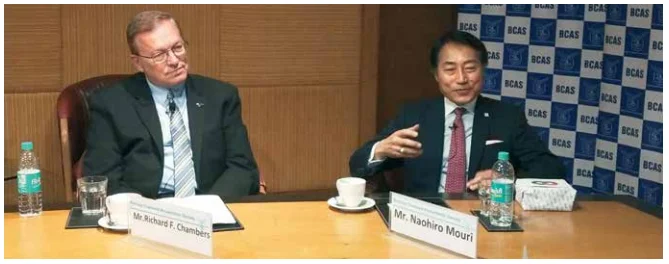
Should Agricultural Income Be Taxed?

The taxability of agricultural income has been a topic of
discussion in the recent past. Niti Aayog the government’s think tank,
recommended taxing income beyond a particular threshold and the Chief Economic
advisor felt that given the constitutional limitations, the states should tax
agricultural income. As expected the opposition criticised the move threatening
an agitation. Finally, the finance minister stepped in to clarify that the
government had no intention of taxing agricultural income.

The mention of the term “agricultural income” always results
in a wry smile on the face of every tax professional and tax official. This is
because on most occasions the term is used as an attempt to explain undisclosed
income.

The Seventh Schedule of the Constitution clearly delineates
the subjects/areas on which the Centre and the States can legislate. Entries 82,
86 and 87 of the Union list grant the Centre the power to tax income, capital
value of assets and levy estate duty on property other than agricultural land.
Entries 46, 47 and 48 of the state list grant the power of such taxation to the
states. There is no entry in regard to agricultural income / land in the
Concurrent List. Article 366 of the Constitution defines agricultural income to
mean agricultural income as defined for the purposes of enactments relating to
Income tax. It must be mentioned that as far as the Income Tax Act, 1961 is
concerned, it grants a specific exemption to agricultural income in terms of
section 10(1), and agricultural income is computed only to determine the rate
of taxation of other income.

What then is the current scenario in regard to reporting of
agricultural income? Reports state that for assessment year 2014-15, four lakh
tax payers claimed exemption in respect of agricultural income of Rs.9,338
crore. This includes some corporates in the private and public sector. Considering
that agricultural income constitutes 15% of India’s GDP, this is indeed an
insignificant figure. This means that a large part of agricultural income
remains unreported to the tax authorities.

Agricultural income and agricultural land have always had a
special status, right from the times of colonial rule. This is probably because
such land was the subject matter of certain levies. Subsequently, large
holdings of agricultural land were prohibited and were subject to a ceiling.
After the independence, the right to tax agricultural income was granted to the
States.

The States, possibly on account of the political influence
that farmers wield, have refrained from taxing such income or over the years
withdrawn the levy. Maharashtra introduced an Act to tax agricultural income in
1962 but repealed it in 1989, as did the largest Indian State Uttar Pradesh
which enacted such a law in 1948 but repealed it in 1957. Assam has such
legislation but it taxes only tea cultivation. Kerala is possibly the only state
that levies such a tax aggressively.

It is possibly the time to revisit this issue. Readers may
feel that while reports of farmers committing suicide, and the waiver of loans
are doing the rounds, it is not appropriate to debate this aspect. It must be
pointed out that it is nobody’s case that a farmer who has no income is to be
taxed. But it is equally true that there are land barons who have circumvented
land ceiling laws, have huge income which is going untaxed. If an argument that
agriculture is subject to vagaries of nature is raised, it must be pointed out
that tax legislation provides for carry forward of losses and in any case these
are aspects which can be taken care of.

If at all the taxation of agricultural income becomes a
reality, who should have the power to tax it – the Centre or the States? To my
mind, agriculture like any other activity is an income earning activity, and
the powers of taxation should rest with the Centre and not the States. Another
reason for this is that keeping such powers with the States is likely to create
inequality. Even today, Kerala taxes plantation income at 50% while there is no
such taxation in the neighbouring state Tamil Nadu, putting the Kerala farmers
to a disadvantage.

Taxing farmers having income over a high threshold may
possibly be a way to start. According to the agricultural census of 2011,
farmers holding more than 25 acres were few in number. They were 35% in Punjab,
22% in Rajasthan, 12% in Gujarat and 10% in Madhya Pradesh. I am deeply
conscious that there are many hurdles including a constitutional amendment that
will have to be overcome and many creases that will have to be ironed out, but
it is time that the government takes a relook at this issue. When the GST dust
settles down it may be a good time to start!

Attachment

Birds fly
away and leave the nest deserted

Such is the
short-lived friendship soul and body share’

G. U. Pope

1.    We are all
attached to our family, work and environment –including the way we live. More
than our work we are attached to the result of our work – efforts. We are
attached to our resources including money and spend enormous effort in
protecting our resources and persons we are attached to, especially family and
friends. Above all, we are attached to our selves – this mind-body complex. In
other words, ‘attachment’ is an emotion and a very strong one. It binds us and
at times blinds us. Attachment is bare and lacks pretensions. Yet, it is
attachment that spurs us into action and we achieve our aims and goals in life
– action with attachment means success.

2.1  On the other
hand, our saints have singled out ‘attachment’ as the root cause of all human
suffering. Hence it is rightly said that `attachment and pride’ are the
intrinsic cause of unhappiness.

2.2  Attachment is
said to have six arms : desire, anger, greed, jealousy, arrogance and delusion.
Hence, these six arms together or any one of them generate worry and
insecurity. Attachment creates fear of loss as loss in inevitable even in love
and marriage is destined by death and even otherwise.

2.3  Brahma Kumaris
believe : Attachment keeps one entangled in the web of ‘me’ and ‘mine’ and the
need to hold on to whatever one is attached to. This makes one selfish, petty
and narrow-minded.

2.4  Our inability
to let go of ‘me and mine’ is the genesis of all attachment. Hence, remove the
thorn of ‘attachment’ to experience happiness. Let us reckon and realise that
‘attachment’ generates restlessness whereas detachment brings in calm – as it
converts one into an observer – an observer who observes but has no reactions.

3.    Attachment is
also an illusion, because the fact of life is ‘one comes alone and goes alone’.
However, the irony is, one lives life in attachment – hence one enjoys and
suffers because of attachment to people, objects, wealth and above all one’s
thoughts. The antidote to attachment is detachment – that is – being attached
minus the sense of ownership.

4.1  ‘The real question
is : can one work without attachment ! That is, there is no reaction whether
one succeeds or fails. In other words, one works for work’s sake without caring
for the results. It needs to reckoned and realised that one should not be
attached even to one’s duty – treat duty as action without expectation of even
‘thank you’.

4.2  One needs to
realise: attachment is based on expectations whereas detachment leads to
acceptance resulting in peace of mind making life pleasant. Detach, observe and
enjoy the games mind plays.

4.3  The issue is:
can this equanimity be achieved !

4.4  The answer is
yes. Dare to dream your way out of attachment – dream during day and night and
above all pray to live a life of ‘attachment with detachment’ and it will
happen. Saints live their lives in this manner, they love and serve humanity
with detachment. Jesus loved with detachment. Ram ruled with detachment – Raja
Janak is often quoted as an example who lived and ruled with attachment coupled
with detachment. Krishna preaches to Arjun to perform his duty – fight the war
– with detachment to the result.

4.5  Enjoy wealth,
comfort, fame and above all this ‘mind-body complex’ but to have peace be
detached to all these because detachment is the only antidote to attachment and
suffering.

5.1 Detachment is to
accept everything that comes without being emotional and believe implicitly in
what Adi Shankracharaya advises :

u  All that has happened has
happened for the best

u  All that is happening is
happening for the best

u  All that will happen will happen
for the best.

5.2        The
irony is : we get attached to detachment.

Re: Deduction of Tax (TDS) u/s 195 from Property Purchase Price payable to an NRI

fiogf49gjkf0d

7th April, 2016

The Editor,
Bombay Chartered Accountants Journal
Mumbai.

Dear Sir,

Re: Deduction of Tax (TDS) u/s 195 from Property Purchase Price payable to an NRI

When purchasing an immovable property, usually a residential flat, from an NRI, in the absence of any clear rules or guidelines or a Circular / Instruction from CBDT, the buyer faces an unenviable situation: How much TDS to be deducted from the Purchase price payable to the NRI? Whether to deduct TDS @ 20% plus applicable Cess and Surcharge from the Gross Purchase Price, which is usually not acceptable to the Seller, many times resulting in cancellation of the deal? Whether to deduct TDS amount from the Capital Gains taxable in the hands of the NRI? If yes, who should calculate and certify the amount of Capital Gains Tax deductible ? Whether a certificate issued by a Chartered Accountant would be acceptable to the Authorities? Whether it is okay to take into account deduction available to the seller u/s 54 or u/s 54EC of the Act while calculating the amount of Capital Gains Tax liability?

In this connection, it is worth recalling that the Supreme Court as well as various High Courts has held, time and again, that TDS u/s 195 is deductible only from the “Sum Chargeable under the provisions of this Act.”

In view of the uncertainties involved and lack of authoritative guidance from the Tax Authorities, the buyers usually insist upon deducting the tax from the gross purchase price payable or require the seller to obtain and furnish a certificate u/s 197, which is usually a very time consuming and costly process and which is not easily manageable for a Non Resident Indian who has either no helpful relatives in India or has parents who are very Senior Citizens. Thus, obtaining a Certificate u/s 197 of the Act is not a very convenient and hassle free way of doing things for an NRI, particularly when the rules for computing Capital Gains arising from transfer of an immovable property such as a Residential Flat are fairly clear and well settled under the Act and the same can be easily computed and certified by a Chartered Accountant.

In view of the above, I would request the CBDT to issue necessary clarifications and authorise Chartered Accountants to issue the requisite Certificate in the Form to be prescribed by the CBDT.

Alternatively, in case, payment is made by a Buyer to an NRI in INR, provisions of section 194-IA which are presently applicable to a resident transferor, may be made applicable to a Non Resident Transferor with suitable modifications. In such an event, the NRI will have to comply with the procedure laid down u/s 195(6) while remitting the funds outside India. It will greatly facilitate real estate transactions by NRIs and go a long way in realizing the Government’s objective of Ease of Doing Business / Investment in India.

Regards,
Tarun Singhal.

INTERNAL FINANCIAL CONTROLS – COMMON MISCONCEPTIONS

fiogf49gjkf0d
Introduction
In a paradigm shift, Section 143(3)(i) of the Companies Act, 2013 (“the Act”), has for the first time introduced the requirement of reporting by the statutory auditors on, whether the Company has an adequate internal financial controls system in place and the operating effectiveness of such controls. This requirement, which was optional for the financial years beginning 1st April, 2014, is mandatory for the financial years beginning 1st April, 2015.

The reporting requirements are modelled on the lines of the SOX requirements for US listed entities, which were notified by the Securities and Exchange Commission of the USA in June 2003. The trigger for the introduction of the same were various corporate scandals like Enron, Worldcom, Parmalat etc. Similarly in June 2006, the Financial Instruments and Exchange Act (J-SOX) was passed by Diet, which is the Japanese Parliament/ National Legislature. In the United Kingdom, the UK Corporate Governance Code specified the matters which the Boards of listed companies have to comply with, which inter alia includes matters relating to oversight and review of internal controls in the Company. Just as the various corporate scandals like Enron prompted the introduction of the SOX requirements, the Satyam saga which unfolded in January 2009 has been the prime driver for the introduction of the reporting requirements on Internal Controls over Financial Reporting in India.

The reporting by auditors on internal controls is not entirely new for auditors in India. As all of you would be aware, the auditors in the course of their reporting under CARO 2003 and CARO 2015 were required to report on whether the Company has an adequate internal control system which is commensurate with the size of the Company and the nature of its activities in respect of purchase of inventory and fixed assets and sale of goods and services and whether there is a continuing failure to correct major weaknesses in respect thereof. Thus, the scope of reporting which is envisaged under the Act ,is substantially larger than what was required under CARO 2003 and 2015, which is limited to reporting on the adequacy of internal controls on specific matters. Further, Clause 49 of the Equity Listing Agreement, which has now been substituted by the SEBI (Listing Obligations and Disclosure Requirements) Regulations, 2015 requires an evaluation by listed companies of the internal financial controls and risk management systems by the Board and also a specific assertion by the CEO and CFO that they accept responsibility for establishing and maintaining internal controls for financial reporting and the operating effectiveness thereof. Accordingly, the scope and objectives of Internal Financial Control and the reporting thereof has increased substantially for all classes of companies, which brings along with it various misconceptions and myths in the minds of both the management and the auditors.

Before discussing certain common misconceptions with regard to the reporting on Internal Financial Controls, both from the point of view of both the Management and the Auditors, it would be pertinent to examine the statutory provisions dealing with Internal Financial Controls and Internal Financial Control System from the point of view of the management and the auditors.

Statutory Provisions

The statutory provisions emanate from the Act, and place separate responsibilities on the Management and Statutory Auditors, which are discussed hereunder.

Management’s Responsibility

The Management’s responsibility towards Internal Financial Controls can be examined separately with respect to the following stakeholders:

• Board of Directors
• Audit Committee
• Independent Directors

The statutory provisions in the context of each of the above are analysed hereunder:

Board of Directors
Section 134(5)(e) of the Act
requires the Director’s Responsibility Statement in case of a Listed Company, to state whether the Company has laid down internal financial controls[IFC] and whether the same are adequate and operating effectively. It may be noted that listed companies would also cover those where only the debt securities are listed.

Further, explanation to Section134(5)(e) defines IFC
as the policies and procedures adopted by the Company for ensuring orderly and efficient conduct of its business including adherence to company’s policies, the safeguarding of assets, the prevention and detection of frauds and errors, accuracy and completeness of the accounting records and timely preparation of reliable financial information.The aforesaid definition encompasses both operational and financial reporting controls, and is much broader in scope than internal financial control systems.

Further, Rule 8(5)(viii) of the Companies (Accounts) Rules, 2014 requires the Board Report of all companies to state the details in respect of the adequacy of internal financial controls with reference to the financial statements.This requirement is much more restricted as compared to that for listed companies since it covers only the controls impacting financial statements and also does not cover the operating adequacy thereof.

Audit Committee
Section177(4)
requires that the terms of reference of every Audit Committee shall include an evaluation of the Internal Financial Controls and Risk Management Systems.

Independent Directors
The Code of Independent Directors under Schedule IV emphasises that Independent Directors have to satisfy themselves about the integrity of the financial reporting system and on the strength of financial controls and risk management systems

Misconceptions on the part of Management

There is a common misconception on the part of the Management in many cases, as to whether there is anything new which has cropped up as a result of the aforesaid reporting responsibilities which are specified under the Act and whether anything has really changed?

In this context, two common questions are normally asked, as under:

a) The first question which top managements including CEOs ask is, whether anything has changed and are we saying that the entity did not have controls earlier?

b) Further, as an off shoot of the above, the second question which is asked is, were not the auditors checking and reporting on controls earlier?

More often than not, these questions need to be answered by the auditors (both internal and external) and/or other external consultants.

The answer to the first question is not very direct or simple, and depends upon a variety of factors including the size and complexity of the entity, the nature and extent of existing documentation which is available, the management philosophy and operating style etc., since the fundamental foundation of an Internal Financial Control system is the existence of a documented framework. For the purpose of explaining to the top management including the CEO, an assessment needs to be done in respect of the following matters or should we say ground realities!), amongst others, as deemed necessary:

Is the Code of Conduct documented and even if so, whether the same is communicated.

Are Board meetings actually held or are minutes written just to cover the required agenda matters.

Is quality time spent by the Board on important/critical matters having a material impact on the risk.

The Audit Committee does not allot sufficient time to discuss the interim results or Internal Audit Reports.

The Company has a turnover of over Rs. 500 crore, but does not have a qualified CA in its Accounts/Finance Department.

The Organisational structure is not formalised even though the Company has 500 employees and the job profiles are not documented/reviewed periodically.

Though there is a documented Risk Management Framework and SOPs, the same operate on a standalone basis and the actual activities are conducted based on neither of them. Further, the control points/ activities may not be specifically documented therein. Also, policies and procedures and/or authority levels/ matrices remain undocumented for many key areas/ operations/processes.

The ERP/IT system is changed/modified regularly without proper justification/UATs and no IT system audit has been undertaken for the past several years. Also, the Company uses a Tally package, even though it has multi-locational activities which involve processing of numerous transactions at various points of data entry, which are also modified/changed without proper oversight.

The process of generating MIS is not robust and is based on incomplete data.

Policies and procedures for period end closure of financial statements are not adequately documented, especially in case of multi-location/multiple activity entities and for preparation of consolidated financial statements. Also, unusual events/transactions are not captured, escalated or approved appropriately.

The information/communication system is not adequate /deficient resulting in non-escalation of problems from the lower levels to the middle/top management, lack of open communication, ineffective whistle blower mechanism etc.

Lack of documented controls over preparation and generation of spreadsheets.

An adverse answer to any one or more of the above matters, based on either a Self-Assessment / introspection by the top management or by an external party, would prima-facie indicate lack of or absence of internal controls depending upon the nature, severity, criticality and materiality of the deficiency/deviation which in turn would need to be factored in whilst discharging the statutory reporting responsibilities in the Board Report under the Act as discussed earlier, and could also result in an adverse opinion on ICFR by the statutory auditors under the Act. Accordingly, there should be a comprehensive introspection on the part of the Management with regard to the existence and documentation of Internal Financial controls.

With regard to the second question regarding the change in the responsibility of the statutory auditors vis-à-vis controls, as discussed earlier, the reporting responsibility has broadened/widened. Further, upto last year, the auditors could adopt a non-reliance on controls strategy, by performing more extensive and focussed substantive testing and accordingly opine on the truth and fairness of the financial statements, even if adequate internal controls were not prevelant or documented.

To conclude in one sentence, what the top Management requires is a cultural change rather than a compliance change!

Auditors’ Responsibilities
As discussed above, the auditors responsibility to report in terms of section 143(3)(i) covers all companies. Further, consistent with global practices and based on the Guidance Note issued by the ICAI, internal financial controls as referred to above only relates to Internal Financial Controls over Financial Reporting (‘ICFR’) and thus auditors reporting on Internal Financial Controls is only in the context of the audit of the financial statements.

The following are certain matters which are relevant in this regard:

The definition IFC as per explanation to section 134(5)(e) above is relevant only on the context of the reporting under the same and is not relevant for the reporting u/s. 143(3(i) by the auditor.

Unlisted companies are not required to affirm the operating effectiveness of controls, whereas the auditor is required to report on the adequacy and operating effectiveness of all companies. This would present greater challenges to the auditor in respect of unlisted companies.

Misconceptions/Myths in the Minds of auditors
Whilst discharging their attest responsibilities with regard to reporting on ICFR, the auditors should be aware of certain common and practical misconceptions, which are discussed hereunder.

Concept of Control and Process
Wikipedia defines Control, or controlling, “is one of the managerial functions like planning, organizing, staffing and directing. It is an important function because it helps to check the errors and to take the corrective action so that deviation from standards are minimized and stated goals of the organisation are achieved in a desired manner.

According to modern concepts, control is a foreseeing action whereas earlier concept of control was used only when errors were detected. Control in management means setting standards, measuring actual performance and taking corrective actions.”

Henri Fayol, a French Mining Engineer who had developed a general theory of business administration which was popularly referred to as Fayolism, formulated one of the first definitions of control as it pertains to management as under:

“Control of an undertaking consists of seeing that everything is being carried out in accordance with the plan which has been adopted, the orders which have been given, and the principles which have been laid down. Its object is to point out mistakes in order that they may be rectified and prevented from recurring”.

According to E. F. L. Brech, who was a British Management consultant and an author of several management books, “control is checking current performance against predetermined standards contained in the plans, with a view to ensure adequate progress and satisfactory performance”.

According to Harold Koontz, an American organisational theorist, professor of business management at the University of California, Los Angeles and a consultant for many of America’s largest business organisations, “Controlling is the measurement and correction of performance in order to make sure that enterprise objectives and the plans devised to attain them are accomplished”.

Some of the common characteristics which emerge from the above definitions are summarised hereunder:

Control is a continuous process
Control is a management process
Control is embedded in each level of organisational hierarchy
Control is closely linked with planning
Control is a tool for achieving organisational activities
Control is an end process
Control compares actual performance with planned performance
Control points out errors in the execution process
Control helps in achieving standards of performance.

From the point of view of ICFR, the term control is often used synonymously with the term process, which is a misconception. Both these terms are different even though they may be inter-connected, since one of the characteristics of controls is evaluating the adequacy of or monitoring of the processes within an entity. Process describes the action of taking a transaction or event through an established and usually routine set of procedures, whereas a control is an action or an activity taken to prevent or detect misstatements within the process.

It would be relevant at this stage to understand the difference between process and control, with the help of a few examples.

Some of the important points which are relevant based on the above examples, are discussed hereunder:

a) The distinction between a process or a control is more important in case of predominantly manual activities.

b) In case of activities/processes performed in a predominantly IT environment, a lot of the controls are automated and may not always be visible but get evidenced by exception reports/logs/audit trails. Whilst in such cases the review of IT general and application controls by an IT specialist would give an assurance on the operating effectiveness, these by itself may not always be adequate and may need to be supplemented by high level review controls.

c) In many entities, the control activities indicated above may be actually performed but not specifically documented in the SOPS, flow charts, policy manuals, authority matrix etc. This could be one of the common misconceptions on the part of the top management, who already assume that controls are prevalent and nothing has changed. In such cases, it is important for the auditors and/or other external consultants to advise the Management to document the existing controls as well identify controls for processes or activities where none

Key Factors for Identifying Controls (5WH analysis)

The key factors to assist in identifying controls and differentiating the same from a process can be summarised as the 5WH analysis, which can be explained by considering the following questions, all of which should normally be present for an activity/process to be considered as a control.

Information Produced by the Entity (IPE)
Though the term IPE is referred to in the auditing standards (primarily SA-315 dealing with Risk Assessment and SA- 500 dealing with Audit Evidence), there is no precise definition given therein.

IPE is primarily used by auditors as a source of evidence both for control testing, which includes ICFR as well as substantive testing. Hence, it is important to understand the nature thereof.

IPE is basically in the form of various reports which are generated either through the system or manually or in combination. They may take different forms as under:

Used by the entity – These are used by the entity in performing the relevant controls. These normally take one or more of the following forms:

– Standard “out of the box” or default reports or templates with or without configuration e.g. debtors ageing report

– Custom developed reports which are not a part of the standard application but which are defined and generated by user operated tools like scripts, report writers, query tools etc. e.g. sales by region

– Outputs from end user applications

– Analysis, schedules, spreadsheets etc. which are manually prepared from system generated information or from other internal or external sources.

A lot of information/IPEs may be generated by the Management for its own use all of which may not be relevant and used as audit evidence.

Used by/relevant for the auditor – The IPE which can be used by/relevant for the auditors can be in either of the following forms:

– used by the entity when performing relevant controls

– used by the auditor when testing operating effectiveness of ICFR and substantive testing

It is of utmost importance to test of the accuracy and completeness of the data generated through the IPE. This is a common short coming which needs to be remedied.

The elements of IPE which are relevant from the auditor’s point of view are as follows:

– Source Data which represents information from which the IPE is generated and which can be system generated or manual.

– Report Logic which represents the computer code, algorithms, formulae, query parameters etc.

– Report Parameters
which define the report structure, filtering of data, connecting of related reports.

The following considerations govern the testing of the accuracy and completeness of the data generated by IPEs:

– Not all data is captured
– Data is incorrectly input
– Report logic is incorrect
– Inappropriate or unauthorised change of the report logic or source data
– Use of incorrect parameters

The above may involve the help of IT specialists.

Testing of IPE
The testing of IPEs can be undertaken in one or more of the following ways:

Direct Testing – This method can be adopted only in respect of standard parameter driven reports, which are generated directly from the system. It primarily involves the testing of the completeness and logic of the reports and benchmarking may be adopted.

Testing of controls that address the accuracy and completeness of the IPE – This method involves performing the tests on certain specific aspects such as system setting like access, passwords etc. as well as on the parameter settings like interest rates, prices etc.

More often than not, the entity generates various spread sheets which represent IPE to be used by the auditors, which are normally not specifically tested for accuracy and completeness. Hence, it is important to understand the considerations governing the same.

Testing of Spreadsheets
As indicated above, spreadsheets are an important component of IPEs in many enterprises and hence, it is imperative to test the accuracy and completeness thereof. The following are certain controls which can be adopted in respect of spreadsheets:

Change Controls – These involve controls over tracking of version changes and testing and approval of updates prior to deployment.

Access Controls – The spreadsheets should be stored in files or directories whose access is restricted. Further, formula fields should use cell protection measures, to restrict the possibilities of making changes in formulae.

Input Controls – Inputs to the spreadsheets should be validated for accuracy and completeness, when manually entering the data or importing the same. Control totals should be reconciled during data extraction with the source data/system prior to uploading to the spreadsheet

Calculation Controls –Automated algorithms should be used with access and change controls discussed earlier. Important formulae should be periodically reviewed to evaluate their continued relevance.

Testing of controls over spreadsheets would be an important consideration in assessing the effectiveness of ICFR and would involve interaction with the management at an early stage, since there is generally a lack of awareness of assessing and documenting formalised controls in this area as discussed earlier, whilst identifying certain common myths on the part of the top management/CEOs.

Spreadsheets could be used either to generate information to enable monitoring by the Management of various activities/processes as well as for preparation of financial statements. Accordingly, the documentation of the controls therein should be done as a part of the RCM for the individual processes or the financial closing and reporting process as discussed subsequently.

Documentation of the Internal Control Framework

To enable the auditors to report on ICFR, it is necessary for them to base their report on a specific framework, which needs to be documented by the Management. A question which is often raised is, whether there is any standard format for documenting the framework and whether the same needs to be captured in a single document.

In this context, it may be noted that since companies are free to adopt any framework, it would be difficult to lay down a standard format for documenting the same nor is it possible to have the same in one document, since the individual components of the framework would be different for each entity and may involve various documents.

From a practical perspective, it would be advisable to have a Summarised Master Policy Framework document, especially for the smaller and less complex entities, which captures the essence of the framework proposed to be adopted together with the various components and get the same adopted by the Board and/or Those Charged with Governance, if the same is not already done.The Master document may in turn refer to the various other documents/policies at the appropriate place, which would then constitute the comprehensive framework on which the auditors can base their report. These documents can comprise of the following, amongst others depending upon the size of the entity and the nature of its activities:

a) Risk Management Policy
b) Vision and Mission Statement / Ethics Policy
c) Code of Conduct
d) Whistle Blower Policy
e) Internal Audit Charter
f) Audit Committee Charter
g) Anti-Fraud Programme/Policy
h) Budgeting Policy/Process
i) Legal Compliance Framework
j) IT Security Policy
k) Business Continuity Plan
l) Disaster Recovery Plan
m) Outsourcing Policy
n) Succession Policy
o) Authority Matrix
p) SOPs for various processes
q) Process Flow Diagrams
r) Risk Control Matrix (RCM) for each business cycle / process

The following are some of the points which need to be kept in mind:

a) Some of the documents indicated above have to be mandatorily prepared by companies in terms of the Act or the Listing Agreement with the Stock Exchanges e.g. code of conduct, risk management policy, succession policy etc.

b) Whilst the above is a comprehensive list which addresses Internal Financial Controls from the point of view of the Board Reporting responsibilities indicated earlier, the auditors need to consider the same only to the extent relevant for ICFR reporting.

Conclusion:
Whilst every attempt has been made to decode some of the common myths/misconceptions of this new kid on the block, like all kids, this kid would in time become a grown up and responsible adult and have many more of its own challenges!

Incorrect levy of interest resulting in non granting of refunds to taxpayers

fiogf49gjkf0d

18th April, 2016

To
Mr. Hasmukh Adhia
Revenue Secretary
Ministry of Finance
New Delhi

Respected Mr. Adhia,

Sub : Incorrect levy of interest resulting in non granting of refunds to taxpayers

For the past 2 years, many of our members have brought to our notice a trend set by the various assessing officers in the country – particularly in Mumbai – of wrongfully charging incorrect amounts of interest u/s. 234B in the tax computation sheet that accompanies the assessment order passed u/s. 143(3). In several cases, the tax payable on the assessed income is lower than the taxes paid by the tax payer. Accordingly, in such cases, in the normal course, a refund would be due to the assessee alongwith interest u/s. 244A. However, much to the shock of such tax payers, instead of a refund being received by them (or at least determined to be payable to them by the government), the notice of demand received by them u/s. 156 of the Act says that the amount payable to/by them is “NIL”. This Nil amount has been arrived at after charging interest u/s. 234B which is exactly equal to the amount of refund due to the tax payer. In some cases, instead of a refund being determined as due to the assessee, a demand has been determined as payable by overcharging interest u/s. 234B.

It would be appreciated that in cases where the tax paid is more than the tax payable, the question of levy of interest u/s. 234B does not arise. In fact, in many cases, there is no advance tax payable and yet interest has been levied for default in payment of advance tax!

It appears that this is a deliberate action being done manually in the system with the sole objective to deprive the taxpayers of the rightful refund and interest due to them.

There are a number of such cases that have come to light. A few examples from the city of Mumbai are given in the Annexure. It will be appreciated that even though this is a serious grievance, many taxpayers only apply for rectification and refrain from raising a grievance on account of the apprehension that such an action may not be perceived in the right spirit by the concerned tax officers

On behalf of the thousands of our members and their tax paying clients, we appeal to your good self to take up this issue with the seriousness that it deserves and to direct the CBDT to issue instructions to all field officers to desist from resorting to such tactics and to immediately issue the refunds to the tax payers without the tax payers having to apply for rectifications. It will be appreciated that in most such cases, the officers are aware that the interest has been wrongly charged and have verbally “advised” the tax payers / their representatives to apply for rectification in April 2016.

The point that we wish to highlight here is the blatant and deliberate error committed by the field officers and unfairness of this situation.

We would be more than willing to meet you or anybody else to take up this matter on a priority basis so that tax payers get their rightful refunds at the earliest.

Thanking in you in anticipation

For Bombay Chartered Accountants ‘ Society

Sanjeev R. Pandit, Chairman
A meet Patel, Co-Chairman Taxation Committee

Incorrect levy of interest resulting in non granting of refunds to taxpayers.

fiogf49gjkf0d

Dear Members,

Subject:- Incorrect levy of interest resulting in non granting of refunds to taxpayers.

Several members had brought to our notice the issue of wrongful charging of incorrect amounts of interest u/s. 234B in the tax computation sheet that accompanies the income-tax assessment orders passed u/s. 143(3) by Assessing Officers, thereby depriving the taxpayers of the rightful refund and interest due to them. This is a serious issue and needs to be highlighted to the higher authorities. In this connection, based on the data received from a few members, we have made a representation to the Revenue Secretary, Ministry of Finance. A copy of the said representation will be published in the BCA Journal for May 2016.

Please click on link below to read the full representation:

Incorrect levy of interest resulting in non granting of refunds to taxpayers.

Please note that the annexure to the representation is not made public since it contains information about a few tax payers.

We also thank the members who have shared with us the information about their clients who have suffered on account of this action on the part of certain assessing officers. We hope that in future when such matters arise, more members will come forward and share with us information which can, in turn, be made the basis for representations to the higher authorities.

For Bombay Chartered Accountants ‘ Society

Sanjeev R. Pandit,Chairman
Ameet Patel, Co-Chairman Taxation Committee

Hyper-nationalism threatens the idea of liberal democracy in both India and the US

fiogf49gjkf0d
With the end of the Cold War a quarter century ago, Francis Fukuyama wrote an intellectually exciting book announcing The End of History. He meant that the 19th and 20th century ideological disputes over how to structure society politically had ended; liberal democracy had won a decisive victory. He later wrote several books modifying his early enthusiasm. Today, serious challenges once again threaten the idea of liberal democracy.

Donald Trump’s spectacular advance towards securing the nomination of the Republican Party for the US presidency is a symptom of what’s happening around the world. A growing swell of extreme nationalism, or hyper- nationalism, has become a challenge to core democratic values. The largest two democracies, the United States and India, are witnessing surges of nationalist passion; one is the world’s most influential, while the other is the most populous and arguably the most diverse. The quality, perhaps fate, of democracy in these two nations is of consequence to the future course of political progress. As global society evolves at a time of immense technological and economic change, nativism and identity politics are inevitable reactions. But they pose serious threats to the liberal values that underpin democracy.

‘Liberal’ here is not a synonym for ‘leftist’ as commonly used in the US. Liberalism in the classical sense is the spine of any democratic body politic. It means openness in society and the economy, acceptance of difference and diversity within a frame of tolerance and free speech, public civility and other mores that define democracy. Left extremists have their own peculiar hatreds for liberalism. Today, however, hyper-nationalism is a far-right phenomenon.

Authoritarians of the right and the left have long spouted hyper-nationalistic slogans to coerce people into submission. What is worrying today is that far-right political parties and movements have sprouted across the entire democratic world.

In Europe, where liberalism was reborn in the modern era, right-wing forces are using nativism to corner significant popular support. The trend is evident in not only former Soviet bloc countries like Poland, Hungary and Slovakia, which have relatively recent experience of democracy; it has sprouted across western Europe’s established democracies, including France and Germany.

In India, a hyper-nationalist government led by Prime Minister Narendra Modi has either stayed indifferent or quietly encouraged activists of the Hindutva brigade to carry out numerous instances of cultural-nationalist identity confrontations, often violent, in a country that has a unique range of linguistic, ethnic and religious diversity. Fanning flames of hyper-nationalism is easy in a post-colonial environment; both the right and the left have done it the past. But the Hindu right has added the fuel of an exclusivist religious-cultural identity to a volatile mix to redefine the idea of India.

In the US, the campaign rhetoric of conservatives, especially Trump, is poisonous. Nativist dog whistles have been around for long and two terms of Barack Obama as president have stirred latent identity anxieties in sections of the country’s white population. Now nativist or racist talk is openly voiced by candidates as a nationalist virtue to make America great again.

Does a correlation exist between support for extreme nationalist or nativist views and a desire for authoritarianism? Recent research at the University of Massachusetts, Vanderbilt University and the University of North Carolina clearly suggests there is, writes Amanda Taub at vox.com. But even without scholarly research common sense suggests that hatred or fear of the Other, which is the siren song of nativists, works to undermine democracy. These are values like tolerance of differences in ethnicity, religion, appearance and speech among citizens of a secular democracy; acceptance of a framework of civilised discourse of disagreement; adjusting to a changing sociocultural environment within each democratic nation and in the world.

Moderate conservatives and progressives may differ on the speed and intensity of that inexorably changing reality and on how to deal with it. But they agree to disagree in a democratic manner eventually to elect their preferences to public office. Hyper-nationalists and nativists, on the other hand, challenge the basic norms of democracy. India and the US, at starkly different ends of the global development spectrum, are the world’s prominent examples showing how unifying nationalism can coexist within a liberal framework. The worry is, might either or both succumb to a hyper-nationalism that strangles democracy?

(Source: Article by Shri Gautam Adhikari in The Times of India dated 19-03-2016.)

Nehru-Gandhis and poverty – Dynastic politics is largely responsible for India lagging East Asia

fiogf49gjkf0d
Has dynastic politics kept India poor? There’s more than a kernel of truth to the idea that the Nehru-Gandhis are responsible for India lagging much of East Asia. The continued hold of the dynasty prevents Congress from fully owning the reform programme that it authored in 1991, and inclines the party towards political postures that hinder development. As long as Sonia Gandhi or Rahul Gandhi remain at the helm, the odds of Congress emerging as a champion of reforms remain exceedingly slim.

In the fever swamps of the far right, many people believe that the Nehru-Gandhis deliberately kept India backward in order to nurture a poor and ignorant vote bank. But you need not buy crackpot conspiracy theories to make a more prosaic point. Between them, Jawaharlal Nehru, Indira Gandhi and Rajiv Gandhi, who ruled India for 37 of its first 42 years of Independence, presided over one of Asia’s great economic flops.

In contrast, neither of post-1991India’s reform heroes – P V Narasimha Rao and Atal Bihari Vajpayee – belonged to the dynasty. Indeed, in practice, if not always in rhetoric, both Rao and Vajpayee generated prosperity by dismantling the economic pillars of the Nehruvian project: mistrust of trade, contempt for the profit motive, and faith in state planning rather than in the invisible hand of the market. Nehru’s flawed ideas – in particular his infatuation with Soviet-style planning – ended up doing India grave harm. But though a few prescient gadflies, most famously the classical liberal B R Shenoy and future Nobel laureate Milton Friedman, raised early alarms about India’s chosen path, for the most part Nehru was simply following the conventional wisdom of his time.

As New York University professor William Easterly details in ‘The Tyranny of Experts’, it took decades to discredit the statist development model touted by such luminaries as Gunnar Myrdal and Arthur Lewis. Indians were not alone in suffering. Millions of Africans, Latin Americans and fellow Asians kept us company. The true villain of modern Indian history, dooming millions of Indians to poverty, was Indira Gandhi. Instead of acknowledging a flood of evidence that state planning was not working, Gandhi doubled down on her father’s dubious legacy. In 1966, the year Gandhi took power, the average Indian earned about fourfifths as much as the average Indonesian and about half as much as the average South Korean. By 1990, on the eve of the balance of payments crisis that forced India to reform, the average Indian earned only half as much as an Indonesian and less than one-sixth as much as a South Korean. More than half of India’s then 870 million people lived on less than the World Bank’s current estimate for extreme poverty of $1.90 a day.

Why does this potted history still matter? After all, since 1991India has gone from being seen as a black hole of despair to a bright spot in the global economy. Thanks to the growth spurred by reforms, only about one-fifth of Indians live in extreme poverty today. Soon enough, that figure will likely be reduced to zero.

In a normal political system, Congress would have elevated Rao to sainthood and quietly banished the discredited ghosts of the Nehru-Gandhis. Instead, party leaders twist themselves into pretzels to retroactively give the dynasty credit for reforms, or pretend that the economic disaster they presided over was in fact a great launch pad for what followed. To be fair, the current crop of Nehru-Gandhis no longer quotes Lenin, as Nehru did when he famously declared that the public sector would occupy the “commanding heights” of the economy. But in general the family’s impact on economic policy remains negative. Contrast, for instance, Manmohan Singh’s record under Rao with his record under Sonia Gandhi. As Rao’s finance minister, Singh boldly unshackled the Indian elephant. As Gandhi’s prime minister, he burdened it with too many wasteful welfare programmes and too few growth-inducing policies.

Meanwhile, Rahul Gandhi’s somewhat forgettable political career has been marked by consistently anti-business rhetoric. In 2010, he scuttled Vedanta’s $1.7 billion bauxite mining project in Odisha. The young Gandhi’s rhetoric about “two Indias” and bizarre animus towards people who “drive big-big cars” suggest a dilettantish preoccupation with inequality rather than a serious focus on eradicating poverty. Though the Modi government is responsible for its own tepid reform effort, there’s no question that Rahul’s jibe about the prime minister heading a “suit-boot ki sarkar” has helped vitiate the policy-making atmosphere.So yes, the critics are right about dynastic politics helping keep India poor.

A. P. (DIR Series) Circular No. 62 dated April 13, 2016

fiogf49gjkf0d
Overseas Direct Investment (ODI) – Rationalization and reporting of ODI Forms

This
circular contains the changes made to information that needs to be
submitted with respect to Overseas Investment. Form ODI with respect to
Overseas Direct Investment. The new Form ODI is given in Annex 1 to this
circular.

1. The revised Form ODI will contain the following: –

Part I – Application for allotment of Unique Identification Number (UIN) and reporting of Remittances / Transactions:

Section A – Details of the IP / RI.

Section B – Capital Structure and other details of JV/ WOS/ SDS.

Section C – Details of Transaction/ Remittance/ Financial Commitment of IP/ RI.

Section D – Declaration by the IP/ RI.

Section E – Certificate by the statutory auditors of the IP/ self-certification by RI.

Part II – Annual Performance Report (APR)

Part III – Report on Disinvestment by way of

a) Closure / Voluntary Liquidation / Winding up/ Merger/ Amalgamation of overseas JV / WOS;

b) Sale/ Transfer of the shares of the overseas JV/ WOS to another eligible resident or non-resident;

c)
Closure / Voluntary Liquidation / Winding up/ Merger/ Amalgamation of
IP; and d) Buy back of shares by the overseas JV/ WOS of the IP / RI.

2.
New reporting formats, Annex II and Annex III, have been introduced for
Venture Capital Fund (VCF) / Alternate Investment Fund (AIF), Portfolio
Investment and overseas investment by Mutual Funds.

3. Post investment changes, subsequent to the allotment of UIN, are to be reported in Form ODI Part I.

4.
Form ODI Part I must be obtained bank before executing any ODI
transaction and the bank must report the relevant Form ODI in the online
OID application and obtain UIN at the time of executing the remittance.

5. A RI undertaking ODI can self-certify Form ODI Part I and
certification by Statutory Auditor or Chartered Accountant must not be
insisted upon.

6. A concept of AD Maker, AD Checker and AD Authorizer has been introduced in the online application process.

7.
Any non-compliance with the guidelines / instructions will be viewed
seriously penal action as considered necessary may be initiated.

A. P. (DIR Series) Circular No. 61 dated April 13, 2016

fiogf49gjkf0d
Overseas Direct Investment – Submission of Annual Performance Report

Presently, an Indian Party (IP) which / Resident Individual (RI) who has made an Overseas Direct Investment under ODI / LRS is required to file an Annual Performance Report (APR) in Form ODI Part III with RBI by June 30, every year in respect of each Joint Venture (JV) / Wholly Owned Subsidiary (WOS) outside India set up or acquired by the IP / RI. However, in violation of the provisions of FEMA: –

a) IP / RI are either not regular in submitting the APR or are submitting it with delay.

b) Banks facilitate Remittance(s) and other forms of financial commitments under the automatic route even though APR in respect of all overseas JV / WOS of the IP / RI have not been submitted.

To avoid these problems, this circular states that: –

a) The online OID application has been suitably modified to enable the nodal office of the bank to view the outstanding position of all the APR pertaining to an applicant including for those JV / WOS for which it is not the designated bank. Henceforth the bank, before undertaking / facilitating any ODI related transaction on behalf of the eligible applicant, must necessarily check with its nodal office and confirm that all APR in respect of all the JV / WOS of the applicant have been submitted.

b) Certification of APR by the Statutory Auditor or Chartered Accountant must not be insisted upon in the case of Resident Individuals. Self-certification can be accepted.

c) In case multiple IP / RI have invested in the same overseas JV / WOS, the obligation to submit APR will lie with the IP / RI having maximum stake in the JV / WOS. Alternatively, the IP / RI holding stake in the overseas JV / WOS can mutually agree to assign the responsibility for APR submission to a designated entity which must acknowledge its obligation to submit the APR by furnishing an appropriate undertaking to the bank.

d) An IP / RI, which has set up / acquired a JV / WOS overseas has to submit, to the bank every year, an APR in Form ODI Part II in respect of each JV / WOS outside India and other reports or documents by 31st of December each year or as may be specified by RBI from time to time. The APR, so required to be submitted, must be based on the latest audited annual accounts of the JV / WOS unless specifically exempted by RBI.

Any non-compliance with the instruction relating to submission of APR will be treated as contravention of Regulation 15 of the Notification No. FEMA 120/RB-2004 dated July 07, 2004 as amended and viewed seriously.

A. P. (DIR Series) Circular No. 60 dated April 13, 2016

fiogf49gjkf0d
Issuance of Rupee denominated bonds overseas

This circular has made the following changes with respect to issuance of Rupees Denominated Bonds overseas: –

a)
The maximum amount that can be borrowed by an entity in a financial
year under the automatic route by issuance of these bonds will be Rs. 50
billion and not US $ 750 million. Borrowing beyond Rs. 50 billion in a
financial year will require prior approval of RBI.

b) These
bonds can only be issued / transferred / offered as security overseas in
a country and can only be subscribed by a resident of a country:

a. That is a member of Financial Action Task Force (FATF ) or a member of a FATF – Style Regional Body; and

b.
Whose securities market regulator is a signatory to the International
Organization of Securities Commission’s (IOSCO’s) Multilateral
Memorandum of Understanding (Appendix A Signatories) or a signatory to
bilateral Memorandum of Understanding with the Securities and Exchange
Board of India (SEBI) for information sharing arrangements; and

c. Should not be a country identified in the public statement of the FATF as:

i.
A jurisdiction having a strategic Anti-Money Laundering or Combating
the Financing of Terrorism deficiencies to which counter measures apply;
or

ii. A jurisdiction that has not made sufficient progress in
addressing the deficiencies or has not committed to an action plan
developed with the Financial Action Task Force to address the
deficiencies.

c) The minimum maturity period for these bonds
will be three years in order to align them with the maturity
prescription regarding foreign investment in corporate bonds through the
Foreign Portfolio Investment (FPI) route.

d) Borrowers have to
obtain the list of primary bond holders and so that the same can be
provided to Regulatory Authorities in India as and when required.

e)
Banks are required to report to the Foreign Exchange Department,
External Commercial Borrowings Division, Central Office, Shahid Bhagat
Singh Road, Fort, Mumbai – 400 001, the figures of actual drawdown(s) /
repayment(s) by their constituent borrowers quoting the related loan
registration number. However, reporting by email shall be made on the
date of transaction itself.

A. P. (DIR Series) Circular No. 59 dated April 13, 2016

fiogf49gjkf0d
Acceptance of deposits by Indian companies from a person resident outside India for nomination as Director

This
circular clarifies that making a deposit, u/s. 160 of the Companies
Act, 2013, by a person who intends to nominate either himself or any
other person as a director in an Indian company is a Current Account
Transaction and does not require any approval from RBI.

Similarly,
refund of such deposit upon selection of the person as director or his /
her getting more than 25% votes is also a Current Account Transaction
and does not require any approval from RBI.

Notification No. FEMA 13 (R)/2016-RB dated April 01, 2016

fiogf49gjkf0d

Foreign Exchange Management (Remittance of Assets) Regulations, 2016

This Notification repeals and replaces the earlier Notification No. FEMA 13/2000-RB dated May 3, 2000 pertaining to Foreign Exchange Management (Remittance of Assets) Regulations, 2000.

Notification No. FEMA 5(R)/2016-RB dated April 01, 2016

fiogf49gjkf0d
Foreign Exchange Management (Deposit) Regulations, 2016

This Notification repeals and replaces the earlier Notification No. FEMA 5/2000-RB dated May 3, 2000 pertaining to Foreign Exchange Management (Deposit) Regulations, 2000.

Notification No. FEMA 22(R) /RB-2016 dated March 31, 2016

fiogf49gjkf0d

Foreign Exchange Management (Establishment in India of a branch office or a liaison office or a project office or any other place of business) Regulations, 2016

This Notification repeals and replaces the earlier Notification No. FEMA 22/2000-RB dated May 3, 2000 pertaining to Foreign Exchange Management (Establishment in India of branch or office or other place of business) Regulations, 2000.

A. P. (DIR Series) Circular No. 58 dated March 31, 2016

fiogf49gjkf0d
Notification No.FEMA.366/ 2016-RB dated March 30, 2016
Foreign Direct Investment (FDI) in India – Review of FDI policy –Insurance sector

This circular makes the following changes in Annex B to Schedule 1 of the Foreign Exchange Management (Transfer or Issue of Security by a Person Resident outside India) Regulations, 2000 – Notification No. FEMA 20/2000-RB dated 3rd May 2000: -The existing entry F.7, F.7.1 and F.7.2 shall be substituted by the following:

A. P. (DIR Series) Circular No. 57 dated March 31, 2016

fiogf49gjkf0d
Import of Rough, Cut and Polished Diamonds

Presently, banks can approve Clean Credit i.e. credit given by a foreign supplier to its Indian customer / buyer, without any Letter of Credit (Suppliers’ Credit) / Letter of Undertaking (Buyers’ Credit) / Fixed Deposits from any Indian financial institution for import of Rough, Cut and Polished Diamonds, for a period not exceeding 180 days from the date of shipment.

This circular permits banks, with immediate effect, to approve clean credit for a period exceeding 180 days from the date of shipment, subject to the following conditions: –

i) Banks must be satisfied about the genuineness of the reason and bonafides of the transaction and also that no payment of interest is involved for the additional period.

ii) The extension must be due to financial difficulties and / or quality disputes, as in the case of normal imports (for which such extension of time period for delayed payments has already been delegated to the AD banks).

iii) The importer requesting for such extension must not be under investigation / no investigation must be pending against the importer.

iv) The importer seeking extension must not be a frequent offender. Since there is a possibility that the importer may have dealings with more than one bank, the bank allowing extension must devise a mechanism based on their commercial judgement, to ensure this.

v) Banks can allow such extension of time up to a maximum period of 180 days beyond the prescribed period / due date, beyond which they must refer the case to respective Regional Office of RBI.

Banks must submit, customer-wise, a half yearly report of such extensions allowed, to the respective Regional Office of RBI.

A. P. (DIR Series) Circular No. 56 dated March 30, 2016

fiogf49gjkf0d
External Commercial Borrowings (ECB) – Revised framework

This circular makes the following changes: –

1. ECB framework

i. Companies in infrastructure sector, Non-Banking Financial Companies -Infrastructure Finance Companies (NBFC-IFC), NBFC-Asset Finance Companies (NBFC-AFC), Holding Companies and Core Investment Companies (CICs) are also eligible to raise ECB under Track I of the framework with minimum average maturity period of 5 years, subject to 100% hedging.

ii. For the purpose of ECB, “Exploration, Mining and Refinery” sectors that are not presently included in the Harmonized list of infrastructure sector but which were eligible to take ECB under the previous ECB framework (c.f. A.P. (DIR Series) Circular No. 48 dated September 18, 2013) will be deemed to be in the infrastructure sector, and can access ECB as applicable to infrastructure sector under (i) above.

iii. Companies in the infrastructure sector must utilize the ECB proceeds raised under Track I for the end uses permitted for that Track. NBFC-IFC and NBFC-AFC are, however, allowed to raise ECB only for financing infrastructure.

iv. Holding Companies and CIC must use ECB proceeds only for on-lending to infrastructure Special Purpose Vehicles (SPV).

v. Individual limit of borrowing under the automatic route for aforesaid companies will be as applicable to the companies in the infrastructure sector (currently USD 750 million).

vi. Companies in infrastructure sector, Holding Companies and CIC will continue to have the facility of raising ECB under Track II of the ECB framework subject to the conditions prescribed therefore.

Companies added under Track I must have a Board approved risk management policy. Further, the bank has to verify that 100% hedging requirement is complied with during the currency of ECB and report the position to RBI through ECB 2 returns.

2. Clarification on Circular dated November 30, 2015

i. Banks can, under the powers delegated to them, allow refinancing of ECB raised under the previous ECB framework, provided the refinancing is at lower all-incost, the borrower is eligible to raise ECB under the extant ECB framework and residual maturity is not reduced (i.e. it is either maintained or elongated).

ii. ECB framework is not applicable in respect of the investment in Non-Convertible Debentures (NCD) in India made by Registered Foreign Portfolio Investors (RFPI).

iii. Minimum average maturity of Foreign Currency Convertible Bonds (FCCB) / Foreign Currency Exchangeable Bonds (FCEB) must be 5 years irrespective of the amount of borrowing. Further, the call and put option, if any, for FCCB must not be exercisable prior to 5 years.

iv. Only those NBFC which are coming under the regulatory purview of the Reserve Bank can raise ECB. Further, under Track III, the NBFC can raise ECB for on-lending for any activities including infrastructure as permitted by the concerned regulatory department of RBI.

v. The provisions regarding delegation of powers to banks are not applicable to FCCB / FCEB.

vi. In the forms of ECB, the term “Bank loans” shall be read as “loans” as foreign equity holders / institutions other than banks, also provide ECB as recognised lenders.

[2016-TIOL-26-SC-ST] Commissioner of Central Excise, Customs & Service Tax vs. Federal Bank Ltd.

fiogf49gjkf0d

I. Supreme Court

When a service is specifically excluded from the purview of service tax, the authorities cannot levy service tax indirectly under general charging head “business auxiliary service”

Facts
The Respondent Bank provided services such as collection of telephone bills, collection of insurance premium on behalf of the client companies etc. The High Court and the Tribunal dismissed the appeal of the department and held that section 65(12) of the Finance Act, 1994 viz. banking and financial services covered all charging services rendered by the Banks. It was further held that services rendered essentially of cash management were excluded from the definition during the relevant period and therefore were not liable to be charged under any other general charging head. Aggrieved by the same, the present appeal was filed.

Held

The Supreme Court agreed with the views expressed by the High Court, for the reason that the same were in consonance with section 65A of the Finance Act, 1994.

Situs of sale vis-à-vis Motor Vehicle

fiogf49gjkf0d
Introduction
Under sales tax laws, one
of the contentious issues is about determination of ‘Appropriate State’
for levy of tax on sale /purchase transactions. In earlier days there
was much more confusion due to the nexus theory. Due to the said theory
more than one State tried to levy tax on the same transaction, however
the issue was resolved by introducing section 4(2) in the Central Sales
Tax Act, 1956 (CST ACT). It provides necessary guidelines for
determining a particular State which will be authorized to levy tax on
sale/purchase transactions.

Section 4(2) of the CST Act

Section 4(2) of the CST Act reads as under;
“Section 4. When is a sale or purchase of goods said to take place outside a State.

(1)….

(2) A sale or purchase of goods shall be deemed to take place inside a State, if the goods are within the State,
(a)
in the case of specific or ascertained goods, at the time of the
contract of sale is made; and (b) in the case of unascertained or future
goods, at the time of their appropriation to contract of sale by the
seller or by the buyer, whether assent of the other party is prior or
subsequent to such appropriation.

Explanation- Where there is a
single contract of sale or purchase of goods situated at more places
than one, the provisions of this sub-section shall apply as if there
were separate contracts in respect of the goods at each place.”

It
can be seen, from the above, that the sale is deemed to have taken
place in that state, where the ascertainment of the goods is done to a
particular sale contract. This is called ‘situs of sale’. Once it is
determined to be in a particular State, the sale remains outside the
taxation scope of all other States. Thus, only one State is entitled to
levy tax on a particular sale/purchase transaction based on
ascertainment of goods to the contract of sale. And in that State, the
transaction may be liable to local tax or CST as per the movement of the
goods. This had brought a very good relief to the dealer community as
it avoided multiple claims by different states.

Still determination of ‘situs of sale’ is not free from debate
In
spite of enactment of section 4(2) of the CST Act, still the issue
cannot be said to be free from litigation. There are situations where
one State tries to hold that ‘situs’ is in their state, though the
dealer might have paid tax in other State, considering the same as
proper State as per ‘situs of sale’.

Recently, Hon’ble Supreme Court had an occasion to deal with such an issue in case of Commissioner
of Commercial Taxes, Thiruvananthapuram, Kerala v/s M/s K.T.C.
Automobiles (Civil Appeal No. 2446 of 2007 dated 29th January, 2016.)
The relevant facts noted by Hon’ble Supreme Court are reproduced below for ready reference:

“2.
The undisputed facts disclose that the respondent is in the business of
purchase and sale of Hyundai cars manufactured by Hyundai Motors
Limited, Chennai. As a dealer of said cars, both at Kozhikode (Calicut),
Kerala where their head office is located and also at Mahe within the
Union Territory of Pondicherry where they have a branch office, they are
registered dealer and an assessee under the KGST Act, the Pondicherry
Sales Tax Act as well as the Central Sales Tax Act. The dispute relates
to assessment year 1999-2000. Its genesis is ingrained in the inspection
of head office of the respondent on 1-6-2000 by the Intelligence
Officer, IB, Kozhikode. After obtaining office copies of the sale
invoices of M/s K.T.C. Automobiles, Mahe (branch office) for the
relevant period as well as some additional period and also cash receipt
books, cash book etc. maintained in the head office, he issued a show
cause notice dated 10-8-2000 proposing to levy Rs.1 crore by way of
penalty u/s. 45A by the KGST Act on the alleged premise that the
respondent had wrongly shown 263 number of cars as sold from its Mahe
Branch, wrongly arranged for registration under the Motor Vehicles Act
at Mahe and wrongly collected and remitted tax for those transactions
under the provisions of Pondicherry Sales Tax Act. According to the
Intelligence Officer, the sales were concluded at Kozhikode and hence
the vehicles should have been registered within the State of Kerala.
Therefore, by showing the sales at Mahe the respondent had failed to
maintain true and complete accounts as an assessee under the KGST Act
and had evaded payment of tax to the tune of Rs.86 lakh and odd during
the relevant period. The respondent submitted a detailed reply and
denied the allegations and raised various objections to the proposed
levy of penalty. The Intelligence Officer by his order dated 30-3-2001
stuck to his views in the show cause notice but instead of Rs.1 crore,
he imposed a penalty of Rs.86 lakh only.”

Thus, the issue before
Hon’ble Supreme Court was about determination of ‘situs’ for sale of
cars. The fact considered by the Hon’ble Supreme Court is about
ascertainment of car to a particular sale, so as to determine ‘situs of
sale’.

In this respect, the Hon’ble Supreme Court has observed and decided as under;
“15.
Article 286(2) of the Constitution of India empowers the Parliament to
formulate by making law, the principles for determining when a sale or
purchase of goods takes place in the context of clause (1). As per
section 4(2) of the Central Sales Tax Act, in the case of specific or
ascertained goods the sale or purchase is deemed to have taken place
inside the State where the goods happened to be at the time of making a
contract of sale. However, in the case of unascertained or future goods,
the sale or purchase shall be deemed to have taken place in a State
where the goods happened to be at the time of their appropriation by the
seller or buyer, as the case may be. Although on behalf of the
respondent, it has been vehemently urged that motor vehicles remain
unascertained goods till their engine number or chassis number is
entered in the certificate of registration, this proposition does not
merit acceptance because the sale invoice itself must disclose such
particulars as engine number and chassis number so that as an owner, the
purchaser may apply for registration of a specific vehicle in his name.
But as discussed earlier, on account of statutory provisions governing
motor vehicles, the intending owner or buyer of a motor vehicle cannot
ascertain the particulars of the vehicle for appropriating it to the
contract of sale till its possession is handed over to him after
observing the requirement of Motor Vehicles Act and Rules. Such
possession can be given only at the registering office immediately
preceding the registration. Thereafter only the goods can stand
ascertained when the owner can actually verify the engine number and
chassis number of the vehicle of which he gets possession. Then he can
fill up those particulars claiming them to be true to his knowledge and
seek registration of the vehicle in his name in accordance with law.

Because
of such legal position, prior to getting possession of a motor vehicle,
the intending purchaser/owner does not have claim over any ascertained
motor vehicle. Apropos the above, there can be no difficulty in holding
that a motor vehicle remains in the category of unascertained or future
goods till its appropriation to the contact of sale by the seller is
occasioned by handing over its possession at or near the office of
registration authority in a deliverable and registrable state. Only
after getting certificate of registration the owner becomes entitled to
enjoy the benefits of possession and can obtain required certificate of
insurance in his name and meet other requirements of law to use the
motor vehicle at any public place.

16.
In the light of
legal formulations discussed and noticed above, we find that in law, the
motor vehicles in question could come into the category of ascertained
goods and could get appropriated to the contract of sale at the
registration office at Mahe where admittedly all were registered in
accordance with Motor Vehicles Act and Rules. The aforesaid view, in the
context of motor vehicles gets support from sub-section (4) of section 4
of the Sale of Goods Act. It contemplates that an agreement to sell
fructifies and becomes a sale when the conditions are fulfilled subject
to which the properties of the goods is to be transferred. In case of
motor vehicles the possession can be handed over, as noticed earlier,
only at or near the office of registering authority, normally at the
time of registration. In case there is a major accident when the dealer
is taking the motor vehicle to the registration office and vehicle can
no longer be ascertained or declared fit for registration, clearly the
conditions for transfer of property in the goods do not get satisfied or
fulfilled. Section 18 of the Sale of Goods Act postulates that when a
contract for sale is in respect of unascertained goods no property in
the goods is transferred to the buyer unless and until the goods are
ascertained. Even when the contract for sale is in respect of specific
or ascertained goods, the property in such goods is transferred to the
buyer only at such time as the parties intend. The intention of the
parties in this regard is to be gathered from the terms of the contract,
the conduct of the parties and the circumstances of the case. Even if
the motor vehicles were to be treated as specific and ascertained goods
at the time when the sale invoice with all the specific particulars may
be issued, according to section 21 of the Sale of Goods Act, in case of
such a contract for sale also, when the seller is bound to do something
to the goods for the purpose of putting them into a deliverable state,
the property does not pass until such thing is done and the buyer has
notice thereof. In the light of circumstances governing motor vehicles
which may safely be gathered even from the Motor Vehicles Act and the
Rules, it is obvious that the seller or the manufacturer/ dealer is
bound to transport the motor vehicle to the office of registering
authority and only when it reaches there safe and sound, in accordance
with the statutory provisions governing motor vehicles it can be said to
be in a deliverable state and only then the property in such a motor
vehicle can pass to the buyer once he has been given notice that the
motor vehicle is fit and ready for his lawful possession and
registration.”

Thus, there are number of intricate issues before
coming to decision about ‘situs of sale’. The judgment though relates
to sale of cars can also be a good guidance for other goods also.

Conclusion

In
above judgment, Hon. Supreme Court has discussed about the principles
of ascertainment of vehicle to a particular sale to a buyer. Hon.
Supreme Court has arrived at the conclusion that in case of motor
vehicle, the vehicle gets ascertained to the contract of sale only when
it is approved by the Registration Authority under Motor Vehicles Act
and that happens at the office of the registration authority. Therefore,
Hon. Supreme Court has held that the place of sale of motor vehicle is
such State of registration of vehicle.

This may have effect upon
inter-state nature of motor vehicle. Due to above interpretation that
the ascertainment towards sale of motor vehicle takes place at the place
of registration authority, it is possible to say that when the vehicle
is sold to an individual customer, which is liable for registration in
his name, there will not be inter-state sale even if such vehicle is
dispatched from another State. The sale will be local sale in the State
of registration of vehicle in the name of the buyer.

ADMISSIBILITY OF CENVAT ON TELECOM TOWERS

fiogf49gjkf0d
Background
The issue as regards whether or not CENVAT credit of excise duty paid on inputs is available to the service providers of active infrastructure under telecommunication service and “passive infrastructure” under business auxiliary service or business support service has been a matter of extensive debate. Earlier, in Bharti Airtel Ltd. vs. CCE, Pune-III 2014 (35) STR 865 (Bom), the Hon. Bombay High Court ruled that towers or prefabricated buildings with antenna, Base Trans receiver Station (BTS) and parts thereof for providing cell phone services are not goods. They are immovable property non-marketable and non-excisable. They do not qualify as inputs and are not used directly for providing output services of telecommunication. Following judicial discipline, this ruling was affirmed by the Bombay High Court in Vodafone India Ltd. 2015 (40) STR 422 (Bom) as well. However, in case of persons providing passive telecom infrastructure to cellular telecom operators and liable for service tax under business auxiliary service, in GTL Infrastructure Ltd. vs. CST Mumbai 2015 (37) STR 577 (Tri.-Mum), the decision of Bharti Airtel (supra) was distinguished. The Tribunal noted that towers/ BTS cabins were undisputedly used for providing services of provision of passive infrastructure and therefore in view of Rule 2(k)(ii) of CENVAT Credit Rules, 2004 (CCR), credit cannot be denied. Soon thereafter, in Reliance Infrastructure Ltd. vs. CST Mumbai 2015 (38) STR 984 (Tri.-Mum) also CESTAT – Mumbai held that the assessee providing passive telecom infrastructure by way of telecom towers to various cellular telecom operators discharging service tax liability under business support services were entitled to CENVAT credit under Rule 2(a)(A)(i) of CCR of central excise duty paid on inputs such as brackets, mounting pole, cable, prefabricated buildings/shelter/panel used in erection of telecom towers, noting that these goods were procured under central excise invoices and there were no restrictions on coverage of inputs except for oil and petrol in Rule 2(c) (ii) (CCR). It was further observed that merely because the same were assembled together, it was unreasonable to suggest that CENVAT credit was not admissible. In this case also, inter alia, Bharti Airtel (supra) was distinguished and GTL Infrastructure Ltd. (supra) was relied upon.

Tower Vision India P. Ltd,. vs. CCE (Adj) Delhi 2016 (42) STR 249 (Tri.-LB).

In the above background, a Division Bench recorded a difference of opinion in a bunch of 13 appeals in Idea Mobile Communication Ltd. vs. Commissioner 2016 (41) STR J48 (Tri.Del) as to whether post 2006, when assessees paid service tax under business auxiliary service or business support service for providing passive infrastructure services, CENVAT credit on towers, shelters/prefabricated parts etc. should be allowed in the light of decisions in GTL Infrastructure Ltd. (supra) and Reliance Infrastructure Ltd. (supra) or they should not be entitled to CENVAT credit on shelters/parts as capital goods wherein the supplier paid excise duty on these items by classifying under chapter 85 of the Central Excise Tariff Act, 1985 in the light of decision of Bharti Airtel Ltd. (supra). This was decided to be referred to the Larger Bench of three members. Along with this, on substantially similar issues another set of 8 appeals were directed to be tagged with the said 13 appeals. Hence the Larger Bench, headed by Hon. President CESTAT was constituted. Prior to the formation of the Larger Bench, the division bench had agreed on the view that appellants before them were not eligible for credit of duty on towers and cabins if they are providing telecommunication service as output service following Bharti Airtel Ltd. (supra). However, since the appellants are providing output services of business auxiliary service or business support service to the telecommunication companies, the Member (Judicial) held them as eligible whereas Member (Technical) held it as ineligible in view of the Bombay High Court’s judgment in Bharti Airtel’s case (supra).

Reference Points
Two points provided below were referred to the Larger Bench:

Whether it was correct to hold that post 2006, wherever service providers paid service tax under business auxiliary service or business support service for providing passive infrastructure, they are entitled to take CENVAT credit on towers, prefabricated shelters, parts thereof etc. in view of GTL Infrastructure (supra) and Reliance Infrastructure Ltd. (supra) or the appellants-service providers are not entitled to take the said credit in the light of decision in Bharti Airtel Ltd. (supra).

Eligibility of the appellants-service providers to the credit on shelters and parts as capital goods.

Contentions in brief
Contentions made for the appellants are summarised as follows:

Towers/shelters and tower material was part of the Base Transmission System (BTS) classifiable under Tariff Heading 8517 and hence all components, spares and accessories would qualify as capital goods, whether or not such components etc. fall under Chapter 85.

The above credit cannot be denied on the ground of immovability. In terms of Rule 3 of the CCR, credit is admissible on all inputs and capital goods which are received in the premises of the service provider. Later, the fact of embedding them in the earth would not affect their eligibility.

Credit on input services also would not be denied on the ground of immovability.

Prefabricated buildings/shelters classified under Chapter 85 would qualify as capital goods. Since the duty paid documents indicated classification, it cannot be denied at the end of recipients.

As an alternate submission, shelters and towers qualified as ‘inputs’ themselves. There is no bar to indicate that goods which are not considered “capital goods” would also not quality as inputs.

Towers and shelters would qualify as accessories. Without tower, the active infrastructure namely antenna cannot be placed on that altitude to general uninterrupted frequency.

CENVAT chain was not broken. These are installed on foundations by contractors. These contractors issued invoices for payment of service tax. There is no loss of identity of goods during erection process.

On the other hand, the revenue’s contentions are summarised as follows:

The issue relating to eligibility of towers and shelters is settled categorically by the Hon. Bombay High Court in Bharti Airtel Ltd. (supra) and has not been deviated by any other High Court or overruled by Hon. Supreme Court.

The excise duty paid on M.S angles, channels and prefabricated buildings have no direct nexus whether with telecom service or with business support service. It is an immovable tower which is used for providing both the above services and immovable property being neither goods nor a service, no credit can be taken.

Analysis in brief
The Larger Bench analysed rivals contentions keeping following aspects as the focal point.

Towers and shelters claimed as accessories of other capital goods.

The question of immovability of tower and its relevance and the nature of ‘tower’ being goods.

Tower parts (MS channels, angles etc.) as inputs for availing credit.

Nexus and CENVAT credit flow

Applicability of ratio followed for telecom companies to infrastructure companies.

The scope of CENVAT credit scheme and credit on capital goods.

Appellant’s case was strenuously argued, relying on several Court rulings which interalia included:
• Commissioner vs. Solid & Correct Engineering Works 2010 (252) ELT 481 (SC)
• Commissioner vs. Sai Sahmita Storages P. Ltd. 2011 (23) STR 341 (AP)
• Commissioner vs. Hyundai Unitech Electrical Transmission Ltd. 2015 (323) ELT 220 220 (SC)

The Bench observed that a distinction was sought to be made by the Tribunal in GTL Infrastructure Ltd. (supra) that the decision by the Bombay High Court in Bharti Airtel was applicable to active telecom service providers and not to providers of passive infrastructure. On finding that since appellants allowed the operators right to install antenna and BTS equipment and rendered output service under business auxiliary service, they were entitled to credit. According to the Larger Bench, the ratio of the Bombay High Court was not appropriately appreciated by the Tribunal while deciding GTL Infrastructure as the High Court order in Bharti Airtel Ltd, (supra) was not available at such time. Since these items are immovable property, they cannot be considered inputs. The inputs like MS angles and prefabricated shelters which suffered duty were not used for providing output service. It was further noted that in Sai Samhita Storage P. Ltd. (supra) relied upon by the appellant, creation of immovable asset and implication of CENVAT credit flow in such a situation was not examined in detail in the order whereas in Bharti Airtel Ltd. (supra) the same matters covered are discussed elaborately by the Hon. Bombay High Court. The findings therein were further reiterated in Vodafone India Ltd.’s case. In such situation, and in absence of any material to distinguish the said ratio vis-à-vis the facts of the present case, it was found that Bharti Airtel Ltd. supra) and Vodafone India Ltd. (supra) should be followed.

Lastly, as regards eligibility of credit on shelters and parts as capital goods, it was found that a particular classification of duty paid items by itself does not make the items eligible for CENVAT credit. The eligibility is decided as per provisions of CCR. Since the Bombay High Court categorically held that towers and PFB are in the nature of immovable goods, the supplier by classifying the product under Chapter 85 does not make them eligible for credit either as capital goods or as inputs.

All the decisions relied upon were distinguished. It was also contended for the appellant that decisions of the A.P. High Court in BSNL’s case [2012 (25) STR 321] relied upon by the revenue along with the Bombay High Court’s decision in Bharti Airtel Ltd. (supra) and Vodafone India Limited (supra) were incorrectly appreciated and applied the ratio regarding the character of towers and shelters deducible from the judgment in Solid & Correct Engineering Works (supra). The appellant contended, “as in the case of Solid and Correct Engineering Works, there is no permanent affixation of towers and the prefabricated shelters to the earth permanently. These are fixed by nuts and bolts to the foundations not with the intention to permanently attach them to the earth or for the beneficial enjoyment thereof but only since securing these to a foundation is necessary to provide stability and wobble/vibration free operation and to ensure stability…..these continue to be movables and goods and do not normatively undergo transformation as immovable property is the core contention.” (emphasis supplied)

The extract of conclusion drawn by the Larger Bench in para-41 of the judgment are reproduced below:

“In our respectful view however the challenge to the ratio and conclusions of the High Court’s decisions in Bharti Airtel Limited and Vodafone India Limited on the ground that these are predicated on an incorrect and impermissible interpretation of the rationes in Solid & Concrete Engineering Works, must await an appellate consideration, when and if challenged, by the Hon’ble Supreme Court. It is outside the province and jurisdiction of this Tribunal to analyze and record a ruling on a superior Court’s analyses and elucidation of other binding precedents.

If the Hon’ble High Court was not persuaded to reconciler, while adjudicating the lis in Vodafone India Limited, its earlier decision in Bharti Airtel Limited on a premise that its earlier decision might have been incongruous with the ratio of the Apex Court’s decision in Solid & Correct Engineering Works, it is clearly beyond the province of this Tribunal to embark upon such an exercise, on any grounds, including the per incuriam principle.”

Thus, considering the law laid down in Bharti Airtel Limited (supra) and Vodafone India Limited (supra) to be binding law on the constituted Larger Bench, it was held that provision of towers and shelters as infrastructure used in the rendition of an output service is common to both passive and active infrastructure providers, application of the High Court’s rulings would not be different. The Larger Bench thus resolved the issue in favour of revenue and disallowed CENVAT credit.

(Note: Readers may note that the decision in Bharti Airtel’s case is challenged before the Supreme Court. Further, the Supreme Court has ordered that this be tagged with Civil Appeal arising out of SLP in CCE Vishakhapatnam vs. M/s. Sai Samhita Storage P. Ltd.)

Conclusion
An important question that arises is when provision of active or passive infrastructure for use is treated as a taxable service for the purpose of levy of service tax, the means or the medium though which the said service is provided or yet better, without which the service cannot be provided is neither considered ‘input’ nor capital goods in a larger chain of value addition and also considering high cost of infrastructure that has gone into for providing telecommunication services. While many professionals are skeptical about considering the law laid down by Bharti Airtel (supra) to be good law, the finality on the issue is awaited till the Apex Court hears the matter.

Post Budget Memorandum 2016

fiogf49gjkf0d
1. Place Of Effective Management [Poem] – Section 6 – Clause 4
2. Deduction u/s 32AC – Clause 14
3. Maintenance of Books of Account by a person carrying on a Profession – Section 44AA – Clause 24
4. Limit for Tax Audit – Section 44AB – Clause 25
5. Presumptive Taxation – Section 44AD – Clause 26
6. Presumptive Taxation – Section 44ADA – Clause 27
7. Conversion of Company into Limited Liability Partnership [LLP] – Section 47(xiiib) – Clause 28
8. Consolidating Plans of a Mutual Fund Scheme – Section 47(Xix) – Clause 28
9. Special provision for full value of consideration – Section 50C – Clause 30
10.
Receipt by an Individual or HUF of sum of money or property without
consideration or for inadequate consideration – Section 56 (2)(Vii) –
Clause 34
11. Deduction of Interest – Section 80EE – Clause 37
12. Deduction for an eligible Start-Up – Section 80-IAC – Clause 41
13. Deduction of profits from housing projects of Affordable Residential Units – Section 80-IBA – Clause 43
14. Deduction for Additional Employee Cost – Section 80JJAA – Clause 44
15. T ax on Income of Certain Domestic Companies – Section 115BA – Clause 49
16. Additional Tax on Dividends from Companies u/s 115BBDA – Clause 50
17. Provisions relating to Minimum Alternate Tax – Section 115JB – Clause 53
18. T ax on Distribution of Income by domestic company on buy-back of shares – Section 115QA – Clause 56
19. Special provisions relating to Tax on Accreted Income
of Certain Trusts and Institutions – Chapter XII-EB – Sections 115 TD To 115 TF – Clause 60
20. Persons having income Exempt u/s. 10 (38) required to file Return u/s 139 – Clause 65
21. Adjustments to Returned Income – Section 143 – Clause 66
22. Advance-Tax – Section 211 – Clause 87
23. Penalty – Section 270A – Clause 97
24. Equalisation levy – Chapter VIII – Clauses 160 to 177
25. Income Declaration Scheme, 2016 – Clauses 178 To 196
26. Shares Of Unlisted Companies – Period Of Holding For Becoming Long-Term Asset – Para 127 Of Budget Speech

1 Place of Effective Management [POEM] – section 6 – clause 4

Section
6(3) is proposed to be amended to bring in the concept of ‘Place of
Effective Management’ (POEM) in case of companies, w.e.f. 1-4-2017.

Section
6(3), as amended by the Finance Act, 2015 provides that a company shall
be resident in India in any previous year if it is an Indian company or
its place of effective management, in that year, is in India. The term
‘Place of Effective Management’ has been defined to mean a place where
key management and commercial decisions that are necessary for the
conduct of the business of an entity as a whole are, in substance made.

It
is submitted that the concept of POEM is a subjective one, and has
different meanings from country to country, as clarified by the OECD
itself. The OECD has, in its Report on BEPS Action Plan 6 – `Preventing
the Granting of Treaty Benefits in Inappropriate Circumstances’,
recognised that the concept of POEM is not an effective test of
residence, by stating that the use of POEM as tie-breaker test was
creating difficulties, and that dual residency should be solved on case
to case basis rather than by use of POEM.

It would also hamper
the efforts of Indian companies to become multinationals, by subjecting
their overseas subsidiaries to be potentially taxed in India, merely
because the holding company is involved in approving decisions of the
overseas subsidiaries.

Further, section 2(10) of the Black Money
(Undisclosed Foreign Income and Assets) and Imposition of Tax Act, 2015
defines ‘resident’ to mean a person who is resident in India within the
meaning of section 6 of the Income-tax Act. This could result into very
harsh and unintended consequences in cases where POEM of company is
subsequently held to be in India.

Suggestions:
a) The earlier provision of ‘management and control being wholly located in India’ should be restored.

b)
The CBDT had on 23rd December, 2015, issued the Draft Guiding
Principles for determination of POEM of a company, for public comments
and suggestions. The said guiding principles have not been finalised so
far.

Hence, it is alternatively suggested that the
applicability of POEM for determination of residential status of
companies should be deferred for 1 more year and should be considered
along with introduction of GAAR provisions.

c) In
the alternate, considering the object of preventing misuse, appropriate
provision should be added in the current section providing that the
criteria of POEM shall apply only in case of shell companies.

d)
Suitable amendments should be made in the Black Money (Undisclosed
Foreign Income and Assets) and Imposition of tax Act, 2015, to obviate
any unintended consequences
.

2 Deduction u/s. 32AC – clause 14

The
amendment proposed by the Finance Bill, 2016 effectively provides that
where the acquisition and installation of the plant and machinery is not
in the same year, the deduction under this section shall be allowed in
the year of installation. This amendment is proposed to become effective
from 1st April 2016.

Suggestion:

In
order to settle the controversy and avoid unnecessary litigation on the
issue, the proposed amendment be made effective from 1st April 2014 i.e.
from the date when section 32AC became effective.

3 Maintenance of books of account by a person carrying on a profession – section 44AA – clause 24

Although
it is proposed to introduce section 44ADA providing for presumptive
taxation for professionals referred in section 44AA(1), provision
contained in section 44AA regarding maintenance of books of account has
not been proposed to be amended. Consequentially, such professionals
will continue to be required to maintain books of account.

Suggestion:

Section
44AA be amended to exempt professionals covered by the presumptive
taxation scheme u/s 44ADA from mandatory requirement of maintenance of
books of account.

4 Limit for Tax Audit – section 44ab – Clause 25

(a)
It is proposed to amend section 44AD increasing the limit of being
‘eligible business’ as defined in clause (b) of the Explanation from Rs.
1 crore to Rs. 2 crore. This is welcome. However, the limit for
carrying out Tax Audit u/s. 44AB in case of business continues to be Rs.
1 crore.

Suggestion:

Simultaneously
with the amendment to increase the limit for applicability of
presumptive taxation u/s 44AD, the limit of Rs. 1 crore in clause (a) of
section 44AB be increased to Rs. 2 crore.

(b) A
professional who does not declare 50% of the gross receipts as income
from profession will be required to get his accounts audited u/s 44AB
irrespective of his gross receipts. A small professional needs to be
exempted from the requirement of Tax Audit even if he does not declare
income in accordance with the scheme of presumptive taxation u/s 44ADA.

Suggestion:

A
professional having gross receipts not exceeding Rs. 25 lakh should not
be required to get his accounts audited u/s. 44AB even if he has not
declared his professional income in accordance with the presumptive
taxation scheme u/s 44ADA. The existing limit of Rs. 25 lakh be
continued and where the gross receipts exceed Rs. 25 lakh, the higher
limit of Rs. 50 lakh should apply where the income from profession has
not been declared in accordance with the presumptive taxation scheme u/s
44ADA. Simultaneously, appropriate amendment may also be made in the
sub-section (4) of the proposed new section 44ADA.

5 Presumptive Taxation – Section 44AD – Clause 26

(a)
T he Finance Bill, 2016 proposes to delete the proviso to sub-section
(2) which provides for deduction of salary and interest paid to partners
of a partnership firm from the presumptive income computed under
sub-section (1). The reason given in the Memorandum explaining the
provisions of the Finance Bill is hyper technical. The provision has
been working well without any difficulty. A beneficial provision should
not be deleted for technical reasons.

Suggestion:

The proviso to sub-section (2) should not be deleted.

(b)
The Finance Bill, 2016 proposes to substitute subsection (4) by new
sub-section (4) which effectively provides that where an assessee does
not declare profit in accordance with the provisions of subsection (1)
in an assessment year, he shall not be eligible to claim the benefit of
section 44AD for the next five assessment years.

It is next to
impossible for a person to misuse the provisions of section 44AD by
manipulating the profits for five years. The proposed provision only
complicates the section. There is no reason to show lack of trust in
assessees.

Suggestion:

The proposed subsection (4) should not be introduced.

6 Presumptive Taxation – Section 44ada – Clause 27

(a)
The proposed new section 44ADA provides for presumptive taxation for
assessees carrying on a profession referred to in section 44(1) and
whose total gross receipts do not exceed Rs. 50 lakh. The Memorandum
explaining the provisions of the Finance Bill states that this provision
shall not apply to Limited Liability Partnership although the section
does not indicate so.

Suggestion:

There
is no reason why the presumptive taxation scheme u/s 44ADA should not
apply to a Limited Liability Partnership. The proposed section should
also apply to a Limited Liability Partnership
.

In fact,
clause (a) of the Explanation to section 44AD should also be amended
making a Limited Liability Partnership an eligible assessee for the
presumptive taxation u/s 44AD.

(b) In the proposed section
44ADA, there seems to be no bar of deduction of salary and interest paid
to partner’s u/s 40(b) for firms rendering professional services. At
the same time, proviso similar to the existing proviso to sub-section
(2) of section 44AD is absent.

Suggestion:

A proviso similar to the proviso to sub-section (2) of section 44AD be introduced in the proposed new section 44ADA.

7 Conversion of company into limited liability partnership [LLP] – section 47(xiiib) – clause 28

For
conversion of a private company or an unlisted public company into an
LLP to be tax neutral the conditions mentioned in section 47(xiiib) of
the Act are to be satisfied.

The Finance Bill has proposed to
add one more condition viz., that the total value of the assets, as
appearing in the books of account of the company, in any of the three
previous years preceding the previous year in which the conversion takes
place does not exceed Rs. 5 crore.

The limit of Rs. 60 lakh on
the turnover of the company to be eligible for tax neutrality has made
the provisions of section 47(xiiib) a non-starter. Now, the insertion of
the proposed condition regarding total value of the assets, in the name
of rationalisation, will act as further dampener and would defeat the
very purpose of insertion of the section.

Suggestion:

It
is therefore suggested that in order to encourage conversion of
companies into LLPs by making the same tax neutral, the condition that
the company’s gross receipts, turnover or total sales in any of the
preceding three years did not exceed Rs. 60 lakh, should be withdrawn.

Further
the proposed amendment inserting the condition that the total value of
the assets, as appearing in the books of account of the company, in any
of the three previous years preceding the previous year in which the
conversion takes place does not exceed Rs. 5 crore, should be omitted.

8 Consolidating plans of a Mutual Fund Scheme – Section 47(xix) – Clause 28

Clause
(xix) in section 47 is proposed to be inserted to provide that capital
gain arising on transfer of a capital asset being unit or units in a
consolidating plan of a mutual fund scheme (Original Units) in
consideration of allotment of unit or units in the consolidated plan of
that scheme of the mutual fund (New Units) will not be chargeable to
tax.

Corresponding provision in section 2(42A) providing that in
the case of New Units, there shall be included the period for which the
Original Units were held by the assessee, has remained to be inserted.

Similarly,
corresponding provision in section 49 providing that in the case of New
Units, the cost of acquisition of the asset shall be deemed to be the
cost of acquisition to him of the Original Units, has remained to be
inserted.

Suggestion:

Corresponding amendments in section 2(42A) and section 49, as mentioned above, should be carried out.

9 Special provision for full value of consideration –

Section
50C – Clause 30 Section 50C is proposed to be amended to provide that
where the date of the agreement fixing the amount of consideration for
the transfer of immovable property and the date of registration are not
the same, the stamp duty value on the date of the agreement may be taken
for the purposes of computing the full value of consideration. The
proposed amendment is effective from 1-4-2017.

Suggestion:

Since
this is a clarificatory beneficial amendment, the same should be made
applicable from the date of the insertion of the section i.e. 1-4-2003
.

10
Receipt by an individual or huf of sum of money or property without
consideration or for inadequate consideration – Section 56 (2) (vii) –
Clause 34

Section 56(2)(vii) charges to tax receipt by an
individual or an HUF of any sum of money or property without
consideration or for inadequate consideration. Second Proviso to section
56(2)(vii)(c) states that the clause does not apply to receipt of
property from persons mentioned therein or in circumstances mentioned
therein.

Second proviso is proposed to be amended to expand the
scope of non-applicability of the section and accordingly, this section
will also not apply to the receipt of shares of by way of transaction
not regarded as transfer under clause (vicb) or clause (vid) or clause
(vii) of section 47.

Suggestion:

Since
this is a clarificatory beneficial amendment, the same should be made
applicable from the date of the insertion of the section i.e. w.e.f.
1-10-2009.

11 Deduction of interest – section 80EE – clause 37

(a)
A new section 80-EE is proposed to be inserted providing for deduction
of Rs. 50,000 in respect of interest payable on loan borrowed from a
financial institution by an individual assessee for acquiring a
residential house.

One of the conditions for this deduction is that the value of the residential house property should not exceed Rs. 50 lakh.

Suggestion:

In
case of cities of Chennai, Delhi, Kolkata and Mumbai or within the area
of 25 km from the municipal limits of these cities, the limit on the
value of property should be Rs. 1 crore instead of Rs. 50 lakh. Further,
with a view to avoid possible dispute, in clause (iii) of sub-section
(3), instead of using the term ‘value of residential house property’ the
term ‘consideration for the residential house property’ may be used.

(b)
The proposed section provides that the amount of loan sanctioned should
not exceed Rs. 35 lakh. There is no reason for having this condition
for availing the deduction under this section. The financial
institutions have their own well set norms for sanctioning of the loans.

Suggestion:

The condition that the sanctioned loan should not exceed Rs. 35 lakh should be omitted from the proposed section.

12 Deduction for an eligible start-up – section 80-iac – Clause 41

A
new section 80-IAC is being introduced providing tax holiday to
eligible start-ups. The deduction is available only to companies. One of
the conditions for being an eligible start-up is that the total
turnover of its business does not exceed Rs. 25 crore in any of the
previous years beginning on or after 1st April 2016 and ending on the
31st March, 2021.

Suggestions:

(a) The
condition that the turnover of the assessee company should not exceed
Rs. 25 crore in any of the previous years specified in this section
should be omitted.

(b) If at all this condition is
to be retained, the assessee company should only become disentitled to
the deduction from the previous year commencing after the previous year
in which its turnover for the first time exceeds Rs. 25 crore. The
assessee company should get the deduction for all the previous years
including the previous year in which its turnover for the first time
exceeds Rs. 25 crore.

(c) The deduction should not
be restricted only to company assessees but should also be allowed to
partnership firms including a Limited Liability Partnership
.

13 Deduction of profits from housing projects of affordable residential units – Section 80-iba – Clause 43

Section
80-IBA is proposed to be inserted to provide for hundred per cent
deduction of the profits of an assessee engaged in developing and
building housing projects approved by the Competent Authority after 1st
June, 2016 but on or before 31st March, 2019 subject to fulfilment of
prescribed conditions.

One of the proposed condition is that the area of the residential unit does not exceed the specified limit.

Suggestion:

a)
The desirability of the proposed deduction to the developers engaged in
building affordable residential units, should be reconsidered in the
light of the objective of the government to reduce the deductions and
exemptions, as the same will benefit the developers and the benefit may
not be passed on to the home buyers.

b) Necessary
clarificatory amendment regarding the sizes of the residential units of
30 square meters or 60 square meters, that the same are based on the
carpet area, should be made.

14 Deduction for additional employee cost – Section 80jjaa – Clause 44

(a)
Section 80JJAA is being substituted providing for deduction in respect
of additional employee cost. Second proviso to clause (i) to Explanation
in sub-section (2) provides that in the first year of a new business,
emoluments paid or payable to employees employed during the previous
year shall be deemed to be the `additional employee cost’. Accordingly,
while determining the additional employee cost total emoluments paid or
payable to all employees including those drawing more than Rs. 25,000
shall be considered.

Suggestion:

If the
above provision is unintended, then to avoid future litigation
appropriate modification may be made providing that in the first year of
a new business while computing emoluments paid or payable to employees
employed during the previous year, emoluments of employees referred to
in sub-clauses (a) to (d) of clause (ii) of the Explanation, shall not
be considered.

(b) Clause (a) of sub-section (2) provides
that no deduction shall be allowed if the business is formed by
splitting up, or the reconstruction, of an existing business or to the
business has been acquired by the assessee by way of transfer from any
other person or as a result of any business reorganisation (collectively
referred to as reorganisation or reorganised business). This indicates
that if a business has been split up or reconstructed or acquired or
reorganised in the past, (even distant past), the assessee will not be
entitled to deduction under this section. This seems to be unintended
and is unjustified.

Suggestion:

In case
of reorganisation of business, the assessee whose business comes into
existence due to the reorganisation should not be entitled to deduction
under this section for the year in which the reorganisation takes place.
In the subsequent years the assessee should be entitled to the
deduction based on additional employee cost as contemplated in the
Explanation to sub-section (2).

15 Tax on income of certain domestic companies – section 115BA – clause 49

The
proposed section 115BA provides for a concessional rate of tax of 25%,
only in case of a newly setup and registered domestic company on or
after 1st March, 2016, subject to fulfilment of prescribed conditions.

Suggestion:

a.
The concessional rate should be extended to all the companies whether
set up and registered before or after 1st March, 2016, which fulfil the
conditions laid down.

b. Further, the provision should be extended to all non-corporate entities which fulfil these conditions as well.

16 Additional tax on dividends from companies u/s 115bbda – Clause 50

New
section 115BBDA is proposed to be introduced levying 10% tax on
dividends in excess of Rs. 10 lakh received from `a domestic company’ by
certain assessees. Sub-section (1) uses the term ‘a domestic company’.

Suggestion:

If
it is intended that tax u/s 115BBDA is to be levied if the aggregate
dividends received from various domestic companies exceed Rs. 10 lakh,
then the proposed section should be appropriately modified in order to
avoid disputes and potential litigation.

17 Provisions relating to minimum alternate tax – Section 115jb – Clause 53

The Finance Bill 2016 has proposed to insert Explanation 4 to section 115JB.

As
per clause (ii) of the proposed Explanation 4, the provisions of
section 115JB would be applicable to foreign company that require to
seek registration under any law if it is resident of a non-treaty
country.

Section 386 of Companies Act, 2013 defines “place of
business” very broadly to mean a place which includes share transfer or
registration office. Therefore, as per provisions of Companies Act, 2013
any foreign company having any place of business shall have to register
with ROC. Thus, in case of non-treaty countries, any company having any
type of business presence in India would result in applicability of
provision of section 115JB.

Foreign companies now require
registration and need to comply with other requirements under the
Companies Act, 2013 even if they operate in India through agents. In
such cases, they would also get covered by clause (ii) of Explanation 4
to section 115JB above.

Suggestions:

A
clarification should be inserted that unless the assessee has a
permanent establishment in India, the provisions of section 115JB will
not be applicable. Simultaneously, `permanent establishment’ should be
exhaustively defined for this purpose.

In
addition, an exception can be made in cases of airlines, shipping
companies, etc. where even if there is a PE in India but if the income
of such assessee is exempt pursuant to the provisions of respective DTAA
, the provisions of section 115JB will not be applicable.

18 Tax on distribution of income by domestic company on buy-back of shares – Section 115qa – Clause 56

Section
115QA is proposed to be amended to provide that the provisions of this
section shall apply to any buy back of unlisted share undertaken by the
company in accordance with the provisions of the law relating to the
Companies and not necessarily restricted to section 77A of the Companies
Act, 1956. It is further proposed to provide that for the purpose of
computing distributed income, the amount received by the company in
respect of the shares being bought back shall be determined in the
prescribed manner.

Suggestion:

Suitable
amendments should be made for nonapplicability of the section in cases
where buyback of a company’s shares is financed out of share premium or
an issue of shares of a different category.

Provisions
of Chapter XII-DA should be made applicable only to non-resident
shareholders, as resident shareholders would, in any case, be subjected
to tax u/s 46A.

19 Special provisions relating to tax on
accreted income of certain trusts and institutions – chapter xii-eb –
Sections 115 td to 115 tf – Clause 60

The new Chapter XII-EB
proposed to be inserted by the Finance Bill, 2016 provides for levy of
tax on market value of assets of a charitable trust or institution under
certain circumstances.

While appreciating the need for making
provision for an `exit tax’ when a charitable entity ceases to be so,
the provisions of the new Chapter are draconian and will cause extreme
hardship in many cases, particularly those falling under the deeming
fiction of sub-section (3) of the new section 115TD. These are
enumerated below along with our suggestions.

(a) Section 2(15)
defines ‘charitable purpose’. This definition has been undergoing
changes repeatedly. There are a large number of entities which due to
the operation of the provisos to section 2(15), may not be eligible for
exemption u/s 11. These entities have not changed their activities and
they continue to be charitable under the general law. It is not fair and
justified that such entities are levied tax on the market value of
their assets.

Suggestion:

It is
therefore suggested that the deeming fictions of sub-section (3) should
be deleted. Alternatively, mere cancellation of registration u/s 12AA of
the Act should not trigger the provisions of Chapter XII-EB. If an
entity ceases to be a charitable entity for the purposes of the Act due
to the operation of proviso to section 2(15), such an entity should not
be charged tax on the market value of its assets as contemplated by
Chapter XII-EB, so long as it continues to apply its corpus and income
for charitable purposes as defined u/s. 2(15) without having regard to
the provisos to the said section.

(b) The new Chapter
XII-EB proposes that the charitable entity will have to pay tax on the
accreted income within 15 days from the date of cancellation of
registration u/s 12AA of the Act.

Cancellation of registration
u/s 12AA of the Act has become common in recent times. Invariably the
charitable entity prefers an appeal and often the order cancelling the
registration of the charitable entity is set aside and the registration
is restored. In such circumstances, the proposed provision requiring
such entity to pay tax under Chapter XII-EB within 15 days of the date
of cancellation of registration will put the entity to extreme hardship
and cause irreversible damage.

Suggestion

The
levy of tax under Chapter XII-EB should be postponed till the order
cancelling the registration becomes final, where such cancellation is
the subject matter of an appeal.

(c) Even in a case where tax on the accreted income is to be levied, a more reasonable period should be provided for.

Suggestion:

A period of six months may be permitted for payment of the tax on the accreted income.

(d)
Section 115TD(3) provides that when there is modification of objects of
a charitable entity, and the modified objects do not confirm to the
conditions of registration, and the entity has not applied for fresh
registration u/s 12AA within the previous year or the application for
the registration has been rejected, the entity will be deemed to have
been converted into any form not eligible for registration u/s 12AA.

Suggestions:

A reasonable period of one year should be permitted for the entity to make an application for registration u/s 12A/12AA .

Further,
if the entity has filed an appeal against the order rejecting its
application for registration u/s 12AA , the levy of tax should be
postponed till the order rejecting the application for registration
becomes final.

Presently, there is no provision in
the Act for seeking fresh registration u/s 12A/12AA on modification of
objects of the trust. In order to bring clarity, appropriate provisions
may be made for seeking fresh registration u/s 12A/12AA on modification
of objects of the trust.

(e) The new Chapter
provides that the principal officer, the trustee and the
trust/institution shall be liable to pay the tax on the accreted income.

Suggestion:

It should be clarified that the liability is only in the representative capacity and not in the personal capacity.

(f) It is not clear how the provisions of the new Chapter will be implemented.

Suggestion

Appropriate provisions should be made for assessment, appeal and stay in the new Chapter.

20 Persons having income exempt u/s 10 (38) required to file return u/s 139 – clause 65

Sixth
proviso to section 139(1) is proposed to be amended making it mandatory
for a person to file return of income if his total income without
giving effect to the provisions of section 10(38) exceeds the maximum
amount not chargeable to income tax.

Suggestion:

In
order to avoid potential litigation and unintended default by assessees
in filing the return, appropriate explanation should be inserted under
the proviso being amended to clarify that for this purpose, the capital
gains should be computed based on indexed cost of acquisition.

21 Adjustments to returned income – section 143 – clause 66

The
proposal to increase the scope of adjustments that can be made to the
returned income while processing the same u/s 143(1) is fraught with
difficulties. The insertion of sub-clauses (iv) and (vi) in particular
are highly objectionable as these would lead to unprecedented litigation
and hardship to assessees.

In the Form No. 3CD of the tax audit
report, the assessee reports several matters where there could be a
difference of opinion between the assessee and the tax auditor. Many
times due to early completion of tax audit and payment of various
section 43B dues or TDS payable before the due date of filing the
returns u/s 139(1), may also lead to differences. In addition, in some
cases, the issues may remain debatable and the tax auditor out of
abundant caution mentions the same in the tax audit report. However,
this cannot be made a subject matter of automatic adjustment to the
income u/s 143(1). The very objective of section 143(1) is to permit the
income-tax department to make adjustments on account of prima facie
incorrect claims and of arithmetical mistakes in the return.

When
a tax payer takes a particular stand based on judicial decisions or
interpretation of law or a legal opinion, the same cannot by any stretch
of imagination be placed in the same basket as prima facie
mistakes/incorrect claims.

Similarly, the proposal to add income
appearing in Form 26AS / 16 / 16A to the returned income if that income
has not been reported in the return, is also extremely unfair and
unwarranted. The issue of comparing the returned figures with the Form
26AS has already resulted in massive problems across the country for a
large number of tax payers. Now, if the income is also sought to be
adjusted in line with the Form 26AS then it will create unprecedented
chaos.

At present, once the CPC processes the returns, if there
is an issue of granting credit for TDS and such issue arises on account
of differences in the method of accounting followed by the deductor and
the deductee, the CPC transfers the file to the jurisdictional assessing
officer. In such cases, the tax payer is caught between the CPC and the
jurisdictional assessing officer. Despite running from pillar to post,
rectification of wrong demands takes months to get rectified and that
too after a lot of stress and tension for the concerned tax payer.

In
this back ground, adding to the tax payer’s problems would not be the
right thing to do and would create mistrust in the whole system.

Suggestion:

The proposed sub clauses (iv) and (vi) be deleted.

22 Advance-tax – Section 211 – clause 87

The
due dates of payment of advance tax by a noncorporate assessee are
proposed to be brought in alignment with the due dates applicable to
corporate tax assessees i.e. non-corporate assessees are also required
to pay advance tax, 4 times in a year.

Suggestion:

The due dates for advance tax payments should be kept as per the original provisions for the noncorporate assessees.

23 Penalty – Section 270A – clause 97

Section
270A is proposed to be inserted w.e.f. A.Y. 2017-18 in order to
rationalise and bring objectivity, certainty and clarity in the penalty
provisions.

It is submitted that the present penalty provisions
u/s. 271 have been on the statute book for a fairly long time and the
law on penalty has by and large been settled with significant certainty.

The new concepts of “under-reporting” and “misreporting” for
levy of penalty are going to be matters of serious debate and
litigation.

Suggestions:

Instead of changing the
entire scheme of levy of penalty, suitable amendments could be made to
existing provisions, retaining the concepts of “furnishing of inaccurate
particulars of income” and “concealment of income”.

Alternatively, if the proposed provisions of section 270A are retained, the following points may be noted:

i.
There is no specific amendment in section 246A of the Act, providing
for right of appeal against any penalty order u/s 270A. In all fairness
and in the interest of justice, penalty order should be appealable.

ii.
Section 270A(3)(i)(b) provides that in a case where no return is
furnished, the amount of under reported income shall be (a) in case of a
company, firm or local authority, the entire amount of income assessed
and (b) in other cases, the difference between amount of income assessed
and the maximum amount not chargeable to tax. The provisions are too
harsh and drastic.

Suggestions:

a) Specific right of appeal in section 246A of the Act should be provided by suitable amendment; and

b)
necessary amendments should be made in section 270A(3)(i)(b) to provide
for relief in cases having bonafide reasons for non-filing of returns
of income, where full / substantial portion of the taxes have been
deducted / paid.

c) For the sake of clarity, an Explanation may
be added to define, as to what would constitute a bona fide explanation
for the purposes of clause (b) of sub-section (6) of section 270A.

For
this purpose, ‘bona fide explanation’ should include claim under wrong
section(s), facts disclosed prior to issue of notice u/s. 143(2), agreed
addition to buy peace and / or end litigation and reliance on judicial
decisions/interpretation in case of conflicting decisions.

24 Equalisation Levy – Chapter viii – Clauses 160 to 177

Based
on the reading of Chapter VIII, it is understood that the Equalisation
levy is not a “tax” on income but a “levy”, therefore all other normal
provision of the Act will not apply, unless specifically mentioned in
Chapter VIII.

It is necessary to have specific mechanism for the purpose of collection of the Equalisation levy.

Further,
it also needs to be clarified whether section 147/ 263 can be invoked
for purpose of levy, as the provisions of clause 175 of the Finance
Bill, 2016, do not mention anything in this regard.

Suggestions:

A
clarification needs to be issued as to whether the Equalisation levy is
to be paid on the payments made for advertisement at combined cost in
both electronic media and print media, and on what amount.

Further,
clarification needs to be issued that levy is not applicable to
payments made for advertisement on international radio and television
networks.

An appeal also needs to be provided for, where an
Assessing officer takes a view that equalisation levy is chargeable,
while the assessee is of the view that he is not liable for such levy.

25 Income Declaration Scheme, 2016 – Clauses 178 to 196

The
Finance Bill, 2016 proposes to introduce The Income Declaration Scheme,
2016 (Declaration Scheme). We believe that notwithstanding the name,
the Declaration Scheme, in substance, is an Amnesty Scheme. One may
recall that the previous government had given assurances in the Supreme
Court of India that in future no scheme providing amnesty to tax evaders
shall be introduced.

Various provisions make the Declaration Scheme an Amnesty Scheme.

Therefore, in principle, we oppose the Income Declaration Scheme.

Presuming that the Declaration Scheme will be enacted along with the Finance Bill, 2016 our suggestions are as under:

(a)
Clause 194(c) provides for taxation of any income or an asset acquired
prior to the commencement of the Declaration Scheme (and in respect of
which no declaration has been made under the Declaration Scheme) in the
year in which a notice u/s 142 or 143(2) or 148 or 152A or 153C is
issued. By deeming provision, time of accrual of such income is
modified.

In effect, any undisclosed income of any past year
will be chargeable to tax in future year without any limitation as to
the time. Such a provision completely overrides the time-limit specified
in section 149.

Suggestion:

Clause 194(c) should be omitted.

(b)
Appropriate clarifications by way of circulars and instructions be
issued well in time so that there is clarity about its implementation
.

26 Shares of unlisted companies – period of holding for becoming long-term asset – para 127 of budget speech

The
Finance Minister in paragraph 127 of the Budget Speech had stated that
the period for getting an effect of long-term capital gain regime in
case of unlisted companies is proposed to be reduced from three years to
two years. However, the necessary amendment to this effect does not
appear in the Finance Bill, 2016.

Suggestion:

Section 2(42A) be amended to give effect to the proposal in the speech of the Honourable Finance Minister

Oxford Softech P. Ltd. vs. ITO ITAT Delhi `E’ Bench Before J. Sudhakar Reddy (AM) and Beena A. Pillai (JM) ITA No. 5100/Del/2011 A.Y.: 2004-05. Date of Order: 7th April, 2016. Counsel for assessee / revenue: Salil Kapoor, Vinay Chawla & Ananya Kapoor / P. Damkanunjna

fiogf49gjkf0d
Section 271(1)(c) – Making a claim for deduction under the provisions of section 80 IA of the Act which has numerous conditions attached, is a complicated affair. Since the assessee claimed deduction u/s. 80IA, based on legal advice, and filed the report of Chartered Accountant in Form No. 10CCB along with return of income and all details were also filed along with the return of income, it cannot be said that this is a case of furnishing of inaccurate particulars of income.

Facts
The assessee company, engaged in providing certain services including air conditioning, generator backup, interiors, electric, wooden fixtures and fittings etc., claimed deduction of 100% of its gross total income of Rs. 36,80,723 u/s. 80IA of the Act. The report of the Chartered Accountant in Form No. 10CCB was filed along with return of income.

The Assessing Officer denied claim of deduction u/s. 80IA of the Act. on the ground that the assessee was merely providing certain interiors, furniture, fixtures and generator back up power services etc., for BPO/Software companies which were lessees of the building owned by its director and that the assessee was not engaged in business of developing, operating and maintaining the infrastructure facilities as was specified in section 80IA of the Act.

Aggrieved by the denial of deduction u/s. 80IA of the Act, the assessee preferred an appeal to CIT(A) but when the appeal came up for hearing it withdrew the appeal filed.

The AO levied penalty u/s 271(1)(c) on the ground that the assessee had furnished inaccurate particulars.

Aggrieved by the levy of penalty, the assessee preferred an appeal to CIT(A) who confirmed the action of the AO.

Aggrieved by the order passed by CIT(A), the assessee preferred an appeal to the Tribunal.

Held
The Tribunal observed that a perusal of audit report filed by the assessee along with his return of income, to support the claim of deduction u/s. 80IA(7), demonstrates that the auditors of the assessee also believed that the assessee was eligible for deduction u/s. 80 IA of the Act. It was a conscious claim made by the assessee supported by an audit report. It also noted that the assessee had also made an application to STPI for setting up the infrastructure facilities under the STPI Scheme. All details of the claim made u/s. 80 IA were filed by the assessee, along with the return of income. The Tribunal held the assessee was under a bonafide belief that it is entitled to the claim for deduction under provisions of section80 IA of the Act.

The provisions under the Income-tax Act are highly complicated and its different (sic, it is difficult) for a layman to understand the same. Even seasoned tax professionals have difficulty in comprehending these provisions. Making a claim for deduction under the provisions of section 80 IA of the Act which has numerous conditions attached, is a complicated affair. It is another matter that the assessing authorities have found that the claim is not admissible. Under these circumstances, the Tribunal held that it cannot be said that this is a case of furnishing of inaccurate particulars of income.

Applying the propositions laid down by the Delhi High Court in the case of CIT vs. Shyama A. Bijapurkar (ITA No. 842/2010; order dated 13.7.2010) and CIT vs. Smt. Rita Malhotra 154 ITR 550 (Del), the Tribunal cancelled the penalty levied u/s 271(1)(c) of the Act.

The Tribunal allowed the appeal filed by the assessee

Capital gain vs. Business income – A. Y. 2006-07 – Profit from purchase and sale of shares – Assessee not registered with any authority or body to trade in shares – Entire investment made out of assessee’s own funds – Purchase and sale of shares were for investment accepted by Department for earlier years – Gain from purchase and sale of shares cannot be taxed as business income

fiogf49gjkf0d
CIT vs. SMAA Enterprises P. Ltd.; 382 ITR 175 (J&K):

The
assessee company was incorporated in the year 1996 and the assessments
for the A. Ys. 2001-02 to 2005-06 had attained finality with the
Department, accepting the declaration made by the assessee, that it was
engaged in purchase and sale of shares as an investment. For the A. Y.
2006-07, the assessing Authority treated the short term capital gains
from purchase and sale of shares as income from business, and levied tax
at 30% instead of 10%, on the ground that the assessee was engaged in
the business of general trading in shares. The Tribunal allowed the
assessee’s claim that it is short term capital gain.

On appeal by the Revenue, the Jammu and Kashmir High Court upheld the decision of the Tribunal and held as under:

“i)
The assessee was not registered with any authority or body, such as
the Securities and Exchange Board of India to carry on trading in
shares. The entire investments were made out of the assessee’s own funds
and no material was placed on record by the Department to come to a
different conclusion.

ii) The factual finding by the Tribunal
was on a proper appreciation of facts. The Department could not change
its stand in subsequent years without change in material. The order was
passed by the Tribunal based on appreciation of documents and recording
reasons, which were not considered by the Assessing Authority as well as
the first Appellate Authority. The contention of the Department that
the assessee was dealing in stockin- trade and not investment, could not
be accepted and no substantial question of law arose for
consideration.”

Business expenditure – Section 37(1) – A. Y. 2001- 02 – Payment to Port Trust by way of compensation for encroachment of land by assessee – Is business expenditure allowable u/s. 37(1)

fiogf49gjkf0d
Mundial Export Import Finance (P) Ltd. vs. CIT; 284 CTR 87(Cal):

The assessee had acquired a plot of land by way of lease from CPT. By a letter dated 28/06/2000, CPT informed the assessee that about 855.7 sq. mtrs. of land belonging to the trust adjacent to the demised plot had been encroached by the assessee, in violation of the terms and conditions of the lease agreement. The assessee paid an amount of Rs. 6,67,266/- by way of damages to the CPT, in respect of such additional land. The assessee claimed this amount as business expenditure. The Assessing Officer disallowed the claim relying on Explanation to section 37(1). The Tribunal upheld the disallowance.

On appeal by the assessee, the Calcutta High Court reversed the decision of the Tribunal and held as under:

“i) Payment was made by assessee, to compensate the loss suffered by port trust due to occupation of land in excess of what was demised to the assessee. Therefore, the payment did not partake the character of penalty.

ii) The payment could not partake the character of a capital expenditure, because the contention of the port trust was that the prayer for lease of the land unauthorisedly occupied could not be examined before payment of the compensation. Therefore, the payment was altogether compensatory for the benefit already received by the assessee by user of the land.

iii) Payment was an expenditure incurred wholly and exclusively for the purposes of the business and therefore, allowable as deduction u/s. 37(1). Explanation to section 37(1) was not applicable.”

Additional depreciation – Section 32(1)(iia) – A. Y. 2008-09 – Manufacture – Broadcasting amounts to manufacture of things – Plant and machinery used in broadcasting entitled to additional depreciation

fiogf49gjkf0d
CIT vs. Radio Today Broadcasting Ltd.; 382 ITR 42 (Del):

The assessee was engaged in the business of FM radio broadcasting. In the A. Y. 2008-09, the assessee claimed additional depreciation on the plant and machinery used for broadcasting, claiming that broadcasting of radio programmes amounted to manufacture or production of articles or things. The Assessing Officer rejected the claim. The Tribunal allowed the assessee’s claim.

On appeal by the Revenue, the Delhi High Court upheld the decision of the Tribunal and held as under:

“i) “Manufacture” could include a combination of processes and broadcasting amounts to manufacture. In the context of “broadcasting”, manufacture could encompass the process of producing, recording, editing and making copies of the radio programme followed by its broadcasting. The activity of broadcasting, in this context, would necessarily envisage all these incidental activities, which are nevertheless integral to the business of broadcasting.

ii) The assessee was entitled to additional depreciation for the machinery used by it to broadcast radio programmes in the FM channel.”

Business expenditure – Disallowance u/s. 40A(3) – A. Y. 2008-09 – Payments in cash – Agents appointed by assessee for locations to enable dealers of petrol pumps to buy diesel and petrol – No cash payment made directly to agents but cash deposited in respective bank accounts of agents – Rule 6DD(k) applicable – Amount not disallowable u/s. 40A(3)

fiogf49gjkf0d
CIT vs. The Solution; 382 ITR 337 (Raj);
The assessee was engaged in supplying diesel at various sites. The Assessing Officer noticed that the assesee had debited huge expenses on account of purchase of diesel and had made payment in cash exceeding Rs.20,000. The Assessing Officer disallowed the expenditure relying on section 40A(3). The Commissioner (Appeals) and the Tribunal deleted the addition.

On appeal by the Revenue, the Rajasthan High Court upheld the decision of the Tribunal and held as under:

“i) The findings of the Commissioner (Appeals) and the Tribunal are findings of fact. The assessee had appointed various representatives and agents for 110 locations, wherein diesel and petrol were purchased by dealers of the petrol pumps. No cash payment was made directly to the agents, but was deposited in their respective bank accounts. The case of the assessee fell under exception clause of Rule 6DD(k), as the assessee had made payment to the bank account of the agents, who were required to make payment in cash for buying petrol and diesel at different location.

ii) The assessing Officer did not find any discrepancy in copies of the ledger accounts produced, and no unaccounted transaction had been reported or noticed by him.

iii) The finding arrived at by the Tribunal based on the material, was essentially a finding of fact. No substantial question of law arose for consideration. Appeal is dismissed.”

Income – Sums collected towards contingent sales tax liability not income especially when it was demonstrated that the same were refunded to the persons from whom the same was collected

fiogf49gjkf0d
CIT vs. Khoday Breweries Ltd. (2016) 382 ITR 1 (SC)

Agreement – The fact that the agreement is with a retrospective effect, would not make it a sham transaction

The assessee, a manufacturer of liquor, in course of business used to sell liquor to dealers in sealed bottles with proper packing. The question whether the assessee was liable to pay sales tax towards bottles and packing material supplied to the dealers was a debatable question. Therefore, in order to safeguard the business interest, the assessee had collected certain amounts towards the doubtful tax liability. The assessing authority for the assessment years 1988-89 and 1989-90 had found that the amounts received from the dealers towards doubtful liability was a disguised collection of additional sale price and that the books of account of the dealers showed that payment of this additional amount was a part of the sales price. Therefore, the assessing authority held that the amount received towards anticipated tax liability was subject to assessment for tax.

The assessee had taken the premises of its sister concern along with machinery, i.e., the boiler (furnace) for manufacture of liquor. The warranty of life span of the boiler was said to be 6 to 7 years. In the term of lease, the rent was agreed at Rs.52,50,000 per annum for the above assessment year. The boiler went out of order. The lessor revamped the equipment and machinery. Accordingly, the assessee entered into a fresh agreement with lessor to enhance the rental to Rs.90,00,000 per annum. The assessing authority found that the enhanced agreement was a sham agreement and rejected the claim for deductions.

In appeal, the Commissioner of Income-tax (Appeals) upheld the order of the assessing authority and held that the amount received towards doubtful tax liability were liable for assessment of tax. With regard to enhancement of lease rent, the Commissioner of Income-tax held that towards part of cost of revamp of equipment, the assessee was entitled for deduction of Rs.12,50,000. The balance of enhanced amount of lease was held as sham and was liable for tax.

The Tribunal in appeal held that on both the questions, the assessee was not liable to tax since the amount received towards doubtful tax liability was refundable to the dealers. Therefore, it was not in the nature of income for tax. So also in respect of enhanced rent, it was found that in view of revamp of the machinery, fresh rent agreement was entered into warranting the payment of higher rent and the said agreement is not a sham transaction. The appeal filed by the assessee was allowed accordingly. The appeal filed by the Revenue before the Tribunal regarding grant of partial deduction in the rental amount was dismissed.

At the hearing of the reference/appeal filed by the Revenue before the High Court, it was a categorical contention of the assessee that the amount in dispute was received from the dealers towards the doubtful tax liability. The asessee had also let in evidence of the dealers before the assessing authority that the advance amounts received had been refunded to them.

The High Court held that the liability to pay sales tax towards bottle and packing material was a doubtful question open for debate. Later on the assessee had refunded the amount to the dealers. In that view, the findings of the Tribunal that the said amount did not attract tax liability was sound and proper. Further, the documentary evidence disclosed that during the assessment year in question, the machinery was revamped. In that view, a fresh agreement was entered into to pay higher rent of Rs.90,00,000 instead of Rs.52,50,000. The fact that the agreement was with retrospective effect, would not make it a sham transaction. The lessor was also an assessee. The amount paid has been accounted by the lessor in installments. Therefore, the assessee was entitled to legitimate deduction towards the enhanced rent.

On a SLP being filed by the Revenue, the Supreme Court held that in view of the factual determination made by the High Court that the amounts realised to meet the contingent sales tax liability of the assessee had since been refunded to the persons from whom the same was collected and also a finding had been reached that the agreement enhancing the lease rent was not a sham document, it found no ground to continue to entertain the present special leave petition

Deduction of tax at source – Interest paid to the owners of the land acquired – Whether deduction to be made u/s. 194A – Matter remitted to the High Court as no reasons had been given by the High Court in the impugned order

fiogf49gjkf0d

Commissioner, Development Belgaum Urban Authority vs. CIT (2016) 382 ITR 8 (SC)

On gathering information about the payment of interest by the assessee to the owners of the land for delayed payment of compensation consequent upon the acquisition of land, enquiry was conducted and information was obtained by the Income Tax Department and it was found that no deduction has been made u/s. 194A of the Act in respect of the interest paid to the owners of the land acquired and accordingly, after due procedure order was passed by the Tax Recovery Officer, Belgaum u/s. 201(1) and 201(1A) of the Act, holding that the assessee had contravened the provisions of section 194A in not deduction the tax at source in respect of payment of interest for belated payment of compensation for the land acquired. Tax was levied amounting to Rs.1,96,780 and interest of Rs.59,260 was demanded and total demand of Rs.2,56,040 was made. Being aggrieved by the said order, the assessee preferred an appeal before the Commissioner of Income-tax (Appeals), Belgaum and the appellate authority, allowed the appeal. Being aggrieved by the same, the Revenue preferred appeal before the Tribunal. The Tribunal confirmed the order passed by the appellate authority holding that there was no liability and that section 194A was not applicable in respect of payment of interest for belated payment of compensation for the land acquired and accordingly dismissed the appeal of the Revenue.

On further appeal by the Revenue, the High Court reframed the following substantial question of law:

“Whether the finding of the Tribunal confirming the order of the appellate authority holding that there was no liability on the respondent to deduct tax on the interest payable for belated payment of compensation for the land acquired and in holding that section 194A was not applicable for such payment is perverse and arbitrary and contrary to law?”

The High Court allowed the appeal of the Revenue by following the judgment of the Hon’ble Supreme Court in Bikram Singh v Land Acquisition Collector (1997) 224 ITR 551 (SC).

The said judgment read as follows (page 557 of 224 ITR):

“But the question is: whether the interest on delayed payment on the acquisition of the immovable property under the Acquisition Act would not be exigible to income-tax? It is seen that this court has consistently taken the view that it is a revenue receipt. The amended definition of “interest” was not intended to exclude the revenue receipt of interest on delayed payment of compensation from taxability. Once it is construed to be a revenue receipt, necessarily, unless there is an exemption under the appropriate provisions of the Act, the revenue receipt is exigible to tax. The amendment is only to bring within its tax net, income received from the transaction covered under the definition of interest. It would mean that the interest received as income on the delayed payment of the compensation determined u/s. 28 or 31 of the Acquisition Act is a taxable event. Therefore, we hold that it is a revenue receipt exigible to tax under section 4 of the Income-tax Act. Section 194A of the Act has no application for the purpose of this case as it encompasses deduction of the incometax at source. However, the appellants are entitled to spread over the income for the period for which payment came to be made so as to compute the income for assessing tax for the relevant accounting year.”

Being aggrieved, the assessee approached the Supreme Court.

The Supreme Court while issuing notice in these appeals passed the following order:

“Issue notice as to why the matters should not be remitted. In the Impugned order, no reasons have been given by the High Court. Hence, matters need to be sent back. This is prima facie opinion.”

The learned Counsel for the Revenue when confronted with the said position reflected in the order submitted that he had no objection if the matter was remitted to the High Court for fresh consideration.

The impugned order passed by the High Court was, accordingly, set aside and the case are remitted back to the High Court for deciding the issue afresh by giving detailed reasons after hearing the counsel for the parties.

Charitable Trust – Registration of Trust – Once an application is made u/s. 12A and in case the same is not responded to within six months, it would be taken that the application is registered on the expiry of the period of six months from the date of the application

fiogf49gjkf0d
CIT vs. Society for the Promotion of Education, Adventure Sport and Conversation of Environment (2016) 382 ITR 6 (SC)

The assessee, a society running a school, claimed that up to the assessment years 1998-99, it was exempted u/s. 10(22) of the Income-tax Act, 1961, therefore, it did not seek separate registration u/s. 12A of the Act so as to claim exemption u/s. 11.

Section 10(22), being omitted by the Finance Act, 1998, the assessee applied for registration u/s. 12A of the Act with retrospective effect, that is, since the inception of the assessee-society, i.e., January 11, 1993. An application for the purpose was duly made on February 24, 2003. Inasmuch as u/s. 12A(1)(a) (as it stood at the time of making the application), the application was required to be made within one year from the date of creation of establishment of the trust or institution, therefore, condonation of delay was sought in terms of section 12A(1)(a), proviso (i).

Section 12AA(2) provides that every order granting or refusing registration under clause (b) of s/s. (1) shall be passed before the expiry of six months from the end of the month in which the application was received u/s. 12A(1) (a) or 12A(1)(aa).

No decision was taken on the assessee’s application within the time of six months fixed by the aforesaid provision.

For want of a decision by the Commissioner, the Assessing Officer continued to make assessment denying the benefit u/s. 11.

On a writ being filed to the High Court, the High Court examined the consequence of such a long delay of almost five years on the part of the income-tax authorities in not deciding the assessee’s application dated February 24, 2003.

According to the High Court, after the statutory limitation the Commissioner would become functuous officio and could not therafter pass any order either allowing or rejecting the registration.

The High Court took the view that once an application is made under the said provision and in case the same is not responded to within six months, it would be taken that the application is registered under the provision.

The Revenue appealed to the Supreme Court against the aforesaid order of the high Court. However, when the matter came up for hearing, the learned Additional Solicitor General appearing for the Revenue, raised an apprehension that in the case of the assessee, since the date of application was of February, 24, 2003, at the worst, the same would operate only after six months from the date of the application.

According to the Supreme Court there was no basis for such an apprehension since that was the only logical sense in which the judgment could be understood. Therefore, in order to disabuse any apprehension, it was made clear that the registration of the application u/s. 12AA of the Income-tax Act in the case of the assessee would take effect from August 24, 2003.

Purchase of immovable property by Central Government – Development Agreement/ Collaboration Agreement and in any case an arrangement which has the effect of transferring or enabling the enjoyment of property falls within the definition of “Transfer” in section 269UA – Order of pre-emptive purchase gets vitiated where the authority fails to record a finding on the relevance of comparable sale instance

fiogf49gjkf0d
Unitech Ltd. vs. Union of India (2016) 381 ITR 456 (SC)

Vidarbha Engineering Industries – appellant No.2 held on lease, three plots of land admeasuring 2595.152 sq. mtrs., i.e., 27934 sq. ft. at Dahipura and Untkhana, Nagpur. This land was comprised of three plots of land, i.e., Plot Nos. 34, 35 and 36 obtained by Vidarbha Engineering from the Nagpur Improvement Trust. Vidarbha Engineering decided to develop the subject land and entered into an agreement for the purpose with Unitech Ltd. The memorandum of understanding between them was formalised into a collaboration agreement dated March 17, 1994. Under this agreement the land holder agreed to allow Unitech to develop and construct a commercial project on subject land admeasuring 2595.152 sq. mtrs. at the technical and financial cost of the latter. The parties to the agreement agreed, upon construction of the multi storied shopping cum commercial complex, that Unitech will retain 78% of the total constructed area and transfer 22% to the share of Vidarbha Engineering Unitech agreed to create an interest-free security deposit of Rs.10 lakhs. 50% of the deposit was made refundable on completion of the RCC structure and the other 50 per cent. on completion of the project. The parties were entitled to dispose of the saleable area of their share. It was specifically agreed that this agreement was not to be construed as a partnership between the parties. In particular, this agreement was not to be construed as a demise or assignment or conveyance of the subject land.

The appellant submitted a statement in form 37-I u/s. 269UC of the Act annexing the agreement dated March 17, 1994.

This form contained only the nomenclatures of the transferor and transferee and contemplated only the transaction of a transfer and not an arrangement of collaboration. Therefore, the appellants were to described themselves as transferor and a transferee. Accordingly, they mentioned that the consideration for the transfer of the subject property was Rs. 100.40 lakhs towards the cost of share of 22% of Vidarbha Engineering, which was to be constructed by Unitech-builder at its own cost.

Upon the submission of the statement under section 269UA of the Act, the Appropriate authority issued a showcause dated July 8, 1994, stating that the consideration for the transaction appeared to be too low and appeared to be understated be more than 15%, having regard to the sale instance of a land in Hanuman Nagar, an adjoining locality, the rates per sq. ft. of FSI of which worked out to Rs 283, whereas the such a rate in case of the appellants worked out to Rs. 184 (1,00,40,000 – 56,473).

In reply to the show-cause notice the appellants raised several objections to the alleged undervaluation including the existence of encumbrances and other aspects. In particular, the appellants pointed out a sale instance of a comparable case approved by the authorities where the FSI cost on the basis of apparent consideration came to Rs. 90 per sq. ft. This was in respect of a property in the very same locality in which the subject land is located.

The appropriate authority considered the objections filed by the appellants and rejected them by an order dated July 29, 1994, passed u/s. 269UD of the Income-tax Act. The authority rejected all the objections taken by the appellants. The authority validated the sale instance relied on in the show-cause notice without giving any finding on the specific objections raised. It rejected the sale instance relied on by the appellants of a property in the same locality on the ground that that property does not have road on the three sides like the property under consideration there is a nallah carrying waste water near that property and it has a frontage of only 12.5 mtrs. It took into account the consideration of Rs.1,00,40,000 and deducted from it an amount of Rs. 24,09,600 being discount calculated at the rate of 8% per annum since the consideration had been deferred for a period of three years. It, therefore, determined the consideration for purchase of the subject property at Rs.76,30,400.

By a writ petition before the High Court challenging the compulsory pre-emptive purchase, the appellants raised several contentions. They maintained that the impugned order did not contain any finding that the consideration for the transaction was undervalued by the parties in order to evade taxes, which is the mischief sought to be prevented. The High Court, however, dismissed the petition of the appellants. Being aggrieved, the appellants approached the Supreme Court.

The Supreme Court noted that Vidarbha Engineering itself is a lessee holding the land on lease of 30 years from Nagpur Improvement Trust. It has no authority to transfer the land. Further, no clause in the agreement purported to transfer the subject land to Unitech. On the other hand, clause 4.6 specifically provided that nothing in the agreement shall be construed to be a demise, assignment or a conveyance. The agreement thus created a licence in favour of Unitech under which the latter may enter upon the land and at its own cost build on it and thereupon handover 22% of the built-up area to the share of Vidarbha Engineering as consideration and retain 78% of the built up area. The Supreme Court observed that it may appear at first blush that the collaboration agreement involved an exchange of property in the sense that the land holder transferred his property to the developer and the developer transferred 22% of the constructed area to the land holder but on a closer look this impression was quickly dispelled.

The Supreme Court noted that the word “Exchange” was defined vide section 118 of the Transfer of Property Act, 1882 as a mutual transfer of the ownership of one thing for the ownership of another. But it was not possible to construe the license created by Vidarbha Engineering in favour of Unitech as a transfer or acquisition of 22% share of the constructed building as a transfer in exchange. Vidarbha Engineering was not an owner but only a lessee of the land. As such, it could not convey a title which it did not possess itself. In fact, no clause in the agreement purported to effect a transfer. Also in consideration of the license Unitech had agreed that the Vidarbha Engineering will have a share of 22% in the constructed area. Thus it appeared that what was contemplated was that upon construction Unitech would retain 78% and the share of Vidarbha Engineering would be 22% of the built-up area vide clause 4.6 of the agreement . Thus the transaction could not be construed as a sale, lease or a licence.

The Supreme Court noted that in terms of section 269UA(d) of the Act “Immovable property” consisted of : (a) not only land or building vide sub-clause (i) but also (b) any rights in or with respect to any land or building Including building which is to be constructed.

“Transfer” of such right in or with respect to any land or building was defined in clause (f) of section 269UA of Act as the doing of anything which had the effect of transferring, or enabling the enjoyment of, such property. According to the Supreme Court, the question whether the collaboration agreement constituted transfer of property, therefore, should be answered with reference to clauses (d) and (f) which defined immovable property and transfer. The Supreme Court held that it was clear from the agreement that the transfer of rights of Vidarbha Engineering in its land did not amount to any sale, exchange or lease of such land, since only possessory rights had been granted to Unitech to construct the building on the land. Nor was there any clause in the agreement expressly transferring 22 per cent. of the building to Vidarbha after it is constructed by Unitech. Clause 4.6 only mentioned that as a consideration for Unitech agreeing to develop the property it shall retain 78 per cent. and the share of Vidarbha Engineering would be 22 per cent .

The Supreme Court observed that in fact Parliament had defined “transfer” deliberately wide enough to include within its scope such agreements or arrangement which have the effect of transferring all the important rights in land for future considerations such as part acquisition of shares in buildings to be constructed, vide sub-clause (ii) of clause (f) of section 269UA. There was no doubt that the collaboration agreement could be construed as an agreement and in any case an arrangement which has the effect of transferring and in any case enabling the enjoyment, of such property. Undoubtedly, the collaboration agreement enabled United to enjoy the property of Vidarbha Engineering for the purpose of construction. There was also no doubt that an agreement was an arrangement. The Supreme Court therefore held that the collaboration agreement effectuated a transfer of the subject land from Vidarbha Engineering to Unitech within the meaning of the term in section 269UA of the Act. It appeared tocover all such transactions by which valuable rights in property are in fact transferred by one party to another for consideration, under the word “transfer”, for fulfilling the purpose of pre-emptive purchase, i.e. prevention of tax evasion. The supreme Court approved the judgment of the Patna High Court in Ashis Mukerji vs. Union of India (1996) 222 ITR 168 (Pat) which took the view that a development agreement was covered by the definition of transfer in section 269UA.

The Supreme Court however further noted that the authority took the consideration for the land to be Rs. 1,00,40,000 which was the consideration stated by the appellant in the statement as a consideration for the transfer of subject property, i.e. plot Nos. 34, 35 and 36 admeasuring 2595.152 sq. mtrs. = 27,934 sq ft. According to the Supreme Court, it was however, difficult to imagine how or why the authority had considered the consideration to be for 56,473 sq. ft. (of available FSI). This had obviously resulted in showing a lower price of Rs. 184 per sq. ft. of FSI and enabling the authority to draw a prima facie conclusion that the consideration was understated by more than 15% in comparison to the sale instance for which the price appears to be Rs.283 per sq. ft. of FSI. If the authority had to take into a account the consideration of Rs.1,00,40,000 for 27,934 sq.ft. to a piece of land as stated by the appellants the rate would have been Rs. 359.41 per sq. and the rate of the sale instance would have been Rs. 246.14 per. sq. ft. According to the Supreme Court, the authorities had thus committed a serious error in taking the consideration quoted by the appellants for the entire subject land, i.e. 27,934 sq. ft. as consideration for the transfer of the available FSI i.e., 56,473 sq ft. thus showing an unwarranted undervaluation. The Supreme Court further noted that the authorities had treated the consideration for subject land, which was an industrial plot, as understated by more than 15% on the basis of a sale instance of a land which is in a residential locality and also that the area of the sale instance was of much smaller plot of 736 sq mtrs whereas the subject land was 2,024 sq. mtrs.

According to the Supreme Court, the authority fell into a gross and an obvious error while conducting this entire exercise of holding that the consideration for the subject property was understated in holding that Vidabha Engineering had transferred property to the extent of 78% to Unitech. There was no warrant for this finding since Vidabha Engineering was never to be the owner of the entire built-up area. It only had a share of 22% in it. Unitech., which had built from its own funds, was to retain 78% share in the built-up area. And in any case the appellants had never stated that the consideration for Rs. 1,00,40,000 was in respect of the built-up area but on the other hand had clearly stated that it was for transfer of the subject land.

The Supreme Court held that the High Court had failed to render a finding on the relevance of comparable sale instances, particularly, why a sale instance in an adjoining locality had been considered to be valid instead of a sale instance in the same locality. Also, it had missed the other aspects referred hereinbefore.

The Supreme Court therefore, allowed the appeal of the appellants and set aside the orders of the High Court and that of the appropriate authority.

Date & Cost of Acquisition of Capital Asset Converted from Stock in Trade

fiogf49gjkf0d
For the purpose of computation of capital gains under the Income-tax Act, 1961, the period of holding of a capital asset is important. The manner of computation of long term capital gains and the rate at which it is taxed differs from that of short term capital gains, and it is the period of holding of the capital assets which determines whether the capital gains is long term or short term. For determination of the period of holding, the date of acquisition of a capital asset and the date of transfer thereof are relevant.

Explanation 1 to section 2(42A), vide its various clauses, provides for inclusion and exclusion of certain period, in determining the period for which any capital asset is held, under the specified circumstances. There is however, in the Explanation 1, no specific provision to determine the period of holding of the capital asset in a case where the asset is first held as stock in trade, and is subsequently converted into a capital asset.

Similarly, qua cost of acquisition, section 55(2)(b) permits substitution of the fair market value as on 1 April 1981 for the cost of acquisition, where the capital asset became the property of the assessee before 1st April, 1981. Where an asset is held as stock in trade as on 1st April, 1981 and subsequently converted into a capital asset before its transfer, is substitution of the fair market value as on 1st April, 1981 permissible? In cases where the asset in question is acquired on or after 01.04.1981, difficulties arise for determining the cost thereof. Should it be the cost on the date of acquiring the stock or should it be the market value prevailing on the date of conversion?

There have been differing views of the tribunal on the subject. While the Calcutta, Delhi and Chennai benches of the tribunal have taken the view that only the period of holding of an asset held as a capital asset has to be considered for the purposes of determination of the period of holding and that the asset has to have been held as a capital asset as on 1st April, 1981 in order to get the benefit of substitution of fair market value as on that date, the Pune bench of the tribunal has taken the view that the period of holding commences from the date of acquisition of the asset as stock in trade, and that even if the asset is held as stock in trade as on 1st April, 1981, the benefit of substitution of fair market value as on the date is available. Yet again, the Mumbai bench has held that the adoption of the suitable cost is at the option of the assessee.

B. K. A. V. Birla’s case
The issue first came up before the Calcutta bench of the tribunal in the case of ACIT vs. B K A V Birla (1990) 35 ITD 136.

In this case, the assessee was an HUF, which acquired certain shares of a company, Zenith Steel, in 1961, and held them as investments till 1972, when the shares were converted into stock in trade. While the shares were held as stock in trade, the assessee received further bonus shares on these shares. The shares were again converted into investments on 9th September 1982, and all the shares were sold in August 1984.

The assessee claimed that the capital gains on sale of the shares was long term capital gains, and claimed deductions u/ss. 80T and 54E. The assessing officer treated the shares as short term capital assets, since they were sold within 2 years of conversion into capital assets, and therefore denied the benefit of deductions u/ss. 80T and 54E. The Commissioner (Appeals) held that since the shares were held since 1961, they were long-term capital assets.

On behalf of the revenue, it was argued that the definition of “capital asset” in section 2(14) excluded any stock in trade, held for the purposes of business or profession. It was claimed that to qualify as a long-term capital asset, the asset must be held as a capital asset for a period of more than 36 months. In calculating that period, the period during which the asset was held as stock in trade could not be considered, since the asset was not held as a capital asset during that period.

On behalf of the assessee, while it was agreed that so long as the shares were held as stock in trade, they were not capital assets, it was argued that while it was necessary as per section 2(42A) that the asset should be held as capital asset at the time of sale, it was not necessary that it should be held as a capital asset for a period exceeding 36 months to qualify as a long-term capital asset. According to the assessee, the only thing necessary was that the assessee should hold the assets for a period exceeding 36 months. Therefore, according to the assessee, the period for which the assets were held as stock in trade was also to be taken into account for determining whether the assets sold were short term or long term capital assets.

The Tribunal was of the view that the definition of the term “short term capital asset” as per section 2(42A) made it clear that it was a capital asset, which be held for a period of less than 36 months, and not any asset. The use the words “capital asset”, in the definition, and the word “capital” in it could not be ignored. According to the tribunal, the scale of time for determining the period of holding was to be applied to a capital asset, and not to an ordinary asset. The Tribunal noted that the word ”asset” was not defined, and the term “short term capital asset” was defined only for computing income relating to capital gains. Capital gains arose on transfer of a capital asset, and therefore, according to the tribunal, period during which an asset was held as a stock was not relevant for the purposes of computation of capital gains. For the Tribunal, the clear scheme of the Act required moving backward in time from the date of transfer of the “capital asset” to the date when it was first held as a capital asset, to determine whether the gain or loss arising was long term or short term.

If the capital asset was held for less than 36 months, it was short term, otherwise it was long term. The Tribunal therefore did not see any justification for including the period for which the shares were held as stock in trade for determining whether those were held as long term capital assets or not. The Tribunal therefore held that the shares had been held for a period of less than 36 months as capital assets, and were therefore short term capital assets.

Recently, the Delhi bench of the tribunal in the case of Splendour Constructions, 122 TTJ 34 held, on similar lines, that the period of holding of a capital asset, converted from stock-in-trade, should be reckoned from the date when the asset was converted into a capital asset and not from the date of acquisition of the asset. The Chennai bench of the tribunal in the case of Lohia Metals (P) Ltd., 131 TTJ 472 held on similar lines that the period of holding would be reckoned from the date of conversion of stock-in-trade into a capital asset.

Kalyani Exports & Investments (P) Ltd .’s case
The issue again came up before the Pune bench of the Tribunal in the case of Kalyani Exports & Investments (P) Ltd/Jannhavi Investments (P) Ltd/Raigad Trading (P) Ltd vs. DCIT 78 ITD 95 (Pune)(TM).

In this case, the assessee acquired certain shares of Bharat Forge Ltd. in March 1977, in respect of which it received bonus shares in June 1981 and October 1989. The shares were initially held by it as stock in trade. On 1st July 1988, the shares were converted into capital assets at the rate of Rs.17 per share, which was the original purchase price in 1977. The assessee sold the shares in the previous year relevant to assessment year 1995- 96. It showed the gains as long term capital gains, taking the fair market value of the shares as at 1st April, 1981 in substitution of the cost of acquisition u/s 55(2)(b)(i).

The assessing officer took the view that the asset should have been a capital asset within the meaning of section 2(14), both at the point of purchase and at the point of sale. Though the assessee had sold a capital asset, when it was purchased it was stock in trade, and since it was converted into a capital asset only in 1988, the assessing officer was of the view that the option of substituting the fair market value of the shares as on 1st April, 1981 was not available to the assessee. According to the assessing officer, since the shares had been converted into capital assets at the rate of Rs. 17 per share, the cost of acquisition would be Rs. 17 per share, with the date of acquisition being 1988. So far as the bonus shares were concerned, according to the assessing officer, the cost (and not the indexed cost) of the original shares was to be spread over both the original and the bonus shares. The Commissioner (Appeals) upheld the view taken by the assessing officer.

Before the tribunal, it was argued on behalf of the assessee that what was deductible from the consideration for computation of the capital gain was the cost of acquisition of the capital asset. It was submitted that an assessee could acquire an asset only once; it could not acquire an asset as a non-capital asset at one time, and later on acquire the same as a capital asset. As per section 55(2)(b), the option for adopting the fair market value as on 1st April, 1981 was available if the capital asset in question became the property of the assessee before 1st April, 1981. It was claimed that since the assessee held the shares as stock in trade before that date, they did constitute the property of the assessee before 1st April 1981.

It was pointed out that even under section 49, when the capital asset became the property of the assessee through any of the mode specified therein such as gift, will, inheritance, etc, the cost of acquisition was deemed to be the cost for which the previous owner acquired it. Even if the previous owner held it as stock in trade, it would amount to a capital asset in the case of the recipient, and the cost to the previous owner would have to be taken as the cost of acquisition. Reliance was placed on the decisions of the Gujarat High Court in the case of Ranchhodbhai Bahijibhai Patel vs. CIT 81 ITR 446 and of the Bombay High Court in the case of Keshavji Karsondas vs. CIT 207 ITR 737. It was further argued that the benefit of indexation was to account for inflation over a period of years. That being so, there was no reason as to why the assessee should be denied that benefit from 1st April, 1981, because whether he held it as stock in trade or as a capital asset, the rise in price because of inflation was the same. It was therefore argued that indexation should be allowed from 1st April, 1981 onwards and not from July 1988.

As regards the bonus shares, on behalf of the assessee, it was argued that the cost of acquisition, being the fair market value as on 1st April, 1981, did not undergo any change on account of subsequent issue of bonus shares. Therefore, the cost of acquisition could not be spread over the original and the bonus shares.

On behalf of the revenue, it was argued that the term “for the first year in which the asset was held by the assessee” found in explanation (iii) to section 48, which defined index cost of acquisition, referred to asset, which meant capital asset. It was argued that the assessee itself had taken the cost of shares at the time of conversion at Rs. 17 in its books of accounts. In fact, the market value of shares on the date of conversion was about Rs. 50 per share, and if the conversion had been at market price, the difference of Rs. 33 on account of appreciation in the value of the shares would have been taxable as business income. However, since the assessee chose to convert the stock in trade into capital asset at the price of Rs. 17, this was the cost of acquisition to the assessee.

There was a conflict of views between the Accountant Member and the Judicial Member. While the Accountant Member agreed with the view taken by the assessing officer, the Judicial Member was of the view that the decisions cited by the assessee applied to the facts of the case before the tribunal, and that the assessee was entitled to substitute the fair market value of the shares as on 1st April, 1981 for the cost of acquisition, since the shares were acquired by the assessee (though as stock in trade) prior to 1st April, 1981.

On a reference to the Third Member, the Third Member was of the view that the issue was covered by the decision of the Bombay High Court in the case of Keshavji Karsondas (supra) in which case, it was held that an asset could not be acquired first as a non-capital asset at one point of time and again as a capital asset at a different point of time. In the said case, according to the Bombay High Court, there could be only one acquisition of an asset, and that was when the assessee acquired it for the first time, irrespective of its character at that point of time and therefore, what was relevant for the purposes of capital gains was the date of acquisition and not the date on which the asset became a capital asset. The Bombay High Court in that case, had followed the decision of the Gujarat High Court in the case of Ranchhodbhai Bhaijibhai Patel (supra), where the Gujarat High Court had held that the only condition to be satisfied for attracting section 45 was that the property transferred must be a capital asset on the date of transfer, and it was not necessary that it should also have been a capital asset on the date of acquisition. According to the Bombay High Court, in the said case, the words “the capital asset” in section 48(ii) were identificatory and demonstrative of the asset, and intended only to refer to the property that was the subject of capital gains levy, and not indicative of the character of the property at the time of acquisition.

The Third Member therefore held in favour of the assessee, holding that the option of substituting the fair market value as on 1st April 1981 was available to the assessee, since the shares had been acquired in March 1977. The Third Member agreed with the Judicial Member that explanation (iii) to section 48 came into play only after the cost of acquisition has been ascertained. Once the cost of acquisition in 1977 was allowed to be substituted by the fair market value as on 1st April, 1981, it followed that the statutory cost had to be increased in the same proportion in which cost inflation index had increased up to the year in which the shares were sold.

The Third Member also agreed with the view of the Judicial Member that there was no double benefit to the assessee if it was permitted the option of adopting the fair market value of the shares as on 1st April, 1981. According to him, the difference between the market value and the conversion price could not have been brought to tax in any case, in view of the law laid down by the Supreme Court in the case of Sir Kikabhai Premchand vs. CIT 24 ITR 506, to the effect that no man could make a profit out of himself. If the assessee was not liable to be taxed in respect of such amount according to the law of the land as declared by the Supreme Court, no benefit or concession could be said to have been extended to him. If he could not have been taxed at the point of conversion, tax authorities could not claim that he got another benefit when he was given the option to substitute the market value as on 1st April, 1981, amounting to a double benefit. The right to claim the fair market value as on 1st April 1981, was a statutory right which could be exercised when the prescribed conditions were fulfilled.

The Tribunal therefore held that the shares would be regarded as having been acquired on the date when they were purchased as stock in trade, and that the assessee therefore had the right to substitute the fair market value as on 1st April, 1981 for the cost of acquisition.

A similar, though slightly different, view was taken by the Mumbai bench of the Tribunal in another case, ACIT vs. Bright Star Investment (P) Ltd 120 TTJ 498, in the context of the cost of acquisition. In that case, the assessing officer sought to bifurcate the gains into 2 parts – business income till the date of conversion of shares from stock in trade to investment, by taking the fair market value of the shares as on the date of conversion, and capital gains from the date of conversion till the date of sale. The assessee claimed the difference between the sale price of the shares and the book value of shares on the date of conversion, with indexation from the date of conversion, as capital gains. The Tribunal took the view that where 2 formulae were possible, the formula favourable to the assessee should be accepted, and accepted the assessee’s claim that the entire income was capital gains, with indexation of cost from the date of conversion.

Observations
The important parameters in computing capital gains are the cost of acquisition and the date of acquisition besides the date of transfer and the value of consideration. They together decide the nature of capital gains; long term or short term vide section 2(42A), the benefit of indexation u/s 48, the benefit of exemption u/s 10 or 54,etc. and the benefit of concessional rate of tax u/s 112,etc.

Whether a capital gains on transfer of a capital asset is a short term gain or a long term gain is determined w.r.t its period of holding. Usually, this period is identified w.r.t the actual date of acquisition of an asset and the date of its transfer. This simple calculation gets twisted in cases where the asset under transfer is acquired in lieu of or on the strength of another asset. For example, liquidation, merger, demerger, bonus, rights, etc. These situations are taken care of by fictions introduced through various clauses of Explanation 1 to section 2(42A). Similar difficulties arising in the context of cost of acquisition are taken care of either by section 49 or 55 of the Act by providing for the substitution of the cost of acquisition in such cases.

The provisions of section 2(42A) and of section 55 or 49 do not however help in directly addressing the situation that arise in computation of capital gains on transfer of a capital asset that had been originally acquired as a stockin- trade but has later been converted in to a capital asset. All the above referred issues pose serious questions, in computation of capital gains of a converted capital asset.

It is logical to concede that an asset in whatever form acquired can have only one cost of acquisition and one date of acquisition. This date and cost cannot change on account of conversion or otherwise, unless otherwise provided for in the Act. No specific provisions are found in the Act to deem it otherwise to disturb this sound logic. This simple derivation however is disturbed due to the language of section 2(42A), which had in turn helped some of the benches of tribunal to hold that the period should be reckoned from the date of conversion and not the date of acquisition.

An asset cannot be acquired at two different points of time and that too for one cost alone. A change in its character, at any point of time, thereafter cannot change its date and cost of acquisition. Again, for the purposes of computation of capital gains it is this date and cost that are relevant, not the date of conversion. For attracting the charge of capital gains tax, what is essential is that the asset under transfer should have been a capital asset on the date of transfer; that is the only condition to be satisfied for attracting section 45 and whether the property transferred had been a capital asset on the date of acquisition or not is not material at all as has been held by the Gujarat high court in Ranchhodbhai Bhaijibhai Patel (supra)’s case.

It is true that a lot of confusion could have been avoided had the legislature, in section 2(42A), used the words “ ‘short term capital asset’ means an asset held by an assessee……” instead of “ ‘short term capital asset’ means a capital asset held by an assessee……” . While it could have avoided serious differences, in our considered opinion, the only way of reconciling the difference is to read the wordings in harmony with the overall scheme of taxation of capital gains which envisages one and only one date of acquisition and one cost of acquisition. Reading it differently will not only be unjust but will give absurd results in computation of gains. Any different interpretation might lead to situations wherein a part of the gains arising on conversion of stock would go untaxed. If the idea is to tax the whole of the surplus i.e the difference between the sale consideration and the cost, the only way of reading the provisions is to read them harmoniously in a manner that a meaning which is just, is given to them.

The view taken by the Pune bench of the tribunal in Kalyani Exports case (supra) is supported by the view taken by the Gujarat and Bombay High Courts, in cases of Ranchhodbhai Bhaijibhai Patel (supra) and Keshavji Karsondas (supra) as to when a capital asset can be held to have been acquired, when it was not a capital asset at the time of acquisition. As observed by the Third Member, those decisions cannot be distinguished on the grounds that they related to agricultural land, which was not a capital asset at the time of its acquisition, but became a capital asset subsequently, on account of a statutory amendment. The ratio of the said decisions apply even to the case of conversion of stock in trade into capital asset though it is on account of an act of volition on the part of the assessee. The issue is the same, that the asset was not a capital asset on the date of acquisition, but becomes a capital asset subsequently before its transfer.

The Mumbai bench of the Tribunal in Bright Star Investments case proceeded on the fact that the assessee itself did not claim indexation from the date of acquisition of the asset as stock in trade, but claimed it only from the date of conversion into capital asset. Therefore, the issue of claiming indexation from the earlier date of acquisition as stock in trade was not really the subject matter of the dispute before the tribunal.

Section 55(2)(b), uses both the terms “capital asset” and “property”. Section 55(2)(b) does not require that the capital asset should have been held as the capital asset of the assessee as at 1st April. 1981; it simply requires that the capital asset should have become the property of the assessee prior to that date. This conscious use of different words indicates that so long as the asset was acquired before that date, the benefit of substitution of fair market value for cost is available.

The decision of the Pune bench of the Tribunal in Kalyani Exports’ case has also subsequently been approved of by the Bombay High Court, reported as CIT vs. Jannhavi Investments (P) Ltd 304 ITR 276. In that case, the Bombay High Court reaffirmed its finding in Keshavji Karsondas’ case that cost of acquisition could only be the cost on the date of the actual acquisition, and that there was no acquisition of the shares when they were converted from stock in trade to capital assets and clarified that the amendment in section 48 for introducing the benefit of indexation did not in any way nullify or dilute the ratio laid down in Keshavji Karsondas’ case.

Therefore, clearly, the view taken by the Pune and Mumbai benches of the Tribunal and approved by the Bombay high court seems to be the correct view of the matter, and the date of conversion is irrelevant for the purpose of computing the period of holding, or substitution of the fair market value as on 1st April 1981 for the cost of acquisition.

RULES FOR INTERPRETATION OF TAX STATUTES – PART – II

fiogf49gjkf0d
Introduction
In the April issue of the BCAJ, I had discussed the basic rules of interpretation of tax statutes.This article continues to explain each rule extensively and elaborately, supported by binding precedents.

1. Interpretation of Double Taxation Avoidance Agreements :

The principles set out in Vienna Convention as agreed on 23rd May, 1969 are recognised as applicable to tax treaties. Rules embodied in Articles 31, 32 and 33 of the Convention are often referred to in interpretation of tax treaties.S Some aspects of those Articles are good faith; objects and purpose and intent to enter into the treaty. Discussion papers are referred to resolve ambiguity or obscurity. These basic principles need to be kept in mind while construing DTAA .

1.1. Maxwell on the Interpretation of Statutes mentions the following rule, under the title ‘presumption against violation of international law’: “Under the general presumption that the legislature does not intend to exceed its jurisdiction, every statute is interpreted, so far as its language permits, so as not to be inconsistent with the comity of nations or the established rules of international law, and the court will avoid a construction which would give rise to such inconsistency, unless compelled to adopt it by plain and unambiguous language. But if the language of the statute is clear, it must be followed notwithstanding the conflict between municipal and international law which results”.

2.2. In John N. Gladden vs. Her Majesty the Queen, the Federal Court observed:”Contrary to an ordinary taxing statute, a tax treaty or convention must be given a liberal interpretation with a view to implementing the true intentions of the parties. A literal or legalistic interpretation must be avoided when the basic object of the treaty might be defeated or frustrated insofar as the particular item under consideration is concerned.” The Federal Court in N. Gladden vs. Her Majesty the Queen 85 D.T.C. 5188 said : “”The non-resident can benefit from the exemption regardless of whether or not he is taxable on that capital gain in his own country. If Canada or the U.S. were to abolish capital gains completely, while the other country did not, a resident of the country which had abolished capital gains would still be exempt from capital gains in the other country.”

1.3. An important principle which needs to be kept in mind in the interpretation of the provisions of an international treaty, including one for double taxation relief, is that treaties are negotiated and entered into at a political level and have several considerations as their bases. Commenting on this aspect of the matter, David R. Davis in Principles of International Double Taxation Relief, points out that the main function of a Double Taxation Avoidance Treaty should be seen in the context of aiding commercial relations between treaty partners and as being essentially a bargain between two treaty countries as to the division of tax revenues between them in respect of income falling to be taxed in both jurisdictions.

1.4. The benefits and detriments of a double tax treaty will probably only be truly reciprocal where the flow of trade and investment between treaty partners is generally in balance. Where this is not the case, the benefits of the treaty may be weighted more in favour of one treaty partner than the other, even though the provisions of the treaty are expressed in reciprocal terms. This has been identified as occurring in relation to tax treaties between developed and developing countries, where the flow of trade and investment is largely one way. Because treaty negotiations are largely a bargaining process with each side seeking concessions from the other, the final agreement will often represent a number of compromises, and it may be uncertain as to whether a full and sufficient quid pro quo is obtained by both sides.” And, finally, “Apart from the allocation of tax between the treaty partners, tax treaties can also help to resolve problems and can obtain benefits which cannot be achieved unilaterally.

1.5. The Supreme Court in Vodafone International Holdings B.V. vs. Union of India (2012) 341-ITR-1 (SC) observed: “The court has to give effect to the language of the section when it is unambiguous and admits of no doubt regarding its interpretation, particularly when a legal fiction is embedded in that section. A legal fiction has a limited scope and cannot be expanded by giving purposive interpretation particularly if the result of such interpretation is to transform the concept of chargeability. It also reiterated and declared “All tax planning is not illegal or illegitimate or impermissible”. McDowell ‘s case has been explained and watered down.

1.6. Tax treaties are intended to grant tax relief and not to put residents of a contracting country at a disadvantage vis-a-vis other taxpayers. Section 90(2) of the Income-tax Act lays down that in relation to the assessee to whom an agreement u/s. 90(1) applies, the provisions of the Act shall apply to the extent they are more beneficial to that assessee. Circular No. 789 dated April 13, 2000 (2000) 243-ITR-(St.) 57 has been declared as valid in Vodafone International Holdings B.V. vs. UOI (2012) 341 ITR 1 ) SC) at 101. The Supreme Court in C.I.T. vs. P.V.A.L. Lulandagan Chettiar (2004) 267-ITR-657 (SC) has held : “In the case of a conflict between the provisions of this Act and an Agreement for Avoidance of Double Taxation between the Government and a foreign State, the provisions of the Agreement would prevail over those of the Act.

1.7. The Jaipur Bench of I.T.A.T. (TM) in Modern Threads Case 69-ITD-115 (TM) relying on the Circular dated 2.4.1982 held that the terms of DTAA prevail. It also observed: “The tax benefits are provided in the DTAA as an incentive for mutual benefits. The provisions of the DTAA are, therefore, required to be construed so as to advance its objectives and not to frustrate them. This view finds ample support from the decision of the Hon’ble Supreme Court in the case Bajaj Tempo Ltd. vs. CIT 196-ITR-188 and CIT vs. Shan Finance Pvt. Ltd. 231-ITR-308”. The Bangalore Bench in IBM World Trade Corp. vs. DIT (2012) 148 TTJ 496 held that the provisions of the Act or treaty whichever is beneficial are applicable to the assessee.

2. Explanation :

The normal principle in construing an Explanation is to understand it as explaining the meaning of the provision to which it is added The Explanation does not enlarge or limit the provision, unless the Explanation purports to be a definition or a deeming clause. If the intention of the Legislature is not fully conveyed earlier or there has been a misconception about the scope of a provision, the Legislature steps in to explain the purport of the provision; such an Explanation has to be given effect to, as pointing out the real meaning of the provision all along. If there is conflict in opinion on the construction of a provision, the Legislature steps in by inserting the Explanation, to clarify its intent. Explanation is normally clarificatory and retrospective in operation. However, the rule governing the construction of the provisions imposing penal liability upon the subject is that such provisions should be strictly construed. When a provision creates some penal liability against the subject, such provision should ordinarily be interpreted strictly.

2.1. The orthodox function of an Explanation is to explain the meaning and effect of the main provision. It is different in nature from a proviso, as the latter excepts, excludes or restricts, while the former explains or clarifies and does not restrict the operation of the main provision. An Explanation is also different from rules framed under an Act. Rules are for effective implementation of the Act whereas an Explanation only explains the provisions of the section. Rules cannot go beyond or against the provisions of the Act as they are framed under the Act and if there is any contradiction, the Act will prevail over the Rules. This is not the position vis-à-vis the section and its Explanation. The latter, by its very name, is intended to explain the provisions of the section, hence, there can be no contradiction. A section has to be understood and read hand in hand with the Explanation, which is only to support the main provision, like an example does not explain any situation, held in N. Govindaraju vs. I.T.O. (2015) 377-ITR-243 (Karnataka).

2.2. Ordinarily, an Explanation is introduced by the Legislature for clarifying some doubts or removing confusion which may possibly arise from the existing provisions. Normally, therefore, an Explanation would not expand the scope of the main provision and the purpose of the Explanation would be to fill a gap left in the statute, to suppress a mischief, to clear a doubt or as is often said to make explicit what was implicit as held in Katira Construction Ltd. vs. Union of India (2013) 352-ITR-513 (Gujarat).

3. Proviso :

A proviso qualifies the generality of the main enactment by providing an exception and taking out from the main provision, a portion, which, but for the proviso would be part of the main provision. A proviso, must, therefore, be considered in relation to the principal matter to which it stands as a proviso. A proviso should not be read as if providing by way of an addition to the main provision which is foreign to the principal provision itself. Indeed, in some cases, a proviso may be an exception to the main provision though it cannot be inconsistent with what is expressed thereinand, if it is, it would be ultra vires the main provision and liable to be struck down. As a general rule, in construing an enactment containing a proviso, it is proper to construe the provisions together without making either of them redundant or otiose. Even where the enacting part is clear, it is desirable to make an effort to give meaning to the proviso with a view to justifying its necessity.

3.1. A proviso to a provision in a statute has several functions and while interpreting a provision of the statue, the court is required to carefully scrutinise and find out the real object of the proviso appended to that provision. It is not a proper rule of interpretation of a proviso that the enacting part or the main part of the section be construed first without the proviso and if the same is found to be ambiguous only then recourse maybe had to examine the proviso. On the other hand, an accepted rule of interpretation is that a section and the proviso thereto must be construed as a whole, each portion throwing light, if need be, on the rest. A proviso is normally used to remove special cases from the general enactment and provide for them specially.

3.2. A proviso must be limited to the subject-matter of the enacting clause. It is a settled rule of construction that a proviso must prima facie be read and considered in relation to the principal matter to which it is a proviso. It is not a separate or independent enactment. “Words are dependent on the principal enacting words to which they are tacked as a proviso. They cannot be read as divorced from their context” (Thompson vs. Dibdin, 1912 AC 533). The rule of construction is that prima facie a proviso should be limited in its operation to the subject-matter of the enacting clause. To expand the enacting clause, inflated by the proviso, is a sin against the fundamental rule of construction that a proviso must be considered in relation to the principal matter to which it stands as a proviso. A proviso ordinarily is but a proviso, although the golden rule is to read the whole section, inclusive of the proviso, in such manner that they mutually throw light on each other and result in a harmonious construction” as observed in: Union of India & Others vs. Dileep Kumar Singh (2015) AIR 1421 at 1426-27.

4. Retrospective or Prospective or Retroactive :
It is a well-settled rule of interpretation hallowed by time and sanctified by judicial decisions that, unless the terms of a statute expressly so provide or necessarily require it, retrospective operation should not be given to a statute, so as to take away or impair an existing right, or create a new obligation or impose a new liability otherwise than as regards matters of procedure. The general rule as stated by Halsbury in volume 36 of the Laws of England (third edition) and reiterated in several decisions of the Supreme Court as well as English courts is that “all statutes other than those which are merely declaratory or which relate only to matters of procedure or of evidence are prima facie prospective” and retrospective operation should not be given to a statute so as to effect, alter or destroy an existing right or create a new liability or obligation unless that effect cannot be avoided without doing violence to the language of the enactment. If the enactment is expressed in language which is fairly capable of either interpretation, it ought to be construed as prospective only.

4.1. In Hitendra Vishnu Thakur vs. State of Maharashtra, AIR 1994 S.C. 2623, the Supreme Court held: (i) A statute which affects substantive rights is presumed to be prospective in operation, unless made retrospective, either expressly or by necessary intendment, whereas a statute which merely affects procedure, unless such a construction is textually impossible is presumed to be retrospective in its application, should not be given an extended meaning, and should be strictly confined to its clearly defined limits. (ii) Law relating to forum and limitation is procedural in nature, whereas law relating to right of action and right of appeal, even though remedial, is substantive in nature; (iii) Every litigant has a vested right in substantive law, but no such right exists in procedural law. (iv) A procedural statute should not generally speaking be applied retrospectively, where the result would be to create new disabilities or obligations, or to impose new duties in respect of transactions already accomplished. (v) A statute which not only changes the procedure but also creates new rights and liabilities, shall be construed to be prospective in operation, unless otherwise provided, either expressly or by necessary implication. This principle stands approved by the Constitution Bench in the case of Shyam Sunder vs. Ram Kumar AIR 2001 S.C. 2472.

4.2. It has been consistently held by the Supreme Court in CIT vs. Varas International P. Ltd. (2006) 283-ITR-484 (SC) and recently, that for an amendment of a statute to be construed as being retrospective, the amended provision itself should indicate either in terms or by necessary implication that it is to operate retrospectively. Of the various rules providing guidance as to how a legislation has to be interpreted, one established rule is that unless a contrary intention appears, a legislation is presumed not to be intended to have a retrospective operation. The idea behind the rule is that a current law should govern current activities. Law passed today cannot apply to the events of the past. If we do something today, we do it keeping in view the law of today and in force and not tomorrow’s backward adjustment of it. Our belief in the nature of the law is founded on the bedrock, that every human being is entitled to arrange his affairs by relying on the existing law and should not find that his plans have been retrospectively upset. This principle of law is known as lex prospicit non respicit : law looks forward not backward. As was observed in Phillips vs. Eyre3, a retrospective legislation is contrary to the general principle that legislation by which the conduct of mankind is to be regulated, when introduced for the first time to deal with future acts, ought not to change the character of past transactions carried on upon the faith of the then existing laws as observed in CIT vs. Township P. Ltd. (2014) 367-ITR-466 at 486.

4.3. If a legislation confers a benefit on some persons, but without inflicting a corresponding detriment on some other person or on the public generally, and where to confer such benefit appears to have been the legislators’ object, then the presumption would be that such a legislation, giving it a purposive construction, would warrant it to be given a retrospective effect. This exactly is the justification to treat procedural provisions as retrospective. In the Government of India & Ors. vs. Indian Tobacco Association, (2005) 7-SCC-396, the doctrine of fairness was held to be a relevant factor to construe a statute conferring a benefit, in the context of it to be given a retrospective operation. The same doctrine of fairness, to hold that a statute was retrospective in nature, was applied in the case of Vijay vs. State of Maharashtra (2006) 6-SCC-289. It was held that where a law is enacted for the benefit of community as a whole, even in the absence of a provision the statute may be held to be retrospective in nature. Refer CIT vs. Township P. Ltd. (2014) 367-ITR-466 at 487. In my view, in such circumstances, it would have a retroactive effect.

4.4. In the case of CIT vs. Scindia Steam Navigation Co. Ltd. (1961) 42-ITR-589 (SC), the court held that as the liability to pay tax is computed according to the law in force at the beginning of the assessment year, i.e., the first day of April, any change in law affecting tax liability after that date though made during the currency of the assessment year, unless specifically made retrospective, does not apply to the assessment for that year. Tax laws are clearly in derogation of personal rights and property interests and are, therefore, subject to strict construction, and any ambiguity must be resolved against imposition of the tax.

4.5. There are three concepts: (i) prospective amendment with effect from a fixed date; (ii) retrospective amendment with effect from a fixed anterior date; (iii) clarificatory amendments which are retrospective in nature; and (iv) an amendment made to a taxing statute can be said to be intended to remove “hardships” only of the assessee, not of the Department. In ultimate analysis in CIT vs. Township P. Ltd. (2014) 367-ITR-466 at 496-497 (SC), surcharge was held to be prospective and not retrospective.

4.6. The presumption against retrospective operation is not applicable to declaratory statutes. In determining, the nature of the Act, regard must be had to the substance rather than to the form. If a new Act is ‘to explain’ an earlier Act, it would be without object unless construed retrospectively. An explanatory Act is generally passed to supply an obvious omission or to clear up doubt as the meaning of the previous Act. It is well settled that if a statute is curative or merely declaratory of the previous law, retrospective operation is generally intended. An amending Act may be purely declaratory to clear a meaning of a provision of the principal Act, which was already implicit. A clarificatory amendment of this nature will have retrospective effect. It is called as retroactive.

5 May or Shall :
The use of the word “shall” in a statutory provision, though generally taken in a mandsssatory sense, does not necessarily mean that in every case it shall have that effect, that is to say, unless the words of the statute are punctiliously followed, the proceeding or the outcome of the proceeding would be invalid. On the other hand, it is not always correct to say that where the word “may” has been used, the statute is only permissive or directory in the sense that non-compliance with those provisions will not render the proceedings invalid. The user of the word “may” by the legislature may be out of reverence. The setting in which the word “may” has been used needs consideration, and has to be given due weightage.

5.1. When a statute invests a public officer with authority to do an act in a specified set of circumstances, it is imperative upon him to exercise his authority in a manner appropriate to the case, when a party interested and having a right to apply moves in that behalf and circumstances for exercise of authority are shown to exist. Even if the words used in the Statute are prima facie enabling, the courts will readily infer a duty to exercise power which is invested in aid of enforcement of a right – public or private – of a citizen. When a duty is cast on the authority, that power to ensure that injustice to the assessee or to the revenue may be avoided must be exercised. It is implicit in the nature of the power and its entrustment to the authority invested with quasi-judicial functions. That power is not discretionary and the Officer cannot, if the conditions for its exercise were shown to exist, decline to exercise power conferred as held by the Supreme Court in L. Hirday Narain vs. I.T.O. (1970) 78 I.T.R. 26.

5.2. Use of the word “shall” in a statute ordinarily speaking means that the statutory provision is mandatory. It is construed as such, unless there is something in the context in which the word is used which would justify a departure from this meaning. Where an assessee seeks to claim the benefit under a statutory scheme, he is bound to comply strictly with the conditions under which the benefit is granted. There is no scope for the application of any equitable consideration when the statutory provisions are stated in plain language. The courts have no power to act beyond the terms of the statutory provision under which benefits have been granted to a tax payer. The provisions contained in an Act are required to be interpreted, keeping in view the well recognised rule of construction that procedural prescriptions are meant for doing substantial justice. If violation of the procedural provision does not result in denial of fair hearing or causes prejudice to the parties, the same has to be treated as directory notwithstanding the use of word ‘shall’, as observed in Shivjee Singh vs. Nagendra Tiwary AIR 2010 S.C. 2261 at 2263.

5.3. In certain circumstances, the word ‘may’ has to be read as ‘shall’ because an authority charged with the task of enforcing the statute needs to decide the consequences that the Legislature intended to follow from failure to implement the requirement. Hence, the interpretation of the two words would always depend on the context and setting in which they are used.

6. Mandatory or Directory :

It is beyond any cavil that the question as to whether the provision is directory or mandatory would depend upon the language employed therein. (See Union of India and others vs. Filip Tiago De Gama of Vedem Vasco De Gama, (AIR 1990 SC 981 : (1989) Suppl. 2 SCR 336). In a case where the statutory provision is plain and unambiguous, the Court shall not interpret the same in a different manner, only because of harsh consequences arising therefrom. In E. Palanisamy vs. Palanisamy (Dead) by Lrs. And others, (2003) 1 SCC 122), a Division Bench of the Supreme Court observed: “The rent legislation is normally intended for the benefit of the tenants. At the same time, it is well settled that the benefits conferred on the tenants through the relevant statutes can be enjoyed only on the basis of strict compliance with the statutory provisions. Equitable consideration has no place in such matter.”

6.1. The Court’s jurisdiction to interpret a statute can be invoked when the same is ambiguous. It is well known that in a given case, the Court can iron out the fabric but it cannot change the texture of the fabric. It cannot enlarge the scope of legislation or intention when the language of provision is plain and unambiguous. It cannot add or subtract words to a statue or read something into it which is not there. It cannot rewrite or recast legislation. It is also necessary to determine that there exists a presumption that the Legislature has not used any superfluous words. It is well settled that the real intention of the legislation must be gathered from the language used. It may be true that use of the expression ‘shall or may’ is not decisive for arriving at a finding as to whether statute is directory or mandatory. But the intention of the Legislature must be found out from the scheme of the Act. It is also equally well settled that when negative words are used, the courts will presume that the intention of the Legislature was that the provisions are mandatory in character.

7. Stare Decisis :

To give law a finality and to maintain consistency, the principle of stare decisis is applied. It is a sound principle of law to follow a view which is operating for a long time. Interpretation of a provision rendered years back and accepted and acted upon should not be easily departed from. While reconsidering decisions rendered a long time back, the courts cannot ignore the harm that is likely to happen by unsettling the law that has been settled. Interpretation given to a provision by several High Courts without dissent and uniformly followed; several transactions entered into based upon the said exposition of the law; the doctrine of stare decisis should apply or else it will result in chaos and open up a Pandora’s box of uncertainty.

7.1. The Supreme Court referring to Muktul vs. Manbhari, AIR 1958 SC 918; and relying upon the observations of the Apex Court in Mishri Lal vs. Dhirendra Nath (1999) 4 SCC 11, observed in Union of India vs. Azadi Bachao Andolan (2003) 263 ITR at 726: “A decision which has been followed for a long period of time, and has been acted upon by persons in the formation of contracts or in the disposition of their property, or in the general conduct of affairs, or in legal procedure or in other ways, will generally be followed by courts of higher authority other than the court establishing the rule, even though the court before whom the matter arises afterwards might be of a different view.”

8. Subject to and Non-obstante :
It is fairly common in tax laws to use the expression ‘Notwithstanding anything contained in this Act or Other Acts” or “Subject to other provisions of this Act or Other Acts”. The principles governing any non obstante clause are well established. Ordinarily, it is a legislative device to give such a clause an overriding effect over the law or provision that qualifies such clause. When a clause begins with “Notwithstanding anything contained in the Act or in some particular provision/provisions in the Act”, it is with a view to give the enacting part of the section, in case of conflict, an overriding effect over the Act or provision mentioned in the non obstante clause. It conveys that in spite of the provisions or the Act mentioned in the non-obstante clause, the enactment following such expression shall have full operation. It is used to override the mentioned law/provision in specified circumstances.

8.1 The Apex court in Union of India vs. Kokil (G.M.) AIR 1984 SC 1022 stated : “It is well known that a non -obstante clause is a legislative device which is usually employed to give overriding effect to certain provisions over some contrary provisions that may be found either in the same enactment or some other enactment, that is to say, to avoid the operation and effect of all contrary provisions.” In Chandavarkar Sita Ratna Rao vs. Ashalata S. Guram, AIR 1987 SC 117, it observed : “A clause beginning with the expression ‘notwithstanding anything contained in this Act or in some particular provision in the Act or in some particular Act or in any law for the time being in force, or in any contract’ is more often than not appended to a section in the beginning with a view to give the enacting part of the section, in case of conflict an overriding effect over the provision of the Act or the contract mentioned in the non obstante clause. It is equivalent to saying that in spite of the provision of the Act or any other Act mentioned in the non-obstante clause or any contract or document mentioned in the enactment following it will have its full operation, or that the provisions embraced in the non-obstante clause would not be an impediment for an operation of the enactment. The above principles were again reiterated in Parayankandiyal Eravath Kanapravan Kalliani amma vs. K. Devi AIR 1996 SC 1963 and are well settled.

8.2 The distinction between the expression “subject to other provisions’ and the expression “notwithstanding anything contained in other provisions of the Act” was explained by a Constitution Bench of the Supreme Court in South India Corporation (P.) Ltd. vs. Secretary, Board of Revenue (1964) 15 STC 74. About the former expression, the court said while considering article 372: “The expression ‘subject to’ conveys the idea of a provision yielding place to another provision or other provisions to which it is made subject.” About the non obstante clause with which article 278 began, the court said : “The phrase ‘notwithstanding anything in the Constitution’ is equivalent to saying that in spite of the other articles of the Constitution, or that the other articles shall not be an impediment to the operation of article 278.”

To be continued in the next issue.

INTEREST RATES – AN INSIGHT

fiogf49gjkf0d
Introduction
Interest can be described as the price demanded by the lender from a borrower for the use of the lender’s money. Though, in exceptional circumstances, interest can be agreed as a fixed amount, irrespective of the principal invested and the period for which it is invested; generally interest is agreed at a particular rate for an agreed period. Interest is mostly expressed in terms of annualized percentage, which is called as rate of interest. Interest can be termed as fees paid by a borrower to a lender on borrowed amount as compensation for foregoing the opportunity of earning income or utilizing it otherwise. In simple terms, interest for a lender is a kind of rent for money. For a commercial borrower, it is a cost of capital for his business. For a personal borrower, it is a cost of preponing consumption.

Generally, Interest is paid at the agreed rate and it is payable periodically, by the lender to the borrower. Unless otherwise agreed upon, interest accrues to the borrower on a daily basis. If the interest amount is not paid to the lender, it can also be compounded at the agreed rate. Though interest can accrue on a time proportionate basis, the lenders and borrowers can agree to settle the same after a particular period, on compounded basis. Compounding of interest envisages not only paying interest on principal borrowed but also paying interest on unpaid accrued interest, which remains with the borrower for the contracted time. When interest is not compounded, it is called simple interest.

Major factors affecting interest rates
The major factors having an impact on the interest rates in an economy are as follows.

Monetary policy
A central bank in the country controls money supply in its economy through its monetary policy. If it loosens the policy, it expands money supply, thereby increasing liquidity. Higher liquidity results in a higher supply of credit. If the demand for credit is not matching with the supply, the interest rates tend to fall. The policy measure of increase in money supply can push economic growth but can result in higher inflation. When the central bank tightens the money policy, interest rates tend to rise in the economy due to reduced supply of credit. Such a move may help in reducing inflation. The central bank has to do a balancing act. The change in repo rates can influence the rate of interest in an economy and they have positive co-relation.

The growth rate
High growth rate in an economy may increase the demand for credit thereby causing an upward pressure on interest rates. On the contrary, slowing growth rate reduces the need for credit, thereby having a negative pressure on the interest rate. When an economy is growing at a normal pace, the long term interest rates can remain stable, unless intervened by the Central bank. Generally, the Central bank does not allow pure economic forces to play and while the economy is growing, it may try to control the interest rate by measures such as adjustment of CRR, SLR etc.

Liquidity
The global liquidity levels at a given time as well as the local liquidity in the economy of a country can impact interest rates therein. When liquidity is high, the interest rate can remain low unless there is some other pressure of factors such as slow economic growth, high inflation, civil unrest etc. Lower liquidity will tend to increase the cost of capital, which is given in the form of interest. Excess liquidity can give impetus to carry trade based on currency movements, if the interest rates are low. In such a transaction, money is borrowed in a currency in which interest rates are low and it is lent at high interest rate in some other currency, mostly in some other country. In an economy, in which money is flowing in due to carry trade, the interest rates tend to soften. If they soften beyond a limit so as not to remain attractive, it may result in reversal of carry trade. Likewise, if the interest rates in the currency of the country from where the carry trade has originated goes up, the funds may flow back to the country of that currency, unwinding the carry trade.

Uncertainty in Environment
When there is economic or political uncertainty in a country, the risk of investment increases resulting in hardening of interest rates in its economy. More the risk the lender needs to take, he demands higher rate of interest on the capital lent. When a country is going through an economic turmoil, the interest rates tend to harden substantially, not only due to risk of capital but increase in risk of doing business, which may result in reduced probability of getting the principal back, as per the agreed terms. Similarly, due to political crisis or situations of war or civil unrest, the interest rates may harden due to uncertainty, higher risks, risk to the security etc. Lenders are risk averse. More the risk, they seek more returns and so higher rate of interest.

Inflation
Interest rates in a currency have a positive correlation with the inflation of the home economy of the currency. If inflation is high in a country, it tends to increase interest rates in that economy. In an economy with high inflation, the reward required for capital borrowed also has to compensate the lender adequately for reducing the purchasing power of the money lent over the term of the loan. In an economy wherein inflation is low, interest rates tend to seek lower levels. Generally in an economy, over a long period, interest rates are higher than the inflation. The interest rates, net of taxes, tend to be atleast equal to inflation. Otherwise, person parting with money and taking risks of lending is not benefitted at all as his purchasing power may go down over a period even after receiving interest.

Other factors
Other than the economic factors mentioned above, the following factors specific to the transaction of lending can affect interest rates.

Type, cover and quality of security
Better the quality of security; lower can be the rate of interest. Security, which can be easily encashed makes lender more comfortable and he can offer better terms. If the structure of security is complex and it is not easily encashable or if the lender may have to incur substantial cost to encash the security, he may claim a more aggressive rate of interest from the borrower. Further, if the security cover of the loan is higher, the rate of interest can be lower. Security cover is the value of security as compared to the amount lent and it is expressed in terms of number of times of a loan. Higher the security cover, more the safety of the lender and therefore he may soften the interest rate. Quality of security can also affect the interest rate. A security with stable valuation is preferred by the lenders. The security which fluctuates substantially in value may result in lender asking for a larger cover as well as higher rate of interest due to risk of the security.

Tenure of loan
Longer the loan period, lower could be the rate of interest. A lender takes full risk of the capital lent as soon as he parts with the money. If tenure of loan is very short, the total interest earned by the lender is quite small as compared to the money risked by him. In such a case the lender has to take the full risk of the money lent, till the money is repaid and the reward remains disproportionately meagre. Therefore, for short term loans, higher rate of interest is charged. However, in case of very long term loans, interest rates can be higher than the medium term loans. In such loans, the risk increases beyond the immediately foreseeable future and therefore the lender may charge a higher rate of interest. Such loans are also subject to the vagaries of market rate of interest. In fixed interest rate transactions, the yield to maturity of a loan remains constant but its market value may change. If the interest rates in an economy go up, its market value comes down and vice-versa. This happens more so in the case of loans issued in the form of bonds and debentures, which are listed for trading or otherwise tradable.

End use of the funds
If the end use of the fund is acquisition of a risky asset, then interest rates tend to be higher. A lender will lend to a business investing in manufacturing at lower rates than the business investing in research of technology as the risk of the latter is higher. If the end use is purchase of fixed assets which can be an additional security for the loan, the borrower may get softer terms. Therefore working capital loans generally carry a tad higher rate of interest than term loans given for acquisition of fixed assets.

Credit worthiness of the borrower
The credit worthiness of a borrower is based on his reputation, his net worth as well as his liquidity. The industry in which the borrower operates also makes an effect on his creditworthiness at a particular time.

A borrower operating in an industry which is not doing well has higher risk and therefore interest rate charged to him may be higher. The overall creditworthiness of a party can be expressed in its credit rating as certified by a reputed rating organisation. Better the credit rating of a borrower, lower the interest rate charged to him. Low credit rating can result in higher rate of interest being demanded and in some cases; the borrower may decide against lending or may recall the loan, if the terms so permit. The rating indicates the ability of the business to pay to creditors at a given time and it does not reflect integrity or other finer virtues of a borrower. In case of small borrowers where the credit ratings are not available, various ratios of the financial position of the borrower can be considered by the lender to determine the creditworthiness and therefore the rate of interest to be charged.

Industry of the borrower
A lender can charge differential rate of interest based on the trade or industry to which the borrower belongs to. The industry with longer gestation periods may be charged higher rate of interest as compared to shorter gestation periods. The industry which has seasonal demand only in a particular part of the year may be lent at a higher rate by a lender as compared to the business in an industry which is not seasonal.

Negative interest

Interest being a type of fee paid by a borrower to the lender, it always used to be an income of the lender and an expense for the borrower. However, modern economy has been posing newer challenges to the world, which are dislocating the old beliefs and destroying the old theories. After the recent recession of 2009, the world has been finding it very difficult to bring economies of many developed countries out of low growth / stagnation. To give impetus to investment as well as expenditure, the developed economies encouraged borrowing. The interest rate is the main hurdle which reduces demand for credit and the Central Banks of many developed countries kept on reducing the benchmark interest rates in their respective economies to encourage the borrowers. The interest rates in developed economies like the US, Euro Zone, UK etc., were gradually reduced to near zero levels a few years back. Though some economies like the US could recover due to the cheap credit doled out, the economies of Euro Zone and Japan have continued their stagnation. A few months back, to give push to growth, the European Central Bank reduced its policy rate of interest below zero percent, which means the lender will have to pay interest to the borrower for keeping his deposits. Since January 2016, even Japan adopted this policy of negative interest rate. Some countries like Sweden, Denmark and Switzerland have also adopted negative interest rates. Though this phenomenon does not appear logical, as central banks could dictate their terms in their respective economies, this policy has been adopted. This policy punishes the banks which hold cash instead of extending loans to businesses or to other weaker lenders to lend further. As an effect of negative rates, trillions of Dollars worth Government Bonds worldwide are now offering yields below zero meaning that the investors buying the bonds and holding them to maturity will not get their full money back. As of now, many banks are reluctant to pass negative rate of interest to their customers, due to fear of losing them; although it is applicable for inter-bank borrowings. However, sooner than later, they will have to fall in line and start charging their customers.

Major effects of low interest rates –

1. A lender gets less income thereby affecting his/its income and his/its purchasing power to that extent.

2. Lower interest rates reduce the income in hands of many investors investing in deposits and fixed income earning securities, thereby reducing their taxable income and as an effect, it reduces the tax payment by the subjects. Lower interest rates can create a shortfall in tax collection, unless budgets are accordingly adjusted.

3. Citizens and especially senior citizens living on the interest of their investments have lesser interest income, which reduces their purchasing power. Low interest rates can affect their ability to buy necessities and medicines, which can hamper their welfare.

4. Charities which run their operations out of the income earned from the deposits received from the donors have less income in their hands to use for the purpose of their object and administration. They will have to rely more on the donations which are in nature of current income for their operations.

5. Low interest rates can boost the economy as the entrepreneurs can borrow at cheaper cost for their businesses. It also increases the profit of businesses as interest is one of the major costs.

6. Very low interest rates can spur consumption by way of increased spending as the consumers have less incentive for saving. Increased consumption can boost the economy to an extent but it can hurt a developing economy which is in need of fresh capital.

7. The low interest rates can result in cheaper credit to consumers for buying consumer durables. It may lead to increase in sale of consumer durables such as cars, televisions, electronic gadgets etc., as well as expenditure on holidays and entertainment.

8. Low interest rates may generate a higher demand in an economy thereby increasing economic activity and correspondingly pushing up the growth rate.

9. Lowering interest rates may result in cheaper credit and lesser option for investors to invest their capital, which may result in a rise in stock and property prices in that economy and continuation thereof can create a bubble like situation.

10. When interest rates are low, investors get more desperate to increase their earnings and therefore may patronise riskier class of assets. Over exposure to risky assets is against the interest of investors, as well as the economy.

11. Cheaper credit may push up capital intensive investment replacing labour which over a long period may create less job opportunities and therefore unemployment in an economy.

12. Low interest rates may increase consumerism in a society, which may result in excess personal borrowing by the subjects. If the economy slows down or goes into recession that may hamper the ability of the borrowers to repay the loans, resulting in substantial bad loans thereby derailing the banking system as well as economies. Excessive credit defaults or bankruptcies may result in low morale and low consumer confidence, which may affect the overall health of an economy.

13. Lowering of interest rates can give a boost to corporate profits due to lower expenses, thereby increasing the share prices of the companies, especially those which have large outstanding debt and may trigger a stock market rally. However, the sustenance of the rally is dependent upon the growth of the economy.

14. Lower interest rates give a fillip to the housing sector as a borrower can borrow more amounts with the commitment of the same equated monthly installment (EMI).

15. The fixed deposits and the bond/debenture holders are generally the sufferers in the low interest regime. They can reduce their allocation to this asset class in such a phase. However, lowering interest rates generally result in lowering yield on debt securities which results in increase of bond/debenture prices carrying fixed coupon, which may give some respite to the bond/debenture holders.

16. Low interest rates trigger an increase in appetite of investors for precious metals and precious stones, as low deposit rates can make investors partly shift their asset allocation to this asset class.

17. Reduction of interest rates can cause pressure on the currency of the country as capital may flow out to other countries, where interest rates are higher. However, if the currency of the home country is basically strong and inflation therein is low, then the outflow of currency can get restricted, giving stability to the economy as well as the currency.

On one hand, lower interest rates may generate growth by increasing consumption and investment but on the other hand dampen the growth due to reduction in purchasing power in hands of certain sections of society and institutions, which are dependent on interest income. The final effect depends on the weightage of the respective factors prevailing in that economy.

The Indian scene
India has been struggling to cope with high interest rates prevailing in its economy for many years. One of the major reasons for the same is high inflation prevailing in its economy. In the current global scenario of very low interest rates prevailing in developed economies, this high cost of capital has been hurting Indian businesses. It has slowed down investment activity. Cost of capital being high, it has also affected the cost of production thereby eroding the cost efficiency of the Indian businesses; as compared to many developed economies, in which borrowing costs are negligible. The Government has been very much in favour of reduction of interest rates but the Reserve Bank of India (RBI) had been very cautious as it feared that the reduction may fuel demand push inflation in the economy, already suffering from inflation due to supply side constraints. Over the last few years, systematic efforts have been made to reduce the inflation in the country, especially by strengthening of the supply side, by domestic production as well as imports. The efforts have started yielding results and consumer price inflation (CPI) index has come down from 9.70% in 2008 to 5.72% in 2016 and it is expected to ease further. During the period, the RBI has reduced the benchmark interest rates in the form of Repo rates from 9% in 2008 to 6.50% now; and this is not the end of the reduction process. If the inflation remains in control, as is expected in the near future, the interest rates can further come down. Investors need to align their investment strategies to falling interest rates in the days to come.

India has recently started its journey towards low interest rates and it is likely that on the back of sustained economic growth, the country may continue its journey towards further lowering of the rates, albeit gradually. Many of the developed economies in the world have low interest rates which are sustained for long periods of time. If India continues its growth at the current rate and can control inflation, the interest rates in the economy may gradually reduce. Indian investors as well as consumers are not accustomed to low interest rates. Investors will have to adjust their investment strategies to fit in to the new environment. Senior citizens as well as institutions relying more on interest income for their sustenance will have to realign their consumption / spending patterns. Lowering of interest rates may hit hard this particular section of the society. On the flip side, the businesses will have reasons to cheer due to low interest cost and EMI paying consumers will get delighted.

Conclusion
Interest rate is one of the major tools in the monetary policy of a Central bank. In the recent years, the RBI has made a calibrated use of the same inspite of pressures from various quarters. This has resulted in lowering of inflation in the economy without affecting the growth much. Lowering of interest rates over a period will give great advantage to the Indian economy as costs can go down and become more competitive. This will also support the ‘Make in India’ movement.

M/s. Sakthi Masala (P) Ltd. vs. Assistant Commissioner (CT), [2013] 64 VST 385 (Mad)

fiogf49gjkf0d
Value Added Tax – Change in Law – By Substitution to Earlier Entry – Takes Effect From the Date of Earlier Entry, section 3 of The Tamil Nadu Value Added Tax ( Amendment) Act 2008.

FACTS
Under the provisions of the Tamil Nadu General Sales Tax Act, 1959 chilly, coriander and turmeric were exempted goods, falling under serial No. 16 of Part B of the Third Schedule to the Tamil Nadu General Sales Tax Act with effect from July 17, 1996. By G. O. (D) No. 383, dated October 22, 1998, the Government granted exemption to chilly powder, pepper powder and coriander powder. And the matter was further clarified by the Department by way of a clarification issued on December 9, 2002 in exercise of power u/s. 28A of the Tamil Nadu General Sales Tax Act. The Tamil Nadu Value Added Tax Act, 2006 was brought in by the Government with effect from January 1, 2007 under which what was serial No. 16 of Part B of the Third Schedule to the Tamil Nadu General Sales Tax Act was incorporated as serial No. 18 of Part B of the Fourth Schedule to the 2006 Act and the word “powder” in relation to the goods in question was not specifically mentioned therein. In the year 2008, Fourth Schedule to the 2006 Act was amended by section 3 of the 2008 Act which came into force on April 1, 2008 by substituting serial No. 18 of Part B of the Fourth Schedule to the 2006 Act to restore the position as it was prior to January 1, 2007. The petitioners engaged in the business of manufacture and sale of masala powder, turmeric powder, chilli powder and coriander powder and of buying and selling thereof from the manufacturers, sold chilly powder, coriander powder and turmeric powder as exempted goods and filed returns claiming exemption from payment of tax for the turnover of sale of such goods before the assessing officer and the returns so filed were accepted u/s. 22(2) of the VAT Act. The department issued notice for reassessment and levied tax on sale of chilli powder disallowing the claim of exemption from payment of tax for the period prior to the date of substitution of the said entry from April 1, 2008. The dealer filed Writ petition before the Madras High Court against the said re assessment orders.

HELD

The plea arising for consideration is, whether the substitution in serial No. 18 of Part B of the Fourth Schedule by Act 32/2008 will be with effect from April 1, 2008 as pleaded by the respondent/Department or it will have effect from January 1, 2007 as pleaded by the petitioners. In Government of India vs. Indian Tobacco Association [2005] 5 RC 379; [2005] 7 SCC 396, by referring to the decision in Zile Singh vs. State of Haryana [2004] 8 SCC 1, it has been clearly held that substitution would have the effect of amending the operation of law during the period in which it was in force. In this case, substitution in serial No. 18 of Part B of the Fourth Schedule has been made by the Government apparently to bring into force amended serial No. 18 of Part B of the Fourth Schedule by Act 32/2008 from the time of operation of the law, namely, serial No. 18 of Part B of the Fourth Schedule to the Act 32/2006. If the intention of the State prior to coming into force of Act 32/2006 is to grant exemption to powder form of chilly, turmeric and coriander and that is confirmed by the substitution made in serial No. 18 of Part B of the Fourth Schedule to the Act 32/2008, it is evident that the substitution made is only to state the obvious, namely, to fill up the lacunae for the period from January 1, 2007 to March 31, 2008. The old entry has been substituted by the new entry into Act 32/2006. It is not a case of insertion or addition of a new entry. What is substituted would stand substituted from inception, (i.e.), with effect from January 1, 2007 whereas insertion or addition will be relevant to the date of amendment, (i.e.), April 1, 2008. By substitution, the amended serial No. 18 of Part B of the Fourth Schedule replaces old serial No. 18 of Part B of the Fourth Schedule to the Act 32/2006. The old serial No. 18 of Part B of the Fourth Schedule becomes dead letter for all purposes. “Substitution” means put one in the place of another. This is exactly what has been done in the present case. The amendment serves the cause of exemption granted under Act 32/2006. The contention of the learned Additional Advocate-General that substitution effected will be operative from April 1, 2008 and not with effect from January 1, 2007 cannot be the intention of the Legislature and in any event, if there was an omission or a specific statement to that effect, the court, is empowered to give a constructive meaning to the intention of the Legislature and give it the force of life. The Court, from the facts of the present case, held that there is justification for this court to iron out the creases by interpreting the word “substitution” to mean that the intention of the Legislature was to replace the old serial No. 18 of Part B of the Fourth Schedule with new serial No. 18 to have effect for the period from January 1, 2007 and March 31, 2008. The understanding of the Department prior to coming into force of Act 32/2006 and from April 1, 2008, the date of coming into force of Act 32/2008, to state the obvious, is that the powder form of chilly, turmeric and coriander continues to be exempted goods for all purposes. If during the interregnum period, namely from January 1, 2007 to March 31, 2008, there appears to be an omission, that omission is sought to be corrected by way of substitution. The court clearly held that substitution has the effect of replacing the old serial No. 18 of Part B of the Fourth Schedule to the Act 32/2006 and the substitution will therefore entail goods described in serial No. 18 of Part B of the Fourth Schedule of Amending Act 32/2008 the benefit of exemption as is applicable from the inception of Act 32/2006. The new replaces the old and that is substitution and as a consequence, exemption becomes inevitable. The Department’s plea that the exemption will not apply to the period from January 1, 2007 to March 31, 2008 cannot be accepted, as substitution in this case will have to relate back to January 1, 2007 itself when Act 32/2006 came into force.

Further, the court held that that the goods, namely, powder form of chilly, turmeric and coriander, continue to enjoy the benefit of exemption despite their being a specific omission of the powder form from January 1, 2007 to March 31, 2008. The benefit of exemption granted based on returns filed is in order. Accordingly, the High Court allowed writ petition filed by the dealer and the reassessment orders passed by the authority were set aside.

M/s. Mahatma Gandhi Kashi Vidyapeeth vs. State of U.P. [2013] 64 VST 271 (All)

fiogf49gjkf0d
Value Added Tax – Dealer – Business – Activity of Publishing
Brochures/Admission Forms etc. – By University – Not a Dealer- Not
Carrying any Business – Not Liable for Registration and Pay Tax, section
2(e) and (h) of The U.P. Value Added Tax Act, 2008.

FACTS
The
petitioner, a university, established under the provisions of the U.P.
State Universities Act, 1973 with aim and object to impart education in
various disciplines of higher education and research and also, what its
name suggests, imparting education from its campus at Varanasi and
affiliated colleges, had filed writ petition before the Allahabad High
Court to challenge the notice issued by the Deputy Commissioner of
Commercial Tax, Sector 11, Varanasi, asking it to produce the account
books as information available with him was that the petitioner had sold
forms worth Rs. 8,05,400, but has not paid VAT under the provisions of
the U.P. Value Added Tax Act, 2008, as the action of the respondents
calling upon the petitioner to produce account books with regard to the
printing and sale of test forms or initiation of proceedings under the
said Act, is wholly without jurisdiction and uncalled for.

HELD
Whether
the main activity of the petitioner was business or not, was the
decisive factor to answer the questionwhether the person was dealer for
incidental or ancillary activity. If the main activity of a person is
not business activity, then, such person would not be a dealer for
incidental or ancillary transaction/s. Imparting of education was a
mission. Right to education, in the context of article 45, 41 meant (a)
every child/citizen of this country had a right to free education, until
he completes the age of fourteen years; and (b) if a child or citizen
completes the age of 14 years, the State shall make effective provision
for securing the right to work and education within the limits of its
economic capacity and development. In ancient time, there were Gurukul
Ashrams to impart education. The importance of education has been
recognised by the Indian Courts from time to time. Education is perhaps
most important function of State and Local Self Governments. It is
unthinkable and beyond imagination to treat the imparting of education
as business. The relationship in between teacher and one taught is not a
business relation. The idea and purpose of imparting education is to
develop personality of the students to carry the nation forward and in
right direction. Accordingly, the High Court held that the petitioner is
not a dealer within the meaning of section 2(h) of the Act, therefore,
its activity of printing and selling of admission forms to the students
does not amount to business within the meaning of section 2(e) of the
Act. The petitioner, being beyond the purview of the U.P. VAT Act, could
not be compelled to obtain registration under the said Act or to
produce its account books before the respondents. The impugned notice
and orders passed by the authorities under the U.P. VAT Act are palpably
illegal and without jurisdiction and cannot be allowed to stand. In the
result, the writ petition filed by the petitioner was allowed.

[2016] 67 taxmann.com 90 (AAR-New Delhi) – GSPL India Transco Ltd.

fiogf49gjkf0d
CENVAT credit of input services received for
laying of pipes for transport of gas would be available when such
services are not for laying of foundation or making of structures for
support of capital goods, but for laying of pipeline for transport of
gas and hence are eligible input services.

Facts
Output
services provided by applicant are in the nature of transport of gas
through pipelines. For the same, applicant would be required to lay
pipelines under earth for which applicant proposes to engage
contractors. Applicant proposes to grant turnkey contracts to
contractors for supply of pipes as well as installation and
commissioning. The composite price in respect of such contracts would be
made of two components, i.e. price for supply of goods and that for
supply of services and separate invoices would be raised accordingly.
Further, it is mentioned that these contractors would be liable for
service tax as “works contract services” as defined u/s. 65B (54) of the
Finance Act, 1994 and would discharge service tax liability as per Rule
2A of Service Tax (Determination of Value) Rules, 2006. Apart from
construction services, applicant would also obtain other services like
third party inspection and testing, consulting engineering, etc. which
would be required to bring into existence a pipeline. The advance ruling
was sought for ascertaining eligibility for CENVAT credit of service
tax paid to contractors and other service providers.

Revenue
contended that services used for erection and commissioning of such
plant do not take part directly on providing output taxable service of
transportation of gas and also the same cannot be considered to be
integrally connected in providing output service in view of restrictive
definition of “input service”. In other words, exclusion clause (A)(b)
of definition of input service given under Rule 2(l) of CCR, 2004 would
be applicable in this case, CENVAT credit should not be allowed.

Held:
AAR
held that pipeline is used for output service of transport of goods
through pipe and “input service” means any service used by provider of
output service for providing an output service. As regards exclusion
clause, AAR observed that exclusion clause is for service portion in
execution of works contract and construction services, however,
considering erstwhile section 65(25b) of the Finance Act, service of
laying of pipeline is different from construction of building or civil
structure and therefore would not come in Rule part (a) of Rule 2(l)(A).
For the purposes of analysing applicability of part (b), AAR took note
of detailed process followed in laying pipelines and accordingly held
that input services availed by applicant are not for support of pipes or
valves but for laying of pipeline for transport of gas and therefore
such services would also not fall within part (b) of exclusion clause.
AAR thus held that applicant shall be entitled to CENVAT credit of
service tax that would be paid to EPC contractor/other construction
contractors and other service providers against the applicant’s output
service tax liability under the taxable output service in the nature of
transport of gas through pipelines.

[2016] 67 taxmann.com 142 (AAR-New Delhi) – SIPCA India (P) Ltd.

fiogf49gjkf0d
IV Authority of Advance Ruling

Activity of making available system to customer would qualify to be “transfer of right to use goods” and would not be liable to service tax provided possession and effective control is transferred to customers.

Facts
Applicant entered into “system delivery agreements” with liquor companies, distilleries, breweries, wineries (customers) for providing a system comprising of various machines/equipments, installed and commissioned by applicant for provision of automated, online bar code printing system, label application system, aggregation system, dispatch system etc. Additionally, applicant also provided training to customers for handling systems, undertook preventive & corrective maintenance activities and supplied consumables to customers on the basis of orders placed by them. However, routine and operative maintenance of system was responsibility of customers. Applicant submitted that said activity would not be chargeable to service tax as it involves a transfer of right to use goods wherein effective control and possession of system stands transferred to customers. However, revenue contended that perusal of agreement indicates that applicant is providing non-exclusive licenses to customers and hence, effective control of system remains with applicant only and thus the said activity would get covered in definition of ‘service’ given in section 65B(44) of Finance Act, 1994 and accordingly, would be chargeable to service tax.

Held
AAR observed that the phrase “right to use” and “license to use” have been interchangeably used by applicant. Phrase “grant of license to use the system on nonexclusive basis” was used by applicant to indicate that intellectual property in the system was utilized by applicant in similar transactions with other customers and that it is not exclusively used for one particular customer. A reference was made to judgment of Hon’ble Karnataka High Court in case of Indus Towers Ltd. wherein it was held that whether the transaction amounts to transfer of right or not, cannot be determined with reference to particular word or clause in the agreement and agreement has to be read as a whole to determine the nature of the transfer.

Further, AAR observed that training to customer was provided only to make the customers ready to take control of system, also scope of agreement involved supply of consumables by applicant to customer which would constitute a part of value/consideration and it was clearly mentioned in the agreement that overall operations and maintenance was responsibility of customer. Accordingly, it was ruled that activity involved transfer of right to use goods and would be out of purview of service tax.

[2016] 67 taxmann.com 49 (Mumbai CESTAT) – Dinesh M. Kotian vs. Commissioner of Central Excise & Service Tax-I, Mumbai

fiogf49gjkf0d
When service tax liability in one transaction leads to availability of CENVAT credit in subsequent transaction resulting in a revenue neutral exercise, demand of tax was dropped.

Facts
The assessee was appointed as Outsourcing Agent by postal authorities for promotion of postal services carried out by postal department. The postal department discharged the service tax on the entire value of services being collected from the customers of postal department. During the said business, the assessee is acting as intermediary for collection of letters, affixing postal stamps for which he is getting commission from postal department on the turnover. In the adjudication, demand was confirmed holding that the assessee is independent service provider and the postal department is a service recipient and for the said services, the assessee is receiving service charges in the form of commission, therefore, their independent activity is liable for service tax.

Held
The Tribunal observed that it was not under dispute that the services provided by the assessee would be considered as input services for the postal department. The postal department is admittedly paying the service tax on the total value of the services which obviously includes service value of the assessee. In this situation, if service tax is paid by the assessee, the assessee’s services is an input service for the postal department and postal department is entitled for CENVAT credit, thus in our view the present case is Revenue neutral as the postal department is entitled for CENVAT credit of the service tax if at all payable by the assessee. In view of revenue neutrality, the demand does not exist. The demand was dropped accordingly without addressing the issues of taxability of service limitation.

[2016] 67 taxmann.com 367 (Mumbai CESTAT) – Commissioner of Central Excise vs. Mishra Engg. Works

fiogf49gjkf0d
Undertaking job work contract in principal manufacturer’s premises would not constitute providing services of manpower supply and recruitment services.

Facts
Respondent was awarded a contract of carrying out job of cutting, drilling, punching, bending and notching of material on job work basis in the factory premises of manufacturer for galvanised material from production line, for which lump sum amount was paid to respondent. Department demanded service tax from respondent under the category of “Manpower Supply Recruitment Services”.

Held
The Tribunal referred to its own final order given in case of M/s. Yogesh Fabricators on identical issue wherein it was held that service tax cannot be demanded on the amount on which excise duty has been paid. The assessee had undertaken a job, consideration for which is paid on the basis of lump sum amount. Once the activity of appellants is over, the principal manufacturer entered the production in its Daily Stock Register (RG-1) and cleared the goods at appropriate rate of duty. The entire job is carried out within the factory premises before RG-1 stage. Thus, the activity undertaken by the assessee was production line of principal manufacturer. In view of Notification No. 8/2005-ST dated 01-03-2005, activity would not attract service tax.

The Tribunal also referred to the decision in the case of Ritesh Enterprises vs. Commr. of C.Ex, Bangalore ‘ 2010 (18) S.T.R. 17 (Tri.-Bang.) where after going through contracts between the parties, the Tribunal held that the tenor of agreement between the parties has to be understood and interpreted in its entirety and when the contract was given for execution of job work and there is no whisper of supply of manpower, such contract cannot be said to be for supplying manpower.

[2016] 67 taxmann.com 315 (Chennai CESTAT) – Tab India Granites (P.) Ltd. vs. Commissioner of Central Excise & Service Tax, Chennai-III

fiogf49gjkf0d
The first date on which refund claim is filed shall be considered as date of filing of refund claim and date of subsequent re-filing/ submission of documents shall be ignored for calculating stipulated time limit.

Facts
Appellant, an exporter, filed a refund claim in January 2011 in respect of service tax paid on input services utilised for exports during the period January 2010 to March 2010. The refund claim was returned to the appellant in March 2011 with a request to submit certain additional documents. Appellant resubmitted refund claim in May 2011. Department again called for certain original documents which were submitted in November 2011. Department rejected refund claim by contending that appellant failed to file claim within stipulated time limit of one year from export.

Held
Relying upon decisions in the case of Peria Karamalai Tea and Produce Co. Ltd. vs. 1985 taxmannn.com 178 (CEGAT – New Delhi) (SB) and Rubberwood India (P) Ltd. vs. Commissioner of Customs (Appeals) 2006 taxmann. com 1688 (Bang. – CESTAT), the Tribunal held that refund application was filed within stipulated period of one year as date of limitation should be taken from the original date of filing of refund claim.

[2016-TIOL-702-CESTAT-MUM] M/s Dwarkadas Mantri Nagri Sahakari Bank Ltd vs. Commissioner of Central Excise & Customs, Aurangabad

fiogf49gjkf0d
There are options available under Rule 6(3) of the CENVAT credit Rules, 2004 to reverse CENVAT credit. The department cannot determine the option to be followed by the Appellant on its own.

Facts
Appellant was engaged in providing taxable and exempted output services and had availed CENVAT credit of common input services. A show cause notice was issued to recover 6%/8% on the value of exempted services in terms of Rule 6(3)(i) of the CENVAT credit Rules, 2004 along with interest and penalties. It was argued that under Rule 6(3) there are options available to either reverse proportionate credit attributable to exempted services as per clause 6(3)(ii) or follow the aforesaid clause 6(3) (i) and thus the adjudicating authority cannot on their own determine the method to be followed. It was further submitted that entire CENVAT credit availed on common input services was paid along with interest and thus the demand is not sustainable.

Held
The Tribunal noted that entire credit on common input services was reversed along with interest under Rule 6(3) (ii) and therefore the demand of 6%/8% of the value of exempted goods shall not sustain. Further, it was held that the adjudicating authority may verify the quantum of CENVAT credit reversed.

[2016-TIOL-709-CESTAT-MUM] Tech Mahindra Ltd vs. Commissioner of Central Excise

fiogf49gjkf0d
Transfer of funds from the Head Office to the Overseas Branch are in the nature of reimbursements and therefore taxing such transfers is not contemplated by the Finance Act, 1994.

Facts
The Appellant was an exporter of information technology and software services had established network of branches outside the country. These branches acted as salary disbursers of staff deputed from India to client locations and carried out other assigned activities. The funds were transferred by the Head Office to the Branch for undertaking the aforesaid activities. Proceedings were initiated by revenue to tax these payments as a consideration for “business auxiliary services” considering the head office and the branch as different persons.

Held
The Tribunal noted that the branch and head office are distinct entities for the purpose of taxation. However, whether the branch renders any service in India within the meaning of the statutory provisions is required to be examined and a forced disaggregation merely for the purpose of tax is not the intention of the law. It was observed that any service rendered to the other contracting party by branch as a branch of the service provider would not be within the scope of section 66A of the Finance Act, 1994. Consequently, mere existence as a branch for the overall promotion of the objectives of the primary establishment in India which is essentially an exporter of services, does not render the transfer of financial resources to the branch taxable u/s. 66A. Accordingly, it was held that there is no independent existence of the overseas branch as a business and its economic survival is entirely contingent upon the will of the head office and therefore taxing of transfer of funds viz. reimbursements is not contemplated by the Act.

[2016-TIOL-661-CESTAT-MUM] Gondwana Club vs. Commissioner of Customs & Central Excise, Nagpur’

fiogf49gjkf0d
Without ascertainment of the receipts from the members as a quid pro quo for an identified service, the transaction does not meet the test of having rendered a taxable service.

Facts
The Appellant received entrance fees and periodical subscriptions from its members. Further, a contract fee was received from the caterers contracted for delivery of food and beverages to members on which service tax was discharged under “club and association” service. The Appellant also recovered amounts from its staff towards accommodation provided by them. A show cause notice was issued for demanding service tax on the entrance fees/ periodical subscriptions, contract fee and accommodation charges under club and association service, business support service and renting of immovable property service respectively.

Held

In respect of entrance fee/subscription charges, the Tribunal observed that a member’s club is a group of individuals who have chosen to be a member for fulfillment of certain human needs. Access to such aggregation is on payment of an entrance fee which does not assure any service but merely allows the individual to claim affiliation to the aggregate. Such aggregates acquire ownership of assets which devolve on them on disaggregation. Accordingly, the entrance fee represents merely the present value of such assets and is not a consideration for any service that a member may obtain from the club. Thus without ascertainment of the receipts as quid pro quo for an identified service the transaction does not meet the test of having rendered a taxable service. Further relying on the decision of Sports Club of Gujarat vs. Union of India [2013 (31) STR 645 (Guj.)] the demand was set aside. In respect of catering fee considering that service tax was paid it was held that payment under an incorrect accounting code is a mere technical flaw and the demand was set aside. Further, in respect of the accommodation charges, it was held that contractual privileges of an employer-employee are outside the purview of service tax.

Note: Readers may note a similar decision of the Mumbai CESTAT in the case of Cricket Club of India Ltd vs. Commissioner of Service Tax [2015 (62) taxmann.com 2] reported in the December 2015 issue of BCAJ. Further, reference can be made to the decision of the High Court of Gujarat in the case of Federation of Surat Textile Traders Association vs. Union of India [2016-TIOL-459-HC-AHM-ST] wherein the Court relying on the decision of Sports Club of Gujarat (supra) held that since the provisions of “club and association” service have been declared ultra vires the Show Cause Notice (SCN) is without authority of law and cannot be sustained.

[2016-TIOL-869-CESTAT-MUM] Greenwich Meridian Logistics (I) Pvt. Ltd. vs. CST Mumbai

fiogf49gjkf0d
III. Tribunal

Service tax not payable under business auxiliary service on surplus arising from purchase and sale of space in a principalto- principal transaction of multi-modal transporters.

Facts
Appellant engaged in handling logistics of exporters for delivery to consignee is a registered multimodal transport operator assumes responsibility for safe custody of cargo as “common carrier”. The difference earned by way of profit margin by the appellant on ocean freight charged to the shipper and the amount of freight paid to the steamer agent / shipping line was the subject matter of dispute as Revenue held it as commission liable as business auxiliary service inferring that appellant promoted and marketed services of client – shipping lines. Appellant contended that they do not act as agent either for shippers or the carrier. Whenever the appellant earned commission, due service tax was paid.

Held:
The manner or mode of booking profit in the accounts of a commercial organisation has no bearing on the application of section 65(105) to a taxable activity. The term freight is used as consideration for space provided onto the vessel. Appellant contracts for space/slots with carriers by land, sea or vessel and issues a document of title, a bill of lading and commits delivery to a consignee. This activity carried out as principal-to-principal transaction one with the shipper and the other with a carrier are two independent transactions. The surplus arises therefrom and not by acting for a client. Therefore, section 65(19) (business auxiliary service) of the Finance Act, 1994 does not cover such principal-to-principal transactions. Shipping line fails the description of client. The demand of service tax, interest and penalties therefore fail.

[2016] 67 taxmann.com 92 (Madhya Pradesh HC) – M. P. Audhyogik Kendra Vikas Nigam vs. Chief Commissioner of Customs, Central Excise & Service Tax

fiogf49gjkf0d
In spite of alternate remedies provided in the Act, writ petition can be entertained if imposition of duty is per se unsustainable and illegal

Facts
The Petitioner was granted contract for construction and maintenance of various roads whereunder it undertook repairs and maintenance of roads. The Department raised service tax demand contending that petitioner provided services of management, maintenance and repairs of roads falling under erstwhile section 65(64) of the Act. Aggrieved by the same, the petitioner filed writ petition on the ground that department has ignored exemption applicable to petitioner in terms of Notification No. 24/2009-ST dated 27.07.2009 and retrospective exemption granted u/s. 97(1). The Department challenged this writ petition both on merits as well as maintainability.

Held
The Hon’ble High Court held that when imposition of tax or duty is challenged and when order of assessment is impugned in a petition under Article 226, they are reluctant to interfere into the matter on account of availability of alternate remedy of appeals. However, it further held that there is an exception to this rule and the Court can interfere if the imposition of duty is per se unsustainable and illegal. As regards the merits, the High Court observed that from the facts of the case it was clear that service in question was exempt, however, revenue had raised demand by disregarding exemption notification and amended provisions of law. Hence, allowing the writ the demand was held unsustainable and illegal.

[2016-TIOL-323-HC-MAD-ST] M/s. United Cargo Transport Services vs. The Commissioner of Service Tax.

fiogf49gjkf0d
When CENVAT credit is available to safeguard the interest of revenue, insistence upon further pre-deposit would cause undue hardship.

Facts
A Show Cause Notice was issued and the demand was confirmed by the adjudicating authority. An appeal was filed before the CESTAT which ordered pre-deposit and directed that the amount already paid should be adjusted against such pre-deposit amount. At the time of verification of the amount already paid, a request was made by the Appellant to adjust the CENVAT credit against the order of pre-deposit.

The revenue did not consider this request and also issued a verification report that payments already made pertained to their regular liability and thus could not be adjusted against the pre-deposit. The Tribunal dismissed the appeal for non-compliance of the order of stay.

Held
The High Court observed that the Tribunal was required to consider the prima facie case, balance of convenience, irreparable loss and injury and financial hardship and thus the order passed without taking into account all the parameters, was arbitrary and unsustainable. Accordingly it was held that when the CENVAT credit was available, which would safeguard the interest of Revenue, insistence upon further deposit would cause undue hardship and further prima facie case was also established for waiver of pre-deposit. Thus, the Court reduced the amount of further deposit having regard to the availability of CENVAT credit and directed the Tribunal to restore the appeal.

[2016] 67 taxmann.com 173 (Madras HC) – Classic Builders (Madras) (P) Ltd. vs. Customs, Excise & Service Tax Appellate Tribunal

fiogf49gjkf0d
Appeal filed prior to 06/08/2014, but dismissed merely for default in pre-deposit and not on merits, can be restored by Tribunal in case sufficient compliance is made later.

Facts
By making payment of Rs.28 lakh towards total pre-deposit of Rs.65 lakh, appellant filed miscellaneous application seeking permission for payment of balance pre-deposit of Rs. 37 lakh in installments which was dismissed by Tribunal. Subsequent application for restoration of appeal after making payment of balance pre-deposit on various dates was also dismissed by the Tribunal by stating that Tribunal had become functus offficio after passing final order. Substantial questions raised before the Hon’ble High Court were (i) whether the Tribunal is correct in dismissing appeal and petition seeking payment of predeposit in installments (as pre-deposit was not mandatory prior to 06/08/2014) and (ii) whether the Tribunal has erred by dismissing application for restoration of appeal in spite of full payment of pre-deposit.

Held
The Hon’ble High Court observed that appellant had an arguable case on merits, which is one of the main factors to be considered while considering the application for restoration. It held that it cannot be said that the Tribunal has become functus officio once the Tribunal has passed an order, not on merits, not while finally determining the issue and not an order which has merged with the Appellate Court order.

The High Court distinguished the decision in the case of Lindit Exports vs. Commissioner, 2013 297 ELT A15 (SC), that in the instant case, there is no merger of the Tribunal order with the order of the High Court, as challenge as to dismissal of the restoration application is under consideration. The High Court also observed that Tribunal has power and jurisdiction under Rules 20 and 41 of CESTAT (Procedure) Rules, 1982 so as to recall its orders in ends of justice and further held that when the Act or Rules in question do not specifically prohibit restoration of appeal dismissed on grounds of nondeposit of amount, the Tribunal certainly has power and jurisdiction to recall its earlier order, if the ends of justice require such a course of action. Accordingly, the Tribunal’s orders for dismissing the restoration application and the appeal were set aside.

Change, but with a little more care

fiogf49gjkf0d
“Change is the only constant thing in life“ is a popular quote. It is
true that without change there can be no progress. However, if it is
brought about with a little more thought about the consequences, it
would be welcomed by all those for whom it is made. Otherwise, it causes
unnecessary confusion, heartburn and creates resistance in the minds of
those who are affected by it.

The most recent example is the
notification of the changes in accounting standards notified by the
Ministry of Corporate Affairs (MCA) on 30th March 2016. The notification
was to be effective on the date of its issue. Therefore, there was
confusion as to whether the said changes would apply to the accounting
year ended 31st March 2016 or accounting periods/year commencing after
the date of the notification. In terms of logic and rationale, the said
changes should have applied in regard to the accounting year 2016-17 as
they were notified on 30th March 2016, just a day before the end of
accounting year 2015-16. Many leaders in the accounting profession,
however, felt that it would apply to the year ended 31st March 2016 and
there was a mad rush for compliance, causing employees of companies and
their auditors to spend sleepless nights. Some sources feel that the MCA
was of the view that the changes would obviously apply to financial
year 2016-17. A single line in the notification stating that it would
apply to accounting periods commencing after the date of the
notification would have avoided the rigmarole. However, those in the
accounting profession were left to make their own interpretation.
Assuming that there was clarity in the minds of those in the ministry as
regards the effect of the notification, once it came to light that
there was confusion, an immediate response would have mitigated the
problem. This however did not happen, till the air was cleared a few
days ago.

While this was the case of a change in the accounting
standards, in the urge to reduce the reliance on paper, and make tax
compliances online, changes are being made which are causing substantial
problems to the users, both taxpayers and professionals. The new form
15CB, which is to be issued by Chartered Accountants for remittance to
non-residents with or without a withholding tax obligation is a case in
point. The forms have to be submitted online with effect from 1st April
2016. While structuring the form, the drop down boxes are devised in
such a way that it becomes extremely difficult for the proper category
of the remittance to be chosen. It must be appreciated that, whether the
remittance to the nonresident is chargeable to tax in India, requires a
proper analysis of the domestic law, the relevant double taxation
avoidance treaty (DTAA ), and after interpreting these, one forms his
opinion. While the online filing is certainly welcome, the form could
have been devised in a way enabling the issuing Chartered Accountant, to
disclose the basis of his opinion.

The online filing of Income
tax appeals is another example. The form is devised in a manner that it
requires drafting of the grounds of appeal and the statement of facts
with restriction on number of words. Further, the additional evidence if
any is to be disclosed at the stage of filing the appeal as well as the
details of the documents relied on is to be submitted. While there can
be no quarrel with the need for brevity and precision as well as a
reform in appellate procedures, it must be remembered that this is the
first appellate forum to which a litigant comes after having been
aggrieved by earlier assessment or other order. Therefore, it is
necessary to strike a right balance between the streamlining of online
process and the principles of justice, which not only must be done but
must be seen to be done.

In all the illustrations which I have
referred to in the foregoing paragraphs, the issues that have arisen
could have been avoided if there was a prior dialogue between the
authorities making the changes and those affected by it. If the
authorities had reached out to professionals, and placed the changes in
the public domain much of the problems could have been avoided. One
entirely appreciates that when changes are brought about there are bound
to be some problems and glitches and some resistance. But most of these
creases could have been ironed out. The hallmark of true leadership is
the ability to take everyone along. This is what both the politicians
and bureaucrats must do, and I am sure that the profession will respond.
On its part, the ICAI should keep open all the channels of
communications with the authorities. All of us who belong to the
profession must also do our mite to help our alma mater discharge this
responsibility.

At the time that this issue reaches you, the
Finance Bill will have been discussed in Parliament and in all
probability would have been passed. Let us hope that many of the
suggestions and representations made by our Society, and other bodies
are duly considered, and necessary amendments incorporated in the
Finance Bill. That will be a really welcome change!

ATTITUDE

fiogf49gjkf0d
‘Attitude is a little thing that makes a big difference’
 —Winston Churchill

1. Life is a do-it-yourself project. Your attitude and the choices you make today have an impact on your tomorrow – what we call future. So be sanguine in making your choices – opting from the available options. Your attitude not only impacts your tomorrow, but also what you are doing today. A positive attitude based on thanksgiving yields happiness and success, and a negative attitude yields unhappiness. Success is the result of hard work with a positive attitude and happiness is the result of attitude of acceptance. It is not that the environment will always be positive – the result of one’s action could be opposite of what one expected but one’s attitude of accepting and improving the next action will result in `what one seeks’. Failure is a part of life – what is relevant is how we treat it. Does the result hold us back or we treat it as a stepping stone. President Harry Truman said `it is amazing what you can accomplish if you do not care who gets the credit’.

2. Life is never smooth. It has its ups and downs. The law of Nature is pleasure followed by pain. It is our attitude to pain which increases or decreases our capacity to bear it. If we accept the law of Nature and train our mind so that pain is a part of living, then its impact on our health and happiness is considerably reduced. Our capacity to bear pain of failure increases multifold.

3. The irony of life is that we are unaware of the fact that we are victims of our attitude. We suffer from our attitude of revenge, rivalry, hate, jealousy, envy and above all compare and contrast. It is also true that we survive by our attitude of compassion, forgiveness, gratitude and love. It is for us to choose our attitude. The issue is : what is attitude! I believe attitude is nothing but our reaction or response to our own thoughts and actions of others. Let us remember that all actions are based on thought – there is nothing like a thoughtless action. Hence, our thoughts determine our attitude. So, let us always remember that good thoughts produce the right attitude and result in happiness. It has been rightly said: ‘write your hurts in sand and carve in stone the benefits you receive’. This sentence is based on the concepts of forgiveness and gratitude – elements of attitude that make life happy. Attitude to accomplish is not only the basis of success, but also happiness.

4. It is me and my mind that determines my attitude to what I think and I do. My reaction to an action or statement made by my spouse, child, friend or foe determines my attitude and my relationship.

5. Our attitude, I repeat, is what determines on how we feel, live and act. Dalai Lama advises that we develop an attitude of acceptance based on gratefulness when he says : `when you practice gratefulness, there is a sense of respect towards others.’

P. P. Wanqchuk says, ‘you smile or you frown or you cry’. How you react to a particular situation is all because of your attitude’. He goes on to add: `Nature has an unfailing habit of siding with the determined and the positive minded. Nature works like a mother’s womb to nurture and give birth to a beautiful life’.

6. Questions one should ask oneself are:
Can I help a person who has been back-biting me?
Can I extend a hand of friendship to my foe?
Can I smile at a person who snares at me?
Can I forgive a person who has harmed me?

The answer to these questions determines my attitude towards life.

7. To conclude, I am reproducing what I lately read : T he 92-year old, petite, well-poised and proud lady, who is fully dressed each morning by eight o’clock, with her hair fashionably coiffed and makeup perfectly applied, even though she is legally blind, moved to a nursing home today.

Her husband of 70 years recently passed away, making the move necessary.

After many hours of waiting patiently in the lobby of the nursing home, she smiled sweetly when told that her room was ready.

As she manoeuvred her walker to the elevator, I provided a visual description of her tiny room, including the eyelet sheets that had been hung on her window. “I love it,” she stated with the enthusiasm of an eight-year-old having just been presented with a new puppy.

“Mrs. Jones, you haven’t seen the room…Just wait.”

“That doesn’t have anything to do with it,” she replied. “Happiness is something you decide on ahead of time. Whether I like my room or not doesn’t depend on how the furniture is arranged, it’s how I arrange my mind. I already decided to love it. It’s a decision I make every morning when I wake up. I have a choice: I can spend the day in bed recounting the difficulty I have with the parts of my body that no longer work, or get out of bed and be thankful for the ones that do. Each day is a gift, and as long as my eyes open I’ll focus on the new day and all the happy memories I’ve stored away, just for this time in my life.”

She went on to explain, “Old age is like a bank account, you withdraw from what you’ve put in. So, my advice to you would be to deposit a lot of happiness in the bank account of memories. Thank you for your part in filling my Memory bank. I am still depositing.”

And with a smile, she said:

“Remember the five simple rules to be happy:
1. Free your heart from hatred.
2. Free your mind from worries.
3. Live simply.
4. Give more.
5. Expect less.”

The Most Unkindest Cut of All….. Or is it?

fiogf49gjkf0d
Introduction
It was Julius Caesar who described the backstabbing by Brutus as the most unkindest cut of all, since it came from a trusted friend. A similar feeling of distrust is brewing amongst Hindu women in India on the passage of the Repealing and Amendment Act, 2015 by the Parliament which was notified on 13th May, 2015. This is an Act to repeal certain old and obsolete Acts as a part of the Government’s push towards ease of doing business. Why then this resentment, would be the first question which crops up.

One of the several Acts which have been repealed is the Hindu Succession (Amendment) Act, 2005. Jog your memory a bit and you would recall that the Hindu Succession (Amendment) Act, 2005 was the very same path-breaking Act which placed Hindu daughters on an equal footing with Hindu sons in their father’s HUF. Hence, after this Act has been repealed with effect from 13th May 2015 does it mean that Hindu daughters again stand to lose out on this parity with Hindu sons and are relegated to the earlier position? Has the Parliament taken away an important gender bender right? Let us unravel this seemingly Sherlockian mystery.

The 2005 Amendment Act

The Hindu Succession (Amendment) Act, 2005 ushered in great reforms to the Hindu Succession Act, 1956. The Hindu Succession Act, 1956, is one of the few codified statutes under Hindu Law. It applies to all cases of intestate succession by Hindus. The Act applies to Hindus, Jains, Sikhs, Buddhists and to any person who is not a Muslim, Christian, Parsi or a Jew. Any person who becomes a Hindu by conversion is also covered by the Act. The Act overrides all Hindu customs, traditions and usages and specifies the heirs entitled to such property and the order or preference among them.

By the 2005 Amendment Act, the Parliament amended section 6 of the Hindu Succession Act, 1956 and the amended section was made operative from 9th September 2005. Section 6 of the Hindu Succession Act, 1956 was totally revamped. The amended section provided that a daughter of a coparcener:

a) became, by birth a coparcener in her own right in the same manner as the son;
b) had, the same rights in the coparcenary property as she would have had if she had been a son; and
c) was, subject to the same liabilities in respect of the coparcenary property as that of a son.

Thus, the amendment equated all daughters with sons and they could now become a coparcener in their father’s HUF by virtue of being born in that family. She had all rights and obligations in respect of the coparcenary property, including testamentary disposition. Thus, not only did she become a coparcener in her father’s HUF but she could also make a will for the same. The Delhi High Court in Mrs. Sujata Sharma vs. Shri Manu Gupta, CS (OS) 2011/2006 has held that a daughter who is the eldest coparcener can become the karta of her father’s HUF.

One issue which remained unresolved was whether the application of the amended section 6 was prospective or retrospective? This issue was recently resolved by the Supreme Court in its decision rendered in the case of Prakash vs. Phulvati, CA 7217/2013, Order dated 16th October 2015. The Supreme Court examined the issue in detail and held that the rights under the amendment are applicable to living daughters of living coparceners (fathers) as on 9th September, 2005 irrespective of when such daughters are born and irrespective of whether or not they are married. Thus, in order to claim benefit, what is required is that the daughter should be alive and her father should also be alive on the date of the amendment, i.e., 9th September, 2005. Conversely, a daughter whose father was not alive on that date cannot be entitled to become a coparcener in her father’s HUF.

Effect of the Repealing Act of 2015
As explained earlier, the Repealing and Amendment Act, 2015 has repealed the Hindu Succession (Amendment) Act, 2005. What is the effect of this repeal? Does s.6 of the Hindu Succession Act now hark back to the preamended position? Would a daughter whose father was alive on 9th September 2005 no longer be entitled to be a coparcener in her father’s HUF? Further, if she is the eldest coparcener, would she no longer be entitled to be the karta of her father’s HUF?

The answer to these dreaded questions is an emphatic No! Recourse may be made to section 6-A of the General Clauses Act, 1897 which states that when any Act repeals any other Act by which the text of another Act was amended by express omission/insertion/substitution of any matter, then unless a different intention appears, the repeal shall not affect the continuance of any such amendment made by repealed Act.

This position was also explained by the Calcutta High Court in Khuda Bux vs Manager, Caledonian Press, AIR 1954 Cal 484. In this case, the Factories Act, 1934 was repealed by section 120 of the Factories Act 1948. The Repealing and Amending Act of 1950 repealed section 120 of the 1948 Act. Hence, it was contended that even the repeal of the Factories Act of 1934 had now disappeared, because the repeal effected by section 120 of the Act of 1948 had itself been repealed. The Act of 1934 could no longer be said to have been repealed or, in any event, the Act of 1948 could no longer be said to have repealed and re-enacted it. The High Court set aside this plea and held that this was based upon a mistaken belief of the scope and effect of a Repealing and Amending Act. Such Acts had no legislative effect, but were designed for editorial revision, being intended only to excise dead matter from the statute book and to reduce its volume. Mostly, they expurgate amending Acts, because having imparted the amendments to the main Acts, those Acts had served their purpose and had no further reason for their existence. The only object of such Acts was legislative spring-cleaning and they were not intended to make any change in the law. Even so, they are guarded by saving clauses drawn with elaborate care. Besides providing for other savings, that section said that the Act shall not affect “any principle or rule of law notwithstanding that the same may have been derived by, in, or from any enactment hereby repealed.”

Thus, the repeal of an amending Act has no repercussion on the parent Act which together with the amendments remained unaffected. On the same principles is the decision of the Supreme Court in Jethanand Betab vs The State of Delhi, AIR 1960 SC 89. The Indian Wireless Telegraphy Act,1933 provided that no person shall possess a wireless telegraphy apparatus without a licence and section 6 made such possession punishable. The Indian Wireless Telegraphy (Amendment) Act,1949, introduced section 6(1A) in the 1933 Act, which provided for a heavier punishment. The Repealing and Amending Act, 1952, repealed the whole of the Amendment Act of 1949. A person was convicted u/s. 6(1A) but he contended that section 6(1A)was repealed and thus, his conviction should be set aside. The Supreme Court negated the accused’s plea and held that the general object of a repealing and amending Act is stated in Halsbury’s Laws of England, 2nd Edition, Vol. 31, at p. 563, thus:“…..does not alter the law, but simply strikes out certain enactments which have become unnecessary. It invariably contains elaborate provisos.” The Apex Court held that it was clear that the main object of the 1952 Act was only to strike out the unnecessary Acts and excise dead matter from the statute book in order to lighten the burden of ever increasing spate of legislation and to remove confusion from the public mind. The object of the Repealing and Amending Act of 1952 was only to expurgate the amending Act of 1949, along with similar Acts, which had served its purpose.

Karnataka High Court’s decision

The Karnataka High Court in Smt. Lokamani vs. Smt. Mahadevamma AIR 2016 Kar 4 had an occasion to consider the impact of the Repealing Act of 2015 on section 6 of the Hindu Succession Act, 1956. In this case it was argued that section 6 of the Hindu Succession (Amendment) Act, 2005 was now repealed by the Repealing and Amending Act, 2015. Therefore, the status of coparcener conferred on the daughter of a coparcener under the amended Act was no more available to the plaintiffs. Thus, the express question considered by the High Court was whether the Repealing and Amending Act, 2015, which repealed the Hindu Succession (Amendment) Act, 2005 to the whole extent, had the effect of repealing amended section 6 and restoring the old section 6 of the Hindu Succession Act, and thereby took away the status of coparcener conferred on the daughters giving them equal right with the sons in the coparcenary property? The High Court negated the contention that the 2005 amendment to section 6 was repealed. It relied on section 6A of the General Clauses Act and a decision of the Constitution Bench of the Supreme Court in Shamrao Parulekar vs. District Magistrate Thana, AIR 1952 SC 324 and held that it was clear that section 6 of the Hindu Succession Act, 1956 was substituted by section 6 of the Hindu Succession (Amendment) Act, 2005. The effect of substitution of a provision by way of an amendment was that, the amended provision was written in the place of earlier provision with pen and ink and automatically the old section was wiped out. So, there was no need to refer to the amending Act at all. The amendment should be considered as if embodied in the whole statute of which it had become apart. The statute in its old form is superseded by the statute in the amended form. The Court held that amended Section of the statute took the place of the original section, for all intent and purpose as if the amendment had always been there.

Further, the Repealing and Amending Act, 2015 did not disclose any intention on the part of the Parliament to take away the status of a coparcener conferred on a daughter giving equal rights with the son in the coparcenary property. On the contrary, by virtue of the Repealing and Amending Act, 2015, the amendments made to Hindu Succession Act in the year 2005, became part of the Act and the same is given retrospective effect from the day the Principal Act came into force in the year 1956, as if the said amended provision was in operation at that time. The Court concluded that though the Amended Act came into force on 9.9.2005, section 6 as amended was deemed to have been there in the statute book since 17.6.1956 when the Hindu Succession Act came into force.

While the Karnataka High Court’s decision on the effect of the Repealing Act is in order, the latter part of the decision (refer portion in italics above) does raise a question mark. It concluded that the amendment was given retrospective effect from the date the 1956 Act came into force. This decision was rendered prior to the Supreme Court’s decision in the case of Prakash vs. Phulavati (supra) wherein it was held that the amendment to s.6 was prospective and was applicable only to living daughters of living fathers as on 9th September 2005. The Repealing Act was neither cited nor considered by the Supreme Court. The decision of the Karnataka High Court in Smt. Lokamani’s case was also not cited before the Supreme Court. Does the ratio of the Supreme Court’s decision change in the light of the Repealing Act? Does the Repealing Act make the amendment retrospective as held by the Karnataka High Court?

In my humble submission, the Repealing Act does not change the position as laid down by the Supreme Court. This view is fortified by the fact that the Supreme Court’s decision was against the Karnataka High Court’s judgment (AIR 2011 Kar 78) in the very same case which had held that the amendment to section 6 was retrospective in nature. The Supreme Court held that an amendment to a substantive provision was always prospective unless either expressly or by necessary intendment it is retrospective. In the Hindu Succession (Amendment) Act, 2005, there was neither any express provision for giving retrospective effect to the amended provision nor necessary intendment to that effect. Hence, the amendment was clearly prospective.

Conclusion

Hindu daughters should rest assured that their rights are in no way abrogated by the Repealing Act of 2015. The Indian Parliament has not played a ‘Brutus’ on them. However, the issue of prospective vs. retrospective operation of the 2005 Act may yet play out before the Courts in the light of the added angle of the Repealing Act. How one craves for the usage of clear language by the draftsman when drafting a law so that such ambiguities and technicalities do not rob the sheen of the substance of the Act!

Tenant – Where partnership is held to be created to conceal the real transaction of subletting, tenant is liable to be evicted on grounds of wrongful subletting. [Bombay Rents Act, 1947, Section 13]

fiogf49gjkf0d
Smt. Taralakshmi Maneklal vs. Shantilal Makanji Dave and Ors. AIR 2006 (NOC) 228 (BOM).

The Bombay High Court was concerned with a petition where Landlords suit for eviction of tenant on the ground of unlawful subletting without consent was dismissed by the lower court and confirmed by the appellate court. According to the tenant, whilst retaining the possession of the suit premises he had merely entered into partnership for carrying on business through the suit premises and as per the law laid down by the Apex Court in the case of Helper Girdharbhai vs. Saiyed Mohmad Mirasaheb Kadri & Ors. (1987) 3 SCC 538, such arrangement, does not amount to subletting. According to the Landlord, the partnership was merely a cloak to conceal the real transaction of subletting. It was held that that the clauses in the partnership deed that profit of partnership would be shared by sub-tenants only and tenant would receive fixed monthly amount irrespective of profit or loss in partnership business showed that partnership was not genuine and it was created to conceal real transaction of subletting. It was held that the tenant was liable to be evicted.

Stamp Papers – Use of old stamp papers i.e., stamp paper purchased more than six months prior to proposed date of execution may certainly be a circumstance that can be used as a piece of evidence to cast doubt on authenticity of agreement but that cannot be clinching evidence to invalidate the agreement. [Indian Stamps Act,1899, Section 54].

fiogf49gjkf0d

Thiruvengadam Pillai vs. Navaneethammal and Anr (2008) 4 SCC 530.

In
this case, the Apex Court was concerned with the issue whether where
the stamp papers used in the agreement of sale were more than six months
old, they were not valid stamp papers and consequently, the agreement
prepared on such ‘expired’ papers was also not valid. This issue
required interpretation of section 54 of The Indian Stamps Act, 1899.

The
Apex Court held that The Indian Stamp Act, 1899 nowhere prescribes any
expiry date for use of a stamp paper. Section 54 merely provides that a
person possessing a stamp paper for which he has no immediate use (which
is not spoiled or rendered unfit or useless), can seek refund of the
value thereof by surrendering such stamp paper to the Collector provided
it was purchased within the period of six months next preceding the
date on which it was so surrendered. The stipulation of the period of
six months prescribed in section 54 is only for the purpose of seeking
refund of the value of the unused stamp paper, and not for use of the
stamp paper. Section 54 does not require the person who has purchased a
stamp paper, to use it within six months. Therefore, there is no
impediment for a stamp paper purchased more than six months prior to the
proposed date of execution, being used for a document. Even assuming
that use of such stamp papers is an irregularity, the court can only
deem the document to be not properly stamped, but cannot, only on that
ground, hold the document to be invalid.

The fact that very old
stamp papers of different dates have been used, may certainly be a
circumstance that can be used as a piece of evidence to cast doubt on
the authenticity of the agreement. But that cannot be a clinching
evidence.

Precedent – Benefit of Judgements in rem affirmed by Supreme Court should enure to all similarly situated persons and it is impermissible for High Court to reopen such issues which are conclusively determined by previous judgements.

fiogf49gjkf0d
Sunil Kumar Verma And ors vs. State Of Uttar Pradesh & Ors (2016) 1 SCC 397.

The U.P. State Cement Corporation Limited (for short, ‘the Corporation’) was wound up on 8th December, 1999. In the State of U.P. existed a set of rules, namely, the Uttar Pradesh Absorption of Retrenched Employees of Government or Public Corporations in Government Service Rules, 1991 (for short, ‘the 1991 Rules’).

After the Corporation was wound up, one Mr. Shailendra Kumar Pandey and some others, who were the employees of the Corporation, filed Civil Miscellaneous Writ Petition No. 36644 of 2003, seeking absorption under the aforesaid Rules. The learned Single Judge hearing the writ petition cogitated upon the U.P. Absorption of Retrenched Employees of the State Government/Public Sector Corporation in Government Service (Recession) Rules, 2003 (the 2003 Rules) and, eventually came to hold that the Absorption Rules, 1991 were applicable. This decision was confirmed by the Division Bench of the High Court as well as the Apex Court.

When the matter stood thus, all the affected employees of the Corporation felt relieved, inasmuch as the controversy had travelled to the Apex Court and was put to rest. The impugned writ petitions which were preferred in the year 2001 were still pending before the High Court and the expectation of the Petitioners therein was that similar benefits shall enure to them, for the writ petitions instituted on later dates had been disposed.

The Learned single Judge allowed the Writ petitions. However, the Division Bench dismissed the writ petition on the ground that in Mr. Shailendra Kumar Pandey and other cases, the Recession Rules 2003 were not adverted to by the division benches.

In appeal before the Apex Court, allowing the appeal the Court held that there had already been interpretation of 2003 Rules by the learned Single Judge which had been affirmed up to this Court. In such a situation, we really fail to fathom how the Division Bench could have thought of entering into the analysis of the ratio of the earlier judgment and discussion on binding precedents when the controversy had really been put to rest by this Court. The decision rendered by this Court inter se parties was required to be followed in the same fact situation. When the factual matrix was absolutely luminescent and did not require any kind of surgical dissection, there was no necessity to take a different view.

HUF – Coparcener – Eldest daughter is entitled to be the Karta of the HUF – Amendment to the Hindu Succession Act, 1956 by the Hindu Succession (Amendment) Act, 2005 – All rights which were available to a Hindu male are now also available to a Hindu female. A daughter is now recognised as a co-parcener by birth in her own right and has the same rights in the co-parcenary property that are given to a son. [Hindu Succession Act 1956, Section 6]

fiogf49gjkf0d
Sujata Sharma vs. Manu Gupta 226(2016)DLT647/ MANU/DE/4372/2015

The High Court had to consider whether the plaintiff, being the first born amongst the co-parceners of the HUF property, would by virtue of her birth, be entitled to be its Karta. HELD by the High Court upholding the claim:

(i) It is rather an odd proposition that while females would have equal rights of inheritance in an HUF property, this right could nonetheless be curtailed, when it comes to the management of the same. The clear language of section 6 of the Hindu Succession Act does not stipulate any such restriction.

(ii) The impediment which prevented a female member of a HUF from becoming its Karta was that she did not possess the necessary qualification of co-parcenership. Section 6 of the Hindu Succession Act is a socially beneficial legislation; it gives equal rights of inheritance to Hindu males and females. Its objective is to recognise the rights of female Hindus as co-parceners and to enhance their right to equality apropos succession. Therefore, Courts would be extremely vigilant apropos any endeavour to curtail or fetter the statutory guarantee of enhancement of their rights. Now that this disqualification has been removed by the 2005 Amendment, there is no reason why Hindu women should be denied the position of a Karta.

(Editor’s note: Readers are advised to refer to the feature Laws and Business by Anup Shah in various issues of BCAJ for a complete understanding of the subject).

HUF – Coparcenary – Rights of daughters in the coparcenary property governed by Mitakshara law are applicable to living daughters of living coparceners as on 9th September, 2005 irrespective of when such daughters are born. [Hindu Succession Act, 1956, Section 6]

fiogf49gjkf0d
Prakash and Ors vs. Phulavati & Ors AIR 2016 SC 769.

Section 6 of the Hindu Succession Act, 1956 deals with devolution of interest of Coparcenary property. With a view to confer right upon the female heirs, even in relation to the joint family property governed by Mitakshara law, the Parliament amended section 6 by enacting the Hindu Succession (Amendment Act), 2005 which came into effect from 9-9-2005. Phulavati, daughter of Late Yeshwanth Chandrakant Upadhye (died on 18-2-1988) filed suit for partition in the Civil court somewhere in the year 1992. She amended her claim in the suit in terms of the Amendment Act of 2005.

The Karnataka High Court, on interpretation of section 6, held that the Amendment Act of 2005 would be applicable to pending proceedings. The matter travelled to the Apex Court.

The Apex Court held that the text of the amendment itself clearly provides that the right conferred on a ‘daughter of a coparcener’ is ‘on and from the commencement of Hindu Succession (Amendment) Act, 2005’. Accordingly, it was held that the rights under the amendment are applicable to living daughters of living coparceners as on 9th September, 2005 irrespective of when such daughters are born. Disposition or alienation including partitions which may have taken place before 20th December, 2004 as per law applicable prior to the said date will remain unaffected. An amendment of a substantive provision is always prospective, unless either expressly or by necessary intendment it is retrospective. Even a social legislation cannot be given retrospective effect, unless so provided for or so intended by the legislature. Accordingly, the order of the High Court was set aside and the matter was remanded to the High Court for a fresh decision in accordance with law.

Discounting of Retention money under Ind-AS

fiogf49gjkf0d
Query
A consulting company provides
project management and design services to customers on very large
projects that take significant time to complete. The company raises
monthly bills for work done, which are promptly paid by the customers.
However, the customers retain 10% as retention money, which is released
one year after the contract is satisfactorily completed. The 10%
retention money is a normal feature in the industry, and is more akin to
providing a security to the customer rather than a financing
transaction. Under Ind-AS, is the consulting company required to discount retention monies?

Response

Technical Literature

1.
Under Ind AS 18 Revenue is measured at the fair value of consideration
received or receivable. Further, Ind AS 18 states as below:

“In
most cases, the consideration is in the form of cash or cash equivalents
and the amount of revenue is the amount of cash or cash equivalents
received or receivable. However, when the inflow of cash or cash
equivalents is deferred, the fair value of the consideration may be less
than the nominal amount of cash received or receivable. For example, an
entity may provide interest-free credit to the buyer or accept a note
receivable bearing a below-market interest rate from the buyer as
consideration for the sale of goods. When the arrangement effectively
constitutes a financing transaction, the fair value of the consideration
is determined by discounting all future receipts using an imputed rate
of interest…………….The difference between the fair value and the nominal
amount of the consideration is recognised as interest revenue in
accordance with Ind AS 109.”

2. Further IAS 18 provides an example with respect to instalment sales when consideration is receivable in instalments.

“Revenue
attributable to the sales price, exclusive of interest, is recognised
at the date of sale. The sale price is the present value of the
consideration, determined by discounting the instalments receivable at
the imputed rate of interest. The interest element is recognised as
revenue as it is earned, using the effective interest method.”

3.
Ind AS 115 Revenue from Contracts with Customers prohibits discounting
of retention monies when the retention monies do not reflect a financing
arrangement. For example, the retention money provides the customer
with protection from the supplier failing to adequately complete some or
all of its obligations under the contract. Further even in arrangements
where there is significant financing component, practical expediency
not to discount was allowed, provided the financing was for a period
less than one year. Ind AS 109 Financial Instruments was aligned to Ind
AS 115, and did not require any discounting if the trade receivables did
not contain a significant financing component or when the practical
expediency was available.

4. On withdrawal of Ind AS 115, the alignment paragraph in Ind AS 109 discussed above was also removed.

Possible Views

View 1: No discounting is required

The
arrangement does not entail instalment payments nor is a financing
transaction under Ind AS 18, and hence discounting of retention money is
not required. Though Ind AS 18 does not provide further elaboration on
what constitutes a financing arrangement, guidance is available in Ind
AS 115. Based on this guidance, retention money is on normal terms and
common to the industry and represents a source of protection with
respect to contract performance rather than a source of financing.
Though Ind AS 115 is withdrawn, the guidance on what constitutes a
financing transaction, in the absence of any guidance in Ind AS 18, is
useful and may be applied.

Though Ind AS 109 requires discounting of retention money, one may argue that Ind AS 18 should be allowed to trump Ind AS 109.

View 2: Discounting is required

The
requirement in Ind AS 18 to determine revenue at the fair value of
consideration received or receivable would necessitate the discounting
of retention money. The provisions in IFRS 13 Fair Value, and Ind AS 109
Financial Instruments would also require discounting of retention
money. In essence, in any arrangement where money is not paid
instantly, there will be a time value of money, which needs to be
recognized.
The reason for which the payment is not made instantly or delayed is not relevant.

Author’s View

View
2 is the preferred view. However, View 1 should not be ruled out
because Ind AS 18 does not require discounting when the arrangement does
not effectively constitute a financing arrangement. View 1 can be ruled
out, only if Ind AS 18 is suitably amended to remove the reference to
financing arrangements. Suggest Institute should issue a clarification.

TS-126-ITAT-2016(Mum) Forbes Container Line Pte. Ltd. A.Y.: 2009-10, Date of Order: 11th March, 2016

fiogf49gjkf0d
Section 44B of the Act and Article 8 of India-Singapore DTAA –Taxpayer providing container services cannot not be treated as engaged in shipping business. Article 8 of the DTAA and section 44B of the Act not applicable Income was liable to be taxed as business income. In absence of PE, such income is not taxable in India

Facts
The Taxpayer was a company incorporated in Singapore and engaged in the business of operating ships in international traffic across Asia and Middle East. The Taxpayer is a wholly owned subsidiary of an Indian Parent Co (ICo).

The Taxpayer filed a return of income claiming that the total income was NIL. However, AO contended that the Taxpayer had a real and intimate business connection in India for reasons that the ICo secured the business for Taxpayer in India and one of the directors of the Taxpayer was also a director in ICo, and such director looked after policy matters of the Taxpayer in India. Further, AO held that taxpayer had a fixed place of business in India. Further as ICO concluded various contracts on behalf of the Taxpayer with various Government agencies for carrying out various functions, ICo created an Agency PE for the taxpayer in India.

AO also contended that Taxpayer being a Non-vessel operating common carrier was not eligible to claim benefits under Article 8 of the DTAA, dealing with shipping income and the income of the Taxpayer would fall within the ambit of Article 7. The computation of such income would be governed by section 44B of the Act. However, the Taxpayer contended that it did not have a fixed place of business in India. Further, it was contended that as an independent entity all its decisions were taken in Singapore and ICo had no role in deciding taxpayer’s policies.

The Taxpayer appealed before First Appellate Authority (‘FAA ’). However, FAA upheld the order of AO.

Aggrieved by the order of FAA , the Taxpayer preferred an appeal before the Tribunal.

Held
On facts and records, it was clear that taxpayer was maintaining books of accounts as well as bank account in Singapore and all banking transactions were made from that account only. Nothing was brought on record to show that the effective control and management of taxpayer was in India.

Factors like staying of one of the directors in India or holding one meeting during the year under consideration or location of parent company would not decide the residential status of the Taxpayer.

The Taxpayer did not own or charter or took on lease any vessel or ship but was merely providing container services to its clients. Thus, the Taxpayer is not engaged in shipping business. This was also accepted by the AO. Therefore the provisions of section 44B dealing with income from shipping business would not be applicable in the present case.

The income of the Taxpayer had to be assessed as per Article 7 which deals with business income. In the absence of PE, such income is not taxable in India.

TS-187-ITAT-2016(Mum) Interroute Communications Limited A.Y.: 2009-10, Date of Order: 9th March, 2016

fiogf49gjkf0d
Article 13 of India UK-DTAA – Payment for Interoute connectivity facility helping in connecting the calls to telecom operators in the end jurisdiction is neither for any scientific work nor for any patent, trademark, design, plan or secret formula or process. Payment is for a service and not for use of scientific equipment. Since service does not satisfy ‘make available’ condition, it does not qualify as Fee for technical services (FTS) under the DTAA .

Facts
The Taxpayer was a company incorporated in, and tax resident of UK. The Taxpayer was engaged in the business of providing international telecommunication network connectivity to various telecom operators around the world. The Taxpayer received certain amount from Indian customers towards the provision of virtual voice network (VVN). VVN is a standard inter-connect service provided to third party carriers. The Taxpayer contented that the income for use of VVN is in the nature of business income and since there was no PE in India, such income is not taxable in India.

The AO held that the Taxpayer provides use of its facilities/equipment/infrastructure to enable customers to interconnect with each other. Such facility includes proprietary software and hardware, technical expertise and other intellectual property. The AO observed that usage of such facilities amounted to usage of the Intellectual property held by the Taxpayer and hence, the payments received by the Taxpayer were in the nature of Royalty, or alternatively, FTS. Hence, the same was taxable in India. On further appeal, the First Appellate Authority also upheld the order of AO.

Aggrieved, the Taxpayer preferred an appeal before the Tribunal.

Held
Essentially, provision of VVN was connecting the call to the end operator, and, in that sense, it worked like a clearing house.

Payment made by the Indian entities can be held to be royalty only when it is payment for scientific work, any patent, trademark, design or model, plan, secret formula or process, or for information concerning industrial, commercial or scientific experience (‘specified items’).

In the present case, the payment is not for a scientific work nor is there any patent, trademark, design, plan or secret formula or process for which the payment is being made. The payment is made for a service, which is rendered with the help of certain scientific equipment and technology. The Taxpayer is providing a facility which is a standard facility used by other telecom companies as well. Also, merely because the payment involves a fixed as also a variable payment, the same does not alter the character of service.

Though the Taxpayer may charge a fixed amount to cover its costs in employing enhanced capacity so as not to incur losses when this capacity is not used, but what the customer is paying for is a service and not the use of equipment involved in additional capacity, nor for any scientific work, any patent, trademark, design or model, plan, secret formula or process, or for information concerning industrial, commercial or scientific experience.

The payment for a service can be brought to tax under Article 13 of DTAA only when it makes available the technology in the sense that recipient of service is enabled to perform the same service without recourse to the service provider. Though the service rendered by the Taxpayer requires technical inputs, there is no transfer of technology. Hence, the make available condition is not satisfied. Therefore such payment is outside the ambit of fees for technical services (‘FTS’) taxable under Article 13 of the DTAA .

Further, since there is no dispute that the Taxpayer does not have any permanent establishment (‘PE’) in India, the payment made by Indian customers cannot be brought to tax in India.

TS-131-ITAT-2016(HYD) GVK Oil & Gas Limited A.Y.: 2009-10, Date of Order: 9th March, 2016

fiogf49gjkf0d
Article 12 of India-US DTAA , Article 13 of India UK DTAA – Payment for fixed period, nonexclusive licence to use a dataset consisting of scientific as well as technical information, permitting its use only as a licensee, and not involving transfer of technical knowledge or experience or making available of technology, does not amount to royalty under the DTAA .

Facts
Taxpayer an Indian company was engaged in the business of Oil and Gas exploration. Taxpayer made certain payments to a USA and UK Company (FCo) towards a non-exclusive licence and right to use a dataset for an agreed licence fee.

The Taxpayer contended that the dataset was nothing but a compilation of data and licence was only for the use of data and not for providing any experience, knowledge or skill to the Taxpayer. Taxpayer also contended that

Use of the dataset is not a transfer of the copyright but it is a copyrighted article.

It was contended that the dataset was not customized according to the requirements of the Taxpayer nor was it for the exclusive use of the Taxpayer.

In absence of provision of knowhow, such licence fee does not qualify as royalty.

Against that AO observed that
NR agreed to grant non-exclusive license/right to use certain data and derivatives in consideration for an agreed license fee.

Such information/knowledge is not available in the public domain and available to the taxpayer only on securing a valid license.

Such payment amounts to consideration for information concerning industrial, commercial or scientific experience.

(a) In any case, the Taxpayer had ordered the dataset which was customised for the taxpayer. Accordingly, when such customised data is made available upon request of taxpayer, it becomes know-how as it cannot be used by any other party.

(b) Thus the licence fee amounts to royalty both under the Act as well as the DTAA and held the Taxpayer as an ‘assessee-in-default’ or failure to withhold taxes u/s. 195.

Held
The Taxpayer obtained a fixed period licence to use a dataset which is highly technical and complicated can be accessed only on the grant of a license by the owner.

On the expiry of licence, taxpayer is required to return the product or destroy the data accessed by him during the license period. However, taxpayer is not required to destroy the product produced by him by use of such data. This indicates that the data was made available to the taxpayer to enable it to process and use it for furtherance of its objects.

The definition of ‘Royalty’ under the Act is more exhaustive as compared to the definition under the India-USA and India-UK DTAA . Under the Act, consideration for granting of a license for the use of the property is also treated as royalty whereas, there is no such provision under the DTAA .

Reference was made to principle laid down in various judgments1 wherein it has been held that unless and until the license is given to use the copyrighted property itself, the consideration paid cannot be treated as ‘Royalty’.

In the facts of the case, license is granted to use information contained in the database. Further, the licenses are non-exclusive licenses and therefore, information/ data is not customized to meet the taxpayer’s requirements exclusively.

Though the information in the database is scientific as well as technical, taxpayer is permitted to use the information only as a licensee. It does not involve transfer of technical knowledge or experience. Therefore there is no use of copyright. Thus, under the DTAA unless the license is given to use the copyright itself, the consideration paid cannot be treated as royalty.

It is clear that FCo has only made available the data available with them but are not making available any technology available for use of such data by the taxpayer. Thus, such payments are not in the nature of ‘royalty’ as per the India-USA and India-UK DTAA and hence the provisions of S. 195 are not applicable.

PS: Royalty implications under the Act were not analysed as the royalty definition under the DTAA was considered to be narrower than royalty definition under the Act.

TS-144-ITAT-2016(Mum) Siro Clinpharm Private Limited A.Y.: 2009-10, Date of Order: 31st March, 2016

fiogf49gjkf0d
Section 92B of the Act – Finance Act 2012, inserted explanation to section 92B expanding the scope of definition of international transaction inter alia to include the transaction of guarantee within its ambit should be applicable prospectively

Facts
The Taxpayer, an Indian Company, had given a guarantee to foreign banks on behalf of its associated enterprises (‘AE’). The Taxpayer did not charge any fee or commission for issuance of these guarantees. However, the AEs duly reimbursed the Taxpayer towards the bank charges incurred by the Taxpayer.

TPO held that the corporate guarantees, as provided by the Taxpayer to the bank, were specifically covered by the definition of ‘international transaction’ u/s. 92B and charged fees by imputing at arm’s length price. The same was upheld by the First Appellate Authority (‘FAA ’). Aggrieved Taxpayer appealed before the Tribunal.

Held
Finance Act 2012 inserted explanation to section 92B expanding the scope of definition of international transaction inter alia to include the transaction of guarantee within its ambit. Such amendment was stated to be clarificatory in nature and was made applicable with a retrospective effect.

Legislature may describe an amendment as ‘clarificatory’ in nature, but a call will have to be taken by the judiciary whether it is indeed clarificatory or not. The amendment in question is related to transfer pricing provisions which are in the nature of an antiabuse legislation. An anti-abuse legislation does not trigger the levy of taxes; it only tells you what behaviour is acceptable or what is not acceptable. What triggers levy of taxes, is non-compliance with the manner in which the anti-abuse regulations require the taxpayers to conduct their affairs. In that sense, all anti-abuse legislations seek a certain degree of compliance with the norms set out therein. It is, therefore, only elementary that amendments in the anti-abuse legislations can only be prospective. It does not make sense that someone tells you today as to how you should have behaved yesterday, and then goes on to levy a tax because you did not behave in that manner yesterday. Reliance in this regard was placed on the decision of co-ordinate bench in the case of Micro Ink vs. ACIT (2016) 176 TTJ 8 (Ahd) and Bharti Airtel Ltd. (2014) 161 TTJ 428 (Delhi – Trib) and New skies (2016) 382 ITR 114 (Delhi). Hence, if the amendment increases the scope of international transaction u/s. 92B, then there is no way it could be implemented for the period prior to this law coming on the statute i.e. prior to 2012

Alternatively, the Tribunal held that if the amendment by Finance Act 2012 is considered clarificatory and does not add anything or expand the scope of international transaction defined u/s. 92B, then this provision has already been judicially interpreted in favour of the Taxpayers by the aforesaid Tribunal rulings, till it is reversed by a higher judicial forum.

Hence, Explanation to section 92B, though stated to be clarificatory and effective from 1st April 2002, has to be necessarily treated as effective from at best the AY 2013-14. Hence, the impugned adjustments must stand deleted.

TS-177-ITAT-2016(Mumbai ITAT) Capegemini S.A. A.Y.: 2009-10, Date of Order: 28th March, 2016

fiogf49gjkf0d
Article 23 of India- France DTAA – Guarantee commission paid pursuant to a corporate guarantee agreement executed in France between a French Company and a French Bank, does not arise in India – Such commission is not taxable in India under the ‘other income’ article of the DTAA

Facts
The Taxpayer, a French Company provided a corporate guarantee to a French bank (bank). In lieu of such guarantee, the Indian branch of the bank provided loan to the Indian subsidiaries (ICo) of Taxpayer. ICo paid guarantee commission to the Taxpayer towards the guarantee given to the bank. The AO contended that the guarantee commission paid to the taxpayer arises in India and therefore, was taxable under “Other income” Article 23 of the India-France DTAA , for the following reasons

The guarantee had been provided for the purpose of raising finance by an Indian company

Finance was raised in India and the benefits were availed by Indian subsidiaries

Finance requirement was met by Indian branch of the French bank.

The Taxpayer, however, contended that guarantee commission did not arise in India and accordingly was not taxable in India.

Held
On appeal, ITAT held:

Guarantee commission received by the taxpayer does not accrue or arise in India, nor is it deemed to accrue or arise in India and therefore, it is not taxable in India under the Act.

Guarantee was given by a French company to a French bank in France. Therefore, such guarantee commission arises in France and not in India. Therefore, guarantee commission paid to the Taxpayer is not taxable in India under Article 23(3) of the DTAA .

Revised Procedure for making Remittances to Non Residents – New Rule 37BB u/s. 195(6) of the Income – tax Act, 1961

fiogf49gjkf0d
Every resident payer has a question as to “what is the procedure for making payments to a non-resident?” This question is relevant even for non-resident payer as the obligation for withholding tax1 is cast on every payer (whether resident of India or not) if the income in the hands of the recipient is taxable in India. Recently, CBDT has amended the procedure w.e.f. 1st April, 2016 for issuance and submission of Form 15CA and 15CB which facilitates remittance of money to a non-resident person. This article highlights the salient features of the new procedure for making payment to a non-resident.

1. Purpose of section 195
Section 195 of the Act is a mechanism to deduct tax from any payment (which is chargeable to tax) made to a nonresident. The underlying philosophy behind any withholding tax provisions is “pay as you earn”. The ease and certainty of collection of taxes make such provisions attractive for any tax legislature.

2. Person responsible to deduct tax at source u/s. 195 of the Act
Section 195 casts an obligation on the person who is making any payment to a non-resident to deduct tax at source. The sweeping language of the section brings almost every payment, made to a non-resident, which is chargeable to tax, within its ambit. The only exclusion here is that of a payment of salaries. Section 192 of the Act deals with TDS provisions relating to salary paid to a non-resident, which is chargeable to tax in India.

Section 195 provides that, “Any person responsible for paying to a non-resident not being a company, or to a foreign company, any interest or any other sum chargeable under the provisions of the Act (not being income chargeable under the head “salaries”) shall, at the time of credit of such income to the account of the payee or at the time of payment thereof in cash or by the issue of a cheque or draft or by any other mode, whichever is earlier, deduct income-tax thereon at the rates in force.”

The dissection of the above provision reveals that—

(i) The obligation to deduct tax at source is cast on every person making payment, be it individual, company, partnership firm, Government or a public sector bank etc. The term ’person’ as defined in section 2(31) of the Act is relevant here.

(ii) The payee may be any type of entity (i.e. individual, company etc.).

(iii) The payee must be a non-resident under the Act.

(iv) The payment may be for interest or any other sum chargeable to tax except salaries.

(v) Tax has to be deducted at source at the time of credit or payment of the sum to the non-resident, whichever is earlier.

(vi) There is no threshold for deduction of tax at source. It therefore means payment of even one rupee to a nonresident would attract TDS provisions.

3. TDS by a non-resident from payments to another non-resident
This issue had come up for examination in some landmark cases; notable amongst them is the Apex Court’s decision in case of Vodafone International Holdings B.V. vs. Union of India, wherein the Supreme Court held in favour of Vodafone and held that indirect transfer of shares2 by one non-resident to the another non-resident did not result in taxable income in the hands of the transferor and hence, there was no obligation for the payer to withheld tax at source. The Supreme Court followed the “look at” approach, i.e. form rather than substance, and refused to lift the corporate veil to bring the capital gains arising to HTIL to tax in India. In order to discourage such kind of indirect transfers and bring them to tax (especially where such transfers derives its value from assets situated in India) section 9 of the Act was amended retrospectively to bring to tax in India the capital gains arising on transfer of any assets outside India, between two non-residents, if such transfer derives substantial value in respect of any asset situated in India.

Section 195 was also amended, to clarify that the nonresident payer is liable to deduct tax at source, if the income in the hands of payee is taxable in India.

Explanation 2 was inserted to section 195 (1) of the Act vide Finance Act, 2012 with retrospective effect from 1st April 1962, clarifying that the obligation to deduct tax at source u/s. 195 has always been there for any nonresident, whether such person has any place of business or business connection or presence in any other manner. Whether it results in an extra-territorial jurisdiction is a matter of debate. For the sake of understanding, the relevant provision is reproduced herein below:

Explanation 2.—For the removal of doubts, it is hereby clarified that the obligation to comply with sub-section (1) and to make deduction there under applies and shall be deemed to have always applied and extends and shall be deemed to have always extended to all persons, resident or non-resident, whether or not the non-resident person has—
(i) a residence or place of business or business connection in India; or
(ii) any other presence in any manner whatsoever in India.

4. Procedure for furnishing of information of deduction of tax at source u/s 195(6)
Section 195(6) of the Act provides that a person responsible for paying to a non-resident (hereafter referred to as ‘payer’) shall furnish such information as may be prescribed under Rule 37BB. The said Rule 37BB provides that Form No. 15CA and/or Form No. 15CB4 shall be furnished for the purpose of paying to a non-resident. Form No. 15CA is to be filled and submitted online by the deductor i.e. payer. Form 15CB is to be issued by the practicing Chartered Accountant (C.A) certifying (actually expressing his opinion) the taxability (chargeability) of the income in the hands of the payee and the amount of tax required to be deducted by the payer. In order to arrive at the amount of tax to be deducted the CA is required to take into account various applicable provisions of the Act (to compute the income of the non-resident payee) as well as provisions of the applicable Double Tax Avoidance Agreement (DTAA ) and other relevant supporting documents and agreement, if any.

5. Steps while making a Remittance
Form 15CA is required to be furnished by the taxpayers for the purpose of remittance to a non-resident. It may be noted that Form 15CA should be filed in every case whether the remittance amount is chargeable to Incometax or not. However, exemption from filing of Form 15CA is provided in case of certain types of remittances.

Let us first deal with cases where the income is chargeable to tax. 15CA has four parts, namely, A,B,C and D. Following flow chart will be useful in understanding which part is to be filled in and under what circumstances.

6. Procedure where a remittance is not chargeable to tax:

6.1 Such remittances are classified in the following two categories as follows:
i. Non-reportable Transaction
ii. Reportable transaction

Let us first deal with transactions which are not required to be reported, meaning there is no need to file any form with the tax authorities.

6.2 Non-reportable Transactions
In following two cases there is no requirement to furnish Form 15CA or Form 15CB.

(i) Individuals making remittances under the Liberalised Remittance Scheme of FEMA and

(ii) Certain specified remittances as listed herein below.

Specified List of payments for which Form 15CA or Form 15CB are not required to be filed:

The earlier Rule 37BB contained 28 items which did not require submission of Form 15CA or 15CB at the time of the remittance. However, the new Notification No. 93/ 2015 now expands the list to 33 items.–

6.3 Reportable Transactions

Any transaction other than the non-reportable category is considered as reportable transaction. In other words, even if the remittance is not chargeable to tax, information in respect of such remittance is required to be provided in Part D of Form 15CA.

7. What is the difference between earlier Rule 37BB and the new Rule 37BB which is effective from 1st April, 2016?
Amendments in the new Rule 37BB as compared with earlier Rule 37BB are as follows:

Form 15CA and Form 15CB will not be required if an individual is making a remittance, which does not require RBI’s approval under FEMA or under the Liberalised Remittance Scheme (LRS).

The list of items which do not require submission of Forms 15CA and Form 15CB has been expanded from 28 to 33. The newly introduced items are as under –

i. Advance Payments against imports
ii. Payment towards import settlement of invoice
iii. Imports by diplomatic missions
iv. Intermediary trade
v. Imports below Rs. 5 Lakh (For use by Exchange Control Department offices)

Only the payments which are chargeable to tax under the provisions of Act in excess of Rs. 5 Lakh would require Certificate from a Chartered Accountant in Form 15CB.

A new reporting obligation is introduced for the authorised dealers (ADs) (i.e. the Banks). ADs will have to file Form 15CC (quarterly) in respect of the foreign remittances made by them.

8. Some Practical Issues

8.1 Cases where Tax Residency Certificate (TRC ) is required

Under the provisions of section 90(2), it has been provided that provisions of the Act or the DTAA , whichever are more beneficial to the assessee, shall be applicable. This benefit is, however, subject to satisfaction of conditions provided u/s. 90(4) of the Act. In order to claim the benefit of a DTAA , it has been provided that the non-resident payee must furnish a TRC which confirms that the payee is a Tax Resident of the other State. This becomes important from the perspective of the Act as well as DTAA since Article 4 (dealing with “Residence”) of almost all the DTAA s signed by India provides that benefits of the DTAA can be claimed only by such persons who are residents of either of the contracting states. In this connection, the reader may also refer to the Rule 21AB prescribing declaration in Form 10F to be obtained from the Non-resident payee.

8.2 Is there any other alternative other than a TRC since obtaining a TRC may not be feasible sometimes?

Section 90(4) provides for mandatory submission of TRC, issued by the foreign Government or a specified territory, in order to claim benefit of the DTAA. Thus, there is no alternative to submission of TRC.

However, if any foreign Government does not have a format or provision to issue TRC, then the taxpayer at best can get the information prescribed in Form 10F certified by the revenue authorities of the concerned foreign country or territory in order to avail the DTAA benefit.

It may be possible that the format in which TRC is issued by the foreign tax authority does not contain all the details required under Form 10F. For example, US IRS issues TRC in the Form 6166 which does not contain all details required in Form 10F. Therefore, the remitter needs to keep both the documents on record and submit to the Income tax Authorities in India, if and when required.

8.3 What are the details required to be provided in Form 10F?

Form 10F requires the following details –

(i) Name, Father’s name and designation of the person signing the form

(ii) Status (individual, company, firm etc.) of the assessee;

(iii) Nationality (in case of an individual) or country or specified territory of incorporation or registration (in case of others);

(iv) Assessee’s tax identification number in the country or specified territory of residence and in case there is no such number, then, a unique number on the basis of which the person is identified by the Government of the country or the specified territory of which the assessee claims to be a resident;

(v) Period for which the residential status, as mentioned in the certificate referred to in sub-section (4) of section 90 or sub-section (4) of section 90A, is applicable; and

(vi) Address of the assessee in the country or specified territory outside India, during the period for which the certificate, as mentioned in (iv) above, is applicable.

9. How to file Form No. 15 CA electronically

Form 15CA is required to be filed by the tax payer in every case of remittance except where remittance falls within the category of non-reportable transactions. (Refer paragraphs 5 and 6 supra).

In the subsequent paragraphs step by step procedure is given for filling up Form No. 15 CA and filing it electronically:

Note: Before proceeding to e-file Part D of Form No. 15CA, keep the hardcopy duly filled in ready with you to expedite the process.

Step 1. Go to the website of incometaxindiaefiling.gov. in.

Step 2. Login using:
a. User Id- PAN
b. Password- as is used for e-filing the income tax return
c. D ate of Birth/Incorporation- as is already registered with the income tax for e- filing of return of income etc.

Step 3. Next screen will appear:
– Click on ‘e-file’
– Select “prepare and submit online Form other than ITR”.

Step 4. Next screen will appear
– Select Form Name- “15CA”
– Click on “Click here to download the DSC Utility”
– O pen the “DSC Utility” and double click on the utility
– General Instruction Page will appear on the screen
– Click on “Register DSC” tab next to the Instruction tab
– Enter e-filing User- Id- which is PAN of the assessee
– Enter PAN of the DSC- Registered in e-filing which is the PAN of the person authorized to sign Form No. 15 CA
– Go to “Select type of digital signature certificate- Click on “USB token”
– Go to “Select USB token Certificate” and
select the name of the person authorized
to sign Form No. 15CA
– Click on “Generate Signature File”
– E nter the PIN of DSC and click ok.
– Save the “DSC Signature file”
– Come back to e-filing website- Attach “DSC
Signature File”. For this, click on “Browse” and attach the signature file saved and press “continue”.
– Select Relevant Part of Form No. 15CA from the drop down- PART D
– Click on continue and Form No. 15CA will be displayed on the screen.

Step 5. Fill up the details of the Remitter from the Hardcopy of PAR T D- Form No. 15CA.
– Following details are to be selected from the drop down
– State
– Country
– Status of the Remitter
– R esidential status of the remitter

Step 6. Fill up the details of the “Remittee”
– Following details are to be selected from the drop down
– State- Select “State outside India”
– Country- Select the Country of Residence of the remmittee
– Country to which remittance is to be made- Select the country of remittee
– Currency- Select the currency of remittance
– Country to which recipient of remittance is resident if available – Select the country of residence

Step 7. Fill up the details of “Remittance”
– Following details are to be selected from the drop down
– Name of the bank through which the remittance shall be made

Step 8. Fill up the “Nature of Remittance”
– Nature of Remittance as per the agreement / document is to be selected from the list of 65 categories of remittance mentioned in the Drop Down

Step 9. Fill up the “Relevant purpose code as per RBI”
– 1st Drop Down- Select the category of remittance from the list of 24(Twenty Four) categories mentioned
2nd Drop Down- Select the purpose code and description of remittance as mentioned in the hardcopy of Part D of Form No. 15CA

Step 10. Click on PAR T D- Verification tab next to Form 15CA on the top of the page.
– Fill up the details of the person authorized to sign “Form No. 15CA”
– Click on “Submit” button on the top of the page.
– Part D – Form No. 15 CA will be uploaded successfully.

Step 11. A fter filing Part D. Click on “My Account” tab nd Click on “View Form No. 15CA”

Step 12. Click on the Acknowledgement No link on the screen and then click on “ITR/FORM”.

Step 13. To open the PDF file enter the password. The password for the same is PAN in small letter with Date of birth/incorporation in continuation without using any special character.

Step 14. After downloading the PDF file, Save and print the same.

10. How to file Form No. 15 CB electronically

Step by step procedure for E-filing of Form Nos. 15 CA and 15 CB is as follows:

PRE-REQUISITES

In order to file Form 15CB, Tax payer must add CA. To add CA, Please follow the steps given below:

Step 1 – Login to e-filing portal, Navigate to: My Account? Add CA”.

Step 2 – E nter the Membership Number of the CA

Step 3 – Select 15 CB as Form Name and click submit.

Once the taxpayer adds the CA, the CA can file Form 15 CB in behalf of taxpayer.

In order to file Form 15CB, Chartered Accountant must follow the below steps.

Step 1 – U ser should be registered as “Chartered Accountant” in e-Filing. If not ready registered, user should click the link Register Yourself in the homepage.

Step 2 – Select “Chartered Accountants” under Tax Professional and click continue.

Step 3 – E nter the mandatory details and complete the registration process.

FILING PROCESS
Note:

Before proceeding to e-file Form No. 15CB keep the hardcopy duly filled in ready with you to expedite the process.

Kindly note that all the amounts to be entered in INR unless and until specifically required to be filled in Foreign Currency.

Step 1 – Go to the website of incometaxindiaefiling.gov.in.

Step 2 – on “Forms Other than ITR” on the Right Hand Side of the Website.

Step 3 – Download “Form No. 15CB

Step 4 – on “ITD_EFILING_FORM15CB_PR1.jar

Step 5 – General instruction page will appear on the screen

Step 6 – Click on “Form 15CB” tab on the Top left hand side
– F ill up Form 15CB from the hard copy of the Form 15CB prepared. Step 7 – Point No. 6 of Form 15CB
-1st Drop Down- Select “Nature of remittance” from 65 categories stated in drop down.

Step 8 – Point No. 7 of Form 15 CB
– 1st Drop Down- Select “Relevant Purpose Group Name” of remittance from 24 categories from the drop down.
– 2nd Drop Down- Select “Relevant Purpose Code and Description” of remittance.
– 3rd Drop Down- Select Yes or No for “In case the remittance is net of taxes, whether tax payable has been grossed up”

Step 9 – After filling up the details- Click on “Save Draft”
Step 10 – Click on “Validate”
Step 11 – Click on “Generate XML” and save the XML file.
Step 12– Go to “incometaxindiaefiling.gov.in” website and Login using:

a. User Id- PAN
b. Password- as is used for e-filing the income tax return
c. D ate of Birth/Incorporation- as is already registered with the income tax for e-filing of return of income etc.

Step 12 – Click on “e-file” – “Upload Form”

Step 13 – Fill up the following details
– PAN/TAN of the Assessee (Remitter)
– PAN of CA (for example: Name of CA – PAN of the CA)
– Select Form Name- 15CB
– Select filing type- Original
– A ttach the “XML” file saved
– A ttach “DSC of CA”
– Click on submit- Form No. 15CB will be submitted successfully

Step 14 – After filing Form 15CB Click on “My Account” tab and Click on “e-filed returns/forms”
– Click on PAN/TAN of assessee (Remitter)
– Click on relevant Acknowledgement Number link
– Click on ITR/FORM
– To open the PDF file, enter the password.
The password for the same is PAN in small letter with Date of birth/incorporation in continuation without using any special character.-
– After downloading the PDF file, Save and print the same.
– Click on “Receipt”
– Save and print the same.

11. Summation
Amendments to Rule 37BB though appearing complicated will reduce the compliance burden of the tax payer. It also provides the much needed certainty by specifying various transactions for which reporting is not required. Small value transactions not exceeding Rs. Five lakh per year are exempted from the cumbersome procedure of reporting by e-filing. However, a word of caution here is that the transactions not exceeding Rs. Five lakh per year are exempted only from reporting and not from the obligation of withholding tax wherever applicable. Therefore, the tax payer may have to deduct tax at source in an appropriate case even if the transaction value is less than Rs. Five lakh. Similarly, robust documentation would be required to justify the non-reporting or non-deduction transactions as hitherto. In order to determine whether the tax is deductible or not, the remitter would be required to ascertain the taxability of payment in the hands of the non-resident and that will require knowledge of the legal provisions governing Taxation of Cross Border Transactions. The remitter would be faced with a number of issues such as (i) Classification/ Characteriation of the payment (e.g. Business Income vs. Capital Gains or FTS or Royalty); (ii) Existence or otherwise of a PE (iii) Quantum of Income to be attributed to the PE (iv) Eligibility to access a Tax Treaty, (v) Application of the provisions of a DTAA vs. the Income-tax Act, (iv) issues relating to Interpretation and application of a DTAA , etc. In many cases although prima facie the remitter is not required to deduct tax at source and the new procedure also does not require him to obtain a CA Certificate in Form 15 CB, it would be advisable that he obtains CA Certificate in the Form 15 CB for NIL TDS because the CA would be able to substantiate the non-deduction of tax at source with valid documentation, judicial support and detailed and sound reasoning. In such a case, the remitter may fill up Part C of the Form 15 CA along with Form 15 CB.(However, in view of the language of Part D of Form 15CA, there is ambiguity as to whether Part C has to be filled up or Part D. In our view, once Form 15CB is obtained and uploaded electronically and acknowledgment number of such Form 15CB is filled in by the remitter in Form 15CA, Part C of Form 15CA will be automatically filled in). The issue needs to be clarified by the CBDT about the procedure to be followed by the remitter in case he desires, out of abundant caution, to obtain a CA Certificate in Form 15CB to be absolutely certain about taxability or otherwise of a particular remittance under the provisions of the Income-tax Act and/or the applicable Tax Treaty. Presently, the consequences of non-deduction of tax at source are very serious as it would not only lead to disallowance of the payment u/s. 40(a)(i) but also penalty u/s. 271C and levy of Interest u/s 201 of the Act. Many a time, the Assessing Officers are prone to summarily disallow all remittances from which tax has not been deducted at source and hence it may land the tax payer into a long drawn litigation. However, if the remitter has obtained a CA certificate for non-deduction of tax, it would help him in the Assessment and Penalty Proceedings, if any.

M/s. Naulakha Theatre vs. State of , [2013] 64 VST 481 (P & H)

fiogf49gjkf0d
Entertainment Tax – Promissory Estoppel – Concessions Announced in Annual Budget Based On Decision Taken In Cabinet – Subsequently Not Implemented – State Not Bound To Grant Concession, Punjab Cinemas (Regulation) Act, 1952.

Facts
The petitioners, owners of cinema theatre, made various representations to the Government for concession in payment of entertainment tax. In response, the Government took a decision to give 33% concession in the entertainment tax, if the tax is deposited in lump sum. Such decision was taken by the cabinet and was incorporated in the annual budget for the year 2003-04 presented before the Legislative Assembly on March 24, 2003. The petitioners have allegedly deposited the lump sum entertainment tax in pursuance of such budget proposal. It was later somewhere in September, 2004, the demand was raised against the petitioners on the ground that the petitioners have deposited entertainment tax availing of rebate of 33%, whereas no notification has been issued by the Punjab Government. The Petitioners filed writ petition, before the Punjab High court against such demand.

Held

The issue, whether entertainment tax can be permitted to be paid in lump sum or not, is a matter of policy. Such policy could be given effect to only by amending the Punjab Entertainment Tax (Cinematograph Shows) Rules, 1954. Neither the budget proposal nor the earlier statement of Chief Minister is to the effect that it has been decided to permit the payment of entertainment tax in lump sum. The representation is only that the State Government has proposed the payment of entertainment tax in lump sum so as to grant concession up to 33%. No promissory estoppel can be raised against the State on the basis of such promise, when the levy of entertainment tax is statutory.

One of the essential ingredients so as to invoke the doctrine of promissory estoppel is altering of position by a person. However, the averments do not show that the petitioners have altered their position on the basis of representation of the functionaries of the State. The petitioners were running cinemas and continued to run cinema even after the speech of the Chief Minister/ Finance Minister. If the petitioners have provided better facilities and infrastructure though in the absence of any material, such fact cannot be taken into consideration; still such better facilities do not lead to alteration of positions by the petitioners on the strength of promise made. It is the convenience of the visitors, which was taken care of by the cinema owners, when they provided better facilities and infrastructures or when they screen big budget films, which will obviously gave better revenue to the petitioners as well. Therefore, it cannot be said that the petitioners have altered their position to their detriment on the basis of speech of the Finance Minister proposing the reduction of the entertainment tax. Accordingly, the High Court dismissed the writ petition filed by the petitioners.

[2016-TIOL-556-HC-PATNA-ST]Shapoorji Paloonji and Company Pvt. Ltd vs. Commissioner Customs, Central Excise and Service Tax.

fiogf49gjkf0d
II. High Court

The IIT, a governmental authority – services not taxable under 2(s) of the Mega Exemption Notification-25/2012-ST an independent provisions and the expression “90% or more equity participation….” not applicable.

Facts
The Petitioner was awarded a works contract for construction of an academic complex of Indian Institute of Technology, Patna (IIT) by a project consultant appointed by IIT. On payment of appropriate taxes, a refund claim was filed contending that the activity was exempted under clause 12(c) of the Mega Exemption Notification as services were provided to a governmental authority by way of construction of a structure meant predominantly for use as an educational institution. According to the revenue, only an authority with 90% or more participation by way of equity or control to carry out any function entrusted to a municipality under Article 243W of the Constitution alone is a governmental authority and thus the refund claim was inadmissible.

Held
The High Court observed that the provisions contained in sub-clause (i) and (ii) of clause 2(s) of the Mega Exemption Notification-25/2012 are independent disconjunctive provisions and the expression “90% or more participation…..” is related to sub-clause (ii) alone. Since the clause (i) is followed by “;” and the word “or” it is an independent provision. Accordingly, IIT set up by the Act of Parliament i.e. Indian Institutes of Technology Act, 1961 not subjected to the condition of 90% or more participation… is a governmental authority and thus the construction activity is exempted and the tax paid is to be refunded. Further, it was also observed that as per the terms of contract with the project consultant, the service tax paid challans were to be submitted by them and the same would be reimbursed on receipt of the amount from IIT and accordingly, since the tax was paid by the petitioner alone, it was not a case of undue enrichment.

Note: It is important to note that in the present case, the contract is entered into between the Petitioner and the Project Consultant of IIT. However, since the transfer of property in goods takes place from the petitioner to IIT, the works contract service is determined to be provided directly to the governmental authority and thus is eligible for the benefit of the exemption notification.

DCIT vs. Mahanagar Gas Ltd. ITAT Mumbai `B’ Bench Before R. C. Sharma (AM) and Mahavir Singh (JM) ITA No. 1945/Mum/2013 A.Y.: 2009-10. Date of Order: 15th April, 2016 Counsel for revenue / assessee: Sanjiv Jain / A. V. Sonde & P. P. Jayaraman

fiogf49gjkf0d
Sections 40(a)(ia), 192 – Amounts paid by way of reimbursement of salary of employees, working with the assessee under a secondment agreement are not subject to TDS in assessee’s hands.

Facts
In the course of assessment proceedings, the Assessing Officer (AO) noticed from Schedule M forming part of P & L Account that the assessee had debited a sum of Rs. 193.46 lakh on account of secondment charges under the head `personnel cost’ but TDS had not been deducted on the same. He disallowed this sum u/s. 40(a)(ia) of the Act.

Aggrieved, the assessee preferred an appeal to CIT(A) who, relying on the decision of the co-ordinate bench in the case of IDS Software Solutions (India) Pvt. Ltd. 122 TTJ 410 (Bang.) and also the decision of the Bombay High Court in the case of CIT vs. Kotak Securities Ltd. (ITA No. 3111 of 2009) decided the appeal in favour of the assessee.

Aggrieved, the revenue preferred an appeal to the Tribunal.

Held
Upon going through the joint venture agreement entered into by the assessee with M/s GAIL and British Gas in respect of secondment charges paid by the assessee, it was observed that there was no mark up in payments made by them. Secondment agreement was entered into because the IPR rights were to remain with British Gas. The assessee also filed a letter from British Gas which clearly stated that all the taxes due in India of the employees seconded to the assessee have been deducted from salary paid to secondees and paid to the Government of India

The Tribunal observed that the issue is covered by the decision of ITAT Bangalore Bench in the case of IDS Software Solutions (India) (P.) Ltd. vs. ITO (supra). Following the ratio of the said decision, the Tribunal dismissed the appeal filed by the revenue.

The appeal filed by the Revenue was dismissed.

Gurpreet Kaur vs. ITO ITAT Amritsar Bench (SMC) Before A. D. Jain (JM) ITA No. 87/Asr/2016 A.Y.: 2011-12. Date of Order: 24th March, 2016 Counsel for assessee / revenue : J. S. Bhasin / Tarsem Lal

fiogf49gjkf0d
Section 143(3), CBDT Instruction dated 8.9.2010 – As per CBDT instruction dated 8.9.2010, if a case is selected for scrutiny on the basis of AIR information then the scope of scrutiny is to be limited to verification of the said AIR information. AO is not entitled to widen the scope of scrutiny without approval of the CIT. Order passed by the AO in violation of the specific CBDT instruction is not legally sustainable.

Facts
The assessee filed his return of income on 17.10.2011. The Assessing Officer (AO) issued a notice dated 21.9.2012 seeking information in connection with return of income submitted by the assessee. This notice was marked “AIR Only”. Thereafter, the AO issued a notice, dated 15.7.2013, u/s. 142(1) of the Act, asking the assessee to produce accounts/or documents and information as per questionnaire to the said notice. The questionnaire called for details on various issues apart from the information of cash deposits made by the assessee in his savings bank account. The assessee, in his reply, stated that the notice was seeking information with evidence on various issues not covered by AIR information, though the first notice was marked “AIR Only” and that in accordance with instruction dated 8.9.2010 issued by CBDT scrutiny of cases selected on the basis of information received through the AIR returns would be limited only to aspects of information received through AIR.

In response to the query regarding the source of alleged cash deposit of Rs. 25 lakh in the assessee’s savings bank account with OBC, the assessee stated that she sold her residential house for Rs.32.25 lakh of which Rs. 25 lakh were received by cash which cash was deposited by her into her savings bank account. To substantiate her contention, copy of the sale deed was filed.

The AO noticed that the assessee had received a sum of Rs. 3,00,000 from Smt. Balbir Kaur under agreement dated 15.3.2009 entered into by the assessee with Smt. Balbir Kaur for sale of assessee’s property. Copy of the agreement was filed. He called upon the assessee to produce Smt. Balbir Kaur for his examination. Since the assessee had subsequently on 7.5.2010 sold this property to a different person, but had not refunded the amount received from Balbir Kaur to her, the AO added this sum of Rs. 3,00,000 as income of the assessee on the ground that it was forfeited by the assessee. He also denied exemption claimed by the assessee under section 54 of the Act.

Aggrieved, the assessee preferred an appeal to CIT(A) who upheld the order of the AO.

Aggrieved, by the order passed by CIT(A), the assessee preferred an appeal to the Tribunal.

Held
The Tribunal observed that in the present case, the question is, whether while computing capital gain and denying benefit of section 54 to the assessee, the AO has contravened CBDT’s Instruction no. F.No. 225/26/2006- ITA –II(Pt.) dated 8.9.2010 thereby rendering the assessment order invalid. It was observed that the Delhi Bench of ITAT has in the case of Crystal Phosphates Ltd. vs. ACIT 34 CCH 136 (Del. Trib.) held that once CBDT has issued instructions, the same have to be followed in letter and spirit by the AO. It also noted that the Calcutta High Court has in the case of Amal Kumar Ghosh vs. Addl. CIT 361 ITR 458 (Cal.), held that when the department has set down a standard for itself, the department is bound by that standard and it cannot act with discrimination. It also noted that the operative word in section 119(1) is `shall’. It observed that in the present case, the assessee’s case was picked up for scrutiny on the basis of AIR information and the notice was stamped “AIR Only” in compliance with para 3 of the CBDT instruction dated 8.9.2010. The AIR information in the present case was regarding cash deposit of Rs. 25 lakh by assessee in her savings bank account with OBC. The assessee explained the same as sale proceeds of her residential house. This assertion of the assessee was supported by a copy of the sale deed. As per CBDT instruction, nothing further was to be gone into by the AO since the information received through AIR was the cash deposits. The act of the AO of asking the assessee to produce Smt. Balbir Kaur for examination to ascertain whether the agreement was finalised or cancelled was not covered by AIR information and therefore, was not within the purview of the AO. This act of the AO amounted to widening the scope of scrutiny, which as per para 2 of the CBDT instruction, could have been done with the approval of the administrative Commissioner. Since this approval was not taken, the Tribunal held that the action of the AO was violative of the CBDT instruction and therefore the order passed by the AO in violation of specific CBDT instruction was not legally sustainable.

The Tribunal allowed the appeal filed by the assessee.

Uday K. Pradhan vs. Income Tax Officer ITAT “F” Bench, Mumbai Before Jason P. Boaz (AM) and Sandeep Gosain (JM) ITA No. 4669/Mum/2014 A.Y.: 2005-06. Date of Order: 6th April, 2016 Counsel for assessee / revenue: Dharmesh Shah / Sandeep Goel

fiogf49gjkf0d
Section 2(22)(d): Redemption of preference shares does not constitute “deemed dividend”

Facts
The assessee was a partner in a firm which was converted into a company. As per the books of the erstwhile firm, the assessee had a credit balance of Rs. 38.74 lakh and in lieu of the said credit balance, the assessee received two lakh equity shares and 2,07,417 redeemable preference shares. In the year under appeal, the said redeemable preference shares were redeemed at par and the assessee received Rs. 20.74 lakh. The AO was of the view that the assessee’s receipt of the sum of Rs. 20.74 lakh on redemption of preference shares resulted in reduction of the share capital and therefore, invoked the provisions of section 2(22)(d) of the Act to bring the same to tax as deemed dividend. On appeal, the CIT(A) was of the view that this was a colourable device for distribution of accumulated profits without any payment by the assessee and which benefitted the assessee/shareholder to the tune of Rs. 20.74 lakh therefore it was exigible to tax u/s. 2(22)(d).

Held
Based on the records, the Tribunal noted it was evident that the assessee received the 2,07,417 redeemable preference shares in lieu of his credit balance in capital account of Rs. 38.74 lakh in the erstwhile firm which had since been corporatised. Thus, the assessee was allotted the redeemable preference shares for valuable consideration and that there was no distribution of accumulated profits by the company to its shareholders on redemption of preference shares, which could result in reduction of share capital. Therefore the Tribunal held that the provisions of section 2(22) (d) of the Act would not apply. The Tribunal noted that even as per section 80(3) of the Companies Act, 1956, the redemption of preference shares is not considered as reduction of share capital. Therefore, according to the Tribunal, treating the redemption of preference shares as deemed dividend u/s. 2(22) (d) of the Act does not arise, as it can be treated so only when there is distribution of accumulated profits by way of reduction of share capital.

In coming to this finding the Tribunal relied on the decision of the Coordinate Bench in the case of Parle Biscuits Pvt. Ltd. In ITA Nos. 5318 & 5319/Mum/2008 and 447/ Mum/2009 dated 19.08.2001.

[2016] 156 ITD 770 (Mumbai ) GSB Capital Markets Ltd. vs. DCIT A.Y.: 2010-11 Date of Order: 16th December, 2015

fiogf49gjkf0d
Section 74 – Even though loss arising from transfer of short-term capital assets (on which STT is paid) is assessed at 15% tax rate, the said loss can be brought forward and set off against the long term capital gains which are assessed at 20% tax rate.

Facts
The assessee-company was a member of the Bombay Stock Exchange and engaged in the business of share broking, trading and dealing in shares and securities

The assessee had claimed set-off of brought forward short term capital loss against the long term capital gains during the relevant assessment year.

The AO opined that loss arising from transfer of shortterm capital assets (on which STT is paid) was assessed at 15 per cent tax rate while the long-term capital gain was assessed at 20 per cent tax rate and hence it could not be set-off in view of section 70(3).

The CIT(A) upheld the order of AO.

On appeal before Tribunal.

Held
Section 70 deals with the set-off of losses from one source against the income from another source under the same head of income and deals with intra-head adjustment of losses during the same assessment year under the different heads of income.

On the other hand, section 74 which deals with the carry forward of capital losses and set-off against the income of the subsequent financial year, clearly stipulates that loss arising from transfer of short-term capital asset which is brought forward from earlier years, can be set-off against the capital gain assessable for subsequent assessment year, in respect of any other capital asset which could be either long-term capital gain or short-term capital gain.

Circular no. 8 of 2002, dated 27-08-2002 issued by CBDT explains the amendment made by the Finance Act, 2002 as follows:

“Since long-term capital gains are subject to lower incidence of tax, the Finance Act, 2002 has rectified the anomaly by amending the sections to provide that while losses from transfer of short-term capital assets can be set-off against any capital gains, whether short-term or long-term, losses arising from transfer of long-term capital assets, will be allowed to be set-off only against long-term capital gains. It is further provided that a long term capital loss shall be carried forward separately for eight years to be set-off only against long-term capital gains. However, a short-term capital loss, may be carried forward and setoff against any income under the head Capital gains”.

Thus, in view of our above discussions and reasoning, it was held that the assessee had rightly claimed set-off of brought forward short term capital loss against the long term capital gains during the relevant assessment year.

In result, the appeal filed by the assessee-company was allowed and the orders of CIT-(A) and AO were set aside.